Samacheer Kalvi 6th Social Science Geography Solutions Term 1 Chapter 2 Land And Oceans

You can Download Samacheer Kalvi 6th Social Science Book Solutions Guide Pdf, Tamilnadu State Board help you to revise the complete Syllabus and score more marks in your examinations.

Tamilnadu Samacheer Kalvi 6th Social Science Geography Solutions Term 1 Chapter 2 Land And Oceans

Samacheer Kalvi 6th Social Science Land And Oceans Textual Evaluation

A. Choose the correct answer

Land And Oceans 6th Standard Question 1.
Which of the following is the smallest ocean on Earth?
(a) The Pacific Ocean
(b) The Indian Ocean
(c) The Atlantic Ocean
(d) The Arctic Ocean
Answer:
(d) The Arctic Oceans

6th Standard Geography Guide Question 2.
The Malacca Strait connects
(a) The Pacific and Atlantic Oceans
(b) The Pacific and Southern Oceans
(c) The Pacific and Indian Oceans
(d) The Pacific and Arctic Oceans
Answer:
(c) The Pacific and Indian Oceans

Land And Oceans Question 3.
A Which of the following oceans is the busiest ocean?
(a) The Pacific Ocean
(b) The Atlantic Ocean
(c) The Indian Ocean
(d) The Arctic Ocean
Answer:
(b) The Atlantic Ocean

Samacheer Kalvi Guru 6th Social Science Question 4.
The frozen continent is ……………
(a) North America
(b) Australia
(c)Antarctica
(d) Asia
Answer:
(c) Antarctica

Samacheer Kalvi Guru 6th Social Question 5.
A narrow strip of water that connects two large water bodies
(a) A Strait
(b) An Isthmus
(c) An Island
(d) A Trench
Answer:
(a) A Strait

B. Fill in the blanks :

  1. The world’s largest continent is ___________.
  2.  ___________ is the mineral rich plateau in India
  3. The largest ocean is ___________.
  4. Deltas are ___________ order landforms.
  5. The Island continent is ___________.

Answer:

  1. Asia
  2. Chotanagpur Pkateau
  3. The Pacific Ocean
  4. third
  5. Australia

C. Circle the odd one out

  1. Africa, Europe, Australia, Sri Lanka.
  2. The Arctic Ocean, the Mediterranean Sea, the Indian Ocean, the Atlantic Ocean
  3. Plateau, Valley, Plain, Mountain
  4. The Bay of Bengal, the Bering Sea, the China Sea, the Tasman Sea.
  5. The Andes, the Rockies, the Everest, the Himalayas

Answer:

  1. Sri Lanka
  2. the Mediterranean Sea
  3. Valley
  4. The Bay of Bengal
  5. the Everest

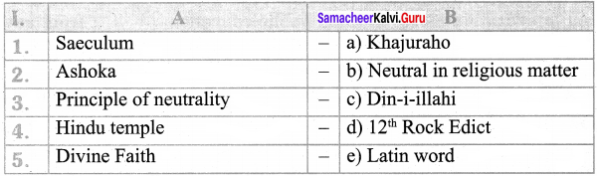
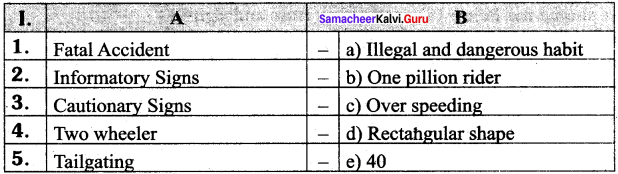
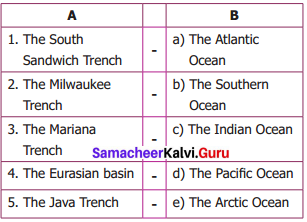
D. Match the following
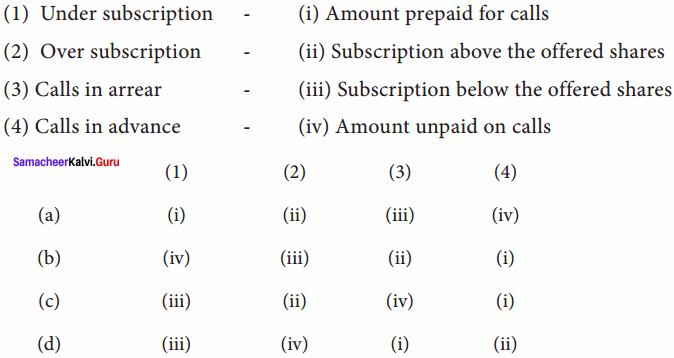
Land And Oceans 6th Standard Samacheer Kalvi Social Science Geography Solutions Term 1 Chapter 2

Answer:

  1. – b
  2. – a
  3. – d
  4. – e
  5. – c

E.

I. Consider the following statements.

Samacheer Kalvi 6th Social Science Book Question 1.
1. Plains are formed by rivers.
2. The ‘South Sandwich Trench’ is found in the Indian Ocean.
3. Plateaus have steep slopes.
Choose the correct answer using the codes given below.
(a) 1 and 3 (b) 2 and 3
(c) 1,2 and 3 (d) 2 only
Answer:
(a) 1 and 3

II. Consider the following statements.

Samacheer Kalvi 6th Social Science Book Back Answers Question 1.
Statement I : Mountains are second order land forms.
Statement II : The Mariana Trench is the deepest trench in the world.
Which of the statement(s) is/are true?
(a) I is true; II is wrong (b) I is wrong; II is true
(c) Both the statements are true (d) Statements I and II are wrong.
Answer:
(c) Both the statements are true

F. Answer in a word

Samacheerkalvi.Guru 6th Social Question 1.
Which is the highest plateau in the world?
Answer:
Tibetan Plateau

Samacheer Kalvi 6th Books Social Science Question 2.
Name a second-order landform.
Answer:
Mountains, plateaus and plains

Samacheer Kalvi 6th Social Question 3.
Which ocean is named after a country?
Answer:
Indian Ocean

Samacheer Kalvi 6th Social Science Question 4.
Name the islands located in the Arabian Sea.
Answer:
Lakshadweep islands and Minicoy islands

Samacheer Kalvi Social 6th Standard Question 5.
What is the deepest part of the ocean called as?
Answer:
Trench

G. Answer in brief.

Samacheer Kalvi 6th Geography Book Question 1.
What is a continent?
Answer:
The vast landmasses on Earth are called Continents.

6th Social Guide Samacheer Kalvi Question 2.
Name the continents which surround the Atlantic Ocean.
Answer:

  1. North America and South America in the west.
  2. Europe and Africa in the east.

Samacheer Kalvi 6th Books Social Question 3.
What are oceans?
Answer:
Oceans are vast expanse of water.

Samacheer Kalvi 6 Social Science Question 4.
List out the names of continents according to their size
Answer:

  1. Asia
  2. Africa
  3. North America
  4. South America
  5. Antarctica
  6. Europe and Australia.

Samacheer Kalvi Social Science 6th Question 5.
Name the oceans which surround North America and South America.
Answer:
North America : On the west by Pacific ocean, on the east by Atlantic ocean and on the north by Arctic ocean
South America : On the west by Pacific Ocean, on the east by Atlantic ocean.

H. Distinguish between.

Social Samacheer Kalvi 6th Question 1.
A Mountain and a Plateau
Answer:
Mountains

  1. A landform that rises over 600 metre above its surroundings and has steep slopes is called a mountain.
  2. Example: Himalayas

Plateaus

  1. Plateaus are the elevated portions of the Earth that have flat surfaces bounded by steep slopes. The elevation of plateaus may be a few hundred metre or several thousand metre.
  2. Example: Chotanagpur Plateau

Samacheer Kalvi 6th Social Book Back Answers Question 2.
An ocean and a sea?
Answer:
Ocean:

  • An ocean is a vast expanse of water.
  • Oceans are very deep.
  • Example: The Pacific Ocean

Sea:

  • A sea is a water body partially or fully enclosed by land.
  • Seas are not so deep as oceans
  • Example: The Arabian sea

I. Answer the following questions in detail.

Question 1.
Mention the classification of iandforms.
Answer:
First order Iandforms:

(i) Continents and oceans are grouped as first order and forms. the vast land masses on Earth are called Continents and huge water bodies are called Oceans.

(ii) Asia is the largest continent, whereas Australia is the smallest one.

Second order and forms:
The second order  and forms are categorised as mountains, plateaus and plains.

Third order and forms:
Third order and forms are formed on mountains, plateaus and plains mainly by erosional and depositional activities of rivers, glaciers, winds and waves. Valleys, beaches and sand dunes are some examples of third order and forms.

Question 2.
Write a note on plateaus
Answer:

  1. Plateaus are the elevated portions of the Earth that have flat surfaces bounded by steep slopes.
  2. The elevation of plateaus may be a few hundred metre or several thousand metre.
  3. Tibetan Plateau is the highest plateau in the world.
  4. Generally plateaus are rich in minerals.
  5. Chotanagpur Plateau is one of the mineral rich plateaus in India.
  6. Deccan Plateau in peninsular India is of volcanic origin.

Question 3.
Plains are highly populated. Give reasons
Answer:

  1. Plains are a flat and relatively low-lying lands. Plains are usually less than 200 metre above sea level.
  2. Most plains are formed by rivers, their tributaries and distributaries.
  3. These plains are used extensively for agriculture due to the availability of water and fertile soil
  4. They are most suitable for human habitation.
  5. Hence, they are the highly populated regions of the world.

Question 4.
Give the important features of the Pacific Ocean.
Answer:

  1. The Pacific Ocean is the largest and deepest ocean on Earth.
  2. It covers about one-third of the Earth’s total area.
  3. It is bounded by Asia and Australia in its west and North America and South America in its east.
  4. On its apex is the Bering Strait. It connects the Pacific Ocean with the Arctic Ocean.
  5. The deepest point Mariana Trench is located in the Pacific Ocean.
  6. A chain of volcanoes is located around the Pacific Ocean.

Question 5.
Write down the importance of oceans.
Answer:

  1. Oceans are the life blood of planet Earth and human kind.
  2. They flow over nearly three quarters of our planet.
  3. They hold 97% of the planet’s water.
  4. They produce more than half of the oxygen in the atmosphere.
  5. Absorb the most carbon from it.
  6. The oceans along with the atmosphere, keep temperatures fairly constant world wide.

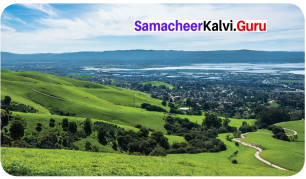
J. Picture Study.

Question 1.

6th Standard Geography Guide Term 1 Chapter 2 Land And Oceans Samacheer Kalvi

  1. Name the landform.
  2. What order of a landform is this?
  3. By which activity of river is this landform formed?

Answer:

  1. Valley
  2. Third Order
  3. Erosion

K. (ii) ACTIVITY

Question 1.
Give examples for the following using an Atlas.

a. Bay:_______,________,_______
Answer:
Bay of Bengal, Tokyo Bay, Korea Bay

b. Gulf:_______,________,_______
Answer:
Gulf of Kutch, Gulf of Mannar, Gulf of Aden

c. Island:_______,________,_______
Answer:
Sri Lanka, Maldives, Japan

d. Strait:_______,________,_______
Answer:
Strait of Gibraltar, Strait of Magellan, Palk strait

Question 2.
Map reading (with the help of atlas)

a. A sea in the east of India
b. Continents in the westof Atlantic Ocean
c. Continents in the south of Arctic Ocean
d. A strait betweenlndia and Sri Lanka
e. Oceans which surround Australia if.
f. Find out thedsthumusses
(Create more questions)
Answer:
a. Bay of Bengal
b. North America and South America
c. Almost completely surrounded by Eurasia and North America.
d. Palk Strait.
e. Indian Ocean to the west, the South Pacific Ocean to the East and the Southern Ocean to the South.
f. Isthumusses – A Narrow piece of land connecting two larger areas across an expanse of water. Isthumus of Panama – Central America.

Question 3.
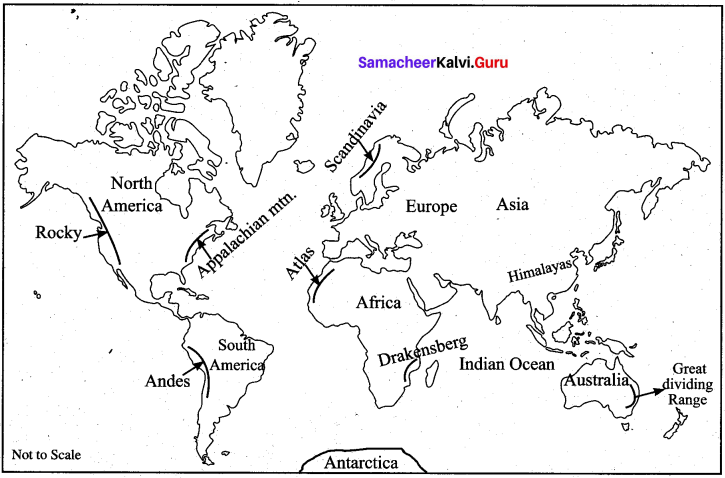
On the given outline map of the world, label the continents and mountain ranges.
Answer:
Land And Oceans Samacheer Kalvi 6th Social Science Geography Solutions Term 1 Chapter 2

Question 4.
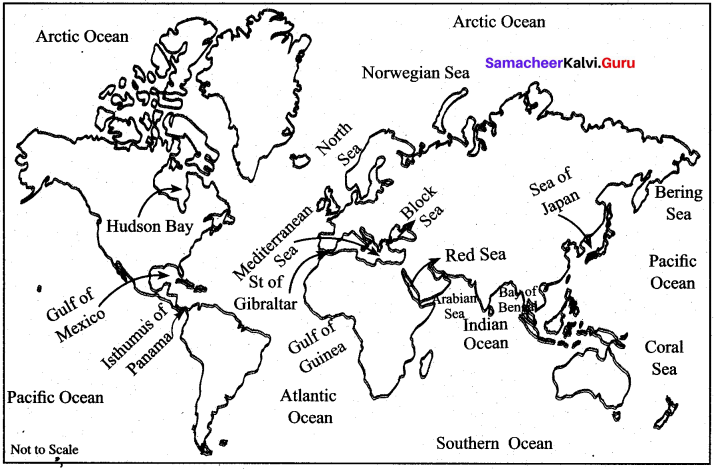
On the given outline map of the world, label oceans, seas, isthumus and straits.
Answer:
Samacheer Kalvi Guru 6th Social Science Geography Solutions Term 1 Chapter 2 Land And Oceans

Samacheer Kalvi 6th Social Science Land And Oceans Intext Question

HOTS

Question 1.
December 11 International Mountain Day.
Prepare slogans, posters and placards to celebrate International Mountain Day.
Answer:

  1. “Mountains are among the most beautiful land masses in the world.”
  2. “Mountains are beautiful as they rise up above the clouds and show just how grand the world can be.”
  3. “Great things are done when men and mountains meet. ”
  4. “How glorious a greeting the Sun gives the mountains.”
  5. “Mountains are earth’s undecaying monuments.”
  6. ‘The mountains, forests and seas render men savage, they develop fierce, but yet do not destroy the human.”
  7. “Men stumble over pebbles, never over mountains.”
  8. “Each fresh peak ascended teaches something.”
  9. “Mountains are the beginning and end of all natural scenery.”
  10. “He who climbs upon the highest mountains laughs at all tragedies, real or imaginary.”

Question 2.
You know the importance of conservation of forests. Do you think conservation of mountains is also equally important?
Answer:

  1. Mountains make up more than a quarter of the planet’s land mass. These surfaces provide resources for nearly 700 million people through out the world.
  2. Mountains provide energy resources, food and water to people all around the world.
  3. But climate change could cause mountains to shrink.
  4. Deforestation has also been a threat while natural disasters often damage many mountains.
  5. Mountains are among the most beautiful land masses in the world. So like conservation of forests, conservation of mountains also equally important

Question 3.
When you are walking on the Marina beach in Chennai, which order of landform are you on?
Answer:
Third order of land form.

Question 4.
Why are the Red Sea, Dead Sea and Black Sea named so?
Answer:

(i) Red Sea – It is named Red sea because it contains a Cyanobacteria which turns the normally blue – green water a reddish one. It gets connected to the ocean without even one river meeting the sea.

(ii) Black Sea – The Black Sea was first named by the ancient greeks as in hospitable sea. The sea got this reputation because it was different to navigate and hostile tribes inhabited its shores. After the successful development of the coast by the Greek colonists, the sea was named hospitable sea.

(iii) Dead Sea – The Dead Sea is roughly 8.6 times saltier than the ocean. This salinity makes for a harsh environment in which animals cannot flourish.

Question 5.
When you travel from Japan to California, which ocean would you travel across?
Answer:
Pacific Ocean.

Question 6.
When you arrange the continents in ascending order according to their size, which ranks third?
Answer:
Antarctica.

Samacheer Kalvi 6th Social Science Land And Oceans Intext Activities

Question 1.
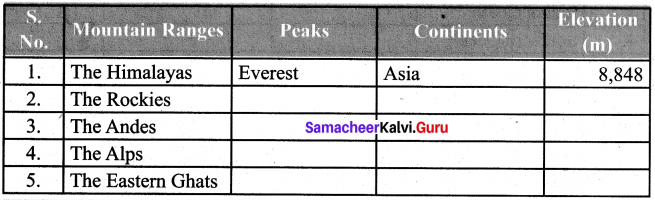
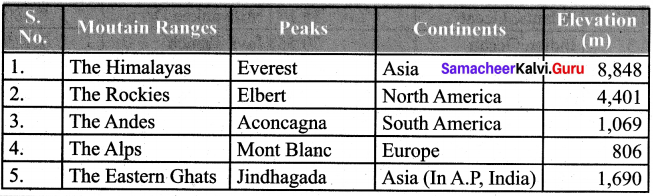
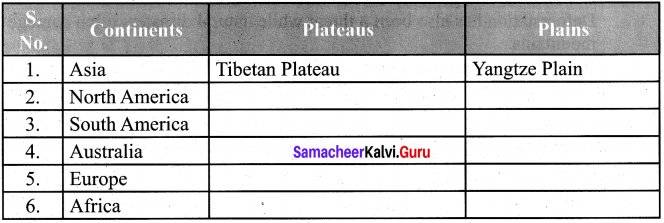
Complete the given table with the help of an atlas. Follow the example
Samacheer Kalvi Guru 6th Social Science Geography Solutions Term 1 Chapter 2 Land And Oceans
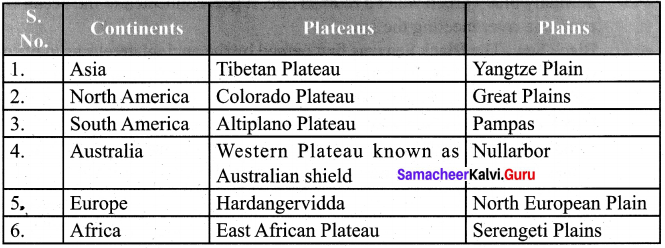
Answer:
Samacheer Kalvi 6th Social Science Book Geography Solutions Term 1 Chapter 2 Land And Oceans

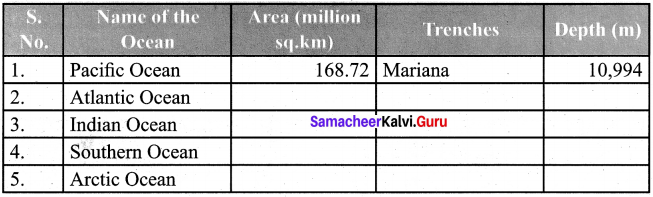
Question 2.
Samacheer Kalvi 6th Social Science Book Back Answers Geography Solutions Term 1 Chapter 2 Land And Oceans
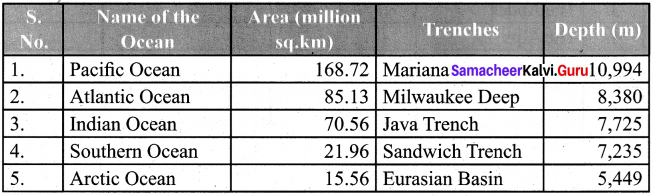
Answer:
Samacheerkalvi.Guru 6th Social Science Geography Solutions Term 1 Chapter 2 Land And Oceans

Question 3.
Samacheer Kalvi 6th Books Social Science Geography Solutions Term 1 Chapter 2 Land And Oceans

Answer:
Samacheer Kalvi 6th Social Science Geography Solutions Term 1 Chapter 2 Land And Oceans

Samacheer Kalvi 6th Social Science Land And Oceans Additional Questions

A. Choose the correct answer

Question 1.
The largest continent is
(a) Europe
(b) Australia
(c) North America
(d) Asia
Answer:
(d) Asia

Question 2.
Mount Everest is located in …………….
(a) India
(b) Nepal
(c) Bhutan
(d) Pakistan
Answer:
(b) Nepal

Question 3.
The longest mountain range in the world is
(a) Himalayas
(b) Rocky
(c) Andes
(d) Alps
Answer:
(c) Andes

Question 4.
Which of the following is not grouped under second-order landform?
(a) Plains
(b) Plateaus
(c) Valleys
(d) Mountains
Answer:
(c) Valleys

Question 5.
‘Roof of the world’ denotes to
(a) Tibetan Plateau
(b) Chotanagpur Plateau
(c) Deccan Plateau
(d) Malwa Plateau
Answer:
(a) Tibetan .Plaleauj

Question 6.
Bering sea is the marginal sea of the Ocean.
(a) Pacific
(b) Indian
(c) Atlantic
(d) Arctic
Answer:
(a) Pacific

Question 7.
The Reunion islands are present in Ocean.
(a) Arctic
(b) Antartic
(c) Indian
(d) Pacific
Answer:
(c) Indian

Question 8.
The land surrounded by water on three sides is called
(a) Bay
(b) Strait
(c) Peninsula
(d) Trench
Answer:
(c) Peninsula

B. Fill in the blanks :

  1. The highest peak in the world is ___________.
  2. In Sangam period, Mountain and its environs are classified as ___________ land.
  3. The flat topped part of the plateau is called ___________.
  4. The plains have been the ___________ from the earliest times.
  5. Plain in North India is one of the ___________largest plains in the world.
  6.  Sand dunes form the ___________ order landforms.
  7. The process of removal of surface material from the Earth’s crust is called ___________.
  8. Chain of volcanoes present around the Pacific Ocean are called the Pacific ___________.
  9. The shape of the atlantic ocean resembles the letter ___________.
  10. .Bay of Bengal and Palk Bay are connected by ___________.

Answer:

  1. Mt.Aeresti
  2. Kurinji
  3. Table land
  4. cradle of civilisations
  5. Indo-Gangetif
  6. Third
  7. Erosion
  8. Ring of fire
  9. S
  10. Palk Strait

C. Circle the odd one out

  1. Rivers, Glaciers, Winds, Plains
  2. Mariana Trench, Tasman Sea, Philippine Sea, Strait of Gibraltar
  3. The Ross Sea, The Weddell Sea, The Davis Sea, The Red Sea
  4. Palk Strait, The Arctic Ocean, Greenland, Eurasian Basin
  5. Dharmapuri Plateau, Coimbatore Plateau, Madurai Plateau, Malwa Plateau

Answer:

  1. Plains
  2. Strait of Gibraltar
  3. The Red Sea
  4. Palk strait
  5. Malwa plateau

D. Match the following

  1. Kurinji – (a) Forest
  2. Mullai – (b) Coastal Region
  3. Marutham – (c) Deserts
  4. Neithal – (d) Agricultural land
  5. Palai – (e) Mountains

Answer:

  1. – e
  2. – a
  3. – d
  4. – b
  5. – c

E. Consider the following statements.

Question 1.
1.Andes mountains are the longest mountain range in the world.
2.Mountains come under the second order landforms.
3.The highest point of the mountain is known as peak.
Choose the correct answer using the codes given below.
(a) land 2
(b) 1,2 and 3
(c) 2 and 3
(d) 1 and 3
Answer:
(b) 1, 2 and 3

Question 2.
Consider the following statements.
Statement I : Ferdinand Magellan named the ocean Pacific, meaning calm. Statement II : Ferdinand Magellan was a Spanish navigator.
Which of the statement(s) is/are true?
(a) I is true; II is wrong
(b) I is wrong; II is true
(c) Both the statements are true
(d) Statements I and II are wrong.
Answer:
(c) Both the statements are true

F. Answer in a word

Question 1.
A broad inlet of the sea where the land curves inwards.
Answer:
Bay

Question 2.
A relatively levelled area of the earth’s surface with gentle slope.
Answer:
plain

Question 3.
The Plains of river Cauvery and Vaigai are found in the State of
Answer:
Tamil nadu

Question 4.
The eroded materials getting deposited on the low lying areas.
Answer:
Deposition

Question 5.
The Strait which connects the Atlantic ocean-to the Mediterranean Sea
Answer:
Strait of Gibraltar

G. Answer in brief.

Question 1.
Why do we see the most part of the globe in blue colour?
Answer:
We see the most part of the globe in blue colour is because of a large part of the Earth is covered by water which occupies 71 percent and land which occupies only 29 percent of the Earth’s surface.

Question 2.
Mention some of the hill stations in Tamil Nadu.
Answer:

  1. Udhagamandalam
  2. Kodaikanal
  3. Kolli hills
  4. Yercaud and Yelagiri

Question 3.
Mention some of the hill stations found in Tamil Nadu.
Answer:
Udaga mangalam, Kodaikanal, Kolli hills, Yercard and Yelagiri are some of the hill stations found in Tamil Nadu.

Question 4.
Write a short note on Third order landforms.
Answer:

  1. Third order landforms are formed on mountains, plateaus and plains by erosional and depositional activities of rivers, glaciers, winds and waves.
  2. Valleys, beaches and sand dunes are examples of third order land forms.

Question 5.
What is Oceanography ?
Answer:
The study of oceans is called Oceanography.

Question 6.
Mention the islands located in the Pacific Ocean?
Answer:
Indonesia, Philippines, Japan, Hawaii, New Zealand, are some of the islands located in the Pacific Ocean.

H. Distinguish between.

Question 1.
A continent and ocean
Answer:

Continent

  1. The vast land masses are called continents.
  2. Example: Asia, Africa, Europe.

Ocean

  1. Oceans are vast expanse of water.
  2. Example: Pacific Ocean, Atlantic Ocean.

Question 2.
An Pacific Ocean and a Atlantic Ocean Ans
Answer:

Pacific

  1. The largest and deepest ocean.
  2. It spreads out 168.72 million sq.km
  3. The Bering Sea, The China sea, the Sea of Japan, Tasman Sea, Philippines Sea are some of the marginal seas.

Atlantic

  1. Second largest ocean
  2. It spreads about 85.13 million sq.km
  3. Mediterranean Sea, The Caribbean Sea, the Gulf of Mexico, the North Sea, the Gulf of Guinea are important marginal seas.

I. Answer the following questions in detail.

Question 1.
Write a note on the Third order of landforms.

  1. The Third order landforms are formed on the mountains, plateaus and plains mainly by erosional and depositional activities of rivers, glaciers, winds and waves.
  2. Valleys, beaches and sand dimes are some examples of Third order landforms.
  3. Erosion is the process of removal of surface material from the Earth’s crust.
  4. The eroded materials are transported and deposited on the low lying areas.
  5. This process is called as deposition.

Question 2.
Bring out the features of the Indian Ocean.
Answer:

  1. The Indian ocean in the third largest ocean on the Earth’s surface.
  2. It covers an area of 70.56 million sq. km.
  3. It is triangular in shape.
  4. It is bounded by Africa in the west, Asia in the North and Australia in the East.
  5. The Andaman and Nicobar Islands, Lakshadweep, Maldives, Sri Lanka, Mauritus and the Reunion Islands are some of the islands present in the Indian Ocean.
  6. The Java trench is the deepest point in the Indian Ocean

Samacheer Kalvi 7th Social Science Geography Solutions Term 1 Chapter 2 LandForms

Students can Download Social Science Geography Chapter 2 LandForms Questions and Answers, Notes Pdf, Samacheer Kalvi 7th Social Science Book Solutions Guide Pdf helps you to revise the complete Tamilnadu State Board New Syllabus and score more marks in your examinations.

Tamilnadu Samacheer Kalvi 7th Social Science Geography Solutions Term 1 Chapter 2 LandForms

Samacheer Kalvi 7th Social Science LandForms Textual Evaluation

I. Choose the correct answer:

A Cirque Is Known As In Germany Question 1.
is a deposition of river sediments along the foot-hills.
(a) Plunge pool
(b) Alluvial fan
(c) Floodplain
(d) Delta
Answer:
(b) Alluvial fan

A Cirque Is Known As In Germany Answer Question 2.
Courtallam falls is located across the river.
(a) Cauvery
(b) Pennar
(c) Chittar
(d) Vaigai
Answer:
(c) Chittar

5 Landforms Of Tamil Nadu In Tamil Question 3.
The landform created by glacial deposition is
(a) Cirque
(b) Arete
(c) Moraine
(d) Tam lake
Answer:
(c) Moraine

Samacheer Kalvi Guru 7th Social Science Question 4.
Large deposits of loess are found in
(a) USA
(b) India
(c) China
(d) Brazil
Answer:
(c) China

A Cirque Is Known As Dash In Germany Question 5.
are not associated with wave erosion
(a) Cliff
(b) Sea arch
(c) Stack
(d) Beaches
Answer:
(d) Beaches

II. Fill in the Blanks

  1. The process of breaking and crumbling of rocks is ______
  2. The place where the river joins a lake or a sea is known as ______
  3. Inselbergs are found in the ______ desert in South Africa.
  4. A cirque is known as ______ in Germany.
  5. The first longest beach in the world is ______

Answer:

  1. weathering
  2. river mouth
  3. Kalahari
  4. Kar
  5. Miami

III. Match the following

Braking and crumbling of rocksiGlacier
Abandoned meander loopsiiBarchans
Large body of moving iceiiiLagoon
Crescent shaped sand dunesivWeathering
Vembanad lakevOxbow lake

Answer:

  1. iv
  2. v
  3. i
  4. ii
  5. iii

IV. Consider the following statement and (✓) Tick the appropriate answer.

Samacheer Kalvi Guru 7th Social Question 1.
Assertion (A) : The deltas are formed near the mouth of the river.
Reason (R) : The velocity of the river becomes slow when it approaches the sea.
(a) Both A and R are correct
(b) A is correct and R is wrong
(c) A is wrong and R is correct
(d) Both A and R are wrong
Answer:
(a) Both A and R are correct

The Cirque Is Known As In Germany Question 2.
Assertion (A) : Sea arches in turn become Sea Stacks.
Reason (R) : Sea Stacks are the results of wave deposition.
(a) Both A and R are correct
(b) A is correct and R is wrong
(c) A is wrong and R is correct
(d) Both A and R are wrong
Answer:
(b) A is correct and R is wrong

V. Answer the following.

Cirque Is Known As In Germany Question 1.
Define erosion.
Answer:
Erosion is the wearing away of the landscape by different agents like water, wind, ice and sea waves.

Samacheerkalvi.Guru 7th Social Question 2.
What is a plunge pool?
Answer:
Plunge pool is a hollow feature at the base of a waterfall which is formed by cavitation.

7th Standard Question 3.
How are Ox – bow lakes formed?
Answer:
Due to continuous erosion and deposition along the sides of the meander, the ends of the meander loop comes closer and closer. In due course of time the meander loop cuts off from the river and forms a cutoff lake, also called an Ox-bow lake.

Question 4.
Name the major landforms formed by glacial erosion.
Answer:
Cirque, Aretes, U’ Shaped Valley

Question 5.
Give a note on Mushroom rocks.
Answer:
In deserts rocks in the shape of a mushroom, commonly called mushroom rocks.

Question 6.
What is a lagoon? Give an example.
Answer:
Lagoon is a shallow stretch of water partially or completely separated from the sea. E.g. Chilka lake in Odisha, Pulicat lake in Tamil Nadu and Andhra Pradesh and Vembanad lake in Kerala are the famous lagoons in India.

VI. Distinguish between

Question 1.
Tributary and Distributary
Answer:

S.NoTributaryDistributary
1.A stream or river that flows into and joins a main river.A stream that branches off and flows away from a main stream.
2.Eg. Amaravathi is a tributary of river CauveryEg. Kollidam s a distributary of Cauvery.

Question 2.
‘V’ shaped valley and ‘U’ shaped valley
Answer:

S.No‘V’ shaped valley‘IP shaped valley
1.Formed by erosion of riversFormed by lateral and vertical erosion of glaciers.
2.Eg. Kambam valley in Tamil NaduEg. Leh Valley in Ladakh

Question 3.
Continental glacier and Mountain glacier
Answer:

S.NoContinental glacierMountain glacier
1.Glacier covering vast areas of a continent with thick ice sheets is called continental glacier.Stream of ice flowing along a valley is called mountain glacier.
2.Eg. Antartica, Green landEg. The Himalayas, The Alps

VII. Give reason

Question 1.
The ends of the meander loops come closer and closer.
Answer:
Due to continuous erosion and deposition of rivers along the sides of the meander, the ends of the meander loop comes closer and closer.

Question 2.
Flood plains are very fertile.
Answer:
At times the river overflows its banks. This leads to the flooding of the neighbouring areas. As the river floods, it deposits layers of fine soil and other material called sediments along its banks. This leads to the formation of a flat fertile floodplain.

Question 3.
Sea caves are turn into stacks.
Answer:
As the cavities of sea caves become bigger, only the roof of the caves remain to form sea Arches. When erosion further breaks the roof, only walls are left, thus forming stacks.

VIII. Answer in a paragraph

Question 1.
Explain different landforms produced by river erosion.
Answer:

  1. The running water in the river erodes the landscape, which creates a steep-sided valley like the letter ‘V’ known as ‘V’ shaped valley.
  2. Falling of river water over a vertical step in the river bed is called waterfall. It is formed when the soft rocks are removed by erosion. E.g. Coutrallam falls across the river Chittar in Tamil Nadu.
  3. Plunge pool is a hollow feature at the base of a waterfall which is formed by cavitation. Alluvial fan is a deposition of sediment occurs at which the river enters a plain or the foot-hills.
  4. As the river enters the plain it twists and turns forming large bends known as Meanders.
    Eg. Meanders along the River Vellar near Sethiyathope in Cuddalore District, Tamil Nadu.
  5. Due to continuous erosion and deposition along the sides of the meander, the ends of the meander loop comes closer and closer. In due course of time the meander loop cuts off from the river and forms a cutoff lake, also called an Ox-bow lake.

Question 2.
Describe the landforms associated with wind.
Answer:

  1. Winds erode the lower section of the rock more than the upper part.
  2. An isolated residual hill, standing like a pillar with rounded tops are called Inselbergs.
    E.g. Inselberg in the Kalahari Desert of South Africa.
  3. When the wind blows, it lifts and transports sand from one place to another. When it stops blowing the sand falls and gets deposited in low hill – like structures. These are called sand dunes. The crescent shaped sand dunes are called Barchans.
  4. When the grains of sand are very fine and light, the wind can carry it over very long distances. When such sand is deposited in large areas, it is called Loess. Large deposits of loess are found in China.

Question 3.
How are aretes formed?
Answer:

  1. Glaciers erode the landscape by levelling soil and stones to expose the solid rock below.
  2. Cirque is a glacially eroded rock basin, with a steep side wall and steep head wall, surrounding an armchair-shaped depression.
  3. As the ice melts, they get filled up the cirque with water and become beautiful lakes in the mountains called as Tam Lake. When two adjacent cirques erode towards each other, the previously rounded landscape is transformed into a narrow rocky, steep – sided ridge called Aretes.

Activity

Question 1.
Fill in the corresponding columns with reference to the landform features given below
Answer:
Barchan, ‘V’ Shaped valley, Cliff, Arete, Inselberg, Moraine, Alluvial fan, Lagoon

S.NoNatural AgentsLandforms
ErosionDeposition
1.River‘V’ Shaped valleyAlluvial fan
2.GlacierAreteMoraine
3.WindInselbergBarchan
4.Sea waveCliffLagoon

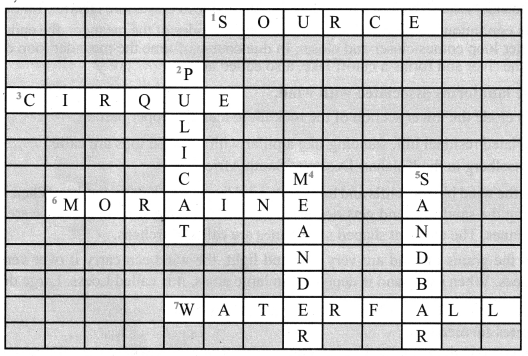
Question 2.
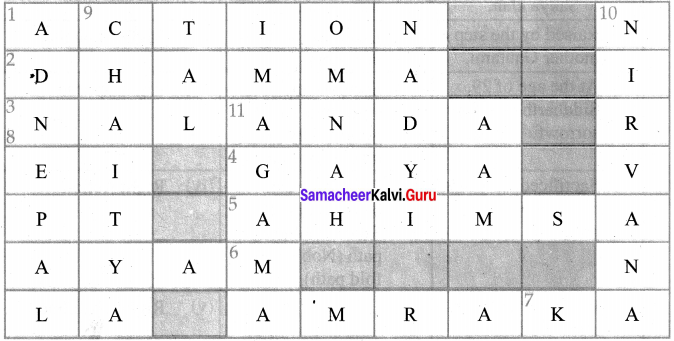
Crossword Puzzle

Across
1. Place of origin of the river.
3. Arm chair shaped glacial landform
6. Glacial Depositional feature
7. Vertical drop of water

Down
2. Lagoon in Tamil Nadu
4. Loops along the river course
5. Wave depositional feature
Answer:

A Cirque Is Known As In Germany Samacheer Kalvi 7th Social Science Geography Solutions Term 1 Chapter 2 Landforms

Question 3.
Identify any one of the following features near your home town and write a note on them.

  1. Hill
  2. Waterfall
  3. River(or)Stream
  4. Beach

Answer:
Activity to be done by the students themselves

Samacheer Kalvi 7th Social Science LandForms Additional Questions

I. Choose the correct answer:

Question 1.
The term ‘meander’ has been named on the basis of Meander River of ______
(a) India
(b) Russia
(c) China
(d) Turkey
Answer:
(d) Turkey

Question 2.
The material carried by the glacier such as rock, sand and silt get deposited to form ______
(a) Cirque
(b) Glacial moraines
(c) Aretes
(d) Tam Lake
Answer:
(b) Glacial moraines

Question 3.
Northern China loess deposits are brought from the ______ desert.
(a) Gobi
(b) Sahara
(c) Thar
(d) Atacama
Answer:
(a) Gobi

Question 4.
Steep rock faces formed due to dashing of sea waves are ______
(a) Sea caves
(b) Sea Cliffs
(c) Sea Arches
(d) Stacks
Answer:
(b) Sea Cliffs

Question 5.
Chilka lake is Odisha is an example of ______
(a) Stack
(b) Sea Arch
(c) Lagoon
(d) Sand bar
Answer:
(c) Lagoon

II. Circle the odd one

Question 1.
Angel, Niagra, Victoria, Ganges
Hint: Ganges are river, other three are water falls.
Answer:
Ganges

Question 2.
Colva, Miami, Chilka, Marina.
“Hint: Chilka is a lake, other three are Beaches.
Answer:
Chilka

Question 3.
Water, Sun, ice, Sea waves.
Hint: Sun is a natural resource, other three are agents of erosion.
Answer:
Sun

III. Match the following

AB
Continental glacieriThe Alps
Mountain glacieriiVembanad lake
InselbergiiiAntartica
LagoonivKalahari

Answer:

  1. iii
  2. i
  3. iv
  4. ii

IV. Consider the following statements.

Question 1.

  1. The highest water fall is Angel falls of Venezuela in South America.
  2. The first longest beach in the world is the Marina beach in Chennai.
  3. Deltas are excellent productive lands.

Choose the correct answer using the codes given below.
(a) 1 and 3
(b) 2 and 3
(c) 1 and 2
(d) only 3.
Answer:
(a) 1 and 3

Question 2.

  1. A part of the land adjoining or near the sea is called the sea coast.
  2. The boundary of a coast where land meets water is called the coast line.
  3. Moraines are glacial deposition.

Choose the correct answer using the codes given below.
(a) 2 and 3
(b) 1 and 3
(c) 1,2 and 3
(d) 1 and 2.
Answer:
(c) 1, 2 and 3

V. Answer in a word

Question 1.
Name the waterfall located on the borders of Zambia and Zimbabwe in Africa
Answer:
Victoria falls

Question 2.
How is the deposition of sediment that occurs when the river enters a plain or the foothills called?
Answer:
Alluvial fan

Question 3.
What are hollow like caves formed on rock due to dashing of sea waves called?
Answer:
Sea caves.

VI. Answer in a sentence or two.

Question 1.
What is endogenic process?
Answer:
The endogenic process (internal process) leads to the upliftment and sinking of the earth’s surface at several places.

Question 2.
What is exogenic process?
Answer:
The exogenic process (external process) is the continuous wearing down and rebuilding of the land surface.

Question 3.
What is gradation?
Answer:
Gradation is the process of levelling of highlands through erosion and filling up of lowlands through deposition.

Question 4.
Name the processes by which the landscape gets continuously worn away?
Answer:
The landscape is being continuously worn away by two processes – weathering and erosion.

Question 5.
Define weathering.
Answer:
Weathering is the breaking and falling apart into small pieces of the rocks on the earth’s surface.

Question 6.
What is a river?
Answer:
The water flowing from its source to river mouth, along a definite course is called a River.

Question 7.
How is a delta formed? Give example of deltas.
Answer:
The collection of sediments from all the mouths form Delta. Deltas are excellent productive lands. They have more minerals which favour cultivation. E.g. Cauvery delta, Ganges delta, Mississippi delta.

Question 8.
What is a glacier?
Answer:
A large body of ice moving slowly down a slope or valley due to gravity is called a glacier.

VII. Answer in a Paragaraph.

Question 1.
Write a note on

  1. Sea Coast
  2. Coast line

Answer:

  1. Sea Coast: A part of the land adjoining or near the sea is called the Sea coast.
  2. Coast line: The boundary of a coast, where land meets water is called the Coast line. The coastal areas are subject to change due to wave erosion and wave deposition

Question 2.
Write a note on

  1. Sea Arches
  2. Stacks

Answer:

  1. Sea Arches: As the cavities of sea caves become bigger and bigger only the roof of the caves remains, thus forming Sea Arches.
  2. Stacks: Further, erosion breaks the roof and only walls are left. These wall like features are called Stacks.

Samacheer Kalvi 11th Economics Solutions Chapter 2 Consumption Analysis

Immediately get Chapter Wise Tamilnadu State Board Solutions for 11th Economics to gain more marks and start Quick Revision of all Chapters. All Chapters Pdf is provided along with the Questions and Answers. You Can Dowload Samacheer Kalvi 11th Economics Book Solutions Questions and Answers for Chapter wise are given with a clear explanation. Tamilnadu State Board Solutions for 11th Economics Chapter 2 Consumption Analysis Questions and Answers is for free of cost.

Tamilnadu Samacheer Kalvi 11th Economics Solutions Chapter 2 Consumption Analysis

Tamilnadu State Board Solutions for 11th Economics Chapter 2 Consumption Analysis Questions and Answers PDF has all given in Chapter Wise Section. Check Out daily basis with Tamilnadu State Board Solutions 11th Economics PDF will help to improve your score. Improve your level of accuracy to answer a question by reading with Samacheer Kalvi 11th Economics Book Solutions Questions and Answers PDF.

Samacheer Kalvi 11th Economics Consumption Analysis Text Book Back Questions and Answers

Part – A

11th Economics Chapter 2 Book Back Answers Multiple Choice Questions

Samacheer Kalvi 11th Economics Solution Chapter 2 Question 1.
Pick the odd one out
(a) Luxuries
(b) Comforts
(c) Necessaries
(d) Agricultural
Answer:
(d) Agricultural

11th Economics Chapter 2 Question 2.
Choice is always constrained or limited by the …………………… of our resources.
(a) Scarcity
(b) Supply
(c) Demand
(d) Abundance
Answer:
(a) Scarcity

Samacheer Kalvi 11th Economics Book Back Answers Question 3.
The chief exponent of the Cardinal utility approach was
(a) J.R.Hicks
(b) R.G.D.Allen
(c) Marshall
(d) Stigler
Answer:
(c) Marshall

Samacheer Kalvi Guru 11th Economics Question 4.
Marginal Utility is measured by using the formula of ……………………..
(a) TUn – TUn-1
(b) TUn – TUn+1
(c) TUn + TUn+1
(d) TUn – TUn+1
Answer:
(a) TUn – TUn-1

11th Economics Samacheer Kalvi Question 5.
When marginal utility reaches zero, the total utility will be
(a) Minimum
(b) Maximum
(c) Zero
(d) Negative
Answer:
(b) Maximum

11th Economics Solutions Samacheer Kalvi Question 6.
Gossen’s first law is known as ……………………..
(a) Law of equi-marginal utility
(b) Law of diminishing marginal utility
(c) Law of demand
(d) Law of Diminishing returns.
Answer:
(b) Law of diminishing marginal utility

Samacheer Kalvi 11th Economics Question 7.
The basis for the law of demand is related to
(a) Law of diminishing marginal utility
(b) Law of supply
(c) Law of Equi-marginal utility.
(d) Gossen’s Law.
Answer:
(a) Law of diminishing marginal utility

Samacheer Kalvi 11th Economics Book Question 8.
The concept of consumer’s surplus is associated with ……………………….
(a) Adam smith
(b) Marshall
(c) Robbins
(d) Ricardo
Answer:
(b) Marshall

11 Economics Samacheer Kalvi Question 9.
Given the potential price is Rs.250 and the actual price is Rs.200. Find the consumer surplus,
(a) 375
(b) 175
(c) 200
(d) 50
Answer:
(d) 50

Samacheer Kalvi Guru 11 Economics Question 10.
Indifference curve approach is based on ………………………..
(a) Ordinal approach
(b) Cardinal approach
(c) Subjective approach
(d) Psychological approach
Answer:
(a) Ordinal approach

Samacheer Kalvi 11th Economics Solutions Question 11.
The concept of elasticity of demand was introduced by
(a) Ferguson
(b) Keynes
(c) Adam Smith
(d) Marshall
Answer:
(d) Marshall

Economics Class 11 Samacheer Kalvi Question 12.
Increase in demand is caused by ……………………..
(a) Increase in tax
(b) Higher subsidy
(c) Increase in interest rate
(d) decline in population
Answer:
(b) Higher subsidy

Samacheer Kalvi Economics Question 13.
The movement on or along the given demand curve is known as _______.
(a) Extension and contraction of demand.
(b) Shifts in the demand,
(c) Increase and decrease in demand.
(d) All the above
Answer:
(a) Extension and contraction of demand.

Chapter 2 Of Economics Class 11 Question 14.
In case of relatively more elastic demand, the shape of the curve is ……………………..
(a) Horizontal
(b) Vertical
(c) Steeper
(d) Flatter
Answer:
(d) Flatter

Economics Chapter 2 Question 15.
A consumer is in equilibrium when marginal utilities from two goods are
(a) Minimum
(b) Inverse
(c) Equal
(d) Increasing
Answer:
(c) Equal

Samacheer Kalvi Economics 11th Question 16.
Indifference curve was first introduced by ………………………..
(a) Hicks
(b) Allen
(c) Keynes
(d) Edgeworth
Answer:
(d) Edgeworth

Economics Chapter 2 Class 11 Question 17.
The elasticity of demand is equal to one indicates
(a) Unitary Elastic Demand
(b) Perfectly Elastic Demand
(c) Perfectly Inelastic Demand
(d) Relatively Elastic Demand
Answer:
(a) Unitary Elastic Demand

Economics Class 11 Chapter 2 Question 18.
The locus of the points which gives the same level of satisfaction is associated with ……………………….
(a) Indifference Curves
(b) Cardinal Analysis
(c) Law of Demand
(d) Law of Supply
Answer:
(a) Indifference Curves

Question 19.
Ordinal Utility can be measured by
(a) Ranking
(b) Numbering
(c) Wording
(d) None of these
Answer:
(a) Ranking

Question 20.
The indifference curve are ………………………..
(a) Vertical
(b) Horizontal
(c) Positive sloped
(d) Negatively sloped
Answer:
(d) Negatively sloped

Part – B

Answer the following questions in one or two sentences

Question 21.
Define Utility.
Answer:
Utility is the capacity of a commodity to satisfy human wants.

Question 22.
Mention the classifications of wants.
Answer:
(a) Necessaries
(b) Comforts
(c) Luxuries.

Question 23.
There are two basic approaches, namely:
1. Utility approach

  • The utility approach involves the use of measurable (cardinal) utility to study consumer behaviour.
  • Marshall is the chief exponent of the utility approach to the theory of demand. It is known cardinal utility analysis or Marginal utility analysis or Marshallian utility analysis.

2. Indifference curve approach

  • The indifference curve approach was the idea of comparable utility [ordinal utility] J.R. Hicks and R.G.D. Allen introduced the indifference curve approach.

Question 24.
What are the degrees of price elasticity of Demand?
Answer:
The Degrees of Price Elasticity of Demand:

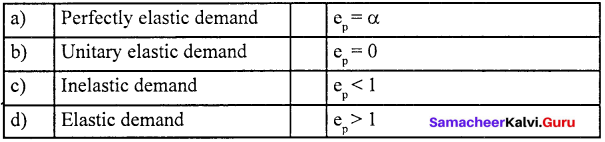
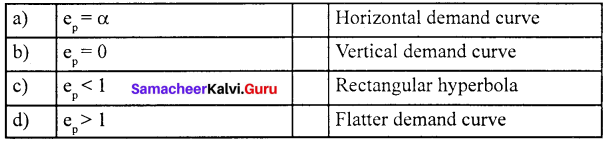
  1. Perfectly Elastic Demand (Ep = α)
  2. Perfectly Inelastic Demand (Ep = 0)
  3. Relatively Elastic Demand (Ep >1)
  4. Relatively Inelastic Demand (Ep < 1)
  5. Unitary Elastic Demand (Ep =1).

Question 25.
State the meaning of indifference curves?
Answer:

  1. The Consumer is rational and his aim is to derive maximum satisfaction.
  2. The utility cannot be cardinally measured but can be ranked or compared or ordered by an ordinal number such as I, II, III, and so on.
  3. The indifference curve approach is based on the concept “Diminishing Marginal Rate of Substitution”.
  4. The consumer is consistent. This assumption is called the assumption of transitivity.

Question 26.
Write the formula of consumer surplus.
Answer:
Consumer’s surplus = Potential price – Actual price.
Consumer’s surplus = TU-(P × Q)
TU – Total Utility,
P – Price,
Q – Quantity.

Question 27.
What are Giffen goods? Why it is called that?
Answer:
Giffen Paradox: The Giffen good or inferior good is an exception to the law of demand. When the price of inferior goods, falls, the poor will buy less and vice versa.

Part – C

Answer the following questions in One Paragraph

Question 28.
Describe the feature of human wants.
Answer:
The Feature of Human:

  1. Wants are unlimited
  2. Wants become habits
  3. Wants are satiable
  4. Wants are alternative
  5. Wants are competitive
  6. Wants are complementary
  7. Wants are recurring.

Question 29.
Mention the relationship between marginal utility and total utility.
Answer:
Total Utility:

  1. If Total utility increases
  2. If Total utility reaches maximum.
  3. If Total utility diminishes

Marginal Utility:

  1. Marginal utility declines
  2. Marginal utility reaches zero
  3. Marginal utility becomes negative

MUn = TUn – TUn-1.

Question 30.
Explain the concept of consumer’s equilibrium with a diagram.
Answer:
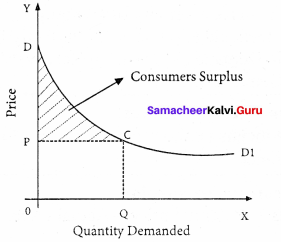
Consumer’s surplus is the difference between the potential price and actual price. Consumer’s surplus = Potential price – Actual price.
(or)
Consumer’s surplus = TU – (P × Q)
TU – Total Utility, P – Price, Q – Quantity
11th Economics Chapter 2 Book Back Answers Consumption Analysis Samacheer Kalvi
In the diagram X – axis shows the amount demanded and Y – axis represents the price. DD shows the consumer’s utility from the purchase of different amounts of commodity.
Hence Actual price OPCQ
Potential price ODCQ
Consumer’ surplus = ODCQ – OPCQ
= PCD.

Question 31.
Explain the theory of “ Consumer’s Surplus ”?
Answer:
Alfred Marshall defines consumer’s surplus as “the excess of price which a person would be willing to pay a thing rather than go without the thing, over that which he actually does pay is the economic measure of this surplus satisfaction. This may be called consumer’s surplus”.

Question 32.
Distinguish between extension and contraction of demand.
Answer:
If the changes in the quantity demanded is due to the change in price alone then it is called extension and contraction of demand. Buying more at lower price is extension of demand and less at higher price is contraction of demand.

Question 33.
What are the properties of indifference curves?
Answer:

  1. Indifference curve must have negative slope.
  2. Indifference curves are convex to the origin.
  3. Indifference curve cannot intersect.
  4. Indifference curves do not touch the horizontal or vertical axis.

Question 34.
Briefly explain the concept of consumer’s equilibrium.
Answer:
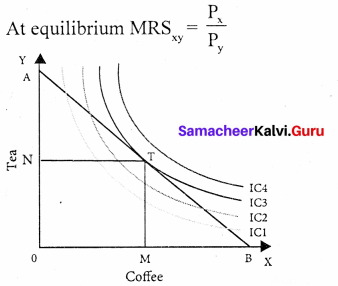
Consumer’s equilibrium refers to a situation under which a consumer spends his entire income on purchase of a goods, in such a manner that it gives him maximum satisfaction.
The consumer reaches equilibrium at the point where the budget line is tangent on the indifference curve
Samacheer Kalvi 11th Economics Solution Chapter 2 Consumption Analysis
T is the point of Equilibrium as budget line AB is tangent on indifference curve IC3, the upper IC implies maximum level of satisfaction.

Part – D

Answer the following questions in about a page

Question 35.
Explain the law of demand and its exceptions.
Answer:
The law of demand was first stated by Augustin Cournot in 1838. Later it was refined and elaborated by Alfred Marshall.
Definition:
The law of demand says as “The quantity demanded increases with a fall in price and diminishes with a rise in price” -Marshall.

Assumptions of the law:

  1. The income, taste, habit, and preference of the consumer remain the same.
  2. No change in the prices of related goods.
  3. No substitutes for the commodity.
  4. The demand for the commodity must be continuous.
  5. No change in the quality of the commodity.

If there is change even in one of these assumptions, the law will not operate.
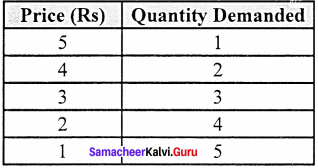
Demand schedule:
11th Economics Chapter 2 Consumption Analysis Samacheer Kalvi
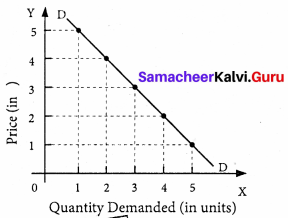
From the above schedule if the price of the good is 5 then the quantity demanded is 1 unit and if the price decrease to 1 quantity demanded raises to 5 which shows the inverse relationship between price and quantity demanded.

Diagram:
Samacheer Kalvi 11th Economics Book Back Answers Chapter 2 Consumption Analysis
In the above diagram, X axis represents the quantity demanded and Y axis represents the price. DD is the demand curve which has a negative slope. It indicates that when price falls, the demand expands and when price rises, the demand contracts.

Market demand for a commodity:
Samacheer Kalvi Guru 11th Economics Solutions Chapter 2 Consumption Analysis
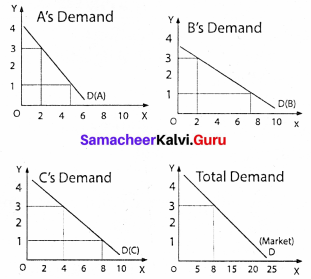
The market demand curve for a commodity is derived by adding the quantum demanded of the commodity by all the individuals in the market.
Exceptions to the law of demand:

  1. There are some unusual demand curves which slopes upwards from left to right. It is known as exceptional demand curve.
  2. In the case of exceptional demand curve a fall in price brings about contraction and a rise in price brings about extension of demand.

Reasons for exceptional demand curve:

  1. Giffen paradox
  2. Veblen or demonstration
  3. Ignorance
  4. Speculative effect
  5. Fear of shortage

Question 36.
Elucidate the law of diminishing marginal utility with diagram.
Answer:
H.H. Gosen, an Austrain Economist first formulated this law in 1854. Hence Jevons called this law as “Gossen’s first law of consumption”. Marshall perfected this law on the basis of cardinal analysis and it is based on the characteristics of human wants, it wants are satiable.

Definition:
Marshall states that “The additional benefit which a person derives from a given increase of his stock of a thing diminishes with every increase in the stock that he already has”
Assumptions:

  1. Utility can be measured cardinally.
  2. The marginal utility of money remains constant.
  3. Consumer is a rational economic man.
  4. The units of the commodity consumed must be reasonable in size.
  5. The commodity consumed should be homogenous in all aspects.
  6. Consumption takes place continuously at a given period of time.
  7. No change in the taste, habits, preferences, fashions, income and character of the consumer during the process of consumption.

Explanation:
The law states that if a consumer continues to consume more of more units of the same commodity, its marginal utility diminishes.

Illustration:
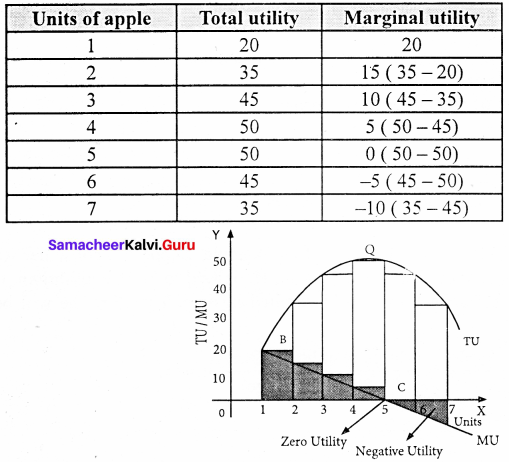
This law can be explained with a simple illustration. Suppose a consumer wants to consume apples one after another the utility from the first apple is 20. But the utility from the second apple will be less than the first (say 15), the third less than the second (say 10) and so on. Finally, the utility from the fifth apple becomes zero.

The utilities from sixth and seventh apples are negative. This tendency is called “The . law of diminishing marginal utility’”.
11th Economics Samacheer Kalvi Solutions Chapter 2 Consumption Analysis
From the above table and diagram. We find that the total utility goes on increasing but at a diminishing rate. Whereas marginal utility goes on diminishing. When marginal utility becomes zero, the total utility is maximum, when marginal utility becomes negative, the total utility diminishes.

Criticisms:

  1. As utility is subjective,it cannot be measured numerically.
  2. This law is based on the unrealistic assumptions.
  3. This law is not applicable to indivisible commodities.

Question 37.
Explain the law of Equi-marginal utility.
Answer:
To satisfy unlimited wants a consumer need more than one commodity. So, the law of diminishing marginal utility is extended and is called “Law of equi-marginal utility”. It is also called the “Law of substitution” “The law of consumer’s equilibrium”, “Gossen second law” and “The law of maximum satisfaction”.

Definitio :
Marshall states the law as, “If a person has a thing which he can put to several uses, he will distribute it among these uses in such a way that it has the same marginal utility in all. For if it had a greater marginal utility in one use than another he would gain by taking away some of it from the second use and applying it to first”.
Assumptions:

  1. The rational consumer wants to maximize his satisfaction.
  2. Utility is measurable cardinally.
  3. The marginal utility of money remains constant.
  4. The income of the consumer is given.
  5. There is perfect competition in the market.
  6. The prices of the commodities are given.
  7. The law of diminishing marginal utility operates.

Explanation:
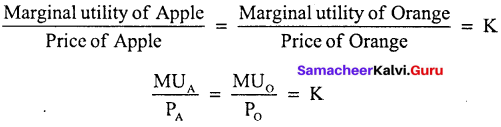
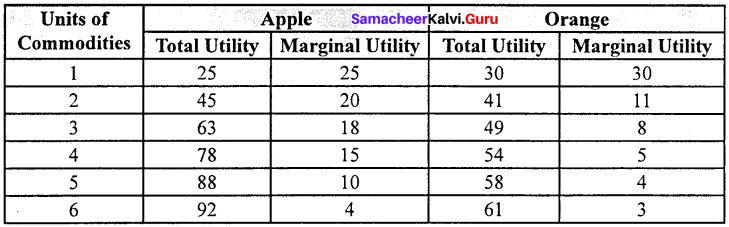
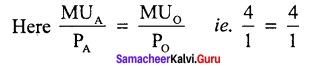
The law can be explained with the help of an example. Suppose a consumer wants to spend his limited income on Apple and Orange. He is said to be in equilibrium, only when he gets maximum satisfaction with his limited income. Therefore, he will be in equilibrium, when

11th Economics Solutions Samacheer Kalvi Chapter 2 Consumption Analysis
K – Constant marginal unity of money

Table:
Samacheer Kalvi 11th Economics Solutions Chapter 2 Consumption Analysis
Let us assume that the consumer wants to spend his entire income (Rs.11) on Apple add Orange. The price of an Apple and Orange is Rs. 1 each.
If the consumer wants to attain maximum utility he should buy 6 units of Apples and 5 units or Oranges so that he can get 150 units.
Samacheer Kalvi 11th Economics Book Solutions Chapter 2 Consumption Analysis
Diagram:
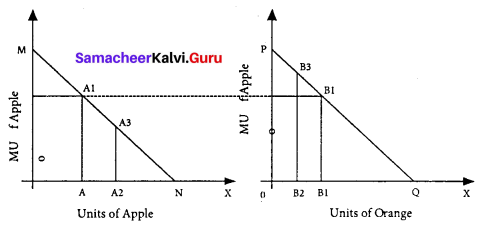
11 Economics Samacheer Kalvi Solutions Chapter 2 Consumption Analysis
In the diagram X – axis represent amount of money spent and Y – axis marginal utilities of Apple and Orange. If the consumer spends Rs. 6 on Apple and Rs. 5 on Orange, the marginal utilities of both are equal (ie) AA, = BB,. Hence he gets maximum utility.

Question 38.
What are the methods of measuring Elasticity of demand?
Answer:
There are three methods of measuring elasticity of demand.

1. The percentage method:
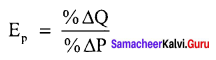
Samacheer Kalvi Guru 11 Economics Solutions Chapter 2 Consumption Analysis
It is also known as ratio method, when we measure the ratio as
Samacheer Kalvi 11th Economics Solutions Chapter 2 Consumption Analysis
% ∆Q = perCentage change in demand, %∆P = Percentage change in price.

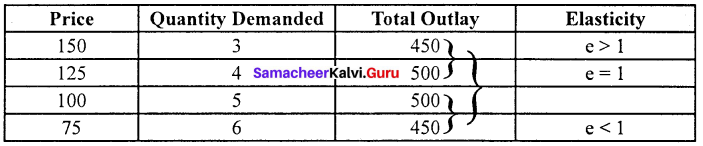
2. Total outlay method:
Marshall suggested that the simplest way to decide whether demand is elastic or inelastic is to examine the change in total outlay of the consumer or total revenue of the firm.
Total revenue = Price × Quantity sold
TR = P × Q
Total outlay method:
Economics Class 11 Samacheer Kalvi Solutions Chapter 2 Consumption Analysis
Demand is elastic, if there is inverse relation between price and total outlay and direct relation means inelastic. Elasticity is unity when total outlay is constant.

Question 3.
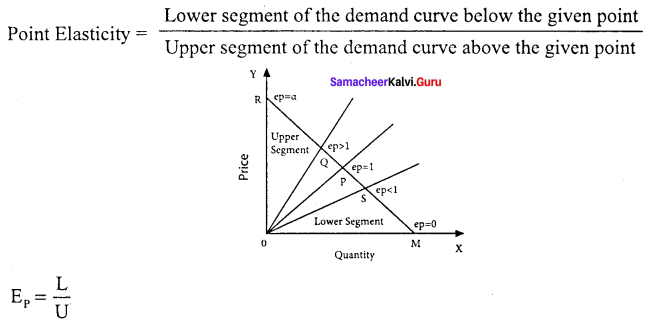
Point or geometrical elasticity:
Answer:
The point elasticity of a linear demand curve is shown by the ratio of the segments of the line to the right and to the left of the particular point.

Samacheer Kalvi Economics 11th Solutions Chapter 2 Consumption Analysis

EP – Point Elasticity, L – Lower Segment,U – Upper Segment.

Samacheer Kalvi 11th Economics Consumption Analysis Additional Questions and Answers

Part – A

Choose the best options

Question 1.
The utility cannot be measured, because the utility is ………………………. concept.
(a) Social
(b) Subjective
(c) Political
(d) Scientific
Answer:
(b) Subjective

Question 2.
_________ law is helpful in attaining social justice.
(a) Law of equi-margional utility
(b) Law of demand
(c) Law of diminishing marginal utility
(d) Law of marginal utility
Answer:
(c) Law of diminishing marginal utility

Question 3.
Consumer surplus is …………………….
(a) Potential price – Actual price
(b) MV = TV – TV
(c) Demand = Supply
(d) None
Answer:
(a) Potential price – Actual price

Question 4.
Income elasticity of demand is degree of responsiveness of change in demand to
(a) Change is price
(b) Elasticity of demand
(c) Change in substitutes
(d) Change in income
Answer:
(d) Change in income

Question 5.
Marshallian utility approach is …………………….. analysis.
(a) Subjective
(b) Psychological
(c) Ordinal
(d) Cardinal
Answer:
(d) Cardinal

Question 6.
_________ is the major determinant of demand.
(a) Consumption
(b) Price
(c) Supply
(d) All the above
Answer:
(b) Price

Question 7.
Principle of Economics” was defined by ………………….
(a) Marshall
(b) Hicks
(c) Allen
(d) Keynes
Answer:
(a) Marshall

Question 8.
The formula for point method
(a) Upper segment / Lower segment
(b) Middle segment / Upper segment
(c) Lower segment / Upper segment
(d) Upper segment / Left segment
Answer:
(c) Lower segment / Upper segment

Question 9.
What is the other name of the budget line?
(a) Price ratio line
(b) Quantity ratio line
(c) Equilibrium ratio line
(d) Compulsory ratio line
Answer:
(a) Price ratio line

Question 10.
_________ is the basis of all the laws of consumption.
(a) Law of demand
(b) Law of consumerism
(c) Law of elasticity
(d) Law of diminishing marginal utility
Answer:
(d) Law of diminishing marginal utility

Question 11.
Give the consumer’s surplus is 75 and the actual price 372, Find the potential price
(a) 447
(b) 50
(c) 375
(d) 474
Answer:
(a) 447

Choose the correct statement

Question 1.
(a) Consumption is the beginning of economic science
(b) Production is the beginning of economic science
(c) Distribution is the beginning of economic science
(d) Exchange is the beginning of economic science
Answer:
(a) Consumption is the beginning of economic science

Question 2.
(a) The law of diminishing marginal utility is called as Gresham’s law.
(b) The law Equi marginal utility is called as Marshall’s law.
(c) The law of diminishing marginal utility is called as Gossen’s first law of consumption.
(d) The law of demand is called as Gossen’s second law of consumption.
Answer:
(c) The law of diminishing marginal utility is called as Gossen’s first law of consumption.

Match the following and choose the answer using the codes given below

Question 3.
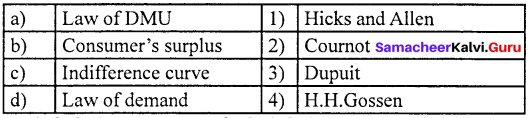
Chapter 2 Of Economics Class 11 Samacheer Kalvi Consumption Analysis
(a) 1 2 3 4
(b) 3 4 2 1
(c) 2 3 4 1
(d) 4 3 2 1
Answer:
(b) 3 4 2 1

Question 4.
Economics Chapter 2 Consumption Analysis Samacheer Kalvi
(a) 4 3 2 1
(b) 2 1 4 3
(c) 3 4 2 1
(d) 3 1 4 2
Answer:
(d) 3 1 4 2

Choose the odd one out

Question 5.
(a) Giffen paradox
(b) Demonstration effect
(c) Speculative effect
(d) Edge worth approach
Answer:
(d) Edge worth approach

Question 6.
(a) F.W. Edge worth
(b) Alfred Marshall
(c) Vilfredo Pareto
(d) J.R. Hicks and R.G.D. Allen
Answer:
(b) Alfred Marshall

Question 7.
(a) Percentage method
(b) Point method
(c) Total outlay method
(d) Income elasticity method
Answer:
(d) Income elasticity method

Choose the incorrect pair

Question 8.
Samacheer Kalvi Economics 11th Solutions Chapter 2 Consumption Analysis
Answer:
(a) Point (i) Upper segment/Lower segment.

Question 9.
Economics Chapter 2 Class 11 Consumption Analysis
Answer:
(b) Unptary elastic demand (i) ep= 0.

Question 10.
Economics Class 11 Chapter 2 Consumption Analysis Samacheer Kalvi
Answer:
(c) ep < 1 (iii) Rectangular hyperbola

Analyze the reason for the following

Question 11.
Assertion (A): Savings and demand are inversely related.
Reason (R): Increased savings leads to a decrease in consumption.
(a) Both (A) and (R) are true, (R) is the correct explanation of (A)
(b) Both (A) and (R) are true, (R) is not the correct explanation of (A)
(c) (A) is true but, (R) is false.
(d) Both (A) and (R) are false.
Answer:
(a) Both (A) and (R) are true, (R) is the correct explanation of (A)

Question 12.
Assertion (A) : When the price of an inferior goods fall, the poor will buy less.
Reason (R) : Poor consume less amount of inferior goods.
(a) Both (A) and (R) are true
(b) Both (A) and (R) are false
(c) (A) is true but (R) is false.
(d) (A) is false but (R) is true.
Answer:
(c) (A) is true but (R) is false.

Choose the incorrect statement

Question 13.
(a) The exceptional demand curve slopes upwards,
(b) The good salt is price inelastic
(c) Elasticity is unity when total outlay is constant
(d) Demand is more elastic in the short run than is long run
Answer:
(a) The exceptional demand curve slopes upwards

Question 14.
(a) The law of DMU is based on the characteristics of human wants.
(b) The law of consumer surplus is based on the law of DMU
(c) The indifference curve approach is based on scale of preference.
(d) None of the above.
Answer:
(d) None of the above.

Fill in the blanks with the suitable option given below

Question 15.
Diamond – water paradox was given by
(a) Adam Smith
(b) Marshall
(c) Robbins
(d) Samuelson
Answer:
(a) Adam Smith

Question 16.
_________ law is helpful in attaining social justice.
(a) Law of demand
(b) Law of diminishing marginal utility
(c) Law of equi-marginal utility
(d) None of the above
Answer:
(b) Law of diminishing marginal utility

Question 17.
_________ is the basis of all the laws of consumption.
(a) Law of demand
(b) Law of consumerism
(c) Law of elasticity
(d) Law of diminishing marginal utility
Answer:
(d) Law of diminishing marginal utility

Choose the best option

Question 18.
_________ is the major determinant of demand.
(a) Consumption
(b) Price
(c) Supply
(d) All the above
Answer:
(b) Price

Question 19.
If the total utility is maximum then marginal utility is _________
(a) Zero
(b) Negative
(c) Positive
(d) Maximum
Answer:
(a) Zero

Question 20.
Mathematically consumer’s surplus is
(a) TU – TUn-1
(b) TR – (P×Q)
(c) TU – (P×Q)
(d) TC – (Q×P)
Answer:
(c) TU-(P×Q)

Part – B

Answer the following questions in one or two sentences

Question 1.
Define “Consumption”?
Answer:
Consumption plays an important role in Economics. “ Consumption is the sole end and object of economic activity” – J.M. Keynes. Consumption is the beginning of economic science. In the absence of consumption, there can be no production; exchange, or distribution. Consumption is also an end of production. Producers produce goods to satisfy the wants of the people.

Question 2.
What is the law of demand?
Answer:
“The quantity demanded increases with a fall in price and diminishes with a rise in price” – Marshall.

Question 3.
Write the characteristics of demand?
Answer:
Characteristics of demand:

  1. Price: Demand is always related to price.
  2. Time: Demand always means demand per unit of time, per day, per week, per month on per year.
  3. Market: Demand is always related to the market, buyer and sellers.
  4. Amount: Demand is always a specific quantity that a consumer is willing to purchase.

Question 4.
What is marginal utility?
Answer:
Marginal utility is the utility derived from the last or marginal unit of consumption.

Question 5.
What is demand ?
Answer:
Demand is the desire backed by the ability to pay and the willingness to buy it.

Question 6.
What is elasticity of demand?
Answer:
Elasticity of demand is the degree of responsiveness of the quantity demand for a commodity to a change in its price.

Question 7.
What are the determinants of elasticity of demand?
Answer:

  1. Availability of substitutes
  2. Proportion of consumer’s income
  3. Number of uses of commodity
  4. Complementarity between goods.

Part – C

Answer the following questions in one Paragraph

Question 1.
What is an indifference map?
Answer:
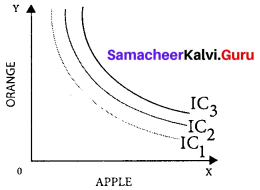
An indifference map is a family or collection or set of indifference curves corresponding to different levels of satisfaction. In the diagram, the indifference curves IC1, IC2 and IC3 represent the indifference map, upper IC representing a higher level of satisfaction compared to lower IC.

Samacheer Kalvi 11th Economics Solutions Chapter 2 Consumption Analysis 15

Question 2.
Write the importance of the law of diminishing marginal utility?
Answer:

  1. This law of DMU is one of the fundamental laws of consumption. It has applications in several fields of study.
  2. The law of DMU is the basis for other consumption laws such as the law of Demand, Elasticity of Demand, Consumer Surplus, and the Law of Substitution, etc.
  3. The law emphasizes the equitable distribution of wealth. The MU of money to the more -moneyed is low. Hence redistribution of income from rich to poor is justified.

Question 3.
What are the determinants of demand?
Answer:

  1. Changes in tastes and fashions
  2. Change in weather
  3. Taxation and subsidy
  4. Change in expections
  5. Changes in savings
  6. State of trade activity
  7. Advertisement
  8. Change in income
  9. Change in population.

Question 4.
What is a scale of preference?
Answer:

  1. A rational consumer usually prefers the combination of goods which gives him a maximum level of satisfaction.
  2. Thus the consumer can arrange goods and their combination in order of their satisfaction.
  3. Such an arrangement of a combination of goods in the order of level of satisfaction is called the “Scale of preference”.

If you need some more information about Tamilnadu State Board Solutions for 11th Economics Chapter 2 Consumption Analysis Questions and Answers then visit our site frequently and get all the resources that you look for. Also, share this page with your friends and make them learn all the concepts thoroughly before the exams.

Samacheer Kalvi 10th English Solutions Supplementary Chapter 3 The Story of Mulan

Looking to improve English skills and gain more subject knowledge then the best resources that you can use here is Samacheer Kalvi 10th English Solutions for Supplementary Chapter 3 The Story of Mulan Questions and Answers.

In the Samacheer Kalvi 10th English Guide for Chapter 3 The Story of Mulan textbook solutions, subject experts covered all types of questions and answers related to the topics, quick notes, summary, solved & unsolved exercises, etc. If you are planning to prepare Chapter 3 The Story of Mulan via textbook, then you’re suggested to go with this Samacheer Kalvi 10th English Book Solutions Questions and Answers PDF for better understanding and preparation.

Tamilnadu Samacheer Kalvi 10th English Solutions Supplementary Chapter 3 The Story of Mulan

English Subject experts who are having max years of experience prepared this Tamilnadu State Board Solutions for 10th English Supplementary Chapter 3 The Story of Mulan Questions and Answers. They have explained all the topics covered in the board prescribed latest syllabus in a simple way to understand easily. So, students can prepare Chapter 3 English from this Samacheer Kalvi 10th English Book Questions and Answers PDF. Download the Tamilnadu State Board 10th English Chapter 3 The Story of Mulan Workbook Solutions PDF by accessing the below links and learn properly for the final exams to score well.

The Story of Mulan Textual Questions

A. Choose the best answers.

1. Mulan goes to the battle instead of her father because ……………….. .
(a) she wants to be a soldier
(b) she was asked to join the army
(c) her father is old
(d) her brother is sick
Answer:
(c) her father is old

2. What did Mulan do before leaving the house?
(a) took leave from her mother
(b) cut off her hair
(c) prayed
(d), made a dress for war
Answer:
(b) cut off her hair

3. What is the story about?
(a) winning
(b) friendship
(c) women empowerment
(d) patriotism
Answer:
(c) women empowerment

4. The emperor asked Mulan to stay with him in the palace as his ……………….. .
(a) wife
(b) royal adviser
(c) army general
(d) friend
Answer:
(b) royal adviser

5. The emperor gave Mulan ……………….. .
(a) six horses and six swords
(b) a death sentence
(c) gold
(d) six camels
Answer:
(a) six horses and six swords

6. How did people of the village react to Mulan after her return from the battle?
(a) cheered her
(b) mocked her
(c) punished her
(d) scolded her
Answer:
(a) cheered her

The Story Of Mulan 10th Standard Additional Questions

1. The classic story of Mulan is based on the legend of ………………….. .
(a) Hua Mulan
(b) Hans Mulan
(c) Fa Mulan
(d) Hua Mulan
Answer:
(a) Hua Mulan

2. Many years ago, China was in the …………………. of a great war.
(a) beginning
(b) end
(c) middle
(d) process
Answer:
(c) middle

3. Mulan, a …………… girl who lived in a faraway village of China, heard the news.
(a) young
(b) married
(c) widowed
(d) teenage
Answer:
(d) teenage

4. Mulan heard the Emperor’s command while ……………….. .
(a) grazing the cows
(b) feeding the horses
(c) washing clothes
(d)making porridge
Answer:
(c) washing clothes

5. Mulan’s father was sitting in a chair, ……………………. a piece of wood.
(a) carving
(b) chiseling
(c) scraping
(d) fixing
Answer:
(a) carving

6. Mulan’s father said that Mulan’s brother was a ……………. .
(a) sickly child
(b) child
(c)deserter
(d) traitor
Answer:
(b) child

7. Mulan poured her father a cup of …………… and handed it to him.
(a) coffee
(b) green tea
(c)cold coffee
(d) tea
Answer:
(d) tea

8. Mulan cut off her long, ……………….. hair.
(a) blonde
(b) grey
(c) black
(d) lustrous
Answer:
(c) black

9. For years, Mulan was trained in ………….. by her father.
(a) Judo
(b) Kung Fu
(c) Taekwondo
(d) Aikido
Answer:
(b) Kung Fu

10. Mulan climbed on a family ………….. and set off to join the Emperor’s army.
(a) pony
(b) elephant
(c) tiger
(d) horse
Answer:
(d) horse

B. Identify the character or speaker of the following lines.

1. I heard about it in town.
Answer:
Mulan’s father

2. I am your son now.
Answer:
Mulan

3. The General is a woman?
Answer:
The soldiers

4. Mulan, stay with me in the palace.
Answer:
The Emperor of China

5. You are too kind sir.
Answer:
Mulan

The Story Of Mulan Summary Additional:

1. One man from each Chinese family must join the army.
Answer:
The Emperor

2. Did you hear what the Emperor says each family must do?
Answer:
Mulan

3. Well, I may as well go pack up.
Answer:
Mulan’s father

4. Why at your age must you keep up with all those young men?
Answer:
Mulan

5. What else can be done?
Answer:
Mulan’s father

6. Of course that’s true.
Answer:
Mulan

7. Please sit for a minute. I will be right
Answer:
back.
Mulan

8. Look at me. I am your son now.
Answer:
Mulan

9. I will go to your place. I will do my part for China.
Answer:
Mulan

10. “Na, you c.unot do this!
Answer:
Mulan’s father :

11. You showed me boss to use a sword.
Answer:
Mulan

12. Only so that you could stay safe
Answer:
Mulan’s father

13. I never meant for you logo to war.
Answer:
Mulan’s father

14. You know as well as I do that you will die!
Answer:
Mulan’s father

15. Take care of yourself.
Answer:
Mulan

16. What I wish most of all is to return home to my family.
Answer:
Mulan

17. “How can this be?”
Answer:
Some soldiers

18. “She tricked us!”
Answer:
Some soldiers

19. “We will not fight for a woman!”
Answer:
Some soldiers

20. “Punish her! Make her pay!
Answer:
Some soldiers

21. The cost is for her to die!
Answer:
Some soldiers

22. With Mulan, we win every battle!”
Answer:
Other soldiers

23. “Stay away from our General!”
Answer:
Other soldiers

24. “Everyone! A surprise attack is coming!”
Answer:
A soldier

25. Someone as smart as you would be a fine royal adviser.
Answer:
The Emperor

26. Then at least take these fine gifts.
Answer:
The Emperor

27. So everyone at your home and village will know I think of you.
Answer:
The Emperor

28. Tell my brother I said goodbye.
Answer:
Mulan

29. I love you.
Answer:
Mulan to her father

30. Listen please.
Answer:
Mulan

C. Answer the following questions in a sentence or two.

The Story Of Mulan Question Answer Question 1.
What was the emperor’s order?
Answer:
The Emperor’s order was that one man from each Chinese family must leave his family. to join the army.

The Story Of Mulan Summary 10th Standard Question 2.
Where did Mulan’s father hear about the emperor’s order?
Answer:
Mulan’s father heard about the Emperor’s order in town.

Mulan Questions And Answers Question 3.
Why couldn’t Mulan’s brother go to war?
Answer:
Mulan’s brother couldn’t go to the war because he was a child.

The Story Of Mulan Paragraph Question 4.
Why did Mulan disguise herself as a man?
Answer:
Mulan disguised herself as a man because women were not allowed to join the army.

10th English Supplementary Story In English Question 5.
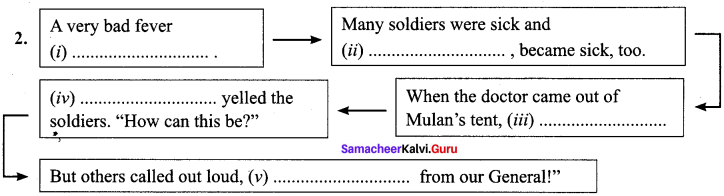
How did the soldiers become sick?
Answer:
A bad fever swept through the army. So, many soldiers became sick.

Story Of Mulan Summary Question 6.
How would she be punished if found guilty?
Answer:
if found guilty, she would be killed.

10th English Unit 3 Supplementary Question 7.
Why did the emperor give her fine gifts?
Answer:
The Emperor gave her fine gifts because she won the battle and saved China.

The Story Of Mulan Summary In Tamil Question 8.
How did the soldiers come to know about Mulan’s real identity?
Answer:
When a bad fever swept the army, all the soldiers became sick. Even Mulan was affected by this fever. When the doctor examined Mulan in her tent, the doctor came to know that she was a woman and informed the soldiers.

The Story Of Mulan 10th English Additional:

The Story Of Mulan Supplementary Question 1.
W,here did the story of Mutan come from?
Answer:
Hua Mulan was a Chinese warrior woman who lived during the Northern and Southern dynasties, which was between 420 and 589 CE and her story was told through the “Ballad of Mulan.”

10th English Supplementary Story In Tamil Question 2.
How do you know that the story of Mulan ¡s a true story?
Answer:
Any legend is a story from ancient times and it is believed to be based mostly on true stories. Now, it’s possible that she was a real person, but it is largely believed that her story is fictional.

Question 3.
Why did Mutan take a decision risking her life?
Answer:
In response to the Emperor’s order, Mulan decided to risk her life since her father was aged and her only brother was a child. To add to these, she was also trained in Kung Fu by her father to stay safe.

Question 4.
Why should Mutan be considered a hero?
Answer:
Hua Mulan should be considered as a hero because she joined the all-male army to interchange her father’s place. It was really hard for a woman to make this choice in ancient China. She is my hero because she showed filial respect for her father, made an impact among her countrymen and was brave.

D. Answer the following questions in a paragraph.

Question 1.
Sketch the character of Mulan.
Answer:
Mulan was a brave warrior who saved China from the enemies. She was determined, courageous and intelligent. She was unselfish too. The incident which best attests to this trait was after returning from the war, the Emperor offered her the post of royal advisor. She refused the post and simply told that she wanted to return home. Mulan’s determination helped her through her adventures defeating the enemies’ army. She never gave up in bad situations. At war, she was very intelligent and was a quick planner. This attitude won her the war for the Chinese. She fought in the battle for twelve years and gained high merit. She refused any rewards except for six fine horses and six fine swords.

Question 2.
Do you agree with Mulan’s decision to go to war? Justify.
Answer:
Yes, Mulan’s decision to go to the war was correct. She is a patriotic girl who wanted to fight for her country. When the Emperor of China insisted that one man from each family should join the army, she was ready to join the army disguised as a man. At first, her father decided to join the army. But Mulan protested that he could not go as he was old and sick. Her brother was a child. So she decided to join the army. Her father was afraid that the Emperor would kill her, if he knew that she was a woman. But Mulan was confident that no one would find her. She cut her hair like a man and picked up the sword. She bade him goodbye, climbed on a horse and went to join the Emperor’s army.

Additional:

A. Rearrange the following sentences in coherent order.

1. a. With her sword, she cut off her long, black hair.
b. No, my daughter, you cannot do this!
c. Many years ago, China was in the middle of a great war.
d. Look at me, I am your son now.
e. I will do my part for China.
Answers:
c, a, d, e, b
c. Many years ago, China was in the middle of a great war.
a. With her sword, she cut off her long, black hair.
d. Look at me, I am your son now.
e. I will do my part for China.
b. No, my daughter, you cannot do this!

2. a. But, I never meant for you to go to war.
b. Father, for years, you trained me in Kung Fu.
c. No one will find out, Father, said Mulan and kissed him goodbye.
d. Take care of yourself, father and tell my brother I said goodbye.
e. If they find out you are a woman, you know as well as I do that you will die!
Answers:
b, a, e, c, d
b. Father, for years, you trained me in Kung Fu.
a. But, I never meant for you to go to war.
e. If they find out you are a woman, you know as well as I do that you will die!
c. No one will find out, Father, said Mulan and kissed him goodbye.
d. Take care of yourself, father and tell my brother I said goodbye.

B. Fill in the blanks with the appropriate phrases given below to form a complete meaningful paragraph.

1. (put on/cannot do this / into her room /cut off her long / Going back to her father)

Mulan went (i) ………………. With her sword, she (ii) ……………., black hair. She (iii) …………… her father’s robe, (iv) …………….., Mulan said, “Look at me. I am your son now. I will go in your place. I will do my part for China.” “No, my daughter!” said the old man. “You (v) ……………. !”
Answers:
(i) into her room
(ii) cut off her long
(iii) put on
(iv) Going back to her father
(v) cannot do this

2. (she was safe / returned to her village / stay with me in the palace / smart as you / so glad that)

The Emperor was (i) ……………. Mulan had ended the long war. He set aside the rule about being a woman. “Mulan, (ii) ………………..,” he said. “Someone as (iii) …………….. would be a fine royal adviser.” Politely refusing the offer, Mulan (iv) ………….. with six fine horses and six fine swords. Everyone cheered that (v) ……………. The person who had saved China was their very own Mulan!
Answers:
(i) so glad that
(ii) stay with me in the palace
(iii) smart as you
(iv) returned to her village
(v) she was safe

C. Match the following appropriately:

1.
The Story Of Mulan 10th Standard English Solutions Supplementary Chapter 3 Samacheer KalviThe Story Of Mulan Summary Samacheer Kalvi 10th English Solutions Supplementary Chapter 3
Answer:
(i)(c), (ii)(e), (iii)(d), (iv)(b), (v)(a).

2. The Story Of Mulan Question Answer Samacheer Kalvi 10th English Solutions Supplementary Chapter 3
Answer:
(i)(d), (ii)(e), (iii)(a), (iv)(c), (v)(b).

D. Read the passage given below and answer the questions that follow:

1. Many years ago, China was in the middle of a great war. The Emperor said that one man from each Chinese family must leave his family to join the army. Mulan, a teenage girl who lived in a faraway village of China, heard the news when she was outside, washing clothes.

Mulan ran into the house. Her father was sitting in a chair, carving a piece of wood. “Father!” she said. “Did you hear what the Emperor says each family must do?” “Yes,” said her old father, “I heard about it in town. Well, I may as well go pack up.” He put down his carving, stood up and walked very slowly to his room.“Wait!” said Mulan, “Father, you have not been well.

If I may say so, why at your age must you keep up with all those young men?” “What else can be done?” said her father. “Your brother is a child. He cannot go.” “Of course that’s true,” said Tvfrulan. “He is too little. But I have an idea.” She poured her father a cup of tea and handed it to him. “Father, have some tea. Please sit for a minute. I will be right back.” “Very well, dear,” said the father.

Mulan went into her room. With her sword, she cut off her long, black hair. She put on her father’s robe. Going back to her father, Mulan said, “Look at me. I am your son now. I will go in your place. I will do my part for China.” “No, my daughter!” said the old man. “You cannot do this!”

(а) What was order to the people of China in the middle of war from the Emperor?
Answer:
The Emperor ordered that one man from every Chinese family must leave his family to join the army.

(b) How did Mulan react to this order from the Emperor?
Answer:
Mulan, a teenage girl heard the news when she was washing clothes outside and decided to replace her dad who wasn’t feeling well.

(c) What was Mulan’s father doing at home when she ran into the house?
Answer:
When Mulan ran into the house, her father who was unwell was sitting on a chair and carving a piece of wood.

(d) Why didn’t Mulan want her father to respond to the Emperor’s order?
Answer:
Mulan did not want her father to go to war because he was aged and was unwell. She was sure that he would not be able to keep up with all the young men in the opponent’s army.

(e) How did Mulan prove to be a different kind of a girl child?
Answer:
Mulan was quick in thinking. She quickly went in, cut off her long black hair with her sword, put on her father’s robe and told her father that she would go as a son of a family to fight in the war.

2. “Father, listen please,” said Mulan. “For years, you trained me in Kung Fu. You showed me how to use a sword.” Mulan swung the sword back and forth with might.
“Only so that you could stay safe!” said her father. “I never meant for you to go to war. If they find out you are a woman, you know as well as I do that you will die!”
“No one will find out, Father,” said Mulan. She picked up her sword.
“Mulan!” said the Father. He tried to get up but had to hold on to his chair.

The daughter kissed him goodbye. “I love you, Father,” she said. “Take care of yourself. Tell my brother I said goodbye.” She climbed on a family horse. And off she went to join the Emperor’s army.

In the army, Mulan proved to be a brave soldier. In time, she was put in charge of other soldiers. Her battles went so well that she was put in charge of more soldiers. Her battles kept on going well. After a few years Mulan was given the top job – she would be General of the entire army. Not long after that, a very bad fever swept through the army. Many soldiers were sick. And Mulan, the General of the Army, became sick, too. When the doctor came out of Mulan’s tent, he knew the truth.

(a) What martial art did Mulan’s father teach her? Why?
Answer:
Mulan’s father taught her the art of Kung Fu. He showed her how to use the sword so that she could stay safe and protect herself.

(b) What did the father fear about Mulan’s decision?
Answer:
Mulan’s father feared that she would be put to death if the army men found out that she was a woman and not a man.

(c) What did Mulan do before leaving to war?
Answer:
Mulan kissed her father goodbye and said that she loved him. She also asked him to take care of himself and convey her ‘goodbye’ to her little brother who was a child.

(d) What were Mulan’s accomplishments in the army?
Answer:
In the army, Mulan proved to be a brave soldier. Within a short time, she was put in charge of other soldiers. Her battles went so well that she was put in charge of more soldiers and after a few years she was given the top job – General of the entire army.

(e) What caused the other’s to identify Mulan’s identify?
Answer:
A bad fever swept through the army and Mulan was also a prey to it. This fever revealed her identity to others through the doctor who came to treat her.

E. Study the given mind map and fill in the incomplete details:

The Story Of Mulan Summary 10th Standard English Solutions Supplementary Chapter 3 Samacheer Kalvi
Answers:
(i) was in the middle of a great war.
(ii) one man from each Chinese family must leave his family.
(iii) heard the news when she was outside, washing clothes.
(iv) carving a piece of wood.
(v) what the Emperor says each family must do.

Mulan Questions And Answers Samacheer Kalvi 10th English Solutions Supplementary Chapter 3
Answers:
(i) swept through the army.
(ii) Mulan, the General of the army,
(iii) he knew the truth
(iv) “The General is a woman?
(v) With Mulan, we win every battle! Stay away

The Story of Mulan Summary:

The Story Of Mulan Paragraph Samacheer Kalvi 10th English Solutions Supplementary Chapter 3

Introduction:
The Story of Mulan portrays the legendary Chinese warrior Hua Mulan and is mostly based on the information of her from the poem, ‘The Ballad of Mulan’. This restating of the old Chinese folktale is about the story of the young Chinese maiden who learns that her wizened, old and frail father is to be called up into the army in order to fight the invading Huns by the Chinese Emperor.
10th English Supplementary Story In English Chapter 3 The Story Of Mulan Samacheer Kalvi

Announcement from the Chinese:
When the Huns invade China, one man from every family is called to arms. She hears of the order that every family must send one man to the army while washing clothes. She discusses the same with her father who had also heard of it when he had gone to the town. Mulan’s father, who is frail and aged decides to fight for his country and the honour of his family though it is clear that he will not survive an enemy encounter. He decides to go to war but is prevented by her daughter with her outrageous decision. Knowing that her father will never endure the rigours of war in his frail state, she decides to disguise herself and join in his place without second thoughts yet convincing him. Mulan’s only brother who is a small child cannot pitch in.
Story Of Mulan Summary Samacheer Kalvi 10th English Solutions Supplementary Chapter 3

Mulan joins the battle:
She takes blessings from her father, kisses him goodbye, wore his army clothes and rode on his horse after cutting her long hair short. In the army, Mulan proves to be a brave soldier who is later put in charge of other soldiers. Her battles go so well that more soldiers are added. After a few years, Mulan becomes the General of the entire army.
10th English Unit 3 Supplementary The Story Of Mulan Samacheer Kalvi

Truth about Mulan:
Suddenly, bad fever swept through the army. Many soldiers including Mulan become prey. The arrival of the doctor brings to light the hidden truth. Many soldiers disprove such a thought and want her to be punished to death because of gender disparity. However, some soldiers are broad minded and see the winning chances.
The Story Of Mulan Summary In Tamil Samacheer Kalvi 10th English Solutions Supplementary Chapter 3

Mulan’s bravery and the acceptance of soldiers:
Just then a soldier announces the surprise attack by the enemies. With no time to debate, the soldiers spring to action at the command of the General who hears this from inside her tent. She gets dressed and goes outside. Though not strong, she stands tall. She instructs the soldiers to attack knowing very well her strategic planning that all her soldiers acknowledge. It worked! The battle was won. It was such a big victory that the enemy gave up, at last. The war was over, and China was saved! You can be sure that after that last battle, no one cared anymore that Mulan was a woman.
Samacheer Kalvi 10th English Solutions Supplementary Chapter 3 The Story of Mulan 11

Mulan’s final decision and the emperor’s gift:
The Emperor was glad that Mulan had ended the long war that he set aside the rule about being a woman. He wanted Mulan to stay with him in the palace and be an advisor but she chose to go to her family, thanking the emperor. The emperor gave her six horses and six fine swords so that her people will know that he thinks of her. Everyone cheered that she was safe and well honoured.
The Story Of Mulan 10th English Solutions Supplementary Chapter 3 Samacheer Kalvi

Conclusion:
The story depicts the daughter’ love for her fajher. Father wanted the girl to be able to defend herself and thus taught her sword fight and Kung Fu. How this girl hails to become a commander of an army from learning the art of war from her father is narrated in a fine manner to readers delight.
The Story Of Mulan Supplementary Samacheer Kalvi 10th English Solutions Supplementary Chapter 3

The Story of Mulan Glossary:

Textual:
10th English Supplementary Story In Tamil Chapter 3 The Story Of Mulan Samacheer KalviSamacheer Kalvi 10th English Solutions Supplementary Chapter 3 The Story of Mulan 15

Additional:
Samacheer Kalvi 10th English Solutions Supplementary Chapter 3 The Story of Mulan 16

We hope the data given here will benefit you to the fullest extent at the time of preparation. For better understanding of English subject this Samacheer Kalvi 10th English Solutions for Class 10th English Supplementary Chapter 3 The Story of Mulan PDF is the best resource. Download & ace up your preparation. Keep in touch with us and get the latest information on Tamilnadu State board Textbook Solutions PDF.

Samacheer Kalvi 6th Social Science Hitory Solutions Term 2 Chapter 2 Great Thinkers And New Faiths

You can Download Samacheer Kalvi 6th Social Science Book Solutions Guide Pdf, Tamilnadu State Board help you to revise the complete Syllabus and score more marks in your examinations.

Tamilnadu Samacheer Kalvi 6th Social Science History Solutions Term 2 Chapter 2 Great Thinkers And New Faiths

Samacheer Kalvi 6th Social Science Great Thinkers And New Faiths Textual Evaluation

I. Choose the correct answer:

Great Thinkers And New Faiths Questions 1.
What is the name of the Buddhist scripture?
(a) Angas
(b) Tripitakas
(c) Tirukkural
(d) Naladiyar
Answer:
(b) Tripitakas

Great Thinkers And New Faiths Book Back Answers Questions 2.
Who was the first Tirthankara of Jainism?
(a) Rishabha
(b) Parsava
(c) Vardhamana
(d) Buddha
Answer:
(a) Rishabha

Samacheer Kalvi Guru 6th Social Science Term 2 Questions 3.
How many Tirthankaras were there in Jainism?
(a) 23
(b) 24
(c) 25
(d) 26
Answer:
(b) 24

6th Standard Social Guide Questions 4.
Where was the third Buddhist Council convened?
(a) Rajagriha
(b) Vaishali
(c) Pataliputra
(d) Kashmir
Answer:
(c) Pataliputra

Great Thinkers And New Beliefs Questions 5.
Where did Buddha deliver his first sermon?
(a) Lumbini
(b) Saranath
(c) Taxila
(d) Bodh Gaya
(b) Saranath

II. Match the statement with the Reason, Tick the appropriate answer:

6th Social Guide Questions 1.
Statement : A common man could not understand upanishads.
Reason : Upanishads were highly philosophical.
(a) Statement and its Reason are correct.
(b) Statement is wrong.
(c) Statement is true, but the Reason for that is wrong.
(d) Both Statement and Reason are wrong.
Answer:
(a) Statement and its Reason are correct.

Samacheer Kalvi 6th Social Term 2 Questions 2.
Statement : The Jatakas are popular tales.
Reason : Frescoes on the ceilings and walls of Ajanta caves depict the Jataka Tales.
(a) Statement and its Reason are correct
(b) Statement is wrong
(c) Statement is true; but the Reason for that is wrong
(d) Both Statement and Reason are wrong
Answer:
(a) Statement and its Reason are correct

6th Standard Social Science Guide Pdf Questions 3.
Find out the correct answer:
Buddha Vlharas are used for

  1. Education
  2. Stay of Buddhist monks
  3. Pilgrims stay
  4. Prayer hall

(a) 2 is correct
(b) Both 1 and 2
(c) 1, 2, 4 are correct
(d) Neither I nor II

6th Std Social Science Guide Questions 4.
Consider the following statements regarding the causes of the origin of Jainism and Buddhism.

  1. Sacrificial ceremonies were expensive.
  2. Superstitious beliefs and practices confused the common man.

Which of the above statement (s) is/are correct?
(a) Only I
(b) Only II
(c) Both I & II
(d) Neither I nor II
Answer:
(c) Both I & II

Questions 5.
Which of the following about Jainism is correct?
(a) Jainism denies God as the creator of universe.
(b) Jainism accepts God as the creator of universe.
(c) The basic philosophy of Jainism is idol worship.
(d) Jains accept the belief in Last Judgement.
Answer:
(a) Jainism denies God as tlie creator of universe.

Questions 6.
Circle the odd one:
Parsava, Mahavira, Buddha, Rishaba
Answer:
Buddha

Questions 7.
Find out the wrong pair:
(a) Ahimsa – not to injure
(b) Satya – to speak truth
(c) Asteya – not to steal
(d) Brahmacharya – married status
Answer:
(d) Brahmadiarya – married status

Questions 8.
All the following statements are true of Siddhartha Gautama except:
(a) He is the founder of Hinduism,
(b) He was bom in Nepal.
(c) He attained Nirvana.
(d) He was known as Sakyamuni.
Answer:
(a) He is the founder of Hinduism.

III. Fill in the blanks :

  1. The doctrine of Mahavira is called_______
  2. _______is a state of freedom from suffering and rebirth.
  3. _______was the founder of Buddhism.
  4. Thiruparthikundram, a village in Kanchipuram was once called_______
  5. _______were built over the remains of Buddha’s body

Answer:

  1. Triratnas
  2. Moksha
  3. Gauthama Buddha
  4. Jinn Ranchi
  5. Sinpas

IV. True or False:

  1. Buddha believed in Karma.
  2. Buddha had faith in caste system.
  3. Gautama Swami compiled the teachings of Mahavira.
  4. Viharas are temples.
  5. Emperor Ashoka followed Buddhism.

Answer:

  1. True
  2. False
  3. True
  4. False
  5. True

V. Match the following:

  1. Angas (a) Vardhamana
  2. Mahavira (b) monks
  3. Buddha (c) Buddhist shrine
  4. Chaitya (d) Sakyamuni
  5. Bhikshus (e) Jain text

Answer:

  1. (e)
  2. (a)
  3. (d)
  4. (c)
  5. (b)

VI. Answer in one or two sentences:

Question 1.
What are the Triratnas (three jewels) of Jainism?
Answer:
Triratna (Three Jewels) of Jainism are

  1. Right Faith
  2. Right Knowledge
  3. Right action.

Question 2.
What are the two sects of Buddhism?
Answer:

  1. Hinayana
  2. Mahayana

Question 3.
What does Jina mean?
Answer:
Jina means conquering self and the external world.

Question 4.
Write any two common features of Buddhism and Jainism.
Answer:

  1. Both denied the authority of Vedas
  2. Both opposed blood sacrifices

Question 5.
Write a note on Buddhist Sangha.
Answer:

  1. Sangha, meaning ‘association’ for the propagation of Buddha’s faith.
  2. It was formed to propagate Buddha’s faith.
  3. The members were called Bhikshus (monks).
  4. They led a life of austerity.

Question 6.
Name the Chinese traveller who visited Kancheepuram in the seventh century AD (CE).
Answer:
Hieun Tsang

Question 7.
Name the female jain monk mentioned in Silapathikaram.
Answer:
Silapathikaram mentions that when Kovalan and Kannagi were on their way to Madurai, Gownthiyadigal a female jain monk blessed the couple and accompanied them.

VII. Answer the following :

Question 1.
Name the eight-fold path of Buddhism.
Answer:
The Eight Fold Path of Buddhism is given below

  1. Right view
  2. Right Thought
  3. Right Speech
  4. Right Action
  5. Right Livelihood
  6. Right Effort
  7. Right Knowledge
  8. Right Meditation

Question 2.
What are the five important rules of conduct in Jainism?
Answer:

  1. Ahimsa – not to injure any living beings
  2. Satya – to speak truth
  3. Asteya – not to steal
  4. Aparigraha – not to own property
  5. Brahmacharya – Celibacy

Question 3.
Narrate four noble truths of Buddha?
Answer:
Buddha’s Four Noble Truths are given below,

  1. Life is full of sorrow and misery.
  2. Desire is the cause of misery.
  3. Sorrows and sufferings can be removed by giving up one’s desire.
  4. The desire can be overcome by following the right path (Noble eight-fold path)

Question 4.
Write any three differences between Hinayana and Mahayana sects of Buddhism?
Answer:
Hinayana:

  • Did not worship idols or images of Buddha > Practiced austerity
  • Used Prakrit language

Mahayana:

  • Worshiped images of Buddha
  • Observed elaborate rituals
  • Used Sanskrit language

Question 5.
Jainism and Buddhism flourished in Sangam period. Give any two evidences for each.
Answer:

(i) In ancient Tamil literature, Jainism is referred to as Samanam. There is a Samanar Hill or Samanar Malai in Keelakuyilkudi village, 15 km away from Madurai. The images of Tirthankaras created by Jain monks are found in the hill. It is a protected monument of Archaeological Survey of India.

(ii) There is a reference to Aravor Palli, place of living for Jain monks, in Manimegalai.

(iii) Buddhism spread to Tamil Nadu much later than Jainism. Manimekalai, one of the epics of the post-Sangam age is a Buddhist literature.

(iv) There is an elaborate description about Kanchipuram in classical epic Manimegalai

VIII. HOTS:

Question 1.
Karma – a person’s action. Name any 10 good actions (deeds).
Answer:
Karma means the sum of a person’s actions in this and previous state of existence, viewed as deciding their fate in future existence.
Some of the good deeds or actions are given below to be followed in our day to day life.

  1. Always remember and respect Matha, Pitha, Guru and Dhaivam (God).
  2. Develop the habit of charity.
  3. Help a friend in need.
  4. Plant a tree.
  5. Donate blood.
  6. Be kind to everyone especially to animals
  7. Be polite and respect people.
  8. Conserve energy.
  9. Be smiling because most smiles are started by another smile.
  10. Be Positive always.
  11. Have patience with stressful people.
  12. Give a compliment.
  13. Volunteer for charity.
  14. Be tidy and clean
  15. Donate books to library.

IX. Student Activity

Question 1.
Read any one story from Jatakas and write a similar story on your own.
THE OX WHO ENVIED THE GOAT
Once upon a time there was an Ox named Big White. He had a younger brother named Little White. These two brothers did all the carting on a large farm.

The farmer had one daughter and she was soon to be married.

The farmer’s wife gave orders that the Goat, in the farm, should be fattened for the wedding feast.

Little White noticed that the Goat was fed on choice food.

He said to his brother, “How is it, Big White, that I and you are given only straw and grass to eat, while we do all the hard work on the farm? That lazy Goat does nothing S but eat the choice food the farmer gives him.”

Said his brother, “My dear Little White, don’t envy him. That little Goat is eating the? food of death! He is being fattened for the wedding feast. Eat your straw and grass and; be content and live long.”

Not long afterwards the fattened Goat was killed and cooked for the wedding feast. Then Big White said, “Did you see what happened to the Goat after all his fine feeding?’ “Yes,” said the little brother, “we can go on eating plain food for years, but the poor little j Goat ate the food of death and now he is dead. His feed was so good while it lasted, but I the Goat did not last long.”

Moral: Be content with what you have and don’t envy others.

Question 2.
Make a tabular column in the following headings.

Great Thinkers And New Faiths Samacheer Kalvi 6th Social Science Hitory Solutions Term 2 Chapter 2

Question 3.
Place the following word In the appropriate column.
Words: Jinn, Mahayana, Ttrthankarai, Stupas Nirvana, Digambara, Tripitakas, Agama
Jainism:
Jina

  1. Tirthankaras
  2. Digambara
  3. Agama

Buddhism:

  1. Mahayana
  2. Stupas
  3. Nirvana
  4. Tripitakas

Question 4.
Task cards activity:
Make informative cards for the following religions. Hinduism, Christianity, Islam, Buddhism, Jainism
Hinduism:

  1. It is an Indian Religion or dharma or a way of life.
  2. It is widely practised in the Indian sub continent.
  3. Hinduism has been called the oldest religion in the world.
  4. It is a synthesis of various Indian cultures and traditions with diverse roots and no founder.
  5. Vedic texts Shrutis and Smritis play a great role in Hinduism.

Christianity:

  1. Christianity religion is based on the life and teachings of Jesus.
  2. Jesus is known by Christians as the Christ or Messiah.
  3. The Christ is the focal point of the Christian Faith.
  4. It is the world’s largest religion.
  5. Christians behave that Jesus is the Son of God and the Saviour of Humanity.
  6. Christianity has played a major role in shaping of western civilization.
  7. Their holy book is Bible.

Islam:

  1. Islam teaches that there is only one God, Allah.
  2. Mohammed is a prophet and the Messenger of God.
  3. It is the world’s second largest religion.
  4. Islam teaches that God is merciful, all powerful, unique.
  5. Its followers are known as Muslims.
  6. Their holy book is Quran.

Buddhism:

  1. Buddhism came into existence in 6th Century BC (BCE) in India.
  2. Gautama Buddha was the founder of Buddhism.
  3. Tlie teaching of Lord Buddha were simple and taught in a language known to people.
  4. Buddhist Sanghas propagated his faith.
  5. It spread to Central Asia, China, Japan and many other places in the world.

Jainism:

  1. Jainism is one of the world’s oldest living religions.
  2. Mahavira was the founder of Jainism.
  3. The basic philosophy of Jainism is Ahimsa or Non- violence.
  4. Intelligible teachings and perseverance of Jain monks spread the religion in various parts of India.
  5. In ancient Tamil Literature, Jainism is referred to as Samanam.

Question 5.
Make A Venn diagram to indicate similarities and dissimilarities of Jainism and Buddhism.
Answer:
Great Thinkers And New Faiths Book Back Answers Samacheer Kalvi 6th Social Science Hitory Solutions Term 2 Chapter 2

Question 6.
Solve the Puzzle

Samacheer Kalvi Guru 6th Social Science Term 2 Chapter 2 Great Thinkers And New Faiths

Left to right

1. One of the Tri Rathna: Right
2. Buddha’s teachings are referred as
3. A great centre of education
4. The place where Buddha attained enlightment
5. Not to injure any living being

Answer:
1. ACTION
2. DHAMMA
3. NALANDA
4. GAYA
5. AHIMSA

Right to left
6. Mother of Siddhartha
7. The Quality of man’s life depends on his deed
Answer:
6. MAYA
7. KARMA

Top to bottom
8. Lumbini is in
9. Buddhist prayer hall
10. A state of freedom from, birth
11. jain scripyure compli
Answer:
1. NEPAL
2. CHAITYA
3. NIRVANA
4. AGAMA

X. Life Skills
Question 1.
Create a story board for jaiitism/Buddhistii in a chart.

6th Standard Social Guide Hitory Solutions Term 2 Chapter 2 Great Thinkers And New Faiths Samacheer Kalvi

A Story Board Model I
(a) Buddhism

Great Thinkers And New Beliefs Samacheer Kalvi 6th Social Science Hitory Solutions Term 2 Chapter 2

A Story Board – Model II
(b) Jainism

6th Social Guide Samacheer Kalvi Hitory Solutions Term 2 Chapter 2 Great Thinkers And New Faiths

XI. Answer Grid:

Samacheer Kalvi 6th Social Term 2 Chapter 2 Great Thinkers And New Faiths

Samacheer Kalvi 6th Social Science Great Thinkers And New Faiths Additional Questions

I. Choose the correct answer:

Question 1.
Vardhamana was born in
(a) Lumbini
(b) Kundhagrama
(c) Sanchi
(d) Gaya
Answer:
(b) Kundhagrama

Question 2.
Siddhartha saw four sorrowful sights at the age of ………………
(a) 19
(b) 29
(c) 39
(d) 49
Answer:
(b) 29

Question 3.
Vardhamiana means
(a) Healthy
(b) Wealthy
(c) Happy
(d) Prosperous
Answer:
(d) Prosperous

Question 4.
The language used in Mahayana is …………….
(a) Sanskrit
(b) Prakrit
(c) Brahmi
(d) Aramic
Answer:
(a) Sanskrit

Question 5.
Samanam refers to
(a) Hindusim
(b) Buddhism
(c) Jainism
(d) None of the above
Answer:
(c) Jainism

Question 6.
Sakya Muni refers to
(a) Buddha
(b) Mahavira
(c) Sages
(d) Thirthankara
Answer:
(a) Buddha

Question 7.
Buddha was opposed to
(a) rituals
(b) sacrifices
(c) caste system
(d) All of the above
Answer:
(d) AH of the above

Question 8.
Sangha means
(a) Prayer Hall
(b) Monument
(c) Monastries
(d) Association
Answer:
(d) Association

Question 9.
Mahayana sect used to spread the principles of Buddhism
(a) Sanskrit
(b) Tamil
(c) Prakrit
(d) All of the above
Answer:
(a) Sanskrit

Question 10.
Buddhism received royal patronage from
(a) Ashoka
(b) Kanishka
(c) Harsha
(d) All of the above
Answer:
(d) All of the above

Question 11.
The classical epic gives an elaborate description about Kanehipuram,
(a) Kundalakesi
(b) Valaiyapathi
(c) Manimekalai
(d) Jeevaka Chinthamani
Answer:
(c) Manimekalai

II. Match the statements with the Reason. Tick the appropriate answer:
Question 1.
Statement : Vardhamana was known as kevala,
Reason : Vardhamana attained omniscience or supreme knowledge
(a) Statement and Reason are correct.
(b) Statement is wrong.
(c) The reason for the statement is wrong.
(d) Both Statement and Reason are reduce space wrong.
Answer:
(a) Statement and Reason are correct

Question 2.
Statement : Teachings of Lord Buddha were single and reached people.
Reason : Buddha taught in a language which people used for communication.
(a) Statement is wrong.
(b) Statement is true.
(c) Statement and Reason are correct. –
(d) Both Statement and Reason are wrong.
Answer:
(c) Statement and Reason are correct

Question 3.
Find out the correct answer:
Hinayana Sect of Buddhism followed

  1. Elaborate Rituals
  2. Prakrit language
  3. Worship of the images of the Buddha
  4. Salvation of the individual.

(a) 1 is correct
(b) 2 and 4 are correct
(c) 3 is correct
(d) 1 and 3 are correct
Answer:
(b) 2 and 4 are correct

Question 4.

Consider the following statements regarding the causes for the spread of Buddhism.

  1. Buddha’s emphasis was on observance of Dhamma.
  2. Buddhist Sanghas played an important role in spreading the messages of Buddha

Which of the above statement(s) is/are correct?
(a) Only I
(b) Only II
(c) Both I and II
(d) Neither I nor II
Answer:
(c) Both I and II

Question 5.
Which of the following about Buddhism is correct?
(a) The fourth Buddhist council was held at Rajagriha.
(b) Buddhism spread to Tamil Nadu much later than Jainism.
(c) Hieun Tsang visited Madurai in the seventh century AD.
(d) Buddhism followed extreme path.
Answer:
(b) Buddhism spread to Tamil Nadu much later than Jainism, j

Question 6.
Circle the odd one:
(a) Chaitya
(b) Stupas
(c) Agama Siddharta
(d) Viharas
Answer:
(e) Agama Siddharta

Question 7.
(a) Angans – Jain Texts
(b) Satya – Truth
(c) Digambaras – Progressive
(d) Dharmapala – Great Scholar
Answer:
(c) Digambaras – Progressive

Question 8.
All the following statements are true of the teachings of Buddha except
(a) Buddhism denied the theory of Karma.
(b) Buddha’s teachings are referred to as Dhammas.
(c) Buddha believed in the laws of universe.
(d) Buddha advocated Ahimsa.
Answer:
(a) Buddhism denied the theory of Karma.

III. Fill in the blanks:

  1. Historian Will Durant referred to 6th century BC as _______
  2. Vardhamana was bom in Kundhagrama near _______ Bihar
  3. The word Jain derives from the Sanskrit word _______
  4. Basic Philosophy of Jainism is _______
  5. Literature from the cycle of birth and death is known as _______
  6. A chief desciple of Mahavira was _______
  7. Digambaras are the _______ followers of Jainism.
  8. In ancient Tamil literature, Jainism is referred to as _______
  9. Silappathikaram mentions about a female Jain Monk called _______
  10. Siddharta was raised by his step mother _______
  11. At the age of _______ Siddhartha left the palace and became a hermit.
  12. Dharma Chakra Pravartana means _______
  13. The members of the Sangha were called _______
  14. Buddhist monasteries became great centres of _______
  15. Buddhism crossed the frontiers of _______

Answers:

  1. Shower of stars
  2. Vaishali
  3. Jina
  4. Ahimsa
  5. Moksha
  6. Gautama swami
  7. Orthodox
  8. Samanam
  9. Gownthiyadigal
  10. Gautami
  11. 29
  12. Turning of the Wheel of Law
  13. Bhikshus / Monks
  14. Education
  15. Indian sub-continent

IV. State True or False:

  1. ‘Shower of Stars’, the remark was given by Will Durant.
  2. Gender discrimination contributed to the New awakening.
  3. Mahavir did not like meditation.
  4. The real founder of Jainism was Rishaba.
  5. Pandavar Padukkai is the bed of Jain Saints.
  6. Buddha sat under a Neem Tree for Meditation.
  7. Desire causes misery.
  8. The wheel of life represents the Jain view of the world.
  9. Buddhism spread to Central Asia, Ceylon and Burma.
  10. Nalanda was a Chaitya.
  11. Buddhism and Jainism Denied the authority of Vedas.
  12. The second Buddhist council was held at Vaishali.

Answer:

  1. True
  2. True
  3. False
  4. False
  5. True
  6. False
  7. True
  8. False
  9. True
  10. False
  11. True
  12. True

V. Match the following:

  1. Rishaba (a) Not to own property
  2. Tri Rathna (b) Karuvur
  3. Aparigraha (c) Samath
  4. Vanchi (d) Thirthankara
  5. Deer Park (e) Three Jewels [Ans

Answer:

  1. (d)
  2. (e)
  3. (a)
  4. (b)
  5. (c)

VI. Answer In one or two sentences :

Question 1.
Why Is Vardhamana called Kevala?
Answer:

  1. After twelve and a half years of rigorous penance, Vardhamana attained omniscience or supreme knowledge.
  2. Hence Vardhamana Mahavira known as Kevala.

Question 2.
What is “Dharma Chakra Pravartana”?
Answer:

  1. Buddha delivered his first sermon at Deer Park in Sarnath.
  2. This was called “Dharma Chakra Pravartana”.

Question 3.
Mention the causes for the spread of Jainism in India.
Answer:
Use of people’s language, Intelligible teachings, Support from rulers and traders and Perseverance of Jain monks all these were the main causes for the spread of Jainism in India.

Question 4.
Name the Royal patronage who helped the spread of Buddhism.
Answer:

  1. Ashoka
  2. Kanishka
  3. Harsha

Question 5.
Why was Buddha known as Sakya Muni?
Answer:

  1. Siddhartha was a Kshatriya prince.
  2. He belonged to the ruling Sakya clan.
  3. Hence Buddha was known as Sakya Muni.

Question 6.
What are Fresco Paintings?
Answer:

  1. Frescoes are paintings of the Ajanta caves in Aurangabad, Maharashtra.
  2. They depict the Jataka Tales.

Question 7.
Explain the term middle path.
Answer:
Middle path refers to neither indulging in extreme attachment to worldly pleasure nor committing severe penance.

VII. Answer the following :

Question 1.
Mention the causes for the spread of Buddhism.
Answer:

  1. Simplicity of the teachings of Buddha in local language appealed to people.
  2. Buddhism rejected elaborate religious customs whereas the practice of orthodox Vedic religion insisted on expensive rituals and sacrifices.
  3. Buddha’s emphasis was on the observance of Dhamma.
  4. Buddhist Sanghas played an important role in spreading the messages of Buddha.
  5. Royal patronage under Ashoka, Kanishka and Harsha also helped the causes of Buddhism.
  6. Viharas or the Buddhist monasteries became great centres of education. One such centre was Nalanda, where Hiuen Tsang, the Chinese pilgrim, studied for many years.

Question 2.
Explain the similarities of Buddhism and Jainism,
Answer:

  1. Both Mahavira and Buddha hailed from royal families. Yet they renounced royal privileges and chose to adopt an ascetic life.
  2. Denied the authority of Vedas.
  3. Taught in the language of the common people.
  4. Admitted disciples from all the castes and from both the genders.
  5. Opposed blood sacrifices.
  6. Believed in the doctrine of Karma.
  7. Emphasized on right conduct and right knowledge instead of performing religious ceremonials and rituals as the means to achieve salvation.

Question 3.
Write about the influence of Buddhism in Tamil Nadu.

  1. Buddhism spread to Tamil Nadu much later than Jainism.
  2. Manimekalai, one of the epics of the post-Sangam age is a Buddhist literature.
  3. There is an elaborate description about Kanchipuram in classical epic Manimegalai.
  4. Kanchipuram was a famous Buddhist Centre, from where Dinnaga, the famous Buddhist logician, and Dharmapala, a great scholar of Nalanda University hailed.
  5. Hieun Tsang who,visited Kanchipuram in the seventh century A.D. (CE). noticed the presence of 100 feet stupa built by Ashoka there.

Question 4.
Write a note on
a) Confucianism
b) Zoroastrianism

(a) Confucianism

  1. Confucianism originated in China.
  2. It is also known as Ruism.
  3. The Chinese philosopher Confucius contributed his teachings.
  4. He emphasised on the importance of the family and social harmony, rather than on spiritual values.
  5. The core of Confucianism is humanistic.

(b) Zoroastrianism

  1. Zoroastrianism is one of the world’s oldest religions that remain active.
  2. It originated in Percia (Iran)
  3. The Iranian speaking prophet Zoroaster exalts a deity of wisdom, Ahura Mazda as its Supreme Being.
  4. Zend Avesta is the most important text of this religion.
  5. Zoroastrians usually pray in the presence of some form of fire.

VIII. HOTS:

Question 3.
Thiruparathi Kundram, Sithanavasal and Chithara Malai are closely connected with Jainism – how?
Answer:
(a) Tbiruparthi Kundram

  1. It is located in the suburbs of Kanchipuram.
  2. The Jain Temple here in the standing example for the existence of Jainism in Kanchipuram in ancient period.
  3. Built in 9th Century by Pallavas, there are two Jain temples named as Trilokyanatha temple and Chandra Prabha temple.
  4. The suburb where these twin temples are located is called Jain Kanchi.
  5. Tourists can see beautiful paintings on the ceilings of the temple.
  6. The main deity Mahavira was made up of bright pink stone.
  7. Temple was built out of yellow stone.
  8. It has inscriptions belonging to the 9th Century.
  9. Currently the temple is under the control of Tamil Nadu Archaeological department.

(b) SittanaVasal

  1. It Sittanavasal is a small hamlet in Pudukottai district of Tamil Nadu.
  2. It is known for the Sittanavasal cave, a 2nd century Jain cave complex.
  3. From the 7th to 9th Century AD the village flourished as a Jain Centre.
  4. The Sittanavasal cave is also known as Arivar Kovil.
  5. It is a Jain monastery of the 7th Century, small in size.
  6. It is noted for its fresco paintings.
  7. The painting themes depict a beautiful lotus pond and figures, lilies, fish, geese, buffaloes and elephants.
  8. The cave temples has the sculpture of Jain Thirthankaras.
  9. Ezhadippattam or Jaina beds is a natural cave, marked by a horizontal floor space. It is laid out with well-polished rock
  10. beds that were used by Jaina ascetics.

(c) The Chitharal Malai

  1. The Chitharal Jain monuments is also known as Chitharal Malai kovil.
  2. It is literally on the hill.
  3. It is also known as Bhagawathi temple.
  4. Chitharal is situated on the Thiruchanathar Malai near Chitharal Village, Kanyakumari district.
  5. Chitharal hills are locally known as Chokkanthoongi Hills.
  6. There are two monuments found here.
  7. They were likely built by Digambara Jains in the Ninth Century, when the region was under the influence of Jainism.
  8. Jain influences in this region was due to the king Mahendra Varma.

Samacheer Kalvi 9th Science Solutions Chapter 7 Heat

You can Download Samacheer Kalvi 9th Science Book Solutions Guide Pdf, Tamilnadu State Board help you to revise the complete Syllabus and score more marks in your examinations.

Samacheer Kalvi 9th Science Solutions Chapter 7 Heat

Samacheer Kalvi 9th Science Heat Textbook Exercises

I. Choose the correct answer:

Heat Lesson For 9th Class Question 1.
Calorie is the unit of
(a) heat
(b) work
(c) temperature
(d) food
Answer:
(a) heat

9th Class Physics Heat Lesson Question 2.
SI unit of temperature is
(a) fahrenheit
(b) joule
(c) Celsius
(d) kelvin
Answer:
(d) kelvin

Heat Samacheer Kalvi Question 3.
Two cylindrical rods of same length have the area of cross-section in the ratio 2:1. If both the rods are made up of same material, which of them conduct heat faster?
(a) Both rods
(b) Rod-2
(c) Rod-1
(d) None of them
Answer:
(c) Rod-1

Heat Lesson In Physics For Class 9 Question 4.
In which mode of transfer of heat, molecules pass on heat energy to neighbouring molecules without actually moving from their positions?
(a) Radiation
(b) Conduction
(c) Convection
(d) Both B and C
Answer:
(b) Conduction

9th Class Physical Science Heat Lesson Question 5.
A device in which the loss of heat due to conduction, convection and radiation is minimized is
(a) Solar cell
(b) Solar cooker
(c) Thermometer
(d) Thermos flask
Answer:

  1.  (a) Heat
  2.  (d) kelvin
  3.  (c) Rod-1
  4.  (b) Conduction
  5.  (d) Thermos flask

II. Fill in the blanks.

  1. The fastest mode of heat transfer is ……………….
  2. During day time, air blows from ………… to …………….
  3. Liquids and gases are generally …………….. conductors of heat.
  4. The fixed temperature at which matter changes state from solid to liquid is called ………………

Answer:

  1. radiation
  2. land, sea
  3. bad
  4. melting point

III. Assertion and Reason type questions.

Mark the correct choice as:
(a) If both assertion and reason are true and reason is the correct explanation of assertion.
(b) If both assertion and reason are true but reason is not the correct explanation of assertion.
(c) If assertion is true but reason is false.
(d) If assertion is false but reason is true.

Chapter 7 Heat Question 1.
Assertion(A): Food can be cooked faster in copper bottom vessels.
Reason (R): Copper is the best conductor of heat.
Answer:
(a) If both assertion and reason are true and reason is the correct explanation of assertion.

Heat 9th Class Question 2.
Assertion(A): Maximum sunlight reaches earth’s surface during the afternoon time.
Reason(R): Heat from the sun reaches earth’s surface by radiation.
Answer:
(b) If both assertion and reason are true but reason is not the correct explanation of assertion.

7 Heat Question 3.
Assertion(A): When water is heated up to 100°C, there is no raise in temperature until all water gets converted into water vapour.

Reason(R): Boiling point of water is 10°C.
Answer:
(c) If assertion is true but reason is false.

IV. Answer briefly.

Lesson 7 Science Class 9 Question 1.
Define conduction.
Answer:
The process of transfer of heat in solids from a region of higher temperature to a region of lower temperature without the actual movement of molecules is called conduction.

Samacheer Kalvi 9th Science Question 2.
Ice is kept in a double-walled container. Why?
Answer:
Ice is kept in a double-walled container so as to prevent melting of ice from the heat absorbed present in the immediate surroundings. The vacuum present in between the two walls prevents the transfer of heat from the first to the second wall and hence the ice remains in the solid form for a longer time period.

Define Sublimation Class 9 Samacheer Kalvi Question 3.
How does the water kept in an earthen pot remain cool?
Answer:
An earthen pot consists of small pores from which the water inside the pot constantly seeps out and gets evaporated due to the presence of high temperature around it. The evaporation process requires heat which is acquired from the surface of the pot, hence making the water and the pot cooler.

Samacheer Kalvi 9th Science Practical Question 4.
Differentiate convection and radiation.
Answer:

S.No.ConvectionRadiation
1.Flow of heat through a fluid from places of higher temperature to places of lower temperature by movement of the fluid itself.Flow of heat from one place to another by means of electromagnetic waves.
2.Convection needs matter to be present.Radiation can occur even in vacuum.
3.Convection seen in daily life:

Hot air balloons, breeze, wind, chimney.

Radiation in daily life:

White or light coloured cloths, highly polished surface of airplane, helps to reflect most of the heat radiation from the sun.

Samacheer Kalvi 9th Science Solutions Question 5.
Why do people prefer wearing white clothes during summer?
Answer:
People prefer white or light coloured clothes during summer as they are good reflectors of heat and hence, they keep us cool.

Question 6.
What is specific heat capacity?
Answer:

  • The specific heat capacity of a substance is defined as the amount of heat required to raise the temperature of 1 kg of the substance by 1°C or 1 K.
  • Q = mC∆T, where Q is the quantity of heat required to raise the temperature and m is the mass of the body and AT is the change in temperature of the body.
  • The SI unit of specific heat capacity is Jkg– 1 K– 1. The most commonly used units of specific heat capacity are J/kg°C and J/g°C.

Question 7.
Define thermal capacity.
Answer:

  • Heat capacity or thermal capacity is defined as the amount of heat energy required to raise the temperature of a body by 1°C. It is denoted by ‘C’.
  • C = Q/t, where C’ is the heat capacity, ‘Q’ is the quantity of heat required and ‘f’ is rise in temperature.
  • SI unit of heat capacity is J/K. It is also expressed in cal/°C, kcal/°C or J/°C.

Question 8.
Define specific latent heat capacity.
Answer:

  • Specific latent heat is the amount of heat energy absorbed or liberated by unit mass of a substance during change of state without causing any change in temperature.
  • Specific latent heat is given as L = Q/m, where ‘Q’ is the amount of heat energy absorbed or liberated and ‘m’ is mass of a substance during its change of phase at a constant temperature.
  • The SI unit of specific latent heat is J/kg.

V. Answer in detail.

Question 1.
Explain convection in daily life.
Convection in daily life:
(i) Hot air balloons: Air molecules at the bottom of the balloon get heated by a heat source and rise. As the warm air rises, cold air is pushed downward and it is also heated. When the hot air is trapped inside the balloon, it rises.
Heat Lesson For 9th Class Science Solutions 7 Samacheer Kalvi
(ii) Breeze: During day time, the air in contact with the land becomes hot and rises. Now the cool air over the surface of the sea replaces it. It is called sea breeze. During night time, air above the sea is warmer. As the warmer air over the surface of the sea rises, cooler air above the land moves towards the sea.
9th Class Physics Heat Lesson Chapter 7 Samacheer Kalvi
(iii) Winds: Air flows from area of high pressure to area of low pressure. The warm air molecules over hot surface rise and create low pressure. So, cooler air with high pressure flows towards low pressure area. This causes wind flow.
(iv) Chimneys: Tall chimneys are kept in kitchen and industrial furnaces. As the hot gases and smoke are lighter, they rise up in the atmosphere.

Question 2.
What are the changes of state in water? Explain.
Answer:
Any matter around us can be in three forms: solid, liquid and gas, called as states of matter. Depending upon the temperature, pressure and transfer of heat, matter is converted from one state to another and is known as change of state in matter. There are different such processes in the change of state in matter.
Heat Samacheer Kalvi 9th Science Solutions Chapter 7
For example;

  • Water molecules are in liquid state at normal temperature. When water is heated to 100°C, it becomes steam or vapour which is a gaseous state of matter. The process by which a
    liquid is converted to vapour by absorbing heat is called boiling or vaporization.
  • The temperature at which a liquid changes its state to gas is called boiling point.
  • On reducing the temperature of the steam it becomes water again. The process by which a vapour is converted to liquid by releasing heat is called condensation. On reducing the temperature of water further to 0°C, it becomes ice which is a solid state of water.
  • The process by which a liquid is converted to solid by releasing heat is called freezing. The
    temperature by which a liquid changes its state to solid is called freezing point. Ice on
    heating, becomes water again by absorbing heat, a process known as melting.
  • Dry ice changes directly to gaseous state without becoming liquid. This process is called
    sublimation.

Thus, water changes its state when there is a change in temperature.
Heat Lesson In Physics For Class 9 Samacheer Kalvi

Question 3.
How can you experimentally prove that water is a bad conductor of heat? How is it possible to heat water easily while cooking.
Experiment to prove that water is a bad conductor of heat:
Answer:
Take a glass tube and drop an ice cube wrapped in wire gauze in it.
Now fill 3/4th of this tube with water and place it above the burner as shown in the figure.
You can observe that the water boils at the edge and the ice present in the bottom of the tube has not melted indicating that heat has not reached the bottom where the ice cube is present. This proves that water is a bad conductor of heat.
It is easy to heat water easily or quickly while cooking. This is because, while cooking the vessel or pan is usually covered with a lid.
9th Class Physical Science Heat Lesson Chapter 7 Samacheer Kalvi
This leads to three things;

  1. Radiation from the hot water is reflected back into the pan rather than being emitted
  2. Free convection is effectively eliminated, and
  3. Evaporative cooling’ is also eliminated.
    This in turn allows the water to be heated more easily.

VI. Problems:

Question 1.
What is the heat in joules required to raise the temperature of 25 grams of water from 0°C to 100°C? What is the heat in Calories? (Specific heat of water = 4.18 J/g°C).
Solution:
Given m = 25 g, ∆T = (100 – 0) = 100°C
Or in terms of Kelvin (373.15 – 273.15) = 100K,
C = 4.18J/g°C
Heat energy required, Q = m × C × ∆T = 25 × 4.18 × 100 = 10450 J

Question 2.
What could be the final temperature of a mixture of 100 g of water at 90°C and 600g of water at 20°C.
Solution:
To find final temperature: ∆Q = mc
lOOg of water originally at 90°C will loose an amount of heat,
∆Q = mc ∆T
∆Q = 100 × c × (90 – T)
The same amount of heat will be absorbed by 600g of water originally at 20°C to raise its temperature to T.
∆Q = 600 × c × (T – 30)
600C (T – 20°) = 100C (90° – T)
6T – 120° = 90° – T
6T + T = 120° + 90°
7T = 210° ⇒ T = 210/7
T = 30°C

Question 3.
How much heat energy is required to change 2 kg of ice at 0°C into water at 20°C? (Specific latent heat of fusion of water = 3,34,000J/kg, Specific heat capacity of water = 4200Jkg– 1 K– 1 ).
Solution:
Total heat = Heat required to convert 2Kg of ice into water at 0°C + Heat required to convert 2Kg of water at 0°C to 2Kg of water at 20°C
Heat = m (hfw) + mc∆T
Here, m(mass of ice) = 2Kg
hfw (specific latent heat of water) = 3,34,000J/Kg
C (specific heat capacity of water) = 4200JKg– 1K– 1
AT (Temperature difference) = 20°C
Therefore, Heat required = (2 × 334000) + (2 × 4200) (20 – 0)
= 668000 + 8400 (20)
= 668000+ 168000
Heat required = 8,36,000 J

Activity

Question 1.
Take a glass of water and put some ice cubes into it. Observe it for some time. What happens? The ice cubes melt and disappear. Why did it happen?
Solution:
It is because heat energy in the water is transferred to the ice.

Question 2.
Take metal rods of copper, aluminium, brass and iron. Fix a match stick to one end of each rod using a little melted wax. When the temperature of the far ends reach the melting point of wax, the matches drop off. It is observed that the match stick on the copper rod would fall first, showing copper as the best conductor followed by aluminum, brass and then iron.
Answer:
You can do the activity by yourself.

Question 3.
Drop a few crystals of potassium permanganate down to the bottom of a beaker containing water. When the beaker is heated just below the crystals, by a small flame, purple streaks of water rise upwards and fan outwards.
Answer:
You can do the activity by yourself.

Question 4.
Take some crushed ice cubes in a beaker and note down the temperature using thermometer. It will be 0°C. Now heat the ice i n the beaker. You can observe that ice is melting to form water. Record the temperature at regular intervals and it will remain at 0°C until whole ice is converted to liquid. Now heat the beaker again and record the temperature. You can notice that the temperature will rise up to 100°C and it will be at 100°C even after continuous heating until the whole mass of water in the beaker is vaporized.
Answer:
You can do the activity by yourself.

Samacheer Kalvi 9th Science Heat In Text Problems

Question 1.
Convert the following,

  1.  25 °C to Kelvin
  2. 200 K to °C

Solution:

  1. Tk = T°C + 273.15
    Tk = 25 + 273.15 = 298.15 K
  2. T°C = Tk – 273.15
    T°C = 200 – 273.15 = – 73.15 °C

Question 2.
Convert the following.

  1. 35° C to Fahrenheit (°F)
  2. 14 °F to °C

Solution:

  1. T°F = T°C × 1.8 + 32
    T°F = 25° C × 1.8 + 32 = 77 °F
  2. T°C = (T°F – 32)/1.8
    T°C = (14°F – 32)/1.8 = – 10 °C

Question 3.
Calculate the heat energy required to raise the temperature of 2 kg of water from 10°C to 50°C. Specific heat capacity of water is 4200 JKg– 1 K– 1.
Solution:
Given m = 2 Kg, ∆T = (50 – 10) = 40°C
In terms of Kelvin, ∆T = (323.15 – 283.15) = 40K,
C = 4200 J Kg– 1 K,sup>- 1
∴ Heat energy required, Q = m × C × ∆T = 2 × 4200 × 40 = 3,36,000 J

Question 4.
An iron ball requires 5000 J heat energy to raise its temperature by 20°C. Calculate the heat capacity of the iron ball.
Solution:
Given, Q = 5000 J, ∆T = 20°C or 20 K
Heat Capacity = \(\frac{\text { Heat energy required, } \mathrm{Q}}{\text { Rise in temperature, } \Delta \mathrm{T}}=\frac{5000}{20}\) = 250 JK– 1

Question 5.
How much heat energy is required to melt 5 kg of ice? (Specific latent heat of ice = 336 Jg– 1)
Solution:
Given, m = 5 Kg = 5000g, L = 336 Jg– 1
Heat energy required = m × L
= 5000 × 336
= 1680000J or 1.68 × 10⁶J

Question 6.
How much boiling water at 100°C is needed to melt 2 kg of ice so that the mixture which is all water is at 0°C?
[Specific heat capacity of water = 4.2 JKg– 1 and specific latent heat of ice = 336 Jg– 1].
Solution:
Given, mass of ice = 2 kg = 2000 g.
Let m be the mass of boiling water required.
Heat lost = Heat gained.
m × c × ∆t = m × L
m × 4.2 × (100 – 0) = 2000 × 336
m = \(\frac{2000 \times 336}{4.2 \times 100}\)
= 1600 g or 1.6 kg.

Samacheer Kalvi 9th Science Heat Additional Questions

I. Short answers questions.

Question 1.
Define radiation.
Answer:
Radiation is a method of heat transfer that does not require particles to carry the heat energy.

Question 2.
What is heat energy?
Answer:
The sum of the kinetic and potential energy is called the internal heat energy of the molecules. This internal energy when flows out is called heat energy.

Question 3.
What are the three scales of temperature?
Answer:
There are three scales of temperature.

  1. Fahrenheit scale
  2. Celsius or Centigrade scale
  3. Kelvin or Absolute scale.

Question 4.
What is absolute zero?
Answer:
The temperature at which the pressure and volume of a gas theoretically reaches zero is called absolute zero.

Question 5.
What is the concept of temperature?
Answer:
Temperature is the degree of hotness or coolness of a body. The hotter the body is higher is its temperature.

Question 6.
Differentiate between the three temperature scales.
Answer:

Fahrenheit ScaleCelcius ScaleKelvin Scale
32°F and 212°F are the freezing and boiling points respectively.0°C and 100°C are the freezing and boiling points respectively.OK represents absolute zreo. 373.15k and 273.15k are boiling and freezing points respectively.
The interval has been divided into 180 parts.The interval has been divided into 100 parts.A one degree difference in kelvin is equal to one degree difference in celcius.
The formula for converting a Fahrenheit scale to Celcius scale is – C = 5/9(F-32)The formula for converting a Celcius scale to Fahrenheit scale is

– F = 9/5C + 32

The formula for converting a Kelvin scale to Celcius scale is

-C = K-273.15

Also known as centigrade scale.Also known as absolute scale.

II. Long answers questions.

Question 1.
Write specific heat capacity of any five substances.
Answer:
Specific heat capacity of a substance is defined as the amount of heat required to raise the temperature of 1 kg of the substance by 1°C or 1 K. The SI unit of specific heat capacity is Jkg– 1K– 1.

Specific Heat Capacity of some common substances

S. No.SubstanceSpecific Heat Capacity in JKg-1 KT1
1.Lead130
2.Mercury139
3.Brass380
4.Zinc391
5.Copper399
6.Iron483
7.Glass (flint)504
8.Aluminium882
9.Kerosene2100
10.Ice2100
11.Sea Water3900
12.Water4180

Question 2.
Differentiate between Conduction, Convection and Radiation.
Answer:

ConductionConvectionRadiation
Conduction takes place in solidsConvection takes place in liquids and gases.All hot objects give away heat by radiation.
Heat transfer takes place on contact between hot to cold molecule.The hot molecules goes away from the heat source to the coldest region to the top.Heat is carried as small packets of energy, which travel in straight line.
Conduction does not occur in vacuum.Convection does not occur in vacuum.Radiation can occur in vacuum.
Heat transfer can occur in any direction from hot to cold body.Heat transfer occurs along the path of convection current from heat source to the coldest region on the top.Heat transfer occurs when photons are met with an obstacle.
Conduction is a relatively slow process.This process is faster than conduciton, but slower than radiationRadiation is fastest way of heat transfer.

Question 3.
What is latent heat of vapourisation. Explain with diagram.
Answer:
Chapter 7 Heat Samacheer Kalvi 9th Science Solutions
Heat energy is absorbed by a solid during melting and an equal amount of heat energy is liberated by the liquid during freezing, without any temperature change. It is called latent heat of fusion. In the same manner, heat energy is absorbed by a liquid during vaporization and an equal amount of heat energy is liberated by the vapor during condensation, without any temperature changes. This is called latent heat of vaporization.

Question 4.
Give reasons why –

  1. a steam burn is more damaging than a burn caused from boiling water at the same temperature.
  2. an igloo is built as a winter shelter
  3. gaps are left between railway tracks
  4. chimneys are located high up in kitchens and factories
  5. we wear woollen clothes in winter.

Answer:

  1. A steam bum is more damaging as when steam hits our skin it condenses to water and attains the temperature of our skin. There will be an energy release due to latent heat and fall in temperature. Whereas when boiling water fall on our skin, there is no transition in energy, only fall in temperature and heat transferred to the skin will be due to cooling.
  2. igloo is built as a winter shelter due to snow’s insulating property. The inside of an igloo acts as an insulator and keeps it relatively warm.
  3. During summer, heat causes expansion in tracks that are made of metal. If gaps a re not left between tracks, the track may bend due to expansion and accidents can occur.
  4. As hot gases and smoke are lighter, they rise up. Therefore chimneys are placed high up in kitchens and factories, so that the hot air can rise up and go out into the atmosphere.
  5. We wear woollen clothes in winter, as wool acts as an insulator. The air trapped between the woollen sweater and our clothes acts as an insulator and does not allow air from outside to enter, thereby keeping us warm.

Samacheer Kalvi 7th English Solutions Term 2 Supplementary Chapter 2 Naya – The Home of Chitrakaars

Students can Download English Lesson 2 Naya – The Home of Chitrakaars Questions and Answers, Summary, Notes Pdf, Activity, Samacheer Kalvi 7th English Book Solutions Guide Pdf helps you to revise the complete Tamilnadu State Board New Syllabus and score more marks in your examinations..

Tamilnadu Samacheer Kalvi 7th English Solutions Term 2 Supplementary Chapter 2 Naya – The Home of Chitrakaars

A. Fill in the blanks choosing the words / phrases given in the box.

(Midnapore folk art chitrakaars Pata Chitra painted scrolls unrolled )

Naya is a quaint little village in West Bengal’s Midnapore district. However, it is not an ordinary village. Around 250 patuas or Chitrakaars or artists live there. These folk artistes are painters, lyricists, singers and performers all rolled into one. They practise an ancientfolk art called Pata Chitra. This is a type of storytelling using Painted scrolls . The scrolls had stories painted on them and the artists sang the story as they unrolled the scroll. This art has been practised since the 13th century.

B. Write the apt word for the given phrases.

  1. The traditional folk art of West Bengal
  2. Annual festival to celebrate the success of local artists
  3. The other name of story tellers
  4. Conservation of trees, female infanticide etc

Answer:

  1. Pata Chitra
  2. Pot Maya
  3. tm Patuas (or) Chitrakaars
  4. Social messages

C. Fill in the details of the mind map

Naya The Home Of Chitrakars Samacheer Kalvi 7th English Solutions Term 2 Supplementary Chapter 2

D. The process of making a patta is in jumbled from . Read the sentence and number them in proper order.

  • A Patta is created by painting on a canvas.
  • It is made by stitching multiple sheets of poster paper together.
  • Jute fibre canvas was used in olden days.
  • Plant-based colours and lamp black are mixed in coconut shells.
  • The sap of the wood apple tree acts as a glue.
  • A thin cotton cloth is glued to the back of the painting for long life. The completed scrolls are dried in the sun.
  • Finally they are stored in rolled up bundles.

Answer:

  1. 1
  2. 3
  3. 2
  4. 4
  5. 5
  6. 6
  7. 7
  8. 8

E. Write a few sentences about Pot Maya festival.
Answer:
Pot Maya Festival
Pot Maya Festival is a three day annual festival which is held to celebrate the success of the local artists. Every year, it is held in November. This festival exhibits modern paintings as well as scrolls dating back hundreds of years. The villagers paint the mud walls of their houses with colourful Patachitra motifs and hang scrolls on ropes in the courtyards. They also clean up the surroundings and decorate the entire village with flowers to get ready for visitors. Patuas also house the visitors in their homes and in tents.

Project

F. Make a diary entry about your visit to a Science Exhibition.
Answer:
29th August 2019
Dear diary,
Today, it was an awesome and educational day for me, because our school teachers took us to a Science Exhibition which was held in the nearby school. I was so surprised by seeing those science exhibits, students used many instruments of science and technology. They demonstrated many things like separating funnel, centrifugation process, sublimation, chromatography, etc. We were all amazed to see all these things. They were so useful to us. We learnt many things. Some of our doubts were cleared. The way the students spoke to us and their explanation were adorable. Next, in the Biology room, we saw many slides of plants and animals cells. It was a great day for us, as we had the experience of knowing some details of the science and technology.

G. Design a certificate, a badge or a medal for sports
Answer:
Naya The Home Of Chitrakars Summary Samacheer Kalvi 7th English Solutions Term 2 Supplementary Chapter 2

Connecting To Self

H. Draw the pictures in the given boxes using the clues.

Naya The Home Of Chitrakaars Samacheer Kalvi 7th English Solutions Term 2 Supplementary Chapter 2

  • The snake is next to the owl.
  • The owl is not next to the bird.
  • The kite is on the right.
  • The owl is between the snake and the kite.

Now where is the bird?
Answer:
The bird is next to the Kite.

I. Draw an envelope with the flap open without lifting your pen from the paper. Indicate the numbers to show how it was drawn.
Answer:

Naya The Home Of Chitrakars Questions And Answers Samacheer Kalvi 7th English Solutions Term 2 Supplementary Chapter 2
Follow the numbers from 1 to 11  to draw the envelope

Step To Success

J. Find their group name and write them in the blanks.
(literary art martial art visual art textile art performing art)

  1. Kuchupudi, Bangra, Dandia, _______
  2. prose, poetry, drama, novel _______
  3. photography, film making, sculpture _______
  4. Karate, Kungfu, Capoeira _______
  5. weaving , embroidery, carpet designing _______

Answer:

  1. performing art
  2. literary art
  3. visual art
  4. martial art
  5. textile art

Naya – The Home of Chitrakaars Additional Questions

I. Choose the Correct Answers (MCQ).

Naya The Home Of Chitrakars Question 1.
Around ________ patuas or chitrakaars or artists live there.
(a) 350
(b) 300
(c) 250
(d) 150
Answer:
(c) 250

Naya The Home Of Chitrakars Summary Question 2.
This is a type of story telling using ________ scrolls.
(a) painted
(b) printed
(c) water
(d) leather
Answer:
(a) painted

Naya The Home Of Chitrakaars Question 3.
They also paint images of ________ subjects.
(a) modern
(b) traditional
(c) unusual
(d) social
Answer:
(b) traditional

Naya The Home Of Chitrakars Questions And Answers Question 4.
Since ________ , an annual three-day festival Pot Maya has been held.
(a) 2011
(b) 2010
(c) 2015
(d) 2013
Answer:
(b) 2010

Naya The Home Of Chitrakars Mind Map Question 5.
The Patuas hold ________ on natural colour extraction from sources.
(a) demonstrations
(b) skits
(c) exhibition
(d) classes
Answer:
(a) demonstrations

II. Identify the Character / Speaker.

  1. Their stories included mythological stories.
  2. They also clean up the surroundings and decorate the entire village with flowers.
  3. They also use lamp black.
  4. A few of them still sing their self-composed songs.

Answer:

  1. Patuas
  2. The villagers
  3. Patuas
  4. Patuas

III. Write True or False against each statement,

  1. This art has been practised since the 5th century.
  2. Over time, people lost interest in the art form of chitrakaar.
  3. The Patachitra art tradition was traditionally passed down from uncle to father.
  4. Musical and dance performances by well known artists start in the morning.
  5. During the festival, the quiet hamlet is transformed into a vibrant culture hub.

Answer:

  1. False
  2. True
  3. False
  4. False
  5. True

IV. Very Short Questions with Answers.

The Home Of Chitrakars Question 1.
Where was the village of Naya located?
Answer:
Naya village was located in West Bengal’s Midnapore district.

Naya The Home Of Chitrakars In Tamil Question 2.
What did the Patuas establish?
Answer:
The Patuas established a Patachitra village at Naya.

Naya The Home Of Chitrakar Story In Tamil Question 3.
Who are taking up the traditional art form as a passion and profession?
Answer:
The youngsters are taking up the traditional art form as a passion and profession.

Naya The Home Of Chitrakar In English Question 4.
What acts like a glue in the painting?
Answer:
The sap of the bel tree (wood apple) acts as a glue.

Naya The Home Of Chitrakars Summary In Tamil Question 5.
Where do Patuas house the visitors?
Answer:
The Patuas house the visitor in theri own homes and in tents.

V. Short Questions with Answers,

Naya English Question 1.
What do you know about ‘Patachitra’?
Answer:
An ancient folk art is called Patachitra. This is a type of story telling using painted scrolls. The scrolls have stories painted on them. It has been practised since the 13 th centry.

Question 2.
What did the Patuas adapt to keep their art alive in the modern world? *
Answer:
The Patuas adapted their skills and themes to the times. An innovation step they took to do this was to establish a Patachitra village at Naya.

Question 3.
What did the artists get in return for their performance?
Answer:
The artists received rice, vegetables and money in return for their performance of singing a Pater gaan or the story songs.

Question 4.
On what was a traditional Patta painted? How it is made now?
Answer:
A traditional patta was painted on a canvas made of Jute fibre. Now, it is made stitching together sheets of commercial poster paper.

Question 5.
What is an unforgettable experience?
Answer:
Watching a Patua singing gently, as he or she unfurls the scrolls is an unforgettable experience.

VI. Rearrange the Jumbled Sentences.

Question 1.
What types of paintings do the Patuas make today?
Answer:
Today, the Patuas make rectangular and square shaped paintings of different sizes. Social messages like conservation of trees, female infanticide, child – trafficking and AIDS awareness figure in their paintings. They also paint images of traditional subjects such as a cat eating a lobster or fish, tigers, rows of cows or white owls. The Patuas today do nqt make too many long story scrolls. A few of them still sing their self-composed songs, but only on demand.

Question 2.
How is the village portrayed, during the Pot Maya festival?
Answer:
During the festival, the quiet hamlet is transformed into a vibrant cultural hub, where visitors can learn about the craft of Patachitra. Several workshops are held, stories are told, afid different types of Pata artwork are displayed for sale. Musical and dance performances by well-known artists start in the evening and go on well into the night. The Patuas hold demonstrations on natural colour extraction from sources.

VII. Rearrange the jumbled senntences

A
1. This is a type of story telling using painted scrolls.
2. This art has been practised since the 13th century.
3. Naya is a quaint little village in West Bengal.
4. Around 250 Patuas or Chitrakaars or artists live there.
5. They practise an ancient folk art called Pata Chitra.
Answer:
3. Naya is a quaint little village in West Bengal.
4. Around 250 Patuas or Chitrakaars or artists live there.
5. They practise an ancient folk art called Pata Chitra.
1. This is a type of story telling using painted scrolls.
2. This art has been practised since the 13th century.

B.
1. Their stories included mythological stories and tribal folklore.
2. Traditionally, such story tellers took their painted scrolls from village to village.
3. Nowadays, the artists sing of social messages and contemporary events as well.
4. In every village, they unrolled the scrolls frame by frame and sang Pater gaan or the story songs.
5. In return for their performance, the villages gave them rice, vegetables and money.
Answer:
2. Traditionally, such story tellers took their painted scrolls from village to village.
4. In every village, they unrolled the scrolls frame by frame and sang Pater gaan or the story songs.
5. In return for their performance, the villages gave them rice, vegetables and money.
1. Their stories included mythological stories and tribal folklore.
3. Nowadays, the artists sing of social messages and contemporary events as well.

VIII. Read the passage and answer the questions.

A.
The patachitra art tradition was traditionally passed down from father to son, but today many patua women have also taken up the craft. Under an initiative Art for Livelihood’, some of these women are leading local development.

Question 1.
To whom does Patachitra traditionally pass down?
Answer:
It is traditionally passed down from the father to the son.

Question 2.
Who have also taken up the craft today?
Answer:
Many Patua women have also taken up the craft today.

Question 3.
What is the name of art mentioned here?
Answer:
The name of the art is ‘Art for livelihood’.

B.
Watching a patua singing gently as he or she unfurls the scrolls is an unforgettable experience. The play of light and shadow from the oil lamps on the soft colours and delicate imagery of the paintings is magical. If you are interested in traditional art and crafts, do visit this unique village. It will be a delightful experience in a beautiful rural setting.
Question 1.
How do the Patuas sing?
Answer:
The Patuas sing gently as they unfurl the scrolls.

Question 2.
What is magical according to the author?
Answer:
The play of light and shadow from the oil lamps on the soft colours and delicate imagery of the paintings is magical.

Question 3.
What will be a delightful experience?
Answer:
Visiting the unique village of Naya will be a delightful experience.

Naya – The Home of Chitrakaars Summary

Naya is a little village in West Bengal’s Midnapore district. Nearly 250 Chitrakaars known as ‘Patuas’ practice an ancient folk art called ‘Pata Chitra’. They were painters, lyricists, singers and dance performers. ‘Pata Chitra’ is a type of story-telling using painted scrolls. These story tellers sang songs moving from village to village. In course of time, people lost interest in this art form. Patuas established a Patachitra village at Naya to keep their art alive. The efforts to receive their artistic heritage was fruitful.

A traditional Pata was created by painting on a canvas. Today, the Patuas make rectangular and square-shaped painting of different sizes. Social messages figure out in these paintings. Since 2010 an annual three day festival, ‘Pot Maya’ has been held to celebrate the success of the local artists. During the festival, several workshops are held, stories are told and different types Of Pata art work are displayed for sale. They also hold demonstrations on natural colour extraction from sources. Watching them singing gently is an unforgettable experience. The play Of light and shadow
from the oil lamps on the soft colours and paintings is magical.

Samacheer Kalvi 11th English Grammar Clipped Words

Students who are interested in learning of 11th English Grammar Clipped Words Questions and Answers can use Tamilnadu State Board Solutions of 11th English Chapter Wise Pdf. First check in which chapter you are lagging and then Download Samacheer Kalvi 11th English Book Solutions Questions and Answers Summary, Activity, Notes Chapter Wise. Students can build self confidence by solving the solutions with the help of Tamilnadu State Board English Solutions. English is the scoring subject if you improve your grammar skills. Because most of the students will lose marks by Grammar grammar mistakes. So, we suggest you to Download Tamilnadu State Board 11th English Solutions according to the chapters.

Tamilnadu Samacheer Kalvi 11th English Grammar Clipped Words

Check out the topics covered in Grammar Clipped Words Questions and Answers before you start your preparation. Improve your grammar skills with the help of Samacheer Kalvi 11th English Book Solutions Questions and Answers pdf links. The solutions for Tamilnadu State Board 11th English Textbook are prepared by the English experts. So, if you follow Tamilnadu State Board Solutions 11th English Textbook Solutions you can cover all the topics in Grammar Clipped Words Questons and Answers. This helps to improve your communication skills.

Clipped Form Of Demonstration Question 1.
Choose the clipped word for ‘microphone’.
(a) micro
(b) mice
(c) phone
(d) mike
Answer:
(d) mike

Clipped Word For Demonstration Question 2.
Choose the clipped word for “helicopter”.
(a) heli
(b) cop
(c) copt
(d) copter
Answer:
(d) copter

Clipped Word For Diskette Question 3.
Choose the clipped word for the word “demonstration”.
(a) demon
(b) station
(c) demo
(d) dems
Answer:
(c) demo

Clipped Word Of Demonstration Question 4.
Choose the clipped word for “advertisement
(a) advent
(b) adment
(c) advertise
(d) ad
Answer:
(d) ad

Clipped Words For Demonstration Question 5.
Choose the clipped word for “memorandum i”.
(a) memes
(b) memo
(c) memory
(d) memorise
Answer:
(b) memo

Clipped Word Of Diskette Question 6.
Choose the clipped word for “diskette”.
(a) desk
(b) desket
(c) docket
(d) disc
Answer:
(d) disc

Clipped Form Of Microphone Question 7.
Choose the clipped word for “gymnasium”.
(a) gymna
(b) nasium
(c) gym
(d) masium
Answer:
(c) gym

Clipped Words For 11th English Question 8.
Choose the clipped word for “hamburger”.
(a) burg
(b) burger
(c) bike
(d) ham
Answer:
(b) burger

Clipped Words Helicopter Question 9.
Choose the clipped word for “laboratory”.
(a) labs
(b) labor
(c) labo
(d) lab
Answer:
(d) lab

Clipped Word For Microphone Question 10.
Choose the clipped word for “omnibus”.
(a) Omni
(b) bus
(c) omnibus
(d) nib
Answer:
(b) bus

The main aim is to share the knowledge and help the students of 11th English to secure the best score in their final exams. Use the concepts of Samacheer Kalvi 11th English Book Solutions Grammar Clipped Words Questions and Answers in Real time to enhance your skills. If you have any doubts you can post your comments in the comment section, We will clarify your doubts as soon as possible without any delay.

Samacheer Kalvi 9th English Solutions Supplementary Chapter 2 The Fun They Had

You can Download The Fun They Had Questions and Answers, Summary, Activity, Notes, Samacheer Kalvi 9th English Book Solutions Guide Pdf Supplementary Chapter 2 help you to revise complete Tamilnadu State Board New Syllabus and score more marks in your examinations.

Tamilnadu Samacheer Kalvi 9th English Solutions Supplementary Chapter 2 The Fun They Had

The Fun They Had Warm Up:

Here is an imaginary high school class depicted in a French postcard (1901-1910). Discuss what do you think have come true in the present century.
The Fun They Had Book Back Answers Samacheer Kalvi 9th English Solutions Supplementary Chapter 2
With the advancement in technology, schools will also have to take a change in their style of teaching-learning process. What we see in the picture reminds me of the language laboratory in school, which is used for enhancing English language as a skill. The given picture shows further advanced applications; like, using technology for entire classroom learning for all subjects. The teacher plays the role of either an inspector or an instructor in the classroom. Whether it is really admirable or not, we may have to wait and see.

Now, share your views about the changes that you and your classmates expect in your school and classroom in about 20-50 years.

In about 20-50 years, there won’t be any school. All children will be techno-savvy and learn things at their own pace. Credit system will be followed. Test or exam pressure will not be there because the students shall be taking the exam independently, as and when they like. Sports and games will be through play stations; co-curricular activities would be online. There is a possibility of mind reading – all telepathists would judge and evaluate the students’ knowledge only through mind reading and not through the usual percentage method.

The Fun They Had Textual Questions

A. Identify the character or speaker of the following lines.

  1. She was given test after test in geography. ……………………………
  2. He was a round little man with a red face and a whole box of tools with dials and wires. ……………………
  3. She had been hoping they would take the teacher away altogether. ……………………….
  4. They learned the same things, so they could help one another with the homework and talk about it. …………
  5. They had a special building and all the kids went there. ……………………….

Answers:

  1. Margie
  2. County Inspector
  3. Margie
  4. Students of the old school
  5. Tommy

B. Fill in the blanks with the clue given below to complete the paragraph

9th English The Fun They Had Samacheer Kalvi Solutions Supplementary Chapter 2

Tommy and Margie found something about the (1) ____________ of the past. Tommy found a (2) ____________ which has been printed on paper. The book was old and the pages were (3) ____________ At present, the (4) ____________ were moving on a television screen. The television had over (5) ____________ He had found the old book in the (6) ____________ of his house. While reading Tommy found that it was about the old schools. Margie hated school because she was having problems with learning (7) ____________ The mechanical teacher was black and large with a screen. Margie hated the slot where she had to insert her homework or (8) ____________ Margie did not understand how a (9)____________ could be a teacher and how the students were taught the (10) ____________ Then it was (11) ____________ for Margie and Tommy. Margie went to the schoolroom in her (12) ____________ where the mechanical teacher stood. She was thinking about the old school and how much fun the children had, (13) ____________ time together
Answers:

  1. schools
  2. real book
  3. yellow and crinkly
  4. words
  5. million of books
  6. attic
  7. geography
  8. test papers
  9. person
  10. same thing
  11. time
  12. house
  13. learning and spending

C. Bring out the difference between your school and Margie’s school in the given tabular column. An example is done for you.

The Fun They Had Summary In Tamil Samacheer Kalvi 9th English Solutions Supplementary Chapter 2The Fun They Had Samacheer Kalvi 9th English Solutions Supplementary Chapter 2

D. Complete the following statements based on your reading.

  1. The old book was found by ____________ .
  2. Margie was surprised to see the old book because ____________ .
  3. The mechanical teacher was giving Margie ____________ .
  4. Margie had to study always at the same time every day, because her mother said little girls ____________ .
  5. The geography sector in mechanical teacher was ____________ .

Answers:

  1. Tommy
  2. The words stood still, instead of moving
  3. test after test in geography
  4. learned letter, if they learned at regular hours
  5. geared a little too quickly

Think And Write:

E. On the basis of your reading and using your own ideas, answer the following in about 125 -150 words each.

The Fun They Had Book Back Answers Question 1.
Describe Margie’s mechanical teacher and her classroom in your own words.
Answer:
Tommy found the book on 17 May 2157. It was a very old book. The pages, were yellow and crinkly, and it was awfully funny to read the words that stood still instead of moving the way they were supposed to, on a screen. The mechanical teacher had been giving her test after test in geography and she had been doing worse and worse until her mother had shaken her head sorrowfully and sent for the county inspector.

9th English The Fun They Had Question 2.
Why did Margie hate her school? What was she thinking about at the end of the story?
Answer:
The part Margie hated most was the slot where she had to put homework and test papers. The geography sector was geared a little too quickly. She had been hoping that they would take the teacher away altogether. She was thinking about the old schools where the teacher told boys and girls things and gave them homework and asked them questions. The students had a special building and all the kids went there. All the kids learned the same thing.

The Fun They Had Summary In Tamil Question 3.
What was strange about the ‘book’? Why did Margie find it strange?
Answer:
The pages of the ‘book’ were yellow and crinkly. It was awfully funny to read words that stood still, unlike moving on a screen. When Margie turned back to the previous page, the page had the same words on it, when she read it the first time. All these things were strange for Margie, as she used to read only telebooks through computer screen, without any knowledge of a real book.

The Fun They Had Samacheer Kalvi Additional Questions

The Fun They Had 9th Standard Question 1.
In spite of all comforts and luxuries in today’s world, our grandparents still cherish their own time when life was quite tough. Give your own views regarding this in 80-100 words.
Answer:
Our grandparents lived during the years of 1950s to 1970s. At that time life was very simple yet tough. They had time to explore the surroundings and the world. They had parks to play with less pollution around them. Mechanical gadgets were there but were used only for necessary activities. There were rivers where they could go for picnics and treks without the fear of getting any allergy.

The school was more of a fun place where they would meet their friends. They studied but were not competing against each other. For them togetherness was important rather than competition. In today’s world we are competing against our friends. We have all the facilities of life but we do not have time for our family and friends. We like to play but on computers and play stations rather than with our siblings and friends.

The Fun They Had Questions Answers Question 2.
Machines can’t replace human beings. Explain with reference to the lesson ‘The Fun They Had’.
Answer:
A teacher has to not only teach and explain things but also has to understand the mindset of the students. A computer instructor will only be able to deliver the lesson but will not be able to understand the problems of the students. A teacher emotionally connects to the students to make them comfortable but this is not the case with a mechanical teacher.

Teaching can be best done by a person because then only will they be able to pass on the correct values and lessons to the students. Though smart classrooms are introduced, teachers are not replaced by machines. In the morning sessions, usually classes are very active. Teachers do full-fledged teaching. Afternoon sessions include activity-based jobs. Only teachers can have such kind of understanding of children’s psychology. Affirmatively we can say teachers can’t be replaced.

The Fun They Had by Isaac Asimov About The Author:

Isaac Asimov (1920 – 1992) was an American writer, known for his work of science fiction and ‘popular science’. He was a professor of Biochemistry at Boston University. Along with Robert A. Heinlein and Arthur C. Clarke, Asimov was considered one of the “Big Three” science fiction writers during his lifetime. He edited more than 500 books and approximately 90,000 letters and postcards. Asimov’s most famous work is the “Foundation” series. He also wrote mysteries and fantasy, as much as nonfiction.

The Fun They Had Summary:

Isaac Asimov was known for his work of science fiction. ‘The Fun they had’ is an ideal example of his fictitious stories. On 17th May 2157, Tommy, a thirteen-year-old boy finds a ‘real book’ in the attic of his house. His friend Margie, an eleven-year-old girl mentions this incident in her diary.

Surprised and astonished to see a ‘real book’, they both take a look at it together. The book has been printed on paper. It is really old and its pages are yellow and cranky. In the year 2157, this kind of books doesn’t exist anymore. In this time, words are moving on a television screen. This television contains over a million books. That is the reason why Tommy thinks that they are much better.

While reading the old book, Tommy says that it is about school! But not about their type of school; it is about school centuries ago. Margie hates school and cannot understand why someone would write about it. She is having problem with learning geography from her ‘mechanical teacher’, which is black, large and has a screen on it. It teaches the students, gives them exercises and asks them questions, all in a special room in their own house. It can also calculate the marks in no time.

Margie hates papers. Once, the geography sector of her mechanical teacher was geared too quickly, so that her marks got worse and worse. The country inspector had to rebuild it and it took him about an hour to set things right.

Tommy and Margie find out that students back then had a human as a teacher who taught the girls and boys, gave them homework and asked them questions. School was a special kind of building where the children went to. The children of same age gathered in a class and were taught by a teacher.

At first, Margie does not understand how a person could be a teacher and how all the students were taught the same thing, because her mother says that education must fit each child’s mind. But nevertheless, in her opinion, these schools are funny and she wants to read more about it.

Then it is time for Margie and Tommy for their school. Margie goes to the schoolroom in her house where the mechanical teacher stands. It is already on because the lessons are always at regular hours. Margie keeps thinking about the old school system and how much fun the children must have had back then, learning and spending time together.

The Fun They Had Glossary:

The Fun They Had 9th Standard Samacheer Kalvi English Solutions Supplementary Chapter 2

Samacheer Kalvi 11th Accountancy Solutions Chapter 1 Introduction to Accounting

Students can Download Accountancy Chapter 1 Introduction to Accounting Questions and Answers, Notes Pdf, Samacheer Kalvi 11th Accountancy Book Solutions Guide Pdf helps you to revise the complete Tamilnadu State Board New Syllabus and score more marks in your examinations.

Tamilnadu Samacheer Kalvi 11th Accountancy Solutions Chapter 1 Introduction to Accounting

Samacheer Kalvi 11th Accountancy Introduction to Accounting Text Book Back Questions and Answers

I. Multiple Choice Questions
Choose the Correct Answer

Samacheer Kalvi Guru 11th Accountancy Question 1.
The root of financial accounting system is ……………..
(a) Social accounting
(b) Stewardship accounting
(c) Management accounting
(d) Responsibility accounting
Answer:
(b) Stewardship accounting

11th Accountancy Chapter 1 Question 2.
Which one of the following is not a main objective of accounting?
(a) Systematic recording of transactions
(b) Ascertainment of the profitability of the business
(c) Ascertainment of the financial position of the business
(d) Solving tax disputes with tax authorities
Answer:
(d) Solving tax disputes with tax authorities

11th Accountancy 1st Chapter Question Answer Question 3.
Which one of the following is “hot a branch of accounting?
(a) Financial accounting
(b) Management accounting
(c) Human resources accounting
(d) None of the above
Answer:
(d) None of the above

Samacheer Kalvi 11th Accountancy Guide Question 4.
Financial position of a business is ascertained on the basis of ……………..
(a) Journal
(b) Trial balance
(c) Balance Sheet
(d) Ledger
Answer:
(c) Balance Sheet

Samacheer Kalvi Accountancy 11th Question 5.
Who is considered to be the internal user of the financial information?
(a) Creditor
(b) Employee
(c) Customer
(d) Government
Answer:
(b) Employee

II. Very Short Answer Questions

11th Accountancy Samacheer Kalvi Question 1.
Define accounting.
Answer:
American Accounting Association has defined accounting as “the process of identifying, measuring and communicating economic information to permit informed judgements and decisions by users of the information.”

Samacheer Kalvi 11th Accountancy Book Question 2.
List any two functions of accounting.
Answer:
The main functions of accounting:

  1. Measurement
  2. Forecasting

1. Measurement: The main function of accounting is to keep systematic record of transactions, post them in the ledger and ultimately prepare the final accounts.

2. Forecasting: With the help of the various tools of accounting, future performance and financial position of the business enterprises can be forecasted.

Accountancy Class 11 Pdf Samacheer Kalvi Question 3.
What are the steps involved in the process of accounting?
Answer:
Accounting is the systematic process of identifying, measuring, recording, classifying, summarising, interpreting and communicating financial information.

11th Accountancy 1st Chapter Question 4.
Who are the parties interested in accounting information?
Answer:

  1. Internal users: Owners, Management and Employees.
  2. External users: Creditors, Investors, Customers, Tax authorities, Government, Researchers and General Public.

Samacheer Kalvi 11th Accountancy Question 5.
Name any two basis of recording accounting information.
Answer:
There are three basis of accounting in common usage.

  1. Cash basis
  2. Accrual or mercantile basis

III. Short Answer Questions

Samacheer Kalvi 11th Accountancy Book Back Answers Question 1.
Explain the meaning of accounting.
Answer:
Accounting is the systematic process of identifying, measuring, recording, classifying, summarising, interpreting and communicating financial information. Accounting gives information on:

  1. The resources available
  2. How the available resources have been employed and
  3. The results achieved by their use.

11th Accountancy Solutions Samacheer Kalvi Question 2.
Discuss briefly the branches of accounting.
Answer:
The main branches of accounting are:
1. Financial Accounting: It involves recording of financial transactions and events.

2. Cost Accounting: It involves the collection, recording, classification and appropriate allocation of expenditure for the determination of the costs of products or services and for the presentation of data for the purpose of cost control and managerial decision making.

3. Management Accounting: It is concerned with the presentation of accounting information in such a way as to assist management in decision making and in the day – to – day operations of an enterprise.

4. Social Responsibility Accounting: It is concerned with presentation of accounting information by business entities and other organisations from the view point of the society by showing the social costs incurred such as environmental pollution by the enterprise and social benefits such as infrastructure development and employment opportunities created by them.

5. It is concerned with identification, quantification and reporting of investments made in human resources of an enterprise.

11th Accountancy Book Samacheer Kalvi Question 3.
Discuss in detail the importance of accounting.
Answer:
The importance of accounting is:
1. Systematic records: All the transactions of an enterprise which are financial in nature are recorded in a systematic way in the books of accounts.

2. Preparation of financial statements: Results of business operations and the financial position of the concern can be ascertained from accounting periodically through the preparation of financial statements.

3. Assessment of progress: Analysis and interpretation of financial data can be done to assess the progress made in different areas and to identify the areas of weaknesses.

4. Aid to decision making: Management of a firm has to make routine and strategic decisions while discharging its functions.

5. Satisfies legal requirements: Various legal requirements like maintenance of provident fund (PF) for employees, Tax deducted at source (TOS), filing of tax returns and properly fulfilled with the help of accounting.

6. Information to interested groups: Accounting supplies appropriate information to different interested groups like owners, management, creditors, employees, financial institutions, tax authorities and the Government.

7. Legal evidence: Accounting records are generally accepted as evidence in courts of law and other legal authorities in the settlement of disputes.

8. Computation of tax: Accounting records are the basic source for computation and settlement of income tax and other taxes.

9. Settlement during mergers: When two or more business units decide to merge, accounting records provide information for deciding the terms of merger and any compensation payable as a consequence of merges.

Account 11th 1st Chapter Question 4.
Why are the following parties interested in accounting information?

  1. Investors
  2. Government

Answer:
1. Investors: Persons who are interested in investing their funds in an organisation should know about the financial condition of a business unit while making their investment decisions. They are more concerned about future earnings and risk bearing capacity of the organisation which will affect the return to the investors.

2. Government: The scarce resources of the country are used by business enterprises. Information about performance of business units in different industries helps the government in policy formation for development of trade and industry, allocation of scarce resources, grant of subsidy, etc.

11th Accounts Samacheer Kalvi Solutions Question 5.
Discuss the role of an accountant in the modem business world.
Answer:
The important role of an accountant is:
1. Record keeper: The accountant maintains a systematic record of financial transactions.

2. Provider of information to the management : The accountant assists the management by providing financial information required for decision making and for exercising controls.

3. Protector of business assets: The accountant maintains records of assets owned by the business which enables the management to protect and exercise control over these assets.

4. Financial advisor: The accountant analysis financial information and advises the business managers regarding investment opportunities, strategies for cost savings, capital budgeting, provision for future growth and development, expansions of enterprise, etc.

5. Tax managers: The accountant ensures that tax returns are prepared and filed correctly on time and payment of tax is made on time

6. Public relation officer: The accountant provides accounting informations to various interest users for analysis as per their requirements.

Textbook Case Study Solved

Samacheer Kalvi 11th Accountancy Solutions Question 1.
How do SHGs maintain their accounting?
Answer:
They are maintaining single entry systems, so the cash book and personal accounts are being maintained by them. The nominal accounts are not being maintained by them, so we can not find out the accurate profit or loss on the business. We can find out the estimated value only.

11th Accountancy Guide Samacheer Kalvi Question 2.
Do you think that financial accounting system is suitable for all businesses?
Answer:
This system is not suitable for all business because the actual profit or loss cannot be found out by this system. If it is a small business only then we can follow this system.

Samacheer Kalvi 11th Accountancy Introduction to Accounting Additional Questions and Answers

I. Multiple Choice Questions
Choose the correct answer

11th Accounts Chapter 1 Question 1.
In 1494, ……………. an Italian developed double – entry book – keeping system.
(a) Luca Pacioli
(b) Kautilya
(c) Wheeler
(d) R.N.Cart
Answer:
(a) Luca Pacioli

Accountancy Class 11 Samacheer Kalvi Question 2.
Who is considered to be the external user of the financial information?
(a) Employee
(b) Owners
(c) Management
(d) Creditor
Answer:
(d) Creditors

11th Accountancy Chapter 1 Book Back Answers Question 3.
Which one is not a role of an accountant?
(a) Record keeper
(b) Tax manager
(c) PRO
(d) Owner
Answer:
(d) Owner

11th Accounts Book Samacheer Kalvi Question 4.
The first step of accounting cycle.
(a) Transactions
(b) Journlising
(c) Profit & loss account
(d) Trading account
Answer:
(a) Transactions

Samacheer Kalvi 11th Accountancy Book Pdf Question 5.
Original entry is otherwise called ………………
(a) Journal
(b) Ledger
(c) Trial balance
(d) Balance sheet
Answer:
(a) Journal

Accountancy 1st Chapter Question 6.
……………… is the language of business.
(a) Accounting
(b) Book – keeping
(c) Trade
(d) Banking
Answer:
(a) Accounting

Accountancy Book Class 11 Samacheer Kalvi Question 7.
Financial information for managerial decision making caused emergence of ……………… accounting.
(a) Management
(b) Cost
(c) Financial
(d) Corporate
Answer:
(a) Management

Samacheer Kalvi 11th Accounts Question 8.
Transferring the entries from the journal to the ledger ……………….
(a) Posting
(b) Journal
(c) Ledger
(d) Transaction
Answer:
(a) Posting

Question 9.
The balance in the trading account is the gross profit or ……………….
(a) Net profit
(b) Net loss
(c) gross loss
(d) balance
Answer:
(c) gross loss

Question 10.
A statement showing the balances of assets and liabilities is called as ……………….
(a) Profit & loss A/c
(b) Trading A/c
(c) Balance sheet
(d) Final A/c
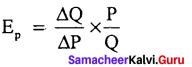
Answer:
(c) Balance sheet

Question 11.
Two or more business units forming a single entity is known as ……………….
(a) Joint
(b) Merger
(c) Link
(d) Compound
Answer:
(b) Merger

Question 12.
………………. is irrecoverable debt ……………….
(a) debtor
(b) creditor
(c) bad debt
(d) loan
Answer:
(c) bad debt

Question 13.
Unsold goods lying in a business on a particular date are known as ……………….
(a) Stock
(b) creditor
(c) debtor
(d) cash
Answer:
(a) Stock

Question 14.
………………. is the incapability of a person or an enterprises to pay the debts
(a) Asset
(b) Liability
(c) Insolvency
(d) Sales
Answer:
(c) Insolvency

Question 15.
………………. is the amount incurred in order to produce and sell the goods and services.
(a) Creditor
(b) Debtor
(c) Stock
(d) Expense
Answer:
(d) Expense

II. Very Short Answer Questions

Question 1.
Write any two objectives of Accounting.
Answer:

  1. To keep a systematic record of financial transactions and events.
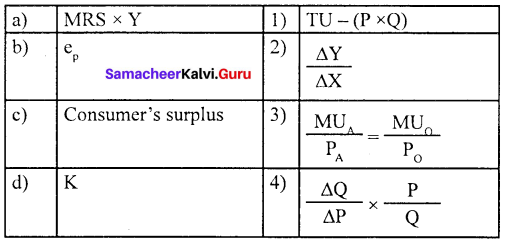
  2. To ascertain the profit or loss of the business enterprise.

Question 2.
Who are researchers?
Answer:
Researchers who carry out their research can use accounting information and make use of the published financial statements for analysis and evaluation.

Question 3.
Who is Public Relation Officer? (PRO)
Answer:
The accountant provides accounting information to various interested users for analysis as per their requirements.

Question 4.
What do you mean by legal evidence?
Answer:
Accounting records are generally accepted as evidence in courts of law and other legal authorities in the settlement of disputes.

Question 5.
Who is a creditor of business?
Answer:
A person who gives a benefit without receiving money or money’s worth immediately but to claim in future.

Question 6.
What is a bad debt?
Answer:
It is a loss to the business arising out of failure of a debtor to pay the dues. It is irrecoverable debt.

Question 7.
What is capital?
Answer:
It is the amount invested by the owner or proprietor in an organisation.

Question 8.
What is drawings?
Answer:
It is the amount of cash or value of goods, assets, etc., withdrawn from the business by the owner for the personal use of the owner.

Question 9.
What is a voucher?
Answer:
Any written or printed document in support of a business transaction is called a voucher.

Question 10.
What is depreciation?
Answer:
It refers to the gradual reduction in the value of fixed assets due to usage and passage of time.

III. Short Answer Questions

Question 1.
Write a note on

  1. Debtor
  2. Creditor

Answer:

  1. Debtor: A person who receives a benefit without giving money or money’s worth immediately, but liable to pay in future or in due course of time.
  2. Creditor: A person who gives a benefit without receiving money or money’s worth immediately but to claim in future.

Question 2.
Write a note on

  1. Purchases
  2. Sales.

Answer:

  1. Purchases: Buying of goods with the intention of resale is called purchase.
  2. Sales: When goods meant for resale are sold, it is called sales.

Question 3.
What is the difference between cash transaction and credit transactions?
Answer:
Cash transaction:
It is a transaction which involves immediate cash receipt or immediate cash payment.

Credit transaction:
It is a transaction in which cash is not received or paid immediately, but will be received or paid later.

Question 4.
What is the difference between voucher and invoice?
Answer:
Voucher:
Any written or printed document in support of business transaction is called a voucher. Examples: cash receipts, bank pay – in – slip, etc.

Invoice:
It is a statement prepared by a seller of goods to be sent to the buyer. It shows details of quantity, price, value, etc., of the goods and any discount given, finally showing the net amount payable by the buyer.