Samacheer Kalvi 7th Social Science History Solutions Term 3 Chapter 1 New Religious Ideas and Movements

Students can Download Social Science History Chapter 1 New Religious Ideas and Movements Questions and Answers, Notes Pdf, Samacheer Kalvi 7th Social Science Book Solutions Guide Pdf helps you to revise the complete Tamilnadu State Board New Syllabus and score more marks in your examinations.

Tamilnadu Samacheer Kalvi 7th Social Science History Solutions Term 3 Chapter 1 New Religious Ideas and Movements

Samacheer Kalvi 7th Social Science New Religious Ideas and Movements Textual Evaluation

I. Choose the correct answer:

New Religious Ideas And Movements Question 1.
Who of the following composed songs on Krishna putting himself in the place of mother Yashoda?
(a) Poigaiazhwar
(b) Periyazhwar
(c) Nammazhwar
(d) Andal
Answer:
(b) Periyazhwar

New Religious Ideas And Movements Questions And Answers Question 2.
Who preached the Advaita philosophy?
(a) Ramanujar
(b) Ramananda
(c) Nammazhwar
(d) Adi Shankara
Answer:
(d) Adi Shankara

New Religious Ideas And Movements 7th Standard Question 3.
Who spread the Bhakthi ideology in northern India and made it a mass movement?
(a) Vallabhacharya
(b) Ramanujar
(c) Ramananda
(d) Surdas
Answer:
(c) Ramananda

Samacheer Kalvi Guru 7th Social Science Question 4.
Who made Chishti order popular in India?
(a) Moinuddin Chishti
(b) Suhrawardi
(c) Amir Khusru
(d) Nizamuddin Auliya
Answer:
(a) Moinuddin Chishti

New Religious Ideas And Movements In Tamil Question 5.
Who is considered their first guru by the Sikhs?
(a) Lehna
(b) Guru Amir Singh
(c) GuruNanak
(d) Guru Gobind Singh
Answer:
(c) GuruNanak

II. Fill in the Blanks.

  1. Periyazhwar was earlier known as ______
  2. ______ is the holy book of the Sikhs.
  3. Meerabai was the disciple of ______
  4. philosophy is known as Vishistadvaita ______
  5. Gurudwara Darbar Sahib is situated at ______ in Pakistan.

Answer:

  1. Vishnu Chittar
  2. Guru Granth Sahib
  3. Ravi das
  4. Ramanuja’s
  5. Karatarpur

III. Match the following.

PahulKabir
RamcharitmanasSikhs
SrivaishnavismAbdul-Wahid Abu Najib
GranthavaliGuru Gobind Singh
SuhrawardiTulsidas

Answer:

PahulSikhs
RamcharitmanasTulsidas
SrivaishnavismRamanuja
GranthavaliKabir
SuhrawardiAbdul-Wahid Abu Najib

IV. Find out the right pair/pairs:

(1) Andal – Srivilliputhur
(2) Tukaram – Bengal
(3) Chaitanyadeva – Maharashtra
(4) Brahma-sutra – Vallabacharya
(5) Gurudwaras – Sikhs
Answer:
(1) Andal – Srivilliputhur
(5) Gurudwaras – Sikhs

Samacheer Kalvi 7th Social Guide Question 2.
Assertion (A): After Guru Gobind Singh, the holy book Guru Granth Sahib came to be considered the guru.
Reason (R): Guru Gobind Singh was the compiler of Guru Granth Sahib.
(a) R is not the correct explanation of A
(b) R is the correct explanation of A
(c) A is correct but R is wrong
(d) Both A and R are wrong
Answer:
(c) A is correct but R is wrong

Religious Ideas And Movements Question 3.
Find the odd person out
Poigai Azhwar, Bhoothathu Azhwar, Periazhwar, Andal, Nammazhwar.
Answer:
Andal

V. State true or false:

  1. Sufism was responsible for the spread of Islamic culture.
  2. The best known Sufi sage of the early medieval period was Nizamuddin Auliya of the Chishti order.
  3. Guru Nanak is considered the first guru of Sikhs.
  4. Sufis believed that realization of God can be achieved only through passionate devotion to God and intense meditation.
  5. The basic Tamil Saivite sacred canon consists of 12 books.

Answer:

  1. False
  2. True
  3. True
  4. True
  5. True

VI. Give short answers:

Question 1.
What do you know about Tirumuraii
Answer:
Nambi Andar Nambi (1000 A.D.) is said to have compiled the songs of all of the Nayanmars that form the basis of Tirumurai, the basic Tamil Saivite sacred canon. It consists of 12 books, and 11 of them were assembled by Nambi. The 12th book is Sekkizhar s Periyapuranam.

Question 2.
How many Nayanmars were there and who were prominent among them?
Answer:
There are 63 legendary Nayanmars. Among them, Gnanasampandar, Appar, and Sundarar (often called “the trio”) are worshipped as saints through their images in South Indian temples.

Question 3.
How did Gurunanak help to found Sikhism?
Answer:

  1. Guru Nanak is considered the first guru by the Sikhs.
  2. The teachings of Guru Nanak formed the basis of Sikhism, a new religious order, founded in the late 15th century.
  3. His and his successors’ teachings are collected in the Guru Granth Sahib, which is the holy book of the Sikhs.

Question 4.
What had Tukkaram to do with the Vitthoba temple of Pantharpur?
Answer:
Tukaram, a 17th century saint poet of Maharashtra, is known for his spiritual songs abangas or Kirtanas, devoted to Vitthoba, an avatar of krishna. There is Vitthoba / Panduranga temple at Pantharpur or Pandaripuram in Sholapur district,Maharashtra.

Question 5.
Highlight the spiritual ideas of Kabir that appealed to lower classes.
Answer:

  1. Kabir believed that God is one and formless, even though different religious sects give him different names and forms.
  2. Kabir opposed discrimination on the basis of religion, caste and wealth. He also condemned meaningless rituals.

VIII. Answer the following in detail:

Question 1.
Give an account of the contributions of exponents of Bhakti Movement in the southern as well as northern parts of India.
Answer:

  1. The Azhwars, the Vaishnavite Bhakti sages and the originators of Bhakti cult, and the Nayanmars, the worshipers of Siva or the Saivites, composed devotional hymns in Tamil language, dedicated to their respective gods.
  2. Vishnu-bhakti or Vaishnavism is based on Vishnu’s avatars (incarnations), particularly Krishna and Rama. The 12 Tamil Azhwars are chiefly known for their immortal hymns.
  3. Two Azhwars stand out distinctly for their contribution to the promotion of the Bhakti movement.

(a) AdiShankara:

  1. Adi Shankara or Shankarachariar (c. 700-750 A.D.) preached the Advaita philosophy.
  2. He set up mathas (mutts), centres of learning and worship, at Badrinath, Puri, Dwarka and Sringeri.
  3. His commentary on the Brahma-sutra, which is a fundamental text of the Vedanta school and on the principal Upanishads are considered equally important.

(b) Ramanuja:

  1. Ramanuja, a 11th century Vaishnava saint, was the most influential thinker of Vaishnavism.
  2. He established centres to spread his doctrine of devotion, Srivaishnavism, to God Vishnu and his consort Lakshmi.

Exponents of Bhakti Movement:

  1. Ramananda spread the Bhakti ideology in northern India where it became a mass movement. Vallabhacharya, a Telugu philosopher, built a temple for Lord Krishna on the Govardhan Hills near Mathura. Surdas, a blind poet and musician, was associated with this temple as well as that of Agra. His famous collection of poetry is called Sursagar. Meera Bai, wife of the crown prince of Mewar, was an ardent devotee of Lord Krishna.
  2. Tulsidas’s Hindi retelling of the story of Rama in the Ramcharitmanas, the sentiment of friendship and loyalty is stressed.
  3. Tukaram, a 17th century saint poet of Maharashtra, is known for his spiritual songs (abangas or kirtanas), devoted to Vitthoba, an avatar of Krishna.

Question 2.
What is Sufism? How did it find its footing in India?
Answer:
The advent of Sufis to India dates back to the Arab conquest of Sind. It gained prominence 1 during the reign of the Delhi Sultans. Sufism found adherents among both Muslims and Hindus.

  1. Sufism: The word Sufi takes its origin from suf, meaning wool. The Sufis wore course garments made of wool and hence they were called Sufis. Sufism was basically Islamic but was influenced by Hindu and Buddhist (Mahayana) ideas. It rejected the stringent conduct code of the ulemas. Sufis lived in hermitages akin to monasteries and functioned outside society.
  2. Sufis in medieval India were divided into three major orders. They were Chisti, Suhrawardi and Firdausi.
  3. The best known Sufi sage of the early medieval period was Nizamuddin Auliya of the Chishti order, who had a large number of followers among the ruling class in Delhi.
  4. Suhrawardi order was founded by an Iranian Sufi Abdul-Wahid Abu Najib. The Firdausi order was a branch of Suhrawardi order and its activities were confined to Bihar.

Question 3.
What impact did Bhakti movement make on Indian society?
Answer:

  1. Vedic Hinduism was regenerated and thus saved from the onslaught of Islam.
  2. The Islamic tenets – unity of God and universal brotherhood – emphasised by the saints promoted harmony and peace.
  3. Bhakti was a movement of the common people; it used the language of the common people for its devotional literature.
  4. Bhakti movement opened up space for Indian languages to grow. It stimulated literary activity in regional languages.
  5. What sustained Sanskrit, despite its decline during this period, was the support extended by the rulers of Hindu kingdoms.
  6. Tamil was the only ancient Indian language remained vibrant during this period. Under the influence of devotional cults, its emphasis shifted to religion and religious literature.
  7. Caste system and social disparities came to be criticised.

VIII. HOTS

Question 1.
Examine the statement that the Bhakti movement saved Vedic Hinduism from the onslaught of Islam.
Answer:

  1. The Bhakthi movement emphasised the mutual emotional attachment and love of a devotee towards a personal God and of the God for the devotee.
  2. The Azhwars and Nayanmars contibuted a lot to Tamil literature through their devotional hymns.
  3. They criticised caste – based social status and advocated gender equality
  4. Sages like Ramanuja and Adi Shankara too articulated ideas of social equality. In North India poets like Ramananda, Vallabhacharya and Tulsidas spread the Bhakthi cult through their devotional hymns which could save Vedic Hinduism from the onslaught of Islam.

Samacheer Kalvi 7th Social Science New Religious Ideas and Movements Additional Questions

I. Choose the correct answer:

Question 1.
There is only one God, through Hindus and Muslims call him by different names stated __________
(a) Andal
(b) Haridasa
(c) Ramanuja
(d) MeeraBai
Answer:
(b) Haridasa

Question 2.
The Azhwars and the Nayanmars composed devotional hymns in _________ language.
(a) Tamil
(b) Sanksrit
(c) Hindi
(d) Urdu
Answer:
(a) Tamil

Question 3.
The _________ Tamil Azhwars are chiefly known for their immortal hymns.
(a) 10
(b) 15
(c) 12
(d) 13
Answer:
(c)12

Question 4.
_________ is said to have found Andal as a baby in the tulsi garden at Srivilliputhur.
(a) Poigai Azhwar
(b) Pei Azhwar
(c) Nammazhwar
(d) Periyazhvar
Answer:
(d) Periyazhvar

Question 5.
The poems of _________ are used in Vaishnava wedding ceremonies in Tamil Nadu.
(a) Andal
(b) Nathamuni
(c) Periyazhwar
(d) Pei Azhwar
Answer:
(a) Andal

Question 6.
There are _________ legendary Nayanmars.
(a) 54
(b) 63
(c) 60
(d) 50
Answer:
(b) 63

Question 7.
_________ was a blind poet and musician.
(a) Vallabhacharya
(b) Surdas
(c) Tukaram
(d) Chaitanya
Answer:
(b) Surdas

Question 8.
Kabir’s verses were composed in _________ language mixed with Urdu.
(a) Hindi
(b) Oriya
(c) Bhojpuri
(d) Sanskrit
Answer:
(c) Bhojpuri

Question 9.
Poet _________ was one of its distinguished followers of sufism.
(a) Kabir
(b) Surdas
(c) Tukaram
(d) Amir Khusru
Answer:
(d) Amir Khusru

Question 10.
Adi Shankara set up mathas (mutts) in _________ places in India.
(a) 3
(b) 2
(c) 4
(d) 5
Answer:
(c) 4

II. Fill in the blanks:

  1. The ______ were the Vaishnavite Bhakti sages.
  2. The ______ were the worshipers of Siva
  3. Nammazhwar’s fame lies in his 1,102-stanza ______
  4. _______ collected the 4,000 poems of Nammazhwar.
  5. The collected of 4,000 poems of Nammazhwar is called _______
  6. The poems of Andal expressing her love for _______ the incarnation of Vishnu.
  7. ________ is said to have compiled the songs Of all the Nayanmars.
  8. Sekkizhar’s wrote _______
  9. After a long pilgrimage, Ramanuja settled in _______
  10. The Vadakalai Vaishnavism originally flourished around _______
  11. Thenkalai Vaishnavism centred on _______
  12. The Panduranga temple is located in _______district, Maharashtra.
  13. The best known Sufi sage of the early medieval period was _______
  14. Kabir came under the influence of Saint _______
  15. Guru Nanak’s teachings were spread through hymns called _______

Answer:

  1. Azhwars
  2. Nayanmars
  3. Tiruvaimozhi
  4. Nathamuni
  5. Divya Prabandham
  6. Ranganatha
  7. Nambi Andar Nambil
  8. Periyapuranantl
  9. Srirangam
  10. Kanchipuram
  11. Srirangam
  12. Sholapur
  13. Nizamuddin Auliya
  14. Ramananda
  15. kirtan

III. Match the following

AB
1.Khalsaa) Uncut hair
2.Keshb) Dagger
3.Kanghac) The pure
4.kadad) Comb
5.kirpane) Steel bangle

Answer:

  1. c
  2. a
  3. d
  4. e
  5. b

IV. Find out the right pair / pairs.

Question 1.

(1) SivaBhakti – Saivites
(2) Andal – Tirumurai
(3) Kabir – Bijak
(4) Kachera – Dagger
Answer:
(1) Siva Bhakti – Saivites
(3) Kabir – Bijak

Question 2.
Assertion (A): During the Bhakti movement, Sankrit sustained despite its decline.
Reason (R): The Rules of Hindu kingdom extended support to Sanskrit.
(a) R is not the correct explanation of A
(b) R is the correct explanation of A
(c) A is correct and R is wrong
(d) Both A and R are wrong
Answer:
(b) R is the correct explanation of A

Question 3.
Find the odd person out.
Appar, Sekkizhar, Sundarar, Gnanasampandar.
Answer:
Sekkizhar

V. True or False

  1. Several mystical religious movements, in both Hinduism and Islam, freely included elements of different faiths in their teachings.
  2. The Vadakalai sect stressed the importance of Divya Prabandhams.
  3. Vallabhacharya built a temple for Lord Krishna on the Govardhan Hills near Mathura.
  4. Sufism accepted the stringent conduct code of the ulemas.
  5. The message of Guru Granth Sahib is spread by the Khalsa.

Answer:

  1. True
  2. False
  3. True
  4. False
  5. True

VI. Give short Answers.

Question 1.
What did‘The Bhagavad Gita propose?
Answer:
The Bhagavad Gita proposed that the path of bhaktimarga (the path of bhakti) is superior to the two other religious approaches, namely, the path of knowledge (jnana) and the path of rituals and good works (karma), providing inspiration to the exponents of Bhakti cult.

Question 2.
Name the three Muthal Azhwars.
Answer
Three Muthal Azhwars: Poigai Azhwar, Bhoothathu Azhwar and Pei Azhwar.

Question 3.
Name any five eminent Azhwars other than the Muthal Azhwar.
Answer:
Other Azhwars: Thirumalisai Azhwar, Periyazhwar, Thondaradippodi Azhwar, Thirumangai Azhwar, Thiruppanazhwar, Kulasekara Azhwar, Nammazhwar, Mathurakavi Azhwar and Andal.

Question 4.
What was the essence of the ‘Advaita’ philosophy?
Answer:
The essence ofthis philosophy is that the soul (atma) unites with the universal soul (brahma) through the attainment of knowledge.

Question 5.
How were the teachings of Guru Nanak spread?
Answer:
Guru Nanak’s teachings were spread through the group singing of hymns, called kirtan. The devotees gathered in dharmashalas (rest houses), which became gurudwaras in course of’ time.

VIII. Answer in Detail :

Question 1.
Give an account of the growth of Sikhism after the period of Guru Nanak.
Answer:

  1. Guru Nanak nominated his disciple Lehna to succeed him as the guru. Following this
    precedent, the successors are named by the incumbent Sikh Guru.
  2. At the time of Guru Gobind Singh, the custom of pahul (baptism by sweetened water stirred with a dagger) was introduced.
  3. Those who got baptised became members of a disciplined brotherhood known as the Khalsa (meaning the pure).
  4. The men were given the title Singh (lion). Every member of the Khalsa had to have five distinctive things on his person.
  5. These were kesh (uncut hair), kangha (comb), kirpan (dagger), kada (steel bangle) and kachera (underpants).
  6. After Guru Gobind Singh, the holy book Guru Granth Sahib is considered the guru and its message is spread by the Khalsa.

Samacheer Kalvi 12th English Grammar Error Spotting

Students can Download Samacheer Kalvi 12th English Grammar Error Spotting, Notes, Samacheer Kalvi 12th English Book Solutions Guide Pdf helps you to revise the complete Tamilnadu State Board New Syllabus and score more marks in your examinations.

Tamilnadu Samacheer Kalvi 12th English Grammar Error Spotting

Spot the errors in the following sentences and correct them:

Spot The Error For 12th Std Question 1.
No sooner had the teacher entered the class when the students stood up.
Answer:
No sooner had the teacher entered the class than the students stood up.

Error Spotting Exercises With Answers For Class 12 Question 2.
He put of his coat.
Answer:
He put off his coat.

Spot The Error For 12th Std Pdf Question 3.
He sat beside Philip.
Answer:
He sat beside Philip.

Spot The Error He Put Of His Coat Question 4.
You have to choose among rose milk and almond milk.
Answer:
You have to choose between rose milk and almond milk.

Question 5.
There were a few incidents of irregularity for the emergency years.
Answer:
There were a few incidents of irregularity during the emergency years.

Question 6.
She only lost her glasses in the stampede.
Answer:
Only she lost her glasses in the stampede.

Question 7.
It is a five – years integrated degree course.
Answer:
It is a five – year integrated degree course.

Question 8.
One must finish his duty on time.
Answer:
One must finish one’s duty on time.

Question 9.
No less than forty persons were hurt in the accident.
Answer:
No fewer than forty people were hurt in the accident.

Question 10.
It is one of the most memorable day in my life.
Answer:
It is one of the most memorable days in my life.

Question 11.
I regard Ram my friend.
Answer:
I regard Ram as my friend.

Question 12.
It is her who came to see us.
Answer:
It is she who came to see us.

Question 13.
The mobile phone neither went dead or worked properly.
Answer:
The mobile phone neither went dead nor worked properly.

Question 14.
One must finish his work in time.
Answer:
One must finish one’s work in time.

Question 15.
He absented from the class.
Answer:
He absented himself from the class.

Question 16.
Whom do you think won the prize?
Answer:
Who do you think won the prize?

Question 17.
What book do you read?
Answer:
Which book do you read?

Question 18.
When learning how to dance, technique is of utmost importance.
Answer:
While learning how to dance, technique is of utmost importance.

Question 19.
Unless you do not work hard, you will not excel in the examination.
Answer:
Unless you work hard, you will not excel in the examination.

Question 20.
She is seventy but her hairs are not grey.
Answer:
She is seventy but her hairs is not grey.

Question 21.
Gopi is one of the tallest boy.
Answer:
Gopi is one of the tallest boys.

Question 22.
He did not listen to his father’s advices.
Answer:
He did not listen to his father’s advice.

Question 23.
He is a M.Sc student.
Answer:
He is an M.Sc student.

Question 24.
He made an universal appeal to all.
Answer:
He made a universal appeal to all.

Question 25.
He wears a HMT watch presented by his uncle.
Answer:
He wears an HMT watch presented by his uncle.

Samacheer Kalvi 10th English Solutions Supplementary Chapter 4 The Aged Mother

Looking to improve English skills and gain more subject knowledge then the best resources that you can use here is Samacheer Kalvi 10th English Solutions for Supplementary Chapter 4 The Aged Mother Questions and Answers.

In the Samacheer Kalvi 10th English Guide for Chapter 4 The Aged Mother textbook solutions, subject experts covered all types of questions and answers related to the topics, quick notes, summary, solved & unsolved exercises, etc. If you are planning to prepare Chapter 4 The Aged Mother via textbook, then you’re suggested to go with this Samacheer Kalvi 10th English Book Solutions Questions and Answers PDF for better understanding and preparation.

Tamilnadu Samacheer Kalvi 10th English Solutions Supplementary Chapter 4 The Aged Mother

English Subject experts who are having max years of experience prepared this Tamilnadu State Board Solutions for 10th English Supplementary Chapter 4 The Aged Mother Questions and Answers. They have explained all the topics covered in the board prescribed latest syllabus in a simple way to understand easily. So, students can prepare Chapter 4 English from this Samacheer Kalvi 10th English Book Questions and Answers PDF. Download the Tamilnadu State Board 10th English Chapter 4 The Aged Mother Workbook Solutions PDF by accessing the below links and learn properly for the final exams to score well.

The Aged Mother Textual Questions

A. Rearrange the sentences given below in the correct sequence.

1. The son made up his mind to take back his mother home.
2. A farmer decided to leave his old mother on top of a mountain.
3. The governor realized his mistake and abolished the law.
4. Once in Shining, a cruel ruler declared that all old people must be put to death.
5. Using the clever idea of his mother, the farmer made a rope of ashes.
6. When the farmer bade farewell, she advised him to return home with the aid of twigs.
7. Filled with dread, he hid his mother in his home.
8. The mother dropped the small twigs as markers on the way to help her son return.
Answer:
4,2,8,6,1, 7, 5,3
4. Once in Shining, a cruel ruler declared that all old people must be put to death.
2. A farmer decided to leave his old mother on top of a mountain.
8. The mother dropped the small twigs as markers on the way to help her son return.
6. When the farmer bade farewell, she advised him to return home with the aid of twigs.
1. The son made up his mind to take back his mother home.
7. Filled with dread, he hid his mother in his home.
5. Using the clever idea of his mother, the farmer made a rope of ashes.
3. The governor realized his mistake and abolished the law.

B. Answer the following questions in one or two sentences.

The Aged Mother 10th Supplementary Question 1.
What was the cruel announcement made by the leader?
Answer:
The cruel announcement was to put to death all the aged people.

The Aged Mother Questions And Answers Question 2.
Why was the farmer filled with sorrow?
Answer:
The farmer was filled with sorrow because he loved his mother very much. So he did not want her to die.

The Aged Mother Paragraph Question 3.
What were the things carried by the farmer to the summit of the mountain?
Answer:
He took a quantity of unwhitened rice. He cooked and dried it. He tied it in a square cloth and swung it in a bundle around his neck. He also took a gourd filled with cool sweet water.

The Aged Mother Summary Question 4.
Why did the mother become anxious as they climbed up the mountain?
Answer:
The mother became anxious as they climbed up the mountain because her son did not know the mountains many paths and his return might be one of the dangers.

The Aged Mother Question 5.
What did the mother drop along the way?
Answer:
She dropped a pile of twigs along the way.

The Aged Mother Pdf Question 6.
What was the advice given by his mother for the safe return of her son?
Answer:
She advised her son to look carefully and follow the path which holds the piles of twigs. It will guide him to the familiar path farther down.

The Aged Mother Summary In English Question 7.
Why did the farmer’s burden seem to be light on his way back home?
Answer:
The farmer’s burden seemed to be light on his way back because he was happy to take his mother back to his home.

The Aged Mother Answers Question 8.
Where did the farmer hide his mother?
Answer:
The farmer hid his mother in a walled closet beneath the kitchen floor.

The Aged Mother Questions Question 9.
How did the farmer make the rope of ashes? On whose suggestion did he do it?
Answer:
Using the clever idea of his mother, the farmer made a rope of ashes. He made this by making a rope of twisted straw and burning it on a windless night.

The Aged Mother Summary For Class 10 Question 10.
How did the Governor realize his mistake?
Answer:
The Governor was pleased at the wit of the youth. So he demanded to know where he had obtained his wisdom. The farmer related the true story to him. He listened and meditated in silence. He realized his mistake and abolished his cruel law.

C. Answer each of the following in a paragraph of 120 to 150 words.

The Story Of The Aged Mother Question 1.
Narrate the circumstances that led to the abandoning of the aged in Shining.
Answer:
The country Shining was governed by a cruel leader. He was a warrior. But he had a great and cowardly shrinking from anything suggestive of failing health and strength. This caused him to send out a cruel announcement. The entire province was given strict orders to immediately put to death all aged people. Those were harsh days and the custom of abandoning old people to die was common.

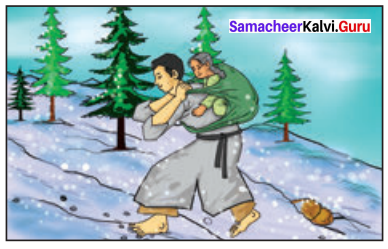
The poor farmer loved his aged mother with tender respect. This order filled his heart with sorrow. But no one ever thought twice about it. So with many deep and hopeless sighs, the farmer prepared to give his mother the kindest mode of death. He decided to take her to the summit of the Obatsuyama mountain and leave her there.

Aged Mother Summary Question 2.
Describe the farmer’s painful journey up the mountain.
Answer:
Just at sunset, the farmer took a quantity of unwhitened rice. He cooked and dried it. He tied it in a square cloth, which he swung in a bundle around his neck along with a gourd filled with cool, sweet water. He lifted his helpless old mother to his back and started on his painful journey up the mountain. The road was long and steep. The narrow road was crossed and recrossed by many paths made by the hunters and woodcutters.

In someplace, he lost the path and was confused. But he gave no heed to it. He blindly went upward towards the high bare summit of what is known as Obatsuyama. His mother was anxious, as her son did not know the mountains many paths. His return might be one of the dangers.

So she dropped piles of twigs on their path up to the summit of the mountain. Weary and heartsick, the youth gently released his burden and silently prepared a place of comfort as his last duty to the loved one. This was the painful journey of the farmer.

Question 3.
‘The old are wise’. Prove this with reference to the story ‘The Aged Mother’.
Answer:
A cruel ruler of Shining in Japan proclaims an announcement that all old people should be put to death. A poor farmer s heart was filled with sorrow after hearing this, because he loved his mother very much. So he carried her to the top of the mountain with a lot of difficulties, as the path was confusing and dangerous. When he bid farewell to her, she advised him to follow the path where piles of twigs were dropped.

It would be easier for him to find his way. Her son’s heart broke at this attitude of his mother. He brought her back and hid her in a closet beneath the kitchen floor. His mother proved her wisdom, when the governor demanded a rope of ashes. She gave her son a clever idea to present a rope of ashes. The Governor was glad. He praised her sense of wisdom and abolished his cruel law.

Additional Questions

Question 1.
Elucidate, ‘With the crown, there cometh wisdom’.
Answer:
In the saying “With the crown of snow, there cometh wisdom” – the crown of snow is pertaining to the elders. It underlines the importance of the elders in shaping our society. The word, “there cometh wisdom” explains that as we get old our everyday experiences make us to be intelligent.

Theoretical knowledge is always superficial. The impact is made only by experienced persons. The wisdom one gets from experience can never be compared to one who is learned theoretically. A person leams from Mistakes. Elders are generally optimistic and are ready to learn from their mistakes.

They also remember it for their lifetime and never repeat them. The elders who have faced different challenges in life and had survived them braving all storm serve as our guiding path because their varied experiences teach us to become wise. They are wise enough to know what is right from wrong.
‘There is a wisdom of the head and a wisdom of the heart.’

Question 2.
Explain the mother’s love with reference to the story, ‘The Aged Mother’.
Answer:
The story of the aged mother revolves around a situation, when the despotic ruler, a warrior proclaimed a decree ordering that all the aged people should be put to death. The story is about a mother’s love. Mother’s love cannot be compared for it is pure and unselfish. Most of all it serves as our courage, weakness and strength that guides us to walk through our journey called life.

It’s something that no one can explain because it is cultivated with deep devotion, sacrifice, understanding and pain. When the poor farmer decides to give his mother a kind mode of death, he silently takes his mother to the bare summit of Obatsayuma and plans to abandon her there. On their way to the summit of the mountain, the heart of the loving mother grows concerned because she knows that her son will be in danger on his way back because it’s an untrodden path.

The aged mother, due to her wisdom and experience breaks the twigs and drops it quietly on the road to serve as a guide for her son’s return journey. She knows from the very start that she will be abandoned in the summit of the mountain but she also understands that it’s for her own good and her son’s. However, she maintains silence to avoid agonizing her son who was already distressed at his action because of her love for her child.

D. Identify the character/speaker.

1. He gave orders for the aged to be put to death.
Answer:
Despotic leader of Shining

2. He considered the order to be the kindest mode of death.
Answer:
The Governor who is the despotic leader

3. She quietly dropped some twigs on the way.
Answer:
The aged mother of the poor farmer

4. Let not thine eyes be blinded.
Answer:
The aged mother of the poor farmer

5. Together we will follow the path, together we will die.
Answer:
Poor farmer

6. I will think. I will think.
Answer:
Widowed mother

7. The truth must be told.
Answer:
Poor farmer

8. He listened and meditated in silence.
The Governor

9. Shining needs more than the strength of the youth.
Answer:
The Governor

10. With the crown of snow there cometh wisdom.
Answer:
The Governor

E. Choose the appropriate answer and fill in the blanks.

1. Shining was governed by a ………………. leader.
(a) strict
(b) kind
(c) cruel
(d) diplomatic.
Answer:
(c) cruel

2. The ………………. was the principal food for the poor.
(a) wheat
(b) brown rice
(c) unwhitened rice
(d) millet.
Answer:
(c) unwhitened rice

3. The road was crossed and re-crossed by many paths made by the ………………………. .
(a) hunters and woodcutters
(b) robbers and thieves
(c) vendors and tradesmen
(d) wildlife photographers and trekkers
Answer:
(a) hunters and woodcutters

4. Gathering ……………… he made a soft cushion and tenderly lifted his old mother onto it.
(a) dry leaves
(b) fallen pine
(c) broken twigs
(d) flowers
Answer:
(b) fallen pine

5. The governor demanded that his subjects should present him with a …………………. .
(a) basket of fruits
(b) rope of ashes
(c) flesh of animals
(d) bag of silverwares
Answer:
(b) rope of ashes

Additional:

A. Choose the Correct answer.

1. A poor farmer and his aged, widowed mother owned a bit of …………………. .
(a) cloth
(b) land
(c) woolen cloth
(d) iron
Answer:
(b) land

2. The country ……………… was governed by a despotic leader.
(a) Shillong
(b) Japan
(c) Shining
(d) Kolkata
Answer:
(c) Shining

3. The province was given strict orders to put to death all …………………. people.
(a) aged
(b) destitute
(c) handicapped
(d) sickly
Answer:
(a) aged

4. The order filled the poor man’s heart with ……………….. .
(a) joy
(b) happiness
(c) sorrow
(d) anxiety
Answer:
(c) sorrow

5. ………………….. was the principal food for the poor.
(a) unbeaten rice
(b) sifted flour
(c) wheat
(d) unwhitened rice
Answer:
(d) unwhitened rice

6. The poor farmer dried and cooked the rice and tied it in a ………………. cloth.
(a) triangular
(b) square
(c) wet
(d) parched dry
Answer:
(b) square

7. He took cool sweet water in a ……………………….. .
(a) bottle
(b) jar
(c) pot
(d) gourd
Answer:
(d) gourd

8. The high bare summit, is ………………… .
(a) Obayama
(b) Otsuyama
(c) Obatsuyama
(d) Obsuyata
Answer:
(c) Obatsuyama

9. Beneath the kitchen floor was a walled ……………….. for food.
(a) closet
(b) clarinet
(c) open space
(d) cabinet
Answer:
(a) closet

10. Stretch the twisted straw upon a row of flat stones and bum it on a ……………………. night.
(a) windy
(b) windless
(c) breezy
(d) stormy
Answer:
(b) windless

B. Rearrange the following sentences in coherent order.

1. a. It describes the love and affection a son and his mother have for one another.
b. Strict orders were given in the province to put to death all aged people at once.
c. The custom of abandoning old people to die was not uncommon, then.
d. ‘The Story of the Aged Mother’. By Matsuo Baasho is a Japanese folklore.
e. The country Shining was governed by a despotic leader who sent out a cruel proclamation.
Answers:
d, a, e, b, c
d. ‘The Story of the Aged Mother’, by Matsuo Baasho is a Japanese folklore.
a. It describes the love and affection a son and his mother have for one another.
e. The country Shining was governed by a despotic leader who sent out a cruel proclamation.
b. Strict orders were given in the province to put to death all aged people at once.
c. The custom of abandoning old people to die was not uncommon, then.

2. a. Then he lifted his helpless old mother to his back and started on his painful journey up the mountain.
b. The poor farmer loved his aged mother with tender reverence.
c. So with hopeless sighs, the youth prepared for the kindest mode of death.
d. But no one ever thought twice about obeying the mandate of the governor.
e. At sundown, he took some cooked food with some sweet water.
Answers:
b, d, c, e, a
b. The poor farmer loved his aged mother with tender reverence.
d. But no one ever thought twice about obeying the mandate of the governor.
c. So with hopeless sighs, the youth prepared for the kindest mode of death.
e. At sundown, he took some cooked food with some sweet water.
a. Then he lifted his helpless old mother to his back and started on his painful journey up the mountain.

B. Fill in the blanks with the appropriate phrases given below to form a complete meaningful paragraph.

1. (of abandoning old people to die / to send out / of failing health and strength / all aged people / was governed by a despotic leader)

The country Shining (i) …………………. who though a warrior, had a great and cowardly shrinking from anything suggestive (ii) …………………. This caused him (iii) …………………. a cruel proclamation. The entire province was given strict orders to immediately put to death (iv) ……………….Those were barbarous days, and the custom (v) …………………. was not uncommon.
Answers:
(i) was governed by a despotic leader
(ii) of failing health and strength
(iii) to send out
(iv) all aged people
(v)of abandoning old people to die

2. (with a rope of ashes / Time passed / sent forth heralds / hid his mother /as a boast of his power)

There the son (i) ………………………., supplying her with everything she needed, continually watching and fearing she would be discovered, (ii) ……………………., and he was beginning to feel safe when again the governor (iii) ……………….. bearing an unreasonable order, seemingly (iv) ……………….His demand was that his subjects should present him (v) ………………………… .
Answers:
(i) hid his mother
(ii) Time passed
(iii) sent forth heralds

C. Match the following appropriately:
1.
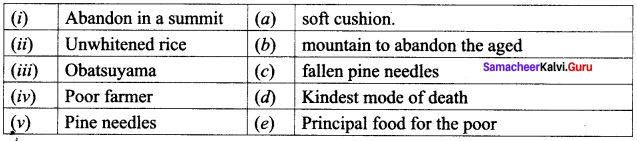
The Aged Mother 10th Supplementary Samacheer Kalvi English Solutions Supplementary Chapter 4
Answers:
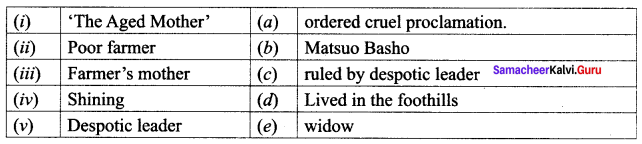
(i)(b), (ii)(d), (iii)(e), (iv)(c), (v)(a).

2.
The Aged Mother Questions And Answers Samacheer Kalvi 10th English Solutions Supplementary Chapter 4
Answers:
(i)(d), (ii)(e), (iii)(b), (iv)(c), (v)(a).

D. Read the passage given below and answer the questions that follow:

1. Long, long ago there lived at the foot of the mountain a poor farmer and his aged, widowed mother. They owned a bit of land which supplied them with food, and they were humble, peaceful, and happy.The country Shining was governed by a despotic leader who though a warrior, had a great and cowardly shrinking from anything suggestive of failing health and strength. This caused him to send out a cruel proclamation. The entire province was given strict orders to immediately put to death all aged people.

Those were barbarous days, and the custom of abandoning old people to die was not uncommon. The poor farmer loved his aged mother with tender reverence, and the order filled his heart with sorrow. But no one ever thought twice about obeying the mandate of the governor, so with many deep and hopeless sighs, the youth prepared for what at that time was considered the kindest mode of death.

(a) What do you know of the poor farmer and his aged mother?
Answer:
The poor farmer and his aged mother lived in their small bit of land at the foothills which supplied them with food. They were humble, peaceful and happy.

(b) Who ruled the country Shining?
Answer:
The Country Shining was ruled by a despotic leader who was a warrior himself.

(c) What was the despotic leader’s order to the entire province?
Answer:
The despotic leader ordered that all aged people who were failing in health and strength be put
to death immediately.

(d) Pick out the adjective that described the kind of days the people lived in at Shining.
Answer:
The adjective used to describe was ‘barbarous’.

(e) How did the poor farmer react in response to the order?
Answer:
The poor farmer loved his aged mother with tender reverence, and the order filled his heart with sorrow. With many deep and hopeless sighs, the youth prepared for the kindest mode of death.

2. Just at sundown, when his day’s work was ended, he took a quantity of unwhitened rice which was the principal food for the poor, and he cooked, dried it, and tied it in a square cloth, which he swung in a bundle around his neck along with a gourd filled with cool, sweet water. Then he lifted his helpless old mother to his back and started on his painful journey up the mountain.

The road was long and steep; the narrow road was crossed and re-crossed by many paths made by the hunters and woodcutters. In someplace, they were lost and confused, but he gave no heed. One path or another, it mattered not. On he went, climbing blindly upward – ever upward towards the high bare summit of what is known as Obatsuyama, the mountain of the “abandoning of the aged”.

(a) What did the poor farmer do at the end of his work before taking his mother to the summit?
Answer:
The poor farmer took a quantity of unwhitened rice which was the principal food for the poor. He cooked it, dried it and tied it in a square cloth, which he swung in a bundle around his neck along with a gourd filled with cool, sweet water.

(b) Why was the journey painful?
Answer:
The journey up the mountain was painful because he was very grieved when he lifted his helpless old mother to his back.

(c) How was the road up the mountain?
Answer:
The road up the mountain was long and steep. It was crossed and recrossed by many paths made by the hunters and woodcutters.

(d) How do you know that he was focused on his journey?
Answer:
There were times, when they were lost and confused but he did not bother about anything and walked continuously up the summit.

(e) Why did the poor farmer choose Obatsuyama?
Answer:
The poor farmer chose Obatsuyama because it was the mountain of the ‘Abandoning the Aged’.

The Aged Mother by Matsuo Basho About the Author:

Matsuo Basho was born in 1644 in Iga Provence and died on 28th November, 1694 in Osaka, Japan. Matsuo Basho’s poetry is internationally renowned; and, in Japan, many of his poems are reproduced on monuments and traditional sites. Basho was introduced to poetry at a ‘young age, and after integrating himself into the intellectual scene of Edo which is modem Tokyo, he quickly became well known throughout Japan. He made a living as a teacher; but then renounced the social, urban life of the literary circles and was inclined to wander throughout the country, heading west, east, and far into the northern wilderness to gain inspiration for his writing.

The Aged Mother Summary:

The Aged Mother Paragraph Samacheer Kalvi 10th English Solutions Supplementary Chapter 4

Introduction:
Author Matsuo Basho expresses the love the mother shows on his son and the way he reciprocates it. The story is a drama of how the son fights to thwart the cruel fate that fell upon his mother and the wittiness of his mother that helped save her from the ill fate of all old mothers.
The Aged Mother Summary Samacheer Kalvi 10th English Solutions Supplementary Chapter 4

King’s decree:
“The Story of the Aged Mother”, by Matsuo Basho is a story in which a son and his mother’s pain in their battle against the decree of putting aged people to death is portrayed. The story happened at the foot of the mountain where a poor farmer lived in a country called Shining with his aged mother whom he loved. Their place was governed by a tyrannical leader who sent the announcement of killing all aged people which was not common then.
The Aged Mother Samacheer Kalvi 10th English Solutions Supplementary Chapter 4

Son set to abandon mother:
When the poor farmer heard the decree he felt sorrow in his heart for his aged mother. Just as his labour ended, he prepared food from a portion of unwhitened rice, covered it in a square cloth and knotted it in his neck along with a gourd filled with cool, sweet water. He then carried his mother on his back and started walking towards the summit of Obatsayuma, the mountain of the“abandoning of aged”.
The Aged Mother Pdf Samacheer Kalvi 10th English Solutions Supplementary Chapter 4

Mother’s anxiety:
On their way to the top, the helpless mother noticed the perilous path and thought that her son didn’t know the paths and might pass through danger. So she reached for twigs, snapped them to pieces and quietly dropped them until they reached the summit. The poor farmer freed his mother and made a comfortable cushion with pine needles and bid farewell.
The Aged Mother Summary In English Samacheer Kalvi 10th Solutions Supplementary Chapter 4

Motherly love
Before he left her, she told him about the trail she made with the piles of twigs. His mother’s words clearly portrayed the unconditional love that the mother had for her son, an unselfish love that thumped the heart of the poor child and made him cry.
The Aged Mother Answers Samacheer Kalvi 10th English Solutions Supplementary Chapter 4

Son faces the verdict
Now, the farmer realized that they need to face the verdict together. So, he again carried his mother on his back and started to walk back to their humble hut in the valley.
He hid his mother on a walled closet used for food beneath the kitchen. Time passed and they both felt secure and safe until one day the despotic leader demanded the people of the valley to present him with a rope of ashes.
The Aged Mother Questions Samacheer Kalvi 10th English Solutions Supplementary Chapter 4

Farmer seeks mother’s wisdom:
The poor farmer was dumbstruck and informed his mother. His mother thought for a while and came upon a wise idea. She told him to make a rope of twisted straw, stretched upon a row of flat stones and bum it on a windless night. The tyrant was pleased of what he had witnessed and asked the poor farmer about his knowledge.
The Aged Mother Summary For Class 10 Samacheer Kalvi English Solutions Supplementary Chapter 4

Poor farmer comes out with the truth:
The poor farmer told him the truth and stated everything he had done. The tormentor listened and meditated in silence. On hearing the story, he decided to abolish the harsh law and saw the presence of elders to shape the society. Now the despotic leader acknowledged that with the crown of snow, there cometh wisdom.
The Story Of The Aged Mother Samacheer Kalvi 10th English Solutions Supplementary Chapter 4

Conclusion:
It was a happy ending that has a moral code that a son should never let go of his mother whatsoever the situation may be. The king realised his mistakes and the worth of wise elders. Due to the wisdom of the mother, all the elders were saved.
Aged Mother Summary Samacheer Kalvi 10th English Solutions Supplementary Chapter 4

The Aged Mother Glossary:

Textual:
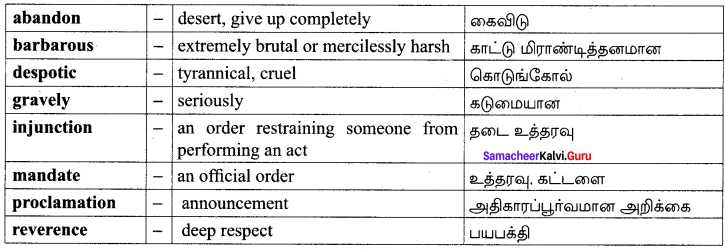
Samacheer Kalvi 10th English Solutions Supplementary Chapter 4 The Aged Mother 13Samacheer Kalvi 10th English Solutions Supplementary Chapter 4 The Aged Mother 14

Additional:
Samacheer Kalvi 10th English Solutions Supplementary Chapter 4 The Aged Mother 15

We hope the data given here will benefit you to the fullest extent at the time of preparation. For better understanding of English subject this Samacheer Kalvi 10th English Solutions for Class 10th English Supplementary Chapter 4 The Aged Mother PDF is the best resource. Download & ace up your preparation. Keep in touch with us and get the latest information on Tamilnadu State board Textbook Solutions PDF.

Samacheer Kalvi 6th English Solutions Term 3 Poem Chapter 2 A Tragic Story

Students can Download English Poem 2 A Tragic Story A Memoir Questions and Answers, Summary, Activity, Notes, Samacheer Kalvi 6th English Book Solutions Guide Pdf  helps you to revise the complete Tamilnadu State Board New Syllabus and score more marks in your examinations.

Tamilnadu Samacheer Kalvi 6th English Solutions Term 3 Poem Chapter 2 A Tragic Story

A Tragic Story Poem Summary Poem Overview

Line No.Poem LinesExplanation
1-2‘There lived a sage in days of yore, And he a handsome pigtail wore;Long ago, there lived a sage and he had a beautiful pigtail.
3-4‘But wondered much a sorrowed more, Because it hung behind him.He wondered much about his pigtail’s position and was worried more, as it hung behind him.
5-6‘He mused upon this curious case,
Ands wore he’d change the pigtail’s place,’
He thought about this curious case and promised that he would change the position of the pigtail.
7-8‘And have it hanging at his face, Not dangling there behind him.’He would like to have it at his face and not swinging loosely behind him.
9-10‘Says he, “The mystery I’ve found-
Says he, “The mystery I’ve found! ’
The sage insists that he has found a solution to change the position of his pigtail.
11-12‘I ’ll turn me round, ’’ he turned him round; But still it hung behind him. ’He said that he would turn him round and so he turned him round. But still it hung steadily throughout the day.
13-14‘Then round and round, and out and in, All day the puzzled sage did spin;’The confused sage turned round and round, out and in continuously throughout the day.
15-16‘In vain-it mattered not a pin- The pigtail hung behind him.’Even though he turns continuously the whole day, it still hangs firmly behind him.
17-18‘And right and left and round about, And up and down and in and out ’He turned to his right and left and round about again. He turned up and down and in and out.
19-20‘He turned; but still the pistoil stout Hung stmdily bihind him’He turned and turned, but still the pigtail remained thick and hung steadily behind him.
21-22‘And though his efforts never slack, And though hi twist and twirtl and tack’Though his efforts were not slackened and though he twisted, twirled and tacked.
23-24Alas! still faithful to his back
The pigtail hangs behind him’
The poet expresses his sorrow in a humorous way and says that though he tried his best to change the position of his pigtail, it remained faithfully behind him.

A. Answer the following.

A Tragic Story Poem Questions And Answers Question 1.
What made the sage upset?
Answer:
The sage was upset, as his pigtail hung behind him.

The Tragic Story Questions And Answers Question 2.
Why did the sage spin all day?
Answer:
He spinned continually all day to change the position of his pigtail.

A Tragic Story Question 3.
What solution did he arrive at for the mystery that he found?
Answer:
He thought that if turned him round, he can change the position of his pigtail.

The Tragic Story Poem Summary In English Question 4.
Was he finally successful in changing his pigtail’s position? Support your answer with a line from the poem.
Answer:
No, he was not successful in changing his pigtail’s position. The line ‘Still faithful to his back, the pigtail hangs behind him’ supports this answer.

The Tragic Story Class 4 Question Answer Question 5.
Did something dreadful happen? How would you describe the events in the poem- comedy or tragedy?
Answer:
No, nothing dreadful happened. The events in the poem are humorous. The illogical behaviour of the sage creates humour throughout the poem.

B. Read the poem lines and answer the questions given below.

1. But wondered much and sorrowed more
Because it hung behind him.

Tragic Story Poem Summary Question a.
What was he wondering about?
Answer:
He was wondering about why his pigtail is behind him and how to change its position.

The Tragic Story Question b.
What does the word ‘it’ refer to here?
Answer:
It refers to the pigtail.

2. And though his efforts never slack
And though he twist, and twirl, and tack,
Alas! Still faithful to his back
The pigtail hangs behind him.

A Tragic Story Poem Lesson Plan Question a.
Pick out the rhyming words from the above lines and give the rhyme scheme for the same.
Answer:
The rhyming words are slack – tack – back. The rhyming scheme for this stanza is ‘a a a b’.

A Tragic Story Poem Pdf Question b.
Did he quit his trying? How can you say?
Answer:
No, he did not quit his trying. The lines ‘Though his efforts never slack and though he twist and twirl and tack’ indicate that he kept on trying.

3. ‘He mused upon this curious case ’

A Tragic Story Poem Question a.
What is the figure of speech used in this line?
Answer:
The figure of speech used here is hyperbole, as it exaggerates a simple foolish thing of changing the position of his pigtail to a curious case.

4. Irony is a figure of speech in which words are used in such a way that their intended meaning is different from the actual meaning. It may also be a situation that ends up in quite a different way than what is generally anticipated. In simple words, it is a difference between appearance and reality.

Can this poem be called an ironic poem? Justify your answer.
Answer:
Yes, this poem is an ironic poem because the word ‘sage’ is used in an ironic sense to refer to a person who is dull witted. It insists on how learned men lack practical common sense.

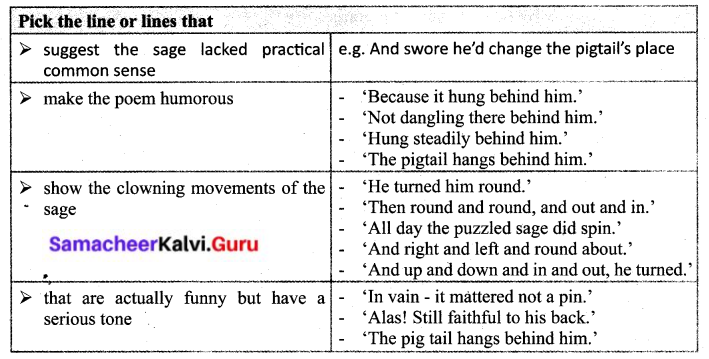
C. Fill in the table with the appropriate poem lines. A few lines may be used more than one time.

A Tragic Story Poem Summary Samacheer Kalvi 6th English Solutions Term 3 Poem Chapter 2

D. The summary of the poem is given. But there are some words missing. Fill in the blanks with the help of the box given below.

faithfully, change, pigtail, round, sage, down, slack, out, hung, place, behind, wain, face

Once upon a time there lived a sage. He had a handsome pigtail. He was worried and pondered over his pigtail’s place. He wanted to change its place. He wanted it hanging at his face. He didn’t like it hanging there behind him. So he turned right and left and round about, up and down, and in and out but it still hung behind him. However he tried, his efforts were in vain. But he didn’t slack in his efforts. Nevertheless his pigtail hung faithfully behind him.

E. Role Play.

Work with a partner. Let one student read the poem and the other to pantomime (communication by means of gesture and -facial expression) the poem as he or she reads.
(To be done by the students)

A Tragic Story Additional Questions

I. Poem Comprehension and Poetic Devices.

1. ‘There lived a sage in days of yore,
And he a handsome pigtail wore ’.

The Tragic Story Poem Summary In Hindi Question a.
Who lived long ago?
Answer:
A sage lived long ago.

Tragic Story Poem Question b.
What did he have?
Answer:
He had a beautiful pigtail.

The Tragic Story Poem Question c.
Pick out the rhyming words in these lines.
Answer:
The rhyming words are ‘yore – wore’.

2. ‘And swore he’d change the pigtail s place,
And have it hanging at his face
Not dangling there behind him.

Question a.
What did the sage swear?
Answer:
He swore that he would change his pigtail’s place.

Question b.
Where did he wants to have it?
Answer:
He wanted to have it hanging at his face.

Question c.
Pick out the alliterated words in these lines.
Answer:
The alliterated words are:
(1) pigtail’s – place
(2) have – hanging – his

3. ‘Then round and round, and out and in
All day the puzzled sage did spin;
In vain – it mattered not a pin
The pigtail hung behind him.

Question a.
What did the sage do?
Answer:
He turned round and round, out and in all day.

Question b.
Why was the sage puzzled?
Answer:
He was puzzled because he could not change the position of his pigtail, even though he turned round and round all day.

Question c.
What Is the rhyme scheme of the poem?
Answer:
The rhyme scheme is ‘a a a b’.

4. ‘Alas! Still faithful to his back’.

Question a.
Who Is faithful?
Answer:
The pigtail is faithful.

Question b.
Why did the poet use the word Alas’?
Answer:
He criticizes the sage’s ignorance and pities him in a serious tone, using the word ‘Alas’.

Question c.
Whose bag is referred to here?
Answer:
The back of the sage is referred to here.

II. Paragraph Questions.

Question 1.
What makes the poem humorous?
Answer:
The antics of the sage, usage of mock serious tone, absurdity of the sage’s ‘curious case’ and his solution, the way the poet organizes his materials and arranges the sentence structures makes the poem humorous. The repetition of the last line of each stanza add humour to the poem because it always brings to focus how the pigtail mocks at the sage’s efforts by stubbornly remaining behind him. The ending of the poem indicates the readers that the sage didn’t stop his rotation, although it is useless. This also gives a humorous touch to the poem.

Question 2.
What is the theme of the poem and what message does the poet convey?
Answer:
The theme of the poem is ‘when men are too learned or too wise, they lose the sight of reality. Sages are considered more wise. The irony of the poem is that the sage shows total foolishness. The poet uses the words in old English such as ‘sage’, ‘yore’, ‘mused’ to emphasize that right from the olden days, the highly learned people are too foolish and irrational. He attacks them as people, who do not have practical common sense. He also conveys a message to the readers to be alert and thoughtful and always act in a meaningful manner.

A Tragic Story Summary

The poem ‘A tragic story’ written by William Makepeace Thackeray is a humorous poem which revolves around a foolish act done by a sage. Throughout the poem, the poet laughs at this wise man, who does not have any practical knowledge, but uses his theatrical knowledge and does foolish things.

The poet narrates us about a sage, who lived in the past with a beautiful pigtail. He was worried about his pigtail, being hung behind him. He thought about this for a long time and swore that he would change the pigtail’s place, which is apparently impossible and funny.

He would like to have it at his face and not dangling there behind him. This small thing is a serious problem for this wise man. He said that he had found a solution to change the position of his pigtail. So he turned him round continuously without stopping, throughout the day. He turned in different directions – he turned right and left, out and in, up and down. But the pigtail didn’t change a bit. Though his efforts were not slackened, and though he twisted, twirled and tacked, his pigtail hung faithfully and steadily behind him. Thus, this poem is amusing and the poet brings out the theme

“How learned man lack practical common sense.”

Samacheer Kalvi 6th English Solutions Term 2 Supplementary Chapter 2 Gulliver’s Travel

Students can Download English Lesson 2 Gulliver’s Travel Questions and Answers, Summary, Activity, Notes, Samacheer Kalvi 6th English Book Solutions Guide Pdf  helps you to revise the complete Tamilnadu State Board New Syllabus and score more marks in your examinations.

Tamilnadu Samacheer Kalvi 6th English Solutions Term 2 Supplementary Chapter 2 Gulliver’s Travel

Read and Understand

A. Read the following statements. Say True or False.

  1. Gulliver was the captain of the ship.
  2. One of the Lilliputians gave a ten minutes talk in Gulliver’s language.
  3. Gulliver took the small creatures in his hand and crushed them.
  4. The horses were four-and-a-half-inches tall.
  5. The war between the two kingdoms ended in peace.

Answers:

  1. False
  2. False
  3. False
  4. True
  5. True

State True or False : Additional

  1. Four of the crew members, including Gulliver got into a small boat.
  2. His hair, which was long and thick, was similarly tied down.
  3. To his surprise, he saw a human being not three inches high.
  4. Gulliver took up fifty of the small creatures in his hand and crushed them.
  5. Then they set about transporting Gulliver to the capital.
  6. Two or three curious young Lilliputians wanted to see how Gulliver looked when asleep.
  7. Gulliver was not set free at all.
  8. The Lilliputians ran to Blefuscu for help.
  9. He took a long rope, tied all the hundred ships together and dragged them in the water.
  10. Gulliver was hailed as a Hero.

Answers:

  1. False
  2. True
  3. False
  4. False
  5. True
  6. True
  7. False
  8. False
  9. True
  10. True

B. Identify the speaker / character.

  1. He felt something moving along his body almost up to his chin.
  2. They somehow managed to put him on the platform.
  3. “Don’t let us down now, Gulliver; we need your help.”

Answers:

  1. Gulliver
  2. Lilliputians
  3. The Emperor of Lilliputians to Gulliver

Identify the Character / Speaker : Additional

  1. He found his arms and legs were securely tied with slender strings – Gulliver
  2. They soon brought baskets of meat and several loaves of bread – The Lilliputians
  3. ‘Don’t let us down now, Gulliver’. – The Emperor to Gulliver
  4. His leg was chained and he could only move about a little bit. – Gulliver
  5. ‘We need your help ’ – The Emperor to Gulliver

C. Choose the right option.

Gulliver’s Travels 6th Standard Question 1.
Gulliver managed to reach the land as he was _______
(a) A doctor
(b) One of the crews
(c) A swimmer
(d) the captain
Answer:
(c) A swimmer

Gulliver’s Travels Class 6 Question Answer Question 2.
Gulliver was set free because the emperor _______
(a) was afraid of him
(b) confirmed that he was not harmful
(c) was a kind hearted person
(d) wanted to get something from.him
Answer:
(b) confirmed that he was not harmful

Gulliver Was The Captain Of The Ship True Or False Question 3.
Gulliver was hailed as a hero because he _______
(a) made the army of Blefuscu giddy.
(b) fought with the army of Blefuscu
(c) drowned the army of Blefuscu in the water
(d) defeated the emperor of Blefuscu.
Answer:
(a) made the army of Blefuscu giddy

MCQ: Additional

Gulliver Was The Captain Of The Ship Question 1.
Gulliver, a ship’s doctor, took a job on the ship that was going on a long _______
(a) tour
(b) journey
(c) voyage
(d) trip
Answer:
(c) voyage

Gulliver’s Travels Book Back Answers Question 2.
The coast appeared strange and _______
(a) lonely
(b) vast
(c) simple
(d) new
Answer:
(a) lonely

Gulliver’s Travels 6th Class Question 3.
When Gulliver woke up, he was lying on his back and the sun was in his _______
(a) body
(b) hands
(c) head
(d) face
Answer:
(d) face

Gulliver’s Travels Class 6 Question 4.
With _______ he signalled to the little people that he wanted food and drink.
(a) gestures
(b) symbols
(c) signs
(d) signals
Answer:
(a) gestures

Gulliver’s Travels Summary Question 5.
This tickled Gulliver’s nose like a straw, and made him _______
(a) cough
(b) laugh
(c) sneeze
(d) burp
Answer:
(c) sneeze

Question 6.
Finally, they arrived at the _______ palace.
(a) King’s
(b) Lord’s
(c) Sultan’s
(d) Emperor’s
Answer:
(d) Emperor’s

Question 7.
The king brought a _______ ships to mount an attack.
(a) fifty
(b) hundred
(c) thousand
(d) five thousand
Answer:
(c) thousand

Question 8.
The neighbouring _______ of Blefuscu declared war on Lilliput.
(a) place
(b) area
(c) country
(d) kingdom
Answer:
(d) kingdom

Question 9.
The Littiputians ran to Gulliver for _______
(a) help
(b) money
(c) ships
(d) weapons
Answer:
(a) help

Question 10.
Gulliver was _______ as a hero.
(a) called
(b) praised
(c) hailed
(d) herald
Answer:
(c) hailed

D. Discuss in groups. Retell the story in your own words. Each one should say one sentence.

You can begin like this:
Gulliver was travelling in a ship. One stormy night, the ship was wrecked…
Answer:
Gulliver was travelling in a ship. One stormy night, the ship was wrecked. Six of the crew„ members including Gulliver got into a boat and rowed. They were overturned by a big wave but Gulliver managed to reach an island, as he was a swimmer. He felt hungry and tired. So he slept on a patch of grass. When he woke up, he was unable to move his hands, legs, head and body. He was tied up with slender strings on each side and attached to pegs fixed on the ground. Later Gulliver understood that they were Lilliputians who were not six inches high. When Gulliver tried to free himself, the Lilliputians fired dozens of tiny arrows into his hand, face and body, until he was calm.

Gulliver asked for food and drink by signalling to-them with gestures. Gulliver slept ’’again and then he was transported to the capital on a large platform with twenty- two wheels pulled by dozens of four-and-half-inch horses. More than one hundred thousand Lilliputians came to see him. The Emperor received him and lodged him in an old and unused temple. After a few weeks, they decided that Gulliver meant them no harm. So they freed him. Gulliver stayed with them by helping them in many ways.

The neighbouring kingdom of Blefuscu declared war on Lilliput. The king brought hundred ships to mount an attack. Gulliver helped them. He walked into the sea, tied all the hundred ships and dragged them in the water. Gulliver pulled the ships the whole day, going round and round until the army of Blefuscu was giddy and in no position to fight. The king of Blefuscu begged for peace between the two kingdoms. The Emperor agreed and Gulliver was the hero for them. After that Gulliver lived peacefully in Lilliput for many years.

E. Think and Answer.

Question 1.
How did Gulliver overcome the adversity?
Answer:
Gulliver landed into a strange city called Lilliput after the ship wreck. The people of Lilliput were not six inches tall. They thought he was a strange giant and tied him. Though Gulliver was upset at first, he managed to adapt to their environment and helped them in many ways, as they freed him, after some weeks. He also helpful them to make peace with their neighbouring kingdom of Blefuscu. He lived there peacefully for many years.

Question 2.
How should one react to adversity?
Answer:
The diversity of religion, race, gender, culture etc are things that are bound to be different from person to person that you meet. Now is the time to embrace this diversity. The message to spread love and understanding are more important than ever in our day and time. Diversity fosters more creative and innovative workforce.

Question 3.
Describe Gulliver’s encounter with the army of Blefuscu.
Answer:
Gulliver walked into the sea. He took a long rope, tied all the hundred ships together and dragged them in the water. Gulliver pulled the ships the whole day, going round and round until the army of Blefuscu was giddy and in no position to fight. The king of Blefuscu came begging for peace between the two kingdoms. The Emperor agreed and Gulliver was hailed as a hero.

Project

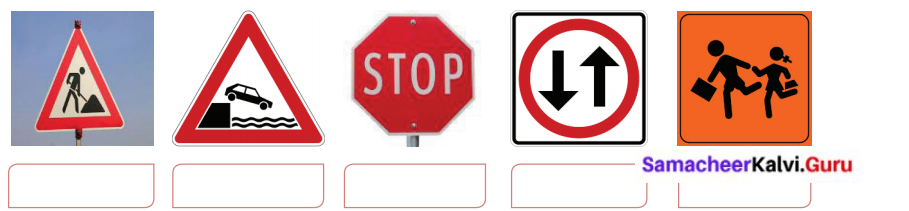
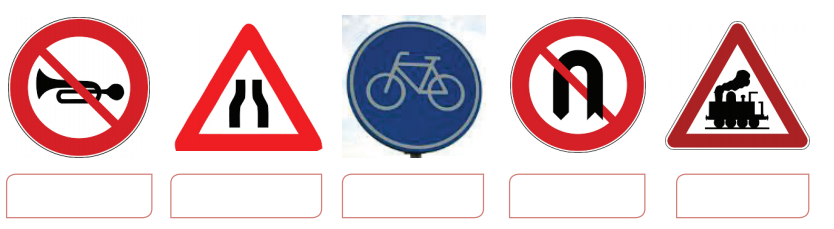
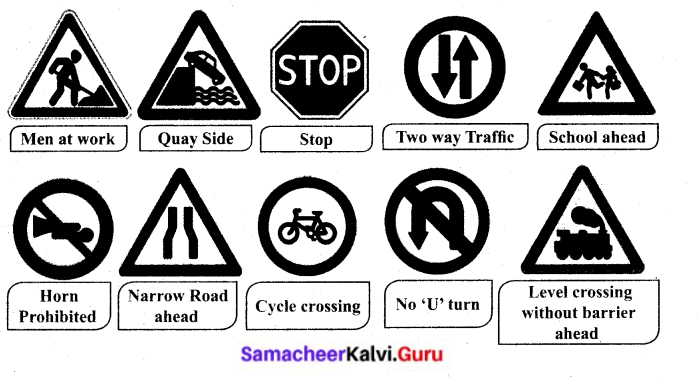
F. Look at the traffic signals and write down the traffic rule against each signal.

Gulliver's Travels 6th Standard Samacheer Kalvi English Solutions Term 2 Supplementary Chapter 2

Gulliver's Travels Class 6 Question Answer Samacheer Kalvi English Solutions Term 2 Supplementary Chapter 2
Answer:
Gulliver Was The Captain Of The Ship True Or False Samacheer Kalvi 6th English Solutions Term 2 Supplementary Chapter 2
Connecting to Self

G. Look at these pictures. Think of how you must behave when you visit these places. Discuss with your partner and complete the table.

Gulliver Was The Captain Of The Ship Samacheer Kalvi 6th English Solutions Term 2 Supplementary Chapter 2

Use Dust bins:

  1. Handle all the things with care.
  2. Use the rest rooms allotted for you.
  3. Keep your belongings carefully.
  4. Always be with your elders.
  5. Maintain discipline and give due respect to people.

Do not throw rubbish in public places:

  1. Do not handle rough or break any object.
  2. Don’t spit every where or pure water anywhere.
  3. Don’t throw your belongings here and there.
  4. Don’t go any where alone.
  5. Don’t shout and run about disturbing others.

Steps to Success

H. What is the logical sequence for these words? Tick the right option.

eg. 1.Leaves, 2. Fruit, 3.Seed, 4. Flowers, 5. root
(a) 2,4,5,1,3 (b) 3,5,1,4,2 (c) 1,2,3,4,5 (d) 5,3,1,2,4
Answer:
(b) 3, 5, 1, 4, 2

Question 1.
1. Drive, 2. Get in, 3. Arrive, 4. Park, 5. Open door
(a) 2,1,3,5,4 (b) 5,2,1,3,4 (c) 3,4,5,1,2 (d) 3,5,1,2,4
Answer:
(b) 5, 2, 1, 3, 4

Question 2.
1. Travel, 2. Book, 3. Plan, 4. Confirm, 5. Enjoy
(a) 3,2,4,1,5 (b) 4,5,3,2,1 (c) 1,2,3,4,5 (d) 5,4,2,3,1
Answer:
(a) 3,2,4,1,5

Question 3.
1. Rest, 2. Return, 3.Supper, 4. Go out, 5. Visit
(a) 1,2,3,4,5 (b) 4,5,1,2,3 (c) 4,5,2,3,1 (d) 5,4,3,2,1
Answer:
(c) 4, 5, 2, 3, 1

Question 4.
1. Check out, 2. Pack, 3. Pay bill, 4. Vacate, 5. Drive
(a) 3,4,5,2,1 (b) 1,2,3,4,5 (c) 5,4,3,2,1 (d) 2,4,3,1,5
Answer:
(d) 2, 4, 3, 1, 5

Question 5.
1. Wait, 2. Slow, 3. Go, 4. Stop, 5. Get ready
(a) 2,4,1,5,3 (b) 1,2,3,4,5 (c) 5,4,3,2,1 (d) 3,4,2,1,5
Answer:
(a) 2, 4, 1, 5, 3

Gulliver’s Travel Additional Questions

I. Rearrange The Following Jumbled Sentences in the correct Order.

A.
1. Hungry and exhausted,fee fell on a patch of grass and fell into a deep sleep.
2. The coast appeared strange and lonely.
3. But there was no sign of life.
4. Gulliyer dragged himself along the shore.
5. He looked for some people or houses.
Answer:
2, 4, 5, 3, 1
2. The coast appeared strange and lonely.
4. Gulliver dragged himself along the shore!
5. He looked for some people or houses.
3. But there was no sign of life.
1. Hungry and exhausted, he fell on a patch of grass and fell into a! deep sleep.

B.
1. Terrified and puzzled, he tried to turn his head.
2. He found his arms and legs were securely tied wife slender strings on each side.
3. When Gulliver woke up, he was lying on his back and the sun was in his face.
4. His hair, which was long and thick was similarly tied down.
5. When he tried to get up, he found himself unable to sit up or move at all.
Answer:
3, 5, 1, 2, 4
3. When Gulliver woke up, he was lying on his back and the sun was in his face.
5. When he tried to get up, he found himself unable to sit up or move at all.
1. Terrified and puzzled, he tried to turn his head.
2. He found his arms and legs were securely tied with slender strings on each side.
4. His hair, which was long and thick was similarly tied down.

C.
1. Startled by this sight, Gulliver cried out and soon managed to free his left arm.
2. He felt something moving along his body almost up to his chin.
3. The frightened Lilliputians fired dozens of tiny arrows into his hand, face and body, until he once again lay down calmly.
4. To his surprise, he saw a human being not six inches high, with a bow and arrow in his hands.
5. Gulliver later learnt that these creatures were Lilliputians.
Answer:
2, 4, 5, 1, 3
2. He felt something moving along his body almost up to his chin.
4. To his surprise, he saw a human being not six inches high, with a bow and arrow in his hands.
5. Gulliver later learnt that these creatures were Lilliputians.
1. Startled by this sight, Gulliver cried out and soon managed to free his left arm.
3. The frightened Lilliputians fired dozens of tiny arrows into his hand, face and body, until he once again lay down calmly.

D.
1. Gulliver pulled the ships, the whole day, going round and round until the army of Blefuscu was giddy and in no position to fight.
2. He took a long rope, tied all the hundred ships together and dragged them in the water.
3. Gulliver walked into the sea.
4. The Emperor agreed and Gulliver was hailed as a hero.
5. The king of Blefuscu came begging for peace between the two kingdoms.
Answer:
3, 2, 1, 5, 4
3. Gulliver walked into the sea.
2. He took a long rope, tied all the hundred ships together and dragged them in the water.
1. Gulliver pulled the ships, the whole day, going round and round until the army of Blefuscu was giddy and in no position to fight.
5. The king of Blefuscu came begging for peace between the two kingdoms.
4. The Emperor agreed and Gulliver was hailed as a hero.

II. Read The Passage and Answer the Questions.

1. Gulliver, a ship’s doctor, took a job on a ship that was going on a long voyage. The voyage started well but soon things changed dramatically. The ship got caught in a violent storm and was thrown off course. Then it hit a rock and broke up completely. Six of the crew members, including Gulliver, got into a small boat and rowed until they were overturned by a big wave which came up suddenly. Gulliver was a good swimmer and he managed to swim till he reached land.

Question a.
Who was Gulliver?
Answer:
Gulliver was a ship’s doctor.

Question b.
What happanad to tha ship?
Answer:
The ship got caught in a violent storm and was thrown off course.

Question c.
How many of tha member* got Into a boat?
Answer:
Six crew members including Gulliver got into a small boat.

Question d.
Why ware they overturned?
Answer:
They were overturned by a big wave which came up suddenly.

Question e.
How did Gulliver managed to reach the land?
Answer:
As he was a good swimmer, he managed to reach the land.

2. After he had eaten, Gulliver promptly fell asleep because his drink had a sleeping draught in it. They then set about transporting Gulliver to the capital. They used a large platform with twenty-two wheels pulled by dozens of four-and-a-half-inch horses. They somehow managed to put him on the platform and dragged Gulliver down the road to the city. Suddenly Gulliver woke-up when the vehicle stopped. Two or three curious, young Lilliputians wanted to see how Gulliver looked when asleep. They climbed up into the engine, and advancing very softly to his face, put the sharp end of their half-pike into his left nostril. This tickled Gulliver’s nose like a straw, and made him sneeze.

Question a.
Why did Gulliver promptly fell asleep, after he had eaten?
Answer:
He fell asleep because his drink had a sleeping draught in it.

Question b.
How many horse pulled the platform on which Gulliver was laid?
Answer:
Dozens of four-and-a-half-inch horses pulled and dragged Gulliver to the capital.

Question c.
What happened when the vehicle stopped?
Answer:
When the vehicle stopped, Gulliver woke up suddenly.

Question d.
Who wanted to see how Gulliver looked when asleep?
Answer:
Two or three curious young Lilliputians wanted to see how Gulliver looked when asleep.

Question e.
What did Lilliputians do to Gulliver?
Answer:
They put the sharp end of their half pike into his left nostril.

3. The Emperor was there to receive Gulliver. Gulliver was lodged in an old and disused temple. His leg was chained and he could only move about a little bit. After a few weeks, the Lilliputians and their Emperor decided that he meant them no harm. So Gulliver was set free to roam around Lilliput on condition that he would not harm them and would help them in whatever way he could. Gulliver agreed and was freed. He was provided with food and water, a house was built for him. Gulliver stayed with Lilliputians helping them in many ways. Once, it so happened, that the neighbouring kingdom of Blefuscu declared war on Lilliput. The king brought a hundred ships to mount an attack. The Lilliputians ran to Gulliver for help. The Emperor said, “Don’t let us down now, Gulliver; we need your help.”

Question a.
Who was there to receive Gulliver?
Answer:
The Emperor was there to receive Gulliver.

Question b.
Where was Gulliver lodged?
Answer:
He was lodged in an old and disused temple.

Question c.
On what condition was Gulliver set free?
Answer:
He was set free on condition that he would not harm them and would help them in whatever way he could.

Question d.
What did the Emperor do for Gulliver?
Answer:
He built him a house and provided him with food and water.

Question e.
Who declared war on Lilliput?
Answer:
The king of Blefuscu declared war on Lilliput.

4. Gulliver walked into the sea. He took a long rope, tied all the hundred ships together and dragged them in the water. Gulliver pulled the ships the whole day, going round and round until the army of Blefuscu was giddy and in no position to fight. The King of Blefuscu came begging for peace between the two kingdoms. The Emperor agreed. Gulliver was hailed as a hero and lived peacefully in Lilliput for many years.

Question a.
How many ships did the king of Blefuscu bring?
Answer:
He brought hundred ships to mount an attack.

Question b.
Why did Gulliver take a long rope?
Answer:
Gulliver took a long rope to tie all the hundred ships together and drag them in the water.

Question c.
What did he do the whole day?
Answer:
Gulliver pulled the hundred ships, the whole day, going round and round, until the army of Blefuscu was giddy and in no position to fight.

Question d.
What did the king of Blefuscu beg for?
Answer:
He begged for peace between the two kingdoms.

Question e.
Who was hailed as a hero?
Answer:
Gulliver was hailed as a hero.

III. Paragraph Questions.

Question 1.
What happened to the ship, when Gulliver was going on a long voyage? How did Gulliver escape?
Answer:
Gulliver was a ship’s doctor. He was going on a long voyage. The voyage started well but soon things changed dramatically. The ship got caught in a violent storm and was thrown off course. Then it hit a rock and broke up completely. Six of the crew members including Gulliver, got into a small boat and rowed until they were overturned by a big wave which came up suddenly. Gulliver was a good summer and so he managed to swim till he reached land.

Question 2.
Where did Gulliver land after the shipwreck and how was he treated by the inhabitants?
Answer:
After reaching the land, Gulliver fell asleep. When he woke up, he was lying on his back and the sun was in his face. He found his arms and legs were securely tied with slender strings on each side and attached to pegs fixed on the ground. He felt something moving along his body. To his surprise, he saw a human being not six inches high with a bow and an arrow. Gulliver later learnt that these creatures were Lilliputians. When Gulliver signalled them that he was hungry, they brought food and drink for him. Then they set about transporting Gulliver to the capital. There, the Emperor received him and set him free as they thought that Gulliver was harmless.

Question 3.
Who declared war on Lilllput and how did Gulliver help them?
Answer:
The neighbouring kingdom of Blefuscu declared war on Lilliput. The king brought a hundred ships to mount an attack. The lilliputians ran to Gulliver for help. The Emperor said, ‘Don’t let us down now, Gulliver; we need your help”. So Gulliver helped them. He took a long rope, tied all the hundred ships together and dragged them in the water. Gulliver pulled the ships the whole day, going round and round until the army of Blefuscu was giddy and in no position to flight. The king of Blefuscu begged for peace between the two kingdoms. Gulliver was hailed as a hero.

Gulliver’s Travel Summary

Gulliver, a ship’s doctor was on a long journey. Suddenly, the ship got caught in a violent storm and was thrown off course. It hit a rock and broke up completely. Six of the crew members, including Gulliver got into a boat, but unfortunately they were overturned by a big wave. As Gulliver was a good swimmer, he managed to reach a land. Hungry and exhausted, Gulliver fell into a deep sleep. When he woke up, he was unable to move. He found his arms and legs were securely tied with slender string on each side and attached to pegs fixed on the .ground. He saw a human being not six inches high, with a bow and arrow in his hands. Gulliver later learnt that these creatures were Lilliputians. When Gulliver tried to free himself, the frightened Lilliputians fired dozens of tiny arrows into his hand, face and body.

As Gulliver was hungry, he made gestures to the little people. They asked him to promise to behave himself and then gave him food and drink. After eating, Gulliver slept. The Lilliputians set about transporting Gulliver to the capital. They used a large platform with twenty-two wheels pulled by dozens of four-and-a-half-inch horses. They somehow managed to put him on the platform and dragged Gulliver down the road to the city. One hundred thousand Lilliputians came out to see the strange giant. The Emperor of the city received Gulliver.

Gulliver was lodged in an old and disused temple. After a few weeks, they found that he would do them no harm. So Gulliver was set free to roam around and he also helped the little people in many ways. One day, the neighbouring kingdom declared war on Lilliput. The king brought a hundred ships to mount an attack. The Lilliputians ran to Gulliver for help.

Gulliver walked into the sea. He took a long rope, tied all the hundred ships together and dragged them in the water. He pulled the ships the whole day, going round and round until the army of Blefuscu was giddy and in no position to fight. The king of Blefuscu came begging for peace between the two kingdoms. The Emperor agreed. Gulliver was hailed as a hero and lived peacefully in Lilliput for many years.

Samacheer Kalvi 8th Social Science Geography Solutions Term 1 Chapter 3 Hydrologic Cycle

You can Download Samacheer Kalvi 8th Social Science Book Solutions Guide Pdf, Tamilnadu State Board help you to revise the complete Syllabus and score more marks in your examinations.

 Tamilnadu Samacheer Kalvi 8th Social Science Geography Solutions Term 1 Chapter 3 Hydrologic Cycle

Samacheer Kalvi 8th Social Science Hydrologic Cycle Textbook Evaluation

I. Choose the correct answer

Hydrological Cycle Questions And Answers Question 1.
The process in which the water moves between the oceans, atmosphere and land is called –
(a) River Cycle
(b) Hydrologic Cycle
(c) Rock Cycle
(d) Life Cycle
Answer:
(b) Hydrologic Cycle

Class 8 Samacheer Kalvi Question 2.
The percentage of fresh water on the earth is –
(a) 71
(b) 97
(c) 2.8
(d) 0.6
Answer:
(c) 2.8

Short Note On Hydrological Cycle Question 3.
The process of changing of water from gaseous to liquid form is known
as –
(a) Condensation
(b) Evaporation
(c) Sublimation
(d) Rainfall
Answer:
(a) Condensation

Question 4.
Water that flows in the sub – soil or through the ground into the streams, rivers, lakes and oceans is termed as –
(a) Condensation
(b) Evaporation
(c) Transpiration
(d) Runoff
Answer:
(d) Runoff

Question 5.
The evaporation of water from the leaves of plants is called –
(a) Transpiration
(b) Condensation
(c) Water vapour
(d) Precipitation
Answer:
(a) Transpiration

Question 6.
Water that is good enough to drink is called –
(a) Groundwater
(b) Surface water
(c) Potable water
(d) Artesian water
Answer:
(c) Potable water

II. Fill in the Blanks

  1. The degree of water vapour present in the atmosphere is known as ………………
  2. There are ……………… phases in the water cycle.
  3. The falling of water towards the earth surface from atmosphere in any form is known as ………………
  4. The precipitation with the rain drop size of 0.5mm in diameter is known as ………………
  5. Mist is lesser denser than ………………

Answer:

  1. Humidity
  2. Three
  3. Precipitation
  4. Drizzle
  5. Fog

III. Match the following

Hydrological Cycle Questions And Answers Samacheer Kalvi 8th Social Science Geography Solutions Term 1 Chapter 3
Answer:

  1. iv
  2. i
  3. ii
  4. iii

IV. Choose the correct statement

Question 1.
Evaporation refers to
I. The process in which the gaseous form of water changes in to liquid form.
II. It refers to the process in which the liquid form of water changes into gaseous form.
III. Water boils at 100°C temperature but, it actually begins to evaporate at 0°C.
IV. It is responsible for the formation of clouds.

(a) I, IV and V are correct
(b) II only correct
(c) II and III are correct
(d) All are correct
Answer:
(c) II and III are correct

V. State whether the following statements are True or False

Question 1.
Water boils at 212°F temperature but, it begins to evaporate at 32°F.
Answer:
True

Question 2.
Mist is not the tiny droplets of water hanging in the air.
Answer:
False
Correct statement:
Mist is the tiny droplets of water hanging in the air.

Question 3.
The sub – surface runoff is usually referred as interflow.
Answer:
True

VI. Answer in brief

Question 1.
Write a short note on aquifer.
Answer:
An aquifer is an underground layer of water – bearing rock.

Question 2.
Define “hydrological cycle”.
Answer:
Hydrologic cycle is a global sun – driven process where water is transported from oceans to atmosphere, from atmosphere to land and from land back to oceans.

Question 3.
How is the dew formation takes place?
Answer:
Dew is a water droplet formed by the condensation of water vapour on a relatively cold surface of an object. It forms when the temperature of an object drops below the dew point temperature.

Question 4.
Write a short note on surface run – off.
Answer:
Surface Runoff is the portion of rainfall, which enters the stream immediately after the rainfall. It occurs, when the rainfall is longer, heavier and exceeds the rate of infiltration. In this condition the excess water makes a head over the ground surface, which tends to move from one place to another following land gradient and is known as overland flow. When the overland flow joins the streams, channels or oceans, it is termed as surface runoff or surface flow.

VII. Give reasons

Question 1.
Infiltration of water is low in the region of non – porous soil.
Answer:
Water entering the soil at the surface of the ground is termed as infiltration. Infiltration allows the soil temporarily to store water, the rate of infiltration is influenced by the physical characteristics of the soil, vegetative cover, moisture content of the soil, soil temperature and rainfall intensity.

Question 2.
Fresh water is less on the earth.
Answer:
Most of the water on the earth is saline and is found in seas and oceans, which constitutes about 97.2%.

Question 3.
Snowfall is common in the polar region and mountainous regions.
Answer:

  1. The precipitation in the form of powdery mass of ice is known as snowfall.
  2. Often water vapour in a cloud is converted directly into snow pieces due to lowering of temperature.
  3. It is common in the polar and high mountainous regions.

VIII. Answer in a paragraph

Question 1.
Explain the different stages involved in the hydrological cycle.
Answer:
The three important phases of the hydrologic cycle are:

  • Evapotranspiration,
  • Precipitation and
  • Runoff.

1. Evapotranspiration:
It is defined as the total loss of water from the earth through evaporation from the surface water bodies and the transpiration from vegetation. In cropped area, it is difficult to determine the evaporation and transpiration separately. Therefore it is collectively called as evapotranspiration.

2. Precipitation:
It refers to all forms of water that fall from clouds and reaches the earth’s surface. For the occurrence of precipitation, cloud droplets or ice crystals must grow heavy enough to fall through the air. When the droplets grow large in size, they tend to all. While moving down, by collecting some small droplets, they become heavy enough to fall out of the cloud as raindrops.

3. Runoff:
Runoff is the water that is pulled by gravity across land’s surface. It replenishes groundwater and surface water as it percolates into an aquifer (it is an underground layer of water – bearing rock) or moves into a river, stream or watershed. It comes from unabsorbed water from rain, snowmelt, irrigation or other sources, comprising a significant element in the water cycle as well as the water supply when it drains into a watershed. Runoff is also a major contributor to the erosion which carves out canyons, gorges and related landforms.

Question 2.
Distinguish between evaporation and transpiration.
Answer:
Evaporation:

  • Process in which the liquid form of water changes into gaseous form.
  • Rate of evaporation is affected by temperature, Areal extent of surface water, wind and the atmospheric humidity.
  • 90% moisture in the atmosphere is contributed through evaporation.

Transpiration:

  • Process by which the water content in the plant is released into the atmosphere in the form of water vapour.
  • Rate of Transpiration is affected temperature, wind and humidity.
  • 10% moisture is contributed through Transpiration.

Question 3.
Give a detailed explanation on different forms of precipitation.
Answer:
Forms of Precipitation:
The form of precipitation in a region depends on the kind of weather or the climate of the region. Common types of precipitation include rain, sleet, freezing rain, hail and snow.

Rain:
The precipitation in the form of water droplets is called rain. The precipitation in which the size of rain drops are <0.5 mm in diameter is known as drizzle and the . rain drops with >0.5 mm in diameter is known as rain. Generally drizzle takes place from stratus clouds.

Sleet:
The precipitation which takes place in the form of mixture of water droplets and tiny particles of ice(5mm in diameter) is known as sleet. Sometimes raindrops fall through a layer of air below 0°C. As they fall, the raindrops freeze into solid particles of ice. So, the mixture of water droplets and ice particles would fall on the earth surface.

Freezing Rain:
At other times raindrops falling through cold air near the ground do not freeze in the air. Instead, the raindrops freeze when they touch a cold surface. This is called freezing rain.

Hail:
The precipitation which consists of round pellets of ice which are larger than 5 mm in diameter is called hail or hailstones. A hailstone starts as an ice pellet inside a cold region of a cloud.

Snow:
Often water vapour in a cloud is converted directly into snow pieces due to lowering of temperature. The precipitation in the form of powdery mass of ice is known as snowfall. It is common in the polar and high mountainous regions.

Question 4.
Explain the run – off and its types.
Answer:
Runoff is the water that is pulled by gravity across land’s surface. It replenishes groundwater and surface water as it percolates into an aquifer (it is an underground layer of water-bearing rock) or moves into a river, stream or watershed.

Types of Runoff:
Based on the time interval between the instance of rainfall and generation of runoff, the runoff may be classified into following three types

1. Surface Runoff:
It is the portion of rainfall, which enters the stream immediately after the rainfall. It occurs, when the rainfall is longer, heavier and exceeds the rate of infiltration. In this condition the excess water makes a head over the ground surface, which tends to move from one place to another following land gradient and is known as overland flow. When the overland flow joins the streams, channels or oceans, it is termed as surface runoff or surface flow.

2. Sub – Surface Runoff:
The water that has entered the subsoil and moves laterally without joining the water-table to the streams, rivers or oceans is known as sub- surface runoff. The sub – surface runoff is usually referred as interflow.

3. Base Flow:
It is a flow of underground water from a saturated ground water zone to a water channel. It usually appears at a downstream location where the channel elevation is lower than the groundwater table. Groundwater provides the stream flow during dry periods of small or no precipitation.

Activity
Find out the missing components of hydrologic cycle in the given diagram and fill it up appropriately.
Class 8 Samacheer Kalvi Social Science Geography Solutions Term 1 Chapter 3 Hydrologic Cycle
Answer:

  1. Evaporation
  2. Condensation
  3. Precipitation
  4. Transpiration
  5. Runoff
  6. Infiltration
  7. Ground water recharge (Percolation)

Samacheer Kalvi 8th Social Science Geography Hydrologic Cycle Additional Questions

I. Choose the correct answer

Question 1.
About …………….. of the earth’s surface is covered by water.
(a) 28%
(b) 71%
(c) 19%
(d) 50%
Answer:
(b) 71 %

Question 2.
……………. takes place from the surface water.
(a) Evaporation
(b) Transpiration
(c) Condensation
(d) Precipitation
Answer:
(a) Evaporation

Question 3.
The clouds melt and sometimes burst resulting in …………….
(a) Transpiration
(b) Evaporation
(c) Precipitation
(d) Condensation
Answer:
(c) Precipitation

Question 4.
Oceans, seas, lakes and rivers provide nearly ……………… of the moisture in the atmosphere.
(a) 30%
(b) 50%
(c) 70%
(d) 90%
Answer:
(d) 90%

Question 5.
Over the oceans ……………. is more prevalent than precipitation.
(a) Transpiration
(b) Evaporation
(c) Condensation
(d) Run – off
Answer:
(b) evaporation

Question 6.
The rate of evaporation is ……………… during the periods of calm winds.
(a) High
(b) Twice
(c) Low
(d) Three times
Answer:
(c) low

Question 7.
For aviation purpose, the criterion for fog is …………….. or less.
(a) 10 km
(b) 20 km
(c) 30 km
(d) 25 km
Answer:
(a) 10 km

Question 8.
……………… is formed by microscopic drops of water or by small ice crystals.
(a) Frost
(b) Cloud
(c) Fog
(d) Dew
Answer:
(b) Cloud

Question 9.
Generally drizzle takes place from ………….. clouds.
(a) Cirrus
(b) Cirrocumulus
(c) Cumulus
(d) Stratus
Answer:
(d) Stratus

Question 10.
………………. is the downward movement of infiltrated water through soil and rock layers.
(a) Transpiration
(b) Percolation
(c) Runoff
(d) Infiltration
Answer:
(b) Percolation

II. Fill in the blanks

  1. Only 0.25% of the available ground water can be economically extracted with ………………. technology.
  2. Transpiration takes place from ……………….
  3. When the air is ………………. evaporated water tends to stay close to the water body.
  4. ………………. is the tiny droplets of water hanging in the air.
  5. In freezing rain, the drops of water are usually greater than ………………. in diameter.
  6. Hail forms only in clouds during thunderstorms.
  7. ………………. appears like a powdery mass of ice.
  8. The percolation process represents the flow of water from ………………. zone to the ………………. zone.
  9. The sub – surface runoff is usually referred as ……………….
  10. Unit for measuring run off rate is ……………….

Answer:

  1. Drilling
  2. Plants
  3. calm
  4. Mist
  5. 0.5mm
  6. Cumulonimbus
  7. Snow
  8. Unsaturated, saturated
  9. Interflow
  10. Cubic feet per second

III. Match the following

Short Note On Hydrological Cycle Samacheer Kalvi 8th Social Science Geography Solutions Term 1 Chapter 3
Answer:

a. ii
b. iii
c. iv
d. i

IV. Choose the correct statement

Question 1.
Condensation is the in which
(1) The gaseous form of water changes into liquid form
(2) Excess water vapour condenses to form snow.
(3) Condensation is responsible for the formation of clouds.
(4) Evaporation is the route for water to return to the earth’s surface.

(a) 1 and 2 are correct.
(b) 1 and 3 are correct.
(c) 1,2 and 4 are correct.
(d) 2 and 4 are correct.
Answer:
(b) 1 and 3 are correct

V. Answer in brief

Question 1.
Mention some of the uses of water.
Answer:
All plants and animals need water for survival. Apart from drinking, water is required for domestic, agriculture, industrial purposes etc. Water is very essential for carrying out almost all economic activities.

Question 2.
What is Hydrology?
Answer:
1. Hydrology is the science which deals with the various aspects of water such as its occurrence, distribution, movement and properties on the planet earth. Availability of water on the earth is not uniform. Some places are very rich in water resources while some other places are poor in water resources.

2. Hydrologic cycle is a global sun-driven process where water is transported from oceans to atmosphere, from atmosphere to land and from land back to oceans.

Question 3.
Name the six main components in hydrological cycle.
Answer:

  1. Evapotranspiration
  2. Condensation
  3. Precipitation
  4. Infiltration
  5. Percolation
  6. Runoff.

Question 4.
When does the rate of evaporation increase?
Answer:
The rate of evaporation increases with

  1. Increase in wind speed
  2. Increase in temperature
  3. Decrease in humidity and
  4. Increase in areal extent of surface water bodies.

Question 5.
Define transpiration.
Answer:
Transpiration refers to the process by which the water content in the plants are released into the atmosphere in the form of water vapour.

Question 6.
What are the factors affecting the rate of transpiration?
Answer:
The rate of transpiration is also affected by the temperature, wind and humidity. The soil water content and the ability of the soil to conduct water to the roots, the nature of the plant parts including barks and leaves also determine the transpiration rate.

Question 7.
Where do condensation and saturation occur?
Answer:
Condensation occurs when the air get saturated.

  1. Warm air can hold more water vapour than the cool air.
  2. Saturation occurs when the temperature drops down.

Question 8.
How does the infiltrated water return to the surface?
Answer:
Some of the infiltrated water ultimately returns to the surface through springs or low spots down hills. Some of the water remains underground and is called groundwater.

Question 9.
Define Percolation.
Answer:
Percolation is the downward movement of infiltrated water through soil and rock layers.

Question 10.
How does percolation move the infiltrated water?
Answer:
Percolation moves the infiltrated water through the soil profile and rock layers which leads to the formation of ground water or become a part of sub – surface run – off – process.

VI. Give Reason for the following

Question 1.
The water cycle can be considered as a closed system for the earths.
Answer:
The water cycle can be considered as a closed system for the earth, as the quantity of water involved in the cycle is invariable, though its distribution varies over space and time.

VIII. Answer in Detail

Question 1.
Explain the three major forms of condensation.
Answer:
Dew, Fog and Clouds are the three major forms of condensation
(a) Dew:
It is a water droplet formed by the condensation of water vapour on a relatively cold surface of an object. It forms when the temperature of an object drops below the dew point temperature.

Frost:
The ice crystals formed by deposition of water vapour on a relatively cold surface of an object is known as frost.

(b) Fog:
Fog is the suspended tiny water droplets or ice crystals in an air layer next to the earth’s surface that reduces the visibility to 1,000 m or lower.

Mist:
Mist is the tiny droplets of water hanging in the air. These droplets form when the water vapour in the air is rapidly cooled, causing it to change from invisible gas to tiny visible water droplets.

(c) Clouds:
Clouds consist of tiny water droplets/ice particles which are so small and light in weight. Clouds are formed by microscopic drops of water or by small ice crystals.


Samacheer Kalvi 7th Social Science Civics Solutions Term 1 Chapter 1 Equality

Students can Download Social Science Civics Chapter 1 Equality Questions and Answers, Notes Pdf, Samacheer Kalvi 7th Social Science Book Solutions Guide Pdf helps you to revise the complete Tamilnadu State Board New Syllabus and score more marks in your examinations.

Tamilnadu Samacheer Kalvi 7th Social Science Civics Solutions Term 1 Chapter 1 Equality

Samacheer Kalvi 7th Social Science Equality Textual Evaluation

I. Choose the correct answer:

Samacheer Kalvi Guru 7th Social Science Question 1.
Which one of the following does not come under Equality?
(a) Non discrimination on the basis of birth, caste, religion, race, colour, gender.
(b) Right to contest in the election.
(c) All are treated equal in the eyes of law.
(d) Showing inequality between rich and poor.
Answer:
(d) Showing inequality between rich and poor.

Samacheer Kalvi Class 7 Social Science Solutions Question 2.
Which one of the following is comes under political Equality?
(a) Right to petition the government and criticize public policy.
(b) Removal of inequality based on race, colour, sex and caste.
(c) All are equal before the law.
(d) Prevention of concentration of wealth in the hands of law.
Answer:
(a) Right to petition the government and criticize public policy.

Samacheer Kalvi 7th Social Answers Question 3.
In India, right to vote is given to all the citizens at the age of ________
(a) 21
(b) 18
(c) 25
(d) 31
Answer:
(b) 18

Samacheer Kalvi 7th Social Solutions Question 4.
Inequality created by man on the basis of caste, money, religion etc is called as
(a) Natural inequality
(b) Manmade inequality
(c) Economic inequality
(d) Gender inequality
Answer:
(b) Manmade inequality

7th Social Samacheer Kalvi Question 5.
In Switzerland, the right to vote is given to women in the year
(a) 1981
(b) 1971
(c) 1991
(d) 1961
Answer:
(b) 1971

II. Fill in the Blanks

  1. Civil equality implies equality of all before _______
  2. The Indian constitution deals about the Right to equality from Article _______ to _______
  3. Right to contest in the election is a ________ Right.
  4. Equality means, absence of __________ privileges.

Answer:

  1. Law
  2. 14,18
  3. Political
  4. Social

III. Give short answer

Samacheer Kalvi Guru 7th Social Question 1.
What is Equality?
Answer:

  1. Equality is ensuring individuals or groups that are not treated differently or less favourably on the basis of specific protected characteristic, including areas of race, gender, disability, religion or belief, sexual orientation and age.
  2. Gender Equality is the equal right of both men and women to have access to opportunities and resources.

Samacheer Kalvi Guru 7th Standard Social Question 2.
Why is gender Equality needed?
Answer:
All human beings, both men and women, are free to develop their personal abilities and make choices without any limitations. Women were not given equal rights

Samacheer Kalvi.Guru 7th Social Question 3.
What is civil Equality?
Answer:
Civil equality is enjoyment of civil rights by all citizen. Without any discrimination of superior or inferior, the rich or the poor, caste or creed.

IV. Answer in detail

Samacheer Kalvi Guru Social 7th Question 1.
Write about the importance of Equality.
Answer:

  1. Equality is a powerful moral and political ideal that has inspired and guided human society for many centuries.
  2. The concept of equality invokes the idea that all human beings have equal worth regardless of their caste, colour, gender, race or nationality.
  3. The democratic ideals such as liberty, equality etc are meaningful and effective only when they are implemented with justice.

Samacheerkalvi.Guru 7th Social Question 2.
What is political Equality?
Answer:
Political Equality includes

  • Right to vote
  • Right to hold public Office
  • Right to criticise the government
  1. Citizens should have equal opportunity to actively participate in the political life.
  2. In India the voting right is given to all the citizens who has attained 18years of age ’ without any discriminations.
  3. Any person who has completed the age of 25 years can contest in the election. Right to criticise the government is also very important right and the people can express their resentment through demonstrations.
  4. The value of the vote of the Prime Minister and value of vote of common man in general
    election is same which denotes political equality.

Samacheer Kalvi 7th Social Question 3.
How does the Constitution of India protect the Right to Equality?
Answer:

(i) The constitution of India has also guaranteed equality to all citizens by providing Articles form 14-18.
Article 14 – guarantees to all the people equality before law.
Article 15 – deals with the prohibition of discrimination.
Article 16 – provides equality of opportunity in matters relating to employment.
Article 17 – abolishes the practice of untouchability .
Article 18 – abolishes the titles conferred to citizen.
(ii) Equality before law and equal protection of law have been further strengthened in the Indian constitution under Article 21.

HOTs:
Samacheer Kalvi Guru 7th Social Science Guide Question 1.
How can we eliminate inequality at school level?
Answer:

  1. Students should be given admission in school without any discrimination of superior or inferior. The rich or the poor, caste or creed.
  2. The Government has taken several measures to ensure that students from different state of the society get an opportunity to study in private schools too through RTE (Right to Education) Act.
  3. Wearing uniform helps to nip off the social and economical discrimination that may arise among students. Students should be encouraged to develop feeling of oneness among themselves.

I. Life skills :
Write the correct answer.

S. No.Enumeration of Different types of equalityType of equality
1.There should not be any discrimination among the citizens on the basis of status, caste, colour, creed and rank, etc.Social Equality
2.Equality of all before the law.Civil Equality
3.Right to vote, right to hold public office and right to criticize the government.Political Equality
4.My ability is not less than men in any aspect.Gender Equality

Tamilnadu Samacheer Kalvi 7th Social Science Equality Additional Question

I. Choose the correct answer:

On Equality Question 1.
in equalities can never be rectified.
(a) Social
(b) Civil
(c) Natural
(d) Political
Answer:
(c) Natural

Samacheer Guru 7th Social Question 2.
is the first country to give right to vote to moment from the very first general election.
(a) China
(b) Pakistan
(c) Sri Lanka
(d) India
Answer:
(d) India

II. Fill in the blanks:

  1. Rule of law was advocated by ________ the British Legal luminary.
  2. The very first general election in India was held in the year ________
  3. As of 2017, ________ is the fifth of seventeen sustainable development goals of the United Nations.
  4. ________ and ________ are the pillars of democracy.

Answer:

  1. A.V. Dicey
  2. 1952
  3. gender equality
  4. Equality & Justice

III. Answer the following :

Samacheer Kalvi 7th Social Book Back Answers Question 1.
What is Social Equality?
Answer:

  1. Social equality means that all citizen are entitled to enjoy equal status in society.
  2. Without any discrimination of caste, creed, colour and race.

Samacheer Kalvi 7th Social Book Solutions Question 2.
What does UNICEF say about Gender Equality?
Answer:
UNICEF says Gender Equality “means that women and men, and girls and boys, enjoy the same rights, resources, opportunities and prolictions.

IV. Answer in Detail :

Social 7th Samacheer Kalvi Question 1.
How can we promote equality?
Answer:

  1. Treating all fairly
  2. Creating an inclusive culture
  3. Ensuring equal access to opportunities
  4. Enabling to develop full potential
  5. Making laws and policies
  6. Education.

Samacheer Kalvi 12th Accountancy Solutions Chapter 7 Company Accounts

Students can Download Accountancy Chapter 7 Company Accounts Questions and Answers, Notes Pdf, Samacheer Kalvi 12th Accountancy Book Solutions Guide Pdf helps you to revise the complete Tamilnadu State Board New Syllabus and score more marks in your examinations.

Tamilnadu Samacheer Kalvi 12th Accountancy Solutions Chapter 7 Company Accounts

Samacheer Kalvi 12th Accountancy Company Accounts Text Book Back Questions and Answers

I. Choose the Correct Answer

12th Accountancy Chapter 7 Solutions Question 1.
A preference share is one ……………..
(i) which carries preferential right with respect to payment of dividend at fixed rate
(ii) which carries preferential right with respect to repayment of capital on winding up
(a) Only (i) is correct
(b) Only (ii) is correct
(c) Both (i) and (ii) are correct
(d) Both (i) and (ii) are incorrect
Answer:
(c) Both (i) and (ii) are correct

Class 12 Accountancy Chapter 7 Solutions Question 2.
That part of share capital which can be called up only on the winding up of a company is called ……………..
(a) Authorised capital
(b) Called up capital
(c) Capital reserve
(d) Reserve capital
Answer:
(d) Reserve capital

12th Accountancy 7th Chapter Question 3.
At the time of forfeiture, share capital account is debited with ……………..
(a) Face value
(b) Nominal value
(c) Paid up amount
(d) Called up amount
Answer:
(d) Called up amount

12th Accountancy Chapter 7 Question 4.
After the forfeited shares are reissued, the balance in the forfeited shares account should be transferred to ……………..
(a) General reserve account
(b) Capital reserve account
(c) Securities premium account
(d) Surplus account
Answer:
(b) Capital reserve account

Class 12 Accounts Chapter 7 Solutions Question 5.
The amount received over and above the par value is credited to ……………..
(a) Securities premium account
(b) Calls in advance account
(c) Share capital account
(d) Forfeited shares account
Answer:
(a) Securities premium account

Samacheer Kalvi Guru 12th Accountancy Question 6.
Which of the following statement is false?
(a) Issued capital can never be more than the authorised capital
(b) In case of under subscription, issued capital will be less than the subscribed capital
(c) Reserve capital can be called at the time of winding up
(d) Paid up capital is part of called up capital
Answer:
(b) In case of under subscription, issued capital will be less than the subscribed capital

Samacheer Kalvi 12th Accountancy Question 7.
When shares are issued for purchase of assets, the amount should be credited to ……………..
(a) Vendor’s A/c
(b) Sundry assets A/c
(c) Share capital A/c
(d) Bank A/c
Answer:
(c) Share capital A/c

12th Accountancy Answer Pdf Question 8.
Match the pair and identify the correct option:
12th Accountancy Chapter 7 Solutions Company Accounts Samacheer Kalvi
Answer:
(c) (iii) (ii) (iv) (i)

12th Accountancy Samacheer Kalvi Question 9.
If a share of ₹ 10 on which ₹ 8 has been paid up is forfeited. Minimum reissue price is ……………..
(a) ₹ 10 per share
(b) ₹ 8 per share
(c) ₹ 5 per share
(d) ₹ 2 per share
Answer:
(d) ₹ 2 per share

Samacheer Kalvi Accountancy 12th Question 10.
Supreme Ltd. forfeited 100 shares of ₹ 10 each for non – payment of final call of ₹ per share. All these shares were re-issued at ₹ 9 per share. What amount will be transferred to capital reserve account?
(a) ₹ 700
(b) ₹ 800
(c) ₹ 900
(d) ₹ 1,000
Answer:
(a) ₹ 700

II. Very short answer questions

Samacheer Kalvi 12th Accountancy Book Question 1.
What is a share?
Answer:
The capital of a company is divided into small units of fixed amount. These units are called shares. There are two types

  1. Preference shares and
  2. Equity shares.

Samacheer Kalvi 12th Accountancy Solutions Chapter 2 Question 2.
What is over – subscription?
Answer:
When the number of shares applied for is more than the number of shares offered for subscription it is said to be over subscription.

Samacheer Kalvi 12th Accountancy Solutions Question 3.
What is meant by calls – in – arrear?
Answer:
When a share holder fails to pay the amount due on allotment or on calls, the amount remaining unpaid is known as calls – in – arrears.

Samacheer Kalvi 12th Accountancy Book Pdf Question 4.
Write a short note on securities premium account.
Answer:
When a company issues shares at a price more than face value, the shares are said to be issued at premium. The excess is called as premium amount and is transferred to securities premium account. It is shown under “reserves and surplus” as a separate head in the note to accounts to the balance sheet.

12th Accounts Samacheer Kalvi Question 5.
Why are the shares forfeited?
Answer:
When a shareholder defaults in making payment of allotment/call money, the shares may be forfeited. On forfeiture the share allotment is cancelled and to that extent, paid up share capital reduced.

III. Short answer questions

12th Accountancy Question 1.
State the different between preference shares and equity shares?
Answer:
Class 12 Accountancy Chapter 7 Solutions Samacheer Kalvi Company Accounts

Chapter 7 Accounts Class 12 Question 2.
Write a brief note on calls – in – advance.
Answer:
The excess amount paid over the called up value of a share is known as calls – in – advance. It is the excess money paid on application or allotment or calls. Such excess amount can be returned or adjusted towards future payment. If the company decides to adjust such amount towards future payment, the excess amount is transferred to a separate account called calls-in advance account.

12th Samacheer Kalvi Question 3.
What is reissue of forfeited shares?
Answer:
The directors of a company have an authority of reissue of shares once forfeited by them due to non – payment of calls. They can reissue the forfeited shares at par, at premium or at discount. When forfeited shares are reissued at a premium, the amount of such premium will be credited to securities premium. If the reissue price is more than the amount unpaid of forfeited shares it results in profit and is transferred to capital reserve account

Ch 7 Accounts Class 12 Question 4.
Write a short note as:

  1. Authorised Capital
  2. Reserve Capital

Answer:
1. Authorised Capital : According Sec 2(8) of the Companies Act, “It means such capital as is authorised by the memorandum of a company to be the maximum amount of share capital of the company”.

2. Reserve Capital : Sec 65 of Companies Act 2013, only an unlimited company having share capital while converting into a limited company, may have a reserve capital. The company reserve a part of its subscribed capital to be called up only at the time of winding up. It is called reserve capital.

Accounts Samacheer Kalvi Question 5.
What is meant by issue of shares for consideration other than cash?
Answer:
A company may issue shares for consideration other than cash when the company acquires fixed assets such as land, building and machinery, etc. A company may also issue shares as consideration for the purchase of business, to promotors for their services and to brokers and underwriters for their commission.

IV. Exercises

12 Accountancy Book Back Answers Question 1.
Progress Ltd. issued 50,000 ordinary shares of ₹ 10 each, payable ₹ 2 on application, ₹ 4 on allotment, ₹ 2 on first call and ₹ 2 on final call. All the shares are subscribed and amount was duly received. Pass journal entries.
Answer:
12th Accountancy 7th Chapter Company Accounts Samacheer Kalvi

12th Accounts Book Back Answers Question 2.
Sampath company issued 25,000 shares at ₹ 10 per share payable ₹ 3 on application, ₹ 4 on allotment, ₹ 3 on first and final call. The public subscribed for 24,000 shares. The directors allotted all the 24,000 shares and received the money duly. Pass necessary journal entries.
Answer:
12th Accountancy Chapter 7 Solutions Company Accounts Samacheer Kalvi

Question 3.
Saranya Ltd. issued 20,000 equity shares of ₹ 10 each to the public at par. The details of the amount payable on the shares are as follows:
On application ₹ 3 per share
On allotment ₹ 4 per share
On first and final call ₹ 3 per share
Application money was received on 30,000 shares. Excess application money was refunded immediately. Pass journal entries to record the above.
Answer:
Class 12 Accounts Chapter 7 Solutions Company Accounts Samacheer Kalvi

Question 4.
Gaja Ltd issued 40,000 shares of ₹ 10 each to the public payable ₹ 2 on application, ₹ 5 on allotment and ₹ 3 on first and final call. Applications were received for 50,000 shares. The Directors decided to allot 40,000 shares on pro rata basis and surplus of application money was utilised for allotment. Pass journal entries assuming that the amounts due were received.
Journal Emtries
Samacheer Kalvi Guru 12th Accountancy Solutions Chapter 7 Company Accounts

Question 5.
Lalitha Ltd. offered 30,000 equity shares of ₹ 10 each to the public payable ₹ 2 per share on application, ₹ 3 on share allotment and the balance when required. Applications for 50,000 shares were received on which the directors allotted as:
Applicants for 10,000 shares – Full
Applicants for 35,000 shares – 20,000 shares (excess money will be utilised for allotment)
Applicants for 5,000 shares – Nil
All the money due was received. Pass journal entries upto the receipt of allotment.
Journal Entries
Samacheer Kalvi 12th Accountancy Solutions Chapter 7 Company Accounts
Working Notes:
12th Accountancy Answer Pdf Solutions Chapter 7 Company Accounts Samacheer Kalvi

Question 6.
Das Ltd. offered 50,000 equity shares of ₹ 10 each to the public payable as follows:
On application ₹ 4; on allotment ₹ 3; on first call ₹ 1 and on second and final call ₹ 2. Applications were received for 1,00,000 shares. All the applicants were allotted 1 share for every two shares applied. Excess application money was used for amount due on allotment and call. Pass necessary journal entries.
Answer:
Journal Entries
12th Accountancy Samacheer Kalvi Solutions Chapter 7 Company Accounts

Question 7.
Anjali Flour Ltd. with a registered capital of ₹ 4,00,000 in equity shares of ₹ 10 each, issued 30,000 of such shares; payable ₹ 2 per share on application, ₹ 5 per share on allotment and ₹ 3 per share on first call. The issue was duly subscribed.
All the money payable was duly received but on allotment, one shareholder paid the entire balance on his holding of 500 shares. Give journal entries to record the transactions.
Answer:
Journal Entries
Samacheer Kalvi Accountancy 12th Solutions Chapter 7 Company Accounts

Question 8.
Muthu Ltd. issued 50,000 shares of ₹ 10 each payable as follows:
₹ 2 on application; ₹ 4 on allotment; ₹ 4 on first and final call.
All money were duly received except one shareholder holding 1,000 shares failed to pay the call money. Pass the necessary journal entries for calls by using calls in arrear account.
Answer:
Journal Entries
Samacheer Kalvi 12th Accountancy Book Solutions Chapter 7 Company Accounts

Question 9.
Arjun was holding 1,000 shares of ₹ 10 each of Vanavil Electronics Ltd, issued at par. He paid ₹ 3 on application, ₹ 4 on allotment but could not pay the first and final call of ₹ 3. The directors forfeited the shares for non – payment of call money. Give Journal entry for forfeiture of shares.
Answer:
Journal Entries
Samacheer Kalvi 12th Accountancy Solutions Chapter 7 Company Accounts

Question 10.
Lakshith was holding 50 shares of ₹ 10 each on which he paid ₹ 2 on application but could not pay ₹ 4 on allotment and ₹ 2 on first call. Directors forfeited the shares after the first call. Give journal entry for recording the forfeiture of shares.
Answer:
Samacheer Kalvi 12th Accountancy Book Pdf Solutions Chapter 7 Company Accounts

Question 11.
Goutham Ltd. forfeited 500 equity shares of ₹ 10 each issued at par held by Ragav for non – payment of the final call of ₹ 2 per share. The shares were forfeited and reissued to Madhan at ₹ 8 per share. Show the journal entries for forfeiture and reissue.
Answer:
Journal Entries
12th Accounts Samacheer Kalvi Solutions Chapter 7 Company Accounts

Question 12.
Nivetha Ltd. forfeited 1,000 equity shares of ₹ 10 each for non payment of call of ₹ 4 per share. Of these 800 shares were reissued @ ₹ 7 per share. Pass journal entries for forfeiture and reissue.
Answer:
Journal Entries
Samacheer Kalvi 12 Accountancy Solutions Chapter 7 Company Accounts

Question 13.
Nathiya Textiles Ltd. forfeited 100 shares of ₹ 10 each, ₹ 8 called up, on which Mayuri had paid application and allotment money of ₹ 6 per share. Of these 75 shares were re-issued to Soundarya by receiving ₹ 7 per share. Pass journal entries for forfeiture and reissue.
Answer:
12th Accountancy Solutions Chapter 7 Company Accounts Samacheer Kalvi

Question 14.
Simon Ltd issued 50,000 equity shares of ₹ 10 each at par payable on application ₹ 1 per share, on allotment ₹ 5 per share, on first call ₹ 2 per share and on second and final call ₹ 2 per share. The issue was fully subscribed and all the amounts were duly received with the exception of 2,000 shares held by Chezhian, who failed to pay the second and final call. His shares were forfeited and reissued to Elango at ₹ 8 per share. Journalise the above transactions.
Journal Entries
Chapter 7 Accounts Class 12 Solutions Company Accounts Samacheer Kalvi

Question 15.
Kanchana Ltd. issued 50,000 shares of ₹ 10 each payable as under.
On application – ₹ 1
On allotment – ₹ 5
On first call – ₹ 2
On final call – ₹ 2
Applications were received for 70,000 shares. Applications for 8,000 shares were rejected and allotment was made proportionately towards remaining applications. The directors made both the calls and the all the amount were received except the final call on 1,500 shares which were subsequently forfeited. Later 1,200 forfeited shares were reissued by receiving ₹ 8 per share. Give journal entries.
Answer:
Journal Entries
12th Samacheer Kalvi Accountancy Solutions Chapter 7 Company Accounts

Question 16.
Viswanath Furniture Ltd. invited applications for 20,000 shares of ₹ 10 each at a premium of ₹ 2 per share payable.
₹ 2 on application
₹ 5 (including premium) on allotment
₹ 5 on first and final call
There was over subscription and applications were received for 30,000 shares and the excess applications were rejected by the directors. Pass the journal entries.
Answer:
Journal Entries
Ch 7 Accounts Class 12 Accountancy Solutions Company Accounts Samacheer Kalvi

Question 17.
United Industries Ltd. issued shares of ₹ 10 each at 10% premium payable ₹ 3 on application, ₹ 4 on allotment (including premium), ₹ 2 on first call and ₹ 2 on final call.

Journalise the transactions relating to forfeiture of shares for the following situations: Manoj who holds 250 shares failed to pay the second and final call and his shares were forfeited. Manoj who holds 250 shares failed to pay the allotment money and first call and second and final call and his shares were forfeited. Manoj who holds 250 shares failed to pay the allotment money and first call money and his shares were forfeited after the first call.
Answer:
Journal Entries
Accounts Samacheer Kalvi 12th Solutions Chapter 7 Company Accounts

Question 18.
Kasthuri Ltd. had allotted 20,000 shares to applicants of 30,000 shares on a pro – rata basis. The amount payable was ₹ 1 on application, ₹ 5 on allotment (including premium of ₹ 2 each), and ₹ 2 on first call and ₹ 2 on final calls. Subin, a shareholder failed to pay the first call and final call on his 500 shares. All the shares were forfeited and out of them 400 shares were re-issued @ ₹ 8 per share. Pass necessary journal entries.
Answer:
Journal Entries
12 Accountancy Book Back Answers Solutions Chapter 7 Company Accounts Samacheer Kalvi

Question 19.
Vairam Ltd. issued 60,000 shares of ₹ 10 each at a premium of ₹ 2 per share payable as follows:
On application ₹ 6
On allotment ₹ 4 (including premium)
On first and final call ₹ 2
Issue was fully subscribed and the amounts due were received except Saritha to whom 1,000 shares were allotted who failed to pay the allotment money and first and final call money. Her shares were forfeited. All the forfeited shares were reissued to Parimala at ₹ 7 per share. Pass journal entries.
Answer:
Journal Entries
12th Accounts Book Back Answers Solutions Chapter 7 Company Accounts Samacheer Kalvi

Question 20.
Abdul Ltd. issues 50,000 shares of ₹ 10 each at a premium of ₹ 2 per share. Pass journal entry if the amount is fully received along with premium amount of ₹ 2 per share.
Samacheer Kalvi 12th Accountancy Solutions Chapter 7 Company Accounts 22

Question 21.
Paradise Ltd. purchased assets of ₹ 4,40,000 from Suguna Furniture Ltd. It issued equity shares of ₹ 10 each fully paid in satisfaction of their claim. What entries will be made if such issue is: (a) at par and (b) at premium of 10%.
Answer:
Samacheer Kalvi 12th Accountancy Solutions Chapter 7 Company Accounts 23
Total Amount = ₹ 4,40,000 Face value of shares is 10.
Premium @ 10% = Premium amt Rs. 1.
Issue Price = Face Value + Securities Premium 10 + 1 = 11
No. of Equity Shares = \(\frac{\text { Total amount }}{\text { Issue price }}\) = \(\frac { 440000 }{ 11 }\)
= 40,000 Shares

Samacheer Kalvi 12th Accountancy Company Accounts Additional Questions and Answers

I. Choose the correct answer

Question 1.
Equity Share holders are ………………
(a) Creditors
(b) Owners
(c) Directors
(d) None of these
Answer:
(b) Owners

Question 2.
Money received in advance from share holders before it is actually called – up by the director is
(a) debited to calls – in – advance A/c
(b) Cr to Calls – in – advance A/c
(c) Dr to calls A/c
(d) none of the above
Answer:
(b) Cr to Calls – in – advance A/c

Question 3.
Securities Premium Reserve can be used for ………………
(a) Paying interest on debentures
(b) meeting the cost of issue of shares
(c) Paying tax liability
(d) Paying dividend as shares
Answer:
(b) meeting the cost of issue of shares

Question 4.
When share are alloted which of the following account is credited?
(a) Share capital A/c
(b) Share Allotment A/c
(c) Share Application Ac
(d) Shareholders Ac
Answer:
(a) Share capital Ac

Question 5.
Right issue of shares is issued to ………………
(a) Directors
(b) Employees
(c) Existing Shareholders
(d) Shareholder A/c
Answer:
(c) Existing Shareholders

Question 6.
At what rate a company is required to change interest on calls – in – arrears?
(a) 12% p.a.
(b) 10% p.a.
(c) 5% p.a.
(d) 6% p.a.
Answer:
(b) 10% p.a.

Question 7.
At what rate a company is required to pay interest on calls – in – arrears?
(a) 6% p.a.
(b) 12% p.a.
(c) 10% p.a.
(d) 5% p.a.
Answer:
(b) 12% p.a.

Question 8.
According to Companies Act 2000, a company limited by share can issue ……………… kinds of shares.
(a) 1
(b) 2
(c) 3
Answer:
(b) 2

Question 9.
The maximum calls that a company can make is ………………
(a) one
(b) two
(c) three
Answer:
(c) three

Question 10.
Capital Reserve is shown on the side of balance sheets ………………
(a) Assets
(b) Liability
(c) Both
Answer:
(b) Liability

II. Fill in the blanks

Question 11.
When excess application money is adjusted towards allotment it is called as ……………… allotment.
Answer:
Pro – rata

Question 12.
There should be a time gap of between two calls.
Answer:
One month

Question 13.
Capital Reserve represent ……………… profit.
Answer:
Capital

Question 14.
Reserve Capital can be issued at the time of ………………
Answer:
Winding up

Question 15.
A Company may also issue shares as consideration for business, to ……………… for their services ……………… for their commission.
Answer:
Promotors, Brokers

III. Assertion and Reason

Question 16.
(i) Assertion : When a shareholder default in making payment of allotment/call money share may be forfeited.
(ii) Reason : Share forfeited can be reissued at par, discount or premium.
(a) (i) and (ii) are correct
(b) (i) is correct (ii) is incorrect
(c) (i) and (iii) are incorrect
(d) (i) is incorrect (ii) is correct
Answer:
(a) (i) and (ii) are correct

IV. Match the following

Question 17.
Samacheer Kalvi 12th Accountancy Solutions Chapter 7 Company Accounts 25
Answer:
(3) (d) (c) (a) (b)

V. Very Short Answer Questions

Question 1.
Name different types of share capital.
Answer:

  1. Authorised share capital.
  2. Issued share capital.
  3. Subscribed share capital.
  4. Called – up – share capital.
  5. Paid – up – share capital and.
  6. Reserve capital.

Question 2.
What is meant by Authorised Capital?
Answer:
This is the amount stated in the capital clause of the memorandum of association with which the company was registered. It is the maximum amount a company can raise during the life time.

Question 3.
What do you mean by Capital Reserve?
Answer:
It is that reserve which is created out of capital profits such as profit on sale of fixed assets, profit on revaluation of assets, premium on issue of shares and debentures, etc.

Question 4.
What is meant by Pro – rata Allotment of shares?
Answer:
Pro – rata allotment is that allotment of shares when applications may be allotted in less number of shares than they have applied for.

Question 5.
Define Equity shares.
Answer:
Equity shares are those shares which are not entitled to a fixed rate of dividend. Dividend is paid on these shares after it is paid on preference shares. Equity share capital is returned only when preference shares is returned.

VI. Short Answer Questions

Question 1.
In what purpose Securities Premium Reserve Amount is used?
Answer:
According to Section 52(2) of Companies Act 2013. Securities Premium Reserve can be used.

  1. To issue fully paid-up bonus shares to the shareholders.
  2. To write off preliminary expenses of the companies.
  3. To write off the commission paid or discount/exp on issue of shares/debentures.
  4. To pay premium on the redemption of preference shares or debentures of the company.

Question 2.
What are the difference between under subscription and over subscription?
Answer:

S. No.Basis for DifferenceUnder SubscriptionOver Subscription
1.MeaningThe number of shares applied for is less than shares offered to the public for subscription.The number of shares applied for is more than the shares offered to the public for subscription.
2. .Minimum SubscriptionThe problem of minimum subscription may ariseThe problem of minimum subscription does not arise.
3.Allotment of SharesAll the applications for shares are allotted.Some applications are to be rejected.
4.RefundThere is no question of refund of money.Money is refunded to applicants whose applications are rejected.

VII. Exercise

Question 1.
A company forfeited 200 shares of ₹ 20 each, ₹ 15 per share called up on which ₹ 10 per . share had been paid. Directors reissued all the forfeited shares. @ ₹ 15 per share paid up for the payment of ₹ 10 each. Give the journal entries.
Answer:
Journal Entries
Samacheer Kalvi 12th Accountancy Solutions Chapter 7 Company Accounts 25

Question 2.
A company forfeited 200 shares of ₹ 10 each fully called up for non – payment of first call of ₹ 2/- per share and final call of ₹ 3 per share. 120 of these shares were reissued at ₹ 6/- per share fully paid up. Give the necessary entries.
Answer:
Samacheer Kalvi 12th Accountancy Solutions Chapter 7 Company Accounts 25

Calculation of Amount Transfer to Capital Reserve:
No of shares x (Reissue price – paid up amount)
120 x (6 – 5)
= 120 x 1 = ₹ 120.

Question 3.
Global Ltd issued 6000 shares of ₹ 100/- each at premium of ₹ 20 per share payable as follow
₹ 30 on Application
₹ 50 on Allotment (including premium)
₹ 30 on First call and
₹ 10 on final call
All shares were duly subscribed and money due were received. Pass Journal Entries.
Answer:
Journal Entries
Samacheer Kalvi 12th Accountancy Solutions Chapter 7 Company Accounts 25

Question 4.
Sun Ltd offered for subscription 20,000 shares of ₹ 10/- each payable
₹ 2.50 in Application
₹ 5 on Allotment
₹ 3 on First call
₹ 2 on Final call
Applications were received for 30,000 shares.
Application for 5,000 shares were rejected. Application money for other 5,000 shares was applied towards the amount due on allotment. Pass Journal Entries.
Samacheer Kalvi 12th Accountancy Solutions Chapter 7 Company Accounts 25“321” class=”alignnone size-full wp-image-36721″ />

Question 27.
Anbu and Shankar are partners in a business sharing profits and losses in the ratio of 7 : 5. The balance sheet of the partners on 31.03.2018 is as follows:
Samacheer Kalvi 12th Accountancy Solutions Chapter 5 Admission of a Partner 41
Rajesh is admitted for 1/5 share on the following terms:

  1. Goodwill of the firm is valued at ₹ 80,000 and Rajesh brought cash ₹ 6,000 for his share of goodwill.
  2. Rajesh is to bring ₹ 1,50,000 as his capital.
  3. Motor car is valued at ₹ 2,00,000; stock at ₹ 3,80,000 and debtors at ₹ 3,50,000.
  4. Anticipated claim on workmen compensation fund is ₹ 10,000
  5. Unrecorded investment of ₹ 5,000 has to be brought into account.

Prepare revaluation account, capital accounts and balance sheet after Rajesh’s admission.
Revaluation Account
Samacheer Kalvi 12th Accountancy Solutions Chapter 5 Admission of a Partner 42
Capital Account
Samacheer Kalvi 12th Accountancy Solutions Chapter 5 Admission of a Partner 43
Balance Sheet as on 31.03.2018
Samacheer Kalvi 12th Accountancy Solutions Chapter 5 Admission of a Partner 44
Samacheer Kalvi 12th Accountancy Solutions Chapter 5 Admission of a Partner 45

Samacheer Kalvi 12th Accountancy Admission of a Partner Additional Questions and Answers

I. Choose the correct answer

Question 1.
At the time of admission of a partner calculation of new profit ratio is ………………
(a) not necessary
(b) necessary
(c) optional
Answer:
(b) necessary

Question 2.
In admission, undistributed profit or loss transferred to ………………
(a) New Partners only
(b) Old Partners only
(c) All the Partners
Answer:
(b) Old Partners only

Question 3.
To get sacrificing ratio should be deducted from old share ………………
(a) Gaining share
(b) New share
(c) Neither of the two
Answer:
(b) new share

Question 4.
A person who is admitted to the firm is known as ………………
(a) Outgoing partners
(b) Incoming partner
(c) Both
Answer:
(b) incoming partner

Question 5.
At the time of admission of a new partner the following are revalued ………………
(a) Assets
(b) Liabilities
(c) Both
Answer:
(c) Both

Question 6.
New profit ratio is calculated at the time of admission, by deducting ………………
(a) Sacrifice from the old ratio
(b) Old ratio from the sacrifice
(c) Sacrifice from the new ratio
Answer:
(a) Sacrifice from the old ratio

Question 7.
On the admission of a new partner ………………
(a) Old firm has to be dissolved
(b) Old partnership has to be dissolved
(c) Both old firm and partnership have to be dissolved
(d) Neither partnership nor firm has to be dissolved
Answer:
(b) Old partnership has to be dissolved

Question 8.
When a new partner brings his share of goodwill in cash, the amount is debited to ………………
(a) Premium A/c
(b) Cash A/c
(c) Capital A/c of old partner
(d) Capital A/c of new partner
Answer:
(b) Cash A/c

Question 9.
Goodwill already appearing in the Balance sheet at the time of admission of a partner is transferred to ………………
(a) New Partners’ Capital A/c
(b) Old Partners’ Capital A/c
(c) Revaluation A/c
(d) None of the above
Answer:
(b) Old Partners’ Capital A/c

Samacheer Kalvi 8th Social Science Civics Solutions Term 2 Chapter 1 Understanding Secularism

You can Download Samacheer Kalvi 8th Social Science Book Solutions Guide Pdf, Tamilnadu State Board help you to revise the complete Syllabus and score more marks in your examinations.

Tamilnadu Samacheer Kalvi 8th Social Science Civics Solutions Term 2 Chapter 1 Understanding Secularism

Samacheer Kalvi 8th Social Science Civics Understanding Secularism Textbook Evaluation

I. Choose the correct answer

Understanding Secularism Meaning In Tamil Question 1.
Secularism means
(a) State is against to all religions
(b) State accepts only one religion
(c) An attitude of tolerance and peaceful co-existence on the part of citizen belonging any religion
(d) None of these
Answer:
(c) An attitude of tolerance and peaceful co-existence on the part of citizen belonging any religion

Samacheerkalvi.Guru Social Science Question 2.
India is a land of ………..
(a) multi – religious faith
(b) multi – cultural beliefs
(c) Both (a) & (b)
(d) None of these
Answer:
(c) Both (a) & (b)

Question 3.
The Preamble of the Constitution was amended in …………..
(a) 1951
(b) 1976
(c) 1974
(d) 1967
Answer:
(b) 1976

Question 4.
Which one of the following describes India as a secular state?
(a) Fundamental Rights
(b) Fundamental Duty
(c) Directive Principles of State Policy
(d) Preamble of the Constitution
Answer:
(d) Preamble of the Constitution

Question 5.
Right to freedom of religion is related to –
(a) Judiciary
(b) Parliament
(c) Directive principles of State Policy
(d) Fundamental rights
Answer:
(d) Fundamental rights

Question 6.
According to Article 28, which type of education is restricted in state aided educational institutions?
(a) Religious instruction
(b) Moral education
(c) Physical education
(d) None above these
Answer:
(a) Religious instruction

Question 7.
The country will be considered as a secular country, if it ………….
(a) gives importance to a particular religion
(b) bans religious instructions in the state – aided educational institutions.
(c) does not give importance to a particular religion
(d) bans the propagation of any religious belief.
Answer:
(b) bans religious instructions in the state – aided educational institutions.

II. Fill in the Blanks:

  1. Religion does not teach us……..
  2. Secularism is a part of democracy which grants ………..
  3. …………….. is a lack of belief in god and gods.
  4. The basic aim of our constitution is to promote and ……………..
  5. Article 15 prohibits …………….. on the grounds of religion, caste, sex or place of birth.

Answer:

  1. animosity
  2. equal rights to people
  3. Atheism
  4. unity and integrity of the nation
  5. discrimination

III. Match the following

  1. Atheism – coined the word secularism
  2. Children – social reformer
  3. Din-i-Illahi – lack of belief in god
  4. Constitution – future citizen
  5. Holvoake – Divine faith
  6. Raiaram Mohan Rov – 1950

Answer:

  1. Atheism – lack of belief in god
  2. Children – future citizen
  3. Din-i-Illahi – Divine faith
  4. Constitution – 1950
  5. Holvoake – coined the word .secularism
  6. Raiaram Mohan Rov – social reformer

IV. State true or false:

  1. There is state religion in India
  2. The term secularism has been derived from the Greek word.
  3. The Mughal emperor Akbar followed the policy of religious toleration.
  4. Jainism originated in China.
  5. Government of India declares holidays for all religious festivals.

Answer:

  1. False
  2. False
  3. True
  4. False
  5. True

V. Consider the following statements and tick the appropriate answer

Question 1.
(i) Secularism is invaluable for a society like India which is characterized by religious diversity.
(ii) The word secularism was not mentioned in the Constitution when it was adopted in 1950.
(iii) Article 26 deals with payment of taxes for the promotion of any particular religion.
(iv) Akbar’s tomb situated at Sikandara near Agra.

(a) i, ii only
(b) ii, iii only
(c) iv only
(d) i, ii and iv only
Answer:
(d) i, ii and iv only

Question 2.
Assertion (A): A foreigner can practice his own religious faith in India.
Reason (R): The freedom of religion is guaranteed by the constitution not only for Indians but also for the aliens also.
(a) A is true but R is false.
(b) Both A and R are true and R is the cdrrect explanation of A.
(c) A is false but R is true.
(d) Both A and R are true. R is not the correct explanation of A.
Answewr:
(b) Both A and R are true and R is the correct explanation of A.

Question 3.
Assertion (A): Secularism is invaluable in India.
Reason (R): India is a multi – religious and multi – cultural country.
(a) A is correct and R is the correct explanation of A.
(b) A is correct and R is not the correct explanation of A.
(c) A is wrong and R is correct.
(d) Both are wrong.
Answer:
(a) A is correct and R is the correct explanation of A.

Question 4.
Find out the wrong pair.
(a) Din-i-Illahi – A book
(b) Khajuraho – Hindu temple
(c) Ashoka – Rock Edict
(d) Iqbal – Poet
Answer:
(a) Din-i-Illahi – A book

VI. Answer the following in one or two sentences

Question 1.
Name some of the Indians who contributed to spread of secularism.
Answer:

  1. Rajaram Mohan Roy
  2. Sir Syed Ahmad Khan
  3. Rabindranath Tagoje
  4. Mahatma Gandhi and
  5. B.R. Ambedkar

Question 2.
What does secularism mean?
Answer:

  1. Secularism means an attitude of tolerance towards other religions and peaceful co – existence of citizens belonging to different faiths.
  2. It is a policy of neutrality and equality by the states towards all religious communities

Question 3.
State the objectives of secularism.
Answer:
Objectives of Secularism:

  1. One religious group does not dominate another.
  2. Some members don’t dominate other members of the same religious community.
  3. The state does not enforce any specific religion nor take away the religious freedom of individuals.

Question 4.
Why is it important to separate religion from the state?
Answer:’
It is important to separate religion from state because, a secular state is one in which the state does not officially promote any one religion as state religion.

Question 5.
What are the characteristic features of a secular state?
Answer:

  1. Principle of Liberty – The state permits the practice of any religion
  2. Principle of Equality – The state does not give preference to any religion over another.
  3. Principle of Neutrality – The state remains neutral in religious matter.

Question 6.
Mention any three Constitutional provisions related to secularism.
Answer:

  1. Article 15 – Prohibition of discrimination on grounds of religion, caste, sex, or place of birth etc.
  2. Article 16 – Equality, of opportunity in public employment.
  3. Article 29(2) – A ban on discrimination in state-aided educational institution.

VII. Answer the following in detail:

Question 1.
Why we need secular education?
Answer:

  1. To remove narrow mindedness and makes dynamic and enlightened view.
  2. To develop moral and humanistic outlook.
  3. To train the youth to be good citizen.
  4. To strengthen democratic values like liberty, equality and fraternity and co-operative living.
  5. To give wider vision towards life.
  6. To develop an attitude of appreciation and understanding of others point of view.
  7. To develop the spirit of love, tolerance, co – operation, equality and sympathy.
  8. To synthesis materialism and spiritualism.

Question 2.
Secularism is necessary for a country like India. Justify.
Answer:
India is a secular country because:

  1. The word secular has been included into the preamble to the constitution (through 42nd Amendment).
  2. It has no state religion.
  3. It remains neutral in religious matters.
  4. Freedom to religion is offered to all citizens.
  5. There is no discrimination on the basis of religion.

VIII. HOTs

Question 1.
Will the Government intervene if some religious group says that their religion allows them to practice human sacrifice?
Answer:
The government will definitely intervene if some religious group says that their religion allows them to practice in infanticide, Ample reason can be given in support of the answer. No religion teaches us to kill any living being, kindness is the root of all religions. Even the law of our country also declares that killing a human being is illegal. It is also against human rights.

IX. Project and Activity

Question 1.
Look at the holidays of your school calendar. How many of them pertain to different religions? List them based on religions. What does it indicate?
Answer:
Activity to be done by the students.

Question 2.
How can you develop religious tolerance?
Answer:

  1. At home – In your locality
  2. At school – National level

Samacheer Kalvi 8th Social Science Civics Understanding Secularism Additional Questions

I. Choose the correct answer:

Question 1.
…………….. is a land of multi religious faith.
(a) Japan
(b) China
(c) India
(d) England
Answer:
(c) India

Question 2.
…………….. of religion is related to fundamental rights.
(a) Right to freedom
(b) Right to equality
(c) Right to liberty
(d) Right to ideology
Answer:
(a) Right to freedom

Question 3.
In Article 26, which type of freedom is discussed?
(a) religions instructions
(b) moral education
(c) freedom to manage religious affairs
(d) freedom of secularism
Answer:
(c) freedom to manage religious affairs]

Question 4.
…………….. is a part of democracy which grants equal rights to people.
(a) Socialism
(b) Freedom
(c) Constitution
(d) Secularism
Answer:
(d) Secularism

Question 5.
Secularism is ……………. in India.
(a) Valuable
(b) Invaluable
(c) Both ‘a’ and ‘b’
(d) None of these
Answer:
(b) Invaluable

Question 6.
The Mughal emperor ……………. followed the policy of religious toleration.
(a) Babar
(b) Shah Alam
(c) Akbar
(d) ShahJahan
Answer:
(c) Akbar

Question 7.
Government of India declares ……………. for all religious festivals.
(a) Money
(b) Gifts
(c) Bonus
(d) Holidays
Answer:
(d) Holidays

Question 8.
The term secularism has been drived from the ……………. word.
(a) Greek
(b) British
(c) Tamil
(d) Latin
Answer:
(d) Latin

Question 9.
British newspaper editor coined the term ‘secularism’.
(a) George Jacob Holyoake
(b) Gandhi
(c) Nethaji
(d) None of these
Answer:
(a) George Jacob Holyoake

Question 10.
The word‘saeculum’meaning ……………..
(a) ‘an age’
(b) the spirit of an age
(c) both ‘a’ and ‘b’
(d) none of these
Answer:
(c) both ‘a’ and ‘b’

Question 11.
……………. is the principle of separation-of state and religion.
(a) Secularism
(b) Socialism
(c) Liberalisation
(d) All of these
Answer:
(a) Secularism

Question 12.
“Religion does not teach us animosity; we are Indians and India is our home”, who quoted this statement?
(a) Akbar
(b) Iqbal
(c) Babar
(d) George Jacob Holyoake
Answer:
(b) Iqbal

Question 13.
Akbar’s tomb is situated at Sikandara near ……………. in India.
(a) Delhi
(b) Jaipur
(c) Agra
(d) All of these.
Answer:
(c) Agra

Question 14.
Secularism is the part of Indian …………….
(a) constitution
(b) equal rights
(c) principle of liberty
(d) none of these
Answer:
(a) constitution

Question 15.
Principle of ……………. the state remains neutral in religious matter.
(a) equality
(b) liberty
(c) neutrality
(d) all of these
Answer:
(c) neutrality

Question 16.
Principle of ……………. the state permits the practice of any religion.
(a) equality
(b) liberty
(c) neutrality
(d) both‘a’and‘b’
Answer:
(b) liberty

Question 17.
The word secularism was not mentioned in our constitution when it was adopted in ……………..
(a) 1947
(b) 1948
(c) 1949
(d) 1950
Answer:
(d) 1950

Question 18.
The word secular was incorporated in the preamble through the ……………. Amendment of the Indian Constitution.
(a) 21st
(b) 26th
(c) 42nd
(d) 29th
Answer:
(c) 42 nd

Question 19.
Secularism in education means making public education ……………. religious dominance.
(a) Free
(b) Liberty
(c) Both ‘a’ and ‘b’
(d) Faith

Question 20.
Separation of religion from the state means ……………..
(a) Socialism
(b) Democracy
(c) Secularism
(d) All of these
Answer:
(c) Secularism

II. Fill in the blanks:

  1. India is a land of …………… faith and multi – cultural beliefs.
  2. Secularism is invaluable for a …………
  3. …………. a British newspaper editor coined a term secularism.
  4. Secularism is a part of …………. which grants equal rights.
  5. ………… and ………… were advocated for religious toleration.
  6. Din-i-illahi means ……………
  7. Sulh-e-Kul means …………….
  8. ……………instructed for his mausoleum.
  9. The Indian state works in various ways to prevent ……………
  10. ……………the state permits the practice of any religion.
  11. According to Article ………….. freedom to manage religious affairs.
  12. Children as future …………… must get education which should aim at their development of character and moral behavior.
  13. Secular education develop …………… and …………… outlook.
  14. The basic aim of our ……………is to promote unity and integrity of the nation along with individual dignity.
  15. According to Article 16 equality of opportunity in public ……………
  16. ……………allows us to live in civility.
  17. Secularism grants equal rights to the people in respect of their …………
  18. The Indian constitution guarantees fundamental rights that are based on ……….. principles.
  19. Secular education need to train the youth to be good ………..
  20. …………….. give wider vision towards life.
  21. Secular education need to synthesis ……….. and …………..

Answer:

  1. Niulti religious
  2. Socict
  3. George Jacob Holyoake
  4. democrac
  5. Din-i-illahi and Suih-c-Kul
  6. Divine faith
  7. Peace and harmonvi
  8. Akbar
  9. religious
  10. Principle of Liberty
  11. 26
  12. citizens
  13. moral and humanistic
  14. constitution
  15. employment
  16. Secularism
  17. religious faith
  18. Secular
  19. Citizen
  20. Secular education
  21. materialism and spiritualism

III Match the following:

Understanding Secularism Meaning In Tamil Samacheer Kalvi 8th Social Science Civics Solutions Term 2 Chapter 1
Answer:

  1. e
  2. d
  3. b
  4. a
  5. c

Samacheerkalvi.Guru Social Science 8th Civics Solutions Term 2 Chapter 1 Understanding Secularism
Answer:

  1. c
  2. a
  3. e
  4. b
  5. d

IV. State True or False

  1. Akbar’s tomb is situated at Sikandara near Agra, India.
  2. Secularism is the principle of-separation of state and country.
  3. Atheism is a lack of belief in men and women.
  4. Article 26 defines freedom to manage religious affairs.
  5. Secularism is non-interference of the state in religious affairs and vice-versa.
  6. “India will be a land of many faith, equally honored and respected, but of one national outlook” was said by Mahatma Gandhi.
  7. The State will identify itself with or controlled by any religion.
  8. Secularism was accepted as one of the fundamental tenets for the development of democracy in India.
  9. Secular education is need to develop moral and humanistic outlook.
  10. Secularism compels people to respect other religion.

Answer:

  1. True
  2. False
  3. False
  4. True
  5. True
  6. False
  7. False
  8. True
  9. True
  10. True

V. Consider the following statements and Tick (✓) the appropriate answer

Question 1.
(i) The Indian state works in various ways to prevent religious domination.
(ii) Secularism is the belief that no one should be discriminated on the basis of religion.
(iii) Article 26 equality of opportunity in public employment.
(iv) Secular education is need to give wider vision towards life.

(a) (i), (ii) & (iii) are Correct
(b) (i), (ii) & (iv) are Correct
(c) (i), (ii), (iii) and (iv) are Correct
(d) (iv) and (ii) are Correct
Answer:
(b) (i), (ii) and (iv) are Correct

Question 2.
Assertion (A) : India is a land of Multi-religions faith and Multi-cultural beliefs.
Reason (R) : India is the birth place of four major religions, Hinduism, Jainism, Buddhism and Sikhism.

(a) Both A and R are true and R is the correct explanation of A
(b) Both A and R are true but R is not the correct explanation of A
(c) A is true but R is false
(d) A is false but R is true
Answer:
(a) Both A and R are true and R is the correct explanation A

Question 3.
Which of the following is correctly matched?
(a) The Mughal Emperor – Ashoka
(b) 12th Rock Edict – Akbar
(c) Atheism – Lack of belief in god and gods
(d) Secularism – Divine faith
Answer:
(c) Atheism – Lack of belief in god and gods.

Question 4.
Which of the following is not correctly matched?
(a) Poet labal – “Religion does not teach us animosity; we are Indians and India is our home”.
(b) Principle of Equality – Give preference to any religion over another
(c) Secularism – Tolerance towards other religious and peaceful
(d) Article – 25(1) – Neutral in religious matters
Answer:
(d) Article – 25(1) – Neutral in religious matters

VI. Answer in one or two sentences:

Question 1.
Why do we need secular education?
Answer:

  1. Secularism in education means making public education free from any religious dominance.
  2. Children as future citizens must get education which should aim at their development of character and moral behavior irrespective of religious affiliation.

Question 2.
Write a short note on Article 27.
Answer:
The state shall not compel any citizen to pay any taxes for the promotion of any particular religion.

Question 3.
Write about the Akbar’s instruction for mausoleum.
Answer:
Akbar’s instruction for his mausoleum was that it would incorporate elements from different religions including Islam and Hinduism.

Question 4.
What is the basic aim of our Indian constitution?
Answer:
The basic aim of our constitution is to promote unity and integrity of the nation along with individual dignity.

Question 5.
What is the religious toleration of Akbar?
Answer:
The Mughal emperor Akbar followed the policy of religious toleration. His propagation of Din-i-Illahi (Divine Faith) and Sulh-e-Kul (Peace and harmony among religions) were advocated for religious toleration.

Question 6.
Write a short note on King Ashoka’s 12th Rock Edict.
Answer:
In his 12th Rock Edict, Ashoka made an appeal not only for the tolerance of all religious sects but also to develop a spirit of great respect towards them.

VII. Answer the following in detail

Question 1.
Distinguish between constitution and secularism.
Answer:
Secularism :

  1. Secularism is the part of Indian constitution.
  2. Secularism was accepted as one of the fundamental tenets for the development of democracy in India.
  3. The word secularism was not mentioned in our constitution when it was adopted in 1950.
  4. Later on in 1976, the word secular was incorporated in the Preamble through the 42nd Amendment of the Indian Constitution.

Constitution :

  1. The makers of the Indian constitution were aware that a strong and united nation could be built only when all sections of people had the freedom to practice their religion.
  2. The basic aim of our constitution is to promote unity and integrity of the nation along with individual dignity.
  3. The freedom of religion guaranteed under the Indian constitution is not confined to its citizen alone but extends to aliens also.

Question 2.
Bring out the features of the constitution of India.
Answer:

  1. The state will not identify itself with or be controlled by any religion.
  2. The state guarantees to everyone the right to profess any religion of their own.
  3. The state will not accord any preferential treatment any of them.
  4. No discrimination will be shown by the state against any person on account of his religious faith.
  5. It creates fraternity of the Indian people and gives assurance the dignity of the individual and unity of the nation.

Samacheer Kalvi 8th Social Science Civics Solutions Term 2 Chapter 3 Road Safety Rules and Regulations

You can Download Samacheer Kalvi 8th Social Science Book Solutions Guide Pdf, Tamilnadu State Board help you to revise the complete Syllabus and score more marks in your examinations.

Tamilnadu Samacheer Kalvi 8th Social Science Civics Solutions Term 2 Chapter 3 Road Safety Rules and Regulations

Samacheer Kalvi 8th Social Science Civics Road Safety Rules and Regulations Textbook Evaluation

I. Choose the correct answer:

Road Safety Rules And Regulations 8th Standard Question 1.
At a red light
(a) You can keep going if the path looks clear.
(b) You must stop and wait for it turn green.
(c) Quickly you can reply your friend’s text message.
(d) You can attend call.
Answer:
(b) You must stop and wait for it turn green.

Road Safety Rules And Regulations Question 2.
Pedestrians can cross the road only ……………
(a) at anywhere
(b) near the signals
(c) at Zebra crossing
(d) none
Answer:
(c) at Zebra crossing

Road Safety Samacheer Kalvi Question 3.
Road Safety Week is celebrated in the month of …………… every year.
(a) December
(b) January
(c) March
(d) May
Answer:
(b) January

Road Safety Rules Question 4.
For emergency, call …………… for ambulance service.
(a) 108
(b) 100
(c) 106
(d) 101
Answer:
(a) 108

Explain The Road Safety Rules Question 5.
What are the causes for the road accidents?
(a) Over Speeding
(b) Drunken Driving
(c) Distraction to Drivers
(d) All of these
Answer:
(d) All of these

8th Standard Social Question 6.
The first category of traffic signs is ……………
(a) Mandatory Signs
(b) Cautionary Signs
(c) Informatory Signs
(d) None of these
Answer:
(a) Mandatory Signs

Question 7.
‘Setu Bharatam’, a program was launched in ……………
(a) 2014
(b) 2015
(c) 2016
(d) 2017
Answer:
(c) 2016

Question 8.
Expand ABS:
(a) Anti Brake start
(b) Annual Base System
(c) Anti – locking Brake System
(d) None of these
Answer:
(c) Anti – locking Brake System

Question 9.
Overtaking when approaching a bend is –
(a) permissible
(b) not permissible
(c) permissible with care
(d) our wish
Answer:
(b) not permissible

Question 10.
When the ambulance is approaching –
(a) allow passage if there are no vehicles from front side
(b) no preference need be given
(c) allow free passage by drawing to the side of the road
(d) drive behind the ambulance with great Speed
Answer:
(c) allow free passage by drawing to the side of the road

II. Fill in the Blanks:

  1. Always keep …………… while driving.
  2. Mandatory signs are exhibited in …………… shape.
  3. ……………controls the speed of the vehicle.
  4. Higher the speed; …………… the risk.
  5. Use of in four wheelers and …………… for two wheelers has been brought under law.

Answer:

  1. to the left
  2. circular
  3. Automatic speed
  4. higher
  5. seat belt and helmets

III. Match the following:

  1. Pollution under control certificate – Zebra crossing
  2. One – time tax for new car – Comic book on road safety
  3. Pedestrian – 6 months
  4. Brasilia Declaration – 15 years
  5. Swachha safer – Global conference

Answer:

  1. Pollution under control certificate – 6 months
  2. One-time tax for new car – 15 years
  3. Pedestrian – Zpbra crossing
  4. Brasilia Declaration – Global conference
  5. Swachha safer – Comic book on road safety

IV. State true dr false:

  1. The problem of accidents lies with roads only.
  2. Check mirrors before changing lanes.
  3. Flashing yellow signal indicates to slow down and proceed with caution.
  4. On a two wheeler only one pillion rider is allowed.
  5. The roads are one of the worst invention of man.

Answer:

  1. False
  2. True
  3. True
  4. True
  5. False

V. Consider the following statements and tick the appropriate answer

Question 1.
Which of the following statements is/are not correct?
(i) Maintain the right distance to the vehicle in the front.
(ii) Maintain speed limit, never exceed the speed limit
(iii) Wearing seat belt is not necessary while driving.
(iv) Don’t slow down on bend and turn in the road.

(a) i, iii only
(b) ii, iv only
(c) i, ii only
(d) iii, iv only
Answer:
(d) iii, iv only

Question 2.
Assertion (a) : Drunken driving causes accidents.
Reason (R) : It hampers vision due to dizziness.
(a) A is correct and R is the correct explanation of A
(b) A is correct and R is not the correct explanation of A
(c) A is wrong and R is Correct
(d) Both are wrong
Answer:
(a) A is correct and R is the correct explanation of A

Question 3.
Assertion (a) : Road signs are easy to comprehend.
Reason (R) : They are mostly pictorial.
(a) A is true but R is false.
(b) Both A and R are true and R is the correct explanation of A
(c) A is false but R is true.
(d) Both A and Rare true. R is not the correct explanation of A
Answer:
(b) Both A and R are true and R is the correct explanation of A

Question 4.
Find the odd one out (road safety rules)
(a) Slow down on the bends
(b) Maintain speed limit
(c) Use cell phone while driving
(d) Avoid walking on roads
Answer:
(c) Use cell phone while driving

Question 5.
The following signs represent.
Road Safety Rules And Regulations 8th Standard Samacheer Kalvi Social Science Civics Solutions Term 2 Chapter 3
Answer:
Road Safety Rules And Regulations Samacheer Kalvi 8th Social Science Civics Solutions Term 2 Chapter 3

VI. Answer the following in one or two sentences

Question 1.
How do you ensure road safety?
Answer:
Road safety is primarily’ meant about to protect and provide security of all those who travel on roads.

Question 2.
Why road safety is very important to us?
Answer:

  1. Road accidents are undesired events that lead to injury or death.
  2. These deaths and injuries result in significant social and economic costs.
  3. The problem does not lie with roads, it is our carelessness that results in such misfortune.

Question 3.
What are the direct consequences of road accidents?
Answer:
Direct consequences of Accidents : Fatality (death), Injury, Property damage.

Question 4.
Draw traffic lights signals and indicates the meaning.
Answer:
Road Safety Samacheer Kalvi 8th Social Science Civics Solutions Term 2 Chapter 3

Question 5.
Write a note on Brasilia Declaration on road safety.
Answer:
Brasilia Declaration or road safety:

  1. Taking road safety as a serious issue, India signed Brasilia Declaration in 2015 through which the participants.
  2. Across the world are committed to improve road safety and ways to reduce the traffic deaths by the end of this decade.

Question 6.
What is the aim of observing Road Safety Week?
Answer:
Road Safety Week:

  1. Road safety week is a national event aimed at raising public awareness about traffic rules and ultimately to reduce casualties due to road accidents.
  2. It is also intented to reinforce road safety behaviour among road users.

Question 7.
Write any four traffic rules.
Answer:
Traffic rules in India:

  1. On a two – way road, the driver must drive on the left side of the road.
  2. It is mandatory for the driver to slow down at all inter junctions and pedestrian crossing.
  3. If the driver is turning left, he has to rotate the hand in the anti-clockwise direction.
  4. On a two – wheeler only one pillion rider is allowed.

Question 8.
How does alcohol affect driving?
Answer:
Drunken Driving:

  1. Consumption of alcohol reduces concentration.
  2. It hampers vision due to dizziness.
  3. And driving under the influence of alcohol causes accidents.

VII. Answer the following in detail:

Question 1.
Explain the factors contributed for road accidents.
Answer:

  1. Drivers – Over speeding, rash driving, violation of rules, failure, to understand signs, fatigue and consumption of alcohol.
  2. Pedestrian – Carelessness, illiteracy, crossing at wrong places, moving on roads and jaywalkers.
  3. Passengers – Projecting their body outside tie vehicle by talking to drivers, travelling on footboards, catching a running bus etc.
  4. Vehicles – Failure of brakes or steering, tyre burst, insufficient headlights, overloading and projecting loads.
  5. Road Condition – Damaged road, potholes, eroded road merging of rural road with highways, diversion and illegal speed breakers.
  6. Weather Conditions – Fog, snow, heavy rainfall, wind, storms and hail storms.

Question 2.
Describe the steps taken by the Government of India to prevent Road accidents.
Answer:
The Ministry of Road Transport and Highways has taken a number of steps to prevent road accidents and road accident fatalities. These include:

1. A multi – pronged strategy:
A multi – pronged strategy has been adopted based on four Es – Engineering, Enforcement, Education and Emergency care for ensuring road safety.

2. Improving Vehicular Safety Standards:
Trucks are prohibited from carrying pr&truding rods. Anti – locking Brake System (ABS) has been made mandatory on heavy vehicles. Induction of ABS/CBS for two wheelers are made mandatory.

3. Pilot Projects for Cashless Treatment of Road Accident Victims:
This project has already done in the stretch of NH 8 and NH 33. Now it is proposed to implement this scheme along the Golden Quadrilateral, North South and East West Corridors.

4. Quick response ambulances:
Quick response ambulances are parked in every 50. kms on the National Highways by the National Highway Authority of India (NHAI). A 24 x 7 call centre to receive calls for ambulances has been created and training has been given for providing first aid to road safety volunteers.

5. Speed Governors:
This device has a series, of sensors that can detect how fast a vehicle is going and if this crosses the limit set by it, it restricts the flow of air and fuel to the engine. This automatically slows down and stops the vehicle from crossing the pre – determined speed.

6. Variable Message Signs:
These are LED boards which can display important information that needs to be communicated to commuters. These can be used to update road users the traffic conditions in case of major breakdowns, congestion and so on.

Question 3.
What are the preventive measures of road accidents?
Safety Measures:

1. Always keep to the left-While driving, keep to the left and allow vehicles to pass from the opposite direction.

2. Use helmets – Make it a habit of strapping the helmet before mounting the bikes.

3. Never exceed the speed limit – The speed limit is related to the traffic condition of the area. So maintain speed limit.

4. Maintain the right distance – Collisions occur because we do not maintain adequate distance from the vehicle in the front. So maintain a safe distance from the bigger vehicles.

5. Park the vehicles only along the designated parking bays / zones not on the sides of the high ways.

6. Follow the road signs – Road signs are mostly pictorial so it is not hard to comperhend.

7. Some other safety tips are – Never ever drive when drunk, never use cell phone while driving, avoid listening to too loud music, check your mirrors before changing lanes.

8. Never cross on red and yellow light. Take a sidewalk and avoid walking on the roads.

VIII.HOTs

Question 1.
What is the requirement for a two wheeler rider during night?
Answer:
Few tips for Riding (Motor cycle) two wheeler during night:

  1. Upgrade your bike’s lightings.
  2. Increase your visibility to others on the road.
  3. Be ensured that your vision is clear.
  4. Use the lights of other vehicles equally.
  5. Ride slowly.
  6. Keep control your speed.
  7. Take adequate rest.
  8. Proper planning.

Question 2.
Tabulate tips for avoiding driver fatigue.
Answer:
Some of the tips are as follows:

  1. Prevent driver Fatigue – Plan to get a sufficient amount of sleep before driving.
  2. Driving – Shoot for at least 6 hours, but 8 hours is recommended.
  3. Avoid – Avoid consuming any alcohol when you will driving late night.

IX Project and Activity

Question 1.
Tabulate a few basic road safety rules for children.
Answer:

  1. Know your signals
  2. Stop, look and cross
  3. Pay attention – Listen
  4. Don’t Run on Roads
  5. Always use sidewalks
  6. Cross roads and Pedestrian crossing
  7. Never cross road at bends
  8. Staying safe on a bicycle

Question 2.
Demonstrate road safety techniques.
Answer:
Defensive Driving Behaviour:

  1. Drive defensively
  2. Avoid all distractions – keep both eyes on the road and hands on the steering wheel.
  3. Be visible – drive with your lights on.
  4. Headlights should be dipped well before an approaching vehicle is within range of the main beam.
  5. Stay within the speed limit at all times.

Question 3.
Prepare Road Safety Awareness pocket guide and calculate in school.
Answer:
Activity to be done by the students.

Samacheer Kalvi 8th Social Science Civics Road Safety Rules and Regulations Additional Questions

I. Choose the correct answer:

Question 1.
The Ministry of Road Transport and Highways has taken a number of steps to prevent …………..
(a) Road Safety
(b) Road Accident
(c) Improper Lights
(d) None of these
Answer:
(b) Road Accident

Question 2.
At a green light
(a) You can keep going if the path looks clear
(b) You must stop and wait for it turn green
(c) Quickly you can reply your friends text message
(d) You can attend call immediately
Answer:
(a) You can keep going if the path looks clear

Question 3.
………….. can cross the road only at Zebra crossing.
(a) Animals
(b) Birds
(c) Pedestrians
(d) All of these
Answer:
(c) Pedestrians

Question 4.
………….. week is celebrated in the month of January every year.
(a) Road safety
(b) Railway safety
(c) Air safety
(d) Water safety
Answer:
(a) Road safety

Question 5.
Road safety is ………….. meant about the protection and security of all road users.
(a) Primary
(b) Secondary
(c) Tertiary
(d) All of these.
Answer:
(a) Primary

Question 6.
The rule of the road regulation was brought into effect from 1st July …………..
(a) 1999
(b) 1989
(c) 1979
(d) 1990
Answer:
(b) 1989

Question 7.
………….. program was launched in 2016.
(a) Mandatory Signs
(b) Setu bharatam
(c) Agricultural
(d) Safety rules
Answer:
(b) Setu bharatam

Question 8.
Example for weather condition.
(a) Fog
(b) Snow
(c) Heavy Rainfall
(d) All of these
Answer:
(d) All of these

Question 9.
The main motive behind ………….. is saving time.
(a) Red Light Jumping
(b) Drunken driving
(c) Over Speeding
(d) None of these
Answer:
(a) Red Light Jumping

Question 10.
Never cross on ………….. and ………….. light
(a) Green and Red
(b) Red and Yellow
(c) Yellow and Green
(d) Yellow and Red
Answer:
(b) Red and Yellow

Question 11.
Call ………….. for help and for traffic accidents.
(a) 102 and 108
(b) 108 and 105
(c) 108 and 103
(d) 106 and 105
Answer:
(c) 108 and 1031

Question 12.
………….. lines are used on dangerous roads.
(a) Solid White Line
(b) Broken White Line
(c) Stop Line
(d) Double Solid Yellow Line
Answer:
(d) Double Solid Yellow Linel

Question 13.
Avoid listening to too ………….. music.
(a) low
(b) loud
(c) soft
(d) melody
Answer:
(b) loudi

Question 14.
The Motor Vehicle Act was passed on ………….. Parliament.
(a) 1980
(b) 1990
(c) 1988
(d) 1992
Answer:
(c) 1988

Question 15.
On a two-way road, the driver must drive on the ………….. side of the road.
(a) left
(b) right
(c) centre
(d) both left and right
Answer:
(a) left

Question 16.
Flashing Red Signal means to come to complete …………..
(a) Go
(b) Stop
(c) Both ‘a’ and ‘b’
(d) Slow
Answer:
(b) Stop

Question 17.
………….. are prohibited from carrying protruding roads.
(a) Buses
(b) Cars
(c) Trucks
(d) Vans
Answer:
(c) Trucks

Question 18.
There are three type of ……………
(a) Traffic signs
(b) Road Safety
(c) Road Safety Act
(d) All the above
Answer:
(a) Traffic Signs

Question 19.
Expand NSC
(a) National Safety Council
(b) National Sample Commission
(c) National Safety Commission
(d) National Sample Commission
Answer:
(b) National Safety Council

Question 20.
India Signed Brasilia Declaration in …………..
(a) 2014
(b) 2013
(c) 2015
(d) 2016
Answer:
(c) 2015

II. Fill in the blanks

  1. ………….. Signs warns the user regarding road situation a head.
  2. Yellow number plate is for ………….. vehicle.
  3. Setu Bharatam program was launched in …………..
  4. 304 A is the Indian ………….. code.
  5. it refers to
    Road Safety Rules Samacheer Kalvi 8th Social Science Civics Solutions Term 2 Chapter 3
  6. it refers to
    Explain The Road Safety Rules Samacheer Kalvi 8th Social Science Civics Solutions Term 2 Chapter 3
  7. The Motor Vehicle Act was passed on ……………
  8. Single Solid Yellow Lines used in areas where variability is ……………
  9. Use of …………… in four wheelers.
  10. Use of …………… in two wheelers.
  11. …………… is done to detect consumption of alcohol.
  12. …………… is given to a vehicle that is used by foreign ambassadors.
  13. White Number Plate is used in cars by ……………
  14. Setu Bharatam aims to make all National Highways free of railway level crossing by ……………
  15. Expand – AHO ……………
  16. Brasilia Declaration on Road Safety is the Second level High level conference on road safety co-sponsored by the ……………
  17. …………… are undesired events.
  18. On …………… the driver should allow the overtaking vehicle through the right.
  19. …………… Signal indicates you may go if the way is clear.
  20. …………… Signal indicates to stop behind the stop line.

Answer:

  1. Cautionary
  2. Commercial
  3. 2016
  4. Penal
  5. Right Hand Curve
  6. Park this side
  7. 1988
  8. low
  9. seat belt
  10. helmet
  11. Random breath test
  12. Blue number plate
  13. Common Citizen
  14. 2019
  15. Automatic Headlight On
  16. WHO
  17. Accidents
  18. one way road
  19. Green
  20. Red

III. Match the following

8th Standard Social Samacheer Kalvi Science Civics Solutions Term 2 Chapter 3 Road Safety Rules And Regulations
Answer:

  1. c
  2. d
  3. e
  4. b
  5. a

Samacheer Kalvi 8th Social Science Civics Solutions Term 2 Chapter 3 Road Safety Rules and Regulations 7
Answer:

  1. a
  2. d
  3. e
  4. c
  5. b

IV. State True or False

  1. Road accidents are undesired events that leads to make as happy.
  2. Consumption of alcohol increases concentration.
  3. The main motive behind red light jumping is saving time.
  4. Call 103 for traffic accident.
  5. Call 108 for fire accident.
  6. Anti – locking Brake System (ABS) has been made mandatory on heavy vehicles.
  7. Cross only at Zebra crossing.
  8. The rule of the road regulation was brought into effect from 1st July 1999.
  9. Green Signal indicates you may go if the way is clear.
  10. The speed limit is related to the traffic condition of the area and maintain speed limit.
  11. Cautionary signs are generally, in square shape.
  12. Flashing Yellow Signal indicates a slow down and proceed with caution.
  13. Informatory Signs not gives information regarding directions and destination etc.

Answer:

  1. False
  2. False
  3. True
  4. True
  5. False
  6. True
  7. True
  8. False
  9. True
  10. True
  11. False
  12. True
  13. False

V. Consider the following statements and Tick (✓) the appropriate answer

Question 1.
Which of the following statements is / are correct:
(i) Road safety is primarily meant about the protection and security of all road users.
(ii) We should not follow the road safety rules and signs.
(iii) We must use seat belt for four wheeler.
(iv) We shouldn’t use helmet for motor cycle / two wheeler

(a) (i), (ii), (iii) & (iv) are Correct
(b) (i) & (iii) are Correct
(c) (ii) and (iv) are Correct
(d) (i), (ii) and (iv) are Correct
Answer:
(b) (i) and (iii) are Correct

Question 2.
Assertion (a) : Consumption of Alcohol reduces concentration.
Reason (R) : Drunken Driving hampers vision due to dizziness.
(a) A and R are correct and R is the correct explanation of A
(b) A and R are true but R is not the correct explanation of A
(c) A is true but R is false
(d) A is false but R is true
Answer:
(a) A and R are correct and R is the correct explanation of A

Question 3.
Which of the following is correctly matched?
(a) Over speeding – Good for driving
(b) Single Solid Yellow Lines – It is used where visibility is low
(c) 108 – Call for traffic accident
(d) Accident take place – Only night time
Answer:
(b) Single Solid Yellow Lines – It is used where visibility is Sow

Question 4.
Which of the following is not correctly matched?
(a) Solid White Line – Seen on areas of strategic importance
(b) Cars – Seat belt
(c) Traffic signs – Cautionary signs
(d) Red Number Plate – Commercial Vehicle
Answer:
(d) Red Number Plate – Commercial Vehicle

Question 5.
The following signs represent:
Samacheer Kalvi 8th Social Science Civics Solutions Term 2 Chapter 3 Road Safety Rules and Regulations 8
Answer:
Samacheer Kalvi 8th Social Science Civics Solutions Term 2 Chapter 3 Road Safety Rules and Regulations 9

VI. Answer in one or two sentences:

Question 1.
Write a short note on Decade of Action for Road Safety 2011 – 2020.
Answer:

  1. Decade of Action for Road Safety 2011 – 2020, officially proclaimed by the UN General Assembly.
  2. The decade seeks to save millions of lines by improving the safety of roads and vehicles, enhancing the behavior of road users.

Question 2.
What are the three types of traffic signs?
Answer:

  1. Mandatory Signs
  2. Cautionary Signs
  3. Informatory Signs

Question 3.
Write a short note on steady Green Arrow Signal.
Answer:

  1. Green Arrow signal may be provided in addition to the full green signal.
  2. This indicates to proceed with caution in the direction the arrowing points.

Question 4.
List out the Universal Colour Code.
Answer:

  1. Red
  2. Yellow
  3. Green
  4. Steady Green Arrow Signal
  5. Flashing Red Signal
  6. Flashing Yellow Signal

Question 5.
What do you mean by Mandatory signs?
Answer:

  1. Mandatory sign give order and need to be followed strictly.
  2. They are generally circular in shape.

Question 6.
What are Informatory signs?
Answer:

  1. Informatory sign give information regarding directions, destinations etc.
  2. They are generally rectangular in shape.

Question 7.
Draw the three types of Traffic Signs.
Answer:
Samacheer Kalvi 8th Social Science Civics Solutions Term 2 Chapter 3 Road Safety Rules and Regulations 10

VII. Answer the following in detail:

Question 1.
Describe briefly explain in traffic signals.
Answer:
Traffic lights is a signalling device that is positioned at a road intersection, pedestrian crossing to indicate when it is safe to drive, ride or walk using a universal colour code.

1. Red – This signal indicates to stop behind the stop line.

2. Amber (Yellow) – This signal indicates stop. Do not pass through or start until green shows. If, by mistake, you are caught in yellow signal in the middle of a large road crossing, continue with care and do not accelerate in panic.

3. Green – This signal indicates you may go if the way is clear.

4. Steady Green Arrow Signal – This signal may be provided in addition to the full green signal. This indicates to proceed with caution in the direction the arrow points.

5. Flashing Red Signal – It means to come to complete stop. Proceed only when the way is clear.

6. Flashing Yellow Signal – It indicates to slow down and proceed with caution.

Question 2.
What are Traffic Signs? Explain the different types of traffic signs.
Answer:
Traffic Signs:

  1. Traffic signs are there to regulate Traffic warn about hazards and to guide the road users.
  2. Understanding traffic signs is essential.
  3. We should have a proper knowledge of traffic signs.

There are three types of traffic signs. They are:
1. Mandatory Signs:

  • It give order and need to be followed strictly.
  • They are generally in circular shape.

2. Cautionary Signs:

  • Warns the user regarding road situation ahead.
  • They are generally in triangular shape.

3. Informatory Signs:

  • It gives information regarding directions, destinations, etc.
  • They are generally in rectangular shape.