Samacheer Kalvi 12th Chemistry Solutions Chapter 7 Chemical Kinetics

Are you searching for the Samacheer Kalvi 12th Chemistry Chapter Wise Solutions PDF? Then, get your Samacheer Kalvi 12th Chapter Wise Solutions PDF for free on our website. Students can Download Chemistry Chapter 7 Chemical Kinetics Questions and Answers, Notes Pdf, Samacheer Kalvi 12th Chemistry Solutions Guide Pdf helps you to revise the complete Tamilnadu State Board New Syllabus and score more marks in your examinations.

Tamilnadu Samacheer Kalvi 12th Chemistry Solutions Chapter 7 Chemical Kinetics

All concepts are explained in an easy way on our website. So, students can easily learn and practice Tamilnadu State Board 12th Chemistry Chapter 7 Chemical Kinetics Question and Answers. You can enjoy the digitized learning with the help of the Tamilnadu State Board Chemistry Online Material.

Samacheer Kalvi 12th Chemistry Chemical Kinetics Elements Text Book Evalution

I. Choose the correct answer.

12th Chemistry Chapter 7 Book Back Answers Question 1.
For a first order reaction A → B the rate constant is x min-1. If the initial concentration of A is 0.01 M, the concentration of A after one hour is given by the expression.
(a) 0.01 e-x
(b) 1 x 10⁻² (1 – e-60x)
(c) (1 x 10⁻²) e-60x
(d) none of these
Answer:
(c) (1 x 10⁻²) e-60x
Answer:
Solutions:
12th Chemistry Chapter 7 Book Back Answers Chemical Kinetics Samacheer Kalvi
In this case
k = x min-1 and [A0] = 0.01 M
= 1 x 10⁻² M
t = 1 hour = 60 min
[A] = 1 x 10⁻²(e-60x)

12th Chemistry 7th Lesson Book Back Answers Question 2.
A zero order reaction X → Product, with an initial concentration 0.02M has a half life of 10 min. If one starts with concentration 0.04M, then the half life is …………….
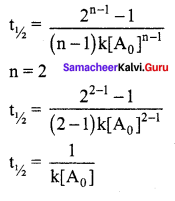
(a) 10 s
(b) 5 min
(c) 20 min
(d) cannot be predicted using the given information
Answer:
(c) 20 min
Solutions:
12th Chemistry 7th Lesson Book Back Answers Chemical Kinetics Samacheer Kalvi
Given,
[A0] = 0.02 M ; t1/2 = 10 min
[A0] = 0.04 M ; t1/2 = ?
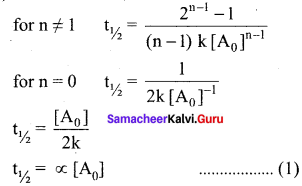
Substitute in (1)
10 min ? 0.02 M ……………………..(2)
t1/2 ∝ 0.04 M ……………………..(3)
Dividing Eq.(3) by Eq. (2) we get,
\(\frac { { t }^{ 1/2 } }{ 10min }\) = \(\frac { 0.04M }{ 0.02M }\)
t1/2 = 2 x 10 min = 20 min

Chemical Kinetics Book Back Answers Question 3.
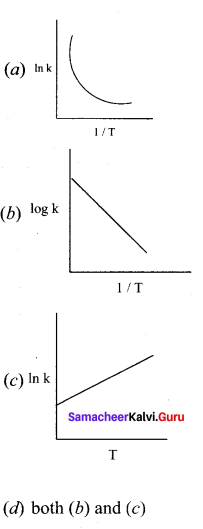
Among the following graphs showing variation of rate constant with temperature (T) for a reaction, the one that exhibits Arrhenius behavior over the entire temperature range is ……………
Chemical Kinetics Book Back Answers Samacheer Kalvi 12th Chemistry Solutions Chapter 7
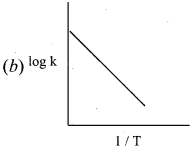
Answer:
Samacheer Kalvi Guru 12th Chemistry Solutions Chapter 7 Chemical Kinetics
Solution:
Samacheer 12 Chemistry Solutions Chapter 7 Chemical Kinetics
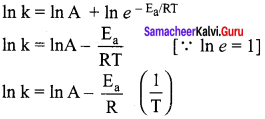
In k = In A – \(\left( \frac { { E }_{ a } }{ R } \right)\) \((\frac { 1 }{ T })\)
this equation is in the form of a straight
line equation y = c + m x
a plot of ink vs \((\frac { 1 }{ T })\) is a straight line with negative slope.

Samacheer Kalvi Guru 12th Chemistry Question 4.
For a first order react ion A → product with initial concentration x mol L-1, has a half life period of 2.5 hours. For the same reaction with initial concentration mol L-1 the half life is
(a) (2.5 x 2) hours
(b) \((\frac { 2.5 }{ 2 })\) hours
(c) 2.5 hours
(d) Without knowing the rate constant, t1/2 cannot be determined from the given data
Answer:
(d) Without knowing the rate constant, t1/2 cannot be determined from the given data.
Solutions:
For a first order reaction
t1/2 = \(\frac { 0.693 }{ k }\) t1/2 does not depend on the initial concentration and it remains constant (whatever may be the initial concentration)
t1/2 = 2.5 hrs .

Samacheer 12 Chemistry Solutions Question 5.
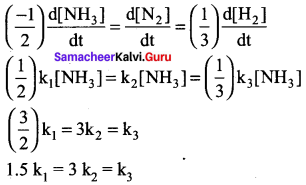
For the reaction, 2NH3 → N2 + 3H2, if
Samacheer Kalvi 12th Chemistry Solutions Chapter 7 Chemical Kinetics
then the relation between
k1, k2 and k3 is
(a) k1 = k2 = k3
(b) k1 = 3 k2 = 2 k3
(c) 1.5k1 = 3 k2 = k3
(d) 2k1 = k2 = 3 k3
Answer:
(c) 1.5k1 = 3 k2 = k3
Solution:
Chemical Kinetics Solutions Samacheer Kalvi 12th Chemistry Chapter 7

Samacheer Kalvi 12th Chemistry Question 6.
The decomposition of phosphine (PH3) on tungsten at low pressure is a first order reaction. It is because the …………….
(a) rate is proportional to the surface coverage
(b) rate is inversely proportional to the surface coverage
(c) rate is independent of the surface coverage
(d) rate of decomposition is slow
Answer:
(c) rate is independent of the surface coverage
Solution:
Given:
At low pressure the reaction follows first order, therefore Rate ∝ [reactant]1 Rate ∝ (surface area) At high pressure due to the complete coverage of surface area, the reaction follows zero order. Rate ∝ [reactant]°. Therefore the rate is independent of surface area.

Chemical Kinetics Solutions Question 7.
For a reaction Rate = k [acetone]3/2 then unit of rate constant and rate of reaction respectively is …………..
(a) (mol L-1 s-1), (mol-1/2 L1/2 s-1)
(b) (mol-1/2 L1/2 s-1), (mol L-1 s-1)
(c) (mol1/2 L1/2 s-1), (mol L-1 s-1)
(d) (mol L s-1), (mol1/2 L1/2 s)
Answer:
(b) (mol1/2 L1/2 s-1), (mol L-1 s-1)
Solution:
Rate = k [A]n
Rate = \(\frac { -d[A] }{ dt } \)
unit of rate = \(\frac { mol{ L }^{ -1 } }{ s }\) = mol L-1 s-1
unit of rate constant = \(\frac { (mol{ L }^{ -1 }{ S }^{ -1 }) }{ { (mol{ L }^{ -1 }) }^{ n } }\)
= mol1-n Ln-1 S-1
in this case, rate k [Acetone]3/2
n = 3/2
mol1-(3/2) L(3/2)-1 s-1
mol-(1/2) L(1/2) s-1

Samacheer Kalvi Class 12 Chemistry Solutions Question 8.
The addition of a catalyst during a chemical reaction alters which of the following quantities?
(a) Enthalpy
(b) Activation energy
(c) Entropy
(d) Internal energy
Answer:
(b) Activation energy
Solution:
A catalyst provides a new path to the reaction with low activation energy. i.e., it lowers the activation energy.

Chemical Kinetics In Tamil Question 9.
Consider the following statements:
(i) increase in concentration of the reactant increases the rate of a zero order reaction.
(ii) rate constant k is equal to collision frequency A if Ea = o
(iii) rate constant k is equal to collision frequency A if Ea = o
(iv) a plot of ln (k) vs T is a straight line.
(v) a plot of In (k) vs \((\frac { 1 }{ T })\) is a straight line with a positive slope.

Correct statements are
(a) (ii) only
(b) (ii) and (iv)
(c) (ii) and (v)
(d) (i), (ii) and (v)
Answer:
(a) (ii) only
Solutions:
In zero order reactions, increase in the concentration of reactant does not alter the rate, So statement (i) is wrong.
Samacheer Kalvi Class 12 Chemistry Solutions Chapter 7 Chemical Kinetics
if Ea = O (so, statement (ii) is correct, and statement (iii) is wrong)
k = A e°
k = A
in k = A – \(\left( \frac { { E }_{ a } }{ R } \right)\) \(\frac { 1 }{ T }\)
this equation is in the form of a straight line equation yc + m x. a plot of Ink vs \(\frac { 1 }{ T }\) is a straight line with negative slope so statements (iv) and (v) are wrong.

Samacheer Kalvi Guru Class 12 Chemistry Question 10.
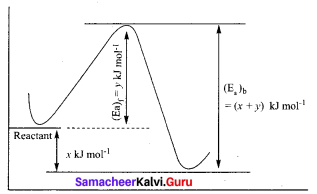
In a reversible reaction, the enthalpy change and the activation energy in the forward direction are respectively – x kJ mol-1 and y kJ mol-1. Therefore, the energy of activation in the backward direction is ………..
(a) (v – x)kJ mol-1
(b) (x + y) J mol-1
(c) (x – y) kJ mol-1
(d) (x + y) x 103 J mol-1
Answer:
(d) (x + y) x 103 J mol-1
Solution:
Chemical Kinetics In Tamil Samacheer Kalvi 12th Chemistry Solutions Chapter 7

12th Chemistry Samacheer Kalvi Question 11.
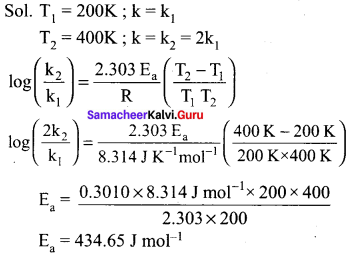
What is the activation energy for a reaction if its rate doubles when the temperature is raised from 200K to 400K? (R 8.314 JK-1 mol-1)
(a) 234.65 kJ mol-1 K-1
(b) 434.65 kJ mol-1 K-1
(c) 434.65 J mol-1 K-1
(d) 334.65 J mol-1 K-1
Answer:
(c)434.65 J mol-1 K-1
Solutions:
Samacheer Kalvi Guru Class 12 Chemistry Solutions Chapter 7 Chemical Kinetics

Question 12.
12th Chemistry Samacheer Kalvi Solutions Chapter 7 Chemical Kinetics
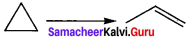
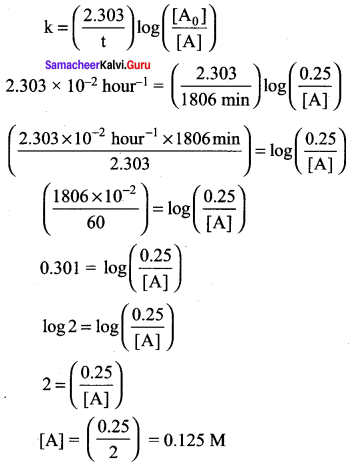
This reaction follows first order kinetics. The rate constant at particular temperature is 2.303 x 10² hourd. The initial concentration of cyclopropane is 0.25 M. What will be the concentration of cyclopropane after 1806 minutes? (Log 2 = 0.30 10)
(a) 0.125 M
(b) 0.215 M
(c) 0.25 x 2.303 M
(d) 0.05 M
Answer:
(b) 0.2 15 M
Solution:
Samacheer Kalvi 12th Chemistry Solutions Chapter 7 Chemical Kinetics-12

Question 13.
For a first order reaction, the rate constant is 6.909 min-1.The time taken for 75% conversion in minutes is …………
(a) \((\frac { 3 }{ 2 })\) log 2
(b) \((\frac { 3 }{ 2 })\) log 2
(c) \((\frac { 3 }{ 2 })\) log \((\frac { 3 }{ 4 })\)
(d) \((\frac { 2 }{ 3 })\) log \((\frac { 4 }{ 3 })\)
Answer:
(b) \((\frac { 3 }{ 2 })\) log 2
Solution:
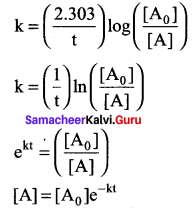
k = \((\frac { 2.303 }{ t })\) log \(\left( \frac { \left[ { A }_{ 0 } \right] }{ \left[ A \right] } \right)\)
[A0] = 100
[A] = 25
[A0]= 100; [A]=25
6.909 = \((\frac { 2.303 }{ t })\) log \((\frac { 100 }{ 25 })\)
t = \((\frac { 2.303 }{ 6.909 })\) log (4) ⇒ t = \((\frac { 1 }{ 3 })\) log 22
t = \((\frac { 2 }{ 3 })\) log 2

Question 14.
In a first order reaction x → y; if k is the rate constant and the initial concentration of the reactant x is 0.1 M, then, the half life is ……..
(a) \((\frac { log2 }{ k })\)
(b) \((\frac { 0.693 }{ (0.1)k })\)
(c) \((\frac { In2 }{ k })\)
(d) none of these
Answer:
(c) \((\frac { In2 }{ k })\)
Solution:
k = \((\frac { 1 }{ t })\) In \(\left( \frac { \left[ { A }_{ 0 } \right] }{ \left[ A \right] } \right)\)
[A0] = 0.1
[A] = 0.05
k = \(\left( \frac { 1 }{ { t }_{ 1/2 } } \right)\) In \((\frac { 0.1 }{ 0.05 })\)
k = \(\left( \frac { 1 }{ { t }_{ 1/2 } } \right)\) In (2) ⇒ t1/2 = \((\frac { In(2) }{ k })\)

Question 15.
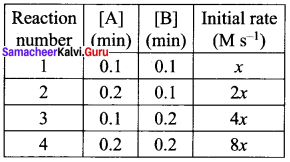
Predict the rate law of the following reaction based on the data given below:
2A + B → C + 3D
Samacheer Kalvi 12th Chemistry Solutions Chapter 7 Chemical Kinetics-15
(a) rate = k [A]2 [B]
(b) rate = k [A][B]2
(c) rate = k [A][B]
(d) rate = k [A]1/2 [B]3/2
Answer:
(b) rate = k [A][B]2
Solution:
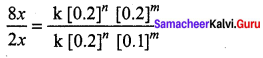
rate1 = k [0.1]n [0.1]m ……………(1)
rate2 = k [0.2]n [0.1]m …………(2)
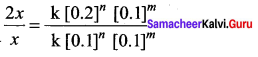
Dividing Eq.(2) by Eq.(1)
Samacheer Kalvi 12th Chemistry Solutions Chapter 7 Chemical Kinetics-16
\(\frac { 2x }{ x }\) = 2n
∴ n = 1
rate3 = k [0.1]n [0.2]m …………..(3)
rate4 = k [0.2]n [0.2]m …………..(4)
Dividing Eq.(4) by Eq.(2)
Samacheer Kalvi 12th Chemistry Solutions Chapter 7 Chemical Kinetics-17
\(\frac { 8 }{ 2 } \) = 2m
∴m = 1
∴ rate = k [A]1 [B]2

Question 16.
Assertion: rate of reaction doubles when the concentration of the reactant is doubles if it is a first order reaction.
Reason: rate constant also doubles
(a) Both assertion and reason are true and reason is the correct explanation of assertion.
(b) Both assertion and reason are true but reason is not the correct explanation of assertion.
(c) Assertion is true but reason is false.
(d) Both assertion and reason are false.
Answer:
(c) Assertion is true but reason is false.
Solution:
For a first reaction, when the concentration of reactant is doubled, then the rate of reaction also doubled. Rate constant is independent of concentration and is a constant at a constant temperature, i.e., it depends on the temperature and hence, it will not be doubled and when the concentration of the reactant is doubled.

Question 17.
The rate constant of a reaction is 5.8 x 10² s1. The order of the reaction is ………….
(a) First order
(b) zero order
(c) Second order
(a) Third order
Answer:
(a) First order
Solution:
The unit of rate constant is s-1 and it indicates that the reaction is first order.

Question 18.
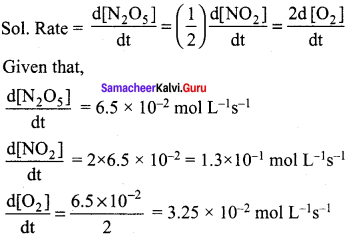
For the reaction N2 O5(g) → 2NO2(g) +\(\frac { 1 }{ 2 }\) – O2(g) the value of rate of disappearance of N2O5 is given as 6.5 x 10⁻² mol L-1s-1 The rate of formation of NO2 and O2 is given respectively as …………….
(a) (3.25 x 10⁻² mol L-1s-1) and (1.3 x 10⁻² mol L-1s-1)
(b) (1.3 x 10⁻² mol L-1s-1) and (3.25 x 10² mol L-1s-1)
(c) (1.3 x 10⁻¹ mol L-1s-1) and (3.25 x 10⁻² mol L-1s-1)
(d) None of these
Answer:
(c) (1.3 x 10⁻¹ mol L-1s-1) and (3.25 x 10⁻² mol L-1s-1)
Samacheer Kalvi 12th Chemistry Solutions Chapter 7 Chemical Kinetics-18

Question 19.
During the decomposition of H2O2 to give dioxygen, 48g O2 is formed per minute at certain point of time. The rate of formation of water at this point is …………….
(a) 0.75 mol min-1
(b) 1.5 mol min-1
(c) 2.25 mol min-1
(d) 3.0 mol min-1
Answer:
(d) 3.0 mol min-1
Solution:
H2O2 → H2O + \(\frac { 1 }{ 2 }\)O2
Rate = Samacheer Kalvi 12th Chemistry Solutions Chapter 7 Chemical Kinetics-19
No. of moles of oxygen = \((\frac { 48 }{ 32 })\) = 1.5 mol
Rate of formation of oxygen = 2 x 1.5
= 3 mol min-1

Question 20.
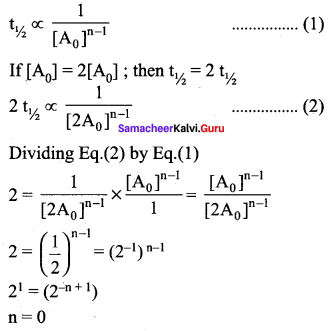
If the initial concentration of the reactant is doubled, the time for half reaction is also doubled. Then the order of the reaction is …………
(a) Zero
(b) one
(c) Fraction
(d) none
Answer:
(a) Zero
Solution:
For a first order reaction t1/2 is independent of initial concentration .i.e., n \(\neq\) 1 for such cases
Samacheer Kalvi 12th Chemistry Solutions Chapter 7 Chemical Kinetics-20

Question 21.
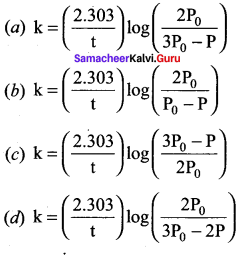
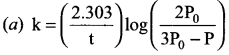
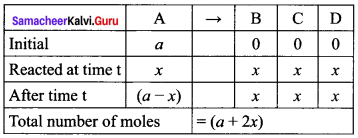
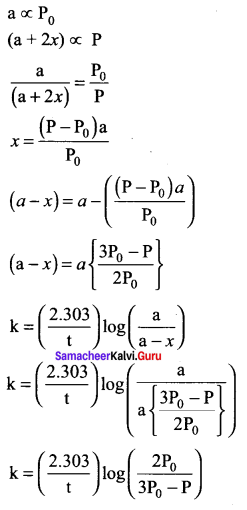
In a homogeneous reaction A ? B + C + D, the initial pressure was P0 and after time t it was P. Expression for rate constant in terms of P0, P and t will be ……….
Samacheer Kalvi 12th Chemistry Solutions Chapter 7 Chemical Kinetics-21
Answer:
Samacheer Kalvi 12th Chemistry Solutions Chapter 7 Chemical Kinetics-22
Solution:
Samacheer Kalvi 12th Chemistry Solutions Chapter 7 Chemical Kinetics-23
Samacheer Kalvi 12th Chemistry Solutions Chapter 7 Chemical Kinetics-24

Question 22.
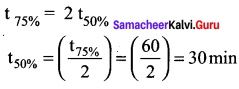
If 75% of a first order reaction was completed in 60 minutes, 50% of the same reaction under the same conditions would be completed in ………
(a) 20 minutes
(b) 30 minutes
(c) 35 minutes
(d) 75 minutes
Answer:
(b) 30 minutes
Solution:
Samacheer Kalvi 12th Chemistry Solutions Chapter 7 Chemical Kinetics-25

Question 23.
The half life period of a radioactive element is 140 days. After 560 days, 1 g of element will be reduced to
(a) \(\frac { 1 }{ 2 }\) g
(b) \(\frac { 1 }{ 4 }\) g
(c) \(\frac { 1 }{ 8 }\) g
(d) \(\frac { 1 }{ 16 }\) g
Answer:
(d) \(\frac { 1 }{ 16 }\) g
Solution:
in 140 days ⇒ initial concentration reduced to \(\frac { 1 }{ 2 }\) g
in 280 days ⇒ initial concentration reduced to \(\frac { 1 }{ 4 }\) g
in 420 days ⇒ initial concentration reduced to \(\frac { 1 }{ 8 }\) g
in 560 days ⇒ initial concentration reduced to \(\frac { 1 }{ 8 }\) g

Question 24.
The correct difference between first and second order reactions is that …………
(a) A first order reaction can be catalysed a second order reaction cannot be catalysed.
(b) The half life of a first order reaction does not depend on [A0] the half life of a second order reaction does depend on [A0].
(c) The rate of a first order reaction does not depend on reactant concentrations; the rate of a second order reaction does depend on reactant concentrations.
(d) The rate of a first order reaction does depend on reactant concentrations; the rate of a second order reaction does not depend on reactant concentrations,
Answer:
(b) The half life of a first order reaction does not depend on [A0]; the half life of a second order reaction does depend on [A0].
Solution:
For a first order reaction
t1/2 = \(\frac { 0.6932 }{ k }\)
For a second order reaction
Samacheer Kalvi 12th Chemistry Solutions Chapter 7 Chemical Kinetics-26

Question 25.
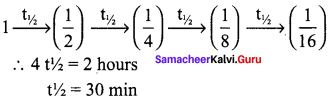
After 2 hours, a radioactive substance becomes \((\frac { 1 }{ 16 })\)th of original amount. Then the half life (in mm) is ………………
(a) 60 minutes
(b) 120 minutes
(c) 30 minutes
(d) 15 minutes
Answer:
(c) 30 minutes
Solution:
Samacheer Kalvi 12th Chemistry Solutions Chapter 7 Chemical Kinetics-27

II . Answer the following questions:

Question 1.
Define average rate and instantaneous rate.
Answer:
1. Average rate:
The average rate of a reaction is defined as the rate of change of concentration of a reactant (or of a product) over a specified measurable period of time.

2. insantaneous rate:
Instantaneous rate of reaction gives the tendency of the reaction at a particular point of time during its course (or) The time derivative of the concentration of a reactant (or product) converted to a positive number is called the instantaneous rate of reaction.

Question 2.
Define rate law and rate constant.
1. Rate law:
The expression in which reaction rate is given in terms of molar concentration of the reactants with each term raised to some power, which may or may not be same as the Stoichiometric coefficient of the reacting species in a balanced chemical equation.
x A + y B → products
Rate = k [A]m [B]m
k = Rate constant

2. Rate constant:
For a reaction involving the reactants A and B, Reaction rate = k [A]m [B]m The constant k is called rate constant of the reaction. If [A] = 1 M and [B] = 1 M; Reaction rate = k Thus, the rate constant (k) of a reaction is equal to the rate of reaction when the concentration of each reactant is equal to 1 mol L-1. The change in the concentration of reactant or product per unit time under the condition of unit concentration of all the reactant.

Question 3.
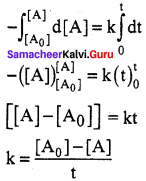
Derive integrated rate law for a zero order reaction A product. A reaction in which the rate is independent of the concentration of the reactant over a wide range of concentrations is called as zero order reactions. Such reactions are rare. Let us consider the following hypothetical zero order reaction.
A → Product
The rate law can be written
Rate = k [A]°
(∴[A]° = 1)
– d [A] k (l)
\(\frac { -d[A] }{ dt }\) = k(1)
-d[A] = k dt
Integrate the above equation between the limits of [A0] at zero time and [A] at some later time ‘t’,
Samacheer Kalvi 12th Chemistry Solutions Chapter 7 Chemical Kinetics-28

Question 4.
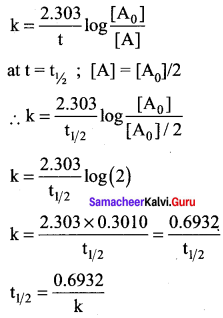
Define half life of a reaction. Show that for a first order reaction half life is independent of Initial concentration.
Answer:
Half life of a reaction is defined as the time required for the reactant concentration to reach one half of its initial value. For a first order reaction, the half life is a constant i.e., it does not depend on the initial concentration. The rate constant for a first order reaction is given by,
Samacheer Kalvi 12th Chemistry Solutions Chapter 7 Chemical Kinetics-29
Question 5.
What is an elementary reaction? Give the differences between order and molecularity of a reaction.
Answer:
Elementary reaction – Each and every single step in a reaction mechanism is called an elementary reaction. Differences between order and molecularity:
Order of a reaction:

  1. It is the sum of the powers of concentration terms involved in the experimentally determined rate law.
  2. It can be zero (or) fractional (or) integer.
  3. It is assigned for a overall reaction.

Molecularity of a reaction:

  1. It is the total number of reactant species that are involved in an elementary step.
  2. It is always a whole number, cannot be zero or a fractional number.
  3. It is assigned for each elementary step of mechanism.

Question 6.
Explain the rate determining step with an example.
Answer:
1. Most of the chemical reactions occur by multistep reactions. In the sequence of steps it is found that one of the steps is considerably slower than the others. The overall rate of the reaction cannot be lower in value than the rate of the slowest step.

2. Thus in a multistep reaction the experimentally determined rate corresponds to the rate of the slowest step. The step which has the lowest rate value among the other steps of the reaction is called as the rate determining step (or) rate limiting step.

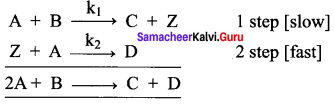
3. Consider the reaction,
2A + B → C + D
going by two steps as follows,
Samacheer Kalvi 12th Chemistry Solutions Chapter 7 Chemical Kinetics-30
Here the overall rate of the reaction corresponds to the rate of the first step which is the slow step and thus the first step is called as the rate determining step of the reaction. In the above equation, the rate of the reaction depends upon the rate constant k ( only. The rate of second step dosn’t contribute experimentally determined overall rate of the reaction.
For example,
NO2(g) + CO2(g) → NO(g) + CO2(g)
Which occurs in two elementary steps:

  • NO2 + NO2 → NO + NO3 (Slow)
  • NO3+ CO → NO2 + CO2 (fast)

Because the first step is the lowest step, the overall reaction cannot proceed any faster than the rate of the first elementary step. The first elementary step in this example is therefore the rate determining step.

The rate equation for this reaction is equal to the rate is constant of step-1 multiplied by the reactants of that first step. If the rate constant of step-1 is denoted as k1 then the rate of the first step in the reaction (and the total reaction) will be,
Rate = k, [NO2] [NO2]
= k1 [NO2]2

Question 7.
Describe the graphical representation of first order reaction.
Answer:
Rate constant for first order reaction is,
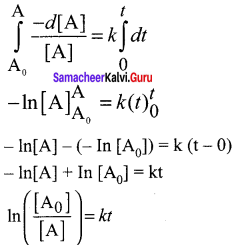
kt = ln\(\left( \frac { \left[ { A }_{ 0 } \right] }{ \left[ A \right] } \right)\)
kt = In [A0] – In [A]
In[A] = In [A0] – kty = c + mx
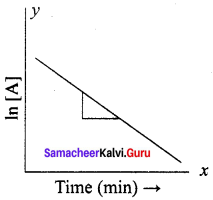
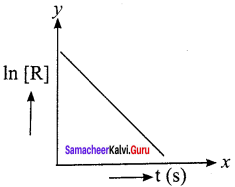
If we follow the reaction by measuring the concentration of the reactants at regular time interval ‘t’, a plot of ln[A] against ‘t’ yields a straight line with a negative slope. From this, the rate constant is calculated.
Samacheer Kalvi 12th Chemistry Solutions Chapter 7 Chemical Kinetics-31

Question 8.
Write the rate law for the following reactions.

  1. A reaction that is 3/2 order in x and zero order in y.
  2. A reaction that is second order in NO and first order in Br2.

Answer:
1. \(\frac { 3 }{ 2 }\) x + y (excess) → products
– \(\frac { 3 }{ 2 }\) \(\frac { d[x] }{ dt }\) = k [x]3/2

2. 2NO + Br2 → products
– \(\frac { 1 }{ 2 }\) \(\frac { d[NO] }{ dt }\) = k [NO]2 [Br2]

Question 9.
Explain the effect of catalyst on reaction rate with an example.
Answer:

  1. Significant changes in the reaction can be brought out by the addition of a substance called catalyst.
  2. A catalyst is substance which alters the rate of a reaction without itself undergoing any permanent chemical change.
  3. They may participate in the reaction, but again regenerated and the end of the reaction.
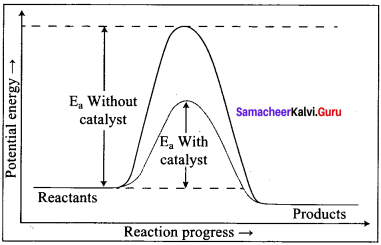
  4. In the presence of a catalyst, the energy of activation is lowered and hence, greater number of molecules can cross the energy barrier and change over to products, thereby increasing the rate of the reaction.
  5. For example, decomposition of potassium chlorate is enhanced by addition of MnO2.

2KClO3 \(\frac{\mathrm{MnO}_{4}}{\Delta} 2 \mathrm{KCl}\) + 3O2 (MnO2 – Catalyst)
Samacheer Kalvi 12th Chemistry Solutions Chapter 7 Chemical Kinetics-32

Question 10.
The rate law for a reaction of A, B and C has been found to be rate = k[A]2 [B][L]3/2. How would the rate of reaction change when

  1. Concentration of [L] is quadrupled
  2. Concentration of both [A] and [B] are doubled
  3. Concentration of [A] is halved
  4. Concentration of [A] is reduced to(1/3) and concentration of [L] is quadrupled.

Solution:
Rate = k [A]2 [B] [L]3/2 ………….(1)
1. when [L] = [4L]
Rate = k [A]2 [B] [4L]3/2
Rate = 8 (k[A]2 [B] [L]3/2) …………………..(2)
Comparing (1) and (3) rate is increased by 8 times.

2. when [A] = [2A] and [B] = [2B]
Rate = k[2A]2 [2B ] [L]3/2
Rate = 8 (k[A]2 [B] [L]3/2 …………….(3)
Comparing (1) and (3); rate is increased by 8 times.

3. when [A] = \([\frac { A }{ 2 }]\)
Rate = k \([\frac { A }{ 2 }]\)2 [L]\(\frac { 3 }{ 2 }\)
Rate = \(\frac { 1 }{ 4 }\) (k[A]2 [B] [L]3/2) ……………..(4)
Comparing (1) and ( 4); rate is reduced to \(\frac { 1 }{ 4 }\) times.

4. when [A] = \([\frac { A }{ 3 }]\) and [L] = [4L]
Rate k\(\frac { A }{ 3 }\)2 [B] [4L]3/2
Rate = \([\frac { 8 }{ 9 }]\) (k[A]2 [B] [L]3/2) ……………….(5)
Comparing (1) and (5); rate is reduced to 8/9 times.

Question 11.
The rate of formation of a dimer in a second order reaction is 7.5 x 10⁻³ mol L-1s-1 at 0.05 mol L-1 monomer concentration. Calculate the rate constant.
Solution:
Let us consider the dimensation of a monomer M
2M → (M)2
Rate = k [M]n
Given that n =2 and [M] = 0.05 mol L-1
Rate = 7.5 x 10⁻³ mol L-1s-1
Rate 7.5 x 10³ mol L-1 s-1
k = \(\frac { Rate }{ { \left[ M \right] }^{ n } }\)
k= =\(\frac { 7.5\times { 10 }^{ -3 } }{ { \left( 0.05 \right) }^{ 2 } }\) = 3 mol-1 Ls-1

Question 12.
For a reaction x +y + z → products, the rate law is given by rate = k [x]3/2 [y]1/2 what is the overall order of the reaction and what is the order of the reaction with respect to z.
Solution:
Rate = k [x]3/2 [y]1/2
overall order = \(\left( \frac { 3 }{ 2 } +\frac { 1 }{ 2 } \right)\) = 2
i.e., second order reaction.
Since the rate expression does not contain the concentration of Z , the reaction is zero order with respect to Z.

Question 13.
Explain briefly the collision theory of bimolecular reactions.
Answer:
Collision theory is based on the kinetic theory of gases. According to this theory, chemical reactions occur as a result of collisions between the reacting molecules. Let us understand this theory by considering the following reaction.
A2(g) + B2(g) → 2AB(g)

If we consider that, the reaction between A2 and B2 molecules proceeds through collisions between them, then the rate would be proportional to the number of collisions per second. Rate ix Number of molecules colliding per litre per second (or) Rate ∝ Collision rate. The number of collisions is directly proportional to the concentration of both A2 and B2.
Collision rate ∝ [A2] [B2] …………………(1)
Collision rate = Z [A2] [B2] ……………………..(2)
Where, Z is a constant.

The collision rate ¡n gases can be calculated from kinetic theory of gases. For a gas at room temperature (298K) and 1 atm pressure, each molecule undergoes approximately 109 collisions per second, i.e., I collision in 109 second. Thus, if every collision resulted in reaction, the reaction would be complete in 109 second.

In actual practice this does not happen. It implies that all collisions are not effective to lead to the reaction. In order to react, the colliding molecules must possess a minimum energy called activation energy. The molecules that collide with less energy than activation energy will remain intact and no reaction occurs.

Fraction of effective collisions (f) is given by the following expression, \({ e }^{ \frac { { -E }_{ a } }{ RT } }\)
Fraction of collisions is further reduced due to orientation factor i.e., even if the reactant collide with sufficient energy, they will not react unless the orientation of the reactant molecules is suitable for the formation of the transition state. The fraction of effective collisions (f) having proper orientation is given by the steric factor P.

Rate = P x f x collision rate
Rate= P x \({ e }^{ \frac { { -E }_{ a } }{ RT } }\) x Z [A2] [B2] ……..(1)
As per the rate law, Rate = k [A2] [B2] ………………….(2)
Where k is the rate constant
On comparing equation (1) and (2), the rate constant k is,
k = p Z \({ e }^{ \frac { { -E }_{ a } }{ RT } }\)

Question 14.
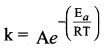
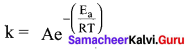
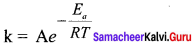
Write Arrhenius equation and explains the terms involved.
Answer:
Arrhenius equation:
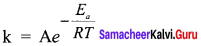
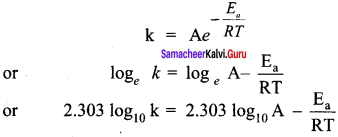
k = A\({ e }^{ \frac { { -E }_{ a } }{ RT } }\)
A = Arrhenius factor (frequency factor)
R = Gas constant
k = Rate constant
Ea = Activation energy
T = Absolute temperature (in K)

Question.15.
The decomposition of Cl2O7 at 500K in the gas phase to Cl2 and O2 is a first order reaction. After 1 minute at 500K, the pressure of Cl2O7 falls from 0.08 to 0.04 atm. Calculate the rate constant in s-1.
Answer:
Solution:
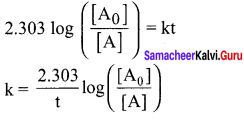
k = \(\frac { 2.303 }{ t }\) log \(\frac{\left[\mathrm{A}_{0}\right]}{[\mathrm{A}]}\)
k = \(\frac { 2.303 }{ 1 min }\) log \(\frac { [0.08] }{ [0.04] }\)
k = 2.303 log 2
k = 2.303 x 0.3010
k = 0.693 2 min-1
k = \((\frac { 0.6932 }{ 60 })\) s-1
k = 1.153 x 10⁻² s-1

Question 16.
Give the examples for a zero order reaction.
Answer:
Examples for a zero order reaction:
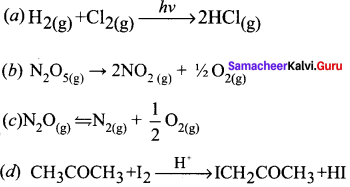
1. Photochemical reaction between H2 and Cl
H2(g) + Cl2(g) \(\underrightarrow { h\nu }\) 2HCI(g)

2. Decomposition of N2O on hot platinum surface
N2 O(g) \(\rightleftharpoons\) N2(g) + \(\frac { 1 }{ 2 }\) O2(g)

3. lodination of acetone in acid medium is zero order with respect to iodine.
CH3COCH3 + I2 \(\underrightarrow { { H }^{ + } } \) ICH2COCH3 + HI
Rate k [CH3COCI3] [H+]

Question 17.
Explain pseudo first order reaction with an example.
Answer:
A second order reaction can be altered to a first order reaction by taking one of the reactant in large excess, such reaction is called pseudo first order reaction. Let us consider the acid hydrolysis of an ester,
CH3COOCH3(aq) +H2 O(1) \(\underrightarrow { { H }^{ + } } \) CH3COOH(aq) + CH3OH(aq)
Rate = k [CH3COOCH3] [H2O]

If the reaction is carried out with the large excess of water, there is no significant change in the concentration of water during hydrolysis. i.e., concentration of water remains almost a constant. Now we can define k [H2O] = k
∴ The above rate equation becomes
Rate k [CHCOOCH] Thus it follows first order kinetics.

Question 18.
Identify the order for the following reactions

  1. Rusting of Iron
  2. Radioactive disintegration of 92U23
  3. 2 A+ B → products; rate = k [A]1/2 [B]2

Answer:
1.Samacheer Kalvi 12th Chemistry Solutions Chapter 7 Chemical Kinetics-36
Theoritically order value may be more than one but practically one.

2. All radioactive disintegrations are first order reactions

3. 2A + 3B → products:
rate = k[A]1/2 [B]2
Order = \(\frac { 1 }{ 2 }\) + 2 = \(\frac { 5 }{ 2 }\) = 2.5

Question 19.
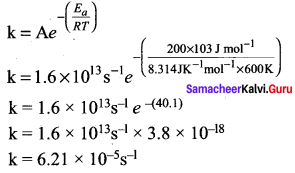
A gas phase reaction has energy of activation 200 kJ mol-1. If the frequency factor of the reaction is 1.6 x 10¹³ s-1. Calculate the rate constant at 600 K. (e-40.09 = 3.8 x I0-18 )
Solution:
Samacheer Kalvi 12th Chemistry Solutions Chapter 7 Chemical Kinetics-37

Question 20.
For the reaction 2x +y → L find the rate law from the following data.
Samacheer Kalvi 12th Chemistry Solutions Chapter 7 Chemical Kinetics-38
Answer:
Rate = k [x]n [y]m
0.15 = k [0.2]n [0.02]m ……………..(1)
0.30 = k [0.4]n [0.02]m ……………… (2)
1.20 = k [0.4]n [0.08]m ……………… (3)
Dividing Eq(3) by Eq (2) we get
Samacheer Kalvi 12th Chemistry Solutions Chapter 7 Chemical Kinetics-39
Samacheer Kalvi 12th Chemistry Solutions Chapter 7 Chemical Kinetics-40

Question 21.
How do concentrations of the reactant influence the rate of reaction?
Answer:
The rate of a reaction increases with the increase in the concentration of the reactants. The effect of concentration is explained on the basis of collision theory of reaction rates.

According to this theory, the rate of a reaction depends upon the number of collisions between the reacting molecules. Higher the concentration, greater is the possibility for collision and hence the rate.

Question 22.
How do nature of the reactant influence rate of reaction?
Answer:
Nature and state of the reactant:
We know that a chemical reaction involves breaking of certain existing bonds of the reactant and forming new bonds which lead to the product.

The net energy involved in this process is dependent on the nature of the reactant and hence the rates arc different for different reactants. Let us compare the following two reactions that we carried out in volumetric analysis.

  1. Redox reaction between ferrous ammonium sulphate (FAS) and KMnO4
  2. Redox reaction between oxalic acid and KMnO4

The oxidation of oxalate ion by KMnO4 is relatively slow compared to the reaction between KMnO4 and Fe . In fact heating is required for the reaction between KMnO4 and Oxalate ion and is carried out at around 60°C. The physical state of the reactant also plays an important role to influence the rate of reactions. Gas phase reactions are faster as compared to the reactions involving solid or liquid reactants.
Samacheer Kalvi 12th Chemistry Solutions Chapter 7 Chemical Kinetics-41
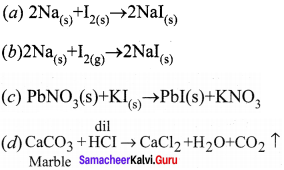
For example, reaction of sodium metal with iodine vapours is faster than the reaction between solid sodium and solid iodine. Let us consider another example that we carried out in inorganic qualitative analysis of lead salts.

If we mix the aqueous solution of colorless potassium iodide with the colorless solution of lead nitrate, precipitation of yellow lead iodide take place instantancously, whereas if we mix the solid lead nitrate with solid potassium iodide, yellow coloration will appear slowly.

Question 23.
The rate constant for a first order reaction is 1.54 x 10 s-1. Calculate its half life time.
Answer:
We know that, t, 0.693 k
t1/2 = 0.693/1.54 x 1o-3 = 450 s

Question 24.
The half life of the homogeneous gaseous reaction SO2CI2 → SO2 + Cl2 which obeys first order kinetics Is 8.0 minutes. How long will it take for the concentration of SO2Cl2 to be reduced to 1% of the initial value?
Answer:
We know that, k = 0.693/ t1/2
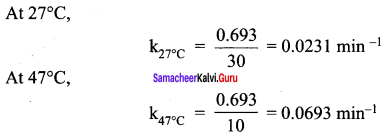
k = 0.693/8.0 minutes = 0.087 minutes -1
For a first order reaction,
k = \(\frac { 2.303 }{ k }\) log \(\left( \frac { \left[ { A }_{ 0 } \right] }{ \left[ A \right] } \right)\)
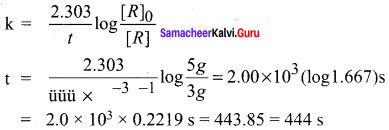
t = \(\frac { 2.303 }{ 0.087{ min }^{ -1 } }\) log\(\frac { 100 }{ 1 }\)
t = 52.93 mm

Question 25.
The time for half change in a first order decomposition of a substance A is 60 seconds. Calculate the rate constant. How much of A will be left after 180 seconds?
Answer:
1. Order of a reaction = 1
t1/2 = 60
seconds, k = ?
k = \(\frac { 2.303 }{ 60 }\)
We know that, k = \(\frac { 2.303 }{ { t }_{ 1/2 } }\)
k = \(\frac { 2.303 }{ 60 }\) = 0.01155 s-1

2. [A0] = 100%
t = 180 s
k = 0.01155 seconds-1
[A] = ?
For the first order reaction k = \(\frac { 2.303 }{ 60 }\) log \(\left( \frac { \left[ { A }_{ 0 } \right] }{ \left[ A \right] } \right)\)
0.9207 = log 100 – log [A]
log [A] = log 100 – 0.9207
log [A] = 2 – 0.9207
log[A] = 1.0973
[A] = antilog of (1.0973)
[A] = l2.5%

Question 26.
A zero order reaction is 20% complete in 20 minutes. Calculate the value of the rate constant. In what time will the reaction be 80% complete?
Answer:
1. A = 100%, x = 20%, Therefore, a – x =100 – 20 = 80
For the zero order reaction k= \((\frac { x }{ t })\) ⇒
k = \((\frac { 20 }{ 20 })\) = 1
Rate constant for a reaction = 1

2. To calculate the time for 80% of completion
k = 1, a = l00, x = 80%, t = ?
Therefore, t = \((\frac { x }{ k })\) = \((\frac { 80 }{ 1 })\) = 80 min

Question 27.
The activation energy of a reaction is 225 k cal mol-1 and the value of rate constant at 40°C is 1.8 x 10⁻⁵ s-1. Calculate the frequency factor, A. Here, we arc given that
Answer:
Ea = 22.5 kcal mol-1 = 22500 cal mol-1
T = 40°C = 40 + 273 = 313 K
k = 1.8 x 10⁻⁵ sec-1
Substituting the values in the equation
log A = log k + \(\left( \frac { { E }_{ a } }{ 2.303RT } \right)\)
log A = log (l .8 x 10-5) + \(\left( \frac { 22500 }{ 2.303\times 1.987\times 313 } \right)\)
log A = log (l.8) – 5 + (15.7089)
log A = (10.9642)
A = antilog ( 10.9642)
A = 9.208 x 10¹⁰ collisions s-1

Question 28.
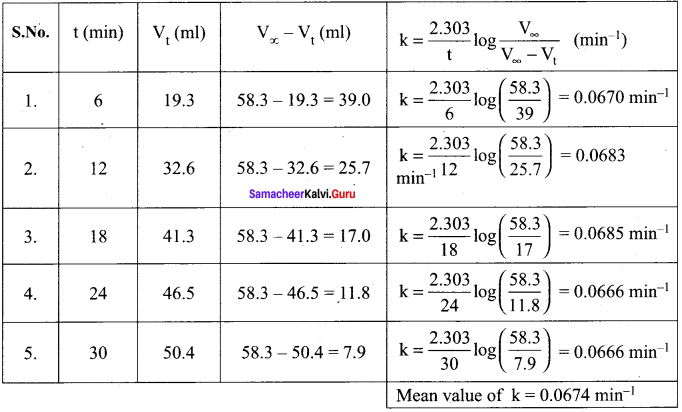
Benzene diazonium chloride in aqueous solution decomposes according to the equation
C6H5N2CI C6H5CI + N2. Starting with an initial concentration of 10 g L-1 volume of N2. gas obtained at 50°C at different intervals of time was found to be as under:
Samacheer Kalvi 12th Chemistry Solutions Chapter 7 Chemical Kinetics-43
Show that the above reaction follows the first order kinetics. What is the value of the rate constant ?
Solution:
For a first order reaction
k = \(\frac { 2.303 }{ t }\) log \(\frac { a }{ (a-x) }\)
k = \(\frac { 2.303 }{ t }\) log \(\frac { { V }_{ \infty } }{ { V }_{ \infty }-{ V }_{ t } }\)
In this case, V = 58.3 ml
The value of k at different time can be calculated as follows:
Samacheer Kalvi 12th Chemistry Solutions Chapter 7 Chemical Kinetics-44
Since the value of k comes out to be nearly constant, the given reaction is of the first order. The mean value of k = 0.0674 min-1

Question 29.
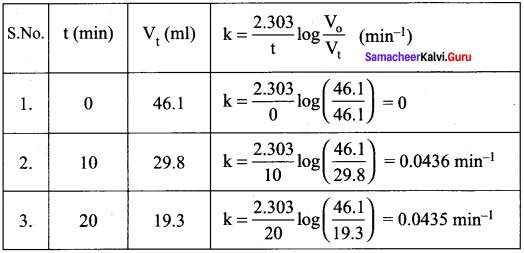
From the following data, show that the decomposition of hydrogen peroxide is a reaction of the first order:
Samacheer Kalvi 12th Chemistry Solutions Chapter 7 Chemical Kinetics-45
Where t is the volume of standard KMnO4 solution required for titrating the same volume of the reaction mixture.
Solution:
Volume of KMnO4 solution used Amount of H2O2 present. Hence if the given reaction is of the first order, it must obey the equation
k = \(\frac { 2.303 }{ t }\) log \(\frac { a }{ (a-x) }\)
k = \(\frac { 2.303 }{ t }\) log \(\frac { { V }_{ 0 } }{ { V }_{ t } }\)
In this case,V0 = 46.1 ml
The value of k at each instant can be calculated as follows:
Samacheer Kalvi 12th Chemistry Solutions Chapter 7 Chemical Kinetics-46
Thus, the value of k comes out to be nearly constant. Hence it is a reaction of the first order.

Question 30.
A first order reaction is 40% complete in 50 minutes. Calculate the value of the rate constant. in what time will the reaction be 80% complete?
Answer:
1. For the first order reaction k = \(\frac { 2.303 }{ t }\) log \(\frac { a }{ (a-x) }\)
Assume, a = 100 %, x = 40%, t = 50 minutes
Therefore, a – x = 100 – 40 = 60
k = (2.303/50) log (100/60)
k = 0.010216 min-1
Hence the value of the rate constant is 0.010216 min-1

2. t = ?, when x = 8O%
Therefore, a – x = 100 – 80 = 20
From above, k = 0.0102 16 min-1
t = (2.303 / 0.010216) log (100 / 20)
t = 157.58 min
The time at which the reaction will be 80% complete is 157.58 min.

Samacheer Kalvi 12th Chemistry Chemical Kinetics Elements Evaluate yourself

Question 1.
Write the rate expression for the following reactions, assuming them as elementary reactions.

  1. 3A + 5B2 → 4CD
  2. X2 + Y2 → 2XY

Answer:
1. 3A + 5B2 → 4CD
Rate = – \(\frac { 1 }{ 3 }\) \(\frac { \triangle [A] }{ dt }\)
= – \(\frac { 1 }{ 5 }\) \(\frac { \triangle [{ B }_{ 2 }] }{ dt }\)
= + \(\frac { 1 }{ 4 }\) \(\frac { \triangle [CD] }{ dt }\)

2. X2 + Y2 → 2XY
Rate = – \(\frac { \triangle [{ X }_{ 2 }] }{ dt }\)
= + \(\frac { 1 }{ 2 }\) \( [latex]\frac { \triangle [{ XY }_{ 2 }] }{ dt }\)

Question 2.
Consider the decomposition of N2O5(g) to form NO2(g) and O2(g). At a particular instant N2O5 disappears at a rate of 2.5 x 10⁻² mol dm-3 s-1. At what rates are NO2 and O2 formed? What is the rate of the reaction?
Solution:
2N2O5(g) → 4NO2(g) + O2(g)
from the stoichiometry of the reaction.
– \(\frac { 1 }{ 2 }\) \(\frac { d[{ N }_{ 2 }{ O }_{ 5 }] }{ dt }\)
= \(\frac { 1 }{ 4 }\) \(\frac { d[{ N }{ O }_{ 2 }] }{ dt }\)
= –\(\frac { d[{ N }{ O }_{ 2 }] }{ dt }\)
= 2 –\(\frac { d[{ N }_{ 2 }{ O }_{ 5 }] }{ dt }\)
Rate of disappearance of N2O5 is 2.5 x 10⁻² mol dm-3 s-1
∴ The rate of formation of NO2 at this temperature is 2 x 2.5 x 10-2 = 5 x 10⁻² mol dm-3 s-1.
– \(\frac { 1 }{ 2 }\) \(\frac { d[{ N }_{ 2 }{ O }_{ 5 }] }{ dt }\)
= – \(\frac { d[{ O }_{ 2 }] }{ dt }\)
∴ \(\frac { d[{ O }_{ 2 }] }{ dt }\) = \(\frac { 1 }{ 2 }\) x 2.5 x 10⁻² mol dm-3 s-1
= 1.25 x 10⁻² mol dm-3 s-1

Question 3.
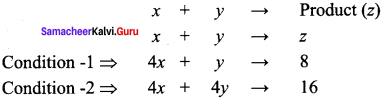
For a reaction, X + Y → Product quadrupling [x], increases the rate by a factor of 8. Quailrupling both [x] and [y] increases the rate by a factor of 16. Find the order of the reaction with respect to x and y. what is the overall order of the reaction?
Solution:
Samacheer Kalvi 12th Chemistry Solutions Chapter 7 Chemical Kinetics-51
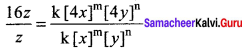
z = k[x]m [y]n …………(1)
8z = k[x]m [y]n …………(2)
16z = k[x]m [y]n ……………(3)
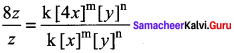
Dividing Eq (2) by Eq (1) we get,
Samacheer Kalvi 12th Chemistry Solutions Chapter 7 Chemical Kinetics-95
8 = 4m ⇒23 = (22)m ⇒ 2 = 22m
2m = 3
m = 3/2
1.5 order with respect to x.
Dividing Eq (3) by Eq (1) we get,
Samacheer Kalvi 12th Chemistry Solutions Chapter 7 Chemical Kinetics-96
16 = 4m. 4n
16 = 42. 4n
\(\frac { 16 }{ 16 }\) = 4n
1 = 4n
∴ n = 0 [Zero order with respect to y]
Overall order of the reaction.
k [x]m [y]n
k [x]1.5 [y]0
Order (1.5+0) = 1.5

Question 4.
Find the individual and overall order of the following reaction using the given data.
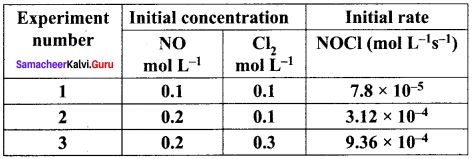
2NO(g) + Cl2 (g) → 2NOCI(g)
Samacheer Kalvi 12th Chemistry Solutions Chapter 7 Chemical Kinetics-97
Solution:
Rate = k [NO]m [CI2]
For experiment 1, the rate law is,
Rate1 = k [NO]m [CI2]n
7.8 x 10⁻⁵ k[0.1]m [0.1]n ………………(1)

For experiment 2, the rate law is.
Rate2 = k [NO]m [CI2]n
3.12 x 10-4 = k[O.2]m [0.1]n ……………….(2)

For experiment 3, the rate law is,
Rate3 = k [NO]m [CI2]n
9.36 x 10-4 = k [O.2]m [0.3]m ……………(3)
Dividing Eq (2) by Eq (l) we get,
Samacheer Kalvi 12th Chemistry Solutions Chapter 7 Chemical Kinetics-99
4 = \(\frac { 0.2 }{ 0.1 }\)m
⇒ 22 = 2m
∴m = 2
Therefore the reaction is secondary order with respect to NO.
Dividing Eq (3) by Eq (2) we get,
Samacheer Kalvi 12th Chemistry Solutions Chapter 7 Chemical Kinetics-99
Therefore the reaction is first order with respect to Cl2
The rate law is, Rate = k [NO]2 [Cl2]1
The overall order of the reaction (2 +1) = 3.

Question 5.
In a first order reaction A → products, 60% of the given sample of A decomposes in 40 min. what is the half life of the reaction?
Solution:
k = \(\frac { 2.303 }{ t }\) log \(\frac{\left[\mathrm{A}_{0}\right]}{[\mathrm{A}]}\)
k = \(\frac { 2.303 }{ 40min }\) log \(\frac { 100 }{ (100-60) }\)
k = 0.0575 (0.3979) ⇒ k = 0.02287 min-1
t1/2 = \(\frac { 0.6932 }{ k }\) log \(\frac { 0.6932 }{ 0.02287 }\)
t1/2 = 30.31 min.

Question 6.
The rate constant for a first order reaction is 2.3 x 10⁻⁴ s-1. If the initial concentration of the reactant is 0.01 M. what concentration will remain after 1 hour?
Solution:
Rate constant of a first order reaction k = 2.3 x 10⁻⁴ s-1
Initial concentration of the reactant [A0] = 0.01 M
Initial concentration ot the reactant [A0] = 0.01 M
Concentration will remain after 1 hour [A] =7
k = \(\frac { 2.303 }{ t }\) log \(\frac{\left[\mathrm{A}_{0}\right]}{[\mathrm{A}]}\)
2.3 x 10-4 = \(\frac { 2.303 }{ 1 hour }\) log \(\frac { [0.01] }{ [A] }\)
\(\frac { 2.3\times { 10 }^{ -4 }\times 1 }{ 2.303 }\) = log [0.01] – log[A]
9.986 x 10-5 = – 2 – log [A]
11.986 x 10-5 = – log [A]
[A] = Antilog (-11.986 x 10⁻⁵)
[A] = 0.997 M

Question 7.
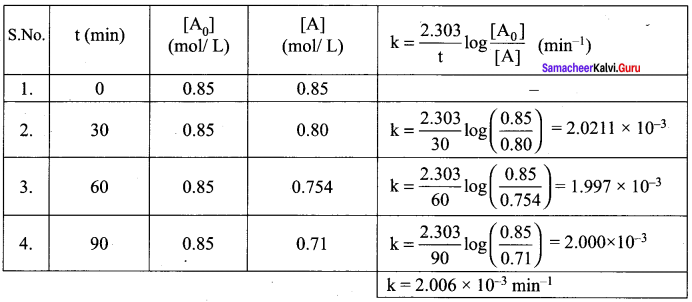
Hydrolysis of an ester in an aqueous solution was studied by titrating the liberated carboxylic acid against sodium hydroxide solution. The concentrations of the ester at different time intervals are given below.
Samacheer Kalvi 12th Chemistry Solutions Chapter 7 Chemical Kinetics-102
Show that, the reaction follows first order kinetics.
Solution:
The value of k at different time can be calculated as follows:
Samacheer Kalvi 12th Chemistry Solutions Chapter 7 Chemical Kinetics-103
This value shows that reaction follows first order kinetics.

Question 8.
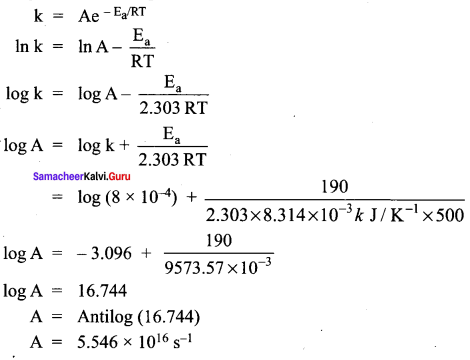
For a first order reaction the rate constant at 500K is 8 x 10⁻⁴ s-1. Calculate the frequency factor, if the energy of activation for the reaction is 190 kJ mol-1.
k = 8 x 10⁻⁴s
T = 500K
Ea = 190 kJ mol-1 A = ?
According to Arrhenius equation,
Samacheer Kalvi 12th Chemistry Solutions Chapter 7 Chemical Kinetics-104

Samacheer Kalvi 12th Chemistry Chemical Kinetics Elements Text book Example problems

Question 1.
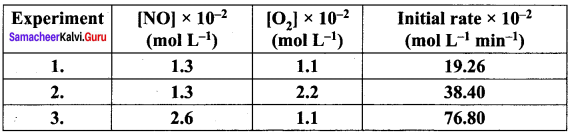
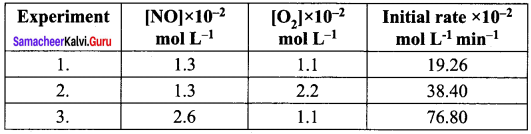
The oxidation of nitric oxide (NO)
2NO(g) + O2(g) → NO2(g)
Series of experiments are conducted by keeping the concentration of one of the reactants constant and the changing the concentration of the others.
Samacheer Kalvi 12th Chemistry Solutions Chapter 7 Chemical Kinetics-105
Find out the individual overall order of the reaction.
Solution:
Rate = k [NO]m [O2]n
For experiment 1, the rate law is
Rate2 = k [NO]m [O2]n
19.26 x 10-2 = k[1.3]m [1.1]n ………………(1)
Similarly for experiment 2
Rate2 = k [No]m [O2]n
38.40 x 10-2 = k [1.3]m [2.2]n …………………..(2)
For experiment 3
Rate3 = k [NO]m [O2]n
76.8 x 10-2 = k [2.6]m [1.1]n ……….(3)
Dividing Eq (2) by Eq (1)
\(\frac { 38.40\times { 10 }^{ -2 } }{ 19.26\times { 10 }^{ -2 } }\) = \(\frac { k{ \left[ 1.3 \right] }^{ m }{ \left[ 2.2 \right] }^{ n } }{ k{ \left[ 1.3 \right] }^{ m }{ \left[ 1.1 \right] }^{ n } }\)
2 = \({ \left( \frac { 2.2 }{ 1.1 } \right) }^{ n }\)
2 = 2n
i.e., n= 1
Therefore the reaction is first order with respect to O2
Dividing Eq (3) byEq (1)
\(\frac { 76.8\times { 10 }^{ -2 } }{ 19.26\times { 10 }^{ -2 } }\) = \(\frac { k{ \left[ 2.6 \right] }^{ m }{ \left[ 1.1 \right] }^{ n } }{ k{ \left[ 1.3 \right] }^{ m }{ \left[ 1.1 \right] }^{ n } }\)
4 = \({ \left( \frac { 2.6 }{ 1.3 } \right) }^{ m }\)
4 = 2m
i.e., m = 2
Therefore the reaction is second order with respect to NO
The rate law is Rate1 = k [NO]2 [O2]1
The overall order of the reaction = (2 + 1) = 3

Question 2.
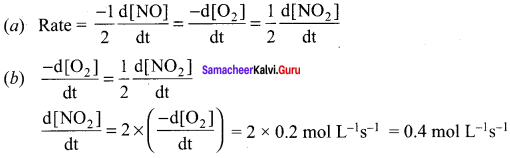
Consider the oxidation of nitric oxide to form NO2
2NO(g) + O2(g) → 2NO2(g)

  • Express the rate of the reaction in terms of changes in the concentration of NO, O2 and NO2.
  • At a particular instant, when [O2] is decreasing at 0.2 mol L-1 s-1 at what rate is
    [NO2] increasing at that instant?

Solution:
Samacheer Kalvi 12th Chemistry Solutions Chapter 7 Chemical Kinetics-108

Question 3.
What is the order with respect to each of the reactant and overall order of the following reactions?
1.  5Br(aq) + BrO3 (aq)+ 6H+(aq)  → 3Br2(1) +3H2O(1)
The experimental rate law is
Rate = k [Br] [BrO3][H+]2

2.  CH3 CHO(g) \(\underrightarrow { \triangle }\) CH4(g) + CO(g)
the experimental rate law is
Rate = k [CH3CHO]3/2
Solution:
1. First order with respect to Br, first order with respect to BrO3 and second order with respect to H+. Hence the overall order of the reaction is equal to 1+1+2=4

2. Order of the reaction with respect to acetaldehyde is \(\frac { 3 }{ 2 }\)and overall order is also \(\frac { 3 }{ 2 }\)

Question 4.
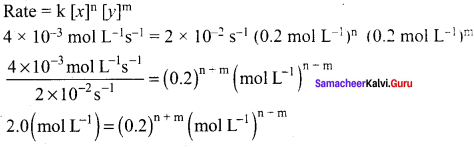
The rate of the reaction x + 2y → product is 4 x 10⁻³ mol L-1 s-1, if [x] = [y] = 0.2 M and rate constant at 400K is 2 x 10⁻² s-1. what is the overall order of the reaction.
Solution:
Samacheer Kalvi 12th Chemistry Solutions Chapter 7 Chemical Kinetics-109
Comparing the powers on both sides, the overall order of the reaction n + m = 1

Question 5.
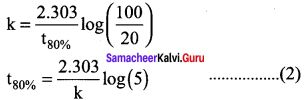
A first order reaction takes 8 hours for 90% completion. Calculate the time required for 80% completion. (log 5 = 0.6989; log10 = 1)
Solution:
For a first order reaction,
Samacheer Kalvi 12th Chemistry Solutions Chapter 7 Chemical Kinetics-110
Let [A0] = 100M
When
t = t90%; [A] = 10M (given that t90% = 8 hours)
t = t80%; [A] = 20M
Samacheer Kalvi 12th Chemistry Solutions Chapter 7 Chemical Kinetics-111
Find the value of k using the given data
k = \(\frac{2.303}{t_{90 \%}}\) log \((\frac { 100 }{ 10 })\)
k = \(\frac { 2.303 }{ 8 hours }\) log 10
k = \(\frac { 2.303 }{ 8 hours }\) (1)
Substitute the value of k in equation (2)
t80% = \(\frac { 2.303 }{ 2.303/8 hours }\) log (5)
t80% = 8 hours x 0.6989
t80% = 5.59 hours

Question 6.
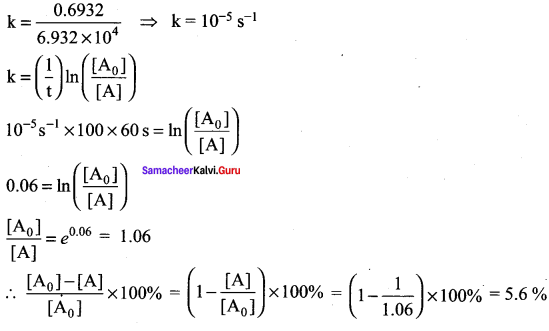
The half life of a first order reaction x → products is 6.932 x 10⁴ s at 500K . What percentage of x would be decomposed on heating at 500K for 100 min. (e0.06 = 1.06)
Solution:
Given t1/2 = 0.6932 x 10⁴ s
To solve: when t = 100 min
Samacheer Kalvi 12th Chemistry Solutions Chapter 7 Chemical Kinetics-112
We know that for a first order reaction,t1/2 = \(\frac { 0.6932 }{ k }\)
Samacheer Kalvi 12th Chemistry Solutions Chapter 7 Chemical Kinetics-113

Question 7.
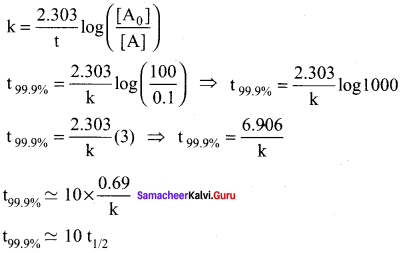
Show that in case of first order reaction, the time required for 99.9% completion is nearly ten times the time required for half completion of the reaction.
Solution:
Let [A0] = 100
When t = t99.9%; [A] = (100 – 99.9) = 0.1
Samacheer Kalvi 12th Chemistry Solutions Chapter 7 Chemical Kinetics-114

Question 8.
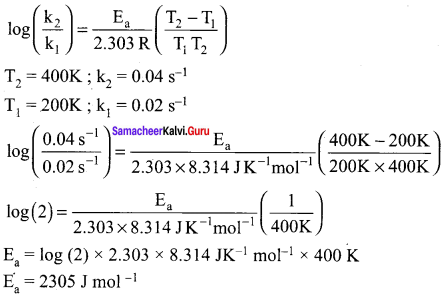
The rate constant of a reaction at 400 and 200K are 0.04 and 0.02 s-1 respectively. Calculate the value of activation energy.
Answer:
According to Arrhenius equation.
Samacheer Kalvi 12th Chemistry Solutions Chapter 7 Chemical Kinetics-115

Question 9.
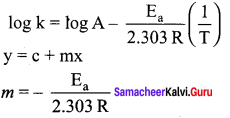
Rate constant k of a reaction varies with temperature T according to the following Arrhenius equation. log k = log A \(\frac { { E }_{ a } }{ 2.303R }\) \(\frac { 1 }{ T }\).

Where E is the activation energy. When a graph is plotted for log k Vs \(\frac { 1 }{ T }\) a straight line with a slope of 4000K is obtained. Calculate the activation energy.
Solution:
Samacheer Kalvi 12th Chemistry Solutions Chapter 7 Chemical Kinetics-116
Ea = – 2.303 Rm
Ea = – 2.303 x 8.314 JK-1 mol-1 x (-4000k)
Ea = 76,589 J mol-1
Ea = 76,589 kJ mol-1

Samacheer Kalvi 12th Chemistry Chemical Kinetics Elements Additional Questions

Samacheer Kalvi 12th Chemistry Chemical Kinetics Elements 1 Mark Questions and Answers

I. Choose the correct answer.

Question 1.
Which one of the following is a slow reaction?
(a) Rusting of iron
(b) Combustion of carbon
(c) Reaction between BaCl2 and dil. H2SO4
(d) Reaction between acidified K2Cr2O7 with NaCl.
Answer:
(a) Rusting of iron

Question 2.
Which one of the following is the unit of rate of reaction?
(a) s-1
(b) mol s-1
(c) mol L-1 s-1
(d) mol L s
Answer:
(c) mol L-1 s-1

Question 3.
For a gas phase reaction, the unit of reaction rate is ……………
(a) s-1
(b) atm s-1
(c) mol L-1 s-1
(d) mol-1 L-1 s-1
Answer:
(b) atm s-1

Question 4.
For the reaction A → 2B, the rate of the reaction is ………….
(a) +\(\frac { d[B] }{ dt }\) = 2 – \(\frac { d[A] }{ dt }\)
(b) +\(\frac { d[A] }{ dt }\) = \(\frac { 1 }{ 2 }\) \(\frac { d[B] }{ dt }\)
(c) Rate = \(\frac { 1 }{ 2 }\) = \(\frac { d[A] }{ dt }\)
(d) Rate = 2\(\frac { d[B] }{ dt }\)
Answer:
(a) +\(\frac { d[B] }{ dt }\) = 2 – \(\frac { d[A] }{ dt }\)

Question 5.
Consider the following statement.
(i) In ionisation of cyclopropane, if the concentration of cyclopropane is reduced half, the rate increases twice.
(ii) The rate of the reaction depends upon the concentration of the reactant.
(iii) Order values must be determined experimentally.

Which of the above statement (s) is / are not correct?
(a) (i) only
(b) (ii) and (iii)
(c) (iii) only
(d) (ii) only
Answer:
(a) (i) only

Question 6.
In the reaction 2NO(g) + O2(g) → 2NO2(g) the order of the reaction with respect to NO is…………
(a) first order
(b) second order
(c) third order
(d) zero order
Answer:
(b) second order

Question 7.
In the reaction 2NO(g) + O2(g) → 2NO2(g). the order of the reaction with respect to O2is …….
(a) zero order
(b) first order
(c) second order
(d) third order
Answer:
(b) first order

Question 8.
The overall order of the reaction 2NO(g) + O2(g) → 2NO2(g) is …………….
(a) 2
(b) 1
(c) 3
(d) 0
Answer:
(c) 3

Question 9.
Consider the following statements.
(i) Rate of the reaction does not depend on the initial concentration of the reactants.
(ii) Rate constant of the reaction depends on the initial concentration of reactants.
(iii) Rate constant of the reaction is equal to the rate of the reaction, when the concentration of each of the reactants is unity.
Which of the above statement(s) is / are not correct?
(a) (i) only
(b) (ii) only
(c) (i) and (ii)
(d) (iii) only
Answer:
(a) (iii) only

Question 10.
The overall molecularity of the reaction 2H2 O2(aq) \(\underrightarrow { { I }^{ – } }\) 2H2O1 + O2(g) is …………
(a) unimolecular
(b) bimolecular
(c) termolecular
(d) pentamolecular
Answer:
(b) bimolecular

Question 11.
Which of the following is the order of decomposition of hydrogen peroxide catalysed by I ………….
(a) First order
(b) Second order
(c) Zero order
(a) Third order
Answer:
(a) First order

Question 12.
Consider the following statements.
(i) order cannot be zero.
(ii) Molecularity can be zero (or) fractional (or) integer.
(iii) order can be determined only by experiment.

Which of the above statement(s) is / are not correct?
(a) (i) only
(b) (ii) only
(c) (iii) only
(d) (i) and (ii)
Answer:
(c) (iii) only

Question 13.
The overall order of the reaction 5Br + BrO3 + 6H+ is ……..
(a) 4
(b) 3/2
(c) 12
(d) 1
Answer:
(a) 4

Question 14.
Which one of the following reaction is a fractional order reaction?
(a) 2NO +O2 → 2NO2
(b) CH3CHO(g) → CH4(g) + CO(g)
(c) 2H2O2 → 2H2)O(1) + O2(g)
(d) H2 + Br2 → 2HBr
Answer:
(b) CH3CHO(g) → CH4(g) + CO(g)

Question 15.
The order of decomposition of acetaldehyde is …………….
(a) 1
(b) 1.5
(c) 2
(d) 5/2
Answer:
(b) 1.5

Question 16.
Which one of the following is the unit of rate constant for a first order reaction?
(a) mol-1 L s-1
(b) mol L-1 s-1
(c) s-1
(d) mol L S
Answer:
(c) s-1

Question 17.
Which one of the following is an example for first order reaction?
(a) 2NO(g)+ O2(g) → 2NO2(g)
(b) CH3CHO(g) → CH4(g) + CO(g)
(c) SO2 Cl2(1) → SO2(g) + Cl2(g)
(d) 2HBr → H2 + Br2
Answer:
(c) SO2 Cl2(1) → SO2(g) + Cl2(g)

Question 18.
Which one of the following is not an example for first order reaction?
(a) N2O5(g) → 2NO2(g) \(\frac { 1 }{ 2 }\) O2(g)
(b) SO2Cl2(1) → SO2(g) + Cl2(g)
(e) H2O2(aq) → H2O1\(\frac { 1 }{ 2 }\)O2(g)
(d) CH3CHO(g) → CH4(g) + CO(g)
Answer:
(d) CH3CHO(g) → CH4(g) + CO(g)

Question 19.
What is the order of isomerisation of cyclopropane to propene?
(a) 1.5
(b) 3/2
(c) 5/2
(d) 1
Answer:
(d) 1

Question 20.
Which one of the following is an example of pseudo first order reaction?
(a) CH3CHO4(g) → CH4(g) + CO(g)
(b) 2H2O2(aq) → H2O(1) +O2(g)
(c) CH3COOCH3(aq) + H2O(1) \(\underrightarrow { { H }^{ + } }\) CH3COOH(aq) + CH3OH(aq)
(d) Isomerisation of cyclo propane to propene
Answer:
(c) CH3COOCH3(aq) + H2O(1) \(\underrightarrow { { H }^{ + } }\) CH3COOH(aq) + CH3OH(aq)

Question 21.
Which one of the following is called pseudo first order reaction?
(a) Decomposition of acetaldehyde
(b) Acid hydrolysis of an ester
(c) Isomerisation of cyclopropane to propene
(d) Decomposition of hydrogen peroxide
Answer:
(b) Acid hydrolysis of an ester

Question 22.
Which of the following is an example of zero order reaction?
(a) lodination of acetone in acid medium
(b) Hydrolysis of an ester in acid medium
(c) Decomposition of acetaldehyde
(d) Isomerisation of cyclopropane to propene
Answer:
(a) lodination of acetone in acid medium

Question 23.
Which one of the follow is not zero order reaction?
(a) H2(g) + Cl2(g) \(\underrightarrow { h\nu }\)  2HCI(g)
(b) N2O(g) \(\rightleftharpoons\) N2(g) + \(\frac { 1 }{ 2 }\) O2(g)
(c) CH3CHO(g) → CH4(g)+ CO(g)
(d) CH3COCH3 + I2 \(\underrightarrow { { H }^{ + } }\) CH2COCH3 + HI
Answer:
(c) CH3CHO(g) → CH4(g)+ CO(g)

Question 24.
Consider the following statements.
(i) For a first order reaction, half life period is independent of initial concentration.
(ii) Photo chemical reaction between H2 and Cl2 is a zero order reaction
(iii) Acid hydrolysis of an ester is a second order reaction

Which of the above statement is/are correct?
(a) (i) only
(b) (iii) only
(c) (i) & (ii)
(d) (ii) & (iii)
Answer:
(c) (i) & (ii)

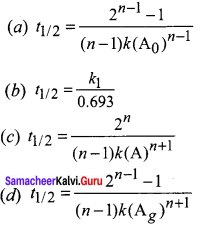
Question 25.
The formula of half life for an nth order reaction involving reactant A and n \(\neq\) 1 is
Samacheer Kalvi 12th Chemistry Solutions Chapter 7 Chemical Kinetics-117
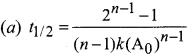
Answer:
Samacheer Kalvi 12th Chemistry Solutions Chapter 7 Chemical Kinetics-118

Question 26.
The half life period of first order reaction is 10 seconds. What is the time required for 99.9% completion of that reaction?
(a) 20 seconds
(b) 1000 seconds
(c) 100 seconds
(d) 999 seconds
Answer:
(c) loo seconds
Hint:
10 x t1/2 = t99.9%
∴ t99.9% = 10 x 10 sec = 100 sec

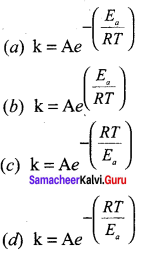
Question 27.
Which one of the following is known as arrhenius equation?
Samacheer Kalvi 12th Chemistry Solutions Chapter 7 Chemical Kinetics-119
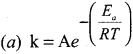
Answer:
Samacheer Kalvi 12th Chemistry Solutions Chapter 7 Chemical Kinetics-120

Question 28.
Which one of the following does not affect the rate of the reaction?
(a) Nature of the reactant
(b) Concentration of the reactants
(c) Surface area and temperature
(d) pressure
Answer:
(d) pressure

Question 29.
Consider the following statements.
(i) Higher the concentration, slower is the possibility for collision and rate also slower
(ii) Increase in surface area of reactant leads to more collisions per litre per second
(iii) Gas phas reactions are slower as compared to solid or liquid reactants

Which of the above statement is/are not correct?
(a) (ii)
(b) (i) & (iii)
(c) (ii) & (iii)
(d) (i) & (ii)
Answer:
(b) (i) & (iii)

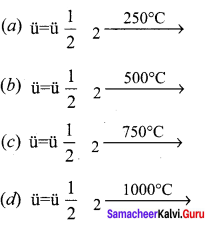
Question 30.
Which of the following reaction take place at a faster rate?
Samacheer Kalvi 12th Chemistry Solutions Chapter 7 Chemical Kinetics-52
Answer:
Samacheer Kalvi 12th Chemistry Solutions Chapter 7 Chemical Kinetics-53

Question 31.
Which one of the following graph is not correct ………..
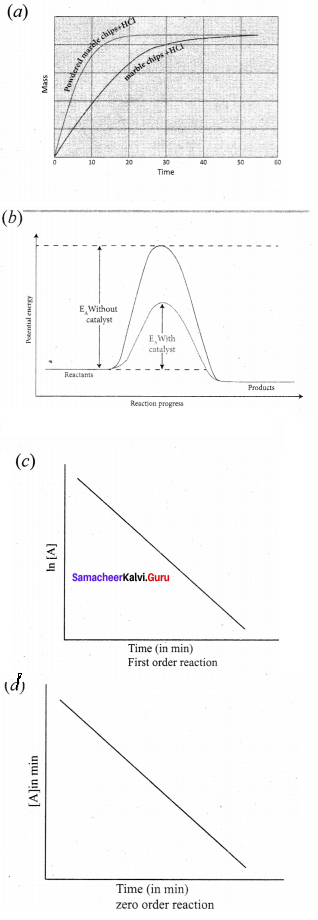
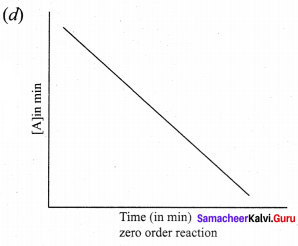
Samacheer Kalvi 12th Chemistry Solutions Chapter 7 Chemical Kinetics-54
Answer:
Samacheer Kalvi 12th Chemistry Solutions Chapter 7 Chemical Kinetics-55

Question 32.
The half life of paracetamol with in the body is ………
(a) 2 hours
(b) 2.5 hours
(c) 6 hours
(d) 10 hours
Answer:
(b) 2.5 hours

Question 33.
What is the order of radioactive decay?
(a) first order
(b) zero order
(c) second order
(d) third order
Answer:
(a) first order

Question 34.
t1/2 of the reaction increases with increase in initial concentration of the reaction means the order of the reaction will be …………
(a) first order
(b) zero order
(c) second order
(d) third order
Answer:
(b) zero order

Question 35.
The reaction rate that does not decrease with time is …………
(a) pseudo first order reaction
(b) first order reaction
(c) zero order reaction
(d) second order reaction
Answer:
(c) zero order reaction

Question 36.
The rate of the reaction X → Y becomes 8 times when the concentration of the reactant ‘X’ is doubled. The rate law of the reaction is ………
(a) – \(\frac { d[x] }{ dt }\) = k[X]2
(b) – \(\frac { d[x] }{ dt }\) = k[X]3
(c) – \(\frac { d[x] }{ dt }\) = k[X]4
(d) – \(\frac { d[x] }{ dt }\) = k[X]8
Answer:
(b) – \(\frac { d[x] }{ dt }\) = k[X]3

Question 37.
The decomposition of ammonia gas on platinum surface has a rate constant k = 2.5 x 10⁻⁴ mol L-1 s-1 What is the order of the reaction?
(a) first order
(b) second order
(c) third order
(d) zero order
Answer:
(d) zero order

Question 38.
A reaction is 50% completed in 2 hours and 75% completed in 4 hours. Then the order of the reaction is ………….
(a) first order
(b) zero order
(c) second order
(d) third order
Answer:
(a) first order
Answer:
(a) first order

Question 39.
What is the rate equation for the reaction A + B → C has zero order?
(a) Rate = k
(b) Rate = k [A]
(c) Rate = k [A]. [B]
(a) Rate = k. \(\frac { 1 }{ [c] }\)
Answer:
(c) Rate = k [A]. [B]

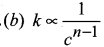
Question 40.
How does the value of rate constant vary with reactant concentration?
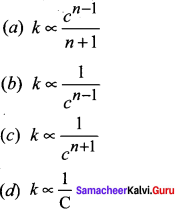
Samacheer Kalvi 12th Chemistry Solutions Chapter 7 Chemical Kinetics-56
Answer:
Samacheer Kalvi 12th Chemistry Solutions Chapter 7 Chemical Kinetics-57

Question 41.
Identify the reaction order if the unit of rate constant is s-1 ……….
(a) zero order reaction
(b) second order reaction
(c) first order reaction
(d) third order reaction
Answer:
(c) first order reaction

Question 42.
What is unit of zero order reaction?
(a) s-1
(b) mol-1 L-1 s-1
(c) mol L-1 s-1
(d) mol L s-1
Answer:
(c) mol L-1 s-1

Question 43.
Which of the following factor affect the rate of the reaction’?
(a) volume
(b) pressure
(c) cone
(d) all the above
Answer:
(c) cone

Question 44.
Acid hydrolysis of an ester is an example of ………
(a) zero order reaction
(b) Pseudo first order reaction
(c) second order reaction
(d) first order reaction
Answer:
(b) Pseudo first order reaction

Question 45.
Polymerisation reactions follows ………………. order kinetics.
(a) fractional
(b) first
(c) zero
(d) Pseudo first
Answer:
(a) fractional

Question 46.
Activation energy of a chemical reaction can be determined by ……….
(a) changing concentration of the reactants
(b) Evaluating rate constants at standard temperature
(c) Evaluating rate constants at two different temperature
(d) Evaluating reIocities of reaction at two different temperature
Answer:
(c) Evaluating rate constants at two different temperature

Question 47.
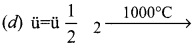
Which of the following is the fastest reaction?
Samacheer Kalvi 12th Chemistry Solutions Chapter 7 Chemical Kinetics-58
Answer:
Samacheer Kalvi 12th Chemistry Solutions Chapter 7 Chemical Kinetics-59

Question 48.
Half life period of a reaction is found to be inversely proportional to the cube of its initial concentration. The order of the reaction is ………
(a) 2
(b) 5
(c) 3
(d) 4
Answer:
(d) 4

Question 49.
A large increase in the rate of a reaction for a rise in temperature is due to ………
(a) the decrease in the number of collisions
(b) increase in the number of activated molecules
(c) the shortening of mean free path
(d) the lowering of activation energy
Answer:
(b) increase in the number of activated molecules

Question 50.
The minimum energy of a molecule would possess in order to enter into a fruitful collision is known as …………..
(a) Reaction energy
(b) collision energy
(c) Activation energy
(d) Threshold energy
Answer:
(a) Threshold energy

II. Fill in the blanks.

  1. The unit of the rate of a reaction is ………..
  2. For a ……….. reaction, the unit of the reaction rate is atm s
  3. An elementary step is characterised by its ………..
  4. The total number of reactant species involved in an elementary step is called ………..
  5. The sum of powers of concentration terms involved in the experimentally determined rate law is called ………..
  6. The overall order of decomposition of acetaldehyde to methane and carbon monoxide is ………..
  7. A second order reaction can be altered to a first order reaction by taking one of the reactant in large excess, it is called ………..
  8. A reaction in which rate is independent of the concentration of the reactant over a wide range of concentration is called ………..
  9. All radioactive disentegration reactions follow ……….. kinetics.
  10. For a first order reaction, half life does not depend on ………..
  11. Half life period of zero order reaction is ……….. proportional to initial concentration of the reactant.
  12. Half life period ……….. reaction is directly proportional to initial concentration of the reactant.
  13.  ……….. was proposed by Max Trautz and William lewis.
  14. Collision theory was proposed by ……….. in 1916 and in ……….. 1918.
  15. For a gas at room temperature (298 K) and I atm, each molecule undergoes approximately ……….. per second.
  16. In order to react, the collidng molecules must possess a minimum energy called ………..
  17. Generally the reaction rate tends to double when the temperature is increased by ………..
  18. The number of collisions of reactant molecules per second is known as ………..
  19. Heating is required for the reaction between KMnO4 and oxalate ion and is carried out at around ………..
  20. ……….. reactions are faster as compared to reactions involving solid or liquid reactants.
  21. The rate of the reaction ……….. with the increase in the concentration of the reactants.
  22. Higher the concentration of reactants greater is the possibility of and hence the ………..
  23. In the presence of catalyst the energy of activation is ……….. and hence greater number of molecules change over to products there by increasing the rate of the reaction.
  24. Bio availability of drugs within the body and this branch of study is called ………..
  25. ……….. has a half life of 2.5 hours within the body.
  26. The change in concentration of species per unit time gives the ……….. of the reaction.
  27. The rate constant is equal to the rate of the reaction when concentration of reactants is ………..
  28. Increase in surface area of reactant leads to more collisions per litre per second and hence the rate of the reaction is ………..
  29. Acid hydroJysis of an ester is an example of ………..
  30. Molecularity of a chemical reaction will never be equal to ………..

Answer:

  1. moI L-1 s-1
  2. gas phase
  3. molecularity
  4. Molecularity
  5. order
  6. 3/2 or 1.5
  7. Pseudo first order reaction
  8. Zero order reaction
  9. First order
  10. initial concentration
  11. directly
  12. zero order
  13. Collision theory
  14. Max Trautz, William lewis
  15. 10 collisions
  16. Activation energy
  17. 10°C
  18. Frequency factor (A)
  19. 60°C
  20. Gas phase
  21. increases
  22. collisions, rate
  23. lowered
  24. Pharmaco kinetics
  25. Paracetamol
  26. rate
  27. unity
  28. increased
  29. Pseudo first order reaction
  30. zero

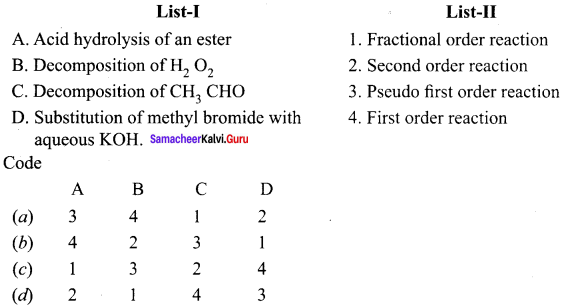
III. Match the following

Match the list I and II using the code given below the list.

Quetion 1.
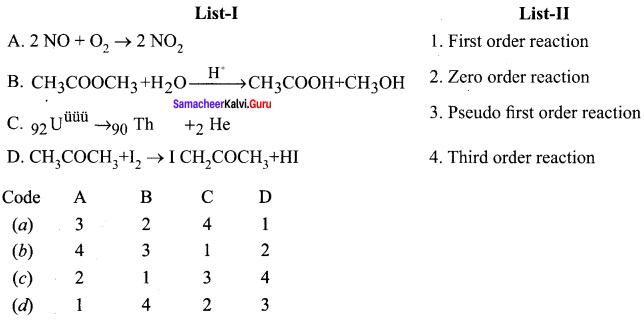
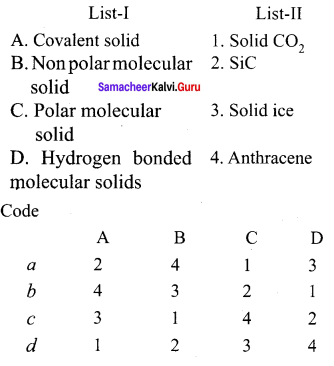
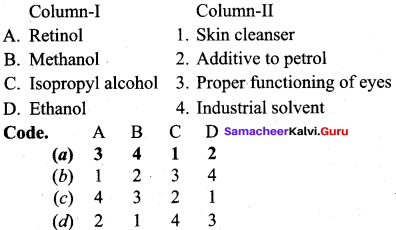
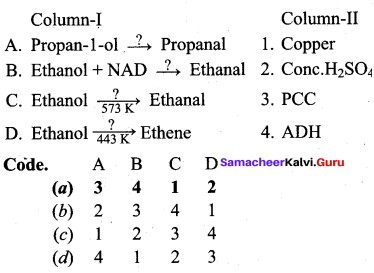
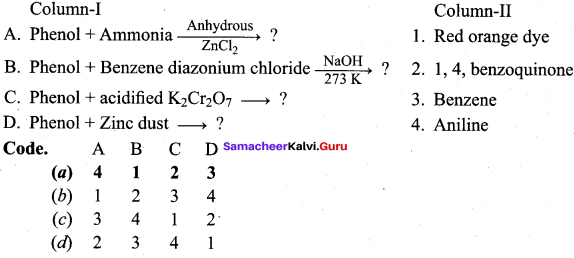
Samacheer Kalvi 12th Chemistry Solutions Chapter 7 Chemical Kinetics-60
Answer:
(a) 3, 4, 1, 2

Question 2.
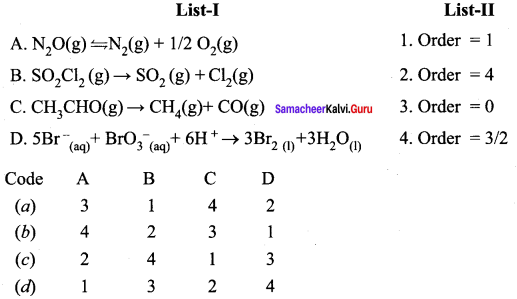
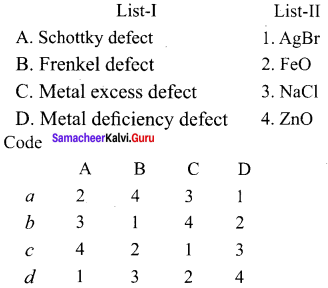
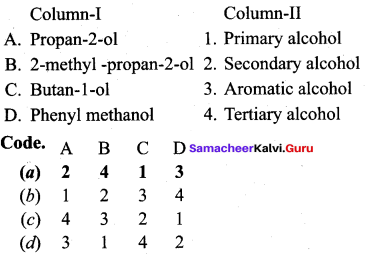
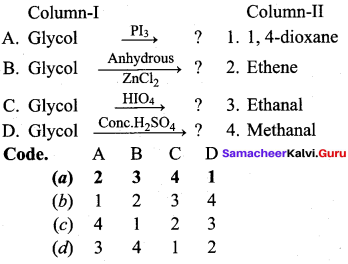
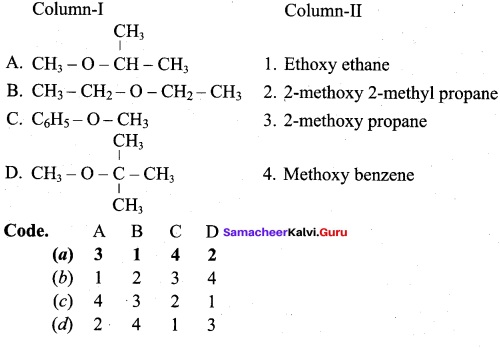
Samacheer Kalvi 12th Chemistry Solutions Chapter 7 Chemical Kinetics-61
Answer:
(a) 3, 4, 1, 2

Question 3.
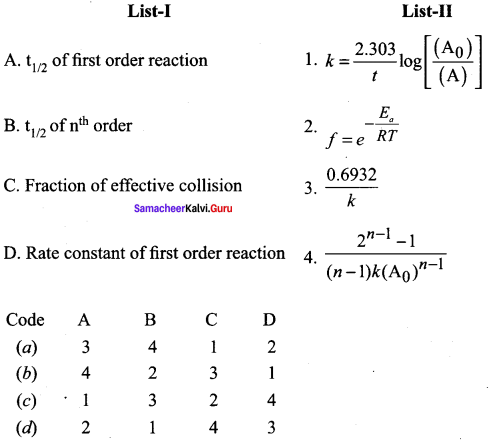
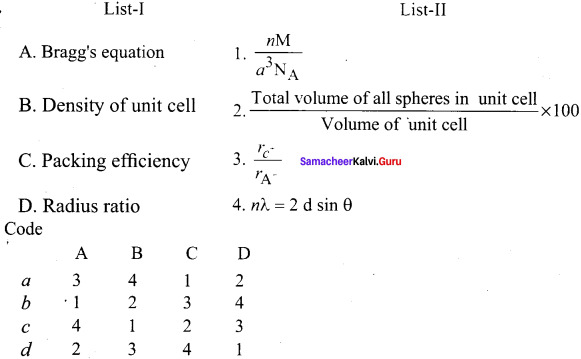
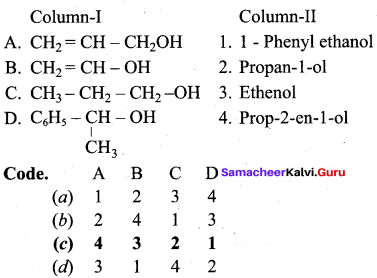
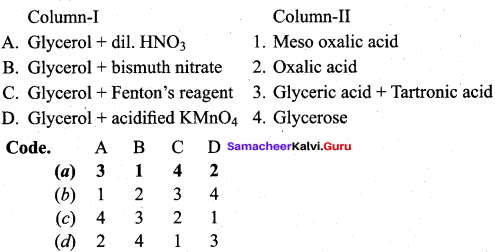
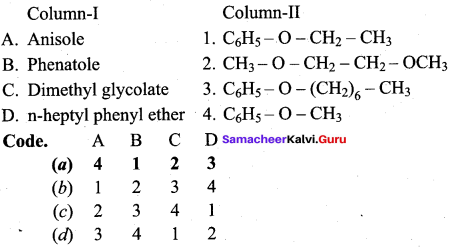
Samacheer Kalvi 12th Chemistry Solutions Chapter 7 Chemical Kinetics-62
Answer:
(a) 3, 1, 4, 2

Question 4.
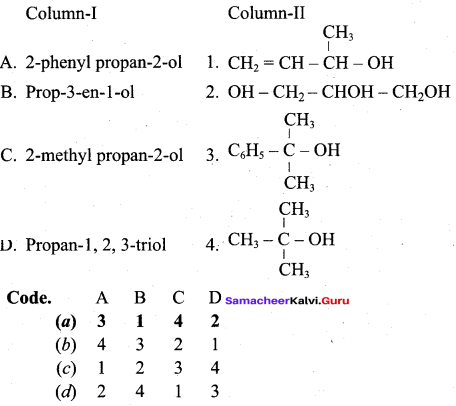
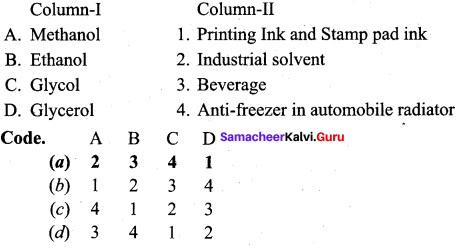
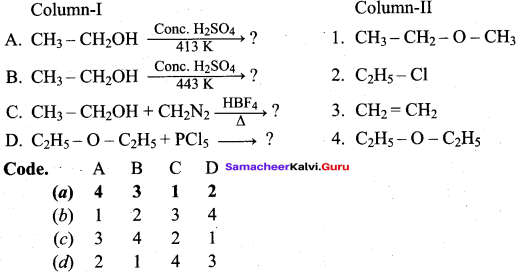
Samacheer Kalvi 12th Chemistry Solutions Chapter 7 Chemical Kinetics-63
Answer:
(a) 3, 4, 2, 1

IV. Assertion and Reason

Question 1.
Assertion (A): Decomposition of hydrogen peroxide catalysed by I is a bimolecular first order reaction.
Reason (R): The above reaction take place in two steps, step 1 involves both H2O2 and I and so it is bimolecular but order is determined experimentally as 1.
(a) Both A and R are correct and R is the correct explanation of A.
(b) Both A and R are correct but R is not the correct explanation of A
(c) A is correct but R is wrong
(d) A is wrong but R is correct
Answer:
(a) Both A and R arc correct and R is the correct explanation of A

Question 2.
Assertion (A): Samacheer Kalvi 12th Chemistry Solutions Chapter 7 Chemical Kinetics-64 The overall order of the reaction is equal to 4.
Reason (R): The experimental rate law is.
Rate = K [Br] [BrO3] [H+]2.
So 1 + 1 + 2 = 4 order value is 4.
(a) Both A and R are correct and R is the correct explanation of A.
(b) Both A and R are wrong
(c) A is correct but R is wrong
(d) A is wrong but R is correct
Answer:
(a) Both A and R are correct and R is the correct explanation olA.

Question 3.
Assertion (A): The rate of a reaction increases with the increase in the concentration of the reactants.
Reason (R): The rate of the reaction depends upon the number of collisions between the reacting molecules. Higher the concentration, greater is the possibility for collision and hence the rate.
(a) Both A and R are correct and R is the correct explanation of A,
(b) Both A and R are correct but R is not the correct explanation of A
(c) A is correct but R is wrong
(d) A is wrong but R is correct
Answer:
(a) Both A and R are correct and R is the correct explanation of A.

Question 4.
Assertion (A): Powdered calcium carbonate reacts much faster with dilute
HCL than with the same mass of CaCO3 as marble.
Reason (R): For a given mass of a reactant, when the particle size decreases, surface area increases. Increase in surface area of the reactant leads to more collisions per litre per second and hence the rate of the reaction also increases.
(a) Both A and R are correct and R is the correct explanation of A.
(b) Both A and R arc correct but R is not correct explanation of A
(c) A is correct but R is wrong
(d) A is wrong but R is correct
Answer:
(a) Both A and R are correct and R is the correct explanation of A.

Question 5.
Assertion (A): Catalyst presence increases the rate of the reaction
Reason (R): In the presence of a catalyst, energy of activation is lowered and hence greater number of molecules can across the energy harrier and change over to products thereby increasing the rate of the reaction.
(a) Both A and R are correct but R is not correct explanation of A
(b) Both A and R are correct and R is the correct explanation of A
(c) A is correct but R is wrong
(d) A is wrong but R is correct
Answer:
(b) Both A and R are correct and R is the correct explanation of A

Question 6.
Assertion (A): Doctors adviced to take paracetamol once in 6 hours during fever and body pain
Reason (R): Paracetarnol has a half life of 2.5 hours within the body. After 10 hours (4 half lives) only 6.25% of drug remains. Based on this, doctors adviced to take it once in 6 hours.
(a) Both A and R are wrong
(b) A is correct but R is wrong
(c) A and R are correct and R is the correct explanation of A
(d) A and R are correct but R is not correct explanation of A
Answer:
(a) Both A and R are correct and R is the correct explanation of A.

Question 7.
Assertion (A): Order of the reaction can be zero or fractional
Reason (R): We cannot determine order from balanced chemical equation
(a) Both A and R are correct but R is not correct explanation of A.
(b) Both A and R are correct and R is the correct explanation of A
(c) A is correct but R is wrong
(d) A is wrong but R is correct
Answer:
(a) Both A and R are correct and R is not correct explanation of A

Question 8.
Assertion (A): If the activation enery of a reaction is zero, temperature will have no effect on the rate constant
Reason (R): Lower the activation energy, faster is the reaction.
(a) Both A and R are correct and R is the correct explanation of A.
(b) Both A and R are correct but R is not correct explanation of A
(c) A is correct but R is wrong
(d) A is wrong but R is correct
Answer:
(b) Both A and R are correct but R is not correct explanation of A

V. Find the odd one out

Question 1.
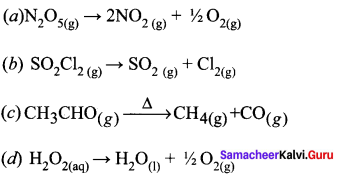
Samacheer Kalvi 12th Chemistry Solutions Chapter 7 Chemical Kinetics-121
Answer:
Samacheer Kalvi 12th Chemistry Solutions Chapter 7 Chemical Kinetics-122
Hint: It is a fractional order reaction with order value 3/2 where as others are first order reaction.

Question 2.
Samacheer Kalvi 12th Chemistry Solutions Chapter 7 Chemical Kinetics-123
Answer:
Samacheer Kalvi 12th Chemistry Solutions Chapter 7 Chemical Kinetics-124
Hint: It is first order reaction whereas others are zero order reaction.

Question 3.
(a) Decomposition of dinitrogen pentoxide
(b) Iodination of acetone in acid medium
(c) Decomposition of N20 on hot Pt surface
(d) photochemical reaction between H2 and CI2
Answer:
(a) Decomposition of dinitrogen pentoxide
Hint: It is a first order reaction whereas others are zero order reactions

Samacheer Kalvi 12th Chemistry Chemical Kinetics Elements 2 Mark Questions and Answers

Question 1.
Define rate of the reaction. Give the unit of rate.
Answer:
1. In a chemical reaction, the change in the concentration of the species involved in a chemical reaction per unit time gives the rate of a reaction.
A → B
Rate = –\(\frac { \triangle [A] }{ dt }\) (or) \(\frac { \triangle [B] }{ dt }\)

2.
Samacheer Kalvi 12th Chemistry Solutions Chapter 7 Chemical Kinetics-65
= mol L-1 s-1

Question 2.
Define molecularity of a reaction.
Answer:
Molecularity of a reaction is the total number of reactant species that are involved in an elementary step.

Question 3.
Define order of a chemical reaction.
Answer:
Order of a chemical reaction is the sum of powers of concentration terms involved in the experimentally determined rate law.

Question 4.
Define Half life period.
Answer:
The half life ola reaction is defined as the time required for the reactant concentration to reach one half its initial value.

Question 5.
Mention the factors affecting the reaction rate.
Answer:
The rate of the reaction is affected by the following factors.

  1. Nature and state of the reactant
  2. Concentration of the reactant
  3. Surface area of the reactant
  4. Temperature of the reaction
  5. Presence of a catalyst

Question 6.
How is surface area of the reactant affect the rate of the reaction?
Answer:

  1. In heterogeneous reactions, the surface area of the solid reactants play an important role in deciding the rate.
  2. For a given mass of a reactant, when the particle size decreases surface area increases. Increase in surface area of reactant leads to more collisions per litre per second and hence the rate of reaction is increased.
  3. For example, powdered calcium carbonate reacts much faster with dilute HCl than with the same mass of CaCO3 as marble.

Question 7.
Paracetamol is prescribed to take once in 6 hours. Justify this statement.
Answer:
1. Paracetamol is a well known antipyretic and analgesic that is prescribed in cases of fever and body pain.

2. Paracetamol has a half life of 2.5 hours within the body. (Le) the plasma concentration of the drug is halved after 2.5 hours. So after 10 hours (4 half lives), only 6.25% of drug remains. Based on this, the dosage and frequency will be decided.

3. In the case of paracetamol, it is usually prescribed to take once in 6 hours.

Question 8.
For a reaction, A + B → product; the rate law is given by r = k[A]1/2 [B]2. What is the order of the reaction?
Answer:
Order of the reaction = \(\frac { 1 }{ 2 }\) + 2 = 2 \(\frac { 1 }{ 2 }\) or 0.5

Question 9.
The conversion of molecules X to Y follows second order kinetics. If concentration of X is increased to three times how will ¡t affect the rate of formation of Y?
Answer:
For the reaction, X → Y as it follows second order kinetics, therefore the rate law equation will be
Rate = k[X]2 = ka2
if [X] = a mol-1
if the concentration of X is increased three times, then
[X] = 3a mol L-1
∴ Rate = k (3a)2 = 9 ka2
Thus, the rate of the reaction will become 9 times. Hence the rate of formation of Y will increase by 9 times.

Question 10.
Time required to decompose SO2Cl2 to half of its initial amount is 60 minutes. If the decomposition is a first order reaction, calculate the rate constant of the reaction.
Answer:
For a first order reaction,
Samacheer Kalvi 12th Chemistry Solutions Chapter 7 Chemical Kinetics-66

Question 11.
What will be the effect of temperature on rate constant?
Answer:
Rate constant of a reaction is nearly doubled with rise in temperature by 10°C. The exact dependence of the rate constant on temperature is given by Arrhenius equation:
Rate constant,
Samacheer Kalvi 12th Chemistry Solutions Chapter 7 Chemical Kinetics-67

Question 12.
A reaction is first order in A and second order in B.

  1. Write the differential rate equation.
  2. How is the rate affected on increasing the concentration of B three times?
  3. How is the rate affected when the concentrations of both A and B arc doubled?

Answer:

  1. \(\frac { dx }{ dt }\) = k [A]1 [B]2
  2. If concentration of ‘B’ is tripled, then the rate will become 9 times.
  3. When concentration of both A and B are doubled, then the rate will become 8 times.

Question 13.
Define zero order reaction. Give the unit for its rate constant(k).
Answer:
Zero Order Reaction. The reaction in which the rate of reaction is independent of the concentration of the reactants is called zero order reaction.
Rate = k [A]0 ⇒ k
Where k is the rate constant. Its unit is mol L-1 s-1

Question 14.
Write units of rate constant k for zero order, first order, second order and n order reaction.
Answer:
Order of Reaction

  1. Zero order reaction
  2. First order reaction
  3. Second order reaction
  4. nth order reaction

Unit of k:

  1. mol L-1 s-1
  2. s-1
  3. mol L s-1
  4. (mol/ L)1-n s-1

Question 15.
What is the effect of catalyst on the activation energy? Why?
Answer:
A Catalyst lower down the activation energy. It provides an alternate path to the reaction. It forms an unstable intermediate which readily changes into products.

Question 16.
Give two differences between zero order and first order reaction.
Answer:
Zero Order:

  1. Its ‘k’ has unit = mol L-1 s-1
  2. Its t 1/2 is directly proportional to initial conc. of reactant

First order:

  1. Its ‘k’ has unit = time-1 = sec-1
  2. Its half life is independent of the initial conc. of the reactant.

Samacheer Kalvi 12th Chemistry Chemical Kinetics Elements 3 Mark Questions and Answers

Question 1.
Write the differences between the rate and rate constant of the reaction.
Answer:
Rate of a reaction:

  1. It represents the speed at which the reactants are converted into products at any instant
  2. It is measured as decrease in the concentration of the reactants (or) increase in the concentration of products
  3. It depends on the initial concentration of reactants

Rate constant of a reaction:

  1. It is a proportionality constant
  2. It is equal to the rate of the reaction, when the concentration of each of the reactants is unity
  3. It does not depend on the initial concentration of the reactants

Question 2.
What are the examples of first order reaction?
Answer:

  1. Decompostion of dinitrogen pentoxide
    N2O2(g) → 2NO2(g) + \(\frac { 1 }{ 2 }\) O2(g)
  2. Decomposition of thionylchloride
    SO2Cl2(g) → SO2(g) + CI2(g)
  3. Decomposition of H2O2 in aqueous solution
    H2O2(aq) → H2O(1) + \(\frac { 1 }{ 2 }\) O2(g)
  4. Isomerisation of cyclopropane to propene

Question 3.
For the reaction R → P, the concentration of a reactant changes from 0.03 M to 0.02 M in 25 minutes. Calculate the average rate of reaction using units of time both in minutes and seconds.
Answer:
Samacheer Kalvi 12th Chemistry Solutions Chapter 7 Chemical Kinetics-68

Question 4.
In a reaction, 2 A → products. the concentration of A decreases from 0.5 moI L-1 to 0.4 mol L-1 in 10 minutes. Calculate the rate during this interval.
Answer:
Average rate
Samacheer Kalvi 12th Chemistry Solutions Chapter 7 Chemical Kinetics-70

Question 5.
A first order reaction has a rate constant, 1.15 x 10⁻³ s-1. How long will 5 g of this reactant take to reduce to 3 g?
Answer:
Here,
[R]0 = 5g
[R] = 3 g
k = 1.15 x 10⁻³ s-1 As the reaction is of first order,
Samacheer Kalvi 12th Chemistry Solutions Chapter 7 Chemical Kinetics-71

Question 6.
Time required to decompose SO2CI2 to half of its initial amount is 60 minutes. If the decomposition is a first order reaction, calculate the rate constant of the reaction. For a first order reaction,
Answer:
Samacheer Kalvi 12th Chemistry Solutions Chapter 7 Chemical Kinetics-72

Question 7.
A reaction is second order with respect to a reactant. How is the rate of reaction affected if the concentration of the reactant is-

  1. doubled
  2. reduced to half.

Answer:
1. Reaction is second order with respect to the reactant
∴ Rate = k[A]2 = ka2.
when [A] = 2a
Rate k (2a)2
= 4ka2
= 4 times
Therefore, when concentration of the reactant is doubled the rate will become 4 times

2. when [A] = \(\frac { 1 }{ 2 }\) a
Rate = k \({ \left( \frac { 1 }{ 2 } a \right) }^{ 2 }\) = \(\frac { 1 }{ 4 }\) ka2 = \(\frac { 1 }{ 4 }\) k
Therefore, rate will be reduced to one-fourth of the initial rate.

Question 8.
The rate constant for a first order reaction is 60 s1. How much time will It take to reduce the initial concentration of the reactant to its 1/6th value?
Answer:
Samacheer Kalvi 12th Chemistry Solutions Chapter 7 Chemical Kinetics-73

Question 9.
For a first order reaction, show that time required for 99% completion is twice the time required for the completion of 90% of reaction.
Answer:
For a first order reaction, t = k = \(\frac { 2.303 }{ t }\) log \(\frac { a }{ a-x }\)
99% completion means that
x = 99% of a =0.99 a
t99% = \(\frac { 2303 }{ k }\) log \(\frac { a }{ a-0.99a }\) = \(\frac { 2.303 }{ k }\) log 102 = 2 x \(\frac { 2303 }{ k }\)
90% completion means that
x = 90% of a = 0.90 a
t99% = \(\frac { 2303 }{ k }\) log \(\frac { a }{ a-0.99a }\) = \(\frac { 2.303 }{ k }\) log 10 = \(\frac { 2.303 }{ k }\)
\(\frac{t_{99 \%}}{t_{90 \%}}=\left(\frac{2 \times 2303}{k}\right) / \frac{2.303}{k}=2\)
or
t99% = 2 x t90%

Question 10.
Calculate the half life of a first order reaction whose rate constant is 200 s-1
Answer:
Here rate constant
k= 200 s-1
∴ Half – life of a first order reaction is
t1/2 = \(\frac { 0.693 }{ k }\) = \(\frac { 0.693 }{ 200 }\) = 3.46 x 10⁻³ sec

Question 11.
The decomposition of dinitrogen pentoxide (N2O) follows the first order rate law. Calculate the rate constant from the given data.
t = 800 sec, [N2O5] = 1.45 moI L-1 = [A2]
t = 1600 sec
[N2O3] = 0.88 moI L-1 = [A2]
Answer:
Applying the formula,
k = \(\frac { 2.303 }{ \left( { t }_{ 2 }-{ t }_{ 1 } \right) }\) log 10 \(\frac { \left[ { A }_{ 1 } \right] }{ \left[ { A }_{ 2 } \right] }\)
= \(\frac { 2.303 }{ (1600 – 800) }\) log 10 \(\frac { 1.45 }{ 0.88 }\) = \(\frac { 2.303 }{ 800 }\) x 0.2169
= 6.24 x 10⁻⁴ sec-1

Question 12.
A second order reaction in which both the reactants have same concentration, is 20% completed in 500 seconds. How much time it will take for 60% completion?
Answer:
The second order equation when both the reactants have same concentration is
k = \(\frac { 1 }{ t }\). \(\frac { x }{ a(a – x) }\)
If a = 100, x = 20, 1= 500 seconds
Then k = \(\frac { 1 }{ 500 }\) x \(\frac { 20 }{ 100  x  (100-20) }\)
When
a = 100
x = 60
t = ?
t = \(\frac { 1 }{ k }\) \(\frac { 60 }{ 100  x  40 }\)
Substituting the value of k,
t = \(\frac { 500  x  100  x  80 }{ 20 }\) x \(\frac { 60 }{ 100  x  40 }\)
or
t = 3000 seconds

Question 13.
A first order reaction is 20% completed in 10 minutes. Calculate the time taken for the reaction to go to 80% completion.
Answer:
Applying the first order equation,
k = \(\frac { 2303 }{ t }\) l0g \(\frac { { \left[ R \right] }_{ 0 } }{ \left[ R \right] }\)
At t = 10 min
R = 100 – 20
k = \(\frac { 2303 }{ t }\) log 10 \(\frac { 100 }{ (100 – 20) }\)
t = \(\frac { 2303 }{ 10 }\) log 10 \(\frac { 100 }{ 80 }\)
= 0.0223 min-1

Question 14.
For a reaction: 2NH3(g)  \(\underrightarrow { Pt }\)  N2(g)+ 3H2(g) Rate = K

  1. Write the order and molecularity of this reaction.
  2. Write the unit of K.

Answer:

  1. Order of reaction Zero order. Molecularity = 2
  2. Unit of K = mol L-1 sec-1

Samacheer Kalvi 12th Chemistry Chemical Kinetics Elements 5 Marks Questions and Answers

Question 1.
How would you calculate the order of the reaction 2NO + O2(g) → 2NO2(g) by an experiment?
(or)
prove that 2NO + O2 → 2 NO2 is a third order reaction.
Answer:
2NO(g) + O2(g) → 2NO2(g)
Series of experiments are conducted by keeping the concentration of one of the reactants as constant and changing the concentration of the others.
Samacheer Kalvi 12th Chemistry Solutions Chapter 7 Chemical Kinetics-76
Rate = k [NO]m[O2]n
For experiment 1, the rate law is
Rate1 = k [NO]m [O2]n
19.26 x 10-2 = k [1.3]m [1.1]n ………………….(1)
For experiment 2
Rate2 = k [NO]m [O2]n
38.40 x 10-2 = k [1.3]m [2.2]n ……………….(2)
For experiment 3
Rate3 = k [NO]m [O2]n
76.8 x 10-2 = k [2.6]m [1.1]n ………………(3)
Samacheer Kalvi 12th Chemistry Solutions Chapter 7 Chemical Kinetics-77
2 = \({ \left( \frac { 2.2 }{ 1.1 } \right) }^{ n }\)
4 = 2m
⇒ n = 1
Therefore the reaction is first order with respect to O2
Samacheer Kalvi 12th Chemistry Solutions Chapter 7 Chemical Kinetics-78
2 = \({ \left( \frac { 2.6 }{ 1.3 } \right) }^{ m }\)
4 = 2m
⇒ m = 1
Therefore the reaction is second order with respect to NO
The rate law is Rate = k [NO]2 [O2]1
The overall order of the reaction = 2 + 1 = 3

Question 2.
Derive the integrated rate law for a first order reaction?
Answer:
A reaction whose rate depends on the reactant concentration raised to the first power is called a first order reaction. First order reaction is A → product. Rate law can be expressed as, Rate = k [A]1. Where, k is the first order rate constant
\(\frac { -d[A] }{ dt }\) = k[A]1
\(\frac { -d[A] }{ [A] }\) = k.dt ……………………(1)
Integrate the above equation (I) between the limits of time t = 0 and time equal to t, while the concentration varies from initial concentration [A0] to [A] at the later time.
Samacheer Kalvi 12th Chemistry Solutions Chapter 7 Chemical Kinetics-79
This equation (2) is in natural logarithm. To convert it into usual logarithm with base 10, we have to multiply the term by 2.303
Samacheer Kalvi 12th Chemistry Solutions Chapter 7 Chemical Kinetics-80

Question 3.
Explain the effect of temperature on reaction rate based on Arrhenius theory.
Answer:
1. Generally, the rate of a reaction increases with increasing temperature. However, there are very few exceptions.

2. As a rough rule, for many reactions near room temperature, reaction rate tends to double when the temperature is increased by 10°C.

3. A large number of reactions are known which do not take place at room temperature but occur readily at higher temperature. Example – Reaction between H2 and O2 to form H2O takes place only when an electric spark is passed.

4. Arrhenius suggested that the rates of most reactions vary with temperature in such a way that the rate constant is directly proportional to
Samacheer Kalvi 12th Chemistry Solutions Chapter 7 Chemical Kinetics-81 and he proposed a relation between the rate constant and temperature.
Samacheer Kalvi 12th Chemistry Solutions Chapter 7 Chemical Kinetics-82
where
k = frequency factor
R = gas constant ,
Ea = Activation energy
T = Absolute temperature (in kelvin)
The factor A does not vary significantly with temperature and hence it may be taken as a constant.

5. Taking logarithm on both side of the equation (1)
Samacheer Kalvi 12th Chemistry Solutions Chapter 7 Chemical Kinetics-83

6. The plot of Ink vs \((\frac { 1 }{ T })\) is a straight line with negative slope\(\frac { { E }_{ a } }{ RT }\). If the rate constant for a reaction at two different temperatures is known, we can calculate the activation energy.
Samacheer Kalvi 12th Chemistry Solutions Chapter 7 Chemical Kinetics-84
This equation can be used to calculate E from rate Ea constants k1 & k2 at temperature T1 and T2

Question 4.
Explain about the factors that affecting the reaction rate.
Answer:
The rate of a reaction is affected by the following factors.
1. Nature and state of the reactant
(a) A chemical reaction involves breaking of certain existing bonds of the reactant and forming new bonds which lead to the product. The net energy involved in this process is dependent on the nature of the reactant and hence the rates are different for different reactants.

(b) Gas phase reactions are faster as compared to the reactions involving solid or liquid reactants. For example, reaction of sodium metal with iodine vapours is faster than the reaction between solid sodium and solid iodine.

2. Concentration of the reactant
The rate of the reaction increases with the increase in the concentration of the reactants. According to collision theory, the rate of the reaction depends upon the number of collisions between the reacting molecules. Higher the concentration, greater is the possibility for collision and hence the rate.

3. Effect of surface area of the reactant:
In heterogeneous reactions, the surface areas of the solid reactants plays an important role in deciding the rate. For a given mass of a reactant, when the particle size decreases surface area increases.

Increase in surface area of reactant leads to more collisions per litre per second and hence the rate of reaction is increased. For example, powdered calcium carbonate reacts much faster with dilute HCI than with the same mass of CaCOl as marble

4. Temperature:
For many reactions near room temperature, the reaction rate tends to double when the temperature is increased by 10°C . For eg, Reaction between H2 and O2 to form H2O take place only when an electric spark is passed. So when the temperature increases, the rate of the reaction also increases.

5. Effect of presence of catalyst
(a) A catalyst is substance which alters the rate of a reaction without itself undergoing any permanent chemical change. They may participate in the reaction, but again regenerated and the end of the reaction.

(b) In the presence of a catalyst, the energy of activation is lowered and hence greater number of molecules can cross the energy barrier and change over to products,thereby increasing the rate of the reaction.

Question 5.
The decomposition of A into product has value of k as 4.5 x 10³ s-1 at 10°C and energy of activation 60 kJ mol-1. At what temperature would k be 1.5 x 10⁴ s-1 ?
Answer:
k1 = 4.5 x 10³ s-1
T1 = 10 + 273 K = 283 K
k2 = 1.5 x 10⁴ s-1
T2 = ?
Ea = 6o kJ mol-1
According to Arrhenius equation
Samacheer Kalvi 12th Chemistry Solutions Chapter 7 Chemical Kinetics-85

Question 6.
For a decomposition reaction the values of rate constant k at two different temperatures are given below:
k1 = 2.15 x 10 L mol-1 s-1 at 650 K
k2 = 2.39 x 10 L mol-1 s-1 at 700 K
Calculate the value of activation energy for this reaction. (R = 8.314 J K-1 mol-1 )
Answer:
Here
k1 = 2.15 x 10 L mol-1 s-1 at 650 K
T1 = 650 K
T2 = 700K and
k2 = 2.39 x 10 L mol-1 s-1 at 700 K
R = 8.314 J K-1 mol-1
Using the formula
Samacheer Kalvi 12th Chemistry Solutions Chapter 7 Chemical Kinetics-86

Question 7.
For a certain chemical reaction variation In concentration, In IRI Vs time (s) plot is given below.
For this reaction write/draw:

  1. What is the order of the reaction?
  2. What is the units of rate constant (k)?
  3. Give the relationship between k and t1/2 (half-life period).
  4. What does the slope of above line indicate?
  5. Draw the plot of log [R0]/[R] vs time (s)

Samacheer Kalvi 12th Chemistry Solutions Chapter 7 Chemical Kinetics-87

Answer:
1. First order
2. time-1 (s-1)
3. Samacheer Kalvi 12th Chemistry Solutions Chapter 7 Chemical Kinetics-88
4.  Rate constat (k) of reaction
5. Samacheer Kalvi 12th Chemistry Solutions Chapter 7 Chemical Kinetics-89

Question 8.
A substance reacts according to the first order rate law and the specific reaction rate for the reaction ¡s 1 x 10⁻² s-1. If the initial concentration is 1.0 M.

  1. What is the initial rate?
  2. What ¡s the reaction rate after 1 minute?

Answer:

1. Initial rate of a first order reaction
= k C
= l x 10-2 x 1.0
= l x 10-2 mol L-1 s-1

2. Concentration after 60 seconds is calculated by applying the first order kinetic equation,
Samacheer Kalvi 12th Chemistry Solutions Chapter 7 Chemical Kinetics-90
Rate of reaction after 1 minute
= k x C
= l x 10-2 x 0.5489
5.489 x 10⁻³ mol L-1 s-1

Question 9.
A first order reaction is 50% completed in 30 minutes at 27°C and in 10 minutes at 47°C. Calculate the reaction rate constant at 27°C and the energy of activation of the reaction in kJ mol-1
Answer:
For a first order reaction
Samacheer Kalvi 12th Chemistry Solutions Chapter 7 Chemical Kinetics-91

Now applying the following equation:
Samacheer Kalvi 12th Chemistry Solutions Chapter 7 Chemical Kinetics-92

Question 10.
In Arrhenius equation for a certain reaction, the values of A and E (activation energy) are 4 x 10¹³ sec-1 and 98.6 KJ mol-1 respectively. If the reaction is of first order, at what temperature will its half life period be 10 minutes?
Answer:
According to the Arrhenius equation.
Samacheer Kalvi 12th Chemistry Solutions Chapter 7 Chemical Kinetics-93
For a first order reaction
t1/2 = \(\frac { 0.693 }{ k }\) \(\frac { 0.693 }{ 600 }\)
So,
k = \(\frac { 0.693 }{ 600 }\) sec-1 (t1/2 = 10 min = 600 sec)
= 1.1 x 10⁻³ sec-1
Hence, log (1.1 x 10⁻³)
Samacheer Kalvi 12th Chemistry Solutions Chapter 7 Chemical Kinetics-94

Common Errors

Common Errors:

  1. Order and molecularity may get confused
  2. Unit of first order Rate constant and zero order may get con fused.
  3. t1/2 – Half liefe period may be difficult to remember

Rectifications:

  1. Order and molecularity are same for the single step process. But for reactions of more than one step, they may be different.
  2. First order sec-1, Zero order – mol litre-1 sec-1
  3. t1/2 = 0.693 / k1 for first order reaction.

Hope you love the Samacheer Kalvi 12th Chemistry Chapter Wise Material. Clearly understand the deep concept of Chemistry learning with the help of Tamilnadu State Board 12th Chemistry Chapter 7 Chemical Kinetics Questions and AnswersPDF. Refer your friends to and bookmark our website for instant updates. Also, keep in touch with us using the comment section.
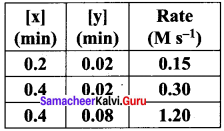
Samacheer Kalvi 6th Social Science Civics Solutions Term 2 Chapter 1 National Symbols

You can Download Samacheer Kalvi 6th Social Science Book Solutions Guide Pdf, Tamilnadu State Board help you to revise the complete Syllabus and score more marks in your examinations.

Tamilnadu Samacheer Kalvi 6th Social Science Civics Solutions Term 2 Chapter 1 National Symbols

Samacheer Kalvi 6th Social Science National Symbols Textual Evaluation

I. Choose the correct answer:

Samacheer Kalvi Guru 6th Social Science Term 2 Question 1.
The National Song Vande Mataram was composed by _______
(a) Pingali Venkayya
(b) Rabindra Nath Tagore
(c) Bankim Chandra Chatterjee
(d) Gandhiji
Answer:
(c) Bankim Chandra Chatterjee

National Symbols In Tamil Question 2.
Which is the National Anthem of India?
(a) Jana Gana Mana
(b) Vande Mataram
(c) Amar Sonar Bangla
(d) Neerarum Kaduluduththa
Answer:
(a) Jana Gana Mana

Questions On National Symbols Of India Question 3.
Who wrote the most ramous novel Anand Math?
(a) Akbar
(b) Rabindra Nath Tagore
(c) Bankim Chandra Chatterjee
(d) Jawaharlal Nehru
(c) Bankim Chandra Chatterjee
Answer:
(c) Bankim Chandra Chatterjee

Samacheer Kalvi 6th Social Term 2 Question 4.
________ birthday is celebrated as the International Day of non-violence?
(a) Mahatma Gandhi
(b) Subash Chandra Bose
(c) Sardar Vallabhai Patel
(d) Jawaharlal Nehru
Answer:
(a) Mahatma Gandhi

6th Standard Symbol Question 5.
The colour of the Asoka chakra found in our National flag is _______
(a) sky blue
(c) blue
(b) navy blue
(d) green
Answer:
(b) navy bluel

Question 6.
The first flag ever flown after the Independence is stored in ……………..
(a) Chennai fort Museum
(b) Delhi Museum
(c) Saranath Museum
(d) Kolkata Museum
Answer:
(a) Chennai fort Museum

Question 7.
The National Anthem was written by _______
(a) Devandranath Tagpre
(c) Rabindranath Tagore
(b) Bharathiyar
(d) Balagangadhar Tilak
Answer:
(c) Rabindranath Tagore

Question 8.
The time taken to play the National Anthem is ……………..
(a) 50 seconds
(b) 52 minutes
(c) 52 seconds
(d) 20 seconds
Answer:
(c) 52 seconds

Question 9.
“Vande Mataram” was first sung by _______ at the 1896 session of the National Congress
(a) Bankim Chandra Chatterjee
(c) Mahatma Gandhi
(b) Rabindranath Tagore
(d) Sarojini Naidu
Answer:
(b) Rabindranath Tagore

Question 10
________ hoists the flag on Independence day in Delhi.
(a) The Prime Minister
(b) The President
(c) Vice President
(d) Any Political leader
Answer:
(a) The Prime Minister

II. Fill in the blanks :

  1. The National emblem was adapted from the Ashoka pillar of ______
  2. The National fruit of India is______
  3. The National Bird of India is______
  4. Our National tree is the______
  5. The Flag which was flown in 1947 Independence day was weaved in______
  6. The Indian National Flag was designed by ______
  7. ______ started the Saka Era
  8. The longest river in India is______
  9. The Indian Rupee symbol was designed by ______
  10. The Chakra of the National Flag has______ spokes

Answer:

  1. Sarnath
  2. Mango
  3. peacock
  4. Banyan tree
  5. Gudiyatham
  6. Pingali Venkayya
  7. Kanishka
  8. The Ganges
  9. D. Udhaya
  10. 24

III. Choose the correct answer

  1. The Lion Capital is now in the ______ museum (Kolkata/Samath)
  2. The National Anthem was adopted in ______
  3. ______ is declared as our National Micro organism (Lacto bacillus / Rhizobium)

Answer:

  1. Sarnath
  2. 1950
  3. Lacto bacillus

IV. Fill in the blanks:

  1. Saffron — Courage ; White – _______
  2. Horse — Energy; Bull – _______
  3. 1947 — Independence day; 1950 – _______

Answer:

  1. Honesty, peace, purity
  2. Hardwork and dedication
  3. Republic day

V. Chooose the Correct Option:

1) Rabindranath Tagorea – a.National Song
2) Bankim Chandra Chatteijee – b. National Flag
3) Pingali Venkayyac. – c. Astro Physicist
4) Meghnad Saha – d. National Anthem
a) a d b c
b) d a c b
c) d a b c
Answer:
c) d a b c

VI. Match and choose the wrong answer:

  1. National Reptile – Tiger
  2. National Aquatic Animal – Lacto bacillus
  3. National Heritage Animal – King Cobra
  4. National Micro organism – Dolphin

Answer:

  1. National Reptile – King Cobra
  2. National Aquatic Animal – Dolphin
  3. National Heritage Animal – Tiger
  4. National Micro organism – Lacto bacillus

VII. Choose the Wrong sentence:

Question 1.
a) The ratio of our National Flag’s length and breadth is 3:2
b) The Chakra has 24 spokes
c) The Chakra is Sky Blue in colour
Answer:
c) The Chakra is Blue in colour [Clue : Navy Blue is correct]

Question 2.
a) The National Flag was designed by Pingali Venkayya
b) The First ever flown Flag after the Independence is stored in Kolkata Museum
c) The First National Flag was weaved in Gudiyattam
Answer:
b) The First ever flown Flag after the Independence is stored in Kolkata Museum,

VIII. Choose the correct sentence:

a) August 15 is celebrated as the Independence day
b) November 26 is celebrated as the Republic day
c) October 12 is celebrated as Gandhi Jayanti
Answer:
a) August 15 is celebrated as the Independence day

IX. Answer the following:

Question 1.
What do the colours in our National Flag represent?
Answer:

  1. The saffron at the top represents valour and sacrifice.
  2. The green at the bottom represents fertility and prosperity.
  3. The white band in between represents honesty, peace and purity.
  4. The Ashoka chakra or the wheel in navy blue represents truth and peace.

Question 2.
What are the parts of our National emblem?
Answer:

  1. Our National emblem consists of two parts the upper and the lower parts.
  2. The upper part has four lions facing the North, South, East and West on a circular Pedestal.
  3. The lower part has an elephant, a horse, a bull and a lion. The wheel of right sourness is placed between them.

Question 3.
What are the salient features of the National anthem?
Answer:

  1. ‘Jana Gana Mana’ is our National anthem.
  2. It symbolises the sovereignty and intergrity of our Nation.
  3. This anthem was written by Rabindranath Tagore in Bengali.

The rules to be observed while singing the Anthem

  1. This anthem has to be sung at a duration of 52 seconds.
  2. Everyone should stand erect while singing the national anthem,
  3. One should understand the meaning while singing.

Question 4.
Draw and define the Indian Rupee Symbol.
Answer:

  1. The Indian Rupee sign is the official currency of India. (Designed by D. Udhaya Kumar)
  2. It was presented to the public by the Government of India on 15 July 2010.
  3. Shershah Sur’s currency was Rupiya.
  4. This Rupiya has been transformed into Rupees the Indian Currency.
  5. The symbol of Rupees in.
  6. This was designed by D. Udhayakumar from Tamil Nadu in 2010.

Question 5.
Where do we use our National emblem?
Answer:
The National emblem is found at the top of the Government Communication, Indian Currency and passport.

Question 6.
Who wrote the National Pledge?
Answer:
Pydimarri Venkata Subha Rao wrote the National Pledge.

Question 7.
What are the animals found in the bottom of the emblem?
Answer:
In the bottom of the emblem, we see an elephant, a horse, a bull and a lion.

Question 8.
What are the natural national Symbols?
Answer:

  1. Banyan tree
  2. Peacock
  3. River Ganges
  4. Dolphin
  5. King Cobra
  6. Lotus
  7. Tiger
  8. Elephant
  9. Lactobacillus
  10. Mango

Question 9.
Where is the peacock sanctuary located in Tamil Nadu?
Answer:
There is a peacock sanctuary at Viralimalai in the district of Pudukottai (Tamil Nadu).

X. Activities:

Question 1.
What should we do to protect the endangered plants and animals – Discuss.
Answer:

  1. Grow native plants.
  2. Reduce your water consumption.
  3. Recycle and buy sustainable products.
  4. Do not buy plastic products.
  5. Volunteer your time to protect the wildlife in your area.
  6. Do not purchase products from companies
  7. Avoid supporting the market in illegal wildlife including tortoise-shell, ivory, and coral.
  8. Herbicides and pesticides are hazardous pollutants that affect wildlife at many levels.
  9. Educate friends and relatives about endangered species in your area.

Question 2.
Celebrate the national eyents in your school and prepare a news item for a local
newspaper.
Answer:
Republic Day Celebrations in our XYZ Hr. Sec. School
A Report
On the morning of 26th Jan, our school, XYZ Hr. Sec. School, celebrated Republic Day in the school premises. It was a matter of great pride for all of us. Our Headmaster, teachers and the students didn’t want to leave any stone unturned in making this monumental day a memorable one.

The DIG of the City Police was the Chief Guest. He came on time. He was warmly welcomed by the whole staff led by our Headmaster. Then our Headmaster took him to the Function venue. There our hon’ble guest unfurled the national flag. With that everybody stood erected for National Anthem sung by the students. Then there were parades by NCC cadets of the school. After this, students presented cultural items.

These cultural items included patriotic songs, folk dances and speeches. Some students also presented skit based on fight against terrorist. Then there were speakers who through their speeches invoked the precious contribution of great freedom fighters.

With a couple more cultural items, the function ended with national anthem. Towards the end, all the people there flew colored balloons symbolizing prosperity and peace. Despite weather being inclement, we enjoyed Republic Day with great enthusiasm. Along with other students, I will never forget this wonderful day.

XI. Life skill activity:

Question 1.
Why are certain organisms adopted as natural National symbols? Analyse.
Answer:
Along with various animals and birds, which form part of the national symbols of India, the Indian government adopted a microorganism called lactobacillus delbrueckii in the year 2012 as our national microorganism.

The reason for doing so, is primarily educational and to create awareness among people about the importance of microorganisms. Lactobacillus is an important bacteria used in food production.

Lactobacillus species are used for the production of yogurt, cheese, sauerkraut, pickles, beer, wine, cider, kimchi, cocoa, and other fermented foods, as well as animal feeds, such as silage.

Samacheer Kalvi 6th Social Science National Symbols InText Questions

HOTS

Question 1.
Who has been given the right to manufacture the National flag?
Answer:

  1. By law the flag is to be made of Khadi.
  2. The right to manufacture the flag is held by the Khadi Development and Village Industries Commission who allocates it to regional groups.
  3. As of 2009, the Karnataka Khadi Gramodyoga Samyukta Sangha has been the sole manufacturer of the flag.

Samacheer Kalvi 6th Social Science National Symbols Additional Questions

I. Choose the Correct answer

Question 1.
Wildlife Protection Act was passed in the year.
(a) 1970
(b) 1971
(c) 1972
(d) 1973
Answer:
(c) 1972

Question 2.
The National flower of India is
(a)’ Lotus
(b) Jasmine
(c) Rose
(d) Lily
Answer:
(a) Lotus

Question 3.
The Government of India adopted Elephant as a natural National symbol in the year.
(a) 1950
(b) 1963
(c) 1973
(d) 2010
Answer:
(d) 2010

Question 4.
Congress committee in 1911 Was held at
(a) Chennai
(b) Delhi
(c) Kolkata
(d) Bombay
Answer:
(c) Kolkata

Question 5.
The symbol Indian National Currency was designed by
(a) Ravikumar
(b) Udhyakumar
(c) Krishnakumar
(d) Manojkumar
Answer:
(b) Udhyakumar

II. Fill in the blanks:

  1. Tirupur Kumaran was bom in _______
  2. Tirupur Kumaran honoured with the titile _______
  3. Satyameva Jayate means _______
  4. Lactobacillus was accepted as our National Micro organism in the year _______
  5. SherShah sur introduced rupee currency Rupiya in the _______
  6. During a leap year the spring equinox begins on _______
  7. World’s biggest democracy is _______
  8. Aaduvome Pallu Paduvome” was sung by _______ Over the AIR
  9. The first citizen of India is the _______
  10. On Republic Day, the _______ of India the National Flag at the red fort,New Delhi
  11. The International Day of Non-violence is observed on _______

Answer:

  1. Chennimalai
  2. Kodi Kaatha Kumaran
  3. Truth alone Triumphs
  4. 2012
  5. Sixteenth Century
  6. March 21th
  7. India
  8. T.K. pattammal
  9. President
  10. President
  11. 2nd October

III. Match the following:

1.The First Indian Flaga.Chennai
2.Pingali venkayyab.Passport
3.St. George’s Fortc.National Calendar
4.National Emblemd.Gudiyatham
5.Meghnad Sahae.Andhra Pradesh

IV. Answer the following questions :

Question 1.
Explain the ‘Beating retreat’ Ceremony.
Answer:
On January 29, the third day of the Republic day, the celebrations are brought to an end with the “ Beating Reteat” ceremony. This is performed by the bands of Indian Army, Navy and Airforce. The President of India is the chief guest of this day. Rashtrapati Bhavan will be illuminated at 6pm as a part of the celebration.

Question 2.
Write a note on Kodi Katha Kumaran.
Answer:

  1. Tirupur Kumaran was bom in Chennimalai of Erode district.
  2. As a youth, he actively participated in the freedom struggle of India,
  3. in 1932, when Gandhiji was arrested, there were protests all over India.
  4. Tirupur Kumaran took active part in these protests.
  5. He lost his life when the police attacked violently.
  6. He held on to the tricolour flag even when he died.
  7. He was honoured with the title, ‘Kodi Kaatha Kumaran’.

Question 3.
Write about Tamil Nadu’s National Symbols.
Answer:

Samacheer Kalvi Guru 6th Social Science Term 2 Chapter 1 National Symbols

Question 4.
Explain the natural national symbols.
Answer:

  1. Banyan tree (1950). It is a symbol of pride and has many medicinal values.
  2. Peacock (1963). It is native to Asia and the only bird which has a tail.
  3. River Ganges (2008) is a perennial river and many royal capitals flourished on its banks.
  4. River Dolphin (2010). It is the reliable indicator of the health of the entire river eco-system. It is in the endangered list.
  5. King Cobra – It is the World’s longest venomous snake and lives in the rain forests and plains of India.
  6. Lotus (1950) Though it grows in muddy water, it blooms with beauty.
  7. Tiger (1973) It is the largest cat species. India has 70% of tigers population in the world.
  8. Elephant (2010) It is native to mainland Asia and plays a critical role in maintaining the regions forests.

Samacheer Kalvi 6th Science Solutions Term 3 Chapter 1 Magnetism

You can Download Samacheer Kalvi 6th Science Book Solutions Guide Pdf, Tamilnadu State Board help you to revise the complete Syllabus and score more marks in your examinations.

Tamilnadu Samacheer Kalvi 6th Science Solutions Term 3 Chapter 1 Magnetism

Samacheer Kalvi 6th Science Magnetism Textual Evaluation

I. Choose the appropriate answer:

Samacheer Kalvi Guru 6th Science Question 1.
An object that is attracted by magnet.
(a) wooden piece
(b) plain pins
(c) eraser
(d) a piece of paper
Answer:
(b) plain pins

Samacheer Kalvi 6th Science Term 3 Question 2.
People who made mariner’s compass for the first time.
a. Indians
b. Europeans
c. Chinese
d. Egyptians
Answer:
c. Chinese

Magnetism Lesson 6th Grade Question 3.
A freely suspended magnet always comes to rest in the
(a) North – East
(b) South – West
(c) East – West
(d) North – South
Answer:
(d) North-South

Samacheer Kalvi 6th Science Book Back Answers Question 4.
Magnets lose their properties when they are
a. used
b. stored
c. hit with a hammer
d. cleaned
Answer:
c. hit with a hammer

Samacheer Kalvi 6th Science Question 5.
Mariner’s compass is used to find the
(a) speed
(b) displacement
(c) direction
(d) motion
Answer:
(c) direction

II. Fill in the blanks:

  1. Artificial magnets are made in different shapes such as _______ , _______ and _______
  2. The materials which are attracted towards the magnet are called _______
  3. Paper is not a _______ material.
  4. In olden days, sailors used to find direction by suspending a piece of _______
  5. A magnet always has _______ poles.

Answers:

  1. Bar-magnet, Horseshoe magnet, Ring magnet
  2. magnetic substances
  3. magnetic
  4. lodestones
  5. two

III. True or False. If False, give the correct statement:

Samacheer Kalvi 6th Science Guide Question 1.
A cylindrical magnet has only one pole.
Answer:
False. A cylindrical magnet has two poles.

6th Standard Samacheer Kalvi Science 3rd Term Question 2.
Similar poles of a magnet repel each other.
Answer:
True.

Samacheer Kalvi 6th Standard Third Term Question 3.
Maximum iron filings stick in the middle of a bar magnet when it is brought near them.
Answer:
False. Maximum iron filings stick in the poles of a bar magnet when it is brought near them.

Science Term 3 Question 4.
A compass can be used to find East-West direction at any place.
Answer:
True. A magnetic compass always points towards the North-South direction. If the North-South direction is known, then the East-West direction can also be determined. This direction is perpendicular to the North-South direction, ie., perpendicular to the compass needle in the same plane.

6th Science Samacheer Kalvi Question 5.
Rubber is a magnetic material.
Answer:
False. Rubber is anon-magnetic material.

IV. Match the following:

  1. Compass – Maximum magnetic strength
  2. Attraction – Like poles
  3. Repulsion – Opposite poles
  4. Magnetic poles – Magnetic needle

Answer:

  1. Compass – Magnetic needle
  2. Attraction – Opposite poles
  3. Repulsion – Like poles
  4. Magnetic poles – Maximum magnetic strength

V. Circle the odd ones and give reasons:

6th Science Term 3 Question 1.
Iron nail, pins, rubber tube, needle.
Answer:
Rubber tube.
Rubber tube is a non-magnetic substance, others are magnetic substances.

Samacheer Kalvi Guide 6th Science Question 2.
Lift, escalator, electromagnetic train, electric bulb.
Answer:
Electric bulb.
Electric bulb does not have magnets others have electromagnets.

Samacheer Kalvi 6th Science Book Solutions Question 3.
Attraction, repulsion, pointing direction, illumination.
Answer:
Illumination
Illumination is not a property of magnet, others are magnetic properties.

VI. The following diagrams show two magnets near one another. Use the words, ‘Attract, Repel, Turn around’ to describe what happens in each case.
Samacheer Kalvi Guru 6th Science Solutions Term 3 Chapter 1 Magnetism
Answer:
a. Unlike poles attract one another.
b. Like poles repel each other.
c. Unlike poles attract one another.
d. Perpendicular poles turn around and attract one another.
e. Like poles repel each other.
f. Perpendicular poles turn around and attract one another.

VII. Write down the names of substances :
Samacheer Kalvi 6th Science Term 3 Chapter 1 Magnetism
Answer:
Magnetism Lesson 6th Grade Term 3 Chapter 1 Samacheer Kalvi

VIII. Give Short Answer:

6th Samacheer Kalvi Science Question 1.
Explain the attraction and repulsion between magnetic poles.
Answer:

  1. Like poles (N – N, S – S) repel each other.
  2. Unlike poles (N – S, S – N) attract each other.

Samacheer Kalvi 6th Science Book Question 2.
A student who checked some magnets in the school laboratory found out that their magnetic force is worn out. Give three reasons for that?
Answer:
Magnets lose their properties if they are:

  1. heated
  2. dropped from a height
  3. hit with a hammer

These are the reasons for that their magnetic force is worn out.

IX. Answer in detail:

Samacheer Kalvi 6 Science Question 1.
You are provided with an iron needle. How will you magnetize it?
Answer:

  1. Place the iron needle on the table.
  2. Take a bar magnet and place one of its poles near one edge of the iron needle.
  3. Rub from one end to another without changing the direction of the pole of the magnet.
  4. Repeat the process for 30 to 40 times. The needle will be magnetized.
  5. If it will not attract pin or iron fillings continue the same process for some more time.

Samacheer Kalvi 6th Standard Science Third Term Question 2.
How does an electromagnetic train work?
Answer:

  1. Electromagnets are used in Electromagnetic train.
  2. Electromagnets are magnetised only when current flows through them.
  3. When the direction of current is changed, the poles of the electromagnets are also changed.
  4. Like poles of the magnets which are attached at the bottom of the train and rai l track repel each other.
  5. So, the train is lifted from the track up to a height of 10 cm.
  6. We know that we can move any magnetic object with the force of attraction or repulsion properties of magnets.
  7. This train also moves with the help of the magnets attached on the sides of track and the magnets fitted at the bottom sideway of the train.
  8. By controlling the current, we can control the magnets and movement of the train.

X. Questions based on Higher Order Thinking Skills:

Question 1.
You are provided with iron filings and a bar magnet without labelling the poles of the magnet. Using this.

  1. How will you identify the poles of the magnet?
  2. Which part of the bar magnet attracts more iron filings? Why?

Answer:

  1. When we place the bar magnet in iron fillings large amount of iron fillings stick on the two ends of the bar magnet. These ends are poles of the magnet.
  2. Poles will attract more iron filings. Because poles have high magnetic strength.

Question 2.
Two bar magnets are given in the figure A and B. By the property of attraction, identify the North pole and the South pole in the bar magnet (B)
Samacheer Kalvi 6th Science Book Back Answers Solutions Term 3 Chapter 1 Magnetism
Answer:
The Fig -A has S and N poles.
In the Fig -B magnet, nearer to the North pole of Fig-A is South pole and the next pole is North pole.
Samacheer Kalvi 6th Science Solutions Term 3 Chapter 1 Magnetism

Question 3.
Take a glass of water with a few pins inside. How will you take out the pins without dipping your hands into the water?
Answer:
If we keep a strong bar magnet above the glass of water, all pins inside the water come up and attract the magnet.

Samacheer Kalvi 6th Science Magnetism Intext Activities

Activity 1

Question 1.
Take a magnet. Take the magnet Closer to the objects surrounding you.
What happens? Observe and note.
i. The objects attracted by the magnet: ______________
ii. The objects, not attracted by the magnet: ______________
iii. Which substance is used to make the objects attracted by the magnet? ______________
Answer:
i. The objects attracted by the magnet: irons nail, iron rod, pins, needle, key, iron filings.
ii. The objects, not attracted by the magnets: rubber, paper, plastic pen, scale, pencil, water bottle.
iii. Which substance is used to make the objects attracted by the magnet?
Iron is used to make the objects attracted by the magnet.

Activity 2

LET US MAKE MAGNETS

Take a nail / a piece of Iron and place it on a table. Now take a bar magnet and place one of its poles near one edge of the nail/piece of Iron and rub from one end to another end without changing the direction of the pole of the magnet. Repeat the process for 30 to 40 times.
Samacheer Kalvi 6th Science Guide Solutions Term 3 Chapter 1 Magnetism
Bring a pin or some iron filings near the nail/piece of Iron to check whether it has become a magnet. Does the nail/piece of iron attract the pin/iron filings? If not, continue the same process for some more time.
Answer:
Yes, The nail / a piece of Iron acquires the same ability to attract other pieces of pin/ iron filings.

Activity 3

Make your own magnetic compass

Insert the magnetized needle, that you made in the activity 2, in to two styrofoam balls and place the needle in bowl of water. Test whether the floating needle is always turned in rest on north-south direction.

6th Standard Samacheer Kalvi Science 3rd Term Chapter 1 Magnetism

Note : If you don’t have styrofoam balls you can use dry leaf or a cork piece.
Samacheer Kalvi 6th Standard Third Term Chapter 1 Magnetism
Inference: The floating needle is always turned in nest on North-South direction.

Samacheer Kalvi 6th Science Magnetism Additional Questions

I. Choose the appropriate answer:

Question 1.
_______ made objects are attracted by magnets.
(a) Plastic
(b) Iron
(c) Glass
(d) Wax
Answer:
(b) Iron

Question 2.
Magnets lose their property if they
(a) heated
(b) dropped from a height
(c) hit with hammer
(d) all of these
Answer:
(d) all of these

Question 3.
_______ poles repel to each other.
i. N – N
ii. N – S
iii. S – N
iv. S – S
(a) i and ii
(b) ii and iii
(c) iii and iv
(d) i and iv
Answer:
(d) i and iv

Question 4.
When N pole of bar magnet is moved closer to the north pole of a magnet it will
(a) attract
(b) repel
(c) rotate
(d) none
Answer:
(b) repel

Question 5.
Electro magnetic trains can easily attain a speed of _______ km per hour.
(a) 1200
(b) 600
(c) 100
(d) 800
Answer:
(b) 600

II. Fill up the blanks:

  1. The magnetic Ore is called as _______
  2. _______ magnets do not have a definite shape.
  3. Man-made magnets are called _______ magnets.
  4. A _______ is an instrument which is used to find directions.
  5. _______ will also get affected by magnetic field.
  6. For a _______ magnet a single piece of soft iron can be used as a magnetic keeper across the pole.

Answer:

  1. magnetite
  2. Natural
  3. Artificial
  4. compass
  5. Cell phone
  6. horse-shoe

III. True or False. If False, give the correct statement:

Question 1.
Magnetites are artificial magnets.
Answer:
False. Magnetites are natural magnets.

Question 2.
Cube shaped magnets are also available.
Answer:
False. Oval shaped, Disc shaped, Cylindrical shaped magnets are also available.

Question 3.
Substancess which are attracted by magnet are called non-magnetic substance.
Answer:
False. Substances which are attracted by magnets are called magnetic substance.

Question 4.
The end of the magnet that points to the north is called south pole.
Answer:
False. The end point of the magnet that points to the south is called south pole.

Question 5.
The compass has a magnetic needle that can rotate easily.
Answer:
True.

Question 6.
Magnets lose their properties if they are dropped from a height.
Ans:
True.

Question 7.
Proper storage can also cause magnets to lose their properties.
Answer:
False. Improper storage can also cause magnets to lose their properties.

Question 8.
Electro magnetic train is also called as flying train.
Answer:
True.

IV. Match the following :

I.Natural magnets(a)Levitating propeller
IIArtificial magnetsb)Wooden spoon
III.Magnetic substance(c)Heating
IV.Non magnetic substance(d)Bar magnet
V.Demagnetization(e)Pin holders
VI.Electromagnetic train(f)Magnetite

Answer:
I – f
II – d
III – e
IV – b
V – c
VI – a.

V. Analogy:

Question 1.
Natural magnet: Magnetic stones.
Artificial magnet: _________
Answer:
Bar magnet.

Question 2.
Magnetic substance : Attracted by magnets
Non magnetic substance : _________
Answer:
Not attracted by magnets.

Question 3.
Repel to each other: Like poles.
Attract to each other : _________
Answer:
Unlike poles.

Question 4.
Demagnetisation : _________
Making magnets: Rubbing with one end to another end without changing direction.
Answer:
Hit with hammer

Question 5.
Electromagnet: Magnetic crane.
Ordinary magnet: _________
Answer:
Mobile phone covers.

VI. Give Short Answer:

Question 1.
Give the different shapes of Artificial magnets.
Answer:

  1. Bar magnet
  2. Horseshoe magnet
  3. Ring magnet
  4. Needle magnet
  5. Oval shape magnet
  6. Disc shape magnet
  7. Cylindrical shape magnet.

Question 2.
Differentiate magnetic and non-magnetic substance.
Answer:
Magnetic substance:

  1. It is attracted by magnets
  2. Ex: Iron, Cobalt, Nickel

Non-magnetic substance:

  1. It is not attracted by magnets
  2. Ex: Paper, Plastic, Glass

Question 3.
Define – Poles of a magnet.
Answer:
The attractive force of the magnet is very large near the two ends. These two ends are called poles of a magnet.

Question 4.
Give the properties of magnets.
Answer:

  1. Like poles repel each other.
  2. Unlike poles attract each other.

Question 5.
What are the objects affected by magnetic field?
Answer:
Cellphone, Computer and DVD are the objects affected by magnetic field.

Question 6.
Give any two tips to store bar magnets.
Answer:

  1. Bar magnet should be kept in pairs with their unlike poles on the same side.
  2. They must be seperated by a piece of wood and two pieces of soft iron should be placed across their ends.

VII. Answer in detail :

Question 1.
Give the uses of magnets.
Answer:

  1. Magnets are used in speakers to power up.
  2. Magnets are used in Ladies hand bags, Pencil boxes etc., to make a tight seal.
  3. Magnets are also used in some door locks.
  4. In home, magnets are used as magnetic toys, magnetic smiley stickers, magnetic Alphabet stickers to stick on the refrigerators.
  5. Magnets are used to store data in computers.

Question 2.
How will you make levitating propeller?
Answer:
1. Make a propeller from a 500-ml plastic bottle. Make a hole in the bottle lid.

2. Screw the lid with the hole on a bottle half filled with sand. Press fit a stiff straw in the lid. Embed the straw in the sand to make it stand erect. Place a few ring magnets in the straw. Similar poles will repel each other.

3. Place two magnets each inside and outside the propellor lid. These magnets will automatically stick to each other.

4. Like poles repel and this levitates the bottle fan. The ceiling fan makes it spin.

5. Place the propeller on the stiff straw. The magnets in the straw and the propeller should repel each other. This will make the propeller levitate. On placing it under a ceiling fan the propeller will spin very fast.

Samacheer Kalvi 6th Science Solutions Term 1 Chapter 6 Health and Hygiene

You can Download Samacheer Kalvi 6th Science Book Solutions Guide Pdf, Tamilnadu State Board help you to revise the complete Syllabus and score more marks in your examinations.

Tamilnadu Samacheer Kalvi 6th Science Solutions Term 1 Chapter 6 Health and Hygiene

Samacheer Kalvi 6th Science Health and Hygiene Textual Evaluation

I. Choose the appropriate answer

Samacheer Kalvi Guru 6th Science Question 1.
Our body needs _______ for muscle-building.
(a) Carbohydrate
(b) Fat
(c) Protein
(d) Water
Answer:
(c) Protein

Health And Hygiene Class 6 Questions And Answers Samacheer Question 2.
Scurvy is caused due to the deficiency of ………..
(a) Vitamin A
(b) Vitamin B
(c) Vitamin C
(d) Vitamin D
Answer:
(c) Vitamin C

Samacheer Kalvi 6th Science Question 3.
Calcium is an example of a _______
(a) Carbohydrate
(b) Fat
(c) Protein
(d) Minerals
Answer:
(d) Minerals

Samacheer Kalvi 6th Science Guide Question 4.
We should include fruits and vegetables in our diet, because ……….
(a) They are the best source of Carbohydrates.
(b) They are the best source of Proteins.
(c) They are rich in minerals and vitamins.
(d) They have high water content.
Answer:
(c) They are rich in minerals and vitamins.

Samacheer Kalvi 6th Science Book Back Answers Question 5.
Bacteria are very small _______ microorganism.
(a) Prokaryotic
(b) Eukaryotic
(c) Protozoa
(d) Acellular
Answer:
(a) Prokaryotic

II. True or false

6th Science Samacheer Kalvi Question 1.
There are three main nutrients present in food.
Answer:
False. There are six main nutrients present in food.

Samacheer Kalvi.Guru 6th Science Question 2.
Fats are used as an energy store by our body.
Answer:
True.

Samacheer Kalvi Science 6th Standard Question 3.
All bacteria have flagella.
Answer:
False. Not all bacteria have flagella only, some bacteria have flagella.

Samacheer Kalvi 6 Science Question 4.
Iron helps in the formation of haemoglobin.
Answer:
True

Samacheer Kalvi 6th Science Solution Question 5.
Virus can grow and multiply outside host.
Answer:
False. Virus can grow and multiply inside host.

III. Fill in the Blanks.

  1. Malnutrition leads to _______
  2. Iodine deficiency leads to _______ in adults.
  3. Vitamin D deficiency causes _______.
  4. Typhoid is transmitted due to contamination of _______ and water.
  5. Influenza is a _______ disease.

Answers:

  1. deficiency disease
  2. goitre
  3. Rickets
  4. food
  5. viral (virus)

IV. Complete the Analogy.

Samacheer Kalvi 6th Standard Question 1.
Rice: Carbohydrate :: Pulses: _______
Answer:
Protein.

Samacheer Kalvi 6th Science Solutions Question 2.
Vitamin D : Rickets :: Vitamin C: _______
Answer:
Scurvy.

Samacheer Kalvi 6th Science Book Question 3.
Iodine: Goitre :: Iron: _______
Answer:
Anaemia.

Samacheer Kalvi Class 6 Science Solutions Question 4.
Cholera: Bacteria :: Smallpox: _______
Answer:
Virus.

V. Match the following

  1. Vitamin A – Rickets
  2. Vitamin B – Night blindness
  3. Vitamin C – Sterility
  4. Vitamin D – Beriberi
  5. Vitamin E – Scurvy

Answer:

  1. Vitamin A – Night blindness
  2. Vitamin B – Beri beri
  3. Vitamin C – Scurvy
  4. Vitamin D – Rickets
  5. Vitamin E – Sterility

VI. Complete the diagram

Question:
Samacheer Kalvi 6th Science Solutions Term 1 Chapter 6 Health and Hygiene 1
Answer:
Samacheer Kalvi 6th Science Solutions Term 1 Chapter 6 Health and Hygiene 2

VII. Write a Short Answer.

Samacheer Kalvi Science 6th Question 1.
Write two examples for each of the following.
Answer:
(a) Food items were rich in fat – Egg yolk, meat.
(b) Vitamin deficiency – diseases.
(c) Vitamin C – Scurvy
(d) Vitamin D – Rickets.

6th Samacheer Kalvi Science Question 2.
Differentiate between carbohydrate and protein.
Answer:
Carbohydrate:

  1. Energy giving component of the food.
  2. The sources of carbohydrate are nuts, fruits, rice and maize.

Protein:

  1. It is body building foods.
  2. The sources of proteins are pulses, soyabean, nuts, egg, and fish.

6th Standard Science Question 3.
Define the term ‘balanced diet’?
Answer:
A balanced diet is a diet which contains an adequate amount of all the necessary nutrients like carbohydrate fat protein minerals and vitamins required for healthy growth and activity.

Samacheer Kalvi Guru 6th Question 4.
Why should the fruits and vegetables not to be washed after cutting?
Answer:
We should not wash the fruits and vegetables after cutting, because the minerals and protein in the fruits and vegetables will also be washed away.

Samacheer Kalvi 6th Solutions Question 5.
Write any two viral diseases.
Answer:

  1. AIDS
  2. Hepatitis.

Samacheerkalvi.Guru 6th Science Question 6.
What is the main feature of a microorganism?
Answer:
Microorganism will be seen with the help of microscope. They are very small in size.

VIII. Long Answer.

Samacheer Kalvi Guru 6th Standard Science Question 1.
Tabulate the vitamins and their corresponding deficiency diseases.
Answer:
Samacheer Kalvi 6th Science Solutions Term 1 Chapter 6 Health and Hygiene 3

Samacheer Kalvi 6th Science Health and Hygiene Intext Activities

Samacheer Kalvi Guru 6th Science Guide Activity 1

Identify the following food items and complete the table given below.
Samacheer Kalvi 6th Science Solutions Term 1 Chapter 6 Health and Hygiene 4
Answer:
Samacheer Kalvi 6th Science Solutions Term 1 Chapter 6 Health and Hygiene 5

Samacheer Kalvi Guru 6 Science Question 1.
Do your favorite foods make you healthy?
Answer:
Some of my favorite foods make me healthy.

Samacheer Kalvi 6th Question 2.
Do you choose your food by taste or by its nutritive value?
Answer:
I choose my food by taste and also by its nutritive value.

Samacheer Kalvi 6th Guide Activity 2
Collect as many food items as you can and classify them according to the major nutrient content in it.
Answer:
Samacheer Kalvi 6th Science Solutions Term 1 Chapter 6 Health and Hygiene 6

Activity 3
Aim: To test the presence of Carbohydrate as Starch in the given food item.

Question 1.
What do you need?
Answer:
Boiled potato, dropper and dilute Iodine solution.

Question 2.
How to do?
Answer:
Smash the boiled potato. Add two or three drops of dilute Iodine solution on the Sample.

Question 3.
What do you observe?
Answer:
The potato turns blue-black in colour.

Question 4.
What do you infer?
Answer:
Iodine reacts with Starch to form Starch-Iodine complex which is blueblack in colour. Thus, the appearance of blue-black colour confirms the presence of Starch in the food item.

Activity 4
Aim: To test the presence of Fat in the given food item.

Question 1.
What do you need?
Answer:
Coconut Oil, groundnut oil, and any Paper.

Question 2.
How to do?
Answer:
Pour few drops of oil onto the paper and rub it gently with your finger. In case of ground nut, crush the groundnut and place it on a paper. Now rub the groundnut on the paper.

Question 3.
What do you see?
Answer:
The paper turns translucent and becomes greasy.

Question 4.
What do you learn?
Answer:
The given food sample contains fat.

Activity 5
Aim: To test the presence of Protein in the given food item.

Question 1.
What do you need?
Answer:
Egg white, Copper sulphate solution, Sodium hydroxide, Test tube and Bunsen burner.

Question 2.
How to do?
Answer:
Take a small amount of the food sample (egg white) and put in the test tube. Add some water to the test tube and shake it. Next, heat the test tube for about one minute. After the test tube has cooled down, add two drops each of Copper sulphate solution and Sodium hydroxide to it.

Question 3.
What do you see?
Answer:
The food sample turns purple or violet.

Question 4.
What do you learn?
Answer:
Change in colour of the given food sample turns purple or violet confirms the presence of Protein.

Just Think

A medical camp was conducted in School. Most of the children were healthy. Some of the students had some health issues
Priya had bleeding gums.
Raja could not see clearly in dim light.
Arun had bent legs .
Can you guess what could be the reasons?

  • Priya was affected by Vitamin ‘C’ deficiency. So she had bleeding gums.
  • Raja was affected by vitamin ‘A’ deficiency. So he could not see clearly in dim light.
  • Arun was affected by vitamin ‘D’ deficiency. So he had bent legs.

Activity 6

Question 1.
Make your food little healthier. What do you need?
Answer:
A small cup of green gram seeds, Water and thin cloth.

Question 2.
How to do?
Answer:
Soak the green gram seeds in water over night. Take out the seeds and strain the water. Wrap the seeds in wet thin cloth. Keep it for a day or two. Sprinkle some water whenever it is dry.

Question 3.
What do you see?
Answer:
You can see white sprouts coming out of the seeds.

Question 4.
What do you learn?
Answer:
Green gram sprouts are low in calories, have fibre and Vitamin B. It has comparatively high amount of vitamin C and vitamin K.

Complete the following Table – 4
Samacheer Kalvi 6th Science Solutions Term 1 Chapter 6 Health and Hygiene 7
Answer:
Samacheer Kalvi 6th Science Solutions Term 1 Chapter 6 Health and Hygiene 8

Activity 7

Question:
Why do we need a balanced diet?
Prepare a diet chart to provide balanced diet to a 12 year old child. The diet chart should include food item which are not expensive and are commonly available in your area.
Answer:
We need a balanced diet because,
a balanced diet contains sufficient amount of various nutrients to ensure good health.
Balance diet for 12 year old boy / girl.
Samacheer Kalvi 6th Science Solutions Term 1 Chapter 6 Health and Hygiene 9

Activity 8

Question:
Visit a nearby Anganwadi centre and find the steps taken by the government to overcome malnutrition and ensure health in the age group 0-5 years.
Answer:
Activity to be done by the students themselves

Activity 9

One day Rahim, a class six boy vomited three times. He was looking tired and dehydrated. His mother who was a nurse prepared a solution and gave it to him drink. He felt better after sometime and asked his mother what the solution was. His mother said it was Oral Rehydration Solution – ORS. Shall we see what an ORS is? Vomiting or loose motions result in loss of water and cause salt imbalance in the body. Loss of water (dehydration) can lead to serious problems. This can be prevented by consuming ORS at short intervals.

Follow the steps to make ORS at home:

  • Take a litre of boiled water. Cool it.
  • Add half a teaspoon of salt and six teaspoons of sugar to it.
  • You can also add a few drops of lemon juice to it. Stir it and give it to the person suffering from vomiting, loose motions or dehydration.

Answer:
Activity to be done by the students themselves

Discuss in your class room
“Is virus a living thing or non living thing?”
Answer:
Viruse is a non-living thing.

Reasons:

  1. Virus is an a cellular, meaning it lacks a cell membrane.
  2. It is an obligate parasite. It requires a host cell to reproduce.
  3. It lacks an energy-generating system. It cannot produce its own energy.
  4. It cannot perform metabolic activities.
  5. Viruses are not composed of cells and do not reproduce themselves from other pre-existing viruses.
  6. The genetic material (DNA or RNA) inside the virus invades the living host cell, and causes the cell to replicate virus parts and assemble them to make new viruses, which are released to infect more cells.

Samacheer Kalvi 6th Science Health and Hygiene Additional Questions

I. Choose the correct answer

Question 1.
_______ provides more energy than Carbohydrates.
(a) Fat
(b) Vitamin
(c) Protein
(d) Water
Answer:
(a) Fat

Question 2.
Name the vitamin which is rich in Gooseberry.
(a) C
(b) E
(c) B
(d) D
Answer:
(c) B

Question 3.
Among the Vitamins, which one is the water soluble Vitamin?
(a) Vitamin A
(b) Vitamin B
(e) Vitamin D
(d) Vitamin E
Answer:
(b) Vitamin B

Question 4.
Name the vitamin present in Muringa leaves
(a) A and B
(b) C and D
(c) K and A
(d) A and C
Answer:
(d) A and C

Question 5.
_______ is made in our skin using sunlight.
(a) Vitamin D
(b) Vitamin C
(c) Vitamin A
(d) Vitamin B
Answer:
(a) Vitamin D

Question 6.
_______ are required for growth as well as for the regulation of normal body function.
(a) Fats
(b) Proteins
(c) Carbohydrates
(d) Minerals
Answer:
(d) Minerals

Question 7.
80% of the world production of Moringa leaves is in _______
(a) China
(b) Germany
(c) India
(d) Canada
Answer:
(c) India

Question 8.
Any human being should take minimum _______ of water every day.
(a) 2 litres
(b) 3 litres
(c) 8 litres
(d) 6 litres
Answer:
(a) 2 litres

Question 9.
_______ is the bacterial disease and it transmits through contamination of wounds, with the bacteria.
(a) Cholera
(b) Tetanus
(c) Typhoid
(d) Pneumonia
Answer:
(b) Tetanus

Question 10.
_______ is a cellular agent that replicates only inside the cells of the other living organism.
(a) Bacteria
(b) Protozoa
(c) Fungi
(d) Virus
Answer:
(d) Virus

Il. Fill in the blanks.

Question 1.
We can obtain Carbohydrates in the form of _______
Answer:
Sugar, Starch, Dietary Fibers

Question 2.
Vitamins are called as _______ food.
Answer:
Protective

Question 3.
The vitamins A, D, E, K are _______ soluble vitamins.
Answer:
Fat

Question 4.
_______ is a disease, due to the deficiency of Vitamin E.
Answer:
Nervous Weakness

Question 5.
Moringa leaves contains powerful anti _______
Answer:
Oxidantsl

Question 6.
Skinny appearance and slow body growth are the symptoms of _______ disease.
Answer:
Marasmusl

Question 7.
_______ is strengthening muscles and the cardiovascular system.
Answer:
Physical exercisel

Question 8.
_______ can kill damage or change the cells and make you sick.
Answer:
Virus

Question 9.
Sun screen lotion reduces your skin’s ability to produce _______ by up to 95%.
Answer:
Vitamin D

Question 10.
Goose bernes contain nearly _______ the vitamin C than orange.
Answer:
20 times

Question 11.
India has the _______ highest number of obese children ¡n the world.
Answer:
Second

III. True of false. If false give the correct answer.

Question 1.
Minerals are required for carrying out various biochemical reactions in our body.
Answer:
False. Vitamins are required for carrying out various biochemical reactions in our body.

Question 2.
Night blindness is a disease due to deficiency of Vitamin A.
Answer:
True.

Question 3.
Vitamin D abundantly found in orange and gooseberry.
Answer:
False. Vitamin C abundantly found in orange and gooseberry.

Question 4.
Sun screen lotion reduces ability to produce Vitamin D. It leads to Vitamin D deficiency diseases.
Answer:
True.

Question 5.
Iodine maintains strong bones, teeth and helps in clotting of blood.
Answer:
False. Calcium maintains strong bones, teeth and helps in clotting of blood.

Question 6.
Moringa leaves are rich in the minerals potassium, calcium and iron.
Answer:
True.

IV. Complete the Analogy

Question 1.
Polio : Virus :: Tetanus : _______
Answer:
Bacteria

Question 2.
_______ : Diarrhoea:: Marasmus: Slow body growth.
Answer:
Kwashiorkar

Question 3.
Synthesis of thyroid harmone: Iodine:: Formation of haeniogiobin: _______
Answer:
Iron

Question 4.
Fish oil : Vitamin D :: Vegetable oil : _______
Answer:
Vitamin II

Question 5.
Vitamin K : Clotting of blood :: Vitamin E : _______
Answer:
Fertility

Question 6.
Protein: Soya bean:: Fat: _______
Answer:
Meat

V. Match the following.

Question 1.

  1. Carbohydrate – (a) Carrying out various biochemical reactions
  2. Proteins – (b) Regulation of normal body function
  3. Vitamins – (c) energy giving component
  4. Minerals – (d) Body building food

Answer:

  1. – c
  2. – d
  3. – a
  4. – b

Question 2.
Samacheer Kalvi 6th Science Solutions Term 1 Chapter 6 Health and Hygiene 10
Answer:

  1. – d
  2. – e
  3. – b
  4. – a
  5. – c

VI. Complete the diagram
Samacheer Kalvi 6th Science Solutions Term 1 Chapter 6 Health and Hygiene 11
Answer:
A – Exercise
B – Yoga.

VII. Short Answers.

Question 1.
Define homeostasis.
Answer:
It is to maintain a stable equilibrium of body in accordance with the pressures and changes of body environment.

Question 2.
What are the nutrients obtained from food?
Answer:

  1. Carbohydrate
  2. Proteins
  3. Fats
  4. Vitamins
  5. Minerals
  6. Water.

Question 3.
What is meant by deficiency diseases?
Answer:
The diseases that are caused due to lack of nutrients in the diet are called deficiency diseases.

Question 4.
Sun Screen lotion is not good for our health. Justify.
Answer:
Sun Screen lotion reduces our skin’s ability to produce vitamin D upto 95%. It may lead to Vitamin D deficiency. So it not for good our health.

Question 5.
Fill in the blanks.
A – Calcium – Rickets
Phosphorus – …………
Answer:
Osteomalacia

B – Iodine – cretinism
Iron – ………….
Answer:
anaemia

Question 6.
What are the nutrients present in Moringa leaves?
Answer:
Moringa leaves are rich in Vitamin A, Vitamin C, Potassium, Calcium, Iron and Protein. It also contains powerful anti-oxidants.

Question 7.
How does Balanced diet help in our body?
Answer:
Balanced diet helps in our body, in the following ways :

  1. An increased capacity to work
  2. Good physical and mental health
  3. Increased capacity to resist diseases.
  4. Help in proper growth of the body.

Question 8.
Give some mineral deficiency diseases.
Answer:
Rickets, Osteomalatia, Cretinism in Child, Goitre in adult, Anaemia are the mineral deficiency diseases.

Question 9.
How does Physical exercise help us?
Answer:
Physical exercise helps us in the following ways:

  1. increase in growth and development
  2. strengthening muscles and the cardiovascular system
  3. developing athletic skills
  4. weight loss or maintenance, and enjoyment.

Question 10.
How are the following bacterial diseases transmitted?
(i) Cholera
(ii) Tetanus
(iii) Typhoid
(iv) Tuberculosis
Answer:
Samacheer Kalvi 6th Science Solutions Term 1 Chapter 6 Health and Hygiene 12

Question 11.
Name the countries which import Moringa leaves.
Answer:
China, United States, German, Canada, South Korea and European Countries import Moringa leaves.

Question 12.
Define health.
Answer:
Health is a state of complete physical, mental and social well-being and not merely absence of diseases. Eating a healthy diet keeps us physically and mentally fit.

Question 13.
Name the four major groups of Microbes.
Answer:
Microbes divided into four major groups. They are

  • Bacteria
  • Virus
  • Protozoa
  • Fungi

Question 14.
Define Disease.
Answer:
Disease is a definite pathological process having a characteristic set of signs and symptoms.

Question 15.
What is a Retrovirus?
Answer:
A Virus that contains R.N.A. instead of D.N.A. is called a Retrovirus.

VIII. Long Answer.

Question 1.
Fill in the Table :
Samacheer Kalvi 6th Science Solutions Term 1 Chapter 6 Health and Hygiene 13
Answer:
Samacheer Kalvi 6th Science Solutions Term 1 Chapter 6 Health and Hygiene 14

Samacheer Kalvi 12th Chemistry Solution Chapter 6 Solid State

Are you searching for the Samacheer Kalvi 12th Chemistry Chapter Wise Solutions PDF? Then, get your Samacheer Kalvi 12th Chapter Wise Solutions PDF for free on our website. Students can Download Chemistry Chapter 6 Solid State Questions and Answers, Notes Pdf, Samacheer Kalvi 12th Chemistry Solutions Guide Pdf helps you to revise the complete Tamilnadu State Board New Syllabus and score more marks in your examinations.

Tamilnadu Samacheer Kalvi 12th Chemistry Solutions Chapter 6 Solid State

All concepts are explained in an easy way on our website. So, students can easily learn and practice Tamilnadu State Board 12th Chemistry Chapter 6 Solid State Question and Answers. You can enjoy the digitized learning with the help of the Tamilnadu State Board Chemistry Online Material.

Samacheer Kalvi 12th Chemistry Solid State Text Book Evalution

I. Choose the correct answer.

12th Chemistry Chapter 6 Book Back Answers Question 1.
Graphite and diamond are ………..
(a) Covalent and molecular crystals
(b) ionic and covalent
(c) both covalent crystals
(d) both molecular crystals
Answer:
(c) both covalent crystals

12th Chemistry Solid State Book Back Answers Question 2.
An ionic compound Ax By crystallizes in fee type crystal structure with B ions at the centre of each face and A ion occupying centre of the cube, the correct formula of A B is ………..
(a) AB
(b) AB3
(c) A3B
(d) A8B6
Answer:
(b) AB3
Hint: Number of A ions = \(\left( \frac { { N }_{ c } }{ 8 } \right)\) = \(\left( \frac { 8 }{ 8 } \right)\) = 1
Number of B ions = \(\left( \frac { { N }_{ f } }{ 2 } \right)\) = \(\left( \frac { 6 }{ 2 } \right)\) = 3
Simplest formula AB3

12th Chemistry Unit 6 Book Back Answers Question 3.
The rano of close packed atoms to tetrahedral hole in cubic packing is ………..
(a) 1:1
(b) 1:2
(c) 2:1
(d) 1:4
Answer:
(b) 1:2
Hint: If number of close packed atoms =N; then, The number of Tetrahedral holes formed = 2N, Number of Octahedral holes formed = N. Therefore N : 2N = 1 : 2

Solid State Questions Pdf Question 4.
Solid CO2 is an example of ………..
(a) Covalent solid
(b) metallic solid
(c) molecular solid
(d) ionic solid
Answer:
(c) molecular solid
Hint: Lattice points are occupied by CO2 molecules

Solid State Numericals Class 12 Question 5.
Assertion: monoclinic sulphur is an example of monoclinic crystal system.
Reason: for a monoclinic system, a \(\neq\) b \(\neq\) c and α = γ = 90° , β \(\neq\) 90°.
(a) Both assertion and reason are true and reason is the correct explanation of assertion.
(b) Both assertion and reason are true but reason is not the correct explanation of assertion.
(c) Assertion is true but reason is false.
(d) Both assertion and reason are false.
Answer:
(a) Both assertion and reason are true and reason is the correct explanation of assertion

Chemistry Class 12 Samacheer Kalvi Question 6.
In calcium fluoride, having the flurite structure the coordination number of Ca2+ ion and F Ion are ………..
(a) 4 and 2
(b) 6 and 6
(c) 8 and 4
(d) 4 and 8
Answer:
(c) 8 and 4
Hint: CaF2 has cubical close packed arrangement Ca2+ ions are in face centered cubic arrangement, each Ca2+ ions is surrounded by 8 F ions and each F ion is surrounded by 4 Ca2+ ions.Therefore coordination number of Ca2+ is 8 and of F is 4 pattern is (NA is the Avogadro number)

Samacheer Kalvi 12th Chemistry Question 7.
The number of unit cells in 8gm of an element X (atomic mass 40) which crystallizes in bcc pattern is (NA is the Avogadro number)
(a) 6.023 x 10²³
(b) 6.023 x 10²²
(c) 60.23 x 10²³
(d) \(\left( \frac { 6.023\times { 10 }^{ 23 } }{ 8\times 40 } \right)\)
Answer:
(b) 6.023 x 10²²
Hint: In bcc unit cell, 2 atoms = 1 unit cell
Number of atoms in 8g of element is, Number of moles = \(\left( \frac { 8g }{ 40g,{ mol }^{ -1 } } \right)\) = 0.2 mol
1 mole contains 6.023 x 10²³ atoms 0.2 mole contains 0.2 x 6.023 x 1023 atoms
\((\frac{1unit cell}{2 atoms})\) x 0.2 x 6.023 x 1023 = 6.023 x 10²² unit cells

Samacheer Kalvi Guru 12th Chemistry Question 8.
The number of carbon atoms per unit cell of diamond is ………..
(a) 8
(b) 6
(c) 1
(d) 4
Answer:
(a) 8
Hint: In diamond carbon forming fee. Carbon occupies comers and face centres and also occupying half of the tetrahedral voids.
\(\left( \frac { { N }_{ c } }{ 8 } \right)\) + \(\left( \frac { { N }_{ f } }{ 2 } \right)\) + 4C atoms in Td voids
\(\left( \frac { 8 }{ 8 } \right)\) + \(\left( \frac { 6 }{ 2 } \right)\) + 4 = 8.

Samacheerkalvi.Guru 12th Chemistry Question 9.
In a solid atom M occupies ccp lattice and \(\left( \frac { 1 }{ 3 } \right)\) of tetrahedral voids are occupied by atom N. Find the formula of solid formed by M and N.
(a) MN
(b) M3N
(C) MN3
(d) M3N2
Answer:
(d) M3N2
Hint: If the total number of M atoms is n, then the number of tetrahedral voids = 2 n. Given that \(\left( \frac { 1 }{ 3 } \right)\)rd of tetrahedral voids are occupied i.e., \(\left( \frac { 1 }{ 3 } \right)\) x 2 n are occupied by N atoms.
∴ M : N ⇒ n : \(\left( \frac { 2 }{ 3 } \right)\)
1 : \(\left( \frac { 1 }{ 3 } \right)\) 3 : 2 ⇒ M3N2

12th Chemistry Samacheer Kalvi Question 10.
The Composition of a sample of wurizite is Fe0.93 O1.00 what % of Iron present in the form of Fe3+
(a) 16.05%
(b) 15.05%
(c) 18.05%
(d) 17.05%
Answer:
(b) 15.05%
Hint: Let the number of Fe2+ ions in the crystal be x. The number of Fe3+ ions in the crystal be y. Total number of Fe2+ and Fe3+ ions is x + y. Given that x + y = 0.93. The total charge= 0 x (2+) + (0.93 – x) (+ 3) – 2 = 0 ⇒ 2x + 2.97 – 3x – 2 = 0 x 0.79 Percentage of Fe3+ = \(\left( \frac { (0.93-0.79) }{ 0.93 } \right)\)100 = 15.05%

Samacheer Kalvi Guru Class 12 Chemistry Question 11.
The ionic radii of A+ and B are 0.98 x 10⁻¹⁰ m and 1.81 x 10⁻¹⁰ m , the coordination number of each ion in AB is ………..
(a) 8
(b) 2
(c) 6
(d) 4
Answer:
(c) 6
Hint: \(\frac { { r }_{ { c }^{ 1 } } }{ { r }_{ { A }^{ – } } }\) = \(\left( \frac { 0.98\times { 10 }^{ -10 } }{ 1.81\times { 10 }^{ -10 } } \right)\) = 0.54. It is in the range of 0.414, 0.732,hence the coordination number of each ion is 6.

Class 12 Chemistry Samacheer Kalvi Question 12.
CsCl has bcc arrangement, its unit cell edge length is 400pm, its inter atomic distance is ………..
(a) 400pm
(b) 800pm
(c) \(g\sqrt { 3 } \) x 100pm
(d) \(\left( \frac { \sqrt { 3 } }{ 2 } \right)\) x 400 pm
Answer:
(d) \(\left( \frac { \sqrt { 3 } }{ 2 } \right)\) x 400 pm
Hint:
\(g\sqrt { 3 } \)a = rCs+ + 2rCs + rCs+
\(\left( \frac { \sqrt { 3 } }{ 2 } \right)\)a = (rCs+ + rCs)
\(\left( \frac { \sqrt { 3 } }{ 2 } \right)\)400 = inter ionic distance

12 Chemistry Samacheer Kalvi Question 13.
A solid compound XY has NaCl structure, if the radius of the cation is 100pm , the radius of the anion will be ………..
(a) \(\left( \frac { 100 }{ 0.414 } \right)\)
(b) \(\left( \frac { 0.732 }{ 100 } \right)\)
(c) 100 x 0.414
(d) \(\left( \frac { 0.414 }{ 100 } \right)\)
Answer:
(a) \(\left( \frac { 100 }{ 0.414 } \right)\)
Hint: For an fcc structure

12th Chemistry Solutions Samacheer Kalvi Question 14.
The vacant space in bcc lattice unit cell is ………..
(a) 48%
(b) 23%
(c) 32%
(d) 26%
Answer:
(c) 32%
Hint: Packing efficiency = 68%. Therefore empty space percentage = (100-68) = 32%

Solid State Book Back Answers Question 15.
The radius of an atom is 300pm, if it crystallizes in a face centered cubic lattice, the length of the edge of the unit cell is ………..
(a) 488.5pm
(b) 848.5pm
(c) 884.5pm
(d) 484.5pm
Answer:
(b) 848.5pm
Hint: Let edge length = a \(g\sqrt { 2 } \)a = 4r
a = \(\left( \frac { 4\times 300 }{ \sqrt { 2 } } \right)\)
a = 600 x 1.414
a = 848.4 pm

Samacheer Kalvi Guru Chemistry Question 16.
The fraction of total volume occupied by the atoms in a simple cubic is ………..
(a) \(\left( \frac { \pi }{ 4\sqrt { 2 } } \right)\)
(b) \(\left( \frac { \pi }{ 6 } \right)\)
(c) \(\left( \frac { \pi }{ 4 } \right)\)
(d) \(\left( \frac { \pi }{ 3\sqrt { 2 } } \right)\)
Answer:
(b) \(\left( \frac { \pi }{ 6 } \right)\)
Hint:
12th Chemistry Chapter 6 Book Back Answers Solid State Samacheer Kalvi

12th Chemistry Solid State Pdf Question 17.
The yellow colour in NaCl crystal is due to ………..
(a) excitation of electrons in F centers
(b) reflection of light from Cl ion on the surface
(c) refraction of light from Na+ ion
(d) all of the above
Answer:
(a) excitation of electrons in F centers

Solid State Chemistry Class 12 Pdf Question 18.
If ’a’ stands for the edge length of the cubic system; sc ,bcc, and fcc. Then the ratio of radii of spheres in these systems wilL be respectively.
12th Chemistry Solid State Book Back Answers Chapter 6 Samacheer Kalvi
Answer:
12th Chemistry Unit 6 Book Back Answers Solid State Samacheer Kalvi
Hing:
Solid State Questions Pdf Samacheer Kalvi 12th Chemistry Solution Chapter 6

Solid State Chemistry Class 12 Question 19.
If a is the length of the side of the cube, the distance between the body centered atom and one comer atom in the cube will be ………..
(a) \(\left( \frac { 2 }{ \sqrt { 3 } } \right) a\)
(b) \(\left( \frac { 4 }{ \sqrt { 3 } } \right) a\)
(c) \(\left( \frac { \sqrt { 3 } }{ 4 } \right) a\)
(d) \(\left( \frac { \sqrt { 3 } }{ 2 } \right) a\)
Answer:
(d) \(\left( \frac { \sqrt { 3 } }{ 2 } \right) a\)
Hint: If a is the length of the side, then the length of the leading diagonal passing through the body centered atom is \(g\sqrt { 3 } \)a. Required distance = \(\left( \frac { \sqrt { 3 } }{ 2 } \right) a\)

Question 20.
Potassium has a bcc structure with nearest neighbor distance 4.52 A. its atomic weight is 39. Its density will be ………..
(a) 915 kg m-3
(b) 2142 kg m-3
(c) 452 kg m-3
(d) 390 kg m-3
Answer:
(a) 915 kg m-3
Hint:
(ρ) = \(\frac { nM }{ { a }^{ 3 }{ N }_{ A } }\)For bcc n = 2 M 39. Nearest distance 2r = 4.52
Chemistry Class 12 Samacheer Kalvi Solution Chapter 6 Solid State
ρ = 915 kg m-3 NA

Question 21.
Schottky defect in a crystal is observed when ………..
(a) unequal number of anions and anions are missing from the lattice
(b) equal number of anions and anions are missing from the lattice
(e) an ion leaves its normal site and occupies an interstitial site
(d) no ion is missing from its lattice.
Answer:
(b) equal number of anions and anions are missing from the lattice

Question 22.
The cation leaves its normal position in the crystal and moves to some interstitial position, the defect in the crystal is known as ………..
(a) Schottky defect
(b) F center
(c) Frenkel defect
(d) non-stoichiometric defect
Answer:
(c) Frenkel defect

Question 23.
Assertion – due to Frenkel defect, density of the crystalline solid decreases.
Reason – in Frenkel defect cation and anion leaves the crystal.
(a) Both assertion and reason are true and reason is the correct explanation of assertion.
(b) Both assertion and reason are true but reason is not the correct explanation of assertion.
(c) Assertion is true but reason is false.
(d) Both assertion and reason are false
Answer:
(d) Both assertion and reason are false

Question 24.
The crystal with a metal deficiency defect is ………..
(a) NaCI
(b) FeO
(c) ZnO
(a) KCI
Answer:
(b) FeO

Question 25.
A two dimensional solid pattern formed by two different atoms X and Y is shown below. The black and white squares represent atoms X and Y respectively. The simplest formula for the compound based on the unit cell from the pattern is ………..
Samacheer Kalvi 12th Chemistry Solution Chapter 6 Solid State
(a) XY8
(b) X4Y9
(c) XY2
(d) XY4
Answer:
(a) XY8

II. Answer the following questions:

Question 1.
Define unit cell.
Answer:
A basic repeating structural unit of a crystalline solid is called a unit ccli.

Question 2.
Cive any three characteristics of ionic crystals.
Answer:

  1. Ionic solids have high melting points.
  2. These solids do not conduct electricity, because the ions are fixed in their lattice positions.
  3. They do conduct electricity in molten state (or) when dissolved in water because, the ions are free to move in the molten state or solution.

Question 3.
Differentiate crystalline solids and amorphous solids.
Answer:
Crystalline solids:

  1. Long range orderly arrangement of constituents
  2. Definite shape
  3. Generally crystalline solids are anisotropic in nature
  4. They are true solids
  5. Definite Heat of fusion
  6. They have sharp melting points.
  7. Examples: NaCl, diamond etc.,

Amorphous solids:

  1. Short range, random arrangement of constituents
  2. Irregular shape
  3. They are isotropic like liquids
  4. They are considered as pseudo solids (or) super cooled liquids
  5. Heat of fusion is not definite
  6. Gradually soften over a range of temperature and so can be moulded.
  7. Examples: Rubber , plastics, glass etc

Question 4.
Classify the following solids.

  1. P4
  2. Brass
  3. Diamond
  4. NaCI
  5. iodine

Answer:

  1. P4 – Molecular solid
  2. Brass – Metallic solid
  3. Diamond –
  4. NaCl – Ionic solid
  5. Iodine – Molecular solid

Question 5.
Explain briefly seven types of unit cell.
Answer:
Seven types of unit cell:
Samacheer Kalvi Guru 12th Chemistry Solution Chapter 6 Solid State

  1. Cubic – NaCl
  2.  Tetragonal – TiO2
  3. Orthorhombic – BaSO4
  4. Hexagonal – ZnO
  5. Monoclinic – PbCrO4
  6. Triclinic – H3BO3
  7. Rhombohedral – Cinnabar Cubic

They differ in the arrangements of their crystallographic axes and angles. Corresponding to the above seven, Bravis defined 14 possible crystal system as shown in the figure.

Question 6.
Distinguish between hexagonal close packing and cubic close packing.
Answer:
Hexagonal close packing

  1. aba arrangement
  2. In this case, the spheres of the third layer are exactly aligned with those of the first layer
  3. In HCP, tetrahedral voids of the second layer may be covered by the spheres of the third layer

Cubic close packing:

  1. abc arrangement
  2. In this case, the spheres of the third layer are not aligned with those of the first layer or second layer. Only when fourth layer is placed, its spheres are aligned with the first layer
  3. In cep third layer may be placed above the second layer in a manner such that its sphere cover the octahedral voids

Question 7.
Distinguish tetrahedral and octahedral voids.
Answer:
Tetrahedral void

  1. A single triangular void in a crystal is surrounded by four (4) spheres and is called a tetrahedral void
  2. A sphere of second layer is above the void of the first layer, a tetrahedral void is formed
  3. This constitutes four spheres, three in the lower and one in upper layer. When the centres of these four spheres are joined a tetrahedron is formed
  4. The radius of the sphere which can be accommodated in an octahedral hole without disturbing the structure should not exceed 0.414 times that of the structure forming sphere
  5. Radius of an tetrahedral void \(\frac { r }{ R }\) = 0.225

Octahedral void

  1. A double triangular void like c is surrounded by six(6) spheres and is called an octahedral void
  2. The voids in the first layer are partially covered by the spheres of layer now such a void is called a octahedral void
  3. This constitutes six spheres, three in the lower layer and three in the upper layer. When the centers of these six spheres are joined an octahedron is formed
  4. The sphere which can be placed in a tetrahedral hole without disturbing the close packed structure should not have a radius larger than 0.225 times the radius of the sphere forming the structure
  5. Radius of a octahedral void \(\frac { r }{ R } \) = 0.414

Question 8.
What are point defects?
Answer:
If the deviation occurs due to missing atoms, displaced atoms or extra atoms the imperfection is named as a point defect. Such defects arise due to imperfect packing during the original crystallisation or they may arise from thermal vibrations of atoms at elevated temperatures.
Samacheerkalvi.Guru 12th Chemistry Solution Chapter 6 Solid State

Question 9.
Explain Schottky defect.
Answer:
Schottky defect arises due to the missing of equal number of cations and anions from the crystal lattice. This effect does not change the stoichiometry of the crystal.Ionic solids in which the cation and anion are of almost of similar size show schottky defect.
Example: NaCl.
12th Chemistry Samacheer Kalvi Solution Chapter 6 Solid State
Presence of large number of schottky defects in a crystal, lowers its density. For example, the theoretical density of vanadium monoxide (VO) calculated using the edge length of the unit cell is 6.5 g cm-3 but the actual experimental density is 5.6 gcm3. It indicates that there is approximately 14% Schottky defect in VO crystal. Presence of Schottky defect in the crystal provides a simple way by which atoms or ions can move within the crystal lattice.

Question 10.
Write short note on metal excess and metal deficiency defect with an example. Metal excess defect.
Answer:
Metal excess defect arises due to the presence of more number of metal ions as compared to anions.Alkali metal halides NaCl, KCl show this type of defect.The electrical neutrality of the crystal can be maintained by the presence of anionic vacancies equal to the excess metal ions (or) by the presence of extra cation and electron present in interstitial position.
Samacheer Kalvi Guru Class 12 Chemistry Solution Chapter 6 Solid State
For example, when NaCl crystals are heated in the presence of sodium vapour, Na+ ions are formed and are deposited on the surface of the crystal. Chloride ions (Cl) diffuse to the surface from the lattice point and combines with Na+ ion.

The electron lost by the sodium vapour diffuse into the crystal lattice and occupies the vacancy created by the Cl ions. Such anionic vacancies which are occupied by unpaired electrons are called F centers. Hence, the formula of NaCl which contains excess Na+ ions can be written as Na1+xCl.

Metal deficiency defect:
Metal deficiency defect arises due to the presence of less number of cations than the anions. This defect is observed in a crystal in which, the cations have variable oxidation states. For example, in FeO crystal, some of the Fe2+ ions are missing from the crystal lattice.

To maintain the electrical neutrality, twice the number of other Fe2+ ions in the crystal is oxidized to Fe3+ ions. In such cases, overall number of Fe2+ and Fe3+ ions is less than the O2- ions. It was experimentally found that the general formula of ferrous oxide is FexO, where x ranges from 0.93 to 0.98.
Class 12 Chemistry Samacheer Kalvi Solution Chapter 6 Solid State

Question 11.
Calculate the number of atoms in a fee unit cell.
Answer:
Number of atoms in a fee unit cell,
= \(\frac { { N }_{ c } }{ 8 }\) + \(\frac { { N }_{ f } }{ 2 }\)
= \(\frac { 8 }{ 8 } \) + \(\frac { 6 }{ 2 } \) = 1 + 3 = 4
12 Chemistry Samacheer Kalvi Solution Chapter 6 Solid State

Question 12.
Explain AAAA and ABABA and ABCABC type of three dimensional packing with the help of neat diagram.
Answer:
1. AAAA type of three dimensional packing
This type of three dimensional packing arrangements can be obtained by repeating the AAAA type two dimensional arrangements in three dimensions, i.e., spheres in one layer sitting directly on the top of those in the previous layer so that all layers are identical.

All spheres of different layers of crystal are perfectly aligned horizontally and also vertically, so that any unit cell of such arrangement as simple cubic structure as shown in fig.
12th Chemistry Solutions Samacheer Kalvi Chapter 6 Solid State
In simple cubic packing, each sphere is in contact with 6 neighbouring spheres – Four in its own layer, one above and one below and hence the coordination number of the sphere in simple cubic arrangement is 6.

2. ABABA type of three dimensional packing:
In this arrangement, the spheres in the first layer (A type) are slightly separated and the second layer is formed by arranging the spheres in the depressions between the spheres in layer A as shown in figure.

The third layer is a repeat of the first. This pattern ABABAB is repeated throughout the crystal. In this arrangement, each sphere has a coordination number of 8, four neighbors in the layer above and four in the layer below.
Solid State Book Back Answers Samacheer Kalvi 12th Chemistry Solution Chapter 6

3. ABCABC type of three dimensional packing:
In this arrangement (FCC) second layer spheres are arranged at the dips of first layer. Third layer spheres are arranged in a manner such that it cover the octahedral void. Then no longer third layer is similar to first or second layer.

Third layer gives different arrangement. Fourth layer spheres are similar to first layer. If the first, second and third layer are represented as A,B,C then this type of packing gives the arrangement of layers as ABCABC… (i.e.,), the first three layers do not resemble first, second and third layers respectively and the sequence is repeated.

with the addition of more layers. In this arrangement atoms occupy 74% of the available space and thus has 26% vacant space. The coordination number is 12. Voids – The empty spaces between the three dimensional layers are known as voids. There are two types of common voids possible. They are tetrahedral and octahedral voids.

Tetrahedral void – A void formed by three spheres of a layer in contact with each other and also with a sphere on the top or bottom layer is a hole between four spheres. The spheres are arranged at the vertices of a regular tetrahedron such a hole or void is called tetrahedral void.
Samacheer Kalvi Guru Chemistry Solution Chapter 6 Solid State
Octahedral void:
A hole or void formed by three spheres of a hexagonal layer and another three spheres of the adjacent layer is a hole between six spheres. The spheres are arranged at the vertices of a regular octahedron. Such a hole or void is abc arrangement – ccp structure called octahedral void.

Question 13.
Why ionic crystals are hard and brittle?
Answer:
The ionic compounds are very hard and brittle. In ionic compounds the ions are rigidly held in a lattice because the positive and negative ions are strongly attracted to each other and difficult to separate. But the brittleness of a compound is now easy to shift the position of atoms or ions in a lattice.

If we apply a pressure on the ionic compounds the layers shifts slightly. The same charged ions in the lattice comes closer. A repulsive forces arises between ‘ same charged ions, due to this repulsions the lattice structure breaks down chemical bonding.

Question 14.
Calculate the percentage efficiency of packing in case of body centered cubic crystal. Packing efficiency.
Answer:
In body centered cubic arrangement the spheres are touching along the leading diagonal of the cube as shown in the In ∆ABC,
12th Chemistry Solid State Pdf Chapter 6 Samacheer Kalvi
AC2 = AB2 + BC2
AC = \(g\sqrt { { AB }^{ 2 }+{ BC }^{ 2 } }\)
AC = \(g\sqrt { { a }^{ 2 }+{ a }^{ 2 } }\) = a2
In ∆ACG,
AG2 = AC2 + CG2
AG =\(g\sqrt { { AC }^{ 2 }+{ CG }^{ 2 } }\)
AG = \(\sqrt { { \left( \sqrt { 2 } a \right) }^{ 2 }+{ a }^{ 2 } }\)
AG = \(g\sqrt { { 2a }^{ 2 }+a^{ 2 } }\) = \(g\sqrt { 3a^{ 2 } } \) = \(\sqrt { 3 } a\)
i.e., \(g\sqrt { 3 } \)a = 4r
r = \(\frac { \sqrt { 3 } }{ 4 } a\)
∴ Volume of the sphere with radius ‘r’
= \(\frac { 4 }{ 3 } \) πr3
= \(\frac { 4 }{ 3 } \) π \(\left( \frac { \sqrt { 3 } }{ 4 } a \right)\)
= \(\frac { \sqrt { 3 } }{ 6 }\) πa3
Number of spheres belong to a unit cell in bee arrangement is equal to two and hence the total volume of all spheres
Solid State Chemistry Class 12 Pdf Chapter 6 Samacheer Kalvi
i.e., 68% of the available volume is occupied.The available space is used more efficiently than in simple cubic packing

Question 15.
What is the two dimensional coordination number of a molecule in square close packed layer?
Answer:
Square close packing – When the spheres of the second row are placed exactly above those of the first row. This way the spheres are aligned horizontally as well as vertically. The arrangement is AAA type. Coordination number is 4.
Solid State Chemistry Class 12 Solution Chapter 6 Samacheer Kalvi

Question 16.
Experiment shows that Nickel oxide has the formula Ni0.96 O1.00. What fraction of Nickel exists as of Ni2+ and Ni3+ ions ?
Answer:
Let the number of Ni2+. Then the number of Ni3+ ion will be = (0.96 – x). Total number of cation, = 2 x + 3 (0.96 – x)
= 2x + 2.88 – 3x
= ( – x) + 2.88
Number of anions O2- ( – 2) x 1 = -2. Number of cations = Number of anions
– x + 2.88 2
– x = – 2.88 + 2
x =0.88
%of Ni as Ni2 =\(\frac { 0.08 }{ 0.96 } \times 100\) = 91.66%
Number of Ni3+ ion will be = 0.96 – x
= 0.96 – 0.88 = 0.08
% of Ni as Ni3+ = \(\frac { 0.08 }{ 0.96 } \times 100\) = 8.3 %

Question 17.
What is meant by the term “coordination number”? What is the coordination number of atoms in a bcc structure?
Answer:

  1. Coordination number – The number of nearest neighbours that surrounding a particle in a crystal is called the coordination number of that particle.
  2. Coordination number of atoms in a bcc structure is 8

Question 18.
An element has bcc structure with a cell edge of 288 pm. the density of the element is 7.2 gcm-3. How many atoms are present ¡n 208g of the element.
Answer:
An elemeñt has bec structure with a cell edge of 288 pm. The density of the element is 7.2 gcm-3. For the Bec structure, n = 2
Samacheer Kalvi 12th Chemistry Solution Chapter 6 Solid State-19
By mole concept, 51.42 g of the element contains 6.023 x 10²³ atom 208 g of the element will contain
= \(\frac { 6.023\times { 10 }^{ 23 }\times 208 }{ 51.42 }\) atoms
= 24.17 x 10²³ atoms (or) 2.417 x 1024 atoms

Question 19.
Aluminium crystallizes in a cubic close packed structure. Its metallic radius is 125pm. Calculate the edge length of unit cell.
Answer:
Given, Radius (r) = 125 pm
Edge length of unit cell (a) = ?
Since aluminium crystallizes in Face centered cubic
r= \(\frac { a\sqrt { 2 } }{ 4 } \) (or) r=\(\frac { a }{ 2\sqrt { 2 } } \)
a = r x 2 x \(g\sqrt { 2 } \)
= 125 x 2 x 1.414
a = 353.5 pm

Question 20.
If NaCI is doped with 102 mol percentage of strontium chloride, what is the concentration of cation vacancy?
Answer:
We know that two Na+ ions are replaced by each of the Sr2+ ions while SrCl2, is doped with NaCI. But in this case, only one lattice point is occupied by each of the Sr2+ ions and produce one cation vacancy.

Here 10-2 mole of SrCI2, is doped with 100 moIes of NaCI. Thus, cation vacancies produced by NaCi = 10-2 mol. Since, 100 moles of NaCl produces cation vacancies after doping = 10-2 mol. Therefore, I mole of NaCl will produce cation vacancies after doping

= \(\frac { { 10 }^{ -2 } }{ 100 }\)= 10-4mol
:. Total cationic vacancies,
= 10-4 x Avogadro’s number
= 10 x 6.023 x 1023
= 6.023 x 10¹⁹ vacancies

Question 21.
KF crystallizes in fcc structure like sodium chloride, calculate the distance between K+ and F in KF. (given : density of KF is 2.48 g cm-3)
Answer:
Density of KF 2.48 g cm-3
Samacheer Kalvi 12th Chemistry Solution Chapter 6 Solid State-33
Samacheer Kalvi 12th Chemistry Solution Chapter 6 Solid State-32

Question 22.
An atom crystallizes ¡n fcc crystal lattice and has a density of 10 gcm3 with unit cell edge length of 100pm. calculate the number of atoms present in 1 g of crystal.
Answer:
Given, Density = 10 g cm-3
mass = 1 g
Edge length of unit cell = 100 pm
Samacheer Kalvi 12th Chemistry Solution Chapter 6 Solid State-20
= 0.1 cm3
Volume of unit cell = a3
= (100 x 10-10cm)3
= 1 x 10-24 cm3
Number of unit cell in 1 g of crystal,
Samacheer Kalvi 12th Chemistry Solution Chapter 6 Solid State-21
The given unit cell is of FCC type. Therefore. it contains 4 atoms.
0.1 x 1024 unit cells will contain 4 x 0.1 x 1024 = 4 x 10²³atoms

Question 23.
Atoms X and Y form bcc crystalline structure. Atom X is present at the corners of the cube and Y is at the centre of the cube. What is the formula of the compound?
Answer:
Atoms X and Y form bcc crystalline structure. Atom X is present at the corners of the cube Atom Y is present at the centre of the cube.
No of atoms of X in the unit cell = \(\frac { { N }_{ c } }{ 8 }\) = \(\frac { 8 }{ 8 } \) = 1
No of atoms of Y in the unit cell = \(\frac { { N }_{ b } }{ 1 } \) = \(\frac { 1 }{ 1 } \) = 1
Ratio of atoms X : Y = 1 : 1
Hence formula of the compound = XY.

Question 24.
Sodium metal crystallizes in bcc structure with the edge length of the unit cell 4.3 x 10⁻⁸ cm. Calculate the radius of sodium atom.
Answer:
Edge length of the unit cell (a) = 4.3 x 10⁻⁸cm
Radius of sodium atom (r) = ?
For bcc structure, r = \(\frac { \sqrt { 3 } }{ 4 } a\)
= \(\frac { \sqrt { 3 } }{ 4 } a\) (4.3 x 10⁻⁸cm)
\(\frac { 1.732\times 4.3\times { 10 }^{ -8 } }{ 4 }\)
= \(\frac { 1.732 }{ 4 } \times { 10 }^{ -8 }cm\)
= 1.86 x 10⁻⁸ cm = l.86Å

Question 25.
Write a note on Frenkel defect.
Answer:
Frenkel defect arises due to the dislocation of ions from its crystal lattice. The ion which is missing from the lattice point occupies an interstitial position. This defect is shown by ionic solids in which cation and anion differ in size.

Unlike Schottky defect, this defect does not affect the density of the crystal. For example AgBr, in this casc, small Ag ion leaves its normal site and occupies an interstitial position as shown in the figure.
Samacheer Kalvi 12th Chemistry Solution Chapter 6 Solid State-1.1

Samacheer Kalvi 12th Chemistry Solid State Evaluate Yourself

Question 1.
An element has a face centered cubic unit cell with a length of 352.4 pm along an edge. The density of the element is 8.9 gcm-3. How many atoms are present in loo g of an element?
Answer:
Mass = 100g
Density = 8.9 g cm-3
Edge length = 352.4 pm
(a) 352.4 x 10⁻¹⁰cm
Volume of the unit cell,
a3 = (352.4 x 1010cm) 34.37 x 1023 cm3
Volume of 100 g of an element.
Samacheer Kalvi 12th Chemistry Solution Chapter 6 Solid State-23
Therefore number of unit cells,
\(\frac { 11.23 }{ 4.37\times { 10 }^{ -23 } }\) = 11.23 = 2.56 x 10²³
Since each Fcc cube contains 4 atoms, therefore total number of atoms in 100 g.
= 4 x (2.56 x 1023) = 10.24 x 10²³ atoms

Question 2.
Determine the density of CsCl which crystallizes in a bcc type structure with an edge length 412.1 pm.
Answer:
Molar mass of cscl = 168.5 g /mol
Number atoms present in per unit cell for bcc (cscl)
n = 1
Edge length (a) = 412.1 pm
Density (ρ) = ?
ρ = \(\frac { nM }{ { a }^{ 3 }{ N }_{ A } }\)
Samacheer Kalvi 12th Chemistry Solution Chapter 6 Solid State-24

Question 3.
A face centered cubic solid of an element (atomic mass 60) has a cube edge of 4 Å. Calculate its density.
For FCC unit cell n = 4
Edge length (a) = 4Å = 4 x 10⁻⁸cm
Mass (M) = 60 g mol-1
Density (p) = ?
ρ = \(\frac { nM }{ { a }^{ 3 }{ N }_{ A } }\)

Samacheer Kalvi 12th Chemistry Solution Chapter 6 Solid State-25

Samacheer Kalvi 12th Chemistry Solid State Additional Questions

Samacheer Kalvi 12th Chemistry Solid State 1 Mark Questions and Answers

I. Choose the best answer.

Question 1.
Consider the following statements
(i) Solids have definite volume and shape
(ii) Solids are rigid and compressible
(iii) Solids have weak cohesive forces

Which of the above statemetns is / are not correct?
(a) (i) only
(b) (ii) & (iii) only
(c) (iii) only
(d) (i) & (ii) only
Answer:
(b) (ii) & (iii) only

Question 2.
Which one of the following is an ionic crystal?
(a) Glass
(b) Rubber
(c) NaCl
(d) SiO2
Answer:
(c) NaCl

Question 3.
Which one of the following is an amorphous solid?
(a) Glass
(b) SiO2
(c) NaCl
(d) Na
Answer:
(a) Glass

Question 4.
Which one of the following is an example for molecular crystals?
(a) Diamond
(b) Silica
(c) Glass
(d) Naphthalene
Answer:
(d) Naphthalene

Question 5.
Which one of the following is an example for atomic solids?
(a) Frozen elements of group 18
(b) Group 17 elements
(c) Inner – transition elements
(d) chalcogens
Answer:
(a) Frozen elements of group 18

Question 6.
Which one of the following is a covalent crystal?
(a) Glass
(b) Diamond
(c) Anthracene
(d) Glucose
Answer:
(b) Diamond

Questions 7.
Consider the following statements.
(i) Crystalline solids have irregular shape
(ii) Generally crystalline solids are anisotropic in nature
(iii) Heat of fusion of crystalline solids are not definite

Which of the above statements is / are correct?
(a) (i) & (iii)
(b) (i) only
(c) (iii) only
(d) (ii) only
Answer:
(d) (ii) only

Question 8.
Consider the following statements.
(i) Amorphous solids are isotropic like liquids
(ii) Amorphous solids are considered as pseudo solids
(iii) Amorphous solids have sharp melting points

Which of the above statemetns is / are correct?
(a) (i) only
(b) (ii) only
(c) (i) & (ii)
(d) (i) & (iii)
Answer:
(c) (i) & (ii)

Question 9.
In an ionic crystal, both cations and anions are bound together by ………..
(a) Strong electrostatic attractive forces
(b) Weak electrostatic attractive forces
(c) Vanderwaals forces of attraction
(d) Weak cohesive forces
Answer:
(a) Strong electrostatic attractive forces

Question 10.
Molecular solids contains neutral molecules held together by ………..
(a) strong cohesive forces
(b) weak vanderwaals forces
(c) weak ionic forces
(d) strong electrostatic forces
Answer:
(b) weak vanderwaals forces

Question 11.
Which is used inside pencils and in many lubricants?
(a) Lead nitrate
(b) charcoal
(c) graphite
(d) coke
Answer:
(c) graphite

Question 12.
In non polar molecular solids, molecules are held together by ………..
(a) London forces
(b) weak vanderwaals forces
(c) Strong electrostatic forces
(d) strong cohesive forces
Answer:
(a) London forces

Question 13.
Which one of the following is non-polar molecular solids?
(a) Diamond
(b) SiC
(c) Anthracene
(d) Glass
Answer:
(c) Anthracene

Question 14.
Silicon carbide is an example of ………..
(a) Ionic solid
(b) Covalent solid
(c) Polar molecular solid
(d) Non – polar molecular solid
Answer:
(b) Covalent solid

Question 15.
Naphthalene is an example of ………..
(a) ionic solid
(b) covalent solid
(c) non polar molecular solid
(d) polar molecular solid
Answer:
(c) non polar molecular solid

Question 16.
Solid NH3 solid CO2 are examples of ………..
(a) Covalent solids
(b) polar molecular solids
(c) molecular solids
(d) ionic solids
Answer:
(b) polar molecular solids

Question 17.
Solids ice, glucose are examples of ………..
(a) metallic solids
(b) ionic solids
(c) hydrogen bonded molecular solids
(d) non polar molecular solids
Answer:
(c) hydrogen bonded molecular solids

Question 18.
Consider the following statements.
(i) metallic solids possess high electrical and thermal conductivity
(ii) solid ice are soft solids under room temperature
(iii) In non polar molecular solids constituent molecules are held together by strong electrostatic forces of attraction

Which of the above statements is / are not correct?
(a) (i) & (ii)only
(b) (iii) only
(c) (ii) only
(d) (i) only
Answer:
(b) (iii) only

Question 19.
Each atom in the comer of the cubic unit cell is shared by how many unit cells?
(a) 8
(b) 6
(c) 1
(d) 12
Answer:
(a) 8

Question 20.
Which is the coordination number of each atom in a simple cubic unit cell?
(a) 8
(b) 6
(c) 12
(d) 4
Answer:
(b) 6

Question 21.
The number of atoms belongs to fcc unit cell is ………..
(a) 2
(b) 4
(c) 6
(d) 12
Answer:
(a) 2

Question 22.
The number of atoms in fee unit cell is ………..
(a) 2
(b) 4
(c) 6
(d) 8
Answer:
(b) 4

Question 23.
The atoms the face centre is being shared by ………..
(a) 4
(b) 8
(c) 2
(d) 6
Answer:
(c) 2

Question 24.
An atom present at the body centre be longs to only unit cell ………..
(a) 1
(b) 2
(c) 4
(d) 8
Answer:
(a) 1

Question 25.
Which one of the following is known as Bragg’s equation’?
(a) d = \(\frac { 2sinθ }{ nλ } \)
(b) d = \(\frac { nλ }{ 2sinθ } \)
(c) d = \(\frac { d }{ sinθ } \)
(d) d = \(\frac { 2sinθ }{ nλ } \)
Answer:
(b) d = \(\frac { nλ }{ 2sinθ } \)

Question 26.
Which one of the following formula is used to calculate the density of the unit cell ?
(a) ρ = \(\frac { nM }{ { a }^{ 3 }{ N }_{ A } } \)
(b) ρ = \(\frac { { a }^{ 3 }{ N }_{ A } }{ nM } \)
(c) ρ = \(\frac { { N }_{ A } }{ { a }^{ 3 }{ N }M } \)
(d) ρ = \(\frac { { a }^{ 3 }{ N }_{ A } }{ n } \)
Answer:
(a) ρ = \(\frac { nM }{ { a }^{ 3 }{ N }_{ A } } \)

Question 27.
Which is the packing fraction in simple cubic unit cell?
(a) 52.31%
(b) 100%
(c) 68%
(d) 75%
Answer:
(a) 52.3 1%

Question 28.
The packing fraction in bcc arrangement is ………..
(a) 52.3 1%
(b) 68%
(c) 100%
(d) 80%
Answer:
(b) 68%

Question 29.
Which is the coordination number in both hep and ccp arrangements?
(a) 12
(b) 6
(c) 4
(d) 8
Answer:
(a) 12

Question 30.
What is the coordination number of B2O3?
(a) 4
(b) 6
(c) 8
(d) 3
Answer:
(d) 3

Question 31.
Which one of the following is the structure of B2O3 ?
(a) Tetra hedral
(b) Octahedral
(c) Trigonal planar
(d) Cubic
Answer:
(c) Trigonal planar

Question 32.
The coordination number of zinc sulphide is ………..
(a) 3
(b) 4
(c) 6
(d) 8
Answer:
(b) 4

Question 33.
The coordination number of CSCI ¡s ………..
(a) 3
(b) 4
(c) 6
(d) 8
Answer:
(d) 8

Question 34.
Which one of the following is the coordination number of NaCl?
(a) 3
(b) 4
(c) 6
(d) 8
Answer:
(c) 6

Question 35.
Which one of the following is the packing efficiency in fcc unit cell?
(a) 74%
(b) 52.6 1%
(c) 100%
(d) 68%
Answer:
(a) 74%

Question 36.
Which one of the following is an example for schoriky defect?
(a) NaCI
(b) AgBr
(c) KCI
(d) FeS
Answer:
(a) NaCl

Question 37.
Which one of the following is an example for Frenkel defect?
(a) NaCl
(b) AgCI
(c) AgBr
(d) AgNO3
Answer:
(c) AgBr

Question 38.
Metal excess defect is possible in ………..
(a) AgCI
(b) AgBr
(c) KCl
(d) Fes
Answer:
(c) KCl

Question 39.
Which one of the following is the metal deficiency defect?
(a) FeO
(b) ZnO
(c) KCl
(d) NaCl
Answer:
(a) FeO

Question 40.
Which one of the following shows non- stoichiometric defect?
(a) FeO
(b) AgBr
(c) ZnO
(d) Both a and c
Answer:
(d) Both a and c

II. Fill in the blanks

  1. Naphthalene,Anthracene and glucose are examples of ……………
  2. The best examples of covalent crystals are …………… and ……………
  3. Frozen elements of group 18 are called ……………
  4. Glass, Rubber, plastics are the examples of …………… solids.
  5. …………… means uniformity in all directions.
  6. Crystalline solids are …………… and they show different values of physical properties when measured along different directions.
  7. NaCl and KCl are the examples of …………… crystals.
  8. Diamond and silicon carbide are the examples of …………… solids.
  9. In molecular solids, the neutral molecules are held together by weak ……………
  10. …………… is a component of many lubricants for example cycle chain oil.
  11. In non polar molecular solids constituent molecules are held together by ……………
  12. In solids CO2 solid NH3 the molecules are held together by strong ……………
  13. Glucose and urea are generally …………… under room temperature.
  14. …………… solids possess excellent electrical and thermal conductivity.
  15. The regular arrangement of the ions throughout the crystal is called a ……………
  16. The basic repeating structural unit of a crystalline solid is called a ……………
  17. The number of the nearest neighbours that surrounding a particle in a crystal is called the ……………
  18. A unit cell that contains only one lattice point is called a ……………
  19. There are …………… primitive crystal systems.
  20. The coordination number of bcc is ……………
  21. Each atom in the comer of cubic unit cell is shared by …………… neighbouring unit cells.
  22. The number of atoms in bcc unit cell is ……………
  23. The number of atoms in a fee unit cell is ……………
  24. …………… is the most powerful tool for the determinaiton of crystal structure.
  25. Only …………… of the available volume is occupied by the spheres in simple cubic packing
  26. Of all the metals in the periodic table, only …………… crystallizes in simple cubic pattern.
  27. In bcc cubic pattern …………… of the available volume is occupied.
  28. If the third layer arrangement is aba arrangement, it is called …………… arrangement.
  29. If third layer arrangement is abc arrangment, it is known as …………… arrangement.
  30. In both …………… and …………… arrangements, the coordination number of each sphere is 12.
  31. The packing efficiency of fee unit cell is ……………
  32. …………… defect arises due to the missing of equal number of cations and anions from the crystal lattice.
  33. Presence of large number of schottky defects in a crystal, lowers its ……………
  34. Vanadium monoxide shows …………… defect.
  35. …………… arises due to the dislocation of ions from its crystal lattice.
  36. …………… arises due to the presence of more number of metalions as compared to anions.
  37. Zno is …………… at room temperature but when it is heated it becomes in colour.
  38. …………… arises due to the presence of less number of cations than the anions.
  39. …………… is the appearance of an electrical potential across the sides of the crystal, when it is subjected to mechanical stress.
  40. Stoichiometric defects in an ionic solid is also called …………… or …………… defect.

Answer:

  1. Molecular crystals
  2. Diamond, SiO2
  3. Atomic solids
  4. Amorphous
  5. Isotropy
  6. Anisotropic
  7. Ioni
  8. Covalent
  9. Vander waals forces
  10. Graphite
  11. London forces
  12. dipole-dipole interactions
  13. Soft solids
  14. Metallic
  15. Crystal lattice
  16. Unit cell
  17. Coordination number
  18. Primitive unit cell
  19. Seven
  20. Eight
  21. Eight
  22. Two
  23. Four
  24. X-ray diffraction analysis
  25. 52.31%
  26. Polonium
  27. 68%
  28. hep or hexagonal close packed
  29. ccp or cubic close packed
  30. hep, ccp
  31. 74%
  32. Schottky
  33. density
  34. Schottky defect
  35. Frenkel defect
  36. metal excess defect
  37. Colourless, yellow
  38. Metal deficiency
  39. Piezoelectricity
  40. intrinsic or thermodynamic

III. Match the following:

Question 1.
Samacheer Kalvi 12th Chemistry Solution Chapter 6 Solid State-26
Answer:
(a) 3, 4, 1, 2

Question 2.
Samacheer Kalvi 12th Chemistry Solution Chapter 6 Solid State-27
Answer:
Answer:
(b) 3, 1, 4, 2

Question 3.
Samacheer Kalvi 12th Chemistry Solution Chapter 6 Solid State-28
Answer:
(a) 2, 4, 1, 3

Question 4.
Samacheer Kalvi 12th Chemistry Solution Chapter 6 Solid State-34
Answer:
(b) 3, 1, 4, 2

Question 5.
Samacheer Kalvi 12th Chemistry Solution Chapter 6 Solid State-29
Answer:
(c) 4, 1, 2, 3

IV. Assertion and Reason

Question 1.
Assertion (A): Amorphous solids are isotropic in nature.
Reason (R): In amorphous solids, they have identical values of physical properties such as refractive index, electrical conductance in all directions which is called isotropy.
(a) Both A and R are correct and R is the correct explanation of A.
(b) Both A and R are correct but R is not the correct explanation of A
(c) A is correct but R is wrong
(d) A is wrong but R is correct
Answer:
(a)Both A and R are correct and R is the correct explanation of A.

Question 2.
Assertion (A): Crystalline solids are anisotropic in nature.
Reason (R): Anisotropy is the property which depends on the direction of measurement. Crystalline solids are anisotropic and they show different values of physical properties when measured along different directions.
(a) Both A and R are correct and R is the correct explanation of A.
(b) Both A and R are correct but R is not the correct explanation of A
(c) A is correct but R is wrong
(d) A is wrong but R is correct
Answer:
(a)Both A and R are correct and R is the correct explanation of A.

Question 3.
Assertion (A): Ionic solids do not conduct electricity in solid state but in molten state they conduct electricity.
Reason (R): In solid state, the ions are fixed in their lattice positions but in molten state, the ions are free to move and conduct electricity.
(a) Both A and R are correct but R is not correct explanation of A.
(b) Both A and R are correct and R is the correct explanation of A
(c) A is correct but R is wrong
(d) A is wrong but R is correct
Answer:
(A)Both A and R are correct and R is the correct explanation of A

Question 4.
Assertion (A): Diamond and Silicon carbide are very hard and have high melting point.
Reason (R): In covalent solids, the atoms are bound together in a three dimensional network entirely by covalent bonds.
(a) Both A and R are correct and R is the correct explanation of A.
(b) Both A and R are correct but R is not the correct explanation of A
(c) A is correct but R is wrong
(d) A is wrong but R is correct
Answer:
(a)Both A and R are correct and R is the correct explanation of A.

Question 5.
Assertion (A): Solid CO2 Solid NH3 have higher melting points.
Reason (R): The constituents are molecules formed by polar covalent bonds. They are held together by relatively strong dipole- dipole interactions.
(a) A is correct but R is wrong.
(b) A is wrong but R is correct
(c) A and R are correct and R is the correct explanation of A
(d) A and R are correct but R is not the correct explanation of A
Answer:
(c) A and R are correct and R is the correct explanation of A

Question 6.
Assertion (A): Solid ice, Glucose are generally soft solids under room temperature.
Reason (R): The constituents are held together by strong electrostatic forces of attraction.
(a) Both A and R are correct and R is the correct explanation of A
(b) Both A and R are correct and R is not the correct explanation of A
(c) A is correct but R is wrong.
(d) A is wrong but R is correct
Answer:
(c) A is correct but R is wrong.

Question 7.
Assertion (A): In bcc, the available volume is more efficiently used than in simple cubic packing.
Reason (R): In simple cubic arrangement, the number of spheres belongs to a unit cell is equal to one whereas in bcc, it is equal to 2.
(a) Both A and R are correct and R is the correct explanation of A
(b) Both A and R are correct R is not the correct explanation of A
(c) A is correct but R is wrong.
(d) A is wrong but R is correct
Answer:
(a) Both A and R are correct and R is the correct explanation of A

Question 8.
Assertion (A): B2 O3 has trigonal planar structure.
Reason (R): The ratio of radius of cation and anion \(\frac { { r }_{ { c }^{ + } } }{ { r }_{ { A }^{ – } } } \) = 0.155 – 0.225 plays an important role in determining the structure . and B2 O3 has coordination number as 3 and has trigonal planar structure.
(a) Both A and R are correct and R is the correct explanation of A
(b) Both A and R are correct but R is not the correct explanation of A
(c) A is correct but R is wrong.
(d) A is wrong but R is correct
Answer:
(a) Both A and R are correct and R is the correct explanation of A

Question 9.
Assertion (A): Schottky defect does not change the stoichiometry of the crystal.
Reason (R): This defect arises due to the missing of equal number of cations and anions from the crystal lattice.
(a) Both A and R are correct but R is not the correct explanation of A
(b) Both A and R are correct and R is the correct explanation of A
(c) A is correct but R is wrong.
(d) A is wrong but R is correct
Answer:
(a) Both A and R are correct and R is the correct explanation of A

Question 10.
Assertion (A): Zinc oxide is colourless at room temperature but on heating it becomes yellow in colour.
Reason (R): On heating Zinc loses oxygen and thereby forming free zn2+ ions. The excess zn2+ ions move to interstitial sites and the electrons also occupy interstitial positions.
(a) Both A and R are correct and R is the correct explanation of A
(b) Both A and R are correct R is not the correct explanation of A
(c) A is correct but R is wrong.
(d) A is wrong but R is correct
Answer:
(a) Both A and R are correct and R is the correct explanation of A

V. Find the odd one out

Question 1.
(a) Plastic
(b) Rubber
(c) Glucose
(d) Glass
Answer:
(c) Glucose It is a molecular solid where as others are amorphous solids.

Question 2.
(a) Anthracene
(b) Naphthalene
(c) Glucose
(d) Sodium chloride
Answer:
(d) Sodium chloride It is ionic crystall where as others are molecular crystals.

Question 3.
(a) Sodium
(b) Pottasium
(c) Frozen elements of group 18
(d) Gold
Answer:
(c) Frozen elements of group 18 It is atomic solid where as others are metallic solids.

Question 4.
(a) Solid CO2
(b) Solid ice
(c) Glucose
(d) Urea
Answer:
(a) Solid CO2 It is a polar molecular solid where as others are hydrogen bonded molecular solids.

Question 5
(a) Cubic
(b) Rhombohedral
(c) Hexagonal
(d) Cyclic
Answer:
(d) Cyclic It is a ring structure where as other primitive crystal systems.

VI. Find the odd correct pair

Question 1.
(a) Glass, plastic
(b) Rubber, ice
(c) Nacl, Glucose
(d) Urea, solid NH3
Answer:
(a) Glass, plastic (Amorphous solids)

Question 2.
(a) NaCI, KCI
(b) FeO, ZnO
(e) AgBr, AgNO3
(d) VO, ZnO
Answer:
(a) Naci, Kcl (schottky defect)

Question 3.
(a) Solid CO2 Solid ice
(b) Solid CO2 Solid NH3
(c) Graphite, Silicon carbide
(d) Naphthalene, Phenol
Answer:
(b) Solid CO2 Solid NH3 Polar molecular solids

Question 4.
(a) NaCI, SiC
(b) Naphthalene, anthracene
(c) Solid ice, graphite
(d) Copper, KO
Answer:
(b) Naphthalcne, anthracenc – It is non-polar molecular solid examples.

VII. Find out the odd incorrect pair

Question 1.
(a) NaCl, KCl
(b) Naphthalenc, anthracene
(c) Solid CO2, Solid NH3
(d) Diamond, solid ice
Answer:
(d)Diamond, solid ice

Question 2.
(a) Cu, Fc
(b) Glucose, Urca
(c) Diamond, SiC
(d) Benzene, glucose
Answer:
(d) Benzene, glucose

Samacheer Kalvi 12th Chemistry Solid State 2 Mark Question and Answers

Question 1.
What are crystalline solid? Give example.
Answer:
A crystalline solid is one in which its constituents (atoms, ions or molecules) have an orderly arrangement extending over a long range which has three dimensional pattern. Example – NaCl.

Question 2.
What are amorphous solid? Give example.
Answer:
In an amorphous solid, the constituents are randomly arranged. It is a short range arrangement of constituents. Eg – Glass.

Question 3.
What are covalent solids? Give example.
Answer:
In covalent solids, the constituents (atoms) are bound together in a three dimensional network entirely by covalent bonds. Examples. Diamond, Silicon carbide.

Question 4.
Silicon carbide is very hard. Justify this statement.
Answer:
Silicon carbide is very hard. It is a covalent solid contains the atoms which are bound together in a three dimensional network entirely by covalent bonds. So the covalent network crystal SiC is very hard and have high melting point.

Question 5.
Write a note about molecular solids.
Answer:

  1. In molecular solids, the constituents are neutral molecules. They are held together by weak vander waals forces.
  2. Molecular solids are soft and they do not conduct electricity. Eg – Solid CO2

Question 6.
What are non-polar molecular solids? Give example.
Answer:

  1. In non polar molecular solids, constituent molecules are held together by weak dispersion forces or London forces.
  2. They have low melting points and are usually in liquids or gaseous state at room temperature. Eg., Naphthalene, anthrancene.

Question 7.
What are hydrogen bonded molecular solids? Give example.
Answer:

  1. Molecular solids in which the constituents are held together by hydrogen bonds.
  2. They are generally soft solids under room temperature. Examples., Solid ice, Glucose, Urea.

Question 8.
Define crystal lattice.
Answer:
The regular arrangement of these species throughout the crystal is called a crystal lattice.

Question 9.
Define coordination number.
Answer:

  1. A crystal may be considered to consist of large number of unit cells, each one in direct contact with its nearer neighbour and all similarly oriented in space.
  2. The number of the nearest neighbours that surrounding a particle in a crystal is called coordination number of that particle.

Question 10.
Draw the tetragonal crystal systems.
Answer:
Samacheer Kalvi 12th Chemistry Solution Chapter 6 Solid State-35
Samacheer Kalvi 12th Chemistry Solution Chapter 6 Solid State-34.1

Question 11.
Draw the hexagonal primitive crystal structure.
Answer:
Samacheer Kalvi 12th Chemistry Solution Chapter 6 Solid State-36

Question 12.
Draw the typec of monoclinic primitive cubic crystals.
Answer:
Samacheer Kalvi 12th Chemistry Solution Chapter 6 Solid State-37
Samacheer Kalvi 12th Chemistry Solution Chapter 6 Solid State-36.1

Question 13.
Draw the primitive cubes.

  1. trigonal
  2. triclinic

Answer:
Samacheer Kalvi 12th Chemistry Solution Chapter 6 Solid State-39
Samacheer Kalvi 12th Chemistry Solution Chapter 6 Solid State-38

Question 14.
What is Bragg’s equation?
Answer:
1. X-ray diffraction analysis is the most powerful tool fiw the determination of crystal structure.

2. The interplanar distance (d) between two successive planes of atoms can be calcuLated using the following equation form the X-ray diffraction data 2d sin θ = nλ. The equation is known as Bragg’s equation.

Where λ = wavelength of X-ray – d = Interplanar distance, θ The angle of diffraction – n = order of reflection. By knowing the values of θ, λ and n. we can calculate the value of d. d = \(\frac { nλ }{ 2Sinθ } \) Using these values, the edge of the unit cell can be calculated.

Question 15.
What is meant by linear arrangement of spheres in one direction?
Answer:
1. In a specific direction, there is only one possibility to arrange the spheres in one direction.
Samacheer Kalvi 12th Chemistry Solution Chapter 6 Solid State-40

2. In this arrangement, each sphere is in contact with two neighbouring spheres on either.

Question 16.
What is meant by piezo electricity?
Answer:
Piezo electricity is the appearance of an electrical potential across the sides of a crystal. When you subject it to mechanical stress. The word piezo electricity means electricity resulting from pressure and latent heat. Even the inverse is possible which is known as inverse piezo electric effect.

Question 17.
Why are solids rigid?
Answer:
In a solid, the constituent particles are very closely – packed. Hence, the forces of attraction among these particles are very strong, that is why they are rigid.

Question 18.
Why do solids have a definite volume?
Answer:
The constituent particles of a solid have fixed positions and are not free to move i.e., they possess rigidity. That is why they have a definite volume.

Question 19.
Classify the following as amorphous or crystalline solids: Polyurethane, naphthalene, benzoic acid, teflon, potassium nitrate, cellophane, polyvinyl chloride, fibre glass, copper.
Answer:
Amorphous solids: Polyurethane, teflon, cellophane, polyvinyl chloride, fibre glass. Crystalline solids: Benzoic acid, naphthalene, potassium nitrate, copper.

Question 20.
Why is glass considered as super cooled liquid?
Answer:
Glass is an amorphous solid. Like liquids it has a tendency to flow, though very slowly. The proof of this fact is that glass panes in the windows or doors of old buildings are invariably found to be slightly thicker at the bottom than at the top.

Question 21.
Refractive index of a solid is observed to have the same value along all directions. Comment on the nature of this solid. Would it show cleavage property?
Answer:
As the solid has same value of refractive index along all directions, this means that it is isotropic and hence amorphous. Being an amorphous solid, it would not show a clean cleavage when cut with a knife. Instead it would break into pieces with irregular surfaces.

Question 22.
Classify the following solids in different categories based on the nature of intermolecular forces operating in them: Potassium sulphate, tin, benzene, urea, ammonia, water, zinc sulphide, graphite, rubidium, argon, silicon carbide.
Answer:

  1. Potassium sulphate – Ionic
  2. Tin – Metallic
  3. Benzene – Molecular (non polar)
  4. Urea – Molecular (polar)
  5. Ammonia – Molecular (hydrogen bonded)
  6. Water – Molecular (hydrogen bonded)
  7. Zinc Suiphide – Ionic
  8. Graphite – Covalent or Network
  9. Rubidium – Metallic
  10. Argon – Molecular (non polar)
  11. Silicon carbide – Covalent or Network

Question 23.
Solid A is a very hard electrical insulator in solid as well as in molten state, and melts at extremely high temperature. What type of solid is it?
Answer:
Covalent or Network solid like SiO2 (quartz) or SIC or C (diamond).

Question 24.
Ionic solids conduct electricity in molten state but not in solid state. Explain.
Answer:
In the molten state, ionic solids dissociate to give free ions and hence can conduct electricity. However in the solid state, as the ions are not free to move but remain held together by strong electrostatic forces of attraction, so they cannot conduct electricity in the solid state.

Question 25.
An element with molar mass 2.7 x 10⁻² kg mol-1 forms a cubic unit cell with edge length 405 pm. If the density is 2.7 x 10³ kg m-3, what ¡s the nature of the cubic unit cell?
Answer:
Density
Samacheer Kalvi 12th Chemistry Solution Chapter 6 Solid State-41
Thus, there are 4 atoms of elements present per unit cell, hence, the cubic unit cell must be facecentred or cubic close – packed (cep).

Question 26.
Ionic solids, which have anionic vacancies due to metal excess defect develop colour. Explain with the help of suitable example.
Answer:
Taking the example of NaCl, when its crystals arc heated in presence of sodium vapour some chloride ion leave their lattice sites to combine with sodium to form NaCI. For this released diffuses into the crystal to occupy the anion vacancies created by Cl ions.

The crystal now has excess of sodium. The sites occupied by unpaired electrons are called F – centres. They impart yellow colour to the crystal because they absorb energy from the visible light and get excited.

Question 27.
Classify each of the following solids as ionic, metallic, molecular, network (covalent) or amorphous.

  1. Tetra phosphorous decoxide (P4 O10)
  2. Ammonium Phosphate (NH4)3PO4
  3. SIC
  4. I2
  5. P4
  6. Plastic
  7. Graphite
  8. Brass
  9. Rb
  10. LiBr
  11. Si

Answer:

  1. Tetra phosphorous decoxide (P4 O10) = Molecular solid
  2. Ammonium Phosphate (NH4)3PO4 = Ionic solid
  3. SiC = Covalent solid
  4. I2 = Molecular solid
  5. P4 = Molecular solid
  6. Plastic Amorphous solid
  7. Graphite = Covalent solid
  8. Brass = Metallic solid
  9. Rb = Metallic solid
  10. LiBr = Ionic solid
  11. Si = Covalent solid

Question 28.
What ¡s the formula of a compound in which the element Y forms ccp Lattice and atoms of X occupy 2/3rd of tetrahedral voids?
Answer:
Number of element Y = n, Number of element X = 2 n x \(\frac { 2 }{ 3 } \). As number of tetrahedral void = 2n
X : Y= \(\frac { 4n }{ 3 } \) : n
Formula = X4 Y3

Question 29.
The energy required to vapourise one mole of copper is smaller than that of energy required to vapourise I mol of diamond. Why?
Answer:
Copper is a metallic solid having metal-metal bonds while diamond is a covalent solid having covalent bonds.Metallic bonds are weaker than covalent bonds and thus less amount of energy is required to break metallic bonds than covalent bonds.

Question 30.
Assign reason for the following:

  1. phosphorous doped silicon is a semiconductor.
  2. Schottky defect lowers the density of a solid.

Answer:

  1. It is because its conductance is intermediate between conductor and insulator.
  2. In Schottky defect, both cations and anions are missing which leads to lowering the density of a solid.

Samacheer Kalvi 12th Chemistry Solid State 3 Mark Questions and Answers

Question 1.
Distinguish between isotropy and anisotropy?
Answer:
Isotropy:

  1. Isotropy means uniformity in all directions.
  2. Isotropy means having identical values of physical properties such as refractive index, electrical conductance in all directions.
  3. Isotropy is the property of amorphous solids.

Anisotropy:

  1. Anisotropy means non-uniformity in all directions.
  2. Anisotropy is the property which depends on the direction of measurement. They show different values of physical properties when measured along different directions.
  3. Anisotropy is the properly of crystalline solids.

Question 2.
What are polar molecular solids? Give example.
Answer:

  1. The constituents are molecules formed by polar covalent bonds.
  2. They are held together by relatively strong dipole-dipole interactions.
  3. They have higher melting points than the non-polar molecular solids. Eg., Solid CO2, Solid NH3.

Question 3.
Write a note about metallic solids.
Answer:

  1. In metallic solids, the lattice points are occupied by positive metal ions and a cloud of electrons pervades the space.
  2. They are hard and have high melting point.
  3. Metallic solids possess excellent electrical and thermal conductivity. They possess bright lustre.
  4. Examples – Metals and metal alloys Cu, Fe, Zn, Ag, Ay, Cu – Zn etc.

Question 4.
What are characteristic parameters of a unit cell?
Answer:
1. A basic repeating structural unit of a crystalline solid is called a unit cell.

2. A unit cell is characterised by the three edge lengths or lattice constants a,b and c and the angle between the edges a,P and y.

3.
Samacheer Kalvi 12th Chemistry Solution Chapter 6 Solid State-42

Question 5.
What are type of unit cells? Give their names.
Answer:

  1. There are two types of unit cells, a) primitive b) Non – primitive.
  2. A unit cell that contains only one lattice point is called a primitive unit cell, which is made up from the lattice points at each of the comers.
  3. In the case of non-primitive unit cells, there are additional lattice points, either on a face of the unit cell or with in the unit cell.

Question 6.
Draw the seven types of primitive crystal systems.
Answer:
Samacheer Kalvi 12th Chemistry Solution Chapter 6 Solid State-43

Question 7.
Draw the types of cubic crystal systems.
Answer:
Samacheer Kalvi 12th Chemistry Solution Chapter 6 Solid State-44

Question 8.
Draw the types of orthorhombic cubic crystal systems.
Answer:
Samacheer Kalvi 12th Chemistry Solution Chapter 6 Solid State-45

Question 9.
Calculate the number of atoms belong to one unit cell of simple cubic unit cell(sc).
Answer:
1. In the simple cubic unit cell, each corner is occupied by an identical atoms (or) ions (or) molecules and they touch along the edges of cube,do not touch diagonally. The coordination number of each atom is 6.

2. Each atom in the comer of the cubic unit cell is shared by 8 neighbouring unit cells and therefore atoms per unit cell is equal to \(\frac { { { N }_{ c } } }{ 8 }\). where Nc is the number of atoms at the corners.

3. no of atoms in a Sc unit cell = \(\left( \frac { { N }_{ c } }{ 8 } \right)\) = \(\left( \frac { 8 }{ 8 } \right) \) = 1
Samacheer Kalvi 12th Chemistry Solution Chapter 6 Solid State-46

Question 10.
Calculate the number of atoms per unit cell of bec type.
Answer:
1. In a body centered cubic unit cell, each corner is occupied by an identical particle and in addition to that one atom occupied the body centre.

2. Those atoms which occupy the corners do not touch each other, however they all touch the one that occupies the body centre.

3. Hence each atom is surrounded by eight nearest neighbours and coordination number is 8. An atom present at the body centre belongs to only a particular unit cell i.e., unshared by other cell.
∴number of atoms in a bcc unit cell = \(\frac { { N }_{ c } }{ 8 }\) + \(\frac { { N }_{ b } }{ 1 }\) + \(\frac { 8 }{ 8 } \) = \(\frac { 1 }{ 1 } \) = 1 + 1 = 2
Samacheer Kalvi 12th Chemistry Solution Chapter 6 Solid State-47

Question 11.
How will derive the formula of density of a unit cell?
Answer:
1. Using the edge length of a unit cell, we can calculate the density (p )of the crystal by considering a cubic unit cell as follows.
Samacheer Kalvi 12th Chemistry Solution Chapter 6 Solid State-48
Substitute the value (3) in (2)
Mass of the unit cell = n x \(\frac { M }{ { N }_{ A } }\)
For a cubic unit cell, all the edge lengths are equal. i.e., a = b = c
Volume of the unit cell = a x a x a = a3
∴Density of the unit cell = ρ = \(\frac { nM }{ { a }^{ 3 }{ N }_{ A } }\)

Question 12.
Calculate the packing fraction of siniple cubic arrangement
Answer:
In a simple cubic arrangement
Samacheer Kalvi 12th Chemistry Solution Chapter 6 Solid State-49
Consider the cube with an edge length ‘a’
Volume of the cube with edge length a is = a x a x a = a3 …………….(l)
Let ‘r’ ¡s the radius of the sphere
From the figure a = 2 r ⇒ r = \(\frac { a }{ 2 } \)
:. volume of the sphere with radius r = \(\frac { 4 }{ 3 } \) πr3
= \(\frac { 4 }{ 3 } \) π \({ \left( \frac { a }{ 2 } \right) }^{ 3 }\)
= \(\frac { 4 }{ 3 } \) π \(\left( \frac { { a }^{ 3 } }{ 8 } \right) \)
= \(\frac { { πa }^{ 3 } }{ 6 }\) ……………………….(2)
Samacheer Kalvi 12th Chemistry Solution Chapter 6 Solid State-50
In a simple cubic arrangement. number of spheres belongs to a unit cell equal to one.
∴Total volume occupied by the spheres in sc unit cell = 1 x \(\left( \frac { { πa }^{ 3 } }{ 6 } \right) \) ……(3)
Dividing 3 by 1

Packing fraction = \(\left( \frac { \frac { \pi { a }^{ 3 } }{ 6 } }{ { a }^{ 3 } } \right) \times 100\) = \(\frac { 100π }{ 6 }\) = 52.3 1% Only 52.31% of the available volume is occupied by the spheres in simple cubic packing, making in efficient use of available space and hence minimizing the attractive forces.

Question 13.
What is meant by packing efficiency? How is ¡t measured?
Answer:
1. There is some free space between the spheres of a single layer and the spheres of successive layers.

2. The percentage of total volume occupied by these constituent spheres gives the packing efficiency of an arrangement. For eg., in simple cubic arrangement.
Samacheer Kalvi 12th Chemistry Solution Chapter 6 Solid State-52

Question 14.
Calculate the packing efficiency in fcc unit cell?
Answer:
Total number of spheres belongs to a single fcc unit cell is 4. Volume of the sphere with radius r is = \(\frac { n }{ 2 }\) π \({ \left( \frac { \sqrt { 2 } a }{ 4 } \right) }^{ 3 }\)
Samacheer Kalvi 12th Chemistry Solution Chapter 6 Solid State-53

Question 15.
How is radius ratio ¡s useful in determination of structure of an Ionic compound?
Answer:

  1. The structure of an ionic compound depends upon the stoichiometry and the size of the ions.
  2. Generally in ionic crystals, the bigger anions are present in the close packed arrangements the cations occupy the voids.
  3. The ratio of radius of cation and anion plays an important role in determining the structure.
  4. For Eg;

Samacheer Kalvi 12th Chemistry Solution Chapter 6 Solid State-54

Question 16.
What Is meant by impurity defect? Explain with example?
Answer:

  1. A method of introducing defects in ionic solids by adding impurity ions.
  2. If the impurity ions are in different valence state from that of host, vaccancies are creited in the crystal lattice of the host.
  3. For cg., addition of CdCl2 to silver chloride yields solid solutions where the divalent cation Cd2+ occupies the position of Ag2+
  4. This will disturb the electrical neutrality of the crystal. In order to maintain the same, proportional number of Ag ions leave the lattice. This produces a cation vaccancy in the lattice, such kind of crystal defects are called impurity defects.

Question 17.
A compound is formed by two elements M and N. The element N forms ccp and atoms of M occupy 1/3 rd of the tetrahedral voids. What is the formula of the compound?
Answer:
Suppose the atoms N in the ccp = n
∴ No. of tetrahedral voids = 2n
As 1/3 rd of the tetrahedral voids are occupied by atoms M, therefore,
No. of atoms M = \(\frac { 2n }{ 3 } \)
∴ Ratio of M : N = \(\frac { 2n }{ 3 } \) : n = 2 : 3
Hence, the formula is M2N3

Question 18.
How many lattice points are there in one unit cell of each of the following lattice?

  1. Face – centred cubic
  2. Face – centred tetragonal
  3. Body – centered

Answer:

  1. Lattice points in face-centred cubic lattice = 8 (at corners) + 6 (at the face centre) = 14
  2. Face centred tetragonal = 8 (at corners) + 6 (at the face centre) = 14
  3. Lattice points in body-centred cube = 8 (at corners) +1 (at the body centre) = 9

Question 19.
Explain:

  1. The basis of similarities and differences between metallic and ionic crystals.
  2. Ionic solids are hard and brittle.

Answer:
1. Similarities:

  • Both ionic and metallic crystals have electrostatic forces of attractiàn.
  • In ionic crystals these forces are between oppositely charged ions. In metals,these forces are among the valence electrons and posityely charged kernels.
  • Both have high melting point.

Differences:

  • Ionic bond is strong due to electrostatic forces of attraction whereas metallic bond may be weak or strong depending upon the number of valence electrons and the size of kernels.
  • In ionic bond, ions are not free to move. Hence, they cannot conduct electricity in solid state. They can do so only in molten state or in aqueous solution. ¡n metals, electrons are free to move. Hence, they conduct electricity in solid state.

2. Ionic crystals are hard due to strong electrostatic forces between them. They are brittle because ionic bond is non – directional.

Question 20.
ZnO is colourless at room temperature, while yellow when hot, why?
Answer:
ZnO is colourless at room temperature. When it is heated, it becomes yellow in colour. On heating, it loses oxygen and thereby forming free Zn2+ ions. The excess Zn2+ ions move to interstitial sites and the electrons also occupy the interstitial positions.

Samacheer Kalvi 12th Chemistry Solid State 5 Mark Questions and Answers

Question 1.
What are general characteristics of solids?
Answer:

  1. Solids have definite volume and shape.
  2. Solids are rigid and incompressible.
  3. Solids have strong cohesive forces.
  4. Solids have short interatomic, ionic (or) molecular distances.
  5. Their constituents (atoms, ions or molecules) have fixed positions and can only oscillate about their mean positions.
  6. Unlike gases, in solids, the atoms, ions (or) molecules are held together by strong force of attraction.

Question 2.
Write a note about classification of solids with suitable examples.
Answer:
Samacheer Kalvi 12th Chemistry Solution Chapter 6 Solid State-55

Question 3.
What are ionic solids? Give their characteristics.
Answer:

  1. The structural units of an ionic crystals are cations and anions. They are bound together by strong Na electrostatic attractive forces.
  2. To maximize the attractive force, cations are surrounded by as many anions as possible and vice versa.
  3. Ionic crystals possess definite crystals structure.
  4. Many solids are cubic close packed.

Characteristics

  1. Ionic solids have high melting points.
  2. These solids do not conduct electricity, because the ions are fixed in their lattice positions.
  3. They do not conduct electricity in molten state (or) when dissolved in water, because the ions are free to move in the molten state or solution.
  4. They are hard as only strong external force can change the relative positions of ions.
  5. Example – The arrangement of Na and Cl ions in NaCI crystal.

Samacheer Kalvi 12th Chemistry Solution Chapter 6 Solid State-56

Question 4.
What are molecular solids?Explain their classification with suitable examples.
Answer:
In molecular solids, the constituents are neutral molecules. They are held together by weak vander Waals forces. Generally molecular solids are soft and they do not conduct electricity. These molecular solids are further classified into three types.

  1. Non polar molecular solids.
  2. Polar molecular solids.
  3. Hydrogen bonded molecular solids.

1. Non polar molecular solids

  • In this type, molecules are held together by weak dispersion forces or London forces.
  • They have low melting points and are usually in liquids or gaseous state at room temperature. Examples – Naphthalene, Anthracene etc.

2. Polar molecular solids

  • In this type, molecules formed by polar covalent bonds.
  • They are held together by strong dipole-dipole interactions.
  • They have higher melting points than the non – polar molecular solids. Examples., solid CO2, solid NH3

3. Hydrogen bonded molecular solids

  • The constituents are held together by hydrogen bonds.
  • The constituents are held together by hydrogen bonds.
  • They are soft solids under room temperature Examples: Solid ice, glucose, urea.

Question 5.
An element crystallizes in a fcc lattice with cell edge of 400 pm. The density of the element is 7 g/cm3. How many atoms one present in 280 g of the element?
Answer:
Volume of unit cell a3 (a = edge length)
= 400 pm
= (400 x 10-12 m)3
= (400 x 100-10 cm)3 = 64 x 10-24 cm3
Samacheer Kalvi 12th Chemistry Solution Chapter 6 Solid State-57
Since each f.c.c. unit cell contains 4 atoms therefore,
Total number =4 x 0.46 x 1024,
= 1.84 x 1024 atoms.

Common Errors

Common Errors

  1. sc, bcc, fee structures may get confused if they ask in different order.
  2. Calculation of atoms at each cube may get confused.
  3. Sharing of atoms may get con¬fused.

Rectifications

  1. In sc, only simple cube can be drawn, bcc structure is with one dot at centre, fee structure is with sc with six dots at each face.
    sc – only one atom, bcc – two atoms, fee – four atoms (we can remember as f and f).
  2. Atom at comer is shard by 8 unit cells. Atom at centre is not shared. Atom at face is shared by 2 unit cells. Atom at edge is shared by 4 unit cells.

Hope you love the Samacheer Kalvi 12th Chemistry Chapter Wise Material. Clearly understand the deep concept of Chemistry learning with the help of Tamilnadu State Board 12th Chemistry Chapter 6 Solid State Questions and AnswersPDF. Refer your friends to and bookmark our website for instant updates. Also, keep in touch with us using the comment section.
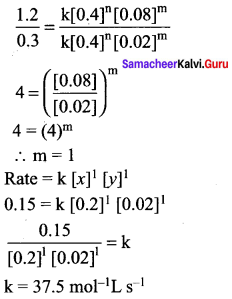
Samacheer Kalvi 12th Chemistry Solutions Chapter 11 Hydroxy Compounds and Ethers

Are you searching for the Samacheer Kalvi 12th Chemistry Chapter Wise Solutions PDF? Then, get your Samacheer Kalvi 12th Chapter Wise Solutions PDF for free on our website. Students can Download Chemistry Chapter 11 Hydroxy Compounds and Ethers Questions and Answers, Notes Pdf, Samacheer Kalvi 12th Chemistry Solutions Guide Pdf helps you to revise the complete Tamilnadu State Board New Syllabus and score more marks in your examinations.

Tamilnadu Samacheer Kalvi 12th Chemistry Solutions Chapter 11 Hydroxy Compounds and Ethers

All concepts are explained in an easy way on our website. So, students can easily learn and practice Tamilnadu State Board 12th Chemistry Chapter 11 Hydroxy Compounds and Ethers Question and Answers. You can enjoy the digitized learning with the help of the Tamilnadu State Board Chemistry Online Material.

Samacheer Kalvi 12th Chemistry Chapter 11 Hydroxy Compounds and Ethers Textual Evaluation Solved

Samacheer Kalvi 12th Chemistry Hydroxy Compounds and Ethers Multiple Choice Questions

12th Chemistry Chapter 11 Book Back Answers Question 1.
An alcohol (x) gives blue colour in victormayer’s test and 3.7g of X when treated with metallic sodium liberates 560 mL of hydrogen at 273 K and 1 atm pressure what will be the possible structure of X?
(a) CH3 CH (OH) CH2CH3
(b) CH3 – CH(OH) – CH3
(c) CH3 – C (OH) (CH3)2
(d) CH3 – CH2 – CH (OH) – CH2 – CH3
Answer:
(a) CH3 CH (OH) CH2CH3
Hint:
2R – OH + Na → 2RONa + 2H2 ↑ 2 moles of alcohol gives 1 mole of H2 which occupies
22.4L at 273K and 1 atm
number of moles of alcohol = \(\frac{2 \text { moles of } \mathrm{R}-\mathrm{OH}}{22.4 \mathrm{L} \text { of } \mathrm{H}_{2}}\) x 560 mL = 0.05 moles
number of moles = \(\frac{\text { mass }}{\text { molar mass }}\)
= molar mass = \(\frac{3.7}{0.05}\) = 74 g mol-1
General formula for
R – OH Cn H2n+1 – OH
n(12) + (2n+1) (1) + 16 +1 = 74
14n = 74 – 18
14n = 56
n = \(\frac { 56 }{ 4 }\) = 4
The 2° alcohol which contains 4 carbon is CHn CH(OH)CH2 CH3

Hydroxy Compounds And Ethers Question 2.
Which of the following compounds on reaction with methyl magnesium bromide will give tertiary alcohol.
(a) benzaldehyde
(b) propanoic acid
(c) methyl propanoate
(d) acetaldehyde
Answer:
(c) methyl propanoate
Hint:
12th Chemistry Chapter 11 Book Back Answers Hydroxy Compounds And Ethers Samacheer Kalvi

12th Chemistry Evaluate Yourself Answers Question 3.
Hydroxy Compounds And Ethers Samacheer Kalvi 12th Chemistry Solutions Chapter 11
This ‘X’ is …………..
12th Chemistry Evaluate Yourself Answers Chapter 11 Hydroxy Compounds And Ethers Samacheer Kalvi
Answer:
Hydroxy Compounds And Ethers Pdf Samacheer Kalvi 12th Chemistry Solutions Chapter 11
Hint:
hydro boration – Anti markownikoff product
i.e CH3 – CH2 – CH – CH2 – CH2 – OH

Hydroxy Compounds And Ethers Pdf Question 4.
In the reaction sequence, Ethane
Hydroxy Compounds And Ethers Class 12 Chemistry Solutions Chapter 11 Samacheer Kalvi
Ethan – 1, 2 – diol. A and X respectively are ………….
(a) Chioroethane and NaOH
(b) ethanol and H2SO4
(c) 2 – chloroethan – 1 – ol and NaHCO3
(d) ethanol and H2O
Answer:
(c) 2 – chloroethan – 1 – ol and NaHCO3
Hint:
Hydroxy Compounds And Ethers Important Questions Samacheer Kalvi 12th Chemistry Solutions Chapter 11

Hydroxy Compounds And Ethers Class 12 Question 5.
Which one of the following is the strongest acid ………..
(a) 2 – nitrophenol
(b) 4 – chlorophenol
(c) 4 – nitrophenol
(d) 3 – nitrophenol
Answer:
(c) 4 – nitrophenol

Hydroxy Compounds And Ethers Important Questions Question 6.
12th Chemistry Evaluate Yourself Answers Samacheer Kalvi Chapter 11 Hydroxy Compounds And Ethers
on treatment with Con. H2SO4, predominately gives ……………..
12th Chemistry Book Inside Evaluate Yourself Answers Chapter 11 Hydroxy Compounds And Ethers Samacheer Kalvi
Answer:
12th Chemistry Evaluate Yourself Answers Pdf Chapter 11 Hydroxy Compounds And Ethers Samacheer Kalvi
Hint:
12th Chemistry Evaluate Yourself Answers Pdf Download Chapter 11 Hydroxy Compounds And Ethers Samacheer Kalvi

12th Chemistry Evaluate Yourself Answers Samacheer Question 7.
Carbolic acid is …………..
(a) Phenol
(b) Picric acid
(c) benzoic acid
(d) phenylacetic acid
Answer:
(a) Phenol

12th Chemistry Book Inside Evaluate Yourself Answers Question 8.
Which one of the following will react with phenol to give salicyladehyde after hydrolysis …………..
(a) Dichioro methane
(b) trichioroethane
(c) trichloro methane
(d) CO2
Answer:
(c) trichloro methane (Riemer Tiemann reaction)
Hint:
12 Chemistry Evaluate Yourself Answers Chapter 11 Hydroxy Compounds And Ethers Samacheer Kalvi

12th Chemistry Evaluate Yourself Answers Pdf Question 9.
12th Std Chemistry Evaluate Yourself Answers Chapter 11 Hydroxy Compounds And Ethers Samacheer Kalvi
(a) (CH3)3 CCH = CH2
(b) (CH3)2 C = C (CH3)2
(c) CH2 = C(CH3)CH2 – CH2 – CH3
(d) CH2 = C (CH3) – CH2 – CH2 – CH3
Answer:
(b) (CH3)2 C = C (CH3)2
Hint:
12th Chemistry Evaluate Yourself Answers Chapter 11 Hydroxy Compounds And Ethers Samacheer Kalvi

12th Chemistry Evaluate Yourself Answers Pdf Download Question 10.
The correct IUPAC name of the compound,
Samacheer Kalvi Guru 12th Chemistry Solutions Chapter 11 Hydroxy Compounds And Ethers
(a) 4 – chloro – 2, 3 – dimethyl pentan – 1 – ol
(b) 2, 3 – dimethyl – 4 – chloropentan – 1 – ol
(c) 2, 3, 4 – trimethyl – 4 – chiorobutan – 1 – ol
(d) 4 – chioro – 2, 3, 4 – trimethyl pentan – 1 – ol
Answer:
(a) 4 – chloro – 2, 3 – dimethyl pentan – 1 – ol

12 Chemistry Evaluate Yourself Answers Question 11.
Assertion: Phenol is more acidic than ethanol
Reason: Phenoxide ion is resonance stabilized
(a) if both assertion and reason are true and reason is the correct explanation of assertion.
(b) if both assertion and reason are true but reason is not the correct explanation of assertion.
(c) assertion is true but reason is false
(d) both assertion and reason are false.
Answer:
if both assertion and reason are true and reason is the correct explanation of assertion.

12th Std Chemistry Evaluate Yourself Answers Question 12.
In the reaction Ethanol
Samacheer Kalvi 12th Chemistry Solutions Chapter 11 Hydroxy Compounds And Ethers is ………………
(a) ethane
(b) ethoxyethane
(c) ethylbisuiphite
(d) ethanol
Answer:
(d) ethanol
Hint:
Samacheer Kalvi 12th Chemistry Solutions Chapter 11 Hydroxy Compounds and Ethers-16

12th Chemistry Evaluate Yourself Answers Chapter 11 Question 13.
The reaction
Samacheer Kalvi 12th Chemistry Solutions Chapter 11 Hydroxy Compounds and Ethers-17
can be classified as
(a) dehydration
(b) Williams on alcoholsynthesis
(c) Williamson ether synthesis
(d) dehydrogenation of alcohol
Answer:
(c) Williamson ether synthesis
Hint: Cyclic alcohol → sodium cyclic alkoxide → williamson ether synthesis

Samacheer Kalvi Guru 12th Chemistry Question 14.
Isoprophylbcnzene on air oxidation in the presence of dilute acid gives …………
(a) C6H5COOH
(b) C6H5COCH3
(c) C6H5COC6H5
(d) C6H5 – OH
Answer:
(a) C6H5 – OH (phenol)

11th Chemistry Evaluate Yourself Answers Chapter 11 Question 15.
Assertion: Phenol is more reactive than benzene towards electrophilic substitution reaction
Reason: In the case of phenol. the intermediate arenium ion is more stabilized by resonance.
(a) if both assertion and reason are true and reason is the correct explanation of assertion.
(b) if both assertion and reason are true but reason is not the correct explanation of assertion.
(c) assertion is true but reason is false
(d) both assertion and reason are false,.
Answer:
(a) if both assertion and reason are true and reason is the correct explanation of assertion.

Samacheer Kalvi 12th Chemistry Solutions Question 16.
HO CH2 CH2 – OH on heating with periodic acid gives ………..
(a) methanoic acid
(b) Glyoxal
(c) methanol
(d) CO2
Answer:
(c) methanol

Question 17.
Which of the following compound can be used as artireeze in automobile radiators?
(a) methanol
(b) ethanol
(c) Neopentyl alcohol
(d) ethan -1, 2-diol
Answer:
(d) ethan -1, 2-diol

Question 18.
Samacheer Kalvi 12th Chemistry Solutions Chapter 11 Hydroxy Compounds and Ethers-18
is an example of …………..
(a) Wurtz reaction
(b) cyclic reaction
(c) Williamson reaction
(d) Kolbe reactions
Answer:
(c) Kolbe reactions

Question 19.
One mole of an organic compound (A) with the formula C3H8O reacts completely with two moles of HI to form X and Y. When Y is boiled with aqueous alkali it forms Z. Z answers the iodoform test. The compound (A) is ……………
(a) propan – 2 – ol
(b) propan- 1- ol
(c) ethoxy ethane
(d) methoxy ehane
Answer:
(d) methoxy ehane
Hint:
Samacheer Kalvi 12th Chemistry Solutions Chapter 11 Hydroxy Compounds and Ethers-19

Question 20.
Among the following ethers which one will produce methyl alcohol on treatment with hot HI?
Samacheer Kalvi 12th Chemistry Solutions Chapter 11 Hydroxy Compounds and Ethers-20
Answer:
Samacheer Kalvi 12th Chemistry Solutions Chapter 11 Hydroxy Compounds and Ethers-21
Hint:
Samacheer Kalvi 12th Chemistry Solutions Chapter 11 Hydroxy Compounds and Ethers-22

Question 21.
Williamson synthesis of preparing dimethyl ether is a / an /
(a) SN1 reactions
(b) SN2 reaction
(c) electrophilic addition
(d) electrophilic substitution
Answer:
(b) SN2 reaction

Question 22.
On reacting with neutral ferric chloride, phenol gives
(a) red colour
(b) violet colour
(c) dark green colour
(d) no colouration
Answer:
(b) violet colour

II. Answer the following questions

Question 1.
IdentIfy the product (s) is / are formed when 1 – methoxy propane is heated with excess HI. Name the mechanism involved in the reaction
Answer:
1-methoxy propane is heated with excess HI, yields two products named as Methyl iodide and 1- iodo propane.
Step 1:
Samacheer Kalvi 12th Chemistry Solutions Chapter 11 Hydroxy Compounds and Ethers-23
Step 2.
Samacheer Kalvi 12th Chemistry Solutions Chapter 11 Hydroxy Compounds and Ethers-24
Step 3:
Samacheer Kalvi 12th Chemistry Solutions Chapter 11 Hydroxy Compounds and Ethers-25
Step 4:
Samacheer Kalvi 12th Chemistry Solutions Chapter 11 Hydroxy Compounds and Ethers-26
Overall reaction:
Samacheer Kalvi 12th Chemistry Solutions Chapter 11 Hydroxy Compounds and Ethers-27
This reaction ivvolves nucleophilic substitution reaction mechanism. (SN1)

Question 2.
Draw the major product formed when 1 – ethoxyprop – 1 – ene is heated with one equivalent of HI
Answer:
Samacheer Kalvi 12th Chemistry Solutions Chapter 11 Hydroxy Compounds and Ethers-28
This reaction follows SN1 mechanism because in this reaction the more stable carbocation is formed that is double bonded carbocation. Therefore, the given molecule reacts with HI to form ethanol and 1- iodo prop – 1 – ene.
Samacheer Kalvi 12th Chemistry Solutions Chapter 11 Hydroxy Compounds and Ethers-29

Question 3.
Suggest a suitable reagent to prepare secondary alcohol with identical group using Grignard reagent.
Answer:
Acetaldehyde reacts with Grignard reagent to give addition product, which on further undergoes acid hydrolysis to yield secondary alcohol, that is isopropyl alcohol.
Samacheer Kalvi 12th Chemistry Solutions Chapter 11 Hydroxy Compounds and Ethers-30

Question 4.
What is the major product obtained when two moles of ethyl magnesium bromide is treated with methyl benzoate followed by acid hydrolysis
Answer:
Samacheer Kalvi 12th Chemistry Solutions Chapter 11 Hydroxy Compounds and Ethers-31

Question 5.
Predict the major product, when 2-methyl but – 2 – ene is converted into an alcohol in each of the following methods.

  1. Acid catalysed hydration
  2. Hydroboration
  3. Hydroylation using bayers reagent

Answer:
1. Acid catalysed hydration:
Samacheer Kalvi 12th Chemistry Solutions Chapter 11 Hydroxy Compounds and Ethers-32

2. Hydroboration.
Samacheer Kalvi 12th Chemistry Solutions Chapter 11 Hydroxy Compounds and Ethers-33

3. Hydroxylation using bayers reagent:
Samacheer Kalvi 12th Chemistry Solutions Chapter 11 Hydroxy Compounds and Ethers-34

Question 6.
Arrange the following in the increasing order of their boiling point and give a reason for your ordering

  1. Butan – 2 – ol, Butan – 1 – SI, 2 – methylpropan – 2 – ol
  2. Propan – 1 – ol, propan – 1, 2, 3 – triol, propan – 1, 3 – diol, propan – 2 – ol

Answer:
1. Boiling points increases regularly as the molecular mass increases due to a corresponding increase in their Van der waal’s force of attraction. Among isomeric alcohols 2° – alcohols have lower boiling points than 1° – alcohols due to a corresponding decreases in the extent

of H-bonding because of steric hindrance. Thus the boiling point of Butan – 2 – ol is lower than that of Butan – 1 – ol. Overall increasing order of boiling points is, 2 – methylpropan – 2 – ol < Butan – 2 – ol < Butan – 1 – ol

2. 2°-alcohols have lower boiling points than 1° – alcohols due to a corresponding decrease in the extent of H – bonding because of steric hindrance. Therefore Propan – 1 – ol has higher boiling point than Propan – 2 – ol. Hydrogen group increases, boiling point also increases. Overall increasing order of boiling points is, propan – 2 – ol < Propan – 1 – ol < propan – 1, 3 – diol < propan -1, 2, 3 – triol

Question 7.
Can we use nucelophiles such as NH3,CH3O for the Nucleophilic substitution of alcohols
Answer:
1. Increasing order of nucelophilicity,
NH3 < – OH < CH3O⊖-

2. Higher electron density will increase the nucelophilicity.

3. Negatively charged species are almost always more nucelophiles than neutral species.

4. RO has an alkyl group attached, allowing a greater amount of polarizability. This means oxygen’s lone pairs will be more readily available to reach in RO than in OH. Hence CH3O – is the better nucelophile for the nucleophilic substitution of alcohols. NH3 cannot act as nucelophile for the nucleophilic substitution of alcohols.

Question 8.
Is it possible to oxidise t – butyl alcohol using acidified dichromate to form a carbonyic compound.
Answer:
3° – alcohols do not undergo oxidation reaction under normal condition, but at elevated temperature, under strong oxidising agent cleavage of C – C bond takes place to give a mixture of carboxylic acid.

Yes, it is possible. t – butyl alcohol is readily oxidsing in acidic solution (K2Cr2O7 / H2SO4) to a mixture of a ketone and an acid each containing lesser number of carbon atoms than the original alcohol. The oxidation presumably occur via alkenes formed through dehydration of alcohols under acidic conditions.
Samacheer Kalvi 12th Chemistry Solutions Chapter 11 Hydroxy Compounds and Ethers-35

Question 9.
What happens when 1 – phenyl ethanol is treated with acidified KMnO4.
Answer:
1 – phenyl ethanol reacts with acidified KMnO4 to give Acetophenone.
Samacheer Kalvi 12th Chemistry Solutions Chapter 11 Hydroxy Compounds and Ethers-36

Question 10.
Write the mechanism of acid catalysed dehydration of ethanol to give ethene.
Mechanism of acid catlaysed dehydration of ethanol:
Step1:
Protonation of ethanol.
Samacheer Kalvi 12th Chemistry Solutions Chapter 11 Hydroxy Compounds and Ethers-37

Step 2:
Elimination of water molecule.
Samacheer Kalvi 12th Chemistry Solutions Chapter 11 Hydroxy Compounds and Ethers-38

Question 11.
How is phenol prepared form

  1. chloro benzene
  2. isopropyl benzene

Answer:
1. From Chioro benzene:
According to Dow’s process, when Chiorobenzene is hydrolysed with 6 – 8% NaOHat 300 bar and 633K in a closed vessel, sodium phcnoxidc is formed which on treatment with dilute HCl gives phenol.
Samacheer Kalvi 12th Chemistry Solutions Chapter 11 Hydroxy Compounds and Ethers-39

2. For isopropyl benzene:
On passing air to a mixture of cumene (isoprophy benzene) and 5% aqueous sodium carbonate solution, cumene hydro peroxide is formed by oxidation. It is treated with dilute acid to get phenol and acetone.
Samacheer Kalvi 12th Chemistry Solutions Chapter 11 Hydroxy Compounds and Ethers-40

Question 12.
Explain Kolbe’s reaction
Answer:
Kolbe’s (or) Kolbe’s Schmitt reaction:
In this reaction, phenol is first converted into sodium phenoxide which is more reactive than phenol towards electrophilic substitution reaction with CO2. Treatment of sodium phenoxide with CO2 at 400K, 4 -7 bar pressure followed by acid hydrolysis gives salicylic acid.
Answer:
Samacheer Kalvi 12th Chemistry Solutions Chapter 11 Hydroxy Compounds and Ethers-41

Question 13.
Writes the chemical equation for Williamson synthesis of 2 – ethoxy – 2 – methyl pentane starting from ethanol and 2 – methyl pentan – 2 – ol
Answer:
Step 1:
Samacheer Kalvi 12th Chemistry Solutions Chapter 11 Hydroxy Compounds and Ethers-42

Step 2:
Samacheer Kalvi 12th Chemistry Solutions Chapter 11 Hydroxy Compounds and Ethers-43

Step 3:
Samacheer Kalvi 12th Chemistry Solutions Chapter 11 Hydroxy Compounds and Ethers-44
Williamsons synthesis occurs by SN2 – mechanism and primary alkyl halides are more reactive in SN2 reactions. Therefore ethanol is converted into ethyl bromide.

Question 14.
Write the structure of the aldehyde, carboxylic acid and ester that yield 4 – methylpent – 2 – en – 1 – ol.
Answer:
1. Aldehyde yield 4 – methylpent – 2 – 3n – ol is
Samacheer Kalvi 12th Chemistry Solutions Chapter 11 Hydroxy Compounds and Ethers-45

2. Acid yield 4 – methylpent – 2 – en – 1 – ol is
Samacheer Kalvi 12th Chemistry Solutions Chapter 11 Hydroxy Compounds and Ethers-46

3. Ester yield 4 – methylpent – 2 0 en – l – ol is
Samacheer Kalvi 12th Chemistry Solutions Chapter 11 Hydroxy Compounds and Ethers-47

The above shown compounds undergo reduction reaction to yield 4 – methylpent – 2 – en – l – ol.
Samacheer Kalvi 12th Chemistry Solutions Chapter 11 Hydroxy Compounds and Ethers-48

Question 15.
What is meta merism? Give the structure and IUPAC name of metamers of 2 – methoxy propane
Answer:
Metamerism:
It is a special type of isomerism in which molecules with same formula, same functional group, but different only in the nature of the alkyl group attached to oxygen.
Samacheer Kalvi 12th Chemistry Solutions Chapter 11 Hydroxy Compounds and Ethers-49
Ethoxy ethane and 1-methoxy propane are metamers of 2-methoxy propane.

Question 16.
How are the following conversions effected

  1. benzylchlorjde to benzvlalcohol
  2. benzvl alcohol to benzoic acid

Answer:
1. Conversion of benzyl chloride into benzyl alcohol:
Samacheer Kalvi 12th Chemistry Solutions Chapter 11 Hydroxy Compounds and Ethers-50

2. Conversion of benzyl alcohol into benzoic acid:
Samacheer Kalvi 12th Chemistry Solutions Chapter 11 Hydroxy Compounds and Ethers-51

Question 17.
Complete the following reactions
Samacheer Kalvi 12th Chemistry Solutions Chapter 11 Hydroxy Compounds and Ethers-52
Answer:
Samacheer Kalvi 12th Chemistry Solutions Chapter 11 Hydroxy Compounds and Ethers-53

Question 18.
O.44g of a monohydric alcohol when added to methyl magnesium iodide in ether liberates at STP 112 cm3 of methane with PCC the same alcohol form a carbonyl compound that answers silver mirror test. Identify the compound.
Answer:
0.44g of a monohydric alcohol liberates 112 cm3 of methane.
Samacheer Kalvi 12th Chemistry Solutions Chapter 11 Hydroxy Compounds and Ethers-54
Mass of monohydric alcohol which gives 22400 cm3 of methane = \(\frac{22400 \times 0.44}{112}\) = 88
C5H12O molecular fórmula has mass number 88 and it shows eight possible isomers. But neopentyl alcohol reacts with PCC to form neopentyl aldehyde, which shows positive silver mirror test. Therefore, compound is. neopentyl alcohol (or) 2, 2 – dimethyl propan – l – ol.
Samacheer Kalvi 12th Chemistry Solutions Chapter 11 Hydroxy Compounds and Ethers-55

Question 19.
Complete the following reactions
Samacheer Kalvi 12th Chemistry Solutions Chapter 11 Hydroxy Compounds and Ethers-56
Answer:
Samacheer Kalvi 12th Chemistry Solutions Chapter 11 Hydroxy Compounds and Ethers-57

Question 20.
Phenol is distilled with Zn dust gives (A) followed by friedel – crafts alkylation with propyl chloride to give a compound B, B on oxidation gives (C). Identify A,B and C.
Answer:
Samacheer Kalvi 12th Chemistry Solutions Chapter 11 Hydroxy Compounds and Ethers-58

Question 21.
Samacheer Kalvi 12th Chemistry Solutions Chapter 11 Hydroxy Compounds and Ethers-59
Identify A, B, C, D and write the complete equation.
Answer:
Samacheer Kalvi 12th Chemistry Solutions Chapter 11 Hydroxy Compounds and Ethers-60

Question 22.
What will be the product for the following reaction
Samacheer Kalvi 12th Chemistry Solutions Chapter 11 Hydroxy Compounds and Ethers-61
Answer:
Samacheer Kalvi 12th Chemistry Solutions Chapter 11 Hydroxy Compounds and Ethers-62

Question 23.
How will you convert acetylen in to n – butyl alcohol.
Answer:
Samacheer Kalvi 12th Chemistry Solutions Chapter 11 Hydroxy Compounds and Ethers-63

Question 24.
Predict the product A, B, X and Y in the following sequence of reaction
Samacheer Kalvi 12th Chemistry Solutions Chapter 11 Hydroxy Compounds and Ethers-64
Answer:
Samacheer Kalvi 12th Chemistry Solutions Chapter 11 Hydroxy Compounds and Ethers-65

Question 25.
3,3 – dimethylbutan – 2 – ol on treatment with conc. H2SO4 to give tetramethyl ethylene as a major product. Suggest a suitable mechanisms
Answer:
Samacheer Kalvi 12th Chemistry Solutions Chapter 11 Hydroxy Compounds and Ethers-66
According to Saytzeff’s rule the dehydration of 3,3 – dimethylbutan – 2 – ol gives a mixture of alkenes. But the secondary carbocation formed in this reaction undergoes rearrangement to form a more stable tertiary

carbocation which further, undergoes to 13 – elimination leads more stable product, that is 2,3 – dimethyl but – 2 – ene (more yield). According to Saytzeff’s nile, 2, 3 – dimethyl pent- 2 – ene is the major product.

Samacheer Kalvi 12th Chemistry Hydroxy Compounds and Ethers Evaluate yourself

Question 1.
Classify the following alcohols as 10, 20, and 30 and give their IUPAC Names.
Samacheer Kalvi 12th Chemistry Solutions Chapter 11 Hydroxy Compounds and Ethers-67
Answer:
Samacheer Kalvi 12th Chemistry Solutions Chapter 11 Hydroxy Compounds and Ethers-68

Question 2.
Write all the possible isomers of an alacohol having the molecular formula C15H12O and their IUPAC names.
Answer:
Eight isomers are possibe for C15H12O. They are,
Samacheer Kalvi 12th Chemistry Solutions Chapter 11 Hydroxy Compounds and Ethers-69

Question 3.
Suggest a suitable carbonyl compound for the preparation of pent – 2 – en – 1 ol using LiAlH4.
Answer:
Samacheer Kalvi 12th Chemistry Solutions Chapter 11 Hydroxy Compounds and Ethers-70

Question 4.
2 – methylpropan – 2 – ene Samacheer Kalvi 12th Chemistry Solutions Chapter 11 Hydroxy Compounds and Ethers-71
Answer:
Samacheer Kalvi 12th Chemistry Solutions Chapter 11 Hydroxy Compounds and Ethers-72

Question 5.
How will you prepare the following using Grignard reagent.

  1. t – butyl alcohol
  2. allyl alcohol

Answer:
Samacheer Kalvi 12th Chemistry Solutions Chapter 11 Hydroxy Compounds and Ethers-73

Question 6.
Identify the products in the following reactions. Write their IUPAC names and mention the mechanism involved in the reactions.

Samacheer Kalvi 12th Chemistry Solutions Chapter 11 Hydroxy Compounds and Ethers-100

Answer:
1. Samacheer Kalvi 12th Chemistry Solutions Chapter 11 Hydroxy Compounds and Ethers-75
This reaction involves E1 – mechanism.

2. Samacheer Kalvi 12th Chemistry Solutions Chapter 11 Hydroxy Compounds and Ethers-76
This reaction ivolves SN2 – mechanims.

3. Step 1:
Samacheer Kalvi 12th Chemistry Solutions Chapter 11 Hydroxy Compounds and Ethers-77

Step 2:
Samacheer Kalvi 12th Chemistry Solutions Chapter 11 Hydroxy Compounds and Ethers-78
This reaction involves SN2 Mechanims.

Question 7.
What is the major product obtained when 2,3 – dimethyl pentan – 3 – ol is heated in the presence of H2SO4
Answer:
Samacheer Kalvi 12th Chemistry Solutions Chapter 11 Hydroxy Compounds and Ethers-79
According to Saytzeff’s rule, 2, 3 – dimethyl pent – 2 – ene is the major product.

Question 8.
Which of the following set of reactants will give 1 – methoxy – 4 – nitrobenzene.
Samacheer Kalvi 12th Chemistry Solutions Chapter 11 Hydroxy Compounds and Ethers-80
Answer:
Step 1:
Samacheer Kalvi 12th Chemistry Solutions Chapter 11 Hydroxy Compounds and Ethers-81
step 2:
Samacheer Kalvi 12th Chemistry Solutions Chapter 11 Hydroxy Compounds and Ethers-82
Chemically both sets equally possible. In Set – 1, the Br-atom is activated by electron withdrawing effect of – NO2 group. Therefore nucleophilic attack by CH3ONa followed by elimination of NaBr gives the desired ether.

Step 1:
Samacheer Kalvi 12th Chemistry Solutions Chapter 11 Hydroxy Compounds and Ethers-83
Step 2:
Samacheer Kalvi 12th Chemistry Solutions Chapter 11 Hydroxy Compounds and Ethers-84
In set – 2, nucleophilic attack by 4 – nitrosodium phenoxide ion on methyl bromide gives the desired ether.
Samacheer Kalvi 12th Chemistry Solutions Chapter 11 Hydroxy Compounds and Ethers-85
Since alkyl halides (CH3Br) are more reactive than aryl halides in nucleophilic substitution reactions, therefore set – 2 reactants are preferred.

Question 9.
What happens when m – cresol is treated with acidic solution of sodium dichromate?
Answer:
Samacheer Kalvi 12th Chemistry Solutions Chapter 11 Hydroxy Compounds and Ethers-86
When m – cresol is treated with acidic solution of sodium dichromate it gives 4 – hydroxy beazoic acid.

Question 10.
When phenol is treated with propan – 2 – ol in the presence of HF, Friedel – Craft reaction takes place. Identify the products.
Answer:
Samacheer Kalvi 12th Chemistry Solutions Chapter 11 Hydroxy Compounds and Ethers-87

Question 11.
Given the IUPAC name for the following ethers and classify them as simple or mixed.
Answer:
Samacheer Kalvi 12th Chemistry Solutions Chapter 11 Hydroxy Compounds and Ethers-88
Samacheer Kalvi 12th Chemistry Solutions Chapter 11 Hydroxy Compounds and Ethers-89

Question 12.
1. Which of the following reaction will give 1 – methoxy – 4 – nitrobenzene.

  1. 4 – nitro – 1 – bromobenzene + sodium methoxide.
  2. 4 – nitrosodium phenoxide + bromomethane

Answer:
1. Set – 1:
Samacheer Kalvi 12th Chemistry Solutions Chapter 11 Hydroxy Compounds and Ethers-90
2. set – 2:
Samacheer Kalvi 12th Chemistry Solutions Chapter 11 Hydroxy Compounds and Ethers-91
Chemically both sets equally possible. In Set – 1, the Br – atom is activated by electron withdrawing effect of – NO2 group. Therefore nucleophilic attack by CH3ONa followed by elimination of NaBr gives the desired ether.
Step 1:
Samacheer Kalvi 12th Chemistry Solutions Chapter 11 Hydroxy Compounds and Ethers-92

Step 2:
Samacheer Kalvi 12th Chemistry Solutions Chapter 11 Hydroxy Compounds and Ethers-93
In set – 2, nucleophilic attack by 4 – nitrosodium phenoxide ion on methyl bromide gives the desired ether.
Samacheer Kalvi 12th Chemistry Solutions Chapter 11 Hydroxy Compounds and Ethers-94
Since alkyl halides (CH3Br) are more reactive than aryl halides in nucleophilic substitution reactions, therefore set – 2 reactants are preferred.

Question 13.
Arrange the following compounds in the increasing order of their acid strength. propan – 1 – ol, 2, 4, 6 – trinitroptienol, 3 – nitrophenol, 3,5 – dinitrophenol, phenol, 4 – methyiphenol.
Answer:
Phenols are stronger acids than alcohols because the phenoxide ion left after the removal of proton is stabilized by resonance while the alkoxide ion left after the removal of a proton from alcohol is not stabilized. Thus propan – 1 – ol is much weaker acid than any phenol.

Thus propan- 1 – ol is a much weaker acid than any phenol. We know that electron donating groups decrease the acidic character and stronger is the electron donating group, weaker is the phenol.

Compare to propan – 1 – ol, 4 – methyl phenol is stronger acidic character. But comparing phenol and 4-methyl phenol, phenol is stronger acidic. Since electron withdrawing groups increase the acidic character of phenols and the effect is more pronounced at the para position than at the meta position.

Therefore 4 – nitro phenol is a stronger acid than 3 – nitro phenol. Further as the number of electron withdrawing groups increases the acidic strength further increases. Therefore 2, 4, 6 – trinitro phenol is a stronger acid than 3, 5 – dintiro phenol. It may be noted here that although the two nitro groups in 3, 5 – dinitro phenol are at m – position with respect to OH group,

their combined effect is however greater than one nitro group at p – position. Therefore 3, 5 – dinitro phenol is a stronger acid than 4-nitro phenol. Thus, the overall increasing order of acid strength is. Propan – 1 – 01 < 4 – methyl phenol < phenol < 3 – nitrophenol < 3, 5 – dinitro phenol < 2, 4, 6 – trinitro phenol.

Question 14.
1 mole of HI is allowed to react with t – butyl methylether. Identify the product and write down the mechanism of the reaction.
Answer:
Step 1:
Samacheer Kalvi 12th Chemistry Solutions Chapter 11 Hydroxy Compounds and Ethers-95

Step 2
Samacheer Kalvi 12th Chemistry Solutions Chapter 11 Hydroxy Compounds and Ethers-96

Step 3:
Samacheer Kalvi 12th Chemistry Solutions Chapter 11 Hydroxy Compounds and Ethers-97
Overall reaction:
Samacheer Kalvi 12th Chemistry Solutions Chapter 11 Hydroxy Compounds and Ethers-98

Samacheer Kalvi 12th Chemistry Hydroxy Compounds and Ethers Additional Questions

Samacheer Kalvi 12th Chemistry Hydroxy Compounds and Ethers 1 Mark Questions and Answers

I. Choose the best answer.

Question 1.
Which one of the following is a trihydric alcohol?
(a) Glycol
(b) Ethanol
(c) Glycerol
(d) Sorbitol
Answer:
(c) Glycerol

Question 2.
Identify the monohydric unsaturated alcohol.
Samacheer Kalvi 12th Chemistry Solutions Chapter 11 Hydroxy Compounds and Ethers-101
Answer:
Samacheer Kalvi 12th Chemistry Solutions Chapter 11 Hydroxy Compounds and Ethers-102

Question 3.
Which one of the following is named as sorbital?
Samacheer Kalvi 12th Chemistry Solutions Chapter 11 Hydroxy Compounds and Ethers-103
Answer:
Samacheer Kalvi 12th Chemistry Solutions Chapter 11 Hydroxy Compounds and Ethers-104

Question 4.
Which one of the following is a primary alcohol?
Samacheer Kalvi 12th Chemistry Solutions Chapter 11 Hydroxy Compounds and Ethers-105
Answer:
Samacheer Kalvi 12th Chemistry Solutions Chapter 11 Hydroxy Compounds and Ethers-106

Question 5.
Which of the following is a dihydric alcohol?
(a) Ethenol
(b) Ethanol ]
(c) Ethane – 1, 2 – diol
(d) Propan – 2 – ol
Answer:
(c) Ethane – 1, 2 – diol

Question 6.
Which one of the following is an example of secondary (2°) alcohol?
(a) Propan – 2 – ol
(b) Phenyl methanol
(c) Ethenol
(d) 2 – methyl – propan – 2 – ol
Answer:
(a) Propan – 2 – ol

Question 7.
Which one of the following is a tertiary alcohol?
Samacheer Kalvi 12th Chemistry Solutions Chapter 11 Hydroxy Compounds and Ethers-107
Answer:
Samacheer Kalvi 12th Chemistry Solutions Chapter 11 Hydroxy Compounds and Ethers-199
Question 8.
Which of the following is a primary alcohol?
Samacheer Kalvi 12th Chemistry Solutions Chapter 11 Hydroxy Compounds and Ethers-108
Answer:
Samacheer Kalvi 12th Chemistry Solutions Chapter 11 Hydroxy Compounds and Ethers-109

Question 9.
Which one of the following find application in proper functioning of our eyes?
(a) Cholesterol
(b) Retinol
(c) Phenol
(d) Ethanol
Answer:
(b) Retinol

Question 10.
Which is the storage of vitamin – A?
(a) Retinol
(b) Benzyl alcohol
(c) Phenol
(d) Ascorbic acid
Answer:
(a) Retinol

Question 11.
The important component in our cell membrane is ………….
(a) Retinol
(b) Phenol
(c) Cholesterol
(d) Methanol
Answer:
(c) Cholesterol

Question 12.
Which acts as an additive to petrol?
(a) Glycerol
(b) Ethanol
(c) Phenol
(d) Methanol
Answer:
(b) Ethanol

Question 13.
Which one of the following vitamin is stored in Retinol?
(a) Vitamin – B12
(b) Vitamin – A
(c) Vitamin – C
(a) Vitamin – D
Answer:
(b) Vitamin – A

Question 14.
Which alcohol is used as skin cleanser for injection?
(a) Methanol
(b) Ethanol
(c) 1 -propanol
(d) 2-propanol
Answer:
(d) 2-propanol

Question 15.
Which one of the following is used as an industrial solvent?
(a) Methanol
(b) Benzyl alcohol
(c) Phenol
(d) Cholesterol
Answer:
(a) Methanol

Question 16.
2 – methyl but – 3 – en – 2 – ol belongs to which type of alcohol?
(a) 3° alcohol
(b) 2° alcohol
(c) 1° alcohol
(d) Aromatic alcohol
Answer:
(a) 3° alcohol

Question 17.
The IUPAC name of
Samacheer Kalvi 12th Chemistry Solutions Chapter 11 Hydroxy Compounds and Ethers-110
(a) 1 – methyl – 2 – propanol
(b) 2 – methyl – p ropan – 2 – ol
(c) Tertibutyl alcohol
(d) 2 – propanol
Answer:
(b) 2 – methyl – p ropan – 2 – ol

Question 18.
The TUPAC name of CH2 = CH – CH2OH is …………
(a) Allyl alcohol
(b) Propenc – 2 – ol
(c) Prop – 2 – en – 1 – oI
(d) Isopropyl alcohol
Answer:
(c) Prop – 2 – en – 1 – oI

Question 19.
In methanol, – OH group attached to carbon is ………..
(a) sp hybridised atom
(b) sp3 hybridised atom
(c) sp2 hybridised atom
(d) dsp2 hybridised atom
Answer:
(c) sp2 hybridised atom

Question 20.
Which one of the following is C – O – H bond angle in methanol?
(a) 109.5°
(b) 104°
(c) 90°
(d) 108.9°
Answer:
(d) 108.9°

Question 21.
Primaiy alkyl halides undergoes substitution by ……….
(a) SN1 reaction
(b) SNi reaction
(c) SN2 reaction
(d) SN reaction
Answer:
(c) SN2 reaction

Question 22.
What is the product formed when propene is hydrolysed in the presence of mineral acid?
(a) Propan – 1 – ol
(b) Propan – 2 – ol
(c) Iso butyl alcohol
(d) 2 – mcthyl – propan – 2 – ol
Answer:
(b) Propan – 2 – ol

Question 23.
The product formed when phenyl magnesium bromide treated with methanal and hydrolysed is ………..
(a) Phenyl methanal
(b) Phenol
(c) Phenyl methanol
(d) Benzyl benzoate
Answer:
(c) Phenyl methanol

Question 24.
To get Butan – 2 – ol, Ethyl magnesium bromide is treated with followed by hydrolysis.
(a) HCHO
(b) CH3COCH3
(c) CO2
(d) CH3CHO
Answer:
(d) CH3CHO

Question 25.
Which one of the following is formed when Butyl magnesium bromide is treated with propanone followed by hydrolysis?
(a) Tertiary butyl alcohol
(b) Isopropyl alcohol
(c) 2 – methyl hexan – 2 – ol
(d) Propan – 1 -ol
Answer:
(c) 2 – methyl hexan – 2 – ol

Question 26.
Which one of the tbllowing is used to get propan – 2 – ol by the reaction with CH3MgBr?
(a) Ethanol
(b) Ethanal
(c) Ethyl inethanoate
(d) Propanone
Answer:
(c) Ethyl inethanoate

Question 27.
Crotanaldehyde on reaction with LiAlH4 and water produces
(a) Ethanol
(b) Propan – 2 – ol
(c) Methanol
(d) But – 2 – en – 1 – ol
Answer:
(d) But – 2 – en – 1 – ol

Question 28.
Which one of the following is used as a catalyst in the conversion of Bcnzoic acid to Benzyl alcohol?
(a) Ni
(b) LiAIH4 / H2O
(c) Sn / HCI
(d) Zn / NaOH
Answer:
(b) LiAIH4 / H2O

Question 29.
What is the product formed when acetone is treated with LiA1H4 and 1120?
(a) Isobutyl alcohol
(b) n – butyl alcohol
(c) Propan – 2 – ol
(d) Propan – 1 – ol
Answer:
(c) Propan – 2 – ol

Question 30.
Which one of the following is formed when ethene reacts with Baeyer’s reagent?
(a) Ethane
(b) Ethylene glycol
(c) Propane – 1, 2 – diol
(d) Glycerol
Answer:
(b) Ethylene glycol

Question 31.
Which one of the following is named as Baeyer’s reagent?
(a) acidified K2Cr2O7
(b) acidified KMnO4
(c) Cold dilute alkaline KMnO4
(d) LiAlH4
Answer:
(c) Cold dilute alkaline KMnO4

Question 32.
The alkaline hydrolysis of fats to give glycerol is known as …………
(a) Esterification
(b) Hydroboration
(c) Hydration
(d) Saponification
Answer:
(d) Saponification

Question 33.
Which one of the following alcohol reacts immediately with Lucas reagent?
(a) Primaiy alcohol
(b) Tertiary alcohol
(c) Phenol
(d) Secondary alcohol
Answer:
(b) Tertiary alcohol

Question 34.
Which one of the following is called Lucas reagent?
(a) Conc. HCl + Anhydrous ZnCl2
(b) Conc. HCl + Anhydrous A1CI3
(c) LiAIH4 + H2O
(d) Cold dilute alkaline KMnO4
Answer:
(a) Conc. HCl + Anhydrous ZnCl2

Question 35.
Which alcohol gives red colour in Victor Meyer’s test?
(a) 2° alcohol
(b) 3° alcohol
(c) Phenol
(d) 1° alcohol
Answer:
(d) 1° alcohol

Question 36.
Which colour is given by secondary alcohol in Victor Meyer’s test?
(a) Red
(b) Green
(c) Blue
(d) Yellow
Answer:
(c) Blue

Question 37.
Which mechanism is followed in the reaction of 2 – methyl – 2 – propanol with HBr?
(a) E1 mechanism
(b) E2 mechanism
(c) SN2 mechanism
(d) SN1 mechanism
Answer:
(d) SN1 mechanism

Question 38.
Which mechanism is followed in the conversion of ethanol to bromoethane by HBr?
(a) SN1 mechanism
(b) SN2 mechanism
(c) E1 mechanism
(d) E2 mechanism
Answer:
(c) E1 mechanism

Question 39.
Which one of the following is used as a catalyst in the reaction of methanol with thionyl chloride?
(a) Pyridine
(b) pyrrole
(c) THF
(d) Nickel
Answer:
(a) Pyridine

Question 40.
The mechanism of the reaction of ethanol with PCl3 is ……………..
(a) SN1
(b) SN2
(c) E2
(d) E1
Answer:
(b) SN2

Question 41.
Which one of the following reagent is used in the conversion of Ethanol to ethene?
(a) Zn + Hg / H2O
(b) LiAlH4
(c) acidified K2Cr2O7
(d) Conc. H2SO4
Answer:
(d) Conc. H2SO4

Question 42.
Primary alcohol undergo dehydration by ………
(a) E1 mechanism
(b) E2 mechanism
(c) SN1 mechanism
(d) SN2 mechanism
Answer:
(b) E2 mechanism

Question 43.
Tertiary alcohols undergo dehydration by ……….
(a) SN1 mechanism
(b) E2 mechanism
(c) E1 mechanism
(d) SN2 mechanism
Answer:
(c) E1 mechanism

Question 44.
Which one of the following is the correct order of relative reactivities of alcohols in the dehydration reaction?
(a) 1° < 2° < 3°
(b) 2° < 1° < 3°
(c) 3° < 2° < 1°
(d) 3° < 1° < 2°
Answer:
(a) 1° < 2° < 3°

Question 45.
Which of the following is the product formed when 3,3 – dimethyl – 2 – butanol reacts with conc.H2SO4?
(a) 2, 3 – dirnethyl but – 1 – ene
(b) 2,3 – dimethyl but – 2 – ene
(c) 3, 3 – dimethyl but – 1 – ene
(d) all the above
Answer:
(d) all the above

Question 46.
The oxidising agent used to prepare aldehyde (or) ketone from alcohol, the reagent used is …………..
(a) acidified Na2Cr2O7
(b) alkaline KMnO4
(c) Pyridinium chlorochromate
(d) conc. H2SO4
Answer:
(c) Pyridinium chlorochromate

Question 47.
The product formed when propan – 2 – ol is treated with dimethyl sulfoxide (DMSO) and oxalyl chloride followed by the addition of Et3N is ……….
(a) Oxalyl chloride
(b) Propanal
(c) Ethanoic aicd
(d) Propanone
Answer:
(d) Propanone

Question 48.
Which reaction is used to convert alcohol to ketone / aldehyde in the presence of DMSO?
(a) Lucas test
(b) Swern oxidation
(c) Biological oxidation
(d) Kolbe’s reaction
Answer:
(b) Swern oxidation

Question 49.
Which product is formed when propan- 1 – ol is oxidised by pyridinium chlorochromate (PCC)?
(a) Propanal
(b) Propanone
(c) Propane
(d) Propene
Answer:
(a) Propanal

Question 50.
Which one of the enzyme is produced in liver to detoxify the alcohol?
(a) Diastase
(b) Zymase
(c) Invertase
(d) Dehydrogenase alcohol
Answer:
(d) Dehydrogenase alcohol

Question 51.
What isADH and NAD?
(a) Alcohol dehydrogenase and nicotinamide adenine dinucleotide
(b) Acid dehydration and Nitrogen addition
(c) Alcohol dehydration and Nicotine addition
(d) Adeninc hydrogenase and Nicotinamide adenine dinucleotide
Answer:
(a) Alcohol dehydrogenase and nicotinamide adenine dinucleotide

Question 52.
What is the main reaction take place when 2 – methyl propan – 2 – ol reacts with Cu at 573 K?
(a) Dehydrogenation
(b) Oxidation
(c) Dehydration
(d) Hydrogenation
Answer:
(c) Dehydration

Question 53.
Name the product formed when tertiary butyl alcohol is treated with Cu at 573 K?
(a) 2 – methyl prop – 1 – ene
(b) 2 – methyl prop – 2 – ene
(c) propene
(d) 1 – butene
Answer:
(a) 2 – methyl prop – 1 – ene

Question 54.
Which one of the following product is formed when propan – 2 – ol is treated with Cu at 573 K?
(a) Propanal
(b) Propanone
(c) Propan – 1 – ol
(d) Propane
Answer:
(b) Propanone

Question 55.
What is the name of the reaction between ethanol and ethanoic acid?
(a) Esterification
(b) Saponification
(c) Ethenfication
(d) Hydroxylation
Answer:
(a) Esterification

Question 56.
Which one of the following is formed when ethan – 1, 2 – diol is treated with PI3?
(a) Ethane
(b) Ethyne
(c) Ethene
(d) Ethanol
Answer:
(c) Ethene

Question 57.
Which reagent is used to convert ethylene glycol to ethylene?
(a) HI
(b) I2
(c) PI3
(d) Conc. H2 SO4
Answer:
(c) PI3

Question 58.
What is the product formed when ethylene glycol is heated at 773 K?
(a) Ethanal
(b) Ethene
(c) Ethane
(d) Oxirane
Answer:
(d) Oxirane

Question 59.
Which reagent is used to convert ethan – 1, 2 – diol into Ethanal?
(a) Anhydrous ZnCI2
(b) Dilute. H2SO4
(c) Either (a) or (b)
(d) Conc. H2SO4
Answer:
(c) Either (a) or (b)

Question 60.
Name the product formed when ethan- 1, 2-diol is treated with anhydrous ZnCl2.
(a) Ethanol
(b) Ethene
(c) Ethane
(d) Ethanal
Answer:
(d) Ethanal

Question 61.
Which one of the following is formed when ethane – 1, 2 – diol is treated with Conc. H2 SO4?
(a) 1, 4 – dioxane
(b) Ethanal
(c) Ethanoic acid
(d) Ethene
Answer:
(a) 1, 4 – dioxane

Question 62.
Which one of the following is formed when ethylene glycol is treated with periodic acid?
(a) Methanal
(b) Methanol
(c) Ethanol
(d) Ethanal
Answer:
(a) Methanal

Question 63.
Identify the product formed when glycerol is treated with nitric acid and conc. H2SO4?
(a) Nitroglycerine
(b) Glyceryl triacetate
(c) Prop – 2 – enal
(d) Glyceric acid
Answer:
(a) Nitroglycerine

Question 64.
What will be the product formed when propan – 1, 2, 3 – triol is treated with KHSO4?
(a) Nitroglycerine
(b) TNG
(c) Prop – 2 – enal
(d) Allyl alcohol
Answer:
(a) Nitroglycerine

Question 65.
Oxidation of glycerol with dil.HNO3 gives ………
(a) Meso oxalic acid
(b) Glyceric acid and tartronic acid
(c) Glycerose
(d) Glyceraldehyde and dihydroxy acetone
Answer:
(b) Glyceric acid and tartronic acid

Question 66.
Oxidation of glycerol with Fenton reagent gives ………..
(a) Glyceraldehyde + Dihydroxy acetone
(b) Glyceric acid + Tartronic acid
(c) Meso oxalic acid
(d) Oxalic acid
Answer:
(a) Glyceraldehyde + Dihydroxy acetone

Question 67.
Which one of the following product is formed when glycerol is oxidised with acidified KMnO4?
(a) Meso oxalic acid
(b) Oxalic acid
(c) Formic acid
(d) Glyceric acid
Answer:
(b) Oxalic acid

Question 68.
Which one of the following is used as a solvent for paints, varnishes and gum?
(a) Ethanol
(b) Methanol
(c) Methanal
(d) Ethanal
Answer:
(b) Methanol

Question 69.
Which one of the following is used as fuel for aeroplane?
(a) Methanol + Ethanol
(b) Ethanol + Petrol
(c) Ethanol + Propanol
(d) Butanol + Methanol
Answer:
(b) Ethanol + Petrol

Question 70.
Which one of the following is used as beverage as well as preservative for biological specimens?
(a) Ethanol
(b) Methanol
(c) Phenol
(d) Benzyl alcohol
Answer:
(a) Ethanol

Question 71.
Which one of the following is used as an anti-freezer in automobile radiator?
(a) Glycerol
(b) Phenol
(c) Benzyl alcohol
(d) Ethylene glycol
Answer:
(d) Ethylene glycol

Question 72.
Which one of the following is used as a sweetening agent in confectionery and beverages?
(a) Glycerol
(b) Phenol
(c) Benzyl alcohol
(d) Ethylene glycol
Answer:
(a) Glycerol

Question 73.
Which one of the following is used in the manufacture of cosmetics and transparent soaps?
(a) Methanol
(b) Ethanol
(c) Glycerol
(d) Phenol
Answer:
(c) Glycerol

Question 74.
Which one of the following is used in the manufacture of explosive dynamite and cordite by mixing it with clay?
(a) Glycol
(b) Glycerol
(c) Ethanol
(d) Benzaldehyde
Answer:
(b) Glycerol

Question 75.
Which alcohols is used in making printing inks and stamp pad ink?
(a) Glycol
(b) Ethanol
(c) Glycerol
(d) Phenol
Answer:
(c) Glycerol

Question 76.
Except which alcohol, other alcohols are weaker acid than water?
(a) Ethanol
(b) Phenol
(c) Methanol
(d) Propanol
Answer:
(c) Methanol

Question 77.
Which one of the following is the correct decreasing order of acidity in alcohol?
(a) 1° alcohol > 2° alcohol > 3° alcohol
(b) 3° alcohol > 2° alcohol> 1° alcohol
(c) 2° alcohol> 1° alcohol > 3° alcohol
(d) 3° alcohol > 1° alcohol > 2° alcohol
Answer:
(a) 1° alcohol > 2° alcohol > 3° alcohol

Question 78.
Which one of the following is more acidic?
(a) Benzyl alcohol
(b) Phenol
(c) Ethanol
(d) Methanol
Answer:
(b) Phenol

Question 79.
The JUPAC name of Phioroglucinol is ………….
(a) 4 – methyl phenol
(b) 1, 4 – dihydroxy benzene
(c) 1, 3, 5 – trihydroxy benzene
(d) 1, 2, 3 – trihydroxy benzene
Answer:
(c) 1, 3, 5 – trihydroxy benzene

Question 80.
The other name of 1 , 2, 3 – trihydroxy benzene is called ……….
(a) Pholoroglucinol
(b) Quinol
(c) Pyrogallol
(d) Hydroxy quinol
Answer:
(c) Pyrogallol

Question 81.
The other name of 3, 5 – dihydroxy toluene is known as …………
(a) Orcinol
(b) Quinol
(c) Pyrogallol
(d) Resorcinol
Answer:
(a) Orcinol

Question 82.
The IUPAC name of Catechol is known as ………..
(a) 1 , 3 – dihydroxy benzene
(b) 1, 2 – dihydroxy benzene
(c) 1, 4 – dihydroxy benzene
(d) 1, 3, 5 – trihydroxy benzene
Answer:
(b) 1, 2 – dihydroxy benzene

Question 83.
The name of
Samacheer Kalvi 12th Chemistry Solutions Chapter 11 Hydroxy Compounds and Ethers-111
is …………
(a) Phloroglucinol
(b) pyrogallol
(c) Quinol
(d) Resorcinol
Answer:
(a) Phloroglucinol

Question 84.
The name of
Samacheer Kalvi 12th Chemistry Solutions Chapter 11 Hydroxy Compounds and Ethers-112
(a) Pyrogallol
(b) Hydroxy cresol
(c) Orcinol
(d) Phloroglucinol
Answer:
(c) Orcinol

Question 85.
The reaction of chiorobenzene with NaOH is known as ………..
(a) Kolbe’s reaction
(b) Riemcr – Ticmann reaction
(c) Dow’s process
(d) Cumene synthesis
Answer:
(c) Dow’s process

Question 86.
Which one of the product is formed when benzene and propene is heated at 523 K?
(a) Cumene
(b) 2 – ethyl benzene
(c) 2 – propyl benzene
(d) Ethyl enthanoate
Answer:
(a) Cumene

Question 87.
What will be the product formed when phenol is treated with zinc dust?
(a) Cumene
(b) Toluene
(c) Ethyl benzene
(d) Benzene
Answer:
(d) Benzene

Question 88.
The acetylation and benzoylation of phenol are called ……….
(a) Dow’s process
(b) Schotten – Baumann reaction
(c) Reimer – Tiemann reaction
(d) Williamson ether synthesis
Answer:
(b) Schotten – Baumann reaction

Question 89.
Name the product formed when phenol is heated with ammonia in the presence of anhydrous
ZnCl2.
(a) Benzene
(b) Aniline
(c) Anisole
(d) Phenyl acetate
Answer:
(b) Aniline

Question 90.
What will be the product formed when phenol is treated with benzoyl chloride in the presence of a base?
(a) Phenyl acetate
(b) Phenyl cnthanoatc
(c) Phenyl benzoate
(d) Benzyl acetate
Answer:
(c) Phenyl benzoate

Question 91.
Which one of the following is formed when phenol istreated with acidified K2Cr2O7?
(a) Benzoic acid
(b) Phenyl amine
(c) Phenyl acetate
(d) 1, 4 – benzo quinone
Answer:
(d) 1, 4 – benzo quinone

Question 92.
Hydrogenation of phenol in the presence of Nickel gives ………
(a) cyclo hexane
(b) cyclo hexanol
(c) benzene
(d) cumene
Answer:
(b) cyclo hexanol

Question 93.
Which one of the following is formed when phenol reacts with a mixture of Conc. HNO3 and Conc.H2SO4?
(a) Ortho nitro phenol
(b) Para nitro phenol
(c) 1, 2 – dinitro phenol
(d) 2, 4 , 6 – trinitro phenol
Answer:
(d) 2, 4 , 6 – trinitro phenol

Question 94.
What will be the product formed when phenol reacts with bromine water?
(a) 0 – bromo phenol
(b) P – bromo phenol
(c) 1, 3, 5 – tri bromo phenol
(d) 2, 4, 6 – tri bromo phenol
Answer:
(d) 2, 4, 6 – tri bromo phenol

Question 95.
The conversion reaction of phenol of salicylic acid is known as
(a) Schottan – Baumann reaction
(b) Riemer – Ticmann reaction
(c) Kolbe’s Schmitt reaction
(d) Williamson’s synthesis
Answer:
(c) Kolbe’s Schmitt reaction

Question 96.
The reagent used for the conversion of phenol into salicylaldehyde is ………..
(a) CHCI3 / NaOH
(b) I2 / KOH
(c) Zn
(d) Br2 / CCl4
Answer:
(a) CHCI3 / NaOH

Question 97.
What is the name of the reaction of phenol with chloroform and aqueous alkali?
(a) Kolbe’s reaction
(b) Cumene synthesis
(c) Rlemer – Tiemann reaction
(d) Schottan – Baumann reaction
Answer:
(c) Rlemer – Tiemann reaction

Question 98.
Which one of the following is formed when phenol is treated with chloroform and sodium hydroxide.
(a) Chiorobenzene
(b) Salicylaldehyde
(c) Salicylic acid
(d) Aniline
Answer:
(b) Salicylaldehyde

Question 99.
What are the reagents required to prepare phenolphthalein?
(a) Phenol + Phthalic acid
(b) Phenol + Benzene
(c) Phenol + Phthalic anhydride
(d) Phenol + Aniline
Answer:
(c) Phenol + Phthalic anhydride

Question 100.
Which one of the following is formed when Phenol reacts with benzene diazonium chloride?
(a) P – hyclroxy diazo phenol
(b) P – hydroxy azo benzene
(c) O – hydroxy benzene
(d) O – hydroxy azo benzene
Answer:
(b) P – hydroxy azo benzene

Question 101.
Which reagent gives purple colouration with phenol?
(a) Anhydrous AlCl3
(b) Anhydrous ZnCl2
(c) Neutral FeCI3
(d) HCI + ZnCI2
Answer:
(c) Neutral FeCI3

Question 102.
Bakelite is formed when phenol reacts with ………..
(a) Methanol
(b) Methanal
(c) Ethanal
(d) Ethanol
Answer:
(b) Methanal

Question 103.
Which one of the following is used as an antiseptic – carbolic lotion and carbolic soaps?
(a) Benzyl alcohol
(b) Methanol
(c) Glycol
(d) Phenol
Answer:
(d) Phenol

Question 104.
The product formed when formaldehyde reacts with phenol is ……..
(a) Bakelite
(b) Phenolphthalein
(c) Azodye
(d) Aniline
Answer:
(a) Bakelite

Question 105.
Which one of the following is a simple ether?
Samacheer Kalvi 12th Chemistry Solutions Chapter 11 Hydroxy Compounds and Ethers-114
Answer:
Samacheer Kalvi 12th Chemistry Solutions Chapter 11 Hydroxy Compounds and Ethers-115

Question 106.
Which one of the following is an example for mixed ether?
(a) Methoxy methane
(b) Phenoxy benzene
(c) Methoxy benzene
(d) Ethoxy ethane
Answer:
(c) Methoxy benzene

Question 107.
The IUPAC name of
Samacheer Kalvi 12th Chemistry Solutions Chapter 11 Hydroxy Compounds and Ethers-113
(a) 1 – methoxyl isopropyl ethane
(b) 2 – methoxy – 2 – methyl propane
(c) 2, 2 – dimethyl 2- methoxy ethane
(d) Methoxy tertiary butane
Answer:
(b) 2 – methoxy – 2 – methyl propane

Question 108.
The IUPAC name of C6H5 – O – C6H5 is ……..
(a) Diphenyl ether
(b) Phenoxy methane
(c) Phenoxy benzene
(d) Ethoxy benzene
Answer:
(c) Phenoxy benzene

Question 109.
Which one of the following is not a simple ether?
(a) C6H5 – O – CH2 – CH3
(b) CH3 – O – CH3
(c) C6H5 – O – C6H5
(d) C2H5 – O – C2H5
Answer:
(a) C6H5 – O – CH2 – CH3

Question 110.
What is the name of the reaction when ethanol is treated with Conc.H2SO4 at 413 K?
(a) Intermolecular dehydration
(b) Intra – molecular dehydration
(c) Dehydrogenation
(d) Dehydro halogenation
Answer:
(a) Intermolecular dehydration

Question 111.
Identify the product formed when ethanol is treated with Conc.H2SO4 at 413 K?
(a) Ethene
(b) Ethane
(c) 2 – butanol
(d) Diethyl ether
Answer:
(d) Diethyl ether

Question 112.
The reaction of sodium methoxide with ethyl bromide follows
(a) SN1 mechanism
(b) SN2 mechanism
(c) E1 reaction
(d) E2 reaction
Answer:
(b) SN2 mechanism

Question 113.
The product formed when tertiary butyl bromide and sodium methode are react together is ……….
(a) 2 – methyl – 2 – methoxy propane
(b) ethoxy ethane
(c) 2 – methyl – prop – 1 – ene
(d) 2 – methyl but – 1 – ene
Answer:
(c) 2 – methyl – prop – 1 – ene

Question 114.
Identify the product formed when diazomethane reacts with Ethanol in the presence of HBF4?
(a) Methoxy ethane
(b) Ethoxy ethane
(c) Diethyl ether
(d) Ethyl isopropyl ether
Answer:
(a) Methoxy ethane

Question 115.
What arc the products formed when methoxy ethanc is treated with hydroiodic acid?
(a) Phenol + iodomethane
(b) Todomethane + Ethanol
(c) lodoethane + Methanol
(d) lodobenzene + Methane
Answer:
(b) Todomethane + Ethanol

Question 116.
What are the products formed when methoxy benzene is treated with HI?
(a) C6H5OH + CH4
(b) CH3I + C6H6
(c) C6H5 OH + CH3I
(d) C2H5I + C6H6
Answer:
(c) C6H5 OH + CH3I

Question 117.
The mechanism involved in Williamson’s synthesis is …………
(a) E1
(b) E2
(c) SN2
(d) SN1
Answer:
(c) SN2

Question 118.
When diethyl ether is exposed to excess oxygen, the reaction taken place is …………
(a) reduction
(b) hydrogenation
(c) dehydrogenation
(d) auto oxidation
Answer:
(d) auto oxidation

Question 119.
Which one of the following is formed when Diethyl ether is treated with dil.H2SO4?
(a) CH3CH2HSO4
(b) CH3 – CH2OH
(c) CH2 = CH2
(d) CH3 – CH3
Answer:
(b) CH3 – CH2OH

Question 120.
Which one of the following is formed when diethyl ether reacts with Cl2 in the presence of light?
Samacheer Kalvi 12th Chemistry Solutions Chapter 11 Hydroxy Compounds and Ethers-307
Answer:
Samacheer Kalvi 12th Chemistry Solutions Chapter 11 Hydroxy Compounds and Ethers-308

Question 121.
Samacheer Kalvi 12th Chemistry Solutions Chapter 11 Hydroxy Compounds and Ethers-116
In the above reaction A and B are
(a) CH3 CH2 OH + CH3 – CH2 Cl
(b) CH3 – CH2Cl + CH3 COOH
(c) CH3 COOH + CH3 COOCH3
(d) CH3 – CH2CI + CH3COOCH2CH3
Answer:
(d) CH3 – CH2CI + CH3COOCH2CH3

Question 122.
Anisole undergoes bromination with Br2 in acetic acid in the absence of catalyst, the major product formed is ………..
(a) O – bromoan isole
(b) P – bromoan isole
(c) Benzyl bromide
(d) Bromo benzene
Answer:
(b) P – bromoan isole

Question 123.
Anisole reacts with methyl chloride in the presence of anhydrous AICI3 and CS2 to give ……..
(a) 2 – methoxy toluene
(b) 4 – methoxy toluene
(c) either (a) or (b)
(d) both (a) and (b)
Answer:
(d) both (a) and (b)

Question 124.
Which one of the following is used as a surgical anesthetic agent in surgery?
(a) Ethanol
(b) Ethoxy ethane
(c) Methoxy ethane
(d) Methoxy propane
Answer:
(b) Ethoxy ethane

Question 125.
Which one of the following is a precursor to the synthesis of perfumes and insecticide pheromones?
(a) Phenol
(b) Benzyl alcohol
(c) Anisole
(d) Diethyl ether
Answer:
(c) Anisole

Question 126.
Among the alkenes which one produces tertiary butyl alcohol on acid hydration?
(a) (CH3)2C CH2
(b) CH3 – CH = CH – CH3
(c) CH3 – CH2 – CH = CH2
(d) CH3 – CH = CH2
Answer:
(a) (CH3)2C CH2

Question 127.
An ether is more volatile than an alcohol having the same molecular formula. This is due to
(a) dipolar character of ethers
(b) alcohols having resonance structures
(c) inter molecular hydrogen bonding in ethers
(d) inter molecular hydrogen bonding in alcohols
Answer:
(d) inter molecular hydrogen bonding in alcohols

Question 128.
An organic compound A containing C, H and O has a pleasant odour. On boiling A with Conc.H2SO4, a colourless gas is produced which decolourises bromine water and alkaline KMnO4. The organic liquid A is ………..
(a) C2H5COOCH3
(b) C2HOH
(c) C2H5CI
(d) C2H6
Answer:
(b) C2HOH

Question 129.
Chloroethane reacts with X to form diethyl ether. What is X?
(a) NaOH
(b) H2SO4
(c) C2H5ONa
(d) C2H5Cl
Answer:
(c) C2H5ONa

Question 130.
In the following sequence of reactions,
Samacheer Kalvi 12th Chemistry Solutions Chapter 11 Hydroxy Compounds and Ethers-117
the compound D is ……….
(a) Butanal
(b) n-butyl alcohol
(c) propan – 1 – ol
(d) Propanal
Answer:
(c) propan – 1 – ol

Question 131.
Propan – 1 – ol and Propan – 2 – ol can be chemically distinguished by which reagent?
(a) PCI5
(b) Reduction
(c) Oxidation with K2 Cr207
(d) Ozonolysis
Answer:
(c) Oxidation with K2 Cr207

Question 132.
Phenol can be distinguished from ethanol by the following reagents except
(a) Sodium
(b) NaOH / I2
(c) Neutral FeCI3
(d) Br2 / H2O
Answer:
(a) Sodium

Question 133.
in cold countries, ethylene glycol is added to water in the radiators to …………
(a) bring down the specific heat of water
(b) lower the viscosity
(c) reduce the viscosity
(d) make water a better lubricant
Answer:
(a) bring down the specific heat of water
(i.e.) lowering down the freezing point of water.

Question 134.
Main constituent of dynamite is ………..
(a) nitro benzene
(b) nitro glycerine
(c) Picric acid
(d) TNT
Answer:
(b) nitro glycerine

Question 135.
Diethyl ether finds use in medicine as …………
(a) a pain killer
(b) a hypnotic
(c) an antiseptic
(d) an anaesthetic
Answer:
(d) an anaesthetic

Question 136.
Benzene diazonium chloride on reaction with phenol in weakly basic medium gives
(a) Diphenyl ether
(b) P – hydroxy azo benzene
(c) Chlorobenzene
(d) Benzene
Answer:
(b) P – hydroxy azo benzene

Question 137.
The alcohol that produces turbidity immediately with ZnCl2 + Conc.HCl at room temperature is ………..
(a) Rutan – 1- ol
(b) Butan – 2- ol
(c) 2 – methyl – propan – 1 – ol
(d) 2 – methyl – propan – 2 – ol
Answer:
(d) 2 – methyl – propan – 2 – ol

Question 138.
Propanone is the product obtained by dehydrogenation of …………
(a) Propan – 2 – ol
(b) Propan – 1 – ol
(c) Propanal
(d) n – propyl alcohol
Answer:
(a) Propan – 2 – ol

Question 139.
Which of the following statement is correct?
(a) Phenol is less acidic than ethanol
(b) Phenol is more acidic than ethanol
(c) Phenol is more acidic than carboxylic acid
(d) Phenol is less acidic than carboxylic acid
Answer:
(b) Phenol is more acidic than ethanol

Question 140.
The reaction of ethylene glycol with Pl3 gives ………..
(a) CH2 = CHI
(b) ICH2 – CH2I
(c) CH2 = CH22
(d) CH = CH
Answer:
(a) CH2 = CHI

Question 141.
During dehydration of alcohols to alkenes by heating with Conc. H2SO4 ,the initiation step is ………..
(a) protonatlon of alcohol
(b) formation of carbocation
(c) elimination of water
(d) formation of carbanion
Answer:
(a) protonatlon of alcohol

Question 142.
Sodium phenoxide reacts with CO2 at 400 K and 4 – 7 bar pressure to give ………
(a) Sodium salicylate
(b) Salicylaldehyde
(c) Cate chol
(d) Pyrogallol
Answer:
(a) Sodium salicylate

Question 143.
The reaction of C2 H5OH with Cone. H2 SO4 does not give ………..
(a) Ethylene
(b) Diethyl ether
(c) Acetylene
(d) Ethyl hydrogen sulphate
Answer:
(c) Acetylene

Question 144.
Which of the following gives ketone on oxidation?
Samacheer Kalvi 12th Chemistry Solutions Chapter 11 Hydroxy Compounds and Ethers-118
Answer:
Samacheer Kalvi 12th Chemistry Solutions Chapter 11 Hydroxy Compounds and Ethers-119

Question 145.
Phenol is treated with Br2 /H2O and shaken well. The white precipitate formed during the process is …………
(a) m – bromo phenol
(b) 2,4 – dibromo phenol
(c) 2, 4, 6 – tribromo phenol
(d) 1, 2 – dibromo benzene
Answer:
(c) 2, 4, 6 – tribromo phenol

Question 146.
Which compound has the highest boiling point?
(a) Acetone
(b) Diethyl ether
(c) Methanol
(d) Ethanol
Answer:
(d) Ethanol

Question 147.
When phenol reacts with NH3 in the presence of ZnCl2 at 300°C, it gives ………..
(a) 1° amine
(b) 2° amine
(c) 3° amine
(d) Both (b) and (c)
Answer:
(a) 1° amine

Question 148.
Azo dyes are prepared from …………
(a) Aniline + Phenol
(b) Phenol + Phthalic anhydride
(c) Phenol + Benzene diazonium chloride
(d) Aniline + Phthalic anhydride
Answer:
(c) Phenol + Benzene diazonium chloride

Question 149.
A compound that easily undergoes bromination is ………….
(a) Phenol
(b) Toluene
(c) Benzene
(d) Diethyl ether
Answer:
(a) Phenol

Question 150.
When glycerol is treated with P2O5 (or) KHSO4 the product formed is ……….
(a) CH2 = CH – CH3
(b) CH2 = CH – CH2OH
(c) CH2 = CH – CHO
(d) CH2 = C = CH2
Answer:
(c) CH2 = CH – CHO

Question 151.
The ether that undergoes electrophilic substitution reactions is ………….
(a) CH3 – O – C2H5
(b) C6H5 – O – CH3
(c) C2H5 – O – C2H5
(d) CH3 – O – CH3
Answer:
(b) C6H5 – O – CH3

Question 152.
With anhydrous ZnCl2, ethylene glycol gives …………
(a) Formaldehyde
(b) Acetylene
(c) Acetaldehyde
(d) Dioxan
Answer:
(c) Acetaldehyde

Question 153.
Fats on alkaline hydrolysis give …………
(a) Oil + Soap
(b) Soap + Glycol
(c) Soap + Ester
(d) Soap + Glycerol
Answer:
(d) Soap + Glycerol

Question 154.
Samacheer Kalvi 12th Chemistry Solutions Chapter 11 Hydroxy Compounds and Ethers-120
B. in this reaction A and B are respectively
(a) Alkene, Alkyne
(b) Alkanal, Alkene
(c) Alkyne, Alkanal
(d) Alkyne, Alkene
Answer:
(b) Alkanal, Alkene

Question 155.
Oxygen atom in ether is …………
(a) very active
(b) replacable
(c) comparatively inert
(d) less active
Answer:
(c) comparatively inert

Question 156.
Chlorination of toluene in the presence of light and heat followed by treatment with aqueous NaOH gives ………….
(a) O – cresol
(b) P – cresol
(c) Phioroglucinol
(d) Benzyl alcohol
Answer:
(c) Phioroglucinol

Question 157.
Primary alcohols can be obtained from the reaction of RMgX with …………
(a) CO2
(b) HCHO
(c) CH3CHO
(d) H2O
Answer:
(b) HCHO

Question 158.
The dehydration of alcohol is an example of ………….
(a) Bimolecular elimination reaction
(b) Nucleophilic substitution reaction
(c) Unimolecular elimination reaction
(d) internal substitution reaction
Answer:
(c) Unimolecular elimination reaction

Question 159.
Ethanol is converted into Ethoxy ethane ………….
(a) by heating with cone. H2SO4 at 443 K
(b) by heating with conc. H2SO4 at 413 K
(c) by heating with excess oxygen
(d) by heating with hydrogen
Answer:
(b) by heating with conc. H2SO4 at 413 K

Question 160.
Which of the following is not the product of dehydration of
Samacheer Kalvi 12th Chemistry Solutions Chapter 11 Hydroxy Compounds and Ethers-121
Samacheer Kalvi 12th Chemistry Solutions Chapter 11 Hydroxy Compounds and Ethers-122
Answer:
Samacheer Kalvi 12th Chemistry Solutions Chapter 11 Hydroxy Compounds and Ethers-123

II. Fill in the blanks

  1. Cholesteryl alcohol commonly known as …………. is an important component in our ………….
  2. …………. the storage form of vitamin A, finds application in proper functioning of our eyes.
  3. Methanol s used as an …………. solvent.
  4. Isopropyl alcohol is used as …………. for injection.
  5. CH2CHOH is called as ………….
  6. An example of hexahydric alcohol is ………….
  7. The IUPAC name of glycerol is ………….
  8. The TUPAC name of Neopentyl alcohol is ………….
  9. The TUPAC name of CH2 CH – CHOH is ………….
  10. In methanol, the – OH group attached to …………. hybridised carbon atom.
  11. The bond angle C – OH in methanol is ………….
  12. alkyl halides undergo substitution by SN2 reaction whereas …………. and …………. alkyl halides undergo substitution by SN1 reaction.
  13. Addition of H2O to an unsymmetric alkene in the process of sulphuric acid follows ………….
  14. Nucleophilic addition of Grignard reagent to aldehydes/ketones take place in the presence …………. followed by acid hydrolysis gives .
  15. With RMgx …………., …………. gives l°alcohol.
  16. Butyl Magnesium bromide reacts with propanone to give ………….
  17. …………. is used to prepare a secondary alcohol with identical group.
  18. Hydroboration yields an …………. product.
  19. …………. is the best reagent to prepare unsaturated alcohol by reduction reaction of carbonyl compound.
  20. …………. occurs in natural fats and in long chain fatty acids in form of triglycerides.
  21. The alkaline hydrolysis of fats gives glycerol and the reaction is known as ………….
  22. In Lucas test …………. alcohol do not react at room temperature.
  23. In Victor Meyer’s test no colouration will be observed in case of ………….
  24. Alkyl halide formation from primary alcohol follows …………. mechanism.
  25. Alkyl halide formation from tertiary alcohol follows …………. mechanism.
  26. The reaction between methanol and thionyl chloride in the presence of pyridine follows…………. mechanism.
  27. …………. alcohols undergo dehydration by E2 mechanism whereas alcohols undergo dehydration by E1 mechanism.
  28. To stop the oxidation reaction of alcohol at aldehyde / ketone stage …………. is used as an oxidising agent.
  29.  In …………. oxidation dimethyl sulfoxide (DMSO) is used as an oxidising agent.
  30. The fermentation of food consumed by an animal produces …………..
  31. The detoxify the alcohol, the liver produces an enzyme called ………….
  32. …………. present in the animals act as an oxidising agent and …………. catalyses the oxidation of toxic alcohol into non-toxic aldehydes.
  33. Ethylene glycol, when heated to 773 K, it forms ………….
  34. The reagent used to convert ethane 1, 2 -diol to ethanal is ………….
  35. When Ethane – 1, 2 -diol is treated with conc.H2S04, it forms ………….
  36. The intermediate product formed when ethylene glycol is treated with periodic acid is ………….
  37. The final product formed when glycol reacts with periodic acid is ………….
  38. The IUPAC name of Acrolein (or) CH2 = CH – CHO is ………….
  39. Oxidation of glycerol with dilute nitric acid gives …………. and ………….
  40. Oxidation of glycerol with bismuth nitrate gives ………….
  41. Oxidation of glycerol with Fenton’s reagent gives ………….
  42. LTA is known as ………….
  43. Oxidation of glycerol with acidified KMnO4 gives ………….
  44. FeSO4 + H2O2 is called ………….
  45. …………. is used as a substitute for petrol under the name and used as fuel for aeroplane.
  46. …………. is used as an anti-freezer in automobile radiators.
  47. …………. is used as a sweetening agent in confectionery and beverages.
  48. …………. is used in the manufacture of transparent soap, printing ink and stamp pad ink.
  49. Glycerol is used in the manufacture of explosives like and by mixing with ………….
  50. Except …………. all other alcohols are weaker acid than water.
  51. The electron withdrawing groups such as – NO2, – Cl enhances the acidic nature of phenol especially when they are present at …………. positions.
  52. The LUPAC name of hydroxy quinol is ………….
  53. The IUPAC name of orcinol is ………….
  54. The other name of 1, 2, 3 – trihydroxy benzene is ………….
  55. The reaction of chioro benzene with aqueous NaOH to give phenol is known as ………….
  56. The product formed when benzene diazonium chloride is boiled with hot water is ………….
  57. The IUPAC name of curnene is ………….
  58. Phenol is converted to benzene on heating with ………….
  59. The acetylation and benzoylation of phenol are called ………….
  60. The reagent used in the conversion of phenol to 1, 4 – benzo quinone is ………….
  61. When phenol is treated with Conc.HNO3 and Conc.H2SO4, the product formed is ………….
  62. Phenol reacts with bromine water to give a precipitate of ………….
  63. The conversion reaction of phenol to salicylic acid is known as ………….
  64. The conversion reaction of phenol into salicylaldehyde is known as ………….
  65. The product formed when phenol is treated with phthalic anhydride in the presence of Conc.H2SO4 is ………….
  66. …………. dye is Ibmied when phenol couples with benzene diazonium chloride in an alkalin
    solution.
  67. Phenol gives …………. colouration with neutral FeCI3.
  68. Phenol formaldehyde is known as ………….
  69. The IUPAC name of tertiary butyl methyL ether is known as ………….
  70. C6H5O – CH2 – CH3 is known as ………….
  71. The mechanism take place when alkyl halide is treated with alcohol solution of sodiunalkoxide is ………….
  72. The dipole moment of diethyl ether is ………….
  73. The reaction take place when ethers are exposed to oxygen is ………….
  74. …………. is used as a surgical anesthetic agent in surgery.
  75. …………. is used as refrigerant.

Answer:

  1. cholesteroL, cell membrane
  2. Retinol
  3. industrial
  4. skin cleanser
  5. vinyl alcohol (or) ethenol
  6. Sorbitol
  7. propan – 1, 2, 3 – tnol,
  8.  2, 2 – ditnethyl propan – 1 – ol
  9. prop – 2 – en – 1 – ol
  10. sp3
  11. 108.9°
  12. 1°, 2°, 3°
  13. Markownikoff’s rule
  14. dry ether, alcohol
  15. formaldehyde, HCHO
  16. 2-methyl hexan – 2 – ol
  17. Formate ester
  18. Anti-Markownikoft’s
  19. LiAlH4
  20. Glycerol
  21. Saoinufucatuib
  22. Primary
  23. Tertiary alcohol
  24. SN2
  25. SN1
  26. SN2
  27. Pnmary, Tertiary
  28. pyridinium chlorochromate
  29. Swer
  30. alcohol
  31. alcohol dehydrogenase ALH
  32. NAD,ADH
  33. epoxide (or) 1,2-epoxy ethane (or) oxirane
  34. dil.H2SO (or) anhydrous ZnCI2
  35. 1,4 – dioxane
  36. cyclic periodate ester
  37. formaldehyde
  38. prop – 2 – enal
  39. glycenc acid, Tartronic acid
  40. Meso oxalic acid
  41. glycerose (or) a mixture of glyceraldehyde and dihydroxy acetone
  42. Lead tetra acetate
  43. Oxalic acid
  44. 44. Fenton’s reagent
  45. Ethanol, Power alcohol
  46. Ethylene glycol
  47. Glycerol
  48. Glycerol
  49. dynamite, cordite, china clay
  50. Methanol
  51. ortho and para
  52. 1, 2, 4 – trihydroxy benzene
  53. 3, 5 – dihydroxy toluene
  54. Pyrogallol
  55. Dows process
  56. Phenol
  57. 2 – phenyl propane
  58. Zinc dust
  59. Schotten-Baumann reaction
  60. acidified K2Cr2O7
  61. 2,4, 6 – trinitro phenol (or) Picric acid
  62. white, 2,4, 6-tribromo phenol
  63. Kolbe’s Schmitt reaction
  64. Riemer-Tiemann Reaction
  65. Phenol phthalein
  66. P-hydroxy azo benzene (or) Red orange dye
  67. Purple
  68. Bakelite
  69. 2-methoxy – 2 – methyl propane
  70. Phenatole (or) Ethoxy benzene
  71. SN2
  72. 1.18 D
  73. auto oxidation
  74. Diethyl ether
  75. Diethyl ether

III. Match the following Colum – I with Column – II ysubg tge cide guveb below.

Question 1.
Samacheer Kalvi 12th Chemistry Solutions Chapter 11 Hydroxy Compounds and Ethers-124
Answer:
(a) 3 4 1 2

Question 2.
Samacheer Kalvi 12th Chemistry Solutions Chapter 11 Hydroxy Compounds and Ethers-125
Answer:
(a) 2 4 1 3

Question 3.
Samacheer Kalvi 12th Chemistry Solutions Chapter 11 Hydroxy Compounds and Ethers-126
Answer:
(c) 4 3 2 1

Question 4.
Samacheer Kalvi 12th Chemistry Solutions Chapter 11 Hydroxy Compounds and Ethers-127
Answer:
(a) 3 1 4 2

Question 5.
Samacheer Kalvi 12th Chemistry Solutions Chapter 11 Hydroxy Compounds and Ethers-128
Answer:
(b) 4 3 1 2

Question 6.
Samacheer Kalvi 12th Chemistry Solutions Chapter 11 Hydroxy Compounds and Ethers-129
Answer:
(a) 3 1 4 2

Question 7.
Samacheer Kalvi 12th Chemistry Solutions Chapter 11 Hydroxy Compounds and Ethers-200
Answer:
(a) 3 1 4 2

Question 8.
Samacheer Kalvi 12th Chemistry Solutions Chapter 11 Hydroxy Compounds and Ethers-130
Answer:
(a) 2 3 4 1

Question 9.
Samacheer Kalvi 12th Chemistry Solutions Chapter 11 Hydroxy Compounds and Ethers-201
Answer:
(a) 3 4 1 2

Question 10.
Samacheer Kalvi 12th Chemistry Solutions Chapter 11 Hydroxy Compounds and Ethers-132
Answer:
(a) 2 3 4 1

Question 11.
Samacheer Kalvi 12th Chemistry Solutions Chapter 11 Hydroxy Compounds and Ethers-133
Answer:
(a) 3 1 4 2

Question 12.
Samacheer Kalvi 12th Chemistry Solutions Chapter 11 Hydroxy Compounds and Ethers-134
Answer:
(a) 2 3 4 1

Question 13.
Samacheer Kalvi 12th Chemistry Solutions Chapter 11 Hydroxy Compounds and Ethers-135
Answer:
(a) 2 3 4 1

Question 14.
Samacheer Kalvi 12th Chemistry Solutions Chapter 11 Hydroxy Compounds and Ethers-136
Answer:
(a) 4 1 2 3

Question 15.
Samacheer Kalvi 12th Chemistry Solutions Chapter 11 Hydroxy Compounds and Ethers-137
Answer:
(a) 3 1 4 2

Question 16.
Samacheer Kalvi 12th Chemistry Solutions Chapter 11 Hydroxy Compounds and Ethers-138
Answer:
(a) 4 1 2 3

Question 17.
Samacheer Kalvi 12th Chemistry Solutions Chapter 11 Hydroxy Compounds and Ethers-140
Answer:
(a) 4 3 1 2

IV. Assertion and reasons.

Question 1.
Assertion(A): P – nitro phenol is having lower pKa value than phenol.
Reason (R): The electron with drawing group – NO2 at para position enhances the acidic nature.
(a) Both A and R are correct and R is the correct explanation of A.
(b)BothAand Rare wrong
(c) A is wrong but R is correct
(d) A is correct but R is wrong
Answer:
(a) Both A and R are correct and R is the correct explanation of A.

Question 2.
Assertion(A): Alcohols cannot be used as solvent for Grignard reagent.
Reason (R): Alcohols are decomposed by Grignard reagents to give alkane.
(a) Both A and R are correct and R is the correct explanation of A.
(b) A is correct but R is wrong
(c) A is wrong but R is correct
(d) Both A and R are correct but R is not correct explanation of A.
Answer:
(a) Both A and R are correct and R is the correct explanation of A.

Question 3.
Assertion(A): Phenols are soluble in alcohols.
Reason (R): Phenols are soluble in alcohol due to the formation of inter molecular hydrogen bonding.
(a) Both A and R are correct and R is the correct explanation of A.
(b) Both A and R are wrong .
(c) A is correct but R is wrong
(d) A is wrong but R is correct
Answer:
(a) Both A and R are correct and R is the correct explanation of A.

Question 4.
Assertion(A): Phenol is insoluble in NaHCO3 solution but acetic acid is soluble.
Reason (R): Phenols are weakly acidic and hence they dissolve only in strong base and insoluble in weak base like NaHCO3. But acetic acid is a stronger acid than phenol and so it is soluble in weak base NaHCO3.
(a) Both A and R are correct and R is the correct explanation of A.
(b) Both A and are correct
(c) A is correct but R is wrong
(d) A is wrong but R is correct
Answer:
(a) Both A and R are correct and R is the correct explanation of A.

Question 5.
Assertion(A): Glycol is more viscous than ethanol.
Reason (R): Glycol contains two hydroxyl groups and the inter molecular hydrogen bonding is made much stronger resulting in a polymeric structure. This leads to high viscosity than ethanol.
(a) Both A and R are correct and R is the correct explanation of A.
(b) Both A and are correct but R is not the correct explanation of A.
(c) Both A and R are wrong
(d) A is correct but R is wrong
Answer:
(a) Both A and R are correct and R is the correct explanation of A.

Question 6.
Assertion(A): Ethanol is a weaker acid than Phenol.
Reason (R): Sodium ethoxidc may be prepared by the reaction of ethanol with sodium metal but phenol reacts with NaOH.
(a) Both A and R are correct and R ¡s the correct explanation of A
(b) Both A and R are correct but R is not the correct explanation of A
(c) A is correct but R is wrong
(d) A is wrong but R is correct
Answer:
(a) Both A and R are correct and R ¡s the correct explanation of A

Question 7.
Assertion(A): Both alcohol and ether have higher boiling point.
Reason (R): Both are having intermolecular hydrogen bonding.
(a) Both A and R are correct and R is the correct explanation of A.
(b) Both A and R are wrong
(c) A is correct but R is wrong
(d) A is wrong but R is correct
Answer:
(b) Both A and R are wrong

Question 8.
Assertion(A): Bond angle in ethers is slightly less than the tetra hedral angle.
Reason (R): There is a repulsion between the two bulkier R groups.
(a) Both A and R are correct but R is not the correct explanation of A.
(b) Both A and arc wrong
(c) Both A and R are correct and R is the correct explanation of A.
(d) A is correct but R is wrong
Answer:
(c) Both A and R are correct and R is the correct explanation of A.

Question 9.
Assertion(A): P-nitro phenol is a stronger acid than o – nitro phenol.
Reason (R): Intra molecular hydrogen bonding in o – nitro phenol make it as a weaker acid.
(a) Both A and R are correct and R is the correct explanation of A.
(b) Both A and are wrong
(c) A is correct but R is wrong
(d) A is wrong but R is correct
Answer:
(a) Both A and R are correct and R is the correct explanation of A.

Question 10.
Assertion(A): Phenol is more reactive towards electrophilic substitution reaction.
Reason (R): In the case of phenol, the intermediate carbo cations is more resonance stabilized.
(a) Both A and R are correct and R is the correct explanation of A.
(b) Both A and are wrong
(c) A is correct but R is wrong
(d) A is wrong but R is correct
Answer:
(a) Both A and R are correct and R is the correct explanation of A.

Question 11.
Assertion(A): Phenol forms 2, 4, 6 – tribromo phenol on treatment with Br2 in CS2 at 273 K.
Reason (R): Bromine polarizes in CS2.
(a) Both A and R are correct and R is the correct explanation of A.
(b) Both A and are incorrect
(c) A is correct but R is wrong
(d) A is wrong but R is correct
Answer:
(b) Both A and are incorrect

Question 12.
Assertion(A): Phenol is more acidic than ethanol.
Reason (R): Phenoxide ion is more stable than ethoxide due to resonance.
(a) Both A and R are correct and R is the correct explanation of A.
(b) Both A and R are correct but R is not the correct explanation of A.
(c) A is correct but R is wrong
(d) A is wrong but R is correct
Answer:
(a) Both A and R are correct and R is the correct explanation of A.

Question 13.
Assertion(A): Boiling point of ethanol is higher in comparison to methoxy methane.
Reason (R): Ethanol is associated with inter molecular hydroxide bonding whereas in methoxy methane, inter molecular hydrogen bonding is not present.
(a) Both A and R are correct and R is the correct explanation of A.
(b) Both A and R are correct but R is not the correct explanation of A.
(c) Both A and R are not correct
(d) A is correct but R is wrong
Answer:
(a) Both A and R are correct and R is the correct explanation of A.

Question 14.
Assertion(A): (CH3)3 C – O – CH3 on reaction with HI gives CH3OH and (CH3)3C – I as the main products and not (CH3)3 C – OH and CH3I.
Reason (R): (CH3)3 C + (Tertiary carbo cation) is more stable and reacts with HI to form (CH3)3 C – I as main product.
(a) Both A and R are correct and R is the correct explanation of A.
(b) Both A and are wrong
(c) A is correct but R is wrong
(d) A is wrong but R is correct
Answer:
(a) Both A and R are correct and R is the correct explanation of A.

Question 15.
Assertion(A): The bond angle (C – O – H) in methanol is reduced to 108.9° from the regular tetra hedral bond angle of 109.5°.
Reason (R): In methanol, two lone pairs of electrons are present in oxygen atom and due to lone pair – lone pair repulsion, the bond angle is reduced.
(a) Both A and R are correct and R is the correct explanation of A.
(b) Both A and R are correct but R is not the correct explanation of A.
(c) A is correct but R is wrong
(d) A is wrong but R is correct
Answer:
(a) Both A and R are correct and R is the correct explanation of A.

Question 16.
Assertion(A): LiAlH4 is the best reagent to prepare unsaturated alcohols from carbonyl compounds.
Reason (R): LiAlH4 does not reduce the carbon – carbon double bond present in the carbonyl carbon compound.
(a) Both A and R are correct and R is the correct explanation of A.
(b) Both A and R are correct but R is not the correct explanation of A.
(c) A is correct but R is wrong
(d) A is wrong but R is correct
Answer:
(a) Both A and R are correct and R is the correct explanation of A.

Question 17.
Assertion(A): Primary alcohols are more acidic than tertiary alcohol.
Reason (R): Alkyl groups (electron releasing group) increases the electron density on oxygen and decreases the polar nature of – OH bond. Hence it results in the decrease in acidity.
(a) Both A and R are correct and R is the correct explanation of A.
(b) Both A and R are not correct
(c) A is correct but R is wrong
(d) A is wrong but R is correct
Answer:
(a) Both A and R are correct and R is the correct explanation of A.

Question 18.
Assertion(A): P – cresol is less acidic than phenol.
Reason (R): Alkyl substituted phenols show a decreased acidity due to the electron releasing + I effect of alkyl group.
(a) Both A and R are correct but R is not the correct explanation of A.
(b) Both A and R are correct and R is the correct explanation of A.
(c) Both A and R are wrong
(d) A is correct but R is wrong
Answer:
(b) Both A and R are correct and R is the correct explanation of A.

Question 19.
Assertion(A): O – nitro phenol is slightly soluble in water whereas P – nitro phenol is more soluble in water.
Reason (R): O – nitro phenol has intra molecular hydrogen bonding whereas P – nitro phenol has inter molecular hydrogen bonding.
(a) Both A and R are correct and R is the correct explanation of A.
(b) Both A and are wrong
(c) A is correct but R is wrong
(d) A is wiong but R is correct
Answer:
(a) Both A and R are correct and R is the correct explanation of A.

Question 20.
Assertion(A): Inter molecular dehydration of alcohol is not a suitable method of prepare mixed ethers.
Reason (R): When a mixture of two different alcohols are used, mixture of different ethers are formed and they are difficult to separate.
(a) Both A and R are correct and R is the correct explanation of A.
(b) Both A and R are correct but R is not the correct explanation of A.
(c) A is correct but R is wrong
(d) A is wrong but R is correct
Answer:
(a) Both A and R are correct and R is the correct explanation of A.

Samacheer Kalvi 12th Chemistry Hydroxy Compounds and Ethers 2 Mark Questions and Answers

V. Answer the following

Question 1.
Write the molecular formula and IUPAC name of the following compounds.

  1. Vinyl alcohol
  2. Sorbitol

Answer:
1. Vinyl alcohol
CH2 = CHOH
IUPAC name: Ethenol

2. Sorbitol
HO – CH2 – (CHOH)4 – CH2OH
IUPAC name : Hexan – 1, 2, 3, 4, 5, 6 – hexol

Question 2.
Write the structural formula of the following compounds.

  1. Prop – 2 – en – 1 – ol
  2. Prop – 3 – en – 1 – ol

Answer:
1. Prop – 2 – en – 1 – ol : CH2 = CH – CH2OH

2. Prop – 3 – en – 1 – oI :
Samacheer Kalvi 12th Chemistry Solutions Chapter 11 Hydroxy Compounds and Ethers-141

Question 3.
Write the structural formula of the following compound.

  1. Phenyl methanol
  2. 2 – methyl – but – 3 – en – 2 – ol

Answer:
1. Phenyl methanol : C6H5 – CH2OH

2. 2 – methyl – but – 3 – en – 2 – ol :
Samacheer Kalvi 12th Chemistry Solutions Chapter 11 Hydroxy Compounds and Ethers-142

Question 4.
Write the possible isomers for the formula

  1. C2H6O
  2. C3H8O

Answer:
1. C2H6O
Samacheer Kalvi 12th Chemistry Solutions Chapter 11 Hydroxy Compounds and Ethers-143

2. C3H8O
(a) CH3 CH2 – CH2 OH : Propan – 1 – ol

(b) Samacheer Kalvi 12th Chemistry Solutions Chapter 11 Hydroxy Compounds and Ethers-144
Propan – 1 – ol

(a) and (b) – Position isomerism
(a) and (c) – Functional isomerism

Question 5.
Explain about the structure of methanol.
Answer:
1. In methanol, one of the sp3 hybridised orbital of oxygen linearly overlap with the sp3 hybridised orbital of carbon to form a C – O, a bond and another sp3 hybridised orbitai linearly overlap with 1s orbital of hydrogen atom to form a O – H a bond.

2. Samacheer Kalvi 12th Chemistry Solutions Chapter 11 Hydroxy Compounds and Ethers-145

3. The remaining two sp3 hybridised orbitais of oxygen are occupied by two lone pairs of electrons. Due to the lone pair – lone pair repulsion, the C – O – H bond angle in methanol is reduced to 108.9° from the regular tetrahedral bond angle of 109.5°.

Question 6.
Convert phenyl magnesium bromide to phenyl methanol (or) How would you prepare phenyl methanol from Grignard reagent?
Answer:
Samacheer Kalvi 12th Chemistry Solutions Chapter 11 Hydroxy Compounds and Ethers-146

Question 7.
How will you prepare Butan-2-ol from ethanal? (or) Convert Ethyl Magnesium bromide into 2 – Butanol (or) Starting from acetaldehyde, how would you obtain butan – 2 – ol?
Answer:
Samacheer Kalvi 12th Chemistry Solutions Chapter 11 Hydroxy Compounds and Ethers-147

Question 8.
Convert propanone into 2 – methyl – propan – 2 – ol.
Answer:
Samacheer Kalvi 12th Chemistry Solutions Chapter 11 Hydroxy Compounds and Ethers-148

Question 9.
Starting from butyl magnesium bromide, how would you obtain 2 – methyl bexan – 2 – ol?
Answer:
Samacheer Kalvi 12th Chemistry Solutions Chapter 11 Hydroxy Compounds and Ethers-149

Question 10.
What happens when methyl magnesium bromide reacts with ethl methanoate followed by acid hydrolysis?
Answer:
Samacheer Kalvi 12th Chemistry Solutions Chapter 11 Hydroxy Compounds and Ethers-150

Question 11.
LiAlH4 is a best reagent to prepare unsaturated alcohol. Prove it.
Answer:
LiAIH4(Lithium Aluminium Hydride) does not reduce the carbon – carbon double bond present in the carbonyl compound and hence it is the best reagent to prepare unsaturated alcohol.
Samacheer Kalvi 12th Chemistry Solutions Chapter 11 Hydroxy Compounds and Ethers-151

Question 12.
Convert acetone into propan – 2 – ol.
Answer:
Samacheer Kalvi 12th Chemistry Solutions Chapter 11 Hydroxy Compounds and Ethers-152

Question 13.
How would you get Benzyl alcohol from Benzoic acid.
Answer:
Samacheer Kalvi 12th Chemistry Solutions Chapter 11 Hydroxy Compounds and Ethers-153

Question 14.
Starting from ethyl ethanoate, how would you prepare ethanol?
Answer:
Samacheer Kalvi 12th Chemistry Solutions Chapter 11 Hydroxy Compounds and Ethers-154

Question 15.
How will you prepare 4 – alkyl – 4 – hydroxy butanoic acid?
Answer:
When two or more functional groups are present in a molecule a less vigorous sodium borohydride is used as a reducing agent to reduce the more reactive group. For example, if a compound contains both carbonyl and carboxyl group, NaBH4 reduces the carbonyl group.
Samacheer Kalvi 12th Chemistry Solutions Chapter 11 Hydroxy Compounds and Ethers-155

Question 16.
What is saponification? Explain with equation.
Answer:
The alkaline hydrolysis of fats gives glycerol and soap then the reaction is known as saponification.
Samacheer Kalvi 12th Chemistry Solutions Chapter 11 Hydroxy Compounds and Ethers-156

Question 17.
What happens when thionyl chloride is treated with methanol?
Samacheer Kalvi 12th Chemistry Solutions Chapter 11 Hydroxy Compounds and Ethers-157
The above reaction follows SN2 mechanism in the presence of pyridine.

Question 18.
Answer:
1. In Swern oxidation method, dimethyl sulfoxide (DMSO) is used as the oxidising agent and it converts alcohols to ketones / aldehydes.

2. When propan – 2 – ol is treated with DMSO and oxalyl chloride followed by the addition of triethylamine, it produces Propanone.
Samacheer Kalvi 12th Chemistry Solutions Chapter 11 Hydroxy Compounds and Ethers-158

Question 19.
Explain biological oxidation with an example.
Answer:
Biological oxidation is the fermentation of the food consumed by an animal produces alcohol. To detoxify the alcohol, the liver produces an enzyme called alcohol dehydrogenase (ADH). Nicotinamide adenine dinucleotide (NAD) present in the animals acts as a oxidising agent and ADH catalyses the oxidation of toxic alcohols into non-toxic aldehyde.
Samacheer Kalvi 12th Chemistry Solutions Chapter 11 Hydroxy Compounds and Ethers-159

Question 20.
What is esterificatloin? Explain with equation.
Answer:
Alcohols react with carboxylic acids in the presence of an acid to give esters. This reaction is known as Esterification.
Samacheer Kalvi 12th Chemistry Solutions Chapter 11 Hydroxy Compounds and Ethers-160

Question 21.
How would you convert ethylene glycol into ethene?
Answer:
Samacheer Kalvi 12th Chemistry Solutions Chapter 11 Hydroxy Compounds and Ethers-161

Question 22.
Explain the action of conc.HNO3 and conc.H2SO4 with ethan – 1, 2 – diol.
Answer:
Samacheer Kalvi 12th Chemistry Solutions Chapter 11 Hydroxy Compounds and Ethers-162

Question 23.
What happens when ethylene glycol is treated with periodic acid?
Answer:
Ethylene glycol on treatment with periodic acid gives formaldehyde. This reaction is selective for vicinal 1, 2 – diols and it proceeds through a cyclic periodate ester intermediate.
Samacheer Kalvi 12th Chemistry Solutions Chapter 11 Hydroxy Compounds and Ethers-163

Question 24.
How is glycerol reacts with fuming nitric acid? (or) How would you convert glycerol into nitroglycerine?
Answer:
Samacheer Kalvi 12th Chemistry Solutions Chapter 11 Hydroxy Compounds and Ethers-164

Question 25.
What happens when conc.H2SO4 or KHSO4 is heated with glycerol?
Answer:
Dehydration:
Samacheer Kalvi 12th Chemistry Solutions Chapter 11 Hydroxy Compounds and Ethers-165

Question 26.
Mention the uses of methanol.
Answer:

  1. Methanol is used as a solvent for paints, varnishes, shellac, gums, cement, etc.
  2. Methanol is used in the manufacture of dyes, drugs, perfumes and formaldehyde.

Question 27.
What are the uses of ethylene glycol?
Answer:

  1. Ethylene glycol is used as an antifreeze in automobile radiator
  2. Its dinitrate is used as an explosive with DNG.

Question 28.
Write a note about acidity of aliphatic alcohols.
Answer:
1. According to Bronsted theory, an acid is defined as a proton donor and the acid strength is the tendency to give up a proton. Alcohols are similarly acidic when compared with water. Except methanol, all other alcohols are weaker acid than water. The Ka value for water is 1.8 x 10⁻¹⁶ where as for alcohols the Ka value in the order 10-18 to 10-16.

2. 2C2H5 – OH + 2Na → 2C2H5ONa + H2
This reaction explains the acidic nature of alcohol as it liberates H2 gas with Na metal.

Question 29.
Alcohol can act as Bronsted base. Prove this statement.
Answer:
Alcohols can also act as a Bronsted bases. It is due to the presence of unshared electron pairs on oxygen which make them to accept proton. So proton acceptor are Bronsted bases. i.e., alcohols are Bronsted bases.
Samacheer Kalvi 12th Chemistry Solutions Chapter 11 Hydroxy Compounds and Ethers-166

Question 30.
What are cresols? Give examples.
Answer:
Methyl Phenols are called cresols.
They are
Samacheer Kalvi 12th Chemistry Solutions Chapter 11 Hydroxy Compounds and Ethers-167

Question 31.
How is phenol obtained from benzene suiphonic acid?
Answer:
Samacheer Kalvi 12th Chemistry Solutions Chapter 11 Hydroxy Compounds and Ethers-168

Question 32.
How is Aniline converted into Phenol?
Answer:
Aniline is diazotized with nitrous acid (NaNO2 + HCI ) at 273 – 278K to give benzene diazonium chloride which on further treatment with hot water in the presence of mineral acid gives phenol.
Samacheer Kalvi 12th Chemistry Solutions Chapter 11 Hydroxy Compounds and Ethers-169

Question 33.
How will you convert phenol into benzene?
Answer:
Phenol is converted to benzene on heating with Zinc dust.
Samacheer Kalvi 12th Chemistry Solutions Chapter 11 Hydroxy Compounds and Ethers-170

Question 34.
What happens when phenol is heated with NH3?
Answer:
Samacheer Kalvi 12th Chemistry Solutions Chapter 11 Hydroxy Compounds and Ethers-171

Question 35.
What happens when phenol is heated with acidified K2Cr2O7?
Answer:
Samacheer Kalvi 12th Chemistry Solutions Chapter 11 Hydroxy Compounds and Ethers-172

Question 36.
How is phenol treated with Nickel?
Answer:
Samacheer Kalvi 12th Chemistry Solutions Chapter 11 Hydroxy Compounds and Ethers-173

Question 37.
O – nitro phenol is slightly soluble ¡n water where as P-nitro phenol is more soluble. Cive reason.
Answer:
O-nitro phenol is slightly soluble in water and more volatile due to intra molecular hydrogen bonding, whereas P-nitro phenol is more soluble in water and less volatile due to intermolecular hydrogen bonding.

Question 38.
Explain Reimer Tiemann reaction.
Answer:
On treating phenol with CHCl3 / NaOH, a – CHO group is introduced at ortho position. This reaction proceeds through the formation of substituted benzal chloride intermediate.
Samacheer Kalvi 12th Chemistry Solutions Chapter 11 Hydroxy Compounds and Ethers-174

Question 39.
How is phenolphthalein prepared from phenol?
Answer:
On heating phenol with phthalic anhydride in presence of con.H2SO4, phenolphthalein is obtained,
Samacheer Kalvi 12th Chemistry Solutions Chapter 11 Hydroxy Compounds and Ethers-175

Question 40.
What is Coupling reaction? Give equation.
Answer:
Phenol couples with benzene diazonium chloride in an alkaline solution to form p-hydroxy azobenzene(a red orange dye).
Samacheer Kalvi 12th Chemistry Solutions Chapter 11 Hydroxy Compounds and Ethers-176

Question 41.
Write a note about the structure of ethereal oxygen.
Answer:
The structure of ethereal oxygen which is attached to two alkyl groups is similar to the structure of – OH group of alcohol. The oxygen atom is sp3 hybridized. Two sp3 hybridized orbitals of oxygen linearly overlap with two sp3 hybrid orbitais of the carbon which are directly attached to the oxygen forming two
C – O ‘σ’ bonds.
Samacheer Kalvi 12th Chemistry Solutions Chapter 11 Hydroxy Compounds and Ethers-177
The C – O – C bond angle is slightly greater than the tetrahedral bond angle due to the repulsive interaction between the two bulkier alkyl groups.

Question 42.
Write the structure and common name of

  1. Ethoxy benzene
  2. Phenoxy benzene

Answer:
1. C6H5 – O – CH2 – CH3 : Ethoxy benzene (or) Phenetole (or) Ethyl phenyl ether

2. C6H5 – O – C6H5 : Phenoxy benzene (or) Diphenyl ether (or) Phenyl ether

Question 43.
What happens when ethanol reacts with conc. H2SO4 Sulphuric acid at 413 K?
Answer:
When ethanol reacts with con.H2SO4 at 413 K, inter molecular dehydration take place and diethyl ether is formed as product.
Samacheer Kalvi 12th Chemistry Solutions Chapter 11 Hydroxy Compounds and Ethers-178

Question 44.
Explain the action of diazomethane with ethanol.
Answer:
Methyl ethers can be prepared when ethanol is treated with diazomethane in presence of fluoro boric acid.
Samacheer Kalvi 12th Chemistry Solutions Chapter 11 Hydroxy Compounds and Ethers-179

Question 45.
Ether are miscible with water. Justify this statement.
Answer:
1. Oxygen of ether can also form Hydrogen bond with water and hence they are miscible with water.

2. Ethers dissolve wide range of polar and non-polar substances.
Samacheer Kalvi 12th Chemistry Solutions Chapter 11 Hydroxy Compounds and Ethers-180

Question 46.
Ether bottle should not be kept open. Why?
Answer:
1. When ether bottle is kept open, they are exposed to atmospheric oxygen and slowly oxidised to form hydroperoxides and dialkyl peroxides. These are explosive in nature. Such a spontaneous oxidation by atmospheric oxygen is called autooxidation.
Samacheer Kalvi 12th Chemistry Solutions Chapter 11 Hydroxy Compounds and Ethers-181

Question 47.
Explain the action of hydrogen iodide with anisole (or) methoxy benzene. –
Answer:
Samacheer Kalvi 12th Chemistry Solutions Chapter 11 Hydroxy Compounds and Ethers-182

Question 48.
What are the uses of anisole?
Answer:

  1. Anisole is a precursor to the synthesis of perfumes and insecticide pheromones,
  2. It is used as a pharmaceutical agent.

Question 49.
Alcohols are comparatively more soluble in water than hydrocarbons of comparable molecular masses. Explain this fact.
Answer:
Alcohols can form H-bond with water molecules and break the H-bond already existing between the water molecules. Therefore, they are soluble in water.
Samacheer Kalvi 12th Chemistry Solutions Chapter 11 Hydroxy Compounds and Ethers-183
On the other hand hydrocarbons do not have the ability to form H-bond with water molecules. Hence they are insoluble in water.

Question 50.
Explain why is ortho nitrophenol more acidic than ortho methoxyphenol?
Answer:
Ortho nitrophenol is more acidic than ortho methoxyphenol because nitro group is an electron withdrawing and it will increase +ve charge on the oxygen atom to make it more acidic whereas – OCH3 group is an electron releasing group and it will decrease +ve charge on the oxygen atom, thus making it less acidic and hence the O – H bond will not break easily.

Question 51.
Give reason for the higher boiling point of ethanol in comparison to methoxymethane.
Answer:
Ethanol undergoes intermolecular H-bonding due to the presence of a hydrogen atom attached to the electronegative oxygen atom. As a result, ethanol exists as associated molecules.
Samacheer Kalvi 12th Chemistry Solutions Chapter 11 Hydroxy Compounds and Ethers-184
Consequently, a large amount of energy is required to break these hydrogen bonds. Therefore, the boiling point of ethanol is higher than that of methoxymethane which does not form H-bonds.

Question 52.
What happens when phenol is treated with ¡ce cold bromine dissolved in CS2?
Answer:
Samacheer Kalvi 12th Chemistry Solutions Chapter 11 Hydroxy Compounds and Ethers-186

Question 53.
What happens when phenol is treated with excess of nitrating mixture? (Give equation only).
Answer:
Samacheer Kalvi 12th Chemistry Solutions Chapter 11 Hydroxy Compounds and Ethers-186

Question 54.
Describe the mechanism by which the hydroxyl group attached to an aromatic ring is more acidic than the hydroxyl group attached to an alkyl group. How does the presence of nitro group in phenol affects its acidic character?
Answer:
1. The reaction of phenol with aqueous sodium hydroxide solution indicates that phenol is a stronger acid than alcohols in water.

2. Because phenoxide ion formed is stabilised by resonance whereas alkoxide ion formed is destabilised by positive inductive effect of alkyl group.

3. Presence of electron withdrawing group such as nitro group enhances the acidic strength of phenol. lt is due to the effective delocalisation of the negative charge in phenoxide ion.

Question 55.
Give two reactions that show the acidic nature of phenol. Compare the acidity of phenol with that of ethanol.
Answer:
Samacheer Kalvi 12th Chemistry Solutions Chapter 11 Hydroxy Compounds and Ethers-187

Samacheer Kalvi 12th Chemistry Hydroxy Compounds and Ethers 3 Mark Questions and Answers

VI. Answer the following questions.

Question 1.
Give one example for each of the following with their structure and IUPAC name.

  1. 1° alcohol
  2. 2° alcohol
  3. 3° alcohol

Answer:
Samacheer Kalvi 12th Chemistry Solutions Chapter 11 Hydroxy Compounds and Ethers-188

Question 2.
Write the structure of the following compounds.

  1. Phenyl methanol
  2. 1 – Phenyl ethanol
  3. 2 – Phenyl propan – 2 – ol

Answer:
Samacheer Kalvi 12th Chemistry Solutions Chapter 11 Hydroxy Compounds and Ethers-189

Question 3.
Write the structures and IUPAC names of the following compounds.

  1. Tertiary butyl alcohol
  2. Neopentyl alcohol
  3. Isobutyl alcohol

Answer:
1. Samacheer Kalvi 12th Chemistry Solutions Chapter 11 Hydroxy Compounds and Ethers-190
2 – methyl propan – 2 – ol (Tertiary butyl alcohol)

2. Samacheer Kalvi 12th Chemistry Solutions Chapter 11 Hydroxy Compounds and Ethers-191
2, 2 – dimethyl propan – 1 – ol (Neopentyl alcohol)

3. Samacheer Kalvi 12th Chemistry Solutions Chapter 11 Hydroxy Compounds and Ethers-192
2 – methyl propan – 1- ol (Isobutyl alcohol)

Question 4.
Draw the structures and write the IUPAC name of the following compounds.

  1. Benzyl alcohol
  2. Allyl alcohol
  3. Cyclohexyl alcohol

Answer:
1. Samacheer Kalvi 12th Chemistry Solutions Chapter 11 Hydroxy Compounds and Ethers-193
Phenyl methanol (Benzyl alcohol)

2. CH2 = CH – CH2OH  Prop – 2 – en – 1 – ol (Allyl alcohol)

3. Samacheer Kalvi 12th Chemistry Solutions Chapter 11 Hydroxy Compounds and Ethers-194
Cyclo hexanol (Cyclohexyl alcohol)

Question 5.
Describe Lucas test used to distinguish Primary, Secondary and Tertiary alcohols.
Answer:
When alcohols are treated with Lucas agent (conc. HCI + anhydrous ZnCl2) at room temperature, tertiary alcohols react immediately to form a turbidity due to the formation of alkyl chloride which is insoluble in the medium. Secondary alcohols react within 10 minutes to form a turbidity of alkyl chloride where primary alcohols do not react at room temperature.
Samacheer Kalvi 12th Chemistry Solutions Chapter 11 Hydroxy Compounds and Ethers-195

Question 6.
Explain the mechanism of the reaction of alkyl halide formation from primary alcohol.
Answer:
Samacheer Kalvi 12th Chemistry Solutions Chapter 11 Hydroxy Compounds and Ethers-196

Question 7.
Explain SN1 mechanism of Tertiary alcohols reaction with HBr.
Answer:
Samacheer Kalvi 12th Chemistry Solutions Chapter 11 Hydroxy Compounds and Ethers-197

Question 8.
Explain the mechanism involved in the reaction of phosphorous trichloride with Ethanol. SN2 reaction of Ethanol with PCl3
Answer:
Samacheer Kalvi 12th Chemistry Solutions Chapter 11 Hydroxy Compounds and Ethers-198

Question 9.
Describe Saytzeff’s rule with example.
Answer:
1. During intramolecular dehydration, if there is a possibility to form a carbon – carbon double bond at different locations, the preferred location is the one that gives the more (highly) substituted alkene i.e., the stable alkene.

2. For example, the dehydration of 3, 3 – dimethyl – 2 – butanol gives a mixture of alkenes. The secondary carbocation formed in this reaction undergoes rearrangement to form a more stable tertiary carbocation.
Samacheer Kalvi 12th Chemistry Solutions Chapter 11 Hydroxy Compounds and Ethers-199

Question 10.
Explain the following reactions.
Samacheer Kalvi 12th Chemistry Solutions Chapter 11 Hydroxy Compounds and Ethers-202
Answer:
Samacheer Kalvi 12th Chemistry Solutions Chapter 11 Hydroxy Compounds and Ethers-203

Question 11.
Explain about catalytic dehydrogenation of 10, 20 and 30 alcohols
Answer:
Samacheer Kalvi 12th Chemistry Solutions Chapter 11 Hydroxy Compounds and Ethers-204

Question 12.
Describe about the oxidation reaction of ethylene glycol with dilute nitric acid.
Answer:
When dilute nitric acid (or) alkaline KMnO4 is used as the oxidizing agent, the following products are formed.
Samacheer Kalvi 12th Chemistry Solutions Chapter 11 Hydroxy Compounds and Ethers-205

Question 13.
Explain about the oxidation reaction of Glycerol with different oxidising reagents.
Answer:

  1. Oxidation of glycerol with dii. FINO3 gives glyceric acid and tartronic acid.
  2. Oxidation of glycerol with Conc. HNO3 gives mainly glyceric acid.
  3. Oxidation of glycerol with bismuth nitrate gives as meso oxalic acid.
  4. Oxidation of glycerol with Br2 /H2O (or) NaOBr (or) Fenton reagent (FeSO4 + H2O2)
  5. gives a mixture of glyceraldehyde and dihydroxy acetone(glycerose).
  6. On oxidation with HIO4 or Lead tetra acetate (LTA) it gives formaldehyde and formic acid.
  7. Acidified KMnO4 oxidises glycerol into oxalicacid.

Samacheer Kalvi 12th Chemistry Solutions Chapter 11 Hydroxy Compounds and Ethers-206

Question 14.
What are the uses of ethanol.
Answer:

  1. Ethanol is used as an important beverage.
  2. It is also used in the preparation of
    • Paints and varnishes
    • Organic compounds like ether, chloroform, iodoform, etc.,
    • Dyes, transparent soaps.
  3. As a substitute for petrol under the name power alcohol used as fuel for aeroplane.
  4. It is used as a preservative for biological specimens.

Question 15.
Mention the uses of Glycerol.
Answer:

  1. Glycerol is used as a sweetening agent in confectionery and beverages.
  2. It is used in the manufacture of cosmetics and transparent soaps.
  3. It is used in making printing inks and stamp pad ink and lubricant for watches and clocks.
  4. It is used in the manufacture of explosive like dynamite and cordite by mixing it with china clay.

Question 16.
Compare the acidity of 1°, 2° and 3° alcohols.
Answer:
1. The acidic nature of the alcohol is due to the polar nature of O – H bond. When an electron withdrawing -I groups such as – Cl, – F etc… is attached to the carbon bearing the OH group, it withdraws the electron density towards itself and thereby facilitating the proton donation.

2. In contrast, the electron releasing group such as alkyl group increases the electron density on oxygen and decreases the polar nature of 0 – H bond, I lence it results in the decrease in acidity.

3. On moving from primary to secondary and tertiary alcohols, the number of alkyl groups which attached to the carbon bearing -OH group increases, which results in the following order of acidity.
1°alcohol > 2° alcohol > 3° >alcohol

For example
Samacheer Kalvi 12th Chemistry Solutions Chapter 11 Hydroxy Compounds and Ethers-207

Question 17.
What are dihydric phenols? Give three examples.
Answer:
When benzene ring has 2 – OH groups, it is called Dihydric phenol.
Samacheer Kalvi 12th Chemistry Solutions Chapter 11 Hydroxy Compounds and Ethers-208

Question 18.
What are Trihydric phenols. Give example.
Answer:
When 3 – OH groups are present in benzene ring, it is called trihydric phenol.
Samacheer Kalvi 12th Chemistry Solutions Chapter 11 Hydroxy Compounds and Ethers-209

Question 19.
Write the possible isomers for the formula C7H8O with their names C7H8O
Answer:
1. C6H5 – CH2OH : Benzyl alcohol

2. C6H5 – O – CH3 : Anisole

3. Samacheer Kalvi 12th Chemistry Solutions Chapter 11 Hydroxy Compounds and Ethers-210

4. Samacheer Kalvi 12th Chemistry Solutions Chapter 11 Hydroxy Compounds and Ethers-211

5. Samacheer Kalvi 12th Chemistry Solutions Chapter 11 Hydroxy Compounds and Ethers-212

Question 20.
Explain about the bromination of phenol.
Answer:
1. Phenol reacts with bromine water to give a white precipitate of 2, 4, 6 – tri bromo phenol.
Samacheer Kalvi 12th Chemistry Solutions Chapter 11 Hydroxy Compounds and Ethers-213

2. When phenol reacts with Br2 in the presence of CS2 or CCl4 at 278K. a mixture of ortho and para bromo phenols are formed.
Samacheer Kalvi 12th Chemistry Solutions Chapter 11 Hydroxy Compounds and Ethers-214

Question 21.
Differentiate phenols from alcohol.
Answer:
Test to differentiate alcohols and phenols:
1. Phenol react with benzene diazonium chloride to form a red orange dye, but ethanol has no reaction with it.

2. Phenol gives purple colouration with neutral feme chloride solution, alcohols do not give such coloration with FeCI3.

3. Phenol reacts with NaOH to give sodium phenoxide. Ethyl alcohol does not react with NaOH

Question 22.
What are the uses of phenol?
Answer:

  1. About half of world production of phenol is used for making phenol formaldehyde resin. (Bakel ite).
  2. Phenol is a starting material for the preparation of
    • drugs such as phenacetin, Salol, aspirin, etc.
    • phenolphthalein indicator.
    • explosive like picric acid.
  3. It is used as an antiseptic – carbolic lotion and carbolic soaps.

Question 23.
Write the structure formula and IUPAC name of the following.

  1. n – heptyl phenyl ether
  2. Isopentyl phenyl ether
  3. Dimethyl glycolate

Answer:
Samacheer Kalvi 12th Chemistry Solutions Chapter 11 Hydroxy Compounds and Ethers-215

Question 24.
ExplaIn about the mechanism of intermolecular dehydration of ethanol with conc.H2SO4 at 413 K.
Answer:
When ethanol reacts with conc.H2SO4 at 413 K, inter molecular dehydration takes place and the product formed is Ethoxy ethane.
Mechanism:
Samacheer Kalvi 12th Chemistry Solutions Chapter 11 Hydroxy Compounds and Ethers-216

Question 25.
Explain about the mechanism involved in Williamson’s synthesis.
Answer:
When an alkyl halide is heated with an alcoholic solution of sodium alkoxide, the corresponding ether is formed. This reaction involves SN2 mechanism.
Samacheer Kalvi 12th Chemistry Solutions Chapter 11 Hydroxy Compounds and Ethers-217
Mechanism:
Samacheer Kalvi 12th Chemistry Solutions Chapter 11 Hydroxy Compounds and Ethers-218

Question 26.
Explain the mechanism involved in the reaction between Tertiary alkyl halide and primary alkoxide with eample.
Answer:
When tertiary alkyl halide reacts with primary alkoxide, elimination dominates and succeeds over substitution to form an alkene.
Samacheer Kalvi 12th Chemistry Solutions Chapter 11 Hydroxy Compounds and Ethers-219

Question 27.
Explain about the reaction mechanism of methoxy ethane with HI.
Answer:
Ethers can undergo nucleophilic substitútion reactions with HI.
Samacheer Kalvi 12th Chemistry Solutions Chapter 11 Hydroxy Compounds and Ethers-220

Ethers having primary alkyl group undergo SN2 reaction whereas tertiary alkyl ether undergo SN1 reaction. Protonation of ether is followed by the attack of halide ion. The halide ion preferentially attacks the less sterically hindered of the two alkyl groups which are attached etherial oxygen.
Samacheer Kalvi 12th Chemistry Solutions Chapter 11 Hydroxy Compounds and Ethers-221

Question 28.
What are the uses of diethyl ether.
Answer:

  1. Diethyl ether is used as a surgical anesthetic agent in surgery.
  2. It is a good solvent for organic reactions and extraction.
  3. It is used as a volatile starting fluid for diesel and gasoline engine.
  4. It is used as a refrigerant.

Question 29.
Classify the following as primary secondary and tertiary alcohols.
Samacheer Kalvi 12th Chemistry Solutions Chapter 11 Hydroxy Compounds and Ethers-222
Answer:
Primary alcohols:
Samacheer Kalvi 12th Chemistry Solutions Chapter 11 Hydroxy Compounds and Ethers-223

Secondary alcohols:
Samacheer Kalvi 12th Chemistry Solutions Chapter 11 Hydroxy Compounds and Ethers-224

Tertiary alcohols:
Samacheer Kalvi 12th Chemistry Solutions Chapter 11 Hydroxy Compounds and Ethers-225

Question 30.
Name the following compounds according to IUPAC system.
Samacheer Kalvi 12th Chemistry Solutions Chapter 11 Hydroxy Compounds and Ethers-226
Answer:
Samacheer Kalvi 12th Chemistry Solutions Chapter 11 Hydroxy Compounds and Ethers-227
Samacheer Kalvi 12th Chemistry Solutions Chapter 11 Hydroxy Compounds and Ethers-228

Question 31.
Show how are the following alcohols prepared by the reaction of a suitable Grignard reagent on methanal?
Samacheer Kalvi 12th Chemistry Solutions Chapter 11 Hydroxy Compounds and Ethers-229
Answer:
Samacheer Kalvi 12th Chemistry Solutions Chapter 11 Hydroxy Compounds and Ethers-230

Question 32.
You are given benzene, conc H2SO4 and NaOH. Write the equations for the preparation of phenol using these reagents.
Answer:
Samacheer Kalvi 12th Chemistry Solutions Chapter 11 Hydroxy Compounds and Ethers-231

Question 33.
How will you convert ethanol to acetone ?
Answer:
Samacheer Kalvi 12th Chemistry Solutions Chapter 11 Hydroxy Compounds and Ethers-232

Question 34.
How are the following conversions carried out?

  1. Phenol to Toluene
  2. Ethanol to 1, 1 – dichloroethane.

Answer:
Samacheer Kalvi 12th Chemistry Solutions Chapter 11 Hydroxy Compounds and Ethers-233

Question 35.
How are the following conversions carried out ? (Write the reactions and conditions in each case):

  1. Ethanol to 2 – propanol
  2. Phenol to Acetophenone

Answer:
Samacheer Kalvi 12th Chemistry Solutions Chapter 11 Hydroxy Compounds and Ethers-234

Samacheer Kalvi 12th Chemistry Hydroxy Compounds and Ethers 5 Mark Questions and Answers

II. Answer the following questions.

Question 1.
Explain Victor Meyer’s test used to distinguish 1°, 2° and 3° alcohols.
Answer:
Victor Meyer’s test :
This test is based on the behaviour of nitro alkanes formed by the three types of alcohols with nitrous acid and it consists of the following steps.

  1. Alcohols are converted into alkyl iodide by treating with I2/P.
  2. Alkyl iodides so formed is then treated with AgNO2 to form nitro alkane.
  3. Nitro alkanes are finally treated with HNO2 (mixture of NaNO2/HCl) and the resultant solution is made alkaline with KOH.

Result:

  1. Primary alcohol gives red colour
  2. Secondary alcohol gives blue colour.
  3. No colouration will be observed in tertiary alcohol.

1° alcohol:
Samacheer Kalvi 12th Chemistry Solutions Chapter 11 Hydroxy Compounds and Ethers-235

2°alcohol:
Samacheer Kalvi 12th Chemistry Solutions Chapter 11 Hydroxy Compounds and Ethers-236

3°alcohol:
Samacheer Kalvi 12th Chemistry Solutions Chapter 11 Hydroxy Compounds and Ethers-237

Question 2.
Write the possible isomers for the formula C4H10O, write their IUPAC names and structures.
Answer:
C4H10O – 7 Isomers
Samacheer Kalvi 12th Chemistry Solutions Chapter 11 Hydroxy Compounds and Ethers-238

Question 3.
Explain about mechanism involved in the dehydration of tertiary alcohols.
Answer:
Tertiary alcohols undergo dehydration by E1 mechanism. It involves the formation of a carbocation.
Step 1:
Samacheer Kalvi 12th Chemistry Solutions Chapter 11 Hydroxy Compounds and Ethers-239

Step 2:
Dissociation of oxonium ion to form a carbocation
Samacheer Kalvi 12th Chemistry Solutions Chapter 11 Hydroxy Compounds and Ethers-240

Step 3:
Deprotonation of carbocation to form an alkene
Samacheer Kalvi 12th Chemistry Solutions Chapter 11 Hydroxy Compounds and Ethers-241

Question 4.
Explain about the various dehydration reactions of ethylene glycol.
Answer:
Ethylene glycol undergoes dehydration reaction under different conditions to form different products.
1. When ethylene glycol is heated to 773K, it forms epoxides.
Samacheer Kalvi 12th Chemistry Solutions Chapter 11 Hydroxy Compounds and Ethers-242

2. When heated with dilute sulphuric acid (or) anhydrous ZnCl2 under pressure in a sealed tube, it gives acetaldehyde.
Samacheer Kalvi 12th Chemistry Solutions Chapter 11 Hydroxy Compounds and Ethers-243

3. When distilled with Conc. H2SO4, glycol forms 1, 4 – dioxane
Samacheer Kalvi 12th Chemistry Solutions Chapter 11 Hydroxy Compounds and Ethers-244

Question 5.
Explain the following reactions.

  1. Schotten-Baumann reaction
  2. Kolbe’s reaction
  3. Reimer – Tiemann reaction

Answer:
1. Schotten – Baumann reaction:
Samacheer Kalvi 12th Chemistry Solutions Chapter 11 Hydroxy Compounds and Ethers-245

2. Kolbe’s reaction:
Samacheer Kalvi 12th Chemistry Solutions Chapter 11 Hydroxy Compounds and Ethers-246

3. Reimer – Tiemann reaction.
Samacheer Kalvi 12th Chemistry Solutions Chapter 11 Hydroxy Compounds and Ethers-247

Question 6.
Describe the following electrophilic substitution reaction using phenol.

  1. Nitrosation
  2. Nitration
  3. Sulphonation

Answer:
1. Nitrosation:
Phenol can be readily nitrosoated at low temperature with nitrous acid.
Samacheer Kalvi 12th Chemistry Solutions Chapter 11 Hydroxy Compounds and Ethers-248

2. Nitration:
Phenol can be nitrated using 20% nitric acid at room temperature, a mixture of ortho and para nitro phenols are formed.
Samacheer Kalvi 12th Chemistry Solutions Chapter 11 Hydroxy Compounds and Ethers-249

3. Phenol when treated with Conc.HNO3 and Conc.H2SO4, picric acid is formed.
Samacheer Kalvi 12th Chemistry Solutions Chapter 11 Hydroxy Compounds and Ethers-250

4. Sulphonation:
Phenol when reacts with Conc.H2SO4 at 280K, o – phenol suiphonic acid is formed as major product. But when the reaction is carried out at 313K, the major product is p – phenol suiphonic acid.
Samacheer Kalvi 12th Chemistry Solutions Chapter 11 Hydroxy Compounds and Ethers-251

Question 7.
What happens when diethyl ether reacts with following reagents.

  1. excess O2
  2. Cl2 / light
  3. PCI5
  4. dil.H2SO4 / H2O
  5. CH2COCI /Anhydrous ZnCI2.

Answer:
Auto – oxidation:
Samacheer Kalvi 12th Chemistry Solutions Chapter 11 Hydroxy Compounds and Ethers-252

Question 8.
Explain the aromatic electrophilic substitution reactions of anisole with equations. Aromatic electrophilic substitution reactions:
Answer:
1. Halogenation:
Samacheer Kalvi 12th Chemistry Solutions Chapter 11 Hydroxy Compounds and Ethers-253

2. Nitration.
Samacheer Kalvi 12th Chemistry Solutions Chapter 11 Hydroxy Compounds and Ethers-254

3. Friedel Craft’s alkylation.
Samacheer Kalvi 12th Chemistry Solutions Chapter 11 Hydroxy Compounds and Ethers-256

4. Friedel Craft’s acylation.
Samacheer Kalvi 12th Chemistry Solutions Chapter 11 Hydroxy Compounds and Ethers-255

Question 9.
Starting from phenol, how would you prepare the following compounds.

  1. Benzene
  2. Aniline
  3. Anisole
  4. 1, 4, benzoqulnone
  5. Cyclohexanol

Answer:
Samacheer Kalvi 12th Chemistry Solutions Chapter 11 Hydroxy Compounds and Ethers-257

Question 10.
A compound ‘A’ with molecular formula C4H10O is unreactive towards sodium metal. it does not add Bromine water and does not react with NaHSO3 solution. On refluxing ‘A’ with excess of HI, it gives ‘B’ which reacts with aqueous NaOH to form ‘C’. ‘C’ can be converted into ‘B’ by reacting with red P and I3. ‘C, on treating with conc. H2SO4 forms ‘D’. ‘D’ decolounses bromine water. Identify A to D and write the reactions involved.
Answer:

‘A’ is not an alcohol therefore it does not react with sodium metal. ‘A’ is also not an aldehyde or a ketone as it does not react with NaHSO3. ‘A’ is not an unsaturated hydrocarbon as it does not add Br2 (aq). So, it is likely to be a ether.
Samacheer Kalvi 12th Chemistry Solutions Chapter 11 Hydroxy Compounds and Ethers-258

Question 11.
An organic compound (A) of molecular formula C2H6O on reaction with conc.H2SO4 at 443 K gives an unsaturated hydrocarbon (B). (B) on reaction with Baeyer’s reagent produces (C) of molecular formula C2H6O2. (C) on reaction with anhydrous ZnCI2 produces (D) of molecular formula C2H4O. (D) reduces Tollen’s reagent. Identify A, B, C and D and explain the reactions involved.
Answer:
1. An organic compound (A) reacts with Conc.H2SO4 at 443 K produces ethene by intermolecular dehydration. So, (A) is ethanol – CH3CH2OH.
Samacheer Kalvi 12th Chemistry Solutions Chapter 11 Hydroxy Compounds and Ethers-259

2. Ethene on reaction with Baeyer’s reagent (cold, dilute alkaline KMnO4) produces ethylene glycol as product (C).
Samacheer Kalvi 12th Chemistry Solutions Chapter 11 Hydroxy Compounds and Ethers-260

3. Ethylene glycol on reaction with anhydrous ZnCI2 dehydration and tautomerisation take place to give actaldehyde as product (D).
Samacheer Kalvi 12th Chemistry Solutions Chapter 11 Hydroxy Compounds and Ethers-261

Question 12.
An organic compound (A) of molecular formula C2H6O liberates H2 gas with metallic sodium and gives (B). (B) on reaction with methyl bromide produces (C) of molecular formula C3H8O. (C) on reaction with excess III produces (D) and (E). Identify A, B, C, D and E and explain the reactions involved.
Answer:
1. An organic compound (A) reacts with Na metal and liberates H2 gas means it must be an alcohol. From the molecular formula it is identified as ethanol – CH3 – CH2OH (A).

2. Ethanol on reaction with Na metal to produce sodium ethoxide as (B) with liberation of H2 gas.
Samacheer Kalvi 12th Chemistry Solutions Chapter 11 Hydroxy Compounds and Ethers-262

3. Sodium ethoxide on reaction methyl bromide undergo Williamson’s synthesis to produce methoxy ethane as (C).
Samacheer Kalvi 12th Chemistry Solutions Chapter 11 Hydroxy Compounds and Ethers-263

4. Methoxy ethane on reaction with excess HI will give Ethyl iodide and Methyl iodide as (D) and (E).
Samacheer Kalvi 12th Chemistry Solutions Chapter 11 Hydroxy Compounds and Ethers-264

Question 13.
An organic compound (A) of molecular formula CH4O on mild oxidation gives (B) of formula CH2O that reduces tollen’s reagent. (B) on reaction with methyl magnesium bromide followed by acid hydrolysis will give (C) of molecular formula C2H6O which liberates H2 gas with metallic sodium. Identify A, B, C and explain the reactions involved.
Answer:
1. (A) is identified from the molecular formula as methanol (CH3OH).

2. CH3OH – methanol on mild oxidation will give formaldehyde as (B). Aldehydes reduce Tollen’s reagent to silver mirror. So, (B) is HCHO (methanal)
Samacheer Kalvi 12th Chemistry Solutions Chapter 11 Hydroxy Compounds and Ethers-265

3. Formaldehyde reacts with CH3MgBr, followed by acid hydrolysis produces primary alcohol and (C) is identified from the formula as CH3 – CH2OH – Ethanol. Ethanol liberates H2 gas with metallic sodium.
Samacheer Kalvi 12th Chemistry Solutions Chapter 11 Hydroxy Compounds and Ethers-266

Question 14.
An organic compound (A) of molecular formula C2H6O reacts with metallic Na and liberates H2 gas. (A) on mild oxidation with Cu at 573 K gives (B) of molecular formula C2H4O. (B) on reaction with methyl magnesium bromide followed by acid hydrolysis gives (C) of molecular formula C3H5O. (C) gives Blue colour in Victor Meyer’s test. (C) on mild oxidation with Cu at 573 K gives (D) of formula C3H6O. identify A, B, C, D and
explain the reactions.
Answer:
1. An organic compound (A) reacts with Na metal and liberates H2 gas means it must be alcohol. From the molecular formula it is identified as Ethanol (CH3 – CH2OH).

2. Ethanol on oxidation with Cu at 573 K undergoes catalytic dehydrogenation and produces Acetaldehyde as product (B).
Samacheer Kalvi 12th Chemistry Solutions Chapter 11 Hydroxy Compounds and Ethers-267

3. Acetaldehyde on reaction with CH3MgBr followed by hydrolysis will give Isopropyl alcohol as (C).
Samacheer Kalvi 12th Chemistry Solutions Chapter 11 Hydroxy Compounds and Ethers-268

4. Propan – 2 – ol is secondary alcohol and so it gives blue colour in Victor Meyer’s test. (C) on reaction with Cu at 573 K will give Propanone as (D).
Samacheer Kalvi 12th Chemistry Solutions Chapter 11 Hydroxy Compounds and Ethers-269

Question 15.
An organic compound (A) of molecular formula C3H8O gives blue colour in Victor Meyer’s test. (A) on reaction with Cu at 573 K gives (B) which further reacts with Methyl magnesium bromide followed by acid hydrolysis yields (C) of molecular formula C4H10O. (C) on reaction with Cu at 573 K gives (D) of formula C4H8. Identify A, B, C, D and explain the reactions involved.
Answer:
1. An organic compound gives blue colour in Victor Meyer’s test means it must be a secondary alcohol. From the formula, it is identified as
Samacheer Kalvi 12th Chemistry Solutions Chapter 11 Hydroxy Compounds and Ethers-270 Propan – 2- ol (A)

2. Propan – 2 – ol on reaction with Cu at 573 K gives Propanone as (B).
Samacheer Kalvi 12th Chemistry Solutions Chapter 11 Hydroxy Compounds and Ethers-271

3. Propanone on treatment with CH3MgBr followed by acid hydrolysis will yield Tertiary butyl alcohol (CH3)3C – OH as (C).
Samacheer Kalvi 12th Chemistry Solutions Chapter 11 Hydroxy Compounds and Ethers-272

4. Tertiary butyl alcohol on reaction with copper at 573 K undergoes dehydration reaction to
Samacheer Kalvi 12th Chemistry Solutions Chapter 11 Hydroxy Compounds and Ethers-273

Question 16.
An organic compound (A) of molecular formula C3H6 on reaction with Conc. H2SO4 and H2O gives ClH5O as (B) as a MarkownikoWs product. (B) on oxidation with Cu at 573 K gives (C) of formula C3H6O. (C) on reaction with CH3MgBr followed by acid hydrolysis yields (D) as C4H10O which will not give any colour in Victor Meyer’s test. Identify A, B, C, D and explain the reactions involved.
Answer:
1. An organic compound (A) is identified from the molecular formula as CH3 – CH = CH2 propene.

2. Propene on hydrolysis in acid medium, Markownikoff’s rule is followed and the product formed is
Samacheer Kalvi 12th Chemistry Solutions Chapter 11 Hydroxy Compounds and Ethers-274 Propan – 2- ol as (B)
Samacheer Kalvi 12th Chemistry Solutions Chapter 11 Hydroxy Compounds and Ethers-275

3. Propan – 2 – ol on reaction with Cu at 573 K undergoes dehydrogenation reaction to produce Propanone as (C).
Samacheer Kalvi 12th Chemistry Solutions Chapter 11 Hydroxy Compounds and Ethers-276

4. Propanone on reaction with CH3MgBr followed by acid hydrolysis gives tertiary butyl alcohol (D). It will not give any colouration in Victor Meyer’s test.
Samacheer Kalvi 12th Chemistry Solutions Chapter 11 Hydroxy Compounds and Ethers-277

Question 17.
An aromatic compound (A) of molecular formula C6H5Cl on reaction with aqueous NaOH gives (B) of formula C6H60 that give violet colouration with neutral FeCI3. (B) on reaction with ammonia in presence of anhydrous ZnCI2 gives (C) of formula C6H7N. Identify A, B, C and explain the reactions.
Answer:
1. An aromatic compound (A) of molecular formula C6H5Cl is identified as chioro benzene.

2. Chioro benzene on reaction with aqueous NaOH produces phenol as (B).
Samacheer Kalvi 12th Chemistry Solutions Chapter 11 Hydroxy Compounds and Ethers-278

3. Phenol gives violet colour with neutral FeCI3. Phenol on treated with NH3 in the presence of anhydrous ZnCl2 gives Aniline as (C).
Samacheer Kalvi 12th Chemistry Solutions Chapter 11 Hydroxy Compounds and Ethers-279

Question 18.
An organic compound (A) of molecular formula C6H6O gives white precipitate with bromine water. (A) on reaction with NaOH gives (B). (B) reacts with methyl iodide in presence of dry ether gives (C) of molecular formula C7H8O which will not liberate H2 gas with metallic Na. (C) on reaction with acetvl chloride gives (D) and (E) of formula which are position isomers. Identify A, B, C, D & E and explain the reaction.
Answer:
1. An organic compound gives white precipitate with bromine water means it must be a phenol. From the molecular formula it is identified as C6H5OH.

2. Phenol on reaction with NaOH gives (B) as sodium phenoxide C6H5ONa.
Samacheer Kalvi 12th Chemistry Solutions Chapter 11 Hydroxy Compounds and Ethers-280

3. Sodium phenoxide on reaction with methyl iodide in the pressure of dry ether undergo Williamsons synthesis and gives Anisole as (C).
Samacheer Kalvi 12th Chemistry Solutions Chapter 11 Hydroxy Compounds and Ethers-281

4. Anisole on reaction with acetyl chloride undergoes Fnedel Craft’s acetylation and yield O – methoxy acetophenone and p-methoxy acetophenone as (D) and (E).
Samacheer Kalvi 12th Chemistry Solutions Chapter 11 Hydroxy Compounds and Ethers-282
Samacheer Kalvi 12th Chemistry Solutions Chapter 11 Hydroxy Compounds and Ethers-283

Question 19.
An organic compound (A) of molecular formula C6H5CI on reaction with aqueous NaOH gives (B) of formula C6H6O. (B) on reaction with NaOH gives (C) of formula C6H5ONa. (C) on treatment with CO2, followed by acid hydrolysis yield (D) of formula C7H6O3 an aromatic hydroxy acid. Identify A, B, C, D and explain the reactions involved.
Answer:

  1. (A) is identified from the formula as C6H5CI – Chloro benzene.
  2. Chloro benzene on treatment with aqueous NaOH yeilds C6H5OH – phenol as (B).
  3. Phenol on reaction with NaOH produces sodium phenoxide C6H5ONa as (C).
  4. Sodium phenoxide on reaction with CO2, followed acid hydrolysis, Kolbe’s reaction takes place to give Salicylic acid as (D).

Samacheer Kalvi 12th Chemistry Solutions Chapter 11 Hydroxy Compounds and Ethers-284

Samacheer Kalvi 12th Chemistry Solutions Chapter 11 Hydroxy Compounds and Ethers-285

Question 20.
An organic compound (A) of molecular formula C6HN2Cl on boiling with hot water gives (B) of molecular formula C6H6O. (B) on reaction with Zinc dust gives (C) a simplest aromatic hydrocarbon. (C) on reaction with methyl chloride in the presence of anhydrous AICI2 gives (D) of molecular formula C7H8. Identify A, B, C, D and explain the reaction.
Answer:
1. (A) is identified from the formula as Benzene diazonium chloride – C6H5N2Cl.

2. Benzene diazonium chloride when boiled with hot water produces phenol as (B).
Samacheer Kalvi 12th Chemistry Solutions Chapter 11 Hydroxy Compounds and Ethers-286

3. Phenol on reaction with Zinc dust gives Benzene as (C) which is simplest aromatic hydrocarbon.
Samacheer Kalvi 12th Chemistry Solutions Chapter 11 Hydroxy Compounds and Ethers-287

4. Benzene on treatment with (C) methyl chloride in the presence of anhydrous AlCl3, Friedel Crafts reaction take place and the product formed is Toluene as (D).
Samacheer Kalvi 12th Chemistry Solutions Chapter 11 Hydroxy Compounds and Ethers-288

Question 21.
An organic compound (A) of molecular formula C6H6O gives violet colour with neutral FeCI3. (A) reacts benzene diazoniurn chloride in basic medium to give (B) as an azo dye. (A) reacts with acidified K2Cr2O7 gives (C) of formula C6H4O2. (A) on reaction with H2 in the presence of nickel gives (D) of formula C6H12O. Identify A, B, C, D and explain the reaction involved.
Answer:
1. (A) of molecular formula C6H6O gives violet colour with neutral FeCI3 means it must be Phenol – C6H5OH.

2. Phenol couples with benzene diazonium chloride in the presence of basic medium to produce p-hydroxy azo benzene, a red orange dye as (B).
Samacheer Kalvi 12th Chemistry Solutions Chapter 11 Hydroxy Compounds and Ethers-289

3. Phenol on reaction with acidified K2Cr2O7 undergoes oxidation reaction to give 1, 4 – benzo quinone as (C).
Samacheer Kalvi 12th Chemistry Solutions Chapter 11 Hydroxy Compounds and Ethers-290

4. Phenol on reaction with H2, in the presence of Nickel gives cyclohexanol as (D).
Samacheer Kalvi 12th Chemistry Solutions Chapter 11 Hydroxy Compounds and Ethers-291
Samacheer Kalvi 12th Chemistry Solutions Chapter 11 Hydroxy Compounds and Ethers-292

Question 22.
An organic compound (A) of molecular formula C6H6 reacts with propylene in the presence of H3PO4 at 532 K gives (B) of formula C9H12 . (B)on air oxidation gives C9H12O2 as (C). (C) on acidification with H2SO4 gives (D) of formula C6H6O and (E) of formula C3H6O. Identify A, B, C, D and E and explain the reactions.
Answer:
1. (A) is identified as benzene from the molecular formula.

2. Benzene reacts with propylene in the presence of H3PO4 gives cumene as (B).
Samacheer Kalvi 12th Chemistry Solutions Chapter 11 Hydroxy Compounds and Ethers-293

3. Cumene on air oxidation produces cumene hydroperoxide as (C).
Samacheer Kalvi 12th Chemistry Solutions Chapter 11 Hydroxy Compounds and Ethers-294

4. Cumene hydroperoxide on treatement with H2SO4 yield phenol as (D) and acetone as (E).
Samacheer Kalvi 12th Chemistry Solutions Chapter 11 Hydroxy Compounds and Ethers-295
Samacheer Kalvi 12th Chemistry Solutions Chapter 11 Hydroxy Compounds and Ethers-296

Question 23.
An organic compound (A) of molecular formula C2H6O reacts P/I2 gives (B) which on further reaction with silver nitrite gives (C) of formula C2H5NO2. (C) on treatment with nitrous acid yield (D) of formula C2H4N2O3. (D) on reaction with KOH give red color product (E). Identify A, B, C, D and E. From the final product (E) red colour product, it is identified these reactions are the reactions of primary alcohols in Victor Meyer’s test.
Answer:
Samacheer Kalvi 12th Chemistry Solutions Chapter 11 Hydroxy Compounds and Ethers-297

Question 24.
An organic compound (A) of molecular formula C3HO on reaction P/I2 gives C3H7I as (B). (B) on reaction with AgNO2 produces (C) with formula C3H7NO2. (C) on reaction with nitrous acid gives (D) of molecular formula C3H6N2O3. (D) on reaction with KOH produces blue colour. Identify A, B. C, D and explain the reaction.
Answer:
From the final colour blue, this reaction are considered as reactions of secondary alcohol in Victory Meyer’s. (A) is identified as Samacheer Kalvi 12th Chemistry Solutions Chapter 11 Hydroxy Compounds and Ethers-298 2 – propanol.
Samacheer Kalvi 12th Chemistry Solutions Chapter 11 Hydroxy Compounds and Ethers-299

Question 25.
An organic compound (A) of molecular formula C4H10O gives no colouration in Victor Meyer’s test. (A) on reaction with P / I2 gives (B) of formula C4H9I. (B) on treatment with nitrous acid gives (C) of formula C3H9NO2. (C) does not react with KOH. Identify A, B, C and explain.
Answer:
C4H10O gives no colouration in Victor Meyer’s test means it must be tertiary alcohol. So (A) is tertiary butyl alcohol. The reactions involved are,
Samacheer Kalvi 12th Chemistry Solutions Chapter 11 Hydroxy Compounds and Ethers-300

Common Errors

  1. Writing IUPAC names may be difficult and students may get confused.
  2. Primary, Secondary and Tertiary alcohols functional groups may get confused. Phenol, aromatic alcohols are differenet.
  3. Benzene ring should be drawn properly.
  4. Skeleton carbon chain may be a problem to students.

Rectifications

1. Parent hydrocarbon – longest carbon chain. Lowest number of the carbon having functional group. Arrangement of substitutents in alphabetical order. Alcohol – Name should end in the word ol.

2. Primary alcohol – CHI2OH, Secondary alcohol > CHOH, Tertiary alcohol > COH – OH gp/ directly attached to benzene ring is
Phenol Samacheer Kalvi 12th Chemistry Solutions Chapter 11 Hydroxy Compounds and Ethers-301
It is not aromatic alcohol
– OH gp/ is attached to the side chain of the benzene ring is an aromatic alcohol.
Samacheer Kalvi 12th Chemistry Solutions Chapter 11 Hydroxy Compounds and Ethers-302
Benzyl alcohol

3. Altemat double bond along with regular hexagon is ben zeane.
Samacheer Kalvi 12th Chemistry Solutions Chapter 11 Hydroxy Compounds and Ethers-303 Benzene (C6H6) If you draw the above structure without double bonds, it is cyclo hexane.
Samacheer Kalvi 12th Chemistry Solutions Chapter 11 Hydroxy Compounds and Ethers-304 Cyclohexane (C6H12)

4. Samacheer Kalvi 12th Chemistry Solutions Chapter 11 Hydroxy Compounds and Ethers-305
CH3 – CH2 – CH2 – CH2 – CH2 – CH2 – CH3
n-heptane
Samacheer Kalvi 12th Chemistry Solutions Chapter 11 Hydroxy Compounds and Ethers-306
CH3 – CH2 – CH2 – CH = CH2
Pent – 1 – ene

Hope you love the Samacheer Kalvi 12th Chemistry Chapter Wise Material. Clearly understand the deep concept of Chemistry learning with the help of Tamilnadu State Board 12th Chemistry Chapter 11 Hydroxy Compounds and Ethers Questions and AnswersPDF. Refer your friends to and bookmark our website for instant updates. Also, keep in touch with us using the comment section.
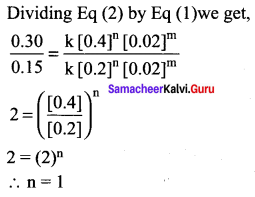
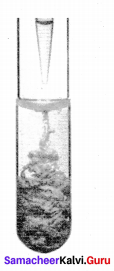
Samacheer Kalvi 8th Social Science Civics Solutions Term 2 Chapter 2 Human Rights and UNO

You can Download Samacheer Kalvi 8th Social Science Book Solutions Guide Pdf, Tamilnadu State Board help you to revise the complete Syllabus and score more marks in your examinations.

Tamilnadu Samacheer Kalvi 8th Social Science Civics Solutions Term 2 Chapter 2 Human Rights and UNO

Samacheer Kalvi 8th Social Science Civics Human Rights and UNO Textbook Evaluation

I. Choose the correct answer

Human Rights And Uno 8th Standard Question 1.
After the Second World War ……………. has taken several measures to protect the human rights.
(a) UNO
(b) Supreme Court
(c) International Court of Justice
(d) None
Answer:
(a) UNO

Human Rights And Uno 8th Standard Samacheer Kalvi Question 2.
In 1995 women from all over the world gathered at ……………..
(a) Beijing
(b) New York
(c) Delhi
(d) None
Answer:
(a) Beijing

Human Rights Lesson Class 8 Question 3.
The National Human Rights Commission was constituted in ………………
(a) 1990
(b) 1993
(c) 1978
(d) 1979
Answer:
(b) 1993

Human Rights Class 8th Question 4.
The UNO declared 1979 as the International year of ……………..
(a) Girl Child
(b) Children
(c) Women
(d) None
Answer:
(c) Women

Human Rights 8th Standard Notes Question 5.
When is Human Rights Day observed?
(a) 9th December
(b) 10th December
(c) 11th December
(d) 12th December
Answer:
(b) 10th December

8th Standard Social Human Rights Notes Question 6.
Which one is known as modern International Magna Carta of Human rights?
(a) UDHRC
(b) NHRC
(c) SHRC
(d) International year for women
Answer:
(a) UDHRC

Human Rights 8th Standard Question 7.
Who can be appointed as the chairperson of the National Human Rights Commission?
(a) Retired judge of high court
(b) Any retired Chief Justice of the Supreme Court.
(c) Any person appointed by the president.
(d) Retired Chief Judge of any court.
Answer:
(c) Any person appointed by the president.

Human Rights 8th Std Notes Question 8.
How many articles does the Universal Declaration of Human Rights contain?
(a) 20
(b) 30
(c) 40
(d) 50
Answer:
(b) 30

Human Rights And Uno Question 9.
What is the tenure of the Chairperson of the National Human Rights Commission?
(a) 5 years or upto 62 years of age
(b) 5 years or upto 65 years of age
(c) 6 years or upto 65 years of age
(d) 5 years or upto 70 years of age
Answer:
(d) 5 years or upto 70 years of age

Question 10.
Where is the headquarters of the National Human Rights Commission?
(a) Delhi
(b) Mumbai
(c) Ahmedabad
(d) Kolkata
Answer:
(a) Delhi

II. Fill in the Blanks

  1. Each individual has ………….. to lead a dignified life.
  2. Human Rights are ………….. rights.
  3. The State Human Rights commission was formed on ……………
  4. Article 24 of Indian Constitution prohibits ……………
  5. United Nations Organisation was established in the year ……………

Answer:

  1. Right
  2. Fundamental rights
  3. 17th April 1997
  4. Child Labor
  5. 24th October 1945

III. Match the following:

  1. Eleanor Roosevelt – world’s first charter of human rights
  2. The Cyrus Cylinder – 1997
  3. Eve Teasing Act – freedom from slavery
  4. Child help line – Human Rights Commission
  5. Civil right – right to vote
  6. Political right – 1098

Answer:

  1. Eleanor Roosevelt – Human Rights Commission
  2. The Cyrus Cylinder – world’s first charter of human rights
  3. Eve Teasing Act – 1997
  4. Child help line – 1098
  5. Civil right – freedom from slavery
  6. Political right – right to vote

IV. State True or False

  1. Human rights and civil rights are the same.
  2. Declaration of the Rights of Man and of the Citizen was proclaimed in India.
  3. The Human Right Act of 1993 provides the creation of National Human Rights Commission.
  4. National Human Rights Commission has empowered to give punishment to the victims.
  5. ………….. was empowered to setup commission for the promotion of Human rights at National and State level.

Answer:

  1. True
  2. True
  3. False
  4. True
  5. ECOSOC

V. Consider the following statements and tick the appropriate answer

Question 1.
Find the wrong statement
(a) National Human Rights Commission is a statutory body.
(b) National Human Rights Commission is a constitutional body.
(c) National Human Rights Commission is an independent body.
(d) National Human Rights Commission is a multilateral institution.
Answer:
(b) National Human Rights Commission is a constitutional body.

Question 2.
Which of the following statement is not correct about the National Human Rights Commission?
(a) It was established in 1993.
(b) In the cases of human rights violation, the Commission has no rights to punish the culprit.
(c) The Chairperson and members are of this Commission are appointed by the Supreme Court of India.
(d) The Commission sends its annual report to the Central Government and State Governments.
Answer:
(c) The Chairperson and members are of this Commission are appointed by the Supreme Court of India.

Question 3.
Assertion (A) : Human Rights day is observed on 10th December
Reason (R) : It commemorates Eleanor Roosevelt’s birthday.
(a) A is correct but R does not explain A
(b) A is correct but R explains A
(c) A and R are correct
(d) A and R are Wrong
Answer:
(a) A is correct but R does not explain A

Question 4.
Consider the following statements

  1. The State Human Rights Commission is a multi-member body.
  2. The State Human Rights Commission consists of a chairperson and three members.

Which of the statements given above is /are correct?
(a) 1 only
(b) 2 only
(c) Both a and b
(d) None
Answer:
(a) 1 only

VI. Answer the following in one or two sentences

Question 1.
What are Human Rights?
Answer:

  1. Human rights are rights inherent to all human beings regardless of race, sex, nationality, ethnicity, language and religion.
  2. Human rights include freedom from slavery and torture, freedom of opinion and expression and fair trial. The right to life work and education.

Question 2.
Bring out the importance of UDHR.
Answer:

  1. One of the greatest achievements of United Nations is the creation of human rights law.
  2. To advance this goal, the UN established a Commission of Human Rights.
  3. it is also known as modem International Magna Carta of Human Rights.
  4. It is the most translated document in the world.

Question 3.
What does Article 45 of Indian Constitution provide?
Answer:
Article 45 of Indian Constitution provides that the state shall endeavor to provide early childhood care and education for all children until they complete the age of six years.

Question 4.
Write about Right to Education Act.
Answer:
Article 21A provides that the state shall provide free and compulsory education to all children aged six to fourteen years.

Question 5.
State any three legislation passed to safeguard the welfare of women.
Answer:

  1. The Hindu Widow Remarriage Act 1856
  2. The Hindu Marriage Act 1955.
  3. The Hindu Succession Act 1956.

Question 6.
Mention some of the political rights.
Answer:
The freedom of expression, and peaceful assembly, the right to take part in the government of one’s country, the right to vote, the freedom of speech and obtain information.

Question 7.
Name the five primary categories of Human Rights.
Answer:

  1. Civil Rights
  2. Political Rights
  3. Social Rights
  4. Economic Rights
  5. Cultural Rights

VII. Answer the following in detail:

Question 1.
Distinguish between Human rights and Civil rights.
Answer:
Human Rights:

  1. Human Rights belong to everyone, everywhere, regardless of nationality, sexuality, gender, race, religion or age.
  2. Human rights are considered universal to all human beings and universsal in all countries.
  3. No nation may rightfully deprive human rights to an individual.
  4. Human rights are basic rights inherent with birth.

Civil Rights:

  1. Civil rights are those rights that one enjoys by virtue of citizenship in a particular nation or state.
  2. Civil rights vary greatly from country to the country’s or government to government. It is related to the constitution.
  3. Different nations can grant or deny different civil rights and liberties.
  4. Civil rights are creation of the society.

Question 2.
Describe any five basic characteristics of Human rights.
Answer:

  1. Inherent – they are not granted by any person or authority.
  2. Fund ntal – they are fundamental rights because without them, the life and dignity of man will be meaningless.
  3. Inalienable – they cannot be taken away from the individual.
  4. Indivisible – they can’t be denied even when other rights have already been enjoyed.
  5. Universal – they are universal. They apply irrespective of one’s origin or status. They are enforceable without national border.

Question 3.
What are the measures taken by the government to protect the children?
Answer:

  1. The child is considered as an important national asset.
  2. The future of a nation depends on how its children mature and develop.
  3. So protection of children from all kinds of exploitation and abuses has become the main objective of our society.
  4. There are laws in India protecting the rights of the children.

(a) Right to Education Act:
Article 21A provides that the state shall provide free and compulsory education to all children aged six to fourteen years.

(b) The Child Labour Act (Prohibition and Regulation Act 1986):
It provides no child who has not completed 15 years of age can be employed.

(c) The Juvenile Justice Act 2000 (Care and Protection of Children):
This Act tries to protect children deprived of adequate care and to reform the children by adopting child friendly approach.

(d) POCSO A I 2012:
Protection of children from Sexual Offences Act regards the best interest of the child as being paramount importance in’every state.

VIII. HOTs

Question 1.
To whom does the Universal Declaration of Human Rights apply? Why is it important to you?
Answer:
To each individual, regardless of gender, race, religion or cultural background. Because it protects and promotes your individual rights.

IX Project and Activity

Question 1.
Make a list of 10 rights that you enjoy, and the responsibilities that you have.
Answer:
Rights :

  1. Right to life
  2. Right to family life
  3. Right to education
  4. Right to personal freedom
  5. Right to religious freedom
  6. Right to freedom of movement
  7. Freedom of press
  8. Right to equality
  9. Right to justice
  10. Freedom to form associations

Responsibilities:

  1. Support and defend the constitution
  2. Stay informed of the issues affecting your community.
  3. Participate in the democratic process.
  4. Respect and obey federal, state and local laws.
  5. Respect the rights, beliefs, and opinion of others.
  6. Participate in your local community.
  7. Serve on a jury when called upon.
  8. Defend the country if the need should arise.
  9. Pay income and other taxes honestly and on time, to federal, state and local authorities.

Samacheer Kalvi 8th Social Science Civics Human Rights and UNO Additional Questions

I. Choose the correct answer:

Question 1.
After the ……………. war, UNO has taken several measures to protect the human rights.
(a) First world
(b) Second world
(c) Third world
(d) None of these
Answer:
(b) Second world

Question 2.
In ………….. women from all over the world gathered at Beijing.
(a) 1994
(b) 1995
(c) 1999
(d) 1996
Answer:
(b) 1995

Question 3.
The ………….. commission was constituted in 1993.
(a) State Human Rights
(b) Local Human Rights
(c) National Human Rights
(d) Union Human Rights
Answer:
(c) National Human Rights

Question 4.
The ………….. declared 1979 as the International year of women.
(a) UNO
(b) UNESCO
(c) UDHRC
(d) SHRC
Answer:
(a) UNO

Question 5.
………….. is celeberated on 10th December every year.
(a) Valentine’s day
(b) Human Freedom Day
(c) Human Rights Day
(d) World Environment Day
Answer:
(c) Human Rights Day

Question 6.
………….. of Human Rights contain 30 Articles.
(a) Universal Declaration
(b) National Declaration
(c) State Declaration
(d) District Declaration
Answer:
(a) Universal Declaration

Question 7.
The ………….. was formed on 17th April 1997.
(a) Universal Human Rights Commission
(b) State Human Rights Commission
(c) District Human Rights Commission
(d) Local Human Rights Commission
Answer:
(b) State Human Rights Commission

Question 8.
………….. was established in the year 1945.
(a) UNESCO
(b) SHRC
(c) NHRC
(d) UNO
Answer:
(d) UNO

Question 9.
………….. are related to individuals and society.
(a) Human Liberty
(b) Human Rights
(c) Human Freedom
(d) Petition of Right
Answer:
(b) Human Rights

Question 10.
One of the greatest achievements of ………….. is the creation of Human Rights Law.
(a) India
(b) United Kingdom
(c) United Nation
(d) All the above
Answer:
(c) United Nation

Question 11.
Expand form of UDHR …………..
(a) United Declaration of Human Rights
(b) Universal Declaration of Human Rights
(c) Universal Development of Health Rights
(d) Universal Declaration of Health Rights
Answer:
(b) Universal Declaration of Human Rights

Question 12.
UDHR was adopted by the UN General Assemly in ……………
(a) 1948
(b) 1949
(c) 1950
(d) 1947
Answer:
(a) 1948

Question 13.
………….. refers to the basic rights afforded by law of the government to every person.
(a) Human Rights
(b) Freedom Rights
(c) Civil Rights
(d) Fundamental Rights
Answer:
(c) Civil Rights

Question 14.
………….. are exercised in the formation and administration of a government.
(a) Civil rights
(b) Political rights
(c) Social rights
(d) Economic rights
Answer:
(b) Political rights

Question 15.
The civil and Political rights are directly related to ………….. democracy.
(a) modem
(b) classical
(c) tradition
(d) all the above
Answer:
(a) modern

Question 16.
………….. rights are those rights necessary for an adequate standard of living ncluding the rights in education and health etc.
(a) Economic
(b) Civil
(c) Political
(d) Social
Answer:
(d) Social

Question 17.
The convention on the rights of the Rights of the child was proclaimed by UN on …………..
(a) 20th November 1989
(b) 20th December 1989
(c) 20th October 1989
(d) 20th September 1989
Answer:
(a) 20th November 1989

Question 18.
………….. provides no child who has not completed 15 years of age can be employed.
(a) POCSO Act
(b) Right to Education Act
(c) The Child Labour Act
(d) The Juvenile Justice Act
Answer:
(c) The Child Labour Act

Question 19.
UNO has declared ………….. as International.year of women.
(a) 1979
(b) 1978
(c) 1980
(d) 1961
Answer:
(b) 1978

Question 20.
………….. has declared 1979 as the International year of children.
(a) POCSO
(b) UDHRC
(c) UNO
(d) NHRC
Answer:
(c) UNO

II. Fill in the blanks:

  1. ………….. are basic rights inherent with birth.
  2. A ………….. means every human being below the age of 18 years.
  3. ………….. was adopted by UN General Assembly in 1948.
  4. In 1995 the …………… world conference of women, held in Beijing.
  5. Indian Constitution Article 39 (F) provides for …………… to develop in healthy manner.
  6. ………….. rights includes the rights to life, liberty, freedom from slavery and arbitrary arrest.
  7. The United Nations Organisation was drafted in …………….
  8. A set of basic right and freedom has deep roots in ……………. and ……………. countries.
  9. There are 30 Articles incorporated in the ……………..
  10. …………….. the great, the first king of Ancient Persia.
  11. UNO was established on …………….. 1945.
  12. …………….. during the Second World War made clear that previous efforts to protect body.
  13. Expand form of ECOSOC ……………
  14. NHRC is an …………… and …………… body.
  15. NHRC is Multi member body which consists of a …………… and other members.
  16. NHRC has ……………… division.
  17. The State Human Rights Commission of ………….. was formed on 17th April 1997.
  18. State Human Rights Commission consists of ……………. members including Chairperson.
  19. The headquarter of NHRC is located at …………….

Answer:

  1. Human Rights
  2. Child
  3. UDHR
  4. fourth
  5. Children
  6. Civil
  7. 1945
  8. European and American
  9. Universal Declaration of Human Rights
  10. Cyrus
  11. 24th October
  12. rocities
  13. The Economic and Social Council
  14. Independent statutory and non-constitutional
  15. Chairperson
  16. Five
  17. Tamil Nadu
  18. three
  19. New Delhi

III. Match the following:

Human Rights And Uno 8th Standard Social Science Civics Solutions Term 2 Chapter 2 Samacheer Kalvi
Answer:

  1. e
  2. c
  3. a
  4. b
  5. d

Human Rights And Uno 8th Standard Samacheer Kalvi Social Science Civics Solutions Term 2 Chapter 2
Answer:

  1. b
  2. a
  3. e
  4. c
  5. d

IV. State True or False

  1. Every year 18th November is observed as the Human Rights Day.
  2. The Headquarters of National Human Rights Commission is situated in Mumbai.
  3. The Universal Declaration of Human Rights (UDHR) was adopted by the UN General Assembly in 1948.
  4. Human Rights are related to individual and society.
  5. There are 45 Articles incorporated in the Universal Declaration of Human Rights.
  6. Indian Constitution Article 39(f) provides for Children to develop in healthy manner.
  7. 1098 Child Line is India’s First 24 hours free emergency phone service for children in need if assistance.
  8. The National Human Rights Commission’s Chairperson and other members appointed for 6 years.
  9. The child is considered as an important national asset.
  10. UNO has declared 1979 as the international year of women.
  11. UNO has declared 1978 as international year of women.

Answer:

  1. False
  2. False
  3. True
  4. True
  5. False
  6. True
  7. True
  8. False
  9. True
  10. False
  11. True

V. Consider the following statements and Tick (✓) the appropriate answer

Question 1.
Find the Correct Statement:
(i) Human Rights are inherent, inalienable, interdependent and indivisible.
(ii) In 1996 the fourth world conference of women, held in Beijing.
(iii) The Dowry Prohibition Act 1961.
(iv) The UNO has declared 1979 as the International Year of Children.

(a) (i), (ii) & (iii) are Correct
(b) (i), (ii) & (iv) are Correct
(c) (i), (iii) and (iv) are Correct
(d) (ii), (iii) and (iv) are Correct
Answer:
(c) (i), (iii) and (iv) are Correct

Question 2.
Assertion (A) : Indian Constitution Article 39(f) provides for Children to develop in healthy manner.
Reason (R) : The child is considered as an important national assets.
(a) A is correct and R is the correct explanation of A
(b) A is correct but R is wrong
(c) A is correct but R is not the correct explanation of A
(d) A is incorrect but R is correct
Answer:
(a) A is correct and R is the correct explanation of A

Question 3.
Which of the following is correctly matched?
(a) The Eve Teasing Act – 1998
(b) The Hindu Succession Act – 1956
(c) The Hindu Re – Marriage Act – 1958
(d) The Hindu Marriage Act – 1856
Answer:
(b) The Hindu Succession Act – 1956

Question 4.
Which of the following is not correctly matched?
(a) The Dowry Prohibition Act – 1961
(b) The Hindu Marriage Act – 1955
(c) Indecent Representation Act – 1998
(d) Protection of Women from Domestic Violence Act – 2005
Answer:
(c) Indecent Representation Act – 1998

VI. Answer in one or two sentences:

Question 1.
List out the Four basic characteristics of Human Rights.
Answer:

  1. Inherent
  2. Fundamental
  3. Indivisible
  4. Universal

Question 2.
What do you meant by human rights?
Answer:
Human rights belong to everyone, everywhere, regardless of nationality, sexuality, gender, race, religion or age.

Question 3.
What are Civil Rights?
Answer:
Civil Rights are those rights that one enjoys by virtue of citizenship in a particular nation or state.

Question 4.
Write a short note on National Human Rights Commission.
Answer:

  1. The National Human Rights Commission (NHRC) of India was established on 12th October, 1993.
  2. It is an independent statutory and non – constitutional body.
  3. Its headquarter is located in New Delhi.

Question 5.
Who are them members of National Human Rights Commission (NHRC)?
Answer:
NHRC is a multi member body which consists of a Chairperson and other members. They are –

  1. Chairperson (Retired) Chief Justice of India, Judge of Supreme Court, Judge of High Court, 2 members having practical knowledge relating to Human Rights and Deemed members.
  2. Chairpersons of National Commission for Minorities, Scheduled Castes, Scheduled Tribes and Women.

Question 6.
Write a few lines about the State Human Rights Commission of Tamil Nadu.
Answer:

  1. The State Human Rights of Tamil Nadu was formed on 17th April, 1997.
  2. It function at the state level.
  3. It consists of three members including a chairperson.

Question 7.
Expand POCSO and NHRC.
Answer:

  1. POCSO : Protection of Children from Sexual Offences Act.
  2. NHRC : National Human Rights Commission

Question 8.
Define Child Rights.
Answer:
According to Article 1 of the United Nations Convention on the Rights of the Child 1989, ‘a child means every human being below the age of eighteen years’.

VII. Answer the following in detail:

Question 1.
Explain the various kinds of Human Rights.
Answer:
These rights are broadly classified into five primary categories. They are as follows:

1. Civil Rights:
The term civil rights refers to the basic rights afforded by laws of the government to every person.

2. Political Rights:

  • Political rights are exercised in the formation and administration of a government.
  • The civil and political rights are directly related to modem democracy.
  • It includes the freedom of expression and peaceful assembly, the right to take part in the government of one’s country, the right to vote, the freedom of speech and obtain information.

3. Social Rights:

  • It is necessary for an individual to fully participate in the society.
  • Social rights are those rights necessary for an adequate standard of living including the right to education, health care, food, clothing, shelter and social security.

4. Economic Rights:

  • The right to participate in an economy that benefits all and to desirable work.
  • Economic rights guarantee every person to have condition under which they are able to meed their needs.
  • This includes the rights to employment and fair wage, the reasonable limitation of working hours etc.

5. Cultural Rights:
The rights to freedom of religion and to speak the language and to practice the cultural life of the community, the right to share in scientific advancement, and right to the protection of moral and material interest.

Question 2.
Discuss about the Universal Declaration of Human Rights (UDHR)
Answer:

1. One of the greatest achievements of United Nations is the creation of human rights law.

2. To advance this goal, the UN established a Commission on Human Rights.

3. The Commission guided by Eleanor Roosevelt’s (Wife of former US President Franklin D Roosevelt) forceful leadership captured the world’s attention.

4. The Universal Declaration of Human Rights (UDHR) was adopted by the UN General Assembly in 1948.

5. It is a milestone document in the history of Human rights.

6. The Declaration was proclaimed by the UN General Assembly in Paris, France on 10th December 1948 (General Assembly Resolution 217A).

7. In remembrance of every year 10th December is observed as the Human rights Day and its regular observance commenced from 1950.

8. It is also known as modem International Magna Carta of Human Rights.

9. Its principles have been incorporated into the Constitutions of most of the (more than 185) nations.

10. DHR has been translated into more than 500 languages.

11. It is the most translated document in the world.

Samacheer Kalvi 9th English Solutions Supplementary Chapter 5 Little Cyclone: The Story of a Grizzly Cub

You can Download Little Cyclone: The Story of a Grizzly Cub Questions and Answers, Summary, Activity, Notes, Samacheer Kalvi 9th English Book Solutions Guide Pdf Supplementary Chapter 5 help you to revise complete Tamilnadu State Board New Syllabus and score more marks in your examinations.

Tamilnadu Samacheer Kalvi 9th English Solutions Supplementary Chapter 5 Little Cyclone: The Story of a Grizzly Cub

Little Cyclone: The Story of a Grizzly Cub Warm Up: 

Little Cyclone The Story Of A Grizzly Cub Question 1.
Why are some animals endangered?
Answer:
An animal is called endangered when only a few of its kind are alive in the world. There are many reasons for a species to become endangered. The environmental conditions on Earth are continually changing. Some animals become endangered because they can no longer survive in the new conditions of their changing habitat. Some other prominent reasons are overhunting by humans and pollution.

Little Cyclone The Story Of A Grizzly Cub Summary Question 2.
Why do wild animals from the forest often enter the human living spaces?
Answer:
Due to urbanisation, people are felling trees and destroying forests to expand their habitable area. This reduces animal habitat due to which they are forced to enter into human living space, in search of food, water and shelter.

Little Cyclone: The Story Of A Grizzly Cub Questions And Answers Question 3.
Are animals happy in wild life rehabilitation centres?
Answer:
Animals are brought to the wild life rehabilitation centres to live and be protected for the rest of their lives. But the animals might not be happy in captivity. Although they are provided with good sanitary conditions, sufficient enclosures, proper vet care and appropriate feed, they may definitely miss their natural habitat.

Little Cyclone The Story Of A Grizzly Cub Questions And Answers Question 4.
Can a rehab animal survive in the wild?
Answer:
Most animals are brought into wildlife rehabilitation centres for help. They are so sick or emaciated that their chances for survival are often slim. They are taken care of and treated under captivity only until able to live independently in the wild. Every effort is made to minimize human contact and prevent the taming of rehabilitation patients. So, when they are released back in their wild habitat, they often survive well.

Little Cyclone: The Story Of A Grizzly Cub Book Back Answers Question 5.
How many types of bear do you think are there living in the world today?
Answer:
Today, there are only eight species of bears surviving in the world. Except for Antarctica and Australia, all other continents of the world provide habitats for bears.

Vocabulary:

A. use the following phrases in sentences of your own.

Little Cyclone The Story Of A Grizzly Cub Samacheer Kalvi 9th English Solutions Supplementary Chapter 5

1. earn one’s name – make a name for oneself.
She earned her name in politics, as a powerful leader.

2. in the rear of – at the back of.
Harry was sitting in the rear of seat of his car.

3. to see one fight – to struggle to get through something.
I can see him fighting for his right to vote.

4. devoid of – lacking in.
This apartment is devoid of all comforts.

5. air and manner – to behave in a way that does not show how you really feel.
Audy assumed an air and manner of indifference, whenever her name was mentioned.

6. quick as a flash – very quickly.
He was at her side as quick as a flash.

7. in wild haste – rapidly.
It is very important that decisions are not taken in wild haste.

8. make a pass – make advances to someone.
Men seldom make passes at girls who wear glasses.

B. Now refer a dictionary and find idioms on the following animals, birds and insects. Learn their meanings and share what you have learnt with your class. Try to frame illustrative sentences with those idioms. Find opportunities to use them in your everyday conversations.

Little Cyclone The Story Of A Grizzly Cub Summary Samacheer Kalvi 9th English Solutions Supplementary Chapter 5

1. lion – get the lion’s share – get the greatest percentage.
My aunt got the lion’s share of the inheritance.

2. mouse – as poor as a church mouse – very poor.
My cousin is as poor as a church mouse and never has any money to spend.

3. parrot – as sick as a parrot – To be thoroughly displeased.
Tim was as sick as a parrot to be separated from my family.

4. fox – as sly as a fox – smart and clever.
The manager of our apartment is as sly as a fox.

5. hawk – watching like a hawk – watching something very, very closely.
I’m watching you like a hawk.

6. Snake – nurse a snake in one’s bosom – look after.
I have nursed a snake in my bosom all these years.

7. monkey – I’ll be a monkey’s uncle – I’m very surprised.
Well, I’ll be a monkey’s uncle. I never thought I’d pass that test.

8. dog – dog days – very hot days.
I slept in the basement during the dog days of August.

9. snail – At a snail’s pace – Moving very slowly.
Traffic is moving at a snail’s pace.

10. bee – make a beeline for – go quickly and directly to somebody or something.
My grand mother made a beeline for the food as soon as she arrived

C. Based on your reading, answer the following questions in a paragraph of about 100-150 words each.

Summary Of Little Cyclone The Story Of A Grizzly Cub Question 1.
Describe the appearance of Little Cyclone.
Answer:
Little Cyclone is a grizzly cub from Alaska. He earned his name by the vigour of his resistance to ill-treatment. He was a curious and amusing little cub. It had fluffy hair, two big black eyes which sparkled like jet beads, short and fat nose and high shoulders. But his claws were strong and dangerous and he had a truly grizzly spirit. He did not show any fear to its opponents. He was bom full of courage and devoid of all sense of fear. He was a queer looking gray fellow with a broad head. He could fight any other bear on three seconds’ notice.

Little Cyclone: The Story Of A Grizzly Cub Ppt Question 2.
What does the fight Little Cyclone and his brother put up, tell you about the nature of grizzly bears?
Answer:
Grizzly bears are bom full of courage and devoid of all sense of fear. Little cyclone is a grizzly cub from Alaska. He earned his name by the vigour of his resistance to ill treatment. When his mother was fired at, on a timbered hillside, he and his brother ran away as fast as their short and thick legs could carry them. When they came back,they thought their mother was sleeping. They cuddled up close against her warm body and slept peacefully until morning.

They were awakened by the rough grasp of human hands. Bravely, they bit, scratched and cried aloud with anger. His brother made a fight so fierce and terrible that his nervous captor let him go. Although, Little Cyclone fought just as desperately, his captor seized him by his hind legs, dragged him backwards and bound him. This fight of the grizzly bears proves their strength and grit. They do not wish to be cowed down or dominated by their opponents.

Little Cyclone: The Story Of A Grizzly Cub Mind Map Question 3.
“If any of you fellows think there is anything coming to you from me, come and take (t”. How did Little Cyclone prove this?
Answer:
When Little Cyclone’s travelling box was opened, he found himself free in the Bear Nursery at New York. He walked stiffly with pride to the centre of the stage, halted and calmly looked about him. His air and manner said as plainly as English, “I’m a grizzly from Alaska, and I’ve come to stay. If any of you fellows think there is anything coming to you from me, come and take it’. Usually a new comer would be badly scared during his first day in the Nursery and very timid during the next. But grizzlies are different. They are born full of courage and devoid of all sense of fear.

Naturally, it is a good test of courage and temper to turn a new bear into that roistering crowd. But Little Cyclone was fearless and quick in attacking his opponents on three seconds’ notice.

Little Cyclone The Story Of A Grizzly Cub Ppt Question 4.
Describe the confrontation between Little Czar and Little Cyclone.
Answer:
Little Czar was a very cheeky and impertinent bear. But it was a good-natured European brown bear. He walked to Little Cyclone and aimed a sample blow at Cyclone’s left ear. Quick as a flash, outshot Cyclone’s right paw, as only a grizzly can strike and caught the would-be hazer on the side of the head. Amazed and confused, Czar fled in wild haste. Next Cyclone also attacked a black bear cub, who made a pass at the newcomer and made him to quit the field.

Little Cyclone carefully and meticulously met every attack, real or faked, that was made upon him. All the bears in the Nursery understood that Little Cyclone can fight any other bear on three seconds’ notice. He could also strike anyone hard and quickly.

D. Telling the Story Again.

Little Cyclone was a grizzly cub from __________ (1) ___________. earned his name __________ (2) _________. When his mother was fired at, they ____________ .(3) ___________. The next day at sunrise the two orphans found themselves at _____________ (4) _____________ .One of them escaped ____________ (5) _____________. So the captor let him go. But the other cub was ____________ (6) ___________ and taken to the ___________ (7) ___________ at New York. The Zoological Park had _____________ (8) _____________ . Usually a newcomer is badly scared on his first day but ______________ (9) ______________. When the box was opened he stood up with courage __________(10) ____________.  Cyclone courageously met every __________________ (11) ___________ In less than an hour, all the other bears understood _________ (12) ____________. From then on Little Cyclone’s position was _____________ (13) _____________.
Answer:

  1. Alaska, who
  2. by the vigour of his resistance to ill-treatment.
  3. ran away as fast as their stumpy legs could carry them.
  4. the rough grasp of human hands.
  5. after a fierce and terrible fight,
  6. seized
  7. Zoological Park
  8. Bears’ Nursery.
  9. grizzly bears are different
  10. and walked stiffly with pride to the center of the stage, halted and calmly looked about him.
  11. attack real or faked.
  12. that Cyclone could strike quick and hard and fight any other bear on three seconds’notice.
  13. assured with respect and dignity.

E. Choose the correct answer.

Little Cyclone The Story Of A Grizzly Cub In Tamil Question 1.
Little Cyclone is a grizzly cub who earned his name by his ____________.
(a) appearance and behaviour.
(b) viguor of resistance to ill-treatment.
(c) speed and courage.
(d) escape from a cyclone.
Answer:
(b) vigour of resistance to ill-treatment

Little Cyclone The Story Of A Grizzly Cub Mind Map Question 2.
The nervous captor let one bear go because ____________.
(a) he was afraid of bears.
(b) he did not have proper equipment to seize him.
(c) he bear fought so fiercly.
(d) the bear escaped and ran away.
Answer:
(c) the bear fought so fiercly

The Story Of A Grizzly Cub Summary Question 3.
Little Cyclone was rescued by the ____________.
(a) members of the Blue Cross.
(b) friendly hands of the Zoological Society.
(c) members of the National Zoo.
(d) volunteers from New York.
Answer:
(b) friendly hands of the Zoological Society

Question 4.
Little Czar was a ____________.
(a) good natured European brown bear.
(b) grizzly cub from Alaska.
(c) furry little Polar bear.
(d) North American black bear.
Answer:
(a) good natured European brown bear

Question 5.
Little Cyclone will fight any other bear in ____________.
(a) 10 minutes’ notice.
(b) 15 minutes’ notice.
(c) 03 seconds’ notice.
(d) 10 seconds’ notice.
Answer:
(c) 03 seconds’ notice

F. Learn the following idioms on bears.

Little Cyclone: The Story Of A Grizzly Cub Questions And Answers Samacheer Kalvi 9th English Solutions Supplementary Chapter 5

Little Cyclone: The Story of a Grizzly Cub About The Author:

William Temple Homaday was an American Zoologist, conservationist, taxidermist and author. The first director of the New York Zoological Park, William Temple Homaday was a pioneer in the early wildlife conservation movement in the United States.

He is known for his dramatic ‘life groups” of animals in natural setting for museum displays. Homaday’s goal was to educate the American people about these magnificent animals and generate interest in environmental conservation. He also produced a very popular exhibit of a bison group for the National Museum.

In 1889, Homaday published ‘The Extermination of the American Bison’ a popular work that did create public support to save this species. He emphasized the importance of saving American native wildife.

Little Cyclone: The Story of a Grizzly Cub Summary:

Little Cyclone The Story Of A Grizzly Cub Questions And Answers Samacheer Kalvi 9th English Solutions Supplementary Chapter 5

A young grizzly bear by name Little Cyclone had proved its strength and grit. Little Cyclone did not cow down nor let the bigger bears to dominate it. Little Cyclone is from Alaska. It earned this name after it showed its vigour of resistance to ill-treatment.

One day when Little Cyclone’s mother was fired at a timbered hillside facing Chilkat River, he and his brother ran to the spot and cuddled her thinking that she was asleep the whole night. The next day, before dawn the two brothers were seized by humans.

One of them escaped from the human hand by making a terrible and forceful fight and stayed in Chilkoot. The other failed in its endeavour and was captured and seized. Then it was collared, chained in the rear of the saloon in Porcupine city. To tame the grizzly cub they used a long pole and violently prodded to see if it defended. Very soon Little Cyclone was rescued by die zoological society’s field agent who took him to New York.

In New York at the Bears’ Nursery, which is a big yard, it had a shade tree, a tree to climb, a swimming pool, three sleeping dens and a rock cliff where usually six to eight cubs were accommodated. Naturally it is a good test of courage and temper to turn a new bear into that roystering crowd.

A newcomer generally in a nursery takes time to adapt but grizzlies are different. Especially Little Cyclone’s behaviour was very different. When he was let out from the travelling box, he stalked and occupied the centre stage with an air and manner which pronounced thus: “I’m a grizzly from Alaska, and I’ve come to stay.” His mannerism also stated that if you dare to protest come for a fight.

Little Czar, a very saucy but good. natured European brown bear cub gave a blow at Little Cyclone’s left ear. Quick as a flash, Cyclone’s right paw struck Czar and caught the side of the head. Amazed and confounded Czar fled. Next came a black bear cub twice the size of Cyclone but he received a fierce blow that he immediately left the field and ran to the top of the cliff.

There were lots of attack at Cyclone one after the other but in less than an hour every bear in the Nursery understood that Little Cyclone, the queer looking gray fellow with broad head and short nose could strike quick and hard and finish them off in less than three seconds. From that time, Cyclone’s position was assured.

Little Cyclone: The Story of a Grizzly Cub Glossary:

Little Cyclone: The Story Of A Grizzly Cub Book Back Answers Samacheer Kalvi 9th English Solutions Supplementary Chapter 5

Samacheer Kalvi 8th English Solutions Term 3 Poem Chapter 2 My Computer Needs A Break

Students can Download English Poem 2 My Computer Needs A Break Questions and Answers, Summary, Activity, Notes, Samacheer Kalvi 8th English Book Solutions Guide Pdf helps you to revise the complete Tamilnadu State Board New Syllabus and score more marks in your examinations.

Tamilnadu Samacheer Kalvi 8th English Solutions Term 3 Poem Chapter 2 My Computer Needs A Break

Read And Understand

A. Answer the following.

My Computer Needs A Break Question 1.
How does the poet describe her computer?
Answer:
The poet describes her computer as very intelligent and smart. The computer seems to know a lot of information by heart.

My Computer Needs A Break Poem Question 2.
What happened to the computer?
Answer:
The computer was behaving badly, forgets to save and store anything. A virus has got into it and it became sick.

My Computer Needs A Break Summary Question 3.
List four things that the computer could not do after it became absent-minded.
Answer:
(a) The computer forgets to save the poet s work.
(b) It doesn’t check her spellings.
(c) It hides all her files.
(d) It makes her work vanish in the most dreadful way.

My Computer Needs A Break Poem Summary Question 4.
What made the poet squirm?
Answer:
When the computer actually gobbled a worm, a virus, it behaved unsteadily. So the poet squirmed.

My Computer Needs A Break Question Answer Question 5.
Why did the poet call the doctor?
Answer:
The computer caught a virus and fell very sick. So the poet had to call a doctor.

B. Fill in the blanks.

  1. Computers are ________ and ________
  2. We get answers for questions by a ________
  3. The computer forgot to ________ the poet’s work.
  4. The computer actually gobbled a ________
  5. The poet feels that his computer needs ________

Answer:

  1. brainy, smart
  2. click
  3. save
  4. worm
  5. a holiday

C. Pick out the rhyming words from the poem.

  1. Smart – ______
  2. click – ______
  3. right – ______
  4. sick – ______

Answer:

  1. heart
  2. quick
  3. sight
  4. quick

D. Match the poetic lines with Figures of speech

  1. So brainy – (a) personification
  2. Mountains – (b) personification
  3. It’s so absent minded – (c) hyperbole
  4. Computer gobbled a worm – (d) metaphor
  5. Very sick – (e) metaphor

Answer:

  1. (d)
  2. (c)
  3. (a)
  4. (b)
  5. (e)

E. Find the alliterating words from the poem

  1. Save – ______
  2. Doctor – ______
  3. Virus – ______
  4. makes – ______

Answer:

  1. store
  2. double
  3. very
  4. most

Parallel Reading

My Computer Needs A Break Book Back Answers Additional Questions:

My Computer Needs A Break Poem Questions And Answers Question 1.
Who bought us closer and then made us more distance?
Answer:
Technology brought us closer and then made us more distance.

My Computer Needs A Break Poem Lines Question 2.
What did technology do?
Answer:
It introduced us to more friends and invited enemies. It gave us more publicity and exploited us. It saved us more and it is spent to be more busy.

My Computer Needs A Break Poem Explanation Question 3.
What does the poet say about the Technology?
Answer:
The technology is an entrapping blessing in disguise.

My Computer Needs A Break Poem Question Answer Question 4.
Which is our new addiction?
Answer:
Technology is our new addiction.

My Computer Needs A Break Poem Lesson Plan Question 5.
Can we live without Technology?
Answer:
No, we cannot live without technology.

My Computer Needs A Break Additional Questions

I. Poem Comprehension:

My Computer Needs A Break Poem By Santhini Govindan Question 1.
My computer has always been so brainy and smart – It seems to know mountains of information by heart.

(a) What has the computer always been to the poet?
Answer:
The computer had always been so brainy and smart.

(b) Why does the poet use the word ‘mountains’?
Answer:
She had used this word to insist that the computer knows a lot of information.

(c) What do you mean by ‘brainy’.
Answer:
‘Brainy’ means “intelligent”.

8th English My Computer Needs A Break Question 2.
It forgets to ‘save’ my work, and store it away,
And instead, makes it vanish in the most dreadful way.

(a) What does the computer forget?
Answer:
The computer forgets to save the poet’s work.

(b) What vanishes in the most dreadful way?
OH Her works vanish in the most dreadful way.

(c) What do you mean by the word “dreadful”?
Answer:
“Dreadful” means “unpleasant”.

II. Poem Appreciation:

Question 1.
If I type in a question, and give my mouse a click,
My computer always gives me the answer really quick!

(a) Pick out the rhyming words.
Answer:
click – quick are the rhyming words.

(b) Name the alliterated words.
Answer:
my – mouse are the alliterated words.

Question 2.
And one day, my naughty computer actually gobbled a worm,
And behaved so erratically that it made me squirm.

(a) What is the figure of speech used here?
Answer:
Personification is used here. The computer is given human traits. It gobbled a worm.

(b) Pick out the alliterated words.
Answer:
made – me are the alliterated words.

III. Very Short Questions and Answers.

Question 1.
What do you mean by phrase “mountains of information”?
Answer:
It means a lot of information.

Question 2.
Who is absent-minded?
Answer:
The poets computer is absent-minded.

Question 3.
What do you mean by the word “erratically”?
Answer:
“Erratically” means “unsteadily or unpredictably”.

Question 4.
Why did the computer fall very sick according to the poet?
Answer:
The computer fell very sick because it caught a virus.

Question 5.
What vanished from the poet’s sight?
Answer:
Files vanished from the poets sight.

IV. Short Questions and Answers :

Question 1.
What happened one day?
Answer:
One day, the poet’s computer actually gobbled a worm that was a virus and behaved so unsteadily. This made the poet discomfort.

Question 2.
Why did the poet call a doctor?
Answer:
The poet called in a doctor to examine her computer which caught a virus and fell
very sick.

Question 3.
Why did the poet say that she didn’t know what to do?
Answer:
Her computer behaved badly and became absent-minded. So the poet said that she didn’t know what to do.

V. Paragraph Question with Answer.

Question 1.
What are the problems faced by the poet with her computer?
The poet’s computer had always been so intelligent and fashionable. It gave a lot of information quickly. But after some days, it gave her a lot of problems. She says that it was absent-minded. She did not know what to do about it. It forgot to save her work and store it away. It made her work vanish in the most unpleasant way. It didn’t check her spellings. It hid her files and vanished them from her sight. One day it gobbled a virus and fell very sick. So she had to call a doctor (a technician) to set it right.

Warm Up

Question 1.
In pairs, tell each other how computer plays a vital role in all fields.
Answer:

My Computer Needs A Break Samacheer Kalvi 8th English Solutions Term 3 Poem Chapter 2

  1. Computer helps students to learn new things.
  2. It is a boon to modern society.
  3. It is widely used in all fields such as Economics, Science, Medical, Law,Engineering, Designing, Graphics and Film making etc.
  4. Computer literacy is vital to success in today’s world.
  5. Computers have helped in the design of safety equipment in sports.

My Computer Needs A Break Summary

The poet’s computer had always been very intelligent and fashionable. It seemed to know a lot of information by heart. If she typed a question and gave her mouse a click, it gave her the answer quickly. But recently, her computer had been behaving badly. It was so absent-minded and forgot to save her work and store it. Instead, her work vanished in the most dreadful way. It also didn’t check her spellings and hid her files, vanishing them from sight.

One day, the naughty computer actually swallowed a worm, that is a virus and behaved so unsteadily. The poet was in a discomfort. As it caught the virus, it became sick. So she had to call the doctor (technician) to examine her computer. She just asked him whether his tired computer needed some relaxations (break) because she had been using it for many days.

Samacheer Kalvi 11th English Solutions Supplementary Chapter 1 After Twenty Years

Students who are interested in learning of 11th English Supplementary Chapter 1 After Twenty Years Questions and Answers can use Tamilnadu State Board Solutions of 11th English Chapter Wise Pdf. First check in which chapter you are lagging and then Download Samacheer Kalvi 11th English Book Solutions Questions and Answers Summary, Activity, Notes Chapter Wise. Students can build self confidence by solving the solutions with the help of Tamilnadu State Board English Solutions. English is the scoring subject if you improve your grammar skills. Because most of the students will lose marks by writing grammar mistakes. So, we suggest you to Download Tamilnadu State Board 11th English Solutions according to the chapters.

Tamilnadu Samacheer Kalvi 11th English Solutions Supplementary Chapter 1 After Twenty Years

Check out the topics covered in Supplementary Chapter 1 After Twenty Years Questions and Answers before you start your preparation. Improve your grammar skills with the help of Samacheer Kalvi 11th English Book Solutions Questions and Answers pdf links. The solutions for Tamilnadu State Board 11th English Textbook are prepared by the English experts. So, if you follow Tamilnadu State Board Solutions 11th English Textbook Solutions you can cover all the topics in Supplementary Chapter 1 After Twenty Years Questons and Answers. This helps to improve your communication skills.

11th English Supplementary Reader Paragraph Warm up

(a) What do you expect your close friends to do for you? Beautify the petals with your thoughts?

11th English Supplementary Reader Paragraph Chapter 1 After Twenty Years Samacheer Kalvi

Answer:

    1. Educate
    2. help
  1. encourage
  2. support
  3. share
  4. care
  5. guide

11th English After Twenty Years Paragraph Questions (b)

After Twenty Years Questions And Answers Pdf Question (i)
Find out when the International Day of Friendship is celebrated.
Answer:
International day of friendship is celebrated every year on 30 July.

After Twenty Years Paragraph Question (ii)
How is that day celebrated?
Answer:
Activities on a friendship day:

  • Cards indicating how one values the other’s friendship are handwritten and exchanged.
  • Friends exchange small gifts such as flowers, cakes, chocolates and friendship bands.
  • Call and greet “Happy Friendship Day” or at least SMS the greeting.
  • Buy a ticket for a movie to show how one values the other.
  • Take a group photograph and upload it on social media.

Samacheer Kalvi 11th English After Twenty Years Textual Questions

(1) Answer the following questions in a sentence or two each, based on your understanding of the story:

After Twenty Years Question Answer Class 11 Question (a)
Describe the appearance of the policeman on the beat.
Answer:
The policeman on the beat was strong. He had a well-built physique. He had an air of authority about. He had a sense of pride of being a guardian of peace and walked with a swagger.

After Twenty Years Questions And Answers Question (b)
What did he keep doing while on his rounds?
Answer:
On his rounds, the policeman checked the door knobs of shops to ensure that every shop was safe. He carefully watched down the pacific through fare.

After Twenty Years Summary In Tamil Question (c)
Why were the streets devoid of people?
Answer:
It was 10 ‘O’ clock at night. Most of the shops were closed. It was chill. It appeared that it might rain soon as the gusts of winds were very chill with the taste of rain. So, the streets were devoid of people.

After Twenty Years Question And Answer Question (d)
What story did the man standing near the hardware store tell the passing cop?
Answer:
The stranger told the cop that himself and Jimmy Wells, his best friend dined at Big Joe Brady’s restaurant and decided to meet there after twenty years that day at 10 p.m. If Jimmy were alive, he would definitely meet him there. They had both decided that twenty years was long enough to make one’s fortune. Jimmy Wells stayed in New York and he had gone to the west.

11th English After Twenty Years Summary Question (e)
What used to be there in the place of that shop twenty years ago?
Answer:
In the place of the shop twenty years ago, Big Joe Brady’s restaurant was there.

11th English Supplementary Reader In Tamil Question (f)
Describe the man awaiting the arrival of his friend.
Answer:
The waiting man was pale and had a square jawed, face with keen eyes. There was a little scar near his right eyebrow. His scarf pin was a large diamond oddly set.

11th English Supplementary After Twenty Years Question (g)
Why did the friends part ways?
Answer:
Both parted ways to seek out their fortunes. Jimmy refused to leave New York. But Bob took the risk and the went to the west to seek his fortune.

After Twenty Years Questions Question (h)
When and how did Bob realize that the tall man was not his friend?
Answer:
A drug store stood at the comer. It was brilliant with electric lights. When Bob and the tall man came into this glare, they simultaneously gazed upon each other. It was then Bob realized that the man in the overcoat was not Jimmy Wells.

After Twenty Years Class 11 Question (i)
Who was the tall man?
Answer:
The tall man was another policeman in plain clothes. He had been sent by Jimmy Wells to arrest Bob.

After Twenty Years Hints Development Question (j)
What did he give Bob?
Answer:
He gave Bob a note written by Jimmy Wells.

2. State whether the following statements are true or false by marking ‘✓’ or ‘✗’ in the corresponding boxes:

(a) The cop suddenly slowed his walk, when he heard the barking of dogs.
(b) The friends grew up together in the city of New York.
(c) Both Jimmy and Bob were of the same age.
(d) The friends parted one night after watching a movie together.
(e) The friends could not keep in touch because they lost each other’s phone numbers.
(J) Bob wanted to stay for half an hour more than the appointed time.
(g) Jimmy grew a little taller after he was twenty.
(h) Bob realised that the tall man was not Jimmy Wells from the shape of his nose.
Answer:
(a) False
(b) True
(c) False
(d) False
(e) False
(f) True
(g) False

(3) What does each of the following mean in the story? Choose the right option.

Question (a)
on the beat:
(i) moving around hitting everyone with a stick
(ii) on duty walking around the assigned area
(iii) marching with his heart beating fast
Answer:
(ii) on duty walking around the assigned area

Question (b)
a guardian of peace:
(i) a watchman
(ii) a holy man
(iii) a policeman
Answer:
(iii) a policeman


Question (c)
arm in arm:
(i) with arms linked together
(ii) with weapons in hands
(iii) with handcuffs on wrists
Answer:
(i) with arms linked together

Question (d)
plainclothes man:
(i) a man who wears simple clothes for grand occasions
(ii) a policeman in civilian clothes while on duty
(iii) a cine artist in ordinary costumes
Answer:
(ii) a policeman in civilian clothes while on duty

(4) Answer the following questions in three or four sentences each:

Question (a)
What did Bob share with the cop about their friendship?
Answer:
Bob said that Jimmy Wells and himself were like brothers. Both were raised in New York. He was eighteen and Jimmy was twenty. He couldn’t drag Jimmy to west because Jimmy, the plodder thought New York was the only place on earth. He believed that Jimmy would meet him at the appointed place as he was his best friend.

Question (b)
Answer:
What are the strengths and weaknesses of Jimmy Wells from Bob’s point of view? Jimmy Wells was assertive. He did not want to leave New York. But he was not adventurous enough to chase his dreams, across the nation. He was a plodder.

Question (c)
Was Bob hopeful of his friend’s arrival? How do you know?
Answer:
Bob was really hopeful of his friend’s arrival. He told the patrolman that he would wait for his best chum for another half an hour. He added that Jimmy would meet him there if he were alive for he was always the truest, staunchest old chap in the world.

Question (d)
How did the cop come to understand that Bob had been successful in the West?
Answer:
In the cigar light, Jimmy Wells saw Bob wearing a Diamond studded watch and a scarf pin too. He was wearing a very costly dress too. He admitted that he did pretty well in the west. He expected Jimmy too to be at  least half successful compared to him. Thus the cop understood that Bob had been successful in making money.

Question (e)
Bob’s life in the West was not a bed of roses. Give reasons.
Answer:
Bob, during the course of his conversation with the cop, admitted that he had to compete with some of the sharpest wits going to get his pile (i.e.) wealth. In fact, West did put a razor’s edge on him. He had overcome many obstacles. Thus, it is very clear that life was not a bed of roses for Bob. Even if he had enjoyed the rose bed for sometime, it did have its thorns. He knew the risks involved in his effort to make quick illegal bucks.

Question (f)
Why didn’t Jimmy Wells, being a cop himself, arrest Bob?
Answer:
Jimmy Wells sent a note to Bob through a plainclothes man explaining his inability to arrest him. The note read that he had also remembered the rendezvous they had made twenty years ago. But, when he lit the cigar, he could find the features of the criminal wanted in Chicago. Some how, he could not bring himself to arrest him. It is obvious his emotions prevented him from doing so. So, he had sent someone else to do the job.

Question (g)
Who do you think has been more successful between the two? Give reasons.
Answer:
I think Jimmy Wells has been more successful in his career than his friend. It is not just because he became a guardian of peace. It is a question of personal ethics. He was concerned with the means to achieve his end. He led a contented life and gained respect from colleagues and general public as an honest officer.

(5) Answer the following questions in a paragraph of about 150 words each:

Question (a)
Compare and contrast the character of Jimmy Wells and Bob with suitable references from the story to support your view.
Answer:
I think Jimmy Wells has been more successful in his career than his friend. It is not because he became a guardian of peace. It is a question of personal ethics. He was concerned with the means to achieve his end. He led a contented life and gained respect from colleagues and general public as an honest officer. In twenty years Jimmy Wells had developed a good physique and a slight swagger. There was an air of pride about his movements. Bob, on the other hand wasn’t bothered about the means. He just wanted to make money even violating the laws of the land.

Money is of course a measure of success but end never justifies means. Bob may have been more successful in making money. But he is haunted by the fear of being arrested all the time. He is cunning and escapes law. He is hated by police for breaking the law and hurting innocent citizens of the country. The guardian of law is bold and sure. But Bob is all the time perturbed and afraid. Thus ill-gotten wealth doesn’t give Bob peace of mind. I believe both the characters are well-made Jimmy, an ordinary person without much ambitions but holding on to the path of virtue. But Bob has received his character in order to make money. Bob is like an art lover who has sold his eyes to buy a beautiful painting.
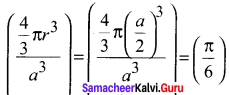
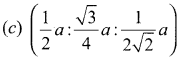
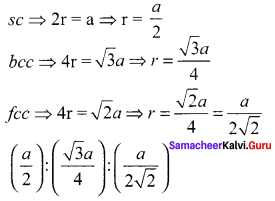
Question (b)
‘Means should justify the end.’ Explain this adage with reference to O. Henry’s story.
Answer:
‘Mahatma Gandhi often said, “Means should justify the end”. Even for a just end like freedom he advised his followers not to resort to violence or sedition, i. e., agitation which was followed by some groups who wanted to punish the British. Bob had no scruple of conscience or value system. His only intention in life was to make money even if it demanded his direct involvement in criminal activities. Ill-gotten wealth may satisfy the ego of an individual and serve his sense of personal ego trip but law will take its course against such criminals.

So, the low paid policeman did worry about means but not Bob. Jimmy Wells is enjoying sound health and is unafraid. But Bob has to hide and be watchful of the movement of police officers. He has to run from state to state to stay away from prison. The scars do not symbolize trace of hardwork but combat with the guardians of law while involved in criminal activities. Jimmy Wells is richer than Bob in the sense that he is blessed with contentment. But Bob is busy making his pile and running away all the time to be safe. He is happy with his wealth but is all the time restless, stressed and afraid. This adage, “Means should justify the end” brings home the understanding that the methods we adopt to succeed in life should be socially acceptable and morally sound.
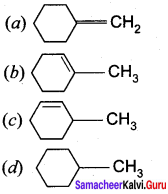
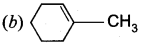
Question (c)
‘Tell me who your friends are and I shall tell you who you are’. How will you explain this statement in the light of Jimmy’s and Bob’s friendship?
Answer:
We can’t fully agree with the statement “Tell me who your friends are and I shall tell you who you are”. This adage may be applicable to those friends who behave like “birds of the same feather” and involve in any activity with a common purpose. But this does not apply to those who live by different value systems personal and professional ethics. In this story, Bob and Jimmy Wells had been life-time friends. Jimmy Wells became, guardian of peace but Bob becomes a criminal wanted by Chicago police, Very often we tend to regard “a friend” as a life-time companion. A friend is one with who we need not conceal our real physical or psychological problems.

One does not wear a mask in front of a friend. A friend usually rushes to help another unsought in times of trouble. All these impressions are relevant only to those who travel the same path of virtue and socially accepted norms and cultural expectations. But a childhood friend who has chosen the evil path to make money is a ‘long lost.friend’ with whom one may not like to continue the friendship. So, proverbs need to be taken with a pinch of salt. They may not be relevant on all occasions or apply to all always.

Question (d)
To your shock, you find out that your close friend is indulging in some wrong activity. Will you avoid him/her or try to correct him/her? Give reasons for your answer.
Answer:
How could I avoid him/her? He is my friend. I am bound to persuade him to return to the path of virtue. I may threaten him to snap my ties with him and try all that is in my capacity to convince him. I shall persist in correcting his behaviour. I shall tell him that his wrong activity would destroy his reputation and he might fall from the grace of teachers, classmates and his own parents when what he does gets exposed. I shall share some real life examples of people who have taken wrong means to acquire wealth or power and how they have been caught and punished later. To make things clear to my friend, I shall make him realise the consequences of wrong activities. I shall try my level best to bail him out of the path of evil. After all, “A friend in need is a friend indeed.”

Question (e)
What would you do in this situation, if you were Jimmy Wells? Substantiate your reason.
Answer:
If I were Jimmy Wells, I would have been- in a real fix. It would have pained me to discover the truth. I would have invited him for a dinner and talked all night to give up his wicked activities and surrender to police. I would visit him in jail and discuss him about his reformed life after his release. I would get a pass for his family members and help them visit him in jail. Request them to tell him how they don’t want the ill-gotten wealth.

I shall encourage his children to plead with him to return to the path of virtue. I shall engage the best lawyers of the country to get him less years of punishment. I shall provide him good books to read and organize yoga and meditation serious for him. I shall take all measures to understand the value of hard-earned money. I know for sure his improved behaviour would lessen his term in jail. I would help him rebuild his life. If he needs journey to start a decent business, I would offer him my support. After all, that is what a friend should do.

Additional Questions

I. Choose the right options.

Question 1.
The policeman on duty moved impressively due to his _______
(a) pride
(b) arrogance
(c) habit
(d) flamboyancy
Answer:
(c) habit


Question 2
_______ is described as guardian of peace.
(a) Bob
(b) Plain people
(c) Jimmy Wells
(d) jimmy’s friend
Answer:
(c) Jimmy Wells

Question 3.
Bob and Jimmy had dined at _______ 20 years ago.
(a) Park Sheraton
(b) White House
(c) a motel
(d) big joe brandy’s
Answer:
(d) big joe brandy’s

Question 4
_______ years ago, Big Joe Bredy’s restaurant was pulled down.
(a) Four
(b) Six
(c) Five
(d) Five
Answer:
(d) Five

Question 5.
When the stranger struck the match and lit his cigar, Bob saw a little white _______ near man’s right eye brow.
(a) mole
(b) scar
(c) pimple
(d) scare
Answer:
(b) scar

Question 6.
Jimmy and Bob decided to meet after _______ years at Big Joe Brady’s restaurant.
(a) ten
(b) twenty
(c) thirty
(d) five
Answer:
(b) twenty

Question 7.
The appointed time of meeting was _______ PM.
(a) 7
(b) 10
(c) 11
(d) 8
Answer:
(b) 10

Question 8
_______ was at the appointed place early.
(a) Plainclothes man
(b) Bob
(c) Jimmy Wells
(d) Drug dealer
Answer:
(b) Bob

Question 9.
It was _______ P.M. when Bob was talking to Jimmy Wells without realizing who he was.
(a) 9.37
(b) 9.57
(c) 9.47
(d) 10.03
Answer:
(b) 9.57

Question 10.
Bob decided to wait till _______ P.M. to meet Jimmy Wells.
(a) 1.1
(b) 10.30
(c) 11.30
(d) 11.15
Answer:
(b) 10.30

Question 11.
The plainclothes man had _______ which helped Bob to find out the truth.
(a) Roman nose
(b) Cleft lip
(c) Scar below his chin
(d) Pug nose
Answer:
(d) Pug nose

Question 12.
Bob pulled out a handsome watch whose.lid was set with small _______
(a) rubies
(b) pearls
(c) diamonds
(d) nuggets of gold
Answer:
(a) rubies


Question 13.
Bob made his pile in _______
(a) New York
(b) West.
(c) North
(d) East
Answer:
(b) West.

Question 14.
The plainclothes man said that Bob was already under arrest for _______ minutes.
(a) five
(b) six
(c) ten
(d) fifteen
Answer:
(c) ten

Question 15.
Who was mistaken to have grown tall by two or three inches?
(a) Plainclothes man in the guise of Jimmy Wells
(b) Bob
(c) Drug dealer
(d) Common friend of Jimmy and Bob
Answer:
(a) Plainclothes man in the guise of Jimmy Wells

Question 16.
_______ had impersonated Jimmy Wells.
(a) Bob
(b) Plainclothes man
(c) John
(d) Peter
Answer:
(b) Plainclothes man

Question 17.
Who claimed to have got a position in a Departmental store?
(a) Plainclothes man
(b) Bob
(c) Peter
(d) John
Answer:
(a) Plainclothes man

Question 18.
Whose egotism was enlarged by success?
(a) Jimmy Wells
(b) Bob’s
(c) Near a drugstore
(d) he evaded law skillfull
Answer:
(b) Bob’s

Question 19.
Where did the plainclothes man and Bob look at each other closely?
(a) Near a bank
(b) Near a drugstore
(c) Near a police station
(d) Near a vegetable market
Answer:
(b) Near a drugstore

Question 20.
The tall man addressed Bob as ‘Silky Bob’ because _______
(a) he had a shiny face
(b) he wore fashionable clothes
(c) his watch shone brightly
(d) he evaded law skillfully
Answer:
(d) he evaded law skillfully

II. Identify the speaker: Who said to whom? (Exam model)

1. “it’s all right, officer. I’m just waiting for a friend – (Bob to Jimmy Wells)
2.There used to be a restaurant where this store stands-Big Joe Brady’s restaurant – (Bob to Jimmy Wells)
3. Twenty years ago tonight I dined here to Big Joe Brady’s with Jimmy Wells, my best chum – Bob to Policeman (Jimmy Wells)
4. It sounds pretty interesting – (Policeman to Bob)
5. Haven’t you heard from your friend since you left? – (Policeman (Jimmy Wells) to Bob)
6. Rather a long time between the meets – (Policeman (Jimmy Wells) to Bob)
7. But after a year or two we lost track of each other – Bob to the policeman (Jimmy Wells)
8. He was always the truest, staunchest old chap in the world – Bob to policeman (Jimmy Wells)
9. I came thousand miles to stand in this door tonight – Bob to Policeman (Jimmy Wells)
10. Three minutes to ten – Bob to Policeman (Jimmy Wells)
11. It was exactly ten O’ clock when we parted here at the restaurant door – Bob to Policeman (Jimmy Wells)
12. “Did pretty well in the west, didn’t you?” – Policeman (Jimmy Wells) to Bob
13. I hope Jimmy had done half as well – Bob to Policeman (Jimmy Wells)
14. I’ve had to compete with the sharpest wits going to get my pile” – Bob to Policeman (Jimmy Wells)
15. “Going to call time on him sharp?” – (Jimmy Wells to Bob)
16. I should say not. I’ll give him half an hour at least – Bob to Policeman (Jimmy Wells)
17. “Is that you Bob?” – (Plainclothes man to Bob)
18. Bless my heart! – (Plainclothes man to Bob)
19. It’s Bob, sure as fate – (Plainclothes man to Bob)
20. I wish it had lasted, so we could have had another dinner there – (Plainclothes man to Bob)
21. How has the west treated you, old man? – (Plainclothes man to Bob)
22. Bully, it, has given me everything I asked it for – (Bob to Plainclothes man)
23. You’ve changed lots Jimmy – (Bob to Plainclothes man)
24. Oh, I grew a bit after twenty – (Plainclothes man to Bob)
25. “Doing well in New York, Jimmy? – (Bob to Plainclothes man)
26. “Moderately, I have a position, in one of the city departments” – (Plainclothes man to Bob)
27. “Come on, Bob! we’ll go around to a place I know of and have good long talk about old times”- (Plainclothes man to Bob)
28. You’re not Jimmy Wells – (Bob to Plainclothes man)
29. “Twenty years is a long time but not long enough to change a man’s nose from a Roman to a pug” – (Bob to Plainclothes man)
30. “It sometimes changes a good man into a bad one” – (Plainclothes man to Bob)
31. “You’ve been under arrest for ten minutes, you silky Bob” – (Plainclothes man to Bob)
32. Some how I couldn’t do it myself – (Jimmy Wells to Bob through a note)

III. Rearrange the following sentences in the logical order:

1. Unable to arrest Bob himself, he sends a plainclothes man to do it.
2. Bob kept his words and reached the spot before 10 p.m. and waited anxiously.
3. A patrolman (Jimmy Wells) finds a notorious criminal wanted by Chicago police in is Bob.
4. Both promised to meet at the same spot at 10 p.m. 20 years later.
5. Jimmy Wells and Bob had dinner at Big Joe’ Brady’s restaurant.
Answers:
1. Jimmy Wells and Bob had dinner at Big Joe’ Brady’s restaurant.
2. Both promised to meet at the same spot at 10 p.m. 20 years later.
3. Bob kept his words and reached the spot before 10 p.m. and waited anxiously.
4. A patrolman (Jimmy Wells) finds a notorious criminal wanted by Chicago police in is Bob.
5. Unable to arrest Bob himself, he sends a plainclothes man to do it.

IV. Read the following passages and answer the questions given below?

1. “It’s all right, officer,” he said, reassuringly. “I’m just waiting for a friend. It’s an appointment made twenty years ago. Sounds a little funny to you, doesn’t it? Well, I’ll explain if you’d like to make certain it’s all straight. About that long ago there used to be a restaurant where this store stands- Big Joe’ Brady’s restaurant.”
“Until five years ago,” said the policeman. “It was tom down then.”

Question (a)
What was the stranger waiting for?
Answer:
He was waiting for a friend,


Question (b)
When was the appointment made? .
Answer:
The appointment was made twenty years ago.

Question (c)
What happened to Big Joe’ Brady’s restaurant?
Answer:
It was pulled down five years ago.

Question (d)
Why were the two men talking about a non-existent restaurant?
Answer:
The stranger and his friend had made an appointment to meet at Big Joe’ Brady’s restaurant h 20 years ago. The stranger did not know what became of the building.

Question (e)
Why did the stranger try to reassure the patrol man on duty?
Answer:
The stranger was the criminal wanted on Chicago. He did not want to raise any suspicion – in the mind of the patrol man. So, he spoke about the odd appointment to him reassuringly.

2. “It sounds pretty interesting,” said the policeman. “Rather a long time between meets, though,
’it seems to me. Haven’t you heard from your friend since you left?”

“Well, yes, for a time we corresponded,” said the other. “But after a year or two we lost track of each other. You see, the West is a pretty big proposition, and I kept hustling around over it 1 pretty lively. But I know Jimmy will meet me here if he’s alive, for he always was the truest,

staunchest old chap in the world. He’ll never forget. I came a thousand miles to stand in this door tonight, and it’s worth it if my old partner turns up.”

The waiting man pulled out a handsome watch, the lids of it set with small diamonds.
“Three minutes to ten,” he announced. “It was exactly ten o’clock when we parted here at the restaurant door.”

Question (a)
Why did he appear a long time between the meeting of friends?
Answer:
Twenty years is obviously a long time between meets.

Question (b)
How did the stranger justify the long gap between their meeting?
Answer:
The stranger said that they corresponded for a year or two and then they lost track of each other.

Question (c)
What was the stranger very optimistic about?
Answer:
The stranger was very optimistic about meeting his boyhood friend Jimmy Wells that night.

Question (d)
Why did the stranger believe that Jimmy Wells would honour the appointment made twenty years ago?
Answer:
Jimmy Wells and the stranger were raised in New York. Both moved like brothers. He was the truest and staunchest old chap in the world. So, the stranger (Bob) believed that Jimmy Wells would certainly come if he were alive.

Question (e)
How did the patrol man figure out that the stranger was stinkingly rich?
Answer:
The stranger (Bob) had a very handsome watch whose lids were set in diamonds. He was already found to have a large diamond oddly set as it scarf pin too. These evidence helped the patrol man figure out that the stranger was stinkingly rich.

Question 3.
“You’re not Jimmy Wells,” he snapped. “Twenty years is a long time, but not long enough to change a man’s nose from a Roman to a pug.”

“It sometimes changes a good man into a bad one”, .said the tall man. “You’ve been under arrest for ten minutes, ‘Silky’ Bob. Chicago thinks you may have dropped over our way and wires us she wants to have a chat with you. Going quietly, are you? That’s sensible. Now, before we go on to the station here’s a note I was asked to hand you. You may read it here at the window. It’s from Patrolman Wells.”

The man from the West unfolded the little piece of paper handed to him. His hand was steady when he began to read, but it trembled a little by the time he had finished. The note was rather short.

“Bob, I was at the appointed place on time. When you struck the match to light your cigar I saw it was the face of the man wanted in Chicago. Somehow I couldn’t do it myself so I went around and got a plainclothes man to do the job.”

Question (a)
How did Bob find out that the plainclothes man was not Jimmy Wells?
Answer:
Under the brilliant lights of the drug stone, Bob noticed the pug nose of the policeman in plainclothes. Jimmy Wells had a sharp Roman nose.

Question (b)
How did the plainclothes man respond to Bob’s discovery of the identity?
Answer:
The policeman said that twenty years, sometimes, is long enough to change a good man to a bad man.


Question (c)
How did New York police get scent of Bob’s presence in New York?
Answer:
Chicago police had sent a telegram describing Bob’s facial features. Thus New York police got scent of his presence in New York.

Question (d)
What did the plainclothes man give Bob?
Answer:
The plainclothes man gave Bob a note written by patrolman Wells.

Question (e)
Why did the note shock Bob?
Answer:
The note read that Jimmy Wells had arrived at the appointed spot. In the cigar light, he had noticed the features of a man wanted by Chicago police. As he could not arrest him himself, he had sent a police clothes man to do the job. The realization that his boyhood friend had got him arrested shocked him.

After Twenty Years About the Author

11th English After Twenty Years Paragraph Chapter 1 Samacheer Kalvi

O. Henry (1862-1910) is a famous American short story writer. His stories are known for
the twist or surprising ends. His original name was William Sydney Porter. As a child he was always reading from classics to dime novels. Though he was jailed for embezzlement of funds in a bank where he received a poor salary, his prolific writing skills stayed infact.

He wrote one story per week for New York world Sunday Magazine. He wrote 381 short stories. He is best remembered for his short stories such as: “The Cuffs of Magic”, “Cop and the Anthem”, “The Ransom of the Red Chief’ and “A Retrieved Reformation and the Third Ingredient”. He married his childhood sweetheart Sarah. His heavy drinking affected both his health and the quality of his writing. So, Sarah left him to die alone.

After Twenty Years Summary

This story is about two friends. As young adults they decide to part ways to make their own fortunes. Jimmy Wells, the plodder, becomes a policeman in New York. But Bob competes with the sharpest wits and makes his fortune. He becomes rich. As per their agreement, Bob has travelled thousand miles to meet his boyhood chum Jimmy Wells after a passage of twenty years at 10 p.m. Their proposed meeting point Big Joe ‘Brady’s restaurant is gone. The policeman on beat, tells him that it was pulled down five years ago.

After Twenty Years Questions And Answers Pdf Samacheer Kalvi 11th English Solutions Supplementary Chapter 1

Jimmy Wells also remembers the appointment. In the dark, when Bob lights a cigarette, Jimmy Wells notices the features of a criminal wanted by Chicago police. His diamond-studded watch, the large diamond scarf pin, show how rich he has become. The policeman leaves after assuring that Bob would wait at least for another half an hour. Then a man in an overcoat comes calling out his name. Bob boasts of his success in the west and how he amassed wealth. Once they go out of the dark lane, the lights from a drug store helps them see each other.

After Twenty Years Paragraph Samacheer Kalvi 11th English Solutions Supplementary Chapter 1

Bob releases himself saying that he is not Jimmy Wells. Twenty years can’t change a Roman nose into a pug. The plainclothes man tells him he has been under arrest for the past ten minutes. From a note handed to him, he realizes that the patrolman is only Jimmy Weils who has sent another policeman to arrest him.

After Twenty Years Glossary

Textual:

absurdity – quality of being silly and foolish.
avenue – a wide street
dismally – without happiness and cheer
egotism – a feeling of self-importance
groove – a dull routine that does not change
habitual – regular
intricate – complicated
nigh – almost
outline – describe
plodder – one who toils slowly but steadily
proposition – theory or system
razor-edge – a critical situation
reassuringly – making someone feel less doubtful
stalwart – physically strong
swagger – walk in a confident way
twirling – twisting and spinning around
vicinity – the surrounding area (neighbourhood)
wires – sends a telegraphic message
wits – intelligent people

Additional:

destiny – fate
exactly – accurately
fortunes – wealth
funny amusing
gaze – look deeply
lasted – continued
plainclothes man – A policeman in civil dress
rendezvous – appointed meeting place
sensible – practical uncertain – unsure
staunchest – steadfast, consistent
unfolded – opened

The main aim is to share the knowledge and help the students of 11th English to secure the best score in their final exams. Use the concepts of Samacheer Kalvi 11th English Book Solutions Supplementary Chapter 1 After Twenty Years Questions and Answers in Real time to enhance your skills. If you have any doubts you can post your comments in the comment section, We will clarify your doubts as soon as possible without any delay.