Samacheer Kalvi 7th Social Science History Solutions Term 2 Chapter 3 Rise of Marathas and Peshwas

You can Download Samacheer Kalvi 7th Social Science Book Solutions Guide Pdf, Tamilnadu State Board help you to revise the complete Syllabus and score more marks in your examinations.

Tamilnadu Samacheer Kalvi 7th Social Science History Solutions Term 2 Chapter 3 Rise of Marathas and Peshwas

Samacheer Kalvi 7th Social Science Rise of Marathas and Peshwas Textual Evaluation

I. Choose the correct answer?

Rise Of Marathas And Peshwas Question 1.
Who was the teacher and guardian of Shivaji?
(a) Dadaji Kondadev
(b) Kavi Kalash
(c) Jijabai
(d) Ramdasl
Answer:
(a) Dadaji Kondadev

Question 2.
How was the Prime Minister of Maratha kings known?
(a) Deshmukh
(b) Peshwa
(c) Panditrao
(d) Patil
Answer:
(b) Peshwa

Question 3.
Name the family priest of Shambhuji who influenced him in his day-to-day administration.
(a) Shahu
(b) Anaji Datta
(c) Dadaji Kondadev
(d) Kavi Kalash
Answer:
(d) Kavi Kalash

Question 4.
What was the backbone of Shivaji’s army in the beginning?
(a) Artillery
(b) Cavalry
(c) Infantry
(d) Elephantry
Answer:
(c) Infantry

Question 5.
Who proclaimed wars and freed Malwa and Gujarat from Mughal domination?
(a) Balaji Vishwanath
(b) Bajirao
(c) Balaji Bajirao
(d) Shahu
Answer:
(b) Bajirao

II. Fill in the Blanks

  1. The spread of the _______ movement in Maharashtra helped the Maratha people develop consciousness and oneness.
  2. _______ was the key official of revenue administration of Peshwa.
  3. The imperial moment of the Marathas sadly ended at _______ in 1761.
  4. _______ was the foreign minister in the Ashtapradhan.
  5. Shambhuji succeeded Shivaji after a succession tussle with _______

Answers:

  1. Bhakti
  2. Kamavisdar
  3. Panipat
  4. Sumant / Dubeer
  5. Anaji Dattcu

III. Match the following

Question 1.

  1. Shaji Bhonsle – Mother of Shivaji
  2. Shambhuji – General of Bijapur
  3. Shahu – Shivaji’s father
  4. Jijabai – Son of Shivaji
  5. Afzal khan – Shivaji’s grandson

Answer:

  1. Shaji Bhonsle – Shivaji’s father
  2. Shambhuji – Son of Shivaji
  3. Shahu – Shivaji’s grandson
  4. Jijabai – Mother of Shivaji
  5. Afzal khan – General of Bijapur

IV. True or False

  1. The rocky and mountainous terrain gave protection to the Marathas from invaders.
  2. Hymns composed in Sanskrit by the Bhakti saints were sung by people of all castes and classes.
  3. Shivaji captured Puranthar from the Mughals.
  4. Deshmukhs held sway over rural regions and their control was over between twenty and hundred villages.
  5. Abdali invaded ten times before finally marching on Delhi.

Answers:

  1. True
  2. False
  3. True
  4. True
  5. False

V. Consider the following statements. Tick (✓) the appropriate answer

Question 1.
Assertion (A): Soldiers were to live in forts and towns far away from home
Reason (R): Maratha soldiers were not permitted to retire from battle fields each year for the purpose of cultivating their land.
(a) R is correct explanation of A
(b) R is not the correct explanation of A
(c) A is Wrong and R is correct
(d) A and R are wrong
Answer:
(b) R is not the correct explanation of A

Question 2.
Statement I: Judging from the ledgers of correspondence and account books, Peshwas were keen on accurate record – keeping.
Statement II: Artillery decided the battle at Panipat in 1761.
(a) I is correct
(b) II is correct
(c) I and II are correct
(d) I and II are false
Answer:
(c) I and II are correct

Question 3.
Find the odd one out
Shahji, Shivaji, Shambhuji, Shahu, Rahuji, Bhonsle.
Answer:
Rahuji

Question 4.
Find out the wrong pair
1. Gaikwad – Baroda
2. Peshwa – Nagpur
3. Holkar – Indore
4. Shiride – Gwalior
Answer:
2. Peshwa – Nagpur

Question 5.
Arrange the events in chronological order
(i) Shivaji became totally independent after the death of his guardian Kondadev.
(ii) Emperor Shahu died when Balaji Bajirao was Peshwa.
(iii) Shivaji resumed his military raids after his father’s death and conquered Javali.
(iv) Balaji Vishwanath became Peshwa.
Answer:
(i) Shivaji became totally independent after the death of his guardian Kondadev.
(iii) Shivaji resumed his military raids after his father’s death and conquered Javali.
(iv) Balaji Vishwanath became Peshwa.
(ii) Emperor Shahu died when Balaji Bajirao was Peshwa.

VI. Answer in one or two sentences

Question 1.
The impact of Bhakti movement on Marathas.
Answer:
The spread of the Bhakti movement in Maharashtra helped the Maratha people develop consciousness of their identity and oneness. It promoted a feeling of unity, especially in terms of social equality, among the Marathas.

Question 2.
Chauth and Sardeshmukhi
Answer:
Shivaji claimed suzerainty, but he did not administer them himself. He protected the people from loot and plunder for which they were required to pay Chauth (one- fourth of the revenue as protection money) and Sardeshmukhi (an extra one-tenth, as the chieftain’s due).

Question 3.
Role of Kamavisdar in Maratha revenue administration.
Answer:
The revenue administration of Peshwas was headed by a key official called the Kamavisdar. He was appointed by the Peshwa. He was empowered to maintain a small body of soldiers to police the administrative area, from where tribute or tax had to be collected.

Question 4.
Execution of Shambhuji by Mughal Army.
Answer:
Marathas under Shambhuji were in no position to resist the Mughals. Aurangzeb himself arrived in the Deccan in 1681. Aurangzeb’s main goal was the annexation of Bijapur and Golconda. These two sultanates fell to Aurangzeb by 1687. In little over a year, Shambhuji was captured by the Mughals and, after torture, put to death.

Question 5.
Battle of Panipat fought in 1761.
Answer:
The imperial moment of the Marathas sadly ended at Panipat near Delhi in 1761. The king of the Afghans, Ahmad Shah Abdali, invaded eight times before finally marching onto Delhi. The Marathas were now divided among several commanders, who approached the battle with different tactics. Artillery decided the battle in January 1761. The mobile artillery of the Afghans proved lethal against both Maratha cavalry and infantry.

VII. Answer the following.

Question 1.
Examine the essential features of Maratha administration under Shivaji.
Answer:
Shivaji’s political system consisted of three circles. At the centre was the swaraj. Shivaji was caring and would not allow the people to be harassed in any way.

He protected the people from loot and plunder for which they were required to pay Chauth (one-fourth of the revenue as protection money) and Sardeshmukhi (an extra one-tenth, as the chieftain’s due). In the third circle, Shivaji’s only objective was plunder.

Army
Shivaji gave utmost attention to his army and training of its personnel. In the beginning, the backbone of his army was the infantry. Shivaji took great care in the maintenance and security of his forts.

Ashtapradhan
Shivaji designated eight ministers as the Ashtapradhan, each holding an important portfolio. Peshwa was the equivalent of a modem prime minister in the Maratha Empire. Shivaji was influenced by the Mughal revenue system. The assessments were made on the actual yield, with three-fifths left to the cultivator and two-fifths taken by the government.

VIII. HOTs

Question 1.
Compare the revenue administration of the Peshwas with that of Shivaji.
Answer:
Revenue administration of Shivaji:

  1. Shivaji abolished the zamindari system.
  2. Loans were provided to the farmers in the times of famine.
  3. The state also collected custom duties and professional taxes.
  4. The two important taxes collected during his time were Chauth and Sardeshmuki.

Revenue administration of Peshwas :

  1. The revenue administration of peshwas was headed by a key official called the kamavisdar.
  2. He was expowered to maintain a small body of soldiers to police the administrative area, from where tribute or tax had to be collected.
  3. A prospective tax or revenue collector who won the contract was expected to have a reputation for wealth and probity.
  4. He was required to pay a portion of the whole of the anticipated revenue – one third to one half-either out of his own wealth or from the money borrowed from bankers.

IX. Map

Question 1.
Maratha Empire with prominent cities and forts.
Answer:
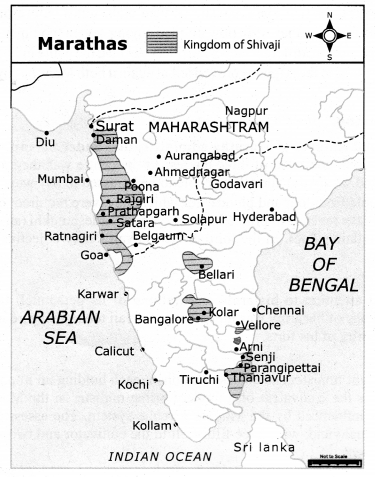
Rise Of Marathas And Peshwas Samacheer Kalvi 7th Social Science History Solutions Term 2 Chapter 3

X. Student Activity

Question 1.
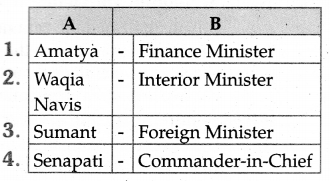
Match the responsibilities of Ashtapradhan
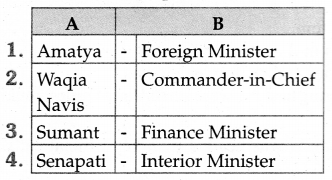
Samacheer Kalvi 7th Social Science History Solutions Term 2 Chapter 3 Rise of Marathas and Peshwas 2
Answer:
Samacheer Kalvi 7th Social Science History Solutions Term 2 Chapter 3 Rise of Marathas and Peshwas 3

Question 2.
Group Activity
Collect information about the Thanj avur Marathas with special reference to their contribution to education, art and architecture.
Answer:
Activity to be done by the students themselves

Samacheer Kalvi 7th Social Science Rise of Marathas and Peshwas Additional Questions

I. Choose the correct answer:

Question 1.
_______ language and literature also served to develop unity among the people.
(a) Tamil
(b) Marathi
(c) English
(d) Telugu
Answer:
(b) Marathi

Question 2.
Shivaji became totally independent after the death of his guardian.
(a) Kondadev
(b) Tukaram
(c) Ramdas
(d) Shambhuji
Answer:
(a) Kondadev

Question 3.
_______ captured puranthar from the Mughals.
(a) Shivaji
(b) Shambuji
(c) Shahji Bhonsle
(d) Shahu
Answer:
(a) Shivaji

Question 4.
Shivaji’s political system consisted of ________ circles.
(a) two
(b) three
(c) four
(d) five
Answer:
(b) three

Question 5.
Aurangzeb himself arrived in the Deccan in ________.
(a) 1659
(b) 1663
(c) 1664
(d) 1681
Answer:
(d) 1681

Question 6.
________ now commanded an army of paid soldiers.
(a) Shivaji
(b) Shahu
(c) Balaji Bajirao
(d) Kondadev
Answer:
(c) Balaji Bajirao

II. Fill in the blanks:

  1. ________ was a gallant fighter, army general and a guerilla leader.
  2. ________ promoted a feeling of unity, especially in terms of social equality among the Marathas.
  3. ________ and ________ had considerable influence on the life of Shivaji.
  4. In 1659 Shivaji killed ________, a notable general of Bijapur.
  5. ________ was determined on stop the Maratha interference in his expeditions against the Deccan kingdoms.
  6. Shivaji designated eight ministers as the ________ each holding an important portfolio.

Answers:

  1. Shivaji
  2. Bhakti Movement
  3. Tukaram, Ramdas
  4. Afzal khan
  5. Aurangzeb
  6. Ashtapradhan

III. Match the following

  1. Powerful headman – (a) Mughal revenue system
  2. Village accountant – (b) Chief Justice
  3. Shivaji – (c) Foreign Minister
  4. Nyayadhish – (d) Kulkami
  5. Sumant – (e) Patil

Answers:

  1. – e
  2. – d
  3. – a
  4. – b
  5. – c

IV. True or False

  1. The Prime Minister of Maratha rulers, called the Peshwas.
  2. Hymns composed in the Marathi language by Bhakti saints were sung by people of all castes and classes.
  3. In 1656, the Mughal army was helpless when Shivaji again plundered Suraj.
  4. Shivaji was influenced by the Mughal revenue system.
  5. The imperial moment of the Marathas sadly ended at Panipat near Calcutta in 1761.

Answers:

  1. True
  2. True
  3. False
  4. True
  5. False

V. Consider the following statements: Tick the appropriate answer

Question 1.
Assertion (A) : Shambuji succeeded Shivaji after a succession tussle with Anaji Datto.
Reason (R) : Balaj i Vishwanath began his career as a small revenue official and bacame Peshwa in 1713.
(a) R is correct explanation of A
(b) R is not the correct explanation of A
(c) A is wrong and R is correct
(d) A and R are correct
Answer:
(d) A and R are correct

Question 2.
Statement I : The rocky and mountainous terrain gave protection to the Marathas from invaders.
Statement II : The strength of Shivaji’s army was Mavali foot soldiers.
(a) I is correct
(b) II is correct
(c) I and II are correct
(d) I and II are false
Answer:
(c) I and II are correct

Question 3.
Find out the wrong pair.
1. Panditra – High Priest
2. Nyayadhish – Chief Justice
3. Sacheev – Secretary
4. Peshwa – Finance Minister
Answer:
Peshwa – Finance Minister

VI. Answer in one or two sentences

Question 1.
Write the geographical features of the Marathas.
Answer:
The physical features of the Maratha country developed certain peculiar qualities among the Marathas, which distinguished them from the rest of the people of India. The rocky and mountainous terrain gave protection to the Marathas from invaders. It proved to be advantageous in guerrilla warfare for Marathas.

Question 2.
Write the literature and language of the Marathas.
Answer:
Marathi language and literature also served to develop unity among the people. Hymns composed in the Marathi language by Bhakti saints were sung by people of all castes and classes.

Question 3.
Write a note on Peshwas.
Answer:
Balaji Vishwanath (1713-1720) began his career as a small revenue official and became Peshwa in 1713. Much against the advice from his close circles, Shahu appointed 20-year-old Viswanath’s eldest son Bajirao to occupy the office of Peshwa.

VI. Answer the following in detail

Question 1.
Describe Shivaji’s confrontation with Sultan of Bijapur.
Answer:

  1. Shivaji became totally independent after the death of his guardian Kondadev (1649).
  2. He also got his father’s j agir transferred to him, which was earlier looked after by Kondadev.
  3. The strength of his army was Mavali foot soldiers.
  4. With their help, Shivaji conquered many of the hill forts near Poona.
  5. He captured Puranthar from the Mughals.
  6. Shivaji’s military raids angered the Sultan of Bijapur.
  7. He held Shivaji’s father captive and released him only after Shivaji promised to suspend his military raids.
  8. Shivaji kept his word and remained at peace with Bijapur from then on till his father Shahji’s death.
  9. During this period he toned up his administration.

Question 2.
Briefly explain the consolidation of Maratha Power.
Answer:

  1. Shivaji resumed his raids after his father’s death and conquered Javali (1656) from the Maratha chief Chandrarao More.
  2. He also reduced all the lesser Maratha chiefs around Pune to subordination.
  3. The soldiers of Bijapur from the hill fortresses acquired by Sultan of Bijapur were driven out and replaced with his own commanders.
  4. These moves and the defeat of Bijapur army sent to punish Shivaji alarmed the Mughal officials.
  5. When the Mughals made a punitive expedition, Shivaj boldly confronted them.
  6. In 1659 he killed Afzal Khan, a notable general of Bijapur.
  7. In 1663 he wounded and chased away the Mughal general and Aurangzeb’s uncle Shaista Khan.
  8. To cap these bold acts, he audaciously directed his soldiers to plunder Surat (1664), the major Mughal port on the Arabian Sea.

Question 3.
What are the responsibilities of the Asthapradhan?
Answer:
Responsibilities of the Ashtapradhan:
Pantpradhan / Peshwa – Prime Minister
Amatya / Mazumdar – Finance Minister
Shurunavis/Sacheev – Secretary
Waqia-Navis – Interior Minister
Sar-i-Naubat / Senapati – Commander-in-Chief
Sumant / Dubeer – Foreign Minister
Nyayadhish – Chief Justice
Panditrao – High Priest

Question 4.
Write about Balaji Bajirao.
Answer:

  1. When Balaji Bajirao was the Peshwa, Emperor Shahu died (1749).
  2. He summoned all the contending factions and forced them to accept the conditions he laid down.
  3. He decided that the capital of the kingdom would henceforward be Pune, not Satara.
  4. All power and authority was now concentrated in the Peshwas’s office.
  5. The Maratha peasant warrior band was reconfigured and its run came to an end.
  6. Maratha soldiers were not permitted now to retire from battle fields each year for the purpose of cultivating their land.
  7. Soldiers were required to live in forts and towns far away from their home.
  8. They were trained as infantrymen as well as horsemen.
  9. The large guns were nominally under the command of Maratha officers.
  10. During the period of the Peshwa Balaji Bajirao, the northern frontiers of the Maratha state were rapidly touching Rajasthan, Delhi and the Punjab.
  11. The Marathas launched raids from Nagpur against Bihar, Bengal and Odisha. Notwithstanding the conflict between the Marathas and the Nizam over Karnataka, Tamil, Kannada and Telugu regions were effectively brought under the control of the Marathas.
Samacheer Kalvi 11th Computer Science Solutions Chapter 6 Specification and Abstraction

Students can Download Computer Science Chapter 6 Specification and Abstraction Questions and Answers, Notes Pdf, Samacheer Kalvi 11th Computer Science Book Solutions Guide Pdf helps you to revise the complete Tamilnadu State Board New Syllabus and score more marks in your examinations.

Tamilnadu Samacheer Kalvi 11th Computer Science Solutions Chapter 6 Specification and Abstraction

Samacheer Kalvi 11th Computer Science Specification and Abstraction Text Book Back Questions and Answers

PART – 1
I. Choose The Correct Answer

11th Computer Science Chapter 6 Book Back Answers Question 1.
Which of the following activities is algorithmic in nature?
(a) Assemble a bicycle
(b) Describe a bicycle
(c) Label the parts of a bicycle
(d) Explain how a bicycle works
Answer:
(a) Assemble a bicycle

Specification And Abstraction Question 2.
Which of the following activities is not algorithmic in nature?
(a) Multiply two numbers
(b) Draw a kolam
(c) Walk in the park
(d) Braid the hair
Answer:
(d) Braid the hair

Computer Science Chapter 6 Question 3.
Omitting details inessential to the task and representing only the essential features of the task is known as ………………..
(a) specification
(b) abstraction
(c) composition
(d) decomposition
Answer:
(b) abstraction

Question 4.
Stating the input property and the input-output relation a problem is known ………………..
(a) specification
(b) statement
(c) algorithm
(d) definition
Answer:
(a) specification

Question 5.
Ensuring the input – output relation is ………………..
(a) the responsibility of an algorithm and the right of the user.
(b) the responsibility of the user and the right of the algorithm.
(c) the responsibility of the algorithm but not the right of the user.
(d) the responsibility of both the user and the algorithm.
Answer:
(a) the responsibility of an algorithm and the right of the user.

Question 6.
If i = 5 before the assignment i : = i – 1 after the assignment, the value of i is ………………..
(a) 5
(b) 4
(c) 3
(d) 2
Answer:
(b) 4

Question 7.
If O < i before the assignment i : = i – 1 after the assignment, we can conclude that
(a) 0 < i
(b) 0 ≤ i
(c) i = 0
(d) 0 ≥ i
Answer:
(b) 0 ≤ i

PART – 2
II. Very Short Answers

Question 1.
Define an algorithm.
Answer:
An algorithm is a step by step sequence of statements intended to solve a problem. An algorithm starts execution with the input data, executes the statements and finishes execution with the output data.

Question 2.
Distinguish between an algorithm and a process.
Answer:
Algorithm:

  • An Algorithm is a sequence of instructions to solve a problem.
  • Elements of a process are abstracted in algorithms.
  • Example: Algorithm can be compared to a recipe

Process:

  • A process is executing of instructions to accomplish the intended task.
  • A process is actual execution of the steps to solution.
  • Example: A process can be compared to cooking.

Question 3.
Initially, farmer, goat, grass, wolf = L, L, L, L and the farmer crosses the river with goat. Model the action with an assignment statement. Model of the action with an assignment statement:
Answer:

  1. — farmer, goat,grass,wolf = L,L,L,L.
  2. Farmer,goat: = R,R
  3. – farmer,goat,grass,wolf = R,R,L,L
  4. – farmer: = L
  5. — farmer,goat,grass,wolf = L,R,L,L
  6. farmer,grass: = R,R
  7. — farmer,goat,grass,wolf = R,R,R,L
  8. farmer,goat: = L,L
  9. — farmer,goat,grass, wolf = L,L,R,L
  10. farmer, wolf: = R,R
  11. — farmer,goat,grass, wolf = R,L,R,R
  12. farmer: = L
  13. — farmer,goat,grass,wolf = L,L,R,R
  14. farmer, goat: = R,R
  15. — farmer,goat,grass,wolf = R,R,R,R

Question 4.
Specify a function to find the minimum of two numbers.
Answer:

  1. – – minimum (a,b)
  2. – – inputs : a, b are real numbers.
  3. – – output: result: = minimum (a,b)

Question 5.
If \(\sqrt{2}\) = 1.414, and the square_root() function returns – 1.414, does it violate the following specification?

  1. – – square – root(x)
  2. – – inputs: x is a real number, x > 0
  3. – – outputs: y is a real number such that y2 = x

Answer:
No, because (- 1.414)2 = 2, which satisfies input – output relation (y2 = x)

PART – 3
III. Short Answers

Question 1.
When do you say that a problem is algorithmic in nature?
Answer:
A Problem is algorithmic in nature when its solution involves the construction of an algorithm. Also when the

  1. Input data and output data of the problem is specified.
  2. Relation between the input data and the output data is specified.

Question 2.
What is the format of the specification of an algorithm?
Answer:
Let P be the required property of the inputs and Q the property of the desired outputs.
Format of specification of an algorithm:

  1. Algorithm name (Inputs)
  2. Inputs – P
  3. Outputs – Q

Question 3.
What is abstraction?
Answer:
Abstraction:
It is the facility to define objects. It also involves removal of unnecessary attributes and defining only essential attributes. For example, when we represent the state of a process we select only the variables essential to the problem and ignore inessential details.

Question 4.
How is state represented in algorithms?
Answer:
The state represented in a algorithm is set of variables. At any place the value of the variables are substituted and evaluation is done.

Question 5.
What is the form and meaning of assignment statement?
Answer:
Assignment statement is used to assign values to the variables.
The variable on the left side of the assignment operator and a value on the right side.
Variable : = Value

Question 6.
What is the difference between assignment operator and equality operator?
Assignment Operator:
Assignment operator is used to assign the values to the variable.

Equality Operator:
The equality operator is used to compare the values of both the variables and the result is true or false.

PART – 4
IV. Explain in Detail

Question 1.
Write the specification of an algorithm hypotenuse w hose inputs are the lengths of the two shorter sides of a right angled triangle, and the output is the length of the third side.
Answer:

  1. hypotenuse (a, b)
  2. – – inputs: a, b are real numbers, a > 0, b > 0
  3. – – outputs: c2 = a2 + b2 wrhere c is real number, c > 0

Question 2.
Suppose you want to solve the quadratic equation ax2 + bx + c – 0 by an algorithm. quadratic_solve (a, b, c)
— inputs : ?
— outputs: ?
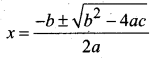
You intend to use the formula and you are prepared to handle only real number roots. Write a suitable specification.
Samacheer Kalvi 11th Computer Science Solutions Chapter 6 Specification and Abstraction

Answer:

  1. Quadratic – solve (a, b, c)
  2. – – inputs: b2 – 4 ac > = 0 where a, b, c are real numbers, a ≠ 0
  3. – – outputs: and x2 are real numbers such that a(x1)2 + bx1 + c = 0 and a(x2)2 + bx2 + c = 0

Question 3.
Exchange the contents: Given two glasses marked A and B. Glass A is full of apple drink and glass B is full of grape drink. For exchanging the contents of glasses A and B, represent the state by suitable variables, and write the specification of the algorithm.
Answer:
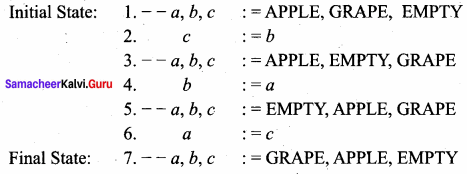
Let the variables a, b, c represent the glass A, glass B and Glass C respectively. Variables A, B, C can store values APPLE, GRAPE or EMPTY.
11th Computer Science Chapter 6 Book Back Answers Specification And Abstraction Samacheer Kalvi
Specification:

  1. Exchange ( )
  2. – – inputs: a, b, c := APPLE, GRAPE, EMPTY
  3. – – outputs: a, b,c: = GRAPE, APPLE, EMPTY

Samacheer kalvi 11th Computer Science Specification and Abstraction Additional Questions and Answers

PART – 1
I. Choose the correct answer

Question 1.
Which one of the following is an example of process?
(a) Braid the hair
(b) Adding three numbers
(c) Cooking a dish
(d) Walk in the Road
Answer:
(c) Cooking a dish

Question 2.
Who was a Hungarian Mathematician?
(a) G. Polya
(b) John Wiley
(c) Krysia Broda
(d) Steve Vickers
Answer:
(a) G. Polya

Question 3.
How many basic building blocks construct an algorithm?
(a) 3
(b) 4
(c) 5
(d) 8
Answer:
(b) 4

Question 4.
……………….. state the properties of the given input and the relation between the input and the output.
(a) Composition
(b) Abstraction
(c) Decomposition
(d) Specification
Answer:
(d) Specification

Question 5.
……………….. how many control flow statement are there to alter the control flow depending on the state?
(a) 5
(b) 6
(c) 3
(d) 8
Answer:
(c) 3

Question 6.
What is the specification of the algorithm?
Answer:
(a) divide (A + B)
(b) square – root (n)
(c) square – root (x)
(d) adding (A, B)
Answer:
(b) square – root (n)

Question 7.
……………….. statement is used to store a value in a variable.
(a) Assignment
(b) Sequential control flow
(c) Alternative control flow
(d) Iterative
Answer:
(a) Assignment

Question 8.
The data stored in a variable is also called a ………………..
(a) process
(b) data
(c) value
(d) constant
Answer:
(c) value

Question 9.
Each part of algorithm is known as ………………..
(a) input
(b) function
(c) variable
(d) program
Answer:
(b) function

Question 10.
……………….. is the left side of the assignment.
(a) variable
(b) value
(c) operator
(d) all the above
Answer:
(c) operator

Question 11.
If i: = 3 before the assignment, i: = i + 1 after the assignment ………………..
(a) 3
(b) 4
(c) 5
(d) 0
Answer:
(b) 4

Question 12.
If i: = 2 before the assignment, then i: = i * 3 after the assignment is ………………..
(a) 6
(b) 5
(c) 0
(d) 1
Answer:
(a) 6

Question 13.
If i: = 10 before the assignment, then i: = i % 2 after the assignment
(a) 10
(b) 5
(c) 0
(d) 1
Answer:
(c) 0

Question 14.
If – – m, n = 22, 5 and m, n : = m + 3, n – 1 then the value of m and n are ………………..
(a) 25, 4
(b) 24,5
(c) 22, 5
(d) 23,21
Answer:
(a) 25, 4

Question 15.
Initially the values of P and C are 4 and 5 respectively
– – P, C : = 4, 5
P : = C
C : = P. Then find P and C
(a) 4 and 4
(b) 5 and 4
(c) 5 and 5
(d) 4 and 5
Answer:
(c) 5 and 5

Question 16.
What are the values of variable m and n after the assignments in line (1) and line (3)?
1. m, n : = 2, 5
2. – – m, n = ?, ?
3. m, n : = m + 3, n – 1
4. – – m, n = ?, ?
(a) 4, 5
(b) 5, 4
(c) 5,5
(d) 4, 4
Answer:
(b) 5, 4

Question 17.
How many Algorithmic designing techniques are there?
(a) 2
(b) 3
(c) 4
(d) 5
Answer:
(c) 4

Question 18.
which one of the following is the assignment operator?
(a) =
(b) = =
(c) + = =
(d) + +
Answer:
(a) =

Question 19.
which one of the following is the equality operator?
(a) =
(b) = =
(c) + +
(d) – –
Answer:
(b) = =

Question 20.
which one of the following is the comment line in algorithm?
(a) + +
(b) 1 1
(c) – –
(d) = =
Answer:
(c) – –

Question 21.
Which one of the following statements are not executed the computers?
(a) Comment line
(b) Header file
(c) cin
(d) cout
Answer:
(a) Comment line

Question 22.
The values of the variables when the algorithm starts is ………………..
(a) stage
(b) initial stage
(c) initial state
(d) starting state
Answer:
(c) initial state

Question 23.
The values of the variables when the algorithm finishes is ………………..
(a) final stage
(b) final state
(c) last stage
(d) last state
Answer:
(b) final state

Question 24.
Instructions of a computer are also known as ………………..
(a) commands
(b) statements
(c) Abstractions
(d) Functions
Answer:
(b) statements

Question 25.
Which one of the following is not a building block of algorithm
(a) data
(b) state
(c) variables
(d) functions
Answer:
(b) state

Question 26.
Which are the named boxes used for storing data?
(a) data
(b) variables
(c) control flow
(d) functions
Answer:
(b) variables

Question 27.
Reasoning:
I. We can store a value in a variable using assignment operator.
II. We can change the value in a variable using assignment operator.
III. Assignment operator is = =
(a) I and III is true
(b) I and II is true
(c) II and III is true
(d) I, II, III is true
Answer:
(b) I and II is true

Question 28.
The order of execution of statement is called :
(a) Composition
(b) Functions
(c) Control flow
(d) Specifications
Answer:
(c) Control flow

Question 29.
In which one of the control flow statements, if the condition is false, then alternative statement will be executed ………………..
(a) Sequential
(b) iterative
(c) selection
(d) alternative
Answer:
(d) alternative

Question 30.
In which one of the following control flow, the statements are repeated until the conditon becomes false ………………..
(a) Sequential
(b) iterative
(c) selection
(d) alternative
Answer:
(b) iterative

Question 31.
If the statement are executed one after the other, then it is control flow.
(a) Sequential
(b) iterative
(c) selection
(d) alternative
Answer:
(a) Sequential

Question 32.
A is like a sub algorithm.
(a) function
(b) data
(c) variable
(d) state
Answer:
(a) function

Question 33.
Which one of the following is not a techniques for designing algorithms?
(a) specifications
(b) abstraction
(c) encapsulation
(d) composition
Answer:
(c) encapsulation

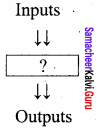
Question 34.
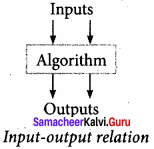
Fill in the box given below figure ………………..
Specification And Abstraction Samacheer Kalvi 11th Computer Science Solutions Chapter 6
(a) processing
(b) solving
(c) algorithm
(d) functions
Answer:
(c) algorithm

Question 35.
How many parts are there in specification is ………………..
(a) 2
(b) 3
(c) 4
(d) 5
Answer:
(b) 3

Question 36.
The first part of the specification is ………………..
(a) Input
(b) Output
(c) property of inputs
(d) The name of the algorithm and the inputs
Answer:
(d) The name of the algorithm and the inputs

Question 37.
Identify the statement which is not true?
(a) An instruction describes an object
(b) specification is one of the algorithm design techniques
(c) An algorithm is a step by step sequence of instructions
Answer:
(a) An instruction describes an object

Question 38.
In multiple variable assignment statement, the number of variables and the number of expressions must ………………..
(a) differ at least by 1
(b) not equal to 1
(c) equal to 0
(d) be equal
Answer:
(d) be equal

Question 39.
Sequential, Alternative and Iterative comes under the classification of ……………….. :
(a) Building blocks of algorithm
(b) control flow statements
(c) Algorithm design techniques
(d) Abstraction
Answer:
(b) control flow statements

Question 40.
To execute in a computer, an algorithm must be expressed using the statement of ………………..
(a) Object code
(b) Machine Language
(c) Assembler
(d) Programming Languages
Answer:
(d) Programming Languages

Question 41.
If the variable already has a value, and you are assigning a new value, what will happen to the old variable?
(a) retained
(b) added
(c) lost
(d) becomes 0
Answer:
(c) lost

Question 42.
Identify the function name: square (A + B) ………………..
(a) A
(b) B
(c) A + B
(d) square
Answer:
(d) square

Question 43.
Identify the correct statement ………………..
(a) The first part of specification is name of the algorithm with input
(b) Second one is input properties with comments
(c) Third one is relation between input – output
(d) All the three are correct statements
Answer:
(d) All the three are correct statements

Question 44.
Find the wrong statement from the following ………………..
(a) The state of a process can be represented by a set of variables in an algorithm
(b) The state at any point of execution is simply the values of the variables at that point.
(c) As the values of the variables are changed, the state remains constant.
(d) As a process evolves, the state changes.
Answer:
(c) As the values of the variables are changed, the state remains constant.

Question 45.
The input and output are passed between an algorithm and the user through ………………..
(a) data
(b) assignment
(c) stage
(d) variables
Answer:
(d) variables

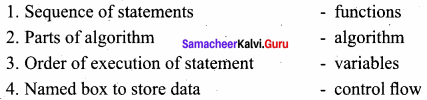
Question 46.
Match the following
Computer Science Chapter 6 Specification And Abstraction Samacheer Kalvi
(a) 2, 1, 4, 3
(b) 1, 2, 3, 4
(c) 4,3,2, 1
(d) 4, 2, 3, 1
Answer:
(a) 2, 1, 4, 3

Question 47.
Match the following
Samacheer Kalvi 11th Computer Science Solutions Chapter 6 Specification and Abstraction
(a) 3, 1, 4, 2
(b) 1,2, 3, 4
(c) 4,3,2, 1
(d) 4, 2, 3, 1
Answer:
(a) 3, 1, 4, 2

Question 48.
Which one of the following statements are used to annotate a program for the human readers?
(a) comments
(b) state
(c) variables
(d) functions
Answer:
(a) comments

Question 49.
In specification, the input and output can be written using ………………..
(a) English
(b) Mathematical notation
(c) Binary format
(d) Both a and b
Answer:
(d) Both a and b

Question 50.
Which one of the following defines the rights and responsibilities of the designer and the user?
(a) Abstraction
(b) Composition
(c) Decomposition
(d) Specification
Answer:
(d) Specification

Question 51.
Which one of the following is the most effective mental tool used for managing complexity?
(a) Specification
(b) Abstraction
(c) Composition
(d) Decomposition
Answer:
(b) Abstraction

Question 52.
How will be the input and output passed between an algorithm and the user ………………..
(a) comments
(b) Assignment
(c) Variable
(d) Functions
Answer:
(c) Variable

Question 53.
The goal of the algorithm is ………………..
(a) to state the input properties
(b) to state the output properties
(c) to divide into functions
(d) to establish the input output relation
Answer:
(d) to establish the input output relation

PART – 2
II. Short Answers

Question 1.
Define State.
Answer:
The state of a process can be represented by a set of variables in an algorithm. The State at any point of execution is simply the values of the variables at that point.

Question 2.
Mention the three different types of Chameleons.
Answer:
There are three different types of chameleons: red chameleons, green chameleons, and blue chameleons.

Question 3.
Define variable.
Answer:
The data stored in a variable is also known as the value of the variable. We can store a value in a variable or change the value of variable, using an assignment statement.

Question 4.
Write the basic building blocks of algorithms.
Answer:

  1. Data
  2. Variables
  3. Control flow
  4. Functions

Question 5.
Define control flow.
Answer:
The order in which the statements are executed may differ from the order in which they are written in the algorithm. This order of execution of statements is known as the control flow.

Question 6.
What are the basic principles and techniques for designing Algorithms.
Answer:

  1. Specification
  2. Abstraction
  3. Composition
  4. Decomposition

PART – 3
III. Explain in Brief

Question 1.
Define Alternative control flow statement.
Answer:
In alternative control flow, a condition of the state is tested, and if the condition is true, one statement is executed; if the condition is false, an alternative statement is executed.

Question 2.
What is Decomposition?
Answer:
We divide the main algorithm into functions. We construct each function independently of the main algorithm and other functions. Finally, we construct the main algorithm using the functions. When we use the functions, it is enough to know the specification of the function. It is not necessary to know how the function is implemented.

Question 3.
Write the Iterative control flow statement.
Answer:
In iterative control flow, a condition of the state is tested, and if the condition is true, a statement is executed. The two steps of testing the condition and executing the statement are repeated until the condition becomes false.

Question 4.
Define functions.
Answer:
The parts of an algorithm are known as functions. A function is like a sub-algorithm. It takes , an input, and produces an output, satisfying a desired input output relation.

Question 5.
Write the following (i) initial state (ii) final state
Answer:
The values of the variables when the algorithm starts is known as the initial state, and the values of the variables when the algorithm finishes is known as the final state.

Question 6.
What is the desired relation between the inputs A and B, and the output q and r?
Answer:
1. The two outputs q (quotient) and r (remainder) should satisfy the property
A = q X B + r,
and
2. The remainder r should be less than the divisor B,
0 < r < B
Combining these requirements, we will specify the desired input-output relation as
– outputs: A = q X B + r and 0 < r < B.

PART – 4
IV. Explain in Detail

Question 1.
Explain the three control flow statement.
Answer:
There are three important control flow statements to alter the control flow depending on the state.

  1. In sequential control flow, a sequence of statements are executed one after another in the same order as they are written.
  2. In alternative control flow, a condition of the state is tested, and if the condition is true, one statement is executed; if the condition is false, an alternative statement is executed.
  3. In iterative control flow, a condition of the state is tested, and if the condition is true, a statement is executed. The two steps of testing the condition and executing the statement are repeated until the condition becomes false.

Question 2.
Explain Algorithm Design Techniques.
Answer:
There are a few basic principles and techniques for designing algorithms.
1. Specification:
The first step in problem solving is to state the problem precisely. A problem is specified in terms of the input given and the output desired. The specification must also state the properties of the given input, and the relation between the input and the output.

2. Abstraction:
A problem can involve a lot of details. Several of these details are unnecessary for solving the problem. Only a few details are essential. Ignoring or hiding unnecessary details and modeling an entity only by its essential properties is known as abstraction. For example, when we represent the state of a process, we select only the variables essential to the problem and ignore inessential details.

3. Composition:
An algorithm is composed of assignment and control flow statements. A control flow statement tests a condition of the state and depending on the value of the condition, decides the next statement to be executed.

4. Decomposition:
We divide the main algorithm into functions. We construct each function independently of the main algorithm and other functions. Finally, we construct the main algorithm using the functions. When we use the functions, it is enough to know the specification of the function. It is not necessary to know how the function is implemented.

Question 3.
Explain the specification format.
Answer:
Specification format: We can write the specification in a standard three part format:

  1. The name of the algorithm and the inputs
  2. Input : the property of the inputs
  3. Output : the desired input – output relation

The first part is the name of the algorithm and the inputs. The second part is the property of the inputs. It is written as a comment which starts with – inputs: The third part is the desired input – output relation. It is written as a comment which starts with – outputs:. The input and output can be written using English and mathematical notation.

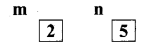
Question 4.
What are the values of variables m and n after the assignments in line (1) and line (3)?

  1. m, n : = 2, 5
  2. – – m, n = ?, ?
  3. m,n: = m + 3, n – 1
  4. – – m, n = ?, ?

The assignment in line (1) stores 2 in variable m, and 5 in variable n.
Samacheer Kalvi 11th Computer Science Solutions Chapter 6 Specification and Abstraction
The assignment in line (3) evaluates the expressions m + 3 and n – 1 using the current values of m and n as
m + 3 , n – 1
= 2 + 3, 5 – 1
= 5, 4
and stores the values 5 and 4 in the variables m and n, respectively.
Samacheer Kalvi 11th Computer Science Solutions Chapter 6 Specification and Abstraction

  1. m, n : = 2, 5
  2. – – m, n = 2, 5
  3. m, n : = m + 3, n – 1
  4. – – m, n = 2 + 3, 5 – 1 = 5, 4

Values of the variables after the two assignments are shown in line (2) and line (4).

Question 5.
Explain the Basic Building Blocks of Algorithms.
Data:
Algorithms take input data, process the data, and produce output data. Computers provide instructions to perform operations on data. For example, there are instructions for doing arithmetic operations on numbers, such as add, subtract, multiply and divide. There are different kinds of data such as numbers and text.

Variables:
Variables are named boxes for storing data. When we do operations on data, We need to store the results in variables. The data stored in a variable is also known as the value of the variable. We can store a value in a variable or change the value of variable, using an assignment statement.

Control flow:
An algorithm is a sequence of statements. However, after executing a statement, the next statement executed need not be the next statement in the algorithm. The statement to be executed next may depend on the state of the process. Thus, the order in which the statements are executed may differ from the order in which they are written in the algorithm. This order of execution of statements is known as the control flow.

There are three important control flow statements to alter the control flow depending on the state.

  1. In sequential control flow, a sequence of statements are executed one after another in the same order as they are written.
  2. In alternative control flow, a condition of the state is tested, and if the condition is true, one statement is executed; if the condition is false, an alternative statement is executed.
  3. In iterative control flow, a condition of the state is tested, and if the condition is true, a statement is executed. The two steps of testing the condition and executing the statement are repeated until the condition becomes false.

Functions:
The parts of an algorithm are known as functions. A function is like a sub algorithm. It takes an input, and produces an output, satisfying a desired input output relation.

Question 6.
Explain specification.
Answer:
Specification:
To solve a problem, first we must state the problem clearly and precisely. A problem is specified by the given input and the desired output. To design an algorithm for solving a problem, we should know the properties of the given input and the properties of the desired output. The goal of the algorithm is to establish the relation between the input and the desired output.
Samacheer Kalvi 11th Computer Science Solutions Chapter 6 Specification and Abstraction
An algorithm is specified by the properties of the given input and the relation between the input and the desired output. In simple words, specification of an algorithm is the desired input – output relation. The inputs and outputs are passed between an algorithm and the user through variables. The values of the variables when the algorithm starts is known as the initial state, and the values of the variables when the algorithm finishes is known as the final state.

Let P be the required property of the inputs and Q the property of the desired outputs. Then the algorithm S is specified as

  1. algorithm name (inputs)
  2. – – inputs : P
  3. – -outputs: Q

This specification means that if the algorithm starts with inputs satisfying P, then it will finish with the outputs satisfying Q. A double dash – indicates that the rest of the line is a comment. Comments are statements which are used to annotate a program for the human readers and not executed by the computer. Comments at crucial points of flow are useful, and even necessary, to understand the algorithm. In our algorithmic notation, we use double dashes (-) to start a comment line. (In C++, a double slash // indicates that the rest of the line is a comment).

Specification format:
We can write the specification in a standard three part format:

  1. The name of the algorithm and the inputs.
  2. Input: the property of the inputs.
  3. Output: the desired input – output relation.

The first part is the name of the algorithm and the inputs. The second part is the property of the inputs. It is written as a comment which starts with – inputs: The third part is the desired input – output relation. It is written as a comment which starts with – outputs:. The input and output can be written using English and mathematical notation.

Specification as contract:
Specification of an algorithm serves as a contract between the designer of the algorithm and the users of the algorithm, because it defines the rights and responsibilities of the designer and the user. Ensuring that the inputs satisfy the required properties is the responsibility of the user, but the right of the designer. The desired input-output relation is the responsibility of the designer and the right of the user. Importantly, if the user fails to satisfy the properties of the inputs, the designer is free from his obligation to satisfy the desired input – output relation.

Samacheer Kalvi 8th Social Science Civics Solutions Term 1 Chapter 2 Citizen and Citizenship

You can Download Samacheer Kalvi 8th Social Science Book Solutions Guide Pdf, Tamilnadu State Board help you to revise the complete Syllabus and score more marks in your examinations.

Tamilnadu Samacheer Kalvi 8th Social Science Civics Solutions Term 1 Chapter 2 Citizen and Citizenship

Samacheer Kalvi 8th Social Science Citizen and Citizenship

I. Choose the correct answer

Citizen And Citizenship Class 8 Question 1.
Which of the following is not a condition for becoming the citizen of India?
(a) Birth
(b) Acquiring property
(c) Descent
(d) Naturalization
Answer:
(b) acquiring property

Question 2.
……………. of the Constitution of India deals with the Citizenship.
(a) Part II
(b) Part II Article 5 – 11
(c) Part II Article 5 – 6
(d) Part I Article 5 – 11
Answer:
(b) Part II Article 5 – 11

Question 3.
Who is called the first citizen of India?
(a) The Prime Minister
(b) The President
(c) The Chief Minister
(d) The Chief Justice of India
Answer:
(b) The President

II. Fill in the Blanks

  1. …………….. of a state enjoy full civil and political rights.
  2. Our Indian Constitution provides for only ……………… citizenship.
  3. An Indian citizen who is residing outside India and holds an Indian passport are called ……………..
  4. All have right and ……………. responsibility citizens.
  5. ……………. is an idea enabling young people to access and participate in shaping modem society.

Answer:

  1. Citizens
  2. Single
  3. Non – Resident Indian
  4. Civic
  5. Global citizenship

III. State true or false

Question 1.
USA has single citizenship.
Answer:
False
Correct statement:
USA has dual citizenship.

Question 2.
OCI card holder has voting rights in India.
Answer:
False
Correct statement:
OCI card holder has no voting rights in India.

Question 3.
Citizen of India can enjoy Fundamental Rights guaranteed by our constitution.
Answer:
True

Question 4.
Nationality can be change and citizenship can not be changed.
Answer:
False
Correct statement:
Nationality cannot be change and citizenship can be changed

IV. Consider the following statements. Tick (V) the appropriate answer

Question 1.
Indian Citizen of a person can be terminated if
I. a person voluntarily acquires the citizenship of some other country.
II. a person who has become a citizen through registration.
III. the Government of India is satisfied that citizenship was obtained by fraud.
IV. a citizen who is by birth indulges in trade with an enemy country during war.

(a) I and II are correct.
(b) I and III are correct
(c) I, III, IV are correct.
(d) I, II, III are correct.
Answer:
(b) I and III are correct

Question 2.
Assertion – When Pondicherry becomes the part of India in 1962, the people lived there became Indian citizens.
Reason – It was done by one of the provisions of the Act of 1955 – by incorporation of Territory.

(a) R is the correct explanation of A
(b) R is not the correct explanation of A
(c) A is wrong but R is correct.
(d) Both A and R are wrong.
Answer:
(a) R is the correct explanation of A

V. Answer the following in one or two sentences

Question 1.
Name the types of citizens?
Answer:
There are two types of citizens, Natural and Naturalised citizens.

  1. Natural citizens: are the citizens by birth.
  2. Naturalised citizens: are the one who acquires citizenship.

Question 2.
What are the Rights that a citizen can enjoy in our country?
Answer:

  1. Fundamental Rights
  2. Right to vote in the election to the Lok Sabha and the State Legislature
  3. Right to hold certain public offices
  4. Right to become the Member of Parliament and State Legislature.

Question 3.
Mention any three qualities of a good citizen.

  1. Loyalty to the Constitution.
  2. Obeys laws.
  3. Contributes to society and community and performs civic duty.
  4. Quality of goodness and justice.
  5. Respecting diversity.

Question 4.
Name the five ways of acquiring citizenship.
Answer:

  1. By Birth
  2. By Descent
  3. By Registration
  4. By Naturalisation
  5. By incorporation of Territory

Question 5.
What do you know about the citizenship Act of 1955?
Answer:
This act is to provide for the acquisition and trermination of Indian citizenship. The citizenship Act of 1955 prescribes five ways of acquiring citizenship. They are by birth, descent, registration, naturalisation and incorporation of territory.

VI. Answer the following

Question 1.
On what grounds that the citizenship of a person is cancelled?
Answer:
1. Renunciation:
(is a voluntary act) when a person after acquiring the citizenship of another country gives up his/her Indian citizenship.

2. Termination:
(takes place by operation of law) When an Indian citizen voluntarily acquires the citizenship of another country; he/she automatically ceases to be an Indian citizen.

3. Deprivation:
(is a compulsory termination) The citizenship is deprived on the basis of an order of the Government of India in cases involving acquisition of Indian citizenship by fraud, false representation or being disloyal to the Constitution.

VII. Student Activity

Question a.
Tabulate: How will you be a good citizen inside the classroom and outside the classroom.
Answer:
(a) Inside the class room:

  • I will be respectful to others
  • I will value and protect school property
  • will follow school rules.
  • Display good character by being honest and responsible.

(b) Outside the class room:

  • I will take responsibility for what goes on in my community.
  • I will do my part for the common good
  • I will participate in community service.
  • I will help to take care of the environment.
  • Will obey the law.

Question b.
My responsibility as a Good Citizen (write any three points)

  1. At Home
  2. At School
  3. To myself
  4. To the Environment

Answer:
At Home:

  • Being responsible
  • Using magic words and caring deeds
  • Being helpful

At School:

  • Being respectful
  • Follow rules
  • Being patriotic

To myself:

  • Being honest
  • Being self disciplined
  • Displaying good character

To the Environment:

  • Being compassionate
  • Socially responsible

Samacheer Kalvi 8th Social Science Civics Citizen and Citizenship Additional Questions

I. Choose the correct answer

Question 1.
A person born in India on or after 26th January 1950 but before 1 July 1987 is an Indian citizen by ……………..
(a) Birth
(b) Descent
(c) Registration
(d) Natrualation
Answer:
(a) Birth

Question 2.
A citizen of any country, who renounces the citizenship of that country, becomes an Indian citizen by …………….
(a) Descent
(b) Naturalisation
(c) Registration
(d) Incorporation of territory
Answer:
(b) Naturalisation

Question 3.
According to ……………. amendment of our constitution a set of Fundamental duties are prescribed.
(a) 55
(b) 51
(c) 42
(d) 32
Answer:
(c) 42

Question 4.
Pravasi Bharatiya Divas is celebrated once in ……………. years.
(a) 4
(b) 3
(c) 5
(d) 2
Answer:
(d) 2

II. Fill in the blanks

  1. …………….. is the study of the Government.
  2. …………….. is sponsored by Ministry of External Affairs of Government of India.
  3. …………….. and ……………. are two terms that refer to non-nationals of a country.

Answer:

  1. Civics
  2. Pravasi Bharatiya Divas
  3. Alien, Immigrant

III. State True or False

Question 1.
A person bom outside India on or after 10th December 1992 is a citizen of India if either of his parents is an Indian citizen at the time of his birth.
Answer:
True

Question 2.
As per the order precedence, Prime Minister is the first citizen of India.
Answer:
False
Correct statement:
As per the order precedence, President is the first citizen of India.

IV. Consider the following statements. Tick (V) the appropriate answer:

Question 1.
A person acquires citizenship by Registration, if
(i) He is of Indian Origin who is ordinarily resident in any country or place outside India.
(ii) He is of Indian Origin who is ordinarily resident in India for five years before applying for registration.
(iii) He marries a citizen of India and is ordinarily resident in India for seven years before applying for registration.

(a) i and ii are correct
(b) ii and iii are correct
(c) i is correct (d) i and iii are correct
Answer:
(d) i and iii are correct

V. Answer in brief

Question 1.
Who is a citizen of a country?
Answer:
Citizen is a person of a country who is entitled to enjoy all the legal rights and privileges granted by a state and is obligated to obey its laws and to fulfill his duties.

Question 2.
Define Citizenship.
Answer:
Citizenship is the status given to the citizens which provide them the right to legally live in a country as long as they want.

Question 3.
Mention one criterion under which a person becomes a citizen of India by Naturalisation.
Answer:
If he is not a citizen of any country where citizens of India are Prevented from becoming subjects or citizens of that country.

Question 4.
Define Nationality.
Answer:
Nationality is the status of belonging to a particular nation by origin, birth basically, it’s an ethnic and racial concept. Nationality of a person cannot be changed.

Question 5.
When is citizenship granted to an individual by the Government?
Answer:
Citizenship is granted to an individual by the government of the country when he/ she complies with the legal formalities. Citizenship can be changed.

Question 6.
What does the term ‘Alien’ refer to?
Answer:
Alien refers to all non-citizens or non – nationals residing in a country.eg. tourists, foreign students.

Question 7.
What do you mean by ‘Immigrant’?
Answer:
Immigrant refers to alien who has been granted the right to reside and work permanently without restriction in a particular country.

Question 8.
What is Global citizenship?
Answer:
Global citizenship is an idea that everyone, no matter where they live is part of a worldwide community rather than as the citizen of particular nation or place. Enabling young people to access and participate in shaping modem society.

Question 9.
Write a note on Overseas Indians’ day.
Answer:
Pravasi Bharatiya Divas (PBD) Sponsored by Ministry of External Affairs of Government of India is celebrated once in every two years, to “mark the contributions of Overseas Indian Community in the development of India”. The day commemorates the arrival of Mahatma Gandhi in India from South Africa.

VI. Answer the following in Detail

Question 1.
Write a note on the Overseas citizenship of India.
Answer:
1. Non – Resident Indian:
An Indian citizen who is residing outside India and holds an Indian passport.

2. Person on Indian Origin:
A person whose any ancestors was an Indian nationals and who is presently holding another country’s citizenship.(other than Pakistan, Bangaladesh, Sri Lanka, Bhutan,Afghanistan. China and Nepal). The PIO scheme was rescinded w.e.f. 09-01-2015

3. Overseas Citizen of India Card Holder:
It is an immigration status permitting a foreign citizen of Indian origin to live and work in the Republic of India indefinitely. (Except the citizen of Pakistan and Bangladesh). There are no voting rights for an OCI card holder.

Samacheer Kalvi 7th Maths Solutions Term 2 Chapter 2 Measurements Ex 2.1

Students can Download Maths Chapter 2 Measurements Ex 2.1 Questions and Answers, Notes Pdf, Samacheer Kalvi 7th Maths Book Solutions Guide Pdf helps you to revise the complete Tamilnadu State Board New Syllabus and score more marks in your examinations.

Tamilnadu Samacheer Kalvi 7th Maths Solutions Term 2 Chapter 2 Measurements Ex 2.1

7th Maths Term 2 Exercise 2.1 Question 1.
Find the missing values in the following table for the circles with radius (r), diameter (d) and Circumference (C).
7th Maths Term 2 Exercise 2.1 Chapter 2 Measurements Samacheer Kalvi
Solution:
(i) Given radius r = 15cm
∴ diameter d = 2 × 15 = 30 cm
Circumference C = π d units
= \(\frac { 22 }{ 7 } \) × 30 = \(\frac { 660 }{ 7 } \) = 94.28 cm

(ii) Given circumference C = 1760 cm
2πr = 1760
2 × \(\frac { 22 }{ 7 } \) × r = 1760
r = \(\frac{1760 \times 7}{2 \times 22}\) = \(\frac{160 \times 7}{2 \times 2}\) = 40 × 7 = 280 cm
diameter = 2 × r
= 2 × 280 = 560 cm

(iii) diameter d = 24m
radius r = \(\frac { d }{ 2 } \) = \(\frac { 24 }{ 2 } \) = 12 m
Circumference C = 2 π r units
= 2 × \(\frac { 22 }{ 7 } \) × 12 = \(\frac { 528 }{ 7 } \) = 75.4 m

Tabulating the results
Samacheer Kalvi 7th Maths Term 2 Solutions Chapter 2 Measurements Ex 2.1

Samacheer Kalvi 7th Maths Term 2 Question 2.
Diameters of different circles are given below. Find their circumference (Take π = \(\frac { 22 }{ 7 } \) )
(i) d = 70cm
(ii) d = 56m
(iii) d = 28mm
Solution:
(i) Diameter d = 70 cm
Circumference C = π d units = \(\frac { 22 }{ 7 } \) × 70 = 22 × 10 = 220 cm

(ii) Diameter d = 56 m
Circumference = π d units
= \(\frac { 22 }{ 7 } \) × 56 = 22 × 8 = 176 m

(iii) Diameter d = 28 mm
Circumference C = π d units = \(\frac { 22 }{ 7 } \) × 28 = 22 × 4 = 88 mm

Samacheer Kalvi 7th Maths Book Answers Term 2 Question 3.
Find the circumference of the circles whose radii are given below.
(i) 49 cm
(ii) 91 mm
Solution:
Radius r = 49 cm
Circumference C = 2 π r units = 2 × \(\frac { 22 }{ 7 } \) × 49 = 2 × 22 × 7
= 44 × 7 = 308 cm

(ii) Radius r = 91 mm
Circumference C = 2 π r units
= 2 × \(\frac { 22 }{ 7 } \) × 91 = 2 × 22 × 13 = 44 × 13 = 572 mm

7th Maths 2.1 Question 4.
The diameter of a circular well is 4.2 m. What is its circumference?
Solution:
Given the diameter d = 4.2 m
Circumference C = π d units = \(\frac { 22 }{ 7 } \) × 4.2 m = 22 × 0.6 = 13.2 m

Samacheer Kalvi 7th Maths Book Solutions Term 2 Question 5.
The diameter of the bullock cart wheel is 1.4 m. Find the distance covered by it in 150 rotations?
Solution:
Diameter of the bullock cart wheel d= 1.4 m
Distance covered in 1 rotation = Its circumference
= π d units = \(\frac { 22 }{ 7 } \) × 1 .4 m = 22 × 0.2 = 4.4 m
Distance covered in one rotation = 4.4 m
Distance covered in 150 rotations = 4.4 × 150 = 660.0
Distance covered in 150 rotations = 660 m

Samacheer Kalvi 7th Term 2 Maths Solutions Question 6.
A ground is in the form of a circle whose diameter is 350 m. An athlete makes 4 revolutions. Find the distance covered by the athlete.
Solution:
Diameter of the ground d = 350 m
Distance covered in 1 revolution = Circumference of the circle
= π d units = \(\frac { 22 }{ 7 } \) × 350 m = 22 × 50 = 1100 m
Distance covered in 1 rotation = 1100 m
Distance covered in 4 revolutions = 1100 × 4 = 4400 m

7th Std Samacheer Kalvi Maths Solutions Term 2 Question 7.
A wire of length 1320 cm is made into circular frames of radius 7 cm each. How many frames can be made?
Solution:
Length of the wire = 1320 cm
Radius of each circular frame = 7cm
Circumference of the frame 2 π r units = 2 × \(\frac { 22 }{ 7 } \) × 7 cm = 2 × 22 = 44 cm
Samacheer Kalvi 7th Maths Book Answers Term 2 Chapter 2 Measurements Ex 2.1
30 frames can be made.

7th Standard Maths Samacheer Kalvi Question 8.
A Rose garden is in the form of circle of radius 63 m. The gardener wants to fence it at the rate of ₹ 150 per metre. Find the cost of fencing?
Solution:
Radius of the garden r = 63 m
Circumference of the garden = 2 π r units = 2 × \(\frac { 22 }{ 7 } \) × 63 m = 2 × 22 × 9 = 396 m
Cost of fencing 1 meter = ₹ 150
Cost of fencing 396 meter = ₹ 150 × 396 = ₹ 59,400
∴ Cost of fencing the garden = ₹ 59,400

Samacheer Kalvi 7th Standard Maths Objective Type Questions

Samacheer Kalvi 7th Maths Term 2 Guide Question 9.
Formula used to find the circumference of a circle is
(i) 2πr units
(ii) πr2 + 2r units
(iii) πr2 sq. units
(iv) πr3 cu. units
Answer:
(i) 2πr units

7th Maths Guide Term 2 Question 10.
In the formula, C = 2πr, ‘r’ refers to
(i) circumference
(ii) area
(iii) rotation
(iv) radius
Answer:
(iv) radius

7th Std Maths Samacheer Kalvi Question 11.
If the circumference of a circle is 82π, then the value of ‘r’ is
(i) 41cm
(ii) 82 cm
(iii) 21cm
(iv) 20 cm
Answer:
(i) 41cm

Samacheer Kalvi 7th Maths Books Question 12.
Circumference of a circle is always
(i) three times of its diameter
(ii) more than three times of its diameter
(iii) less than three times of its diameter
(iv) three times of its radius
Answer:
(ii) more than three times of its diameter

Samacheer Kalvi 9th Science Solutions Chapter 25 Computer – An Introduction

You can Download Samacheer Kalvi 9th Science Book Solutions Guide Pdf, Tamilnadu State Board help you to revise the complete Syllabus and score more marks in your examinations.

Tamilnadu Samacheer Kalvi 9th Science Solutions Chapter 25 Computer – An Introduction

Samacheer Kalvi 9th Science Computer – An Introduction Textbook Exercises

I. Choose the correct answer.

9th Computer Guide Question 1.
……………. is an electronic device which stores data and information.
(a) Telescope
(b) Television
(c) Computer
(d) Radio
Answer:
(c) Computer

9th Computer Science Guide Question 2.
…………….. belongs to the generation IV of the computer.
(a) Microprocessor
(b) Artificial intelligence
(c) Transistor
(d) Vacuum Tubes
Answer:
(a) Microprocessor

Computer Science 9th Guide Question 3.
Data processing involves ……………. steps.
(a) seven
(b) four
(c) six
(d) eight
Answer:
(c) six

9th Standard Computer Science Guide Question 4.
(i) Abacus belongs to the first generation of the computer.
(ii) ENIAC was used in the American military.
(a) Both the statements are correct
(b) Statement (i) is wrong but (ii) is correct
(c) Statement (i) is correct but (ii) is wrong
(d) Both the statements are wrong.
Answer:
(a) Both the statements are correct

II. Match the following.

  1. III generation computer – (a) Integrated circuit
  2. Text, number – (b) Information
  3. Transistor – (c) Father of computer
  4. Directly used – (d) Data
  5. Charles Babbage – (e) II generation

Answer:

  1. (a) Integrated circuit
  2. (d) Data
  3. (e) II generation
  4. (b) Information
  5. (c) Father of computer

III. Answer the following in brief.

Samacheer Kalvi 9th Computer Science Book Question 1.
Define computer.
Answer:
Computer is an electronic device, which manipulates and stores data and information through commands or program codes.

Computer 9th Guide Question 2.
Differentiate data and information.

S.NoDATAINFORMATION
1Data is used as input for the computer systemInformation is the output of data
2Data doesn’t depend on informationInformation depends on data
3Data is not specificInformation is specific
4Data doesn’t carry a meaningInformation must carry a logical meaning

Samacheer Kalvi 9th Computer Book Question 3.
What is data processing?
Answer:
The data processing in a computer is collecting data and converting it into information according to our needs and requirements.

IV. Answer the following in detail:-

9th Computer Guide Samacheer Kalvi Question 1.
What are the different steps involved in data processing?
Answer:
Data processing has six steps. They are,

  • Data collection
  • Data storage
  • Data sorting
  • The data processing
  • Data analysis
  • Data presentation and conclusions

Samacheer Kalvi 9th Computer Science Book Answers Question 2.
List out the generations of computer.

PERIODGENERATIONDIGITAL DEVICES
1940- 19561 GenerationVacuum tubes
1956 -1963II GenerationTransistor
1964-1971HI GenerationIntegrated circuits
1972-2010IV GenerationMicro processors
After-2010V GenerationArtificial Intelligence

Samacheer Kalvi 9th Science Computer – An Introduction Additional Questions

I. Fill in the blanks.

  1. ………………. is an electronic device which manipulates and stores data and information.
  2. Lady Augusta Ada Lovelace was honored as the first programmer for programming ……………..
  3. Computer operates by the exchange of ……………… between the hardware and software.
  4. ……………. designed the basic constructions of a computer.
  5. The first and the basic method of computing is ………………..

Answer:

  1. Computer
  2. Arithmetic operations
  3. Commands
  4. Charles Babbage
  5. Abacus

Samacheer Kalvi 7th English Solutions Term 3 Supplementary Chapter 1 Sindbad – My First Voyage

Students can Download English Lesson 1 Sindbad – My First Voyage Questions and Answers, Summary, Notes Pdf, Activity, Samacheer Kalvi 7th English Book Solutions Guide Pdf helps you to revise the complete Tamilnadu State Board New Syllabus and score more marks in your examinations.

Tamilnadu Samacheer Kalvi 7th English Solutions Term 3 Supplementary Chapter 1 Sindbad – My First Voyage

Read And Understand

A. Match the following.

Column – AColumn – B
1.green island(a) in the cave
2.Mihrjan(b) huge fish
3.Sindbad the Sailor(c) the king
4.Sindbad the Porter(d) voyager
5.slaves(e) poor listener

Answer:

  1. b
  2. c
  3. d
  4. e
  5. a

B. Choose the correct options from the ones.

  1. Sindbad decided to sail to the __________ (Persian Gulf / Mexican Gulf) with some goods.
  2. He was being tossed by powerful waves and was thrown on an /a __________ (island / peninsula)
  3. The men in the cave were all __________ (ministers/slaves) of the king.
  4. The king was a __________ (noble and kind/mean and cruel) person.
  5. The king gave many valuable __________ (gifts/rewards) to Sindbad.

Answer:

  1. Persian Gulf
  2. island
  3. slaves
  4. noble and kind
  5. gifts

C. Read the passage and answer the questions given below.

One day, when I was standing on the port, I saw a ship approaching the port. It was the same ship, which had sailed further after leaving me behind, struggling in the sea. When the captain of the ship saw me, he was greatly surprised to find me alive. He and the other crew members hugged me with happiness. The captain handed over my goods to me, which had been left on the ship.

Sindbad My First Voyage Question 1.
Where was he standing?
Answer:
He was standing on the port.

Sindbad My First Voyage 7th English Question 2.
What did he see?
Answer:
He saw a ship approaching the port.

Sindbad My First Voyage Summary Question 3.
Whom did he meet on the ship and why was the person surprised?
Answer:
He met the captain on the ship. The person was surprised to find him alive.

Sinbad The Sailor First Voyage Questions And Answers Question 4.
What did he get back from the captain?
Answer:
He got back his goods from the captain.

D. Rearrange the following sentences in the correct order.

1. I longed to go back home.
2. I narrated my tale of sufferings and hardships to the king.
3. Our group sailed from one country to another, selling goods.
4. I saw the same ship approaching the port.
5. My father was a rich merchant.
6. I was being tossed by the frequent powerful waves.
7. Sindbad completed the tale of his voyage.
8. He presented the purse full of gold coins.
Answer:
5. My father was a rich merchant.
3. Our group sailed from one country to another, selling goods.
6. I was being tossed by the frequent powerful waves.
2. I narrated my tale of sufferings and hardships to the king.
1. I longed to go back home.
4. I saw the same ship approaching the port.
7. Sindbad completed the tale of his voyage.
8. He presented the purse full of gold coins.

E. Work in pairs and write the answers.

Sindbad My First Voyage Book Back Answers Question 1.
Describe the island that the ship’s crew found.
Answer:
One day, they were on board. They saw a beautiful small green island. Just to have some fun, they all got down on it. As soon as they lit the fire for cooking, they got a jerk. The island was trembling. It was not an island. It was the back of a huge animal. It got disturbed when the fire was lit on his back.

Sindbad My First Voyage Question Answer Question 2.
Did Sindbad, the porter, enjoy his meeting with Sindbad the sailor? Why?
Answer:
Yes, Sindbad the porter enjoyed his meeting with Sindbad, the sailor. He was listening to the amazing tale of Sindbad with all wonder. The rich Sindbad bade him good bye and asked him to come the next day to hear the tale of his new voyage. He presented him a purse full of gold coins. The unexpected riches overjoyed Sindbad, the porter. He thanked him and went home.

Project

F. Brochure Making

Your school is organising an educational trip. Work in a team and prepare a brochure for the trip, Include places to see, essential things to be brought, and the activities one can do on the trip.

Activity to he done by the Students

Connecting To Self

G. Road Safety
Road safety rules make our driving a better experience. As a responsible citizen we ought to obey traffic rules and pay attention to the road signs.
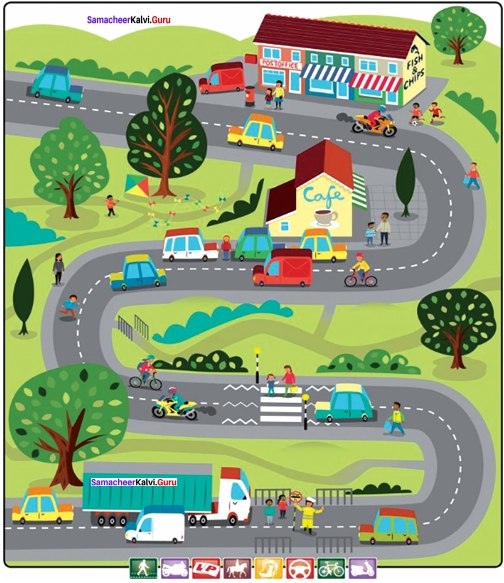
Look at the picture. Circle the dangerous actions of pedestrians on or near the road. Discuss in groups and write down the Pedestrians Road Safety Rules.

Sindbad My First Voyage Samacheer Kalvi 7th English Solutions Term 3 Supplementary Chapter 1
Answer:

  1. Cross the road after looking at both ways-
  2. Don’t run on the streets and road
  3. Read and Interpret road safety signs-
  4. While walking, use only the sidewalks-
  5. Cross the road only at Zebra crossing-
  6. Ensure bicycle safety-

Step To Success

H. A set of words are given below. Categorize it under the appropriate columns.

Sindbad My First Voyage 7th English Samacheer Kalvi Solutions Term 3 Supplementary Chapter 1
Answer:

Sindbad My First Voyage Summary Samacheer Kalvi 7th English Solutions Term 3 Supplementary Chapter 1

Sindbad – My First Voyage Additional Questions

I. Choose the Correct Answers (MCQ).

Sindbad My First Voyage Mind Map Question 1.
My father was a rich _________
(a) trader rich
(b) farmer
(c) merchant
(d) landlord
Answer:
(c) merchant!

Sindbad My First Voyage Lesson Plan Question 2.
I decided to sail from _________ gulf with some goods.
(a) Persian
(b) Mexican
(c) California
(d) Alaska
Answer:
(a) Persian

Sindbad My First Voyage In Tamil Question 3.
As soon as we lit the fire for cooking, we got a _________
(a) shiver
(b) jerk
(c) tremble
(d) shake
Answer:
(b) jerk!

Question 4.
We were when we realized this _________
(a) surprised
(b) shocked
(c) baffled
(d) terrified
Answer:
(d) terrified

Question 5.
I was one among those _________
(a) survivors
(b) sufferers
(c) strugglers
(d) leaders
Answer:
(c) strugglers

Question 6.
At last, I was thrown on _________
(a) an island
(b) a land
(c) a shore
(d) the raft
Answer:
(a) an island!

Question 7.
As I walked further in this _________ land, I met a man.
(a) new
(b) beautiful
(c) vast
(d) strange
Answer:
(d) strange

Question 8.
They served me
(a) disk good _________ and drink.
(b) lunch
(c) food
(d) supper
Answer:
(c) food

Question 9.
During my stay, I witnessed a: number of _________ sights.
(a) great
(b) beautiful
(c) exciting
(d) remarkable
Answer:
(d) remarkable

Question 10.
Finally, I returned to my city _________ as a rich man.
(a) Baghdad
(b) Babylon
(c) Persepolis
(d) Bukhara
Answer:
(a) Baghdad

II. Write True or False against each statement.

  1. Sindbad was a man from Baghdad.
  2. Sailor Sindbad’s father was a poor man.
  3. Everyone jumped into the boat to save their lives.
  4. Sindbad held on to the wood when tossed by the waves.
  5. The king was a merciless man.

Answer:

  1. True
  2. False
  3. False
  4. True
  5. False

III. Very Short Questions with Answers.

Question 1.
When did Sindbad’s father die?
Answer:
Sindbad’s father died, when he was young.

Question 2.
What did Sindbad decide to do, after he lost his wealth?
Answer:
Sindbad decided to sail for the Persian Gulf with some goods.

Question 3.
What did the group see, when they were on board?
Answer:
They saw a beautiful small green island.

Question 4.
Was it really an island? What was it?
Answer:
No, it was not an island. It was the back of a huge animal.

Question 5.
Where was Sindbad thrown by the waves?
Answer:
Sindbad was thrown on an island.

Question 6.
What happened to Sindbad’s  limbs? Why?
Answer:
Sindbad’s limbs became stiff and refused to move because of his continuous

Question 7.
How did he quench his thirst?
Answer:
He quenched his thirst from a spring on the island.

IV. Short Questions with Answers.

Question 1.
Who were the men present on the island? What did they serve Sindbad?
Answer:
They were all the slaves of the king of the island. They served Sindbad with good food and drink.

Question 2.
Who was Mihrjan? What type of a person was he?
Answer:
Mihrjan was the ruler of the island. He was a noble and a kind person.

Question 3.
What did the king do, after hearing Sindbad’s tale of suffering?
Answer:
The king sympathized with him and appointed him as an officer on the spot.

Question 4.
What did the sea water around the island contain?
Answer:
The sea water around the islands contained huge and terrible fishes. A few were hundred times bigger than the largest ship.

Question 5.
What did Sindbad ask the visiting sailors?
Answer:
Sindbad asked them about his city Baghbad, but no one knew about it.

V. Paragraph Question with Answer.

Question 1.
How did Sindbad spend his stay on the island?
Answer:
The king appointed him as an officer. He became friendly with the people on the island. During his stay, he witnessed a number of remarkable sights. There were huge fishes in the seawater around the island. Once, he saw a fish that had a head like a bull. He also witnessed many unimaginable wonders. Ships from different parts of the world visited the small island. But the visiting sailors did not know about the city of Baghdad. Sindbad longed to go back home.

VI. Rearrange the following sentences in coherent order.

A
1. Just to have fun, we all got down on that green patch.
2. Our group sailed from one country to another, selling the goods.
3. I returned to my senses only after the loss of all the wealth.
4. I decided to sail for the Persian Gulf with some goods. .
5. One day, when we were on board, we saw a beautiful small green island.
Answer:
3. I returned to my senses only after the loss of all the wealth.
4. I decided to sail for the Persian Gulf with some goods.
2. Our group sailed from one country to another, selling the goods.
5. One day, when we were on board, we saw a beautiful small green island.
1. Just to have fun, we all got down on that green patch.

B.
1. I thanked the king for his kindness and all the favours he had done to me.
2. The king again gave me many valuable farewell gifts.
3. When it was time to leave, I went to meet the king.
4. Finally, I returned to my city Baghdad as a rich man.
5. Meanwhile, I did good business and earned a lot of money.
Answer:
5. Meanwhile, I did good business and earned a lot of money.
3. When it was time to leave, I went to meet the king.
1. I thanked the king for his kindness and all the favours he had done to me.
2. The king again gave me many valuable farewell gifts.
4. Finally, I returned to my city Baghdad as a rich man.

C.
1. He asked him to come the next day to hear the tale of his new voyage.
2. Sindbad the sailor then bade good bye to the poor porter.
3. The unexpected riches overjoyed Sindbad, the porter.
4. He thanked his rich host and went home.
5. But before leaving he presented Sindbad a purse full of gold coins.
Answer:
2. Sindbad the sailor then bade good bye to the poor porter.
1. He asked him to come the next day to hear the tale of his new voyage.
5. But before leaving he presented Sindbad a purse full of gold coins.
3. The unexpected riches overjoyed Sindbad, the porter.
4. He thanked his rich host and went home.

VII. Read the passage and answer the questions.

A.
In this extract, the rich Sindbad describes his first voyage to the poor Sindbad (porter). My father was a rich merchant. When he died, I was still young. He left behind a big wealth. However, I was an inexperienced thoughtless youth and spent all his wealth foolishly.

Question 1.
To whom did Sindbad describe his first voyage?
Answer:
Sindbad describes his first voyage to the poor Sindbad, the porter.

Question 2.
What did his father leave behind?
Answer:
His father left behind a big wealth.

Question 3.
How did he spend all his wealth?
Answer:
He spent all his wealth foolishly.

Question 4.
When did his father die?
Answer:
His father died, when he was young.

Question 5.
What kind of a youth was Sindbad?
Answer:
Sindbad was an inexperienced thoughtless youth.

B.
I was being tossed by the powerful sea waves but I held on to the wood and kept floating for
a long time. At last, I was thrown on an island. I was very tired and extremely hungry.

Question 1.
What did Sindbad held on to?
Answer:
Sindbad held on to the wood.

Question 2.
How long did he float?
Answer:
He floated for a long time.

Question 3.
Where was he thrown?
Answer:
He was thrown on an island.

Question 4.
How did Sindbad feel after reaching the island?
Answer:
Sindbad was very tired and extremely hungry.

Question 5.
What does the word ‘tossed’ mean?
Answer:
The word ‘tossed’ means ‘thrown about’.

Sindbad – My First Voyage Summary

Sindbad, the sailor is a fictional mariner and the hero of a story cycle of Middle-Eastern origin. He was a man from Baghdad who had fantastic adventures in magical realms. In this extract, the rich Sindbad describes his first voyage to the poor Sindbad, the porter.

When the father of rich Sindbad died, he left behind a big wealth. Sindbad spent all his wealth foolishly. After realising his fault, Sindbad decided to sail for the Persian Gulf with some goods. One day, on board, their group saw a beautiful small green island. Out of curiosity, they all gotdown on that green patch. They decided to cook, as they were hungry. As soon as they lit the fire for cooking, they got a jerk. The island was shaking. It was not an island. But a huge animal. Everyone jumped into the sea to save his life. A few of them couldn’t board the ship and they were left there struggling for their life. Sindbad was one among them.

Fortunately, he caught hold of a big piece of wood and kept floating for a long time. He was thrown on an island. There, he met a man who helped him to get good food and drink. Later, when he narrated his sufferings to the king of the Island, Mihrjan, he took pity on him. He appointed him as an officer on the spot. There Sindbad witnessed many unimaginable wonders. He became friendly with the people there. But longed to go back. One day, the same ship which he boarded, happened to come to that place. The captain of the ship was surprised to find Sindbad alive.

Sindbad presented some of his goods to the kind king. In return, the king also gave him expensive presents. As the ship stayed on the island for a few days, Sindbad did good business and earned a lot of money. Finally, he returned to his city Baghdad as a rich man. Sindbad completed his story and bade good bye to the poor porter. He presented him with a purse-full of good coins. The unexpected riches overjoyed the porter.

Samacheer Kalvi 12th English Solutions Poem Chapter 4 Ulysses

Students can Download English Poem 4 Ulysses Questions and Answers, Summary, Activity, Notes, Samacheer Kalvi 12th English Book Solutions Guide Pdf helps you to revise the complete Tamilnadu State Board New Syllabus and score more marks in your examinations.

Tamilnadu Samacheer Kalvi 12th English Solutions Poem Chapter 4 Ulysses

12th English Poem Ulysses Warm Up

Introduction:
The poem ‘Ulysses’ is a dramatic monologue that contains 70 lines of blank verse. Ulysses, the king of Ithaca, gathers his men together to prepare for the journey and exhorts them not to waste their time left on earth. Ulysses has grown old, having experienced many adventures at the battle of Troy and in the seas. After returning to Ithaca, he desires to embark upon his next voyage. His inquisitive spirit is always looking forward to more and more of such adventures.


12th English Poem Ulysses Chapter 4 Samacheer Kalvi

The poem can be divided into three parts:

  1. the thirst for adventure, which does not allow Ulysses to remain in his kingdom as a mere ruler
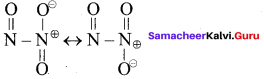
  2. Ulysses handing over the responsibility to his son Telemachus, with total confidence in his abilities
  3. Ulysses’ clarion call to his sailors, urging them to venture into unknown lands.

Samacheer Kalvi 12th Ulysses English Textual Questions

1. Complete the summary of the poem, choosing words from the list given below. Lines 1 to 32

It little profits that an idle king,
By this still hearth, among these barren crags,
Match’d with an aged wife, I mete and dole
Unequal laws unto a savage race,

That hoard, and sleep, and feed, and know not me.
I cannot rest from travel: I will drink
Life to the lees: All times I have enjoy’d
Greatly, have suffer’d greatly, both with those

That loved me, and alone, on shore, and when
Thro’ scudding drifts the rainy Hyades
Vext the dim sea: I am become a name;
For always roaming with a hungry heart

Much have I seen and known; cities of men
And manners, climates, councils, governments,
Myself not least, but honour’d of them all;
And drunk delight of battle with my peers,

Far on the ringing plains of windy Troy.
I am a part of all that I have met;
Yet all experience is an arch wherethro’
Gleams that untravell’d world whose margin fades

For ever and forever when I move.
How dull it is to pause, to make an end,
To rust unburnish’d, not to shine in use!
As tho’ to breathe were life! Life piled on life

Were all too little, and of one to me
Little remains: but every hour is saved
From that eternal silence, something more,
A bringer of new things; and vile it were

For some three suns to store and hoard myself,
And this gray spirit yearning in desire
To follow knowledge like a sinking star,
Beyond the utmost bound of human thought.

This is my son, mine own Telemachus,
To whom I leave the sceptre and the isle, –
Well-loved of me, discerning to fulfil
This labour, by slow prudence to make mild

A rugged people, and thro’ soft degrees
Subdue them to the useful and the good.
Most blameless is he, centred in the sphere
Of common duties, decent not to fail

offices of tenderness, and pay
Meet adoration to my household gods,
When I am gone. He works his work, I mine.
There lies the port; the vessel puffs her sail:

Ulysses Poem Questions And Answers Samacheer Kalvi 12th English Solutions Chapter 4

There gloom the dark, broad seas. My mariners,

Souls that have toil’d, and wrought, and thought with
me That ever with a frolic welcome took
The thunder and the sunshine, and opposed
Free hearts, free foreheads – you and I are old;

Old age hath yet his honour and his toil;
Death closes all: but something ere the end,
Some work of noble note, may yet be done,
Not unbecoming men that strove with Gods.

The lights begin to twinkle from the rocks:
The long day wanes: the slow moon climbs: the deep
Moans round with many voices. Come, my friends,
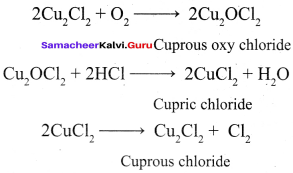
‘T is not too late to seek a newer world.

Push off, and sitting well in order smite
The sounding furrows; for my purpose holds
To sail beyond the sunset, and the baths
Of all the western stars, until I die.

It may be that the gulfs will wash us down:
It may be we shall touch the Happy Isles,
And see the great Achilles, whom we knew.
Tho’ much is taken, much abides; and tho’

We are not now that strength which in old days
Moved earth and heaven, that which we are, we are;
One equal temper of heroic hearts,
Made weak by time and fate, but strong in will
To strive, to seek, to find, and not to yield.

Ulysses Questions And Answers Samacheer Kalvi 12th English Solutions Poem Chapter 4

fullestunquenchableunattainable
experienceknowledgeking
mattersrustadventure
unwillingtravelbreathing

Ulysses is (1) ______ to discharge his duties as a (2) ______ , as he longs for (3) ______ He is filled with an (4) ______ thirst for (5) ______ and wishes to live life to the (6) ______ He has travelled far and wide gaining (7) ______ of various places, cultures, men and (8) ______ He recalls with delight his experience at the battle of Troy. Enriched by his (9) ______ he longs for more and his quest seems endless. Like metal which would (10) ______ if unused, life without adventure is meaningless. According to him living is not merely (11) ______ to stay alive. Though old but zestful, Ulysses looks at every hour as a bringer of new things and yearns to follow knowledge even if it is (12) ______
Answers:

  1. unwilling
  2. king
  3. adventure
  4. unquenchable
  5. travel
  6. fullest
  7. experience
  8. matters
  9. knowledge
  10. rust
  11. breathing
  12. unattainable

Lines 33 to 42

prudencekingdomquesttender

Ulysses desires to hand over his (1) _____ to his son Telemachus, who would fulfil his duties towards his subjects with care and (2) _____ Telemachus possesses patience and has the will to civilise the citizens of Ithaca in a (3) _____ way. Ulysses is happy that his son would do his work blamelessly and he would pursue his (4) _____ for travel and knowledge.
Answer:

  1. kingdom
  2. prudence
  3. tender
  4. quest

Lines 44 to 70

worldthundermeaningful
gatherundauntedheaven

Ulysses beckons his sailors to (1) _____ at the port where the ship is ready to sail. His companions who have faced both (2) _____ and sunshine with a smile, are united by their undying spirit of adventure. Though death would end everything, Ulysses urges his companions to join him and sail beyond the sunset and seek a newer (3) _____ , regardless of consequences. These brave hearts who had once moved (4) _____ and earth, may have grown old and weak . physically but their spirit is young and (5) _____ His call is an inspiration for all those who seek true knowledge and strive to lead (6) _____ lives.
Answers:

  1. gather
  2. thunder
  3. world
  4. heaven
  5. undaunted
  6. meaningful

2. Answer the following questions in one or two sentences each.

Ulysses Poem Questions And Answers Question (а)
‘Ulysses is not happy to perform his duties as a king.’ Why?
Answer:
Ulysses is not happy to perform the ordinary duties of a king mainly because his heart is in voyages beyond horizon. He is bored with the task of enforcing law and order and giving reward and punishment to a savage race.

Ulysses Questions And Answers Question (b)
What does he think of the people of his kingdom?
Answer:
The citizen of Ithaca hoard, sleep and feed. They don’t understand the aspirations of the dreamer Ulysses.

12th English Poem Ulysses Paragraph Question (c)
What has Ulysses gained from his travel experiences?
Answer:
Ulysses has met people hailing from different cultural backgrounds. He has learnt much from their manners, climates, councils and governments. He learnt strategies of warfare in battles.

Ulysses Poem Erc Question (d)
Pick out the lines which convey that his quest for travel is unending.
Answer:
“How dull it is to pause, to make an end,
To rust unburnished, not to shine in use!
The lines quoted above convey his quest for travel is unending.

12th English Ulysses Paragraph Question (e)
‘As tho’ to breathe were life!’ – From the given line what do you understand of Ulysses’ attitude to life?
Answer:
Ulysses strongly believes that just breathing is not life. Life has to be adventurous and full of action.

Ulysses Poem Questions And Answers Pdf Question (J)
What does Ulysses yearn for?
Answer:
Ulysses yearns for following knowledge like a sinking star beyond the utmost bound of human thought.

Ulysses Question Answer Question (g)
Who does the speaker address in the second part?
Answer:
The speaker addresses the readers in the second part explaining the difference between his roles and that of Telemachus.

Ulysses Poem Short Questions And Answers Question (h)
Why did Ulysses want to hand over the kingdom to his son?
Answer:
Ulysses finds Telemachus discerning and prudent. Besides, Ulysses is wearing the crown uneasily as the call for adventure and desire to sail beyond sunset is obsessing his mind. So, he wants to hand over the kingdom to Telemachus.

Ulysses Short Questions And Answers Question (i)
How would Telemachus transform the subjects?
Answer:
Ulysses believes that his son Telemachus is wise and kind enough to transform rugged citizens into mild and civilized subjects by his tenderness and love.

Question (j)
‘He works his work, I mine’ – How is the work distinguished?
Answer:
Telemachus would do the work of ruling Ithaca with prudence and tenderness. Ulysses will pursue his dream of adventure and try to meet great Achilles in the other world.

Question (i)
In what ways were Ulysses and his mariners alike?
Answer:
Both Ulysses and his fellow sailors are now old. They no more have the strength they possessed in olden days moving earth and heaven. They are made weak by time and fate but strong in will “to strive, to seek, to find and not to yield.” They share the heroic temper and undying quest for knowledge and adventure.

Question (j)
What could be the possible outcomes of their travel?
Answer:
The sailors and Ulysses may be washed down by the gulfs or they could touch Greek paradise and meet their hero Achilles. They may die happily braving the elements of nature.

3. Identify the figures of speech employed in the following lines.

Question (a)
“Thro” scudding drifts the rainy Hyades
Vext the dim sea…”
Answer:
The figure of speech Personification is employed in the above lines.

Question (b)
“For always roaming with a hungry heart”
Answer:
Metaphor

Question (c)
“And drunk delight of battle with my peers;”
Answer:
Metaphor

Question (d)
“…..the deep
Moans round with many voices.”
Answer:
Personification

Question (e)
“To follow knowledge like a sinking star.”
Answer:
Simile

Question (f)
“ There lies the port the vessel puffs her sai”
Answer:
Personification

Additional Questions

Question (a)
“I will drink life to the lees'”
Answer:
Metaphor

Question (b)
“Vext the dim sea:”
Answer:
Personification

Question (c)
“Yet all experience is an arch wherethro”
Answer:
Metaphor

Question (d)
“Gleams that untravell’d world whose margin fades”
Answer:
Metaphor

Question (e)
“To rust unburnish’d, not to shine in use!”
Answer:
Metaphor

Question (f)
“There gloom the dark, broad seas. My mariners,”
Answer:
Metaphor

Question (g)
“Souls that have toil’d, and wrought, and thought with me”
Answer:
Synecdoche (part of the whole)

Question (h)
“The thunder and the sunshine, and opposed”
Answer:
Metaphor

Question (i)
“T is not too late to seek a newer world.”
Answer:
Synecdoche

Question (j)
“…in order smite The sounding furrows;”
Answer:
Metaphor

Question (k)
“To sail beyond the sunset, and the baths”
Answer:
Metaphor

Question (l)
“It may be we shall touch the Happy Isles,”
Answer:
Allusion (in Greek mythology the place is known as Greek paradise)

Question (m)
“And see the great Achilles, whom we knew.”
Answer:
Allusion (Greek mythology)

Appreciate The Poem

4. Read the sets of lines from the poem and answer the questions that follow.

(a) “…I mete and dole
Unequal laws unto a savage race,
That hoard, and sleep, and feed, and know not me.”

Question (i)
What does Ulysses do?
Answer:
Ulysses, like a grocery shop owner, measures and delivers rewards and punishments unto a large number of uncivilized citizens.

Question (ii)
Did he enjoy what he was doing? Give reasons.
Answer:
No, he did not enjoy is work. He does not like the idea of ministering variable justice to people who like “drones” or animals just eat, sleep and multiply their kind. He wants to leave such work to his son.

Question (b)
“Yet all experience is an arch wherethrough
Gleams that untravelled world, whose margin fades
For ever and for ever when I move. ”

Question (i)
What is experience compared to?
Answer:
Experience is compared to an arch.

Question (ii)
How do the lines convey that the experience is endless?
Answer:
Through the arch of experience one can see the untravelled world. But the experience in the untravelled has a margin whose border fades as one moves forward. Thus experience is endless.

Question (c)
“Little remains: but every hour is saved
From that eternal silence, something more,
A bringer of new things; and vile it were”

Question (i)
How is every hour important to Ulysses?
Answer:
One lives in this world for a limited time. Every hour can provide new knowledge. So, every hour is very important.

Question (ii)
What does the term ‘Little remains’ convey?
Answer:
Ulysses realizes that he has become old. He has not much time left. He doesn’t want to die resting in his kingdom. He states that his remaining lifetime is very limited.

Question (d)
“This is my son, mine own Telemachus,
To whom I leave the sceptre and the isle
Well-loved of me,”

Question (i)
Who does Ulysses entrust his kingdom to, in his absence?
Answer:
Ulysses entrusts his kingdom to his beloved son Telemachus in his absence.

Question (ii)
Bring out the significance of the ‘sceptre’.
Answer:
Sceptre is an ornamental staff carried by a King on ceremonial occasions as a symbol of sovereignity. It symbolizes the power of a king.

(e) ‘‘That ever with a frolic welcome took
The thunder and the sunshine, and opposed”

Question (i)
What do ‘thunder’ and ‘sunshine’ refer to?
Answer:
Thunder and sunshine refers to misfortunes and happy days. Ulysses and his comrades had undergone both kinds of experiences.

Question (ii)
What do we infer about the attitude of the sailors?
Answer:
The sailors shared the undying quest for exploration, adventure and for seeking newer knowledge in the untravelled world. They even welcomed dangers in fighting with Gods. They enjoyed the thrill of action and never worried about the outcome of battles or quests. They have equal temper of heroic hearts.

(f) ‘‘Death closes all: but something ere the end,
Some work of noble note, may yet be done,
Not unbecoming men that strove with Gods.”

Question (i)
The above lines convey the undying spirit of Ulysses. Explain.
Answer:
Ulysses is aware of ageing and substantial decrease in his physical strength. He knows that will close in on him sooner or later. But before that happens, he wants to sail beyond the sunset/horizon and if possible meet warriors like Achilles. He wants to achieve something worthy of those who challenged and fought with Gods. Thus these lines show the undying spirit of Ulysses.

Question (ii)
Pick out the words in alliteration in the above lines,
Answer:
ere, end, noble, note are the words that alliterate.

(g) “……… for my purpose holds
To sail beyond the sunset, and the baths Of all the western stars, until I die.”

Question (i)
What was Ulysses’ purpose in life?
Answer:
Ulysses proposes to sail beyond sunset and baths. His goal is not death but is in death. He seeks life in death. Ordinary mortals can’t reach ‘Happy isles’ or baths while they are alive.Ulysses wants to find direct evidence of spiritual reality after death. He wants to venture into the unknown.

Question (ii)
How long would his venture last?
Answer:
His venture would last until he confronts his death.

Question (h)
“One equal temper of heroic hearts,
Made weak by time and fate, but strong in will
To strive, to seek, to find, and not to yield. ”

Question (i)
Though made weak by time and fate, the hearts are heroic. Explain.
Answer:
Ulysses and his compatriots have visited many strange places in their previous voyages and enjoyed misfortunes and glorious triumphs with the same heroic temperament. They might have become old and may not have the same strength they had in youth. But they still share the thirst for travel and pursuit of knowledge in the unexplored world. Their bravery and spiritual strength are intact.

Question (ii)
Pick out the words in alliteration in the above lines.
Answer:
Strive, seek, heroic, hearts are the words that alliterate.

5. Explain with reference to the context the following lines.

Question (a)
“I cannot rest from travel: I will drink
Life to the lees:”
Answer:
Reference: These lines are from the poem ‘Ulysses” written by Alfred Tennyson.
Context and Explanation: Ulysses, after spending many years in the seas returns to Ithaca and starts ruling his country. But his heart is not in the administration of his kingdom. He wants to sail again. At this context he says these words. He wishes to enjoy life to the fullest and so he can’t afford to idle away his remaining life as a king.

Question (b)
“I am become a name;
For always roaming with a hungry heart”
Answer:
Reference: These lines are from the poem ‘Ulysses” written by Alfred Tennyson.
Context and Explanation: Ulysses says these words while discussing the reputation he has earned among the common multitude due to his daring adventures. He has roamed the world like a hungry lion. This line has a biblical alusion as well “Blessed are they which do hunger and thirst after righteousness” – Matthew V. 6.

Though Ulysses is aware of his fame, it doesn’t motivate him to stay or settle down in the kingdom of Ithaca. His inquisitive spirit is always looking for newer knowledge through ‘the arch’ to the untravelled world.

Question (c)
“How dull it is to pause, to make an end,
To rust unburnished, not to shine in use!”
Answer:
Reference: These lines are from the poem ‘Ulysses” written by Alfred Tennyson.
Context and Explanation: The poet says these words while discussing the mental agony of Ulysses who is unable to settle down with his ageing wife Penelope and son Telemachus. Ulysses finds doling out justice to a savage people as ‘boring’. He does not want to settle down and die in Ithaca. He compares himself to a sword which may rust if left unused. He wants to lead an active and adventurous life till his death.

Question (d)
“To follow knowledge like a sinking star,
Beyond the utmost bound of human thought”
Answer:
Reference: These lines are from the poem ‘Ulysses” written by Alfred Tennyson.
Context and Explanation: The poet says these words while describing the quest Ulysses has for adventure and fulfillment. Similar to a sinking star, Ulysses wants to pursue in his failing old age to pursue knowledge like the goal of Goethe’s Faust, his quest is defined by the pursuit of new and unique knowledge “beyond the utmost bound of human thought”.

Question (e)
“He works his work, I mine.’’’’
Answer:
Reference: These lines are from the poem ‘Ulysses” written by Alfred Tennyson.
Context and Explanation: The poet says these words while justifying the decision of Ulysses to pass on his kingdom to Telemachus. Ulysses explains the polar difference between himself and his son Telemachus. His son will be a ‘fair’ and ‘decent’ ruler. Unlike Ulysses, Telemachus is rooted in regular political life. He enjoys leading “savage” population and the responsibility of showing the subject better moral codes of conduct and upholding justice. Whereas Ulysses finds this “slow” and intolerable. So, he wishes his son to rule Ithaca and for himself he wishes to set sail to the unknown.

Question (f)
“….you and I are old;
Old age hath yet his honour and his toil;”
Answer:
Reference: These lines are from the poem ‘Ulysses” written by Alfred Tennyson.
Context and Explanation: Poet, in this part of the monologue describes the address made by Ulysses to his compatriots who were with him during “thunders and sunshine”. He admits the fact that they are growing old. But he does not want to retire like ordinary mortals. He accepts gracefully the honour befitting old age as a result of varied cultural experiences. Yet, he does not want old people to bow out of the field of action. He sincerely believes there is more work to be done, lands to be explored and newer knowledge to be acquired in old age before death.

Question (g)
“The long day wanes: the slow moon climbs: the deep
Moans round with many voices.”
Answer:
Reference: These lines are from the poem ‘Ulysses” written by Alfred Tennyson.
Context and Explanation: The poet poet continues to discuss old age and the tantalising call of the oceans to conquer. Ulysses hints at the probable end of the cycle of life in the words “The long clay wanes”. The symbol of darkness or night is mostly associated with death. The lure of ocean to resume his voyages beyond the point of sunset is too tempting to resist. The dark unfathomable sea beckons him and his compatriots with mysterious voices.

Question (h)
“It may be we shall touch the Happy Isles,
And see the great Achilles, whom we knew.”
Answer:
Reference: These lines are from the poem ‘Ulysses” written by Alfred Tennyson.
Context and Explanation: The poet says these words through Ulysses as to the probable outcome of the daring voyage at the fag end of his life. Ulysses is uncertain about the probable outcome of his last voyage. But he infers that he might reach ‘Happy Isles’ and see the ‘great Achilles’ who was dipped in the river of life.

Question (i)
“We are not now that strength which in old days
Moved earth and heaven;”
Answer:
Reference: These lines are from the poem ‘Ulysses” written by Alfred Tennyson.
Context and Explanation: The poet says these words through Ulysses when he wants to justify the reasons for resuming the daring voyage. He admits the decline in the compatriots’ physical strength with which they were able to move heaven and earth in their youth. He asks his compatriots to ignore the infinity of age and draw on their inner spiritual strength to resume their voyage beyond sunset.

Question (j)
“To strive, to seek, to find, and not to yield.”
Answer:
Reference: These lines are from the poem ‘Ulysses” written by Alfred Tennyson.
Context and Explanation: Tennyson says these words through Ulysses who makes his motto loud and clear in these words. The final line of the poem is Ulysses’ enduring challenge to readers as well. The challenge if the aged ones could push ahead with vigour and strength of will no matter how fragile their bodies are. To yield to age or weakness is to be less than fully human. It might be honourable to live a peaceful settled life in the old age. But one would naturally miss out most exciting moments of life if one does not venture out, at least a little towards the unknown.

6. Answer the following questions in a paragraph of about 100 words each.

Question (a)
What makes Ulysses seek newer adventures?
Answer:
In the context of the poem, Ulysses has grown old. He has experienced all daring adventures. He has won the hearts of people during the battle at Troy. Back home, as per the prophecy of Tiresias, he rules Ithaca for a brief time. But he is fed up with a conventional duties of a king. He laments his own uselessness as a ruler of idle people who lead life like savages, just eating and sleeping. They don’t understand the over vaulting ambition of their adventurous king Ulysses who had moved earth and heavens in the past. He wishes to embark upon his next voyage. It might be his last. He is quite sensitive to the moans of the seas tantalising him and his compatriots to set sail quickly. He wants “to drink life to the lees”. Ulysses doesn’t want to bask on the glory he has earned in the past.

His inquisitive spirit is restless. He has seen much’ and acquired knowledge of various cultures of the world. But he considers all such experiences like an “arch” leading him to the unexplored or “untravelled world”. He wants to sail towards the area ‘beyond sunset’. He must shine in use like a sword but not “rust unbumished”. Yet at home, in the kingdom of Ithaca, he feels bored and yearns to truly engage with what is left of life. He is impatient for “new” experiences lamenting everyday and every hour to seek “something more”. His quest for adventure and fulfillment, like the goal of Goethe’s Faust is defined by the pursuit of new knowledge “beyond the utmost bound of human thought”.

Question (b)
List the roles and responsibilities Ulysses assigns to his son Telemachus, while he is away.
Answer:
The entire poem is a monologue. Yet the second part of the poem is an address to the readers justifying his decision to transfer the rule to his son Telemachus. The cloak of a king seems to be unfit for the temperament of Uly sses. He finds ruling Ithaca a boring thing. He finds Telemachus rooted to the political life of Ithaca. His role is merely to lead a ‘savage race’ to accept standard norms of behaviour in the society. He believes Telemachus fits well with the role of the ruler of “uninspired and imprudent citizens” and may discharge his duties with honour and grace. When he is away, he wants his son Telemachus to dispense variable justice to the subjects of Ithaca and guide them in the path of virtues and morals.

Question (c)
What is Ulysses’ clarion call to his sailors? How does he inspire them?
Answer:
In the third part of the poem, Ulysses makes a clarion call to his hearty compatriots (i.e.) mariners. They have been with him both during ‘thick and thin’ or thunders or sunshine. Similar to Ulysses they possess “free hearts and free foreheads” (i.e.) their hearts and brains are unburdened by domestic cares and resposibilities. They had frolicsome time fighting along with Ulysses against great warriors and Gods in the past. Ulysses does not want to live in memory of glory. He believes they need not waste away their precious time in nostalgic memories just recounting their escapades to younger generation. They can really do ‘ something of noble note’ before the end. He is conscious of the impending death in old age. But he tells it is not “too late to seek a newer world”.

The many “voices of the ocean” call out to the mariners to resume voyage. Ulysses is not content with having earned a name for himself. He has seen many countries and acquired knowledge of various cultures. Those experiences are not to be taken as accomplishments. They are just an ‘arch’leading them to “untravelled world” and constantly sailing to the ever expanding horizon. He does not want his compatriots to miss even an hour which could prrovide them novel experiences in their voyage. He persuades his compatriots to gather at the port as the sails are already puffing up welcoming them all. Their life would be one of fulfillment only when they venture out into the unkown on the seas. He uses an emotional bait to his mariners. He highlights the probable outcome of their voyage. They might reach the “Happy Isles” (i.e.) great paradise and meet Achilles, their war hero. No matter how much strength they have, they still have some “strength of will” left to strive, to seek, to find, and not to yield.

Listening Activity

Listen to the poem and fill in the blanks with appropriate words and phrases. If required listen to the poem again.

Wander-thirst

BEYOND the East the sunrise, beyond the West the sea, And East and West the wander-thirst that will not let me be; It works in me like madness, dear, to bid me say good-bye; For the seas call, and the stars call, and oh! the call of the sky!

I know not where the white road runs, nor what the blue hills are; But a man can have the sun for a friend, and for his guide a star; And there’s no end of voyaging when once the voice is heard, For the rivers call, and the roads call, and oh! the call of the bird!

Yonder the long horizon lies, and there by night and day The old ships draw to home again, the young ships sail away; And come I may, but go I must, and, if men ask you why, You may put the blame on the stars and the sun and the white road and the sky.

Choose the best option and complete the sentences:

Question 1
works like madness in the poet.
(a) Wander – Thirst
(b) Bidding Farewell
(c) Eastern Sunrise
(d) Western Seas
Answer:
(a) Wander – Thirst

Question 2.
A man could choose as his guide.
(a) the sun
(b) the hills
(c) a star
(d) a bird
Answer:
(c) a star

Question 3.
There is no end of once the voice is heard.
(a) walking
(b) roaming
(c) talking
(d) voyaging
Answer:
(d) voyaging

Question 4.
The old ships return, while the young ships
(a) drift
(b) move
(c) sail
(d) wander
Answer:
(c) sail

Question 5.
The blame is on the sun, stars, the road and the
(a) hills
(b) trees
(c) seas
(d) sky
Answer:
(d) sky

Ulysses About The Poet

Samacheer Kalvi 12th English Solutions Poem Chapter 4 Ulysses img-4

Alfred Tennyson was the poet laureate of England and Ireland during Queen Victoria ‘s reign. Tennyson excelled in writing short lyrics such as “Break, Break, Break“, “ Tears Idle Tears“, “The Charge of the Light Brigade” and.‘Crossing the Bar’. Tennyson’s use of the musical qualities of words to emphasise his rhythms and meanings is sensitive.

Ulysses Summary in English

Introduction
‘Ulysses’ is a dramatic monologue in which Ulysses, the king of Ithaca expresses his undying thirst of adventure overseas. Tennyson has written this poem in memory of Arthur Henry Hallam who died young. Death is not the end for both Arthur and Ulysses.

Thirst for adventure
Ulysses addresses mariners in the third part. Ulysses does not see any worth in staying in the comfort of family life with his wife. As a king, he listens to the complaints of people and gives rewards and punishments for the citizens of his country. He discloses his inner nature, “cannot rest from travel!” He has become a living icon of travel overseas. He wants “to drink life to the lees”. He confesses that he has both enjoyed and suffered a lot during his travels. He has gained profound wisdom during his travels and battles. Enriched by his new gained cultural knowledge, he longs to resume his voyages. He believes that to rest is rust. Every hour has the •potential to bring new knowledge. So, it is meaningless to stay.

Passing on the inheritance
In the second part addresses the reader explaining why Ulysses doesn’t want to continue to rule. Ulysses wishes to hand over his kingdom to his son Telemachus. He believes he would rule the kingdom and render appropriate justice to his subjects. Telemachus, unlike Ulysses, is rooted to the soil. He is kind to the subjects and addresses their needs. Besides, Ulysses hopes that Penelope, his aging wife would be happy to spend her last years with her son and grandchildren. So, Ulysses can resume his voyage along with his old friends.

Call to set sail
Ulysses called his old companions to the port where the ship awaits them all. His old companions have fought many battles alongside him and share the undying quest for adventure. Ulysses persuades his friends to join him on his voyage to the edge of the world and beyond to find a new world. He knows the limitations of his companions. They may have grown old and weak due to age. Their physical powers may not be the same as when they had once moved heaven and earth. But he is confident that their spirit is young and undaunted. His clarion call would inspire invariably all those who seek knowledge and strive to lead meaningful lives.

Conclusion
People who are endowed with an unquenchable thirst for ever-expanding knowledge and incurable love for long distances Ulysses continues to be a source of inspiration.

Ulysses Summary in Tamil

முடிவுரை:
தன் அறிவு வேட்கையை அதிகப்படுத்துவதில் | ஆர்வம் கொண்டவர்களுக்கும் மற்றும் மாறாத தொலைதூரப் பயணத்தில் காதல் கொண்டவர்களுக்கும் | யுலிசஸ் எப்போதும் தூண்டுதலாக இருக்கிறார்.

சாகசத்தின் மேல் ஆவல்
யுலிசஸ் மூன்றாம் பாகத்தில் கப்பலோட்டிகளிடத்தில் சொற்பொழிவாற்றுகிறார். தன் குடும்பத்தாருடன் சொகுசு வாழ்க்கை வாழ்வதில் எந்தப் பயனும் இல்லை என எண்ணுகிறார். ஒரு அரசனாக குடிமக்களின் கூற்றுகளைக் கேட்டு அதற்கு ஏற்ற பரிசையும் மற்றும் தண்டனையும் வழங்குகிறார். கடற் பயணம் செய்யாமல் இருக்க முடியாது என்ற தன்னுடைய உள்ளுணர்வை வெளிப்படுத்துகிறார். கடல் கடந்த பயணங்களை மேற்கொள்ளும் உயிரோவியமாகத் திகழ்ந்தார். வாழ்க்கை முழுவதும் பயணிக்க விரும்புகிறார். அவர் பயணத்தில் மேற்கொண்ட இன்ப துன்பங்களை ஒப்புக் கொள்கிறார். அவர் பயணத்தின் போது ஏற்பட்ட அனுபவங்களாலும் மற்றும் எதிர்கொண்ட போர்களினாலும் ஆழ்ந்த ஞானத்தை அடைந்திருந்தார். புதிதாக பெறப்பெற்ற பண்புகளின் புலமையால், அவர் பயணங்களை மேற்கொள்வதில் ஆர்வத்தைக் காட்டினார். சோம்பலாக கிடந்தால் உடல் துருப்பிடித்து விடும் என எண்ணினார். ஒவ்வொரு கணமும் புதுப் பொலிவைக் கொண்டு வரும் ஆற்றல் மிக்கது. ஆதலால், ஓரிடத்தில் ஒண்டிக் கிடப்பதில் பயனில்லை என எண்ணினார்.

பரம்பரை சொத்துக்களை கைமாற்றம் செய்தல்:
இரண்டாம் பாக சொற்பொழிவில் அவருக்கு அரசாள்வதில் ஏன் விருப்பம் இல்லை என்பதைக் குறித்துக் கூறுகிறார். யுலிசஸ் தன் இராஜ்ஜியத்தை தன் புதல்வன் டெலிமேக்கஸ் (Tele Macus) இடம் கைமாற்றுகிறார். அவர் தன் புதல்வன் நல்ல முறையில் அரசாண்டு தன் குடிமக்களுக்கு தக்க நீதி வழங்குவான் என எண்ணினார். டெலிமாக்கஸ், யுலிசஸ் போல் அல்லாமல் ஒரே இடத்தில் ஊன்றி நிற்பவராய் இருந்தார். அவர்தம் குடிமக்களுக்கு அன்பார்ந்தவராகவும் அவர்கள் குறைகளைக் கேட்டறிபவராகவும் இருந்தார். அது தவிர யுலிசஸ் தன் வயது முதிர்ந்த மனைவி பெனைலோப்பிம், மகனுடனும் பேரப் பிள்ளைகளுடனும் மகிழ்ச்சியோடு இருப்பார் என நம்பினார். ஏனெனில், அது அவர் தன் தோழர்களுடன் கடல் பயணம் மேற்கொள்ளத் தக்கவாறு அமையும்.

கடல் பயணம் மேற்கொள்ளல்:
யுலிசஸ் தன் நண்பர்களைத் தமக்காக காத்துக் கொண்டிருக்கும் துறைமுகத்திற்கு வருமாறு அழைப்பு விடுகிறார். அவர் தோழர்களும் கடல் பயணத்தின் போது பல கடற்போர்களில் ஈடுபட்டு தனக்கு உள்ள கடல் பயணத்தின் மேல் உள்ள ஆவலைப் பகிர்ந்து கொண்டனர். உலகின் விளிம்பை அடைந்து அதற்கு அப்பாலும் செல்வதற்கு தன்னுடன் கடல் பயணம் மேற்கொள்ள நண்பர்களைத் தூண்டுகிறார். அவர் தம் நண்பர்களின் குறைகளை அறிந்திருந்தார். அவர்கள் வயது முதிர்ச்சியால் பலவீனமாகக் காணப்பட்டனர். அவர்கள், முன்னர் வானத்தையும், பூமியையும் அளந்தது போல் அவர்கள் உடல் வலிமை தற்போது இல்லை. ஆனால், அவர்கள் ஊக்கம் குன்றாமல், சளைக்கா வண்ணம் தொடரவேண்டும் என்பதில் உறுதியாக இருந்தார். அவரின் வீர முழக்கம் புதிய அனுபவத்தை நாடி மற்றும் அர்த்தமுள்ள வாழ்க்கையை வாழ முயற்சிக்கும் அனைவருக்கும் தூண்டுதலாக இருக்கும்.

முன்னுரை:
யூலிஸ் என்பது வியத்தகு மோனோலாலஜி ஆகும். இதில் இதாகா மன்னனான யுலிசஸ் வெளிநாடுகளில் சாகசத் தன்மையற்ற தாகத்தை வெளிப்படுத்துகிறார். டென்னிசன் இளம் கவிஞரான ஆர்தர் ஹென்றி ஹாலமின் நினைவாக இந்தக் கவிதை எழுதினார். ஆர்தர் மற்றும் யுலிசஸ் இருவருக்கும் முடிவே இல்லை.

Ulysses Glossary

Textual:

12th English Poem Ulysses Paragraph Chapter 4 Samacheer Kalvi

Additional:

Ulysses Poem Erc Samacheer Kalvi 12th English Solutions Poem Chapter 4

Samacheer Kalvi 11th English Solutions Poem Chapter 4 Macavity – The Mystery Cat

Students who are interested in learning of 11th English Poem Chapter 4 Macavity – The Mystery Cat Questions and Answers can use Tamilnadu State Board Solutions of 11th English Chapter Wise Pdf. First check in which chapter you are lagging and then Download Samacheer Kalvi 11th English Book Solutions Questions and Answers Summary, Activity, Notes Chapter Wise. Students can build self confidence by solving the solutions with the help of Tamilnadu State Board English Solutions. English is the scoring subject if you improve your grammar skills. Because most of the students will lose marks by writing grammar mistakes. So, we suggest you to Download Tamilnadu State Board 11th English Solutions according to the chapters.

Tamilnadu Samacheer Kalvi 11th English Solutions Poem Chapter 4 Macavity – The Mystery Cat

Check out the topics covered in Poem Chapter 4 Macavity – The Mystery Cat Questions and Answers before you start your preparation. Improve your grammar skills with the help of Samacheer Kalvi 11th English Book Solutions Questions and Answers pdf links. The solutions for Tamilnadu State Board 11th English Textbook are prepared by the English experts. So, if you follow Tamilnadu State Board Solutions 11th English Textbook Solutions you can cover all the topics in Poem Chapter 4 Macavity – The Mystery Cat Questons and Answers. This helps to improve your communication skills.

11th English Guide Warm Up

A. French proverb goes thus: ‘The dog may be wonderful prose, but only the cat is poetry.’ You may have observed that all animals possess a number of unique qualities. Fill in the columns with words and phrases associated with each of the following animals.

DOGCATWOLFELEPHANT

Answer:

DOGCATWOLFELEPHANT
Barksmeowshowlstrumpets
open fightstealthygroupsgroups
aggressivepretends to be gentleroughgentle
faithfulungratefulwildcivilized
fights for foodquickly steals foodpredatorygraceful

B. People admire some of these animal qualities. What are they? Have you noticed some of them in yourself or in others? Share your views with the class.

Cats are stealthy and walk without making noise.
My friend Vimal / Mala is cat-like. He / She surprises me often appearing suddenly. Jackal is clever and persuades others like Ratna / Raja to work for him. Whenever a difficult assignment is given, he / she praises the gifted student and gets his/ her work done. Elephant is graceful and known for strong memory. Murugan / Neela is very gentle and has terrific memory. One must be very cautious with such persons. Even a small hurt will be in their memory for long.

Samacheer Kalvi 11th English Macavity – The Mystery Cat Textual Questions

A. Based on your understanding of the poem, answer the following question in a sentence or two.

Macavity’s a Mystery Cat: he’s called the Hidden Paw
For he’s the master criminal who can defy the Law.
He’s the bafflement of Scotland Yard, the Flying Squad’s despair:
For when they reach the scene of crime – Macavity’s not there!

Macavity, Macavity, there’s no one like Macavity,
He’s broken every human law, he breaks the law of gravity.
His powers of levitation would make a fakir stare,
And when you reach the scene of crime – Macavity’s not there!

You may seek him in the basement, you may look up in the air
But I tell you once and once again, Macavity’s not there!
Macavity’s a ginger cat, he’s very tall and thin;
You would know him if you saw him, for his eyes are sunken in.

His brow is deeply lined with thought, his head is highly domed;
His coat is dusty from neglect, his whiskers are uncombed.
He sways his head from side to side, with movements like a snake;
And when you think he’s half asleep, he’s always wide awake.

Macavity, Macavity, there’s no one like Macavity,
For he’s a fiend in feline shape, a monster of depravity.
You may meet him in a by-street, you may see him in the square
But when a crime’s discovered, then Macavity’s not there!

11th English Guide Solutions Poem Chapter 4 Macavity - The Mystery Cat Samacheer Kalvi

He’s outwardly respectable. (They say he cheats at cards.)
And his footprints are not found in any file of Scotland Yard’s.
And when the larder’s looted, or the jewel-case is rifled,
Or when the milk is missing, or another Peke’s been stifled,

Or the greenhouse glass is broken, and the trellis past repair
Ay, there’s the wonder of the thing! Macavity’s not there!
And when the Foreign Office find a Treaty’s gone astray,
Or the Admiralty lose some plans and drawings by the way,

There may be a scrap of paper in the hall or on the stair
But it’s useless to investigate, Macavity’s not there!
And when the loss has been disclosed, the Secret Service say:
‘It must have been Macavity!’ but he’s a mile away.

You’ll be sure to find him resting, or a licking of his thumbs,
Or engaged in doing complicated long division sums.
Macavity, Macavity, there’s no one like Macavity,
There never was a Cat of such deceitfulness and suavity.

He always has an alibi, and one or two to spare:
At whatever time the deed took place, MACAVITY WASN’T THERE!
And they say that all the Cats whose wicked deeds are widely known,
(I might mention Mungojerrie, I might mention Griddlebone)

Are nothing more than agents for the Cat who all the time
Just controls their operations: the Napoleon of Crime

11th English Guide Pdf Download Question (i)
What is Macavity’s nickname?
Answer:
Macavity’s nickname is “ Hidden Paw”.

Macavity The Mystery Cat Book Back Answers Question (ii)
Why is the Flying Squad frustrated?
Answer:
The Flying squad is frustrated because every time they rush to the spot of crime to arrest Macavity, he is not there.

11 English Guide Question (iii)
Which law does Macavity break?
Answer”
Macavity breaks human law and also the law of gravity.

11th English Book Back Answers Question (iv)
What makes the fakir stare in wonder?
Answer:
Macavity’s power of levitation makes the fakir stare in wonder.

English Guide For Class 11 Question (v)
Describe Macavity’s appearance.
Answer:
Macavity is veiy tall and slim. His eyes are sunken. His brow is deeply lined. His head is highly domed. His coat is dusty and whiskers unkempt.

11th English Samacheer Guide Question (vi)
Where can you encounter Macavity?
Answer:
One may meet Macavity in a street or in the square. But he vanishes when a crime is committed.

11th Std English Book Answers Question (vii)
Why does the poet say Macavity is ‘out wardly’ respectable?
Answer:
The poet says that Macavity is respectable ‘out wardly’ because all his stealthy, criminal activities betray his vile nature.

11th Samacheer Kalvi English Book Back Answers Question (viii)
Why is Macavity called the ‘Napoleon of Crime’?
Answer:
He is agile and cautious. He is a monster of depravity

Samacheer Kalvi 11th English Book Question (ix)
Which two characters does the poet refer to as examples of wicked cats?
Answer:
Mungojerrie and Griddlebone are examples of wicked cats.

11 Std English Guide Pdf Question (x)
Mention any two qualities of Macavity.
Answer:
Similar to Napoleon he was a strategist and military leader. Macavity controlled the operations of all the wicked cats in London.

B. Read the poem once again and complete the summary using the words given in the box.

larderwhiskersrespectable
criminaldevilthought
sunkendivisionagents
detectivealibidesperate
fakirqualitiesgravity
greenhouse

Macavity – The Mystery Cat’ is a humorous poem, where the poet T.S. Eliot describes the mysterious

(a) ______ of a shrewd vile cat. He commits a crime at every possible opportunity.He is an elusive master (b) ______ who leaves no evidence after he commits a crime.Even the Scotland Yard, the London (c) ______ agency is unable to arrest him. The Flying Squad is (d) ______ because every time they rush to the crime spot to seize Macavity, he is not there. He breaks the human law as well as the law of (e) ______ He baffles even a (f) ______ with his powers of levitation. Macavity appears tall and thin with (g) ______ eyes. He is always preoccupied with some serious (h) ______ His coat is dusty and his (i) ______ are unkempt. Macavity is a (f) ______ in the guise of a cat. He appears to be outwardly (k) ______ but his actions disprove it. Macavity loots the (l) ______ , ransacks the jewel-case, and breaks the (m) ______ glass but wonder of wonders he is not to be found anywhere there. He is always a mile away from the scene of crime, happily relaxing or doing difficult (n) ______ sums. He is clever at making up an (o) ______ every time he plots a crime. All the notorious cats are nothing but the (p) ______ of Macavity, the Napoleon of Crime.
Answer:
(a) qualities
(b) criminal
(c) detective
(d) baffled
(e) gravity
(f) fakir
(g) sunken
(h) thought
(i) whiskers
(j) fiend
(k) respectable
(p) agents
(0) larder
(m) greenhouse
(n) division
(o) alibi

C. Read the poem and answer the following in a short paragraph of 8 to 10 sentences each.

English Guide 11th Pdf Question (i)
What are the mysterious ways in which Macavity acts?
Answer:
Macavity is an elusive master criminal who leaves no evidence after he commits a crime. He baffles Scotland Yard police and the flying squad as he disappears before their arrival to the scene of crime. He defies law of gravity and his powers of levitation make me fakir stare with wonder. Macavity loots the larder. He ransacks the jewel case. He is an elusive criminal who escapes from the spot of crime before the flying squad or Scotland Yard reach there. He breaks every human law and laws of gravity. He breaks greenhouse glasses. He steals stealthily into . the kitchen and empties milk. When an important treaty in the embassy is missing or. when the admiralty loses some plans or drawings, the investigation terms conclude that it is the work of Macavity. But Macavity, as a wonder of wonders, would be miles away relaxing somewhere.

Question (ii)
Give an account of Macavity’s destructive mischief.
Answer:
Macavity is a “Friend in feline shape”. He loots the food from the larder. Jewel case gets ransacked. Milk gets robbed. A pekinese dog is stifled. Greenhouse glass is broken. Important agreement in the embassy is tom and important drawings in the admiralty are lost. The investigation team may find a scrap of paper in the stairs but Macavity always makes good his escape after doing all the above destructive activities. Besides, he is the Napoleon of crime controlling the operations of all cats in London.

Question (iii)
Describe the appearance and qualities of Macavity.
Answer:
Macavity is tall and thin. His eyes are sunken in. His brow is deeply lined with thought. His head is highly domed. His coat is dusty and his whiskers unkempt. He makes movements like a snake. He is a friend in feline shape. He is a monster of depravity. He is a cat of deceitfulness and suavity. When one thinks he is half-asleep, he is wide awake. He is an elusive, agile and phantom-like cat.

D. Read the given lines and answer the questions that follow.

(i) Macavity’s a Mystery Cat: he’s called the Hidden Paw…

Question (a)
Does the poet talk about a real cat?
Answer:
No, the poet talks about an imaginary character.

Question (b)
Why is he called the Hidden Paw?
Answer:
He is called a “ Hidden paw “ because even Scotland Yard is unable to arrest him after he commits any crime. He does not leave his foot prints in the spot of crime.

(ii) He’s the bafflement of Scotland Yard, the Flying Squad’s despair: For when they reach
the scene of crime Macavity’s not there!..

Question (a)
What is ‘Scotland Yard’?
Answer:
Scotland Yard, is the world famous headquarters of London metropolitan police service known for quick investigation of crime and nabbing the criminal in record time.

Question (b)
Why does the flying squad feel disappointed?
Answer:
Flying squad reach the scene of crime very fast. But Macavity is not at all there. The flying squad is disappointed because they are unable to arrest the crafty criminal.

(iii) He sways his head from side to side, with movements like a snake;
And when you think he’s half asleep,he’s always wide awake…

Question (а)
Explain the comparison made here.
Answer:
The poet compares the movement of the cat to that of a snake. He employs a simile here.
The movement is quiet but swift.


Question (b)
What does he pretend to do?
Answer:
He pretends to be half asleep when he is fully awake. .

Question (c)
Identify the figure of speech in the first line.
Answer:
Simile.

(iv) For he’s a fiend in feline, shape, a monster of depravity.

Question (a)
How is the cat described in this line?
Answer:
Macavity is described as a “demon in the shape of a cat”.

Question (b)
Explain the phrase ‘monster of depravity’.
Answer:
Satan is called the master of depravity. T.S. Eliot calls Macavity, the master of depravity. He means that the cat is an embodiment of evil. He is wicked, all the time involved in doing something evil.

(v) And his footprints are not found in any file of Scotland Yard’s.

Question (а)
What seems to be a challenge for the Scotland Yard?
Answer:
Scotland Yard police, known for its efficiency to nab criminals in record time, is unable to link any crime to Macavity. He has an alibi when ever a crime is committed. Arresting Macavity with clinching evidence for his involvement in a crime is a challenge for Scotland Yard.

Question (b)
Why do they need his footprints?
Answer:
They need Macavity’s foot prints to prove the court of law that he was present in the scene of crime.

(iv) It must have been Macavity!’ but he’s a mile away.

Question (a)
What is Macavity blamed for?
Answer:
Macavity is blamed for most of the crimes which leave the Scotland police and flying squad fuming and fretting because he just vanishes after every crime is committed. Besides, he leaves no proof or evidence behind.

Question (b)
Where is he?
Answer:
He is in a by-street or in the square when a crime is discovered. He always has one or two alibi.

(vii) There never was a Cat of such deceitfulness and suavity.

Question (a)
Which cat is being talked of here?
Answer:
Macavity is being talked of here.

Question (b)
How is he different from the rest?
Answer:
Other cats are lazy and just stay in the kitchen and take the food offered by their master. But Macavity is agile and defies law of the land and laws of gravity.. Despite doing all wicked things, he pretends to be innocent. So the poet claims one can never come across such a cat of “Deceitfulness and suavity”

E. Explain the following lines with reference to the context.

Question (i)
His powers of levitation would make a fakir stare
Answer:
Reference: These words are from the poem “Macavity – the mystery cat” written by T.S. Eliot. Context: T.S Eliot says, these words describing the skills of Macavity – The mystery cat. Explanation: Macavity does all kinds of mischiefs, petty thefts. He breaks things also. But before anyone could link the crime to Macavity he makes good his escape, floating in the air, jumping from building to building. His powers of levitation baffles even a fakir who has mystical powers.
Comment: The truth behind levitation is well brought out.

Question (ii)
And when you think he’s half asleep, he’s always Wide awake
Answer:
Reference : There words are from the poem “ Macavity – the mystery cat” written by T.S. Eliot.
Context: The poet says these words about the ability of the mysterious cat to hoodwink everyone.
Explanation: Macavity is a master of deceitfulness and suavity. When he appears to “be half-asleep with his half-closed eyes, he would be wide-awake. He is an enigma to everyone. Comment: Macavity is indeed a mystery.

Question (iii)
And his footprints are not found in any file of Scotland Yard’s
Answer:
Reference: These words are. from the poem “ Macavity the mystery cat” written by T.S. Eliot. Context: The poet says these words about the clever escape Macavity makes after every crime is committed.
Explanation: Scotland yard police is known all over the world for its capacity to investigate crimes and nab criminals in record time. But many crimes happen in London. Before Scotland Yard or the flying squad could reach the spot of crime, the criminal vanishes without leaving
any trace of the evidence. Scotland yard police wants to nab him with evidence. But his foot prints are nowhere to be found. So, Scotland Yard is unable to arrest Macavity.
Comment: The mysterious moves of Macavity stuns even the Scotland Yard.


Question (iv)
There may be a scrap of paper in the hall or on the stair.
But it’s useless to investigate…
Answer:
Reference: There words are from the poem “Macavity- the mysterious cat” written by T.S. Eliot .
Context: The poet says these words while discussing the left over evidences of crime. Explanation: The Scotland yard police and the flying squads are guardians of peace in London. They keep watch. But whenever Macavity does a crime, he leaves before the police arrives. The clues like empty larder, rifled jewel case, disappearance of a treaty or drawings from the office or admiralty may lead to some shredded bits of paper lying on the floor or the staircase. But thsese bits of paper can’t help the police nab Macavity. They know it is the work of Macavity but they are helpless.
Comment: Not a trace is left behind by mysterious Macavity.

Question (v)
He always has an alibi, and one or two to spare
Answer:
Reference: These words are from the poem, “ Macavity – the mystery cat” written by T.S. Eliot.
Context: The poet says these words while describing the deceitful and clever nature of Macavity.
Explanation: Macavity breaks laws of the land regularly. But gets away before the long arm. of the law reaches the spot of crime. He always has an alibi (one or more to spare) to escape from being caught. This proves his cleverness.
Comment: The wit of Macavity needs high commendation.

Additional Questions

Question (vi)
Mecavity is a Mystery cat; he’s called the Hidden paw
Answer:
Reference: These words are from the poem, “Macavity – the mystery cat”.
Context: T.S. Eliot says these words while discussing the deceitfulness and the ability of the wicked cat to disappear room after a crime is committed.
Explanation: The poet describes the attributes of the mystery cat “ Macavity the cat is deceitful • and he baffles Scotland yard. The modus operandi of each unsolved crime points to Macavity only. But the lack of evidence like foot print prevents Scotland yard police from arresting him. Hence, he is called “The Hidden Law”.
Comment: Does Macavity truly have an unseen paw?

Question (vii)
Just controls their operation ; the Napoleon of Crime .
Answer:
Reference: These words are from the poem, “ Macavity – the mystery cat, written by T.S. Eliot.
Context: The poet says this about the daring acts of evil done by enigmatic villainous cat Macavity.
Explanation: Scotland yard police is unable to arrest Macavity as he leaves no evidence of crime he commits. He has many agents whose operations are controlled by him. Macavity is like military despot Napoleon, he guides all wicked cats in London unseen.
Comment: There is indeed no difference between Napoleon and Macavity.

F. Eliot has used many figures of speech to present the poem to the readers in an interesting way. He has attributed human qualities to a cat in this poem.

Question (i)
Identify the literary devices used in the following lines: .

Question (a)
He sways his head from side to side,with movements like a snake.
Answer:
simile


Question (b)
They say he cheats at cards.
Answer:
Personification

Additional:
(c) for he’s a friend in feline shape – Personification
(d) He’s outwardly respectable (they say he cheats at cards) – personification (The animal is attributed to human qualities)
(e) Just control their operations ; the Napoleon of Crime – Personification
(f) He always has an alibi and one or two to spare – Personification
(g) Or engaged in doing a complicated long division sums – Personification
(h) Are nothing more than agents for the Cat – Personification
(i) Just controls their operations the Napoleon or crime – metaphor

Question (ii)
Give four instances where the poet has used alliteration in the poem.
Answer:
milk, missing, larder’s, looted, sways, side to side, snake, break, broke – Alliteration

Question (iii)
What is the rhyme scheme used in the poem?
Answer:
Rhyme scheme of the poem is aa bb

(iv) Pick out all the pairs of rhyming words used in the poem.

Rhyming words in the poem
(a) Paw: Law
(b) despair: there
(c) Macavity: gravity
(d) stare: there
(e) air: there
(f) thin: in
(g) domed: uncombed
(h) snake: awake
(i) Macavity: depravity
(j) Square : their
(k) cards: yards
(l) rifled: stifled
(m) repair: there
(n) astray: way
(o) stair: there
(p) say: away
(q) thumbs : sums.
(r) Macavity: suavity
(s) spare: there
(t) known: bone
(u) time: crime

listening Activity

G. First, read the following sets of limericks with missing words. Now, listen to them being read out aloud by your teacher or played on the recorder. As you enjoy the absurd fun, complete the verse with what you hear. You may listen to them again, if required.

I
A wonderful bird is the (i) ______
His beak can hold more than his (ii) _______ can.
He can hold in his beak Enough food for a (iii) _______ !
But I’ll be darned if I know how the Peli-can?

II
There once was a (iv) _______ at the zoo
Who always had something to do
When it (iv) _______ him, you know,
To go to and fro.
He (v) _______ . it and went fro and to.

III
There once was a (vi) _______ little bunny
Who I thought was sweet and (vii) _______ .
He ate all the carrots,
And looked at the .(ix) _______
And that was my cute little (x) _______
Answers:
(i) pelican
(ii) belly
(iii) week
(iv) bear
(v) bored
(vi) reversed
(vii) cute
(viii) funny
(ix) Parrots
(x) bunny

Speaking Activity

H. Speaking Activity

Work with a partner. Read the following questions and share your views with the class. Have you heard of the phrase ‘cat’s paw’? The meaning is similar to that of ‘firing from the other’s shoulder’. ‘Cat’s paw’ refers to a person who is used unwittingly or unwillingly by another person to accomplish his own purpose.

Question (a)
This phrase originates from the fable ‘The Monkey and the Cat’. Explain how Macavity contradicts the phrase ‘cat’s paw’.
Answer:
Cat’s paw means being an incumbent in someone’s hand and do what the other person says. But Macavity is the master. He’s nicknamed the “hidden paw”. He is the Napoleon of crime controlling the operation of all the wicked cats in London. Macavity really contradicts “cat’s paw” absolutely.


Question (b)
‘When the mouse laughs at the cat, there is a hole nearby.’ Explain the meaning of this statement to your friends.
Answer:
Mouse knows the capacity of the cat to pounce on him and make a meal of him in just records. The mouse could dare to laugh at the cat when the scope of escape into the hole is bright.

Question (c)
Compose your own limericks on an elephant, a peacock and a butterfly. Read it put to your class.

1. Butterfly
A Spider awaits a butterfly
As he comes fluttering by
It’s caught in the silken trap
And straggles acts wings flap
Battling for survival under the blue skies

2. An elephant
There was a little elephant
To whom the river bank was forbidden .
But he went to the brink
Waiting for the crow to drink
And a bitter lesson when his flunk got bitten

3. A Peacock
“Joy is a peacock. It’s beauty so rare
A rainbow of colours that vibrantly flares
After the rain, brightly they come out
Into a fan-like form uniquely it creates
Never forgot, this vision, joyfully it illuminates”!

Macavity – The Mystery Cat About the Poet:

11th English Guide Pdf Download Poem Chapter 4 Macavity - The Mystery Cat Samacheer Kalvi

T.S Eliot (1888-1965) is an Essayist, play wright, literary and social critic. He moved out of USA to become a citizen of Great Britain at the age of 25. He renounced his American Passport when he was 39. He attracted widespread attention for his poem “The Love Song” of Alfred Prufrock (1915). It was seen on his Masterpiece of modern movement. It was followed by some of his best known poems including “The Wasteland” (1922), “The hollow men” (1915), “Ash Wednesday” (1930) and “Four quarters” (1943). During his stay in Harvard University, he developed a deep understanding of Indian philosophy and also studied Sanskrit. It is said that when he wrote the poem “The Wasteland”, doctors expressed concern over the health of his mind and strongly advised him to avoid writing.

But he wrote the poem in any paper that was found. It was Ezra Pound who brought order by editing the poem. He is well remembered for his plays such as “Murder in the Cathedral” (1935) and “The Cocktail Party” (1949). He was awarded the Nobel Prize for Literature in 1948 for his outstanding, pioneering contribution to modern poetry.

Macavity – The Mystery Cat Summary

“Macavity, The mystery cat”, is a humorous poem from a serious poet. The poet describes the atrocities done by Macavity. He commits crime after crime with impunity and without leaving any evidence. He looks for the opportune moment to commit the crime and gets away before the Scotland yard Police troops come in. Every time he does a crime, he is sensible enough to stay out of the spot of crime when investigators reach the spot of crime. He breaks every human law and even the law of gravity.

His powers of levitation startles even a fakir. He is always preoccupied with some serious thought. He has dirty coat and unkempt hair like modem gypsies. He is a hypocrite who appears to be respectable but does every mean act. He loots food, ransacks the jewel case and breaks the green house glass. But it is amazing that nobody is able to find him in the scene of crime. It looks as if all the vile cat in the area act as per his script. Like cold-blooded criminals, he always makes up an alibi every time he commits a criminal act. He is the chief of all wicked cats. He resembles “Napoleon of crime”, the chief of criminal act.

Macavity – The Mystery Cat Glossary

Textual:
Admiralty – a Government Department that administered the British Navy
alibi – a claim Of evidence that one was elsewhere when a Crime was committed
bafflement total confusion
deceitfulness – cunnmgness
defy – to resist or to challenge
depravity – evil quality; immorality
fakir – a holy person who live son alms and has the power to levitate
feline – cat
fiend – demon
Flying Squad – a police force ready to plunge into action
ginger – alert and cautious
larder – cupboard for storing food
levitation – the action of rising and floating in air
Peke – a Pekinese dog
rifle – ransack; to steal
Scotland Yard – the headquarters of London Metropolitan Police Service
stifle – suppress someone from acting; restrain
suavity – confidence and sophistication
trellis – wooden bar used as a support for creepers

Additional:
atrocities – cruelty; violation; wrongdoing
complicated – tough
criminal – law breaker
go astray – become useless; trangress
hypocrite – pretender, one who acts like adifferent person
impunity – doing wicked things without ever getting punished;unpunished
investigate – enquire
limerick – a humourous verse of five lines
startles – amazes
treaty – pact
vile – wicked

The main aim is to share the knowledge and help the students of 11th English to secure the best score in their final exams. Use the concepts of Samacheer Kalvi 11th English Book Solutions Poem Chapter 4 Macavity – The Mystery Cat Questions and Answers in Real time to enhance your skills. If you have any doubts you can post your comments in the comment section, We will clarify your doubts as soon as possible without any delay.

Samacheer Kalvi 12th English Solutions Poem Chapter 3 All the World’s a Stage

Students can Download English Poem 3 All the World’s a Stage Questions and Answers, Summary, Activity, Notes, Samacheer Kalvi 12th English Book Solutions Guide Pdf helps you to revise the complete Tamilnadu State Board New Syllabus and score more marks in your examinations.

Tamilnadu Samacheer Kalvi 12th English Solutions Poem Chapter 3 All the World’s a Stage

Warm Up

This is Life Cycle of butterfly.

All The World's A Stage Poem Questions And Answers Samacheer Kalvi 12th English Solutions Poem Chapter 3

All The World’s A Stage Poem Questions And Answers Question 1.
Discuss with your partner the different stages in the grow th of man from a new born to an adult.
Answer:
An infant pukes on the mother’s arms. As he is unable to articulate his needs, he keeps on crying like a kitten. Then he goes to school giving up his freedom. He is made to learn things he doesn’t want to learn. Then he becomes an adult hopelessly in love. He wastes his purple youth writing love letters or songs admiring the beauty of his love. Some join army or police force to serve the nation. At the peak of adulthood, they are quite touchy about honour and believe it to be more important than life itself.

Samacheer Kalvi 12th English All the World’s a Stage Textual Questions

1. Fill in the blanks using the words given in the box to complete the summary of the poem.

attentiontreblereluctantly
actorsmaturityreputation
seriousfacultiescomposing
enterpromisesdependent

Shakespeare considers the whole world a stage where men and women are only (1) _____ They (2) _____ the stage when they are borm and exit when they die. Every man, during his life time; plays seven roles based on age. In the first act, as an infant, he is wholly (3) _____ on the mother or a nurse. Later, emerging as a school child, he slings his bag over his shoulder and creeps most (4) _____ to school. His next act is that of a lover, busy (5) _____ ballads for his beloved and yearns for her (6) _____ In the fourth stage, he is aggressive and ambitious and seeks (7) _____ in all that he does. He (8) _____ solemnly to guard his country and becomes a soldier. As he grows older, with (9) _____ and wisdom, he becomes a fair judge. During this stage, he is firm and (10) _____ In the sixth act, he is seen with loose pantaloons and spectacles. His manly voice changes into a childish (11) _____ The last scene of all is his second childhood. Slowly, he loses his (12) _____ of sight, hearing, smell and taste and exits from the roles of his life.
Answer:

  1. actors
  2. enter
  3. dependent
  4. reluctantly
  5. composing
  6. attention
  7. reputation
  8. promises
  9. maturity
  10. serious
  11. treble
  12. faculties

2. From your understanding of the poem, answer the following questions briefly in a sentence or two.

12th English All The World’s A Stage Paragraph Question (a)
What is the world compared to?
Answer:
The world is compared to a stage.

12th English Poem All The World’s A Stage Question (b)
“And they have their exits and their entrances” – What do the words ‘exits’ and ‘entrances’ mean?
Answer:
‘Entrances’ means life. ‘Exits means death.

All The World’s A Stage Poem Appreciation Questions And Answers Question (c)
What is the first stage of a human’s life?
Answer:
The first stage of human life is “infant”. The babe on nurse’s arms pukes and mewls.

All The World’s A Stage Questions And Answers Question (d)
Describe the second stage of life as depicted by Shakespeare.
Answer:
The second stage is school boy. The boy goes to school with a heavy heart like a snail.

12th English Unit 3 Poem Question (e)
How does a man play a lover’s role?
Answer:
As a lover, man sings serenades seeking the attention of his lady love.

12th English All The World’s A Stage Question (f)
Bring out the features of the fourth stage of a man as described by the poet.
Answer:
In the fourth stage, man becomes aggressive and ambitious and seeks glory in all his pursuits. He is ready to enter the mouth of cannon for a moment of glory.

All The World’s A Stage Question And Answers Question (g)
When does a man become a judge? How?
Answer:
In the fifth stage, man grows mature and wise. He becomes an impartial judge. He is firm and serious about his opinions.

All The World’s A Stage Poem Questions And Answers Pdf Question (h)
Which stage of man’s life is associated with the ‘shrunk shank’?
Answer:
In the sixth stage, man becomes thin and weak. His fashionable dresses of youthful days have now become too lose to use for his shrunk shank (i.e.) legs that have become very lean with age.

All The World’s A Stage Question Answer Question (i)
Why is the last stage called second childhood?
Answer:
The last stage is called the second childhood. The old man slowly loses all his senses. He requirs the support of a nurse or wife to do anything. In this stage, he departs from the world.

3. Explain the following lines briefly with reference to the context.

All The World’s A Stage Question And Answer Question (a)
“They have their exits and their entrances;
And one man in his time plays many parts”
Answer:
Reference: These lines are from the poem ‘All the world’s a stage’ written by William Shakespeare.
Context and Explanation: The poet says this while hinting at the beginning and the end of life. The poet divides man’s life into seven stages. The first stage symbolises birth and the last stage death. So, he uses the words “entrances and exits”.

Question Answer Of All The World’s A Stage Question (b)
‘‘Jealous in honour, sudden and quick in quarrel,
Seeking the bubble reputation”.
Answer:
Reference: These lines are from the poem ‘All the world’s a stage’ written by William Shakespeare.
Context and Explanation: The poet says these words while describing the fourth stage when the young man becomes a soldier and runs after short-lived glory. He has inflated sense of honour and ready to insist on duels to settle matters touching his honour. He does not realise that the reputation he seeks is short-lived like a bubble.

All The World’s A Stage Summary Question (c)
“Is second childishness and mere oblivion;
Sans teeth, sans eyes, sans taste, sans everything.”
Answer:
Reference: These lines are from the poem ‘All the world’s a stage’ written by William Shakespeare.
Context and Explanation: The poet says this while man gets ready to leave this world (i.e.) the last stage of his life on this lonely planet. In this stage, man becomes totally forgetful. He loses his teeth, eyesight and taste. He loses all his senses of perception. Like a baby, he can’t do anything on his own. So, the poet calls this stage “second childhood” when the old man behaves in a childish manner.

All The World’s A Stage Poem Paragraph Additional Questions

Explain the following lines briefly with reference to the context.

All The World’s A Stage English Workshop Answers Question (a)
“His acts being seven ages. At first the infant,
Mewling and puking in the nurse’s arms;”
Answer:
Reference: These lines are from the poem ‘All the world’s a stage’ written by William . Shakespeare.
Context and Explanation: The poet says these words while describing the first seven stages of life on the stage (i.e.) earth. The first stage/Act is infancy. The babe vomits on the arms of the nurse and cries like a kitten.

All The World’s A Stage Reference To Context Question (b)
“All the world’s a stage,
And all the men and women merely players;”
Answer:
Reference: These lines are from the poem ‘All the world’s a stage’ written by William Shakespeare.
Context and Explanation: The poet says these words while philosophising and classifying stages of life. The poet compares the world to a stage. All men and women are simply actors playing different roles on the different stages of life.

All The World’s A Stage Poem Questions Question (c)
“Then the whining school-boy, with his satchel
And shining morning face, creeping like snail’
Answer:
Reference: These lines are from the poem ‘All the world’s a stage’ written by William Shakespeare.
Context’and Explanation: The poet says these words while describing the second stage of life. During boyhood, the school boy goes to school reluctantly in snail speed with a heavy heart. In ‘Romeo and Juliet’, Shakespeare compares a school boy going to school like a lover going away from his lady love with a heavy heart.

All The World’s A Stage Pictures Question (d)
“Sighing like furnace, with a woeful ballad
Made to his mistress’ eyebrow.”
Answer:
Reference: These lines are from the poem ‘All the world’s a stage’ written by William Shakespeare.
Context and Explanation: The poet says these words while describing the third stage of life when he becomes a lover. At this stage, he yearns for the attention of his lady love. He composes ballads expressing his agony caused by unrequitted love. He sings songs praising the beauty of his mistress trying to win her heart.

All The World’s A Stage Poem In Tamil Question (e)
“Seeking the bubble reputation
Even in the cannon’s mouth.”
Answer:
Reference: These lines are from the poem ‘All the world’s a stage” written by William Shakespeare.
Context and Explanation: The poet says these words while describing the fourth stage of life. In this stage, youngman becomes a soldier. He is quick to anger and attaches great importance to honour. He is ready to lay down his life for the fleeting bubble of reputation.

All The World’s A Stage Poem Reference To Context Question (f)
“…And then the justice,
In fair round belly with good capon lin’d,
With eyes severe and beard of formal cut,
Full of wise saws and modern instances;”
Answer:
Reference: These lines are from the poem ‘All the world’s a stage” written by William ‘ Shakespeare.
Context and Explanation: The poet says these words while describing the fifth stage of life. At this stage, he behaves like a judge pronouncing his decisive opinions with the modem instances. He quotes wise maxims from his own life experiences to influence other people. He is fond of eating delicacies unmindful of the protruding belly size.

Question (g)
“And so he plays his part The sixth age shifts
Into the lean and slipper ’dpantaloon,”
Answer:
Reference: These lines are from the poem ‘All the world’s a stage” written by William Shakespeare.
Context and Explanation: The poet says these words while describing the impact of ageing on the physical appearance. In the sixth stage, he becomes old, thin and unsteady.

Question (h)
“Hisyouthful hose, well said, a world too wide
For his shrunk shank; and his big manly voice,”
Answer:
Reference: These lines are from the poem ‘All the world’s a stage” written by William Shakespeare.
Context and Explanation: The poet says these words to describe the unsuitability of one’s own dress as one advances in years. As the young man turns old, his legs become thin and his trousers become very loose giving easy access to legs but tough to wear as the waistline has also thinned. His manly voice has become feeble. When he speaks, it looks like a child piping up his dreams.

Question (i)
“…Last scene of all,
That ends this strange eventful history,”
Answer:
Reference: These lines are from the poem ‘All the world’s a stage” written by William Shakespeare.
Context and Explanation: The poet says these words while describing the preparedness of the old man in the last stage of life to exit from this lonely planet. The poet beautifully says the “eventful history” (i.e.) life which was spiced up with many interesting things is now coming to a dramatic close. The eternal jewel of life, ‘the soul’, is going to depart the body which had kept it imprisoned for long. The soul celebrates the joy of freedom in death.

Appreciate The Poem

4. Read the poem once again carefully and identify the figure of speech that has been used in each of the following lines from the poem.

“All the world’s a stage,
And all the men and women merely players;
They have their exits and their entrances;
And one man in his time plays many parts,
His acts being seven ages. At first the infant,

Mewling and puking in the nurse’s arms;
Then the whining school-boy, with his satchel
And shining morning face, creeping like snail
Unwillingly to school. And then the lover,
Sighing like furnace, with a woeful ballad
Made to his mistress’ eyebrow. Then a soldier,
Full of strange oaths, and bearded like the pard,
Jealous in honour, sudden and quick in quarrel,

Seeking the bubble reputation
Even in the cannon’s mouth. And then the justice,
In fair round belly with good capon lin’d,
With eyes severe and beard of formal cut,
Full of wise saws and modern instances;
And so he plays his part. The sixth age shifts
Into the lean and slipper’d pantaloon,
12th English All The World's A Stage Paragraph Solutions Poem Chapter 3 Samacheer Kalvi
With spectacles on nose and pouch on side;
His youthful hose, well sav’d, a world too wide
For his shrunk shank; and his big manly voice,
Turning again toward childish treble, pipes
And whistles in his sound. Last scene of all,
That ends this strange eventful history,
Is second childishness and mere oblivion;
Sans teeth, sans eyes, sans taste, sans everything.”

Question (a)
“All the world’s a stage”
Answer:
Metaphor

Question (b)
“And all the men and women merely players”
Metaphor

Question (c)
“And shining morning face, creeping like snail’
Simile

Question (d)
“Full of strange oaths, and bearded like the pard,”
Answer:
Simile

Question (e)
“Seeking the bubble reputation”
Answer:
Metaphor

Question (f)
“Hisyouthful hose, well sav’d, a world too wide”
Answer:
Alliteration

Question (g)
“and his big manly voice, turning again toward childish treble”
Answer:
Metaphor

5.Pick out the words in ‘alliteration’ in the following lines,

Question (a)
“and all the men and women merely players”
Answer:
and all the men and women merely players

Question (b)
“And one man in his time plays many parts”
Answer:
And one man in his time plays many parts

Question (c)
“Jealous in honour, sudden and quick in quarrel ”
Answer:
Jealous in honour, sudden and quick in quarrel.

6. Read the given lines and answer the questions that follow.

(a) “Then the whining school-boy, with his satchel
And shining morning face, creeping like snail
Unwillingly to school ”

Question (i)
Which stage of life is being referred to here by the poet?
Answer:
Boyhood is referred to here.

Question (ii)
What are the characteristics of this stage?
Answer:
Innocence, joy and care-free life are the characteristics of this stage in life.

Question (iii)
How does the boy go to school?
Answer:
The boy goes to school unwillingly. He is slow like a snail.

Question (iv)
Which figure of speech has been employed in the second line?
Answer:
Simile is employed in the second line.

(b) “Then a soldier,
full of strange oaths, and bearded like the pard,
Jealous in honour, sudden and quick in quarrel,
Seeking the bubble reputation Even in the cannon’s mouth.

Question (i)
What is the soldier ready to do?
Answer:
The soldier is ready to lay down his life.

Question (ii)
Explain ‘bubble reputation’.
Answer:
Reputation is a transitory thing. It doesn’t even last a minute like the life of a bubble.

Question (iii)
What are the distinguishing features of this stage?
In this stage, the youthful soldier attaches great value to honour. He is quick to temper and challenges people for fight for the sake of honour. He often swears to assert his valour.

(c) “And then the justice,
In fair round belly with good capon lin’d,
With eyes severe and beard of formal cut,
Full of wise saws and modern instances;’’’’

Question (i)
Whom does justice refer to?
Answer:
Justice refers to man in his fifth stage when he becomes critical of everyone else’s opinion in life.

Question (ii)
Describe his appearance.
Answer:
He has a pot belly and is fond of eating delicacies.

Question (iii)
How does he behave with the people around him?
Answer:
His eyes are severe. He often gives advice to people.

Question (iv)
What does he do to show his wisdom?
Answer:
To show of his wisdom, he often quotes modem examples and words of wisdom.

Additional Questions

Read the given lines and answer the questions that follow.

(a) “All the world’s a stage
And all the men and women merely players:
They have their exits and their entrances;
And one man in his time plays many parts,
His acts being seven ages.”

Question (i)
What are all the men and women of this world?
Answer:
The men and women of the world are just like players on the stage of life.

Question (ii)
Explain: ‘They have their exits and their entrances’.
Answer:
They take birth and enter the world. They die and depart from the world.

Question (iii)
How many parts does every man enact and play?
Answer:
Every man enacts and plays seven different roles in life.

Question (iv)
Why is this world compared to a stage?
Answer:
This world is like a big stage where men and women are ever busy in playing their respective roles.

(b) “At first the infant,
Mewling and puking in the nurse’s arms.
Then the whining schoolboy, with his satchel
And shining morning face, creeping like snail
Unwillingly to school.”

Question (i)
What does man do in the first stage of life?
Answer:
In the first stage of life man plays the role of an infant. He is always crying and vomiting in the nurse’s arms.

Question (ii)
Does the schoolboy show eagerness to go to school?
Answer:
No, the schoolboy doesn’t show any interest in going to school. Rather he is unwilling to go there.

Question (iii)
How does the schoolboy walk up to his school?
Answer:
He is inching slowly and unwillingly like a snail towards his school.

Question (iv)
Explain, ‘Mewling and pucking’.
Answer:
It means crying and vomiting.

(c) “And then the lover,
Sighing like furnace, with a woeful ballad
Made to his mistress’ eyebrow.”

Question (i)
What is the third stage of life?
The third stage of man’s life is that of a lover.

Question (ii)
What is the poetic device used in the second line?
Answer:
‘Simile’ is used as a poetic device in the second line.

Question (iii)
What does the lover do for his mistress?
Answer:
The lover is ahvays sighing and longing for his beloved. He writes a sad ballad describing the eyebrow of his mistress.

Question (iv)
Explain, ‘sighing like furnace’.
Answer:
It means moaning, breathing deeply and sadly like a fire place.

(d) “Then a soldier.
Full of strange oaths, and bearded like the pard,
Jealous in honour, sudden and quick in quarrel,
Seeking the bubble reputation.
Even in the cannon’s mouth.”

Question (i)
Describe the two traits of a soldier.
Answer:
A soldier is always ready to swear and is full of oaths. He is ever ready to compete for honour and glory.

Question (ii)
What is the poetic device used in : ‘bearded like a pard’?
Answer:
The poet uses a simile for comparison.

Question (iii)
Why does the soldier risk his life and what for?
Answer:
The soldier risks his life a momentary reputation and is ready even to enter the cannon’s mouth.

Question (iv)
How is the soldier bearded?
Answer:
He is bearded like a pard or a leopard.

(e) “The sixth age shifts
Into the lean and slippered pantaloon,
With spectacles on nose and pouch on side,
His youthful hose, well saved, a world too wide For his shrunk shank; and his big manly voice,
Turning again toward childish treble, pipes
And whistles in his sound.’’

Question (i)
What is a ‘lean and slippered pantaloon’?
Answer:
It means a thin old man wearing slippers and loose trousers.

Question (ii)
What does the phrase ‘a world too wide’ here mean?
Answer:
The stockings he bought in his youth have become too loose for his shrunk and thin legs.

Question (iii)
How does the ‘mainly voice’ turn into ‘childish’ in the sixth stage of life?
Answer:
His manly voice turns into childish trebles and whistles when he speaks as he has no teeth in his mouth.

Question (iv)
What is the sixth stage of man’s life?
Answer:
In the sixth stage of life man plays the role of a ‘lean and slippered pantaloon’.

(f) “Last scene of all,
That ends this strange eventful history,
Is second childishness and mere oblivion,
Sans teeth, sans eyes, sans taste, sans everything.”

Question (i)
What is the last scene of man’s life?
Answer:
The last scene that ends man’s eventual life is a ‘second-childishness’. In this stage he appears and behaves like a child.

Question (ii)
Why is the last stage of man has been called a ‘second childishness’?
Answer:
The last stage of man’s life has been called a ‘second childishness’ as man’s appearance and activities in this stage are quite similar to those of a child.

Question (iii)
How is the last stage of man’s life a ‘mere oblivion’?
Answer:
The last stage of life is a ‘mere oblivion’ as old age is another stage of forgetfulness.

Question (iv)
Explain ‘eventful history’.
Answer:
It means the life-long history of man full of interesting incidents and experiences.

7. Complete the table based on your understanding of the poem.

StageCharacteristic
crying
judge
soldier
unhappy
second childhood
whining
old man

Answer:

StageCharacteristic
Baby (first stage)crying
judgeFirm and serious
soldierAggressive and Ambitious
Loverunhappy
second childhoodLoses senses
Boyhood (school)whining
old manWise and judges others

8. Based on your understanding of the poem, answer the following questions in about 100 – 150 words each. You may add your own ideas if required, to present and justify your point of view.

Question (а)
Describe the various stages of a man’s life picturised in the poem “All the World’s a stage.”
Answer:
Shakespeare has beautifully portrayed this world as a huge open theatre where in all humans play seven acts/ages. In the first act, he is a helpless infant puking on the nurse’s arms mewling like a kitten. In the second stage, he is the grumbling/whining school student. He moves to school like a snal/unwllingly with his slate and bag. In the third Act, he is a lover sighing and yearning for the attention of his lady love.

He composes romantic ballads complaining his love that he needs a better deal. In the fourth Act, he becomes a quick-tempered soldier, aggressive and ambitious, ready to stake his life for the sake of bubble reputation. As he matures, he becomes a wise judge of contemporary life quoting wise maxims to endorse his opinion. He is firm and serious. In the sixth act, his stout legs become thin making his trousers of youth unsuitable. Thin and lean legs easily travel through them but are unable to stay due to a slimmed waist. His bass voice has become treble like that of a child. In the last act, he is sans teeth, sanys eyes, sans taste and sans everything (i.e.) loses all senses. He departs the world.

Question (b)
Shakespeare has skill fully brought out the parallels between the life of man and actors on stage. Elaborate this statement with reference to the poem.
Answer:
Shakespeare has beautifully compared the growth of humans by stages with his emergent role during that stage. In the first stage man plays the role of an infant. As an infant, he does represent characterisation of mewling and puking. In the second Act, he does the role of a school boy with the characteristics of unwillingness to go to schools and innocence shining in his face. In the third Act, he performs the role of a lover head over heels in love with a beautiful lady. He composes woeful romantic ballads and sings serenades to impress his love. In the fourth act, he plays the impressive role of a short-tempered, honour pursuing soldier.

He is ready to put his mouth in the Cannon’s mouth for conquering the bubble like honour in order to defend the territory of his country. In the fifth Act, he performs the role of a mature and fair judge criticising the ways of the world often spicing up his conversations with wise remarks and wit. His pot belly and well-cut beard shows the social status he enjoys in life. In the sixth act, he is old. He performs the role of a thin old man wearing ill-fitting loose garments with a changed treble in his voice. He is bespectacled and slow in walking. In the final act, he becomes a total invalid losing all senses of hearing, taste and sight. Then the performer leaves the stage (i.e.) the lonely planet.

Speaking Activity

Shakespeare describes the characteristics of the various stages of man. You are in the second stage of life. What do you think of your roles and responsibilities at this stage? Discuss with your partner and share your ideas with the class.
Answer:
At school age, imagination takes wings. Inquisitiveness is common among my peers. Parents, society and teachers want us only to study. But we need to explore the world around us. At home, it is our responsibility to keep our things in order. We need to assist the perennial worker, we mean, our moms in completing their domestic chores. Occasionally, we shall take care of siblings too not as a work but as a duty towards a family member who will be a life long companion to us.

Listening Activity

Listen to the poem and fill in the blanks with appropriate words and phrases. If required listen to the poem again.

The World Is Too Much with Us
The world is too much with us; late and soon, Getting and spending, we lay waste our powers; Little we see in Nature that is ours;We have given our hearts away, a sordid boon! This Sea that bares her bosom to the moon, The winds that will be howling at all hours,And are up- gathered now like sleeping flowers,

For this, for everything, we are out of tune; It moves us not. – Great God! I’d rather be A Pagan suckled in a creed outworn; So might I, standing on this pleasant lea, Have glimpses that would make me less forlorn; Have sight of Proteus rising from the sea; Or hear old Triton blow his wreathed horn.

The World Is Too Much with Us:
The world is too much with us; late and soon
Getting and spending, we lay waste our powers
Little we see in (1) ______ that is ours;
We have given (2) ______ away, a sordid boon!
This Sea that bares her bosom (3) ______
(4) ______ that will be howling at all hours,
And are up-gathered now like (5) ______
,For this, for everything, we are (6) ______ ;
It (7) ______ . us not. Great God! I’d rather be
A Pagan suckled in a creed outworn;
So might I, standing on this pleasant lea
Have glimpses that would make me less forlorn;
Have sight of Proteus rising (8) ______
Or hear old Triton blow his wreathed horn.
Answers:

  1. Nature
  2. our hearts
  3. to the moon
  4. The winds
  5. sleeping flowers
  6. out of tune
  7. moves
  8. from the sea

All the World’s a Stage About The Poet

12th English Poem All The World's A Stage Solutions Poem Chapter 3 Samacheer Kalvi

William Shakespeare (1564-1616) was a prolific writer during the Elizabethan and Jacobean ages of British theatre (sometimes called the English Renaissance). Shakespeare’s plays are perhaps his most enduring legacy. Shakespeare’s poems remain popular to this day. Shakespeare’s rich and diverse works have spawned countless adaptations across multiple genres and cultures. His writings have been compiled in various iterations of The Complete Works of William Shakespeare. William Shakespeare continues to be one of the most important literary7 figures of the English language.

All the World’s a Stage Summary in english

Introduction
‘All the world’s a stage’ is an extract from the play ‘As you like it’, a romantic comedy by Shakespeare.

A metaphor defining world
Shakespeare claims this world as a stage in a theatre. All men and women are only actors. The stage has both exits and entrances. Similarly, men and women take birth and enter the world. They live their lives and go out of it when they die. Every man plays seven emergent roles and lives through seven stages of life.

Infancy and boyhood
With the birth of an infant begins the first stage of man’s life. The infant cries and vomits on the arms of his nurse. Then he grows into a school-going boy. He is unwilling to go to the school. He moves towards school at a snail’s speed.

Thirst for love and glory
In the third stage, man plays the role of a lover. He sighs like a fumace.He keeps on writing ballads praising the beauty of the eyes of his beloved. The fourth stage is that of a soldier. He keeps a beard like that of a leopard. He always runs after honour and fame. He is ready even to enter a cannon’s mouth just for momentary glory and bubble of reputation.

Wisdom and failing health
In the fifth stage, man plays the role of a justice. He is fond of eating chicken and develops a fat round belly. He is full of wise sayings and modem instances. He is a man of wisdom and knowledge. In the sixth stage, man becomes weak and thin in body. He wears slippers, spectacles and clothes that he bought when he was young. These pants and stockings have become loose for his shrunk and thin legs.

Second childhood
The seventh stage is the ‘second childhood’. In this stage, man becomes very old and starts behaving like a child. He is left with no teeth and becomes weak in eyesight. Actually, he loses taste and becomes a victim of forgetfulness. The poet describes this helpless state as “Sans teeth, sans eyes, sans taste and sans everything” nicely. Then the man departs from this world.

Conclusion
Shakespeare condenses the life of man beautifully and portrays it well. The revisit of childhood in old age proves his profound understanding of human life.

All the World’s a Stage Summary in Tamil

முன்னுரை
‘All the World’s a stage’ (‘உலகம் ஒரு நாடக மேடை’) என்ற கவிதை சேக்ஸ்பியரின் ‘As you like it’, என்ற | நகைச்சுவை கலந்த கற்பனை கதையின் ஒரு சாரம் ஆகும்.

உலகம் ஒரு நாடக மேடை:
சேக்ஸ்பியர் உலகத்தை ஒருநாடக மேடையாகக் கருதுகிறார். அதில் அனைத்து ஆணும், பெண்ணும் நடிகர்களே. இந்த நாடக மேடையின் உள்ளே வரவும் வெளியே செல்லவும் வழிகள் உள்ளன. அதே போல தான் மனிதன் பிறந்து இந்த உலகத்துக்கு வருகிறான். அவனது வாழ்நாளை வாழ்ந்துவிட்டு வெளியே போய்விடுகிறான். ஒவ்வொரு மனிதனும் ஏழு கதாபாத்திரங்களாக வாழ்க்கை மேடையில் நடிக்கிறான்.

குழந்தை பருவமும், விடலைப் பருவமும்:
குழந்தை பருவமே மனிதனின் முதல் பாகம் ஆகும். வாந்தியும், அழுகையுமாக முதல் பாகம் செவிலிப் பெண் தோளில் இருக்கிறான். பிறகு பள்ளிப் பருவம் அடைகிறான். பள்ளிக்கூடம் போக மனமில்லாது இருக்கிறான். பள்ளிக்கூடத்தை நோக்கி நத்தை போல் நகர்கிறான்.

காதல், புகழ் என ஈர்ப்புக்குள்ளாகிறான்:
மூன்றாம் பாகத்தில் காதலனாக கதாபாத்திரம் ஏற்கிறான். எரியும் அடுப்பைப் போன்று குமுறுகிறான். தன் காதலியின் கண்களைக் குறித்து கவிதை மழை பொழிகிறான். நான்காம் பாகத்தில் சிப்பாய் வேடம் ஏற்கிறான். சிறுத்தை போன்று மீசையை வளர்த்துக் கொள்கிறான். பேர் மற்றும் புகழின் பின்னால் ஓடுகிறான். தற்காலிக பேருக்கும், புகழுக்கும் ஆசைப்பட்டு பீரங்கி | வாயினுள் நுழையவும் தயாராக இருக்கிறான்.

அறிவு முதிர்ச்சியும், குன்றும் ஆரோக்கியமும்:
ஐந்தாம் பாகத்தில் தானே ஒரு நீதிபதி ஆகிறான். கோழி மாமிசத்தின் பால் ஆவல் கொண்டு அதை உண்டு பெரிய தொப்பையுடன் தோன்றுகிறான். அறிவு முதிர்ச்சியுடனும், புதுப் பொலிவுடனும் தோன்றுகிறான். அறிவும் ஆற்றலுமுடையவனாய்த் திகழ்கிறான். ஆறாம் பாகத்தில் உடல் வலுவிழந்து சோர்வடைகிறான், ஒல்லி வடிவமாய், காலில் செருப்புமாய் ஒரு சிரிப்பு நடிகனைப் போல் தோற்றமளிக்கிறான். இளம் வயதில் அணிந்த கண்ணாடியும், துணிகளும், செருப்பும் அணிந்து கொள்கிறான். சுருங்கிய தோல்களுக்கும், ஒல்லியான கால்களுக்கும் இந்த உடையும், செருப்பும் தொள தொளவென காணப்படுகின்றன.

இரண்டாம் குழந்தை பருவம்:
ஏழாம் பருவம் இரண்டாவது குழந்தை பருவம் எனலாம். இந்த பாகத்தில் மிகவும் வயது முதிர்ந்த ஒரு குழந்தையின் இயலாமைத் தனத்தை செயல்பாட்டில் காட்டுகிறான். பற்களை இழந்து, கண் பார்வைக் குன்றிப் போகிறான். குழந்தையின் குரல் போல் மாறி, குரல் ஒரு விசில் சத்தமாய் மாறுகிறது. இது கடைசி அத்தியாயம் எனலாம். அவனின் அதிசயமான பரப்பரப்பூட்டும் நிகழ்வுகள் நிறைந்த வரலாறானது ஒரு முடிவுக்கு வருகிறது. தன் இரண்டாம் குழந்தைப் பருவத்தில் பிறரைச் சார்ந்து வாழும் நிலையை அடைகிறான். பற்களை இழந்து, கண் பார்வையை இழந்து, நாவின் | சுவை இழந்து, பின் அனைத்தையும் இழக்கிறான். உலகத்தை விட்டு வெளியேறுகிறான்.

முடிவுரை:
சேக்ஸ்பியர் மனித வாழ்க்கையை சுருக்கி அழகாக அதை வர்ணித்து இருக்கிறார். வயோதிகத்தில் திரும்பும் குழந்தைத் தனம் என்பது அவர் மனித வாழ்க்கையை அவர் ஆழ்ந்து அறிந்து கொண்டதை உணர்த்துகிறது.

All the World’s a Stage Glossary

Textual:

All The World's A Stage Poem Appreciation Questions And Answers Samacheer Kalvi 12th English Solutions Poem Chapter 3

Additional:

All The World's A Stage Questions And Answers Samacheer Kalvi 12th English Solutions Poem Chapter 3

Samacheer Kalvi 12th Chemistry Solutions Chapter 3 p-Block Elements – II

Are you searching for the Samacheer Kalvi 12th Chemistry Chapter Wise Solutions PDF? Then, get your Samacheer Kalvi 12th Chapter Wise Solutions PDF for free on our website. Students can Download Chemistry Chapter 3 p-Block Elements – II Questions and Answers, Notes Pdf, Samacheer Kalvi 12th Chemistry Solutions Guide Pdf helps you to revise the complete Tamilnadu State Board New Syllabus and score more marks in your examinations.

Tamilnadu Samacheer Kalvi 12th Chemistry Solutions Chapter 3 p-Block Elements – II

All concepts are explained in an easy way on our website. So, students can easily learn and practice Tamilnadu State Board 12th Chemistry Chapter 3 p-Block Elements – II Question and Answers. You can enjoy the digitized learning with the help of the Tamilnadu State Board Chemistry Online Material.

Samacheer Kalvi 12th Chemistry p-Block Elements – II TextBook Evalution

I. Choose the correct answer.

12th Chemistry Chapter 3 Book Back Answers Question 1.
In which of the following, NH3 is not used?
(a) Nessler’s reagent
(b) Reagent for the analysis of IV group basic radical
(c) Reagent for the analysis of III group basic radical
(d) Tollen’s reagent
Answer:
(a) Nessler’s reagent

Samacheer Kalvi Guru 12th Chemistry Question 2.
Which is time regarding nitrogen?
(a) least electronegative element
(b) has low ionisation enthalpy than oxygen
(c) d-orbitals available
(d) ability to form pπ – pπ bonds with itself
Answer:
(d) ability to form pπ – pπ bonds with itself

12th Chemistry 3rd Lesson Book Back Answers Question 3.
An element belongs to group 15 and 3 rd period of the periodic table, its electronic configuration would be …………
(a) 1s22s22p4
(b) 1s22s22p3
(c) 1s22s22p63s23p2
(d) 1s22s22p63s23p3
Answer:
(d) 1s22s22p63s23p3

Samacheerkalvi.Guru 12th Chemistry Question 4.
Solid (A) reacts with strong aqueous NaOH liberating a foul smelling gas(B) which spontaneously bum in air giving smoky rings. A and B are respectively …………
(a) P4(red) and PH3
(b) P4(white) and PH3
(c) S8 and H2S
(d) P4(white) and H2S
Answer:
(b) P4(white) and PH3

Samacheer Kalvi Guru Class 12 Chemistry Question 5.
In the brown ring test, brown colour of the ring is due to …………
(a) a mixture of NO and NO2
(b) Nitroso ferrous sulphate
(c) Ferrous nitrate
(d) Ferric nitrate
Answer:
(b) Nitroso ferrous sulphate

Samacheer Kalvi 12th Chemistry Question 6.
On hydrolysis, PCl3 gives …………
(a) H3PO3
(b) PH3
(c) H3PO4
(d) POOL
Answer:
(a) H3PO3

Chemistry Class 12 Samacheer Kalvi Question 7.
P4O6 reacts with cold water to give …………
(a) H3PO3
(b) H4P2O7
(c) HPO3
(d) H3PO4
Answer:
(a) H3PO3

Samacheer Kalvi Class 12 Chemistry Solutions Question 8.
The basicity of pyrophosphorous acid ( H4P2O5) is …………
(a) 4
(b) 2
(c) 3
(d) 5
Answer:
(b) 2

Samacheer Kalvi Guru Chemistry Question 9.
The molarity of given orthophosphoric acid solution is 2M. its normality is …………
(a) 6N
(b) 4N
(c) 2N
(d) none of these
Answer:
(a) 6N

Chapter 3 Chemistry Class 12 Notes Question 10.
Assertion – bond dissociation energy of fluorine is greater than chlorine gas
Reason – chlorine has more electronic repulsion than fluorine
(a) Both assertion and reason are true and reason is the correct explanation of assertion.
(b) Both assertion and reason are true but reason is not the correct explanation of assertion.
(c) Assertion is true but reason is false.
(d) Both assertion and reason are false.
Answer:
(d) Both assertion and reason are false. The converse is true.

Samacheer Kalvi 12th Chemistry Solutions Question 11.
Among the following, which is the strongest oxidizing agent?
(a) Cl2
(b) F2
(c) Br2
(d) I2
Answer:
(b) F2

Class 12 Chemistry Samacheer Kalvi Question 12.
The correct order of the thermal stability of hydrogen halide is …………
(a) HI > HBr > HCl > HF
(b) HF > HCl > HBr > HI
(c) HCl > HF > HBr > HI
(d) HI > HCl > HF > HBr
Answer:
(b) HF > HCl > HBr > HI

Samacheer Kalvi 12 Chemistry Solutions Question 13.
Which one of the following compounds is not formed?
(a) XeOF4
(b) XeO3
(c) XeF2
(d) NeF2
Answer:
(d) NeF2

Class 12 Chemistry Chapter 3 Notes Pdf Download Question 14.
Most easily liquefiable gas is …………
(a) Ar
(b) Ne
(c) He
(d) Kr
Answer:
(c) He

12th Chemistry Chapter 7 Book Back Answers Question 15.
XeF6 on complete hydrolysis produces …………
(a) XeOF4
(b) XeO2F4
(c) XeO3
(d) XeO2
Answer:
(c) XeO3

Question 16.
On oxidation with iodine, sulphite ion is transformed to …………
(a) S4\({ O }_{ 6 }^{ 2- }\)
(b) S2\({ O }_{ 6 }^{ 2- }\)
(c) S\({ O }_{ 4 }^{ 2- }\)
(d) S\({ O }_{ 3 }^{ 2- }\)
Answer:
(c) S\({ O }_{ 4 }^{ 2- }\)

Question 17.
Which of the following is strongest acid among all?
(a) HI
(b) HF
(c) HBr
(d) HCl
Answer:
(a) HI

Question 18.
Which one of the following orders is correct for the bond dissociation enthalpy of halogen molecules?
(a) Br2 > I2 > F2 > Cl2
(b) F2 > Cl2 > Br2 > I2
(c) I2 > Br2 > Cl2 > F2
(d) Cl2 > Br2 > F2 > I2
Answer:
(d) Cl2 > Br2 > F2 > I2

Question 19.
Among the following the correct order of acidity is …………
(a) HClO2 < HCIO < HClO3 < HClO4
(b) HClO4 < HClO2 < HCIO < HClO3
(c) HClO3 < HClO4 < HClO2 < HCIO
(d) HCIO < HClO2 < HClO3 < HClO4
Answer:
(d) HCIO < HClO2 < HClO3 < HClO4

Question 20.
When copper is heated with cone HNO3 it produces …………
(a) CU(NO3)2 , NO and NO2
(b) Cu(NO3)2 and N2O
(c) CU(NO3)2 and NO2
(d) Cu(NO3)2 and NO
Answer:
(c) CU(NO3)2 and NO2

II. Answer the following questions:

Question 1.
What is inert pair effect?
Answer:
In p-block elements, as we go down the group, two electrons present in the valence s-orbital become inert and are not available for bonding (only p-orbital involves chemical bonding). This is called inert pair effect.

Question 2.
Chalcogens belongs to p-block. Give reason.
Answer:
Chalcogens are ore forming elements. Most of the ores are oxides and sulphides, therefore oxygen, sulphur and other group 16 elements are called Chalcogens. In O, S, Se, Te and Po last electron enters to p-orbital. Therefore Chalcogens belongs to p-block.

Question 3.
Explain why fluorine always exhibit an oxidation state of -1?
Answer:
Fluorine the most electronegative element than other halogens and cannot exhibit any positive oxidation state. Fluorine does not have d-orbital while other halogens have d-orbitals. Therefore fluorine always exhibit an oxidation state of-1 and others in halogen family shows +1, +3, +5 and +7 oxidation states.

Question 4.
Give the oxidation state of halogen in the following.

  1. OF2
  2. O2F2
  3. Cl2O3
  4. I2O4

Answer:
1. OF2
+2 + 2(x) = 0
+2 = -2x
2x = -2
x =-1

2. O2F2
2(+1) + 2x = 0
2x = – 2
x = – 1

3. Cl2O3
2(x) + 3(-2) =0
2x = +6
x = +3

4. I2O4
2(x) + 4(-2) =0
2x = +8
x = +4

Question 5.
What are interhalogen compounds? Give examples.
Answer:
Each halogen combines with other halogens to form a series of compounds called interhalogen compounds. For example, Fluorine reacts readily with oxygen and forms difluorine oxide (F2O) and difluorine dioxide (F2O2).

Question 6.
Why fluorine is more reactive than other halogens?
Answer:
Fluorine is the most reactive element among halogen. This is due to the minimum value of F – F bond dissociation energy. Hence fluorine is more reactive than other halogens.

Question 7.
Give the uses of helium.
Answer:

  1. Helium and oxygen mixture is used by divers in place of air oxygen mixture. This prevents the painful dangerous condition called bends.
  2. Helium is used to provide inert atmosphere in electric arc welding of metals
  3. Helium has lowest boiling point hence used in cryogenics (low temperature science).
  4. It is much less denser than air and hence used for filling air balloons

Question 8.
What is the hybridisation of iodine in IF7? Give its structure.
Answer:
Hybridisation of iodine in IF7 is sp3d3 Structure of IF7 is pentagonal bipyramidal.
12th Chemistry Chapter 3 Book Back Answers P-Block Elements - II Samacheer Kalvi

Question 9.
Give the balanced equation for the reaction between chlorine with cold NaOH and hot NaOH.
Answer:
1. Reaction between chlorine with cold NaOH:
Cl2+ H2O → HCl + HOCl
HCl + NaOH → NaCl + H2O
HOCl + NaOH → NaOCl + H2O
Overall reaction
Samacheer Kalvi Guru 12th Chemistry Solutions Chapter 3 P-Block Elements - II
Chlorine reacts with cold NaOH to give sodium chloride and sodium hypochlorite.

2. Reaction between chlorine with hot NaOH:
Cl2 + H2O → HCl + HOCl
HCl + NaOH → NaCl + H2O
HOCl + NaOH → NaOCl + H2O
3NaOCl → NaClO3+ 2NaCl
Overall reaction
12th Chemistry 3rd Lesson Book Back Answers P-Block Elements - II Samacheer Kalvi
Chlorine reacts with hot NaOH to give sodium chlorate and sodium chloride.

Question 10.
How will you prepare chlorine in the laboratory?
Answer:
1. Chlorine is prepared by the action of cone, sulphuric acid on chlorides in presence of manganese dioxide.
4NaCl + MnO2 + 4H2SO4 → Cl2 + MnCl2 + 4NaHSO4 + 2H2O

2. It can also be prepared by oxidising hydrochloric acid using various oxidising agents such as manganese dioxide, lead dioxide, potassium permanganate or dichromate.
PbO2 + 4HCl → PbCl2 + 2H2O + Cl2
MnO2 + 4HCl → MnCl2 + 2H2O + Cl2
2KMnO4 + 16HCl → 2KCl + 2MnCl + 8H2O + 5Cl2
K2Cr2O7 + 14HCl → 2KCl + 2CrCl3 + 7H2O + 3Cl2

3. When bleaching powder is treated with mineral acids chlorine is liberated
CaOCl2 + 2HCl → CaCl2 + H2O + Cl2
CaOCl2 + H2SO4 → CaSO4 + H2O + Cl2

Question 11.
Give the uses of sulphuric acid.
Answer:

  1. Sulphuric acid is used in the manufacture of fertilisers, ammonium sulphate and super phosphates and other chemicals such as hydrochloric acid, nitric acid etc.
  2. It is used as a drying agent and also used in the preparation of pigments, explosives etc.

Question 12.
Give a reason to support that sulphuric acid is a dehydrating agent.
Answer:
Sulphuric acid is highly soluble in water and has strong affinity towards water and hence it can be used as a dehydrating agent. When dissolved in water it forms mono ( H2SO4. H2O ) and di ( H2SO4. 2H2O ) hydrates and the reaction is exothermic. The dehydration property can also be illustrated by its reaction with organic compounds such as sugar, oxalic acid and formic acid.
Samacheerkalvi.Guru 12th Chemistry Solutions Chapter 3 P-Block Elements - II

Question 13.
Write the reason for the anamolous behaviour of Nitrogen.
Answer:
1. Due to its small size, high electro negativity, high ionisation enthalpy and absence of d-orbitals.

2. N, has a unique ability to form pπ – pπ multiple bond whereas the heavier members of this group (15) do not form pπ – pπ bond, because their atomic orbitals are so large and diffused that they cannot have effective overlapping.

3. Nitrogen exists a diatomic molecule with triple bond between the two atoms whereas other elements form single bond in the elemental state.

4. N cannot form dπ – pπ bond due to the absence of d – orbitals whereas other elements can.

Question 14.
Write the molecular formula and structural formula for the following molecules.
(a) Nitric acid
(b) dinitrogen pentoxide
(c) phosphoric acid
(d) phosphine
Answer:
Samacheer Kalvi Guru Class 12 Chemistry Solutions Chapter 3 P-Block Elements - II

Question 15.
Give the uses of argon.
Answer:
Argon prevents the oxidation of hot filament and prolongs the life in filament bulbs.

Question 16.
Write the valence shell electronic configuration of group-15 elements.
Answer:
General electronic configuration of group 15 elements are ns2np3.

  1. Nitrogen – [He] 2s2 2p3
  2. Phosphorous – [Ne] 3s2 3p3
  3. Arsenic – [Ar] 3d10 4s2 4p3
  4. Antimony – [Kr] 4d10 5s2 5p3
  5. Bismuth – [Ne] 4f14 5s10 6s2 6p3

Question 17.
Give two equations to illustrate the chemical behaviour of phosphine.
Answer:
1. Phosphine reacts with halogens to give phosphorous penta halides.
PH3 + 4Cl2 → PCl5 + 3HCl

2. Phosphine forms coordination compound with lewis acids such as boron trichloride.
Samacheer Kalvi 12th Chemistry Solutions Chapter 3 P-Block Elements - II

3. Phosphine precipitates some metal from their salt solutions.
3AgNO3 + PH3 → Ag3P + 3HNO3

Question 18.
Give a reaction between nitric acid and a basic oxide.
Answer:
Nitric acid reacts with bases and basic oxides to form salts and water.

  1. ZnO + 2HNO3 → Zn(NO3)2 + H2O
  2. 3FeO + 10HNO3 → 3Fe(NO3)3 + NO + 5H2O

Question 19.
What happens when PCl5 is heated?
Answer:
On heating phosphorous pentachloride, it decomposes into phosphorus trichloride and chlorine.
PCl5 \(\underrightarrow { \triangle }\) PCl3 + Cl2

Question 20.
Suggest a reason why HF is a weak acid, whereas binary acids of the all other halogens are strong acids.
Answer:
The hydrogen halides are extremely soluble in water due to the ionisation.
X + H2O → H3O+ + X
( X = F, Cl, Br or I )

Solutions of hydrogen halides are therefore acidic and known as hydrohalic acids. Hydrochloric, hydrobromic and hydroiodic acids are almost completely ionised and are therefore strong acids but HF is a weak acid. For HF,

  • HF + H2O \(\rightleftharpoons\) H3O+ + F
  • HF + F → \({ HF }_{ 2 }^{ – }\)

At high concentration, the equilibrium involves the removal of fluoride ions is important. Since it affects the dissociation of hydrogen fluoride, therefore it is a weak acid.

Question 21.
Deduce the oxidation number of oxygen in hypofluorous acid – HOF.
Answer:
In case of O – F bond is HOF, fluorine is most electronegative element. So its oxidation number is -1. Thereby oxidation number of O is +1. Similarly in case of O – H bond is HOF. O is highly electronegative than H. So its oxidation number is -1 and oxidation number of H is +1. So, Net oxidation of oxygen is – 1 + 1 = 0.
Chemistry Class 12 Samacheer Kalvi Solutions Chapter 3 P-Block Elements - II

Question 22.
What type of hybridisation occur in

  1. BrF5
  2. BrF3

Answer:
1. BrF5
BrF5 is a AX5 type. Therefore is has sp3d2 hybridisation. Hence, BrF5 molecule has square pyramidal shape.

2. BrF3
BrF3 is a AX3 type. Therefore it has sp3d hybridisation. Hence, BrF3 molecule has T-shape.

Question 23.
Complete the following reactions.
Answer:
Samacheer Kalvi Class 12 Chemistry Solutions Chapter 3 P-Block Elements - II

Samacheer Kalvi 12th Chemistry p-Block Elements – II Evaluate yourself

Question 1.
Write the products formed in the reaction of nitric acid (both dilute and concentrated) with zinc.
Answer:
Samacheer Kalvi Guru Chemistry Solutions Chapter 3 P-Block Elements - II

Samacheer Kalvi 12th Chemistry p-Block Elements – II Additional Questions

Samacheer Kalvi 12th Chemistry p-Block Elements – II 1 Mark Questions and Answers

I. Choose the best answer.

Question 1.
About 78% of earth atmosphere contains,…………
(a) P
(b) As
(c) N
(d) Bi
Answer:
(c) N

Question 2.
Which one of the following is not a pnictogens?
(a) Nitrogen
(b) Oxygen
(c) Phosphorous
(d) Antimony
Answer:
(b) Oxygen

Question 3.
Which one of the following shows isotopes?
(a) Nitrogen
(b) Arsenic
(c) Antimony
(d) Bismuth
Answer:
(a) Nitrogen

Question 4.
Nitrogen gas in atmosphere is separated industrially from liquid air by …………
(a) simple distillation
(b) Fractional distillation
(c) Sublimation
(d) Distillation under reduced pressure
Answer:
(b) Fractional distillation

Question 5.
Bond order for nitrogen molecule is …………
(a) 1
(b) 2
(c) 3
(d) 0
Answer:
(c) 3

Question 6.
Nitrogen gas is …………
(a) Inert
(b) Noble
(c) More reactive
(d) Less reactive
Answer:
(a) Inert

Question 7.
Which one of the following is used in cryosurgery?
(a) Liq N2
(b) Liq NH3
(c) Liq Na
(d) Liq H2
Answer:
(a) Liq N2

Question 8.
The dielectric constant of ammonia is (K) …………
(a) 10-30
(b) 10-14
(c) 1030
(d) 1014
Answer:
(a) 10-30

Question 9.
When ammonia reacts with copper sulphate solution to give complex, the colour of complex is …………
(a) violet
(b) deep blue
(c) blue
(d) Red
Answer:
(b) deep blue

Question 10.
H – N – H bond angle in NH3 is …………
(a) 109° 28’
(b) 107° 28’
(c) 104°
(d) 107°
Answer:
(d) 107°

Question 11.
Shape of ammonia is …………
(a) Planar
(b) Square planar
(c) Pyramidal
(d) Square pyramidal
Answer:
(c) Pyramidal

Question 12.
Nitric acid prepared in large scales using …………
(a) Ostwald’s process
(b) Haber’s process
(c) Contact process
(d) Deacon’s process
Answer:
(a) Ostwald’s process

Question 13.
Benzene undergoes nitration reaction to form nitrobenzene in this reaction takes place due to the formation of …………
(a) Hydronium ion
(b) Hydride ion
(c) Nitronium ion
(d) Nitrasonium ion
Answer:
(c) Nitronium ion

Question 14.
Oxidation state of N m FINO3 is…………
(a) ±2
(b) +3
(c) +4
(d) +5
Answer:
(d) +5

Question 15.
Compound used in photography is …………
(a) AgNO3
(b) AgBr
(c) AgCl
(d) AgI
Answer:
(a) AgNO3

Question 16.
Sodium nitrate
(a) Photography
(b) Firearms
(c) Royal water Sosurgerv …………
(d) Cryosurgery
Answer:
(b) Firearms

Question 17.
Nitrogen sesquoxide colour is …………
(a) colourless
(b) Brown
(c) Blue
(d) Red
Answer:
(c) Blue

Question 18.
White phosphorous is also called as …………
(a) Red phosphorous
(b) Black phosphorous
(c) Scarlet phosphorous
(d) Yellow phosphorous
Answer:
(d) Yellow phosphorous

Question 19.
White (Yellow) phosphorous glows in the dark due to oxidation which is called …………
(a) phosphorescence
(b) phosphorus
(c) Fluorescence
(d) Liminoscence
Answer:
(a) phosphorescence

Question 20.
Yellow phosphorous reacts with alkali on boiling in an inert atmosphere liberates …………
(a) Phosphorous acid
(b) Phosphoric acid
(c) Phosphine
(d) Pyrophosphoric acid
Answer:
(c) Phosphine

Question 21.
Consider the following statements.
(i) phosphine is the most important hydride of phosphorous
(ii) phosphine is a poisonous gas with rotten egg smell.
(iii) phosphine is a powerful reducing agent

Which of the above statement(s) is / are correct?
(a) (i) and (ii)
(b) (ii) and (iii)
(c) (i) and (iii)
(d) (ii) only
Ansswer:
(c) (i) and (iii)

Question 22.
When phosphine is heated with air it bums to gives …………
(a) Orthophosphoric acid
(b) Metaphosphoric acid
(c) Pyrophosphoric acid
(d) Phosphoroustrioxide
Answer:
(b) Metaphosphoric acid

Question 23.
Hybridisation of P in phosphine is …………
(a) sp3d
(b) sp3d2
(c) sp3d3
(d) sp3
Answer:
(d) sp3

Question 24.
Compounds used in Holme’s signal are …………
(a) Phosphine + Acetylene
(b) H3PO3+H3PO3
(c) Calcium carbide + calcium phosphide
(d) Calcium carbonate + calcium phosphate
Answer:
(c) Calcium carbide + calcium phosphide

Question 25.
Chalgogens are also called as …………
(a) Ore forming elements
(b) Group-16 elements
(c) group 17 elements
(d) Both (a) and (b)
Answer:
(d) Both (a) and (b)

Question 26.
Element present in the volcanic ashes is …………
(a) Oxygen
(b) Sulphur
(c) Selenium
(d) Tellurium
Answer:
(b) Sulphur

Question 27.
The decomposition of potassium chlorate speed up in the presence of …………
(a) MnO2
(h) Mn3O4
(c) MnSO4
(d) KMnO4
Answer:
(a) MnO2

Question 28.
Pure ozone is …………
(a) yellow gas
(b) blue gas
(c) Pale blue gas
(d) bright blue gas
Answer:
(c) Pale blue gas

Question 29.
Shape of ozone …………
(a) V-shape
(b) Linear shape
(c) bent shape
(d) spherical shape
Answer:
(c) bent shape

Question 30.
The rate of decompositon of ozone drops sharply in …………
(a) acidic medium
(b) alkaline medium
(c) neutral medium
(d) Ether medium
Answer:
(b) alkaline medium

Question 31.
Which one of the following used as fuel in rockets?
(a) Liq O2
(b) Liq CO2
(c) Liq N2
(d) Liq He – O2
Answer:
(a) Liq O2

Question 32.
Find out crystalline allotrophic form of sulphur?
(a) γ – sulphur
(b) λ – sulphur
(c) α – sulphur
(d) milk of sulphur
Answer:
(c) α – sulphur

Question 33.
Consider the following statements
(i) α – sulphur is the only thermodynamically stable allotrophic form.
(ii) At 140 ° C the mono clinic sulphur melts to form mobile pale yellow liquid called γ – sulphur
(iii) Monoclinic sulphur is stable between 96°C-119°C and slowly changes into λ- sulphur

Which of the above statement(s) is / are not correct?
(a) (i) only
(b) (ii) only
(c) (iii) only
(d) (ii) and (iii)
Answer:
(d) (ii) and (iii)

Question 34.
Sulphur di oxide, how many times heavier than air?
(a) 2 times
(b) 2.5 times
(c) 2.2 times
(d) 2.3 times
Answer:
(c) 2.2 times

Question 35.
Which one of following has temporary bleaching action?
(a) Chlorine
(b) SO3
(c) H3SO4
(d) SO2
Answer:
(d) SO2

Question 36.
Sulphuric acid can be manufactured by …………
(a) Ostwald’s process
(b) Lead chamber process
(c) Deacon’s process
(d) Haber’s process
Answer:
(b) Lead chamber process

Question 37.
Sulphuric acid is manufactured by contact process, catalyst used in contact process is …………
(a) V2O5
(b) TiCl4
(c) Fe
(d) Mo
Answer:
(c) V2O5

Question 38.
Benzene reacts with sulphuric acid to gives …………
(a) sulphate
(b) sulphide
(c) sulphonic acid
(d) sulphite
Answer:
(c) sulphonic acid

Question 39.
Reagent used to detect sulphate ion is …………
(a) BaCl2
(b) BaSO3
(c) (CH,COO),Pb
(d) both (a) and (c)
Answwer:
(d) both (a) and (c)

Question 40.
Deacon’s process is used to manufacture …………
(a) Cl2
(b) F2
(C) Br
(d) I2
Answer:
(a) Cl2

Question 41.
Catalyst used in Deacon’s process is …………
(a) CuCl2
(b) Cu2Cl2
(c) CuBr
(d) Cu2Br2
Answer:
(b) Cu2Cl2

Question 42.
C10H16 + 8C12 \(\underrightarrow { \triangle }\) A. Identify A?
(a) Methane
(b) Ethane
(c) Carbon
(d) Propane
Answer:
(c) Carbon

Question 43.
Passing chlorine gas through dry slaked lime to produce …………
(a) CaOCl
(b) CaOCl2
(c) CaO
(d) CaCl2
Answer:
(b) CaOCl2

Question 44.
Which one of the following is used for purification of drinking water?
(a) SO3
(b) SO2
(c) Br2 / H2O
(d) Cl2
Answer:
(d) Cl2

Question 45.
Which one of the following is a weak acid?
(a) HF
(b) HCl
(c) HBr
(d) HI
Answer:
(a) HF

Question 46.
Reagent not stored in glass bottles?
(a) HCI
(b) HBr
(c) HF
(d) HI
Answer:
(c) HF

Question 47.
More reactive element is
(a) Fluorine
(b) Chlorine
(c) Bromine
(d) Iodine
Answer:
(a) Fluorine

Question 48.
The correct order of the acidity of hydrohalic acids?
(a) HF > HCI > HBr > HI
(b) HCI >HF >HBr >HI
(c) HBr > HCI >HF > HI
(d) HI > HBr > HCI > HF
Answer:
(d) HI > HBr > HCI > HF

Question 49.
Consider the following statements
(i) In interhalogen compounds, the central atom will be the smaller one.
(ii) It can be formed only between two halogen and not more than two halogens.
(iii) They are strong reducing agents.

Which of the above statement(s) is / are not correct?
(a) (i) only
(b) (ii) and (iii)
(c) (i) and (iii)
(d) (iii) only
Answer:
(c) (i) and (iii)

Question 50.
Shape of ClF3 is …………
(a) Linear
(b) T-shape
(c) Pyrimidal
(d) Square planar
Answer:
(b) T-shape

Question 51.
Which one of the following is more acidic?
(a) HOCl
(b) HCIO2
(c) HClO3
(d) HClO4
Answer:
(d) HClO4

Question 52.
When XeF6 reacts with 2.5 M NaOH gives …………
(a) Na4XeO6
(b) Na2XeO3
(c) XeO2F2
(d) XeO3
Answer:
(a) Na4XeO6

Question 53.
Shape of XeF6 is …………
(a) Octahedron
(b) Distorted octahedron
(c) Pyramidal
(d) Tetrahedron
Answer:
(b) Distorted octahedron

Question 54.
Which one of the following can penetrate through dense fog?
(a) He
(b) Ne
(c) Kr
(d) Rn
Answer:
(c) Kr

Question 55.
Find out radioactive element?
(a) He
(b) Rn
(c) Xe
(d) Ar
Answer:
(b) Rn

II. Fill in the blanks:

  1. The 11th most abundant element is ………….
  2. …………. is the principle gas of atmosphere.
  3. Nitrogen is chemically ………….
  4. …………. process for the synthesis of ammonia.
  5. …………. is used for the manufacture of calcium cyanamide
  6. …………. is a pungent smelling gas.
  7. Ammonia acts as a …………. agent.
  8. With excess of chlorine, ammonia reacts to give …………. an explosive substance.
  9. When excess ammonia is added to aqueous solution of copper sulphate …………. colour compound is formed.
  10. Pure nitric acid becomes …………. on standing.
  11. …………. is used in gunpower for firearms.
  12. The decomposition of ammonium nitrate gives ………….
  13. White phosphorous is colourless but becomes pale yellow due to formation of a …………. upon standing.
  14. The white phosphorous can be changed into …………. by heated it to 420°C in the absence of air and light.
  15. …………. reacts with alkali on boiling in an inert atmosphere liberating phosphine.
  16. …………. is used in the match boxes.
  17. Phosphine is …………. smelling gas.
  18. Phosphine has a …………. shape.
  19. …………. is used for producing smoke screen.
  20. When phosphorous trichloridie is hydrolysed with cold water it gives ………….
  21. Elements belonging group 16 are called ………….
  22. Under ordinary condition oxygen exists as a …………. gas.
  23. Allotrophic form of oxygen is …………. and ………….
  24. Pure ozone is …………. gas.
  25. …………. is used in welding purpose.
  26. Monoclinic sulphur is stable between 96° and 119°C and slowly changes into ………….
  27. …………. gas is found in volcanic eruptions.
  28. A large amount of …………. gas is released into atmosphere from plants using coal and oil and copper melting plants.
  29. Sulphurdioxide gas has …………. odour.
  30. Sulphurdioxide can be used for …………. and …………. in agriculture.
  31. In SO3 S-atom undergoes …………. hybridisation.
  32. In SO3 a double bond arises between S and O is due to …………. overlapping.
  33. High boiling point and viscosity of sulphuric acid is due to ………….
  34. …………. is used as a drying agent.
  35. The main source of fluorine is ………….
  36. The main source of chlorine is ………….
  37. Chlorine is a …………. gas.
  38. Chlorine is soluble in water and its solution is referred as ………….
  39. …………. is produced by passing chlorine gas through dry slaked lime.
  40. …………. is used in extraction of gold and platinum.
  41. …………. is used for extraction of glue from bone.
  42. At room temperature, hydrogen halides are gases but …………. can be readily liquefied.
  43. Liberation of iodine which gives a …………. colouration with starch.
  44. Each halogen combines with other halogens to form a series of compounds called ………….
  45. Structure of AX7 type is ………….
  46. Oxidation state of Cl in HClO4 is ………….
  47. Noble gases have the …………. ionisation energy.
  48. Xenon reacts with PtF6 and gave an ………….
  49. Kr and fluorine gases are irradiated with SbF it forms ………….
  50. Shape of XeOF4 is ………….
  51. Helium used for filling air ………….
  52. …………. is used in fluorescent bulbs.
  53. …………. is used in high speed electronic flash bulbs.
  54. Radon is a source of …………. rays.
  55. …………. is formed by the hydrolysis of urea.
  56. …………. element subtimes at 889 K.
  57. Yellow phosphorus has a characteristics …………. smell.

Answers:

  1. phosporous
  2. Nitrogen
  3. Inert
  4. Haber’s
  5. Nitrogen
  6. Ammonia
  7. Reducing
  8. Nitrogen trichloride
  9. Deep blue
  10. Yellow
  11. Nitric acid / NaNO
  12. Nitrous oxide
  13. Layer of red phosphorous
  14. Red phosphorous
  15. White phosphorous
  16. Red phosporous
  17. Rotten fish
  18. Pyramidal
  19. Phosphine
  20. phosporous acid
  21. Chalgogens
  22. diatomic
  23. dioxygen and ozone
  24. pale blue
  25. Oxyacetylene
  26. Rhombic sulphur
  27. Sulphurdioxide
  28. SO2
  29. Suffocating
  30. disinfecting crops and plants
  31. sp2
  32. pπ – dπ
  33. Hydrogen bonding
  34. Sulphuric acid
  35. Fluorite
  36. Sodium chloride
  37. Green yellow
  38. Chlorine water
  39. Bleaching powder
  40. Chlorine
  41. Hydrochloric acid
  42. hydrogen fluroide
  43. blue-black
  44. Inter-halogen compounds
  45. pentagonal bipyramidal
  46. +7
  47. largest
  48. orange yellow solid [XePtF6]
  49. KrF2. 2SbF3
  50. Square pyramidal
  51. Balloons
  52. Krypton
  53. Xenon
  54. Gamma
  55. Ammonia
  56. Arsenic
  57. Garlic

II. Match the following:

Question 1.
(i) Haber’s process – (a) HNO3
(ii) Deacon’s process – (b) Ammonia
(iii) Contact process – (c) Chlorine
(iv) Ostwald’s process – (d) H2SO4
Answer:
(i) b
(ii) c
(iii) d
(iv) a

Question 2.
(i) Nitric acid – (a) Purification of bone black
(ii) HCl – (b) Photography
(iii) White (yellow) phosphorous – (c) Rotten fish smell
(iv) Phosphine – (d) Phosphorescence
Answer:
(i) b
(ii) a
(iii) d
(iv) c

Question 3.
(i) Nitrogen sesquoxide – (a) H2N2O2
(ii) Nitrous oxide – (b) H4N2O4
(iii) Hyponitrous acid – (c) N2O
(iv) Hydronitrous acid – (d) N2O3
Answer:
(i) d
(ii) c
(iii) a
(iv) b

Question 4.
(i) N2O – (a) +5
(ii) N2O4 – (b) +3
(iii) N2O5 – (c) +1
(iv) N2O3 – (d) +4
Answer:
(i) c
(ii) d
(iii) a
(iv) b

Question 5.
(i) White phosphorous – (a) Volcanic eruptions
(ii) Red phosphorous – (b) Yellow phosphorous
(iii) Phosphine – (c) Match boxes
(iv) SO2 – (d) smoke screen
Answer:
(i) b
(ii) c
(iii) d
(iv) a

Question 6.
(i) ammonia – (a) suffocating odour
(ii) SO2 – (b) Rotten fish smell
(iii) PH3 – (c) Greenish yellow gas
(iv) Cl2 – (d) pungent smelling gas
Answer:
(i) d
(ii) a
(iii) b
(iv) c

Question 7.
(i) XeF4 – (a) sp3
(ii) XeOF2 – (b) sp3d2
(iii) XeO3 – (c) sp3d3
(iv) XeF – (d) sp3d
Answer:
(i) b
(ii) d
(iii) a
(iv) c

Question 8.
(i) Helium – (a) flash bulbs
(ii) Neon – (b) radioactive
(iii) Krypion – (c) air balloons
(iv) Radon – (d) Brilliant red
Answer:
(i) c
(ii) d
(iii) a
(iv) b

IV. Assertion and Reason

Question 1.
Assertion (A) – Xenon is used in high speed electronic flash bulbs used by photographers.
Reason (R) – Xenon emits an intense light in discharge tubes instantly.
(a) A and R are correct and R explains A
(b) A and R are correct but doesn’t explains A
(c) A is correct but R is wrong
(d) A is wrong but R is correct
Answer:
(a) A and R are correct and R explains A

Question 2.
Assertion (A) – Noble gases have the largest ionisation energy compared to any other elements.
Reason (R) – Noble gases have incomplete filled orbital.
(a) A and R are correct and R explains A
(b) A and R are correct but doesn’t explains A
(c) A is correct but R is wrong
(d) A is wrong but R is correct
Answer:
(c) A is correct but R is wrong

Question 3.
Assertion (A) – Hydrogen iodide decomposes at 400<sup>0</sup>C while hydrogen fluoride and hydrogen chloride are stable at this temperature.
Reason (R) – Thermal stability of hydrogen halides decreases from fluoride to iodide.
(a) A and R are correct and R explains A
(b) A and R are correct but doesn’t explains A
(c) A is correct but R is wrong
(d) A is wrong but R is correct
Answer:
(a) A and R are correct and R explains A

Question 4.
Assertion (A) – The bleaching of chlorine is temporary.
Reason (R) – Chlorine oxidises ferrous salts to ferric salts.
(a) A and R are correct and R explains A
(b) A and R are correct but doesn’t explains A
(c) A is correct but R is wrong
(d) A is wrong but R is correct
Answer:
(d) A is wrong but R is correct

Question 5.
Assertion (A) – Sulphuric acid is highly reactive.
Reason (R) – Sulphuric acid can act as strong acid and an oxidising agent.
(a) A and R are correct and R explains A
(b) A and R are correct but doesn’t explains A
(c) A is correct but R is wrong
(d) A is wrong but R is correct
Answer:
(a) A and R are correct but doesn’t explains A

Question 6.
Assertion (A) – Sulphuric acid is a high boiling point and viscous liquid.
Reason (R) – This is due to the association of molecules together through hydrogen bonding.
(a) A and R are correct and R explains A
(b) A and R are correct but doesn’t explains A
(c) A is correct but R is wrong
(d) A is wrong but R is correct
Answer:
(a) A and R are correct and R explains A

Question 7.
Assertion (A) – Monoclinic sulphur is less stable than rhomobic sulphur.
Reason (R) – Monoclinic sulphur is stable between 96°C – 119°C and slowly changes into rhombic sulphur.
(a) A and R are correct and R explains A
(b) A and R are correct but doesn’t explains A
(c) A is correct but R is wrong
(d) A is wrong but R is correct
Answer:
(a) A and R are correct and R explains A

Question 8.
Assertion (A) – Nitrogen gas is chemically inert.
Reason (R) – Nitrogen has low bonding energy.
(a) A and R are correct and R explains A
(b) A and R are correct but doesn’t explains A
(c) A is correct but R is wrong
(d) A is wrong but R is correct
Answer:
(c) A is correct but R is wrong

V. Find the odd one out
Question 1.
(a) NO
(b) HNO3
(C) NO2
(d) N2O
Answer:
(b) HNO3
Hint: HNO3 is acid and other are oxides.

Question 2.
(a) Nitrous acid
(b) Nitric acid
(c) Hyponitrous acid
(d) Pemitrous acid
Answer:
(d) Pemitrous acid
Hint: Pemitrous acid contains peroxide linkage others doesn’t have peroxide linkage.

Question 3.
(a) White phosphorous
(b) Red phosphorous
(c) phosphorous pentaoxide
(d) black phosphorous
Answer:
(c) phosphorous pentaoxide
Hint: P2O5 is a compound of phosphorous and others are allotropic form of phosphorous.

Question 4.
(a) PH3
(b) HPO3
(c) H3PO3
(d) H3PO4
Answer:
(a) PH3
Hint: PH3 is hydrides of phosphorous and others are oxo acids of phosphorous.

Question 5.
(a) He
(b) Ne
(c) Ar
(d) Xe
Answer:
(d) Xe
Hint: Xe forms several chemical compounds than others.

VI. Find out the correct pair.

Question 1.
(a) Helium – filament bulbs
(b) Krypton – prevent bonds
(c) Xenon – Lasers
(d) Radon – flash bulbs
Answer:
(c) Xenon – Lasers

Question 2.
(a) Ra – gamma rays
(b) Xe – cancer growth
(c) Ne – balloons
(d) Kr – advertisement bulb
Answer:
(a) Ra – gamma rays

Question 3.
(a) ClF3 – Linear
(b) BrF5 – T Shaped
(c) IF4 – square pyrimidal
(d) BrF5 – square pyrimidal
Answer:
(d) BrF5 – square pyrimidal

Question 4.
(a) XeOF2 – sp3
(b) XeF6 – sp3d3
(c) XeF4 – sp3
(d) XeOF4 – sp3d
Answer:
(b) XeF6 – sp3d3

Question 5.
(a) OF2 = -1
(b) Cl4O4 = -1
(c) I2O4 = -1
(d) I2O9 = -1
Answer:
(a) OF2 = -1

Question 6.
(a) Royal water – Dissolving gold
(b) Chlorine – Entraction of glue from bone
(c) HCl- Extraction of gold
(d) Chlorine – Temporary bleaching
Answer:
(a) Royal water – Dissolving gold

Question 7.
(a) O – 2s22p3
(b) S – 3s23p4
(c) Se – 4d105s25p4
(d) Te – 3d104s24p4
Answer:
(b) S – 3s23p4

VI.Find out the incorrect pair.

Question 1.
(a) Nitrogen gas – inert
(b) Ammonia – pungent smelling gas
(c) Nitric acid – oxidizing agent
(d) Phosphine – rotten egg smell
Answer:
(d) Phosphine – rotten egg smell

Question 2.
(a) Liquid nitrogen – biological preservation
(b) Nitric acid – photography
(c) white phosphorous – yellow phosphorous
(d) phosphorous – welding
Answer:
(d) phosphorous – welding

Question 3.
(a) N2O = +1
(b) N2O = +2
(c) N2O3 = +5
(d) NO2 = +4
Answer:
(c) N2O3 = +5

Question 4.
(a) Hvponitrous acid – N2O
(b) Nitrous acid – HNO2
(c) pernitric acid – HNO4
(d) pernitrous acid – HOONO
Answer:
(a) Hvponitrous acid – N2O

Question 5.
(a) PH3 – Holme’s signal
(b) O2 – welding
(c) H2SO4 – Disinfecting crops
(d) SO3 – Bleaching hair
Answer:
(c) H2SO4 – Disinfecting crops

Question 6.
(a) H2SO4 drying agent
(b) Chlorine – Deacon’s process
(c) HCI – purification of bone black
(d) Helium – flash bulbs
Answer:
(d) Helium – flash bulbs

Question 7.
(a) ICl – Linear
(b) CIF3 – T shape
(c) IF5 – pentagonal bipyramidal
(d) IF7 – pentagonal bipyramidal
Answer:
(c) IF5 – pentagonal bipyramidal

Question 8.
(a) HOCl = +2
(b) HOCl = +3
(e) HOCI = +5
(d) HOCl4 = +7
Answer:
(a) HOCl = +2

Question 9.
(a) XeF4 – sp3d3
(b) XeF6 – sp3d3
(e) XeOF4 – sp3d2
(d) XeO3 – sp3d
Answer:
(d) XeO3 – sp3d

Question 10.
(a) He – cryogenics
(b) Ne – advertisement
(c) Kr – flurescent bulbs
(d) Ra – Lasers.
Answer:
(d) Ra – Lasers.

Samacheer Kalvi 12th Chemistry p-Block Elements – II 2 Mark Questions and Answers

Question  1.
What are pnictogens?
Answer:
The group – 15 elements like nitrogen, phosphorous Arsenic, Antimony and Bismuth are collectively called as pnictogens. Their general outer electronic configuration is ns2np3.

Question 2.
What happen when sodium azide undergoes thermal decomposition?
Answer:
Pure nitrogen gas can be obtained by the thermal decomposition of sodium azide about 575K
2NaN3 \(\underrightarrow { 575K }\) 2Na + 3N2

Question 3.
How will you prepare ammonia from nitrogen? and mention the name of process?
Answer:
Nitrogen directly reacts with hydrogen gives ammonia. This reaction is favoured by high pressures and at optimum temperature in the presence of iron catalyst,
N2 + 3H3 \(\rightleftharpoons\) 2NH3
This process is called as Haber’s process.

Question 4.
Why nitrogen gas is chemically inert?
Answer:
The chemically inert character of nitrogen is largely due to high bonding energy of the molecules 225 cal mol-1 .Interestingly the triply bonded species is notable for its less reactivity in comparison with other iso-electronic triply bonded systems such as -C \(\equiv\) C – C \(\equiv\) Q, X- C \(\equiv\) N, etc.

Question 5.
Mention the uses of nitrogen?
Answer:

  1. Nitrogen is used for the manufacture of ammonia, nitric acid and calcium cyanamide etc.
  2. Liquid nitrogen is used for producing low temperature required in cryosurgery, and so in biological preservation

Question 6.
Explain the action of heat on ammonia.
Answer:
Above 500°C ammonia decomposes into its elements. The decomposition may be accelerated by metallic catalysts like Nickel, Iron. Almost complete dissociation occurs on continuous sparking.
2NH3 \(\underrightarrow { { 500 }^{ 0 }C } \) N2 + 3H2

Question 7.
Prove ammonia act as a reducing agent?
Answer:
Ammonia reduces the metal oxides to metal when passed over heated metallic oxide.
3PbO + 2NH3 → 3Pb + N2 + 3H2O

Question 8.
What happen when copper sulphate reacts with ammonia?
Answer:
When excess ammonia is added to aqueous solution copper sulphate a deep blue colour Complex [Cu(NH3)4 ]2+ is formed.
Chapter 3 Chemistry Class 12 Notes P-Block Elements - II Samacheer Kalvi

Question 9.
Pure nitric acid is colourless, on standing it becomes yellow. Justify your answer.
Answer:
Nitric acid decomposes on exposure to sunlight or on being heated, into nitrogen dioxide, water and oxygen.
4HNO4 → 4NO2 + 2H2O + O2
Due to this reaction pure acid or its concentrated solution becomes yellow on standing.

Question 10.
Write the products formed in the reaction of nitric acid with dilute and concentrated with magnesium.
Answer:
1. Magnesium with cone. HNO3:
4Mg + 10HNO3 → 4Mg(NO3)2 + NH4NO3 + 3H2O
Magnesium reacts with concentraated nitric acid to gives both magnesium nitrate and ammonium nitrate.

2. Magnesium with dil HNO3:
Magnesium reacts with dilute nitric acid to gives both magnesium nitrate and nitrous oxide.
4Mg + 10HNO3 → 4 Mg(NO3)2 + N2O + 5H2O

Question 11.
Give the uses of nitric acid.
Answer:

  1. Nitric acid is used as a oxidising agent and in the preparation of aquaregia.
  2. 4. Salts of nitric acid are used in photography (AgNO3) and gunpowder for firearms. (NaNO3) .

Question 12.
How will you prepare nitric oxide from sodium nitrite?
Answer:
When sodium nitrite reacts with ferrous sulphate in the presence of sulphuric acid to gives nitric oxide.
2NaNO2 + 2FeSO4 + 3H2S → Fe2(SO4)3 + 2NaHSO4 + 2H2O + 2NO

Question 13.
How will you prepare nitrogen pentoxide?
Answer:
Nitric acid reacts with phosphorous pentaoxide to give nitrogen pentoxide.
2HNO3 + P2O5 → N2O5 + 2HPO3

Question 14.
Draw the structure of

  1. N2O
  2. N2O3

Answer:
1. N2O (Nitrous oxide)
Samacheer Kalvi 12th Chemistry Solutions Chapter 3 P-Block Elements - II

2. N2O3 (Nitrogen sesquoxide)
Class 12 Chemistry Samacheer Kalvi Chapter 3 P-Block Elements - II

Question 15.
Draw- the structure of

  1. N2O4
  2. N2O3

Answer:
1. N2O4 (Nitrogen tetraoxide)
Samacheer Kalvi 12 Chemistry Solutions Chapter 3 P-Block Elements - II
2. N2O5
Class 12 Chemistry Chapter 3 Notes Pdf Download P-Block Elements - II Samacheer Kalvi

Question 16.
Draw the structure of

  1. Hyponitrous acid
  2. Hydronitrous acid.

Answer:
(a) Hypon trous acid – H2N2O2
HO – N = H – OH

(b) Hydronitrous acid:
Samacheer Kalvi 12th Chemistry Solutions Chapter 3 p-Block Elements - II img-16

Question 17.
Mention the allotropic forms of phosphorous?
Answer:
The most common allotropic forms of phosphorous

  1. white phosphorous
  2. Red phosphorous
  3. Black phosphorous

Question 18.
Why white phosphorous is also known as yellow phosphorous?
Answer:
The freshly prepared white phosphorus is colourless but becomes pale yellow due to formation of a layer of red phosphorus upon standing. Hence it is also known as yellow phosphorus.

Question 19.
What is phosphorescence?
Answer:
White (yellow) phosphorous glows in the dark due to oxidation which is called phosphorescence.

Question 20.
Why white phosphorous undergoes spontaneous combustion in air?
Answer:
White phosphorous ignition temperature is very low and hence it undergoes spontaneous combustion in air at room temperature and during in the combusition process, white phosphorous produces P2O5.

Question 21.
Draw the structure of

  1. white phosphorous
  2. red phosphorous

Answer:
1. White phosphorous
Samacheer Kalvi 12th Chemistry Solutions Chapter 3 p-Block Elements - II img-17

2. Red phosphorous
Samacheer Kalvi 12th Chemistry Solutions Chapter 3 p-Block Elements - II img-18

Question 22.
How will you convert red phosphorous into P2O3 and P2Q5?
Answer:
Red phosphorus reacts with oxygen on heating to give phosphorus trioxide or phosphorus pentoxide.
P4 + 3O2 \(\underrightarrow { \triangle }\) P4O6(phosphorous trioxide)
P4 + 5O2 \(\underrightarrow { \triangle }\) P4Q10 (phosphorous pentaoxide)

Question 23.
How will you prepare orthophosphoric acid from phosphorous?
Answer:
When phosphorous is treated with cone.nitric acid it is oxidised to orthophosphoric acid. This reaction is catalysed by iodine crystals.
Samacheer Kalvi 12th Chemistry Solutions Chapter 3 p-Block Elements - II img-19

Question 24.
Mention the uses of phosphorous?
Answer:

  1. The red phosphorus is used in the match boxes.
  2. It is also used for the production of certain alloys such as phosphor bronze.

Question 25.
Show that phosphine is weakly basic?
Answer:
Phosphine is weakly basic and forms phosphonium salts with halogen acids.
PH3 +HI → PH4I
PH4I + H2O \(\underrightarrow { \triangle }\) PH3+ H3O + I

Question 26.
Draw the structure of PCl3
Answer:
Samacheer Kalvi 12th Chemistry Solutions Chapter 3 p-Block Elements - II img-20

Question 27.
How will you prepare PCl3 from white phosphorous?

  1. When a slow stream of chlorine is passed over white phosphorous, PCl3 is formed
  2. It can also be obtained by treating white phosphorous with thionyl chloride.

Question 28.
What happen when PCl3 is treated with cold water?
Answer:
When PCl3 is hydrolysed with cold water it gives phosphorous acid.
Samacheer Kalvi 12th Chemistry Solutions Chapter 3 p-Block Elements - II img-21

Question 29.
How will you prepare PCl3 ?
Answer:
When PCl3 is treated with excess chlorine, phosphorous pentachloride is obtained.
PCl3+ Cl2 → PCl5

Question 30.
Mention the uses of PCl3 and PCl5?
answer:

  1. Phosphorus trichloride is used as a chlorinating agent and for the preparation of H2PO3.
  2. Phosphorous pentachloride is a chlorinating agent and is useful for replacing hydroxyl groups by chlorine atom.

Question 31.
Draw the structure of H3PO2 and H3PO3?
Answer:
Samacheer Kalvi 12th Chemistry Solutions Chapter 3 p-Block Elements - II img-22

Question 32.
Draw the structure of H4P2O6 and H4P2O3?
Answwer:
(i) H4P2O6
(ii) H4P2O3

Samacheer Kalvi 12th Chemistry Solutions Chapter 3 p-Block Elements - II img-23

Question 33.
Give the method to prepare hypophosphorous acid and pyrophosphoric acid?
Answer:
1. Hypophosphorous acid – Phosphorous reacts with water to give hypophosphorous acid.
Samacheer Kalvi 12th Chemistry Solutions Chapter 3 p-Block Elements - II img-24

2. Pyrophosphoric acid – Phosphorous acid is heated they produce pyrophosphoric acid.
Samacheer Kalvi 12th Chemistry Solutions Chapter 3 p-Block Elements - II img-25

Question 34.
Complete the reactions

  1. HgO \(\underrightarrow { \triangle }\) ?
  2. BaO2 \(\underrightarrow { \triangle }\) ?

Answer:

  1. HgO \(\underrightarrow { \triangle }\) 2Hg + O2
  2. 2BaO2 \(\underrightarrow { \triangle }\) 2BaO + O2

Question 35.
Give and explain the reaction used to estimation of ozone.
Answer:
Ozone oxidises potassium iodide to iodine.
O3 + 2KI + H2O → 2KOH + O2 + I2
This reaction is quantitative and can be used for estimation of ozone.

Question 36.
Write a short notes on Rhombic sulphur?
Answer:
Rhombic sulphur also known as a sulphur, is the only thermodynamically stable allotropic form at ordinary temperature and pressure. The crystals have a characteristic yellow colour and composed of S8 molecules. When heated slowly above 96°C, it converts into monoclinic sulphur. Upon cooling below 96°C the β form converts back to a form.

Question 37.
Write a notes on monoclinic sulphur?
Answer:
Monoclinic sulphur also contains S8 molecules in addition to small amount of S6 molecules. It exists as a long needle like prism and is also called as prismatic sulphur. It is stable between 96° – 119°C and slowly changes into rhombic sulphur.

Question 38.
What are λ – sulphur?
Answer:
Sulphur also exists in liquid and gaseous states. At around 140° C the monoclinic sulphur melts to form mobile pale yellow liquid called λ sulphur.

Question 39.
How will you prepare sulphurdioxide by laboratory method?
Answer:
Sulphur dioxide is prepared in the laboratory treating a metal or metal sulphite with sulphuric acid.
Cu + 2H2SO4 → CuSO4 + SO2 + 2H2O
\({ SO }_{ 3 }^{ – }\) + 2H+ → H2O + SO2

Question 40.
Complete the reactions,
Answer:

  1. Zns + O2 \(\underrightarrow { \triangle }\) ?
  2. FeS2 + O2 \(\underrightarrow { \triangle }\) ?

Answer:

  1. 2Zns + 3O2 \(\underrightarrow { \triangle }\) 2ZnO + 2SO2
  2. 4FeS2 + 11O2 \(\underrightarrow { \triangle }\) 2Fe2O3 + 8SO2

Question 41.
What happen when sulphurdioxdie reacts with sodium hydroxide and sodium carbonate?
Answer:
Sulphur dioxide reacts with sodium hydroxide and sodium carbonate to form sodium bisulphite and sodium sulphite respectively.
Samacheer Kalvi 12th Chemistry Solutions Chapter 3 p-Block Elements - II img-26

Question 42.
Mention the uses of sulphurdioxide?
Answer:

  1. Sulphur dioxide is used in bleaching hair, silk, wool etc…
  2. It can be used for disinfecting crops and plants in agriculture.

Question 43.
Why sulphuric acid is high boiling and viscous liquid ?
Answer:
Sulphuric acid is high boiling and viscous liquid this is due to the association of molecules together through hydrogen bonding.

Question 44.
Explain the reaction between benzene and sulphuric acid.
Answer:
Sulphuric acid reacts with benzene to give benzene sulphuric acid.
Samacheer Kalvi 12th Chemistry Solutions Chapter 3 p-Block Elements - II img-27

Question 45.
Give the uses of sulphuric acid?
Answer:

  1. Sulphuric acid is used in the manufacture of fertilisers, ammonium sulphate and super phosphates and other chemicals such as hydrochloric acid, nitric acid etc…
  2. It is used as a drying agent and also used in the preparation of pigments, explosives etc..

Question 46.
Draw the structure of H2SO3 and H2SO4 ?
Answer:
1. H2SO3
Samacheer Kalvi 12th Chemistry Solutions Chapter 3 p-Block Elements - II img-28

2. H2SO4
Samacheer Kalvi 12th Chemistry Solutions Chapter 3 p-Block Elements - II img-29

Question 48.
Draw the structure of

  1. Pyrosulphuric acid
  2. Peroromonosulphuric acid?
Samacheer Kalvi 12th Chemistry Solutions Chapter 3 p-Block Elements - II img-30
Samacheer Kalvi 12th Chemistry Solutions Chapter 3 p-Block Elements – II

Answer:
1. Pyrosulphuric acid H2S2O7

2. Peroromonosulphuric acid H2SO5
Samacheer Kalvi 12th Chemistry Solutions Chapter 3 p-Block Elements - II img-31

Question 49.
What happen when chlorine reacts with trupentine?
Answer:
When chlorine burnt with turpentine it forms carbon and hydrochloric acid.
Samacheer Kalvi 12th Chemistry Solutions Chapter 3 p-Block Elements - II img-32

Question 50.
How will you prepare hydrochloric acid by laboratory method?
Answer:
It is prepared by the action of sodium chloride and concentrated sulphuric acid

  • NaCl + H2SO4 → NaHSO4 + HCl
  • NaHSO4 + NaCl → Na2SO4 + HCl

Dry hydrochloric acid is obtained by passing the gas through conc. sulphuric acid

Question 51.
Mention the uses of hydrochloric acid?
Answer:

  1. Hydrochloric acid is used for the manufacture of chlorine, ammonium chloride, glucose from com starch etc.,
  2. It is used in the extraction of glue from bone and also for purification of bone black.

Question 52.
Complet the following reaction?
Answer:
Samacheer Kalvi 12th Chemistry Solutions Chapter 3 p-Block Elements - II img-33

Question 53.
Why noble gases have the largest ionisation energy?
Answer:
Noble gases have the largest ionisation energy compared to any other elements in a given row as they have completely filled orbital (ns2np6) in their outer most shell. They are extremely stable and have a small tendency to gain or lose electrons. Hence noble gases have the largest ionisation energy.

Question 54.
Mention the uses of Neon?
Answer:
Neon is used in advertisement as neon sign and the brilliant red glow is caused by passing electric current through neon gas under low
pressure.

Question 55.
Give the uses of Krypton?
Answer:

  1. Krypton is used in fluorescent bulbs, flash bulbs etc…
  2. Lamps filed with krypton are used in airports as approaching lights as they can penetrate through dense fog.

Question 56.
Mention the application of Xenon?
Answer:

  1. Xenon is used in fluorescent bulbs, flash bulbs and lasers.
  2. Xenon emits an intense light in discharge tubes instantly. Due to this it is used in high speed electronic flash bulbs used by photographers.

Question 57.
Give the uses of Radon?
Answer:

  1. Radon is radioactive and used as a source of gamma rays
  2. Radon gas is sealed as small capsules and implanted in the body to destroy malignant i.e. cancer growth.

Question 58.
Why are pentahalides more covalent than trihalides?
Answer:
Since elements in the +5 oxidation state have less tendency to lose electrons than in the +3 oxidation state, therefore elements in the +5 oxidation state are more covalent than in the +3 oxidation state. In other words, pentahalides are more covalent than trihalides.

59. Why is N2 less reactive at room temperature?
Answer:
Due to the presence of triple bond between the two nitrogen atoms, the bond dissociation energy of N2 (941.4 kJ mol) is very high. Therefore, N2 is less reactive at room temperature.

Question 60.
Why is ICl more reactive than I2 ?
Answer:
ICl bond is weaker than I – I bond. Therefore ICl can break easily to form halogen atoms which readily brings about the reaction.

Question 61.
Why is helium used in diving apparatus?
Answer:
It is used as a diluent for oxygen in modern diving apparatus because of its very low solubility in blood.

Question 62.
Give the disproportionation reaction of H3PO3?
Answer:
H3PO3 on heating undergoes self-oxidation reduction as:
Samacheer Kalvi 12th Chemistry Solutions Chapter 3 p-Block Elements - II img-34

Question 63.
Why is red Phosphorus less reactive than white Phosphorus?
Answer:
White Phosphorus is more reactive than red Phosphorus under normal conditions because of angular strain in the P4 molecule where the angles are only 60°.

Question 64.
Nitrogen does not form any pentahalide like Phosphorus. Why?
Answer:
Nitrogen does not form pentahalide due to non-availability of the d-orbitals in its valence shell.

Question 65.
Give reason for the following. Among the noble gases only Xenon is well known to form chemical compounds?
Answer:
Xe is largest in size and has the highest polarising power.

Question 66.
Why is hydrogen sulphide, with greater molar mass a gas, while water a liquid at room temperature?
Answer:
H2O molecules are associated with intermolecular H-bonding, H2S is not because oxygen is more electronegative and smaller in size than sulphur. That is why H2O is a liquid and H2S is a gas.

Question 67.
Noble gases are chemically inert. Give reasons.
Answer:
Noble gases are chemically inert because they have their octet complete except Helium, i.e. they have a stable electronic configurations.

Question 68.
Why do noble gases exist as monoatomic?
Answer:
Noble gases have stable electronic configuration, that is why they have no tendency to lose or gain electrons.Therefore they do not form covalent bond.

Question 69.
Nitrogen exists as diatomic molecule and Phosphrus as P4. Why?
Answer:
Nitrogen has a triple bond between its two atoms because of its small size and high electro negativity. Phosphorus P4 has single bond, that is why it is tetra-atomic.

Question 70.
Why is H2S more acidic than water?
Answer:
It is because bond dissociation energy of S – H bond is less than O – H bond due to longer bond length.

Samacheer Kalvi 12th Chemistry p-Block Elements – II 3 Marks Questions and Answers

Question 1.
Complete the following reactions.
(i) 6Li + N2 → ?
(ii) 3Ca + N2 → ?
(iii) 2B + N2 → ?
Answer:
Samacheer Kalvi 12th Chemistry Solutions Chapter 3 p-Block Elements - II img-35

Qustion 2.
How is ammonia prepared?
Answer:
1. Ammonia is formed by the hydrolysis of urea.
NH2CONH2 + H2O → 2NH3 + CO2

2. Ammonia is prepared in the laboratory by heating an ammonium salt with a base.
\({ 2NH }_{ 4 }^{ + }\) + OH → 2NH3+ H2O
2NH4Cl + CaO → CaCl2 + 2NH3 + H2O

3. It can also be prepared by heating a metal nitrides such as magnesium nitride with water.
Mg3N2+ 6H2O → 3Mg(OH)2 + 2NH3

Question 3.
Explain the structure of ammonia.
Answer:
Ammonia molecule is pyramidal in shape N – H bond distance is 1.016 A and H – H bond distance is 1.645 A with a bond angle 107°. The structure of ammonia may be regarded as a tetrahedral with one lone pair of electrons in one tetrahedral position hence it has a pyramidal shape as shown in the figure.
Samacheer Kalvi 12th Chemistry Solutions Chapter 3 p-Block Elements - II img-36

Question 4.
How will you prepare nitric acid?
Answer:
Nitric acid is prepared by heating equal amounts of potassium or sodium nitrate with concentrated sulphuric acid.
KNO3 + H2SO4 → KHSO4 + HNO3

The temperature is kept as low as possible to avoid decomposition of nitric acid. The acid condenses to a fuming liquids which is coloured brown by the presence of a little nitrogen dioxide which is formed due to the decomposition of nitric acid.
4HNO3 → 4NO2 + 2H2O + O2

Question 5.
Discuss the Commercial method to prepare Nitric acid.
(Or)
How will you prepare nitric acid by Ostwald’s process?
Answer:
Nitric acid prepared in large scales using Ostwald’s process. In this method ammonia from Haber’s process is mixed about 10 times of air. This mixture is preheated and passed into the catalyst chamber where they come in contact with platinum gauze. The temperature rises to about 1275 K and the metallic gauze brings about the rapid catalytic oxidation of ammonia resulting in the formation of NO, which then oxidised to nitrogen dioxide.
4NH3 + 5O2 → 4NO + 6H3O + 120kJ
2NO + O2 → 2NO3

The nitrogen dioxide produced is passed through a series of adsorption towers. It reacts with water to give nitric acid. Nitric acid formed is bleached by blowing air.
6NO2 + 3H2O → 4HNO3 + 2NO + H2O

Question 6.
Draw the structure of the following compounds.
(a) Nitrous acid
(b) Nitric acid
(c) Pernitric acid
Answer:
Samacheer Kalvi 12th Chemistry Solutions Chapter 3 p-Block Elements - II img-37

Question 7.
Identify A, B and C from the following reactions.

  1. P4 + Mg → A
  2. P4+ Ca → B
  3. P4 + Na → C

Answer:

  1. P4 + 6Mg → 2Mg3P2 (Magnesium phosphide)
  2. P4 + 6Ca → 2Ca3P2 (Calcium phosphide)
  3. P4+ 12Na → 2Na3P (Sodium phosphide)

Question 8.
How will you prepare phosphine and explain the purification of phosphine?
Answer:
Phosphine is prepared by action of sodium hydroxide with white phosphorous in an inert atmosphere of carbon dioxide or hydrogen.
Samacheer Kalvi 12th Chemistry Solutions Chapter 3 p-Block Elements - II img-38
Phosphine is freed from phosphine dihydride (P2H4) by passing through a freezing mixture. The dihydride condenses while phosphine does not. Phosphine can also prepared by the hydrolysis of metallic phosphides with water or dilute mineral acids.
Samacheer Kalvi 12th Chemistry Solutions Chapter 3 p-Block Elements - II img-39
Phosphine is prepared in pure form by heating phosphorous acid.
Samacheer Kalvi 12th Chemistry Solutions Chapter 3 p-Block Elements - II img-40
A pure sample of phosphine is prepared by heating phosphonium iodide with caustic soda solution.
Samacheer Kalvi 12th Chemistry Solutions Chapter 3 p-Block Elements - II img-41

Question 9.
What happens when PH3 reacts with oxygen or air?
Answer:
When phosphine air or oxygen it bums to give meta phosphoric acid.
Samacheer Kalvi 12th Chemistry Solutions Chapter 3 p-Block Elements - II img-42

Question 10.
Explain the structure of phosphine.
Answer:
In phosphine, phosphorus shows sp3 hybridisation. Three orbitals are occupied by bond pair and fourth comer is occupied by lone pair of electrons. Hence, bond angle is reduced to 94°. Phosphine has a pyramidal shape.
Samacheer Kalvi 12th Chemistry Solutions Chapter 3 p-Block Elements - II img-43

Question 11.
Discuss the uses of phosphine.
Answer:
Phosphine is used for producing smoke screen as it gives large smoke. In a ship, a pierced container with a mixture of calcium carbide and calcium phosphide, liberates phosphine and acetylene when thrown into sea. The liberated phosphine catches fire and ignites acetylene. These burning gases serves as a signal to the approaching ships. This is known as Holmes signal.

Question 12.
How does PCl3 reacts with the following reagents?

  1. C2H5OH
  2. C2H5COOH

Answer:

  1. C2H5OH + PCl3 → C2H5Cl + H3PO3
  2. C2H5COOH + PCl3 → C2H5COCl + H3PO3

Question 13.
Explain the reaction between PCl5 and water.
Answer:
Phosphorous pentachloride reacts with water to give phosphoryl chloride and orthophosphoric acid.
Samacheer Kalvi 12th Chemistry Solutions Chapter 3 p-Block Elements - II img-44

Question 14.
Explain the structure of phosphorous trioxide (P2O3).
Answer:
In phosphorous trioxide four phosphorous atoms lie at the comers of a tetrahedron and six oxygen atoms along the edges. The P – O bond distance is 165.6 pm which is shorter than the single bond distance of P – O (184 pm) due to pπ – dπ bonding and results in considerable double bond character.
Samacheer Kalvi 12th Chemistry Solutions Chapter 3 p-Block Elements - II img-45

Question 15.
Discuss the structure of phosphorous pentaoxide (P2O3).
Answer:
In P4O10 each P atoms form three bonds to oxygen atom and also an additional coordinate bond with an oxygen atom. Terminal coordinate P – O bond length is 143 pm, which is less than the expected single bond distance. This may be due to lateral overlap of filled p orbitals of an oxygen atom with empty d-orbital on phosphorous.
Samacheer Kalvi 12th Chemistry Solutions Chapter 3 p-Block Elements - II img-46

Question 16.
Mention the uses of oxygen.
Answer:

  1. Oxygen is one of the essential component for the survival of living organisms.
  2. It is used in welding (oxyacetylene welding)
  3. Liquid oxygen is used as fuel in rockets etc.

Question 17.
Give and explain reducing behaviour of sulphur dioxide.
Answer:
As Sulphur dioxide can readily be oxidised, it acts as a reducing agent. It reduces chlorine into hydrochloric acid.
SO2 + 2H2O + Cl2 → H2SO4 + 2HCl
It also reduces potassium permanganate and dichromate to Mn2+ and Cr3+ respectively.

  • 2KMnO4 + 5SO2 + 2H2O → K2SO4 + 2MnSO4 + 2H2SO4
  • K2Cr2O7 + 3SO2 + H2SO4 → K2SO4 + Cr2(SO4)3 + H2O

Question 18.
Why bleaching action of sulphur dioxide is temporary?
Answer:
In presence of water, sulphur dioxide bleaches coloured wool, silk, sponges and straw into colourless due to its reducing property.
SO2 + 2H2O → 2H2SO4 + 2(H)
Samacheer Kalvi 12th Chemistry Solutions Chapter 3 p-Block Elements - II img-47

However, the bleached product (colourless) is allowed to stand in air, it is reoxidised by atmospheric oxygen to its original colour. Hence bleaching action of sulphur dioxide is temporary.

Question 19.
Explain the structure of sulphur dioxide.
Answer:
In sulphur dioxide, sulphur atom undergoes sp2 hybridisation. A double bond arises between S and O is due to pπ- dπ overlapping.
Samacheer Kalvi 12th Chemistry Solutions Chapter 3 p-Block Elements - II img-48

Question 20.
How will you manufacture sulphuric acid by contact process?
Answer:
Manufacture of sulphuric acid by contact process involves the following steps:
1. Initially sulphur dioxide is produced by burning sulphur or iron pyrites in oxygen/air.
S + O2 → SO2
4FeS2 + 11O2 → 2Fe2O3 + 8SO2

2. Sulphur dioxide formed is oxidised to sulphur trioxide by air in the presence of a catalyst such as V2O5 or platinised asbestos.

3. The sulphur trioxide is absorbed in concentrated sulphuric acid and produces oleum (H2S2O7). The oleum is converted into sulphuric acid by diluting it with water.
Samacheer Kalvi 12th Chemistry Solutions Chapter 3 p-Block Elements - II img-49
To maximise the yield the plant is operated at 2 bar pressure and 720 K. The sulphuric acid obtained in this process is over 96 % pure.

Question 21.
Prove that H2SO4 is a strong dibasic acid.
Answer:
Sulphuric acid forms two types of salts namely sulphates and bisulphates.
Samacheer Kalvi 12th Chemistry Solutions Chapter 3 p-Block Elements - II img-50

Question 22.
Draw the structure of
(a) Marshall’s acid
(b) polythionic acid
(c) Dithionic acid
Answer:
Samacheer Kalvi 12th Chemistry Solutions Chapter 3 p-Block Elements - II img-51

Question 23.
What happens when chlorine reacts with ammonia?
Answer:
1. If chlorine reacts with excess ammonia, it gives nitrogen and ammonium chloride.
8NH3 + 3Cl2 → N2 + 6NH4Cl

2. If ammonia reacts with excess chlorine, it gives nitrogen trichloride and ammonium chloride.
4NH2 + 3Cl2 → NCl2 + 3NH4Cl

Question 24.
Bleaching action of chlorine is permanent. Justify this statement.
Answer:
Chlorine is a strong oxidising and bleaching agent because of the nascent oxygen.
Samacheer Kalvi 12th Chemistry Solutions Chapter 3 p-Block Elements - II img-52
Colouring matter + Nascent oxygen → Colourless oxidation product
Therefore, bleaching of chlorine is permanent. It oxidises ferrous salts to ferric, sulphites to sulphates and hydrogen sulphide to sulphur.
Samacheer Kalvi 12th Chemistry Solutions Chapter 3 p-Block Elements - II img-53

Question 25.
Give the uses of chlorine.
Answer:

  1. Purification of drinking water
  2. Bleaching of cotton textiles, paper and rayon
  3. It is used in extraction of gold and platinum

Question 26.
What is Royal water?
Answer:
When three parts of concentrated hydrochloric acid and one part of concentrated nitric acid are mixed, aquaregia is obtained. This is also known as Royal water. This is used for dissolving gold, platinum etc.
Au + 4H+ + \({ 4NO }_{ 3 }^{ – }\) + 4 Cl → \({ AuCl }_{ 4 }^{ – }\) + NO + 2H2O
3Pt + 16H+ + \({ 4NO }_{ 3 }^{ – }\) + 18Cl → \({ 3PtCl }_{ 3 }^{ 2- }\) + NO + 8H2O

Question 27.
Why HF is not stored in glass bottles?
Answer:
HF rapidly reacts with silica and glass to form soluble salt and that process leads to break the glass bottles. Hence HF is not stored in glass bottles.
SiO2 + 4HF → SiF4 + 2H2O
Na2SiO3 + 6HF → Na2SiF6 + 3H2O

Question 28.
Give the properties of inter halogen compounds.
Answer:
Properties of inter halogen compounds:

  1. The central atom will be the larger one.
  2. It can be formed only between two halogen and not more than two halogens.
  3. Fluorine can’t act as a central metal atom being the smallest one.
  4. Due to high electronegativity with small size fluorine helps the central atom to attain high coordination number
  5. They can undergo the auto ionization.
  6. They are strong oxidizing agents.

Question 29.
How will you prepare Xenon fluoride?
Answer:
Xenon fluorides are prepare by direct reaction of xenon and fluorine under different conditions as shown below.
Samacheer Kalvi 12th Chemistry Solutions Chapter 3 p-Block Elements - II img-54

Question 30.
Complete the following reaction.
(i) XeOF4 + SiO2 → A + SiF6
(ii) A + SiO2 → B + SiF6
Answer:
Samacheer Kalvi 12th Chemistry Solutions Chapter 3 p-Block Elements - II img-55

Question 31.
What happens when XeF6 reacts 2.5 M solution of NaOH?
Answer:
When XeF6 reacts with 2.5 M of NaOH, sodium per xenate is obtained.
Samacheer Kalvi 12th Chemistry Solutions Chapter 3 p-Block Elements - II img-56

Question 32.
Give two examples to show the anomalous behaviour of fluorine.
Answer:
The anomalous behaviour of fluorine is due to its:

  1. Small size
  2. highest electronegativity
  3. low F-F bond dissociation enethalpy
  4. non-availability of d-orbitals in its valence shell.

The two examples are:
1. Due to non-availability of d-orbitals in its valence shell, fluorine cannot expand its octet, therefore, shows only -1 oxidation state while all other halogens due to the presence of d-orbitals shows positive oxidation states of +1, +3, +5 and +7 besides oxidation state of -1.

2. Due to its small size, the three lone pair of electrons on each F atom in F – F molecule, repel the bond pair. As a result, F – F bond dissociation energy is lower than that of Cl – Cl bond.

Question 33.
Why does the reactivity of nitrogen differ from Phosphorus?
Answer:
Nitrogen exists as a diatomic molecule (N \(\equiv\) N). Due to the presence of a triple bond between the two N – atoms the bond dissociation energy is large (941.4 kJ mol-1). As a result nitrogen is said to be chemically inert in its elemental state. In contrast, P – P single bond is much weaker (213 kJ mol-1) than N \(\equiv\) N triple bond Therefore, phosphorus is much more reactive than nitrogen.

Question 34.
Why does NH3 form hydrogen bond but PH3 does not?
Answer:
The electronegativity of N (3.0) is much higher than that of FI (2.1). As a result, N – H bond is quite polar and hence NH3 undergoes intermolecular H-bonding. In contrast, both P and H have an electronegativity of 2.1. Therefore P – H bond is non-polar and hence PH3 does not undergo H – bonding.

Question 35.
Can PCl5 act as an oxidising as well as a reducing agent? Justify.
Answer:
Oxidation state of P in PCl5 is +5. Since P has five valence electrons in its valence shell, therefore it cannot increase its oxidation state beyond +5 by donating its electrons, therefore PCl5 cannot act as a reducing agent. However, it can decrease its oxidation number from +5 to +3 or some lower value, therefore PCl5 acts as an oxidising agent. For example, it oxidises Ag to AgCl.

Samacheer Kalvi 12th Chemistry p-Block Elements – II 5 Mark Questions and Answers

Question 1.
How does ammonia react with

  1. Excess Cl2
  2. Na
  3. CuSO4
  4. O2 / ∆

Answer:
1. Reaction with Excess Cl2
Samacheer Kalvi 12th Chemistry Solutions Chapter 3 p-Block Elements - II img-57

2. Reaction with Na:
Samacheer Kalvi 12th Chemistry Solutions Chapter 3 p-Block Elements - II img-58

3. Reaction with CuSO4
Samacheer Kalvi 12th Chemistry Solutions Chapter 3 p-Block Elements - II img-59

4. Reaction with O2
Samacheer Kalvi 12th Chemistry Solutions Chapter 3 p-Block Elements - II img-60

Question 2.
Explain the reaction of metals with nitric acid.
Answer:
The reactions of metals with nitric acid are explained in 3 steps as follows:
Primary reaction:
Metal nitrate is formed with the release of nascent hydrogen
M + HNO3 → MNO3 + (H)

Secondary reaction:
Nascent hydrogen produces the reduction products of nitric acid.
Samacheer Kalvi 12th Chemistry Solutions Chapter 3 p-Block Elements - II img-61

Tertiary reaction:
The secondary products either decompose or react to give final products
Samacheer Kalvi 12th Chemistry Solutions Chapter 3 p-Block Elements - II img-62

For examples:
Copper reacts with nitric acid in the following manner
3Cu + 6HNO3 → 3Cu(NO3)2 + 6(H)
6(H) + 3HNO3 → 3HNO2 + 3H2O
3HNO2 → HNO3 + 2NO + H2O

Overall reaction
3Cu + 8HNO3 → 3CU(NO3)2 + 2NO + 4H2O

The concentrated acid has a tendency to form nitrogen dioxide
Cu + 4HNO3 → 3CU(NO3)2 + 2NO2 + 2H2O

Question 3.
How will you prepare ozone by laboratory method? Explain the structure of ozone.
Answer:
In the laboratory ozone is prepared by passing electrical discharge through oxygen. At a potential of 20,000 V about 10% of oxygen is converted into ozone it gives a mixture known as ozonised oxygen. Pure ozone is obtained as a pale blue gas by the fractional distillation of liquefied ozonised oxygen.
Samacheer Kalvi 12th Chemistry Solutions Chapter 3 p-Block Elements - II img-63
Samacheer Kalvi 12th Chemistry Solutions Chapter 3 p-Block Elements - II img-64
Structure of ozone:
The ozone molecule have a bent shape and symmetrical with delocalised bonding between the oxygen atoms.

Question 4.
A is a king of acid. A reacts with HBr to give B and Bromine. A reacts with Na2CO3 to give C and carbon dioxide. Identify A, B and C. Give the reaction.
Answer:
1. King of acid is sulphuric acid (A).

2. Sulphuric acid (A) reacts with HBr to give SO2 (B) and Bromine.
Samacheer Kalvi 12th Chemistry Solutions Chapter 3 p-Block Elements - II img-65

3. Sulphuric acid (A) reacts with Na2CO3 to give sodium sulphate (C) and CO2.
Samacheer Kalvi 12th Chemistry Solutions Chapter 3 p-Block Elements - II imh-66
Samacheer Kalvi 12th Chemistry Solutions Chapter 3 p-Block Elements - II img-67

Question 5.
How does Sulphuric acid react with the following:
(a) Al
(b) KNO3
(c) NaBr
(d) C6H6
Answer:
Samacheer Kalvi 12th Chemistry Solutions Chapter 3 p-Block Elements - II imh-68

Question 6.

  1. Explain the test for sulphate (or) sulphuric acid.
  2. What happens when sulphuric acid reacts with oxalic acid?

Answer:
1. Dilute solution of sulphuric acid or aqueous solution of sulphates gives white precipitate with barium chloride solution. It can also be detected using lead acetate solution. Here a white precipitate of lead sulphate is obtained.
Samacheer Kalvi 12th Chemistry Solutions Chapter 3 p-Block Elements - II img-69

2. Sulphuric acid reacts with oxalic acid to give CO and CO2
Samacheer Kalvi 12th Chemistry Solutions Chapter 3 p-Block Elements - II img-69

Question 7.
Discuss the manufacture of chlorine.
Answer:
Electrolytic process:
When a solution of brine (NaCl) is electrolysed, Na+ and CP ions are formed. Na+ ion reacts with OH ions of water and forms sodium hydroxide. Hydrogen and chlorine are liberated as gases.
Samacheer Kalvi 12th Chemistry Solutions Chapter 3 p-Block Elements - II img-70

Deacons process:
In this process a mixture of air and hydrochloric acid is passed up a chamber containing a number of shelves, pumice stones soaked in cuprous chloride are placed. Hot gases at about 723 K are passed through a jacket that surrounds the chamber.
Samacheer Kalvi 12th Chemistry Solutions Chapter 3 p-Block Elements - II imh-71

The chlorine obtained by this method is dilute and is employed for the manufacture of bleaching powder. The catalysed reaction is given below,
Samacheer Kalvi 12th Chemistry Solutions Chapter 3 p-Block Elements - II img-72

Question 8.

  1. How is bleaching powder prepared?
  2. What happens when benzene reacts with chlorine?

Answer:
1. Bleaching powder is prepared by passing chlorine gas through dry slaked lime (Calcium hydroxide).
Samacheer Kalvi 12th Chemistry Solutions Chapter 3 p-Block Elements - II img-73

2. Benzene reacts with chlorine in the presence of ferric chloride to give chlorobenzene.
Samacheer Kalvi 12th Chemistry Solutions Chapter 3 p-Block Elements - II img-74

Question 9.
Cone. H2SO4 is added followed by heating to each of the following test tubes labelled (I) to (IV). Identify in which of the above test tube the following change will be observed. Support your answer with the help of chemical equation:
(a) formation of black substance
(b) evolution of brown gas
(c) evolution of colourless gas
(d) formation of a brown substance which on dilution becomes blue.
(e) disappearance of yellow powder along with evolution of colourless gas.
Answer:
Samacheer Kalvi 12th Chemistry Solutions Chapter 3 p-Block Elements - II img-75
Samacheer Kalvi 12th Chemistry Solutions Chapter 3 p-Block Elements - II img-76

Question 10.
Give reasons for each of the following:

  1. Bleaching of flowers by Cl2 is permanent while by SO2 is temporary.
  2. Molten aluminium bromide is a poor conductor of electricity.
  3. Nitric oxide becomes brown when released in air.
  4. PCl5 is ionic in nature in the solid state.
  5. Ammonia is a good complexing agent.

Answer:
1. Cl2 bleaches by oxidation, while SO2 does it by reduction. The reduced product gets oxidise again and the colour is regained back.

2. Aluminium bromide exists as a dimer, Al2Br6. In this structure, each aluminium atom forms one coordinate bond by accepting a lone pair of electrons from the bromine atom of another aluminium bromide molecule and thus complete the octet of electrons. Due to lack of free electrons, molten aluminium bromide is a poor conductor of electricity.

3. Nitric oxide reacts with air and oxidised into NO2 which is brown in colour.
2NO + O2 → 2NO2

4. In solid state PCl5 exists as [PCl4]+ [PCl6] and hence it is ionic in nature. Due to its ionic nature, it conducts current on fusion.

5. N atom in ammonia has lone pair of electrons which can coordinate with other atoms or cations required for the stability of electron pair.

Question 11.
How will you prepare the following compounds.
(a) Hyponitrous acid
(b) Nitrous acid
(c) Pernitrous acid
(d) Pernitric acid
Answer:
Samacheer Kalvi 12th Chemistry Solutions Chapter 3 p-Block Elements - II img-77

Common Errors And Its Rectificaations:

Common Errors:

  1. Oxidation number rules may be confused.
  2. Oxidation number of oxygen may get confused.
  3. Molecular formula and compound name may get confused.

Rectifications:

  1. Oxidation number of fluorine is always -1.
  2. Always oxygen is -2 but in peroxide it is -1. When it comes as a first element its oxidation number is positive..
  3. Student should memorise the formula using short cut method, e.g. Phosphorous acid – H3PO3 Phosphoric acid – H3PO4 e.g. Phosphorous acid – H3PO3 By pronunciation, ‘O’ indicates oxygen is more.

Hope you love the Samacheer Kalvi 12th Chemistry Chapter Wise Material. Clearly understand the deep concept of Chemistry learning with the help of Tamilnadu State Board 12th Chemistry Chapter 3 p-Block Elements – II Questions and AnswersPDF. Refer your friends to and bookmark our website for instant updates. Also, keep in touch with us using the comment section.