Samacheer Kalvi 7th Science Solutions Term 1 Chapter 2 Force and Motion

Students can Download Science Chapter 2 Force and Motion Questions and Answers, Notes Pdf, Samacheer Kalvi 7th Science Book Solutions Guide Pdf helps you to revise the complete Tamilnadu State Board New Syllabus and score more marks in your examinations.

Tamilnadu Samacheer Kalvi 7th Science Solutions Term 1 Chapter 2 Force and Motion

Samacheer Kalvi 7th Science Force and Motion Textual Evaluation

I. Choose the appropriate answer :

Force And Motion Class 7 Question 1.
A particle is moving in a circular path of radius r. The displacement after half a circle would be
(a) Zero
(b) R
(c) 2r
(d) r/2
Answer:
(c) 2r

Force And Motion Class 7 Book Back Questions And Answers Question 2.
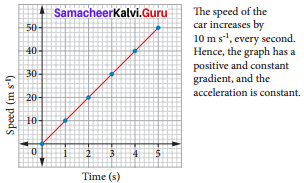
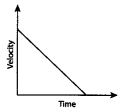
From the given v-t graph it can be inferred that the object is
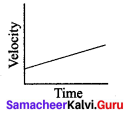
Force And Motion Class 7 Samacheer Kalvi Science Solutions Term 1 Chapter 2
(a) in uniform motion Time
(b) at rest
(c) in non uniform motion
(d) moving with uniform acceleration
Answer:
(d) moving with uniform acceleration

Force And Motion Class 7 Questions And Answers Question 3.
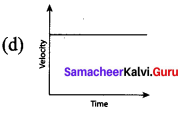
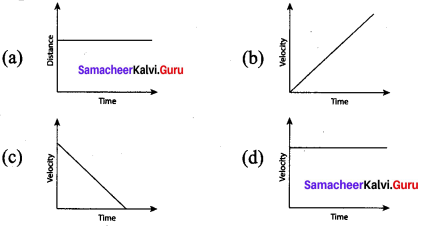
Which of the following figures represent uniform motion of a moving object correctly?
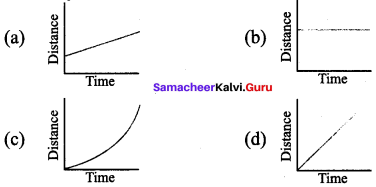
Force And Motion Class 7 Book Back Questions And Answers Samacheer Kalvi Science Solutions Term 1 Chapter 2
Answer:
Force And Motion Class 7 Questions And Answers Samacheer Kalvi Science Solutions Term 1 Chapter 2

Force And Motion 7th Standard Question 4.
Suppose a boy is enjoying a ride on a merry go round which is moving with a constant speed of 10 m/s. It implies that the boy is.
(a) at rest
(b) moving with no acceleration
(c) in accelerated motion
(d) moving with uniform velocity
Answer:
(c) in accelerated motion

7th Standard Science Force And Motion Question Answer Question 5.
What is one way you might increase the stability of an object?
(a) lower the centre of gravity
(b) raise the centre of gravity
(c) increase the height of the object
(d) shorten the base of the object
Answer:
(a) lower the centre of gravity

II. Fill in the blanks :

  1. The shortest distance between the two places is _______
  2. The rate of change of velocity is _______
  3. If the velocity of an object increases with respect to time, then the object is said to be in _______ acceleration.
  4. The slope of the speed-time graph gives _______
  5. In _______ equilibrium its centre of gravity remains at the same height when it is displacement

Answer:

  1. displacement
  2. acceleration
  3. positive
  4. velocity
  5. neutral

III. Match the following :

1.Displacement(a)Knot
2.Light travels through vacuum(b)Geometric centre
3.Speed of ship(c)Metre
4.Centre of gravity of the geometrical shaped object(d)Larger base area
5.Stability(e)Uniform velocity

Answer:

  1. c
  2. e
  3. a
  4. d
  5. b

IV. Analogy :

7th Science Force And Motion Question 1.
velocity : metre/ second :: acceleration : _______
Answer:
metre/second2

7th Standard Science Force And Motion Question 2.
length of scale : metre : : speed of aeroplane : _______
Answer:
knot

Samacheer Kalvi Guru 7th Science Question 3.
displacement / time : velocity : : speed / time : _______
Answer:
acceleration

V. Give very short answer :

Samacheer Kalvi 7th Science Books Answers Question 1.
All objects having uniform speed need not have uniform velocity. Describe with the help of examples.
Answer:
An object moving in uniform circular motion is moving around the perimeter of the circle with a constant speed. While the speed of object is constant, its velocity is changing, Ex: Merry-go-round, roller coaster, planets orbiting the sun.

Samacheer Kalvi 7th Books Science Question 2.
“She moves at a constant speed in a constant direction”. Rephrase the same sentence in fewer words using concepts related to motion.
Answer:
She moves in a straight line with constant velocity.

Samacheer Kalvi 7th Science Book Question 3.
Correct your friend who says “The acceleration gives the idea of how fast the position changes”.
Answer:
There are two possible answers:
Velocity gives an idea of how fast the position changes, or Acceleration gives an idea of how fast the velocity changes.

VI. Give Short Answer :

Samacheer Kalvi 7th Science Question 1.
Show the shape of the distance – time graph for the motion in the following cases.
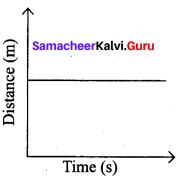
a. A bus moving with a constant speed
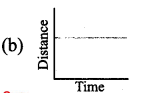
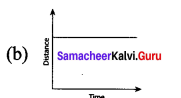
b. A car parked on a road side.
Answer:
(a) A bus moving with constant speed.
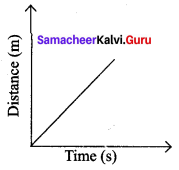
Force And Motion 7th Standard Samacheer Kalvi Science Solutions Term 1 Chapter 2 Force And Motion

(b) A car parked on road side

7th Standard Science Force And Motion Question Answer Samacheer Kalvi Term 1 Chapter 2

Science Samacheer Kalvi 7th Books Question 2.
Distinguish between speed and velocity.
Answer:
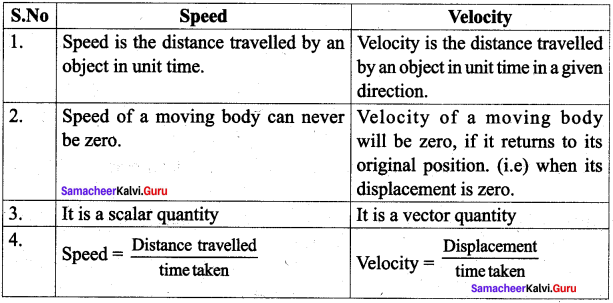
7th Science Force And Motion Samacheer Kalvi Term 1 Chapter 2

Samacheer Kalvi 7th Standard Science Question 3.
What do you mean by constant acceleration?
Answer:
A body is said to have constant acceleration, if it travels is a straight line and its velocity increases or decreases by equal magnitude in equal intervals of time.
Ex: the motion of a freely falling body.

Samacheer Kalvi 7th Science Book Answers Question 4.
What is centre of gravity ?
Answer:
The centre of gravity of an object is the point through which the entire weight of the object appears to act.

VII. Answer in detail.

Samacheer Kalvi 7th Science Book Back Answers Question 1.
Explain the types of stability with suitable examples.
Answer:
Stability is a measure of the body’s ability to maintain its original position.
The three types of stability are

  1. Stable equilibrium
  2. Unstable equilibrium
  3. Neutral equilibrium

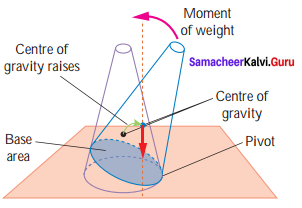
Stable Equilibrium:
The frustum can be tilted through quite a big angle without toppling.
7th Standard Science Force And Motion Samacheer Kalvi Term 1 Chapter 2

Its centre of gravity is raised when it is displaced. The vertical line through its centre of gravity still falls within its base. So it can return to its originalposition.

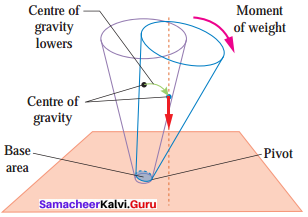
Unstable Equilibrium:
The frustum will topple with the slightest tilting. Its centre of gravity is lowered when it is displaced.
Samacheer Kalvi Guru 7th Science Solutions Term 1 Chapter 2 Force And Motion

The vertical line through its centre of gravity falls outside its base.
Samacheer Kalvi 7th Science Books Answers Term 1 Chapter 2 Force And Motion

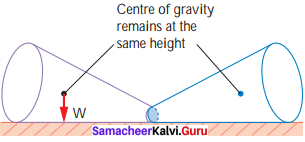
Neutral Equilibrium:

  1. It causes frustum to topple.
  2. The frustum will roll about but does not topple.
  3. Its centre of gravity remains at the same height when it is displaced.
  4. The body will stay in any position to which it has been displaced.

Samacheer Kalvi 7th Standard Science Book Question 2.
Write about the experiment to find the centre of gravity of the irregularly shaped plate.
Answer:

  1. Make three holes in the lamina.
  2. Suspend the lamina from the optical pin through one of the holes
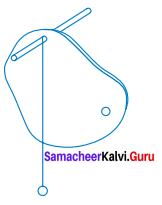
    Samacheer Kalvi 7th Books Science Solutions Term 1 Chapter 2 Force And Motion
  3. Suspend the plumb line from the pin and mark the position of the plumb line on the lamina’
  4. Draw lines on the lamina representing the positions of the plumb line.
  5. Repeat the above steps for the holes.
  6. Label the intersection of the three lines as X, the position of the center of gravity of the lamina.

VIII. Numerical problems:

Samacheer Kalvi Science 7th Standard Question 1.
Geetha takes 15 minutes from her house to reach her school on a bicycle. If the bicycle lias a speed of 2 m/s, calculate the distance between her house and the school.
Answer:
Given : time taken = 15 minutes [1 min = 60 sec]
= 15 x 60 = 900 sec
Speed – 2 m/s
Distance = ?
Formula : Distance = Speed x time = 2 x 900
Distance between her house and the school = 1,800 m

Samacheer Kalvi 7th Science Books Question 2.
A car started from rest and travelling with velocity of 20 m /s in 10 s. What is its acceleration?
Answer:
Given :
Initial velocity of the car (u) = 0 m/s
Final velocity of the car (v) = 20 m/s
time taken = 10s
Acceleration = ?
Formula: Acceleration = \(\frac { 20 – 0 }{ 10 }\) = \(\frac { 20 }{ 10 }\)
Acceleration of the car = 2 m/s2

Samacheer Kalvi 7th Science Solution Question 3.
A bus can accelerate with an acceleration 1 m/s2. Find the minimum time for the bus to reach the speed of 100 km/s from 50 km/s.
Given :
Acceleration of the bus (a) = 1 m/s2
Initial velocity (u) = 50 km/s = 50 x 103 m/s
Final velocity (v) = 100 km/s = 100 x 103 m/s
time (t) = ?
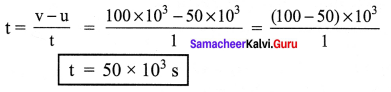
Samacheer Kalvi 7th Science Book Solutions Term 1 Chapter 2 Force And Motion

IX. Fill in the boxes:

S.No.First MoveSecond MoveDistance (m)Displacement
1.Move 4 meters eastMove 2 meters west62 m east
2.Move 4 meters northMove 2 meters south
3.Move 2 meters eastMove 4 meters west
4.Move 5 meters eastMove 5 meters west
5..Move 5 meters southMove 2 meters north
6.Move 10 meters westMove 3 meters east

Answer:

S.No.First MoveSecond MoveDistance (m)Displacement
1.Move 4 meters eastMove 2 meters west6 m2 m east
2.Move 4 meters northMove 2 meters south6 m2 m north
3.Move 2 meters eastMove 4 meters west6 m2 m west
4.Move 5 meters eastMove 5 meters west10 m0 (same place)
5..Move 5 meters southMove 2 meters north7 m3 m south
6.Move 10 meters westMove 3 meters east13 m7 m west

Samacheer Kalvi 7th Science Force and Motion Intext Activities

Activity

7th Samacheer Kalvi Science Question 1.
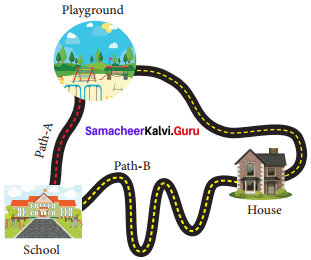
As shown in the above picture, Kavitha can reach her school in two ways. Can you tell, by choosing which path she could reach the school early.
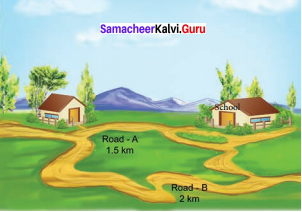
Samacheer Kalvi 7th Science Solutions Term 1 Chapter 2 Force And Motion

Road A
Road B
Answer:
By choosing road A kavitha could reach the school early as the distance is less compared to road B.

Samacheer Kalvi 7th Science Answers Question 2.
Look at the nearby picture
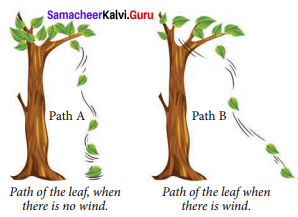
Science Samacheer Kalvi 7th Books Solutions Term 1 Chapter 2 Force And Motion
In which path the leaf will reach the ground first?
Answer:
The leaf will reach the ground first by path – A, as it reaches the ground in straight line.

Question 3.
Uma and Priya are friends studying in the same school. After school hours, they go to the nearby playground, play games and return back home. One day Uma told that she would reach the playground after visiting her grandmother’s house. The path in which they took reached the playground is shown here.
Samacheer Kalvi 7th Standard Science Solutions Term 1 Chapter 2 Force And Motion
Take a twine and measure the length of the two paths (A & B). Which is the longest path among the two?
Answer:
Path A is the longest among the two. as it is not a straight line.

Question 4.
The path in which a rabbit ran is shown in figure. Find the distance and displacement of it in the two figures. Let us consider that each square is in an unit of one square meter. The rabbit starts from point A and reaches the point B.
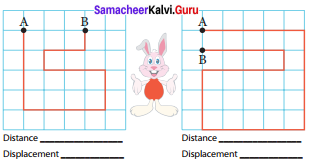
Samacheer Kalvi 7th Science Book Answers Term 1 Chapter 2 Force And Motion

When will the distance and displacement be equal. Explain. But the starting and finishing points should be different. _______
Answer:
Distance : 17
Distance: 24
Displacement: 3
Displacement: 1
When the rabbit moves in a straight line from A to B, the distance and displacement will be equal.

Question 5.
Here we can consider the starting point as A and while the object moves from A to B the displacement is considered to be positive and from B to A it is negative.
Answer the following questions:
Subha goes to the nearby playground from her home.
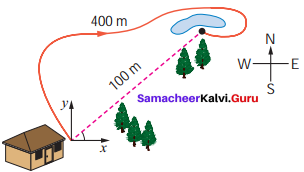
Samacheer Kalvi 7th Science Book Back Answers Term 1 Chapter 2 Force And Motion
Question 1.
What is the distance she travelled?
Answer:
400 m

Question 2.
What is her displacement?
Answer:
100 m

Question 3.
The distance travelled by an object is 15 km and its displacement is 15 km. What do you infer from this?
Answer:
The object moves in a straight line in one direction without turning back.

Question 4.
The distance of a person is 30 km and his displacement is 0 km. What do you infer from this?
Answer:
The distance of a person = 30 km Displacement = 0 km.

Question 5.
The person returns to the same position where he has started.
Answer:
(i.e.) The initial and the final position is same.

Question 6.
Answer the following questions:
(i) Calculate the velocity of a car travelling with a uniform velocity covering 100 m distance in 4 seconds.
Answer:

Samacheer Kalvi 7th Standard Science Book Term 1 Chapter 2 Force And Motion

(ii) Usain Bolt covers 100 m distance in 9.58 seconds. Calculate his speed. Who will be the winner if Usain Bolt comepetes with a Cheetah running at a speed of 30 m/s
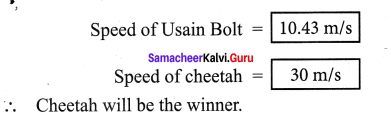
Samacheer Kalvi Science 7th Standard Term 1 Chapter 2 Force And Motion

(iii) You are walking along east covering a distance of 4 m, then 2 m towards south, then 4 m towards west and at last 2 m towards north. You cover the total distance in 21 seconds, what is your average speed and average velocity?
Total distance covered = 12 m
Total time taken =21 seconds
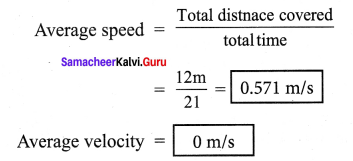
Samacheer Kalvi 7th Science Books Term 1 Chapter 2 Force And Motion
\(\frac { 12m }{ 21 }\) = 0.571 m/s
Average velocity = 0 m/s
Average velocity is zero because the starting point and the finishing point is same
∴Displacement is zero so, average velocity is also

Samacheer Kalvi 7th Science Solution Term 1 Chapter 2 Force And Motion

Question 7.
(a) Change in speed
(b) Change in direction
(c) Change in both speed and direction

The distance travelled by trainInitial velocity (u) m/sFinal

velocity (v) m/s

Change in velocity (v – u) m/sTime taken (t) sAcceleration = change in velocity / time a = (v – u) /1 m/s2
A-B066100.6
B-C
C-D
D-E
E-F

The velocity at different times of a train departing direction is given in the figure. Analyse this and complete the table .

7th Samacheer Kalvi Science Solutions Term 1 Chapter 2 Force And Motion
Answer:

The distance travelled by trainInitial velocity (u) m/sFinal velocity (v) m/sChange in velocity (v – u) m/sTime taken (t) sAcceleration = change in velocity / time

a = (v – u) /t m/s2

A-B066100.6
B-C61414-6 = 8100.8
C-D141414-14 = 0100
D-E1466- 14 =-810-0.8
E-F622 – 6 = -410-0.4

Analysis:
When the train covers the distance A to B and B to C, it is accelerated motion.
When it covers the distance C-D, there is no acceleration (i.e) uniform velocity.
When it covers the distance D to E and E to F it has negative acceleration or deceleration or retardation, (i.e.) Its velocity decreases with respect to time.

Question 8.
My name is cheetah. I can run at a great speed. Do you know what my speed is? 25 m/s to 30 m/s. My speed changes from 0 to 20 m/s in 2 second. See how good my acceleration is !
From the above information, can you calculate the acceleration of the cheetah?
Answer:
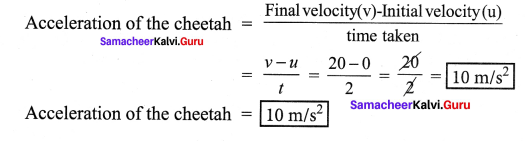
Samacheer Kalvi 7th Science Answers Solutions Term 1 Chapter 2 Force And Motion

Question 9.

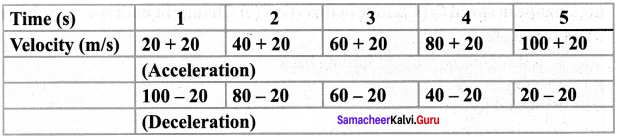
Samacheer Kalvi 7th Science Solutions Term 1 Chapter 1 Force And Motion
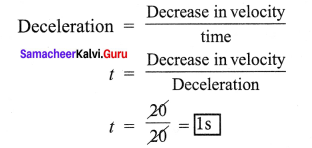
When the velocity of the object is increasing by 20 m/s the acceleration is 20 m/s2
When the velocity of the object is decreasing by 20 m/s the deceleration is 20 m/s2.
Answer:
When the velocity of the object is decreasing by 20m/s the deceleration is 20 m/s2.
Samacheer Kalvi 7th Science Solutions Term 1 Chapter 1 Force And Motion

The velocity of the object is decreasing by 20m/s in one second.

Question 10.
Imagine and write a story on your own for the given graph?
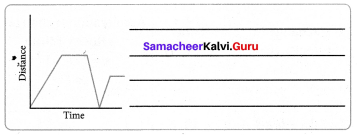
Samacheer Kalvi 7th Science Solutions Term 1 Chapter 1 Force And Motion
Answer:
Raghul and his father starting from home to the school by car. At the school gate, he stopped the car to drop Raghul. After 2 minutes he went back to home to pick up his mother. Then they both started to go to their work. On the way, they are waiting for the signal.

Samacheer Kalvi 7th Science Force and Motion Additional Questions

I. Choose the correct answer.

Question 1.
Distance travelled by a body in a given time
(a) is always positive
(b) can be zero or positive
(c) is always negative
(d) either (a) or (c)
Answer:
(b) can be zero or positive

Question 2.
Which of the following is correct
(a) magnitude of displacement may be greater than distance.
(b) Distance is always greater than or equal to the magnitude of displacement.
(c) Distance is always greater than the magnitude of displacement.
(d) Both are scalar quantities.
Answer:
(b) Distance is always greater than or equal to the magnitude of displacement

Question 3.
Average speed of a moving object is equal to the magnitude of its average velocity when it travels.
(a) in a straight line without turning back
(b) in a circle
(c) back and forth
(d) in a zig-zag path
Answer:
(a) in a straight line without turning back

Question 4.
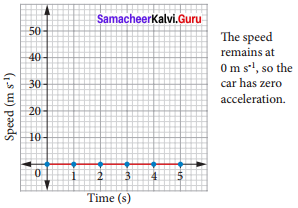
A car is moving along a straight road with uniform velocity which is the correct representation
Samacheer Kalvi 7th Science Solutions Term 1 Chapter 1 Force And Motion
Answer:

Samacheer Kalvi 7th Science Solutions Term 1 Chapter 1 Force And Motion

Question 5.
The slope of a velocity-time graph gives
(a) velocity
(b) distance
(c) displacement
(d) acceleration
Answer:
(d) acceleration

Question 6.
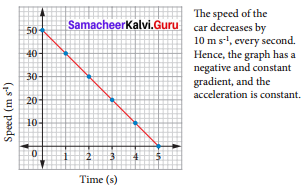
Velocity-time graph of an object is given below the object has
(a) uniform velocity
(b) uniform retardation
(c) uniform speed
(d) variable retardation
Answer:
Samacheer Kalvi 7th Science Solutions Term 1 Chapter 1 Force And Motion
(b) uniform retardation

Question 7.
Which one of the following graphs is showing an object is stationary?
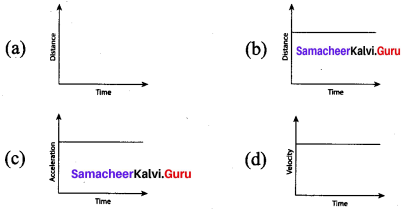
Samacheer Kalvi 7th Science Solutions Term 1 Chapter 1 Force And Motion
Answer:

Samacheer Kalvi 7th Science Solutions Term 1 Chapter 1 Force And Motion

Question 8.
If the velocity of a body does not a changes , then its acceleration is ________
(a) Infinity
(b) unity
(c) Zero
(d) between zero and unity
Answer:
(c) Zero

II. Fill in the Blanks.

  1. The SI unit of displacement is _______
  2. The SI unit of speed is _______
  3. _______ is the length of actual path covered by a body.
  4. _______ is the distance trtavelled by a body per unit time
  5. Distance is a _______quantity.
  6. The displacement is zero when the initial and final positions are _______
  7. Speed is always positive or zero but never be _______
  8. When the velocity of a body increases with time, its acceleration is _______
  9. The acceleration of a body moving with uniform velocity is _______
  10. A car increases its speed from 20 km/h to 50km/h in 10 seconds. Its acceleration is _______

Answer:

  1. metre (m)
  2. m/s
  3. Distance
  4. speed
  5. scalar
  6. same
  7. negative
  8. positive
  9. zero
  10. 0.83 m/s2

III. Match the following :

Column IColumn II
a.Uniform motion.(i)Body having uniform acceleration
b.Non-uniform motion.(ii)Body at rest.
c.The velocity-time graph is a circle.(iii)Unequal distance covered in equal interval of time.
d.Straight line parallel to time axis in position-time graph.(iv)Equal distances covered in equal intervals of time.
e.Straight line inclined to 45° with time axis is velocity-time graph.(v)Not possible.

Answer:

  1. iv
  2. iii
  3. v
  4. i
  5. ii

Very short Answers:

Question 1.
Give one example where the displacement is zero but the distance travelled is not zero.
Answer:
When an object travels is a circular path (ie. the initial and positions are same).

Question 2.
Is displacement a scalar quantity?
Answer:
No, displacement is a vector quantity as it depends on direction.

Question 3.
Give some examples for vector quantity.
Answer:
Displacement, velocity, force.

Question 4.
Give some examples for scalar quantity.
Answer:
Mass, distance, speed, temperature.

Question 5.
Give one example for uniform acceleration.
Answer:
The motion of a freely falling object.

Question 6.
Give one example for non-uniform acceleration.
Answer:
The motion of a car on a crowded road.

Question 7.
Give an example for retardation or declaration.
Answer:
When a person applies brake on a moving car, its velocity decreases with time.

Question 8.
What are three types of stability of an object?
Answer:

  1. Stable equilibrium
  2. Unstable equilibrium
  3. Neutral equilibrium

Question 9.
Mention any two conditions for stability of a body?
Answer:

  1. Increase the area of its base.
  2. Lower its centre of gravity.

V. Give Short Answer.

Question 1.
A body moves is a circle of radius ‘2R’ what is the distance covered and displacement of the body after 2 complete rounds?
Answer:
Distance covered after 2 complete rounds
= 2 x circumference of a circle
Distance =2 × 2 π(2R) = 4π(2R)

After 2 complete rounds, the body comes back to its initial position,
so, displacement = 0

Question 2.
What are the uses of graphical study of motion?
Answer:

  1. By simply looking at the graph, one can tell whether motion is uniform or not.
  2. It is useful for comparing the motions of two moving bodies.

Question 3.
Draw distance-time graphs for the following

  1. a stationary body
  2. a body moving with variable velocity

Answer:
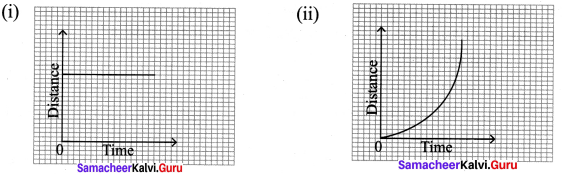
Samacheer Kalvi 7th Science Solutions Term 1 Chapter 1 Force And Motion

Question 4.
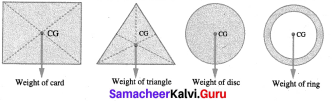
Draw centre of gravity of the following regular shaped objects.

Samacheer Kalvi 7th Science Solutions Term 1 Chapter 1 Force And Motion

Answer:

Samacheer Kalvi 7th Science Solutions Term 1 Chapter 1 Force And Motion

Question 5.
Mention the real life applications of centre of gravity.
Answer:

  1. Luggage compartment of a tour bus is located at the bottom and not on the roof.
  2. Racing cars are built low and broad for stability.
  3. Table lamps and fans are designed with large heavy bases to make them stable

Question 6.
Explain the concept which is used in the continuous movement of Thanjavur doll?
Answer:
The centre of gravity and the total weight of the doll is concentrated at its bottom most point, generating a dance-like continuous movement with slow oscillations.

Question 7.
Write note on the following :

  1. Nautical mile
  2. knot.

Answer:

  1. Nautical mile is the unit for measuring the distance in the field of aviation and sea transportation. One nautical mile is 1.852 km.
  2. The unit for measuring the speed of aeroplanes and ships is knot. One knot is the speed taken to travel one nautical mile in hour.

Question 8.
Saranya jogs from one end A to the other end B of a straight road of length 320m in 2min 40 seconds. Then she turns back and jogs 100m to point C in 1 min. what is her average velocity in jogging.
Answer:
Total displacement = 320m
From A to C displacement = 320 -100 = 220m
Time taken = 3 min 40 sec
= 180+40=220
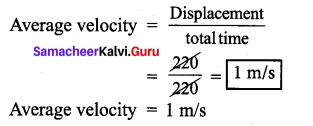
Samacheer Kalvi 7th Science Solutions Term 1 Chapter 1 Force And Motion

Question 9.
A train starting from a railway station and moving with uniform acceleration attains a speed of 40 km/h in 10 minutes. Find its acceleration?
Answer:
Initial velocity (u) = Okm/h
Final velocity (v) = 40 km/h
Time (t) = 10 min = \(\frac { 10 }{ 60h }\) = \(\frac { 1 }{ 6h }\)
Acceleration (a) = \(\frac { v – u }{ t }\)
\(\frac { 40 – 0 }{ 1 }\) = 40 × 6
= 240 km/h

Question 10.
Define speed Mention its formula and unit.
Answer:
Speed is the rate of change of distance .
Formula : Speed = distance /time
Unit is meter/second (m/s)

Question 11.
Define velocity Mention its formula and unit.
Answer:
Velocity is the rate of change in displacement.
Formula : Velocity (v) = displacement / time
SI unit of velocity is meter / second (m/s).

Question 12.
What is uniform velocity? Give one example.
Answer:
A body has uniform velocity, if it covers equal displacement in the same direction in equal intervals of time. Eg. light travels through vacuum.

Question 13.
What is non-uniform velocity? Give example.
Answer:
If either speed or direction changes, then the velocity is non uniform. Eg. a train starting and moving out of the station.

Question 14.
Define acceleration. Mention its formula and unit.
Answer:
Acceleration is the rate of change in velocity.
Formula : Acceleration = change in velocity / time SI unit of acceleration is m/s2

Question 15.
Define the following:

  1. positive acceleration
  2. negative acceleration.

Answer:

(i) Positive acceleration:
If the velocity of an object increases with respect to time, then the object is said to be in positive acceleration or just acceleration.

(ii) Negative acceleration or deceleration or retardation:
If the velocity of an object decreases with respect to time, then the object is said to be in negative acceleration or deceleration or retardation.

VI. Long Answer
Question 1.
Write the differences between distance and displacement
Answer:

DistanceDisplacement
1.The total length of a path taken by an object to reach one place from the other is called distance.The shortest distance from the initial to the final position of an object.
2.Distance between two gives points may be same or different paths chosen.Displacement between two given points is always same
3.It is a scalar quantityIt is a vector quantity
4.Distance covered is always positive or zero.Displacement covered may be positive, negative or zero

Question 2.
Draw velocity-time graph for the following data:

Samacheer Kalvi 7th Science Solutions Term 1 Chapter 1 Force And Motion
Answer:

Samacheer Kalvi 7th Science Solutions Term 1 Chapter 1 Force And Motion

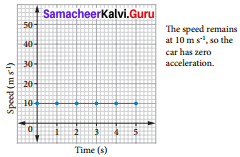
Question 3.
Bus travelling at uniform speed of m/s

Samacheer Kalvi 7th Science Solutions Term 1 Chapter 1 Force And Motion
Answer:

Samacheer Kalvi 7th Science Solutions Term 1 Chapter 1 Force And Motion

Question 4.
Bus travelling at uniform acceleration

Samacheer Kalvi 7th Science Solutions Term 1 Chapter 1 Force And Motion
Answer:

Samacheer Kalvi 7th Science Solutions Term 1 Chapter 1 Force And Motion

Question 5.
Bus travelling at uniform deceleration

Samacheer Kalvi 7th Science Solutions Term 1 Chapter 1 Force And Motion
Answer:

Samacheer Kalvi 7th Science Solutions Term 1 Chapter 1 Force And Motion

Question 6.
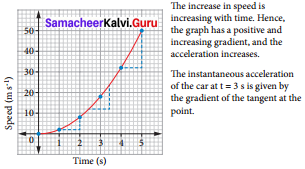
Bus travelling with increasing acceleration (non – uniform acceleration)

Samacheer Kalvi 7th Science Solutions Term 1 Chapter 1 Force And Motion
Answer:
Samacheer Kalvi 7th Science Solutions Term 1 Chapter 1 Force And Motion

Samacheer Kalvi 7th Tamil Solutions Term 2 Chapter 3.3 பேசும் ஓவியங்கள்

Students can Download Tamil Chapter 3.3 பேசும் ஓவியங்கள் Questions and Answers, Summary, Notes Pdf, Samacheer Kalvi 7th Tamil Book Solutions Guide Pdf helps you to revise the complete Tamilnadu State Board New Syllabus and score more marks in your examinations.

Tamilnadu Samacheer Kalvi 7th Tamil Solutions Term 2 Chapter 3.3 பேசும் ஓவியங்கள்

மதிப்பீடு

சரியான விடையைத் தேர்ந்தெடுத்து எழுதுக.

Question 1.
குகை ஓவியங்களில் வண்ண ம் தீட்டப் பயன்பட்ட பொருள்களில் ஒன்று ………….
அ) மண்துகள்
ஆ) நீர் வண்ணம்
இ) எண்ணெய் வண்ணம்
ஈ) கரிக்கோல்
Answer:
அ) மண்துகள்

Question 2.
நகைச்சுவை உணர்வு வெளிப்படுமாறு வரையப்படும் ஓவியம் …
அ) குகை ஓவியம்
ஆ) சுவர் ஓவியம்
இ) கண்ணாடி ஓவியம்
ஈ) கேலிச்சித்திரம்
Answer:
ஈ) கேலிச்சித்திரம்

Question 3.
‘கோட்டோவியம்’ என்னும் சொல்லைப் பிரித்து எழுதக் கிடைப்பது ………………..
அ) கோடு + ஓவியம்
ஆ) கோட்டு + ஓவியம்
இ) கோட் + டோவியம்
ஈ) கோடி + ஓவியம்
Answer:
அ) கோடு + ஓவியம்

Question 4.
‘செப்பேடு’ என்னும் சொல்லைப் பிரித்து எழுதக் கிடைப்பது …………
அ) செப்பு + ஈடு
ஆ) செப்பு + ஓடு
இ) செப்பு + ஏடு
ஈ) செப்பு + யேடு
Answer:
இ) செப்பு + ஏடு

Question 5.
எழுத்து + ஆணி என்பதனைச் சேர்த்தெழுதக் கிடைக்கும் சொல் ………………
அ) எழுத்து ஆணி
ஆ) எழுத்தாணி
இ) எழுத்துதாணி
ஈ) எழுதாணி
Answer:
ஆ) எழுத்தாணி

கோடிட்ட இடங்களை நிரப்புக

Question 1.
கருத்துப் படங்களை அறிமுகப்படுத்தியவர் ……………..
Answer:
பாரதியார்

Question 2.
கலம்காரி ஓவியம் என்று அழைக்கப்படுவது ……………………
Answer:
துணி ஓவியம்

Question 3.
மன்னர்களின் ஆணைகளையும் அரசு ஆவணங்களையும் ……………… மீது பொறித்துப் பாதுகாத்தனர்.
Answer:
செப்பேடுகளின்

குறுவினா

Question 1.
ஓவியங்களின் வகைகள் யாவை?
Answer:
ஓவியங்களின் வகைகள் : குகை ஓவியம், சுவர் ஓவியம், துணி ஓவியம், ஓலைச்சுவடி ஓவியம், செப்பேட்டு ஓவியம், தந்த ஓவியம், கண்ணாடி ஓவியம், தாள் ஓவியம், கருத்துப்படம் ஓவியம், நவீன ஓவியம்.

Question 2.
குகை ஓவியங்களில் இருந்து நாம் அறியும் செய்திகள் யாவை?
Answer:
பழங்கால மனிதர்கள் குகைகளில் வாழ்ந்தனர். அவர்கள் செய்திகளைப் பிறருக்குத் தெரிவிக்கவே குகை ஓவியங்களை வரையத் தொடங்கினர்.

Question 3.
தாள் ஒவியங்களை எவற்றைக் கொண்டு வரைவர்?
Answer:
கரிக்கோல், நீர்வண்ணம், எண்ணெய் வண்ணம் முதலியனவற்றைக் கொண்டு தாள் ஓவியங்கள் வரையப்படுகின்றன.

Question 4.
சுவர் ஓவியங்கள் காணப்படும் இடங்களைக் கூறுக.
Answer:
அரண்மனைகள், மண்டபங்கள், கோயில்கள் போன்றவற்றின் சுவர்களிலும் மேற்கூரைகளிலும் சுவர் ஓவியங்களைக் காணலாம்.

Question 5.
செப்பேட்டு ஓவியங்களில் காணப்படும் காட்சிகள் யாவை?
Answer:

  • நீர்நிலைகள்
  • செடி கொடிகள்
  • பறவைகள்
  • விலங்குகள்
  • குறியீடுகள்

சிறுவினா

Question 1.
கேலி சித்திரம் என்றால் என்ன?
Answer:

  • அரசியல் கருத்துகளை எளிமையான படங்களைக் கொண்டு விளக்க உருவாக்கப்பட்டதே கருத்துப்பட ஓவியம் ஆகும்.
  • கருத்துப்பட ஓவியங்களின் மற்றொரு வடிவமே கேலிச்சித்திரம் எனப்படும்.
  • தமிழ்நாட்டில் முதன் முதலாக கருத்துப்படங்களை வெளியிட்டவர் பாரதியார். ஆங்கிலேயர் ஆட்சியின் குறைகளை இந்தியா என்னும் இதழில் கேலிச்சித்திரங்களின் மூலம் வெளியிட்டார். இப்பொழுது பெரும்பாலான இதழ்களில் இவை இடம் பெறுகின்றன.
  • மனித உருவங்களை விந்தையான தோற்றங்களில் நகைச்சுவை உணர்வு
    தோன்றும்படி வரைவதே கேலிச்சித்திரம் ஆகும்.

Question 2.
ஓலைச்சுவடி ஓவியங்கள் குறித்து நீங்கள் அறிந்து கொண்டவற்றை எழுதுக.
Answer:

  • ஓலைச்சுவடிகள் மீது எழுத்தாணிகளைக் கொண்டு கோட்டோவியமாகவும், வண்ணப் பூச்சு ஓவியமாகவும் ஓலைச்சுவடி ஓவியங்கள் வரையப்பட்டன.
  • இதிகாசம் மற்றும் புராணக் காட்சிகளாகவே இத்தகைய ஓவியங்கள் இடம் பெற்றிருக்கும்.
  • தஞ்சாவூர் சரசுவதி மகால் நூலகத்தில் ஓலைச்சுவடி ஓவியங்கள் பாதுகாத்து வைக்கப்பட்டுள்ளன.
  • தற்காலத்தில் ஓலைச்சுவடி ஓவியங்களைக் காண்பது அரிது.

சிந்தனை வினா

Question 1.
தந்த ஓவியங்கள் கேரளாவில் அதிகம் காணப்படுவது ஏன்?
Answer:
கேரளா இயற்கையன்னையின் உறைவிடமாக உள்ளது. தொடர்ச்சியான மலைகள், அழகான நீர்நிலைகள் எனக் கொஞ்சும் இயற்கை அமைப்பு. இதனால் இம்மாநிலத்தில் வனவிலங்குகள் பெருகியுள்ளன. யானைகளும் அதிகமாக இரு வனத்துறையினரால் யானைகள் பாதுகாக்கப்படுகின்றன. யானைகள் வாழ்வ சூழல் இருப்பதால் அதிக அளவில் யானைகள் இங்கு இருக்கின்றன. அதனால் தந்தத்தால் ஆன ஓவியங்கள் அதிகம் காணப்படுகின்றன.

கற்பவை கற்றபின்

Question 1.
உமக்குப் பிடித்த காட்சியை வரைந்து வண்ணம் தீட்டுக.
Answer:
மாணவர்கள் தாங்களாகவே செய்ய வேண்டியவை.

Question 2.
பருவ இதழ்களில் வெளிவந்த பலவகை ஓவியங்களைச் சேகரித்துப் படத்தொகுப்பு உருவாக்குக.
Answer:
மாணவர்கள் தாங்களாகவே செய்ய வேண்டியவை.

கூடுதல் வினாக்கள்

நீரப்புக.

Question 1.
…………. சுவர் ஓவியங்களை ஏராளமாகக் காண முடியும்.
Answer:
தஞ்சைப் பெரிய கோயிலில்

Question 2.
சீவகசிந்தாமணிக் காப்பியத்தில் ………………… என்னும் தலைவி யானையைக் கண்டு அஞ்சிய காட்சியைச் சீவகன் துணியில் வரைந்ததாகக் கூறப்பட்டுள்ளது.
Answer:
குணமாலை

Question 3.
ஐரோப்பியக் கலை நுணுக்கத்துடன் இந்தியக் கதை மரபுகளை இணைத்து ஓவியங்களில் புதுமைகளைப் புகுத்தியவர் ………………….
Answer:
இராஜா இரவிவர்மா

Question 4.
நாட்காட்டி ஓவியம் வரையும் முறையின் முன்னோடிகளுள் ஒருவராகக் கருதப்படுபவர்
Answer:
கொண்டையராஜு

Question 5.
நாட்காட்டி ஓவியங்களைப் …………….. என்றும் அழைப்பர்.
Answer:
பசார் பெயிண்டிங்

விடையளி :

Question 1.
ஓவியம் வரைபவரின் வேறு பெயர்களை எழுதுக.
Answer:
கண்ணுள் வினைஞர், ஓவியப் புலவர், ஓவமாக்கள், கிளவி வல்லோன், சித்திரக்காரர், வித்தகர்.

Question 2.
ஓவியம் வேறு பெயர்கள் யாவை?
Answer:
ஓவு, ஓவியம், ஓவம், சித்திரம், படம், படாம், வட்டிகைச்செய்தி.

Question 3.
ஓவியக் கூடம் வேறு பெயர்கள் யாவை?
Answer:
எழுதெழில் அம்பலம், எழுத்துநிலை மண்டபம், சித்திர அம்பலம், சித்திரக்கூடம், சித்திரமாடம், சித்திர மண்டபம், சித்திர சபை.

Question 4.
தந்த ஓவியம் பற்றி எழுதுக.
Answer:
வயது முதிர்ந்து இறந்த யானையின் தந்தங்களின் மீது பலவகை நீர் வண்ணங்களைப் பயன்படுத்தி அழகான ஓவியங்களாக வரைவார்கள். தந்த ஓவியர்களைக் கேரள மாநிலத்தில் அதிகமாகக் காணமுடியும்.

Question 5.
கண்ணாடி ஓவியம் பற்றி எழுதுக.
Answer:
அழகிய வண்ண ஓவியங்கள் வரைய கண்ணாடிகளைப் பயன்படுத்துகின்றனர். கண்ணாடி ஓவியங்களை உருவாக்கும் ஓவியர்கள் தஞ்சாவூரில் மிகுதியாக உள்ளனர்.

Samacheer Kalvi 7th Science Solutions Term 3 Chapter 1 Light

Students can Download Science Chapter 1 Light Questions and Answers, Notes Pdf, Samacheer Kalvi 7th Science Book Solutions Guide Pdf helps you to revise the complete Tamilnadu State Board New Syllabus and score more marks in your examinations.

Tamilnadu Samacheer Kalvi 7th Science Solutions Term 3 Chapter 1 Light

Samacheer Kalvi 7th Science Light Textual Evaluation

I. Choose the correct option:

Light That Hits A Mirror Gets Question 1.
Light travels only in a ______ .It is because of this property that.
(a) curved line, shadows
(b) straight line, shadows
(c) straight line, reflection
(d) curved line and then straight line, shadows
Answer:
(b) straight line, shadows

Light That Hits A Mirror Gets Answer Question 2.
Light that hits a mirror gets ______
(a) Transmitted
(b) Reflected
(c) Absorbed
(d) Refracted
Answer:
(b) Reflected

Samacheer Kalvi Guru 7th Science Question 3.
______ surface reflects the light well
(a) Water
(b) Compact disc
(c) Mirror
(d) Stone
Answer:
(c) Mirror

Samacheer Kalvi 7th Science Guide Question 4.
Light is a form of ____
(a) matter
(b) energy
(c) medium
(d) partical
Answer:
(b) energy

Light Samacheer Kalvi Question 5.
You can see your image in polished floors, but not in wooden table because ______
(a) regular reflection takes place in wooden table and irregular reflection in polished floor
(b) regular reflection takes place in polished floor and irregular reflection in wooden table
(c) regular reflection takes place in both polished floor and wooden table
(d) irregular reflection takes place in both polished floor and wooden table
Answer:
(b) regular reflection takes place in polished floor and irregular reflection in wooden table

Samacheer Kalvi 7th Science Books Answers Question 6.
Choose the translucent substance from the following
(a) glass
(b) wood
(c) water
(d) Clouds
Answer:
(d) clouds

Samacheer Kalvi 7th Science Question 7.
Reflection occurs , when the light
(a) about to reach a surface
(b) approaches a surface
(c) passes through a surface
(d) None Of these
Answer:
(b) approaches a surface

7th Science Term 3 Question 8.
Which of the following is the best reflector
(a) plastic plate
(b) plane mirror
(c) wall
(d) paper
Answer:
(b) plane mirror

Samacheer Kalvi 7th Science Answers Question 9.
Sivarajan placed a meter stick in the playground at 7.00 am in the morning. How will the shadow of the stick at noon look in comparison to the one in the morning
(a) There will be no shadow
(b) The shadow will be longer and on the opposite side as the sun
(c) The shadow will be shorter and on the same side as the sun
(d) The shadow will be shorter
Answer:
(d) The shadow will be shorter

Samacheer Kalvi 7th Science Book Back Answers Question 10.
The image formed by a pinhole camera is inverted because,
(a) light travels in straight lines
(b) light rays become laterally inverted as they pass through a pinhole camera
(c) light rays pass through the pinhole
(d) light rays get reflected
Answer:
(a) light travels in straight lines

7th Science Samacheer Kalvi Question 11.
Which of the following facts explain how shadows are formed?
(a) Light travels in straight lines
(b) Opaque bodies do not allow light to pass through them
(c) Reflection occurs at a smooth surfaces like mirrors
(d) Lateral inversion happens
(a) both A and B
(b) both A and D
(c) both B and C
(d) only A
Answer:
(a) both A and B

II. Fill in the blanks:

  1. A plane mirror produces a _________ image
  2. A _________ reflection helps us to see the objects.
  3. The light ray gets _________ when it falls on any polisher surface
  4. Sunlight is a blend of _________ colours
  5. The splitting of white light into seven colours is called _________
  6. The moon _________ sun light.
  7. The sunlight can be split into its constituent colours using _________
  8. Reflection of light from rough surface is called _________ reflection

Answer:

  1. virtual and erect
  2. regular
  3. reflected
  4. seven
  5. dispersion
  6. reflects
  7. prism
  8. irregular

III. Say TRUE or FALSE.

Samacheer Kalvi 7th Science Book Question 1.
The image of right hand in a plane mirror looks like a left hand.
Answer:
True

7th Standard Term 3 Science Question 2.
Rainbow is formed by dispersion of which light by water drops.
Answer:
True

Light Chapter Of Class 7 Pdf Question 3.
The image formed by the plane mirror is laterally inverted, hence the image seen through the periscope is also laterally inverted
Answer:
False
Correct statement: The image formed by the plane mirror is laterally inverted, hence the image seen through the periscope is This is because in periscope, image is reflected by two mirrors.

Question 4.
We see planets because they reflect light from the sun
Answer:
True

Question 5.
We see a book because it reflects the light that falls on its surface
Answer:
True

Question 6.
The image formed in a pinhole camera is always inverted
Answer:
True

Question 7.
The image formed in a pinhole camera is always the satne size as the object
Answer:
False

Question 8.
The image formed in a plane mirror is upside down
Answer:
False
Correct statement: The image formed in a plane mirror is erect.

Question 9.
A plane mirror is opaque Ans.
Answer:
True

Question 10.
A shadow is formed on the same side of the object as the source of light.
Answer:
False
Correct statement: A shadow is formed on the side of the object as the source of light.

Question 11.
We are able to see things around us with the help of regular reflection
Answer:
True

Question 12.
After passing through a prism, white light splits into a band of seven colours
Answer:
True

IV. Match the following

1.Rectilinear propagationPrimary source of light
2.Rectilinear propagationNon-luminous object
3.Plane Mirror Fire flyPeriscope
4.The MoonPinhole camera
5.Wide light sourceSpectrum of light
6.Regular reflectionluminous object
7.The sunPenumbra
8.Band of seven colorsGlossy surface

Answer:

1.Rectilinear propagationPinhole camera
2.Rectilinear propagationPeriscope
3.Plane Mirror Fire flyluminous object
4.The MoonNon-luminous object
5.Wide light sourcePenumbra
6.Regular reflectionGlossy surface
7.The sunPrimary source of light
8.Band of seven colorsSpectrum of light

V. Answer the following questions in short:

Question 1.
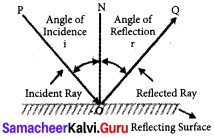
With the help of a diagram, state the laws of reflection
Answer:
Laws of reflection:
Light That Hits A Mirror Gets Samacheer Kalvi 7th Science Solutions Term 3

  1. The angle of incidence is always equal to the angle of reflection li =l*
  2. The incident ray, the reflected ray and the normal at the point of incidence lie on the same plane.

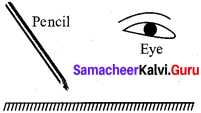
Question 2.
Figure shows a pencil placed above a mirror

Light That Hits A Mirror Gets Answer Samacheer Kalvi 7th Science Solutions Term 3
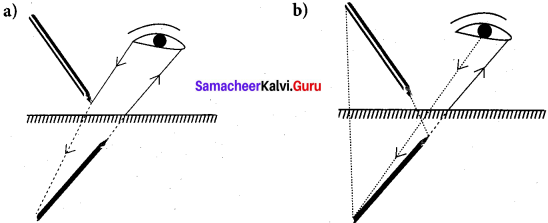
a) Draw its image formed by the mirror
b) Show how light rays from the object are reflected at the mirror to form the image for the eye.
Answer:

Samacheer Kalvi Guru 7th Science Solutions Term 3 Chapter 1 Light

Question 3.
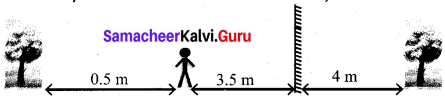
A person is looking at the image of a tree in a mirror placed 3.5 m in front of him. Given that the tree is at 0.5 m behind his eyes. Find the distance between the image of the tree and his eyes. What are needed to see an object?
Answer:
Samacheer Kalvi 7th Science Guide Solutions Term 3 Chapter 1 Light
Distance between the person and the mirror = 3.5 m
Distance between the person and tree (object) = 0.5 m
The image formed in the mirror = 4 m
The distance between the image of the tree and his eyes = 4 + 3.5 = 7.5

Question 4.
What are luminous objects?
Answer:
All objects which emit light energy by themselves are called luminous objects. Ex.: Sun, electric bulb.

Question 5.
Is thr moon a luminous object?
Answer:
No, the moon is non-luminous. The reason is that moon does not produce its own light. Instead, it reflects the light of the sun falling on it.

Question 6.
What are the three types of materials based on the absorption of light?
Answer:

  1. Transparent Material
  2. Translucent Material
  3. Opaque Material

Question 7.
What are the parts of shadow?
Answer:

  1. Umbra
  2. Penumbra

Question 8.
What are the properties of shadow?
Answer:
Properties of shadow:

  1. All objects do not form shadows. Only opaque objects form shadows.
  2. Shadows will be formed in the opposite side of light source.
  3. It cannot be determined the characteristics of an object by its shadow.
  4. The shadow will be always darker, whatever may be the color of light rays.
  5. Light source, opaque object are shadow all are in a straight line.
  6. The size of shadow depends upon the distance between light source and object and the distance between object and the screen.

Question 9.
What is plane mirror?
Answer:
A plane mirror is a mirror with a flat reflective surface. A plane mirror makes an image of objects in front of it.

Question 10.
What is prism?
Answer:
A prism is an object made up of a transparent material, like glass or plastic that has at least two flat surfaces that form an acute angle (less than 90°).

Question 11.
What do you mean by visible light?
Answer:
Visible light is a spectrum of a number of waves with different wavelength range from 400nm to 700nm (lnm = 10″9 meter) each wave has a definite wavelength represents a particular colour.

Question 12.
Write the items given here in the correct column (Stars, brick walls, plants, mirror, planets, electric light bulb, candle)

Sources of LightObjects that reflect light

Answer:

Sources of LightObjects that reflect light
StarsBrick walls
Electric light bulbPlants
CandleMirror
Planets

Question 13.
A boy of height lm 45 cm is standing in front of a long mirror at a distance of 2 m. From this information, fill up the following sentences:
a) The distance between the boy and his image is ______
b) The height of the image is ______
c) When the boy moves 1 m forward, the distance between her and her image is ______
Answer:
(a) The distance between the boy and his image is 4m
(b) The height of the image is same.
(c) When the boy moves 1 m forward, the distance between her and her image is 2m.

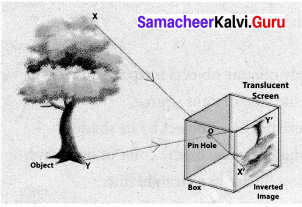
Question 14.
Draw a diagram of a pinhole camera showing the rays of light passing between the Object and its image
Answer:

Light Samacheer Kalvi 7th Science Solutions Term 3 Chapter 1

Question 15.
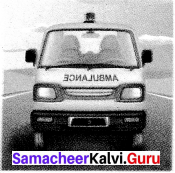
Why is the writing on the front of an ambulance back to front as shown in the picture
Samacheer Kalvi 7th Science Books Answers Term 3 Chapter 1 Light
Answer:

  1. This is due to lateral inversion.
  2. The phenomenon due to which the left side of an object appears to be right side of the object in its image in a reflecting medium (mirror).
  3. So that drivers see the word the right way around in their rear-view mirror.

Question 16.
Explain with examples, why some capital letters look the same in a mirror but others are reversed.
Answer:
Any letter that has a bilateral symmetry will have its mirror image the same as that of the object.
Example:
Samacheer Kalvi 7th Science Solutions Term 3 Chapter 1 Light

Question 17.
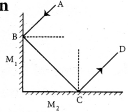
Two plane mirrors M1 and M2 are placed perpendicular with each other, as shown in figure. The ray AB makes an angle 39° with the plane mirror M , then

  1. The reflected rays are _________, ____________
  2. The incident rays are _________, ____________
  3. What is the angle of incident corresponding to the ray BC?
  4. What is the angle of reflection corresponding to the ray CD

7th Science Term 3 Samacheer Kalvi Chapter 1 Light
Answer:

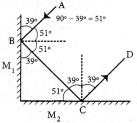
Samacheer Kalvi 7th Science Answers Term 3 Chapter 1 Light

  1. BC, CD
  2. AB, BC
  3. \(\lfloor i\) = 39°
  4. \(\lfloor r\) = 39°

Question 18.
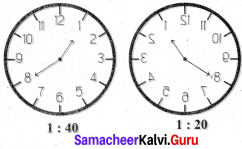
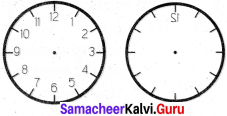
Raj an was playing with the mirror images of a clock. He looked at the clock in his roomIt was showing 1:40. Draw the position of the hands on the real clock and on its mirror reflection .Write below the picture what time each picture

Samacheer Kalvi 7th Science Book Back Answers Term 3 Chapter 1 Light
Answer:

7th Science Samacheer Kalvi Solutions Term 3 Chapter 1 Light

Question 19.
What is reflection of light?
Answer:
The bouncing back of light from a reflecting surface of an object is called as reflection of light

Question 20.
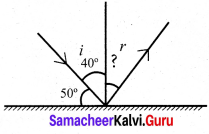
If a ray of light is falling on a plane mirror at an angle of 50° is formed, what will be the angle of reflection?
Answer:

Samacheer Kalvi 7th Science Book Solutions Term 3 Chapter 1 Light
Angle of incidence \(\lfloor i\) = 90° – 50°
\(\lfloor i\) = 40°
According to laws of reflection,
\(\lfloor i\) = \(\lfloor k\)
Angle of incidence = Angle of reflection
\(\lfloor i\) = 40°
∴ \(\lfloor r\) – 40°
Angle of reflection \(\lfloor r\) = 40°

Question 21.
What do you mean by lateral inversion?
Answer:
The phenomenon due to which left hand side of object appears as right hand side and vice versa is called lateral inversion.

Question 22.
How do you obtain a spectrum of light?
Answer:
When white light is made to fall on the surface of a prism, it disperses and we obtain a spectrum of light.

Question 23.
Why do we see white color in Newton’s disc, when we rotate it very fast?
Answer:
When the disc turned quickly, the retina receives the sensation of the spectrum simultaneously and disc appears white.

Question 24
What is a shadow? What things are necessary for the formation of a shadow?
Answer:

  1. Shadows are formed because light travels in straight lines.
  2. Shadow is always against, opposite side of light source.
  3. Shadow is formed by opaque objects that stop high from propagating.
  4. Things necessary for the formation of shadow: source of light,opaque object

VI. Answer the following questions in detail:

Question 1.
What are regular and irregular reflection? Explain with the help of diagrams
Answer:
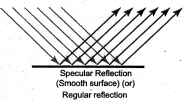
(i) Regular reflection When a parallel beam of light on striking some smooth and polished surface is reflected as a parallel beam of light, such a reflection is called regular reflection.

7th Standard Term 3 Science Samacheer Kalvi Term 3 Chapter 1 Light
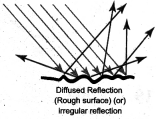
(ii) Irregular reflection : When a parallel beam of light, on striking some rough surface, is reflected in different directions, then such a reflection is called irregular or diffused reflection.

Light Chapter Of Class 7 Pdf Samacheer Kalvi Term 3 Science

Question 2.
What are the difference between luminous and non-luminous objects? Give two examples of each.
Answer:

Luminous objectsNon-luminous objects
1.


All objects which emit light energy by themselves are called luminous objects.All objects which do not emit light energy of their own, but reflect the light energy falling on them and hence, become visible are called non- luminous object.
2.Ex.: Sun, stars, torch light, burning candle etc.Ex.: Metals, trees, houses, stones, moon etc.

Question 3.
Write about two everyday situations that tell you that light travels in a straight line.
Answer:

  1. Formation of shadow: Shadows are formed when some light rays continue its travel in straight lines while other rays are stopped by an object.
  2. When there is a small hole in a room, light travels only in a straight line.

Question 4.
Differentiate between a reflection and a shadow
Answer:

ReflectionShadow
When light falls on a surface, the direction of ray is changed. This change in direction is known as reflection of light.Shadow is an image formed by obstruction of light.
Eg.: You see your reflection in a pool of water or mirror.Eg.: If you place your hand in front of a candle, you will see the image of the hand on the wall. This image will show only the outline of the object placed in front of the light source.

Question 5.
What are the characteristics of an image formed in a plane mirror?
Answer:

  1. Image formed in a plane mirror is upright.
  2. Image formed in a plane mirror is virtual The image is of the same size as the object
  3. The distance of the image from the plane mirror is equal to the distance of the object from the mirror.
  4. Image is laterally inverted.

Question 6.
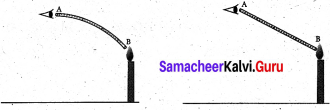
Describe the picture

Samacheer Kalvi 7th Science Solutions Term 3 Chapter 1 Light image - 15
Answer:

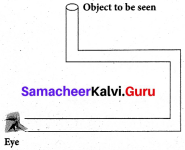
  1. When the tube is bent, we cannot see the source of light
  2. When the tube is held straight we can see the flame. The two pictures verify that light travels in straight lines. This is known as rectilinear propagation of light.

Question 7.
Define the following terms
a. Incident ray
b. Reflected ray
c. Normal
d. Angle of incidence
Answer:
(a) Incident tavi The ray of light that falls on the surface of the reflection materials.
(b) Reflected ray: The ray of light that comes from the point when the incident ray falls on the reflection material.
(c) Normal: The perpendicular line drawn from, the point of incidence to the plane of reflecting surface is called normal.
(d) Angl e of incidence The angle formed between the incident ray PO and the normal ‘ON’ is angle of incidence.

Question 8.
Compare the images formed by plane mirror with that by pinhole camera
Answer:
Difference between the images formed in Pinhole camera and Plane mirror:

Image formed by Pin hole cameraImages formed in Plane mirror
The image is real.The image is virtual
The image may not be equal to the size of the objectThe image is equal to the size of the object
The image is invertedThe image is erect

Samacheer Kalvi 7th Science Light Intext Activities

Activity – 4

Let’s categorize transparent material, translucent material and opaque material among f the given materials
(Clear plastic ruler, cellophane paper, some water in a glass jar, tissue paper, drinking glass, beaker, tap water, kerosene, coconut oil, note paper, card board, milk, diluted milk, aluminum foil, thick colored plastic lid, rough glass piece, measuring glass with water, wooden piece) Place all the materials given above in the dark room. Focus a torch light on one side of each material. Inspect the light coming out at the other side of each material and then classify the materials in the table.

S.NoTransparent MaterialTranslucent MaterialOpaque Material
1.Clear plastic rulerKeroseneCard board
2.Drinking glassMilkWooden piece
3.Beakerdiluted milkaluminium foil
4.Tap waterrough glass piecethick coloured plastic lid.
5.Measuring glass with watertissue paper
6.Cell phone paperNote paper

Activity – 6

SurfacesProperty of Image (Clearer / blurred)
GlassBlurred
Metal SheetBlurred
Aluminum foilClearer
WhitepaperClearer

Activity – 7

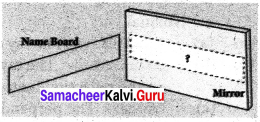
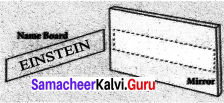
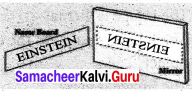
There are eight letters in the word EINSTEIN
Samacheer Kalvi 7th Science Solutions Term 3 Chapter 1 Light image - 16

  1. Write the word in front of a plane mirror shown in diagram
  2. Write down how these letters appear in the mirror
  3. How many of these letters appear to be different, when the word is reflected?
  4. Write down the letters that appear to be the same.

Answer:
(i)Samacheer Kalvi 7th Science Solutions Term 3 Chapter 1 Light image - 17

(ii)Samacheer Kalvi 7th Science Solutions Term 3 Chapter 1 Light image - 18

(iii) 3 letters (E,N,S)
(iv) I,T

Activity – 10
You need Gelatin papers of Red, Blue and Yellow. Fold each gelatin paper three times and look different colour objects listed below through each folded paper. Observe what colour each object has. Write your observations in the table.

ObjectOriginal colour of objectColour through Red gelatin paperColour through Blue gelatin paperColour through Yellow gelatin paper
Blue skyBlue
Orange flowerOrange
Yellow bananaYellow
leavesGreen
Brown trouserBrown
White shirtWhiteRedBlueYellow
Black boardBlack

Samacheer Kalvi 7th Science Light Additional Questions

I. Choose the correct answer.

Question 1.
Which of the following is a natural source of light?
(a) Electric lamp
(b) Electric filament
(c) Torch light
(d) Sunlight
Answer:
(d) Sunlight

Question 2.
Light shows ________
(a) curvilinear propagation
(b) random propagation
(c) rectilinear propagation
(d) none of these
Answer
(c) rectilinear propagation

Question 3.
Rectilinear propagation is ________
(a) mode of travelling in straight lines
(b) mode of travelling in curved lines
(c) ability to bend around obstacles
(d) displaying the phenomenon of diffraction
Answer
(a) made of travelling in straight lines

Question 4.
Plane mirrors are arranged parallel to each other to get ________
(a) a single image
(b) two images
(c) a large number of reflected image
(d) no image
Answer:
(d) two images

Question 5.
Which of the following is not luminous object?
(a) Sun
(b) Moon
(c) Candle
(d) Bulb
Answer
(b) Moon

Question 6.
White light is composed of ________
(a) seven colours
(b) five colours
(c) three colours
(d) only one colours
Answer:
(a) seven colours

Question 7.
The image which can be obtained on screen is called ________
(a) erect
(b) real
(c) virtual
(d) inverted
Answer:
(b) real

Question 8.
If we mix lights of the colours of the rainbow we will get .
(a) pink light
(b) brown light
(c) colourless light
(d) black light
Answer:
(c) colourless light

Question 9.
Which one of the following is involved for the formation of rainbow in the sky?
(a) Expansion of light
(b) Expansion of heat by the Sun
(c) Distance between the Earth and the Moon
(d) Dispersion of light
Answer:
(d) Dispersion of light

Question 10.
A virtual image is
(a) always real
(b) always uncapturable on a screen
(c) always inverted
(d) always caught on a screen
Answer:
(b) always uncapturable on a screen

II. Fill in the Blanks.

  1. Objects which are able to emit light are known as ______
  2. Passing electricity through certain gases at a very low pressure can produce ______
  3. ______ is a simple device which helps us to understand about the rectilinear propagation of light.
  4. The light falling on the mirror is called ______ as and the light reflected is called
  5. The angle formed between the reflected ray and the normal is ______
  6. Light travels ______ km per second in air or vacuum.
  7. Materials that allow light to pass through completely are known as ______ material.
  8. Materials that allow light to pass through partially are called ______ materials.
  9. Materials that are not able to allow light to pass through it are called ______ materials.
  10. ______ is always against, opposite side of light source.
  11. The ______ is the darkest part of a shadow.
  12. The lighter shade of shadow is the ______
  13. Only ______ objects forms shadows.
  14. ______ eclipse occurs, when the moon arrives between the sun and the Earth.
  15. ______ cables are able to carry more signals than traditional copper cable telephone lines.
  16. The images that are obtained on a screen are called ______ and that which cannot be obtained on a screen is ______
  17. When all colours of visible light strikes the retina of our eye at the same time, our brain perceives ______
  18. ______ colour is scattered the least by air molecules.
  19. ______ is the method of creating colour by mixing various proportion of two or three distinct colours of light.
  20. ______ Magenta, Cyan and yellow are called colours.

Answer:

  1. light sources
  2. Light
  3. Pin-hole camera
  4. incident ray, reflected ray
  5. angle of reflection
  6. 3 lakh
  7. transparent
  8. translucent
  9. opaque
  10. Shadow
  11. umbra
  12. penumbra
  13. opaque
  14. Solar
  15. Fibre optic
  16. real image, virtual image
  17. white
  18. Red
  19. Synthesis
  20. secondary

III. True or False – If false give the correct statement.

Question 1.
Angle of incidence is greater than the angle of reflection.
Answer:
False
Correct statement: Angle of incidence is o the angle of reflection.

Question 2.
The image formed by a plane mirror is real.
Answer:
False.
Correct statement: The image formed by a plane mirror is virt ual and erect.

Question 3.
Diffused reflection gives a sharp image.
Answer:
False.
Correct statement: reflection gives a sharp image.

Question 4.
The image formed by a plane mirror is always that far behind the mirror as far the object lies in front of it.
True.
You can see a rainbow only when your back is towards the sun.
True.

Question 5.
You can see a rainbow only when your back is towards the sun.
Answer:
True.

Question 6.
The image of symmetrical letters like A, H, I, M, R, K, T, U are not affected by lateral inversion.
Answer:
Correct statement: The image of symmetrical letters like A, H, I, M, T, U are not affected by lateral inversion.

Question 7.
Plane mirrors are used as looking glass, to reflect light on objects and in periscopes.
Answer:
True

Question 8.
We can not get white light when we mix seven colours.
False
Correct statement: We can get white light when we mix seven colours.

Question 9.
Materials that allow light to pass through completely are known as transparent material
Answer:
True

Question 10.
Solar and lunar eclipses are occuring due to the property of light known as the rectilinear propagation of light.
Answer:
True

IV. Match the following :

Question 1.

1.Rubber(a)Erect
2.Greased paper(b)Inverted
3,Real image(c)Opaque medium
4.Virtual image(d)Translucent medium

Answer:

  1. c
  2. d
  3. b
  4. a

Question 2.

1.Real image(a)Diffuse reflection
2.Virtual image(b)An optical device which produces reflection
3.Mirror(c)Cannot be taken on screen
4.A type of light scattering(d)Can be taken on screen

Answer:

  1. d
  2. c
  3. b
  4. a

V. Assertion and Reason.

Mark the correct choice as
(a) Both A and R are true and R is the correct explanation of assertion.
(b) Both A and R are true but R is not the correct explanation of assertion.
(c) A is true but R is false.
(d) A is false but R is true.

Question 1.
Assertion (A) : A plane mirror produces virtual, erect image for any position of the object.
Reason (R) : Lateral inversion is an important property of image formed by a plane mirror.
Answer:
(b) Both A and R are true but R is not the correct explanation of assertion.
Correct reason: It is because of the property of image formed in a plane mirror.

Question 2.
Assertion (A) : When an object is placed between two plane mirrors; then all the images
found are of unequal intensity.
Reason (R) : In case of plane parallel mirrors, only two images are possible.
Answer:
(c) A is true but R is false
Correct reason: In case of plane parallel mirrors, infinite images are formed.

Question 3.
Assertion (A) : Virtual object can’t be seen by human eye.
Reason (R) : Virtual image is formed by converging rays.
Answer:
(c) A is true but R is false
Correct reason: Virtual image is formed by diverging rays.

Question 4.
Assertion (A) : A ray incident along normal to the mirror retraces its path.
Reason (R) : In reflection, angle of incidence is always equal to angle of reflection.
Answer:
(a) Both A and R are true and R is the correct explanation of assertion

VI. Very short Answers:

Question 1.
What is the composition of sunlight?
Answer:
Sunlight is a mixture of seven colours.

Question 2.
How does light travel?
Answer:
Light travels along a straight line.

Question 3.
What kind of surface reflects light?
Answer:
Smooth and shiny surface reflects light.

Question 4.
Name the triangular piece of glass that splits white light into different colours.
Answer:
Prism.

Question 5.
What is reflection of light?
Answer:
When light falls on smooth surface like mirror then it changes its direction, it is called reflection.

Question 6.
State the size of the image formed by a plane mirror?
Answer:
The size of image formed by a plane mirror is same as that of the object infront of the mirror.

Question 7.
What is Newton’s disc?
Answer:
Newton Disc is a card board disc with seven equal sectors colored red, yellow, orange, green, blue, indigo and violet. When the disc turned quickly, the retina receives the sensation of the spectrum simultaneously and disc appears white.

Question 8.
What is an eclipse?
Answer:
An eclipse is an incident, when any astronomical object is partially or fully obscured due to the placement of another astronomical object in the presence of light.

Question 9.
What is light?
Answer:
Light is type of energy, that helps us to see all the things around us.

VII. Short Answer.

Question 1.
What is natural sources of light? Give example.
Answer:
Sources which emit light naturally are known as natural sources of light. The Sun is the primary and the major source of natural light.

Question 2.
Mention the properties of light.
Answer:
Light has some fundamental properties as mentioned below.

  • Rectilinear propagation of light
  • Reflection
  • Speed
  • Interaction of light with matter.
  1. Types of material according to permeability.
  2. Formation of shadows.
  3. Plane mirror and images.
  4. Spectrum.

Question 3.
State laws of reflection.
Answer:
Laws of reflection:

  1. The angle of incidence is always equal to the angle of reflection. \(\lfloor i\) = \(\lfloor r\)
  2.  The incident ray, the reflected ray and the normal at the point of incidence lie on the same plane.

Question 4.
Define transparent materials. Give example.
Answer:

  1. Materials that allow light to pass through completely are known as transparent material.
  2. Example: Eye glasses, clear drinking glass, clear water, face glasses used in buses.

Question 5.
Define opaque material. Give example.
Answer:

  1. Materials that are not able to allow light to pass through, are called opaque material.
  2. Example: Wall, thick card board, stone, etc.

Question 6.
What is lunar eclipse?
Answer:

  1. Lunar eclipse occurs, when the Earth (E) comes between the Sun (S) and the Moon (M).
  2. The Earth prevents light coming from the Sun and makes shadow on the Moon. This is lunar eclipse.

Question 7.
Why danger lights in vehicles are red in colour?
Answer:

  1. Red color is scattered the least by air molecules.
  2. Red color has the highest wavelength of all the other colors. So red color is able to travel the longest distance through air, fog.

Question 8.
What is meant by synthesis of colour?

  1. Synthesis of colour is the method of creating colour by mixing various proportion of two (or) three distinct colours of light. .
  2. These distinct colours are Red, Green and Blue called as primary colours.

Question 9.
When lighting a bulbs in a dark room, light spreads the whole room quickly. Give reason.
Answer:

  1. When lighting a bulb in a dark room, light spreads the whole room quickly.
  2. This is because the light travels very fast.
  3. Light travels three lakh kilometers per second in air or vacuum.
  4. In theory, nothing can travel faster than light.

VIII. Long Answer:

Question 1.
Write the difference between real image and virtual image.
Answer:

Real imageVirtual image
1.It can be taken on a screen.It cannot be taken on a screen.
2.The rays of light, after reflectionThe rays of light, after reflection appear to
3.It is always invertedIt is always erect but laterally inverted

Question 2.
Explain the importance of optical fiber.
Answer:

  1. Optical fiber is a device that works on the principle of total internal reflection by which light signals (huge data) can be transmitted from one place to another place with a negligible loss of energy in a very short time.
  2. It consists of a cable having one or more thin flexible fibers with a glass core through which light signals can be sent.
  3. Optical fiber can be twisted and bent easily.
  4. When a light a ray of light is incident at one end of the core of optical fiber, it suffers total internal reflection at the many places inside the fiber and emerges at the other end with negligible loss of energy.
  5. The data or information in the form of pulses of light, can be sent through bundles of optical fibers.
  6. Optical fibers have become very important in high-speed communications, such as cable TV and high-speed broadband services.Fiber optic cables are able to carry more signals than traditional copper cable telephone lines.

Question 3.
With help of a diagram, write a note on : a. Solar eclipse, b. Lunar eclipse.
Answer:
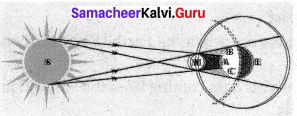
(a) Solar eclipse

Samacheer Kalvi 7th Science Solutions Term 3 Chapter 1 Light image - 20
Solar eclipse occurs, when the Moon arrives between the Sun (S) and the Earth(E). The shadow of the Moon appears on the Earth at A as shown in picture. Hence, those who are at the region A are unable to see the Sun instantly. This is solar eclipse. But, those who are at the region B and C are able to see the sun partially.
(b) Lunar eclipse

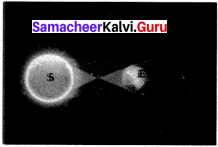
Samacheer Kalvi 7th Science Solutions Term 3 Chapter 1 Light image - 21
Lunar eclipse: Lunar eclipse occurs, when the Earth (E) comes between the Sun (S) and the Moon (M). The Earth prevents light coming from the Sun and makes shadow on the Moon. This is lunar eclipse

IX. Problems for practice:

Question 1.
Calculate the number of images formed by plane mirrors kept at an angle of 10° to each others.
Solution:
Number of image n = \(\frac { 360° }{ θ}\) – 1 = \(\frac { 360° }{ 10°}\) – 1
= 36 – 1
= 35 images

Question 2.
A ray of light fall on a plane surface at an angle of incidence 9° and reflection occurs. Calculate the angle of reflection in degree.
Solution:
By first law of reflection, angle of incidence is always equal to angle of reflection.
\(\lfloor i\) = \(\lfloor r\) . Here, angle of incidence is 9°. So angle of reflection must be equal to 9°.

Question 3.
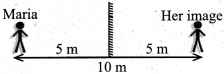
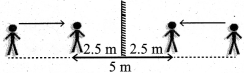
A plane mirror forms a virtual image. The distance between Maria and her image in a plane mirror is 10 m. How much distance should she move in order to get the distance of 5 m between herself and her image?
Solution:
Samacheer Kalvi 7th Science Solutions Term 3 Chapter 1 Light image - 22
The distance between Maria and her image in a plane mirror = 10 m
Samacheer Kalvi 7th Science Solutions Term 3 Chapter 1 Light image - 23
So, she shouuld move a distance of 2.5 m toward the plane mirror

X. Higher order thinking skill (HOTS) :

Question 1.
Why are we able to see the tap water in a glass even though it is colourless?
Answer:
Top water reflects the light into our eyes. As long as an object reflects light into our eyes, we can see it.

Question 2.
Imagine that parallel rays are incident on an irregular surface. Are the rays reflected from this surface parallel to each other?
Answer:
No, the reflected rays from irregular surface are in different directions.

Question 3.
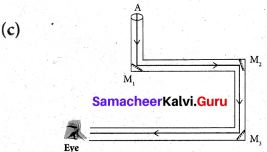
Ram planned an activity to observe an object through pipes as shown in figure, so that he could see objects which he could not directly see.

Samacheer Kalvi 7th Science Solutions Term 3 Chapter 1 Light image - 24
(a) Mention how many mirrors should he use to see the objects.
(b) If any of the mirrors is removed, will he be able to see the objects?
(c) Indicate the positions of the mirrors in the figure.
Answer:
(a) Number of mirrors = 3
(b) He will not be able to see the objects if any of the mirror is removed, since he will not get the rays after removal of mirror.
Samacheer Kalvi 7th Science Solutions Term 3 Chapter 1 Light image - 25

Samacheer Kalvi 7th Tamil Solutions Term 2 Chapter 1.2 கவின்மிகு கப்பல்

Students can Download Tamil Chapter 1.2 கவின்மிகு கப்பல் Questions and Answers, Summary, Notes Pdf, Samacheer Kalvi 7th Tamil Book Solutions Guide Pdf helps you to revise the complete Tamilnadu State Board New Syllabus and score more marks in your examinations.

Tamilnadu Samacheer Kalvi 7th Tamil Solutions Term 2 Chapter 1.2 கவின்மிகு கப்பல்

மதிப்பீடு

சரியான விடையைத் தேர்ந்தெடுத்து எழுதுக.

Question 1.
இயற்கை வங்கூழ் ஆட்ட – அடிக்கோடிட்ட சொல்லின் பொருள்
அ) நிலம்
ஆ) நீர்
இ) காற்று
ஈ) நெருப்பு
Answer:
இ) காற்று

Question 2.
மக்கள் ………………….. ஏறி வெளிநாடுகளுக்குச் சென்றனர்.
அ) கடலில்
ஆ) காற்றில்
இ) கழனியில்
ஈ) வங்கத்தில்
Answer:
ஈ) வங்கத்தில்

Question 3.
புலால் நாற்றம் உடையதாக அகநானூறு கூறுவது ……………….
அ) காற்று
ஆ) நாவாய்
இ) கடல்
ஈ) மணல்
Answer:
இ) கடல்

Question 4.
‘பெருங்கடல்’ என்னும் சொல்லைப் பிரித்து எழுதக் கிடைப்பது
அ) பெரு + கடல்
ஆ) பெருமை + கடல்
இ) பெரிய + கடல்
ஈ) பெருங் + கடல்
Answer:
ஆ) பெருமை + கடல்]

Question 5.
இன்று + ஆகி என்பதனைச் சேர்த்தெழுதக் கிடைக்கும் சொல் …….
அ) இன்று ஆகி
ஆ) இன்றி ஆகி
இ) இன்றாகி
ஈ) இன்றா ஆகி
Answer:
இ) இன்றாகி

Question 6.
எதுகை இடம்பெறாத இணை ………..
அ) இரவு – இயற்கை
ஆ) வங்கம் – சங்கம்
இ) உலகு – புலவு
ஈ) அசைவு – இசைவு
Answer:
அ) இரவு – இயற்கை

பொருத்துக

1. வங்கம் – பகல்
2. நீகான் – கப்பல்
3. எல் – கலங்கரை விளக்கம்
4. மாட ஒள்ளெரி – நாவாய் ஓட்டுபவன்
Answer:
1. வங்க ம் – கப்பல்
2. நீகான் – நாவாய் ஓட்டுபவன்
3. எல் – பகல்
4. மாட ஒள்ளெரி – கலங்கரை விளக்கம்

குறுவினா

Question 1.
நாவாயின் தோற்றம் எவ்வாறு இருந்ததாக அகநானூறு கூறுகிறது?
Answer:
நாவாயின் தோற்றம் : உலகம் புடைபெயர்ந்தது போன்ற அழகு பொருந்திய தோற்றத்தை உடையது நாவாய் என்று அகநானூறு நாவாயின் தோற்றத்தைப் பற்றி கூறுகிறது.

Question 2.
நாவாய் ஓட்டிகளுக்குக் காற்று எவ்வாறு துணை செய்கிறது?
Answer:
இரவும் பகலும் ஓரிடத்தும் தங்காமல் வீசுகின்ற காற்றானது நாவாயை அசைத்துச் செலுத்தி நாவாய் ஓட்டிகளுக்கு உறுதுணையாக நிற்கிறது.

சிறுவினா

கடலில் கப்பல் செல்லும் காட்சியை அகநானூறு எவ்வாறு விளக்குகிறது?
Answer:

  • உலகம் புடைபெயர்ந்தது போன்ற அழகு பொருந்திய தோற்றத்தை உடையது நாவாய்.
  •  அந்த நாவாய் புலால் நாற்றமுடைய அலைவீசும் பெரிய கடலின் நீரைப் பிளந்து கொண்டு செல்லும்.
  • இரவும் பகலும் ஓரிடத்தும் தங்காமல் வீசுகின்ற கடற்காற்றானது நாவாயை அசைத்துச் செலுத்த பெரிதும் துணை புரிகின்றது.
  • உயர்ந்த கரையை உடைய மணல் நிறைந்த துறைமுகத்தில் கலங்கரை விளக்கத்தின் ஒளியால் திசை அறிந்து நாவாய் ஓட்டுபவன் நாவாயைச் செலுத்துவான் என்று அகநானூறு கடலில் கப்பல் செல்லும் காட்சியை விளக்குகிறது.

சிந்தனை வினா

தரைவழிப் பயணம், கடல்வழிப் பயணம் ஆகியவற்றுள் நீங்கள் விரும்புவது எது? ஏன்?
Answer:

  • நான் விரும்பும் பயணம் கடல்வழிப் பயணம்.
  • ஏனென்றால் கடலில் செல்லும் போது கடலில் வீசும் இதமான காற்று உடலை வருடிச் செல்லும். மேலும் கீழுமாக தாவிச் செல்லும் அலைகள் காண்பதற்கு கவினுற அமைந்திருக்கும்.
  • கடலில் வாழும் பல்வகை மீன்கள் கடல் நீரில் நீந்திச் செல்லும் காட்சி பார்ப்பதற்கு மிக அழகாக இருக்கும்.
  • இரவு நேரத்தில் கப்பலிலிருந்து ஆகாயத்தைப் பார்க்கும் போது பல்வகை விண்மீன்கள் மற்றும் நிலவு நம்முடனே பயணிப்பது போன்ற தோற்றம் நம்மை மகிழ்ச்சியில் ஆழ்த்தும்.

கற்பவை கற்றபின்

Question 1.
கடலில் கிடைக்கும் பொருள்களின் பெயர்களைத் தொகுக்க.
Answer:
கடலில் கிடைக்கும் பொருட்களின் பெயர்கள் :

  • பல்வகை மீன்கள், சிப்பிகள், சங்குகள், நண்டுகள் கடலின் மூலம் கிடைக்கின்றன.
  • சுண்ணாம்பு. மணல், சரளை போன்ற பொருட்கள் மற்றும் கடல் அடிவாரத்தில் கரைந்துள்ள கனிமங்கள்.
  • கச்சா எண்ணெய் மற்றும் எரிவாயு.
  • கடல் நீரில் இருந்து உப்பு கிடைக்கிறது.
  • கடல்வாழ், உயிரினங்களில் முத்துக்களை உற்பத்தி செய்யும் திறனுடைய யூனியோ, க்வாட்ருலா என்ற பெயருடைய சிப்பிகள் உள்ளன.
  • ஆழ்கடலில் எடுக்கப்படும் முத்து உயர் ரகமாகும். முத்தை அணிந்தால் முத்து உடலில் பட்டு கரையும். அப்போது உடல் சூடு நீங்கும் என மருத்துவர்கள் குறிப்பிடுகின்றனர்.

Question 2.
கடற்பயணம் பற்றிய சிறுகதை ஒன்றை அறிந்து வந்து வகுப்பறையில் பகிர்க.
Answer:
மாணவர்கள் தாங்களாகவே செய்ய வேண்டியவை.

கூடுதல் வினாக்கள்

சொல்லும் பொருளும் :

1. உரு – அழகு
2. வங்கம் – கப்பல்
3. போழ – பிளக்க
4. எல் – பகல்
5. வங்கூழ் – காற்று
6. கோடு உயர் – கரை உயர்ந்த
7. நீகான் – நாவாய் ஓட்டுபவன்
8. மாட ஒள்ளெரி – கலங்கரை விளக்கம்

சரியான விடையைத் தேர்ந்தெடுத்து எழுதுக.

Question 1.
‘உரு’ என்பதன் பொருள் …..
அ) நாவாய் ஓட்டுபவன்
ஆ) கப்பல்
இ) கரை உயர்ந்த
ஈ) அழகு
Answer:
:ஈ) அழகு

Question 2.
‘போழ’ என்பதன் பொருள் …………………
அ) பிளக்க
ஆ) காற்று
இ) கப்பல்
ஈ) கலங்கரை விளக்கம்
Answer:
அ) பிளக்க

Question 3.
‘வங்கூழ்’ என்பதன் பொருள் ……………….
அ) காற்று
ஆ) அழகு
இ) பிளக்க
ஈ) பகல்
Answer:
அ) காற்று

Question 4.
‘நீகான்’ என்னும் சொல்லுக்கு …………………………. என்பது பொருள்.
அ) நாவாய் ஓட்டுபவன்
ஆ) கலங்கரை விளக்கம்
இ) பகல்
ஈ) கப்பல்
Answer:
அ) நாவாய் ஓட்டுபவன்

Question 5.
‘வங்கம்’ என்பதன் பொருள் ……………….
அ) கப்பல்
ஆ) பகல்
இ) அழகு
ஈ) காற்று
Answer:
அ) கப்பல்

Question 6.
கோடு உயர் என்பதன் பொருள் ……………..
அ) கரை உயர்ந்த
ஆ) கப்பல்
இ) காற்று
ஈ) பிளக்க
Answer:
அ) கரை உயர்ந்த

Question 7.
மாட ஒள்ளெரி என்பதன் பொருள் ………………
அ) கலங்கரை விளக்கம்
ஆ) பிளக்க
இ) கரை உயர்ந்த
ஈ) காற்று
Answer:
அ) கலங்கரை விளக்கம்

விடையளி:

Question 1.
அகநானூறு எட்டுத்தொகை நூல்களுள் ஒன்றா?
Answer:
ஆம். இது எட்டுத் தொகை நூல்களுள் ஒன்று.

Question 2.
எட்டுத் தொகை நூல்களை வரிசைப்படுத்துக:
Answer:
நற்றிணை, குறுந்தொகை, ஐங்குறுநூறு, பதிற்றுப்பத்து, பரிபாடல், கலித்தொகை, அகநானூறு, புறநானூறு.

Question 3.
மருதன் இளநாகனார் குறிப்பு வரைக.
Answer:

  • மருதன் இளநாகனார் சங்ககாலப் புலவர்களுள் ஒருவர்.
  • கலித்தொகையின் மருதத்திணையில் உள்ள முப்பத்தைந்து பாடல்களையும் பாடியவர்.
  • மருதத்திணை பாடுவதில் வல்லவர் என்பதால் மருதன் இளநாகனார் என அழைக்கப்படுகிறார்.

பாடலின் பொருள்

உலகம் புடைபெயர்ந்தது போன்ற அழகு பொருந்திய தோற்றத்தை உடையது நாவாய். அது புலால் நாற்றமுடைய அலைவீசும் பெரிய கடலின் நீரைப் பிளந்து கொண்டு செல்லும். இரவும் பகலும் ஓரிடத்தும் தங்காமல் வீசுகின்ற காற்றானது நாவாயை அசைத்துச் செல்லும். உயர்ந்த கரையை உடைய மணல் நிறைந்த துறைமுகத்தில் கலங்கரை விளக்கத்தின் ஒளியால் திசை அறிந்து நாவாய் ஓட்டுபவன் நாவாயைச் செலுத்துவான்.

Samacheer Kalvi 7th English Solutions Term 1 Supplementary Chapter 2 The Red-Headed League

Students can Download English Lesson 2 The Red-Headed League Questions and Answers, Summary, Notes Pdf, Activity, Samacheer Kalvi 7th English Book Solutions Guide Pdf helps you to revise the complete Tamilnadu State Board New Syllabus and score more marks in your examinations.

Tamilnadu Samacheer Kalvi 7th English Solutions Term 1 Supplementary Chapter 2 The Red-Headed League

A. Say whether the following statements are ‘True’ or ‘False’.

  1. Photography was Vincent Spaulding’s hobby.
  2. Mr. Ross did not want to hire Mr. Wilson.
  3. Mr. Wilson worked for Mr. Ross for six weeks.
  4. Mr. Jones was a lawyer.
  5. Spaulding dug a tunnel from the cellar of the shop to the jewellery shop.

Answer:

  1. False
  2. False
  3. False
  4. False
  5. False

B. Complete the table based on the information from the text.
Answer:

The Red-Headed League Questions And Answers Pdf Samacheer Kalvi 7th English Solutions Term 1 Supplementary Chapter 2
C. Answer the following questions.

The Red-Headed League Questions And Answers Pdf Question 1.
Why did Jabez Wilson meet Mr. Holmes?
Timid Jabez Wilson was a pawnshop owner. His assistant Spaulding made him join the job of copying the Encyclopaedia from 10.00 a.m. to 2.00 a.m. After eight weeks the office is closed and dissolved. He doubted someone is playing a joke on him and so he met Mr. Holmes for a solution.

The Red-Headed League 7th Standard Question Answer Question 2.
Describe Vincent Spaulding.
Answer:
Vincent Spaulding was a clever young man. He happily worked as the assistant for Mr. Wilson in his pawn shop for half-wages. He was actually John Clay, the notorious thief.

The Red Headed League Questions And Answers Question 3.
Why did Spaulding spend a lot of time in the cellar?
Answer:
Spaulding was spending a lot of time in the cellar of the pawnshop because he was making a tunnel to get into the strong room of the bank in the next street at the back of the shop.

Red Headed League Questions And Answers Question 4.
Why was Mr. Wilson hired to copy the Encyclopaedia?
Answer:
Mr. Wilson was hired to copy the Encyclopedia to keep him away from his pawnshop from 10.00 a.m. to 2.00 p.m. every day So that when Wilson went to work, Mr. Ross and Spaulding could have time to make the tunnel from his shop to the bank.

The Red-Headed League Questions And Answers Question 5.
How did Holmes’ team catch the thieves?
Answer:
The Holme’s team was ready at the strong room in the bank on Saturday night expecting the arrival of the thieves. When Spaulding and Ross came out from underground, Holmes caught Spaulding by his arm and the others caught Ross at the other end of the tunnel.

D. Based on your reading of the text complete the pyramid arranging the sequence in the correct order,

  • Holmes found the tunnel from the cellar to the bank’s strong room.
  • Wilson was assigned to copy the encyclopaedia.
  • Wilson asked Sherlock Holmes for help.
  • Wilson got the job in The Red – Headed League.
  • Spaulding and Ross were caught by the famous detective.
  • One day he found the notice that ‘The Red – Headed League’ was dissolved.
  • Holmes recognised Spaulding who was actually John Clay, a notorious criminal.

Answer:
The Red-Headed League 7th Standard Question Answer Samacheer Kalvi Term 1 Supplementary Chapter 2

Project

E. Imagine you have visited a Mystery Theme Park you have come across. Make an eye¬catching advertisement with the help of the given dues.

  • a mirror maze
  • scary faces
  • eerie sounds
  • a ghostly figure
  • a pitch dark room

Answer:

The Red Headed League Questions And Answers Samacheer Kalvi 7th English Solutions Term 1 Supplementary Chapter 2

Connecting To Selfs

F. Observe the pictures carefully and write your answers.
Answer:

Red Headed League Questions And Answers Samacheer Kalvi 7th English Solutions Term 1 Supplementary Chapter 2

Step To Success

G. lust like the example, use the key to fill in the blanks and break the code

The Red-Headed League Questions And Answers Samacheer Kalvi 7th English Solutions Term 1 Supplementary Chapter 2
Answer:

  1. SECRET
  2. GHOST
  3. TRICK
  4. RIDDLE
  5. PUZZLE

The Red-Headed League Additional Questions

I. Choose the correct answers

The Red-Headed League 7th Standard Question 1.
Wilson was accepted into the League by ______
(a) Dr. Watson
(b) Mr. Duncan Ross
(c) Mr. Vincent Spaulding
Answer:
(c) Mr. Vincent Spaulding

The Red Headed League 7th Standard Question 2.
I saw you hit the ______ with your walking stick
(a) ground
(b) man
(c) shop door
Answer:
(a) ground

The Red Headed League Book Back Answers Question 3.
Ross quickly gets back into the tunnel ______ wants to stop him but could not
(a) John Clay
(b) Jones
(c) Holmes
Answer:
(b) Jones

The Red-Headed League Book Back Answers Question 4.
The cellar was the shop ______ the shop
(a) behind
(b) in front of
(c) beside
Answer:
(c) beside

The Red Headed League Question Answer Question 5.
The bank does not open on ______
(a) Saturday
(b) Sunday
(c) Friday
Answer:
(b) Sunday

The Red Headed League Question And Answer Question 6.
Jabez Wilson was a timid red-haired ______
(a) doctor
(b) detective
(c) pawn broker
Answer:
(c) pawn broker

The Red Headed League Answers Question 7.
The ______ wanted Wilson away from the shop for some hours everyday.
(a) friends
(b) villains
(c) heroes
Answer:
(b) villains

The Red Headed League 7th Standard In English Question 8.
I ______ when Spaulding was happy to work for half-wages.
(a) suspected
(b) liked
(c) Holmes
Answer:
(a) suspected

II. dentify the Character / Speaker.

  1. “How can I get to the Strand?”
  2. “Yes, to the hospital”.
  3. “My men are waiting at the front door of the bank”.
  4. “You think of everything, Mr. Holmes.”
  5. “So Spaulding is John Clay, the notorious thief”.
  6. “Did you see his trousers? They were dirty”.

Answer:

  1. Holmes
  2. Dr. Watson
  3. Mr. Jones
  4. Spaulding
  5. Dr. Watson
  6. Holmes

III. Write True or False against each statement.

  1. Holmes and Dr. Watson move to Wilsons shop in Saxe-Coburg Square.
  2. Dr. Watson visits the apartment of his patient Sherlock Holmes.
  3. I want your help tonight. Come at nine O’clock.
  4. Holmes comes out from behind his box, and hits Spaulding’s arms.
  5. Clay saw the colour of Ross’s hair and thought of a Red-Headed League.
  6. “Spaulding often went down to the cellar”.
  7. Because making a tunnel is a clean work”.
  8. “Why is that young man making a tunnel?” I thought.

Answer:

  1. True
  2. False
  3. False
  4. True
  5. True
  6. True
  7. False
  8. True

IV. Very Short Questions with Answers.

The Red-Headed League Worksheet Answers Question 1.
Who was the red-haired client of Sherlock Holmes?
Answer:
The red-haired client of Sherlock Holmes was Jabez Wilson.

Question 2.
What was Wilson doing at the Red-Headed League daily?
Answer:
Wilson was copying out the Encyclopaedia Britannica.

Question 3.
Where was Dr. Watson working?
Answer:
Dr. Watson was working in the hospital.

Question 4.
What did Spaulding have in his hands when he came out of the ground?
Answer:
Spaulding had a gun in his hands.

Question 5.
Why were Spaulding’s trousers dirty?
Answer:
Spaulding’s trousers were dirty because making a tunnel is dirty work.

Question 6.
What made Holmes think that the tunnel was ready?
Answer:
Holmes thought the tunnel was ready as the Red-Headed League’s office was closed.

V. Short Questions with Answers.

Question 1.
Why did Vincent show the newspaper advertisement to Mr. Wilson?
Answer:
Vincent showed the advertisement about an opening in the Red-Headed League to Mr. Wilson to make him join the job so that he would be away from his pawn shop daily for a few hours. During that time Vincent and Ross planned to dig the tunnel from the shop cellar to the bank in the next street.

Question 2.
Holmes knew London very well then why should he ask the way to Strand?
Answer:
Holmes got information from Mr. Wilson and observes the pawn shop from outside. He also wanted to know who was inside and what were they doing. So he knocks the door of the shop and asks the way to Strand for namesake and finds out the truth.

Question 3.
Spaulding was happy to work for half wages. Why?
Answer:
Spaulding didn’t seek for a job. He wanted to find entry into the pawn shop by working as an assistant to Mr. Wilson. But his aim was to make a tunnel from the shop to the bank, hence he happily agreed for half wages.

VI. Characters with job description:

The Red-Headed League 7th Standard Samacheer Kalvi Term 1 Supplementary Chapter 2

VII. Paragraph Questions with Answers.

Question 1.
Why did Holmes go to look at the road behind Saxe-Coburg Square?
Answer:
Mr. Wilson’s pawn shop was at Saxe-Coburg Square. It had a cellar beneath. When Holmes hit the ground with his stick in front of the shop, he found that the cellar was at the backside of the shop where Spaulding spent most of his time. Holmes saw Spaulding’s trouser legs dirty and guessed he was digging a tunnel. He wanted to find out where the tunnel led to. So Holmes went to look at the road behind Saxe-Coburg Square that was the next street at the back of the shop and found the bank there.

Question 2.
What arrangements had Holmes made to catch the thieves in the bank? How did they catch the culprits?
Answer:
Holmes, Dr Watson, Mr. Jones and a policeman put off the lights and waited behind the crates and boxes in the strong room at the bank. At the same time policemen wereput to wait at the front door of the bank and near the pawn shop to catch the thieves. At 11.15 p.m. light came through the stone floor of the strong room in the bank. The stones moved and Spaulding arrived first with a gun, followed by Ross. Holmes came and hit Spauldings arm, made him drop his gun and caught him. Ross jumped back into the tunnel and tried to escape but the men waiting at the other end of the tunnel in the pawn shop caught him.

VIII. Read the passage and answer the questions.

1. Holmes and Watson first visit the district in which Wilson’s shop is located, where Holmes does some mysterious things: He asks directions from a clerk at the pawnshop; he taps the street out-side with his walking stick and remarks that the case is complicated by the fact that it is Saturday. Later, he asks Watson to meet him at Baker Street that evening at ten, and to come armed.

Question 1.
Where did Holmes and Watson go?
Answer:
Holmes and Watson went to the district where Wilson’s shop was located.

Question 2.
State the two mysterious things Holmes did at Wilson’s shop?
Answer:
Holmes asked directions from the pawn shop clerk and he tapped the street with his walking stick.

Question 3.
When and where did Holmes ask Dr. Watson to meet him?
Answer:
Holmes asked Dr. Watson to meet him at Baker Street on Saturday night at ten.

2. When Watson arrives, he finds two other men there: Peter Jones, an inspector from Scotland Yard, and a Mr. Merry Weather, a bank director. Holmes takes them to a branch of the City and Suburban Bank, a branch located in the same district as Wilson’s pawnshop. There they enter the vaults of the bank, where Merry Weather shows them a shipment of thirty thousand gold coins they have recently received from the Bank of France. Holmes says that they may have some time to wait, and they sit quietly in the dim vault.

Question 1.
What was the name of the inspector from Scotland Yard?
Answer:
Mr. Peter Jones.

Question 2.
Who was Mr. Merry Weather ?
Answer:
Mr. Merry Weather was a bank director.

Question 3.
Where did Holmes take Mr. Jones and Mr. Merry Weather ?
Answer:
Holmes took them to the vault of a branch of a bank located in the same district as Wilsons pawnshop.

Question 4.
Who all went to the bank?
Answer:
Holmes, Dr. Watson, Mr. Jones and Mr. Merry Weather went to the bank.

Question 5.
What did Mr. Merry Weather show them at the vault of the bank?
Answer:
At the vault of the bank Mr. Merry Weather showed them a shipment of thirty thousand gold coins that they had recently received from the Bank of France.

Question 6.
Why did Holmes and others wait at the dim vault?
Answer:
Holmes and the others were waiting at the dim vault of the bank to catch the thieves.

IX. Rearrange the Jumbled Sentences.

A.
1. Then Holmes knocks the door of the shop and meets Spaulding.
2. Holmes and Watson go to Wilson’s shop at Saxe-Coburg Square.
3. Holmes noticed the dirty trousers of Spaulding.
4. Dr. Watson visits the apartment of his friend Sherlock Holmes.
5. Holmes suspected crime and goes to look the road behind the shop.
6. Holmes hits the ground outside the shop with his walking stick.
7. Dr. Watson listens to the unusual story of the Jabez Wilson.

Answer:
4. Dr. Watson visits the apartment of his friend Sherlock Holmes.
7. Dr. Watson listens to the unusual story of the Jabez Wilson.
2. Holmes and Watson go to Wilson’s shop at Saxe-Coburg Square.
6. Holmes hits the ground outside the shop with his walking stick.
1. Then Holmes knocks the door of the shop and meets Spaulding.
3. Holmes noticed the dirty trousers of Spaulding.
5. Holmes suspected crime and goes to look the road behind the shop.

B.
1. Three men waiting at the other end of the tunnel caught Ross.
2. Suddenly through the stone floor Spaulding comes out followed by Ross.
3.”So are you John Clay! Your Red-Headed League was clever” said Holmes.
4. Watson looks at his watch it was 11.15 p.m.
5. Holmes hits Spaulding’s arms and Ross quickly gets back into the tunnel.
6. Holmes, Watson, Jones and Policeman wait in the strong room at the bank.
7. Spaulding says, “you think of everything, Mr. Holmes. You’re very clever”.

Answer:
6. Holmes, Watson, Jones and Policeman wait in the strong room at the bank.
4. Watson looks at his watch it was 11.15 p.m.
2. Suddenly through the stone floor Spaulding comes out followed by Ross.
5. Holmes hits Spaulding’s arms and Ross quickly gets back into the tunnel.
1. Three men waiting at the other end of the tunnel caught Ross.
7. Spaulding says, “you think of everything, Mr. Holmes. You’re very clever”.
3. “So are you John Clay! Your Red-Headed League was clever” said Holmes

The Red – Headed League Summary

Mr. Wilson, a red-haired pawn-shop owner, met the famous detective Mr. Sherlock Holmes to find a solution for the practical joke someone had been playing on him.

Mr. Wilson joined the Red-Headed League headed by Mr. Duncan Ross for quite a high salary of four pounds a week, on the recommendation of his assistant Vincent Spaulding who worked with him for half the wages. Wilson’s work was to copy the Encyclopaedia Britannica daily from 10.00 a.m. to 2.00 a.m. After eight weeks he is shocked to find that the office has been dissolved.

Holmes and his friend Dr. Watson visit Mr. Wilsons shop at Saxe-Coburg Square. He walks in front of the shop and taps the ground with his walking stick. He knocks the shop door and Spaulding opens. The legs of his trousers are dirty. Holmes asked Spaulding the way to Strand, pretty well knowing it. Holmes asks Dr. Watson to meet him at ten o’clock.

Holmes, Dr.Watson and Mr. Jones and a policeman await for the thief at the bank. They hide themselves behind the boxes. At 11.15 p.m. Spaulding and Ross come from underground and are caught. Spaulding is recognized to be the notorious thief John Clay.

Later Holmes explains to Dr. Watson that the Red-Headed League was just created to keep Wilson away from his shop. When he went for work daily, they had time to make the tunnel Holmes doubted Spaulding as he worked for half wages and was in the cellar most of the time. When Holmes hit the ground with his walking stick and saw Spaulding’s trousers dirty, he understood that he is making a tunnel from the pawn-shop to the Bank at the back of the shop, in the next street. As the Red-Headed League was dissolved and it was Sunday, Holmes was sure the thieves would come and he caught them red handed. A huge bank robbery was cleverly stopped.

Samacheer Kalvi 7th Science Solutions Term 2 Chapter 4 Cell Biology

You can Download Samacheer Kalvi 7th Science Book Solutions Guide Pdf, Tamilnadu State Board help you to revise the complete Syllabus and score more marks in your examinations.

Tamilnadu Samacheer Kalvi 7th Science Solutions Term 2 Chapter 4 Cell Biology

Samacheer Kalvi 7th Science Cell Biology Textual Evaluation

I. Choose the correct answers:

Cell Biology 7th Standard Question 1.
Basis unit of life.
(a) Cell
(b) Protoplasm
(c) Cellulose
(d) Nucleus
Answer:
(a) Cell

7th Science Cell Biology Question 2.
the outer most layer of an animal cell. Who am I?
(a)Cell wall
(b) Nucleus
(c)Cell membrane
(d) Nuclear membrane
Answer:
(c) Cell membrane

Samacheer Kalvi 7th Biology Guide Question 3.
Which part of the cell is called the brain of the cell?
(a) Lysosome
(c) Mitochondria
(b) Ribosome
(d) Nucleus.
Answer:
d) Nucleus

Science Cell Biology Question 4.
________ helps in cell division.
(a) Endoplasmic reticulum
(b) Golgi complex
(c) Centriole
(d) Nucleus
Answer:
(c) Centriole

Samacheer Kalvi Guru Science 7th Question 5.
Suitable term for the various components of cell is _________
(a) Tissue
(b) Nucleus
(c) Cell
(d) Cell organelle
Answer:
(d) Cell organelle

Fill in the blanks:

  1. The jelly like substance present in the cell is called _______.
  2. I convert the Sun’s energy into food for the plant. Who am I?_________.
  3. Mature Red blood cell do not contain a ________.
  4. Unicellular organisms can only be seen under a ________.
  5. Cytoplasm plus nucleoplasm is equal to ________.

Answer:

  1. cytoplasm
  2. chloroplast
  3. Nucleus
  4. Microscope
  5. Protoplasma

III. True or False – If False give the correction answer

7th Biology Guide Question 1.
Animal cells have a cell wall.
Answer:
False, Plant cells have a cell wall.

Question 2.
Salmonella is a unicellular bacteria.
Answer:
True

Question 3.
Cell membrane is fully permeable.
Answer:
False, Cell membrane is selectively permeable.

Question 4.
Only plant cells have chloroplasts.
Answer:
True.

Question 5.
Human stomach is an organ.
Answer:
True.

Question 6.
Ribosomes are small organelles with a membrane.
Answer:
False. Ribosomes are small organelles without a membrane.

IV. Match the following:

Question 1.

  1. Transporting channel – Nucleus
  2. Suicidal bag – Endoplasmic reticulum
  3. Control room – Lysosome
  4. Power house – Chloroplast
  5. Food producer – Mitochondria

Answer:

  1. Transporting channel – Endoplasmic reticulum
  2. Suicidal bag – Lysosome
  3. Control room – Nucleus
  4. Power house – Mitochondria
  5. Food producer – Chloroplast

V. Analogy:

Question 1.
Bacteria : microorganism :: mango tree :________
Answer:
Macroorganism.

Question 2.
Adipose : tissue :: eye :_________
Answer:
Organ

Question 3.
Cell wall: plant cell:: centriole :_________
Answer:
Animal cell.

Question 4.
Chloroplast: photosynthesis :: mitochondria :________
Answer:
Respiration.

VI. Choose Use connect alternative from the following :

Question 1.
Assertion (A) : Tissue is a group of dissimilar cells.
Reason (R) : Muscle is made up of Muscle cell.
(a) Both A and R are true
(b) Both A and R are false
(c) A is true but R is false
(d) A is false but R is true
Answer:
(a) Both A and R are true

Question 2.
Assertion (A) :Majority of cells cannot be seen directly with naked eye because.
Reason (R) :Cells are microscopic.
(a) Both A and R are true
(b) Both A and R are false
(c) A is true but R is false.
(d) A is false but R is true.
Answer:
(a) Both A and R are true

VII. Very short answer:

Question 1.
What are the functions of cell wall in plant cell?
Answer:
Protection, maintains shape of cell and acts as protective framework.

Question 2.
Which organelle uses energy from sunlight to make starch?
Answer:
Chloroplast uses energy from sunlight to make starch.

Question 3.
What are the main things in a nucleus?
Answer:
Nuclear envelope, Nucleolus, chromatin body.

Question 4.
What does cell membrane do?
Answer:
It acts as boundary of cell and protects it.

Question 5.
Why lysosomes are known as scavengers of the cell?
Answer:
The lysosomes are the main digestive compartments of a cell and digest damaged cell parts. Hence they are called scavengers of the cell.

Question 6.
Teacher said “A virus is not an organism” Do you agree with this statement or
not? Explain Why?
Answer:
True I agree with the statement. A virus acts as a living organism within the body of a host and behaves like a non-living thing outside. It lacks cell wall, cell membrane, cytoplasm and organelles. Hence it is not a organism.

VII. Give short answer :

Question 1.
Why the cell is very important for us?
Answer:

  1. Cell is the basic structural and functions unit of life.
  2. It is the building unit of living organism.
  3. A group of cells form a tissue which forms the organ and organ systems.
  4. This helps a living organism to do its functions. Hence cell is very important for us.

Distinguish between the following pairs

  • Smooth ER and Rough ER
  • Cell wall and cell membrane
  • Chloroplast and mitochondria

Answer:
Smooth ER (Endoplasmic Reticulum)

  1. It is smooth due to absence of Ribosomes.
  2. It helps in transport of steroids and lipids.

Rough ER (Endoplasmic Reticulum)

  1. It is’rough due to presence of Ribosomes.
  2. It helps in protein synthesis

Cell wall

  1. It is seen only in plant cells.
  2. It is made of cellulose.

Cell membrane

  1. It is seen in plant and animal cells.
  2. It is made of proteins and lipids.

Chloroplast

  1. It is a organelle seen only in plant cells (green plants)
  2. It helps in synthesis and storage of starch.

Mitochondria

  1. It is a organelle seen in plant and animal cells.
  2. It is the centre of respiration in a cell and produces energy.

Question 3.
Write correct sequence from cell to organism?
Answer:
Cell —> Tissue —> Organ —> Organ system —> Organism.

Question 4.
Write a short note on nucleus.
Answer:

  1. Nucleus is seen in the cytoplasm of plant and Animal cells.
  2. It is surrounded by nuclear envelope.
  3. It has one or two nucleoli and chromatin body.
  4. The chromatin body stores genetic information.

Functions of Nucleus:

  1. It controls all the processes and chemical reactions that take place inside the cell.
  2. Inheritance of character from one generation to another.

Question 5.
Classify the following terms into cells, tissues, organs and write in the tabular column given below:
Neuron, Lungs, Xylem, brain, adipose, Leaf, RBC, WBC, hand, muscle, heart, ovum, squamous, phloem, cartilage.
Answer:

CellTissueOrgan
NeuronXylemLungs
RBCAdiposeBrain
WBCMuscleLeaf
OvumSquamousHand
PhloemHeart
Cartilage

Question 6.
On the lines given below, write about what you have learned from the activities done in this lesson.
Let me tell you about some of the important things I’ve learned about cells. First, I’ll start with… .
First, I’ll start with___________________________.
Answer:

  1. Cell is the basic unit of an organisms.
  2. Based on number of cells organisms can be classified as unicellular and multicellular organisms.
  3. The cells form tissues, Tissues form organs, Organ system help an organism to function.
  4. The cell wall is seen only in plant cells.
  5. Cell membrane is seen only in plant cells.
  6. Cell membrane is seen in all cells.
  7. The organelles of the cell like chloroplast, Mitochondria, Ribosomes, Endoplasmic Reticulum, Golgi bodies etc help to perform cell functions.
  8. Nucleus is the controlling centre of a cell.

IX. Given long answer:
Question 1.
Write about any three organelles in detail.
Answer:
The three organelles are as follows
Chloroplasts:

  1. They are green organelles seen in plant cells only.
  2. They can prepare food using sun is energy and photosynthesize since they contain the pigment chlorophyll.
  3. They absorb the radiant energy of the sun and convert it to chemical energy to be used by plants and animals.

Golgi Complex:

  1. They are cell organelles which consist of membrane bound sacs stacked on top of one another and have associated secretory vesicles.
  2. Golgi complex helps in production of secretory substances, packaging and secretion.

Mitochondria:

  1. It is a oral double membrane bounded organelle.
  2. Aerobic respiration occurs in mitochondria and energy is released. Hence mitochondria is called as power house of the cell
  3. The energy produced is used for metabolic activities of the cell.

Question 2.
In a situation, how to explain, while your friend ask what is this, never seen before ?
Cell Biology 7th Standard Samacheer Kalvi Term 2 Chapter 4
Answer:

  1. This is a animal cell.
  2. It is the basic unit of an animal body.
  3. Animal cell is covered by a cell membrane and lacks cell wall.
  4. It has organelles like mitochondia, Golgi apparatus, Ribosomes, etc..
  5. It differs from plant cells since it lacks chloroplast.
  6. It has centrioles which are not seen in plant cells.
  7. Nucleus is the controlling centre of the cell.

Question 3.
Compare the plant cell and the animal cell and complete the illustration given below
Answer:
7th Science Cell Biology Samacheer Kalvi Term 2 Chapter 4

X. Higher ordear Thinking question :
Virus is called Acellular. Why?
Answer:

  1. Virus is made up of a outer protein coat and a nucleic acid.
  2. It lacks cell wall, cell membrane, organelles and cytoplasm.
  3. Therefore a virus is described as a cellular.

Samacheer Kalvi 7th Science Cell Biology Intext Activities

Activity – 1

Question 1.
Do you remember the lesson studied in previous class, how will you find whether an object is living or non – living? Write it down. An object is living or non-living?
Answer:
Living things: Living things use energy. They move or change shape.
Eg: Humans, insects, plants, animals etc.
Non-living things:
Do not move by themselves, grow or reproduce.
Eg: Rocks, car, pencils etc.

Question 2.
Form a team and work together to write down some of the functions of life, which you can remember.
Answer:
Reproduction, response to stimuli, Growth, movement, excretion

Question 3.
Do you think that an individual cell is living? Explain your answer.
Answer:
Cells are living things. Cells are found in plants, animals and Bactria.

Question 4.
Write about various organelles of a cell which you know.
Answer:
Vacuole, lysosome, endoplasmic reticulum, Golgi appartus, mitochondria, chloroplast.

Activity – 2
Find out major organs that are part of the circulatory system of a human body and list out their functions.
Answer:

Organs

  1. Heart (Cardiovascular)
  2. Lungs (Pulmonary)
  3. Blood vessels – Arteries
  4. Blood vessels – Veins

Functions

  1. Pumps oxygenated and deoxygenated blood on different sides.
  2. In oxygen from incoming air enters the blood and carbon-di-oxide, a waste gas from the metabolism, leaves the blood.
  3. Carry blood away from the heart.
  4. Carry blood back to the heart.

Activity – 3
Study the pictures given and write the differences between cells that you observe in the given table
Answer:
Samacheer Kalvi 7th Biology Guide Term 2 Chapter 4 Cell Biology

Activity – 4
Summarise what you have learnt Now you’ve studied the internal structure of a cell. Let us summerise what we have learnt so far Complete this table by filling the main function of each of the cell structures.

Cell Structure

  1. Cell membrane
  2. Cell wall
  3. Cytoplasm
  4. Mitochondria
  5. Vacuole
  6. Chloroplast
  7. Endoplasmic reticulum

Function(s)

  1. Boundary of an animal cell.
  2. Supporter and protector.
  3. Giving a ceil its shape.
  4. Energy releaser.
  5. Support the organelle.
  6. Food producers.
  7. Synthesis protein lipids, steroids and transport them

Samacheer Kalvi 7th Science Cell Biology Additional Question :

Choose the correct answer.

Question 1.
________ is the largest organelle
(a) Chloroplast
(b) Mitochondria
(c) Nucleus
(d) Golgi apparatus
Answer:
(c) Nucleus

Question 2.
The ______cells are spindle shaped.
(a) muscle
(b) nervous
(c) RBC
(d) epithelial
Answer:
(a) muscle

Question 3.
The________ plays a role in change of colour and taste of fruits.
(a) nucleus
(b) Golgi bodies
(c) lysosome
(d) chloroplast
Answer:
(b) Golgi bodies

Question 4.
________lacks a nucleus.
(a) Nerve cell
(b) Muscle cell
(c) RBC
(d) Brain cell
Answer:
(c) RBC

Question 5.
Starch is stored in _______
(a) chloroplast
(b) leucoplast
(c) chromoplast
(d) Golgi apparatus
Answer:
(b) leucoplast

II. Fill in the blanks.

  1. Plastids containing coloured pigments are called ________
  2. cells have the ability to multiply and develop into different types of cells.
  3. ________are seen only in animal cells.
  4. An organelle seen in bacteria and cell of higher organisms is ______
  5. Cell wall is made up of ________

Answer:

  1. Chromoplasts
  2. stem
  3. centrioles
  4. Ribosome
  5. cellulose

III. True or false – if false, give the correct statement.
Question 1.
Leucoplast store steroids.
Answer:
False, Leucoplasts store starch.

Question 2.
Bacteria is a animal cell.
Answer:
False, Bacteria is a plant cell.

Question 3.
Amoeba contains chloroplants.
Answer:
False, Amoeba does not contain chloroplasts.

Question 4.
Mitochondria can help to photosynthesize.
Answer:
False, Mitochondria can help to produce energy

Question 5.
The cytoplasm consists of 90% water.
Answer:
True

Question 6.
The body of a nerve cell is branched.
Answer:
True.

IV. Match the following:

Question 1.
Science Cell Biology Samacheer Kalvi 7th Solutions Term 2 Chapter 4
Answer:
(c)
(d)
(b)
(a)

V. Analogy:

Question 1.
Golgi: secretion :: Endoplasmic reticulum: _________
Answer:
Transport.

Question 2.
Plant tissue : Xylem :: Animal tissue : _________
Answer:
Epithelium.

Question 3.
Plant organ : stem :: Animal organ : _________
Answer:
Stomach.

VI. Assertion and Reason.
Mark the correct choice as
(a) Both A and R are true.
(b) Both A and R are false
(c) A is true but R is false.
(d) A is false but R is true

Question 1.
Assertion (A) : Stem cells can form different types of cells.
Reason (R) : They are found in plants and animals.
Answer:
(c) A is true but R is false

Question 2.
Assertion (A): The cell wall has pores.
Reason (R) : Each cell is connected to its neighbouring cell.
Answer:
(a) Both A and R are true

VII. Very short Answers:

Question 1.
Define a tissue.
Answer:
Tissue is a group of cells organized for a specific function.

Question 2.
What is Plasmodesmata?
Answer:
Each plant cell is interconnected with its neighboring cells through openings called Plasmodesmata.

Question 3.
What is ATP?
Answer:
ATP stands for Adenosineri Phosphate and is the energy currency of a cell.

Question 4.
What is unique about embryonic stem cells?
Answer:
They can develop into any type of cell in the body. Such as blood cell, nerve cell etc.

Question 5.
Name the types of plastids.
Answer:
Chloroplasts, chromoplasts and leucoplasts.

Question 6.
Name a cell which lacks a nucleus.
Answer:
Red blood cell.

VII. Short Answer.

Question 1.
Why are lysosomes called as ‘suicidal bags of the cell’?
Answer:
Lysosoms can lyse (destroy) a cell by producing enzymes. Hence they are known as suicidal bags of the cell.

Question 2.
What is endoplasmic reticulum?
Answer:
It is an inter membranous network made up of flat or tubular sacs within the cytoplasm. Endoplasmic reticulum is of two types. They are rough endoplasmic reticulum and smooth endoplasmic reticulum

Question 3.
List the functions of Nucleus.
Answer:

  1. It controls all the processes and chemical reactions that take place inside the cell.
  2. Inheritance of character from one generation to another.

Question 4.
Why is mitochandia known as power house of the cell?
Answer:
Aerobic respiratory reactions take place within the mitochondrion to release energy. So it is known as “The Power House’” of the cell.

Question 5.
What is a vacuole?
Question:
It is a membrane bound bag like structure filled within organic and organic molecules along with water and found in plant cells to support the organelles. Animal cell has very small vacuoles.

VIII. Long Answer

Question 1.
List the functions of cell wall.
Answer:

  1. Cell wall provides a frame work for support and stability.
  2. It allows the plant to remain rigid and upright.
  3. It helps to maintain the shape of the plant cell.
  4. It has openings called plasmodesmata through which neighboring cells are interconnected.
  5. It acts as a protective covering for the cell.

Question 2.
Draw a plant cell and label the parts.
Answer:
Samacheer Kalvi Guru Science 7th Science Solutions Term 2 Chapter 4 Cell Biology

Question 3.
List the differences between Plant cell and Animal cell.
Answer:

Plant cell

  1. It has cell wall.
  2. It has plastids such as chloroplasts, chromoplasts etc.
  3. Centrioles are not seen.
  4. It has a large vacuole.
  5. It is larger in size.

Animal Cell

  1. Cell wall is absent.
  2. Plastids are absent.
  3. It has centrioles which help in cell division.
  4. Vacuoles are small or absent.
  5. It is smaller in size.

IX. Hots:

Question 1.
Bacterial cells can prepare food. Do you agree?
Answer:
Yes, some bacterial cells have chlorophyll pigments and can prepare food.

Question 2.
Stem cells are used by doctors to treat diseases. Do you agree with this statement?
Answer:
Yes. Stem cells can divide and form any other cell type and hence can be used to cure several diseases like spinal cord injury.

Samacheer Kalvi 7th English Solutions Term 1 Prose Chapter 3 A Prayer to the Teacher

Students can Download English Lesson 3 A Prayer to the Teacher Questions and Answers, Summary, Notes Pdf, Activity, Samacheer Kalvi 7th English Book Solutions Guide Pdf helps you to revise the complete Tamilnadu State Board New Syllabus and score more marks in your examinations.

Tamilnadu Samacheer Kalvi 7th English Solutions Term 1 Prose Chapter 3 A Prayer to the Teacher

Reading
I. Which of these statements do you find in the speech?

  1. Inclusion is essential for us to do well in life.
  2. We should neglect others.
  3. Communicate politely with the less privileged.
  4. Teachers teach us to communicate well.
  5. Effective Communication is inessential to excel in life.

Answer:
We find statement No. 1, 3 and 4 in the speech.

  1. [✓]
  2. [✗]
  3. [✓]
  4. [✓]
  5. [✗]

II. Read the statements. Tick [✓] the correct words. You can tick more than one.

A Prayer To The Teacher Question 1.
We should develop the ability to learn from _____
Answer:
[✓] self
[✓] others
[✓] books

A Prayer To The Teacher Question And Answer Question 2.
Teachers help me to learn _____  things.
Answer:
[✓] new
[ ] bad
[✓] difficult

A Prayer To The Teacher Summary Question 3.
Teach me to appreciate
Answer:
[✓] nature
[ ] destruction
[✓] small creatures

A Prayer To The Teacher Book Back Answers Question 4.
We should learn to questions.
Answer:
[✓] ask
[✓] answer
[ ] discard

III. Answer the following questions in a sentence or two.

A Prayer To The Teacher 7th Standard Question 1.
What is inclusion? Why is it important?
Answer:
Inclusion is to value everyone beyond the boundaries irrespective of their differences. Inclusion is important to be successful in life.

A Prayer To The Teacher 7th Std Question 2.
What is good or effective communication?
Answer:
Good and effective communication are to be able to speak and write to convey what . we actually feel.

Prayer To The Teacher Question 3.
What should we learn from our teachers?
Answer:
We should learn newer and more difficult things from our teachers.

A Prayer To The Teacher Lesson Plan Question 4.
What kind of learning brings joy to you?
Answer:
Learning new ways to learn brings joy to us.

A Prayer To The Teacher Theme Question 5.
In what ways are we doing injustice to nature?
Answer:
We do injustice to nature by felling trees, killing small creatures and causing urban decay.

A Prayer To The Teacher Prose 7th Standard Question 6.
What do you need to learn to live a good life in this world?
Answer:
To live a good life in this world we need to learn to appreciate the interconnected nature of things.

The Prayer To The Teacher Question 7.
How does the ability to question help us?
Answer:
The ability to question helps us to get answers, to establish better order of things, to be accountable and in the end it helps us to see the truth emerge.

A Prayer To The Teacher Lesson Question 8.
What do you think are the two most important lessons that the speaker mentions?
Answer:
The two most important lessons the speaker mentions are to stress our point without raising our voice and to raise our voice when our silence hurts another life.

IV. Answer the following questions in detail.

Samacheer Kalvi Guru 7th English Question 1.
What are the skills / values a teacher should teach their students to live in this competitive world?
Answer:
To live in this competitive world, our teachers should teach their students important skills and values like, the value of inclusion, ability to communicate both written and verbal, the ability to learn newer and more difficult things.

Samacheer Kalvi Guru English 7th Standard Question 2.
What kind of a life do you want to lead in this world?
Answer:
When I live in this world I want to live a patriotic life which means having tolerance towards others with a different opinion in matters like religion, race, etc. I would like to consider all people in the world suffering from poverty, disease and hunger as my own and help them. Violence should not be found in my environment. I should have the strength to love all my fellow human beings with all their short comings. I should see unity in diversity. I must not consider anyone from any part of the globe as foreigner or stranger but as brother and sister. I wish to live a peaceful life without any barbed wires or smoking guns.

Vocabulary

Prefix And Suffix

A. Match the suitable prefix and suffix to create new words of your own. One has been done for you.
Answer:

A Prayer To The Teacher Samacheer Kalvi 7th English Solutions Term 1 Prose Chapter 3
B. Refer to your dictionary. Add a prefix or suffix to the following words and find their antonyms.
Answer:

  1. privileged × underprivileged
  2. animate × inanimate
  3. discriminate × indiscriminate
  4. empty × unempty
  5. communicate × miscommunicate
  6. learn × unlearn

Listening

C. Listen to the story and fill in the blanks by selecting the right option.

  1. Raj was upset as he had done ______ (Well/poorly) in his english test
  2. His grandmother gave him a ______ (pen/pencil)
  3. Granny compared ______ (Raj / Ravi) with the pencil.
  4. Raj’s pain of not doing well in his test was compared with ______ of Pencil. (Sharping/ writing)
  5. Raj understood that failures are stepping stones to _____ (success/climbing)

Answer:
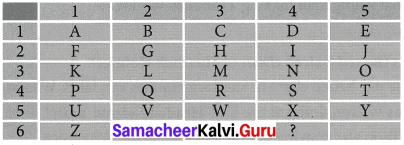
  1. Poorly
  2. Pencil
  3. Raj
  4. Sharping
  5. success

Speaking

D. Read the story. Divide yourselves into groups of four. Discuss what little Sarah wants to talk about. Take roles and enact the story.
Answer:
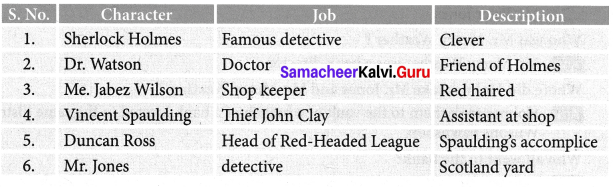
Anitha, Banu, Chitra and Daisy discuss what Little Sarah wants to talk about.
Anitha : Why is Sarah sad?
Banu : Sarah’s father got a transfer to another city. So Sarah was moved to a new house and a new school in the new city.
Chitra : Oh! Is she sad because she missed her old home and old school friends?
Daisy : Yes. She wanted to express her sad feelings to her close relatives.
Anitha : Do you mean to her parents and brother?
Banu : But poor thing, they did not listen to her in their busy work.
Chitra : Was she able to tell her feelings to any one?
Daisy : Her teacher Ms. Nancy saw her new student Sarah sad. She called her and asked the reason.
Anitha : Sure. Sarah would have told how badly she missed her dear friends and her home. Was the teacher able to make her happy?
Banu : Of course. The teacher listened to Sarah patiently and told her that the people near her present home and school are also good and assure she would earn good friends soon.
Chitra : The teacher had helped Sarah to develop a world view of things, to appreciate diversity and the power of loving her fellow human beings.
All : Yes!

Picto Grammar

E. Look at the pictures. Pick out the right preposition and fill in the speech bubbles given below.

A Prayer To The Teacher Question And Answer Samacheer Kalvi 7th English Solutions Term 1 Prose Chapter 3

Answer:
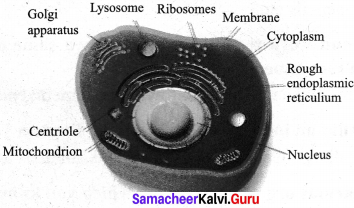
  1. I’ am jumping over the box.
  2. I can jump down from the box.
  3. I’ am standing on the box.
  4. I’ am carrying the box on my head.
  5. I’ am sitting inside the box.
  6. I’ am standing in front of the box
  7. I’ am sitting in between the boxes.

Grammar

F. Read the following sentences carefully and underline the preposition
Answer:
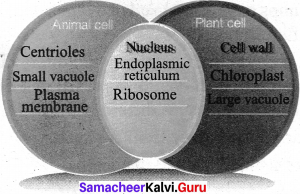
  1. Julian placed her lunchbox inside her bag. – Place Preposition
  2. Vinothini left the house before sunrise. – Time Preposition
  3. Ben saw Daisy playing across the road. – Place Preposition
  4. Hema keeps all her teddy bears on top of her wardrobe. – Position Preposition
  5. Divya hid the sweets behind her back. – Place Preposition
  6. Sudha fell over during the basketball match. – Position Preposition
  7. Madhusudhan checked to see if his keys had fallen underneath his chair. – Position Preposition
  8. Mrs Meena asked the children to go into her classroom. – Place Preposition
  9. After lunch, the children were allowed to play. – Time Preposition
  10. Saravanan climbed onto the horse. – Position Preposition

G. Complete the following sentences using appropriate prepositions.

Question 1.
Is your mother _______ home?
(a) in
(b) at
(c) on
Answer:
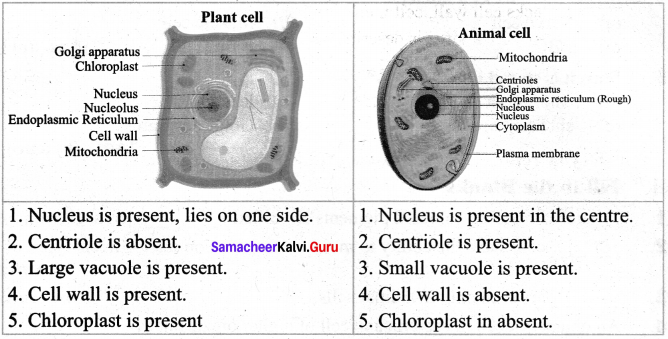
(b) at

Question 2.
There is unity in diversity _______ the people.
(a) among
(b) between
(c) within
Answer:
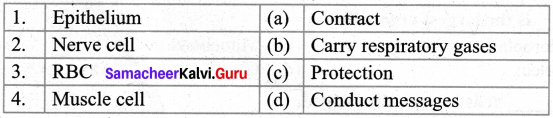
(a) among

Question 3.
He discussed the problem _______ his parents.
(a) with
(b) to
(c) for
Answer:
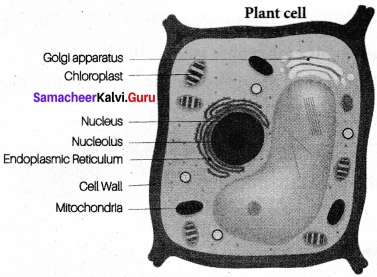
(a) with

Question 4.
Lithisha was praised _______ her father.
(a) with
(b) for
(c) by
Answer:
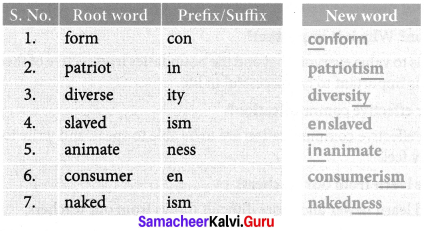
(c) by

Question 5.
Can you finish the work _______ tomorrow?
(a) by
(b) in
(c) within
Answer:
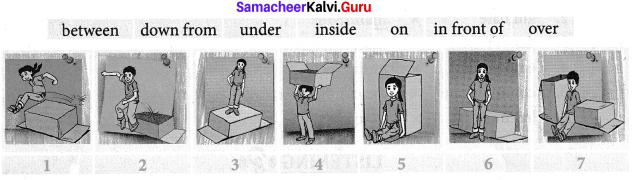
(a) by

Question 6.
He has been absent _______ last week.
(a) since
(b) for
(c) by
Answer:
(a) since

H. Fill in the blanks using suitable positions from the box. Some options can be used more than once.

(across,with,on,to,by,since,from,about,into,at,during)

  1. What do you do ______ weekends?
  2. I am going to my village ______ Sunday.
  3. I haven’t met my friends ______ December.
  4. Run ______ the street and get me the ribbon.
  5. He told me in detail ______ the incident.
  6. ‘This picture was drawn ______ the girl ______ Charcoal
  7. The car was travelling ______ a great speed.
  8. The ball fell ______ the lake.
  9. There is a bridge ______ the river.
  10. The conference will be held ______ 10 a.m. ______ 5 p.m.

Answer:

  1. during
  2. on
  3. since
  4. on
  5. about
  6. by; with
  7. at
  8. into
  9. across
  10. from; tol

I. Fill up the blanks using suitable prepositions on your own.

  1. The soldier climbed ________ a horse and rode away.
  2. They have been here ________ a long time.
  3. Kumaravel has lived in this city ________ 2012.
  4. The paper was published ________ an International journal.
  5. When will you return ________ home?
  6. One ________ the four students wrote the answers correctly.
  7. This fruit is ________ the Mexican capital.
  8. The head offce is ________ Nungambakkam. It is College Road. As you go the station, the office is the right side.
  9. The sailors were taken ________ the forest and made to walk 10 miles.
  10. The girl standing ________ me was sneezing.

Answer:

  1. on
  2. for
  3. since
  4. in
  5. back
  6. of
  7. from
  8. at; on; through; at
  9. through for
  10. before

Writing

J. Fill in the value rees with the best qualities you like to follow ii ir life from the given list. Write a few lines about your favourite quality in the box.
Answer:

A Prayer To The Teacher Summary Samacheer Kalvi 7th English Solutions Term 1 Prose Chapter 3

My favourite quality is Good manners. Good manners fetches good name for us. If we develop good manners from childhood it will continue till our adulthood. We shall be role models for others when we display good manners.

Creative Writing

K. Fill in the template given for limerick.
Answer:
There once was a chubby soft Teddy bear (8 syllable)
Whom cute baby had always near (8 syllable)
She played with him (5 syllable)
Even when she swim (5 syllable)
If Teddy’s lost don’t cry baby dear! (8 syllable)

A prayer to the Teacher Additional Questions

I. Choose the correct Synonyms from the options below.

Question 1.
emerge
(a) to appear
(b) come out
(c) reveal
Answer:
(b) come out

Question 2.
engulf
(a) swallow whole
(b) consume
(c) eat
Answer:
(a) swallow whole

Question 3.
nakedness
(a) frank
(b) open
(c) not hiding
Answer:
(a) frank

Question 4.
urban decay
(a) making city rot
(b) deteriorating the city
(c) destroy the city
Answer:
(c) destroy the city

Question 5.
gifted
(a) people with knowledge
(b) people blessed with everything
(c) giving fit
Answer:
(a) people with knowledge

Question 6.
cut throat
(a) highly competitive
(b) competitive
(c) cut the throat
Answer:
(a) highly competitive

Question 7.
value
(a) giving importance
(b) precious
(c) costly
Answer:
(a) giving importance

Question 8.
free
(a) without payment
(b) discount
(c) available without money
Answer:
(a) without payment

II. Pick the Correct Antonyms.

  1. proportionate × ______ (disproportionate, unusual size, inequal)
  2. unusual × ______ (usual, common, regular)
  3. urban × ______ (village, suburban, town)
  4.  accountable × ______ (unaccountable, not responsible, irresponsible)
  5. imbalance × ______ (balance, not partial, equal)
  6. animate × ______ (inanimate, not animal, non living)
  7. tolerance × ______ (intolerance, not tolerate, not adjusting)
  8. foreigner × ______ (native, inland person, citizen)
  9. humility × ______ (proud, boasting, dominating)
  10. indiscriminate × ______ (discriminate, judge carefully, identify)

Answer:

  1. disproportionate
  2. usual
  3. village
  4. unaccountable
  5. balance
  6. inanimate
  7. intolerance
  8. native
  9. proud
  10. discriminate

III. Choose the Correct Answer (MCQ).

Question 1.
I clean my house and empty the garbage on the road because the road is not ______ in what I feel is my own.
(a) included
(b) indulgence
(c) inclusion
Answer:
(a) included

Question 2.
I take my child to the movie but not my neighbour’s child because that child is beyond my zone of ______
(a) fostering
(b) caring
(c) parenting
Answer:
(c) parenting

Question 3.
Our depends on our power to impress ______
(a) survival
(b) impact
(c) honour
Answer:
(a) survival

Question 4.
We are ______ because we do not ask questions
(a) accountable
(b) learning
(c) enslaved
Answer:
(c) enslaved

Question 5.
The sea does not get ______ from us for the fish it gives us.
(a) tax
(b) royalties
(c) money
Answer:
(b) royalties

Question 6.
Poverty, disease and hunger have no ______
(a) diversity
(b) patriotism
(c) nationality
Answer:
(c) nationality

IV. Short Questions with Answers.

Question 1.
Give an introduction to the lesson ‘A Prayer to the Teacher’.
Answer:
The lesson A Prayer to the Teacher’ is actually the speech given by Subroto Bagchi, the Founder and CEO of Mindtree. The speech was the convocation address given to the teachers graduating from the International Academy for Creative Teaching at Bangalore in 2005.

Question 2.
What was the main theme of Subroto Bagchi’s speech?
Answer:
Subroto emphasizes mainly that the teachers should go beyond the syllabus and teach students the values and skills they need to live a useful and meaningful life.

Question 3.
What is the importance of the ‘power to impress’?
Answer:
Today’s students are forced to impress because their survival depends on their success in the rat race of common entrance tests and competitive exams and competitions.

Question 4.
‘Teach me also to raise my voice’. Is the author asking us to fight?
Answer:
No. The author wants us to speak thoughtfully to protect a life, one who is hurt and for truth. But at the same time when people unnecessarily shout, we should be silent, contemplate and act positively.

V. Paragraph Questions with Answers.

Question 1.
Define ‘inclusion’ and give three examples.
Answer:
Inclusion means valuing all people irrespective of their boundaries like financial and educational status, caste, creed, physical health, designation or nativity.
Examples:
1. Cleaning our house and emptying the garbage on the road because we do not feel the road is also ours.
2. Feeding our child in front of our hungry servant maid, not caring for her with a humanitarian heart that she also is one in our household.
3. Not taking the close neighbour’s child to the movie along with one’s own child, thereby not having a broad parental attitude.

Question 2.
List a few things we need to communicate and convey what we feel.
Answer:
We must be able to communicate with:

  1. A simple innocent child and nature.
  2. The disabled and the ones who are hard of hearing and speaking.
  3. Those who are under privileged and less gifted than us.
  4. People who are our seniors and elders as well as our juniors and youngsters.
  5. With all the living as well as the nonliving things around.
    By communicating, the speaker means to protect, safe-guard, cherish and to keep them.

Question 3.
‘Teach me to appreciate the interconnected nature of things’. How?
Answer:
The speaker wants the teachers to create an awareness in students about nature when
they teach of nature. Example :

a) It is not just teaching the concept of ‘rising waves’ but also the reasoning what causes the waves to fall.

b) Teaching not only teach the use of fertilizers and pesticides, but even the damage they cause by killing small creatures and felling big trees.

c) We teach the protection and promotion of the interests of consumers but at the same time we must also teach the imbalance it causes in the natural state of things which causes death and destruction on the earth.

d) We must not just teach about birds like crows and sparrows but also teach what makes them to go extinct and how it could be prevented by saving them.

Question 4.
In this increasingly commercial world, the things that truly support life comes freely to us. Justify with suitable evidence.
Answer:
The things that help us to live are mostly got free.
We do not pay the cow for the milk she gives.
The earth does not ask us money for the crops it gives.
The sun that gives light, the air that helps to breathe, the river that gives water and the clouds which give rain do not get paid for their services.

Question 5.
How can we‘develop a world view of things’according to the speaker.
Answer:
The speaker stresses that we must have the ‘one world’ feeling. Poverty, disease and hunger in the world have to be removed. Patriotism in the world should not be intolerance towards religion and race. Enimity and wars in the future must be replaced with love for our fellow human beings. There should be unity in diversity. We should have tolerance towards the differences found in people. No one should be a ‘foreigner’ for us but all people in the world are our brothers and sisters.

VI. Explain the Following Terms.

Question 1.
Narrow domestic walls.
Answer:
Here the speaker Subroto narrates how India had been crushed in ‘narrow domestic walls’ Which means it has been divided by regions or barriers based on class, colour, caste, race, religion, ethnicity, etc. This narrow attitude opposes to a feeling of one united nation or one united human race. These barriers are not favourable for nationalism and internationalism.

Question 2.
‘Illuminated with the power of thousand Suns’
Answer:
As a concluding note of his convocation address, Subroto speaks these words to bless all the new graduates. Anyone, who graduates, dreams to take up the best career, do well in it, achieve and to be elevated. Hence Subroto abundantly blesses the life of the graduates to be lighted and bright, equivalent to the light given by a thousand Suns.

Question 3.
Power of silence.
Answer:
Sometimes silence is more louder than voices. Example if a son makes a mistake and faces his father, expecting that he would scold him and when he does not scold him, the son would feel the silence more painful than his words. Silence gives inner strength.

Question 4.
Engulf me and mine.
Answer:
Here the speaker says that if we continue to fell trees, kill animals, use enormous technology that destroys nature and causes natural imbalance, then one day our own habits and actions would completely damage and destroy us.

A Prayer to the Teacher Grammar Additional

I. Fill in the blanks with prepositional phrases.

A Prayer To The Teacher Book Back Answers Samacheer Kalvi 7th English Solutions Term 1 Prose Chapter 3

Answer:

  1. into the boat
  2. in the dustbin
  3. over the phone
  4. over the track
  5. on the road

II. Underline the place prepositional phrases.

Question 1.
Mani was at home when I called.
Answer:
Mani was at home when I called.

Question 2.
The tourists walked along the riverside.
Answer:
The tourists walked along the riverside.

Question 3.
You cannot park your car outside the restaurant.
Answer:
You cannot park your car outside the restaurant.

Question 4.
The flat on the second floor is vacant.
Answer:
The flat on the second floor is vacant.

Question 5.
Nana will put the baby in the cradle.
Answer:
Nana will put the baby in the cradle.

III. Underline the time prepositional phrases.

Question 1.
Chandran will call the doctor by 10.00 a.m.
Answer:
Chandran will call the doctor by 10.00 a.m.

Question 2.
Papa will have his medicine after breakfast.
Answer:
Papa will have his medicine after breakfast.

Question 3.
The buses are crowded during the morning.
Answer:
The buses are crowded during the morning.

Question 4.
I go for a walk in the evening.
Answer:
I go for a walk in the evening.

Question 5.
I have my interview at 11.00 a.m.
Answer:
I have my interview at 11.00 a.m.

IV. Underline the Position Prepositional Phrases.

Question 1.
Arun’s pen was found under the table.
Answer:
Arun’s pen was found under the table.

Question 2.
Ravi’s cap was below the lamppost.
Answer:
Ravi’s cap was below the lamppost.

Question 3.
The Principal sat near the Chief guest.
Answer:
The Principal sat near the Chief guest

Question 4.
The drone was moving above her head.
Answer:
The drone was moving above her head.

Question 5.
He clicked a photo on the Napier bridge.
Answer:
He clicked a photo on the Napier bridge

Warm up
Read the clues gues the professional and fill in the crosswords puzzle

A Prayer To The Teacher 7th Standard Samacheer Kalvi 7th English Solutions Term 1 Prose Chapter 3

Answer:

A Prayer To The Teacher 7th Std Samacheer Kalvi  Term 1 Prose Chapter 3

Question 1.
Which is the role of a farmer in society? Discuss and answer.
Farmers are the backbone of our country. They produce the food-crops, the oil-seeds, the commercial crops, and also some raw materials for our industries. Our food and dress materials are obtained from the hard work of farmers. Due to cotton cultivation, several textile mills were established and they gave employment opportunities for the unemployed.

Question 2.
When you grow up, what do you want to become? Why?
Answer:
When I grow up I want to become a Teacher because I can enlighten the children with knowledge.

A Prayer to the Teacher Summary

This lesson is the convocation address given by Subroto Bagchi, Founder and CEO, Mindtree, for the graduating teachers, their faculty and administrators.
The speaker first stresses on inclusion – valuing all people, irrespective of their boundaries like financial and educational status, caste, creed, physical strength, designation or nativity.

He gives three examples: Dumping the garbage on the road which is also ours. Feeding our child in front of our hungry servant maid without a humanitarian heart.

Secondly the speaker says that amidst the cut throat competition, the more we want to impress, the less we communicate. He emphasises to communicate with an innocent child, nature, the dumb and deaf, less gifted, the old and young, the living and non-living things around too. Thirdly he feels that teachers should prepare students for the wide world by teaching them newer and difficult things. Help to learn newer ways to learn that will make learning a joy. Fourthly Subroto emphasises to teach to appreciate the interconnected nature of things. Like creating an awareness about ‘nature’ while the topic ‘Nature’ is taught.

Example:

  1. Teach not just the concept of ‘rising waves’ but also the reason why the waves fall.
  2. Not only the use of fertilizers and pesticides but also the damages they cause.
  3. Teach about birds like crows and sparrows how they go extinct and how to prevent it.

Subroto fifthly wants to inculcate the ability to question. This helps one to get answers, to establish better order of things, to be accountable and in the end it helps us to see the truth emerge.

The speaker sixthly clarifies that in this increasingly commercial world. All things that truly support life comes freely. The cow is not paid for the milk it gives, nor the earth asks money for the crops it gives. The sun gives light, air helps to breathe, the river gives water, clouds give rain, without getting paid for their services.

Seventhly the speaker wants the students to learn the ‘power of silence’. Stress our point without raising our voice and to raise our voice when our silence hurts another life.

Finally the speaker pleads the teachers to develop a world view of things by having a ‘one world’ feeling. By removing poverty, decrease and hunger in the world. Patriotism is not intolerance towards religion and race. Enmity was to be replaced with love for others. There should be unity in diversity. No one is a foreigner. All the people in the world are our siblings.

Samacheer Kalvi 7th Science Solutions Term 2 Chapter 2 Electricity

You can Download Samacheer Kalvi 7th Science Book Solutions Guide Pdf, Tamilnadu State Board help you to revise the complete Syllabus and score more marks in your examinations.

Tamilnadu Samacheer Kalvi 7th Science Solutions Term 2 Chapter 2 Electricity

Samacheer Kalvi 7th Science Electricity Textual Evaluation

I. Choose the correct answer:

Samacheer Kalvi 7th Science Guide Term 2 Question 1.
In the circuit diagram below, 10 units of electric charge move past point x every second What is the current in the circuit ________.
Samacheer Kalvi 7th Science Guide Term 2 Chapter 2 Electricity
(a) 10 A
(b) 1 A
(c) 10 V
(d) 1 V
Answer:
(a) 10 A

Electricity Book Back Answers Question 2.
In the circuit shown, which switches (L, M or N) must be closed to light up the
Electricity Book Back Answers Samacheer Kalvi 7th Science Solutions Term 2 Chapter 2
(a) switch L only
(b) switch M only
(c) Switch M and N only
(d) either switch L or switches M and N
Answer:
(d) either switch L or switches M and N

Samacheer Kalvi 7th Science Term 2 Question 3.
Small amounts of electrical current are measured in milliampere (mA). How many milliampere are there in 0.25 A ?
(a) 2.5 mA
(b) 25 mA
(c) 250 mA
(d) 2500 mA
Answer:
(c) 250 mA

Samacheer Kalvi 7th Science 2nd Term Question 4.
which of the following circuits are the bulb connected in series?
Samacheer Kalvi 7th Science Term 2 Chapter 2 Electricity
Answer:
Samacheer Kalvi 7th Science 2nd Term 2 Chapter 2 Electricity

II. Fill in the blanks

  1. The direction of conventional current is ____________ to electron flow.
  2. One unit of coulomb is charge of approximately ____________ protons or electrons.
  3. ____________ is used to measure the electric current.
  4. In conducting materials electrons are ____________
  5. S.I. unit of Electrical conductivity of a conductor is ____________

Answers:

  1. Opposite
  2. 6.242×10
  3. Ammeter
  4. Loosely
  5. siemens/meters

III. True or false – If false give Hie correct answer:

Samacheer Kalvi 7th Science Book Answers Term 2 Question 1.
Electron flow is in the same direction to conventional current flow.
Answer:
False.
Electron flow is in the opposite direction to conventional current flow.

7th Science Term 2 Question 2.
The fuse wire does not melts whenever there is overload in the wiring.
Answer:
False.
The fuse wire melts whenever there is overload in the wiring.

7th Standard Term 2 Science Question 3.
In a parallel circuit, the electric components are divided into branches.
Answer:
True.

Electricity Lesson 7th Class Question 4.
The representation of the electric current is A.
Answer:
False.The representation of the electric current is I.

7th Class Electricity Lesson Question 5.
The electrical conductivity of the semiconductor is in between a conductor and an insulator.
Answer:
True.

VI. Match the following :

  1. Cell – used to open or close a circuit
  2. Switch – safety device used in electric circuit
  3. Circuit – A complete path for the flow of an electric current
  4. Miniature circuit Breaker- Reset by hand, circuit becomes complete once again
  5. Fuse – A device which converts chemical energy into electrical energy

Answer:

  1. Cell – A device which converts chemical energy into electrical energy
  2. Switch – used to open or close a circuit
  3. Circuit – A complete path for the flow of an electric current
  4. Miniature circuit Breaker – Reset by hand, circuit becomes complete once again
  5. Fuse – safety device used in electric circuit

V.Analogy:

Samacheer Kalvi Guru 7th Science Term 2 Question 1.
Water : pipe : : Electric current: ______.
Answer:
wire

7th Class Science Electricity Lesson Question 2.
Copper : conductor : : Wood : ________.
Answer:
insulator

7th Standard 2nd Term 2nd Lesson Question 3.
Length : meter scale : : Current : ________.
Answer:
ammeter

Question 4.
milli ampere: micro ampere : : 10 – 3A: _______.
Answer:
10-6A

VI. Assertion and Reason :

Question 1.
Assertion (A) : Copper1 is used to make electric wires.
Reason (R) : Copper has very low electrical resistance.
Option:
A. Both A and R are true and R is the correct explanation of A.
B. Both A and R are true but R is NOT the correct explanation of A.
C. A is true but R is false.
D. A is false but R is true.
E. Both A and R are false .
Answer:
A. Both A and R are true and R is the correct explanation of A

Question 2.
Assertion (A) : Insulators do not allow the flow of current through themselves. Reason (R) : They have no free charge carriers.
A. If both A and R are true and the R is correct explanation of A.
B. If both A and R are true but R is not a correct explanation of A.
C. If A is true and R is false.
D. If both A and R are false.
Answer:
A. If both A and R are true and the R is correct explanation of A

VII. Very short answer :

Question 1.
What is the speed of electric current?
Answer:
Current travels at the speed of 1/100th times the speed of light 0.0002 m/s.

Question 2.
What is the S.I unit of electrical conductivity?
Answer:
The SI unit of electrical conductivity is Siemens / metres (s/m).

Question 3.
Name the device used to generate electricity.
Answer:
Electric cell.

Question 4.
Define fuse.
Answer:
Electric fuse is a safety device which is used in household wiring and in many appliances.

Question 5.
Name some devices that run using heat effect of electric current
Answer:
Electric bulb, geyser, Iron box.

Question 6.
Name few insulators.
Answer:
Rubber, wood, plastic, glass.

Question 7.
What is a battery?
Answer:
Batteries are a collection of one or more cells whose chemical reactions create a flow of electrons in a circuit.

VIII. Short Answer :

Question 1.
Define an electric current.
Answer:
An electric current is measured by the amount of electric charge moving per unit time at any point in the circuit. The conventional symbol for current is I.

Question 2.
Differentiate parallel and serial circuits.
Answer:
Parallel circuits:

  1. It is connected by branches.
  2. Voltage remains the same across each component of the circuit
  3. Each bulb is fully powered.
  4. All bulbs stay lit if one goes out.

Serial circuits:

  1. It consist of single loop connection.
  2. Current remains same in all parts of the circuit.
  3. All the bulbs share power.
  4. All bulbs go out if one goes out.

Question 3.
Define electrical conductivity.
Answer:
Electrical conductivity or specific conductance is the measure of a material’s ability to conduct an electric current.

IX. Long Answer :

Question 1.
Explain flie construction and working of an Telephone.
Answer:
In telephones, a changing magnetic effect causes a thin sheet of metal (diaphragm) to vibrate. The diaphragm is made up a metal that can be attracted to magnets.

  1. The diaphragm is attached to spring that is fixed to the earpiece.
  2. When a current flows through the wires, the soft – iron bar becomes an electromagnet.
  3. The diaphragm becomes attracted to the electromagnet.
  4. As the person on the other end of the line speaks, his voice cause the current in the circuit to change. This causes the diaphragm in the earpiece to vibrate, producing sound.

Question 2.
Explain the heating effect of electric current
Answer:

  1. When an electric current passes through a wire, the electrical energy is converted to heat.
  2. In heating appliances, the heating element is made up of materials with high melting point. An example of such a material is nichrome (an alloy of nickel, iron and chromium).
  3. The heating effect of electric current has many practical applications.
  4. The electric bulb, geyser, iron box, immersible water heater are based on this effect.
  5. These appliances have heating coils of high resistance.
  6. Generation of heat due to electric current is known as the heating effect of electricity.

Question 3.
Explain the construction and working of a dry cell.
Answer:

  1. A dry cell is a portable form of a leclanche cell.
  2. It consists of zinc vessel which acts as a negative electrode or anode.
  3. The vessel contains a moist paste of saw dust saturated with a solution of ammonium chloride an chloride.
  4. The ammonium chloride acts as an electrolyte.
  5. The purpose of zinc pide is to maintain the moistness of the paste being highly gyroscopic.
  6. The carbon rod covered with a brass cap is placed in the middle of the vessel. It acts as positive electrode or cathode.
  7. It is surrounded by a closely packed mixture of charcoal and manganese dioxide (Mn02) in a muslin bag.
  8. Here Mn02 acts as depolarizer. The zinc vessel is sealed at the top with pitch or shellac.
  9. A small hole is provided in it to allow the gases formed by the chemical action to escape.
  10. The chemical action inside the cell is the same as in avalanche cell.

X. Higher Order Question:

A student made a circuit by using an electric cell, a switch, a torch bulb (fitted in the bulb holder) and copper connecting wires. When he turned on the switch, the torch bulb did not glow at all. The student checked the circuit and found that all the wire connections were tight.

Question 1.
What could be the possible reason for the torch bulb not glowing even when the circuit appears to be complete?
Answer:
The possible reasons so that even at switch ‘ON’ position the bulb is not glowing are:

  1. The cell may be discharge
  2. The bulb may be fused.
  3. The wire may be broken from inside
  4. The connection may be loose.

XI. Picture based Questions:

Question 1.
Three conductors are joined as shown in the diagram.
The current in conductor RS is 10 A. The current in conductor QR is 6 A. What will be the current in conductor PR
Samacheer Kalvi 7th Science Book Answers Term 2 Chapter 2 Electricity
(a) 4A
(b) 6 A
(c) 10 A
(d) 16 A
Solution:
PR + OR = RS
PR + 6A = 10A
PR = 10A- 6A = 4A

Question 2.
Draw the circuit diagram for the following series connection.
7th Science Term 2 Samacheer Kalvi Term 2 Chapter 2 Electricity
Answer:
7th Standard Term 2 Science Samacheer Kalvi Chapter 2 Electricity

Question 3.
Study the electric circuit below. Which of the following switches should be closed so that only two bulbs will light up.
Electricity Lesson 7th Class Samacheer Kalvi Term 2 Chapter 2 Electricity
(a) SI, S2 and S4 only
(b) SI, S3 and S5 only
(c) S2, S3 and S4 only
(d) S2, S3 and S5 only
Answer:
(c) S2, S3 and S4 only

Question 4.
Study the three electric circuits below. Each of them has a glass rod (G), a steel rod (S), and a wooden rod (W).
In which of the electric circuits would the bulb not light up
7th Class Electricity Lesson Samacheer Kalvi Term 2 Chapter 2 Electricity
(a) A only
(b) C only
(c) A and B only
(d) A, B and C
Answer:
(c) A and B only

Samacheer Kalvi 7th Science Electricity Intext Activities

Activity – 3

Question 1.
I am so exhausted. I am going to faint. What first aid will you give me to wake up?
Answer:
Samacheer Kalvi Guru 7th Science Term 2 Chapter 2 Electricity
I will recharge immediately

Samacheer Kalvi 7th Science Electricity Additional Questions

I. Choose the correct answer.

Question 1.
An electric component used as a safety device is electric circuit is
(a) cell
(b) electric wires
(c) switch
(d) fuse
Answer:
(d) fuse

Question 2.
In an electric circuit, the current starts from
(a) the positive terminal of the battery
(b) the negative terminal of the battery
(c) either of the terminals of the battery
(d) none
Answer:
(a) the positive terminal of the battery

Question 3.
_______ was developed is 1887 by Yei Sakizo of Japan
(a) Alkaline cell
(b) Button cell
(c) Lead accumulator
(d) Dry cell
Answer:
(d) dry cell

Question 4.
________ cell is used to operate devices such as mobile phones, computers and emergency lights
(a) Primary cell Lithium cell
(b) Secondary cell
(c) Lithium Cell
(d) None
Answer:
(b) Secondary cell

Question 5.
A battery is a group of _______
(a) only two cells
(c) two or more cells
(b) only single cell
(d) all of these
Answer:
(c) two or more cells

Question 6.
Which of the following is an electrical conductor?
(a) cork
(b) wood
(c) plastic
(d) silver
Answer:
(d) silver

Question 7.
Which one of the following phenomenon occurs when two naked wires of electricity supply line touch other?
(a) Lightning
(b) Short circuiting
(c) Overloading
(d) none
Answer:
(b) Short circuiting

Question 8.
Magnetic effect of current was discovered by ____________
(a) Flemming
(b) John Dalton
(c) Newton
(d) Hans Christian Oersted
Answer:
(d) Hans Christian Oersted

Question 9.
Which of the following is the symbol for a bulb?
7th Class Science Electricity Lesson Samacheer Kalvi Term 2 Chapter 2
Answer:
7th Standard 2nd Term 2nd Lesson Samacheer Kalvi Chapter 2 Electricity

Question 10.
Electricians wear rubbers gloves because it is ____________
(a) soft
(b) an insulator
(c) conductor
(d) water proof
Answer:
(b) an insulator

II. Fill in the Blanks.

  1. ____________ is a common example of the practical application.
  2. An insulator gives a lot of ____________ to the flow of charge (electron)
  3. Wires made of ____________  an electrical conductor, have very low resistance.
  4. The chip which are used in SIM cards and ATM cards are made up of ____________
  5. ____________  are used to remove splinters of steel or iron in hospitals dealing with eye injuries.
  6. Edison used a ____________ wire coil is a vacuum glass and discovered the first electric bulb in 1879.
  7. ____________ cells cannot be recharged after use. x
  8. The SI unit of potential difference is____________
  9. The SI unit of resistance is____________
  10. An electric charge always flows from a point____________ at to a point at____________

Answer:

  1. Arc welding
  2. resistance
  3. copper
  4. Semi conductors
  5. Electromagnets
  6. platinum
  7. platinum
  8. volt (V)
  9. ohm
  10. higher potential, lower potential

III. True or False – if false give the correct statement.

Question 1.
Insulators do not carry electric current because they do not have free electrons.
Answer:
True.

Question 2.
An MCB can be used instead of a fuse in an electrical circuit.
Answer:
True.

Question 3.
The flow of electric charge per unit time is called potential difference.
Answer:
False. The flow of electric charge per unit time is called current.

Question 4.
The source which produce the small amount of electricity for shorter period of time is called as electro chemical cell.
Answer:
True.

Question 5.
Electric cell converts electrical energy into chemical energy.
Answer:
False. Electric cell converts chemical energy into electrical energy.

Question 6.
The pipe is like the wire in the electric circuit and the pump is like the battery.
Answer:
True.

Question 7.
All batteries are made up of three components an anode, a cathode and some kind of electrolyte.
Answer:
True.

Question 8.
An insulator gives a less resistance to the flow of charge.
Answer:
False.An insulator gives a more resistance to the flow of charge.

Question 9.
Electric fuse has a body made of ceramic and two points for connecting the fuse wire.
Answer:
True

Question 10.
Chemical reaction happens, when electricity passes through various conducting liquids.
Answer:
True

IV. Match the following
Question 1.

  1. 1 mA – (a) series
  2. 1 pA – (b) ohm – metre
  3. Ammeter – (c) 10-6 ampere
  4. Electrical resistivity – (d) 10-3 ampere

Answer:

  1. (d)
  2. (c)
  3. (a)
  4. (b)

Question 2.
Samacheer Kalvi 7th Science Solutions Term 2 Chapter 2 Electricity image - 14
Answer:

  1. (b)
  2. (d)
  3. (a)
  4. (c)

Question 3.

  1. Dry cells – (a) Reversible
  2. Electrolyte – (b) Opens or closes the circuit
  3. Switch – (c) Solution
  4. Secondary cell – (d) Torches

Answer:

  1. (d)
  2. (c)
  3. (b)
  4. (a)

Question 4.
Samacheer Kalvi 7th Science Solutions Term 2 Chapter 2 Electricity image - 15
Answer:

  1. (b)
  2. (c)
  3. (d)
  4. (a)

V. Assertion and Reason.

Mark the correct choice as
(a) Both A and R are true but R is the correct explanation of A.
(b) Both A and R are true and R is the not the correct explanation of A.
(c) A is true but R is false.
(d) A is false but R is true.

Question 1.
Assertion (A) : Charges flow from higher potential to the lower potential.
Reason (R) : Current flows mainly due to flow of electrons.
Answer:
(b) Both A and R are true and R is the not the correct explanation of A

Question 2.
Assertion (A) : Insulators do not allow flow of current through them.
Reason (R) : Insulators have no free charge carrier.
Answer:
(a) Both A and R are true but R is the correct explanation of A

Question 3.
Assertion (A) : A current carrying wire should be charged.
Reason (R) : The current in a wire is due to flow of free electrons in a definite direction.
Answer:
(d) A is false but R is true

Question 4.
Assertion (A) : The connecting wires are made of copper.
Reason (R) : The electrical conductivity of copper is high.
Answer:
(a) Both A and R are true but R is the correct explanation of A

VI. Very short Answers:

Question 1.
What is the source of electric current in a T.V. remote?
Answer:
Electric cell.

Question 2.
In which position is key placed in a circuit?
Answer:
Key can be placed anywhere in the circuit.

Question 3.
What are the effects of electricity?
Answer:

  1. Heating effect
  2. Chemical effect
  3. Magnetic effect

Question 4.
Name the instrument which is used to measure potential difference.
Answer:
Voltmeter.

Question 3.
Name the portable form of a avalanche cell.
Answer:
Dry cell.

Question 4.
Name the substance that become ions in solutions and acquire the capacity to conduct electricity.
Answer:
Electrolytes.

Question 7.
Name the component of a circuit which help us to start or stop the appliances & safely and easily.
Answer:
Switch.

Question 8.
Name the component which connects electrical components to one another.
Answer:
Wire.

VII. Short Answer.

Question 1.
What is resistance?
Answer:
Resistance is the property of an electrical component which resists the flow of electric charges, when it is connected is a circuit.

Question 2.
What are the uses of electromagnets?
Answer:
Electromagnets are used in cars, speakers, electric motors, electric cells, telephone receivers and television.

Question 3.
What is an electric fuse made up of?
Answer:
A fuse is a small place of wire of an alloy of low melting point (63% tin and 37% lead).

Question 4.
What do you mean by magnetic effect?
Answer:
When electric current passes through a wire, it behaves like a magnet. This is called
magnetic effect of electricity.

Question 5.
What are MCB’s? How do they work?
Answer:

  1. MCB’s (Miniature Circuit Breakers) are switches which automatically turn off when current in a circuit exceeds the safe limit.
  2. We turn them on and the circuit is once again complete.

Question 6.
What is heating effect of the electric current?
Answer:

  1. The wire or component gets hot when an electric current passes through them,
  2. This is known as heating effect of the electric current.

Question 7.
Define electric cell. What is the direction of electric current in a cell?
Answer:

  1. The simplest sources of an electric current is an electric cell and it has a positive terminal and a negative terminal.
  2. In electric cell the current starts from positive terminal of the cell, passes through the equipment connected to it, and terminates at the negative terminal of the cell.

Question 8.
What do you mean by an open circuit?
Answer:
Samacheer Kalvi 7th Science Solutions Term 2 Chapter 2 Electricity image - 16
An open circuit occurs when there is break in the circuit which stops the current from flowing. Breaks in the circuit can be due to many causes, such as loose bulb holder or a missing wire in the circuit.

Question 9.
Write the analogy between water current and electric current.
Answer:

  1. Water molecules flow towards a point of lower elevation.
  2. Electric charges flow towards a point of lower voltage.

Question 10.
What are the factors affecting heating effect of electric current?
Answer:

  1. The amount of current I.
  2. The resistance R and

VIII. Long Answer

Question 1.
Write the differences between primary cell and secondary cell.
Answer:
Primary cell:

  1. The chemical reaction inside the primary cell is irreversible
  2. It cannot be recharged.
  3. Examples of secondary cells are lead accumulator, Edison accumulator and Nickel – Iron accumulator.
  4. Examples- simple voltalic cell, Daniel cell, and lechlanche cell and dry cell

Secondary cell:

  1. The chemical reaction inside the secondary cell is reversible.
  2. It can be recharged.
  3. It is used to operate devices such as mobile phones, cameras, computers, and emergency lights.
  4. Examples of secondary cells are lead accumulator, Edison accumulator and Nickel – Iron accumulator.

Question 2.
Explain the working of an electric fuse.
Answer:

  1. Electric fuse is a safety device which is used in household wing and in many appliances.
  2. Electric fuse has a body made of ceramic and two points for connecting the wire.
  3. The fuse wire melts whenever there is overload of the current in the wire.
  4. This breaks the circuit and helps in preventing damage to costly appliances and to the wiring.
  5. In electrical devices, a glass fuse is often used.
  6. This is a small glass tube, in which lies the fuse wire.

Question 3.
Explain the following :

  1. Semi – conductors
  2. Short circuit.

Answer:
1. The chip which are used in SIM Cards, Computers, and ATM cards are made up of semiconductors namely, silicon and germanium because of their electrical conductivity lies between a conductor and an insulator.

2. A short circuit is simply a low resistance connection between two conductors supplying electrical power to any circuit. Arc welding is a common example of the practical application of the heating due to a short circuit.

Question 4.
Draw the following using symbols:

  1. Open circuit
  2. Closed circuit
  3. Series circuit
  4. Parallel circuit

Answer:
1. Open Circute:
Samacheer Kalvi 7th Science Solutions Term 2 Chapter 2 Electricity image - 17

2. Closed Circuit:
Samacheer Kalvi 7th Science Solutions Term 2 Chapter 2 Electricity image - 18
3. Series Circuit:
Samacheer Kalvi 7th Science Solutions Term 2 Chapter 2 Electricity image - 19
4. Parallel Circuit:
Samacheer Kalvi 7th Science Solutions Term 2 Chapter 2 Electricity image - 20

IX. Problems for practice:

Question 1.
If 50 coulomb of electric charge flows through a wire in five minutes, calculate the current in the wire?
Solution:
Charge q = 50 c
time t = 5 min × 60 s = 300 s
current I = \(\frac { q }{ t }\)
= \(\frac { 50 }{ 300 }\) = \(\frac { 5 }{ 30 }\) = 0.166A

Question 2.
If 5A current flows through a circuit, then convert the current is terms of micro ampere?
solution :
I = 5A
IA = 106 µA
5A = 5 × 10⁶ µA
5A = 50,00,000 µA

Question 3.
If 3A current flows through a circuit, then convert the current in terms of milliampere.
solution:
I = 3A
1A = 103 mA
3A = 3 × 1000 mA
3A = 3000 mA

X. Creative questions: HOTS

Question 1.
What is the difference between fuse wire and a heating wire?
Answer:
The fuse wire has low melting point, whereas the heating wire has a high melting point. Fuse wire is made up of tin-lead alloy, whereas heating wire is made of constant. (Copper and nickel alloy)

Question 2.
Observe the circuit given:

  1. Would any of the bulb glow when the switch is in the ‘OFF’ position?
    Samacheer Kalvi 7th Science Solutions Term 2 Chapter 2 Electricity image - 21
  2. What will be the order in which the bulbs A, B and C will glow when the switch is moved to the ‘ON’ position?

Answer:

  1. No bulb will glow
  2. All bulbs will glow simultaneously.

Samacheer Kalvi 7th Science Solutions Term 2 Chapter 3 Changes Around Us

You can Download Samacheer Kalvi 7th Science Book Solutions Guide Pdf, Tamilnadu State Board help you to revise the complete Syllabus and score more marks in your examinations.

Tamilnadu Samacheer Kalvi 7th Science Solutions Term 2 Chapter 3 Changes Around Us

Samacheer Kalvi 7th Science Changes Around Us Textual Evaluation

I. Choose the best answer :

Changes Around Us Class 7 Question 1.
When a woolen yarn is knitted to get a sweater, the change can be classified as _________
(a) physical change
(b) chemical change
(c) endothermic change
(d) exothermic change
Answer:
(a) physical change

7th Class Science Changes Around Us Question 2.
_________ of the following are endothermic changes.
(a) Condensation and melting
(b) Condensation and freezing
(c) Evaporation and melting
(d) Evaporation and freezing
Answer:
(a) Condensation and melting

Changes Around Us Class 7 Pdf Question 3.
The chemical change is _______
(a) water to clouds
(b) growth of tree
(c) cow dung to bio-gas
(d) ice-cream to molten ice-cream
Answer:
(c) cow dung to bio-gas

Changes Around Us 7th Class Lesson Question 4.
_______ is an example of a periodic change
(a) Earthquake
(b) Formation of rainbow in sky
(c) Occurrence of tides in seas
(d) Showering of rain
Answer:
(a) Earthquake

Question 5.
_______ is not a chemical change.
(a) Dissolution of ammonia in water
(b) Dissolution of carbon-dioxide in water
(c) Dissolution of oxygen in water
(d) Melting of polar ice caps
Answer:
(b) Melting of polar ice-caps

II.Fill in the blanks :

  1. Filling up a balloon with hot air is a _______ change.
  2. Stretching gold coin into a ring is a _______ change.
  3. Opening a gas cylinder knob converts _______ fuel into _______ fuel. This is an example of _______ change.
  4. Spoiling of food is a _______ change.
  5. Respiration is a _______ change.

Answer:

  1. physical
  2. physical
  3. liquid, gaseous, chemical
  4. chemical
  5. exothermic chemical

III. True or False – If False give the correct answer :

Question 1.
Cutting of cloth is an example of a periodic change.
Answer:
False, Cutting of cloth is an example of a physical change.

Question 2.
Taking a glass of water and freezing it by placing it in the freezer is a chemical change.
Answer:
False, Taking a glass of water and freezing it by placing it in the freezer is a physical change

Question 3.
A bean plant collecting sunlight and turning it into bean seeds is an example of physical and non-periodic change.
Answer:
False, A bean plant collecting sunlight and turning it into bean seeds is an example of chemical and non-periodic change.

Question 4.
If the chemical properties of a substance remain unchanged and the appearance or shape of a substance changes it is called a periodic change.
Answer:
False, if the chemical properties of a substance remain unchanged and the appearance or shape of a substance changes it is called a fossil change.

Question 5.
Tarnishing of silver is an example of endothermic change.
Answer:
False, Tarnishing of silver is an example of change.

IV. Match the following:
Changes Around Us Class 7 Samacheer Kalvi Science Solutions Term 2 Chapter 3
Answer:
7th Class Science Changes Around Us Samacheer Kalvi Term 2 Chapter 3

V. Classify the following changes as physical and chemical changes:

Question 1.
A rough piece of wood is sanded and polished resulting in change in texture, Rusting of a iron nail, Painting the grill, Bending a paper clip, Pounding silver into thin plate, Rolling the chapathi dough into thin wire, Occurrence of day and night, eruption of volcano, burning of matchstick, dosa from the batter, blinking of eyelids, occurrence of a thunderstorm, rotation of the earth, formation of eclipses.
Answer:

Physical changes

  1. Bending a paper clip.
  2. Pounding silver into thin plate.
  3. Rolling a chapathi dough into thin wire.
  4. Occurrence of a day and night.
  5. Blinking of eyelids.
  6. Occurrence of a thunderstorm.
  7. Rotation of the earth.
  8. Formation of eclipses.
  9. Painting the grill.
  10. A rough piece of wood is sanded and polished resulting in change in texture.
  11. Dosa from the batter.

Chemical changes

  1. Rusting of a iron
  2. Eruption of volcano
  3. Burning of matchstick.

VI Analogy:

Question 1.
Physical Change: Boiling::Chemical Change: ________
Answer:
Burning.

Question 2.
Wood to saw dust: _________ :: Wood to Ash: Chemical change
Answer:
Physical change.

Question 3.
Forest fire: ________ change::Change in period in a school: periodic change
Answer:
Non-periodic.

VII. Very short answer type question :

Question 1.
State two examples of periodic changes.
Answer:
Seasonal changes, motion of hands of a clock.

Question 2.
Mention any two exothermic reactions.
Answer:
Burning of magnesium ribbon and burning of a candle.

Question 3.
Cold milk is heated and it becomes hot. Which type of change it is?
Answer:
Reversible.

Question 4.
What type of change is artificial ripening of fruit?
Answer:
Irreversible chemical change.

Question 5.
What type of change is coloring of a paper?
Answer:
Physical change.

Question 6.
Growing of nails is a periodic change. Why?
Answer:
Growing of nail is a periodic change, because it occurs periodically at regular intervals.

Question 7.
What type of energy changes is associated when ice melts?
Answer:
Changes Around Us Class 7 Pdf Samacheer Kalvi Science Solutions Term 2 Chapter 3

  1. Physical change
  2. Endothermic (heat energy is absorbed)

VII. Short answer type question :

Question 1.
Distinguish physical and chemical changes.
Answer:
Physical changes:

  1. No new substance is formed
  2. Reversible
  3. Change in physical properties like size, shape, state
  4. Melting of ice, tearing of paper freezing, evaporation vaporization

Chemical changes:

  1. New substance is formed
  2. Irreversible
  3. Change in properties of reactants and products
  4. Burning of paper, photosynthesis, digestion of food, rusting of iron

Question 2.
How can a change occur in a substance?
Answer:
A change can occurs in a substance by an alteration in the properties such as colour, texture and the state of the substance since there is formation of a new substance.

Question 3.
Can you suggest a method to collect water from sea water?
Answer:
Evaporation.

Question 4.
Is solar eclipse a periodic change? Give your reason.
Answer:
Yes, solar eclipse is a periodic change as it occurs after a definite interval of time.

Question 5.
What is the difference between dissolution of sugar and burning of sugar ?
Answer:

Dissolution of sugar:

  1. When sugar is dissolved in water it disappears. It we taste the solution, the sugar is still present in dissolved form.
  2. If water is evaporated we get back the sugar.
  3. So it is a physical and reversible change.

Burning of sugar:

  1. Fire activates a chemical reaction between sugar and oxygen. The oxygen in the air reacts with the sugar as the chemical bonds broke.
  2. Energy is released in the form of smoke.
  3. So, burning a sugar is a chemical change.

IX. Long answer type question :

Question 1.
Explain the following statement: Digestion is a chemical change.
Answer:

  1. When we eat, our mouth physically break down food into small pieces.
  2. Mechanical digestion occurs in the mouth, stomach and small intestine.
  3. Food is chemically changed in digestion when new, smaller substances are formed.
  4. Moreover, we will never be able to get back the raw material in the same form as it was before.
  5. Digestion of food is a permanent change which is irreversible.

Question 2.
How the iron blade is fixed into a wooden handle in tools used to dig the soil?
Answer:

  1. First the ring in the iron blade of spade is heated.
  2. Heating of the blade leads to its expansion and thus the ring gets bigger.
  3. This happens because metals always expand on heating.
  4. The metal blade is then fitted easily into the wooden handle.
  5. After this, cold water is usually poured on the iron blade which leads to the contraction of the expanded iron blade.
  6. The spade can also be left to cool down, undisturbed so that it is firmly fixed, (vu) The blade is attached firmly to the wooden handle of a spade in this process.

X.Higher order Thinking questions :

Question 1.
Peeled and unpeeled banana does not look the same. Does that mean peeling banana is a chemical change?
Answer:
No, it is not a chemical change. We just separated the skin of the banana and there is no change is its composition..

Question 2.
A very hot glass on putting in cold water cracks. What does this change indicate?
Answer:
When hot glass is cooled fast, the glass cools down unevenly and therefore cause the glass to crack because inside contracts while the outside remains expanded. Glass expands when hot and contracts when cold. It’s a physical but irreversible change.

Question 3.
Boiling of water is a physical change; but boiling of egg is a chemical change. Why?
Answer:
Boiling of water is a physical change:

  1. On boiling, water is converted into steam. If we cover the beaker with a lid, steam condenses back to water. So, boiling, of water is a physical change since only the physical state of water changes.

Boiling of egg is chemical change:

  1. When egg is boiled, chemical nature of the egg changes. The properties of a boiled egg are totally different from the raw egg. Hence, boiling of an egg is a chemical change.

XI. Assertion – Reason type question :

Question 1.
Assertion (A) : The explosion of fire cracker is a physical change.
Reason (R) : A physical change is a reversible change.
Option:
(a) Both A and R are true and R is the correct explanation of A.
(b) Both A and R are true but R is not the correct explanation of A.
(c) A is true but R is false.
(d) A is false but R is true.
Answer:
(d) A is false but R is true

Question 2.
Assertion (A) : e process of conversion of liquid water to its vapours by heat mg the liquid is called boiling.
Reason (R) :The process of conversion of water vapours to liquid by cooling the vapors is called condensation
(a) Both A and R are true and R is the correct explanation of A.
(b) Both A and R are 11 but R is not the correct explanation of A.
(c) A is true but R is false.
(d) A is false but R is true.
Answer:
(b) Both A and R are true but R is not the correct explanation Of A.’

Question 3.
Assertion (A) : Burning of wood log to charcoal is a physical change.
Reason (R) : The products formed of burning a piece of wood can be easily converted back to wood log.
(a) Both A and R are true and R is the correct explanation of A.
(b) Both A and R are true but R is not the correct explanation of A.
(c) A is true but R is false.
(d) A is false but R is true.
Answer:
The correct answer is A Both A and R are false]

Question 4.
Assertion (A) : The formation of iron oxide from iron is a chemical change.
Reason (R) : For the rust to form from iron, it must be exposed to air and water.
(a) Both A and R are true and R is the correct explanation of A.
(b) Both A and R are true but R is not the correct explanation of A.
(c) A is true but R is false. .
(d) A is false but R is true.
Answer:
(a) Both A and R are true and R is the correct explanation of A.

XII. Picture based Questions:
Observe the picture and list down the changes that are accompanied in the picture.
Changes Around Us 7th Class Lesson Samacheer Kalvi Term 2 Chapter 3
Answer:
(a)Physical change
(b)Chemical change
(c) Exothermic

Question 2.
Observe the picture containing a kettle and note that it has salt water in it and answer the following questions.
(a) What is name of the process that is done to the kettle?
(b) What will happen to the content of the kettle?
(c) What kind of change is occurring on the cold surface of the metal plate?
(d) What can you say about the quality of water that is obtained in the beaker?
Samacheer Kalvi 7th Science Solutions Term 2 Chapter 3 Changes Around Us image -5
Answer:
(a) Boiling
(b) Water in the kettle gets converted into vapour
(c) Endothermic
(d) Water vapour converted into liquid (condensation)

Samacheer Kalvi 7th Science Changes Around Us Intext Activity

Activity – 3

Question 1.
Take two pans, one wide and another narrow. Fill hot water in both to the same depth. Keep them in open. Observe after one to two hours. The pan that is wide has cooled more than the narrow one. That is more the surface area; the rate of evaporation is more.
Samacheer Kalvi 7th Science Solutions Term 2 Chapter 3 Changes Around Us image -6
From this, can you guess why we unfurl the clothes while putting them to dry, rather than just drape them over the cloth line?
Answer:
Wet clothes dry faster when we unfurl (Spread) them because the rate of evaporation depends on the surface area. If the surface area will be more, rate of evaporation will be higher or more.

Activity – 7

Question 1.
Take a small piece of magnesium ribbon and clean it by rubbing its surface with a sand paper. Hold the magnesium ribbon at one end with a pair of tongs and bring its other end over the flame of a burner.
Samacheer Kalvi 7th Science Solutions Term 2 Chapter 3 Changes Around Us image -7
Answer:
Magnesium ribbon must be cleaned before burning. So that the layer of magnesium oxide can be removed in order to get the desired chemical reaction.
Magnesium ribbon burns in air with a dazzling flame and forms a white ash, I magnesium gets oxidised to magnesium oxide.

Activity- 9

Question 11.
Ask a student to stretch both hands, put a pinch of soap powder in one hand and a pinch of glucose in the other hand. Add a few drops of water to soap powder and ask how the student feels upon adding water. Now add a few drops of water to the glucose at the other hand. Now ask the student how he /she feels on adding water, What is the feeling when water is added to glucose?
Answer:
We feel cool.

Question 10.
What is the difference when water is added to soap powder and when water is added to glucose?
Answer:
When water is added to soap powder we feel hot. When water is added to glucose we feel cold.

Intext Questions.

Question 1.
Look at the following list. Identify the physical and chemical changes and fill in the given table.
(rusting of iron, digestion of food, boiling egg, rotting banana, mixing sand and water, chopping wood, crushing a can, mixtures of different coloured buttons, burning of wood)
Samacheer Kalvi 7th Science Solutions Term 2 Chapter 3 Changes Around Us image -8
Answer:
Physical changes:

  1. Chopping wood
  2. Mixing sand and water
  3. Crushing a can
  4. Mixtures of different coloured buttons

Chemical changes:

  1. Rusting of iron
  2. Digestion of food
  3. Boiling egg
  4. Rotting banana
  5. Burning of wood

Question 2.
When food gets spoiled, it produces a foul smell. Shall we call this change as a chemical change?
Answer:
Yes, it is a chemical change.

Question 3.
Discuss and give your answer. You know that plant produce their food by a process called photosynthesis. Can we call photosynthesis a chemical change?
Answer:
Yes.

  1. Photosynthesis is the process through which plants convert light energy into chemical energy. Here is the chemical reaction involved.
  2. As we can see, water and carbon di oxide combine to form glucose and oxygen.
  3. Since new chemical species are formed, photosynthesis is clearly a chemical change.

Samacheer Kalvi 7th Science Changes Around Us Additional Questions.

I. Choose the correct answer

Question 1.
The change of state of a substance from solid to liquid and liquid to gas is ____________
(a) physical change
(b) a chemical change
(c) combination of a physical and chemical changes
(d) none
Answer:
(a) physical change

Question 2.
Rusting of iron is ____________
(a) an irreversible chemical change
(b) a reversible chemical change
(c) an irreversible chemical change
(d) a reversible physical change
Answer:
(a) an irreversible chemical change

Question 3.
Keeping a stone in sunlight for few hours is ____________
(a) a physical change
(b) a chemical change
(c) neither physical nor a chemical change
(d) combination of physical and chemical changes
Answer:
(c) neither physical nor a chemical change

Question 4.
Beating an egg to make a cake is a ____________
(a) physical change
(b) reversible change
(c) chemical change
(d) change in state
Answer:
(c) chemical change

Question 5.
Large crystals of pure substances can be obtained from their solutions by the process of ____________
(a) sublimation
(b) evaporation
(c) melting
(d) crystallization
Answer:
(d) crystallization

Question 6.
Which of the following is not a physical change?
(a) crushing of a paper
(b) Burning of a paper
(c) making boat of a paper
(d) melting of butter
Answer:
(b) Burning of a paper

Question 7.
Cut vegetables turn brown when exposed to air, this is due to ____________
(a) evaporation
(b) oxidation
(c) neutralization
(d) displacement
Answer:
(b) oxidation

Question 8.
Which gas is produced when vinegar reacts with baking soda?
(a) Hydrogen
(b) carbondioxide
(c) carbon monoxide
(d) oxygen
Answer:
(b) carbondioxide

Question 9.
Vanaspathi is obtained from vegetable oils by addition of ____________ to the oils.
(a) oxygen
(b) hydrogen
(c) carbon di oxide
(d) nitrogen
Answer:
(b) hydrogen

Question 10.
The simplest method of preventing rusting of iron is to coat it with oil, grease or paint. The reason being ____________
Answer:
(a) this layer does not allow iron to come in contact with air.
(b) this layer does not allow iron to come in contact with water
(c) this layer does not allow iron to come in contact
(d) this layer does not allow iron to come in contact with air and water.
Answer:
(c) this layer does not allow iron to come in contact

II. Fill in the Blanks.

  1. When water is added to _______ there will be evolution of heat along with the formation of slaked lime.
  2. A lump of curd is the _______ that is obtained by the chemical reaction between hot milk and lemon juice.
  3. Heat may evolved or absorbed during a _______ change.
  4. Salt is obtained from sea water by the process of _______
  5. When magnesium is burnt in air, a new substance is formed which is _______
  6.  _______ occurs in the absence of air and in the presence of micro-organisms such as yeast.
  7.  _______ are substances that speed up the process of a chemical change and it will not under go any change during the course of the reaction.
  8. Galvanisation is a process is which _______ is coated as a layer on iron.
  9. The chemical formula of rust is _______.
  10. _______ happens when molecules in a gas cool down.
  11. Solid substances like_______ , _______ heating without becoming liquid.
  12. Dissolution of glucose in water is an _______ Change
  13. In an endothermic process, the speed of the molecules is _______ hence they move faster
  14. _______ is the changing of a liquid into its solid state and it happens by cooling.
  15. The rate of evaporation _______ with rising temperature.

Answer:

  1. Quicklime
  2. precipitate
  3. chemical
  4. evaporation
  5. magnesium oxide
  6. fermantation
  7. catalysts
  8. chromium or zinc
  9. fe2O3.H2O
  10. condensation
  11. camphor,naphthalene
  12. endothermic
  13. incresed
  14. freezing
  15. increses

III. True or False – if false give the correct statement.

Question 1.
Nitrogen gas turns lime water milky.
Answer:
False.
Carbondioxide gas turns lime water milky.

Question 2.
Cutting a log of wood into pieces is a chemical change.
Answer:
False.
Cutting a log of wood into pieces is a physical change.

Question 3.
Iron pipes coated with zinc do not get rusted easily.
Answer:
True.

Question 4.
Iron and rust are the same substances.
Answer:
False.
Rust is iron oxide.

Question 5.
The chemical name of baking soda is sodium bicarbonate.
Answer:
True.

Question 6.
Adding sugar to milk is a physical change.
Answer:
True.

Question 7.
Magnesium + oxygen → magnesium oxide.
2Mg + O2 → 2Mg O
Answer:
True

Question 8.
Evaporation is a fast process and occurs only at the surface of the liquid.
Answer:
False. Evaporation is a slow process and occurs only at the surface of the liquid.

Question 9.
The rate of evaporation is more when the surface area is greater.
Answer:
True.

Question 10.
When lemon juice is mixed with soda water, they produce brisk effervescence
Answer:
true

IV. Match the following :
Question 1.
Samacheer Kalvi 7th Science Solutions Term 2 Chapter 3 Changes Around Us image -9
Answer:

  1. (a)
  2. (c)
  3. (d)
  4. (b)

Question 2.
Samacheer Kalvi 7th Science Solutions Term 2 Chapter 3 Changes Around Us image -10
Answer:

  1. (c)
  2. (d)
  3. (a)
  4. (b)

Question 3.
Samacheer Kalvi 7th Science Solutions Term 2 Chapter 3 Changes Around Us image -11
Answer:

  1. (c)
  2. (d)
  3. (a)
  4. (b)

IV. Very short Answers:

Question 1.
Mention few physical properties of a substance.
Answer:
Lustre, malleability, ductility, density, viscosity, solubility mass and volume.

Question 2.
What are crystals?
Answer:
Crystals are solids in their purest form that have definite geometrical shapes.

Question 3.
Is conversion of milk into ice-cream a chemical change?
Answer:
Yes, conversion of milk into ice-cream is a chemical change. Since properties of ice-cream are different from the milk

Question 4.
Which is used as a catalyst during the process of hydrogenation of oils?
Answer:
Nickel, platinum or palladium.

Question 5.
Mention some of the different conditions needed for chemical changes to occur.
Answer:
Physical contact of the substances, heat, light, electricity and pressure.

Question 6.
Write the chemical reaction of baking soda with lemon.
Answer:
Sodium hydrogen carbonate + citric acid → sodium citrate + carbon di oxide+ water.

Question 7.
Give examples for endothermic process.
Answer:
Melting, vaporization and sublimation.

Question 8.
Give examples for exothermic process.
Answer:
Freezing and condensation.

Question 9.
Write the equation for the process of formation of rust.
Answer:
Iron + oxygen + water → rust
2Fe + 2O2 + 2H2O →2Fe2O3.H2O

Question 10.
What will happen when we mix baking soda with lemon juice?
Answer:
When we mix baking soda with lemon juice we can hear a hissing sound when bubbles of carbon di oxide coming out and rising is the reaction vessel.

VI. Short Answer.

Question 1.
How would you show that settling of curd is a chemical change?
Answer:
When milk is set to curd, the properties of milk are completely changed and a new product is formed. Curd cannot be converted back to milk, hence it is a chemical change.

Question 2.
Explain how painting of an iron gate prevents it from rusting.
Answer:
When an iron surface is painted, iron does not come in contact with air or moisture. Paint acts as a protective layer and prevents exposure of iron to the atmosphere. Since air and water are necessary for rusting, iron does not get rusted, if painted.

Question 3.
Give an example where heat, light and sound are produced during a chemical change.
Answer:
Burning of a fire cracker is accompanied by evolution of heat, light and sound.

Question 4.
Give an example of a physical change in which the colour of the substance changes.
Answer:
Heat a piece of iron wire on fire. After some time, it turns red in colour. On cooling it is again converted into its original colour.

Question 5.
Write five changes in the characteristics of a substance which can take place during a chemical change. .
Answer:

  1. Change in colour
  2. Change in physical state.
  3. Evolution of gas
  4. Absorption or evolution of heat
  5. Formation of a precipitate

Question 6.
How can we prevent rusting?
Answer:
Iron articles can be prevented from making contact with oxygen, water/water vapour. A simple way is to apply a coat of paint or grease. These coats should be applied regularly to prevent rusting.

Question 7.
Write a note on catalyst.
Answer:
Catalysts are substances that speed up the process of a chemical change and it will not undergo any change during the course of the reaction. For example, yeast acts as the catalyst in the fermentation of sugar.

Question 8.
We are advised to not to play with fireworks. Give reason.
Answer:
Explosion of a firework is a chemical change. This explosion produces heat,Tight, sound andampleasant gases that pollute the atmosphere.

Question 9.
The process of eveporation is not a good technic to seperate salt from a sea water give a reason
Answer:
The process of evaporation is not a good technique because the soluble impurites do not get removed in the process of evaporation.

Question 10.
Chemical changes are important is our day to day life. Give examples
Answer:

  1. Medicines are prepared by carrying out a chain of chemical changes.
  2. The materials such as plastics, soaps, detergents, perfumes, acids, bases, salts etc are all made by carrying out various types of chemical changes.

Question 11.
A puddle of water getting pooled around the glass of ice-cream or a glass of ice cubes. When it is kept in room temperature. Give reason.
Answer:
The ice kept in the beaker receives heat from the surrounding air, to melt and form water.

VII. Long Answers

Question 1.
Distinguish between the characteristics of solid, liquid and gas.
Answer:
Samacheer Kalvi 7th Science Solutions Term 2 Chapter 3 Changes Around Us image -12

Question 2.
We would have observed that the plate that covers the cooked food items have water droplets inside. Why? Explain.
Answer:

  1. The water vapour emerges from the hot food and goes up.
  2. The plate covering the food item is in relative less temperature than the hot food.
  3. Thus the more energetic molecules loose energy once they touch the cooler plate.
  4. As the molecules lose heat, they lose energy and slow down.
  5. They move closer to other gas molecules.
  6. Finally these molecules collect together to form a liquid.
  7. Condensation happens when molecules in a gas cool down.

Question 3.
Write note on the following:

  1. Curdling of milk
  2. Fermentation

Answer:
(i) Curdling of milk: Curdling is a process in which liquid gradually turns into solid, forming clumps along the way. Take hot milk in a pan and add few drops of curd, in few minutes milk curdles forming lumpy solid masses. We can even add lemon extract to the hot milk to effect curdling immediately, but the taste and texture of the curd will not be the same as that of the curdling occurring in a few hours.

(ii) Fermentation: Fermentation is the process in which microorganisms such as yeast and certain bacteria break down sugar solution into alcohol and carbon-di-oxide. It is an irreversible process as the alcohol fosned cannot be turned back into sugar. Thus, fermentation is a chemical change.

Question 4.
Explain the characteristics of physical change with examples.
Answer:

(i) During a physical change, no new substances are formed. In a physical change,the chemical properties of a substance do not change. For example, when ice cube melts, water is formed. In this change, there is no new substance, but water is same both in ice and in water.

(ii) A physical change is usually temporary and reversible in nature. For example, when water is heated, water vapours are formed, once water vapours are cooled, water can be obtained again.

(iii) In a physical change, the chemical properties of a substance do not change. For example, when a piece of gold is melted, its chemical composition remains the same in the solid form and also in the liquid form.

(iv) In a physical change, the physical properties such as colour, shape and size of a substance may undergo a change.For example, cutting of vegetables and inflating a balloon are some examples of physical changes in which size and shape of a substance undergoes a change.

Question 5.
Write the characteristics of chemical change.
Answer:

  1. Heat, light or any other radiation may be given off or absorbed.
  2. Sound may be produced.
  3. A change in smell may take place (or) a new smell may be given off.
  4. A colour change may take place.
  5. A gas may be formed.
  6. Formation of precipitate

Question 6.
Explain about indicators of a chemical change with examples.
Answer:
(i) Take some broken pieces of egg shell in a test tube and add lemon juice to it. You could see bubbles of carbon-di-oxide evolving in the test tube. This is because of the chemical change between the two. Hence, we can say that evolution of bubbles serve as an indicator that of a chemical change.

(ii) When water is added to quicklime (calcium oxide) there will be evolution of lot of heat along with the formation of slaked lime (calciumhydroxide). This is a chemical change and it is indicated by the evolution of heat when the reaction sets in between quicklime and water.

(iii) Spoilage of food is a chemical change and it is indicated by the foul smell. So, change of odour is also an indicator of a chemical change.

(iv) When an iron nail is kept in water for a few days and taken out, the nail will become reddish brown in colour indicating that it has rusted. Rusting is a chemical change and it is indicated by a change in colour of the iron nail.

(v) A lump of curd is the precipitate that is obtained by the chemical reaction between hot milk and lemon juice. So, formation of precipitate is also an indication of a chemical change.

VII. Assertion – Reason type questions

Mark the correct choice as:

a. Both A and R are true and R is the correct explanation of A.
b. Both A and R are true but R is not the correct explanation of A.
c. A is true butR is false.
d. Both assertion and reason are false.

Question 1.
Assertion (A) : Burning of a candle is considered a physical as well as chemical change.
Reason (R)Melting of wax is a physical change melted wax turns into vapours and then bums which is a chemical change.
Answer:
(a) Both A and R are true and R is the correct explanation of A.

Question 2.
Assertion (A) : No-new substance is formed when water is heated to get steam.
Reason (R) :Conversion of water into steam is a physical change.
Answer:
(a) Both A and R are true and R is the correct explanation of A

Question 3.
Assertion (A) : Cutting of paper into very small pieces is an irreversible change.
Reason (R) : Physical changes are always reversible.
Answer:
(c) A is true but R is false

IX. Picture based Question:
Question 1.
Cut a fresh slice of potato, apple and brinjal and keep it away for sometime. What is the reason for the change of colour in these cases?
Samacheer Kalvi 7th Science Solutions Term 2 Chapter 3 Changes Around Us image -13
Answer:

  1. Colour of the potato and brinjal remains the same when stored in water but there is a change in colour with the piece kept in air.
  2. The slice of an apple acquires a brown colour if it is not consumed immediately.
  3. This occurs mainly due to oxidation which is caused by oxygen from the air.
  4. So, it is a chemical change.

Question 2.
Samacheer Kalvi 7th Science Solutions Term 2 Chapter 3 Changes Around Us image -14
Answer:

  1. Meting
  2. Condensation

X. Higher order Thinking questions (HOTS):

Question 1.
Give an example to justify the statement that physical changes can be reversible as well as irreversible.
Answer:

  1. When water is frozen into ice, it is a physical change. It is reversible since ice can be converted to water again.
  2. When a piece of wood is cut into very small pieces, it is a physical change. It is reversible since small pieces of wood cannot be converted back to the bigger piece of wood.
  3. It shows that physical changes can be reversible as well as irreversible.

Question 2.
Photosynthesis is a chemical charge. Justify your answer.
Answer:

  1. Photosynthesis is the process through which plants convert light energy into chemical energy. Here is the chemical reaction involved.
  2. As we can see, water and carbon di oxide combine to form glucose and oxygen,
  3. Since new chemical species are formed, photosynthesis is clearly a chemical change.

Question 3.
Why is spoiling of food a chemical change?
Answer:

  1. Spoiling of food is a chemical change as it involves the breakdown of the food particles by the microbes.
  2. When the food gets spoiled certain properties of that food is loosed and some are gained, as there is a new change happening it is a chemical change.
  3. Spoilage of food is indicates by the foul-smell. So change of odour is an indicator of a chemical change.

Samacheer Kalvi 7th Tamil Solutions Term 2 Chapter 1.1 கலங்கரை விளக்கம்

Students can Download Tamil Chapter 1.1 கலங்கரை விளக்கம் Questions and Answers, Summary, Notes Pdf, Samacheer Kalvi 7th Tamil Book Solutions Guide Pdf helps you to revise the complete Tamilnadu State Board New Syllabus and score more marks in your examinations.

Tamilnadu Samacheer Kalvi 7th Tamil Solutions Term 2 Chapter 1.1 கலங்கரை விளக்கம்

மதிப்பீடு

சரியான விடையைத் தேர்ந்தெடுத்து எழுதுக.
Question 1.
வேயாமாடம் எனப்படுவது ………..
அ) வைக்கோலால் வேயப்படுவது
ஆ) சாந்தினால் பூசப்படுவது
இ) ஓலையால் வேயப்படுவது
ஈ) துணியால் மூடப்படுவது
Answer:
ஆ) சாந்தினால் பூசப்படுவது

Question 2.
உரவுநீர் அழுவம் – இத்தொடரில் அடிக்கோடிட்ட சொல்லின் பொருள்
அ) காற்று
ஆ) வானம்
இ) கடல்
ஈ) மலை
Answer:
இ) கடல்

Question 3.
கடலில் துறை அறியாமல் கலங்குவன …….
அ) மீன்கள்
ஆ) மரக்கலங்கள்
இ) தூண்க ள்
ஈ) மாடங்கள்
Answer:
ஆ) மரக்கலங்கள்

Question 4.
தூண் என்னும் பொருள் தரும் சொல் …..
அ) ஞெகிழி
ஆ) சென்னி
இ) ஏணி
ஈ) மதலை
Answer:
ஈ) மதலை

குறுவினா

Question 1.
மரக்கலங்களைத் துறை நோக்கி அழைப்பது எது?
Answer:

  • மரக்கலங்களைத் துறை நோக்கி அழைப்பது கலங்கரை விளக்கம்.
  • கடலில் துறை அறியாமல் கலங்கும் மரக்கலங்களைத் தன்னை நோக்கி கலங்கரை விளக்கம் அழைப்பதாகக் கடியலூர் உருத்திரங்கண்ணனார் தம் பாடலில் அழகாக சிறப்பித்துக் கூறுகிறார்.

Question 2.
கலங்கரை விளக்கில் எந்நேரத்தில் விளக்கு ஏற்றப்படும்?
Answer:
கலங்கரை விளக்கில் இரவு நேரத்தில் விளக்கு ஏற்றப்படும்.

சிறுவினா

கலங்கரை விளக்கம் பற்றிப் பெரும்பாணாற்றுப்படை கூறும் கருத்துகளை எழுதுக.
Answer:

  • கலங்கரை விளக்கமானது வானம் கீழே விழாமல் தாங்கிப் பிடிக்கும் தூண் போலத் தோற்றமளிக்கிறது.
  • ஏணி கொண்டு ஏற முடியாத அளவிற்கு உயரமாக உள்ளது.
  • திண்மையான அதாவது திடமான கலவைச் சாந்து கொண்டு பூசப்பட்ட வானத்தை முட்டும் மாடத்தை உடையது.
  • இந்த கலங்கரை விளக்கத்தில் இரவில் ஏற்றப்பட்ட எரியும் விளக்கு , திசை தெரியாமல் தவிக்கும் மரக்கலங்களைத் தன் துறை நோக்கி அழைப்பதாக புலவர்தம் பாடலில் குறிப்பிட்டுள்ளார்.

சிந்தனை வினா

கலங்கரை விளக்கம் கப்பல் ஓட்டிகளைத் தவிர வேறு யாருக்கெல்லாம் பயன்படும் என நீங்கள் கருதுகிறீர்கள்?
Answer:

  • கடலில் சென்று மீன் பிடிக்கும் மீனவர்கள் மீன் பிடித்து திரும்பவும் கரை சேரவும் இக்கலங்கரை விளக்கம் பெரிதும் துணை புரிகின்றது.
  • கடற்பயணம் சென்று கரை திரும்பும் பயணிகளுக்கு இக்கலங்கரை விளக்கம் சிறந்த வழிகாட்டியாக விளங்குகிறது.

கற்பவை கற்றபின்

Question 1.

கடற்கரைக்குச் சென்று அங்குள்ள காட்சிகளைக் கண்டு மகிழ்க.
Answer:

  • நம்முடைய விடுமுறையை மகிழ்ச்சியாக கழிப்பதற்காகத் தேர்ந்தெடுக்கும் ஒரு முக்கிய இடம் கடற்கரை.
  • பல இயற்கைச் சூழல்கள் கலந்த நம்முடைய நாட்டில் பல மாநிலங்கள் கடற்கரையோடு ஒட்டியுள்ளன.

மெரினா கடற்கரை :

  • தமிழ்நாட்டின் தலைநகரான சென்னையில் அமைந்துள்ள மெரினா கடற்கரை உலகின் நீளமான கடற்கரைகளில் ஒன்றாகும். இதன் நீளம் 13 கிலோ மீட்டராகும்.
  • தமிழகக் கடற்கரைகளிலேயே எல்லா நாள்களிலும் அதிக அளவு மக்கள் கூடும் கடற்கரையாக மெரினா கடற்கரை உள்ளது.
  • இதன் அருகில் அண்ணா நினைவிடம், எம்.ஜி.ஆர் நினைவிடம், ஜெயலலிதா நினைவிடம், கலைஞர் கருணாநிதி நினைவிடம் ஆகியவை உள்ளன.

கன்னியாகுமரி கடற்கரை :

  • இந்தியாவின் தென்கோடியில் உள்ள கன்னியாகுமரியில் இந்தக் கடற்கரை அமைந்துள்ளது.
  • உள்ளூர் மட்டுமல்லாது உலகிலுள்ள வெளிநாட்டுப் பயணிகளும் வந்து செல்லும் கடற்கரை இது.
  • இங்கு வங்காள விரிகுடா, அரபிக்கடல், இந்தியப் பெருங்கடல் இணையும் முக்கடல் சங்கமம் உள்ளது.
  • கடலுக்குள் பாறையில் அமைந்திருக்கும் விவேகானந்தர் சிலை மற்றும் 133 அடி 6 உயரத்தில் அமைந்துள்ள திருவள்ளுவர் சிலை ஆகியவை மிகவும் புகழ்பெற்றவை.
  • இங்கு சூரிய உதயத்தையும், சூரிய அஸ்தமனத்தையும் காண தினமும் ஆயிரக்கணக்கானவர்கள் வருகின்றனர்.

Question 2.
‘கலங்கரை விளக்கம்’ – மாதிரி ஒன்று செய்து வருக.
Answer:
மாணவர்கள் தாங்களாகவே செய்ய வேண்டியவை.

Question 3.
கடலும் கலங்கரை விளக்கமும் – ஓவியம் வரைந்து வண்ண ம் தீட்டுக.
Answer:
Samacheer Kalvi 7th Tamil Solutions Term 2 Chapter 1.1 கலங்கரை விளக்கம் - 1

கூடுதல் வினாக்கள்

சொல்லும் பொருளும் :

1. மதலை – தூண்
2. சென்னி – உச்சி
3. ஞெகிழி – தீச்சுடர்
4. உரவுநீர் – பெருநீர்ப் பரப்பு
5. அழுவம் – கடல்
6. கரையும் – அழைக்கும்
7. வேயா மாடம் – வைக்கோல் போன்றவற்றால் வேயப்படாது. திண்மையாகச் சாந்து பூசப்பட்ட மாடம்

சரியான விடையைத் தேர்ந்தெடுத்து எழுதுக.

Question 1.
‘மதலை’ என்னும் சொல்லுக்குப் பொருள் ………….
அ) தூண்
ஆ) உச்சி
இ) தீச்சுடர்
ஈ) கடல்
Answer:
அ) தூண்

Question 2.
‘ஞெகிழி’ என்னும் சொல்லுக்குப் பொருள்.
அ) தீச்சுடர்
ஆ) பெருநீர்ப் பரப்பு
இ) உச்சி
ஈ) அழைக்கும்
Answer:
அ) தீச்சுடர்

Question 3.
‘அழுவம்’ என்னும் சொல்லுக்குப் பொருள் ……..
அ) அழைக்கும்
ஆ) தூண்
இ) கடல்
ஈ) தீச்சுடர்
Answer:
இ) கடல்

Question 4.
‘சென்னி’ என்னும் சொல்லுக்குப் பொருள் …………
அ) உச்சி
ஆ) தீச்சுடர்
இ) அழைக்கும்
ஈ) கடல்
Answer:
அ) உச்சி]

Question 5.
‘உரவுநீர்’ என்னும் சொல்லுக்குப் பொருள்
அ) பெருநீர்ப் பரப்பு
ஆ) தீச்சுடர்
இ) உச்சி
ஈ) தூண்
Answer:
அ) பெருநீர்ப் பரப்பு

Question 6.
‘கரையும்’ என்னும் சொல்லுக்குப் பொருள் ………
அ) அழைக்கும்
ஆ) கடல்
இ) தீச்சுடர்
ஈ) உச்சி
Answer:
அ) அழைக்கும்

விடையளி:

Question 1.
கலங்கரை விளக்கம் என்றால் என்ன?
Answer:

  • தமிழர் தம்முடைய மதிநுட்பத்தால் தொழில்நுட்ப அறிவினைக் கொண்டு கலம் படைத்து அதாவது, முதலில் படகைத் தயாரித்தனர். படிப்படியாக பாய்மரக்கப்பல், கப்பல் ஆகியவற்றை உருவாக்கினர்.
  • படகுகளைக் கொண்டு மீன் பிடித்தும் வணிகம் செய்தும் வாழ்ந்து வந்தனர்.
  • கடற்பயணம் சென்று கரை திரும்புவதற்குத் தமிழர் கண்ட தொழில்நுட்பமே கலங்கரை விளக்கமாகும்.

Question 2.
பத்துப்பாட்டு நூல்களைப் பட்டியலிடுக.
Answer:

  •  திருமுருகாற்றுப்படை
  • பொருநராற்றுப்படை
  • பெரும்பாணாற்றுப்படை
  • சிறுபாணாற்றுப்படை
  • முல்லைப்பாட்டு
  • மதுரைக்காஞ்சி
  • நெடுநல்வாடை
  • குறிஞ்சிப்பாட்டு
  • பட்டினப்பாலை
  • மலைபடுகடாம்

Question 3.
பெரும்பாணாற்றுப்படையின் நூலாசிரியர் பெயர் என்ன?
Answer:
பெரும்பாணாற்றுப்படையின் நூலாசிரியர் கடியலூர் உருத்திரங்கண்ணனார்.

Question 4.
கடியலூர் உருத்திரங்கண்ண னார் சங்கப் புலவரா?
Answer:
ஆம். இவர் சங்கப் புலவர்தான். இவர் கடியலூர் என்ற ஊரில் வாழ்ந்தவர்.

Question 5.
கடியலூர் உருத்திரங்கண்ணனார் இயற்றிய நூல்கள் யாவை?
Answer:

  • பெரும்பாணாற்றுப்படை
  • பட்டினப்பாலை

Question 6.
பெரும்பாணாற்றுப்படையின் பாட்டுடைத் தலைவன் பெயர் என்ன?
Answer:
தொண்டைமான் இளந்திரையன்.

Question 7.
ஆற்றுப்படை என்றால் என்ன?
Answer:
வள்ளல் ஒருவரிடம் பரிசு பெற்றுத் திரும்பும் புலவர், பாணர் போன்றோர் அந்த வள்ளலிடம் சென்று பரிசு பெற, பிறருக்கு வழிகாட்டுவதாகப் பாடப்படுவது ஆற்றுப்படையாகும்.

Question 8.
பத்துப்பாட்டில் இடம் பெறும் ஆற்றுப்படை நூல்களைப் பட்டியலிடுக.
Answer:

  • திருமுருகாற்றுப்படை
  • பொருநராற்றுப்படை
  • பெரும்பாணாற்றுப்படை
  • சிறுபாணாற்றுப்படை

பாடலின் பொருள்

கலங்கரை விளக்கமானது வானம் கீழே விழுந்துவிடாமல் தாங்கிக் கொண்டிருக்கும் தூண் போலத் தோற்றமளிக்கிறது; ஏணி கொண்டு ஏறமுடியாத உயரத்தைக் கொண்டிருக்கிறது; வேயப்படாமல் சாந்து பூசப்பட்ட விண்ணை முட்டும் மாடத்தை உடையது. அம்மாடத்தில் இரவில் ஏற்றப்பட்ட எரியும் விளக்கு, கடலில் துறை அறியாமல் கலங்கும் மரக்கலங்களைத் தன் துறை நோக்கி அழைக்கிறது.