Samacheer Kalvi 7th Maths Solutions Term 1 Chapter 1 Number System Ex 1.1

Students can Download Maths Chapter 1 Number System Ex 1.1 Questions and Answers, Notes Pdf, Samacheer Kalvi 7th Maths Book Solutions Guide Pdf helps you to revise the complete Tamilnadu State Board New Syllabus and score more marks in your examinations.

Tamilnadu Samacheer Kalvi 7th Maths Solutions Term 1 Chapter 1 Number System Ex 1.1

7th Standard Maths Number System Exercise 1.1 Question 1.
Fill in the blanks:
(i) (-30) + ____ = 60
(ii) (-5) + ___ = -100
(iii) (-52) + (-52) = ____
(iv) ____ + (-22) = 0
(v) ____ + (-70) = 70
(vi) 20 + 80 + ___ = 0
(vii) 75 + (-25) = ____
(viii) 171 + ___ = 0
(ix) [(-3) + (-12)] + (-77) = _____ + [(12) + (-77)]
(x) (-42) + [____ + (-23)] = [____ + 15] + ____
Solution:
(i) 90
(ii) -95
(iii) -104
(iv) 22
(v) 140
(vi) -100
(vii) 50
(viii) -171
(ix) -3
(x) +15; -42; -23

7th Maths Guide Exercise 1.1 Question 2.
Say True or False.
(i) The additive inverse of (-32) is -32
(ii) (-90) + (-30) = 60
(iii) (-125) + 25 = -100
Solution:
(i) False
(ii) False
(iii) True

7th Maths Exercise 1.1 Samacheer Kalvi Question 3.
Add the following.
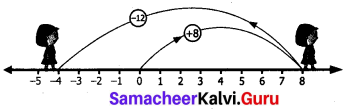
(i) 8 and-12 using number line.
Solution:
Starting at zero on the number line facing positive direction and move 8 steps forward reaching 8.
7th Standard Maths Number System Exercise 1.1 Term 1 Chapter 1 Samacheer Kalvi
Then we move 12 steps
backward to represent -12 –
and reach at -4.
∴ 8 + (-12) = -4

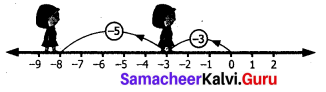
(ii) (-3) and (-5) using number line.
Solution:
Starting at zero on the number line facing positive direction and move 3 steps backward reaching-3.
7th Maths Guide Exercise 1.1 Term 1 Chapter 1 Number System Samacheer Kalvi
Then we move 5 steps backward to represent -5 and reach -8.
∴ (-3) + (-5) = -8

(iii) (-100) + (-10)
Solution:
(-100) + (-10) = -100 – 10 = -110

(iv) 20 + (-72)
Solution:
20 + (-72) = 20 – 72 = -52

(v) 82 + (-75)
Solution:
82 + (-75) = 82 – 75 = 7

(vi) -48 + (-15)
Solution:
-48 + (-15) = -48 – 15 = -63

(vii) -225 + (-63)
Solution:
-225 + (-63) = -225 – 63 = -288

Samacheer Kalvi 7th Maths Book Answers Question 4.
Thenmalar appeared for competitive exam which has negative scoring of 1 mark for each incorrect answers. In paper I she answered 25 question incorrectly and in paper II13 questions incorrectly. Find the total reduction of marks.
Solution:
For each incorrect question the score = -1
In paper I, score for 25 incorrect questions – 25 × (-1) = -25
In paper II, for 13 incorrect question the score = 13 × (-1) = -13
The total marks get reduced = (-25) + (-13) = -38
-38 marks will be reduced.

SamacheerKalvi.Guru

Samacheer Kalvi 7th Maths Book Solutions Question 5.
In a quiz competition, Team A scored +30, -20, 0 and team B scored -20, 0,+30 in three successive rounds. Which team will win? Can we say that we can add integers in any order?
Solution:
Total score of team A = [(+30) + (-20)] + 0 = (+10) + 0 = 10
Total score of team B = [(-20) + 0] + (+30)
= -20 + 30 = +10
Score of team A = Score of team B.
Yes, we say that we can add integers in any order.

7th Standard Maths Exercise 1.1 Question 6.
Are (11 + 7) +10 and 11 + (7 + 10) equal? Mention the property.
Solution:
First we take (11 + 7) + 10 = 18 + 10 = 28
Now 11 + (7 + 10) = 11 + 17 = 28
In both the cases the sum is 28. ∴ (11 + 7) + 10 = 11 + (7 + 10)
This property is known as associative property of integers under addition.

7th Maths Exercise 1.1 Question 7.
Find 5 pairs of integers that added to 2.
Solution:
0 + 2 = 2
1 + 1 = 2
-1+3 = 2
-2 + 4 = 2
-3 + 5 =2 (and many more.)

Objective Type Questions

Samacheer Kalvi Guru 7th Maths Question 8.
The temperature at 12 noon at a certain place was 18° above zero. If it decreases at the rate of 3° per hour at what time if would be 12° below zero?
(i) 12 mid night
(ii) 12 noon
(iii) 10 am
(iv) 10 pm
Solution:
(iv) 10 pm
: ’Temperature at 12 noon = 18° above zero = +18°
Rate of decrease per hour = -3°
Temperature 12° below zero = -12°
-12 is 30 units to the left of+18°
Time at which it reach -12° = \(\frac{30}{3}\) = 10 h
10 hrs after 12 noon = 10 pm

Samacheer Kalvi 7th Maths Question 9.
Identify the problem with negative numbers as its answer.
(i) -9 +(-5) + 6
(ii) 8 + (-12) – 6
(iii) -4 + 2 + 10
(iv) 10 + (-4) + 8
Solution:
(i) -9 +(-5) + 6
(i) -9 + (-5) + 6 = -14 + 6 = -8
(ii) 8 + (-12) + 6 = -4 + 6 = – 2
(iii) -4 + 2 + 10 = -2 + 10 = 8
(iv) 10 + (-4) + 8 = 6 + 8 = 14

SamacheerKalvi.Guru

Samacheer Kalvi 7th Maths Book Question 10.
(-10) + (+7) = ____
(i) +3
(ii) -3
(iii) -17
(iv) +17
Solution:
(ii) -3

Samacheer Kalvi Guru 7th Standard Maths Question 11.
(-8) + 10 + (-2) = ____
(i) 2
(ii) 8
(iii) 0
(iv) 20
Solution:
(iii) 0

Maths 7th Samacheer Kalvi Question 12.
20 + (-9) + 9 = ____
(i) 20
(ii) 29
(iii) 11
(iv) 38
Solution:
(i) 20
Samacheer Kalvi 7th Social Science Geography Solutions Term 2 Chapter 2 Tourism

You can Download Samacheer Kalvi 7th Social Science Book Solutions Guide Pdf, Tamilnadu State Board help you to revise the complete Syllabus and score more marks in your examinations.

Tamilnadu Samacheer Kalvi 7th Social Science Geography Solutions Term 2 Chapter 2 Tourism

Samacheer Kalvi 7th Social Science Tourism Textual Evaluation

I. Choose the correct answer:

The Oldest Type Of Tourism Is Dash Question 1.
The oldest type of tourism is
(a) Religious
(b) Historical
(c) Adventure
(d) Recreational
Answer:
(a) Religious

Samacheer Kalvi 7th Social Science Books Answers Question 2.
In which state is the Kaziranga national park located.
(a) Rajasthan
(b) West Bengal
(c) Assam
(d) Gujarat
Answer:
(c) Assam

Samacheer Kalvi 7th Social Question 3.
Which one of the following is not a beach of India?
(a) Goa
(b) Cochin
(c) Kovalam
(d) Miami
Answer:
(d) Miami

Samacheer Kalvi 7th Books Social Science Question 4.
Which of the following is not a bird sanctuary in India?
(a) Nal sarovor in Gujarat
(b) Koonthakulam in Tamil Nadu
(c) Bharatpur in Rajasthan
(d) Kanha in Madhya pradesh
Answer:
(d) Kanha in Madhya pradesh

Samacheer Kalvi 7th Social Science Question 5.
In which district courtallam waterfalls is located?
(a) Dharmapuri
(b) Tirunelveli
(c) Namakkal
(d) Theni
Answer:
(b) Tirunelveli

II. Fill in the blanks

  1. The three main components of tourism together known as _________
  2. Gastronomy refers to an aspect of _________ tourism.
  3. Suruli falls is also called as _________
  4. The second largest urban beach is _________
  5. Expansion of TAAJ _________

Answers:

  1. A3 concept
  2. cultural
  3. cloud land falls (or) Meghamati falls
  4. Marina beach
  5. Travel Agents Association of India

III. Circle the Odd one

Samacheer Kalvi 7th Social Book Question 1.
Transport, Attraction, Accommodation, Amenities
Answer:
(Transport) Attraction, Accommodation, Amenities

Samacheer Kalvi 7th Social Book Answers Question 2.
Nainital, Shillong, Munnar, Digha
Answer:
Nainital, Shillong, Munnar, (Digha)

Oldest Type Of Tourism Question 3.
Corbett, Sundarbans, periyar, Mayani
Ans.
Corbett, Sundarbans, periyar, (Mayani)

Social Samacheer Kalvi 7th Question 4.
Hogenakal, Kumbakkari, Suruli, Kalakad
Answer:
Hogenakal, Kumbakkari, Suruli, (Kalakad)

The Oldest Type Of Tourism Question 5.
Rishikesh, ladakh, Gulmarg, Kotagiri
Answer:
Rishikesh, ladakh, Gulmarg, (Kotagiri)

IV. Match the following

  1. Anamalai hills – West Bengal
  2. Monkey falls – Goa
  3. Darjeeling – Coimbatore
  4. Nature’s Haven – Top slip
  5. Aguda Beach – Javadi

Answers:

  1. Anamalai hills – Top slip
  2. Monkey falls – Coimbatore
  3. Darjeeling – West Bengal
  4. Nature’s Haven – Javadi
  5. Aguda Beach – Goa

V. Consider the following statement and tick (✓) die appropriate answer

Samacheer Kalvi Guru 7th Social Science Question 1.
Assertion (A) : Tourism is an essential activity for the life Of the society.
Reason (R) : its direct impact on social cultural, education and economic sector of the nation.
(a) A and R are correct and A explains R
(b) A and R are correct but A does not explain R
(c) A is in correct but R is correct
(d) Both A and R are in Correct
Answer:
(a) A and R are correct and A explains R

Question 2.
Assertion (A) : One of the most popular beaches in Goa Calangute is a treat for the adventure sports activities.
Reason (R) : Foreigners throng the beaches
(a) A and R are correct and A explain R
(b) A and R are correct but A does not explain R
(c) A is incorrect but R is correct
(d) Both A and R are incorrect
Answer:
(a) A and R are correct and A explains R

VI. Answer the following briefly

Question 1.
Define Tourism.
Answer:

  1. The word tourist was derived from an old English word “tourian” which refers to a person who travels out of his usual environment for not more than one year and less than 24 hours.
  2. The purpose of travel may be religious, recreation, business, historical and cultural.

Question 2.
Write short note on ECO Tourism.
Answer:

  1. Eco tourism typically involves travel, to destinations where plants and animals thrive in a naturally preserved environment.
  2. Amazon rain forest, African forest safari, trekking in the slopes of Himalayas are the famous incredible Eco friendly attractions.

Question 3.
What are the basic elements of Tourism?
Answer:
Certain elements are fundamental to attract tourists as travel destinations. They are:

  1. Pleasant weather
  2. Scenic beauty
  3. Historical and cultural monuments

Question 4.
Name any five hill stations in India.
Answer:

  1. Kodaikanal, Ooty
  2. Namital, Mussoorie
  3. Darjeeling
  4. Gulmarg
  5. Shillong

Question 5.
Name any five beaches in Tamil Nadu.
Answer:

  1. Kanyakumari beach
  2. Rameshwaram beach
  3. Golden beach
  4. Elliot beach
  5. Mahabalipuram beach

VII. Distinguish between

Question 1.
International Tourism and Historical Tourism
Answer:
International Tourism:

  1. International tourism refers to tourism that crosses national borders
  2. Globalization has made tourism a popular global leisure activity.

Historical Tourism

  1. Historical tourism is primarily focused upon historical places.
  2. The individuals make visits to these places with the purpose of leisure as well as acquiring information.

Question 2.
Religious Tourism and Adventure Tourism
Answer:
Religious Tourism:

  1. Religious tourism is one of the oldest type of tourism, wherein people travel individually or in groups for pilgrimage to a religious location such as temples, churches, mosques and other religious places.
  2. Religious tour to Kasi (Varanasi) by Hindus, to Jerusalem by Christians and to Mecca by Muslims are few of the examples for religious tourism.

Adventure Tourism:

  1. Adventure tourism is a type of tourism involving travel to remote or exotic places in order to take part in physica 11 y challenging outdoor activities
  2. For e.g. sky dive in Australia, Bungee jumping in New Zealand, mountaineering in the peaks of Himalayas, rafting in the Brahmaputra River at Arunachala Pradesh.

Question 3.
Attraction and Accessibility
Answer:
Attraction:

  1. Attractions mainly comprise of two types such as: Natural attraction, Cultural attraction
  2. Natural attraction includes landscape, seascape, beaches, climatic condition and forests. Cultural attraction are historic monuments and other intellectual creations. Apart from this, cultural attractions also includes fairs and festivals.

Accessibility:

  1. Accessibility means reachability to a particular place of attraction through various means of transportation such as road, rail, water and air
  2. Transport decides the cost of travel and the time consumed in reaching or accessing a specific attraction.

VIII. Answer the following questions in detail

Question 1.
Explain the Geographical components of Tourism.
Answer:
(i) Landforms : Mountains, Plateaus, Canyons, Valleys, Caves, Cirques, Sand dunes, Coral reefs, Cliffs, etc.,
(ii) Water: Rivers, Lakes, Waterfalls, Hot springs and Geysers, Snow and Glacier, Water Currents, Tides and Waves.
(iii) Vegetation : Forest, Grasslands, Moors, Deserts etc.,
(iv) Climate: Sunshine, Clouds, Admirable Temperature, Rain and Snow.
(v) Animal life :-
(a) Wildlife : Birds, Game Reserves, Zoos.
(b) Hunting and Fishing
(vi) Settlement features:-
(a) Towns, Cities, Villages
(b) Historical remains and Monuments
(vii) Culture:-Ways of life, traditions, folklore, arts and crafts.

Question 2.
Write briefly about the waterfalls in Tamil Nadu.
Answer:

  1. Mountains and rivers of Tamil Nadu combined together created many endearing waterfalls.
  2. Waterfalls in Tamil Nadu with its inspiring natural wonders attracts many tourists. A trek amidst thick green trees, steep hills and a bath in the gushing water is most rejuvenating.
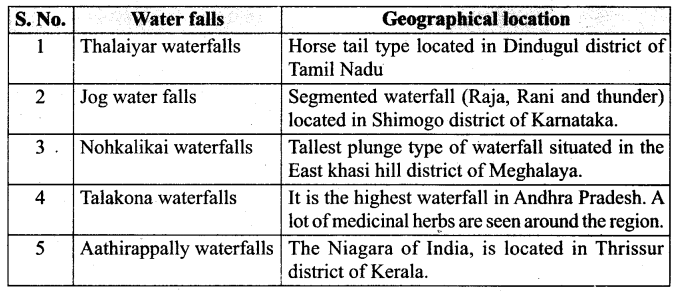
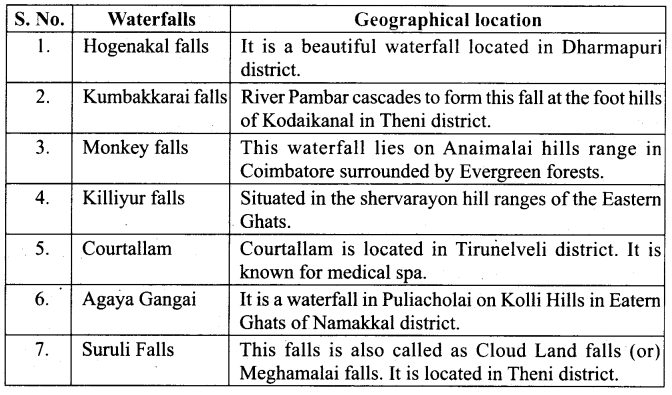
  3. Here is the list of famous water falls of Tamil Nadu.

The Oldest Type Of Tourism Is Dash Samacheer Kalvi 7th Social Science Geography Solutions Term 2 Chapter 2

Question 3.
Describe the Environment Impact of Tourism.
Answer:
Environmental Impact of Tourism
The quality of the environment is essential for tourism. The tourism industry created several positive and negative impacts on the environment.

Positive Impacts:

  1. Direct financial Contributions
  2. Contributions to government revenues
  3. Improved environmental management and planning
  4. Increasing environmental awareness
  5. Protection and reservation of environment

Negative Impacts

1. Depletion of Natural Resources

  1. Water resources
  2. Local resources
  3. Land degradation

2. Pollution

  1. Air and Noise Pollution
  2. Solid Waste and Litering
  3. Sewage

3. Destruction and Alteration of Eco system

  1. Air
  2. Water
  3. Soil

IX. Hots

Question 1.
Why do we like sightseeing so much?
Answer:

  1. Sightseeing is considered to be one of the most important activities a tourist chooses to take part on reaching a destination.
  2. Sightseeing gives the tourist a chance to know a destination and experience it.
  3. Some people like adventures and to escape their normal monotonous life.
  4. So some people like sightseeing so much.

Question 2.
What are the ways to protect the sanctuaries?
Answer:

  1. Adopt: From wild animals to wild places, there’s an option for everyone.
  2. Volunteer : if you don’t have money to give, donate your time.
  3. Visit zoos, aquariums, national parks and wildlife refuges are all home to wild animals.
  4. Donate
  5. Speak up
  6. Buy responsibility
  7. Pitch in
  8. Recycle
  9. Restore
  10. Join

Question 3.
List any five reasons for travelling.
Answer:

  1. We travel to learn, whether its learning a new language or learning about an area’s history, travel allows us to learn so many different things.
  2. We travel to escape. Travel provides a momentary break from the humdrum of our daily lives.
  3. We travel to discover.
  4. We travel to make new friends.
  5. We travel to experience.

X. Activity

  • This activity should be done by students under the supervision of the subject teacher.
  • The students are grouped with six members in a group.
  • Each student will discuss in the group about their last tour. Each group will collect photographs and information.
  • The information will be shared in the class as well as displayed on the notice board of the class room.

Answer:
Activity to be done by the students themselves

Samacheer Kalvi 7th Social Science Tourism Additional Questions

I. Choose the correct answer:

Question 1.
________ are historic monuments and other intellectual creations.
(a) Natural attraction
(b) Cultural attraction
(c) Social attraction
(d) None of these
Answer:
(b) Cultural attraction

Question 2.
Tajmahal of India and Pyramids of Egypt are the examples of
(a) Historical Tourism
(b) Cultural tourism
(c) Eco-tourism
(d) Adventure tourism
Answer:
(a) Historical Tourism

Question 3.
Gastronomy refers to an aspect of
(a) Religious tourism
(b) Cultural tourism
(c) Historical tourism
(d) Eco-tourism
Answer:
(b) Cultural tourism

Question 4.
________ attract attention for their exclusive variety of birds.
(a) Bird sanctuaries
(b) Wildlife sanctuaries
(c) Both ‘a’ and ‘b’
(d) None of these
Answer:
(a) Bird sanctuaries

Question 5.
Push factors in Tourism are
(a) Amenities
(b) Accessibility
(c) Prestige
(d) Attraction
Answer:
(c) Prestige

Question 6.
_______ earns the largest share of income from tourism in India.
(a) Kerala
(b) Goa
(c) Rajasthan
(d) Tamil Nadu
Answer:
(d) Tamil Nadu

Question 7.
Suruli Falls is located in ________ district.
(a) Namakkal
(b) Tirunelveli
(c) Theni
(d) Dharmapuri
Answer:
(c) Theni

Question 8.
________ is a lovely place to hand around with friends, families and kids.
(a) Beach
(b) Temple
(c) Park
(d) Sanctuary
Answer:
(a) Beach

Question 9.
________ is a country known for its gentle (or) hospitality to all visitors.
(a) USA
(b) UK
(c) London
(d) India
Answer:
(d) India

II. Fill in the blanks:

  1. _______ has become an important source of income for many regions.
  2. _______ type of tourism aims at enjoyment, amusement or pleasure are mainly for fun activity.
  3. _______ is a very important factor in tourism.
  4. Few of the amazing waterfalls are in swing during the _______ season.
  5. Pull factors in Tourism are _______
  6. _______ in Tamil Nadu with its inspiring natural wonders attracts many tourists.
  7. The tourism industry created several positive and negative impacts on the _______

Answers:

  1. Tourism
  2. Recreational tourism
  3. Scenic attraction
  4. Monsoonj
  5. Amenitiesl
  6. Waterfalls
  7. environment

III. Circle the Odd one

Question 1.
Religious tourism, Cultural tourism, Adventure tourism, Environment
Answer:
Religious tourism, Cultural tourism, Adventure tourism, [Environment]

Question 2.
Mountains, Sunshine, Canyons, Valleys
Answer:
Mountains, [Sunshine], Canyons, Valleys

Question 3.
Forest, Grasslands, Clouds, Moors
Answer:
Forest, Grasslands, [Clouds], Moors

Question 4.
Water resources, Local resources, Land degradation, Amusement park
Answer:
Water resources, Local resources, Land degradation, [Amusement park]

III. Match the following

Question 1.

  1. Natural attraction – (a) Sand dunes
  2. Cultural attraction – (b) Grasslands
  3. Landforms – (c) Rain and snow
  4. Vegetation – (d) Historic monuments
  5. Climate – (e) Landscape

Answers:

  1. – e
  2. – d
  3. – a
  4. – b
  5. – c

Question 2.

  1. Amritsar – (a) Kerala
  2. Darjeeling – (b) Uttarakhand
  3. Munnar – (c) Maharashtra
  4. Corbeti National Park – (d) West Bengal
  5. Mayani Bird Sanctuary – (e) Punjab

Answers:

  1. – e
  2. – d
  3. – a
  4. – b
  5. – c

IV. Consider the following statements: Tick the appropriate answer

Question 1.
Assertion (A) : Recreational Tourism aims at enjoyment, amusement or pleasure are mainly for fun activity.
Reason (R) : India is a country known for its gentle hospitality with spicy food and culture.
(a) A and R are correct and A explain R
(b) A and R are correct but A does not explain R
(c) A is in correct but R is correct
(d) Both A and R are in Correct
Answer:
(b) A and R are correct but A does not explain R

V. Answer in one or two sentences

Question 1.
What are the types of tourism?
Answer:
Types of Tourism:

  • Religious tourism
  • Cultural tourism
  • Historical tourism
  • Eco-Tourism
  • Adventure tourism
  • Recreational tourism

Question 2.
Write a short note on Historical tourism.
Answer:
It focuses on visiting historically important places like museums, monuments archaeological areas, forts, temples and so on. Angkorwat of Cambodia, Tajmahal of India and Pyramids of Egypt are some of the examples to quote for Historical Tourism

Question 3.
Write a note on

  1. Inbound Tourism
  2. Outbound Tourism

Answer:

  1. Inbound Tourism : Touring within the native country.
  2. Outbound Tourism : Touring in foreign countries.

Question 4.
What is game reserves?
Answer:
Game Reserves : An area of land set aside for the protection of wild animals.

Question 5.
List any four famous religious spots of India.
Answer:

  • Rameswaram – TamilNadu
  • Kanchipuram – Tamil Nadu
  • Varanasi(Kasi) – Uttarpradesh
  • Saranath – Uttarpradesh

Question 6.
WrIte the abbreviation of

  1. ITC
  2. IATA
  3. TAAI
  4. TTDC

Answer:

  1. ITC – Inclusive Tour Charter
  2. IATA – International Air Transport Association
  3. TAAI – Travel Agents Association of India
  4. TTDC – Tamil Nadt Tourism Development Corporation

Question 7.
What is Wildlife and Bird Sanctuaries?
Answer:
India possesses a wide range of forests and grasslands. Diversity of these lands makes it one of the hotspot for flora and fauna. The dense and dark forest of Indian States provides suitable habitat for a wide and an unique variety of animals and birds.

Bird sanctuaries attract attention for their exclusive variety of birds. Diverse range of climate of India invite birds from remote places to feed, breed and to nurture their young ones in the Indian bird sanctuaries.

Question 8.
Answer:
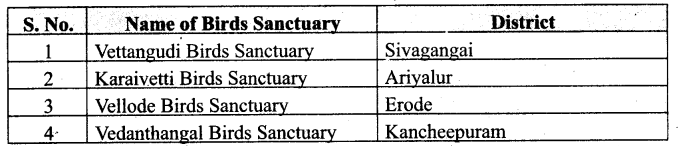
Write any four bird sanctuaries in Tamil Nadu.
Samacheer Kalvi 7th Social Science Books Answers Geography Solutions Term 2 Chapter 2 Tourism

VI. Answer the following in detail

Question 1.
What are the basic components of tourism? Briefly explain it.
Answer:
The three main components of tourism are

  • Attraction
  • Accessibility
  • Amenities.

These three components are together known as A3 concept.

Attraction:
Attractions mainly comprise of two types such as:

  • Natural attraction
  • Cultural attraction

Accessibility:
Accessibility means reachability to a particular place of attraction through various means of transportation such as road, rail, water and air. Transport decides the cost of travel and the time consumed in reaching or accessing a specific attraction.

Amenities:
Amenities are the facilities that cater to the needs of a tourist.

  1. Accommodations in terms of hotels, restaurants, cafes and other staying units.
  2. Travel organizers, Tour operators and Travel Agents
  3. Foreign exchange centres, passport and visa agencies
  4. Sectors related to Travel Insurance, Safety and Security

Question 2.
Explain the tourism attractions in India.
Answer:

  1. India is a country known for its gentle hospitality with spicy food and culture.
  2. Visitor friendly traditions with varied life style, culture, heritage, colourful fairs and festivals are abiding attractions for the tourists.
  3. All types of land form, varied climate, rich resources for eco and adventure tourism are the versatile specialty of India.
  4. Technological parks and science museums, pilgrimage centers with wonderful art and architecture are an added advantage for tourists.
  5. Yoga, Ayurveda and Natural remedial Health resorts attract tourists from all over the world.

Question 3.
Briefly Explain Waterfall in India.
Answer:
In India there are many spectacular and wonderful waterfalls covered by dense forest, huge walls of rock and lush green trees. Among these waterfalls, some are seasonal, while some are perennial. Few of the amazing waterfalls are in swing during the monsoon season. This season brings lot of tourists to these bubbling waterfall sites. Notable waterfalls of India are given below:
Samacheer Kalvi 7th Social Science Geography Solutions Term 2 Chapter 2 Tourism

Samacheer Kalvi 7th Social Science History Solutions Term 1 Chapter 2 Emergence Of New Kingdoms In North India

Students can Download Social Science History Chapter 2 Emergence Of New Kingdoms In North India Questions and Answers, Notes Pdf, Samacheer Kalvi 7th Social Science Book Solutions Guide Pdf helps you to revise the complete Tamilnadu State Board New Syllabus and score more marks in your examinations.

Tamilnadu Samacheer Kalvi 7th Social Science History Solutions Term 1 Chapter 2 Emergence Of New Kingdoms In North India

Samacheer Kalvi 7th Social Science Emergence Of New Kingdoms In North India Textual Evaluation

I. Choose the correct answer:

Emergence Of New Kingdoms In North India Question 1.
Who wrote Prithivirajraso?
(a) Kalhana
(b) Vishakadatta
(c) Rajasekara
(d) Chand Bardai
Answer:
(d) Chand Bardai

Emergence Of New Kingdoms In North India Book Back Answers Question 2.
Who was the first prominent ruler of Pratiharas?
(a) Bhoja I
(b) Naga Bhatta I
(c) Jayapala
(d) Chandradeva
Answer:
(b) Naga Bhatta 1

Emergence Of New Kingdoms In North India In Tamil Question 3.
Ghazni was a small principality in
(a) Mangolia
(b) Turkey
(c) Persia
(d) Afghanistan
Answer:
(d) Afghanistan

Emergence Of New Kingdoms In North India Question Answer Question 4.
What was the most important cause of the invasion of Mahmud of Ghazni?
(a) To destroy idolatry
(b) To plunder the wealth of India
(c) To spread Islam in India
(d) To establish a Muslim state in India
Answer:
(b) To plunder the wealth of India

II. Fill in the Blanks

  1. ______ was the founder of Vikramashila University.
  2. Arabs conquered Sind in ______
  3. The city of Ajmeer was founded by ______
  4. The Khandarya temple is in ______

Answer:

  1. Dharmapala
  2. AD (CE) 712
  3. Simharaji
  4. Madhya Pradesh

III. Match the following

A

B

KhajurahoiMount Abu
Sun TempleiiBundlekhand
Dilwara TempleiiiKonark

Answer:

  1. ii
  2. iii
  3. i

IV. True or False :

Emergency Of New Kingdoms In North India Question 1.
Rajputra is a Latin word.
Answer:
(False) Correct statement: Rajputra is a Sanskrit word.

Emergence Of New Kingdoms In North India Class 7 Question 2.
King Gopala was elected by the people.
Answer:
True

Kingdoms Of North India Question 3.
The temple at Mount Abu is dedicated to Lord Shiva.
Answer:
(False) Correct statement: The temple at Mount Abu is dedicated to Jain Tirthankaras.

Samacheer Kalvi 7th Social Solutions Question 4.
Raksha Bandan is a festival of brotherhood.
Answer:
True

Emergence Of New Kingdoms Question 5.
Indians learnt the numerals 0 – 9 from Arabs.
Answer:
(False) Correct statement: Arabians learnt the numerals 0-9 from Indians.

V. Consider the following statements.

Tick (✓) the appropriate answer.

Samacheer Kalvi 7th History Book Question 1.
Assertion (A): The tripartite struggle was to have control over Kanauj.
Reason (R): Kanauj was a big city.
(a) R is the correct explanation of A.
(b) R is not the correct explanation of A.
(c) A is wrong and R is correct.
(d) A and R are wrong.
Answer:
(b) R is not the correct explanation of A

Question 2.
Statement I : Mahipala could not extend his domain beyond Benaras.
Statement II : Mahipala and Rajendra Chola were contemporaries.
(a) I is correct
(b) II is correct.
(c) I and II are correct
(d) I and II are false
Answer:
(c) I and II are correct.

Question 3.
Assertion (A) : India’s Islamic period did not begin after Arab conquest of Sind in AD (CE)712.
Reason (R) : Gurjara Pratiharas gave a stiff resistance to Arabs.
(a) R is the correct explanation of A.
(b) R is not the correct explanation of A.
(c) A is correct and R is wrong.
(d) A is wrong and R is correct.
Answer:
(a) R is the correct explanation of A

Question 4.
Assertion (A) : The second battle of Tarain was lost by Prithiviraj.
Reason (R) : There was disunity among the Rajputs
(a) R is the correct explanation of A.
(b) R is not the correct explanation of A.
(c) A is correct and R is wrong.
(d) A is wrong and R is correct.
Answer:
(c) A is correct and R is wrong.

Question 5.
Consider the following statements and find out which is/are correct.

  1. Raksha Bandan tradition is attributed to Rajputs.
  2. Tagore started a mass Raksha Bandan festival during Partition of Bengal
  3. Raksha Bandan was to counter the British attempt to create a divide between Hindus and Muslims.

(a) 1 is correct
(b) 2 is correct
(c) 3 is correct
(d) All the above are correct
Answer:
(d) All the above are correct

VI. Answer in one or two sentences

Question 1.
Write about tripartite struggle over Kanauj.
Answer:
There was a prolonged tripartite struggle between the Gurjara Pratiharas of Malwa, the Rashtrakutas of Deccan and the Palas of Bengal, as each one of them wanted to establish their supremacy over the fertile region of Kanauj. In the process, all the three powers were weakened.

Question 2.
Name any four Rajput clans.
Answer:
The Pratiharas, the Chauhans, the Chalukyas (different from the Deccan Chalukyas), known as Solankis, and the Paramaras of Pawars.

Question 3.
Who was the founder of Pala dynasty?
Answer:
Gopala was the founder of Pala dynasty.

Question 4.
Mention the first two early Caliphates.
Answer:
Two early Caliphates were ‘Umayyads’ and the ‘Abbasids’

Question 5.
Name the ruler of Sind who was defeated by Qasim.
Answer:
Qasim defeated Dahir, the ruler of sind and killed him in the battle.

VII. Answer the following :

Question 1.
What was the impact of Arab conquest of Sind? (point out any five)
Answer:

  1. The people of Sind were given the status of ‘protected subjects’.
  2. There was no interference in the lives and religions of the people.
  3. The Arab scholars visited Sind and studied many Indian literary works.
  4. They translated many Sanskrit books on astronomy, philosophy, mathematics and ’ medicine into Arabic.
  5. They learnt the numerals 0 to 9 from India. Until then, the people in the West did not know the use of zero.
  6. Through the Arabs, Europe gained more knowledge in mathematics. The importance of zero was learnt by them from India.
  7. It is believed that the people in the West and the Arabs learnt the game of chess only from the Indians.

VIII. HOTS :

Question a.
Difference between Mahmud Ghazni’s invasion and Muhammad Ghor’s invasion.
Answer:

Mahmud Ghazni invasion

1. Mahmud of Ghazni conducted 17 raids into India. He initially raided the shahi kingdom. After his victory over Shahi and Waihind, he extended his rule over punjab.

2. But his subsequent raids were aimed at plundering the rich temples and cities of North India. Some of the cites were Nagarkot, Thaneshwar, Mathura and Anhilwad. He plundered the famous temple of Somnath, breaking the idol.

Muhammad Ghor’s invasion

1. Muhammad of Ghor who was initially a vassal of Ghazni took over its control after the death of Mahmud Ghazni. Unlike Ghazni, he wanted to extend his empire in India and captured Multan and Punjab.

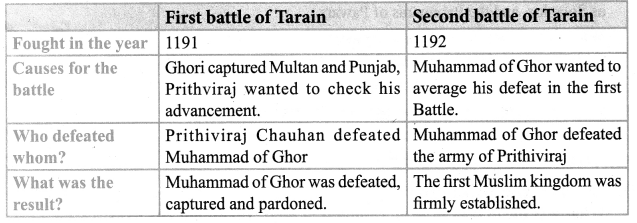
Question b.
Find out

Emergence Of New Kingdoms In North India Samacheer Kalvi 7th Social Science History Solutions Term 1 Chapter 2

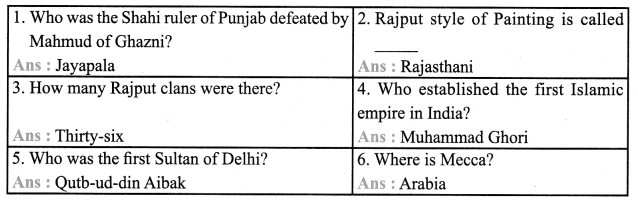
Answer:

Emergence Of New Kingdoms In North India Book Back Answers Samacheer Kalvi 7th Social Science History Solutions Term 1 Chapter 2

IX. Student Activity :

Question a.
Word Splash (Students discuss what they know about the words given here. They use the words from what they have learnt in a narrative form)
(Harsha, Rajput,Kanauj,Vikramashila,Prithiviraj,Caliph)
Answer:

  1. Harsha: A famous king of the Rajput clans.
  2. Rajputs: Rajputra Means scion of the royal blood. They are known for their valour and chivalry. They ruled northern and central India.
  3. Kanauj: A very fertile region, there was a prolonged tripartite struggle between Pratiharas of Malwa, Rashtrakutas of Deccan and the Palas of Bengal.
  4. Vikramashila: Dharmapala, the pala king founded Vikramashik Monastery, which became a great centre of Buddhist learning.
  5. Prithiviraj: Prithiviraj Chauhan, the last of Chauhan king, was considered the greatest of all Chauhan rulers.
  6. Caliph: Caliph means a representative of prophet Muhammad.

Question b.
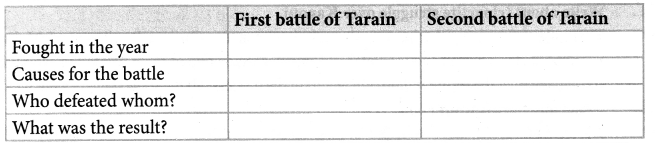
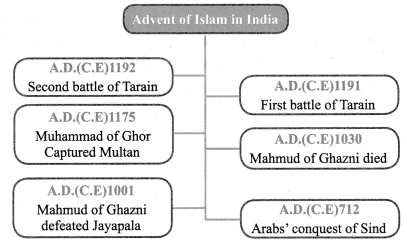
Time Line
Write the event for the given year in each column.

Emergence Of New Kingdoms In North India In Tamil Samacheer Kalvi 7th Social Science History Solutions Term 1 Chapter 2

X. Map work
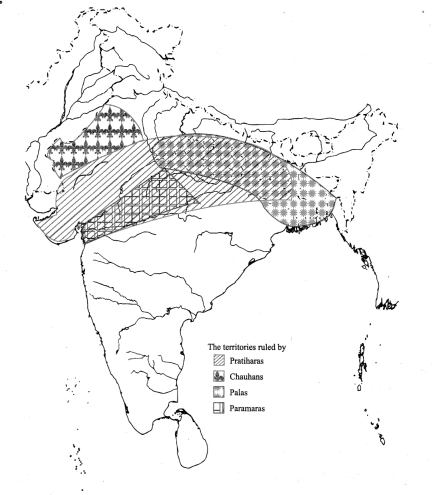
On the river map of India mark the territories ruled by Pratiharas, Chauhans, Palas and Paramaras

Emergence Of New Kingdoms In North India Question Answer Samacheer Kalvi 7th Social Science History Solutions Term 1 Chapter 2

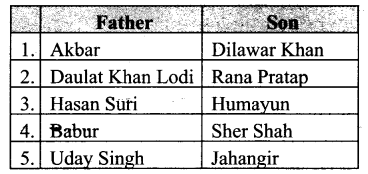
XI. Answer Grid

Emergency Of New Kingdoms In North India Samacheer Kalvi 7th Social Science History Solutions Term 1 Chapter 2

XII. Life skill :

Question 1.
Make an album with the pictures of temples built by Rajput rulers.
Answer:
Activity to be done by the students themselves

Samacheer Kalvi 7th Social Science Emergence Of New Kingdoms In North India Additional Questions

I. Choose the correct answer:

Question 1.
was prominent and had become the rallying point for all Rajput clans.
(a) Kanauj
(b) Ajmer
(c) Chittor
(d) Sind
Answer:
(c) Chittor

Question 2.
The one of the four prominent clans of the Rajputs, ruled from Gurjaratra in Jodhpur).
(a) Palas
(b) Pratiharas
(c) Chauhans
(d) Chalukyas
Answer:
(b) Pratiharas

Question 3.
was also a great patron of Buddhism.
(a) Gopala
(b) Mahipala
(c) Devapala
(d) Harsha
Answer:
(c) Devapala

Question 4.
There are sixteen Hindu and Jain temples at which is 32 miles away from Jodhpur.
(a) Osian
(b) Jaipur
(c) Udaipur
(d) Gwalior
Answer:
(a) Osian

II. Fill in the blanks:

  1. ______ laid the foundation of the Gurjara dynasty.
  2. ______ , son of Rambhadra, succeeded in consolidating the power of the Pratiharas.
  3. ______ was the most powerful ruler of the Pala dynasty.
  4. The______ of the khajuraho temples are most elegant.
  5. Under Pala patronge, a distinctive school of art arose, called ______

Answer:

  1. Harichandra
  2. Mihirabhoja
  3. Mahipala I
  4. Shikharas
  5. Pala Art or Eastern Indian Art

III. Match the following:

AB
a.Harichandrai.Rajput dynasty
b.Gopalaii.Political leader
c.Simharajiiii.Pala dynasty
d.Caliphatesiv.Guijara dynasty

Answer:

  1. iv
  2. iii
  3. i
  4. ii

IV. True or False :

Question 1.
The Pala dynasty declined soon after the death of Mahipala.
Answer:
True

Question 2.
The Khajuraho temples are dedicated to Buddha.
Answer:
(False) Correct statement: The Khajuraho temples are dedicated to Shiva and Vishnu.

Question 3.
The Palas were adherents to the Mahayana school of Buddhism.
Answer:
True

Question 4.
Mahmud is said to have conducted 10 raids into India.
Answer:
(False) Correct statement: Mahmud is said to have conducted 17 raids into India.

V. Match the statement with the reason. Tick the appropriate answer:

Question 1.
Statement : King of Kanauj placed a statue of prithiviraj as door keeper at the entrance to his court.
Reason : He wanted to insult Prithiviraj.
(a) Statement is correct, Reason is wrong.
(b) Statement is wrong, Reason is correct.
(c) Statement and Reason are correct.
(d) Statement and Reason are wrong.
Answer:
(c) Statement and Reason are correct.

Question 2.
Statement : After the victory in the second battle of Tarain Muhammad Ghori returned to Ghazni.
Reason : He had a weak army.
(a) Statement and Reason are wrong.
(b) Statement is correct and Reason is wrong.
(c) Reason is correct, Statement is wrong.
(d) Statement and Reason are correct.
Answer:
(b) Statement is correct and Reason is wrong.

Question 3.
Find out the wrong Pair
(a) Suryavanshi – i. Race of the Sun
(b) Chandravanshi – ii. Race of the Moon
(c) Agnikula – iii. Race of the Sky
(d) Tomaras – iv. Haryana region
Answer:
(c) Agnikula – Race of the Sky

VI. Answer in one word.

Question 1.
Name the tower of victory built in chittor to commemorate the victory of Rana of Chittor over Malwa.
Answer:
Jaya Stambha

Question 2.
Who is the chola king who restricted the Pala domain from spreading beyond Banaras.
Answer:
Rajendra Chola

Question 3.
What was the capital of Chauhans between A.D. 956 and 1192?
Answer:
Sakambari.

VII. Answer the following :

Question 1.
Name some important Rajput buildings.
Answer:
Some of the important examples of the Rajput buildings are the strong fortresses of Chittorgarh. Ranathambhor and Kumbahlgarh (all in Rajasthan), Mandu, Gwalior, Chanderi and Asirgarh (all in Madhya Pradesh).

Question 2.
Write a short note on Khajuraho temples.
Answer:
The Khajuraho in Bundelkhand has 30 temples. The shikharas of the Khajuraho temples are most elegant. The exterior and interior parts of the temples are adorned with very fine sculptures. These temples are dedicated to Jain Tirthankaras and Hindu deities like Shiva and Vishnu.

Question 3.
Name the famous universities of the Palas period.
Answer:
Famous universities of Nalanda and Vikramashila.

Question 4.
Who was the Buddhist monk who reformed Tibetan Buddhism?
Answer:
Atisha

VIII. HOTS:

Question 1.
What is the significance of Rakhi or Raksha Bandhan festival?
Answer:
This festival celebrates brotherhood whereby a woman ties a rakhi around the wrists of men whom they treat as brothers with a belief that they would protect them. Rabindranath Tagore started the mass Raksha Bandhan festival to encourage brotherhood and harmony between Hindus and Muslims during partition of Bengal.

Samacheer Kalvi 7th English Solutions Term 1 Poem Chapter 3 Your Space

Students can Download English Poem 3 Your Space Questions and Answers, Summary, Notes Pdf, Activity, Samacheer Kalvi 7th English Book Solutions Guide Pdf helps you to revise the complete Tamilnadu State Board New Syllabus and score more marks in your examinations.

Tamilnadu Samacheer Kalvi 7th English Solutions Term 1 Poem Chapter 3 Your Space

Read And Understand

A. Answer the following questions in a sentence or two.

Your Space Poem Question 1.
Why should we speak gently?
Answer:
We should speak gently because soft and kind words leave a deep and lasting impression. We can win people’s hearts by love and God too likes it and rewards us for eternity.

Your Space Poem Questions And Answers Question 2.
What do you infer about speaking with others from this poem?
Answer:
From this poem we understand that at all levels there is problems and sadness to everyone but with kind and gentle words they can be overcome.

Your Space Poem Summary Question 3.
What are the disadvantages of speaking harshly?
Answer:
Speaking harshly to people will deprive us of all the good we do here. It is far better to rule by love than fear. Harsh speakers will have more enemies than friends.

Your Space Poem 7th Standard Question 4.
Why does the poet tell us to speak gently to young children?
Answer:
When we speak gently to young children they too will learn to speak gently. Childhood period does not remain long, so we should teach children softly and mildly. We can get their love and trust only with kind words.

Your Space Poem Mind Map Question 5.
How should you speak with old people?
Answer:
We should use kind, gentle, loving and caring words with the old people because their days are numbered. Harsh words will make them sad but gentle words will keep them happy and they will die in peace.

B. Read the poem and fill in the blanks with the correct option.

(Soft,Vain,fear,joy,love,heard,toiled,mild,good,sand,life,harsh)

  1. It is better far to rule by ______ , then _____.
  2. Teach it in accents ______ and ______
  3. Let no tone be ______ and _____
  4. They may have ______ in ______
  5. The _____, the _____,Which it may bring
  6. The _____ of _____ are nearly run

Answer:

  1. love; fear
  2. soft; mild
  3. harsh; heard
  4. toiled; vain.
  5. good; joy
  6. sands; life

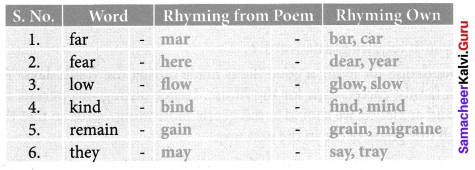
C. Pick out the words which rhyme with the given words and write similar rhyming words on your own.
Answer:

Your Space Poem Samacheer Kalvi 7th English Solutions Term 1 Chapter 3

D. Take a stanza from the poem. Write it in the blanks and find the rhyme scheme.
Answer:

Lines from the poemRhyme scheme (a/b/c/d)
Speak gently to the aged onea
Grieve not the care-worn heart;b
The sands of life are nearly runa
Let such in peace depart!b

Your space Additional Questions

I. Read these lines and answer the questions given below.

Your Space Poem In Tamil Question 1.
Speak gently! -Love doth whisper low
The vows that true hearts bind;
And gently Friendship’s accents flow
Affections voice is kind.

(a) How does love speak?
Answer:
Love speaks as a low whisper.

(b) What does vows of love do?
Answer:
Vows of love binds true hearts.

7th Std English Poem Your Space Question 3.
What flows gently?
Answer:
Friendship.

Samacheer Kalvi 7th English Memory Poem Question 4.
How is the voice of affection?
Answer:
Kindness.

Your Space Poem Explanation Question 2.
Speak gently! – ’tis a little thing
Dropped in the hearts deep well;
The good, the joy, which it may bring,
Eternity shall tell.

Speak Gently Question 1.
What is a‘little thing?
Answer:
Speaking gently is a little thing.

Speak Gently Poem Question 2.
Where should we drop the gentle words?
Answer:
We drop them deep in the hearts.

Speak Gently Poem Summary Question 3.
What does gentle words in our deep hearts bring?
Answer:
The gentle words bring goodness and joy to our hearts.

Speak Gently Summary Question 4.
Till when will the goodness and joy last?
Answer:
Goodness and joy would last forever till eternity.

II. Short Questions and Answers.

Samacheer Kalvi Guru 7th English Question 1.
Why do the youth require gentle words?
Answer:
The foundation for living a good life is made during the youth days. Youth have to build a family, career, earn for the future. Hence during this period of hard work, stress and anxieties, we should speak gentle motivating words so that they may pass through this phase of life in the best way.

Question 2.
“They have enough they must endure”. Who are ‘they’? What do they endure?
Answer:
‘They’ refers to the poor people. They have a lot to endure like want of money, ill health, lack of food, big family, illiteracy, oppression by the rich, etc.

Question 3.
Why do people err according to the poet? How do gentle words help them?
Answer:
According to the poet people err when man treat them harsh and unkindly. When we love them and treat them gently and kindly, it will heal their soul and we can win them back.

III. Paragraph Questions with Answers.

Question 1.
Poet David Bates mentions about speaking gently to six categories of people. Who are they? Why should we speak gently to them?
Answer:
The six categories of people to whom we should speak gently are children, youngsters, aged, poor, the erring and to God.

1. Childhood days move fast so the gentle and kind words we speak and teach them will make them to love and trust us and also train them to speak so.

2. The youth pass through a period of stress, anxiety and carry burdens. To make them cross this phase happily and successfully, we must talk to them understandingly, gentle and patiently.

3. The old people are tired, weak and worried. They have only a brief time left to live, so help them live happily and peacefully. We must talk to them softly, caring and kind words.

4. The poor are already burdened and undergone sufferings, so we must not use rough, unkind words but only gentle kind words.

5. Speaking gently to the erring people will make them realize their mistakes and to reconcile, repent and come back.

6. Finally we should speak gently and with reverence to God who controls the fierce elements of the earth. God gave his life to give us peace, happiness and to forgive our sins.

Question 2.
What does the poet tell about gentle words and love in our hearts in stanza 1,2 and 9?
Answer:
Gentle words help to rule over people by love and not fear. This love exists long. Promises given in a low soft voice with love, help tie hearts together. Gentle words make friendship root deeper and kind words establish affection. Soft words are not difficult to speak. If gentle words are planted deeply in hearts , it will bring goodness and joy forever.

Question 3.
Compare the effect of gentle and harsh words in life.
Answer:

Speaking Gently

  1. Gentle words rule our hearts by love.
  2. Soft loving promises, whispered lowly, bind the hearts.
  3. Gentle words bring friendship and affection.
  4. Gentle words help children to love and trust us. It trains them to speak gently.
  5. Speaking gently to youngsters relieves their stress and anxiety and makes them happy.
  6. By speaking gently , the worn out old people will be happy and peaceful the rest of their life.
  7. Kind caring words, to the burden enduring poor people, make their life happy.
  8. Speaking gently to the erring people makes them repent and reconcile
  9. Speaking gently and with reverence to God helps us get his favour.
  10. Gentle words go deep in our hearts and bring goodness and joy forever.

Speaking Harshly

  1. Harsh words bring fear and remove all good deeds.
  2. Harsh words do not bring hearts closer.
  3. Unkind words bring hatred and enmity.
  4. Children who hear harsh words do not love and they too speak harshly later.
  5. Unkind words to youngsters increase anxiety and burdens. They cannot be successful.
  6. Harsh words on old people make them sad and unhappy. It reduces their life time.
  7. Rude and unkind words make life horrible for the poor.
  8. Harsh words on erring people make them worser and they would never come back.
  9. Harsh words put God on the cross again
  10. Harsh words, planted in the hearts, bring unhappiness forever

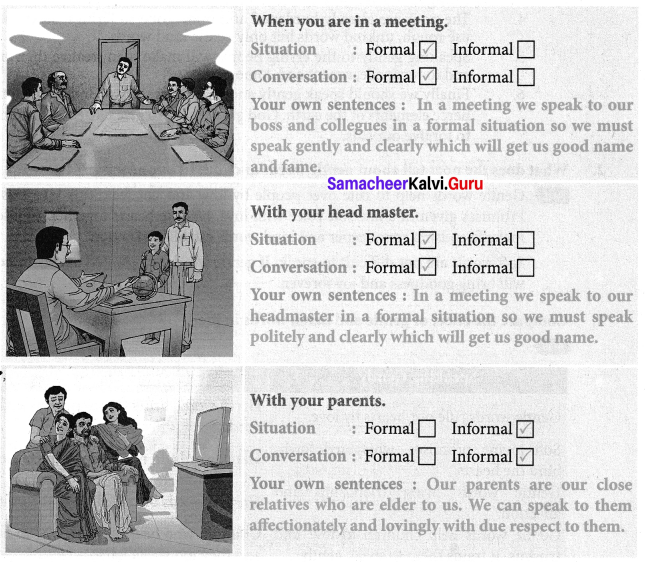
Warm Up

Look at the pictures given below. Fill in the blanks according to the clues given.
Answer:

Your Space Poem Questions And Answers Samacheer Kalvi 7th English Solutions Term 1 Chapter 3

Your Space Summary

The poet David Bates says that we should speak gently as it is easy to control people by love rather than by fear. The good deeds we do are spoilt by the rough words we speak.

When promises of love are expressed in a low voice, it ties the truly loving hearts. Friendship grows deeper through the kind words that flow. The language of affection is kindness. We must speak gently to gain the love of little children. Childhood period does not extend for a long time, hence we must speak caring, soft and mild words that they may remember always.

The youth and adolescents need gentle words as they already have burdens, worry and anxieties to undergo. We must help the youth pass their springtime in life in the best way happily and successfully by handling them with care, patiently and gently.

Next the poet asks us to speak gently to the seiner citizens. Our words and actions must not make their tired and worn out hearts more sorrowful. They have almost lived their life-time, so we must help them live the little time left, happily and peacefully.

The poor people must not hear rough and unkind words, says the poet. They already undergo hardships due to lack of money, food, health, oppression, etc.

We must use kind words to the criminals, prisoners and those who have committed mistakes in their lives to win them back and make them good. They could have become bad due to the unkindness shown towards them.

Finally the poet speaks about God. When God travelled on a fierce stormy sea, he commanded it to be calm and still and controlled the elements of nature. The same God gave his life on the cross to mend man’s sinful stubborn mind. So we should speak to him gently in prayer.

To conclude, the poet compares our hearts to a deep well. To conquer hearts we must put kind and gentle words into it. Those words would bring joy and goodness that lasts till the world ends.

Samacheer Kalvi 7th Science Solutions Term 2 Chapter 5 Basis of Classification

You can Download Samacheer Kalvi 7th Science Book Solutions Guide Pdf, Tamilnadu State Board help you to revise the complete Syllabus and score more marks in your examinations.

Tamilnadu Samacheer Kalvi 7th Science Solutions Term 2 Chapter 5 Basis of Classification

Samacheer Kalvi 7th Science Basis of Classification Textual Evaluation

I. Choose the correct answer:

Basis Of Classification Class 7 Question 1.
The following characteristics are essential for classification.
(a) Similarities
(b) Differences
(c) Both of them
(d) None of them
Answer:
(c) Both of them

Question 2.
Approximately species of living organisms found in the earth.
(a) 8.7 million
(b) 8.6 million
(c) 8.5 million
(d) 8.8 million
Answer:
(a) 8.7 million

Question 3.
The largest division of the living world is
(a) Order
(b) Kingdom
(c) Phylum
(d) Family
Answer:
(b) Kingdom

Question 4.
Who proposed the five kingdom of classification?
(a) Aristotle
(b) Linnaeus
(c) Whitakar
(d) Plato
Answer:
(c) Whitakar

Question 5.
The binomial name of pigeon is
(a) Homo sapiens
(b) Rattus rattus
(c) Mangifera indica
(d) Columbo livia
Answer:
(d) Columbo livia

II. Fill in the blanks

  1. ________ in 1623, introduced the binomial nomenclature.
  2. Species is the ________unit of classification.
  3.  ________ are non- green and non-photosynthetic in nature.
  4. The binomial name of onion is ________
  5. Carolus Linnaeus is known as the Father of ________

Answer:

  1. Gaspard Bauhin
  2. Basic
  3. Fungi
  4. Hum sativum
  5. Modern Taxonomy

IV. Match the following:

Question 1.

  1. Monera – Moulds
  2. Protista – Bacteria
  3. Fungi – Neem
  4. Plantae – Butterfly
  5. Animalia – Euglena

Answer:

  1. Monera – Bacteria
  2. Protista – Euglena
  3. Fungi – Moulds
  4. Plantae – Neem
  5. Animalia – Butterfly

V. Assertion and Reason Questions:

Question 1.
Assertion (A) : Binomial name is the universal name and contains two names.
Reason (R) : It was first introduced by Carolus Linnaeus.
(a) Assertion is correct, Reasoning is correct
(b) Assertion is correct, Reasoning is incorrect
(c) Assertion is incorrect, Reasoning is correct
(d) Assertion and Reasoning are incorrect
Answer:
(b) Assertion is correct, Reasoning is incorrect

Question 2.
Assertion (A) : Identification, assortment and grouping are essential for classification.
Reason (R) : These are basic steps of taxonomy.
(a) Assertion is correct, Reasoning is correct
(b) Assertion is correct, Reasoning is incorrect
(c) Assertion is incorrect, Reasoning is correct
(d) Assertion & Reasoning is incorrect.
Answer:
(a) Assertion is correct, Reasoning is correct

VI. Give very short answer:

Question 1.
What is classification?
Answer:
The method of arranging the organisms into groups is called classification

Question 2.
List out the five kingdoms classification.
Answer:

  1. Monera
  2. Protista
  3. Fungi
  4. Plantae
  5. Animalia

Question 3.
Define – dichotomous key.
Answer:
It is a tool used to classify organisms based on their similarities and differences.

Question 4.
Write two examples of Monera.
Answer:
Bacteria and Blue green algae.

Question 5.
What is binomial nomenclature?
Answer:
Binomial nomenclature is an universal system of naming organisms. As per this system, each organism has two names – the first is the Genus name and the second is the Species name.

Question 6.
Write the binomial name of
(a) Human being
(b) Paddy
Answer:
Binomial name
(a) Human being – Homo sapiens
(b) Paddy – Oryza sativa

Question 7.
Write two features of protista.
Answer:

  1. It includes unicellular and few simple multicellular eukaryotes.
  2. It includes plant like protists (Algae) and animal like protists (protozoans)

VII. Give short Answer :

Question 1.
Write the levels of classification.
Answer:
There are seven main categories of hierarchies namely, Kingdom, Phylum, Class, Order, Family, Genus and Species- Species is the basic unit of classification

Question 2.
Differentiate plantae and animalia
Answer:
Kingdom plantae

  1. They are multicellular eukaryotes that can photosynthesize.
  2. The cells have cell wall.
  3. The cells can perform specialised functions like photosynthesis.
  4. Eg. Ferns, cone bearing plants and flowering plants

Kingdom Animalia

  1. They are multicellular, eukaryotic and heterotrophic animals.
  2. The cells lack cell wall.
  3. They cannot photosynthesize but animals move from place to place unlike plants.
  4. Eg. Invertebrates and Vertebrates

Question 3.
Write any two merits of Five Kingdom classification.
Answer:

  1. This system of classification is more scientific and natural.
  2. This system of classification clearly indicates the cellular organization, mode of nutrition, and characters for early evolution of life.

VII. Give answer in Detail:

Question 1.
Explain about five kingdom classification.
Answer:

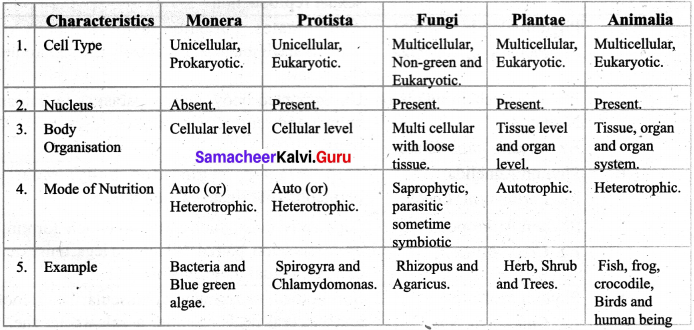
  1. The five kingdom classification was proposed by R.H.Whittaker in 1969.
  2. He classified the organisms into five kingdoms on the basis of characteristics like cell structure, mode of Nutrition, Source of Nutrition and body organization.

Basis Of Classification Class 7 Samacheer Kalvi Science Solutions Term 2 Chapter 5

Question 2.
Write short notes on – Binomial Nomenclature.
Answer:
(i) Gaspard Bauhin jn 1623, introduced naming of organisms with two names which is known as Binomial nomenclature, and it was implemented by Carolus Linnaeas in 1753

(ii) Binomial nomenclature an universal system of naming organisms. As per this system, each organism has two names – the first is the Genusname and the second is the Speciesname.

(iii) Genus name begins with a capital letter and Species name begins with a small letter. Example The nomenclature for onion is Allium sativam. Genus name is Allium, species name is sativam.

(iv) Vernacular name is a local name that is familiar for a particular place. Binomial name is an universal name which never changes.

(v) Binomial nomenclature and classification helps scientists to identify any organisms and to place them at a particular hierarchy.

Question 3.
Give an account on the classification of invertebrates with few general features and examples.
Answer:
Invertebrates are animals without a backbone. The invertebrates have been classified into various phyla as follows:

S.No

Division

General Characters

1.

Phylum Protozoa

Eg. Amoeba, Euglena p

Microscopic unicellular, pseudopodia, flagella and cilia for locomotion, reproduce by fission or conjugation.

2.

Phylum Porifera

Eg. Leucosolenia, Sycon.

Multicellular organisms with holes in the body. Skeleton formed of spicules, asexual and sexual reproduction.

3.

Phylum Coelenterata Eg. Hydra, Jelly fish.

Multicellular organisms Diploblastic, sessile or free swimming, solitary or colonial, asexual and sexual reproduction

4.

Phylum Platyhelminthes Eg. Planaria, Liver fuke

Acoelomates, parasites inside the body of animals and human beings, mostly hermaphrodite (bisexual).

5.

Phylum Aschelminthes or Nematoda

Eg. Ascaris lumbricoides

Unsegmented body, mostly parasites in human beings and animals, causing diseases, asexual reproduction.

6.

Phylum Annelida Eg. Earthworm, Leech.

Triploblastic, segmented body, mostly hermaphrodite (bisexual and unisexual).

7.

Phylum Arthropoda Eg. Crab, Prawn

Segmented body, thick chitinous cuticle forming an exoskeleton, paired and jointed legs, unisexual exhibits sexual dimorphism.

8.

Phylum Mollusca Eg. Cuttle fish, Snail

Soft bodied, unsegmented, muscular head, foot and visceral mass, mantle, a calcareous shell, sexual reproduction.

9.

Phylum Echinodermata Eg. Starfsh, Sea – Urchin

Exclusively marine, spines and spicules over the body, water vascular system, tube feet, for feeding, respiration and locomotion sexual reproduction.

IX. HOTS :

Question 1.
Which kingdom has saprophytic, parasitic and symbiotic nutrition. Why?
Answer:
Kingdom Fungi comprises of unicellular to multicellular organisms which are heterotrophic in their mode of nutrition. They do not contain chlorophyll and cannot photosynthesize. Hence they show modes of Nutrition such as:

  1. Saprophytic – Obtaining nutrition from dead matter Eg. Mucor
  2. Parasitic – Obtaining nutrition from living organisms Eg. Cercospora
  3. Symbiotic – Obtaining nutrition through a mutually beneficial relationship with another organism. Eg. Lichens

X. See the Diagram and write The Kingdom:
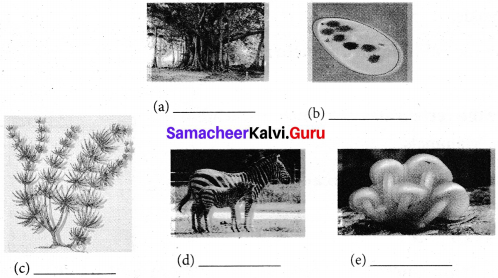
Question 1.
Pictures of some living organisms are given below. Identify the kingdom to which each of these belong and write the kingdom name in the blanks provided.
Samacheer Kalvi 7th Science Solutions Term 2 Chapter 5 Basis of Classification image - 2
Answer:
(a) Kingdom plantae
(b) Kingdom protista
(c) Kingdom protista
(d) Kingdom Animalia
(e) Kingdom Fungi

Samacheer Kalvi 7th Science Basis of Classification Intext Activities.

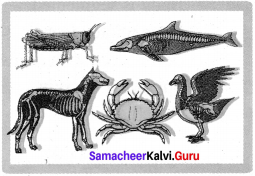
Activity- 2
Question 1.
Fill up the blanks with the suitable organisms
Samacheer Kalvi 7th Science Solutions Term 2 Chapter 5 Basis of Classification image - 3

  1. Vertebrates ________ , ________ and ________
  2. Invertebrates ________, ________ and ________.
  3. Name the vertebrates with wings ________, ________.
  4. Name the invertebrates with wings ________, ________.
  5. Name the invertebrates with segmented legs ________, ________.
  6. Name the invertebrates with Jointed legs ________, ________.
  7. Name the warm blooded vertebrates ________.
  8. Name the cold blooded vertebrates ________.
  9. Name the vertebrates with lungs respiration ________, ________.
  10. Name the animal with beak ________.

Answers:

  1. Fishes, Amphibians, Mammals.
  2. Protozoa, Porifera, Annelida.
  3. Bat, Pigeon.
  4. Butterfly, Dragon fly.
  5. Millipedes, Centipedes.
  6. Crab, Prawn.
  7. Mammals.
  8. Fishes.
  9. Birds, Mammals.
  10. Birds

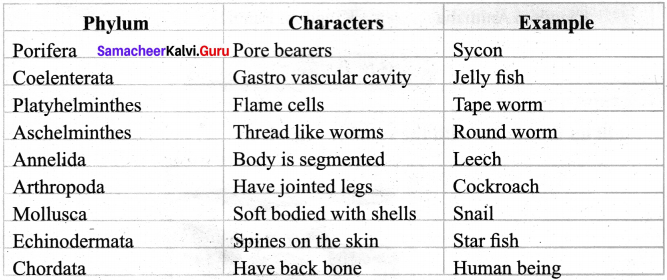
Activity – 3
Given table shows the name of the phylum and its characteristic features. Write name of the animals belonging to the respective phylum
Samacheer Kalvi 7th Science Solutions Term 2 Chapter 5 Basis of Classification image - 4

Samacheer Kalvi 7th Science Basis of Classification Additional Questions

I. Choose the correct answer.

Question 1.
_______ belongs to Phylum Platyhelminthes.
(a) Ascaris
(b) Liver fluke
(c) Leucosolcnia
(d) Euglena
Answer:
(b) Liver fluke

Question 2.
_______ are diploblastic.
(a) Protozoa
(b) Annelida
(c) Coelenterata
(d) Echinodermata
Answer:
(c) Coelenterata

Question 3.
_______ is not a characteristic of Phylum Echinodertnata.
(a) Water vascular system
(b) Tube feet
(c) Pores in the body
(d) Spicules
Answer:
(c) Pores in the body

Question 4.
Bones with air cavities ate seen in _______
(a) snail
(b) pigeon
(c) bats
(d) cuttle fish
Answer:
(b) pigeon

Question 5.
_______ is not oviparous.
(a) Snake
(b) Crow
(c) Frog
(d) Human being
Answer:
(d) Human being

Question 6.
Plant is a thallus in _______
(a) Algae
(b) Ferns
(c) Bacteria
(d) Pinus
Answer:
(a) Algae

Question 7.
Naked ovules are seen in _______
(a) Cycas
(b) Funaria
(c) Mango
(d) Chara
Answer:
(a) Cycas

Question 8.
_______ is not a fugus.
(a) Yeast
(b) Chlamydomonas.
(c) Rhizopus
(d) Agaricus
Answer:
(b) Chlamydomonas

Question 9.
_______ belong to Monera.
(a) Blue green algae
(b) Yeast
(c) Mushrooms
(d) Red algae
Answer:
(a) Blue green algae

Question 10.
_______ are called Amphibious plants.
(a) Ferns
(b) Mosses
(c) Fungi
(d) Gymnosperms
Answer:
(b) Mosses

II. Fill in the Blanks.

Question 1.

  1. ________ was a greek philosopher who classified animals.
  2. Paired and jointed legs are seen in phylum ________
  3. Giving birth to young ones is described as________
  4. Animals belonging to phylum ________ are mostly parasites.
  5. Flowering plants belong to________
  6. ________ are considered to be first land plants,
  7. ________ are dominant plant forms of present day.
  8. All prokaryotic belong to kingdom________
  9. Scientific name for Human being is ________
  10. Cones are produced by ________

Answer:

  1. Aristotle
  2. Arthropoda
  3. Viviparous
  4. Aschelminthes
  5. Angiosperms
  6. Ferns
  7. Angiosperms
  8. Monera
  9. Homo sapiens
  10. gymnosperms

III. True or False – if false give the correct statement.

Question 1.
Animals belonging to phylum protozoa reproduce by fission.
Answer:
True

Question 2.
Specialised vascular tissues for conduction of food and water are seen in mosses.
Answer:
False. Specialised vascular tissues for conduction of food and water are seen in ferns ‘

Question 3.
Angiosperms are divided into monocots and dicots.
Answer:
True

Question 4.
The angiosperms are evergreen trees.
Answer:
False. The gymnosperms are evergreen trees.

Question 5.
Fungi need water to complete their life cycle.
Answer:
False. Mossesneed water to complete their life cycle

IV. Match the following:

Question 1.

  1. Protozoa- (a) Spongy bones
  2. Annelida- (b) Hermaphrodite
  3. Coelenterata- (c) Soft body
  4. Aves- (d) Colonial forms
  5. Mollusca- (e) Conjugation

Answer:

  1. -e
  2. -b
  3. -d
  4. -a
  5. -c

Question 2.

  1. Fungi- (a) Funaria
  2. Mosses- (b) Cycas
  3. Gymnosperms- (c) Adiantum
  4. Flowering Plants- (d) Agaricus
  5. Ferns- (e) Tamarind

Answer:

  1. -d
  2. -a
  3. -b
  4. -e
  5. -c

V. Assertion and Reason.

Mark the correct choice as
(a) Assertion is correct, Reasoning is correct
(b) Assertion is correct, Reasoning is incorrect
(c) Assertion is incorrect Reasoning is correct
(d) Assertion & Reasoning are incorrect

Question 1.
Assertion (A) : Angiosperms have ovary in the flower.
Reason (R) : They produce fruits and seeds.
Answer:
(a) Assertion is correct, Reasoning

Question 2.
Assertion (A) : Blue green algae are prokaryotes.
Reason (R) : They do not have a true nucleus.
Answer:
(a) Assertion is correct, Reasoning

Question 3.
Assertion (A) : Xylem does not have vessels in angiosperms.
Reason (R) : They conduct food.
Answer:
(d) Assertion & Reasoning is

Question 4.
Assertion (A) : Reptiles are warm blooded animals.
Reason (R) : They have scales.
Answer:
(c) Assertion is incorrect Reasoning is correct

VI. Give Very short Answers:

Question 1.
Name the following:

  1. A phylum with diploblastic animals
  2. A phylum which has hermaphrodite animal

Answer:

  1. phylum coelenterata.
  2. Phylum Annelida / Phylum Platyhelminthes.

Question 2.
Mention two features of phylum Echinodermata.
Answer:
Water vascular system, tube feet.

Question 3.
Mention two salient features of class mammalia.
Answer:
Viviparous animals, heterodont dentition.

Question 4.
What is heterodont dentition?
Answer:
Presence of different kinds of teeth.

Question 5.
Why do Aves have bones with air cavities?
Answer:
It makes the body lighter and helps in flight.

Question 6.
Name the vascular tissues seen in plants.
Answer:
Xylem and phloem.

Question 7.
Gymnosperms do not produce fruits. Give Reason.
Answer:
The ovules are naked, without ovary. Hence gymnosperms do not produce fruits.

VII. Short Answer.

Question 1.
List two demerits of five kingdom system of classification.
Answer:

  1. In this system of classification, viruses have not been given a proper place
  2. Multicellular organisms have originated several times from protists.

Question 2.
Write a note on kingdom fungi.
Answer:

  1. Fungi are eukaryotic, and mostly are multicellular.
  2. They secrete enzymes to digest the food and absorb the food after digested by the enzymes.
  3. Fungi saprophytes as decomposes (decay-causing organisms) or as parasites.
  4. Kingdom Fungi includes molds, mildews, mushrooms and yeast.

Question 3.
Differentiate Angiosperms and Gymnosperms.
Answer:
Angiosperms

  1. They produce flowers.
  2. They produce fruits.
  3. They are classified into monocots and dicots.
  4. They possess well developed xylem and phloem.

Gymnosperms

  1. They produce cones.
  2. Ovules are naked and no fruit formation occurs.
  3. They are not classified.
  4. Xylem lacks vessels and phloem lacks companion cells.

VIII. Give answer in Detail:

Question 1.
Write the merits and demerits of five kingdom classification.
Answer:
Merits:

  1. This system of classification is more scientific and natural.
  2. This system of classification clearly indicates the cellular organization, mode of nutrition, and characters for early evolution of life.
  3. It is the most accepted system of modem classification as the different groups of organisms are placed phylogenetically.
  4. It indicates gradual evolution of complex organisms from simpler one.

Demerits:

  1. 1.In this system of classification of viruses have not been given a proper place.
  2. Multicellular organisms have originated several times from protists.
  3. This type of classification has drawn back with reference to the lower forms of life.
  4. Some organisms included under protista are not eukaryotic.

IX. Creative questions: HOTS

Question 1.
Blue green algae are not placed under kingdom protista whereas other algae are placed under it.
Answer:
Blue green algae has prokaryotic cells like bacteria. The cells lake a proper nucleus, therefore they are placed with bacteria in kingdom monera.

Question 2.
How can you differentiate a Prokaryotic cell from Eukaryotic cell.
Answer:
Prokaryotic
1. Presence of a true nucleus is eukaryotes ,
2. Eg. A nucleus which is covered by a nuclear membrane.

Prokaryotic
1. Presence of a true nucleus is eukaryotes ,
2. Eg. A nucleus which is covered by a nuclear membrane.

Samacheer Kalvi 7th Social Science Economics Solutions Term 1 Chapter 1 Production

Students can Download Social Science Economics Chapter 1 Production Questions and Answers, Notes Pdf, Samacheer Kalvi 7th Social Science Book Solutions Guide Pdf helps you to revise the complete Tamilnadu State Board New Syllabus and score more marks in your examinations.

Tamilnadu Samacheer Kalvi 7th Social Science Economics Solutions Term 1 Chapter 1 Production

Samacheer Kalvi 7th Social Science Production Textual Evaluation

I.Choose the correct answer:

Samacheer Kalvi Guru 7th Social Science Question 1.
Production refers to
(a) destruction of utility
(b) creation of utilities
(c) exchange value
(d) none of these
Answer:
(b) creation of utilities

Samacheer Kalvi 7th Social Science Books Answers Question 2.
Utilities are in the nature of
(a) form utility
(b) time utility
(c) place utility
(d) all of these
Answer:
(d) all of these

Samacheer Kalvi Guru 7th Social Question 3.
is carried out by extractive industries.
(a) Secondary production
(b) Primary production
(c) Tertiary production
(d) Service production
Answer :
(b) primary production

Samacheer Kalvi 7th Social Science Book Back Answers Question 4.
Primary factors are
(a) land, capital
(b) capital, labour
(c) land, labour
(d) none of these
Answer:
(c) land, labour

7th Social Science Samacheer Kalvi Question 5.
The entrepreneur is also called
(a) exchanger
(b) Agent
(c) organizer
(d) communicator
Answer:
(c) organizer

II. Fill in the Blanks

  1. ________ means want satisfying power of a product.
  2. Derived factors are ________ and ________
  3. ________ is a fixed in supply.
  4. ________ is the human input into the production process.
  5. ________  is the man made physical goods used to produce other goods and services.

Answer:

  1. Utility
  2. Capital, Organization
  3. Land
  4. Labour
  5. Capital

III. Match the following

AB
Primary production(i)Adamsmith
Time utility(ii)Fishing, mining
Wealth of nation(iii)Entrepreneur
Human capital(iv)Stored for future
Innovator(v)Education, health

Answer:

  1. ii
  2. iv
  3. i
  4. v
  5. ii

IV.Give short answer:

Samacheer Kalvi.Guru 7th Social Question 1.
What is production?
Answer:
Production is a process of combining various material inputs and immaterial inputs in order to make something for consumption (the output).

Samacheer Kalvi 7th Social Book Question 2.
What is utility?
Answer:
Utility means want satisfying power of a product.

Samacheer Kalvi 7th Social Question 3.
Name the types of utility.
Answer:

  1. Form utility
  2. Time utility and
  3. Place utility

Samacheer Kalvi Social Science 7th Question 4.
Name the types of production.
Answer:
There are three types of production

  1. Primary production
  2. Secondary Production
  3. Tertiary or Service Production

Samacheer Kalvi 7th Standard Social Science Question 5.
What are the factors of production?
Answer:
The factors of production

  1. Land
  2. Labour
  3. Capital
  4. Organization

Samacheer Kalvi Guru Social 7th Question 6.
Define Labour.
Answer:
Alfred Marshall defines labour as, ‘the use of body or mind, partly or wholly, with a view to secure an income apart from the pleasure derived from the work’.

7th Soc Guide Question 7.
Define Division of labour.
Answer:
Division of labour means dividing the process of production into distinct and several component processes and assigning each component in the hands of a labour or a set of labourers, who are specialists in that particular process.

Samacheer Kalvi Guru 7th Social Science Guide Question 8.
Write the forms of capital.
Answer:

  1. Physical Capital or Material Resources, Ex. Machinery, tools, buildings, etc.
  2. Money capital or Monetary resources, Ex. Bank deposits, shares and securities, etc.
  3. Human capital or Human Resources Ex. Investments in education, training and health

Samacheer Kalvi 7th Question 9.
Who is the changing agent of the society? .
Answer:
The entrepreneur is also called ‘Organizer’. In, modem times, an entrepreneur is called ‘the changing agent of the society’.

Samacheer Kalvi 7th Social Solutions Question 10.
Write the three characteristics of entrepreneur.
Answer:

  1. Identifying profitable investible opportunities
  2. Deciding the location of the production unit
  3. Making innovations

V. Give brief answer.

Question 1.
Explain the types of production.
Answer:
There are three types of production

  1. Primary production
  2. Secondary Production
  3. Tertiary or Service Production

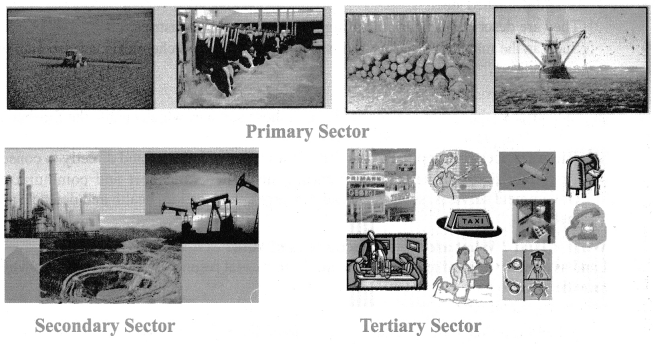
1. Primary Production:

  1. Primary production is carried out by ‘extractive’ industries like agriculture, forestry, fishing, mining and oil extraction.
  2. These industries are engaged in such activities as extracting the gifts of nature from the earth’s surface, from beneath the earth’s surface and from the oceans.

2. Secondary Production:

  1. This includes production in manufacturing industry, turning out semi-finished and finished goods from raw materials and intermediate goods, conversion of flour into bread or iron ore into finished steel.
  2. They are described as manufacturing and construction industries.
  3. Such as the manufacture of cars, furnishing, clothing and chemicals, as also engineering and building.

3. Tertiary Production

  1. Industries in the tertiary sector produce all those services which enable the finished goods to be put in the hands of consumers.
  2. These services are supplied to the firms in all types of industry and directly to consumers.
  3. Ex. cover distributive traders, banking, insurance, transport and communications. Government services, such as law, administration, education, health and defence, are also included.

Question 2.
What is land ? What are the characteristics of land?
Answer:
Land as a factor of production refers to all those natural resources or gifts of nature which are provided free to man.
Characteristics of Land:

  1. Land is a Free Gift of Nature
  2. Land is fixed in supply
  3. Land is imperishable
  4. Land is a Primary Factor of Production
  5. Land is Immovable
  6. Land has some Original Indestructible Powers
  7. Land Differs in Fertility

Question 3.
Explain the merits and demerits of division of labour.
Answer:

Merits of division of labour

  1. It improves efficiency of labour when labour repeats doing the same tasks.
  2. Facilitates the use of machinery in production, resulting in inventions.
  3. Time and Materials are put to the best and most efficient use.

Demerits of division of labour

  1. Repetition of the same task makes labour to feel that the work is monotonous and stale. It kills the humanity in him.
  2. Narrow specialization reduces the possibility of labour to find alternative avenues of employment. This results in increased unemployment.
  3. Reduce the growth of handicrafts and the worker loses the satisfaction of having made a commodity in full.

Question 4.
Describe the characteristics of capital.
Answer:
Characteristics of Capital

  1. Capital is a passive factor of production
  2. Capital is man-made
  3. Capital is not an indispensable factor of production
  4. Capital has the highest mobility
  5. Capital is productive
  6. Capital lasts over time
  7. Capital involves present sacrifice to get future benefits

Question 5.
What are the functions of entrepreneur?
Answer:
The functions are

  1. Decision making
  2. Management control
  3. Division of income
  4. Risk-Taking
  5. Uncertainty-Bearing

VI. Activity and Project

Question 1.
Students are asked to prepare a chart containing dummy images of primary, secondary and tertiary sectors images.
Answer:

Samacheer Kalvi Guru 7th Social Science Economics Solutions Term 1 Chapter 1 Production

Question 2.
Students are asked to visit some local farmers and to discuss about the land and its characteristics. Collect some photographs of land and make a album.
Answer:

  1. We visited a local farm which is built with in an existing coconut grove. This thatched ‘ roofed structure is made from materials mostly from the farm.
  2. The land is then made suitable for cultivation using organic farming method.
  3. They grow vegetables and fruits which will produce a good yield in that soil.
  4. They first test the soil and make sure that it is suitable for growing vegetables and fruits.

Samacheer Kalvi 7th Social Science Books Answers Economics Solutions Term 1 Chapter 1 Production

VII. Life skills:

Question 1.
Students to know about the characteristics of entrepreneur, Set up your classroom like a industry. Some Students are asked to act like a businessman, Do the industries activities. Teacher and students together discuss about the entrepreneur and their important of development of society.
Answer:
Role of business man:
Ensures smooth operation of his business. He coordinates with people to procure the factors of production namely land, labour and capital. He has to look into access of raw materials needed, skilled labour transport and the prospects to market the products.

Samacheer Kalvi 7th Social Science Production Additional Question

I. Choose the correct answer:

Question 1.
Indian Economy is a ______ Economy.
(a) Private
(b) Public
(c) Mixed
(d) Socialist
Answer:
(c) Mixed

Question 2.
The most to the Gross Domestic product of our country is contributed by the ______ sector.
(a) Tertiary
(b) Primary
(c) Secondary
(d) All the above
Answer:
(a) Tertiary

Question 3.
_______ is known as ‘Father of Economics.
(a) Alfred Marshall
(b) Adam Smith
(c) Karl Mark
(d) Amartya Sen
Answer:
(b) Adam Smith

Question 4.
_______ cannot be stored.
(a) Land
(b) Capital
(c) Organisation
(d) Labour
Answer:
(d) Labour

II. Fill in the blanks:

  1. _____ can be both customers of the producers and suppliers to the producers.
  2. Entrepreneurship is otherwise called ______
  3. ______ is more perishable than other factors of production.
  4. The Theory of Moral Sentiments’ was written by ______

Answer:

  1. Consumers
  2. Organization
  3. Labour
  4. Adam Smith

III. Match the following:

Primary sectoriDefence
Secondary sectoriiCotton Industary
Tertiary sectoriiiFood Production

Answer:

  1. ii
  2. iii
  3. i

IV. Answer the following in one or two sentences:

Question 1.
What is a mixed Economy?
Answer:
An Economy in which Private and Public sectors co-exist is a mixed economy. Eg. India.

Question 2.
Name the components of Human activity.
Answer:
Production and consumption.

Question 3.
What are Primary factors of production?
Answer:
Land and Labour

Question 4.
What are derived factors of production?
Answer:
Capital and Organisation.

Question 5.
What is capital?
Answer:
Capital is man made physical goods used to produce other goods and services. In short, Capital means money.

VI. Answer the following in Detail:

Question 1.
Explain the types of utility.
Answer:
Types of Utility

  1. Form utility: If the physical form of a commodity is changed, its utility may increase. Eg. Cotton increases, if it is converted into clothes.
  2. Place utility: If a commodity is transported from one place to another, its utility may increase. Eg. If rice transported to Tamilnadu to Kerala, its utility will be more.
  3. Time utility : If the commodity is stored for future usage, its utility may increase. Eg. Agricultural commodities like Paddy, Wheat, etc. are stored for the regular uses of consumers throughout the year.

Question 2.
Mention the characteristics of Labour.
Answer:

  1. Labour is more perishable than other factors of production.
  2. Labour cannot be stored.
  3. Labour is an active factor of production.
  4. Labour is not homogeneous.
  5. Labour cannot be separated from the labourer.
  6. Labour is mobile.
  7. Individual labour has only limited bargaining power. He cannot fight with his employer for a rise in wages or improvement in work-place conditions.

Question 3.
Mention the characteristics of entrepreneur.
Answer:

  1. An entrepreneur is a person who combines the different factors of production (land, labour and capital), in the right proportion
  2. Initiates the process of production and bears the risk involved in it.
  3. He is not only responsible for producing the socially desirable output but also to increase the social welfare.
  4. Identifying profitable investible opportunities
  5. Deciding the location of the production unit
  6. Making innovations
  7. Deciding the reward payment
  8. Taking risks and facing uncertainties

Samacheer Kalvi 7th Tamil Solutions Term 1 Chapter 3.3 தேசியம் காத்த செம்மல் பசும்பொன் உ.முத்துராமலிங்கத்தேவர்

Students can Download Tamil Chapter 3.3 தேசியம் காத்த செம்மல் பசும்பொன் உ.முத்துராமலிங்கத்தேவர் Questions and Answers, Summary, Notes Pdf, Samacheer Kalvi 7th Tamil Book Solutions Guide Pdf helps you to revise the complete Tamilnadu State Board New Syllabus and score more marks in your examinations.

Tamilnadu Samacheer Kalvi 7th Tamil Solutions Term 1 Chapter 3.3 தேசியம் காத்த செம்மல் பசும்பொன் உ.முத்துராமலிங்கத்தேவர்

மதிப்பீடு

சரியான விடையைத் தேர்ந்தெடுத்து எழுதுக.

Question 1.
முத்துராமலிங்கத்தேவர் முதன்முதலில் உரையாற்றிய இடம் …….
அ) தூத்துக்குடி
ஆ) காரைக்குடி
இ) சாயல்குடி
ஈ) மன்னார்குடி
Answer:
இ) சாயல்குடி

Question 2.
முத்துராமலிங்கத்தேவர் நடத்திய இதழின் பெயர்…
அ) இராஜாஜி
ஆ) நேதாஜி
இ) காந்திஜி
ஈ) நேருஜி
Answer:
ஆ) நேதாஜி

Question 3.
தேசியம் காத்த செம்மல் எனப் பசும்பொன் முத்துராமலிங்கத்தேவரைப் பாராட்டியவர்…….
அ) இராஜாஜி
ஆ) பெரியார்
இ) திரு.வி.க.
ஈ) நேதாஜி
Answer:
இ) திரு.வி.க.

குறுவின

Question 1.
முத்துராமலிங்கத்தேவரைப் பாராட்டிப் பெரியார் கூறியது யாது?
Answer:
(i) தேசியம் உடல், தெய்வீகம் உயிர் எனக் கருதி மக்கள் தொண்டு செய்தவர் பசும்பொன் முத்துராமலிங்கத் தேவர்.

(ii) இவர் வீரப்பேச்சால் எத்தனையோ தியாகிகளையும் விவேகப் பேச்சால் எத்தனையோ அறிவாளிகளையும் உண்டாக்கியவர்; உண்மையை மறைக்காமல் வெளியிடுவதில்  தனித் துணிச்சல் பெற்றவர்; சுத்தத் தியாகி என்று தந்தைப் பெரியார் பாராட்டினார்.

Question 2.
முத்துராமலிங்கத்தேவரின் பேச்சுக்கு வாய்ப்பூட்டுச் சட்டத்தின் மூலம் தடைவிதிக்கப்படக்  காரணம் யாது?
Answer:

  • முத்துராமலிங்கத்தேவர் மேடைகளில் ஆற்றிய வீர உரையைக் கேட்ட மக்கள் ஆங்கில ஆட்சிக்கு எதிராக வீறுகொண்டு எழுந்தனர்.
  • அதனால் அச்சமடைந்த ஆங்கில அரசு பலமுறை அவரைக் கைது செய்து சிறையில் அடைத்தது. மேலும் வாய்ப்பூட்டுச் சட்டம் மூலம் மேடைகளில் அரசியல் பேசக்கூடாது என்று அவருக்குத் தடை விதித்தது.

Question 3.
முத்துராமலிங்கத்தேவர் பெற்றிருந்த பல்துறை ஆற்றலைப் பற்றி எழுதுக.
Answer:
முத்துராமலிங்கத்தேவர் பெற்றிருந்த பல்துறை ஆற்றல் : சிலம்பம், குதிரை ஏற்றம், துப்பாக்கிச் சுடுதல், சோதிடம், மருத்துவம் போன்ற பலதுறைகளிலும் ஆற்றல் உடையவராக விளங்கினார்.

சிறுவினா

Question 1.
நேதாஜியுடன் முத்துராமலிங்கத்தேவர் கொண்ட தொடர்புப் பற்றி எழுதுக.
Answer:
(i) வங்கச் சிங்கம் என்று போற்றப்பட்ட நேதாஜி சுபாஷ் சந்திரபோசுடன் நெருங்கிய தொடர்பு கொண்டிருந்தார். அவரைத் தமது அரசியல் குருவாக ஏற்றுக் கொண்டார்.

(ii) முத்துராமலிங்கத்தேவரின் அழைப்பை ஏற்றுக் கி.பி. (பொ.ஆ.) 1939-ஆம் ஆண்டு செப்டம்பர்த் திங்கள் ஆறாம் நாள் நேதாஜி மதுரைக்கு வருகை தந்தார்.

(iii) நேதாஜி தொடங்கிய இந்திய தேசிய இராணுவத்தில் முத்துராமலிங்கத்தேவரின் முயற்சியால் ஏராளமான தமிழர்கள் இணைந்தனர். விடுதலைக்குப் பின் நேதாஜி என்னும் பெயரில் வார இதழ் ஒன்றையும் நடத்தினார்.

Question 2.
தொழிலாளர் நலனுக்காக முத்துராமலிங்கத்தேவர் செய்த தொண்டுகள் யாவை?
Answer:
(i) 1938 காலக்கட்டத்தில் மதுரையில் 23 தொழிலாளர் சங்கங்களின் தலைவராகத் தேவர் திகழ்ந்தார்.

(ii) மதுரையிலிருந்த நூற்பு ஆலை ஒன்றில் வேலை செய்த தொழிலாளர்களின்  உரிமைக்காகத் தோழர் ப. ஜீவானந்தத்துடன் இணைந்து 1938 ஆம் ஆண்டு போராட்டம் நடத்தினார்.

(iii) அதற்காக ஏழு திங்கள் சிறைத் தண்டனைப் பெற்றார். உழவர்களின் நலன் காக்க இராஜபாளையத்தில் மிகப்பெரிய அளவிலான மாநாடு ஒன்றை நடத்தினார். பெண் தொழிலாளர்களுக்கு மகப்பேறு காலத்தில் ஊதியத்துடன் கூடிய விடுப்பு வேண்டும் என்று போராடினார்.

சிந்தனை வினா

Question 1.
சிறந்த தலைவருக்குரிய பண்புகள் எவை என நீங்கள் கருதுகிறீர்கள்?
Answer:
சிறந்த தலைவருக்குரிய பண்புகள் :
(i) நல்ல குண இயல்புகள் கொண்டு இருக்க வேண்டும். செயல்பாடுகள் நல்லதாக இருக்க வேண்டும். வெறும் அறிவு மட்டுமே இருந்தால் ஒருவருக்கு தலைமைப்பண்பு இருக்கின்றது என்ற கருத முடியாது. அறிவு, அனுபவம், மனிதர்களை மதித்து நடந்து கொள்ளும் பண்பு ஆகியவற்றைக் கொண்டவரே சிறந்த தலைவர்.

(ii) மக்களின் வறுமைகளையும், இன்னல்களையும் போக்குபவரே சிறந்தத் தலைவர். கீழ்மட்டத்திலுள்ள மக்களுக்கு உரிமைகளைப் பெற்றுத் தர வேண்டும்; மேல் மட்டத்திலுள்ள மக்களின் நலனையும் பேணி காக்க வேண்டும்.

(iii) இருவரையும் சமமாக நடத்த வேண்டும். உயர்ந்தவர் தாழ்ந்தவர் எனப் பிரிக்காமல், இருவரும் ஒருவரே என அரவணைத்து செல்பவரே சிறந்த தலைவருக்குரிய பண்புகளில் ஒன்றாகும்.

(iv) சிறந்த தலைவரானவர் பிறரது மனதில் தாக்கத்தை ஏற்படுத்தி திறமையாகச் செயல்பட வைக்கும் ஆற்றல் உள்ளவர்களாக இருப்பர். இதுவரை வெளிப்படுத்தாமலிருந்த திறமைகளையும் மக்களிடமிருந்து வெளிக்கொணரும் வகையில் இவர்களது செயல்பாடு அமையும், இவர்களது அணுகுமுறையும், செயல்பாடுகளும் பிறரையும் சிறப்பாக செயல்படத் தூண்டும் வகையில் இருக்கும்.

(v) மக்களிடத்தில் எந்தவித பாகுபாடும் இல்லாமல், பய உணர்ச்சியும் இல்லாமல், நடந்து கொள்ளுதல், செயல்களுக்கு பொறுப்பேற்றுக் கொண்டு செயல்படுதல், வெற்றி என்றாலும் சரி, தோல்வி என்றாலும் சரி அதற்கு பொறுப்பேற்றுக் கொள்ளும் மனப் பக்குவம் போன்ற தலைமைப் பண்புகள் கொண்டவர்களே! சிறந்த தலைவராக முடியும்.

கற்பவை கற்றபின்

Question 1.
நாட்டுக்கு உழைத்த சிறந்த பிற தலைவர்களைப் பற்றிய செய்திகளைத் திரட்டி எழுதுக.
Answer:
சுபாஷ் சந்திரபோஸ்(நேதாஜி) :

வங்காளத்தில் 1897-ஆம் ஆண்டு ஜனவரி 23-ஆம் நாள் கோதாலியா என்ற சிற்றூரில் ஜானகிநாத் – பிரபாவதி தம்பதிகளுக்கு மகனாகப் பிறந்தவர் சுபாஷ் சந்திரபோஸ். தாயார் பிரபாவதியிடம் வீரம் நிறைந்த காளிதேவியின் கதைகளைக் கேட்டு அறிவார். 1915 ஆம் ஆண்டு பள்ளியின் மாணவத் தலைவனாக தேர்வு செய்யப்பட்டார். ஐரோப்பாவில் வாழ்ந்த வெளிநாட்டுவாழ் இந்தியர்கள் சுபாஷை “நேதாஜி” என்று அழைத்தனர். அன்று முதல் சுபாஷ் சந்திரபோஸ் “நேதாஜி” என்று அழைக்கப்படுகிறார்.

இந்து, முஸ்லீம் என்று பிரிந்து கிடந்த இந்தியர்களை ஒன்றிணைக்க நேதாஜியால் அப்போது “ஜெய்ஹிந்த்” என்ற தாரக மந்திரம் எழுப்பப்பட்டது.

1945-ஆம் ஆண்டு ஆகஸ்டு 16-ஆம் நாள் ஜப்பானுடன் பேச்சுவார்த்தை நடத்த சைகோனிலிருந்து விமானத்தில் நேதாஜி புறப்பட்டார். ஆனால் வழியில் (தைவான்) தைஹோக் என்ற இடத்தில் அவர் சென்ற விமானம் விபத்துக்குள்ளானது என்றும், இதில் பலத்த காயமடைந்த நேதாஜி ஆகஸ்டு 18-ஆம் நாள் தனது இன்னுயிர் நீத்தார் என்றும் கூறப்பட்டது.

அம்பேத்கர் :

மகாராஷ்டிரா மாநிலம் ரத்னகிரி மாவட்டத்தில் அம்பாலாதே கிராமத்தில் 1891-ஆம் ஆண்டு ஏப்ரல் 14-ஆம் நாள் அம்பேத்கர் பிறந்தார். பெற்றோர் சுபேதார் இராம்ஜி சக்பால் – பீமாபாய் ஆவர். பெற்றோர் இட்ட பெயர் பீமாராவ் இராம்ஜி ஆகும்.

1913-ஆம் ஆண்டு கொலம்பியா பல்கலைக்கழத்தில் அரசியல் மற்றும் பொருளாதாரம் ஆகிய பிரிவுகளில் மேல் படிப்புக்காகச் சேர்ந்தார். 1915-ஆம் ஆண்டு எம்.ஏ. பட்டமும், 1916ஆம் ஆண்டு தத்துவப் பேரறிஞர் பட்டமும் பெற்றார்.

இந்திய நாட்டுக்குத் திரும்பியதும் பம்பாய் சைடன்ஹாம் கல்லூரியில் 1918 ஆம் ஆண்டிலிருந்து 1920-ஆம் ஆண்டு வரை பொருளாதாரப் பேராசிரியராகப் பணியாற்றினார்.

மீண்டும் லண்டன் சென்று 1923-இல் எம்.எஸ்.சி மற்றும் பாரிஸ்டர் பட்டங்களைப் பெற்றார். பம்பாயில் வழக்கறிஞர் தொழில் தொடங்கினார். 1956ஆம் ஆண்டு அம்பேத்கர் புத்த மதத்தில் இணைந்தார். அதே ஆண்டில் டிசம்பர் 6-ஆம் நாள் இந்திய அரசு 1990 ஆம் ஆண்டு பாரத ரத்னா” விருது வழங்கி கௌரவித்தது.

கூடுதல் வினாக்கள்

நிரப்புக :

Question 1.
சன்மார்க்க சண்டமாருதம் என்று அழைக்கப்படுபவர் ……
Answer:
முத்துராமலிங்கத்தேவர்

Question 2.
பசும்பொன் முத்துராமலிங்கத் தேவரை ‘தென்னாட்டுச் சிங்கம்’ எனக் கூறியவர்
Answer:
அறிஞர் அண்ணா

Question 3.
முத்துராமலிங்கத் தேவர் மதுரையிலிருந்த நூற்பு ஆலை ஒன்றில் வேலைசெய்த தொழிலாளர்களின் உரிமைக்காக …………… உடன் இணைந்து 1938 ஆம் ஆண்டு போராட்டம் நடத்தினார்.
Answer:
ப.ஜீவானந்தம்

விடையளி :

Question 1.
பசும்பொன் முத்துராமலிங்கத்தேவர் சிறை வாசம் பற்றி எழுது.
Answer:
பசும்பொன் முத்துராமலிங்கத்தேவர் சுதந்திரப் போராட்டத்தில் மிகத் தீவிரமாக ஈடுபட்டதால் கைது செய்யப்பட்டு அலிப்பூர், அமராவதி, தாமோ, கல்கத்தா, சென்னை, வேலூர் போன்ற சிறைகளில் சிறை வைக்கப்பட்டிருந்தார். இரண்டாம் உலகப்போர் சமயத்தில் மத்திய பிரதேசத்தின் தாமோ என்னும் நகரில் உள்ள இராணுவச் சிறையில் அடைக்கப்பட்டுப் போர் முடிந்த பிறகுதான் விடுதலை செய்யப்பட்டார்.

Question 2.
முத்துராமலிங்கத்தேவரின் சிறப்புப் பெயர்கள் யாவை?
Answer:
தேசியம் காத்த செம்மல், வித்யா பாஸ்கர், பிரவசன கேசரி, சன்மார்க்க சண்டமாருதம், இந்து புத்த சமயமேதை.

Samacheer Kalvi 7th Tamil Solutions Term 1 Chapter 3.5 வழக்கு

Students can Download Tamil Chapter 3.5 வழக்கு Questions and Answers, Summary, Notes Pdf, Samacheer Kalvi 7th Tamil Book Solutions Guide Pdf helps you to revise the complete Tamilnadu State Board New Syllabus and score more marks in your examinations.

Tamilnadu Samacheer Kalvi 7th Tamil Solutions Term 1 Chapter 3.5 வழக்கு

மதிப்பீடு

1. பந்தர் – முதற்போலி
2. மைஞ்சு – முற்றுப்போலி
3. அஞ்சு – இடைப்போலி
4. அரையர் – கடைப்போலி
Answer:
1. பந்தர் – கடைப்போலி
2. மைஞ்சு – முதற்போலி
3. அஞ்சு – முற்றுப்போலி
4. அரையர் – இடைப்போலி

குறுவினா

Question 1.
வழக்கு என்றால் என்ன?
Answer:
நம் முன்னோர் எந்தெந்தச் சொற்களை என்னென்ன பொருளில் பயன்படுத்தினார்களோ அச்சொற்களை அவ்வாறே பயன்படுத்துவதை வழக்கு என்பர்.

Question 2.
தகுதி வழக்கின் வகைகள் யாவை?
Answer:
தகுதி வழக்கின் வகைகள்.
தகுதி வழக்கு மூன்று வகைப்படும். அவை

  • இடக்கரடக்கல்
  • மங்க லம்
  • குழூஉக்குறி

Question 3.
வாழைப்பழம் மிகவும் நஞ்சு விட்டது – இத்தொடரில் இடம்பெற்றுள்ள போலிச் சொல்லைக் கண்டறிக. அதன் சரியான சொல்லை எழுதுக.
Answer:
இத்தொடரில் இடம் பெற்றுள்ள போலிச் சொல் நஞ்சுவிட்டது.
அதன் சரியான சொல் ‘நைந்து’

கற்பவை கற்றபின்

Question 1.
மூவகைப் போலிகளிலும் எந்தெந்த எழுத்துகள் எந்தெந்த எழுத்துகளாக மாறுகின்றன என்பதை அறிந்து தொகுக்க.
Answer:
முதற்போலி :

அகரம் ஐகாரத்தை ஒத்திருத்தல் :
(i) பசல் – பைசல்
(ii) வயிரம் – வைரம்
(iii) மஞ்சு – மைஞ்சு
(iv) மயல் – மையல்

நகரத்திற்கு ஞகரம் :

(i) நயம் – ஞயம்
(ii) நான் – ஞான்

மகரத்திற்கு நகரம் :

(i) முப்பது – நுப்பது
(ii) முனை – நுனை

இடைப்போலி :

(i) அமச்சன் – அமைச்சன்(அ – ஐ)
(ii) அரயன் – அரையன் (அ – ஐ)
(iii) நேசம் – நேயம் (ச-ய)
(iv) என்ப ர் – என்ம ர் (ப-ம் )
(v) ஐந்நூறு – ஐஞ்நூறு (ந -ஞ)
(vi) அசல் – அயல் (ச – ய)

கடைப்போலி :
Samacheer Kalvi 7th Tamil Solutions Term 1 Chapter 3.5 வழக்கு - 1
முற்றுப்போலி :
Samacheer Kalvi 7th Tamil Solutions Term 1 Chapter 3.5 வழக்கு - 2

இலக்கணப்போலி : முன்பின் தொக்கப் போலி
Samacheer Kalvi 7th Tamil Solutions Term 1 Chapter 3.5 வழக்கு - 3

கூடுதல் வினாக்கள்

நீரப்புக.

Question 1.
எழுத்திலும் பேச்சிலும் சொற்களைப் பயன்படுத்தும் முறை………….. எனப்படும்.
Answer:
வழக்கு

Question 2.
…………… என்னும் சொல்லைப் பேச்சு வழக்கில் வாசல் என வழங்குகிறோம்.
Answer:
வாயில்

Question 3.
இலக்கணப்போலி என்பது பெரும்பாலும் சொற்களின் …………… இடம் மாறி வருவதையே குறிக்கும்.
Answer:
முன்பின் பகுதிகள்

Question 4.
நாகரிகம் கருதி மறைமுகமாகக் குறிப்பிடுதல் ……………
Answer:
இடக்கரடக்கல்

Question 5.
மங்கலமற்ற சொற்களை மாற்றி மங்கலச் சொற்களால் குறிப்பிடுதல் ………..
Answer:
மங்கலம்

விடையளி :

Question 1.
இயல்பு வழக்கு என்றால் என்ன? அவை எத்தனை வகைப்படும்?
Answer:
ஒரு பொருளை அதற்கே உரிய இயல்பான சொற்களால் குறிப்பிடுவது இயல்பு வழக்கு ஆகும். இயல்பு வழக்கு மூன்று வகைப்படும்.

  1. இலக்கணமுடையது
  2. இலக்கணப்போலி
  3. மரூஉ .

Question 2.
இலக்கணமுடையது பற்றி எழுதுக.
Answer:
நிலம், மரம், வான், எழுது – ஆகிய சொற்கள், தமக்குரிய பொருளை எவ்வகை மாறுபாடும் இல்லாமல் இயல்பாகத் தருகின்றன. இவ்வாறு இலக்கண நெறி மாறாமல் முறையாக அமைந்த சொல் இலக்கணமுடையது ஆகும்.

Question 3.
இலக்கணப் போலி சான்றுடன் விளக்குக.
Answer:
இல்லத்தின் முன் பகுதியை இல்முன் எனக் குறிக்க வேண்டும். ஆனால் அதனை நம் முன்னோர் முன்றில் என மாற்றி வழங்கினர். கிளையின் நுனியைக் கிளை நுனி எனக் கூறாமல் நுனிக்கிளை எனக் குறிப்பிடுகிறோம். இவ்வாறு இலக்கண முறைப்படி அமையாவிடினும், இலக்கணமுடையவை போலவே ஏற்றுக் கொள்ளப்படும் சொற்கள் இலக்கணப்போலி எனப்படும்.

இலக்கணப்போலி என்பது பெரும்பாலும் சொற்களின் முன்பின் பகுதிகள் இடம்மாறி வருவதையே குறிக்கும். எனவே, இலக்கணப் போலியை முன்பின்னாகத் தொக்க போலி எனவும் குறிப்பிடுவர்.

எ.கா. புறநகர், கால்வாய், தசை, கடைக்கண்.

Question 4.
மரூஉ என்றால் என்ன?
Answer:
நாம் எல்லாச் சொற்களையும் எல்லா இடங்களிலும் முழுமையான வடிவத்தில் பயன்படுத்துவது இல்லை. தஞ்சாவூர் என்னும் பெயரைத் தஞ்சை என்றும், திருநெல்வேலி என்னும் பெயரை நெல்லை எனவும் வழங்குகிறோம். இவ்வாறு இலக்கண நெறியிலிருந்து பிறழ்ந்து, சிதைந்து வழங்கும் சொற்கள் மரூஉ எனப்படும்.
எ.கா. கோவை, குடந்தை, எந்தை, போது, சோணாடு.

Question 5.
தகுதி வழக்கு என்றால் என்ன? அவை எத்தனை வகைப்படும்? அதன் வகைகளை விளக்குக.
Answer:

  1. ஏதேனும் ஒரு காரணத்தினால் பிறரிடம் சொல்லத் தகுதியற்ற சொற்களைத் தகுதியான வேறு சொற்களால் குறிப்பிடுவது தகுதி வழக்கு ஆகும்.
  2. தகுதி வழக்கு மூன்று வகைப்படும். அவை
  3. இடக்கரடக்கல், மங்கலம், குழூஉக்குறி

இடக்கரடக்கல் :

பிறரிடம் வெளிப்படையாகச் சொல்லத்தகாத சொற்களைத் தகுதியுடைய வேறு சொற்களால் கூறுவது இடக்கரடக்கல் ஆகும்.
எ.கா. : கால் கழுவி வந்தான், குழந்தை வெளியே போய்விட்டது. ஒன்றுக்குப் போய் வந்தேன்.

மங்க லம் :
செத்தார் என்பது மங்கலமில்லாத சொல் என நம் முன்னோர் கருதினர். எனவே, செத்தார் எனக் குறிப்பிடாமல் துஞ்சினார் எனக் குறிப்பிட்டனர். நாம் இக்காலத்தில் இயற்கை எய்தினார் என்று குறிப்பிடுகிறோம். இவ்வாறு மங்கலமில்லாத சொற்களை மங்கலமான வேறு சொற்களால் குறிப்பதை மங்கலம் என்பர்.

எ.கா. : ஓலை – திருமுகம்
கறுப்பு ஆடு – வெள்ளாடு
விளக்கை அணை – விளக்கைக் குளிரவை
சுடுகாடு – நன்காடு

குழூஉக்குறி :

பலர் கூடியிருக்கும் இடத்தில் சிலர் மட்டும் தமக்குள் சில செய்திகளைப் பகிர்ந்து கொள்ள விரும்பினால் மற்றவர்கள் புரிந்து கொள்ள இயலாத வகையில் சொற்களைப் பயன்படுத்துவர். இவ்வாறு ஒரு குழுவினார் ஒரு பொருள் அல்லது செயலைக் குறிக்கத் தமக்குள் பயன்படுத்திக் கொள்ளும் சொற்கள் குழூஉக்குறி எனப்படும்.

எ.கா. : பொன்னைப் பறி எனல் (பொற்கொல்லர் பயன்படுத்துவது)
ஆடையைக் காரை எனல் (யானைப்பாகர் பயன்படுத்துவது)

Question 6.
போலி என்றால் என்ன?
Answer:
சொல்லின் முதலிலோ, இடையிலோ, இறுதியிலோ இயல்பாக இருக்க வேண்டிய ஓர் எழுத்திற்குப் பதிலாக வேறு ஓர் எழுத்து இடம்பெற்று அதே பொருள் தருவது போலி எனப்படும். போலி என்னும் சொல் போல இருத்தல்’ என்பதிலிருந்து தோன்றியது. போலி மூன்று வகைப்படும்.

Question 7.
முதற்போலி என்றால் என்ன?
Answer:
பசல் – பைசல், ஞ்சு – மைஞ்சு, யல் – மையல் ஆகிய சொற்களில் முதல் எழுத்து மாறினாலும் பொருள் மாறவில்லை. இவ்வாறு சொல்லின் முதலில் இருக்க வேண்டிய எழுத்திற்குப் பதிலாக வேறு ஓர் எழுத்து அமைந்து அதே பொருள் தருவது முதற்போலியாகும்.

Question 8.
இடைப்போலி என்றால் என்ன?
Answer:
சொல்லின் இடையில் இருக்க வேண்டிய எழுத்திற்குப் பதிலாக வேறு ஓர் எழுத்து அமைந்து அதே பொருள் தருவது இடைப்போலியாகும்.
(எ.கா) அச்சு – அமைச்சு
ஞ்சி – இலைஞ்சி
யர் – அரையர்

Question 9.
கடைப்போலி என்றால் என்ன?
Answer:
சொல்லின் இறுதியில் இருக்க வேண்டிய எழுத்திற்குப் பதிலாக வேறு ஓர் எழுத்து அமைந்து அதே பொருள் தருவது கடைப்போலியாகும். அஃறிணைப் பெயர்களின் இறுதியில் நிற்கும் மகர எழுத்திற்குப் பதிலாக னகரம் கடைப்போலியாக வரும். லகர எழுத்திற்குப் பதிலாக ரகரம் கடைப்போலியாக வரும்.

(எ.கா) அகம் – அறன்
நிலம் – நிலன்
முகம் – முகன்
பந்தல் – பந்தர்
சாம்பல் – சாம்பர்

Question 10.
முற்றுப்போலி என்றால் என்ன?
Answer:
ஒரு சொல்லில் இயல்பாக அமைந்த எழுத்துகளுக்குப் பதிலாக எழுத்துகள் அனைத்தும் வேறுபட்டாலும் பொருள் மாறாமல் இருப்பது முற்றுப்போலி எனப்படும்.
(எ.கா) ஐந்து – அஞ்சு

மொழியை ஆள்வோம்

கேட்க.

Question 1.
பசும்பொன் முத்துராமலிங்கத்தேவர் பேச்சின் ஒலிப்பதிவைக் கேட்டு மகிழ்க.
Answer:
மாணவர்கள் தாங்களாகவே செய்ய வேண்டியவை.

கீழ்க்காணும் தலைப்புகளுள் ஒன்று பற்றி இரண்டு நிமிடம் பேசுக

Question 1.
தேசியம் காத்த செம்மல்
Answer:
முன்னுரை :
தேசியம் காத்த செம்மல், வேதாந்த பாஸ்கர், பிரணவகேசரி, சன்மார்க்க சண்டமாருதம், இந்து புத்த சமய மேதை எனப் பலவாறு பாராட்டப்பட்டவர் முத்துராமலிங்கத் தேவர்.

பிறப்பு மற்றும் பெற்றோர் :
உக்கிரபாண்டித் தேவருக்கும், இந்திராணி அம்மையாருக்கும் 1908 ஆம் ஆண்டு அக்டோபர் மாதம் முப்பதாம் நாள் பசும்பொன் என்ற ஊரில் இவர் பிறந்தார். பிள்ளைப் பருவத்திலேயே தாயை இழந்ததால் இவருக்கு இஸ்லாமியப் பெண்மணி ஒருவர் தாயாகப் பாலூட்டி வளர்த்தார். பாட்டியின் வளர்ப்பில் வளர்ந்தவர்.

கல்வி :
தேவர், இராமநாதபுரம் அரசு உயர்நிலைப் பள்ளியில் பத்தாம் வகுப்புப் படித்தார். அங்கு பிளேக் நோய் பரவியதால் கல்வி தடைப்பட்டது. எனினும் கேள்வி அறிவும் பட்டறிவும் பெற்று, ஆங்கிலத்திலும் தமிழிலும் மேடைகளில் பேசும் வல்லமை பெற்றார். எடுத்துக்காட்டாக, ஒருமுறை காசி இந்துப் பல்கலைக்கழகத்தில் அவர் ஆங்கிலத்தில் உரையாற்றியதைக் குறிப்பிடலாம். அனைவரும் அவருடைய பேச்சில் மயங்கினர். அக்கூட்டத்திற்குத் தலைமை தாங்கிய சர்.சி.பி. இராமசாமி ஆங்கிலம் உலகை ஆள்கிறது. நம் தேவர் மூன்று மணிநேரம் ஆங்கிலத்தை அடக்கி ஆண்டார்’ என்று பாராட்டினார்.

அரசியல் : ‘
அரசியல் வாழ்வில் தேவர், மேன்மை பெற்று விளங்கினார். தமிழக்கத்தில் நடைபெற்ற தேர்தல்களில் தொடர்ந்து ஐந்து முறை வெற்ற வெற்றிகள் மக்களிடம் அவருக்கிருந்த செல்வாக்கைக் காட்டின. அவர் எப்போதும் ஓட்டு கேட்பதற்காகத் தொகுதிகளுக்குச் சென்றதில்லை. தொண்டு செய்வதற்காக மட்டுமே செல்வார்.

தேவர் வாழ்ந்த விதம் :
தேவர் விவேகானந்தரின் தூதராவும், நேதாஜியின் தளபதியாகவும், சத்திய சீலராகவும், முருக பக்தராகவும், ஆன்மீகப் புத்திரராகவும், தமிழ் பாடும் சித்தராகவும், தென்பாண்டிச் சீமையின் முடிசூடா மன்னராகவும், புலமையில் கபிலராகவும், இந்தியத் தாயின் நன்மகனாகவும் தேசியம் காத்த செம்மலாக வாழ்ந்தார்.

மனித குலத்தின் வழிகாட்டி :
மனித மனநிலையை இருள், மருள், தெருள், அருள் எனக் குறிப்பிட்டார். இறப்பு என்பது எல்லா வகைகளிலும் வரலாம். அதாவது, பனை மரத்திலிருந்து விழுந்தவன் பிழைத்ததும் உண்டு. வயல் வரப்பில் வழுக்கி விழுந்தவன் இறந்ததும் உண்டு என்று கூறுவார். இவ்வகையில் சமயம், சமுதாயம் குறித்த இவருடைய சிந்தனைகள், மனித குலத்திற்கு வழிகாட்டுவனவாயின.

முடிவுரை :
தெய்வத் திருமகனார் தேவர் அவர்கள் தம் பேச்சாற்றலால் இலக்கியப் பணி, சமுதாயப் பணி, அரசியல் பணி என அனைத்தையும் ஒரு சேரச் செய்தவர். 1963 ஆம் ஆண்டு அக்டோபர் மாதம் 30 ஆம் இவ்வுலகை விட்டு இவருடைய இன்னுயிர் பிரிந்தது. அவருடைய பொன்னுடல் மறைந்தாலும் புகழுடல் மறையவில்லை.

Question 2.
கப்பலோட்டிய தமிழர்
Answer:
முன்னுரை :
‘சிதம்பரனாரின் பிரசங்கத்தைக் கேட்டால் செத்த பிணம் உயிர்பெற்று எழும், புரட்சி ஓங்கும் அடிமைப்பட்ட நாடு ஐந்தே நிமிடங்களில் விடுதலை பெறும்’ என்ற கூற்றின் படி பேச்சாற்றல் மிக்க வ. உ. சிதம்பரனாரின் வாழ்வியல் பற்றி இக்கட்டுரையில் காண்போம்.

இளமை காலம் :
சிதம்பரனார் 1872 ஆம் ஆண்டு செப்டம்பர் 5 ஆம் நாள் தமிழ்நாட்டில் தூத்துக்குடி மாவட்டம் வண்டானம் ஒட்டப்பிடாரம் என்ற ஊரில் பிறந்தார். பெற்றோர் உலகநாத பிள்ளை , பரமாயி அம்மாள் ஆவர்.

கல்லூரிப் படிப்பை முடித்த பின்னர் தன் தந்தையைப் போன்று வழக்கறிஞரானார். வ.உ.சி. ஏழைகளுக்காக வாதாடினார். சில சமயங்களில் கட்டணம் பெறாமலும் வாதாடினார். சிறந்த வழக்கறிஞர் என்று போற்றப்பட்டார்.

வெள்ளையர்களின் வீழ்ச்சி :
சுதேசக் கப்பலின் வருகையால் வெள்ளையர்களின் கப்பல் வாணிகம் தளர்ந்தது. வெள்ளையர்கள் பல சூழ்ச்சிகளைச் செய்தனர். வ.உ.சிதம்பரனாருக்குக் கையடக்கம் தருவதாகவும் கூறினர். பலரைப் பயமுறுத்தினர். இறுதியில் அடக்குமுறையைக் கையாண்டனர்.

சிறையில் தமிழ்ப்பணி :
சிறைச்சாலையில் செக்கிழுத்த துயரத்தையும், கடும் பணிபுரிந்தபோது வந்த கண்ணீரையும் தமிழ் நூல்களைப் படித்து மாற்றிக்கொண்டார். தொல்காப்பியம், இன்னிலை ஆகிய நூல்களைப் படித்தார். ஆலன் என்பவர் இயற்றிய ஆங்கில மொழி நூலை மனம் போல் வாழ்வு’ என்று தமிழில் மொழிபெயர்த்தார். மெய்யறிவு, மெய்யறம் என்ற நூல்களை இயற்றினார்.

முடிவுரை :
வ.உ.சிதம்பரனார் சிறையிலிருந்து விடுவிக்கப்பட்டவுடன் துறைமுகத்தை வந்து பார்த்தார். சுதேசக் கப்பலைக் காணாமல் துயருற்றார். பட்ட பாடெல்லாம் பயனற்றுப் போயிற்றே என்று பரிதவித்தார். விடுதலைக்காகப் போராடி நாட்டு மக்களின் துயர் துடைத்த வ.உ.சி. அவர்கள் 1936 ஆம் ஆண்டு நவம்பர் மாதம் 18 ஆம் நாள் இயற்கை எய்தினார்.

சொல்லக் கேட்டு எழுதுக

  1. அவன் எங்குள்ளான் என எனக்குத் தெரியவில்லை .
  2. வீடுகள் தோறும் மணிகளால் அழகுசெய்யப்பட்ட மேடைகள் இருக்கும்.
  3. தெய்வீகத்தையும் தேசியத்தையும் தமது இரு கண்களாகக் கருதியவர்
    முத்துராமலிங்கத்தேவர்.
  4. தொல்காப்பியத்தைப் படித்துத் தொல்லையெல்லாம் மறந்தேன்.
  5. இலக்கண நெறி மாறாமல் முறையாக அமைந்த சொல் இலக்கணமுடையது ஆகும்.

அறிந்து பயன்படுத்துவோம்

ஒரு தொடரில் மூன்று பகுதிகள் இடம்பெறும்.
அவை 1. எழுவாய், 2. பயனிலை, 3. செயப்படுபொருள்.
ஒரு தொடரில் யார்? எது? எவை? என்னும் வினாக்களுக்கு விடையாக அமைவது எழுவாய்.

எடுத்துக்காட்டு:

  • நீலன் பாடத்தைப் படித்தான்.
  • பாரி யார்?
  • புலி ஒரு விலங்கு. இத்தொடர்களில் நீலன், பாரி, புலி ஆகியன எழுவாய்கள்.

ஒரு தொடரை வினை, வினா, பெயர் ஆகியவற்றுள் ஏதேனும் ஒன்றைக் கொண்டு முடித்து வைப்பது பயனிலை.

எடுத்துக்காட்டு :

  • கரிகாலன் கல்லணையைக் கட்டினான்.
  • கரிகாலன் யார்?
  • கரிகாலன் ஒரு மன்ன ன்.

இத்தொடர்களில் கட்டினான், யார், மன்னன் ஆகியன பயனிலைகள்.
யாரை, எதை, எவற்றை என்னும் வினாக்களுக்கு விடையாக வருவது செயப்படுபொருள்.

எடுத்துக்காட்டு :

  • நான் கவிதையைப் படித்தேன்.
  • என் புத்தகத்தை எடுத்தது யார்?
  • நெல்லிக்கனியைத் தந்தவர் அதியமான்.

இத்தொடர்களில் கவிதை, புத்தகம், நெல்லிக்கனி ஆகியன செயப்படுபொருள்கள்.

பின்வரும் தொடர்களை எழுவாய், பயனிலை, செயப்படுபொருள் எனப் பிரிக்க

  1. வீரர்கள் நாட்டைக் காத்தனர்
  2. பொதுமக்கள் அந்நியத்துணிகளைத் தீயிட்டு எரித்தனர்.
  3. கொற்கைத் துறைமுகத்திலே பாண்டியனுடைய மீன்கொடி பறந்தது.
  4. திருக்குறளை எழுதியவர் யார்?
  5. கபிலர் குறிஞ்சிப்பாட்டை எழுதிய புலவர்.

Samacheer Kalvi 7th Tamil Solutions Term 1 Chapter 3.5 வழக்கு - 9
Answer:

Samacheer Kalvi 7th Tamil Solutions Term 1 Chapter 3.5 வழக்கு - 4

எழுதிய புலவர் குறிஞ்சிப்பாட்டை எழுவாய், பயனிலை, செயப்படுபொருள் ஆகிய மூன்றும் அமையும்படி ஐந்து தொடர்களை எழுதுக.

Samacheer Kalvi 7th Tamil Solutions Term 1 Chapter 3.5 வழக்கு - 10
Answer:

  1. சிறுவன் மிதிவண்டியை ஓட்டினான்.
  2. மன்னர் நல்லமுறையில் நாட்டை ஆண்டார்.
  3. குழந்தை பழத்தைத் தின்றது.
  4. மாணவர்கள் பாடத்தைப் படித்தனர்.
  5. ஓவியர் ஓவியத்தை வரைந்தார்.

கீழ்க்காணும் தலைப்பில் கட்டுரை எழுதுக

நான் விரும்பும் தலைவர்

திரு.வி. கல்யாணசுந்தரனார் :

முன்னுரை :

திரு.வி.க. காஞ்சிபுரம் மாவட்டத்தில் உள்ள துள்ளம் என்னும் சிற்றூரில் பிறந்தார். இவருடைய பெற்றோர் விருத்தாசலம், சின்னம்மா. இவரின் முன்னோர்கள் திருவாரூரைச் சேர்ந்தவர்கள்.

இளமைக் காலம் :

தொடக்கத்தில் தம் தந்தையிடம் கல்வி பயின்றார். பின்னர் சென்னை இராயப்பேட்டையில் வெஸ்லி பள்ளியில் பயின்றார். நான்காம் வகுப்பு படிக்கும் போது உடல் நிலை பாதிக்கப்பட்டதால் படிப்பு தடைப்பட்டது.
வெஸ்லி பள்ளியில் ஆசிரியராக இருந்த யாழ்ப்பாணம் நா.

கதிர்வேற்பிள்ளை என்பவரிடம் தமிழும் மயிலை தணிகாசல முதலியாரிடம் தமிழ் மற்றும் சைவ நூல்களையும் கேட்டறிந்தார். பாம்பன் சுவாமிகளிடம் உபநிடதங்களையும் ஜஸ்டிஸ் சதாசிவராவ் அவர்களின் தொடர்பால் ஆங்கில அறிவையும் பெற்றார்.

விடுதலை இயக்கம் :

விடுதலை இயக்கத்தில் ஈடுபாடு ஏற்பட்டது. தேசபக்தன்’ பத்திரிகையின் ஆசிரியராக இரண்டரை ஆண்டுகள் இருந்தார். தனது எழுச்சிமிக்க எழுத்துகளால் ஆங்கில ஆட்சிக்கு எதிராக மக்களைப் பொங்கி எழச் செய்தார். அந்நிய அடக்குமுறையை எதிர்த்து மேடைகளில் ஆவேசமாக உரையாற்றினார். காந்தியடிகள் சென்னையில் ஆற்றிய உரையை அற்புதமாக மொழிபெயர்த்து காந்தியடிகளிடம் பாராட்டு பெற்றார். இவருடைய அரசியல் குரு திலகர் ஆவார்.

தமது பேச்சால் தமிழ் வளர்த்தவர். திரு.வி.க. நடை என்றே ஒரு தனிநடையை நடைமுறைப்படுத்தும் அளவுக்குப் பேசுவது போலவே எழுதுவது; எழுதுவது போலவே பேசுவது என்னும் முயற்சியில் வெற்றி கண்டவர். பிணிக்கும் தகைவாய்க் கேளாரும் விரும்பும் வண்ணம் பேசுவதில் வல்லவர். அறிஞர் அண்ணா உள்ளிட்ட அக்கால இளைஞர்களை உணர்ச்சிமிகு பேச்சினால் தம்பால் ஈர்த்து மேடைத்தமிழின் முன்னோடியாகத் திகழ்ந்த வர். திரு.வி.க.

முடிவுரை :

செய்யுள் நூல்கள், உரைநடை நூல்கள் எனப் பல நூல்களை இயற்றியுள்ளார். தேசபக்தன் , நவசக்தி என்னும் இதழ்களின் வாயிலாகத் தொழிலாளர் முன்னேற்றம் பெறப் பாடுபட்டவர்.

மொழியோடு விளையாடு

இடைச்சொல் ‘கு’ சேர்த்துத் தொடரை எழுதுக.

(எ.கா.) வீடு சென்றான் – வீடு + கு + சென்றான் – வீட்டுக்குச் சென்றான்
Samacheer Kalvi 7th Tamil Solutions Term 1 Chapter 3.5 வழக்கு - 11

Question 1.
மாடு புல் கொடுத்தார்
Answer:
மாடு + கு + புல் கொடுத்தார் – மாட்டுக்குப் புல் கொடுத்தார்.

Question 2.
பாட்டு பொருள் எழுது
Answer:
பாட்டு + கு + பொருள் எழுது – பாட்டுக்குப் பொருள் எழுது.

Question 3.
செடி பாய்ந்த நீர்
Answer:
செடி + கு + பாய்ந்த நீர் – செடிக்குப் பாய்ந்த நீர்.

Question 4.
முல்லை தேர் தந்தான் பாரி.
Answer:
முல்லை + கு + தேர் தந்தான் பாரி – முல்லைக்கு தேர் தந்தான் பாரி.

Question 5.
சுவர் சாந்து பூசினான்.
Answer:
சுவர் + கு + சாந்து பூசினான். – சுவருக்குச் சாந்து பூசினான்.

இரண்டு சொற்களை இணைத்துப் புதிய சொற்களை உருவாக்குக
Samacheer Kalvi 7th Tamil Solutions Term 1 Chapter 3.5 வழக்கு - 5
Answer:
Samacheer Kalvi 7th Tamil Solutions Term 1 Chapter 3.5 வழக்கு - 6

அகம் என முடியும் சொற்களை எழுதுக

Samacheer Kalvi 7th Tamil Solutions Term 1 Chapter 3.5 வழக்கு - 12
Answer:

(எ.கா.) நூலகம்

1. உணவகம்
2. காப்பகம்
3. மருந்தகம்
4. இனிப்பகம்
5. அடுக்ககம்

கோடிட்ட இடங்களைத் தமிழ் எண் கொண்டு நிரப்புக
(எ.கா) திருக்குறள் ங பால்களைக் கொண்டது

Samacheer Kalvi 7th Tamil Solutions Term 1 Chapter 3.5 வழக்கு - 13
Answer:
1. எனது வயது கஉ
2. நான் படிக்கும் வகுப்பு
3. தமிழ் இலக்கணம் ரு வகைப்படும்.
4. திருக்குறளில் கந அதிகாரங்கள் உள்ளன.
5. இந்தியா க கூ ச எ ஆம் ஆண்டு விடுதலை பெற்றது.

குறிப்புகளைக் கொண்டு தலைவர்களின் பெயர்களைக் கட்டங்களிலிருந்து கண்டுபிடித்து எழுதுக.

Samacheer Kalvi 7th Tamil Solutions Term 1 Chapter 3.5 வழக்கு - 14
Samacheer Kalvi 7th Tamil Solutions Term 1 Chapter 3.5 வழக்கு - 15
Answer:
Samacheer Kalvi 7th Tamil Solutions Term 1 Chapter 3.5 வழக்கு - 7

  1. மூதறிஞர் – இராஜாஜி
  2. வீரமங்கை – வேலுநாச்சியார்
  3. பாஞ்சாலங்குறிச்சி வீரன் – கட்டபொம்மன்
  4. வெள்ளையரை எதிர்த்த தீரன் – சின்னமலை
  5. கொடி காத்தவர் – திருப்பூர் குமரன்
  6. எளிமையின் இலக்கணம் – காமராசர்
  7. தில்லையாடியின் பெருமை – வள்ளியம்மை
  8. கப்பலோட்டிய தமிழர் – சிதம்பரனார்
  9. பாட்டுக்கொரு புலவன்- பாரதியார்
  10. விருதுப்பட்டி வீரர் – காமராசர்
  11. கள்ளுக்கடை மறியல் பெண்மணி – நாகம்மை
  12. மணியாட்சியின் தியாகி – வாஞ்சிநாதன்

நிற்க அதற்குத் தக

என் பொறுப்புகள்

1. விடுதலைப் போராட்ட வீரர்களின் வரலாறுகளை அறிந்து போற்றுவேன்.
2. தலைவர்களின் அரிய பண்புகளை உணர்ந்து பின்பற்றுவேன்.

கலைச்சொல் அறிவோம்
Samacheer Kalvi 7th Tamil Solutions Term 1 Chapter 3.5 வழக்கு - 8

Samacheer Kalvi 7th Tamil Solutions Term 2 Chapter 2.3 வாழ்விக்கும் கல்வி

Students can Download Tamil Chapter 2.3 வாழ்விக்கும் கல்வி Questions and Answers, Summary, Notes Pdf, Samacheer Kalvi 7th Tamil Book Solutions Guide Pdf helps you to revise the complete Tamilnadu State Board New Syllabus and score more marks in your examinations.

Tamilnadu Samacheer Kalvi 7th Tamil Solutions Term 1 Chapter 2.3 வாழ்விக்கும் கல்வி

மதிப்பீடு

சரியான விடையைத் தேர்ந்தெடுத்து எழுதுக.

Question 1.
காலத்தின் அருமையைக் கூறும் திருக்குறள் அதிகாரம் …
அ) கல்வி
ஆ) காலம் அறிதல்
இ) வினையறிதல்
ஈ) மடியின்மை
Answer:
ஆ) காலம் அறிதல்

Question 2.
கல்வியில்லாத நாடு ……………………… வீடு.
அ) விளக்கில்லாத
ஆ) பொருளில்லாத
இ) கதவில்லாத
ஈ) வாசலில்லாத
Answer:
அ) விளக்கில்லாத

Question 3.
பள்ளித் தலமனைத்தும் கோயில் செய்குவோம்’ என்று பாடியவர் ………….
அ) திருக்குறளார்
ஆ) திருவள்ளுவர்
இ) பாரதியார்
ஈ) பாரதிதாசன்
விடை:
இ) பாரதியார்

Question 4.
‘உயர்வடைவோம்’ என்னும் சொல்லைப் பிரித்து எழுதக் கிடைப்பது … ……
அ) உயர் + வடைவோம்
ஆ) உயர் + அடைவோம்
இ) உயர்வு + வடைவோம்
ஈ) உயர்வு + அடைவோம்
Answer:
ஈ) உயர்வு + அடைவோம்

Question 5.
இவை + எல்லாம் என்பதனைச் சேர்த்தெழுதக் கிடைக்கும் சொல் ……………….
அ) இவை எல்லாம்
ஆ) இவையெல்லாம்
இ) இதுயெல்லாம்
ஈ) இவயெல்லாம்
Answer:
ஆ) இவையெல்லாம்

சொற்றொடரில் அமைத்து எழுதுக

1. செல்வம் – கல்விச் செல்வமே ஒருவன் பெற வேண்டிய சிறந்த செல்வம்.
2. இளமைப்பருவம் – கல்வி கற்பதற்கு ஏற்ற பருவம் இளமைப்பருவம்.
3. தேர்ந்தெடுத்து – நல்ல நூல்களைத் தேர்ந்தெடுத்துப் படித்திட வேண்டும்.

குறுவினா

Question 1.
மனிதப் பிறவிக்கும் பிற உயிரினங்களுக்கும் இடையே உள்ள வேறுபாடு யாது?
Answer:

  • உலகிலுள்ள உயிரினங்களுள் மனிதப் பிறவிக்கு மட்டுமே தனித்தன்மை உண்டு
  • ஏனெனில் எதிர்காலத்தைப் பற்றி அறிய இயலாத அருமையான பிறவியே மனிதப் பிறவி
  • மற்ற உயிரினங்கள் எதிர்காலத்தில் இவ்வாறுதான் இருக்கும் என்பதில் எந்த மாற்றமும் ஏற்படாது. ஆனால் மனிதனின் நிலையோ மாற்றம் நிறைந்தது

Question 2.
கல்வி அறிவு இல்லாதவர்கள் பற்றி வள்ளுவர் கூறுவது யாது?
Answer:

  • கல்வி அறிவு இல்லாதவர்களை விலங்கோடு ஒப்பிடுகிறார் வள்ளுவர்.
  • விலங்குகள் நல்ல செயல்களைத் தாமாகச் செய்வதில்லை.
  • அதுபோல கல்வியறிவு இல்லாதவர்கள் நல்லனவற்றைச் செய்வதில்லை என்கிறார்.

Question 3.
நூல்களை எவ்வாறு படிக்க வேண்டும்?
Answer:
படிக்க வேண்டிய நூல்களை ஆழ்ந்து ஆராய்ந்து படிக்க வேண்டும் என்பதே வள்ளுவர் கூறும் கருத்தாகும்.

சிறுவினா

Question 1.
கல்வியே அழியாத செல்வம் என்பதை விளக்குக.
Answer:
கல்வியே அழியாத செல்வம் :

  • இவ்வுலகில் உள்ள செல்வங்கள் அனைத்து அழியும் தன்மையுடையன்: என்றுமே அழியாத செல்வம் கல்விச் செல்வம் ஆகும்.
  • அள்ள அள்ளக் குறையாதது, அழிக்கவே முடியாதது அழியாப்புகழைத் தருவது கல்விச் செல்வமே.
  • கல்விச் செல்வம் கற்கும் போது கசக்கும்; கற்ற பின் கரும்பாய் இனிக்கும். வாழ்வில் ஏற்றத்தைக் கொடுக்கும்.
  • இத்தகைய செல்வத்தை என்றும் போற்றிக் காத்திடக் கசடறக் கற்றிடுவோம்.

Question 2.
கல்வியையும் விளக்கையும் திருக்குறளார் எவ்வாறு ஒப்பிடுகிறார்?
Answer:

  • விளக்கானது தன்னையும் தன்னைச் சுற்றியுள்ள இடத்தையும் ஒளி வீசச் செய்கிறது.
  • அதுபோல கல்வி ஓர் ஒளி விளக்கு , அவ்விளக்கானது; தான் இருக்கும் இடத்தை ஒளிமயமாக மாற்றுகிறது. எனவே ஒருவன் கற்ற கல்வி பலருக்கும் பயன்தர வேண்டும்.
  • கல்வியில்லாத நாடு விளக்கில்லா வீடு போன்றது. விளக்கில்லா வீட்டில் குடியிருக்க யாரும் விரும்பாததைப் போலவே, கல்வியில்லாத குடும்பத்தை யாரும் மதிப்பதில்லை.
  • நன்மதிப்பைத் தந்து நல்வழியில் வாழச் செய்யும் கல்வியைக் கற்று, கலங்காமல் வாழ்வோம்

சிந்தனை வினா

Question 1.
நல்ல நூலின் இயல்புகளாக நீங்கள் கருதுவன யாவை?
Answer:
நல்ல நூலின் இயல்புகள் :

  • கருத்துகளை எளிய நடையில் எடுத்துரைத்தல்.
  • கூற வந்த செய்தியைச் சுருக்கமாகக் கூறி விளங்க வைத்தல்.
  • படிப்பவர்கள் விரும்பிப் படிக்கும் வண்ண ம் இனிய நடையில் இருத்தல்.
  • கருத்தாழம் மிக்கதாக இருத்தல் வேண்டும்.
  • பயனற்றதை விடுத்து பயனுள்ள கருத்தைத் தருதல்.
  • சிறு சிறு கதைகள், எடுத்துக்காட்டுகள் அளித்தல்.
  • சான்றோர்களின் கருத்தை மேற்கோள் காட்டுதல்.
  • சமுதாயத்திற்கேற்றபடி இருத்தல்.
  • இன்றைய சூழலுக்குத் தக்கபடி கருத்தளித்தல்.

கற்பவை கற்றபின்

Question 1.
கல்வி தொடர்பான பாடல் வரிகளைத் தொகுத்து எழுதுக.
Answer:
– (எ.கா.) கல்வி கரையில ; கற்பவர் நாள் சில.
(i) மூதுரை
மன்னனும் மாசறக் கற்றோனும் சீர்தூக்கின்
மன்னனின் கற்றோன் சிறப்புடையன் – மன்னற்குத்
தன்தேசம் அல்லால் சிறப்பில்லை கற்றோர்க்குச்
சென்ற இடமெல்லாம் சிறப்பு. ………. – ஔவையார்

(ii) சிறுபஞ்சமூலம்
பூவாது காய்க்கும் மரம் உள; நன்று அறிவார்,
மூவாது மூத்தவர், நூல் வல்லார்; தாவா,
விதையாமை நாறுவ வித்து உள; மேதைக்கு
உரையாமை செல்லும் உணர்வு. …………….. – காரியாசான்

Samacheer Kalvi 7th Social Science History Solutions Term 2 Chapter 2 The Mughal Empire

You can Download Samacheer Kalvi 7th Social Science Book Solutions Guide Pdf, Tamilnadu State Board help you to revise the complete Syllabus and score more marks in your examinations.

Tamilnadu Samacheer Kalvi 7th Social Science History Solutions Term 2 Chapter 2 The Mughal Empire

Samacheer Kalvi 7th Social Science The Mughal Empire Textual Evaluation

I. Choose the correct answer:

Question 1.
Who introduced the Persian style of architecture in India?
(a) Humayun
(b) Babur
(c) Jahangir
(d) Akbar
Answer:
(b) Babur

Question 2.
In which battle did Akbar defeat Rana Pratap?
(a) Panipat
(b) Chausa
(c) Haldighati
(d) Kanauj
Answer:
(c) Haldighati

Question 3.
Whose palace in Delhi was destroyed by Sher Shah?
(a) Babur
(b) Humayun
(c) Ibrahim Lodi
(d) Alam Khan
Answer:
(b) Humayun

Question 4.
Who introduced Mansabdari system?
(a) Sher Sha
(b) Akbar
(c) Jahangir
(d) Shah Jahan
Answer:
(b) Akbar

Question 5.
Who was the revenue minister of Akbar?
(a) Birbal
(b) Raja Bhagwan Das
(c) RajaTodarmal
(d) Raja Man Singh
Answer:
(b)Raja Todarmal

II. Fill In the Blanks

  1. _______ was the name of the horse of Rana Pratap.
  2. _______ was a hall at FatehpurSikri where scholars of all religions met for a discourse.
  3. The Sufi saint who received Akbar’s utmost respect was _______
  4. During the reign of _______ the Zabti system was extended to the Deccan provinces.
  5. _______ were tax-free lands given to scholars and religious institutions.

Answers:

  1. Chetak
  2. Ibadatkhana
  3. Salim Chishti
  4. Shah Jahan
  5. Suyurghal

III. Match the following

Question 1.

  1. Babur – Ahmednagar
  2. Durgavati – Jaipur
  3. Rani Chand Bibi – Akbar
  4. Din Ilahi – Chanderi
  5. Raja Man Singh – Central Province

Answer:

  1. Babur – Chanderi
  2. Durgavati – Central Province
  3. Rani Chand Bibi – Ahmednagar
  4. Din Ilahi – Akbar
  5. Raja Man Singh – Jaipur

IV. True or False

  1. Babur inherited Farghana, a small kingdom in Central Asia.
  2. Humayun succeeded in recapturing Delhi in 1565.
  3. Aurangzeb married a girl of a notable Rajput family.
  4. Jahangir ordered execution of Sikh leader Guru Arjun for helping his son Khusrau.
  5. During Aurangzeb’s reign, architecture received much patronage.

Answers:

  1. True
  2. False
  3. False
  4. True
  5. False

V. Consider the following statements. Tick (✓) the appropriate answer.

Question 1.
Assertion (A): The British established their first factory at Surat.
Reason (R): Jahangir granted trading rights to the English.
(a) R is the correct explanation of A.
(b) R is not the correct explanation of A.
(c) A is wrong and R is correct.
(d) (A) and (R) are wrong.
Answer:
(a) R is the correct explanation of A

Question 2.
Assertion (A): Aurangzeb’s intolerance towards other religions made him unpopular among people.
Reason (R): Aurangzeb re-imposed the jizya and pilgrim tax on the Hindus.
(a) R is the correct explanation of A.
(b) R is not the correct explanation of A.
(c) A is wrong and R is correct.
(d) (A) and (R) are wrong.
Answer:
(a) R is the correct explanation of A

Question 3.
Find out the correct statements
(i) Kamran was the son of Afghan noble, Hasan Suri, ruler of Sasaram in Bihar.
(ii) Akbar abolished the jizya poll tax on non-Muslims and the tax on Hindu pilgrims.
(iii) Aurangzeb acceded the throne after killing his three brothers.
(iv) Prince Akbar entered into a pact with Shivaji’s son Shambuji in the Deccan.
(a) (I), (II) and (III) are correct
(b) (II), (III) and (IV) are correct
(c) (I), (III) and (IV) are correct
(d) (II), (III), (IV) and (I) are correct
Answer:
(b) (II), (III) and (IV) are correct

Question 4.
Arrange the battles in chronological order

  1. Battle of Khan wa
  2. Battle of Chausa
  3. Battle of Kanauj
  4. Battle of Chanderi

Answer:

  1. Battle of Khanwa (1527)
  2. Battle of Chanderi (1528)
  3. Battle of Chausa (1539)
  4. Battle of Kanauj (1540)

Question 5.
Arrange the following administrative divisions in descending order

  1. Sarkars
  2. Parganas
  3. Subhas

Answer:

  1. Subhas
  2. Sarkars
  3. Parganas

Match the lather and son
Samacheer Kalvi 7th Social Science History Solutions Term 2 Chapter 2 The Mughal Empire 1
Answer:
Samacheer Kalvi 7th Social Science History Solutions Term 2 Chapter 2 The Mughal Empire 2

VI. Give short answer

Question 1.
Write the circumstance that led to the Battle of Panipat in 1526.
Answer:
Babur did not have any ambition beyond Punjab till 1524. Then a greater opportunity came knocking. Dilawar Khan, who was Daulat Khan Lodi’s son, and Alam Khan, who was the uncle of Sultan of Delhi, arrived in Kabul to seek Babur’s help in removing Ibrahim Lodi from power. Babur defeated Ibrahim Lodi in the famous Battle of Panipat in 1526.

Question 2.
Mention the Humayun recapture the Delhi throne in 1555.
Answer:
Sher Shah defeated Humayun at Chausa (1539) and again at Kanauj (1540). Humayun, defeated and overthrown, had to flee to Iran. With the help of the Persian ruler Shah Tahmasp of the Safavid dynasty, Humayun succeeded in recapturing Delhi in 1555.

Question 3.
Write a note on Mansabdari system.
Answer:
Akbar introduced the Mansabdari system. According to this system, the nobles, civil and military officials were combined to form one single service. Everyone in the service was given a mansab, meaning a position or rank. A Mansabdar was a holder of such a rank. Mansabdar rank was dependent on Zat and Sawar.

VII. Answer the following

Question 1.
Describe the land revenue administration of the Mughals.
Answer:
Land Revenue Administration:
(i) Land revenue administration was toned up during the reign of Akbar. Raja Todar Mai, Revenue Minister of Akbar, adopted and refined the system introduced by Sher Shah.

(ii) According to Zabt system, after a survey, lands were classified according to the nature and fertility of the soil. The share of the state was fixed at one-third of

(iii) the average produce for 10 years.

(iv) The Mughal emperors enforced the old iqta system, renaming it jagir. It is a land tenure system developed during the period of Delhi Sultanate. Under the . system, the collection of the revenue of an area and the power of governing

(v) it were bestowed upon a military or civil official now named Jagirdar.

(vi) Every Mansabdar was a Jagirdar if he was not paid in cash. The Jagirdar collected the revenue through his own officials.

(vii) Those appointed to collect the revenue from the landholders were called zamindars. Zamindars collected taxes and maintained law and order with the help of Mughal officials and soldiers.

(viii) The local chieftains and little kings were also called zamindars.

Question 2.
Estimate Akbar as a patron of learning.
Answer:
(i) Akbar was a great patron of learning. His personal library had more than four thousand manuscripts.

(ii) He patronised scholars of all beliefs and all shades of opinions.

(iii) He extended his benevolence to authors such as Abul Fazl, Abul Faizi and Abdur Rahim Khan-i-Khanan, the great storyteller Birbal, competent officials like Raja Todar Mai, Raja Bhagwan Das and Raja Man Singh.

(iv) The great composer and musician Tansen and artist Daswant adorned Akbar’s court as well.

VIII. HOTs

Question 1.
Shah Jahairs time witnessed the climax of Mughal splendour. Support this statement in comparison with the times of other Mughal rulers.
Answer:
(i) The famous peacock throne, covered with expensive jewels, was made during Shah Jahan’s time for the emperor to sit on. The world famous Taj Mahal, the Moti Masjid, the pearl mosque at Agra, the Jama Masjid of Delhi, the Diwan-i- Khas and Diwan – i Am in his palace exhibit his taste for Art and Architecture.

(ii) Babur built many structures at Agra, Biana, Dholpur, Gwalior and Kiul in Persian style of Architecture.

(iii) Sher shah built a mausoleum at Sasaram. Diwan-i-khas, Diwan-i-Am, Panch Mahal Rang Mahal, Salim Chishti’s tomb and Buland Darwaza were built during Akbar’s time.

(iv) Jahangir completed Akbar’s tomb at Sikandara and the beautiful building containing the tomb of Itmad-ud-daula, at Agra.

(v) During Aurangzeb’s reign, architecture did not receive much patronage.

Map

Mark the extent of Mughal Empire during the reign of Akbar and Aurangzeb with special focus on important battle fields.
Answer:
Samacheer Kalvi 7th Social Science History Solutions Term 2 Chapter 2 The Mughal Empire 3

IX. Activity
Collect information about the scholars in Akbar’s court and conduct a mock llxiikitfi khana in the class.
Answer:
Scholars of Akbar’s court:

Tansen – Renowned Singer
Fakir Aziao Din – Religious Advisor and Minister
Faizi – Minister of education
Mulla – Do – Piyaza – Minister of affairs
Raja Birbal – Minister of foreign affairs
Raja Todar Mai – Finance Minister
Abu’l Fazl ibn Mubarak – Grand Vizier

Samacheer Kalvi 7th Social Science The Mughal Empire Additional Questions

I. Choose the correct answer:

Question 1.
______ was the founder of the Mughal Empire in India.
(a) Humayun
(b) Babur
(c) Akbar
(d) Sher Shah
Answer:
(b) Baburl

Question 2.
Babur inherited ______ a small kingdom in central Asia.
(a) Farghana
(b) Chanderi
(c) Agra
(d) Delhi
Answer:
(a) FarghanaI

Question 3.
Babur led his first expedition towards ______
(a) Kabul
(b) China
(c) India
(d) Turkey
Answer:
(c) India

Question 4.
Babur chose his eldest son, ______ as his heir.
(a) Akbar
(b) Sher Shah
(c) Jahangir
(d) Humayun
Answer:
(d) Humayun

Question 5.
______ started the rule of Sur dynasty at Agra.
(a) Shah Jahan
(b) Muhammad Shah
(c) Akbar
(d) Slier Shah
Answer:
(d) Sher Shah

Question 6.
The memory of the gallant Rajput, ______ is treasured in Rajputara.
(a) Rana Pratap
(b) Rana Uday Singh
(c) Prithiviraj Chauhan
(d) Rana Sanga
Answer:
(a) Rana Pratap

Question 7.
Akbar sent ______ of Jaipur as governor of Kabul once.
(a) Rana Pratap
(c) Raja Man Singh
(c) Raja Todarmal
(d) Rana Sanga
Answer:
(b) Raja Man Singh

Question 8.
______ after as struggle for power, succeeded Jahangir.
(a) Akbar
(b) Aurangazeb
(c) Humayun
(d) Shah Jahan
Answer:
(d) Shah Jahan

Question 9.
______ assumed the title Alamgir (the conqueror of the world).
(a) Babur
(b) Akbar
(c) Aurangazeb
(d) Humayun
Answer:
(c) Aurangazeb

Question 10.
Shivaii proclaimed himself the ‘Emperor of Maratha’ state in ______
(a) 1674
(b) 1754
(c) 1685
(d) 1690
Answer:
(a) 1674

Question 11.
The towns and cities were administered by ______ during the Mughal administration.
(a) Subedar
(b) Kotwal
(c) Sarkar
(d) Wakil
Answer::
(b) Kotwal

Question 12.
______ were conferred hereditary rights over Zamin.
(a) Kotwals
(b) Subedars
(c) Zamindars
(d) Sarkars
Answer:
(c) Zamindars

Question 13.
The famous monument of Sher Shah’s reign was his mausoleum built at ______ in Bihar.
(a) Gaya
(b) Patna
(c) Nalanda
(d) Sasaram
Answer:
(d) Sasaram

Question 14.
The world famous Taj Mahal is by the side of the river .
(a) Ganga
(b) Jumna
(c) Brahmaputra
(d) Indus
Answer:
(b) Jumna

Question 15.
The Bibi Ka Maqbara in Aurangabad was built by Prince
(a) Akbar
(b) Humayun
(c) Babur
(d) Azam Shah
Answer:
(d) Azam Shah

II. fill in the blanks

  1. Babur was the great grandson of ______.
  2. Zahir-ud-din means ______
  3. Mughal dynasty came to be established in India with ______ as its capital.
  4. Humayun’s trusted general ______ became the regent and ruled on behalf of Akbar.
  5. ______ a general of sur dynasty, captured Agra and Delhi in 1556.
  6. Bairam Khan killed Hemu in the ______.
  7. Jahangir’s wife Mehr-un-nisa known as ______ was the real power behind the throne.
  8. ______, a representative of Kind James I of England, visited Jahangir’s court.
  9. ______ maintained law and order in the Mughal Administration.
  10. ______ was the number of horses and horsemen, a Mansabdar had to maintain.
  11. In Akbar’s court, the ______ missionaries were great favourites.

Answers:

  1. Timur
  2. Defender of faith
  3. Agra
  4. Bairam Khan
  5. Hemu
  6. Second battle of Panipat
  7. Nur Jahan
  8. Thomas Roe
  9. Kotwalsi
  10. Sawar
  11. Portuguese

III. Match the following

  1. Wakil – (a) In-charge of the army
  2. Wazir – (b) Chief judge
  3. Mir Bhakshi – (c) Prime Minister
  4. Mir Saman – (d) In-charge of revenue
  5. Qazi – (e) Royal house hoed

Answers:

  1. – c
  2. – d
  3. – a
  4. – e
  5. – b

IV. State true or false

  1. Babur was driven out form Farghana by Uzbeks.
  2. Kamran, Hindal and Askari were the brothers of Akbar.
  3. The fight Rani chand Bibi put up impressed Mughal Army.
  4. The Sikh shrine Haramandir Sahib was built in Amritsar.
  5. The Mansabdars were paid low salary by the Emperor.

Answers:

  1. True
  2. False
  3. True
  4. True
  5. False

V. Considerthe following statements Tick (✓) the appropriate answer:

Question 1.
Assertion (A) : Bairam khan was murdered in Gujarat, allegedly at the instance of Hemu.
Reason (R) : Akbar could not tolerate his dominance in day-to-day governance of the kingdom.
(a) R is the correct explanation of A.
(b) A is wrong and R is correct
(c) A and R are wrong
(d) A is not the correct explanation of A
Answer:
(b) A is wrong and R is correct

Question 2.
Find out the correct statements.
i. Akbar was succeeded by Prince Salim, his son through a Rajput wife.
ii. The toleration of religious of Akbar’s time continued in Shah Jahan’s time.
iii. Aurangazeb suppressed the revolt of Bundelas Jats, Satnamis and sikhs.
iv. In the Mughal administration, Sadr-us-Sudr was the minister of Finance.
(a) i, ii and iv are correct
(b) i and iii are correct
(c) ii and iv are correct
(d) i and ii are correct
Answer:
(b) i and iii are correct

Question 3.
Match the pairs (Akbar’s invasion).
(a) Fort of Chittoor – i. 1576
(b) Ranthambore – ii. 1568
(c) Battle of Haldighati – iii. 1569
Answer::
a – ii, b – iii, c – i

VI. Give short Answers

Question 1.
Where did Babur record his impressions about Hindustan?
Answer:
Babur recorded his impressions about Hindustan, its animals, plants and trees, flowers and fruits in his autobiography Tuzuk-i-Baburi.

Question 2.
Write a few sentences about the reign of Sher Shah.
Answer:
Sher Shah introduced an efficient land revenue system. He built many roads, and standardised coins, weights and measures.

Question 3.
Why was Akbar’s defeat of Rani Durgavati hot appreciated?
Answer:

  1. Akbars defeat of Rani Durgavati, a ruler in the Central Province, is not appreciated, since the brave Rani did him no harm.
  2. Yet larged by his ambition to build an empire, Akbar had no consideration for the good nature of the ruler.

Question 4.
How did Akbar establish commercial access to Arabia, Southeast Asia and China?
Answer:

  1. Akbar’s conquest of Gujarat helped him to establish control over Gujarat’s overseas trade with the Arabs and the Europeans.
  2. Akbar’s military campaigns in East Bihar and Odisha and victory over Bengal facilitated access to Southeast Asia and China.

Question 5
Write a brief account of Akbar’s military campaigns in the Northwest.
Answer:

  1. Akbar added Kandahar, Kashmir and Kabul to the Mughal Empire. His battles in the Deccan led to the annexation of Berar, Khandesh and parts of Ahmednagar.
  2. Under Akbar, the Mughal Empire extended from Kashmir in the north to Godavari in the south, and from Kandahar in the west to Bengal in the east.

Question 6.
Why did the Mughals had to lost control over the trade routes to Afghanistan? Persia and Central Asia?
Answer:

  1. Jahangir ordered the execution of Sikh leader Guru Aijun (or Arjan) for helping his rebellious son Khusrau, who contested for the throne.
  2. This resulted in a prolonged fight between the Sikhs and the Mughals.
  3. As a result of this confrontation, the Mughals had to lose control over the trade routes to Afghanistan, Persia and Central Asia.

Question 7.
Why was there a sustained resistance from Marathas in the Deccan to the Mughal?
Answer:
Some Maratha warriors, notably Shahji Bhonsle (Shivaji’s father), entered the services of the Deccan kingdoms and trained bands of Maratha soldiers to fight against the Mughals. So there was a sustained resistance in the Deccan to the Mughals from the Marathas too.

Question 8.
Narrate the circumstances under with Aurangzeb become the ruler.
Answer:

  1. Aurangzeb, the last of the Great Mughals, started off his reign by imprisoning his old father.
  2. He assumed the title Alamgir (the Conqueror of the World). He reigned for 48 years.
  3. He was no lover of art like his grandfather Jahangir and architecture like his father Shah Jahan.

Question 9.
Why did Aurangzeb march to the Deccan in 1689?
Answer:
Aurangzeb’s rebellious son, Prince Akbar, joined the forces of Rajputs and created troubles to him. Prince Akbar entered into a pact with Shivaji’s son Shambuji in the Deccan. So Aurangzeb had to march to the Deccan in 1689.

Question 10.
Name the places where the British established their trade centres.
Answer:
The British established their trade centres at Madras (Chennai), Calcutta (Kolkata) and Bombay (Mumbai).

Question 11.
Describe the local administration of the Mughals.
Answer:
The towns and cities were administered by kotwals. Kotwals maintained law and order. The administration of villages was left in the hands of local village panchayats (informal institution of justice in villages). The Panchayatdars (jury) dispensed justice.

Question 12.
Write a short note on Mansabdars.
Answer:
(i) A mansabdar was a holder of a rank. Mansabdar rank was dependent on Zat and Sawar. Mansabdar’s salary was fixed on the basis of the number of soldiers each Mansabdar received ranging from 10 to 10,000.

(ii) The Mansabdars were paid high salary by the Emperor. Before receiving the salary, a Mansabdar has to present his horsemen for inspection. Their horses were branded to prevent theft.

Question 13.
Name the famous buildings of Akbar’s time.
Answer:
The Diwan-i-Khas, Diwan-i-Am, Panch Mahal (pyramidal structure in five stories), Rang Mahal, Salim Chishti’s Tomb and Buland Darwaza were built during Akbar’s time.

Question 14.
Write a short note on Red Fort.
Answer:
Red Fort, also called Lai Qila, in Delhi was the residence of the Mughal emperors. Constructed in 1639 by Emperor Shah Jahan as the palace of his fortified capital Shajahanabad. The Red Fort is named for its massive enclosing walls of red sandstone.

VII. Answer the following

Question 1.
Given an account of the Religious policy of Akbar.
Answer:

  1. The Mughal emperors were the followers of islam. Akbar was very liberal in his religious policy.
  2. In Akbar’s court, the Portuguese missionaries were great favourites.
  3. Akbar tried to include the good principles in all religions and formulated them into one single faith caftxl Din-I-Ilahi (divine faith).
  4. Ja.hpgir and Shah Jahan also followed the policy ofAkbar. Aurangzeb rejected the liberal views of his predecessors.
  5. As we pointed out earlier, he re-imposed the jizya and pilgrim tax on the Hindus. His intolerance towards other religions made him unpopular among the people.

VIII. HOTS

Question 1.
Name a few famous monuments built during Mughal rule in Delhi.
Answer:
Alai Darwaza, Red Fort, Qutub Minar, Safdarjung tomb, Humayun’s tomb, Isa Khan’s tomb.