Samacheer Kalvi 7th Science Solutions Term 3 Chapter 3 Polymer Chemistry

Students can Download Science Chapter 3 Polymer Chemistry Questions and Answers, Notes Pdf, Samacheer Kalvi 7th Science Book Solutions Guide Pdf helps you to revise the complete Tamilnadu State Board New Syllabus and score more marks in your examinations.

Tamilnadu Samacheer Kalvi 7th Science Solutions Term 3 Chapter 3 Polymer Chemistry

Samacheer Kalvi 7th Science Polymer Chemistry Textual Evaluation

I. Choose the correct answers :

Polymer Chemistry 7th Standard Question 1.
The first man-made fibre is ________
(a) Nylon
(b) Polyester
(c) Rayon
(d) Cotton
Answer:
(c) Rayon

Samacheer Kalvi 7th Science 3rd Term Question 2.
Which of the following is the strongest?
(a) Rayon
(b) Nylon
(c) Acrylic
(d) Polyester
Answer:
(b) Nylon

Samacheer Kalvi 7th Science Term 3 Question 3.
When you place a natural fibre in a flame it ________
(a) melts
(b) burns
(c) gets nothing
(d) explodes
Answer:
(b) burns

Samacheer Kalvi 7th 3rd Term Science Question 4.
A synthetic fibre which has similar properties to wool is ________
(a) Nylon
(b) Polyester
(c) Acrylic
(d) PVC
Answer:
(c) Acrylic

Samacheer Kalvi 7th Books Science Term 3 Question 5.
A good application of plastic is the use of ________
(a) Blood bags
(b) Plastic cutlery
(c) Plastic straws
(d) Plastic carry bag
Answer:
(a) Blood bags

Question 6.
________ is non-biodegradable material.
(a) Paper
(b) A plastic bottle
(c) Cotton cloth
(d) Wool
Answer:
(d) Wool

Question 7.
PET is the acronym for ________
(a) Polyester
(b) Polyester and terylene
(c) Polyethylene terephthalate
(d) Polyetheneterylene
Answer:
(c) Polyethylene terephthalate

II. Fill in the blanks :

  1. ______ is an example of polyester fabric.
  2. ______ are used to identify different types of plastics.
  3. A ______ is a long chain made up of many repeated small units called monomers.
  4. The fully natural fibreis called ______
  5. A natural fibre obtained by boiling of cocoons is called ______

Answer:

  1. Raincoat
  2. Resin codes
  3. polymer
  4. plant fibre
  5. silk

III. True or False :

Question 1.
A lot of plastic pollutes our environment.
Answer:
True.

Question 2.
Refuse (avoid) is the best way to manage plastic.
Answer:
True.

Question 3.
It is good to wear clothes made of synthetic fibres while cooking.
Answer:
(False)
Correct statement: It is good to wear clothes made of fibres while cooking.

Question 4.
Degradable plastics break down into tiny pieces called microplastics.
Answer:
True.

Question 5.
Cotton is a natural polymer.
Answer:
True.

IV. Match the following :

AB
1. NylonThermoplastic
2. PVCThermosetting plastic
3. BakeliteFibre
4. TeflonWood pulp
5. RayonNon-stick cookwares

Answer:

AB
1. NylonFibre
2. PVCThermoplastic
3. BakeliteThermosetting plastic
4. TeflonNon-stick cookwares
5. RayonWood pulp

V. Arrange in Correct Sequence:

1. Mix water, starch, vinegar and glycerin in a cooking pot.
2. Let the article cool for 24 hours before we use it.
3. Shape material to form a cup or bowl.
4. Continuously mix on medium heat until the liquid turns clear.
5. When the liquid begins to bubble it is ready to be taken off the stove.
6. Spread the gel onto aluminium foil and cool.
Answer:
1. Mix water, starch, vinegar and glycerin in a cooking pot.
4. Continuously mix on medium heat until the liquid turns clear.
5. When the liquid begins to bubble it is ready to be taken off the stove.
6. Spread the gel onto aluminium foil and cool.
3. Shape material to form a cup or bowl.
2. Let the article cool for 24 hours before we use it.

VI. Analogy :

Question 1.
Cotton: natural:: Polyester: ______
Answer:
Synthetic.

Question 2.
PLA spoon :compostable:: Plastic spoon: ______
Answer:
Disposable.

Question 3.
Nylon :melts on heating:: Silk: ______
Answer:
Burns on heating.

VII. Assertion – Reason type question :

Option:
a. Both A and R are true and R is the correct explanation of A.
b. Both A and R are true but R is not the correct explanation of A.
c. A is true but R is false.
d. A is false but R is true.

Question 1.
Assertion (A) : Vegetable peels buried in the soil disappear within two weeks.
Reason (R) : Vegetable peels are compostable.
Answer:
(a) Both A and R are true and R is the correct explanation of A

Question 2.
Assertion (A) : It takes a very long time for nylon clothes to breakdown into microfibers but cotton clothes need only six months to decompose.
Reason (R) : Nylon made out of petrochemicals is non-biodegradable and cotton cloth is biodegradable.
Answer:
(a) Both A and R are true and R is the correct explanation of A

Question 3.
Assertion (A) : It is good to avoid plastics.
Reason (R) : Plastics end up polluting the environment.
Answer:
(a) Both A and R are true and R is the correct explanation of A

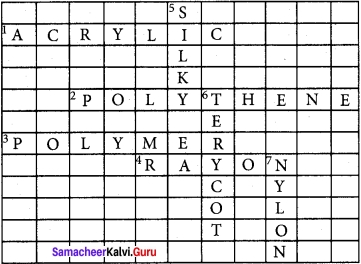
VIII. Crossword

Across
1. Fibre that is used as synthetic wool.
2. A plastic used for making water bottles.
3. A long chain made of small repeating monomers.
4. Another name for this semi-synthetic fibre is artificial silk.

Down:
5. A type of fibre that is naturally obtained from a cocoon.
6. A synthetic fibre classified as polyester.
7. A polymer used for making rope
Polymer Chemistry 7th Standard Samacheer Kalvi Science Solutions Term 3 Chapter 3

IX. Very short answer :

Question 1.
What is the chemical name of the polymers that make up cotton?
Answer:
Cellulose.

Question 2.
What gives plastic different qualities and characteristics?
Answer:
Different chemicals (additives) are added to plastic to give them various qualities and characteristics.

Question 3.
It is not advisable to burn plastic and synthetic fabrics. Why?
Answer:
Burning of plastics and synthetic fabrics is not a good solution, as we end up wasting non-renewable resources and produce super toxic chemicals that are difficult to store or dispose safely.

Question 4.
A bucket made of plastic does not rust like a bucket made of iron. Why?
Answer:

  1. The reason is due to their chemical composition.
  2. The bucket is made of plastic which does not react with the oxygen and humidity present in air.
  3. While the iron reacts with the oxygen, air corrodes to form rust.

Question 5.
Why is it better to avoid the use of plastic products?
Answer:

  1. Plastics do not decompose by natural processes and action of bacteria and are therefore not biodegradable.
  2. A lot of the plastic produced globally is designed to be used only once and thrown away, creating a large amount of plastic waste.
  3. Plastic waste ends up being recycled, incinerated, landfilled, dumped or ends up littering our environment.
  4. So, it is better to avoid the use of plastic products.

Question 6.
Give two examples of thermosetting plastics.
Answer:
Bakelite, Melamine.

Question 7.
What is the 5 R principle?
Answer:
Plastic disposal is the 5 R principle, Refuse, Reduce, Reuse, Recycle and Recover is called as 5 R principle.

X. Short Answer :

Question 1.
What does the term biodegradable mean?
Answer:
A material that gets decomposed through natural processes and action by bacteria is called biodegradable

Question 2.
What kind of fabric is suitable to dress-up and play in summer? Why?
Answer:

  1. In summer it is better to wear clothing that is made out of cotton materials rather than synthetic.
  2. This is because most synthetic fibres absorb very little moisture and do not allow air circulation making them hot and uncomfortable to wear.

Question 3.
How do plastics impact animals and the environment?
Answer:

  1. The increase in the use of plastics, particularly the one-time use and throw away plasticshas serious impacts on the environment, animals and our health.
  2. We have seen garbage dumps with different plastics. One big problem with plastics is that they do not decompose or biodegrade.
  3. This leads to large amounts of waste that will not disappear and end up accumulating and polluting the environment.
  4. Many animals confuse plastic for food and eat it by accident. When leftover food is thrown away it is often packed in plastic. Animals smell the leftover food and eat the plastic by accident.

XI. Long Answer :

Question 1.
List the advantages and disadvantages of synthetic fibres.
Answer:
Advantages-and disadvantages of synthetic fibres.

Advantages of synthetic fibresDisadvantages of synthetic fibres
1.Do not wrinkle easily and they keep their colour and brightness for a much longer time than natural fibres such as cotton.synthetic fibres such as polyester is that they are not heat resistant and catch fire easily.
2.Using synthetic fibres such as nylon, is that they are stronger than many natural fibres such as silk or wool.Most synthetic fibres absorb very little moisture and do not allow air circulation making them hot and uncomfortable to wear.
3.These fibres are strong and elastic which gives it the properties to bounce.Synthetic fibres are made out of petrochemicals and last in the environment for a very long time. It break down into very small pieces called microplastics which cause pollution to soil and water bodies such as rivers, lakes and oceans.

Question 2.
Suggest safe methods of disposing plastics.
Answer:
Refuse (Avoid):

  1. The best thing to do is to avoid using plastic products.
  2. One-time use throw away plastics can often be avoided.

Reduce : Reducing the amount of plastic we use is important.
Reuse : If possible products made of plastics can be used again and again.
Recycle:

  1. It is better to recycle plastic waste.
  2. Separating plastic waste (based on the resin code) and making sure it gets recycled is good as it turns waste materials into something new.
  3. Then it will not be thrown away in landfills, open dumps or ending up as litter in the environment.
    Solid waste can be converted into resources such as electricity and compost through thermal and biological means.

XII. HOTS :

Question 1.
The Tamil Nadu Government has banned the use of one-time use throw away plastics. Why
do you think this is important?
Answer:
It is important to reduce the negative consequences of plastics on the environment.

Question 2.
A plastic bag dumped in the soil stays without breaking down for 500years. If a new generation starts in every 30 years, how many generations would it take to see the plastic bag finally broken down?
Answer:
It would take 16 to 17 generations to see the plastic bag finally broken down.

XIII.
Question 1.
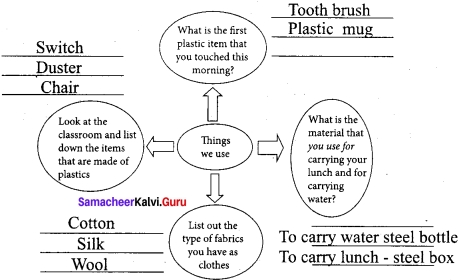
Fill in the blanks :
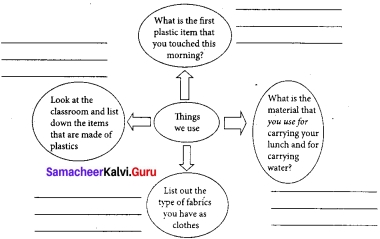
Samacheer Kalvi 7th Science 3rd Term Chapter 3 Polymer Chemistry
Answer:

Samacheer Kalvi 7th Science Term 3 Chapter 3 Polymer Chemistry

Question 2.
Look at the following picture and explain what is happening
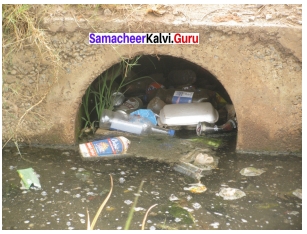
Samacheer Kalvi 7th 3rd Term Science Solutions Chapter 3 Polymer Chemistry
Answer:
A lot of one-time use plastic such as polythene bags and food packaging that are thrown away are responsible for littering the environment and clogging drains. Standing water breeds mosquitoes that can spread diseases such as malaria dengue and chickungunya and also lead to flooding.

Question 3.
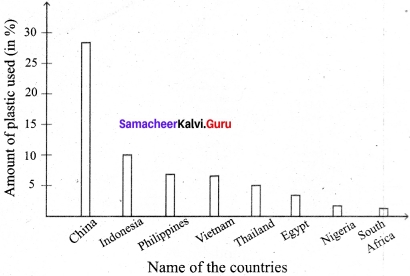
Read the following information and convert them into a graph to compare the countries and the amount of plastic they use.
China contributes the highest share – that is around 28%, of the total plastic used globally. Indonesia uses 10%, both the Philippines and Vietnam use 6% each; Thailand uses 3.2%, Egypt 3%, Nigeria 2.7% and South Africa 2%.
Answer:
Samacheer Kalvi 7th Books Science Term 3 Chapter 3 Polymer Chemistry

Samacheer Kalvi 7th Science Polymer Chemistry Intext Activity

Activity – 2
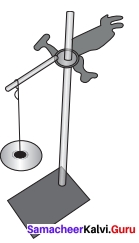
How Strong is Nylon? Take an iron stand with a clamp. Take samples of cotton, wool, nylon and silk threads of about 50cm in length.
First tie cotton thread to the stand so that it hangs freely from it. At the free end, attach a CD as plate so that weights can be placed on it. Add weights starting from 10 grams one by one, until the thread breaks. Note down the total weight required to break the cotton thread. Repeat the same activity with the wool, silk and nylon threads. NOTE: All the varieties of threads should be of same thickness.
Samacheer Kalvi 7th Science Solutions Term 3 Chapter 3 Polymer Chemistry

Question 1.
Arrange the threads in the order of increasing strength.
Answer:
Cotton, Wool, Silk, Nylon.

Question 2.
What do you infer from the above activity?
Answer:
Nylon thread is the strongest thread.

Question 3.
Which type of fibre is the strongest?
Answer:
Nylon.

Question 4.
Which type of fibre is the weakest?
Answer:
Cotton.

Activity – 4

Question 1.
Synthetic or Natural Fibres : The teacher can give the learner a piece of each and every type of fibre. The learner can feel the fibre and write down the name of the fibre and state whether it is natural or synthetic fibre.
Answer:

S.NoName of the fibreType of the fibre- Natural /Synthetic
1.JuteNatural
2.CottonNatural
3.RayonSynthetic
4.WoolNatural
5.PolyesterSynthetic

Question 2.
We have done four activities so far. Which activity helped you better to identify the type of fibre?
Answer:
Activity 3, 4

Activity – 5

Question 1.
What do you observe while the cotton cloth burns?
Answer:
The cotton cloth burns completely. Does not melt and has the odour of burning paper.

Question 2.
What do you observe while the polyester cloth burns?
Answer:
Polyester cloth melts on burning and giving off black smoke.

Activity – 6

Question 1.
We use an umbrella on rainy days. What kind of umbrella do we use?
Answer:
Nylon or Polyester

Question 2.
Which of these fabrics allows water to pass through?
Answer:
Cotton cloth allows water to pass through whereas umbrella cloth does not allow water to pass through.

Question 3.
Which of these fabrics dries the fastest? The cotton cloth or the umbrella cloth?
Answer:
Umbrella cloth dries the fastest.

Activity – 7

Question 1.
Right and wrong application of plastics.
Look at the list of eight plastic items. Decide which four plastic items are used for the right application and which four are used for the wrong application by filling in the chart below: Plastic items: straws, helmets, cutlery, thin carry bags, syringes, electrical wires,tea cups and blood bags
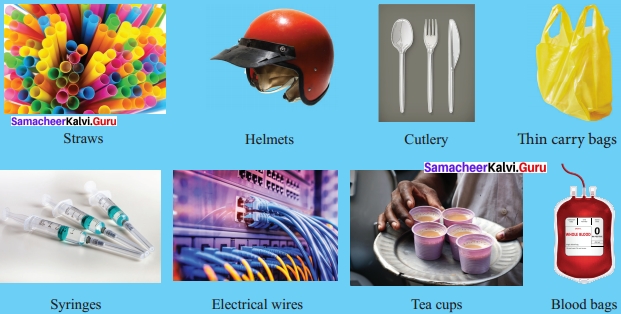
Samacheer Kalvi 7th Science Solutions Term 3 Chapter 3 Polymer Chemistry

Answer:

Right applicationWrong application
HelmetsStraws
SyringesThin carry bags
Electrical wiresCutlery
Blood bagsTea cups

Activity – 8
Question 1.
Identify the different types of plastics.
Collect different kinds of plastic products and look carefully for the resin code and/or acronym on them. With the help of the resin code chart, mark the resin code number, acronym, if you think it is a safer, unsafe or questionable (when you cannot find the resin code in the article) type of plastic. What resin codes do you find? Is the resin code safer, un safe or questionable?
Answer:

ProductResin code numberAcronymCategory of safetyUse of product
Rain coat03PVCUnsafeDuring rain
Pens06PSUnsafeTo write

Samacheer Kalvi 7th Science Polymer Chemistry Additional Questions

I. Choose the correct answer.

Question 1.
Which of these is a natural fibre?
(a) Nylon
(b) Cotton
(c) Rayon
(d) Polyester
Answer:
(b) cotton

Question 2.
Which of these plastics is a polymer?
(a) Bakelite
(b) Polystyrene
(c) Polythene
(d) All of these
Answer:
(d) All of these

Question 3.
Which of these is not a property of plastics?
(a) Inflammable
(b) Bad conductor of heat
(c) Soluble in water
(d) Bad conductor
Answer:
(c) Soluble in water

Question 4.
Pick the synthetic fibre out of the following.
(a) Jute
(b) Cotton
(c) Nylon
(d) Wool

Question 5.
Which is a thermosetting plastic?
(a) Melamine
(b) Polythene
(c) PVC
(d) Nylon
Answer:
(a) Melamine

Question 6.
Which of the following is non – bio degradable?
(a) Plastic
(b) Paper
(c) Cotton cloth
(d) Wood
Answer:
(a) Plastic

Question 7.
The material similar to silk in appearance is.
(a) nylon
(b) rayon
(c) polyester
(d) terylene
Answer:
(b) rayon

Question 8.
The fibres such as rayon, nylon, polyester are obtained from
(a) natural resources
(b) chemical substances
(c) minerals
(d) plants and animals
Answer:
(b) chemicals substances

Question 9.
Which of the following fibres is considered as the strongest natural fibre?
(a) Cotton
(b) Jute
(c) Silk
(d) Wool
Answer:
(c) Silk

Question 10.
Which of the following is found in sanitary products?
(a) Nylon
(b) Wool
(c) Jute
(d) Rayon
Answer:
(d) Rayon

II. Fill in the Blanks.

  1. Polymers are very long chains made of repeating smaller molecules called ______
  2. All the ______ present in your body are polymers.
  3. ______ is made of sugar molecules and is the main component of cotton used in clothing.
  4. ______ and ______ are the building block monomers that make up many different types of plastics.
  5. ______ are long strands of polymers interwoven to form linear, string-like structures.
  6. Fibres that are made using raw materials from ______ are synthetic fibres.
  7. The cellulose dissolves in the chemicals added to it and produces syrup called ______
  8. Nylon is a plastic polymer made of chemical units called ______
  9. ______ is a synthetic fibre which is strong and elastic that it has the ability to bounce.
  10. Syringe that is made from a type of plastic called ______
  11. Edmund Alexander Parkes was the creator of the first plastic called .
  12. resists fire and can tolerate heat.
  13. Poly Lactic Acid or polylactide is and , thermoplastic.

Answer:

  1. monomers
  2. proteins
  3. Cellulose
  4. Ethylene, propylene
  5. Fibres
  6. petroleum
  7. Viscose
  8. Polyamides
  9. Trampoline
  10. polypropylene
  11. Parkesine
  12. Melamine
  13. Compostable, bioactive

III. True or False – if false, give the correct statement.

Question 1.
Polycot is a mixture of polyester and cotton.
Answer:
True

Question 2.
Polyamides are made with monomers.
Answer:
True

Question 3.
Wool is the first fully processed synthetic fibre.
Answer:
Correct statement: is the first fully processed synthetic fibre.

Question 4.
Rayon is a fibre obtained by the chemical treatment of wood pulp.
Answer:
True

Question 5.
Plastics are flexible and waterproof and some are even UV resistant.
Answer:
True

Question 6.
Bakelite and melamine are some examples of thermoplastics
Answer:
False
Correct statement: Bakelite and and melamine are some examples of thermosettingplastic

Question 7.
Polyvinyl chloride has heavy metals such as cadmium and lead which are toxic and harmful to our health.
Answer:
True

Question 8.
Plastics can be found in toothpaste, facewash and bodyscrubs.
Answer:
False
Correct statement : can be found in toothpaste, facewash and bodyscrubs.

Question 9.
Plastics are environment friendly.
Answer:
False
Correct statement: Plastics are not environment friendly.

Question 10.
Artificial fibres are stronger than natural fibres.
Answer:
True

Question 11.
Electric switches, plugs, sockets and handles of cooling utensils are made up of thermoplastics.
Answer:
Correct statement: Electric switches, plugs, sockets and handles of cooling utensils are made up of thermosetting plastic

IV. Match the following :

Question 1.

1.Teflon(a)Fabrics do not wrinkle easily
2.Nylon(b)Used to make non-stick cookwares
3.Polyester(c)Prepared by using pulp
4.Rayon(d)Used for making parachutes and stockings

Answer:

  1. b
  2. d
  3. a
  4. c

Question 2.

1.Nylon(a)Artificial silk
2.PET(b)Artificial wool
3.Rayon(c)Parachute
4.Acrylic(d)Polyester

Answer:

  1. c
  2. d
  3. a
  4. b

Question 3.

1.Plastic bags(a)Polyvinyl chloride
2.PVC(b)Natural fibre
3.Melamine(c)Non-bio degradable
4.Wood(d)Thermosetting plastic

Answer:

  1. c
  2. a
  3. d
  4. b

V. Very short answers:

Question 1.
What is the full form of PVC?
Answer:
Poly Vinyl Chloride.

Question 2.
Name a synthetic fibre which works like wool?
Answer:
Acrylic.

Question 3.
Plastic articles are available in all possible shapes and sizes. Why?
Answer:
Plastic is easily mouldable, so the articles can be made in any shape and size.

Question 4.
Name the unit used in the formation of a polymer.
Answer:
Monomer is the small unit used in the formation of a polymer.

Question 5.
Name the form of polyester which is replacing materials like glass and used for making bottles and jars.
Answer:
PET (Polyethylene Terephthalate) is a form of polyester.

Question 6.
For making PVC pipes, which type of plastic is used?
Answer:
Thermoplastic.

Question 7.
Name the plastic. Which is coated on the uniform of fireman to make it fire resistant?
Answer:
Melamine is coated in the uniforms of fireman.

Question 8.
Name a natural polymer occuring in plants.
Answer:
Cellulose, Starch, etc.

Question 9.
On burning wool, why we get the small of burning of hair?
Answer:
Since, wool is made from hair of sheep, it gives smell of burning hair.

Question 10
What is polymerization?
Answer:
The process by which monomers are linked together by covalent bonds to form polymers is called polymerization.

VI. Short Answer.

Question 1.
Why is rayon called on artificial silk?
Answer:

  1. Rayon is a synthetic fibre having properties similar to that of silk.
  2. It was obtained by chemical treatment of wood pulp.
  3. That’s why, it is called an artificial silk.

Question 2.
What are the various methods of disposing plastics?
Answer:

  1. Refuse
  2. Reduce
  3. Recycle
  4. Recover

Question 3.
What is compostable plastic?
Answer:

  1. Plastics which are derived from renewable resources such as corn, sugar cane, avocado seeds or shrimp cells.
  2. It can be broken down completely by microbes and turned back into food for plants – COz, methane, water and other natural compounds.

Question 4.
Why do you think some animals eat plastic?
Answer:

  1. Many animals confuse plastic for food and eat it by accident.
  2. When leftover food is thrown away it is often packed in plastic.
  3. Animals smell the leftover food and eat the plastic by accident.

Question 5.
What do you mean by microplastics?
Answer:

  1. Synthetic fibres are made out of petrochemicals and last in the environment for a very long time.
  2. It break down into very small pieces called microplastics which cause pollution to soil and water bodies such as rivers, lakes and oceans.

Question 6.
Mention a few household products in which microbeads can found.
Answer:
Microbeads can be found in toothpaste, facewash and bodyscrubs.

Question 7.
What is thermoplastics and thermosetting plastics?
Answer:
Plastics which can be easily softened and bent when heated are known as thermoplastic . There are some plastics which once they are moulded, cannot be softened through heating them. These are called Thermo plastic

Question 8.
Hot foot stuff should not be kept in polythene containers. Why?
Answer:
Hot food stuff should not be kept in polythene containers since polythene is a thermoplastic.

Question 9.
Plastics have completely occupied our life. Why?
Answer:

  1. Plastics have completely occupied our life because of their characteristic qualities.
  2. Plastics have many positive qualities such as lightweight, strong and they can be moulded into complex shapes.
  3. They are also flexible and waterproof and some plastics are even UV resistant.
  4. Plastics are also cheap and convenient for us to use.

VII. Long Answer

Question 1.
Explain about plastic eating bacteria.
Answer:

  1. In 2016, scientists from Japan tested different bacteria from a bottle recycling plant and found that Ideonellasakaiens is 201-F6 could digest the plastic used to make single-use drinks bottles that are made of polyethylene terephthalate (PET).
  2. The bacteria works by secreting an enzyme known as ‘PETase’, that breaks down plastic into smaller molecules.
  3. These smaller molecules are then absorbed by the bacteria as a food source.
  4. The scale of the bacteria breaking down plastics is much slower and will therefore not solve the crisis we are facing.

Question 2.
Write a note on manufacturing of glass.
Answer:

  1. Glass is prepared by heating (SiO) silicondi-oxide until it melts, about 1700°C and Sodium Carbonatfe is added to it.
  2. Then it is cooled down really fast.
  3. When SiO2 silicondi-oxide melts, the silicon and oxygen atoms break out of their crystal structure.
  4. If we cooled it slowly, the atoms would slowly line up back into their crystalline arrangement.
  5. But if we cool the liquid fast enough, the atoms of the silica will be halted in their tracks, they won’t have time to line up, and they will be stuck in any old arrangement, with no order to the arrangement of the atoms.
  6. We call materials like this as amorphous.

Question 3.
Write the importance of rayon.
Answer:

  1. Some types of rayon are made from the short cotton fibres left on cotton seeds after ginning.
  2. Rayon is cheaper than silk, can be woven like natural silk fibre and can be dyed in a wide variety of colours.
  3. It can be mixed with cotton to make bed sheets or with wool in the production of carpets and home furnishing products.
  4. Rayon is also found in sanitary products, diapers, bandages and gauze for dressing

VIII. Complete the following crossword with the help of the clues provided:

Across:
5. First artificially made fibre.
6. Join together to form polymers.
7. Made of ester units.

Down:
1. Terylene and cotton blend.
2. An example of a thermosetting platics.
3. Artificially made fibres.
4. Used to make parachutes.
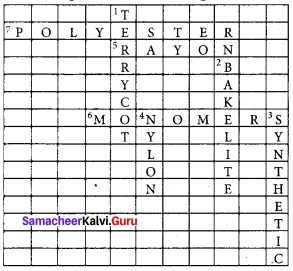
Samacheer Kalvi 7th Science Solutions Term 3 Chapter 3 Polymer Chemistry

IX. HOTS:

Question 1.
Ram took with him some nylon ropes, when he was going for rock climbing. Can you tell why he selected nylon ropes instead of ropes made up of cotton or jute?
Answer:

  1. Nylon ropes are strong, elastic and lighter as compared to cotton and jute ropes.
  2. A nylon thread is actually stronger than a steel wire of similar thickness.

Question 2.
Ramya loves to were the clothes made up of synthetic fibres. When she was working in kitchen, her mother advised her not to wear the synthetic clothes.

  1. Why Ramya’s mother advised her not to wear synthetic clothes while working in kitchen?
  2. Why Ramya loves to wear synthetic dress?

Answer:

  1. Synthetic fibres melt on heating. It the clothes catch fire, it can be disastrous. The fabric melts and sticks to the body of the person wearing it. So, she advised here not to wear synthetic clothes while working in kitchen.
  2. Ramya loves to wear synthetic dress because these clothes dry up quickly, durable, less expensive, readily available and easy to maintain.


Samacheer Kalvi 7th Maths Solutions Term 1 Chapter 1 Number System Intext Questions

Students can Download Maths Chapter 1 Number System Intext Questions and Answers, Notes Pdf, Samacheer Kalvi 7th Maths Book Solutions Guide Pdf helps you to revise the complete Tamilnadu State Board New Syllabus and score more marks in your examinations.

Tamilnadu Samacheer Kalvi 7th Maths Solutions Term 1 Chapter 1 Number System Intext Questions

(Try These Textbook Page No. 1)

Samacheer Kalvi 7th Maths Book Answers Question 1.
Write the following integers in ascending order: -5,0,2,4, -6,10, -10
Solution:
Plotting the points on the number line, we get
Samacheer Kalvi 7th Maths Book Answers Term 1 Chapter 1 Number System Intext Questions
The numbers are placed in an increasing order from left to right.
∴ Ascending order: -10 < -6 < -5 < 0 < 2 < 4 < 10

7th Maths Number System Question 2.
If the integers -15, 12, -17, 5, -1, -5, 6 are marked on the number line then the integer on the extreme left is _____ .
Solution:
The least number will be on the extreme left.
∴ -17 will be on the extreme left.

Number System 7th Standard Question 3.
Complete the following pattern:
50, ___ 30, 20, _, 0, -10, _, _, -40, _, ___.
Solution:
The difference between the consecutive number is 10.
50, 40, 30,20, 10, 0, -10, -20, -30, -40, -50, -60

Samacheer Kalvi 7th Maths Books Answers Question 4.
Compare the given numbers and write “<”, “>” or in the boxes.
7th Maths Number System Solutions Term 1 Chapter 1 Samacheer Kalvi Intext Questions
Solution:
(a) Samacheer Kalvi 7th Maths Solutions Term 1 Chapter 1 Number System Intext Questions 3 A positive number is greater than a negative number.
(b) Number System 7th Standard Intext Questions Samacheer Kalvi Maths Solutions Term 1 Chapter 11000,0 is less than all positive integers.

(c) Samacheer Kalvi 7th Maths Books Answers Term 1 Chapter 1 Number System Intext Questions

7th Maths Exercise 1.1 Samacheer Kalvi Question 5.
Write the given integers in descending order, -27, 19, 0, 12, -4, -22, 47, 3, -9, -35.
Solution:
Separating positive and the negative integers, we get -27, -4, -22, -9, -35
Arranging the numbers in descending order -4 > -9 > -22 > -27 > -35
The positive numbers are 19,12,47, 3
Arranging in descending order, we get 47 > 19 > 12 > 3
0 stands in the middle.
∴ Descending order: 47 > 19 > 12 > 3 > 0 > -4 > -9 > -22 > -27 > -35

(Try This Text Book Page No. 3)

7th Maths Guide Try These Question 1.
Find the value of the following using the number line activity.
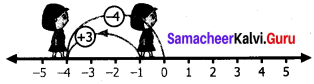
(i) (-4) + (+3)
(ii) (-4) + (-3)
(iii) (+4) + (-3)
Solution:
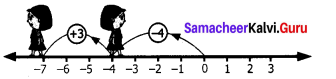
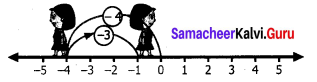
(i) (-4) + (+3)
To find the sum of (-4) and (+3), we start at zero facing positive direction continuing in the same direction and move 4 units backward to represent (-4).
Since the operation is addition we maintain the same direction and move three units forward to represent (+3)
We land at -1
So (-4) + (+3) = -1
7th Maths Exercise 1.1 Samacheer Kalvi Term 1 Chapter 1 Number System Intext Questions

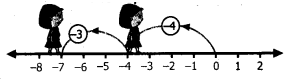
(ii) (-4) + (-3)
From zero move 4 steps backward to represent (-4)
From the same direction again move 3 units backward to represent (-3)
We land at -7 So (-4) + (-3) = -7
7th Maths Guide Try These Samacheer Kalvi Solutions Term 1 Chapter 1 Number System Intext Questions

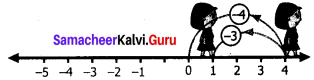
(iii) (+4) + (-3)
We start at zero facing positive direction and move 4 steps forward to represent (+4) Since the operation is addition we maintain the same direction and move three units backward to represent (-3).
We land at +1.
So (+4) + (-3) = +1
Samacheer Kalvi 7th Maths Solutions Term 1 Chapter 1 Number System Intext Questions

(Properties of Addition Textbook Page No. 6)

Samacheer Kalvi 7th Maths Solutions Question 1.
Complete the given table and check whether the sum of two integers is an integer or not?
(i) 7 + (-5) = (+2)
(ii) (-6)+ (-13) = (-19)
(iii) 25 + 9 = 34
(iv) (-12) + 4 = -8
(v) 41 + 32 = 73
(vi) (-19) + (-15) = (-34)
(vii) 52 + (-15) = (+37)
(viii)(-7) + 0 = (-7)
(ix) 0 + 12 = 12
(x) 14 + 0 = 14
(xi) (-6) +(-6) = (-12)
(xii) (-27) + 0 = -27
Solution:
The sum of two integers is an integer.

(Try These Textbook Page No. 7)

Samacheer Kalvi Guru 7th Maths Question 1.
Fill in the blanks:
(i) 20 + (-11) = -(11)+ 20 [∵ Addition is commutative]
(ii) (-5) + (-8) = (-8) + (-5) [∵ Addition is commutative]
(iii) (-3) +12 =12 + (-3) [∵ Addition is commutative]

7th Standard Number System Question 2.
Say True or False.
(i) (-11) + (-8) = (-8) + (-11)
(ii) -7 + 2 = 2 + (-7)
(iii) (-33) + 8 = 8 + (-33)
Solution:
(i) True, because addition is commutative for intergers
(ii) True, by commutative property on intergers
(iii) True, by commutative property on intergers

Samacheer Kalvi 7th Maths Question 3.
Verify the following.
(i) [(-2) + (-9)] + 6 = (-2) + [(-9) + 6]
(ii) [7 + (-8)] + (-5) = 7 + [(-8) + (-5)]
(iii) [(-11) + 5]+ (-14) = (-11) + [5 + (-14)]
(iv) (-5) + [(-32) +(-2)] = [(-5) + (-32) + (-2)]
Solution:
(i) [(-2) + (-9)] + 6 = (-2) + [(-9) + 6]
[(-2) + (-9)] + 6 = (-11) + 6 = -5
Also (-2) + [(-9) + 6] = (-2) + (-3) = -5
Both the cases the sum is -5.
∴ – [(-2) + (-9)] + 6 = (-2) + [(-9) + 6]

(ii) [7 + (-8)] +(-5) = 7 + [(-8) + (-5)]
Here [7 + (-8)] + (-5) = (-1) + (-5) = -6
Also 7 + [(-8) + (-5)] = 7 + (-13) = 7 – 13 = -6
In both the cases the sum is -6.
∴ [7 + (-8)] + (-5) = 7 + [(-8) + (-5)]

(iii) [(-11) + 5] + (-14) = (-11) + [5 + (-14)]
Here [(-11) + 5] + (-14) = (-6) + (-14) = (-20)
(-11) + [5 + (-14)] = (-11) +(-9) = (-20)
In both the cases the sum is -20.
∴ [(-11) + 5] + (-14) = (-11) + [5 + (-14)]

(iv) (-5) + [(-32) + (-2)] = [(-5) + (-32)] + (-2)
(-5) + [(-32) + (-2)] = (-5) + (-34) = -39
Also [(-5) + (-32)] + (-2) = (-37) + (-2) = -39
In both the cases the sum is -39.
∴ (-5)+ [(-32) +(-2)] = [(-5)+ (-32)] +(-2)

Samacheer Kalvi 7th Maths Book Answers Pdf Question 4.
Find the missing integers:
(i) 0 + (-95) = -95
(ii) -611 + 0 = -611
(iii) ____ + 0 = _____ Any integer; the same integer
(iv) 0 + (-140) = -140

Samacheer Kalvi 7th Maths Book Solutions Question 5.
Complete the following:
(i) -603 + 603 = 0
(ii) 9847+ (-9847) = 0
(iii) 1652 + (-1652) = 0
(iv) -777 + 777 = 0
(v) –5281 +5281 = 0

Exercise 1.2

Subtraction of Integers

(Try These Text book Page No. 11)

Samacheer Kalvi 7th Maths Answers Question 1.
Do the following by using number line.
(i) (-4) – (+3)
Solution:
We start at zero facing positive direction move 4 units backward to represent (-4). Then turn towards negative side and move 3 units forward.
Samacheer Kalvi Guru 7th Maths Solutions Term 1 Chapter 1 Number System Intext Questions

We reach -7.
∴ (-4) – (+3) = -7.

(ii) (-4) – (-3)
Solution:
We start at zero facing positive direction. Move 4 units backward to represent -4. Then turn towards the negative side and move 3 units backwards.

7th Standard Number System Samacheer Kalvi Maths Solutions Term 1 Chapter 1 Intext Questions
We reach at-1.
∴ (-4) – (-3) = -1.

Samacheer Kalvi Guru 7th Standard Maths Question 2.
Find the values and compare the answers.
(i) (-6) – (-2) and (-6) + 2
Solution:
(-6) – (-2) = -6 + (Additive inverse of-2)
= -6 + (+2) = -4
Also (-6)+ 2 = -4
∴ (-6) – (-2) = (-6) + 2

(ii) 35 – (-7) and 35 + 7.
Solution:
35 – (-7) = 35 + (Additive inverse of -7) = 35 + (+7) = 42
Also 35 + 7 = 42 ; 35 – (-7) =35 + 7

(iii) 26 – (+10) and 26 + (-10)
Solution:
26 – (+10) = 26 + (Additive inverse of +10) = 26 + (-10) = 16
Also 26 + (-10) = 16; 26 – (+10) = 26 + (-10)

Number System 7th Class Question 3.
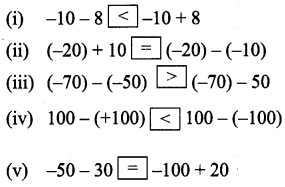
Put the suitable symbol <, > or = in the boxes.
Samacheer Kalvi 7th Maths Solutions Term 1 Chapter 1 Number System Intext Questions

Solution:
(i) -10 – 8 = -18 & -10 + 8 = – 2
(ii) (-20) + 10 = -10 & (-20) – (-10) = -10
(iii) -70 – 50 = (-70) + (-50) = -20
(iv) 100 – (+100) = 0 & 100 – (-100) = 100 + (+100) = 200
(v) -50 – 30 = -50 + (-30) = -80 Also -100 + 20 = – 80

(Try These Text book Page No. 14)

Samacheer Kalvi Guru 7th Maths Solutions Question 1.
Fill in the blanks.
(i) (-7) – (-15) = +8
-7 – (-15) = -7 + (Additive inverse of-15)
= -7 + 15 = +8
(ii) 12 – (-7) = 19          12 – (-7) = 19
(iii) -4 – (-5) = 1

Question 2.
Find the values and compare the answers.
(i) 15 – 12 and 12 – 15
(ii) -21 – 32 and -32 – (-21)
Solution:
(i) 15 – 12 = 3 & 12-15 = 12 +(-15) = -3
Samacheer Kalvi 7th Maths Book Answers Pdf Solutions Term 1 Chapter 1 Number System Intext Questions

(ii) -21 – 32 = (-21) + (-32) = -53
Also -32 – (-21) = (-32) + (+21) = -11 ; -53 < -11

Samacheer Kalvi 7th Maths Book Solutions Term 1 Chapter 1 Number System Intext Questions

Question 3.
Is associative property true for subtraction of integers. Take any three examples and check.
Solution:
Consider the numbers 1,2 and 3. Now (1 – 2) – 3 = -1 – 3 = -4
Also 1 – (2 – 3) = 1 – (-1) = 1 + 1 = 2
∴ (1 – 2) – ≠ 1 – (2 – 3)
∴ Associative property is not true for subtraction of integers.

Exercise 1.3

Multiplication of Integers

(Try These Textbook Page No. 16)

Question 1.
Find the product of the following
(i) (-20) × (-45) = +900 [As we know the product of two negative integers is positive, the answer is +900.]
(ii) (-9) × (-8) = 72 [ ∵ Product of two negative integers is positive]
(iii) (-30) × 40 × (-1) = (+1200) [Product of two integers with opposite sings is negative integer.
(-30) × 40 × (-1) = (-1200) × (-1) = +1200)]
(iv) (-50) × 2 × (-10) = -1000 [Product of two integers with opposite signs is negative.
(+50) × 2 × (-10) = 100 × (-10) = -1000)]

Question 2.
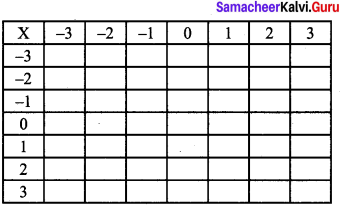
Complete the following table by multiplying the integers in the corresponding row and column headers.
Samacheer Kalvi 7th Maths Answers Term 1 Chapter 1 Number System Intext Questions
Solution:
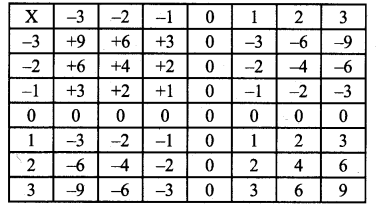
We know that
(i) product of two positive integers is positive
(ii) product of two negative integers is
(ii) product of two negative integers is positive
(iii) product of integers with opposite sign is negative.
∴ The table will be as follows:
Samacheer Kalvi Guru 7th Standard Maths Term 1 Chapter 1 Number System Intext Questions

Question 3.
Which of the following is incorrect?
(i) (-55) × (-22) × (-33) < 0
(ii) (-1521) × 2511 < 0
(iii) 2512 – 1525 < 0
(iv) (1981) × (+2000) < 0
Solution:
(iii) and (iv) are incorrect because 2512 – 1252 is a positive integer.
Also (+1981) × (+2000) is a positive integer.

(Try These Textbook Page No. 18)

Question 1.
Find the product and check for equality
(i) 18 × (-5) and (-5) × 18
Solution:
Here 18 × (-5) = -90 Also (-5) × 18 = -90
∴ 18 × (-5)= (-5) × 18

(ii) 31 × (-6) and (-6) × 31
Solution:
Here 31 × (-6) = -186 Also (-6) × 31 =-186
∴ 31 × (-6)= (-6) × 31

(iii) 4 × 51 and 51 × 4
Solution:
Here 4 × 51 = 204 Also 51 × 4 = 204
∴ 4 × 51 = 51 × 4

Question 2.
Prove the following.
(i) (-20) × (13 × 4) = [(-20) × 13] × 4
Solution:
LHS = (-20) × (13 × 4) = (-20) × 52 = -1040
RHS = [(-20) × 13] × 4 = (-260) × 4 = -1040
LHS = RHS
∴ (-20) × (13 × 4) = [(-20) × 13] × 4

(ii) [(-50) × (-2)] × (-3) = (-50) × [(-2) × (-3)]
Solution:
LHS = [(-50) × (-2)] × (-3) = 100 × (-3) = -300
RHS = (-50) × [(-2) × (-3)] = (-50) × 6 =-300
LHS = RHS
∴ [(-50) × (-2)] × (-3) = (-50) × [-2) × (-3)]

(iii) [(-4) × (-3)] × (-5) = (-4) × [(-3) × (-5)]
Solution:
LHS = [(-4) × (-3)] × (-5) = 12 × (-5) = -60
RHS = (-4) × [(-3) × (-5)] = (-4) × 15 = -60
LHS = RHS
∴ [(-4) × (-3)] × (-5) = (-4) × [(-3) × (-5)]

(Try These Textbook Page No. 19)

Question 1.
Find the values of the following and check for equality:
(i) (-6) × (4 + (-5)) and ((-6) × 4) + ((-6) × (-5))
Solution:
(-6) × (4 + (-5)) = (-6) × (-1) = 6 .
((-6) × 4) + ((-6) × (-5)) = (-24)+ 30 = 6
Hence (-6) × (4 + (-5)) = ((-6) × 4) + ((-6) × (-5))

(ii) (-3) × [2 + (-8)] and [(-3) × 2] + [(-3) × 8]
Solution:
(-3) × [2 + (-8)] = (-3) × (-6) = 18
Also [(-3) × 2] + [(-3) × 8] = (-6)+ (-24) = -30
(-3) × [2 + (-8)] ≠ [(-3) × 2] + [(-3) × 8]

Question 2.
Prove the following.
(i) [(-5) × (-76)] + [(-5) × 8]
Solution:
LHS = (-5) × [(-76) + 8] = (-5) × (-68)
= +340
RHS = [(-5) × (-76)] + [(-5) × 8]
= +380 + (-40) = +380 – 40
= +340
LHS = RHS
∴ (-5) × [(-76) + 8] = [(-5) × (-76)] + [(-5) × 8]

(ii) (42 × 7) + [42 × (-3)]
Solution:
LHS = 42 × [7 + (-3)]
= 168
RHS = (42 × 7) + [42 × (-3)] = 294 – 126
= 168
LHS = RHS
∴ 42 × [7 + (-3)] = (42 × 7) + [42 × (-3)]

(iii) [(-3) × (-4)] + [(-3) × (-5)]
Solution:
LHS = (-3) × [(-4) + (-5)] = (-3) × (-9)
= +27
RHS = [(-3) × (-4)] + [(-3) × (-5)] = 12 + 15 = 27
LHS = RHS
∴ (-3) × [(-4) + (-5)] = [(-3) × (-4)] + [(-3) × (-5)]

(iv) 103 × 25 = (100 + 3) × 25 = (100 × 25) + (3 × 25)
Solution:
First consider 103 × 25 = 2575
Now (100 + 3) × 25 = 103 × 25 = 2575
Also (100 × 25) + (3 × 25) = 2500 + 75
= 2575
∴ All the three are same. 103 × 25 = (100 + 3) × 25 = (100 × 25) +(3 × 25)

Exercise 1.4

Division of Integers

(Try These Text book Page No. 22)

Question 1.
(i) (-32) ÷ 4 = _____
(ii) (-50) ÷ 50 = ____
(iii) 30 ÷ 15 = ______
(iv) -200 ÷ 10 = _____
(v) -48 ÷ 6 = ______
Solution:
(i) -8
(ii) -1
(iii) 2
(iv) -20
(v) -8

Samacheer Kalvi 7th English Solutions Term 1 Supplementary Chapter 3 Taking the Bully by the Horns

Students can Download English Lesson 3 Taking the Bully by the Horns Questions and Answers, Summary, Notes Pdf, Activity, Samacheer Kalvi 7th English Book Solutions Guide Pdf helps you to revise the complete Tamilnadu State Board New Syllabus and score more marks in your examinations.

Tamilnadu Samacheer Kalvi 7th English Solutions Term 1 Supplementary Chapter 3 Taking the Bully by the Horns

A. Choose the correct answer.

Taking The Bully By The Horns Question 1.
What is bullying?
(a) When you and a friend get into a fight.
(b) When someone accidently bumps into you on the playground.
(c) When someone is hurt by others either by words or actions, feels bad because of it, and finds it hard to stop what’s happening to them.
(d) Rolling a ball to knock over pins.
Answer:
(c) When someone is hurt by others either by words or actions, feels bad because of it, and finds it hard to stop what’s happening to them.

Taking The Bully By The Horns Summary 7th Standard Question 2.
What should you do if you are being bullied?
(a) Speak up.
(b) Tell an adult.
(c) Know that you have the right to be safe.
(d) All of the above.
Answer:
(d) All of the above.

Taking The Bully By The Horns Summary Question 3.
How do you recognise someone who bullies?
(a) Size – The person bullying is bigger than the person being bullied.
(b) Gender – Girls don’t bully, only boys do.
(c) Behaviour – They do something that hurts or harms another person.
(d) Age – It is always the older kids picking on the younger ones.
Answer:
(c) Behaviour – They do something that hurts or harms another person.]

Taking The Bully By The Horns Question Answer Question 4.
What should you do if you see bullying?
(a) Help get them away from the situation.
(b) Tell an adult.
(c) Let them know that no one deserves to be bullied.
(d) All of the above.
Answer:
(d) All of the above.

B. Answer the following questions.

Taking The Bully By The Horns Meaning In Tamil Question 1.
What could be the reasons for bullying?
Answer:
Bullying is done for fun, to get a feeling of control and the attention of others, to feel strong and better about their shortcomings.

Take The Bully By The Horns Question 2.
Why do some children bully others?
Answer:
Some children bully to make fun, enjoy seeing others suffer, to get a feeling of bossing, strength over others and get others attention.

Taking The Bully By The Horns Meaning Question 3.
What does Ajay enjoy about bullying?
Answer:
Ajay enjoys the attention he is getting from others who laugh instead of telling him to stop bullying.

Question 4.
What is empathy?
Answer:
Empathy means the ability to experience the feelings of a person in a situation, not as an onlooker, but as someone who is also experiencing the situation.

Question 5.
How does bullying affect one?
Answer:
Bullying makes a person feel dejected, lose their self confidence, feel lonely, affect their health and daily routine, they don’t eat properly, fall sick often, get nightmares, sleeplessness, not interested to study, get physical injury sometimes, become withdrawn, show sudden anger or they may bully someone just to feel better

C. Think and answer.

Question 1.
Suppose the person bullying is one of your friends.
Answer:
I will advice my friend not to bully.

Question 2.
Would you keep quiet?
Answer:
No. I will release the bully victim from my friend.

Question 3.
At what point would you do something?
Answer:
In the beginning of the bully itself I would separate them.

Question 4.
What would you do?
Answer:
I would bring my friend away from the spot.

D. Take the Pledge

l ama kid against bullying!
And I will Speak up
When I see bullying Reach out
To others who are bullied Be a friend
Whenever I see bullying

Project

Here is a list of classroom rules that you can follow. Create posters for each rule as shown in the images. Collect all posters and paste it in your class room.
Classroom rules:

  1. We all belong to same world
  2. We don’t give up
  3. We try our best
  4. We encourage others
  5. We take turns
  6. We work as a team
  7. We learn together
  8. We smile always
  9. We love each and every creature
  10. We forgive others
  11. We say ‘please’ to request
  12. We say ‘thank’ you for help
  13. We listen to each other
  14. We listen to our teacher
  15. We respect each other
  16. We respect our school

Answer:
Project to be done by the students themselves.

Connecting To Self

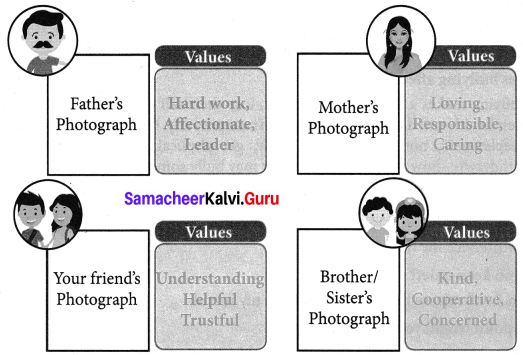
Paste the photographs and write down the values which you learn from them
Answer:

Taking The Bully By The Horns Samacheer Kalvi 7th English Solutions Term 1 Supplementary Chapter 3
Step To Success
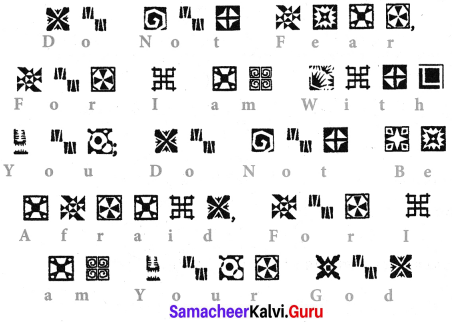
Change the codes into letters with the sign codes given below and tell the sentence to your friend.

Taking The Bully By The Horns Summary 7th Standard Samacheer Kalvi English Solutions Term 1 Supplementary Chapter 3
Answer:
Do Not Fear For I Am With You Do Not Be Afraid For I Am Your God

Taking The Bully By The Horns Summary Samacheer Kalvi 7th English Solutions Term 1 Supplementary Chapter 3

Taking the Bully by the Horns Additional Questions

I. Choose the Correct Answers (MCQ).

Question 1.
The other name for bullying is ______
(a) abusing
(b) ragging
(c) teasing
Answer:
(b) ragging

Question 2.
The pressure we get from people like us is called ______
(a) peer pressure
(b) bully .
(c) intervention
Answer:
(a) peer pressure

Question 3.
The key word of stopping bullying is ______
(a) sympathy
(b) getting attention
(c) empathy
Answer:
(c) empathy

Question 4.
Children hesitate to speak up about bullies because of a sense of ______
(a) loyalty
(b) friendship
(c) fear
Answer:
(a) loyalty

Question 5.
Children who are bullied feel ______
(a) happy
(b) dejected
(c) feeling of control
Answer:
(b) dejected

Question 6.
The bullied person may get ______ due to the hurting comments of billies.
(a) thirsty
(b) nightmares
(c) rich
Answer:
(b) nightmares

Question 7.
Ajay continuously bullies Anu because it gives him a feeling of ______
(a) insult
(b) dejection
(c) control
Answer:
(c) control

Question 8.
Bullies who have a low opinion about themselves, ______ or put another person
down in order to feel better about them.
(a) humiliate
(b) control
(c) abuse
Answer:
(a) humiliate

II. Identify the Character / Speaker.

  1. She is the shortest student in their class.
  2. She does not want to say anything because she is Ajay s friend.
  3. He is unhappy with his performance in the exams.
  4. She doesn’t like her big ears and doesn’t want anyone to notice them.
  5. He enjoys the attention he is getting from others.
  6. She is Ajay’s friend and does not want to upset him.
  7. She is self conscious, feels hurt but she doesn’t say anything.

Answer:

  1. Anu
  2. Meena
  3. Ajay
  4. Meena
  5. Ajay
  6. Meena
  7. Anu

III. Write True or False against each statement

  1. We like to have fun together with friends.
  2. Bullying needn’t always be violent like hitting someone.
  3. Your classmates, friends and teachers are your peers.
  4. The bullied person often focus on his targets appearance.
  5. Many schools, colleges and work places have strict rules to prevent bullying.
  6. If you know someone who is getting bullied, the best way to stop it is to inform the police.

Answer:

  1. True
  2. True
  3. False
  4. False
  5. True
  6. False

IV. Short Questions with Answers.

Question 1.
What did Ajay do to bully Anu?
Answer:
Ajay called Anu by nick names, and patted on her head to bully her.

Question 2.
Meena did not say anything when Ajay teased Anu. Why?
Answer:
Meena did not say anything because Ajay was her friend and so she did not want to upset him.

Question 3.
Meena felt better about her own problem. What was her problem? How did she feel better?
Answer:
Meena does not like her big ears. She does not want anybody to notice them. When she turns her attention to Anu being bullied, she forgets her ‘big ear’ problem

Question 4.
Why do people silently support the bullies?
Answer:
People silently suppbrt the bullies because they want to be part of the group.

Question 5.
What is ‘Tulir’?
Answer:
Tulir is the Centre for the Prevention and Healing of Child Sexual Abuse in Chennai.

Question 6.
What does bullying mean?
Answer:
If someone purposely makes fun of another, tease, mock or forces them to do things, even if they don’t want to, is called bullying.

Question 7.
What is the other word for bullying?
Answer:
Ragging.

Question 8.
Who are our peers?
Answer:
Our peers are people like ourselves by age and common interests. Our classmates and friends are our peers.

Question 9.
Suggest some ways to stop bullying.
Answer:
The best way to stop bullying is to inform a responsible adult, it may be the parent, teacher or anyone who can handle the problem. The adult would intervene and make the person who bullies to understand their inappropriate and unacceptable », behaviour. Feeling empathy also stops bullying.

Question 10.
How will you support a child who is being bullied?
Answer:
I will support the bullied person by including him while playing games, share my things with them, speak to them for more time and make them feel one among us.

Question 11.
Think that you are watching someone being bullied. Take a diary and write down your experience.
Answer:
Thursday, 25 July 2019
Today I saw Anu being bullied by Ajay in front of my eyes. I did not laugh but felt sorry for her. I asked Ajay to stop though he was my friend and it upset him. I did not like Meena supporting Ajay bullying Anu. Poor Anu felt hurt but did not say anything.
I informed my class teacher about the bullying. She spoke to Ajay and counselled him and made him feel empathy. Ajay could now feel the pain of Anu and felt bad about his actions.

V. Paragraph Questions with Answers.

Question 1.
What are the different ways by which people are bullied ?
Answer:
The different ways by which people are bullied are- making fun of their height and size and body appearance, calling by nick names, patting on the head, mocking, violent hitting, verbally abusing, making fun of others, asking them to do things even if they don’t want to, not including a child in their games, spreading stories about someone and causing sadness, targeting someone repeatedly to hurt them by our actions, for the dress they wear, lack of abilities, family or social circle, etc.

Question 2.
Why do people bully others?
Answer:
People bully to have fun together with friends, bullying gives them a feeling of control, they enjoy the attention they get from others, they feel it as a strength, children bully because of low opinion about themselves. While bullying they feel better about their shortcomings, like Ajay was unhappy about his low performance in the exams and Meena not happy of her big ears.

VI. Read the passage and answer the questions.

1. Sometimes, we may even want to do somethings only because our friends are doing them, even if we know it will get us into trouble or wrong. For example, Meena knows that Anu feels hurt when Ajay teases her. But she does not want to say anything because she is Ajay’s friend and does not want to upset him.

Question 1.
Why do we do somethings even though we know it will get us into trouble?
Answer:
We do them only because our friends are doing them. We like our friends so we wish to identify with them.

Question 2.
How does Anu feel when Ajay teases her?
Answer:
Anu feels hurt when Ajay teases her.

Question 3.
Why doesn’t Meena stop Ajay from teasing Anu?
Answer:
Meena doesn’t say anything to stop Ajay teasing Anu because she is Ajay’s friend and does not want to upset him.

2. Byllying needn’t always be violent like hitting someone or verbally abusing them. If a group of children always refuse to include a particular child in their games, that’s bullying too! Or if you spread stories about someone and it is causing them sadness.

Question 1.
Give an example of violent bullying.
Answer:
Hitting someone.

Question 2.
Is hatred and bullying the same?
Answer:
No. Hatred actions are done when we do not like someone. But bullying is not done because we hate a person but to have fun, tease and enjoy.

Question 3.
What do you mean by spreading stories?
Answer:
Spreading a false information about a person that beings shame to him is called spreading stories or spreading rumours.

Question 4.
How would you feel if your friends keep you away from their games?
Answer:
I would feel hurt, cry and complain to my teacher.

3. Many schools and colleges and even work places have strict rules to prevent bullying but it can still happen. If you notice it taking place around you, make sure you report it so it is stopped. You would have then contributed to a safer and more peaceful world.

Question 1.
Name three places where bullying commonly occurs.
Answer:
Schools, colleges and work places.

Question 2.
What will you do if you notice bullying taking place around you?
Answer:
would report about it to the people concerned and stop it.

Question 3.
What does prevention of bullying contribute to?
Answer:
Prevention of bullying contributes to a safer and more peaceful world.

VII. Rearrange the jumbled sentence.

A.
1. He calls her by nick names which draw attention to her size.
2. Anu is the shortest in their class.
3. Meena sometimes laughs with Ajay when he is mocking Anu.
4. Ajay always makes fun of her height.
5. Meena, Anu and Ajay are in class 7.
6. Anu is already self conscious and feels hurt.
Answer:
5. Meena, Anu and Ajay are in class 7.
2. Anu is the shortest in their class.
4. Ajay always makes fun of her height.
1. He calls her by nick names which draw attention to her size.
6. Anu is already self conscious and feels hurt.
3. Meena sometimes laughs with Ajay when he is mocking Anu.

B.
1. This can be a parent, a teacher, or anyone who can do something.
2. Is there something you can do to stop bullying?
3. You can also show your support for the targeted person.
4. If someone is getting bullied, the best way to stop it is inform a responsible adult.
5. The adult can intervene and help the child who is bullying to understand his unacceptable behaviour.
Answer:
2. Is there something you can do to stop bullying?
4. If someone is getting bullied, the best way to stop it is inform a responsible adult.
1. This can be a parent, a teacher, or anyone who can do something.
5. The adult can intervene and help the child who is bullying to understand his unacceptable behaviour.
3. You can also show your support for the targeted person.

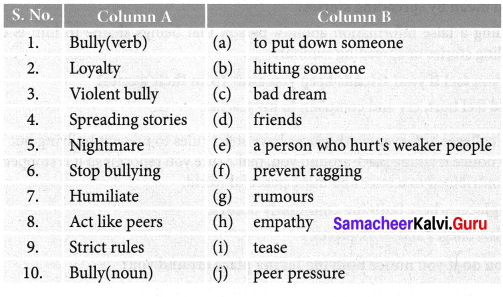
VIII. Match the following.

Taking The Bully By The Horns Question Answer Samacheer Kalvi 7th English Solutions Term 1 Supplementary Chapter 3

Answer:

  1. (i)
  2. (d)
  3. (b)
  4. (g)
  5. (c)
  6. (h)
  7. (a)
  8. (j)
  9. (f)
  10. (e)

Taking the Bully by the Horns Summary

Anu is bullied by her classmate Ajay for her height by nickname and by patting her. Anu is hurt and silent. Meena laughs but doesn’t speak against Ajay though she feels sorry for Anu. Ajay enjoys the attention he gets from others. No one stops him.

Boys like Ajay have a low opinion about themselves so they humiliate others in order to feel better who they are. Bullying is not only violent actions like hitting or abusing, it is also isolating a person, spreading stories about a person and hurting repeatedly bullying or ragging.

The bullies are avoided out of fear or silently supported, wanting to be part of a group. Peer pressure is when we disagree with something that everyone is doing but we end up doing it because we don’t want to be the odd one and isolated from the group.

Children who are bullied feel dejected, singled out, insulted before others, lose their confidence, feel lonely and isolated.
By bullying, a person’s health and daily routine are affected. They do not eat well, fall sick often, get nightmares, sleeplessness, lack of concentration on studies, physical hurt, get withdrawn, stop talking to people, display sudden extreme anger or may even start bullying others even horsely.

We can stop bullying by informing it to a responsible person like parent or teacher or anyone who can handle the problem. Proper counselling will make them understand their unacceptable behaviour. The best way is empathy. When you feel for others, the less you will want to bully.

Children hesitate to complain about bullying because of a sense of loyalty. They feel that complaining to an adult about peers would get them into trouble. Some feel they would lose the friendship of the bullying person. Situation like bullying requires intervention because the bullying person also needs help to come out of it.

Many schools, colleges and job spots have strict rules to prevent bullying but it can still happen. We have to stop bullying for a safer a more peaceful world.

Samacheer Kalvi 7th Tamil Solutions Term 1 Chapter 2.3 விலங்குகள் உலகம்

Students can Download Tamil Chapter 2.3 விலங்குகள் உலகம் Questions and Answers, Summary, Notes Pdf, Samacheer Kalvi 7th Tamil Book Solutions Guide Pdf helps you to revise the complete Tamilnadu State Board New Syllabus and score more marks in your examinations.

Tamilnadu Samacheer Kalvi 7th Tamil Solutions Term 1 Chapter 2.3 விலங்குகள் உலகம்

மதிப்பீடு

சரியான விடையைத் தேர்ந்தெடுத்து எழுதுக.

Question 1.
ஆசிய யானைகளில் ஆண் – பெண் யானைகளை வேறுபடுத்துவது ….
அ) காது
ஆ) தந்தம்
இ) கண்
ஈ) கால்கள்
Answer:
ஆ) தந்தம்

Question 2.
தமிழகத்தில் புலிகள் காப்பகம் அமைந்துள்ள இடம் ………..
அ) வேடந்தாங்கல்
ஆ) கோடியக்கரை
இ) முண்டந்துறை
ஈ) கூந்தன்குளம்
Answer:
இ) முண்டந்துறை

Question 3.
‘காட்டாறு’ என்னும் சொல்லைப் பிரித்து எழுதக் கிடைப்பது ………….
அ) காடு + ஆறு
ஆ) காட்டு + ஆறு
இ) காட் + ஆறு
ஈ) காட் + டாறு
Answer:
அ) காடு + ஆறு

Question 4.
‘அனைத்துண்ணி ’ என்னும் சொல்லைப் பிரித்து எழுதக் கிடைக்கும் சொல் ……………..
அ) அனைத்து + துண்ணி
ஆ) அனை + உண்ணி
இ) அனைத் + துண்ணி
ஈ) அனைத்து + உண்ணி
Answer:
ஈ) அனைத்து + உண்ணி

Question 5.
‘நேரம் + ஆகி’ என்பதனைச் சேர்த்தெழுதக் கிடைக்கும் சொல் ……….
அ) நேரமாகி
ஆ) நேராகி
இ) நேரம் ஆகி
ஈ) நேர் ஆகி
Answer:
அ) நேரமாகி

Question 6.
‘வேட்டை + ஆடிய’ என்பதனைச் சேர்த்தெழுதக் கிடைக்கும் சொல்
அ) வேட்டை ஆடிய
ஆ) வேட்டையாடிய
இ) வேட்டாடிய
ஈ) வேடாடிய
Answer:
ஆ) வேட்டையாடிய

கோடிட்ட இடத்தை நிரப்புக

Question 1.
‘காட்டின் வளத்தைக் குறிக்கும் குறியீடு’ – என்று அழைக்கப்படும் விலங்கு
Answer:
புலி

Question 2.
யானைக் கூட்டத்திற்கு ஒரு ……….. யானைதான் தலைமை தாங்கும்.
Answer:
பெண்

Question 3.
கரடிகளைத் தேனீக்களிடமிருந்து காப்பது அதன் ………
Answer:
அடர்ந்த முடிகள்

குறுவினா

Question 1.
காடு – வரையறு.
Answer:
வளம் நிறைந்த நிலம், அடர்ந்த மரம், செடி கொடிகள், நன்னீர், நறுங்காற்று என் அனைத்தும் நிரம்பியது காடாகும். இது பறவைகள், விலங்குகள், தாவரங்கள் போன்ற
பல்லுயிர்களின் வாழ்விடமாகும்.

Question 2.
யானைகள் மனிதர்களை ஏன் தாக்குகின்றன?
Answer:

  • பொதுவாக யானைகள் மனிதர்களைத் தாக்குவது இல்லை.
  • யானையின் வழித்தடங்களில் குறுக்கிடும் போது தான் மனிதர்களைத் தாக்குகின்றன.

Question 3.
கரடி ‘அனைத்துண்ணி ‘ என அழைக்கப்படுவது ஏன்?
Answer:
கரடி பழங்கள், தேன், உதிர்ந்த மலர்கள், காய்கள், கனிகள், புற்றீசல், கரையான் போன்ற வற்றை உணவாக உள்கொள்வதால் அனைத்துண்ணி என அழைக்கப்படுகின்றன.

Question 4.
மானின் வகைகள் சிலவற்றின் பெயர்களை எழுதுக.
Answer:
இந்தியாவில் சருகுமான், மிளாமான், வெளிமான் என்பவை மானின் வகைகள் ஆகும்.

சிறுவினா

Question 1.
புலிகள் குறித்து நீங்கள் அறிந்து கொண்ட செய்திகளைத் தொகுத்து எழுதுக.
Answer:

  • புலிகள் தனித்து வாழும் இயல்பு உடையவை. ஒரு குறிப்பிட்ட எல்லைக்குள் ஒரு புலி
    மட்டுமே வாழும். மற்ற புலிகள் அந்த எல்லைக்குள் செல்லாது.
  • கர்ப்பம் அடைந்த புலியானது 90 நாட்களில் இரண்டு அல்லது மூன்று குட்டிகள் ஈனும் (அல்லது) ஈன்றெடுக்கும். அந்தக் குட்டிகளை இரண்டு ஆண்டுகள் வரை வளர்த்து ஆளாக்கும்.
  • அப்புலிக்குட்டிகள் வேட்டையாடக் கற்றவுடன் அவற்றுக்கான எல்லைகளையும் பிரித்துத் தனியாக அனுப்பிவிடும். புலிதான் ஒரு காட்டின் வளத்தைக் குறிக்கும் குறியீடு.
  • புலி தனக்கான உணவை வேட்டையாடிய பின்பு வேறு எந்த விலங்கையும்
    வேட்டையாடுவதில்லை. எனவே இதனைப் பண்புள்ள விலங்கு என்று கூறுவர்.

சிந்தனை வினா

Question 1.
காடுகளை அழிப்பதால் ஏற்படும் விளைவுகளை பட்டியலிடுக.
Answer:
காடுகளை அழிப்பதால் ஏற்படும் விளைவுகள் :

(i) மரங்களை அழிப்பதால் கார்பன்-டை- ஆக்ஸைடு வாயுவின் அளவு அதிகரிக்கின்றது. இதனால் சுற்றுச்சூழல் பாதிக்கப்படுகிறது. பல உயிரினங்களின் வாழ்விடங்கள் அழிக்கப்படுகின்றன.

(ii) காடுகளை அழிப்பதன் விளைவாக மழை அளவு குறைகிறது. தட்ப வெப்பநிலை
மாற்றமடைகிறது. மண் அரிமானம் ஏற்படுகிறது.

(iii) புவி வெப்பமடைதல் நடைபெறுகிறது. இதன் விளைவாக தீயன உண்டாகின்றன.
மழைக் காலங்கள் மாறுபடுகின்றன. இயற்கைத் தாவரங்கள், மரங்கள் சட்டத்திற்குப் புறம்பாக அழிக்கப்படுகின்றன.

(iv) காடுகளை அழிப்பதால் காட்டில் வாழும் காட்டு விலங்கினங்கள் நாட்டுக்குள் புகுந்து பயிர்களை அழிக்கின்றன. மேலும் மனித உயிர்களை அச்சுறுத்திக் கொல்லுகின்றன. யானை, காட்டெருமை, புலி போன்ற விலங்குகள் கூட்டமாக உணவிற்காகவும் நீருக்காகவும் விளை நிலங்களுக்குள் வந்து அவற்றை அழிக்கின்றன.

(v) காடுகளை அழிப்பதாலும் மற்ற வெவ்வேறு காரணங்களாலும் பல்வேறு தாவர
இனங்கள் மற்றும் விலங்கினங்கள் அழிவுக்குத் தள்ளப்படுகின்றன.

கற்பவை கற்றபின்

Question 1.
விலங்குகள் தொடர்பான பழமொழிகளைத் திரட்டி வருக.
Answer:
(எ.கா) புலி பசித்தாலும் புல்லைத் தின்னாது.

  • கழுதைக் கெட்டா குட்டிச்சுவர்.
  • உள்ளூரில் ஓணான் பிடிக்காதவன், உடையார்பாளையம் போய் உடும்பு பிடிப்பானா?
  • நாய் வாலை நிமிர்த்த முடியாது.
  • கழுதைக்கு தெரியுமா கற்பூர வாசனை.

Question 2.
காட்டு விலங்குகளின் படங்களைத் திரட்டி படத்தொகுப்பினை உருவாக்குக.
Answer:
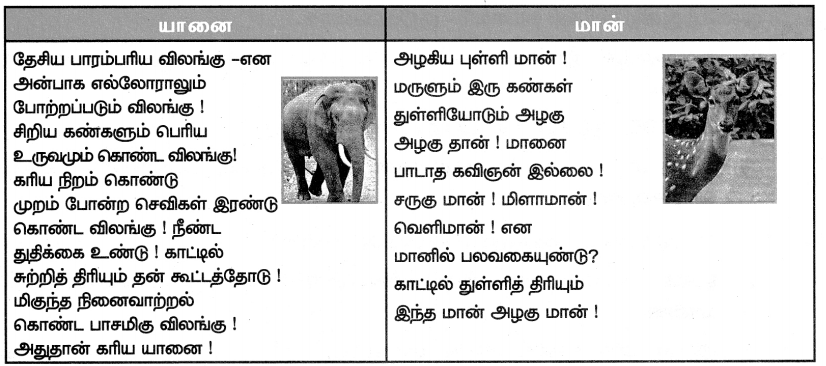
Samacheer Kalvi 7th Tamil Solutions Term 1 Chapter 2.3 விலங்குகள் உலகம் - 1
Samacheer Kalvi 7th Tamil Solutions Term 1 Chapter 2.3 விலங்குகள் உலகம் - 2

கூடுதல் வினாக்கள்

சரியான விடையைத் தேர்ந்தெடுத்து எழுதுக.

Question 1.
பண்புள்ள விலங்கு என்று எதனைக் குறிப்பிடுகிறோம்.
அ) புலி
ஆ) சிங்கம்
இ) கரடி
ஈ) மான்
Answer:
அ) புலி

Question 2.
‘காட்டுக்கு அரசன்’ என்று போற்றப்படும் விலங்கு எது?
அ) சிங்கம்
ஆ) சிறுத்தை
இ) புலி
ஈ) கரடி
Answer:
அ) சிங்கம்

Question 3.
யானை மிகுந்த நினைவாற்றல் கொண்ட விலங்கு .
அ) சரி
ஆ) இல்லை
இ) தவறு
ஈ) இவைகளில் ஏதுமில்லை
Answer:
அ) சரி

நீரப்புக :

Question 1.
இந்தியாவில் குஜராத் மாநிலத்தில் …….. சரணாலயத்தில் மட்டுமே ஆசிய சிங்கங்கள்
உள்ளன.
Answer:
கிர்

Question 2.
தமிழ்நாட்டில் வனக்கல்லூரி அமைந்துள்ள இடம் ………….
Answer:
மேட்டுப்பாளையம்

Question 3.
நன்கு வளர்ந்த கரடி ………. கிலோ எடை வரை இருக்கும்.
Answer:
160

விடையளி :

Question 1.
புலிகள் காப்பகம் எங்கு உள்ளது?
Answer:

  • புலிகள் காப்பகம் முண்டந்துறையில் உள்ளது.
  • முண்டந்துறை தமிழ்நாட்டில் உள்ளது.

Question 2.
பல்லுயிர்களின் வாழ்விடம் தான் இக்காடு-இக்கூற்றை மெய்ப்பிக்க.
Answer:

  • மனித முயற்சி இன்றி அதாவது மனித முயற்சி இல்லாமல் வளர்ந்த மரங்கள்,
    செடி, கொடிகள், புல், புதர்கள், பூச்சி இனங்கள், பறவைகள், விலங்குகள் போன்ற பல்லுயிர்களின் வாழ்விடம் தான் இந்தக் காடாகும்.
  • இந்தக் காட்டின் இடை இடையே காட்டாறுகளும் நீரோடைகளும் இருக்கும்.

Question 3.
முண்டந்துறை புலிகள் காப்பகம் – குறிப்பு வரைக.
Answer:

  • தமிழ்நாட்டில் இரண்டாவது மிகப்பெரிய காப்பகம் முண்டந்துறை புலிகள் காப்பகம் ஆகும்.
  • இது 895 சதுர கிலோ மீட்டர் பரப்பளவு கொண்டது.
  • இங்கு யானை, புலி, சிறுத்தை, மான், கரடி, காட்டு மாடு போன்ற அரிய விலங்குகள் வாழ்கின்றன.

Question 4.
உலகில் எத்தனை வகையான யானைகள் உள்ளன?
Answer:

  • உலகில் இரண்டு வகையான யானைகள் உள்ளன. ஆசிய யானை, ஆப்பிரிக்கா யானை.
  • ஆசிய யானைகளில் ஆண் யானைக்குத் தந்தம் உண்டு. பெண் யானைக்குத்
    தந்தம் இல்லை. ஆப்பிரிக்க யானைகளில் இரண்டுக்கும் தந்தம் உண்டு.


Question 5.
யானைகள் எப்போதும் கூட்டமாகத்தான் இருக்குமா? ஆம் எனில் விளக்கம் தருக.
Answer:

  • ஆம். யானைகள் எப்போதும் கூட்டமாகத்தான் வாழும். இந்தக் கூட்டத்திற்கு ஒரு பெண் யானைதான் தலைமை தாங்கும். யானைகள் தங்களுக்குத் தேவையான தண்ணீர் மற்றும் உணவு ஆகியவற்றிற்காக இடம் பெயர்ந்து கொண்டே இருக்கும்.
  • ஒரு யானை நாள் ஒன்றுக்கு 250 கிலோ புல், இலை தழைகளை உணவாக
    உட்கொள்ளும். அதற்குக் குடிக்க அறுபத்தைந்து லிட்டர் தண்ணீர் தேவைப்படும்.
  • யானை மிகுந்த நினைவாற்றல் கொண்ட பாசமிகு விலங்கு ஆகும்.

Question 6.
தமிழ்நாட்டில் வனக்கல்லூரி எங்கு அமைந்துள்ளது?
Answer:
தமிழ்நாட்டில் வனக்கல்லூரி கோவை மாவட்டத்தில் உள்ள மேட்டுப்பாளையத்தில் அமைந்துள்ளது.

Question 7.
தமிழ்நாடு வேளாண்மைப் பல்கலைக்கழகம் எங்கு உள்ளது?
Answer:

  • கோவையில் தமிழ்நாடு வேளாண்மைப் பல்கலைக் கழகம் உள்ளது.
  • இங்கு இளநிலை வனவியல், முதுநிலை வனவியல் ஆகிய படிப்புகள் உள்ளன.

Question 8.
கரடி தன் உடலை தேனீக்களிடமிருந்து எவ்வாறு பாதுகாத்துக் கொள்கிறது?
Answer:
கரடியின் உடலைப் போர்த்தி இருக்கும் அடர்ந்த முடிகள் தேனீக்களிடமிருந்து அதனைக் காப்பாற்றுகின்றன.

Question 9.
சிங்கம் பற்றி குறிப்பு வரைக.
Answer:
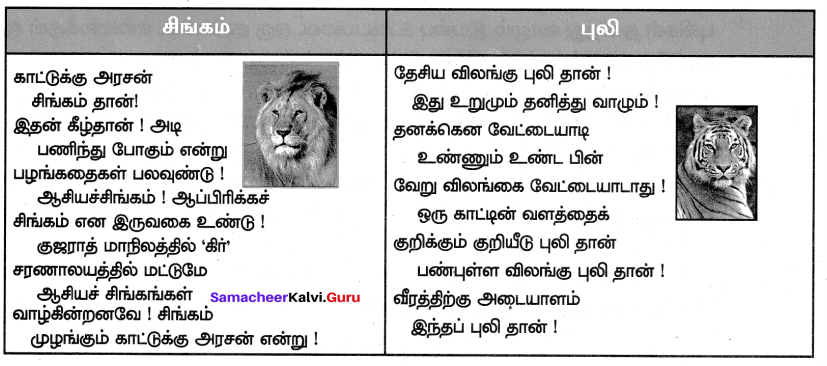
(i) உலகில் ஆசியச் சிங்கம். ஆப்பிரிக்கச் சிங்கம் என இரண்டு வகைச் சிங்கங்கள்
உள்ளன. இந்தியாவில் குஜராத் மாநிலத்தில் ‘கிர்’ சரணாலயத்தில் மட்டுமே ஆசியச் சிங்கங்கள் உள்ளன.

(ii) நீளம், உயரம், பருமன், எடை, பலம், வேட்டைத்திறன் ஆகிய அனைத்திலும் சிங்கத்தை விட புலியே உயர்ந்தது. எனவே புலியே காட்டுக்கு அரசன் என்கிறார்கள் இயற்கை விஞ்ஞானிகள்.

Samacheer Kalvi 7th Maths Solutions Term 2 Chapter 3 Algebra Ex 3.2

Students can Download Maths Chapter 3 Algebra Ex 3.2 Questions and Answers, Notes Pdf, Samacheer Kalvi 7th Maths Book Solutions Guide Pdf helps you to revise the complete Tamilnadu State Board New Syllabus and score more marks in your examinations.

Tamilnadu Samacheer Kalvi 7th Maths Solutions Term 2 Chapter 3 Algebra Ex 3.2

Question 1.
Fill in the blanks.

(i) Unit digit of 124 × 36 × 980 is ______
(ii) When the unit digit of the base and its expanded form of that number is 9, then the exponent must be _______ power.
Answers:
(i) 0
(ii) Odd

Question 2.
Match the following:

Group A
Exponential form

Group B
Unit digit of the number

(i)2010(a)6
(ii)12111(b)4
(iii)44441(c)0
(iv)25100(d)1
(v)71683(e)9
(vi)729725(f)5

Answer:
(i) – c
(ii) – d
(iii) – b
(iv) – f
(v) – a
(vi) – e

Question 3.
Find the unit digit of expanded form.
(i) 2523
(ii) 1110
(iii) 4615
(iv) 10012
(v) 2921
(vi) 1912
(vii) 2425
(viii) 3416
Solution:
(i) 2523
Unit digit of base 25 is 5 and power is 23. Thus the unit digit of 2523 is 5.

(ii) 1110
Unit digit of base 11 is 1 and power is 10. Thus the unit digit of 1110 is 1.

(iii) 4615
Unit digit of base 46 is 6 and power is 15. Thus the unit digit of 4615 is 6.

(iv) 10012
Unit digit of base 100 is 0 and power is 12. Thus the unit digit of 10012 is 0.

(v) 2921
Unit digit of base 29 is 9 and power is 21 (odd power).
Therefore, unit digit of 2921 is 9.

(vi) 1912
Unit digit of base 19 is 9 and power is 12 (even power).
Therefore, unit digit of 1912 is 1.

(vii) 2425
Unit digit of base 24 is 4 and power is 25 (odd power).
Therefore, unit digit of 2425 is 4.

(viii) 3416
Unit digit of base 34 is 4 and power is 16 (even power).
Therefore, unit digit of 3416 is 6.

Question 4.
Find the unit digit of the following numeric expressions.
(i) 11420 + 11521 + 11622
(ii) 1000010000 + 1111111111
Solution:
(i) 11420 + 11521 + 11622
In 11420 unit digit of base 114 is 4 and power is 20 (even power).
∴ Unit digit of 11420 is 6.
In 11521 unit digit of base 115 is 5 and power is 21 (Positive Integer).
∴ Unit digit of 11521 is 5.
In 11622 unit digit of base 116 is 6 and power is 22 (Positive Integer).
∴ Unit digit of 11622 is 6.
∴ Unit digit of 11420 + 11521 + 11622 can be obtained by adding 6 + 5 + 6 = 17.
Unit digit of 11420 + 11521 + 11622 is 7.

(ii) 1000010000 + 1111111111
In 1000010000 the unit digit of base 10000 is 0 and power is 10000.
Unit digit of 1000010000 is 0.
In 1111111111 the unit digit of base 11111 is 1 and power is 11111.
Unit digit of 1111111111 is 1.
Unit digit of 10000100000 + 1111111111 is 0 + 1 = 1

Objective Type Question

Question 5.
Observe the equation (10 + y)4 = 50625 and find the value of y.
(i) 1
(ii) 5
(iii) 4
(iv) 0
Answer:
(ii) 5

Question 6.
The unit digit of (32 × 65)0 is
(i) 2
(ii) 5
(iii) 0
(iv) 1
Answer:
(iv) 1

Question 7.
The unit digit of the numeric expression 1071 + 1072 + 1073 is
(i) 0
(ii) 3
(iii) 1
(iv) 2
Answer:
(i) 0

Samacheer Kalvi 7th Social Science History Solutions Term 1 Chapter 4 The Delhi Sultanate

Students can Download Social Science History Chapter 4 The Delhi Sultanate India Questions and Answers, Notes Pdf, Samacheer Kalvi 7th Social Science Book Solutions Guide Pdf helps you to revise the complete Tamilnadu State Board New Syllabus and score more marks in your examinations.

Tamilnadu Samacheer Kalvi 7th Social Science History Solutions Term 1 Chapter 4 The Delhi Sultanate

Samacheer Kalvi 7th Social Science The Delhi Sultanate Textual Evaluation

I. Choose the correct answers

The Delhi Sultanate Class 7 In Tamil Question 1.
______ laid the foundation of ‘ Mamluk’ dynasty.
(a) Mohammad Ghori
(b) Jalal-ud-din
(c) Qutb-ud-dinAibak
(d) Iltutmish
Answer:
(c) Qutb-ud-din Aibak

Delhi Sultanate In Samacheer Book Question 2.
Qutb-ud-in shifted his capital to Delhi from .
(a) Lahore
(b) Poona
(c) Daulatabad
(d) Agra
Answer:
(a) Lahore

Delhi Sultanate Questions And Answers Question 3.
completed the construction of the Qutb-Minar.
(a) Razia
(b) Qutb-ud-din -Aibak
(c) Iltutmish
(d) Balban
Answer:
(c) Iltutmish

The Delhi Sultanate Class 7 Question 4.
laid the foundation of the city Tughluqabad near Delhi.
(a) Muhammad-bin -Tughluq
(b) Firoz shah Tughluq
(c) Jalal -ud-din
(d) Ghiyas -ud-din
Answer:
(d) Ghiyas -ud-din

II. Fill in the Blanks

  1. was the founder, of Tughluq dynasty.
  2. Muhammad-bin-Tughluq shifted his capital from Delhi to .
  3. patronized the famous Persian poet Amir Khusru.
  4. Quwwat-ul-Islam Masjid in Delhi was built by .
  5. The threat of Mongols under Chengizkhan to India was during the reign of

Answer:

  1. Ghiyas-ud-din
  2. Devagiri or Daulatabad
  3. Balban
  4. Qutb-ud-din -Aibak
  5. Iltutmish

III. Match the following

                AB
Tughril Khani.Governor of Kara
Ala-ud-dinii.Jalal-ud-din Yakut
Bahlol Lodi .iii.Governor of Bengal
Raziaiv.Governor of Sirhind

Answer:

  1. iii
  2. iiv
  3. ii

IV. State True or False :

Question 1.
Qutb-ud-din Aibak died of mysterious fever.
Answer:
(False) Correct statement: Qutb-ud-din Aibak died of mysterious injuries received during an accidental fall from a horse, while playing polo.

Question 2.
Razia was an able and brave fighter.
Answer:
True

Question 3.
The Turkish nobles chose Iltutmish, son of Aibak, as Sultan after the death of Aibak.
Answer:
(False) Correct statement: The Turkish nobles chose Iltutmish, son-in-law of Aibak, as Sultan after the death of Aibak.

Question 4.
FirozShah Tughluq refused to accept an invitation from a Bahmani Prince to intervene in the affairs of the Deccan.
Answer:
True

V. Match the statement with the reason.
Tick (✓) the appropriate answer.

Question 1.
Assertion (A): Balban maintained cordial relationship with Mongols
Reason (R): The Mongol ruler, a grandson of Chengiz Khan, assured that Mongols
would not advance beyond Sutlej.
(a) R is the correct explanation of A.
(b) R is not the correct explanation of A.
(c) A and R are wrong.
(d) A is wrong and R is the correct.
Answer:
(a) R is the correct explanation of A

(b) Find out the correct pair

  1. Hoysala – Devagiri
  2. Yadavas – Dwarasamudra
  3. Kakatias – Warrangal
  4. Pallavas – Madurai

Answer:
3. Kakatias – Warrangal

(c) Find out the wrong statement /statements

  1. After Ghori’s death in 1206, his slave Qutbud- din Aibak proclaimed him self the ruler of the Turkish territories in India.
  2. Razia established the department of spies to gather intelligence about the conspirators and the trouble makers against her rule.
  3. Balban built forts to guard his empire against the Mongol attack.
  4. Ibrahim Lodi was defeated by Babur in 1526.

Answer:
2. Razia established the department of spies to gather intelligence about the conspirators and the trouble makers against her rule.

VI. Answer the following in one or two sentences

Question 1.
Name the land granted to army officials in lieu of a regular wage.
Answer:
Iqta is the land granted to army officials in lieu of a regular wage

Question 2.
Who founded the city of Agra?
Answer:
Sikandar Lodi founded the city of Agra.

Question 3.
Name the ruler who established Muslim rule in India in 12th century A.D (CE).
Answer:
Muslim rule in India was established by Muhammad Ghori in 12th century A.D. (CE).

Question 4.
Write a note on chahalgani.
Answer:
In order to counter the possible attack of the Mongols, Iltutmish organised Turkish nobility into a select group of 40 nobles known as chahalgani or The Forty.

Question 5.
How did Ala-ud-din Khalji consolidate the Delhi Sultanate?
Answer:

  1. The range of Khalji conquests is impressive: in the Punjab (against the Mongols), in Rajasthan and in Gujarat. With his northern frontiers secure, he sent his chief lieutenant Malik Kafur into the southern parts who took even the distant Madurai.
  2. Thus Ala-ud-din Khalji consolidated the Delhi Sultanate.

Question 6.
List out the contributions of Firoz Shah Tughluq.
Answer:

  1. Firoz rewarded Sufis and other religious leaders generously and listened to their advice.
  2. He also created charities to aid poor Muslims
  3. He built colleges, mosques, and hospitals.
  4. He banned inhuman punishments and abolished taxes not recognised by Muslim law.
  5. He promoted agriculture by waiving off the debts of the agriculturalists and constructing many canals for irrigation.
  6. He built new towns such as Firozabad, Jaunpur, Hissar and Firozpur.

VII. Answer the following :

Question 1.
Write about the invasion of Timur in 1398.
Answer:

  1. The sacking and massacre by Tamerlane or Timur of Delhi came a decade after Firuz ME Shah Tughluq died.
  2. Timur had occupied some parts in the north-west of India.
  3. Taking advantage of India’s weakness, he entered India in December 1398 and plundered Delhi.
  4. Punjab, besides the Delhi city, was the province that suffered most by Timur’s raid.
  5. Apart from carrying huge wealth in the form of gold, silver, jewels, also took along Indian artisans like carpenters and masons to work on monuments in Samarkand.

VIII. HOTS :

Question 1.
How would you evaluate Muhammad-bin- Tughluq as Sultan of Delhi?
Answer:
Muhammaad – bin – Tughlug was a learned but cruel man. He was a poor decision maker. There was chaos in the social, economic and political condition of the empire because of his ambiguous decisions. The first and foremost was changing the capital from Delhi to Devagiri or Daulatabad and vice versa which led to loss of money and human lives. He also ordered the revenue to be collected in money instead of grains. This move led to bankruptcy and famine. Though he was wise and learned his hasty decisions led to his downfall.

IX. Map Work
On the river map of India draw the extent of Tughluq Dynasty and mark the following places.

  1. Delhi
  2. Devagiri
  3. Lahore
  4. Madurai.

The Delhi Sultanate Class 7 In Tamil Social Science History Solutions Term 1 Chapter 4 Samacheer Kalvi

X. Student Activity :

Question 1.
Match the Father with Son

AB
1.Qutb-ud-din Aibaki.Rukn-ud-din-Firuz
2.Iltutmishii.Kaiqubad
3.Balbaniii.Ala-ud-din
4.Ghiyas-ud-diniv.Sikandar Lodi
5.Bahlol LodiV.Aram Shah

Answer:

  1. v
  2. i
  3. ii
  4. iii
  5. iv

Samacheer Kalvi 7th Social Science The Delhi Sultanate Additional Questions

I. Choose the correct answer:

Question 1.
___________ is a persian term used for slaves purchased for military service.
(a) Aibak
(b) bandagan
(c) Mamluk
(d) Lodi
Answer:
(b) bandagan

Question 2.
Iltutmish granted ___________ to members of his army.
(a) iqtas
(b) coins
(c) gold
(d) dirams
Answer:
(a) iqtas

Question 3.
___________ was a custom of the Rajputs, in which man would go out and die in the battle field and women would burn themselves on a pyre.
(a) Sati
(b) Devadasi
(c) Janhar
(d) Kaali
Answer:
(c) Janhar

II. Fill in the blanks:

  1. _____ is an Arabic word meaning slave.
  2. Iltutmish refused to provide shelter to _____ who had been driven out by chengiz khan.
  3. One significant military expedition of Ala-ud-din was against, the Deccan Kingdom _____
  4. _____ was proclaimed a separate sultanate in 1334.

Answer:

  1. Mamluk
  2. Kwarezm Shah Jalalud – din
  3. Devagiri
  4. Madurai

III. True or False :

Question 1.
Balban abolished ‘The Forty’ as it was hostile to him.
Answer:
True

Question 2.
Qutb-ud-din-Aibak shifted his capital from Delhi to Lahore.
Answer:
(False) Correct statement: Qutb-ud-din-Aibak shifted his capital from Delhi to the centre of the kingdom, namely Devagiri.

Question 3.
Ala-ud-din khalfi was the nephew of Jalal-ud-din Khalji.
Answer:
True

IV. Match the statement with the reason. Tick (✓) the appropriate answer:

Question 1.
Statement : Iltutmish nominated his daughter Razia sultan as his successor to the throne of Delhi.
Reason : His most capable son, Rukn-ud-din-Firaz was dead.
(a) Statement and Reason are wrong.
(b) Statement is correct, but Reason is wrong.
(c) Both Statement and Reason are correct.
(d) Statement is wrong but Reason is correct.
Answer:
(c) Both Statement and Reason are correct.

Question 2.
Statement : Ala-ud-din khalji employed spies to report to him directly.
Reason : He wanted to be informed about the movement of the enemy’s army.
(a) Both Statement and Reason are correct.
(b) Statement and Reason are wrong.
(c) Statement is correct and Reason is wrong.
(d) Statement is wrong and Reason is correct.
Answer:
(c) Statement is correct and Reason is wrong.

Question 3.
Find out the wrong statement
(a) Razia made an Ethiopian slave nmed Jalal-ud-din Yakut, her personal attendant.
(b) Hulagu Khan, was the grandson of chengiz khan.
(c) Jalal-ud-din khalji built forts to guard his empire.
(d) Ghiyas-ud-din Tughluq sent his Jauna khan to fight against Warangal.
Answer:
(c) Jalal-ud-din khalji built forts to guard his empire

VI. Answer the following.

Question 1.
Write a short note on the Sack of Chittor.
Answer:
Sack of Chittor :When Ala-ud-din’s army overwhelmed the Rajput army in Chittor and in the context of threat of defeat, the men and women of the fortress, in accordance with their old custom, performed the rite of jauhar.

Question 2.
What is Indo-Saracenic architecture? Name a few structures constructed in this style.
Answer:

  1. A combination of Persian and Indian architecture is called Indo-Saracenic architecture.
  2. Mosques and Madrasas were built in this style during the Mughal rule.
  3. The shape of these buildings were persian while the decoration was Indian.
    Eg. QutbMinar, Alai-Darwaza, tombs of Iltutmish.

VII. HOTS :

Question 1.
Alaud – din Khalgi was an able administrator.- Justify.
Answer:

  1. Ala-ud-din’s political and administrative reforms were as impressive.
  2. Ala-ud-din undertook a survey of the agrarian resources around his capital and fixed a standard revenue demand.
  3. He entrusted the task of collecting the revenue to the military officers.
  4. Ala-ud-din established a system of forced procurement of food grains for Delhi and other garrison centres.
  5. The procurement prices were fixed and grain collected as tax was stored in state granaries.
  6. To ensure the enforcement of his new regulations.
  7. He employed spies who were responsible to report to him directly.

Samacheer Kalvi 7th Tamil Solutions Term 1 Chapter 2.2 அப்படியே நிற்கட்டும் அந்த மரம்

Students can Download Tamil Chapter 2.2 அப்படியே நிற்கட்டும் அந்த மரம் Questions and Answers, Summary, Notes Pdf, Samacheer Kalvi 7th Tamil Book Solutions Guide Pdf helps you to revise the complete Tamilnadu State Board New Syllabus and score more marks in your examinations.

Tamilnadu Samacheer Kalvi 7th Tamil Solutions Term 1 Chapter 2.2 அப்படியே நிற்கட்டும் அந்த மரம்

மதிப்பீடு

சரியான விடையைத் தேர்ந்தெடுத்து எழுதுக.

Question 1.
நாவற்பழத்திற்கு உவமையாகக் கூறப்படுவது ….
அ) பச்சை இலை
ஆ) கோலிக்குண்டு
இ) பச்சைக்காய்
ஈ) செங்காய்
Answer:
ஆ) கோலிக்குண்டு

Question 2.
‘சுட்ட பழங்கள்’ என்று குறிப்பிடப்படுபவை ……………………
அ) ஒட்டிய பழங்கள்
ஆ) சூடான பழங்கள்
இ) வேக வைத்த பழங்கள்
ஈ) சுடப்பட்ட பழங்கள்
Answer:
அ) ஒட்டிய பழங்கள்

Question 3.
‘பெயரறியா’ என்னும் சொல்லைப் பிரித்து எழுதக் கிடைப்பது………
அ) பெயர + றியா
ஆ) பெயர் + ரறியா
இ) பெயர் + அறியா
ஈ) பெயர + அறியா
Answer:
இ) பெயர் + அறியா

Question 4.
‘மனமில்லை ‘ என்னும் சொல்லைப் பிரித்து எழுதக் கிடைப்பது……..
அ) மன + மில்லை
ஆ) மனமி + இல்லை
இ) மனம் + மில்லை
ஈ) மனம் + இல்லை
Answer:
ஈ) மனம் + இல்லை

Question 5.
நேற்று + இரவு என்பதனைச் சேர்த்தெழுதக் கிடைக்கும் சொல் ………..
அ) நேற்று இரவு
ஆ) நேற்றிரவு
இ) நேற்றுரவு
ஈ) நேற்இரவு
Answer:
ஆ) நேற்றிரவு

குறுவினா

Question 1.
நாவல் மரம் எத்தனை தலைமுறைகளாக அங்கு நின்றிருந்தது?
Answer:
நாவல் மரம் ஆறு தலைமுறைகளாய் அங்கு நின்றிருந்தது.

Question 2.
சிறுவர்களுக்கு நாவற்பழம் கிடைக்க உதவியோர் யாவர்?
Answer:
காக்கை, கிளி, குருவி, மைனா, கிளிகள் மற்றும் பெயரறியாப் பறவைகள், அணில்கள், காற்று ஆகியவை சிறுவர்களுக்கு நாவற்பழம் கிடைக்க உதவின.

சிறுவினா

Question 1.
நாவல் மரம் பற்றிய நினைவுகளாகக் கவிஞர் கூறுவன யாவை?
Answer:
ஊரின் வடகோடியில் இருந்த நாவற்பழமரம்கவிஞரின் ஐந்து வயதில் எப்படியிருந்ததோ அப்படியேதான் அவருடைய ஐம்பது வயதைத் தாண்டியும் இருந்தது.

கவிஞருடைய தாத்தாவின் தாத்தா காலத்தில் நடப்பட்ட மரம் என்று கவிஞர், தன் அப்பா சொல்லக் கேள்விப்பட்டிருக்கிறார்.

அந்த மரத்தில் பச்சைக் காய்கள் நிறம் மாறி செங்காய்த் தோற்றம் ஏற்பட்டவுடன் சிறுவர்களின் மனதில் பரவசம் பொங்கும். பளபளப்பான பச்சை இல்லைகளின் நடுவில், கிளைகளில் கருநீலக் குண்டுகளாய் நாவற்பழங்கள் தொங்குவதைப் பார்த்தவுடனேயே நாவில் நீருறும்.

பறவைகள், அணில்கள் மற்றும் காற்று ஆகியவற்றால் உதிர்ந்திடும் பழங்களைப் பொறுக்குவதற்காக சிறுவர் கூட்டம் அலைமோதும் எனக் கவிஞர் நாவல் மரம் பற்றிய தன்னுடைய நினைவுகளைக் கூறுகிறார்.

சிந்தனை வினா

Question 1.
பெருங்காற்றில் வீழ்ந்த மரத்தைக் கவிஞர் ஏன் பார்க்க விரும்பவில்லை ?
Answer:
கவிஞருடைய தாத்தாவின் தாத்தா காலத்தில் நடப்பட்ட நாவற்பழ மரத்தின் நிழலில் கவிஞரின் மகனும் விளையாடியுள்ளான்.

ஆறு தலைமுறைகளாக அங்கு நின்றிருந்த அந்த மரத்தில் கருநீலக் குண்டுகளாக நாவற்பழம் தொங்குவதைப் பார்த்தவுடனேயே நாவில் நீருறும். காக்கை, குருவி, மைனா, கிளிகள் மற்றும் பெயரறியாப் பறவைகள், அணில்கள் ஆகியவற்றிற்கு வாழ்விடமாக இருந்தது அந்த மரம். மேலும் அவைகளுக்கு மட்டுமல்லாமல், இரவில் வந்த வௌவால் கூட்டங்களுக்கும் உணவளித்தது அந்த மரம்.

தோப்பு முழுவதும் பரவிக்கிடந்த அந்த மரத்தின் குளிர்ந்த நிழலிலே, அப்பா புளியமிளாறை எடுத்துக் கொண்டு அடிக்க வரும் வரை சுவராசியமாக கிளியாந்தட்டு விளையாடிய அனுபவங்களை கவிஞரால் மறக்க முடியவில்லை.

பெருவாழ்வு வாழ்ந்த அந்த மரம் ஒருநாள் பேய்க்காற்றில் வேரோடு சாய்ந்து விட்டது. அறிந்த ஊர் மக்கள் அனைவரும் அதைப் பார்க்கச் சென்றனர். குன்றுகளின் நடுவே பெரிய மலை இருப்பது போல, கவிஞரின் மன ஓட்டங்களின் நடுவே அந்த மரம் பற்றிய நினைவுகள் உயர்ந்து நிற்கின்றது. அந்த மரம் அவரைப் பொருத்த அளவில் விழவில்லை . எனவே அந்த வீழ்ந்த மரத்தைச் சென்று பார்க்க விரும்பவில்லை.

கற்பவை கற்றபின்

Question 1.
உங்கள் சுற்றுப்புறத்திலுள்ள ஏதேனும் ஒரு மரம் குறித்து வருணனையாக ஐந்து
தொடர்கள் எழுதுக.
Answer:

  • பனை மரம் பூலோக கல்பதரு என்று அழைக்கப்படும் ஒரே மரம்.
  • பனை மரத்தின் வேர்கள் பூமியை நோக்கி நீளமான செல்வதால் வறட்சி தாங்கும் சக்தி உண்டு.
  • சுவாசிக்க ஆக்ஸினை தருபவை பனை மரம்.
  • பனை உண்டானால் நோய் தாக்குதல் மிகக் குறைவு.

Question 2.
உங்கள் பகுதிகளில் உள்ள மரங்களின் பெயர்களைத் தொகுத்து எழுதுக.
Answer:
மரங்களின் பெயர்கள் :
(i) பனைமரம்
(ii) தென்னை மரம்
(iii) வேப்பமரம்
(iv) ஆலமரம்
(v) அரசமரம்
(vi) மாமரம்
(vii) பலா மரம்
(viii) பாக்கு மரம்
(ix) பூவரச மரம்
(x) தேக்குமரம்
(xi) புளிய மரம்
(ix) கொய்யா மரம்
(xi) புங்கை மரம்
(xii) கருவேல மரம்
(xiii) வில்வ மரம்
(xiv) நெல்லி மரம்

கூடுதல் வினாக்கள்

சொல்லும் பொருளும் :

1. பரவசம் – மகிழ்ச்சிப் பெருக்கு
2. துஷ்டி கேட்டல் – துக்கம் விசாரித்தல்

நிரப்புக :

Question 1.
‘கொல்லிப்பாவை’ என்னும் சிற்றிதழை நடத்தியவர் ……
Answer:
ராஜமார்த்தாண்டன்

Question 2.
ராஜமார்த்தாண்டன், …………. என்னும் நூலுக்காகத் தமிழ் வளர்ச்சித் துறையின் பரிசு
பெற்றார்.
Answer: ராஜமார்த்தாண்டன் கவிதைகள்

பாடலின் பொருள்

கவிஞரின் ஊரில் வடகோடியில் இருந்த நாவற்பழ மரம் கவிஞரின் ஐந்து வயதிலும் சரி, ஐம்பது வயதிலும் சரி மாறாமல் அப்படியே நிற்கிறது.
கவிஞரின் தாத்தாவின் தாத்தா காலத்தில் நடப்பட்டு வளர்ந்த மரம் என தன் அப்பா சொல்ல கவிஞர் கேட்டிருக்கிறார்.

அந்த மரத்தில் பச்சைக்காய்கள் நிறம் மாறி செங்காயாக மாற்றம் பெற்றவுடன் சிறுவர்களின் மனதில் உற்சாகம் தோன்றிவிடும்.
அந்த மரத்தில் பளபளப்பாக இருக்கும் பச்சை இலைகளின் நடுவில் கருநீல நிறத்தில், கோலி குண்டுகள் போலத் தோற்றமளிக்கும் நாவற்பழங்கள் கிளைகளில் தொங்கும். அவற்றைப் பார்க்கும்போதே நாவில் நீர் ஊறும்.

காக்கை, குருவி, மைனா, கிளிகள் இன்னும் பெயரறியாப் – பறவைகள், அணில்கள் மற்றும் காற்று ஆகியவற்றினால் உதிர்ந்து விழும் பழங்களை எடுப்பதற்காக சிறுவர்கள் கூட்டம் அலைமோதும். வயது வந்த அக்காக்கள் வீட்டை விட்டு வெளியே வரமாட்டார்கள் என்பதனால் அவர்களுக்காக பழம் எடுக்க கூடையுடன் வரும் தங்கைமார்கள் ஓடி ஓடி பழங்களைப் பொறுக்குவார்கள்.

இரவில் மெல்லிய நிலவொளியில் பழந்தின்னி வௌவால்கள் கூட்டம் கூட்டமாக படையெடுத்து அந்த மரத்தை நோக்கி வரும். தோப்பு முழுவதுமாக நிறைந்து நிற்கும் அந்த மரத்தின் நிழலிலே கவிஞர் தன் அப்பா புளியமிளாறை எடுத்து வந்து மிரட்டும் வரை சுவாரசியமாக கிளியாந்தட்டு விளையாடியுள்ளார். அவருடைய மகனும் தன் நண்பர்களுடன் அந்த மரத்தினடியில் விளையாடியுள்ளான்.

கவிஞருடைய தாத்தாவின் தாத்தா காலத்திலிருந்து மூன்று தலைமுறைகள், கவிஞருடைய அப்பா, கவிஞர், கவிஞருடைய மகன் என்று மொத்தம் ஆறு தலைமுறைகளைக் கண்டு பெருவாழ்வு வாழ்ந்த மரமானது ஒருநாள் இரவு பேய்க்காற்றில் வேரோடு சாய்ந்துவிட்டது.

ஊர் மக்கள் மொத்தமும் துக்கம் விசாரிக்கச் செல்வது போன்று, வீழ்ந்துவிட்ட அந்த மரத்தைக் காணச் சென்றார்கள். கவிஞர் மட்டும் செல்லவில்லை.

அவர் மனதில் அந்த மரம் வீழவில்லை அப்படியே நிற்கிறது. அந்தக் காட்சியை மாற்ற கவிஞருக்கு மனமில்லை . குன்றுகளின் நடுவே பெரிய மலை நிற்பது போல, அவரது நினைவுகளின் நடுவே அந்த மரம் அப்படியே நிற்கிறது.

Samacheer Kalvi 7th Social Science Civics Solutions Term 1 Chapter 2 Political Parties

Students can Download Social Science Civics Chapter 2 Political Parties Questions and Answers, Notes Pdf, Samacheer Kalvi 7th Social Science Book Solutions Guide Pdf helps you to revise the complete Tamilnadu State Board New Syllabus and score more marks in your examinations.

Tamilnadu Samacheer Kalvi 7th Social Science Civics Solutions Term 1 Chapter 2 Political Parties

Samacheer Kalvi 7th Social Science Political Parties Textual Evaluation

I. Choose the correct answer:

Question 1.
What is meant by Bl-party system?
(a) Two parties run the government.
(b) Two members run a party.
(c) Two major political parties contest election.
(d) None of these.
Answer:
(a) Two parties run the government

Question 2.
Which system of government does India have?
(a) Single-party system
(b) Bl-party system
(c) Multi-party system
(d) None of these
Answer:
(c) Multi-party system

Question 3.
Recognition of a political party is accorded by .
(a) The Election commission
(b) The president
(c) The supreme court
(d) A committee
Answer:
(a) The Election commission

Question 4.
Political parties are generally formed on the basic Of
(a) Religious principles
(b) Common interest
(c) Economic principles
(d) caste
Answer:
(b) Common interest

Question 5.
Single-party system is found in
(a) India
(b) US.A
(c) France
(d) China
Answer:
(d) China

II. Fill in the Blanks

  1. ______ form the back bone of democracy.
  2. Every party in our country has to register with ______
  3. Political parties serve as intermediaries between the ______ and ______
  4. A registered but ______ political party cannot contest election on its own symbol.
  5. The leader of the opposition party enjoys the rank of ______

Answer:

  1. Political parties
  2. Election Commission
  3. citizen, the policy makers
  4. unrecognised
  5. Cabinet minister

III. Match the following

AB
Democracyicriticize the government policies
Election commissioniiforms the government
Majority partyiiirule of the people
Opposition partyivfree and fair election

Answer:

  1. iii
  2. iv
  3. ii
  4. i

IV. Consider the following statements:
Tick (✓) the appropriate answer.

Question 1.
Which of the following statement is/are correct?
(a) Every party in the country has to register with the election commission.
(b) The commission treats all the parties equally.
(c) Election commission allots a separate symbol for recognized parties.
(d) All the above.
Answer:
d) All the above.

Question 2.
Assertion: Majority party plays a decisive role in making laws for the country.
Reason: The number of candidates elected is more than the others in the election.
(a) R is the correct explanation of A.
(b) R is not the correct explanation of A.
(c) R is wrong A is correct.
(d) A and R are wrong.
Answer:
(a) R is the correct explanation of A

V. Answer in one or two sentences

Question 1.
What are the basic components of a political party?
Answer:
Any political party has three basic components

  1. the leader
  2. the active members
  3. the followers

Question 2.
Name the three major types of party system.
Answer:
Single party system, Bi-party system, and multi-party system.

Question 3.
Name the countries which follow Bi – party system.
Answer:
UK, USA

Question 4.
Write a note on Coalition Government.
Answer:
In a Multiparty system a single party sometimes may not secure the majority required to form the government. In such a case, some parties join together to form the government. Such government is called Coalition Government.

VI. Answer the following :

Question 1.
Write any four functions of political party?
Answer:
Functions of the Political parties:

  1. Provide: Loyal opposition, accountability & stability.
  2. Nominate: Select and nominate individuals to elected office.
  3. Organize: Organize political campaign, rallies and announcement of Manifesto to win public office.
  4. Inspire: Put forward different policies and programmes for the welfare of the people.
  5. Co -ordinate: Connect the society and the state. Co-ordinate among members elected to office.
  6. Govern: Form and run the government and develop public policy.

Question 2.
When is a political party recognized as a National Party?
Answer:
Criteria for A political party to be recognised as a National Party

  1. The party that secures should atleast 6% of the valid votes in Lok sabha election or assembly elections in four states.
  2. They must win 4 seats in Lok sabha from any State/States
  3. It has to win 2% of seats in Lok sabha from atleast 3 different states in the latest general election.

VII. HOTS :

Question 1.
Is political party necessary for a democratic country?
Answer:
Yes political parties are necessary for a democratic country because

  1. They are the backbone of democracy.
  2. They are essential elements to form the government.
  3. Citizens can elect their representatives.
  4. Citizens also vote for the party of their choice and thus influence Government formation.

Question 2.
Give any three names of National party, Regional party, and Registered but unrecognized party.
Answer:

  1. National Party: Indian National Congress, Bharatiya Janata Party, Communist party of India.
  2. Regional Party: All India Anna Dravida Munnetra Kazhagam, Dravida Munnatra Kazhagam, Desiya Murpokku Dravidar Kazhagam, Pattali Makkal Katchi
  3. Registered but unrecognized party: Labour party of India, Bhartiya Panchayat party, Indian Indira Congress.

VIII. Activity:

Question 1.
Write an election manifesto (if you were a party leader).
Answer:
If our party comes to power, we would

  1. Take measures to give a corruption free Government.
  2. Agriculture sector would be given prior importance.
  3. Students will be taught technical skills at school which would enhance their scope for employment.
  4. Free and quality medical care would be made available to all the needy people.

Samacheer Kalvi 7th Social Science Political Parties Additional Questions

I. Choose the correct answer:

Question 1.
In earlier times, the ______ was the supreme head of the Legislative, Executive and Judiciary branches.
(a) Governor
(b) Viceroy
(c) King
(d) Minister
Answer:
(c) King

Question 2.
In ______ India became a democratic country.
(a) 1947
(b) 1950
(c) 1948
(d) 1952
Answer:
(b) 1950

Question 3.
The head quarters of Election commission is located in
(a) Chennai
(b) Mumbai
(c) New Delhi
(d) Kolkatta
Answer:
(c) New Delhi

Question 4.
A registered but unrecognised political party has to choose any symbol from .
(a) free symbols poll panel
(b) a list of their own choice
(c) ones which other parties have been given
(d) none of the above
Answer:
(a) free symbols poll panel

II. Fill in the blanks:

  1. The _____ of India is an autonomous constitutional authority to administer elections.
  2. A reserved symbol is meant for a ______
  3. Shiv Sena in Maharashtra and Jharkhand Mukti Morcha in Jharkand use _____ as their symbol.

Answer:

  1. Election Commission
  2. recognised political party
  3. bow and arrow

III. Match the following:

Single party– i.India
Bi – party– ii.North Korea
Multi – party– iii.USA

Answer:

  1. ii
  2. iii
  3. i

IV. (Consider the following statements:
Tick (✓) the appropriate answer.

Question 1.
Assertion (A): The role of the opposition party is as important as that of ruling party.
Reason (R) : They check the autocratic tendencies of the ruling party.
(a) R is not the correct explanation of A.
(b) R is the correct explanation of A.
(c) A and R are wrong.
(d) R is wrong A is correct.
Answer:
(b) R is the correct explanation of A

Question 2.
Which of the following statement/s is /are true?
(a) Political parties capture power only for constitutional means.
(b) They have their own ideology and Program.
(c) Political parties are recognized if they are engaged in political activity for 1 year.
(d) Political Parties provide legal opposition, accountability and stability.
Answer:
(a), (b) and (d)

V. Answer the following in one or two sentences

Question 1.
What is party ‘manifesto’?
Answer:
During the campaign before election, the candidates announce the programmes and policies that their party will undertake if voted to power.

Question 2.
Mention the steps involved in forming a political party?
Answer:

  1. Must get registered with Election Commission of India
  2. Must have atleast 100 members. Each member needs to hold a voting card.
  3. Must write a Party Constitution.

Question 3.
What is a regional/State party?
Answer:

  1. A party that secures 6% of the votes in the state legislative assembly election.
  2. It should win one Lok sabha seat for every 25 seats or at least 2 seats in Legislative assembly.
  3. Should win a minimum of 3% of the total seats in Legislative assembly.

Question 4.
What is a Majority party?
Answer:

  1. The Political Party whose number of candidates elected is more than the others is called the majority party.
  2. The Majority Party forms and runs the government.

Question 5.
What is a Minority party?
Answer:
The Political Party with lesser number of elected candidates are called the Minority party.

Question 6.
What is an opposition party?
Answer:
The party which gets second largest number of seats next to the majority party in the election is called the Opposition party.

Question 7.
What is an Electroal symbol?
Answer:
An electoral symbol is a standardised symbol allocated to a political party. They play an important role in elections.

Question 8.
Distinguish between National party and Regional/State party?
Answer:

National PartyRegional /State Party
National parties are political parties which participate in different elections all over India.Regional parties are political parties which participate in different elections but only within one state.
It should be strong enough in at least four states.It should be strong enough in at least one or two states.

VI. Answer the following in Detail

Question 1.
Describe the major types of party system.
Answer:
There are three major types of party system.

  1. Single Party System: a system in which a single political party has the right to form the government. Single party existed in China, North Korea and Cuba.
  2. Bi – Party System: In Bi -Party system the power is usually shared between two parties. Of the two parties one becomes the ruling party and the other becomes opposition, eg Bi-Party system can be seen in U.K, U.S.A
  3. Multi – Party System: When the competition for power is among three or more parties, the system is known as multi party system. This type of party system is in existence in India, France, Sweden and Norway etc.

Samacheer Kalvi 7th Social Science Geography Solutions Term 1 Chapter 3 Population and Settlement

Students can Download Social Science Geography Chapter 3 Population And Settlement Questions and Answers, Notes Pdf, Samacheer Kalvi 7th Social Science Book Solutions Guide Pdf helps you to revise the complete Tamilnadu State Board New Syllabus and score more marks in your examinations.

Tamilnadu Samacheer Kalvi 7th Social Science Geography Solutions Term 1 Chapter 3 Population and Settlement

Samacheer Kalvi 7th Social Science Population and Settlement Textual Evaluation

I. Choose the correct answer:

Population And Settlement Book Back Answers Question 1.
Caucasoid race is also known as ________ race
(a) European
(b) Negroid
(c) Mangoloid
(d) Australoid
Answer:
(a) European

Samacheer Kalvi Guru 7th Social Science Question 2.
_______ Race is Known as Asian – American Race
(a) Caucasoid
(b) Negroid
(c) Mongoloid
(d) Australoid
Answer:
(c) Mongoloid

Samacheer Kalvi Guru 7th Social Question 3.
The official language of India is _______
(a) Marathi
(b) Tamil
(c) English
(d) Hindi
Answer:
(d) Hindi

Samacheer Kalvi 7th Social Science Question 4.
Rural settlements are located near _______
(a) Water bodies
(b) Hilly areas
(c) coastal areas
(d) desert areas
Answer:
(a) Water bodies

Samacheer Kalvi.Guru 7th Social Question 5.
Arrange the following in terms of size
1.City
2.Megalopolis
3.Metropolis
4.Conurbation
(a) 4,1,3,2
(b) 1,3,4,2
(c) 2,1,3,4
(d) 3,1,2,4
Answer:
(b) 1,3.4,2

II. Fill in the Blanks

  1. The Bushmen is found mainly in _____ desert in South Africa.
  2. Lingustic stock is a group of _____ family sharing features and its origin.
  3. In _____ Settlement, where most of the people are engaged in secondary and tertiary
  4. _____ towns are generally located outside the rural Urban fringe.
  5. _____ Settlement Come up around a place of Worship.

Answer:

  1. Kalahari
  2. language
  3. Urban
  4. Satellite
  5. pilgrim

III. A) Match the following

1.Caucasoid(i)Asian – American
2.Negroid(ii)Australia
3.Mongoloid(iii)European
4.Australoid(iv)African

Answer:

  1. iii
  2. iv
  3. i
  4. ii

B) Match the following

Sutlej-Ganga plain(i)Dispersed settlement
Nilgris(ii)Star like pattern
South India(iii)Rectangular pattern
Seacoast(iv)Compact settlement
Haryana(v)Circular settlement

Answer:

  1. iii
  2. i
  3. iv
  4. v
  5. ii

IV. Consider the following statement and (✓) Tick the appropriate answer.

Samacheer Kalvi 7th Social Question 1.
Assertion (A): There are numerous languages spoken in the world
Reason (R): The linguistic diversity in the world is vast.
(a) A and R are correct and A explains R.
(b) A and R are correct but A does not explain R.
(c) A is incorrect but R is correct.
(d) Both A and R are incorrect.
Answer:
(a) A and R are correct and A explains R.

Samacheerkalvi.Guru 7th Social Question 2.
Assertion (A): Thiruverkadu in Tamil Nadu is an example for pilgrim settlement
Reason (R): Iron and steel industry is located there
(a) R is the correct explanation of A
(b) R is not the correct explanation of A
(c) A is wrong and R is correct
(d) A and R are wrong
Answer:
(b) R is not the correct explanation of A

V. Circle the odd one

  1. Fishing, lumbering, agriculture, banking
  2. Himalayas, Alps, Rocky, Ganga
  3. Chennai, Madurai, Tirunelveli, Kanchipuram

Answer:

  1. banking
  2. Ganga
  3. Kanchipuram

VI. Answer the following.

7th Social Guide Samacheer Kalvi Question 1.
What are the classification of Races?
Answer:
The major world Human races are

  1. Caucasoid (European)
  2. Negroid (African)
  3. Mongoloid (Asiatic)
  4. Australoid (Australian)

Samacheer Kalvi 7th Social Books Answers Question 2.
What is language?
Answer:
Language is a great force of socialization. Language, either in the written or oral form, is the most common type of communication.

7th Social Science Samacheer Kalvi Question 3.
Describe the classification of religion.
Answer:
Religion is classified as follows

  1. Universalizing Religions
  2. Ethnic Religions
  3. Tribal or Traditional Religions

7th Samacheer Kalvi Social Question 4.
Define settlement.
Answer:
Settlement is a place where people live and interact through activities such as agriculture, trading and entertainment.

Question 5.
On what basis Urban settlements are classified?
Answer:
Urban settlements are classified on the basis of

  1. Size of population
  2. Occupational structure
  3. Administration

Question 6.
Write a note on smart city.
Answer:
In an urban region, a city which is very much advanced in terms of infrastructure, real estate, communication and market availability is called a Smart City. E.g. Bhubaneshwar, Pune, Jaipur, Surat.

VII. Give reason

Question1.
India has a huge crucible racial mixing races since pre historic times.
Answer:

  1. India is said to be one of the cradle lands of human civilization.
  2. The ancient Indus valley civilization in India was believed to have been of Dravidian origin in northern India.
  3. The Dravidian people were pushed south when the Indo-Aryan came in later.

Question 2.
Mumbai is a mega city.
Answer:
A mega city is a very large city typically with a population of more than 10 million people. Mumbai has these specifications and so it is a mega city.

Question 3.
Himalayas have dispersed settlement.
Answer:
Dispersed settlements are found in areas of extreme climate, hilly tracts, thick forests etc., In these settlements, houses are spaced far apart and after interspersed with fields. So Himalayas have dispersed settlements.

VIII. Distinguish between

Question 1.
It Physical Geography and Human Geography
Answer:

S.NoPhysical GeographyHuman Geography
1.Physical Geography is concerned with non human aspects of the earth.Human geography is concerned with the relations of humans and other living beings to the earth and their spatial distribution in the planet.
2.Eg. Geology, topography, hydrologyEg. Natality, morality, growth rates etc

Question 2.
Language and Religion
Answer:

S.NoLanguageReligion
1.Language is a great force of socialization.Religion is a symbol of group identity and a cultural rallying point.
2.Most common type of communication either in written or oral form.System of faith and worship.
3.Eg. Tamil, English, HindiEg. Hinduism, Christianity, Islam

Question 3.
Vegroid and Mongoloid
Answer:

S.NoNegroidMongoloid
1.Negroid have dark eyes, black skin, black wooly hair, wide nose, long head, and thick lips.Mongoloid light yellow to brown skin, straight hair, flat face, broad head and medium nose.
2.Found in different parts of Africa.Found in Asia and Arctic region.

Question 4.
City and town
Answer:

S.NoCityTown
1.Large urban placeUrban place
2.Population more than 1 lakhPopulation more than 5,000 people

Question 5.
Urban settlement and rural settlement
Answer:

S.NoUrban settlementRural settlement
1.Urban areas have domination of secondary and tertiary activities (Industries)Rural areas have predominantly primary activities (agriculture)
2.Densely populatedSparsely populated
3.Cities and townsVillages and hamlet
4.Non Agricultural worksAgriculture works
5.Fast and complicated lifeSimple and relaxed life

IX. Answer the following in a paragraph

Question 1.
Write about the four major classification of races.
Answer:

  1. Race is a biological grouping within the human species
  2. Most widely found human racial types are based on traits such as head shape, nose shape, eye shape and colour, skin colour, stature, blood groups etc.,
  3. The major world Human races are

(a) Caucasoid (European)
(b) Negroid (African)
(c) Mongoloid (Asiatic)
(d) Australoid (Australian)

(a) Caucasoid: Fair skin and dark brown eyes, wavy hair and narrow nose. The Caucasoid are also found in Eurasia.
(b) Negroid: Dark eyes, Black skin, Black wooly hair, wide nose, long head, and thick lips. They are living in different parts of Africa.
(c) Mongoloids: Light yellow to brown skin, straight hair, flat face, broad head and medium nose. Such people are found in Asia and Arctic region.
(d) Australoid: Wide nose, curly hair dark skin, and short in height. They are living in Australia and Asia.

Question 2.
Write about the main features of religious life.
Answer:
Religion means a particular system of faith and worship, which brings human being with human society. Religion, is a symbol of group identity and a cultural rallying point.
it is classified as follows:

  1. Universalizing Religions: Christianity, Islam and Buddhism.
  2. Ethnic Religions: Judaism, Hinduism and Japanese Shintoism.
  3. Tribal or Traditional Religions: Animism, Shamanism and Shaman.

Question 3.
What are the factors influencing rural settlement?
Answer:

  1. Rural settlements are predominantly located near water bodies such as rivers, lakes, and springs where water can be easily available.
  2. People choose to settle near fertile lands suitable for agriculture, along with the provision of other basic needs.
  3. Factors Influencing Rural Settlement

(a) Nature of topography
(b) Local weather Condition
(c) Soil and water resources
(d) Social organisation
(e) Economic condition

Question 4.
What are types of rural settlement? Explain any three.
Answer:
A rural settlement pattern is a function of relief, climate, water supply and socio-economic factor. It is broadly classified under the following patterns, such as Linear, Rectangular, Circular, Star like pattern etc.,

  1. In a Linear settlement, houses are arranged along the either side of a road, railway line, river (or) canal,the edge of a valley,etc., E.g. the Himalayas the Alps, the Rockies.
  2. The rectangular settlements are almost straight, meeting each other at right angles. Such a settlement is found in plain areas (or) inter montane plain. E.g.,Sutlej.
  3. Houses built around a central area are known as Circular pattern of settlements. Such settlement develop around lakes and tanks.

X. Activity
Analyze
Answer:

1.Where do you live?Rural / Urban
2.Name the pattern of settlement
3.Sources of water available in your areaBore well, Lakes (Corporation water supply)
4.What is the important activity of your locality?Non-Agricultural
5.Name the types of transport availableBuses, Train, Aeroplanes

Samacheer Kalvi 7th Social Science Population and Settlement Additional Questions

I. Choose the correct answer:

Question 1.
South India was dominated by the three kingdoms.
(a) Mughal
(b) Aryan
(c) Dravidian
(d) Rajput
Answer:
(c) Dr a vidian

Question 2.
promotes the transmission of ideas and the functioning of political, social
and religious systems.
(a) Language
(b) Caste
(c) Nationality
(d) Race
Answer:
(a) Language

Question 3.
have really brought the world closer.
(a) Religions
(b) Languages
(c) Settlements
(d) Technologies
Answer:
(d) Technologies

Question 4.
settlements are found in the Thar desert of Rajasthan.
(a) Compact
(b) Dispersed
(c) Rural
(d) Wet point
Answer:
(b) Dispersed

II. Consider the following statements and choose the right option given below.

Question 1.
Assertion (A): People choose to settle near fertile lands.
Reason (R): They prefer to live near low lying river valleys and coastal plains suited
for cultivation.
(a) Both A and R are correct
(b) Both A and R are wrong
(c) A is correct but R does not explain A
(d) A and R are correct and R explains A.
Answer:
(d) A and R are correct and R explains A.

Question 2.
Assertion (A): Sate and situation refers to the location of the actual settlements.
Reason (R): Choice of site depends on the Industries located around the locality.
(a) A and R are correct, R explains A
(b) A and R are correct, R does not explain A
(c) Both (A) and (R) are wrong
(d) A is correct and R is wrong.
Answer:
(d) A is correct and R is wrong.

III. A) Match the following

11th July(i)The world cultural diversity day
21st February(ii)World Religious day
21st May(iii)World population day
Third Sunday in January every year(iv)International mother language day

Answer:

  1. iii
  2. iv
  3. i
  4. ii

B) Match the following

AB
Buddhism(i)Synagogue
Jainism(ii)Agiyari
Judaism(iii)Vihara
Zoroastrianism(iv)Basadi

Answer:

  1. iii
  2. iv
  3. i
  4. ii

IV. Answer In brief.

Question 1.
What is migration?
Answer:
The study of movements and mobility of population is called migration.

Question 2.
Name some Dravidian Languages.
Answer:
The Dravidian languages are Tamil, Telugu, Kannada, Malayalam and Tulu

Question 3.
Why is understanding of different languages very easy now-a-days?
Answer:
The different means of communication and fast moving world advancement in technology understanding of different languages has became very easy.

Question 4.
What is the hierarchy of settlements?
Answer:
A hierarchy of settlements

Population And Settlement Book Back Answers Samacheer Kalvi 7th Social Science Geography Solutions Term 1 Chapter 3

Question 5.
What are Megalopolis? Give examples.
Answer:
The word megalopolis is given for a large conurbation, when two or more large cities whose total population exceeds ten million. Eg., Washington D.C, Kolkata

Question 6.
What is a satellite town? Give examples.
Answer:
A satellite town is a town designed to house the over population of a major city, but is located well beyond the limits of that city. Eg., Patna, Barauni, Varanasi and Hajipur

V. Answer in a Detail

Question 1.
Write a paragraph about the form and type of house in early periods of settlement
Answer:
Old House Types

  1. In the early periods of human settlement, houses were built using local materials.
  2. In the agricultural regions, houses were built with mud walls and the roof was made of stalks of paddy (or) other crops of grass (or) thatch.
  3. Local wood was used to provide frame for the roof.
  4. Such old houses had wide verandahs and an open air circulation.
  5. The size of the house depended on the economic status of its inhabitants.

Samacheer Kalvi 7th Tamil Solutions Term 1 Chapter 3.1 புலி தங்கிய குகை

Students can Download Tamil Chapter 3.1 புலி தங்கிய குகை Questions and Answers, Summary, Notes Pdf, Samacheer Kalvi 7th Tamil Book Solutions Guide Pdf helps you to revise the complete Tamilnadu State Board New Syllabus and score more marks in your examinations.

Tamilnadu Samacheer Kalvi 7th Tamil Solutions Term 1 Chapter 3.1 புலி தங்கிய குகை

மதிப்பீடு

சரியான விடையைத் தேர்ந்தெடுத்து எழுதுக.

Question 1.
‘யாண்டு’ என்னும் சொல்லின் பொருள்
அ) எனது
ஆ) எங்கு
இ) எவ்வளவு
ஈ) எது (விடை:
ஆ) எங்கு
Answer:
ஆ) எங்கு

Question2.
‘யாண்டுளனோ?’ என்னும் சொல்லைப் பிரித்து எழுதக் கிடைப்பது ………
அ) யாண்டு + உளனோ?
ஆ) யாண் + உளனோ ?
இ) யா + உளனோ?
ஈ) யாண்டு + உனோ?
Answer:
அ) யாண்டு + உளனோ?

Question3.
‘கல் + அளை’ என்பதனைச் சேர்த்தெழுதக் கிடைக்கும் சொல்…….
அ) கல்லளை
ஆ) கல்அளை
இ) கலலளை
ஈ) கல்லுளை
Answer:
அ) கல்லளை

குறுவினா

தம் வயிற்றுக்குத் தாய் எதனை உவமையாகக் கூறுகிறார்?
Answer:
தாய் தம் வயிற்றுக்குப் ‘புலி தங்கிச் சென்ற குகையை உவமையாகக் கூறுகிறார்.

சிறுவினா

தம் மகன் குறித்துத் தாய் கூறிய செய்திகளைத் தொகுத்து எழுதுக.
Answer:
தம் மகன் குறித்துத் தாய் கூறிய செய்திகள் :
‘சிறு அளவிலான எம் வீட்டின் தூணைப் பற்றிக்கொண்டு, ஏதும் அறியாதவள் போல நீ “உன் மகன் எங்கே?” என என்னைக் கேட்கிறாய். அவன் எங்குள்ளான் என்று எனக்குத் தெரியவில்லை. ஆயினும் புலி தங்கிச் சென்ற குகை போல அவனைப் பெற்றெடுத்த வயிறு என்னிடம் உள்ளது. அவன் இங்கில்லை எனில் போர்க்களத்தில் இருக்கக்கூடும். போய்க் காண்பாயாக’ என்று புலவர் பதிலளித்தார்.

சிந்தனை வினா

தாய் தன் வயிற்றைப் புலி தங்கிச்சென்ற குகையோடு ஒப்பிடுவது ஏன்?
Answer:
புறநானூற்றில் கூறப்பட்ட பெண்கள் வீரத்தில் சிறந்திருந்தனர். நாட்டைக் காக்கப் போர்க்களம் செல்வதைத் தம் முதன்மையான கடமைகளுள் ஒன்றாகக் கருதினர். அப்பண்பாட்டில் வளர்ந்த தாய் தன் மகனுடைய வீரத்தை உணர்த்தும் விதமாகத் தன் வயிற்றைப் புலி தங்கிச் சென்ற குகையோடு ஒப்பிடுகிறாள்.

கற்பவை கற்றபின்

Question 1.
சங்க காலப் பெண்பாற் புலவர்களின் பெயர்களை அறிந்து எழுதுக.
Answer:
சங்க காலப் பெண்பாற் புலவர்கள் :
ஒளவையார், காவற்பெண்டு, வெள்ளிவீதியார், அள்ளூர் நன்முல்லையார், ஒக்கூர் மாசாத்தியார், ஆதிமந்தியார், வெண்ணிக்குயத்தியார், பொன்முடியார், நக்கண்ணையார், காக்கைப் பாடினியார், நப்பசலையார்.

Question 2.
பண்டைக்காலப் போர்க்கருவிகள் சிலவற்றைப் படம் வரைந்து அவற்றின் பெயர்களை
எழுதுக.
Answer:
முதன்மைக் கருவிகளாகப் பயன்பட்டவை : வாள், வில், வேல் பயன்பாட்டில் இருந்த மற்ற கருவிகள் : அடார், அரம், அரிவாள், ஆயுதக்காம்பு, எஃகு, கண்ணாடி தைத்த கேடகம், வளரி, சூலம் சுருள்பட்டை, கணிச்சிப்படை, கலப்பை, கழிப்பிணிப் பலகை, காழெஃகம், கிளிகடிகருவி, குந்தாலி, குறடு, கோடாலி , சக்கரம், சிறியிலை, எஃகம், சேறுகுத்தி, தறிகை, துடுப்பு, நவியம், படைவாள், பூண்கட்டிய தண்டு,
மழு, வேலுறை. படங்களை மாணவர்கள் தாங்களாகவே வரைந்து பார்க்க வேண்டும்.

கூடுதல் வினாக்கள்

சொல்லும் பொருளும் :

1. சிற்றில் – சிறு வீடு
2. யாண்டு – எங்கே
3. கல் அளை – கற்குகை
4. ஈன்ற வயிறு  – பெற்றெடுத்த வயிறு

நிரப்புக :

Question 1.
கல் அளை என்பதன் பொருள் ……………….
Answer:
கற்குகை

Question 2.
சோழ மன்னன் போரவைக் ……… யின் செவிலித்தாயாக விளங்கியவர் என்பர்
Answer:
கோப்பெரு நற்கிள்ளி

Question 3.
………………… எட்டுத்தொகை நூல்களுள் ஒன்று.
Answer:
புறநானூறு

பாடலின் பொருள்

(சால்புடைய பெண் ஒருத்தி புலவரின் வீட்டிற்குச் சென்று, ‘அன்னையே! உன் மகன் எங்கு உள்ளான்?’ என்று கேட்டாள்.)

‘சிறு அளவிலான எம் வீட்டின் தூணைப் பற்றிக் கொண்டு, ஏதும் அறியாதவள் போல நீ “உன் மகன் எங்கே?” என என்னைக் கேட்கிறாய். அவன் எங்குள்ளான் என்று எனக்குத் தெரியவில்லை. ஆயினும் புலி தங்கிச் சென்ற குகை போல அவனைப் பெற்றெடுத்த வயிறு என்னிடம் உள்ளது. அவன் இங்கில்லை எனில் போர்க்களத்தில் இருக்கக்கூடும். போய்க் காண்பாயாக’ என்று புலவர் பதிலளித்தார்.