Samacheer Kalvi 11th Maths Solutions Chapter 7 Matrices and Determinants Ex 7.1

You can Download Samacheer Kalvi 11th Maths Book Solutions Guide Pdf, Tamilnadu State Board help you to revise the complete Syllabus and score more marks in your examinations.

Tamilnadu Samacheer Kalvi 11th Maths Solutions Chapter 7 Matrices and Determinants Ex 7.1

11th Maths Exercise 7.1 Answers Question 1.
Construct an m × n matrix A = [aij], where aij is given by

11th Maths Exercise 7.1 Answers Samacheer Kalvi Chapter 7 Matrices And Determinants
Solution:
(i) aij = \(\frac{(i-2 j)^{2}}{2}\)
Here m = 2, n = 3
So we have to construct a matrix of order 2 × 3
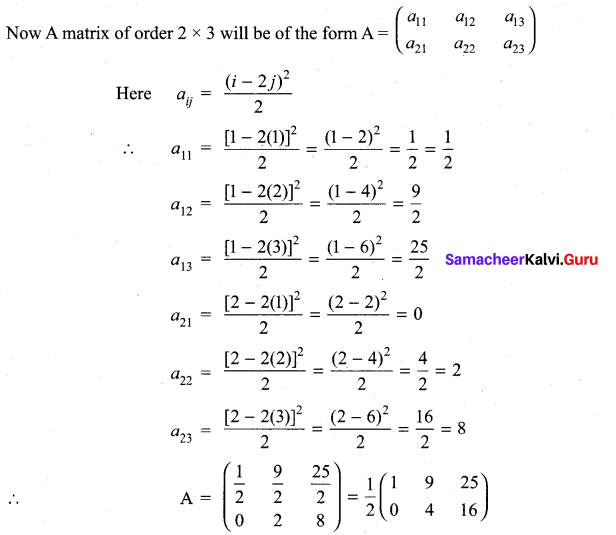
11th Maths Exercise 7.1 Samacheer Kalvi Chapter 7 Matrices And Determinants

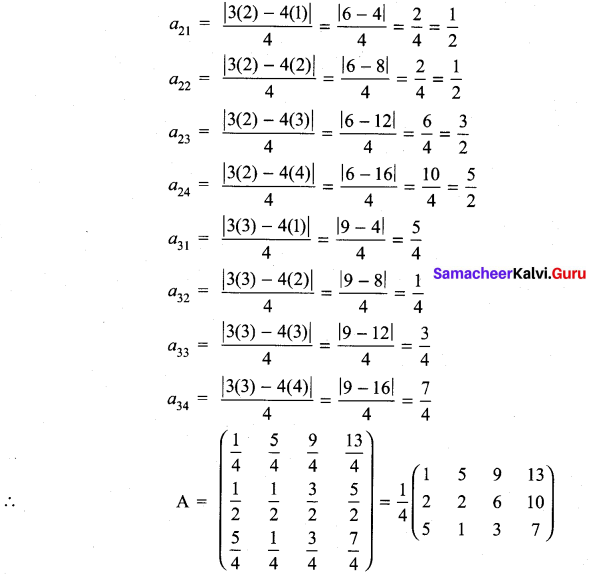
(ii) Here m = 3 and n = 4
So we have to construct a matrix order 3 × 4
The general form of a matrix of order 3 × 4 will be
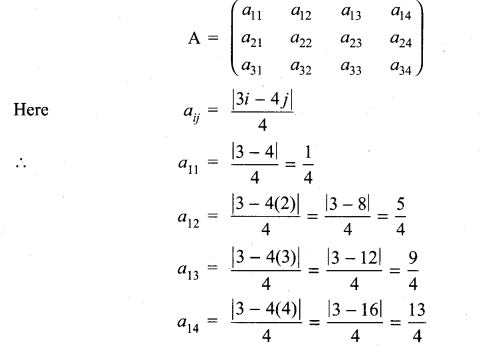
11th Maths Matrices And Determinants Solutions Samacheer Kalvi
11th Maths 7.1 Exercise Samacheer Kalvi Chapter 7 Matrices And Determinants

11th Maths Exercise 7.1 Question 2.
Find the values of p, q, r and s if
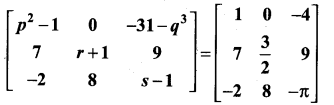
11th Maths Volume 2 Exercise 7.1 Samacheer Kalvi Chapter 7 Matrices And Determinants
Solution:
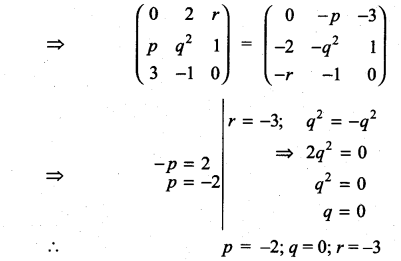
When two matrices (of same order) are equal then their corresponding entries are equal.
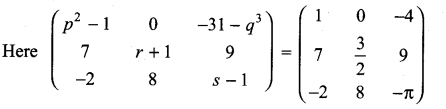
11th Maths Matrix Solutions Samacheer Kalvi Chapter 7 Matrices And Determinants
⇒ p2 – 1 = 1
⇒ p2 = 1 + 1 = 2
p = ± \(\sqrt{2}\)
-31 – q3 = -4
-q3 = -4 + 31 = 27
q3 = -27 = (-3)3
⇒ q = -3
r + 1 = \(\frac{3}{2}\)
⇒ r = \(\frac{3}{2}\) – 1 = \(\frac{3-2}{2}\) = \(\frac{1}{2}\)
s – 1 = π
⇒ s = – π + 1 (i.e.,) s = 1 – π
So, p = ± \(\sqrt{2}\), q = -3, r = 1/2 and s = 1 – π

11th Maths Matrices And Determinants Solutions Question 3.
Determine the value of x + y if 11th Maths Exercise 7.1 Tamil Medium Samacheer Kalvi Chapter 7 Matrices And Determinants
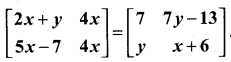
Solution:
\(\left[\begin{array}{cc}{2 x+y} & {4 x} \\ {5 x-7} & {4 x}\end{array}\right]=\left[\begin{array}{cc}{7} & {7 y-13} \\ {y} & {x+6}\end{array}\right]\)
⇒ 2x + y = 7 ………….. (1)
4x = 7y – 13 ………….. (2)
5x – 7 = y …………… (3)
4x = x + 6 ……………. (4)
from (4) 4x – x = 6
3x = 6 ⇒ x = \(\frac{6}{3}\) = 2
Substituting x = 2 in (1), we get
2(2) + y = 7 ⇒ 4 + y = 7 ⇒ y = 7 – 4 = 3
So x = 2 and y = 3
∴ x + y = 2 + 3 = 5

11th Maths 7.1 Exercise Question 4.
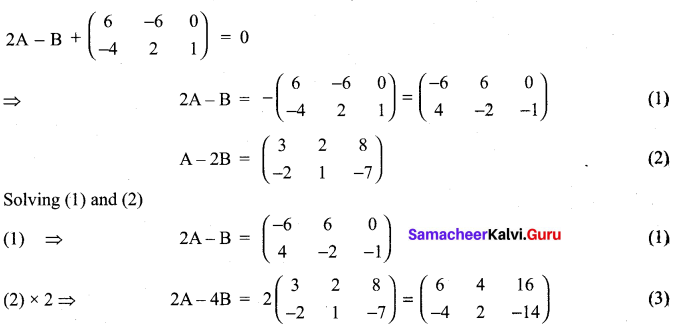
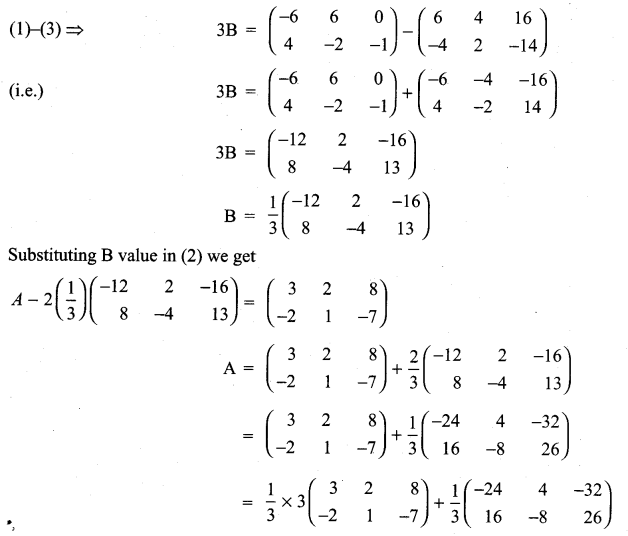
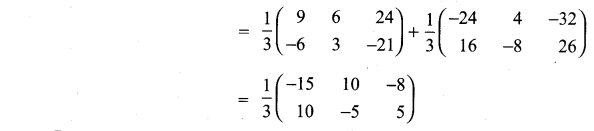
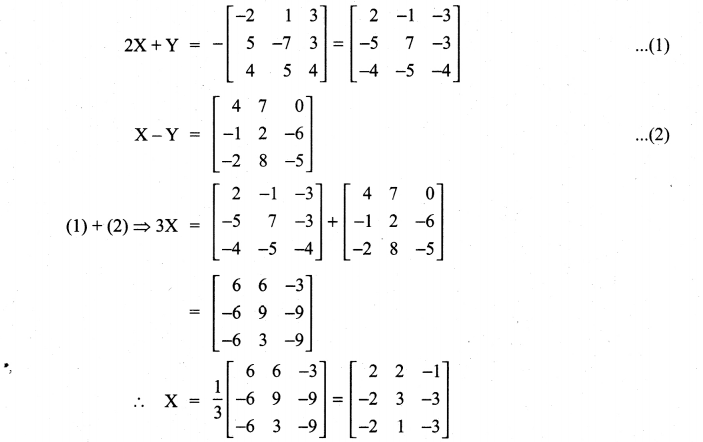
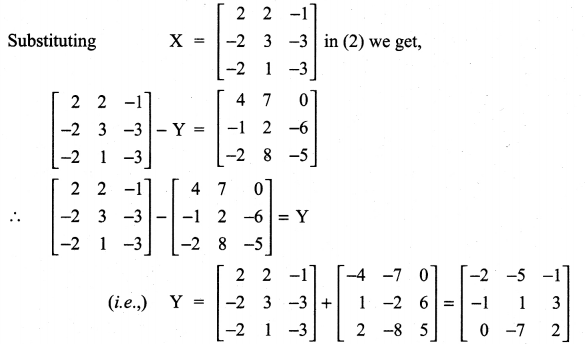
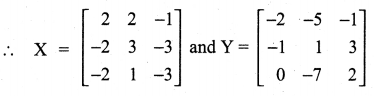
Determine the matrices A and B if they satisfy

11th Maths Matrices And Determinants Pdf Samacheer Kalvi Chapter 7
Solution:
Exercise 7.1 Class 11 Maths State Board Samacheer Kalvi Chapter 7 Matrices And Determinants
11th Maths 7.1 Samacheer Kalvi Chapter 7 Matrices And Determinants
11th Maths Matrix And Determinants Samacheer Kalvi Chapter 7

11th Maths Volume 2 Exercise 7.1 Question 5.
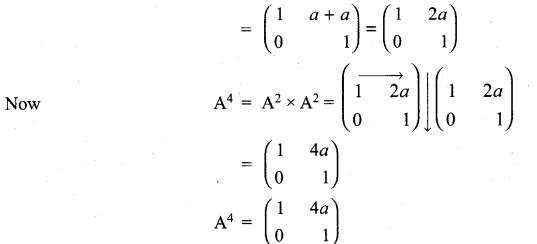
If A = \(\left[\begin{array}{ll}{\mathbf{1}} & {\boldsymbol{a}} \\ {\mathbf{0}} & {\mathbf{1}}\end{array}\right]\), then compute A4
Solution:
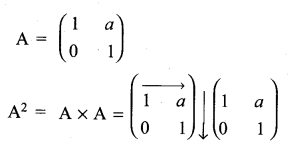
11th Maths Exercise 7.1 In Tamil Samacheer Kalvi Chapter 7 Matrices And Determinants
11th Maths Volume 2 Exercise 7.1 Answers Samacheer Kalvi Chapter 7 Matrices And Determinants

11th Maths Matrix Solutions Question 6.
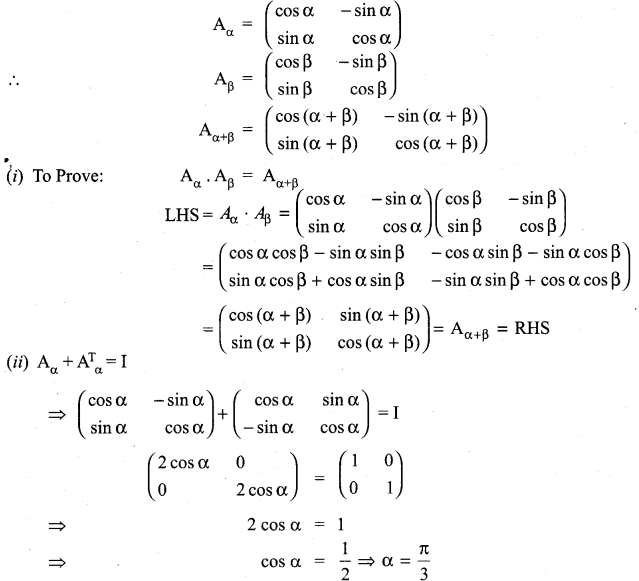
Consider the matrix Aα = \(\left[\begin{array}{cc}{\cos \alpha} & {-\sin \alpha} \\ {\sin \alpha} & {\cos \alpha}\end{array}\right]\)
(i) Show that AαAβ = Aα + β.
(ii) Find all possible real values of satisfying the condition Aα + ATα = 1.
Solution:
11 Maths Exercise 7.1 Samacheer Kalvi Chapter 7 Matrices And Determinants
General solution is α = 2nπ + \(\frac{\pi}{3}\), n ∈ Z

11th Maths Exercise 7.1 Tamil Medium Question 7.
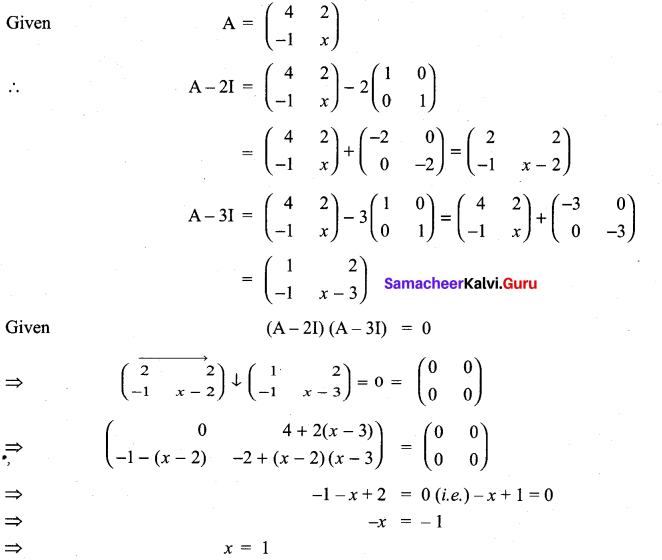
If A = \(\left[\begin{array}{rr}{4} & {2} \\ {-1} & {x}\end{array}\right]\) such that (A – 2I) (A – 3I) = 0, find the value of x.
Solution:
11th Maths 7th Chapter Samacheer Kalvi Chapter 7 Matrices And Determinants

11th Maths Matrices And Determinants Pdf Question 8.
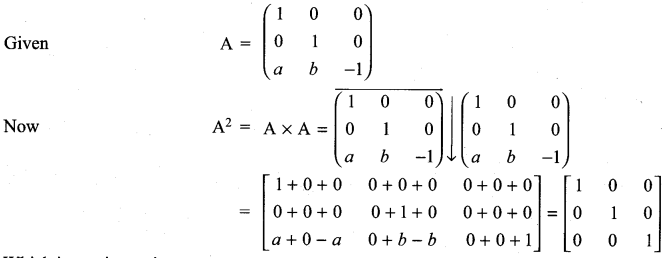
If A = \(\left[\begin{array}{ccc}{\mathbf{1}} & {\mathbf{0}} & {\mathbf{0}} \\ {\mathbf{0}} & {\mathbf{1}} & {\mathbf{0}} \\ {\boldsymbol{a}} & {\boldsymbol{b}} & {-\mathbf{1}}\end{array}\right]\), show that A2 is a unit matrix.
Solution:
Matrices And Determinants Class 11 State Board Solutions Samacheer Kalvi

Exercise 7.1 Class 11 Maths State Board Question 9.
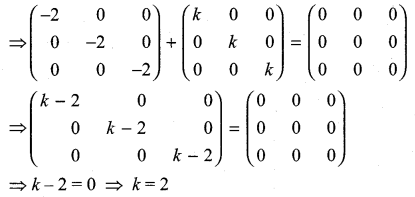
If A = 11th Maths Determinants Solutions Samacheer Kalvi  Chapter 7 and A3 – 6A2 + 7A + KI = 0, find the value of k.
Solution:
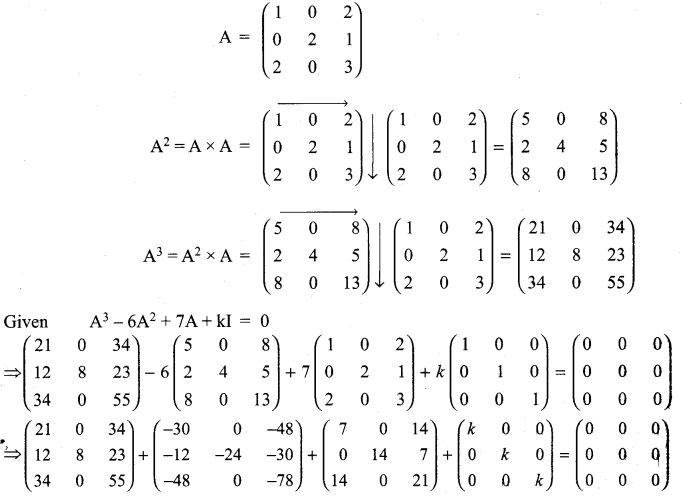
Class 11th Maths Exercise 7.1 Samacheer Kalvi Chapter 7 Matrices And Determinants
Matrices And Determinants Class 11 Solutions Pdf Samacheer Kalvi

11th Maths 7.1 Question 10.
Give your own examples of matrices satisfying the following conditions in each case:
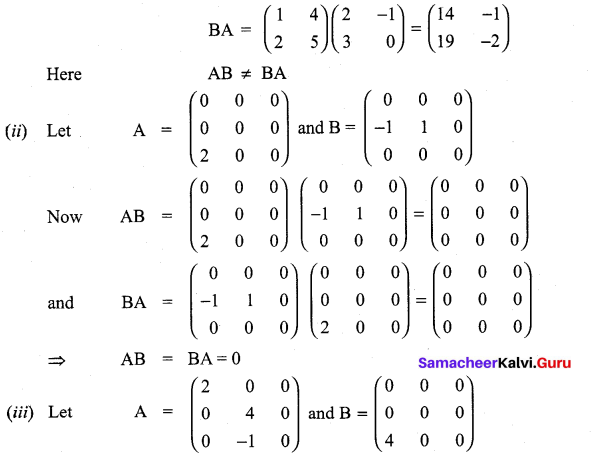
(i) A and B such that AB ≠ BA.
(ii) A and B such that AB = 0 = BA, A ≠ 0 and B ≠ 0.
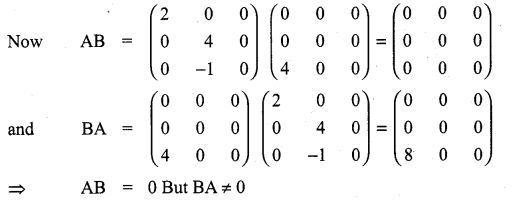
(iii) A and B such that AB = 0 and BA ≠ 0.
Solution:
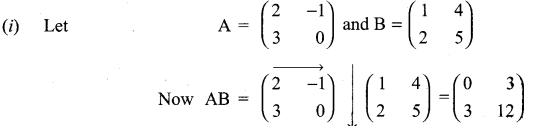
Samacheer Kalvi 11th Maths Solutions  Chapter 7 Matrices And Determinants
11th Maths 7th Lesson Samacheer Kalvi Chapter 7 Matrices And Determinants
Class 11 Maths Ex 7.1 Solutions Samacheer Kalvi Chapter 7 Matrices And Determinants

11th Maths Matrix And Determinants Question 11.
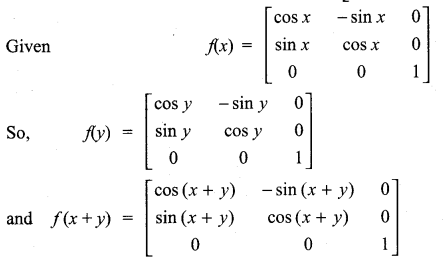
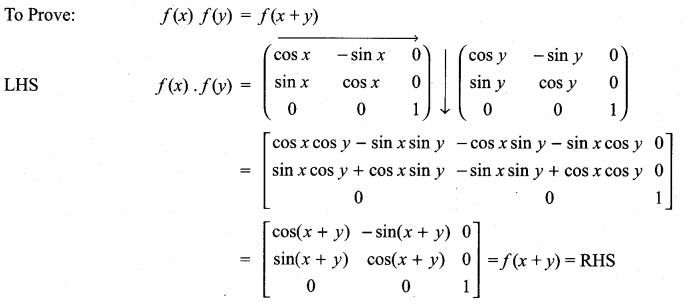
Show that f(x) f(y) = f(x + y), where f(x) = Class 11th Maths Chapter 7 Exercise 7.1 Samacheer Kalvi Chapter 7 Matrices And Determinants
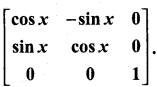
Solution:
11th Maths Guide Samacheer Kalvi Chapter 7 Matrices And Determinants
Samacheer Kalvi 11th Maths Solutions Chapter 7 Matrices and Determinants Ex 7.1 25

11th Maths Exercise 7.1 In Tamil Question 12.
If A is a square matrix such that A2 = A, find the value of 7A – (I + A)3.
Solution:
Given A2 = A
So 7A – (I + A)3 = 7A – (I + 3A + 3A2 + A3]
= 7A – I – 3A – 3 A2 – A3
Given A2 = A
7A – I – 3A – 3A – A3 = -I + A – A3
= -I + A – (A2 × A)
= -I + A – (A × A) = -I + A – A2
= -I + A – A = -I
So the value of 7A – (I + A)3 = -I.

Question 13.
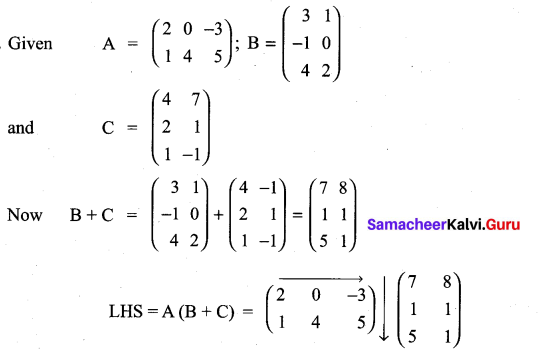
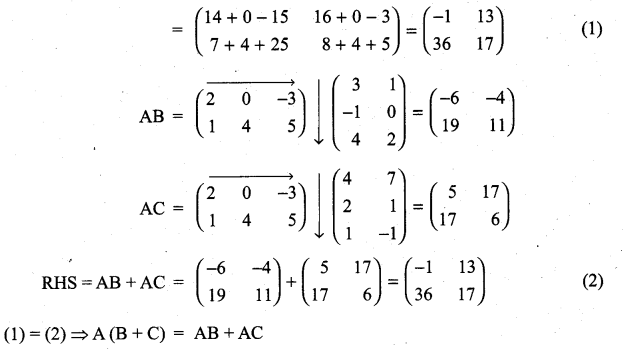
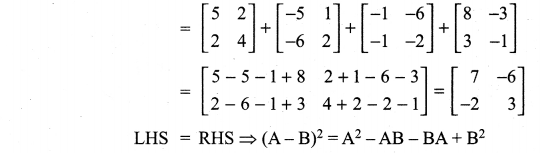
Verify the property A (B + C) = AB + AC, when the matrices A, B and C are given by
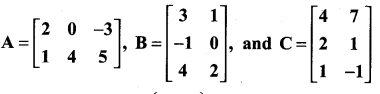
Samacheer Kalvi 11th Maths Solutions Chapter 7 Matrices and Determinants Ex 7.1 26
Solution:
Samacheer Kalvi 11th Maths Solutions Chapter 7 Matrices and Determinants Ex 7.1 27
Samacheer Kalvi 11th Maths Solutions Chapter 7 Matrices and Determinants Ex 7.1 28

11th Maths Volume 2 Exercise 7.1 Answers Question 14.
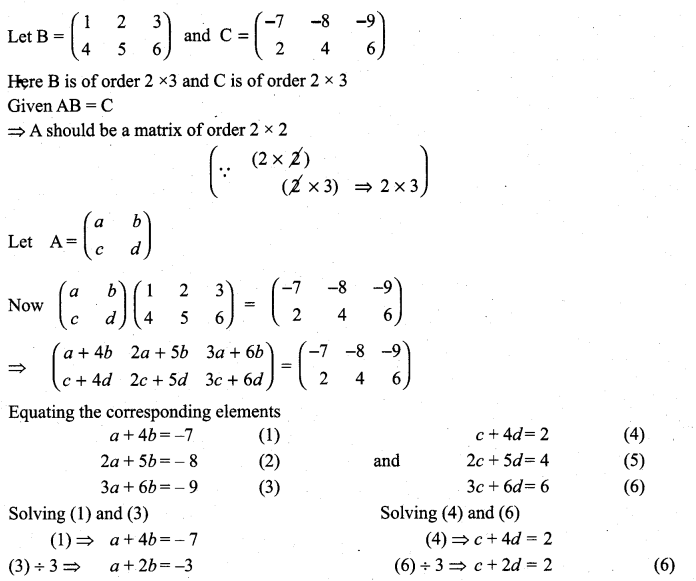
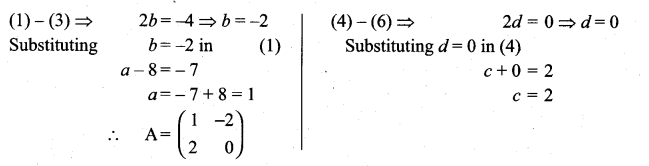
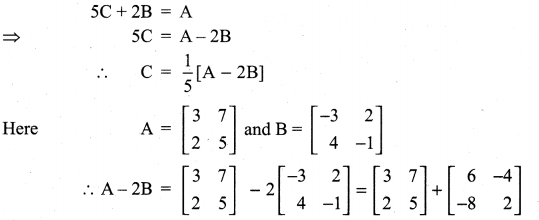
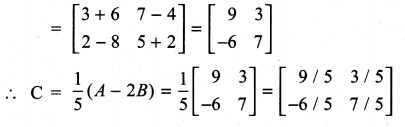
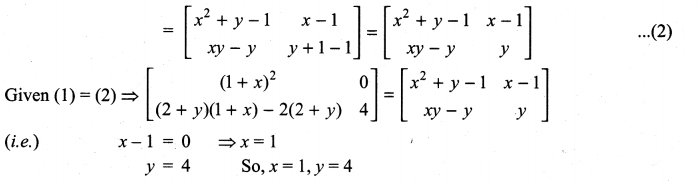
Find the matrix A which satisfies the matrix relation Samacheer Kalvi 11th Maths Solutions Chapter 7 Matrices and Determinants Ex 7.1 29
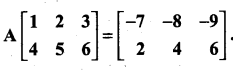
Solution:
Samacheer Kalvi 11th Maths Solutions Chapter 7 Matrices and Determinants Ex 7.1 30
Samacheer Kalvi 11th Maths Solutions Chapter 7 Matrices and Determinants Ex 7.1 31

Samacheer Kalvi 11th Maths Solutions Chapter 7 Matrices and Determinants Ex 7.1

11 Maths Exercise 7.1 Question 15.
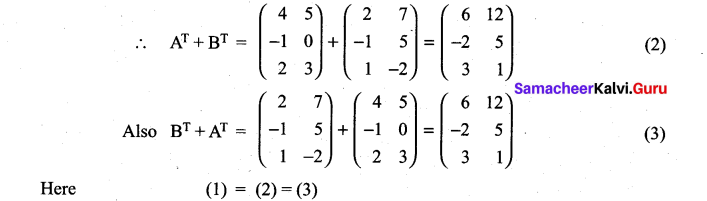
Samacheer Kalvi 11th Maths Solutions Chapter 7 Matrices and Determinants Ex 7.1 32
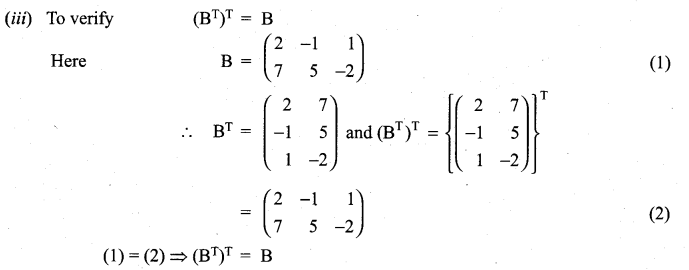
(i) (A + B)T = AT + BT = BT + AT
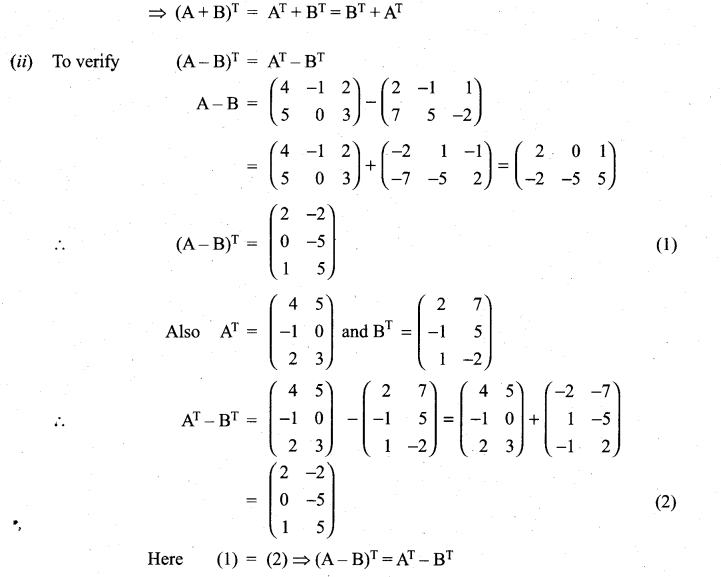
(ii) (A – B)T = AT – BT
(iii) (BT)T = B.
Solution:
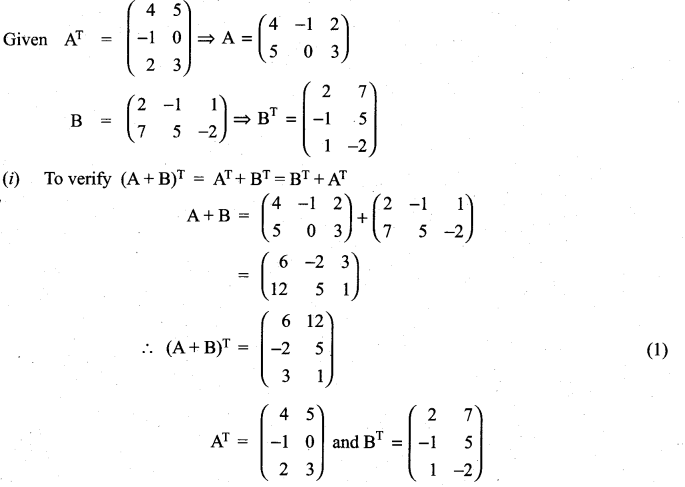
Samacheer Kalvi 11th Maths Solutions Chapter 7 Matrices and Determinants Ex 7.1 33
Samacheer Kalvi 11th Maths Solutions Chapter 7 Matrices and Determinants Ex 7.1 34
Samacheer Kalvi 11th Maths Solutions Chapter 7 Matrices and Determinants Ex 7.1 35
Samacheer Kalvi 11th Maths Solutions Chapter 7 Matrices and Determinants Ex 7.1 36

11th Maths 7th Chapter Question 16.
If A is a 3 × 4 matrix and B is a matrix such that both ATB and BAT are defined, what is the order of the matrix B?
Sol.
A is a matrix of order 3 × 4
So AT will be a matrix of order 4 × 3
AT B will be defined when B is a matrix of order 3 × n
BAT will be defirted when B is of order m × 4
from (1) and (2) we see that B should be a matrix of order 3 × 4

Question 17.
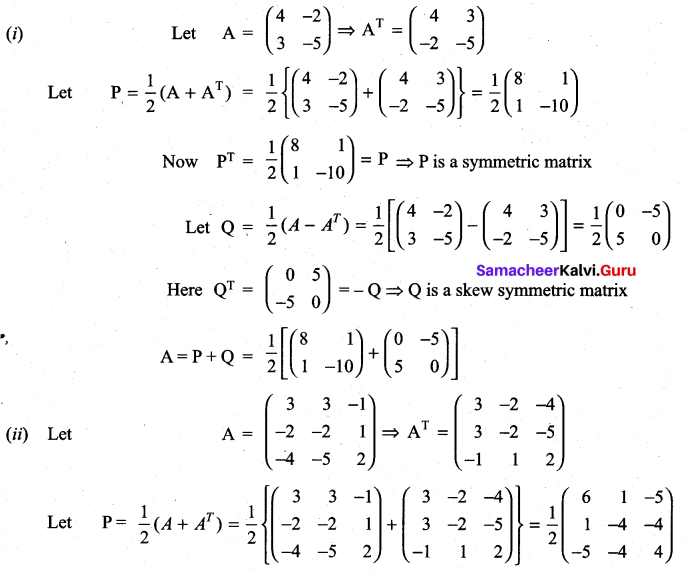
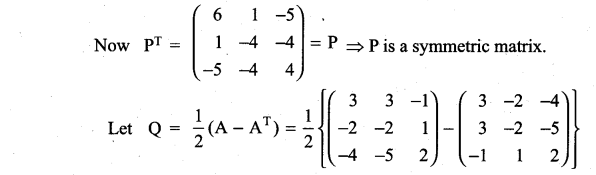
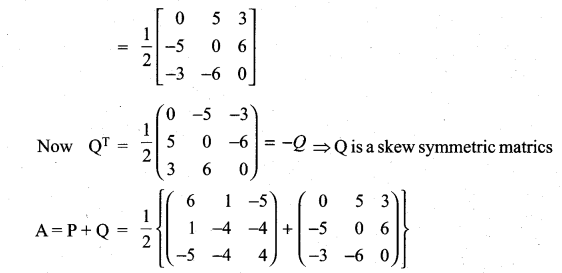
Express the following matrices as the sum of a symmetric matrix and a skew-symmetric matrix:

Samacheer Kalvi 11th Maths Solutions Chapter 7 Matrices and Determinants Ex 7.1 37
Solution:
Samacheer Kalvi 11th Maths Solutions Chapter 7 Matrices and Determinants Ex 7.1 38
Samacheer Kalvi 11th Maths Solutions Chapter 7 Matrices and Determinants Ex 7.1 39
Samacheer Kalvi 11th Maths Solutions Chapter 7 Matrices and Determinants Ex 7.1 40

Matrices And Determinants Class 11 State Board Solutions Question 18.
Find the matrix A such that Samacheer Kalvi 11th Maths Solutions Chapter 7 Matrices and Determinants Ex 7.1 41
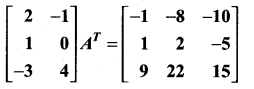
Solution:
Samacheer Kalvi 11th Maths Solutions Chapter 7 Matrices and Determinants Ex 7.1 42
Samacheer Kalvi 11th Maths Solutions Chapter 7 Matrices and Determinants Ex 7.1 43

11th Maths Determinants Solutions Question 19.
If A = Samacheer Kalvi 11th Maths Solutions Chapter 7 Matrices and Determinants Ex 7.1 44 is a matrix such that AAT = 9I, find the values of x and y.
Solution:
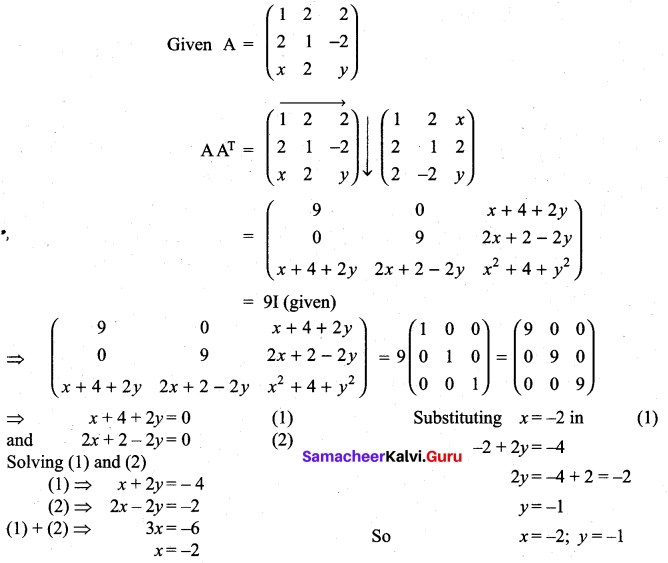
Samacheer Kalvi 11th Maths Solutions Chapter 7 Matrices and Determinants Ex 7.1 45

Question 20.
Samacheer Kalvi 11th Maths Solutions Chapter 7 Matrices and Determinants Ex 7.1 46
Solution:
Samacheer Kalvi 11th Maths Solutions Chapter 7 Matrices and Determinants Ex 7.1 47
Samacheer Kalvi 11th Maths Solutions Chapter 7 Matrices and Determinants Ex 7.1 48

Class 11th Maths Exercise 7.1 Question 21.
Construct the matrix A = [aij]3×3, where aij = i- j. State whether A is symmetric or skew- symmetric.
Solution:
Given A is a matrix of order 3 × 3
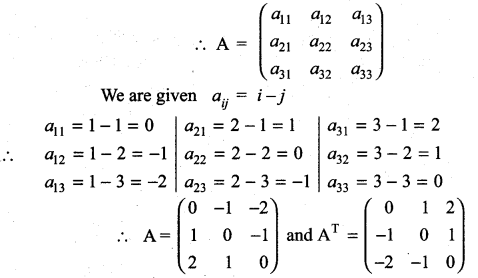
Samacheer Kalvi 11th Maths Solutions Chapter 7 Matrices and Determinants Ex 7.1 49
Here AT = -A
⇒ A is skew symmetric

Matrices And Determinants Class 11 Solutions Pdf Question 22.
Let A and B be two symmetric matrices. Prove that AB = BA if and only if AB is a symmetric matrix.
Solution:
Let A and B be two symmetric matrices
⇒ AT = A and BT = B …………….. (1)
Given that AB = BA (2)
To prove AB is symmetric:
Now (AB)T = BTAT = BA
(from(1)) But (AB)T = AB by ………….. (2)
⇒ AB is symmetric.
Conversely let AB be a symmetric matrix.
⇒ (AB)T = AB
i.e. BTAT = AB
i.e. BA = AB (from (1))
⇒ AB is symmetric

Samacheer Kalvi 11th Maths Solutions Question 23.
If A and B are symmetric matrices of same order, prove that
(i) AB + BA is a symmetric matrix.
(li) AB – BA is a skew-symmetric matrix.
Solution:
Given A and B are symmetric matrices
⇒ – AT = A and BT = B
(i) To prove AB + BA is a symmetric matrix.
Proof: Now (AB + BA)T = (AB)T + (BA)T = BTAT + ATBT
= BA + AB = AB + BA
i.e. (AB + BA)T = AB + BA
⇒ (AB + BA) is a symmetric matrix.
(ii) To prove AB – BA is a skew symmetric matrix.
Proof: (AB – BA)T = (AB)T – (BA)T = BTAT – ATBT = BA – AB
i.e. (AB – BA)T = – (AB – BA)
⇒ AB – BA is a skew symmetric matrix.

11th Maths 7th Lesson Question 24.
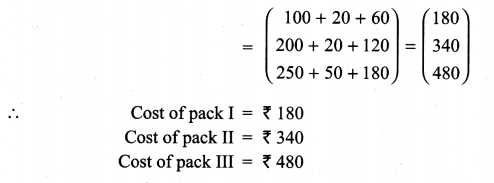
A shopkeeper in a Nuts and Spices shop makes gift packs of cashew nuts, raisins and almonds.
Pack I contains 100 gm of cashew nuts, 100 gm of raisins and 50 gm of almonds. Pack-II contains 200 gm of cashew nuts, 100 gm of raisins and 100 gm of almonds. Pack-III contains 250 gm of cashew nuts, 250 gm of raisins and 150 gm of almonds. The cost of 50 gm of cashew nuts is ₹ 50, 50 gm of raisins is ₹ 10, and 50 gm of almonds is₹ 60. What is the cost of each gift pack?
Solution:
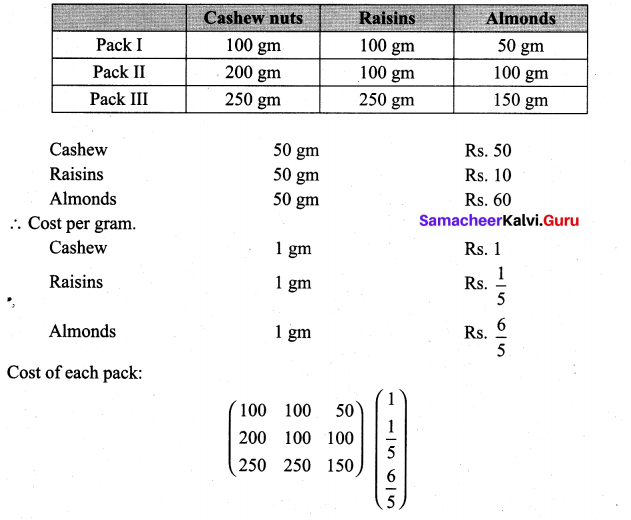
Samacheer Kalvi 11th Maths Solutions Chapter 7 Matrices and Determinants Ex 7.1 50
Samacheer Kalvi 11th Maths Solutions Chapter 7 Matrices and Determinants Ex 7.1 51

Samacheer Kalvi 11th Maths Solutions Chapter 7 Matrices and Determinants Ex 7.1 Additional Problems

Class 11 Maths Ex 7.1 Solutions Question 1.
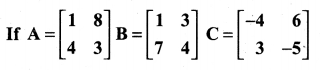
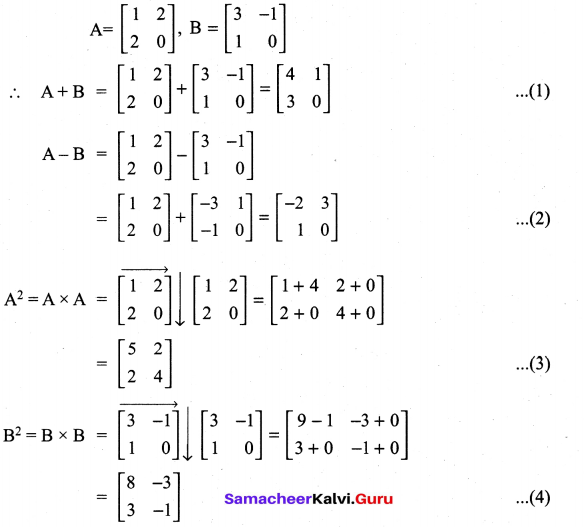
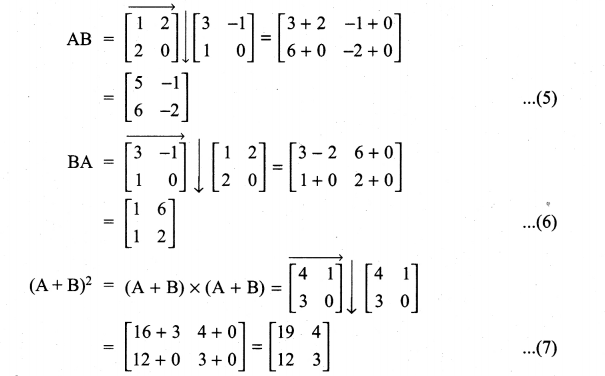
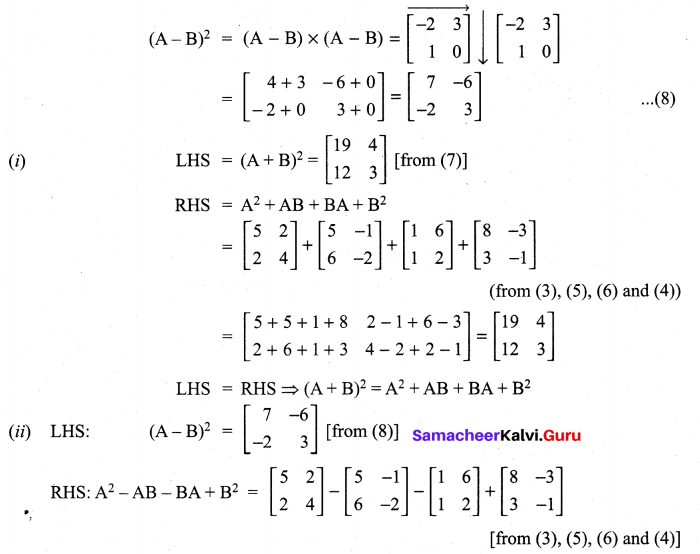
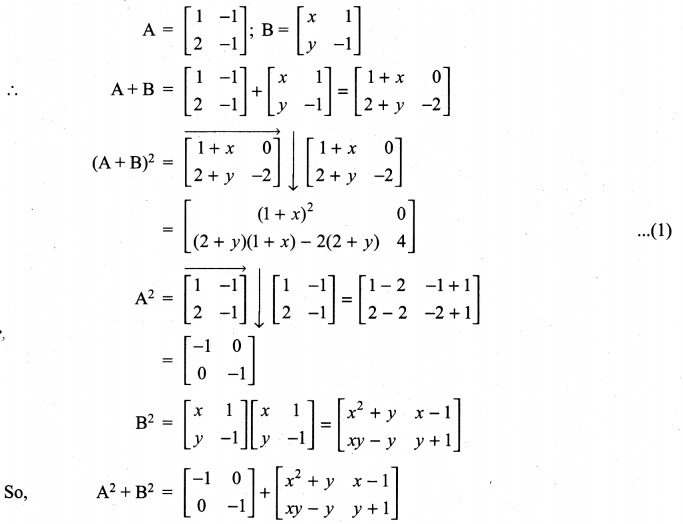
Samacheer Kalvi 11th Maths Solutions Chapter 7 Matrices and Determinants Ex 7.1 52
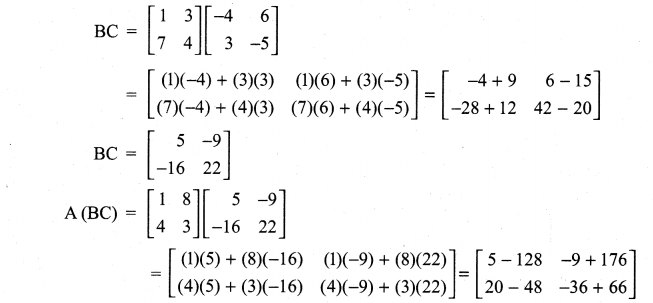
Prove that (i) AB ≠ BA
(ii) A(BC) = (AB) C
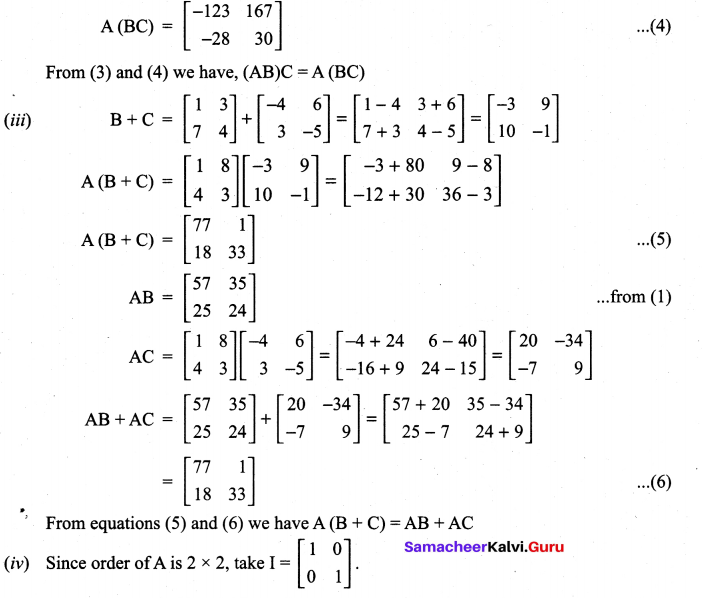
(iii) A(B + C) = AB + AC
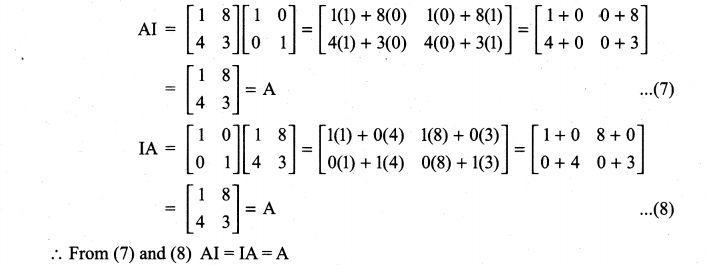
(iv) AI = IA = A
Solution:
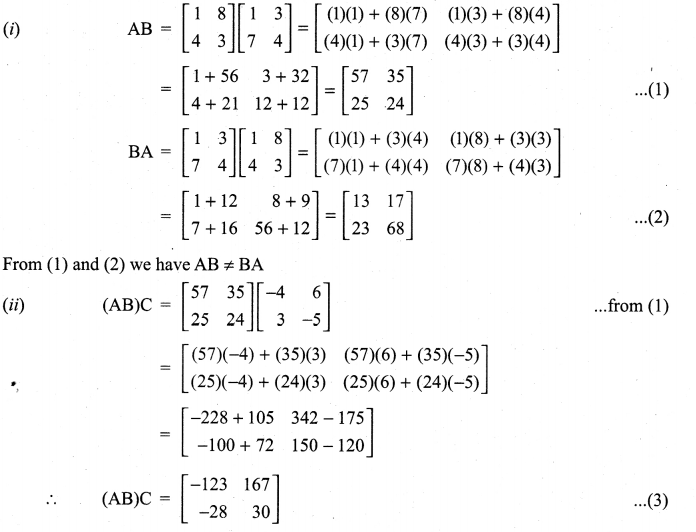
Samacheer Kalvi 11th Maths Solutions Chapter 7 Matrices and Determinants Ex 7.1 53
Samacheer Kalvi 11th Maths Solutions Chapter 7 Matrices and Determinants Ex 7.1 54
Samacheer Kalvi 11th Maths Solutions Chapter 7 Matrices and Determinants Ex 7.1 55
Samacheer Kalvi 11th Maths Solutions Chapter 7 Matrices and Determinants Ex 7.1 56

Class 11th Maths Chapter 7 Exercise 7.1 Question 2.
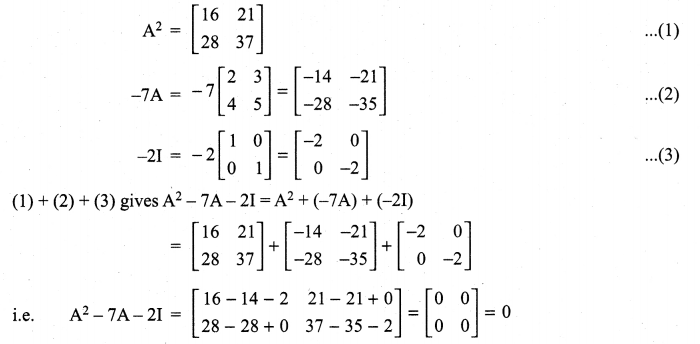
If A = \(\left[\begin{array}{ll}{2} & {3} \\ {4} & {5}\end{array}\right]\) find A2 – 7A – 2I.
Solution:

Samacheer Kalvi 11th Maths Solutions Chapter 7 Matrices and Determinants Ex 7.1 57
Samacheer Kalvi 11th Maths Solutions Chapter 7 Matrices and Determinants Ex 7.1 58

11th Maths Guide Question 3.
Samacheer Kalvi 11th Maths Solutions Chapter 7 Matrices and Determinants Ex 7.1 59
Solution:
Samacheer Kalvi 11th Maths Solutions Chapter 7 Matrices and Determinants Ex 7.1 60

Samacheer Kalvi 11th Maths Solutions Chapter 7 Matrices and Determinants Ex 7.1 61

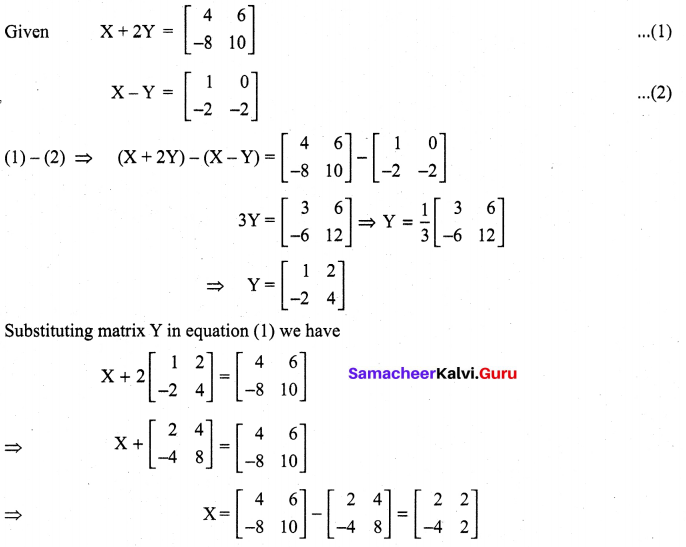
11th Maths Guide Question 4.
Samacheer Kalvi 11th Maths Solutions Chapter 7 Matrices and Determinants Ex 7.1 62
Solution:
Samacheer Kalvi 11th Maths Solutions Chapter 7 Matrices and Determinants Ex 7.1 63
Samacheer Kalvi 11th Maths Solutions Chapter 7 Matrices and Determinants Ex 7.1 64
Samacheer Kalvi 11th Maths Solutions Chapter 7 Matrices and Determinants Ex 7.1 65

Question 5.
If A = \(\left[\begin{array}{rr}{3} & {-5} \\ {-4} & {2}\end{array}\right]\), show that A2 – 5A – 14I = 0 where I is the unit matrix of order 2.
Solution:
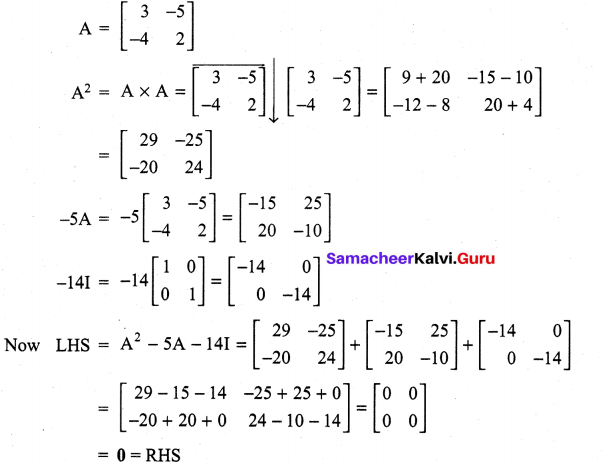
Samacheer Kalvi 11th Maths Solutions Chapter 7 Matrices and Determinants Ex 7.1 66

Question 6.
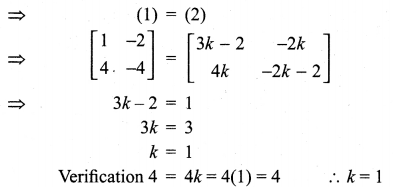
If A = \(\left[\begin{array}{rr}{3} & {-2} \\ {4} & {-2}\end{array}\right]\), find k so that A2 = kA – 2I
Solution:
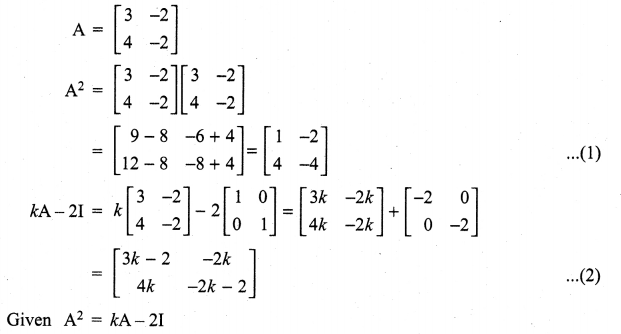
Samacheer Kalvi 11th Maths Solutions Chapter 7 Matrices and Determinants Ex 7.1 67
Samacheer Kalvi 11th Maths Solutions Chapter 7 Matrices and Determinants Ex 7.1 68

Question 7.
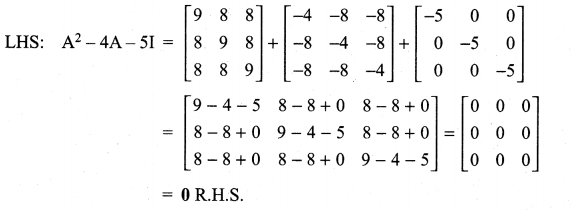
If A = \(\left[\begin{array}{lll}{1} & {2} & {2} \\ {2} & {1} & {2} \\ {2} & {2} & {1}\end{array}\right]\), show that A2 – 4A – 5I = 0
Solution:
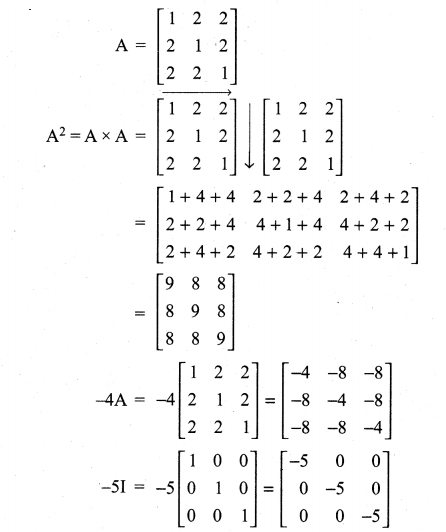
Samacheer Kalvi 11th Maths Solutions Chapter 7 Matrices and Determinants Ex 7.1 69
Samacheer Kalvi 11th Maths Solutions Chapter 7 Matrices and Determinants Ex 7.1 70

Question 8.
Samacheer Kalvi 11th Maths Solutions Chapter 7 Matrices and Determinants Ex 7.1 71
Solution:
Samacheer Kalvi 11th Maths Solutions Chapter 7 Matrices and Determinants Ex 7.1 72
Samacheer Kalvi 11th Maths Solutions Chapter 7 Matrices and Determinants Ex 7.1 73
Samacheer Kalvi 11th Maths Solutions Chapter 7 Matrices and Determinants Ex 7.1 74
Samacheer Kalvi 11th Maths Solutions Chapter 7 Matrices and Determinants Ex 7.1 75

Question 9.
Samacheer Kalvi 11th Maths Solutions Chapter 7 Matrices and Determinants Ex 7.1 76
Solution:
Samacheer Kalvi 11th Maths Solutions Chapter 7 Matrices and Determinants Ex 7.1 77
Samacheer Kalvi 11th Maths Solutions Chapter 7 Matrices and Determinants Ex 7.1 78

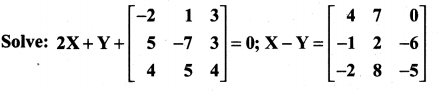
Question 10.
Samacheer Kalvi 11th Maths Solutions Chapter 7 Matrices and Determinants Ex 7.1 79
Solution:
Samacheer Kalvi 11th Maths Solutions Chapter 7 Matrices and Determinants Ex 7.1 80
Samacheer Kalvi 11th Maths Solutions Chapter 7 Matrices and Determinants Ex 7.1 81

11th English 1st Lesson Questions And Answers

Students who are interested in learning of 11th English Prose Chapter 1 The Portrait of a Lady Questions and Answers can use Tamilnadu State Board Solutions of 11th English Chapter Wise Pdf. First check in which chapter you are lagging and then Download Samacheer Kalvi 11th English Book Solutions Questions and Answers Summary, Activity, Notes Chapter Wise. Students can build self confidence by solving the solutions with the help of Tamilnadu State Board English Solutions. English is the scoring subject if you improve your grammar skills. Because most of the students will lose marks by writing grammar mistakes. So, we suggest you to Download Tamilnadu State Board 11th English Solutions according to the chapters.

Tamilnadu Samacheer Kalvi 11th English Solutions Prose Chapter 1 The Portrait of a Lady

Check out the topics covered in Prose Chapter 1 The Portrait of a Lady Questions and Answers before you start your preparation. Improve your grammar skills with the help of Samacheer Kalvi 11th English Book Solutions Questions and Answers pdf links. The solutions for Tamilnadu State Board 11th English Textbook are prepared by the English experts. So, if you follow Tamilnadu State Board Solutions 11th English Textbook Solutions you can cover all the topics in Prose Chapter 1 The Portrait of a Lady Questons and Answers. This helps to improve your communication skills.

Warm up

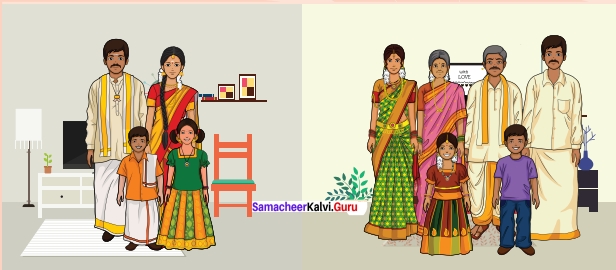
Nuclear Family or Joint Family

11th English 1st Lesson Questions And Answers Samacheer Kalvi The Portrait Of A Lady

Based on the visuals given above, give five words/phrases each to describe these two family

Nuclear familyJoint family

Answer:

Nuclear familyJoint family
smallcontentedcongestedless privacy
happyrichcompete for needssharing more
more spacekindpeer learningmore fun
caringlovingless richesmore joy
joyfulmore lovewait for turnno immediate gratification
good educationneeds metmutual carebondage great

Samacheer Kalvi 11th English The Portrait of a Lady Textual Questions

(1) Answer the following questions in one or two sentences based on your understanding of the story:

11th English 1st Lesson Questions And Answers Question (а)
Describe the grandfather as seen in the portrait.
Answer:
The author’s grandfather looked as if he were hundred years old with lots of grandchildren. He had loose fitting garments. He looked too old to have had a wife and children.

11th English Guide Pdf Download Question (b)
Why was the author left with his grandmother in the village?
Answer:
The author’s parents went to the city to make a living. The young author was left with his grandma till his parent’s settled well in the city.

11th English Unit 1 Prose Paragraph Question (c)
Where did the author study in his childhood?
Answer:
The author studied in the veranda of a village temple. He learnt letters of the alphabet from the priest.

11th English Unit 1 Prose Question Answer Question (d)
Why did the grandmother accompany the author to school?
Answer:
Grandma was a pious lady. The school was attached to the temple. So, the grandmother accompanied the author to his school. While he learnt letters of alphabets, she spent her time inside the temple reciting prayers and telling the beads of her rosary.

The Portrait Of A Lady Book Back Answers Question (e)
What made the dogs follow the grandmother after school hours?
Answer:
Grandmother brought a bundle of stale chapattis with her to the temple. The village dogs followed her. On return, she went on throwing the chapattis to the dogs who growled and fought with each other to have a piece of chapatti.

11th English Prose Paragraph Question (f)
Why didn’t the grandmother feel sentimental when the author went abroad for higher education?
Answer:
Grandmother got alienated from her grandson the time he went to the English medium school in the city. The reduction of focus in spiritual education and value education and increase in the importance of science perturbed grandma a great deal. She knew that she can’t help the changes. So, she did not show any sentimentality when the grandson went abroad.

11th English 1st Lesson Paragraph Question (g)
What was the happiest time of the day for grandmother?
Answer
Half an hour in the afternoon, grandma devoted her time for feeding sparrows. That half- an-hour was the happiest time of the day for grandmother.

2 . Answer the following questions in three or four sentences each:

11th English Guide Pdf Free Download Question (a)
Describe the author’s grandmother.
Answer:
Grandma was bent with age. She was deeply religious. She did not approve of modem science, music and entertainment. However she had the wisdom to accept changes ‘ gracefully and retain her values till her death.

11 English Guide Question (b)
What was the daily routine of the grandmother at home?
Answer:
Grandma started the mornings with a sing-song prayer. She woke up the author bathed and dressed him up and wanted him to learn the prayers by heart. Both would march to the school which was attached to a temple. She would stay inside chanting prayers and telling beads. In the evening, she would throw the stale chapattis to village dogs as they returned home.

11th English Book Back Answers Question (c)
How is school education in the village different from that in the city?
Answer:
Village school is easily accessible on foot. Values and letters of the alphabet are given utmost importance. Children carried wooden slate and ink-pot. These was no subject specialization in the village school. One teacher taught all. City school has huge buildings. Subject-wise teachers are there. School is remote. Children have to travel to long distance to reach school.

Samacheer Kalvi 11th English Guide Question (d)
The grandmother appreciated the value of education. Give instances in support of your answer.
Answer:
Grandma did have respect for education and that is why she personally monitored the village education of the author. She insisted on good manners and love for all living things. She demonstrated this by feeding village dogs and sparrows. She didn’t object to ; the author going abroad.

Samacheer Kalvi 11th English Guide Pdf Question (e)
The grandmother was strong-minded. Justify.
Answer:
Grandmother had strong values and had zest for life. She lived the life the way she wanted it. She spun the wheel, told her beads, fed the dog in the village and sparrows in the city unmindful of changes around her. She played the drum with joy when she realized her impending death. She died a peaceful death after predicting it to all her family members. She is really a strong lady.

11th English The Portrait Of A Lady Paragraph Question (f)
How did the grandmother spend the last few hours of her life?
Answer:
She suspended her prayer for a while. She called the women from neighbourhood, sang and played the drum along with them. The next morning she had fever. She told the family that she was about to die! She died in bed telling her beads and lisping her last prayer.

Additional Questions

11th English Chapter 1 Question Answers Question 1.
What was hard to believe? Why?
Answer:
People said that grandma was once pretty and she even had a husband. This was hard to believe as the author had seen her old right from his boyhood days.

11th Std English Guide Question 2.
How long had the author known his old grandma?
Answer:
The author had seen his old grandma for twenty long years. She had the same wrinkles and hunchback.

Samacheer Kalvi 11th English Chapter 1 Question 3.
What appeared to be fables of the prophets?
Answer:
Grandma often told the author and his friends about various games she had played as a young girl. This appeared absurd and hence the author and his friends treated her games as fables of prophet.

11 Std English Guide Question 4.
What was odd about the author’s acceptance of grandma’s beauty and not her pretty looks?
Answer:
Young girls are pretty like the buds of a flower. The author had never seen his grandma young. The author thought she could never have been pretty but full bloomed flower like beauty.

11th Standard English Guide Question 5.
Which thought was revolting to the author?
Answer:
The sheer thought of grandma having been pretty once was really revolting to the author.

11th English 1st Lesson Question Answer Question 6.
How did grandma move about the house?
Answer:
Grandma hobbled about the house in spotless white saree. She had one hand resting on her waist to balance her stoop and the other telling the beads of her rosary.

English Guide For Class 11 Question 7.
How was grandma beautiful?
Answer:
She was beautiful like the winter landscape in the mountains, an expanse of pure white serenity breathing peace and contentment. Her lips constantly moved in inaudible prayer.

Question 8.
How did grandma perform her morning prayer? (or) What was grandma’s purpose in singing her morning prayer in a sing-song voice?
Answer:
Grandma said her morning prayer in a sing-song voice while she bathed and dressed the boy author. She wanted her grandson to learn the prayers by heart.

Question 9.
How did grandma help the boy author to get ready to school?
Answer:
She would fetch his wooden slate already plastered with yellow chalk, a tiny earthen, ink -pot and a red pen. She would bundle them all and hand it to the boy author.

Question 10.
What was the turning point in the relationship between the boy author and his grandma?
Answer:
The boy author’s parents got settled in the city. They sent for them. That was a turning point in their friendship.

Question 11.
Why could grandma not accompany the author to his school?
Answer:
The boy author went to school in a motor car. So, she could not accompany him to school.

Question 12.
Why did grandma change her habit of feeding dogs?
Answer:
In the city, there were no dogs. So grandma started feeding the sparrows.

Question 13.
What made grandma unhappy? (or) What was grandma’s reaction to narrator’s education in English school?
Answer:
The boy author’s learning material included new English words, principles of science such as Archimedes Principle and law of gravity and the round shape of the earth. Shifting of gear from traditional and value-based education to modem English and science education made grandma unhappy.

Question 14.
Why didn’t grandma walk straight?
Answer:
Grandma was bent with age. So, she could not walk straight. She could only hobble about the house.

Question 15.
What distanced grandma from the author?
As years rolled by, the author grew up. He had a room of his own. English education did not cover scriptures and God. These distanced her from her grandson.

Question 16.
Why did grandma disapprove of ‘music lessons’ in school?
Answer:
Grandma belonged to an older generation in which moral values, scriptures and literacy dominated education. Even music was meant to only accompany hymns and devotional songs. Professional musicians and dancers were treated with contempt. So, grandma disapproved of “music lessons” at school.

Question 17.
Which incident almost snapped the friendship of the author with grandma?
Answer:
As the narrator moved on to university, he was given a separate room at home. This almost snapped the friendship between grandma and the author.

Question 18.
How did grandma spend her time when the author went to university?
Answer:
Grandma accepted her seclusion gracefully. She spun and recited prayers the whole day. She took half an hour break to feed the sparrows happily.

Question 19.
What occasion did the author believe, unwisely to be the ‘last sign’ of physical contact with grandma?
Answer:
The author was going abroad for a five years study. Grandma kissed Khushwant Singh on his forehead. He mistook it to be the last sign of physical contact with grandma.

Question 20.
How did grandma disprove the author’s judgement about her longevity?
Answer:
The author thought his grandma was getting very old. He believed that before he returned from foreign study, she may have kicked her bucket. But she came to receive him in a cool headed way on his return from abroad.


Question 21.
How did grandma celebrate the joy of grandson’s return? (or) What turned out to be grandma’s “swan song”? (or) Why did grandma suspend her prayers for a few hours?
Answer:
It appeared that grandma was holding on to see her grandson back home. She sensed her impending death and shocked her family members with the prediction. She drummed and sang along with neighbours with great zest as if she were celebrating her grandson’s return. In reality, she was enjoying the last moments of her life with absolute abandon even suspending her prayers for a while

3. Answer the following in a paragraph of 100 – 150 words each.

Question (a)
The grandmother played a vital role in the author’s formative years. Give your own example of how elders have a positive influence on the younger generation. Include examples from the story also.
Answer:
Elders who have deep love for young ones do leave a life time impression in the minds of children. I had seen my grandpa when I was very young. He was not rich. But he had deep- seated love for me. He used to walk three kilometers to just spend a few hours with me. He would not use the money my dad gave him for bus. He would walk back and save the money to buy either toys or books for me. The first book he presented me while I was in Std. VII hooked me on to the joy of reading. The book had short stories of endearing value.

For the first time, I realized, that printed book can transport one to a world of fantasy and indefinable joy. The thrill of identifying myself with warriors, pilgrims, fishermen and great souls of the past kindled a spark in me. Now, I go to the book fair every year and buy books. I have started reading for specific purposes. I owe my reading habit to my grandpa. In the life  of Mahatma Gandhi also, his mom’s influence was great. She told him many moral stories.

Dr. Ambedkar who shared a small room with his dad, learnt to lead a simple life all through his life. Unnikrishnan’s daughter Uthra Unnikrishnan has got influenced by her father and taken to singing even for films at a very young age. Her singing of “Kaiveesum Katrai” in the movie ‘Straberry’ and Azhage in “Saivam” Tamil movies has got her national level reputation. In this story also grandma’s influence on Khushwant Singh was so great that he made her immortal in his biographical story “The Portrait of a Lady”. Her love for simple life, street dogs and sparrows made an indelible mark in Khushwant Singh’s boyhood memories.
“Grandmothers create memories that the heart holds forever. ”

Question (b)
As young Khushwant Singh, write a letter to your parents describing your daily routine along with your thoughts and feelings about staying in the village.
Answer:
15 Jan 20XX
As young Khushwant Singh, write a letter to your parents describing your daily routine
along with your thoughts and feelings about staying in the village.
15 Jan 20XX
Dear Mom and Dad,
l am fine. Grandma is also fine. She wakes me up every day and prepares me for school. She sings her morning prayers in a sing-song voice to my great delight. But she wants me to leam; and repeat them. She washes my slate clean and bundles up ink pot, pen and slate and gives it to me.

We walk together to the temple. While the village priest is teaching us letters of the alphabet and some religious songs in the verandah of the temple, grandma stays inside the temple and joins group of devotees in singing or telling beads. I am touched by her extreme interest in my academics. She feeds me with butter-smeared chapattis with great love. She is quite’ thoughtful of village dogs which wait at the temple gate till my school is over. When we walk back home, the village dogs follow us growling and barking as grandma throws chapattis to those dogs.

Everyday, she enquires what I leam. Though her hunch back and wrinkles show her old age, the serenity, contentment in her face and the winter landscape of her hair make me believe that she is the most beautiful lady. Dad, I am unable to believe she was ever young or pretty because as far as my memory goes, I have always seen her old and wrinkled. Though grandma’s love is immense, I must admit I miss you both. Why don’t you take us both to the ; city? I want to see the city and study in a city school as the education I get in the village school has no variety. Everyday I have to leam only songs and letters of alphabet. Don’t you know,” ‘variety is the spice of life? I also want to leam different subjects, wear fashionable clothes. and go in a motor car to an English school. Dad and Mom don’t you miss me as I miss you?
Your loving son,
Khushwant Singh

Question (c)
Animals are capable of empathy. Substantiate this statement with examples from the story as well as your own experiences.
Answer:
A middle-aged lady in Australia had a heart attack. She was in great pain. Her pet pig saw i mistress in distress. It ran to the street and pulled the shirt sleeve of a man and brought him

home. He called an ambulance. The lady was saved. We had a pet dog. It was extremely fond of grandpa. He used to take him for long walks. One day grandpa died. The dog refused to eat any food. It went to the burial yard. It starved for a few days and died in front of grandpa’s grave. Even in this story, the sparrows in thousands sat in silence. Mom thought they were hungry. She broke the bread into pieces and threw them. But not a single sparrow touched them. Once grandma’s dead body was taken to the graveyard, the birds flew away. These instances prove beyond doubt that animals are capable of empathy.

Additional Questions

Question 1.
The author’s grandmother was a religious person. What are the different ways in which we come to know this?
Answer:
The author’s grandmother was a very religious lady. We come to know this through the different habitual actions. She visited the temple every morning and read scriptures. At home she always mumbled inaudible prayers and kept telling the beads of rosary. She would repeat prayer songs in a sing-song manner while getting the writer ready for school. She hoped that he would learn them by heart. She didn’t like English school as there was no teaching of God and scriptures. Even while spinning at her spinning wheel she would recite prayers.

Perhaps it was only once that she suspended her prayers. It was on the evening prior to her death when she felt over excited while celebrating the arrival of her grandson with songs and drumming. She continued praying and telling beads of her rosary till her last breath. The family members realized that her antic behaviour was a celebration of her contented life.
“Grandma s prayers are the reason a lot of us are still here. ”


Question 2.
Would you agree that the author’s grandmother was a person strong in character? If yes, give instances that show this.
Answer:
Yes, I agree that the author’s grandmother was a person strong in character. She was a strong woman with strong beliefs. Although she was not formally educated, she was serious about. the author’s education. She could not adjust herself to the western way of life, Science and English education. She hated music and disapproved of its teaching in school. She was a deeply religious lady. Her lips were always saying a silent prayer. She was always telling the beads of her rosary. She went to the temple daily and read the scriptures. She was distressed to know that there was no teaching about God and holy books at Khushwant’s new English school. She was a kind lady.

She used to feed dogs in the village. In the city, she took to feeding the sparrows. Although old in years and weak in body, she had great strength of mind. Knowing her impending death, she played a drum and sang with full-throated ease along with her neighbours. Just before her death, she refused to talk to the members of the family as she did not want to waste her time. She wanted to make up for the time lost when she had not prayed to God. She lay peacefully in bed saying prayers and telling the beads of her rosary till she breathed her last.
“She made broken look beautiful; strong look invincible. She walked with the universe on her shoulders as an inspiration. ”

Question 3.
Describe the friendship between Khushwant Singh and grandmother.
Answer:
Khushwant Singh’s grandmother was closely involved in bringing him up when the author lived with her in the village during his early life. She used to wake him up early in the morning.

While bathing and dressing him, she sang her prayers. She hoped that the young boy would learn it by heart. She then gave him breakfast – a stale chapatti with butter and sugar. Then they would go together to the temple school. While the author learnt his lessons, the grandmother would read holy books. They returned home together. A turning point came in their friendship when his parents called them to the city. Although they shared a room, she could not help him much. She hated music, Science and Western education. The common link of their friendship was gradually snapped. ,
“The greatest gift of life is friendship and one should cherish it. ”

Question 4.
Write a character sketch of the author’s grandmother.
Answer:
Khushwant Singh’s grandmother was a very old lady. She was short, fat and slightly bent. Her face was wrinkled. She had white hair. She was very affectionate. She was closely involved in bringing up the author. The two lived in the village. She was a caring grandmother. She ‘ would wake him early in the morning and get him ready for school. She served him breakfast and took him to school. She waited for him in the temple. She prayed while he studied. She returned with him.

She was kind and benevolent. She used to feed dogs in the village. In the city, she took to feeding the sparrows. She was a deeply religious lady. Her lips were always moving in a silent prayer. She was always telling the beads of her rosary. She went to the temple and read the scriptures.

She was a strong woman with strong beliefs. Although she was not formally educated, she was,serious about the author’s education. She could not adjust herself to the western way of life,Science and English education. She hated music. She was distressed to know that there was no teaching about God and holy books at Khushwant Singh’s new English school. On the whole she was a nice, affectionate, kindhearted and religious lady.
“Who can find a virtuous woman? For her price is far above Rubies.” .


Question 5.
The grandmother herself was not formally educated but was serious about the author’s education. How does the text support this?
Answer:
The grandmother Was quite serious about the author’s education. She woke him up in the morning and got him ready for school. She washed his wooden slate. She plastered it with yellow chalk. She tied his earthen ink-pot and red pen into a bundle. She took him to school, i He studied in school. She waited for him in the temple reading scriptures. In the city, the author went to an English school in a motor bus. When he came back, she would ask him what the teacher had taught him. She could not help him with his lessons. She did not believe in the things taught at the English school. She was distressed to learn that her grandson was being taught music. She considered it unfit for gentle folks.
“Education is the passport to the future. ”

Vocabulary

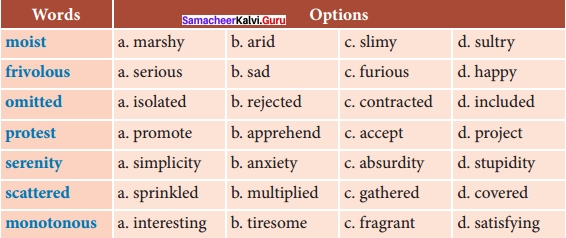
(a) Read the following words and choose the correct antonyms from the options given

11th English Guide Pdf Download Samacheer Kalvi Chapter 1 The Portrait Of A Lady

Answer:
1. (b) arid
2. (a) serious
3. (d) included
4. (c) accept
5. (b) anxiety
6. (c) gathered
7. (a) interesting

(b) Fill in the blanks choosing the appropriate compound words from those given in the box:

singsongoverstrainingspotless
gentlefolkgrand mothercourtyard
sunsethalf-hourhomecoming

Reeta hurried along the road, dressed in her (1) ______ new dress towards the bus stop. Before (2) ______ , she had to reach the house of her (3) ______ But the first (4) ______ of her travel was slow due to traffic jam. Her (5) ______ would be regarded with joy. She was (6) ______ herself to reach the place. When she finally stepped into the (7) ______ , she was received with a big hug by her kind aunt. She was in time to join the (8) ______ at the village, for a (9) ______
Answer:

  1. spotless
  2. sunset
  3. grandmother
  4. half-hour
  5. singsong
  6. over-straining
  7. courtyard
  8. gentle folk
  9. homecoming

(c) Match the words in Column A with their pairs in Column B to form compound words and write them in Column C:

Column AColumn BColumn C
1.mantel(a)lashes
2. .eye(b)wheel
3.water(c)gate
4.bee(d)knob
5.toll(e)piece
6.door(f)proof
7.spinning(g)hive

Answer:
1. (e) piece (mantelpiece)
2. (a) lashes (eyelashes)
3. (f) proof (waterproof)
4. (g) hive (beehive)
5. (c) gate (tailgate)
6. (d) knob (doorknob)
7. (b) wheel (spinning wheel)

(d) Frame meaningful sentences of your own using the following expressions from the story. Use a dictionary if required.

Question (i)
the thought was almost revolting
Answer:
The thought that a 27-year-old man could murder a college girl in daylight was revolting.

Question (ii)
an expanse of pure white serenity
Answer:
Nammalvar had a long white beard like an expanse of pure white serenity.

Question (iii)
a turning point
Answer:
Gandhiji’s encounter with an ill-clad poor woman in Madurai was a turning point in his political life.

Question (iv)
accepted her seclusion with resignation
Answer:
Grandma accepted her seclusion with resignation.


Question (v)
frivolous rebukes
Answer:
My mom bathed my younger brother with frivolous rebukes.

Prefixes And Suffixes

(e) Form two derivatives from each of the following words: e.g. honest – dishonest, honesty

managedifferbeauty
peacearrangecollect
approvenarrateclass

Answer:

  1. manage – manager, management
  2. differ – different, difference
  3. beauty – beautiful, beautious
  4. peace – peaceful, placemaker
  5. arrange – arranged, arrangement
  6. collect – collector, collective
  7. approve – approval, disapprove
  8. narrate – narration, narrator
  9. class – classic, classify

Homophones

(f) Fill in the blanks with suitable homophones:

(i) brake/break
(a) We have a short _______ between the sessions.
(b) The car skidded to a halt when I applied the _______

(ii) waste/waist
(a) Shivani wears a belt around her _______
(b) We should never misuse or _______ natural resources.

(iii) principle/principal
(a) Oxygen is the _______ element present in earth’s crust.
(b) Both these machines work on the same _______

(iv) bread/bred
(a) Turtles should be _______ in a healthy environment.
(b) I like to have toasted _______ for breakfast.

(v) lesson/lessen
(a) This medicine will _______ your pain.
(b) Finally, the manager learnt a _______ the hard way.

(vi) pale/pail
(a) The child looks very sick and _______
(b) I need a _______ of water to wash these cups.

(vii) through/threw
(a) Ravi picked the banana peel and _______ it in the dustbin. ,
(b) The soldiers had to pass _______ a dark tunnel.

(viii) corps/corpse
(a) The _______ was covered with a shroud.
(b) A five-day annual training camp for the senior cadets of the National Cadet _______ been organised.
Answers:
(i) (a) break (b) brake
(ii) (a) waist (b) waste
(iii) (a) principal (b) principle
(iv) (a) bred (b) bread
(v) (a) lessen (b) lesson
(vi) (a) pale (b) pail
(vii) (a) threw (b) through
(viii) (a) corpse (b) corps

Listening Activity

Read the following statements and the given options. Now, listen to your teacher read aloud a passage or play it on a recorder. You may listen to it again if required, to help you choose the right options.

(For listening to the passage refer to our website www.fullcircleeducation.in) The hand that rocks the cradle rules the world. It is the mother who rocks the cradle. It is she who exercises her influence over the mind of her children. She moulds the character of her children with her noble qualities. Napoleon said, “Give me good mothers, I will give you a good nation”. Mothers play an important role in building nations. The love of our mother is usually the first and deepest love that we come across. For many people their mother’s love becomes the pattern of love in later life.

A mother’s love is unconditional. No matter what you do, you know that your mother will always love you. The phrase ‘mother’s love’ derives from the love traditionally shown by a biological mother to her child. But indeed any love that is deeply caring and unconditional can be described as a motherly love, Adoptive mothers show this type of love to the children they adopt. It is important in life to be cherished and loved for who you are and to be supported in all you do! Love is the most important thing in the world. Why not exhibit love to creatures and all those around you?

Question 1.
According to Napoleon ‘Good mothers make good _______
(a) housewives
(b) jobs
(c) nations
(d) ideas
Answer:
(c) nations

Question 2.
Mothers exhibit _______ love.
(a) unauthorized
(b) unapproved
(c) unacceptable
(d) unconditional
Answer:
(d) unconditional

Question 3.
_______ mothers care much for their children.
(a) Adapted
(b) Adopted
(c) Adoptive
(d) Influence
Answer:
(c) Adoptive

Question 4.
_______ is the most important thing in the world.
(a) Wealth
(b) Power
(c) Love
(d) Influence

Question 5.
Love should be extended to _______ too.
(a) friends
(b) relatives
(c) countrymen
(d) creatures
Answer:
(d) creatures

Speaking Activity

(a) Work in pairs and arrive at five points that bring out the benefits and challenges of living in either a nuclear family or a joint family. Share your views with your class.
In a nuclear family:

  • A child gets a lot of attention.
  • Child need not wait for anything he wants.
  • Both the parents shower love and protect him/her from any harm.
  • There is no scope for disappointments as parents are anxious to fulfill the needs of children.
  • Child wants parent to solve all his/her problems and never learns self-reliance.

In a joint family:

  • Child has to wait for what he wants to get.
  • There will be many to play with.
  • There is plenty of scope for caring and sharing.
  • Learn to cope with disappointments and failures in a healthy way.
  • Learn to adjust with others and tend to be empathetic.

(b) Build a conversation of eight to ten sets of exchanges, with your grandmother discussing the incidents that happened in your school that day.

Myself : Grandma, I am back home.
Grandma : Please go and wash your face, hands and legs.
Myself : Why should I, grandma?
Grandma : I have prepared some sweets and pakora for you.
Myself : That’s really lovely grandma.
Grandma : What did you lean today?
Myself : I learnt about bees.
Grandma : How do bees communicate among themselves?
Myself : Grandma, when a bee discovers honey, he performs a kind of dance which conveys the availability of honey, type of flower and distance from the bee hive to the farm.
Grandma : That’s excellent. I never knew it.
Myself : Give me sweets and pakora.
Grandma : Stay here, I will bring them for you.


(c) Every member contributes to forming a happy family. Share your views for a minute or two with your class.

Father works hard and brings money home. Mom does all domestic chores. She cooks food, washes clothes and cleans the floor. Brother takes me to school in his scooter. My grandma combs my hair. She has all the time in the world to tell me tales and listen to all my experiences and stories. On Sunday we all join hands and clean the house. Then we all dine together and share what happened to each of us. I do agree that everyone contributes to a happy family.

Reading

Now, read the following passage on“Laughter Therapy” and answer the questions that follow.

1. Laughing is an excellent way to reduce stress in our lives; it can help you to cope with and survive a ’ stressful life. Laughter provides full-scale support for your muscles and unleashes a rush of stress busting endorphins. Since our body cannot distinguish between real and fake laughter, anything that makes you giggle will have a positive impact.

11th English Unit 1 Prose Paragraph Samacheer Kalvi The Portrait Of A Lady

2. Laughter Therapy aims to get people laughing, in groups and individual sessions and can help reduce stress, make people and employees happier and more committed, as well as improve their interpersonal skills. This laughter, comes from the body and not the mind.

3. Laughter Yoga (Hasya yoga) is a practice involving prolonged voluntary laughter. It aims to get people laughing in groups. It is practised in the early mornings in open-parks. It has been made popular as an exercise routine developed by Indian physician Madan Kataria, who writes about the practice in his 2002 book ‘Laugh for no reason’. Laughter Yoga is based on the belief that voluntary laughter provides the same physiological as well as psychological benefits as spontaneous laughter.

4. Laughter yoga session may start with gentle warm up techniques which include stretching, chanting, clapping, eye contact and body movements to help break down inhibitions and encourage a sense of playfulness. Moreover, laughter is the best medicine. Breathing exercises are used to prepare the lungs for laughter followed by a series of laughter exercises that combine a method of acting and visualization techniques. Twenty minutes of laughter is sufficient to augment physiological development.

11th English Unit 1 Prose Question Answer Samacheer Kalvi The Portrait Of A Lady

5. A handM of small scale scientific studies have indicated that laughter yoga has some medically beneficial effects, including cardiovascular health and mood. This therapy has proved to be good for depressed patients. This laughter therapy also plays a crucial role in social bonding.

Answer the following:

Question (a)
How does laughter help one to cope with stress?
Answer:
Laughter provides full scale support for one’s muscles and unleashes a rush of stress busting endorphins. Thus it helps one to cope with stress.

Question (b)
Which word in the text (para 2) means the same as ‘dedicated’?
Answer:
‘Committed’ means dedicated.

Question (c)
Why do you think voluntary laughter provides the same physiological as well as psychological benefits as spontaneous laughter?
Answer:
Human body cannot distinguish between real and fake laughter. Anything that makes a person giggle has a positive impact on one’s health. That is why I think voluntary laughter provides the same psychological and physiological benefits as spontaneous laughter.

Question (d)
‘Laughter is the best medicine’. Explain.
Answer:
Twenty minutes of laughter is sufficient to augment physiological development. Laughter has some medical benefits such as cardiovascular health and mood. Hence, “Laughter is the best medicine”.

Question (e)
Given below is a set of activities. Which of these are followed in the ‘Laughter Yoga’ technique?
Answer:

  • Body movements
  • Clapping
  • Breathing exercises
  • Stretching of arms and legs
  • Bending backwards

Question (f)
‘Laughter therapy also plays a crucial role in social bonding’. How?
Answer
Man is a social animal. Laughing breaks the ice and enables friendly conversations. A person endowed with spontaneous laughter naturally attracts large number of friends. In his company, even distressed relatives feel relieved and happy. Thus, laughter plays a crucial role in social bonding.

Grammar

Articles and Determiners
Determiners are words placed in front of a noun to clarify what the noun refers to.
Look at this sentence.
‘This laughter therapy also plays a crucial role in social bonding.’
Here the word ‘this’ refers to a particular noun – ‘laughter therapy’.
Types of Determiners

ArticlesDemonstrativePossessive adjectives
athismy, your
anthathis, her
thetheseits, our
thoseyour, their
QuantifiersNumbersOrdinals
– some, any
few, little
more, much
any, every
one, two
three, four
twenty,
hundred
first, second
third, last next

(a) Read the paragraph below and fill in the blanks using ‘a, an’, or ‘the’.

It is said that (1) _____ computer is (2) _____ electronic extension of the human brain. Therefore, in principle, (3) _____ computer can do all those activities which (4) _____ human brain can do. Today computers are found to be (5) _____ most useful devices as knowledge providers. Another important field of application of computers is (6) _____ development of robots. (7) _____ internet has brought (8) _____ drastic change in communication systems.
Answer:

  1. the
  2. an
  3. the
  4. the
  5. the
  6. the
  7. The
  8. a

(b) In the following paragraph, insert ‘a, an’,or ‘the’ wherever necessary and rewrite the sentences.

In our family, we have planned to take children to zoo next Sunday. Van has been arranged and we are sure to have comfortable journey. Zoo is interesting place for children who enjoy watching animals and want to know more about them. Even youngsters love to visit zoo.
Answer:
In our family, we have planned to take children to the zoo next Sunday. A Van has been arranged and we are sure to have a comfortable journey. The Zoo is interesting place for children who enjoy watching the animals and want to know more about them. Even the youngsters love to visit the zoo.

(c) Fill in the blanks with appropriate determiners. (Articles have been included)

Once the emperor gave a bag of seeds to his council of ministers and said that he would give them six months time to grow the seeds. Whoever does a good job will be made the (1) _____ emperor of that empire. (2) _____ the ministers took their task seriously. After six months (3) _____ ministers had small plants in their pots. A (4) _____ had very large plants. (5) _____ had medium sized plants. The emperor entered the hall. He was (6) _____ amused to see (7) _____ plants. He called the (8) _____ minister and asked him what he did with the seed. (9) _____ minister explained the process he adopted to make (10) _____ plant grow. (11) _____ the emperor called the other ministers to explain what they did. Only (12) _____ minister had come with an empty pot.They laughed loudly at the foolishness of this minister. But the Emperor applauded him and made him the (13) _____ Emperor. Do you know why? He had given them boiled seeds which will not grow. Only (14) _____ minister was honest.
Answer:

  1. next
  2. All
  3. many
  4. few
  5. Some
  6. very much
  7. the
  8. first
  9. The
  10. the
  11. Next
  12. one
  13. next
  14. one

(d) Fill in the blanks with appropriate determiners.

  1. They came early but there was (little/ a little) work to do.
  2. Anand invited (few/a few) friends for the birthday party.
  3. The teacher gave (all /every) student a separate topic for the assignment.
  4. (Most of/Many) the water overflowed from the tank.
  5. Each one of my (friend/fiiends) wished me on my birthday.
  6. Vijay had (no/ any) idea about the problem.
  7. Adhi had taken (much /many) photos during the programme,
  8. (Some/Few) girls who attended the class informed the others about the test.

Answers:

  1. little
  2. a few
  3. every
  4. Most of
  5. friends
  6. no
  7. many
  8. some

Tenses

(a) Fill in the blanks with the correct form of the verbs in brackets and read the completed passage aloud.

The people of India, as a whole, (1) _______ (be) warm-hearted and hospitable. Any calamity in any part of the world immediately (2) _______ (arise) their charity and generosity and a. committee (3). _______ (be) promptly (4) _______ (set ) up to collect funds to help the distressed. The most endearing quality in them (5) _______ (be) the respect they show for the work done in any capacity. They (6) _______ (believe) in what we (7) _______ (call) the dignity of labour.
Answers:

  1. are
  2. arouses
  3. is
  4. set
  5. is
  6. believe
  7. call

(b) Now, use the verbs given in brackets in the following sentences in their correct forms.

Question 1.
I (like) to spend time with my friend,whenever I (be) free.
Answer:
I like to spend time with my friend, whenever I am free.

Question 2.
He (is) likely to miss the train. He (run) to the station.
Answer:
He is likely to miss the train. He is running to the station.

Question 3.
At the moment, they (wait) at the bus-stop. But I (not know) their plans for the journey.
Answer:
At the moment, they are waiting at the bus-stop. But I do not know their plans for the journey.

Question 4.
They firmly (believe) in the existence of God.
Answer:
They firmly believe in the existence of God.

Question 5.
We (hear) a lot of noise because the new buildings (transmit) sound waves.
Answer:
We hear a lot of noise because the new buildings are transmitting sound waves.

Question 6.
She always (make) excuses for coming late.
Answer:
She always makes excuses for coming late.


Question 7.
The Prime Minister (leave) for America to meet the delegates tomorrow.
Answer:
The Prime Minister leaves for America to meet the delegates tomorrow.

(c) You are a commentator for a 5000 metre running race. Use simple present and present continuous tenses and complete the commentary from the beginning to the end of the race. Read the completed passage aloud.

The 5000 metre race is about to begin. Lined up at the starting point, from left to right, are John of Great Britain, Peter of Nigeria and Jeeva of India. The runners are warming up for the great event. Now they. (1) _______ (take) their positions on the track. They (2) _______ (be) all ready for the start. There (3) _______ (go) the starter’s gun! Yes, the race has begun. John (4) _______ . (lead) with Jeeva (5) _______ (close) behind him.
Answer:

  1. are taking
  2. are
  3. goes
  4. is leading
  5. closing

(d) Read the extract from Kayal’s diary entry regarding her Nepal Trek, and fill in the blanks with the correct tense form of the verbs given in brackets.

DAY 1: We (1) _______ (leave) Anna International Airport in Chennai two days ago catching a direct flight to Kathmandu in Nepal. We (2) _______ (spend) a day sightseeing. Kathmandu is full of people, rickshaws and the smell of sandalwood. I’ve never (3) _______ (be) on a trip like this before. So I’m really excited.

DAY 2: It (1) _______ (rain) when we reached Pokhara, Nepal’s second largest city, and saw the snowy peaks of the Himalayas for the first time. We. (2) _______ (reach) Pokhara after a hair-raising six-hour bus journey along very narrow roads with a lot of hairpin bends. The bus (3) _______ (be) so full that one person had to share the driver’s seat.

DAY 3: We (1) _______ (begin) our trek at last. We are at about 900 metres and the weather is warm and humid. For lunch we had chips and yak cheese sandwiches. I didn’t like them very much. I’m thrilled that we (2) _______ (pitch) tents for our camps in the dense forests.

DAY 4: Yesterday a landslide (1) _______ (block) our path and we had to use ropes to get over it. This morning we walked along the river Kali Gandaki through dense forests of oak trees and we pitched our camp at Tukuche below the Annapurna mountain range. The main danger in addition to landslides, is ‘yak attack’. Yaks (3) _______ (be) not dangerous but you have to be careful if you meet a herd of them because they can push you off the sides of the mountain.

DAY 5: We met a lot of children on our trek through the villages. They (1) _______ (play) in the pool of muddy rain water as we left the place. We have already climbed 2,400 metres. Up here, it never (2) _______ (rain) and there are no trees. It (3) _______ (be) windy and dusty and I am always thirsty.

DAY 6: Yesterday we (1) _______ (go) up to the mountainside of the township of Mukthinath, at 3,600 metres. The thin air with less oxygen there (2) _______ (leave) us breathless. We (3) _______ (feel) that we couldn’t go any further. We (4) _______ (drink) a lot of extra fluids to prevent altitude sickness.

DAY 7: We turned around today and started to descend to Jomosom. As we went down, the oxygen filled our blood again and we seemed to (1) _______ (fly) instead of walking.

DAY 8: We went back to Pokhara in a small plane yesterday. It (1) _______ (excite) when we flew between the mountain peaks. We arrived in Kathmandu this afternoon and we

(2) (spend) our last few hours in shopping. We leave for Chennai tomorrow. We’ve had a trip of a lifetime.
Answers:
Day-1
1. left
2. spent
3. been

Day-2
1. was raining
2. reached
3. was

Day-3
1. began
2. pitched

Day-4
1. blocked
2. are

Day-5
1. were playing
2. rains
3. is

Day-6
1. went
2. left
3. felt
4. drank

Day-7
1. be flying

Day-8
1. was exciting
2. spent

(e) In the following passage, circle the verbs in simple present tense and underline the verbs in simple past. The first one has been done for you.

(i) Unless one upright there (is) no use in being a charming fellow. Sometimes it (Is) better to be honest than attractive. These are the great truths of modem life which Shyam never realised. He never said an ill-natured word in his life. He was always polite and spoke softly to everybody.

(ii) That night he strolled into the Palette Club about eleven o’clock, and found Trevor sitting by himself in the long room. “Well, Alan, did you get the picture finished all right? “he said, as he lit his cigarette. “Finished and framed, my boy!’’ answered Trevor, “and by- the-bye, you have made a conquest. That old model you saw (is) quite devoted to you. I had to(tell) him all about you – who you (are) where you (fivt), what your income(is) what prospects youljiave).”

(iii) “And now (tell) me how Laura (is) The old model was quite interested in her.” “You (jlorYt) mean to say you talked to him about her?” said Hughie. “Certainly I did. He ((mows) all about the relentless colonel, the lovely Laura, and the £10,000.” “You told that old beggar all my private affairs?” cried Hughie. looking very red and angry. “My dear Alan,” cried Hughie, “I shall probably find him waiting for me when I(go) home.”

(f) Fill in the blanks using Past tense forms of the verbs:

  1. I never (see) _______ such a beautiful sunrise before I came here.
  2. We were not able to stay overnight as we _______ not (reserve) the tickets in advance.
  3. Nirmala _______ (be) to the concert several times.
  4. Mariappan knew Pudukottai so well because he _______ (live) there for five years.
  5. Yusuf understood the problem because he _______ (experience) the situation earlier.
  6. Catherine did not have any cash because he _______ (lose) her purse.
  7. My father _______ (be) to Mumbai once before.
  8. The cat _______ (chase) the bird before it flew out of the yard.
  9. Edith _______ (visit) several doctors before she found out what the problem was with her knee.
  10. If we _______ (call) the manager ahead,we would not have needed to wait so long for a table.

Answers:

  1. had never seen
  2. did not reserve
  3. had been
  4. had lived
  5. had experienced
  6. had lost
  7. had been
  8. had chased
  9. visited
  10. had called

(g) Read the following news report and underline the past perfect tense form of the verb and circle the simple past tense form of the verb.

India Beat Pakistan To Win Blind Cricket World Cup:

Chasing a huge target of 308 runs, India (romped) home in the penufrimateover of the match to defeat Pakistan and win the Blind Cricket World Cup. India (started off) their chase in a cracking manner, but had lost two quick wickets. Sunil RameslKrbsepto the occasion as he (jflayetf) a great knock to help India beat Pakistan and had scored 93 runs. Earlier India (won) the toss and had decided to bowl first. Pakistan (amassed)a huge score of 307 for eight in 40 overs. Their openers had given them a brisk start which the later batsmen (capitalize) on.


(h) Read the following extract and fill in the spaces with the right form of verbs and complete the passage. The first one is done for you.

Question (i)
The poet stops to hear the maiden singing while she (1) _____ (cut) and (2) _____ (bind) the grain. The song of the lady (3) _____ (fascinate) the poet, who (4) _____ (stand) there to listen to the song. The girl (5) _____ (sing) a sad song.
Answer:

  1. cuts
  2. binds
  3. fascinates
  4. stands
  5. sings

Question (ii)
During the monsoon, a tender slightly warm breeze (1) _____ (blow) on a cloudless afternoon. A sort of fragrance (2) _____ (rise) from the wet grass and trees in the sunlight. It (3) _____ (seem) as if the warm breath of the exhausted earth (4) _____ (fall) against one’s skin. A sweet voiced bird somewhere (5) _____ (chirp) repeatedly.
Answer:

  1. blows
  2. rises
  3. seems
  4. falls
  5. chirps

(i) Read the news item that appeared in a daily and fill in the blanks with suitable forms of the verbs given in brackets.

Ever since social networking sites entered our lives, they (1) _____ (serve) as platform.s where users could use the virtual space offered by these social media. However, recent incidents (2) _____ (cause) many to question the freedom to express views on various issues and in some cases, it (3) _____ (become) a dangerous platform. Social Contact (4) _____ (transform) people. They (5) _____ (develop) an addiction to it.
Answers:

  1. have been serving
  2. have caused
  3. has become
  4. has transformed
  5. have developed

(j) Read the following passage and correct the errors you come across.

Question 1.
Rajan slowly settle down in his retired life. His pension plus what his wife bring from the household work she does, helped them to meet their requirements. Life is easy until one Sunday. His granddaughter Madhu come crying. The clay doll in her hand had broken into two. Rajan pacify her and promise to mend it. This small repair work become the founding stone of a very prosperous venture into making clay dolls which earn him great respect.
Answer:
Rajan slowly settled down in his retired life. His pension plus what his wife brought from the household work she did, helped them to meet their requirements. Life was easy until one Sunday his granddaughter Madhu came crying. The clay doll in her hand had broken into two. Rajan pacified her and promised to mend it. This small repair work became the founding stone of a very prosperous venture into making clay dolls which earned him great respect.


Question 2.
Games and sports helps in recreation. Soccer, cricket, lawn tennis or wrestling is eagerly watched by millions of fans all over a world. It helps one got a temporary relief from the tensions of a day. The dedication displayed by all player in the field indicates the mental and spiritual development of the player.
Answer:
Games and sports help in recreation. Soccer, cricket, lawn tennis or wrestling are eagerly watched by millions of fans all over the world. It helps one get a temporary relief from the tensions of a day. The dedication displayed by all players in the field indicates the mental and spiritual development of the players.

Writing

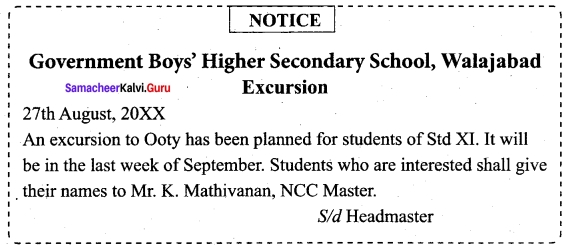
(a) Notice:

The Portrait Of A Lady Book Back Answers Samacheer Kalvi 11th English Solutions Prose Chapter 1

(i) Prepare a notice to be displayed on the notice-board of your school for the students of Class 11, informing them about the educational tour that has been arranged for them the next month.

11th English Prose Paragraph Samacheer Kalvi Chapter 1 The Portrait Of A Lady

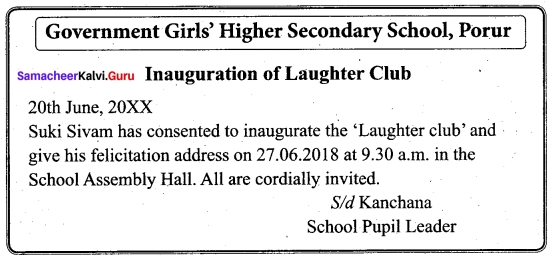
(ii) Write a notice about the inauguration of a laughter club in your school.

11th English 1st Lesson Paragraph Samacheer Kalvi The Portrait Of A Lady

(b) Message:
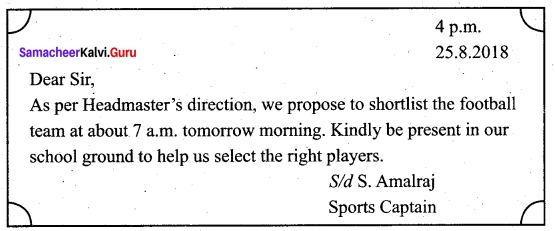
You are the Sports Captain of your school. Write a message to the Physical Director, requesting him to be present during the football team selection scheduled for tomorrow.
11th English Guide Pdf Free Download Samacheer Kalvi The Portrait Of A Lady

(c) Do you exercise regularly? If you do, which of these following activities do you prefer? Discuss and share with your partner a few lines about your preference.

(A) Walking
(B) Working out in a gym
(C) Swimming
(D) Cycling

A : I prefer walking. It is a wholesome exercise. Regular walk helps blood circulation very well. A brisk walk for an hour a day keeps one perfectly fit.
B : I love swimming. I admire Michael Phelps for his achievement in swimming. When schools disowned him, his mom found out his interest in swimming. He turned out to be an Olympian of all times with 28 medals. One day I will win gold in swimming for India.
C : Well, after seeing Dipa Karmakar perform ‘pordunova’ vault at the summer Olympics in 2016,1 wish to become an expert in gymnastics
D : Well, I love cycling because it is pollution free. I feel it gives a complete exercise.

Task

You are Mani/Megalai of Class XI, President of the English Club of your school. Draft a speech on the topic ‘Reading Maketh a Complete Man’ to be delivered in the school assembly.

Reading Maketh a Complete Man:

Respected Headmaster, teachers and my dear friends. I am Kaman / Kamala of class XI. I am before you to share my ideas on the topic “Reading Maketh a Complete Man”. Francis Bacon said, “Reading maketh a full man, conference a ready man and writing an exact man.” But the question concerns only reading here.

Extensive and intensive reading builds the mind with valuable ideas and information. A full mind is better than ill-informed or uninformed mind. Reading nourishes the intellect and nurtures one’s imagination. Researches prove that reading good books, can reduce stress levels by half. These is nothing more relaxing and soothing than reading a good book. Without travelling, a sensitive and sensible reader travels around the world. The reader is exposed to new culture and innovative ideas. Reading is a gift. It can be cultivated. It is sad that many students squander their time in playing games in mobile phone or watching useless film music or comic scenes when they must be spending their purple hours of life in reading books. They also waste their time in social websites like Facebook, Twitter and WhatsApp. This addiction in digital technology and browsing harmful websites distracts the young ones.

To dissuade young ones from social media and mass media and help them read books is equal to climbing Everest under hostile weather. So, teachers and parents should share their own joy of reading good books by sharing the best of what they read with student community. Reading makes a man complete. To lead holistic and meaningful lives, I request all my friends to develop a love for reading great classics under the guidance of dedicated teachers and with the help of libraries. –
The more you read, the more you will know.
The more you learn, the more places you’ll go.
So Read and Grow!
Thank you

The Portrait of a Lady About the Author

11 English Guide Samacheer Kalvi Chapter 1 The Portrait Of A Lady

Khushwant Singh was an Indian novelist and a lawyer. He joined IKS in 1947. He had a calling to be a writer. He served as the editor of many literary and news magazines. As a writer, he is best known for his secularism, sarcasm and love lor poetry. The Mark of Vishnu, A History of Sikhs, The Train to Pakislan. Success Mantra. We Indians, and Death at My Doorstep are some of his masterpieces. I le was awarded Padma Bhushan in 1974 and Padrna Vibhushan by the Government of India. He also received the most coveted Sahitya Academy fellowship. The present story, “The Portrait of a Lady” seems to have been inspired by the novel, “The Portrait of a Lady” by Henry James. It. revolves around the author’s grandmother whose milk of human kindness sustained birds, animals and children. Her unconditional love for all gives her a beauty beyond her age.

The Portrait of a Lady Summary

The author’s grandma was old and wrinkled for about twenty years. The author was told that his grandma was once young and pretty. She had a husband. But the author could not bring himself to believe it as he had seen her old right from his childhood. The picture of author’s grandpa was hung in the drawing room above the mantelpiece. He wore a big turban and loose-fitting garment. His long beard ran down to his chest. He appeared at least 100 years old. He did not look like a family man who could have had a wife and children. He only appeared like an pld man with many grand children.

Grandma was bent with age and had been so for a long time. Her entire body was wrinkled crisscross. She hobbled about the house with one hand on her waist to balance and another hand telling the beads of her rosary. She was always found whispering some inaudible prayer. Her silver locks were scattered on her face untidily. She was beautiful like the winter landscape in the mountains. She was an expansion of pure white serenity breathing peace and contentment.

11th English Book Back Answers Samacheer Kalvi Chapter 1 The Portrait Of A Lady

The author and his grandma were great friends. As his parents had left him under her care and went to live in the city, he spent most of his time with her. She used to wake up the author early in the morning and helped him to get ready for school. She would sing morning prayers in a sing-song voice to enable the young author to remember the prayer by hearing. She would feed him with a stale chapatti smeared with a little butter and sugar. She would fetch his wooden slate and she accompanied him to school everyday. She would bring a lot of stale chapattis for the village dogs back home. She loved temple which was a place of worship and learning.

While the priest taught the children letters of the alphabet, grandma sat inside the temple reading scriptures. When her reading of scriptures and the author’s learning of letters got over for the day both would return home. While returning home grandma would feed the dogs with stale chapattis. The animals would fight among themselves as each chapatti was thrown.

In the village the author spent a lot of time with grandma. But after moving over to the city, he went to an English medium school in a bus. There were no dogs. She started feeding the sparrows. Grandma and the author were in the same room but the time they spent together got reduced considerably.

The author was happy to share the new English words he learn and Science theories like Archimedes’ principles, law of gravity and the shape of the earth. This upset her. She could no more help him with his lessons. The new school did not teach about God or scriptures. The day the author said that he was taking music lessons in school, she became uncomfortably silent.

When the author left for university, grandma was resigned to the fate or a secluded life. She continued her spinning work and chanting. The spinning wheel and prayer kept her busy all day. She rarely spoke to humans nowadays. She relaxed for half an hour in the afternoon.

This was the happiest time of her day as she broke the bread into small bits to feed the sparrows. It was literally a bedlam of chirruppings. Some would perch on her legs and some on her head. She never shooed them away. Instead, there was an angelic smile on her face, She relished those moments.

Samacheer Kalvi 11th English Guide Chapter 1 The Portrait Of A Lady

The author had the opportunity to go abroad. Grandma came to the railway station to farewell. She did not show any emotion or sentiment. Her moist lip imprint on his forehead, j made him wonder if it was her last physical contact with him.

I After five years, when the author returned, she met him at the railway station. She did not j appear to be older. She just hugged the author but continued telling the rosary. She did not i try to show interest in knowing what happened abroad in his life. Instead, she continued to evince keen interest in feeding the sparrows. She fed them longer.

One evening grandma did not pray. Instead, she got an old drum and started singing. She sang of the home-coming of warriors. Everyone got anxious that grandma might strain her nerves. Perhaps it was her swan song.

Grandma ran a temperature. Doctor said that it was a mild fever. But grandma predicted that i her end was near. She didn’t want to waste her time talking to the family members. Grandma lay in bed telling the rosary. Before sunset, her lips stopped chanting and the rosary i fell from her hands. The peaceful pallor on her face conveyed her soul’s departure from the ! body.

She was lifted from bed. She was covered with a red shroud. After a few hours, the body was | left alone to make funeral arrangements. They brought a crude stretcher to take her to the cremation ground.

The sun was setting. Grandma’s room was lit with a blaze of golden light. The room where ! the body was kept, thousands of sparrows sat scattered on the floor. There was no chirruping, i The family was sorry for the birds. Mom broke the bread into crumbs, the way grandma used I to do, and threw it to them. But not a single sparrow took notice. When grandma’s corpse was carried off, they flew away quietly.

Khushwant Singh’s The Portrait of a Lady, in short, gives a splendid pen-picture of his own j grandmother who had steadfast graceful values and philosophy of life. She lived and died gracefully.

The Portrait of a Lady Glossary

Textual:
absurd – inconsistent/ illogical bedlam – noisy confusion dilapidated -damaged expanse -widespread
fables -tales/stories hobbled – walked unsteadily mantelpiece – shelf projecting from the wall above a fireplace
monotonous – unchanging /boring
pallor – an unhealthy pale appearance
perched – sat/rested
pucker – to contract the face into wrinkles
rebukes – scoldings
seclusion – isolation
shroud – cloth used to wrap a dead person
snapped – broke / cut.

Additional:
cherished – retained in memory
contentment – satisfaction
distressed – upset
inaudible – unable to be heard
sentimental – emotional
spotless – clean
untidily – disorderly

The Portrait of a Lady Synonyms

Choose the most appropriate synonym of the underlined word.

Question 1.
The thought was almost revolting.
(a) planning
(b) inspiring
(c) disgusting
(d) appealing
Answer:
(c) disgusting


Question 2.
Once she had been young and pretty.
(a) old
(b) ugly
(c) attractive
(d) unpleasant
Answer:
(c) attractive

Question 3.
That seemed quite absurd.
(a) logical
(b) serene
(c) sincere
(d) silky
Answer:
(d) silky

Question 4.
We treated it like the fables of the prophets.
(a) realists
(b) surrealists
(c) magicians
(d) seers
Answer:
(d) seers

Question 5.
She wore spotless white saree.
(a) dull
(b) dirty
(c) pale
(d) clean
Answer:
(d) clean

Question 6.
Her lips moved in inaudible prayer.
(a) unseen
(b) unheard
(c) distasteful
(d) unidentified
Answer:
(b) unheard

Question 7.
She hobbled about the house with her human back.
(a) walked
(b) staggered
(c) hopped
(d) danced
Answer:
(b) staggered

Question 8.
Her silver locks were scattered untidily.
(a) orderly
(b) neatly
(c) hygienically
(d) disorderly
Answer:
(d) disorderly

Question 9.
She was breathing serenity and contentment.
(a) dissatisfaction
(b) malcontent
(c) satisfaction
(d) contenment
Answer:
(c) satisfaction

Question 10.
The fables from the lives of people are really fascinating.
(a) jokes
(b) anecdotes
(c) stories
(d) songs
Answer:
(c) stories

Question 11.
She was like an expanse of pure white serenity.
(a) widespread
(b) narrow
(c) squeezed
(d) expatriate
Answer:
(a) widespread


Question 12.
She was distressed that there was no teaching about God or scriptures.
(a) pleased
(b) overwhelmed
(c) upset
(d) delighted
Answer:
(c) upset

Question 13.
Her silence meant disapproval.
(a) acceptance
(b) consent
(c) rejection
(d) consent
Answer:
(c) rejection

Question 14.
The common link of friendship got snapped.
(a) cut
(b) united
(c) linked
(d) conjoined
Answer:
(a) cut

Question 15.
My grandmother accented her seclusion.
(a) company
(b) recognition
(c) inclusion
(d) isolated
Answer:
(d) isolated

Question 16.
Only in the afternoon she relaxed for a while.
(a) rested
(b) slept
(c) read
(d) worked
Answer:
(a) rested

Question 17.
Hundreds of birds created a veritable bedlam of chirruping.
(a) serenity
(b) speed
(c) confusion
(d) quieted
Answer:
(c) confusion

Question 18.
She fed the birds with frivolous rebukes.
(a) blessings
(b) scoldings
(c) praises
(d) Adornment
Answer:
(b) scoldings

Question 19.
The birds perched on her head or legs.
(a) slept
(b) danced
(c) flew
(d) sat
Answer:
(d) sat


Question 20.
She never shooed them away.
(a) chased
(b) invited
(c) let
(d) reanounced
Answer:
(a) chased

Question 21.
She was not even sentimental.
(a) emotionless
(b) emotional
(c) cool
(d) hateful
Answer:
(b) emotional

Question 22.
When I left I cherished the moist imprint on my forehead on the last sign of physical contact.
(a) forgot
(b) retained
(c) loitered
(d) wandered
Answer:
(b) retained

Question 23.
For several hours she thumped the sagging skins of the dilapidated drum.
(a) perfect
(b) solid
(c) met
(d) damaged
Answer:
(d) damaged

Question 24.
A peaceful pallor spread on her face.
(a) sickliness
(b) healthiness
(c) freshness
(d) rejuvenation
Answer:
(a) sickliness

Question 25.
We laid her on the ground and covered her with a rose shroud.
(a) saree
(b) chudidhar
(c) pant
(d) veil
Answer:
(d) veil

The Portrait of a Lady Antonyms

Question 1.
She had been old and her skin wrinkled for the twenty years I had known her.
(a) lined
(b) smooth
(c) marked
(d) folded
Answer:
(b) smooth

Question 2.
She had once been pretty.
(a) beautiful.
(b) plain / ugly
(c) graceful
(d) attractive
Answer:
(b) plain / ugly

Question 3.
He wore a loose fitting garment.
(a) free
(b) detached
(c) tight
(d) slim
Answer:
(c) tight


Question 4.
The thought was revolting.
(a) distasteful
(b) horrible
(c) nasty
(d) pleasing
Answer:
(d) pleasing

Question 5.
That seemed quite absurd.
(a) wise / logical
(b) silly
(c) illogical
(d) incongruous
Answer:
(a) wise / logical

Question 6.
She was alwavs spotless white.
(a) neat
(b) clean
(c) pine
(d) dirty
Answer:
(d) dirty

Question 7.
One hand was resting on her waist to balance her stoop
(a) hunch
(b) bent
(c) upright
(d) curved
Answer:
(c) upright

Question 8.
Her silver hair lav scattered.
(a) sprinkled
(b) untidy
(c) gathered
(d) divided
Answer:
(c) gathered

Question 9.
Her lips were moving constantly in inaudible naver.
(a) always
(b) persistently
(c) regularly
(d) inconstantly
Answer:
(d) inconstantly

Question 10.
She was an expanse of white serenitv.
(a) harmony
(b) peace
(c) equilibrium
(d) anxiety
Answer:
(d) anxiety

Question 11.
There was contentment in her face?
(a) satisfaction
(b) widespread
(c) dissatisfaction/discontentment
(b) pleasure
Answer:
(b) widespread

Question 12.
She was distressed.
(a) upset
(b) frightened
(c) anxious
(d) pleased
Answer:
(a) upset

Question 13.
She was not sentimental.
(a) emotional
(b) dispassionate / practical
(c) tender
(d) sad
Answer:
(b) dispassionate / practical

Question 14.
Grandma accepted her seclusion.
(a) loneliness
(b) segregation
(c) solitude
(d) association
Answer:
(d) association

Question 15.
We had to persuade her to avoid overstraining.
(a) accept
(b) dissuade
(c) motivate
(d) inspire
Answer:
(b) dissuade

Question 16.
She said her morning prayers in a monotonous sing-song voice.
(a) tiresome
(b) fragrant
(c) satisfying
(d) interesting
Answer:
(d) interesting


Question 17.
She rarely spoke to me after that.
(a) scarcely
(b) hardly
(c) always
(d) occasionally
Answer:
(c) always

Question 18.
They flew away quietly.
(a) noiselessly
(b) calmly
(c) composedly
(d) noisily
Answer:
(a) noiselessly

Question 19.
I cherished the moist imprint as the last sign of physical contact.
(a) marshy
(b) arid
(c) slimy
(d) sultry
Answer:
(b) arid

Question 20.
She fed the birds for a long time with frivolous rebukes.
(a) serious
(b) sad
(c) furious
(d) happy
Answer:
(a) serious

Question 21.
Only a few hours before the last chapter of her life she had omitted to pray
(a) isolated
(b) rejected
(c) contracted
(d) included
Answer:
(d) included

Question 22.
We protested.
(a) promoted
(b) apprehended
(c) accepted
(d) projected
Answers:
(c) accepted4>

The main aim is to share the knowledge and help the students of 11th English to secure the best score in their final exams. Use the concepts of Samacheer Kalvi 11th English Book Solutions Prose Chapter 1 The Portrait of a Lady Questions and Answers in Real time to enhance your skills. If you have any doubts you can post your comments in the comment section, We will clarify your doubts as soon as possible without any delay.

Samacheer Kalvi 11th English Solutions Poem Chapter 2 Confessions of A Born Spectator

Students who are interested in learning of 11th English Poem Chapter 2 Confessions of A Born Spectator Questions and Answers can use Tamilnadu State Board Solutions of 11th English Chapter Wise Pdf. First check in which chapter you are lagging and then Download Samacheer Kalvi 11th English Book Solutions Questions and Answers Summary, Activity, Notes Chapter Wise. Students can build self confidence by solving the solutions with the help of Tamilnadu State Board English Solutions. English is the scoring subject if you improve your grammar skills. Because most of the students will lose marks by writing grammar mistakes. So, we suggest you to Download Tamilnadu State Board 11th English Solutions according to the chapters.

Tamilnadu Samacheer Kalvi 11th English Solutions Poem Chapter 2 Confessions of A Born Spectator

Check out the topics covered in Poem Chapter 2 Confessions of A Born Spectator Questions and Answers before you start your preparation. Improve your grammar skills with the help of Samacheer Kalvi 11th English Book Solutions Questions and Answers pdf links. The solutions for Tamilnadu State Board 11th English Textbook are prepared by the English experts. So, if you follow Tamilnadu State Board Solutions 11th English Textbook Solutions you can cover all the topics in Poem Chapter 2 Confessions of A Born Spectator Questons and Answers. This helps to improve your communication skills.

Warm Up:

Not everybody loves to play and participate in games, sports and other extra-curricular activities. Some of us wish to be mere spectators. List out the activities in which you like to be either a performer or a spectator. Share your views with the class.

Activities
performer / playerspectator / audience
e.g.cricketmagician
(a)
(b)
(c)
(d)
(e)

Answer:

Activities
performer / playerspectator / audience
e.g.cricketmagician
(a)Footballhockey
(b)volley ballkabbadi
(c)moviechess
(d)music concertdance
(e)karatesinging

Samacheer Kalvi 11th English Confessions of A Born Spectator Textual Questions

1. Based on your understanding of the poem, answer the following questions in a sentence or two.

One infant grows up and becomes a jockey,
Another plays basketball or hockey,
This one the prize ring hates to enter
That one becomes a tackle or center,
I am just glad as glad can be
That I am not them, that they are not me.

With all my heart I do admire
Athletes who sweat for fun or hire,
Who take the field in gaudy pomp,
And maim each other as they romp,
My limp and bashful spirit feeds
On other people’s heroic deeds.

Now A runs ninety yards to score,
B knocks the champion to the floor,
Cracking vertebrae and spines,
Lashes his steed across the line,
You’d think my ego it would please
To swap positions with one of these.

Well, ego it might be pleased enough,
But zealous athletes play so rough
They do not ever in their dealings
Consider one another’s feelings.
I’m glad that when my struggle begins
‘Twixt prudence and ego, prudence wins.

When swollen eye meets gnarled fist
When snaps the knee, and cracks the wrist,
When officialdom demands,
Is there a doctor in the stands?
My soul in true thanksgiving speaks
For this modest of physiques.

“Athletes, I’ll drink to you
Or eat with you,
Or anything except compete with you,
Buy tickets worth their radium,
To watch you gambol in the stadium,
And reassure myself anew
That you are not me and I’m not you

Confessions Of A Born Spectator Question (a)
Why does the poet feel glad that he does not play any game?
Answer:
The poet feels glad that he was not a player but only a spectator. He is glad because the risk of injuring himself and others is more if he becomes a player.

Confessions Of A Born Spectator Summary Question (b)
Do you think the narrator is heroic? Why?
Answer:
I don’t think the narrator/poet is heroic. A Hero is one who confronts any challenge and acts on it and fights to the end. The narrator is happy as a non-participant observer of heroic and rough games.

Confessions Of A Born Spectator Questions And Answers Question (c)
The poet is satisfied just watching the heroic deeds of others. What could be the reason?
Answer:
The poet is very sensitive. He derives vicarious pleasure on seeing the play of all the players. He is not after glory, medals and not interested in inflicting injury on any opponent. So, he is happy staying out of all rough games.

11th English Unit 2 Poem Question (d)
The poet does not wish to exchange position with the runners. Why?
Answer:
The poet does not wish to break any world record in running. He knows that athletes have no feelings for their fellow players. So, the poet does not want to exchange positions with the runners.

Confessions Of A Born Spectator Meaning In Tamil Question (e)
Are the athletes conscious of the feelings of others? Why do you say so?
Answer:
No, the athletes are zealous in their endeavour to win. In the process they go to the extent of maiming fellow players. The player’s focus is mostly on winning and he is naturally not conscious of the feelings of others.

Confessions Of A Born Spectator Poem Line By Line Explanation Question (f)
Why would the referee ask whether there was a doctor in the stands? What stands is he referring to?
Answer:
When boxing contests go on, one tries to crack the wrist or snap the knee of the other boxer. When such an event takes place, a referee asks for a doctor to provide First Aid to the fatally wounded wrestler/boxer. The stands refers to the boxing ring.

11th English Confessions Of A Born Spectator Question (g)
Why does the poet prefer to buy tickets worth their weight in radium? Bring out the significance of the metal referred to here.
Answer:
Radium is more expensive than diamonds. It is a rare metal discovered by Madam Curie. The poet was ready to buy tickets as expensive as radium just to stay as a spectator.

2. Read the poem again and complete the summary using the words given in the box.
(thanksgiving, exchange, glad, confesses, physiques, zealous, satisfied, aims, admires)

In the poem ‘Confessions of a Born Spectator,’ Ogden Nash talks about how people choose different sports in their lives or decide to become athletes. While admiring the talents of athletes and sportsmen, the poet (i) ________ that he is glad that he is neither a sportsman nor an athlete. Children have different (ii) ________ and wish to play various games. Each child has in mind something in particular, but the narrator is (iii) ________ he is not one of the players. Though the narrator (iv) ________ the talents of all athletes, he derives satisfaction from watching them,’ but does not wish to (v) ________ places with them. He also sometimes regrets that (vi) ________ athletes play rough games without caring for the feelings of their sporting rivals. He feels that good sense and caution win over ego. The narrator wholeheartedly offers (vii) ________ the modest (viii) ________ of athletes. Ultimately the narrator is (ix) ________ that he himself is not an athlete.
Answer:

  1. confesses
  2. aims
  3. glad
  4. admires
  5. exchange
  6. zealous
  7. thanksgiving
  8. physiques
  9. satisfied

3. Read the poem and answer the following in a short paragraph of 8-10 sentences each.

Confession Of A Born Spectator Question (a)
Row does the poet establish the victory of common sense over ego?
Answer:
The poet is sure of his limitations. He had only modest of physiques. He can’t imagine receiving blows in a boxer’s ring. He has seen zealous athletes playing so rough that they never consider the feelings of fellow players. They are insensitive to the cracking wrist and snapping knees of fellows players. When his ego and prudence clashed, ego told him to seek glory in sports, but his pmdence always ignored it. Thus common sense prevailed. He remained a cheerful life-time fan. He was contented as a spectator of all kinds of games and sports and world famous athletes.

Summary Of Confessions Of A Born Spectator Question (b)
The poet does not wish to exchange places with the athletes. How does he justify his view?
Answer:
In the very first stanza, the poet admits that right from his boyhood days, he was glad to watch others play all kinds of games including boxing. He was glad that he was not one of them. His limp and bashful spirit feeds on the heroism of other players. He watches with a palpitating heart when ‘A’ runs ninety yards to bag a medal. He watches with obvious alarm when ‘B’ knocks another boxer down cracking his vertebrae and spines. The players maim each other. His ego would never be pleased to swap places with such popular players. He listens to the mention of prudence/common sense and refrains from hurting himself or others by not participating in any game whatsoever. Thus he justifies his view to continue as spectator.

Confessions Of A Born Spectator Stanza Wise Explanation Question (c)
According to the poet what contributes most to the injuries sustained by the athletes?
Answer:
According to the poet, zealous athletes play so rough that they do not even consider one another’s feelings in their dealings with other players. The players are mostly goaded by prize money or glory from the media’s light on them. They maim each other as they romp. Cracking vertebrae and spines don’t stop the rough players. Most of the players don’t have sportsmanship. They don’t treat success and failure equally.

In order to get the light of fame on their face, they are ready to permanently disable a rival player too. The crazy desire for championship titles, the light of fame on them, leads them to ignore swollen eyes, snapping of knee joints or cracking of wrists. In short, the poet believes the apathy of zealous players and obvious indifference to the pain and debilitating injury contributes most to the injuries sustained by athletes.

4. Read the given lines and answer the questions that follow in a sentence or two.

(a) With all my heart I do admire
Athletes who sweat for fun or hire

Confessions Of A Born Spectator Summary Pdf Question (i)
Whom does the poet admire?
Answer:
The poet admires athletes who play games.

Confessions Of A Born Spectator Poem Paragraph Question (ii)
For what reasons do the athletes sweat?
Answer:
The athletes play and sweat for fun or money.

(b) Well, ego it might be pleased enough
But zealous athletes play so rough..

Confessions Of A Born Spectator Appreciation Questions Question (i)
What pleases the ego?
When players outsmart their opponents and crack their vertebrae and spine, the ego is pleased.

Confessions Of A Born Spectator Poem Summary Question (ii)
Why are athletes often rough during play?
Enthusiastic athletes, in a bid to impress umpires and the spectators play roughly. Besides, they have no feelings for their opponents in the ring/playground.

(c) When officialdom demands
Is there a doctor in the stands?

Confessions Of A Born Spectator Poem Question (i)
Why are doctors called from stands by the sponsors?
Answer:
The doctors are called from the stands by the sponsors to attend to a badly hurt and bleeding athlete.

Question (ii)
Why does the poet make such an observation?
The poet does not wish to swap place with either heroes or victims of brutal sports. So, he makes this remark. ,

(d) When snaps the knee and cracks the wrist….
Identify and explain the use of the literary device in this line.
Answer:
Onomatopoeia is used here.

5. A. Explain the following with reference to the context in about 50-60 words each.

Question (i)
I am just glad as glad can be
That I am not them, that they are not me…
Answer:
Reference: The poet Ogden Nash says these words in the poem “Confession of a Bom Spectator’
Context: While discussing about the athletes he admires, the poet says these words. Explanation: The poet was a bom spectator. Right from his boyhood, he had seen boys aspire for sports championships. He had wondered at their ability to specialize in horse riding, to play hockey or basketball. He had seen young ones trying to play center in the football or be a tackle or offender in a game like kabaddi. But he has been absolutely glad that he is not them and they are not him.
Comment: Ogden Nash shows his contentment to be a spectator.


Question (ii)
They do not ever in their dealings
Consider one another’s feelings…
Answer:
Reference: The poet Ogden Nash says these words in the poem “Confessions of a Bom Spectator”.
Context: The poet says these words, while highlighting the callous indifference of players to the pain and injuries of fellow players.
Explanation: Every player considers the player in the opposite team as a deadly rival. He looks for an opportunity. We do find hockey players hitting good players on the ankle with the stick to prevent them from playing great shots. Bowlers try to hit the body of batsman with the ball. They don’t seem to notice cracking wrists and snapping knees as their focus is only on victory and glory! In short, the players do not have feelings for the fellow players.
Comment: The poet brings out the attitude of zealous players.

Question (iii)
Athletes, I’ll drink to you,
Or eat with you,
Or anything except compete with you…
Answer:
Reference: These words are from the poem “Confessions of a Bom Spectator” written by Ogden Nash.
Context: The poet says these while contemplating the probability of swapping places with them.
Explanation: The poet has limp and bashful spirit which feeds on other people’s heroic deeds. The zealous players maim one another to win laurels. The thrill and excitement of all kinds of sports and games pleases the poet but he is wise enough to stay out and be a spectator because he has modest of physiques. He admits he would rather share a drink with them in a pub or dine with them in a restaurant. He is even ready to buy the most expensive tickets, as expensive as radium, to see them play the rough games but never compete with them.
Comment: The poet shows his happiness to treat them with a costly drink since he enjoys being a spectator.

B. Read the poem and complete the table with suitable rhyming words.

e.g. entercenter
 ___________ (1)hockey
admire ___________ (2)
 ___________ (3)romp
……………….. (4)deeds
score ___________ (5)
please ___________ (6)
 ___________ (7)wrist
demands ___________ (8)
 ___________ (9)stadium

Answer:

  1. jockey
  2. hire
  3. pomp
  4. feeds
  5. floor
  6. these
  7. fist
  8. stands
  9. radium

C. Underline the alliterated words in the following lines.

Question (i)
For this most modest physiques…
Answer:
most, modest


Question (ii)
They do not ever in their dealings…
Answer:
do, dealings

D. Find out the rhyme scheme of the given stanza.

One infant grows up and becomes a jockey
Another plays basketball or hockey .
This one the prize ring hates to enter
That one becomes a tackle or center…
Answer:
aa;bb

listening Activity

6. First, read the following statements. Then, listen to the passage read aloud by your teacher or played on the recorder and answer the questions that follow. You may listen to it again, if required.

(For listening to the passage refer to our website www.fullcircleeducation.iri)

Tejaswini Sawant is an Indian shooter from the Maharashtrian city of Kolhapur. Her father Ravinder Sawant was an officer in the Indian Navy. Tejaswini represented India in 2004 at the 9th South Asian Sports Federation Games. She, in the 2006 Commonwealth Games, won one gold medal in Women’s 10m Air Rifle Singles and Women’s 10m Air Rifle pairs. In 2009, in the 50m Rifle 3 positions, she won a bronze and in 2010 she became a world champion in 50m Rifle Prone game held in Germany. In the 2010 Commonwealth Games, she won one bronze and two silver medals in the women’s 50m Rifle Prone Pairs, the Women’s 50m Rifle Prone Singles and the Women’s 50m Rifle 3 positions respectively. Tejaswini was the first Indian shooter to win a Gold medal at the world championship in 50m Rifle Prone Game.

Choose the most appropriate option and complete the sentences.

Question 1.
Tejaswini Sawant is an Indian _________
(a) shooter
(b) boxer
(c) cricketer
Answer:
(a) shooter

Question 2.
She represented India at the 9th Squth Asian Sports Federation Games in _________
(a) 2001
(b)2002
(c) 2004
Answer:
(c) 2004


Question 3.
In 2006, she won a Gold medal in the _________ Games.
(a) Commonwealth Games
(b) Olympic
(c) Asian
Answer:
(a) Commonwealth Games

Question 4.
She became a world champion in the 50 m Rifle Prone game held in _________
(a) Germany
(b) Russia
(c) India
Answer:
(a) Germany

Question 5.
Tejaswini was the first Indian woman shooter to win a _________ medal at the World Championship in the 50m rifle prone game.
(a) gold
(b) silver
(c) bronze
Answer:
(a) gold

Speaking Activity

7. Work with your partner. Discuss and share your ideas with the class.

Question (a)
Tell the class about your ambition in life and the way you are working towards achieving your goal.
Answer:
Respected teacher and my dear friends.

“If music be the food of love play on” says Orsino in Shakespeare’s most famous play, “Twelfth Night”. I heard the melodious lullaby my mom used to sing when I was a baby in the cradle. I am told I had stayed awake long hours to listen to my mom’s charming voice. Most of my family members are passionately in love with music. They keep murmuring some classical song or Gajal even while mopping the floor or cutting vegetables. Unlike other parents, my parents never asked me if I wanted to become a doctor or engineer. They just let me be.

Just like thirsty people gravitating towards water cooler in summer, I just listened to songs and enjoyed them. I can never recall which point of time I decided to make a career in music. It just happened like falling in love. I started practising music first with my family members. Then I wanted to learn from a master. My mom took me to uncle Varadhacharya for my classical music lessons. He initiated me into the dream world of ragas and helped me identify the names of ragas. He took me to music concerts where world’s best musicians sang and played both classical and western music. As music has no language, I listen to all kinds of songs. I’ve decided to become a musician by profession. I am now lemming to play keyboard

A.R. Rahman master’s music school for free. I love to pursue music because it would be nice to do what you love most and be paid fabulously for it. Dear friends, listen to the call of your heart and pursue your career. Please wish me good luck for my career. I wish you all great careers in your life after school.

I thank the Headmaster, Principal for giving me this opportunity to share my dream career with you all.

Question b.
Your friend competes with you in academics and sports. Think of the situation wherein you would not be affected by his/her victory and the ways in which you would encourage your friend to succeed.
Answer:
My friend Tharun and myself Kavin are in the same class from Std II. We have many things in common which naturally brought us together. He is good in Mathematics but I am good at languages. He is an all-rounder in cricket. But I can bat well and do some fielding too. My Mathematics teacher Mr. Selvaraj always remembers to compliment Tharun and snub me whenever test papers are distributed. But my English teacher Miss Sangeetha is a balanced person. She does appreciate creative writing but never snubs anyone. She has something nice to say to everyone. It was in one such classes she gave me and Tharun a joint project.

We were asked to interview people living at the border struggling to eke out a living. This joint project eradicated the ego in us. We saw life afresh. We, for the first time, felt grateful to our parents for taking care of us and meeting our needs much above their capacity. Afterwards, I derived pleasure in the centuries hit. He raved over the catches I had made in the field or the occasional sixes I had hit. Now we have become family friends. I go to his home to learn my math and he comes to my home when a difficult English assignment is there. As we celebrate one another’s success in both academics and sports, the occasional jealousy that used to crop between us is buried once for all. When you enjoy others’ success and share their joy and when you have a friend who is happy for you, there is a feeling that life is wonderful.

8. Answer the following questions in a short paragraph of about 100-150 words each. You may add your own ideas to support your point of view.

Question a.
Why do accidents usually happen in the playground? Give your own examples and explain.
Answer:
Accidents happen in the field. Once a pole vault champion was in the mid-air. The pole he was ‘ using to jump suddenly snapped. More than 3.5 million children in the age group .of 5-14 years get hurt annually playing sports or participating in some recreating activity. In rough games such as football, children even get brain injuries. Such accidents happen because athletes who involve in brave acts throw caution to winds and do dare-devil adventure like skiing in deadly valleys and mountain tops.

Fencing causes sword injury. In Tamil Nadu, a boy lost his eye sight, due to an accident in fencing. Boxing is the worst game which evinces the damages to chin, skull, jaws, etc. Muhammad Ali the legendary boxer, made holes in the skull of an opponent boxer with his technical hits. Jallikattu sports, causes fatal injuries. I have seen young men gored to death by charging bulls. Ankle gets sprained when a long jumper lands on sand in an awkward manner. Chronic injuries are caused when sportsman over stretch their muscles. Some athletes in my class went for 400 m dash without any practice. Just before the finish line, they had cramps and fell down with great pain. If one decides to become a sport person he must do regular practice to avoid or overcome sports injuries.


Question b.
Everybody is special and everybody is a hero. Each one has a story to tell. In the light of this observation, present your views.
Answer:
God creates everyone to become ‘somebody’. Each scar can be turned into a star. Human beings are unique. Each has a talent which is unique. Like billions of snow flakes, we have children with diverse capacities and abilities. Anita was bom in a poor family. Her parents did not want her to continue her studies. She went on a fast for three days and made her parents agree to her high school education. She attended some training sessions on bee keeping. She found swarms of bees approaching litchi trees. She gave private tuition to village children and started her bee keeping business. Within a few years, there was a huge demand for honey from Anitha. She not only made money for her family, she taught girls of her village to learn to do bee keeping. Initially it was not an easy job. She was stung many times. She went to school with swollen faces and was mocked at for doing a man’s job. But she did succeed. Later on she became the Panchayat president and did many good things.

Now Anitha’s life story is in NCERT textbooks. Similarly Sakshi Malik won the first medal in a wrestling match for medal-hungry India. It was Sindhu who brought laurels to India by winning the world title in badminton. Even Mary Kom who got five times gold medal for boxing was not bom with a silver spoon in her mouth. Recently, Prime Minister Narendra Modi has opened “Mary Kom Regional Boxing Foundation” in Imphal, Manipur. She did not even have enough money to attend her first international boxing contest in USA; Lai Bahadur Shastri, who was our former Prime Minister, had no money to travel by boat to his school. It cost one rupee those days. He used to keep all his school uniform and the books in a bag, keep it above his head and swim with one hand across Ganga everyday to school. He was very short in appearance. When a foreign delegate asked him if he was not embarrassed as he was puny in size.

He laughed and said, “Why should I? Every other leader has to bow and talk to me. It is honouring me in fact.” People irrespective of their economic backgrounds do succeed. Stephen Hawkins after being declared that he suffered from a debilitating paralytic attack asked his doctors if his brain was okay. That feeling made him the most powerful scientist in the world. He was called the living Einstein. He wrote the book, “the Brief history of time”. Contrary to the predictions of doctors, he lived upto 73 and died. He is a role model to all differently-abled persons in the world. When everything is lost hope remains. I agree that every body is special and a hero. This applies to rickshaw pullers and the Prime Minister of the country, to the Pakora salesman and IT giants. All are humans and each one has a special skill. Let us respect everyone.

Question c.
Would you like to exchange your place with someone else? Why / why not?
Answer:
Yes, I would like to exchange my place with Donald Trump, the American President. After he won the presidency he has created a cold war between many ethnic minorities and Americans. His policies against emigrants have made him. very unpopular. His stand against Muslims seeking visa for studies or even Short stay draw a lot of criticism among Americans who believe in liberty, equality and justice. If I were permitted to swap places with Trump, I will

liberate the laws that permit Indian citizens to enter America to pursue post graduate studies or seek jobs corresponding to their skill sets. I could also liberalise the emigration policy without. hurting the harmonious co-existence of many races.

I would not exchange my position with the RBI Governor. His position now is the most worrisome. On the one hand, media is persuading the poorest of the poor to do all transactions through Rupay or BHIM App. Middle class people pay their taxes very honestly. But Business magnets take loans to the tune of 5000 crores and just escape to foreign countries. If the centralised monitoring of nationalized banks is not done effectively, why should the large hardworking middle class trust nationalized banks: we can’t trust RBI which has failed in restoring, the faith of common man.

Question d.
What sort of encouragement should an athlete in India be given? Give a few suggestions.
Answer:
An athlete should get flexible schooling hours. He must be given free Boarding and lodging. The food he gets should be free but not free from quality. He must be given opportunities to attend meetings or listen to the videos of world’s best players in games and sports in which. he wishes to specialize. Those who hail from poor socio-economic background must be given sports shoes and uniforms and their travel expenses must be borne by either government or government approved sponsors.

Rural sports centre must be established at the district headquarters in every district. National level and international champions should interact with budding players once in six months. This would motivate young players to a great extent. A sports village could be designed in every district headquarter to nurture talents identified at a young age. “Many a flower is bom to blush unseen and waste its fragrance in the desert air”. To avoid such a thing, government must spend 2% of its GDP for developing sports culture among all children. Every school must have a playground and a skilled physical education teacher too.


Question e.
You are the School Pupil Leader. Mention some qualities that can be drawn from the field of sports to improve your leadership skills.
Answer:
A school pupil leader should be a role model. He should coach and lead his team. He should give appropriate counsel to the weak members. He should appreciate genuine efforts even if it doesn’t fetch results. He should encourage enjoyment of the work rather than success. Victory and failure should be treated with composure and equanimity mind.

He must nurture positive thoughts among young ones. He should inform the young ones, “No battle is lost until it is fought”. If one has courage, persistence and team spirit, one can definitely succeed. One has to fix realistic goals for the team and offer support for the team to achieve it.

Confessions of A Born Spectator About the Poet

Confessions Of A Born Spectator Samacheer Kalvi 11th English Solutions Poem Chapter 2

Ogden Nash was an American poet well known for his Sight verse. He wrote 500 poems. His first collection of poems. Hard Lines was published in 1931 It was a tremendous success. Ogden Nash was a keen observer of American social life and mocked religious moralizing and conservative politicians. The unconventional rhyme schemes he employed in his poems earned him nation-wide reputation. His face was given a space in postage stamp. The humour interwoven in his poems has endeared him to the masses. ‘Confessions of a Bom Spectator’ is spiced with light humour

Confessions of A Born Spectator Summary

Different children have different aspirations. One becomes a jockey and trains race horses. Another becomes a football/liockey player. But the poet hates to enter the ring as a boxer. One can be defender or tackier or center. The poet is glad he is not one of the players and they are not him. Though he admires the pomp and show, he detests the brutality evident in the injuries inflicted on the players. The poet admires athletes who maim each other as they romp. Zealous admirers play rough and beat one another. In a bid to win laurels they are least bothered about others’ pain. When an athlete is badly hurt, the voice seeking a doctor is respected by the poet. The poet admits his readiness to share a drink with the players and buy tickets as expensive as radium just to ensure he is just a spectator and not players.


Confessions of A Born Spectator Glossary

Textual:
bashful – shy and reluctant
drink to you. – drink to wish good luck or celebrate success
gaudy pomp – showy dress
gambol – run or jump happily
gnarled – rough and twisted
jockey -horse rider
lashes – beats with a whip
limp – weak
maim – injure
physique -body
prize ring – enclosed area in which boxing matches are fought
prudence – wisdom
romp – play in a rough and noisy way
steed – a large, strong horse
swap – exchange
tackle – approach
zealous – enthusiastic

Additional:
admire – praise
athletes -players
bashful – shy
demands – expects
ego – over estimate of one self
modest – humble
snaps -breaks
worth – value

The main aim is to share the knowledge and help the students of 11th English to secure the best score in their final exams. Use the concepts of Samacheer Kalvi 11th English Book Solutions Poem Chapter 2 Confessions of A Born Spectator Questions and Answers in Real time to enhance your skills. If you have any doubts you can post your comments in the comment section, We will clarify your doubts as soon as possible without any delay.

Samacheer Kalvi 11th Accountancy Solutions Chapter 4 Ledger

Students can Download Accountancy Chapter 4 Ledger Questions and Answers, Notes Pdf, Samacheer Kalvi 11th Accountancy Book Solutions Guide Pdf helps you to revise the complete Tamilnadu State Board New Syllabus and score more marks in your examinations.

Tamilnadu Samacheer Kalvi 11th Accountancy Solutions Chapter 4 Ledger

Samacheer Kalvi 11th Accountancy Ledger Text Book Back Questions and Answers

I. Multiple Choice Questions
Choose the Correct Answer

11th Accountancy Chapter 4 Book Back Answers Question 1.
Main objective of preparing ledger account is to ……………..
(a) Ascertain the financial position
(b) Ascertain the profit or loss
(c) Ascertain the profit or loss and the financial position
(d) Know the balance of each ledger account
Answer:
(d) Know the balance of each ledger account

11th Accountancy 4th Chapter Solutions Question 2.
The process of transferring the debit and credit items from journal to ledger accounts is called ……………..
(a) Casting
(b) Posting
(c) Journalising
(d) Balancing
Answer:
(b) Posting

Ledger Questions And Answers For Class 11 Pdf Question 3.
J.F means ……………..
(a) Ledger page number
(b) Journal page number
(c) Voucher number
(d) Order number
Answer:
(b) Journal page number

Samacheer Kalvi 11th Accountancy Chapter 4 Question 4.
The process of finding the net amount from the totals of debit and credit columns in a ledger is known as ……………..
(a) Casting
(b) Posting
(c) Journalising
(d) Balancing
Answer:
(d) Balancing

11th Accountancy Chapter 4 Question 5.
If the total of the debit side of an account exceeds the total of its credit side, it means
(a) Credit balance
(b) Debit balance
(c) Nil balance
(d) Debit and credit balance
Answer:
(b) Debit balance

11th Accounts Ledger Sums Question 6.
The amount brought into the business by the proprietor should be credited to ……………..
(a) Cash account
(b) Drawings account
(c) Capital account
(d) Suspense account
Answer:
(c) Capital account

II. Very Short Answer Questions

11th Accountancy Ledger Question 1.
What is a ledger?
Answer:
Ledger account is a summary statement of all the transactions relating to a person, asset, liability, expense or income which has taken place during a given period of time and it shows their net effect. From the transactions recorded in the journal, the ledger account is prepared. Ledger is known as principal book of accounts.

Accountancy Class 11 Chapter 4 Solutions Question 2.
What is meant by posting?
Answer:
The process of transferring the debit and credit items from the journal to the ledger accounts is called posting.

11th Accountancy Book Back Answers Question 3.
What is debit balance?
Answer:
When the total of the debit side is more than the total of credit side the difference is debit balance and is placed on the credit side as ‘By Balance c/d’.

Samacheer Kalvi 11th Accountancy Guide Question 4.
What is credit balance?
Answer:
If the credit side total is more than the total of debit side, the difference is credit balance and is placed on the debit side as ‘To Balance c/d’.

Class 11 Accountancy Chapter 4 Solutions Question 5.
What is balancing of an account?
Answer:
Balancing means that the debit side and credit side amounts are totalled and the difference between the total of the two sides is placed in the amount column as ‘Balance c/d’ on the side having lesser total, so that the total of both debit and credit columns are equal.

III. Short Answer Questions

11th Accounts Chapter 4 Solutions Question 1.
Distinguish between journal ad ledger.
Answer:
Following are the differences between journal and ledger:
11th Accountancy Chapter 4 Book Back Answers Ledger

Samacheer Kalvi Guru 11th Accountancy Question 2.
What is ledger? Explain its utilities.
Answer:
1. Quick information about a particular account: Ledger account helps to get all information about a particular account like sales, purchases, machinery, etc., at a glance. For example, where there are several transactions with a debtor, the net amount due from a debtor can be known from the ledger account.

2. Control over business transactions: From the ledger balances extracted, a thorough analysis of account balances can be made which helps to have control over the business transactions.

3. Trial balance can be prepared: With the balances of ledger accounts, trial balance can be prepared to check the arithmetical accuracy of entries made in the journal and ledger.

4. Helps to prepare financial statements: From the ledger balances extracted, financial statements can be prepared for ascertaining net profit or loss and the financial position.

Ledger Questions And Answers For Class 11 Pdf State Board Question 3.
How is posting made from the journal to the ledger?
Answer:
The process of transferring the debit and credit items from the journal to the ledger accounts is called posting. The procedure of posting from journal to ledger is as follows:
1. Locate the ledger account that is debited in the journal entry. Open the respective account in the ledger, if already not opened. Write the name of the account in the top middle. If already opened, locate the account from the ledger index. Now entries are to be made on the debit side of the account.

2. Record the date of the transaction in the date column on the debit side of that account.

3. Record the name of the account credited in the journal with the prefix ‘To’ in particulars column.

4. Record the amount of the debit in the ‘amount column’.

5. Locate the ledger account that is credited in the journal entry. Open the respective account in the ledger, if already not opened. Write the name of the account in the top middle. If already opened, locate the account from the ledger index. Now entries are to be made on the credit side of the account. Record the date of the transaction in the date column. Record the name of the account debited in the journal entry in the particulars column with the prefix ‘By’ and write the amount in the amount column.

11th Accountancy – Book Back Answers Question 4.
Explain the procedure for balancing a ledger account.
Answer:
Following is the procedure for balancing an account:
1. The debit and credit columns of an account are to be totalled separately.

2. The difference between the two totals is to be ascertained.

3. The difference is to be placed in the amount column of the side having lesser total. ‘Balance c/d’ is to be entered in the particulars column against the difference and in the date column the last day of the accounting period is entered.

4. Now both the debit and credit columns are to be totalled and the totals will be equal. The totals of both sides are to be recorded in the same line horizontally. The total is to be distinguished from other figures by drawing lines above and below the amount.

5. The difference has to be brought down to the opposite side below the total. ‘Balance b/d’ is to be entered in the particulars column against the difference brought down and in the date column, the first day of the next accounting period is entered.

6. If the total on the debit side of an account is higher, the balancing figure is debit balance and if the credit side of an account has higher total, the balancing figure is credit balance. If the two sides are equal, that account will show nil balance.

IV. Exercises

Ledger Questions And Answers For Class 11 Pdf Download Question 1.
Journalise the following transactions and post them to ledger. (3 Marks)
Answer:
11th Accountancy 4th Chapter Solutions Ledger
Journal
Ledger Questions And Answers For Class 11 Pdf
Ledger Cash Account
Samacheer Kalvi 11th Accountancy Chapter 4 Ledger
Capital Account
11th Accountancy Chapter 4 Ledger Samacheer Kalvi
Bank Account
11th Accounts Ledger Sums Samacheer Kalvi
Purchase Account
11th Accountancy Ledger Samacheer Kalvi

11th Accounts Ledger Question 2.
Give journal entries for the following transactions and post them to ledger. (3 Marks)
Accountancy Class 11 Chapter 4 Solutions Ledger Samacheer Kalvi
Journal Entries
11th Accountancy Book Back Answers Ledger Samacheer Kalvi
Ledger Cash Account
Samacheer Kalvi 11th Accountancy Guide Ledger
Somu Account
Class 11 Accountancy Chapter 4 Solutions Ledger Samacheer Kalvi
Sales Account
11th Accounts Chapter 4 Solutions Ledger Samacheer Kalvi
Furniture Account
Samacheer Kalvi Guru 11th Accountancy Ledger
Interest Received Account
Ledger Questions And Answers For Class 11 Pdf State Board Samacheer Kalvi

11 Accountancy Book Back Answers Question 3.
Pass journal entries for the following transactions and post them to ledger. (3 Marks)
11th Accountancy - Book Back Answers Ledger Samacheer Kalvi
Answer:
Journal Entries
Ledger Questions And Answers For Class 11 Pd f Download Samacheer Kalvi
Ledger in the Books of Dharma
Cash Account
11th Accounts Ledger Samacheer Kalvi Chapter 4 Ledger
Capital Account
11 Accountancy Book Back Answers Ledger Samacheer Kalvi Chapter 4
Ganesan Account
11th Accounts Book Samacheer Kalvi Ledger Chapter 4
Rent Account
11th Accounts Book Answers Ledger Chapter 4 Samacheer Kalvi
Received Commission Account
Samacheer Kalvi 11th Accountancy Solutions Chapter 4 Ledger 21

11th Accounts Book Samacheer Kalvi Question 4.
Record the following transactions in the journal of Banu and post them to the ledger.
Samacheer Kalvi 11th Accountancy Solutions Chapter 4 Ledger 22
Answer:
Journal Entries in the Book of Banu
Samacheer Kalvi 11th Accountancy Solutions Chapter 4 Ledger 23
Cash Account
Samacheer Kalvi 11th Accountancy Solutions Chapter 4 Ledger 24
Capital Account
Samacheer Kalvi 11th Accountancy Solutions Chapter 4 Ledger 25
Rent Received Account
Samacheer Kalvi 11th Accountancy Solutions Chapter 4 Ledger 26
Furniture Account
Samacheer Kalvi 11th Accountancy Solutions Chapter 4 Ledger 27

11th Accounts Book Answers Question 5.
The following balances appeared in the books of Vinoth on Jan 1, 2018
Assets: Cash ₹ 40,000; Stock ₹ 50,000; Amount due from Ram ₹ 20,000;
Machinery ₹ 40,000 Liabilities: Amount due to Vijay ₹ 10,000
Pass the opening journal entry and post them to Vinoth’s Capital account. (2 Marks)
Answer:
Opening Entry in the Books of Vinoth
Samacheer Kalvi 11th Accountancy Solutions Chapter 4 Ledger 28
Vinoth’s Capital Account
Samacheer Kalvi 11th Accountancy Solutions Chapter 4 Ledger 29

Question 6.
Prepare Furniture A/c from the following transactions (2 Marks)
Samacheer Kalvi 11th Accountancy Solutions Chapter 4 Ledger 30
Answer:
Samacheer Kalvi 11th Accountancy Solutions Chapter 4 Ledger 31

Question 7.
The following balances appeared in the books of Kumaran on April 1, 2017. (5 Marks)
Assets: Cash ₹ 1,00,000; Stock ₹ 40,000; Amount due from Rohit ₹ 10,000,
Furniture ₹ 10,000; Liabilities: Amount due to Anush ₹ 40,000;
Kumaran’s capital ₹ 1,20,000
Find the capital and show the ledger posting for the above opening balances.
Answer:
Opening Entry
Samacheer Kalvi 11th Accountancy Solutions Chapter 4 Ledger 32
Cash Account
Samacheer Kalvi 11th Accountancy Solutions Chapter 4 Ledger 33
Stock Account
Samacheer Kalvi 11th Accountancy Solutions Chapter 4 Ledger 34
Rohit (Debtors) Account
Samacheer Kalvi 11th Accountancy Solutions Chapter 4 Ledger 35
Furniture Account
Samacheer Kalvi 11th Accountancy Solutions Chapter 4 Ledger 36
Creditors Account
Samacheer Kalvi 11th Accountancy Solutions Chapter 4 Ledger 37
Kumaran’s Capital Account
Samacheer Kalvi 11th Accountancy Solutions Chapter 4 Ledger 38

Question 8.
Give journal entries and post them to cash account. (3 Marks)
Samacheer Kalvi 11th Accountancy Solutions Chapter 4 Ledger 81
Answer:
Journal Entry
Samacheer Kalvi 11th Accountancy Solutions Chapter 4 Ledger 39
Cash Account
Samacheer Kalvi 11th Accountancy Solutions Chapter 4 Ledger 40

Question 9.
Give journal entries from the following transactions of Mohit, dealing in Textiles and post them to ledger: (3 Marks)
Samacheer Kalvi 11th Accountancy Solutions Chapter 4 Ledger 80
Answer:
Journal Entries in the Book of Mohit
Samacheer Kalvi 11th Accountancy Solutions Chapter 4 Ledger 41
Ledger Cash Account
Samacheer Kalvi 11th Accountancy Solutions Chapter 4 Ledger 42
Mohit’s Capital Account
Samacheer Kalvi 11th Accountancy Solutions Chapter 4 Ledger 43
SBI Account
Samacheer Kalvi 11th Accountancy Solutions Chapter 4 Ledger 44
Furniture Account
Samacheer Kalvi 11th Accountancy Solutions Chapter 4 Ledger 45
Question 10.
Give journal entries from the following transactions and post them to ledger: (3 Marks)
Samacheer Kalvi 11th Accountancy Solutions Chapter 4 Ledger 46
Answer:
Journal Entries
Samacheer Kalvi 11th Accountancy Solutions Chapter 4 Ledger 47
Ledger Cash Account
Samacheer Kalvi 11th Accountancy Solutions Chapter 4 Ledger 48
Purchase Account
Samacheer Kalvi 11th Accountancy Solutions Chapter 4 Ledger 49
Capital Account
Samacheer Kalvi 11th Accountancy Solutions Chapter 4 Ledger 50
Hema Account
Samacheer Kalvi 11th Accountancy Solutions Chapter 4 Ledger 51
Purchase Returns Account
Samacheer Kalvi 11th Accountancy Solutions Chapter 4 Ledger 52

Question 11.
Give journal entries from the following transactions and post them to Cash A/c and Sales A/c: (3 Marks)
Samacheer Kalvi 11th Accountancy Solutions Chapter 4 Ledger 82
Answer:
Journal Entries
Samacheer Kalvi 11th Accountancy Solutions Chapter 4 Ledger 53
Cash Account
Samacheer Kalvi 11th Accountancy Solutions Chapter 4 Ledger 54
Sales Account
Samacheer Kalvi 11th Accountancy Solutions Chapter 4 Ledger 55

Question 12.
Journalise the transactions given below and post them to ledger. (5 Marks)
Samacheer Kalvi 11th Accountancy Solutions Chapter 4 Ledger 83
Answer:
Journal Entries
Samacheer Kalvi 11th Accountancy Solutions Chapter 4 Ledger 56
Trade Expenses Account
Samacheer Kalvi 11th Accountancy Solutions Chapter 4 Ledger 57
Stationary (Postage Stamps) Account
Samacheer Kalvi 11th Accountancy Solutions Chapter 4 Ledger 58
Commission Received Account
Samacheer Kalvi 11th Accountancy Solutions Chapter 4 Ledger 59
Rent Account
Samacheer Kalvi 11th Accountancy Solutions Chapter 4 Ledger 60
Cash Account
Samacheer Kalvi 11th Accountancy Solutions Chapter 4 Ledger 61

Question 13.
Journalise the transactions given below and post them to ledger. (5 Marks)
Samacheer Kalvi 11th Accountancy Solutions Chapter 4 Ledger 62
Answer:
Journal Entries
Samacheer Kalvi 11th Accountancy Solutions Chapter 4 Ledger 63
Cash Account
Samacheer Kalvi 11th Accountancy Solutions Chapter 4 Ledger 64
Sales Account
Samacheer Kalvi 11th Accountancy Solutions Chapter 4 Ledger 65
Purchase Account
Samacheer Kalvi 11th Accountancy Solutions Chapter 4 Ledger 66
Kumar Account
Samacheer Kalvi 11th Accountancy Solutions Chapter 4 Ledger 67
Prabu Account
Samacheer Kalvi 11th Accountancy Solutions Chapter 4 Ledger 68
Salary Account
Samacheer Kalvi 11th Accountancy Solutions Chapter 4 Ledger 69

Question 14.
Enter the following transactions in the books of Ganesan and post them into ledger. (5 Marks)
Samacheer Kalvi 11th Accountancy Solutions Chapter 4 Ledger 70
Answer:
Journal Entries in the Books of Ganesan
Samacheer Kalvi 11th Accountancy Solutions Chapter 4 Ledger 71
Cash Account
Samacheer Kalvi 11th Accountancy Solutions Chapter 4 Ledger 72
Ganesan’s Capital Account
Samacheer Kalvi 11th Accountancy Solutions Chapter 4 Ledger 73
Bank Account
Samacheer Kalvi 11th Accountancy Solutions Chapter 4 Ledger 74
Furniture Account
Samacheer Kalvi 11th Accountancy Solutions Chapter 4 Ledger 75
Purchase Account
Samacheer Kalvi 11th Accountancy Solutions Chapter 4 Ledger 76
Sales Account
Samacheer Kalvi 11th Accountancy Solutions Chapter 4 Ledger 77
Vasu Account
Samacheer Kalvi 11th Accountancy Solutions Chapter 4 Ledger 78
Drawing Account
Samacheer Kalvi 11th Accountancy Solutions Chapter 4 Ledger 79

Question 15.
Journalise the following transactions in the books of Aran and post them to ledger accounts. (5 Marks)
Samacheer Kalvi 11th Accountancy Solutions Chapter 4 Ledger 84
Answer:
Journal Entries in the Books of Arun
Samacheer Kalvi 11th Accountancy Solutions Chapter 4 Ledger 85
Cash Account
Samacheer Kalvi 11th Accountancy Solutions Chapter 4 Ledger 86
Arun’s Capital Account
Samacheer Kalvi 11th Accountancy Solutions Chapter 4 Ledger 87
Purchase Account
Samacheer Kalvi 11th Accountancy Solutions Chapter 4 Ledger 88
Sales Account
Samacheer Kalvi 11th Accountancy Solutions Chapter 4 Ledger 89
Krishna Account
Samacheer Kalvi 11th Accountancy Solutions Chapter 4 Ledger 90
Govind Account
Samacheer Kalvi 11th Accountancy Solutions Chapter 4 Ledger 91

Question 16.
Journalise the following transactions and post them to ledger in the books of Raja. (5 Marks)
Samacheer Kalvi 11th Accountancy Solutions Chapter 4 Ledger 92
Answer:
Journal Entries in the Books of Raja
Samacheer Kalvi 11th Accountancy Solutions Chapter 4 Ledger 93
Cash Account
Samacheer Kalvi 11th Accountancy Solutions Chapter 4 Ledger 94
Sales Account
Samacheer Kalvi 11th Accountancy Solutions Chapter 4 Ledger 95
Murali Account
Samacheer Kalvi 11th Accountancy Solutions Chapter 4 Ledger 96
Purchase Account
Samacheer Kalvi 11th Accountancy Solutions Chapter 4 Ledger 97
Mani Account
Samacheer Kalvi 11th Accountancy Solutions Chapter 4 Ledger 98
Discount Allowed Account
Samacheer Kalvi 11th Accountancy Solutions Chapter 4 Ledger 99

Question 17.
Journalise the following transactions and post them to ledger. (5 Marks)
Samacheer Kalvi 11th Accountancy Solutions Chapter 4 Ledger 100
Answer:
Journal Entries in the Books of Raja
Samacheer Kalvi 11th Accountancy Solutions Chapter 4 Ledger 101
Cash Account
Samacheer Kalvi 11th Accountancy Solutions Chapter 4 Ledger 102
Capital Account
Samacheer Kalvi 11th Accountancy Solutions Chapter 4 Ledger 103
Purchase Account
Samacheer Kalvi 11th Accountancy Solutions Chapter 4 Ledger 104
Insurance Account
Samacheer Kalvi 11th Accountancy Solutions Chapter 4 Ledger 105
Machinery Account
Samacheer Kalvi 11th Accountancy Solutions Chapter 4 Ledger 106
Interest Received Account
Samacheer Kalvi 11th Accountancy Solutions Chapter 4 Ledger 107
Sales Account
Samacheer Kalvi 11th Accountancy Solutions Chapter 4 Ledger 108

Question 18.
Journalise the following transactions in the books of Vasu and post them to ledger accounts. (5 Marks)
2017 November:

1 – Cash in hand ₹ 1,00,000; Cash at bank: ₹ 30,000.
2 – Vasu sold goods to Jothi for ₹ 25,000 against a cheque and deposited the same in the bank.
4 – Received as commission ₹ 5,000.
8 – Bank paid ₹ 15,000 directly for insurance premium of Vasu.
15 – Cash deposited into bank ₹ 30,000.
18 – Cash withdrawn from bank for personal use ₹ 45,000.

Answer:
Journal entries in the Books of Vasu
Samacheer Kalvi 11th Accountancy Solutions Chapter 4 Ledger 109
Cash Account
Samacheer Kalvi 11th Accountancy Solutions Chapter 4 Ledger 110
Bank Account
Samacheer Kalvi 11th Accountancy Solutions Chapter 4 Ledger 111
Sales Account
Samacheer Kalvi 11th Accountancy Solutions Chapter 4 Ledger 112
Commission Received Account
Samacheer Kalvi 11th Accountancy Solutions Chapter 4 Ledger 113
Insurance Account
Samacheer Kalvi 11th Accountancy Solutions Chapter 4 Ledger 114
Drawings Account
Samacheer Kalvi 11th Accountancy Solutions Chapter 4 Ledger

Question 19.
Prepare Anand’s account from the following details. (3 Marks)
Samacheer Kalvi 11th Accountancy Solutions Chapter 4 Ledger
Answer:
Anand’s A/c
Samacheer Kalvi 11th Accountancy Solutions Chapter 4 Ledger

Question 20.
Prepare a Sales account from the following transactions
Samacheer Kalvi 11th Accountancy Solutions Chapter 4 Ledger
Sales Account
Answer:
Samacheer Kalvi 11th Accountancy Solutions Chapter 4 Ledger

Question 21.
Show the direct ledger postings for the following transactions: (5 Marks)
2017 June:

1 Raja commenced business with cash ₹ 50,000.
6 Sold goods for cash ₹ 8,000.
8 Sold goods to Devi on credit ₹ 9,000.
15 Goods purchased for cash ₹ 4,000.
20 Goods purchased from Shanthi on credit ₹ 5,000.

Answer:
Cash Account
Samacheer Kalvi 11th Accountancy Solutions Chapter 4 Ledger
Capital Account
Samacheer Kalvi 11th Accountancy Solutions Chapter 4 Ledger
Sales Account
Samacheer Kalvi 11th Accountancy Solutions Chapter 4 Ledger
Devi Account
Samacheer Kalvi 11th Accountancy Solutions Chapter 4 Ledger
Purchase Account
Samacheer Kalvi 11th Accountancy Solutions Chapter 4 Ledger
Shanthi Account
Samacheer Kalvi 11th Accountancy Solutions Chapter 4 Ledger

Question 22.
Show the direct ledger postings for the following transactions: (5 Marks)
2017 July:

1 – Shankar commenced business with cash ₹ 1,00,000.
6 – Sold goods for cash ₹ 10,000.
9 – Wages paid ₹ 6,000.
19 – Salaries paid ₹ 8,000.
20 – Advertisement expenses paid ₹ 4,000.

Answer:
Cash Account
Samacheer Kalvi 11th Accountancy Solutions Chapter 4 Ledger
Shankar’s Capital Account
Samacheer Kalvi 11th Accountancy Solutions Chapter 4 Ledger
Sales Account
Samacheer Kalvi 11th Accountancy Solutions Chapter 4 Ledger
Wages Account
Samacheer Kalvi 11th Accountancy Solutions Chapter 4 Ledger
Salaries Account
Samacheer Kalvi 11th Accountancy Solutions Chapter 4 Ledger
Advertisement Account
Samacheer Kalvi 11th Accountancy Solutions Chapter 4 Ledger

Textbook Case Study Solved

Imagine you have been called for an interview with an auditor. The auditor shows you the following ledger account of Mr. Raheem, a dealer in food products.
Sita A/c
Samacheer Kalvi 11th Accountancy Solutions Chapter 4 Ledger

The auditor wants you to explain each posting in the above account and also to state where will the double entry for each posting be found.
Here Sita is a debtor of Mr. Reheem. So in Raheem ledger Sita A/c shows the balances.

  1. April 1. The opening balance of Sita A/c ₹ 7,000
  2. April 12. She deposited ₹ 5,000
  3. May 2 Cash received from Sita ₹ 2,000
  4. Sept. 25 Credit sales for Sita ₹ 10,000
  5. Oct. 3 Goods returned by Sita ₹ 1,000
  6. Nov. 17 Cash paid by Sita ₹ 3,000
  7. Dec. 21 Sita deposited ₹ 4,000
  8. Dec. 29 Credit sales to Sita ₹ 10,000
  9. Dec. 31 Closing debtors ₹ 12,000

So from the Sita ledger the owner of the business Raheem can find out the closing balance of debtor (Sita) ₹ 12,000.

Samacheer Kalvi 11th Accountancy Ledger Additional Questions and Answers

I. Multiple Choice Questions
Choose the correct answer

Question 1.
………………. is known as principal book of accounts.
(a) Journal
(b) Ledger
(c) Trial balance
(d) Transaction
Answer:
(b) Ledger

Question 2.
………………. accounts show the values of assets.
(a) Real
(b) Personal
(c) Nominal
(d) Journal
Answer:
(a) Real

Question 3.
………………. accounts give the net amount due to creditor and the net amount due from debtors.
(a) Real
(b) Personal
(c) Nominal
(d) Ledger
Answer:
(b) Personal

Question 4.
Net position of an account cannot be ascertained from ……………….
(a) Journal
(b) Ledger
(c) Trial balance
(d) Balance sheet
Answer:
(a) Journal

Question 5.
Net position of an account can be ascertained from ……………….
(a) Journal
(b) Ledger
(c) Trial balance
(d) Balance sheet
Answer:
(b) Ledger

Question 6.
The term balance brought down is used in the name of ……………….
(a) balance b/d
(b) balanced c/d
(c) debit balance
(d) credit balance
Answer:
(a) balance b/d

Question 7.
When a journal entry has more than one debit or more than one credit or both, it is called ……………….
(a) Compound entry
(b) Single entry
(c) Journal entry
(d) Ledger entry
Answer:
(a) Compound entry

Question 8.
Total of credit > Total of debit =
(a) Debit balance
(b) Credit balance
(c) Nil balance
(d) Trial balance
Answer:
(b) Credit balance

Question 9.
Total of debit > Total of credit =
(a) Debit balance
(b) Credit balance
(c) Nil balance
(d) Trial balance
Answer:
(a) Debit balance

Samacheer Kalvi 11th Accountancy Solutions Chapter 3 Books of Prime Entry

Students can Download Accountancy Chapter 3 Books of Prime Entry Questions and Answers, Notes Pdf, Samacheer Kalvi 11th Accountancy Book Solutions Guide Pdf helps you to revise the complete Tamilnadu State Board New Syllabus and score more marks in your examinations.

Tamilnadu Samacheer Kalvi 11th Accountancy Solutions Chapter 3 Books of Prime Entry

Samacheer Kalvi 11th Accountancy Books of Prime Entry Text Book Back Questions and Answers

I. Multiple Choice Questions
Choose the Correct Answer

11th Accountancy Chapter 3 Book Back Answers Question 1.
Accounting equation signifies …………….
(a) Capital of a business is equal to assets
(b) Liabilities of a business are equal to assets
(c) Capital of a business is equal to liabilities
(d) Assets of a business are equal to the total of capital and liabilities
Answer:
(d) Assets of a business are equal to the total of capital and liabilities

Books Of Prime Entry Questions And Answers Pdf Question 2.
‘Cash withdrawn by the proprietor from the business for his personal use’ causes …………….
(a) Decrease in assets and decrease in owner’s capital
(b) Increase in one asset and decrease in another asset
(c) Increase in one asset and increase in liabilities
(d) Increase in asset and decrease in capital
Answer:
(a) Decrease in assets and decrease in owner’s capital

Samacheer Kalvi 11th Accountancy Guide Question 3.
A firm has assets of ₹ 1,00,000 and the external liabilities of ₹ 60,000. Its capital would be …………….
(a) ₹ 1,60,000
(b) ₹ 60,000
(c) ₹ 1,00,000
(d) ₹ 40,000
Answer:
(d) ₹ 40,000

Samacheer Kalvi 11th Accountancy Chapter 3 Question 4.
The incorrect accounting equation is …………….
(a) Assets = Liabilities + Capital
(b) Assets – Capital + Liabilities
(c) Liabilities = Assets + Capital
(d) Capital = Assets – Liabilities
Answer:
(c) Liabilities = Assets + Capital

11th Accountancy Chapter 3 Question 5.
Accounting equation is formed based on the accounting principle of …………….
(a) Dual aspect
(b) Consistency
(c) Going concern
(d) Accrual
Answer:
(a) Dual aspect

11th Accountancy 3rd Chapter Solutions Question 6.
Real account deals with …………….
(a) Individual persons
(b) Expenses and losses
(c) Assets
(d) Incomes and gains
Answer:
(c) Assets

11th Accountancy 3rd Chapter Question 7.
Which one of the following is representative personal account?
(a) Building A/c
(b) Outstanding salary A/c
(c) Mahesh A/c
(d) Balan & Co. A/c
Answer:
(b) Outstanding salary A/c

Samacheer Kalvi Guru 11th Accountancy Question 8.
Prepaid rent is a …………….
(a) Nominal A/c
(b) Personal A/c
(c) Real A/c
(d) Representative personal A/c
Answer:
(d) Representative personal A/c

11th Accounts Chapter 3 Solutions Question 9.
Withdrawal of cash from business by the proprietor should be credited to …………….
(a) Drawings A/c
(b) Cash A/c
(c) Capital A/c
(d) Purchases A/c
Answer:
(b) Cash A/c

11th Accountancy Guide Question 10.
In double entry system of book keeping, every business transaction affects …………….
(a) Minimum of two accounts
(b) Same account on two different dates
(c) Two sides of the same account
(d) Minimum three accounts
Answer:
(a) Minimum of two accounts

II. Very Short Answer Questions

11th Accountancy Book Back Answers Question 1.
What are source documents?
Answer:
“Source documents are the authentic evidences of financial transactions. These documents show the nature of transaction, the date, the amount and the parties involved. Source documents include cash receipt, invoice, debit note, credit note, pay – in – slip, salary bills, wage bills, cheque record slips, etc.

11th Accounts Chapter 3 Question 2.
What is accounting equation?
Answer:
Accounting equation is a mathematical expression which shows that the total of assets is equal to the total of liabilities and capital. This is based on the dual aspect concept of accounting. This means that total claims of outsiders and the proprietor against a business enterprise will always be equal to the total assets of the business enterprise.

11th Accountancy Guide Pdf Download Question 3.
Write any one transaction which

  1. Decreases the assets and decreases the liabilities
  2. Increases one asset and decreases another asset

Answer:

  1. Paid creditors
  2. Gash sales

11th Accountancy Unit 3 Question 4.
What is meant by journalising?
Answer:
The word journal has been derived from the French word ‘Jour’ which means day. So, journal means daily. Journalising is the beginning of the accounting process for the financial transactions.

Class 11 Accountancy Chapter 3 Solutions Question 5.
What is real account?
Answer:
All accounts relating to tangible and intangible properties and possessions are called real accounts.

Bookkeeping And Accountancy 11th Solutions Chapter 3Bookkeeping And Accountancy 11th Solutions Chapter 3

Bookkeeping And Accountancy 11th Solutions Chapter 3 Question 6.
How are personal accounts classified?
Answer:
Personal account: Account relating to persons is called personal account. The personal account may be natural, artificial or representative personal account.

Books Of Prime Entry Exercises Question 7.
State the accounting rule for nominal account.
Answer:
Debit all expenses and losses credit all incomes and gains.

Samacheer Kalvi 11th Accountancy Solutions Question 8.
Give the golden rules of double entry accounting system.
Answer:
The consistency convention implies that
11th Accountancy Chapter 3 Book Back Answers Samacheer Kalvi Books Of Prime Entry

III. Short Answer Questions

11th Accountancy Solutions Samacheer Kalvi Question 1.
Write a brief note on accounting equation approach of recording transactions.
Answer:
The relationship of assets with that of liabilities to outsiders and to owners in the equation form is known as accounting equation.
Under the double entry system of book keeping, every transaction has two fold effect, which causes the changes in assets and liabilities or capital in such a way that an accounting equation is completed and equated.
Capital + Liabilities = Assets
Capital can also be called as owner’s equity and liabilities as outsider’s equity.

11th Accounts Book Answers Question 2.
What is an Account? Classify the accounts with suitable examples.
Answer:
Books Of Prime Entry Questions And Answers Pdf Samacheer Kalvi 11th Accountancy Solutions Chapter 3
1. Asset account: Any physical thing or right owned that has a monetary value is called asset. The assets are grouped and shown separately; for example, Land and Buildings account, Plant and Machinery account.

2. Liability account: Financial obligations of the enterprise towards outsiders are shown under separate heads as liabilities; for example, creditors account, expenses outstanding account.

3. Capital account: Financial obligations of a business enterprise towards its owners are grouped under this category; for example, capital contributed by owner.

4. Revenue account: Accounts relating to revenues of an enterprise are grouped under this category, for example; revenues from sale of goods, rent received.

5. Expense account: Expenses incurred and losses suffered for earning revenue are grouped under this category; for example, purchase of goods, salaries paid.

11 Accountancy Guide Question 3.
What are the three different types of personal accounts?
Answer:
Under double entry system of book keeping, for the purpose of recording the various financial transactions, the accounts are classified as personal accounts and impersonal accounts.

1. Natural person’s account: Natural person means human beings. Example: Vinoth account, Malini account.

2. Artificial person’s account: Artificial person refers to the persons other than human beings recognised by law as persons. They include business concerns, charitable institutions, etc. Example: BHEL account, Bank account.

3. Representative personal accounts: These are the accounts which represent persons natural or artificial or a group of persons. Example: Outstanding salaries account, Prepaid rent account. When expenses are outstanding, it is payable to a person. Hence, it represents a person.

Accountancy 11th Guide Question 4.
What is the accounting treatment for insurance premium paid on the life of the proprietor?
Answer:
Samacheer Kalvi 11th Accountancy Guide Chapter 3 Books Of Prime Entry

Question 5.
State the principles of double entry system of bookkeeping.
Answer:
Following are the principles of double entry system:

  1. In every business transaction, there are two aspects.
  2. The two aspects involved are the benefit or value receiving aspect and benefit or value giving aspect.
  3. These two aspects involve minimum two accounts; at least one debit and at least one credit.
  4. For every debit, there is a corresponding and equivalent credit. If one account is debited the other account must be credited.

Question 6.
Briefly explain about steps in journalising.
Answer:
The following steps are followed in journalising:

  1. Analyse the transactions and identify the accounts (based on aspects) which are involved in the transaction.
  2. Classify the above accounts under Personal account, Real account or Nominal account
  3. Apply the rules of debit and credit for the above two accounts.
  4. Find which account is to be debited and which account is to be credited by the application of rules of double entry system.
  5. Record the date of transaction in the date column.
  6. Enter the name of the account to be debited in the particulars column very close to the left hand side of the particulars column followed by the abbreviation ‘Dr.’ at the end in the same line. Against this, the amount to be debited is entered in the debit amount column in the same line.
  7. Write the name of the account to be credited in the second line starting with the word ‘To’ prefixed a few spaces away from the margin in the particulars column. Against this, the amount to be credited is entered in the credit amount column in the same line.
  8. Write the narration within brackets in the next line in the particulars column.


Question 7.
What is double entry system? State its advantages.
Answer:
Double entry system of book keeping is a scientific and complete system of recording the financial transactions of an organisation. According to this system, every transaction has a two fold effect. That is, there are two aspects involved, namely, receiving aspect and giving aspect. It is denoted by debit (Dr.) and credit (Cr.). The basic principle of double entry system is that for every debit there must be an equivalent and corresponding credit. Debit denotes an increase in assets or expenses or a decrease in liabilities, income or capital. Credit denotes an increase in liabilities, income or capital or a decrease in assets or expenses.

IV. Exercises

Question 1.
Complete the accounting equation
(a) Assets = Capital + Liabilities
₹ 1,00,000 = ₹ 80,000 + 20,000

(b) Assets = Capital + Liabilities
₹ 2,00,000 = ₹ + ? 40,000

(c) Assets = Capital + Creditors
? = ₹ 1,60,000 + ₹ 80,000
Answer:
(a) Assets = Capital + Liabilities
₹ 1,00,000 = ₹ 80,000 + 20,000

(b) Assets = Capital + Liabilities
₹ 2,00,000 = ₹ 1,60,000 + ₹ 40,000

(c) Assets = Capital + Creditors
₹ 2,40,000 = ₹ 1,60,000 + ₹ 80,000

Question 2.
For the following transactions, show the effect on:
(a) Raj started business with cash – ₹ 40,000
(b) Opened bank account with a deposit of – ₹ 30,000
(c) Bought goods from Hari on credit for – ₹ 12,000
(d) Raj withdrew cash for personal use – ₹ 1,000
(e) Bought furniture by using debit card for – ₹ 10,000
(f) Sold goods to Murugan and cash received – ₹ 6,000
(g) Money withdrawn from bank for office use – ₹ 1,000

Answer:
Samacheer Kalvi 11th Accountancy Chapter 3 Books Of Prime Entry

Question 3.
Prepare accounting equation for the following transactions. (5 Marks):

(a) Murugan commenced business with cash ₹ 80,000
(b) Purchased goods for cash ₹ 30,000
(c) Paid salaries by cash ₹ 5,000
(d) Bought goods from Kumar for ₹ 5,000 and deposited the money in CDM.
(e) Introduced additional capital of ₹ 10,000

Answer:
11th Accountancy Chapter 3 Samacheer Kalvi 11th Accountancy Books Of Prime Entry

Question 4.
What will be the effect of the following on the accounting equation? (5 Marks)

(a) Sunil started business with ₹ 1,40,000 cash and goods worth ₹ 60,000
(b) Purchased furniture worth ₹ 20,000 by cash
(c) Depreciation on furniture ₹ 800
(d) Deposited into bank ₹ 40,000
(e) Paid electricity charges through net banking ₹ 500
(f) Sold goods to Ravi costing ₹ 10,000 for ₹ 15,000
(g) Goods returned by Ravi ₹ 5,000 (costing ₹ 4,000)

Answer:
11th Accountancy 3rd Chapter Solutions Books Of Prime Entry Samacheer Kalvi

Question 5.
Create an accounting equation on the basis of the following transactions: (5 Marks)

  1. Rakesh started business with a capital of ₹ 1,50,000
  2. Deposited money with the bank ₹ 80,000
  3. Purchased goods from Mahesh and paid through credit card ₹ 25,000
  4. Sold goods (costing ₹ 10,000) to Mohan for ₹ 14,000 who pays through debit card
  5. Commission received by cheque and deposited the same in the bank ₹ 2,000
  6. Paid office rent through ECS ₹ 6,000
  7. Sold goods to Raman for ₹ 15,000 of which ₹ 5,000 was received at once

Answer:
11th Accountancy 3rd Chapter Samacheer Kalvi Books Of Prime Entry

Question 6.
Create an accounting equation on the basis of the following transactions: (5 Marks)

  1. Started business with cash ₹ 80,000 and goods ₹ 75,000
  2. Sold goods to Shanmugam on credit for ₹ 50,000
  3. Received cash from Shanmugam in full settlement ₹ 49,000
  4. Salary outstanding ₹ 3,000
  5. Goods costing ₹ 1,000 given as charity
  6. Insurance premium paid ₹ 3000
  7. Out of insurance premium paid, prepaid is ₹ 500

Answer:
Samacheer Kalvi Guru 11th Accountancy Chapter 3 Books Of Prime Entry

Question 7.
Create accounting equation on the basis of the following transactions:

  1. Opening balance on 1st January, 2018 : cash ₹ 20,000; stock ₹ 50,000 and bank ₹ 80,000
  2. Bought goods from Suresh ₹ 10,000 on credit
  3. Bank charges ₹ 500
  4. Paid Suresh ₹ 9,700 through credit card in full settlement.
  5. Goods purchased on credit from Philip for ₹ 15,000
  6. Goods returned to Philip amounting to ₹ 4,000

Answer:
11th Accounts Chapter 3 Solutions Samacheer Kalvi Books Of Prime Entry

Question 8.
Enter the following transactions in the journal of Manohar who is dealing in textiles:
11th Accountancy Guide Samacheer Kalvi Chapter 3 Books Of Prime Entry
Answer:
In the books of Manohar
Journal Entries
11th Accountancy Book Back Answers Samacheer Kalvi Chapter 3 Books Of Prime Entry

Question 9.
Pass journal entries in the books of Sasi Kumar who is dealing in automobiles.
11th Accounts Chapter 3 Samacheer Kalvi Books Of Prime Entry
Answer:
In the books of Sasi Kumar
Journal Entries
11th Accountancy Guide Pdf Download Chapter 3 Books Of Prime Entry

Question 10.
Pass Journal entries in the books of Hari who is a dealer in sports items
11th Accountancy Unit 3 Samacheer Kalvi Books Of Prime Entry
Answer:
In the Books of Hari
Journal Entries
Class 11 Accountancy Chapter 3 Solutions Books Of Prime Entry

Question 11.
Karthick opened a provisions store on 1st April, 2017. Journalise the following transactions in his books:
Bookkeeping And Accountancy 11th Solutions Chapter 3
Answer:
In the Books of Karthick
Journal Entries
Books Of Prime Entry Exercises Books Of Prime Entry Samacheer Kalvi

Question 12.
Journalise the following transactions in the books of Ramesh who is dealing in computers:
2018, March:

1 –  Ramesh started business with cash ₹ 3,00,000, Goods ₹ 80,000 and Furniture ₹ 27,000.
2 – Money deposited into bank ₹ 2,00,000
3 – Bought furniture from M/s Jayalakshmi Furniture for ₹ 28,000 on credit.
4 – Purchased goods from Asohan for ₹ 5,000 by paying through debit card.
5 – Purchased goods from Guna and paid through net banking for cash ₹ 10,000
6 – Purchased goods from Kannan and paid through credit card ₹ 20,000
7 – Purchased goods from Shyam on credit for ₹ 50,000
8 – Bill drawn by Shyam was accepted for ₹ 50,000
9 – Paid half the amount owed to M/s Jayalakshmi Furniture by cheque
10 – Shyam’s bill was paid

Answer:
In the Books of Ramesh
Journal Entries
11th Accountancy Solutions Samacheer Kalvi Chapter 3 Books Of Prime Entry

Question 13.
Journalise the following transactions in the books of Sundar who is a book seller.
11th Accounts Book Answers Samacheer Kalvi Chapter 3 Books Of Prime Entry
Answer:
In the Books of Mr.Sundar
Journal Entries
11 Accountancy Guide Samacheer Kalvi Chapter 3 Books Of Prime Entry

Question 14.
Raja has a hotel. The following transactions took place in his business. Journalise them.
 Accountancy 11th Guide Samacheer Kalvi Chapter 3 Books Of Prime Entry
Answer:
In the Books of Raja
Journal Entries
Samacheer Kalvi 11th Accountancy Solutions Chapter 3 Books of Prime Entry 20

Question 15.
From the following transactions of Shyam, a stationery dealer, pass joumal entries for the month of August 2017.
August 2017 :

1 – Commenced business with cash ₹ 4,00,000, Goods ₹ 5,00,000
2 – Sold goods to A and money received through RTGS ₹ 2,50,000
3 – Goods sold to Z on credit for ₹ 20,000
5 –  Bill drawn on Z and accepted by him ₹ 20,000
8 – Bill received from Z is discounted with the bank for ₹ 19,000
10 – Goods sold to M on credit ₹ 12,000
12 – Goods distributed as free samples for ₹ 2,000
16 – Goods taken for office use ₹ 5,000
17 – M became insolvent and only 0.80 paise per rupee is received in final settlement
20 – Bill of Z discounted with the bank is dishonoured

Answer:
In the Books of Shyam
Journal Entries
Samacheer Kalvi 11th Accountancy Solutions Chapter 3 Books of Prime Entry 21

Question 16.
Mary is a cement dealer having business for more than 5 years. Pass journal entries in her books for the period of March, 2018.
Samacheer Kalvi 11th Accountancy Solutions Chapter 3 Books of Prime Entry 26
Answer:
In the Books of Mary
Journal Entries
Samacheer Kalvi 11th Accountancy Solutions Chapter 3 Books of Prime Entry 22

Textbook Case Study

Pearlita is a trader. She buys and sells electronic goods. She maintains double entry book – keeping. She purchases and sells goods both on cash and credit bases. If the purchased goods are not in good condition, she sends them back to her supplier. At the same time, she also accepts if her customers return the goods sold to them, when the goods are not in good condition. She maintains a bank account for her business. She receives and pays money through bank transactions.

Question 1.
Why does she maintain double entry book keeping?
Answer:
In this system the two aspects of each transaction are recorded in the books of account. This helps in checking the accuracy in accounting.

Question 2.
Do all the business units engage in credit transaction?
Answer:
No, she purchases and sells goods both on cash and credit basis.

Question 3.
Can you think of some business units that have only cash transactions?
Answer:
Yes, she has to spend money for expenses and capital also. Nominal accounts also maintained.

Question 4.
Is it necessary for Pearlita to maintain a separate bank account for business?
Answer:
Yes, she should maintain a bank account for her business.

Question 5.
What will happen if she uses her personal bank account for her business transactions?
Answer:
Because she maintains double entry book keeping, here the owner and the business are separated.

Question 6.
Identify the business documents involved in this case study.
Answer:
Debit note, credit note, Pay – in – slip, cash receipts, Invoice, cheques and vouchers.

Question 7.
Can you think of some assets and liabilities for Pearlita’s business?
Answer:
Balance sheet of Pearlita
Samacheer Kalvi 11th Accountancy Solutions Chapter 3 Books of Prime Entry 23

Samacheer Kalvi 11th Accountancy Books of Prime Entry Additional Questions and Answers

I. Multiple Choice Questions
Choose the correct answer

Question 1.
A debit note is also called as …………….
(a) Credit note
(b) Debit memo
(c) Vouchers
(d) Cash memo
Answer:
(b) Debit memo

Question 2.
A credit note is also called as ……………..
(a) Credit memo
(b) Debit note
(c) Vouchers
(d) Cash memo
Answer:
(a) Credit memo

Question 3.
When cash or cheque is deposited in bank, a form is to be filled by a customer is called as …………….
(a) Pay – in – slip
(b) Voucher
(c) Cash memo
(d) Invoice
Answer:
(a) Pay – in – slip

Question 4.
Owner’s equity is otherwise called as …………….
(a) Capital
(b) Creditors
(c) Debitors
(d) Assets
Answer:
(a) Capital

Question 5.
Outsider’s equity is otherwise called as …………….
(a) Capital
(b) liabilities
(c) debtors
(d) Assets
Answer:
(b) liabilities

Question 6.
The accounts relating to expenses, losses, revenues and gains are called …………….
(a) Nominal accounts
(b) Real accounts
(c) Personal accounts
(d) Tangible Real accounts
Answer:
(a) Nominal accounts

Question 7.
Goodwill is an example of accounts …………….
(a) Real
(b) Nominal
(c) Tangible real
(d) Intangible real
Answer:
(d) Intangible real

Question 8.
Outstanding salaries account is an example for accounts …………….
(a) Personal account
(b) Real account
(c) Nominal account
(d) Representative Personal account
Answer:
(d) Representative Personal account

Question 9.
Journal means …………….
(a) daily
(b) monthly
(c) yearly
(d) weekly
Answer:
(a) daily

Question 10.
Record of business transactions in the journal is known as ……………..
(a) Journal entry
(b) Ledger
(c) Book – keeping
(d) Accounting
Answer:
(a) Journal entry

II. Very Short Answer Questions

Question 1.
What is invoice?
Answer:
Invoice is used for credit purchases and credit of sales. The date, amount and details of credit purchases and credit sales are given in the invoices. Invoice is generally prepared by the seller in three copies.

Question 2.
What is Pay – in – slip?
Answer:
When cash or cheques is deposited in bank, a form is to be filled by a customer and submitted to the banker along with cash or cheque. This is called as Pay – in – slip or deposit slip.

Question 3.
What is cheque?
Answer:
Cheque is a negotiable instrument. Cheque book is issued by a bank to its customers for withdrawing money for own use or for making payment to others.

Question 4.
What is narration?
Answer:
A short description of each transaction which is written under each entry is called narration.

Question 5.
What is compound entry?
Answer:
Compound entry is an entry in which more than two accounts are involved. Either more than one account is debited or more than one account is credited or both.

Samacheer Kalvi 11th English Solutions Poem Chapter 1 Once Upon A Time

Students who are interested in learning of 11th English Poem Chapter 1 Once Upon A Time Questions and Answers can use Tamilnadu State Board Solutions of 11th English Chapter Wise Pdf. First check in which chapter you are lagging and then Download Samacheer Kalvi 11th English Book Solutions Questions and Answers Summary, Activity, Notes Chapter Wise. Students can build self confidence by solving the solutions with the help of Tamilnadu State Board English Solutions. English is the scoring subject if you improve your grammar skills. Because most of the students will lose marks by writing grammar mistakes. So, we suggest you to Download Tamilnadu State Board 11th English Solutions according to the chapters.

Tamilnadu Samacheer Kalvi 11th English Solutions Poem Chapter 1 Once Upon A Time

Check out the topics covered in Poem Chapter 1 Once Upon A Time Questions and Answers before you start your preparation. Improve your grammar skills with the help of Samacheer Kalvi 11th English Book Solutions Questions and Answers pdf links. The solutions for Tamilnadu State Board 11th English Textbook are prepared by the English experts. So, if you follow Tamilnadu State Board Solutions 11th English Textbook Solutions you can cover all the topics in Poem Chapter 1 Once Upon A Time Questons and Answers. This helps to improve your communication skills.

Warm Up

11th English Once Upon A Time Poem Paragraph Question (a)
Guess what friendly words these two gentlemen exchange when shaking hands.

11th English Once Upon A Time Poem Paragraph Chapter 1 Samacheer Kalvi
Answer:
James: Hi John, great to see you. How are you? John: Hi James I’m fine. It is nice to see you.

Once Upon A Time Poem Questions And Answers Pdf Question (b)
The children in the picture are watching an exciting sporting event, where their school team is winning. Suggest suitable utterances reflecting their feelings:
Answer:
Once Upon A Time Poem Questions And Answers Pdf Samacheer Kalvi Chapter 1

First child : Sixer…
Second child : Ramesh, the invincible.
Third child : My School Team is great!
Fourth child : Hurrah!
Fifth child : Fantastic six!
Sixth child : Wow, what a lovely shot!

Once Upon A Time Poem Figure Of Speech Question (c)
Given a chance, any adult would wish to become a child again for many reasons. Fill the boxes with some of what you imagine could be the reasons.

e.g. I need not worry about project deadlines.
I can wear my pajamas the whole day.
I can sleep as long as I like.

Answer:

Reasons for wishing to become a child again.

e.g. I need not worry about project deadlines.As man advances in years he ceases to be innocent.Man doesn’t show his real feelings.He reveals only that part of his personality which is worthy of acceptance.
I can wear my pajamas the whole day.As everyone involves in “make believe” relationship, even good people are forced to wear mask, for the sake of keeping links alive.Face is no more the index of the mind. It is inscrutable.Even a loud laughter could conceal a plot to topple.
I can sleep as long as I like.People keep on changing their face mask like dresses.We don’t know who are our real friends.If we are frank, we gain real enemies and false friends.

Samacheer Kalvi 11th English Once Upon A Time Textual Questions

1 Based on your understanding of the poem answer the following questions in one or two sentences each:

Once upon a time, son
They used to laugh with their hearts
And laugh with their eyes:
But now they only laugh with their teeth
While their ice-block-cold eyes
Search behind my shadow.

There was a time indeed
They used to shake hands with their hearts
But that’s gone, son
Now they shake hands without hearts
While their left hands search
My empty pockets.

Once Upon A Time Poem Figure Of Speech Chapter 1 Samacheer Kalvi

“Feel at home!”, “Come again”
They say, and when I come
Again and feel
At home, once, twice
There will be no thrice For then I find doors shut on me.
So I have learnt many things, son

I have learned to wear many faces
Like dresses – home face
Office face, street face, host face
Cocktail face, with all their conforming smiles
Like a fixed portrait smile.
And I have learned too

To laugh with only my teeth
And shake hands without my heart
I have also learned to say “Goodbye”
When I mean “Good-riddance”
To say “Glad to meet you”
Without being glad; and to say “It’s been

Figure Of Speech In Once Upon A Time Chapter 1 Samacheer Kalvi

Nice talking to you”, after being bored.
But believe me, son
I want to be what I used to be
When I was like you. I want
To unlearn all these muting things
Most of all, I want to relearn

How to laugh, for my laugh in the mirror
Shows only my teeth like a snake’s bare fangs!
So show me, son
How to laugh; show me how
I used to laugh and smile
Once upon a time when I was like you.

Figure Of Speech In Once Upon A Time Question (i)
What do you associate with the title of the poem?
Answer:
The title of the poem is associated with fables of the past when good prevailed not only in the society but in the hearts of people.

11th Once Upon A Time Poem Paragraph Question (ii)
What is the relationship between the narrator and the listener?
Answer:
The narrator is the father. The son is the listener.

Once Upon A Time Figure Of Speech Question (iii)
What happens to the poet when he visits someone for the third time?
Answer:
The third time the poet visits someone, the door is shut on his face.

Once Upon A Time 11th Poem Question (iv)
Pick out the expressions that indicate conflicting ideas.
Answer:
Conflicting ideas are expressed in the following phrases found in the poem: laugh with their teeth; shake hands without hearts; like a fixed portrait smile; “Glad to meet you” without really being glad and “It’s been Nice talking to you”.

11th English Memory Poem Question (v)
How does the poet compare his face with dresses?
Answer:
One keeps changing the dresses everyday according to fashion and season; Likewise, the author keeps changing his faces. He has a different face for office, home, friends, party and street.

Once Upon A Time Questions And Answers Question (vi)
What does the poet mean when he says ‘good bye’?
Answer:
When the poet says ‘good bye’ he really means “good riddance”.

11th English Poem Once Upon A Time Question (vii)
What pleasantries does the poet use to fake cordiality?
Answer:
The poet says “glad to meet you” when the poet means the visit is disturbing him. When one’s talk is boring, The poet says, “It’s nice talking to you”. He says “Goodbye” when he actually wants to say “good riddance”. The poet says the above to fake cordiality.

11th English Poem Appreciation Pdf Question (viii)
What does he desire to unlearn and relearn?
Answer:
The poet desires to unlearn the hypocrisies or unreal things he has learnt to keep up appearances. He wants to relearn how to laugh and smile as he had done early during his own childhood days.

Once Upon A Time Questions And Answers Pdf Question (ix)
How is the poet’s laugh reflected in the mirror?
Answer:
The poet’s laugh in the mirror shows only his teeth, not his heart or human warmth. The teeth appear like a snake’s fangs. The false laughter could conceal enough poison to kill a person.

Once Upon A Time Poem Paragraph Question (x)
What does the poet long for?
Answer:
The poet longs for the innocence of childhood days when he laughed with his heart.

Once Upon A Time Poem Appreciation Questions Question (xi)
Mention the qualities the child in the poem symbolizes.
Answer:
A child is guileless. He /she is innocent. He multiplies his joy and halves his sorrow by sharing them with friends. A child does not have lasting anger and is quick to forgive and forget wrongs done to him. His friendship is genuine and laughter natural and spontaneous.

(2) Fill in the blanks choosing the words from the box given and complete the summary of the poem:

The poet Okara in this narrative monologue painfully condemns the (a) _______ displayed. by adults, both in their words and actions. Here, a father laments to his son about the negative changes that creep into the attitude and behaviour of humans, when they grow into (b) _______ He says that people used to be (c) _______ when they laugh arid the honesty would be reflected in their eyes. But, people of modem times laugh (d) _______ Their handshakes used to be warm and happy conveying a sense of togetherness, but now a days the handshakes have become a mere (e) _______ He warns his son that people are not trust worthy and have become so selfish that they are concerned only about their own (J) _______ benefits. People utter words of welcome and exchange (g) _______ but those words come only from the tip of their tongues and not from the depth of their hearts. Humans have learnt the art of changing their (h) _______ expressions according to situations merely to ensure social acceptance. They wear (i) _______ and exhibit multiple faces. The narrator admits that he has also changed into a hypocrite. However, he tells his son that though he (j) _______ his expressions, he does all these against his will. He says he wants to become a (k) _______ again and laugh genuinely. He wants to (k) _______ the unreal things and (m) _______ how to laugh as he had done once upon a time. When he laughs before the (n) _______ , he sees no expression. His teeth are bare like that of the (o) _______ of a snake. So, he asks his son to show him how to laugh the way he used to laugh, when he was a kid like him.

relearnadultsfacial
personalfangschild
fakessuperficiallyduplicity
genuineunlearnfalsity
masksmirrorpleasantries

Answer:

(a) falsity
(b) adults
(c) genuine
(d) superficially
(e) duplicity
(f) personal
(g) pleasantries
(h) facial
(i) masks
(j) fakes
(k) child
(l) unlearn
(m) relearn
(n) mirror
(o) fangs

(3) A. Interpret each of the following expressions used in the poem, in one or two lines.

11th English Poem Question Answer Question (i)
laugh with their eyes
Answer:
Eyes are the gateways of souls. The love for fellow humans was explicit in the eyes when people laughed with their eyes.

Once Upon A Time Class 11 Question (ii)
shake hands without hearts
Answer:
In modem times, a handshake is just a sign of cordiality. There is no human warmth. So, the poet says people laugh without heart.

11th Poem Once Upon A Time Question (iii)
like a fixed portrait smile
Answer:
People have a fixed ready made smile for all occasions. Their smiles are enigmatic and inscrutable. One can’t say whether smile is meant to exhibit warmth or love.

11th English Poem Question (iv)
hands search my empty pockets
Answer:
Human contacts are not focused on building or creating a bond of love. When courtesies are being exchanged one weighs the other’s social status and financial position. It is like a business ritual.

Question (v)
to unlearn all these muting things
Answer:
The hypocrisies of people who feign to have love and respect for fellow humans need to be dispensed with. The poet realizes that he must unlearn all superficial and unnatural behaviours like portrait smiles and heartless handshakes.

B. Read the lines given below and answer the questions that follow:

Question (i)
‘But now they only laugh with their teeth,
While their ice-block-cold eyes… ’

Question (a)
Who are ‘they’?
Answer:
‘They’ refer to modem people.

Question (b)
Explain: ice-block-cold eyes
Answer:
Ice-block cold eyes’ means eyes lacking a feeling of warmth or endearing feelings like love, sympathy and empathy.

Question (c)
Identify the figure of speech used here.
Answer:
‘Ice block cold eyes’ has been used as a metaphor. It implies that the man who laughs with his ice cold block eyes has no real emotions. He looks through people.

(d) ‘Most of all, I want to relearn.
How to laugh, for my laugh in the mirror
Shows only my teeth like a snake’s bare fangs! ’

Question (a)
Why does the poet want to relearn how to laugh?
Answer:
The poet has forgotten to laugh naturally. He wants to relearn to laugh because his laugh in front of the mirror shows his teeth like a snake’s bare fangs.

Question (b)
Whom does the poet want to relearn from?
Answer:
The poet wants to relearn from his little son.

Question (c)
Mention the figure of speech used here.
Answer:
Simile is the figure of speech employed here in the last line.

C. Explain the following lines with reference to the context:

Question (i)
Once upon a time, son
They used to laugh with their eyes:
Answer:
Reference : These lines are from the poem, “Once upon a time” written by Gabriel Okara.
Context : The poet says these words to his son while discussing his own happy,childhood days.
Explanation : The poet compares the behaviour of people in the past and those in modem times. He tells his son that people in the past used to laugh with their eyes. There was an expression of genuine warmth among f people when they laughed.

Question (ii)
There will be no thrice.
Answer:
Reference : This line is from the poem, “Once upon a time” written by Gabriel – Okara.
Context : People would say “feel at home” “come again” to keep appearances.’ This would cease if one visits a third time.
Explanation : The semblance of cordiality will disappear if one visits for the third; time to meet the people who used the aforesaid kind words. In fact, they would shut the door on his face. One should not believe those words and visit their houses frequently. I have learned to wear my faces
Like dresses of changing their facial expressions according to the situations merely to ensure social acceptance. The poet also has started wearing faces like dresses, changing them according to fashion and season and almost daily. He regrets his hypocrisy but is helpless.

Question (iii)
I have learned to wear my faces
Like dresses…
Reference : These lines are from the poem “Once Upon a Time” written by Gabriel Okara.
Context : The poet says these words while admitting how he himself started putting on appearances to conform to the changed attitude of people
in modem times.
Explanation : The poet registers his displeasure over the negative changes that have influenced the behaviour of adults. The adults have mastered the art

Question (iv)
I want to be what I used to be
Reference : This line is from the poem “Once upon a time” written by Gabriel Okara.
Context : The poet says these words while contrasting the present hypocrisy with his past genuine relationships.
Explanation : During childhood the poet, like any child, laughed with human warmth. He used to express his love through his eyes. Now, he is changing his faces like dresses to suit the occasions and to ensure social acceptance. So, he wants to be what he used to be in the childhood.

Additional Appreciation Questions

(i) ‘I have learnt to wear many faces like dresses’

Question (a)
Who does ‘I’ refer to?
Answer:
‘I’refers to the poet Gabriel Okara.

Question (b)
Why did the poet wear many faces?
Answer:
The poet wore many faces to suit the situation and to be accepted by fellow humans in the society.

Question (c)
What is the figure of speech employed here.
Answer:
Simile – faces like dresses.

(ii) ‘Cocktail face, with all their conforming smiles Like a fixed portrait’

Question (a)
Why does the poet use the term “Cocktail” for the face?
Answer:
The face does not show a single emotion. It is no more the index of the mind. It is the combination of various emotions. So, the poet uses the term “cocktail face”.

Question (b)
What is the figure of speech employed in the first line?
Answer:
Metaphor is the figure of speech employed in the first line.

Question (c)
Identify the figure of speech employed in the second line.
Answer:
Simile is the figure of speech employed in the second line.

(4) Answer the following questions in about 100 – 150 words each:

Question (i)
Explain the things the poet has learnt when he grew into an adult.
Answer:
The African poet observes a marked change in the altitude of Africans. Those who were once so genuine, warm and sincere, have now suddenly turned cold and hostile towards him. He realizes that the early values in African society like sincerity, good-naturedness, simplicity, whole-heartedness, hospitality, friendliness, originality and uniqueness have now drastically changed. The earlier warmth and heartfulness has gone. He finds himself behaving the same way as those around him. He has learnt to wear different faces for different occasions. He wears faces like dresses. He says not what his heart tells hftn. His smiles are also fake. He smiles only to be socially accepted. He has learnt to say “Good bye”. After being bored, he brings a fake smile and says “It’s been nice talking to you” when he meant “good-riddance”.

Question (ii)
This poem is nothing but a criticism of modern life. Justify this statement.
Answer:
The poet’s understanding of adult society is extremely negative. The poet distinctly.portrays how people in modem times have become hypocrites and fake emotions to be socially accepted. The phrases of hospitality they use “feel at home” and “come again” are . fake that a third visit would be disallowed by the hosts. In modem times, people don’t value real emotions instead they value positions and possessions. Even while shaking r hands, they try to assess the material worth of a person. People don’t laugh with heart, Their ice-cold block eyes search the person they talk to. Most of them have acquired the skill of wearing a standard, deceitful, artificial smile on all occasions, i.e., “portrait smile”. Thus the poem is nothing but a criticism of modem life.

Question (iii)
‘Face is the index of the mind.’ Does this adage concur with the views of the poet?
Answer:
Unlike the people of the past, people in modem times “laugh only with their teeth” while their ice-block cold eyes search for something. Now, people shake hands without hearts. There is no human warmth in social relations. While they shake hands, they look for. evidences to judge the financial status of a person. People say ‘feel at home’ and ‘come again’.

But if a person visits a third time he is not welcomed. They all have cocktail faces ready for all occasions. Their conforming smiles are like fixed portrait smile. They wear standard, deceitful, artificial smile for all occasions. They have faces like masks. The poet has learnt from them how to use faces like dresses, home face, office face, street face, host face etc. Their faces, like the teeth of the elephant, show only what is accepted. The ugly side of their personality is cleverly hidden behind their deceitful smiles and polite words. So, the poet’s views do not concur with the adage “Face is the index of the mind”.

Additional Questions

Question (i)
Discuss the central theme and tone of the poem “Once upon a time”.
Answer:
The poem has mixed feelings of childhood, regret, and innocence. The child (son) in the poem is a symbol of innocence, purity, enthusiasm, happiness and genuineness which are lacking in modem society. The child also represents a group of people not affected by western culture and abides by their own culture. Innocence is a fading aspect in man’s society. People always appear deceitful and cunning. The child acts without any malice. The poet finds himself behaving the same way others behave. He is also wearing faces like dresses. He has lost his true cultural identity. He does possess a different portrait smile, the fixed look for different occasions, the unnatural smile plastered across his face. The poet is struck by a sense of selfloathing and regret turns to his son to help him unlearn all unreal things and help him regain his child-hood innocence.

listening Activity

(5) First read the questions given below. Next, listen to an excerpt from a poem read out by your teacher or played in a recorder. Note how a child admires and praises the abilities of his/her father. Then tick the right answers from the options given.

(For listening to the poem refer to our website www.fullcircleeducation. in)
Father:
(by Edgar Albert Guest)

My father knows the proper way
The nation should be run;
He tells us children every day
Just what should now be done.
He knows the way to fix the trusts,
He has a simple plan;
But if the furnace needs repairs,
We have to hire a man.
My father, in a day or two
Could land big thieves in jail;
There’s nothing that he cannot do,
He knows no word like “fail.”
‘Our confidence” he would restore

Of that there is no doubt;
But if there is a chair to mend,
We have to send it out.
In conversation father can
Do many wondrous things;
He’s built upon a wiser plan
Than presidents or kings.
He knows the ins and outs of each
And every deep transaction;
We look to him for theories,
But look to ma for action

Question (i)
When the needs to be repaired, they have to hire a man.
(a) heater
(b) furnace
(c) stove
(d) oven
Answer:
(b) furnace

Question (ii)
Father knows no word like
(a) fail
(b) frail
(c) jail
(d) snail
Answer:
(a) fail

Question (iii)
It is certain that the father would restore the of the family members.
(a) glory
(b) prosperity
(c) confidence
(d) happiness
Answer:
(c) confidence

Question (iv)
The father will not be able to mend a broken
(a) table
(b) bench
(c) chair
(d) stool
Answer:
(c) chair

Question (v)
The children expect their to guide them in action.
(a) mother
(b) father
(c) teacher
(d) guardian
Answer:
(a) mother

Once Upon A Time About the Poet

11th Once Upon A Time Poem Paragraph Samacheer Kalvi Chapter 1

Gabriel Okara (1921) is a Nigerian poet and novelist. His poems have been translated into many languages. Before establishing him self as an accomplished writer in 1960 he had written poems for Black Orpheus. He was conferred the best award for Literature at the Nigerian Festival of Arts in 1953. He was also honoured with the Commonwealth Poetry. Award. Okara’s speciality is that his poems emerge from everyday reality, merge with moments of delight and move back to reality making a complete circle. His prose and poetry were infused with African thought, folklore and imagery. Okara’s poems show great sensitivity, perceptive judgements and a tremendous energy. This poem “Once Upon a Time” reminds one of William Wordsworth’s “Ode: Intimations of Immortality from Recollection of Early Childhood”. Okara illustrates the changes a father has seen in him throughout his life which have been influenced by the way the society has changed.

Once Upon A Time Summary

Poet Okara condemns false appearances projected by people to safeguard their own interests. He bemoans the loss of genuine laughter and deep relationship between friends when he was a kid. He is saddened by the inconsistent nature of people and how successfully they take emotions to suit their convenience and personal ends. They show false warmth during daily exchanges of courtesy and wear masks to prevent discovery of their real feelings. The poet admits that he had also become a hypocrite like the rest and his reflection in the mirror does not reflect warmth of human love but the fangs of a snake deadly enough to kill fellow humans. So, he requests his son to teach the forgotten art of spontaneous and genuine laughter similar to his boyhood days.

Once Upon A Time Glossary

Textual:
cocktail face – face showing mixed emotions conforming smiles like a fixed portrait smile – wearing a standard deceitful artificial smile on all occasions
fangs – teeth of a venomous snake, used to inject poison
good-riddance – expression of relief at being free of an unwanted person
ice-block-cold eyes – eyes lacking a feeling of warmth or endearing expression
laugh with their teeth – to fake a laugh, laugh without associated emotions
search behind my shadow – people are hypocritical and they don’t mean what they say
while their left hands search my empty pockets – evaluating the narrator’s worth and power or calculating how he could be exploited

Additional:
deceitful – cunning
emotion – strong feelings
fake – untrue
falsehood – lie
genuine – real
hypocritical – insincere
hypocrite – dishonest person
inconsistent – changing
safeguard – protect
semblance – appearance

The main aim is to share the knowledge and help the students of 11th English to secure the best score in their final exams. Use the concepts of Samacheer Kalvi 11th English Book Solutions Poem Chapter 1 Once Upon A Time Questions and Answers in Real time to enhance your skills. If you have any doubts you can post your comments in the comment section, We will clarify your doubts as soon as possible without any delay.

Samacheer Kalvi 11th Chemistry Notes Chapter 2 Quantum Mechanical Model of Atom

Tamilnadu Samacheer Kalvi 11th Chemistry Notes Chapter 2 Quantum Mechanical Model of Atom Notes

Atom – The basic unit that makes up all matter.

Plaqck’s constant (h) – 6.626 x 10⁻³⁴ Js.

Angular momentum – mvr ; mvr = nh/2π

Bohr’s atomic model – The electron is revolving around the nucleus in a certain fixed circular path called stationary orbit. The energies of electrons are quantized. Electron can revolve only in orbits in which the angular momentum (mvr) of the electron must be equal to an integral multiple of h/27r.

Radius of the nth orbit – rn = \(\frac{(0.529) \mathrm{n}^{2}}{\mathrm{Z}} \mathrm{A}\)

Energy of the nth orbit – \(E_{n}=\frac{(-13.6) Z^{2}}{n^{2}} e V \text { atom }^{-1} \text {(or) } \frac{(-1312.8) Z^{2}}{n^{2}} \text { kJ } m o l^{-1}\)

Louis de Broglie – All forms of matter showed dual character such as particle and wave.

de Broglie equation – λ = h/mv

Mass of an electron – 9.11 x 10⁻³¹ kg.

λ – de Broglie wavelength

Quantization of de Broglie concept – 2πr = nh/mv (or) mvr = nh/2π

Heisenberg’s uncertainty principle – Δx. Δp ≥ \(\frac{\mathrm{h}}{4 \pi}\) , where Ax = uncertainty in position.
Δp = uncertainty in momentum.

Bohr’s radius of 1st orbital – 0.529 Å

Schrodinger equation – \(\hat{\mathrm{H}} \psi=\mathrm{E} \psi\)
\(\hat{\mathrm{H}}\) = Hamiltonian operator.
\(\psi\) = wave function
E = Energy of the system

Schrodinger wave equation –
Samacheer Kalvi 11th Chemistry Notes Chapter 2 Quantum Mechanical Model of Atom Notes 1

Quantum numbers – The set of four quantum numbers which can characterize an electron in an atom. They represent the energy level, sub shell, number of electron in an orbit, orientation of orbitals in space and the spin of the electron.

Atomic orbitals – Permitted energy values called eigen values which are known as atomic orbitals.

\(\)[\Psi]^{2}[/latex] – It is the probability of finding the electrons.

Node – The region where the probability density function reduces to zero is called nodal surface (or) a radial node.

Shapes of orbital –
s-orbital – spherical shape
p-orbital – dumb bell shape d-orbital – clover leaf

Effective nuclear charge – The net charge experienced by the electron.

Order of E.N.C – s>p>d>finan orbital.

Energy order in orbital – s<p<d<f.

Aufbau principle – “In the ground state of the atoms, the orbitals are filled in the order of their increasing energies”.

Pauli’s exclusion principle – “No two electrons in an atom can have the same set of values for alf.four quantum numbers.”

Types of quantum numbers – Principal quantum number (n), azimuthal quantum number (i), magnetic quantum number (m) and spin quantum number (s).

Principal quantum number (n):Azimuthal quantum number (l)Magnetic quantum number (m):Spin quantum number (s):
(i)It represents the energy level in which electron is presentIt represents the subshell in which electron is presentIt represents different orientation of orbitals in spaceIt represents the spin of the electron
(ii) Maximum number of electrons that can be accommodated in the shell is 2n2.Maximum number of electrons that can be accommodated in subshell is 2(2l+1).The magnitude of angular momentum is determined.Electron revolves in clockwise and anti-clockwise directions.
v _-(1312.8) Z2 /n2 kJ mol-1.It is used to calculate the orbital angular momentum by the formula Samacheer Kalvi 11th Chemistry Notes Chapter 2 Quantum Mechanical Model of Atom Notes 2If l= 1, m = -1, 0, +1s values are + 1/2 (or) – 1/2
It represents the distance of the electron from the nucleus.1 = 0, 1,2, 3 Subshell = s, p, d, f No. of electrons = 2, 6, 10, 14
n = 1,2,3,4     . main shell = k, l, m, n
No. of electrons = 2, 8, 18, 32

Hund’s rule of maximum multiplicity – It states that electron pairing in the degenerate orbitals does not take place until all the available orbitals contains one electron each.

Electronic configuration – The distribution of electrons into various orbitals of an atom is called its electronic configuration.

Exchange energy – During the exchanging process of two or more electrons with the same spin present in degenerate orbitals, the amount of energy released is called exchange energy.

Samacheer Kalvi 11th Chemistry Notes

Samacheer Kalvi 11th Commerce Solutions Chapter 33 Indirect Taxation

Students can find the most related topics which helps them to analyse the concepts if they practice according to the chapter-wise page. It is necessary for the students to practice more Questions and Answers for Tamilnadu State Board Solutions of 11th Commerce are given in the pdf format in chapter 33 Indirect Taxation Questions and Answers so that students can prepare in both online and offline modes. So, Download Samacheer Kalvi 11th Commerce Book Solutions Questions and Answers, Notes Pdf, to score good marks.

Samacheer Kalvi 11th Commerce Solutions Chapter 33 Indirect Taxation

Get the Questions and Answers, in Tamilnadu State Board 11th Commerce Solutions for Chapter 33 Indirect Taxation. Learn the concepts of 11th Commerce Chapter-Wise by referring to the Tamilnadu State Board Solutions for Chapter 33 Indirect Taxation Questions and Answers. Hence we suggest the students to Download Samacheer Kalvi 11th Commerce Book Solutions Questions and Answers pdf to enhance your knowledge.

Samacheer Kalvi 11th Commerce Indirect Taxation Textbook Exercise Questions and Answers

I. Choose the Correct Answer

Question 1.
Who is the chairman of the GST council?
(a) RBI Governor
(b) Finance Minister
(c) Prime Minister
(d) President of India
Answer:
(b) Finance Minister

Question 2.
GST Stands for …………….
(a) Goods and Supply Tax
(b) Government sales Tax
(c) Goods and Services Tax
(d) General Sales Tax
Answer:
(c) Goods and Services Tax

Question 3.
What kind of Tax the GST is?
(a) Direct Tax
(b) Indirect Tax
(c) Dependence on the Type of Goods and Services
(d) All Business Organisations
Answer:
(b) Indirect Tax

Question 4.
What is IGST?
(a) Integrated Goods and Service Tax
(b) India Goods and Service Tax
(c) Initial Goods and Service Tax
(d) All the above
Answer:
(a) Integrated Goods and Service Tax

Question 5.
In India GST became effective from?
(a) 1st April, 2017
(b) 1st January, 2017
(c) 1st July, 2017
(d) 1st March, 2017
Answer:
(d) 1st March, 2017

II. Very Short Answer Questions

Question 1.
Define Indirect tax.
Answer:
Indirect Tax is levied on the goods and services. It is collected from the buyers by the sellers and paid by the sellers to the Government. Since it is indirectly imposed on the buyers it is called indirect tax.

Question 2.
List out any four types of indirect taxes levied in India.
Answer:

  1. CGST
  2. SGST
  3. UGST
  4. IGST

Question 3.
What do you mean by Goods and Services Taxes?
Answer:
Goods and Services Tax (GST) is the tax imposed on the supply (consumption) of goods and services. It is a destination based consumption tax and collected on those value added items at each stage of the supply chain.

Question 4.
Write a note on SGST.
Answer:
SGST – State Goods and Services Tax – is imposed and collected by the State Governments under State GST Act. (Tamil Nadu GST Act 2017 passed by Tamil Nadu Govt.)

Question 5.
What is CGST?
Answer:
CGST – Central Goods and Services Tax – is imposed and collected by the Central Government on all supply of goods within a state (intra – state) under CGST Act 2017.

III. Short Answer Questions

Question 1.
Write any two differences between direct taxes and indirect taxes?
Answer:

BasisDirect TaxesIndirect Taxes
1. MeaningIf a tax levied on the income or wealth of a person is paid by that person (or his office) directly to the Government, it is called direct tax.If tax is levied on the goods or services of a person is collected from he buyers by another person (seller) and paid by him to the Government it is called indirect tax.
2. Incidence and ImpactFalls on the same person. Imposed on the income of a person and paid by the same person.Falls on different persons. Imposed on the sellers but collected from the consumers and paid by sellers.

Question 2.
What are the objectives of GST?
Answer:

  1. To create a common market with uniform tax rate in India. (One Nation, One Tax, One Market)
  2. To eliminate the cascading effect of taxes, GST allows set-off of prior taxes for the same transactions as input tax credit.
  3. To boost Indian exports, the GST already collected on the inputs will be refunded and thus there will be no tax on all exports.
  4. To increase the tax base by bringing more number of tax payers and increase tax revenue.
  5. To simplify tax return procedures through common forms and avoidance of visiting tax departments.
  6. To provide online facilities for payment of taxes and submission of forms.

Question 3.
Briefly explain the functions of GST council.
Answer:

  1. The GST Council will oversee the implementation of the GST. But the Central Board of Excise and Customs is responsible for administration of the CGST and IGST Acts.
  2. The Council makes recommendations on rate of GST, apportionment of IGST, exemptions, model GST laws, etc.
  3. The Minister of State in the Finance Ministry and all Finance Ministers of the State Governments shall be its members.
  4. All decisions of the Council can be passed only with Atb of the total votes. Each state has one vote, irrespective of its size or population.

Question 4.
Explain IGST with an example.
Answer:
IGST – Inter-State Goods and Services Tax is imposed and collected by the Central Government and the revenue is shared with States under IGST Act 2017.

Question 5.
Write any three demerits of UGST.
Answer:

  1. Several Economists says that GST in India would impact negatively on the real estate market. It would add up to 8 percent to the cost of new homes and reduce demand by about 12 percent.
  2. Another criticism is that CGST, SGST are nothing but new names for Central Excise/ Service Tax, VAT and CST. Hence, there is no major reduction in the number of tax layers.
  3. A number of retail products currently have only four percent tax on them. After GST, garments and clothes could become more expensive.

IV. Long Answer Questions

Question 1.
Distinguish between direct taxes and indirect taxes.
Answer:
Samacheer Kalvi 11th Commerce Solutions Chapter 33 Indirect Taxation

Question 2.
Discuss the different kinds of GST.
Answer:
GST is of three kinds: CGST, SGST/UGST, and IGST.
1. CGST – Central Goods and Services Tax – imposed and collected by the Central Government on all supply of goods within a state (intra-state) under CGST Act 2017.

2. SGST – State Goods and Services Tax – imposed and collected by the State Governments under State GST Act. (Tamil Nadu GST Act 2017 passed by Tamil Nadu Govt.)

3. UGST – Union Territory Goods and Services Tax – imposed and collected by the five Union Territory Administrations in India under UGST Act 2017.

4. IGST – Inter-State Goods and Services Tax – imposed and collected by the Central Government and the revenue shared with States under IGST Act 2017.

5. IGST on exports – All exports are treated as Inter-State supply under GST. Since exports are zero rated, GST is not imposed on all goods and services exported from India. Any input credit paid already on exports will be refunded.

Question 3.
Elucidate the merits of GST.
Answer:
A. To the Society and country:

  1. Unified common national market will attract more foreign investment. GST has integrated the economy of all States and Union Territories.
  2. It brings parity in taxation among imported goods and Indian manufactured goods. All imported goods will be charged with IGST which will be more or less equivalent to the total of CGST and SGST levied on manufactured goods. Removal of several taxes will make the price of Indian products more competitive at world market.
  3. It will boost manufacturing, export, GDP leading to economic growth through increase in economic activity.
  4. Creation of more employment opportunities which will result in poverty eradication.
  5. It will bring more tax compliance (more tax payers) and increase revenue to the Governments.
  6. It is transparent and will improve India’s ranking in the Ease of Doing Business in the world.
  7. Uniform rates of tax will reduce tax evasion and rate arbitrage between States.

B. To Business Community:

  1. Simpler Tax System with fewer exemptions. 17 taxes were abolished and one tax exists today.
  2. Input tax credit will reduce cascading effect of taxes. Reduction in average tax burden will encourage manufacturers and help “Make in India” campaign and make India as a manufacturing hub.
  3. Common procedures, common classification of goods and services and timelines will lend greater certainty to taxation system.
  4. GSTN facility will reduce multiple record keeping, lesser investment in manpower and resources and improve efficiency.
  5. All interactions will be through common GSTN portal and will ensure corruption free administration
  6. Uniform prices throughout the country. Expansion of business to all states is made easy.

C. To Consumers:

  1. Input tax credit allowed will lower the prices to the consumers.
  2. All small retailers will get exemption and purchases from them will cost less for the consumers.

Question 4.
Compare CGST, SGST and IGST.
Answer:
Samacheer Kalvi 11th Commerce Solutions Chapter 33 Indirect Taxation

Share this Tamilnadu State Board Solutions for 11th Commerce Chapter 33 Indirect Taxation Questions and Answers with your friends to help them to overcome the issues in exams. Keep visiting this site Tamilnadu State Board Solutions frequently to get the latest information on different subjects. Clarify your doubts by posting the comments and get the answers in an easy manner.

Samacheer Kalvi 11th Commerce Solutions Chapter 32 Direct Taxes

Students can find the most related topics which helps them to analyse the concepts if they practice according to the chapter-wise page. It is necessary for the students to practice more Questions and Answers for Tamilnadu State Board Solutions of 11th Commerce are given in the pdf format in chapter 32 Direct Taxes Questions and Answers so that students can prepare in both online and offline modes. So, Download Samacheer Kalvi 11th Commerce Book Solutions Questions and Answers, Notes Pdf, to score good marks.

Samacheer Kalvi 11th Commerce Solutions Chapter 32 Direct Taxes

Get the Questions and Answers, in Tamilnadu State Board 11th Commerce Solutions for Chapter 32 Direct Taxes. Learn the concepts of 11th Commerce Chapter-Wise by referring to the Tamilnadu State Board Solutions for Chapter 32 Direct Taxes Questions and Answers. Hence we suggest the students to Download Samacheer Kalvi 11th Commerce Book Solutions Questions and Answers pdf to enhance your knowledge.

Samacheer Kalvi 11th Commerce Direct Taxes Textbook Exercise Questions and Answers

I. Choose the Correct Answer

Question 1.
Income Tax is ……………
(a) a business tax
(b) a direct tax
(c) an indirect tax
(d) none of these
Answer:
(b) a direct tax

Question 2.
Period of assessment year is ……………
(a) 1st April to 31st March
(b) 1st March to 28st Feb
(c) 1st July to 30st June
(d) 1st Jan to 31st Dec
Answer:
(a) 1st April to 31st March

Question 3.
The year in which income is earned is known as ……………
(a) Assessment Year
(b) Previous Year
(c) Light Year
(d) Calendar Year
Answer:
(b) Previous Year

Question 4.
The aggregate income under five heads is termed as ……………
(a) Gross Total Income
(b) Total Income
(c) Salary Income
(d) Business Income
Answer:
(b) Total Income

Question 5.
Agricultural income earned in India is ……………
(a) Fully Taxable
(b) Fully Exempted
(c) Not Considered for Income
(d) None of the above
Answer:
(b) Fully Exempted

II. Very Short Answer Questions

Question 1.
What is Income tax?
Answer:
Income tax is a direct tax under which tax is calculated on the income, gains or profits earned by a person such as individuals and. other artificial entities (a partnership firm, company, etc.).

Question 2.
What is meant by previous year?
Answer:
The year in which income is earned is called previous year. It is also normally consisting of a period of 12 months commencing on 1st April every year and ending on 31st March of the following year. It is also called as financial year immediately following the assessment year.

Question 3.
Define the term person?
Answer:
The term ‘person’ has been defined under the Income tax Act. It includes individual, Hindu, Undivided Family, Firm, Company, local authority, Association of person or body of Individual or any other artificial juridical persons.

Question 4.
Define the term assessee?
Answer:
Assessee means a person by whom any tax or any other sum of money is payable under this Act. It includes every person in respect of whom any proceeding has been taken for the assessment of his income or assessment of fringe benefits.

Question 5.
What is an assessment year?
Answer:
The term has been defined under section 2(9). The year in which tax is paid is called the assessment year. It normally consists of a period of 12 months commencing on 1st April every year and ending on 31st March of the following year.

III. Short Answer Questions

Question 1.
What is Gross Total Income?
Answer:
Income from the five heads, namely – Salaries, House Property, Profits and Gains of Business or Profession, Capital Gains, and Other Sources – is computed separately according to the provisions given in the Act. Income computed under these heads shall be aggregated after adjusting past and present losses and the total so arrived at is known as ‘Gross Total Income’.

Question 2.
List out the five heads of income.
Answer:
The five heads of income are:

  1. Income from‘Salaries’ [Sections 15 – 17];
  2. Income from ‘House Property’ [Sections 22 – 27];
  3. Income from ‘Profits and Gains of Business or Profession’ [Sections 28 – 44];
  4. Income from ‘Capital Gains’ [Sections 45 – 55]; and
  5. Income from‘Other Sources’ [Sections 56 – 59].

Question 3.
Write a note on Agricultural Income.
Answer:
Any rent or revenue derived from land which is situated in India and is used for agriculture purposes. Agricultural income is fully exempted from tax u/s 10(1) and as such does not form part of total income.

Question 4.
What do you mean by Total Income.
Answer:
Out of Gross Total Income, Income Tax Act 1961 allows certain deductions under section 80. After allowing these deductions the figure which we arrive at is called ‘Total Income’ and on this figure tax liability is computed at the prescribed rates.

  1. Gross Total Income ****
  2. Less: Deductions (Sec. 80C to 80U) ****
  3. Total Income (T.I.) ****

Question 5.
Write short notes on:
  1. Direct Tax
  2. Indirect Tax

Answer:
1. Direct Tax:
If a tax levied on the income or wealth of a person and is paid by that person (or his office) directly to the Government, , it is called direct tax, example Income – Tax, Wealth Tax, Capital Gains Tax, Securities Transaction Tax, Fringe Benefits Tax (from 2005), Banking Cash Transaction Tax (for Rs,50,000 and above – from 2005), etc. In India all direct taxes are levied and administered by Central Board of Direct Taxes.

2. Indirect Tax:
If tax is levied on the goods or services of a person (seller). It is collected from, the buyers and is paid by seller to the Government. It is called indirect tax example GST.

IV. Long Answer Questions

Question 1.
Elucidate any five features of Income Tax.
Features of Income Tax in India:
1. Levied as Per the Constitution Income tax is levied in India by virtue of entry No. 82 of list I (Union List) of Seventh Schedule to the Article 246 of the Constitution of India.

2. Levied by Central Government Income tax is charged by the Central Government on all incomes other than agricultural income. However, the power to charge income tax on agricultural income has been vested with the State Government as per entry 46 of list II, i.e., State List.

3. Direct Tax Income tax is direct tax. It is because the liability to deposit and ultimate burden are on same person. The person earning income is liable to pay income tax out of his own pocket and cannot pass on the burden of tax to another person.

4. Annual Tax Income tax is an annual tax because it is the income of a particular year which is chargeable to tax.

5. Tax on Person It is a tax on income earned by a person. The term ‘person’ has been defined under the Income tax Act. It includes individual, Hindu Undivided Family, Firm, Company, local authority, Association of person or body of Individual or any other artificial juridical persons. The persons who are covered under Income tax Act are called ‘assessees’.

Question 2.
Define Tax. Explain the term direct tax and indirect tax with an example.
Answer:
Tax is a compulsory contribution to state revenue by the Government. It is levied on the income or profits from business of individuals and institutions. It may be added to the price of goods, services or transactions. Tax is the basic source of revenue to the Government. This revenue is utilised for the expenses of civil administration, internal and external security, building infrastructure, etc.

There are two types of taxes – direct taxes and indirect, taxes.

1. Direct Tax:
If a tax levied on the income or wealth of a person and is paid by that person (or his office) directly to the Government, it is called direct tax, e.g., Income – Tax, Wealth Tax, Capital Gains Tax, Securities Transaction Tax, Fringe Benefits Tax (from 2005), Banking Cash Transaction Tax (for Rs.50,000 and above – from 2005), etc. In India all direct taxes are levied and administered by Central Board of Direct Taxes.

2. Indirect Tax:
If tax is levied on the goods or services of a person (seller). It is collected from the buyers and is paid by seller to the Government. It is called indirect tax. example GST.

Question 3.
List out any ten kinds of incomes chargeable under the head income tax.
Answer:

  1. Profits and gains of business or profession.
  2. Dividend
  3. Voluntary contribution received by a charitable / religious trust or university/education institution or hospital/electoral trust[ w.e.f. 01.04.2010]
  4. Value of perquisite or profit in lieu of salary taxable u/s 17 and social allowance or benefit specifically granted either to meet personal expenses or for performance Of duties of an office or an employment of profit.
  5. Export incentives, like duty drawback, cash compensatory support, sale of licenses, etc.
  6. Interest, salary, bonus, commission or remuneration earned by a partner of a firm from such firm.
  7. Capital gain chargeable u/s 45.
  8. Profits and gains from the business of banking carried on by a co – operative society with its members.
  9. Winning from lotteries, crossword puzzles, races including horse races, card games and other games of any sort or from gambling or betting of any form or nature whatsoever.
  10. Deemed income u/s 41 or 59.

Question 4.
Discuss the various kinds of assesses.
Answer:
Assessee means a person by whom any tax or any other sum of money is payable under this Act. It includes every person in respect of whom any proceeding has been taken for the assessment of his income or assessment of fringe benefits. The term ‘person’ includes the following:

  1. an individual
  2. a Hindu Undivided Family (HUE)
  3. a company
  4. a firm
  5. an Association Of Persons or a Body Of Individual, whether incorporated or not
  6. a local authority, and
  7. every artificial juridical person example an idol or deity.

Share this Tamilnadu State Board Solutions for 11th Commerce Chapter 32 Direct Taxes Questions and Answers with your friends to help them to overcome the issues in exams. Keep visiting this site Tamilnadu State Board Solutions frequently to get the latest information on different subjects. Clarify your doubts by posting the comments and get the answers in an easy manner.

Samacheer Kalvi 11th Commerce Solutions Chapter 31 Discharge and Breach of a Contract

Students can find the most related topics which helps them to analyse the concepts if they practice according to the chapter-wise page. It is necessary for the students to practice more Questions and Answers for Tamilnadu State Board Solutions of 11th Commerce are given in the pdf format in chapter 31 Discharge and Breach of a Contract Questions and Answers so that students can prepare in both online and offline modes. So, Download Samacheer Kalvi 11th Commerce Book Solutions Questions and Answers, Notes Pdf, to score good marks.

Samacheer Kalvi 11th Commerce Solutions Chapter 31 Discharge and Breach of a Contract

Get the Questions and Answers, in Tamilnadu State Board 11th Commerce Solutions for Chapter 31 Discharge and Breach of a Contract. Learn the concepts of 11th Commerce Chapter-Wise by referring to the Tamilnadu State Board Solutions for Chapter 31 Discharge and Breach of a Contract Questions and Answers. Hence we suggest the students to Download Samacheer Kalvi 11th Commerce Book Solutions Questions and Answers pdf to enhance your knowledge.

Samacheer Kalvi 11th Commerce Discharge and Breach of a Contract Textbook Exercise Questions and Answers

I. Choose the Correct Answer

Question 1.
On the valid performance of the contractual obligation by the parties, the contract ……………….
(a) Is discharged
(b) Becomes enforceable
(c) Becomes void
(d) None of these
Answer:
(a) Is discharged

Question 2.
An agreement to do an act impossible in itself under Section 56 is ……………….
(a) Void
(b) Valid
(c) Voidable
(d) Unenforceable
Answer:
(a) Void

Question 3.
Any agreement which becomes impossible to perform under various circumstances.
(a) Voidable
(b) Void
(c) Valid
(d) None of these
Answer:
(b) Void

Question 4.
Discharge by mutual agreement may involve ……………….
(a) Novation
(b) Rescission
(c) Alteration
(d) All of the above
Answer:
(d) All of the above

Question 5.
The compensation given for breach of contract is ……………….
(a) Damage
(b) Remuneration
(c) Money
(d) Cheque
Answer:
(a) Damage

II. Very Short Answer Questions

Question 1.
What are the kinds of consent?
Answer:
The consent may be of the following types:

  1. Express
  2. Implied

Question 2.
What are the types of Impossibility of Performance?
Answer:
There are two types of impossibility of performance, such as –

  1. Impossibility existing at the time of agreement.
  2. Impossibility arising subsequent to the formation of contract.

Question 3.
What is Quantum merit?
Answer:
The meaning of the phrase quantum merit is ‘as much as earned’.

III. Short Answer Questions

Question 1.
What are the different modes of discharge by implied consent?
Answer:
Different modes of discharge by implied consent are:

  1. Novation
  2. Alteration
  3. Recession
  4. Remission
  5. Accord and Satisfaction
  6. Waiver
  7. Merger

Question 2.
Define discharge by Performance.
Answer:
Performance implies carrying out the obligation of the contract. Performance must be completed according to the real intentions of the agreement. Performance must be done according to time and manner prescribed.

Question 3.
What are reasons for impossibility arising after the formation of contract?
Answer:
Impossibility arising subsequent to the formation of a contract or supervening impossibility may be:

  1. By some event beyond the control of the parties; or
  2. By some act either of the promisor or of the promisee.

Question 4.
What are the various rules regarding damages?
Answer:
Generally in the following cases, the court grants specific performance:

  1. When the act agreed to be done is such that compensation in money for its non – performance is not sufficient.
  2. When it is probable that compensation in money cannot be received for the non – performance of the act agreed to be done.
  3. When there is no standard for ascertaining the actual damage caused by the non – performance of the act agreed to be done.

IV. Long Answer Questions

Question 1.
Explain the ways of discharge of Contract?
Answer:
Different modes of discharge of contract have been provided under different sections of the Act:
1. Discharge by Performance : Performance implies carrying out the obligation of the contract. Performance must be completed according to the real intentions of the agreement. Performance must be done according to time and manner prescribed. Performance of contract may be of two types namely:

  • Actual performance
  • Attempted performance

2. By Agreement on Consent : Agreement between the parties comes to an end by mutually agreeing for it. Any contract is created by an agreement, hence in the same way, it can be discharged by an agreement. The consent may be of the following types:

  • Express consent
  • Implied consent

3. By Impossibility of Performance : A contract may be discharged if its performance becomes impossible. There are two types of impossibility of performance, such as –

  • Impossibility existing at the time of agreement.
  • Impossibility arising subsequent to the formation of contract.

4. By Lapse of Time : According to the Limitation Act, 1963 a contract must be performed within a specified time. If it is not performed within this specified time limit and against which if no action is taken by the promisee in the Court of Law within specified time, then the promisee is deprived of his remedy at law. In such cases, the contract is discharged.

5. By Operation of Law : A contract can be discharged by the operation of law. The operation of law by which contract can be discharged are as follows:

  • By Death
  • By Merger
  • By Insolvency
  • Unauthorized Alteration of the Terms of a Contract
  • Rights and liabilities vesting in the same person

Question 2.
Write about the various remedies for breach of contract.
Answer:
There are various types of remedies for the injured parties listed as follows:

1. Recission of Contract – In case of breach of contract by one party, then the other parties may rescind the contract and thereby the party is absolved from his all obligations under the contract.

2. Claim for Specific Performance – In some specific cases if the damages are not the adequate remedy, then the court can direct the party in breach for the specific performance of the contract. In such case, the promise is carried out as per terms and conditions of the contract.

3. Claim for Injunction – Injunction is an order passed by a competent Court restraining a person from doing some act. Injunction can be defined as a mode of securing the specific performance of the negative terms of a contract.

4. Claim for Quantum Merit – The claim for quantum merit may arise if a contract performed by one party has become discharged by breach of the other party. The meaning of the phrase quantum merit is as much as earned’.

5. Claim for Damages – The claim for quantum merit may arise if a contract performed by one party has become discharged by breach of the other party. The meaning of the phrase quantum merit is as much as earned.

Question 3.
Discuss the different types of damages awarded to the injured party.
Answer:
Damages are a monetary compensation awarded by the court to the injured party for the loss or injury suffered by him. As per contract, one party can claim damages if other party breach the contract. The main purpose of awarding the damages is to make good the loss suffered by him. It is known as doctrine of restitution. The Section 73 of the Indian Contract Act, 1872 deals with the compensation for loss or damages caused by a party for breach of contract. There are mainly four types of damages, such as

  1. Ordinary damages
  2. Special damages
  3. Vindictive or exemplary damages; and
  4. Nominal damages

Share this Tamilnadu State Board Solutions for 11th Commerce Chapter 31 Discharge and Breach of a Contract Questions and Answers with your friends to help them to overcome the issues in exams. Keep visiting this site Tamilnadu State Board Solutions frequently to get the latest information on different subjects. Clarify your doubts by posting the comments and get the answers in an easy manner.