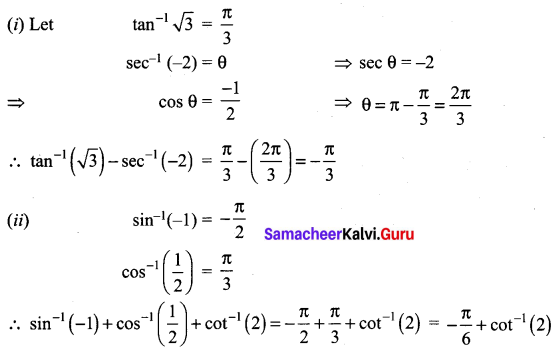
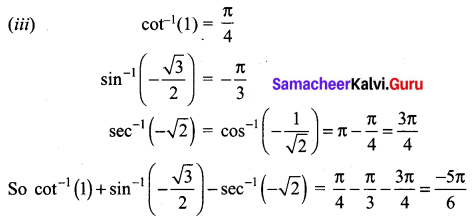
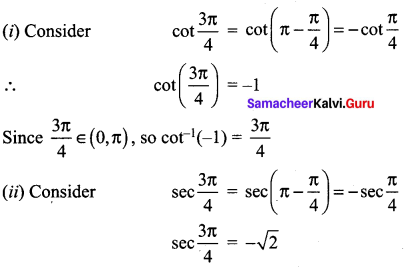
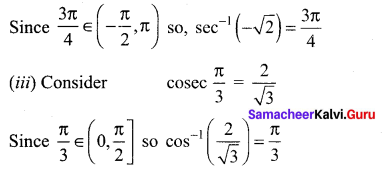
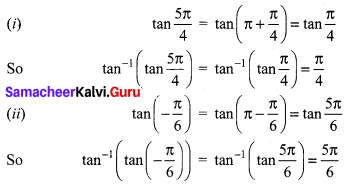
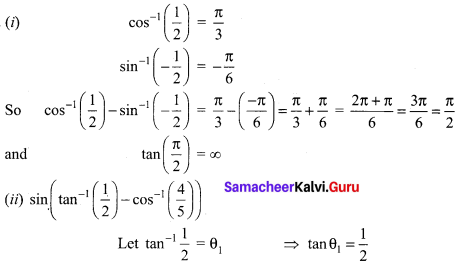
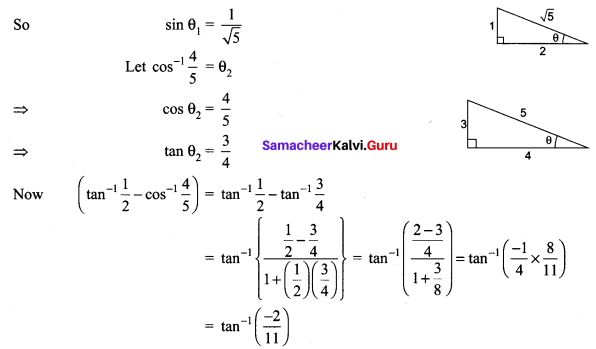
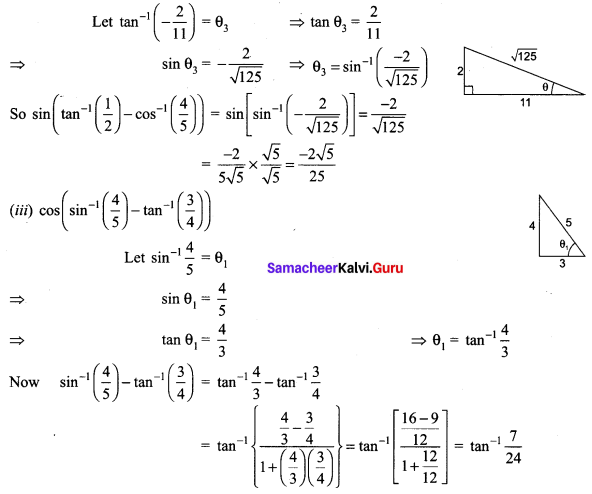
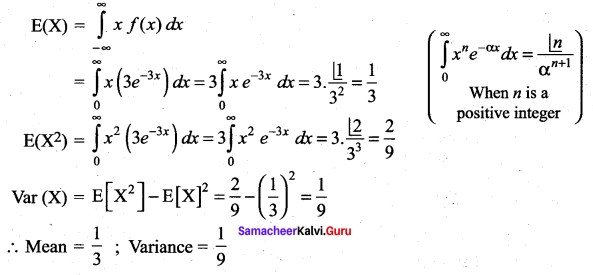
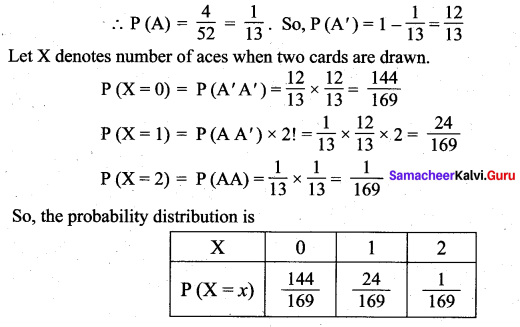
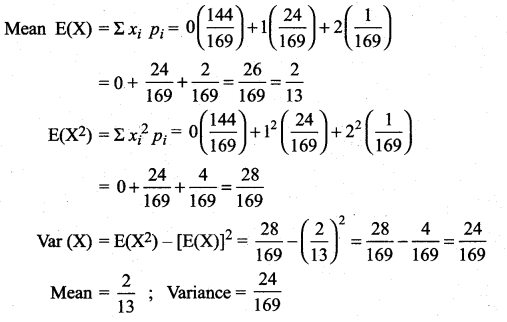
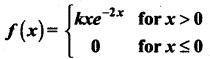
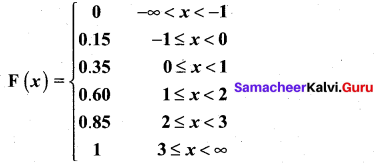
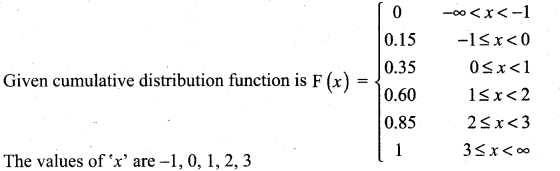
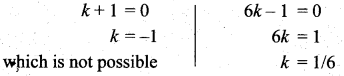
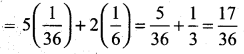
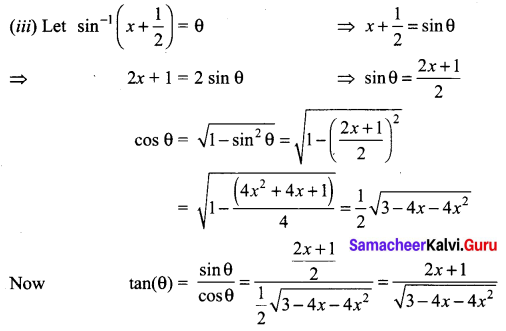
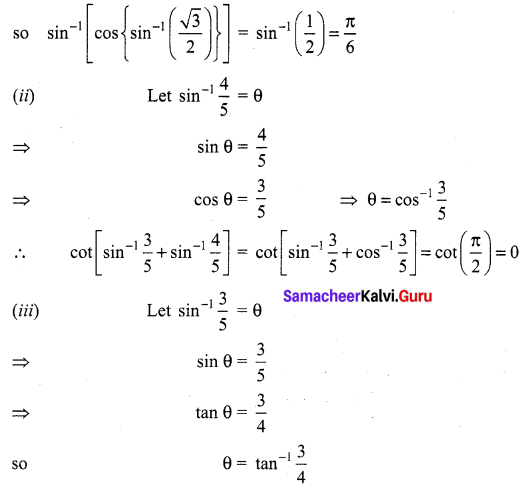
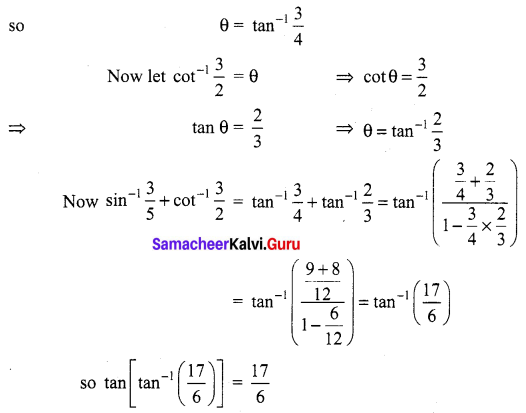
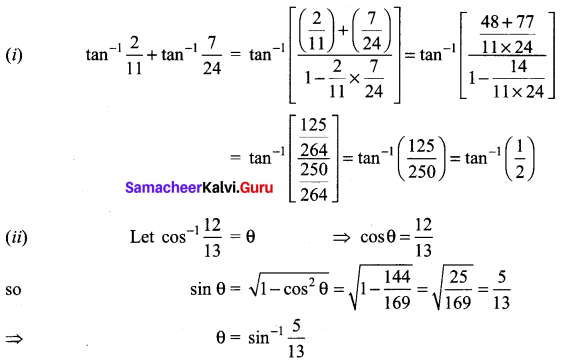
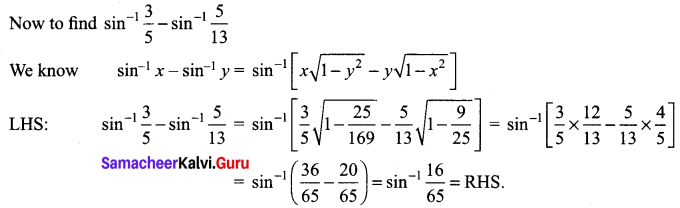
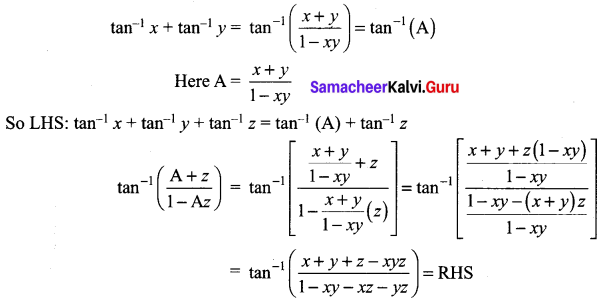
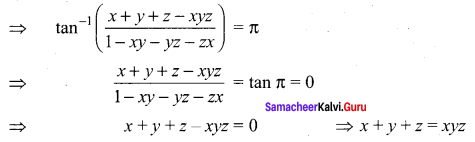
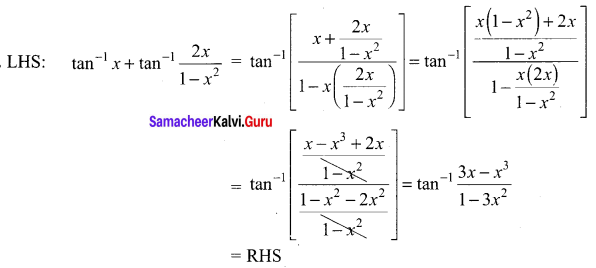
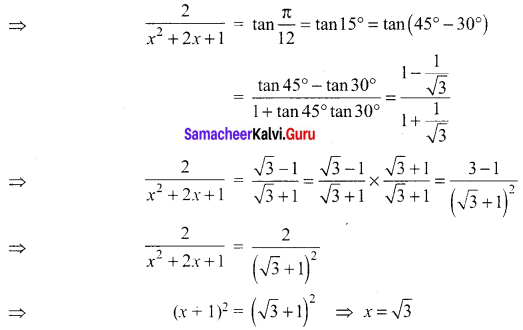
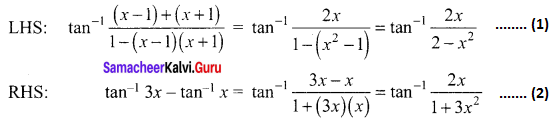
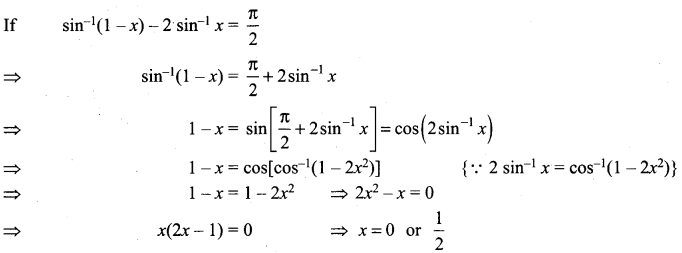
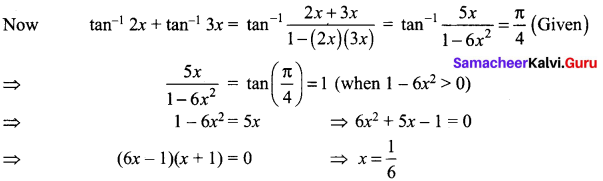
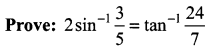
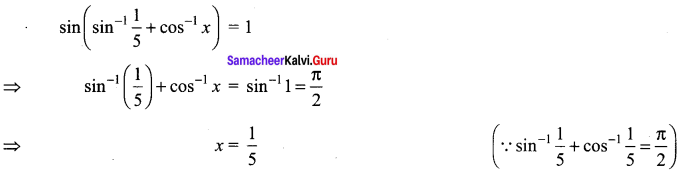
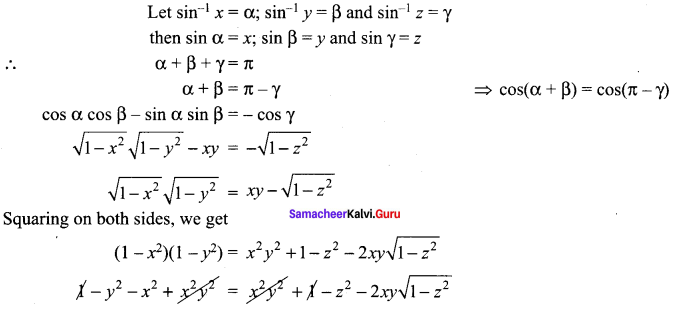
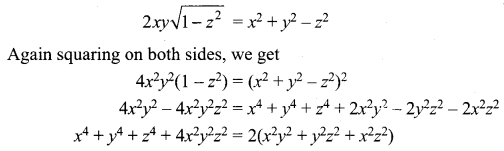
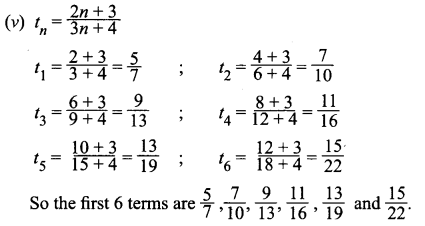
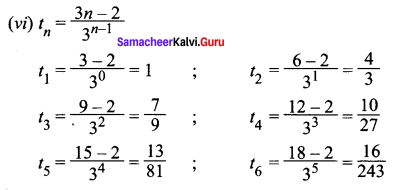
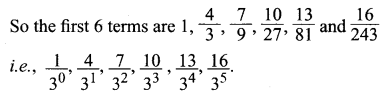
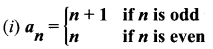
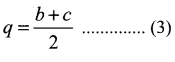
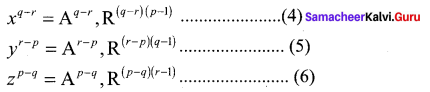
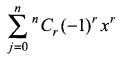
Samacheer Kalvi 12th Maths Solutions Chapter 2 Complex Numbers Ex 2.5

You can Download Samacheer Kalvi 12th Maths Book Solutions Guide Pdf, Tamilnadu State Board help you to revise the complete Syllabus and score more marks in your examinations.

Tamilnadu Samacheer Kalvi 12th Maths Solutions Chapter 2 Complex Numbers Ex 2.5

Question 1.
Find the modulus of the following complex numbers.
(i) \(\frac{2 i}{3+4 i}\)
(ii) \(\frac{2-i}{1+i}+\frac{1-2 i}{1-i}\)
(iii) (1 – i)10
(iv) 2i(3 – 4i) (4 – 3i)
Solution:
Samacheer Kalvi 12th Maths Solutions Chapter 2 Complex Numbers Ex 2.5 Q1
(iii) |(1 – i)10| = (|1 – i|)10
= \((\sqrt{1+1})^{10}=(\sqrt{2})^{10}=2^{5}=32\)
(iv) |2i(3 – 4i) (4 – 3i)|
= |2i| |3 – 4i| |4 – 3i|
= \(2 \sqrt{9+16} \sqrt{16+9}\)
= 2 × 5 × 5
= 50

Samacheer Kalvi 12th Maths Solutions Chapter 2 Complex Numbers Ex 2.5

Question 2.
For any two complex numbers z1 and z2, such that |z1| = |z2| = 1 and z1 z2 ≠ -1, then show that \(\frac{z_{1}+z_{2}}{1+z_{1} z_{2}}\) is a real number.
Solution:
|z1|2 = 1
⇒ \(z_{1} \bar{z}_{1}=1\)
⇒ \(z_{1}=\frac{1}{\bar{z}_{1}}\)
Similarly \(z_{2}=\frac{1}{\bar{z}_{2}}\)
Samacheer Kalvi 12th Maths Solutions Chapter 2 Complex Numbers Ex 2.5 Q2

Question 3.
Which one of the points 10 – 8i, 11 + 6i is closest to 1 + i.
Solution:
A (1 + i), B (10 – 8i), C (11 + 6i)
|AB| = |(10 – 8i) – (1 + i)|
= |10 – 8i – 1 – i|
= |9 – 9i|
= \(\sqrt{81+81}\)
= \(\sqrt{162}\)
= 9(1.414)
= 12.726
CA = |(11 + 6i) – (1 + i)|
= |11 + 6i – 1 – i|
= |10 + 5i|
= \(\sqrt{100+25}\)
= \(\sqrt{125}\)
C (11 + 6i) is closest to the point A (1 + i)

Question 4.
If |z| = 3, show that 7 ≤ |z + 6 – 8i| ≤ 13.
Solution:
|z| = 3, To find the lower bound and upper bound we have
||z1| – |z2|| ≤ |z1 + z2| ≤ |z1| + |z2|
||z| – |6 – 8i|| ≤ |z + 6 – 8i| ≤ |z| + |6 – 8i|
|3 – \(\sqrt{36+64}\)| ≤ |z + 6 – 8i| ≤ 3 + \(\sqrt{36+64}\)
|3 – 10| ≤ |z + 6 – 8i| ≤ 3 + 10
7 ≤ |z + 6 – 8i| ≤ 13

Question 5.
If |z| = 1, show that 2 ≤ |z2 – 3| ≤ 4.
Solution:
|z| = 1 ⇒ |z|2 = 1
||z1| – |z2|| ≤ |z1 + z2| ≤ |z1| + |z2|
||z|2 – |-3|| ≤ |z2 – 3| ≤ |z|2 + |-3|
|1 – 3| ≤ |z2 – 3| ≤ 1 + 3
2 ≤ |z2 – 3| ≤ 4

Samacheer Kalvi 12th Maths Solutions Chapter 2 Complex Numbers Ex 2.5

Question 6.
If \(\left|z-\frac{2}{z}\right|\) = 2, show that the greatest and least value of |z| are √3 + 1 and √3 – 1 respectively.
Solution:
\(\left|z-\frac{2}{z}\right|\) = 2
We know that
Samacheer Kalvi 12th Maths Solutions Chapter 2 Complex Numbers Ex 2.5 Q6
The minimum value of |z| is |1 – √3| = √3 – 1
The greatest value of |z| is √3 + 1

Question 7.
If z1, z2 and z3 are three complex numbers such that |z1| = 1, |z2| = 2, |z3| = 3 and |z1 + z2 + z3| = 1, show that |9z1 z2 + 4z1 z3 + z2 z3| = 6.
Solution:
Samacheer Kalvi 12th Maths Solutions Chapter 2 Complex Numbers Ex 2.5 Q7
Samacheer Kalvi 12th Maths Solutions Chapter 2 Complex Numbers Ex 2.5 Q7.1

Question 8.
If the area of the triangle formed by the vertices z, iz, and z + iz is 50 square units, find the value of |z|.
Solution:
The given vertices are z, iz, z + iz ⇒ z, iz are ⊥r to each other.
Area of triangle = \(\frac { 1 }{ 2 }\) bh = 50
⇒ \(\frac { 1 }{ 2 }\) |z| |iz| = 50
⇒ \(\frac { 1 }{ 2 }\) |z| |z| = 50
⇒ |z|2 = 100
⇒ |z| = 10

Question 9.
Show that the equation z3 + 2\(\bar{z}\) = 0 has five solutions.
Solution:
Given that z3 + 2\(\bar{z}\) = 0
z3 = -2 \(\bar{z}\) ……. (1)
Taking modulus on both sides,
Samacheer Kalvi 12th Maths Solutions Chapter 2 Complex Numbers Ex 2.5 Q9
z has four non-zero solution.
Hence including zero solution. There are five solutions.

Samacheer Kalvi 12th Maths Solutions Chapter 2 Complex Numbers Ex 2.5

Question 10.
Find the square roots of
(i) 4 + 3i
(ii) -6 + 8i
(iii) -5 – 12i
Solution:
(i) z = 4 + 3i
|z| = |4 + 3i| = \(\sqrt{16+9}\) = 5
Samacheer Kalvi 12th Maths Solutions Chapter 2 Complex Numbers Ex 2.5 Q10
Samacheer Kalvi 12th Maths Solutions Chapter 2 Complex Numbers Ex 2.5 Q10.1

Samacheer Kalvi 12th Maths Solutions Chapter 2 Complex Numbers Ex 2.5 Additional Problems

Question 1.
Find the modulus and argument of the following complex numbers and convert them in polar form.
Samacheer Kalvi 12th Maths Solutions Chapter 2 Complex Numbers Ex 2.5 1
Solution:
(i)
Samacheer Kalvi 12th Maths Solutions Chapter 2 Complex Numbers Ex 2.5 2
Samacheer Kalvi 12th Maths Solutions Chapter 2 Complex Numbers Ex 2.5 3
Samacheer Kalvi 12th Maths Solutions Chapter 2 Complex Numbers Ex 2.5 4
Samacheer Kalvi 12th Maths Solutions Chapter 2 Complex Numbers Ex 2.5 5

Question 2.
Find the square roots of – 15 – 8i
Solution:
Samacheer Kalvi 12th Maths Solutions Chapter 2 Complex Numbers Ex 2.5 7
On solving (i) and (iii), we get
x2 = 1 and y2 = 16 => x = ± 1 and y = ±4 From (ii), we observe that 2xy is negative. So, x and y are of opposite signs.
Samacheer Kalvi 12th Maths Solutions Chapter 2 Complex Numbers Ex 2.5 77

Question 3.
Find the square roots of i.
Solution:
Samacheer Kalvi 12th Maths Solutions Chapter 2 Complex Numbers Ex 2.5 78
From (ii) we observe that we find that 2xy is positive. So, x and y are of same sign.
Samacheer Kalvi 12th Maths Solutions Chapter 2 Complex Numbers Ex 2.5 79

Question 4.
Find the modulus or the absolute value of Samacheer Kalvi 12th Maths Solutions Chapter 2 Complex Numbers Ex 2.5 80
Solution:
Samacheer Kalvi 12th Maths Solutions Chapter 2 Complex Numbers Ex 2.5 81

Question 5.
Find the modulus and argument of the following complex numbers:
Samacheer Kalvi 12th Maths Solutions Chapter 2 Complex Numbers Ex 2.5 82
Solution:
Samacheer Kalvi 12th Maths Solutions Chapter 2 Complex Numbers Ex 2.5 83
Samacheer Kalvi 12th Maths Solutions Chapter 2 Complex Numbers Ex 2.5 84
Samacheer Kalvi 12th Maths Solutions Chapter 2 Complex Numbers Ex 2.5 85

Question 6.
Show that the points representing the complex numbers 7 + 9i, – 3 + 7i, 3 + 3i form a right angled triangle on the Argand diagram.
Solution:
Let A, B and C represent the complex numbers
7 + 9i, – 3 + 7i and 3 + 3i in the Argand diagram respectively.
Samacheer Kalvi 12th Maths Solutions Chapter 2 Complex Numbers Ex 2.5 26
Samacheer Kalvi 12th Maths Solutions Chapter 2 Complex Numbers Ex 2.5 87
Hence ∆ABC is a right angled isosceles triangle.

Samacheer Kalvi 12th Maths Solutions Chapter 2 Complex Numbers Ex 2.5

Question 7.
Find the square root of (- 7 + 24i).
Solution:
Samacheer Kalvi 12th Maths Solutions Chapter 2 Complex Numbers Ex 2.5 35
Samacheer Kalvi 12th Maths Solutions Chapter 2 Complex Numbers Ex 2.5 89

Samacheer Kalvi 12th Maths Solutions Chapter 12 Discrete Mathematics Ex 12.1

You can Download Samacheer Kalvi 12th Maths Book Solutions Guide Pdf, Tamilnadu State Board help you to revise the complete Syllabus and score more marks in your examinations.

Tamilnadu Samacheer Kalvi 12th Maths Solutions Chapter 12 Discrete Mathematics Ex 12.1

Question 1.
Determine whether * is a binary operation on the sets given below
(i) a * b = a.|b| on R ,
(ii) a * b = min (a, b) on A = {1, 2, 3, 4, 5}
(iii) (a * b) = \(a \sqrt{b}\) is binary on R.
Solution:
(i) Yes.
Reason: a, b ∈ R. So, |b| ∈ R when b ∈ R
Now multiplication is binary on R
So a|b| ∈ R when a,be R.
(Le.) a * b ∈ R.
* is a binary operation on R.

(ii) Yes.
Reason: a, b ∈ R and minimum of (a, b) is either a or b but a, b ∈ R.
So, min (a, b) ∈ R.
(Le.) a * b ∈ R.
* is a binary operation on R.

(iii) a* b = \(a \sqrt{b}\) where a, b ∈ R.
No. * is not a binary operation on R.
Reason: a, b ∈ R.
⇒ b can be -ve number also and square root of a negative number is not real.
So \(\sqrt{b}\) ∉ R even when b ∈ R.
So \(\sqrt{b}\) ∉ R. ie., a * b ∉ R.
* is not a binary operation on R.

Samacheer Kalvi 12th Maths Solutions Chapter 12 Discrete Mathematics Ex 12.1

Question 2.
Samacheer Kalvi 12th Maths Solutions Chapter 12 Discrete Mathematics Ex 12.1 1
Solution:
No. * is not a binary operation on Z.
Reason: Since m, n ∈ Z.
So, m, n can be negative also.
Now, if n is negative (Le.) say n = -k where k is +ve.
Samacheer Kalvi 12th Maths Solutions Chapter 12 Discrete Mathematics Ex 12.1 2
Similarly, when m is negative then nm ∉ Z.
∴ m * n ∉ Z. ⇒ * is not a binary operation on Z.

Question 3.
Let * be defined on R by (a * b) = a + b + ab – 1 .Is * binary on R ? If so, find \(3 *\left(\frac{-7}{15}\right)\)
Solution:
a * b = a + b + ab – 7.
Now when a, b ∈ R, then ab ∈ R also a + b ∈ R.
So, a + b + ab ∈ R.
We know – 7 ∈ R.
So, a + b + ab – 7 ∈ R.
(ie.) a * b ∈ R.
So, * is a binary operation on R.
Samacheer Kalvi 12th Maths Solutions Chapter 12 Discrete Mathematics Ex 12.1 3

Question 4.
Let A= {a+ \(\sqrt{5}\)b: a, b ∈ Z}. Check whether the usual multiplication is a binary operation on A.
Solution:
Let A = a + \(\sqrt{5}\) b and B = c + \(\sqrt{5}\)d, where a, b, c, d ∈ M.
Now A * B ={a + \(\sqrt{5}\)b)(c + \(\sqrt{5}\)d)
= ac + \(\sqrt{5}\)ad + \(\sqrt{5}\)bc + \(\sqrt{5}\)b\(\sqrt{5}\)d
= (ac + 5bd) + \(\sqrt{5}\)(ad+ bc) ∈ A
Where a, b, c, d ∈ Z
So * is a binary operation.

Samacheer Kalvi 12th Maths Solutions Chapter 12 Discrete Mathematics Ex 12.1

Question 5.
(i) Define an operation * on Q as follows: a * b = \(\left(\frac{a+b}{2}\right)\); a, b ∈ Q. Examine the closure,
commutative, and associative properties satisfied by * on Q.
(ii) Define an operation * on Q as follows: a*b = \(\left(\frac{a+b}{2}\right)\); a, b ∈ Q. Examine the existence of identity and the existence of inverse for the operation * on Q.
Solution:
(i) 1. Closure property:
Let a,b ∈ Q.
Samacheer Kalvi 12th Maths Solutions Chapter 12 Discrete Mathematics Ex 12.1 5
So, closure property is satisfied.

2. Commutative property:
Let a, b ∈ Q.
Samacheer Kalvi 12th Maths Solutions Chapter 12 Discrete Mathematics Ex 12.1 6
(1) = (2) ⇒ Now a * b = b * a
⇒ Commutative property is satisfied.

3. Associative property:
Let a,b,c G Q. ^
To prove associative property we have to prove that a * (b * c) = (a * b) * c
LHS: a * (b * c)
Samacheer Kalvi 12th Maths Solutions Chapter 12 Discrete Mathematics Ex 12.1 7
Samacheer Kalvi 12th Maths Solutions Chapter 12 Discrete Mathematics Ex 12.1 8
(i.e.) the identity Clement e = a which is not possible.
So, the identity element does not exist and so inverse does not exist.

Samacheer Kalvi 12th Maths Solutions Chapter 12 Discrete Mathematics Ex 12.1

Question 6.
Fill In the following table so that the binary operation * on A = {a, b, c} is commutative.
Samacheer Kalvi 12th Maths Solutions Chapter 12 Discrete Mathematics Ex 12.1 9
Solution:
Given that the binary operation * is Commutative.
To find a * b :
a * b = b * a (∵ * is a Commutative)
Here b * a = c. So a * b = c
To find a *c:
Samacheer Kalvi 12th Maths Solutions Chapter 12 Discrete Mathematics Ex 12.1 10
a * c = c * a (∵ * is a Commutative)
c * a = a. (Given)
So a * c = a
To find c * b:
c * b = b * c
Here b * c = a.
So c * b = a

Question 7.
Consider the binary operation * defined on the set A = [a, b, c, d] by the following table:
Samacheer Kalvi 12th Maths Solutions Chapter 12 Discrete Mathematics Ex 12.1 11
– Is it commutative and associative?
Solution:
From the table
b * c = b
c * b = d
So, the binary operation is not commutative.
To check whether the given operation is associative.
Let a, b, c ∈ A.
To prove the associative property we have to prove that a * (b * c) = (a * b) * c
From the table,
LHS: b * c = b
So, a * (b * c) = a * b = c ……. (1)
RHS: a * b = c
So, (a * b) * c = c * c = a …… (2)
(1) ≠ (2). So, a * (b * c) ≠ (a * b) * c
∴ The binary operation is not associative.

Question 8.
Samacheer Kalvi 12th Maths Solutions Chapter 12 Discrete Mathematics Ex 12.1 12
Solution:
Samacheer Kalvi 12th Maths Solutions Chapter 12 Discrete Mathematics Ex 12.1 13

Question 9.
Samacheer Kalvi 12th Maths Solutions Chapter 12 Discrete Mathematics Ex 12.1 14 and Let * be the matrix multiplication. Determine whether M is closed under * . If so, examine the commutative and associative properties satisfied by * on M .

Samacheer Kalvi 12th Maths Solutions Chapter 12 Discrete Mathematics Ex 12.1 15 and let * be the matrix multiplication. Determine whether M is closed under *. If so, examine the existence of identity, existence of inverse properties for the operation * on M.
Solution:
Samacheer Kalvi 12th Maths Solutions Chapter 12 Discrete Mathematics Ex 12.1 16
Samacheer Kalvi 12th Maths Solutions Chapter 12 Discrete Mathematics Ex 12.1 17
Samacheer Kalvi 12th Maths Solutions Chapter 12 Discrete Mathematics Ex 12.1 18
So, inverse property is satisfied.

Samacheer Kalvi 12th Maths Solutions Chapter 12 Discrete Mathematics Ex 12.1

Question 10.
(i) Let A be Q\{1). Define * on A by x * y = x + y – xy. Is * binary on A ? If so, examine the commutative and associative properties satisfied by * on A.
(ii) Let A be Q\{1}. Define *on A by x * y = x + y – xy. Is * binary on A ? If so, examine the existence of identity, existence of inverse properties for the operation * on A.
Solution:
(i) Let a,b ∈ A (i.e.) a ≠ ±1 , b ≠ 1
Now a * b = a + b – ab
If a + b – ab = 1 ⇒ a + b – ab – 1 = 0
(i.e.) a(1 – b) – 1(1 – b) = 0
(a – 1)(1 – b) = 0 ⇒ a = 1, b = 1
But a ≠ 1 , b ≠ 1
So (a – 1) (1 – 6) ≠ 1
(i.e.) a * b ∈ A. So * is a binary on A.

To verify the commutative property:

Let a, b ∈ A (i.e.) a ≠ 1 , b ≠ 1
Now a * b = a + b – ab
and b * a = b + a – ba
So a * b = b * a ⇒ * is commutative on A.

To verify the associative property:
Let a, b, c ∈ A (i.e.) a, b, c ≠ 1
To prove the associative property we have to prove that
a * (b * c) = (a * b) * c

LHS: b * c = b + c – bc = D(say)
So a * (b * c) = a * D = a + D – aD
= a + (b + c – bc) – a(b + c – bc)
= a + b + c – bc – ab – ac + abc
= a + b + c – ab – bc – ac + abc …… (1)

RHS: (a * b) = a + b – ab = K(say)
So (a * b) * c = K * c = K + c – Kc
= (a + b – ab) + c – (a + b – ab) c
= a + b – ab + c – ac – bc + abc
= a + b + c – ab – bc – ac + abc ….. (2)

(ii) To verify the identity property:
Let a ∈ A (a ≠ 1)
If possible let e ∈ A such that
a * e = e * a = a
To find e:
a * e = a
(i.e.) a + e – ae = a
Samacheer Kalvi 12th Maths Solutions Chapter 12 Discrete Mathematics Ex 12.1 19
So, e = (≠ 1) ∈ A
(i.e.) Identity property is verified.
To verify the inverse property:
Let a ∈ A (i.e. a ≠ 1)
If possible let a’ ∈ A such that
To find a’:
a * a’ = e
(i.e.) a + a’ – aa’ = 0
⇒ a'(1 – a) = – a
Samacheer Kalvi 12th Maths Solutions Chapter 12 Discrete Mathematics Ex 12.1 41
⇒ For every a ∈ A there is an inverse a’ ∈ A such that
a* a’ = a’ * a = e
⇒ Inverse property is verified.

Samacheer Kalvi 12th Maths Solutions Chapter 12 Discrete Mathematics Ex 12.1

Samacheer Kalvi 12th Maths Solutions Chapter 12 Discrete Mathematics Ex 12.1 Additional Problems

Question 1.
Show that the set G = {a + b\(\sqrt{2}\)/ a, b ∈ Q} is an infinite abelian group with respect to Binary operation addition. Satisfies closure, associative, identity and inverse properties.
Solution:
(i) Closure axiom :
Let x, y ∈ G. Then x = a + b\(\sqrt{2}\), y = c + d\(\sqrt{2}\); a, b, c, d ∈ Q.
x + y = (a + b\(\sqrt{2}\)) + (c + d\(\sqrt{2}\)) = (a + c) + (b + d) \(\sqrt{2}\) ∈ G,
Since (a + c) and (b + d) are rational numbers.
∴ G is closed with respect to addition.

(ii) Associative axiom : Since the elements of G are all real numbers, addition is associative.

(iii) Identity axiom : There exists 0 = 0 + 0 \(\sqrt{2}\) ∈ G
such that for all x = a + b\(\sqrt{2}\) ∈ G.
x + 0 = (a + b\(\sqrt{2}\) ) + (0 + 0\(\sqrt{2}\))
= a + b\(\sqrt{2}\) = x
Similarly, we have 0 + x = x. ∴ 0 is the identity element of G and satisfies the identity axiom.

(iv) Inverse axiom: For each x = a + b\(\sqrt{2}\) ∈ G,
there exists -x = (-a) + (-b) \(\sqrt{2}\) ∈ G
such that x + (-x) = (a + b\(\sqrt{2}\)) + ((-a) + (- b)\(\sqrt{2}\))
= (a + (-a)) + (b + (-b)) \(\sqrt{2}\) = 0
Similarly, we have (- x) + x = 0 .
∴ (- a) + (-b)\(\sqrt{2}\) is the inverse of a + b \(\sqrt{2}\) and satisfies the inverse axiom.

(v) Commutative axiom:
x + y = (a + c) + (b + d) \(\sqrt{2}\) = (c + a) + (d + b) \(\sqrt{2}\)
= (c + d\(\sqrt{2}\)) + (a + b\(\sqrt{2}\))
= y + x, for all x, y ∈ G.
∴ The commutative property is true.
∴ (G, +) is an abelian group. Since G is infinite, we see that (G, +) is an infinite abelian group.

Samacheer Kalvi 12th Maths Solutions Chapter 12 Discrete Mathematics Ex 12.1

Question 2.
Show that (Z7 – { [0]}, .7) write to the binary operation multiplication modul07 satisfies closure, associative, identity and inverse properties.
Solution:
Let G = [[1], [2],… [6]]
The Cayley’s table is
Samacheer Kalvi 12th Maths Solutions Chapter 12 Discrete Mathematics Ex 12.1 50
From the table:
(i) all the elements of the composition table are the elements of G.
∴ The closure axiom is true.
(ii) multiplication modulo 7 is always associative.
(iii) the identity element is [1] ∈ G and satisfies the identity axiom.
(iv) the inverse of [1] is [1]; [2] is [4]; [3] is [5]; [4] is [2]; [5] is [3] and [6] is [6] and it satisfies the inverse axiom.

Question 3.
Show that the set G of all positive rationals with respect to composition * defined by ab
a* b = \(\frac{a b}{3}\) for all a, b ∈ G satisfies closure, associative, identity and inverse properties.
Solution:
Let G = Set of all positive rational number and * is defined by,
Samacheer Kalvi 12th Maths Solutions Chapter 12 Discrete Mathematics Ex 12.1 51

(i) Closure axiom: Let a, b ∈ G
Samacheer Kalvi 12th Maths Solutions Chapter 12 Discrete Mathematics Ex 12.1 52
∴ closure axiom is satisfied.

(ii) Associative axiom: Let a, b, c ∈ G.
To prove the associative property, we have to prove that
Samacheer Kalvi 12th Maths Solutions Chapter 12 Discrete Mathematics Ex 12.1 53
(1) = (2) ⇒ LHS = RHS i.e., associative axiom is satisfied.

(iii) Identity axiom: Let a ∈ G.
Let e be the identity element.
By the definition, a * e = a
Samacheer Kalvi 12th Maths Solutions Chapter 12 Discrete Mathematics Ex 12.1 54
e = 3 ∈ G ⇒ identity axiom is satisfied.

Samacheer Kalvi 12th Maths Solutions Chapter 12 Discrete Mathematics Ex 12.1

(iv) Inverse axiom: Let a ∈ G and a’ be the inverse of a * a’ = e = 3.
Samacheer Kalvi 12th Maths Solutions Chapter 12 Discrete Mathematics Ex 12.1 55

Question 4.
Show that the set G of all rational numbers except – 1 satisfies closure, associative, identity and inverse property with respect to the operation * given by a * b = a + b + ab for all a, b ∈ G
Solution:
G = [Q, -{-l}]
* is defined by a * b = a + b + ab
To prove G is an abelian group.

G1: Closure axiom: Let a, b ∈ G.
i.e., a and b are rational numbers and a ≠ -1, b ≠ -1.
So, a * b = a + b + ab
If a + b + ab = – 1
⇒ a + b + ab + 1 = 0
i.e., (a + ab) + (b + 1) = 0
a (1 + b) + (b + 1) = 0
i.e., (a + 1)(1 + b) = 0
⇒ a = -1, b = -1
But a ≠ -1, b ≠ -1
⇒ a + b + ab ≠ -1
i.e., a + b + ab ∈ G ∀ a, b ∈ G
⇒ Closure axiom is verified.

G2: Associative axiom: Let a, b, c ∈ G.
To prove G2, we have to prove that,
a * {b * c) = (a * b) * c
LHS:
b * c = b + c + bc = D (say)
a * (b * c) = a * D = a + D + aD
= a + (b + c + bc) + a(b + c + bc)
= a + b + c + bc + ab + ac + abc
= a + b + c + ab + bc + ac + abc ……. (1)
RHS:
a * b = a + b + ab = E (say)
∴ (a * b) * c = E * c = E + c + Ec
= a + b + ab + c + (a + b + ab) c
= a + b + ab + c + ac + bc + abc ……. (2)
= a + b + c + ab +be+ ac + abc
(1) = (2) ⇒ Associative axiom is verified.

G3: Identity axiom: Let a ∈ G. To prove G3 we have to prove that there exists an element e ∈ G such that a * e = e * a = a.
To find e: a * e = a
i.e., a + e + ae = a
⇒ e(1 + a) = a – a = 0
Samacheer Kalvi 12th Maths Solutions Chapter 12 Discrete Mathematics Ex 12.1 555
So, e = 0 ∈ G ⇒ Identity axiom is verified.

G4 : Inverse axiom: Let a ∈ G. To prove G4, we have to prove that there exists an element a’ ∈ G such that a * a’ = a’ * a = e.
To find a’: a * a’ = e
i.e., a + a’ + aa’=: 0 {∵ e = 0}
⇒ a'(1 + a) = -a
Samacheer Kalvi 12th Maths Solutions Chapter 12 Discrete Mathematics Ex 12.1 56
Thus, inverse axiom is verified.

Samacheer Kalvi 12th Maths Solutions Chapter 12 Discrete Mathematics Ex 12.1

Question 5.
Show that the set { [1], [3], [4], [5], [9]} under multiplication modulo 11 satisfies closure, associative, identity and inverse properties.
Solution:
G = {[1], [3], [4], [5], [9]}
* is defined by multiplication modulo 11.
To prove G is an abelian group with respect to *
Since we are given a finite number of elements i.e., since the given set is finite, we can frame the multiplication table called Cayley’s table.
The Cayle’s table is as follows:
Samacheer Kalvi 12th Maths Solutions Chapter 12 Discrete Mathematics Ex 12.1 57
G1: The elements in the above table are [1], [3], [4], [5] and [9] which are elements of G.
∴ closure axiom is verified.

G2: Consider [3], [4], [5] which are elements of G.
{[3] * [4]} * [5] = [1] * [5] = [5] ……. (1)
[3] * {[4] * [5]} = [3] * [9] = [5] …… (2)
(1) = (2) ⇒ (a * b) * c = a * (b * c) i.e., associative axiom is verified.

G3: The first row elements are the same as that of the given elements in the same order. ie., from the table, the identity element is [1] ∈ G. So identity axiom is verified.

Samacheer Kalvi 12th Maths Solutions Chapter 12 Discrete Mathematics Ex 12.1 58

G5: From the table * is commutative i.e., the entries equidistant from the leading diagonal on either sides are equal ⇒ a * b = b * a

Samacheer Kalvi 12th Maths Solutions Chapter 2 Complex Numbers Ex 2.4

You can Download Samacheer Kalvi 12th Maths Book Solutions Guide Pdf, Tamilnadu State Board help you to revise the complete Syllabus and score more marks in your examinations.

Tamilnadu Samacheer Kalvi 12th Maths Solutions Chapter 2 Complex Numbers Ex 2.4

Question 1.
Write the following in the rectangular form:
(i) \(\overline{(5+9 i)+(2-4 i)}\)
(ii) \(\frac{10-5 i}{6+2 i}\)
(iii) \(\overline{3 i}+\frac{1}{2-i}\)
Solution:
Samacheer Kalvi 12th Maths Solutions Chapter 2 Complex Numbers Ex 2.4 Q1

Question 2.
If z = x + iy, find the following in rectangular form.
(i) Re(\(\frac{1}{z}\))
(ii) Re(i\(\bar{z}\))
(iii) Im(3z + 4\(\bar{z}\) – 4i)
Solution:
(i) Re(\(\frac{1}{z}\)) = Re(\(\frac{1}{x+i y} \times \frac{x-i y}{x-i y}\))
= Re(\(\frac{x-i y}{x^{2}+y^{2}}\))
= \(\frac{x}{x^{2}+y^{2}}\)
(ii) Re(i\(\bar{z}\)) = Re[i(\(\overline{x+i y}\))]
= Re(ix + y)
= y
(iii) Im(3z + 4\(\bar{z}\) – 4i)
= Im (3(x + iy) + 4(x – iy) – 4i)
= Im (3x + 3iy + 4x – 4iy – 4i)
= Im (3x + 4 + i (3y – 4y – 4)
= Im (3x + 4x + i(-y – 4))
= Im [7x + i(-y – 4)]
= -y – 4
= -(y + 4)

Samacheer Kalvi 12th Maths Solutions Chapter 2 Complex Numbers Ex 2.4

Question 3.
If z1 = 2 – i and z2 = -4 + 3i, find the inverse of z1 z2 and \(\frac{z_{1}}{z_{2}}\)
Solution:
z1 = 2 – i, z2 = -4 + 3i
(i) z1 z2 = (2 – i) (-4 + 3i)
= (-8 + 6i + 4i – 3 i2)
= (-8 + 10i + 3)
= (-5 + 10i)
Samacheer Kalvi 12th Maths Solutions Chapter 2 Complex Numbers Ex 2.4 Q3

Question 4.
The complex numbers u, v, and w are related by \(\frac{1}{u}=\frac{1}{v}+\frac{1}{w}\). If v = 3 – 4i and w = 4 + 3i, find u in rectangular form.
Solution:
v = 3 – 4i, w = 4 + 3i = i (3 – 4i)
Samacheer Kalvi 12th Maths Solutions Chapter 2 Complex Numbers Ex 2.4 Q4

Question 5.
Prove the following properties:
(i) z is real if and only if z = \(\bar{z}\)
(ii) Re(z) = \(\frac{z+\bar{z}}{2}\) and Im(z) = \(\frac{z-\bar{z}}{2 i}\)
Solution:
(i) z is real iff z = \(\bar{z}\)
Let z = x + iy
z = \(\bar{z}\)
⇒ x + iy = x – iy
⇒ 2iy = 0
⇒ y = 0
⇒ z is real.
z is real iff z = \(\bar{z}\)
(ii) \(\frac{z+\bar{z}}{2 i}=\frac{x+i y+x-i y}{2}=\frac{2 x}{2}=x\)
Real part of z = x
(iii) \(\frac{z-\bar{z}}{2 i}=\frac{(x+i y)-(x-i y)}{2 i}=\frac{x+i y-x+i y}{2 i}=\frac{2 i y}{2 i}=y\)
Im part of z = y.

Question 6.
Find the least value of the positive integer n for which (√3 + i)n
(i) real
(ii) purely imaginary
Solution:
(√3 + i)n
(√3 + i)2
= 3 – 1 + 2√3 i
= (2 + 2 √3 i)
(√3 + i)3 = (√3 + i)2 (√3 + i)
= (2 + 2√3 i) (√3 + i)
= 2√3 + 2i + 6i – 2√3
(√3 + i) = 8i ⇒ purely Imaginary when n = 3
(√3 + i)4 = (√3 + i)3 (√3 + i)
= 8i (√3 + i)
= (-8 + 8√3 i)
(√3 + i)5 =(√3 + i)4 (√3 + i)
= (-8 + 8√3 i) (√3 + i)
= -8√3 – 8i + 24i – 8√3
= -16√3 + 16i
(√3 + i)6 = (√3 + i)5 (√3 + i)
= (√3 + i) (-16√3 + 16i)
= 16 (√3 + i) (-√3 + i)
= 16 (-3 + i√3 – i√3 – 1)
= -64 purely real when n = 6
Another Method:
Samacheer Kalvi 12th Maths Solutions Chapter 2 Complex Numbers Ex 2.4 Q6

Samacheer Kalvi 12th Maths Solutions Chapter 2 Complex Numbers Ex 2.4

Question 7.
Show that
(i) (2 + i√3)10 – (2 – i√3)10 is purely imaginary
(ii) \(\left(\frac{19-7 i}{9+i}\right)^{12}+\left(\frac{20-5 i}{7-6 i}\right)^{12}\)
Solution:
(i) (2 + i√3)10 – (2 – i√3)10
Samacheer Kalvi 12th Maths Solutions Chapter 2 Complex Numbers Ex 2.4 Q7.1
Samacheer Kalvi 12th Maths Solutions Chapter 2 Complex Numbers Ex 2.4 Q7

Samacheer Kalvi 12th Maths Solutions Chapter 2 Complex Numbers Ex 2.4 Additional Problems

Question 1.
Express the following in the standard form a + ib.
Samacheer Kalvi 12th Maths Solutions Chapter 2 Complex Numbers Ex 2.4 1
Solution:
Samacheer Kalvi 12th Maths Solutions Chapter 2 Complex Numbers Ex 2.4 2

Question 2.
Find the least positive integer n such that Samacheer Kalvi 12th Maths Solutions Chapter 2 Complex Numbers Ex 2.4 3
Solution:
Samacheer Kalvi 12th Maths Solutions Chapter 2 Complex Numbers Ex 2.4 4

Samacheer Kalvi 12th Maths Solutions Chapter 2 Complex Numbers Ex 2.4

Question 3.
Find the real values of x and y for which the following equations are satisfied.
Samacheer Kalvi 12th Maths Solutions Chapter 2 Complex Numbers Ex 2.4 5
Solution:
(i) (1 – i)x + (1 + i)y = x – ix + y + iy
= (x + y) + i (y – x) = 1 – 3i (given)
So, equating their RP and IP we get,
Samacheer Kalvi 12th Maths Solutions Chapter 2 Complex Numbers Ex 2.4 6
Take real part, we get
i.e., 3x + (x – 2) + 6y – (1 – 3y) = 0
⇒ 3x + x – 2 + 6y – 1 + 3y = 0
4x + 9y = 3 …….. (1)
Take imaginary part, we get
3(x – 2) – x + 3 (1 – 3y) + 2y = 10
⇒ 3x – 6 – x + 3 – 9y + 2y = 10
Samacheer Kalvi 12th Maths Solutions Chapter 2 Complex Numbers Ex 2.4 8

Squaring on both sides, x2 + 3x + 8 = 4 (x + 4)2
i.e., x2 + 3x +8 = 4 (x2 + 8x +16) ⇒ 4x2 + 32x + 64 – x2 – 3x – 8 = 0
3x2 + 29x + 56 = 0
3x2 + 21x + 8x + 56 = 0
(x + 7) (3x + 8) = 0
Samacheer Kalvi 12th Maths Solutions Chapter 2 Complex Numbers Ex 2.4 9

Samacheer Kalvi 11th Maths Solutions Chapter 12 Introduction to Probability Theory Ex 12.5

You can Download Samacheer Kalvi 11th Maths Book Solutions Guide Pdf, Tamilnadu State Board help you to revise the complete Syllabus and score more marks in your examinations.

Tamilnadu Samacheer Kalvi 11th Maths Solutions Chapter 12 Introduction to Probability Theory Ex 12.5

Choose the correct or most suitable answer from the given four alternatives:
Question 1.
Four persons are selected at random from a group of 3 men, 2 women and 4 children. The probability that exactly two of them are children is
(a) \(\frac{3}{4}\)
(b) \(\frac{10}{23}\)
(c) \(\frac{1}{2}\)
(d) \(\frac{10}{21}\)
Solution:
(d)
Hint:
Total no of person = 3 + 2 + 4 = 9
Selecting 4 from 9 can be done in 9 C4 ways
Samacheer Kalvi 11th Maths Solutions Chapter 12 Introduction to Probability Theory Ex 12.5 1

Question 2.
A number is selected from the set {1, 2, 3, ….., 20}. The probability that the selected number is divisible by 3 or 4 is ……………
(a) \(\frac{2}{5}\)
(b) \(\frac{1}{8}\)
(c) \(\frac{1}{2}\)
(d) \(\frac{2}{3}\)
Solution:
(c)
Hint:
n(S) = 20
A = {3, 6, 9, 12, 15, 18} ⇒ n(A) = 6
B = {4, 8, 12, 16, 20} ⇒ n(B) = 5
A ∩ B = {12} ⇒ n(A ∩ B) = 1
so P(A ∪ B) = P(A) + P(B) – P(A ∩ B)
= \(\frac{6}{20}+\frac{5}{20}-\frac{1}{20}=\frac{10}{20}=\frac{1}{2}\)

Question 3.
A, B and C try to hit a target simultaneously but independently. Their respective probabilities of hitting the target are \(\frac{3}{4}, \frac{1}{2}, \frac{5}{8}\). The probability that the target is hit by A or B but not by C
Samacheer Kalvi 11th Maths Solutions Chapter 12 Introduction to Probability Theory Ex 12.5 2
Solution:
(a)
Hint:
P(A) = \(\frac{3}{4}\) P(A’) = 1/4
P(B) = 1/2 P(B’) = 1/2
P(C) = 5/8 P(C’) = 3/8
Probability of hitting the target = 1
Samacheer Kalvi 11th Maths Solutions Chapter 12 Introduction to Probability Theory Ex 12.5 3

Samacheer Kalvi 11th Maths Solutions Chapter 12 Introduction to Probability Theory Ex 12.5

Question 4.
If A and B are any two events, then the probability that exactly one of them occur is …………
(a) P(A ∪ \(\overline{B}\)) + P(\(\overline{A}\) ∪ B)
(b) P(A ∩ \(\overline{B}\)) + P(\(\overline{A}\) ∩ B)
(c) P(A) + P(B) – P(A ∩ B)
(d) P(A) + P(B) + 2P(A ∩ B)
Solution:
(b)
Hint:
Samacheer Kalvi 11th Maths Solutions Chapter 12 Introduction to Probability Theory Ex 12.5 4

Question 5.
Let A and B be two events such that P(\(\overline{A \cup B}\)) = \(\frac{1}{6}\), P(A ∩ B) = \(\frac{1}{4}\) and P(\(\overline{A}\)) = \(\frac{1}{4}\).
Then the events A and B are …………………
(a) Equally likely but not independent
(b) Independent but not equally likely
(c) Independent and equally likely
(d) Mutually inclusive and dependent
Solution:
(b)
Hint:
Samacheer Kalvi 11th Maths Solutions Chapter 12 Introduction to Probability Theory Ex 12.5 5
So P(A). P(B) = \(\frac{3}{4} \times \frac{1}{3}=\frac{1}{4}\)
P(A ∩ B) = P(A). P(B)
⇒ A and B are independent and not equally likely

Question 6.
Two items are chosen from a lot containing twelve items of which four are defective, then the probability that at least one of the item is defective
when two items are chosen at random probability of atleast one of them is defective ………….
Samacheer Kalvi 11th Maths Solutions Chapter 12 Introduction to Probability Theory Ex 12.5 6
Solution:
(a)
Hint:
Total number = 12
Defective = 4
∴ good ones = 12 – 4 = 8
when two items are chosen at random probability of atleast one of them is defective
= P(one defective or 2 defectives) = P(GD or DD)
= P(G) P(D) + P(D) P(D)
Samacheer Kalvi 11th Maths Solutions Chapter 12 Introduction to Probability Theory Ex 12.5 7

Samacheer Kalvi 11th Maths Solutions Chapter 12 Introduction to Probability Theory Ex 12.5

Question 7.
A man has 3 fifty rupee notes, 4 hundred rupees notes and 6 five hundred rupees notes in his pocket. If 2 notes are taken at random, what are the odds in favour of both notes being of hundred rupee denomination?
(a) 1 : 12
(b) 12 : 1
(c) 13 : 1
(d) 1 : 13
Solution:
(d)
Hint:
Samacheer Kalvi 11th Maths Solutions Chapter 12 Introduction to Probability Theory Ex 12.5 8
The odds in favour done of P is P : 1 – P
(i.e.,) \(\frac{1}{13}: \frac{12}{13}\) = 1 : 12

Question 8.
A letter is taken at random from the letters of the word ‘ASSISTANT’ and another letter is taken at random from the letters of the word ‘STATISTICS’. The probability that the selected letters are the same is ………….
Samacheer Kalvi 11th Maths Solutions Chapter 12 Introduction to Probability Theory Ex 12.5 9
Solution:
(d)
Hint:
Samacheer Kalvi 11th Maths Solutions Chapter 12 Introduction to Probability Theory Ex 12.5 10

Question 9.
A matrix is chosen at random from a set of all matrices of order 2, with elements 0 or 1 only. The probability that the determinant of the matrix chosen is not zero will be
Samacheer Kalvi 11th Maths Solutions Chapter 12 Introduction to Probability Theory Ex 12.5 11
Solution:
(b)
Hint: Then given elements are 0 and So each term of a matrix can be filled (Using or 1) is 2 ways.
The No. of elements is a 2 × 2 matrix = 2 × 2 = 4. So the possible ways of filling the elements of a 2 × 2 matrix is 24 = 16 (i.e.,) n(S) = 16
Let A be the event of getting a 2 × 2 matrix for which the determinant value is non zero.
Samacheer Kalvi 11th Maths Solutions Chapter 12 Introduction to Probability Theory Ex 12.5 12

Question 10.
A bag contains 5 white and 3 black balls. Five balls are drawn successively without replacement. The probability that they are alternately of different colours is …………..
Samacheer Kalvi 11th Maths Solutions Chapter 12 Introduction to Probability Theory Ex 12.5 13
Solution:
(c)
Hint:
Samacheer Kalvi 11th Maths Solutions Chapter 12 Introduction to Probability Theory Ex 12.5 14

Question 11.
If A and B are two events such that A ⊂ B and P(B) ≠ 0, then which of the following is correct?
(a) P(A/B) = \(\frac{\mathrm{P}(\mathrm{A})}{\mathrm{P}(\mathrm{B})}\)
(b) P(A/B) < P(A) (c) P(A/B) ≥ P(A) (d) P(A/B) > P(B)
Solution:
(c)
Hint:
Samacheer Kalvi 11th Maths Solutions Chapter 12 Introduction to Probability Theory Ex 12.5 15

Samacheer Kalvi 11th Maths Solutions Chapter 12 Introduction to Probability Theory Ex 12.5

Question 12.
A bag contains 6 green, 2 white, and 7 black balls. If two balls are drawn simultaneously then the probability that both are different colours is ………..
Samacheer Kalvi 11th Maths Solutions Chapter 12 Introduction to Probability Theory Ex 12.5 16
Solution:
(a)
Hint:
Samacheer Kalvi 11th Maths Solutions Chapter 12 Introduction to Probability Theory Ex 12.5 17

Question 13.
If X and Y be two events such that P(X/Y) = \(\frac{1}{2}\), P(Y/X) = \(\frac{1}{3}\) and P(X ∩ Y) = \(\frac{1}{6}\) then P(X ∪ Y) is …………
(a) \(\frac{1}{3}\)
(b) \(\frac{2}{5}\)
(c) \(\frac{1}{6}\)
(d) \(\frac{2}{3}\)
Solution:
(d)
Hint:
Samacheer Kalvi 11th Maths Solutions Chapter 12 Introduction to Probability Theory Ex 12.5 18

Question 14.
An um contains 5 red and 5 black balls. A balls is drawn at random, its colour is noted and is returned to the um. Moreover, 2 additional balls of the colour drawn are put in the um and then a ball is drawn at random. The probability that the second ball drawn is red will be …………
Samacheer Kalvi 11th Maths Solutions Chapter 12 Introduction to Probability Theory Ex 12.5 19
Solution:
(b)
Hint:
Samacheer Kalvi 11th Maths Solutions Chapter 12 Introduction to Probability Theory Ex 12.5 20

Question 15.
A number x is chosen at random from the first 100 natural numbers. Let A be the event of numbers which satisfies \(\frac{(x-10)(x-50)}{x-30}\) ≥ 0, then P(A) is …………….
(a) 0.20
(b) 0.51
(c) 0.71
(d) 0.70
Solution:
(c)
Hint:
Samacheer Kalvi 11th Maths Solutions Chapter 12 Introduction to Probability Theory Ex 12.5 21
Samacheer Kalvi 11th Maths Solutions Chapter 12 Introduction to Probability Theory Ex 12.5 22

Question 16.
If two events A and B are independent such that P(A) = 0.35 and P(A ∪ B) = 0.6, then P(B) is …………..
Samacheer Kalvi 11th Maths Solutions Chapter 12 Introduction to Probability Theory Ex 12.5 23
Solution:
(a)
Hint:
Given A and B are independent
P(A ∩ B) = P(A) + P(B)
⇒ Now P(A ∪ B) = P(A) + P(B) – P(A ∩ B)
(i.e.,) Now P(A ∪ B) = P(A) + P(B) – P(A).P(B)
0.6 = 0.35 + P(B) – (0.35) P(B)
⇒ P(B) = (1 – 0.35) = 0.6 – 0.35
0.65 P(B) = 0.25
∴ P(B) = \(\frac{0.25}{0.65}=\frac{25}{65}=\frac{5}{13}\)

Samacheer Kalvi 11th Maths Solutions Chapter 12 Introduction to Probability Theory Ex 12.5

Question 17.
If two event A and B are such that P(\(\overline{A}\)) and P(A ∩ \(\overline{B}\)) = 1/2, then P(A ∩ B) is ………….
Samacheer Kalvi 11th Maths Solutions Chapter 12 Introduction to Probability Theory Ex 12.5 24
Solution:
(d)
Hint:
Samacheer Kalvi 11th Maths Solutions Chapter 12 Introduction to Probability Theory Ex 12.5 25

Question 18.
If A and B are two events such that P(A) = 0.4, P(B) = 0.8 and P(B/A) = 0.6, then P(\(\overline{A}\) ∩ B) is …………..
(a) 0.96
(b) 0.24
(c) 0.56
(d) 0.66
Solution:
(c)
Hint:
P(B/A) = 0.6 ⇒ \(\frac{P(A \cap B)}{P(A)}\) = 0.6
⇒ P(B/A) = 0.6 × P(A) = 0.6 × 0.4 = 0.24
Now P(\(\overline{A}\) ∩ B) = P(B) – P(A ∩ B)
= 0.8 – 0.24 = 0.56

Question 19.
There are three events A, B, and C of which one and only one can happen. If the odds are 7 to 4 against A and 5 to 3 against B, then odds against C is ……………
(a) 23 : 65
(b) 65 : 23
(c) 23 : 88
(d) 88 : 23
Solution:
(b)
Hint: If the probability of an event is P then the odds against its occurrence are 1 – P to P.
Selecting 1 from the 4 number 1, 2, 3,4, can be done in 4 ways
Here for the event A we are given that = \(\frac{1-\mathrm{P}}{\mathrm{P}}=\frac{7}{4}\)
⇒ 4 – 4P = 7P
⇒ 11 P = 4 ⇒ P = \(\frac{4}{11}\) ⇒ P(A) = \(\frac{4}{11}\) for the event B we are given
\(\frac{1-\mathrm{P}}{\mathrm{P}}=\frac{5}{3}\) ⇒ 5P = 3 – 3P
⇒ 8P = 3 ⇒ P = 3/8
P(B) = \(\frac{3}{8}\)
Now we are given P(A) + P(B) + P(C) = 1
P(C) = 1 – P(A) – P(B)
P(C) = 1 – \(\frac{4}{11}-\frac{3}{8}\)
Samacheer Kalvi 11th Maths Solutions Chapter 12 Introduction to Probability Theory Ex 12.5 26

Question 20.
If a and b are chosen randomly from the set {1, 2, 3, 4} with replacement, then the probability of the real roots of the equation x2 + ax + b = 0 is
Samacheer Kalvi 11th Maths Solutions Chapter 12 Introduction to Probability Theory Ex 12.5 27
Solution:
(c)
Hint:
x2 + ax + b = 0 ⇒ x = \(\frac{-a \pm \sqrt{a^{2}-4 b}}{2}\)
Given that the roots are real ⇒ a2 – 4b ≥ 0 or a2 > 4b
When a = 1, b = 1 or 2 or 3 or 4 a2 – 4b < 0
When a = 2, b = 1 a2 – 4b = 0
When a = 3, b = 1 or 2 for which a2 – 4b ≥ 0
When a = 4, b = 1 or 2, 3 or 4 for which a2 – 4b ≥ 0
So, Selecting from the 4 number 42 = 16 ways.
(i.e.,) n(s) = 16
n(A) = (2 or 3 or 4) = 3
n(B) = (1 or 2 or 3 or 4) = 4
P(A) + P(B) = \(\frac{3}{16}+\frac{4}{16}=\frac{7}{16}\)

Question 21.
It is given that the events A and B are such that P(A) = \(\frac{1}{4}\), P(A/B) = \(\frac{1}{2}\) and P(B/ A) = \(\frac{2}{3}\) then P(B) is ……………
Samacheer Kalvi 11th Maths Solutions Chapter 12 Introduction to Probability Theory Ex 12.5 28
Solution:
(b)
Hint:
Samacheer Kalvi 11th Maths Solutions Chapter 12 Introduction to Probability Theory Ex 12.5 29

Samacheer Kalvi 11th Maths Solutions Chapter 12 Introduction to Probability Theory Ex 12.5

Question 22.
In a certain college 4% of the boys and 1% of the girls are taller than 1.8 meter. Further 60% of the students are girls. If a student is selected at random and is taller than 1.8 meters, then the probability that the students is a girls is ………….
Samacheer Kalvi 11th Maths Solutions Chapter 12 Introduction to Probability Theory Ex 12.5 30
Solution:
(b)
Hint:
Samacheer Kalvi 11th Maths Solutions Chapter 12 Introduction to Probability Theory Ex 12.5 31

Question 23.
Ten coins are tossed. The probability of getting at least 8 heads is …………….
Samacheer Kalvi 11th Maths Solutions Chapter 12 Introduction to Probability Theory Ex 12.5 32
Solution:
(d)
Hint:
When 10 coins are tossed, No. of element in sample space
n(S) = 210 = 1024
Probability of getting atleast 8 heads
Samacheer Kalvi 11th Maths Solutions Chapter 12 Introduction to Probability Theory Ex 12.5 33

Question 24.
The probability of two events A and B are 0.3 and 0.6 respectively. The probability that both A and B occur simultaneously is 0.18. The probability that neither A nor B occurs is …………….
(a) 0.1
(b) 0.72
(c) 0.42
(d) 0.28
Solution:
(d)
Hint:
P(A) = 0.3, P(B) = 0.6
P(A ∩ B) = 0.18
So P(A ∪ B) = P(A) + P(B) – P(A ∩ B)
= 0.3 + 0.6 – 0.18
= 0.9 – 0.18 = 0.72
P(A’ ∩ B’) = P[(A ∪ B)’] = 1 – P(A ∪B)
= 1 – 0.72 = 0.28

Question 25.
If m is a number such that m≤ 5, then the probability that quadratic equation 2x2 + 2mx + m + 1 = 0 has real roots is ………….
Samacheer Kalvi 11th Maths Solutions Chapter 12 Introduction to Probability Theory Ex 12.5 34
Solution:
(c)
Hint:
2x2 + 2mx + m + 1 = 0
Samacheer Kalvi 11th Maths Solutions Chapter 12 Introduction to Probability Theory Ex 12.5 35
Samacheer Kalvi 11th Maths Solutions Chapter 12 Introduction to Probability Theory Ex 12.5 36
roots are real ⇒ m2 – 2m – 2 ≥ 0
Here m ≤ 5 ⇒ n(S) = 5
When m= 1,m2 – 2m – 2
When m = 2, m2 – 2m- 2
When m = 3, m2 – 2m – 2
When m = 4, m2 – 2n- 2
When m = 5, m2 – 2m – 2
⇒ n{A) = 3 and so P(A) = \(\frac{3}{5}\)

Samacheer Kalvi 12th Maths Solutions Chapter 2 Complex Numbers Ex 2.3

You can Download Samacheer Kalvi 12th Maths Book Solutions Guide Pdf, Tamilnadu State Board help you to revise the complete Syllabus and score more marks in your examinations.

Tamilnadu Samacheer Kalvi 12th Maths Solutions Chapter 2 Complex Numbers Ex 2.3

Question 1.
If z1 = 1 – 3i, z2 = -4i, and z3 = 5, show that
(i) (z1 + z2) + z3 = z1 + (z2 + z3)
(ii) (z1 z2) z3 = z1 (z2 z3)
Solution:
(i) z1 = 1 – 3i, z2 = -4i, z3 = 5
(z1 + z2) + z3
= (1 – 3i – 4i) + 5
= (1 – 7i) + 5
= 6 – 7i …… (1)
z1 + (z2 + z3)
= (1 – 3i) + (-4i + 5)
= 6 – 7i ……. (2)
from (1) & (2) we get
∴ (z1 + z2) + z3 = z1 + (z2 + z3)

Samacheer Kalvi 12th Maths Solutions Chapter 2 Complex Numbers Ex 2.3

(ii) (z1 z2) z3 = [(1 – 3i) (-4i]5
= [-4i + 12 i2]5
= [-12 – 4i] 5
= -60 – 20i ……. (1)
z1 (z2 z3) = (1 – 3i)[(-4i)(5)]
= (-20i + 60 i2)
= -20i – 60 ……. (2)
from (1) & (2) we get
∴ (z1 z2)(z3) = z1 (z2 z3)

Question 2.
If z1 = 3, z2 = -7i, and z3 = 5 + 4i, show that
(i) z1 (z2 + z3) = z1 z2 + z1 z3
(ii) (z1 z2) z3 = z1 z3 + z2 z3
Solution:
(i) z1 = 3, z2 = -7i, z3 = 5 + 4i
z1 (z2 + z3) = 3 (-7i + 5 + 4i)
= 3 (5 – 3i)
= 15 – 9i …… (1)
z1 z2 + z1 z3 = 3 (-7i) + 3 (5 + 4i)
= -21i + 15 + 12i
= 15 – 9i …… (2)
from (1) & (2), we get
∴ z1 (z2 + z3) = z1 z2 + z1 z3

(ii) (z1 + z2) z3 = (3 – 7i) (5 + 4i)
= 15 + 12i – 35i – 28 i2
= 15 – 23i + 28
= 43 – 23i ……. (1)
z1 z3 + z2 z3 = 3(5 + 4i) – 7i(5 + 4i)
= 15 + 12i – 35i – 28 i2
= 15 – 23i + 28
= 43 – 23i ….. (2)
from (1) & (2), we get
∴ (z1 + z2) z3 = z1 z3 + z2 z3

Question 3.
If z1 = 2 + 5i, z2 = -3 – 4i, and z3 = 1 + i, find the additive and multiplicative inverse of z1, z2, and z3.
Solution:
z1 = 2 + 5i
(а) Additive inverse of z1 = -z1 = -(2 + 5i) = -2 – 5i
(b) Multiplicative inverse of
\(z_{1}=\frac{1}{z_{1}}=\frac{1}{2+5 i} \times \frac{2-5 i}{2-5 i}=\frac{(2-5 i)}{4+25}=\frac{2-5 i}{29}\)

z2 = -3 – 4i
(a) Additive inverse of z2 = -z2 = -(-3 – 4i) = 3 + 4i
(b) Multiplicative inverse of
\(z_{2}=\frac{1}{z_{2}} \frac{1}{-3-4 i} \times \frac{-3+4 i}{-3+4 i}=\frac{-3+4 i}{9+16}=\frac{-3+4 i}{25}\)

z3 = 1 + i
(а) Additive inverse of z3 = -z3 = -(1 + i) = -1 – i
(b) Multiplicative inverse of
\(z_{3}=\frac{1}{z_{3}} \frac{1}{1+i} \times \frac{1-i}{1-i}=\frac{1-i}{2}\)

Samacheer Kalvi 12th Maths Solutions Chapter 2 Complex Numbers Ex 2.3 Additional Problems

Question 1.
If z1 = 4 – 7i, z2 = 2 + 3i and z3 = 1 + i show that.
(i) z1 + (z2 + z3) = (Z1 + z2) + Z3
(ii) (Z1 z2) z3 = Z1 (z2 z3)
Solution:
(i) Z1 + (z2 + z13) = 4 – 7i + (2 + 3i + 1 + i) = 4 – 7i + (3 + 4i) = 7 – 3i
(z1 + z2) + z3 = (4 – 7i + 2 + 3i) + (1 + i) = (6 – 4i) + (1 + i)
= 7 – 3i …(2)
From (1) and (2) we get, z1 + (z2 + z3) = (z1 + z2) + z3

(ii) (z1z2) z3 = (4 – 7i) + (2 + 3i) (1 + i) = (8 + 12i – 14 i + 21) (1 + i)
= (29 – 2i)(1 + i) = 29 + 29i – 2i + 2
= 31 + 27i ….(1)
Z1 (z2z3) = (4 – 7i) [(2 + 3i) (1 + i)] = 4 – 7i [2 + 2i + 3i – 3]
= 4 – 7i[5i – 1] = 20i – 4 + 35 + 7i
= 31 + 27i …(2)
From (1) and (2) we get, (Z1Z2) z3 = z1 (z2z3)

Samacheer Kalvi 12th Maths Solutions Chapter 2 Complex Numbers Ex 2.3

Question 2.
Given z1 = 1 + i, z2 = 4 – 3i and z3 = 2 + 5i verify that.
Z1(Z2 Z3) = Z1 Z2 – z1z3
Solution:
Z1 = 1 + i,
z2 = 4 – 3i,
z3 = 2 + 5i
Z1 (z2 – z3) = 1 + i[(4 – 3i) – (2 + 5i)] = 1 + i[2 – 8i] = 2 – 8i + 2i + 8
= 10 – 6i …(1)
Z1 z2 = (1 + i) (4 – 3i) = 4 – 3i + 4i + 3 = 7 + i
Z1Z3= (1 + i) (2 + 5i) = 2 + 5i + 2i – 5 = 7i – 3
Z1Z2 – Z1 z3 = 7 + i – (7i – 3) = 7 + i – 7i + 3
= 10 – 6i …(2)
From (1) and (2) we get, Z1 (z2 – z3) = z1 z2 – z1 z3

Question 3.
Given z1 = 4 – 7i and z2 = 5 + 6i find the additive and multiplicative inverse of z1 + z2 and Z1 – Z2.
Solution:
Z1 = 4 – 7i, z2 = 5 + 6i
Z1 + z2 = 4 – 7i + 5 + 6i = 9 + i
Additive inverse of z1 + z2 = – (z1 + z2) = – (9 – i) = i – 9
Samacheer Kalvi 12th Maths Solutions Chapter 2 Complex Numbers Ex 2.3 1

Samacheer Kalvi 12th Maths Solutions Chapter 1 Applications of Matrices and Determinants Ex 1.8

You can Download Samacheer Kalvi 12th Maths Book Solutions Guide Pdf, Tamilnadu State Board help you to revise the complete Syllabus and score more marks in your examinations.

Tamilnadu Samacheer Kalvi 12th Maths Solutions Chapter 1 Applications of Matrices and Determinants Ex 1.8

Choose the correct or the most suitable answer from the given four alternatives.

Question 1.
If |adj(adj A)| = |A|9, then the order of the square matrix A is _______
(a) 3
(b) 4
(c) 2
(d) 5
Answer:
(b) 4
Samacheer Kalvi 12th Maths Solutions Chapter 1 Applications of Matrices and Determinants Ex 1.8 Q1

Question 2.
If A is a 3 × 3 non-singular matrix such that AAT = ATA and B = A-1AT, then BBT = ______
(a) A
(b) B
(c) I3
(d) BT
Answer:
(c) I3
Samacheer Kalvi 12th Maths Solutions Chapter 1 Applications of Matrices and Determinants Ex 1.8 Q2

Question 3.
Samacheer Kalvi 12th Maths Solutions Chapter 1 Applications of Matrices and Determinants Ex 1.8 Q3
Answer:
Samacheer Kalvi 12th Maths Solutions Chapter 1 Applications of Matrices and Determinants Ex 1.8 Q3.1

Samacheer Kalvi 12th Maths Solutions Chapter 1 Applications of Matrices and Determinants Ex 1.8

Question 4.
Samacheer Kalvi 12th Maths Solutions Chapter 1 Applications of Matrices and Determinants Ex 1.8 Q4
Answer:
Samacheer Kalvi 12th Maths Solutions Chapter 1 Applications of Matrices and Determinants Ex 1.8 Q4.1
Samacheer Kalvi 12th Maths Solutions Chapter 1 Applications of Matrices and Determinants Ex 1.8 Q4.2

Question 5.
Samacheer Kalvi 12th Maths Solutions Chapter 1 Applications of Matrices and Determinants Ex 1.8 Q5
Answer:
Samacheer Kalvi 12th Maths Solutions Chapter 1 Applications of Matrices and Determinants Ex 1.8 Q5.1

Question 6.
If A = \(\left[\begin{array}{ll}{2} & {0} \\ {1} & {5}\end{array}\right]\) and B = \(\left[\begin{array}{ll}{1} & {4} \\ {2} & {0}\end{array}\right]\) then |adj(AB)| = _______
(a) -40
(b) -80
(c) -60
(d) -20
Answer:
(b) -80
Hint:
Samacheer Kalvi 12th Maths Solutions Chapter 1 Applications of Matrices and Determinants Ex 1.8 Q6

Question 7.
If P = \(\left[\begin{array}{ccc}{1} & {x} & {0} \\ {1} & {3} & {0} \\ {2} & {4} & {-2}\end{array}\right]\) is the adjoint of 3 × 3 matrix A and |A| = 4, then x is ______
(a) 15
(b) 12
(c) 14
(d) 11
Answer:
(d) 11
Hint: Given |A| = 4 and P is the adjoint matrix of A
|P| = 42 = 16
⇒ -2 (3 – x) = 16
⇒ -6 + 2x = 16
⇒ 2x = 22
⇒ x = 11

Question 8.
Samacheer Kalvi 12th Maths Solutions Chapter 1 Applications of Matrices and Determinants Ex 1.8 Q8
Answer:
Samacheer Kalvi 12th Maths Solutions Chapter 1 Applications of Matrices and Determinants Ex 1.8 Q8.1

Samacheer Kalvi 12th Maths Solutions Chapter 1 Applications of Matrices and Determinants Ex 1.8

Question 9.
If A, B and C are invertible matrices of some order, then which one of the following is not true?
(a) adj A =|A| A-1
(b) adj(AB) = (adj A) (adj B)
(c) det A-1 = (det A)-1
(d) (ABC)-1 = C-1B-1A-1
Answer:
(b) adj(AB) = (adj A) (adj B)

Question 10.
Samacheer Kalvi 12th Maths Solutions Chapter 1 Applications of Matrices and Determinants Ex 1.8 Q10
Answer:
Samacheer Kalvi 12th Maths Solutions Chapter 1 Applications of Matrices and Determinants Ex 1.8 Q10.1
Samacheer Kalvi 12th Maths Solutions Chapter 1 Applications of Matrices and Determinants Ex 1.8 Q10.2

Question 11.
If AT A-1 is symmetric, then A2 = _______
(a) A-1
(b) (AT)2
(c) AT
(d) (A-1)2
Answer:
(b) (AT)2
Samacheer Kalvi 12th Maths Solutions Chapter 1 Applications of Matrices and Determinants Ex 1.8 Q11

Question 12.
If A is a non-singular matrix such that \(A^{-1}=\left[\begin{array}{rr}{5} & {3} \\ {-2} & {-1}\end{array}\right]\), then (AT)-1 = _______
Samacheer Kalvi 12th Maths Solutions Chapter 1 Applications of Matrices and Determinants Ex 1.8 Q12
Answer:
Samacheer Kalvi 12th Maths Solutions Chapter 1 Applications of Matrices and Determinants Ex 1.8 Q12.1

Question 13.
Samacheer Kalvi 12th Maths Solutions Chapter 1 Applications of Matrices and Determinants Ex 1.8 Q13
Answer:
Samacheer Kalvi 12th Maths Solutions Chapter 1 Applications of Matrices and Determinants Ex 1.8 Q13.1

Question 14.
Samacheer Kalvi 12th Maths Solutions Chapter 1 Applications of Matrices and Determinants Ex 1.8 Q14
Answer:
Samacheer Kalvi 12th Maths Solutions Chapter 1 Applications of Matrices and Determinants Ex 1.8 Q14.1
Samacheer Kalvi 12th Maths Solutions Chapter 1 Applications of Matrices and Determinants Ex 1.8 Q14.2

Samacheer Kalvi 12th Maths Solutions Chapter 1 Applications of Matrices and Determinants Ex 1.8

Question 15.
Samacheer Kalvi 12th Maths Solutions Chapter 1 Applications of Matrices and Determinants Ex 1.8 Q15
Answer:
Samacheer Kalvi 12th Maths Solutions Chapter 1 Applications of Matrices and Determinants Ex 1.8 Q15.1

Question 16.
Samacheer Kalvi 12th Maths Solutions Chapter 1 Applications of Matrices and Determinants Ex 1.8 Q16
Answer:
Samacheer Kalvi 12th Maths Solutions Chapter 1 Applications of Matrices and Determinants Ex 1.8 Q16.1

Question 17.
Samacheer Kalvi 12th Maths Solutions Chapter 1 Applications of Matrices and Determinants Ex 1.8 Q17
Answer:
Samacheer Kalvi 12th Maths Solutions Chapter 1 Applications of Matrices and Determinants Ex 1.8 Q17.1

Question 18.
Samacheer Kalvi 12th Maths Solutions Chapter 1 Applications of Matrices and Determinants Ex 1.8 Q18
Answer:
Samacheer Kalvi 12th Maths Solutions Chapter 1 Applications of Matrices and Determinants Ex 1.8 Q18.1

Question 19.
Samacheer Kalvi 12th Maths Solutions Chapter 1 Applications of Matrices and Determinants Ex 1.8 Q19
Answer:
Samacheer Kalvi 12th Maths Solutions Chapter 1 Applications of Matrices and Determinants Ex 1.8 Q19.1

Samacheer Kalvi 12th Maths Solutions Chapter 1 Applications of Matrices and Determinants Ex 1.8

Question 20.
Which of the following is/are correct?
(i) Adjoint of a symmetric matrix is also a symmetric matrix
(ii) Adjoint of a diagonal matrix is also a diagonal matrix.
(iii) If A is a square matrix of order n and λ, is a scalar, then adj(λA) = λn adj(A).
(iv) A(adj A) = (adj A)A = |A| I
(a) Only (i)
(b) (ii) and (iii)
(c) (iii) and (iv)
(d) (i), (ii) and (iv)
Answer:
(d) (i), (ii) and (iv)

Question 21.
If ρ(A) = ρ([A|B]), then the system AX = B of linear equations is ______
(a) consistent and has a unique solution
(b) consistent
(c) consistent and has infinitely many solution
(d) inconsistent
Answer:
(b) consistent

Question 22.
If 0 ≤ θ ≤ π, the system of equations x + (sin θ)y – (cos θ)z = 0, (cos θ)x – y + z = 0, (sin θ)x + y – z = 0 has a non-trivial solution then θ is ______
(a) \(\frac{2 \pi}{3}\)
(b) \(\frac{3 \pi}{4}\)
(c) \(\frac{5 \pi}{4}\)
(d) \(\frac{\pi}{4}\)
Answer:
(d) \(\frac{\pi}{4}\)
Samacheer Kalvi 12th Maths Solutions Chapter 1 Applications of Matrices and Determinants Ex 1.8 Q22

Question 23.
The augmented matrix of a system of linear equations is \(\left[\begin{array}{cccc}{1} & {2} & {7} & {3} \\ {0} & {1} & {4} & {6} \\ {0} & {0} & {\lambda-7} & {\mu+5}\end{array}\right]\). The system has infinitely many solutions if _____
(a) λ = 7, μ ≠ 5
(b) λ = -7, μ = 5
(c) λ ≠ 7, μ ≠ -5
(d) λ = 7, μ = -5
Answer:
(d) λ = 7, μ = -5

Question 24.
Samacheer Kalvi 12th Maths Solutions Chapter 1 Applications of Matrices and Determinants Ex 1.8 Q24
Answer:
Samacheer Kalvi 12th Maths Solutions Chapter 1 Applications of Matrices and Determinants Ex 1.8 Q24.1

Question 25.
Samacheer Kalvi 12th Maths Solutions Chapter 1 Applications of Matrices and Determinants Ex 1.8 Q25
Answer:
Samacheer Kalvi 12th Maths Solutions Chapter 1 Applications of Matrices and Determinants Ex 1.8 Q25.1

Samacheer Kalvi 12th Maths Solutions Chapter 1 Applications of Matrices and Determinants Ex 1.8

Samacheer Kalvi 12th Maths Solutions Chapter 1 Applications of Matrices and Determinants Ex 1.8 Additional Problems

Question 1.
Samacheer Kalvi 12th Maths Solutions Chapter 1 Applications of Matrices and Determinants Ex 1.8 1
(a) m < n (b) m > n
(c) m = n
(d) None of these
Solution:
(c) m = n
Hint:
A = [aij]m×n is a square matrix if number of rows is equal to that of columns, i.e., m = n.

Question 2.
Matrices A and B will be inverse of each other only if ……..
(a) AB = BA
(b) AB = BA = O
(c) AB = O, BA = I
(d) AB = BA = I
Solution:
(d) AB = BA = I
Hint:
By the definition of invertible matrices two matrices A and B are inverse of each other if AB = BA = I.

Question 3.
If A is an invertible matrix of order 2 then det (A-1) is equal to
Samacheer Kalvi 12th Maths Solutions Chapter 1 Applications of Matrices and Determinants Ex 1.8 111
Solution:
Samacheer Kalvi 12th Maths Solutions Chapter 1 Applications of Matrices and Determinants Ex 1.8 112
Hint.
Samacheer Kalvi 12th Maths Solutions Chapter 1 Applications of Matrices and Determinants Ex 1.8 2

Question 4.
Samacheer Kalvi 12th Maths Solutions Chapter 1 Applications of Matrices and Determinants Ex 1.8 3
Samacheer Kalvi 12th Maths Solutions Chapter 1 Applications of Matrices and Determinants Ex 1.8 4
Solution:
(d) \(\frac{1}{-3}\left(\begin{array}{ll}{1} & {0} \\ {0} & {1}\end{array}\right)\)

Question 5.
Samacheer Kalvi 12th Maths Solutions Chapter 1 Applications of Matrices and Determinants Ex 1.8 5
Samacheer Kalvi 12th Maths Solutions Chapter 1 Applications of Matrices and Determinants Ex 1.8 6
Solution:
(d) Inverse does not exist

Samacheer Kalvi 12th Maths Solutions Chapter 1 Applications of Matrices and Determinants Ex 1.8

Question 6.
Given ρ(A, B) = ρ(A) = number of unknowns, then the system has …….
(a) unique solution
(b) no solution
(c) inconsistent
(d) infinitely many solution
Solution:
(a) unique solution

Question 7.
Given ρ(A, B) ≠ ρ(A) then the system has
(a) no solution
(b) unique solution
(c) infinitely many solution
(d) None
Solution:
(a) no solution

Question 8.
Given ρ(A, B) = ρ(A) < number of unknowns, then the system has …….
(a) unique solution
(b) no solution
(c) 3 solutions
(d) infinitely many solution
Solution:
(d) infinitely many solution

Question 9.
Samacheer Kalvi 12th Maths Solutions Chapter 1 Applications of Matrices and Determinants Ex 1.8 7
(a) 1
(b) 2
(c) 3
(d) None of these
Solution:
(a) 1

Question 10.
Samacheer Kalvi 12th Maths Solutions Chapter 1 Applications of Matrices and Determinants Ex 1.8 113
(a) 1
(b) 0
(c) 4
(d) any real number
Solution:
(d) any real number

Question 11.
If A = [2 0 1], then the rank of AAT is ………
(a) 1
(b) 2
(c) 3
(d) 0
Solution:
(a) 1
Hint.
Samacheer Kalvi 12th Maths Solutions Chapter 1 Applications of Matrices and Determinants Ex 1.8 9

Question 12.
If the rank of the matrix Samacheer Kalvi 12th Maths Solutions Chapter 1 Applications of Matrices and Determinants Ex 1.8 10 is 2, then λ is ……
(a) 1
(b) 2
(c) 3
(d) any real number
Solution:
(a) 1
Hint.
Since the rank of the given matrix is 2, the value of 3rd order determinant is zero.
Samacheer Kalvi 12th Maths Solutions Chapter 1 Applications of Matrices and Determinants Ex 1.8 100

Question 13.
If A is a scalar matrix with scalar k ≠ 0, of order 3, then A-1 is …….
Samacheer Kalvi 12th Maths Solutions Chapter 1 Applications of Matrices and Determinants Ex 1.8 11
Solution:
\(\frac{1}{k} \mathrm{I}\)
Hint:
Samacheer Kalvi 12th Maths Solutions Chapter 1 Applications of Matrices and Determinants Ex 1.8 12

Samacheer Kalvi 12th Maths Solutions Chapter 1 Applications of Matrices and Determinants Ex 1.8

Question 14.
Samacheer Kalvi 12th Maths Solutions Chapter 1 Applications of Matrices and Determinants Ex 1.8 13
Samacheer Kalvi 12th Maths Solutions Chapter 1 Applications of Matrices and Determinants Ex 1.8 14
Solution:
Samacheer Kalvi 12th Maths Solutions Chapter 1 Applications of Matrices and Determinants Ex 1.8 15
Hint:
(adj A)(A) = |A|I
Samacheer Kalvi 12th Maths Solutions Chapter 1 Applications of Matrices and Determinants Ex 1.8 16

Question 15.
If A is a square matrix of order n, then |adj A| is …….
(a) |A|2
(b) |A|n
(c) |A|n – 1
(d) |A|
Solution:
(c) |A|n – 1
Hint:
When A is square matrix of order 3, then |adj A| = |A|2 = |A|3 – 1 ∴ When A is a square matrix of order n, |adj A| = |A|n – 1

Question 16.
If A is a matrix of order 3, then det (kA)
(a) k3(det A)
(b) k2(det A)
(c) k(det A)
(d) det (A)
Solution:
(a) k3(det A)
Hint:
A is a matrix of order 3. ∴ det (kA) = k3 (det A)

Question 17.
If I is the unit matrix of order n, where k ± 0 is a constant, then adj(kI) = …….
(a) kn(adj I)
(b) k(adj I)
(c) k2(adj I)
(d) kn – 1 (adj I)
Solution:
(d) kn – 1 (adj I)
Hint:
When I is a unit matrix of order 3, then adj (kI) = k2 (adj I)
∴ When I is a unit matrix of order n, then adj (kI) = kn – 1 (adj I)

Question 18.
In a system of 3 linear non-homogeneous equations with three unknowns, if ∆ = 0 and ∆x = 0, ∆y ≠ 0 and ∆z = 0, then the system has …..
(a) unique solution
(b) two solutions
(c) infinitely many solutions
(d) no solution
Solution:
(d) no solution
Hint:
When ∆ = 0 ∆x, ∆z = 0 but ∆y ≠ 0 ⇒ that the system is inconsistent.
∴ There is no solution.

Samacheer Kalvi 11th Maths Solutions Chapter 3 Trigonometry Ex 3.12

You can Download Samacheer Kalvi 11th Maths Book Solutions Guide Pdf, Tamilnadu State Board help you to revise the complete Syllabus and score more marks in your examinations.

Tamilnadu Samacheer Kalvi 11th Maths Solutions Chapter 3 Trigonometry Ex 3.12

Choose the correct answer or most suitable answer:

Question 1.
Samacheer Kalvi 11th Maths Solutions Chapter 3 Trigonometry Ex 3.12 1
(a) \(\sqrt{2}\)
(b) \(\sqrt{3}\)
(c) 2
(d) 4
Solution:
(d) 4
Hint:
Samacheer Kalvi 11th Maths Solutions Chapter 3 Trigonometry Ex 3.12 20

Samacheer Kalvi 11th Maths Solutions Chapter 3 Trigonometry Ex 3.12

Question 2.
If cos 28° + sin 28° = k3, then cos 17° is equal to …….
Samacheer Kalvi 11th Maths Solutions Chapter 3 Trigonometry Ex 3.12 21
Solution:
(a) \(\frac{k^{3}}{\sqrt{2}}\)
Hint:
Samacheer Kalvi 11th Maths Solutions Chapter 3 Trigonometry Ex 3.12 22

Question 3.
Samacheer Kalvi 11th Maths Solutions Chapter 3 Trigonometry Ex 3.12 23
(a) 4 + \(\sqrt{2}\)
(b) 3 + \(\sqrt{2}\)
(c) 9
(d) 4
Solution:
(a) 4 + \(\sqrt{2}\)
Hint:
Samacheer Kalvi 11th Maths Solutions Chapter 3 Trigonometry Ex 3.12 24

Question 4.
Samacheer Kalvi 11th Maths Solutions Chapter 3 Trigonometry Ex 3.12 25
Solution:
(a) \(\frac{1}{8}\)
Hint:
Samacheer Kalvi 11th Maths Solutions Chapter 3 Trigonometry Ex 3.12 26

Question 5.
Samacheer Kalvi 11th Maths Solutions Chapter 3 Trigonometry Ex 3.12 27
Solution:
(c) 2 cos θ
Hint:
Samacheer Kalvi 11th Maths Solutions Chapter 3 Trigonometry Ex 3.12 28
Here θ is in II Quadrant

Samacheer Kalvi 11th Maths Solutions Chapter 3 Trigonometry Ex 3.12

Question 6.
Samacheer Kalvi 11th Maths Solutions Chapter 3 Trigonometry Ex 3.12 29
Solution:
(d) \(\text { (d) } \frac{1-\lambda^{2}}{2 \lambda}\)
Hint:
Samacheer Kalvi 11th Maths Solutions Chapter 3 Trigonometry Ex 3.12 30

Question 7.
cos 1° + cos 2° + cos 3° + …. + cos 179° = …….
(a) 0
(b) 1
(c) -1
(d) 89
Solution:
(a) 0
Hint:
LHS = (cos 10 + cos 179°)+(cos 2° ÷ cos 178°)+ ….. +cos(89° + cos 91°)+cos 90°
cos 179° = cos (180° – 1) = – cos 1°
cos 178° = cos(180° – 2)= – cos 2°
So (cos 1°- cos 1°)+(cos 2° – cos 2°) + (cos 89° – cos 89°) + cos 90°
= 0 + 0 …. + 0 + 0 = 0.
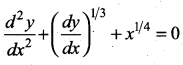
Samacheer Kalvi 11th Maths Solutions Chapter 3 Trigonometry Ex 3.12

Question 8.
Samacheer Kalvi 11th Maths Solutions Chapter 3 Trigonometry Ex 3.12 31
Solution:
(b) \(\frac{1}{12}\)
Hint:
Samacheer Kalvi 11th Maths Solutions Chapter 3 Trigonometry Ex 3.12 32

Question 9.
Which of the following is not true?
Samacheer Kalvi 11th Maths Solutions Chapter 3 Trigonometry Ex 3.12 33
Solution:
(d) sec θ = \(\frac{1}{4}\)
Hint:
sec θ = \(\frac{1}{4}\) ⇒ cos θ = 4, which is not true.

Samacheer Kalvi 11th Maths Solutions Chapter 3 Trigonometry Ex 3.12

Question 10.
cos 2θ cos 2ϕ+ sin2 (θ – ϕ) – sin2 (θ + ϕ) is equal to …….
(a) sin 2(θ + ϕ)
(b) cos 2(θ + ϕ)
(c) sin 2(θ – ϕ)
(d) cos 2(θ – ϕ)
Solution:
(b) cos 2(θ + ϕ)
Hint.
Given cos 2θ . cos 2ϕ + sin2 (θ – ϕ) – sin2 (θ + ϕ)
= cos 2θ cos 2ϕ + sin (θ – ϕ + θ + ϕ) sin (θ – ϕ – θ – ϕ)
= cos 2θ cos 2ϕ + sin 2θ sin(-2ϕ)
= cos 2θ cos 2ϕ – sin 2θ sin(2ϕ)
= cos (2θ + 2ϕ) = cos 2(θ + ϕ)

Question 11.
Samacheer Kalvi 11th Maths Solutions Chapter 3 Trigonometry Ex 3.12 60
(a) sin A + sin B + sin C
(b) 1
(c) 0
(d) cos A + cos B + cos C
Solution:
(c) 0
Hint:
Samacheer Kalvi 11th Maths Solutions Chapter 3 Trigonometry Ex 3.12 61
= tan A – tan B
Samacheer Kalvi 11th Maths Solutions Chapter 3 Trigonometry Ex 3.12 62

Samacheer Kalvi 11th Maths Solutions Chapter 3 Trigonometry Ex 3.12

Question 12.
cos pθ + cos qθ = 0 and if p ≠ q, then 0 is equal to (n is any integer) …….
Samacheer Kalvi 11th Maths Solutions Chapter 3 Trigonometry Ex 3.12 63

Solution:
(b) \(\frac{\pi(2 n+1)}{p \pm q}\)
Hint:
cos pθ + cos qθ = 0
Samacheer Kalvi 11th Maths Solutions Chapter 3 Trigonometry Ex 3.12 64

Question 13.
If tan α and tan β are the roots x2 + ax + b = 0, then \(\frac{\sin (\alpha+\beta)}{\sin \alpha \sin \beta}\) is equal to …….
Solution:
(b) \(\frac{a}{b}\)
Hint:
tan2 x + a tan x + b = 0
α and β are the roots of the equation
⇒ tan2 α + a tan α + b = 0 ….. (1)
tan2 β + a tan β + b = 0 …… (2)

(1) – (2) => tan2 α – tan2 β + a (tan α – tan β) = 0
(tan α – tan β) (tan α + tan β) + a (tan α – tan β) = 0
⇒ tan α + tan β = – a …. (A)
(1) × tan β – (2) × tan α
Samacheer Kalvi 11th Maths Solutions Chapter 3 Trigonometry Ex 3.12 65

Samacheer Kalvi 11th Maths Solutions Chapter 3 Trigonometry Ex 3.12

Question 14.
In a triangle ABC, sin2 A + sin2 B + sin2 C = 2, then the triangle is …….
(a) equilateral triangle
(b) isosceles triangle
(c) right triangle
(d) scalene triangle
Solution:
(c) right triangle
Hint.
On simplifying we get
sin2 A + sin2 B + sin2 C = 2 + 2 cos A cos B cos C
= 2 (given)
⇒ cos A cos B cos C = 0
cos A (or) cos B (or) cos C = 0
⇒ A (or) B (or) C = π/2
⇒ ABC (is a right angled triangle).

Question 15.
If f(θ) = |sin θ| + |cos θ|, θ ∈ R, then f(θ) is in the interval …….
(a) [0, 2]
(b) [1, \(\sqrt{2}\)]
(c) [1, 2]
(d) [0, 1]
Solution:
(b) [1, \(\sqrt{2}\)]
Hint:
Samacheer Kalvi 11th Maths Solutions Chapter 3 Trigonometry Ex 3.12 70
Samacheer Kalvi 11th Maths Solutions Chapter 3 Trigonometry Ex 3.12 71

Question 16.
Samacheer Kalvi 11th Maths Solutions Chapter 3 Trigonometry Ex 3.12 73
Solution:
Nr: cos 6x + cos 4x + 5 cos 4x + 5 cos 2x + 10 cos 2x + 10
= 2 cos 5x cos x+5(2 cos 3x cos x)+ 10(2 cos2x)
= 2 cos x [cos 5x + 5 cos 3x + 10 cos x]
Samacheer Kalvi 11th Maths Solutions Chapter 3 Trigonometry Ex 3.12 74

Samacheer Kalvi 11th Maths Solutions Chapter 3 Trigonometry Ex 3.12

Question 17.
The triangle of maximum area with constant perimeter 12m
(a) is an equilateral triangle with side 4m
(b) is an isosceles triangle with sides 2m, 5m, 5m
(c) is a triangle with sides 3m, 4m, 5m
(d) does not exists
Solution:
(a) is an equilateral triangle with side 4m
Hint.
A triangle will have a max area (with a given perimeter) when it is an equilateral triangle.

Question 18.
A wheel is spinning at 2 radians/second. How many seconds will it take to make 10 complete rotations?
(a) 10π seconds
(b) 20π seconds
(c) 5π seconds
(d) 15π seconds
Solution:
(a) 10π seconds
Hint.
1 rotation makes 2πc
Distance travelled in 1 second = 2 radians
So time taken to complete 10 rotations = 6 × 2π = 20 πc
\(=\frac{20 \pi}{2}=10 \pi\) seconds

Samacheer Kalvi 11th Maths Solutions Chapter 3 Trigonometry Ex 3.12

Question 19.
If sin α + cos α = b, then sin 2α is equal to ……..
Samacheer Kalvi 11th Maths Solutions Chapter 3 Trigonometry Ex 3.12 80
Solution:
(b) b2 – 1, if b > \(\sqrt{2}\)
Hint:
sin α + cos β = b
(sin α + cos β)2 = b2
sin2 α + cos2 α + 2 sin α cos α = b2
sin2 α = b2 – 1

Samacheer Kalvi 11th Maths Solutions Chapter 3 Trigonometry Ex 3.12

Question 20.
Samacheer Kalvi 11th Maths Solutions Chapter 3 Trigonometry Ex 3.12 81
(a) Both (i) and (ii) are true
(b) Only (i) is true
(c) Only (ii) is true
(d) Neither (i) nor (ii) is true
Solution:
(a) Both (i) and (ii) are true
Hint.
When A + B + C = 180°
Samacheer Kalvi 11th Maths Solutions Chapter 3 Trigonometry Ex 3.12 82
When A + B + C = 180° each angle will be lesser than 180°
So sin A, sin B, sin C > 0
⇒ sin A sin B sin C > 0
So both (i) and (ii) are true

Samacheer Kalvi 12th Maths Solutions Chapter 1 Applications of Matrices and Determinants Ex 1.7

You can Download Samacheer Kalvi 12th Maths Book Solutions Guide Pdf, Tamilnadu State Board help you to revise the complete Syllabus and score more marks in your examinations.

Tamilnadu Samacheer Kalvi 12th Maths Solutions Chapter 1 Applications of Matrices and Determinants Ex 1.7

Question 1.
Solve the following system of homogeneous equations.
(i) 3x + 2y + 7z = 0, 4x – 3y – 2z = 0, 5x + 9y + 23z = 0
(ii) 2x + 3y – z = 0, x – y – 2z = 0, 3x + y + 3z = 0
Solution:
(i) The matrix form of the above equations is
Samacheer Kalvi 12th Maths Solutions Chapter 1 Applications of Matrices and Determinants Ex 1.7 Q1
The above matrix is in echelon form.
Here ρ(A, B) = ρ(A) < number of unknowns.
The system is consistent with infinite number of solutions. To find the solutions.
Writing the equivalent equations.
We get 3x + 2y + 7z = 0 ……. (1)
-17y – 34z = 0 ……. (2)
Taking z = t in (2) we get -17y – 34t = 0
⇒ -17y = 34t
⇒ y = -2t
Taking z = t, y = -2t in (1) we get
3x + 2(-2t) + 7t = 0
⇒ 3x – 4t + 7t = 0
⇒ 3x = -3t
⇒ x = -t
So the solution is x = -t; y = -2t; and z = t, t ∈ R
(ii) The matrix form of the equations is
\(\left(\begin{array}{ccc}{2} & {3} & {-1} \\ {1} & {-1} & {-2} \\ {3} & {1} & {3}\end{array}\right)\left(\begin{array}{l}{x} \\ {y} \\ {z}\end{array}\right)=\left(\begin{array}{l}{0} \\ {0} \\ {0}\end{array}\right)\)
(i.e) AX = B
The augmented matrix [A, B] is
Samacheer Kalvi 12th Maths Solutions Chapter 1 Applications of Matrices and Determinants Ex 1.7 Q1.1
The above matrix is in echelon form also ρ(A, B) = ρ(A) = 3 = number of unknowns
The system is consistent with unique solution, x = y = z = 0
(i.e) The system has trivial solution only.

Samacheer Kalvi 12th Maths Solutions Chapter 1 Applications of Matrices and Determinants Ex 1.7

Question 2.
Determine the values of λ for which the following system of equations.
x + y + 3z = 0, 4x + 3y + λz = 0, 2x +y + 2z = 0 has
(i) a unique solution
(ii) a non-trivial solution
Solution:
The matrix form of the equation is
\(\left(\begin{array}{lll}{1} & {1} & {3} \\ {4} & {3} & {\lambda} \\ {2} & {1} & {2}\end{array}\right)\left(\begin{array}{l}{x} \\ {y} \\ {z}\end{array}\right)=\left(\begin{array}{l}{0} \\ {0} \\ {0}\end{array}\right)\)
(i.e) AX = B
The augmented matrix [A, B] is
Samacheer Kalvi 12th Maths Solutions Chapter 1 Applications of Matrices and Determinants Ex 1.7 Q2
The above matrix is in echelon form
Case 1: When λ ≠ 8, ρ(A, B) = ρ(A) = 3 = number of unknowns
The system is consistent with a unique solution.
Case 2: When λ = 8, ρ(A, B) = ρ(A) = 2 < number of unknowns.
The system is consistent with non-trivial solutions.

Question 3.
By using the Gaussian elimination method, balance the chemical reaction equation:
C2H6 + O2 → H2O + CO2
Solution:
We are searching for positive integers x1, x2, x3 and x4 such that
x1C2H6 + x2O2 = x3H2O + x4CO2 ……. (1)
The number of carbon atoms on LHS of (1) should be equal to the number of carbon atoms on the RHS of (1).
So we get a linear homogeneous equation.
2x1 = x4
⇒ 2x1 – x4 = 0 …… (2)
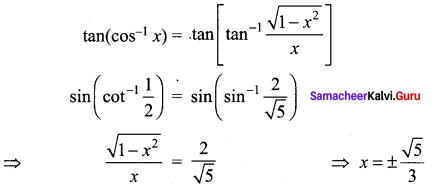
Similarly considering hydrogen and oxygen atoms we get respectively.
2x2 = x3 + 2x4
⇒ 2x2 – x3 – 2x4 = 0 …… (3)

and -2x3+ 3x4 = 0 …… (4)
Equations (2), (3) and (4) constitute a homogeneous system of linear equations in four unknowns.
The augmented matrix (A, B) is
Samacheer Kalvi 12th Maths Solutions Chapter 1 Applications of Matrices and Determinants Ex 1.7 Q3
Now ρ(A, B) = ρ(A) = 3 < number of unknowns.
So the system is consistent and has an infinite number of solutions.
Writing the equations using the echelon form we get
2x1 – x4 = 0 …… (5)
2x2 – x3 – 2x4 = 0 ……. (6)
-2x3 + 3x4 = 0 ……. (7)
Samacheer Kalvi 12th Maths Solutions Chapter 1 Applications of Matrices and Determinants Ex 1.7 Q3.1
Since x1, x2, x3 and x4 are positive integers. Let us choose t = 4t.
Then we get x1 = 2, x2 = 7, x3 = 6, and x4 = 4
So the balanced equation is 2C2H6 + 7O2 → 6H2O + 4CO2.

Samacheer Kalvi 12th Maths Solutions Chapter 1 Applications of Matrices and Determinants Ex 1.7

Samacheer Kalvi 12th Maths Solutions Chapter 1 Applications of Matrices and Determinants Ex 1.7 Additional Problems

Question 1.
Solve the following homogeneous linear equations.
x + 2y – 5z = 0,
3x + 4y + 6z = 0,
x + y + z = 0
Solution:
The given system of equations can be written in the form of matrix equation
Samacheer Kalvi 12th Maths Solutions Chapter 1 Applications of Matrices and Determinants Ex 1.7 1
AX = B
The augmented matrix is
Samacheer Kalvi 12th Maths Solutions Chapter 1 Applications of Matrices and Determinants Ex 1.7 2
This is in the echelon form.
Clearly ρ[A, B] = 3 and ρ(A) = 3
∴ ρ(A) = ρ[A, B] = 3 = number of unknowns
∴ The given system of equations is consistent and has a unique solution. i.e., trivial solution
∴ x = 0, y = 0 and z = 0
Note: Since ρ(A) = 3, | A | ≠ 0 i.e. A is non-singular;
∴ The given system has only trivial solution x = 0, y = 0, z = 0

Question 2.
For what value of n the equations.
x + y + 3z = 0,
4x + 3y + µz = 0,
2x + y + 2z = 0 have a
(i) trivial solution,
(ii) non-trivial solution.
Solution:
The system of equations can be written as AX = B
Samacheer Kalvi 12th Maths Solutions Chapter 1 Applications of Matrices and Determinants Ex 1.7 3
Samacheer Kalvi 12th Maths Solutions Chapter 1 Applications of Matrices and Determinants Ex 1.7 4

Samacheer Kalvi 12th Maths Solutions Chapter 1 Applications of Matrices and Determinants Ex 1.7
Case (i): If µ ≠ 8 then 8 – µ ≠ 0 and hence there are three non-zero rows.
∴ ρ[A] = ρ[A, B] = 3 = the number of unknowns.
∴ The system has the trivial solution x = 0, y = 0, z = 0
Case (ii): If µ = 8 then.
ρ[A, B] = 2 and ρ(A) = 2
∴ ρ(A) = ρ[A, B] = 2 < number of unknowns.
The given system is equivalent to
x + y + 3z = 0; y + 4z = 0
∴ y= – 4z ; x = z
Taking z = k, we get x = k,y = – 4k, z = k [k ∈ R – {0}] which are non-trivial solutions.
Thus the system is consistent and has infinitely many non-trivial solutions.
Note: In case (ii) the system also has trivial solution. For only non-trivial solutions we removed k = 0.

Samacheer Kalvi 11th Maths Solutions Chapter 3 Trigonometry Ex 3.11

You can Download Samacheer Kalvi 11th Maths Book Solutions Guide Pdf, Tamilnadu State Board help you to revise the complete Syllabus and score more marks in your examinations.

Tamilnadu Samacheer Kalvi 11th Maths Solutions Chapter 3 Trigonometry Ex 3.11

Question 1.
Samacheer Kalvi 11th Maths Solutions Chapter 3 Trigonometry Ex 3.11 1
Solution:
Samacheer Kalvi 11th Maths Solutions Chapter 3 Trigonometry Ex 3.11 2
Samacheer Kalvi 11th Maths Solutions Chapter 3 Trigonometry Ex 3.11 3

Samacheer Kalvi 11th Maths Solutions Chapter 3 Trigonometry Ex 3.11

Question 2.
A man standing directly opposite to one side of a road of width x meter views a circular shaped traffic green signal of diameter a meter on the other side of the road. The bottom of the green signal is b meter height from the horizontal level of viewer’s eye. If a denotes the angle subtended by the diameter of the green signal at the viewer’s eye, then prove that
Samacheer Kalvi 11th Maths Solutions Chapter 3 Trigonometry Ex 3.11 4
Solution:
Samacheer Kalvi 11th Maths Solutions Chapter 3 Trigonometry Ex 3.11 5
Samacheer Kalvi 11th Maths Solutions Chapter 3 Trigonometry Ex 3.11 6

Samacheer Kalvi 11th Maths Solutions Chapter 3 Trigonometry Ex 3.11 Additional Questions

Question 1.
Samacheer Kalvi 11th Maths Solutions Chapter 3 Trigonometry Ex 3.11 7
Solution:
Samacheer Kalvi 11th Maths Solutions Chapter 3 Trigonometry Ex 3.11 8
Samacheer Kalvi 11th Maths Solutions Chapter 3 Trigonometry Ex 3.11 9

Question 2.
Samacheer Kalvi 11th Maths Solutions Chapter 3 Trigonometry Ex 3.11 10
Solution:
Samacheer Kalvi 11th Maths Solutions Chapter 3 Trigonometry Ex 3.11 19
The negative value of x is rejected since it makes RHS negative
∴ x = \(\frac{1}{6}\)

Question 3.
Samacheer Kalvi 11th Maths Solutions Chapter 3 Trigonometry Ex 3.11 12
Solution:
Samacheer Kalvi 11th Maths Solutions Chapter 3 Trigonometry Ex 3.11 13

Samacheer Kalvi 11th Maths Solutions Chapter 3 Trigonometry Ex 3.11

Question 4.
Samacheer Kalvi 11th Maths Solutions Chapter 3 Trigonometry Ex 3.11 14
Solution:
Samacheer Kalvi 11th Maths Solutions Chapter 3 Trigonometry Ex 3.11 15
Samacheer Kalvi 11th Maths Solutions Chapter 3 Trigonometry Ex 3.11 16

Question 5.
Samacheer Kalvi 11th Maths Solutions Chapter 3 Trigonometry Ex 3.11 17
Solution:
Samacheer Kalvi 11th Maths Solutions Chapter 3 Trigonometry Ex 3.11 18

Samacheer Kalvi 12th Maths Solutions Chapter 1 Applications of Matrices and Determinants Ex 1.6

You can Download Samacheer Kalvi 12th Maths Book Solutions Guide Pdf, Tamilnadu State Board help you to revise the complete Syllabus and score more marks in your examinations.

Tamilnadu Samacheer Kalvi 12th Maths Solutions Chapter 1 Applications of Matrices and Determinants Ex 1.6

Question 1.
Test for consistency and if possible, solve the following systems of equations by rank method.
(i) x – y + 2z = 2, 2x + y + 4z = 7, 4x – y + z = 4
(ii) 3x + y + z = 2, x – 3y + 2z = 1, 7x – y + 4z = 5
(iii) 2x + 2y + z = 5, x – y + z = 1, 3x + y + 2z = 4
(iv) 2x – y + z = 2, 6x – 3y + 3z = 6, 4x – 2y + 2z = 4
Solution:
(i) Here the number of unknowns = 3.
The matrix form of the system is AX = B where
Samacheer Kalvi 12th Maths Solutions Chapter 1 Applications of Matrices and Determinants Ex 1.6 Q1
(i.e) AX = B
The augmented matrix (A, B) is
\((\mathrm{A}, \mathrm{B})=\left(\begin{array}{cccc}{1} & {-1} & {2} & {2} \\ {2} & {1} & {4} & {7} \\ {4} & {-1} & {1} & {4}\end{array}\right)\)
Applying Gaussian elimination method on [A,B] we get
Samacheer Kalvi 12th Maths Solutions Chapter 1 Applications of Matrices and Determinants Ex 1.6 Q1.1
The above matrix is in echelon form also ρ(A, B) = ρ(A) = 3 = number of unknowns
The system of equations is consistent with a unique solution. To find the solution.
Now writing the equivalent equations we get
\(\left(\begin{array}{ccc}{1} & {-1} & {2} \\ {0} & {3} & {0} \\ {0} & {0} & {-7}\end{array}\right)\left(\begin{array}{l}{x} \\ {y} \\ {z}\end{array}\right)=\left(\begin{array}{r}{2} \\ {3} \\ {-7}\end{array}\right)\)
x – y + 2z = 2
3y = 3 ⇒ y = 1
7z = -7 ⇒ z = 1
Substituting z = y = 1 in (1) we get
x – 1 + 2 = 2 ⇒ x = 1
⇒ x = y = z = 1
(ii) Here the number of unknowns is 3.
The matrix form of the given system of equations is:
\(\left(\begin{array}{ccc}{3} & {1} & {1} \\ {1} & {-3} & {2} \\ {7} & {-1} & {4}\end{array}\right)\left(\begin{array}{l}{x} \\ {y} \\ {z}\end{array}\right)=\left(\begin{array}{l}{2} \\ {1} \\ {5}\end{array}\right)\)
AX = B
(i.e) Now the augmented matrix [A, B] is
Samacheer Kalvi 12th Maths Solutions Chapter 1 Applications of Matrices and Determinants Ex 1.6 Q1.2
The above matrix is in echelon form also
ρ(A, B) = ρ(A) = 2< number of unknowns
The system of equations is consistent with the infinite number of solutions.
To find the solution:
Now writing the equivalent equations we get
Samacheer Kalvi 12th Maths Solutions Chapter 1 Applications of Matrices and Determinants Ex 1.6 Q1.3
Samacheer Kalvi 12th Maths Solutions Chapter 1 Applications of Matrices and Determinants Ex 1.6 Q1.4
(iii) Here the number of unknowns is 3.
The matrix form of the given equation is
\(\left(\begin{array}{ccc}{2} & {2} & {1} \\ {1} & {-1} & {1} \\ {3} & {1} & {2}\end{array}\right)\left(\begin{array}{l}{x} \\ {y} \\ {z}\end{array}\right)=\left(\begin{array}{l}{5} \\ {1} \\ {4}\end{array}\right)\)
AX = B
Samacheer Kalvi 12th Maths Solutions Chapter 1 Applications of Matrices and Determinants Ex 1.6 Q1.5
The above matrix is in echelon form.
Here ρ(A, B) = 3; ρ(A) = 2
So ρ(A, B) ≠ ρ(A)
The system of equations is inconsistent with no solution.
(iv) Here the number of unknowns is 3.
The matrix form of the given equation is
\(\left(\begin{array}{ccc}{2} & {-1} & {1} \\ {6} & {-3} & {3} \\ {4} & {-2} & {2}\end{array}\right)\left(\begin{array}{l}{x} \\ {y} \\ {z}\end{array}\right)=\left(\begin{array}{l}{2} \\ {6} \\ {4}\end{array}\right)\)
AX = B
The augmented matrix [A, B] is
Samacheer Kalvi 12th Maths Solutions Chapter 1 Applications of Matrices and Determinants Ex 1.6 Q1.6
The above matrix is in echelon form also ρ(A, B) = ρ(A) = 1 < number of unknowns
The system of equations is consistent with the infinite number of solutions.
To find the Solution
Now writing the equivalent equations we get
Samacheer Kalvi 12th Maths Solutions Chapter 1 Applications of Matrices and Determinants Ex 1.6 Q1.7

Samacheer Kalvi 12th Maths Solutions Chapter 1 Applications of Matrices and Determinants Ex 1.6

Question 2.
Find the value of k for which the equations kx – 2y + z = 1, x – 2ky + z = -2, x – 2y + kz = 1 have
(i) no solution
(ii) unique solution
(iii) infinitely many solution
Solution:
The matrix form of the given system of equation is
\(\left(\begin{array}{ccc}{k} & {-2} & {1} \\ {1} & {-2 k} & {1} \\ {1} & {-2} & {k}\end{array}\right)\left(\begin{array}{l}{x} \\ {y} \\ {z}\end{array}\right)=\left(\begin{array}{c}{1} \\ {-2} \\ {1}\end{array}\right)\)
(i.e) AX = B
The augmented matrix (A, B) is
Samacheer Kalvi 12th Maths Solutions Chapter 1 Applications of Matrices and Determinants Ex 1.6 Q2
Samacheer Kalvi 12th Maths Solutions Chapter 1 Applications of Matrices and Determinants Ex 1.6 Q2.1
k2 + k – 2 = (k + 2) (k – 1)
The above matrix is in echelon form
Case 1: when k = 1, ρ(A, B) = 3, ρ(A) = 2 (i.e) ρ (A, B) ≠ ρ (A)
The system is inconsistent and the system has no solution.
Case 2: when k ≠ 1, k ≠ -2, then ρ(A, B) = ρ(A) = 3 = number of unknowns
The system is consistent with unique solution.
Case 3: When k = -2 then ρ(A) = ρ(A, B) = 2 < number of unknowns.
The system is consistent with the infinite number of solutions.

Question 3.
Investigate the values of λ and µ the system of linear equations.
2x + 3y + 5z = 9, 7x + 3y – 5z = 8, 2x + 3y + λz = µ, have
(i) no solution
(ii) a unique solution
(iii) an infinite number of solutions.
Solution:
The matrix form of the above equation is
\(\left(\begin{array}{ccc}{2} & {3} & {5} \\ {7} & {3} & {-5} \\ {2} & {3} & {\lambda}\end{array}\right)\left(\begin{array}{l}{x} \\ {y} \\ {z}\end{array}\right)=\left(\begin{array}{l}{9} \\ {8} \\ {\mu}\end{array}\right)\)
(i.e) AX = B
The augmented matrix [A, B] is
Samacheer Kalvi 12th Maths Solutions Chapter 1 Applications of Matrices and Determinants Ex 1.6 Q3
The above matrix is in echelon form
Case 1: When λ = 5, μ ≠ 9
ρ(A) = 2, ρ(A, B) = 3 (i.e) ρ(A, B) ≠ p(A)
The system is inconsistent and it has no solution.
Case 2: When λ ≠ 5, μ ∈ R,
ρ(A, B) = ρ(A) = 3 = number of unknowns
The system is consistent with a unique solution.
Case 3: When λ = 5, μ = 9,
then ρ(A, B) = ρ(A) = 2 < number of unknowns
The system is consistent with infinite number of solutions.

Samacheer Kalvi 12th Maths Solutions Chapter 1 Applications of Matrices and Determinants Ex 1.6

Samacheer Kalvi 12th Maths Solutions Chapter 1 Applications of Matrices and Determinants Ex 1.6 Additional Problems

Question 1.
Discuss the solutions of the system of equations for all values of λ.
x + y + z = 2,
2x + y – 2z = 2,
λx + y + 4z = 2
Solution:
The augmented matrix is
Samacheer Kalvi 12th Maths Solutions Chapter 1 Applications of Matrices and Determinants Ex 1.6 1
Case 1:
If λ ≠ 0, then we get ρ(A, B) = ρ(A) = 3 = number of unknowns.
∴ The system has unique solution.
Case 2: If λ = 0,then ρ(A, B) = ρ(A) = 2 < the number of unknowns ⇒ the system has more number of solutions. Taking λ = 0 we get the systems of equations as
x + 4z = 2 ……..(1)
2y – 6z = 0 …….. (2)
Taking z = k in (2), we get
2y – 6k = 0 ⇒ 2y = 6k
y = 3k
Taking z = A in (1) we get,
x + 4k = 2 ⇒ x = 2 – 4k
∴ The solution is x = 2 – 4 k, y = 3 k, z = k

Question 2.
For what values of k, the system of equations kx + y + z = 1, x + ky + z = 1, x + y + kz = 1 have
(i) unique solution,
(ii) more than one solution,
(iii) no solution.
Solution:
The augmented matrix is
Samacheer Kalvi 12th Maths Solutions Chapter 1 Applications of Matrices and Determinants Ex 1.6 2
Case (i) : When k ≠ 1, the system has a unique solution
Case (ii) : When k = 1, the system reduces to a single equation x + y + z = 1. The system can have more than one solution.
Case (iii) : When k = -2, the system is inconsistent
∴ ρ(A, B) ≠ ρ(A); ∴ the system has no solution.