Samacheer Kalvi 12th Maths Solutions Chapter 4 Inverse Trigonometric Functions Ex 4.5

You can Download Samacheer Kalvi 12th Maths Book Solutions Guide Pdf, Tamilnadu State Board help you to revise the complete Syllabus and score more marks in your examinations.

Tamilnadu Samacheer Kalvi 12th Maths Solutions Chapter 4 Inverse Trigonometric Functions Ex 4.5

Question 1.
Find the value, if it exists. If not, give the reason for non-existence.
(i) sin-1(cos π)
(ii) \(\tan ^{-1}\left(\sin \left(-\frac{5 \pi}{2}\right)\right)\)
(iii) sin-1[sin 5]
Solution:
(i) sin-1(cos π) = sin-1(-1) = \(-\frac{\pi}{2}\)
(ii) \(\tan ^{-1}\left(\sin \frac{5 \pi}{2}\right)=\tan ^{-1}\left(-\sin \frac{\pi}{2}\right)=\tan ^{-1}(-1)=-\frac{\pi}{4}\)
(iii) sin-1(sin 5) = sin-1[sin (5 – 2π)] = 5 – 2π

Question 2.
Find the value of the expression in terms of x, with the help of a reference triangle.
(i) sin(cos-1(1 – x))
(ii) cos(tan-1(3x – 1))
(iii) \(\tan \left(\sin ^{-1}\left(x+\frac{1}{2}\right)\right)\)
Solution:
(i) Let cos-1(1 – x) = θ
1 – x = cos θ
We know sin2 θ = 1 – cos2 θ
Samacheer Kalvi 12th Maths Solutions Chapter 4 Inverse Trigonometric Functions Ex 4.5 Q2
Samacheer Kalvi 12th Maths Solutions Chapter 4 Inverse Trigonometric Functions Ex 4.5 Q2.1

Samacheer Kalvi 12th Maths Solutions Chapter 4 Inverse Trigonometric Functions Ex 4.5

Question 3.
Find the value of
(i) \(\sin ^{-1}\left(\cos \left(\sin ^{-1}\left(\frac{\sqrt{3}}{2}\right)\right)\right.\)
(ii) \(\cot \left(\sin ^{-1} \frac{3}{5}+\sin ^{-1} \frac{4}{5}\right)\)
(iii) \(\tan \left(\sin ^{-1} \frac{3}{5}+\cot ^{-1} \frac{3}{2}\right)\)
Solution:
(i) \(\sin ^{-1} \frac{\sqrt{3}}{2}=\frac{\pi}{3} \text { and } \cos \left(\frac{\pi}{3}\right)=\frac{1}{2} \text { and }\)
Samacheer Kalvi 12th Maths Solutions Chapter 4 Inverse Trigonometric Functions Ex 4.5 Q3
Samacheer Kalvi 12th Maths Solutions Chapter 4 Inverse Trigonometric Functions Ex 4.5 Q3.1

Question 4.
Prove that
(i) \(\tan ^{-1} \frac{2}{11}+\tan ^{-1} \frac{7}{24}=\tan ^{-1} \frac{1}{2}\)
(ii) \(\sin ^{-1} \frac{3}{5}-\cos ^{-1} \frac{12}{13}=\sin ^{-1} \frac{16}{65}\)
Solution:
Samacheer Kalvi 12th Maths Solutions Chapter 4 Inverse Trigonometric Functions Ex 4.5 Q4
Samacheer Kalvi 12th Maths Solutions Chapter 4 Inverse Trigonometric Functions Ex 4.5 Q4.1

Question 5.
Prove that tan-1 x + tan-1 y + tan-1 z = tan-1 \(\left[\frac{x+y+z-x y z}{1-x y-y z-z x}\right]\)
Solution:
Samacheer Kalvi 12th Maths Solutions Chapter 4 Inverse Trigonometric Functions Ex 4.5 Q5

Question 6.
If tan-1 x + tan-1 y + tan-1 z = π, show that x + y + z = xyz.
Solution:
Given tan-1 x + tan-1 y + tan-1 z = π
Samacheer Kalvi 12th Maths Solutions Chapter 4 Inverse Trigonometric Functions Ex 4.5 Q6

Question 7.
Prove that \(\tan ^{-1} x+\tan ^{-1} \frac{2 x}{1-x^{2}}=\tan ^{-1} \frac{3 x-x^{3}}{1-3 x^{2}},|x|<\frac{1}{\sqrt{3}}\)
Solution:
Samacheer Kalvi 12th Maths Solutions Chapter 4 Inverse Trigonometric Functions Ex 4.5 Q7

Samacheer Kalvi 12th Maths Solutions Chapter 4 Inverse Trigonometric Functions Ex 4.5

Question 8.
Simplify: \(\tan ^{-1} \frac{x}{y}-\tan ^{-1} \frac{x-y}{x+y}\)
Solution:
Samacheer Kalvi 12th Maths Solutions Chapter 4 Inverse Trigonometric Functions Ex 4.5 Q8

Question 9.
Find the value of
(i) \(\sin ^{-1} \frac{5}{x}+\sin ^{-1} \frac{12}{x}=\frac{\pi}{2}\)
(ii) \(2 \tan ^{-1} x=\cos ^{-1} \frac{1-a^{2}}{1+a^{2}}-\cos ^{-1} \frac{1-b^{2}}{1+b^{2}}\), a > 0, b > 0
(iii) 2 tan-1(cos x) = tarn-1 (2 cosec x)
(iv) cot-1 x – cot-1 (x + 2) = \(\frac{\pi}{12}\), x > 0
Solution:
Samacheer Kalvi 12th Maths Solutions Chapter 4 Inverse Trigonometric Functions Ex 4.5 Q9
Samacheer Kalvi 12th Maths Solutions Chapter 4 Inverse Trigonometric Functions Ex 4.5 Q9.1
Samacheer Kalvi 12th Maths Solutions Chapter 4 Inverse Trigonometric Functions Ex 4.5 Q9.2
Samacheer Kalvi 12th Maths Solutions Chapter 4 Inverse Trigonometric Functions Ex 4.5 Q9.3

Question 10.
Find the number of solution of the equation tan-1(x – 1) + tan-1 x + tan-1 (x + 1) = tan-1(3x).
Solution:
tan-1(x – 1) + tan-1 x + tan-1 (x + 1) = tan-1(3x)
tan-1(x – 1) + tan-1 (x + 1) = tan-1 3x – tan-1 x
Samacheer Kalvi 12th Maths Solutions Chapter 4 Inverse Trigonometric Functions Ex 4.5 Q10
LHS = RHS
⇒ \(\tan ^{-1} \frac{2 x}{2-x^{2}}=\tan ^{-1} \frac{2 x}{1+3 x^{2}}\)
⇒ \(\frac{2 x}{2-x^{2}}=\frac{2 x}{1+3 x^{2}}\)
⇒ 2 – x2 = 1 + 3x2
⇒ 4x2 = 1
⇒ x2 = \(\frac{1}{4}\)
⇒ x = ±\(\frac{1}{2}\)
So, the equation has 2 solutions.

Samacheer Kalvi 12th Maths Solutions Chapter 4 Inverse Trigonometric Functions Ex 4.5 Additional Questions

Question 1.
Solve the following equation: sin-1(1 – x) – 2 sin-1 x = \(\frac{\pi}{2}\)
Solution:
Samacheer Kalvi 12th Maths Solutions Chapter 4 Inverse Trigonometric Functions Ex 4.5 1

Samacheer Kalvi 12th Maths Solutions Chapter 4 Inverse Trigonometric Functions Ex 4.5

Question 2.
Solve: tan-1 2x + tan-1 3x = \(\frac{\pi}{4}\)
Solution:
Samacheer Kalvi 12th Maths Solutions Chapter 4 Inverse Trigonometric Functions Ex 4.5 2

Question 3.
Samacheer Kalvi 12th Maths Solutions Chapter 4 Inverse Trigonometric Functions Ex 4.5 3
Solution:
Do it yourself

Question 4.
Samacheer Kalvi 12th Maths Solutions Chapter 4 Inverse Trigonometric Functions Ex 4.5 4
Solution:
Do it yourself

Question 5.
Samacheer Kalvi 12th Maths Solutions Chapter 4 Inverse Trigonometric Functions Ex 4.5 5
Solution:
Do it yourself

Question 6.
Samacheer Kalvi 12th Maths Solutions Chapter 4 Inverse Trigonometric Functions Ex 4.5 6
Solution:
Do it yourself

Question 7.
Samacheer Kalvi 12th Maths Solutions Chapter 4 Inverse Trigonometric Functions Ex 4.5 7
Solution:
Samacheer Kalvi 12th Maths Solutions Chapter 4 Inverse Trigonometric Functions Ex 4.5 8

Samacheer Kalvi 12th Maths Solutions Chapter 4 Inverse Trigonometric Functions Ex 4.5

Question 8.
Samacheer Kalvi 12th Maths Solutions Chapter 4 Inverse Trigonometric Functions Ex 4.5 9
Solution:
Samacheer Kalvi 12th Maths Solutions Chapter 4 Inverse Trigonometric Functions Ex 4.5 10

Question 9.
Samacheer Kalvi 12th Maths Solutions Chapter 4 Inverse Trigonometric Functions Ex 4.5 11
Solution:
Samacheer Kalvi 12th Maths Solutions Chapter 4 Inverse Trigonometric Functions Ex 4.5 12
Samacheer Kalvi 12th Maths Solutions Chapter 4 Inverse Trigonometric Functions Ex 4.5 13

Question 10.
Samacheer Kalvi 12th Maths Solutions Chapter 4 Inverse Trigonometric Functions Ex 4.5 14
Solution:
Samacheer Kalvi 12th Maths Solutions Chapter 4 Inverse Trigonometric Functions Ex 4.5 15

Samacheer Kalvi 11th Maths Solutions Chapter 5 Binomial Theorem, Sequences and Series Ex 5.2

You can Download Samacheer Kalvi 11th Maths Book Solutions Guide Pdf, Tamilnadu State Board help you to revise the complete Syllabus and score more marks in your examinations.

Tamilnadu Samacheer Kalvi 11th Maths Solutions Chapter 5 Binomial Theorem, Sequences and Series Ex 5.2

Question 1.
Write the first 6 terms of the sequences whose nth terms are given below and classify them as arithmetic progression, geometric progression, arithmetico-geometric progression, harmonic progression and none of them.
Samacheer Kalvi 11th Maths Solutions Chapter 5 Binomial Theorem, Sequences and Series Ex 5.2 1
Solution:
Samacheer Kalvi 11th Maths Solutions Chapter 5 Binomial Theorem, Sequences and Series Ex 5.2 2
Samacheer Kalvi 11th Maths Solutions Chapter 5 Binomial Theorem, Sequences and Series Ex 5.2 3
It is not a G.P. or A.P. or H.P. or A.G.P.
Samacheer Kalvi 11th Maths Solutions Chapter 5 Binomial Theorem, Sequences and Series Ex 5.2 4
It is not an A.P. or G.P. or H.P. or A.G.P
Samacheer Kalvi 11th Maths Solutions Chapter 5 Binomial Theorem, Sequences and Series Ex 5.2 6
It is not an A.P. or G.P. or H.P. or A.G.P.
Samacheer Kalvi 11th Maths Solutions Chapter 5 Binomial Theorem, Sequences and Series Ex 5.2 7
Samacheer Kalvi 11th Maths Solutions Chapter 5 Binomial Theorem, Sequences and Series Ex 5.2 8
It is a A.G.P.

Samacheer Kalvi 11th Maths Solutions Chapter 5 Binomial Theorem, Sequences and Series Ex 5.2

Question 2.
Write the first 6 terms of the sequences whose nth term an is given below.
Samacheer Kalvi 11th Maths Solutions Chapter 5 Binomial Theorem, Sequences and Series Ex 5.2 9
Solution:
a1 = 1 + 1 = 2 ; a2 = 2
a3 = 3 + 1 = 4 ; a4 = 4
a5 = 5 + 1 = 6 ; a6 = 6
So, the first 6 terms are 2, 2, 4, 4, 6, 6
Samacheer Kalvi 11th Maths Solutions Chapter 5 Binomial Theorem, Sequences and Series Ex 5.2 10
Solution:
a1 = 1 ; a2 = 2, a3 = 3
a4 = a3 + a2 + a1 = 3 + 2 + 1 = 6 ⇒ a4 = 6
a5 = a4 + a3 + a2 = 6 + 3 + 2 = 11 ⇒ a5 = 11
a6 = a5 + a4 + a3 = 11 + 6 + 3 = 20 ⇒ a6 = 20
So the first 6 terms are 1, 2, 3, 5, 8, 13.
Samacheer Kalvi 11th Maths Solutions Chapter 5 Binomial Theorem, Sequences and Series Ex 5.2 255
Solution:
Samacheer Kalvi 11th Maths Solutions Chapter 5 Binomial Theorem, Sequences and Series Ex 5.2 256

Question 3.
Write the nth term of the following sequences.
Solution:
(i) 2, 2, 4, 4, 6, 6……
Solution:
Samacheer Kalvi 11th Maths Solutions Chapter 5 Binomial Theorem, Sequences and Series Ex 5.2 20

Samacheer Kalvi 11th Maths Solutions Chapter 5 Binomial Theorem, Sequences and Series Ex 5.2 21
Solution:
Nr: 1, 2, 3, ……tn = n
Dr: 2, 3, 4, …..tn = n + 1
Samacheer Kalvi 11th Maths Solutions Chapter 5 Binomial Theorem, Sequences and Series Ex 5.2 22
Samacheer Kalvi 11th Maths Solutions Chapter 5 Binomial Theorem, Sequences and Series Ex 5.2 23
Solution:
Nr: 1, 3, 5, 7, . . .which is an A.P. a = 1, d = 3 – 1 = 2
tn = a + (n – 1)d
tn = 1 + (n – 1)2 = 1 + 2n – 2 = 2n – 1.
Dr : 2, 4, 6, 8, . . .
So the nth term is 2 + (n – 1)2 = 2 + 2n – 2 = 2n.
Samacheer Kalvi 11th Maths Solutions Chapter 5 Binomial Theorem, Sequences and Series Ex 5.2 24
(iv) 6, 10, 4, 12, 2, 14, 0, 16, -2,….
Solution:
t1 = 6 ; t2 = 10
t3 = 4 ; t4 = 12
t5 = 2 ; t6 = 14
t7 = 0 ; t8 = 16
When n is odd, the sequence is 6, 4, 2, 0,…
(i.e.) a = 6 and d = 4 – 6 = -2.
So, tn = 6 + (n – 1)(-2) = 6 – 2n + 2 = 8 – 2n
When n is even, the sequence is 10, 12, 14, 16,…
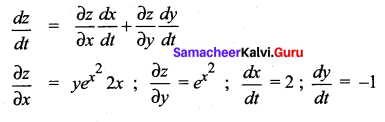
Here a = 10 and d = 12 – 10 = 2

tn = 10 + (n – 1)2 = 10 + 2n – 2 = 2n + 8 (i.e.) 8 + 2n
Samacheer Kalvi 11th Maths Solutions Chapter 5 Binomial Theorem, Sequences and Series Ex 5.2 25

Samacheer Kalvi 11th Maths Solutions Chapter 5 Binomial Theorem, Sequences and Series Ex 5.2

Question 4.
The product of three increasing numbers in GP is 5832. If we add 6 to the second number and 9 to the third number, then resulting numbers form an AP. Find the numbers in GP.
Solution:
The 3 numbers in a G.P. is taken as \(\frac{a}{r}\), a, ar
Their product is 5832.
Samacheer Kalvi 11th Maths Solutions Chapter 5 Binomial Theorem, Sequences and Series Ex 5.2 26
6r2 + 6 = 13
6r2 – 13r + 6 = 0
(3r – 2)(2r – 3) = 0
r = 2/3 or 3/2
Samacheer Kalvi 11th Maths Solutions Chapter 5 Binomial Theorem, Sequences and Series Ex 5.2 27

Question 5.
Samacheer Kalvi 11th Maths Solutions Chapter 5 Binomial Theorem, Sequences and Series Ex 5.2 28
Solution:
Samacheer Kalvi 11th Maths Solutions Chapter 5 Binomial Theorem, Sequences and Series Ex 5.2 29

Question 6.
If tk is the kth term of a G.P., then show that tn – k, tn, tn + k also form a GP for any positive integer k.
Solution:
Let a be the first term and r be the common ratio.
We are given tk = ark – 1
We have to Prove : tn – k, tn, tn + k form a G.P.
Samacheer Kalvi 11th Maths Solutions Chapter 5 Binomial Theorem, Sequences and Series Ex 5.2 30

Question 7.
If a, b, c are in geometric progression, and if \(a^{\frac{1}{x}}=b^{\frac{1}{y}}=c^{\frac{1}{z}}\), then prove that x, y, z are in arithmetic progression.
Solution:
Given a, b, c are in G.P.
⇒ b2 = ac
⇒ log b2 = log ac
(i.e.) 2log b = log a + log c …(1)
Samacheer Kalvi 11th Maths Solutions Chapter 5 Binomial Theorem, Sequences and Series Ex 5.2 31
Substituting these values in equation (1) we get 2y = x + z ⇒ x, y z are in A.P.

Samacheer Kalvi 11th Maths Solutions Chapter 5 Binomial Theorem, Sequences and Series Ex 5.2

Question 8.
The AM of two numbers exceeds their GM by 10 and HM by 16. Find the numbers.
Solution:
Let the two numbers be a and b.
Samacheer Kalvi 11th Maths Solutions Chapter 5 Binomial Theorem, Sequences and Series Ex 5.2 32
So, (a + b – 20)2 = 4ab
(i.e.) (a + b)2 + 400 – 40(a + b) = 4ab
(a + b)2 – 4ab = 40(a + b) – 400
from(3) (a + b)2 – 4ab = 32(a + b)
⇒ 32(a + b) = 40(a + b) – 400
(÷ by 8) 4(a + b) = 5(a + b) – 50
4a + 4b = 5a + 5b – 50
a + b = 50
a = 50 – b
Substituting a = 50 – b in (3) we get
(50 – b – b)2 = 32(50)
(50 – 2b)2 = 32 × 50
Samacheer Kalvi 11th Maths Solutions Chapter 5 Binomial Theorem, Sequences and Series Ex 5.2 33
When b = 5, a = 50 – 5 = 45
When b = 45, a = 50 – 45 = 5
So the two numbers are 5 and 45.

Question 9.
If the roots of the equation (q – r)x2 + (r – p)x + p – q = 0 are equal, then show that p, q and r are in AP.
Solution:
The roots are equal ⇒ ∆ = 0
(i.e.) b2 – 4ac = 0
Hence, a = q – r ; b = r – p ; c = p – q
b2 – 4ac = 0
⇒ (r – p)2 – 4(q – r)(p – q) = 0
r2 + p2 – 2pr – 4[qr – q2 – pr + pq] = 0
r2 + p2 – 2pr – 4qr + 4q2 + 4pr – 4pq = 0
(i.e.) p2 + 4q2 + r2 – 4pq – 4qr + 2pr = 0
(i.e.) (p – 2q + r)2 = 0
⇒ p – 2q + r = 0
⇒ p + r = 2q
⇒ p, q, r are in A.P.

Samacheer Kalvi 11th Maths Solutions Chapter 5 Binomial Theorem, Sequences and Series Ex 5.2

Question 10.
If a, b, c are respectively the pth, qth and rth terms of a G.P., show that (q – r) log a + (r – p) log b + (p – q) log c = 0.
Solution:
Let the G.P. be l, lk, lk2,…
We are given tp = a, tq = b, tr = c
Samacheer Kalvi 11th Maths Solutions Chapter 5 Binomial Theorem, Sequences and Series Ex 5.2 50
LHS = (q – r) log a + (r – p) log b + (p – q) log c
Samacheer Kalvi 11th Maths Solutions Chapter 5 Binomial Theorem, Sequences and Series Ex 5.2 51

Samacheer Kalvi 11th Maths Solutions Chapter 5 Binomial Theorem, Sequences and Series Ex 5.2 Additional Questions Solved

Question 1.
Samacheer Kalvi 11th Maths Solutions Chapter 5 Binomial Theorem, Sequences and Series Ex 5.2 52
Solution:
Here a1 = 1
Substituting n = 2, we obtain a2 = a1 + 2 = 1 + 2 = 3
Substituting n = 3, 4 and 5, we obtain respectively
a3 = a2 + 2 = 3 + 2 = 5, a4 = a3 + 2 = 5 + 2 = 7
a5 = a4 + 2 = 7 + 2 = 9
Thus, the first five terms are 1, 3, 5, 7 and 9.

Question 2.
Find the 18th and 25th term of the sequence defined by
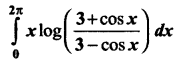
Samacheer Kalvi 11th Maths Solutions Chapter 5 Binomial Theorem, Sequences and Series Ex 5.2 53
Solution:
When n = 18 (even)
an = n(n + 2) = 18(18 + 2) = 18(20) = 360
When n = 25(odd)
Samacheer Kalvi 11th Maths Solutions Chapter 5 Binomial Theorem, Sequences and Series Ex 5.2 54

Question 3.
Write the first six terms of the sequences given by
(i) a1 = a2= 1 = an – 1 + an – 2 (n ≥ 3)
(ii) a1 = 4, an + 1 = 2nan
Solution:
(i) Here a1 = a2= 1 = an – 1 + an – 2 (n ≥ 3)
Putting n = 3, a3= a2 + a1 = 1 + 1 = 2
Putting n = 4, a4 = a3 + a2 = 2 + 1 = 3
Putting n = 5, a5 = a4 + a2 = 3 + 2 = 5
Putting n = 6, a6 = a5 + a4 = 5 + 3 = 8
∴ First six terms of the sequence are 1, 1, 2, 3, 5, 8
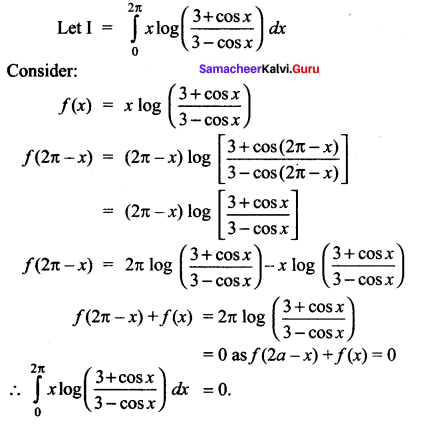
(ii) Here a1 = 4 and an + 1 = 2nan
Putting n = 1, a2 = 2 × 1 × a1 = 2 × 1 × 4 = 8
Putting n = 2, a3 = 2 × 2 × a2 = 4 × 8 = 32
Putting n = 3, a4 = 8 × 192 = 1536
Putting n = 4, a5 = 2 × 4 × a4 = 8 × 192 = 1536
Putting n = 5, a6 = 2 × 5 × a5 = 10 × 1536 = 15360

Samacheer Kalvi 11th Maths Solutions Chapter 5 Binomial Theorem, Sequences and Series Ex 5.2

Question 4.
An A.P. consists of 21 terms. The sum of the three terms in the middle is 129 and of the last three is 237. Find the series.
Solution:
Let a1 be the first term and d, be the common difference. Here n = 21.
∴ The three middle terms are a10,a11, a12
Now, a10 + a11 + a12 = 129 [Given]
∴ (a1 + 9d) + (a1 + 10d) + (a1 + 11d) = 129
⇒ 3a1 + 30d = 129 ⇒ a1 + 10d = 43 ……(i)
The last three terms are a19, a20, a21
a19, a20, a21 = 237 [Given]
∴ (a1 + 18d)+(a1 + 19d) + (a1 + 20d) = 237
(i.e.,) 3a1 + 57d = 237 ⇒ a1 + 19d = 79 … (2)
Subtracting (i) from (ii), we get 9d = 36, ⇒ d = 4
∴ From (i), a1 + 40 = 43 ⇒ a1 = 3
Hence, the series is 3, 7, 11, 15 …….

Question 5.
Prove that the product of the 2nd and 3rd terms of an arithmetic progression exceeds the product of the first and fourth by twice the square of the difference between the 1st and 2nd.
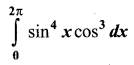
Solution:
Let ‘a’ be the first term and ‘d’ be the common difference of A.P.
Then, a1 = a, a2 = a + (2 – 1)d = a + d
a3 = a + (3 – 1)d = a + 2d, a4 = a + (4 – 1)d = a + 3d
We have to show that a2.a3 – a1.a4 = 2(a2 – a1)2
LHS = a2.a3 – a1.a4 = (a + d)(a + 2d) – a(a + 3d)
= a2 + 3ad + 2d2 – a2 – 3ad = 2d2
RHS = 2(a2 – a1)2 = 2d2
Since LHS = RHS. Hence proved.

Question 6.
If the pth, qth and rth terms of an A.P. are a, b, c respectively, prove that a(q – r) + b (r – p) + c(p – q) = 0.
Solution:
Let A be the first term and D be the common difference of A.P.
ap = a, ∴ A + (p – 1)D = a ….. (1)
aq = b, ∴ A + (q – 1)D = b ……. (2)
ar = c, ∴ A + (r – 1)D = c …….. (3)
∴ a (q – r) + b (r – p) + c (p – q) = [A + (p – l) D] (q – r) + [A + (q – 1) D]
(r – p) + [A + (r – 1) D] (p – q) [Using (1), (2) and (3)]
= (q – r + r – p + p – q)A + [(p – l)(q – r) + (q – l)(r – p) + (r – l)(p – q)]D
= (0) A + (pq – pr – q + r + qr – pq – r + p + pr – p – qr + q)D
= (0)A + (0)D = 0.

Question 7.
If a, b, c are in A.P. and p is the A.M. between a and b and q is the A.M. between b and c, show that b is the A.M. between p and q.
Solution:
a, b, c are in A.P.
2b = a + c …… (1)
p is the A.M. between a and b
Samacheer Kalvi 11th Maths Solutions Chapter 5 Binomial Theorem, Sequences and Series Ex 5.2 60
q is the A.M. between b and c
Samacheer Kalvi 11th Maths Solutions Chapter 5 Binomial Theorem, Sequences and Series Ex 5.2 61
Samacheer Kalvi 11th Maths Solutions Chapter 5 Binomial Theorem, Sequences and Series Ex 5.2 62
Hence, b is the A.M. between p and q

Samacheer Kalvi 11th Maths Solutions Chapter 5 Binomial Theorem, Sequences and Series Ex 5.2

Question 8.
If x, y, z be respectively the pth, qth and rth terms of a G.P. show that xq – r, yr – p ,zp – q = 1
Solution:
Let A be the first term and R be the common ratio of G.P.
ap = x ⇒ x = ARp – 1 ……… (1)
aq = y ⇒ x = ARq – 1 ……… (2)
ar = z ⇒ x = ARr – 1 ……… (3)
Raising (1), (2), (3) to the powers q – r, r – p, p – q respectively, we get
Samacheer Kalvi 11th Maths Solutions Chapter 5 Binomial Theorem, Sequences and Series Ex 5.2 64
Multiplying (4), (5) and (6), we get
Samacheer Kalvi 11th Maths Solutions Chapter 5 Binomial Theorem, Sequences and Series Ex 5.2 65
Hence, xq – r, yr – p, zp – q = 1

Samacheer Kalvi 12th Maths Solutions Chapter 3 Theory of Equations Ex 3.7

You can Download Samacheer Kalvi 12th Maths Book Solutions Guide Pdf, Tamilnadu State Board help you to revise the complete Syllabus and score more marks in your examinations.

Tamilnadu Samacheer Kalvi 12th Maths Solutions Chapter 3 Theory of Equations Ex 3.7

Choose the correct or the most suitable answer from the given four alternatives:

Question 1.
A zero of x3 + 64 is _______
(a) 0
(b) 4
(c) 4i
(d) -4
Answer:
(d) -4
Hint: x3 + 64 = 0
⇒ x3 = -64
⇒ x3 = (-4)3
⇒ x = -4

Question 2.
If f and g are polynomials of degrees m and n respectively, and if h(x) = (f 0 g) (x), then the degree of h is ______
(a) mn
(b) m + n
(c) mn
(d) nm
Answer:
(a) mn

Samacheer Kalvi 12th Maths Solutions Chapter 3 Theory of Equations Ex 3.7

Question 3.
A polynomial equation in x of degree n always has _______
(a) n distinct roots
(b) n real roots
(c) n imaginary roots
(d) at most one root.
Answer:
(c) n imaginary roots (Every real number is also imaginary)

Question 4.
If α, β and γ are the zeros of x3 + px2 + qx + r, then \(\sum \frac{1}{\alpha}\) is ______
(a) \(-\frac{q}{r}\)
(b) \(\frac{q}{p}\)
(c) \(\frac{q}{r}\)
(d) \(-\frac{q}{p}\)
Answer:
(a) \(-\frac{q}{r}\)
Hint:
Samacheer Kalvi 12th Maths Solutions Chapter 3 Theory of Equations Ex 3.7 Q4

Question 5.
According to the rational root theorem, which number is not possible rational zero of 4x7 + 2x4 – 10x3 – 5?
(a) -1
(b) \(\frac{5}{4}\)
(c) \(\frac{4}{5}\)
(d) 5
Answer:
(c) \(\frac{4}{5}\)
Hint:
an = 4; a0 = 5
Let \(\frac{p}{q}\) be the root of P (x). P must divide 5, possible values of P are ±1, ±5
q must divide 4, possible values of q are ±1, ±2, ±4
Possible roots are \(\pm 1, \pm \frac{1}{2}, \pm \frac{1}{4}, \pm 5, \pm \frac{5}{2}, \pm \frac{5}{4}\)

Question 6.
The polynomial x3 – kx2 + 9x has three real zeros if and only if, k satisfies.
(a) |k| ≤ 6
(b) k = 0
(c) |k| > 6
(d) |k| ≥ 6
Answer:
(d) |k| ≥ 6
Hint:
x3 – kx2 + 9x = 0
⇒ x (x2 – kx + 9) = 0
x = 0 is one real root. If the remaining roots to be real if the
b2 – 4ac ≥ 0
⇒ k2 – 36 ≥ 0
⇒ k2 ≥ 36
⇒ |k| ≥ 6

Samacheer Kalvi 12th Maths Solutions Chapter 3 Theory of Equations Ex 3.7

Question 7.
The number of real numbers in [0, 2π] satisfying sin4 x – 2sin2 x + 1 is ______
(a) 2
(b) 4
(c) 1
(d) ∞
Answer:
(c) 1
Hint:
sin4 x – 2sin2 x + 1 = 0
⇒ t2 – 2t + 1 = 0
⇒ (t – 1)2 = 0
⇒ t – 1 = 0
⇒ t = 1
⇒ sin2 x = 1
⇒ \(\frac{1-\cos 2 x}{2}=1\)
⇒ 1 – cos 2x = 2
⇒ cos 2x = cos 0
⇒ 2x = 2nπ
⇒ x = nπ
n = 0, x = 0
n = 1, x = π
n = 2, x = 2π

SamacheerKalvi.Guru

Question 8.
If x3 + 12x2 + 10ax + 1999 definitely has a positive zero, if and only if _______
(a) a ≥ 0
(b) a > 0
(c) a < 0
(d) a ≤ 0
Answer:
(c) a < 0
Hint:
If a < 0, then P(x) = x3 + 12x2 + 10ax + 1999 has 2 changes of sign.
∴ P (x) has atmost two positive roots. So a < 0

Question 9.
The polynomial x3 + 2x + 3 has _______
(a) one negative and two imaginary zeros
(b) one positive and two imaginary zeros
(c) three real zeros
(d) no zeros
Answer:
(a) one negative and two imaginary zeros
Hint:
P(x) = x3 + 2x + 3; No positive root.
P(-x) = -x3 – 2x + 3; Only one change in the sign.
∴ One negative root.

Question 10.
The number of positive zeros of the polynomial Samacheer Kalvi 12th Maths Solutions Chapter 3 Theory of Equations Ex 3.7 Q10 is ______
(a) 0
(b) n
(c) <n
(d) r
Answer:
(b) n

Samacheer Kalvi 12th Maths Solutions Chapter 3 Theory of Equations Ex 3.6

You can Download Samacheer Kalvi 12th Maths Book Solutions Guide Pdf, Tamilnadu State Board help you to revise the complete Syllabus and score more marks in your examinations.

Tamilnadu Samacheer Kalvi 12th Maths Solutions Chapter 3 Theory of Equations Ex 3.6

Question 1.
Discuss the maximum possible number of positive and negative roots of the polynomial equation 9x9 – 4x8 + 4x7 – 3x6 + 2x5 + x3 + 7x2 + 7x + 2 = 0.
Solution:
P(x) = 9x9 – 4x8 + 4x7 – 3x6 + 2x5 + x3 + 7x2 + 7x + 2
The number of sign changes in P(x) is 4.
∴P(x) has atmost 4 positive roots.
P(-x) = -9x9 – 4x8 – 4x7 – 3x6 – 2x5 – x3 + 7x2 – 7x + 2
The number of sign changes in P(-x) is 3.
P(x) has almost 3 negative roots. Since the difference between the number of sign changes in co-efficient P(-x) and the number of negative roots of the polynomial P(x) is even.
The number of negative roots = at most 2.

Question 2.
Discuss the maximum possible number of positive and negative zeros of the polynomials x2 – 5x + 6 and x2 – 5x + 16. Also, draw a rough sketch of the graphs.
Solution:
P(x) = x2 – 5x + 6
The number of sign changes in P(x) is 2.
P(x) has atmost 2 positive roots. P(-x) = x2 + 5x + 6.
The number of sign changes in P(-x) is 0.
∴ P (x) has no negative roots. P (x) = x2 – 5x + 16
Samacheer Kalvi 12th Maths Solutions Chapter 3 Theory of Equations Ex 3.6 Q2

Samacheer Kalvi 12th Maths Solutions Chapter 3 Theory of Equations Ex 3.6

Question 3.
Show that the equation x9 – 5x5 + 4x4 + 2x2 +1 = 0 has atleast 6 imaginary solutions.
Solution:
P(x) = x9 – 5x5 + 4x4 + 2x2 + 1
(i) The number of sign changes in P(x) is 2. The number of positive roots is atmost 2.
(ii) P(-x) = -x9 + 5x5 + 4x4 + 2x2 + 1. The number of sign changes in P(-x) is 1. The number of negative roots of P (x) is atmost 1. Since the difference of number of sign changes in P(-x) and number of negative zeros is even.
P(x) has one negative root.
(iii) 0 is not the zero of the polynomial P(x). So the number of real roots is almost 3.
∴ The number of imaginary roots at least 6.

Question 4.
Determine the number of positive and negative roots of the equation x9 – 5x8 – 14x7 = 0.
Solution:
x9 – 5x8 – 14x7 = 0
P (x) = x9 – 5x8 – 14x7. The number of sign changes is P(x) is 1.
The number of positive roots is 1. P (-x) = -x9 – 5x8 + 14x7
The number of sign changes is P(-x) is one. The number of negative zero of P(-x) is 1. It is clear that 0 is a root of the equation.
∴ The number of the imaginary roots is at least 6.

Question 5.
Find the exact number of real zeros and imaginary of the polynomial x9 + 9x7 + 7x5 + 5x3 + 3x.
Solution:
P(x) = x9 + 9x7 + 7x5 + 5x3 + 3x.
There is no change in the sign of P(x) and P(-x), P(x) has no positive and no negative real roots, but 0 is the root of the polynomial equation P(x).

Samacheer Kalvi 12th Maths Solutions Chapter 3 Theory of Equations Ex 3.6 Additional Problems

Question 1.
Find the maximum possible number of real roots of the equation, x5 – 6.x2 – 4x + 5 = 0.
Solution:
Let f(x) = x5 – 6x2 – 4x + 5
Check the terms when it changes sign
Number of changes = 2
∴ Maximum number of positive real roots = 2
f(-x) = (- x)5 – 6 (- x)2 – 4 (-x) + 5
= -x5 – 6x2 + 4x + 5
Check the terms when it changes signs.
Number of changes = 1
∴ Maximum number of negative real roots = 1
∴ Total maximum number of real roots = 2 + 1 = 3

Question 2.
Find the number of real roots of the equation, x2 + 5 |x| + 6 = 0.
Solution:
|x2| – 5|x| + 6 = 0
(|x| -2) (|x| -3) = 0
Samacheer Kalvi 12th Maths Solutions Chapter 3 Theory of Equations Ex 3.6 1
It has four real roots. The real roots are 2, -2, 3, -3

Samacheer Kalvi 12th Maths Solutions Chapter 3 Theory of Equations Ex 3.6

Question 3.
Find the real roots of the equation, x2 + 5 |x| + 6 = 0.
Solution:
x2 + 5 |x| + 6 = 0
Case (i) If x ≥ 0
x2 + 5x + 6 = 0
(x + 2) (x + 3) = 0
x = -2 and x = -3
Case (ii) If x < 0
x2 – 5x + 6 = 0
(x – 2) (x – 3) = 0
x = 2 and x = 3

Question 4.
Solve x4 – 4x2 + 8x + 35 = 0. Given (2 + \(i \sqrt{3}\)) is a root.
Solution:
Samacheer Kalvi 12th Maths Solutions Chapter 3 Theory of Equations Ex 3.6 5
⇒ x2 – 4x + 7 is a factor of P (x). Dividing the polynomial P(x) = 0 by x2 – 4x + 7.
We get x2 + 4x + 5 = 0 is a other factor. The roots of x2 + 4x + 5 = 0 are
Samacheer Kalvi 12th Maths Solutions Chapter 3 Theory of Equations Ex 3.6 6

Question 5.
Solve x4 – 5x3 + 4x2 + 8x – 8 = 0. Given (1 – \(\sqrt{5}\)) is a root of the polynomial equation.
Solution:
Since (1 – \(\sqrt{5}\)) is a root of the polynomial P(x) = 0
(1 + \(\sqrt{5}\)) is also a root of P (x) = 0
⇒ x2 – [(1 + \(\sqrt{5}\)) + (1 – \(\sqrt{5}\))] x + (1 + \(\sqrt{5}\) ) (1 – \(\sqrt{5}\) ) = 0 is a factor of P(x) = 0 ⇒ x2 – 2x – 4 = 0 is a factor of P(x) = 0.
Dividing the polynomial by x2 – 2x – 4 = 0
We get the other factor x2 – 3x + 2 = 0
The roots of x2 – 3x + 2 = 0
(x – 2) (x – 1) = 0
x = 1, 2
The roots are 1, 2, 1 ± \(\sqrt{5}\)

Samacheer Kalvi 12th Maths Solutions Chapter 3 Theory of Equations Ex 3.6

Question 6.
Find a polynomial equation of the lowest degree with rational co-efficient having \(\sqrt{3}\), (1 – 2i) as two of its roots.
Solution:
When \(\sqrt{3}\) is a root, – \(\sqrt{3}\) will also be a root.
Now the quadratic equation with \(\sqrt{3}\) , – \(\sqrt{3}\) are roots is x2 – (\(\sqrt{3}\) – \(\sqrt{3}\))x + (\(\sqrt{3}\))(-\(\sqrt{3}\)) = 0
(i.e) x2 – 3 = 0
When 1 – 2i is a root, 1 + 2i will be another root.
Now the quadratic equation with roots 1 – 2i and 1 + 2i is
x2 – (1 – 2i + 1 + 2i)x + (1 – 2i)(1 + 2i) = 0
(i.e) x2 – 2x + 5 = 0
∴ The equation with roots ± \(\sqrt{3}\) and 1 ± 2i is (x2 – 3) (x2 – 2x + 5) = 0
(i.e) x4 – 2x3 + 5x2 – 3x2 + 6x – 15 = 0 ,
(i.e) x4 – 2x3 + 2x2 + 6x – 15 = 0

Samacheer Kalvi 12th Maths Solutions Chapter 3 Theory of Equations Ex 3.5

You can Download Samacheer Kalvi 12th Maths Book Solutions Guide Pdf, Tamilnadu State Board help you to revise the complete Syllabus and score more marks in your examinations.

Tamilnadu Samacheer Kalvi 12th Maths Solutions Chapter 3 Theory of Equations Ex 3.5

Question 1.
Solve the following equations:
(i) sin2x – 5sinx + 4 = 0
(ii) 12x3 + 8x = 29x2 – 4
Solution:
(i) sin2x – 5sinx + 4 = 0
Let y = sin x
(y2 – 5y + 4 = 0
(y – 1) (y – 4) = 0
(y – 1) = o or (y – 4) = 0
y = 1 or y = 4
sin x = 1 or sin x = 4 [not possible since sin x ≤ 1]
sin x = sin \(\frac{\pi}{2}\)
x = nπ + (-1)n α, n ∈ z.
x = nπ + (-1)n \(\frac{\pi}{2}\)
(ii) 12x3 + 8x = 29x2 – 4
12x3 – 29x2 + 8x + 4 = 0 ….. (1)
By Trail and error method, (x – 2) is a factor of (1)
The other factor is 12x2 – 5x – 2
The roots is 12x2 – 5x – 2 = 0
(3x – 2) (4x + 1) = 0
x = \(\frac{2}{3}\), x = \(-\frac{1}{4}\)
The roots are 2, \(\frac{2}{3}\), \(-\frac{1}{4}\)
Samacheer Kalvi 12th Maths Solutions Chapter 3 Theory of Equations Ex 3.5 Q1
[Here an = 12, a0 = 4; Let \(\frac{p}{q}\) be the root of the equation (1)
The factors of a0 : ±1, ±2, ±4 (P must divisible by 4)
The factor of an : ±1, ±2, ±3, ±4, ±6, ±12
q must divide as (12)
Using these p and q we can form \(\pm 1, \pm 2, \pm \frac{1}{2}, \pm \frac{2}{3}, \pm \frac{1}{6}, \pm \frac{1}{4}, \pm \frac{3}{4}, \pm 3\) are the possible roots of equation. (1)]

Question 2.
Examine for the rational roots of:
(i) 2x3 – x2 – 1 = 0
(ii) x8 – 3x + 1 = 0
Solution:
(i) 2x3 – x2 – 1 = 0
Sum of the co-efficients = 0
∴ (x – 1) is a factor
The other factor is 2x2 + x + 1.
The root is (2x2 + x + 1) = 0
Here ∆ = b2 – 4ac = (1)2 – 4(2) (1) = 1 – 8 = -7 < 0
The remaining roots are imaginary.
The only rational root is x = 1
Samacheer Kalvi 12th Maths Solutions Chapter 3 Theory of Equations Ex 3.5 Q2
(ii) x8 – 3x + 1 = 0 …. (1)
Here an = 1, a0 = 1
If \(\frac{p}{q}\) is a rational root of (1)
Then q is a factor an, p is a factor of a0
The possible values of p and q are ± 1.
Among the possible values 1, -1, [(p, q) = 1]
None of them satisfies the equation (1)
The above equation has no rational roots.

Samacheer Kalvi 12th Maths Solutions Chapter 3 Theory of Equations Ex 3.5

Question 3.
Solve: \(8 x^{\frac{3}{2 n}}-8 x^{\frac{-3}{2 n}}=63\)
Solution:
Samacheer Kalvi 12th Maths Solutions Chapter 3 Theory of Equations Ex 3.5 Q3
Squaring on both sides
Samacheer Kalvi 12th Maths Solutions Chapter 3 Theory of Equations Ex 3.5 Q3.1
only possible solution is x = 4n

Question 4.
Solve: \(2 \sqrt{\frac{x}{a}}+3 \sqrt{\frac{a}{x}}=\frac{b}{a}+\frac{6 a}{b}\)
Solution:
Samacheer Kalvi 12th Maths Solutions Chapter 3 Theory of Equations Ex 3.5 Q4
Samacheer Kalvi 12th Maths Solutions Chapter 3 Theory of Equations Ex 3.5 Q4.1

Question 5.
Solve the equations:
(i) 6x4 – 35x3 + 62x2 – 35x + 6 = 0
(ii) x4 + 3x3 – 3x – 1 = 0
Solution:
(i) 6x4 – 35x3 + 62x2 – 35x + 6 = 0 ….. (1)
It is a even degree reciprocal equation as p(x) = \(x^{n} p\left(\frac{1}{x}\right)\)
Dividing equation (1) by x2,
Samacheer Kalvi 12th Maths Solutions Chapter 3 Theory of Equations Ex 3.5 Q5
Samacheer Kalvi 12th Maths Solutions Chapter 3 Theory of Equations Ex 3.5 Q5.1
(ii) x4 + 3x3 – 3x – 1 = 0 …… (1)
It is an even degree reciprocal function of type II.
1, -1 are the solution of equation (1)
(x – 1), (x + 1) are the factor of (1)
(x2 – 1) is a factor of (1)
Dividing (1) by (x2 – 1)
we get, x2 + 3x + 1 = 0 is the other factor.
Samacheer Kalvi 12th Maths Solutions Chapter 3 Theory of Equations Ex 3.5 Q5.2
Samacheer Kalvi 12th Maths Solutions Chapter 3 Theory of Equations Ex 3.5 Q5.3

Question 6.
Find all real numbers satisfying 4x – 3(2x+2) + 25 = 0
Solution:
4x – 3 (2x+2) + 25 = 0
⇒ (22)x – 3(2x . 22) + 25 = 0
(22)x – 12 . 2x+ 32 = 0
Let y = 2x
y2 – 12y + 32 = 0
⇒ (y – 4) (y – 8) = 0
y – 4 = 0 or y – 8 = 0
Case (i): 2x = 4
⇒ 2x = (2)2
⇒ x = 2
Case (ii): 2x = 8
⇒ 2x = (2)3
⇒ x = 3
∴ The roots are 2, 3

Samacheer Kalvi 12th Maths Solutions Chapter 3 Theory of Equations Ex 3.5

Question 7.
Solve the equation 6x4 – 5x3 – 38x2 – 5x + 6 = 0 if it is known that \(\frac{1}{3}\) is a solution.
Solution:
6x4 – 5x3 – 38x2 – 5x + 6 = 0 …… (1)
x = \(\frac{1}{3}\) is a Solution
∴ (3x – 1) is a factor of (1)
(1) is a Reciprocal equation even degree divide (1) by x2.
Samacheer Kalvi 12th Maths Solutions Chapter 3 Theory of Equations Ex 3.5 Q7
Samacheer Kalvi 12th Maths Solutions Chapter 3 Theory of Equations Ex 3.5 Q7.1

Samacheer Kalvi 12th Maths Solutions Chapter 3 Theory of Equations Ex 3.5 Additional Problems

Question 1.
Solve: 32x + 4 + 1 = 2.3x + 2
Solution:
32x + 4 = 3x + 2 + 3x + 2 – 1
32x + 4 – 3x + 2 = 3x + 2 – 1 ⇒ 3x + 2[3x + 2 – 1] = [3x + 2 – 1]
3x + 2= 1 ⇒ 3x + 2 = 30
x + 2 = 0 ⇒ x = -2

Question 2.
Solve: 2x – 2x + 3 + 24 = 0.
Solution:
22x – (2x.23) + 24 = 0 since 23 = 8 = 4 + 4 = 22 + 22
22x – (4 + 4)2x + 24 = 0 ⇒ 22x – (22 + 22)2x + 24 = 0
(2x – 22)(2x – 22) = 0 ⇒ (2x – 22)2 = 0
2x = 22 ⇒ x = 2

Question 3.
Solve: (x – 4) (x + 2) (x + 3) (x – 3) + 8 = 0.
Solution:
(x – 4) (x + 3) (x + 2) (x – 3) + 8 = 0
(x2 – x – 12) (x2 – x – 6) + 8 = 0
Let y = x2 – x
(y – 12) (y – 6) + 8 = 0 ⇒ y2 – 18y + 72 + 8 = 0
y2 – 18y + 80 = 0 ⇒ (y – 10)( y – 8) = 0
Case (i) y – 10 = 0
x2 – x – 8 = 0
Samacheer Kalvi 12th Maths Solutions Chapter 3 Theory of Equations Ex 3.5 1

Question 4.
Samacheer Kalvi 12th Maths Solutions Chapter 3 Theory of Equations Ex 3.5 2
Solution:
Samacheer Kalvi 12th Maths Solutions Chapter 3 Theory of Equations Ex 3.5 3
Samacheer Kalvi 12th Maths Solutions Chapter 3 Theory of Equations Ex 3.5 4

Question 5.
5x – 1 + 51 – x = 26
Solution:
Samacheer Kalvi 12th Maths Solutions Chapter 3 Theory of Equations Ex 3.5 5

Samacheer Kalvi 12th Maths Solutions Chapter 3 Theory of Equations Ex 3.5

Question 6.
Solve: 12x4 – 56x3 + 89x2 – 56x + 12 = 0
Solution:
Since the co-efficients of the equations are equal from both ends.
Divide the equation by x2
Samacheer Kalvi 12th Maths Solutions Chapter 3 Theory of Equations Ex 3.5 6
Samacheer Kalvi 12th Maths Solutions Chapter 3 Theory of Equations Ex 3.5 7

Question 7.
Samacheer Kalvi 12th Maths Solutions Chapter 3 Theory of Equations Ex 3.5 8
Solution:
Samacheer Kalvi 12th Maths Solutions Chapter 3 Theory of Equations Ex 3.5 9
Samacheer Kalvi 12th Maths Solutions Chapter 3 Theory of Equations Ex 3.5 10

Question 8.
Solve: x4 + 4x3 + 5x2 + 4x + 1 = 0
Solution:
Samacheer Kalvi 12th Maths Solutions Chapter 3 Theory of Equations Ex 3.5 11

Samacheer Kalvi 12th Maths Solutions Chapter 10 Ordinary Differential Equations Ex 10.4

You can Download Samacheer Kalvi 12th Maths Book Solutions Guide Pdf, Tamilnadu State Board help you to revise the complete Syllabus and score more marks in your examinations.

Tamilnadu Samacheer Kalvi 12th Maths Solutions Chapter 10 Ordinary Differential Equations Ex 10.4

Question 1.
Show that each of the following expressions is a solution of the corresponding given differential equation.

(i) y = 2x2 ; xy’ = 2y
Solution:
v = 2x2 …(1)
Differential equation: xy’ = 2y
Differentiate with respect to ‘x’

Samacheer Kalvi 12th Maths Solutions Chapter 10 Ordinary Differential Equations Ex 10.4 1
On simplifying, 2y = xy’
∴ (1) is solution of the given differential equation.

(ii) y = aex + be-x ; y” – y = 0
Solution:
y = aex + be-x …(1) Differential equation: y” – y = 0
Differentiate with respect to ‘x’
y’ = aex – be-x
Again differentiate with respect to ‘x’
y” = aex + be-x
y” = y ⇒ y” – y = 0
∴ (1) is the solution of the given differential equation.

Samacheer Kalvi 12th Maths Solutions Chapter 10 Ordinary Differential Equations Ex 10.4

Question 2.
Find value of m so that the function y = emx is a solution of the given differential equation.
(i) y + 2y = 0
Solution:
Given solution y = emx
Differentiate with respect to ‘x’
Samacheer Kalvi 12th Maths Solutions Chapter 10 Ordinary Differential Equations Ex 10.4 2

(ii) y” – 5y’ + 6y = 0
Samacheer Kalvi 12th Maths Solutions Chapter 10 Ordinary Differential Equations Ex 10.4 266
Given differential equation is y” – 5y’ + 6y = 0
Substitute (1), (2) and (3) in this
Samacheer Kalvi 12th Maths Solutions Chapter 10 Ordinary Differential Equations Ex 10.4 3

Question 3.
The slope of the tangent to the curve at any point is the reciprocal of four times the ordinate at that point. The curve passes through (2, 5). Find the equation of the curve.
Solution:
Slope of the tangent is the reciprocal of four times the ordinate
Samacheer Kalvi 12th Maths Solutions Chapter 10 Ordinary Differential Equations Ex 10.4 4

Question 4.
Samacheer Kalvi 12th Maths Solutions Chapter 10 Ordinary Differential Equations Ex 10.4 5
Solution:

Samacheer Kalvi 12th Maths Solutions Chapter 10 Ordinary Differential Equations Ex 10.4 6

Samacheer Kalvi 12th Maths Solutions Chapter 10 Ordinary Differential Equations Ex 10.4

Question 5.
Show that y = ax + \(\frac{b}{x}\), x ≠ 0, is a solution of the differential equation x2y”+ xy’ – y = 0.
Solution:
Samacheer Kalvi 12th Maths Solutions Chapter 10 Ordinary Differential Equations Ex 10.4 7
Here ‘a’ and ‘b’ are arbitrary constants
Samacheer Kalvi 12th Maths Solutions Chapter 10 Ordinary Differential Equations Ex 10.4 8
Differentiate with respect to ‘x’
xy’ + y . 1 = a (2x) = 2ax ……….. (2)
Differentiate again with respect to ‘x’ .
xy” + y’ . 1 + y = 2a ⇒ xy” + 2y’ = 2a …….. (3)
Substitute (3) in (2)
xy’ + y = (xy” + 2y’)x
xy’ + y = x2y” + 2xy’ ⇒ x2y” + xy’ – y = 0
Hence proved.

Question 6.
Show that y = ae-3x + b, where a and b are arbitrary constants, is a solution of the differential equation
Samacheer Kalvi 12th Maths Solutions Chapter 10 Ordinary Differential Equations Ex 10.4 10
Solution:
Samacheer Kalvi 12th Maths Solutions Chapter 10 Ordinary Differential Equations Ex 10.4 11

Question 7.
Show that the differential equation representing the family of curves Samacheer Kalvi 12th Maths Solutions Chapter 10 Ordinary Differential Equations Ex 10.4 111 where a is a positive parameter, is Samacheer Kalvi 12th Maths Solutions Chapter 10 Ordinary Differential Equations Ex 10.4 15
Solution:
Samacheer Kalvi 12th Maths Solutions Chapter 10 Ordinary Differential Equations Ex 10.4 12

Samacheer Kalvi 12th Maths Solutions Chapter 10 Ordinary Differential Equations Ex 10.4

Question 8.
Show that, y = a cos bx is a solution of the differential equation Samacheer Kalvi 12th Maths Solutions Chapter 10 Ordinary Differential Equations Ex 10.4 13.
Solution:
y = a cos bx …(1) (a is an arbitrary constant)
Differentiating with respect to ‘x’
Samacheer Kalvi 12th Maths Solutions Chapter 10 Ordinary Differential Equations Ex 10.4 13
Again, differentiating with respect to ‘x’
Samacheer Kalvi 12th Maths Solutions Chapter 10 Ordinary Differential Equations Ex 10.4 14

Hence proved

Samacheer Kalvi 12th Maths Solutions Chapter 10 Ordinary Differential Equations Ex 10.4 Additional Problems

Question 1.
Verify that the function y = a cos x + b sin x is a solution of the differential equation cos \(\frac{d y}{d x}\) + y sin x = b. dx
Solution:
The given function is y = a cos x + b sin x
Differentiating both sides with respect to x, we have
Samacheer Kalvi 12th Maths Solutions Chapter 10 Ordinary Differential Equations Ex 10.4 155
Putting values of \(\frac{d y}{d x}\) and y in the given differential equation, we have
L.H.S. = cos x (- a sin x + b cos x) + {a cos x + b sin x) sin x
= – a sin x cos x + b cos2 x + a sin x cos x + b sin2 x = b (cos2 x + sin2 x)
= b × 1 = b = R.H.S
Thus, y = a cos x + b sin x is a solution of differential equation
Samacheer Kalvi 12th Maths Solutions Chapter 10 Ordinary Differential Equations Ex 10.4 166
Samacheer Kalvi 12th Maths Solutions Chapter 10 Ordinary Differential Equations Ex 10.4

Question 2.
Verify that the function y = 4 sin 3x is a solution of the differential equation Samacheer Kalvi 12th Maths Solutions Chapter 10 Ordinary Differential Equations Ex 10.4 300
Solution:
The given function is y = 4 sin 3x
Differentiating both sides with respect to x, we have
Samacheer Kalvi 12th Maths Solutions Chapter 10 Ordinary Differential Equations Ex 10.4 301
Again, differentiating both sides with respect to x, we have
Samacheer Kalvi 12th Maths Solutions Chapter 10 Ordinary Differential Equations Ex 10.4 302
Putting values of \(\frac{d^{2} y}{d x^{2}}\) and y in the given differential equation, we have
L.H.S. = – 36 sin 3x + 9 (4 sin 3x) = – 36 sin 3x + 36 sin 3x = 0 = R.H.S.
Thus, y = 4 sin 3x is a solution of differential equation Samacheer Kalvi 12th Maths Solutions Chapter 10 Ordinary Differential Equations Ex 10.4 303

Question 3.
Verify that the function y = ax2 + bx + c is a solution of the differential equation Samacheer Kalvi 12th Maths Solutions Chapter 10 Ordinary Differential Equations Ex 10.4 304   .
Solution:
The given function is y = ax2 + bx + c
Differentiating both sides with respect to x, we have
Samacheer Kalvi 12th Maths Solutions Chapter 10 Ordinary Differential Equations Ex 10.4 305
Again differentiating both sides with respect to x, we have
Samacheer Kalvi 12th Maths Solutions Chapter 10 Ordinary Differential Equations Ex 10.4 306
Which is the given differential equation.
Thus, y = ax2 + bx + c is a solution of differential equation \(\frac{d^{2} y}{d x^{2}}\)= 2a.

Samacheer Kalvi 12th Maths Solutions Chapter 10 Ordinary Differential Equations Ex 10.4

Question 4.
Verify that the function y = e-3x is a solution of the differential equation Samacheer Kalvi 12th Maths Solutions Chapter 10 Ordinary Differential Equations Ex 10.4 307
Solution:
The given function is y = e-3x
Differentiating both sides with respect to x, we have
Samacheer Kalvi 12th Maths Solutions Chapter 10 Ordinary Differential Equations Ex 10.4 307
Again, differentiating both sides with respect to x, we have
Samacheer Kalvi 12th Maths Solutions Chapter 10 Ordinary Differential Equations Ex 10.4 308

Samacheer Kalvi 11th Maths Solutions Chapter 6 Two Dimensional Analytical Geometry Ex 6.5

You can Download Samacheer Kalvi 11th Maths Book Solutions Guide Pdf, Tamilnadu State Board help you to revise the complete Syllabus and score more marks in your examinations.

Tamilnadu Samacheer Kalvi 11th Maths Solutions Chapter 6 Two Dimensional Analytical Geometry Ex 6.5

Choose the correct or more suitable answer

Question 1.
The equation of the locus of the point whose distance from y-axis is half the distance from origin is ……..
(a) x2 + 3y2 = 0
(b) x2 – 3y2 = 0
(c) 3x2 + y2 = 0
(d) 3x2 – y2 = 0
Solution:
(c) 3x2 + y2 = 0
Hint:
Given that PA = \([\frac{1}{2}/latex]OP
2PA = OP
Samacheer Kalvi 11th Maths Solutions Chapter 6 Two Dimensional Analytical Geometry Ex 6.5 1
4PA2 = OP2
4(x)2 = x2 + y2 ⇒ 3x2 – y2 = 0

Question 2.
Which of the following equation is the locus of (at2, 2at) ……
Samacheer Kalvi 11th Maths Solutions Chapter 6 Two Dimensional Analytical Geometry Ex 6.5 2
Solution:
(d) y2 = 4ax
Hint:
y2 = 4ax ⇒ Equation that satisfies the given point (at2, 2at)

Samacheer Kalvi 11th Maths Solutions Chapter 6 Two Dimensional Analytical Geometry Ex 6.5

Question 3.
Which of the following point lie on the locus of 3x2 + 3y2 – 8x – 12y + 17 = 0?
(a) (0, 0)
(b) (-2, 3)
(c) (1, 2)
(d) (0, -1)
Solution:
(c) (1, 2)
Hint:
The point that satisfies the given equations (0, 0) ⇒ 17 ≠ 0
(-2, 3) ⇒ 3 (4) + 3 (9) + 16 – 36 + 17 ≠ 0
(1, 2) ⇒ 3 + 3 (4) – 8 (1) – 12 (2) + 17
32 – 32 = 0, 0 = 0

Question 4.
Samacheer Kalvi 11th Maths Solutions Chapter 6 Two Dimensional Analytical Geometry Ex 6.5 382
(a) 0
(b) 1
(c) 2
(d) 3
Solution:
(d) 3
Samacheer Kalvi 11th Maths Solutions Chapter 6 Two Dimensional Analytical Geometry Ex 6.5 20

Question 5.
Straight line joining the points (2, 3) and (-1, 4) passes through the point (α, β) if
(a) α + 2β = 7
(b) 3α + β = 9
(c) α + 3β = 11
(d) 3α + 3β = 11
Solution:
(c) α + 3β = 11
Hint:
Equation joining (2, 3), (-1, 4)
Samacheer Kalvi 11th Maths Solutions Chapter 6 Two Dimensional Analytical Geometry Ex 6.5 25
3y – 12 = – x -1 ⇒ x + 3y – 11 = 0, (α, β) lies on it ⇒ α + 3β – 11 = 0.

Question 6.
The slope of the line which makes an angle 45° with the line 3x – y = – 5 are
(a) 1, -1
(b) [latex]\frac{1}{2},-2\)
(c) \(1, \frac{1}{2}\)
(d) \(2,-\frac{1}{2}\)
Solution:
(c) \(1, \frac{1}{2}\)
Hint:
Equation of line 3x – y = -5, y = 3x + 5, m1 = 3
Samacheer Kalvi 11th Maths Solutions Chapter 6 Two Dimensional Analytical Geometry Ex 6.5 26
Samacheer Kalvi 11th Maths Solutions Chapter 6 Two Dimensional Analytical Geometry Ex 6.5 27

Samacheer Kalvi 11th Maths Solutions Chapter 6 Two Dimensional Analytical Geometry Ex 6.5

Question 7.
Equation of the straight line that forms an isosceles triangle with coordinate axes in the I-quadrant with perimeter \(4+2 \sqrt{2}\) is
(a)x + y + 2 = 0
(b) x + y – 2 = 0
(c) x + y – \(\sqrt{2}\) = 0
(d) x + y + \(\sqrt{2}\) = 0
Solution:
(b) x + y – 2 = 0
Hint.
Let the sides be x, x
Samacheer Kalvi 11th Maths Solutions Chapter 6 Two Dimensional Analytical Geometry Ex 6.5 28
Samacheer Kalvi 11th Maths Solutions Chapter 6 Two Dimensional Analytical Geometry Ex 6.5 288

Question 8.
The coordinates of the four vertices of a quadrilateral are (-2, 4), (-1, 2), (1, 2) and (2, 4) taken in order. The equation of the line passing through the vertex (-1, 2) and dividing the quadrilateral in the equal areas is ………
(a) x + 1 = 0
(b) x + y = 1
(c) x + y + 3 = 0
(d) x – y + 3 = 0
Solution:
(b) x + y = 1
Hint:
This equation passes through (-1, 2)
-1 + 2 = 1 ⇒ 1 = 1
Samacheer Kalvi 11th Maths Solutions Chapter 6 Two Dimensional Analytical Geometry Ex 6.5 29

Question 9.
The intercepts of the perpendicular bisector of the line segment joining (1, 2) and (3, 4) with coordinate axes are ……….
(a) 5, -5
(b) 5, 5
(c) 5, 3
(d) 5, -4
Solution:
(b) 5, 5
Samacheer Kalvi 11th Maths Solutions Chapter 6 Two Dimensional Analytical Geometry Ex 6.5 30

Question 10.
The equation of the line with slope 2 and the length of the perpendicular from the origin equal to \(\sqrt{5}\) is ……
(a) x + 2y = \(\sqrt{5}\)
(b) 2x + y = \(\sqrt{5}\)
(c) 2x + y = 5
(d) x + 2y – 5 = 0
Solution:
(c) 2x + y = 5
Samacheer Kalvi 11th Maths Solutions Chapter 6 Two Dimensional Analytical Geometry Ex 6.5 31
The required line is y = 2x + 5 ⇒ 2x – y + 5 = 0

Question 11.
A line perpendicular to the line 5x – y = 0 forms a triangle with the coordinate axes. If the area of the triangle is 5 sq. units, then its equation is …….
Samacheer Kalvi 11th Maths Solutions Chapter 6 Two Dimensional Analytical Geometry Ex 6.5 32
Solution:
(a) x + 5y ± 5\(\sqrt{2}\) = 0
Hint:
Equation of a line perpendicular to 5x – y = 0 is
Samacheer Kalvi 11th Maths Solutions Chapter 6 Two Dimensional Analytical Geometry Ex 6.5 33

Samacheer Kalvi 11th Maths Solutions Chapter 6 Two Dimensional Analytical Geometry Ex 6.5

Question 12.
Equation of the straight line perpendicular to the line x – y + 5 = o, through the point of intersection the y-axis and the given line …….
(a) x – y – 5 = 0
(b) x + y – 5 = 0
(c) x + y + 5 = 0
(d) x + y + 10 = 0
Solution:
(b) x + y – 5 = 0
Hint:
x – y + 5 = 0 ⇒ put x = 0, y = 5
The point is (0, 5)
Equation of a line perpendicular to x – y + 5 = 0 is x + y + k = 0
This passes through (0, 5)
k = -5
x + 7 – 5 = 0

Question 13.
If the equation of the base opposite to the vertex (2, 3) of an equilateral triangle is x + y = 2, then the length of a side is ………
Samacheer Kalvi 11th Maths Solutions Chapter 6 Two Dimensional Analytical Geometry Ex 6.5 289
Solution:
\(\sqrt{6}\)
Hint:
In an equilateral ∆ the perpendicular will bisects the base in to two equal parts. Length of the perpendicular drawn from (2, 3) to the line x + 7 – 2 = 0
Samacheer Kalvi 11th Maths Solutions Chapter 6 Two Dimensional Analytical Geometry Ex 6.5 299

Question 14.
The line (p + 2q) x + (p – 3q)y = p – q for different values of p and q passes through the point ……
Samacheer Kalvi 11th Maths Solutions Chapter 6 Two Dimensional Analytical Geometry Ex 6.5 300
Solution:
(d) \(\left(\frac{2}{5}, \frac{3}{5}\right)\)
Hint:
(p + 2 q)x + (p – 3q)y = p – q
px + 2qx + py – 3qy = p – q
P(x + y) + q (2x – 3y) = p – q
The fourth option x = 2/5, y = 3/5
Samacheer Kalvi 11th Maths Solutions Chapter 6 Two Dimensional Analytical Geometry Ex 6.5 311
= p – q = RHS

Question 15.
The point on the line 2x – 3y = 5 is equidistance from (1, 2) and (3, 4) is …
(a) (7, 3)
(b) (4, 1)
(c) (1, -1)
(d) (-2, 3)
Solution:
(b) (4, 1)
Hint:
Let (a, b) be on 2x – 3y = 5 ⇒ 2a – 3b = 5
It is equidistance from (1, 2) and (3, 4)
Samacheer Kalvi 11th Maths Solutions Chapter 6 Two Dimensional Analytical Geometry Ex 6.5 322
(a – 1)2 + (b – 2)2 = (a – 3)2 + (6 – 4)2
a2 – 2a + 1 + b2 – 4b + 4 = a2 – 6a + 9 + b2 – 8b + 16
4a + 4b = 20
2a+ 2b = 10
2a – 3b = 5
5b = 5
b = 1 ∴ a = 4
∴ The point is (4, 1)

Samacheer Kalvi 11th Maths Solutions Chapter 6 Two Dimensional Analytical Geometry Ex 6.5

Question 16.
The image of the point (2, 3) in the line y = – x is ………
(a) (-3, -2)
(b) (-3, 2)
(c) (-2, -3)
(d) (3, 2)
Solution:
(a) (-3, -2)
Samacheer Kalvi 11th Maths Solutions Chapter 6 Two Dimensional Analytical Geometry Ex 6.5 333
x – 2 = -5, y – 3 = -5
x = -3, y = -2
(-3,-2)

Question 17.
The length of ⊥ from the origin to the line \(\frac{x}{3}-\frac{y}{4}=1\) is ……
Samacheer Kalvi 11th Maths Solutions Chapter 6 Two Dimensional Analytical Geometry Ex 6.5 34
Solution:
(c) \(\frac{12}{5}\)
Hint:
4x – 3y = 12 ⇒ 4x – 3y – 12 = 0
Samacheer Kalvi 11th Maths Solutions Chapter 6 Two Dimensional Analytical Geometry Ex 6.5 35

Question 18.
The y-intercept of the straight line passing through (1, 3) and perpendicular to 2x – 3y + 1 = 0 is ……..
Samacheer Kalvi 11th Maths Solutions Chapter 6 Two Dimensional Analytical Geometry Ex 6.5 355
Solution:
(b) \(\frac{9}{2}\)
Hint:
Equation of a line perpendicular to 2x – 3y + 1 = 0 is 3x + 2y = k. It passes through (1, 3).
3 + 6 = k ⇒ k = 9, 3x + 2y = 9
To find y-intercept x = 0, 2y = 9, y = 9/2

Samacheer Kalvi 11th Maths Solutions Chapter 6 Two Dimensional Analytical Geometry Ex 6.5

Question 19.
If the two straight lines x + (2k – 7)y + 3 = 0 and 3kx + 9y – 5 = 0 are perpendicular then the value of k is ……
Samacheer Kalvi 11th Maths Solutions Chapter 6 Two Dimensional Analytical Geometry Ex 6.5 356
Solution:
(a) k = 3
Hint.
Samacheer Kalvi 11th Maths Solutions Chapter 6 Two Dimensional Analytical Geometry Ex 6.5 37
Since the lines are perpendicular m1m2 = – 1
Samacheer Kalvi 11th Maths Solutions Chapter 6 Two Dimensional Analytical Geometry Ex 6.5 377

Question 20.
If a vertex of a square is at the origin and its one side lies along the line 4x + 3y – 20 = 0, then the area of the square is ……..
(a) 20 sq. units
(b) 16 sq. units
(c) 25 sq. units
(d) 4 sq.units
Solution:
(b) 16 sq. units
Hint:
One side of a square = Length of the perpendicular from (0, 0) to the line.
Samacheer Kalvi 11th Maths Solutions Chapter 6 Two Dimensional Analytical Geometry Ex 6.5 38

Question 21.
If the lines represented by the equation 6x2 + 41xy – 7y2 = 0 make angles α and β with
x – axis, then tan α tan β =
Samacheer Kalvi 11th Maths Solutions Chapter 6 Two Dimensional Analytical Geometry Ex 6.5 39
Solution:
(a) \(-\frac{6}{7}\)
Hint.
6x2 + 41xy – 7y2 = 0 ⇒ 6x2 – xy + 42xy – 7y2 = 0 ⇒ x (6x – y) + 7y (6x – y) = 0
(x + 7y) (6x – y) = 0 ⇒ x + 7y = 0, 6x – y = 0
Samacheer Kalvi 11th Maths Solutions Chapter 6 Two Dimensional Analytical Geometry Ex 6.5 40

Question 22.
The area of the triangle formed by the lines x2 – 4y2 = 0 and x = a is …….
Samacheer Kalvi 11th Maths Solutions Chapter 6 Two Dimensional Analytical Geometry Ex 6.5 378
Solution:
(c) \(\frac{1}{2} a^{2}\)
Hint:
x2 – 4y2 = 0 , (x – 2y) (x + 2y) = 0 ⇒ x – 2y = 0, x + 2y = 0
Samacheer Kalvi 11th Maths Solutions Chapter 6 Two Dimensional Analytical Geometry Ex 6.5 42
Samacheer Kalvi 11th Maths Solutions Chapter 6 Two Dimensional Analytical Geometry Ex 6.5 379

Question 23.
If one of the lines given by 6x2 – x + 4x2 = 0 is 3x + 4y = 0, then c equals to ……
(a) -3
(b) -1
(c) 3
(d) 1
Solution:
(a) -3
Hint.
6x2 – xy + 4cy2 = 0, 3x + 4y = 0
The other line may be (2x + by)
(3x + 4y) (2x + by) = 6x2 – xy + 4cy2
6x2 + 3xby + 8xy + 4by2 = 6x2 – xy + 4cy2
6x2 + xy (3b + 8) + 4by2 = 6x2 – xy + 4cy2
paring, 3b + 8 = -1
3b = -9 ⇒ b = -3
4b = 4c ⇒ 4(-3) = 4c
-12 = 4c ⇒ c = -3

Samacheer Kalvi 11th Maths Solutions Chapter 6 Two Dimensional Analytical Geometry Ex 6.5

Question 24.
Samacheer Kalvi 11th Maths Solutions Chapter 6 Two Dimensional Analytical Geometry Ex 6.5 43
Samacheer Kalvi 11th Maths Solutions Chapter 6 Two Dimensional Analytical Geometry Ex 6.5 380
Solution:
(c) \(\frac{5}{9}\)
Hint:
Samacheer Kalvi 11th Maths Solutions Chapter 6 Two Dimensional Analytical Geometry Ex 6.5 381

Question 25.
The equation of one the line represented by the equation x2 + 2xy cot θ – y2 = 0 is ………
(a) x – y cotθ = 0
(b) x + y tan θ = 0
(e) x cos θ + y(sin θ + 1) = 0
(d) x sin θ + y(cos θ + 1) = 0
Solution:
(d) x sin θ + y(cos θ + 1)=0
Samacheer Kalvi 11th Maths Solutions Chapter 6 Two Dimensional Analytical Geometry Ex 6.5 56

Samacheer Kalvi 12th Maths Solutions Chapter 2 Complex Numbers Ex 2.9

You can Download Samacheer Kalvi 12th Maths Book Solutions Guide Pdf, Tamilnadu State Board help you to revise the complete Syllabus and score more marks in your examinations.

Tamilnadu Samacheer Kalvi 12th Maths Solutions Chapter 2 Complex Numbers Ex 2.9

Choose the correct or the most suitable answer from the given four alternatives:

Question 1.
in + in+1 + in+2 + in+3 is ______
(a) 0
(b) 1
(c) -1
(d) i
Answer:
(a) 0

Question 2.
The value of \(\sum_{i=1}^{13}\left(i^{n}+i^{n-1}\right)\) is ______
(a) 1 + i
(b) i
(c) 1
(d) 0
Answer:
(a) 1 + i
Samacheer Kalvi 12th Maths Solutions Chapter 2 Complex Numbers Ex 2.9 Q2

Samacheer Kalvi 12th Maths Solutions Chapter 2 Complex Numbers Ex 2.9

Question 3.
The area of the triangle formed by the complex numbers z, iz, and z + iz in the Argand’s diagrams is ______
(a) \(\frac { 1 }{ 2 }\) |z|
(b) |z|2
(c) \(\frac { 3 }{ 2 }\)|z|2
(d) 2|z|2
Answer:
(a) \(\frac { 1 }{ 2 }\) |z|
Hint: Area of triangle = \(\frac { 1 }{ 2 }\) bh
= \(\frac { 1 }{ 2 }\) |z| |iz|
= \(\frac { 1 }{ 2 }\) |z|2

Question 4.
The conjugate of a complex number is \(\frac{1}{i-2}\). Then, the complex number is _____
(a) \(\frac{1}{i+2}\)
(b) \(\frac{-1}{i+2}\)
(c) \(\frac{-1}{i-2}\)
(d) \(\frac{1}{i-2}\)
Answer:
(b) \(\frac{-1}{i+2}\)
Hint:
Samacheer Kalvi 12th Maths Solutions Chapter 2 Complex Numbers Ex 2.9 Q4

Question 5.
If \(z=\frac{(\sqrt{3}+i)^{3}(3 i+4)^{2}}{(8+6 i)^{2}}\) then |z| is equal to ______
(a) 0
(b) 1
(c) 2
(d) 3
Answer:
(c) 2
Hint:
Samacheer Kalvi 12th Maths Solutions Chapter 2 Complex Numbers Ex 2.9 Q5

Question 6.
If z is a non zero complex number, such that 2iz2 = \(\bar{z}\) then |z| is ______
(a) \(\frac { 1 }{ 2 }\)
(b) 1
(c) 2
(d) 3
Answer:
(a) \(\frac { 1 }{ 2 }\)
Hint:
Samacheer Kalvi 12th Maths Solutions Chapter 2 Complex Numbers Ex 2.9 Q6

Question 7.
If |z – 2 + i| ≤ 2, then the greatest value of |z| is _______
(a) √3 – 2
(b) √3 + 2
(c) √5 – 2
(d) √5 + 2
Answer:
(d) √5 + 2
Hint:
Samacheer Kalvi 12th Maths Solutions Chapter 2 Complex Numbers Ex 2.9 Q7

Samacheer Kalvi 12th Maths Solutions Chapter 2 Complex Numbers Ex 2.9

Question 8.
If \(\left|z-\frac{3}{z}\right|\), then the least value of |z| is ______
(a) 1
(b) 2
(c) 3
(d) 5
Answer:
(a) 1
Hint:
Samacheer Kalvi 12th Maths Solutions Chapter 2 Complex Numbers Ex 2.9 Q8

Question 9.
If |z| = 1, then the value of \(\frac{1+z}{1+\bar{z}}\) is _______
(a) z
(b) \(\bar{z}\)
(c) \(\frac { 1 }{ z }\)
(d) 1
Answer:
(a) z
Hint:
Samacheer Kalvi 12th Maths Solutions Chapter 2 Complex Numbers Ex 2.9 Q9

Question 10.
The solution of the equation |z| – z = 1 + 2i is _______
(a) \(\frac { 3 }{ 2 }\) – 2i
(b) –\(\frac { 3 }{ 2 }\) + 2i
(c) 2 – \(\frac { 3 }{ 2 }\)i
(d) 2 + \(\frac { 3 }{ 2 }\)i
Answer:
(a) \(\frac { 3 }{ 2 }\) – 2i
Samacheer Kalvi 12th Maths Solutions Chapter 2 Complex Numbers Ex 2.9 Q10

Question 11.
If |z1| = 1, |z2| = 2, |z3| = 3 and |9z1 z2 + 4z1 z3 + z2 z3| = 12, then the value of |z1 + z2 + z3| is ______
(a) 1
(b) 2
(c) 3
(d) 4
Answer:
(b) 2
Hint: |z1 + z2 + z3| = 2

Question 12.
If z is a complex number such that z ∈ C/R and z + \(\frac { 1 }{ z }\) ∈ R, then |z| is ______
(a) 0
(b) 1
(c) 2
(d) 3
Answer:
(b) 1
Hint: We have
Samacheer Kalvi 12th Maths Solutions Chapter 2 Complex Numbers Ex 2.9 Q12

Question 13.
z1, z2 and z3 are complex numbers such that z1 + z2 + z3 = 0 and |z1| = |z2| = |z3| = 1 then \(z_{1}^{2}+z_{2}^{2}+z_{3}^{2}\) is ______
(a) 3
(b) 2
(c) 1
(d) 0
Answer:
(d) 0
Hint:
Samacheer Kalvi 12th Maths Solutions Chapter 2 Complex Numbers Ex 2.9 Q13

Samacheer Kalvi 12th Maths Solutions Chapter 2 Complex Numbers Ex 2.9

Question 14.
If \(\frac{z-1}{z+1}\) is purely imaginary, then |z| is _______
(a) \(\frac { 1 }{ 2 }\)
(b) 1
(c) 2
(d) 3
Answer:
(b) 1
Samacheer Kalvi 12th Maths Solutions Chapter 2 Complex Numbers Ex 2.9 Q14

Question 15.
If z = x + iy is a complex number such that |z + 2| = |z – 2|, then the locus of z is _____
(a) real axis
(b) imaginary axis
(c) ellipse
(d) circle
Answer:
(b) imaginary axis
Hint:
|z + 2| = | z – 2|
⇒ |x + iy + 2| = |x + iy – 2|
⇒ |x + 2 + iy|2 = |x – 2 + iy|2
⇒ (x + 2)2 + y2 = (x – 2)2 + y2
⇒ x2 + 4 + 4x = x2 + 4 – 4x
⇒ 8x = 0
⇒ x = 0

Question 16.
The principal argument of \(\frac{3}{-1+i}\) is ______
(a) \(-\frac{5 \pi}{6}\)
(b) \(-\frac{2 \pi}{3}\)
(c) \(-\frac{3 \pi}{4}\)
(d) \(\frac{-\pi}{2}\)
Answer:
(c) \(-\frac{3 \pi}{4}\)
Hint:
Samacheer Kalvi 12th Maths Solutions Chapter 2 Complex Numbers Ex 2.9 Q16
The complex number lies in III quadrant. \(\theta=-(\pi-\alpha)=-\left(\pi-\frac{\pi}{4}\right)=\frac{-3 \pi}{4}\)

Question 17.
The principal argument of (sin 40° + i cos 40°)5 is ______
(a) -110°
(b) -70°
(c) 70°
(d) 110°
Answer:
(a) -110°
Hint:
(sin 40° + i cos 40°)5
= (cos 50° + i sin 50°)5
= (cos 250° + i sin 250°)
250° lies in III quadrant.
To find the principal argument the rotation must be in a clockwise direction which coincides with 250°
θ = -110°

Question 18.
If (1 + i) (1 + 2i) (1 + 3i)…(1 + ni) = x + iy, then 2.5.10……(1 + n2 ) is _____
(a) 1
(b) i
(c) x2 + y2
(d) 1 + n2
Answer:
(c) x2 + y2

Question 19.
If ω ≠ 1 is a cubic root of unity and (1 + ω)7 = A + B ω, then (A, B) equal to ______
(a) (1, 0)
(b) (-1, 1)
(c) (0, 1)
(d) (1, 1)
Answer:
(d) (1, 1)
Hint:
Samacheer Kalvi 12th Maths Solutions Chapter 2 Complex Numbers Ex 2.9 Q19

Question 20.
The principal argument of the complex number \(\frac{(1+i \sqrt{3})^{2}}{4 i(1-i \sqrt{3})}\) is _____
(a) \(\frac{2 \pi}{3}\)
(b) \(\frac{\pi}{6}\)
(c) \(\frac{5 \pi}{6}\)
(d) \(\frac{\pi}{2}\)
Answer:
(d) \(\frac{\pi}{2}\)
Hint:
Samacheer Kalvi 12th Maths Solutions Chapter 2 Complex Numbers Ex 2.9 Q20

Question 21.
If α and β are the roots of x2 + x + 1 = 0, then α2020 + β2020 is ______
(a) -2
(b) -1
(c) 1
(d) 2
Answer:
(b) -1
Hint:
x2 + x + 1 = 0
α and β are the roots of the equation.
There are the two roots of cube roots of unity except 1.
Samacheer Kalvi 12th Maths Solutions Chapter 2 Complex Numbers Ex 2.9 Q21

Question 22.
The product of all four values of \(\left(\cos \frac{\pi}{3}+i \sin \frac{\pi}{3}\right)^{\frac{3}{4}}\) is ____
(a) -2
(b) -1
(c) 1
(d) 2
Answer:
(c) 1
Samacheer Kalvi 12th Maths Solutions Chapter 2 Complex Numbers Ex 2.9 Q22

Samacheer Kalvi 12th Maths Solutions Chapter 2 Complex Numbers Ex 2.9

Question 23.
If ω ≠ 1 is a cubic root of unity and \(\left|\begin{array}{cccc}{1} & {1} & {1} \\ {1} & {-\omega^{2}-1} & {\omega^{2}} \\ {1} & {\omega^{2}} & {\omega^{7}}\end{array}\right|\) = 3k, then k is equal to ______
(a) 1
(b) -1
(c) i√3
(d) -i√3
Answer:
(d) -i√3
Hint:
Samacheer Kalvi 12th Maths Solutions Chapter 2 Complex Numbers Ex 2.9 Q23

Question 24.
The value of \(\left(\frac{1+\sqrt{3} i}{1-\sqrt{3} i}\right)^{10}\) is ______
(a) cis \(\frac{2 \pi}{3}\)
(b) cis \(\frac{4 \pi}{3}\)
(c) -cis \(\frac{2 \pi}{3}\)
(d) -cis \(\frac{4 \pi}{3}\)
Answer:
(a) cis \(\frac{2 \pi}{3}\)
Hint:
Samacheer Kalvi 12th Maths Solutions Chapter 2 Complex Numbers Ex 2.9 Q24

Question 25.
If ω = cis \(\frac{2 \pi}{3}\), then the number of distinct roots of \(\left|\begin{array}{ccc}{z+1} & {\omega} & {\omega^{2}} \\ {\omega} & {z+\omega^{2}} & {1} \\ {\omega^{2}} & {1} & {z+\omega}\end{array}\right|=0\) are _____
(a) 1
(b) 2
(c) 3
(d) 4
Answer:
(a) 1
Hint:
Samacheer Kalvi 12th Maths Solutions Chapter 2 Complex Numbers Ex 2.9 Q25
Samacheer Kalvi 12th Maths Solutions Chapter 2 Complex Numbers Ex 2.9 Q25.1

Samacheer Kalvi 12th Maths Solutions Chapter 2 Complex Numbers Ex 2.9 Additional Problems

Question 1.
Samacheer Kalvi 12th Maths Solutions Chapter 2 Complex Numbers Ex 2.9 1
(a) (2, -1)
(b) (1, 0)
(c) (0, 1)
(d) (-1, 2)
Solution:
(b) (1, 0)

Question 2.
Samacheer Kalvi 12th Maths Solutions Chapter 2 Complex Numbers Ex 2.9 2
(a) (0, 2)
(b) (-2, 0)
(c) (0, -2)
(d) (-2, 0)
Solution:
(c) (0, -2)

Question 3.
The point represented by the complex number 2 – i is rotated about origin through an angle
of \(\frac{\pi}{2}\). in the clockwise direction, the new position of point is ……
(a) 1 + 2 i
(b) -1 – 2 i
(c) 2 + i
(d) -1 + 2 i
Solution:
(b) -1 – 2i
Hint.
Let z = 2 – i. Let the new position of point when the point represented by the complex number z = 2 – i is rotated about origin through an angle of \(\frac{\pi}{2}\) in the clockwise direction be denoted by z1.
Samacheer Kalvi 12th Maths Solutions Chapter 2 Complex Numbers Ex 2.9 3

Question 4.
Fill in the blanks of the following:
For any two complex numbers z1, z2 and any real number a, b,
Solution:
Samacheer Kalvi 12th Maths Solutions Chapter 2 Complex Numbers Ex 2.9 4

Samacheer Kalvi 12th Maths Solutions Chapter 2 Complex Numbers Ex 2.9

Question 5.
Multiplicative inverse of 1 + i is …..
Solution:
Samacheer Kalvi 12th Maths Solutions Chapter 2 Complex Numbers Ex 2.9 5

Question 6.
Samacheer Kalvi 12th Maths Solutions Chapter 2 Complex Numbers Ex 2.9 66
Solution:
Samacheer Kalvi 12th Maths Solutions Chapter 2 Complex Numbers Ex 2.9 7

Question 7.
If |z| = 4 and arg (z) = \(\frac{5 \pi}{6}\), then z = ……
Solution:
Samacheer Kalvi 12th Maths Solutions Chapter 2 Complex Numbers Ex 2.9 8

Question 8.
State true or false for the following:
(i) The order relation is defined on the set of complex numbers.
Solution:
The given statement is false because the order relation “greater than” and “less than” are not defined on the set of complex numbers.

(ii) For any complex number 2, the minimum value of |z| + |z – 1| is 1.
Solution:
Let z = x + iy be any complex number.
Samacheer Kalvi 12th Maths Solutions Chapter 2 Complex Numbers Ex 2.9 6
When x = 0, y = 0, the value of |z| + |z – 1| is minimum and the minimum value.
Samacheer Kalvi 12th Maths Solutions Chapter 2 Complex Numbers Ex 2.9 10
Hence, the given statement is true.

(iii) 2 is not a complex number.
Solution:
It is a false statement because 2 = 2 + i(0), which is of the form α + ib, and the number of the form a + ib, where a and b are real numbers is called a complex number.

(iv) The locus represented by |z – 1| = |z – i| is a line perpendicular to the join of (1, 0) and (0, 1).
Solution:
Equation of a straight line passing through (1, 0) and (0, 1) is
Samacheer Kalvi 12th Maths Solutions Chapter 2 Complex Numbers Ex 2.9 11
Now, the lines y = -x + 1 and y = x are perpendicular to each other, so the given statement is true.

Question 9.
Samacheer Kalvi 12th Maths Solutions Chapter 2 Complex Numbers Ex 2.9 12
Solution:
1

Question 10.
If – \(\bar{z}\) lies in the third quadrant, then z lies in the ……..
(a) first quadrant
(b) second quadrant
(c) third quadrant
(d) fourth quadrant
Solution:
(d) fourth quadrant
Hint:
Samacheer Kalvi 12th Maths Solutions Chapter 2 Complex Numbers Ex 2.9 15

Question 11.
Samacheer Kalvi 12th Maths Solutions Chapter 2 Complex Numbers Ex 2.9 16
(a) cos 2(α – β + γ) + i sin 2(α – β + γ)
(b) – 2cos(α – β + γ)
(c) – 2 i sin(α – β + γ)
(d) 2 cos(α – β + γ)
Solution:
(c) -2 i sin (α – β + γ)
Hint: α β γ
Samacheer Kalvi 12th Maths Solutions Chapter 2 Complex Numbers Ex 2.9 18

Question 12.
Samacheer Kalvi 12th Maths Solutions Chapter 2 Complex Numbers Ex 2.9 19
Samacheer Kalvi 12th Maths Solutions Chapter 2 Complex Numbers Ex 2.9 20
Solution:
Samacheer Kalvi 12th Maths Solutions Chapter 2 Complex Numbers Ex 2.9 21
Hint:
Samacheer Kalvi 12th Maths Solutions Chapter 2 Complex Numbers Ex 2.9 211

Question 13.
Samacheer Kalvi 12th Maths Solutions Chapter 2 Complex Numbers Ex 2.9 22
(a) 1
(b) -1
(c) 0
(d)-i
Solution:
(c) 0
Hint:
Samacheer Kalvi 12th Maths Solutions Chapter 2 Complex Numbers Ex 2.9 23

Question 14.
If -i + 2 is one root of the equation ax2 – bx + c = 0, then the other root is
(a) – i – 2
(b) i – 2
(c) 2 + i
(d) 2i + i
Solution:
(c) 2 + i
Hint:
Complex roots occur in pairs when -i + 2 is one root, i.e., when 2 – i is a root, the other root is 2 + i

Samacheer Kalvi 12th Maths Solutions Chapter 2 Complex Numbers Ex 2.9

Question 15.
The equation having 4 – 3i and 4 + 3i as roots is …….
(a) x2 + 8x + 25 = 0
(b) x2 + 8x – 25 = 0
(c) x2 – 8x + 25 = 0
(d) x2 – 8x – 25 = 0
Solution:
(c) x2 – 8x + 25 = 0
Hint.
Samacheer Kalvi 12th Maths Solutions Chapter 2 Complex Numbers Ex 2.9 24

Question 16.
Samacheer Kalvi 12th Maths Solutions Chapter 2 Complex Numbers Ex 2.9 25
(a) (1, 1)
(b) (1, -1)
(c) (0, 1)
(d) (1, 0)
Solution:
(d) (1, 0)
Hint:
Samacheer Kalvi 12th Maths Solutions Chapter 2 Complex Numbers Ex 2.9 26

Question 17.
If – i + 3 is a root of x2 – 6x + k = 0, then the value of k is
Samacheer Kalvi 12th Maths Solutions Chapter 2 Complex Numbers Ex 2.9 37
Solution:
(d) 10
Hint:
α = -i + 3 = 3 – 7 ⇒ The other root is β = 3 + i
Product of the roots = αβ = (3 – i)(3 + i) = 10
Product of the roots of x2 – 6x + k = 0 is k ⇒ k = 10

Question 18.
If ω is a cube root of unity, then the value of (1 – ω + ω2)4 + (1 + ω – ω2)4 is ……
(a) 0
(b) 32
(c) -16
(d) -32
Solution:
(c) -16
Hint.
Samacheer Kalvi 12th Maths Solutions Chapter 2 Complex Numbers Ex 2.9 38

Question 19.
If ω is a cube root of unity, then the value of (1 – ω) (1 – ω2) (1 – ω4)(1 – ω8) is …….
(a) 9
(b) -9
(c) 16
(d) 32
Solution:
(a) 9
Hint.
Samacheer Kalvi 12th Maths Solutions Chapter 2 Complex Numbers Ex 2.9 39

Question 20.
Samacheer Kalvi 12th Maths Solutions Chapter 2 Complex Numbers Ex 2.9 40
(a) | z | = 1
(b) | z | > 1
(c) | z | < 1
(d) None of these.
Solution:
(a) | z | = 1

Samacheer Kalvi 12th Maths Solutions Chapter 3 Theory of Equations Ex 3.4

You can Download Samacheer Kalvi 12th Maths Book Solutions Guide Pdf, Tamilnadu State Board help you to revise the complete Syllabus and score more marks in your examinations.

Tamilnadu Samacheer Kalvi 12th Maths Solutions Chapter 3 Theory of Equations Ex 3.4

Question 1.
Solve:
(i) (x – 5) (x – 7) (x + 6) (x + 4) = 504
(ii) (x – 4) (x – 7) (x – 2) (x + 1) = 16
Solution:
(i) (x – 5) (x + 4) (x – 7) (x + 6) = 504
(x2 – x – 20) (x2 – x – 42) = 504
Let y = (x2 – x)
(y – 20) (y – 42) = 504
⇒ y2 – 42y – 20y + 840 = 504
⇒ y2 – 62y + 336 = 0
⇒ (y – 56) (y – 6) = 0
⇒ (y – 56) = 0 or (y – 6) = 0
⇒ x2 – x – 56 = 0 or x2 – x – 6 = 0
⇒ (x – 8) (x + 7) = 0 or (x – 3) (x + 2) = 0
⇒ x = 8, -7 or x = 3, -2
The roots are 8, -7, 3, -2

(ii) (x – 4) (x – 7) (x – 2) (x + 1) = 16
⇒ (x – 4) (x – 2) (x – 7) (x + 1) = 16
⇒ (x2 – 6x + 8) (x2 – 6x – 7) = 16
Let x2 – 6x = y
(y + 8)(y – 7) = 16
⇒ y2 – 7y + 8y – 56 – 16 = 0
⇒ y2 + y – 72 = 0
⇒ (y + 9) (y – 8) = 0
y + 9 = 0
x2 – 6x + 9 = 0
(x – 3)2 = 0
x = 3, 3
or
y – 8 = 0
x2 – 6x – 8 = 0
Samacheer Kalvi 12th Maths Solutions Chapter 3 Theory of Equations Ex 3.4 Q1
The roots are 3, 3, 3 ±√17

Samacheer Kalvi 12th Maths Solutions Chapter 3 Theory of Equations Ex 3.4

Question 2.
Solve : (2x – 1) (x + 3) (x – 2) (2x + 3) + 20 = 0.
Solution:
(2x – 1) (2x + 3) (x + 3) (x – 2) + 20 = 0
⇒ (4x2 + 6x – 2x – 3) (x2 – 2x + 3x – 6) + 20 = 0
⇒ (4x2 + 4x – 3) (x2 + x – 6) + 20 = 0
⇒ [4(x2 + x) – 3] [x2 + x – 6] + 20 = 0
Let y = x2 + x
⇒ (4y – 3) (y – 6) + 20 = 0
⇒ 4y2 – 24y – 3y + 18 + 20 = 0
⇒ 4y2 – 27y + 38 = 0
⇒ (4y – 19) (y – 2) = 0
(4y – 19) = 0
4(x2 + x) – 19 = 0
4x2 + 4x – 19 = 0
Samacheer Kalvi 12th Maths Solutions Chapter 3 Theory of Equations Ex 3.4 Q2
or
(y – 2) = 0
x2 + x – 2 = 0
(x + 2) (x – 1) = 0
x = -2, +1
The roots are -2, 1, \(\frac{-1 \pm 2 \sqrt{5}}{2}\)

Samacheer Kalvi 12th Maths Solutions Chapter 3 Theory of Equations Ex 3.4 Additional Questions

Questions 1.
Solve (x – 3) (x – 6) (x – 1) (x + 2) + 54 = 0.
Solution:
(x – 3) (x – 1) (x – 6) (x + 2) + 54 = 0
(x2 – 4x + 3) (x2 – 4x – 12) + 54 = 0
Put x2 – 4x = y
(y + 3)(y – 12) + 54 = 0
y2 – 9y – 36 + 54 = 0
y2 – 9y + 18 = 0
(y – 3)(y – 6) = 0
Samacheer Kalvi 12th Maths Solutions Chapter 3 Theory of Equations Ex 3.4 1

Samacheer Kalvi 12th Maths Solutions Chapter 3 Theory of Equations Ex 3.4

Question 2.
Solve the equation (x – 4) (x – 2) (x – 1) (x + 1) + 8 = 0
Solution:
The equation can be rewritten as {(x – 4) (x + 1)} {(x – 2) (x – 1)} + 8 = 0
(x2 – 3x – 4)(x2 – 3x + 2) + 8 = 0
Samacheer Kalvi 12th Maths Solutions Chapter 3 Theory of Equations Ex 3.4 2

Samacheer Kalvi 12th Maths Solutions Chapter 3 Theory of Equations Ex 3.3

You can Download Samacheer Kalvi 12th Maths Book Solutions Guide Pdf, Tamilnadu State Board help you to revise the complete Syllabus and score more marks in your examinations.

Tamilnadu Samacheer Kalvi 12th Maths Solutions Chapter 3 Theory of Equations Ex 3.3

Question 1.
Solve the cubic equation: 2x3 – x2 – 18x + 9 = 0 if sum of two of its roots vanishes.
Solution:
The given equation is 2x3 – x2 – 18x + 9 = 0
\(x^{3}-\frac{x^{2}}{2}-9 x+\frac{9}{2}=0\)
Let the roots be α, -α, β
α – α + β = \(-\left(\frac{-1}{2}\right)\)
\(\Rightarrow \beta=\frac{1}{2}\)
(α) (-α) (β) = \(\frac{-9}{2}\)
\(\Rightarrow-\alpha^{2}\left(\frac{1}{2}\right)=\frac{-9}{2}\)
α2 = 9
α = ±3
The roots are 3, -3, \(\frac { 1 }{ 2 }\)

Question 2.
Solve the equation 9x3 – 36x2 + 44x – 16 = 0 if the roots form an arithmetic progression.
Solution:
The given equation is 9x3 – 36x2 + 44x – 16 = 0
\(x^{3}-4 x^{2}+\frac{44}{9} x-\frac{16}{9}=0\)
Let the roots be α – d, α, α + d
As they are in A.P
Samacheer Kalvi 12th Maths Solutions Chapter 3 Theory of Equations Ex 3.3 Q2
Samacheer Kalvi 12th Maths Solutions Chapter 3 Theory of Equations Ex 3.3 Q2.1

Samacheer Kalvi 12th Maths Solutions Chapter 3 Theory of Equations Ex 3.3

Question 3.
Solve the equation 3x3 – 26x2 + 52x – 24 = 0 if its roots form a geometric progression.
Solution:
The given equation is 3x3– 26x2 + 52x – 24 = 0
\(x^{3}-\frac{26}{3} x^{2}+\frac{52}{3} x-8=0\)
Given that the root are GP
Samacheer Kalvi 12th Maths Solutions Chapter 3 Theory of Equations Ex 3.3 Q3

Question 4.
Determine ft and solve the equation 2x3 – 6x2 + 3x + k = 0 if one of its roots is twice the sum of the other two roots.
Solution:
The given equation is 2x3 – 6x2 + 3x + k = 0
Samacheer Kalvi 12th Maths Solutions Chapter 3 Theory of Equations Ex 3.3 Q4
Samacheer Kalvi 12th Maths Solutions Chapter 3 Theory of Equations Ex 3.3 Q4.1

Question 5.
Find all zeros of the polynomial x6 – 3x5 – 5x4 + 22x3 – 39x2 – 39x + 135, if it is known that 1 + 2i and √3 are two of its zeros.
Solution:
The given equation is x6 – 3x5 – 5x4 + 22x3 – 39x2 – 39x + 135 = 0
The given roots are 1 + 2i, √3
The other roots are 1 – 2i, -√3
The factors are
= {x2 – x(2) + (1 + 4)}{(x + √3)(x – √3)}
= (x2 – 2x + 5) (x2 – 3)
= x4 – 3x2 – 2x3 + 6x + 5x2 – 15
= x4 – 2x3 + 2x2 + 6x – 15
To find this roots,
Samacheer Kalvi 12th Maths Solutions Chapter 3 Theory of Equations Ex 3.3 Q5
Samacheer Kalvi 12th Maths Solutions Chapter 3 Theory of Equations Ex 3.3 Q5.1

Question 6.
Solve the cubic equations:
(i) 2x3 – 9x2 + 10x = 3
(ii) 8x3 – 2x2 – 7x + 3 = 0
Solution:
(i) Given equation is 2x3 – 9x2 + 10x = 3
Sum of the co-efficients = 0
(x – 1) is a factor.
The other factor is 2x2 – 7x + 3
2x2 – 7x + 3 = 0
(x – 3)(2x – 1) = 0
The roots are 1, 3, \(\frac { 1 }{ 2 }\)
Samacheer Kalvi 12th Maths Solutions Chapter 3 Theory of Equations Ex 3.3 Q6
(ii) Given equation is 8x3 – 2x2 – 7x + 3 = 0
Sum of odd co-efficients = Sum of even co-efficients
(x + 1) is a factor.
The other factor is 8x2 – 10x + 3
8x2 – 10x + 3 = 0
(4x – 3) (2x – 1) = 0
The roots are \(\frac{3}{4}, \frac{1}{2},-1\)
Samacheer Kalvi 12th Maths Solutions Chapter 3 Theory of Equations Ex 3.3 Q6.1

Samacheer Kalvi 12th Maths Solutions Chapter 3 Theory of Equations Ex 3.3

Question 7.
Solve the equation: x4 – 14x2 + 45 = 0.
Solution:
The given equation is x4 – 14x2 + 45 = 0
Let x2 = y
y2 – 14y + 45 = 0
(y – 9)(y – 5) = 0
y = 9, 5
x2 = 9, x2 = 5
x = ± 3, x = ± √5
The roots are ± 3, ± √5

Samacheer Kalvi 12th Maths Solutions Chapter 3 Theory of Equations Ex 3.3 Additional Problems

Question 1.
If one root of x3 + 2x2 + 3x + k = 0 is sum of the other two roots then find the value of k.
Solution:
Let α, β, γ be the roots of given equation.
But, α = β + γ
α + β + γ = -2 … (1) ⇒ 2α = -2 ⇒ α = -1
αβ + βγ + γα = 3 … (2) This gives β + γ = – 1
αβγ = -k …(3)
Samacheer Kalvi 12th Maths Solutions Chapter 3 Theory of Equations Ex 3.3 1

Question 2.
If sum of the roots of the equation x3 – 3x2 – 16x + k = 0 is zero then find the value of k.
Solution:
Let α, β, γ be the roots of given equation.
But, α + β = 0
Samacheer Kalvi 12th Maths Solutions Chapter 3 Theory of Equations Ex 3.3 2

Question 3.
Find all zeros of the polynomial x3 – 5x2 + 9x – 5 = 0, If 2 + i is a root.
Solution:
Samacheer Kalvi 12th Maths Solutions Chapter 3 Theory of Equations Ex 3.3 3