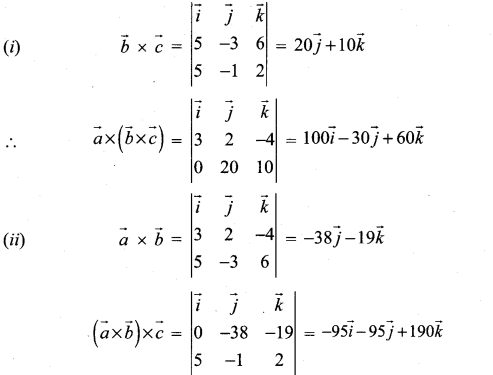
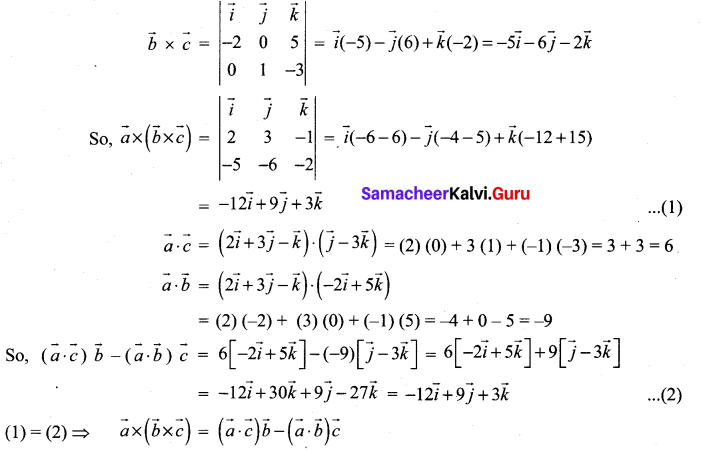
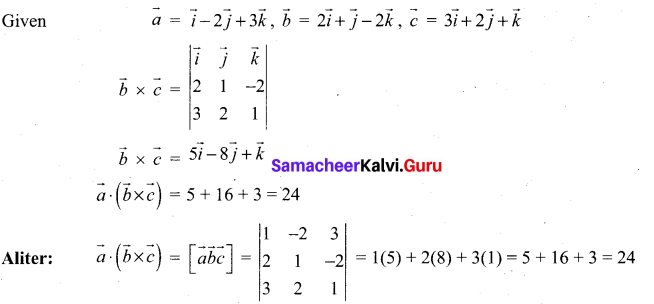
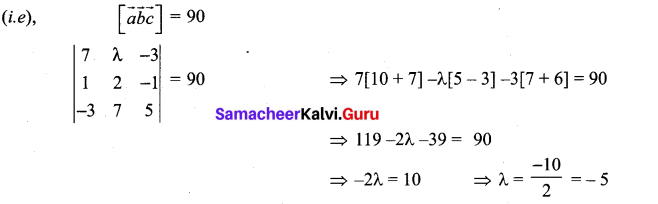
Samacheer Kalvi 12th Maths Solutions Chapter 4 Inverse Trigonometric Functions Ex 4.6

You can Download Samacheer Kalvi 12th Maths Book Solutions Guide Pdf, Tamilnadu State Board help you to revise the complete Syllabus and score more marks in your examinations.

Tamilnadu Samacheer Kalvi 12th Maths Solutions Chapter 4 Inverse Trigonometric Functions Ex 4.6

Choose the correct or the most suitable answer from the given four alternatives.
Question 1.
The value of sin-1(cos x), 0 ≤ x ≤ π is …………
(a) π – x
(b) x – \(\frac{\pi}{2}\)
(c) \(\frac{\pi}{2}\) – x
(d) π – x
Solution:
(c) \(\frac{\pi}{2}\) – x
Hint:
Samacheer Kalvi 12th Maths Solutions Chapter 4 Inverse Trigonometric Functions Ex 4.6 1

Question 2.
If sin-1 + sin-1 y = \(\frac{2 \pi}{3}\); then cos-1x + cos-1y is equal to ………….
(a) \(\frac{2 \pi}{3}\)
(b) \(\frac{\pi}{3}\)
(c) \(\frac{\pi}{6}\)
(d) π
Solution:
(b) \(\frac{\pi}{3}\)
Hint:
Samacheer Kalvi 12th Maths Solutions Chapter 4 Inverse Trigonometric Functions Ex 4.6 2

Samacheer Kalvi 12th Maths Solutions Chapter 4 Inverse Trigonometric Functions Ex 4.6

Question 3.
Samacheer Kalvi 12th Maths Solutions Chapter 4 Inverse Trigonometric Functions Ex 4.6 3 ……………
(a) 2π
(b) π
(c) 0
(d) tan-1\(\frac{12}{65}\)
Solution:
(c) 0
Hint:
Samacheer Kalvi 12th Maths Solutions Chapter 4 Inverse Trigonometric Functions Ex 4.6 4

Question 4.
If sin-1x = 2 sin-1 α has a solution, then ……………
Samacheer Kalvi 12th Maths Solutions Chapter 4 Inverse Trigonometric Functions Ex 4.6 5
Solution:
(a) |α| ≤ \(\frac{1}{\sqrt{2}}\)
Hint:
Samacheer Kalvi 12th Maths Solutions Chapter 4 Inverse Trigonometric Functions Ex 4.6 6
Samacheer Kalvi 12th Maths Solutions Chapter 4 Inverse Trigonometric Functions Ex 4.6 7

Question 5.
sin-1 (cos x) = \(\frac{\pi}{2}\) – x is valid for ……………..
(a) -π ≤ x ≤ 0
(b) 0 ≤ x ≤ π
(c) \(-\frac{\pi}{2}\) ≤ x ≤ \(\frac{\pi}{2}\)
(d) \(-\frac{\pi}{4}\) ≤ x ≤ \(\frac{3 \pi}{4}\)
Solution:
(b) 0 ≤ x ≤ π

Question 6.
If sin-1 x + sin-1 y + sin-1 z = \(\frac{3 \pi}{2}\), the value of x2017 + y2018 + z2019 – \(\frac{9}{x^{101}+y^{101}+z^{101}}\) is ……………….
(a) 0
(b) 1
(c) 2
(d) 3
Solution:
(a) 0
Hint:
The maximum value of sin-1 x is \(\frac{\pi}{2}\) and sin-1 1 = \(\frac{\pi}{2}\)
Here it is given that
sin-1 x + sin-1 y + sin-1 z = \(\frac{3 \pi}{2}\)
⇒ x = y = z = 1
and so 1 + 1 + 1 – \(\frac{9}{1+1+1}\) = 3 – 3 = 0

Question 7.
If cot-1 x = \(\frac{2 \pi}{5}\) for some x ∈ R, the value of tan-1 x is …………
(a) \(-\frac{\pi}{10}\)
(b) \(\frac{\pi}{5}\)
(c) \(\frac{\pi}{10}\)
(d) \(-\frac{\pi}{5}\)
Solution:
(c) \(\frac{\pi}{10}\)
Hint:
Samacheer Kalvi 12th Maths Solutions Chapter 4 Inverse Trigonometric Functions Ex 4.6 8

Question 8.
The domain of the function defined by f(x) = sin-1 \(\sqrt{x-1}\) is …………….
(a) [1, 2]
(b) [-1, 1]
(c) [0, 1]
(d) [-1, 0]
Solution:
(a) [1, 2]
Hint:
The domain for sin-1 x is [0, 1]
So \(\sqrt{x-1}\) = 0 ⇒ x – 1 = 0 ⇒ x = 1
\(\sqrt{x-1}\) = 1 ⇒ x – 1 = 0 ⇒ x = 2
∴ The domain is [1, 2]

Samacheer Kalvi 12th Maths Solutions Chapter 4 Inverse Trigonometric Functions Ex 4.6

Question 9.
If x = \(\frac{1}{5}\), the value of cos(cos-1 x + 2 sin-1 x) is …………….
Samacheer Kalvi 12th Maths Solutions Chapter 4 Inverse Trigonometric Functions Ex 4.6 9
Solution:
(d) \(-\frac{1}{5}\)
Hint:
Samacheer Kalvi 12th Maths Solutions Chapter 4 Inverse Trigonometric Functions Ex 4.6 10

Question 10.
\(\tan ^{-1}\left(\frac{1}{4}\right)+\tan ^{-1}\left(\frac{2}{9}\right)\) is equal to …………
Samacheer Kalvi 12th Maths Solutions Chapter 4 Inverse Trigonometric Functions Ex 4.6 11
Solution:
(d) tan-1\(\frac{1}{2}\)
Hint:
Samacheer Kalvi 12th Maths Solutions Chapter 4 Inverse Trigonometric Functions Ex 4.6 12

Question 11.
If the function f(x) = sin-1(x2 – 3), then x belongs to …………..
(a) [1, -1]
(b) [\(\sqrt{2}\), 2]
(c) \([-2,-\sqrt{2}] \cup[\sqrt{2}, 2]\)
(d) \([-2,-\sqrt{2}] \cap[\sqrt{2}, 2]\)
Solution:
(c) \([-2,-\sqrt{2}] \cup[\sqrt{2}, 2]\)
Hint:
f(x) = sin-1(x2 – 3)
Domain of sin-1 (x) is [-1, 1]
⇒ -1 ≤ x2 – 3 ≤ 1 ⇒ 2 ≤ x2 ≤ 4
⇒ \(\sqrt{2}\) ≤ x ≤ 2 ⇒ \(\sqrt{2}\) ≤ |x| ≤ 2
x ∈ \([-2,-\sqrt{2}] \cup[\sqrt{2}, 2]\)

Question 12.
If cot-1 2 and cot-1 3 are two angles of a triangle, then the third angle is …………..
Samacheer Kalvi 12th Maths Solutions Chapter 4 Inverse Trigonometric Functions Ex 4.6 13
Solution:
(b) \(\frac{3 \pi}{4}\)
Hint:
Samacheer Kalvi 12th Maths Solutions Chapter 4 Inverse Trigonometric Functions Ex 4.6 14

Question 13.
\(\sin ^{-1}\left(\tan \frac{\pi}{4}\right)-\sin ^{-1}(\sqrt{\frac{3}{x}})=\frac{\pi}{6}\). Then x is a root of the equation …………..
(a) x2 – x – 6 = 0
(b) x2 – x – 12 = 0
(c) x2 + x – 12 = 0
(d) x2 + x – 6 = 0
Solution:
(b) x2 – x – 12 = 0
Hint:
Samacheer Kalvi 12th Maths Solutions Chapter 4 Inverse Trigonometric Functions Ex 4.6 15

Question 14.
sin-1(2 cos2 x – 1) + cos-1(1 – 2 sin2 x) = ……………
Samacheer Kalvi 12th Maths Solutions Chapter 4 Inverse Trigonometric Functions Ex 4.6 16
Solution:
(a) \(\frac{\pi}{2}\)
Hint:
2 cos2x – 1 = cos 2x
1 – 2 sin2 x = cos 2x
∴ sin-1 x(cos 2x) + cos-1(cos 2x) = \(\frac{\pi}{2}\) (∵ sin-1 x + cos-1 x = \(\frac{\pi}{2}\))

Question 15.
If \(\cot ^{-1}(\sqrt{\sin \alpha})+\tan ^{-1}(\sqrt{\sin \alpha})\) = u, then cos 2u is equal to …………..
(a) tan2 α
(b) 0
(c) -1
(d) tan 2α
Solution:
(c) -1
Hint:
cot-1 x + tan-1 x = \(\frac{\pi}{2}\) ⇒ u = \(\frac{\pi}{2}\) so 2u = π
∴ cos 2u = cos π = -1

Question 16.
If |x| ≤ 1, then 2tan-1 x – sin-1 \(\frac{2 x}{1+x^{2}}\) is equal to ………….
(a) tan-1 x
(b) sin-1 x
(c) 0
(d) π
Solution:
(c) 0
Hint:
Let x = tan θ so \(\frac{2 x}{1+x^{2}}\) = sin 2θ.
Now 2 tan-1(tanθ) – sin-1(sin 2θ) = 2θ – 2θ = 0

Question 17.
The equation tan-1 x – cot-1 x = tan-1 \(\left(\frac{1}{\sqrt{3}}\right)\) has …………..
(a) no solution
(b) unique solution
(c) two solutions
(d) infinite number of solutions
Solution:
(b) unique solution
Hint:
Samacheer Kalvi 12th Maths Solutions Chapter 4 Inverse Trigonometric Functions Ex 4.6 17

Samacheer Kalvi 12th Maths Solutions Chapter 4 Inverse Trigonometric Functions Ex 4.6

Question 18.
If sin-1 x + cot-1 \(\left(\frac{1}{2}\right)=\frac{\pi}{2}\), then x is equal to …………
Samacheer Kalvi 12th Maths Solutions Chapter 4 Inverse Trigonometric Functions Ex 4.6 18
Solution:
(b) \(\frac{1}{\sqrt{5}}\)
Hint:
sin-1 x + cot-1 \(\left(\frac{1}{2}\right)=\frac{\pi}{2}\)
Samacheer Kalvi 12th Maths Solutions Chapter 4 Inverse Trigonometric Functions Ex 4.6 19

Question 19.
If sin-1\(\frac{x}{5}\) + cosec-1\(\frac{5}{4}\) = \(\frac{\pi}{2}\), then the value of x is ………
(a) 4
(b) 5
(c) 2
(d) 3
Solution:
(d) 3
Hint:
Samacheer Kalvi 12th Maths Solutions Chapter 4 Inverse Trigonometric Functions Ex 4.6 20

Question 20.
sin(tan-1), |x| < 1 is equal to ………….
Samacheer Kalvi 12th Maths Solutions Chapter 4 Inverse Trigonometric Functions Ex 4.6 21
Solution:
(d) \(\frac{x}{\sqrt{1+x^{2}}}\)
Hint:
Samacheer Kalvi 12th Maths Solutions Chapter 4 Inverse Trigonometric Functions Ex 4.6 22

Samacheer Kalvi 12th Maths Solutions Chapter 4 Inverse Trigonometric Functions Ex 4.6 Additional Questions

Question 1.
Find the principal value of Samacheer Kalvi 12th Maths Solutions Chapter 4 Inverse Trigonometric Functions Ex 4.6 1
Solution:
Samacheer Kalvi 12th Maths Solutions Chapter 4 Inverse Trigonometric Functions Ex 4.6 2

Question 2.
Find the principal value of Samacheer Kalvi 12th Maths Solutions Chapter 4 Inverse Trigonometric Functions Ex 4.6 3
Solution:
Samacheer Kalvi 12th Maths Solutions Chapter 4 Inverse Trigonometric Functions Ex 4.6 4

Question 3.
Samacheer Kalvi 12th Maths Solutions Chapter 4 Inverse Trigonometric Functions Ex 4.6 5
Solution:
Samacheer Kalvi 12th Maths Solutions Chapter 4 Inverse Trigonometric Functions Ex 4.6 6

Question 4.
Evaluate
Samacheer Kalvi 12th Maths Solutions Chapter 4 Inverse Trigonometric Functions Ex 4.6 7
Solution:
Samacheer Kalvi 12th Maths Solutions Chapter 4 Inverse Trigonometric Functions Ex 4.6 8

Samacheer Kalvi 12th Maths Solutions Chapter 4 Inverse Trigonometric Functions Ex 4.6

Question 5.
Evaluate
Samacheer Kalvi 12th Maths Solutions Chapter 4 Inverse Trigonometric Functions Ex 4.6 9
Solution:
Samacheer Kalvi 12th Maths Solutions Chapter 4 Inverse Trigonometric Functions Ex 4.6 10

Question 6.
Samacheer Kalvi 12th Maths Solutions Chapter 4 Inverse Trigonometric Functions Ex 4.6 11

Question 7.
Samacheer Kalvi 12th Maths Solutions Chapter 4 Inverse Trigonometric Functions Ex 4.6 12
Solution:
Samacheer Kalvi 12th Maths Solutions Chapter 4 Inverse Trigonometric Functions Ex 4.6 13

Question 8.
Samacheer Kalvi 12th Maths Solutions Chapter 4 Inverse Trigonometric Functions Ex 4.6 14
Solution:
x = \(\frac{1}{6}\)

Question 9.
Find the values of each of the following:
Samacheer Kalvi 12th Maths Solutions Chapter 4 Inverse Trigonometric Functions Ex 4.6 15
Solution:
Samacheer Kalvi 12th Maths Solutions Chapter 4 Inverse Trigonometric Functions Ex 4.6 16

Question 10.
Solve for x:
Samacheer Kalvi 12th Maths Solutions Chapter 4 Inverse Trigonometric Functions Ex 4.6 17
Solution:
Samacheer Kalvi 12th Maths Solutions Chapter 4 Inverse Trigonometric Functions Ex 4.6 18

Question 11.
Prove:
Samacheer Kalvi 12th Maths Solutions Chapter 4 Inverse Trigonometric Functions Ex 4.6 19

Samacheer Kalvi 12th Maths Solutions Chapter 4 Inverse Trigonometric Functions Ex 4.6

Question 12.
Evaluate: sin(tan-1 x + cot-1 x)

Question 13.
The value of sin-1(1) + sin-1(0) is …….
Samacheer Kalvi 12th Maths Solutions Chapter 4 Inverse Trigonometric Functions Ex 4.6 20
Solution:
(a) \(\frac{\pi}{2}\)
Hint:
Samacheer Kalvi 12th Maths Solutions Chapter 4 Inverse Trigonometric Functions Ex 4.6 21

Question 14.
Samacheer Kalvi 12th Maths Solutions Chapter 4 Inverse Trigonometric Functions Ex 4.6 22
Samacheer Kalvi 12th Maths Solutions Chapter 4 Inverse Trigonometric Functions Ex 4.6 23
Solution:
(d) \(\frac{\pi}{2}\)
Hint:
Samacheer Kalvi 12th Maths Solutions Chapter 4 Inverse Trigonometric Functions Ex 4.6 24

Question 15.
tan-1x + cot-1x = ……..
(a) 1
(b) – π
(c) \(\frac{\pi}{2}\)
(d) π
Solution:
(c) \(\frac{\pi}{2}\)
Hint:
Samacheer Kalvi 12th Maths Solutions Chapter 4 Inverse Trigonometric Functions Ex 4.6 25

Question 16.
Samacheer Kalvi 12th Maths Solutions Chapter 4 Inverse Trigonometric Functions Ex 4.6 26
Samacheer Kalvi 12th Maths Solutions Chapter 4 Inverse Trigonometric Functions Ex 4.6 27
Solution:
(a) \(\frac{-\pi}{2}\)
Hint:
Samacheer Kalvi 12th Maths Solutions Chapter 4 Inverse Trigonometric Functions Ex 4.6 77

Question 17.
Samacheer Kalvi 12th Maths Solutions Chapter 4 Inverse Trigonometric Functions Ex 4.6 28
Samacheer Kalvi 12th Maths Solutions Chapter 4 Inverse Trigonometric Functions Ex 4.6 29
Solution:
(b) \(\frac{\pi}{2}\)
Hint:
Samacheer Kalvi 12th Maths Solutions Chapter 4 Inverse Trigonometric Functions Ex 4.6 30

Samacheer Kalvi 12th Maths Solutions Chapter 4 Inverse Trigonometric Functions Ex 4.6

Question 18.
Samacheer Kalvi 12th Maths Solutions Chapter 4 Inverse Trigonometric Functions Ex 4.6 31
Samacheer Kalvi 12th Maths Solutions Chapter 4 Inverse Trigonometric Functions Ex 4.6 32
Solution:
(a) \(\sin ^{-1} \frac{1}{\sqrt{2}}\)
Hint:
Samacheer Kalvi 12th Maths Solutions Chapter 4 Inverse Trigonometric Functions Ex 4.6 33

Question 19.
Samacheer Kalvi 12th Maths Solutions Chapter 4 Inverse Trigonometric Functions Ex 4.6 34
Samacheer Kalvi 12th Maths Solutions Chapter 4 Inverse Trigonometric Functions Ex 4.6 35
Solution:
(d) 2π
Hint:
Samacheer Kalvi 12th Maths Solutions Chapter 4 Inverse Trigonometric Functions Ex 4.6 36

Question 20.
Samacheer Kalvi 12th Maths Solutions Chapter 4 Inverse Trigonometric Functions Ex 4.6 37
Samacheer Kalvi 12th Maths Solutions Chapter 4 Inverse Trigonometric Functions Ex 4.6 38
Solution:
(c) 2π
Hint:
Samacheer Kalvi 12th Maths Solutions Chapter 4 Inverse Trigonometric Functions Ex 4.6 39

Samacheer Kalvi 12th Maths Solutions Chapter 11 Probability Distributions Ex 11.6

You can Download Samacheer Kalvi 12th Maths Book Solutions Guide Pdf, Tamilnadu State Board help you to revise the complete Syllabus and score more marks in your examinations.

Tamilnadu Samacheer Kalvi 12th Maths Solutions Chapter 11 Probability Distributions Ex 11.6

Choose the Correct or the most suitable answer from the given four alternatives:

Question 1.
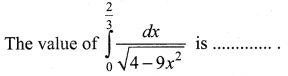
Let X be random variable with probability density function
Samacheer Kalvi 12th Maths Solutions Chapter 11 Probability Distributions Ex 11.6 1
Which of the following statement is correct
(a) both mean and variance exist
(b) mean exists but variance does not exist
(c) both mean and variance do not exist
(d) variance exists but Mean does not exist
Solution:
(b) mean exists but variance does not exist
Hint:
Samacheer Kalvi 12th Maths Solutions Chapter 11 Probability Distributions Ex 11.6 2

Question 2.
A rod of length 21 is broken into two pieces at random. The probability density function of the shorter of the two pieces is Samacheer Kalvi 12th Maths Solutions Chapter 11 Probability Distributions Ex 11.6 3 The mean and variance of the shorter of the two pieces are respectively ……..
Samacheer Kalvi 12th Maths Solutions Chapter 11 Probability Distributions Ex 11.6 33
Solution:
(d) \(\frac{l}{2}, \frac{l^{2}}{12}\)
Hint:
Samacheer Kalvi 12th Maths Solutions Chapter 11 Probability Distributions Ex 11.6 353

Samacheer Kalvi 12th Maths Solutions Chapter 11 Probability Distributions Ex 11.6

Question 3.
Consider a game where the player tosses a six-sided fair die. If the face that comes up is 6, the player wins ₹ 36, otherwise he loses ₹ k2, where k is the face that comes up k = {1, 2, 3, 4, 5}. The expected amount to win at this game in ₹ is ……..
Samacheer Kalvi 12th Maths Solutions Chapter 11 Probability Distributions Ex 11.6 4
Solution:
(b) \(-\frac{19}{6}\)
Hint:
Samacheer Kalvi 12th Maths Solutions Chapter 11 Probability Distributions Ex 11.6 5

Question 4.
A pair of dice numbered 1, 2, 3, 4, 5, 6 of a six-sided die and 1, 2, 3, 4 of a four-sided die is rolled and the sum is determined. Let the random variable X denote this sum. Then the number of elements in the inverse image of 7 is ………
(a) 1
(b) 2
(c) 3
(d) 4
Solution:
(d) 4
Hint:
Sample points to get the sum ‘7’ are (3, 4), (4, 3), (5, 2), (6, 1)
Number of elements in inverse image of 7 = 4

Question 5.
A random variable X has binomial distribution with n = 25 and p = 0.8 then standard deviation of X is ……
(a) 6
(b) 4
(c) 3
(d) 2
Solution:
(d) 2
Hint:
n = 25, p = 0.8, ∴ q = 1 – 0.8 = 0.2
Samacheer Kalvi 12th Maths Solutions Chapter 11 Probability Distributions Ex 11.6 6

Samacheer Kalvi 12th Maths Solutions Chapter 11 Probability Distributions Ex 11.6

Question 6.
Let X represent the difference between the number of heads and the number of tails obtained when a coin is tossed n times. Then the possible values of X are
(a) i + 2n, i = 0, 1, 2 … n
(b) 2i – n, i = 0, 1, 2 … n
(c) n – i, i = 0, 1, 2 … n
(d) 2i + 2n, i = 0, 1, 2 … n
Solution:
(b) 2i – n, i = 0, 1, 2 … n

Question 7.
If the function Samacheer Kalvi 12th Maths Solutions Chapter 11 Probability Distributions Ex 11.6 7 represents a probability density function of a continuous random variable X, then which of the following cannot be the value of a and b?
(a) 0 and 12
(b) 5 and 17
(c) 7 and 19
(d) 16 and 24
Solution:
(d) 16 and 24
Hint:
Samacheer Kalvi 12th Maths Solutions Chapter 11 Probability Distributions Ex 11.6 77

Question 8.
Four buses carrying 160 students from the same school arrive at a football stadium. The buses carry, respectively, 42, 36, 34, and 48 students. One of the students is randomly selected. Let X denote the number of students that were on the bus carrying the randomly selected student. One of the 4 bus drivers is also randomly selected. Let Y denote the number of students on that bus. Then E[X] and E[Y] respectively are
(a) 50, 40
(b) 40, 50
(c) 40.75, 40
(d) 41,41
Solution:
(c) 40.75, 40
Hint:
E[X] > E[Y], Since the students selected is more likely to come from the bus carrying maximum number of students whereas the drivers are equally likely to be selected.
Samacheer Kalvi 12th Maths Solutions Chapter 11 Probability Distributions Ex 11.6 8

Question 9.
Two coins are to be flipped. The first coin will land on heads with probability 0.6, the second with Probability 0.5. Assume that the results of the flips are independent, and let X equal the total number of heads that result. The value of E[X] is …..
(a) 0.11
(b) 1.1
(c) 11
(d) 1
Solution:
(b) 1.1
Hint:
P (X = 0) = P (TT)
= P (T) P (T) = (0.4) (0.5) = 0.20
P (X = 1) = P (HT) + P(TH) = (0.6) (0.5) + (0.4) (0.5) = 0.5
P (X = 2) = P (HH)
= P (H). P (H) = (0.6) (0.5) = 0.30
Samacheer Kalvi 12th Maths Solutions Chapter 11 Probability Distributions Ex 11.6 9
= (0).(0.20) + (1) (0.5) + (2) (0.30)
= 0.5 + 0.6 = 1.1

Samacheer Kalvi 12th Maths Solutions Chapter 11 Probability Distributions Ex 11.6

Question 10.
On a multiple-choice exam with 3 possible destructives for each of the 5 questions, the probability that a student will get 4 or more correct answers just by guessing is …….
Samacheer Kalvi 12th Maths Solutions Chapter 11 Probability Distributions Ex 11.6 10
Solution:
(a) \(\frac{11}{243}\)
Hint:
Samacheer Kalvi 12th Maths Solutions Chapter 11 Probability Distributions Ex 11.6 11

Question 11.
If P{X = 0} = 1 – P{X = 1}. If E[X] = 3Var(X), then P{X = 0}.
Samacheer Kalvi 12th Maths Solutions Chapter 11 Probability Distributions Ex 11.6 12
Solution:
(d) \(\frac{1}{3}\)
Hint:
Given P (X = 0) = 1 – P (X = 1) ⇒ P (X = 1) = 1 – P (X = 0)
Let n = P(X = 0), ∴ P(X = 1) = 1 -n
E(X) = (0) (n) + (1) (1 – n) = 1 – n
E(X2) = (0)2 (n) + (1)2 (1 – n) = 1 – n
Samacheer Kalvi 12th Maths Solutions Chapter 11 Probability Distributions Ex 11.6 13

Question 12.
If X is a binomial random variable with expected value 6 and variance 2.4, Then P{X = 5} is ……….
Samacheer Kalvi 12th Maths Solutions Chapter 11 Probability Distributions Ex 11.6 14
Solution:
(d) \(\left(\begin{array}{c}{10} \\ {5}\end{array}\right)\left(\frac{3}{5}\right)^{5}\left(\frac{2}{5}\right)^{5}\)
Hint:
Samacheer Kalvi 12th Maths Solutions Chapter 11 Probability Distributions Ex 11.6 15

Samacheer Kalvi 12th Maths Solutions Chapter 11 Probability Distributions Ex 11.6

Question 13.
Samacheer Kalvi 12th Maths Solutions Chapter 11 Probability Distributions Ex 11.6 16
(a) 1 and \(\frac{1}{2}\)
(b) \(\frac{1}{2}\) and 1
(c) 2 and 1
(d) 1 and 2
Solution:
(a) 1 and \(\frac{1}{2}\)
Hint:
Samacheer Kalvi 12th Maths Solutions Chapter 11 Probability Distributions Ex 11.6 17

Question 14.
Suppose that X takes on one of the values 0, 1, and 2. If for some constant k,
P(X = i) = k P(X = i – 1) for i = 1, 2 P(X = 0) = \(\frac{1}{7}\). Then the value of k is …..
(a) 1
(b) 2
(c) 3
(d) 4
Solution:
(b) 2
Hint:
P(X = i) = k P(X = i – 1) for i = 1, 2 and P(X = 0) = \(\frac{1}{7}\)
Solving the equation, we get k = 2

Question 15.
Which of the following is a discrete random variable?
I. The number of cars crossing a particular signal in a day.
II. The number of customers in a queue to buy train tickets at a moment.
III. The time taken to complete a telephone call.
(a) I and II
(b) II only
(c) III only
(d) II and III
Solution:
(a) I and II

Question 16.
If Samacheer Kalvi 12th Maths Solutions Chapter 11 Probability Distributions Ex 11.6 19 is a probability density function of a random variable, then the value of a is ……..
(a) 1
(b) 2
(c) 3
(d) 4
Solution:
(a) 1
Hint:
Samacheer Kalvi 12th Maths Solutions Chapter 11 Probability Distributions Ex 11.6 400

Samacheer Kalvi 12th Maths Solutions Chapter 11 Probability Distributions Ex 11.6

Question 17.
The probability function of a random variable is defined as ……..
Samacheer Kalvi 12th Maths Solutions Chapter 11 Probability Distributions Ex 11.6 20
Then E(X) is equal to …….
Samacheer Kalvi 12th Maths Solutions Chapter 11 Probability Distributions Ex 11.6 21
Solution:
(d) \(\frac{2}{3}\)
Hint:
Samacheer Kalvi 12th Maths Solutions Chapter 11 Probability Distributions Ex 11.6 22

Question 18.
Let X have a Bernoulli distribution with mean 0.4, then the variance of (2X – 3) is ……
(a) 0.24
(b) 0.48
(c) 0.6
(d) 0.96
Solution:
(d) 0.96
Hint:
Mean = 0.4 ⇒ µ = p = 0.4
Var (2X – 3) = 22 Var X
= 4(pq) = 4(0.4)(0.6) = 0.96

Question 19.
If in 6 trials, X is a binomial variate which follows the relation 9P(X = 4) = P(X = 2), then the probability of success is …..
(a) 0.125
(b) 0.25
(c) 0.375
(d) 0.75
Solution:
(b) 0.25
Hint:
Samacheer Kalvi 12th Maths Solutions Chapter 11 Probability Distributions Ex 11.6 23
9p2 = q2 [∵ 6C4 = 6C2]
9p2 = (1 – p)2
9p2 = 1 – 2p+ p2
8p2 + 2p – 1 = 0
(4p – 1)(2p + 1) = 0
Samacheer Kalvi 12th Maths Solutions Chapter 11 Probability Distributions Ex 11.6 24

Samacheer Kalvi 12th Maths Solutions Chapter 11 Probability Distributions Ex 11.6

Question 20.
A computer salesperson knows from his past experience that he sells computers to one in every twenty customers who enter the showroom. What is the probability that he will sell a computer to exactly two of the next three customers?
Samacheer Kalvi 12th Maths Solutions Chapter 11 Probability Distributions Ex 11.6 25
Solution:
(a) [ltaex]\frac{57}{20^{3}}[/latex]
Hint:
Samacheer Kalvi 12th Maths Solutions Chapter 11 Probability Distributions Ex 11.6 26

Samacheer Kalvi 12th Maths Solutions Chapter 11 Probability Distributions Ex 11.6 Additional Questions Solved

Choose the Correct or the most suitable answer from the given four alternatives:

Question 1.

Samacheer Kalvi 12th Maths Solutions Chapter 11 Probability Distributions Ex 11.6 27 is a probability density function then the value of k is ……..
Samacheer Kalvi 12th Maths Solutions Chapter 11 Probability Distributions Ex 11.6 28
Solution:
(c) \(\frac{1}{9}\)
Hint:
Given that f(x) is a probability density function
Samacheer Kalvi 12th Maths Solutions Chapter 11 Probability Distributions Ex 11.6 29

Samacheer Kalvi 12th Maths Solutions Chapter 11 Probability Distributions Ex 11.6

Question 2.
Samacheer Kalvi 12th Maths Solutions Chapter 11 Probability Distributions Ex 11.6 30 is a probability density function of a continuous random variable X, then the value of A is …………
(a) 16
(b) 8
(c) 4
(d) 1
Solution:
(c) 4
Hint:
Samacheer Kalvi 12th Maths Solutions Chapter 11 Probability Distributions Ex 11.6 31

Question 3.
A random variable X has the following probability mass function as follows:
Samacheer Kalvi 12th Maths Solutions Chapter 11 Probability Distributions Ex 11.6 32
Then the value of λ is ……..
(a) 1
(b) 2
(c) 3
(d) 4
Solution:
(b) 2
Hint:
Samacheer Kalvi 12th Maths Solutions Chapter 11 Probability Distributions Ex 11.6 333

Question 4.
Samacheer Kalvi 12th Maths Solutions Chapter 11 Probability Distributions Ex 11.6 34
Samacheer Kalvi 12th Maths Solutions Chapter 11 Probability Distributions Ex 11.6 35
Solution:
(b) \(\frac{24}{169}\)
Samacheer Kalvi 12th Maths Solutions Chapter 11 Probability Distributions Ex 11.6 36
Samacheer Kalvi 12th Maths Solutions Chapter 11 Probability Distributions Ex 11.6 37

Samacheer Kalvi 12th Maths Solutions Chapter 11 Probability Distributions Ex 11.6

Question 5.
Given E(x + c) = 8 and E(x – c) = 12, then the value of c is …….
(a) -2
(b) 4
(c) -4
(d) 2
Solution:
(a) -2
Hint:
E(X + c) = 8
E(X) + E(c) = 8
E(X) + c = 8 ….. (1)
E(X – c) = 12
E(X) – E(c) = 12 ⇒ E(X) – c = 12 ……… (2)
(1) – (2) ⇒ 2c = -4 = c = -2

Question 6.
X is random variable taking the values 3, 4 and 12 with probabilities \(\frac{1}{3}\), \(\frac{1}{4}\) and \(\frac{5}{12}\). Then E(X) is ……..
(a) 5
(b) 7
(c) 6
(d) 3
Solution:
(b) 7
Hint:
Samacheer Kalvi 12th Maths Solutions Chapter 11 Probability Distributions Ex 11.6 38

Question 7.
Variance of the random variable X is 4. Its mean is 2. Then E(X2) is ……..
(a) 2
(b) 4
(c) 6
(d) 8
Solution:
(d) 8
Hint:
Given, Var (X) = 4
E(X2) – [E(X)]2 = 4
E(X2) – 22 = 4 ⇒ E(X2) = 4 + 4 = 8

Question 8.
In 5 throws of a die, getting 1 or 2 is a success. The mean number of success is ……
Samacheer Kalvi 12th Maths Solutions Chapter 11 Probability Distributions Ex 11.6 39
Hint:
Given, n = 5
Samacheer Kalvi 12th Maths Solutions Chapter 11 Probability Distributions Ex 11.6 311

Samacheer Kalvi 12th Maths Solutions Chapter 11 Probability Distributions Ex 11.6

Question 9.
The mean of a binomial distribution is 5 and its standard deviation is 2. Then the value of n and p are ……..
Samacheer Kalvi 12th Maths Solutions Chapter 11 Probability Distributions Ex 11.6 322
Solution:
(d) \(\left(25, \frac{1}{5}\right)\)
Hint:
Samacheer Kalvi 12th Maths Solutions Chapter 11 Probability Distributions Ex 11.6 334

Question 10.
If the mean and standard deviation of a binomial distribution are 12 and 2 respectively. Then the value of its parameter p is ……
Samacheer Kalvi 12th Maths Solutions Chapter 11 Probability Distributions Ex 11.6 345
Solution:
(c) \(\frac{2}{3}\)
Hint:
Samacheer Kalvi 12th Maths Solutions Chapter 11 Probability Distributions Ex 11.6 355

Samacheer Kalvi 12th Maths Solutions Chapter 11 Probability Distributions Ex 11.6

Question 11.
A box contains 6 red and 4 white balls. If 3 balls are drawn at random, the probability of getting 2 white balls without replacement is ………
Samacheer Kalvi 12th Maths Solutions Chapter 11 Probability Distributions Ex 11.6 366
Solution:
(d) \(\frac{3}{10}\)
Hint:
Total number of balls = 10
Number of ways of choosing 3 balls from 10 balls = 10C3
Number of ways of choosing 2 white balls from 4 white balls = 4C3
Number of ways of choosing 1 red ball from 6 red balls = 6C1
Samacheer Kalvi 12th Maths Solutions Chapter 11 Probability Distributions Ex 11.6 377

Question 12.
If 2 cards are drawn from a well shuffled pack of 52 cards, the probability that they are of the same colours without replacement is ………
Samacheer Kalvi 12th Maths Solutions Chapter 11 Probability Distributions Ex 11.6 388
Solution:
(c) \(\frac{25}{51}\)
Hint:
Samacheer Kalvi 12th Maths Solutions Chapter 11 Probability Distributions Ex 11.6 399

Question 13.
The distribution function F(X) of a random variable X is ……..
(a) a decreasing function
(b) a non-decreasing function
(c) a constant function
(d) increasing first and then decreasing
Solution:
(b) a non-decreasing function

Samacheer Kalvi 12th Maths Solutions Chapter 10 Ordinary Differential Equations Ex 10.8

You can Download Samacheer Kalvi 12th Maths Book Solutions Guide Pdf, Tamilnadu State Board help you to revise the complete Syllabus and score more marks in your examinations.

Tamilnadu Samacheer Kalvi 12th Maths Solutions Chapter 10 Ordinary Differential Equations Ex 10.8

Question 1.
The rate of increase in the number of bacteria in a certain bacteria culture is proportional to the number present. Given that the number triples in 5 hours, find how many bacteria will be present after 10 hours?
Solution:
Let ‘P’ be the number of bacteria present at time ‘t’
Samacheer Kalvi 12th Maths Solutions Chapter 10 Ordinary Differential Equations Ex 10.8 1
log P = kt + c
P = ekt + c
P = ekt c …(1)
Initially, when t = 0, let P = P0
P0 = e° c ⇒ c = P0
Given t = 5, P = 3P0
Substituting in (1)
3 P0 = e5k. P0 ⇒ e5k = 3
Again, when t = 10
P = e10k. c
P = (e5k)2 . P0 = (3)2 P0
P = 9P0
After 10 hours, the number of bacteria is 9 times the original bacteria present.

Samacheer Kalvi 12th Maths Solutions Chapter 10 Ordinary Differential Equations Ex 10.8

Question 2.
Find the population of a city at any time t, given that the rate of increase of population is proportional to the population at that instant and that in a period of 40 years the population increased from 3,00,000 to 4,00,000.
Solution:
Let the population of a city be ’P’ at time ‘t’
Samacheer Kalvi 12th Maths Solutions Chapter 10 Ordinary Differential Equations Ex 10.8 2
Samacheer Kalvi 12th Maths Solutions Chapter 10 Ordinary Differential Equations Ex 10.8 3

Question 3.
The equation of electromotive force for an electric circuit containing resistance and self inductance is E = Ri + L \(\frac{d i}{d t}\), where E is the electromotive force is given to the circuit, R the resistance and L, the coefficient of induction. Find the current i at time t when E = 0.
Solution:
Given equation of electromotive force is
Samacheer Kalvi 12th Maths Solutions Chapter 10 Ordinary Differential Equations Ex 10.8 4
This is a Linear differential equation
Samacheer Kalvi 12th Maths Solutions Chapter 10 Ordinary Differential Equations Ex 10.8 5
Substituting in (1)
Samacheer Kalvi 12th Maths Solutions Chapter 10 Ordinary Differential Equations Ex 10.8 6

Samacheer Kalvi 12th Maths Solutions Chapter 10 Ordinary Differential Equations Ex 10.8

Question 4.
The engine of a motor boat moving at 10 m/s is shut off. Given that the retardation at any subsequent time (after shutting off the engine) equal to the velocity at that time. Find the velocity after 2 seconds of switching off the engine.
Solution:
Given, the retardation experienced by a moving motor boat after its engine is shut off is given by
Samacheer Kalvi 12th Maths Solutions Chapter 10 Ordinary Differential Equations Ex 10.8 7
Again, given t = 2 ⇒ v = 10 e2

Question 5.
Suppose a person deposits 10,000 Indian rupees in a bank account at the rate of 5% per annum compounded continuously. How much money will be in his bank account 18 months later?
Solution:
Let P be the principal
Rate of interest 5 %
Samacheer Kalvi 12th Maths Solutions Chapter 10 Ordinary Differential Equations Ex 10.8 8
Given,when t = 0,P = 10000
P = 10000 e0.05(1.5) = 10000 e0.075

Samacheer Kalvi 12th Maths Solutions Chapter 10 Ordinary Differential Equations Ex 10.8

Question 6.
Assume that the rate at which radioactive nuclei decay is proportional to the number of such nuclei that are present in a given sample. In a certain sample 10% of the original number of radioactive nuclei have undergone disintegration in a period of 100 years. What percentage of the original radioactive nuclei will remain after 1000 years?
Solution:
Let x (t) denote the number of nuclei present in a sample at anytime ‘t’
Samacheer Kalvi 12th Maths Solutions Chapter 10 Ordinary Differential Equations Ex 10.8 9
Let xo denote the number of nuclei present in the given sample at time t = 0
∴ from (1) ⇒ c = log k0
∴ x = x0ek t
Samacheer Kalvi 12th Maths Solutions Chapter 10 Ordinary Differential Equations Ex 10.8 10
∴ Required percentage after 1000 years
Samacheer Kalvi 12th Maths Solutions Chapter 10 Ordinary Differential Equations Ex 10.8 11
Samacheer Kalvi 12th Maths Solutions Chapter 10 Ordinary Differential Equations Ex 10.8 12 of radioactive element will remain after 1000 years.

Question 7.
Water at temperature 100° C cools in 10 minutes to 80° C in a room temperature of 25° C. Find
(i) The temperature of water after 20 minutes
(ii) The time when the temperature is 40° C
Samacheer Kalvi 12th Maths Solutions Chapter 10 Ordinary Differential Equations Ex 10.8 13
Solution:
Samacheer Kalvi 12th Maths Solutions Chapter 10 Ordinary Differential Equations Ex 10.8 14
Samacheer Kalvi 12th Maths Solutions Chapter 10 Ordinary Differential Equations Ex 10.8 141
Samacheer Kalvi 12th Maths Solutions Chapter 10 Ordinary Differential Equations Ex 10.8 142

Samacheer Kalvi 12th Maths Solutions Chapter 10 Ordinary Differential Equations Ex 10.8

Question 8.
At 10.00 A.M. a woman took a cup of hot instant coffee from her microwave oven placed it on a nearby Kitchen counter to cool. At this instant the temperature of the coffee was 180° F, and 10 minutes later it was 160° F . Assume that constant temperature of the kitchen was 70° F.
(i) What was the temperature of the coffee at 10.15 A.M.?
(ii) The woman likes to drink coffee when its temperature is between 130° F and 140° F. between what times should she have drunk the coffee?
Solution:
Change in Temperature is proportional to the difference in temperature (Newton’s Cooling
Law)
Samacheer Kalvi 12th Maths Solutions Chapter 10 Ordinary Differential Equations Ex 10.8 15
Samacheer Kalvi 12th Maths Solutions Chapter 10 Ordinary Differential Equations Ex 10.8 16

(ii) Substituting T = 130 and T = 140
We get t = 22.523

Question 9.
A pot of boiling water at 100° C is removed from a stove at time t = 0 and left to cool in the kitchen. After 5 minutes, the water temperature has decreased to 80° C, and another 5 minutes later it has dropped to 65° C. Determine the temperature of the kitchen.
Solution:
Let A be the temperature of the kitchen
Samacheer Kalvi 12th Maths Solutions Chapter 10 Ordinary Differential Equations Ex 10.8 18
log (A – T) = kt + c
⇒ T = A + ce-kt …. (1)
Given, T(0) = 100,
T(5) = 80,
T (10) = 65
Substituting in (1), we get
100 = A+c
80 = A + ce-5k
65 = A + ce -10k
Solving these linear equations,
We get A = 11° (Kitchen Temperature)

Samacheer Kalvi 12th Maths Solutions Chapter 10 Ordinary Differential Equations Ex 10.8

Question 10.
A tank initially contains 50 liters of pure water. Starting at time t = 0 a brine containing with 2 grams of dissolved salt per litre flows into the tank at the rate of 3 liters per minute. The mixture is kept uniform by stirring and the well-stirred mixture simultaneously flows out of the tank at the same rate. Find the amount of salt present in the tank at any time t > 0 .
Solution:
Let ‘x’ be the amount of salt present
Samacheer Kalvi 12th Maths Solutions Chapter 10 Ordinary Differential Equations Ex 10.8 19
Samacheer Kalvi 12th Maths Solutions Chapter 10 Ordinary Differential Equations Ex 10.8 20
Since the tank initially contains only pure water, the initial amount of salt is zero. i.e., x (0) = 0

Samacheer Kalvi 12th Maths Solutions Chapter 10 Ordinary Differential Equations Ex 10.8 Additional Problems

Question 1.
In a certain chemical reaction the rate of conversion of a substance at time t is proportional to the quantity of the substance still untransformed at that instant. At the end of one hour, 60 grams remain and at the end of 4 hours 21 grams. How many grams of the substance was there initially?
Solution:
Let A be the substance at time t
Samacheer Kalvi 12th Maths Solutions Chapter 10 Ordinary Differential Equations Ex 10.8 21
Initially i.e., when t = 0, A = c = 85.15 gms (app.)
Hence initially there was 85.15 gms (approximately) of the substance.

Question 2.
The temperature T of a cooling object drops at a rate proportional to the difference T – S, where S is constant temperature of surrounding medium. If initially T = 150° C, find the temperature of the cooling object at any time t.

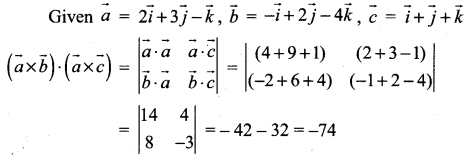
Solution:
Let T be the temperature of the cooling object at any time t
Samacheer Kalvi 12th Maths Solutions Chapter 10 Ordinary Differential Equations Ex 10.8 22
when t = 0, T = 150 ⇒ 150 = S + c ⇒ c = 150 – S
∴ The temperature of the cooling object at any time T = S + (150 – S)ekt
Note:
Since k is negative, as t increases T decreases.
It is a decay problem. Instead of k one may take – k where k > 0. Then the answer is
T = S + (150 – S) e-kt.
Again, as t increases T decreases.

Samacheer Kalvi 12th Maths Solutions Chapter 10 Ordinary Differential Equations Ex 10.8

Question 3.
The sum of Rs. 1000 is compounded continuously, the nominal rate of interest being four per cent per annum. In how many years, will the amount be twice the original principal? [loge 2 = 0.6931]
Solution:
Rate of interest = 4 %
Samacheer Kalvi 12th Maths Solutions Chapter 10 Ordinary Differential Equations Ex 10.8 23

Question 4.
A cup of coffee at temperature 100° C is placed in a room whose temperature is 15° C and it cools to 60° C in 5 minutes. Find its temperature after a further interval of 5 minutes.
Solution:
Samacheer Kalvi 12th Maths Solutions Chapter 10 Ordinary Differential Equations Ex 10.8 24
Samacheer Kalvi 12th Maths Solutions Chapter 10 Ordinary Differential Equations Ex 10.8 25

Question 5.
The rate at which the population of a city increases at any time is proportional to the population at that time. If there were 1,30,000 people in the city in 1960 and 1,60,000 in 1990, what population may be anticipated in 2020? [loge\(\left(\frac{16}{3}\right)\) = 0.2070; e-0.42 = 1.52]
Solution:
Samacheer Kalvi 12th Maths Solutions Chapter 10 Ordinary Differential Equations Ex 10.8 26
∴ P = 1,30,000; e0.007 is the population at any time ‘t’
In the year 2020, (i.e.,) when t = 60
x = 130000 × e0.42 = 1,30,000 × 1.52 = 1,97,600
So, the anticipated population in 2020 will be 1, 97, 600

Samacheer Kalvi 12th Maths Solutions Chapter 4 Inverse Trigonometric Functions Ex 4.4

You can Download Samacheer Kalvi 12th Maths Book Solutions Guide Pdf, Tamilnadu State Board help you to revise the complete Syllabus and score more marks in your examinations.

Tamilnadu Samacheer Kalvi 12th Maths Solutions Chapter 4 Inverse Trigonometric Functions Ex 4.4

Question 1.
Find the principal value of
(i) sec-1 (\(\frac{2}{\sqrt{3}}\))
(ii) cot-1(√3)
(iii) cosec-1(-√2)
Solution:
(i) Let sec-1 (\(\frac{2}{\sqrt{3}}\)) = θ
⇒ sec θ = \(\frac{2}{\sqrt{3}}\)
⇒ cos θ = \(\frac{\sqrt{3}}{2}\) = cos \(\frac{\pi}{6}\)
⇒ θ = \(\frac{\pi}{6}\)

(ii) Let cot-1(√3) = θ
⇒ cot θ = √3
⇒ tan θ = \(\frac{1}{\sqrt{3}}\) = tan \(\frac{\pi}{6}\)
⇒ θ = \(\frac{\pi}{6}\)

(iii) Let cosec-1 (-√2) = θ
⇒ cosec θ = -√2
⇒ sin θ = \(-\frac{1}{\sqrt{2}}\)
⇒ θ = \(-\frac{\pi}{4}\)

Question 2.
Find the value of
(i) tan-1(√3) – sec-1(-2)
(ii) sin-1(-1) + cos-1 (\(\frac{1}{2}\)) + cot-1(2)
(iii) cot-1(1) + sin-1(\(-\frac{\sqrt{3}}{2}\)) – sec-1(-√2)
Solution:
Samacheer Kalvi 12th Maths Solutions Chapter 4 Inverse Trigonometric Functions Ex 4.4 Q2
Samacheer Kalvi 12th Maths Solutions Chapter 4 Inverse Trigonometric Functions Ex 4.4 Q2.1

Samacheer Kalvi 12th Maths Solutions Chapter 4 Inverse Trigonometric Functions Ex 4.4

Samacheer Kalvi 12th Maths Solutions Chapter 4 Inverse Trigonometric Functions Ex 4.4 Additional Problems

Question 1.
Find the principal value of the following
Samacheer Kalvi 12th Maths Solutions Chapter 4 Inverse Trigonometric Functions Ex 4.4 1
Solution:
Samacheer Kalvi 12th Maths Solutions Chapter 4 Inverse Trigonometric Functions Ex 4.4 2
Samacheer Kalvi 12th Maths Solutions Chapter 4 Inverse Trigonometric Functions Ex 4.4 3

Samacheer Kalvi 12th Maths Solutions Chapter 4 Inverse Trigonometric Functions Ex 4.4

Question 2.
Find the value of sec2(cot-1 3) + cosec2 (tan-1 2)
Solution:
Samacheer Kalvi 12th Maths Solutions Chapter 4 Inverse Trigonometric Functions Ex 4.4 4

Question 3.
Find the value of Samacheer Kalvi 12th Maths Solutions Chapter 4 Inverse Trigonometric Functions Ex 4.4 5
Solution:
Samacheer Kalvi 12th Maths Solutions Chapter 4 Inverse Trigonometric Functions Ex 4.4 55

Samacheer Kalvi 12th Maths Solutions Chapter 4 Inverse Trigonometric Functions Ex 4.3

You can Download Samacheer Kalvi 12th Maths Book Solutions Guide Pdf, Tamilnadu State Board help you to revise the complete Syllabus and score more marks in your examinations.

Tamilnadu Samacheer Kalvi 12th Maths Solutions Chapter 4 Inverse Trigonometric Functions Ex 4.3

Question 1.
Find the domain of the following functions:
(i) \(\tan ^{-1}(\sqrt{9-x^{2}})\)
(ii) \(\frac{1}{2} \tan ^{-1}\left(1-x^{2}\right)-\frac{\pi}{4}\)
Solution:
(i) f(x) = \(\tan ^{-1}(\sqrt{9-x^{2}})\)
We know the domain of tan-1 x is (-∞, ∞) and range is \(\left(-\frac{\pi}{2}, \frac{\pi}{2}\right)\)
So, the domain of f(x) = \(\tan ^{-1}(\sqrt{9-x^{2}})\) is the set of values of x satisfying the inequality
\(-\infty \leq \sqrt{9-x^{2}} \leq \infty\)
⇒ 9 – x2 ≥ 0
⇒ x2 ≤ 9
⇒ |x| ≤ 3
Since tan x is an odd function and symmetric about the origin, tan-1 x should be an increasing function in its domain.
∴ Domain is (2n + 1)\(\frac{\pi}{2}\)
Samacheer Kalvi 12th Maths Solutions Chapter 4 Inverse Trigonometric Functions Ex 4.3 Q1
The domain of y is (-∞, ∞) {x | x ∈ -1} and range is [-1, ∞) {y | y ≥ -1}
The domain for tan-1(x2 – 1) is (2n + 1)π. Since tan x is an odd function.

Question 2.
Find the value of
(i) \(\tan ^{-1}\left(\tan \frac{5 \pi}{4}\right)\)
(ii) \(\tan ^{-1}\left(\tan \left(-\frac{\pi}{6}\right)\right)\)
Solution:
Samacheer Kalvi 12th Maths Solutions Chapter 4 Inverse Trigonometric Functions Ex 4.3 Q2

Samacheer Kalvi 12th Maths Solutions Chapter 4 Inverse Trigonometric Functions Ex 4.3

Question 3.
Find the value of
(i) \(\tan \left(\tan ^{-1} \frac{7 \pi}{4}\right)\)
(ii) tan(tan-1(1947))
(iii) tan(tan-1(-0.2021))
Solution:
We know that tan(tan-1 x) = x
(i) \(\tan \left(\tan ^{-1} \frac{7 \pi}{4}\right)=\frac{7 \pi}{4}\)
(ii) tan(tan-1(1947))= 1947
(iii) tan(tan-1 (-0.2021)) = -0.2021

Question 4.
Find the value of
(i) \(\tan \left(\cos ^{-1}\left(\frac{1}{2}\right)-\sin ^{-1}\left(-\frac{1}{2}\right)\right)\)
(ii) \(\sin \left(\tan ^{-1}\left(\frac{1}{2}\right)-\cos ^{-1}\left(\frac{4}{5}\right)\right)\)
(iii) \(\cos \left(\sin ^{-1}\left(\frac{4}{5}\right)-\tan ^{-1}\left(\frac{3}{4}\right)\right)\)
Solution:
Samacheer Kalvi 12th Maths Solutions Chapter 4 Inverse Trigonometric Functions Ex 4.3 Q4
Samacheer Kalvi 12th Maths Solutions Chapter 4 Inverse Trigonometric Functions Ex 4.3 Q4.1
Samacheer Kalvi 12th Maths Solutions Chapter 4 Inverse Trigonometric Functions Ex 4.3 Q4.2
Samacheer Kalvi 12th Maths Solutions Chapter 4 Inverse Trigonometric Functions Ex 4.3 Q4.3

Samacheer Kalvi 12th Maths Solutions Chapter 4 Inverse Trigonometric Functions Ex 4.3 Additional Problems

Question 1.
Find the principle value of: Samacheer Kalvi 12th Maths Solutions Chapter 4 Inverse Trigonometric Functions Ex 4.3 1
Solution:
Samacheer Kalvi 12th Maths Solutions Chapter 4 Inverse Trigonometric Functions Ex 4.3 2

Question 2.
Find the value of Samacheer Kalvi 12th Maths Solutions Chapter 4 Inverse Trigonometric Functions Ex 4.3 3
Solution:
Samacheer Kalvi 12th Maths Solutions Chapter 4 Inverse Trigonometric Functions Ex 4.3 33

Samacheer Kalvi 12th Maths Solutions Chapter 4 Inverse Trigonometric Functions Ex 4.3

Question 3.
Find the value of Samacheer Kalvi 12th Maths Solutions Chapter 4 Inverse Trigonometric Functions Ex 4.3 4
Solution:
Samacheer Kalvi 12th Maths Solutions Chapter 4 Inverse Trigonometric Functions Ex 4.3 34

Samacheer Kalvi 12th Maths Solutions Chapter 11 Probability Distributions Ex 11.4

You can Download Samacheer Kalvi 12th Maths Book Solutions Guide Pdf, Tamilnadu State Board help you to revise the complete Syllabus and score more marks in your examinations.

Tamilnadu Samacheer Kalvi 12th Maths Solutions Chapter 11 Probability Distributions Ex 11.4

Question 1.
For the random variable X with the given probability mass function as below, find the mean and variance
Samacheer Kalvi 12th Maths Solutions Chapter 11 Probability Distributions Ex 11.4 1
Solution:
Samacheer Kalvi 12th Maths Solutions Chapter 11 Probability Distributions Ex 11.4 2
Samacheer Kalvi 12th Maths Solutions Chapter 11 Probability Distributions Ex 11.4 3
Samacheer Kalvi 12th Maths Solutions Chapter 11 Probability Distributions Ex 11.4 4
Samacheer Kalvi 12th Maths Solutions Chapter 11 Probability Distributions Ex 11.4 5
Samacheer Kalvi 12th Maths Solutions Chapter 11 Probability Distributions Ex 11.4 6
Samacheer Kalvi 12th Maths Solutions Chapter 11 Probability Distributions Ex 11.4 7

Samacheer Kalvi 12th Maths Solutions Chapter 11 Probability Distributions Ex 11.4

Question 2.
Two balls are drawn in succession without replacement from an urn containing four red balls and three black balls. Let X be the possible outcomes drawing red balls. Find the probability mass function and mean for X.
Solution:
Number of Red balls = 4
Number of Black balls = 3
Total number of balls = 7
Given : two balls are drawn in succession without replacement.
Let ‘X’ be the number of red balls and ‘X’ can take the values 0, 1 and 2.
Samacheer Kalvi 12th Maths Solutions Chapter 11 Probability Distributions Ex 11.4 9

Question 3.
If µ and σ2 are the mean and variance of the discrete random variable X, and E (X + 3) = 10 and E(X + 3)2 = 116, find µ and σ2.
Solution:
Mean = µ,
Variance = σ2
Samacheer Kalvi 12th Maths Solutions Chapter 11 Probability Distributions Ex 11.4 10
Variance Var (X) = E (X2) — [E(X)]2
65 – 49 = 16 = σ2
∴ µ = 7 and σ2 = 16

Samacheer Kalvi 12th Maths Solutions Chapter 11 Probability Distributions Ex 11.4

Question 4.
Four fair coins are tossed once. Find the probability mass function, mean and variance for number of heads occurred.
Solution:
Let ‘X’ be the number of heads occurred when four coins are tossed once. Hence ‘X’ can take the values 0, 1, 2, 3 and 4.
When 4 coins are tossed, the sample space is,
S = {HHHH, HHHT, HHTH, HHTT, HTHH, HTHT, HTTH, HTTT, THHH, THHT, THTH, THTT, TTHH, TTHT, TTTH, TTTT}
Samacheer Kalvi 12th Maths Solutions Chapter 11 Probability Distributions Ex 11.4 11
Samacheer Kalvi 12th Maths Solutions Chapter 11 Probability Distributions Ex 11.4 12

Question 5.
A commuter train arrives punctually at a station every half hour. Each morning, a student leaves his house to the train station. Let X denote the amount of time, in minutes, that the student waits for the train from the time he reaches the train station. It is known that the p.d.f. of X is.
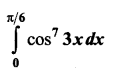
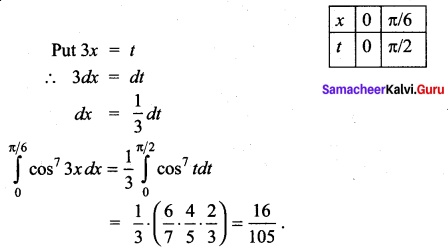
Samacheer Kalvi 12th Maths Solutions Chapter 11 Probability Distributions Ex 11.4 13
Obtain and interpret the expected value of the random variable X.
Solution:
Samacheer Kalvi 12th Maths Solutions Chapter 11 Probability Distributions Ex 11.4 14
‘X’ is a continuous random variable.
Samacheer Kalvi 12th Maths Solutions Chapter 11 Probability Distributions Ex 11.4 15

Samacheer Kalvi 12th Maths Solutions Chapter 11 Probability Distributions Ex 11.4

Question 6.
The time to failure in thousands of hours of an electronic equipment used in a manufactured computer has the density function. Samacheer Kalvi 12th Maths Solutions Chapter 11 Probability Distributions Ex 11.4 16 Find the expected life of this electronic equipment.
Solution:
Samacheer Kalvi 12th Maths Solutions Chapter 11 Probability Distributions Ex 11.4 17
Samacheer Kalvi 12th Maths Solutions Chapter 11 Probability Distributions Ex 11.4 18

Question 7.
The probability density function of the random variable X is given by Samacheer Kalvi 12th Maths Solutions Chapter 11 Probability Distributions Ex 11.4 19 Find the mean and variance of X.
Solution:
Samacheer Kalvi 12th Maths Solutions Chapter 11 Probability Distributions Ex 11.4 20
Samacheer Kalvi 12th Maths Solutions Chapter 11 Probability Distributions Ex 11.4 21
Samacheer Kalvi 12th Maths Solutions Chapter 11 Probability Distributions Ex 11.4 22

Question 8.
A lottery with 600 tickets gives one prize of ₹ 200, four prizes of ₹ 100, and six prizes of ₹ 50. If the ticket costs is ₹ 2, find the expected winning amount of a ticket.
Solution:
Given, total number of tickets = 600
Prizes to be given : One prize of Rs. 200
Four prizes of Rs. 100
Six prizes of Rs. 50
Let ‘X’ be the random variable denotes the winning amount and it can take the values 200, 100 and 50.
Samacheer Kalvi 12th Maths Solutions Chapter 11 Probability Distributions Ex 11.4 23

Samacheer Kalvi 12th Maths Solutions Chapter 11 Probability Distributions Ex 11.4

Samacheer Kalvi 12th Maths Solutions Chapter 11 Probability Distributions Ex 11.4 Additional Problems

Question 1.
The probability of success of an event is p and that of failure is q. Find the expected number of trials to get a first success.
Solution:
Let X be the random variable denoting ‘Number of trials to get a first success’. The success can occur in the 1st trial. ∴ The probability of success in the 1st trial is p. The success in the 2nd trial means failure in the 1st trial. ∴ Probability is qp.
Success in the 3rd trial means failure in the first two trials. Probability of success in the 3rd trial is q2p. As it goes on, the success may occur in the nth trial which mean the first (n – 1) trials are failures. probability = qn – 1p.
∴ The probability distribution is as follows
Samacheer Kalvi 12th Maths Solutions Chapter 11 Probability Distributions Ex 11.4 24

Question 2.
An urn contains 4 white and 3 Red balls. Find the probability distribution of the number of red balls in three draws when a ball is drawn at random with replacement. Also find its mean and variance.
Solution:
The required probability distribution is
Samacheer Kalvi 12th Maths Solutions Chapter 11 Probability Distributions Ex 11.4 25
Samacheer Kalvi 12th Maths Solutions Chapter 11 Probability Distributions Ex 11.4 26

Question 3.
Find the mean and variance of the distribution Samacheer Kalvi 12th Maths Solutions Chapter 11 Probability Distributions Ex 11.4 30
Solution:
Samacheer Kalvi 12th Maths Solutions Chapter 11 Probability Distributions Ex 11.4 31

Samacheer Kalvi 12th Maths Solutions Chapter 11 Probability Distributions Ex 11.4

Question 4.
Two cards are drawn with replacement from a well shuffled deck of 52 cards. Find the mean and variance for the number of aces.
Solution:
n (S) = 52
Number of aces = n (A) = 4
Samacheer Kalvi 12th Maths Solutions Chapter 11 Probability Distributions Ex 11.4 28
Samacheer Kalvi 12th Maths Solutions Chapter 11 Probability Distributions Ex 11.4 29

Samacheer Kalvi 12th Maths Solutions Chapter 11 Probability Distributions Ex 11.3

You can Download Samacheer Kalvi 12th Maths Book Solutions Guide Pdf, Tamilnadu State Board help you to revise the complete Syllabus and score more marks in your examinations.

Tamilnadu Samacheer Kalvi 12th Maths Solutions Chapter 11 Probability Distributions Ex 11.3

Question 1.
The probability density function of X is given by Samacheer Kalvi 12th Maths Solutions Chapter 11 Probability Distributions Ex 11.3 111 Find the value of k.
Solution:
Samacheer Kalvi 12th Maths Solutions Chapter 11 Probability Distributions Ex 11.3 1

Question 2.
Samacheer Kalvi 12th Maths Solutions Chapter 11 Probability Distributions Ex 11.3 2
Solution:
Samacheer Kalvi 12th Maths Solutions Chapter 11 Probability Distributions Ex 11.3 3
Samacheer Kalvi 12th Maths Solutions Chapter 11 Probability Distributions Ex 11.3 4

Samacheer Kalvi 12th Maths Solutions Chapter 11 Probability Distributions Ex 11.3

Question 3.
Suppose the amount of milk sold daily at a milk booth is distributed with a minimum of 200 litres and a maximum of 600 litres with probability density function
Samacheer Kalvi 12th Maths Solutions Chapter 11 Probability Distributions Ex 11.3 16
Find (i) the value of k
(ii) the distribution function
(iii) the probability that daily sales will fall between 300 litres and 500 litres?
Solution:
Samacheer Kalvi 12th Maths Solutions Chapter 11 Probability Distributions Ex 11.3 7
Samacheer Kalvi 12th Maths Solutions Chapter 11 Probability Distributions Ex 11.3 8

Question 4.
Samacheer Kalvi 12th Maths Solutions Chapter 11 Probability Distributions Ex 11.3 9
Solution:
Samacheer Kalvi 12th Maths Solutions Chapter 11 Probability Distributions Ex 11.3 10
Samacheer Kalvi 12th Maths Solutions Chapter 11 Probability Distributions Ex 11.3 11
Samacheer Kalvi 12th Maths Solutions Chapter 11 Probability Distributions Ex 11.3 12

Samacheer Kalvi 12th Maths Solutions Chapter 11 Probability Distributions Ex 11.3

Question 5.
If X is a random variable with probability density function f(x) given by,
Samacheer Kalvi 12th Maths Solutions Chapter 11 Probability Distributions Ex 11.3 13
Solution:
Samacheer Kalvi 12th Maths Solutions Chapter 11 Probability Distributions Ex 11.3 14
Samacheer Kalvi 12th Maths Solutions Chapter 11 Probability Distributions Ex 11.3 5

Question 6.
If X is the random variable with probability density function F(x) given by,
Samacheer Kalvi 12th Maths Solutions Chapter 11 Probability Distributions Ex 11.3 17 then find (i) the distribution function f(x)
(ii) P(0.3 ≤ X ≤ 0.6)
Solution:
Samacheer Kalvi 12th Maths Solutions Chapter 11 Probability Distributions Ex 11.3 18

Samacheer Kalvi 12th Maths Solutions Chapter 11 Probability Distributions Ex 11.3 Additional Problems

Question 1.
Samacheer Kalvi 12th Maths Solutions Chapter 11 Probability Distributions Ex 11.3 19
Solution:
Samacheer Kalvi 12th Maths Solutions Chapter 11 Probability Distributions Ex 11.3 20

Samacheer Kalvi 12th Maths Solutions Chapter 11 Probability Distributions Ex 11.3

Question 2.
Samacheer Kalvi 12th Maths Solutions Chapter 11 Probability Distributions Ex 11.3 21
Solution:
Samacheer Kalvi 12th Maths Solutions Chapter 11 Probability Distributions Ex 11.3 22
Samacheer Kalvi 12th Maths Solutions Chapter 11 Probability Distributions Ex 11.3 23
Samacheer Kalvi 12th Maths Solutions Chapter 11 Probability Distributions Ex 11.3 24

Question 3.
The probability density function of a random variable x is Samacheer Kalvi 12th Maths Solutions Chapter 11 Probability Distributions Ex 11.3 25 Find
(i) k;
(ii) P(X > 10)
Solution:
Samacheer Kalvi 12th Maths Solutions Chapter 11 Probability Distributions Ex 11.3 255
Samacheer Kalvi 12th Maths Solutions Chapter 11 Probability Distributions Ex 11.3 26

Samacheer Kalvi 12th Maths Solutions Chapter 11 Probability Distributions Ex 11.3

Question 4.
A continuous random variable x has the p.d.f. defined by Samacheer Kalvi 12th Maths Solutions Chapter 11 Probability Distributions Ex 11.3 27 find the value of C if a > 0.
Solution:
Samacheer Kalvi 12th Maths Solutions Chapter 11 Probability Distributions Ex 11.3 277

Samacheer Kalvi 12th Maths Solutions Chapter 11 Probability Distributions Ex 11.2

You can Download Samacheer Kalvi 12th Maths Book Solutions Guide Pdf, Tamilnadu State Board help you to revise the complete Syllabus and score more marks in your examinations.

Tamilnadu Samacheer Kalvi 12th Maths Solutions Chapter 11 Probability Distributions Ex 11.2

Question 1.
Three fair coins are tossed simultaneously. Find the probability mass function for number of heads occurred.
Solution:
When three coins are tossed, the sample space is
S = {HHH, HHT, HTH, HTT, THH, THT, TTH, TTT}
‘X’ is the random variable denotes the number of heads.
∴ ‘X’ can take the values of 0, 1, 2 and 3
Hence, the probabilities
Samacheer Kalvi 12th Maths Solutions Chapter 11 Probability Distributions Ex 11.2 1

Question 2.
A six sided die is marked ‘1’ on one face, ‘3’ on two of its faces, and ‘5’ on remaining three faces. The die is thrown twice. If X denotes the total score in two throws, find
(i) the probability mass function
(ii) the cumulative distribution function
(iii) P(4 ≤ X < 10)
(iv) P( X ≥ 6)
Solution:
Given that die is marked ‘ 1 ’ on one face, ‘3’ on two of its faces and ‘5’ on remaining three faces. i.e., {1, 3, 3, 5, 5, 5} in a single die.
When it is thrown twice, the number of sample points is 36, in which the sum of faces numbers are 2, ,4, 6, 8 and 10 are the value of random variable ‘X’.
Samacheer Kalvi 12th Maths Solutions Chapter 11 Probability Distributions Ex 11.2 2

Samacheer Kalvi 12th Maths Solutions Chapter 11 Probability Distributions Ex 11.2

(i) Probability mass function:
Samacheer Kalvi 12th Maths Solutions Chapter 11 Probability Distributions Ex 11.2 3

(ii) The Cumulative distribution function:
Samacheer Kalvi 12th Maths Solutions Chapter 11 Probability Distributions Ex 11.2 4

(iii) (4 ≤ 10) = P(X = 4) + P(X = 6) + P(X = 8)
Samacheer Kalvi 12th Maths Solutions Chapter 11 Probability Distributions Ex 11.2 5

(iv) P(X ≥ 6) = P (X = 6) + P (X = 8) + P (X = 10)
Samacheer Kalvi 12th Maths Solutions Chapter 11 Probability Distributions Ex 11.2 6

Question 3.
Find the probability mass function and cumulative distribution function of number of girl child in families with 4 children, assuming equal probabilities for boys and girls.
Solution:
Let ‘X’ be the random variable which denotes the number of girl children in the family of 4 children and X takes the values of 0, 1, 2, 3, 4.
Probability of child being a boy = P (B) = \(\frac{1}{2}\)
Probability of child being a girl = P (G) = \(\frac{1}{2}\)
Samacheer Kalvi 12th Maths Solutions Chapter 11 Probability Distributions Ex 11.2 7
Samacheer Kalvi 12th Maths Solutions Chapter 11 Probability Distributions Ex 11.2 77

Question 4.
Samacheer Kalvi 12th Maths Solutions Chapter 11 Probability Distributions Ex 11.2 8
Find
(i) the value of k
(ii) cumulative distribution function
(iii) P(X ≥ 1).
Solution:
Samacheer Kalvi 12th Maths Solutions Chapter 11 Probability Distributions Ex 11.2 9

Question 5.
The cumulative distribution function of a discrete random variable is given by
Samacheer Kalvi 12th Maths Solutions Chapter 11 Probability Distributions Ex 11.2 10
Find the (i) the probability mass function
(ii) P(X < 1)
(iii) P(X ≥ 2)
Solution:
Samacheer Kalvi 12th Maths Solutions Chapter 11 Probability Distributions Ex 11.2 11
For x = -1, f(x) = 0.15 – 0 = 0.15
For x = 0, f(x) = 0.35 – 0.15 = 0.20
For x = 1, f(x) = 0.60 – 0.35 = 0.25
For x = 2, f(x) = 0.85 – 0.60 = 0.25
For x = 3, f(x) = 1 – 0.85 = 0.15
(i) Probability mass function table
Samacheer Kalvi 12th Maths Solutions Chapter 11 Probability Distributions Ex 11.2 12
(ii) P (X < 1) = P(X = -1) + P(X = 0) = 0.15 + 0.20 = 0.35
(iii) P (X ≥ 2) = P (X = 2) + P (X = 3) = 0.25 + 0.15 = 0.40

Samacheer Kalvi 12th Maths Solutions Chapter 11 Probability Distributions Ex 11.2

Question 6.
A random variable X has the following probability mass function.
Samacheer Kalvi 12th Maths Solutions Chapter 11 Probability Distributions Ex 11.2 13
Solution:
Given probability mass function
Samacheer Kalvi 12th Maths Solutions Chapter 11 Probability Distributions Ex 11.2 14
(i) We know that \(\Sigma P_{i}\) = 1
i.e., k2 + 2k2 + 3k2 + 2k + 3k = 1
6k2 + 5k = 1
6k2 + 5k – 1 = 0
(k + 1) (6k – 1) = 0
Samacheer Kalvi 12th Maths Solutions Chapter 11 Probability Distributions Ex 11.2 16

(ii) P (2 ≤ X < 5)
= P (X = 2) + P (X = 3) + P (X = 4)
= 2k2 + 3k2 + 2k = 5k2 + 2k
Samacheer Kalvi 12th Maths Solutions Chapter 11 Probability Distributions Ex 11.2 165

(iii) P (3 < X) = P (X > 3)
= P (X = 4) + P (X = 5) = 2k + 3k = 5k = 5/6

Question 7.
The cumulative distribution function of a discrete random variable is given by.
Samacheer Kalvi 12th Maths Solutions Chapter 11 Probability Distributions Ex 11.2 18
Find (i) the probability mass function
(ii) P(X < 3) and
(iii) P(X ≥ 2).
Solution:
Samacheer Kalvi 12th Maths Solutions Chapter 11 Probability Distributions Ex 11.2 19
Samacheer Kalvi 12th Maths Solutions Chapter 11 Probability Distributions Ex 11.2 20

Samacheer Kalvi 12th Maths Solutions Chapter 11 Probability Distributions Ex 11.2

Samacheer Kalvi 12th Maths Solutions Chapter 11 Probability Distributions Ex 11.2 Additional Problems

Question 1.
Find the probability mass function, and the cumulative distribution function for getting ‘3’s when two dice are thrown.
Solution:
Two dice are thrown. Let X be the random variable of getting number of ‘3’s.
Samacheer Kalvi 12th Maths Solutions Chapter 11 Probability Distributions Ex 11.2 21
Cumulative distribution function:
Samacheer Kalvi 12th Maths Solutions Chapter 11 Probability Distributions Ex 11.2 22

Question 2.
Samacheer Kalvi 12th Maths Solutions Chapter 11 Probability Distributions Ex 11.2 23

Solution:
Samacheer Kalvi 12th Maths Solutions Chapter 11 Probability Distributions Ex 11.2 24

Question 3.
Samacheer Kalvi 12th Maths Solutions Chapter 11 Probability Distributions Ex 11.2 25
Solution:
Samacheer Kalvi 12th Maths Solutions Chapter 11 Probability Distributions Ex 11.2 26

Samacheer Kalvi 12th Maths Solutions Chapter 11 Probability Distributions Ex 11.2

Question 4.
Samacheer Kalvi 12th Maths Solutions Chapter 11 Probability Distributions Ex 11.2 28
(i) P(0.5 < X < 0.75)
(ii) P(X ≤ 0.5)
(iii) P(X > 0.75)
Solution:
Samacheer Kalvi 12th Maths Solutions Chapter 11 Probability Distributions Ex 11.2 288

Question 5.
Samacheer Kalvi 12th Maths Solutions Chapter 11 Probability Distributions Ex 11.2 29
Solution:
Samacheer Kalvi 12th Maths Solutions Chapter 11 Probability Distributions Ex 11.2 30

Samacheer Kalvi 12th Maths Solutions Chapter 11 Probability Distributions Ex 11.1

You can Download Samacheer Kalvi 12th Maths Book Solutions Guide Pdf, Tamilnadu State Board help you to revise the complete Syllabus and score more marks in your examinations.

Tamilnadu Samacheer Kalvi 12th Maths Solutions Chapter 11 Probability Distributions Ex 11.1

Question 1.
Suppose X is the number of tails occurred when three fair coins are tossed once simultaneously. Find the values of the random variable X and number of points in its inverse images.
Solution:
Let X is the random variable denotes the number of tails when three coins are tossed simultaneously.
Sample space S = {HHH, HHT, HTH, HTT, THH, THT, TTH, TTT}
∴ ‘X’ takes the values 0,1, 2, 3
i.e., X (HHH) = 0 ; X (HHT, HTH, THH) = 1 ; X (HTT, THT, TTH) = 2 ; X (TTT) = 3
Samacheer Kalvi 12th Maths Solutions Chapter 11 Probability Distributions Ex 11.1 1

Question 2.
In a pack of 52 playing cards, two cards are drawn at random simultaneously. If the number of black cards drawn is a random variable, find the values of the random variable and number of points in its inverse images.
Solution:
Total number of playing cards = 52
Number of Black cards = 26
Number of Non-black (or) Red cards = 26
Let ‘X’ be the random variable denotes the number of black cards. Since two black cards are drawn,’X’ takes the values 0, 1, 2
X (Non-black Cards) = X (26C1 × 25C1) = X (650) = 0
X (1 Black Card) = X (26C1 × 26C0) = X (26) = 1
X (2 Black Cards) = X (26C1 × 25C1) = X (650) = 2
Samacheer Kalvi 12th Maths Solutions Chapter 11 Probability Distributions Ex 11.1 2

Samacheer Kalvi 12th Maths Solutions Chapter 11 Probability Distributions Ex 11.1

Question 3.
An urn contains 5 mangoes and 4 apples. Three fruits are taken at random. If the number of apples taken is a random variable, then find the values of the random variable and number of points in its inverse images.
Solution:
Number of mangoes = 5
Number of Apples = 4
Total number of fruits = 9
Let ‘X’ be the random variable denotes the number of apples taken, then it takes the values 0, 1, 2, 3
X (MMM) = 0
X (AMM (or) MAM (or) MMA) = 1
X (AAM (or) AMA (or) MAA) = 2
X (AAA) = 3
Samacheer Kalvi 12th Maths Solutions Chapter 11 Probability Distributions Ex 11.1 3

Question 4.
Two balls are chosen randomly from an urn containing 6 red and 8 black balls. Suppose that we win ₹ 15 for each red ball selected and we lose ₹ 10 for each black ball selected. X denotes the winning amount, then find the values of X and number of points in its inverse images.
Solution:
Number of red balls = 6
Number of black balls = 8
‘X’ is the random variable denotes the winning amount.
∴ The values of ‘X’ are 0, 15, 30
i.e., X (BB) = 0
X (RB) = 15 + 0 = 15
X (RR) = 15 + 15 = 30
Samacheer Kalvi 12th Maths Solutions Chapter 11 Probability Distributions Ex 11.1 4

Question 5.
A six sided die is marked ‘2’ on one face, ‘3’ on two of its faces, and ‘4’ on remaining three faces. The die is thrown twice. If X denotes the total score in two throws, find the values of the random variable and number of points in its inverse images.
Solution:
Six sided die marked ‘2’ on one face, ‘3’ on two faces and ‘4’ on three faces.
When it is thrown twice, we get 36 sample points.
‘X’ denotes sum of the face numbers and the possible values of ‘X’ are 4, 5, 6, 7 and 8
For X = 4, the sample point is (2, 2)
For X = 5, the sample points are (2, 3), (3, 2)
For X = 6, the sample points are (3, 3), (2, 4), (4, 2)
For X = 7, the sample points are (3, 4), (4, 3)
For X = 8, the sample point is (4, 4)
Samacheer Kalvi 12th Maths Solutions Chapter 11 Probability Distributions Ex 11.1 5

Samacheer Kalvi 12th Maths Solutions Chapter 11 Probability Distributions Ex 11.1

Samacheer Kalvi 12th Maths Solutions Chapter 11 Probability Distributions Ex 11.1 Additional Problems

Question 1.
Four defective oranges are accidentally mixed with sixteen good ones. Two oranges are drawn at random from the mixed lot. If the random variable ‘X’ denotes the number of defective oranges, then find the values of ‘X’ and number of points in its inverse image.
Solution:
Number of good oranges = 16
Number of bad oranges = 4
Total = 20
Let ‘X’ be the random variable denotes the number of bad oranges and it can take the values 0, 1, 2
X (GG) = 0
X (GB (or) BG) = 1
X (BB) = 2
Samacheer Kalvi 12th Maths Solutions Chapter 11 Probability Distributions Ex 11.1 6

Samacheer Kalvi 12th Maths Solutions Chapter 10 Ordinary Differential Equations Ex 10.9

You can Download Samacheer Kalvi 12th Maths Book Solutions Guide Pdf, Tamilnadu State Board help you to revise the complete Syllabus and score more marks in your examinations.

Tamilnadu Samacheer Kalvi 12th Maths Solutions Chapter 10 Ordinary Differential Equations Ex 10.9

Choose the correct or the most suitable answer from the given four alternatives:

Question 1.
The order and degree of the differential equation Samacheer Kalvi 12th Maths Solutions Chapter 10 Ordinary Differential Equations Ex 10.9 1 are respectively ………
(a) 2, 3
(b) 3, 3
(c) 2, 6
(d) 2, 4
Solution:
(a) 2, 3
Hint:
Samacheer Kalvi 12th Maths Solutions Chapter 10 Ordinary Differential Equations Ex 10.9 121
Order = 2,
degree = 3

Question 2.
The differential equation representing the family of curves y = A cos (x + B), where A and B
are parameters, is …….
Samacheer Kalvi 12th Maths Solutions Chapter 10 Ordinary Differential Equations Ex 10.9 2
Solution:
(b) \(\frac{d^{2} y}{d x^{2}}+y=0\)
Hint:
Samacheer Kalvi 12th Maths Solutions Chapter 10 Ordinary Differential Equations Ex 10.9 3

Samacheer Kalvi 12th Maths Solutions Chapter 10 Ordinary Differential Equations Ex 10.9

Question 3.
The order and degree of the differential equation Samacheer Kalvi 12th Maths Solutions Chapter 10 Ordinary Differential Equations Ex 10.9 513 is …..
(a) 1, 2
(b) 2, 2
(c) 1, 1
(d) 2, 1
Solution:
(c) 1, 1
Hint:
Samacheer Kalvi 12th Maths Solutions Chapter 10 Ordinary Differential Equations Ex 10.9 514
Since, the first order derivatives are involved, Order = 1 and degree 1.

Question 4.
The order of the differential equation of all circles with centre at (h, k) and radius ‘a’ is …….
(a) 2
(b) 3
(c) 4
(d) 1
Solution:
(a) 2
Hint:
Equation of circle is (x – h)2 + (y – k)2 = a2
Equation is to be differentiated twice as two parameters are given.
∴ Order = 2

Question 5.
The differential equation of the family of curves y = Aex + Be-x, where A and B are arbitrary constants is ……
Samacheer Kalvi 12th Maths Solutions Chapter 10 Ordinary Differential Equations Ex 10.9 5
Solution:
\(\frac{d^{2} y}{d x^{2}}-y=0\)
Hint:
Samacheer Kalvi 12th Maths Solutions Chapter 10 Ordinary Differential Equations Ex 10.9 6

Question 6.
The general solution of the differential equation Samacheer Kalvi 12th Maths Solutions Chapter 10 Ordinary Differential Equations Ex 10.9 7 is …..
(a) xy = k
(b) y = k log x
(c) y = kx
(d) log y = kx
Solution:
(c) y = kx

Samacheer Kalvi 12th Maths Solutions Chapter 10 Ordinary Differential Equations Ex 10.9

Question 7.
The solution of the differential equation Samacheer Kalvi 12th Maths Solutions Chapter 10 Ordinary Differential Equations Ex 10.9 8 represents ……..
(a) straight lines
(b) circles
(c) parabola
(d) ellipse
Solution:
(c) parabola
Hint:
Samacheer Kalvi 12th Maths Solutions Chapter 10 Ordinary Differential Equations Ex 10.9 9

SamacheerKalvi.Guru

Question 8.
The solution of Samacheer Kalvi 12th Maths Solutions Chapter 10 Ordinary Differential Equations Ex 10.9 10 is …….
Samacheer Kalvi 12th Maths Solutions Chapter 10 Ordinary Differential Equations Ex 10.9 100
Solution:
(b) \(y=c e^{-\int \mathbf{P} d x}\)
Hint:
Samacheer Kalvi 12th Maths Solutions Chapter 10 Ordinary Differential Equations Ex 10.9 11
Samacheer Kalvi 12th Maths Solutions Chapter 10 Ordinary Differential Equations Ex 10.9 12

Question 9.
The integrating factor of the differential equation Samacheer Kalvi 12th Maths Solutions Chapter 10 Ordinary Differential Equations Ex 10.9 13 is …….
Samacheer Kalvi 12th Maths Solutions Chapter 10 Ordinary Differential Equations Ex 10.9 133
Solution:
(b) \(\frac{e^{x}}{x}\)
Hint:
Samacheer Kalvi 12th Maths Solutions Chapter 10 Ordinary Differential Equations Ex 10.9 14

Samacheer Kalvi 12th Maths Solutions Chapter 10 Ordinary Differential Equations Ex 10.9

Question 10.
The integrating factor of the differential equation Samacheer Kalvi 12th Maths Solutions Chapter 10 Ordinary Differential Equations Ex 10.9 15 is x, then P(x) …………
Samacheer Kalvi 12th Maths Solutions Chapter 10 Ordinary Differential Equations Ex 10.9 155
Hint:
Samacheer Kalvi 12th Maths Solutions Chapter 10 Ordinary Differential Equations Ex 10.9 515

Question 11.
The degree of the dififerential equation Samacheer Kalvi 12th Maths Solutions Chapter 10 Ordinary Differential Equations Ex 10.9 516 is ……..
(a) 2
(b) 3
(c) 1
(d) 4
Solution:
(c) 1
Hint:
Degree = 1

Question 12.
If p and q are the order and degree of the differential equation Samacheer Kalvi 12th Maths Solutions Chapter 10 Ordinary Differential Equations Ex 10.9 517 when …..
(a) p < q
(b) p = q
(c) p > q
(d) p exists and q does not exist
Solution:
(c) p > q
Hint:
Samacheer Kalvi 12th Maths Solutions Chapter 10 Ordinary Differential Equations Ex 10.9 177

Question 13.
The solution of the differential equation Samacheer Kalvi 12th Maths Solutions Chapter 10 Ordinary Differential Equations Ex 10.9 18 is …….
Samacheer Kalvi 12th Maths Solutions Chapter 10 Ordinary Differential Equations Ex 10.9 188
Solution:
(a) \(y+\sin ^{-1} x=c\)
Hint:
Samacheer Kalvi 12th Maths Solutions Chapter 10 Ordinary Differential Equations Ex 10.9 19

Question 14.
The solution of the differential equation \(\frac{d y}{d x}=2 x y\) is ………
Samacheer Kalvi 12th Maths Solutions Chapter 10 Ordinary Differential Equations Ex 10.9 518
Solution:
(a) \(y=c e^{x^{2}}\)
Hint:
Samacheer Kalvi 12th Maths Solutions Chapter 10 Ordinary Differential Equations Ex 10.9 21

Question 15.
The general solution of the differential equation Samacheer Kalvi 12th Maths Solutions Chapter 10 Ordinary Differential Equations Ex 10.9 22 is ……
Samacheer Kalvi 12th Maths Solutions Chapter 10 Ordinary Differential Equations Ex 10.9 222
Solution:
(b) \(e^{x}+e^{-y}=c\)
Hint:
Samacheer Kalvi 12th Maths Solutions Chapter 10 Ordinary Differential Equations Ex 10.9 23

Samacheer Kalvi 12th Maths Solutions Chapter 10 Ordinary Differential Equations Ex 10.9

Question 16.
Samacheer Kalvi 12th Maths Solutions Chapter 10 Ordinary Differential Equations Ex 10.9 24
Solution:
(c) \(\frac{1}{2^{x}}-\frac{1}{2^{y}}=c\)
Hint:
Samacheer Kalvi 12th Maths Solutions Chapter 10 Ordinary Differential Equations Ex 10.9 25

Question 17.
The solution of the differential equation Samacheer Kalvi 12th Maths Solutions Chapter 10 Ordinary Differential Equations Ex 10.9 26 is ……..
Samacheer Kalvi 12th Maths Solutions Chapter 10 Ordinary Differential Equations Ex 10.9 266
Solution:
(b) \(\phi\left(\frac{y}{x}\right)=k x\)
Hint:
Samacheer Kalvi 12th Maths Solutions Chapter 10 Ordinary Differential Equations Ex 10.9 27

Question 18.
If sin x is the integrating factor of the linear differential equation Samacheer Kalvi 12th Maths Solutions Chapter 10 Ordinary Differential Equations Ex 10.9 28, then P is ……
(a) log sin x
(b) cos x
(c) tan x
(d) cot x
Solution:
(d) cot x
Hint:
Samacheer Kalvi 12th Maths Solutions Chapter 10 Ordinary Differential Equations Ex 10.9 29

Question 19.
The number of arbitrary constants in the general solutions of order n and n + 1 are respectively ……….
(a) n – 1, n
(b) n, n + 1
(c) n + 1, n + 2
(d) n + 1, n
Solution:
(b) n, n + 1

Question 20.
The number of arbitrary constants in the particular solution of a differential equation of third order is ………….
(a) 3
(b) 2
(c) 1
(d) 0
Solution:
(d) 0

Samacheer Kalvi 12th Maths Solutions Chapter 10 Ordinary Differential Equations Ex 10.9

Question 21.
Integrating factor of the differential equation Samacheer Kalvi 12th Maths Solutions Chapter 10 Ordinary Differential Equations Ex 10.9 299 is ……..
Samacheer Kalvi 12th Maths Solutions Chapter 10 Ordinary Differential Equations Ex 10.9 291
Solution:
(a) \(\frac{1}{x+1}\)
Hint:
Samacheer Kalvi 12th Maths Solutions Chapter 10 Ordinary Differential Equations Ex 10.9 30
Samacheer Kalvi 12th Maths Solutions Chapter 10 Ordinary Differential Equations Ex 10.9 31

Question 22.
The population P in any year t is such that the rate of increase in the population is proportional to the population. Then ……
Samacheer Kalvi 12th Maths Solutions Chapter 10 Ordinary Differential Equations Ex 10.9 32
Solution:
(a) \(\mathbf{P}=c e^{k t}\)
Hint:
Samacheer Kalvi 12th Maths Solutions Chapter 10 Ordinary Differential Equations Ex 10.9 33

Question 23.
P is the amount of certain substance left in after time t. If the rate of evaporation of the substance is proportional to the amount remaining, then ……
(a) P = cekt
(b) P = ce-kt
(c) P = ckt
(d) Pt = c
Solution:
(b) P = ce-kt
Hint:
Samacheer Kalvi 12th Maths Solutions Chapter 10 Ordinary Differential Equations Ex 10.9 34

Question 24.
Samacheer Kalvi 12th Maths Solutions Chapter 10 Ordinary Differential Equations Ex 10.9 35
(a) 2
(b) -2
(c )1
(d) -1
Solution:
(b) -2
Hint:
Samacheer Kalvi 12th Maths Solutions Chapter 10 Ordinary Differential Equations Ex 10.9 36

Samacheer Kalvi 12th Maths Solutions Chapter 10 Ordinary Differential Equations Ex 10.9

Question 25.
The slope at any point of a curve y =f (x) is given by Samacheer Kalvi 12th Maths Solutions Chapter 10 Ordinary Differential Equations Ex 10.9 37 and it passes through (-1, 1). Then the equation of the curve is ……..
(a) y = x3 + 2
(b) y = 3x2 + 4
(c) y = 3x3 + 4
(d) y = x3 + 5
Solution:
(a) y = x3 + 2
Hint:
Samacheer Kalvi 12th Maths Solutions Chapter 10 Ordinary Differential Equations Ex 10.9 377
Samacheer Kalvi 12th Maths Solutions Chapter 10 Ordinary Differential Equations Ex 10.9 38

Samacheer Kalvi 12th Maths Solutions Chapter 10 Ordinary Differential Equations Ex 10.9 Additional Problems

Choose the correct or the most suitable answer from the given four alternatives:

Question 1.
The integrating factor of Samacheer Kalvi 12th Maths Solutions Chapter 10 Ordinary Differential Equations Ex 10.9 39 is ………
(a) log x
(b) x2
(c) ex
(d) x
Solution:
(b) x2
Hint:
Samacheer Kalvi 12th Maths Solutions Chapter 10 Ordinary Differential Equations Ex 10.9 40

Question 2.
If cos x is an integrating factor of the differential equation Samacheer Kalvi 12th Maths Solutions Chapter 10 Ordinary Differential Equations Ex 10.9 400 then P = ……
(a) – cot x
(b) cot x
(c) tan x
(d) – tan x
Solution:
(d) – tan x

Question 3.
The integrating factor of dx + x dy = e-y sec2y dy is ……….
(a) ex
(b) e-x
(c) ey
(d) e-y
Solution:
(c) ey
Hint:
Samacheer Kalvi 12th Maths Solutions Chapter 10 Ordinary Differential Equations Ex 10.9 401

Question 4.
Integrating factor of Samacheer Kalvi 12th Maths Solutions Chapter 10 Ordinary Differential Equations Ex 10.9 42
is …..
(a) ex
(b) log x
(c) \(\frac{1}{x}\)
(d) e-x
Solution:
(b) log x
Hint:
Samacheer Kalvi 12th Maths Solutions Chapter 10 Ordinary Differential Equations Ex 10.9 422

Samacheer Kalvi 12th Maths Solutions Chapter 10 Ordinary Differential Equations Ex 10.9

Question 5.
Solution of Samacheer Kalvi 12th Maths Solutions Chapter 10 Ordinary Differential Equations Ex 10.9 43 where m < 0 is ……
Samacheer Kalvi 12th Maths Solutions Chapter 10 Ordinary Differential Equations Ex 10.9 433
Solution:
\(x=c e^{-m y}\)
Hint:
Samacheer Kalvi 12th Maths Solutions Chapter 10 Ordinary Differential Equations Ex 10.9 44

Question 6.
y = cx – c2 is the general solution of the differential equation …….
Samacheer Kalvi 12th Maths Solutions Chapter 10 Ordinary Differential Equations Ex 10.9 45
Solution:
(a) \(\left(y^{\prime}\right)^{2}-x y^{\prime}+y=0\)
Hint:
Samacheer Kalvi 12th Maths Solutions Chapter 10 Ordinary Differential Equations Ex 10.9 46

Question 7.
The differential equation of all non-vertical lines in a plane is ……
Samacheer Kalvi 12th Maths Solutions Chapter 10 Ordinary Differential Equations Ex 10.9 47
Solution:
\(\frac{d^{2} y}{d x^{2}}=0\)
Hint:
The equation of the straight line is y = mx + c
Samacheer Kalvi 12th Maths Solutions Chapter 10 Ordinary Differential Equations Ex 10.9 48

Question 8.
The differential equation of all circles with centre at the origin is
(a) x dy + y dx = 0
(b) x dy – y dx = 0
(c) x dx + y dy = 0
(d) x dx – y dy = 0
Solution:
(c) x dx + y dy = 0
Hint:
The equation of family of circle with the centre at the origin is x2 + y2 = a2
Samacheer Kalvi 12th Maths Solutions Chapter 10 Ordinary Differential Equations Ex 10.9 49

Question 9.
The differential equation of the family of lines y = mx is ……..
Samacheer Kalvi 12th Maths Solutions Chapter 10 Ordinary Differential Equations Ex 10.9 50
Solution:
(d) 6
Hint:
Samacheer Kalvi 12th Maths Solutions Chapter 10 Ordinary Differential Equations Ex 10.9 51

Samacheer Kalvi 12th Maths Solutions Chapter 10 Ordinary Differential Equations Ex 10.9

Question 10.
The degree of the differential equation Samacheer Kalvi 12th Maths Solutions Chapter 10 Ordinary Differential Equations Ex 10.9 511
(a) 1
(b) 2
(c) 3
(d) 6
Solution:
(d) 6
Hint:
Samacheer Kalvi 12th Maths Solutions Chapter 10 Ordinary Differential Equations Ex 10.9 512

Question 11.
Samacheer Kalvi 12th Maths Solutions Chapter 10 Ordinary Differential Equations Ex 10.9 53
(a) 1
(b) 3
(c) -2
(d) 2
Solution:
(b) 3
Hint:
Samacheer Kalvi 12th Maths Solutions Chapter 10 Ordinary Differential Equations Ex 10.9 54

Question 12.
The amount present in a radio active element disintegrates at a rate proportional to its amount. The differential equation corresponding to the above statement is (k is negative)
Samacheer Kalvi 12th Maths Solutions Chapter 10 Ordinary Differential Equations Ex 10.9 55
Solution:
(c) \(\frac{d p}{d t}=k p\)
Hint:
Let p be the amount present in a radio active element
Samacheer Kalvi 12th Maths Solutions Chapter 10 Ordinary Differential Equations Ex 10.9 56

Samacheer Kalvi 12th Maths Solutions Chapter 10 Ordinary Differential Equations Ex 10.9

Question 13.
On putting y = vx, the homogeneous differential equation x2dy + y (x + y)dx = 0 becomes …….
(a) xdv + (2v + v2) dx = 0
(b) vdx + (2x + x2)dv = 0
(c) v2dx – (x + x2) dv = 0
(d) vdv + (2x + x2) dx = 0
Solution:
(a) xdv + (2v + v2) dx = 0
Hint:
Samacheer Kalvi 12th Maths Solutions Chapter 10 Ordinary Differential Equations Ex 10.9 57