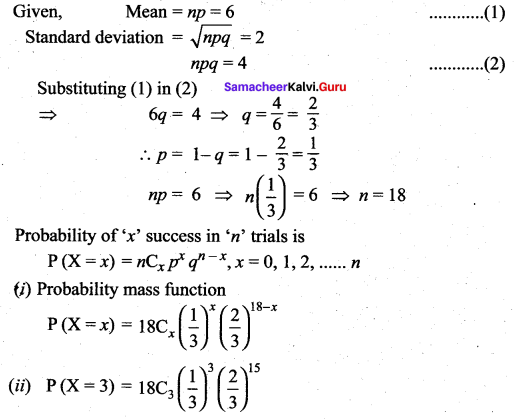
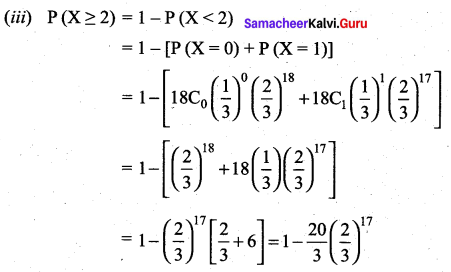
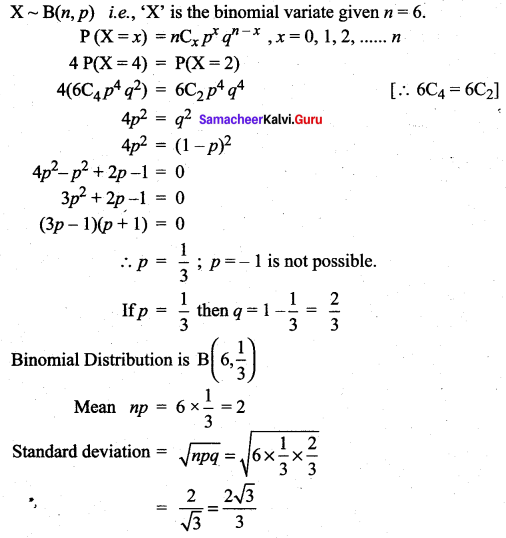
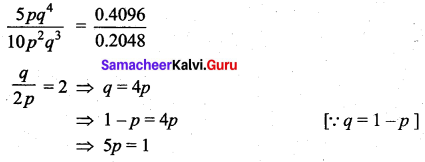
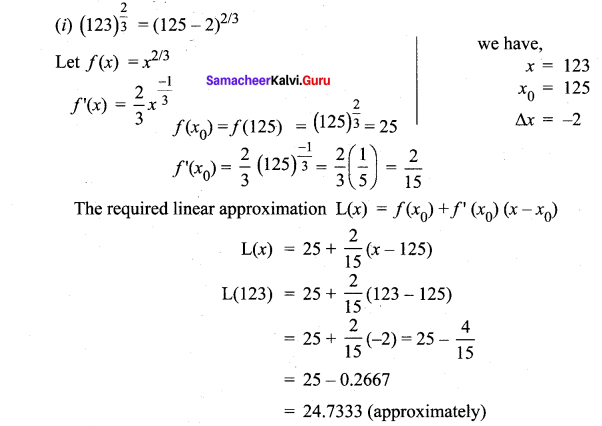
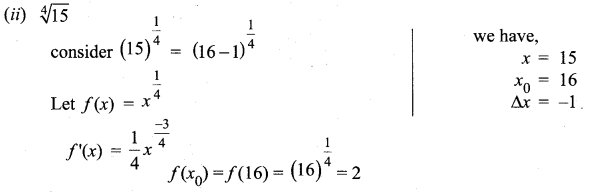
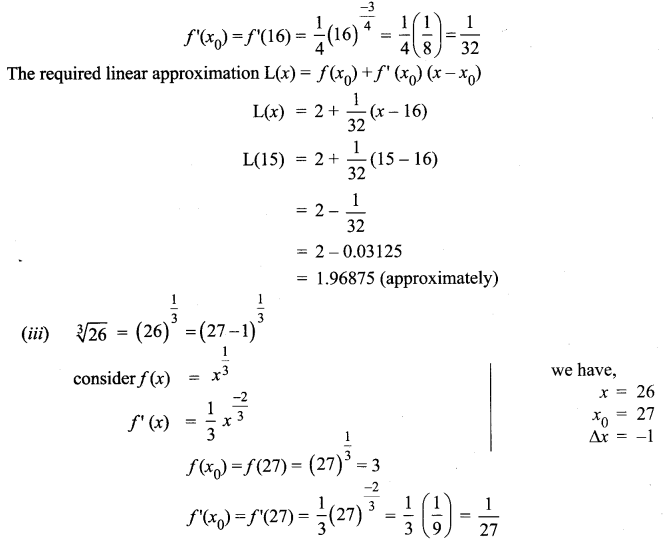
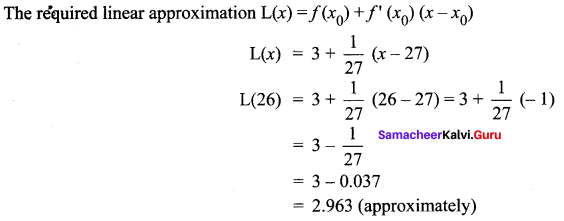
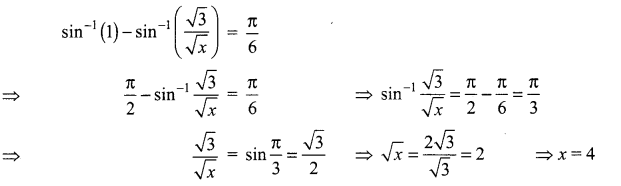
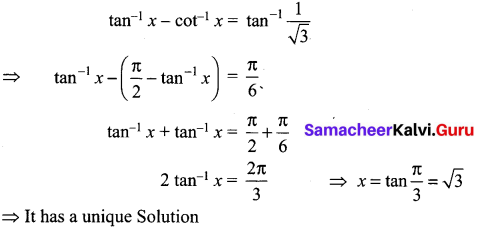
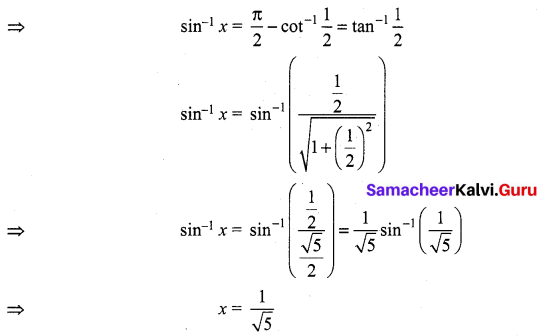
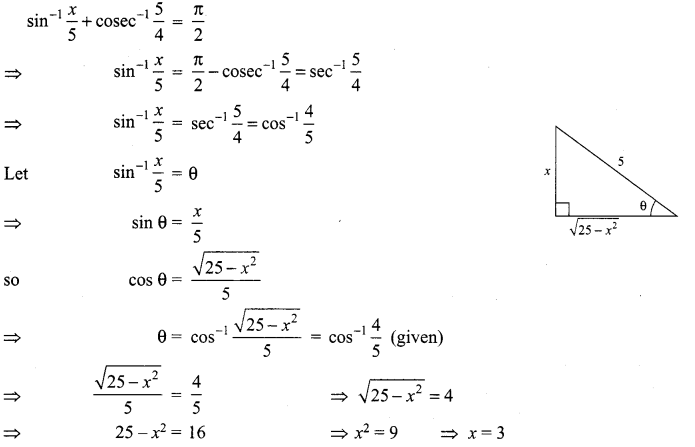
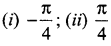
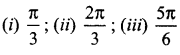
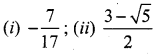
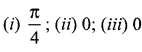
Samacheer Kalvi 12th Maths Solutions Chapter 10 Ordinary Differential Equations Ex 10.5

You can Download Samacheer Kalvi 12th Maths Book Solutions Guide Pdf, Tamilnadu State Board help you to revise the complete Syllabus and score more marks in your examinations.

Tamilnadu Samacheer Kalvi 12th Maths Book Solutions Chapter 10 Ordinary Differential Equations Ex 10.5

Question 1.
If F is the constant force generated by the motor of an automobile of mass M, its velocity V is given by M\(\frac{d \mathbf{V}}{d t}\) = F – kV, where A is a constant. Express V in terms of t given that V = 0 when t = 0.
Solution:

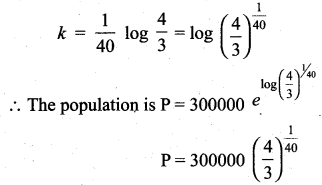
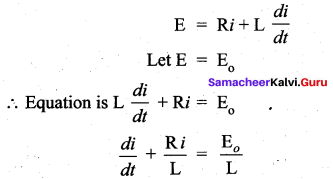
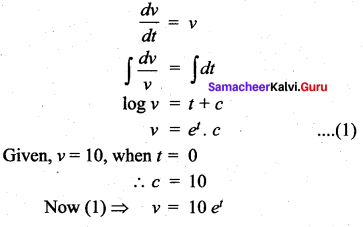
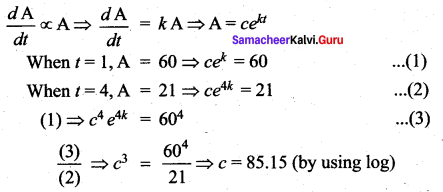
Samacheer Kalvi 12th Maths Solutions Chapter 10 Ordinary Differential Equations Ex 10.5 1
Substituting in (1)
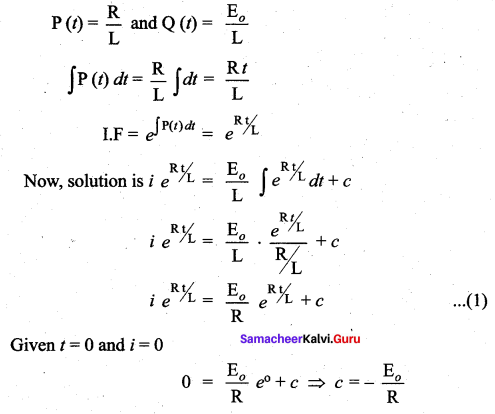
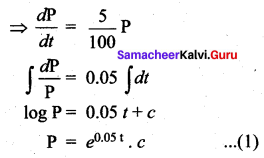
Samacheer Kalvi 12th Maths Solutions Chapter 10 Ordinary Differential Equations Ex 10.5 2

Question 2.
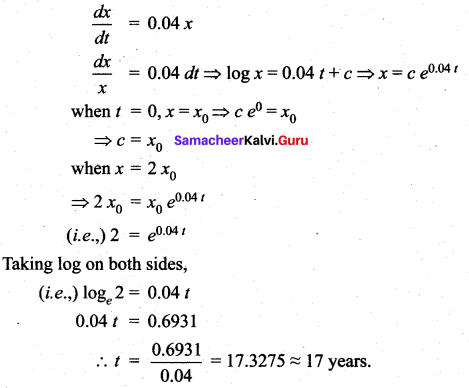
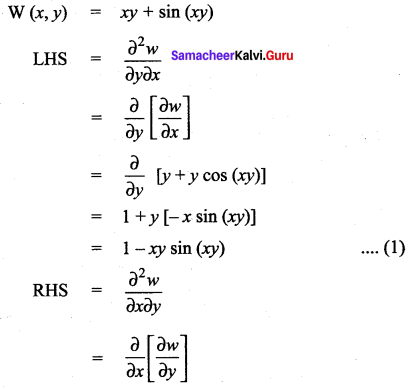
The velocity v, of a parachute falling vertically satisfies the equation, Samacheer Kalvi 12th Maths Solutions Chapter 10 Ordinary Differential Equations Ex 10.5 3 where g and k are constants. If v and x are both initially zero, find v in terms of x.
Solution:
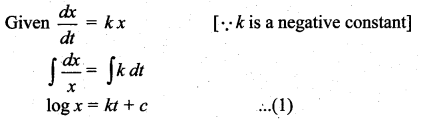
Samacheer Kalvi 12th Maths Solutions Chapter 10 Ordinary Differential Equations Ex 10.5 343
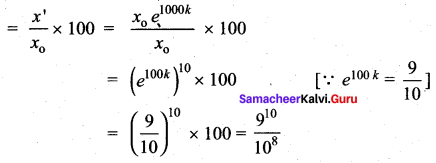
Samacheer Kalvi 12th Maths Solutions Chapter 10 Ordinary Differential Equations Ex 10.5 344
Squaring on both sides
Samacheer Kalvi 12th Maths Solutions Chapter 10 Ordinary Differential Equations Ex 10.5 4

Samacheer Kalvi 12th Maths Solutions Chapter 10 Ordinary Differential Equations Ex 10.5

Question 3.
Find the equation of the curve whose slope is \(\frac{y-1}{x^{2}+x}\) and which passes through the point (1, 0).
Solution:
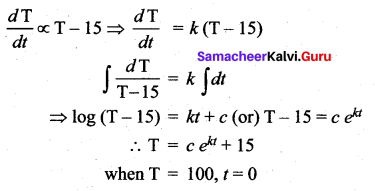
Samacheer Kalvi 12th Maths Solutions Chapter 10 Ordinary Differential Equations Ex 10.5 5
Samacheer Kalvi 12th Maths Solutions Chapter 10 Ordinary Differential Equations Ex 10.5 6
This passes through (1, 0)
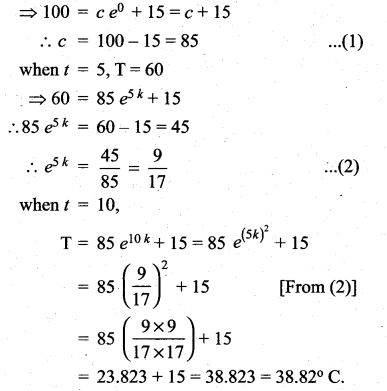
Samacheer Kalvi 12th Maths Solutions Chapter 10 Ordinary Differential Equations Ex 10.5 7

Question 4.
Solve the following differential equations:
Samacheer Kalvi 12th Maths Solutions Chapter 10 Ordinary Differential Equations Ex 10.5 8
Solution:

Samacheer Kalvi 12th Maths Solutions Chapter 10 Ordinary Differential Equations Ex 10.5 9

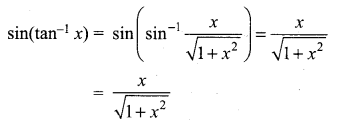
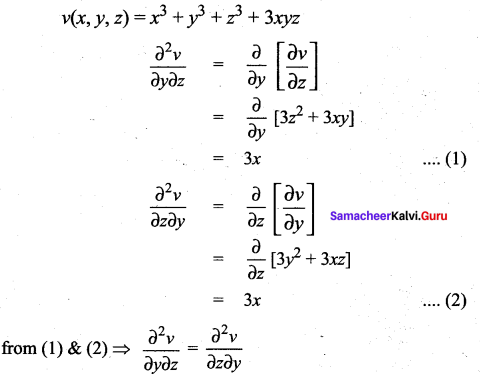
(ii) ydx + (1 + x2) tan-1 x dy = 0
Solution:
ydx + (1 + x2) tan-1 xdy = 0
(1 + x2) tan-1x dy = -y dx
Separating the variables
Samacheer Kalvi 12th Maths Solutions Chapter 10 Ordinary Differential Equations Ex 10.5 10
log y = – log (tan-1 x) + log c
log y + log (tan-1 x) = log c
log (y tan-1 x) = log c
y tan-1 x = c

Samacheer Kalvi 12th Maths Solutions Chapter 10 Ordinary Differential Equations Ex 10.5

(iii) sin \(\frac{d y}{d x}\) = a, y (0) = 1
Solution:

Samacheer Kalvi 12th Maths Solutions Chapter 10 Ordinary Differential Equations Ex 10.5 11
Given y(0) = 1
i.e., When x = 0, y = 1
∴ 1 = 0(sin-1 a) + c ⇒ c = 1
∴ The solution is y = xsin-1 a + 1
Samacheer Kalvi 12th Maths Solutions Chapter 10 Ordinary Differential Equations Ex 10.5 12

(iv) Samacheer Kalvi 12th Maths Solutions Chapter 10 Ordinary Differential Equations Ex 10.5 13
Solution:
Samacheer Kalvi 12th Maths Solutions Chapter 10 Ordinary Differential Equations Ex 10.5 14

(v) (ey + 1) cos x dx + ey sin x dy = 0
Solution:
(ey + 1) cos x dx + ey sin x dy = 0
ey sin x dy = – (ey + 1) cos x dx
Samacheer Kalvi 12th Maths Solutions Chapter 10 Ordinary Differential Equations Ex 10.5 15
log (ey + 1) = – log sin x + log c
log [(ey + 1) + log sin x = log c
log (ey +1) sin x] = log c
(ey+ 1) sin x = c

Samacheer Kalvi 12th Maths Solutions Chapter 10 Ordinary Differential Equations Ex 10.5

(vi) Samacheer Kalvi 12th Maths Solutions Chapter 10 Ordinary Differential Equations Ex 10.5 16
Solution:

Samacheer Kalvi 12th Maths Solutions Chapter 10 Ordinary Differential Equations Ex 10.5 17

(vii) Samacheer Kalvi 12th Maths Solutions Chapter 10 Ordinary Differential Equations Ex 10.5 18
Solution:
Samacheer Kalvi 12th Maths Solutions Chapter 10 Ordinary Differential Equations Ex 10.5 19

(viii) x cos y dy = ex(x log x + 1)dx
Solution:
Samacheer Kalvi 12th Maths Solutions Chapter 10 Ordinary Differential Equations Ex 10.5 20

(ix) Samacheer Kalvi 12th Maths Solutions Chapter 10 Ordinary Differential Equations Ex 10.5 21
Solution:
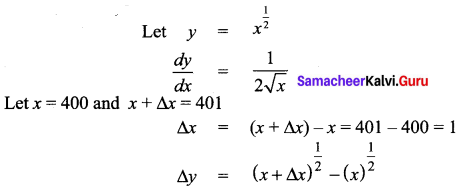
Samacheer Kalvi 12th Maths Solutions Chapter 10 Ordinary Differential Equations Ex 10.5 211

(x) Samacheer Kalvi 12th Maths Solutions Chapter 10 Ordinary Differential Equations Ex 10.5 22
Solution:
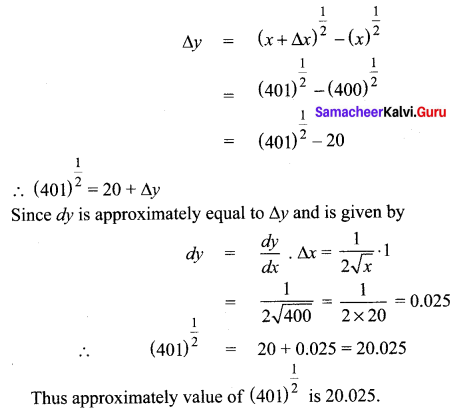
\(\frac{d y}{d x}\) = tan2 (x +y)
Let u = x + y
Differentiating with respect to ‘x’
Samacheer Kalvi 12th Maths Solutions Chapter 10 Ordinary Differential Equations Ex 10.5 23
Samacheer Kalvi 12th Maths Solutions Chapter 10 Ordinary Differential Equations Ex 10.5 24

Samacheer Kalvi 12th Maths Solutions Chapter 10 Ordinary Differential Equations Ex 10.5 Additional Problems

Question 1.
Samacheer Kalvi 12th Maths Solutions Chapter 10 Ordinary Differential Equations Ex 10.5 25
Solution:
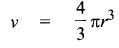
The given equation can be written as
Samacheer Kalvi 12th Maths Solutions Chapter 10 Ordinary Differential Equations Ex 10.5 26
Samacheer Kalvi 12th Maths Solutions Chapter 10 Ordinary Differential Equations Ex 10.5 27

Samacheer Kalvi 12th Maths Solutions Chapter 10 Ordinary Differential Equations Ex 10.5

Question 2.
Samacheer Kalvi 12th Maths Solutions Chapter 10 Ordinary Differential Equations Ex 10.5 28
Solution:
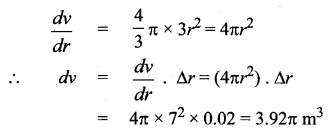
Put x +y = z. Differentiating with respect to x we get
Samacheer Kalvi 12th Maths Solutions Chapter 10 Ordinary Differential Equations Ex 10.5 29

Question 3.
Find the cubic polynomial in x which attains its maximum value 4 and minimum value 0 at x = -1 and 1 respectively.
Solution:
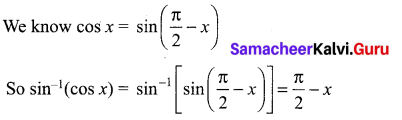
Let the cubic polynomial bey = f(x). Since it attains a maximum atx = -1 and a minimum at x = 1.
Samacheer Kalvi 12th Maths Solutions Chapter 10 Ordinary Differential Equations Ex 10.5 30
Separating the variables we have dy = k (x2 – 1) dx
Samacheer Kalvi 12th Maths Solutions Chapter 10 Ordinary Differential Equations Ex 10.5 31
Samacheer Kalvi 12th Maths Solutions Chapter 10 Ordinary Differential Equations Ex 10.5 32
When x = – 1, y = 4 and when x =1,7 = 0
Substituting the equation (1) we have
2k + 3c = 12; – 2k + 3c =0
On solving we have k = 3 and c = 2. Substituting these values in (1) we get the required cubic polynomial y = x3 – 3x + 2.

Samacheer Kalvi 12th Maths Solutions Chapter 10 Ordinary Differential Equations Ex 10.5

Question 4.
The normal lines to a given curve at each point (x, y) on the curve pass through the point (2, 0). The curve passes through the point (2, 3). Formulate the differential equation representing the problem and hence find the equation of the curve.
Solution:
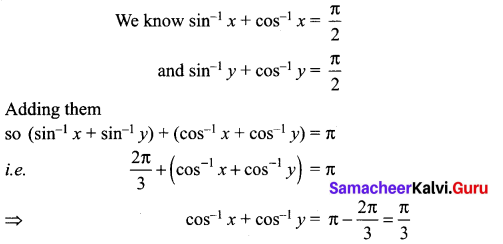
Slope of the normal at any point P(x, y) = \(-\frac{d x}{d y}\)
Samacheer Kalvi 12th Maths Solutions Chapter 10 Ordinary Differential Equations Ex 10.5 33
Since the curve passes through (2, 3)
Samacheer Kalvi 12th Maths Solutions Chapter 10 Ordinary Differential Equations Ex 10.5 35

Samacheer Kalvi 12th Maths Solutions Chapter 3 Theory of Equations Ex 3.2

You can Download Samacheer Kalvi 12th Maths Book Solutions Guide Pdf, Tamilnadu State Board help you to revise the complete Syllabus and score more marks in your examinations.

Tamilnadu Samacheer Kalvi 12th Maths Solutions Chapter 3 Theory of Equations Ex 3.2

Question 1.
If k is real, discuss the nature of the roots of the polynomial equation 2x2 + kx + k = 0, in terms of k.
Solution:

The given quadratic equation is 2x2 + kx + k = 0
a = 2, b = k, c = k
∆ = b2 – 4ac = k2 – 4(2) k = k2 – 8k
(i) If the roots are equal
k2 – 8k = 0
⇒ k(k – 8) = 0
⇒ k = 0, k = 8
(ii) If the roots are real
k2 – 8k > 0
k(k – 8) > 0
k ∈ (-∞, 0) ∪ (8, ∞)
(iii) If this roots are imaginary
k2 – 8k < 0
⇒ k ∈ (0, 8)

Question 2.
Find a polynomial equation of minimum degree with rational coefficients, having 2 + √3 i as a root.
Solution:
Given roots is (2 + √3 i)
The other root is (2 – √3 i), since the imaginary roots with real co-efficient occur as conjugate pairs.
x2 – x(S.O.R) + P.O.R = 0
⇒ x2 – x(4) + (4 + 3) = 0
⇒ x2 – 4x + 7 = 0

Question 3.
Find a polynomial equation of minimum degree with rational coefficients, having 2i + 3 as a root.
Solution:
Given roots is (3 + 2i), the other root is (3 – 2i);
Since imaginary roots occur in with real co-efficient occurring conjugate pairs.
x2 – x(S.O.R) + P.O.R = 0
⇒ x2 – x(6) + (9 + 4) = 0
⇒ x2 – 6x + 13 = 0

Samacheer Kalvi 12th Maths Solutions Chapter 3 Theory of Equations Ex 3.2

Question 4.
Find a polynomial equation of minimum degree with rational coefficients, having √5 – √3 as a root.
Solution:
The given one roots of the polynomial equation are (√5 – √3)
The other roots are (√5 + √3), (-√5 + √3) and (-√5 – √3).
The quadratic factor with roots (√5 – √3) and (√5 + √3) is
= x2 – x(S.O.R) + P.O.R
= x2 – x(2√5) + (√5 – √3) (√5 + √3)
= x2 – 2√5 x + 2
The other quadratic factors with roots (-√5 + √3) (-√5 – √3) is
= x2 – x (S.O.R) + P.O.R
= x2 – x (-2√5 ) + (5 – 3)
= x2 + 2√5x + 2
To rationalize the co-efficients with minimum degree
(x2 – 2√5 x + 2) (x2 + 2√5 x + 2) = 0
⇒ (x2 + 2)2 – (2√5 x)2 = 0
⇒ x4 + 4 + 4x2 – 20x2 = 0
⇒ x4 – 16x2 + 4 = 0

Question 5.
Prove that a straight line and parabola cannot intersect at more than two points.
Solution:
Let the standard equation of parabola y2 = 4ax …..(1)
Equation of line be y = mx + c …(2)
Solving (1) & (2)
(mx + c)2 = 4ax
⇒ mx2 + 2mcx + c2 – 4ax = 0
⇒ mx2 + 2x(mc – 2a) + c2 = 0
This equation can not have more than two solutions and hence a line and parabola cannot intersect at more than two points.

Samacheer Kalvi 12th Maths Solutions Chapter 3 Theory of Equations Ex 3.2 Additional Problems

Question 1.
Find a polynomial equation of minimum degree with rational co-efficients having 1 – i as a root.
Solution:
Given root is 1 – i
The other root is 1 + i
Sum of the roots: 1 – i + 1 + i = 2
product of the roots: (1 – i) (1 + i) = (1)2 + (1)2 ⇒ 1 + 1 = 2
∴ The required polynomial equation of minimum degree with rational coefficients is
x2 – x (S.R.) + (P.R.) = 0
x2 – 2x + 2 = 0

Question 2.
Find a polynomial equation of minimum degree with rational co-efficients having \(\sqrt{3}+\sqrt{7}\) as a root.
Solution:
Samacheer Kalvi 12th Maths Solutions Chapter 3 Theory of Equations Ex 3.2 1
The required polynomial equation of minimum degree
Samacheer Kalvi 12th Maths Solutions Chapter 3 Theory of Equations Ex 3.2 3

Samacheer Kalvi 12th Maths Solutions Chapter 3 Theory of Equations Ex 3.2

Question 3.
If the roots of the equation x3 + px2 + qx + r = 0 are in A.P then show that 2p3 – 9pq + 27 r = 0.
Solution:
Let the roots of the given equation is a – d, a, a + d
Samacheer Kalvi 12th Maths Solutions Chapter 3 Theory of Equations Ex 3.2 4

Question 4.
Solve 27x3 + 42x2 – 28x -8 = 0 given that its roots are in geometric progressive.
Solution:
Samacheer Kalvi 12th Maths Solutions Chapter 3 Theory of Equations Ex 3.2 5

Question 5.
Solve the equation 15x3 – 23x2 + 9x – 1 = 0. Where roots are in H.P.
Solution:
Samacheer Kalvi 12th Maths Solutions Chapter 3 Theory of Equations Ex 3.2 6
Samacheer Kalvi 12th Maths Solutions Chapter 3 Theory of Equations Ex 3.2 7

Samacheer Kalvi 12th Maths Solutions Chapter 10 Ordinary Differential Equations Ex 10.3

You can Download Samacheer Kalvi 12th Maths Book Solutions Guide Pdf, Tamilnadu State Board help you to revise the complete Syllabus and score more marks in your examinations.

Tamilnadu Samacheer Kalvi 12th Maths Solutions Chapter 10 Ordinary Differential Equations Ex 10.3

Question 1.
Find the differential equation of the family of
(i) all non-vertical lines in a plane
Solution:
Equation of family of all non-vertical lines is
y = mx + c (m ≠ 0)
Differentiate with respect to ‘x’
Samacheer Kalvi 12th Maths Solutions Chapter 10 Ordinary Differential Equations Ex 10.3 1

(ii) all non-horizontal lines in a plane.
Solution:
Equation of family of all non-horizontal lines is
Samacheer Kalvi 12th Maths Solutions Chapter 10 Ordinary Differential Equations Ex 10.3 2

Samacheer Kalvi 12th Maths Solutions Chapter 10 Ordinary Differential Equations Ex 10.3

Question 2.
Form the differential equation of all straight lines touching the circle x2 + y2 = r2
Solution:
Equation of circle x2 + y2 = r2 of the line y = mx + c is to be a tangent to the circle, then the equation of the tangent is
Samacheer Kalvi 12th Maths Solutions Chapter 10 Ordinary Differential Equations Ex 10.3 3
Differentiating with respect to V dy
Samacheer Kalvi 12th Maths Solutions Chapter 10 Ordinary Differential Equations Ex 10.3 4

Question 3.
Find the differential equation of the family of circles passing through the origin and having their centres on the x -axis.
Solution:
All circles passing through the origin and having their centre on the x -axis say at (a, 0) will have radius ‘a’ units.
∴ Equation of circle is (x – a2) + y2 = a2 ….(1) [ ∵ ‘a’ arbitrary constant]
Differentiate with respect to ‘x’
Samacheer Kalvi 12th Maths Solutions Chapter 10 Ordinary Differential Equations Ex 10.3 5

Samacheer Kalvi 12th Maths Solutions Chapter 10 Ordinary Differential Equations Ex 10.3

Question 4.
Find the differential equation of the family of all the parabolas with latus rectum 4a and whose axes are parallel to the x -axis.
Solution:
Equation of all parabolas whose axis is parallel to X – axis is
(y – k)2 = 4a (x – h)
Where (h, k) is the vertex
Samacheer Kalvi 12th Maths Solutions Chapter 10 Ordinary Differential Equations Ex 10.3 6

Question 5.
Find the differential equation of the family of parabolas with vertex at (0, -1) and having axis along the y – axis.
Solution:
Given, vertex (0, -1) and axis along y-axis
Equation of Parabola, (x + 1)2 = – 4ay …… (1) [∵ a is the perameter]
Differentiate with respect to ‘x’
Samacheer Kalvi 12th Maths Solutions Chapter 10 Ordinary Differential Equations Ex 10.3 7

Question 6.
Find the differential equations of the family of all the ellipses having foci on the y – axis and centre at the origin.
Solution:
Equations of the family of all the Ellipses having foci on the y – axis and centre at the origin is
Samacheer Kalvi 12th Maths Solutions Chapter 10 Ordinary Differential Equations Ex 10.3 8
Differentiate with respect to ’x’
Samacheer Kalvi 12th Maths Solutions Chapter 10 Ordinary Differential Equations Ex 10.3 9
Samacheer Kalvi 12th Maths Solutions Chapter 10 Ordinary Differential Equations Ex 10.3 10

Samacheer Kalvi 12th Maths Solutions Chapter 10 Ordinary Differential Equations Ex 10.3

Question 7.
Find the differential equation corresponding to the family of curves represented by the equation y = Ae8x + Be-8x, where A and B are arbitrary constants.
Solution:
Samacheer Kalvi 12th Maths Solutions Chapter 10 Ordinary Differential Equations Ex 10.3 11

Question 8.
Find the differential equation of the curve represented by xy = aex + be-x + x2.
Solution:
xy = aex + be-x + x2
xy – x2 = aex + be-x …… (1) [∵ a’, b’ are arbitrary constants]
Differentiate with respect to ‘x’
xy’ +y – 2x = aex – be-x
Again, Differentiate with respect to ‘x’
Samacheer Kalvi 12th Maths Solutions Chapter 10 Ordinary Differential Equations Ex 10.3 12

Samacheer Kalvi 12th Maths Solutions Chapter 10 Ordinary Differential Equations Ex 10.3 Additional Problems

Question 1.
Find the differential equation of the family of straight lines y = mx + \(\frac{a}{m}\) when
(i) m is the parameter,
(ii) a is the parameter,
(iii) a, m both are parameters.
Solution:
Samacheer Kalvi 12th Maths Solutions Chapter 10 Ordinary Differential Equations Ex 10.3 13
Samacheer Kalvi 12th Maths Solutions Chapter 10 Ordinary Differential Equations Ex 10.3 14

Samacheer Kalvi 12th Maths Solutions Chapter 10 Ordinary Differential Equations Ex 10.3

Question 2.
Find the differential equation that will represent family of all circles having centres on the x-axis and the radius is unity.
Solution:
Equation of a circle with centre on x-axis and radius 1 unit is
(x – a)2 + y2 = 1 ….. (1)
Differentiating with respect to x,
2 (x – a) + 2yy’ – 0
⇒ 2 (x – a) = – 2yy’
(or) x – a = -yy’ ……(2)
Substituting (2) in (1), we get,
Samacheer Kalvi 12th Maths Solutions Chapter 10 Ordinary Differential Equations Ex 10.3 15

Question 3.
From the differential equation from the following equations.
(i) y = e2x (A + Bx)
Solution:
ye-2x = A + Bx ……. (1)
Since the above equation contains two arbitrary constants, differentiating twice,
Samacheer Kalvi 12th Maths Solutions Chapter 10 Ordinary Differential Equations Ex 10.3 16

(ii) y = ex(A cos 3x + B sin 3x)
Solution:
Samacheer Kalvi 12th Maths Solutions Chapter 10 Ordinary Differential Equations Ex 10.3 17

Samacheer Kalvi 12th Maths Solutions Chapter 10 Ordinary Differential Equations Ex 10.3

(iii) Ax2 + By2 = 1
Solution:
Samacheer Kalvi 12th Maths Solutions Chapter 10 Ordinary Differential Equations Ex 10.3 18
Eliminating A and B between (1), (2) and (3) we get
Samacheer Kalvi 12th Maths Solutions Chapter 10 Ordinary Differential Equations Ex 10.3 19

(iv) y2 = 4a(x – a)
Solution:
Samacheer Kalvi 12th Maths Solutions Chapter 10 Ordinary Differential Equations Ex 10.3 20

Samacheer Kalvi 12th Maths Solutions Chapter 10 Ordinary Differential Equations Ex 10.2

You can Download Samacheer Kalvi 12th Maths Book Solutions Guide Pdf, Tamilnadu State Board help you to revise the complete Syllabus and score more marks in your examinations.

Tamilnadu Samacheer Kalvi 12th Maths Solutions Chapter 10 Ordinary Differential Equations Ex 10.2

Question 1.
Express each of the following physical statements in the form of differential equation.
(i) Radium decays at a rate proportional to the amount Q present.
Solution:
Radium decays at a rate proportional to the amount Q present.
Samacheer Kalvi 12th Maths Solutions Chapter 10 Ordinary Differential Equations Ex 10.2 1

(ii) The population P of a city increases at a rate proportional to the product of population and to the difference between 5,00,000 and the population.
Solution:
Rate of change of P with respect to ‘t’ is \(\frac{d \mathrm{P}}{d t}\)
Product of population and the difference between 50,000 and the population is P (50,000 – P)
Samacheer Kalvi 12th Maths Solutions Chapter 10 Ordinary Differential Equations Ex 10.2 2

Samacheer Kalvi 12th Maths Solutions Chapter 10 Ordinary Differential Equations Ex 10.2

(iii) For a certain substance, the rate of change of vapor pressure P with respect to temperature T is proportional to the vapor pressure and inversely proportional to the square of the temperature.
Solution:
Samacheer Kalvi 12th Maths Solutions Chapter 10 Ordinary Differential Equations Ex 10.2 3

(iv) A saving amount pays 8% interest per year, compounded continuously. In addition, the income from another investment is credited to the amount continuously at the rate of ₹ 400 per year.
Solution:
Let ‘x’ be the amount invested.
Samacheer Kalvi 12th Maths Solutions Chapter 10 Ordinary Differential Equations Ex 10.2 4

Samacheer Kalvi 12th Maths Solutions Chapter 10 Ordinary Differential Equations Ex 10.2

Question 2.
Assume that a spherical rain drop evaporates at a rate proportional to its surface area. Form a differential equation involving the rate of change of the radius of the rain drop.
Solution:
Samacheer Kalvi 12th Maths Solutions Chapter 10 Ordinary Differential Equations Ex 10.2 5

Samacheer Kalvi 12th Maths Solutions Chapter 10 Ordinary Differential Equations Ex 10.1

You can Download Samacheer Kalvi 12th Maths Book Solutions Guide Pdf, Tamilnadu State Board help you to revise the complete Syllabus and score more marks in your examinations.

Tamilnadu Samacheer Kalvi 12th Maths Solutions Chapter 10 Ordinary Differential Equations Ex 10.1

Question 1.
For each of the following differential equations, determine its order, degree (if exists)
Samacheer Kalvi 12th Maths Solutions Chapter 10 Ordinary Differential Equations Ex 10.1 1
Solution:
Order = 1,
Degree = 1

(ii) Samacheer Kalvi 12th Maths Solutions Chapter 10 Ordinary Differential Equations Ex 10.1 2
Solution:
Samacheer Kalvi 12th Maths Solutions Chapter 10 Ordinary Differential Equations Ex 10.1 3

Samacheer Kalvi 12th Maths Solutions Chapter 10 Ordinary Differential Equations Ex 10.1

(iii) Samacheer Kalvi 12th Maths Solutions Chapter 10 Ordinary Differential Equations Ex 10.1 4
Solution:
Samacheer Kalvi 12th Maths Solutions Chapter 10 Ordinary Differential Equations Ex 10.1 5

(iv) Samacheer Kalvi 12th Maths Solutions Chapter 10 Ordinary Differential Equations Ex 10.1 6
Solution:
Samacheer Kalvi 12th Maths Solutions Chapter 10 Ordinary Differential Equations Ex 10.1 7

(v) Samacheer Kalvi 12th Maths Solutions Chapter 10 Ordinary Differential Equations Ex 10.1 8
Solution:
Samacheer Kalvi 12th Maths Solutions Chapter 10 Ordinary Differential Equations Ex 10.1 9

Samacheer Kalvi 12th Maths Solutions Chapter 10 Ordinary Differential Equations Ex 10.1

(vi) Samacheer Kalvi 12th Maths Solutions Chapter 10 Ordinary Differential Equations Ex 10.1 10
Solution:
Samacheer Kalvi 12th Maths Solutions Chapter 10 Ordinary Differential Equations Ex 10.1 11

(vii) Samacheer Kalvi 12th Maths Solutions Chapter 10 Ordinary Differential Equations Ex 10.1 12
Solution:
Samacheer Kalvi 12th Maths Solutions Chapter 10 Ordinary Differential Equations Ex 10.1 13

(viii) Samacheer Kalvi 12th Maths Solutions Chapter 10 Ordinary Differential Equations Ex 10.1 14
Solution:
Order = 2
Samacheer Kalvi 12th Maths Solutions Chapter 10 Ordinary Differential Equations Ex 10.1 15

(ix) Samacheer Kalvi 12th Maths Solutions Chapter 10 Ordinary Differential Equations Ex 10.1 16
Solution:
Samacheer Kalvi 12th Maths Solutions Chapter 10 Ordinary Differential Equations Ex 10.1 17

(x) Samacheer Kalvi 12th Maths Solutions Chapter 10 Ordinary Differential Equations Ex 10.1 18
Solution:
Samacheer Kalvi 12th Maths Solutions Chapter 10 Ordinary Differential Equations Ex 10.1 19
Order = 1,
degree = Not exist

Samacheer Kalvi 12th Maths Solutions Chapter 10 Ordinary Differential Equations Ex 10.1

Samacheer Kalvi 12th Maths Solutions Chapter 10 Ordinary Differential Equations Ex 10.1 Additional Problems

Question 1.
Find the order and degree of the following differential equations:
Samacheer Kalvi 12th Maths Solutions Chapter 10 Ordinary Differential Equations Ex 10.1 20
Solution:
Order = 1,
Degree = 1
Samacheer Kalvi 12th Maths Solutions Chapter 10 Ordinary Differential Equations Ex 10.1 21

(ii) y’ + y2 + y3 = 0
Solution:
Order = 1,
Degree = 1
Samacheer Kalvi 12th Maths Solutions Chapter 10 Ordinary Differential Equations Ex 10.1 22

Samacheer Kalvi 12th Maths Solutions Chapter 10 Ordinary Differential Equations Ex 10.1

(iii) Samacheer Kalvi 12th Maths Solutions Chapter 10 Ordinary Differential Equations Ex 10.1 23
Solution:
Samacheer Kalvi 12th Maths Solutions Chapter 10 Ordinary Differential Equations Ex 10.1 24

(iv) Samacheer Kalvi 12th Maths Solutions Chapter 10 Ordinary Differential Equations Ex 10.1 25
Solution:
Samacheer Kalvi 12th Maths Solutions Chapter 10 Ordinary Differential Equations Ex 10.1 26
∴ Order = 2
Degree = 2

(v) Samacheer Kalvi 12th Maths Solutions Chapter 10 Ordinary Differential Equations Ex 10.1 27
Solution:
Samacheer Kalvi 12th Maths Solutions Chapter 10 Ordinary Differential Equations Ex 10.1 28
Samacheer Kalvi 12th Maths Solutions Chapter 10 Ordinary Differential Equations Ex 10.1 29

Samacheer Kalvi 12th Maths Solutions Chapter 10 Ordinary Differential Equations Ex 10.1

(vi) Samacheer Kalvi 12th Maths Solutions Chapter 10 Ordinary Differential Equations Ex 10.1 30
Solution:
Samacheer Kalvi 12th Maths Solutions Chapter 10 Ordinary Differential Equations Ex 10.1 31

(vii) Samacheer Kalvi 12th Maths Solutions Chapter 10 Ordinary Differential Equations Ex 10.1 32
Solution:
Samacheer Kalvi 12th Maths Solutions Chapter 10 Ordinary Differential Equations Ex 10.1 33

(viii) Samacheer Kalvi 12th Maths Solutions Chapter 10 Ordinary Differential Equations Ex 10.1 34
Solution:
Samacheer Kalvi 12th Maths Solutions Chapter 10 Ordinary Differential Equations Ex 10.1 35

Samacheer Kalvi 12th Maths Solutions Chapter 10 Ordinary Differential Equations Ex 10.1

(ix) Samacheer Kalvi 12th Maths Solutions Chapter 10 Ordinary Differential Equations Ex 10.1 36
Solution:
Samacheer Kalvi 12th Maths Solutions Chapter 10 Ordinary Differential Equations Ex 10.1 37

(x) sin x(dx + dy) = cos x(dx – dy)
Solution:
Order = 1;
Degree = 1

Samacheer Kalvi 12th Maths Solutions Chapter 2 Complex Numbers Ex 2.8

You can Download Samacheer Kalvi 12th Maths Book Solutions Guide Pdf, Tamilnadu State Board help you to revise the complete Syllabus and score more marks in your examinations.

Tamilnadu Samacheer Kalvi 12th Maths Solutions Chapter 2 Complex Numbers Ex 2.8

Question 1.
If to ω ≠ 1 is a cube root of unity, then show that \(\frac{a+b \omega+c \omega^{2}}{b+c \omega+a \omega^{2}}+\frac{a+b \omega+c \omega^{2}}{c+a \omega+b \omega^{2}}=1\)
Solution:
Since ω is a cube root of unity, we have ω3 = 1 and 1 + ω + ω2 = 0
Samacheer Kalvi 12th Maths Solutions Chapter 2 Complex Numbers Ex 2.8 Q1

Samacheer Kalvi 12th Maths Solutions Chapter 2 Complex Numbers Ex 2.8

Question 2.
Show that \(\left(\frac{\sqrt{3}}{2}+\frac{i}{2}\right)^{5}+\left(\frac{\sqrt{3}}{2}-\frac{i}{2}\right)^{5}=-\sqrt{3}\)
Solution:
Samacheer Kalvi 12th Maths Solutions Chapter 2 Complex Numbers Ex 2.8 Q2
Samacheer Kalvi 12th Maths Solutions Chapter 2 Complex Numbers Ex 2.8 Q2.1

Question 3.
Find the value of \(\left(\frac{1+\sin \frac{\pi}{10}+i \cos \frac{\pi}{10}}{1+\sin \frac{\pi}{10}-i \cos \frac{\pi}{10}}\right)^{10}\)
Solution:
Samacheer Kalvi 12th Maths Solutions Chapter 2 Complex Numbers Ex 2.8 Q3

Question 4.
If 2 cos α = x + \(\frac{1}{x}\) and 2 cos β = y + \(\frac{1}{y}\), show that
Samacheer Kalvi 12th Maths Solutions Chapter 2 Complex Numbers Ex 2.8 Q4
Solution:
(i) 2 cos α = x + \(\frac{1}{x}\)
⇒ 2 cos α = \(\frac{x^{2}+1}{x}\)
⇒ 2x cos α = x2 + 1
⇒ x2 – 2x cos α + 1 = 0
Samacheer Kalvi 12th Maths Solutions Chapter 2 Complex Numbers Ex 2.8 Q4.1
Samacheer Kalvi 12th Maths Solutions Chapter 2 Complex Numbers Ex 2.8 Q4.2
Samacheer Kalvi 12th Maths Solutions Chapter 2 Complex Numbers Ex 2.8 Q4.3

Samacheer Kalvi 12th Maths Solutions Chapter 2 Complex Numbers Ex 2.8

Question 5.
Solve the equation z3 + 27 = 0
Solution:
z3 + 27 = 0
⇒ z3 = -27
⇒ z3 = 33(-1)
⇒ z = 3(-1)1/3
Samacheer Kalvi 12th Maths Solutions Chapter 2 Complex Numbers Ex 2.8 Q5

Question 6.
If ω ≠ 1 is a cube root of unity, show that the roots of the equation (z – 1)3 + 8 = 0 are -1, 1 – 2ω, 1 – 2ω2
Solution:
(z – 1)3 + 8 = 0
⇒ (z – 1 )3 = -8
Samacheer Kalvi 12th Maths Solutions Chapter 2 Complex Numbers Ex 2.8 Q6
The roots are -1, 1 – 2ω, 1 – 2ω2

Question 7.
Find the value of \(\sum_{k=1}^{8}\left(\cos \frac{2 k \pi}{9}+i \sin \frac{2 k \pi}{9}\right)\)
Solution:
\(\sum_{k=1}^{8}\left(\cos \frac{2 k \pi}{9}+i \sin \frac{2 k \pi}{9}\right)\)
We know that 9th roots of unit are 1, ω, ω2, ……., ω8
Sum of the roots:
1 + ω + ω2 + …. + ω8 = 0 ⇒ ω + ω2 + ω3 + …… + ω8 = -1
Samacheer Kalvi 12th Maths Solutions Chapter 2 Complex Numbers Ex 2.8 Q7
The sum of all the terms \(\sum_{k=1}^{8}\left(\cos \frac{2 k \pi}{9}+i \sin \frac{2 k \pi}{9}\right)\) = -1

Question 8.
If ω ≠ 1 is a cube root of unity, show that
(i) (1 – ω + ω2)6 + (1 + ω – ω2)6 = 128
(ii) (1 + ω)(1 + ω2)(1 + ω4)(1 + ω8)……(1 + ω2n) = 1
Solution:
(i) ω is a cube root of unity ω3 = 1; 1 + ω + ω2 = 0
(1 – ω + ω2)6 + (1 + ω – ω2)6
= (-ω – ω)6 + (-ω2 – ω2)6
= (-2ω)6 + (-2ω2)6
= (-2)66 + ω12)
= (64)(1 + 1)
= 128
(ii) (1 + ω)(1 + ω2)(1 + ω4)(1 + ω8) …… (1 + ω2n)
= (1 + ω)(1 + ω2)(1 + ω4)(1 + ω8) ……. 2n factors
= (-ω2)(-ω)(-ω2)(-ω) …… 2n factors
= ω3. ω3
= 1

Question 9.
If z = 2 – 2i, find the rotation of z by θ radians in the counter clockwise direction about the origin when
(i) θ = \(\frac{\pi}{3}\)
(ii) θ = \(\frac{2 \pi}{3}\)
(iii) θ = \(\frac{3 \pi}{2}\)
Solution:
(i) z = 2 – 2i = 2 (1 – i) = r(cos θ + i sin θ)
\(r=\sqrt{x^{2}+y^{2}}=2 \sqrt{1+1}=2 \sqrt{2}\)
\(\alpha=\tan ^{-1}=\left|\frac{y}{x}\right|=\tan ^{-1}|1|=\frac{\pi}{4}\)
(1 – i) lies in IV quadrant
θ = -α = \(-\frac{\pi}{4}\)
\(\Rightarrow z=2 \sqrt{2}\left[\cos \left(\frac{-\pi}{4}\right)+i \sin \left(\frac{-\pi}{4}\right)\right]\)
z is rotated by θ = \(\frac{\pi}{3}\) in the counter clock wise direction.
Samacheer Kalvi 12th Maths Solutions Chapter 2 Complex Numbers Ex 2.8 Q9
(ii) z is rotated by θ = \(\frac{2 \pi}{3}\) in the counter clockwise direction.
Samacheer Kalvi 12th Maths Solutions Chapter 2 Complex Numbers Ex 2.8 Q9.1
(iii) z is rotated by θ = \(\frac{3 \pi}{2}\) in the counter clockwise direction.
Samacheer Kalvi 12th Maths Solutions Chapter 2 Complex Numbers Ex 2.8 Q9.2

Samacheer Kalvi 12th Maths Solutions Chapter 2 Complex Numbers Ex 2.8

Question 10.
Prove that the values of \(\sqrt[4]{-1} \text { are } \pm \frac{1}{\sqrt{2}}(1 \pm i)\)
Solution:
Samacheer Kalvi 12th Maths Solutions Chapter 2 Complex Numbers Ex 2.8 Q10
The roots are \(\pm \frac{1}{\sqrt{2}}(1 \pm i)\)

Samacheer Kalvi 12th Maths Solutions Chapter 2 Complex Numbers Ex 2.8 Additional Problems

Question 1.
Samacheer Kalvi 12th Maths Solutions Chapter 2 Complex Numbers Ex 2.8 1
Solution:
Samacheer Kalvi 12th Maths Solutions Chapter 2 Complex Numbers Ex 2.8 2

Question 2.
Samacheer Kalvi 12th Maths Solutions Chapter 2 Complex Numbers Ex 2.8 3
Solution:
Samacheer Kalvi 12th Maths Solutions Chapter 2 Complex Numbers Ex 2.8 4
Samacheer Kalvi 12th Maths Solutions Chapter 2 Complex Numbers Ex 2.8 5

Question 3.
Prove that: (1 + i)4n and (1 + i)4n + 2 are real and purely imaginary respectively.
Solution:
Let z = 1 + i
Samacheer Kalvi 12th Maths Solutions Chapter 2 Complex Numbers Ex 2.8 6
= 2i (-1)n which is purely imaginary.

Samacheer Kalvi 12th Maths Solutions Chapter 2 Complex Numbers Ex 2.8

Question 4.
Samacheer Kalvi 12th Maths Solutions Chapter 2 Complex Numbers Ex 2.8 7
Solution:
Samacheer Kalvi 12th Maths Solutions Chapter 2 Complex Numbers Ex 2.8 8

Question 5.
If a = cos 2α + i sin 2α, b = cos 2β + i sin 2β and c = cos 2γ + i sin 2γ, prove that
Samacheer Kalvi 12th Maths Solutions Chapter 2 Complex Numbers Ex 2.8 9
Solution:
Samacheer Kalvi 12th Maths Solutions Chapter 2 Complex Numbers Ex 2.8 10

Question 6.
Solve: x4 + 4 = 0
Solution:
Samacheer Kalvi 12th Maths Solutions Chapter 2 Complex Numbers Ex 2.8 11

Question 7.
If x = a + b, y = aω + bω2, z = aω2 + bω, show that
(i) xyz = a3 + b3
(ii) x3 + y3 + z3 = 3(a3 + b3)
Solution:
(i) x = a + A; y = aω + bω2, z = aω2 + bω
Now xyz = (a + b) (aω + bω2) (abω2 + bω) = (a+A) [aω3 + abω2 + abω + b2ω3]
= (a + b) (a2 – ab + b2) = a3 + b3
xyz = a3 + b3

(ii) x = a + b, y = aω + bω2, z = aω2 + bω
x + y + z = (a + aω + aω2) + (b + bω2 + bω)
= a (1 + ω + ω2) + b (1 + ω + ω2) = a(0) + b(0) = 0
Now x + y + z = 0 ⇒ x3 + y3 + z3 = 3xyz
Here xyz = a3 + b3
∴ x3 + y3 + z3 = 3 (a3 + b3)

Samacheer Kalvi 12th Maths Solutions Chapter 12 Discrete Mathematics Ex 12.3

You can Download Samacheer Kalvi 12th Maths Book Solutions Guide Pdf, Tamilnadu State Board help you to revise the complete Syllabus and score more marks in your examinations.

Tamilnadu Samacheer Kalvi 12th Maths Solutions Chapter 12 Discrete Mathematics Ex 12.3

Choose the correct or the most suitable answer from the given four alternatives.

Question 1.
A binary operation on a set S is a function from …….
(a) S ➝ S
(b) (S × S) ➝ S
(c)S ➝ (S × S)
(d) (S × S) ➝ (S × S)
Solution:
(b) (S × S) ➝ S

Question 2.
Subtraction is not a binary operation in
(a) R
(b) Z
(c) N
(d) Q
Solution:
(c) N
Hint:
For example 2, 5 ∈ N but 2 – 5 = 3 ∉ N

Samacheer Kalvi 12th Maths Solutions Chapter 12 Discrete Mathematics Ex 12.3

Question 3.
Which one of the following is a binary operation on N ?
(a) Subtraction
(b) Multiplication
(c) Division
(c) All the above
Solution:
(b) Multiplication

Question 4.
In the set R of real numbers ‘*’ is defined as follows. Which one of the following is not a binary operation on R ?
(a) a * b = min (a.b)
(b) a * b = max (a, b)
(c) a * b = a
(d) a * b = ab
Solution:
(d) a * b = ab
Hint:
Since -2, 1/2 ∈ R , but (-2)1/2 ∉ R.

Question 5.
The operation * defined by a * b = \(\frac{a b}{7}\) is not a binary operation on ……….
(a) Q+
(b) Z
(c) R
(c) C
Solution:
(b) Z
Hint:
Since 3, 5 ∈ Z, but \(\frac{3 \times 5}{7} \notin\) Z.

Samacheer Kalvi 12th Maths Solutions Chapter 12 Discrete Mathematics Ex 12.3

Question 6.
Samacheer Kalvi 12th Maths Solutions Chapter 12 Discrete Mathematics Ex 12.3 1
Samacheer Kalvi 12th Maths Solutions Chapter 12 Discrete Mathematics Ex 12.3 2
Samacheer Kalvi 12th Maths Solutions Chapter 12 Discrete Mathematics Ex 12.3 3
Solution:
(b) y = \(\frac{-2}{3}\)

Question 7.
If a * b = \(\sqrt{a^{2}+b^{2}}\) on the real numbers then * is ……..
(a) commutative but not associative
(b) associative but not commutative
(c) both commutative and associative
(d) neither commutative nor associative
Let, a, b ∈ R
Samacheer Kalvi 12th Maths Solutions Chapter 12 Discrete Mathematics Ex 12.3 10
(1) = (2) = * is associative
So * is both commutative and associative
Solution:
(c) both commutative and associative

Question 8.
Which one of the following statements has the truth value T ?
(a) sin x is an even function.
(b) Every square matrix is non-singular
(c) The product of complex number and its conjugate is purely imaginary
(d) \(\sqrt{5}\) is an irrational number
Solution:
(d) \(\sqrt{5}\) is an irrational number

Question 9.
Which one of the following statements has truth value F ?
(a) Chennai is in India or \(\sqrt{2}\) is an integer
(b) Chennai is in India or \(\sqrt{2}\) is an irrational number
(c) Chennai is in China or \(\sqrt{2}\) is an integer
(d) Chennai is in China or \(\sqrt{2}\) is an irrational number
Solution:
(c) Chennai is in China or \(\sqrt{2}\) is an integer

Question 10.
If a compound statement involves 3 simple statements, then the number of rows in the truth table is ……….
(a) 9
(b) 8
(c) 6
(d) 3
Solution:
(b) 8
Hint:
(i.e.) 23 = 8

Question 11.
Which one is the inverse of the statement Samacheer Kalvi 12th Maths Solutions Chapter 12 Discrete Mathematics Ex 12.3 9
Samacheer Kalvi 12th Maths Solutions Chapter 12 Discrete Mathematics Ex 12.3 99
Solution:
(a) \((\neg p \wedge \neg q) \rightarrow(\neg p \vee \neg q)\)

Question 12.
Which one is the contrapositive of the statement \((p \vee q) \rightarrow r\)?
Samacheer Kalvi 12th Maths Solutions Chapter 12 Discrete Mathematics Ex 12.3 11
Solution:
(a) \(\neg r \rightarrow(\neg p \wedge \neg q)\)

Samacheer Kalvi 12th Maths Solutions Chapter 12 Discrete Mathematics Ex 12.3

Question 13.
The truth table for \((p \wedge q) \vee \neg q\) is given below
Samacheer Kalvi 12th Maths Solutions Chapter 12 Discrete Mathematics Ex 12.3 12
Which one of the following is true?
Samacheer Kalvi 12th Maths Solutions Chapter 12 Discrete Mathematics Ex 12.3 13
Hint: The truth table for \((p \wedge q) \vee \neg q\)
Samacheer Kalvi 12th Maths Solutions Chapter 12 Discrete Mathematics Ex 12.3 14
Solution:
(3) T T F T

Question 14.
In the last column of the truth table for \(\neg(p \vee \neg q)\) the number of final outcomes of the truth value ‘F’ are
(a) 1
(b) 2
(c) 3
(d) 4
Hint:
The truth table for \(\neg(p \vee \neg q)\)
Samacheer Kalvi 12th Maths Solutions Chapter 12 Discrete Mathematics Ex 12.3 15
Solution:
(c) 3

Question 15.
Which one of the following is incorrect? For any two propositions p and q, we have …….
Samacheer Kalvi 12th Maths Solutions Chapter 12 Discrete Mathematics Ex 12.3 16
Solution:
(c) \(\neg(p \vee q) \equiv \neg p \vee \neg q\)

Question 16.
Samacheer Kalvi 12th Maths Solutions Chapter 12 Discrete Mathematics Ex 12.3 17
Which of the following is correct for the truth \((p \wedge q) \rightarrow \neg p\) ?
Samacheer Kalvi 12th Maths Solutions Chapter 12 Discrete Mathematics Ex 12.3 18
Hint:
Samacheer Kalvi 12th Maths Solutions Chapter 12 Discrete Mathematics Ex 12.3 19
Solution:
(2) F T T T

Samacheer Kalvi 12th Maths Solutions Chapter 12 Discrete Mathematics Ex 12.3

Question 17.
Samacheer Kalvi 12th Maths Solutions Chapter 12 Discrete Mathematics Ex 12.3 20
Samacheer Kalvi 12th Maths Solutions Chapter 12 Discrete Mathematics Ex 12.3 21
Solution:
(d) \(\neg(p \wedge q) \wedge | p \wedge(p \vee \neg r)]\)

Question 18.
The proposition \(p \wedge(\neg p \vee q)]\) is ……..
(a) a tautology
(b) a contradiction
(c) logically equivalent to \(p \wedge q\)
(d) logically equivalent to \(p \vee q\)
Solution:
(c) logically equivalent to \(p \wedge q\)

Question 19.
Determine the truth value of each of the following statements:
(a) 4 + 2 = 5 and 6+ 3 = 9
(b) 3 + 2 = 5 and 6 + 1 = 7
(c) 4 + 5 = 9 and 1 + 2 = 4
(d) 3 + 2 = 5 and 4 + 7 = 11
Samacheer Kalvi 12th Maths Solutions Chapter 12 Discrete Mathematics Ex 12.3 60
Solution:
(1) F T F T

Samacheer Kalvi 12th Maths Solutions Chapter 12 Discrete Mathematics Ex 12.3

Question 20.
Which one of the following is not true?
(a) Negation of a negation of a statement is the statement itself.
(b) If the last column of the truth table contains only T then it is a tautology.
(c) If the last column of its truth table contains only F then it is a contradiction
(d) If p and q are any two statements then p ⟷ q is a tautology.
Solution:
(d) If p and q are any two statements then p ⟷ q is a tautology.

Samacheer Kalvi 12th Maths Solutions Chapter 12 Discrete Mathematics Ex 12.3 Additional Problems

Choose the correct or the most suitable answer from the given four alternatives.

Question 1.
Which of the following are statements?
(i) May God bless you
(ii) Rose is a flower
(iii) milk is white
(iv) 1 is a prime number
(a) (i), (ii), (iii)
(b) (i), (ii), (iv)
(c) (i), (iii), (iv)
(d) (ii), (iii), (iv)
Hint:
Sentence (ii), (iii) and (iv) are statements
(ii) Rose is a flower – True
(iii) Milk is white – True
(iv) 1 is a prime number
∴ (ii), (iii), (iv) are statements
(i) May god bless you. This statement can not be assigned True or False.
∴ (i) is not a statements
Solution:
(d) (ii), (iii), (iv)

Question 2.
If a compound statement is made up of the three simple statements, then the number of rows in the truth table is …….
(a) 8
(b) 6
(c) 4
(d) 2
Hint:
The number of rows in truth table = 2n = 23 = 8
Solution:
(a) 8

Samacheer Kalvi 12th Maths Solutions Chapter 12 Discrete Mathematics Ex 12.3

Question 3.
If p is T and q is F, then which of the following have the truth value T? ………

Samacheer Kalvi 12th Maths Solutions Chapter 12 Discrete Mathematics Ex 12.3 65
(a) (i), (ii), (iii)
(b) (i), (ii), (iv)
(c) (i), (iii), (iv)
(d) (ii), (iii), (iv)
Hint:
p is T then ~p is F
q is F then ~ q is T
Samacheer Kalvi 12th Maths Solutions Chapter 12 Discrete Mathematics Ex 12.3 66
Solution:
(c) (i), (iii), (iv)

Question 4.
The number of rows in the truth offimg6 is ……..
(a) 2
(b) 4
(c) 6
(d) 8
Hint:
Number of simple statements given is 2. i.e., p and q.
Number of rows in the truth table of \(\sim[p \wedge(\sim q)]\) = 22 = 4
Solution:
(b) 4

Question 5.
The conditional statement p ➝ q is equivalent to ……..
Samacheer Kalvi 12th Maths Solutions Chapter 12 Discrete Mathematics Ex 12.3 67
Samacheer Kalvi 12th Maths Solutions Chapter 12 Discrete Mathematics Ex 12.3 68
The truth table for p ➝ q and \((\sim p \vee q)\) having the last column identical.
∴ p ➝ q is equivalent to \((\sim p \vee q)\)
Solution:
(3) \(\sim p \vee q\)

Question 6.
Which of the following is a tautology?
Samacheer Kalvi 12th Maths Solutions Chapter 12 Discrete Mathematics Ex 12.3 69
Solution:
(c) \(\boldsymbol{p} \vee \sim \boldsymbol{p}\)
Hint:
A statement is said to be a tautology if the last column of its truth table contains only T.
Samacheer Kalvi 12th Maths Solutions Chapter 12 Discrete Mathematics Ex 12.3 70
Samacheer Kalvi 12th Maths Solutions Chapter 12 Discrete Mathematics Ex 12.3 71

Samacheer Kalvi 12th Maths Solutions Chapter 12 Discrete Mathematics Ex 12.3

Question 7.
In the set of integers with operation * defined by a * b = a + b – ab, the value of 3 * (4 * 5) is ……..
(a) 25
(b) 15
(c) 10
(d) 5
Hint:
a * b = a + b – ab
3 * (4 * 5) = 3 * (4 + 5 – 4(5))
= 3 * (9 – 20)
= 3 * (-11)
= 3 + (-11) – 3(-11)
= 3 – 11 + 33
= -8 + 33 = 25
Solution:
(a) 25

Question 8.
In the multiplicative group of cube root of unity, the order of \(\omega^{2}\) is ……

(a) 4
(b) 3
(c) 2
(d) 1
Solution:
(b) 3
Hint:
Samacheer Kalvi 12th Maths Solutions Chapter 12 Discrete Mathematics Ex 12.3 72

Question 10.
Samacheer Kalvi 12th Maths Solutions Chapter 12 Discrete Mathematics Ex 12.3 73
(a) 5
(b) 5\(\sqrt{2}\)
(c) 25
(d) 50
Hint:
Samacheer Kalvi 12th Maths Solutions Chapter 12 Discrete Mathematics Ex 12.3 74
Solution:
(b) 5\(\sqrt{2}\)

Samacheer Kalvi 12th Maths Solutions Chapter 12 Discrete Mathematics Ex 12.3

Question 11.
The order of -i in the multiplicative group of 4th roots of unity is ……..
(a) 4
(b) 3
(c) 2
(d) 1
Hint:
The roots of fourth roots of unity are 1, -1, i, -i
The identity element is 1
(-i)4 = i4 = 1
Order of (-i) = 4.
Solution:
(a) 4

Samacheer Kalvi 12th Maths Solutions Chapter 2 Complex Numbers Ex 2.7

You can Download Samacheer Kalvi 12th Maths Book Solutions Guide Pdf, Tamilnadu State Board help you to revise the complete Syllabus and score more marks in your examinations.

Tamilnadu Samacheer Kalvi 12th Maths Solutions Chapter 2 Complex Numbers Ex 2.7

Question 1.
Write in polar form of the following complex numbers.
(i) 2 + i2√3
(ii) 3 – i√3
(iii) -2 – i2
(iv) \(\frac{i-1}{\cos \frac{\pi}{3}+i \sin \frac{\pi}{3}}\)
Solution:
Samacheer Kalvi 12th Maths Solutions Chapter 2 Complex Numbers Ex 2.7 Q1
Samacheer Kalvi 12th Maths Solutions Chapter 2 Complex Numbers Ex 2.7 Q1.1
Samacheer Kalvi 12th Maths Solutions Chapter 2 Complex Numbers Ex 2.7 Q1.2
Samacheer Kalvi 12th Maths Solutions Chapter 2 Complex Numbers Ex 2.7 Q1.3

Samacheer Kalvi 12th Maths Solutions Chapter 2 Complex Numbers Ex 2.7

Question 2.
Find the rectangular form of the following complex numbers.
Samacheer Kalvi 12th Maths Solutions Chapter 2 Complex Numbers Ex 2.7 Q2
Solution:
Samacheer Kalvi 12th Maths Solutions Chapter 2 Complex Numbers Ex 2.7 Q2.1
Samacheer Kalvi 12th Maths Solutions Chapter 2 Complex Numbers Ex 2.7 Q2.2

Question 3.
Samacheer Kalvi 12th Maths Solutions Chapter 2 Complex Numbers Ex 2.7 Q3
Solution:
(i) (x1 + iy1) (x2 + iy2) (x3 + iy3) …….. (xn + iyn) = a + ib …… (1)

Taking modulus on both sides,
|(x1 + iy1) (x2 + iy2) (x3 + iy3) …….. (xn + iyn)| = |a + ib|
|x1 + iy1| |x2 + iy2| |x3 + iy3| ….. |xn + iyn| = |a + ib|
Samacheer Kalvi 12th Maths Solutions Chapter 2 Complex Numbers Ex 2.7 Q3.1
Samacheer Kalvi 12th Maths Solutions Chapter 2 Complex Numbers Ex 2.7 Q3.2

Question 4.
If \(\frac{1+z}{1-z}\) = cos 2θ + i sin 2θ, show that z = i tan θ.
Solution:
Samacheer Kalvi 12th Maths Solutions Chapter 2 Complex Numbers Ex 2.7 Q4

Question 5.
If cos α + cos β + cos γ = sin α + sin β + sin γ = 0, then show that
(i) cos 3α + cos 3β + cos 3γ = 3 cos (α + β + γ)
(ii) sin 3α + sin 3β + sin 3γ = 3 sin (α + β + γ)
Solution:
Let a = cos α + i sin α = e
b = cos β + i sin β = e
c = cos γ + i sin γ = e
a + b + c = (cos α + cos β + cos γ) + i (sin α + sin β + sin γ)
⇒ a + b + c = 0 + i 0
⇒ a + b + c = 0
If a + b + c = 0 then a3 + b3 + c3 = 3abc
Samacheer Kalvi 12th Maths Solutions Chapter 2 Complex Numbers Ex 2.7 Q5
(cos 3α + i sin 3α + cos 3β + i sin 3β + cos 3γ + i sin 3γ) = 3 [cos (α + β + γ) + i sin (α + β + γ)]
(cos 3α + cos 3β + cos 3γ) + i (sin 3α + sin 3β + sin 3γ) = 3 cos (α + β + γ) + i 3sin(α + β + γ)
Equating real and Imaginary parts
(i) cos 3α + cos 3β + cos 3γ = 3 cos (α + β + γ)
(ii) sin 3α + sin 3β + sin 3γ = 3 sin (α + β + γ)

Samacheer Kalvi 12th Maths Solutions Chapter 2 Complex Numbers Ex 2.7

Question 6.
If z = x + iy and arg \(\left(\frac{z-i}{z+2}\right)=\frac{\pi}{4}\), then show that x2 + y2 + 3x – 3y + 2 = 0.
Solution:
arg \(\left(\frac{z-i}{z+2}\right)=\frac{\pi}{4}\)
We have arg (\(\frac{z_{1}}{z_{2}}\)) = arg(z1) – arg(z2)
arg (z – i) – arg (z + 2) = \(\frac{\pi}{4}\)
Let z = x + iy
arg (x + iy – i) – arg (x + iy + 2) = \(\frac{\pi}{4}\)
arg(x + i(y – 1)) – arg(x + 2 + iy) = \(\frac{\pi}{4}\)
Samacheer Kalvi 12th Maths Solutions Chapter 2 Complex Numbers Ex 2.7 Q6
2y – x – 2 = x2 + y2 + 2x – y
x2 + y2 + 3x – 3y + 2 = 0
Hence proved.

Samacheer Kalvi 12th Maths Solutions Chapter 2 Complex Numbers Ex 2.7 Additional Problems

Question 1.
Write the following complex numbers in the polar form:
Samacheer Kalvi 12th Maths Solutions Chapter 2 Complex Numbers Ex 2.7 1
Solution:
Samacheer Kalvi 12th Maths Solutions Chapter 2 Complex Numbers Ex 2.7 2
Samacheer Kalvi 12th Maths Solutions Chapter 2 Complex Numbers Ex 2.7 3
Samacheer Kalvi 12th Maths Solutions Chapter 2 Complex Numbers Ex 2.7 4

Samacheer Kalvi 12th Maths Solutions Chapter 2 Complex Numbers Ex 2.7

Question 2.
Find the modulus and principal argument of (1 + i) and hence express it in the polar form.
Solution:
Samacheer Kalvi 12th Maths Solutions Chapter 2 Complex Numbers Ex 2.7 55

Question 3.
Express the following complex numbers in the polar form.
Samacheer Kalvi 12th Maths Solutions Chapter 2 Complex Numbers Ex 2.7 5
Solution:
Samacheer Kalvi 12th Maths Solutions Chapter 2 Complex Numbers Ex 2.7 6
Samacheer Kalvi 12th Maths Solutions Chapter 2 Complex Numbers Ex 2.7 7

Samacheer Kalvi 12th Maths Solutions Chapter 2 Complex Numbers Ex 2.7

Question 4.
Express the following complex numbers in the polar form: \(2+2 \sqrt{3} i\)
Solution:
Samacheer Kalvi 12th Maths Solutions Chapter 2 Complex Numbers Ex 2.7 8

Question 5.
Express the following complex numbers in the polar form: \(-1+i \sqrt{3}\)
Solution:
Samacheer Kalvi 12th Maths Solutions Chapter 2 Complex Numbers Ex 2.7 9

Question 6.
Express the following complex numbers in the polar form: -1 – i
Solution:
Samacheer Kalvi 12th Maths Solutions Chapter 2 Complex Numbers Ex 2.7 10

Question 7.
Express the following complex numbers in the polar form: 1 – i
Solution:
Samacheer Kalvi 12th Maths Solutions Chapter 2 Complex Numbers Ex 2.7 11

Samacheer Kalvi 12th Maths Solutions Chapter 2 Complex Numbers Ex 2.6

You can Download Samacheer Kalvi 12th Maths Book Solutions Guide Pdf, Tamilnadu State Board help you to revise the complete Syllabus and score more marks in your examinations.

Tamilnadu Samacheer Kalvi 12th Maths Solutions Chapter 2 Complex Numbers Ex 2.6

Question 1.
If z = x + iy is a complex number such that \(\left|\frac{z-4 i}{z+4 i}\right|=1\). show that the locus of z is real axis.
Solution:
\(\left|\frac{z-4 i}{z+4 i}\right|=1\)
⇒ |z – 4i| = |z + 4i|
let z = x + iy
⇒ |x + iy – 4i| = |x + iy + 4i|
⇒ |x + i(y – 4)| = |x +(y + 4)|
⇒ \(\sqrt{x^{2}+(y-4)^{2}}=\sqrt{x^{2}+(y+4)^{2}}\)
Squaring on both sides, we get
x2 + y2 – 8y + 16 = x2 + y2 + 16 + 8y
⇒ -16y = 0
⇒ y = 0 in two equation of real axis.

Question 2.
If z = x + iy is a complex number such that Im \(\left(\frac{2 z+1}{i z+1}\right)=0\) show that the locus of z is 2x2 + 2y2 + x – 2y = 0.
Solution:
Let z = x + iy
Samacheer Kalvi 12th Maths Solutions Chapter 2 Complex Numbers Ex 2.6 Q2
2x2 + 2y2 + x – 2y = 0.
Hence proved.

Samacheer Kalvi 12th Maths Solutions Chapter 2 Complex Numbers Ex 2.6

Question 3.
Obtain the Cartesian form of the locus of z = x + iy in each of the following cases:
(i) [Re(iz)]2 = 3
(ii) Im[(1 – i)z + 1] = 0
(iii) |z + i| = |z – 1|
(iv) \(\bar{z}=z^{-1}\)
Solution:
(i) z = x + iy
[Re(iz)]2 = 3
⇒ [Re[i(x + iy]]2 = 3
⇒ [Re(ix – y)]2 = 3
⇒ (-y)2 = 3
⇒ y2 = 3

(ii) Im[(1 – i)z + 1] = 0
⇒ Im [(1 – i)(z + iy) + 1] = 0
⇒ Im[x + iy – ix + y + 1] = 0
⇒ Im[(x + y + 1) + i(y – x)] = 0
Considering only the imaginary part
y – x = 0 ⇒ x = y

(iii) |z + i| = |z – 1|
⇒ |x + iy + i| = | x + iy – 1|
⇒ |x + i(y + 1)| = |(x – 1) + iy|
Squaring on both sides
|x + i(y + 1)|2 = |(x – 1) + iy|2
⇒ x2 + (y + 1)2 = (x – 1)2 + y2
⇒ x2 + y2 + 2y + 1 = x2 – 2x + 1 + y2
⇒ 2y + 2x = 0
⇒ x + y = 0

(iv) \(\bar{z}=z^{-1}\)
⇒ \(\bar{z}=\frac{1}{z}\)
⇒ \(z \bar{z}=1\)
⇒ |z|2 = 1
⇒ |x + iy|2 = 1
⇒ x2 + y2 = 1

Question 4.
Show that the following equations represent a circle, and, find its centre and radius.
(i) |z – 2 – i| = 3
(ii) |2z + 2 – 4i| = 2
(iii) |3z – 6 + 12i| = 8
Solution:
(i) Let z = x + iy
|z – 2 – i| = 3
⇒ |x + iy – 2 – i| = 3
⇒ |(x – 2) + i(y – 1)| = 3
⇒ \(\sqrt{(x-2)^{2}+(y-1)^{2}}=3\)
Squaring on both sides
(x – 2)2 + (y – 1)2 = 9
⇒ x2 – 4x + 4 + y2 – 2y + 1 – 9 = 0
⇒ x2 + y2 – 4x – 2y – 4 = 0 represents a circle
2g = -4 ⇒ g = -2
2f = -2 ⇒ f = -1
c = -4
(a) Centre (-g, -f) = (2, 1) = 2 + i
(b) Radius = \(\sqrt{g^{2}+f^{2}-c}=\sqrt{4+1+4}=3\)
Aliter: |z – (2 + i)| = 3
Centre = 2 + i
radius = 3

Samacheer Kalvi 12th Maths Solutions Chapter 2 Complex Numbers Ex 2.6

(ii) |2(x + iy) + 2 – 4i| = 2
⇒ |2x + i2y + 2 – 4i| =2
⇒ |(2x + 2) + i(2y – 4)| = 2
⇒ |2(x + 1) + 2i(y – 2)| = 2
⇒ |(x + 1) + i(y – 2)| = 1
⇒ \(\sqrt{(x+1)^{2}(y-2)^{2}}=1\)
Squaring on both sides,
x2 + 2x + 1 + y2 + 4 – 4y – 1 = 0
⇒ x2 + y2 + 2x – 4y + 4 = 0 represents a circle
2g = 2 ⇒ g = 1
2f = -4 ⇒ f = -2
c = 4
(a) Centre (-g, -f) = (-1, 2) = -1 + 2i
(b) Radius = \(\sqrt{g^{2}+f^{2}-c}=\sqrt{1+4-4}=1\)
Aliter: 2|(z + 1 – 2i)| = 2
|z – (-1 + 2i)| = 1
Centre = -1 + 2i
radius = 1

(iii) |3(x + iy) – 6 + 12i| = 8
⇒ |3x + i3y – 6 + 12i| = 8
⇒ |3(x – 2) + i3 (y + 4)| = 8
⇒ 3|(x – 2) + i (y + 4)| = 8
⇒ \(3 \sqrt{(x-2)^{2}+(y+4)^{2}}=8\)
Squaring on both sides,
9[(x – 2)2 + (y + 4)2] = 64
⇒ x2 – 4x + 4 + y2 + 8y + 16 = \(\frac{64}{9}\)
⇒ x2 + y2 – 4x + 8y + 20 – \(\frac{64}{9}\) = 0
x2 + y2 – 4x + 8y + \(\frac{116}{9}\) = 0 represents a circle.
2g = -4 ⇒ g = -2
2f = 8 ⇒ f = 4
c = \(\frac{116}{9}\)
(a) Centre (-g, -f) = (2, -4) = 2 – 4i
(b) Radius = \(=\sqrt{g^{2}+f^{2}-c}=\sqrt{4+16-\frac{116}{9}}=\sqrt{\frac{180-116}{9}}=\frac{8}{3}\)
Aliter:
|z – 2 + 4i| = \(\frac{8}{3}\)
⇒ |z – (2 – 4i)| = \(\frac{8}{3}\)
Centre = 2 – 4i, Radius = \(\frac{8}{3}\)

Question 5.
Obtain the Cartesian equation for the locus of z = x + iy in each of the following cases.
(i) |z – 4| = 16
(ii) |z – 4|2 – |z – 1|2 = 16
Solution:
(i) z = x + iy
|z – 4| = 16
⇒ |x + iy – 4| = 16
⇒ |(x – 4) + iy| = 16
⇒ \(\sqrt{(x-4)^{2}+y^{2}}=16\)
Squaring on both sides
(x – 4)2 + y2 = 256
⇒ x2 – 8x + 16 + y2 – 256 = 0
⇒ x2 + y2 – 8x – 240 = 0 represents the equation of circle

(ii) |x + iy – 4|2 – |x + iy – 1|2 = 16
⇒ |(x – 4) + iy|2 – |(x – 1) + iy|2 = 16
⇒ [(x – 4)2 + y2] – [(x – 1)2 + y2] = 16
⇒ (x2 – 8x + 16 + y2) – (x2 – 2x + 1 + y2) = 16
⇒ x2 + y2 – 8x + 16 – x2 + 2x – 1 – y2 = 16
⇒ -6x + 15 = 16
⇒ 6x + 1 = 0

Samacheer Kalvi 12th Maths Solutions Chapter 2 Complex Numbers Ex 2.6 Additional Problems

Question 1.
If the imaginary part of Samacheer Kalvi 12th Maths Solutions Chapter 2 Complex Numbers Ex 2.6 1 is -2, then show that the locus of the point representing z in the argand plane is a straight line.
Solution:
Let z = x + iy. Then,
Samacheer Kalvi 12th Maths Solutions Chapter 2 Complex Numbers Ex 2.6 2
Samacheer Kalvi 12th Maths Solutions Chapter 2 Complex Numbers Ex 2.6 2222
Hence, the locus of z is a straight line

Question 2.
If the real part of Samacheer Kalvi 12th Maths Solutions Chapter 2 Complex Numbers Ex 2.6 3 is 4, then show that locus of the point representing z in the complex plane is a circle.
Solution:
Samacheer Kalvi 12th Maths Solutions Chapter 2 Complex Numbers Ex 2.6 33
It is given that the real part of Samacheer Kalvi 12th Maths Solutions Chapter 2 Complex Numbers Ex 2.6 5 is 4.
Samacheer Kalvi 12th Maths Solutions Chapter 2 Complex Numbers Ex 2.6 6

Question 3.
Samacheer Kalvi 12th Maths Solutions Chapter 2 Complex Numbers Ex 2.6 7
Solution:
Samacheer Kalvi 12th Maths Solutions Chapter 2 Complex Numbers Ex 2.6 8

Samacheer Kalvi 12th Maths Solutions Chapter 2 Complex Numbers Ex 2.6

Question 4.
If arg (z – 1) = \(\frac{\pi}{6}\) and arg (z + 1) = 2 \(\frac{\pi}{3}\) , then prove that |z| = 1.
Solution:
Samacheer Kalvi 12th Maths Solutions Chapter 2 Complex Numbers Ex 2.6 9
Samacheer Kalvi 12th Maths Solutions Chapter 2 Complex Numbers Ex 2.6 10

Question 5.
P represents the variable complex number z. Find the locus of P, if Samacheer Kalvi 12th Maths Solutions Chapter 2 Complex Numbers Ex 2.6 11
Solution:
Samacheer Kalvi 12th Maths Solutions Chapter 2 Complex Numbers Ex 2.6 111

Question 6.
P represents the variable complex number z. Find the locus of P, if Samacheer Kalvi 12th Maths Solutions Chapter 2 Complex Numbers Ex 2.6 12
Solution:
Let z = x + iy
Samacheer Kalvi 12th Maths Solutions Chapter 2 Complex Numbers Ex 2.6 122
Samacheer Kalvi 12th Maths Solutions Chapter 2 Complex Numbers Ex 2.6 13

Samacheer Kalvi 12th Maths Solutions Chapter 12 Discrete Mathematics Ex 12.2

You can Download Samacheer Kalvi 12th Maths Book Solutions Guide Pdf, Tamilnadu State Board help you to revise the complete Syllabus and score more marks in your examinations.

Tamilnadu Samacheer Kalvi 12th Maths Solutions Chapter 12 Discrete Mathematics Ex 12.2

Question 1.
Let p : Jupiter is a planet and q : India is an island be any two simple statements. Give verbal sentence describing each of the following statements.
Samacheer Kalvi 12th Maths Solutions Chapter 12 Discrete Mathematics Ex 12.2 1
Solution:
(i) \(\neg p\) : Jupiter is not a planet
(ii) \(p \wedge \neg q\) : Jupiter is not a planet and India is not an island
(iii) \(\neg p \vee q\) : Jupiter is not a planet or India is an island.
(iv) \(p \rightarrow \neg q\) : If Jupiter is a planet then India is not an island
(v) \(p \leftrightarrow q\) : If Jupiter is a planet if and only if India is an island

Question 2.
Write each of the following sentences in symbolic form using statement variables p and q.
(i) 19 is not a prime number and all the angles of a triangle are equal.
(ii) 19 is a prime number or all the angles of a triangle are not equal
(iii) 19 is a prime number and all the angles of a triangle are equal
(iv) 19 is not a prime number
Solution:
p : 19 is a prime number
q : All the angles of a triangle are equal
Samacheer Kalvi 12th Maths Solutions Chapter 12 Discrete Mathematics Ex 12.2 2

Samacheer Kalvi 12th Maths Solutions Chapter 12 Discrete Mathematics Ex 12.2

Question 3.
Determine the truth value of each of the following statements
(i) If 6 + 2 = 5 , then the milk is white.
(ii) China is in Europe or \(\sqrt{3}\) is an integer
(iii) It is not true that 5 + 5 = 9 or Earth is a planet
(iv) 11 is a prime number and all the sides of a rectangle are equal
Solution:
Samacheer Kalvi 12th Maths Solutions Chapter 12 Discrete Mathematics Ex 12.2 3

Question 4.
Which one of the following sentences is a proposition?
(i) 4 + 7 = 12
(ii) What are you doing?
(iii) 3n ≤ 81, n ∈ N
(iv) Peacock is our national bird
(v) How tall this mountain is!
Solution:
(i) is a proposition
(ii) not a proposition
(iii) is a proposition
(iv) is a proposition
(v) not a proposition

Question 5.
Write the converse, inverse, and contrapositive of each of the following implication.
(i) If x and y are numbers such that x = y, then x2 = y2
(ii) If a quadrilateral is a square then it is a rectangle
Solution:
(i) Converse: If x and y are numbers such that x2 = y2 then x = y.
Inverse: If x and y are numbers such that x ≠ y then x2 ≠ y2.
Contrapositive : If x and v are numbers such that x2 ≠ y2 then x ≠ y.

(ii) Converse: If a quadrilateral is a rectangle then it is a square.
Inverse: If a quadrilateral is not a square then it is not a rectangle.
Contrapositive : If a quadrilateral is not a rectangle then it is not a square.

Samacheer Kalvi 12th Maths Solutions Chapter 12 Discrete Mathematics Ex 12.2

Question 6.
Construct the truth table for the following statements.
Samacheer Kalvi 12th Maths Solutions Chapter 12 Discrete Mathematics Ex 12.2 4
Solution:
Samacheer Kalvi 12th Maths Solutions Chapter 12 Discrete Mathematics Ex 12.2 5
Samacheer Kalvi 12th Maths Solutions Chapter 12 Discrete Mathematics Ex 12.2 6

Question 7.
Verify whether the following compound propositions are tautologies or contradictions or contingency
Samacheer Kalvi 12th Maths Solutions Chapter 12 Discrete Mathematics Ex 12.2 8
Solution:
Samacheer Kalvi 12th Maths Solutions Chapter 12 Discrete Mathematics Ex 12.2 9
In the above Truth table the last column entries are ‘F’. So the given propositions is a contradiction.
Samacheer Kalvi 12th Maths Solutions Chapter 12 Discrete Mathematics Ex 12.2 10
In the above truth table the last column entries are ‘T’. So the given propositions is a tautology.
Samacheer Kalvi 12th Maths Solutions Chapter 12 Discrete Mathematics Ex 12.2 11
In the above truth table the entries in the last column are a combination of’ T ‘ and ‘ F ‘. So the given statement is neither propositions is neither tautology nor a contradiction. It is a contingency.
Samacheer Kalvi 12th Maths Solutions Chapter 12 Discrete Mathematics Ex 12.2 12
The last column entires are ‘T’. So the given proposition is a tautology.

Samacheer Kalvi 12th Maths Solutions Chapter 12 Discrete Mathematics Ex 12.2

Question 8.
Samacheer Kalvi 12th Maths Solutions Chapter 12 Discrete Mathematics Ex 12.2 13
Solution:
Samacheer Kalvi 12th Maths Solutions Chapter 12 Discrete Mathematics Ex 12.2 14
Samacheer Kalvi 12th Maths Solutions Chapter 12 Discrete Mathematics Ex 12.2 15

Question 9.
Samacheer Kalvi 12th Maths Solutions Chapter 12 Discrete Mathematics Ex 12.2 16
Solution:
Samacheer Kalvi 12th Maths Solutions Chapter 12 Discrete Mathematics Ex 12.2 18
The entries in the column corresponding to q ➝ p and \(\neg p \rightarrow \neg q\) are identical and hence they are equivalent.

Question 10.
Show that p ➝ q and q ➝ p are not equivalent
Solution:
Samacheer Kalvi 12th Maths Solutions Chapter 12 Discrete Mathematics Ex 12.2 19
The entries in the column corresponding to p ➝ q and q ➝ p are not identical, hence they are not equivalent.

Question 11.
Samacheer Kalvi 12th Maths Solutions Chapter 12 Discrete Mathematics Ex 12.2 20
Solution:
Samacheer Kalvi 12th Maths Solutions Chapter 12 Discrete Mathematics Ex 12.2 21

Question 12.
Check whether the statement p ➝ (q ➝ p) is a tautology or a contradiction without using the truth table.
Solution:
Samacheer Kalvi 12th Maths Solutions Chapter 12 Discrete Mathematics Ex 12.2 22

Samacheer Kalvi 12th Maths Solutions Chapter 12 Discrete Mathematics Ex 12.2

Question 13.
Using truth table check whether the statements Samacheer Kalvi 12th Maths Solutions Chapter 12 Discrete Mathematics Ex 12.2 23 are logically equivalent.
Solution:
Samacheer Kalvi 12th Maths Solutions Chapter 12 Discrete Mathematics Ex 12.2 24

Question 14.
Samacheer Kalvi 12th Maths Solutions Chapter 12 Discrete Mathematics Ex 12.2 25 without using truth table
Solution:
Samacheer Kalvi 12th Maths Solutions Chapter 12 Discrete Mathematics Ex 12.2 26

Question 15.
Samacheer Kalvi 12th Maths Solutions Chapter 12 Discrete Mathematics Ex 12.2 27
Solution:
Samacheer Kalvi 12th Maths Solutions Chapter 12 Discrete Mathematics Ex 12.2 28
The entries in the column corresponding to Samacheer Kalvi 12th Maths Solutions Chapter 12 Discrete Mathematics Ex 12.2 29 are identical.
Hence they are equivalent.

Samacheer Kalvi 12th Maths Solutions Chapter 12 Discrete Mathematics Ex 12.2

Samacheer Kalvi 12th Maths Solutions Chapter 12 Discrete Mathematics Ex 12.2 Additional Problems

Question 1.
Show that Samacheer Kalvi 12th Maths Solutions Chapter 12 Discrete Mathematics Ex 12.2 367 is a tautology.
Solution:
Samacheer Kalvi 12th Maths Solutions Chapter 12 Discrete Mathematics Ex 12.2 31

Question 2.
Show that Samacheer Kalvi 12th Maths Solutions Chapter 12 Discrete Mathematics Ex 12.2 368 is a contradiction.
Solution:
Samacheer Kalvi 12th Maths Solutions Chapter 12 Discrete Mathematics Ex 12.2 369

Question 3.
Use the truth table to determine whether the statement Samacheer Kalvi 12th Maths Solutions Chapter 12 Discrete Mathematics Ex 12.2 374 is a tautology.
Solution:
Samacheer Kalvi 12th Maths Solutions Chapter 12 Discrete Mathematics Ex 12.2 370
The last column contains only T. ∴ The given statement is a tautology.

Question 4.
Show that Samacheer Kalvi 12th Maths Solutions Chapter 12 Discrete Mathematics Ex 12.2 371
Solution:
(i) Truth table for p \(\leftrightarrow\) q
Samacheer Kalvi 12th Maths Solutions Chapter 12 Discrete Mathematics Ex 12.2 372
Samacheer Kalvi 12th Maths Solutions Chapter 12 Discrete Mathematics Ex 12.2 373

Samacheer Kalvi 12th Maths Solutions Chapter 12 Discrete Mathematics Ex 12.2

Question 5.
Show that Samacheer Kalvi 12th Maths Solutions Chapter 12 Discrete Mathematics Ex 12.2 36.
Solution:
Samacheer Kalvi 12th Maths Solutions Chapter 12 Discrete Mathematics Ex 12.2 366
Samacheer Kalvi 12th Maths Solutions Chapter 12 Discrete Mathematics Ex 12.2 37
The last columns of statements (i) and (ii) are identical.
Samacheer Kalvi 12th Maths Solutions Chapter 12 Discrete Mathematics Ex 12.2 38