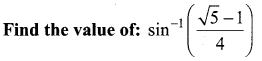
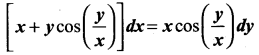
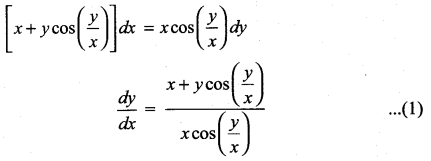
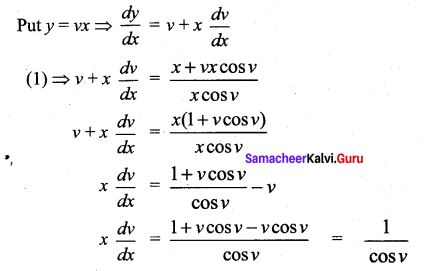
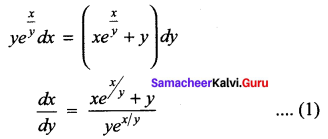
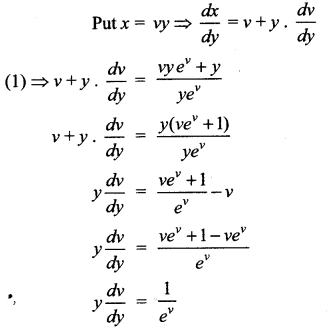
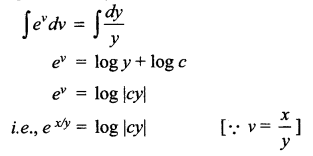
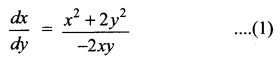
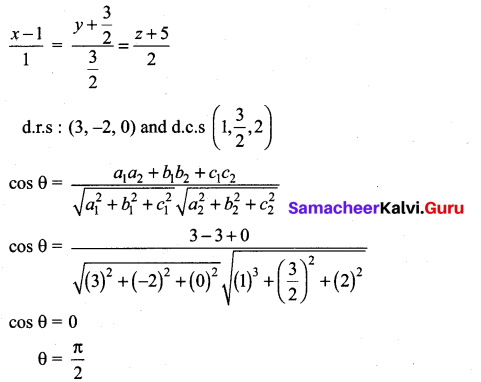
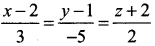
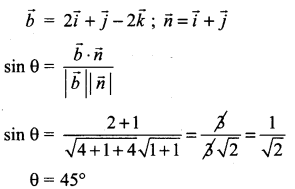
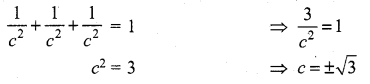
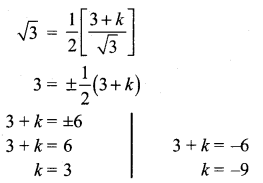
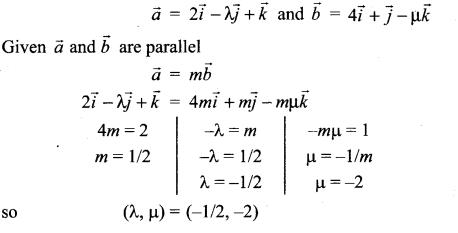
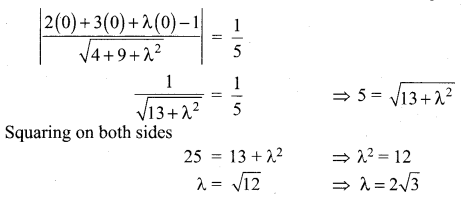
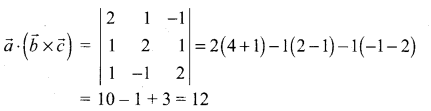
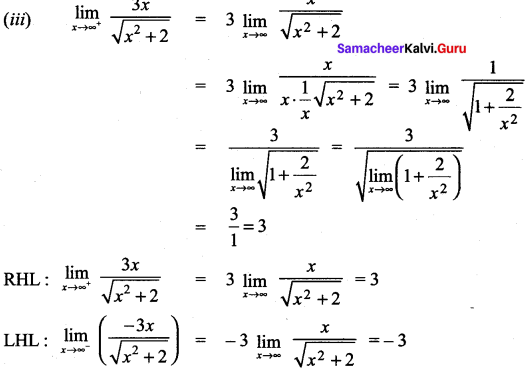
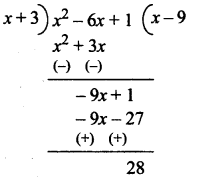
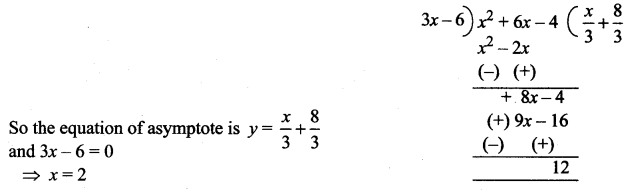
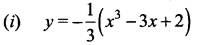
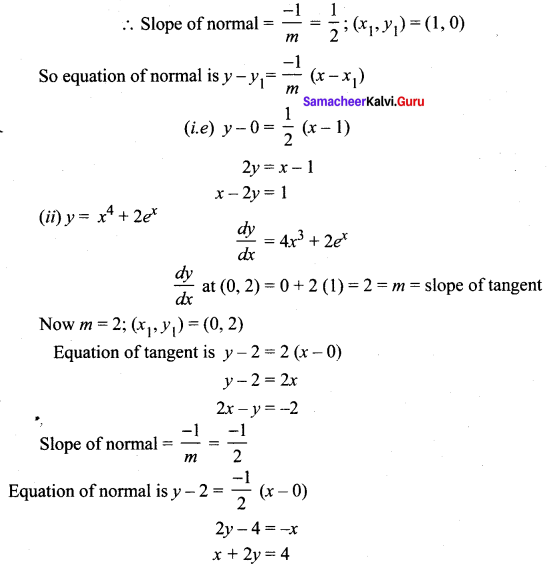
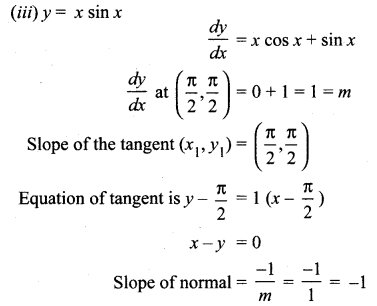
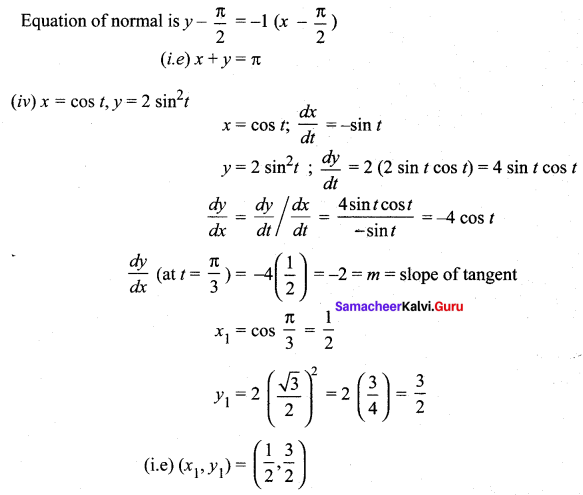
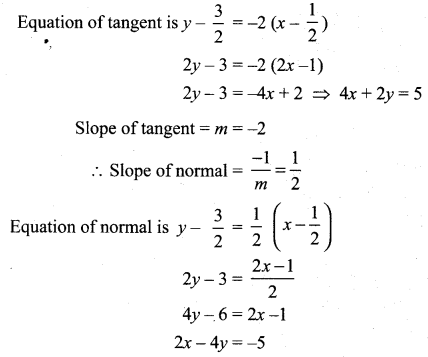
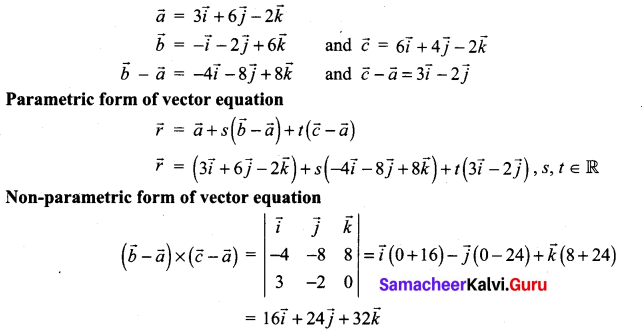
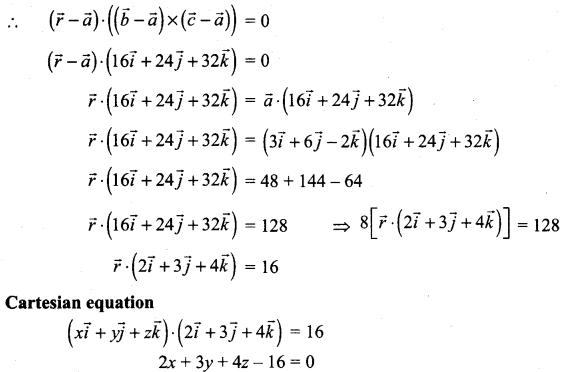
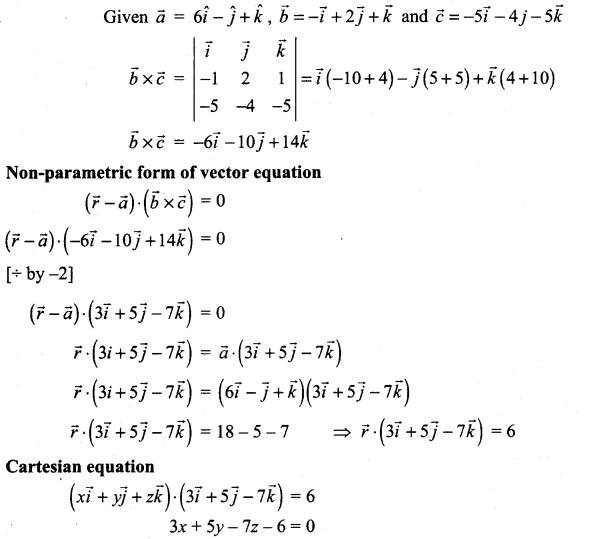
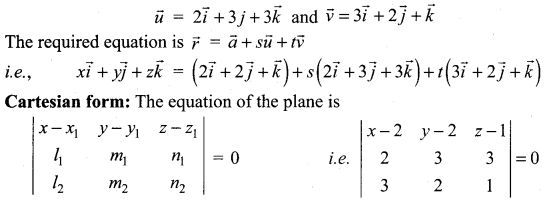
Samacheer Kalvi 12th Maths Solutions Chapter 9 Applications of Integration Ex 9.2

You can Download Samacheer Kalvi 12th Maths Book Solutions Guide Pdf, Tamilnadu State Board help you to revise the complete Syllabus and score more marks in your examinations.

Tamilnadu Samacheer Kalvi 12th Maths Solutions Chapter 9 Applications of Integration Ex 9.2

Question 1.
Evaluate the following integrals as the limits of sums:
Samacheer Kalvi 12th Maths Solutions Chapter 9 Applications of Integration Ex 9.2 1
Solution:
We use the formula
Samacheer Kalvi 12th Maths Solutions Chapter 9 Applications of Integration Ex 9.2 2

Samacheer Kalvi 12th Maths Solutions Chapter 9 Applications of Integration Ex 9.2

(ii) \(\int_{1}^{2}\left(4 x^{2}-1\right) d x\)
Solution:
We use the formula
Samacheer Kalvi 12th Maths Solutions Chapter 9 Applications of Integration Ex 9.2 4
Samacheer Kalvi 12th Maths Solutions Chapter 9 Applications of Integration Ex 9.2 5

Samacheer Kalvi 12th Maths Solutions Chapter 9 Applications of Integration Ex 9.2 Additional Problems

Question 1.
Evaluate as the limit of sums: Samacheer Kalvi 12th Maths Solutions Chapter 9 Applications of Integration Ex 9.2 6
Solution:
Let f(x) = 2x2 +5; a = 1; b = 3 and nh = 3 – 1 = 2
Samacheer Kalvi 12th Maths Solutions Chapter 9 Applications of Integration Ex 9.2 66
Here, f(a) = f(1) = 2(1)2 + 5
f(a + h) = f(1 + h) = 2(1 + h)2 + 5
f(a + 2h) = f(1 + 2h) = 2 (1 + 2h)2 + 5
f[a+(n – 1)h = f[1 + (n – 1)h] = 2[1 + (n – 1)h]2 + 5
Samacheer Kalvi 12th Maths Solutions Chapter 9 Applications of Integration Ex 9.2 7
Samacheer Kalvi 12th Maths Solutions Chapter 9 Applications of Integration Ex 9.2 8

Samacheer Kalvi 12th Maths Solutions Chapter 9 Applications of Integration Ex 9.2

Question 2.
Evaluates as the limit of sums: \(\int_{1}^{2}\left(x^{2}-1\right) d x\)
Solution:
Let f(x) = x2 – 1 for 1 ≤ x ≤ 2
We divide the interval [1, 2] into n equal sub-intervals each of length h.
We have a = 1, b = 2
Samacheer Kalvi 12th Maths Solutions Chapter 9 Applications of Integration Ex 9.2 9
Here, f(a) = f(1) = (1)2 – 1 = 0
f(a + h) = f(1 + h) = (1 + h)2 – 1 = 1 + h2 + 2h – 1 = h2 + 2h
f(a + 2h) = f(1 + 2h) = (1 + 2h)2 – 1 = 1 + 4h2 + 4h – 1 = 4h2 + 4h
f[a + (n -1)h] = f[1 + (n – 1)h] = [1 + (n – 1)h]2 – 1
= 1 + (n – 1)2 h2 + 2(n – 1 )h – 1 = (n – 1)2 h2 + 2 (n – 1 )h
Samacheer Kalvi 12th Maths Solutions Chapter 9 Applications of Integration Ex 9.2 10

Samacheer Kalvi 12th Maths Solutions Chapter 9 Applications of Integration Ex 9.2

Question 3.
Evalute: Samacheer Kalvi 12th Maths Solutions Chapter 9 Applications of Integration Ex 9.2 11
Solution:
Let f(x) = x2 + x + 2, for 0 ≤ x ≤ 2 Here, a = 0,b = 2
We divide the closed interval [0, 2] into n subintervals each of length h.
Samacheer Kalvi 12th Maths Solutions Chapter 9 Applications of Integration Ex 9.2 111
By definition,
Samacheer Kalvi 12th Maths Solutions Chapter 9 Applications of Integration Ex 9.2 12
Samacheer Kalvi 12th Maths Solutions Chapter 9 Applications of Integration Ex 9.2 13

Samacheer Kalvi 12th Maths Solutions Chapter 9 Applications of Integration Ex 9.1

You can Download Samacheer Kalvi 12th Maths Book Solutions Guide Pdf, Tamilnadu State Board help you to revise the complete Syllabus and score more marks in your examinations.

Tamilnadu Samacheer Kalvi 12th Maths Solutions Chapter 9 Applications of Integration Ex 9.1

Question 1.
Find an approximate value of \(\int_{1}^{1.5} x d x\) by applying the left-end rule with the partition {1.1, 1.2, 1.3, 1.4, 1.5}
Solution:
Here a = 1, b = 1.5, n = 5, f(x) = x
So, the width of each subinterval is
Samacheer Kalvi 12th Maths Solutions Chapter 9 Applications of Integration Ex 9.1 1
The left hand rule for Riemann sum,
S = [f(x0) + f(x1)) + f(x2) + f(x3) + f(x4)] ∆x
= [f(1) + f(1.1) + f(1.2) + f(1.3) + f(1.4)] (0.1)
= [1 + 1.1 + 1.2 + 1.3 + 1.4] (0.1)
= [6] (0.1)
= 0.6.

Samacheer Kalvi 12th Maths Solutions Chapter 9 Applications of Integration Ex 9.1

Question 2.
Find an approximate value of \(\int_{1}^{1.5} x^{2} d x\) by applying the right-end rule with the partition {1.1, 1.2, 1.3, 1.4, 1.5}.
Solution:
Here a = 1;
b = 1.5;
n = 5;
f(x) = x2
So, the width of each subinterval is
Samacheer Kalvi 12th Maths Solutions Chapter 9 Applications of Integration Ex 9.1 4
The Right hand rule for Riemann sum,
S = [f(x1) +f(x2) +f(x3) + f(x4) + f(x5)] ∆x
= [f(1.1) + f(1.2) + f(1.3) + f(1.4) + f(1.5)] (0.1)
= [1.21 + 1.44 + 1.69 + 1.96 + 2.25] (0.1)
= [8.55] (0.1)
= 0.855.

Samacheer Kalvi 12th Maths Solutions Chapter 9 Applications of Integration Ex 9.1

Question 3.
Find an approximate value of \(\int_{1}^{1.5}(2-x) d x\) by applying the mid-point rule with the partition {1.1, 1.2, 1.3, 1.4, 1.5}.
Solution:
Here a = 1;
b = 1.5;
n = 5;
f(x) = 2 – x
So, the width of each subinterval is
Samacheer Kalvi 12th Maths Solutions Chapter 9 Applications of Integration Ex 9.1 5
The mid-point rule for Riemann sum,
Samacheer Kalvi 12th Maths Solutions Chapter 9 Applications of Integration Ex 9.1 6
= [f(1.05) + f(1 .15) + f(1.25) +f(1.35) + f(1 .45)] (0.1)
= [0.95 + 0.85 + 0.75 + 0.65 + 0.55] (0.1)
= [3.75] (0.1)
= 0.375.

Samacheer Kalvi 12th Maths Solutions Chapter 8 Differentials and Partial Derivatives Ex 8.8

You can Download Samacheer Kalvi 12th Maths Book Solutions Guide Pdf, Tamilnadu State Board help you to revise the complete Syllabus and score more marks in your examinations.

Tamilnadu Samacheer Kalvi 12th Maths Solutions Chapter 8 Differentials and Partial Derivatives Ex 8.8

Choose the correct or the most suitable answer from the given four alternatives.

Question 1.
A circular template has a radius of 10 cm. The measurement of radius has an approximate error of 0.02 cm. Then the percentage error in calculating area of this template is …….
(a) 0.2%
(b) 0.4%
(c) 0.04%
(d) 0.08%
Solution:
(b) 0.4%
Hint:
r = 10 cm
dr = 0.02
Samacheer Kalvi 12th Maths Solutions Chapter 8 Differentials and Partial Derivatives Ex 8.8 1

Question 2.
The percentage error of fifth root of 31 is approximately how many times the percentage error in 31?
Samacheer Kalvi 12th Maths Solutions Chapter 8 Differentials and Partial Derivatives Ex 8.8 2
Solution:
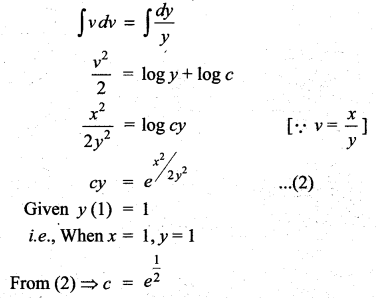
\(\frac{1}{5}\)
Hint:
We know that the percentage error in the «th root of a number is approximately \(\frac{1}{n}\) times the percentage error in the number.
Samacheer Kalvi 12th Maths Solutions Chapter 8 Differentials and Partial Derivatives Ex 8.8 3

Samacheer Kalvi 12th Maths Solutions Chapter 8 Differentials and Partial Derivatives Ex 8.8

Question 3.
Samacheer Kalvi 12th Maths Solutions Chapter 8 Differentials and Partial Derivatives Ex 8.8 4
Samacheer Kalvi 12th Maths Solutions Chapter 8 Differentials and Partial Derivatives Ex 8.8 5
Solution:
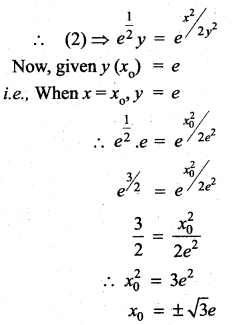
(b) 2xu
Hint:
Samacheer Kalvi 12th Maths Solutions Chapter 8 Differentials and Partial Derivatives Ex 8.8 6

Question 4.
Samacheer Kalvi 12th Maths Solutions Chapter 8 Differentials and Partial Derivatives Ex 8.8 7
Samacheer Kalvi 12th Maths Solutions Chapter 8 Differentials and Partial Derivatives Ex 8.8 77
Solution:
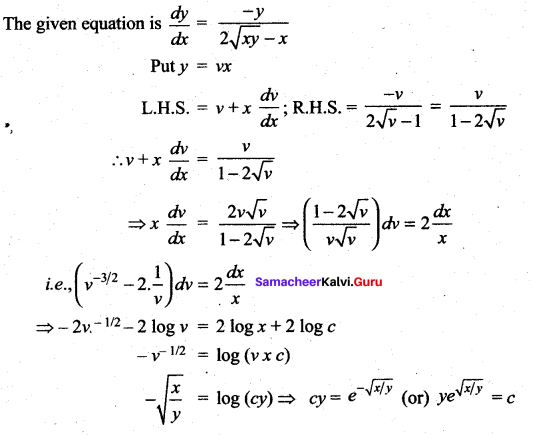
(d) 1
Hint:
Samacheer Kalvi 12th Maths Solutions Chapter 8 Differentials and Partial Derivatives Ex 8.8 8

Samacheer Kalvi 12th Maths Solutions Chapter 8 Differentials and Partial Derivatives Ex 8.8

Question 5.
If w (x, y) = xy, x > 0, then \(\frac{\partial w}{\partial x}\) is equal to ……
Samacheer Kalvi 12th Maths Solutions Chapter 8 Differentials and Partial Derivatives Ex 8.8 9
Solution:
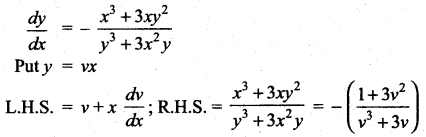
(c) yxy – 1
Hint:
Samacheer Kalvi 12th Maths Solutions Chapter 8 Differentials and Partial Derivatives Ex 8.8 10

Question 6.
Samacheer Kalvi 12th Maths Solutions Chapter 8 Differentials and Partial Derivatives Ex 8.8 11
(a) xyexy
(b) (1 + xy)exy
(c) (1 + y)exy
(d) (1 + x)exy
Solution:
(b) (1 + xy)exy
Hint:
Samacheer Kalvi 12th Maths Solutions Chapter 8 Differentials and Partial Derivatives Ex 8.8 12

Question 7.
If we measure the side of a cube to be 4 cm with an error of 0.1 cm, then the error in our calculation of the volume is …….
(a) 0.4 cu.cm
(b) 0.45 cu.cm
(c) 2 cu.cm
(d) 4.8 cu.cm
Solution:
(d) 4.8 cu.cm
Hint.
a = 4 cm
da = 0.1 cm
v = a3
dv = 3a2da
= 3(4)2 (0.1)
= 4.8 cu. cm

Samacheer Kalvi 12th Maths Solutions Chapter 8 Differentials and Partial Derivatives Ex 8.8

Question 8.
The change in the surface area S = 6x2 of a cube when the edge length varies from x0 to x0 + dx is …….
(a) 12x0 + dx
(b) 12x0dx
(c) 6x0dx
(d) 6x0 + dx
Solution:
(b) 12x0dx

Question 9.
the approximate change in the volume: V of a cube of side x mentres caused by increasing the side by 1% is ……..
(a) 0.3 xdx m3
(b) 0.03 x m3
(c) 0.03 x2 m3
(d) 0.03 x3m3
Solution:
(d) 0.03 x3m3
Hint:
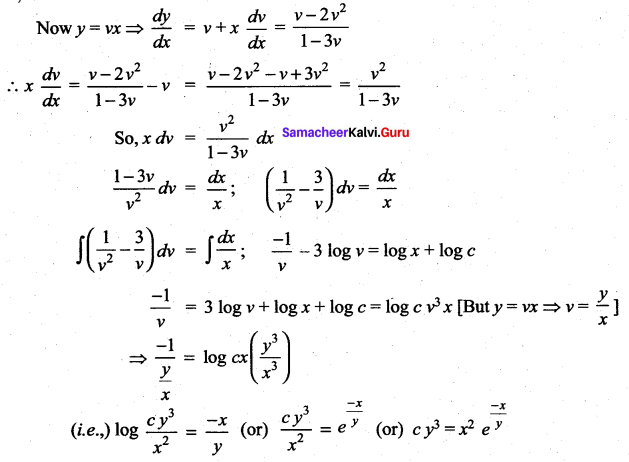
Let the side of the cube be x units
v = x3
when dx = 0.01x
dv = 3x2dx
= 3x2(0.01 x)
= 0.03 x3m3

Question 10.
If g(x, y) = 3x2 – 5y + 2y2, x(t) = et and y(t) = cos t, then \(\frac{d g}{d t}\) is equal to ……..
(a) 6e2t + 5 sin t – 4 cos t sin t
(b) 6e2t – 5 sin t + 4 cos t sin t
(c) 3e2t + 5 sin t + 4 cos t sin t
(d) 3e2t – 5 sin t + 4 cos t sin t
Solution:
(a) 6e2t + 5 sin t – 4 cos t sin t

Question 11.
Samacheer Kalvi 12th Maths Solutions Chapter 8 Differentials and Partial Derivatives Ex 8.8 13
Samacheer Kalvi 12th Maths Solutions Chapter 8 Differentials and Partial Derivatives Ex 8.8 14
Solution:
(b) \(\frac{1}{(x+1)^{2}} d x\)
Hint:
Samacheer Kalvi 12th Maths Solutions Chapter 8 Differentials and Partial Derivatives Ex 8.8 15

Question 12.
Samacheer Kalvi 12th Maths Solutions Chapter 8 Differentials and Partial Derivatives Ex 8.8 16
(a) -4
(b) -3
(c) -7
(d) 13
Solution:
(c) -7
Hint:
Samacheer Kalvi 12th Maths Solutions Chapter 8 Differentials and Partial Derivatives Ex 8.8 166

Samacheer Kalvi 12th Maths Solutions Chapter 8 Differentials and Partial Derivatives Ex 8.8

Question 13.
Samacheer Kalvi 12th Maths Solutions Chapter 8 Differentials and Partial Derivatives Ex 8.8 17
Samacheer Kalvi 12th Maths Solutions Chapter 8 Differentials and Partial Derivatives Ex 8.8 18
Solution:
(b) \(-x+\frac{\pi}{2}\)
Hint:
Samacheer Kalvi 12th Maths Solutions Chapter 8 Differentials and Partial Derivatives Ex 8.8 19

Question 14.
If w(x, y, z) = x2 (y – z) + y2 (z – x) + z2 (x – y), then Samacheer Kalvi 12th Maths Solutions Chapter 8 Differentials and Partial Derivatives Ex 8.8 167
(a) xy + yz + zx
(a) xy + yz + zx
(b) x(y + z)
(c) y(z + x)
(d) 0
Solution:
(d) 0
Hint:
Samacheer Kalvi 12th Maths Solutions Chapter 8 Differentials and Partial Derivatives Ex 8.8 21

Question 15.
If f(x, y, z) = xy + yz + zx, then fx – fz is equal to ……….
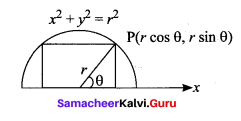
(a) z – x
(b) y – z
(c) x – z
(d) y – x
Solution:
(a) z – x
Hint:
fx = y + z
fz = y + x
fx – fz = y + z – y – x = z – x

Additional Problems

Question 1.
If u = xy then is equal to ……..
(a) yxy – 1
(b) u log x
(c) u log y
(d) xyx – 1
Solution:
(a) yxy – 1
Hint:
Samacheer Kalvi 12th Maths Solutions Chapter 8 Differentials and Partial Derivatives Ex 8.8 22

Samacheer Kalvi 12th Maths Solutions Chapter 8 Differentials and Partial Derivatives Ex 8.8

Question 2.
Samacheer Kalvi 12th Maths Solutions Chapter 8 Differentials and Partial Derivatives Ex 8.8 23
(a) 0
(b) 1
(c) 2
(d) 4
Solution:
(c) 2
Hint:
Samacheer Kalvi 12th Maths Solutions Chapter 8 Differentials and Partial Derivatives Ex 8.8 24

Question 3.
Samacheer Kalvi 12th Maths Solutions Chapter 8 Differentials and Partial Derivatives Ex 8.8 25
Samacheer Kalvi 12th Maths Solutions Chapter 8 Differentials and Partial Derivatives Ex 8.8 26
Solution:
(d) -u
Hint:
Samacheer Kalvi 12th Maths Solutions Chapter 8 Differentials and Partial Derivatives Ex 8.8 27

Question 4.
The curve y2 (x- 2) = x2 (1 +x) has …….

(a) an asymptote parallel to x-axis
(b) an asymptote parallel to y-axis
(c) asymptotes parallel to both axis
(d) no asymptotes
Solution:
(b) an asymptote parallel to y-axis
Hint:
Samacheer Kalvi 12th Maths Solutions Chapter 8 Differentials and Partial Derivatives Ex 8.8 28

Samacheer Kalvi 12th Maths Solutions Chapter 8 Differentials and Partial Derivatives Ex 8.8

Question 5.
If x = r cos θ, y = r sin θ, then \(\frac{\partial r}{\partial x}\) is equal to …….
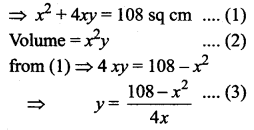
(a) sec θ
(b) sin θ
(c) cos θ
(d) cosec θ
Solution:
(c) cos θ
Hint:
Samacheer Kalvi 12th Maths Solutions Chapter 8 Differentials and Partial Derivatives Ex 8.8 29

Question 6.
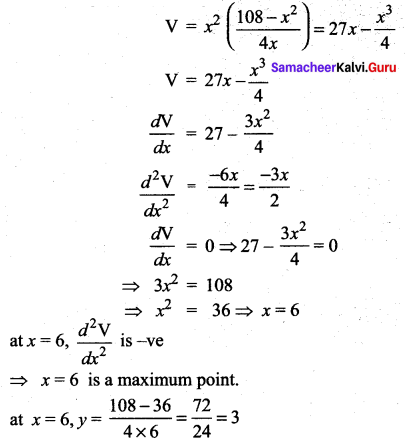
Samacheer Kalvi 12th Maths Solutions Chapter 8 Differentials and Partial Derivatives Ex 8.8 30
(a) 0
(b) u
(c) 2u
(d) u – 1
Solution:
(a) 0
Hint:
Samacheer Kalvi 12th Maths Solutions Chapter 8 Differentials and Partial Derivatives Ex 8.8 31

Question 7.
The percentage error in the 11th root of the number 28 is approximately …. times the precentage error is 28.
Samacheer Kalvi 12th Maths Solutions Chapter 8 Differentials and Partial Derivatives Ex 8.8 32
Solution:
\(\frac{1}{11}\)
Hint:
Samacheer Kalvi 12th Maths Solutions Chapter 8 Differentials and Partial Derivatives Ex 8.8 33
Take log on both sides
Samacheer Kalvi 12th Maths Solutions Chapter 8 Differentials and Partial Derivatives Ex 8.8 34
The percentage error is approximately \(\frac{1}{11}\) times the percentage error is 28.

Question 8.
The curve a2y2 = x2 (a2 – x2) has ……
(a) only one loop between x = 0 and x = a
(b) two loops between x = 0 and x = a
(c) two loops between x = – a and x = a
(d) no loop
Solution:
(c) two loops between x = – a and x = a
Hint.
Samacheer Kalvi 12th Maths Solutions Chapter 8 Differentials and Partial Derivatives Ex 8.8 35

Question 9.
An asymptote to the curve y2 (a + 2x) = x2 (3a – x) is ………
(a) x = 3a
(b) x = – a/2
(c) x = a/2
(d) x = 0
Solution:
(b) x = – a/2
Hint.
Samacheer Kalvi 12th Maths Solutions Chapter 8 Differentials and Partial Derivatives Ex 8.8 36

Samacheer Kalvi 12th Maths Solutions Chapter 8 Differentials and Partial Derivatives Ex 8.8

Question 10.
In which region the curve y2 (a + x) = x2 (3a – x) does not lie?
(a) x > 0
(b) 0 < x < 3a (c) x ≤ – a and x > 3a
(d) – a < x < 3a Solution: (c) x ≤ – a and x > 3a
Hint.
y2 (a + x) = x2 (3a – x)
Taking y = 0 (1) ⇒ 0 = x2 (3a – x)
= x = 0, x = 3a
∴ The points are (0, 0) (3a, 0)
There is a loop between x = 0 and x = 3a
Samacheer Kalvi 12th Maths Solutions Chapter 8 Differentials and Partial Derivatives Ex 8.8 37
when x > 3 a, y ➝ imaginary
the curves does not exist beyond x = 3a i.e., x > 3a
the curve has asymptote at x = -a
the curve does not exist when x < -a
the curve exists in the region – a < x < 3a

Question 11.
If M = y sin x, then \(\frac{\partial^{2} u}{\partial x \partial y}\) is equal to …….
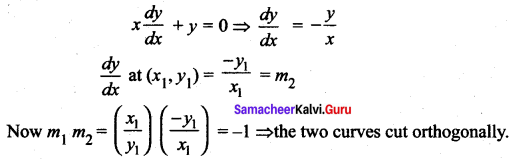
(a) cos x
(b) cos y
(c) sin x
(d) 0
Solution:
(a) cos x
Hint:
Samacheer Kalvi 12th Maths Solutions Chapter 8 Differentials and Partial Derivatives Ex 8.8 38

Question 12.
Samacheer Kalvi 12th Maths Solutions Chapter 8 Differentials and Partial Derivatives Ex 8.8 39
(a) 0
(b) 1
(c) 2u
(d) u
Solution:
(a) 0
Hint:
Samacheer Kalvi 12th Maths Solutions Chapter 8 Differentials and Partial Derivatives Ex 8.8 40

Question 13.
The curve 9y2 = x2 (4 – x2) is symmetrical about …….
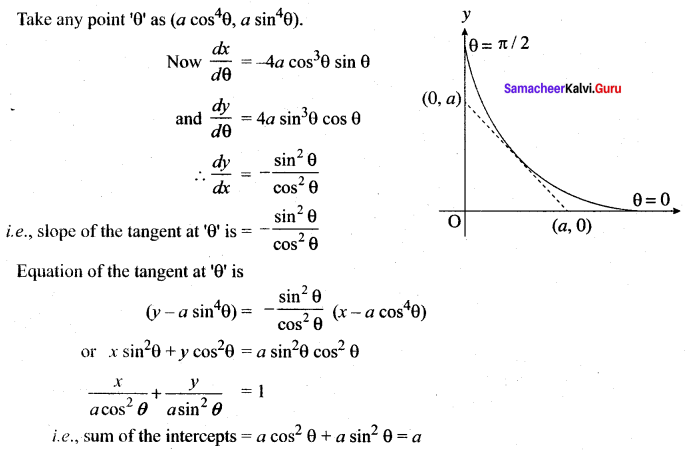
(a) y – axis
(b) x – axis
(c) y = x
(d) both the axes
Solution:
(d) both the axes
Hint.
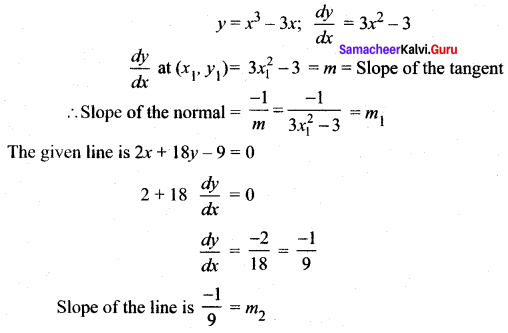
Replace x by – x and y by -y
9 (-y2) = (-x)2(4-(-x)2)
The equation is unaltered
∴ the curve is symmetrical about both the axes.

Samacheer Kalvi 12th Maths Solutions Chapter 8 Differentials and Partial Derivatives Ex 8.8

Question 14.
The curve ay2 = x2 (3a – x) cuts the y – axis at …….
(a) x = – 3a, x = 0
(b) x = 0, x = 3a
(c) x = 0, x = a
(d) x = 0
Solution:
(d) x = 0
Hint:
Given ay2 = x2 (3a – x)
The point of intersection with y-axis by putting x = O
In (1) = ay2 = 0 (3a – 0)
ay = 0 ; y = 0
∴ The curve intersects y-axis at the origin is x = 0

Samacheer Kalvi 12th Maths Solutions Chapter 11 Probability Distributions Ex 11.5

You can Download Samacheer Kalvi 12th Maths Book Solutions Guide Pdf, Tamilnadu State Board help you to revise the complete Syllabus and score more marks in your examinations.

Tamilnadu Samacheer Kalvi 12th Maths Solutions Chapter 11 Probability Distributions Ex 11.5

Question 1.
Compute P(X = k) for the binomial distribution, B(n, p) where
Samacheer Kalvi 12th Maths Solutions Chapter 11 Probability Distributions Ex 11.5 1
Solution:
Samacheer Kalvi 12th Maths Solutions Chapter 11 Probability Distributions Ex 11.5 2

Question 2.
The probability that Mr. Q hits a target at any trial is \(\frac{1}{4}\). Suppose he tries at the target 10 times. Find the probability that he hits the target
(i) exactly 4 times
(ii) at least one time.
Solution:
Let ‘p’ be the probability of hitting the trial
Samacheer Kalvi 12th Maths Solutions Chapter 11 Probability Distributions Ex 11.5 3
and number of trials ‘n’ = 10
Probability of ‘x’ success in ‘n’ trials is
Samacheer Kalvi 12th Maths Solutions Chapter 11 Probability Distributions Ex 11.5 4

Samacheer Kalvi 12th Maths Solutions Chapter 11 Probability Distributions Ex 11.5

(i) Probability that Mr.Q hits the target exactly 4 times is
Samacheer Kalvi 12th Maths Solutions Chapter 11 Probability Distributions Ex 11.5 5

(ii) Probability that Mr.Q hits the target atleast one time is
P(X ≥ 1) = 1 – P(X < 1)
= 1 – P(X = 0)
Samacheer Kalvi 12th Maths Solutions Chapter 11 Probability Distributions Ex 11.5 6

Question 3.
Using binomial distribution find the mean and variance of X for the following experiments
(i) A fair coin is tossed 100 times, and X denote the number of heads.
(ii) A fair die is tossed 240 times, and X denote the number of times that four appeared.
Solution:
(i) n = 100, ‘X’ denotes the number of heads.
Samacheer Kalvi 12th Maths Solutions Chapter 11 Probability Distributions Ex 11.5 7

(ii) n = 240, ‘X’ denotes the number of times four appeared.
Samacheer Kalvi 12th Maths Solutions Chapter 11 Probability Distributions Ex 11.5 8

Samacheer Kalvi 12th Maths Solutions Chapter 11 Probability Distributions Ex 11.5

Question 4.
The probability that a certain kind of component will survive a electrical test is \(\frac{3}{4}\). Find the probability that exactly 3 of the 5 components tested survive.
Solution:
Given n = 5
Samacheer Kalvi 12th Maths Solutions Chapter 11 Probability Distributions Ex 11.5 9

Question 5.
A retailer purchases a certain kind of electronic device from a manufacturer. The manufacturer indicates that the defective rate of the device is 5%. The inspector of the retailer randomly picks 10 items from a shipment. What is the probability that there will be
(i) at least one defective item
(ii) exactly two defective items.
Solution:
Given n = 10
Samacheer Kalvi 12th Maths Solutions Chapter 11 Probability Distributions Ex 11.5 10
Let ‘X’ be the random variable denotes the number of defective items.
∴ Probability of ‘x’ successes in ‘n’ trials is
Samacheer Kalvi 12th Maths Solutions Chapter 11 Probability Distributions Ex 11.5 11

Samacheer Kalvi 12th Maths Solutions Chapter 11 Probability Distributions Ex 11.5

Question 6.
If the probability that a fluorescent light has a useful life of at least 600 hours is 0.9, find the probabilities that among 12 such lights.
(i) exactly 10 will have a useful life of at least 600 hours;
(ii) at least 11 will have a useful life of at least 600 hours;
(iii) at least 2 will not have a useful life of at least 600 hours.
Solution:
Given n = 12
Probability that a fluorescent light has a life of atleast of 600 hours is p = 0.9
∴ q = 1 – p = 1 – 0.9 = 0.1
Let ‘X’ be the number of bulbs.
∴ Probability of ‘x’ successes in ‘n’ trials is
Samacheer Kalvi 12th Maths Solutions Chapter 11 Probability Distributions Ex 11.5 12

(i) Probability that exactly 10 bulbs will have a useful life of atleast 600 hours
Samacheer Kalvi 12th Maths Solutions Chapter 11 Probability Distributions Ex 11.5 13

(ii) Probability that atleast 11 will have a useful life of atleast 600 hours is
Samacheer Kalvi 12th Maths Solutions Chapter 11 Probability Distributions Ex 11.5 14

(iii) Probability that atleast 2 will not have a useful life of 600 hours is
Samacheer Kalvi 12th Maths Solutions Chapter 11 Probability Distributions Ex 11.5 15

Question 7.
The mean and standard deviation of a binomial variate X are respectively 6 and 2. Find
(i) the probability mass function
(ii) P(X = 3)
(iii) P(X ≥ 2) .
Solution:
Samacheer Kalvi 12th Maths Solutions Chapter 11 Probability Distributions Ex 11.5 16
Samacheer Kalvi 12th Maths Solutions Chapter 11 Probability Distributions Ex 11.5 17

Samacheer Kalvi 12th Maths Solutions Chapter 11 Probability Distributions Ex 11.5

Question 8.
If X ~ B(n, p) such that 4P(X = 4) = P(x = 2) and n = 6. Find the distribution, mean and standard deviation.
Solution:
Samacheer Kalvi 12th Maths Solutions Chapter 11 Probability Distributions Ex 11.5 18

Question 9.
In a binomial distribution consisting of 5 independent trials, the probability of 1 and 2 successes are 0.4096 and 0.2048 respectively. Find the mean and variance of the distribution.
solution:
Number of trials n = 5
Probability of ‘x’ successes in ‘n’ trials is
Samacheer Kalvi 12th Maths Solutions Chapter 11 Probability Distributions Ex 11.5 20
Given P(X = 1) = 0.4096 and P (X = 2) = 0.2048
Samacheer Kalvi 12th Maths Solutions Chapter 11 Probability Distributions Ex 11.5 21
Dividing Eq.(1) by Eq.(2)
Samacheer Kalvi 12th Maths Solutions Chapter 11 Probability Distributions Ex 11.5 22

Samacheer Kalvi 12th Maths Solutions Chapter 11 Probability Distributions Ex 11.5 Additional Problems

Question 1.
In a Binomial distribution if n = 5 and P(X = 3) = 2P(X = 2) find p.
Solution:
Samacheer Kalvi 12th Maths Solutions Chapter 11 Probability Distributions Ex 11.5 23

Samacheer Kalvi 12th Maths Solutions Chapter 11 Probability Distributions Ex 11.5

Question 2.
If the sum of mean and variance of a Binomial Distribution is 4.8 for 5 trials find the distribution.
Solution:
np + npq = 4.8 ⇒ np (1 + q) = 4.8
5p [1 + (1 – p)] = 4.8
p2 – 2p + 0.96 = 0 ⇒ p = 1.2, 0.8
∴ p = 0.8 ; q = 0.2 [∵ p cannot be greater than 1]
∴ The Binomial distribution is P[X = x] = 5Cx (0.8)x (0.2)5 – x, x = 0 to 5

Question 3.
If on an average 1 ship out of 10 do not arrive safely to ports. Find the mean and the standard deviation of the ships returning safely out of a total of 500 ships.
Solution:
Probability of a ship arriving safely
Samacheer Kalvi 12th Maths Solutions Chapter 11 Probability Distributions Ex 11.5 24

Question 4.
The overall percentage of passes in a certain examination is 80. If six candidates appear in the examination what is the probability that at least five pass the examination.
Solution:
Pass percentage = 80%
∴ Probability of a candidate passing in the examination
Samacheer Kalvi 12th Maths Solutions Chapter 11 Probability Distributions Ex 11.5 25
Samacheer Kalvi 12th Maths Solutions Chapter 11 Probability Distributions Ex 11.5 26

Samacheer Kalvi 12th Maths Solutions Chapter 11 Probability Distributions Ex 11.5

Question 5.
In a hurdle race a player has to cross 10 hurdles. The probability that he will clear each hurdle is 5/6. What is the probability that he will knock down less than 2 hurdles?
Solution:
Samacheer Kalvi 12th Maths Solutions Chapter 11 Probability Distributions Ex 11.5 27

Samacheer Kalvi 12th Maths Solutions Chapter 5 Two Dimensional Analytical Geometry – II Ex 5.3

You can Download Samacheer Kalvi 12th Maths Book Solutions Guide Pdf, Tamilnadu State Board help you to revise the complete Syllabus and score more marks in your examinations.

Tamilnadu Samacheer Kalvi 12th Maths Solutions Chapter 5 Two Dimensional Analytical Geometry – II Ex 5.3

Identify the type of conic section for each of the equations.
Question 1.
2x2 – y2 = 7
Solution:
Comparing this equation with the general equation of the conic
Ax2 + Bxy + Cy2 + Dx + Ey + F = 0
We get A = 2, C = – 1
Elere A ≠ C also A and C are of opposite signs.
So the conic is a hyperbola.

Question 2.
3x2 + 3y2 – 4x + 3y + 10 = 0
Sol. Comparing this equation with the general equation of the conic
Ax2 + Bxy + Cy2 + Dx + Ey + F = 0
We get A = C also B = 0
So the given conic is a circle.

Question 3.
3x2 + 2y2 = 14
Solution:
Comparing this equation with the general equation of the conic
Ax2 + Bxy + Cy2 + Dx + Ey + F = 0
We get A ≠ C also C are of the same sign.
So the given conic is an ellipse.

Samacheer Kalvi 12th Maths Solutions Chapter 5 Two Dimensional Analytical Geometry - II Ex 5.3

Question 4.
x2 + y2 + x – y = 0
Solution:
Comparing this equation with the general equation of the conic
Ax2 + Bxy + Cy2 + Dx + Ey + F = 0
We get A = C and B = 0
So the given conic is a circle.

Question 5.
11x2 – 25y2 – 44x + 50y – 256 = 0
Solution:
Comparing this equation with the general equation of the conic
Ax2 + Bxy + Cy2 + Dx + Ey + F = 0
We get A ≠ C. Also A and C are of opposite sign.
So the conic is a hyperbola.

Question 6.
y2 + 4x + 3y + 4 = 0
Solution:
Comparing this equation with the general equation of the conic
Ax2 + Bxy + Cy2 + Dx + Ey + F = 0
We get A = 0 and B = 0
So the conic is a parabola.

Samacheer Kalvi 12th Maths Solutions Chapter 5 Two Dimensional Analytical Geometry - II Ex 5.3

Samacheer Kalvi 12th Maths Solutions Chapter 5 Two Dimensional Analytical Geometry – II Ex 5.3 Additional Problems

Identify the type of conic section for each of the following equations
(i) x2 – 4y2 + 6x + 16y – 11 = 0
(ii) y2 – 8y + 4x – 3 = 0
(iii) 4x2 – 9y2 = 36
(iv) 16x2 + 25y2 = 400
(v) 16x2 + 9y2 + 32x – 36y – 92 = 0
(vi) x2 + 4y2 – 8x – 16y – 68 = 0
(vii) x2 + y2 – 4x + 6y – 17 = 0
Solution:
(i) Hyperbola
(ii) Parabola
(iii) Hyperbola
(iv) Ellipse
(v) Ellipse
(vi) Ellipse
(vii) Circle

Samacheer Kalvi 12th Maths Solutions Chapter 8 Differentials and Partial Derivatives Ex 8.5

You can Download Samacheer Kalvi 12th Maths Book Solutions Guide Pdf, Tamilnadu State Board help you to revise the complete Syllabus and score more marks in your examinations.

Tamilnadu Samacheer Kalvi 12th Maths Solutions Chapter 8 Differentials and Partial Derivatives Ex 8.5

Question 1.
If w(x, y) = x3 – 3xy + 2y2, x, y ∈ R, find the linear approximation for w at (1, -1) .
Solution:
w(x, y) = x3 – 3xy + 2y2 ; at (1, -1)
Linear approximation is given by
Samacheer Kalvi 12th Maths Solutions Chapter 8 Differentials and Partial Derivatives Ex 8.5 1
(1) ⇒ Let(x, y) = 6 + 6(x – 1) – 7(y + 1)
= 6x – 6 – 7y – 7
= = 6x – 7y – 7

Question 2.
Let z(x, y) = x2y + 3xy4, x, y ∈ R, Find the linear approximation for z at (2, -1).
Solution:
Samacheer Kalvi 12th Maths Solutions Chapter 8 Differentials and Partial Derivatives Ex 8.5 2
Linear approximation is given by
Samacheer Kalvi 12th Maths Solutions Chapter 8 Differentials and Partial Derivatives Ex 8.5 3

Samacheer Kalvi 12th Maths Solutions Chapter 8 Differentials and Partial Derivatives Ex 8.5

Question 3.
If v(x, y) = x2 – xy + \(\frac{1}{4}\)y2 + 7, x, y ∈ R, find the differential dv.
Solution:
Samacheer Kalvi 12th Maths Solutions Chapter 8 Differentials and Partial Derivatives Ex 8.5 4
The differential is dv = (2x -y) dx + (- x + \(\frac{y}{2}\))dy

Question 4.
Let W(x, y, z) = x2 – xy + 3sinz,x,y, z ∈ R. Find the linear approximation at (2, -1, 0).
Solution:
w (x, y, z) = x2 – xy + 3 sin z
Here(x0, y0, y0) = (2, -1, 0)
Samacheer Kalvi 12th Maths Solutions Chapter 8 Differentials and Partial Derivatives Ex 8.5 5
Linear approximation is given by
Samacheer Kalvi 12th Maths Solutions Chapter 8 Differentials and Partial Derivatives Ex 8.5 6

Samacheer Kalvi 12th Maths Solutions Chapter 8 Differentials and Partial Derivatives Ex 8.5

Question 5.
Let V (x, y, z) = xy + yz + zx, x, y, z ∈ R. Find the differential dV.
Solution:
V(x, y, z) = xy + yz + zx
Vx = y + z
Vy = x + z
Vz = y + x
The differential is dV = (y + z) dx + (x + z) dy + (y + x) dz

Samacheer Kalvi 12th Maths Solutions Chapter 8 Differentials and Partial Derivatives Ex 8.4

You can Download Samacheer Kalvi 12th Maths Book Solutions Guide Pdf, Tamilnadu State Board help you to revise the complete Syllabus and score more marks in your examinations.

Tamilnadu Samacheer Kalvi 12th Maths Solutions Chapter 8 Differentials and Partial Derivatives Ex 8.4

Question 1.
Find the partial derivatives of the following functions at the indicated points.
(i) f(x, y) = 3x2 – 2xy + y2 + 5x + 2, (2, -5)
(ii) g(x, y) = 3x2 + y2 + 5x + 2, (1, -2)
Samacheer Kalvi 12th Maths Solutions Chapter 8 Differentials and Partial Derivatives Ex 8.4 1
(iv) G (x, y) = e*x + 3y log (x2 + y2), (-1, 1)
Solution:
Samacheer Kalvi 12th Maths Solutions Chapter 8 Differentials and Partial Derivatives Ex 8.4 2
Samacheer Kalvi 12th Maths Solutions Chapter 8 Differentials and Partial Derivatives Ex 8.4 3
Samacheer Kalvi 12th Maths Solutions Chapter 8 Differentials and Partial Derivatives Ex 8.4 4
Samacheer Kalvi 12th Maths Solutions Chapter 8 Differentials and Partial Derivatives Ex 8.4 5

Samacheer Kalvi 12th Maths Solutions Chapter 8 Differentials and Partial Derivatives Ex 8.4

Question 2.
For each of the following functions find the fx, fy and show that fxy = fyx
Samacheer KalviSamacheer Kalvi 12th Maths Solutions Chapter 8 Differentials and Partial Derivatives Ex 8.4 85
Solution:
Samacheer Kalvi 12th Maths Solutions Chapter 8 Differentials and Partial Derivatives Ex 8.4 6
Samacheer Kalvi 12th Maths Solutions Chapter 8 Differentials and Partial Derivatives Ex 8.4 7
Samacheer Kalvi 12th Maths Solutions Chapter 8 Differentials and Partial Derivatives Ex 8.4 8
Samacheer Kalvi 12th Maths Solutions Chapter 8 Differentials and Partial Derivatives Ex 8.4 9

Question 3.
Samacheer Kalvi 12th Maths Solutions Chapter 8 Differentials and Partial Derivatives Ex 8.4 11
Solution:
Samacheer Kalvi 12th Maths Solutions Chapter 8 Differentials and Partial Derivatives Ex 8.4 12

Samacheer Kalvi 12th Maths Solutions Chapter 8 Differentials and Partial Derivatives Ex 8.4

Question 4.
Samacheer Kalvi 12th Maths Solutions Chapter 8 Differentials and Partial Derivatives Ex 8.4 13
Solution:
Samacheer Kalvi 12th Maths Solutions Chapter 8 Differentials and Partial Derivatives Ex 8.4 14

Question 5.
For each of the following functions find the gxy, gxx, gyy and gyx.
(i) g(x, y) = xey + 3x2y
(ii) g(x, y) = log(5x + 3y)
(iii) g(x, y) = x2 + 3xy – 7y + cos(5x)
Solution:
Samacheer Kalvi 12th Maths Solutions Chapter 8 Differentials and Partial Derivatives Ex 8.4 15
Samacheer Kalvi 12th Maths Solutions Chapter 8 Differentials and Partial Derivatives Ex 8.4 16
Samacheer Kalvi 12th Maths Solutions Chapter 8 Differentials and Partial Derivatives Ex 8.4 17

Samacheer Kalvi 12th Maths Solutions Chapter 8 Differentials and Partial Derivatives Ex 8.4

Question 6.
Samacheer Kalvi 12th Maths Solutions Chapter 8 Differentials and Partial Derivatives Ex 8.4 19
Solution:
Samacheer Kalvi 12th Maths Solutions Chapter 8 Differentials and Partial Derivatives Ex 8.4 20
Samacheer Kalvi 12th Maths Solutions Chapter 8 Differentials and Partial Derivatives Ex 8.4 21

Question 7.
Samacheer Kalvi 12th Maths Solutions Chapter 8 Differentials and Partial Derivatives Ex 8.4 23
Solution:
Samacheer Kalvi 12th Maths Solutions Chapter 8 Differentials and Partial Derivatives Ex 8.4 24

Samacheer Kalvi 12th Maths Solutions Chapter 8 Differentials and Partial Derivatives Ex 8.4

Question 8.
Samacheer Kalvi 12th Maths Solutions Chapter 8 Differentials and Partial Derivatives Ex 8.4 25
Solution:
Samacheer Kalvi 12th Maths Solutions Chapter 8 Differentials and Partial Derivatives Ex 8.4 26
Samacheer Kalvi 12th Maths Solutions Chapter 8 Differentials and Partial Derivatives Ex 8.4 27

Question 9.
Samacheer Kalvi 12th Maths Solutions Chapter 8 Differentials and Partial Derivatives Ex 8.4 28
Solution:
Samacheer Kalvi 12th Maths Solutions Chapter 8 Differentials and Partial Derivatives Ex 8.4 29

Samacheer Kalvi 12th Maths Solutions Chapter 8 Differentials and Partial Derivatives Ex 8.4

Question 10.
A firm produces two types of calculators each week, x number of type A and j number of type B . The weekly revenue and cost functions (in rupees) are
R(x, y) = 80x + 90y + 0.04xy – 0.05.x2 – 0.05y2 and C(x, y) = 8x + 6y + 2000 respectively.
(i) Find the profit function P(x,y),
Samacheer Kalvi 12th Maths Solutions Chapter 8 Differentials and Partial Derivatives Ex 8.4 30
Solution:
(i) Profit = Revenue – Cost
= (80x + 90y + 0.04 xy – 0.05 x2 – 0.05y2) – (8x + 6y + 2000)
= 80x + 90y + 0.04 xy – 0.05 x2 – 0.05y2 – 8x – 6y – 2000
P(x, y) = 72x + 84y + 0.04 xy – 0.05 x2 – 0.05y2 – 2000
Samacheer Kalvi 12th Maths Solutions Chapter 8 Differentials and Partial Derivatives Ex 8.4 31
Samacheer Kalvi 12th Maths Solutions Chapter 8 Differentials and Partial Derivatives Ex 8.4 32

Samacheer Kalvi 12th Maths Solutions Chapter 8 Differentials and Partial Derivatives Ex 8.4 Additional Problems

Question 1.
Samacheer Kalvi 12th Maths Solutions Chapter 8 Differentials and Partial Derivatives Ex 8.4 33
Solution:
Samacheer Kalvi 12th Maths Solutions Chapter 8 Differentials and Partial Derivatives Ex 8.4 34

Samacheer Kalvi 12th Maths Solutions Chapter 8 Differentials and Partial Derivatives Ex 8.4

Question 2.
If U = (x – y) (y – z) (z – x) then show that Ux + Uy + Uz = 0
Solution:
Ux = (y – z) {(x – y)(-1) + (z – x). 1}
= (y – z) [(z – x) – (x – y)]
Similarly Uy = (z – x) [(x – y) – (y – z)]
z = (x – y)[(y – z) – (z – x]
Ux + Uy + Uz = (y – z) [(z – x) – (z – x)] + (x – y) [- (y – z) + (y – z)] + (z – x) [(x – y) – (x – y)]
∴ Ux + Uy + Uz = 0.
Hence proved.

Question 3.
Samacheer Kalvi 12th Maths Solutions Chapter 8 Differentials and Partial Derivatives Ex 8.4 35
Solution:
Samacheer Kalvi 12th Maths Solutions Chapter 8 Differentials and Partial Derivatives Ex 8.4 36
Samacheer Kalvi 12th Maths Solutions Chapter 8 Differentials and Partial Derivatives Ex 8.4 37

Samacheer Kalvi 12th Maths Solutions Chapter 8 Differentials and Partial Derivatives Ex 8.4

Question 4.
Samacheer Kalvi 12th Maths Solutions Chapter 8 Differentials and Partial Derivatives Ex 8.4 38
Solution:
Samacheer Kalvi 12th Maths Solutions Chapter 8 Differentials and Partial Derivatives Ex 8.4 39

Samacheer Kalvi 12th Maths Solutions Chapter 8 Differentials and Partial Derivatives Ex 8.3

You can Download Samacheer Kalvi 12th Maths Book Solutions Guide Pdf, Tamilnadu State Board help you to revise the complete Syllabus and score more marks in your examinations.

Tamilnadu Samacheer Kalvi 12th Maths Solutions Chapter 8 Differentials and Partial Derivatives Ex 8.3

Question 1.
Samacheer Kalvi 12th Maths Solutions Chapter 8 Differentials and Partial Derivatives Ex 8.3 1
Solution:
Samacheer Kalvi 12th Maths Solutions Chapter 8 Differentials and Partial Derivatives Ex 8.3 2
Samacheer Kalvi 12th Maths Solutions Chapter 8 Differentials and Partial Derivatives Ex 8.3 3

Question 2.
Samacheer Kalvi 12th Maths Solutions Chapter 8 Differentials and Partial Derivatives Ex 8.3 4
Solution:
Samacheer Kalvi 12th Maths Solutions Chapter 8 Differentials and Partial Derivatives Ex 8.3 5

Samacheer Kalvi 12th Maths Solutions Chapter 8 Differentials and Partial Derivatives Ex 8.3

Question 3.
Samacheer Kalvi 12th Maths Solutions Chapter 8 Differentials and Partial Derivatives Ex 8.3 6
Solution:
Samacheer Kalvi 12th Maths Solutions Chapter 8 Differentials and Partial Derivatives Ex 8.3 7

Question 4.
Samacheer Kalvi 12th Maths Solutions Chapter 8 Differentials and Partial Derivatives Ex 8.3 8
Solution:
Samacheer Kalvi 12th Maths Solutions Chapter 8 Differentials and Partial Derivatives Ex 8.3 9

Question 5.
Samacheer Kalvi 12th Maths Solutions Chapter 8 Differentials and Partial Derivatives Ex 8.3 10
Solution:
Samacheer Kalvi 12th Maths Solutions Chapter 8 Differentials and Partial Derivatives Ex 8.3 11

Samacheer Kalvi 12th Maths Solutions Chapter 8 Differentials and Partial Derivatives Ex 8.3

Question 6.
Samacheer Kalvi 12th Maths Solutions Chapter 8 Differentials and Partial Derivatives Ex 8.3 12
Solution:
Samacheer Kalvi 12th Maths Solutions Chapter 8 Differentials and Partial Derivatives Ex 8.3 13
Here, f satisfies all the three conditions of continuity at (a, b). Hence, f’ is continuous at every point of R2 as (a, b) ∈ R2.

Question 7.
Samacheer Kalvi 12th Maths Solutions Chapter 8 Differentials and Partial Derivatives Ex 8.3 15
Solution:
Samacheer Kalvi 12th Maths Solutions Chapter 8 Differentials and Partial Derivatives Ex 8.3 152

Samacheer Kalvi 12th Maths Solutions Chapter 8 Differentials and Partial Derivatives Ex 8.2

You can Download Samacheer Kalvi 12th Maths Book Solutions Guide Pdf, Tamilnadu State Board help you to revise the complete Syllabus and score more marks in your examinations.

Tamilnadu Samacheer Kalvi 12th Maths Solutions Chapter 8 Differentials and Partial Derivatives Ex 8.2

Question 1.
Find differential dy for each of the following functions:
Samacheer Kalvi 12th Maths Solutions Chapter 8 Differentials and Partial Derivatives Ex 8.2 1
Solution:
Samacheer Kalvi 12th Maths Solutions Chapter 8 Differentials and Partial Derivatives Ex 8.2 2
Samacheer Kalvi 12th Maths Solutions Chapter 8 Differentials and Partial Derivatives Ex 8.2 3
Samacheer Kalvi 12th Maths Solutions Chapter 8 Differentials and Partial Derivatives Ex 8.2 4

Question 2.
Find df for f(x) = x2 + 3x and evaluate it for
(i) x = 2 and dx = 0.1
(ii) x = 3 and dx = 0.02
Solution:
y = f(x) = x2 + 3x
dy = (2x + 3) dx
(i) dy {when x = 2 and ate = 0.1} = [2(2) + 3] (0.1)
= 7(0.1) = 0.7

(ii) dy {when x = 3 and dx = 0.02} = [2(3) + 3] (0.0.2)
= 9(0.02) = 0.18

Samacheer Kalvi 12th Maths Solutions Chapter 8 Differentials and Partial Derivatives Ex 8.2

Question 3.
Find ∆f and df for the function f for the indicated values of x, ∆x and compare
(i) f (x) = x3 – 2x2 ; x = 2, ∆x = dx = 0.5
(ii) f(x) = x2 + 2x + 3; x = -0.5, ∆x = dx = 0.1
Solution:
(i) y = f(x) = x3 – 2x2
dy = (3x2 – 4x) dx
dy (when x = 2 and dx = 0.5) = [3(22) – 4(2)] (0.5)
= (12 – 8)(0.5) = 4(0.5) = 2
(i.e.,) df = 2
Now ∆f = f(x + ∆x) – f(x)
Here x = 2 and ∆x = 0.5
f(x) = x3 – 2x2
So f(x + ∆x) = f(2 + 0.5) = f(2.5) = (2.5)3 – 2 (2.5)2 = (2.5)2 [2.5 – 2] = 6.25 (0.5) = 3.125
f(x) = f(2) = 23 – 2(22) = 8 – 8 = 0
So ∆f = 3.125 – 0 = 3.125

(ii) y = f(x) = x2 + 2x + 3
dy = (2x + 2) dx
dy (when x = – 0.5 and dx = 0.1)
= [2(-0.5) + 2] (0.1)
= (-1 + 2) (0.1) = (1) (0.1) = 0.1
(i.e.,) df = 0.1
Now ∆f = f(x + ∆x) – f(x)
Here x = -0.5 and ∆x = 0.1
x2 + 2x + 3
f(x + ∆x) = f(-0.5 + 0.1) = f(-0.4)
= (-0.4)2 + 2(-0.4) + 3
= 0.16 – 0.8 + 3 = 3.16 – 0.8 = 2.36
f(x) = f(-0.5) = (-0.5)2 + 2(-0.5) + 3
= 0.25 – 1 + 3 = 3.25 – 1 = 2.25
So ∆ f = f(x + ∆x) – f(x) = 2.36 – 2.25 = 0.11

Question 4.
Assuming log10 e = 0.4343, find an approximate value of log10 1003.
Solution:
To find log 1003
1003 = 1000 + 3 and
log 1000 = 3
Let y = log x
Samacheer Kalvi 12th Maths Solutions Chapter 8 Differentials and Partial Derivatives Ex 8.2 20
Here x = 1000 and dx = 3 = 3 log10e
Samacheer Kalvi 12th Maths Solutions Chapter 8 Differentials and Partial Derivatives Ex 8.2 21

Samacheer Kalvi 12th Maths Solutions Chapter 8 Differentials and Partial Derivatives Ex 8.2

Question 5.
The trunk of a tree has diameter 30 cm. During the following year, the circumference grew 6 cm.
(i) Approximately, how much did the tree’s diameter grow?
(ii) What is the percentage increase in area of the tree’s cross-section?
Solution:
(i) Given r = 15 cm and rate of change of perimeter = 6 cm
To find the rate of change of diameter
Now perimeter = p = 2πr
So dp = 2πdr
Here dp = 6 cm (given)
Samacheer Kalvi 12th Maths Solutions Chapter 8 Differentials and Partial Derivatives Ex 8.2 6

Question 6.
An egg of a particular bird is very nearly spherical. If the radius to the inside of the shell is 5 mm and radius to the outside of the shell is 5.3 mm, find the volume of the shell approximately.
Solution:
Samacheer Kalvi 12th Maths Solutions Chapter 8 Differentials and Partial Derivatives Ex 8.2 23
Samacheer Kalvi 12th Maths Solutions Chapter 8 Differentials and Partial Derivatives Ex 8.2 24

Question 7.
Assume that the cross section of the artery of human is circular. A drug is given to a patient to dilate his arteries. If the radius of an artery is increased from 2 mm to 2.1 mm, how much is cross-sectional area increased approximately?
Solution:
Area of circle = A = πr2.
Samacheer Kalvi 12th Maths Solutions Chapter 8 Differentials and Partial Derivatives Ex 8.2 25

Question 8.
In a newly developed city, it is estimated that the voting population (in thousands) will increase according to V (t) = 30 + 12t2 – t3, 0 ≤ t ≤ 8 where t is the time in years. Find the approximate change in voters for the time change from 4 to 4\(\frac{1}{6}\) year.
Solution:
Samacheer Kalvi 12th Maths Solutions Chapter 8 Differentials and Partial Derivatives Ex 8.2 26

Samacheer Kalvi 12th Maths Solutions Chapter 8 Differentials and Partial Derivatives Ex 8.2

Question 9.
The relation between the number of words y a person learns in x hours is given by y = 52\(\sqrt{x}\), 0 ≤ x ≤ 9. What is the approximate number of words learned when x changes from
(i) 1 to 1.1 hour?
(ii) 4 to 4.1 hour?
Solution:
Samacheer Kalvi 12th Maths Solutions Chapter 8 Differentials and Partial Derivatives Ex 8.2 27

Question 10.
A circular plate expands uniformly under the influence of heat. If it’s radius increases from 10.5 cm to 10.75 cm, then find an approximate change in the area and the approximate percentage change in the area.
Solution:
Here radius is changing from 10.5 cm to 10.75 cm
⇒ r = 10.5 cm and dr = 0.25 cm
Now area = A = πr2
⇒ dA = π (2r) dr

(i) So dA
(when r = 10.5 cm and dr = 0.25 cm)
= π (2 × 10.5) (0.25)
= 5.25 π
Samacheer Kalvi 12th Maths Solutions Chapter 8 Differentials and Partial Derivatives Ex 8.2 28

Question 11.
A coat of paint of thickness 0.2 cm is applied to the faces of a cube whose edge is 10 cm. Use the differentials to find approximately how many cubic centimeters of paint is used to paint this cube. Also calculate the exact amount of paint used to paint this cube.
Solution:
(i) v = a3
so dv = a2 da
dv (when) a = 10 cm and da = 0.20 cm
= 3(102) (0.2)
300 × 0.2 = 60 cm3

Actual paint used = v at x + ∆x = 10.2 and x = 10 cm
= a3 at x + ∆x = 10.2 and x = 10
= (10.2)3 – (10) = 61.2 cm3

Samacheer Kalvi 12th Maths Solutions Chapter 8 Differentials and Partial Derivatives Ex 8.2

Samacheer Kalvi 12th Maths Solutions Chapter 8 Differentials and Partial Derivatives Ex 8.2 Additional Questions

Question 1.
Find the differential dy and evaluate dy for the given values of x and dx. y = x4 – 3x2 + x – 1, x = 2, dx = 0.1
Solution:
Samacheer Kalvi 12th Maths Solutions Chapter 8 Differentials and Partial Derivatives Ex 8.2 29
dy = [4(8) – 6(2) + 1] (0.1) = (32 – 12 + 1) (0.1)
= (21) (0.1) = 2.1
dy = (4x3 – 6x + 1)dx; dy = 2.1

Question 2.
Find the differential dy and evaluate dy for the given values of x and dx. y = \(\sqrt{1-x}\), x = 0, dx = 0.02
Solution:
Samacheer Kalvi 12th Maths Solutions Chapter 8 Differentials and Partial Derivatives Ex 8.2 30

Question 3.
The edge of a cube was found to be 30 cm with a possible error in measurement of 0.1 cm. Use differentials to estimate the maximum possible error in computing
(i) the volume of the cube and
(ii) the surface area of cube.
Solution:
The side of the cube = a = 30 cm
Error in a = da = 0.1 cm
Samacheer Kalvi 12th Maths Solutions Chapter 8 Differentials and Partial Derivatives Ex 8.2 31

Samacheer Kalvi 12th Maths Solutions Chapter 8 Differentials and Partial Derivatives Ex 8.2

Question 4.
The radius of a circular disc is given as 24 cm with a maximum error in measurement of 0.02 cm
(i) Use differentials to estimate the maximum error in the calculated area of the disc,
(ii) Compute the relative error.
Solution:
r = 24 cm,
dr = 0.02 cm
Samacheer Kalvi 12th Maths Solutions Chapter 8 Differentials and Partial Derivatives Ex 8.2 32

Samacheer Kalvi 12th Maths Solutions Chapter 8 Differentials and Partial Derivatives Ex 8.1

You can Download Samacheer Kalvi 12th Maths Book Solutions Guide Pdf, Tamilnadu State Board help you to revise the complete Syllabus and score more marks in your examinations.

Tamilnadu Samacheer Kalvi 12th Maths Solutions Chapter 8 Differentials and Partial Derivatives Ex 8.1

Question 1.
Let f(x) = \(\sqrt[3]{x}\). Find the linear approximation at x = 27. Use the linear approximation to \(\sqrt[3]{27.2}\).
Solution:
Samacheer Kalvi 12th Maths Solutions Chapter 8 Differentials and Partial Derivatives Ex 8.1 1
Samacheer Kalvi 12th Maths Solutions Chapter 8 Differentials and Partial Derivatives Ex 8.1 2

Question 2.
Use the linear approximation to find approximate values of
Samacheer Kalvi 12th Maths Solutions Chapter 8 Differentials and Partial Derivatives Ex 8.1 3
Solution:
Samacheer Kalvi 12th Maths Solutions Chapter 8 Differentials and Partial Derivatives Ex 8.1 4
Samacheer Kalvi 12th Maths Solutions Chapter 8 Differentials and Partial Derivatives Ex 8.1 5
Samacheer Kalvi 12th Maths Solutions Chapter 8 Differentials and Partial Derivatives Ex 8.1 6
Samacheer Kalvi 12th Maths Solutions Chapter 8 Differentials and Partial Derivatives Ex 8.1 7

Samacheer Kalvi 12th Maths Solutions Chapter 8 Differentials and Partial Derivatives Ex 8.1

Question 3.
Find a linear approximation for the following functions at the indicated points.
(i) f(x) = x3 – 5x + 12, x0 = 2
(ii) g(x) = \(\sqrt{x^{2}+9}\) + x0 = -4
(iii) h(x) = \(\frac{x}{x+1}\), x0 = 1
Solution:
f(x) = x3 – 5x + 12
f'(x) = 3x2 – 5
f(x0) = f(2) = (2)3 – 5(2) + 12 = 8 – 10 + 12 = 10
f'(x0) = f'(2) = 3(2)2 – 5 = 12 – 5 = 7
The required linear approximation L(x) = f(x0) + f'(x0) (x – x0)
= 10 + 7 (x – 2)
= 10 + 7x – 14
= 7x – 4
Samacheer Kalvi 12th Maths Solutions Chapter 8 Differentials and Partial Derivatives Ex 8.1 8
Samacheer Kalvi 12th Maths Solutions Chapter 8 Differentials and Partial Derivatives Ex 8.1 9

Question 4.
The radius of a circular plate is measured as 12.65 cm instead of the actual length 12.5 cm. find the following in calculating the area of the circular plate:
(i) Absolute error
(ii) Relative error
(iii) Percentage error
Solution:
We know that Area of the circular plate A(r) = πr2, A'(r) = 2πr
Change in Area = A’ (12.5) (0.15) = 3.75 π cm2
Exact calculation of the change in Area = A (12.65) – A (12.5)
= 160.0225π – 156.25π
= 3.7725π cm2
(i) Absolute error = Actual value – Approximate value
= 3.7725 π – 3.75 π
= 0.0225 π cm2
Samacheer Kalvi 12th Maths Solutions Chapter 8 Differentials and Partial Derivatives Ex 8.1 11

Samacheer Kalvi 12th Maths Solutions Chapter 8 Differentials and Partial Derivatives Ex 8.1

Question 5.
A sphere is made of ice having radius 10 cm. Its radius decreases from 10 cm to 9.8 cm. Find approximations for the following:
(i) change in the volume
(ii) change in the surface area
Solution:
(i) We know that Volume of sphere
Samacheer Kalvi 12th Maths Solutions Chapter 8 Differentials and Partial Derivatives Ex 8.1 12
∴ Volume decreases by 80π cm3

(ii) Surface area of the sphere
S(r) = 4π r2
S'(r) = 8πr
Change in surface area at r = 10 is
= S'(r) [10 – 9.8]
= 8π (10) (0.2) = 16π cm2
∴ Surface Area decreases by 16π cm2

Question 6.
The time T, taken for a complete oscillation of a single pendulum with length l, is given
by the equation T = \(2 \pi \sqrt{\frac{l}{g}}\), where g is a constant. Find the approximate percentage error in the calculated value of T corresponding to an error of 2 percent in the value of 1.
Solution:
Samacheer Kalvi 12th Maths Solutions Chapter 8 Differentials and Partial Derivatives Ex 8.1 13

Question 7.
Show that the percentage error in the nth root of a number is approximately \(\frac{1}{n}\) times the percentage error in the number.
Solution:
Let x be the number
Samacheer Kalvi 12th Maths Solutions Chapter 8 Differentials and Partial Derivatives Ex 8.1 14

Samacheer Kalvi 12th Maths Solutions Chapter 8 Differentials and Partial Derivatives Ex 8.1 Additional Questions Solved

Question 1.
Using differentials, find the approximate value of each of the following upto 3 places of decimal. \((255)^{\frac{1}{4}}\)
Solution:
Samacheer Kalvi 12th Maths Solutions Chapter 8 Differentials and Partial Derivatives Ex 8.1 15

Samacheer Kalvi 12th Maths Solutions Chapter 8 Differentials and Partial Derivatives Ex 8.1

Question 2.
Using differentials, find the approximate value of each of the following upto 3 places of decimal. \((401)^{\frac{1}{2}}\)
Solution:
Samacheer Kalvi 12th Maths Solutions Chapter 8 Differentials and Partial Derivatives Ex 8.1 16
Samacheer Kalvi 12th Maths Solutions Chapter 8 Differentials and Partial Derivatives Ex 8.1 17

Question 3.
Find approximate value of f(5.001) where f(x) = x3 – 7x2 + 15.
Solution:
Here f(x) = x3 – 7x2 + 15
f'(x) = 3x2 – 14x
Let x = 5 and x + ∆x = 5.001
∴ ∆x (x + ∆x) – x = 5.001 – 5
= 0.001
f(5.001) = f(x + ∆x)
Now ∆y = f(x + ∆x) – f(x)
f(x + ∆x) = f(x) + ∆y
= f(x) + f'(x).∆x [∴ ∆y = f'(x).∆x ]
= (x3 – 7x2 + 15) + (3x2 – 14x)(0.001)
= (53 – 7 × 52 + 15) + (3 × 52 – 14 × 5) [0.001]
= [125 – 175 + 15] + [75 – 70][0.001]
= -35 + 0.005 = – 34.995
Thus approximate value of f(5.001) is – 34.995

Samacheer Kalvi 12th Maths Solutions Chapter 8 Differentials and Partial Derivatives Ex 8.1

Question 4.
If the radius of a sphere is measured as 7m with an error of 0.02 m then find the approximate error in calculating its volume.
Solution:
Le r be the radius of the sphere and ∆r be the error in measuring the radius.
Then r = 7 m and ∆r = 0.02 m
Now volume of a sphere is given by
Samacheer Kalvi 12th Maths Solutions Chapter 8 Differentials and Partial Derivatives Ex 8.1 18
Samacheer Kalvi 12th Maths Solutions Chapter 8 Differentials and Partial Derivatives Ex 8.1 19