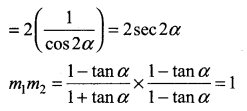
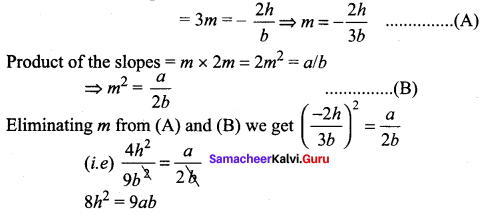
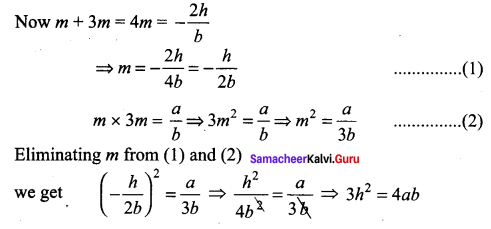
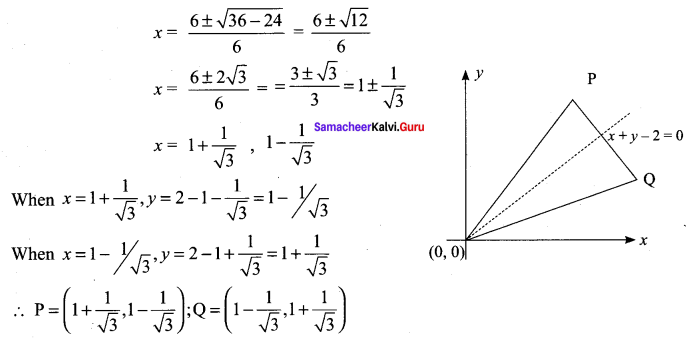
Samacheer Kalvi 12th Maths Solutions Chapter 6 Applications of Vector Algebra Ex 6.2

You can Download Samacheer Kalvi 12th Maths Book Solutions Guide Pdf, Tamilnadu State Board help you to revise the complete Syllabus and score more marks in your examinations.

Tamilnadu Samacheer Kalvi 12th Maths Solutions Chapter 6 Applications of Vector Algebra Ex 6.2

Question 1.
Samacheer Kalvi 12th Maths Solutions Chapter 6 Applications of Vector Algebra Ex 6.2 1
Solution:
Samacheer Kalvi 12th Maths Solutions Chapter 6 Applications of Vector Algebra Ex 6.2 2

Question 2.
Find the volume of the parallelepiped whose coterminous edges are represented by the vectors Samacheer Kalvi 12th Maths Solutions Chapter 6 Applications of Vector Algebra Ex 6.2 3.
Solution:
Volume of the parallelepiped = \(\| \vec{a}, \vec{b}, \vec{c}]\)
Samacheer Kalvi 12th Maths Solutions Chapter 6 Applications of Vector Algebra Ex 6.2 4
= -264 + 224 + 760 = 720 cubic units

Samacheer Kalvi 12th Maths Solutions Chapter 6 Applications of Vector Algebra Ex 6.2

Question 3.
The volume of the parallelepiped whose coterminus edges are Samacheer Kalvi 12th Maths Solutions Chapter 6 Applications of Vector Algebra Ex 6.2 5, \(-3 \vec{i}+7 \vec{j}+5 \vec{k}\) is 90 cubic units. Find the value of λ
Solution:
Given, Volume of the parallelepiped = 90 cubic units
Samacheer Kalvi 12th Maths Solutions Chapter 6 Applications of Vector Algebra Ex 6.2 6

Question 4.
If \(\vec{a}, \vec{b}, \vec{c}\) are three non-coplanar vectors represented by concurrent edges of a parallelepiped of volume 4 cubic units, find the value of Samacheer Kalvi 12th Maths Solutions Chapter 6 Applications of Vector Algebra Ex 6.2 7
Solution:
Let \(\vec{a}, \vec{b}, \vec{c}\) be the concurrent edges of parallelepiped
Given volume of parallelepiped = 4 cubic units
Samacheer Kalvi 12th Maths Solutions Chapter 6 Applications of Vector Algebra Ex 6.2 8

Question 5.
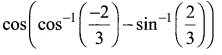
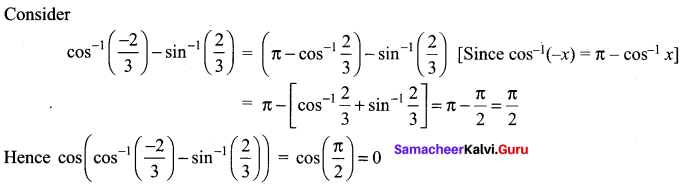
Find the altitude of a parallelepiped determined by the vectors \(\vec{a}=-2 \hat{i}+5 \hat{j}+3 \hat{k}\), \(\hat{b}=\hat{i}+3 \hat{j}-2 \hat{k}\) and \(\vec{c}=-3 \vec{i}+\vec{j}+4 \vec{k}\) if the base is taken as the parallelogram determined by b and c.
Solution:
Volume = Base Area × Height
\(|[\vec{a}, \vec{b}, \vec{c}]|=|\vec{b} \times \vec{c}|\) × Height
Samacheer Kalvi 12th Maths Solutions Chapter 6 Applications of Vector Algebra Ex 6.2 9

Samacheer Kalvi 12th Maths Solutions Chapter 6 Applications of Vector Algebra Ex 6.2

Question 6.
Determine whether the three vectors \(2 \hat{i}+3 \hat{j}+\hat{k}, \hat{i}-2 \hat{j}+2 \hat{k}\) and \(3 \hat{i}+\hat{j}+3 \hat{k}\) are coplanar.
Solution:
Samacheer Kalvi 12th Maths Solutions Chapter 6 Applications of Vector Algebra Ex 6.2 10

Question 7.
Let Samacheer Kalvi 12th Maths Solutions Chapter 6 Applications of Vector Algebra Ex 6.2 11 If c1 = 1 and c2 = 2, find c3 such that \(\vec{a}, \vec{b}\) and \(\vec{c}\) and c are coplanar.
Solution:
Samacheer Kalvi 12th Maths Solutions Chapter 6 Applications of Vector Algebra Ex 6.2 12

Question 8.
If Samacheer Kalvi 12th Maths Solutions Chapter 6 Applications of Vector Algebra Ex 6.2 13, show that \([\vec{a} \vec{b} \vec{c}]\) depends neither x nor y.
Solution:
Samacheer Kalvi 12th Maths Solutions Chapter 6 Applications of Vector Algebra Ex 6.2 14

Question 9.
If the vectors
Samacheer Kalvi 12th Maths Solutions Chapter 6 Applications of Vector Algebra Ex 6.2 15
are coplanar, prove that c is the geometric mean of a and b.
Solution:
Samacheer Kalvi 12th Maths Solutions Chapter 6 Applications of Vector Algebra Ex 6.2 16
∴ c is the geometric means of ‘a’ and ‘b’.

Question 10.
Let \(\vec{a}, \vec{b}, \vec{c}\) be three non-zero vectors such that \(\vec{c}\) is a unit vector perpendicular to both \(\vec{a}\) and \(\vec{b}\). If the angle between \(\vec{a}\) and \(\vec{b}\) is \(\frac{\pi}{6}\) show that Samacheer Kalvi 12th Maths Solutions Chapter 6 Applications of Vector Algebra Ex 6.2 17 .
Solution:
Samacheer Kalvi 12th Maths Solutions Chapter 6 Applications of Vector Algebra Ex 6.2 18
Samacheer Kalvi 12th Maths Solutions Chapter 6 Applications of Vector Algebra Ex 6.2 19

Samacheer Kalvi 12th Maths Solutions Chapter 6 Applications of Vector Algebra Ex 6.2 Additional Problems

Question 1.
If the edges Samacheer Kalvi 12th Maths Solutions Chapter 6 Applications of Vector Algebra Ex 6.2 20 meet a vertex, find the volume of the parallelepiped.
Solution:
Volume of the parallelepiped = Samacheer Kalvi 12th Maths Solutions Chapter 6 Applications of Vector Algebra Ex 6.2 21
The volume cannot be negative
∴ Volume of parallelepiped = 264 cu. units

Question 2.
If Samacheer Kalvi 12th Maths Solutions Chapter 6 Applications of Vector Algebra Ex 6.2 22 and \(\vec{x} \neq \overrightarrow{0}\) then show that \(\vec{a}, \vec{b}, \vec{c}\) are coplanar.
Solution:
Samacheer Kalvi 12th Maths Solutions Chapter 6 Applications of Vector Algebra Ex 6.2 23

Samacheer Kalvi 12th Maths Solutions Chapter 6 Applications of Vector Algebra Ex 6.2

Question 3.
The volume of a parallelepiped whose edges are represented by \(-12 \vec{i}+\lambda k\), \(3 \vec{j}-\vec{k}, 2 \vec{i}+\vec{j}-15 \vec{k}\) is 546. Find the value of λ.
Solution:
Volume of the parallelepiped = Samacheer Kalvi 12th Maths Solutions Chapter 6 Applications of Vector Algebra Ex 6.2 24
= -12 [-45 + 1] – 0 () + λ [0 – 6] = -12 (-44) -6 λ
= 528 – 6λ = 546 (given)
⇒ -6λ = 546 – 528 = 18
∴ λ = \(\frac{18}{-6}\) = -3

Question 4.
Prove that \(|\vec{a} \vec{b} \vec{c}|\) = abc if and only if \(\vec{a}, \vec{b}, \vec{c}\) are mutually perpendicular.
Solution:
Samacheer Kalvi 12th Maths Solutions Chapter 6 Applications of Vector Algebra Ex 6.2 25
Samacheer Kalvi 12th Maths Solutions Chapter 6 Applications of Vector Algebra Ex 6.2 26

Question 5.
Show that the points (1, 3, 1), (1, 1, -1), (-1, 1, 1), (2, 2, -1) are lying on the same plane.
Solution:
Samacheer Kalvi 12th Maths Solutions Chapter 6 Applications of Vector Algebra Ex 6.2 27

Question 6.
Samacheer Kalvi 12th Maths Solutions Chapter 6 Applications of Vector Algebra Ex 6.2 28
Solution:
Samacheer Kalvi 12th Maths Solutions Chapter 6 Applications of Vector Algebra Ex 6.2 29
Samacheer Kalvi 12th Maths Solutions Chapter 6 Applications of Vector Algebra Ex 6.2 30

Samacheer Kalvi 12th Maths Solutions Chapter 9 Applications of Integration Ex 9.7

You can Download Samacheer Kalvi 12th Maths Book Solutions Guide Pdf, Tamilnadu State Board help you to revise the complete Syllabus and score more marks in your examinations.

Tamilnadu Samacheer Kalvi 12th Maths Solutions Chapter 9 Applications of Integration Ex 9.7

Question 1.
Evaluate the following
Samacheer Kalvi 12th Maths Solutions Chapter 9 Applications of Integration Ex 9.7 1
Solution:
We know that
Samacheer Kalvi 12th Maths Solutions Chapter 9 Applications of Integration Ex 9.7 2

Samacheer Kalvi 12th Maths Solutions Chapter 9 Applications of Integration Ex 9.7

(ii) Samacheer Kalvi 12th Maths Solutions Chapter 9 Applications of Integration Ex 9.7 3
Solution:
Samacheer Kalvi 12th Maths Solutions Chapter 9 Applications of Integration Ex 9.7 4
= 0 + 1 + 24 + 4 = 29

Samacheer Kalvi 12th Maths Solutions Chapter 9 Applications of Integration Ex 9.7

Question 2.
Samacheer Kalvi 12th Maths Solutions Chapter 9 Applications of Integration Ex 9.7 5
Solution:
Samacheer Kalvi 12th Maths Solutions Chapter 9 Applications of Integration Ex 9.7 6
By using Gamma integral (n = 1; a = α)
Samacheer Kalvi 12th Maths Solutions Chapter 9 Applications of Integration Ex 9.7 7

Samacheer Kalvi 12th Maths Solutions Chapter 9 Applications of Integration Ex 9.6

You can Download Samacheer Kalvi 12th Maths Book Solutions Guide Pdf, Tamilnadu State Board help you to revise the complete Syllabus and score more marks in your examinations.

Tamilnadu Samacheer Kalvi 12th Maths Solutions Chapter 9 Applications of Integration Ex 9.6

Question 1.
Samacheer Kalvi 12th Maths Solutions Chapter 9 Applications of Integration Ex 9.6 1
Solution:
Samacheer Kalvi 12th Maths Solutions Chapter 9 Applications of Integration Ex 9.6 2

(ii)
Samacheer Kalvi 12th Maths Solutions Chapter 9 Applications of Integration Ex 9.6 3
Solution:
Samacheer Kalvi 12th Maths Solutions Chapter 9 Applications of Integration Ex 9.6 4

Samacheer Kalvi 12th Maths Solutions Chapter 9 Applications of Integration Ex 9.6

(iii) Samacheer Kalvi 12th Maths Solutions Chapter 9 Applications of Integration Ex 9.6 5

Solution:
Samacheer Kalvi 12th Maths Solutions Chapter 9 Applications of Integration Ex 9.6 6

(iv) Samacheer Kalvi 12th Maths Solutions Chapter 9 Applications of Integration Ex 9.6 7
Solution:
Samacheer Kalvi 12th Maths Solutions Chapter 9 Applications of Integration Ex 9.6 77

(v) Samacheer Kalvi 12th Maths Solutions Chapter 9 Applications of Integration Ex 9.6 8
Solution:
Samacheer Kalvi 12th Maths Solutions Chapter 9 Applications of Integration Ex 9.6 9
Samacheer Kalvi 12th Maths Solutions Chapter 9 Applications of Integration Ex 9.6 10

(vi) Samacheer Kalvi 12th Maths Solutions Chapter 9 Applications of Integration Ex 9.6 11
Solution:
Samacheer Kalvi 12th Maths Solutions Chapter 9 Applications of Integration Ex 9.6 12

Samacheer Kalvi 12th Maths Solutions Chapter 9 Applications of Integration Ex 9.6

(vii) Samacheer Kalvi 12th Maths Solutions Chapter 9 Applications of Integration Ex 9.6 13
Solution:
We know that,
Samacheer Kalvi 12th Maths Solutions Chapter 9 Applications of Integration Ex 9.6 14

(viii) Samacheer Kalvi 12th Maths Solutions Chapter 9 Applications of Integration Ex 9.6 16
Solution:
Samacheer Kalvi 12th Maths Solutions Chapter 9 Applications of Integration Ex 9.6 17

Samacheer Kalvi 12th Maths Solutions Chapter 9 Applications of Integration Ex 9.6 Additional Problems

Question 1.
Evaluate
Samacheer Kalvi 12th Maths Solutions Chapter 9 Applications of Integration Ex 9.6 18
Solution:
Samacheer Kalvi 12th Maths Solutions Chapter 9 Applications of Integration Ex 9.6 19

(ii) Samacheer Kalvi 12th Maths Solutions Chapter 9 Applications of Integration Ex 9.6 20
Solution:
Samacheer Kalvi 12th Maths Solutions Chapter 9 Applications of Integration Ex 9.6 21

(iii) Samacheer Kalvi 12th Maths Solutions Chapter 9 Applications of Integration Ex 9.6 22
Solution:
Samacheer Kalvi 12th Maths Solutions Chapter 9 Applications of Integration Ex 9.6 23

Samacheer Kalvi 12th Maths Solutions Chapter 9 Applications of Integration Ex 9.6

(iv) Samacheer Kalvi 12th Maths Solutions Chapter 9 Applications of Integration Ex 9.6 24
Solution:
Samacheer Kalvi 12th Maths Solutions Chapter 9 Applications of Integration Ex 9.6 25

Question 2.
Samacheer Kalvi 12th Maths Solutions Chapter 9 Applications of Integration Ex 9.6 26
Solution:
Samacheer Kalvi 12th Maths Solutions Chapter 9 Applications of Integration Ex 9.6 27

Samacheer Kalvi 12th Maths Solutions Chapter 8 Differentials and Partial Derivatives Ex 8.7

You can Download Samacheer Kalvi 12th Maths Book Solutions Guide Pdf, Tamilnadu State Board help you to revise the complete Syllabus and score more marks in your examinations.

Tamilnadu Samacheer Kalvi 12th Maths Solutions Chapter 8 Differentials and Partial Derivatives Ex 8.7

Question 1.
In each of the following cases, determine whether the following function is homogeneous or not. If it is so, find the degree.
Samacheer Kalvi 12th Maths Solutions Chapter 8 Differentials and Partial Derivatives Ex 8.7 1
Solution:
Samacheer Kalvi 12th Maths Solutions Chapter 8 Differentials and Partial Derivatives Ex 8.7 2
It is not a homogeneous function
Samacheer Kalvi 12th Maths Solutions Chapter 8 Differentials and Partial Derivatives Ex 8.7 3
∴ It is a homogeneous function with degree 3.
Samacheer Kalvi 12th Maths Solutions Chapter 8 Differentials and Partial Derivatives Ex 8.7 4
Samacheer Kalvi 12th Maths Solutions Chapter 8 Differentials and Partial Derivatives Ex 8.7 5
∴ It is homogeneous function of degree 0.
Samacheer Kalvi 12th Maths Solutions Chapter 8 Differentials and Partial Derivatives Ex 8.7 15
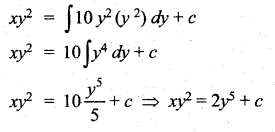
∴ It is not a homogeneous function

Samacheer Kalvi 12th Maths Solutions Chapter 8 Differentials and Partial Derivatives Ex 8.7

Question 2.
Prove that f(x, y) = x3 – 2x2 y + 3xy2 + y3 is homogeneous; what is the degree? Verify Euler’s Theorem for f.
Solution:
f (x, y) = x3 – 2x2y + 3xy2 + y3
f(tx, ty) = t3x3 – 2(t2x2)(ty) + 3(tx)(t2y2) + t3y3
= t3 [x3 – 2x2y + 3xy2 + y3]
f(tx, ty) = t3 f(x, y)
‘f’ is a homogeneous function of degree 3. By Euler’s theorem, we have
Samacheer Kalvi 12th Maths Solutions Chapter 8 Differentials and Partial Derivatives Ex 8.7 16
∴ Euler’s Theorem verified

Question 3.
Prove that g(x, y) = x log (\(\frac{y}{x}\)) is homogeneous; what is the degree? Verify Euler’s Theorem for g.
Solution:
Samacheer Kalvi 12th Maths Solutions Chapter 8 Differentials and Partial Derivatives Ex 8.7 17
Samacheer Kalvi 12th Maths Solutions Chapter 8 Differentials and Partial Derivatives Ex 8.7 18
∴ Euler’s Theorem verified

Samacheer Kalvi 12th Maths Solutions Chapter 8 Differentials and Partial Derivatives Ex 8.7

Question 4.
Samacheer Kalvi 12th Maths Solutions Chapter 8 Differentials and Partial Derivatives Ex 8.7 19
Solution:
Samacheer Kalvi 12th Maths Solutions Chapter 8 Differentials and Partial Derivatives Ex 8.7 20

Question 5.
Samacheer Kalvi 12th Maths Solutions Chapter 8 Differentials and Partial Derivatives Ex 8.7 21
Solution:
Samacheer Kalvi 12th Maths Solutions Chapter 8 Differentials and Partial Derivatives Ex 8.7 22
∴ ‘f’ is a homogeneous function of degree 1. By Euler’s theorem, we have
Samacheer Kalvi 12th Maths Solutions Chapter 8 Differentials and Partial Derivatives Ex 8.7 23

Question 6.
Samacheer Kalvi 12th Maths Solutions Chapter 8 Differentials and Partial Derivatives Ex 8.7 24
Solution:
Samacheer Kalvi 12th Maths Solutions Chapter 8 Differentials and Partial Derivatives Ex 8.7 25

Samacheer Kalvi 12th Maths Solutions Chapter 8 Differentials and Partial Derivatives Ex 8.7

Samacheer Kalvi 12th Maths Solutions Chapter 8 Differentials and Partial Derivatives Ex 8.7 Additional Problems

Question 1.
Samacheer Kalvi 12th Maths Solutions Chapter 8 Differentials and Partial Derivatives Ex 8.7 255
Solution:
Samacheer Kalvi 12th Maths Solutions Chapter 8 Differentials and Partial Derivatives Ex 8.7 29
Samacheer Kalvi 12th Maths Solutions Chapter 8 Differentials and Partial Derivatives Ex 8.7 26

Samacheer Kalvi 12th Maths Solutions Chapter 8 Differentials and Partial Derivatives Ex 8.7

Question 2.
Samacheer Kalvi 12th Maths Solutions Chapter 8 Differentials and Partial Derivatives Ex 8.7 27
Solution:
R.H.S. is not a homogeneous and hence
Samacheer Kalvi 12th Maths Solutions Chapter 8 Differentials and Partial Derivatives Ex 8.7 28

Samacheer Kalvi 12th Maths Solutions Chapter 5 Two Dimensional Analytical Geometry – II Ex 5.4

You can Download Samacheer Kalvi 12th Maths Book Solutions Guide Pdf, Tamilnadu State Board help you to revise the complete Syllabus and score more marks in your examinations.

Tamilnadu Samacheer Kalvi 12th Maths Solutions Chapter 5 Two Dimensional Analytical Geometry – II Ex 5.4

Question 1.
Find the equations of the two tangents that can be drawn from (5, 2) to the ellipse 2x2 + 7y2 = 14 .
Solution:
2x2 + 7y2 = 14
(÷ by 14) ⇒ \(\frac{x^{2}}{7}+\frac{y^{2}}{2}\) = 1
comparing this equation with \(\frac{x^{2}}{a^{2}}+\frac{y^{2}}{b^{2}}\) = 1
we get a2 = 7 and b2 = 2
The equation of tangent to the above ellipse will be of the form
y = mx + \(\sqrt{a^{2} m^{2}+b^{2}}\) ⇒ y = mx + \(\sqrt{7 m^{2}+2}\)
Here the tangents are drawn from the point (5, 2)
⇒ 2 = 5m + \(\sqrt{7 m^{2}+2}\) ⇒ 2 – 5m = \(\sqrt{7 m^{2}+2}\)
Squaring on both sides we get
(2 – 5m)2 = 7m2 + 2
25m2 + 4 – 20m – 7m2 – 2 = 0
18m2 – 20m + 2 = 0
(÷ by 2) ⇒ 9m2 – 10m + 1 = 0
(9m – 1) (m – 1) = 0
‘ m = 1 (or) m = 1/9
When m = 1, the equation of tangent is
y = x + 3 or x – y + 3 = 0
When m = \(\frac{1}{9}\) the equation of tangent is 9
y = \(=\frac{x}{9}+\sqrt{\frac{7}{81}+2}\) (i.e.) y = \(\frac{x}{9}+\frac{13}{9}\)
9y = x + 13 or x – 9y + 13 = 0

Question 2.
Find the equations of tangents to the hyperbola \(\frac{x^{2}}{16}-\frac{y^{2}}{64}\) = 1 which are parallel to 10x – 3y + 9 = 0.
Solution:
\(\frac{x^{2}}{16}-\frac{y^{2}}{64}\) = 1
Here a2 = 16 and b2 = 64
The equation of tangents will be of the form y = mx ± \(\sqrt{a^{2} m^{2}-b^{2}}\)
(i.e.,) y = mx ± \(\sqrt{16 m^{2}-64}\)
Where ‘m’ is the slope of the tangent.
Here we are given that the tangents are parallel to 10x – 3y + 9 = 0
So slope of tangents will be equatl to slope of the given line
Samacheer Kalvi 12th Maths Solutions Chapter 5 Two Dimensional Analytical Geometry - II Ex 5.4 1

Samacheer Kalvi 12th Maths Solutions Chapter 5 Two Dimensional Analytical Geometry - II Ex 5.4

Question 3.
Show that the line x – y + 4 = 0 is a tangent to the ellipse x2 + 3y2 = 12. Also find the coordinates of the point of contact.
Solution:
The given ellipse is x2 + 3y2 = 12
(÷ by 12) ⇒ \(\frac{x^{2}}{12}+\frac{y^{2}}{4}\) = 1
(ie.,) Here a2 = 12 and b2 = 4
The given line is x – y + 4 = 0
(ie.,) y = x + 4
Comparing this line with y = mx + c
We get m = 1 and c = 4
The condition for the line y = mx + c
To be a tangent to the ellipse \(\frac{x^{2}}{a^{2}}+\frac{y^{2}}{b^{2}}\) = 1 is c2 = a2m2 + b2
LHS = c2 = 42 = 16
RHS: a2m2 + b2 = 12( 1 )2 + 4 = 16
LHS = RHS The given line is a tangent to the ellipse. Also the point of contact is
\(\left(\frac{-a^{2} m}{c}, \frac{b^{2}}{c}\right)=\left[-\left(\frac{12(1)}{4}\right), \frac{4}{4}\right]\) (i.e.,) (-3, 1)

Question 4.
Find the equation of the tangent to the parabola y2 = 16x perpendicular to 2x + 2y + 3 =0
Solution:
y2 =16x
Comparing this equation with y2 = 4ax
we get 4a = 16 ⇒ a = 4
The equation of tangent to the parabola y2 = 16x will be of the form
Samacheer Kalvi 12th Maths Solutions Chapter 5 Two Dimensional Analytical Geometry - II Ex 5.4 2
So m = 1
⇒ The equation of tangent will be y = 1(x) + \(\frac{4}{1}\) (i.e.,) y = x + 4
(or) x – y + 4 = 0

Question 5.
Find the equation of the tangent at t = 2 to the parabola y2 = 8x. (Hint: use parametric form)
Solution:
y2 = 8x .
Comparing this equation with y2 = 4ax
we get 4a = 8 ⇒ a = 2
Now, the parametric form for y2 = 4ax is x = at2, y = 2at
Here a = 2 and t = 2
⇒ x = 2(2)2 = 8 and y = 2(2) (2) = 8
So the point is (8, 8)
Now eqution of tangent to y2 = 4 ax at (x1, y1) is yy1 = 2a(x + x1)
Here (x1, y1) = (8, 8) and a = 2
So equation of tangent is y(8) = 2(2) (x + 8)
(ie.,) 8y = 4 (x + 8)
(÷ by 4) ⇒ 2y = x + 8 ⇒ x – 2y + 8 = 0
Aliter
The equation of tangent to the parabola y2 = 4ax at ‘t’ is
yt = x + at2
Here t = 2 and a = 2
So equation of tangent is
(i.e.,) y(2) = x + 2(2)2
2y = x + 8 ⇒ x – 2y + 8 = 0

Question 6.
Find the equations of the tangent and normal to hyperbola 12x2 – 9y2 = 108 at θ = \(\frac{\pi}{3}\) .
(Hint: Use parametric form)
Solution:
12x2 – 9y2 = 108
Samacheer Kalvi 12th Maths Solutions Chapter 5 Two Dimensional Analytical Geometry - II Ex 5.4 3
Normal is a line perpendicular to tangent
So equation of normal will be of the form 3x + 4y + k = 0
The normal is drawn at (6, 6)
⇒ 18 + 24 + k = 0 ⇒ k = – 42
So equation of normal is 3x + 4y – 42 = 0
Samacheer Kalvi 12th Maths Solutions Chapter 5 Two Dimensional Analytical Geometry - II Ex 5.4 4

Samacheer Kalvi 12th Maths Solutions Chapter 5 Two Dimensional Analytical Geometry - II Ex 5.4

Question 7.
Prove that the point of intersection of the tangents at ‘t1‘ and t2’ on the parabola y2 = 4ax is [at1 t2, a (t1 + t2)].
Solution:
The equation of tangent to y2 = 4ax at ‘t’ is given by yt = x + at2
So equation of tangent at ‘t1‘ is yt1 = x + at12
and equation of tangent at ‘t2‘ is yt2 = x + at22
To find the point of intersection we have to solve the two equations
Samacheer Kalvi 12th Maths Solutions Chapter 5 Two Dimensional Analytical Geometry - II Ex 5.4 5

Question 8.
If the normal at the point ‘t1‘ on the parabola y2 = 4ax meets the parabola again at the point ‘t2‘, then prove that t2 = \(-\left(t_{1}+\frac{2}{t_{1}}\right)\)
Solution:
Equation of normal to y2 =4 at’ t’ is y + xt = 2at + at3.
So equation of normal at ‘t1’ is y + xt1 = 2at1 + at13
The normal meets the parabola y2 = 4ax at ‘t2’ (ie.,) at (at22, 2at2)
⇒ 2at2 + at1t22 = 2at1 + at13
So 2a(t2 – t1) = at13 – at1t22
⇒ 2a(t2 – t1) = at1(t12 – t22)
⇒ 2(t2 – t1) = t1(t1 + t2)(t1 – t2)
⇒ 2= -t1(t1 + t2)
⇒ t1 + t2 = \(\frac{-2}{t_{1}}\)
⇒ t2 = \(-t_{1}-\frac{2}{t_{1}}=-\left(t_{1}+\frac{2}{t_{1}}\right)\)

Samacheer Kalvi 12th Maths Solutions Chapter 5 Two Dimensional Analytical Geometry – II Ex 5.4 Additional Questions

Question 1.
Find the equations of the tangent and normal to the parabolas : x2 + 2x – 4y + 4 = 0 at (0, 1)
Solution:
Samacheer Kalvi 12th Maths Solutions Chapter 5 Two Dimensional Analytical Geometry - II Ex 5.4 1

Question 2.
Find the equations of the tangent and normal to the parabola y2 = 8x at t = \(\frac{1}{2}\)
Solution:
Samacheer Kalvi 12th Maths Solutions Chapter 5 Two Dimensional Analytical Geometry - II Ex 5.4 3
Samacheer Kalvi 12th Maths Solutions Chapter 5 Two Dimensional Analytical Geometry - II Ex 5.4 4
∴ Equation of the tangent is 2x – y + 1 = 0 and equation of the normal is 2x + 4y – 9 = 0

Question 3.
Find the equations of the tangents: to the parabola y2 = 6x, parallel to 3x – 2y + 5 = 0
Solution:
Samacheer Kalvi 12th Maths Solutions Chapter 5 Two Dimensional Analytical Geometry - II Ex 5.4 5
Samacheer Kalvi 12th Maths Solutions Chapter 5 Two Dimensional Analytical Geometry - II Ex 5.4 6
∴ Equation of the tangent is 3x – 2y + 2 = 0

Question 4.
Find the equations of the tangents: to the parabola 4x2 – y2 = 64 Which are parallel to 10x – 3y + 9 = 0.
Solution:
Samacheer Kalvi 12th Maths Solutions Chapter 5 Two Dimensional Analytical Geometry - II Ex 5.4 7

Question 5.
Find the equation of the tangent from point (2, -3) to the parabola y2 = 4x.
Solution:
y2 = 4x
Equation of the tangent to the parabola will be of the form y = \(m x+\frac{1}{m}\)
The tangents pass through (2, -3)
Samacheer Kalvi 12th Maths Solutions Chapter 5 Two Dimensional Analytical Geometry - II Ex 5.4 8
Samacheer Kalvi 12th Maths Solutions Chapter 5 Two Dimensional Analytical Geometry - II Ex 5.4 9
The two tangents drawn from (2, -3) are x + y + 1 = 0, x + 2y + 4 = 0

Samacheer Kalvi 12th Maths Solutions Chapter 5 Two Dimensional Analytical Geometry - II Ex 5.4

Question 6.
Find the equation of the tangents from the point (2, -3) to the parabola 2x2 – 3y2 = 6
Solution:
2x2 – 3y2 = 6
Samacheer Kalvi 12th Maths Solutions Chapter 5 Two Dimensional Analytical Geometry - II Ex 5.4 10
Samacheer Kalvi 12th Maths Solutions Chapter 5 Two Dimensional Analytical Geometry - II Ex 5.4 11

Question 7.
Prove that the line 5x + 12y = 9 touches the hyperbola x2 – 9y2 = 9 and find the point of contact.
Solution:
Samacheer Kalvi 12th Maths Solutions Chapter 5 Two Dimensional Analytical Geometry - II Ex 5.4 13
(1) = (2) ⇒ The given line is a tangent to the curve i.e., the given line touches the curve. To find the point of contact we have to solve the line and the curve.
The given line 5x + 12y = 9
Samacheer Kalvi 12th Maths Solutions Chapter 5 Two Dimensional Analytical Geometry - II Ex 5.4 14
Samacheer Kalvi 12th Maths Solutions Chapter 5 Two Dimensional Analytical Geometry - II Ex 5.4 15

Question 8.
Show that the line x – y + 4 = 0 is a tangent to the ellipse x2 + 3y2 = 12. Find the co-ordinates of the point of contact.
Solution:
The given ellipse is x2 + 3y2 = 12
Given line is x – y + 4 = 0 ⇒ y = x + 4
Here, m = 1 and c = 4
The condition for the line y = mx + c to be a tangent to the ellipse
Samacheer Kalvi 12th Maths Solutions Chapter 5 Two Dimensional Analytical Geometry - II Ex 5.4 16
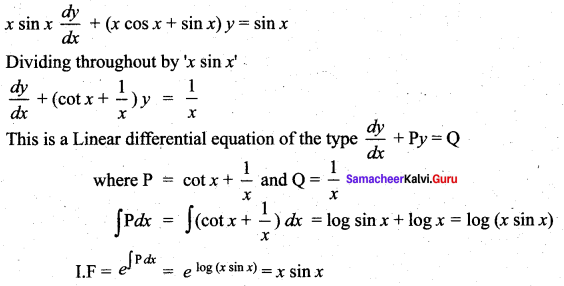
RHS: a2 m2 + b = 12(1) + 4 = 16
LHS: RHS ⇒ the given lines is a tangent to the ellipse.

Samacheer Kalvi 12th Maths Solutions Chapter 8 Differentials and Partial Derivatives Ex 8.6

You can Download Samacheer Kalvi 12th Maths Book Solutions Guide Pdf, Tamilnadu State Board help you to revise the complete Syllabus and score more marks in your examinations.

Tamilnadu Samacheer Kalvi 12th Maths Solutions Chapter 8 Differentials and Partial Derivatives Ex 8.6

Question 1.
If u(x, y) = x2y + 3xy4, x = et and y = sin t, find \(\frac{d u}{d t}\) and evaluate it at t = 0.
Solution:
Samacheer Kalvi 12th Maths Solutions Chapter 8 Differentials and Partial Derivatives Ex 8.6 1
= (2xy + 3y4) (et) + (x2 + 12xy3) (cos t)
= (2et sin t + 3 sin4 t) et + [e2t + 12et sin3 t] cos t
= et [2et sin t + 3 sin4 t + et (cos t) + 12 sin3t cos t]
at t = 0
Samacheer Kalvi 12th Maths Solutions Chapter 8 Differentials and Partial Derivatives Ex 8.6 2

Question 2.
Samacheer Kalvi 12th Maths Solutions Chapter 8 Differentials and Partial Derivatives Ex 8.6 3
Solution:
Samacheer Kalvi 12th Maths Solutions Chapter 8 Differentials and Partial Derivatives Ex 8.6 4

Samacheer Kalvi 12th Maths Solutions Chapter 8 Differentials and Partial Derivatives Ex 8.6

Question 3.
If w(x, y, z) = x2 + y2 + z2, x = et, y = et sin t, and z = etcos t, find \(\frac{d w}{d t}\)
Solution:
w(x, y, z) = x2 + y2 + z2 ; x = et ; y = et sin t, z = et cos t
Samacheer Kalvi 12th Maths Solutions Chapter 8 Differentials and Partial Derivatives Ex 8.6 5

Question 4.
Samacheer Kalvi 12th Maths Solutions Chapter 8 Differentials and Partial Derivatives Ex 8.6 6
Solution:
Samacheer Kalvi 12th Maths Solutions Chapter 8 Differentials and Partial Derivatives Ex 8.6 7
(Replace x, y, z value)
Samacheer Kalvi 12th Maths Solutions Chapter 8 Differentials and Partial Derivatives Ex 8.6 8

Question 5.
If w(x, y) = 6x3 – 3xy + 2y2, x = es, y = cos s, s ∈ R, find \(\frac{d w}{d s}\), and evaluate at s = 0.
Solution:
Samacheer Kalvi 12th Maths Solutions Chapter 8 Differentials and Partial Derivatives Ex 8.6 9

Samacheer Kalvi 12th Maths Solutions Chapter 8 Differentials and Partial Derivatives Ex 8.6

Question 6.
If z(x, y) = x tan-1 (x y), x = t2, y = s et, s, t ∈ R, Find \(\frac{\partial z}{\partial \mathbf{t}}\) and \(\frac{\partial z}{\partial \mathbf{t}}\) at s = t = 1
Solution:
z (x, y) = x tan-1 (xy) ; x = t2 ; y = set
Samacheer Kalvi 12th Maths Solutions Chapter 8 Differentials and Partial Derivatives Ex 8.6 10
Samacheer Kalvi 12th Maths Solutions Chapter 8 Differentials and Partial Derivatives Ex 8.6 11

Question 7.
Let U (x, y) = ex sin y, where x = st2, y = s2t, s, t ∈ R. Find them at s = t = 1.
Solution:
Samacheer Kalvi 12th Maths Solutions Chapter 8 Differentials and Partial Derivatives Ex 8.6 13
(Replace x, y values)
Samacheer Kalvi 12th Maths Solutions Chapter 8 Differentials and Partial Derivatives Ex 8.6 14
Samacheer Kalvi 12th Maths Solutions Chapter 8 Differentials and Partial Derivatives Ex 8.6 15

Question 8.
Let z(x, y) = x3 – 3x2y3, where x = set, y = se-t, s, t ∈ R. Find \(\frac{\partial z}{\partial s}\) and \(\frac{\partial z}{\partial t}\)
Solution:
Samacheer Kalvi 12th Maths Solutions Chapter 8 Differentials and Partial Derivatives Ex 8.6 16

Samacheer Kalvi 12th Maths Solutions Chapter 8 Differentials and Partial Derivatives Ex 8.6

Question 9.
W(x,y, z) = xy + yz + zx, x = u -v, y = uv, z = u + v, u, v e R. Find \(\frac{\partial \boldsymbol{w}}{\partial \boldsymbol{u}}\), \(\frac{\partial \boldsymbol{w}}{\partial \boldsymbol{v}}\) them at \(\left(\frac{1}{2}, 1\right)\)
Solution:
Samacheer Kalvi 12th Maths Solutions Chapter 8 Differentials and Partial Derivatives Ex 8.6 17
Samacheer Kalvi 12th Maths Solutions Chapter 8 Differentials and Partial Derivatives Ex 8.6 18

Samacheer Kalvi 12th Maths Solutions Chapter 8 Differentials and Partial Derivatives Ex 8.6 Additional Problems

Question 1.
Suppose that z = \(y e^{x^{2}}\) where x = 2t and y = 1 – t then find \(\frac{d z}{d t}\).
Solution:
Samacheer Kalvi 12th Maths Solutions Chapter 8 Differentials and Partial Derivatives Ex 8.6 19
Samacheer Kalvi 12th Maths Solutions Chapter 8 Differentials and Partial Derivatives Ex 8.6 20
(Since x = 2t and y = 1 – t)

Samacheer Kalvi 12th Maths Solutions Chapter 8 Differentials and Partial Derivatives Ex 8.6

Question 2.
If w = x + 2y + z2 and x = cos t ; y = sin t ; z = t. Find \(\frac{d w}{d t}\).
Solution:
Samacheer Kalvi 12th Maths Solutions Chapter 8 Differentials and Partial Derivatives Ex 8.6 21

Samacheer Kalvi 12th Maths Solutions Chapter 9 Applications of Integration Ex 9.5

You can Download Samacheer Kalvi 12th Maths Book Solutions Guide Pdf, Tamilnadu State Board help you to revise the complete Syllabus and score more marks in your examinations.

Tamilnadu Samacheer Kalvi 12th Maths Solutions Chapter 9 Applications of Integration Ex 9.5

Question 1.
Evaluate the following:
Samacheer Kalvi 12th Maths Solutions Chapter 9 Applications of Integration Ex 9.5 1
Solution:
Samacheer Kalvi 12th Maths Solutions Chapter 9 Applications of Integration Ex 9.5 2
Substitute (2) and (3) in (1), we get
Samacheer Kalvi 12th Maths Solutions Chapter 9 Applications of Integration Ex 9.5 3

Samacheer Kalvi 12th Maths Solutions Chapter 9 Applications of Integration Ex 9.5

(ii) Samacheer Kalvi 12th Maths Solutions Chapter 9 Applications of Integration Ex 9.5 4
Solution:
Samacheer Kalvi 12th Maths Solutions Chapter 9 Applications of Integration Ex 9.5 5
Dividing both Numerator and Denominator by cos2 x
Samacheer Kalvi 12th Maths Solutions Chapter 9 Applications of Integration Ex 9.5 6
Samacheer Kalvi 12th Maths Solutions Chapter 9 Applications of Integration Ex 9.5 7

Samacheer Kalvi 12th Maths Solutions Chapter 9 Applications of Integration Ex 9.5

Samacheer Kalvi 12th Maths Solutions Chapter 9 Applications of Integration Ex 9.5 Additional Problems

Question 1.
Samacheer Kalvi 12th Maths Solutions Chapter 9 Applications of Integration Ex 9.5 8
Solution:
Samacheer Kalvi 12th Maths Solutions Chapter 9 Applications of Integration Ex 9.5 9
Put 2 tan x, ∴ 2sc2 x dx = dt
Samacheer Kalvi 12th Maths Solutions Chapter 9 Applications of Integration Ex 9.5 10

Samacheer Kalvi 12th Maths Solutions Chapter 9 Applications of Integration Ex 9.5

Question 2.
Samacheer Kalvi 12th Maths Solutions Chapter 9 Applications of Integration Ex 9.5 11
Solution:
Samacheer Kalvi 12th Maths Solutions Chapter 9 Applications of Integration Ex 9.5 12

Samacheer Kalvi 12th Maths Solutions Chapter 9 Applications of Integration Ex 9.4

You can Download Samacheer Kalvi 12th Maths Book Solutions Guide Pdf, Tamilnadu State Board help you to revise the complete Syllabus and score more marks in your examinations.

Tamilnadu Samacheer Kalvi 12th Maths Solutions Chapter 9 Applications of Integration Ex 9.5

Evaluate the following:

Question 1.
Samacheer Kalvi 12th Maths Solutions Chapter 9 Applications of Integration Ex 9.4 1
Solution:
u = x3 ; dv = e-2
Applying Bernoulli’s formula, we get,
Samacheer Kalvi 12th Maths Solutions Chapter 9 Applications of Integration Ex 9.4 2

Question 2.
Samacheer Kalvi 12th Maths Solutions Chapter 9 Applications of Integration Ex 9.4 3
Solution:
Samacheer Kalvi 12th Maths Solutions Chapter 9 Applications of Integration Ex 9.4 4

Samacheer Kalvi 12th Maths Solutions Chapter 9 Applications of Integration Ex 9.4

Question 3.
Samacheer Kalvi 12th Maths Solutions Chapter 9 Applications of Integration Ex 9.4 44
Solution:
Samacheer Kalvi 12th Maths Solutions Chapter 9 Applications of Integration Ex 9.4 5
Samacheer Kalvi 12th Maths Solutions Chapter 9 Applications of Integration Ex 9.4 6

Question 4.
Samacheer Kalvi 12th Maths Solutions Chapter 9 Applications of Integration Ex 9.4 7

Solution:
Samacheer Kalvi 12th Maths Solutions Chapter 9 Applications of Integration Ex 9.4 8

Samacheer Kalvi 12th Maths Solutions Chapter 9 Applications of Integration Ex 9.4

Samacheer Kalvi 12th Maths Solutions Chapter 9 Applications of Integration Ex 9.4 Additional Problems

Question 1.
Samacheer Kalvi 12th Maths Solutions Chapter 9 Applications of Integration Ex 9.4 9
Solution:
Samacheer Kalvi 12th Maths Solutions Chapter 9 Applications of Integration Ex 9.4 10

Question 2.
Samacheer Kalvi 12th Maths Solutions Chapter 9 Applications of Integration Ex 9.4 12
Solution:
Samacheer Kalvi 12th Maths Solutions Chapter 9 Applications of Integration Ex 9.4 13
Samacheer Kalvi 12th Maths Solutions Chapter 9 Applications of Integration Ex 9.4 14

Samacheer Kalvi 12th Maths Solutions Chapter 9 Applications of Integration Ex 9.4

Question 3.
Samacheer Kalvi 12th Maths Solutions Chapter 9 Applications of Integration Ex 9.4 15
Solution:
Samacheer Kalvi 12th Maths Solutions Chapter 9 Applications of Integration Ex 9.4 16

Question 4.
Samacheer Kalvi 12th Maths Solutions Chapter 9 Applications of Integration Ex 9.4 17
Solution:
Samacheer Kalvi 12th Maths Solutions Chapter 9 Applications of Integration Ex 9.4 18

Samacheer Kalvi 12th Maths Solutions Chapter 9 Applications of Integration Ex 9.4

Question 5.
Samacheer Kalvi 12th Maths Solutions Chapter 9 Applications of Integration Ex 9.4 19
Solution:
Samacheer Kalvi 12th Maths Solutions Chapter 9 Applications of Integration Ex 9.4 20
Samacheer Kalvi 12th Maths Solutions Chapter 9 Applications of Integration Ex 9.4 21

Samacheer Kalvi 12th Maths Solutions Chapter 9 Applications of Integration Ex 9.3

You can Download Samacheer Kalvi 12th Maths Book Solutions Guide Pdf, Tamilnadu State Board help you to revise the complete Syllabus and score more marks in your examinations.

Tamilnadu Samacheer Kalvi 12th Maths Solutions Chapter 9 Applications of Integration Ex 9.3

Question 1.
Evaluate the following definite integrals :
(i) Samacheer Kalvi 12th Maths Solutions Chapter 9 Applications of Integration Ex 9.3 1
Solution:
Samacheer Kalvi 12th Maths Solutions Chapter 9 Applications of Integration Ex 9.3 2

(ii) Samacheer Kalvi 12th Maths Solutions Chapter 9 Applications of Integration Ex 9.3 3
Solution:
Samacheer Kalvi 12th Maths Solutions Chapter 9 Applications of Integration Ex 9.3 352

Samacheer Kalvi 12th Maths Solutions Chapter 9 Applications of Integration Ex 9.3

(iii) Samacheer Kalvi 12th Maths Solutions Chapter 9 Applications of Integration Ex 9.3 4
Solution:
Samacheer Kalvi 12th Maths Solutions Chapter 9 Applications of Integration Ex 9.3 5
Samacheer Kalvi 12th Maths Solutions Chapter 9 Applications of Integration Ex 9.3 6

(iv) Samacheer Kalvi 12th Maths Solutions Chapter 9 Applications of Integration Ex 9.3 7
Solution:
Samacheer Kalvi 12th Maths Solutions Chapter 9 Applications of Integration Ex 9.3 8

(v) Samacheer Kalvi 12th Maths Solutions Chapter 9 Applications of Integration Ex 9.3 88
Solution:
Samacheer Kalvi 12th Maths Solutions Chapter 9 Applications of Integration Ex 9.3 9
Samacheer Kalvi 12th Maths Solutions Chapter 9 Applications of Integration Ex 9.3 10

Samacheer Kalvi 12th Maths Solutions Chapter 9 Applications of Integration Ex 9.3

(vi) Samacheer Kalvi 12th Maths Solutions Chapter 9 Applications of Integration Ex 9.3 11
Solution:
Samacheer Kalvi 12th Maths Solutions Chapter 9 Applications of Integration Ex 9.3 12
Samacheer Kalvi 12th Maths Solutions Chapter 9 Applications of Integration Ex 9.3 13

Question 2.
Evaluate the following integrals using properties of integration :
(i) Samacheer Kalvi 12th Maths Solutions Chapter 9 Applications of Integration Ex 9.3 14
Solution:
Samacheer Kalvi 12th Maths Solutions Chapter 9 Applications of Integration Ex 9.3 15

(ii) Samacheer Kalvi 12th Maths Solutions Chapter 9 Applications of Integration Ex 9.3 16
Solution:
Samacheer Kalvi 12th Maths Solutions Chapter 9 Applications of Integration Ex 9.3 17
Samacheer Kalvi 12th Maths Solutions Chapter 9 Applications of Integration Ex 9.3 177

(iii) Samacheer Kalvi 12th Maths Solutions Chapter 9 Applications of Integration Ex 9.3 21
Solution:
Samacheer Kalvi 12th Maths Solutions Chapter 9 Applications of Integration Ex 9.3 22

Samacheer Kalvi 12th Maths Solutions Chapter 9 Applications of Integration Ex 9.3

(iv) Samacheer Kalvi 12th Maths Solutions Chapter 9 Applications of Integration Ex 9.3 23
Solution:
Samacheer Kalvi 12th Maths Solutions Chapter 9 Applications of Integration Ex 9.3 24

(v) Samacheer Kalvi 12th Maths Solutions Chapter 9 Applications of Integration Ex 9.3 25
Solution:
Samacheer Kalvi 12th Maths Solutions Chapter 9 Applications of Integration Ex 9.3 26

(vi) Samacheer Kalvi 12th Maths Solutions Chapter 9 Applications of Integration Ex 9.3 27
Solution:
Samacheer Kalvi 12th Maths Solutions Chapter 9 Applications of Integration Ex 9.3 28

(vii) Samacheer Kalvi 12th Maths Solutions Chapter 9 Applications of Integration Ex 9.3 29
Solution:
Samacheer Kalvi 12th Maths Solutions Chapter 9 Applications of Integration Ex 9.3 30
Samacheer Kalvi 12th Maths Solutions Chapter 9 Applications of Integration Ex 9.3 31
Samacheer Kalvi 12th Maths Solutions Chapter 9 Applications of Integration Ex 9.3 32

Samacheer Kalvi 12th Maths Solutions Chapter 9 Applications of Integration Ex 9.3

(viii) Samacheer Kalvi 12th Maths Solutions Chapter 9 Applications of Integration Ex 9.3 33
Solution:
Samacheer Kalvi 12th Maths Solutions Chapter 9 Applications of Integration Ex 9.3 34
Samacheer Kalvi 12th Maths Solutions Chapter 9 Applications of Integration Ex 9.3 35

(ix) Samacheer Kalvi 12th Maths Solutions Chapter 9 Applications of Integration Ex 9.3 36
Solution:
Samacheer Kalvi 12th Maths Solutions Chapter 9 Applications of Integration Ex 9.3 37
Samacheer Kalvi 12th Maths Solutions Chapter 9 Applications of Integration Ex 9.3 38
Samacheer Kalvi 12th Maths Solutions Chapter 9 Applications of Integration Ex 9.3 39

(x) Samacheer Kalvi 12th Maths Solutions Chapter 9 Applications of Integration Ex 9.3 40
Solution:
Samacheer Kalvi 12th Maths Solutions Chapter 9 Applications of Integration Ex 9.3 41
Samacheer Kalvi 12th Maths Solutions Chapter 9 Applications of Integration Ex 9.3 42

(xi) Samacheer Kalvi 12th Maths Solutions Chapter 9 Applications of Integration Ex 9.3 44
Solution:
Samacheer Kalvi 12th Maths Solutions Chapter 9 Applications of Integration Ex 9.3 45
Samacheer Kalvi 12th Maths Solutions Chapter 9 Applications of Integration Ex 9.3 455

Samacheer Kalvi 12th Maths Solutions Chapter 9 Applications of Integration Ex 9.3

Samacheer Kalvi 12th Maths Solutions Chapter 9 Applications of Integration Ex 9.3 Additional Problems

Question 1.
Samacheer Kalvi 12th Maths Solutions Chapter 9 Applications of Integration Ex 9.3 46

Solution:
Let f (x) = x3 sin2 x = x3 (sin x)2
∴f(- x) = (- x)3 (sin (- x))2 = (- x)3 (- sin x)2
= – x3 sin2 x = -f(x)
f(-x) = -f(x) ∴ f(x) is an odd function.
Samacheer Kalvi 12th Maths Solutions Chapter 9 Applications of Integration Ex 9.3 47

Question 2.
Samacheer Kalvi 12th Maths Solutions Chapter 9 Applications of Integration Ex 9.3 48
Solution:
Samacheer Kalvi 12th Maths Solutions Chapter 9 Applications of Integration Ex 9.3 49

Question 3.
Samacheer Kalvi 12th Maths Solutions Chapter 9 Applications of Integration Ex 9.3 50
Solution:
Let f(x) = x sin x
f(-x) = (-x)sin(-x)
= x sin x (∵ sin(-x) = – sin x)
∴ f(x) is an even function
Samacheer Kalvi 12th Maths Solutions Chapter 9 Applications of Integration Ex 9.3 51

Samacheer Kalvi 12th Maths Solutions Chapter 9 Applications of Integration Ex 9.3

Question 4.
Samacheer Kalvi 12th Maths Solutions Chapter 9 Applications of Integration Ex 9.3 52
Solution:
Samacheer Kalvi 12th Maths Solutions Chapter 9 Applications of Integration Ex 9.3 53

Question 5.
Samacheer Kalvi 12th Maths Solutions Chapter 9 Applications of Integration Ex 9.3 54
Solution:
Samacheer Kalvi 12th Maths Solutions Chapter 9 Applications of Integration Ex 9.3 55
Samacheer Kalvi 12th Maths Solutions Chapter 9 Applications of Integration Ex 9.3 56

Samacheer Kalvi 12th Maths Solutions Chapter 5 Two Dimensional Analytical Geometry – II Ex 5.6

You can Download Samacheer Kalvi 12th Maths Book Solutions Guide Pdf, Tamilnadu State Board help you to revise the complete Syllabus and score more marks in your examinations.

Tamilnadu Samacheer Kalvi 12th Maths Solutions Chapter 5 Two Dimensional Analytical Geometry – II Ex 5.6

Choose the correct or the most suitable answer from the given four alternatives.
Question 1.
The equation of the circle passing through (1,5) and (4, 1) and touching y-axis is x2 + y2 – 5x – 6y + 9 + λ (4x + 3y – 19) = 0 where λ is equal to …………
(a) 0, \(-\frac{40}{9}\)
(b) 0
(c) \(\frac{40}{9}\)
(d) \(-\frac{40}{9}\)
Solution:
(a) 0, \(-\frac{40}{9}\)
Hint:
x2 + y2 – 5x – 6y + 9 + λ (4x + 3y -19) = 0
ie., x2 + y2 + x(4λ – 5) + y(3λ – 6) + 9 — 19λ = 0
Since it touches y axis x = 0
⇒ y2 + y(3λ – 6) + 9 – 19λ = 0
It is a quadratic in y ,
Since the circle touches y axis the roots must be equal ⇒ b2 – 4ac = 0
ie.,(3λ – 6)2 – 4(1) (9 – 19λ) = 0
Solving we get λ = o or \(-\frac{40}{9}\)

Question 2.
The eccentricity of the hyperbola whose latus rectum is 8 and conjugate axis is equal to half the distance between the foci is ………..
Samacheer Kalvi 12th Maths Solutions Chapter 5 Two Dimensional Analytical Geometry - II Ex 5.6 1
Solution:
(c) \(\frac{2}{\sqrt{3}}\)
Hint:
Given \(\frac{2 b^{2}}{a}\) = 8 and 2b = ae
Samacheer Kalvi 12th Maths Solutions Chapter 5 Two Dimensional Analytical Geometry - II Ex 5.6 2

Samacheer Kalvi 12th Maths Solutions Chapter 5 Two Dimensional Analytical Geometry - II Ex 5.6

Question 3.
The circle x2 + y2 = 4x + 8y + 5 intersects the line 3x – 4y = m at two distinct points if …………..
(a) 15 < m < 65
(b) 35 < m < 85
(c) -85 < m < -35
(d) -35 < m < 15
Solution:
(d) -35 < m < 15
Hint:
x2 + y2 – 4x – 8y – 5 =0
3x – 4y = m Solving (1) and (2) we get
from (2) ⇒ 3x = 4y + m
x = \(\frac{4 y+m}{3}\)
Substituting x value in (1) we get
\(\left(\frac{4 y+m}{3}\right)^{2}\) + y2 – \(4\left(\frac{4 y+m}{3}\right)\) – 8y – 5 = 0
It is a quadratic in y and given that the roots are distinct
⇒ b2 – 4ac > 0
On simplifying we get
⇒ – 9m2 – 18w + 4725 >0 ⇒ m2 + 20m – 525 < 0
⇒ (m + 35) (m – 15) ≤ 0 ⇒ m lies between -35 and 15 ie„ – 35 < m < 15

Question 4.
The length of the diameter of the circle which touches the x -axis at the point (1,0) and passes through the point (2, 3) …………
Samacheer Kalvi 12th Maths Solutions Chapter 5 Two Dimensional Analytical Geometry - II Ex 5.6 3
Solution:
(c) \(\frac{10}{3}\)
Hint:
Since radius is ⊥ r to tangent it passes through the centre (1, y)
AC = CB = radius
AC2 = CB2 ⇒ y2 = 1 + (y – 3)2
6y = 10 ⇒ y = \(\frac{5}{3}\)
Diameter 2y = \(\frac{10}{3}\)
Samacheer Kalvi 12th Maths Solutions Chapter 5 Two Dimensional Analytical Geometry - II Ex 5.6 4

Question 5.
The radius of the circle 3x2 + by2 + 4bx – 6by + b2 = 0 is ……………
(a) 1
(b) 3
(c) \(\sqrt{10}\)
(d) \(\sqrt{11}\)
Solution:
(c) \(\sqrt{10}\)
Hint:
Here b = 3
3x2 + 3y2 + 12x- 18y + 9 = 0
(÷ 3) zz> x2 + y2 + 4x – 6y + 3 = 0
Comparing with general form
g = 2,f = -3, c = 3
∴ radius = \(\sqrt{g^{2}+f^{2}-c}=\sqrt{4+9-3}=\sqrt{10}\)

Samacheer Kalvi 12th Maths Solutions Chapter 5 Two Dimensional Analytical Geometry - II Ex 5.6

Question 6.
The centre of the circle inscribed in a square formed by the lines x2 – 8x – 12 = 0 and y2 – 14y + 45 = 0 is ………..
(a) (4, 7)
(b) (7, 4)
(c) (9, 4)
(d) (4, 9)
Samacheer Kalvi 12th Maths Solutions Chapter 5 Two Dimensional Analytical Geometry - II Ex 5.6 5
Solution:
(a) (4, 7)
Hint:
(x – 6) (x – 2) = 0 ⇒ x = 2 or 6
(y – 9) (y – 5) = 0 ⇒ y = 5 or 9
Samacheer Kalvi 12th Maths Solutions Chapter 5 Two Dimensional Analytical Geometry - II Ex 5.6 6

Question 7.
The equation of the normal to the circle x2 + y2 – 2x – 2y + 1 = 0 which is parallel to the line 2x + 4y = 3 is …………..
(a) x + 2y = 3
(b) x + 2y + 3 = 3
(c) 2x + 4y + 3 = 0
(d) x – 2y + 3 = 0
Solution:
(a) x + 2y = 3
Hint:
Centre of the circle = (1, 1) and radius = r = 1
Normal is parallel to 2x + 4y = 3
So equation of normal will be the form 2x + 4y = k
It passes throug the centre (1, 1) ⇒ 2 + 4 = 6 = k
So equation of the normal is x + 4y = 6
(÷ by 2) x + 2y = 3

Question 8.
If P(x, y) be any point on 16x2 + 25y2 = 400 with foci F1(3, 0) and F2(- 3, 0) then PF1 + PF2 is
(a) 8
(b) 6
(c) 10
(d) 12
Solution:
(c) 10
Hint:
F1P + F2P = 2a
Here the equation is 16x2 + 25y2 = 400
(÷ by 400) ⇒ \(\frac{16 x^{2}}{400}+\frac{25 y^{2}}{400}\) = 1 ⇒ \(\frac{x^{2}}{25}+\frac{y^{2}}{16}\) = 1
a2 = 25 => a = 5
∴ 2a = 10

Question 9.
The radius of the circle passing through the point (6, 2) two of whose diameter are x + y = 6 and x + 2y = 4 is …………..
(a) 10
(b) \(2 \sqrt{5}\)
(c) 6
(d) 4
Solution:
(b) \(2 \sqrt{5}\)
Hint:
The point of intersection of the diameters is the centre.
Now solving x + y = 6 …………. (1)
x + 2y = 4 ………….. (2)
(1) – (2) ⇒ -y = 2 ⇒ y = -2
Substituting y = -6 in (1)
x – 2 = 6 ⇒ x = 8
Centre = (8, -2)
The circle passes through (6, 2)
∴ radius = \(\sqrt{(8-6)^{2}+(-2-2)^{2}}=\sqrt{4+16}\)
= \(\sqrt{20}=\sqrt{4 \times 5}=2 \sqrt{5}\)

Samacheer Kalvi 12th Maths Solutions Chapter 5 Two Dimensional Analytical Geometry - II Ex 5.6

Question 10.
The area of quadrilateral formed with foci of the hyperbolas \(\frac{x^{2}}{a^{2}}-\frac{y^{2}}{b^{2}}\) = 1 and \(\frac{x^{2}}{a^{2}}-\frac{y^{2}}{b^{2}}\) = -1 is ……………
(a) 4(a2 + b2)
(b) 2(a2 + b2)
(c) a2 + b2
(d) \(\frac{1}{2}\)(a2 + b2)
Solution:
(b) 2(a2 + b2)
Hint:
The foci are (± ae, 0) and (0, ± ae)
Samacheer Kalvi 12th Maths Solutions Chapter 5 Two Dimensional Analytical Geometry - II Ex 5.6 7
The above diagram is a rhombus.
Its area = \(\frac{1}{2}\)d1d2
= \(\frac{1}{2}\) (2ae) (2ae) = 2a2 e2
But we know b2 = a2 (e2 – 1)
i.e., b2 = a2 e2 – a2
⇒ b2 + a2 = a2 e2
So area = 2(a2 + b2)

Question 11.
If the normals of the parabola y2 = 4x drawn at the end points of its latus rectum are tangents to the circle (x – 3)2 + (y + 2)2 = r2 , then the value of r2 is ………………..
(a) 2
(b) 3
(c) 1
(d) 4
Solution:
(a) 2
Hint:
The normals are x ± y = 3
Distance from (3, -2) on both normal is r
(i.e.,) r = \(\left|\frac{3-2-3}{\sqrt{2}}\right|=\sqrt{2}\) ⇒ r2 = 2

Question 12.
If x + y = k is a normal to the parabola y2 = 12x, then the value of k is ……………
(a) 3
(b) -1
(c) 1
(d) 9
Solution:
(d) 9
Hint:
Slope of normal = -1 and Slope of tangent = -1
The condition for y = mx + c to be a tangent to the parabola
y2 = 4ax is c = \(\frac{a}{m}\)
Here the parabola is y2 = 12x ⇒ a = 3 and m = 1
∴ c = \(\frac{3}{1}\) = 3
∴ Equation of tangent is y = x + 3
Solving the parabola and tangent we get the points (3, 6) and (3,-6)
∴ k = -3 or k = 9

Question 13.
The ellipse E1 : \(\frac{x^{2}}{9}+\frac{y^{2}}{4}\) = 1 is inscribed in a rectangle R whose sides are parallel to the coordinate axes. Another ellipse E2 passing through the point (0, 4) circumscribes the rectangle R. The eccentricity of the ellipse is …………….
Samacheer Kalvi 12th Maths Solutions Chapter 5 Two Dimensional Analytical Geometry - II Ex 5.6 8
Solution:
(c) \(\frac{1}{2}\)
Hint:
Samacheer Kalvi 12th Maths Solutions Chapter 5 Two Dimensional Analytical Geometry - II Ex 5.6 9

Question 14.
Tangents are drawn to the hyperbola \(\frac{x^{2}}{9}-\frac{y^{2}}{4}\) = 1 parallel to the straight line 2x – y = 1. One of the points of contact of tangents on the hyperbola is ……………
Samacheer Kalvi 12th Maths Solutions Chapter 5 Two Dimensional Analytical Geometry - II Ex 5.6 10
Solution:
(c) \(\left(\frac{9}{2 \sqrt{2}}, \frac{1}{\sqrt{2}}\right)\)
Hint:
The tangents are parallel to 2x – y = 1
So equation of tangents will be of the form
2x – y = k ⇒ y = 2x – k
Comparing this equation with y = mx + c we get m = 2 and c = -k
The given hyperbola is \(\frac{x^{2}}{9}-\frac{y^{2}}{4}\) = 1
⇒ a2 = 9 and b2 = 4
Now the condition for the line y = mx + c to be a tangent to
Samacheer Kalvi 12th Maths Solutions Chapter 5 Two Dimensional Analytical Geometry - II Ex 5.6 11

Samacheer Kalvi 12th Maths Solutions Chapter 5 Two Dimensional Analytical Geometry - II Ex 5.6

Question 15.
The equation of the circle passing through the foci of the ellipse \(\frac{x^{2}}{16}-\frac{y^{2}}{9}\) = 1 having centre at (0, 3) is ……………….
(a) x2 + y2 – 6y – 7 = 0
(b) x2 + y2 – 6y + 7 = 0
(c) x2 + y2 – 6y – 5 = 0
(d) x2 + y2 – 6y + 5 = 0
Solution:
(a) x2 + y2 – 6y – 7 = 0
Samacheer Kalvi 12th Maths Solutions Chapter 5 Two Dimensional Analytical Geometry - II Ex 5.6 12
The distance between centre and foci = radius of the circle
ie., r = \(\sqrt{(0 \pm \sqrt{7})^{2}+(3-0)^{2}}=\sqrt{7+9}=\sqrt{16}\) = 4
Now Centre = (0, 3); r = 4
Equation of the circle is (x – 0)2 + (y -3)2 = 42
ie., x2 + y2 – 6y + 9 – 16 = 0
x2 + y2 – 6y – 7 = 0

Question 16.
Let C be the circle with centre at (1, 1) and radius = 1. If T is the circle centered at (0, y) passing through the origin and touching the circle C externally, then the radius of T is equal ……………..
Samacheer Kalvi 12th Maths Solutions Chapter 5 Two Dimensional Analytical Geometry - II Ex 5.6 13
Solution:
(d) \(\frac{1}{4}\)
Hint:
Equation of circle is x2 + y2 + 2gx + 2fy + c = 0
i.e., (1 + y2)2 = (1 – y)2 = 1
Solving we get y = \(\frac{1}{4}\)

Question 17.
Consider an ellipse whose centre is of the origin and its major axis is along x-axis. If its eccentricity is \(\frac{3}{5}\) and the distance between its foci is 6, then the area of the quadrilateral inscribed in the ellipse with diagonals as major and minor axis of the ellipse is ……………
(a) 8
(b) 32
(c) 80
(d) 40
Solution:
(d) 40
Hint:
Samacheer Kalvi 12th Maths Solutions Chapter 5 Two Dimensional Analytical Geometry - II Ex 5.6 14

Samacheer Kalvi 12th Maths Solutions Chapter 5 Two Dimensional Analytical Geometry - II Ex 5.6

Question 18.
Area of the greatest rectangle inscribed in the ellipse \(\frac{x^{2}}{a^{2}}+\frac{y^{2}}{b^{2}}\) = 1 is …………….
(a) 2ab
(b) ab
(c) \(\sqrt{a b}\)
(d) \(\frac{a}{b}\)
Solution:
(a) 2ab
Hint:
Area of the greatest rectangle is (\(\sqrt{2}\) a) (\(\sqrt{2}\) b) = 2ab

Question 19.
An ellipse has OB as semi minor axes, F and F’ its foci and the angle FBF’ is a right angle. Then the eccentricity of the ellipse is …………..
Samacheer Kalvi 12th Maths Solutions Chapter 5 Two Dimensional Analytical Geometry - II Ex 5.6 15
Solution:
(a) \(\frac{1}{\sqrt{2}}\)
Hint:
Samacheer Kalvi 12th Maths Solutions Chapter 5 Two Dimensional Analytical Geometry - II Ex 5.6 16

Question 20.
The eccentricity of the ellipse (x – 3)2 + (y – 4)2 = \(\frac{y^{2}}{9}\) is ……………
Samacheer Kalvi 12th Maths Solutions Chapter 5 Two Dimensional Analytical Geometry - II Ex 5.6 17
Solution:
(b) \(\frac{1}{3}\)
Hint:
The given equation is of the form FP2 = e2PM2
i.e., (x – 3)2 + (y – 4)2 = \(\frac{1}{9}\)(y2)
⇒ e2 = \(\frac{1}{9}\) ⇒ e = \(\frac{1}{3}\)

Question 21.
If the two tangents drawn from a point P to the parabola y2 = 4x are at right angles then the locus of P is ………………….
(a) 2x + 1 = 0
(b) x = -1
(c) 2x – 1 = 0
(d) x = 1
Solution:
(b) x = -1
Hint:
When the tangents at drawns from a point on the directrix are at right angles.
So equation of directrix to y2 = 4x is x = -1

Question 22.
The circle passing through (1, -2) and touching the axis of x at (3, 0) passing through the point …………..
(a) (-5, 2)
(b) (2, -5)
(c) (5, -2)
(d) (-2, 5)
Solution:
(c) (5, -2)
Hint:
Samacheer Kalvi 12th Maths Solutions Chapter 5 Two Dimensional Analytical Geometry - II Ex 5.6 18
Let the centre be (3, h)
r = k
Equation of the circle is
(x – 3)2 + (y – h)2 = r2 = (k)2
It passes through (1, -2) ⇒ k2 = 8
Substituting (5, -2) the equation satisfies.

Samacheer Kalvi 12th Maths Solutions Chapter 5 Two Dimensional Analytical Geometry - II Ex 5.6

Question 23.
The locus of a point whose distance from (-2, 0) is \(\frac{2}{3}\) times its distance from the line x = \(\frac{-9}{2}\) is ……….
(a) a parabola
(b) a hyperbola
(c) an ellipse
(d) a circle
Solution:
(c) an ellipse
Hint:
Here e = \(\frac{2}{3}\) < 1
So the conic is an ellipse

Question 24.
The values of m for which the line y = mx + 2\(\sqrt{5}\) touches the hyperbola 16x2 – 9y2 = 144 are the roots of x2 – (a + b)x -4 = 0, then the value of (a + b) is
(a) 2
(b) 4
(c) 0
(d) -2
Solution:
(c) 0
Hint:
Samacheer Kalvi 12th Maths Solutions Chapter 5 Two Dimensional Analytical Geometry - II Ex 5.6 19
c2 = a2 m2 – b2
Here the given line is y = mx + 2 \(\sqrt{5}\)
⇒ m = m and c = 2\(\sqrt{5}\)
The condition is c2 = a2m2 – b2
ie., (2\(\sqrt{5}\))2= 9(m2)- 16
⇒ 9m2 = 20 + 16 = 36 ⇒ m2 = 4
i.e., m = ± 2
a = 2, b = -2 (say)
So a + b = 2 – 2 = 0

Question 25.
If the coordinates at one end of a diameter of the circle x2 + y2 – 8x – 4y + c = 0 are (11, 2), the coordinates of the other end are ……………
(a) (-5, 2)
(b) (-3, 2)
(c) (5, -2)
(d) (-2, 5)
Solution:
(b) (-3, 2)
Hint:
Samacheer Kalvi 12th Maths Solutions Chapter 5 Two Dimensional Analytical Geometry - II Ex 5.6 20
Samacheer Kalvi 12th Maths Solutions Chapter 5 Two Dimensional Analytical Geometry - II Ex 5.6 21

Samacheer Kalvi 12th Maths Solutions Chapter 5 Two Dimensional Analytical Geometry – II Ex 5.6 Additional Problems

Choose the most appropriate answer:
Question 1.
The parabola y2 = 4ax passes through the point (2, -6), the the length of its latus rectum is …………..
(a) 9
(b) 16
(c) 18
(d) 6
Solution:
(c) 18
Hint:
The given parabola is y2 = 4ax
Since it passes through (2, -6)
∴ (-6)2 = 4a(2)
⇒ 36 = 8a a = \(\frac{36}{8}=\frac{9}{2}\)
Length of the latus rectum = 4a = \(4\left(\frac{9}{2}\right)\) = 18

Question 2.
The vertex of the parabola x2 + 12x – 9y = 0 is …………
(a) (6, -1)
(b) (-6, 4)
(c) (6, 4)
(d) (-6, -4)
Solution:
(d) (-6, -4)
Hint:
Given parabola is x2 + 12x – 9y = 0
⇒ (x2 + 12x + 36) – 36 – 9y = 0
⇒ (x + 6)2 = 9y + 36 ⇒ (x + 6)2 = 9 (y + 4)
∴ Vertex = (-6, -4)

Question 3.
The length of the major axis of an ellipse is three times the length of minor axis, its eccentricity is ……………
Samacheer Kalvi 12th Maths Solutions Chapter 5 Two Dimensional Analytical Geometry - II Ex 5.6 22
Solution:
(d) \(\frac{2 \sqrt{2}}{3}\)
Hint:
Length of major axis = 2a and Length of minor axis = 2b
2a = 3(2b) ⇒ a = 3b
Samacheer Kalvi 12th Maths Solutions Chapter 5 Two Dimensional Analytical Geometry - II Ex 5.6 23

Samacheer Kalvi 12th Maths Solutions Chapter 5 Two Dimensional Analytical Geometry - II Ex 5.6

Question 4.
The eccentricity of the ellipse 9x2 + 4y2 = 36 is …………..
Samacheer Kalvi 12th Maths Solutions Chapter 5 Two Dimensional Analytical Geometry - II Ex 5.6 24
Solution:
(d) \(\frac{\sqrt{5}}{3}\)
Hint:
Given equation of the ellipse 9x2 + 4y2 = 36
On dividing both the sides by 36, we get
Samacheer Kalvi 12th Maths Solutions Chapter 5 Two Dimensional Analytical Geometry - II Ex 5.6 25

Question 5.
S and T are the foci of the ellipse \(\frac{x^{2}}{a^{2}}+\frac{y^{2}}{b^{2}}\) = 1 and B is an end of the minor axis. If STB is an equilateral triangle, the eccentricity of the ellipse is …………..
Samacheer Kalvi 12th Maths Solutions Chapter 5 Two Dimensional Analytical Geometry - II Ex 5.6 26
Solution:
(c) \(\frac{1}{2}\)
Hint:
Samacheer Kalvi 12th Maths Solutions Chapter 5 Two Dimensional Analytical Geometry - II Ex 5.6 27

Question 6.
The sum of the focal distances from any point of the ellipse 9x2 + 16y2 = 144 is …………….
(a) 32
(b) 18
(c) 16
(d) 8
Solution:
(d) 8
Hint:
We have, 9x2 + 16y2 = 144
⇒ \(\frac{x^{2}}{16}+\frac{y^{2}}{9}\) = 1 (Dividing both sides by 144)
Here a2 = 16, b2 = 9 ⇒ a = 4, b = 3
Length of major axis = 2a = 2(4) = 8
Since the sum of the focal distances from any point on the ellipse is equal to its major axis
∴ Required sum = 8

Question 7.
If the eccentricities of two ellipse \(\frac{x^{2}}{169}+\frac{y^{2}}{25}\) = 1 and \(\frac{x^{2}}{a^{2}}+\frac{y^{2}}{b^{2}}\) = 1 are equal then \(\frac{a}{b}\) = ………………
Samacheer Kalvi 12th Maths Solutions Chapter 5 Two Dimensional Analytical Geometry - II Ex 5.6 28
Solution:
(c) \(\frac{13}{5}\)
Hint:
Samacheer Kalvi 12th Maths Solutions Chapter 5 Two Dimensional Analytical Geometry - II Ex 5.6 29

Question 8.
Equation of the hyperbola, whose eccentricity \(\frac{3}{2}\) and foci at (±2, 0) is ……………
Samacheer Kalvi 12th Maths Solutions Chapter 5 Two Dimensional Analytical Geometry - II Ex 5.6 30
Solution:
(a) \(\frac{x^{2}}{4}-\frac{y^{2}}{5}=\frac{4}{9}\)
Hint:
Eccentricity e = \(\frac{c}{a}=\frac{3}{2}\)
Foci are (± c, 0) = (± 2, 0) (Given c = 2)
Samacheer Kalvi 12th Maths Solutions Chapter 5 Two Dimensional Analytical Geometry - II Ex 5.6 31

Question 9.
If e1 is the eccentricity of the ellipse \(\frac{x^{2}}{25}+\frac{y^{2}}{9}\) = 1 and if e2 is the eccentricity of the hyperbola 9x2 – 16y2 = 144, then e1e2 is …………….
(a) \(\frac{16}{25}\)
(b) 1
(c) Greater than 1
(d) Less than \(\frac{1}{2}\)
Solution:
(b) 1
Hint:
Samacheer Kalvi 12th Maths Solutions Chapter 5 Two Dimensional Analytical Geometry - II Ex 5.6 32

Samacheer Kalvi 12th Maths Solutions Chapter 5 Two Dimensional Analytical Geometry - II Ex 5.6

Question 10.
The point of intersection of the tangents at t1 = t and t2 = 3 t to the parabola y2 = 8x is ………….
(a) (6t2, 8t)
(b) (8t, 6t2)
(c) (t2, 4t)
(d) (4t, t2)
Solution:
(a) (6t2, 8t)
Hint:
Point of intersection of the tangents at t1 and t2 to y2 = 4ax is [a t1 t2, a(t1 + t2)]
Here, t1 = t, t2 = 3t, a = latex]\frac{8}{4}[/latex] = 2
So a t1 t2 = 2(t) (3t) = 6t2
a(t1 + t2) = 2(t + 3t) = 8t
∴ Point = (6t2, 8t2)