Samacheer Kalvi 11th Maths Solutions Chapter 6 Two Dimensional Analytical Geometry Ex 6.4

You can Download Samacheer Kalvi 11th Maths Book Solutions Guide Pdf, Tamilnadu State Board help you to revise the complete Syllabus and score more marks in your examinations.
Tamilnadu Samacheer Kalvi 11th Maths Solutions Chapter 6 Two Dimensional Analytical Geometry Ex 6.4

Question 1.
Find the combined equation of the straight lines whose separate equations are x – 2y – 3 = 0 and x + y + 5 = 0.
Solution:
Separate equations are x – 2y – 3 = 0; x + y + 5 = 0
So the combined equation is (x – 2y – 3) (x + y + 5) = 0
x2 + xy + 5x – 2y2 – 2xy – 10y – 3x – 3y – 15 = 0
(i.e) x2 – 2y2 – xy + 2x – 13y – 15 = 0

Question 2.
Show that 4x2 + 4xy + y2 – 6x – 3y – 4 = 0 represents a pair of parallel lines.
Solution:
Comparing this equation with ax2 + 2hxy + by2 + 2gx + 2fy + c = 0
we get a = 4, h = \(\frac{4}{2}\) = 2 , b = 1, g = – 3, f = – 3/2, c = – 4
The condition for the lines to be parallel is h2 – ab = 0
Now h2 – ab = 22 – (4) (1) = 4 – 4 = 0
h2 – ab = 0 ⇒ The given equation represents a pair of parallel lines.

Samacheer Kalvi 11th Maths Solutions Chapter 6 Two Dimensional Analytical Geometry Ex 6.4

Question 3.
Show that 2x2 + 3xy – 2y2 + 3x + y + 1 = 0 represents a pair of perpendicular lines.
Solution:
Comparing the given equation with the general form a = 2,h = 3/2, b = -2,g= 3/2, f = 1/2 and c = 1
Condition for two lines to be perpendicular is a + b = 0. Here a + b = 2 – 2 = 0
⇒ The given equation represents a pair of perpendicular lines.

Question 4.
Show that the equation 2x2 – xy – 3y2 – 6x + 19y – 20 = 0 represents a pair of intersecting lines. Show further that the angle between them is tan-1(5).
Solution:
Samacheer Kalvi 11th Maths Solutions Chapter 6 Two Dimensional Analytical Geometry Ex 6.4 50
The given equation represents a pair of straight lines.
Samacheer Kalvi 11th Maths Solutions Chapter 6 Two Dimensional Analytical Geometry Ex 6.4 59

Question 5.
Prove that the equation to the straight lines through the origin, each of which makes an angle α with the straight line y = x is x2 – 2xy sec 2α + y2 = 0
Solution:
Slope of y = x is m = tan θ = 1
⇒ θ = 45°
The new lines slopes will be
m = tan(45 + α) and m = tan (45 – α)
∴ The equations of the lines passing through the origin is given by
y = tan(45 + α)x and y = tan(45 – α)x
(i.e) y = tan(45 + α)x = 0 and y = tan(45 – α)x = 0
The combined equation is [y – tan (45 + α)x] [y – tan (45 – α)x] = 0
y2 + tan(45 + α)tan(45 – α)x2 – xy[tan(45 – α) + tan(45 + α)] = 0
Samacheer Kalvi 11th Maths Solutions Chapter 6 Two Dimensional Analytical Geometry Ex 6.4 52
Samacheer Kalvi 11th Maths Solutions Chapter 6 Two Dimensional Analytical Geometry Ex 6.4 53
Let the equation of lines passes through the origin
So the equations are y = m1x = 0 and y = m2x = 0
So the combined equations is (y – m1x) (y – m2x) = 0
(i.e)y2 – xy(m1 + m2) + m1m2x = 0
(i.e) y2 – xy(2sec α) + x2(1) = 0
(i.e) y2 – 2xy sec 2α + x2 = 0

Question 6.
Find the equation of the pair of straight lines passing through the point (1, 3) and perpendicular to the lines 2x – 3y + 1 = 0 and 5x + y – 3 = 0
Solution:
Equation of a line perpendicular to 2x – 3y + 1 = 0 is of the form 3x + 2y + k = 0.
It passes through (1, 3) ⇒ 3 + 6 + k = 0 ⇒ k = – 9
So the line is 3x + 2y – 9 = 0
The equation of a line perpendicular to 5x + y – 3 = 0 will be of the form x – 5y + k = 0.
It passes through (1, 3) ⇒ 1 – 15 + k = 0 ⇒ k = 14
So the line is x – 5y + 14 = 0.
The equation of the lines is 3x + 2y – 9 = 0 and x – 5y + 14 = 0
Their combined equation is (3x + 2y – 9)(x – 5y + 14) = 0
(i.e) 3x2 – 15xy + 42x + 2xy – 10y2 + 28y – 9x + 45y – 126 = 0
(i.e) 3x2 – 13xy – 10y2 + 33x + 73y – 126 = 0

Question 7.
Find the separate equation of the following pair of straight lines
(i) 3x2 + 2xy – y2 = 0
(ii) 6 (x – 1)2 + 5(x – 1)(y – 2) – 4(y – 2)2 = 0
(iii) 2x2 – xy – 3y2 – 6x + 19y – 20 = 0
Solution:
(i) Factorising 3x2 + 2xy – y2 we get
3x2 + 3xy – xy – y2 = 3x (x + y) – y (x + y)
= (3 x – y)(x + y)
So 3x2 + 2xy – y2 = 0 ⇒ (3x – y) (x + y) = 0
⇒ 3x – y = 0 and x + y = 0

Samacheer Kalvi 11th Maths Solutions Chapter 6 Two Dimensional Analytical Geometry Ex 6.4

(ii) 6 (x – 1)2 + 5 (x – 1)(y – 2) – 4(y – 2)2 = 0
⇒ 6(x2 – 2x +1) + 5(xy – 2x – y + 2) – 4( y2 – 4y + 4) = 0
(i.e) 6x2 – 12x + 6 + 5xy – 10x – 5y + 10 – 4y2 + 16y – 16 = 0
(i.e) 6x2 + 5xy – 4y2 – 22x + 11y = 0
Factorising 6x2 + 5xy – 4y2 we get
6x2 – 3xy + 8xy – 4y2 = 3x (2x – y) + 4y (2x – y)
= (3x + 4y)(2x – y)
So, 6x2 + 5xy – 4y2 – 22x + 11y = (3x + 4y + l )(2x – y + m)
Equating coefficient of x ⇒ 3m + 21 = -22 …….. (1)
Equating coefficient of y ⇒ 4m – l = 11 ……. (2)
Solving (1) and (2) we get l = -11, m = 0
So the separate equations are 3x + 4y – 11 = 0 and 2x – y = 0

(iii) 2x2 – xy – 3y2 – 6x + 19y – 20 = 0
Factorising 2x2 – xy – 3y2 we get
2x2 – xy – 3y2 = 2x2 + 2xy – 3xy – 3y2
= 2x(x + y) – 3y(x + y) = (2x – 3y) (x + y)
∴ 2x2 – xy – 3y2 – 6x + 19y – 20 = (2x – 3y + l)(x + y + m)
Equating coefficient of x 2m + l = -6 ……. (1)
Equating coefficient of y -3m + l = 19 …….. (2)
Constant term -20 = lm
Solving (1) and (2) we get l = 4 and m = – 5 where lm = – 20.
So the separate equations are 2x – 3y + 4 = 0 and x + y – 5 = 0

Question 8.
The slope of one of the straight lines ax2 + 2hxy + by2 = 0 is twice that of the other, show that 8h2 = 9ab.
Solution:
ax2 + 2 hxy + by2 = 0
We are given that one slope is twice that of the other.
So let the slopes be m and 2m.
Now sum of the slopes = m + 2m
Samacheer Kalvi 11th Maths Solutions Chapter 6 Two Dimensional Analytical Geometry Ex 6.4 40

Question 9.
The slope of one of the straight lines ax2 + 2hxy + by2 = 0 is three times the other, show that 3h2 = 4ab.
Solution:
Let the slopes be m and 3m.
Samacheer Kalvi 11th Maths Solutions Chapter 6 Two Dimensional Analytical Geometry Ex 6.4 41

Question 10.
A ∆OPQ is formed by the pair of straight lines x2 – 4xy + y2 = 0 and the line PQ. The equation of PQ is x + y – 2 = 0. Find the equation of the median of the triangle ∆OPQ drawn from the origin O.
Solution:
Equation of pair of straight lines is x2 – 4xy + y2 = 0 ….. (1)
Equation of the given line is x + y – 2 = 0 ⇒ y = 2 – x ……… (2)
On solving (1) and (2) we get x2 – 4x (2 – x) + (2 – x)2 = 0
(i.e) x2 – 8x + 4x2 + 4 + x2 – 4x = 0
(i.e) 6x2 – 12x + 4 = 0
(÷ by 2) 3x2 – 6x + 2 = 0
Samacheer Kalvi 11th Maths Solutions Chapter 6 Two Dimensional Analytical Geometry Ex 6.4 54
Mid point of PQ is
Samacheer Kalvi 11th Maths Solutions Chapter 6 Two Dimensional Analytical Geometry Ex 6.4 43

Question 11.
Find p and q, ¡f the following equation represents a pair of perpendicular lines 6x2 + 5xy – py2 + 7x + qy – 50
Solution:
6x2 + 5xy – py2 + 7x + qy – 50
The given equation represents a pair of perpendicular lines
⇒ coefficient of x2 + coefficient of y2 = 0
(i.e) 6 – p = 0 ⇒ p = 6
Now comparing the given equation with the general form
ax2 + 2hxy + by2 + 2gx + 2fy + c = 0
we get a = 6, b = -6 and c = -5, f = q/2, g = 7/2 and h = 5/2
The condition for the general form to represent a pair of straight lines is abc + 2fgh – af2 – bg2 – ch2 = 0
Samacheer Kalvi 11th Maths Solutions Chapter 6 Two Dimensional Analytical Geometry Ex 6.4 44

Question 12.
Find the value of k, if the following equation represents a pair of straight lines. Further, find whether these lines are parallel or intersecting, 12x2 + 7xy – 12y2 – x + 7y + k = 0.
Solution:
Comparing the given equation with the general form ax2 + 2hxy + by2 + 2gx + 2fy + c = 0
we get a = 12, b = -12, c = k, f = 7/2, g = – 1/2, h = 7/2
Here a + b = 0 ⇒ the given equation represents a pair of perpendicular lines
To find k: The condition for the given equation to represent a pair of straight lines is abc + 2fgh – af2 – bg2 – ch2 = 0
Samacheer Kalvi 11th Maths Solutions Chapter 6 Two Dimensional Analytical Geometry Ex 6.4 46
Samacheer Kalvi 11th Maths Solutions Chapter 6 Two Dimensional Analytical Geometry Ex 6.4 47

Samacheer Kalvi 11th Maths Solutions Chapter 6 Two Dimensional Analytical Geometry Ex 6.4

Question 13.
For what value of k does the equation 12x2 + 2kxy + 2y2, + 11x – 5y + 2 = 0 represent two straight lines.
Solution:
12x2 + 2 kxy + 2y2 + 11x – 5y + 2 = 0
Comparing this equation with the general form we get
Samacheer Kalvi 11th Maths Solutions Chapter 6 Two Dimensional Analytical Geometry Ex 6.4 48
4k2 + 55k + 175 = 0
4k2 + 20k + 35k + 175 = 0
4k(k + 5) + 35(k + 5) = 0
(4k + 35) (k + 5) = 0
k = -5 or -35/4

Question 14.
Show that the equation 9x2 – 24xy + 16y2 – 12x + 16y – 12 = 0 represents a pair of parallel lines. Find the distance between them.
Solution:
Comparing the given equation with ax2 + 2kxy + by2 = 0 we get a = 9, h = -12, b = 16.
Now h2 = (-12)2 = 144, ab = (9) (16) = 144
h2 = ab ⇒ The given equation represents a pair of parallel lines.
To find their separate equations:
9x2 – 24xy + 16y2 = (3x – 4y)2
So, 9x2 – 24xy +16y2 – 12x + 16y – 12 = (3x – 4y + l )(3x – 4y + m)
Here coefficient of x ⇒ 3m + 3l = -12 ⇒ m + l = -4
coefficient of y ⇒ -4m – 4l = 16 ⇒ m + l = -4
Constant term l m = -12
Now l + m = -4 and lm = -12 ⇒ l = -6 and m = 2
So the separate equations are 3x – 4y – 6 = 0 and 3x – 4y + 2 = 0
Samacheer Kalvi 11th Maths Solutions Chapter 6 Two Dimensional Analytical Geometry Ex 6.4 49

Question 15.
Show that the equation 4x2 + 4xy + y2 – 6x – 3y – 4 = 0 represents a pair of parallel lines. Find the distance between them.
Solution:
4x2 + 4xy + y2 – 6x – 3y – 4 = 0
a = 4,
b = 1,
h = 4/2 = 2
h2 – ab = 22 – (4) (1) = 4 – 4 = 0
⇒ The given equation represents a pair of parallel lines.
To find the separate equations 4x2 + 4xy + y2 = (2x + y)2
So, 4x2 + 4xy + y2 – 6x – 3y – 4 = (2x + y + l )(2x + y + m)
Coefficient of x ⇒ 2m + 2l = -6 ⇒ l + m = – 3 ……. (1)
Coefficient of y ⇒ l + m = – 3 ……… (2)
Constant term ⇒ l m = – 4 ……… (3)
Now l + m = -3 and lm = -4 ⇒ l = -4, m = 1
So the separate equations are 2x + y + 1 = 0 and 2x + y – 4 = 0
Samacheer Kalvi 11th Maths Solutions Chapter 6 Two Dimensional Analytical Geometry Ex 6.4 55

Question 16.
Prove that one of the straight lines given by ax2 + 2hxy + by2 = 0 will bisect the angle between the co-ordinate axes if (a + b)2 = 4h2.
Solution:
Let the slopes be l and m
∵ One line bisects the angle between the coordinate axes ⇒ θ = 45°
So tan θ = 1
The slopes are l and m
Samacheer Kalvi 11th Maths Solutions Chapter 6 Two Dimensional Analytical Geometry Ex 6.4 56

Question 17.
If the pair of straight lines x2 – 2kxy – y2 = 0 bisect the angle between the pair of straight lines x2 – 2lxy – y2 = 0, show that the later pair also bisects the angle between the former.
Solution:
Given that x2 – 2kxy – y2 = 0 …….. (1)
Bisect the angle between the lines x2 – 11xy – y2 = 0 …… (2)
Samacheer Kalvi 11th Maths Solutions Chapter 6 Two Dimensional Analytical Geometry Ex 6.4 57
x2 – 2kxy – y2 = 0

Question 18.
Prove that the straight lines joining the origin to the points of intersection of 3x2 + 5xy – 3y2 + 2x + 3y = 0 and 3x – 2y – 1 = 0 are at right angles.
Solution:
Homogenizing the given equations 3x2 + 5xy – 3y2 + 2x + 3y = 0 and 3x – 2y – 1 = 0
(i.e) 3x – 2y = 1.
We get (3x2 + 5xy – 3y2) + (2x + 3y)( 1) = 0
(i.e) (3x2 + 5xy – 3y2) + (2x + 3y)(3x – 2y) = 0
3x2 + 5xy – 3y2 + bx2 – 4xy + 9xy – 6y2 = 0
9x2 + 10xy – 9y2 = 0
Coefficient of x2 + coefficient of y2 = 9 – 9 = 0
⇒ The pair of straight lines are at right angles.

Samacheer Kalvi 11th Maths Solutions Chapter 6 Two Dimensional Analytical Geometry Ex 6.4 Additional Questions Solved

Question 1.
Find the angle between the pair of straight lines given by
(a2 – 3b2 )x2 + 8ab xy + (b2 – 3a2)y2 =0 .
Solution:
Samacheer Kalvi 11th Maths Solutions Chapter 6 Two Dimensional Analytical Geometry Ex 6.4 58

Samacheer Kalvi 11th Maths Solutions Chapter 6 Two Dimensional Analytical Geometry Ex 6.4

Question 2.
Show that 9x2 + 24xy + 16y2 + 21x + 28y + 6 = 0 represents a pair of parallel straight lines and find the distance between them.
Solution:
9x2 + 24xy + 16y2 + 21x + 28y + 6 = 0
Here a = 9.6,
b = 16,
g = \(\frac{21}{2}\),
f = 14,
c = 6,
h = 12
h2 – ab = (12)2 – 9(16) = 144 – 144 = 0
∴ The lines are parallel.
9x2 + 24xy + 16y2 = (3x + 4y)(3x + 4y)
Let 9x2 + 24xy + 16y2 + 21x + 28y + 6 = (3x + 4y + l)(3x + 4y + m)
Equating the coefficients of x and constant term
3l + 3m = 21
lm = 6
Solving we get, l = 1 or 6
m = 6 or 1
∴ The separate equations are 3x + 4y + 1 = 0 and 3x + 4y + 6 = 0
Samacheer Kalvi 11th Maths Solutions Chapter 6 Two Dimensional Analytical Geometry Ex 6.4 7

Question 3.
If the equation 12x2 – 10xy + 2y2 + 14x – 5y + c = 0 represents a pair of straight lines, find the value of c. Find the separate equations of the straight lines and also the angle
between them.
Solution:
12x2 – 10xy – 2y2 + 14x – 5y + c = 0
ax2 + 2hxy + by2 +2gx + 2fy – c = 0
Here a = 12,
b = 2,
g = 7,
f = 5/2,
c = c,
h = -5
af2 + bg2 + ch2 – 2fgh – abc = 0 is the condition
Samacheer Kalvi 11th Maths Solutions Chapter 6 Two Dimensional Analytical Geometry Ex 6.4 8
The equation is 12x2 – 10y + 2y2 + 14x – 5y + 2 = 0
12x2 – 10xy + 2y = (3x – y)(4x – 2y)
Let 12x2 – 10y + 2y2 + 14x – 5y + 2(3x – y + l)(4x – 2y + m)
So that 4l + 3m = 14 , -2l – m = -5
Samacheer Kalvi 11th Maths Solutions Chapter 6 Two Dimensional Analytical Geometry Ex 6.4 9

Question 4.
For what value of k does 12x2 + 7xy + ky2 + 13x – y + 3 = 0 represents a pair of straight lines? Also write the separate equations.
Solution:
12x2 + 7xy + ky2 + 13x – y + 3 = 0
a = 12,
h = \(\frac{7}{2}\),
f = \(-\frac{1}{2}\) ,
c = 3
af2 + bg2 + ch2 – abc – 2fgh = 0
Samacheer Kalvi 11th Maths Solutions Chapter 6 Two Dimensional Analytical Geometry Ex 6.4 11
⇒ 12 + 169k + 147 – 144k + 91 = 0
25k = – 250 ⇒ k = -10
The equation is 12x2 + 7xy – 10y2 + 13x – y + 3 = 0
To find separate equations: 12x2 + 7xy – 10y2 = (3x – 2y)(4x + 5y)
Let 12x2 + 7xy – 10y2 + 13x – y + 3 = 0(3x – 2y + l)(4x + 5y + m)
Equating the coefficient of x ⇒ 4l + 3m = 13 …… (1)
Equating the coefficient of y ⇒ 5l – 2m = -1 …… (2)
(1) × 2 ⇒ 8l + 6m = 26
(2) × 3 ⇒ 15l – 6m = -3
23l = 23 ⇒ l = 1
4 + 3 m = 13
3 m = 9 ⇒ m = 3
The separate equations are 3x – 2y + 1 = 0 and 4x + 5y + 3 = 0

Samacheer Kalvi 11th Maths Solutions Chapter 6 Two Dimensional Analytical Geometry Ex 6.4

Question 5.
Show that 3x2 + 10xy + 8y2 + 14x + 22y + 15 = 0 represents a pair of straight lines and the angle between them is tan-1\(\left(\frac{2}{11}\right)\)
Solution:
3x2 + 10xy + 8y2 + 14x + 22y + 15 = 0
a = 3,
A = 5,
b = 8,
g = 7,
f = 11,
c = 15
The condition is af2 + bg2 + ch2 – abc – 2fgh = 0
3(11)2 + 8(7)2 + 15 (5)2 – (3)(8)(15) – 2(11)(7)(5) = 363 + 392 + 375 – 360 – 770 = 0
The angle between the pair of straight line is given by
Samacheer Kalvi 11th Maths Solutions Chapter 6 Two Dimensional Analytical Geometry Ex 6.4 12

Samacheer Kalvi 12th Maths Solutions Chapter 10 Ordinary Differential Equations Ex 10.7

You can Download Samacheer Kalvi 12th Maths Book Solutions Guide Pdf, Tamilnadu State Board help you to revise the complete Syllabus and score more marks in your examinations.

Tamilnadu Samacheer Kalvi 12th Maths Solutions Chapter 10 Ordinary Differential Equations Ex 10.7

Solve the following Linear differential equations:

Question 1.
Samacheer Kalvi 12th Maths Solutions Chapter 10 Ordinary Differential Equations Ex 10.7 1
Solution:
Samacheer Kalvi 12th Maths Solutions Chapter 10 Ordinary Differential Equations Ex 10.7 2
Dividing throughout by ‘cos x’
Samacheer Kalvi 12th Maths Solutions Chapter 10 Ordinary Differential Equations Ex 10.7 3
This is a linear differential equation of the type \(\frac{d y}{d x}\) + Py = Q
Where P = tan x,
Q = sec x
Samacheer Kalvi 12th Maths Solutions Chapter 10 Ordinary Differential Equations Ex 10.7 4

Question 2.
Samacheer Kalvi 12th Maths Solutions Chapter 10 Ordinary Differential Equations Ex 10.7 5
Solution:
Samacheer Kalvi 12th Maths Solutions Chapter 10 Ordinary Differential Equations Ex 10.7 6
Samacheer Kalvi 12th Maths Solutions Chapter 10 Ordinary Differential Equations Ex 10.7 7

Samacheer Kalvi 12th Maths Solutions Chapter 10 Ordinary Differential Equations Ex 10.7

Question 3.
Samacheer Kalvi 12th Maths Solutions Chapter 10 Ordinary Differential Equations Ex 10.7 8
Solution:
Samacheer Kalvi 12th Maths Solutions Chapter 10 Ordinary Differential Equations Ex 10.7 9
Samacheer Kalvi 12th Maths Solutions Chapter 10 Ordinary Differential Equations Ex 10.7 10

Question 4.
Samacheer Kalvi 12th Maths Solutions Chapter 10 Ordinary Differential Equations Ex 10.7 11

Solution:
Samacheer Kalvi 12th Maths Solutions Chapter 10 Ordinary Differential Equations Ex 10.7 12
Samacheer Kalvi 12th Maths Solutions Chapter 10 Ordinary Differential Equations Ex 10.7 121

Question 5.
(2x – 10y3)dy + ydx = 0
Solution:
Samacheer Kalvi 12th Maths Solutions Chapter 10 Ordinary Differential Equations Ex 10.7 14
Samacheer Kalvi 12th Maths Solutions Chapter 10 Ordinary Differential Equations Ex 10.7 15

Samacheer Kalvi 12th Maths Solutions Chapter 10 Ordinary Differential Equations Ex 10.7

Question 6.
Samacheer Kalvi 12th Maths Solutions Chapter 10 Ordinary Differential Equations Ex 10.7 16
Solution:
Samacheer Kalvi 12th Maths Solutions Chapter 10 Ordinary Differential Equations Ex 10.7 17
Samacheer Kalvi 12th Maths Solutions Chapter 10 Ordinary Differential Equations Ex 10.7 18

Question 7.
Samacheer Kalvi 12th Maths Solutions Chapter 10 Ordinary Differential Equations Ex 10.7 19
Solution:
Samacheer Kalvi 12th Maths Solutions Chapter 10 Ordinary Differential Equations Ex 10.7 20
Samacheer Kalvi 12th Maths Solutions Chapter 10 Ordinary Differential Equations Ex 10.7 21
Samacheer Kalvi 12th Maths Solutions Chapter 10 Ordinary Differential Equations Ex 10.7 22

Question 8.
Samacheer Kalvi 12th Maths Solutions Chapter 10 Ordinary Differential Equations Ex 10.7 24
Solution:
Samacheer Kalvi 12th Maths Solutions Chapter 10 Ordinary Differential Equations Ex 10.7 25
Samacheer Kalvi 12th Maths Solutions Chapter 10 Ordinary Differential Equations Ex 10.7 26
Samacheer Kalvi 12th Maths Solutions Chapter 10 Ordinary Differential Equations Ex 10.7 27

Samacheer Kalvi 12th Maths Solutions Chapter 10 Ordinary Differential Equations Ex 10.7

Question 9.
Samacheer Kalvi 12th Maths Solutions Chapter 10 Ordinary Differential Equations Ex 10.7 28
Solution:
Samacheer Kalvi 12th Maths Solutions Chapter 10 Ordinary Differential Equations Ex 10.7 29
Samacheer Kalvi 12th Maths Solutions Chapter 10 Ordinary Differential Equations Ex 10.7 30

Question 10.
Samacheer Kalvi 12th Maths Solutions Chapter 10 Ordinary Differential Equations Ex 10.7 31
Solution:
Samacheer Kalvi 12th Maths Solutions Chapter 10 Ordinary Differential Equations Ex 10.7 32
Samacheer Kalvi 12th Maths Solutions Chapter 10 Ordinary Differential Equations Ex 10.7 33

Samacheer Kalvi 12th Maths Solutions Chapter 10 Ordinary Differential Equations Ex 10.7

Question 11.
Samacheer Kalvi 12th Maths Solutions Chapter 10 Ordinary Differential Equations Ex 10.7 34
Solution:
Samacheer Kalvi 12th Maths Solutions Chapter 10 Ordinary Differential Equations Ex 10.7 35
Samacheer Kalvi 12th Maths Solutions Chapter 10 Ordinary Differential Equations Ex 10.7 355
2y = (x + a)4 + 2c(x + a)2

Question 12.
Samacheer Kalvi 12th Maths Solutions Chapter 10 Ordinary Differential Equations Ex 10.7 36
Solution:
Samacheer Kalvi 12th Maths Solutions Chapter 10 Ordinary Differential Equations Ex 10.7 37
Samacheer Kalvi 12th Maths Solutions Chapter 10 Ordinary Differential Equations Ex 10.7 38

Question 13.
Samacheer Kalvi 12th Maths Solutions Chapter 10 Ordinary Differential Equations Ex 10.7 39
Solution:
Samacheer Kalvi 12th Maths Solutions Chapter 10 Ordinary Differential Equations Ex 10.7 40
Samacheer Kalvi 12th Maths Solutions Chapter 10 Ordinary Differential Equations Ex 10.7 41

Question 14.
Samacheer Kalvi 12th Maths Solutions Chapter 10 Ordinary Differential Equations Ex 10.7 42
Solution:
Samacheer Kalvi 12th Maths Solutions Chapter 10 Ordinary Differential Equations Ex 10.7 43
Samacheer Kalvi 12th Maths Solutions Chapter 10 Ordinary Differential Equations Ex 10.7 44

Samacheer Kalvi 12th Maths Solutions Chapter 10 Ordinary Differential Equations Ex 10.7

Question 15.
Samacheer Kalvi 12th Maths Solutions Chapter 10 Ordinary Differential Equations Ex 10.7 45
Solution:
Samacheer Kalvi 12th Maths Solutions Chapter 10 Ordinary Differential Equations Ex 10.7 46
2x3y = x2 + 3

Samacheer Kalvi 12th Maths Solutions Chapter 10 Ordinary Differential Equations Ex 10.7 Additional Problems

Question 1.
Samacheer Kalvi 12th Maths Solutions Chapter 10 Ordinary Differential Equations Ex 10.7 47
Solution:
Samacheer Kalvi 12th Maths Solutions Chapter 10 Ordinary Differential Equations Ex 10.7 48

Question 2.
Samacheer Kalvi 12th Maths Solutions Chapter 10 Ordinary Differential Equations Ex 10.7 49
Solution:
Samacheer Kalvi 12th Maths Solutions Chapter 10 Ordinary Differential Equations Ex 10.7 50

Question 3.
Samacheer Kalvi 12th Maths Solutions Chapter 10 Ordinary Differential Equations Ex 10.7 51
Solution:
Samacheer Kalvi 12th Maths Solutions Chapter 10 Ordinary Differential Equations Ex 10.7 52
Samacheer Kalvi 12th Maths Solutions Chapter 10 Ordinary Differential Equations Ex 10.7 53

Samacheer Kalvi 12th Maths Solutions Chapter 10 Ordinary Differential Equations Ex 10.7

Question 4.
Solve: (1 + y2)dx = (tan-1y – x)dy
Solution:
Samacheer Kalvi 12th Maths Solutions Chapter 10 Ordinary Differential Equations Ex 10.7 54

Question 5.
Solve: dx + x dy = e-y sec2 y dy
Solution:
Samacheer Kalvi 12th Maths Solutions Chapter 10 Ordinary Differential Equations Ex 10.7 55
Samacheer Kalvi 12th Maths Solutions Chapter 10 Ordinary Differential Equations Ex 10.7 56

Samacheer Kalvi 12th Maths Solutions Chapter 4 Inverse Trigonometric Functions Ex 4.2

You can Download Samacheer Kalvi 12th Maths Book Solutions Guide Pdf, Tamilnadu State Board help you to revise the complete Syllabus and score more marks in your examinations.

Tamilnadu Samacheer Kalvi 12th Maths Solutions Chapter 4 Inverse Trigonometric Functions Ex 4.2

Question 1.
Find all the values of x such that
(i) -6π ≤ x ≤ 6π and cos x = 0
(ii) -5π ≤ x ≤ 5π and cos x = 1
Solution:
(i) cos x = 0
⇒ x = (2n + 1) ± \(\frac{\pi}{2}\)
n = 0, ±1, ±2, ±3, ±4, ±5
(ii) cos x = 1 = cos 0
⇒ x = 2nπ ± 0
n = 0, ±1, ±2

Question 2.
State the reason for \(\cos ^{-1}\left[\cos \left(-\frac{\pi}{6}\right)\right] \neq-\frac{\pi}{6}\)
Solution:
We know cos(-π) = cos π
so Samacheer Kalvi 12th Maths Solutions Chapter 4 Inverse Trigonometric Functions Ex 4.2 Q2

Samacheer Kalvi 12th Maths Solutions Chapter 4 Inverse Trigonometric Functions Ex 4.2

Question 3.
Is cos-1 (-x) = π – cos-1 x true? Justify your answer.
Solution:
Let π = cos-1(-x)
⇒ cos π = -x
⇒ -cos π = x
⇒ cos(π – π) = x
⇒ π – π = cos-1 x
⇒ π – cos-1 x = π
⇒ π – cos-1 x = cos-1(-x)

Question 4.
Find the principal value of \(\cos ^{-1}\left(\frac{1}{2}\right)\)
Solution:
Let \(\cos ^{-1}\left(\frac{1}{2}\right)\) = π
⇒ cos π = \(\frac { 1 }{ 2 }\) = cos \(\frac{\pi}{3}\)
⇒ π = \(\frac{\pi}{3}\)
⇒ \(\cos ^{-1}\left(\frac{1}{2}\right)\) = \(\frac{\pi}{3}\)

Question 5.
Find the value of
(i) \(2 \cos ^{-1}\left(\frac{1}{2}\right)+\sin ^{-1}\left(\frac{1}{2}\right)\)
(ii) \(\cos ^{-1}\left(\frac{1}{2}\right)+\sin ^{-1}(-1)\)
(iii) \(\cos ^{-1}\left(\cos \frac{\pi}{7} \cos \frac{\pi}{17}-\sin \frac{\pi}{7} \sin \frac{\pi}{17}\right)\)
Solution:
Samacheer Kalvi 12th Maths Solutions Chapter 4 Inverse Trigonometric Functions Ex 4.2 Q5
Samacheer Kalvi 12th Maths Solutions Chapter 4 Inverse Trigonometric Functions Ex 4.2 Q5.1

Question 6.
Find the domain of
(i) \(f(x)=\sin ^{-1}\left(\frac{|x|-2}{3}\right)+\cos ^{-1}\left(\frac{1-|x|}{4}\right)\)
(ii) g(x) = sin-1 x + cos-1 x
Solution:
(i) \(f(x)=\sin ^{-1}\left(\frac{|x|-2}{3}\right)+\cos ^{-1}\left(\frac{1-|x|}{4}\right)\) = U(x) + V(x) say
U(x):
\(-1<\frac{|x|-2}{3}<1\)
-3 < |x| – 2 < 3
-1 < |x| ≤ 5
V(x):
\(-1 \leq \frac{1-|x|}{4} \leq 1\)
-4 ≤ 1 – |x| ≤ 4
-5 ≤ -|x| ≤ 3
-3 ≤ |x| ≤ 5
from U(x) and V(x)
⇒ |x| ≤ 5
⇒ -5 ≤ |x| ≤ 5
(ii) g(x) = sin-1 x + cos-1 x
-1 ≤ x ≤ 1

Samacheer Kalvi 12th Maths Solutions Chapter 4 Inverse Trigonometric Functions Ex 4.2

Question 7.
For what value of x, the inequality \(\frac{\pi}{2}\) < cos-1 (3x -1) < π holds?
Solution:
\(\frac{\pi}{2}\) < cos-1 (3x -1) < π
⇒ cos\(\frac{\pi}{2}\) < 3x – 1 < cos π
⇒ 0 < 3x – 1 < -1
⇒ 1 < 3x < 0
⇒ \(\frac{1}{3}\) < x < 0
This inequality holds only if x < 0 or x > \(\frac{1}{3}\)

Question 8.
Find the value of
(i) \(\cos \left(\cos ^{-1}\left(\frac{4}{5}\right)+\sin ^{-1}\left(\frac{4}{5}\right)\right)\)
(ii) \(\cos ^{-1}\left(\cos \left(\frac{4 \pi}{3}\right)\right)+\cos ^{-1}\left(\cos \left(\frac{5 \pi}{4}\right)\right)\)
Solution:
Samacheer Kalvi 12th Maths Solutions Chapter 4 Inverse Trigonometric Functions Ex 4.2 Q8
Samacheer Kalvi 12th Maths Solutions Chapter 4 Inverse Trigonometric Functions Ex 4.2 Q8.1

Samacheer Kalvi 12th Maths Solutions Chapter 4 Inverse Trigonometric Functions Ex 4.2 Additional Problems

Question 1.
Find the principal value of: Samacheer Kalvi 12th Maths Solutions Chapter 4 Inverse Trigonometric Functions Ex 4.2 1
Solution:
Samacheer Kalvi 12th Maths Solutions Chapter 4 Inverse Trigonometric Functions Ex 4.2 11

Samacheer Kalvi 12th Maths Solutions Chapter 4 Inverse Trigonometric Functions Ex 4.2

Question 2.
Samacheer Kalvi 12th Maths Solutions Chapter 4 Inverse Trigonometric Functions Ex 4.2 2
Solution:
Samacheer Kalvi 12th Maths Solutions Chapter 4 Inverse Trigonometric Functions Ex 4.2 3

Question 3.
Samacheer Kalvi 12th Maths Solutions Chapter 4 Inverse Trigonometric Functions Ex 4.2 4
Solution:
Samacheer Kalvi 12th Maths Solutions Chapter 4 Inverse Trigonometric Functions Ex 4.2 44

Samacheer Kalvi 12th Maths Solutions Chapter 4 Inverse Trigonometric Functions Ex 4.1

You can Download Samacheer Kalvi 12th Maths Book Solutions Guide Pdf, Tamilnadu State Board help you to revise the complete Syllabus and score more marks in your examinations.

Tamilnadu Samacheer Kalvi 12th Maths Solutions Chapter 4 Inverse Trigonometric Functions Ex 4.1

Question 1.
Find all the values of x such that
(i) -10π ≤ x ≤ 10π and sin x = 0
(ii) -8π ≤ x ≤ 8π and sin x = -1
Solution:
(i) sin x = 0
⇒ x = nπ
where n = 0, ±1, ±2, ±3, ……., ±10
(ii) sin x = -1
⇒ x = (4n – 1) \(\frac{\pi}{2}\), n = 0, ±1, ±2, ±3, 4

Question 2.
Find the period and amplitude of
(i) y = sin 7x
(ii) y = -sin(\(\frac{1}{3}\)x)
(iii) y = 4 sin(-2x)
Solution:
(i) y = sin 7x
Period of the function sin x is 2π
Period of the function sin 7x is \(\frac{2 \pi}{7}\)
The amplitude of sin 7x is 1.

(ii) y = -sin\(\frac{1}{3}\)x
Period of sin x is 2π
So, period of sin\(\frac{1}{3}\)x is 6π and the amplitude is 1.

(iii) y = 4 sin(-2x) = -4 sin 2x
Period of sin x is 2π
π Period of sin 2x is π and the amplitude is 4.

Samacheer Kalvi 12th Maths Solutions Chapter 4 Inverse Trigonometric Functions Ex 4.1

Question 3.
Sketch the graph of y = sin(\(\frac{1}{3}\)x) for 0 ≤ x < 6π.
Solution:
The period of sin(\(\frac{1}{3}\)x) is 6π and the amplitude is 1.
Samacheer Kalvi 12th Maths Solutions Chapter 4 Inverse Trigonometric Functions Ex 4.1 Q3
The graph is
Samacheer Kalvi 12th Maths Solutions Chapter 4 Inverse Trigonometric Functions Ex 4.1 Q3.1

Question 4.
Find the value of
(i) \(\sin ^{-1}\left(\sin \left(\frac{2 \pi}{3}\right)\right)\)
(ii) \(\sin ^{-1}\left(\sin \left(\frac{5 \pi}{4}\right)\right)\)
Solution:
Samacheer Kalvi 12th Maths Solutions Chapter 4 Inverse Trigonometric Functions Ex 4.1 Q4

Question 5.
For that value of x does sin x = sin-1 x?
Solution:
sin x = sin-1 x is possible only when x = 0 (∵ x ∈ R)

Question 6.
Find the domain of the following
(i) \(f(x)=\sin ^{-1}\left(\frac{x^{2}+1}{2 x}\right)\)
(ii) \(g(x)=2 \sin ^{-1}(2 x-1)-\frac{\pi}{4}\)
Solution:
(i) \(f(x)=\sin ^{-1}\left(\frac{x^{2}+1}{2 x}\right)\)
The range of sin-1 x is -1 to 1
\(-1 \leq \frac{x^{2}+1}{2 x} \leq 1\)
⇒ \(\frac{x^{2}+1}{2 x} \geq-1\) or \(\frac{x^{2}+1}{2 x} \leq 1\)
⇒ x2 + 1 ≥ -2x or x2 + 1 ≤ 2x
⇒ x2 + 1 + 2x ≥ 0 or x2 + 1 – 2x ≤ 0
⇒ (x+ 1)2 ≥ 0 or (x – 1)2 ≤ 0 which is not possible
⇒ -1 ≤ x ≤ 1 or
(ii) \(g(x)=2 \sin ^{-1}(2 x-1)-\frac{\pi}{4}\)
-1 ≤ (2x – 1) ≤ 1
0 ≤ 2x ≤ 2
0 ≤ x ≤ 1
x ∈ [0, 1]

Samacheer Kalvi 12th Maths Solutions Chapter 4 Inverse Trigonometric Functions Ex 4.1

Question 7.
Find the value of \(\sin ^{-1}\left(\sin \frac{5 \pi}{9} \cos \frac{\pi}{9}+\cos \frac{5 \pi}{9} \sin \frac{\pi}{9}\right)\)
Solution:
Samacheer Kalvi 12th Maths Solutions Chapter 4 Inverse Trigonometric Functions Ex 4.1 Q7

Samacheer Kalvi 12th Maths Solutions Chapter 4 Inverse Trigonometric Functions Ex 4.1 Additional Problems

Question 1.
Samacheer Kalvi 12th Maths Solutions Chapter 4 Inverse Trigonometric Functions Ex 4.1 1
Solution:
Samacheer Kalvi 12th Maths Solutions Chapter 4 Inverse Trigonometric Functions Ex 4.1 2

Samacheer Kalvi 12th Maths Solutions Chapter 4 Inverse Trigonometric Functions Ex 4.1

Question 2.
Samacheer Kalvi 12th Maths Solutions Chapter 4 Inverse Trigonometric Functions Ex 4.1 3
Solution:
Samacheer Kalvi 12th Maths Solutions Chapter 4 Inverse Trigonometric Functions Ex 4.1 4

Samacheer Kalvi 12th Maths Solutions Chapter 10 Ordinary Differential Equations Ex 10.6

You can Download Samacheer Kalvi 12th Maths Book Solutions Guide Pdf, Tamilnadu State Board help you to revise the complete Syllabus and score more marks in your examinations.

Tamilnadu Samacheer Kalvi 12th Maths Solutions Chapter 10 Ordinary Differential Equations Ex 10.6

Solve the following differential equations:

Question 1.
Samacheer Kalvi 12th Maths Solutions Chapter 10 Ordinary Differential Equations Ex 10.6 1
Solution:
Samacheer Kalvi 12th Maths Solutions Chapter 10 Ordinary Differential Equations Ex 10.6 2
This is a Homogeneous differential equation
Samacheer Kalvi 12th Maths Solutions Chapter 10 Ordinary Differential Equations Ex 10.6 3
Seperating the variables
Samacheer Kalvi 12th Maths Solutions Chapter 10 Ordinary Differential Equations Ex 10.6 345

Question 2.
(x3 + y3) dy – x2y dx = 0
Solution:
(x3 + y3) dy – x2y dx = 0
(x3 + y3) dy = x3y dx
Samacheer Kalvi 12th Maths Solutions Chapter 10 Ordinary Differential Equations Ex 10.6 4
This is a Homogeneous differential equation.
Samacheer Kalvi 12th Maths Solutions Chapter 10 Ordinary Differential Equations Ex 10.6 5
Separating the variables
Samacheer Kalvi 12th Maths Solutions Chapter 10 Ordinary Differential Equations Ex 10.6 6

Samacheer Kalvi 12th Maths Solutions Chapter 10 Ordinary Differential Equations Ex 10.6

Question 3.
Samacheer Kalvi 12th Maths Solutions Chapter 10 Ordinary Differential Equations Ex 10.6 7
Solution:
Samacheer Kalvi 12th Maths Solutions Chapter 10 Ordinary Differential Equations Ex 10.6 8
This is a Homogeneous differential equation
Samacheer Kalvi 12th Maths Solutions Chapter 10 Ordinary Differential Equations Ex 10.6 9
Seperating the variables
Samacheer Kalvi 12th Maths Solutions Chapter 10 Ordinary Differential Equations Ex 10.6 92

Question 4.
2xydx + (x2 + 2y2) dy = 0
Solution:
2xy dx + (x2 + 2y2) dy = 0
(x2 + 2y2) dy = – 2xy dx
Samacheer Kalvi 12th Maths Solutions Chapter 10 Ordinary Differential Equations Ex 10.6 101
This is a Homogeneous differential equation
Samacheer Kalvi 12th Maths Solutions Chapter 10 Ordinary Differential Equations Ex 10.6 10
Samacheer Kalvi 12th Maths Solutions Chapter 10 Ordinary Differential Equations Ex 10.6 11
Separating the variables
Samacheer Kalvi 12th Maths Solutions Chapter 10 Ordinary Differential Equations Ex 10.6 12

Samacheer Kalvi 12th Maths Solutions Chapter 10 Ordinary Differential Equations Ex 10.6

Question 5.
(y2 – 2xy)dx = (x2 – 2xy)dy
Solution:
(y2 – 2xy) dx = (x2 – 2xy) dy
Samacheer Kalvi 12th Maths Solutions Chapter 10 Ordinary Differential Equations Ex 10.6 13
This is a Homogeneous differential equation
Samacheer Kalvi 12th Maths Solutions Chapter 10 Ordinary Differential Equations Ex 10.6 14
Samacheer Kalvi 12th Maths Solutions Chapter 10 Ordinary Differential Equations Ex 10.6 15
Seperating the variables
Samacheer Kalvi 12th Maths Solutions Chapter 10 Ordinary Differential Equations Ex 10.6 16

Question 6.
Samacheer Kalvi 12th Maths Solutions Chapter 10 Ordinary Differential Equations Ex 10.6 17
Solution:
Samacheer Kalvi 12th Maths Solutions Chapter 10 Ordinary Differential Equations Ex 10.6 18
Seperating the variables
Samacheer Kalvi 12th Maths Solutions Chapter 10 Ordinary Differential Equations Ex 10.6 99

Question 7.
Samacheer Kalvi 12th Maths Solutions Chapter 10 Ordinary Differential Equations Ex 10.6 20
Solution:
Samacheer Kalvi 12th Maths Solutions Chapter 10 Ordinary Differential Equations Ex 10.6 21
This is a Homogeneous differential equation
Samacheer Kalvi 12th Maths Solutions Chapter 10 Ordinary Differential Equations Ex 10.6 22
Separating the variables
Samacheer Kalvi 12th Maths Solutions Chapter 10 Ordinary Differential Equations Ex 10.6 23
Samacheer Kalvi 12th Maths Solutions Chapter 10 Ordinary Differential Equations Ex 10.6 24

Samacheer Kalvi 12th Maths Solutions Chapter 10 Ordinary Differential Equations Ex 10.6

Question 8.
(x2 + y2) dy = xy dx. It is given that y(1) = 1 and y(x0) = e. Find the value of x0.
Solution:
Samacheer Kalvi 12th Maths Solutions Chapter 10 Ordinary Differential Equations Ex 10.6 25
This is a Homogeneous differential equation
Samacheer Kalvi 12th Maths Solutions Chapter 10 Ordinary Differential Equations Ex 10.6 26
Seperating the variables
Samacheer Kalvi 12th Maths Solutions Chapter 10 Ordinary Differential Equations Ex 10.6 27
Samacheer Kalvi 12th Maths Solutions Chapter 10 Ordinary Differential Equations Ex 10.6 28

Samacheer Kalvi 12th Maths Solutions Chapter 10 Ordinary Differential Equations Ex 10.6 Additional problems

Question 1.
Solve: (2\(\sqrt{x y}\))dy + y dx = 0
Solution:
Samacheer Kalvi 12th Maths Solutions Chapter 10 Ordinary Differential Equations Ex 10.6 29

Question 2.
Solve: (x3 + 3xy2)dx + (y3 + 3x2y)dy = 0
Solution:
Samacheer Kalvi 12th Maths Solutions Chapter 10 Ordinary Differential Equations Ex 10.6 30
Samacheer Kalvi 12th Maths Solutions Chapter 10 Ordinary Differential Equations Ex 10.6 31
Integrating, we have
Samacheer Kalvi 12th Maths Solutions Chapter 10 Ordinary Differential Equations Ex 10.6 311

Samacheer Kalvi 12th Maths Solutions Chapter 10 Ordinary Differential Equations Ex 10.6

Question 3.
Samacheer Kalvi 12th Maths Solutions Chapter 10 Ordinary Differential Equations Ex 10.6 32
Solution:
Samacheer Kalvi 12th Maths Solutions Chapter 10 Ordinary Differential Equations Ex 10.6 33
Which is in terms of v alone.
⇒ the given problem comes under homogeneous type.
Samacheer Kalvi 12th Maths Solutions Chapter 10 Ordinary Differential Equations Ex 10.6 344
Samacheer Kalvi 12th Maths Solutions Chapter 10 Ordinary Differential Equations Ex 10.6 35

Question 4.
Solve: (x2 + y2)dy = xy dx
Solution:
Samacheer Kalvi 12th Maths Solutions Chapter 10 Ordinary Differential Equations Ex 10.6 36
Which is a function in v alone.
⇒ the given problem comes under homogeneous type.
Samacheer Kalvi 12th Maths Solutions Chapter 10 Ordinary Differential Equations Ex 10.6 37

Samacheer Kalvi 12th Maths Solutions Chapter 10 Ordinary Differential Equations Ex 10.6

Question 5.
Find the equation of the curve passing through (1, 0) and which has slope \(1+\frac{y}{x}\) at (x, y).
Solution:
Samacheer Kalvi 12th Maths Solutions Chapter 10 Ordinary Differential Equations Ex 10.6 38
Samacheer Kalvi 12th Maths Solutions Chapter 10 Ordinary Differential Equations Ex 10.6 39
Given the curve passes through (1, 0) ⇒ at x = 1, y = 0
0 = log 1 +c ⇒ c = 0
Samacheer Kalvi 12th Maths Solutions Chapter 10 Ordinary Differential Equations Ex 10.6 40

Samacheer Kalvi 12th Maths Solutions Chapter 6 Applications of Vector Algebra Ex 6.10

You can Download Samacheer Kalvi 12th Maths Book Solutions Guide Pdf, Tamilnadu State Board help you to revise the complete Syllabus and score more marks in your examinations.

Tamilnadu Samacheer Kalvi 12th Maths Solutions Chapter 6 Applications of Vector Algebra Ex 6.10

Choose the correct or the most suitable answer from the given four alternatives:
Question 1.
If \(\vec{a}\) and \(\vec{b}\) are parallel vector, then \([\vec{a}, \vec{c}, \vec{b}]\) is equal to ………………..
(a) 2
(b) -1
(c) 1
(d) 0
Solution:
(d) 0
Hint:
\(\vec{a}\) and \(\vec{b}\) are parallel vectors, so \(\vec{a} \times \vec{b}\) = 0
then \([\vec{a} \vec{c} \vec{b}]=-[\vec{a} \vec{b} \vec{c}]=-(\vec{a} \times \vec{b}) \cdot \vec{c}\) = 0

Question 2.
If a vector \(\vec{\alpha}\) lies in the plane of \(\vec{\beta}\) and \(\vec{\gamma}\), then …………
Samacheer Kalvi 12th Maths Solutions Chapter 6 Applications of Vector Algebra Ex 6.10 1
Solution:
(c) \([\vec{\alpha}, \vec{\beta}, \vec{\gamma}]\) = 0
Hint:
Since \([\vec{\alpha}, \vec{\beta}, \vec{\gamma}]\) are lie in the same plane
so \([\vec{\alpha}, \vec{\beta}, \vec{\gamma}]\) = 0

Question 3.
If \(\vec{a} \cdot \vec{b}=\vec{b} \cdot \vec{c}=\vec{c} \cdot \vec{a}\)= 0, then the value of \(|[\vec{a}, \vec{b}, \vec{c}]|\) is ……………….
(a) \(|\vec{a}||\vec{b}||\vec{c}|\)
(b) \(\frac{1}{3}|\vec{a}||\vec{b}||\vec{c}|\)
(c) 1
(d) -1
Solution:
(a) \(|\vec{a}||\vec{b}||\vec{c}|\)
Hint:
Samacheer Kalvi 12th Maths Solutions Chapter 6 Applications of Vector Algebra Ex 6.10 2

Samacheer Kalvi 12th Maths Solutions Chapter 6 Applications of Vector Algebra Ex 6.10

Question 4.
If \(\vec{a}, \vec{b}, \vec{c}\) are three unit vectors such that \(\vec{a}\) is perpendicular to \(\vec{b}\), and is parallel to \(\vec{c}\) then \(\vec{a} \times(\vec{b} \times \vec{c})\)is equal to ………………….
(a) \(\vec{a}\)
(b) \(\vec{b}\)
(c) \(\vec{c}\)
(d) \(\vec{0}\)
Solution:
(b) \(\vec{b}\)
Hint:
Samacheer Kalvi 12th Maths Solutions Chapter 6 Applications of Vector Algebra Ex 6.10 3

Question 5.
Samacheer Kalvi 12th Maths Solutions Chapter 6 Applications of Vector Algebra Ex 6.10 4
(a) 1
(b) -1
(c) 2
(d) 3
Solution:
(a) 1
Hint:
Samacheer Kalvi 12th Maths Solutions Chapter 6 Applications of Vector Algebra Ex 6.10 5

Question 6.
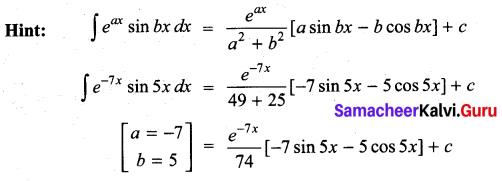
The volume of the parallelepiped with its edges represented by the vectors \(\hat{i}+\hat{j}, i+2 \hat{j}\), \(\hat{i}+\hat{j}+\pi \hat{k}\) is ……………
Samacheer Kalvi 12th Maths Solutions Chapter 6 Applications of Vector Algebra Ex 6.10 6
Solution:
(c) π
Hint:
Volume = \([\vec{a} \vec{b} \vec{c}]=\left|\begin{array}{ccc}{1} & {1} & {0} \\ {1} & {2} & {0} \\ {1} & {1} & {\pi}\end{array}\right|\)
= π(2 – 1) = π cubic units

Samacheer Kalvi 12th Maths Solutions Chapter 6 Applications of Vector Algebra Ex 6.10

Question 7.
If \(\vec{a}\) and \(\vec{b}\) are unit vectors such that \([\vec{a}, \vec{b}, \vec{a} \times \vec{b}]=\frac{\pi}{4}\) then the angle between \(\vec{a}\) and \(\vec{b}\) is …………
Samacheer Kalvi 12th Maths Solutions Chapter 6 Applications of Vector Algebra Ex 6.10 7
Solution:
(a) \(\frac{\pi}{6}\)
Hint:
Samacheer Kalvi 12th Maths Solutions Chapter 6 Applications of Vector Algebra Ex 6.10 8

Question 8.
Samacheer Kalvi 12th Maths Solutions Chapter 6 Applications of Vector Algebra Ex 6.10 9
(a) 0
(b) 1
(c) 6
(d) 3
Solution:
(a) 0
Hint:
Samacheer Kalvi 12th Maths Solutions Chapter 6 Applications of Vector Algebra Ex 6.10 10
Equate corresponding coefficients on both sides
λ + µ = 0 and λ = -1 this gives µ = 1
∴ Then the value of λ + µ = 0.

Question 9.
If \(\vec{a}, \vec{b}, \vec{c}\) are three non-coplanar vectors such that \(\vec{a} \times(\vec{b} \times \vec{c})=\frac{\vec{b}+\vec{c}}{\sqrt{2}}\), then the angle between \(\vec{a}\) and \(\vec{b}\) is …………
(a) 81
(b) 9
(c) 27
(d) 18
Solution:
(a) 81
Hint:
Samacheer Kalvi 12th Maths Solutions Chapter 6 Applications of Vector Algebra Ex 6.10 11

Question 10.
Samacheer Kalvi 12th Maths Solutions Chapter 6 Applications of Vector Algebra Ex 6.10 12
Solution:
(b) \(\frac{3 \pi}{4}\)
Hint:
Samacheer Kalvi 12th Maths Solutions Chapter 6 Applications of Vector Algebra Ex 6.10 13

Question 11.
If the volume of the parallelepiped with \(\vec{a} \times \vec{b}, \vec{b} \times \vec{c}, \vec{c} \times \vec{a}\) as coterminous edges is 8 cubic units, then the volume of the parallelepiped with \((\vec{a} \times \vec{b}) \times(\vec{b} \times \vec{c}),(\vec{b} \times \vec{c}) \times(\vec{c} \times \vec{a})\) and \((\vec{c} \times \vec{a}) \times(\vec{a} \times \vec{b})\) as coterminous edges is ………………
(a) 8 cubic units
(b) 512 cubic units
(c) 64 cubic units
(d) 24 cubic units
Solution:
(c) 64 cubic units
Hint:
Samacheer Kalvi 12th Maths Solutions Chapter 6 Applications of Vector Algebra Ex 6.10 14

Samacheer Kalvi 12th Maths Solutions Chapter 6 Applications of Vector Algebra Ex 6.10

Question 12.
Consider the vectors \(\vec{a}, \vec{b}, \vec{c}, \vec{d}\) such that \((\vec{a} \times \vec{b}) \times(\vec{c} \times \vec{d})=\overrightarrow{0}\). Let P1 and P2 be the planes determined by the pairs of vectors \(\vec{a}, \vec{b}\) and \(\vec{c}, \vec{d}\) respectively. Then the angle between P1 and P2 is ……………..
(a) 0°
(b) 45°
(c) 60°
(d) 90°
Solution:
(a) 0°
Hint:
Samacheer Kalvi 12th Maths Solutions Chapter 6 Applications of Vector Algebra Ex 6.10 15

Question 13.
Samacheer Kalvi 12th Maths Solutions Chapter 6 Applications of Vector Algebra Ex 6.10 16
(a) perpendicular
(b) parallel
(c) inclined at an angle \(\frac{\pi}{3}\)
(d) inclined at an angle \(\frac{\pi}{6}\)
Solution:
(b) parallel
Hint:
Samacheer Kalvi 12th Maths Solutions Chapter 6 Applications of Vector Algebra Ex 6.10 17

Question 14.
If Samacheer Kalvi 12th Maths Solutions Chapter 6 Applications of Vector Algebra Ex 6.10 18, then a vector perpendicular to \(\vec{a}\) and lies in the plane containing \(\vec{b}\) and \(\vec{c}\) is
Samacheer Kalvi 12th Maths Solutions Chapter 6 Applications of Vector Algebra Ex 6.10 19
Solution:
(d) \(-17 \hat{i}-21 \hat{j}-97 \hat{k}\)
Hint:
Samacheer Kalvi 12th Maths Solutions Chapter 6 Applications of Vector Algebra Ex 6.10 20

Question 15.
The angle between the lines Samacheer Kalvi 12th Maths Solutions Chapter 6 Applications of Vector Algebra Ex 6.10 21 is ………..
Samacheer Kalvi 12th Maths Solutions Chapter 6 Applications of Vector Algebra Ex 6.10 22
Solution:
(d) \(\frac{\pi}{2}\)
Hint:
Samacheer Kalvi 12th Maths Solutions Chapter 6 Applications of Vector Algebra Ex 6.10 23
Samacheer Kalvi 12th Maths Solutions Chapter 6 Applications of Vector Algebra Ex 6.10 24

Samacheer Kalvi 12th Maths Solutions Chapter 6 Applications of Vector Algebra Ex 6.10

Question 16.
If the line Samacheer Kalvi 12th Maths Solutions Chapter 6 Applications of Vector Algebra Ex 6.10 25 lies in the plane x + 3 + αz + β = 0, then (α, β) is …………..
(a) (-5, 5)
(b) (-6, 7)
(c) (5, -5)
(d) (6, -7)
Solution:
(d) (-6, 7)
Hint:
d.c.s of the first line = (3, -5, 2)
d.c.s of the line perpendicular to plane = (1, 3, -α)
a1a2 + b1b2 + c1c2 = 0
3 – 15 – 2α = 0 => -12 – 2α = 0
-2α =12 => α = -6
Plane passes through the point (2, 1, -2) so
2 + 3 + 6(-2) + β = 0 => β = 7
(α, β) = (-6, 7)

Question 17.
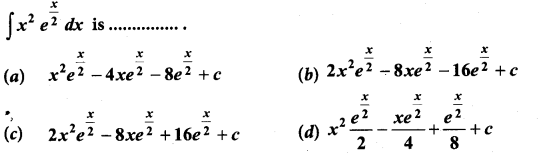
The angle between the line \(\vec{r}=(\hat{i}+2 \hat{j}-3 \hat{k})+t(2 \hat{i}+\hat{j}-2 \hat{k})\) and the plane \(\vec{r} \cdot(\hat{i}+\hat{j})+4\) = 0 is ……………
(a) 0°
(b) 30°
(c) 45°
(d) 90°
Solution:
(c) 45°
Hint:
Samacheer Kalvi 12th Maths Solutions Chapter 6 Applications of Vector Algebra Ex 6.10 26

Question 18.
The coordinates of the point where the line \(\vec{r}=(6 \hat{i}-\hat{j}-3 \hat{k})+t(-\hat{i}+4 \hat{k})\) meets the plane \(\vec{r} \cdot(\hat{i}+\hat{j}-\hat{k})\) are
(a) (2, 1, 0)
(b) (7, -1, -7)
(c) (1, 2, -6)
(c) (5, -1, 1)
Solution:
(d) (5, -1, 1)
Hint:
Cartesian equation of the line
\(\frac{x-6}{-1}=\frac{y+1}{0}+\frac{z+3}{4}\) = λ
(-λ + 6, -1, 4λ – 3)
This meets the plane x + y – z = 3
-λ + 6 – 1 – 41 + 3 = 3 ⇒ -5λ = -5
λ = 1
The required point (5, -1, 1).

Question 19.
Distance from the origin to the plane 3x – 6y + 2z + 7 = 0 is ………………
(a) 0
(b) 1
(c) 2
(d) 3
Solution:
(b) 1
Hint:
Distance from the origin (0, 0, 0) to the plane
Samacheer Kalvi 12th Maths Solutions Chapter 6 Applications of Vector Algebra Ex 6.10 27

Question 20.
The distance between the planes x + 2y + 3z + 7 = 0 and 2x + 4y + 6z + 7 = 0 is ……………
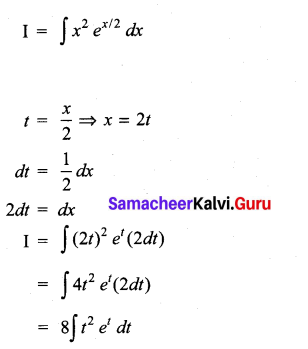
Samacheer Kalvi 12th Maths Solutions Chapter 6 Applications of Vector Algebra Ex 6.10 28
Solution:
(a) \(\frac{\sqrt{7}}{2 \sqrt{2}}\)
Hint:
x + 2y + 3z + 1 = 0; 2x + 4y + 6z + 7 = 0
Multiplying 2 on both sides
2x + 4y + 6z + 14 = 0 .
a = 2, b = 4, c = 6, d1 = 14, d2 = ?
Samacheer Kalvi 12th Maths Solutions Chapter 6 Applications of Vector Algebra Ex 6.10 29

Samacheer Kalvi 12th Maths Solutions Chapter 6 Applications of Vector Algebra Ex 6.10

Question 21.
If the direction cosines of a line are \(\frac{1}{c}, \frac{1}{c}, \frac{1}{c}\), then ……………….
(a) c = ±3
(b) c = ± \(\sqrt{3}\)
(c) c > 0
(d) 0 < c < 1
Solution:
(b) c = ± \(\sqrt{3}\)
Hint:
We know that sum of the squares of direction cosines = 1
Samacheer Kalvi 12th Maths Solutions Chapter 6 Applications of Vector Algebra Ex 6.10 30

Question 22.
The vector equation \(\vec{r}=(\hat{i}-2 \hat{j}-\hat{k})+t(6 \vec{j}-\hat{k})\) represents a straight line passing through the points ……………. (a) (0, 6, -1) and (1, -2, -1) (b) (0, 6, -1) and (-1, -4, -2) (c) (1, -2, -1) and (1, 4, -2) (d) (1, -2, -1) and (0, -6, 1)
Solution:
(c) (1, -2, -1) and (1, 4, -2)
Hint:
The required vector equation is \(\vec{r}=\vec{a}+t(\vec{b}-\vec{a})\)
Samacheer Kalvi 12th Maths Solutions Chapter 6 Applications of Vector Algebra Ex 6.10 31
From (1) and (2) The points are (1, -2, -1) and (1, 4, -2)

Question 23.
If the distance of the point (1, 1, 1) from the origin is half of its distance from the plane x + y + z + k= 0, then the values of k are ………….. (a) ±3 (b) ±6 (c) -3, 9 (d) 3, -9
Solution:
(d) 3, -9
Hint:
Samacheer Kalvi 12th Maths Solutions Chapter 6 Applications of Vector Algebra Ex 6.10 32

Question 24.
If the planes \(\vec{r} \cdot(2 \hat{i}-\lambda \hat{j}+\hat{k})=3 \text { and } \vec{r} \cdot(4 \hat{i}+\hat{j}-\mu \hat{k})\) = 5 are parallel, then the value of λ and µ are ……………
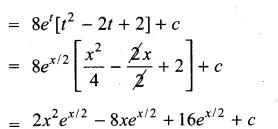
Solution:
(c) \(-\frac{1}{2}\), -2
Hint:
Samacheer Kalvi 12th Maths Solutions Chapter 6 Applications of Vector Algebra Ex 6.10 33

Question 25.
If the length of the perpendicular from the origin to the plane 2x + 3y + λz = 1, λ > 0 is \(-\frac{1}{5}\), then the value of λ is …………..
(a) \(2 \sqrt{3}\)
(b) \(3 \sqrt{2}\)
(c) 0
(d) 1
Solution:
(a) \(2 \sqrt{3}\)
Hint:
Given length of perpendicular from origin to the plane = \(-\frac{1}{5}\)
Samacheer Kalvi 12th Maths Solutions Chapter 6 Applications of Vector Algebra Ex 6.10 34

Samacheer Kalvi 12th Maths Solutions Chapter 6 Applications of Vector Algebra Ex 6.10 Additional Problems

Question 1.
Samacheer Kalvi 12th Maths Solutions Chapter 6 Applications of Vector Algebra Ex 6.10 35
(a) 6
(b) 10
(c) 12
(d) 24
Solution:
(c) 12
Hint:
Samacheer Kalvi 12th Maths Solutions Chapter 6 Applications of Vector Algebra Ex 6.10 36

Question 2.
Samacheer Kalvi 12th Maths Solutions Chapter 6 Applications of Vector Algebra Ex 6.10 37
(a) only x
(b) only y
(c) Neither x nor y
(d) Both x and y
Solution:
(c) Neither x nor y
Hint:
Samacheer Kalvi 12th Maths Solutions Chapter 6 Applications of Vector Algebra Ex 6.10 38

Question 3.
Samacheer Kalvi 12th Maths Solutions Chapter 6 Applications of Vector Algebra Ex 6.10 39
(a) 0
(b) 1
(c) 2
(d) 3
Solution:
(b) 3
Hint:
Samacheer Kalvi 12th Maths Solutions Chapter 6 Applications of Vector Algebra Ex 6.10 40

Question 4.
The value of Samacheer Kalvi 12th Maths Solutions Chapter 6 Applications of Vector Algebra Ex 6.10 41 = ………………
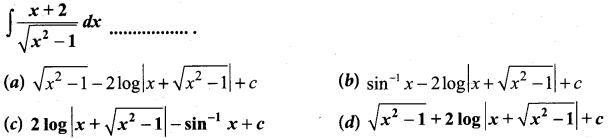
(a) 1
(b) 3
(c) -3
(d) 0
Solution:
(b) 3
Hint:
Samacheer Kalvi 12th Maths Solutions Chapter 6 Applications of Vector Algebra Ex 6.10 42

Samacheer Kalvi 12th Maths Solutions Chapter 6 Applications of Vector Algebra Ex 6.10

Question 5.
Let a, b, c be distinct non-negative numbers. If the vectors Samacheer Kalvi 12th Maths Solutions Chapter 6 Applications of Vector Algebra Ex 6.10 43 lie in a plane, then c is ……………..
(a) the A.M. of a and b
(b) the G.M. of a and b
(c) the H.M. of a and b
(d) equal to zero.
Solution:
(b) the G.M. of a and b
Hint:
Samacheer Kalvi 12th Maths Solutions Chapter 6 Applications of Vector Algebra Ex 6.10 44

Question 6.
The value of \(\hat{i} \cdot(\hat{j} \times \hat{k})+(\hat{i} \times \hat{k}) \cdot \hat{j}\) ………….
(a) 1
(b) -1
(c) 0
(d) \(\hat{j}\)
Solution:
(c) 0
Hint:
Samacheer Kalvi 12th Maths Solutions Chapter 6 Applications of Vector Algebra Ex 6.10 45

Question 7.
The value of \((\hat{i}-\hat{j}, \hat{j}-\hat{k}, \hat{k}-\hat{i})\) is …………..
(a) 0
(b) 1
(c) 2
(d) 3
Solution:
(a) 0
Hint:
Samacheer Kalvi 12th Maths Solutions Chapter 6 Applications of Vector Algebra Ex 6.10 46
Samacheer Kalvi 12th Maths Solutions Chapter 6 Applications of Vector Algebra Ex 6.10 47

Question 8.
Samacheer Kalvi 12th Maths Solutions Chapter 6 Applications of Vector Algebra Ex 6.10 48
Solution:
(c) \(\vec{u}=\overrightarrow{0}\)
Hint:
Samacheer Kalvi 12th Maths Solutions Chapter 6 Applications of Vector Algebra Ex 6.10 49

Question 9.
The area of the parallelogram having a diagonal \(3 \vec{i}+\vec{j}-\vec{k}\) and a side \(\vec{i}-3 \vec{j}+4 \vec{k}\) is ………………
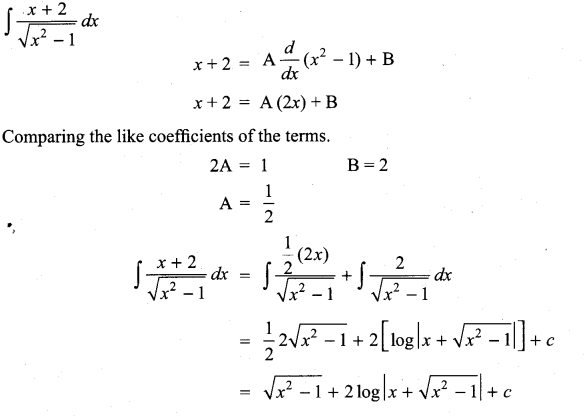
Samacheer Kalvi 12th Maths Solutions Chapter 6 Applications of Vector Algebra Ex 6.10 50
Solution:
(d) \(3 \sqrt{30}\)
Solution:
Samacheer Kalvi 12th Maths Solutions Chapter 6 Applications of Vector Algebra Ex 6.10 51

Samacheer Kalvi 12th Maths Solutions Chapter 6 Applications of Vector Algebra Ex 6.10

Question 10.
If Samacheer Kalvi 12th Maths Solutions Chapter 6 Applications of Vector Algebra Ex 6.10 52, then ……………….
Samacheer Kalvi 12th Maths Solutions Chapter 6 Applications of Vector Algebra Ex 6.10 53
Solution:
(d) \(\vec{x}=\overrightarrow{0} \text { or } \vec{y}=\overrightarrow{0} \text { or } \vec{x} \text { and } \vec{y}\) are parallel
Hint:
Samacheer Kalvi 12th Maths Solutions Chapter 6 Applications of Vector Algebra Ex 6.10 54

Question 11.
If \(\overrightarrow{\mathrm{PR}}=2 \vec{i}+\vec{j}+\vec{k}, \overrightarrow{\mathrm{Question}}=-\vec{i}+3 \vec{j}+2 \vec{k}\), then the area of the quadrilateral PQRS is ………………..
Samacheer Kalvi 12th Maths Solutions Chapter 6 Applications of Vector Algebra Ex 6.10 55
Solution:
(c) \(\frac{5 \sqrt{3}}{2}\)
Hint:
Samacheer Kalvi 12th Maths Solutions Chapter 6 Applications of Vector Algebra Ex 6.10 56

Question 12.
Samacheer Kalvi 12th Maths Solutions Chapter 6 Applications of Vector Algebra Ex 6.10 57
Solution:
(c) \(\vec{c}\) parallel to \(\vec{a}\)
Hint:
Samacheer Kalvi 12th Maths Solutions Chapter 6 Applications of Vector Algebra Ex 6.10 58

Samacheer Kalvi 12th Maths Solutions Chapter 7 Applications of Differential Calculus Ex 7.7

You can Download Samacheer Kalvi 12th Maths Book Solutions Guide Pdf, Tamilnadu State Board help you to revise the complete Syllabus and score more marks in your examinations.

Tamilnadu Samacheer Kalvi 12th Maths Solutions Chapter 7 Applications of Differential Calculus Ex 7.7

Question 1.
Find intervals of concavity and points of inflexion for the following functions:
(i) f(x) = x (x – 4)3
(ii) f(x) = sin x + cos x, 0 < x < 2π
Samacheer Kalvi 12th Maths Solutions Chapter 7 Applications of Differential Calculus Ex 7.7 1
Solution:
(i) f(x) = x(x – 4)3
f(x) = x[x3 – 12x2 + 48x – 64]
(i.e.,) f(x) = x4 – 12x3 + 48x2 – 64x
f'(x) = 4x3 – 36x2 + 96x – 64
f”(x) = 12x2 – 72x + 96
f”(x) = 0 ⇒ 12(x2 – 6x + 8) = 0
⇒ 12 (x – 2) (x – 4) = 0 ⇒ x = 2 or 4
Marking the points in the number line
Samacheer Kalvi 12th Maths Solutions Chapter 7 Applications of Differential Calculus Ex 7.7 2
in the interval (-∞, 2) the curve concave upwards
when x ∈ (2, 4), f”(x) = (3 – 2) (3 – 4)
[say x = 3] = -ve
⇒ The curve concave upwards in (2,4)
when x ∈ (4, ∞), f”(x) = (5 – 2) (5 – 4)
[say x = 5] = (+) (+) = +ve ⇒ The curve concave downwards is (4, ∞) in (-∞, 2) concave upwards and in (2, 4) the concave downwards
⇒ x = 2 is a point of inflection at x = 2, f(2) = -16
So (2, -16) is a point of inflection
Again in (2, 4) the curve concave downwards and in (4, ∞) the curve concave upwards ⇒ x = 4 is a point of inflection f(4) = 0
∴ (4, 0) is a point of inflection
So points of inflection are (2, -16) and (4, 0)

Samacheer Kalvi 12th Maths Solutions Chapter 7 Applications of Differential Calculus Ex 7.7

(ii) f(x) = sin x + cos x
f'(x) = cos x – sin x
f”(x) = – sin x – cos x
f”(x) = 0 ⇒ – sin x = cos x
Samacheer Kalvi 12th Maths Solutions Chapter 7 Applications of Differential Calculus Ex 7.7 3
Samacheer Kalvi 12th Maths Solutions Chapter 7 Applications of Differential Calculus Ex 7.7 4
Samacheer Kalvi 12th Maths Solutions Chapter 7 Applications of Differential Calculus Ex 7.7 5
So the intervals are (-∞, 0), (0, ∞) when x ∈ (-∞, 0) f”(x) is negative
⇒ the curve concave downwards and when x ∈ (0, ∞) f”(x) is positive
⇒ the curve concave upwards
⇒x = 0 is a point of inflection f(0) = \(\frac{1}{2}\)(1 – 1) = 0
So (0, 0) is the point of inflection and the curve concave upwards in (0, ∞) and curve concave downwards in (-∞, 0) and (0, 0) is the point of inflection.

Question 2.
Find the local extrema for the following functions using second derivative test:
(i) f(x) = – 3x5 + 5x3
(ii) f(x) = x log x
(iii) f(x) = x2 e-2x
Solution:
(i) f(x) = – 3x5 + 5x3
f'(x) = 0, f”(x) = -ve at x = a
⇒ x = a is a maximum point
f'(x) = 0, f”(x) = +ve at x = 6
⇒ x = b is a minimum point
f(x) = – 3x5 + 5x3
f’ (x) = -15x4 + 15x2
f”(x) = -60x3 + 30x
f'(x) = 0 ⇒ – 15x2 (x2 – 1) = 0
⇒ x = 0, +1, -1
at x = 0, f”(x) = 0
at x = 1, f”(x) = -60 + 30 = – ve
at x = -1, f”(x) = 60 – 30 = + ve
So at x = 1, f'(x) = 0 and f”(x) = -ve
⇒ x = 1 is a local maximum point.
and f(1) = 2
So the local maximum is (1, 2)
at x = -1, f'(x) = 0 and f”(x) = +ve
⇒ x = -1 is a local maximum point and f(-1) = -2.
So the local minimum point is (-1, -2)
∴ local minimum is -2 and local maximum is 2.

(ii) f(x) = x log x
Samacheer Kalvi 12th Maths Solutions Chapter 7 Applications of Differential Calculus Ex 7.7 6

(iii) f(x) = x2 e-2x
f'(x) = x2[-2e-2x] + e-2x (2x)
= 2e-2x (x – x2)
f”(x) = 2e-2x(1 – 2x) + (x – 2) (-4e-2x)
= 2e-2x [(1 – 2x) + (x – x2) (- 2)]
= 2e-2x [2x2 – 4x + 1]
f'(x) = 0 ⇒ 2e-2x(x – x2) = 0
⇒ x (1 – x) = 0
⇒ x = 0 or x = 1
at x = 0, f”(x) = 2 × 1 [0 – 0 + 1] = +ve
⇒ x = 0 is a local minimum point and the minimum value is f(0) = 0 at x = 1,
f”(x) = 2e-2 [2 – 4 + 1] = -ve
⇒ x = 1 is a local maximum point and the maximum value is f(1) = \(\frac{1}{e^{2}}\)
Local maxima \(\frac{1}{e^{2}}\) and local minima = 0

Samacheer Kalvi 12th Maths Solutions Chapter 7 Applications of Differential Calculus Ex 7.7

Question 3.
For the function f(x) = 4x3 + 3x2 – 6x + 1 find the intervals of monotonicity, local extrema, intervals of concavity and points of inflection.
Solution:
4x3 + 3x2 – 6x + 1
f'(x) = 12x2 + 6x – 6
f”(x) = 24x + 6
f'(x) = 0 ⇒ 6(2x2 + x – 1) = 0
6(x + 1)(2x – 1) = 0
Samacheer Kalvi 12th Maths Solutions Chapter 7 Applications of Differential Calculus Ex 7.7 25
From (1) and (2)
x = -1 is a maximum point,
and f(-1)= -4 + 3 + 6 + 1 = 6
So local maximum is 6
Samacheer Kalvi 12th Maths Solutions Chapter 7 Applications of Differential Calculus Ex 7.7 8
Samacheer Kalvi 12th Maths Solutions Chapter 7 Applications of Differential Calculus Ex 7.7 9
Samacheer Kalvi 12th Maths Solutions Chapter 7 Applications of Differential Calculus Ex 7.7 10

Samacheer Kalvi 12th Maths Solutions Chapter 7 Applications of Differential Calculus Ex 7.7 Additional Problems

Question 1.
Discuss the curves y = x4 – 4x3 with respect to concavity and points of inflection.
Solution:
f(x) = x4 – 4x3 ⇒ f'(x) = 4x3 – 12x2
f”(x) = 12x2 – 24x = 12x (x – 2)
Since f”(x) = 0 when x = 0 or 2, we divide the real line into three intervals.
(-∞, 0) , (0, 2), (2, ∞) and complete the following chart.
Samacheer Kalvi 12th Maths Solutions Chapter 7 Applications of Differential Calculus Ex 7.7 11
The point (0, f(0) i.e., (0, 0) is an inflection point since the curve changes from concave upward to concave downward there. Also (2, f(2)) i.e., (2, -16) is an inflection point since the curve changes from concave downward to concave upward there.

Question 2.
Find the intervals of concavity and the points of inflection of the following functions.
f(x) = 2x3 + 5x2 – 4x
Solution:
y = f (x) = 2x3 + 5x2 – 4x
f'(x) = 6x2 + 10x – 4
f”(x) = 12x + 10; f'” (x) = 12
f”(x) = 0 ⇒ 12x + 10 = 0
Samacheer Kalvi 12th Maths Solutions Chapter 7 Applications of Differential Calculus Ex 7.7 88
Consider x in (-∞, -5/6) say x = -1
f”(x)= -12 + 10 = -2 < 0 ⇒ the curve convex upward in the interval (-∞, -5/6) Consider x in (-5/6, ∞) say x = 0 f”(x) = 0 + 10 = 10 > 0
⇒ the curve is concave upward in (-5/6, -∞)
Thus, the curve is concave upward in (-5/6, ∞) and convex upward in (-∞, – 5/6)
Samacheer Kalvi 12th Maths Solutions Chapter 7 Applications of Differential Calculus Ex 7.7 12

Samacheer Kalvi 12th Maths Solutions Chapter 7 Applications of Differential Calculus Ex 7.7

Question 3.
f(x) = x4 – 6x2
Solution:
Samacheer Kalvi 12th Maths Solutions Chapter 7 Applications of Differential Calculus Ex 7.7 13
So, the points of inflection are at x = ± 1.
f”(x) = 0 ⇒ x2 = 1 ⇒ x = ± 1
So, the intervals are (-∞, -1), (-1, 1), (1, ∞)
When x ∈ (-∞, -1), say x = -2
f”(x) = 12(-2)2 – 12 = 48 – 12 = 36 > 0
⇒ f(x) is concave upward in (-∞, -1) when x ∈ (-1, 1) say x = 0.
f”(x) = 0 – 12 = -12 < 0
⇒ f(x) convex upward.
⇒ x = -1 is a point of inflection. Again when x ∈ (-1, 1), the curve is convex upward and when x ∈ (1, ∞) say x = 2.
f”(x) = (1, ∞) say x = 2.
f”(x) = 12 (4) – 12 > 0
⇒ the curve is concave upward.
⇒ x = 1 is a point of inflection.
Thus x = ± 1 are the points of inflection.
At x = 1, f(x) = 1 – 6 = -5
At x = -1, f(x) = (-1)4 – 6(-1)2 = 1 – 6 = -5
The curve concave upward in (-∞, -1) u (1, ∞) and convex upward in (-1, 1) and the points of inflection are (1, -5) and (-1, -5).

Question 4.
f(θ) = sin 2θ in (θ, π)
Solution:
f'(θ) = sin 2θ
f’ (θ) = (cos 2θ) (2) = 2 cos 2θ
f”(θ)= 2[-sin 2θ] (2) = – 4 sin 2θ
f”(θ) = 0 ⇒ – 4 sin 2θ = 0
Samacheer Kalvi 12th Maths Solutions Chapter 7 Applications of Differential Calculus Ex 7.7 14

Samacheer Kalvi 12th Maths Solutions Chapter 7 Applications of Differential Calculus Ex 7.7

Question 5.
y = 12x2 – 2x3 – x4
Solution:
Samacheer Kalvi 12th Maths Solutions Chapter 7 Applications of Differential Calculus Ex 7.7 15
So the intervals are (-∞, -2), (-2, 1)(1, ∞)
When x ∈ (-∞, -2) say x = -3
Samacheer Kalvi 12th Maths Solutions Chapter 7 Applications of Differential Calculus Ex 7.7 16
The curve is concave upward.
When x ∈ (-2, 1) say x = 0.
Samacheer Kalvi 12th Maths Solutions Chapter 7 Applications of Differential Calculus Ex 7.7 17
⇒ The curve is concave upward.
Samacheer Kalvi 12th Maths Solutions Chapter 7 Applications of Differential Calculus Ex 7.7 18
⇒ The curve is convex upward. So, x = 1 is a point of inflection.
At x = – 2, y = 12(4) – 2(-8) – (16) = 48 + 16 – 16 = 48
At x = 1, y = 12(1) – 2(1) – 1 = 12 – 2 – 1 = 9
So, the points of inflection are (1, 9) and (-2, 48)

Samacheer Kalvi 12th Maths Solutions Chapter 7 Applications of Differential Calculus Ex 7.8

You can Download Samacheer Kalvi 12th Maths Book Solutions Guide Pdf, Tamilnadu State Board help you to revise the complete Syllabus and score more marks in your examinations.

Tamilnadu Samacheer Kalvi 12th Maths Solutions Chapter 7 Applications of Differential Calculus Ex 7.8

Question 1.
Find two positive numbers whose sum is 12 and their product is maximum.
Solution:
Let the two numbers be x, 12 – x.
Their product p = x (12 – x) = 12x – x2
To find the maximum product.
p'(x) = 12 – 2x
p”(x) = -2
p'(x) = 0 ⇒ 12 – 2x = 0 ⇒ 2x = 12
⇒ x = 6
at x = 6, p”(x) = -2 = -ve
⇒ p is maximum at x = 6
when x = 6, 12 – x = 12 – 6 = 6
So the two numbers are 6, 6

Question 2.
Find two positive numbers whose product is 20 and their sum is minimum.
Solution:
Samacheer Kalvi 12th Maths Solutions Chapter 7 Applications of Differential Calculus Ex 7.8 1
but x is positive (given)
Samacheer Kalvi 12th Maths Solutions Chapter 7 Applications of Differential Calculus Ex 7.8 2

Samacheer Kalvi 12th Maths Solutions Chapter 7 Applications of Differential Calculus Ex 7.8

Question 3.
Find the smallest possible value of x2 + y2 given that x + y = 10.
Solution:
Given x + y = 10 ⇒ 7 = 10 – x
To find the smallest value of x2 + y2
Samacheer Kalvi 12th Maths Solutions Chapter 7 Applications of Differential Calculus Ex 7.8 3
at x = 5, f”(x) = 4 at x = 5, y = 10 – 5 = 5 = +ve
x = 5 is a minimum point.
So the minimum value of x2 + y2 = 52 + 52 = 50

Question 4.
A garden is to be laid out in a rectangular area and protected by wire fence. What is the largest possible area of the fenced garden with 40 metres of wire.
Solution:
Perimeter = 40 m
2(l + b) = 40 ⇒ l + b = 20
Let l = x m
b = (20 – x)m
Area = l × b = x(20 – x) = 20x – x2
To find the maximum area
A(x) = 20x – x2
A'(x) = 20 – 2x
A”(x) = -2
A'(x) = 0 ⇒ 20 – 2x = 0
⇒ x = 10
x = 10 is a maximum point
:. Maximum Area = x (20 – x)
= 10(20 – 10)
= 10 × 10 = 100 sq.m.

Question 5.
A rectangular page is to contain 24 cm2 of print. The margins at the top and bottom of the page are 1.5 cm and the margins at other sides of the page is 1 cm. What should be the dimensions of the page so that the area of the paper used is minimum.
Solution:
Let the length of the printed page be = x cm
and breadth = y cm
Now xy = 24
⇒ y = \(\frac{24}{x}\)
The length of the paper = y + 3
Area A = (x + 2)(y + 3)
= xy + 3x + 2y + 6
= 24 + 3x + 2y + 6
= 3x + 2y + 30 ……. (2)
Substituting (1) in (2) we get
Samacheer Kalvi 12th Maths Solutions Chapter 7 Applications of Differential Calculus Ex 7.8 614
∴ Dimensions of the paper are
x + 2 = 4 + 2 = 6 cm
and y + 3 = 6 + 3 = 9 cm
Samacheer Kalvi 12th Maths Solutions Chapter 7 Applications of Differential Calculus Ex 7.8 26

Samacheer Kalvi 12th Maths Solutions Chapter 7 Applications of Differential Calculus Ex 7.8

Question 6.
A farmer plans to fence a rectangular pasture adjacent to a river. The pasture must contain 1,80,000 sq. mtrs in order to provide enough grass for herds. No fencing is needed along the river. What is the length of the minimum needed fencing material?
Solution:
Given Area = 180000 sq. mtrs
Let length be = x
and breadth be = y
Samacheer Kalvi 12th Maths Solutions Chapter 7 Applications of Differential Calculus Ex 7.8 27
Samacheer Kalvi 12th Maths Solutions Chapter 7 Applications of Differential Calculus Ex 7.8 28

Question 7.
Find the dimensions of the rectangle with maximum area that can be inscribed in a circle of radius 10 cm.
Solution:
P is a point on the circumference of a circle of radius 10 cm P = (10 cos α, 10 sin α)
∴ PQ = 20 sinα and
PS = 20 cos α
A = area of PQRS = (20 sin α) (20 cos α)
= 400 sin α cosc α
= (200) (2 sin α cos α)
Samacheer Kalvi 12th Maths Solutions Chapter 7 Applications of Differential Calculus Ex 7.8 30
Samacheer Kalvi 12th Maths Solutions Chapter 7 Applications of Differential Calculus Ex 7.8 300

Question 8.
Prove that among all the rectangles of the given perimeter, the square has the maximum area.
Solution:
Let the length and breadth of the rectangle be x and y respectively.
P = 2(x + y) [given]
Samacheer Kalvi 12th Maths Solutions Chapter 7 Applications of Differential Calculus Ex 7.8 31
Substitute (3) in (2) we get
Samacheer Kalvi 12th Maths Solutions Chapter 7 Applications of Differential Calculus Ex 7.8 32
so x = 6 cm and y = 3 cm

Question 9.
Find the dimensions of the largest rectangle that can be inscribed in a semi circle of radius r cm.
Solution:
Let θ be the angle made by OP with the positive direction of x -axis.
Then the area of the rectangle A is
Samacheer Kalvi 12th Maths Solutions Chapter 7 Applications of Differential Calculus Ex 7.8 35
A(θ) = (2 r cos θ)(r sin θ)
= r2 2 sin θ cos θ = r2 sin 2θ
Now A(θ) is maximum when sin 2θ is maximum. The maximum value of
Samacheer Kalvi 12th Maths Solutions Chapter 7 Applications of Differential Calculus Ex 7.8 36

Question 10.
A manufacturer wants to design an open box having a square base and a surface area of 108 sq.cm. Determine the dimensions of the box for the maximum volume.
Solution:
Let the side of the square base be = x cm and the height be = y cm
Surface area = 108 sq cm
Samacheer Kalvi 12th Maths Solutions Chapter 7 Applications of Differential Calculus Ex 7.8 37
Substituting (3) in (2) we get
Samacheer Kalvi 12th Maths Solutions Chapter 7 Applications of Differential Calculus Ex 7.8 377
so x = 6 cm and y = 3 cm

Samacheer Kalvi 12th Maths Solutions Chapter 7 Applications of Differential Calculus Ex 7.8

Question 11.
The volume of a cylinder is given by the formula V = πr2h. Find the greatest and least values of V if r + h = 6.
Solution:
V = πr2h
Given r + h = 6 ⇒ h = 6 – r
V = πr2(6 – r) = 6πr2 – πr3
Samacheer Kalvi 12th Maths Solutions Chapter 7 Applications of Differential Calculus Ex 7.8 38
3πr(4 – r) = 0 ⇒ r = 0 or 4
when r = 4, h = 2
So v = π(16)(2) = 32π
when r = 0, V = 0
So the maximum volume = 32π and the minimum volume = 0

Question 12.
A hollow cone with base radius a cm and height b cm is placed on a table. Show that the
volume of the largest cylinder that can be hidden underneath is — times volume of the cone.
Solution:
The height of cone = h = b
The base radius = r = a
The base radius of cylinder = r
The height of cylinder = h
Samacheer Kalvi 12th Maths Solutions Chapter 7 Applications of Differential Calculus Ex 7.8 39
Samacheer Kalvi 12th Maths Solutions Chapter 7 Applications of Differential Calculus Ex 7.8 399

Samacheer Kalvi 12th Maths Solutions Chapter 7 Applications of Differential Calculus Ex 7.8 Additional Problems

Question 1.
The top and bottom margins of a poster are each 6 cms and the side margins are each 4 cms. If the area of the printed material on the poster is fixed at 384 cms2, find the dimension of the poster with the smallest area.
Solution:
Let x and y be the length and breadth of printed area, then the area xy = 384
Dimensions of the poster area are (x + 8) and (y + 12) respectively.
Poster area A = (x + 8) (y + 12)
= xy + 12x + 8y + 96
= 12x + 8y + 480
Samacheer Kalvi 12th Maths Solutions Chapter 7 Applications of Differential Calculus Ex 7.8 60
Samacheer Kalvi 12th Maths Solutions Chapter 7 Applications of Differential Calculus Ex 7.8 600
But x > 0
∴ x = 16
when x = 16, A” > 0
when x = 16, the area is minimum
y = 24
∴ x + 8 = 24,
y + 12 = 36
Hence the dimensions are 24 cm and 36 cm

Question 2.
Show that the volume of the largest right circular cone that can be inscribed in a sphere of radius a is \(\frac{8}{27}\) (volume of the sphere).
Solution:
Given that a is the radius of the sphere and let x be the base radius of the cone. If h is the height of the cone, then its volume is
Samacheer Kalvi 12th Maths Solutions Chapter 7 Applications of Differential Calculus Ex 7.8 61
Samacheer Kalvi 12th Maths Solutions Chapter 7 Applications of Differential Calculus Ex 7.8 611
where OC = y so that height h = a + y
From the diagram x2 + y2 = a2
Using (2) in (1) we have
Samacheer Kalvi 12th Maths Solutions Chapter 7 Applications of Differential Calculus Ex 7.8 62
For the volume to be maximum:
Samacheer Kalvi 12th Maths Solutions Chapter 7 Applications of Differential Calculus Ex 7.8 63
⇒ 3y = + a or y = -a
Samacheer Kalvi 12th Maths Solutions Chapter 7 Applications of Differential Calculus Ex 7.8 64

Question 3.
A closed (cuboid) box with a square base is to have a volume of 2000 c.c. The material for the top and bottom of the box is to cost Rs. 3 per square cm and the material for the sides is to cost Rs. 1.50 per square cm. If the cost of the materials is to be the least, find the dimensions of the box.
Solution:
Let x, y respectively denote the length of the side of the square base and depth of the box. Let C be the cost of the material
Area of the bottom = x2
Area of the top = x2
Combined area of the top and bottom = 2x2
Area of the four sides = 4xy
Cost of the material for the top and bottom = 3(2x)2
Cost of the material for the sides = (1.5)(4xy) = 6xy
Samacheer Kalvi 12th Maths Solutions Chapter 7 Applications of Differential Calculus Ex 7.8 65

Question 4.
Find two numbers whose sum is 100 and whose product is a maximum.
Solution:
Let the two numbers be x and y.
x + y = 100
⇒ y = 100 – x
Product = xy = x(100 – x)
f = x(100 – x) = 100x – x2
We have to find x at which f is maximum.
Samacheer Kalvi 12th Maths Solutions Chapter 7 Applications of Differential Calculus Ex 7.8 66
∴ f is maximum at x = 50
So, y = 100 – x = 100 – 50 = 50
So, the two numbers are 50, 50.

Samacheer Kalvi 12th Maths Solutions Chapter 7 Applications of Differential Calculus Ex 7.8

Question 5.
Find two positive numbers whose product is 100 and whose sum is minimum.
Solution:
Let the two numbers be x and y.
Samacheer Kalvi 12th Maths Solutions Chapter 7 Applications of Differential Calculus Ex 7.8 67
To find x at which f is maximum
Samacheer Kalvi 12th Maths Solutions Chapter 7 Applications of Differential Calculus Ex 7.8 68
So the two numbers are 10, 10.

Samacheer Kalvi 12th Maths Solutions Chapter 7 Applications of Differential Calculus Ex 7.9

You can Download Samacheer Kalvi 12th Maths Book Solutions Guide Pdf, Tamilnadu State Board help you to revise the complete Syllabus and score more marks in your examinations.

Tamilnadu Samacheer Kalvi 12th Maths Solutions Chapter 7 Applications of Differential Calculus Ex 7.9

Question 1.
Find the asymptotes of the following curves:
Samacheer Kalvi 12th Maths Solutions Chapter 7 Applications of Differential Calculus Ex 7.9 1
Solution:
Samacheer Kalvi 12th Maths Solutions Chapter 7 Applications of Differential Calculus Ex 7.9 2
y = 1 is a horizontal asymptote
So the asymptotes are x = -1, x = +1, y = 1

Samacheer Kalvi 12th Maths Solutions Chapter 7 Applications of Differential Calculus Ex 7.9

(ii) Since the numerator is of higher degree than the denominator we have a slant asymptote to find that asymptote we have to divide the numerator by the denominator So the slant asymptote is y = x – 1
Samacheer Kalvi 12th Maths Solutions Chapter 7 Applications of Differential Calculus Ex 7.9 3
Samacheer Kalvi 12th Maths Solutions Chapter 7 Applications of Differential Calculus Ex 7.9 4
Samacheer Kalvi 12th Maths Solutions Chapter 7 Applications of Differential Calculus Ex 7.9 5
∴ y = 3 and y = -3 are the horizontal asymptotes and there is no slant asymptote
(iv) Since the numerator is of highest degree than the denominator. We have a slant asymptote to find it we have to divide numerator by the denominator.
Samacheer Kalvi 12th Maths Solutions Chapter 7 Applications of Differential Calculus Ex 7.9 889
So the equation of asymptotes is y = x – 9 and x = -3
(v) Since the numerator is of highest degree than the denominator. We have a slant asymptote to find it we have to divide the numerator by the denominator.
Samacheer Kalvi 12th Maths Solutions Chapter 7 Applications of Differential Calculus Ex 7.9 890

Samacheer Kalvi 12th Maths Solutions Chapter 7 Applications of Differential Calculus Ex 7.9

Question 2.
Sketch the graphs of the following functions:
Samacheer Kalvi 12th Maths Solutions Chapter 7 Applications of Differential Calculus Ex 7.9 7
Solution:
Samacheer Kalvi 12th Maths Solutions Chapter 7 Applications of Differential Calculus Ex 7.9 33
Factorizing we get
Samacheer Kalvi 12th Maths Solutions Chapter 7 Applications of Differential Calculus Ex 7.9 44
• The domain and the range of the given function f(x) are the entire real line.
• Putting y = 0 we get x = 1, 1, -2. Hence the x intercepts are (1, 0) and (-2, 0) and by putting x = 0 we get y = \(-\frac{2}{3}\)
Samacheer Kalvi 12th Maths Solutions Chapter 7 Applications of Differential Calculus Ex 7.9 45
∴ The function is concave upward in the negative real line.
• Since f”(x) = 0 at x = 0 and f”(x) changes its sign when passing through x = 0, x = 0 is a point of inflection is \(\left(0,-\frac{2}{3}\right)\)
• The curve has no asymptotes.

(ii)
Samacheer Kalvi 12th Maths Solutions Chapter 7 Applications of Differential Calculus Ex 7.9 55
Samacheer Kalvi 12th Maths Solutions Chapter 7 Applications of Differential Calculus Ex 7.9 666
The curve concave downward in the negative real line
• No point of inflection exists.
• as x ➝ ∞, y = ± ∞ and so the curve does not have any asymptotes

(iii)
Samacheer Kalvi 12th Maths Solutions Chapter 7 Applications of Differential Calculus Ex 7.9 77
Samacheer Kalvi 12th Maths Solutions Chapter 7 Applications of Differential Calculus Ex 7.9 8
Samacheer Kalvi 12th Maths Solutions Chapter 7 Applications of Differential Calculus Ex 7.9 888
• Putting y = 0. x is unreal hence there is no ‘x’ intercept. By putting x = 0 we get
Samacheer Kalvi 12th Maths Solutions Chapter 7 Applications of Differential Calculus Ex 7.9 89
• No points of reflection
• When x = ± 2, y = ∞, Vertical asymptotes are x = 2 and x = -2 and horizontal asymptote is y = 1

Samacheer Kalvi 12th Maths Solutions Chapter 7 Applications of Differential Calculus Ex 7.9 95
f'(x) = 0 ⇒ e-x = 0 which is not possible hence there is no extremum.
• No vertical asymptote for the curve and the horizontal asymptotes are y = 1 and y = 0

Samacheer Kalvi 12th Maths Solutions Chapter 7 Applications of Differential Calculus Ex 7.9

(v)
Samacheer Kalvi 12th Maths Solutions Chapter 7 Applications of Differential Calculus Ex 7.9 26
• The curve exists only for positive values of (x > 0)
Samacheer Kalvi 12th Maths Solutions Chapter 7 Applications of Differential Calculus Ex 7.9 11
Samacheer Kalvi 12th Maths Solutions Chapter 7 Applications of Differential Calculus Ex 7.9 111
Samacheer Kalvi 12th Maths Solutions Chapter 7 Applications of Differential Calculus Ex 7.9 112
• No point of inflection.
• No horizontal asymptote is possible.
But the vertical asymptote is x = 0(y axis).

Samacheer Kalvi 12th Maths Solutions Chapter 7 Applications of Differential Calculus Ex 7.2

You can Download Samacheer Kalvi 12th Maths Book Solutions Guide Pdf, Tamilnadu State Board help you to revise the complete Syllabus and score more marks in your examinations.

Tamilnadu Samacheer Kalvi 12th Maths Solutions Chapter 7 Applications of Differential Calculus Ex 7.2

Question 1.
Find the slope of the tangent to the curves at the respective given points.
(i) y = x4 + 2x2 – x at x = 1
(ii) x = a cos3 t, sin 3 t at t = \(\frac{\pi}{2}\)
Solution:
(i) y = x4 + 2x2 – x at x = 1
Samacheer Kalvi 12th Maths Solutions Chapter 7 Applications of Differential Calculus Ex 7.2 1

Question 2.
Find the point on the curve y = x2 – 5x + 4 at which the tangent is parallel to the line 3x + y = 7.
Solution:
Let (x1, y1) be the required point.
Samacheer Kalvi 12th Maths Solutions Chapter 7 Applications of Differential Calculus Ex 7.2 2
Given tangent is similarly to the line ⇒ m1 = m2
⇒ 2x1 – 5 = -3
⇒ 2x1 = -3 + 5 = 2
⇒ x1 = 1
Substituting x1 = 1 in the curve.
y1 = 1 – 5 + 4 = 0
So the required point is (1, 0)

Samacheer Kalvi 12th Maths Solutions Chapter 7 Applications of Differential Calculus Ex 7.2

Question 3.
Find the points on the curves = x3 – 6x2 + x + 3 where the normal is parallel to the line x + y = 1729.
Solution:
Let (x1,y1) be the required point
y = x3 – 6x2 + x + 3
Samacheer Kalvi 12th Maths Solutions Chapter 7 Applications of Differential Calculus Ex 7.2 3
Substituting x1 values in the curve
when x1 = 4, y1 = 3
when x1 = 4, y1 = 43 – 6(4)2 + 4 + 3 = 64 – 96 + 4 + 3 = -25
So the required points are (0, 3) and (4, -25)

Question 4.
Find the points on the curve y2 – 4xy = x2 + 5 for which the tangent is horizontal.
Solution:
Samacheer Kalvi 12th Maths Solutions Chapter 7 Applications of Differential Calculus Ex 7.2 4
Given that tangent is horizontal (i.e) tangent is parallel to x – axis
⇒ Equation of tangent will be of the form y = c
Samacheer Kalvi 12th Maths Solutions Chapter 7 Applications of Differential Calculus Ex 7.2 5
from (1) and (2) we get
Samacheer Kalvi 12th Maths Solutions Chapter 7 Applications of Differential Calculus Ex 7.2 6
Substituting x = -2y in the equation of the curve we get
y2 – 4(-2y)(y) = 4y2 + 5
⇒ y2 + 8y2 – 4y2 = 5
⇒ 5y2 = 5 ⇒ y2 = 1
⇒ y = ± 1
when y = 1, x = -2 and when y = -1, x = 2 So the points are (2, -1), (-2, 1)

Question 5.
Find the tangent and normal to the following curves at the given points on the curve.
Samacheer Kalvi 12th Maths Solutions Chapter 7 Applications of Differential Calculus Ex 7.2 7
Solution:
Samacheer Kalvi 12th Maths Solutions Chapter 7 Applications of Differential Calculus Ex 7.2 8
Now m = -2, (x1, y1) = (1, 0)
So equation of the tangent is
y – y1 = m(x – x1)
(i. e) y – 0 = -2(x – 1)
y = -2x + 2
2x+ y = 2
Slope of tangent = m = -2
Samacheer Kalvi 12th Maths Solutions Chapter 7 Applications of Differential Calculus Ex 7.2 9
Samacheer Kalvi 12th Maths Solutions Chapter 7 Applications of Differential Calculus Ex 7.2 10
Samacheer Kalvi 12th Maths Solutions Chapter 7 Applications of Differential Calculus Ex 7.2 11
Samacheer Kalvi 12th Maths Solutions Chapter 7 Applications of Differential Calculus Ex 7.2 12

Samacheer Kalvi 12th Maths Solutions Chapter 7 Applications of Differential Calculus Ex 7.2

Question 6.
Find the equations of the tangents to the curve y = 1 + x3 for which the tangent is orthogonal with the line x + 12y = 12.
Solution:
Samacheer Kalvi 12th Maths Solutions Chapter 7 Applications of Differential Calculus Ex 7.2 14
Samacheer Kalvi 12th Maths Solutions Chapter 7 Applications of Differential Calculus Ex 7.2 15
Substituting x1 values in the curve
when x1 = 2, y1 = 9; when x1 = -2, y1 = -1
So the points are (2, 9) and (-2, -7)
To find the equations of tangents:
Tangents are orthogonal to x + 12y = 12
So equations of tangents will be of the form 12x – y = k
The tangent passes through (2, 9) ⇒ 24 – 9 = k ⇒ k = 15 .
∴ Equation of tangent is 12x – y = 15
The tangent passes through (-2, -7) ⇒ 12 (-2) + 7 = k ⇒ -17
So equation of tangent is 12x – y = -17

Question 7.
Find the equations of the tangents to the curve y = \(\frac{x+1}{x-1}\)which are parallel to the line x + 2y = 6.
Solution:
Samacheer Kalvi 12th Maths Solutions Chapter 7 Applications of Differential Calculus Ex 7.2 16
Tangent is parallel the line x + 2y = 6
⇒ Slope of tangent = Slope of line
Samacheer Kalvi 12th Maths Solutions Chapter 7 Applications of Differential Calculus Ex 7.2 17
Samacheer Kalvi 12th Maths Solutions Chapter 7 Applications of Differential Calculus Ex 7.2 18
when x1 = -1, y1 = 0; when x1 = 3, y1 = 2
So the points are (-1, 0) and (3, 2). The tangents are parallel to x + 2y = 6. So equation of tangents will be of the form x + 2y = k.
∴ Equation of tangent is x + 2y = -1
The tangent passes through (-1, 0) ⇒ -1 = k
The tangent passes through (3, 2) ⇒ 3 + 4 = k ⇒ k = 7
∴ Equation of tangent is x + 2y = 7

Question 8.
Find the equation of tangent and normal to the curve given by x = 7 cos t and y = 2sin t, t ∈ R at any point on the curve.
Solution:
Samacheer Kalvi 12th Maths Solutions Chapter 7 Applications of Differential Calculus Ex 7.2 20
(2 cos t)y – 4 sint cos t = (7 sin t)x – 49 sin t cos t
x(7 sin t) – y(2 cos t) = 45 sin t cos t

Question 9.
Find the angle between the rectangular hyperbola xy = 2 and the parabola x2 + 4y = 0.
Solution:
Solving the given two equations. To find the point of intersection:
Samacheer Kalvi 12th Maths Solutions Chapter 7 Applications of Differential Calculus Ex 7.2 21
Samacheer Kalvi 12th Maths Solutions Chapter 7 Applications of Differential Calculus Ex 7.2 22

Question 10.
Show that the two curves x2 – y2 = r2 and xy = c2 where c, r are constants, cut orthogonally.
Solution:
Let (x1, y1) be the point of intersection of the two curves
I Curve: x2 – y2 = r2
Differentiating w.r.to x
Samacheer Kalvi 12th Maths Solutions Chapter 7 Applications of Differential Calculus Ex 7.2 24
II Curve: xy = c2
Differentiating w.r.to x
Samacheer Kalvi 12th Maths Solutions Chapter 7 Applications of Differential Calculus Ex 7.2 25

Samacheer Kalvi 12th Maths Solutions Chapter 7 Applications of Differential Calculus Ex 7.2

Samacheer Kalvi 12th Maths Solutions Chapter 7 Applications of Differential Calculus Ex 7.2 Additional Questions

Question 1.
Prove that the sum of the intercepts on the co-ordinate axes of any tangent to the curve x = a cos4 θ, y = a sin4 θ, 0 < θ < \(\frac{\pi}{2}\) is equal to a.
Solution:
Samacheer Kalvi 12th Maths Solutions Chapter 7 Applications of Differential Calculus Ex 7.2 26

Question 2.
Find the equations of a normal to y = x3 – 3x that is parallel to 2x + 18y – 9 = 0.
Solution:
Let (x1, y,) be a point on the curve.
Samacheer Kalvi 12th Maths Solutions Chapter 7 Applications of Differential Calculus Ex 7.2 27
It is given that the normal is parallel to the line ⇒ m1 = m2
Samacheer Kalvi 12th Maths Solutions Chapter 7 Applications of Differential Calculus Ex 7.2 28
9y + 18 = -x – 2
x + 9y + 20 = 0

Question 3.
Prove that the curves 2x2 + 4y2 = 1 and 6x2 – 12y2 = 1 cut each other at right angles.
Solution:
Solving the given two equations,
Samacheer Kalvi 12th Maths Solutions Chapter 7 Applications of Differential Calculus Ex 7.2 29
Samacheer Kalvi 12th Maths Solutions Chapter 7 Applications of Differential Calculus Ex 7.2 30
Similarly it can be proved at the other points also.

Question 4.
Show that the equation of the normal to the curve x = a cos3 θ, y = a sin3 θ at ‘θ’ is x cos θ – y sin θ = a cos 2θ
Solution:
Samacheer Kalvi 12th Maths Solutions Chapter 7 Applications of Differential Calculus Ex 7.2 32
So, equation of the normal is
Samacheer Kalvi 12th Maths Solutions Chapter 7 Applications of Differential Calculus Ex 7.2 33
i.e. y sin θ – a sin4 θ = x cos θ – a cos4 θ
x cos θ – y sin θ = a cos4 θ – a sin4 θ
i.e.x cos θ – y sin θ = a[cos2 θ + sin2θ][cos2θ – sin2 θ]
= a[cos 2 θ]
So, the equation of the normai is x cos θ – y sin θ = a cos 2θ

Samacheer Kalvi 12th Maths Solutions Chapter 7 Applications of Differential Calculus Ex 7.2

Question 5.
If the curve y2 = x and xy = k are orthogonal, then prove that 8k2 = 1.
Solution:
y2 = x, xy = k
Solving the two equations, we get, (y2) (y) = k
y3 = k
Samacheer Kalvi 12th Maths Solutions Chapter 7 Applications of Differential Calculus Ex 7.2 34