Samacheer Kalvi 12th Computer Applications Solutions Chapter 4 Introduction to Hypertext Pre-Processor

Students can Download Computer Applications Chapter 4 Introduction to Hypertext Pre-Processor Questions and Answers, Notes Pdf, Samacheer Kalvi 12th Computer Applications Book Solutions Guide Pdf helps you to revise the complete Tamilnadu State Board New Syllabus and score more marks in your examinations.

Tamilnadu Samacheer Kalvi 12th Computer Applications Solutions Chapter 4 Introduction to Hypertext Pre-Processor

Samacheer Kalvi 12th Computer Applications Introduction to Hypertext Pre-Processor Text Book Back Questions and Answers

PART – I
I. Choose The Correct Answer

Question 1.
What does PHP stand for?
(a) Personal Home Page
(b) Hypertext Preprocessor
(c) Pretext Hypertext Processor
(d) Pre-processor Home Page
Answer:
(b) Hypertext Preprocessor

Question 2.
What does PHP files have a default file extension?
(a) html
(b) xml
(c) .php
(d) ph
Answer:
(c) .php

Samacheer Kalvi 12th Computer Applications Solutions Chapter 4 Introduction to Hypertext Pre-Processor

Question 3.
A PHP script should start with ……………………. and end with …………………….
(a) <php>
(b) < ? php ?>
(c) < ? ? >
(d) < ?php ? >
Answer:
(d) < ?php ? >

Question 4.
Which of the following must be installed on your computer so as to mn PHP script?
(a) Adobe
(b) windows
(c) Apache
(d) IIS
Answer:
(c) Apache

Question 5.
We can use ………………….. to comment a single line?
(i) /?
(ii) 11
(iii) #
(iv) /* */
(a) Only (ii)
(b) (i), (iii) and (iv)
(c) (ii), (iii) and (iv)
(d) Both (ii) and (iv)
Answer:
(c) (ii), (iii) and (iv)

Samacheer Kalvi 12th Computer Applications Solutions Chapter 4 Introduction to Hypertext Pre-Processor

Question 6.
What will be the output of the following PHP code?
Ans
< ?php
$num =1;
$num1 =2;
print $num . $num1 ;
?>
(a) 3
(b) 1+2
(c) 1.+.2
(d) Error
Answer:
(a) 3

Samacheer Kalvi 12th Computer Applications Solutions Chapter 4 Introduction to Hypertext Pre-Processor

Question 7.
Which of the following PHP statements Will output Hello World on the screen?
(a) echo (“Hello World”)
(b) print (“Hello World”)
(c) printf (“Hello World”)
(d) sprintf (“Hello World”)
Answer:
(a) echo (“Hello World”)

Question 8.
Which statement will output $x on the screen?
(a) echo “\$x”
(b) echo “$$x”
(c) echo “/$x”
(d) echo “$x
Answer:
(a) echo “\$x”

Samacheer Kalvi 12th Computer Applications Solutions Chapter 4 Introduction to Hypertext Pre-Processor

Question 9.
Which of the below symbols is a newline character?
(a) \r
(b) \n
(c) /n
(d) /r
Answer:
(b) \n

PART – II
II. Short Answers

Question 1.
What are the common usages of PHP?
Answer:

  1. It is very simple and lightweight open source server side scripting language.
  2. It can easily embed with HTML and other client side scripting languages like CSS (Cascading Style Sheets) and Java script.
  3. It also creates dynamic and interaction Webpages in the red time Web development projects.

Question 2.
What is Webserver?
Answer:
Web server software is available as open source or licensed version in the market. A Web server is a Software that uses HTTP (Hypertext Transfer Protocol) to serve the files that form Web pages to users.

Samacheer Kalvi 12th Computer Applications Solutions Chapter 4 Introduction to Hypertext Pre-Processor

Question 3.
What are the types scripting language?
Answer:
Web scripting languages are classified into two types, client side and server side scripting language. PHP is completely different from Client side scripting language like Java script. The PHP code entirely executes on Webserver which is installed in the remote machine.

Question 4.
Difference between Client and Server?
Answer:
The server is a high performance hardware machine it could run more than one application concurrently. The client is a separate hardware machine which is connected with server in the network (Intemet/intranet). It could send the request and receive the response from the server hardware. The Server and client are also called as service provider and service requester respectively.

Samacheer Kalvi 12th Computer Applications Solutions Chapter 4 Introduction to Hypertext Pre-Processor

Question 5.
Give few examples of Web Browser?
Answer:
Internet Explorer
UC Browser
Opera
Google Chrome and
Mozilla Firefox.

Question 6.
What is URL?
Answer:
URL: Uniform Resource Locator, the address of a specific Web page or file on the Internet. Eg. http://example.com

Question 7.
Is PHP a case sensitive language?
Answer:
Yes, smaller case & uppercase letters are different in PHP.

Samacheer Kalvi 12th Computer Applications Solutions Chapter 4 Introduction to Hypertext Pre-Processor

Question 8.
How to declare variables in PHP?
Answer:
The variable in PHP begins with a dollar ($) symbol and the assignment activity implemented using “=” operator, finally the statement ends with semi colon The semicolon indicates the end of statement.
$a=5; $b=T0;

Question 9.
Define Client Server Architecture?
Answer:
The client server architecture introduces application sharing mechanism between two different hardware systems over the network (Intemet/intranet).

Samacheer Kalvi 12th Computer Applications Solutions Chapter 4 Introduction to Hypertext Pre-Processor

Question 10.
Define Webserver?
Answer:
Web server software is available as open source or licensed version in the market.
A Web server is a Software that uses HTTP (Hypertext Transfer Protocol) to serve the files that form Web pages to users.

PART – III
III. Explain in Brief Answer

Question 1.
Write the features of server side scripting language?
Answer:

  1. The server is a high performance hardware machine it could run more than one application concurrently.
  2. Most of the server side scripting languages are working on any one the client server architecture model.
  3. Webserver is software which is running in server hardware.
  4. It takes the responsibilities for compilation and execution of server side scripting languages.

Samacheer Kalvi 12th Computer Applications Solutions Chapter 4 Introduction to Hypertext Pre-Processor

Question 2.
Write is the purpose of Web servers?
Answer:

  1. Webserver is software which is running in server hardware.
  2. It takes the responsibilities for compilation and execution of server side scripting languages.
  3. After receiving the request from client machine the Web server tries to compile and interpret the PHP code which is available in remote machine.
  4. Next a response will be generated and sent back to the client machine over the network from Webserver.

Samacheer Kalvi 12th Computer Applications Solutions Chapter 4 Introduction to Hypertext Pre-Processor

Question 3.
Differentiate Server side and Client Side Scripting language?
Answer:
Server Side Scripting Language:

  1. Server is a high performance hardware machine. It could run more than one application concurrently.
  2. The server is the service provider.
  3. Ex. Php. Asp.net, Python, Cold Fusion
  4. It is relatively secure

Client Side Scripting Language:

  1. The client is a separate hardware machine which is connected with server in the network.
  2. The client is the service requester
  3. html, css, Javascript
  4. Insecure

Samacheer Kalvi 12th Computer Applications Solutions Chapter 4 Introduction to Hypertext Pre-Processor

Question 4.
In how many ways you can embed PHP code in an HTML page?
Answer:

  1. PHP script can be written in side of HTML code and save the file with extension of .php. The embedded PHP file get executed in the Webserver, the browser receives only the HTML and other client side files.
  2. Php files can also be embedded with css and js files.
  3. Using template engines like Smarty, DWOO, Mustache, Blade we can embed php files.

Question 5.
Write short notes on PHP operator?
Answer:
Operator is a symbol which is used to perform mathematical and logical operations in the programing languages. Different types of operator in PHP are:

  1. Arithmetic operators
  2. Assignment operators
  3. Comparison operators
  4. Increment/Decrement operators,
  5. Logical operators, and
  6. String operators.

PART – IV
IV. Explain in detail

Question 1.
Explain client side and server side scripting language?
Answer:

  1. PHP (Hypertext Pre-processor) is a one of the important server side Web and general purpose scripting language invented by Rasmus Lerdorf in 1994.
  2. It is very simple and lightweight open source server side scripting language.
  3. It can easily embed with HTML and other client side scripting languages like CSS (Cascading Style Sheets) and Java script.
  4. It also creates dynamic and interactive Webpages in the real time Web development projects
  5. Web scripting languages are classified into two types, client side and server side scripting language.
  6. PHP is completely different from Client side scripting language like Java script.
  7. The PHP code entirely executes on Webserver which is installed in the remote machine and it is generating HTML code which is sent to the user.
  8. The user receives the HTML code and sees the Website contents via Internet browser in their computer or laptop.
  9. PHP also supports OOPs (Object Oriented Programing) concepts. It is applicable to implement all OOPs features such as class, object and inheritance etc. The action is shown in Figure.

Samacheer Kalvi 12th Computer Applications Solutions Chapter 4 Introduction to H - 1

Samacheer Kalvi 12th Computer Applications Solutions Chapter 4 Introduction to Hypertext Pre-Processor

Question 2.
Discuss in detail about Website development activities?
Answer:
The process of development also includes Web content generation, Web page designing, Website security and so on.
PHP Script:
1. Website or Web page is developed by the programmer using PHP script. Finally the entire Website codes are moved to Web server path in a remote server machine.

2. From client side, the end user opens a browser, types the URL of the Website or Webpage and initiates the request to remote server machine over the network.

3. After receiving the request from client machine the Web server tries to compile and interpret the PHP code which is available in remote machine.

4. Next a response will be generated and sent back to the client machine over the network from Webserver.

5. Finally the browser which is installed in the client machine receives the response and displays the output to user.
Samacheer Kalvi 12th Computer Applications Solutions Chapter 4 Introduction to H - 2

Question 3.
Explain the process of Webserver installation?
Answer:
Web server software that runs on server hardware, governs the server side scripting compilation into an intermediate byte-code that is then interpreted by the runtime engine.

Web server software is available as open source or licensed version in the market. Recent statistics of Web server usage depict that more than 130% Websites are running under the open source Web servers such as Tomcat Apache, Nginx etc. The following are the steps to install and configure Apache Httpd Webserver and PHP module in windows server machine.

Step 1:
Go to Apache foundation Website and download the Httpd Webserver Software.
https://httpd.apache.org/download.cgi

Step 2:
After downloading .MSI file from Apache foundation Website, user launches the. MSI file and clicks next and next button to finish the installation on server machine. The software takes default port number 130 or 130130. Once the user finished, the Web server software is installed and configured on server hardware machine as a service.

Step 3:
To test the installation of Apache Httpd Webserver, enter the following URL from your Web browser which is installed in your client machine.
https://localhost:130/ or https://localhost: 130130 The output page that says “Its works”

Step 4:
Administrator user can start, stop and restart the Web server service at any time via windows Control panel. Once the services stops, the client machine will not receive the response message from server machine.

Step 5:
Webserver’s configuration setting “httpd.conf” file is located in the conf directory under the apache installation directory. Edit this file and enable the PHP module to run PHP scripting language.

Samacheer Kalvi 12th Computer Applications Solutions Chapter 4 Introduction to Hypertext Pre-Processor

Question 4.
Discuss in detail about PHP data types?
Answer:
PHP Data type:
PHP scripting language supports 13 primitive data types. Data Types plays important role in all programing languages to classify the data according to the logics. PHP supports the following data types.

  1. String
  2. Integer
  3. Float
  4. Boolean
  5. Array
  6. Object
  7. NULL
  8. Resource

1. String:
String is a collection of characters within the double or single quotes like
“Computer Application” or ‘Computer Application’. Space is also considered as a character.
Example:
$x = “Computer Application!”;

2. Integer:
Integer is a data type which contains non decimal numbers.
Example:
$x = 59135;
*
The var_dump( ) system define function, returns structured information (type and value) about variables in PHP.

3. Float:
Float is a data type which contains decimal numbers.
Example:
$x = 19.15;

4. Boolean:
Boolean is a data type which denotes the possible two states, TRUE or FALSE
Example:
$x = true;
$y = false;

5. Array:
Array is a data type which has multiple values in single variable.
Example:
Scars = array(“Computer”,“Laptop”,“Mobile”);

OUTPUT:
array(3) {[0]=> string(5) “Computer” [1]=>
string(3) “Laptop “ [2]=> string(6)” Mobile”}
Var_dump:
The var_dump( ) function is used to dump information about a variable. This function displays structured information such as type and value of the given variable. Arrays and objects are explored recursively with values indented to show structure.

6. Object:
PHP object is a data type which contains information about data and function inside-the class.
<?php
class School {
function marks( ) {
$this->sec = “A”;
}
}
// create an object
$schoolobj = new School ( );
?>
OUTPUT
NULL

7. NULL:
Null is a special data type which contains a single,value: NULL
<?php $x = null;
?>
OUTPUT:
NULL

8. Resources:
Resource is a specific variable, it has a reference to an external resource. These variables hold specific handlers to handle files and database connections in respective PHP program.
<?php
// Open a file for reading
Shandle = fopen(“note.txt”, “r”);
var_dump($handle);
echo “<br>”;
// Connect to MySQL database server with
default setting
Slink = mysql_connect(“localhost”, “root”, “”);
var_dump($link);
?>

Samacheer Kalvi 12th Computer Applications Solutions Chapter 4 Introduction to Hypertext Pre-Processor

Question 5.
Explain operators in PHP with example?
Answer:
Operators in PHP:
Operator is a symbol which is used to perform mathematical and logical operations in the programing languages. Different types of operator in PHP are:

  1. Arithmetic operators
  2. Assignment operators
  3. Comparison operators
  4. Increment/Decrement operators
  5. Logical operators, and
  6. String operators.

1. Arithmetic operators:
The arithmetic operators in PHP perform general arithmetical operations, such as addition, subtraction, multiplication and division etc.
Samacheer Kalvi 12th Computer Applications Solutions Chapter 4 Introduction to H - 3

2. Assignment Operators:
Assignment operators are performed with numeric values to store a value to a variable. The default assignment operator is “=”. This operator sets the left side operant value of expression to right side variable.
Samacheer Kalvi 12th Computer Applications Solutions Chapter 4 Introduction to H - 4

3. Comparison Operators:
Comparison operators perform an action to compare two values. These values may contain integer or string data types (Number or Strings).
Samacheer Kalvi 12th Computer Applications Solutions Chapter 4 Introduction to H - 5

4. Increment and Decrement Operators:
Increment and decrement operators are used to perform the task of increasing or decreasing variable’s value. This operator is mostly used during iterations in the program logics.
Samacheer Kalvi 12th Computer Applications Solutions Chapter 4 Introduction to H - 6

5. Logical Operators:
Logical Operators are used to combine conditional statements.
Samacheer Kalvi 12th Computer Applications Solutions Chapter 4 Introduction to H - 7

6. String Operators:
Two operators are used to perform string related operations such as Concatenation and Concatenation assignment (Appends).
Samacheer Kalvi 12th Computer Applications Solutions Chapter 4 Introduction to H - 8

Samacheer Kalvi 12th Computer Applications Solutions Introduction to Hypertext Pre-Processor Additional Questions and Answers

I. Choose The Best Answer

Question 1.
Tim Benner’s Lee developed
(i) Internet
(ii) www
(iii) Javascript
(iv) css
(a) only (i)
(b) (i) and (ii)
(c) (i), (ii), (iii)
(d) (ii), (iii), (iv)
Answer:
(b) (i) and (ii)

Samacheer Kalvi 12th Computer Applications Solutions Chapter 4 Introduction to Hypertext Pre-Processor

Question 2.
……………………… Scripting languages was introduced to support Internet online business.
(a) Server
(b) Client
(c) Web
(d) Online
Answer:
(c) Web

Question 3.
Which one of the following is a fundamental part of any dynamic web page?
(a) HTML
(b) PHP
(c) CSS
(d) JS
Answer:
(b) PHP

Samacheer Kalvi 12th Computer Applications Solutions Chapter 4 Introduction to Hypertext Pre-Processor

Question 4.
PHP was invented by
(a) Rasmus Lerdoof
(b) Tim Berner’s Lee
(c) Bob Frankston
(d) Don Bricklin
Answer:
(a) Rasmus Lerdoof

Question 5.
CSS means
(a) combined script style
(b) cascading style sheets
(c) calculated spreadsheet
(d) consecutive script sheets
Answer:
(b) cascading style sheets

Samacheer Kalvi 12th Computer Applications Solutions Chapter 4 Introduction to Hypertext Pre-Processor

Question 6.
Pick the odd one out.
php, css, ASP, JSP
Answer:
CSS

Question 7.
ASP stands for
(a) All server pages
(b) All script pages
(c) Active server pages
(d) Active script pages
Answer:
(c) Active server pages

Question 8.
JSP means
(a) Joint Server photographs
(b) Java Server pages
(c) Java Script program
(d) Active script pages
Answer:
(b) Java Server pages

Samacheer Kalvi 12th Computer Applications Solutions Chapter 4 Introduction to Hypertext Pre-Processor

Question 9.
ASP is developed by
(a) Apache
(b) Apple
(c) Microsoft
(d) Macromedia
Answer:
(c) Microsoft

Question 10.
In which year php was developed?
(a) 1991
(b) 1992
(c) 1993
(d) 1994
Answer:
(d) 1994

Samacheer Kalvi 12th Computer Applications Solutions Chapter 4 Introduction to Hypertext Pre-Processor

Question 11.
Find the Incorrect statement:
(I) 78.9% of websites are developed by PHP Scripting Language.
(II) 2.2% of websites developed with Python.
Answer:
(II) 2.2% of websites developed with Python.

Question 12.
CGI stands for
(a) Common Gateway Interface
(b) Call Gateway Interrupt
(c) Cold Gateway Interface
(d) Client Gateway Interface
Answer:
(a) Common Gateway Interface

Samacheer Kalvi 12th Computer Applications Solutions Chapter 4 Introduction to Hypertext Pre-Processor

Question 13.
IIS is
(a) Interrupt Interface Service
(b) Intra Interface Service
(c) Intra Interface Service
(d) Internet Intranet Service
Answer:
(b) Intra Interface Service

Question 14.
PHP, 7.3 is released on
(a) Dec 30 2017
(b) Nov 30 2017
(c) Oct 30 2017
(d) Jan 30 2018
Answer:
(b) Nov 30’ 2017

Samacheer Kalvi 12th Computer Applications Solutions Chapter 4 Introduction to Hypertext Pre-Processor

Question 15.
Find the Correct one
(i) PHP is an open source
(ii) Apache tom cat supports PHP
(iii) MS-ITS Supports PHP
(a) Only (i) is true
(b) (ii), (iii) – True
(c) (i), (ii) – True
(d) (i), (ii), (iii) – True
Answer:
(d) (i), (ii), (iii) – True

Question 16.
The ……………………… is a high performance hardware machine it could run more than one application concurrently.
Answer:
Server

Question 17.
The ……………………… is a separate hardware machine which is connected with server in the networks.
Answer:
Client

Samacheer Kalvi 12th Computer Applications Solutions Chapter 4 Introduction to Hypertext Pre-Processor

Question 18.
Match the following
1. Webservers – (a) ASP
2. Server Scripting Language – (b) Server
3. Service provider – (c) Microsoft IIS
4. Service requester – (d) Client
(a) 1 -(c) 2-(a) 3-(b) 4-(d)
(b) 1-(a)2 (b) 3-(c) 4-(d)
(c) 1-(d)2-(c)3-(b)4-(a)
(d) 1-(d) 2-(a) 2-(b) 4-(c)
Answer:
(a) 1 -(c) 2-(a) 3-(b) 4-(d)

Question 19.
How many client server architecture models there?
(a) 2
(b) 3
(c) 4
(d) 5
Answer:
(b) 3

Question 20.
The ……………………… architecture is used for the server, accessed by client as two layer interactions.
Answer:
two tier

Samacheer Kalvi 12th Computer Applications Solutions Chapter 4 Introduction to Hypertext Pre-Processor

Question 21.
Statement I: Multi/Three tier Architecture is used for the server, accessed by client through more than one layer Interaction.
Statement 2: The programmer could decide the count of business logic layers according to the software requirement.
(a) I – True, II – False
(b) I – False, II – True
(c) I, II – Both True
(d) I, II – Both False
Answer:
(c) I, II – Both True

Question 22.
……………………… is a software which is running in server hardware.
Answer:
webserver

Question 23.
Which takes the responsibilities for compilation and execution of server side scripting languages?
(a) Client
(b) HTML
(c) JS
(d) Web Server
Answer:
(d) Web Server

Samacheer Kalvi 12th Computer Applications Solutions Chapter 4 Introduction to Hypertext Pre-Processor

Question 24.
How many clarifications of web scripting languages are there?
(a) 1
(b) 2
(c) 3
(d) 4
Answer:
(b) 2

Question 25.
OOP’S stands for ……………………………
Answer:
object oriented programming

Question 26.
How many percentage of websites are running under the open source web servers?
(a) 100%
(b) 70%
(c) 120%
(d) 130%
Answer:
(d) 130%

Samacheer Kalvi 12th Computer Applications Solutions Chapter 4 Introduction to Hypertext Pre-Processor

Question 27.
What is the default port number taken by the software after installation?
(a) 100
(b) 110
(c) 120
(d) 130
Answer:
(d) 130

Question 28.
Name the configuration setting file which is used to run PHP scripting language?
(a) httpk.conf
(b) httpd.conf
(c) httpp.conf
(d) httpdd.conf
Answer:
(b) httpd.conf

Samacheer Kalvi 12th Computer Applications Solutions Chapter 4 Introduction to Hypertext Pre-Processor

Question 29.
Under which directory httpd.conf file is located?
(a) configure
(b) config
(c) configuration
(d) conf
Answer:
(d) conf

Question 30.
How many types of PHP syntax are available?
(a) 1
(b) 2
(c) 3
(d) A
Answer:
(c) 3

Samacheer Kalvi 12th Computer Applications Solutions Chapter 4 Introduction to Hypertext Pre-Processor

Question 31.
Pick the odd one out
Default syntax, Shortcut Tags, Short Open Tags, HTML Script embed Tags
Answer:
Shortcut Tags

Question 32.
For short open tags, the admin has to enable settings in ………………………… file?
(a) init
(b) php
(c) initialise
(d) php.ini
Answer:
(d) php.ini

Samacheer Kalvi 12th Computer Applications Solutions Chapter 4 Introduction to Hypertext Pre-Processor

Question 33.
The short open tags begins with ………………………….. and closes with ……………………………
Answer:
<? and ?>

Question 34.
Find the correct statement.
1) The embedded PHP file gets executed by the web client.
2) The embedded PHP file get executed in the web server.
Answer:
2) The embedded PHP file get executed in the web server.

Question 35.
………………………….. are the storage locations which can store the values for the later manipulations in the program.
(a) typecast
(b) variables
(c) operand
(d) include
Answer:
(b) variables

Samacheer Kalvi 12th Computer Applications Solutions Chapter 4 Introduction to Hypertext Pre-Processor

Question 36.
The variable in PHP begins with a …………………….. symbol.
(a) $
(b) #
(c) II
(d) =
Answer:
(a) $

Question 37.
The statements in PHP ends with
(a) $
(b) =
(c) ;
(d) :
Answer:
(c) ;

Samacheer Kalvi 12th Computer Applications Solutions Chapter 4 Introduction to Hypertext Pre-Processor

Question 38.
Which one of the following statement is correct related to variable?
(a) data type is required
(b) data type is not required
Answer:
(b) data type is not required

Question 39.
Which is false?
(a) variable name can start with number
(b) variable name can never start with a number
Answer:
(a) variable name can start with number

Samacheer Kalvi 12th Computer Applications Solutions Chapter 4 Introduction to Hypertext Pre-Processor

Question 40.
How many primitive data types are there in PHP scripting language?
(a) 10
(b) 11
(c) 12
(d) 13
Answer:

Question 41.
Identify the Incorrect statements
Case (I) variables are used to classify the data according to the logics Case
(II) Data types are used to classify the data according to the logics
Answer:
Case (I) variables are used to classify the data according to the logics Case

Samacheer Kalvi 12th Computer Applications Solutions Chapter 4 Introduction to Hypertext Pre-Processor

Question 42.
Pick the odd one.
UNIQUE NULL OBJECT ARRAY
Answer:
UNIQUE

Question 43.
………………………. is a collection of characters within the double quotes or single quotes.
Answer:
String

Question 44.
Space is considered as a character.
(a) True
(b) False
Answer:
(a) True

Samacheer Kalvi 12th Computer Applications Solutions Chapter 4 Introduction to Hypertext Pre-Processor

Question 45.
How many possible values does Boolean data type has?
(a) 2
(b) 3
(c) 4
(d) 5
Answer:
(a) 2

Question 46.
Which datatype contains non-decimal numbers?
(a) Integer
(b) Float
(c) Boolean
(d) Octal
Answer:
(a) Integer

Samacheer Kalvi 12th Computer Applications Solutions Chapter 4 Introduction to Hypertext Pre-Processor

Question 47.
Which function gives information about the given variable?
Ans
(a) var( )
(b) variable( )
(c) var-dump( )
(d) vardump( )
Answer:
(c) var-dump( )

Question 48.
………………………… is a data type which contains information about data and function inside the class.
Answer:
object

Question 49.
What is the keyword used to create a class?
(a) class
(b) classes
(c) class name
(d) class tag
Answer:
(a) class

Samacheer Kalvi 12th Computer Applications Solutions Chapter 4 Introduction to Hypertext Pre-Processor

Question 50.
………………………… variables holds specific handlers to handle files and database connections
Answer:
Resource

Question 51.
………………………. is a symbol which is used to perform mathematical and logical operations.
Answer:
Operator

Question 52.
How many types of operators are there in PHP?
(a) 3
(b) 4
(c) 5
(d) 6
Answer:
(d) 6

Samacheer Kalvi 12th Computer Applications Solutions Chapter 4 Introduction to Hypertext Pre-Processor

Question 53.
Pick the odd one out.
(a) && || ! !=
(b) == == !=
Answer:
(a) != (b)=

Question 54.
Which one of the following is the modulus operator?
(a) +
(b) %
(c) ||
(d) !
Answer:
(b) %

Question 55.
Which is the default assignment operator?
(a) =
(b) ==
(c) ===
(d) ====
Answer:
(a) =

Samacheer Kalvi 12th Computer Applications Solutions Chapter 4 Introduction to Hypertext Pre-Processor

Question 56.
Pick the odd one out.
(a) +=
(b) *=
(c) >=
(d) %=
Answer:
(c) >=

Question 57.
Assignment operator set the …………………….. side operant value of expression to ……………………… side variable.
Answer:
left and right

Question 58.
Which operators compares two values?
(a) Arithmetic
(b) Increment
(c) Comparision
(d) Logical
Answer:
(c) Comparision

Samacheer Kalvi 12th Computer Applications Solutions Chapter 4 Introduction to Hypertext Pre-Processor

Question 59.
Match the following
1. And – (i) &&
2. Or – (ii) ||
3. Not – (iii) !
4. Not equal – (iv) image
(a) 1-(i) 2-(ii) 3-(iii) 4-(iv)
(b) 1-(iv) 2-(iii) 3 -(ii) 4-(iii)
Answer:
(a) 1-(i) 2-(ii) 3-(iii) 4-(iv)

Question 60.
Identify the wrongly matched pair.
(a) Equal – ==
(b) Not Equal – ! =
(c) Not Identical – <>
(d) Identical – ===
Answer:
(c) Not Identical – <>

Samacheer Kalvi 12th Computer Applications Solutions Chapter 4 Introduction to Hypertext Pre-Processor

Question 61.
Which operator is mostly used during iteration in the program logics.
(a) Increment
(b) Decrement
(c) both a & b
(d) none of these
Answer:
(c) both a & b

Question 62.
!$x is an example of …………………………… operator.
(a) And
(b) Or
(c) Not
(d) Xor
Answer:
(c) Not

Samacheer Kalvi 12th Computer Applications Solutions Chapter 4 Introduction to Hypertext Pre-Processor

Question 63.
Which operator combines conditional statements.
(a) Comparision
(b) Relational
(c) Resource
(d) Logical
Answer:
(d) Logical

Question 64.
The string concatenation operator is ………………………….
(a) +
(b) .
(c) -=
(d) – =
Answer:
(b) .

Samacheer Kalvi 12th Computer Applications Solutions Chapter 4 Introduction to Hypertext Pre-Processor

Question 65.
…………………………. Concatenation assignment operator.
Answer:
.. =

Question 66.
Concatenation assignment operator comes under
(a) Assignment
(b) String
(c) Character
(d) Logical
Answer:
(b) String

Samacheer Kalvi 12th Computer Applications Solutions Chapter 4 Introduction to Hypertext Pre-Processor

Question 67.
Which operator appends are text to the another?
(а) Character
(b) Assignment
(c) Strings
(d) Logical
Answer:
(c) Strings

Question 68.
Find the statement which is wrong?
(a) PHP is a security program language
(b) PHP is a Flexibility program language
(c) PHP is a platform dependent program language
(d) PHP is a Real-Time Access Monitoring programming language
Answer:
(c) PHP is a platform dependent program language

Samacheer Kalvi 12th Computer Applications Solutions Chapter 4 Introduction to Hypertext Pre-Processor

Question 69.
URL Stands for ………………………….
Answer:
Uniform Resource Locator

Question 70.
HTTP means ……………………….
Answer:
Hyper Text Transfer Protocol

II. Short Answers

Question 1.
Define Web browser?
Answer:
(i) Web Browser:
A Web browser (commonly referred to as a browser) is a software application for accessing information on the World Wide Web.

(ii) Each individual Web page, image, and video is identified by a distinct URL, enabling browsers to retrieve and display them on the user’s device.

Samacheer Kalvi 12th Computer Applications Solutions Chapter 4 Introduction to Hypertext Pre-Processor

Question 2.
Name the three types of syntax available in PHP?
Ans
Three types of PHP Syntax are available. They are as follows:

  1. Default Syntax
  2. Short open Tags
  3. HTML Script embed Tags.

III. Explain in Brief Answer

Question 1.
Write note on HTTP?
Answer:
HTTP:

  1. HTTP HyperText Transfer Protocol.
  2. HTTP is the underlying protocol used by the World Wide Web.
  3. This protocol defines how messages are formatted and transmitted.
  4. The actions taken by web servers and browsers in response to various commands.

Samacheer Kalvi 12th Computer Applications Solutions Chapter 4 Introduction to Hypertext Pre-Processor

Question 2.
Draw a diagram for client server Architecture model?
Answer:
Samacheer Kalvi 12th Computer Applications Solutions Chapter 4 Introduction to H - 9

Samacheer Kalvi 12th Computer Applications Solutions Chapter 4 Introduction to Hypertext Pre-Processor

Question 3.
Explain short open tags?
Answer:
Short open Tags:
The Short open Tags begins with “<?” and closes with But admin user has to enable Short style tags settings in php.ini file on the server.
Samacheer Kalvi 12th Computer Applications Solutions Chapter 4 Introduction to H - 10

Question 4.
Write note on var-dump function?
Answer:
Var_dump:

  1. The var_dump( ) function is used to dump information about a variable.
  2. This function displays structured information such as type and value of the given variable.
  3. Arrays and objects are explored recursively with values indented to show structure.

Samacheer Kalvi 12th Computer Applications Solutions Chapter 4 Introduction to Hypertext Pre-Processor

Question 5.
Explain resources with examples?
Answer:
Resources
Resource is a specific variable, it has a reference to an external resource. These variables hold specific handlers to handle files and database connections in respective PHP program.
<?php
// Open a file for reading
Shandle = fopen(“note.txt”, “r”);
var_dump($handle);
echo “<br>”;
// Connect to MySQL database server with
default setting
Slink = mysql_connect(“localhost”, “root”, “”);
var_dump(Slink);
?>

Samacheer Kalvi 12th Computer Applications Solutions Chapter 4 Introduction to Hypertext Pre-Processor

Question 6.
Write note on different types of Increment and decrement operators with example?
Increment and Decrement Operators:
Answer:
Increment and decrement operators are used to perform the task of increasing or decreasing variable’s value. This operator is mostly used during iterations in the program logics.
Samacheer Kalvi 12th Computer Applications Solutions Chapter 4 Introduction to H - 11

IV. Explain in detail.

Question 1.
Explain different client server Architecture model?
Answer:
Client Server Architecture:
Model Client server architecture is classified into three types, as follows

  1. Single Tier Architecture
  2. Two Tier Architecture
  3. N/Multi/Three tire architecture

1. Single Tier Architecture:
This architecture is used for the server, accessed by client. The client application runs inside the server machine itself. This acts as a single layer interaction as shown in Figure.
Samacheer Kalvi 12th Computer Applications Solutions Chapter 4 Introduction to H - 12

2. Two Tier Architecture:
This architecture is used for the server, accessed by client as two layer interactions. Such as Client layer in tire one and server layer in tire Two.
Samacheer Kalvi 12th Computer Applications Solutions Chapter 4 Introduction to H - 13

3. Multi/Three Tier Architecture:
This architecture is used for the server, accessed by client through more than one layer interaction. The programmer could decide the count of business logic layers according to the software requirement that is the reason this model is also known as Multi Three Tire Architecture.
Samacheer Kalvi 12th Computer Applications Solutions Chapter 4 Introduction to H - 14
Most of the server side scripting languages are working on any one the client server architecture model. Webserver is software which is running in server hardware. It takes the responsibilities for compilation and execution of server side scripting languages.

Samacheer Kalvi 12th Computer Applications Solutions Chapter 4 Introduction to Hypertext Pre-Processor

Question 2.
Explain different types of PHP syntax?
Answer:
Three types of PHP Syntax are available. They are as follows

  1. Default Syntax
  2. Short open Tags
  3. HTML Script embed Tags

1. Default Syntax:
The default Syntax begins with “<?php” and closes with “?>”.
Samacheer Kalvi 12th Computer Applications Solutions Chapter 4 Introduction to H - 15

2. Short open Tags:
The Short open Tags begins with “<?” and closes with “?>”. But admin user has to enable Short style tags settings in php.ini file on the server.
Samacheer Kalvi 12th Computer Applications Solutions Chapter 4 Introduction to H - 16

3. HTML Script embed Tags:
HTML Script embed Tags looks just like HTML scripts tags. The syntax is shown in Figure.
Samacheer Kalvi 12th Computer Applications Solutions Chapter 4 Introduction to H - 17
The above syntax is created and saved in a file with extension of .php. This .php file is ready to execute from Webserver and generate response to client machine.

Samacheer Kalvi 12th Computer Applications Solutions Chapter 4 Introduction to Hypertext Pre-Processor

Question 3.
Explain important features of PHP?
Answer:

  1. PHP is an Open Source
  2. PHP is a Case Sensitive
  3. PHP is a Simplicity Program language
  4. PHP is a Efficiency Program language
  5. PHP is a Platform Independent Program language
  6. PHP is a Security Program language
  7. PHP is a Flexibility Program language
  8. PHP is a Real-Time Access Monitoring Program language

Samacheer Kalvi 12th Computer Applications Solutions Chapter 7 Looping Structure

Students can Download Computer Applications Chapter 7 Looping Structure Questions and Answers, Notes Pdf, Samacheer Kalvi 12th Computer Applications Book Solutions Guide Pdf helps you to revise the complete Tamilnadu State Board New Syllabus and score more marks in your examinations.

Tamilnadu Samacheer Kalvi 12th Computer Applications Solutions Chapter 7 Looping Structure

Samacheer Kalvi 12th Computer Applications Looping Structure Text Book Back Questions and Answers

PART – I
I. Choose The Correct Answer

Question 1.
Most complicated looping structure is ……………………………
(a) While
(b) Do While
(c) For
(d) None of them
Answer:
(c) For

Samacheer Kalvi 12th Computer Applications Solutions Chapter 7 Looping Structure

Question 2.
Loops that iterate for fixed number of times is called ………………………….
(a) Unbounded loops
(b) Bounded loops
(c) While loops
(d) For loops
Answer:
(b) Bounded loops

Question 3.
Which loop evaluates condition expression as Boolean, if it is true, it executes statements and when it is false it will terminate?
(a) For loop
(b) For each loop
(c) While loop
(d) All of them
Answer:
(d) All of them

Samacheer Kalvi 12th Computer Applications Solutions Chapter 7 Looping Structure

Question 4.
Which loop evaluates condition expression as Boolean, if it is true, it executes statements and when it is false it will terminate?
(a) For loop
(b) For each loop
(c) While loop
(d) All of them
Answer:
(d) All of them

Question 5.
What will be displayed in a browser when the following PHP code is executed:
<?php
for (Scounter = 20; $counter< 10;
$counter++)
{
echo “Welcome to Tamilnadu “;
}
echo “Counter is: Scounter”;
?>
(a) Welcome to Tamilnadu
(b) Counter is: 20
(c) Welcome to Tamilnadu Counter is: 22
(d) Welcome to Tamilnadu Welcome to Tamilnadu Counter is: 22
Answer:
(b) Counter is: 20

Samacheer Kalvi 12th Computer Applications Solutions Chapter 7 Looping Structure

Question 6.
What will be displayed in a browser when the following PHP code is executed:
<?php
for (Scounter = 10; Scounter = 10;
$counter = $counter + 5){
echo “Hello”;
}
?>
(a) Hello Hello Hello Hello Hello
(b) Hello Hello Hello
(c) Hello
(d) None of the above
Answer:
(d) None of the above

Question 7.
PHP supports four types of looping techniques?
(a) for loop
(b) while loop
(c) for each loop
(d) all the above
Answer:
(d) all the above

Samacheer Kalvi 12th Computer Applications Solutions Chapter 7 Looping Structure

Question 8.
Consider the following code
<? php
$count=12;
do{
printf(“%d squared=%d<br/>”,
Scount, pow($count,2));
} while($count<4);
?>
What will be the output of the code.
(a) 12 squared 141
(b) 12 squared=141
(c) “12 squared=141”
(d) Execution error
Answer:
(d) Execution error

Samacheer Kalvi 12th Computer Applications Solutions Chapter 7 Looping Structure

Question 9.
What will be the output of the following PHP code?
<?php
for ($x = 1; $x < 10;++$x)
{
print “*\t”;}
?>
(a) **********
(b) *********
(c) ***********
(d) Infinite loop
Answer:
(b) *********

Samacheer Kalvi 12th Computer Applications Solutions Chapter 7 Looping Structure

Question 10.
What will be the output of the following PHP code?
<?php
for ($x =-1; $x < 10;–$x)
{
print $x;
}
?>
(a) 123456713910412
(b) 123456713910
(c) 1234567139104
(d) Infinite loop
Answer:
(d) Infinite loop

PART – II
II. Short Answer

Question 1.
Define Looping Structure in PHP?
Looping Structure:
Answer:

  1. Looping Structures are useful for writing iteration logics.
  2. It is the most important feature of many programming languages, including PHP.
  3. They are implemented using the following categories,
    1. for Loop
    2. While Loop
    3. foreach Loop
    4. Do While Loop

Samacheer Kalvi 12th Computer Applications Solutions Chapter 7 Looping Structure

Question 2.
Define for loop in PHP?
Answer:
For Loop:
For loop is an important functional looping system which is used for iteration logics when the programmer know in advance how many times the loop should run.
Syntax:
for (init counter; test counter; increment counter)
{
code to be executed;
}

Question 3.
What is For each loop in PHP?
Answer:
For each Loop:

  1. for each loop is exclusively available in PHP.
  2. It works only with arrays. The loop iteration deepens on each KEY Value pair in the Array.
  3. For each, loop iteration the value of the current array element is assigned to $value variable and the array pointer is shifted by one, until it reaches the end of the array element.

Samacheer Kalvi 12th Computer Applications Solutions Chapter 7 Looping Structure

Question 4.
List out Looping Structure in PHP?
Answer:

  1. for Loop
  2. While Loop
  3. For each Loop
  4. Do While Loop

Question 5.
Write Syntax of For loop in PHP?
Answer:
for (init counter; test counter; increment counter)
{
code to be executed;
}

Samacheer Kalvi 12th Computer Applications Solutions Chapter 7 Looping Structure

Question 6.
Write Syntax of For each loop in PHP?
Answer:
for each ($array as $value)
{
code to be executed;
}

Question 7.
Write Syntax of while loop in PHP?
Answer:
while (condition is true)
{
code to be executed;
}

Question 8.
Write Syntax of Do while loop in PHP?
Answer:
do
{
code to be executed;
}
while (condition is true);

Samacheer Kalvi 12th Computer Applications Solutions Chapter 7 Looping Structure

Question 9.
Compare For loop and for each loop?
Answer:
For loop:
The for loop is used when you know in advance how many times the script should run.

for each loop:
The for each loop works only on arrays, and is used to loop through each key/value pair in an array.

Samacheer Kalvi 12th Computer Applications Solutions Chapter 7 Looping Structure

Question 10.
Usage of for each loop in PHP?
Answer:

  1. The for each loop works only on arrays,
  2. It is used to loop through each key/value pair in an array.

PART – III
III. Explain in Brief Answer

Question 1.
Write the features Looping Structure?
Looping Structure:
Answer:

  1. Looping Structures are useful for writing iteration logics.
  2. It is the most important feature of many programming languages, including PHP.
  3. They are implemented using the following categories:
    1. For Loop
    2. For each Loop
    3. while Loop
    4. Do while Loop

1. For Loop:
For loop is an important functional looping system which is used for iteration logics when the programmer know in advance how many times the loop should run.
Syntax:
for (init counter; test counter; increment counter) {
code to be executed;
}

2. For each Loop:
foreach loop is exclusively available in PHP. It works only with arrays. The loop iteration deepens on each KEY Value pair in the Array. For each, loop iteration the value of the current array element is assigned to $value variable and the array pointer is shifted by one, until it reaches the end of the array element.
Syntax:
for each ($array as $value)
{
code to be executed;
}

3. While Loop:
While loop is an important feature which is used for simple iteration logics. It is checking the condition whether true or false. It executes the loop if specified condition is true.
Syntax:
while (condition is true)
{
code to be executed;
}

4. Do While Loop:
Do whileloop always run the statement inside of the loop block at the first time execution. Then it is checking the condition whether true or false. It executes the loop, if the specified condition is true.
Syntax: do
{
code to be executed;
}
while (condition is true);

Samacheer Kalvi 12th Computer Applications Solutions Chapter 7 Looping Structure

Question 2.
Discuss in detail about For each loop?
Answer:
For each Loop:
foreach loop is exclusively available in PHP. It works only with arrays. The loop iteration deepens on each KEY Value pair in the Array. For each, loop iteration the value of the current array element is assigned to $value variable and the array pointer is shifted by one, until it reaches the end of the array element.
Syntax:
for each ($array as Svalue)
{
code to be executed;
}
The foreach construct provides an easy way to iterate over arrays, foreach works only on arrays and objects, and will issue an error when you try to use it on a variable with a different data type or an uninitialized variable.
Samacheer Kalvi 12th Computer Applications Solutions Chapter 7 Looping Structure
Example:
<?php
$Student_name = array(“Magilan”, “Iniyan”,
“Nilani”, “Sibi”, “Shini”);
foreach (SStudent_name as $value)
{
echo “Svalue <br>”;
}
?>

Samacheer Kalvi 12th Computer Applications Solutions Chapter 7 Looping Structure

Question 3.
Explain the process Do while loop?
Do While Loop:
Answer:
Do while loop always run the statement inside of the loop block at the first time execution. Then it is checking the condition whether true or false. It executes the loop, if the specified condition is true.
Samacheer Kalvi 12th Computer Applications Solutions Chapter 7 Looping Structure
Syntax:
do
{
code to be executed;
}
while (condition is true);
Example:
<?php
$Student_count = 10;
$student_number=1;
do
{
echo “The student number is: $student_number<br>”;
$ student_number++;
}
while($student_number<= $Student_count)
?>

Samacheer Kalvi 12th Computer Applications Solutions Chapter 7 Looping Structure

Question 4.
Explain concepts of for loop with example?
Answer:
For Loop:
For loop is an important functional looping system which is used for iteration logics when the programmer know in advance how many times the loop should run.

Syntax:
for Unit counter; test counter; increment counter)
{
code to be executed;
}

Parameters:

  1. init counter: Initialize the loop initial counter value
  2. Test counter: Evaluated for every iteration of the loop. If it evaluates to TRUE, the loop continues. If it evaluates to FALSE, the loop ends.
  3. Increment counter: Increases the loop counter value.

Samacheer Kalvi 12th Computer Applications Solutions Chapter 7 Looping Structure
Example:
<?php
for ($i = 0; $i<= 10; $i++)
{
echo “The number is: $i<br>”;
}
?>

Samacheer Kalvi 12th Computer Applications Solutions Chapter 7 Looping Structure

Question 5.
Explain array concepts in Looping Structure?
Answer:
Foreach Loop:
for each loop is exclusively available in PHP. It works only with arrays. The loop iteration deepens on each KEY Value pair in the Array. For each, loop iteration the value of the current array element is assigned to $value variable and the array pointer is shifted by one, until it reaches the end of the array element.
Samacheer Kalvi 12th Computer Applications Solutions Chapter 7 Looping Structure
Syntax:
for each ($array as Svalue)
{
code to be executed;
}
The for each construct provides an easy way to iterate over arrays, foreach works only on arrays Foreach loop Structure and Flow and objects, and will issue an error when you try to use it on a variable with a different data type or an uninitialized variable.
Example:
<?php
$Student_name = array(“Magilan”, “Iniyan”,
“Nilani”, “Sibi”, “Shini”);
foreach (SStudentname as Svalue) {
echo “Svalue <br>”;
}
?>

Samacheer Kalvi 12th Computer Applications Solutions Looping Structure Additional Question and Answer

1. Choose The Best Answer

Question 1.
………………………….. structures are useful for writing iteration logics.
Answer:
Looping

Samacheer Kalvi 12th Computer Applications Solutions Chapter 7 Looping Structure

Question 2.
Which loop is used if you know in advance how many times the loop should run?
(a) For
(b) For each
(c) While
(d) Do-while
Answer:
(a) For

Question 3.
Find the true statement from the following.
(a) Init counter initialises the loop
(b) Increment counter initialises the loop
Answer:
(a) Init counter initialises the loop

Question 4.
Which counter decides whether the loop should continue or ends?
(a) Init
(b) Test
(c) Increment
(d) Decrement
Answer:
(b) Test

Samacheer Kalvi 12th Computer Applications Solutions Chapter 7 Looping Structure

Question 5.
How many segments are there in a for loop?
(a) 1
(b) 2
(c) 3
(d) 4
Answer:
(c) 3

Question 6.
Pick the odd one out related to the parameters of the for loop?
(a) init
(b) test
(c) text
(d) Increment
Answer:
(c) text

Samacheer Kalvi 12th Computer Applications Solutions Chapter 7 Looping Structure

Question 7.
How many types of loops are there?
(a) 1
(b) 2
(c) 3
(d) 4
Answer:
(d) 4

Question 8.
Each segment of the for loop is terminated by
(a) ,
(b) ;
(c) :
(d) .
Answer:
(b) ;

Samacheer Kalvi 12th Computer Applications Solutions Chapter 7 Looping Structure

Question 9.
Which loop is exclusively available in PHP?
(a) For
(b) While
(c) for each
(d) do while
Answer:
(c) for each

Question 10.
Which of the following loop works only with arrays?
(a) for
(b) while
(c) for each
(d) do while
Answer:
(c) for each

Samacheer Kalvi 12th Computer Applications Solutions Chapter 7 Looping Structure

Question 11.
Find the Incorrect statement
(I) For loop works only with arrays
(II) For each loop works only with arrays
Answer:
(I) For loop works only with arrays

Question 12.
Which one of the following loop has key value pair?
(a) for
(b) for each
(c) while
(d) do.while
Answer:
(b) for each

Samacheer Kalvi 12th Computer Applications Solutions Chapter 7 Looping Structure

Question 13.
Assertion (A): In for each loop, the array pointer is shifted by one.
Reason (R): Whether it reaches the end of the array element
(a) A is True, R is correct But R is not correct explanation for A
(b) Assertion is True, Reason is False
(c) Assertion is false, Reason is true
(d) Assertion and Reason are correct and R is the correct reason for A.
Answer:
(d) Assertion and Reason are correct and R is the correct reason for A.

Question 14.
Find the Wrong statement
(a) For each works on arrays and pointers
(b) For each works on arrays
(c) For each works on arrays and objects .
(d) For each works on objects
Answer:
(a) For each works on arrays and pointers

Samacheer Kalvi 12th Computer Applications Solutions Chapter 7 Looping Structure

Question 15.
Find the correct statement from the following.
(a) For each can be used for variables with a different data type
(b) For each can be used with uninitialized variable
(c) For each can be used for objects
Answer:
(c) For each can be used for objects

Question 16.
Which loop is used for simple iteration objects?
(a) For
(b) For each
(c) While
(d) do..while
Answer:
(c) While

Samacheer Kalvi 12th Computer Applications Solutions Chapter 7 Looping Structure

Question 17.
Which one of the following loop will be executed atleast once?
(a) For
(b) For each
(c) While
(d) do..while
Answer:
(d) do..while

II. Short Answer

Question 1.
Explain about the parameters in the for loop?
Answer:
Parameters:

  1. init counter: Initialize the loop initial counter value
  2. Test counter: Evaluated for every iteration of the loop. If it evaluates to TRUE, the loop continues. If it evaluates to FALSE, the loop ends.
  3. Increment counter: Increases the loop counter value.

Samacheer Kalvi 12th Computer Applications Solutions Chapter 7 Looping Structure

Question 2.
Give the flow chart for For Loop?
Answer:
Samacheer Kalvi 12th Computer Applications Solutions Chapter 7 Looping Structure

Question 3.
Write a php program to print the students name in the array?
Example:
Answer:
<?php
$Student_name = array(“Magilan”, “Iniyan”,
“Nilani”, “Sibi”, “Shini”);
foreach ($Studentname as $value) { echo “Svalue <br>”;
?>

Samacheer Kalvi 12th Computer Applications Solutions Chapter 7 Looping Structure

Question 4.
Give the structure and flow for while loop?
Answer:
Samacheer Kalvi 12th Computer Applications Solutions Chapter 7 Looping Structure

Question 5.
Give the structure and flow chart for dowhile loop?
Answer:
Samacheer Kalvi 12th Computer Applications Solutions Chapter 7 Looping Structure

Samacheer Kalvi 12th Computer Applications Solutions Chapter 7 Looping Structure

Question 6.
Write a php program to print star (*) in a single line?
Answer:
<?php
for ($x = 1; $x < 10;++$x)
{
print “*\t”;}
?>

III. Explain in detail

Question 1.
Explain While loop?
Answer:
While Loop:
While loop is an important feature which is used for simple iteration logics. It is checking the condition whether true or false. It executes the loop if specified condition is true.
Samacheer Kalvi 12th Computer Applications Solutions Chapter 7 Looping Structure
Syntax:
while (condition is true) {
code to be executed;
}
Example:
<?php
$Student_count = 10;
$student_number=1;
while($student_number<= $Student_count)
{
echo “The student number is: $student_number<br>”;
$student_number++;
}
?>

Samacheer Kalvi 10th Science Model Question Paper 5 English Medium

Students can Download Samacheer Kalvi 10th Science Model Question Paper 5 English Medium Pdf, Samacheer Kalvi 10th Science Model Question Papers helps you to revise the complete Tamilnadu State Board New Syllabus and score more marks in your examinations.

Tamil Nadu Samacheer Kalvi 10th Science Model Question Paper 5 English Medium

General Instructions:

  1. The question paper comprises of four parts
  2. You are to attempt all the questions in each part. An internal choice of questions is provided wherever applicable.
  3. All questions of Part I, II, III and IV are to be attempted separately.
  4. Question numbers 1 to 12 in Part I are Multiple Choice Questions of one mark each.
    These are to be answered by writing the correct answer along with the corresponding option code.
  5. Question numbers 13 to 22 in Part II are of two marks each. Any one question should be answered compulsorily.
  6. Question numbers 23 to 32 in Part III are of four marks each. Any one question should be answered compulsorily.
  7. Question numbers 33 to 35 in Part IV are of seven marks each. Draw diagrams wherever necessary.

Time: 3 Hours
Maximum Marks: 75

Part – I

(i) Answer all the questions. [12 × 1 = 12]
(ii) Choose the most suitable answer and write the code with the corresponding answer.

Question 1.
To project the rockets which of the following principle(s) is /(are) required?
(a) Newton’s third law of motion
(b) Newton’s law of gravitation
(c) Law of conservation of linear momentum
(d) Both (a) and (c)
Answer:
(d) Both (a) and (c)

Question 2.
Kilowatt hour is the unit of _______.
(a) resistivity
(b) conductivity
(c) electrical energy
(d) electrical power
Answer:
(c) electrical energy

Question 3.
_______ element emits its radiation spontaneously.
(a) Ni
(b) Pb
(c)Pt
(d) u
Answer:
(d) u

Samacheer Kalvi 10th Science Model Question Paper 5 English Medium

Question 4.
Which of the following is a triatomic molecule?
(a) Glucose
(b) Helium
(c) Carbon-di-oxide
(d) Hydrogen
Answer:
(c) Carbon-di-oxide

Question 5.
________ is an important metal to form amalgam.
(a) Ag
(b) Hg
(c) Mg
(d) Al
Answer:
(b) Hg

Question 6.
The component present in lesser amount, in a solution is called _______.
(a) solute
(b) solvent
(c) solution
(d) colloid
Answer:
(a) solute

Question 7.
A patient with blood group ‘O’ was injured in an accident and has blood loss. Which blood group the doctor should effectively use _______ for transfusion.
(a) O group
(b) AB group
(c) A or B group
(d) All blood group
Answer:
(a) O group

Samacheer Kalvi 10th Science Model Question Paper 5 English Medium

Question 8.
Excessive consumption of alcohol leads to _______.
(a) Loss of memory
(b) Cirrhosis of liver
(c) State of hallucination
(d) Suppression of brain function
Answer:
(b) Cirrhosis of liver

Question 9.
_______ is formed during anaerobic respiration.
(a) Carbohydrate
(b) Ethyl alcohol
(c) Acetyl CoA
(d) Pyruvate
Answer:
(b) Ethyl alcohol

Question 10.
Casparian strips are present in the _____ of the root.
(a) Cortex
(b) Pith
(c) Pericycle
(d) Endodermis
Answer:
(d) Endodermis

Question 11.
The soft finely stratified sedimentary rock refer to _______.
(a) Shale
(b) Petroleum
(c) Methane
(d) Coal
Answer:
(a) Shale

Samacheer Kalvi 10th Science Model Question Paper 5 English Medium

Question 12.
All files are stored in the _______.
(a) Folder
(b) Box
(c) Paint
(d) Scanner
Answer:
(a) Folder

Part – II

Answer any seven questions. (Q.No: 22 is compulsory) [7 × 2 = 14]

Question 13.
State Newton’s second law.
Answer:
“The force acting on a body is directly proportional to the rate of change of linear momentum of the body and the change in momentum takes place in the direction of the force”.

Question 14.
What are the caused of “Myopia”?
Answer:
Myopia, also known as short sightedness, occurs due to the lengthening of eye ball. With this defect, nearby objects can be seen clearly but distance objects cannot be seen clearly.

Samacheer Kalvi 10th Science Model Question Paper 5 English Medium

Question 15.
What is the minimum distance needed for an echo?
Answer:

  • The minimum distance required to hear an echo is 1/20th part of the magnitude of the velocity of sound in air.
  • If you consider the velocity of sound as 344 ms-1, the minimum distance required to hear an echo is 17.2 m.

Question 16.
Why does the reaction rate of a reaction increase on raising the temperature?
Answer:
On increasing temperature heat is supplied to the reactant. This energy breaks more bonds and thus speed up the chemical reaction. Foods kept at room temperature spoils faster than that kept in the refrigerator.

Question 17.
Differentiate soaps and detergents.
Answer:

SoapsDetergents
1. It is a sodium salt of long chain fatty acids.1. It is a sodium salt of sulphonic acids.
2. Its effectiveness is reduced when used in hard water.2. It is effective even in hard water.
3. Soaps are biodegradable.3. Most of the detergents are non-biodegradable.

Question 18.
Write the dental formula of rabbit.
Answer:
Dental formula is (I \(\frac{2}{1}\), C\(\frac{0}{0}\), PM \(\frac{2}{1}\), M \(\frac{2}{1}\)) in Rabbit, which is written as \(\frac{2033}{1023}\)
I – Incisors, C – Canine, PM – Premolar and M-molar.

Samacheer Kalvi 10th Science Model Question Paper 5 English Medium

Question 19.
What is bolting? How can it be induced artificially?
Answer:
Sudden shoot elongation followed by flowering is known as bolting. Artifically bolting can be induced on rosette plants by the treatment of Gibberellins.

Question 20.
Identify the parts A,B,C & D?
Samacheer Kalvi 10th Science Model Question Paper 5 English Medium image - 1
Answer:
A – Exine
B – Intine
C – Generative cell
D – Vegetative nucleus

Question 21.
How can you determine the age of the fossils?
Answer:
The age of fossils is determined by radioactive elements present in it. They may be carbon, uranium, lead or potassium. By radio active carbon (C14) dating method, carbon consumption of animals and plants stops after death and since then, only the decaying process of C14 occurs continuously. The time passed since death of a plant or animal can be calculated by measuring the amount of C14 present in their body.

Question 22.
A charge of 10 coulomb flows through a bulb in 5 second. What is the current through the bulb?
Answer:
Given : Q = 10 C
t = 5 s
I = \(\frac{Q}{t}=\frac{10}{5}\)
I = 2 A

Part – III

Answer any seven questions (Q.No: 32 is compulsory) [7 × 4 = 28]

Question 23.
State and prove the law of conservation of linear momentum.
Answer:
(i) There is no change in the linear momentum of a system of bodies as long as no net external force acts on them.
(ii) Let us prove the law of conservation of linear momentum with the following illustration:
Samacheer Kalvi 10th Science Model Question Paper 5 English Medium image - 2
(iii) Let two bodies A and B having masses m1 and m2 move with initial velocity u1 and u2 in a straight line.
(iv) Let the velocity of the first body be higher than that of the second body. i.e., u1 > u2.
(v) During an interval of time t second, they tend to have a collision. After the impact, both of them move along the same straight line with a velocity v1 and v2 respectively.
Force on body B due to A, FB = \(\frac{m_{2}\left[v_{2}-u_{2}\right]}{t}\)
Force on body A due to B, FA = \(\frac{m_{1}\left[v_{1}-u_{1}\right]}{t}\)

By Newton’s III law of motion,
Action force = Reaction force
FA = -FB
\(\frac{m_{1}\left[v_{1}-u_{1}\right]}{t}=-\frac{m_{2}\left[v_{2}-u_{2}\right]}{t}\)
m1v1 – m1u1 = -m2v2 + m2u2
m1v1 + m2v2 = m1u1 + m2u2

The above equation confirms in the absence of an external force, the algebraic sum of the momentum after collision is numerically equal to the algebraic sum of the momentum before collision. Hence file law of conservation linear momentum is proved.

Samacheer Kalvi 10th Science Model Question Paper 5 English Medium

Question 24.
(i) Draw a ray diagram to show the image formed by a convex lens when the object is placed between F and 2F.
Answer:
Ray diagram for object placed between F and 2F
Samacheer Kalvi 10th Science Model Question Paper 5 English Medium image - 3

(ii) Define one calorie.
Answer:
One calorie is defined as the amount of heat energy required to rise the temperature of 1 gram of water through 1°C.

Question 25.
(i) How many electrons are passing per second in a circuit in which there is a current of 5A?
Answer:
Current I = 5 A
time (t) = 1 second
Charge of electron e = 1.6 × 10⁻¹⁹ C
Samacheer Kalvi 10th Science Model Question Paper 5 English Medium image - 4

(ii) Mention two cases in which there is no Doppler effect in sound?
Answer:

  1. When source (S) and listener (L) both are at rest.
  2. When S and L move in such a way that distance between them remains constant.
  3. When source S and L are moving in mutually perpendicular directions.
  4. If the source is situated at the center of the circle along which the listener is moving.

Question 26.
Derive the relationship between Relative molecular mass and Vapour density.
Answer:
(а) The Relative Molecular Mass of a gas or vapour is the ratio between the mass of one molecule of the gas or vapour to mass of one atom of Hydrogen.

(b) Vapour density is the ratio of the mass of a certain volume of a gas or vapour, to the mass of an equal volume of hydrogen, measured under the same conditions of temperature and pressure.
Samacheer Kalvi 10th Science Model Question Paper 5 English Medium image - 5

(c) According to Avogadro’s law, equal volumes of all gases contain equal number of molecules.
Thus, let the number of molecules in one volume = n, then
Samacheer Kalvi 10th Science Model Question Paper 5 English Medium image - 6

(f) By comparing the definition of relative molecular mass Mid vapour density we can write as follows.
Samacheer Kalvi 10th Science Model Question Paper 5 English Medium image - 7

(g) By substituting the relative molecular mass value in vapour density definition, we get Vapour density (V.D.) = Relative molecular mass / 2
2 × vapour density = Relative molecular mass of a gas

Samacheer Kalvi 10th Science Model Question Paper 5 English Medium

Question 27.
How is metal corrosion prevented?
Answer:
Methods of preventing corrosion:
1. Alloying: The metals can be alloyed to prevent the process of corrosion.
E.g: Stainless Steel

2. Surface Coating: It involves application of a protective coating over the metal. It is of the
following types:
(a) Galvanization: It is the process of coating zinc on iron sheets by using electric current.
(b) Electroplating: It is a method of coating one metal over another metal by passing electric current.
(c) Anodizing: It is an electrochemical process that converts the metal surface into a decorative, durable and corrosion resistant. Aluminium is widely used for anodizing process.
(d) Cathodic Protection: It is the method of controlling corrosion of a metal surface protected is coated with the metal which is easily corrodible. The easily corrodible metal is called Sacrificial metal to act as anode ensuring cathodic protection.

Question 28.
With a neat labelled diagram explain the structure of a neuron.
Answer:
Samacheer Kalvi 10th Science Model Question Paper 5 English Medium image - 8
A typical neuron consists of 3 parts: Cyton, Dendrites and Axon.
(1) Cyton:

  • It has a central nucleus with the abundant cytoplasm called neuroplasm.
  • The cytoplasm has large granular body called Nissel’s granules
  • Other cell organelles like mitochondria, ribosomes, lysosomes, and endoplasmic reticulum are present.
  • Several neurofibrils in the cytoplasm help in transmission of nerve impulses to and form the cell body.

(2) Dendrites:

  • These are the numerous branched cytoplasmic processes, that project from the surface of the cell body.
  • They conduct nerve impulses, towards the cyton.
  • The branched projections increase the surface area for receiving the signals from other nerve cells.

(3) Axon:

  • It is a single, elongated, slender projection.
  • The end of axon terminates as fine branches, which terminate into knob like swellings called synaptic knob.
  • The plasma membrane of axon is called axolemma,
  • The cytoplasm of axon is called axoplasm.
  • Axon carries impulses away from the cyton.
  • The protective sheath around the axon is myelin sheath
  • The myelin sheath breaks at intervals by depression called Nodes of Ranvier. It acts as insulator and ensures rapid transmission of nerve impulses.
  • The junction between two neuron is called synapsis.

Question 29.
(i) Read the following content and answer the questions below:
Pure-bred tall pea plants are first crossed with pure-bred dwarf pea plants. The pea plants obtained in F1 generation are then cross-bred to produce F2 generation of pea plants.
(a) What do the plants of F1 generation look like?
(b) What is the ratio of tall plants to dwarf plants in F2 generation?
(c) Which type of plants were missing in F1 generation but reappeared in F2 generation?
Answer:
(a) In F1 generation, all plants are tall (Tt)
(b) In F2 generation the ratio of tall plants to dwarf plant is 3:1. i.e., 3 tall and 1 dwarf
Three types of plants were obtained
Tall homozygous : TT – 1
Tall heterozygous : Tt – 2
Dwarf homozygous : tt -1
Samacheer Kalvi 10th Science Model Question Paper 5 English Medium image - 9
(c) Dwarf plants were missing on F1 but reappeared in F2 generation.

(ii) Why is the sino-atrial node Called the pacemaker of heart?
Answer:
Sino-atrial node acts as the ‘pacemaker’ of the heart because it is capable of initiating impulse which can stimulate the heart muscles to contract.

Samacheer Kalvi 10th Science Model Question Paper 5 English Medium

Question 30.
Differentiate the following:
(a) Monocot root and Dicot root
(b) Aerobic and Anaerobic respiration (a) Monocot root and Dicot root
Answer:

Monocot RootDicot Root
1. Number of Xylem Polyarch1. Tetrach
2. Cambium is absent.2. Cambium is present during secondary growth
3. Secondary growth absent.3. Secondary growth present.
4. Pith present4. Pith absent

(b) Aerobic and Anaerobic respiration
Answer:

Aerobic respirationAnaerobic respiration
1. Occur in the presence of oxygen.1. Occurs in the absense of oxygen
2. Carbon dioxide, water and ATP are produced.2. Lactic acid, Ethanol and ATP are produced.
3. It occurs in most plant and animals3. It occurs in plants and bacteria

Question 31.
(i) What precautions can be taken for preventing heart disease?
(ii) Name two maize hybrids rich in amino acid lysine.
Answer:
(i) Prevention for preventing heart disease

  • Reduction in the intake of calories, low saturated fat, cholesterol rich food, low carbohydrates and common salt.
  • Increase in the intake of fibre diet, fruits and vegetables, protein, minerals and vitamins.
  • Regular exercise, walking and yoga are essential for body weight maintenance.
  • Avoid alcohol consumption, Psychotrophic drugs and smoking.

(ii) Protina, shakt and Rathna are lysine rich maize hybrids, which are developed in India.

Question 32.
(i) Write the features of nuclear fission and nuclear fusion.
Answer:
Nuclear Fission

  • The process of breaking up of a heavy nucleus into two smaller nuclei is called ‘nuclear fission’.
  • Can be performed at room temperature.
  • Alpha, beta and gamma radiations are emitted.
  • Fission leads to emission of gamma radiation. This triggers the mutation in the human gene and causes genetic transform diseases.

Nuclear Fusion:

  • Nuclear fusion is the combination of two lighter nuclei to form a heavier nucleus.
  • Extremely high temperature and pressure is needed.
  • Alpha rays, positrons, and neutrinos are emitted.
  • Only light and heat energy is emitted.

(ii) Calculate the pH of 0.01 M HNO3?
Answer:
pH = -log[H+]
= -log10 -2
= (-2) (- log1010)
= 2 × 1.00
pH = 2

Part – IV

(1) Answer all the questions. [3 × 7 = 21]
(2) Each question carries seven marks.
(3) Draw diagram wherever necessary.

Question 33.
(i) State Boyle’s law.
Answer:
When the temperature of a gas is kept constant, the volume of a fixed mass of gas is inversely proportional to its pressure.
P ∝ 1/V

(ii) Explain the experiment of measuring the real and apparent expansion of a liquid with a neat diagram.
Answer:
(1) To start with, the liquid whose real and apparent expansion is to be determined is poured in a container up to a level. Mark this level as L1.
(2) Now, heat the container and the liquid using a burner as shown in the figure Initially, the container receives the thermal energy and it expands.
(3) As a result, the volume of the liquid appears to have reduced. Mark this reduced level of liquid as L2.
Samacheer Kalvi 10th Science Model Question Paper 5 English Medium image - 10
On further heating, the thermal energy supplied to the liquid through the container results in the expansion of the liquid. Hence, the level of liquid rises to L3. Now, the difference between the levels L1 and L3 is called as apparent expansion, and the difference between the levels L2 and L3 is called real expansion. The real expansion is always more than that of apparent expansion.
Real expansion = L3 – L2
Apparent expansion = L3 – L1

[OR]

(b) (i) A source of sound is moving with a velocity of 50 ms-1 towards a stationary listener. The listener measures the frequency of the source as 1000 Hz. what will be the apparent frequency of the source when it is moving away from the listener after crossing him? (velocity of sound in the medium is 330 ms-1)
Answer:
When the source is moving towards the stationary listener, the expression for apparent frequency is
Samacheer Kalvi 10th Science Model Question Paper 5 English Medium image - 11
The actual frequency of the sound is 848.48 Hz. When the source is moving away from the stationary listener, the expression for apparent frequency is
Samacheer Kalvi 10th Science Model Question Paper 5 English Medium image - 12

(ii) Calculate the velocity of a moving body of mass 5 kg whose linear momentum is 2 kg ms-1.
Answer:
Linear momentum = mass × velocity
Velocity = Linear momentum / mass
v = 2.5 / 5 = 0.5 ms-1

Samacheer Kalvi 10th Science Model Question Paper 5 English Medium

Question 34.
(a) (i) Calculate the mass of 1.51 x 10⁻²³ molecule of H2O.
Answer:
Samacheer Kalvi 10th Science Model Question Paper 5 English Medium image - 13

(ii) Calculate the moles of 46 g sodium.
Answer:
46 g of sodium
Atomic mass of sodium = 23
Mass of sodium = 46
No. of moles = \(\frac{\text { mass }}{\text { atomic mass }}=\frac{46}{23}\)
= 2 mole of sodium

(iii) Calculate the number of molecules present in the 36 g water.
Answer:
H2O → = (1 × 2) + (1 × 16)
= 2 + 16
H2O = 18 g
Samacheer Kalvi 10th Science Model Question Paper 5 English Medium image - 14
= 12.046 × 10²³ atoms
36 g water contains → 12.046 x 10²³ atoms

[OR]

(b) (i) Write notes on various factors affecting solubility.
Answer:
Factors affecting solubility: There are three main factors which govern die solubility of solute. They are:

  1. Nature of the solute arid solvent
  2. Temperature
  3. Pressure

(1) Nature of the solute and solvent: The nature of the solute and solvent plays an important role in solubility. Although water dissolves an enormous variety of substances, both ionic and covalent, it does not dissolve everything.

The phrase that scientists often use when predicting solubility is “like dissolves like.” This expression means that dissolving occurs when similarities exist between the solvent and the solute. For example: Common salt is a polar compound and dissolves readily in polar solvent like water.

Non-polar compounds are soluble in non-polar solvents. For example, Fat dissolved in ether. But non-polar compounds, do not dissolve in polar solvents; polar compounds do not dissolve in non-polar solvents.

(2) Effect of Temperature:
Solubility of Solids in Liquid: Generally, solubility of a solid solute in a liquid solvent increases with increase in temperature. For example, a greater amount of sugar will dissolve in warm water than in cold water.
In endothermic process, solubility increases with increase in temperature.
In exothermic process, solubility decreases with increase in temperature.

Solubility of Gases in liquid : Solubility of gases in liquid decrease with increase in temperature. Generally, water contains dissolved oxygen. When water is boiled, the solubility of oxygen in water decreases, so oxygen escapes in the form of bubbles.

Aquatic animals live more in cold regions because, more amount of dissolved oxygen is present in the water of cold regions. This shows that the solubility of oxygen in water is more at low temperatures.

(3) Effect of Pressure: Effect of pressure is observed only in the case of solubility of a gas in a liquid. When the pressure is increased, the solubility of a gas in liquid increases.

The common examples for solubility of gases in liquids are carbonated beverages, i.e. soft drinks, household cleaners containing aqueous solution of ammonia, formalinaqueous solution of fonnaldehyde, etc.
Samacheer Kalvi 10th Science Model Question Paper 5 English Medium image - 15

Samacheer Kalvi 10th Science Model Question Paper 5 English Medium

Question 35.
(a) (i) Why are thyroid hormones referred as personality hormone?
(ii) Define triple fusion?
(iii) Enumerate the importance of forests?
Answer:
(i) Thyroid hormones is essential for normal physical, mental and personality development. Hence it is called as personality honnone.
(ii) The fusion involving two polar nucleus and a sperm nucleus, that occurs in double fertilization in a seed plant and results in the formation of endosperm, is called the triple fusion.
(iii) Importance of forests.

  • Forests are the important component of our environment and are dominated by microorganisms, flowering plants, shrubs, climbers and dense trees.
  • Forests provide a vast habitat for wild animals.
  • Forests help for the economic development of our country.
  • Forests are the source for a wide range of renewable natural resource.
  • Forests provide wood, food, fodder, fibre and medicine.
  • They act as carbon sink, regulate climatic conditions, increase rainfall and reduce global warming.
  • Forests protect wild life and also acts as catchment for water conservation.
  • They prevent natural hazards like floods and landslides
  • They play a vital role in maintaining the ecological balance.

[OR]

(b) (i) List out any three parasitic adaptations in leech.
(ii) Natural selection is a driving force for evolution-How?
Answer:
(i) Parasitic adaptation of leech:

  • Anterior and Posterior ends of the body are provided with suckers by which the animal attaches itself to the body of the host.
  • The three Jaws, inside the mouth, causes a painless Y – shaped wound in the skin of the host.
  • The salivary glands produce Hirudin, which does not allow the blood to coagulate. So, the continuous supply of blood is maintained.

(ii) Darwin published his observations under the name “origin of species”. It elaborates on the theory of natural selection for evolutionary transformation. The principles of Darwinism tells that natural selection is a driving force for evolution.

1. Overproduction: Living beings have the ability to reproduce and have the capacity to multiply in a geometrical manner.

2. Struggle for existence: Due to overproduction a geometric ratio of increase in population occurs. The space to live and food available for the organisms remain the same. This creates a competition among the organisms, for food and space, leading to struggle.

  • The competition may be among the individuals of the same species (Intraspecific struggle).
  • Competition between the organisms of different species living together (Interspecific struggle).
  • Natural conditions like extreme heat or cold drought and floods can affect the existence of organisms (Environmental struggle).

3. Variations:
Small variations are important for evolution. According to Darwin, favourable variations are useful to the organisms and unfavourable variations are harmful or useless to the organisms.

4. Survival of the fittest or Natural selection:
During the struggle for existence, the organisms which can overcome the challenging situation,survive and adapt to the surrounding environment. Organisms, which are unable to face the challenges, are unfit to survive and disappear. The process of selection of organisms with favourable variation is called as Natural selection.

5. Origin of species:
According to Darwin, new species originates by the gradual accumulation of favourable variations for a number of generations.

Samacheer Kalvi 10th English Model Question Paper 5

Students can Download Samacheer Kalvi 10th English Model Question Paper 5 Pdf, Samacheer Kalvi 10th English Model Question Papers helps you to revise the complete Tamilnadu State Board New Syllabus and score more marks in your examinations.

Tamil Nadu Samacheer Kalvi 10th English Model Question Paper 5

General Instructions:

  1. The question paper comprises of four parts.
  2. You are to attempt all the sections in each part. An internal choice of questions is provided wherever applicable.
  3. All questions of Part I, II, III and IV are to be attempted separately.
  4. Question numbers I to 14 in Part I are Multiple Choice Questions of one mark each. These are to be answered by writing the correct answer along with the corresponding – option code.
  5. Part II has got four sections. The questions are of two marks each. Question numbers 15 to 18 in Section I and Question numbers 19 to 22 in Section II are to be answered in about one or two sentences each. Question numbers 23 to 28 in Section III and IV are to be answered as directed.
  6. Question numbers 29 to 45 in Part III are of five marks each and have been divided in five sections. These are to be answered as directed.
  7.  Question numbers 46 and 47 in Part IV are of eight marks each. Question number 47 has four questions of two marks each. These are to be answered as directed.

Time: 2.30 Hours
Maximum Marks: 100

Part – I

Answer all the questions. [14 x 1= 14]
Choose the most suitable answer and write the code with the corresponding answer.
Choose the appropriate synonyms for the italicised words.

Question 1.
The mother seagull swooped upwards.
(a) leap
(b) rush
(c) move very quickly
(d) ascend
Answer:
(a) leap

Question 2.
The attic has always been favourite with children.
(a) loft
(b) terrace
(c) apartment
(d) Strong Room
Answer:
(a) loft

Question 3.
It is a 55-foot sailing vessel built indigenously in India.
(a) fully
(b) collectively
(c) innately
(d) specially
Answer:
(c) innately

Choose the appropriate antonym for the italicised words.

Question 4.
She screamed back mockingly.
(a) disrespectfully
(b) ridiculously
(c) jeeringly
(d) respectfully
Answer:
(d) respectfully

Samacheer Kalvi 10th English Model Question Paper 1

Question 5.
We don’t have to use any means of repulsion.
(a) attraction
(b) distaste
(c) hate
(d) horror
Answer:
(a) attraction

Question 6.
I indulged in banking.
(a) took part
(b) participated
(c) abstained
(d) yielded
Answer:
(c) abstained

Question 7.
Choose the correct plural form of alga from the following:
(a) algum
(b) algi
(c) algae
(d) algas
Answer:
(c) algae

Question 8.
Form a derivative by adding the right suffix to the word – document.
(a) -ory
(b) -ise
(c) -ation
(d) -ly
Answer:
(c) -ation

Question 9.
Choose the correct expansion of the abbreviation SIM.
(a) Subscriber Information Module
(b) Subscriber Identification Module
(c) Student Identification Module
(d) School Identification Module
Answer:
(b) Subscriber Identification Module

Question 10.
Complete the following sentence with the most appropriate phrasal verb given below:
The crew …………………….. of water and food before they could complete their expedition.
(a) ran on
(b) ran about
(c) ran in
(d) ran out
Answer:
(d) ran out

Samacheer Kalvi 10th English Model Question Paper 1

Question 11.
Choose the suitable option to pair it with the word ‘ watch ’ to form a compound word.
(a) hall
(b) house
(c) man
(d) clock
Answer:
(c) man

Question 12.
Fill in the blank with the most appropriate preposition given below:
Mulan heard this ………….. her tent.
(a) by
(b) from
(c) at
(d) for
Answer:
(b) from

Question 13.
Complete the following sentence using the most appropriate tense form of the verb given below:
After he ………………. his lunch, he went across to the window.
(a) will finish
(b) finish
(c) was finishing
(d) had finished
Answer:
(d) had finished

Question 14.
Choose the most appropriate linker from the given four alternatives.he is ninety years old, he is in the pink of health.
(a) When
(b) Since
(c) Even though
(d) yet
Answer:
(c) Even though

PART – II [10 x 2 = 20]
Section -1

Answer any THREE of the following questions in a sentence or two, [3 x 2 = 6]

Question 15.
Mention the special features of INSV Tarini.
Answer:
Indian Naval Ship Vessel Tarini commissioned to the Indian Navy service on 18th February, 2017, is the second sailboat of the Indian Navy. It is a 55-foot sailing vessel built indigenously in India by M/s Aquarius Shipyard Pvt. Ltd, located in Goa. After undergoing extensive sea trials, she was commissioned to the Indian Navy service.

Samacheer Kalvi 10th English Model Question Paper 1

Question 16.
What prompted the seagull to fly finally?
Answer:
The seagull was quite hungry and yearned for food. When he saw a piece of fish in the beak of his mother, the sight was quite tempting for him. He was maddened at the sight of the food and suddenly dived at the fish forgetting that he didn’t know how to fly. Thus the young seagull was prompted to fly finally into space.

Question 17.
What was the daily routine of Mr. Sanyal?
Answer:
Sanyal would come every day to Nagen’s Tea Shop, sit at a comer table, have tea and biscuits, pay for the same and leave before it got dark. This was his regular duty after his wife and only son passed away a year ago.

Question 18.
What were the various things that tempted Franz to spend his day outdoors?
Answer
Franz found the warm and bright day to be a temptation to spend his day outdoors. The birds were chirping at the edge of woods. The Pmssian soldiers were drilling in the open field at the back of sawmill. He felt he could gladl> spend life outdoors. Above all, Franz was not prepared for the test on participles.

Section – II

Read the following sets of poetic lines and answer any THREE of the following.
[3 x 2 = 6]

Question 19.
“Let us learn to walk with a smile and a song,
No matter if things do sometimes go wrong;”
(a) What does the poet want everyone to learn?
(b) What should we do when things go wrong?
Answer:
(a) The poetess expects everyone to learn to walk with a smile and a song even when things go wrong.
(b) Even when things go wrong, we need to feel happy and be cheerful.

Question 20.
“She’s a lioness; don’t mess with her.
She ’ll not spare you if you ’re a prankster. ”
(a) How is a woman described here?
(b) Who is a prankster?
Answer:
(a) A woman is described as lionesses whom others should be afraid to play with.
(b) A prankster is a mischievous or malicious person who plays tricks on others.

Samacheer Kalvi 10th English Model Question Paper 1

Question 21.
“Not a flower could he see,
Not a leaf on a tree.”
(a) Who does ‘he’ refer to?
(b) Mention the season when he could not see a flower or a leaf on a tree.
Answer:
(a) ‘He’ refers to the Cricket.
(b) The season was winter. So he could not see a flower or a leaf on the tree.

Question 22.
“Beside the house sits a tree It never grows leaves.”
(а) What is found near the house?
(b) Why does it never grow leaves?
Answer:
(a) Near the house is found a tree with no leaves.
(b) It never grows leaves because it is eerie.

Section – III

Answer any THREE of the following. [3 x 2 = 6]

Question 23.
Rewrite the following sentence to the other voice.
Answer:
Please assemble in the ground.
You are requested to assemble in the ground.

Question 24.
Rewrite using indirect speech.
Answer:
“Where are we going, sir?” asked the aero-coachman.
The aero-coachman asked the passenger where they were going.

Question 25.
Punctuate the following sentence.
Answer:
Wherefore said miranda did they not that hour destroy us
“Wherefore,” said Miranda, “did they not that hour destroy us?”

Question 26.
Transform the following sentence into a simple sentence.
Answer:
As Catherin is a voracious reader, she buys a lot of books.
Being a voracious reader. Catherin buys a lot of books.

Samacheer Kalvi 10th English Model Question Paper 1

Question 27.
Rearrange the words in the correct order to make meaningful sentences:
(a) he saw / When / in the / platform/ the train / he rushed.
(b) as /I/ healthy / are you / am / as.
(a) He rushed, when he saw the train in the platform.
Or
(a) When he saw the train in the platform he rushed.
(b) I am as healthy as you are.

Section – IV

Answer the following question:

Question 28.
A stranger wants to visit the library. Write the steps to guide him to reach him destination.
Answer

Samacheer Kalvi 10th English Model Question Paper 5.1

  • Go straight and take the first right on Anna Road.
  • Proceed further and take the second left after the bank on Big street.
  • You will find the Library on the left after you take the right turn.

Section -I
Part – III [10 x 5 = 50]

Answer any TWO of the following in utmost 10 lines. [2 x 5 = 10]

Question 29.
Describe the struggles undergone by the young seagull to overcome its fear of flying.
Answer:
The Young Seagull was afraid to fly and was alone on his ledge. He was more frightened than his siblings. His attempts failed. He had taken a little run forward and tried to flap his wings. But that was all he could do. He felt that his wings would not support him. He failed to muster up the courage and fly. His parents taunted, scolded and threatened him to leave him starving at the ledge unless he flew away. But nothing could make him fly.

The seagull helplessly watched his parents flying with his brothers and sisters. The whole family went on taunting him for his cowardice. Only his mother was looking at him. She had picked a piece of fish and was flying across to him with it. He leaned out eagerly. The mother was very near to him with the fish in her beak. Maddened by hunger, he dived at the fish. With a loud scream, he fell outwards and downwards into space. A terror seized him.

His heart stood still. His mother swooped past him. He answered her with another scream. He saw his two brothers and sister flying around him. The seagull completely forgot that he was not able to fly. He let himself free to dive, soar and curve at will. He was shrieking shrilly. He saw a green sea beneath him. He was tired and weak with hunger. His feet sank into the green sea and his belly touched it. He sank no farther. Now, his family was praising him and their beaks were offering him scraps of fish. He had made his first flight.

“Flying is learning how to throw yourself to the ground and miss.”

Question 30.
‘Technology is a boon to the disabled’. Justify.
Answer:
The differently abled, Alisha and David’s life has been transformed because of Technology. It is a boon to the disabled. Assistive technology is designed to help people with disabilities. Typing was impossible, but now Dragon Dictate helps the disabled to speak for words to be printed on screen. Technology can control a computer screen even with Eye Gaze.

Technology is vital to be free and independent. For verbal communication, Liberator Communication Device, with eye movements to communicate verbally is used. It has a Bluetooth adaptor and took a couple of weeks to learn using it. Communicating with people was very difficult before. An ACTIV controller also in the headrest of a mobility chair is used to control TV, Blu-Ray and music players.

Augmentative and Alternative Communication is also the product of technological advancements and a boon to the disabled. EC02 linked to an interactive whiteboard is used to teach PE lessons. Technology also helps control the Play Station, MP3, electric wheelchair and ECO point Eye Gaze to communicate, access the computer. Thus/Technology is a boon to the disabled’.
“Technology’ is not just a tool. It can give learners a voice
that they may not have had before.”

Samacheer Kalvi 10th English Model Question Paper 1

Question 31.
How did Watson help his friend to arrest the criminal?
Answer:
Dr. Watson is called by Mrs. Hudson to tend Holmes, who is apparently dying of a rare tropical disease, Tarpaunli fever, contracted while he was on a case at Rotherhithe. Holmes forbids Watson to go near him because the illness is highly infectious. Although Watson wishes to examine Holmes himself or send for a specialist, Holmes demands that Watson wait several hours before seeking help.

While Watson waits, he examines several objects in Holmes’s room. Holmes is angered when Watson touches things on his table stating his dislike for people fidgeting his things. At six o’clock, Holmes asks Watson to turn the gaslight on, but only half-full. He then instructs Watson to bring Mr. Culverton Smith from 13 Lower Burke Street to see Holmes but to make sure that Watson returns to Baker Street before Smith arrives. Watson goes to Smith’s address. Although Smith refuses to see anyone, Watson forces his way in. Once Watson explains his duty on behalf of Sherlock Holmes, Smith’s assertiveness changes significantly. Smith agrees to come to Baker Street within half an hour.

Watson excuses himself, saying that he has another appointment, and returns to Baker Street before Smith’s arrival. Believing that they are alone, Smith is frank with Holmes. It soon appears, to the hiding Watson’s horror, that Holmes has been sickened by the same illness that killed Smith’s nephew Victor. At the fend, Holmes calls for Watson to come out from behind the screen, to present himself as another witness to the conversation. Holmes explains his illness was feigned as a trick to induce Smith to confess to his nephew’s murder. Starving himself for three days and claiming to be suffering from a deadly infectious disease was to keep Watson from examining him and discovering the ruse, since, as he clarifies, he has every respect for his friend’s medical skills.
‘A detectives perspective traps the criminal.’

Question 32.
‘Man does change with time’-What were the various changes that came about in Aditya?
Answer:
Man does change with time. According to Sanyal, Aditya was a boy who could never compete him in scholastic or non-scholastic activities. He was a liar and an envious personality. But, years later Aditya no longer is the same personality. He is more matured and responsible. His childish nature makes him feel guilty for stealing the medal that belonged to Sanyal. Aditya now wanted to restore Sanyal, his lost happiness. Knowing about his financial constraints, he decides to give him the cost of the silver medal. He drives with a firm determination to his ancestral house. When he reaches, he rushes to the attic. Aditya gets on top of a packing case

and pushes his hand inside the ventilator, upsetting a sparrow’s nest. However, he heaves a sigh of relief when he gets what he had been looking for. He goes straight to the Jeweller to determine the current rate of the medal in the market. All these surely show a remarkable change in him. Even when Sanyal behaves rudely, Aditya is courteous and friendly. His only intention is penitence. He is so mature that he even understands and justifies the grievances Sanyal had in his heart. When Sanyal prefers the medal, without second thoughts he restores it to Sanyal whole-heartedly.
“Change is universal.”

Samacheer Kalvi 10th English Model Question Paper 1

Section – II

Answer any TWO of the following in utmost 10 lines. [2 x 5 = 10]

Question 33.
How is mystery depicted in the poem ‘The House on Elm Street’.
Answer:
Nadia Bush the poetess talks about a house that stood alone in an isolated place on Elm Street. No one knows what happens inside that house and it is very mysterious. Even by looking from outside, one can easily say that it has a vast space but at the same time it is bare to the bone meaning there is no one living inside the mysterious house or no basic necessities inside the house on Elm Street.

Generally at night, the house looks like it is alive with people in if Lights are switched on and off. It gives a feel that someone is inside the house. When Nadia sees such a situation, she is tempted to go inside the house to just take a look and see what is actually happening inside the house. However, Nadia the poetess is frightened and never dares to do so. Every day the poetess, drives past the house. The house seems to look a bit brighter.

The very thought of this mysterious house plays with your mind since it is just one house of this kind in the area around. Next to the house, is also a tree with no leaves the whole year round. It doesn’t grow tall nor does it shrink in size. The tree too is mysterious like the house since it has no leaves in any of the seasons to make wonder how a tree could survive without any leaves or without any growth. Every day, the house also begins to fade making it all the more mysterious.
“The best secrets are the most twisted.”

Question 34.
Compare and contrast the attitude of the ant and the cricket.
Answer:
The poem, ‘The Ant and the Cricket’ is about a careless cricket and a hardworking ant. We all know that ants are hardworking creatures but on the other hand, the Cricket is portrayed as a lazy being. He made no efforts to plan for the future. Thus, the cricket is shown as a young and silly creature because he sang all through summer and spring with no worries in the world for winter that was to come. But when winter arrived, he began to complain that he would die of starvation and hunger.

He found that his cupboard was empty with no piece of bread to eat. He neither found a leaf, nor a flower. Everything was covered with snow. Therefore, the cricket cried and moaned as he perceived his bad future. Finally, deprived of hunger and starvation, being all wet and cold, the cricket journeyed to the house of the stingy ant. Becoming bold by nature, he begged for food and shelter. But the Ant is wise, foresees its needs for winter and prudently turned down the foolish Cricket. The Ant clearly stated that Ants neither borrow nor lend.

So the Ant is shown as a straightforward and outspoken personality. Perhaps the cricket here is portrayed as a person who makes false promises and the Ant is portrayed to be a strong personality not carried away by the false promises of one. Therefore the Ant could never be exploited though it was humble enough to admit it to be a servant and friend of the Cricket. The Cricket was surely careless and reckless against the Ant who was judicious, discrete and level-headed.
“Accept responsibility for your life. Know that it is
you who will get you where you want to go, no one else”

Question 35.
Read the following stanza and answer the questions given below.
“The weather is always too hot or cold;
Summer and winter alike they scold.
Nothing goes right with the folks you meet Down on the gloomy Complaining street.’’
(i) Pick out the rhyming words from the above lines.
(ii) Write the rhyme scheme of the given stanza.
(iii) Identify the figure of speech employed in the fourth line of the given stanza.
(iv) Pick out the alliterating words.
Answer:
(i) The rhyming words are cold-scold and meet-street.
(ii) The rhyme scheme of the poem is aabb.
(iii) The figure of speech employed in the fourth line of the given stanza is Personification.
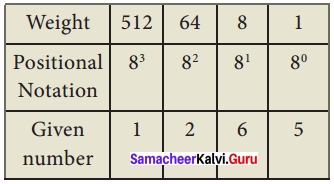
(iv) There aren’t any consonant sounds repeated in the words in a line. However the vowel ‘ sounds in and alike are repeated in the second line.

Question 36.
Paraphrase the following stanza.
We can pull and haul and push and lift and drive,
We can print and plough and weave and heat and light,
We can run and race and swim and fly and dive,
We can see and hear and count and read and write!
Answer:
In this stanza, the machines elucidate how they can serve human race by doing all the possible human activities mastered by them. They say they can do various tasks such as pulling, carrying, pushing, lifting, driving, printing, ploughing, weaving, heating, lighting, running, racing, swimming, flying, diving, seeing, hearing, counting, reading and writing.

Section – III

Answer any ONE of the following: [1 x 5 = 5]

Question 37.
Rearrange the following sentences in coherent order.
(i) Using his powers, Prospero released the good spirits from large bodies of trees.
(ii) Prospero and Miranda came to an island and lived in a cave.
(iii) He raised a violent storm in the sea to wreck the ship of his enemies.
(iv) The king of Naples and Antonio the false brother, repented the injustice they had done to Prospero.
(v) He ordered Ariel to torment the inmates of the ship.
Answer:
Rearranged number sequence: (ii), (i), (iii), (v), (iv)
(ii) Prospero and Miranda came to an island and lived in a cave.
(i) Using his powers, Prospero released the good spirits from large bodies of trees.
(iii) He raised a violent storm in the sea to wreck the ship of his enemies.
(v) He ordered Ariel to torment the inmates of the ship.
(iv) The king of Naples and Antonio the false brother, repented the injustice they had done to Prospero.

Samacheer Kalvi 10th English Model Question Paper 1

Question 38.
Read the following passage and answer the questions that follow.
Answer
The country Shining was governed by a despotic leader who though a warrior, had a great and cowardly shrinking from anything suggestive of failing health and strength. This caused him to send out a cruel proclamation. The entire province was given strict orders to immediately put to death all aged people. Those were barbarous days, and the custom of abandoning old people to die was not uncommon.

The poor farmer loved his aged mother with tender reverence, and the order filled his heart with sorrow. But no one ever thought twice about obeying the mandate of the governor, so with many deep and hopeless sighs, the youth prepared for what at that time was considered the kindest mode of death.

(i) Who governed Shining?
(ii) What was the cowardly act of the governor?
(iii) What proclamation did the governor send out?
(iv) How did the poor farmer treat his mother?
(v) Did the people obey the governor’s order?
Answer:
(i) Shining was governed by a despotic leader.
(ii) The governor had a great and cowardly shrinking from anything suggestive of failing health and strength.
(iii) The governor sent out a cruel proclamation in the entire province giving strict orders to immediately put to death all aged people.
(iv) The poor farmer loved his aged mother with tender reverence.
(v) Yes, the people obeyed the governor’s order.

Section – IV

Answer any FOUR of the following. [4 x 5 = 20]

Question 39.
Prepare an attractive advertisement using the hints given below.
Home appliances – Aadi Sale – 20-50% – Special Combo Offers – Aadhi & Co., Raja Street, Chennai, Chennai.
Answer:

Samacheer Kalvi 10th English Model Question Paper 5.2

Question 40.
Write a letter to the manager of a famous daily, ordering subscription for your school library.
Answer:
From
The Librarian
Indira Gandhi Hr. Sec. School,
Rajajipuram Chennai – 600 087
12.11.2020
To
The Higgin Bothams,
Anna Salai,
Chennai-600 002 Respected Sir,
Sub: Annual subscription for daily.
I would like to place an order for the annual subscription of three English dailies and one Tamil daily to our School from the 1st of January 2020.

The Hindu3 copies@ 435/- each p.a.1305.00
The Times of India3 copies@ 365/- each p.a.1095.00
The New Indian Express3 copies@ 425/- each p.a.1275.00
Thina Thanthi3 copies@ 175/- each p.a.525.00
4200.00

Please find enclosed the Annual subscription amount for all the four dailies which amount to Rs. 3780/- (Rupees Three Thousand Seven Hundred and Eighty Only) after deducting the usual 10% discount that you give us.
Thank you very much for your continued support to our institution.
Yours sincerely,
Mrs. Anand – Librarian

Address on the envelope:
The Higgin Bothams,
Anna Salai,
Chennai-600 002

Samacheer Kalvi 10th English Model Question Paper 1

Question 41.
You are Adhira / Athiran, school pupil leader of GHSS, Trichy. Prepare a notice on behalf of your school inviting the grandparents of the students to celebrate World Elders’ Day in your school auditorium on the 20th of next month.
Answer:

Government Higher Secondary School, Trichy
Notice
World Elder’s Day
23rd January, 2020

On behalf of the school, I invite every’ grandparent of the students in this school to be a part of the World Elder’s Day. We will be celebrating World Elder’s Day in our school auditorium on the 20th of February, 2020. Please bring in your grandparents to school at 10 a.m. Lots of fun-filled activities await your grandparents. The programme will end with a buffet arranged by the management of the school to honour them. Adhira/Athiran School Pupil Leader

Question 42.
Look at the following picture and express your views an it in about five sentences
Answer:
Samacheer Kalvi 10th English Model Question Paper 5.3
Though we pray for rain, it’s such a sad state to see people stranded when an area gets flooded. There is about three feet water and people are moving out to safer places. Fathers carry their sons and daughters over the shoulders in order to keep them safe. If there is proper drainage system and proper maintenance by the Corporation, we can surely avoid such disasters. In certain states, natural disaster such as flooding is a frequently witnessed problem.

Question 43.
Make notes or write a summary of the following passage.
Answer:
There are many different kinds of books that are published each year. These are the new’ titles available for us to read. Besides these, there are books that have been published through the years. Together, there are millions of books available throughout the world in as many languages as are spoken by people. There are different genres in which books are published. There are fiction and non-fiction categories in books, and each of these categories has many different genres of books.

The academic books we study at school belong to the text book category. We smdy them to complete our syllabus and pass the examinations at the end of each academic session. There are other books that we read for our pleasure and enrichment. We read story books of different types. There are comedy, horror, detective and thriller stories in prose, plays and poetry forms. Books are our best friends.
Notes
Title: Books Galore
Dif. Kinds A Books
(i) New Titles;
(ii) Publd Every Yr;
(iii) Publd Thru’ The Yrs;
(iv) Publd Thru’out the World;
(v) Publd In Many Langs
Dif. Genres Of Books
(i) Fiction;
(ii) Non-Fiction Categs

Academic Books – Text Book Categy.
For Study – Pres. Syl.
Pass Exams – End A Academic Session.
Books For Pleasure &Enrichment
Books Of Different Types
Comedy, Horror, Detective & Thriller Stories
Various Forms
(i) Prose
(ii) Plays; &
(iii) Poetry Forms Conclusion: Books are our best friends.
Abbreviations used: Dif. – different; A -of; publd.- published; yr=year; thru’- through; langs.- languages; pres. – prscribed; syl-syllabus; & – and

Summary

Title: Books Galore
Rough Draft
There are different kinds of books published every year for us to read. Together, there are millions of books-avaiable throughout the world in many languages. There are different genres such as fiction and non friction categories. The academic books we study at school belong to the text book category. We study them to be tested at the end of each academic session. We read story books for pleasure and enrichment/Here-areaymiedy, horror, detective and thriller stories in prose, plays and poetry forms. Books are our best friends .

Fair Draft:
Title: Books Galore

Millions of books are published every year in different languages. There are different genres such as fiction and non-fiction. The academic books, belong to the text book category. We study them to be tested at the end of the academic year. We read various types of story books for pleasure. Books are our best friends.
No. of words written in the summary: 55

Samacheer Kalvi 10th English Model Question Paper 1

Question 44.
Identify and correct the errors in the following sentences.
(а) You may speak politely to the elders.
(b) This is the boy whom won the race
(c) He come late to school every day.
(d) Though he was hungry hut he did not eat.
(e) Is this a book that you wanted to buy.
Answer
(a) You must speak politely to the elders.
(b) This is the boy who won the race
(c) He comes late to school every day.
(d) Though he was hungry he did not eat.
(e) Is this the book that you wanted to buy.

Section – V

Quote from memory. [1 x 5 = 5]

Question  45.
Let me but live ……………. back in fear.
Answer:
Let me but live my life from year to year,
With forward face and unreluctant soul;
Not hurrying to, nor turning from the goal; .
Not mourning for the things that disappear
In the dim past, nor holding back in fear

Part – IV

Write a paragraph of about 150 words by developing the following hints. [2 x 8 = 16]

Question  46.
(а) Many years ago – China – the emperor ordered – one man from -family – join army
– Mulan heard -told father – she join army – father objected – she is a girl – Mulan – fathers robes cuts her hair – convinced father – she has learnt – Kung Fu – no one will find – she is a girl. – Mulan left – village – fought bravely – war – given top position – very soon – fever swept – the army -Mulan – sick – doctor examines – finds the truth – spreads the news in the army – everyone objects – to follow a girl leader – Mulan stood tall – gave command – soldiers – followed her – attacked enemies – won the battle- emperor glad – offered Mulan positions – court – Mulan refused – went back – village – royal – gifts.
Answer:
The Story of Mulan portrays the legendary Chinese warrior Hua Mulan. This old Chinese folktale is about the story of the young Chinese maiden who leams that her wizened, old and frail father is to be called up into the army in order to fight the invading Huns by the Chinese Emperor. When the Huns invade China, one man from every family is called to arms. She hears of the order that every family must send one man to the army while washing clothes.

Mulan’s father, who is frail and aged decides to fight for his country though it is clear that he will not survive an enemy encounter. He decides to go to war but is prevented by her daughter with her outrageous decision. Knowing her father’s frail state, she decides to disguise herself and join in his place without second thoughts. In the army, Mulan proves to be a brave soldier who is later put in charge of other soldiers. Her battles goes so well that more soldiers are added. After a few years, Mulan becomes the General of the entire army. Suddenly, bad fever swept through the army. Many soldiers including Mulan become a prey. The arrival of the doctor brings to light the hidden truth.

Samacheer Kalvi 10th English Model Question Paper 1

Many soldiers disapprove such a thought, though some soldiers see the winning chances. Just then a soldier announces the surprise attack by the enemies. With no time to debate, the soldiers spring to action at the command of the General who hears this from inside her tent. She gets dressed and though not strong, she stands tall. She instructs the soldiers to attack knowing very well her strategic planning that all her soldiers acknowledge and win the battle. It was such a big victory that the enemy gave up, at last. The war was over, and China was saved! The Emperor forgives Mulan and was glad that Mulan had ended the long war. He wanted Mulan to stay with him in the palace and be an advisor but as she chose to go to her family, the emperor gave her six horses and six fine swords so that her people will know that he thinks of her.

[OR]

(b) Holland – land – below sea level – dikes protected the country – everyone did best to -protect – Holland – Years ago – boy Peter – lived Holland – His father – attended – dykes gates – opened- closed dikes – one day – Peter Mother – gave cakes to Peter – to be given – old blind friend of Peter – across the dike Peter happily left home – Peter visited – old man – returned near by the dike – heard water trickling – stopped to see – small hole – dike – called for help – in vain -he put his little finger – throughout the
night – slept near the dike – morning – found by passer by – alerted the people – Peter and Holland -saved.
Answer:
Peter is a little boy who lived in Holland. His father took care of the dikes called sluices so that ships could pass out of Holland’s canals into the sea. On a beautiful day in Autumn, Peter was asked to go and give cakes to his blind friend who lived on the other side of the dike by his mother. After about an hour he returned home, but the climate had changed. It was raining and the water in the channel was rising. All of a sudden he heard the sound of dribbling water and he wondered from where the sound came. He then saw a small hole in the dike.

He knew what that meant and due to the pressure of the water the hole would not stay the same. He feared danger. He climbed onto the dike and put his finger in the hole and hoped for someone to come to his help and cried out aloud. His mother mistook him to have stayed back with his blind friend and retired to bed. The boy was sure that he had to stay awake the entire night and keep his finger in the hole to arrest the water from flooding Holland.

The water in the canal was rising and if he would remove his finger from the hole in the sluice, the water would gush through and make the hole bigger and bigger. The town would obviously flood. When dawn broke, a man going to work heard the sound of Peter groaning and wondered what the little boy was up to. He was shocked at his reply but understood the danger and called for help. People came in with shovel and mended the hole. Peter was carried home and they all hailed him as the brave boy who saved Holland from drowning.

Samacheer Kalvi 10th English Model Question Paper 1

Question 47.
Read the following passage and answer the questions given below:
Kung Fu – ‘kung’ meaning ‘energy’ and ‘fu’ meaning ‘time’ – is a Chinese martial art whose recorded history dates back to around 525 CE, during the Liang dynasty. The man credited with introducing martial arts to China is said to be an Indian monk known as Bodhidarma.

Many people have a misconception that Chinese Kung Fu is about fighting and killing. It is actually based on Chinese philosophy and is about improving wisdom and intelligence. Taoist philosophy is deeply rooted in and had a profound influence on the culture of Chinese martial arts.

The five traditional animal styles of Shaolin Kung Fu are the dragon, the snake, the tiger, the leopard and the crane. The union of the five animal forms clearly displayed the efficacy of both hard and soft movements, of both internal and external energy – this form of Chinese martial arts was known as Shaolin Kung Fu, named after the temple in which it was developed.

Questions.
(a) Which country does the martial art Kung Fu belong to?
(b) What is the meaning of the term “Kung Fu”?
(c) Write any two martial arts of India?
(d) What are the five animal styles followed in Shaolin Kung Fu?
Answer:
(a) The martial art Kung Fu belongs to the country China.
(b) The term ‘kung’ means ‘energy’ and ‘fu’ means ‘time’.
(c) Kalari and Silambam are two martial arts in India.
(d) The five traditional animal styles of Shaolin Kung Fu are the dragon, the snake, the tiger, the leopard and the crane.

[OR]

Read the following poem and answer the questions given below:

If you can’t be a pine on the top of the hill,
Be a scrub in the valley – but be
The best little scrub by the side of the rill;
Be a bush, if you can’t be a tree.
If you can’t be a bush, be a bit of the grass,
And some highway happier make;
If you can’t be a muskie, then just be a bass- But the liveliest bass in the lake!
We can’t all be captains, we’ve got to be crew,
There’s something for all of us here.
There’s big work to do and there’s lesser to do
And the task we must do is the near.
If you can’t be a highway, then just be a trail,
If you can’t be the sun, be a star;
It isn’t by size that you win or you fail- Be the best of whatever you are!

Questions.
(a) Where does the best scrub grow?
(b) What makes a highway traveller happy?
(c) Does size matter? Give reason.
(d) What is the underlying theme of the poem?
Answer:
(a) The best scrub grows by the side of a rill.
(b) The green grass on the sides of a highway makes a highway traveller happy.
(c) No, size doesn’t matter because its winning and being the best in whatever you do that matters.
(d) Be your best in all that you try to do and accomplish in life.

Samacheer Kalvi 12th Computer Applications Solutions Chapter 3 Introduction to Database Management System

Students can Download Computer Applications Chapter 3 Introduction to Database Management System Questions and Answers, Notes Pdf, Samacheer Kalvi 12th Computer Applications Book Solutions Guide Pdf helps you to revise the complete Tamilnadu State Board New Syllabus and score more marks in your examinations.

Tamilnadu Samacheer Kalvi 12th Computer Applications Solutions Chapter 3 Introduction to Database Management System

Samacheer Kalvi 12th Computer Applications Introduction to Database Management System Text Book Back Questions and Answers

PART – I
I. Choose The Correct Answer

Question 1.
Which language is used to request information from a Database?
(a) Relational
(b) Structural
(c) Query
(d) Compiler
Answer:
(c) Query

Question 2.
The ………………………. diagram gives a logical structure of the database graphically?
(a) Entity-Relationship
(b) Entity
(c) Architectural Representation
(d) Database
Answer:
(a) Entity-Relationship

Samacheer Kalvi 12th Computer Applications Solutions Chapter 3 Introduction to Database Management System

Question 3.
An entity set that does not have enough attributes to form primary key is known as
(a) Strong entity set
(b) Weak entity set
(c) Identity set
(d) Owner set
Answer:
(b) Weak entity set

Question 4.
…………………………. Command is used to delete a database.
(a) Delete database databasename
(b) Delete database_name
(c) drop database database name
(d) drop database name
Answer:
(c) drop database database_name

Question 5.
Which type of below DBMS is MySQL?
(a) Object Oriented
(b) Hierarchical
(c) Relational
(d) Network
Answer:
(c) Relational

Samacheer Kalvi 12th Computer Applications Solutions Chapter 3 Introduction to Database Management System

Question 6.
MySQL is freely available and is open source.
(a) True
(b) False
Answer:
(a) True

Question 7.
……………………….. represents a “tuple” in a relational database?
(a) Table
(b) Row
(c) Column
(d) Object
Answer:
(b) Row

Samacheer Kalvi 12th Computer Applications Solutions Chapter 3 Introduction to Database Management System

Question 8.
Communication is established with MySQL using
(a) SQL
(b) Network calls
(c) Java
(d) API’s
Answer:
(a) SQL

Question 9.
Which is the MySQL instance responsible for data processing?
(a) MySQL Client
(b) MySQL Server
(c) SQL
(d) Server Daemon Program
Answer:
(b) MySQL Server

Samacheer Kalvi 12th Computer Applications Solutions Chapter 3 Introduction to Database Management System

Question 10.
The structure representing the organizational view of entire database is known as in MySQL database.
(a) Schema
(b) View
(c) Instance
(d) Table
Answer:
(a) Schema

PART – II
II. Short Answer:

Question 1.
Define Data Model and list the types of data model used?
Answer:
Data models define how the logical structure of a database is modeled.
Data models define how data is connected to each other and how they are processed and stored inside the system. The various data models are;

  1. Hierarchical Database Model,
  2. Network Model,
  3. Relational Model and
  4. Object-oriented Database Model.

Samacheer Kalvi 12th Computer Applications Solutions Chapter 3 Introduction to Database Management System

Question 2.
List few disadvantages of file processing system?
Answer:
Data Duplication – Same data is used by multiple resources for processing, thus created multiple copies of same data wasting the spaces.
High Maintenance – Access control and verifying data consistency needs high maintenance cost.
Security – less security provided to the data.

Question 3.
Define Single and multi valued attributes?
Answer:
A single valued attribute contains only one value for the attribute and they don’t have multiple numbers of values. For Example:Age-
Amulti valued attribute has more than one value for that particular attribute. F or Example :Degree

Samacheer Kalvi 12th Computer Applications Solutions Chapter 3 Introduction to Database Management System

Question 4.
List any two DDL and DML commands with its Syntax?
Answer:
Commands:

  1. CREATE
  2. DROP

Syntax:

  1. CREATE database databasename
  2. DROP database databasename

DML COMMANDS List:
Commands:

  1. INSERT
  2. DELETE

Syntax:

  1. Syntax 1: INSERT INTO tablename (column1, column2, column3) VALUES (value 1, value2, value3);
  2. Syntax 2: INSERT INTO tablename VALUES (value1, value2, value3);
  3. DELETE from tablename WHERE columnname=”value”;

Samacheer Kalvi 12th Computer Applications Solutions Chapter 3 Introduction to Database Management System

Question 5.
What are the ACID properties?
Answer:
ACID Properties – The acronym stands for Atomicity, Consistency, Isolation and Durability. Atomicity follows the thumb rule “All or Nothing”, while updating the data in database for the user performing the update operation. Consistency ensures that the changes in data value to be constant at any given instance. Isolation property is needed during concurrent action. Durability is defied as the system’s ability to recover all committed actions during the failure of storage or the system.

Question 6.
Which command is used to make permanent changes done by a trAnswer:action?
Answer:
COMMIT

Question 7.
What is view in SQL?
Answer:
Views – A set of stored queries.

Samacheer Kalvi 12th Computer Applications Solutions Chapter 3 Introduction to Database Management System

Question 8.
Write the difference between SQL and MySQL?
Answer:
SQL:

  1. SQL is a query language
  2. SQL is used to query and operate database system.

MySQL:

  1. MySQL is DBMS software.
  2. MySQL allows data handling, storing, modifying, deleting, etc.

Samacheer Kalvi 12th Computer Applications Solutions Chapter 3 Introduction to Database Management System

Question 9.
What is Relationship and List its types?
Answer:
In ER Model, relationship exists between two entities.

  1. One-to-One relationship,
  2. One-to-Many relationship and
  3. Many-to-Many relationship.

Question 10.
State few advantages of Relational databases?
Answer:

  1. High Availability
  2. High Performance
  3. Robust TrAnswer:actions and support
  4. Ease of management
  5. Less cost

PART – III
III. Explain in Brief Answer

Question 1.
Explain on Evolution of DBMS?
Answer:

  1. The concept of storing the data started before 40 years in various formats.
  2. In earlier days they have used punched card technology to store the data.
  3. Then files were used. The file systems were known as predecessor of database system.
  4. Various access methods in file system were indexed, random and sequential access.
  5. The file systems has limitations like duplication, less security. To overcome this, DBMS was introduced.

Samacheer Kalvi 12th Computer Applications Solutions Chapter 3 Introduction to Database Management System

Question 2.
What is relationship in databases? List its types?
Answer:
In ER Model, relationship exists between two entities. The various types of relationships are;

  1. One-to-One relationship.
  2. One-to-Many relationship.
  3. Many-to-Many relationship.

Question 3.
Discuss on Cardinality in DBMS?
Answer:
Cardinality is defined as the number of items that must be included in a relationship, i.e. number of entities in one set mapped with the number of entities of another set via the relationship. Three classifications in Cardinality are one-to-one, one-to-many and Many-to-Many.
Samacheer Kalvi 12th Computer Applications Solutions Chapter 3 Introduction to Database Management System
In the above example we have two entities Person and Vehicle. If we consider the current vehicle, the driver is operating, then we have one-to-one relationship between Person and Vehicle.
In the above example, Customer places the Order is a one-to-many relationship. Here the customer can place multiple orders and the order is related to only one customer. The example of many-to-many relationship is Students registering the Courses. A student can register more than one courses and A course can be registered by many students. Hence it is many-to-many.

Samacheer Kalvi 12th Computer Applications Solutions Chapter 3 Introduction to Database Management System

Question 4.
List .any 5 privileges available in MySQL for the User?
List of privileges available in MySQL?
Answer:
Privileges:

  1. Select_priv
  2. Insert_priv
  3. Update_priv
  4. Delete_priv
  5. Create_priv
  6. Alter_priv

Action Performed (If Granted):

  1. User can select rows from database tables.
  2. User can insert rows into database tables.
  3. User can update rows of database tables.
  4. User can delete rows of database tables.
  5. User can create new tables in database.
  6. User can make changes to the database structure.

Samacheer Kalvi 12th Computer Applications Solutions Chapter 3 Introduction to Database Management System

Question 5.
Write few commands used by DBA to control the entire database.
USE Database – This command is used to select the database in MySQL for working.
Syntax:
mysql > use test;
Database changed
mysql>
SHOW Databases – Lists all the databases available in the database server.
Syntax:
mysql > show databases;

SHOW Tables – Lists all the tables available in the current database we are working in.
mysql > show tables;

SHOW COLUMNS FROM tablename – Lists all the attributes, attribute type, Is Null value
permitted, key information, default value and other information for the given table.
Syntax:
mysql > show columns from sports;

SHOW INDEX FROM tablename – The query shows all the indexes for the given table.
Syntax:
mysql > show indexes from sports;

SHOW TABLE STATUS LIKE tablename\G – This command provides with detailed report on the performance of the table.

PART – IV
IV. Explain in detail

Question 1.
Discuss on various database models available in DBMS?
Answer:
DBMS Database Models:
The database technology came into existence in terms of models with relational and object- relational behavior. The major database models are listed below:

(i) Hierarchical Database Model The famous Hierarchical database model was IMS (Information Management System), IBM’s first DBMS. In this model each record has information in parent/child relationship like a tree structure. The collection of records was called as record types, which are equivalent to tables in relational model. The individual records are equal to rows.

In the above model we have many advantages like less redundant data, efficient search, data integrity and security. This model also has few limitations like complex to implement and difficulty in handling many to many relationships.
Samacheer Kalvi 12th Computer Applications Solutions Chapter 3 Introduction to Database Management System

(ii) Network model:
The first developed network data model was IDS (Integrated Data Store) at Honeywell. Network model is similar to Hierarchical model except that in this model each member can have more than one owner. The many to many relationships are handled in a better way. This model identified the three database components Network schema, Sub schema and Language for data management. Network schema – schema defines all about the structure of the database.
Sub schema – controls on views of the database for the user.
Language – basic procedural for accessing the database.
The major advantage of this model is the ability to handle more relationship types, easy data access, data integrity and independence. The limitation of network model is difficulty in design and maintenance.
Samacheer Kalvi 12th Computer Applications Solutions Chapter 3 Introduction to Database Management System

(iii) Relational model:
Oracle and DB2 are few commercial relational models in use. Relational model is defined with two terminologies Instance and Schema.
Instance – A table consisting of rows and columns
Schema – Specifies the structure including name and type of each column.
A relation (table) consists of unique attributes (columns) and tuples (rows).
Samacheer Kalvi 12th Computer Applications Solutions Chapter 3 Introduction to Database Management System

(iv) Object-oriented database model:
This model incorporates the combination of Object Oriented Programming (OOP’s) concepts and database technologies.
Practically, this model serves as the base of Relational model. Object oriented model uses small, reusable software known as Objects.
These are stored in object oriented database.
This model efficiently manages large number of different data types. Moreover complex behaviors are handled efficiently using OOP’s concepts.
Samacheer Kalvi 12th Computer Applications Solutions Chapter 3 Introduction to Database Management System

Question 2.
List the basic concepts of ER Model with suitable example?
Answer:
ER Modeling basic concepts
The basic concepts of ER model consists of

  1. Entity or Entity type
  2. Attributes
  3. Relationship

These are the general concepts which help to create an ER diagram and produce an ER model. With the help of these any database design can be created and viewed to know the concept in that database design.

(i) Entity or Entity type
An Entity can be anything a real-world object or animation which is easily identifiable by anyone even by a common man. Eg: In a company’s database Employee, HR, Manager are considered as entities, where each of these entity will be having their own attributes . An entity is represented by a rectangular box.
Samacheer Kalvi 12th Computer Applications Solutions Chapter 3 Introduction to Database Management System

Types of Entity:

  1. Strong Entity
  2. Weak Entity
  3. Entity Instance

1. Strong Entity:
A Strong entity is the one which doesn’t depend on any other entity on the schema or database and a strong entity will have a primary key with it (i.e. a unique id which other entities will not have in their attributes).It is represented by one rectangle. In the above example it is a strong entity because it has a primary key(a unique id) as the roll no because for every one roll no varies and it will not be same.

2. Weak Entity:
A weak entity is dependent on other entities and it doesn’t have any primary key like the Strong entity. It is represented by double rectangle. For Example: Here the marks is the weak entity and there are no unique id or primary – key for that entity. So they are dependent on the existence of the other entity.
Samacheer Kalvi 12th Computer Applications Solutions Chapter 3 Introduction to Database Management System

(ii) Attributes
An attribute is the information about that entity and it will describe, quantify, qualify, classify, and specify an entity. An attribute will always have a single value, that value can be a number or character or string.
Types of attributes:

  1. Key Attribute
  2. Simple Attributes
  3. Composite Attributes
  4. Single Valued Attribute
  5. Multi Valued Attribute

1. Key Attribute:
Generally a key attribute describes a unique characteristic of an entity.

2. Simple Attribute:
The simple attributes cannot be separated it will be having a single value for their entity. For Example: Let us consider the name as the attribute for the entity employee and here the value for that attribute is a single value.
Samacheer Kalvi 12th Computer Applications Solutions Chapter 3 Introduction to Database Management System

3. Composite Attributes:
The composite attributes can be sub-divided into simple attributes without change in the meaning of that attribute. For Example: In the above diagram the employee is the entity with the composite attribute Name which are sub-divided into two simple attributes first and last name.

4. Single Valued Attributes:
A single valued attribute contains only one value for the attribute and they don’t have multiple numbers of values. For Example: Age- It is a single value for a person as we cannot given number of ages for a single person,therefore it is a single valued attribute.
Samacheer Kalvi 12th Computer Applications Solutions Chapter 3 Introduction to Database Management System

Arrtibute:

  1. Age
  2. Roll no

Values:

  1. 3
  2. 85

In the above table are the some examples for single valued attributes.

5. Multi Valued Attributes:
A multi valued attribute has more than one value for that particular attribute. For Example:
Degree – A person can hold n number of degrees so it is a multi-valued attribute.

Attributes and Values:

Attributes:

  1. Degree
  2. BankAccount

Values:

  1. B. Tech, MBA
  2. SBI, HDFC

(iii) Relationship Type:
In ER Model, relationship exists between two entities. Three types of relationships are – available and the Entity-Relationship(ER) diagram is based on the three types listed below.

(iv) One-to-One relationship:
Consider two entities A and B. one-to-one (1:1) relationship is said to exist in a relational database design, if 0 or 1 instance of entity A is associated with 0 or 1 instance of entity B, and 0 or 1 instance of entity B is associated with 0 or 1 instance of entity A.

(v) One-to-Many relationship:
Consider two entities A and B. one-to-many (1:N) relationship is said to exist in a relational database design, for 1 instance of entity A there exists 0 or 1 or many instances of entity B, but for 1 instance of entity B there exists 0 or 1 instance of entity A.

(vi) Many-to-Many relationship:
Consider two entities A and B. many-to-many (M:N) relationship is said to exist in a relational database design, for 1 instance of entity A there exists 0 or 1 or many instances of entity B, and for 1 instance of entity B there exists 0 or 1 or many instance of entity A.
In reality one-to-one are in less usage, where as one-to-many and many-to-many are commonly used. However in relational databases, many-to-many are converted into one-to- many relationships.

Samacheer Kalvi 12th Computer Applications Solutions Chapter 3 Introduction to Database Management System

Question 3.
Discuss in detail on various types of attributes in DBMS?
Answer:
Types of attributes:

  1. Key Attribute
  2. Simple Attributes
  3. Composite Attributes
  4. Single Valued Attribute
  5. Multi Valued Attribute

1. Key Attribute:
Generally a key attribute describes a unique characteristic of an entity.

2. Simple Attribute:
The simple attributes cannot be separated it will be having a single value for their entity. For Example: Let us consider the name as the attribute for the entity employee and here the value for that attribute is a single value.
Samacheer Kalvi 12th Computer Applications Solutions Chapter 3 Introduction to Database Management System

3. Composite Attributes:
The composite attributes can be sub-divided into simple attributes without change in the meaning of that attribute. For Example: In the above diagram the employee is the entity with the composite attribute Name which are sub-divided into two simple attributes first and last name.

4. Single Valued Attributes:
A single valued attribute contains only one value for the attribute and they don’t have multiple numbers of values. For Example: Age- It is a single value for a person as we cannot given number of ages for a single verson, therefore it is a single valued attribute.
Samacheer Kalvi 12th Computer Applications Solutions Chapter 3 Introduction to Database Management System

Attribute:

  1. Degree
  2. Bank_Account

Values:

  1. 3
  2. 85

5. Multi Valued Attributes:
A multi valued attribute has more than one value for that particular attribute. For example:
Degree – A person can hold n number of degrees so it is a multi-valued attribute.
In the below table are some examples for multi valued attributes.

Attribute:

  1. Degree
  2. Bank_Account

Values:

  1. B.TEch, MBA
  2. SBI, HDFC

Samacheer Kalvi 12th Computer Applications Solutions Chapter 3 Introduction to Database Management System

Question 4.
Write a note on open source software tools available in MySQL Administration?
MYSQL Administration open source software tools:
Answer:
Types of software tools:
Many open source tools are available in the market to design the database in a better and efficient manner. PhpMyAdmin is most popular for Web Administration. The popular Desktop Application tools are MySQL Workbench and HeidiSQL.

PHPMYADMIN (Web Admin):

  1. This administrative tool of MySQL is a web application written in PHP.
  2. They are used predominantly in web hosting.
  3. The main feature is providing web interface, importing data from CSV and exporting data to various formats.
  4. It generates live charts for monitoring MySQL server activities like connections, processes and memory usage.
  5. It also helps in making the complex queries easier.

MySQL Workbench (Desktop Application):

  1. It is a database tool used by developers and DBA’s mainly for visualization.
  2. This tool helps in data modeling, development of SQL, server configuration and backup for MySQL in a better way.
  3. Its basic release version is 5.0 and is now in 8.0 supporting all Operating Systems.
  4. The SQL editor of this tool is very flexible and comfortable in dealing multiple results set.

HeidiSQL (Desktop Application):

  1. This open source tools helps in the administration of better database systems.
  2. It supports GUI (Graphical User Interface) features for monitoring server host, server connection, Databases, Tables, Views, Triggers and Events.

Samacheer Kalvi 12th Computer Applications Solutions Chapter 3 Introduction to Database Management System

Question 5.
Explain in detail on Sub Queries with suitable examples?
Answer:
Sub queries:
The SQL query is written within a main Query. This is called as Nested Inner/SubQuery.The sub query is executed first and the results of sub query are used as the condition for main query.
The sub query must follow the below rules:

  • Subqueries are always written within the parentheses.
  • Always place the Subquery on the right side of the comparison operator.
  • ORDER BY clause is not used in sub query, since Subqueries cannot manipulate the results internally.

Consider the Employee table with the fields EmpID, Name, Age and Salary.
Samacheer Kalvi 12th Computer Applications Solutions Chapter 3 Introduction to Database Management System
In the below Query, we use sub query in an SELECT statement.
SELECT * from Employee
where EmpID IN (SELECT EmpID from Employee WHERE Salary < 20000);
First, the inner query is executed. As a result EmpID 101 and 103 are retrieved. Now the external or outer query is executed. Internally the query is SELECT * from Employee where EmpID IN(101,103) and the output is drawn below.
Select Record List
Samacheer Kalvi 12th Computer Applications Solutions Chapter 3 Introduction to Database Management System
Similarly the subqueries are used with INSERT, UPDATE and DELETE.

Samacheer Kalvi 12th Computer Applications Introduction to Database Management System Additional Question and Answer:wers

I. Choose the Best Answer

Question 1.
Expand DBMS?
(a) DataBase Management System
(b) Data Manipulation Schema
(c) Data Base Management Schema
(d) Data Base Manipulation Schema
Answer:
(a) DataBase Management System

Samacheer Kalvi 12th Computer Applications Solutions Chapter 3 Introduction to Database Management System

Question 2.
Expand RDBMS.
(a) Relational Data Base Manipulation System
(b) Relational Data Base Management Schema
(c) Relational Data Base Management System
(d) Record Data Base Managing Schema
Answer:
(c) Relational Data Base Management System

Question 3.
Expand ODBMS.
(a) Object Data Base Management System
(b) Objective Data Base Management System
(c) Object Oriented Data Base Management System
(d) Objective Data Manipulation System
Answer:
(a) Object Data Base Management System

Samacheer Kalvi 12th Computer Applications Solutions Chapter 3 Introduction to Database Management System

Question 4.
Update operation is otherwise called as …………………………
Answer:
transaction

Question 5.
Two types of trAnswer:action operations are ……………………… and ………………………
Answer:
commits and aborts

Question 6.
To prevent the conflict in database update, the trAnswer:actions are isolated from other user and serialized. This is called as ……………………….
(a) Atomicity
(b) Consistency
(c) Isolation
(d) Degree of Consistency
Answer:
(d) Degree of Consistency

Samacheer Kalvi 12th Computer Applications Solutions Chapter 3 Introduction to Database Management System

Question 7.
ensures that the changes in data value to be constant at any given instance.
(a) Atomicity
(b) Consistency
(c) Isolation
(d) Durability
Answer:
(b) Consistency

Question 8.
Match the following:
1. Atomicity – (i) commit / aborts
2. TrAnswer:action – (ii) constant data
3. Consistency – (iii) recover all committed trAnswer:actions
4. Durability – (iv) All or Nothing
(a) 1-(iv), 2-(i), 3-(ii), 4-(iii)
(b) 1-(i), 2-(ii), 3-(iii), 4-(iv)
(c) 1 -(iv), 2-(iii), 3-(ii),4-(i)
(d) 1-(i), 2-(ii), 3-(iv), 4-(iii)
Answer:
(a) 1-(iv), 2-(i), 3-(ii), 4-(iii)

Samacheer Kalvi 12th Computer Applications Solutions Chapter 3 Introduction to Database Management System

Question 9.
Concurrency control and locking are needed
(a) Consistency
(b) data sharing
(c) data hiding
(d) TrAnswer:action
Answer:
(b) data sharing

Question 10.
How many Database models are there?
(a) 2
(b) 3
(c) 4
(d) 5
Answer:
(c) 4

Samacheer Kalvi 12th Computer Applications Solutions Chapter 3 Introduction to Database Management System

Question 11.
The famous Hierarchical database model was ……………………
Answer:
IMS

Question 12.
IMS stands for ……………………..
Answer:
Information Data Store

Question 13.
IBM’s first DBMS is ……………………..
(a) IMS
(b) IVS
(c) BMS
(d) VMS
Answer:
(a) IMS

Samacheer Kalvi 12th Computer Applications Solutions Chapter 3 Introduction to Database Management System

Question 14.
Hierarchical database model uses …………………….. structure.
(a) star
(b) tree
(c) HoneyComb
(d) Hair like
Answer:
(b) tree

Question 15.
Parent child relationship is established in …………………….. database Models.
(a) Hierarchical
(b) Network
(c) Relational
(d) Object
Answer:
(a) Hierarchical

Samacheer Kalvi 12th Computer Applications Solutions Chapter 3 Introduction to Database Management System

Question 16.
The collection of records in Hierarchical models are called as ……………………..
(a) field types
(b) tuples
(c) record types
(d) ACID
Answer:
(c) record types

Question 17.
In ACID properties I indicates
(a) Inverter
(b) Interface
(c) Isolation
(d) Identification
Answer:
(c) Isolation

Samacheer Kalvi 12th Computer Applications Solutions Chapter 3 Introduction to Database Management System

Question 18.
The first Network Model was developed at ……………………..
Answer:
Honey well

Question 19.
…………………….. is the first developed Network Data Model.
(a) IMS
(b) IDS
(c) DB2
(d) OOP’s
Answer:
(b) IDS

Question 20.
IDS stands for ……………………..
Answer:
Integrated Data Store

Samacheer Kalvi 12th Computer Applications Solutions Chapter 3 Introduction to Database Management System

Question 21.
Which of the two databases models are similar?
(a) Hierarchical, Network
(b) Network, relational
(c) Relational, Object oreinted
(d) Network, Object oreinted
Answer:
(a) Hierarchical, Network

Question 22.
Network database model is identified by ………………………..
(a) 2
(b) 3
(c) 4
(d) 5
Answer:
(b) 3

Samacheer Kalvi 12th Computer Applications Solutions Chapter 3 Introduction to Database Management System

Question 23.
Find the Statement which is wrong?
(a) Network Schema deals with locking
(b) Subschema controls on view of the database
Answer:
(a) Network Schema deals with locking

Question 24.
Which one of the following is the basic procedural for accessing the database in Network model?
Answer:
(a) Network schema
(b) Sub schema
(c) Language
(d) Super schema
Answer:
(c) Language

Samacheer Kalvi 12th Computer Applications Solutions Chapter 3 Introduction to Database Management System

Question 25.
……………….. and …………………… are the commercial relational database models.
(a) Oracle, DB2
(b) DB2, IDS
(c) IDS, IMS
(d) Oracle, IBME
Answer:
(a) Oracle, DB2

Question 26.
Find which of the following statements are true with respect to Relational model
(i) Instance – A table with rows and columns
(ii) Schema – Specifies the sjtructure
(a) (i) is true
(b) (ii) is true
(c) both are true
(d) both are false
Answer:
(c) both are true

Samacheer Kalvi 12th Computer Applications Solutions Chapter 3 Introduction to Database Management System

Question 27.
Columns are otherwise called as …………………….
Answer:
attributes

Question 28.
OOP’s stands for …………………….
Answer:
Object Oriented Language.

Question 29.
Object oriented model uses small, reusable software known as ………………………
(a) objects
(b) software
(c) class
(d) private
Answer:
(a) objects

Question 30.
The vertical entity of a table is known as ………………………. or ……………………….
Answer:
Attribute, Column

Samacheer Kalvi 12th Computer Applications Solutions Chapter 3 Introduction to Database Management System

Question 31.
A primary key which is a combination of more than one attribute is called a ………………………..
Answer:
composite primary key

Question 32.
Each super key is called as ……………………… key.
(a) Sub
(b) Candidate
(c) Schema
(d) Constraint
Answer:
(b) Candidate

Question 33.
What is the another name for Candidate Key?
(a) Super key
(b) Sub key
(c) Minimal super key
(d) Maximal super key
Answer:
(c) Minimal super key

Samacheer Kalvi 12th Computer Applications Solutions Chapter 3 Introduction to Database Management System

Question 34.
Composite key is otherwise called as ………………………
(a) compound key
(b) super key
(c) sub key
(d) foreign key
Answer:
(a) compound key

Question 35.
How many basic concepts are there in ER model?
(a) 2
(b) 3
(c) 4
(d) 5
Answer:
(b) 3

Question 36.
How many types of entities are there?
(a) 2
(b) 3
(c) 4
(d) 5
Answer:
(b) 3

Samacheer Kalvi 12th Computer Applications Solutions Chapter 3 Introduction to Database Management System

Question 37.
What is the symbol for weak Entity?
(a) square
(b) double square
(c) rectangle
(d) double rectangle
Answer:
(d) double rectangle

Question 38.
………………………. denotes the category values for the given entity.
(a) Schema
(b) Structure
(c) Entity Instance
(d) Existence
Answer:
(c) Entity Instance

Question 39.
……………………. describes a unique characteristic of an entity.
Answer:
Key Attribute.

Samacheer Kalvi 12th Computer Applications Solutions Chapter 3 Introduction to Database Management System

Question 40.
How many types of attributes are there?
(a) 2
(b) 3
(c) 4
(d) 5
Answer:
(d) 5

Question 41.
How many relationship types are there in ER model?
(a) 2
(b) 3
(c) 4
(d) 5
Answer:
(b) 3

Question 42.
The number of entity types involved is known as …………………….
Answer:
degree of relationship

Samacheer Kalvi 12th Computer Applications Solutions Chapter 3 Introduction to Database Management System

Question 43.
Customer places the order is an example of ……………………. relationship.
(a) one to one
(b) one to many
(c) many to many
(d) two to many
Answer:
(b) one to many

Question 44.
MySQL is founded by ……………………….
(a) My Widenius
(b) Monty Widenius
(c) Marley Minto
(d) My Minto
Answer:
(b) Monty Widenius

Question 45.
SQL meAnswer: ……………………….
Answer:
Structured Query Language.

Samacheer Kalvi 12th Computer Applications Solutions Chapter 3 Introduction to Database Management System

Question 46.
The structured collection of data is ……………………..
(a) data
(b) table
(c) row
(d) database
Answer:
(d) database

Question 47.
The databases are broadly classified into …………………….. and …………………….. databases.
Answer:
Heavy, light

Question 48.
The light databases that supports the web applications are also known as ……………………. databases.
(a) web
(b) Heavy
(c) Application
(d) Super
Answer:
(a) web

Samacheer Kalvi 12th Computer Applications Solutions Chapter 3 Introduction to Database Management System

Question 49.
DBA stands for ……………………..
Answer:
DataBase Administrators.

Question 50.
All the query will terminate with ……………………
(a) colon
(b) semicolon
(c) bracket
(d) dot
Answer:
(b) semicolon

Question 51.
…………………. reboots the server.
Answer:
Flush privileges

Samacheer Kalvi 12th Computer Applications Solutions Chapter 3 Introduction to Database Management System

Question 52.
…………………… is the most popular web administration tool.
Answer:
Phpmyadmin

Question 53.
The popular Desktop Application tools are
(a) MySQL workbench
(b) HeidiSQL
(c) PlSQL
(d) both a and b
Answer:
(d) both a and b

Question 54.
The process of creating, implementing and maintaining the enterprise data in the system is known as ……………………… of databases.
Answer:
desingning

Samacheer Kalvi 12th Computer Applications Solutions Chapter 3 Introduction to Database Management System

Question 55.
Expand Answer:
(a) American National Standards Institute
(b) African National Standard Institute
(c) American North Sound Institute
(d) All-National Standard Institute
Answer:
(a) American National Standards Institute

Question 56.
…………………… is used to temporarily save a trAnswer:action.
(a) Commit
(b) Rollback
(c) TrAnswer:action
(d) SavePoint
Answer:
(d) SavePoint

Samacheer Kalvi 12th Computer Applications Solutions Chapter 3 Introduction to Database Management System

Question 57.
When we want to select data from more than 2 tables ……………………. clause is used.
(a) group
(b) merge
(c) combine
(d) sql join
Answer:
(d) sql join

Question 58.
Multiple numbers of values are not allowed in ………………………. attributes.
(a) single valued
(b) composite
(c) multi valued
(d) key
Answer:
(a) single valued

Samacheer Kalvi 12th Computer Applications Solutions Chapter 3 Introduction to Database Management System

Question 59.
Match the following attributes with their values.
1. simple – (i) Degree
2. composite – (ii) Name
3. Single valued – (iii) First Name, Last Name
4. Multi valued – (iv) Age
(a) 1-(ii), 2-(iii), 3-(iv), 4-(i)
(b) 1-(i), 2-(ii), 3-(iii), 4-(iv)
(c) 1-(iv), 2-(ii), 3-(i), 4-(iii)
(d) 1-(iv), 2-(i), 3-(ii), 4-(iii)
Answer:
(a) 1-(ii), 2-(iii), 3-(iv), 4-(i)

Question 60.
…………………….. is the symbol for Relationship in ER Model.
Answer:
Rhombus

Question 61.
M : N relationship is said to be ………………………. relationship.
Answer:
many to many

Samacheer Kalvi 12th Computer Applications Solutions Chapter 3 Introduction to Database Management System

Question 62.
The most popular DBMS is ……………………….
Answer:
MySQL

Question 63.
The least popular DBMS as per the statistical data is ……………………….
Answer:
cassandra

Samacheer Kalvi 12th Computer Applications Solutions Chapter 3 Introduction to Database Management System

Question 64.
………………… lists all the databases available in the databases.
Answer:
Show databases

Question 65.
shows all the indexes for the given table.
Answer:
Show index from tablename

Question 66.
Match the following
1. DDL – (a) commit
2. DML – (b) alter
3. DQL – (c) insert
4. TCL – (d) select
(a) 1-(b) 2 (c) 3-(d) 4-(a)
(b) 1-(a) 2-(d) 3-(b) 4-(c)
(c) 1-(c)2-(b)3-(a)4-(d)
(d) 1-(d) 2-(b) 5-(a) 4-(c)
Answer:
(a) 1-(b) 2 (c) 3-(d) 4-(a)

Samacheer Kalvi 12th Computer Applications Solutions Chapter 3 Introduction to Database Management System

Question 67.
Find the wrong one.
(a) DDL – create command
(b) DML – update
(c) TCL – solve point
(d) DCL – select
Answer:
(d) DCL – select

Question 68.
DDL stands for ……………………….
Answer:
Data Definition Language

Question 69.
DML stands for ……………………….
Answer:
Data Manipulation Language

Samacheer Kalvi 12th Computer Applications Solutions Chapter 3 Introduction to Database Management System

Question 70.
DQL stands for ……………………….
Answer:
Data Query Language

Question 71.
TCL stands for ……………………….
Answer:
Transaction Control Structure

Question 72.
DCL stands for ……………………….
Answer:
Data Control Language

Samacheer Kalvi 12th Computer Applications Solutions Chapter 3 Introduction to Database Management System

Question 73.
………………………. clause is used in select and update query statement for the condition.
Answer:
where

Question 74.
The existing record in a table is removed from the table using ………………………. command.
Answer:
DELETE

Question 75.
………………………. is not a logical operator.
(a) And
(b) Between
(c) Plus
(d) Unique
Answer:
(c) Plus

Samacheer Kalvi 12th Computer Applications Solutions Chapter 3 Introduction to Database Management System

Question 76.
IN is ………………………. operator.
Answer:
logical

Question 77.
<>is a ………………………. operator.
Answer:
comparision

Question 78.
………………………. is used to take out permission from the specific users.
Answer:
Revoke

Samacheer Kalvi 12th Computer Applications Solutions Chapter 3 Introduction to Database Management System

Question 79.
………………………. is used to delete all table records.
Answer:
Truncate

Question 80.
………………………. deletes database or table.
Answer:
drop

II. Short Answer

Question 1.
Define database?
Answer:
“A database management system (DBMS) is system software for creating and managing databases. The DBMS provides users and programmers with a systematic way to create, retrieve, update and manage data”.

Samacheer Kalvi 12th Computer Applications Solutions Chapter 3 Introduction to Database Management System

Question 2.
Name the various access methods in file system?
Answer:
Various access methods in file system were indexed, random and sequential access.

Question 3.
Define degree of consistency?
Answer:
To prevent the conflict in database update, the trAnswer:actions are isolated from other user and serialized. This is also known as Degree of Consistency.

Samacheer Kalvi 12th Computer Applications Solutions Chapter 3 Introduction to Database Management System

Question 4.
Give advantages of Hierarchical database models?
Answer:

  1. Less redundant data
  2. data integrity
  3. efficient search
  4. security

Question 5.
Give limitations of Hierarchical db model?
Answer:

  1. complex to implement
  2. difficult to handle many to many relationships.

Question 6.
Define relational database?
Answer:
Any database whose logical organization is based on relational data model is known as Relational Database.

Samacheer Kalvi 12th Computer Applications Solutions Chapter 3 Introduction to Database Management System

Question 7.
Define Table?
Answer:
In relational database model, table is defined as the collection of data organized in terms of rows and columns. Table is the simple representation of relations.

Question 8.
Define row in a table?
Answer:
A single entry in a table is called as Row or Record or Tuple. Set of related data’s are represented in a row or tuple. The horizontal entity in a table is known as Record or row.

Samacheer Kalvi 12th Computer Applications Solutions Chapter 3 Introduction to Database Management System

Question 9.
Define Primary key?
Answer:

  1. The candidate key that is chosen to perform the identification task is called the primary key and any others are Alternate keys.
  2. Every tuple must have, a unique value for its primary key.

Question 10.
Define Foreign key?
Answer:

  1. A foreign key is a “copy” of a primary key that has been exported from one relation into another to represent the existence of a relationship between them.
  2. Foreign keys can also be null.

Question 11.
Define Composite key?
Answer:
A key with more than one attribute to identify rows uniquely in a table is called Composite key. This is also known as Compound Key.

Samacheer Kalvi 12th Computer Applications Solutions Chapter 3 Introduction to Database Management System

Question 12.
Name the different types of entity?
Answer:
Types of Entity:

  1. Strong Entity
  2. Weak Entity
  3. Entity Instance

Question 13.
Name the different types of attributes?
Answer:
Types of attributes:

  1. Key Attribute
  2. Simple Attributes
  3. Composite Attributes
  4. Single Valued Attribute
  5. Multi Valued Attribute

Samacheer Kalvi 12th Computer Applications Solutions Chapter 3 Introduction to Database Management System

Question 14.
Define degree of relationship?
Answer:
The number of entity types involved is known as Degree of relationship. .

  1. One-Unary,
  2. Two-Binary,
  3. Three -Ternary.

Question 15.
Classify databases (or) Compare heavy database with light database?
Answer:
The databases are broadly divided into Heavy and Light databases. Heavy databases support all the desktop applications whereas the web applications are supported by Light databases.

Samacheer Kalvi 12th Computer Applications Solutions Chapter 3 Introduction to Database Management System

Question 16.
List some commonly used databases?
Answer:
The lists of commonly used databases.

  1. DB2
  2. MySQL
  3. Oracle
  4. PostgreSQL
  5. SQLite
  6. SQL Server
  7. Sybase

Question 17.
Give the syntax for inserting record?
Answer:
The Syntax for inserting record is
INSERT INTO table name (Parameterl,Parameter2, Parameter3..) VALUES (Value!, Value2, Value3..).

Samacheer Kalvi 12th Computer Applications Solutions Chapter 3 Introduction to Database Management System

Question 18.
Give the syntax for USE database?
Answer:
Syntax:
mysql > use database name test;
Database changed
mysql>

Question 19.
Define designing of databases?
Answer:
The process of creating, implementing and maintaining the enterprise data in a system is known as Designing of databases.

III. Explain in Brief

Question 1.
Explain three database components of the network model?
Answer:
The three database components of Network models are: Network schema, Sub schema and Language.
Network schema – schema defines all about the structure of the database.
Sub schema – controls on views of the database for the user.
Language – basic procedural for accessing the database.

Samacheer Kalvi 12th Computer Applications Solutions Chapter 3 Introduction to Database Management System

Question 2.
What are the advantages and limitations of the network model?
Answer:
Advantages:

  1. The ability to handle more relationship types,
  2. Easy data access,
  3. Data integrity and independence.

Disadvantages:
The limitation of network model is difficulty in design and maintenance.

Samacheer Kalvi 12th Computer Applications Solutions Chapter 3 Introduction to Database Management System

Question 3.
What are the two terminologies related With relational model?
Answer:
Relational model is defined with two terminologies Instance and Schema.

  1. Instance – A table consisting of rows and columns
  2. Schema – Specifies the structure including name arid type of each column.

Question 4.
Define Super key?
Answer:

  1. An attribute or group of attributes, which is sufficient to distinguish every tuple in the relation from every other one is known as Super Key.
  2. Each super key is called a candidate key.
  3. A candidate key is selected from the set of Super Key.

Question 5.
Define Strong Entity?
Answer:
A Strong entity is the one which doesn’t depend on any other entity on the schema or database and a strong entity will have a primary key with it (i;e. a unique id which other entities will not have in their attributes). It is represented by one rectangle.

Samacheer Kalvi 12th Computer Applications Solutions Chapter 3 Introduction to Database Management System

Question 6.
Define relationship instance with example?
Answer:
Each instance of the relationship between members of these entity types is called a relationship instance.
E.g if ‘B’ is the relationship between the Employee entity and the department entity, then Ram works for Comp. Sc department, Shyam works for Electrical department etc. are relationship instances of the relationship, works for.

Question 7.
Give the roles and responsibilities of DBA?
Answer:
Database Administrators (DBA’s) takes care of configuration, installation, performance, security and data backup.
DBA’s posses the skills on database design, database queries, RDMS, SQL and networking.
The primary task is the creation of new user and providing them with access rights.

Question 8.
List the components that make up a database (or) parts of the database?
Answer:
The three major parts that forms a database are Tables, Queries and Views.

  1. Tables – similar to an excel sheet, containing multiple rows and columns. Where each row is a record and each column is an attribute.
  2. Queries – It is a question with multiple conditions posted to the database. The records in the database that satisfies the passed conditions are retrieved.
  3. Views -A set of stored queries.

Samacheer Kalvi 12th Computer Applications Solutions Chapter 3 Introduction to Database Management System

Question 9.
List the functions of SQL?
Answer:
Functions performed using SQL are listed below:

  1. Executes queries against a database.
  2. Retrieves data from database.
  3. Inserts and updates records in a database
  4. Delete records from database.
  5. Creates new databases and new tables in a database.

Question 10.
List the types of SQL commands?
Answer:
Data Definition Language (DDL),
Data Manipulation Language (DML),
Data Query Language (DQL),
Action Control Language (TCL),
Data Control Language (DCL).

Samacheer Kalvi 12th Computer Applications Solutions Chapter 3 Introduction to Database Management System

Question 11.
Give the SQL DCL commands?
Answer:
SQL DCL COMMANDS List

Commands:

  1. Grant
  2. Revoke

Description:

  1. Used to give permission to specific users on specific database objects like table, view etc
  2. Used to take out permission from specific users on specific database objects like table, view etc.

Samacheer Kalvi 12th Computer Applications Solutions Chapter 3 Introduction to Database Management System

Question 12.
How will you modify the records in the table?
Answer:
Modifying Record:
SQL provides us with modifying and updating the existing records in a table using UPDATE command. The age of Krishna in Biodata table is changed using the below Syntax.
Syntax:
UPDATE tablename
SET column1= “new value”
Where column2=“value2”;
Example: mysql>UPDATE Biodata SET age=13 WHERE firstname=“Krishna”;

Question 13.
Write note on operators in SQL?
MySQL Operators
Answer:
Samacheer Kalvi 12th Computer Applications Solutions Chapter 3 Introduction to Database Management System

Question 14.
How will you arrange the records in ascending or descending order in a table?
Answer:
The Query results are listed in Ascending or Descending order using the command ORDER ‘ BY. In some databases the results are sorted by default in Ascending order.

Samacheer Kalvi 12th Computer Applications Solutions Chapter 3 Introduction to Database Management System

Question 15.
How will you delete the record in the table?
Answer:
Deleting Record:
The existing record in a table is removed from the table using DELETE , command. Entire record or specified columns in the table can be deleted. If we want to perform delete operation on specific columns, then that condition is given in the WHERE condition. If the condition is not specified, then the entire data will be deleted.
Syntax: DELETE from tablename WHERE columnname= “value”;

Samacheer Kalvi 12th Computer Applications Solutions Chapter 3 Introduction to Database Management System

Question 16.
What are the rules to be followed by sub query?
Answer:
The sub query must follow the below rules:

  1. Subqueries are always written within the parentheses.
  2. Always place the Subquery on the right side of the comparison operator.
  3. ORDER BY clause is not used in sub query, since Subqueries cannot manipulate the results internally.

IV. Answer in detail

Question 1.
Explain RDBMS Jargons in detail?
Answer:
RDBMS Jargons
Database:
The most popular Relational Database is MySQL. It is an open source SQL database supporting different platforms like Windows, Linux and MAC Operating Systems. The other relational databases available are Oracle, MS SQL Server and MS Access. The features of RDBMS are

  1. High Availability
  2. High Performance
  3. Robust TrAnswer:actions and support
  4. Ease of management
  5. Less cost

Table:
In relational database model, table is defined as the collection of data organized in terms of rows and columns. Table is the simple representation of relations. The true relations cannot have duplicate rows where as the table can have. The example of Employee table is shown below in Table.

Table Structure :
Samacheer Kalvi 12th Computer Applications Solutions Chapter 3 Introduction to Database Management System

Column:
The table consists of several rows and columns. Table can be divided into smaller parts, in ‘ terms of columns. Each column is known as attributes. In the Employee table four attributes are available namely Id, Name, Age and Salary. The attribute is defined in a table to hold values of same type. This is known as Attribute Domain. In the Employee table, the Name field will hold only characters not the numbers in it. The vertical entity in a table is known as Attribute or Column.

Row:
A single entry in a table is called as Row or Record or Tuple. Set of related data’s are represented in a row or tuple. The horizontal entity in a table is known as Record or row.
Row Structure
Samacheer Kalvi 12th Computer Applications Solutions Chapter 3 Introduction to Database Management System

Primary key:
The candidate key that is chosen to perform the identification task is called the primary key and any others are Alternate keys. Every tuple must have, by definition, a unique value for its primary key. A primary key which is a combination of more than one attribute is called a composite primary key.

Foreign Key:
A foreign key is a “copy” of a primary key that has been exported from one relation into another to represent the existence of a relationship between them. A foreign key is a copy of the whole of its parent primary key he if the primary key is composite, then so is the foreign key. Foreign key values do not (usually) have to be unique. Foreign keys can also
be null. A composite foreign key cannot have some attribute(s) null and others non-null.

Super Key:
An attribute or group of attributes, which is sufficient to distinguish every tuple in the relation from every other oiie is known as Super Key. Each super key is called a candidate key. A candidate key is selected from the set of Super Key. While selecting candidate key, redundant attributes should not be taken. The candidate key is also known as minimal super keys.

Composite Key:
A key with more than one attribute to identify rows uniquely in a table is called Composite key. This is also known as Compound Key.

Samacheer Kalvi 12th Computer Applications Solutions Chapter 3 Introduction to Database Management System

Question 2.
Explain ER – Modeling diagram Notations?
Answer:
Entities, Attributes and Relationship forms the components of ER Diagram and the defined symbols and shapes are summarized below in Table.
ER diagram Notations.
Samacheer Kalvi 12th Computer Applications Solutions Chapter 3 Introduction to Database Management System

Samacheer Kalvi 10th Science Model Question Paper 4 English Medium

Students can Download Samacheer Kalvi 10th Science Model Question Paper 4 English Medium Pdf, Samacheer Kalvi 10th Science Model Question Papers helps you to revise the complete Tamilnadu State Board New Syllabus and score more marks in your examinations.

Tamil Nadu Samacheer Kalvi 10th Science Model Question Paper 4 English Medium

General Instructions:

  1. The question paper comprises of four parts
  2. You are to attempt all the questions in each part. An internal choice of questions is provided wherever applicable.
  3. All questions of Part I, II, III and IV are to be attempted separately.
  4. Question numbers 1 to 12 in Part I are Multiple Choice Questions of one mark each.
    These are to be answered by writing the correct answer along with the corresponding option code.
  5. Question numbers 13 to 22 in Part II are of two marks each. Any one question should be answered compulsorily.
  6. Question numbers 23 to 32 in Part III are of four marks each. Any one question should be answered compulsorily.
  7. Question numbers 33 to 35 in Part IV are of seven marks each. Draw diagrams wherever necessary.

Time: 3 Hours
Maximum Marks: 75

Part – I

(i) Answer all the questions. [12 × 1 = 12]
(ii) Choose the most suitable answer and write the code with the corresponding answer.

Question 1.
Impulse is equal to _________.
(a) rate of change of momentum
(b) rate of force and time
(c) change of momentum
(d) rate of change of mass
Answer:
(c) change of momentum

Question 2.
The value of universal gas constant ________.
(a) 3.81 mol-1 KJ-1
(b) 8.03 J mol-1 K-1
(c) 1.38 mol-1 KJ-1
(d) 8.31 J mol-1 K-1
Answer:
(d) 8.31 J mol-1 K-1

Samacheer Kalvi 10th Science Model Question Paper 4 English Medium

Question 3.
The safe limit of receiving the radiation is about _______.
(a) 1R
(b) 0.1 R
(c)100 R
(d) 10 R
Answer:
(b) 0.1 R

Question 4.
The gram molecular mass of oxygen molecule is ________.
(a) 16 g
(b) 18 g
(c) 32 g
(d) 17 g
Answer:
(c) 32 g

Question 5.
The basis of modem periodic law is _________.
(a) atomic number
(b) atomic mass
(c) Isotopic mass
(d) number of neutrons
Answer:
(a) atomic number

Samacheer Kalvi 10th Science Model Question Paper 4 English Medium

Question 6.
A solution is a ______ mixture.
(a) homogeneous
(b) heterogeneous
(c) homogeneous and heterogeneous
(d) non-homogeneous
Answer:
(a) homogeneous

Question 7.
Which is the sequence of correct blood flow _______.
(a) ventricle – atrium – vein – arteries
(b) atrium – ventricle – veins – arteries
(c) atrium – ventricle – arteries – vein
(d) ventricles – vein – atrium – arteries
Answer:
(c) atrium – ventricle – arteries – vein

Question 8.
Polyphagia is a condition seen in ______.
(a) Diabetes insipidus
(b) Diabetes mellitus
(c) Obesity
(d) AIDS
Answer:
(b) Diabetes mellitus

Question 9.
The xylem and phloem arranged side by side on same radius is called _______.
(a) radial
(b) amphivasal
(c) conjoint
(d) None of these
Answer:
(c) conjoint

Question 10.
Which is formed during anaerobic respiration?
(a) Carbohydrate
(b) Ethyl alcohol
(c) Acetyl CoA
(d) Pyruvate
Answer:
(b) Ethyl alcohol

Samacheer Kalvi 10th Science Model Question Paper 4 English Medium

Question 11.
Which is used to build scripts?
(a) Script area
(b) Block palette
(c) stage
(d) Sprite
Answer:
(a) Script area

Question 12.
Rice normally grows well in alluvial soil, but _______ is a rice variety produced by mutation breeding that grows well in saline soil.
(a) Atlas 66
(b) Triticale
(c) Protina
(d) Atomita-2-rice
Answer:
(d) Atomita-2-rice

Part – II

Answer any seven questions. (Q.No: 22 is compulsory) [7 × 2 = 14]

Question 13.
Why a spanner with a long handle is preferred to tighten screws in heavy vehicles?
Answer:
This is because turning effect to tighten the screws depends upon the perpendicular distance of the applied force from the axis of rotation in power arm. Larger the power arm less is the force required to turn the screws. So spanner is provided with a long handle.

Samacheer Kalvi 10th Science Model Question Paper 4 English Medium

Question 14.
State Snell’s law.
Answer:
The ratio of the sine of the angle of incidence and sine of the angle of refraction is equal to the ratio of refractive indices of the two media. This law is also known as Snell’s law.
\(\frac{\sin i}{\sin r}=\frac{\mu_{2}}{\mu_{1}}\)

Question 15.
What is co-efficient of cubical expansion?
Answer:
The ratio of increase in volume of the body per degree rise in temperature to its unit volume is called as coefficient of cubical expansion.

Question 16.
Define Relative atomic mass.
Answer:
Relative atomic mass of an element is the ratio between the average mass of its isotopes to
l/12th part of the mass of a carbon-12 atom. It is denoted as Ar.
Samacheer Kalvi 10th Science Model Question Paper 4 English Medium image - 1

Question 17.
Differentiate aqueous and non-aqueous solution:
Answer:
Aqueous solution:

  • Water acts as a solvent
  • E.g. Common salt in water

Non -Aqueous solution:

  • Any liquid, other than water, acts as a solvent.
  • E.g. Sulphur dissolved in carbon disulphide

Question 18.
How is diastema formed in rabbit?
Answer:
Diastema is a gap between the incisors and premolar. It is formed due to the absence of canine. It helps in mastication and chewing of food in herbivorous animals.

Samacheer Kalvi 10th Science Model Question Paper 4 English Medium

Question 19.
What is the role of parathormone?
Answer:
The parathormone regulate calcium and phosphorus metabolism in the body. They act on bone, kidney and intestine to maintain blood calcium levels.

Question 20.
Identify the parts A, B, C and D?
Answer:
Samacheer Kalvi 10th Science Model Question Paper 4 English Medium image - 2
A – Head
B – Acrosome
C – Nucleus
D – Mitochondria

Question 21.
Write any two importance of Ethnobotany.
Answer:

  1. It provides traditional uses of plant.
  2. It gives information about certain unknown and known useful plants.

Question 22.
The focal length of the concave lens is 7 m. Calculate the power of lens.
Answer:
Given f = -7 m
Power of lens = \(\frac{1}{f}=\frac{1}{-7}\) =
= -0.14 dioptre or -0.14 D

Part – III

Answer any seven questions (Q.No: 32 is compulsory) [7 × 4 = 28]

Question 23.
Write the applications of universal law of gravitation.
Answer:

  • Dimensions of the heavenly bodies can be measured using the gravitation law. Mass of the Earth, radius of the Earth, acceleration due to gravity, etc. can be calculated with a higher accuracy. .
  • Helps in discovering new stars and planets.
  • One of the irregularities in the motion of stars is called ‘Wobble’ that lead to the disturbance in the motion of a planet nearby. In this condition the mass of the star can be calculated using the law of gravitation.
  • Helps to explain germination of roots is due to the property of geotropism, which is the property of a root responding to the gravity.
  • Helps to predict the path of the astronomical bodies.

Samacheer Kalvi 10th Science Model Question Paper 4 English Medium

Question 24.
(i) Differentiate convex lens and concave lens.
Answer:

Convex lensConcave lens
The lens which is thicker at the centre than at the edges..The lens which is thinner at the centre than at the edges
A beam of light passing through it is converged to a point.A beam of light passing through it, is diverged or spreadout.
It is called as converging lens.It is called as diverging lens.

(ii) Define dispersion of light.
Answer:
When a beam of white light or composite light is refracted through any transparent media such as glass or water, it is split into its component colours. This phenomenon is called as‘dispersion of light’.

Question 25.
(i) Three resistors of resistance 5 ohm, 3 ohm and 2 ohm are connected in series with 10 V battery. Calculate their effective resistance and the current flowing through the circuit.
Answer:
R1 = 5 Ω, R2 = 3 Ω, R3 = 2 Ω, V = 10 V
Rs = R1 + R2 + R3
= 5 + 3 + 2= 10 Ω
Hence Rs = 10 Ω
The current, I = \(\frac{V}{R_{s}}=\frac{10}{10}\) = IA

(ii) An alloy of nickel and chromium is used as the heating element. Why?
Answer:
An alloy of nickel and chromium is used as the heating element. Because:

  • It has high resistivity
  • It has a high melting point
  • It is not easily oxidized.

Question 26.
State and explain the applications of Avogadro’s law.
Answer:
Avogadro’s law : Equal volumes of all gases under the same conditions of temperature and pressure contain an equal number of molecules.
Applications of Avogadro’s law:

  • It is used to determine the atomicity of gases.
  • It is helpful in determining the molecular formula of gaseous compounds.
  • It establishes the relationship between the vapour density and molecular mass of a gas.
  • It gives the value of molar volume of gases at STP.
    Molar volume of a gas at STP = 22.4 litres.
  • It explains Gay lussac’s law effectively.

Question 27.
Explain the types of double displacement reactions with examples.
Answer:
There are two major classes of double displacement reactions. They are,
(i) Precipitation Reactions:
When aqueous solutions of two compounds are mixed, if they react to form an insoluble compound and a soluble compound, then it is called precipitation reaction.
pb(NO3)2(aq) + 2KI(aq) → PbI2(s) ↓+ 2KNO3(aq)

(ii) Neutralisation Reactions:
Another type of displacement reaction in which the acid reacts with the base to form a salt and water. It is called ‘neutralisation reaction’ as both acid and base neutralize each other.
NaOH(aq) + HCl1(aq) → NaCl(aq) + H2O(l)

Samacheer Kalvi 10th Science Model Question Paper 4 English Medium

Question 28.
(i) Explain the structure of an atom bomb.
Answer:
Principle:

  • Uncontrolled chain reaction
  • Release large amount of energy in short time

Structure:

  • Fissile material whose mass is sub – critical.
  • Cylindrical fissile material is fit into void.
  • Cylinder is injected into the void, using conventional explosive
  • Two pieces together to form super – critical mass, leads to explosion.
  • Tremendous amount of energy is released in the form of heat, light and radiation.
  • γ radiation, affects the living creatures
  • This type of atom bombs were exploded at Hiroshima and Nagasaki in Japan during Second World War.

(ii) Calculate the pH of 1.0 × 10⁻⁴ molar solution of HNO3.
Answer:
[H+] = 1.0 × 10⁻⁴ m, pH = ?
pH = – log10 [H+]
= – log10 1 × 10⁻⁴
[M+] = – log10 1– log10 10-4
= 0 – (-4) log10 10   ∴ log10 10 = 1
= 4 × 1
pH =4

Question 29.
With a neat labelled diagram explain the structure of a neuron.
Answer:
Samacheer Kalvi 10th Science Model Question Paper 4 English Medium image - 3
A neuron or nerve cell is the structural and functional unit of the nervous system. It consists of Cyton, Dendrites and Axon.

(a) Cyton: Cyton has a central nucleus with the abundant – cytoplasm called neuroplasm. The cytoplasm has large granular body called Nissel’s granules and the other cell organelles like mitochondria, ribosomes, lysosomes, and endoplasmic reticulum.

(b) Dendrites: These are the numerous branched cytoplasmic processes, that project from the surface of the cell body. They conduct nerve impulses, towards the cyton.

(c) Axon: The axon is a single, elongated, slender projection. The end of axon terminates as fine branches, which terminate into knob like swellings called synaptic knob. The plasma membrane of axon is called axolemma, while the cytoplasm is called axoplasm. It carries impulses away from the cyton.

The axon may be covered by a protein sheath called myelin sheath, which is further covered by a layer of Schwann cells called Neurilemma. Myelin sheath breaks at intervals, by depressions called Nodes of Ranvier. The region between the nodes is called as internode.

Samacheer Kalvi 10th Science Model Question Paper 4 English Medium

Question 30.
(i) What are the various routes by which transmission of human immuno deficiency virus takes place?
Answer:
AIDS is not transmitted by touch or any physical contact. HIV is generally transmitted by

  • Sexual contact with infected person.
  • Use of contaminated or infected blood or blood products, needles or syringes.
  • By the use of contaminated needles or syringes.
  • From infected mother to her child through placenta.

(ii) Name three improved characteristics of wheat that helped India to achieve high productivity.
Answer:

  • High yielding
  • Semi-dwarf
  • Fertilizer responsive

Question 31.
(i) Kavitha gave birth to a female baby. Her family members say that she can give birth to only female babies because of her family history. Is the statement given by her family members true. Justify your answer.
Answer:
No, the statement is not true. Sex determination is a chance of probability as to which category of sperm fuses with egg.
If the egg [X] is fused by the X-bearing sperm, an XX individual (female) is produced.
Samacheer Kalvi 10th Science Model Question Paper 4 English Medium image - 4
If the egg [X] is fused by the Y-bearing sperm an XY individual (male) is produced.
Samacheer Kalvi 10th Science Model Question Paper 4 English Medium image - 5
The sperm, produced by the father, determines the sex of the child. The mother is not responsible in determining the sex of the child.

(ii) Who discovered Rh factor? Why was it named so?
Answer:
The Rh factor was discovered by Landsteiner and Wiener in 1940 in Rhesus monkey. Hence the name Rh factor.

Question 32.
Describe and name three stages of cellular respiration that aerobic organisms use to obtain energy?
Answer:
Stages of cellular respiration
(i) Glycolysis: It takes place in cytoplasm of the cell. It is the break down of one molecule of Glucose (6 Carbon) into two molecules of Pyruvic acid (3 Carbon).
Samacheer Kalvi 10th Science Model Question Paper 4 English Medium image - 6

(ii) Kreb’s cycle: This occurs in mitochondria matrix. During this cycle, oxidation of pyruvic acid result into CO2 and water.
Samacheer Kalvi 10th Science Model Question Paper 4 English Medium image - 7

(iii) Electron transport chain(ETC):
ETC is located on the inner membrane of the mitochondria.

(a) NADH2 and FADH2 molecules formed during Glycolysis and Kreb’s cycle are oxidised to NAD+ and FAD+ to release the energy via electrons.

(b) The electrons, as they move through the system, release energy which is trapped by ADP to synthesize ATP. This is called Oxidative Phosphorylation. During this process, oxygen which is the acceptor of electrons get reduced to water.

Part – IV

(1) Answer all the questions. [3 × 7 = 21]
(2) Each question carries seven marks.
(3) Draw diagram wherever necessary.

Question 33.
(a) (i) State Newton’s third law of motion.
Answer:
‘For every action, there is an equal and opposite reaction. They always act on two different bodies’.

(ii) Deduce the equation of a force using Newton’s second law of motion.
Answer:
“The force acting on a body is directly proportional to the rate of change of linear momentum of the body and the change in momentum takes place in the direction of the force”.
Let, ‘m’ be the mass of a moving body, moving along a straight line with an initial speed ‘u’. After a time interval of ‘t’ the velocity of the body changes to ‘v’ due to the impact of an unbalanced external force F.

Initial momentum of the body Pi = mu
Final momentum of the body Pf = mv
Change in momentum Δp = Pf – Pi
= mv – mu

By Newton’s second law of motion,
Force, F ∝ rate of change of momentum
F ∝ change in momentum / time
F ∝ \(\frac{m v-m u}{t}\)
F = \(\frac{k m(v-u)}{t}\)

Here, k is the proportionality constant, k = 1 in all systems of units. Hence,
F = \(\frac{m(v-u)}{t}\)
Since, acceleration = change in velocity / time, a = (v – u)/t. Hence, we have
F = m × a
Force = mass × acceleration

  • No external force is required to maintain the motion of a body moving with uniform velocity.
  • When the net force acting on a body is not equal to zero, then definitely the velocity of the body will change.
  • Thus, change in momentum takes place in the direction of the force. The change may take place either in magnitude or in direction or in both.

[OR]

(b) A piece of wire of resistance 10 ohm is drawn out so that its length is increased to three times its original length. Calculate the new resistance.
Answer:
Specific resistance (ρ) = \(\frac{\mathrm{RA}}{l}\)
R = \(\frac{\rho l}{\mathrm{A}}\)
When the length is increased by three and then the area of cross section is reduced by three
Resistance of wire R = 10 Ω
New resistance R’ = \(\frac{\rho(3 l)}{(A / 3)}\)
= ρ (3l) x \(\frac{3}{\mathrm{A}}\)
R’ = \(\frac{9 \rho l}{\mathrm{A}}\)
R’ = 9 x R = 9 x 10
R’ = 90 Ω

Samacheer Kalvi 10th Science Model Question Paper 4 English Medium

Question 34.
(a) (i) Calculate the mass of the 0.023 x 10²⁰ molecules of H2O.
Answer:
Molecular mass of H2O = H × 2 + 0 × 1
= 1 × 2 + 16 × 1
= 2 + 16 = 18
Samacheer Kalvi 10th Science Model Question Paper 4 English Medium image - 8
= 10 × 18
Mass of an atom = 0.018 g

(ii) Calculate the moles of 12 g of magnesium.
Answer:
Number of moles = \(\frac{\text { Given mass }}{\text { molecular mass }}\)
= \(\frac{12}{24}=\frac{1}{2}\) = 0.5
∴ 12 g magnesium makes 0.5 moles.

(iii) Calculate the number of molecules present in 50 g of Fe.
Answer:
Samacheer Kalvi 10th Science Model Question Paper 4 English Medium image - 9
= 5.387 × 10²³
∴ 50 g Fe contain 5.387 × 10²³ atoms/molecules

[OR]

(b) Explain smelting process..
Answer:
Smelting: The charge consisting of roasted ore, coke and limestone in the ratio 8 : 4 : 1 is smelted in a blast furnace by introducing it through the cup and cone arrangement at the top.
There are three important regions in the furnace.
Samacheer Kalvi 10th Science Model Question Paper 4 English Medium image - 10

(a) The Lower Region (Combustion Zone): The temperature is at 1500°C. In this region, coke bums
with oxygen to form CO2 when the charge comes in contact with a hot blast of air.
Samacheer Kalvi 10th Science Model Question Paper 4 English Medium image - 11
It is an exothermic reaction since heat is liberated.

(b) The middle region (Fusion Zone): The temparature prevails at 1000° C. In this region, CO2 is reduced to CO.

Samacheer Kalvi 10th Science Model Question Paper 4 English Medium image - 12
Limestone decomposes to calcium oxide and CO2
Samacheer Kalvi 10th Science Model Question Paper 4 English Medium image - 13
These two reactions are endothermic due to absorption of heat. Calcium oxide combines with silica to form calcium silicate slag.
CaO + SiO2 → CaSiO3

(c) The Upper Region (Reduction Zone): The temperature prevails at 400°C . In this region carbon monoxide reduces ferric oxide to form a fairly pure spongy iron.
Samacheer Kalvi 10th Science Model Question Paper 4 English Medium image - 14
The molten iron is collected at the bottom of the furnace after removing the slag.
The iron thus formed is called pig iron. It is remelted and cast into different moulds. This iron is called cast iron.

Samacheer Kalvi 10th Science Model Question Paper 4 English Medium

Question 35.
(a) (i) Write any two physiological effects of ethylene.
Answer:
Physiological effects of ethylene:

  • It promotes the ripening of fruits. E.g., Tomato, Apple, Mango, Banana, etc.
  • It breaks the dormancy of buds,seeds and storage organs.

(ii) What is Autogamy?
Answer:
Autogamy or self pollination is the transfer of pollen grains from the anther to the stigma of same flower or another flower borne on the same plant. Eg. Hibiscus.

(iii) How will you prevent soil erosion?
Answer:
Prevention of soil erosion:

  • Retain vegetation cover, so that soil is not exposed.
  • Cattle grazing should be controlled.
  • Crop rotation and soil management improve soil organic matter.
  • Run off water should be stored in the catchment.
  • Reforestation, terracing and contour ploughing.
  • Wind speed can be controlled by planting trees in the form of a shelter belt.

[OR]

(b) (i) How do you differentiate Homologous organs from Analogous organs.
Answer:

Homologous organsAnalogous organs
1. Homologous organs are those inherited from common ancestors, with similar developmental pattern in embryos.1. The analogous organs look similar and perform similar functions but they have different origin and development pattern.
2. A human hand, a front leg of cat, flipper of a whale and a bat’s, wing look dissimilar and adapted for different functions.2. The function of the wings of a bat, the wings of a bird and wings of an insect are similar, but their basic structures are different.

(ii) Why are the rings of cartilage found in trachea of rabbit?
Answer:
The tracheal walls of rabbit are supported by rings of cartilage which help in the free passage of air.

Samacheer Kalvi 10th Maths Model Question Paper 3 English Medium

Students can Download Samacheer Kalvi 10th Maths Model Question Paper 3 English Medium Pdf, Samacheer Kalvi 10th Maths Model Question Papers helps you to revise the complete Tamilnadu State Board New Syllabus and score more marks in your examinations.

Tamilnadu Samacheer Kalvi 10th Maths Model Question Paper 3 English Medium

Instructions

  • The question paper comprises of four parts.
  • You are to attempt all the parts. An internal choice of questions is provided wherever applicable.
  • All questions of Part I, II, III and IV are to be attempted separately.
  • Question numbers 1 to 14 in Part I are Multiple Choice Quèstions of one-mark each. These are to be answered by choosing the most suitable answer from the given four alternatives and.writing the option code and the corresponding answer.
  • Question numbers 15 to 28 in Part II àre two-marks questions. These are to be answered in about one or two sentences.
  • Question numbers 29 to 42 in Part III are five-marks questions. These are to be answered in about three to five short sentences.
  • Question numbers 43 to 44 in Part IV are eight-marks questions. These are to be answered in detail. Draw diagrams wherever necessary.

Time: 3 Hours
Max Marks: 100

PART – I

I. Choose the correct answer. Answer all the questions. [14 × 1 = 14]

Question 1.
A = {a, b, p}, B = {2, 3}, C = {p, q, r, 5} then n[(A ∪ C) × B] is ……………. .
(1) 8
(2) 20
(3) 12
(4) 16
Answer:
(3) 12

Samacheer Kalvi 10th Maths Model Question Paper 3 English Medium

Question 2.
If a, b, c are in G.P., then \(\frac{a-b}{b-c}\) is equal to ……………. .
(1) \(\frac{a}{b}\)
(2) \(\frac{b}{a}\)
(3) \(\frac{a}{c}\)
(4) \(\frac{c}{b}\)
Answer:
(1) \(\frac{a}{b}\)

Question 3.
If k + 2, 4k – 6, 3k – 2 are the 3 consecutive terms of an A.P, then the value of k is ……………. .
(1) 2
(2) 3
(3) 4
(4) 5
Answer:
(2) 3

Question 4.
If (x – 6) is the HCF of x2 – 2x – 24 and x2 – kx – 6 then the value of k is ……………. .
(1) 3
(2) 5
(3) 6
(4) 8
Answer:
(2) 5

Question 5.
If A is a 2 × 3 matrix and B is a 3 × 4 matrix, how many columns does AB have ……………. .
(1) 3
(2) 4
(3) 2
(4) 5
Answer:
(2) 4

Question 6.
In a ∆ABC, AD is the bisector of ∠BAC. If AB = 8 cm, BD = 6 cm and DC = 3 cm. The length of the side AC is ……………. .
(1) 6 cm
(2) 4 cm
(3) 3 cm
(4) 8 cm
Answer:
(2) 4 cm

Question 7.
(2, 1) is the point of intersection of two lines.
(1) x – y – 3 = 0; 3x – y – 7 = 0
(2) x + y = 3; 3x + y = 7
(3) 3x + y = 3; x + y = 7
(4) x + 3y – 3 = 0; x – y – 1 = 0
Answer:
(2) x + y = 3; 3x + y = 7

Question 8.
If the ratio of the height of a tower and the length of its shadow is √3 : 1 , then the angle of elevation of the sun has measure ……………. .
(1) 45°
(2) 30°
(3) 90°
(4) 60°
Answer:
(4) 60°

Question 9.
A spherical ball of radius r1 units is melted to make 8 new identical balls each of radius r2 units. Then r1 : r2 is ……………. .
(1) 2:1
(2) 1:2
(3) 4:1
(4) 1:4
Answer:
(1) 2:1

Samacheer Kalvi 10th Maths Model Question Paper 3 English Medium

Question 10.
The standard deviation of a data is 3. If each value is multiplied by 5 then the new variance is ……………. .
(1) 3
(2) 15
(3) 5
(4) 225
Answer:
(4) 225

Question 11.
A page is selected at random from a book. The probability that the digit at units place of the page number chosen is less than 7 is ……………. .
(1) \(\frac { 3 }{ 10 }\)
(2) \(\frac { 7 }{ 10 }\)
(3) \(\frac { 3 }{ 9 }\)
(4) \(\frac { 7 }{ 9 }\)
Answer:
(2) \(\frac { 7 }{ 10 }\)

Question 12.
The range of the relation R = {(x, x3)/x} is a prime number less than 13} is ……………. .
(1) {2,3,5,7,11}
(2) {4,9,25,49, 121}
(3) {8, 27,125, 343,1331}
(4) {1, 8, 27, 125, 343, 1331}
Answer:
(3) {8, 27,125, 343,1331}

Question 13.
If 1 + 2 + 3 + …. + n = k then 13 + 23 + 33 + ……… n3 is equal to ……………. .
(1) K2
(2) K3
(3) \(\frac{k(k+1)}{2}\)
(4) (k + 1)K3
Answer:
(1) K2

Question 14.
Two dice are thrown simultaneously. The probability of getting a doublet is ……………. .
(1) \(\frac { 1 }{ 36 }\)
(2) \(\frac { 1 }{ 3 }\)
(3) \(\frac { 1 }{ 6 }\)
(4) \(\frac { 2 }{ 3 }\)
Answer:
(3) \(\frac { 1 }{ 6 }\)

Samacheer Kalvi 10th Maths Model Question Paper 3 English Medium

PART-II

II. Answer any ten questions. Question No. 28 is compulsory. [10 × 2 = 20]

Question 15.
ARelation R is given by the set {{x,y)/y = x + 3, x ∈ {0,1,2,3,4,5}}. Determine its domain and range.
Answer:
x = {0, 1, 2, 3, 4, 5} and y = x + 3
when x = 0 ⇒ y = 0 + 3 = 3
when x = 1 ⇒ y = 1 + 3 = 4 .
when x = 2 ⇒ y = 2 + 3 = 5
when x = 3 ⇒ y = 3 + 3 = 6
whenx = 4 ⇒ y = 4 + 3 = 7
when x = 5 ⇒ y = 5 + 3 = 8
R = {(0, 3) (1, 4) (2, 5) (3, 6) (4, 7) (5, 8)}
Domain = {0, 1, 2, 3, 4, 5}
Range = {3, 4, 5, 6, 7, 8}

Question 16.
Let f = {(-1,3), (0, -1), (2, – 9)} be a linear function from Z to Z. Find f(x).
Answer:
The linear equation is f(x) = ax + b
f(-1) = 3
a(-1) + b = 3
-a + b = 3 ….(1)
f(0) = -1
a(0) + b = -1
0 + b = -1
b = -1
Substitute the value of b = -1 in (1)
– a – 1 = 3
– a = 3 + 1 ⇒ – a = 4
a = -4
∴ The linear equation is -4(x) -1 = -4x – 1 (or) – (4x + 1)

Question 17.
Solve 8x = 1 (mod 11)
Answer:
8x ≡ 1 (mod 11) can be written as 8x – 1 = 11k, for some integer k.
x = \(\frac{11 k+1}{8}\)
When we put k = 5, 13, 21, 29,… . then 11 k + 1 is divisible by 8.
x = \(\frac{11 \times 5+1}{8}\) = 7
x = \(\frac{11 \times 13+1}{8}\) = 18
Therefore, the solutions are 7,18,29,40, …….

Samacheer Kalvi 10th Maths Model Question Paper 3 English Medium

Question 18.
How many terms of the series 13 + 23 + 33 +………..  should be taken to get the sum 14400?
Answer:
13 + 23 + 33 +. . . + n3 = 14400
\(\left[\frac{n(n+1)}{2}\right]^{2}\) = 14400
\(\frac{n(n+1)}{2}\) = √14400
\(\frac{n(n+1)}{2}\) = 120 ⇒ n2 + n = 240
n2 + n – 240 =0
Tamil Nadu 10th Maths Model Question Paper 3 English Medium - 1
(n + 16) (n – 15) =0
(n + 16) = 0 or (n – 15) = 0
n = -16 or n = 15 (Negative will be omitted)
∴ The number of terms taken is 15

Question 19.
Given the L.C.M and G.C.D of the two polynomials are a3 – 10a2 + 11a + 70 and a – 7, the polynomial p(x) is a2 – 12a + 35 then find q(x).
Answer:
Tamil Nadu 10th Maths Model Question Paper 3 English Medium - 2
L.C.M. = a3 – 10a2 + 11a + 70
= (a – 7) (a2 – 3a – 10)
Tamil Nadu 10th Maths Model Question Paper 3 English Medium - 3
= (a – 7) (a – 5) (a + 2)
G.C.D. = (a – 7)
Tamil Nadu 10th Maths Model Question Paper 3 English Medium - 4
p(x) = a2 – 12a + 35
= (a – 5) (a – 7)
q(x) = \(\frac{\mathrm{LCM} \times \mathrm{GCD}}{p(x)}\)
= \(\frac{(a-7)(a-5)(a+2) \times(a-7)}{(a-5)(a-7)}\)
q(x) = (a + 2) (a – 7)

Question 20.
Find the square root of 9x2 – 24xy + 30xz – 40yz + 25z2 + 16y2
Answer:
\(\sqrt{9 x^{2}-24 x y+30 x z-40 y z+25 z^{2}+16 y^{2}}\)
= \(\sqrt{(3 x)^{2}+(4 y)^{2}+(5 z)^{2}-2(3 x)(4 y)-2(4 y)(5 z)+2(3 x)(5 z)}\)
= \(\sqrt{(3 x-4 y+5 z)^{2}}\) [using (a – b + c)2 = a2 + b2 + c2 – 2ab – 2bc + 2ca]
= |3x – 4y + 5z|

Samacheer Kalvi 10th Maths Model Question Paper 3 English Medium

Question 21.
Construct a 3 × 3 matrix whose elements are aij = i2 j2
Answer:
The general 3 × 3 matrix is given by A = \(\left[ \begin{matrix} { a }_{ 11 } & { a }_{ 12 } & { a }_{ 13 } \\ { a }_{ 21 } & { a }_{ 22 } & { a }_{ 23 } \\ { a }_{ 31 } & { a }_{ 32 } & { a }_{ 33 } \end{matrix} \right]\) aij = i2 j2

a11 = 12 × 12 = 1 × 1 = 1;
a12 = 12 × 22 = 1 × 4 = 4;
a13 = 12 × 32 = 1 × 9 = 9;

a21 = 22 × 12 = 4 × 1 = 4;
a22 = 22 × 22 = 4 × 4 = 16;
a23 = 22 × 32 = 4 × 9 = 36;

a31 = 32 × 12 = 9 × 1 = 1;
a32 = 32 × 22 = 9 × 4 = 36;
a33 = 32 × 32 = 9 × 9 = 81;
Hence the required matrix is A = \(\left[ \begin{matrix} 1 & 4 & 9 \\ 4 & 16 & 36 \\ 9 & 36 & 81 \end{matrix} \right] \)

Question 22.
An artist has created a triangular stained glass window and has one strip of small length left before completing the window. She needs to figure out the length of left out portion based on the lengths of the other sides as shown in the figure.
Answer:
Given that AE = 3 cm, EC = 4 cm, CD = 10 cm, DB = 3 cm, AF = 5 cm.
Let FB be x
Using Ceva’s theorem we have
Tamil Nadu 10th Maths Model Question Paper 3 English Medium - 5
\(\frac{A E}{E C} \times \frac{C D}{D B} \times \frac{B F}{A F}=1\)
\(\frac{3}{4} \times \frac{10}{3} \times \frac{x}{5}=1\) \(\Rightarrow \frac{2 x}{4}=1\)
2x = 4 ⇒ x = \(\frac{4}{2}\) = 2
The value of BF = 2

Question 23.
Find the area of the triangle whose vertices are (-3, 5), (5, 6) and (5, -2)
Answer:
Plot the points in a rough diagram and take them in counter-clockwise order. Let the vertices be A(-3,5), B(5,-2), C(5,6)
The area of ∆ABC is
Tamil Nadu 10th Maths Model Question Paper 3 English Medium - 6
= \(\frac { 1 }{ 2 }\) {(x1y2 + x2y3 + x3y1) – (x2y1 + x3y2 + x1 y3)}
= \(\frac { 1 }{ 2 }\) {(6 + 30 + 25) – (25 – 10 – 18)}
= \(\frac { 1 }{ 2 }\) {(61 + 3)}
= \(\frac { 1 }{ 2 }\) (64) = 32 sq. units

Samacheer Kalvi 10th Maths Model Question Paper 3 English Medium

Question 24.
From the top of a rock 50 √3 m high, the angle of depression of a car on the ground is observed to be 30°. Find the distance of the car from the rock.
Answer:
Tamil Nadu 10th Maths Model Question Paper 3 English Medium - 7
Let the distance of the car from the rock is “x” m
In the right ∆ ABC, tan 30° = \(\frac{A B}{B C}\)
\(\frac{1}{\sqrt{3}}=\frac{50 \sqrt{3}}{x}\)
X = 50 √3 × √3 = 50 × 3
= 150 m
∴ Distance of the car from the rock =150 m

Question 25.
If n = 5, x̄ = 6, Σx2 = 765, then calculate the coefficient of variation.
Answer:
Standard deviation (σ) = \(\sqrt{\frac{\Sigma x^{2}}{n}-\left(\frac{\Sigma x}{n}\right)^{2}}\)
\(=\sqrt{\frac{765}{5}-(6)^{2}}=\sqrt{153-36}=\sqrt{117}\)
σ = 10.816
Coefficient of variation = \(\frac{\sigma}{\bar{x}} \times 100 \%\)
= \(\frac{10.816}{6} \times 100 \%\) = 180.266%
Coefficient of variation = 180. 27%

Question 26.
The roots of the equation x2 + 6x – 4 = 0 are α, β. Find the quadratic equation whose roots are \(\frac{2}{\alpha}\) and \(\frac{2}{\beta}\).
Answer:
α and β are the roots of x2 + 6x – 4 = 0
α + β = -6 ; αβ = -4
Sum of the roots = \(\frac{2}{\alpha}+\frac{2}{\beta}\)
\(\frac{2 \beta+2 \alpha}{\alpha \beta}=\frac{2(\alpha+\beta)}{\alpha \beta}=\frac{2(-6)}{-4}\)
= 3
Product of the roots = \(\frac{2}{\alpha} \times \frac{2}{\beta}=\frac{4}{\alpha \beta}\)
= \(\frac{4}{-4}=-1\)
The quadratic equation is x2 – (sum of the roots) x + product of the roots = 0
∴ x2 – 3x – 1 = 0 .

Question 27.
If the points A(2, 5), B(4, 6) and C(8, a) are collinear, find the value of “a” using slope concept.
Answer:
Since the three points are collinear
Slope of line = \(\frac{y_{2}-y_{1}}{x_{2}-x_{1}}\)
Slope of AB = Slope of BC
\(\frac{6-5}{4-2}=\frac{a-6}{8-4}\)
\(\frac{1}{2}=\frac{a-6}{4}\)
2a – 12 = 4 ⇒ 2a = 16
a = \(\frac{16}{2}\) = 8
The value of a = 8

Samacheer Kalvi 10th Maths Model Question Paper 3 English Medium

Question 28.
The king, Queen and Jack of clubs are removed from a deck of 52 playing cards and the remaining cards are shuffled. A card is drawn from the remaining cards, find the probability of getting (i) a card of clubs (ii) a queen of diamond
Answer:
Sample space (S) = (52 – 3) = 49
n (S) = 49
(i) Let A be the event of getting a card of clubs.
n(A) = (13 – 3) = 10
P(A) = \(\frac{n(\mathrm{A})}{n(\mathrm{S})}=\frac{10}{49}\)
(ii) Let B be the event of getting a queen of diamond
n (B) = 1
P(B) = \(\frac{n(\mathrm{B})}{n(\mathrm{S})}=\frac{1}{49}\)

PART-III

III. Answer any ten questions. Question No. 42 is compulsory. [10 × 5 = 50]

Question 29.
Find x if gff (x) = fgg (x), given f(x) = 3x + 1 and g(x) = x + 3.
Answer:
gff(x) = g [f {f{x)}} (This means “g of f of f of x”)
= g[f(3x + 1)] = g[3(3x + 1) + 1] = g(9x + 4)
g (9x + 4) = [ (9x + 4) + 3] = 9x + 7
fgg (x) = f[g{g (x)}] (This means “f of g of g of x”)
= f[g(x + 3)] = f[(x + 3) + 3] = f(x + 6)
f(x + 6) = [3(x + 6) + 1] = 3x + 19
These two quantities being equal, we get 9x + 7 = 3x + 19. Solving this equation we obtain x = 2.

Question 30.
Let A = {-l,l}and B = {0,2}. If the function f : A → B defined by f(x) = ax + b is an onto function? Find a and b.
Answer:
A = {-1, 1}; B = {0,2}
f(x) = ax + b
0 = -a + b
a – b = 0 …….. (1)
f(1) = a(1) + b
2 = a + b
a + b = 2 ………. (2)
Solving (1) and (2) we get
Tamil Nadu 10th Maths Model Question Paper 3 English Medium - 8
Substitute a = 1 in (1)
1 – b = 0 ⇒ -b = -1 ⇒ 6 = 1
The value of a = 1 and b = 1

Samacheer Kalvi 10th Maths Model Question Paper 3 English Medium

Question 31.
Priya earned ₹15,000 in the first month. Thereafter her salary increases by ₹1500 per year. Her expenses are ₹13,000 during the first year and the expenses increases by ₹900 per year. How long will it take her to save ₹20,000 per month.
Answer:
Tamil Nadu 10th Maths Model Question Paper 3 English Medium - 9
Monthly savings form an A.P.
2000, 2600, 3200 ….
a = 2000 ; d = 2600 – 2000 = 600
Given tn = 20,000
tn = a + (n – 1) d
20000 = 2000 + (n – 1) 600
20000 = 2000 + 600n – 600
= 1400 + 600n
20000 – 1400 = 600n
1860o = 600n
n = \(\frac{18600}{600}\) = 31
He will take 31 years to save ₹20,000 per month

Question 32.
Find the sum to n terms of the series 0.4 + 0.44 + 0.444 + ……… to n terms
Answer:
Tamil Nadu 10th Maths Model Question Paper 3 English Medium - 10

Question 33.
Find the GCD of 6x3 – 30x2 + 60x – 48 and 3x3 – 12x2 + 21x – 18.
Answer:
Let, f(x) = 6x3 – 30x2 + 60x – 48 = 6(x3 – 5x2 + 10x – 8) and
g(x) = 3x3 – 12x2 + 21x – 18 = 3(x3 – 4x2 + 7x – 6)
Now, we shall find the GCD of x3 – 5x2 + 10x – 8 and x3 – 4x2 + 7x – 6
Tamil Nadu 10th Maths Model Question Paper 3 English Medium - 11
Here, we get zero as remainder.
GCD of leading coeffients 3 and 6 is 3
Thus GCD
[(6x3 – 30x2 + 60x – 48, 3x3 – 12x2 + 21x – 18)] = 3(x – 2)

Samacheer Kalvi 10th Maths Model Question Paper 3 English Medium

Question 34.
If the roots of the equation (c2 – ab)x2 – 2(a2 – bc)x + b2 – ac = 0 are real and equal prove that either a = 0 (or) a3 + b3 + c3 = 3abc
Answer:
(c2 – ab)x2 – 2(a2 – bc)x + b2 – ac = 0
Here a = c2 – ab ; b = -2 (a2 – bc) ; c = b2 – ac
Since the roots are real and equal
Δ = b2 – 4ac
[-2 (a2 – bc)]2 – 4(c2 – ab) (b2 – ac) = 0
4(a2 – bc)2 – 4[c 2b2 – ac3 – ab3+ a2bc] = 0
Divided by 4 we get
(a2 – bc)2 [c2b2 – ac3 – ab2 + a2bc] = 0
a4 + b2c2 – 2a2bc – c2b2 + ac3 + ab3 – a2bc = 0
a4 + ab3 + ac3 – 3a2bc = 0
a(a3 +b3 + c3) = 3a2bc
a3 + b3 + c3 = \(\frac{3 a^{2} b c}{a}\)
a3 + b3 + c3 = 3abc
Hence it is proved

Question 35.
ABCD is a quadrilateral in which AB = AD, the bisector of ∠BAC and ∠CAD intersect the sides BC and CD at the points E and F respectively. Prove that EF || BD.
Answer:
Tamil Nadu 10th Maths Model Question Paper 3 English Medium - 12
ABCD is a quadrilateral. AB = AD.
AE and AF are the internal bisector of ∠BAC and ∠DAC.
To prove: EF || BD.
Construction: Join EF and BD
Proof: In ∆ ABC, AE is the internal bisector of ∠BAC.
By Angle bisector theorem, we have,
∴ \(\frac{A B}{A C}=\frac{B E}{E C}\) …….. (1)
In ∆ ADC, AF is the internal bisector of ∠DAC
By Angle bisector theorem, we have,
\(\frac{A D}{A C}=\frac{D F}{F C}\)
∴ \(\frac{A B}{A C}=\frac{D F}{F C}\) (AB = AD given) …….. (2)
From (1) and (2), we get
\(\frac{B E}{E C}=\frac{D F}{F C}\)
Hence In ∆ BCD,
BD || EF (By converse of BPT)

Samacheer Kalvi 10th Maths Model Question Paper 3 English Medium

Question 36.
Find the equation of a straight line passing through (1,-4) and has intercepts which are in the ratio 2:5
Answer:
Let the x-intercept be 2a and the y intercept 5a .
The equation of a line is \(\frac{x}{a}+\frac{y}{a}=1 \Rightarrow \frac{x}{2 a}+\frac{y}{5 a}=1\)
The line passes through the point (1, -A)
\(\frac{1}{2 a}+\frac{(-4)}{5 a}=1 \Rightarrow \frac{1}{2 a}-\frac{4}{5 a}=1\)
Multiply by 10a
(L.C.M of 2a and 5a is 10a)
5 – 8 = 10a ⇒ -3 = 10a .
a = \(\frac{-3}{10}\)
The equation of the line is \(\frac{x}{2(-3 / 10)}+\frac{y}{5(-3 / 10)}=1\)
\(\frac{x}{-3 / 5}+\frac{y}{-3 / 2}=1 \Rightarrow \frac{5 x}{-3}+\frac{2 y}{-3}=1\)
\(\frac{-5 x}{3}-\frac{2 y}{3}=1\)
Multiply by 3
-5x – 2y = 3 ⇒ -5x – 2y – 3 = 0
5x + 2y + 3 = 0
The equation of a line is 5x + 2y + 3 = 0

Question 37.
If \(\frac{\cos \theta}{1+\sin \theta}=\frac{1}{a}\), then prove that \(\frac{a^{2}-1}{a^{2}+1}\) = sin θ
Answer:
Tamil Nadu 10th Maths Model Question Paper 3 English Medium - 13
Tamil Nadu 10th Maths Model Question Paper 3 English Medium - 14

Question 38.
A toy is in the shape of a cylinder surmounted by a hemisphere. The height of the toy is 25 cm. Find the total surface area of the toy if its common diameter is 12 cm.
Answer:
Tamil Nadu 10th Maths Model Question Paper 3 English Medium - 15
Let r and h be the radius and height of the cylinder respectively.
Given that, diameter d = 12 cm, radius r = 6 cm
Total height of the toy is 25 cm
Therefore, height of the cylindrical portion = 25 – 6 = 19 cm
T.S.A. of the toy = C.S.A. of the cylinder + C.S.A. of the hemisphere + Base Area of the cylinder
= 2πrh + 2πr2 + πr2
= πr(2h + 3r) sq.unis
= \(\frac { 22 }{ 7 }\) × 6(38 + 18)
= \(\frac { 22 }{ 7 }\) × 6 × 56 = 1056
Therefore, T.S.A. of the toy is 1056 cm2

Samacheer Kalvi 10th Maths Model Question Paper 3 English Medium

Question 39.
A coin is tossed thrice. Find the probability of getting exactly two heads or atleast one tail or two consecutive heads.
Answer:
Sample space = {HHH, HHT, HTH, HTT, THH, THT, TTH, TTT}
n (S) = 8
Let A be the event of getting exactly two heads.
A = {HHT, HTH, THH}
n(A) = 3
P(A) = \(\frac{n(\mathrm{A})}{n(\mathrm{S})}=\frac{3}{8}\)
Let B be the event of getting atleast one tail
B = {HHT, HTH, HTT, THH, THT, TTH, TTT}
n(B) = 7
P(B) = \(\frac{n(\mathrm{B})}{n(\mathrm{S})}=\frac{7}{8}\)
Let C be the event of getting consecutively
C = {HHH, HHT, THH}
n(C) = 3
P(C) = \(\frac{n(\mathrm{C})}{n(\mathrm{S})}=\frac{3}{8}\)
A ∩ B = { HHT, HTH, THH}
n(A ∩ B) = 3
p(A ∩ B) = \(\frac{n(\mathrm{A} \cap \mathrm{B})}{n(\mathrm{S})}=\frac{3}{8}\)
B ∩ C = {HHT, THH}
n(B ∩ C) = 2
p(B ∩ C) = \(\frac{n(\mathrm{B} \cap \mathrm{C})}{n(\mathrm{S})}=\frac{2}{8}\)
A ∩ C = {HHT, THH}
n(A ∩ C) = 2
P(A ∩ C) = \(\frac{n(\mathrm{A} \cap \mathrm{C})}{n(\mathrm{S})}=\frac{2}{8}\)
(A ∩ B ∩ C) = 2
P(A ∩ B ∩ C) = \(\frac{n(\mathrm{A} \cap \mathrm{B} \cap \mathrm{C})}{n(\mathrm{S})}=\frac{2}{8}\)
P(A∪B∪C) = P(A) + P(B) + P(C) -P(A ∩ B) – p(B ∩ C) – P(A ∩ C) + P(A∩B∩C)
\(=\frac{3}{8}+\frac{7}{8}+\frac{3}{8}-\frac{3}{8}-\frac{2}{8}-\frac{2}{8}+\frac{2}{8}\)
\(=\frac{3}{8}+\frac{7}{8}-\frac{2}{8}\)
\(=\frac{10-2}{8}=\frac{8}{8}\) = 1
The probability is 1

Question 40.
The following table show the marks obtained by 48 students in a quiz competition in mathematics calculate the standard deviation.
Answer:
Tamil Nadu 10th Maths Model Question Paper 3 English Medium - 16
Ans.
Let us form the following table using given data
Tamil Nadu 10th Maths Model Question Paper 3 English Medium - 17
Tamil Nadu 10th Maths Model Question Paper 3 English Medium - 18

Samacheer Kalvi 10th Maths Model Question Paper 3 English Medium

Question 41.
A tent is in the shape of a cylinder surmounted by a conical top. If the height and diameter of the cylindrical part are 2.1 m and 4m, and slant height of the top is 2.8 m, find the area of the canvas used for making the tent. Also find the cost of canvas of the tent at the rate of ₹500 per m2.
Answer:
Tamil Nadu 10th Maths Model Question Paper 3 English Medium - 19
For conical portion
Radius (r) = 2m
Slant height (l) = 2.8 m
For cylindrical portion
Radius (R) = 2m
Height (H) = 2.1 m
Area of canvas used for the tent = Curved surface area of a cone + curved area of the cylinder
= πrl + 2πRH
= π(2 × 2.8 + 2 × 2 × 2.1)
= \(\frac { 22 }{ 7 }\) (5.6+ 8.4)
= \(\frac { 22 }{ 7 }\) × 14 sq.m
= 44 sq. m
Cost of the canvas at the rate of ₹500 per m2 = ₹ 500 × 44
= ₹ 22000

Question 42.
Seven years ago Ramkumar’s age was five time the square of Daniel’s age. Three years hence Daniel age will be two fifth of Ramkumar’s age. Find their present ages.
Answer:
Seven years ago, let Daniel’s age be x years
Seven years ago, Ramkumar age was 5x2 years
Daniel’s present age = (x + 7) year
Ramkumar’s present age = 5x2 + 7 years
Three years hence
Daniel’s age = (x + 7 + 3) year = (x + 10) years
Ramkumar’s age = (5x2 + 7 + 3) year = (5x2 + 10) years
By the given condition
x + 10 = \(\frac { 2 }{ 5 }\) (5x2 +10)
5x + 50 = 10x2 + 20
10x2 – 5x – 30 = 0
2x2 – x – 6 = 0
2x2 – 4x + 3x – 6 = 0
2x (x – 2) + 3(x – 2) = 0
(x – 2) (2x + 3) = 0
x – 2 = 0 or 2x + 3 = 0
x = 2 or x = \(\frac { -3 }{ 2 }\)
∴ x = 2 (age will not be negative)
Hence Daniel age = 9 years (2 + 7)
Ramkumar’s age = 27 years [5(2)2 + 7]

Samacheer Kalvi 10th Maths Model Question Paper 3 English Medium

PART – IV

IV. Answer all the questions. [2 × 8 = 16]

Question 43.
(a) Construct a ∆PQR in which PQ = 8 cm, ∠R = 60° and the median RG from R to PQ is 5.8 cm. Find the length of the altitude from R to PQ.
Answer:
Tamil Nadu 10th Maths Model Question Paper 3 English Medium - 20
Tamil Nadu 10th Maths Model Question Paper 3 English Medium - 21
Step 1 : Draw a line segment PQ = 8 cm.
Step 2 : At P, draw PE such that ∠QPE = 60°.
Step 3 : At P, draw PF such that ∠EPF = 90°.
Step 4 : Draw the perpendicular bisector to PQ, which intersects PF at O and PQ at G.
Step 5 : With O as centre and OP as radius draw a circle.
Step 6 : From G mark arcs of radius 5.8 cm on the circle. Mark them as R and S.
Step 7 : Join PR and RQ. Then ∆PQR is the required triangle.
Step 8 : From R draw a line RN perpendicular to LQ.
LQ meets RN at M
Step 9: The length of the altitude is RM = 3.5 cm.

Samacheer Kalvi 10th Maths Model Question Paper 3 English Medium

[OR]

(b) Draw the two tangents from a point which is 5 cm away from the centre of a circle of diameter 6 cm. Also, measure the lengths of the tangents.
Answer:
Radius = 3cm, Distance = 5 cm.
Tamil Nadu 10th Maths Model Question Paper 3 English Medium - 22
Tamil Nadu 10th Maths Model Question Paper 3 English Medium - 23
Steps of construction:

  1. With O as centre, draw a circle of radius 3 cm.
  2. Draw a line OP = 5 cm.
  3. Draw a perpendicular bisector of OP, which cuts OP at M.
  4. With M as centre and MO as radius draw a circle which cuts previous circles at A and B.
  5. Join AP and BP, AP and BP are the required tangents.
    The length of the tangent PA = PB = 4 cm

Verification: In the right angle triangle OAP
PA2 = OP2 – OA2
= 52 – 32 .
= 25 – 9 = 16
PA = √l6 = 4 cm
Length of the tangent = 4 cm

Samacheer Kalvi 10th Maths Model Question Paper 3 English Medium

Question 44.
(a) Draw the graph of y = (x – 1) (x + 3) and hence solve x2 – x – 6 = 0
Answer:
y = (x – 1) (x + 3)
y = x2 + 2x – 3
(i) Draw the graph of y = x2 + 2x – 3 by preparing the table of values given below.
Tamil Nadu 10th Maths Model Question Paper 3 English Medium - 24
(ii) Plot the points (-4, 5), (-3, 0), (-2, -3), (-1, -4), (0, -3), (1, 0), (2, 5), (3, 12) and (4, 21) on the graph sheet using suitable scale.
(iii) To solve x2 – x – 6 = 0 subtract x2 – x – 6 = 0 from y = x2 + 2x – 3
Tamil Nadu 10th Maths Model Question Paper 3 English Medium - 25
(iv) Draw the graph of y = 3x + 3 by preparing the table.
Tamil Nadu 10th Maths Model Question Paper 3 English Medium - 26
(v) The straight line cuts the curve at (-2, -3) and (3, 12). Draw perpendicular lines from the point to X – axis.
The line cut the X – axis at -2 and 3.
The solution set is (-2, 3)
Tamil Nadu 10th Maths Model Question Paper 3 English Medium - 27

Samacheer Kalvi 10th Maths Model Question Paper 3 English Medium

[OR]

(b) Draw the graph of y = x2 +x and hence solve x2 + 1=0
Answer:
Let y = x2 + x
(i) Draw the graph of y = x2 + x by preparing the table.
Tamil Nadu 10th Maths Model Question Paper 3 English Medium - 28
(ii) Plot the points (-4, 12), (-3, 6), (-2, 2), (-1, 0), (0, 0), (1, 2), (2, 6), (3, 12) and (4, 20).
(iii) Join the points by a free hand to get smooth curve.
(iv) To solve x2 + 1 = 0, subtract x2 + 1 = 0 from x2 + x we get.
Tamil Nadu 10th Maths Model Question Paper 3 English Medium - 29
The equation represent a straight line. Draw a line y = x – 1
Tamil Nadu 10th Maths Model Question Paper 3 English Medium - 30
Observe the graph of y = x2 + 1 does not interset the parabola y = x2 + x This x2 + 1 has no real roots.
Tamil Nadu 10th Maths Model Question Paper 3 English Medium - 31

Samacheer Kalvi 10th English Model Question Paper 4

Students can Download Samacheer Kalvi 10th English Model Question Paper 4 Pdf, Samacheer Kalvi 10th English Model Question Papers helps you to revise the complete Tamilnadu State Board New Syllabus and score more marks in your examinations.

Tamil Nadu Samacheer Kalvi 10th English Model Question Paper 4

General Instructions:

  1. The question paper comprises of four parts.
  2. You are to attempt all the sections in each part. An internal choice of questions is provided wherever applicable.
  3. All questions of Part I, II, III and IV are to be attempted separately.
  4. Question numbers I to 14 in Part I are Multiple Choice Questions of one mark each. These are to be answered by writing the correct answer along with the corresponding – option code.
  5. Part II has got four sections. The questions are of two marks each. Question numbers 15 to 18 in Section I and Question numbers 19 to 22 in Section II are to be answered in about one or two sentences each. Question numbers 23 to 28 in Section III and IV are to be answered as directed.
  6. Question numbers 29 to 45 in Part III are of five marks each and have been divided in five sections. These are to be answered as directed.
  7.  Question numbers 46 and 47 in Part IV are of eight marks each. Question number 47 has four questions of two marks each. These are to be answered as directed.

Time: 2.30 Hours
Maximum Marks: 100

Part – I

Answer all the questions. [14 x 1= 14]
Choose the most suitable answer and write the code with the corresponding answer.
Choose the appropriate synonyms for the italicised words.

Question 1.
The young seagull was alone on his ledge.
(a) sill
(b) window
(c) nest
(d) lift
Answer:
(a) sill

Question 2.
‘Burglars!’ she shouted, intuitively.
(a) intentionally
(b) thoughtfully
(c) knowingly
(d) instinctively
Answer:
(d) instinctively

Samacheer Kalvi 10th English Model Question Paper 4

Question 3.
When we realise our mistakes, we should try to rectify them.
(a) read
(b) recover
(c) recognize
(d) electrically
Answer:
(d) electrically

Choose the appropriate antonym for the italicised words.

Question 4.
The real power of women though realised earlier, is currently being projected to the world.
(a) presently
(b) formerly
(c) carefully
(d) electrically
Answer:
(b) formerly

Question 5.
Technology helps one to live in comfort.
(a) comfy
(b) discomfort
(c) misuse
(d) easiness
Answer:
(b) discomfort

Question 6.
This lesson is set in the days of France-Prussian war.
(a) avarice
(b) battle
(c) combat
(d) peace
Answer:
(d) peace

Question 7.
Choose the correct plural form of “moose“.
(a) mooses
(b) moose
(c) mooses’s
(d) moosies
Answer:
(b) moose

Samacheer Kalvi 10th English Model Question Paper 4

Question 8.
Form a derivative by adding the right suffix to the word – sad.
(a) ly
(b) ness
(c) fill
(d) ment
Answer:
(a) ly

Question 9.
Choose the correct expansion of the abbreviation IREP is ……………
(a) The Integrated Rural Energy Programmer
(b) The Integral Railway Energy Programme
(c) The Integrated Rural Energy Programme
(d) The Integral Rural Exercise President
Answer:
(c) The Integrated Rural Energy Programme

Question 10.
Complete the following sentence with the most appropriate phrasal verb given below:
Do not ……….. to temptation.
(a) give in
(b) give out
(c) give up
(d) give into
Answer:
(a) give in

Question 11.
Choose the suitable option to pair it with the word “mouth” to form a compound word.
(a) dry
(b) wash
(c) clean
(d) brush
Answer:
(b) wash

Samacheer Kalvi 10th English Model Question Paper 4

Question 12.
Fill in the blank with the most appropriate preposition given below:
The people stood ……………… the road to watch the procession go by.
(a) across
(b) along
(c) on
(d) into
Answer:
(b) along

Question 13.
Complete the following sentence using the most appropriate tense form of the verb given below:
Her teacher ………….. her the reason for her restlessness.
(a) asked
(b) will ask
(c) asking
(d) had asked
Answer:
(a) asked

Question 14.
Choose the most appropriate linker from the given four alternatives.
He completely forgot …………. he had not always been a sprightly child.
(a) that
(b) when
(c) though
(d) and
Answer:
(a) that

PART – II [10 x 2 = 20]
Section -I

Answer any THREE of the following questions in a sentence or two. [3 x 2 = 6]

Question 15.
Why did the seagull fail to fly?
Answer:
The young seagull hesitated and feared to fly. He thought that his wings would not support him. Hence the sea gull failed to fly.

Question 16.
Who was Mrs. Hudson? Why was she worried?
Answer:
Mrs. Hudson was the landlady of Mr. Holmes. She was worried because Holmes was ill and had not taken food or drink for three days continuously.

Question 17.
Who is Tara-Tarini? After whom was the sailboat named?
Answer:
Tara-Tarini is the patron deity for sailors. The sailboat was named after the famous ‘Tara- Tarini’ temple in Ganjam district of Odisha.

Samacheer Kalvi 10th English Model Question Paper 4

Question 18.
Write a few lines about the owner of the shop.
Answer:
The owner of the tea shop was over sixty, a little rustic in appearance, with his white neatly- combed hair. He looked clean. He was wearing a dhoti and a blue striped shirt that could be seen from under a green shawl.

Section – II

Read the following sets of poetic lines and answer any THREE of the following.
[3 x 2 = 6]

Question 19.
“Let me but live my life from year to year,
With forward face and unreluctant soul’”
(a) Whom does the word ‘me’ refer to?
(b) What kind of life does the poet want to lead?
Answer:
(a) ‘me’ refers to the poet, Hemy Van Dyke.
(b) The poet wants to lead a life facing every year with courage and willingness to do anything.

Question 20.
“There’s a family nobody likes to meet;
They live, it is said, on Complaining Street”
(a) Where does the family live?
(b) Why do you think the street is named as ‘Complaining Street’?
Answer:
(a) The family lives on Complaining street.
(b) I think the street is named as ‘Complaining Street’ because a family there is always complaining and no one likes to meet them.

Question 21.
“The summer of life she’s ready to see in spring.
She says, “Spring will come again, my dear
Let me care for the ones who ’re near. ”
(а) What does the word summer mean here?
(b) How does she take life?
Answer:
(a) Summer here means development.
(b) She takes life optimistically.

Samacheer Kalvi 10th English Model Question Paper 4

Question 22.
“A silly young cricket accustomed to sing .
Through the warm, sunny months of gay summer and spring.”
(а) What was the routine of the cricket?
(b) Name the seasons mentioned here.
Answer:
(a) The routine of the cricket was to sing and while away the time enjoying the spring.
(b) The seasons mentioned are summer and spring.

Section – III

Answer any THREE of the following.

Question 23.
Rewrite the following sentence to the other voice.
Answer:
When we first met, they had already offered her a job at the bank.
She had already been offered a job by them at the bank, when we first met.

Question 24.
Rewrite using indirect speech.
Answer:
“Miranda,” said Prospero, “tell me what you are looking at yonder.”
Prospero asked Miranda what she was looking at yonder.

Question 25.
Punctuate the following.
the great expanse of sea stretched down beneath and it was such a long way down miles down
Answer:
The great expanse of sea stretched down beneath, and it was such a long way down miles down.

Question 26.
Transform the following sentence into a simple sentence.
The old man is very rich but he is a miser.
Answer:
In spite of the old man being rich, he is a miser.
[OR]
Despite being rich, the old man is a miser.

Question 27.
Rearrange the words in the correct order to make meaningful sentences:
(a) love / of others / good etiquette / and / wins the / respect
(b) when / best / they can / one is / be learnt / young
Answer:
(a) Good etiquette wins the love and respect of others.
(b) They can be learnt best when one is young.

Section – IV

Answer the following question.

Question 28.
Guide Shankar from the Railway Station to the Head Post Office. Write three instructions by way of helping him.
Samacheer Kalvi 10th English Model Question Paper 4.1
Answer:

  • Go straight from the Railway Station on the main road.
  • Take right from the Pandian Sweets.
  • The Head Post Office will be on your left on the same road.

Part – III [10 x 5 = 50]
Section-I

Answer any TWO of the following in utmost 10 lines. [2 x 5 = 10]

Question 29.
Describe the funny incident that caused the confusion in the house.
Answer:
“The Night the Ghost Got In” is a major example of the storytelling technique of James Thurber, who is far and wide considered one of the greatest comical writers that America ever produced. The story combines events that are likely to be a comic hyperbole.

The characters’ bizarre understanding of their world serves the dual purposes of entertaining readers. The story centres on a common situation where James Thurber hears a strange sound downstairs in the middle of the night when he comes out of the bath tub at 1 a.m. with a towel wrapped around him.

Samacheer Kalvi 10th English Model Question Paper 4

He assumes that it is a ghost and his mother assuming the footsteps to be of burglars, goes to the extent of throwing a shoe through a window to alert the neighbours about the burglars. The mother thinking it fancy to throw the second shoe through the neighbour’s window causes more fun and frolic. The Bodwell’s inform the police who in turn are thoroughly confused by the odd characters of the Thurber household and their way of life when they reach the suspected house.

The grandfather who is awakened by the chaos, deliberately mistakes the policemen for Meade’s men, who are deserters, illustrates the unusual characteristics of the Thurbers. By the time, it is over, one of the policemen is shot in the shoulder by the household’s disorientated grandfather, and a local news reporter is left speechless when he is told that a ghost is the cause of all the disorder, by the narrator.
“You can’t follow your heart when it is more confused than your head.”

Question 30.
Give a character sketch of M. Hamel.
Answer:
M. Hamel is a strict disciplinarian at a school in a village in the French districts of Alsace and Lorraine. M. Hamel is an experienced teacher who has been teaching in that village school for forty years. He imparts primary education in all subjects. He is a hard task master and students like Franz, who are not good learners, are in great dread of being scolded by him. He loves his profession from the bottom of his heart and holds a deep sense of respect for the mother tongue. The latest order of the Prussian conquerors upset him. He has to leave the place for ever and feels heart broken. He feels sad but exercises self-control. He has the courage to hear every lesson to the last.

This thought completely shatters a calm and composed man like M. Hamel. He tries his level best to remain calm and unruffled but breaks down at the end. His performance during the last lesson is exemplary. He is kind even to a late comer like Franz. He uses a solemn and gentle tone while addressing the students. He has a logical mind and can analyse problems and deduce the reasons responsible for it. He feels grief-stricken at the fact that people became indifferent to learning French.

He charms them to keep their language alive. Hamel is a patriot in the real sense. He regards the mother tongue to be a means of holding one’s identity and self-respect. He knows the emotional hold of a language over its users. He is a good communicator and explains everything patiently. Partings are painful and being human, M. Hamel too is no exception. He fails to say goodbye as his throat is choked.

“Good teachers are rarity. M. Hamel is an exception to rarity!”

Question 31.
What are the various innovations made in India to help the differently abled lead a normal life?
Answer:
There are various innovations made in India to help the differently abled lead a normal life.Lechal Shoes by Krispian Lawrence is an innovation for the disabled to use GPS & Blutooth. This enabled shoes to help the disabled navigate streets, based on instructions from map software on a smartphone. The App also records the route and also counts steps.

Blee Watch by industrial designers Nupura Kirloskar and Janhavi Joshi of Mumbai invented the Smart watch for the hearing impaired. It converts sound waves into vibrations and colour codes to alert users to emergency sounds and ringing doorbells. It even helps them feel the rhythm of music.

iGEST by Anil Prabhakar, IIT-M professor and cofounder of enability technologies innovated a wearable device which tracks gestures of speech-impaired people and speaks for them. I guess technology makes a differently abled person’s life easier.
“Exploration is the engine that drives Innovation.”

Samacheer Kalvi 10th English Model Question Paper 4

Question 32.
Highlight the factors responsible for the all-women Indian Navy crew to carry out their expedition.
Answer:
The support the crew members received was a major factor. When they knew that they were doing well and looked after themselves well, in spite of all apprehensions they were supportive. The crew members’ personal aim and target mattered a lot. Mostly they wanted to make sure that they complete the journey with ultimate honesty without the use of engines.

Than the destination, the journey was important. So their contention was to make sure that they go by the rules of circumnavigation without any means of repulsion and anybody else’s assistance. The presence of mind and common sense to make decisions and act quickly was an added factor. They had to quickly do an analysis of problem solving techniques. Ego should never come amidst them. Team work helped them to collaborate and work together.

Mutual understanding was important too. One would heat the water while the other would heat the gloves or even rested. Over all the confidence you had in each other than the trust and acceptance as every member of the crew to be a family was a must to carry out the expedition.

“It’s about women helping women and women doing things
together and supporting each other ”

Section – II

Answer any TWO of the following in utmost 10 lines. [2 x 5 = 10]

Question 33.
Describe the journey of life as depicted in the poem by Henry Van Dyke.
Answer:
Henry Van Dyke, one of the greatest American short story writers and poets, has surpassed the act of writing skillfully. ‘Life’ is no doubt one of his priced literary pieces. This poem is a pinnacle of expressive embarkment on the quest of self-revival from the glum beats of monotony. It has a very deep and farsighted meaning held within it and this is evident from the very beginning of the poem. The poem is the poet’s own reflection on his life and tells his point of view on the more important things in life. The poet advises the readers from his life experiences.

We feel that he is now an older man reflecting on his younger days. Through his words he is explaining to us what he is taking away as most important to live is the best life possible. Life is too short to get caught up in the moment or worry about the past. On the other hand, it suggests that we look forward to what the future holds. We sometimes find ourselves brooding on the bad times and we forget about how much good there is in the future. The poet is making us understand this concept and be more aware of reality.
“Life is short and if we enjoy every moment of everyday
We will be happy no matter what happens or changes our way]”

Samacheer Kalvi 10th English Model Question Paper 4

Question 34.
Elucidate – We are nothing more than children of your brain.
Answer:
“The Secret of the Machines” looks back to the poems rejoicing modem technology which had pre-occupied Kipling during the mid-1990s. This poem by Rudyard Kipling, a famous British poet, is about the great status of machines in the age of the industrial progress. The poet qualifies machines to define the situation from their point of view! In many of those poems it is the machines themselves who speak, taking on human characteristics and feelings.

In “The Secret of the Machines” the anthropomorphism is choral, with the machines conveying their message in a collective chant, informing the reader, posing rhetorical questions, offering a stem warning about their potential strength and finally submitting to their masters – the human brain. This is yet another example of Kipling’s constant, though often tilted is the denial of religion. The machines have the ability to change the environment of all created things except

The Gods, the creator of human-beings. The machines assert that they have produced a kind of smoke-screen which is momentarily covering the fact that it is you, the human beings, who are the true gods, with the machines nothing more than children of your brain! If the machines are to function to their full capacity they must be dutifully controlled by the Gods who have created them. That is why it is so important for man to understand the Law that machines ‘are not built to comprehend a lie.’
“ Your beliefs become your thoughts,
Your thoughts-your words

Question 35.
Read the following stanza and answer the questions given below.
“It sat alone.
What happened there is still today unknown.
It is a very mysterious place,
And inside you can tell it has a ton of space,
But at the same time it is bare to the bone.”
(i) Which adjective is used to describe the house?
(ii) Give the rhyming word for place and bone.
(iii) Write the rhyme scheme of the above stanza.
(iv) Identify the figure of speech employed in the fifth line of the given stanza.
Answer:
(i) The adjective ‘mysterious’ is used to describe the house.
(ii) The rhyming word for place is space and for bone, it is unknown and alone.
(iii) The rhyme scheme is aabba.
(iv) The figure of speech is alliteration in the last line.

Question 36.
Paraphrase the following stanza.
Answer:
Remember, no men are strange, no countries foreign Beneath all uniforms, a single body breathes Like ours: the land our brothers walk upon Is earth like this, in which we all shall lie.Emphasising the value of universal brotherhood, the poet draws our attention to the absence of any differences amongst the people of different countries.

He asks us never to forget that people living in other countries are not strange or unfamiliar. The uniforms worn by people in different parts of the world may be different, but the bodies beneath them are the same. All human bodies live and breathe in a similar fashion. We are all brothers because we walk upon the same earth that we have divided into countries. Also, we shall all meet this same earth when we die and be buried in it.

Section – III

Answer any ONE of the following. [1 x 5 = 5]

Question 37.
Rearrange the following sentences in coherent order.
(i) In the army, Mulan proved to be a brave soldier.
(ii) With Mulan, they won every battle and so some soldiers accepted her as the General.
(iii) She went to her father and said that she would go in his place.
(iv) Mulan, a teenage girl of China, heard the news when she was washing clothes.
(v) After a few years Mulan was given the top job – General of the entire army.
Answer:
Rearranged number sequence :(iv), (iii), (i) ,(v),(ii)
(iv) Mulan, a teenage girl of China, heard the news when she was washing clothes.
(iii) She went to her father and said that she would go in his place.
(iv) In the army, Mulan proved to be a brave soldier.
(v) After a few years Mulan was given the top job – General of the entire army.
(ii) With Mulan, they won every battle and so some soldiers accepted her as the General.

Question 38.
Read the following passage and answer the questions that follow.
Answer:
Francis Bennett went on into the reporters’ room. His fifteen hundred reporters, placed before an equal number of telephones, were passing on to subscribers the news which had come in during the night from the four quarters of the earth. In addition to his telephone, each reporter has in front of him a series of commutators, which allow him to get into communication with this or that telephotic line.
Samacheer Kalvi 10th English Model Question Paper 4

Thus the subscribers have not only the story but the sight of these events. Francis Bennett questioned one of the ten astronomical reporters – a service which was growing because of the recent discoveries in the stellar world. ‘Well, Cash, what have you got?’ ‘Phototelegrams from Mercury, Venus and Mars, Sir.’ ‘Interesting! And Jupiter?’ ‘Nothing so far! We haven’t been able to understand the signals the Jovians make. Perhaps ours haven’t reached them? ….’ ‘Aren’t you getting some result from the moon, at any rate?’ ‘Not yet, Mr Bennett.’

‘Well, this time, you can’t blame optical science! The moon is six hundred times nearer than Mars, and yet our correspondence service is in regular operation with Mars. It can’t be telescopes we need…’ ‘No, it’s the inhabitants,’ Corley replied. ‘You dare tell me that the moon is uninhabited?’ ‘On the face it turns towards us, at any rate, Mr Bennett. Who knows whether on the other side…’ ‘Well, there’s a very simple method of finding out.’

(i) Who is Cash?
(ii) What were the fifteen hundred reporters doing in the room?
(iii) Why can’t we blame optical science to get some result from the moon?
(iv) How do the spectators enjoy the visual effect of the story told by the reporters?
(v) From where did Cash get Phototelegrams?
Answer:
(i) Cash is one of the ten astronomical reporters who was questioned by Francis Bennett.
(ii) The fifteen hundred reporters were passing on to subscribers the news which had come in during the night from the four quarters of the earth from the reporters room.
(iii) We can’t blame optical science because the moon is six hundred times nearer than mars and their correspondence service is in regular operation with Mars.
(iv) When Francis Bennett’s fifteen hundred reporters, placed before an equal number of telephones, were passing on to subscribers the news, each reporter has in front of him a series of commutators, which help the spectators to enjoy the visual effect of the story told by the reporters.
(v) Cash got Phototelegrams from Mercury, Venus and Mars.

Section – IV

Answer any FOUR of the following. [4 x 5 = 20]

Question 39.
Prepare an attractive advertisement using the hints given below.
Crispy and Tasty – to tingle the taste buds – Good variety of non-vegetarian food items.
Samacheer Kalvi 10th English Model Question Paper 4.2

Question 40.
Write a letter to the Collector of your District expressing your desire to contribute to the welfare of the flood affected victims in your area.
Answer:
16th December, 2020
From
XXX
YYY
To
The District Collector YYY
Respected Sir,
Sub : Contribution for Flood Affected Victims I am extremely devastated to see Thiruvannamalai district submerged in water. The plight of the flood victims pains my heart. I remember the days I did my schooling at St. Paul’s Matriculation Higher Secondary School. The Principal and teachers imbibed the true service to mankind among us during the Community Development Period that we had once a week.

The seeds sown by my mentors now urges me to contribute towards the welfare of the flood victims affected in our area. Now that I am placed well in my career as a the CEO of a private company, I wish to contribute a meagre sum of one lakh towards the same. I believe it will reach the flood victims at the earliest and help them in a small way to brave the storms and overcome the situation.
Thank you,
Yours sincerely,
XXX
Address on the envelope
The District Collector,
YYY

Samacheer Kalvi 10th English Model Question Paper 4

Question 41.
You are Priyaraj/Priya, the cultural secretary of St. Joseph’s Matriculation Higher Secondary School Coonoor. You have been asked to inform students of class IX and XI about the auditions for an inter-school Dramatics Competition. Draft a notice in not more than 50 words for the students’ Notice board. Invent all the necessary details.
Answer:

St. Joseph’s Mat., Higher Secondary School Coonoor.
NOTICE
30 July 2016
Inter – School Dramatics Competition – Audition

An audition for the Inter-school Dramatics Competition will be at the School Auditorium on 23rd August, 2020. Selected students will be part of a Shakespearean drama to represent the school team. Those interested kindly give your names to the undersigned. The details of the audition are given below:

Date: 23-08-2020
Time: 12.30p.m.
Venue: School Auditorium
Eligibility: Students of classes IX and XI
Last date for Registration: 25-08-2020

Priyaraj / Priya,
Cultural Secretary

Question 42.
Look at the following picture and express your views on it in about five sentences
Samacheer Kalvi 10th English Model Question Paper 4.3

A Happy Family

This picture denotes a real life situation on a weekend. This picture could depict a joint family too as we see five children in the hall. The father is seen reading the newspaper while the mother brings him a cup of coffee. The children are reading books. One boy is trying to fix a picture on the wall. A baby is sleeping in the cradle and near it we can see a woman folding clothes.

Question 43.
Make notes or write a summary of the following passage.
Answer:
We all know what we mean by a “good” man. The ideal good man does not drink or smoke, avoids bad language, converses in the presence of men exactly as he would if there were ladies present, attends church services regularly and holds the correct opinion on all subjects.

He has a wholesome horror of wrong-doing and realizes that it is our painful duty to reprimand sin. He has a still greater horror of wrong thinking, and considers it the business of the authorities to safeguard the young against those who question the wisdom of the views generally accepted by middle-aged successful citizens.
Samacheer Kalvi 10th English Model Question Paper 4

Apart from his professional duties, at which he is diligent, he spends much time in good works: he may encourage patriotism and military training; he may promote industry, seriousness and virtue among wage earners and their children by seeing to it that failures in these respects receive due punishment; he may be a trustee of a university and prevent an ill-judged respect for learning from allowing the employment of professors with rebellious ideas. Above all, of course, his “morals” in the narrow sense must be blameless.
Notes
Title: Characteristics of a Good Person
Good man – intensely religious, avoid bad habits.
Decent language, correct opinion on all subjects Diligent in professional duties Encourages patriotism and military training
Promotes industry, seriousness and virtue among wage earners and their children Prevents the employment of professors with rebellious ideas Morals – blameless
Title: Characteristics of a Good Person

Rough Draft
The author opines that an ideally good man is intensely religious and avoids unacceptable behavioural habit? such as moking and drinking. He does not use obscene or indecent language and has a fear to do wrongThings and think negatively. He is professionally dutiful and takes active interest in promoting virtues such as patriotism, industry and seriousness amidst workers and their children. Whenever possible he even prevehts the-ertigloyment of professors with rebellious ideas.

Fair draft
Title: Characteristics Of A Good Person
The author opines a good man to be intensely religious avoiding bad habits viz. smoking and drinking. He does not use obscene or indecent language and has a fear of wrong doing and wrong thinking. He is professionally dutiful and takes active interest in promoting virtues such as patriotism, industry and seriousness among workers and their children. Whenever possible he prevents the employment of professors with rebellious ideas. No. of words written in the summary: 68

Question 44.
Identify and correct the errors in the following sentences.
(a) Divide these mangoes among Reema and Seema.
(b) I do not know who of the new trainees should be confirmed.
(c) She has not completed her course, isn’t it?
(d) The manager visits the office regularly, isn’t it?
(e) David and me are like brothers but from different mothers.
Answer:
(a) Divide these mangoes between Reema and Seema.
(b) I do not know which of the new trainees should be confirmed.
(c) She has not completed her course, hasn’t she?
(d) The manager visits the office regularly, doesn’t he?
(e) David and I are like brothers but from different mothers.

Section – V

Quote from memory. [1 x 5 = 5]

Question 45.
The summer of life ………….. faith and beliefs.
Answer:
The summer of life she s ready to see in spring.
She says, “Spring will come again, my dear.
Let me care for the ones who ’re near. ”
She’s The Woman – she has no fear!
Strong is she in her faith and beliefs.

Part – IV

Write a paragraph of about 150 words by developing the following hints. [2 x 8 = 16]

Question 46.
(a) Foot of the mountain – poor farmer – Shining – aged mother – tyrannical leader – rare announcement – farmer filled with remorse – unwhitened rice – gourd filled – mother on his back – summit of Obatsayuma – helpless mother noticed perilous path – unconditional love – face the verdict together.
Answer:
“The Story of the Aged Mother” by Matsuo Basho is a story in which a son and his mother’s pain in their battle against the decree of putting aged people to death is portrayed. The story happened at the foot of the mountain where a poor farmer lived in a country called Shining with his aged mother whom he loved. Their place was governed by a tyrannical leader who sent the announcement of killing all aged people which was not common then.

When the poor farmer heard the decree he felt sorrow in his heart for his aged mother. Just as his labour ended, he prepared food from a portion of unwhitened rice, covered it in a square cloth and knotted it in his neck along with a gourd filled with cool, sweet water. He then carried his mother on his back and started walking towards the summit of Obatsayuma, the mountain of the“abandoning of aged”.

Samacheer Kalvi 10th English Model Question Paper 4

On their way to the top, the helpless mother noticed the perilous path and thought that her son didn’t know the paths and might pass through danger. So she reached for twigs, snapped them to pieces and quietly dropped them until they reached the summit.

The poor farmer freed his mother and made a comfortable cushion with pine needles and bid farewell. Before he left her, she told him about the trail she made with the piles of twigs. His mother’s words clearly portrayed the unconditional love that the mother had for her son, an unselfish love that thumped the heart of the poor child and made him cry. Now, the farmer realized that they need to face the verdict together. So, he again carried his mother on his back and started to walk back to their humble hut in the valley.

[OR]

(b) Uncle Philip – leaves a letter – the message – precious stones – have expectations – remember uncle – charity – interesting mechanism – explosion – never doubt me – blown to atoms – believe never fulfilled.
Answer:
A Dilemma by Silas Weir Mitchell is indeed a story with a twist. The letter was addressed to Tom. It said that the box contained a large number of very fine pigeon-blood rubies and a fair lot of diamonds. One was blue and a beauty indeed. There were hundreds of pearls—one the famous green pearl and a necklace of blue pearls, for which any woman would sell her soul— or her affections.

He wanted his nephew to continue to have expectations and continuously remember his dear uncle. He had stated that he would have left those stones to some charity, but he hated the poor. It stated that the box contained an interesting mechanism, which would act with certainty as he unlocked it, and explode ten ounces of an improved, supersensitive dynamite. He then made it clear that to be accurate, there were only nine and a half ounces.

He said that if he doubted his uncle, on opening it, he would be blown to atoms. On the contrary if he believed him, he would continue to nourish expectations which would never be fulfilled. He also added at the end that since he was a considerate man, he counselled extreme care in handling the box and never forget his affectionate uncle.

Question 47.
Read the following passage and answer the questions given below:
The little boy of twelve will remember this day forever. It is not every day you get to see a world championship at Hyatt Regency on November 19,2013. The visit of the Children was the result of an initiative by the organizers of the tournament and the School education Department to get school children be a part of the world championship.

Many children from schools gathered to witness the ongoing world Championship and there was an overwhelming response. The entry being free, children found it a rare and unforgettable opportunity’. Student visitors were given a chance to spend an hour in the chess puzzles contest. No wonder the visitors would be hailed heroes in their schools after their visit to the spot.

Children enthusiastically tried to move the big chess pieces at the hotel lobby, thereby founding that the city of Chennai would produce many masters of chess dazzling with intelligence and talent.

Questions:
(a) What made the day memorable for children?
(b) Mention the purpose for which the visit of the children had been organized.
(c) Which places were the student visitors permitted into?
(d) Who were responsible for such an exciting initiative?
Answer:
(a) The day was made memorable for the children because they got to see a world championship at Hyatt Regency.
(b) The purpose for which the visit of the Children had been organised was to get school children be a part of the world championship thereby making way for many masters of chess to be produced in the future.
(c) The student visitors were permitted into the Hotel’s lobby.
(d) The Organisers of the tournament and the school education department were responsible for such an exciting initiative.

Samacheer Kalvi 10th English Model Question Paper 4

[OR]

Read the following poem and answer the questions given below:
The Leader
Patient and steady with all he must bear,
Ready to meet every challenge with care,
Easy in manner, yet solid as steel,
Strong in his faith, refreshingly real,
Isn’t afraid to propose what is bold,
Doesn’t conform to the usual mould,
Eyes that have foresight, for hindsight won’t do,
Never backs down when he sees what is true,
Tells it all straight, and means it all too.
Going forward and knowing he’s right,
Even when doubted for why he would fight,
Again and again, he makes the case far clear
Wants to reach those who don’t hear
Growing in strength, he won’t be unnerved,
Ever assuring he’ll stand by his word.
Wanting the world to join his firm stand,
Bracing for war, but praying for peace,
Using his power so evil will cease:
A trustworthy person is a leader so far,
He is a person who knows what he must act upon.

Questions:
(a) What is the poem about?
(b) Explain the line, ‘Doesn’t conform to the usual mould’.
(c) Mention any two qualities of a true leader portrayed in this poem.
(d) What does a real leader stand for according to the poem?
Answer:
(a) The poem is about a leader and the leadership qualities one needs to possess.
(b) ‘Doesn’t conform to the usual mould’, suggests that the leader who is described has qualities that are totally different.
(c) Intelligence, courageous, strong in faith, Patience, steadfast (any two)
(d) According to the poem, a real leader stands for truth.

Samacheer Kalvi 10th Social Science Model Question Paper 5 English Medium

Students can Download Samacheer Kalvi 10th Social Science Model Question Paper 5 English Medium Pdf, Samacheer Kalvi 10th Social Science Model Question Papers helps you to revise the complete Tamilnadu State Board New Syllabus and score more marks in your examinations.

Tamil Nadu Samacheer Kalvi 10th Social Science Model Question Paper 5 English Medium

General Instructions:

  1. The question paper comprises of four parts
  2. You are to attempt all the questions in each part. An internal choice of questions is provided wherever applicable.
  3. All questions of Part I, II, III and IV are to be attempted separately.
  4. Question numbers 1 to 14 in Part I are Multiple Choice Questions of one mark each.
    These are to be answered by writing the correct answer along with the corresponding option code and the corresponding answer
  5. Question numbers 15 to 28 in Part II are of two marks each. Any one question should be answered compulsorily.
  6. Question numbers 29 to 42 in Part III are of five marks each. Any one question should be answered compulsorily.
  7. Question numbers 43 to 44 in Part IV are of Eight marks each. Draw diagrams wherever necessary.

Time: 3 Hours
Maximum Marks: 100

Part – I

Answer all the questions. Choose the correct answer [14 × 1 = 14]

Question 1.
With whom of the following was Lateran Treaty signed by Italy?
(a) Germany
(b) Russia
(c) Pope
(d) Spain
Answer:
(c) Pope

Question 2.
Where was the third session of the Indian National Congress held?
(a) Marina
(b) Mylapore
(c) Fort St.Gerorge
(d) Thousand Lights
Answer:
(d) Thousand Lights

Question 3.
Who was the first Indian Judge of the Madras High Court?
(a) T. Muthuswamy
(b) P.S. Sivasamy
(c) V.S. Srinivasa Sastri
(d) G.A. Natesan
Answer:
(a) T. Muthuswamy

Samacheer Kalvi 10th Social Science Model Question Paper 5 English Medium

Question 4.
India’s first organised trade union, the Madras Labour Union was formed in
(a) 1918
(b) 1917
(c) 1916
(d) 1914
Answer:
(a) 1918

Question 5.
Assertion (A): The Revolt of 1857 was brutally suppressed by the British army.
Reason (R): The failure of the rebellion was due to the absence of Central authority.
(a) Both (A) and (R) are wrong
(b) (A) is wrong and (R) is correct
(c) Both (A) and (R) are correct and R is the correct explanation of A
(d) Both (A) and (R) are correct, but R is not the correct explanation of A
Answer:
(c) Both (A) and (R) are correct and R is the correct explanation of A

Question 6.
Pick the odd one out:
(a) Khadar
(b) Bhangar
(c) Alluvial soil
(d) Black soil
Answer:
(d) Black soil

Question 7.
A line joining the places of equal rainfall is
(a) Isohyet
(b) Isobar
(c) Isotherm
(d) Latitude
Answer:
(a) Isohyet

Question 8.
The first paper industry was started in
(a) Raniganj
(b) Durgapur
(c) Hoogly
(d) Baliganj
Answer:
(d) Baliganj

Question 9.
The scientific study of different aspects of population is called
(a) Photography
(b) Demography
(c) Choreography
(d) Population density
Answer:
(b) Demography

Samacheer Kalvi 10th Social Science Model Question Paper 5 English Medium

Question 10.
The latitudinal extent of Tamil Nadu is
(a) 8°5’N to 13°35’N
(b) 8°5’S to 13°35’S
(c) 8°0’N to 13°5’N
(d) 8°0’S to 13°05’S
Answer:
(a) 8°5’N to 13°35’N

Question 11.
Arrange the following in the correct chronological order and choose the correct answer from the code given below
(i) Panchsheel
(ii) Nuclear test at Pokhran
(iii) Twenty-year Treaty
(iv) First Nuclear test
(a) (i), (iii), (iv), (ii)
(b) (i), (ii), (iii), (iv)
(c) (i), (ii), (iv), (iii)
(d) (i), (iii), (ii), (iv)
Answer:
(a) (i), (iii), (iv), (ii)

Question 12.
The Chief Justice of Supreme Court can hold the office up to the age of (in year).
(a) 58
(b) 60
(c) 62
(d) 65
Answer:
(d) 65

Question 13.
Choose the incorrect statement(s):
(i) Shortage of goods, whether natural or artificial, is the root cause of black money.
(ii) industrial sector has been the major contributor to black money.
(iii) Smuggling is one of the major source of black money.
(iv) When the tax rate is low, more black money is generated.
(a) (i) and (ii)
(b) (iv)
(c) (i)
(d) (ii) and (iii)
Answer:
(b) (iv)

Question 14.
Basic Component(s) of food and nutrition security is / are
(a) availability
(b) access
(c) absorption
(d) all
Answer:
(d) all

Part – II

Answer any 10 questions. Question No. 28 is compulsory. [10 × 2 = 20]

Question 15.
Explain the Monroe Doctrine.
Answer:

  • The famous Monroe doctrine was brought by Monroe, the president Of the USA.
  • This doctrine declared that if Europeans interfered anywhere in America, north or south, it would amount to waging a war against the United States.
  • This threat frightened the European powers and kept them away from South America.

Question 16.
What was Marshall plan?
Answer:

  • The Marshall plan was an American initiative passed in 1948 to Western Europe, in which the United States gave over $ 12 Billion in economic assistance to help rebuild Western European economics after the end of World War II.
  • It operated for four years beginning in April, 1948.
  • The goal of the United States were to rebuild war tom regions, modernise industry and improve European prosperity.

Question 17.
Write the objectives of Home Rule Movement.
Answer:

  • To attain self-government within British Empire by using constitutional means.
  • To obtain the status of dominion, a political position accorded later to Australia, Canada, South Africa and New Zealand.
  • To use non-violent constitutional methods to achieve their goals.

Question 18.
Name the Sangam texts for which Maraimalai Adigal wrote commentaries.
Answer:
Pattinappalai and Mullaipattu

Question 19.
Name the neighbouring countries of India.
Answer:

  • India is a vast country with Pakistan and Afghanistan to the north-west
  • China, Nepal, Bhutan to the north
  • Bangladesh to the east Our
  • Myanmar to the far east
  • Sri Lanka (from south-east) and Maldives (from south-west) are two countries that lie close to India separated by the Indian Ocean.

Question 20.
State the types of agriculture practices in India.
Answer:

  • Subsistence fanning
  • Shifting Agriculture
  • Intensive farming
  • Dry farming
  • Mixed farming agriculture
  • Terrace cultivation

Samacheer Kalvi 10th Social Science Model Question Paper 5 English Medium

Question 21.
Define “International trade”.
Answer:
When trade takes place between two countries it is known as International trade.

Question 22.
Write a short note on Mangrove forest in Tamil Nadu.
Answer:

  • The mangrove tidal forests are found in the areas of coasts influenced by tides. Hence,
    mangroves are the common varieties with root of the plants submerged under water.
  • The delta of Cauvery are covered by such vegetation. Pichavaram is the important notable example of mangrove forests.

Question 23.
What is Money Bill?
Answer:
Money Bill refers to a bill (draft law) introduced in the Lok Sabha which generally covers the issue of receipt and spreading of money such as taxes, laws, prevention of black money etc.

Question 24.
Mention the names of the member countries of BRICS.
Answer:
Brazil, Russia, India, China and South Africa.

Question 25.
What is Per Capita Income?
Answer:
Per’ Capita Income or PCI is an indicator to show the living standard of people in a country. It is obtained by dividing the National Income by the population of a country.

Question 26.
Define: Food Security according to FAO.
Answer:
According to FAO (2009), “food security exists when all people, at all times, have physical, social and economic access to sufficient, safe and nutritious food which meets their dietary needs and food preference for an active and healthy life”.

Question 27.
Define: Tax.
Answer:
Tax is a compulsory contribution from a person to the government to defray the expenses incurred in the common interest of all without reference to special benefits conferred.

Samacheer Kalvi 10th Social Science Model Question Paper 5 English Medium

Question 28.
What do you know about Renewable resources?
Answer:

  • It can be renewed in a short period of time.
  • The time taken to renew the resources may be different from one resource to another.
    Example: Solar, wind, water, forest and wild life.

Part – III

Answer any 10 questions. Question No. 42 is compulsory. [10 × 5 = 50]

Question 29.
Fill in the blanks
(i) ……………………… was the Headquarters of the Council of Europe.
(ii) ……………………… Soil is suitable for the cultivation of tea and coffee plants.
(iii) ……………………… is the first women Governor of Tamil Nadu.
(iv) The term globalization invented by………………………
(v) ……………………… is the highest peak of South India.
Answers :
(i) Strasbourg
(ii) Laterite
(iii) M. Fathima Beevi
(iv) Prof. Theodore Levitt
(v) Anaimudi

Question 30.
Match the following
Samacheer Kalvi 10th Social Science Model Question Paper 5 English Medium - 1
Answers:
Samacheer Kalvi 10th Social Science Model Question Paper 5 English Medium - 2

Question 31.
Match the following
Samacheer Kalvi 10th Social Science Model Question Paper 5 English Medium - 3
Answers:
Samacheer Kalvi 10th Social Science Model Question Paper 5 English Medium - 4

Question 32.
(a) Distinguish between:
(i) Weather and Climate
(ii) Agro based industries and Mineral based industries
Answer:
(a) (i) Weather and Climate
Weather :

  1. Weather is a day to day condition of the atmosphere of any place in regard to temperature, pressure, wind, humidity and rainfall.
  2. It is calculated for a day or a short period of time.

Climate :

  1. Climate is the average state of weather for a longer period of time at any place.
  2. To get reliable average of climate a minimum of 35 year records of weather are necessary.

(ii) Agro based Industries and Mineral based Industries

Agro Rased Industries :

  1. Agro based industries use agricultural products as their raw materials.
  2. The major agro based industries of our country are cotton textile industry, jute industry, sugar industry etc.
  3. These industries are located near the areas of cultivation.

Mineral Based Industries

  1. Mineral based industries use both metallic and non metallic minerals as their raw materials.
  2. The major minerals based industry of our country is the iron and steel industry.
  3. These industries are located either near the coal field or iron ore mines.

(b) Give Reason: Rain water harvesting is necessary.
Answer:

  1. India experiences tropical monsoon type of climate. It gives a seasonal rainfall. .
  2. Most of the time the rainfall is scanty hence it is necessary to save available rain water. We must allow the water to penetrate in the deep water table and tap this water when it is necessary.
  3. In order to prevent surface run-off we must harvest the rain water for further domestic related and other activities.

Question 33.
Assess the structure and activities of the UN.
Answer:

  • The United Nations came into existence in the year 1945 to achieve lasting peace among all nation which were inter dependent. It functions like any government, through its principal organs which are similar to the legislative, executive and judicial wings of a state.
  • The General Assembly is the body in which each member state is represented. It meets once a year and issues of interest and points of conflict are discussed in the Assembly.
  • The Security Council has fifteen members, five of them (the USA, Britain, France, Russia and China) are permanent members. The other ten temporary members are elected in rotation from different parts of the world. Each of the permanent member has the right to vote any decision by the other members of the Security Council.
  • The UN Secretariat is headed by the Secretary General, who is elected by the General Assembly on the recommendation of the Security Council.
  • The International Court of Justice is the judicial wing of the United Nations. Its headquarters is at the Hague.
  • The fifth organ of the UN is the Economic and Social Council (ECOSOC). It is responsible for coordinating ail the economic and social work of the United Nations.

Activities of the United Nations:
Human rights, the problems of refugees, climate change, gender equality are all within the ambit of the activities of the United Nations. The UN Peace Keeping Force has acted in many areas of conflict all over the world.

Question 34.
What do you know about ‘Salt March to Vedaranyam’?
Answer:
(i) The Viceroy did not accept the demands put forward by Gandhi, he launched the civil Disobedience Movement by setting out on a Salt Satyagraha with a march to Dandi on 12,h March, 1930.

(ii) Tamil Nadu was in the forefront of the Civil Disobedience Movement. In the city of Madras, shops were picketed and foreign goods boycotted. Rajaji organised and led a Salt Satyagraha march to Vedaranyam. The march started from Tiruchirappalli on 13 April, 1930 and reached Vedaranyam in Thanjavur district on April 28th. On reaching Vedaranyam 12 volunteers under the leadership of Rajaji broke the salt law by picking up salt. Rajaji was arrested.

Question 35.
Write about southwest monsoon.
Answer:

  • The southwest monsoon is the most significant feature of the Indian climate.
  • The onset of the southwest monsoon takes place normally over the southern tip of the country by the first week of June, advances along the Konkan coast in early June and covers the whole country by 15th July.
  • The monsoon is influenced by global phenomenon like El Nino.
  • Prior to the onset of the southwest monsoon, the temperature in the north India reaches upto 46° C.
  • The sudden approach of monsoon wind over South India with lightning and thunder is termed as ‘break’ or ‘burst of monsoon’.
  • It lowers the temperature of India to a large extent.
  • The monsoon wind strikes against the southern tip of Indian land mass and gets divided into two branches.
  • One branch starts from Arabian sea and the other from Bay of Bengal.
  • The Arabian sea branch of southwest monsoon gives heavy rainfall to the west coast of
    India as it is located in windward side of the Western Ghats.
  • The other part which advances towards north is obstructed by Himalayan Mountain and results in heavy rainfall in north.
  • As Aravalli mountain is located parallel to the wind direction, Rajasthan and Western part do not get much rainfall from this branch.
  • The wind from Bay of Bengal branch moves towards northeast India and Myanmar.
  • This wind is trapped by a chain of mountains namely, Garo, Khasi and Jaintia are mainly responsible for the heaviest rainfall caused at Mawsynram located in Meghalaya.
  • Later on, this wind travel towards west which results in decrease in rainfall from east to west.
  • Over all about 75% of Indian rainfall is received from this monsoon.
  • Tamil Nadu which is located in the leeward side receives only a meagre rainfall.

Question 36.
Give an account of water resources of Tamil Nadu.
Answer:
Surface Water Resources:

  • The total surface water potential of the state is about 24,864 mcm. There are 17 major river basin in the state with 81 reservoirs and about 41,262 tanks.
  • Most of the surface water has already been tapped primarily for irrigation, where water use is largest.
  • An area of 24 lakh hectares of the land are irrigated by surface water through major, medium and minor schemes.

Ground Water Resources:

  • The utilizable ground water resources of the state is 22,423 mcm.
  • The current level of utilization of water is about 13,558 mcm which is about 60% of the available recharge, while about 8875 mcm is the balance available for use.

Water Resource Management:

  • Water Resource Management is the activity of planning, developing, distributing and managing the optimum use of water resources.
  • The demand for water in TN is, increasing at a fast rate both due to increasing population and also due to larger per capita needs triggered by economic growth. ’
  • Agriculture is the largest consumer of water in the state using 75% of the state’s water resources.
  • The state is heavily dependent on monsoon rain since the state is entirely dependent on rain for recharging its water resources, monsoon failure leads to acute water scarcity and severe droughts. So it is important to save water for us and the future generation.

Samacheer Kalvi 10th Social Science Model Question Paper 5 English Medium

Question 37.
Point out the Fundamental Rights.
Answer:
The Fundamental Rights are enshrined in Part III of the Constitution from Articles 12 to 35.
There are six Fundamental Rights.

  • Right to Equality:- It provides equality before law. It prohibits discrimination on grounds of religion, race, caste, sex or place of birth. It abolishes untouchability.
  • Right to Freedom:- It provides freedom of speech and expression, assembly, association, movement, residence and profession.
  • Right against Exploitation: It prohibits trafficking in human beings and forced labour.
    It also prohibits employment of children in factories etc.
  • Right to Religion:- It gives freedom of conscience and free profession practice and propagations of religion.
  • Cultural and Educational Rights:- It gives protection of language, script and culture of minorities. It also gives minorities the right to establish and administer educational institutions.
  • Right to Constitutional Remedies:- It allows individual to seek redressal for the violations of their Fundamental Rights.

Question 38.
Explain about Panchsheel principles.
Answer:

  • Mutual respect for each other’s territorial integrity and sovereignty.
  • Mutual non-aggression.
  • Mutual non-interference.
  • Equality and co-operation for mutual benefit
  • Peaceful co-existence.

Question 39.
What are the important characteristics of successful industrial clusters.
Answer:

  • Geographical proximity of small and medium enterprises (SMEs)
  • Sectoral specialisation
  • Close inter-firm collaboration
  • Inter firm competition based on innovation.
  • A socio cultural identity which facilitates trust.
  • Multi skilled work force.
  • Active self-help organisation and
  • Supportive regional and municipal governments.

Question 40.
What are the methods of calculating Gross Domestic Product? And explain.
Answer:

  • Expenditure Approach: In this method, the GDP is measured by adding the expenditure on all the final goods and services produced in the country during a specified period.
  • Income Approach:- This method looks at GDP from the perspective of the earnings of the men and women who are involved in producing the goods and services.
  • Value-added Approach: In the value added approach the value added by each intermediate good is summed to estimate the value of the fiscal good. The sum of the value added by all the intermediate goods used in productions gives us the total value of the final goods produced in the country.

Question 41.
Draw a timeline for the following:
Write any five important events between 1920 -1940
Answer:
Samacheer Kalvi 10th Social Science Model Question Paper 5 English Medium - 5

Question 42.
Mark the following places on the world map.
(i) Great Britain
(ii) Germany
(iii) Russia
(iv) Hiroshima
(v) Hawai Island
Answer:
Samacheer Kalvi 10th Social Science Model Question Paper 5 English Medium - 6

Samacheer Kalvi 10th Social Science Model Question Paper 5 English Medium

Part – IV

Answer both questions. [2 × 8 = 16]

Question 43.
(a) Balkan Wars
(i) Why was Balkan League Formed?
(ii) What was the outcome of the first Balkan War?
(iii) Who were defeated in this war?
(iv) What was the name of the Treaty signed at the end of this second Balkan War?
Answer:
(a) Balkan Wars:
(i) It was formed to attack and defeat Turkish forces in the first Balkan war in 1912-13.
(ii) The new state of Albanic was created and the other Balkan states divided up Macedonia between them. Turkey was reduced the area around Constantinople.
(iii) The Turkish Forces.
(iv) Treaty of Bucharest.

(b) Subash Chandra Bose and INA
(i) How did Subash Chandra Bose reach Japan?
(ii) Who headed the women wing of Indian National Army?
(iii) How did Subash Chandra Bose reorganize the INA?
(iv) Name the slogan provided by Subash Chandra Bose.
Answer:
(b) Subhas Chandra Bose and INA:
(i)He made his way to Japan on a submarine on February 1943.
(ii) Captain Lakshmi Sahgal
(iii) (1) Gandhi Brigade (2) Nehru Brigade (3) Rani of Jhansi Brigade
(iv) He gave the slogan‘Dilli Chalo’.

[OR]

Question 43.
(c) Ramalinga Adigal ‘
(i) What is Jeevakarunya?
(ii) What are the Songs of Grace?
(iii) Point out the major contribution of Samarasa Veda Sanmarga Sathya Sangam.
(iv) Where did he establish his free feeding house?
Answer:
(c) Ramalinga Adigal
(i) It is showing comparison and mercy on all living beings including plants.
(ii) His volumious songs that were compiled and published under the title Thiruvanrupta are called songs of Grace.
(iii) “Samarasa Vedha Sanmarga Sathya Sangam” means society for pure Truth in Universal selfhood.
(iv) He established a free feeding house for everyone irrespective of caste at Vadalur.

(d) Vellore Revolt:
(i) When did Vellore Revolt break out?
(ii) Who introduced new military regulation?
(iii) Who was the first victim of the revolt?
(iv) Who was proclaimed by the rebels as their new rules?
Answer:
(d) Vellore Revolt:
(i) 10th July 1806
(ii) Commander in Chief Sir John Cradock.
(iii) Colonel Fancourt
(iv) Fateh Hyder

Question 44.
Mark the following places on the given outline map of India.
(i) Aravalli range
(ii) River Cauvery .
(iii) Direction of South-West Monsoon winds
(iv) Agasthiyamalai bio-sphere reserve .
(v) The main region of black soil
(vi) Any one International Airport .
(vii) Atomic power station in Tamil Nadu
(viii) Railway route from Mumbai to Kolkata
Answer:
Samacheer Kalvi 10th Social Science Model Question Paper 5 English Medium - 7

[OR]

Mark the following places on the given outline map of Tamil Nadu:
(i) Nilgiri hills
(ii) Coromandel Coast
(iii) A paddy growing area
(iv) Bavani Sagar Dam
(v) Thoothukudi Port
(vi) Any one International Airport
(vii) Pulicat lake
(viii) Kanyakumari
Answer:
Samacheer Kalvi 10th Social Science Model Question Paper 5 English Medium - 8

Map for Q. 42
(i) Great Britain
(ii) Germany
(iii) Russia
(iv) Hiroshima
(v) Hawai Island
Answer:
Samacheer Kalvi 10th Social Science Model Question Paper 5 English Medium - 9

Map for Q. 44
(i) Aravalli range
(ii) River Cauvery
(iii) Direction of South-West Monsoon winds
(iv) Agasthiyamalai bio-sphere reserve
(v) The main region of black soil
(vi) Any one International Airport
(vii) Atomic power station in Tamil Nadu
(viii) Railway route from Mumbai to Kolkata
Answer:
Samacheer Kalvi 10th Social Science Model Question Paper 5 English Medium - 10

Map for Q. 44
(i) Nilgiri hills
(ii) Coromandel Coast
(iii) A paddy growing area
(iv) Bavani Sagar Dam
(v) Thoothukudi Port
(vi) Any one International Airport
(vii) Pulicatlake
(viii) Kanyakumari
Answer:
Samacheer Kalvi 10th Social Science Model Question Paper 5 English Medium - 11

Samacheer Kalvi 10th Science Model Question Paper 3 English Medium

Students can Download Samacheer Kalvi 10th Science Model Question Paper 3 English Medium Pdf, Samacheer Kalvi 10th Science Model Question Papers helps you to revise the complete Tamilnadu State Board New Syllabus and score more marks in your examinations.

Tamil Nadu Samacheer Kalvi 10th Science Model Question Paper 3 English Medium

General Instructions:

  1. The question paper comprises of four parts
  2. You are to attempt all the questions in each part. An internal choice of questions is provided wherever applicable.
  3. All questions of Part I, II, III and IV are to be attempted separately.
  4. Question numbers 1 to 12 in Part I are Multiple Choice Questions of one mark each.
    These are to be answered by writing the correct answer along with the corresponding option code.
  5. Question numbers 13 to 22 in Part II are of two marks each. Any one question should be answered compulsorily.
  6. Question numbers 23 to 32 in Part III are of four marks each. Any one question should be answered compulsorily.
  7. Question numbers 33 to 35 in Part IV are of seven marks each. Draw diagrams wherever necessary.

Time: 3 Hours
Maximum Marks: 75

Part – I

(i) Answer all the questions. [12 × 1 = 12]
(ii) Choose the most suitable answer and write the code with the corresponding answer.

Question 1.
One kilogram force equal to _______.
(a) 9.8 dyne
(b) 9.8 × 10⁴N
(c) 98 × 104 dyne
(d) 980 dyne
Answer:
(c) 98 × 104 dyne

Question 2.
Temperature is the average ______ of the molecules of a substance.
(a) difference in K.E and P.E
(b) sum of P.E and K.E
(c) difference in T.E and P.E
(d) difference in K.E and T.E
Answer:
(c) difference in T.E and P.E

Question 3.
In nuclear reactor _____ is used as a control rod.
(a) barium
(b) carbon
(c) cadmium
(d) Na
Answer:
(c) cadmium

Samacheer Kalvi 10th Science Model Question Paper 3 English Medium

Question 4.
Mass of 1 mole of Nitrogen atom is ______.
(a)28 amu
(b) 14 amu
(c) 28 g
(d) 14 g
Answer:
(b) 14 amu

Question 5.
Which of the following law inert gases 2 electrons in the outermost shell?
(a) He
(b) Ne
(c) Ar
(d) Kr
Answer:
(a) He

Question 6.
The number of components in a binary solution is ________.
(a) 2
(b) 3
(c) 4
(d) 5
Answer:
(a) 2

Samacheer Kalvi 10th Science Model Question Paper 3 English Medium

Question 7.
In an healthy adult during normal resting condition the blood pressure is ______.
(a) 160 mm/80 mm Hg
(b) 140 mm/80 mm Hg
(c) 120 mm/80 mm Hg
(d) 140 mm/60 mm Hg
Answer:
(c) 120 mm/80 mm Hg

Question 8.
Coronary heart disease is due to ______.
(a) Streptococci bacteria
(b) Inflammation of pericardium
(c) Weakening of heart valves
(d) Insufficient blood supply to heart muscles
Answer:
(d) Insufficient blood supply to heart muscles

Question 9.
Glycolysis takes place in _______.
(a) Cytoplasm
(b) Mitochondria
(c) Inner mitochondrial membrane
(d) Nucleus
Answer:
(a) Cytoplasm

Question 10.
________ is the ATP factory of the cell.
(a) Mitochondria
(b) Chloroplast
(c) Ribosomes
(d) Nucleus
Answer:
(a) Mitochondria

Question 11.
The “use and disuse theory” was proposed by ________.
(a) Charles Darwin
(b) Ernst Hacc Kel
(c) Jean Baptiste Lamark
(d) Gregor Mendel
Answer:
(c) Jean Baptiste Lamark

Samacheer Kalvi 10th Science Model Question Paper 3 English Medium

Question 12.
Which is used to edit programs?
(a) Inkscape
(b) Script editor
(c) Stage
(d) Sprite
Answer:
(b) Script editor

Part – II

Answer any seven questions. (Q.No: 22 is compulsory) [7 × 2 = 14]

Question 13.
Define moment of a couple.
Answer:
When two equal and unlike parallel forces applied simultaneously at two distinct points constitute couple. A couple results in causes the rotation of the body. This rotating effect of a couple is known as moment of a couple.

Question 14.
What is power of accommodation of eye?
Answer:

  • The ability of the eye lens to focus nearby as well as the distant objects is called power of accommodation of the eye.
  • This is achieved by changing the focal length of the eye lens with the help of ciliary muscles.

Question 15.
What are the advantages of LED TV over the normal TV?
Answer:

  • It has bright picture quality
  • It is thinner in size
  • It uses less power and consumes very less energy.
  • Its life span is more
  • It is more reliable

Samacheer Kalvi 10th Science Model Question Paper 3 English Medium

Question 16.
State Ohm’s law.
Answer:
According to Ohm’s law, at a constant temperature, the steady current ‘I’ flowing through a conductor is directly proportional to the potential difference ‘V’ between the two ends of the conductor. V = IR

Question 17.
Distinguish between the saturated and unsaturated solution.
Answer:

Saturated solutionUnsaturated solution
1. A solution in which no more solute can be dissolved in a definite amount of the solvent at a given temperature is called a saturated solution.1. Unsaturated solution is one that contains less solute than that of the saturated solution at a given temperature.
2. e.g. 36 g of NaCl in 100 g of water at 25°C2. e.g. 16 g of NaCl in 100 g of water at 25°C

Question 18.
Why is the teeth of rabbit called heterodont?
Answer:
In Rabbit, the teeth are of different types, i.e., Incisors, (I) Canines (C), Premolar (PM) and molar (M). Hence the dentition is called heterodont.

Question 19.
What is the function of Oxytocin?
Answer:
Oxytocin helps in the contraction of the smooth muscles of uterus at the time of child birth and milk ejection from the mammary gland after child birth.

Question 20.
What will happen if you cut planaria into small fragments?
Answer:
If you cut planaria into small fragments, each fragment will develop into new individual by a specialised mass of cell. It is called regeneration.

Question 21.
Match the following:
Samacheer Kalvi 10th Science Model Question Paper 3 English Medium image - 1

Answer:
(a) ii
(b) iii
(c) iv
(d) i

Samacheer Kalvi 10th Science Model Question Paper 3 English Medium

Question 22.
How much current will an electric heater coil draw from 220 V source, if the resistance of heater coil is 110Ω.
Answer:
Given,V = 220 V, R = 110 Ω; I = ?
I = \(\frac{V}{R}=\frac{220}{110}\) = 2A

Part – III

Answer any seven questions (Q.No: 32 is compulsory) [7 × 4 = 28]

Question 23.
What are the types of inertia? Give an example for each type.
Answer:

  • Inertia of rest: The resistance of a body to change its state of rest is called inertia of rest. E.g: When you vigorously shake the branches of a tree, some of the leaves and fruits are detached and they fall down.
  • Inertia of motion: The resistance of a body to change its state of motion is called inertia of motion. E.g: An athlete runs some distance before jumping. Because, this will help him jump longer and higher.
  • Inertia of direction: The resistance of a body to change its state of direction is called inertia of direction.
    E.g: When you make a sharp turn while driving a car, you tend to lean sideways.

Question 24.
Explain the rules for obtaining images formed by a convex lens with the help of ray diagram.
Answer:
Rule-1: When a ray of light strikes the convex lens obliquely at its optical centre, it continues to follow its path without any deviation
Samacheer Kalvi 10th Science Model Question Paper 3 English Medium image - 2

Rule-2: When a ray of light passes parallel to the principal axis of convex lens, the refracted rays is converged to the principal focus
Samacheer Kalvi 10th Science Model Question Paper 3 English Medium image - 3

Rule-3: When a ray passing through the principal focus the refracted ray will be parallel to the principal axis
Samacheer Kalvi 10th Science Model Question Paper 3 English Medium image - 4

Question 25.
A piece of wire of resistance 10 ohm is drawn out so that its length is increased to three times its original length. Calculate the new resistance.
Answer:
Specific resistance (ρ) = \(\frac{\mathrm{RA}}{l}\)
R = \(\frac{\rho l}{\mathrm{A}}\)
When the length is increased by three and then the area of cross section is reduced by threeResistance of wire R = 10 Ω
New resistance R’ = \(\frac{\rho(3 l)}{(A / 3)}\)
= ρ (3l) x \(\frac{3}{\mathrm{A}}\)
R’ = \(\frac{9 \rho l}{\mathrm{A}}\)
R’ = 9 × R = 9 × 10
R’ = 90 Ω

Samacheer Kalvi 10th Science Model Question Paper 3 English Medium

Question 26.
Write briefly about the characteristics of hydrocarbons.
Answer:

  • Lower hydrocarbons are gases at room temperature E.g. methane, ethane.
  • They are colourless and odourless.
  • The boiling point of hydrocarbons increases with an increase in the number of carbon atoms.
  • They undergo combustion reaction with oxygen to form CO2 and water.
  • Alkanes are least reactive when compared to other classes of hydrocarbons.
  • Alkynes are the most reactive due to the presence of the triple bond.
  • Alkanes are saturated whereas alkenes and alkynes are unsaturated.
  • They are insoluble in water.

Question 27.
(i) What is Hydrated salt?
Answer:

  • When ionic substances are dissolved in water to make their saturated aqueous solution, their ions attract water molecules and attached chemically in certain ratio. This process is called hydration.
  • These ionic substances crystallize out from their saturated aqueous solution with a definite number of molecules of water.
  • The number of water molecules found in the crystalline substance is called water of crystallization.
  • Such salts are called hydrated salts
  • Eg. Blue vitriol – CuSO4.5H2O

(ii) How is ethanoic acid prepared from ethanol? Give the chemical equation?
Answer:
Ethanoic acid is prepared by the oxidation of ethanol in the presence of alkaline potassium permanganate or acidified potassium dichromate.
Samacheer Kalvi 10th Science Model Question Paper 3 English Medium image - 5

Question 28.
Differentiate voluntary and involuntary action.
Answer:
Voluntary Action:

Voluntary ActionInvoluntary Action
1. Controlled by Cerebrum1. Controlled by the spinal cord.
2. The actions are under the control of our will2. The actions, are not under our control
3. Eg. Writing, speaking3. Eg. Heart beat, Breathing

Question 29.
(a) Lable the parts of DNA in the diagram below. Explain the structure briefly.
Answer:
Samacheer Kalvi 10th Science Model Question Paper 3 English Medium image - 6
DNA is a Polynucleotide. Each nucleotide contains
(i) A sugar molecule – Deoxyribose sugar

(ii) A nitrogenous base. They are two types of nitrogeneouS bases. They are

  1. Purines (Adenine and Guanine)
  2. Pyrimidines (Cytosine and Thymine)

(iii) A phosphate group
Nucleoside = Nitrogen base + sugar
Nucleotide – Nucleoside + Phosphate
Purines and pyrimidines are linked by hydrogen bonds.
Adenine (A) links thymine (T) with two hydrogen bonds (A = T)
Cytosine (C) links Guanine (G) with three hydrogen bonds (C ≡ G)

(b) Enumerate any 4 functions of blood.
Answer:
Functions of blood:

  1. Transport of respiratory gases (Oxygen and CO2).
  2. Transport of hormones.
  3. It maintains proper water balance in the body.
  4. It acts as buffer and also helps in regulation of pH and body temperature

Samacheer Kalvi 10th Science Model Question Paper 3 English Medium

Question 30.
(a) What is photosynthesis? Where does it occur?
Answer:
Photosynthesis is a process by which autotrophic organism like green plants algae and chlorophyll containing bacteria utilize the energy from sunlight to synthesize their own food. Photosynthesis occur in green parts of the plant such as leaves, stems and floral buds.

(b) Write the reaction for photosynthesis?
Answer:
Samacheer Kalvi 10th Science Model Question Paper 3 English Medium image - 7

Question 31.
(a) What are the contributing factors for obesity?
Answer:
The contributing factors for obesity.

  • Genetic factors
  • physical inactivity
  • Eating habits(Over eating)
  • endocrine factors

(b) What is genetic engineering?
Answer:
Genetic engineering is the manipulation and transfer of genes from one organisms to another organisms to create a new DNA is called as recombinant DNA (rDNA). The Genetic engineering is also called as recombinant DNA technology.

Question 32.
(a) Explain linear expansion with equation.
Answer:
When a body is heated or cooled, the length of the body changes due to the change in its temperature. Then the expansion is said to be linear or longitudinal expansion. The ratio of increase in length of the body per degree rise in temperature to its unit length is called as the coefficient of linear expansion.

The value of coefficient of linear expansion is different for different materials. The equation relating the change in length and the change in temperature of a body is
Samacheer Kalvi 10th Science Model Question Paper 3 English Medium image - 8
\(\frac{\Delta L}{L_{0}}\) = αLΔT
Δ L-Change in length a
L0 – Original length
ΔT – Change in temperature
αL – Coefficient of linear expansion.

(b) State Avogadro’s law.
Answer:
Equal volumes of all gases under similar conditions of temperature and pressure contain equal number of molecules.

Part – IV

(1) Answer all the questions. [3 × 7 = 21]
(2) Each question carries seven marks.
(3) Draw diagram wherever necessary.

Question 33.
(a) With the help of a circuit diagram derive the formula for the resultant resistance of three resistances connected in series.
Answer:
Samacheer Kalvi 10th Science Model Question Paper 3 English Medium image - 9
Let, three resistances R1, R2 and R3 be connected in series. Let the current flowing through them be I. According to Ohm’s Law, the potential differences V1, V2 and V3 across R1, R2 and R3 respectively, are given by:
V1 = IR1 …….. (1)
V2 = IR2 …….. (2)
V3 = IR3 ……. (3)
The sum of the potential differences across the ends of each resistor is given by
V = V1 + V2 + V3
Using equations (1), (2) and (3), we get
V = IR1 + IR2 + IR3 …… (4)
The effective resistor is a single resistor, which can replace the resistors effectively, so as to allow the same current through the electric circuit. Let, the effective resistance of the series-combination of the resistors, be Rs.
Then,
V = IRs …….. (5)
Combining equations (4) and (5) we get,
IRs = IR1 +IR2 + IR3
Rs = R1 + R2 + R3 …… (6)
Thus, When a number of resistors are connected in series, their effective resistance is equal to the sum of the individual resistances.
When ‘n’ resistors of equal resistance R are connected in series, the equivalent resistance is ‘n R’ i.e., Rs = n R
The equivalent resistance in a series combination is greater than the highest of the individual resistances.

[OR]

(b) (i) An object of height 3 cm is placed at 10 cm from a concave lens of focal length 15 cm. Find the size of the image.
Answer:
Samacheer Kalvi 10th Science Model Question Paper 3 English Medium image - 10
Given, \(\frac{1}{f}=\frac{1}{v}-\frac{1}{u}\)
f = -15 cm [left side of lens]
u =-10 cm [left side of lens]
Samacheer Kalvi 10th Science Model Question Paper 3 English Medium image - 11

(ii) The thunder of cloud is heard 9.8 seconds later than the flash of lightning. If the speed of sound in air is 330 ms-1. What will be the height of the cloud?
Answer:
Given, Time, t = 9.8 s
Speed of sound,v = 330 ms-1
Height of cloud, d = ?
v = d/t,
d = vt
= 330 × 9.8
d = 3234 m

Samacheer Kalvi 10th Science Model Question Paper 3 English Medium

Question 34.
(i) What is the mass of 1 mole of nitrogen atom?
(ii) How many moles of SO2 have same mass as 3 moles of oxygen?
(iii) How many molecules are present in 1 ml of water?
Answer:
(i) 1 × gram atomic mass of nitrogen atom
1 × 14 = 14 g

(ii) Mass of 3 moles of oxygen = 3 × 16 = 48 g
Now, mas of SO2 = 32 + [2 × 16]
= 32 + 32 = 64 g
∴ 64 g of SO2 = 1 mole
48 g SO2 = (\(\frac{1}{64}\)) × 48 = 0.75 mole

(iii) We know that density of water is 1 g /ml
Hence, 1 g water = 1 ml water
Now, We have molecular mass of water
H2O = (1 × 2) + 16 = 18 g
18 g of water contains 6.022 × 10²³ molecules
1 g of water will contains = \(\frac{6.023 \times 10^{23}}{18}\) = 0.33 × 10²³ molecules
So the number of molecules of water in 1 ml = 3.3 × 10²²

[OR]

(b) Explain the factors influencing the rate of a reaction.
Answer:
The factors influencing the rate of a reaction are,
(i) Nature of the reactants: The reaction of sodium with hydrochloric acid is faster than that with acetic acid. Do you know why? Hydrochloric acid is a stronger acid than acetic acid and thus more reactive. So, the nature of the reactants influence the reaction rate.
2Na(s) + 2HCl(aq) → 2NaCl(aq) + H2(g) (fast)
2Na(s) + 2CH3COOH(aq) → 2CH3COONa(aq) + H2(g) (slow)

(ii) Concentration of the reactants: Changing the amount of the reactants also increases the reaction rate. The amount of the substance present in a certain volume of the solution is called ‘concentration’. More particles per volume exist in it and hence faster the reaction. Granulated zinc reacts faster with 2M hydrochloric acid than 1M hydrochloric acid.

(iii) Temperature: Most of the reactions go faster at higher temperature. Because adding heat to the reactants provides energy to break more bonds and thus speed up the reaction. Calcium carbonate reacts slowly with hydrochloric acid at room temperature. When the reaction mixture is heated the reaction rate increases.

(iv) Pressure: If the reactants are gases, increasing their pressure increases the reaction rate. This is because, on increasing the pressure the reacting particles come closer and collide frequently.

(v) Catalyst: A catalyst is a substance which increases the reaction rate without being consumed in the reaction. In certain reactions, adding a substance as catalyst speeds up the reaction. For example, on heating potassium chlorate, it decomposes into potassium chloride and oxygen gas, but at a slower rate. If manganese dioxide is added, it increases the reaction rate.

(vi) Surface area of the reactants: When solid reactants are involve in a reaction, their powdered form reacts more readily. For example, powdered calcium carbonate reacts more readily with hydrochloric acid than marble chips. Because, powdering of the reactants increases the surface area and more energy is available on collision of the reactant particles. Thus, the reaction rate is increased.

Samacheer Kalvi 10th Science Model Question Paper 3 English Medium

Question 35.
(a) (i) Write any 4 physiological effects of gibberellins.
(ii) Name the enzyme present in acrosome of sperm? What is its function.
(iii) What are the consequences of deforestation.
Answer:
(i) Physiological effects of gibberellins

  1. Gibberellins promote the production of male flowers in monoecious plants (Cucurbits).
  2. Gibberellins break dormancy of potato tubers.
  3. Gibberellins are efficient in inducing the formation of seedless fruit (Parthenocarpic fruits).
  4. Gibberellins stimulate extraordinary elongation of internode Eg.Corn and pea.

(ii) An enzyme, Hyaluronidase present in the acrosome help the sperm to enter the ovum during fertilization.

(iii) Deforestation is the destruction of large area of forests. It gives rise to ecological problems like floods, drought, soil erosion, loss of wild life, extinction of species, imbalance of biogeochemical cycles, alteration of climatic conditions and desertification. Therefore it is a threat to the economy, quality of life and future of the environment.
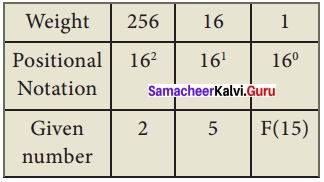
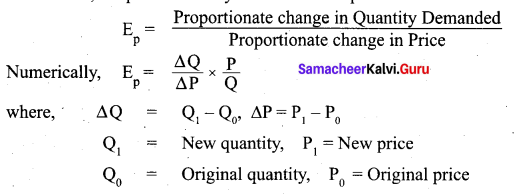
[OR]

(b) (i) List out any 3 parasitic adaptation of leech.
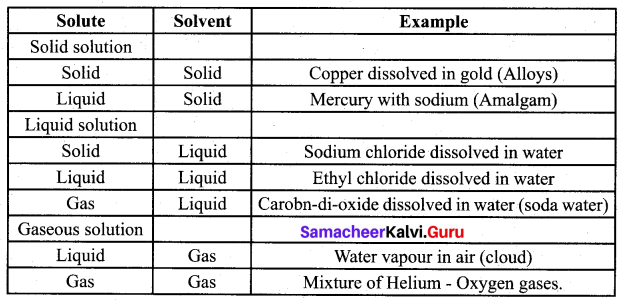
(ii) Explain the importance of Fossils.
Answer:
(i) Parasitic adaptation of Leech:

  1. Blood is sucked by pharynx
  2. The salivary glands produce hirudin which does not allow the blood to coagulate.
  3. Anterior and posterior ends of the body are provided with suckers by which the animal attaches itself to the body of the host.

(ii) Importance of Fossils:

  • Fossils are useful in classification of plants.
  • Fossils throw light on phytogeny and evolution of plants
  • Fossil plants give a historical approach to plant kingdom
  • Fossil plants can be used in the field of descriptive and comparative anatomy