Samacheer Kalvi 10th Science Model Question Paper 2 English Medium

Students can Download Samacheer Kalvi 10th Science Model Question Paper 2 English Medium Pdf, Samacheer Kalvi 10th Science Model Question Papers helps you to revise the complete Tamilnadu State Board New Syllabus and score more marks in your examinations.

Tamil Nadu Samacheer Kalvi 10th Science Model Question Paper 2 English Medium

General Instructions:

  1. The question paper comprises of four parts
  2. You are to attempt all the questions in each part. An internal choice of questions is provided wherever applicable.
  3. All questions of Part I, II, III and IV are to be attempted separately.
  4. Question numbers 1 to 12 in Part I are Multiple Choice Questions of one mark each.
    These are to be answered by writing the correct answer along with the corresponding option code.
  5. Question numbers 13 to 22 in Part II are of two marks each. Any one question should be answered compulsorily.
  6. Question numbers 23 to 32 in Part III are of four marks each. Any one question should be answered compulsorily.
  7. Question numbers 33 to 35 in Part IV are of seven marks each. Draw diagrams wherever necessary.

Time: 3 Hours
Maximum Marks: 75

Part – I

(i) Answer all the questions. [12 × 1 = 12]
(ii) Choose the most suitable answer and write the code with the corresponding answer.

Question 1.
Inertia of a body depends on ______.
(a) weight of the object
(b) acceleration due to gravity of the planet
(c) mass of the object
(d) Both a & b
Answer:
(c) mass of the object

Question 2.
Magnification of a convex lens is _______.
(a) Positive
(b) Negative
(c) either positive or negative
(d) zero
Answer:
(b) Negative

Samacheer Kalvi 10th Science Model Question Paper 2 English Medium

Question 3.
When a sound wave travels through air, the air particles _______.
(a) vibrate along the direction of the wave motion
(b) vibrate but not in any fixed direction
(c) vibrate perpendicular to the direction of the wave motion
(d) do not vibrate
Answer:
(a) vibrate along the direction of the wave motion

Question 4.
The number of neutrons is 8O16 is _______.
(a) 8
(b) 16
(c) 32
(d) 24
Answer:
(a) 8

Question 5.
Which of the following is a triatomic molecule?
(a) Glucose
(b) Helium
(c) Carbon-di-oxide
(d) Hydrogen
Answer:
(c) Carbon-di-oxide

Question 6.
Photolysis is a decomposition reaction caused by ______.
(a) heat
(b) electricity
(c) light
(d) mechanical energy
Answer:
(c) light

Question 7.
Water which is absorbed by roots is transported to aerial parts of the plant through ________.
(a) phloem
(b) epidermis
(c) cortex
(d) xylem
Answer:
(d) xylem

Samacheer Kalvi 10th Science Model Question Paper 2 English Medium

Question 8.
World ‘No Tobacco Day’ is observed on _______.
(a) May 31st
(b) April 22nd
(c) June 6th
(d) October 2nd
Answer:
(a) May 31st

Question 9.
Oxygen is produced at what point during photosynthesis?
(a) when ATP is converted to ADP
(b) when CO2 is fixed
(c) when H2O is splitted
(d) All of these
Answer:
(b) when CO2 is fixed

Question 10.
The phenomenon by which carbohydrates are oxidised to release ethyl alcohol is
(a) Glycolysis
(b) Kreb’s cycle
(c) Photosynthesis
(d) Fermentation
Answer:
(d) Fermentation

Question 11.
Biogenetic law states that ______.
(a) Ontogeny and phylogeny go together
(b) Ontogeny recapitulates phylogeny
(c) Phylogeny recapitulates ontogeny
(d) There is no relationship between phylogeny and ontogeny
Answer:
(b) Ontogeny recapitulates phylogeny

Samacheer Kalvi 10th Science Model Question Paper 2 English Medium

Question 12.
Where you will create category of blocks?
(a) Block palette
(b) Block menu
(c) Script area
(d) Sprite
Answer:
(b) Block menu

Part – II

Answer any seven questions. (Q.No: 22 is compulsory) [7 × 2 = 14]

Question 13.
State Boyle’s law.
Answer:
When the temperature of a gas is kept constant, the volume of a fixed mass of gas is inversely proportional to its pressure. P ∝ \(\frac{1}{V}\)

Question 14.
Differentiate mass and weight.
Answer:

MassWeight
1. The quantity of matter contained in the body1. The gravitation force exerted on it due to the Earth’s gravity alone.
2. Scalar quantity2. Vector quantity
3. Unit: kg3. Unit: N
4. Constant at all the places4. Variable with respect to gravity.

Question 15.
Why are traffic signals red in colour?
Answer:

  • Red light has the highest wavelength.
  • It is scattered by atmospheric particles.
  • So red light is able to travel the longest distance through fog, rain etc.

Samacheer Kalvi 10th Science Model Question Paper 2 English Medium

Question 16.
Define volume percentage.
Answer:
Volume percentage is defined as the percentage by volume of solute (in ml) present in the given volume of the solution.
Samacheer Kalvi 10th Science Model Question Paper 2 English Medium image - 1

Question 17.
Give any two examples for heterodiatomic molecules.
Answer:
Heterodiatomic molecules -E.g: HCl, NaCl.

Question 18.
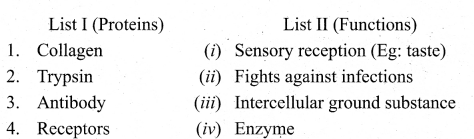
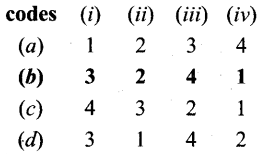
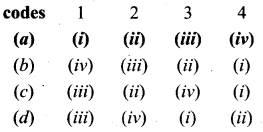
Match the following:
Samacheer Kalvi 10th Science Model Question Paper 2 English Medium image - 2
Answer:
(a) (ii)
(b) (iv)
(c) (iii)
(d) (i)

Question 19.
Write the differences between endocrine and exocrine gland.
Answer:

EndocrineExocrine
1. Secretion of endocrines are hormones1. Secretion of exocrines are enzymes
2. Endocrine glands do not have specific duct hence ductless gland.2. Exocrine glands have specific duct to carry their secretions.
3. Eg. Pituitary gland3. Eg. Salivary gland

Question 20.
Identify the parts A,B,C and D.
Answer:
Samacheer Kalvi 10th Science Model Question Paper 2 English Medium image - 3
A – Exine, B – Intine, C – Generative cell, D – Vegetative nucleus

Samacheer Kalvi 10th Science Model Question Paper 2 English Medium

Question 21.
Define Cancer.
Answer:
Cancer is an abnormal and uncontrolled division of cells that invade and destroy surrounding tissue forming a tumor or neoplasm: It is a heterogenous group of cells that do not respond to the normal cell division.

Question 22.
The potential difference between two conductor is 110 V. How much work moving 5C charge from one conductor to the other?
Answer:
Given, V = 110 V , Charge q = 5C
V = \(\frac{W}{q}\)
W = V × q
W = 110 × 5 = 550 J
∴ Work done W = 550 J

Part – III

Answer any seven questions (Q.No: 32 is compulsory) [7 × 4 = 28]

Question 23.
Describe the rocket propulsion.
Answer:

  • Propulsion of rockets is based on the law of conservation of linear momentum as well as Newton’s III law of motion.
  • Rockets are filled with a fuel (either liquid or solid) in the propellant tank. When the rocket is fired, this fuel is burnt and a hot gas is ejected with a high speed from the nozzle of the rocket, producing a huge momentum.
  • To balance this momentum, an equal and opposite reaction force is produced in the combustion chamber, which makes the rocket project forward.
  • While in motion, the mass of the rocket gradually decreases, until the fuel is completely burnt out.
  • Since, there is no net external force acting on it, the linear momentum of the system is conserved.
  • The mass of the rocket decreases with altitude, which results in the gradual increase in velocity of the rocket.
  • At one stage, it reaches a velocity, which is sufficient to just escape from the gravitational pull of the Earth. This velocity is called escape velocity.

Question 24.
Explain the types of Scattering.
Answer:
Types of Scattering.
When a beam of light, interacts with a constituent particle of the medium, it undergoes many kinds of scattering.
Based on initial and final energy of the light beam, scattering can be classified as,

  1. Elastic scattering
  2. Inelastic scattering

1. Elastic scattering:
If the energy of the incident beam of light and the scattered beam of light are same, then it is called as ‘elastic scattering’.

2. Inelastic scattering:
If the energy of the incident beam of light and the scattered beam of light are not same, then it is called as ‘inelastic scattering’.
The nature and size of the scattered results in different types of scattering. They are

  • Raylight scattering
  • Mie scattering
  • Tyndall scattering
  • Raman scattering

Samacheer Kalvi 10th Science Model Question Paper 2 English Medium

Question 25.
(a) Calculate the current and the resistance of a 100 W, 200 V electric bulb in an electric circuit.
Answer:
Given, P = 100 W, V = 200 V
Power P = VI
Samacheer Kalvi 10th Science Model Question Paper 2 English Medium image - 4

(b) What is the role of the earth wire in domestic circuits?
Answer:

  • The earth wire provides a low resistance path to the electric current.
  • The earth wire sends the current from the body of the appliance to the Earth, whenever a live wire accidentally touches the body of the metallic electric appliance.
  • Thus, the earth wire serves as a protective conductor, which saves us from electric shocks.

Question 26.
Explain the mechanism of cleansing action of soap.
Answer:
A soap molecule contains two chemically distinct parts that interact differently with water. It has one polar end, which is a short head with a carboxylate group (-COONa) and one nonpolar end having the long tail made of the hydrocarbon chain.

The polar end is hydrophilic (Water loving) in nature and this end is attracted towards water. The non-polar end is hydrophobic (Water hating) in nature and it is attracted towards dirt or oil on the cloth, but not attracted towards water. Thus, the hydrophobic part of the soap molecule traps the dirt and the hydrophilic part makes the entire molecule soluble in water.

When a soap or detergent is dissolved in water, the molecules join together as clusters called ‘micelles’. Their long hydrocarbon chains attach themselves to the oil and dirt. The dirt is thus surrounded by the non-polar end of the soap molecules. The charged carboxylate end of the soap molecules makes the micelles soluble in water. Thus, the dirt is washed away with the soap.

Question 27.
(a) Explain the various types of binary solutions based on the physical states of solute and solvent table.
Answer:
Samacheer Kalvi 10th Science Model Question Paper 2 English Medium image - 5

(b) State Henry’s law?
Answer:
Henry’s law states that, the solubility of a gas in a liquid, is directly proportional to the pressure of the gas over the solution at a definite temperature.

Samacheer Kalvi 10th Science Model Question Paper 2 English Medium

Question 28.
(a) Give an example for conditioned reflexes.
Answer:
Playing harmonium by striking a particular key, on seeing a music note is an example of conditioned reflexes which required conscious training effort.

(b) How many cranial nerves and spinal nerves are present in man?
Answer:
12 pairs of cranial nerves and 31 pairs of spinal nerves are present in man.

Question 29.
(a) What are Allosomes?
Answer:
Allosomes are chromosomes which are responsible for determining the sex of an individual. There are two types of sex chromosomes. X and Y chromosomes. Human male have one X chromosome and one Y chromosomes and the human female have two X chromosomes.

(b) What causes the opening and closing of guard cells of stomata during transpiration?
Answer:
The opening and closing of stomata is due to the change in turgidity of the guard cells. When the water enters into the guard cells, they become turgid and the stomata open. When guard cells lose water, it becomes flaccid and the stomata closes.

Samacheer Kalvi 10th Science Model Question Paper 2 English Medium

Question 30.
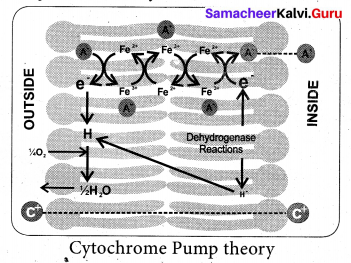
(a) Draw and label the structure of oxysomes
Answer:
Samacheer Kalvi 10th Science Model Question Paper 2 English Medium image - 6

(b) What is respiratory quotient?
Answer:
The ratio of volume of carbon dioxide liberated and the volume of oxygen consumed, during respiration is called Respiratory Quotient (R.Q)
Samacheer Kalvi 10th Science Model Question Paper 2 English Medium image - 7

Question 31.
(a) Why is a dietary restriction recommended for an obese individual?
Answer:
Obesity is a positive risk factor in development of hypertension, diabetes, gall bladder disease, coronary heart disease and arthritis. Hence dietary restriction is recommended for an obese individual.

(b) Give the name of wheat variety having higher dietary fibre and protein.
Answer:
Triticale (6n) is a hybrid of wheat and rye. It has higher dietary fibre and protein.

Question 32.
(a) State Newton’s third law of motion and explain with examples:
Answer:
Law: ‘For every action, there is an equal and opposite reaction.
They always act on two different bodies’.
FB = – FA

Examples:
(i) When birds fly:
Push the air downwards with their wings – Action
Air push the bird upwards – Reaction

(ii) When firing bullet:
Gun recoils backward and the bullet is moving forward – Action
Gun equals this forward action by moving backward – Reaction.

(b) How will you identify saturated and unsaturated compounds?
Answer:

  • Take the given sample solution in a test tube.
  • Add a few drops of bromine water
  • If the given compound is unsaturated, it will decolourise bromine water.
  • If the given compound is saturated it will not decolourise bromine water.

Part – IV

(1) Answer all the questions. [3 × 7 = 21]
(2) Each question carries seven marks.
(3) Draw diagram wherever necessary.

Question 33.
(a) (i) State Rayleigh’s law of scattering.
Answer:
Rayleigh’s scattering law states that “The amount of scattering of light is inversely proportional to the fourth power of its wavelength”.
Amount of scattering, S ∝ \(\frac{1}{\lambda^{4}}\)

(ii) Explain the construction and working of a ‘compound microscope’.
Answer:
Construction
A compound microscope consists of two convex lenses. The lens with the shorter focal length is placed near the object, and is called as ‘objective lens’ or ‘objective piece’. The lens with larger focal length and larger aperture placed near the observer’s eye is called as ‘eye lens’ or ‘eye piece’. Both the lenses are fixed in a narrow tube with adjustable provision.
Samacheer Kalvi 10th Science Model Question Paper 2 English Medium image - 8
Working:
(i) The object (AB) is placed at a distance slightly greater than the focal length of objective lens (u >fo).
(ii) A real, inverted and magnified image (A’B’) is formed at the other side of the objective lens.
(iii) This image behaves as the object for the eye lens. The position of the eye lens is adjusted in such a way, that the image (A’B’) falls within the principal focus of the eye piece.
(iv) This eye piece forms a virtual, enlarged and erect image (A” B”) on the same side of the object.
(v) Compound microscope has 50 to 200 times more magnification power than simple microscope.

[OR]

(b) (i) A heavy truck and bike are moving with the same kinetic energy. If the mass of the truck is four times that of the bike, then calculate the ratio of their momenta. (Ratio of momenta = 1:2)
Answer:
Given: Let mb , mt are the masses of truck and bike.
mt = 4mb ………(1)
Samacheer Kalvi 10th Science Model Question Paper 2 English Medium image - 9

(ii) Air temperature in the Rajasthan desert can reach 46°C. What is the velocity of sound in air at that temperature? (v0 = 331 ms-1)
Answer:
VT = (V0 + 0.16 T)
T = 46°C, v0 =331 ms-1
VT = 331 +(0.61 × 46)
= 331 +28.06
VT = 359.06 ms-1

Samacheer Kalvi 10th Science Model Question Paper 2 English Medium

Question 34.
(a) (i) A solution is prepared by dissolving 15 g of NaCl in 85 g of water. Calculate the mass percentage of solute.
Answer:
Mass of solute = 15 g
Mass of solvent = 85 g
Samacheer Kalvi 10th Science Model Question Paper 2 English Medium image - 10

(ii) Calculate the pH of 0.001 M NaOH.
Answer:
[OH] = Normality = Molarity × acidity
= 0.001 × 1 = 1 × 10⁻³
pOH = -log10 [OH]
= -log10 1× [10-3]
= -log 1– log10 10-3
= 0 – (-3 log10 10)
pOH = 3
pH + pOH = 14 .
pH = 14 – pOH= 14 – 3
pH = 11

(iii) Calculate the mass of 0.01 mole of H2O.
Answer:
n = 0.01 mole; μ = 18 g mol-1; W = ?
W = n × M
= 0.01 × 18 = 0.18 g

[OR]

(b) (i) In what way hygroscopic substances differ from deliquescent substances.
Answer:
Difference between hygroscopic and deliquescent substances is in the extent to which each material can absorb moisture. This is because both of these terms are very much related to each other and they refer to the property of observing and the retention of moisture from the air. However, they differ in the extent of absorption of moisture where hygroscopic materials absorb moisture but not the extent the original substance dissolves in it, which is the casewith deliquescence. Therefore deliquescence can be regarded as an extreme condition of hygroscopic activity.

Hygroscopic substancesDeliquescence substance
1. When exposed to the atmosphere at ordinary temperature, they absorb moisture and do not dissolve.1. When exposed to the atmospheric air at ordinary temperature, they absorb moisture and dissolve.
2. Hygroscopic substances do not change its physical state on exposure to air.2. Deliquescent substances change its physical state on exposure to air.
3. Hygroscopic substances may be amorphous solids or liquids.3. Deliquescent substances are crystalline solids.

(ii) Define solubility.
Answer:
It is defined as the number of grams of a solute that can be dissolved in 100 g of a solvent to form its saturated solution at a given temperature and pressure.

Samacheer Kalvi 10th Science Model Question Paper 2 English Medium

Question 35.
(a) (i) Which hormone is known as stress hormone in plants ? Why?
Answer:
Abscisic acid (ABA) is a growth, inhibitor which regulates abscission and dormancy. It increases tolerance of plants to various kinds of stress. So, it is also called as stress hormone. It is found in the chloroplast of plants.

(ii) How does binary fission differ from multiple fission?
Answer:

Binary fissionMultiple fission
1. Binary fission is the splitting of a cell into two daughter cell1. Multiple fission is splitting of a parent cell into two or more daughter cells.
2. It takes place in favourable conditions.
Eg. Amoeba
2. It takes place in unfavourable conditions.
Eg. Plasmodium

(iii) What are the sources of solid wastes? How are solid wastes managed?
Answer:
Solid wastes mainly include municipal wastes, hospital wastes, industrial wastes and e-wastes, etc.

Methods of solid wastes disposal:
(1) Segregation: It is the separation of different type of waste materials like biodegradable and non-biodegradable wastes.

(2) Sanitary landfill: Solid wastes are dumped into low lying areas. The layers are compacted by trucks to allow settlement. The waste materials get stabilised in about 2-12 months. The organic matter undergoes decomposition.

(3) Incineration: It is the burning of non-biodegradable solid wastes (medical wastes) in properly constructed furnace at high temperature.

(4) Composting: Biodegradable matter of solid wastes is digested by microbial action or earthworms and converted into humus.

[OR]

(b) (i) Explain the male reproductive system of rabbit?
Answer:
Samacheer Kalvi 10th Science Model Question Paper 2 English Medium image - 11
The male reproductive system of rabbit consists of a pair of testes which are ovoid in shape. Testes are enclosed by scrotal sacs in the abdominal cavity. Each testis consists of numerous fine tubules called seminiferous tubules.
This network of tubules lead into Cowper s glands a coiled tubule called epididymis, Perineal glands which lead into the sperm duct called vas deferens.

The vas deferens join in the urethra just below the urinary bladder. The urethra runs backward and passes into the penis. There are three accessory glands namely prostate gland, cowper’s gland and perineal gland. Their secretions are involved in reproduction.

(ii) What are vestigeal organs?
Answer:
The degenerated and non functional organs of animals are called Vestigeal organs. Eg. Vermiform appendix, nictitating membrane, caudal vertebra, coccyx.

Samacheer Kalvi 10th Social Science Model Question Paper 1 English Medium

Students can Download Samacheer Kalvi 10th Social Science Model Question Paper 1 English Medium Pdf, Samacheer Kalvi 10th Social Science Model Question Papers helps you to revise the complete Tamilnadu State Board New Syllabus and score more marks in your examinations.

Tamil Nadu Samacheer Kalvi 10th Social Science Model Question Paper 1 English Medium

General Instructions:

  1. The question paper comprises of four parts
  2. You are to attempt all the questions in each part. An internal choice of questions is provided wherever applicable.
  3. All questions of Part I, II, III and IV are to be attempted separately.
  4. Question numbers 1 to 14 in Part I are Multiple Choice Questions of one mark each.
    These are to be answered by writing the correct answer along with the corresponding option code and the corresponding answer
  5. Question numbers 15 to 28 in Part II are of two marks each. Any one question should be answered compulsorily.
  6. Question numbers 29 to 42 in Part III are of five marks each. Any one question should be answered compulsorily.
  7. Question numbers 43 to 44 in Part IV are of Eight marks each. Draw diagrams wherever necessary.

Time: 3 Hours
Maximum Marks: 100

Part – I

Answer all the questions. Choose the correct answer [14 × 1 = 14]

Question 1.
Where did the Ethiopian army defeat the Italian army?
(a) Delville
(b) Orange State
(c) Adowa
(d) Algiers
Answer:
(c) Adowa

Question 2.
With whose conquest did the Mexican civilization collapse?
(a) Hernan Cortes
(b) Francisco Pizarro
(c) Toussaint Louverture
(d) Pedro I
Answer:
(a) Hernan Cortes

Samacheer Kalvi 10th Social Science Model Question Paper 1 English Medium

Question 3.
In which year was Sati abolished?
(a) 1827
(b) 1829
(c) 1826
(d) 1927
Answer:
(b) 1829

Question 4.
Who was the first Palayakkarar to resist the East India Company’s policy of territorial aggrandizement?
(a) Marudhu brothers
(b) Puli Thevar
(c) Velunachiyar
(d) Veera Pandya Kattabomman
Answer:
(b) Puli Thevar

Question 5.
established a full-fledged printing press in 1709, at Tranquebar.
(a) Caldwell
(b) F.W.Ellis
(c) Ziegenbalg
(d) Meenakshisundaram
Answer:
(c) Ziegenbalg

Question 6.
The North-South extent of India is
(a) 2,500 km
(b) 2,933 km
(c) 3,214 km
(d) 2,814 km
Answer:
(c) 3,214 km

Question 7.
Pick the odd one out.
(a) Cotton
(b) rice
(c) Wheat
(d) Maize
Answer:
(a) Cotton

Question 8.
The city which is called as the Manchester of South India is
(a) Chennai
(b) Salem
(c) Madurai
(d) Coimbatore
Answer:
(d) Coimbatore

Samacheer Kalvi 10th Social Science Model Question Paper 1 English Medium

Question 9.
The highest peak in Tamil Nadu is
(a) Anaimudi
(b) Doddabetta
(c) Mahendragiri
(d) Servarayar
Answer:
(b) Doddabetta

Question 10.
The delta which is known as Granary of South India is
(a) Cauvery delta
(b) Mahanadi delta
(c) Godavari delta
(d) Krishna delta
Answer:
(a) Cauvery delta

Question 11.
How many times has the preamble to the constitution of India amended?
(a) Once
(b) Twice
(c) Thrice
(d) Never
Answer:
(a) Once

Question 12.
Which is not related to our foreign policy?
(a) World co-operation
(b) World peace
(c) Racial equality
(d) Colonialism
Answer:
(d) Colonialism

Question 13.
Which one is a trade policy?
(a) irrigation policy
(b) import and export policy
(c) land-reform policy
(d) Wage policy
Answer:
(b) import and export policy

Question 14.
Tiruppur is known for ………………
(a) Leather tanning
(b) lock making
(c) knit wear
(d) Agro – Processing
Answer:
(c) knit wear

Samacheer Kalvi 10th Social Science Model Question Paper 1 English Medium

Part – II

Answer any 10 questions. Question No. 28 is compulsory. [10 × 2 = 20]

Question 15.
How did Great Depression impact on the Indian agriculture?
Answer:

  • The Great Depression had a deep impact on the Indian agriculture. The value of farm produce, declined by half, while the land rent to be paid by the peasant, remained unchanged.
  • In terms of prices of agricultural commodities, the obligation of the farmers to the state doubled.

Question 16.
How was the Cuban Missile crisis defused?
Answer:

  • The Cuban Missile crisis was a confrontation between the United States and the Soviet Union which initiated by the American discovery of Soviet Ballistic missile deployment in Cuba.
  • Finally, the Soviet President Nikita Khrushchev agreed to withdraw the missiles and thus the missile crisis was defused.

Question 17.
Explain the concept of constructive swadeshi?
Answer:
Under Constructive Swadeshi the self-defeating modest approach of moderates was rejected and self-help was focused on through swadeshi industries, national schools, arbitration courts and constructive programmes in the village. It was totally non-political in nature.

Question 18.
What do you know of the Cheranmahadevi Gurukulam incident?
Answer:
A Gurukulam was established in Cheranmahadevi by V. V. S. Iyer with the financial support of the Tamil Nadu Congress Committee. However, students were discriminated on the basis of caste. Brahmin and non-Brahmin students were made to dine separately.

Periyar was disturbed to see the discrimination. He questioned the practice, and severely criticised it. Despite his objections the Congress continued to support the iniquitous practice in the Gurukulam. This disappointed Periyar.

Question 19.
Write a brief note on the island group of Lakshaweep.
Answer:

  • It lies close to the Malabar coast of Kerala.
  • This group of islands is composed of small coral islands.
  • Earlier they were known as Laccadive, Minicoy and Amindive. In 1973, these were named as Lakshadweep.
  • It covers small area of 32 sq.km. Kavaratti island is the administrative headquarters of Lakshadweep.
  • This island group has great diversity of flora and fauna. The Pitti island which is uninhabited, has a bird sanctuary.

Question 20.
State the major Inland waterways of India.
Answer:
The major inland water ways of India are:

  • National Waterway 1: It extends between Haldia and Allahabad, measures 1620 km and includes the stretches of the Ganga – Bhagirathi – Hooghly river system.
  • National Waterway 2: This waterway includes the stretch of the Brahmaputra river between Dhubri and Sadiya a distance of 891 km.
  • National Waterway 3: This waterway extends between Kollam and Kottappuram in the state of Kerala. It is the first national waterway in the country with 24 hour navigation facilities along its entire stretch of 205 km.

Question 21.
Name the major Islands of Tamil Nadu.
Answer:
Pamban, Hare, Krusadai, Nallathanni Theevu, Pullivasal, Srirangam, Upputanni, Island Grounds, Kattupalli Island, Quibble Island and Vivekananda Rock Memorial are some major islands of Tamil Nadu.

Question 22.
List out the air ports and sea ports of Tamil Nadu.
Answer:
Airports:

  • Chennai International Airport
  • Coimbatore International Airport
  • Madurai International Airport
  • Tiruchirapalli International Airport

Domestic Airports:

  • Tuticorin and Salem

Sea Port: Major Sea Ports are:

  • Chennai
  • Ennore
  • Tuticorin

Intermediate port at Nagapattinam and 15 minor ports.

Question 23.
What are the classical languages in India?
Answer:
There are six classical languages namely – Tamil, Sanskrit, Telugu, Kannada, Malayalam and Odia.

Samacheer Kalvi 10th Social Science Model Question Paper 1 English Medium

Question 24.
List any four guiding principles of Panchsheel.
Answer:
Guiding principles of Panchsheel are:

  1. Mutual Respect for each other’s territorial integrity and sovereignty
  2. Mutual non-interference
  3. Equality and co-operation for mutual benefit
  4. Peaceful co-existence.

Question 25.
Define National Income.
Answer:
National Income is a measure of the total value of goods and services produced by an economy over a period of time, normally a year. National Income is also known as Gross National Product or GNP or National Dividend.

Question 26.
What is globalization?
Answer:
Globalization is the process of integrating various economies of the world without creating any barriers in the free flow of goods and services, technology, capital and even labour or human capital.

Question 27.
Define tax.
Answer:
Tax is levied by government for the development of the state’s economy. The revenue of the government depends upon direct and indirect taxes.

Question 28.
Define the resource and state its types.
Answer:
Any matter or energy derived from the environment that is used by living things including humans is called a natural resource.
Types of Natural Resources are:

  1. Renewable and
  2. Non – renewable resources.

Part – III

Answer any 10 questions. Question No. 42 is compulsory. [10 × 5 = 50]

Question 29.
Fill in the blanks
(i) …………..was humiliated by the Treaty of Versailles.
(ii) …………………..makes our toothpaste white.
(iii) The Dutch captured pondicherry in ………………..
(iv) ………………are very important in the modem economic activities of man.
(v) Sathanur dam is constructed across the river………….
Answers
(i) Germany
(ii) Titanium Oxide
(iii) 1693
(iv) Industries
(v)Thenpennai

Question 30.
Match the following
Samacheer Kalvi 10th Social Science Model Question Paper 1 English Medium - 1
Answer:
Samacheer Kalvi 10th Social Science Model Question Paper 1 English Medium - 2

Question 31.
Match the following
Samacheer Kalvi 10th Social Science Model Question Paper 1 English Medium - 3
Answer:
Samacheer Kalvi 10th Social Science Model Question Paper 1 English Medium - 4

Question 32.
(a) Distinguish between
(i) GMT and 1ST.
(ii) Weather and Climate,
Answer:
(a) (i) GMT and IST:
GMT :

  • It means Greenwich Mean Time.
  • GMT is calculated at 0° longitude.
  • It passes through Greenwich.
  • It is the World Standard Time.

IST:

  • It means Indian Standard Time.
  • India’s central meridian is 82° 30’ E longitude.
  • It passes through Mirzapur.
  • It is the Indian Standard Time.

(ii) Weather and Climate:
Answer:
Weather:

  • Weather is a day to day conditions of the atmosphere of any place in regard to temperature, pressure, wind, humidity and rainfall.
  • It is calculated for a day or a short period of time.

Climate:

  • Climate is the average state of weather for a longer period of time at any place.
  • To get reliable average of climate, a minimum of 35 years records of weather are necessary.

(b) Give reason: The river Godavari is often referred as Vridha Ganga.
Answer:

  • The Godavari is India’s second longest river after Ganga.
  • It rises from the slopes of the Western Ghats in the Nasik district of Maharashtra.
  • It covers a large number of states as the Ganga does. Because of its large size and extend among the peninsular rivers, the river Godavari is often referred to as Vridha Ganga.

Samacheer Kalvi 10th Social Science Model Question Paper 1 English Medium

Question 33.
Narrate the history of transformation of Council of Europe into an European Union.
Answer:
(i) After World War II, it was decided to integrate the states of western Europe. One of the chief objectives was to prevent further European wars by ending the rivalry between France and Germany. In May 1949, ten countries met in London and signed a form called Council of Europe.

(ii) Since the Council of Europe had no real power, a proposal to set up two European organisations were made. Accordingly, the European Defence Community (EDC) and the European Coal and Steel Community (ECSC) were established. Six countries belonging to ECSC signed the treaty of Rome which established the European Economic Community (EEC) or the European Common Market, with headquarters at Brussels.

(iii) The EEC facilitated the elimination of barriers to the movement of goods and services, capital, and labour. It also prohibited public policies or private agreements that restricted market comptetion. Throughout the 1970s and 80s the EEC kept expanding its membership.

(iv) The single European Act came into force on July 1, 1987. It significantly expanded the EEC’s scope giving the meetings of the EPC a legal basis. It also called for more intensive coordination of foreign policy among member countries. According to the SEA each member was given multiple votes, depending on the countries population.

(v) The Maastricht (Netherlands) Treaty signed on February 7, 1992, created the European Union (EU). Today the European Union has 28 member states, and is functioning from its headquarters at Brussels, Belgium.

Question 34.
Eumerate the cause for the failure of the great Revolt of 1857.
Answer:
Administrative changes:

  • Disunity among the Indians was the first and the foremost cause.
  • A large number of rulers of the Indian states and the big zamindars did not j oin the movement.
  • The rulers of the Indian states, who did not support the movement, remained neutral.
  • The educated Indians did not support the movement.
  • The telegraph and postal communication proved very helpful to the British for proper military actions and sending their reinforcements at the earliest time.
  • The rebellious soldiers were short of modem weapons and other materials of war.
  • The rebellious soldiers had to fight with traditional weapons which were no match to modem weapons possessed by the British forces.
  • The revolt was not extended beyond North.
  • The Indian leaders like Nana Saheb, Tantia Tope, Rani Lakshmi Bai where no match to the British generals.
  • The revolt broke out prematurely and the preparations for the revolt remained incomplete.
  • The organization and the planning of the rebels was very poor.
  • The Indian leaders were brave and selfless but they lacked unity of command and discipline.
  • The revolutionaries had no common idea.
  • The Muslims wanted to revive Mughal rule and the Hindus wanted to receive the Peshwa Raj.
  • The British diplomacy of Divide and Rule prevented most of the Indian rulers to j oin together for a common cause.

Question 35.
Write about any two multipurpose projects of India.
Answer:
A comprehensive river valley project which serves a number of purposes simultaneously is called a “Multi purposes project”.
1. The Bhakra Nangal Project: India’s biggest multipurpose river valley project is ‘Bhakra Nangal Project’. It has been built at a strategic point where two hills on either side of the Sutlej are very close to each other. It is the highest gravity dam in the world. Its length is 226 metres from the riverbed. The canals taken out are 1100 kilometres long. The ‘Nangal Power Plant’ on the Sutlej produces electricity, and serves the states of Himachal Pradesh, Punjab, Haryana, Rajasthan and New Delhi. The distributaries are 8400 km in length. It irrigates an area of 1.4 million hectares.

2. Indira Gandhi Project: This project is an ambitious scheme to bring new areas under irrigation so that more areas could be cultivated. The waters of the River Beas and the Ravi are diverted to the River Sutlej. The ‘Pong’ Dam on the River Beas has been constructed to divert the Beas water into the Sutlej in a regulated manner. So that ‘Rajasthan canal’, the longest irrigation canal in the world can irrigate Gandhi Nagar, Bikaner and Jaisalmer districts of North West Rajasthan, (i.e) a part of Thar desert. The main canal now called ‘Indira Gandhi Canal’ is 468 km long runs entirely in Rajasthan, Western of Sutlej, Beas and Ravi are now being fully utilised for irrigating thirsty lands of South Western parts of our country.

Samacheer Kalvi 10th Social Science Model Question Paper 1 English Medium

Question 36.
Write about the plantation farming of Tamil Nadu.
Answer:

  • Tea, coffee, cashew, rubber and cinchona are the major plantation crops of the state.
  • Tamil Nadu ranks second in area and production of tea in India next to Assam.
  • Tea plantations are found in the hills of the Nilgiris and Coimbatore.
  • Coffee plants are grown in the hills of Western Ghats as well as Eastern Ghats.
  • The Nilgiris and Yercaud in Salem are the notable regions for tea plantations.
  • It is also found in the hilly slopes of Dindigul, Madurai, Theni and Dharmapuri districts.
  • Tamil Nadu stands second in area and in production of coffee next to Karnataka.
  • Rubber plantations are significant in Kanyakumari.
  • Pepper is confined to the warm and wet slopes of Eastern and Western Ghats of Tamil Nadu. .
  • Cashew is extensively cultivated in Cuddalore district.
  • Cinchona is planted at heights varying from 1060 to 1280 metres in Anaimalai hills.
  • Cardamom estates are located at few places in the hills of Madurai region at an elevation of 915 to 1525 metres.

Question 37.
Explain the salient features of the constitution of India.
Answer:
Here are the salient features of the Indian Constitution.

  • It is the lengthiest of all the written Constitutions of the world.
  • It is partly rigid and partly flexible.
  • It establishes a federal system of Government.
  • It establishes the Parliamentary systems not only at the Centre but also in the States.
  • It provides an independent judiciary.
  • It makes India as a secular state.
  • It introduces Universal Adult Franchise and accords the right to vote to all citizens above 18 years of age without any discrimination.
  • It provides single citizenship.
  • It makes special provisions for minorities, SCs, STs, etc.

Question 38.
Write a short note on SAARC.
Answer:
SAARC:
SAARC means, The South Asian Association for regional co-operation.

  • India took the initiative to form SAARC to maintain peace in the regional level.
  • SAARC’s first meeting was held at Dacca in Bangladesh in Dec 7, 1985.
  • Ashan of Bangladesh was the first secretary general of SAARC.
  • The member countries are Bangladesh, Bhutan, India, Maldives, Nepal, Pakistan, Afghanistan and Sri Lanka.
  • On April 3, 2007 the SAARC’s annual summit was held in New Delhi. Afghan president Hamid Karzai attended this meeting. Afghanistan became its 8th member.
  • 18th SAARC summit took place on 26* and 27* of November 2014 at Kathmandu the capital of Nepal.
  • The SAARC countries identified mutual co-operation in the following areas transportation postal service, tourism, shipping meteorology, health, agriculture rural reconstruction and telecommunication.

Question 39.
What are the methods of calculating Gross Domestic Product?
Answer:
Methods of calculating Gross Domestic Product or GDP:

  • Expenditure Approach – In this method, the GDP is measured by adding the expenditure on all the final goods and services produced in the country during a specified period.
  • Income Approach – This method looks at GDP from the perspective of the earnings of the men and women who are involved in producing the goods and services.
  • Value-added Approach – In the value – added approach the value added by each intermediate good is summed to estimate the value of the fiscal good. The sum of the value added by all the intermediate goods used in productions gives us the total value of the final goods produced in the economy.

Question 40.
Briefly explain the nutritional and health status of Tamil Nadu.
Answer:
Status of Nutrition:

  • We noted earlier that food security includes nutrition security too. Though our country has reached self-sufficiency in food production, the nutrition status of the population has not seen corresponding levels of improvement.
  • In 2015-16, 27% of the rural women and 16% of the urban women (in the age group of 15-49 years) were counted as undernourished or chronically energy deficient by the National Family Health Survey.
  • More than half of the women in the reproductive age group (15-49 years) in both rural and urban India were anaemic in 2015-16. As regards children, about 60% of the rural and 56% of the urban children (in the age group of 6-59 months) are counted to be anaemic, in 2015-16.
  • About 41 % of the rural and 31 % of urban children are stunted, that is, they are not of the required height in correspondence to their age. Another indicator of nutrition deficiency . among children is “underweight”, which is weight in relation to age.
  • In India, in 2015-16, about 20% of children (in the age group of 6-59 months) in rural and urban India are estimated to be underweight.

Question 41.
Draw a time line for the following:
Write any five important events between 1934-1961
Answer:
Samacheer Kalvi 10th Social Science Model Question Paper 1 English Medium - 5

Question 42.
Mark the following places on the world map.
(i) Great Britain
(ii) Germany
(iii) France
(iv) Italy
(v) Greece
Answer:

Part – IV

Answer both questions. [2 × 8 = 16]

Question 43.
(a) German Emperor
(i) What was the nature of Emperor Kaiser Wilhelm II of Germany?
(ii) What was the violent form of Germany called?
(iii) Why did Kaiser Wilhelm intervene in the Morocco affair?
(iv) What happened to Germany’s colonies in Africa?
Answer:
(a) German Emperor

(i) The Emperor Kaiser Wilhelm II of Germany was ruthlessly assertive and aggressive. He proclaimed that Germany would be the leader of the world.

(ii) It was called Germany’s Kultur.

(iii) The British agreement with France over the latter’s interest in Morocco was consented by Germany. So Kaiser Wilhelm II of Germany intentionally recognised the independence of the Sultan and demanded an international conference to decide on the future of Morocco.

(iv) The German colonies in western and eastern Africa were attacked by the Allies. As these
colonies were quite far off from Germany they could not receive any immediate help, and therefore had to surrender to the Allies.

(b) Korean War
(i) Who was the President of North Korea during the Korean War?
(ii) Name the southern rival to the President of North Korea.
(iii) How long did the Korean War last?
(iv) What was the human cost of the War?
Answer:
(b) Korean War
(i) Kim II was the President of North Korea during the Korean War.
(ii) Syngman Rhee
(iii) The Korean War lasted three years
(iv) The human cost was enormous, there were 500,000 western casualties and three times that number on the other side. Approximately two million Korean civilian died.

[OR]

Question 43.
(c) The Revolt of 1857
(i) Who assaulted his officer, an incident that led to the outbreak of 1857 Revolt?
(ii) Who was proclaimed the Shahenshah-e-Hindustan in Delhi?
(iii) Who was the correspondent of London Times to report on the brutality of the 1857 revolt?
(iv) What did the Queen’s proclamation say on matters relating to religion?
Answer:
(c) The Revolt of 1857
(i) Mangal Pandey assaulted his officer.
(ii) The Mughal Emperor Bahadur Shah II was proclaimed the Shahenshah-e-Hindustan in Delhi.
(iii) The correspondent’s name was William Howard Russell.
(iv) The Queen proclaimed to the Indian people that the British government would not interfere in traditional institutions and religious matters. ‘

(d) Constructive Programme of Gandhi
(i) What is constructive programme?
(ii) What did Gandhi exhort the Congressmen to do?
(iii) How did Gandhi try to bring about Hindu-Muslim unity?
(iv) What is the contribution of Gandhi towards abolition of untouchability?
Answer:
(d) Constructive Programme of Gandhi
(i) Programmes that aimed at Khadi promotion, Hindu-Muslim unity and the abolition of untouchability are called constructive programmes.
(ii) He exhorted the Congressmen to go throughout their districts and spread the message of Khaddar, the message of Hindu-Muslim unity, the message of anti-untouchability and take up in hand the youth of the country and make them the real soldiers of Swaraj.
(iii) Gandhi tried to bring about Hindu-Muslim unity to strengthen the cause of Swaraj.
(iv) Gandhiji wanted to abolish untouchability from the country. He undertook an all-India tour called the Harijan Tour. He started the Harijan Sevak Sangh to work for the removal of discriminations. He worked to promote education, cleanliness and hygiene and giving up of liquor among the depressed class. He also launched the Temple Entry Movement.

Samacheer Kalvi 10th Social Science Model Question Paper 1 English Medium

Question 44.
Mark the following places on the given outline map of India.
(i) Western Ghats
(ii) Mumbai
(iii) Rice cultivation area
(iv) Panna biosphere reserve
(v) Air route from Chennai to Delhi
(vi) Mountain forests
(vii) Direction of South West monsoon
(viii) Cotton growing area
Answer:
Samacheer Kalvi 10th Social Science Model Question Paper 1 English Medium - 7

[OR]

Mark the following places on the given outline map of Tamil Nadu:
Answer:
(i) Gulf of Mannar .
(ii) Manimutharu dam
(iii) Pamban
(iv) Chennai port
(v) Any one international airport
(vi) Graphite ore production centre
(vii) Rubber growing area
(viii) Magnesite ore production centre .
Samacheer Kalvi 10th Social Science Model Question Paper 1 English Medium - 8

Map for Q 42
(i) Great Britain
(ii) Germany
(iii) France
(iv) Italy
(v) Greece
Answer:
Samacheer Kalvi 10th Social Science Model Question Paper 1 English Medium - 9

Map for Q. 44
(i) Western Ghats
(ii) Mumbai
(Hi) Rice cultivation area
(iv) Panna biosphere reserve
(v) Air route from Chennai to Delhi
(vi) Mountain forests
(vii) Direction of South West monsoon
(viii) Cotton growing area
Answer:
Samacheer Kalvi 10th Social Science Model Question Paper 1 English Medium - 10
Map for Q. 44
(i) Gulf of Mannar
(ii) Manimutharu dam
(iii) Pamban
(iv) Chennai port
(v) Any one international airport
(vi) Graphite ore production centre
(vii) Rubber growing area
(viii) Magnesite ore production centre
Answer:
Samacheer Kalvi 10th Social Science Model Question Paper 1 English Medium - 11

Samacheer Kalvi 10th English Model Question Paper 2

Students can Download Samacheer Kalvi 10th English Model Question Paper 2 Pdf, Samacheer Kalvi 10th English Model Question Papers helps you to revise the complete Tamilnadu State Board New Syllabus and score more marks in your examinations.

Tamil Nadu Samacheer Kalvi 10th English Model Question Paper 2

General Instructions:

  1. The question paper comprises of four parts.
  2. You are to attempt all the sections in each part. An internal choice of questions is provided wherever applicable.
  3. All questions of Part I, II, III and IV are to be attempted separately.
  4. Question numbers I to 14 in Part I are Multiple Choice Questions of one mark each. These are to be answered by writing the correct answer along with the corresponding – option code.
  5. Part II has got four sections. The questions are of two marks each. Question numbers 15 to 18 in Section I and Question numbers 19 to 22 in Section II are to be answered in about one or two sentences each. Question numbers 23 to 28 in Section III and IV are to be answered as directed.
  6. Question numbers 29 to 45 in Part III are of five marks each and have been divided in five sections. These are to be answered as directed.
  7.  Question numbers 46 and 47 in Part IV are of eight marks each. Question number 47 has four questions of two marks each. These are to be answered as directed.

Time: 2.30 Hours
Maximum Marks: 100

Part – I

Answer all the questions. [14 x 1= 14]
Choose the most suitable answer and write the code with the corresponding answer.
Choose the appropriate synonyms for the italicised words.

Question 1.
He felt certain that his wings would never support him.
(a) curtain
(b) screen
(c) sure
(d) unsure
Answer:
(c) sure

Question 2.
‘Nothing,’ he said, gruffly.
(a) sadly
(b) angrily
(c) carefully
(d) grievously
Answer:
(b) angrily

Samacheer Kalvi 10th English Model Question Paper 2

Question 3.
‘We left our ancestral house, twenty- nine years ago.
(a) inherited
(b) anterior
(c) interior
(d) palatial
Answer:
(a) inherited

Choose the appropriate antonym for the italicised words.

Question 4.
It covered the expedition in five legs with stop-overs at four ports.
(a) exposed
(b) shielded
(c) protected
(d) hid
Answer:
(a) exposed

Question 5.
Technology determines if its impacts are positive.
(a) confident
(b) affirmative
(c) promotional
(d) negative
Answer:
(d) negative

Question 6.
The oppressors dominated over the language and culture of the Germans.
(a) released
(b) conquered
(c) liberated
(d) controlled
Answer:
(c) liberated

Samacheer Kalvi 10th English Model Question Paper 2

Question 7.
Choose the correct plural form of Chinese from the following.
(a) Chinese
(b) Chineses
(c) Chinesies
(d) Chinesses
Answer:
(a) Chinese

Question 8.
Form a derivative by adding the right prefix to the word – ‘legal’.
(a) en-
(b) mis-
(c) il-
(d) dis-
Answer:
(c) il-

Question 9.
Choose the correct expansion of the abbreviation PSU.
(a) Public Sector University
(b) Public Sector Unit
(c) Public Service Unit
(d) Public Sector Unit
Answer:
(d) Public Sector Unit

Question 10.
Complete the following sentence with the most appropriate phrasal verb given below:
The air hostess instructed the passengers to wear the seat belts during the
(a) take off.
(b) take out
(c) take after
(d) take in
Answer:
(a) take off.

Question 11.
Choose the suitable option to pair it with the word ‘ wash’ to form a compound word.
(a) clean
(b) gentle
(c) room
(d) out
Answer:
(c) room

Samacheer Kalvi 10th English Model Question Paper 2

Question 12.
Fill in the blank with the most appropriate preposition given below:
He was wearing a dhoti and a blue striped shirt that could be seen from a green
shawl.
(a) across
(b) under
(c) into
(d) inside
Answer:
(b) under

Question 13.
Complete the following sentence using the most appropriate tense form of the verb given below:
The sun in ………… the west.
(a) sets
(b) is setting
(c) was set
(d) will set
Answer:
(a) sets

Question 14.
Choose the most appropriate linker from the given four alternatives.
He believed Maede’s men were beginning to retreat.
(a) for
(b) and
(c) but
(d) that
Answer:
(d) that

Part – II [10 x 2 = 20]
Section -1

Answer any three of the following questions in a sentence or two. [3 x 2 = 6]

Question 15.
How does Mr. Bodwell react to the shoe thrown by Mrs. Thurber?
Answer:
When the narrator’s mother throws a shoe through the Bodwells’ window and says there are burglars in the house, Bodwell is momentarily contused, thinking that the burglars are in his house, before understanding the truth and alerting the police.

Question 16.
Which skill was considered important in the selection process? How long were they trained to undertake this voyage?
Answer:
Little survival skills they showcased was considered important in the selection process. They were trained for almost three years to undertake this voyage.

Samacheer Kalvi 10th English Model Question Paper 2

Question 17.
What was the condition of the attic?
Answer:
A portion of a wall of the attic had crumbled down. In the whole house, the attic had probably been the worst hit by wind and weather. The floor was strewn with twigs and straw and pigeon droppings.

Question 18.
What can be the matter now?” says Franz. Why, do you think he commented?
Answer:
When Franz passed by the bulletin board near the town-hall, he noticed a crowd there. He did not stop there nor wondered what could be the matter then. For the last two years they had received all the bad news from the bulletin-board—the lost battle, the draft and the orders of the commanding officer.

Section – II

Read the following sets of poetic lines and answer any THREE of the following.
[3 x 2 = 6]

Question 19.
“In the dim past, nor holding back in fear From what the future veils; but with a whole And happy heart, that pays its toll
To Youth and Age, and travels on with cheer.’’
(a) What does the poet mean by the phrase ‘in the dim past’?
(b) How can one travel on with cheer?
Answer:
(a) The poet means that the past was very dull and glum.
(b) One can travel cheerfully with a happy heart.

Question 20.
“Despite the sighs and groans and moans,
She’s strong in her faith, firm in her belief!.”
(a) Is she complaining about the problems of life?
(b) Pick out the words that show her grit.
Answer:
(a) No she is not complaining about the problems of life.
(b) The words that show her grit are strong and firm.

Samacheer Kalvi 10th English Model Question Paper 2

Question 21.
“We were taken from the ore-bed and the mine,
We were melted in the furnace and the pit ”
(a) Who does ‘we’ refer to in first stanza?
(b) Who are the speakers and listeners of this poem?
Answer:
(a) ‘We’ refers to the Machines in the first stanza.
(.b) The speakers are the Machines which are the brain children of man and the listeners are the readers of this poem.

Question 22.
“ What happened there is still today unknown.
It is a very mysterious place,
And inside you can tell it has a ton of space,
But at the same time it is bare to the bone.”
(a) You know what happened inside that house?
(A) What is meant by ‘bare to the bone’?
Answer:
(a) No one knows what happened inside the house.
(b) ‘Bare to the bone’means there isn’t anything in the house.

Section – III

Answer any THREE of the following. [3 x 2 = 6]

Question 23.
Rewrite the following sentence to the other voice.
Are you disturbed by listening to hard rock music?
Answer:
Does listening to hard rock music disturb you?

Question 24.
Rewrite using indirect speech.
Shalini said to Mr. Shamrock, “Have you decided to give me the job?”
Answer:
Shalini asked Mr. Shamrock if he had decided to give her the job.

Question 25.
Punctuate the following.
Psst I hissed, in the dark shaking him.
Answer
Psst!’ I hissed, in the dark, shaking him.

Question 26.
Transform the following sentence into a simple sentence.
As there was a heavy downpour, the match was cancelled.
Answer:
Due to a heavy downpour, the match was cancelled.

Question 27.
Rearrange the words in the correct order to make meaningful sentences.
(а) advertise/ use/ convenient/ telephone/ you/ as/ to/ banking/ your/ service/ and/ easy
(b) afraid/ not/ of/ evidence/ have/1 /features/ seen/ am/1/ either/ yet/ these/ of
Answer:
(a) You advertise your telephone banking service as easy to use and convenient.
(b) I am afraid I have not yet seen evidence of either of these features.

Section – IV

Answer the following question. [1 x 2 = 2]

Question 28.
Your neighbour wants to meet his friend in MM Hospital. Write in about 50 words / 5 sentences guiding him with your directions.
Answer:
Samacheer Kalvi 10th English Model Question Paper 2.1

  • Go straight on Rajaji Street and take the first right on Shanthi Colony Main Road.
  •  Proceed further and go past the 1st main road on the left and 2nd main road on the right.
    Take the road on the left after the 2nd main road. You will find MM Hospital on the right side.

Part – III [10 x 5 = 50]
Section -1

Answer any TWO of the following in utmost 10 lines. [2×5 = 10]

Question 29.
‘Maddened by hunger, he dived at the fish,’ says the narrator about the young seagull. Do you feel hunger was the main motivating force that made the young seagull take the plunge that taught him how to fly in the air?
Answer:
Food is the most essential ingredient that sustains all life – of humans, animals as well as birds. Hunger motivates many of their actions. The young seagull used to sit all alone on his ledge. Whenever he tried to flap his wings to fly, he was seized with fear. He felt certain that his wings would never support him.

He had seen his older brother catch his first herring and devour it. It compounded his helplessness even more. He uttered a joyful scream when he saw his mother holding a piece of fish in her beak and flying quite near him. He wondered why she didn’t come to him and offer that piece of fish to him. Maddened by hunger, he dived at the fish. With a loud scream he fell outwards and downwards into space.

Samacheer Kalvi 10th English Model Question Paper 2

Then a monstrous terror seized him but only for a minute. The next moment he felt his wings spread outwards. He began to soar downwards towards the sea. The fear left him. He began to float on the sea. His admiring family offered him pieces of fish flying around him.

‘’Your hunger must be absolutely compelling
in order to overcome the obstacles that will
invariably come your way. ”

Question 30.
What makes Culverton Smith fall a prey to Holmes’s trap?
Answer:
Watson goes to Mr. Culverton Smith at 13 Lower Burke Street. He finds it difficult to see his friend dying. Although Smith refuses to see anyone, Watson forces his way in. As soon as Watson explains his errand, Smith’s attitude changes drastically. He persuades him to see Holmes as he is in a dying state. Smith agrees to come to Baker Street within half an hour.

Watson excuses himself, saying that he has another appointment and returns to Baker Street before Smith’s arrival as instructed by Holmes. Believing that they are alone, Smith is frank with Holmes. Holmes tells Smith that he will forget the happenings of Victor Savage and pleads with him to cure him.

Smith denies and tells Holmes that he should have never crossed his path. Smith sees the little ivory box, which he had sent to Holmes by post containing a sharp spring infected with the illness. Smith pockets it thinking to have removed the only evidence of his crime. He then resolves to stay there and watch Holmes die. However, Holmes asks Smith to turn the gas up full, which Smith does. Inspector Morton enters and Holmes tells Morton to arrest Culverton Smith for the murder of his nephew and also for the attempted murder of Sherlock Holmes.

“You cannot escape from a detective s eye.”

Question 31.
Narrate the extensive search operation made by the policemen in the house.
Answer:
The arrival of the police blows the whole event out of proportion. The cops call out for the front door to be opened, and when no one in the house goes downstairs, they break it in. They go upstairs to find the narrator, still walking around with a towel over him after his bath. The mother insists there were burglars though the police confirms that all doors and windows are bolted from inside. The police set about probing the house, moving furniture and emptying closets.

At one point, a policeman’s inquisitiveness makes him point out an unusual old musical instrument, a zither, to another officer. The police are suspicious of the family members’ strange behaviour. When the narrator’s grandfather, sleeping in the attic, makes a slight noise, the policemen spring into action. They race upstairs to investigate. The narrator fears trouble because his grandfather feels that the Civil War is in progress.

When the policemen arrive at his door, he is convinced that they are Meade’s army and calls them deserters. He slaps a policeman sending him to the floor and takes the man’s gun from his holster and shoots at him, hitting him in the shoulder.He fires twice more and then goes back to bed. Back downstairs, the police feel defeated. They bandage the wounded officer and search the house again.

Wisdom requires not only the investigation of many things but contemplation of the mystery.”

Samacheer Kalvi 10th English Model Question Paper 2

Question 32.
Highlight the factors responsible for the all-women Indian Navy crew to carry out their expedition.
Answer:
The support the crew members received was a major factor. When they knew that they were doing well and looked after themselves well, in spite of all apprehensions they were supportive. The crew members’ personal aim and target mattered a lot. Mostly they wanted to make sure that they complete the journey with ultimate honesty without the use of engines.

Then the destination, the journey was important. So their contention was to make sure that they go by the rules of circumnavigation without any means of repulsion and anybody else’s assistance. The presence of mind and common sense to make decisions and act quickly was an added factor. They had to quickly do an analysis of problem solving techniques.

Ego should never come amidst them. Team work helped them to collaborate and work together. Mutual understanding was important too. One would heat the water while the other would heat the gloves or even rested. Over air the confidence you had in each other than the trust and acceptance as every member of the crew to be a family was a must to carry out the expedition.

Its about women helping women and women doing things together and supporting each other”

Section – II
Answer any TWO of the following in utmost 10 lines. [2 x 5 = 10]

Question 33.
Compare and contrast the attitude of the ant and the cricket.
Answer:
The poem, ‘The Ant and the Cricket’ is about a careless cricket and a hardworking ant. We all know that ants are hardworking creatures but on the other hand the Cricket is portrayed as a lazy being. He made no efforts to plan for the future. Thus, the cricket is shown as a young and silly creature because he sang all through summer and spring with no worries in the world for winter that was to come. But when winter arrived, he began to complain that he would die of starvation and hunger. He found that his cupboard was empty and not a piece of bread to eat.

He neither found a leaf, nor a flower. Everything was covered with snow. Therefore, the cricket cried and moaned as he perceived his bad future. Finally, deprived of hunger and starvation, being all wet and cold, the cricket journeyed to the house of the stingy ant becoming bold by nature. He begged for food and shelter but the Ant is wise, foresees its needs for winter and prudently turned down the foolish Cricket. The Ant clearly stated that Ants neither borrow nor lend. So the Ant is shown as a straightforward and outspoken personality.

Perhaps the cricket here is portrayed as a person who makes false promises and Ant is portrayed to be a strong personality not carried away be the false promises of one. Therefore the Ant could never be exploited though it was humble enough to admit it to be a servant and friend of the Cricket. The Cricket was surely careless and reckless against the Ant who was judicious, discrete and level-headed.

“Accept responsibility for your life.
Know that it is you who will get you where you want to go, no one else.”

Samacheer Kalvi 10th English Model Question Paper 2

Question 34.
How are we alike? Explain in context with the poem, ‘No Men Are Foreign’.
Answer:
All human-beings are the same. We have a similar body structure. All of us need air to breathe, sunlight and warmth to live and water for our survival. Our daily routine is also similar. We wake up in the morning, bathe and have breakfast before going on with our daily chores. All of us long for love and affection. We all sleep at night and wake up in the morning.

When our needs and feelings are the same, then isn’t it right to treat all men alike? We should not look down upon anybody on the basis of his/her colour, caste, region or gender. We should treat everyone as our brother and sister. Unfortunately, some self-centred people fight with others and hurt them. They think that others have harmed them. We should not think that other people are ‘others’. They are also our brothers. If they make one mistake, we should forgive them or compromise with them.

“Acceptance for one another is the key to living.”

Question 35.
Read the following stanza and answer the questions given below.
“So let the way wind up the hill or down,
O’er rough or smooth, the journey will be joy:
Still seeking what I sought when but a boy,
New friendship, high adventure, and a crown, ”
(i) Pick out the rhyming words from the above lines.
(ii) Write the rhyme scheme.
(iii) Identify the figure of speech employed in the third line of the given stanza.
(iv) Pick out the alliterated words in the first line.
Answer:
(i) Down and crown; joy and boy
(ii) abba is the rhyme scheme of the above stanza.
(iii) The figure of speech is alliteration.
(iv) The alliterated words are ‘way wind’.

Question 36.
Paraphrase the following stanza.
There’s a family nobody likes to meet;
They live, it is said, on Complaining Street In the city of Never-Are-Satisfied,
The River of Discontent beside.
Answer:
There is a family that no one ever wants to meet on Complaining Street in ‘Never-are- Satisfied’ city where River Discontent runs by the side of their house.

Section – III

Answer any ONE of the following. [1 x 5 = 5]

Question 37.
Rearrange the following sentences in coherent order.
(i) Arvind corrected Maya and said that the beetle is called Spitfire.
(ii) But their father said that Zigzag is the most harmless, unusual and lovable bird.
(iii) Dr. Ashok’s clinic sounded more a torture chamber than a child specialist clinic.
(iv) He felt it could be Uncle Somu’s pet snake.
(v) Maya felt that the giant green-and -gold fighting beetle was Zigzag.
Answer:
Rearranged number sequence: (iii), (v), (i), (tv), (ii)
(iii) Dr. Ashok’s clinic sounded more a torture chamber than a child specialist clinic.
(v) Maya felt that the giant green-and -gold fighting beetle was Zigzag.
(i) Arvind corrected Maya and said that the beetle is called Spitfire.
(tv) He felt it could be Uncle Somu’s pet snake.
(ii) But their father said that Zigzag is the most harmless, unusual and lovable bird.

Samacheer Kalvi 10th English Model Question Paper 2

Question 38.
Read the following passage and answer the questions that follow.

The trembling mother’s voice was full of unselfish love as she gave her last injunction. “Let not thine eyes be blinded, my son.” She said. “The mountain road is full of dangers. LOOK carefully and follow the path which holds the piles of twigs. They will guide you to the familiar path farther down”.

The son’s surprised eyes looked back over the path, then at the poor old, shriveled hands all scratched and soiled by their work of love. His heart broke within and bowing to the ground, he cried aloud: “Oh, honorable mother, your kindness breaks my heart! I will not leave you.

Together we will follow the path of twigs, and together we will die!’’Once more he shouldered his burden (how light it seemed now) and hastened down the path, through the shadows and the moonlight, to the little hut in the valley. Beneath the kitchen floor was a walled closet for food, which was covered and hidden from view. There the son hid his mother, supplying her with everything she needed, continually watching and fearing she would be discovered.
(i) What was the last injunction given by the mother?
(ii) What did the aged mother do for her son’s safe return?
(iii) Why was the aged mother’s hands shriveled?
(iv) What does the poor mother’s kindness do to the poor farmer’s heart?
(v) Where did the son hide his mother in his little hut in the valley?
Answer:
(i) The last injunction given by the mother was that her son’s eyes should not be blinded to the mountain road filled with dangers.
(ii) The aged mother dropped piles of twigs as her son carried her up the mountain so that they would guide him while returning.
(iii) The aged mother’s hands were shriveled, scratched and soiled because of the work of love.
(iv) The poor mother’s kindness broke the poor farmer’s heart.
(v) The son hid his mother beneath the kitchen floor in the walled closet for food which was hidden from view.

Section – IV

Answer any FOUR of the following. [4 x 5 = 20]

Question 39.
Prepare an attractive advertisement using the hints given below.
Milton Electronic Ltd – 30% discount sale – all electronic appliances – additional warranty – gifts with every purchase.
Answer:
Samacheer Kalvi 10th English Model Question Paper 2.2

Question 40.
You are Catherine/ Shilogaran. You want to share your thoughts to Angeline who was your classmate five years ago when you were in Class V. You have not met after leaving school. Write a letter explaining your life.
Answer:

40, West Street,
10th August, 2020

Dear Angeline,
By the grace of God, we are doing well and I hope the same from you and your family. It’s been five long years since we have met or had the opportunity to write to each other. I recently came to Chennai and happened to see your neighbour during my visit. I asked for your address and here I am wanting to share my days at Salem with a friend whom my miss a lot. My father was transferred to Salem during our summer vacation after our Terminal exams for Std V. Hence I could not inform you in person.

I am now studying in Reva Public School at Srimangalam Colony. The teachers are very cordial and good coaching. I miss the Sports activities here since we do not have a playground. We do have a P.T. period but we just do exercises and running. I miss playing Khokho and Football at Vellore Voorhees school.

This year, being in tenth, we went on an excursion to Hyderabad. It was my first trip out of Tamil Nadu and also my trip without my family. Though I enjoyed the trip with my friends, I did miss my family.

Angelene I hope to receive a letter from you and I am so excited penning a few words to you. Looking forward to hearing from you at the earliest and do convey my regards to uncle and aunty.

Loads of love,
Catherine/Shilogaran

Samacheer Kalvi 10th English Model Question Paper 2

Question 41.
As student Editor, draft a notice in not more than 50 words for your school notice board inviting articles from the students for your school magazine. You are Caleb/Christabel of Daniel Matriculation School, Chennai.

Daniel Matriculation School, Chennai .
NOTICE
Articles for School Magazine
20th October, 2020

Students from Std. VI to X are requested to write and submit articles for the school magazine. You can write essays, poems, short stories, snippets, real life incidents, pencil sketches and paintings, Jokes and riddles in English, Tamil and Hindi. Do keep in mind the theme of the year ‘Be the Change to Bring a Change’. Last date for submission of articles to the undersigned is 5th January, 2020. All the club secretaries are requested to submit the activities report too.

Caleb / Christabel
Student Editors

Question 42.
Look at the following picture and express your views on it in about five sentences.
Answer:
Samacheer Kalvi 10th English Model Question Paper 2.3
Family time is very important for family ties to be strengthened. This picture portrays a family where the father relaxes under a beach umbrella and hopes to enjoy the suntan effect. Under another umbrella you can see the mother relaxing with a book in hand. A small little girl enjoys making a sand castle while her brother runs to plunge into the water. You can also see a boy swimming in the water. Birds are hoping to find some food as people are in the seashore.

Samacheer Kalvi 10th English Model Question Paper 2

Question 43.
Make notes or write a summary of the following passage.
Answer:
The term earthquake is applied to any tremor or shaking of the ground. Many earthquakes are so gentle as to pass almost unrecognised, others are sufficiently pronounced to excite general alarm, while some spread enormous destruction. Destructive earthquakes are usually confined to limited regions. The usual phenomena recorded in well-known earthquakes are first a trembling, next one or more severe shocks, and then a trembling which gradually dies away. In most cases, each shock lasts only a few seconds, but the tremblings that follow may continue for days, weeks, or even months.

Noises of various kinds usually accompany an earthquake. They have been likened to the howling of storm, the growling of thunder, the clanking and clashing of iron chains, or the rumbling of heavy wagons along a road. Such noises are conducted through the ground, or they may travel through the sea or air, and are often heard at great distances from the place where the shock is felt. Some earthquakes, however, are not accompanied by these noises.

At the time of the terrible shock which destroyed Riobamba in Ecuador on February 4, 1797, a complete silence reigned. Among destructive earthquakes in modem times may be mentioned the one that destroyed coastal towns in Tamil Nadu in 2004.

Notes
Title: Earthquake
1. Definition, -tremor/shaking of ground
2. Types of Earthquake
(a) Gentle – unrecognized
(b) Sufficiently pronounced – gentle alarm
(c) Severe – enormous destruction

3. Signs of Occurrence
(a) Trembling – 1 or more severe shocks – trembling
(b) Various Noises
(c) howling of storm

  • growling of thunder
  • clanking / clashing of iron chains
  • rumbling of heavy wagon on road

(c) Range – through ground, sea, air – heard at distance
(d) Some earthquakes silent

Title: Earthquake
Rough draft
Earthquake takes place due to tremor or shaking of the ground. Some earthquakes are so gentle that these known unrecognised while some spread destruction. Destructive earthquakes are noisy, linked to the howling of storm, the growling of thunder, the clanking and clashing of iron chains. Many earthquakes also Causedand slips and cracks in the earth that sometimes affect the drainage system of the country. In volcanic and mountainous regions, earthquakes are common. At the time of the terrible shock which destroyed Riehqmba in Ecuador in 1797, a complete silence reigned. Among destructive earthquakes in modenTtimesogay be mentioned the one that destroyed coastal towns in Tamil Nadu in 2004.

Fair draft
Title : Earthquake
Earthquake takes place due to tremor or shaking of the ground. Some earthquakes are so gentle that these are known unrecognised while some spread destruction. Destructive earth¬quakes are noisy, linked to the howling of storm, the growling of thunder, the clanking and clashing of iron chains. Many earthquakes also cause land slips and cracks in the earth that sometimes affect the drainage system of the country.

In volcanic and mountainous regions, earthquakes are common. Some can be silent like the one which occurred in Ecuador on Feb 4, 1797. Tsunami of 2004 was devastating in Tamil Nadu.
No. of words written in the summary: 87

Samacheer Kalvi 10th English Model Question Paper 2

Question 44.
Identify and correct the errors in the following sentences.
(a) Which dress is the best of the two that I have shown you?
(b) I have got my M. Sc. degree in 1988.
(c) A new park are coming up near our house.
(d) It is no doubt that my dad is in bad mood today.
(e) They have been very close friends until they quarrelled.
Answer:
(a) Which dress is the better of the two that I have shown you?
(b) I got my M. Sc. degree in 1988.
(c) A new park is coming up near our house.
(d) There is no doubt that my dad is in bad mood today.
(e) They have been very close friends before they quarrelled.

Section – V

Question 45.
Quote from memory. [1×5 = 5]
From : My heart was …………… Sir, you say?
Answer:
My heart was so light
That I sang day and night,
For all nature looked gay. ”
“For all nature looked gay ”.
“ You sang, Sir, you say?

Part – IV

Write a paragraph of about 150 words by developing the following hints. [2 x 8 = 16]

Question 46.
(а) The plot – Prospero’s revenge – the spirit of Ariel – dirty work – shipwreck – Antonio- a sea storm – shipwreck the crew – A delicious banquet – King of Naples – the lost son – meticulous planning – rivals state of regret – re-establish the legal command – dukedom of Milan – Prospero all-powerful – past conspirators face-to-face the sins of their past, repent and plead forgiveness.
Answer:
The plot in the play, The Tempest, by William Shakespeare revolves around Prospero enacting his revenge on various characters who have wronged him in different ways. Interestingly, he uses the spirit of Ariel to deliver the punishments while Prospero delegates the action. Prospero sends Ariel to do his dirty work while hiding his involvement in shipwrecking his brother, Antonio, from his daughter, Miranda.

He creates a sea storm and makes the vessel to toss and shipwreck the crew. Every member thinks that he is the only one saved. A delicious banquet is placed before the King of Naples that vanishes before they could relish its taste.

At another stage, those who were thought dead were discovered alive. The lost son, Ferdinand is resorted to a joyous father making those who have committed offenses repent. Prospero meticulously plans to bring his rivals to a state of regret so that he can pardon them and re-establish the legal command of things to his dukedom of Milan. Prospero being all¬powerful over the island, can easily destroy or punish his enemies as he wishes. However, he chooses not to and brings the past conspirators face-to- face with the sins of their past, which causes them to repent and plead his forgiveness.

Samacheer Kalvi 10th English Model Question Paper 2

[OR]
(b) Futuristic story written in 1889, – 25th July, 2889 – Earth Herald – the world’s largest newspaper – spoken and not written – reporters’ room – four quarters of the earth – telephone – commutators – visual sights – ten astronomical reporters – recent discoveries – Phototelegrams – nothing from Jupiter – can’t blame optical science – scientists worked on satellite – new planet Gandini – pass on to subscribers immediately.

This Futuristic story, written in 1889 speaks about the people of the 29th century who live in fairyland, foreseeing 25th July, 2889 @ the office block of the Managing Editor of the Earth Herald, the world’s largest newspaper where news is not printed but spoken. The day’s work started at the reporters’ room.

His fifteen hundred reporters, with their telephones, were speaking the news received from the four quarters of the earth to subscribers. Besides telephone, all reporters have commutators, which allow communication on telephotic line with visual sights. Bennett questioned one of the ten astronomical reporters Cash about the recent discoveries in the stellar world.

Cash replied that it was Phototelegrams from Mercury, Venus and Mars, and nothing from Jupiter since the Jovians signal could not be understood. He added that even results from the Moon wasn’t possible and one can’t blame optical science though moon was six hundred times nearer than Mars. Corley another reporter said it was the inhabitants which was refuted by Bennett who said the simplest way was to turn the moon round and find out.

From then on, the scientists of the Bennett factory started working on turning satellite. One of the Earth Herald’s astronomers had just determined the elements of the new planet Gandini and Bennett was delighted at his accuracy. He wanted the reporters to pass on the news to the subscribers immediately. The broad gallery for such a journal as the Earth Herald brought in an average of three million dollars daily.

Question 47.
Read the following passage and answer the questions given below:
India celebrates Slumdog Millionaire’s sweeping success at the Academy Award ceremony last year. In addition to the movie by Director Danny Boyle, which took home eight Oscars, Smile Pinki won for the Best Documentary short subject, telling the story of a six-year-old girl from the village of Dabai in U.P who becomes a social outcast because of a cleft lip. Despite this achievement, few Indians received an award from the victories of British Director Boyle and US.

Documentary maker Megan Mylan; they were composer A.R. Rahman, singer Sampooran Singh Gulzar and sound designer Resul Pookutty. Slumdog Millionaire producers have also been dogged by controversy. They have been accused of underpaying the two child actors who worked in the film, Rubina Ali and Mohammed Azharuddin Ismail, who after the completion of the movie went back to live in their slums. Still for ordinary people success in Los Angeles has been the cause for celebration in the streets. Even schools stayed close.

What the movie celebrates is not India’s cinema which produces hundreds of movies each year drawing an average 23 million spectators per day, but the country and its stories, placed under the limelight of Hollywood for once. The stories of Mumbai’s slum kids, that of muslim boy Jamal and Pinki from Dabai, are but two of the many faces of today’s India, faces always ignored until Slumdog Millionaire’s triumph put the spotlight on them.

Questions.
(a) Who is the director of the movie Slumdog Millionaire?
(b) Which film was given the Oscar Award for the best documentary short subject and state the reason?
(c) What is the controversy about the producers of Slumdog Millionaire?
(id) On whom is the story of Slumdog Millionaire centered?
(a) Danny Boyle is the director of the movie Slumdog Millionaire.
(b) Smile Pinki was given the Oscar Award for the Best Documentary short subject because
it brought out the story of a six-year-old girl from the village of Dabai in U.P. who became a social outcast because of a cleft lip.
(c) The controversy is that the producers have been accused of underpaying the two child actors Rubina Ali and Mohammed Azharuddin Ismail, who after the completion of the movie still live in their slums.
(d) The story of Slumdog Millionaire centered on the stories of Mumbai’s slum kids, whose faces are always ignored.

Samacheer Kalvi 10th English Model Question Paper 2

[OR]

Read the following poem and answer the questions given below:
BREAK, BREAK, BREAK
Break, break, break,
On thy cold grey stones, O Sea!
And I would that my tongue could utter
The thoughts that arise in me.

O well for the fisherman’s boy,
That he shouts with his sister at play!
O well for the sailor lad,
That he sings in his boat on the bay!

And the stately ships go on To their haven under the hill;
But O for the touch of a vanished hand,
And the sound of a voice that is still.

Break, break, break,
At the foot of thy crags, O Sea!
But the tender grace of a day that is dead Will never come back to me.

Questions.
(a) What does the poet ask the sea to break?
(b) What are the fisherman’s children doing on the shore?
(c) What does sailor lad singing and children of fishermen playing indicate?
(d) What is the moral of the poem?
Answer:
(a) The poet asks the sea to break the cold grey stones.
(b) The fisherman’s children are shouting and playing without any worries on the seashore.
(c) It indicates that the children are not bothered about the happenings around nor bothered about the poet’s grief.
(d) The moral of the poem is that life goes on despite the human loss, suffering and tragedies.

Tamil Nadu 12th Maths Model Question Paper 1 English Medium

Students can Download Tamil Nadu 12th Maths Model Question Paper 5 English Medium Pdf, Tamil Nadu 12th Maths Model Question Papers helps you to revise the complete Tamilnadu State Board New Syllabus and score more marks in your examinations.

TN State Board 12th Maths Model Question Paper 5 English Medium

Instructions:

  1.  The question paper comprises of four parts.
  2.  You are to attempt all the parts. An internal choice of questions is provided wherever applicable.
  3. questions of Part I, II. III and IV are to be attempted separately
  4. Question numbers 1 to 20 in Part I are objective type questions of one -mark each. These are to be answered by choosing the most suitable answer from the given four alternatives and writing the option code and the corresponding answer
  5. Question numbers 21 to 30 in Part II are two-marks questions. These are to be answered in about one or two sentences.
  6. Question numbers 31 to 40 in Parr III are three-marks questions, These are to be answered in about three to five short sentences.
  7. Question numbers 41 to 47 in Part IV are five-marks questions. These are to be answered) in detail. Draw diagrams wherever necessary.

Time: 3 Hours
Maximum Marks: 90

Part – I

I. Choose the correct answer. Answer all the questions.  [20 × 1 = 20]

Question 1.
If A = \(\left[\begin{array}{ll}
2 & 0 \\
1 & 5
\end{array}\right]\) and B = \(\left[\begin{array}{ll}
1 & 4 \\
2 & 0
\end{array}\right]\)
then adj (AB)| = ……….
(a) – 40
(b) -80
(c) -60
(b) -20
Answer:
(b) -80

Question 2.
in + 1n+1 + in + 2 + in +3 is ……….
(a) 0
(b) 1
(c)- 1
(d) i
Answer:
(a) 0

Tamil Nadu 12th Maths Model Question 1 English Medium

Question 3.
If ω = \(\text { cis } \frac{2 \pi}{3}\) , then the number of distinct roots of
\(\left|\begin{array}{ccc}
z+1 & \omega & \omega^{2} \\
\omega & z+\omega^{2} & 1 \\
\omega^{2} & 1 & z+\omega
\end{array}\right|=0\)
(a) 1
(b) 2
(c) 3
(d) 4
Answer:
(a) 1

Question 4.
sin-1(cos x) = \(\frac{\pi}{2}-x\) is valid for ……….
(a) -π ≤ x ≤0
(b) 0 ≤ x ≤ π
(c) \(-\frac{\pi}{2} \leq x \leq \frac{\pi}{2}\)
(d) \(-\frac{\pi}{4} \leq x \leq \frac{3 \pi}{4}\)
Answer:
(b) 0 ≤ x ≤ π

Question 5.
tan-1 x + cot-1 = …….
(a) 1
(b) -π
(c) π/2
(d) π
Answer:
(c) π/2

Question 6.
The equation of the normal to the circle x2 + y2 – 2x – 2y + 1 = 0 which is parallel to the line 2x + 4y = 3 is …………..
(a) x + 2y = 3.
(b) x + 2y + 3 = 3
(c) 2x + 4y + 3 = 0
(d) x – 2y + 3 = 0
Answer:
(a) x + 2y = 3.

Question 7.
The axis of the parabola x2 = 20y is ……….
(a) y = 5
(b) x = 5
(c) x = 0
(d) y = 0
Answer:
(c) x = 0

Tamil Nadu 12th Maths Model Question 1 English Medium

Question 8.
If \(\vec{a} \times(\vec{b} \times \vec{c})=(\vec{a} \times \vec{b}) \times \vec{c}\) for non-coplanar vectors \(\vec{a}, \vec{b}, \vec{c}\) then…….
(a) \(\vec{a}\) parallel to \(\vec{b}\)
(b) \(\vec{b}\) parallel to \(\vec{c}\)
(c) \(\vec{c}\) parallel to \(\vec{a}\)
(d) \(\vec{a}+\vec{b}+\vec{c}=\overrightarrow{0}\)

Question 9.
The vector equation of a plane whose distance from the origin is p and perpendicular to a unit vector n̂ is ….
(a) \(\vec{r} \cdot \vec{n}=p\)
(b) \(\begin{aligned}
&-n\\
&r \cdot n=q
\end{aligned}\)
(c) \(\vec{r} \times \vec{n}=p\)
(d) \(\vec{r} \cdot \hat{n}=p\)

Question 10.
The point of inflection of the curve y=(x – 1)3 is …………..
(a) (0,0)
(b) (0,1)
(c) (1,0)
(d) (1,1)
Answer:
(c) (1,0)

Question 11.
The asymptote to the curve y2(1 + x) = x2 (1 – x) is …………..
(a) x = 1
(b) y = 1
(c) y = -1
(d) x = -1
Answer:
(d) x = -1

Question 12.
The solution of a linear differential equation ax + Px = Q where P and Q are function of y, is ……….
(a) y (I.F) = ∫(I.F) Q dx + c
(b) y (I.F) = ∫(1.F) Q dy + c
(c) y (I.F) = ∫(1.F) Q dy + c .
(d) x (I.F) = ∫(1.F) Q dx + c

Question 13.
A circular template has a radius of 10 cm. The measurement of radius has an approximate error of 0.02 cm. Then the percentage error in calculating area of this template is ……..
(a) 0.2%
(b) 0.4%
(c) 0.04%
(d) 0.08%
Answer:
(b) 0.4%

Question 14.
For any value of n∈z, \(\int_{0}^{\pi} e^{\cos ^{2} x} \cos ^{3}[(2 n+1) x] d x \) is……….
(a) π/2
(b) π
(c) 0
(d) 2
Answer:
(c) 0

Question 15.
If n is odd then \(\int_{0}^{\pi / 2} \sin ^{n} x d x\) is …. ….
Tamil Nadu 12th Maths Model Question Paper 1 English Medium - 1
Answer:
(d) \(\frac{n-1}{n} \cdot \frac{n-3}{n-2} \cdot \frac{n-5}{n-4} \dots \frac{2}{3} \cdot 1\)

Question 16.
The solution of \(\frac{d y}{d x}=2^{y-x}\)is ……….
(a) 2x + 2y = c
(b) 2x – 2y = c
(c) \(\frac{1}{2^{x}}-\frac{1}{2^{y}}=c\)
(d) x + y = c
Answer:
(c) \(\frac{1}{2^{x}}-\frac{1}{2^{y}}=c\)

Question 17.
If p and q are the order and degree of the differential equation \(y \frac{d y}{d x}+x^{3}\left(\frac{d^{2} y}{d x^{2}}\right)+x y=\cos x\) when…..
(a) p < q
(b) p = q
(c) p > q
(d) p exists and q does not exist
Answer:
(c) p > q

Question 18.
A pair of dice numbered 1, 2, 3, 4, 5, 6 of a six-sided die and 1, 2, 3, 4 of a four-sided die is rolled and the sum is determined. Let the random variable X denote this sum. Then the number of elements in the inverse image of 7 is ……….
(a) 1
(6) 2
(c) 3
(d) 4
Answer:
(d) 4

Tamil Nadu 12th Maths Model Question 1 English Medium

Question 19.
If in 6 trials, X is a binomial variate which follows the relation 9P(X = 4) = P(X = 2),
then the probability of success is …….
(a) 0.125 .
(b) 0.25
(c) 0.375
(d) 0.75
Answer:
(b) 0.25

Question 20.
Which one of the following statements has truth value F ?
(a) Chennai is in India or √2 is an integer
(b) Chennai is in India or √2 is an irrational number
(c) Chennai is in China or √2 is an integer
(d) Chennai is in China or √2 is an irrational number
Answer:
(c) Chennai is in China or √2 is an integer

Part – II

II. Answer any seven questions. Question No. 30 is compulsory. [7 x 2 = 14)

Question 21.
If A = \(\left[\begin{array}{rr}
8 & -4 \\
-5 & 3
\end{array}\right]\), verify that A(adj A) = (adj A)A = |A|I2,
Tamil Nadu 12th Maths Model Question Paper 1 English Medium - 2

Question 22.
Find the value of \(\sum_{k=1}^{8}\left(\cos \frac{2 k \pi}{9}+i \sin \frac{2 k \pi}{9}\right)\)
Answer:
We know that the 9th roots of unity are 1, 6, 62, …, 08 Sum of the roots:
1 + ω + ω2 + … + ω8 = 0
⇒ ω + ω2 + … + ω8 = -1
Tamil Nadu 12th Maths Model Question Paper 1 English Medium - 3

Question 23.
Solve the equation 😡4 – 14x2 + 45 = 0.
Answer:
The given equation is x4 – 14x2 + 45 = 0
Let x2 = y
y2 – 14y + 45 = 0 ⇒ (y – 9)(y – 5) = 0
y = 9,5
∴ x2 = 9, x2= 5
x = ±3, x = ±√5
∴ The roots are ±3, ±√5

Question 24.
Find the principal value of sin \(\sin ^{-1}\left(-\frac{1}{2}\right)\) (in radians and degrees).
Answer:
Tamil Nadu 12th Maths Model Question Paper 1 English Medium - 4

Question 25.
Show that the points (2,3,4),(-1,4,5) and (8,1,2) are collinear.
Answer:
Given points are (2, 3, 4), (-1,4,5) and (8,1,2). Equation of the line joining of the first and
second point is
\(\frac{x-2}{-3}=\frac{y-3}{1}=\frac{z-4}{1}=m(\text { say })\)
(-3m + 2, m + 3, m + 4)
On putting m = -2, we get the third point is (8, 1, 2)
∴ Given points are collinear.

Tamil Nadu 12th Maths Model Question 1 English Medium

Question 26.
Evaluate: \(\int_{0}^{2 \pi} \frac{\cos x}{\sqrt{4+3 \sin x}} d x\)
Answer:
I = \(\int_{0}^{2 \pi} \frac{\cos x}{\sqrt{4+3 \sin x}} d x\)
Put 4 + 3 sin x = t, so that 3 cos x dx = dt = cosx dx = \(\frac{1}{3} dt\) When x = 0, t = 4 + 3(0) = 4 and when x = 2π, t = 4+ 3(0) = 4
Tamil Nadu 12th Maths Model Question Paper 1 English Medium - 5

Question 27.
Find the order and degre of the diferential equation center equation \(\frac{d^{2} y}{d x^{2}}-y+\left(\frac{d y}{d x}+\frac{d^{3} y}{d x^{3}}\right)^{\frac{3}{2}}=0\)
Answer:
Tamil Nadu 12th Maths Model Question Paper 1 English Medium - 6

Question 28.
Suppose the amount of milk sold daily at a milk booth is distributed with a minimum
of 200 litres and a maximum of 600 litres with probability density function
\(f(x)=\left\{\begin{array}{lr}
k & 200 \leq x \leq 600 \\
0 & \text { otherwise }
\end{array}\right.\) Find the probability that daily sales will fall between 300 otherwise litres and 500 litres?
Answer:
The probability that daily sales will fall between 300 litres and 500 litres is
Tamil Nadu 12th Maths Model Question Paper 1 English Medium - 7

Question 29.
Let A = \(\left(\begin{array}{llll}
1 & 0 & 1 & 0 \\
0 & 1 & 0 & 1 \\
1 & 0 & 0 & 1
\end{array}\right)\) ,B = \(\left(\begin{array}{llll}
0 & 1 & 0 & 1 \\
1 & 0 & 1 & 0 \\
1 & 0 & 0 & 1
\end{array}\right)\) , C = \(\left(\begin{array}{llll}
1 & 1 & 0 & 1 \\
0 & 1 & 1 & 0 \\
1 & 1 & 1 & 1
\end{array}\right)\) be any three boolean matrices of the same type. Find A V B
Answer:
Tamil Nadu 12th Maths Model Question Paper 1 English Medium - 8

Question 30.
Find the general equation of a circle with centre (-3,- 4) and radius 3 units.
Answer:
Equation of the circle in standard form is (x – h)2 + (y – k)2 = p2
(x-(-3))2 + (y-(-4))2 = 32 .
(x + 3)2 + (y + 4)2 = 32
x2 + y2 + 6x + 8y + 16 = 0.

Part – III

III. Answer any seven questions. Question No. 40 is compulsory. [7 x 3 = 21]

Question 31.
If A = \(-\left[\begin{array}{lll}
8 & 1 & 4 \\
4 & 4 & 7 \\
1 & 8 & 4
\end{array}\right]\) prove that A-1 = AT.
Answer:
Tamil Nadu 12th Maths Model Question Paper 1 English Medium - 9
Tamil Nadu 12th Maths Model Question Paper 1 English Medium - 10

Question 32.
If z1 = 2 + 5i, z2 = -3 – 4i, and z3 = 1 + i, find the additive and multiplicative inverse of z1, z2, and z3.
Answer:
Tamil Nadu 12th Maths Model Question Paper 1 English Medium - 11

Question 33.
Solve the equation 3x3 – 26x2 + 52x – 24 = 0 if its roots form a geometric progression
Answer:
The given equation is 3x3 – 26x2 + 52x – 24 = 0
Tamil Nadu 12th Maths Model Question Paper 1 English Medium - 12
Given that the root are GP
∴ The roots are \(\frac{\alpha}{r}\) , α, αr
\(\frac{\alpha}{r}\) x α x αr = (-8)
α3 = 8
α = 2
Tamil Nadu 12th Maths Model Question Paper 1 English Medium - 13

Question 34.
Find the value of \(\cot \left(\sin ^{-1} \frac{3}{5}+\sin ^{-1} \frac{4}{5}\right)\)
Answer:
Tamil Nadu 12th Maths Model Question Paper 1 English Medium - 14

Question 35.
If the normal at the point“ t1‘ on the parabola y2 = 4ax meets the parabola again at the point ‘t2’, then prove that \(t_{2}=-\left(t_{1}+\frac{2}{t_{1}}\right)\)
Answer:
Equation of normal to y2 = 4ax at ‘t’ is y + xt = 2at + at3.
So equation of normal at ‘t1,’ is y + xt1, = 2at1 + at13 ……….(1)
The normal meets the parabola y2 = 4ax at “t2‘ (ie.,) at (at22, 2at2)
Tamil Nadu 12th Maths Model Question Paper 1 English Medium - 15

Question 36.
Find the coordinates of the foot of the perpendicular drawn from the point (-1, 2, 3) to the straight line \(\vec{r}=(\hat{i}-4 \hat{j}+3 \hat{k})+t(2 \hat{i}+3 \hat{j}+\hat{k})\). Also, find the shortest distance from the given point to the straight line.
Answer:
Tamil Nadu 12th Maths Model Question Paper 1 English Medium - 16
Comparing the given equation \(\vec{r}=(\hat{i}-4 \hat{j}+3 \hat{k})+t(2 \hat{i}+3 \hat{j}+\hat{k})\) with \(\vec{r}=\vec{a}+t \vec{b}\) we get \(\vec{a}=\hat{i}-4 \hat{j}+3 \hat{k} \hat{k}\) and \(\vec{b}=2 \hat{i}+3 \hat{j}+\hat{k}\). We denote the given point (-1,2,3) by D, and the point (1,-4,3) on the straight line by A . If F is the foot of the perpendicular from D to the straight line, then F is of the form (2t+1, 3t – 4, t + 3) and \(\overrightarrow{\mathrm{DF}}=\overrightarrow{\mathrm{OF}}-\overrightarrow{\mathrm{OD}}=(2 t+2) \hat{i}+(3 t-6) \hat{j}+t \hat{k}\) .
Since \(\vec{b}\) is perpendicular to \(\overrightarrow{\mathrm{DF}}\), we have
Line \(\vec{b} \cdot \overrightarrow{\mathrm{DF}}\) = 0 = 2(2t + 2) + 3(3-6) +1(t) = 0 = t=1
Therefore, the coordinate of F is (3,-1, 4).
Now, the perpendicular distance from the given point to the given line is
\(\mathrm{DF}=|\overrightarrow{\mathrm{DF}}|=\sqrt{4^{2}+(-3)^{2}+1^{2}}=\sqrt{26}\) units.

Tamil Nadu 12th Maths Model Question 1 English Medium

Question 37.
Find the asymptotes of the curve f(x) = \(\frac{x^{2}+6 x-4}{3 x-6}\)
Answer:
Since the numerator is of highest degree than the denominator. We have a slant
asymptote to find it we have to divide the numerator by the denominator.
Tamil Nadu 12th Maths Model Question Paper 1 English Medium - 17
So the equation of asymptote is \(y=\frac{x}{3}+\frac{8}{3}\) and 3x – 6 = 0
x = 2

Question 38.
Evaluate: \(\int_{0}^{1} x(1-x)^{n} d x\)
Answer:
Tamil Nadu 12th Maths Model Question Paper 1 English Medium - 18

Question 39.
For the distribution function given by \(\mathbf{F}(x)=\left\{\begin{array}{ll}
0 & x<0 \\ x^{2} & 0 \leq x \leq 1 \\ 1 & x>1
\end{array}\right.\), find the density function. Also evaluate
(i) P(0.5<x<0.75), (ii) P(X ≤ 50.5) (iii) P(x > 0.75)
Answer:
Tamil Nadu 12th Maths Model Question Paper 1 English Medium - 19

Question 40.
Let w (x, y) = \(x y+\frac{e^{y}}{y^{2}+1}\) for all (x, y) ∈ R2. Calculate \(\frac{\partial^{2} w}{\partial y \partial x}\) and \(\frac{\partial^{2} w}{\partial x \partial y}\)
Answer:
Tamil Nadu 12th Maths Model Question Paper 1 English Medium - 20

Part – IV

IV. Answer all the questions. [7 x 5 = 35]

Question 41.
(a) An amount of ₹ 65,000 is invested in three bonds at the rates of 6%, 8% and 10% per annum respectively. The total annual income is ₹ 5,000. The income from the third bond is ₹ 800 more than that from the second bond. Determine the price of each bond. (Use Gaussian elimination method.)
Answer:
Let the amount invested in 6% bond be ₹ x
and the amount invested in 8% bond be ₹y
and the amount invested in 10% bond be ₹z
Now x + y + z = 65000
Tamil Nadu 12th Maths Model Question Paper 1 English Medium - 21
(i.e) 6x + 8y + 10z = 500000
(÷by 2) 3x + 4y + 5z = 250000
Also given that
\frac{10}{100} z-\frac{8}{100} y = 800 (i.e) -8y + 10z = 80000
(÷ by 2) -4y + 5z = 40000
Tamil Nadu 12th Maths Model Question Paper 1 English Medium - 22

(i.e,) x + y + z  = 65000…..(1)
y + 2z = 55000…..(2)
13z = 260000 …..(3)
Form (3) z = \(\frac{260000}{13}\)
Substituting z = ₹ 20000 in (2) we get
y + 40000 = 55000 = y ⇒ 55000 – 40000 = ₹ 15000
Substituting z = ₹ 20000, y = ₹ 15000 in (1) we get
x + 15000 + 20000 = 65000
x = 65000 – 35000 = ₹ 30000
So the amount invested in
6% bond x = ₹ 30000
8% bond y = ₹ 15000
and 10% bond z = ₹ 20000

[OR]

(b) Find the equation of the curve whose slope is \(\frac{y-1}{x^{2}+x}\) and which passes through the point (1, 0).
Answer:
Tamil Nadu 12th Maths Model Question Paper 1 English Medium - 23

Question 42.
(a) If arg (z – 1) = \(\frac{\pi}{6}\) and arg (z + 1) = 2\(\frac{\pi}{3}\) , then prove that |z| = 1.
Answer:
Given arg (z-1) = \(\frac{\pi}{6}\) = 30° and arg (z + 1) = \(\frac{2 \pi}{3}\) = 120°
So, arg (z + 1) – arg (z – 1) = 120° – 30° = 90°
ie, ang \(\frac{z+1}{z-1}=90^{\circ}=\frac{\pi}{2}\)
\(\operatorname{Re} \frac{z+1}{z-1}=0\) [∴arg = \(\tan \theta=\frac{I P}{R P}\)

Tamil Nadu 12th Maths Model Question Paper 1 English Medium - 25
Therefore x= -1 and x=1 are vertical asymptotes.
The rough sketch of the curve is shown on the right side.
Tamil Nadu 12th Maths Model Question Paper 1 English Medium - 24

Tamil Nadu 12th Maths Model Question 1 English Medium

Question 43.
(a) Solve the equation x3 – 9x2 + 14x + 24 = 0 if it is given that two of its roots are in the ratio 3:2.
Answer:
The given equation is x3 – 9x2 +14x + 24 = 0…
Since, the two roots are in the ratio 3:2.
The roots are α , 3λ, 2λ
α + 3λ + 2λ = -b = 9
= a + 5λ = 9 (a) ….. (1)
α (3λ) (2λ) = -24
2a = -24 => λ2α = -4 …….(2)
α = 9 – 5λ
λ2 (9 – 52) = -4
2 – 5λ3 + 4 = 0
3 – 9λ2 – 4 = 0
(λ – 2) (5λ2 + λ + 2) = 0
λ = 2,5λ2 + λ+ 2 = 0 has only Imaginary roots ∆ < 0
∴ when λ = 2, α = 9-5 (2) = 9 – 10 = -1
∴ The roots are α, 3λ, 2λ i.e., -1, 6, 4
Tamil Nadu 12th Maths Model Question Paper 1 English Medium - 26

[OR]

(b) Show that the lines \(\frac{x+3}{-3}=\frac{y-1}{1}=\frac{z-5}{5}\) and \(\frac{x+1}{-1}=\frac{y-2}{2}=\frac{z-5}{5}\)
are coplanar. Also -3 .. 1 5 -1 2 find the equation of the plane containing these two lines.
Answer:
From the lines we have,
(x1, y1, z1) = (-3, 1, 5); (b1, b2, b3) = (-3, 1, 5)
(x2, y2, z2) = (-1, 2, 5); (d1, d2, d3) = (-1, 2,5)
Conditions for coplanar
Tamil Nadu 12th Maths Model Question Paper 1 English Medium - 27
\(\left|\begin{array}{ccc}
2 & 1 & 0 \\
-3 & 1 & 5 \\
-1 & 2 & 5
\end{array}\right|\) = 2(5 – 10) – 1(-15 + 5) + ((-6 + 1) = -10 + 10 = 0
Given two lines are coplanar
Tamil Nadu 12th Maths Model Question Paper 1 English Medium - 28
(x + 3)(5 – 10) – (y – 1)[-15 + 5) + (2 – 5)(-6 + 1] = 0
5(x + 3) + 10(y – 1) – 5(z – 5) = 0
(÷ by -5) ⇒ (x + 3) – 2 (y – 1) + (z – 5) = 0
x + 3 – 2y + 2 + 2 – 5 = 0 .
or x – 2y + z = 0
Tamil Nadu 12th Maths Model Question Paper 1 English Medium - 29
(x + 1)(5 – 10) – (y – 2)(-15 + 5) + (z – 5)(-6 + 1) = 0
-5(x + 1) + 10(y – 2) – 5(2 – 5) = 0
(x + 1) – 2(y – 2) + (2 – 5) = 0
x + 1 – 2y + 4 + 2 – 5 = 0
x – 2y + z = 0

Question 44.
(a) Find the area of the region bounded by the parabola y2 = x and the line y = x -2.
Answer:
To find the points of intersection solve the two equations y2 = x and y=x-2
Tamil Nadu 12th Maths Model Question Paper 1 English Medium - 30

(b) Solve \(\frac{d y}{d x}+\frac{y}{x \log x}=\frac{\sin 2 x}{\log x}\)
Answer:
Tamil Nadu 12th Maths Model Question Paper 1 English Medium - 31

Question 45.
(a) Solve \(\cos \left(\sin ^{-1}\left(\frac{x}{\sqrt{1+x^{2}}}\right)\right)=\sin \left\{\cot ^{-1}\left(\frac{3}{4}\right)\right\}\)
Answer:
Tamil Nadu 12th Maths Model Question Paper 1 English Medium - 32
Tamil Nadu 12th Maths Model Question Paper 1 English Medium - 33

(b) Find the mean and variance of a random variable X, whose probability density x for x 20 function is \(f(x)=\left\{\begin{array}{cc}
\lambda e^{-\lambda x} & \text { for } x \geq 0 \\
0 & \text { otherwise }
\end{array}\right.\)
Answer:
Observe that the given distribution is continuous
Tamil Nadu 12th Maths Model Question Paper 1 English Medium - 34

Question 46.
(a) Show that the equation of the normal to the curve x= a cos3θ, y = a sin3 θ at ‘θ’ is
x cos θ – y sin θ= a cos 2 θ.
Answer:
x = a cos3θ
\(\frac{d x}{d \theta}\) = a[ 3cos2θ](-sin θ) = -3acos2θ sin θ
y= a sin3θ
Tamil Nadu 12th Maths Model Question Paper 1 English Medium - 35
Slope of the normal = \(\frac{-1}{m}=\frac{\cos \theta}{\sin \theta}\)Point = (x1, yy) = (a cos3 θ , a sin3 θ ) sin θ
So, equation of the normal is
Y-a sin3 θ = \(\frac{\cos \theta}{\sin \theta}\)(x- a cos3 θ)
i.e. y sin θ – a sin4 θ = x cos θ – a cos4 θ
x cos θ – sin θ = a cos4 θ – a sin4 θ
i.e x cos θ – y sin θ = a [cos2θ+ sin2θ] [cos2θ – sin2θ]
= a [cos 2 θ]
So, the equation of the normal is x cos θ – y sin θ = a cos 2θ

[OR]

(b) Verify (i) closure property (ii) commutative property (iii) associative property (iv) existence of identity and (v) existence of inverse for the operation +5 on Z5 using table corresponding to addition modulo 5.
Answer:
It is known that Z5 = {[O], [1], [2], [3], [4]} . The table corresponding to addition modulo 5 is as follows: We take reminders {0,1,2,3,4} to represent the classes {[0],[1],[2],[3],[4]}.
Tamil Nadu 12th Maths Model Question Paper 1 English Medium - 36

(i) Since each box in the table is filled by exactly one element of Z5, the output a +5b is unique
and hence +5 is a binary operation.

(ii) The entries are symmetrically placed with respect to the main diagonal. So +5 has commutative
property.

(iii) The table cannot be used directly for the verification of the associative property. So it is to be verified as usual.
For instance, (2 +53) +5 4 = 0 +5 4 = 4 (mod 5)
and 2 +5 (3 +5 4) = 2 +5 2 = 4 (mod 5). Hence (2 +53) +5 4 = 2 +5 (3 +54).
Proceeding like this one can verify this for all possible triples and ultimately it can be shown that +5 is associative.

(iv) The row headed by 0 and the column headed by 0 are identical. Hence the identity element is 0.

(v) The existence of inverse is guaranteed provided the identity O exists in each row and each column. From Table-A, it is clear that this property is true in this case. The method of finding the inverse of any one of the elements of Z5 , say 2 is outlined below.

First find the position of the identity element 0 in the III row headed by 2. Move horizonta along the III row and after reaching 0, move vertically above 0 in the IV column, because 0 is in the III row and IV column. The element reached at the topmost position of IV column is 3. This element 3 is nothing but the inverse of 2, because, 2 +5 3 = 0 (mod 5). In this way, the inverse of each and every element of Z5 can be obtained. Note that the inverse of 0 is 0, that of 1 is 4, that of 2 is 3, that of 3 is 2 , and that of 4 is 1.

Question 47.
(a) Identify the type of conic and find centre, foci, vertices, and directrices the following:
18x2 + 12y2 – 144x + 48y + 120 = 0
Answer:
18x2 + 12y2 – 144x + 48y + 120 = 0
(18x2 – 144x) + (12y2 + 48y) = -120
18(x2 – 8x) + 12 ( 12 + 4y) = -120
18(x2 – 8x + 16 – 16) + 12 (12+ 4y + 4 – 4) = -120
18(x – 4)2 – 288 + 12(y + 2)2 – 48 = -120
18(x – 4)2 + 12(y + 2)2 = -120 + 288 + 48 = 216
Tamil Nadu 12th Maths Model Question Paper 1 English Medium - 37
Tamil Nadu 12th Maths Model Question Paper 1 English Medium - 38

[OR]

(b) Prove that g(x, y) = x log \(\left(\frac{y}{x}\right)\) is homogeneous; what is the degree? Verify Euler’s Theorem for g.
Answer:
g (x, y) = x log(y/x)
8 (tx, ty) = (tx) log \(\left(\frac{t y}{t x}\right)\)
= txlog \(\left(\frac{y}{x}\right)\)
g(tx, ty) = t g(x, y)
∴ ‘g’is a homogeneous function of degree 1. By Euler’s theorem, we have
Tamil Nadu 12th Maths Model Question Paper 1 English Medium - 39
∴ Euler’s theorem verified.

Samacheer Kalvi 10th English Model Question Paper 1

Students can Download Samacheer Kalvi 10th English Model Question Paper 1 Pdf, Samacheer Kalvi 10th English Model Question Papers helps you to revise the complete Tamilnadu State Board New Syllabus and score more marks in your examinations.

Tamil Nadu Samacheer Kalvi 10th English Model Question Paper 1

General Instructions:

  1. The question paper comprises of four parts.
  2. You are to attempt all the sections in each part. An internal choice of questions is provided wherever applicable.
  3. All questions of Part I, II, III and IV are to be attempted separately.
  4. Question numbers I to 14 in Part I are Multiple Choice Questions of one mark each. These are to be answered by writing the correct answer along with the corresponding – option code.
  5. Part II has got four sections. The questions are of two marks each. Question numbers 15 to 18 in Section I and Question numbers 19 to 22 in Section II are to be answered in about one or two sentences each. Question numbers 23 to 28 in Section III and IV are to be answered as directed.
  6. Question numbers 29 to 45 in Part III are of five marks each and have been divided in five sections. These are to be answered as directed.
  7.  Question numbers 46 and 47 in Part IV are of eight marks each. Question number 47 has four questions of two marks each. These are to be answered as directed.

Time: 2.30 Hours
Maximum Marks: 100

Part – I

Answer all the questions. [14 x 1= 14]
Choose the most suitable answer and write the code with the corresponding answer.
Choose the appropriate synonyms for the italicised words.

Question 1.
His brothers and his little sister ran to the brink.
(a) bark
(b) sea
(c) water
(d) edge
Answer:
(d) edge

Question 2.
‘Open up! ’ cried a hoarse voice.
(a) rough
(b) sharp
(c) haughty
(d) soft
Answer:
(a) rough

Samacheer Kalvi 10th English Model Question Paper 1

Question 3.
Trying to revive old childhood memories may prove disappointing! ’
(a) reveal
(b) resuscitate
(c) cancel
(d) cover
Answer:
(b) resuscitate

Choose the appropriate antonym for the italicised words.

Question 4.
I wanted to make sure that I complete this journey with ultimate honesty.
(a) honourable
(b) dishonesty
(c) rectitude
(d) scrupulousness
Answer:
(b) dishonesty

Question 5.
Well, anything which is a certain threshold, can be self-ordered.
(a) unsure
(b) sure
(c) convinced
(d) ascertain
Answer:
(a) unsure

Question 6.
M. Hamel would question us on participles.
(a) clarify
(b) beautify
(c) answer
(d) demonstrate
Answer:
(c) answer

Samacheer Kalvi 10th English Model Question Paper 1

Question 7.
Choose the correct plural form of ‘sister-in-law‘.
(a) sister-in-laws
(b) sisters-in-law
(c) sisters-in-laws
(d) sisters-n-law
Answer:
(b) sisters-in-law

Question 8.
Form a derivative by adding the right suffix to the word – ‘help’.
(a) ful
(b) less
(c) ly
(d) graphy
Answer:
(b) less

Question 9.
Choose the correct expansion of the abbreviation DSLR.
(a) Digital Single Lens Refraction
(b) Digital Single Light Reflex
(c) Digital Service Lens Reflex
(d) Digital Single Lens Reflex
Answer:
(d) Digital Single Lens Reflex

Samacheer Kalvi 10th English Model Question Paper 1

Question 10.
Complete the following sentence with the most appropriate phrasal verb given below:
I will not ……………. to pressure. I shall face the challenge bravely.
(a) give away
(b) give in
(c) give out
(d) give off
Answer:
(b) give in

Question 11.
Choose the suitable option to pair it with the word ‘rain‘ to form a compound word,
(a) well
(b) dance
(c) wet
(d) coat
Answer:
(d) coat

Question 12.
Fill in the blank with the most appropriate preposition given below:
None of you bothered to leave a bottle of water …………. my bed.
(a) within
(b) outside
(c) beside
(d) for
Answer:
(c) beside

Samacheer Kalvi 10th English Model Question Paper 1

Question 13.
Complete the following sentence using the most appropriate tense form of the verb given below:
The dog never liked to be left alone and kept on ………… the entire night.
(a) whined
(b) whining
(c) whine
(d) will whine
Answer:
(b) whining

Question 14.
Choose the most appropriate linker from the given four alternatives.
It was a great feeling ………. I learnt to use it.
(a) that
(b) whether
(c) but
(d) when
Answer:
(d) when

Part – II [10 x 2 = 20]
Section – I

Answer any THREE of the following questions in a sentence or two. [3 x 2 = 6]

Question 15.
Why did the young bird utter a joyful scream?
Answer:
The seagull was quite hungry and yearned for food. When he saw a piece of fish in the beak of his mother, the sight was quite tempting and suddenly dived at the fish forgetting that he didn’t know how to fly and uttered a joyful scream falling outwards and downwards into space.

Question 16.
Why does Joe mock the policeman who wants to retrieve his gun from the grandfather?
Answer:
When the policeman talks bravely about going to retrieve his gun from the grandfather, Joe mocks him because he feels it’s dangerous to approach an armed and unstable suspect.

Samacheer Kalvi 10th English Model Question Paper 1

Question 17.
What was the information given by Mrs. Hudson to Dr. Watson?
Answer:
Mrs. Hudson said that Holmes was working on a case down at Rotherhithe, near the river and had brought an illness back with him since Wednesday afternoon. He had neither taken food nor water for the past three days.

Question 18.
What did Aditya do when he went to the attic?
Answer:
When Aditya went up the attic, he got on top of the packing case and pushed his hand inside the ventilator. He upset a sparrow’s nest, a part of which fell to the ground. It looked as if he was in search of something that he had left there 29 years ago.

Section – II

Read the following poetic lines and answer any THREE questions given below.
[3 x 2 = 6]

Question 19.
“They growl at that and they growl at this;
Whatever comes, there is something amiss;”
(a) What does the word ‘growl’ mean here?
(b) Why do they find everything amiss?
Answer:
(a) The word growl here means ‘grumbling’.
(b) They find everything amiss, since they are not satisfied or contented with anything.

Question 20.
“My heart was so light
that I sang day and night,
For all nature looked gay. ” “For all nature looked gay”
“You sang, Sir, you say?
Go then ”, says the ant, “and dance the winter away ”. ”
(a) Whose heart was light?
(b) What did he do out of joy?
Answer:
(a) The cricket’s heart was light.
(b) Out of joy, the cricket danced the winter away.

Samacheer Kalvi 10th English Model Question Paper 1

Question 21.
“Remember; we who take arms against each other”
(a) What should we remember?
(b) What advice does the poet give us in these lines?
(a) We should remember that no men are foreign and no country is strange.
Answer:
(b) The poet advises us to ignore the orders of those who incite us to hate and abuse others because by doing so we harm ourselves.

Question 22.
“I drive past the house almost every day.
The house seems to be a bit brighter.
On this warm summer day in May.
It plays with your mind.”
(а) To whom does ‘I’ refer to?
(b) How does the house appear in May?
Answer:
(a) ‘I’ refers to the poetess, Nadia Bush.
(b) The house appears a bit brighter in May.

Section – III

Answer any THREE of the following. [3 x 2 = 6]

Question 23.
Rewrite the following sentence to the other voice.
Answer:
The burglars had cut a huge hole in the wooden door.
A huge hole had been cut in the wooden door by the burglars.

Question 24.
Rewrite using indirect speech.
“Do they live here?” asked Manohar
Answer:
Manohar asked me if they lived here.

Samacheer Kalvi 10th English Model Question Paper 1

Question 25.
Punctuate the following.
‘what was the idee of all them cops tarryhootin round the house last night’ he demanded
What was the idee of all them cops tarryhootin round the house last night?’ he demanded.

Question 26.
Transform the following sentence into a simple sentence.
It is not known what is the purpose of his visit to this place.
Answer:
The purpose of his visit to this place is not known.

Question 27.
Rearrange the words in the correct order to make meaningful sentences.
(a) writing/ system/ telephone/ am/ to/I/ about/ banking/ your/ complain
(b) crashed/ on/I/ the/ system/ been/ that/ each/ informed/ computer/ has/ have/ occasion
Answer:
(a) I am writing to complain about your telephone banking system.
(b) On each occasion, I have been informed that the computer system has crashed.

Section – IV

Answer the following. [1 x 2 = 2]

Question 28.
A stranger approaches you and asks you to guide her/him the way to S.S. Market. Help the stranger to reach his/her destination with the help of the given road-map and write down the Steps.
Answer:
Samacheer Kalvi 10th English Model Question Paper 1

  • Go straight and take the first right on Anna Road.
  • Proceed further and take the left immediately after the school in the comer of Anna Road and Flower Street
  • After the school, take the right and walk further till you find S.S. Market on the left.

Part – III [10 x 5 = 50]
Section – I

Answer any TWO of the following in utmost 10 lines. [2 x 5 = 10]

Question 29.
Highlight the factors responsible for the all-women Indian Navy crew to carry out their expedition.
Answer:
The support the crew members received is a major factor. When they knew that they were doing well and looked after themselves well, in spite of all apprehensions they were supportive. The crew members personal aim and target mattered a lot. Mostly they wanted to make sure that they complete the journey with ultimate honesty without the use of engines. Than the destination, the journey was important. So their contention was to make sure that they go by the rules of circumnavigation without any means of repulsion and anybody else’s assistance.

Samacheer Kalvi 10th English Model Question Paper 1

The presence of mind and common sense to make decisions and act quickly was an added factor. They had to quickly do analyse problem solving techniques. Ego should never come amidst them. Team work helped them to collaborate and work together. Mutual understanding was important too. One would heat the water while the other would heat the gloves or even rested. Over all the confidence you have in each other than the trust and acceptance as every member of the crew to be a family is a must to carry out the expedition.

“It s about women helping women and women doing things
together and supporting each other. ”

Question 30.
Discuss the role played by Kim and Stephen Hawking to utilize technology for the disabled?
Answer:
Technology plays a vital role in transforming the lives of a disabled. Kim made them realize life isn’t tough because you are differently-abled. Kim made them realize that you can keep in touch with your family, you can talk to and even see relatives who live far away. Well, Kim has shown them that technology can do even more for young disabled people like me. It can make friends communicate and control the environment. It can help them study, get qualifications and find opportunities for work.

It can make them confident and independent. World renowned physicist Stephen Hawking is probably the best example of how assistive Technology has helped a talented mind overcome physical impairments and contribute productively to the world. So we can now look forward to a more inclusive way of learning, instead of the cloistered existence that most differently-abled learners had to face in the past. Newer technology allows differently-abled learners to learn with their peers as well as contribute fruitfully to the collaborative process of learning. This is indeed the new era of learning – truly a learning for all.

“Technology is not just a tool. It can give learners a voice
that they may not have had before.”

Question 31.
We appreciate the value of something only when we are about to lose it. Explain this with reference to the French language and M. Hamel.
Answer:
The Last Lesson’, written by Alphonse Daudet describes the year 1870 when the Prussian forces under Bismarck attacked and captured France. Alsace and Lorraine, districts of France went into Prussian hands. The new Prussian rulers issued an order that only German should be taught in all schools.

The French teachers were asked to leave with immediate effect. The story describes the last day of one such French class under M. Hamel. M. Hamel had taught French for forty years. Most of them never knew the value of the teacher’s devotion and dedicated service.

Samacheer Kalvi 10th English Model Question Paper 1

We do not always get an opportunity to learn, and this is never understood till the end. Luck doesn’t favour always. Likewise, opportunity knocks ones. Time should be valued. Procrastination is a sin. Most of us end up delaying things. Unless we are constant and regular in our efforts, we cannot achieve our goals. When things come easy, we do not realise its value.

Time and tide wait for no man. The entire village knew the value of Mr. Hamel and his teaching only when he was asked to leave. There was no use in their regrets. It was all too late. Therefore, let’s remember that we should make hay when the sun shines and not weep in vain.

“ Understand your worth; Value your life; Appreciate your blessings. ”

Question 32.
Give a brief character sketch of Sasanka Sanyal.
Answer:
Sasanka Sanyal was a wise and intelligent student. Perhaps luck never favoured him. He may have been a book-worm. However, he was overpowered by his friends because of his innocence. Hence, Aditya Narayan Chowdhury exploits him and takes away his Silver medal that he had received for Poetry Recitation. He had a wonderful memory power and could recall every single incident of his past.

He remembered Aditya when he saw him in Nagen’s Tea Cabin and confirmed his memory seeing his mole on the right cheek. He was rude in his behaviour towards Aditya as he did not want to suppress his feelings and vented out his anger on him. He was remorse after the death of his family members.

He whiled away his time at Nagen’s shop yet never gave up his self-respect and paid for the cup of coffee and biscuits if in case he had. Financially, he wasn’t comfortable since he couldn’t afford even a spectacle because of his partial deformity in his eye-sight.

“ Self-respect permeates every’ aspect of your life.”

Section – II

Answer any TWO of the following in utmost 10 lines. [2 x 5 = 10]

Question 33.
How are today’s women portrayed by the poet in, ‘I Am Every Woman’?
Answer:
Rakhi Nariani Shirke is an academician with a passion for writing poems as a medium of self-expression. This poem talks about the multifaceted nature of women. A woman is born beautiful and beauty is an inborn trait. She is a symbol of supremacy and strength. She takes risks in life for she is real and always genuine. Today’s women are empowered, brave, strong and resolute.

They are always ready to take up new ventures. They are persistent and work tirelessly to prove what they are capable of. Women have to be treated respectfully for the growth of a nation. As stated earlier, she is the symbol of strength as she is strong in her faith and beliefs. In spite of all the out breaths and cries and laments, she is strong in her hope and firm in her trust. She is a lioness, brave and daring. She is a disciplinarian and will not tolerate your pranks with her. She is a woman of today to beware of.

“Each time a woman stands up for herself, she stands up for all women.”

Question 34.
Comment on the house located on Elm street.
Answer:
Nadia Bush brings out the eerie nature while reading her poem. The House On Elm Street.” There aren’t any houses around this house located on Elm Street. It stood all alone in an isolated place. Next to the house, is a tree. The tree too is mysterious like the house since no leaves sprout in any of the seasons. It is said to be a mysterious place since no one knows who lives there or what is inside. No one knows what happens inside that house and hence it is very mysterious. It is for sure a big house with vast space inside the house. Generally, at night, the house looks like it is alive with people in it.

Lights are switched on and off. Every day the poetess, drives past the house. The house seems to look a bit brighter on a fine warm summer day in the month of May. The very thought of this mysterious house plays with your mind since it is just one house of this kind in the areas known around. Likewise, the tree too is barren during winter, spring, summer and autumn. The poetess says that the tree just stays there and never grows tall nor becomes short. She wonders how a tree could survive without any leaves or without any growth and hence feels it is a mysterious place.

“The mystery’ of existence will always remain a mystery and secret.”

Samacheer Kalvi 10th English Model Question Paper 1

Question 35.
Read the following poetic lines and answer the questions given below.
“Still seeking what I sought when but a boy,
New friendship, high adventure, and a crown,
My heart will keep the courage of the quest,
And hope the road’s last turn will be the best.”
(i) Pick out the rhyming words from the above lines.
(ii) Write the rhyme scheme of the stanza.
(iii) Identify the figure of speech employed in the last two lines of the given stanza.
(iv) Pick out the alliterated words in the first line.
Answer:
(i) Quest and best are the rhyming words.
(ii) The rhyme scheme of the above stanza is abcc.
(iii) Couplet is the figure of speech in the last two lines of the given stanza.
(iv) The alliterated words are ‘Still seeking’.

Question 36.
Paraphrase the following stanza.
But remember, please, the Law by which we live,
We are not built to comprehend a lie,
We can neither love nor pity nor forgive,
If you make a slip in handling us you die!
Answer:
In this stanza, the machines caution the readers with an unshakeable moral imperative – the Law by which it lives! The machines represent a form of absolute truth that is particularly difficult for mankind to understand. Here machines tell us that they don’t emote nor understand different feelings such as love, pity or apology. It reiterates its dangerous nature by simply stating that a slip while handling it means instant death.

Section – III

Answer any ONE of the following: [1 x 5 = 5]

Question 37.
Rearrange the following sentences in coherent order.
(i) The box contains an interesting mechanism that will explode on opening.
(ii) I would have left them to some charity, but I hate the poor.
(iii) This box contains a large number of very fine rubies, diamonds and pearls.
(iv) Doubt me, and open it, and you will be blown to atoms.
(v) I wish you to continue to have expectations and remember your dear uncle.
Answer:
Rearranged number sequence: (iii), (v), (ii), (i), (iv)
(iii) This box contains a large number of very fine rubies, diamonds and pearls.
(v) I wish you to continue to have expectations and remember your dear uncle.
(ii) I would have left them to some charity, but I hate the poor.
(i) The box contains an interesting mechanism that will explode on opening.
(iv) Doubt me, and open it, and you will be blown to atoms.

Samacheer Kalvi 10th English Model Question Paper 1

Question 38.
Read the following passage and answer the questions that follow.
‘Come in, Zigzag, come in, dear! ’coazed Visu, and in tottered the strangest, weirdest-looking bird the Krishnan family had ever seen. About a foot and a half tall, its bald head was fringed with a crown of shocking pink feathers while the rest of its plumage was in various shades of the muddiest sludgiest brown. Its curved beak was sunflower-yellow and its eyes were the colour of cola held to sunlight. ‘This is Zigzag! Announced Visu with a flourish. ‘His’ full name is Ziggy-Zagga-king-of- the-Tonga. How I’m going to miss him! So beautifully he talks! He can even recite French Poetry!’

The object of all this praise was standing cool and unmoved, with an expression of almost- human grumpiness in his cola-coloured eyes.
(i) Describe Zigzag’s plumage.
(ii) What is the full name of Zigzag?
(iii) What can Zigzag do according to Visu?
(iv) What was the colour of Zigzag’s eyes?
(v) Who brought home Zigzag?
Answer:
(i) Zigzag’s plumage was a crown of pink feathers and the rest of the feathers were muddiest and sludgiest brown.
(ii) Zigzag’s full name is Ziggy-Zagga-king-of-the-Tonga.
(iii) Zigzag can recite French Poetry, according to Visu.
(iv) Zigzag’s eyes were cola-coloured.
(v) Visu brought home Zigzag.

Section – IV

Answer any FOUR of the following. [4 x 5 = 20]

Question 39.
Prepare an attractive advertisement using the hints given below.
Fly India – Fly five star – sky is the best place on earth.
Answer:
Samacheer Kalvi 10th English Model Question Paper 2

Question 40.
Vivek has been asked to deliver a speech on ‘The Brain Drain Problem’. Use your own ideas, and write the speech in about 150-200 words.
Answer:
Respected Principal, teachers and dear friends!
Good morning to one and all present here. I, Vivek of Std. X, am thankful to the teachers for giving me this opportunity.

The problem of brain-drain has assumed serious proportion in the last thirty years or so. The nation spends its hard-earned meagre resources on the education and training of its doctors, engineers, scientists, etc. But these highly talented and trained men and women of genius migrate to developed countries.

They desert the ranks for the lure of money, better facilities and living conditions. Some of them get opportunities for fulfilment of their ambitions and development of personality as there is full scope for it. They enjoy unlimited freedom for experiments and research and fear no resources crunch.

Samacheer Kalvi 10th English Model Question Paper 1

The parent countries become poorer by the depletion of resources as a result of migration of trained and talented persons. The migrants too feel maladjusted in the new country where they are considered second grade citizens. Living and working in an alien culture among foreigners, they find themselves cut off from their own social modes and customs. They do suffer emotional vacuum as the memories of friends and relatives in their country haunt their minds.

India too has been facing this problem. We must take steps to ensure them better facilities, improved living conditions, freedom for experimentation and research. In addition to this, their talents must be utilised for proper work and their work must be given due recognition. These measures, if adopted seriously, can check the problem effectively.
Thank you.

Question 41.
You are Dhinesh/Malu. You have been invited to attend the wedding of your friend’s sister during summer vacation. Write an e-mail to him/her regretting your inability to attend it.
Answer:

To[email protected]
From[email protected] / [email protected]
SubjectInability to attend the function
Dear Siddharth,

Thank you for your cordial invitation of your sister’s wedding. I, however, regret my inability to be with you on this happy occasion as we shall be leaving for Munar for summer holidays on 1st May, 20XX. Please excuse my absence.
Do convey my regards and best wishes to the couple.
Yours sincerely
Dhinesh/Malu

Question 42.
Look at the following picture and express your views on it in about five sentences.
Answer:
An evening at the Park
Corporation has constructed and maintains quite a few parks in the city. Young and old throng these parks in the morning or in the evening to relax and stay fit. Now-a-days, people are conscious about their health and hence keep themselves fit by walking or doing aerobic exercises in the park.
Samacheer Kalvi 10th English Model Question Paper 3
They also help keeping the park clean and tidy. An ice-cream vendor makes use of the opportunity to make his living.

Question 43.
Make notes or write a summary of the following passage.
Answer:
When we survey our lives and efforts we soon observe that almost the whole of our actions and desires are bound up with the existence of other human beings. We notice that whole nature resembles that of the social animals. We eat food that others have produced, wear clothes that others have made, live in houses that others have built.

The greater part of our knowledge and beliefs has been passed on to us by other people though the medium of a language which others have created. Without language and mental capacities, we would have been poor indeed comparable to higher animals. We have, therefore, to admit that we owe our principal knowledge over the least to the fact of living in human society.

The individual if left alone from birth would remain primitive and beast like in his thoughts and feelings to a degree that we can hardly imagine. The individual is what he is and has the significance that he has, not much in virtue of the individuality, but rather as a member of a great human community, which directs his material and spiritual existence from the cradle to grave.

Samacheer Kalvi 10th English Model Question Paper 1

Notes
Title: Man is a Social Animal
Survey: (i) lives & efforts; (ii) our actions & desires – bound up Practices: Eat food – wear clothes – live in houses – made by others Lang. – learnt 4m others – for mental power
Status: (i) Indiv. if left alone – be primitive; (ii) The individual – much in virtue member A human community – directs mat. & spiritual existence.
Abbreviations used: & – and; A – of; lang. – language;indiv.-individual; 4m- from;
mat. – material

Title: Man is a Social Animal
Rough draft
Being social animals, human beings have their actions and desires bound up with society. In matter of food, clothes knowledge and belief they are interdependent with one another. We eat food that others have produced clothes that others have made, live in houses that others have built. They use language created by others without language their mental power would not grow.

We have to admit that we owe our principal knowledge-over the least to the fact of living in human society. The individual if left alone from birth would remamplmfitiyeThey are superior to beast, because they live in human society. An individual life left alone from but birth would grow utterly beast-like. So human society and not individuality guides man’s material and spiritual existence.

Fair draft
Title : Man is a Social Animal
Being social animals, human beings have their actions and desires bound up with society. In matter of food, clothes, knowledge and belief they are interdependent. We eat food that others have produced, wear clothes that others have made, live in houses that others have built.They use language created by others. Without language their mental power would not grow. They are superior to beast, because they live in human society. An individual life left alone from birth would grow utterly beast like. So human society and not individuality guides man’s material and spiritual existence.
No. of words written in the summary: 48

Question 44.
Identify and correct the errors in the following sentences.
(a) Two-thirds of the content were rubbish.
(b) Mr. Bhaskar is not attending his office for the last one month.
(c) I must get to the house in Lake View Road by twelve o’ clock.
(d) Will you please buy some honey for me when you go to the market?
(e) It is mandatory that you study well but we might have to fail you.
Answer:
(a) Two-thirds of the content was rubbish.
(b) Mr. Bhaskar has not been attending his office for the last one month.
(c) I must get to the house on Lake View Road by twelve o’ clock.
(d) Will you please buy some honey for me if you go to the market?
(e) It is mandatory that you study well or we might have to fail you.

Section – V

Quote from memory. [1 x 5 = 5]

Question 45.
We will serve ………… and read and write!
Answer:
We will serve you four and twenty hours a day!
We can pull and haul and push and lift and drive,
We can print and plough and weave and heat and light,
We can run and race and swim and fly and dive,
We can see and hear and count and read and write!

Part – IV

Question 46.
Write a paragraph of about 150 words by developing the following hints. [2 x 8 = 16]
(a) Prospero a sympathetic character – uses magic to control – learns sorcery – protects Miranda – control Ariel and others – alter weather – raise the dead – demands attention – an insensitive character to compassionate character – rightful duke of Milan – humanity in his treatment of Antonio – extremely forgiving – helpless against his enemies – white magic and not black magic – complex personality – refuses to free Ariel – subjugates Caliban – ruler appears insensitive and harsh – tyrannical – understanding – protective just and fair, intelligent.
Answer:
In ‘The Tempest’ by William Shakespeare, Prospero is the main character yet a sympathetic character. You could also say he isn’t very sympathetic because he uses magic to control other people. He has learned sorcery from books, and uses it while on the island to protect Miranda and control the other characters. Prospero’s sorcery is sufficiently powerful to control Ariel and other spirits, as well as to alter weather and even raise the dead.

Prospero insists that others listen to him even when they do not want to. His character grows from being an insensitive character to a much more compassionate and likable character with positive characteristics. Prospero is the rightful duke of Milan who is usurped by his brother. Prospero’s humanity is clearly obvious in his treatment of Antonio.

In spite of him being a traitor, he is extremely forgiving in nature. He is helpless against his enemies and wait for them to come close to his island so that he can use his magic to create a storm and bring them under his control. Prospero’s magic is the white magic of nature and not the black magic of evil nature. He is surely a complex personality.

Although he refuses to free Ariel and subjugates Caliban, Prospero is really a generous ruler, never intending to harm even his enemies. At first, Prospero appears insensitive and harsh, especially in his treatment of Ariel and Caliban. He is seen as tyrannical in his treatment of Ferdinand, but Prospero realizes that Ferdinand and
Miranda will value one another more if there are a few obstacles to their wooing. Prospero is protective of those who are close to him especially Miranda. Throughout, Prospero makes sure Ferdinand’s and Miranda’s love stays strong. Ultimately, we see Prospero to be just and fair besides being intelligent.

Samacheer Kalvi 10th English Model Question Paper 1

[OR]

(b) Describe the farmer’s painful journey up the mountain by developing the given hints. A mother’s affection – insightful sustenance of sacrifice and pain – eternal and unconditional love is invaluable – the law – tyrant ruler – changes decision – a kind mode of death – summit of Obatsayuma – Her heart is concerned.
Answer:
The story of the Aged Mother, a folklore from Japan, tells a story about the care and wisdom of a mother to his son, their condition and the son’s love and gentle respect. This story talks about the conflict in the poor farmer’s mind.
A mother’s affection is something that none can describe. It is composed of insightful sustenance of sacrifice and pain which is eternal and unconditional.

The thought that “A mother’s love is invaluable and can never be equated to further belongings that a child might own’ perturbs the narrator. The law pronounced by the tyrant ruler fills the heart of the poor farmer with deep remorse. Instead of putting his mother to death in the hand of the cruel law he decides to give his mother a kind mode of death. He takes his mother to the bare summit of Obatsayuma and plans to abandon her there.

The mother too is pained on the way to the summit of the mountain. Her heart grows concerned because she knows that her son will be in danger on his way back because he is not familiar to the paths and hence she breaks the twigs and drops it quietly on the road to serve as a guide for her son’s return journey.

Question 47.
Read the following passage and answer the questions given below:
Answer:
In Titanic the ‘older’ Rose throws the Heart of the Ocean diamond over the side of the ship. While the Heart of the Ocean is only a fairy tale, it is based on the Hope Diamond or The Blue Fire. It was bought in India by a French jeweller in the 1660s and brought back to France.

The Blue Beauty was sold to Louis XIV where it began to attract a reputation as a cursed creature. Things did not end well with Louis XIV who was flat broke at the end of his life and who was eaten by a pack of wild dogs. It then passed on to Queen Marie Antoinette who was eventually beheaded. The diamond disappeared for two decades and eventually resurfaced amidst a story of suicides.

The last owner’s brother died early, her son was run over by a car when he was nine years old, she got divorced, her husband perished in a mental institution, her daughter died of an overdose and she herself died of pneumonia.
The Hope Diamond is now housed in the Smithsonian Institution in Washington.

Samacheer Kalvi 10th English Model Question Paper 1

Questions.
(a) Where did The Blue Fire originate?
(b) To whom was the Blue Beauty passed on after Louis XIV was dead?
(c) How did the diamond affect Louis XIV?
(d) Under what circumstances did the Hope Diamond resurface after two decades?
Ans.
(a) The Hope Diamond or The Blue Fire was bought in India originally by a French jeweller in the 1660s and taken back to France.
(b) The Blue Beauty was passed on to Queen Marie Antoinette who was eventually beheaded.
(c) When the diamond, Blue Beauty was sold to Louis XIV, things did not end well with him as he was flat broke at the end of his life and was eaten by a pack of wild dogs.
(d) The diamond disappeared for two decades and eventually resurfaced amidst a story of suicides.

Samacheer Kalvi 10th English Model Question Paper 1

[OR]

Read the following poem and answer the questions given below:
PIPING DOWN THE VALLEYS

Piping down the valleys wild,
Piping songs of pleasant glee,
On a cloud, I saw a child,
And he laughing said to me :

“Pipe a song about a Lamb !”
So I piped with merry cheer.
“Piper, a pipe that song again;”
So I piped: he wept to hear.

Drop thy pipe, thy happy pipe;
“Sing thy songs of happy cheer.”
So I sang the same again,
While he wept with joy to hear.

“Piper, sit thee down and write
In a book, that all may read.”
So he vanish’d from my sight,
And I pluck’d a hollow reed,

And I made a rural pen,
And I stain’d the water clear,
And I wrote my happy songs
Every child may joy to hear.

Questions.
(a) Whom did the piper see in a cloud?
(b) What did the child ask the piper to do?
(c) When did the piper pluck a hollow reed?
(d) What did the child do after singing?
Answer:
(a) The piper saw a child in a cloud.
(b) The child asked the piper to sing a song about a Lamb.
(c) The piper plucked a hollow reed after the boy had vanished.
(d) After singing, the child disappeared from the Piper’s sight.

Samacheer Kalvi 12th Maths Solutions Chapter 7 Applications of Differential Calculus Ex 7.6

You can Download Samacheer Kalvi 12th Maths Book Solutions Guide Pdf, Tamilnadu State Board help you to revise the complete Syllabus and score more marks in your examinations.

Tamilnadu Samacheer Kalvi 12th Maths Solutions Chapter 7 Applications of Differential Calculus Ex 7.6

Question 1.
Find the absolute extrema of the following functions on the given closed interval.
(i) f(x) = x3 – 12x + 10; [1, 2]
(ii) f(x) = 3x4 – 4x3 ; [-1, 2]
Samacheer Kalvi 12th Maths Solutions Chapter 7 Applications of Differential Calculus Ex 7.6 1
Solution:
Samacheer Kalvi 12th Maths Solutions Chapter 7 Applications of Differential Calculus Ex 7.6 2
∴ Absolute maximum is – 1 and absolute minimum is – 6

(ii) f(x) = 3x4 – 4x3
f'(x) = 12x3 – 12x2
f'(x) = 0 ⇒ 12x2(x – 1) = 0
⇒ x = 0 or x = 1
[Here x = 0, 1 ∈ [-1, 2]]
Now f (-1) = 4
f(0) = 0
f(1) = -1
f(2) = 16
so absolute maximum = 16 and absolute minimum = -1

Samacheer Kalvi 12th Maths Solutions Chapter 7 Applications of Differential Calculus Ex 7.6

(iii)
Samacheer Kalvi 12th Maths Solutions Chapter 7 Applications of Differential Calculus Ex 7.6 3

(iv) f(x) = 2 cos x + sin 2x
f'(x) = -2 sin x + 2 cos 2x
f'(x) = 0 ⇒ cos 2x = sin x
Samacheer Kalvi 12th Maths Solutions Chapter 7 Applications of Differential Calculus Ex 7.6 4

Question 2.
Find the intervals of monotonicities and hence find the local extremum for the following functions
Samacheer Kalvi 12th Maths Solutions Chapter 7 Applications of Differential Calculus Ex 7.6 5
Solution:
(i) f(x) = 2x3 + 3x2 – 12x
f'(x) = 6x2 + 6x – 12
f'(x) = 0 ⇒ 6(x2 + x – 2) = 0
(i.e.,) 6(x + 2)(x – 1) = 0
⇒ x = -2 or 1
Taking the points in the number line
Samacheer Kalvi 12th Maths Solutions Chapter 7 Applications of Differential Calculus Ex 7.6 6
The intervals are (-∞, -2), (-2, 1), (1, ∞)
when x ∈ (-∞, -2), f'(x) = 6 (-1) (-4) = +ve
say x = – 3
⇒ f(x) is strictly increasing in the interval (-∞, -2) when x ∈ (-2, 1), f’ (x) = 6 (2) (-1) = -ve
say x = 0
⇒ f(x) is strictly decreasing in the interval (-2, 1)
when x ∈ (1, ∞), f'(x) = 6 (4) (+1) = + ve say x = 2
⇒ f(x) is strictly increasing in (1, ∞)
Since f(x) changes from +ve to – ve when passing through -2, the first derivative, test tells us there is a local maximum at x = -2 and the local maximum value is f(-2) = 20.
Again f'(x) changes from – ve to +ve when passing through 1 ⇒ there is a local minimum at x = 1 and the local minimum value is f( 1) = -7. So (1 )f(x) is strictly increasing on (-∞, -2) and (1, ∞). And (2)f(x) is strictly decreasing on (-2, 1)
The local maximum = 20 and the local minimum = -7
Samacheer Kalvi 12th Maths Solutions Chapter 7 Applications of Differential Calculus Ex 7.6 7
f(x) is strictly decreasing on (-∞, 5) and (5, ∞)
And there is no local extremum
(iii)
Samacheer Kalvi 12th Maths Solutions Chapter 7 Applications of Differential Calculus Ex 7.6 8
For all x values, so f(x) is strictly increasing in (-∞, ∞) and there is no local extremum.
Samacheer Kalvi 12th Maths Solutions Chapter 7 Applications of Differential Calculus Ex 7.6 9
⇒ f(x) is strictly decreasing in (0, 1)
Samacheer Kalvi 12th Maths Solutions Chapter 7 Applications of Differential Calculus Ex 7.6 11
say x = 2
⇒ f(x) is strictly increasing in (1, ∞)
since f'(x) changes from -ve to +ve at x = 1, there is a local minimum at x = 1 and the local minimum values is f(1) = \(\frac{1}{3}-0=\frac{1}{3}\)
So the function is strictly decreasing on (0, 1) and strictly increasing on (1, ∞) and the local minimum value is \(\frac{1}{3}\)
(v)
Samacheer Kalvi 12th Maths Solutions Chapter 7 Applications of Differential Calculus Ex 7.6 111
Samacheer Kalvi 12th Maths Solutions Chapter 7 Applications of Differential Calculus Ex 7.6 12
Samacheer Kalvi 12th Maths Solutions Chapter 7 Applications of Differential Calculus Ex 7.6 13

Samacheer Kalvi 12th Maths Solutions Chapter 7 Applications of Differential Calculus Ex 7.6

Samacheer Kalvi 12th Maths Solutions Chapter 7 Applications of Differential Calculus Ex 7.6 Additional Problems

Find the absolute maximum and absolute minimum values of f on the given interval.

Question 1.
f(x) = 1 – 2x – x2, [-4, 1]
Solution:
f(x) = 1 – 2x – x2
f'(x) = -2 – 2x
f'(x) = 0 ⇒ 2x = -2 ⇒ x = -1; The points are -4, -1, 1
At x = -4, f(x) = 1 – 2(-4) – (-4)2 = 1 + 8 – 16 = -7
At x = -1, f(x) = 1 – 2 (-1) – (-1)2 = 1 + 2 – 1 = 2
At x = 1, f(x) = 1 – 2 (1) – (1)2 = 1 – 2 – 1 = – 2
Therefore, the absolute minimum is -7 and the absolute maximum is 2.

Question 2.
f(x) = x3 – 12x + 1, [-3, 5]
Solution:
f(x) = x3 – 12x + 1
f'(x) = 3x2 – 12
f'(x) = 0 ⇒ 3x2 – 12 = 0
3x2 = 12 ⇒ x2 = 4 ⇒ x = ±2
The x values are -3, -2, 2, 5
f(x) (at x = -3) = (-3)3 – 12 (-3) + 1 = -27 + 36 + 1 = 10
f(x) (at x = -2) = (-2)3 – (12)(-2) + 1 = -8 + 24 + 1 = 17
f(x) (at x = 2) = 23 – 12 (2) + 1 = 8 – 24 + 1 = -15
f(x) (at x = 5) = 53 – 12 (5) + 1 = 125 – 60 + 1 = 66
From the above four values 10,17,-15 and 66, we see that absolute maximum is 66 and the absolute minimum is -15.

Question 3.
Samacheer Kalvi 12th Maths Solutions Chapter 7 Applications of Differential Calculus Ex 7.6 14
Solution:
Samacheer Kalvi 12th Maths Solutions Chapter 7 Applications of Differential Calculus Ex 7.6 15
So, the absolute maximum is \(\frac{2}{3}\) and the absolute minimum is \(\frac{1}{2}\)

Samacheer Kalvi 12th Maths Solutions Chapter 7 Applications of Differential Calculus Ex 7.6

Question 4.
f(x) = sin x + cos x, [0, π/3]
f'(x) = sin x + cos x
f'(x) = cos x – sin x
f’ (x) = 0 ⇒ cos x – sin x = 0
Samacheer Kalvi 12th Maths Solutions Chapter 7 Applications of Differential Calculus Ex 7.6 17

Question 5.
f(x) = x – 2 cos x, [-π, π]
Solution:
f(x) = x – 2 cos x
f'(x) = 1 + 2 sin x
f'(x) = 0 ⇒ 1 + 2 sin x = 0
Samacheer Kalvi 12th Maths Solutions Chapter 7 Applications of Differential Calculus Ex 7.6 18
From the above values, absolute maximum is π + 2 and the absolute minimum is \(\frac{-\pi}{6}-\sqrt{3}\)

From the local maximum and minimum values of the following functions.

Question 6.
2x3 + 5 x2 – 4x
Solution:
Samacheer Kalvi 12th Maths Solutions Chapter 7 Applications of Differential Calculus Ex 7.6 19
Local maximum = 12

Samacheer Kalvi 12th Maths Solutions Chapter 7 Applications of Differential Calculus Ex 7.6

Question 7.
t + cos t
Solution:
Samacheer Kalvi 12th Maths Solutions Chapter 7 Applications of Differential Calculus Ex 7.6 20
t = \(\frac{\pi}{2}\) is neither a maximum point nor a minimum point. So there is no maximum or minimum.

Read More:

Gift Nifty Time

Samacheer Kalvi 12th Computer Applications Solutions Chapter 2 An Introduction to Adobe Pagemaker

Students can Download Computer Applications Chapter 2 An Introduction to Adobe Pagemaker Questions and Answers, Notes Pdf, Samacheer Kalvi 12th Computer Applications Book Solutions Guide Pdf helps you to revise the complete Tamilnadu State Board New Syllabus and score more marks in your examinations.

Tamilnadu Samacheer Kalvi 12th Computer Applications Solutions Chapter 2 An Introduction to Adobe Pagemaker

Samacheer Kalvi 12th Computer Applications An Introduction to Adobe Pagemaker Text Book Back Questions and Answers

I. Choose The Correct Answer:

Question 1.
DTP stands for ………………………..
(a) Desktop Publishing
(b) Desktop Publication
(c) Doctor To Patient
(d) Desktop Printer
Answer:
(a) Desktop Publishing

Samacheer Kalvi 12th Computer Applications Solutions Chapter 2 An Introduction to Adobe Pagemaker

Question 2.
……………………….. is a DTP software.
(a) Lotus 1-2-3
(b) PageMaker
(c) Doctor To Patient
(d) Lotus 1-2-3
Answer:
(b) PageMaker

Question 3.
Which menu contains the New option?
Answer:
(a) File menu
(b) Edit menu
(c) Layout menu
(d) Type menu
Answer:
(a) File menu

Samacheer Kalvi 12th Computer Applications Solutions Chapter 2 An Introduction to Adobe Pagemaker

Question 4.
In PageMaker Window, the area outside of the dark border is referred to as ……………………………
(a) page
(b) pasteboard
(c) blackboard
(d) dashboard
Answer:
(b) pasteboard

Question 5.
Shortcut to close a document in PageMaker is ……………………………
(a) Ctrl + A
(b) Ctrl + B
(c) Ctrl + C
(d) Ctrl + W
Answer:
(d) Ctrl + W

Samacheer Kalvi 12th Computer Applications Solutions Chapter 2 An Introduction to Adobe Pagemaker

Question 6.
A …………………………… tool is used for magnifying the particular portion of the area.
(a) Text tool
(b) Line tool
(c) Zoom tool
(d) Hand tool
Answer:
(c) Zoom tool

Question 7.
…………………………… tool is used for drawing boxes.
(a) Line
(b) Ellipse
(c) Rectangle
(d) Text
Answer:
(c) Rectangle

Question 8.
Place option is present in …………………………… menu.
(a) File
(b) Edit
(c) Layout
(d) Window
Answer:
(a) File

Samacheer Kalvi 12th Computer Applications Solutions Chapter 2 An Introduction to Adobe Pagemaker

Question 9.
To select an entire document using the keyboard, press ……………………………
(a) Ctrl + A
(b) Ctrl + B
(c) Ctrl + C
(d) Ctrl + D
Answer:
(a) Ctrl + A

Question 10.
Character formatting consists of which of the following text properties?
(a) Bold
(b) Italic
(c) Underline
(d) All of these
Answer:
(d) All of these

Samacheer Kalvi 12th Computer Applications Solutions Chapter 2 An Introduction to Adobe Pagemaker

Question 11.
Which tool lets you edit text?
(a) Text tool
(b) Type tool
(c) Crop tool
(d) Hand tool
Answer:
(a) Text tool

Question 12.
Shortcut to print a document in Pagemaker is ……………………………
(a) Ctrl + A
(b) Ctrl + P
(c) Ctrl + C
(d) Ctrl + V
Answer:
(b) Ctrl + P

Samacheer Kalvi 12th Computer Applications Solutions Chapter 2 An Introduction to Adobe Pagemaker

Question 13.
Adobe PageMaker is a …………………………… software.
Answer:
Page layout

Question 14.
…………………………… Bar is the topmost part of the PageMaker window.
Answer:
TItle

Samacheer Kalvi 12th Computer Applications Solutions Chapter 2 An Introduction to Adobe Pagemaker

Question 15.
…………………………… is the process of moving up and down or left: and right through the document window.
Answer:
Scrolling

Question 16.
…………………………… tool is used to draw a circle.
Answer:
Ellipse

Question 17.
The Insert pages option is available on clicking the …………………………… menu.
Answer:
Layout

Samacheer Kalvi 12th Computer Applications Solutions Chapter 2 An Introduction to Adobe Pagemaker

Question 18.
Match the following.
(a) Cut – (i) Ctrl + Z
(b) Copy – (ii) Ctrl + V
(c) Paste – (iii) Ctrl + X
(d) Undo – (iv) Ctrl + C
Answer:
(iii), (iv), (ii), (i)

Question 19.
Choose the odd man out.
(i) Adobe PageMaker, QuarkXPress, Adobe InDesign, Audacity
(ii) File, Edit, Layout, Type, Zip
(iii) Pointer Tool, Line tool, Hide Tool, Hand Tool
(iv) Bold, Italic, Portrait, Underline
Answer:
(i) Audacity, (ii) Zip, (iii) Hide Tool, (iv) Potrait

Samacheer Kalvi 12th Computer Applications Solutions Chapter 2 An Introduction to Adobe Pagemaker

Question 20.
Choose the correct statement.
(i) (a) Text can be selected using mouse only.
(b) Text can be selected using mouse or the keyboard.
(ii) (a) DTP is an abbreviation for Desktop publishing.
(b) DTP is an abbreviation for Desktop publication.
Answer:
(i) (b) & (ii) (a)

Question 21.
Choose the correct pair.
Answer:
(a) Edit and Cut
(b) Edit and New
(c) Undo and Copy
(d) Undo and Redo
Answer:
(d) Undo and Redo

PART – II
II. Short Answer:

Question 1.
What is desktop publishing?
Answer:
Desktop publishing (abbreviated DTP) is the creation of page layouts for documents using DTP software.

Question 2.
Give some examples of DTP software?
Answer:
Some of the popular DTP software are Adobe PageMaker, Adobe InDesign, QuarkXPress, etc.

Samacheer Kalvi 12th Computer Applications Solutions Chapter 2 An Introduction to Adobe Pagemaker

Question 3.
Write the steps to open PageMaker?
Answer:
In the Windows 7 operating system, we can open Adobe PageMaker using the command sequence Start →All Programs → Adobe → Pagemaker 7.0 → Adobe PageMaker 7.0.

Question 4.
How do you create a New document in PageMaker?
Answer:
To create a new document

  1. Choose File > New in the menu bar. (or) Press Ctrl + N in the keyboard. Now Document Setup dialog box appears.
  2. Enter the appropriate settings for your new document in the Document Setup dialog box.
  3. Click on OK.

Samacheer Kalvi 12th Computer Applications Solutions Chapter 2 An Introduction to Adobe Pagemaker

Question 5.
What is a Pasteboard in PageMaker?
Answer:
A document page is displayed within a dark border. The area outside of the dark border is referred to as the pasteboard. Anything that is placed completely in the pasteboard is not visible when you print the document.

Question 6.
Write about the Menu bar of PageMaker?
Answer:
Below the title bar is the Menu bar. It contains the following menus File, Edit, Layout, Type, Element, Utilities, View, Window, Help. When you click on a menu item, a pulldown menu appears.

Samacheer Kalvi 12th Computer Applications Solutions Chapter 2 An Introduction to Adobe Pagemaker

Question 7.
Differentiate Ellipse tool from Ellipse frame tool?
Answer:
Ellipse tool:
Used to draw circles and ellipses.
Ellipse frame tool:
Used to create elliptical placeholders for text and graphics.

Question 8.
What is text editing?
Answer:
Editing meAnswer:Answer:Answer:Answer:making changes to the text. Editing encompasses many tasks, such as inserting and deleting words and phrases, correcting errors, and moving and copying text to different pfaces in the document.

Samacheer Kalvi 12th Computer Applications Solutions Chapter 2 An Introduction to Adobe Pagemaker

Question 9.
What is text block?
Answer:
A text block contains text you type, paste, or import. You can’t see the borders of a text block until you select it with the pointer tool.

Question 10.
What is threading text blocks?
Answer:
All text in PageMaker resides inside containers called text blocks. A Text block can be connected to other text block so that the text in one text block can flow into another text block. Text blocks that are connected in this way are threaded.

Question 11.
What is threading text?
Answer:
A Text block can be connected to other text block so that the text in one text block can flow into another text block. Text blocks that are connected in this way are threaded. The process of connecting text among Text blocks is called threading text.

Samacheer Kalvi 12th Computer Applications Solutions Chapter 2 An Introduction to Adobe Pagemaker

Question 12.
How do you insert a page in PageMaker?
Answer:

  1. Go to the page immediately before the page you want to insert.
  2. Choose Layout > Insert Pages in the menu bar. The Insert Pages dialog box appears.
  3. Type the number of pages you want to insert.
  4. To insert pages after the current page, choose ‘after’ from the pop-up menu.
  5. Click on Insert.
  6. The new pages are inserted in your publication.

PART – III
III. Explain in Brief Answer:

Question 1.
What is PageMaker? Explain its uses?
Answer:
Adobe PageMaker is a page layout software. It is used to design and produce documents that can be printed. You can create anything from a simple business card to a large book.
Page layout software includes tools that allow you to easily position text and graphics on document pages. For example, using PageMaker, you could create a newsletter that includes articles and pictures on each page. You can place pictures and text next to each other, on top of each other, or beside each other wherever you want them to go.

Samacheer Kalvi 12th Computer Applications Solutions Chapter 2 An Introduction to Adobe Pagemaker

Question 2.
Mention three tools in PageMaker and write their keyboard shortcuts?
Answer:
Tools:

  1. Printer Tool
  2. Rotating Tool
  3. Line Tool

Keyboard Short Cut:

  1. F9
  2. Shift + F2
  3. Shift + F3

Samacheer Kalvi 12th Computer Applications Solutions Chapter 2 An Introduction to Adobe Pagemaker

Question 3.
Write the use of any three tools in PageMaker along with symbols?
Answer:
Samacheer Kalvi 12th Computer Applications Chapter 2 An Introduction to Adobe Pagemaker

Question 4.
How do you rejoin split blocks?
Answer:
Rbjoining split blocks
To rejoin the two text blocks

  1. Place the cursor on the bottom handle of the second text.block, click and drag the bottom handle up to the top.
  2. Then place the cursor on the bottom handle of the first text block, and click and drag the bottom handle down if necessary.

Samacheer Kalvi 12th Computer Applications Solutions Chapter 2 An Introduction to Adobe Pagemaker

Question 5.
How do you link frames containing text?
Answer:
Linking Frames containing Text
A single frame may not be large enough to hold an entire story when you are using a large amount of text, you can link frames together so that an entire story is visible.
To link Frames containing text

  1. Draw a second frame With the Frame tool of your choice.
  2. Click the first frame to select it.
  3. Click on the red triangle to load the text icon.
  4. Click the second frame. PageMaker flows the text into the second frame.

Question 6.
What is the use of Master Page?
Answer:
Any text or object that you place on the master page will appear on the entire document pages to which the master is applied. It shortens the amount of time because you don’t have to create the same objects repeatedly on subsequent pages. Master Pages commonly contain repeating logos, page numbers, headers, and footers. They also contain non printing layout guides, such as column guides, ruler guides, and margin guides.

Samacheer Kalvi 12th Computer Applications Solutions Chapter 2 An Introduction to Adobe Pagemaker

Question 7.
How to you insert page numbers in Master pages?
Answer:
Inserting Page Numbers in Master Pages
To make page numbers appear on every page

  1. Click on Master Pages icon.
  2. Then click on Text Tool. Now the cursor changes to I – beam.
  3. Then Click on the left Master page where you want to put the page number.
  4. Press Ctrl + Alt + P.
  5. The page number displays as ‘LM’ on the left master page.
  6. Similarly click on the right Master page where you want to put the page number.
  7. O Press Ctrl + Alt + P.
  8. The page number displays as ‘RM’ on the right master page, but will appear correctly on the actual pages.

PART – IV
IV. Explain in detail.

Question 1.
Explain the tools in PageMaker toolbox?
Answer:
Samacheer Kalvi 12th Computer Applications Solutions Chapter 2 An Introduction to Adobe Pagemaker

Question 2.
Write the steps to place the text in a frame?
Answer:
Placing Text in a Frame
You can also use frames to hold text in place of using text blocks.
To place text in a Frame

  1. Click on one of a Frame tool from the Toolbox.
  2. Draw a frame with one of PageMaker’s Frame tools (Rectangle frame tool or Ellipse Frame Tool or Polygon frame Tool). Make sure the object remains selected.
  3. Click on File. The File menu will appear.
  4. Click on Place. The Place dialog box will appear.
  5. Locate the document that contains the text you want to place, select it.
  6. Click on Open.
  7. Click in a frame to place the text in it. The text will be placed in the frame.

Samacheer Kalvi 12th Computer Applications Solutions Chapter 2 An Introduction to Adobe Pagemaker

Question 3.
How can you convert text in a text block to a frame?
Answer:
Converting text in a Text block to a Frame
After created text in a text block, if you want to convert it to a frame. You can do this by using these steps.

  1. Draw the frame of your choice using one of the PageMaker’s Frame tool.
  2. Select the text block you want to insert in the frame.
  3. Click the frame while pressing the Shift key. Now both elements will be selected.
  4. Choose Element > Frame > Attach Content on the Menu bar.
  5. Now the text appears in the frame.

Question 4.
Write the steps to draw a star using polygon tool?
Answer:
Drawing a Star using Polygon tool
To draw a Star
(i) Click on the Polygon tool from the toolbox.
The cursor changes to a crosshair.

(ii) Click and drag anywhere on the screen. As you drag, a Polygon appears.

(iii) Release the mouse button when the Polygon is of the desired size.

(iv) Choose Element > Polygon Settings in the menu bar.
Now Polygon Settings dialogue box appears.

(v) Type 5 in the Number of sides text box.

(vi) Type 50% in Star inset textbox.

(vii) Click OK. Now the required star appears on the screen.
Samacheer Kalvi 12th Computer Applications Solutions Chapter 2 An Introduction to Adobe Pagemaker

Drawing a star with given number of sides and required inset
1. The value of ‘Star inset’ is 50%. The number of sides is 15.
Samacheer Kalvi 12th Computer Applications Solutions Chapter 2 An Introduction to Adobe Pagemaker

2. The value of ‘Star inset’ is 25%. The number of sides is 25.
Samacheer Kalvi 12th Computer Applications Solutions Chapter 2 An Introduction to Adobe Pagemaker

3. The value of ‘Star inset’ is 35%. The number of sides is 70.
Samacheer Kalvi 12th Computer Applications Solutions Chapter 2 An Introduction to Adobe Pagemaker

Samacheer Kalvi 12th Computer Applications An Introduction to Adobe Pagemaker Additional Question and Answers

I. Choose the Best Answer:

Question 1.
How will you get Document setup dialog box?
(a) Document → setup
(b) File → New
(c) File → Document
(d) File → setup
Answer:
(b) File → New

Samacheer Kalvi 12th Computer Applications Solutions Chapter 2 An Introduction to Adobe Pagemaker

Question 2.
…………………………. is the shortcut key to create a new document.
Answer:
Ctrl + N

Question 3.
………………………… is used to temporarily hold elements while designing.
Answer:
Pasteboard

Question 4.
How many control buttons are present in the title bar?
(a) 2
(b) 3
(c) 4
(d) 5
Answer:
(b) 3

Samacheer Kalvi 12th Computer Applications Solutions Chapter 2 An Introduction to Adobe Pagemaker

Question 5.
The default name of the new document created is …………………………..
(a) untitled 1
(b) doc 1
(c) default 1
(d) untitled
Answer:
(a) untitled 1

Question 6.
When you move the mouse pointer on a button in the toolbar, a short text that appears is called ……………………………..
(a) Tool tip
(b) Text
(c) Show text
(d) Short text
Answer:
(a) Tool tip

Samacheer Kalvi 12th Computer Applications Solutions Chapter 2 An Introduction to Adobe Pagemaker

Question 7.
Match the following.
(i) polygon – (a) Shift + alt + F4
(ii) cropping – (b) Shift + F6
(iii) constrained line – (c) Shift + alt + F2
(iv) Rectangle Frame – (d) Shift + alt + F4
(a) (i)-(a) (ii)-(b) (iii)-(c) (iv)-(d)
(b) (i)-(d) (;ii)-(b) (iii)-(c) (z’v)-(a)
(c) (z’)-(c) (ii)-(b) (iii)-(d) (iv)-(a)
(d) (i)-(b), (ii)-(c), (iii)-(d), (iv)-(a)
Answer:
(d) (i)-(b), (ii)-(c), (iii)-(d), (iv)-(a)

Question 8.
……………………. is the shortcut for the pointer tool.
Answer:
F9

Question 9.
Choose the correct pair.
(a) Zoom tool
Samacheer Kalvi 12th Computer Applications Solutions Chapter 2 An Introduction to Adobe Pagemaker
(b) Polygon
Samacheer Kalvi 12th Computer Applications Solutions Chapter 2 An Introduction to Adobe Pagemaker
(c) Ellipse
Samacheer Kalvi 12th Computer Applications Solutions Chapter 2 An Introduction to Adobe Pagemaker
(d) line
Samacheer Kalvi 12th Computer Applications Solutions Chapter 2 An Introduction to Adobe Pagemaker
Answer:
(a) Zoom tool
Samacheer Kalvi 12th Computer Applications Solutions Chapter 2 An Introduction to Adobe Pagemaker

Question 10.
……………………….. tool is used to trim imported graphics.
(a) Text
(b) Rotating
(c) Trim
(d) Crop
Answer:
(d) Crop

Question 11.
How many scroll bars are there?
(a) 1
(b) 2
(c) 3
(d) 4
Answer:
(b) 2

Samacheer Kalvi 12th Computer Applications Solutions Chapter 2 An Introduction to Adobe Pagemaker

Question 12.
How many ruler bars are there?
(a) 1
(b) 2
(c) 3
(d) 4
Answer:
(b) 2

Question 13.
The rulers are present at the ………………….. and …………………
(a) top, right
(b) right, left
(c) top, left
(d) bottom, top
Answer:
(c) top, left

Question 14.
…………………………. tool is used for creating text blocks.
(a) Block
(b) Text
(c) Footer
(d) Insertion point
Answer:
(b) Text

Samacheer Kalvi 12th Computer Applications Solutions Chapter 2 An Introduction to Adobe Pagemaker

Question 15.
The flashing verticle bar is called ……………………………
(a) sroll bar
(b) ruler
(c) Footer
(d) Insertion point
Answer:
(d) Insertion point

Question 16.
Which key should be pressed at the end of the paragraph or when a blank line is to be inserted?
(a) Enter
(b) Tab
(c) Spacebar
(d) esc
Answer:
(a) Enter

Question 17.
Choose the correct statement.
(i) double click with I-beam to select a word.
(ii) double click with I beam to select a paragraph
Answer:
(i) double click with I-beam to select a word.

Question 18.
Which key is used to select the text with keyboard?
(a) Ctrl
(b) alt
(c) shift
(d) ctrl+tab
Answer:
(c) shift

Samacheer Kalvi 12th Computer Applications Solutions Chapter 2 An Introduction to Adobe Pagemaker

Question 19.
Identify the statement which is wrong?
(a) One line down – alt + ↓
(b) Beginning of current line – shift + home
(c) One character to the left – shift + ←
Answer:
(a) One line down – alt + ↓

Question 20.
Which key deletes the character to the left?
(a) Delete
(b) Backspace
(c) Remove
(d) Escape
Answer:
(a) Delete

Question 21.
To delete the characters to the right of the insertion point, key is used.
(a) delete
(b) backspace
(c) alt
(d) ctrl
Answer:
(b) backspace

Samacheer Kalvi 12th Computer Applications Solutions Chapter 2 An Introduction to Adobe Pagemaker

Question 22.
To delete a block of text, press
(a) delete
(b) Backspace
(c) Edit → clear
(d) All of these
Answer:
(d) All of these

Question 23.
Undo option is present in ………………………….. menu.
(a) File
(b) Edit
(c) Help
(d) Insert
Answer:
(b) Edit

Question 24.
Which command is not present in the Edit menu?
(a) Cut
(b) Paste
(c) Copy
(d) place
Answer:
(d) place

Question 25.
How many methods of creating text blocks are there?
(a) 1
(b) 2
(c) 3
(d) 4
Answer:
(b) 2

Samacheer Kalvi 12th Computer Applications Solutions Chapter 2 An Introduction to Adobe Pagemaker

Question 26.
While selecting a text block with the pointer tool, there will be a dark ……………………….. on both ends of the handle.
(a) rectangle
(b) circle
(c) square
(d) polygon
Answer:
(c) square

Question 27.
A red triangle in the bottom window shade meAnswer:Answer:Answer:Answer:…………………………..
(a) there is more text in the text block
(b) there is no text in the text block
(c) text block is deleted
(d) new text block appears
Answer:
(a) there is more text in the text block

Samacheer Kalvi 12th Computer Applications Solutions Chapter 2 An Introduction to Adobe Pagemaker

Question 28.
Rearrange the sentences
(i) It has squiggly arrow
(ii) place the loaded text icon, click then page will automatically flow
(iii) Select Layout → Autoflow
(iv) Import the text
(a) (iii), (iv), (i), (ii)
(b) (i), (ii), (iii), (iv)
(c) (iv), (iii), (ii), (i)
(d) (iv), (i), (ii), (iii)
Answer:
(a) (iii), (iv), (i), (ii)

Question 29.
Text that flows through one or more threaded blocks is
(a) blocks
(b) story
(c) thread
(d) unthread
Answer:
(b) story

Samacheer Kalvi 12th Computer Applications Solutions Chapter 2 An Introduction to Adobe Pagemaker

Question 30.
A threaded block is identified by …………………….. sign in the handles.
(a) +
(b) Samacheer Kalvi 12th Computer Applications Solutions Chapter 2 An Introduction to Adobe Pagemaker
(c) Samacheer Kalvi 12th Computer Applications Solutions Chapter 2 An Introduction to Adobe Pagemaker
(d) Samacheer Kalvi 12th Computer Applications Solutions Chapter 2 An Introduction to Adobe Pagemaker
Answer:
(a) +

Question 31.
In page maker, text and graphics that you draw or import are called ……………………………
(a) event
(b) handle
(c) tool
(d) objects
Answer:
(d) objects

Question 32.
Choose the wrong statement.
(a) An object can be on a page
(b) An object can be on the pasteboard
(c) An object cannot be on the pasteboard
(d) An object can be on a page or pasteboard
Answer:
(c) An object cannot be on the pasteboard

Question 33.
Which command is used to convert text into frame?
(a) Element → Frame → Attach Content
(b) Element → Frame → add content
(c) Add → Frame
(d) Add → content
Answer:
(a) Element → Frame → Attach Content

Samacheer Kalvi 12th Computer Applications Solutions Chapter 2 An Introduction to Adobe Pagemaker

Question 34.
Which dialog box appears when File → Save command is given?
(a) Save
(b) Save as
(c) Save page
(d) Save publication
Answer:
(d) Save publication

Question 35.
Instead of File → Save as, we can use the shortcut key
(a) Ctrl + S
(b) alt + S
(c) shift + alt + S
(d) Ctrl + shift + S
Answer:
(d) Ctrl + shift + S

Question 36.
How will you get open publication dialog box?
(a) Ctrl + O
(b) Alt + O
(c) Shift + 0
(d) Shift + O + P
Answer:
(a) Ctrl + O

Samacheer Kalvi 12th Computer Applications Solutions Chapter 2 An Introduction to Adobe Pagemaker

Question 37.
Find the wrong pair?
(a) Beginning of line – Home
(b) End of line – end
(c) One character to left-left arrow
(d) Up one line – Ctrl + up arrow
Answer:
(d) Up one line – Ctrl + up arrow

Question 38.
To toggle between magnification and reduction, press …………………………………. key.
(a) alt
(b) Ctrl
(c) shift
(d) esc
Answer:
(b) Ctrl

Question 39.
Find the wrong statement.
(a) Press Ctrl + spacebar to zoom in
(b) Press alt + spacebar to zoom out
(c) Press alt + Ctrl + spacebar to zoom out
Answer:
(b) Press alt + spacebar to zoom out

Samacheer Kalvi 12th Computer Applications Solutions Chapter 2 An Introduction to Adobe Pagemaker

Question 40.
………………………… is the process of changing the general arrangement of text
(a) Text
(b) Alignment
(c) Formatting
(d) Editing
Answer:
(c) Formatting

Question 41.
To apply character formatting
(i) choose type → character
(ii) choose format → character
(iii) press Ctrl → T
(iv) Open character specification dialog box
(a) (i), (iv) are wrong
(b) (i), (iii) are wrong
(c) (ii) is wrong
(d) All are correct
Answer:
(c) (ii) is wrong

Samacheer Kalvi 12th Computer Applications Solutions Chapter 2 An Introduction to Adobe Pagemaker

Question 42.
How will you get control palette?
(a) alt + ’
(b) shift + ’
(c) esc
(d) Ctrl + ’
Answer:
(d) Ctrl + ’

Question 43.
How many line tools are there?
(a) 2
(b) 3
(c) 4
(d) 5
Answer:
(a) 2

Samacheer Kalvi 12th Computer Applications Solutions Chapter 2 An Introduction to Adobe Pagemaker

Question 44.
When a line tool is selected to draw a line, cursor becomes …………………………..
(a) +
(b) –
(c) double arrow
(d) cross hair
Answer:
(d) cross hair

Question 45.
Find the false statement.
(a) Custom Stroke dialog box is used to draw dotted line.
(b) Rounded comers dialog box is used to draw rounded comer rectangle.
(c) Both are correct.
Answer:
(c) Both are correct.

Question 46.
The constrained line tool draws line only at the increments of ………………………. degrees.
(a) 30
(b) 45
(c) 60
(d) 90
Answer:
(b) 45

Samacheer Kalvi 12th Computer Applications Solutions Chapter 2 An Introduction to Adobe Pagemaker

Question 47.
Press the ………………………….. key while you are drawing to constrain the shape to a square or circle.
(a) alt
(b) shift
(c) del
(d) Ctrl
Answer:
(b) shift

Question 48.
Which menu has polygon settings options?
(a) Tools
(b) Layout
(c) Element
(d) Place
Answer:
(c) Element

Question 49.
To get color palette, press
(a) shift + J
(b) alt + J
(c) del + J
(d) Ctrl + J
Answer:
(d) Ctrl + J

Samacheer Kalvi 12th Computer Applications Solutions Chapter 2 An Introduction to Adobe Pagemaker

Question 50.
Press alt + Ctrl + G to open go to page dialog box.
(a) true
(b) false
Answer:
(a) true

Question 51.
What are the two letters associated with master page option?
(a) L and R
(b) S R
(c) RT
(d) TB
Answer:
(a) L and R

Question 52.
By default, all the page maker document have a master page already created
(a) Master page
(b) Document Master
(c) Document Page
(d) Page Master
Answer:
(b) Document Master

Samacheer Kalvi 12th Computer Applications Solutions Chapter 2 An Introduction to Adobe Pagemaker

Question 53.
Find the correct statement. .
(а) A master item can be selected on a document page.
(b) A master item cannot be selected on a document page.
Answer:
(b) A master item cannot be selected on a document page.

Question 54.
A sign or special character that can be inserted in the page maker document is on ………………………
(a) Symbol
(b) Menu
(c) Formula
(d) Sign
Answer:
(a) Symbol

Question 55.
…………………………. is the text that is repeated at the top of each page.
Answer:
Header

Samacheer Kalvi 12th Computer Applications Solutions Chapter 2 An Introduction to Adobe Pagemaker

Question 56.
A ……………………………. is a set of letters, numbers or symbols in a certain style.
Answer:
Font

Question 57.
When the publication has reached its maximum magnification or reduction level, center becomes …………………………………
Answer:
Blank

Question 58.
To Scroll a relative distance …………………………… is used.
Answer:
Scroll box

Question 59.
To down one paragraph, …………………………. is used.
Answer:
ctrl+down arrow

Samacheer Kalvi 12th Computer Applications Solutions Chapter 2 An Introduction to Adobe Pagemaker

Question 60.
……………………….. can be contained in text blocks or text frames.
Answer:
Text

Question 61.
Press ………………………….. for rotating tool.
Answer:
Shift+F2

II. Short Answer:

Question 1.
When will you get the cursor like this Samacheer Kalvi 12th Computer Applications Solutions Chapter 2 An Introduction to Adobe Pagemaker Find the name of the tool & write its uses.?
Answer:
It is hand tool which is used to scroll the page (an alternative to the scroll bar).

Samacheer Kalvi 12th Computer Applications Solutions Chapter 2 An Introduction to Adobe Pagemaker

Question 2.
Write note on scroll bars?
Answer:
Scrolling is the process of moving up and down or left and right through the document window. There are two scroll bars namely Vertical and Horizontal scroll bars for scrolling the document vertically or horizontally.

Samacheer Kalvi 12th Computer Applications Solutions Chapter 2 An Introduction to Adobe Pagemaker

Question 3.
What is meant by wrapping the text?
Answer:
When the text being typed reaches the end of the text block, PageMaker will automatically wrap the text to the next line.

Question 4.
What is the use of enter key?
Answer:
The Enter key should be pressed only at the end of a paragraph or when a blank line is to be inserted.

Samacheer Kalvi 12th Computer Applications Solutions Chapter 2 An Introduction to Adobe Pagemaker

Question 5.
How will you select the word and a paragraph?
Answer:
To select:

  1. A word
  2. A paragraph

Press:

  1. Double click with I – beam
  2. Triple click with I – beam

Samacheer Kalvi 12th Computer Applications Solutions Chapter 2 An Introduction to Adobe Pagemaker

Question 6.
Name the tools where you get cursor with *+’ symbol?
Answer:
Line tool, Constrained line tool, Rectangle tool, Rectangle frame tool, Ellipse tool, Ellipse frame tool, Polygon tool, and Polygon frame tool.
A Paragraph Triple-click with I-beam

Question 7.
What are the two ways of creating text blocks?
Answer:

  1. Click or drag the text tool on the page or pasteboard, and then type
  2. Click a loaded text icon in an empty column or page.

Question 8.
Define Windowshades?
Answer:
When you select a text block with the Pointer tool, the block’s boundaries become visible. Two handles are seen above and below the text block. These handles are called Windowshades.

Samacheer Kalvi 12th Computer Applications Solutions Chapter 2 An Introduction to Adobe Pagemaker

Question 9.
How will you separate the text from the frame?
Answer:
To separate text from a frame

  1. Click the frame with the Pointer tool.
  2. Choose Element > Frame > Delete Content in the menu bar. The text will not appear in the frame.

Question 10.
Define font?
Answer:
A font is a set of letters, numbers or symbols in a certain style. Each font looks different from other fonts.

Samacheer Kalvi 12th Computer Applications Solutions Chapter 2 An Introduction to Adobe Pagemaker

Question 11.
What are the two line tools in page maker?
Answer:
PageMaker has two Line tools. The first one creates a straight line at any orientation. The second is a constrained Line tool that draws only at increments of 45 degrees.

Question 12.
How will you change text colors in page maker?
Answer:
To color characters

  1. Select the text you want to colour.
  2. Choose Window > Show Colors in Menu bar. The Colors palette appears. Click the color you want to apply to the selected text.

Samacheer Kalvi 12th Computer Applications Solutions Chapter 2 An Introduction to Adobe Pagemaker

Question 13.
Name any 4 options from the layout menu?
Answer:

  1. Go to pages
  2. Insert pages
  3. Remove pages
  4. Sort pages

Question 3.
How wOl you Show / hide the rulers?
Answer:
To show the ruler

  1. Click on View. The View menu will appear.
  2. Click on Show Rulers. Rulers appear along the top and left sides of the document window. To hide the ruler
  3. Click on View. The View menu will appear.
  4. Click on Hide Rulers to hide the rulers.

Question 4.
Differentiate moving and copying text?
Answer:
The Copy and Paste commands of PageMaker can be used to copy text from one location in a document and paste it at another location. The Copy command creates a duplicate of the selected text, leaving the original text unchanged. The Paste command pastes the copied text at the position where the insertion point is placed. The Cut and Paste commands can be used to move text from one position in a document to the other. The Cut command deletes the selected text from its original position. The Paste command then places this text at the position where the insertion point is placed.

Samacheer Kalvi 12th Computer Applications Solutions Chapter 2 An Introduction to Adobe Pagemaker

Question 5.
How will you create a text block with text tool?
Answer:
To create a text block with the text tool:
(i) Select the text tool (T) from the toolbox. The pointer turns into an I-beam.

(ii) On an empty area of the page or pasteboard, do one of the following:
Click the I-beam where you want to insert text. This creates a text block the width of the column or page. By default, the insertion point jumps to the left side of the text block.

(iii) Type the text you want.
Unlike with a text frame, you do not see the borders of a text block until you click the text with the pointer tool.

Question 6.
How will you Split a text block into two?
Answer:
To split a text block into two

  1. Place the cursor on the bottom handle, click and drag upwards. When you release the bottom handle will contain a red triangle.
  2. Click once on this, and the cursor changes to a loaded text icon.

Question 7.
How will you save a document with a new name or in a different location?
Answer:
To save a document with a new name or in a different location:

  1. Choose File > Save As in the menu bar.
  2. Press Shift + Ctrl + S in the keyboard.

Now Save Publication dialog box will appear:

  1. Type a new name or specify a new location.
  2. Click the Save button.

Samacheer Kalvi 12th Computer Applications Solutions Chapter 2 An Introduction to Adobe Pagemaker

Question 8.
Give the functions of those keys give below?
Answer:

  1. Left arrow
  2. right arrow
  3. Ctrl + left arrow
  4. Ctrl + right arrow
  5. up arrow
  6. down arrow

Press:

  1. Left Arrow
  2. Right Arrow
  3. Ctrl + Left Arrow
  4. Ctrl + Right Arrow
  5. Up Arrow
  6. Down Arrow

Move:

  1. One character to the left
  2. One character to the right
  3. One word to the left
  4. One word to the right
  5. Up one line
  6. Down one line

Samacheer Kalvi 12th Computer Applications Solutions Chapter 2 An Introduction to Adobe Pagemaker

Question 9.
How will you go to a specific page? (or) what are the 3 methods to go to a particular page?
Answer:
Pagemaker provides several methods for navigating the pages in your publication.
Method 1:
You can move from one page to another by using the Page up and Page down keys on your keyboard.

Method 2:
You can move from one page to another by using the page icons at the left bottom of the screen.

Method 3:
Using the Go to Page dialog box.

IV. Answer in Detail.

Question 1.
What are the different ways of selecting the text?
Answer:
Selecting Text:
Text can be selected using the mouse or the keyboard.
Selecting Text using the mouse:
To select text using a mouse, follow these steps :

  1. Place the Insertion point to the left of the first character to be selected.
  2. Press the left mouse button and drag the mouse to a position where you want to stop selecting.
  3. Release the mouse button.
  4. The selected text gets highlighted.

To Select Press:

  1. A Word Double-click with I-beam
  2. A Paragraph Triple-click with I-beam

Selecting Text using the Keyboard:
To select text using a keyboard, follow these steps :

  1. Place the Insertion point to the left of the first character you wish to select.
  2. The Shift key is pressed down and the movement keys are used to highlight the required text.
  3. When the Shift key is released, the text is selected.

To Select – Press
One character to the left – Shift + ←
One character to the right – Shift + →
One line up – Shift + ↑
One line down – Shift + ↓
To the end of the current line – Shift +End
To the beginning of the current line – Shift + Home,
Entire Document – Ctrl + A

Samacheer Kalvi 12th Computer Applications Solutions Chapter 2 An Introduction to Adobe Pagemaker

Question 2.
How will import (place) the text from other software programs in the page maker?
Answer:
You can insert text from other software program like MS-Word in the PageMaker documents.

  1. Choose File > Place. The Place dialog box will appear.
  2. Locate the document that contains the text you want to place and select it.
  3. Click on Open in the Place dialog box. The pointer changes to the loaded text icon ( )
  4. Make a text block to place the text. (Or) Click in the page to place the text.

The text will be placed in the page.
If the text to be placed is too big to fit on one page, PageMaker allows you to place it on several pages. This can be done manually or automatically.

Manual text flow:

1. Position the loaded text icon at a comer of the area where you want to place text, hold down the mouse button, and drag to define the text block. Release the mouse button.

2. Text flows into the defined area. If there is more text than fits in the text block you defined, a red triangle appears in the bottom windowshade handle.

3. Click once on this and the loaded text icon reappears. Now generate a new text block and # click. Repeat this process until there is no more text to place.

Samacheer Kalvi 12th Computer Applications Solutions Chapter 2 An Introduction to Adobe Pagemaker

Question 3.
Explain how will you draw a rounded corner rectangle?
Answer:
Drawing a Rounded Corner Rectangle
To draw a rounded-comer rectangle:

  1. Double-click the Rectangle tool in the toolbox.
  2. The Rounded Comers dialog box appears.
  3. Choose a comer setting from the preset shapes.
  4. Click on OK. The cursor changes to a cross hair.
  5. Click and drag anywhere on the screen.
  6. Release the mouse button when the rectangle is the desired size.
  7. Press the Shift key as you draw to constrain the shape to a rounded-comer square.

Samacheer Kalvi 12th Computer Applications Solutions Chapter 2 An Introduction to Adobe Pagemaker

Question 4.
Explain how will you draw a dotted line?
Answer:
To draw a Dotted line:

  1. Double click the Line tool from the toolbox. A Custom Stroke dialogue box appears.
  2. Select the required Stroke style in the drop-down list box.
  3. Then click OK button. Now the cursor changes to a cross hair.
  4. Click and drag on the screen to draw your dotted line. As you drag, the line appears.
  5. Release the mouse button and the line will be drawn and selected, with sizing handles on either end.
    Resize the line by clicking and dragging the handles, if necessary.

Samacheer Kalvi 12th Computer Applications Solutions Chapter 2 An Introduction to Adobe Pagemaker

Question 5.
Explain how will you print a document in the page maker?
Answer:
Print a document:

(i) Choose File > Print in the menu bar (or) Press Ctrl + P in the keyboard. The Print Document dialog box appears
(ii) Choose the settings in the Print Document dialog box as

  • Select the printer from the Printer drop-down list box.
  • Choose the pages to be printed in the Pages group box by selecting one of the following available options:

All:
This option prints the whole document.

Ranges:
This option prints individual pages by the page number or a range of pages.
You can use commas to separate the page numbers (e.g., 5,7,19).
Use a hyphen to print page ranges(e.g., 10-17; this will print all pages from page numbers 10 . to 17).
To print from a particular page to the end of the document, enter the starting page number followed by a hyphen (e.g., 5 -).
You may also combine individual page numbers and a range of pages (e.g., 5, 9, 15-26).
Print: You can also print only odd-numbered or even-numbered pages. Select the Odd pages or Even pages Option from the Print drop-down list box.

  • Type the number of copies you want in the Copies text box.
  • You can choose whether to collate the pages or not. Suppose you want to print 4 copies of a 5 pages document

If the Collate option is not selected. PageMaker will first print 4 copies of page 1, then 4 copies of page 2, and so on.
If the Collate option is selected, PageMaker will print a complete set of pages 1 to 5, then a second set, and so on.

(iii) After choosing from the options in the Print Document dialog box, click Print button to print the document. Make sure the printer is switched on.

Samacheer Kalvi 12th Computer Applications Solutions Chapter 14 Open Source Concepts

Students can Download Computer Applications Chapter 14 Open Source Concepts Questions and Answers, Notes Pdf, Samacheer Kalvi 12th Computer Applications Book Solutions Guide Pdf helps you to revise the complete Tamilnadu State Board New Syllabus and score more marks in your examinations.

Tamilnadu Samacheer Kalvi 12th Computer Applications Solutions Chapter 14 Open Source Concepts

Samacheer Kalvi 12th Computer Applications Open Source Concepts Text Book Back Questions and Answers

PART – I
I. Choose The Correct Answer

Question 1.
If the source code of a software is freely accessible by the public, then it is known as
(a) freeware
(b) Firmware
(c) Open source
(d) Public source
Answer:
(c) Open source

Samacheer Kalvi 12th Computer Applications Solutions Chapter 14 Open Source Concepts

Question 2.
Which of the following is a software program that replicates the functioning of a computer network?
(a) Network software
(b) Network simulation
(c) Network testing
(d) Network calculator
Answer:
(b) Network simulation

Question 3.
Which of the following can document every incident that happened in the simulation and are used for examination?
(a) Net Exam
(b) Network hardware
(c) Trace file
(d) Net document
Answer:
(c) Trace file

Samacheer Kalvi 12th Computer Applications Solutions Chapter 14 Open Source Concepts

Question 4.
Which is an example of network simulator?
(a) simulator
(b) TCL
(c) Ns2
(d) C++
Answer:
(c) Ns2

Question 5.
Fill in the blanks : NS2 comprises of ………………………… key languages?
(a) 13
(b) 3
(c) 2
(d) 4
Answer:
(c) 2

Samacheer Kalvi 12th Computer Applications Solutions Chapter 14 Open Source Concepts

Question 6.
Choose the Correct Pair from the following to build NS2
(a) UNIX & TCL
(b) UNIX & a. C++
(c) C++ & OTcl
(d) C++ & NS2
Answer:
(c) C++ & OTcl

Question 7.
Which of the following is not a network simulation software?
(a) Ns2
(b) OPNET
(c) SSFNet
(d) C++
Answer:
(b) OPNET

Samacheer Kalvi 12th Computer Applications Solutions Chapter 14 Open Source Concepts

Question 8.
Which of the following is a open source network monitoring software?
(a) C++
(b) OPNET
(c) OpenNMS
(d) OMNet++
Answer:
(c) OpenNMS

Question 9.
Upen NMS was released in
(a) 1999
(b) 2000
(c) 2003
(d) 2004
Answer:
(a) 1999

Samacheer Kalvi 12th Computer Applications Solutions Chapter 14 Open Source Concepts

Question 10.
OpenNMS Group was created by ……………………….
(a) Balog
(b) Matt Brozowski
(c) David Hustace
(d) All of them
Answer:
(d) All of them

PART – II
II. Short Answer

Question 1.
Explain the History of open source software?
History of open source software:
Answer:

  1. In the early day of computing, programmers and developers shared software in order to learn from each other
  2. Eventually, it moved to the way side of commercialization of software in 1970-1980
  3. The Netscape communication corporation released their popular Netscape Communicator Internet Suite as free software. This made others to look into how to bring the free software ideas.
  4. The Open Source Initiative was founded in Feb 1998 to encourage use of the new term open- source.

Samacheer Kalvi 12th Computer Applications Solutions Chapter 14 Open Source Concepts

Question 2.
What is meant by network simulator?
Answer:
A network simulator is a software program that replicates the functioning of a computer network. In simulators, the computer network is typically demonstrated with devices, traffic etc.

Question 3.
What is trace file?
Answer:
A significant output of simulation is the trace files. Trace files can document every incident that happened in the simulation and are used for examination.
C++ and Object-oriented Tool Command Language (OTCL) and network monitoring.

Samacheer Kalvi 12th Computer Applications Solutions Chapter 14 Open Source Concepts

Question 4.
Write short notes on NS2?
Answer:
NS2 is the abbreviation of NETWORK SIMULATOR version 2. It was considered explicitly for exploration in network communication and event-driven open-source simulator in computer.

Question 5.
Explain NRCFOSS?
Answer:
NRCFOSS:
National Resource Centre for Free and Open Source Software an Institution of Government of India. To help in development of FOSS in India.

Samacheer Kalvi 12th Computer Applications Solutions Chapter 14 Open Source Concepts

Question 6.
Write short note on Open NMS?
Answer:
There are two types in this Meridian and Horizon.
Meridian:
When we need stability and long term support choose Meridian which is best for Enterprises as well as businesses.

Horizon:
Horizon used where innovation occurs frequently. It is Best for IT-ecosystem, new technologies monitoring.

PART – III
III. Explain in Brief Answer

Question 1.
What are the uses of Open source Network Software?
Answer:

  1. Software can be used without any cost and restrictions.
  2. Sharing of ideas with the team.
  3. User friendly.
  4. We can add the most required features in the software.
  5. We can learn many ideas.
  6. We can make our program writing skills more efficient
  7. We can use any software that suits our needs.

Samacheer Kalvi 12th Computer Applications Solutions Chapter 14 Open Source Concepts

Question 2.
Explain Free software?
Answer:
Free software a concept developed in the 1980s by an MIT computer science researcher, Richard Stallman is defined by four conditions, as outlined by the nonprofit Free Software Foundation.

Question 3.
List out the Popular open source software?
Answer:
Application software:
NS2 , OPEN NMS, Ubuntu, MySQL, PDF Creator, Open Office, 7zip GNUCASH, GIMP, BLENDER, AUDACITY, VLC, MOZILA FIREFOX, MAGENTO, ANDROID, PHP.

Samacheer Kalvi 12th Computer Applications Solutions Chapter 14 Open Source Concepts

Question 4.
Write note on open source hardware?
Answer:
Open source hardware technology helps in spy hardware threats. In this technique we get the components of the hardware and its circuit diagram, so that we can remove suspicious spyware if found.

Question 5.
What are the main functional areas of Open NMS?
Answer:

  1. Service monitoring, where a number of monitor modules can govern if network-based services (ICMP, HTTP, DNS, etc.) are accessible.
  2. Data Gathering by using SNMP and JMX.
  3. Event management and notifications, which comprises of alarm reduction and a robust announcement system with accelerations and duty schedules.

Samacheer Kalvi 12th Computer Applications Solutions Chapter 14 Open Source Concepts

Question 6.
Explain Types of Organisations related to Open Source?
Answer:
Organizations related to Open Source

  1. Apache Software Foundation
  2. The Document Foundation
  3. The Eclipse Foundation
  4. Free Software Foundation
  5. Linux Foundation
  6. Open Course Ware Consortium
  7. Open Source Initiative

PART – IV
IV. Explain in detail

Question 1.
Differentiate Proprietary and open source software?
Answer:
Proprietary Software:

  1. It refers to the software that is solely owned by the individual or the organization that developed it.
  2. Only the owner or publisher who holds the legal property rights of the source code can access it.
  3. The project is managed by a closed group of individuals or team that developed it.
  4. They are focused on a limited market of both skilled and unskilled end users.
  5. There is a very limited scope of innovation with the restrictions and all.
  6. Ex: Windows, MacOs, Google Earth

Open Source Software:

  1. It refers to the software that is developed and tested through open collaboration.
  2. Anyone with the academic knowledge can access, inspect, modify and redistribute the source code
  3. The project is managed by an open source community of developers and programmers.
  4. They are not aimed at unskilled users outside of the programming community.
  5.  It provides flexibility Ex. Android, Firefox, Ubuntu
  6. Ex: Android, Firefox, Ubuntu

Samacheer Kalvi 12th Computer Applications Open Source Concepts Additional Questions and Answers

1. Choose the Best Answer

Question 1.
……………………. is usually created and updated by many programmers around the world and made finely accessible
Answer:
Open Source Software

Question 2.
Proprietary Software is owned by an …………………………
(a) Organization
(b) Individual
(c) both a and b
(d) none of these
Answer:
(c) both a and b

Samacheer Kalvi 12th Computer Applications Solutions Chapter 14 Open Source Concepts

Question 3.
……………………. helps the user and administrator easily find working status of network systems and hardware.
Answer:
Notification

Question 4.
NRCFOSS stands for …………………………
Answer:
National Resource CEnter Free and Center Free and Open Source Software

Question 5.
Pick the odd one out
(a) Apache Software Foundation
(b) The document Foundation
(c) The Eclipse Foundation
(d) The round Foundation
Answer:
(d) The round Foundation

Samacheer Kalvi 12th Computer Applications Solutions Chapter 14 Open Source Concepts

Question 6.
BOSS stands for ………………………..
(a) Basic Output System Service
(b) Bharat Operating System Solution
(c) Basic Operating System Solutions
(d) Bug Operating System Server
Answer:
(b) Bharat Operating System Solution

Question 7.
BOSS developed by ……………………..
(a) A-DAC
(b) M-DAC
(c) D-MAC
(d) C-DAC
Answer:
(d) C-DAC

Samacheer Kalvi 12th Computer Applications Solutions Chapter 14 Open Source Concepts

Question 8.
C-DAC is abbreviated as ………………………..
Answer:
Center for Development of Advanced Computing

Question 9.
How many Indian Languages are supported by BOSS?
(a) 15
(b) 10
(c) 5
(d) many
Answer:
(d) many

Samacheer Kalvi 12th Computer Applications Solutions Chapter 14 Open Source Concepts

Question 10.
GPL means ……………………..
Answer:
General Public Licence

Question 11.
LGPL stands for ……………………..
Answer:
Lesser General Public License

Question 12.
The free software was developed in the year …………………….
(a) 1972
(b) 1978
(c) 1980
(d) 2003
Answer:
(c) 1980

Samacheer Kalvi 12th Computer Applications Solutions Chapter 14 Open Source Concepts

Question 13.
Who developed Free Software?
(a) Richard Stallman
(b) Robert John
(c) both a and b
(d) DanBricklin
Answer:
(a) Richard Stallman

Question 14.
How many freedoms or conditions are defined by Richard Stallman for free software foundation?
(a) 2
(b) 4
(c) 6
(d) 8
Answer:
(b) 4

Question 15.
Find the statement which is wrong about Freeware?
(a) proprietary software
(b) pay to download
(c) source code cannot be changed
Answer:
(b) pay to download

Samacheer Kalvi 12th Computer Applications Solutions Chapter 14 Open Source Concepts

Question 16.
Pick the odd one out.
(a) communication tools
(b) Bug trackers
(c) task list
(d) MIT license
Answer:
(d) MIT license

Question 17.
Which one of the following is not a open source application software?
(a) Ns2
(b) MySQL
(c) Google Earth
(d) GIMP
Answer:
(c) Google Earth

Samacheer Kalvi 12th Computer Applications Solutions Chapter 14 Open Source Concepts

Question 18.
Identify the Proprietary software from the following.
(a) ubuntu
(b) MacOs
(c) Android
(d) Open office
Answer:
(b) MacOs

Question 19.
Pick the odd one.
(a) routers
(b) nodes
(c) access points
(d) distributors
Answer:
(d) distributors

Samacheer Kalvi 12th Computer Applications Solutions Chapter 14 Open Source Concepts

Question 20.
Match the following
(i) objects (network) – 1. Output of simulation
(ii) State of the network – 2. links
(iii) events – 3. node placement
(iv) Trace files – 4. link failures
(a) (i)-2 (ii)-3 (iii)-4 (iv)-1
(b) (i)-1 (ii)-2 (iii)-3 (iv)-4
(c) (i)-4 (ii)-3 (iii)-1 (iv)-2
(d) (i)-4 (ii)-2 (iii)-1 (iv)-3
Answer:
(a) (i)-2 (ii)-3 (iii)-4 (iv)-1

Question 21.
……………………… is a pure event base software tool with super simulation design.
Answer:
API

Samacheer Kalvi 12th Computer Applications Solutions Chapter 14 Open Source Concepts

Question 22.
NMS stands for
(a) National Management Server
(b) Network Management Server
(c) Node Management Server
(d) Net Managing Simulator
Answer:
(b) Network Management Server

Question 23.
FCAPS means
(a) Fault, Configuration, Accounting, Performance, Security
(b) Foreign, Country, Access, Personal, Security .
(c) Future, Chennai, Access, Performance, Server
(d) Fault, Controlled, Audit, Poor, Source
Answer:
(a) Fault, Configuration, Accounting, Performance, Security

Question 24.
Open NMS is written in
(a) Html
(b) Java
(c) C++
(d) Oracle
Answer:
(b) Java

Samacheer Kalvi 12th Computer Applications Solutions Chapter 14 Open Source Concepts

Question 25.
……………………….. is the world’s first software for Network Monitor and Management with Open Source options.
Answer:
Open NMS

Question 26.
How many types of Open NMS are there?
(a) 2
(b) 3
(c) 4
(d) 5
Answer:
(a) 2

Samacheer Kalvi 12th Computer Applications Solutions Chapter 14 Open Source Concepts

Question 27.
(I) Horizon is the Best fo IT-ecosystem
(II) Meridian gives long term support
(III) Meridian is used for new technology monitoring
(a) I is true, II-False
(b) II, III are true
(c) I, II are true
(d) I, II, III all are true
Answer:
(c) I, II are true

Question 28.
In 1999, Open NMS was released by
(a) Steve Giles
(b) Brian Weaver
(c) Luke Rindfuss
(d) All of them
Answer:
(d) All of them

Samacheer Kalvi 12th Computer Applications Solutions Chapter 14 Open Source Concepts

Question 29.
In Open NMS, data Gathering is by using …………………… and ………………………
Answer:
SNMP, JMX

Question 30.
Which one of the following is not a enterprise management product.
(a) Open office
(b) HP open view
(c) IBM Micro Muse
(d) IBM Tivoli
Answer:
(a) Open office

Samacheer Kalvi 12th Computer Applications Solutions Chapter 14 Open Source Concepts

Question 31.
OTcl means …………………….
Answer:
Object-oreinted Tool Commercial Language

Question 32.
NS2 means ……………………….
Answer:
Network Simulation 2

Samacheer Kalvi 12th Computer Applications Solutions Chapter 14 Open Source Concepts

Question 33.
SSF Net means ……………………
Answer:
Scalable Simulation Framework Net Models.

II. Short Answer

Question 1.
Give the advantages of proprietary software?
Answer:
The advantage of the proprietary software is that it gives more control, support, training, security and stability for user making the software reliable to the users.

Samacheer Kalvi 12th Computer Applications Solutions Chapter 14 Open Source Concepts

Question 2.
Write note on BOSS?
Answer:
BOSS (Bharat Operating System Solutions) Operating System Developed in India by C-DAC (Centre for Development of Advanced Computing) Help to prompt the use of open source software in India. It Supports many India Language.

Question 3.
Mention some large enterprise management products?
Answer:
HP Open View, IBM Micro muse or IBM Tivoli.

Samacheer Kalvi 12th Computer Applications Solutions Chapter 14 Open Source Concepts

Question 4.
What is the use of Network Software?
Answer:
To Control, Analysis the Server, System, protocol, Network, Traffic flow and reports about ups and downs of network parts.

III. Explain in Brief Answer

Question 1.
Write short note on open source software and developers?
Answer:
Open-Source Software and Developers:
OSS projects are collaboration opportunities that improve skills and build connections in the field. Domains that developers can contribute to the open source community include:

  1. Communication tools.
  2. Distributed revision control systems.
  3. Bug trackers and task lists.
  4. Testing and debugging tools.

Samacheer Kalvi 12th Computer Applications Solutions Chapter 14 Open Source Concepts

Question 2.
What are the Demerits of Open Source Software?
Answer:
Difficult to work for beginners, Exchange of files to other software, Some time Lack of Responsibility, service and problems with hardware compatible.

Question 3.
Mention the features of Open Source Hardware?
Open Source Hardware
Answer:

  1. Remix
  2. Remake
  3. Remanufacture
  4. Redistribute
  5. Resell
  6. Study and Learn

Samacheer Kalvi 12th Computer Applications Solutions Chapter 14 Open Source Concepts

Question 4.
List the various types of open NMS?
Answer:
There are two types in this Meridian and Horizon.
Meridian:
When we need stability and long term support choose Meridian which is best for Enterprises as well as businesses.

Horizon:
Horizon used where innovation occurs frequently. It is Best for IT-ecosystem, new technologies monitoring.

Samacheer Kalvi 12th Computer Applications Solutions Chapter 14 Open Source Concepts

Question 5.
What is the goal of open NMS?
Answer:
The goal is for Open NMS to be an actually distributed, scalable management application platform for all features of the FCAPS (Fault, configuration, accounting, performance, security) network management model. Presently the emphasis is on Fault and Performance Management.

IV. Explain in detail

Question 1.
Differentiate Open Source Software with free software?
Answer:
Open-Source Software vs. Free Software:
Although the terms are often used interchangeably, OSS is slightly different from free software. Both deal with the ability to download and modify software without restriction or charge.

However, free software a concept developed in the 1980s by an MIT computer science researcher, Richard Stallman is defined by four conditions, as outlined by the nonprofit Free Software Foundation. These “four freedoms” emphasize the ability of users to use and enjoy software as they see fit.

In contrast, the OSS criteria, which the Open Source Initiative developed a decade later, place more emphasis on the modification of software, and the consequences of altering source code, licensing, and distribution.

Obviously, the two overlap; some would say the differences between OSS and free software are more philosophical than practical. However, neither should be confused with freeware. Freeware usually refers to proprietary software that users can download at no cost, but whose source code cannot be changed.

Samacheer Kalvi 12th Computer Applications Solutions Chapter 14 Open Source Concepts

Question 2.
Explain Network Simulation Tool – NS2 in detail?
Answer:
Network simulation tool – NS2:

  • In computer network, network simulation is a method whereby a software program , models the activities of a network by calculating the communication between the different
    network objects such as(routers, nodes, switches, access points, links etc.).
  • A network simulator is a software program that replicates the functioning of a computer network.
  • In simulators, the computer network is typically demonstrated with devices, traffic etc. and the performance are evaluated.
  • Normally, users can then adapt the simulator to accomplish their precise analysis needs. The network parameters define the state of the network (node placement, existing links) and the events (data transmissions, link failures, etc.).
  • A significant output of simulation is the trace files. Trace files can document every incident that happened in the simulation and are used for examination.
  • NS2 is the abbreviation of NETWORK SIMULATOR version 2. It was considered explicitly for exploration in network communication and event-driven open-source simulator in computer.
  • OTCL and C++ used to create and run NS2. NS2 works on Windows and Linux platforms, that supports wired or wireless network and also use the command line interface as a user interface, API a pure event base software tool with super simulation design, it has more models which help the user to get desired output easily.

Samacheer Kalvi 12th Computer Applications Solutions Chapter 14 Open Source Concepts

Question 3.
Explain in Detail Open NMS?
Answer:
Open NMS

  • Open NMS (Network Management System)is a free and open-source initiative grade network monitoring and management platform.
  • It is established and maintained by a community of users,developers and by the Open NMS
    Group, it offering services, training and support.
  • The goal is for Open NMS to be an actually distributed, scalable management application platform for all features of the FCAPS (Fault, configuration,accounting, performance,
    security) network management model.
  • Presently the emphasis is on Fault and Performance Management.
    It was intended to cope tens of thousands of devices from a single server as well as achieve unlimited devices using a cluster of servers.
  • Open NMS comprises a discovery engine to routinely configure and manage network devices without operator intervention.
  • It is written in Java and is issued under the GNU (General Public License.)
  • Open NMS is the Worlds first software for Network monitor and management with open source options. There are two types in this Meridian and Horizon.
  • When we need stability and long term support choose Meridian which is best for Enterprises as well as businesses, for Horizon used where innovation occurs frequently. It is Best for IT-ecosystem,new
    technologies monitoring.

Open Source Hardware:

  1. Remix
  2. Remake
  3. Remanufacture
  4. Redistribute
  5. Resell
  6. Study and Learn

Samacheer Kalvi 12th Computer Applications Solutions Chapter 11 Network Examples and Protocols

Students can Download Computer Applications Chapter 11 Network Examples and Protocols Questions and Answers, Notes Pdf, Samacheer Kalvi 12th Computer Applications Book Solutions Guide Pdf helps you to revise the complete Tamilnadu State Board New Syllabus and score more marks in your examinations.

Tamilnadu Samacheer Kalvi 12th Computer Applications Solutions Chapter 11 Network Examples and Protocols

Samacheer Kalvi 12th Computer Applications Network Examples and Protocols Text Book Back Questions and Answers

PART – I
I. Choose The Correct Answer

Question 1.
The ……………………… “the Net,” is a worldwide system of computer networks
(a) Internet
(b) mobile
(c) communication
(d) protocol
Answer:
(a) Internet

Samacheer Kalvi 12th Computer Applications Solutions Chapter 11 Network Examples and Protocols

Question 2.
Which one of the following will be easy the way to uses Internet technology and the public telecommunication system to securely share business’s information with suppliers, vendors, partners and customers.
(a) Extranet
(b) Intranet
(c) arpanet
(d) arcnet
Answer:
(a) Extranet

Question 3.
Match the following and choose the correct Answer:wer
(i) HTTP -The core protocol of the World Wide Web.
(ii) FTP- enables a client to send and receive complete files from a server.
(iii) SMTP – Provide e-mail services.
(iv) DNS- Refer to other host computers by using names rather than numbers.
(a) (i), (ii), (iii), (iv)
(b) (ii), (iii), (iv), (i)
(c) (iii), (iv), (i), (ii)
(d) (iv), (iii), (ii), (i)
Answer:
(a) (i), (ii), (iii), (iv)

Samacheer Kalvi 12th Computer Applications Solutions Chapter 11 Network Examples and Protocols

Question 4.
Communication over …………………………… is be made up of voice, data, images and text messages.
(a) Social media
(b) mobile network
(c) whatsapp
(d) software
Answer:
(b) mobile network

Question 5.
Wi-Fi stands for ……………………………
(a) Wireless Fidelity
(b) wired fidelity
(c) wired optic fibre
(d) wireless optic fibre
Answer:
(a) Wireless Fidelity

Samacheer Kalvi 12th Computer Applications Solutions Chapter 11 Network Examples and Protocols

Question 6.
A TCP/IP network with access restricted to members of an organization
(a) LAN
(b) MAN
(c) WAN
(d) Intranet
Answer:
(d) Intranet

Question 7.
RFID stands for …………………………
(a) Radio Free identification
(b) real Frequency identity
(c) Radio Frequency indicators
(d) Radio Frequency Identification.
Answer:
(d) Radio Frequency Identification.

Samacheer Kalvi 12th Computer Applications Solutions Chapter 11 Network Examples and Protocols

Question 8.
It guarantees the sending of data is successful and which checks error on operation at OSI layer is ………………………………
(a) Application layer
(b) Network layer
(c) Transport Layer
(d) Physical layer
Answer:
(c) Transport Layer

Question 9.
Which one of the following will secure data on trAnswer:missions?
(a) HTTPS
(b) HTTP
(c) FTP
(d) SMTP
Answer:
(a) HTTPS

Samacheer Kalvi 12th Computer Applications Solutions Chapter 11 Network Examples and Protocols

Question 10.
………………………… provides e-mail service.
(a) DNS
(b) TCP
(c) FTP
(d) SMTP
Answer:
(d) SMTP

Question 11.
………………………… refer to other host computers by using names rather than numbers.
(a) DNS
(b) TCP
(c) FTP
(d) SMTP
Answer:
(a) DNS

Samacheer Kalvi 12th Computer Applications Solutions Chapter 11 Network Examples and Protocols

Question 12.
TCP/IP is a combination of two protocols:
(i) TrAnswer:mission Control Protocol (TCP)
(ii) Internet Protocol (IP)
(iii) Selection Protocol (SP)
(iv) Captial Protocol (CP)
(a) (i), (ii)
(b) (i), (iii)
(c) (iii), (iv)
(d) (ii), (iii)
Answer:
(a) (i), (ii)

PART – II
II. Short Answer

Question 1.
Define Intranet?
Answer:
INTRANET:

  1. It is a private network within an enterprise to share company data and computing resources between the employees.
  2. It may consist of many interlinked local area networks.

Samacheer Kalvi 12th Computer Applications Solutions Chapter 11 Network Examples and Protocols

Question 2.
What is the uses of mobile networks?
Answer:
The common application of mobile networks is mobile phones, tablets, etc.. In past, wireless communications largely used circuit switching to carry only voice over a network, but now currently both data and voice are being trAnswer:mitted over both circuit via switched networks and packet-switched networks.

Question 3.
List out the benefits of WiFi/
Answer:

  1. It provides mobility.
  2. It provides connection to Internet.
  3. Flexibility of LAN.
  4. Ensures connectivity.
  5. It allows places that are remote to benefit from connectivity.
  6. Low cost, high benefit.

Samacheer Kalvi 12th Computer Applications Solutions Chapter 11 Network Examples and Protocols

Question 4.
How many types of RFID System available and what are they?
Answer:
Two types of RFID Systems:
1. Active RFID system:
the tag has its own power source. These systems used for larger distances and to track high value goods like vehicles.

2. Passive RFID system:
the tag gets power through power from a reader antenna to the tag „ antenna. They are used for shorter range trAnswer:mission.

Samacheer Kalvi 12th Computer Applications Solutions Chapter 11 Network Examples and Protocols

Question 5.
Expand HTTP, HTTPS, FTP?
Answer:

  1. HTTP – Hypertext Transfer Protocol
  2. HTTPS – Hypertext Transfer Protocol Secure
  3. FTP – File Transfer Protocol

PART – III
III. Explain in Brief Answer

Question 1.
Compare Internet, Intranet and Extranet?
Answer:
Samacheer Kalvi 12th Computer Applications Solutions Chapter 11 Network Examples and Protocols

Question 2.
List out the components of a RFID enabled system?
Answer:
Main Components of a RFID System

  1. A RFID tag: It has silicon microchip attached to a small antenna and mounted on a substrate.
  2. A reader: It has a scanner with antennas to trAnswer:mit and receive signals, used for communication.
  3. A Controller: It is the host computer with a Microprocessor which receives the reader input and process the data.
Samacheer Kalvi 12th Computer Applications Solutions Chapter 11 Network Examples and Protocols

Question 3.
Write short notes on HTTP, HTTPS, FTP?
Answer:

  1. HTTP – A protocol used between a web client and a web server protects non-secure data trAnswer:missions. The core protocol of the World Wide Web.
  2. HTTPS – A protocol used between a web client and a web server permits secure data trAnswer:missions.
  3. FTP – Used between computers for sending and receiving data. Enables a client to send and receive complete files from a server.
Question 4.
What are the layers available in TCP/IP Reference Model?
Answer:
There are four total layers of TCP/IP protocol, each of which is listed below with a brief description.

  1. Network Access Layer – concerned with building packets.
  2. Internet Layer – describes how packets are to be delivered.
  3. Transport Layer – ensure the proper transfer mission of data.
  4. Application Layer – application network processes. These processes include File Transfer Protocol (FTP), Hypertext Transfer Protocol (HTTP), and Simple Mail Transfer Protocol (SMTP).

Samacheer Kalvi 12th Computer Applications Solutions Chapter 11 Network Examples and Protocols

Question 5.
Expand ARP, ICMP, SMTP and DNS?
Answer:

  1. Address Resolution Protocol (ARP)
  2. Internet Control Message Protocol (ICMP)
  3. Transfer mission Control Protocol (TCP)
  4. Simple Mail TrAnswer:fer Protocol (SMTP)
  5. Domain Name System (DNS).

PART – IV
IV. Explain in detail

Question 1.
Explain about Internet, Intranet and Extranet?
Internet/Intranet/Extranet
INTERNET:
Answer:

  1. The Internet, “the Net,” is a worldwide system of computer networks.
  2. A network of networks where the users at any one computer can, if they have permission, get information from any other computer.
  3. The Internet is a network of global connections – comprising private, public, business, academic and government networks – linked by guided, wireless and fiber-optic technologies.
  4. It was perceived by the Advanced Research Projects Agency (ARPA) of the U.S. government in 1969 and was first recognized as the ARPANet.
  5. The unique aim was to generate a network that would permit users of a research computer from one university to “talk to” research computers on other universities.
  6. The Internet denotes to the global communication system, including infrastructure and hardware, whereas the web is one of the services interconnected over the Internet.

INTRANET:

  1. It is a private network within an enterprise to share company data and computing resources between the employees.
  2. It may consist of many interlinked local area networks.
  3. It includes connections through one or more gateway (connects two networks using different protocols together known as protocol convertor) computers to outside Internet.

Samacheer Kalvi 12th Computer Applications Solutions Chapter 11 Network Examples and Protocols

EXTRANET:
It is a private network that uses Internet technology and the public – telecommunication system to securely share business’s information with suppliers, vendors, partners, customers, or other businesses.

Samacheer Kalvi 12th Computer Applications Solutions Chapter 11 Network Examples and Protocols

Question 2.
Discuss about OSI model with its layers?
Answer:
OSI Model:
Open System Interconnection (OSI) model was found in the year 1934, general framework that enables network protocols along with software and systems to be developed based on general set of guidelines. It describes the standards for the inter-computer communication.
Samacheer Kalvi 12th Computer Applications Solutions Chapter 11 Network Examples and Protocols

OSI Layers:
(i) Physical Layer:
This is the 1st layer, it defines the electrical and physical specifications for devices.

(ii) Data Link Layer:
It is the 2nd layer and it guarantees that the data trAnswer:mitted are free of errors. This layer has simple protocols like “802.3 for Ethernet” and “802.11 for Wi-Fi”.

(iii) Network Layer:
It is the 3rd layer determining the path of the data packets. At this layer, routing of data packets is found using IP Addressing.

(iv) Transport Layer:
It is the 4th layer that guarantees the trAnswer:portation/sending of data is successful. It includes the error checking operation.

(v) Session Layer:
It is the 5th layer, identifies the established system session between different network entities. It controls dialogues between computers. For instance, while accessing a system remotely, session is created between your computer and the remote system.

(vi) Presentation Layer:
It is the 6th layer that does the trAnswer:lation of data to the next layer (Prepare the data to the Application Layer). Encryption and decryption protocols occur in this layer such as, Secure Socket Layer (SSL).

(vii) Application Layer:
It is the 7th layer, which acts as the user interface platform comprising of software within the system.

Samacheer Kalvi 12th Computer Applications Solutions Chapter 11 Network Examples and Protocols

Question 3.
Difference between TCP/IP and OSI Reference Model?
Answer:
Samacheer Kalvi 12th Computer Applications Solutions Chapter 11 Network Examples and Protocols
TCP/Ip:

  1. TCP/IP stands for Transmission control protocol/Intemet protocol
  2. TCP/IP has 4 layers
  3. TCP/IP are set of rulers/protocols defined for communication over the network
  4. TCP/IP is a client-server model
  5. It follows top to bottom approach

OSI:

  1. OSI means open system interconnect
  2. OSI has 7 layers
  3. OSI is a model based on the concept of layering
  4. OSI is a conceptual model
  5. It follows bottom-up approach

Samacheer Kalvi 12th Computer Applications Solutions Chapter 11 Network Examples and Protocols

Question 4.
Explain about the development, merits and demerits in Mobile networks?
Merits of Mobile Networks:

  1. Higher efficiency.
  2. Increased ability to communicate in and out of the workspace.
  3. Greater access to modem apps and services.
  4. Improved networking capabilities.
  5. Quality and flexibility of services.
  6. Rapid developments in cloud technologies.

Demerits of Mobile Networks:

  1. Cost
  2. Vulnerable to security risks.
  3. Additional training is needed to use new technology.
  4. Cyber crime

Development:
The generations of mobile networks are as follows.

  1. First Generation(lG) 1981- NMT launch
  2. Second Generation(2G) 1991-GSM Launch
  3. Second to Third Generation Bridge (2.5)2000 – GPRS launch
  4. Third Generation! 3G) 2003- first UK 3G launch
  5. Fourth Generation (4G) 2007
  6. Fifth Generation (5G) 2019+

1. First Generation (1G) 1981 – NMT launch:

  1. During the initial periods the mobile systems were based on analog trAnswer:mission.
  2. NMT stands for Nordic Mobile Telephone communication.
  3. And a very poor voice quality.

2. Second Generation(2G) 1991-GSM Launch:

  1. Later the second generation of mobile systems were placed on digital trAnswer:mission with GSM.
  2. GSM stands for (Global System for Mobile communication) was most popular standard which is used in second generation, using 900MHz and 1800MHz for the frequency bands.
  3. The transfer mission used as TMDA stands for (Time Division Multiple Access) and CDMA One stands for (Code Division Multiple’Access) method to increase the amount of information trAnswer:ported on the network

3. Second to Third Generation Bridge (2.5)2000 – GPRS launch:

  1. GPRS was introduced here GPRS stands for (General Packet Radio Service). GPRS is a data service which enables mobile devices to send and receive messages, picture messages and e-mails.
  2. GSM data transfer mission rates typically reached 9.6kbit/s.

4. Third Generation( 3G) 2003- first UK 3G launch:
1. This generation of mobile systems merges different mobile technology standards, and uses higher frequency bands for transfer mission and Code Division Multiple Access to delivery data rates of up to 2Mbit/s supports multimedia services (MMS: voice, video and data).

2. Data transfer mission used a WCDMA. WCDMA stands for (Wideband Code Division Multiple Access).

3. Few 3G suppliers use ATM (Asynchronous Transfer Mode) for their ‘over the air’ network with in MPLS (Multiprotocol Label Switching) or IP for theirs backbone network.

5. Fourth Generation (4G) 2007:

1. 4G is at the research stage. 4G was based on an adhoc networking model where there was no need for a fixed infrastructure operation.

2. Adhoc networking requires global mobility features (e.g. Mobile IP) and connectivity to a global IPv6 network to support an IP address for each mobile device.

3. Logically roaming in assorted IP networks (for example: 802.11 WLAN, GPRS and UMTS) were be possible with higher data rates, from 2Mbit/s to 10-100Mbit/s, offering reduced delays and newly services.

6. Fifth Generation (5G) 2019+:

1. 5G is the stage succeeds the 4G (LTE/ WiMAx), 3G(umts) and 2G(GSM) syetems.

2. 5G targets to performance the high data rate, reduced latency, energy saving, cost reduction, higher system, capacity, and massive device connectivity.

3. The ITU IMT – 2020 provides speeds up to 20 gigabits per second it has been demonstrated with millimeter waves of 15 gigahertz and higher frequency.

Samacheer Kalvi 12th Computer Applications Solutions Network Examples and Protocols Additional Question and Answer

I. Choose the Best Answer

Question 1.
Internet Protocol delivers packets from source to destination through
(a) TCP
(b) datagram
(c) packets header
(d) http
Answer:
(c) packets header

Samacheer Kalvi 12th Computer Applications Solutions Chapter 11 Network Examples and Protocols

Question 2.
IP connectionless datagram service was developed in the year
(a) 1972
(b) 1974
(c) 1976
(d) 1978
Answer:
(b) 1974

Question 3.
IP connectionless datagram service was developed by
(i) Vint cerf
(ii) Bob FrAnswer:ton
(iii) Bob Kahnin
(iv) Dan Bricklin
(a) i, ii
(b) ii, iii
(c) ii, iv
(d) i, iii
Answer:
(d) i, iii

Samacheer Kalvi 12th Computer Applications Solutions Chapter 11 Network Examples and Protocols

Question 4.
TCP/IP stands for …………………………..
Answer:
Transmission Control Protocol/Internet Protocol

Question 5.
Which protocols have to do end-to-end process of secure on time and manage data or communication.
(a) Physical
(b) TCP
(c) Network
(d) ARPC
Answer:
(c) Network

Question 6.
Pick the odd one out:
(a) HTTP
(b) SFTL
(c) SSL
(d) SNMP
Answer:
(d) SNMP

Samacheer Kalvi 12th Computer Applications Solutions Chapter 11 Network Examples and Protocols

Question 7.
Find the Network management protocol from the following
(a) ICMP
(b) HTTP
(c) TCP/IP
(d) SFTP
Answer:
(a) ICMP

Question 8.
Find the wrongly matched pair.
(a) Network Communication Protocol – HTTP, TCP/IP
(b) Network Security Protocol – ICMP
(c) Network Management Protocol – SNMP
Answer:
(b) Network Security Protocol – ICMP

Samacheer Kalvi 12th Computer Applications Solutions Chapter 11 Network Examples and Protocols

Question 9.
ARPANET was first recognized in the year
(a) 1964
(b) 1956
(c) 1972
(d) 1969
Answer:
(d) 1969

Question 10.
The ……………………….. is one of the services interconnected over the Internet.
Answer:
web

Samacheer Kalvi 12th Computer Applications Solutions Chapter 11 Network Examples and Protocols

Question 11.
Gateway connects two networks using different protocols together known as …………………………..
Answer:
Protocol Converter

Question 12.
Find the correct statement from the following.
I. Internet or things refers to the digital interconnection of everyday objects with the Internet
II. Extranet is a private network within an enterprise to share company data and computing resources between the employees.
(a) I-True, II-False
(b) I-False, II-True
(c) I, II-True
(d) I, II-False
Answer:
(a) I-True, II-False

Samacheer Kalvi 12th Computer Applications Solutions Chapter 11 Network Examples and Protocols

Question 13.
Sending e-mail to a friend is an example for ………………………..
(a) Internet
(b) Intranet
(c) Extranet
(d) IP address
Answer:
(a) Internet

Question 14.
A …………………………. as it is made up of a large number of signal areas called cells.
(a) Mobile Network
(b) Cellular Network
(c) Both a & b
(d) Chatting
Answer:
(c) Both a & b

Samacheer Kalvi 12th Computer Applications Solutions Chapter 11 Network Examples and Protocols

Question 15.
The NMT launch comes ………………………….. generation of mobile networks
(a) 1G
(b) 2G
(c) 3G
(d) 4G
Answer:
(a) 1G

Question 16.
Expand NMT.
(a) North Mobile Telephone
(b) Nordic Mobile Telephone
(c) Nordic Movement Telephone
(d) Nurture Mobile Telephone
Answer:
(b) Nordic Mobile Telephone

Samacheer Kalvi 12th Computer Applications Solutions Chapter 11 Network Examples and Protocols

Question 17.
Match the following:
(i) 1G – (I) GSM
(ii) 2G – (II) UMTS
(iii) 3G – (III) GPRS
(iv) 2-3G Bridge – (IV) NMT
(a) IV I II III
(b) I II III IV
(c) IV III II I
(d) II I IV III
Answer:
(a) IV I II III

Question 18.
GSM means ……………………………… communication.
Answer:
Global System for Mobile

Question 19.
SIM means …………………………. technology.
Answer:
Subscriber Identity Module

Samacheer Kalvi 12th Computer Applications Solutions Chapter 11 Network Examples and Protocols

Question 20.
TMDA means …………………………
Answer:
Time Division Multiple Access

Question 21.
CMDA stands for
(a) Code Divide Multiple Access
(b) Code Divide Mobile Access
(c) Code Division Multiple Access
(d) Code Division Mobile Access
Answer:
(c) Code Division Multiple Access

Samacheer Kalvi 12th Computer Applications Solutions Chapter 11 Network Examples and Protocols

Question 22.
GPRS stands for ………………………
Answer:
General Packet Radio Service

Question 23.
Expand EDGE
(a) Extra Data rates for Global Evolution
(b) Enhanced Data rates for Global Evolution
(c) Entry Data rates for Global Evolution
(d) Extra Dual rate for Global Evolution
Answer:
(b) Enhanced Data rates for Global Evolution

Samacheer Kalvi 12th Computer Applications Solutions Chapter 11 Network Examples and Protocols

Question 24.
UMTS stands for …………………………..
Answer:
Universal Mobile Telecommunication Systems

Question 25.
WCDMA stands for …………………………
Answer:
Wideband Code Division Multiple Access

Question 26.
ATM stands for ………………………….
Answer:
Asynchronous Transfer Mode

Samacheer Kalvi 12th Computer Applications Solutions Chapter 11 Network Examples and Protocols

Question 27.
First Generation (1G) was developed in the year …………………………
(a) 1980
(b) 1983
(c) 1982
(d) 1981
Answer:
(d) 1981

Question 28.
Find the wrongly matched pair.
(a) First Generation – 1981
(b) Second Generation – 1991
(c) Third Generation – 2004
(d) Fourth Generation – 2007
Answer:
(c) Third Generation – 2004

Samacheer Kalvi 12th Computer Applications Solutions Chapter 11 Network Examples and Protocols

Question 29.
Pick the odd one out.
(a) 1G
(b) 2G
(c) 2.5G
(d) 3.5G
Answer:
(d) 3.5G

Question 30.
Analog trAnswer:mission have taken place in …………………………
(a) 1G
(b) 2G
(c) 3G
(d) 4G
Answer:
(a) 1G

Samacheer Kalvi 12th Computer Applications Solutions Chapter 11 Network Examples and Protocols

Question 31.
Which technology is used to authenticate a user for identification and billing purposes and to encrypt the data to prevent listen without permission.
(a) GSM
(b) NMT
(c) CDMA
(d) SIM
Answer:
(d) SIM

Question 32.
Which method increased the amount of information trAnswer:ported on the network?
(I) SIM
(II) NMT
(III) TDMA
(IV) CDMA
(a) I, II
(b) II, III
(c) III, IV
(d) IV, I
Answer:
(c) III, IV

Samacheer Kalvi 12th Computer Applications Solutions Chapter 11 Network Examples and Protocols

Question 33.
General Packet Radio Service was introduced in
(a) 1G
(b) 2G
(c) 2.5G
(d) 3G
Answer:
(c) 2.5G

Question 34.
……………………………… is a data service which enables mobile devices to send and receive messages, picture messages and e-mails.
(a) GPS
(b) GPRS
(c) CDMA
(d) SIM
Answer:
(b) GPRS

Samacheer Kalvi 12th Computer Applications Solutions Chapter 11 Network Examples and Protocols

Question 35.
What is the data trAnswer:mission rate of GSM?
(a) 9.6 kb/s
(b) 11.2 kb/s
(c) 12.3 kb/s
(d) 8.5 kb/s
Answer:
(a) 9.6 kb/s

Question 36.
MMS is the combination of …………………………
(I) Image, Voice, Video
(II) Voice, Video, Speed
(III) Voice, Video, Data
(IV) Speed, Data, Image
(a) III
(b) II
(c) I
(d) IV
Answer:
(a) III

Samacheer Kalvi 12th Computer Applications Solutions Chapter 11 Network Examples and Protocols

Question 37.
The data trAnswer:mission used by 3G is ……………………………
(a) TDMA
(b) CDMA
(c) EDGE
(d) WCDMA
Answer:
(d) WCDMA

Question 38.
MPLS means ……………………….
Answer:
Multiprotocol Label Switching

Question 39.
Few 3G suppliers use ATM for their ……………………………. network with in MPLS or IP for their network.
Answer:
Over the Air

Samacheer Kalvi 12th Computer Applications Solutions Chapter 11 Network Examples and Protocols

Question 40.
Which generation of mobile network is considered as a research stage?
(a) 1G
(b) 2G
(c) 3G
(d) 4G
Answer:
(d) 4G

Question 41.
Li-Fi is the short form of …………………………..
(a) Light Fidelity
(b) LAN Fidelity
(c) Light Fix
(d) Low Frequency
Answer:
(a) Light Fidelity

Samacheer Kalvi 12th Computer Applications Solutions Chapter 11 Network Examples and Protocols

Question 42.
The term Li-Fi was first used by …………………………..
Answer:
Harald Haas

Question 43.
How many phases of 5G are there?
(a) 1
(b) 2
(c) 3
(d) 4
Answer:
(b) 2

Question 44.
The two phases of 5G are ………………………….
(I) Release-14
(II) Release-15
(III) Release-16
(IV) Release-17
(a) I, II
(b) II, III
(c) I, III
(d) III, IV
Answer:
(b) II, III

Samacheer Kalvi 12th Computer Applications Solutions Chapter 11 Network Examples and Protocols

Question 45.
ITU stands for ……………………………..
Answer:
International Telecommunication Union

Question 46.
Which is used for radio wares to read and capture information stored on a tag attached to an object?
(a) RF
(b) RFID
(c) Li-Fi
(d) Wi-Fi
Answer:
(b) RFID

Question 47.
How many parts are there in RFID tags are there?
(a) 1
(b) 2
(c) 3
(d) 4
Answer:
(b) 2

Samacheer Kalvi 12th Computer Applications Solutions Chapter 11 Network Examples and Protocols

Question 48.
RFID has a ……………………… and a ……………………….. or a ……………………………..
Answer:
reader, tag and label

Question 49.
Ffow many types of RFID tags are there?
(a) 1
(b) 2
(c) 3
(d) 4
Answer:
(b) 2

Question 50.
How many components of a RFID system are there?
(a) 1
(b) 2
(c) 3
(d) 4
Answer:
(c) 3

Samacheer Kalvi 12th Computer Applications Solutions Chapter 11 Network Examples and Protocols

Question 51.
………………………… is a scanner with antennas to trAnswer:mit and receive signals used for communication
(a) RFID tag
(b) Reader
(c) Controller
(d) Em-ware
Answer:
(b) Reader

Question 52.
Find the statement which is true.
(а) Active RFID System – larger distances
(b) Active RFID System – shorter range transfer mission
Answer:
(а) Active RFID System – larger distances

Samacheer Kalvi 12th Computer Applications Solutions Chapter 11 Network Examples and Protocols

Question 53.
Which method is used in passive RFID system?
(a) TCP
(b) UDP
(c) Induction coupling
(d) Direct coupling
Answer:
(c) Induction coupling

Question 54.
OSI model means ……………………………..
Answer:
Open System Interconnection

Question 55.
OSI model was found in the year
(a) 1927
(b) 1932
(c) 1935
(d) 1934
Answer:
(d) 1934

Samacheer Kalvi 12th Computer Applications Solutions Chapter 11 Network Examples and Protocols

Question 56.
Which one describes the standards for the inter-computer communication?
(a) OSI
(b) BSI
(c) DSI
(d) LSI
Answer:
(a) OSI

Question 57.
How many OSI layers are there?
(a) 5
(b) 6
(c) 7
(d) 8
Answer:
(c) 7

Samacheer Kalvi 12th Computer Applications Solutions Chapter 11 Network Examples and Protocols

Question 58.
The protocols for Ethernet in datalink layer is ………………………….
(a) 8.023
(b) 80.23
(c) 802.3
(d) 8023
Answer:
(c) 802.3

Question 59.
Which is the third layer in the OSI model?
(a) Datalink
(b) Physical
(c) port
(d) Network
Answer:
(d) Network

Question 60.
In which layer, routing of data packets is found using IP addressing?
(a) Data link
(b) Network
(c) port
(d) Physical
Answer:
(b) Network

Samacheer Kalvi 12th Computer Applications Solutions Chapter 11 Network Examples and Protocols

Question 61.
SSL stands for ………………………
Answer:
Secure Socket Layer

Question 62.
Match the following
(i) Physical Layer – (I) controls dialogues between computer
(ii) Network Layer – (II) Specifications for devices
(iii) TrAnswer:port Layer – (III) data packets
(iv) Session Layer – (IV) error checking
(v) Application Layer – (V) Encryption, Decryption
(a) II, III, IV, I, V, VI
(b) I, II, III, IV, VI, VI
(c) VI, V, IV, III, II, I
(d) III, IV, V, VI, II, I
Answer:
(a) II, III, IV, I, V, VI

Question 63.
Which protocol is accountable for guaranteeing the trustworthy trAnswer:mission of data?
(a) TCP
(b) IP
(c) HTTP
(d) SMTP
Answer:
(a) TCP

Samacheer Kalvi 12th Computer Applications Solutions Chapter 11 Network Examples and Protocols

Question 64.
google.com is the ………………………. for Google.
Answer:
domian name

Question 65.
How many different layers of TCP/IP are there?
(a) 2
(b) 3
(c) 4
(d) 5
Answer:
(c) 4

Question 66.
FTP stands for …………………………
(a) File Transfer Protocol
(b) File Transmission Protocol
(c) File Transport Protocol
(d) File Type Protocol
Answer:
(a) File Transfer Protocol

Samacheer Kalvi 12th Computer Applications Solutions Chapter 11 Network Examples and Protocols

Question 67.
HTTP stands for …………………………..
(a) High Text Transmission Protocol
(b) Hyper Text Transmission Protocol
(c) Hyper Text Transfer Protocol
(d) Height Typed Transfer Protocol
Answer:
(c) Hyper Text Transfer Protocol

Question 68.
SMTP stands for …………………………………
(a) Single Mail Transfer Protocol
(b) Single Message Transfer Protocol
(c) Simple Mail Text Protocol
(d) Simple Mail Transfer Protocol
Answer:
(d) Simple Mail Transfer Protocol

Samacheer Kalvi 12th Computer Applications Solutions Chapter 11 Network Examples and Protocols

Question 69.
Pick the odd one out.
(a) FTP
(b) RFID
(c) HTTP
(d) SMTP
Answer:
(b) RFID

Question 70.
Which one of the following is not a network protocol.
(a) SSL
(b) ARP
(c) TCPI
(d) FTP
Answer:
(c) TCPI

Question 71.
HTTPs stands for …………………………..
Answer:
Hyper Text Transfer Protocol Secure

Question 72.
ARP stands for ………………………….
Answer:
Address Resoloution Protocol

Samacheer Kalvi 12th Computer Applications Solutions Chapter 11 Network Examples and Protocols

Question 73.
Expand MAC
(a) Mega Access Code
(b) Multiple Access Code
(c) Medium Access Code
(d) Medium Access Control
Answer:
MEdium Access Control

Question 74.
Which one of the following is a hardware identification number that uniquely identifies each device on a network?
(a) MIC
(b) MAC
(c) MOC
(d) MUC
Answer:
(b) MAC

Question 75.
ICMP stands for ………………………….
Answer:
Internet Control Message Protocol

Question 76.
IGMP stands for …………………………..
Answer:
Internet Group Management Protocol

Question 77.
Which is used to send group communication messages to multiple IP addresses?
(a) ICMP
(b) IGMP
(c) IDMP
(d) IKMP
Answer:
(b) IGMP

Samacheer Kalvi 12th Computer Applications Solutions Chapter 11 Network Examples and Protocols

Question 78.
The two main protocols mainly used in the trAnswer:port layers are
(I) TCP
(II) UDP
(III) UTP
(IV) ATP
(V) STP
(a) I, II
(b) III, IV
(c) II, V
(d) IV, V
Answer:
(a) I, II

Question 79.
UDP stands for …………………………….
Answer:
User Daragram Protocol

Samacheer Kalvi 12th Computer Applications Solutions Chapter 11 Network Examples and Protocols

Question 80.
DNS meAnswer: ………………………..
Answer:
Domian Name System.

I. Short Answer

Question 1.
Write note on Extranet?
Answer:
EXTRANET:
It is a private network that uses Internet technology and the public telecommunication system to securely share business’s information with suppliers, vendors, partners, customers, or other businesses.

Samacheer Kalvi 12th Computer Applications Solutions Chapter 11 Network Examples and Protocols

Question 2.
Mention the various generations of Mobile networks?
Answer:
The generations of mobile networks are as follows.

  1. First Generation(lG) 1981- NMT launch
  2. Second Generation(2G) 1991-GSM Launch
  3. Second to Third Generation Bridge (2.5)2000 – GPRS launch ,
  4. Third Generation( 3G) 2003- UK 3G launch
  5. Fourth Generation (4G) 2007
  6. Fifth Generation (5G) 2019+

Question 3.
What is meant by Li-Fi?
Answer:
Li-Fi is a wireless technology which uses light-emitting diodes (LEDs) for data transmission Li-Fi is the short form of Light Fidelity.

Samacheer Kalvi 12th Computer Applications Solutions Chapter 11 Network Examples and Protocols

Question 4.
Define Wi-Fi?
Answer:
Wi-Fi stands for Wireless Fidelity. It is a wireless network technology that permits computers and alternative devices to be connected to every alternative into a local area network and to the net without wires and cables.

Question 5.
Write note on Network protocols?
Answer:
Network protocols is that the usual procedures, rules, formal standards and policies comprised of formats which allocates communication between more than one device Which connected to the network.

II. Explain in Brief Answer

Question 1.
Explain the types of Networking protocols?
Answer:
The broad types of networking protocols, including:

  1. Network communication protocols is that the Basic data communication protocols which specific as HTTP and TCP/IP.
  2. Network security protocols is that which implement security over network communications and include HTTP, SFTP and SSL.
  3. Network management protocols will Provide network governance and maintenance and include ICMP and SNMP.

Samacheer Kalvi 12th Computer Applications Solutions Chapter 11 Network Examples and Protocols

Question 2.
Define Internet of things?
Answer:
Internet of Things refers to the digital interconnection of everyday objects (home applicances, wearable devices or automobiles) with the Internet. The ‘thing’ in refers to an objects that have been assigned an IP address and have the ability to collect and transfer data over a network without manual assistance or intervention.

Question 3.
Write about Mobile Networks?
Answer:
Mobile Networks:
A mobile network or cellular network as it is made up of a large number of signal areas called cells. These cells join to form a large coverage area. Communication over mobile network is be made up of voice, data, images and text messages.

Samacheer Kalvi 12th Computer Applications Solutions Chapter 11 Network Examples and Protocols

Question 4.
Differentiate Wi-Fi?
Answer:
Wi-Fi stands for Wireless Fidelity. It is a wireless network technology that permits computers and alternative devices to be connected to every alternative into a local area network and to the net without wires and cables.

Question 5.
Write note on Network protocols?
Answer:
Network protocols is that the usual procedures, rules, formal standards and policies comprised of formats which allocates communication between more than one device Which connected to the network.

III. Explain in Brief Answer

Question 1.
Explain the types of Networking protocols?
Answer:
The broad types of networking protocols, including:

  1. Network communication protocols is that the Basic data communication protocols which specific as HTTP and TCP/IP.
  2. Network security protocols is that which implement security over network communications and include HTTP, SFTP and SSL.
  3. Network management protocols will Provide network governance and maintenance and include ICMP and SNMP.

Samacheer Kalvi 12th Computer Applications Solutions Chapter 11 Network Examples and Protocols

Question 2.
Define Internet of things?
Answer:
Internet of Things refers to the digital interconnection of everyday objects (home applicances, wearable devices or automobiles) with the Internet. The ‘thing’ in IoT refers to an objects that have been assigned an IP address and have the ability to collect and trAnswer:fer data over a network without manual assistance or intervention.

Question 3.
Write about Mobile Networks?
Answer:
Mobile Networks:
A mobile network or cellular network as it is made up of a large number of signal areas called cells. These cells join to form a large coverage area. Communication over mobile network is be made up of voice, data, images and text messages.

Question 4.
Differentiate Wi-Fi and Li-Fi?
Answer:
Wi-Fi:

  1. Wireless Fidelity
  2. Wi-Fi uses radio frequencies for data transmission.

Li-Fi:

  1. Li-Fi is a wireless technology which uses light-emitting diodes (LEDs) for data transmission.
  2. Li-Fi is the short form of Light Fidelity.

Samacheer Kalvi 12th Computer Applications Solutions Chapter 11 Network Examples and Protocols

Question 5.
What is RFID?
Answer:

  1. RFID stands for Radio -Frequency Identification (RFID).
  2. RFID used for radio waves to read and capture information stored on a tag attached to an object. Tag can be read from several feet away and does not need to be in direct-line-of-sight of the reader to be tracked.
  3. RFID has been made up of two parts a reader and a tag or a label.
  4. RFID tags are installed with a transmitter and receiver.

Question 6.
List out the two types of RFID tags?
Answer:
Two types of RFID tags were Active RFID and Passive RFID systems.

  1. Passive RFID tag will be used the reader radio wave energy to really its stored information back to the reader.
  2. Battery powered RFID tag is installed with small battery that powers the broadcast of information

Samacheer Kalvi 12th Computer Applications Solutions Chapter 11 Network Examples and Protocols

Question 7.
Write note on Network Interface Layer?
Answer:
Network Interface Layer:

  1. It is the bottom most level layer.
  2. It is comparable to that of the Open System Interconnection Physical and Data Link layers.
  3. Different TCP/IP protocols are being used at this layer, Ethernet and Token Ring for local area networks and protocols such as X.25, Frame Relay, and ATM for wide area networks.
  4. It is assumed to be an unreliable layer.

Question 8.
Write note on Application Layer?
Answer:
The Application layer of the TCP/IP model is similar to the Session, Presentation, and Application layers of the OSI Reference Model. The most popular Application layer protocols are:
(i) Hypertext Transfer Protocol (HTTP):
The core protocol of the World Wide Web.

(ii) File Transfer Protocol (FTP):
enables a client to send and receive complete files from a server.

(iii) Telnet:
connect to another computer on the Internet.

(iv) Simple Mail Transfer Protocol (SMTP):
Provide e-mail services.

(v) Domain Name System (DNS):
Refer to other host computers by using names rather than numbers

IV. Explain in detail

Question 1.
Explain any 5 applications of Internet Intranet and Extranet?
Answer:
Samacheer Kalvi 12th Computer Applications Solutions Chapter 11 Network Examples and Protocols

Samacheer Kalvi 12th Computer Applications Solutions Chapter 11 Network Examples and Protocols

Question 2.
Explain the working of Passive and Active RFID systems with diagram?
Working of Passive RFID System
A Passive RFID system using Induction coupling method:
Answer:
The RFID tag gets power from the reader through the inductive coupling method.
Samacheer Kalvi 12th Computer Applications Solutions Chapter 11 Network Examples and Protocols
A Passive RFID system using EM wave propagation method:
The reader antenna trAnswer:mits the electromagnetic waves that are received by the antenna.
Samacheer Kalvi 12th Computer Applications Solutions Chapter 11 Network Examples and Protocols

Working Of Active RFID System
The reader sends signal to the tag using an antenna.
Samacheer Kalvi 12th Computer Applications Solutions Chapter 11 Network Examples and Protocols

Question 3.
Discuss in detail about TCP/IP protocols?
Answer:
TCP/IP:
Transmission Control Protocol/Internet Protocol, TCP/IP is a set of protocols which governs communications among all computers on the Internet. TCP/IP protocol tells how information should be packaged, sent, and received, as well as how to get to its destination.

TCP WORKING: TCP/IP is a combination of two protocols: TrAnswer:mission Control Protocol (TCP) and Internet Protocol (IP). The Internet Protocol typically specifies he logistics of the packets that are sent out over networks; it specifies the packets which have to go, where to go and how to get there. The TrAnswer:mission Control Protocol is accountable for guaranteeing the trustworthy trAnswer:mission of data. It sees that the packets for errors and submits the requests for re-trAnswer:missions incase any of them are missing’.

Frequent TCP/IP Protocols

  • HTTP – It is used between a web client and a web server and it guarantees non-secure data trAnswer:missions.
  • HTTPS – It is used between a web client and a web server ensures secure data trAnswer:missions.
  • FTP – It is used between computers for sending and receiving file.

Domain Names and TCP/IP Addresses
The address for any website is not as easy as to remember, domain name are used instead. For example, 216.58.216.164 is one of the IP address for Google and google.com is the domain name.
Samacheer Kalvi 12th Computer Applications Solutions Chapter 11 Network Examples and Protocols

The Different Layers of TCP/IP
There are four total layers of TCP/IP protocol, each of which is listed below with a brief description.

  1. Network Access Layer – concerned with building packets.
  2. Internet Layer – describes how packets are to be delivered.
  3. Transport Layer – ensure the proper transmission of data.
  4. Application Layer – application network processes. These processes include File Transfer Protocol (FTP), Hypertext TrAnswer:fer Protocol (HTTP), and Simple Mail Transfer Protocol (SMTP).

Samacheer Kalvi 12th Computer Applications Solutions Chapter 11 Network Examples and Protocols

Question 4.
Explain the important protocols present in

  1. Network layer
  2. Transport Layer

Answer:
1. Network Layer:
It is the layer where data is addressed, packaged, and routed among networks. The important Internet protocols that operate at the Network layer are:

2. Internet Protocol (IP):
Routable protocol which uses IP addresses to deliver packets. It is an unreliable protocol, does not guarantee delivery of information.

3. Address Resolution Protocol (ARP):
Resolves IP addresses to MAC (Medium Access Control) addresses. (A MAC address is a hardware identification number that uniquely identifies each device on a network.)i.e., to map IP network addresses to the hardware addresses.

4. Internet Control Message Protocol (ICMP):
Used by network devices to send error messages and operational information. Example: A host or router might not be reached or a requested service is not presented.

5. Internet Group Management Protocol (IGMP):
It is a communication protocol used by hosts and routers to send Multicast (group Communication) messages to multiple IP addresses at once.

6. port Layer:
The sessions are recognized and data packets are swapped between hosts in this layer. Two main protocols established at this layer are:

7. Mission Control Protocol (TCP):
Provides reliable connection oriented trAnswer:mission between two hosts. It ensures delivery of packets between the hosts.

8. User Datagram Protocol (UDP):
Provides connectionless, unreliable, one-to-one or one- to-many delivery.

Samacheer Kalvi 12th Computer Applications Solutions Chapter 13 Network Cabling

Students can Download Computer Applications Chapter 13 Network Cabling Questions and Answers, Notes Pdf, Samacheer Kalvi 12th Computer Applications Book Solutions Guide Pdf helps you to revise the complete Tamilnadu State Board New Syllabus and score more marks in your examinations.

Tamilnadu Samacheer Kalvi 12th Computer Applications Solutions Chapter 13 Network Cabling

Samacheer Kalvi 12th Computer Applications Network Cabling Text Book Back Questions and Answers

PART – I
I. Choose The Correct Answer

Question 1.
ARPANET stands for
(a) American Research Project Agency Network
(b) Advanced Research Project Area Network
(c) Advanced Research Project Agency Network
(d) American Research Programs And Network
Answer:
(c) Advanced Research Project Agency Network

Samacheer Kalvi 12th Computer Applications Solutions Chapter 13 Network Cabling

Question 2.
WWW was invented by …………………………..
(a) Tim Berners Lee
(b) Charles Babbage
(c) Blaise Pascal
(d) John Napier
Answer:
(a) Tim Berners Lee

Question 3.
Which cable is used in cable TV to connect with setup box?
(a) UTP cable
(b) Fibre optics
(c) Coaxial cable
(d) USB cable
Answer:
(c) Coaxial cable

Samacheer Kalvi 12th Computer Applications Solutions Chapter 13 Network Cabling

Question 4.
Expansion of UTP is …………………………
(a) Uninterrupted Twisted Pair
(b) Uninterrupted Twisted Protocol
(c) Unshielded Twisted Pair
(d) Universal Twisted Protocol
Answer:
(c) Unshielded Twisted Pair

Question 5.
Which medium is used in the optical fibre cables to transmit data?
(a) Microwave
(b) infra red
(c) light
(d) sound
Answer:
(c) light

Samacheer Kalvi 12th Computer Applications Solutions Chapter 13 Network Cabling

Question 6.
Which of the following is a small peripheral device with a sim slot to connect the computers to Internet?
(a) USB
(b) Dongles
(c) Memory card
(d) Mobiles
Answer:
(b) Dongles

Question 7.
Which connector is used in the Ethernet cables?
(a)RJll
(b) RJ21
(c) RJ61
(d) RJ45
Answer:
(d) RJ45

Samacheer Kalvi 12th Computer Applications Solutions Chapter 13 Network Cabling

Question 8.
Which of the following connector is called as champ connector?
(a) RJll
(b) RJ21
(c) RJ61
(d) RJ45
Answer:
(b) RJ21

Question 9.
How many pins are used in RJ45 cables?
(a) 8
(b) 6
(c) 50
(d) 25
Answer:
(a) 8

Samacheer Kalvi 12th Computer Applications Solutions Chapter 13 Network Cabling

Question 10.
Which wiring standard is used for connecting two computers directly?
(a) straight Through wiring
(b) Cross Over wiring
(c) Rollover wiring
(d) None
Answer:
(b) Cross Over wiring

Question 11.
pick the odd one out from the following cables
(a) roll over
(b) cross over
(c) null modem
(d) straight through
Answer:
(c) null modem

Samacheer Kalvi 12th Computer Applications Solutions Chapter 13 Network Cabling

Question 12.
Match the following
(i) Ethernet – Port
(ii) RJ45 connector – Ethernet
(iii) RJ45 jack – Plug
(iv) RJ45 cable – 802.3
(a) (i)-1, (ii)-2, (iii)-4, (iv)-3
(b) (i)-4, (ii)-1, (iii)-3, (iv)-2
(c) (i)-4, (ii)3, (iii)-1, (iv)-2
(d) (i)-4, (ii)-2, (iii)-1, (iv)-3
Answer:
(c) (i)-4, (ii)3, (iii)-1, (iv)-2

PART – II
II. Short Answer

Question 1.
Write a note on twisted pair cable?
Answer:

  1. Twisted cable has 13 wires which are twisted to ignore electromagnetic interferefice
  2. Two types of twisted pair cables are Unshielded Twisted Pair (UTP) and Shielded Twisted pair (STP).

Samacheer Kalvi 12th Computer Applications Solutions Chapter 13 Network Cabling

Question 2.
What are the uses of USB cables?
Answer:
Uses of USB Cables:

  1. The Universal Serial Bus are used to connect keyboard, mouse and other peripheral devices.
  2. But there are some special network devices used to connect the Internet through the USB called dongles.
  3. The dongle is a small peripheral device which has a compatible of mobile broadband with a sim slot in it and connects the Internet and acts as a modem to the computer.

Question 3.
Write a note on the types of RJ45 connector?
Answer:
Cat5, Cat6, Cat7, Cat3, Cat6e.

Samacheer Kalvi 12th Computer Applications Solutions Chapter 13 Network Cabling

Question 4.
What is an Ethernet port?
Answer:
Ethernet port is an opening which is a part of an Ethernet card. It accepts RJ45 connector with Ethernet cable. It is also called as RJ45 jack. It is found on personal computers, laptops, routers, switches, hubs and modems.

Question 5.
What is the use of Crimping tool?
Answer:
The crimping tool is a physical tool which is used to connect the patch wire and the Ethernet connector. The tool will puncture the connector and makes the wire set in the connector.

Samacheer Kalvi 12th Computer Applications Solutions Chapter 13 Network Cabling

Question 6.
What are the types of twisted pair cables?
Answer:
There are two types of twisted pair cables, Unshielded Twisted Pair (UTP) and Shielded Twisted pair (STP). The UTP is used nowadays as modem cables for Internet and they are lower in cost and installation and maintenance is easy compared to the coaxial cables.

Question 7.
What is meant by champ connector?
Answer:
The RJ-21 connector has 50 pins with 25 pins at one end and 25 pins at the other end. It is also called as champ connector or Amphenol connector. The Amphenol is a connector manufacturer. The RJ-21 interface is typically used for data communication trucking applications.

PART – III
III. Explain in Brief Answer

Question 1.
Write a note on crossover cables?
Answer:

  1. If you require a cable to connect two computers or Ethernet devices directly together without a hub, then you will need to use a Crossover cable instead.
  2. The easiest way to make a crossover cable is to make one end to T568A colour coding and the other end to T568B.
  3. Another way to make the cable is to remember the colour coding used in this type. Here Green set of wires at one end are connected with the Orange set of wires at another end and vice versa.

Samacheer Kalvi 12th Computer Applications Solutions Chapter 13 Network Cabling

Question 2.
Write a short note on RJ45 connector?
Answer:
RJ45 Connector:

  1. The RJ45 connector is a small plastic cup which will be used to connect the wire inside the connector and ready to connect the Internet.
  2. The RJ45 connector looks similar like a telephone jack but it looks a slightly wider. The Ethernet cables are sometime called as RJ45 cables.
  3. In RJ45 the “RJ” stands for the Registered Jack and the “45” simply refers to the number of interface standard in the cable.

Samacheer Kalvi 12th Computer Applications Solutions Chapter 13 Network Cabling

Question 3.
What are the differences between serial and parallel ports?
Answer:
Serial Ports:

  1. Serial port transmits data one but after another.
  2. Data transmisison is slow
  3. 9 pin or 25 pin male connectors.
  4. Eg. COM, COM2, RS232
  5. It can be connected to monitor, scanners, models

Parallel Ports:

  1. It transmits all 8 bits of a byte is parallel.
  2. It is fast
  3. 25 pin female connector
  4. Eg. LPTI Port
  5. It is used to connect printer, joysticks
  6. external hard drives

Samacheer Kalvi 12th Computer Applications Solutions Chapter 13 Network Cabling

Question 4.
What is meant by null modem cable?
Answer:
RS-232 cable is also used for interconnecting two computers without modem. So it is also a null modem cable. A cable interconnecting two devices directly is known as a null modem cable.

Question 5.
What are the components involved in Ethernet cabling?
Answer:

  1. Patch Cable (Twisted pair)
  2. RJ45 Connector
  3. Ethernet Ports
  4. Crimping Tool

Patch Cable (Twisted Pair):
These Cables are generally made up of 8 wires in different colors. Four of them are solid colours, and the others are striped. The eight colors are white green, green, white orange, blue, white blue, orange, white brown and brown.

The RJ45 connector has eight small pins inside to connect eight small wires in the patch ’cable. The eight cables has eight different colours
The Ethernet port is the jack where the Ethernet cable is to be connected. This port will be there in both the computers and the LAN port.
The crimping tool is a physical tool which is used to connect the patch wire and the Ethernet connector(RJ45).

Samacheer Kalvi 12th Computer Applications Solutions Chapter 13 Network Cabling

Question 6.
What are the types of Fibre optic cables?
Answer:
There are two types of fiber optic cables available, One is single-mode (100BaseBx) another one is Multimode (100BaseSX). Single-mode cables are used for long distance transmission and at a high cost whereas the multimode cables are used for short distance transmission at a very low cost.

PART – IV
IV. Explain in detail

Question 1.
What is meant by Registered Jack? Explain briefly the types of Jacks?
Answer:
Types of JacksRegistered Jacks:
A Registered Jack commonly known as RJ is a network interface used for network cabling, wiring and jack construction. The primary function of the registered jack is to connect different data equipment and telecommunication devices.

The commonly known registered jacks are RJ-11, RJ-45, RJ-21, and RJ-28. The registered jack refers to the male physical connector (Plug), a female physical connector (Jack) and it’s wiring. We will talk some of the variety of registered jack below with some defintions.

It is the most popular modem form of registered j ack. It is found in home and office. This registered jack is mainly used in telephone and landlines. When we look the pin details of the RJ-11, there are 6 pin where the two pins give the transmission configuration, the two pins give the receiver configuration and the other two pins will be kept for reserved. The two pin will have the positive terminal and the negative terminal.
Samacheer Kalvi 12th Computer Applications Solutions Chapter 13 Network Cabling

RJ-14 and RJ-61:
The RJ-14 is the same as RJ-11 which will be used for telephone lines where same it as 6 pins whereas the RJ-61 will have 8 pins. This RJ-61 will use the twisted pair cable with a modular 8 connection.
Samacheer Kalvi 12th Computer Applications Solutions Chapter 13 Network Cabling

RJ-21:
The RJ-21 connector has 50 pins with 25 pins at one end and 25 pins at the other end. It is also called as champ connector or Amphenol connector. The Amphenol is a connector manufacturer. The RJ-21 interface is typically used for data communication trucking applications.
Samacheer Kalvi 12th Computer Applications Solutions Chapter 13 Network Cabling

Samacheer Kalvi 12th Computer Applications Solutions Chapter 13 Network Cabling

Question 2.
Explain wiring techniques used in Ethernet cabling?
Answer:
There are three types of wiring techniques to construct the Ethernet cable. It is also known as color coding techniques. They are:

  1. Straight-Through Wiring
  2. Cross-over Wiring
  3. Roll-over Wiring Straight-Through Wiring

In general, the Ethernet cables used for Ethernet connections are “straight-through cables”. These cable wires are in the same sequence at both ends of the cable, which means that pin 1 of the plug on one end is connected to pin 1 of the plug on the other end (for both standard – T568A & T568B). the straight through wiring cables are mostly used for connecting PC / NIC card to a hub. This is a simple physical connection used in printers, computers and other network interfaces.
Samacheer Kalvi 12th Computer Applications Solutions Chapter 13 Network Cabling

Cross-over Wiring:
If you require a cable to connect two computers or Ethernet devices directly together without a hub, then you will need to use a Crossover cable instead. Then the pairs(Tx and Rx lines) will be crossed which means pin 1 & 2 of the plug on one end are connected with pin 3 & 6 of the plug on other end, and vice versa (3 & 6 to pin 1 & 2).

The easiest way to make a crossover cable is to make one end to T568A colour coding and the other end to T568B. Another way to make the cable is to remember the colour coding used in this type. Here Green set of wires at one end are connected with the Orange set of wires at another end and vice versa. Specifically, connect the solid Green (G) with the solid Orange, and connect the green/white with the orange/white.
Samacheer Kalvi 12th Computer Applications Solutions Chapter 13 Network Cabling

Roll-over WiringRollover cable is a type of null-modem cable that is often used to connect a device console port to make programming changes to the device. The roll over wiring have opposite pin arrangements, all the cables are rolled over to different arrangements.

In the rollover cable, The coloured wires are reversed on other end i.e. The pins on one end are connected with other end in reverse order (i.e. pin 1 to 8, 2 to 7, 3 to 6, 4 to 5, 5 to 4, 6 to 3, 7 to 2, 8 to 1). Rollover cable is also known as Yost cable or Console cable. It is typically flat (and light blue color) to distinguish it from other types of network cabling.
Samacheer Kalvi 12th Computer Applications Solutions Chapter 13 Network Cabling
These all the three arrangements are used to perform an interface change. But, all the three arrangements transmits the data at the same speed only.

Samacheer Kalvi 12th Computer Applications Solutions Chapter 13 Network Cabling

Question 3.
Explain about RJ45 connector?
Answer:

  1. The RJ45 connector is a small plastic cup which will be used to connect the wire inside the connector and ready to connect the Internet.
  2. The RJ45 connector looks similar like a telephone jack but it looks a slightly wider.
  3. The Ethernet cables are sometime called as RJ45 cables.
  4. In RJ45 the “RJ” stands for the Registered Jack and the “45” simply refers to the number of interface standard in the cable.
  5. Each RJ45 connector has eight pins and connected to each end of the Ethernet cable.
  6. Since it has 8-position, 8-contact (8P8C) modular plug, It is also known as 8P8C connector.

The two main signals of the pins: the one is the TX which is transmission of data and RX
which is Receiver of data.
“In the Figure the position of pin no. 1 describes the transmit data or bidirectional, the bidirectional means it can be sent to both connection with the TX (positive). The TX+ has positive terminal and the color is used in this position is white green.
Samacheer Kalvi 12th Computer Applications Solutions Chapter 13 Network Cabling

  • In the position of pin no. 2 describes the transmit data or bidirectional with the TX (negative). The TX- has negative terminal and the color is used in this position is Green.
  • In the position of pin no.
  • Describes the receive data or bidirectional with the RX (positive). The RX is compatible to receive the data which has positive terminal and the color is used in this position is white orange.
  • In this position of pin no. 4 describes that it is not connected or bidirectional. It means there will be no transmitting or receiving will exist. But it can be used later for some other connection. The color used in this pin is blue.

Samacheer Kalvi 12th Computer Applications Solutions Chapter 13 Network Cabling

  • In this position of pin no. 5 describes that it is not connected or bidirectional and the color is white blue.
  • In this position of pin no. 6 describes the receive data or bidirectional with the RX (Negative) which has a negative terminal and the color used in this position is orange.
  • In this position of pin no. 7 describes that it is not connected or bidirectional and the color is white brown.
    In this position of pin no. 8 describes that it is not connected or bidirectional and the color is brown.

Samacheer Kalvi 12th Computer Applications Solutions Chapter 13 Network Cabling

Samacheer Kalvi 12th Computer Applications Solutions Chapter 13 Network Cabling

Question 4.
Explain the components used in Ethernet cabling?
Answer:
The main components are used in the Ethernet cabling are

  1. Patch Cable (Twisted pair)
  2. RJ45 Connector
  3. Ethernet Ports
  4. Crimping Tool

1. Patch Cable (Twisted Pair):
1. These Cables are generally made up of 8 wires in different colors.

2. Four of them are solid colours, and the others are striped.
3. The eight colors are white green, green, white orange, blue, white blue, orange, white brown and brown. The following figure 13.8 shows the patch cable.
Ethernet cables are normally manufactured in several industrial standards such as Cat 3, Cat 5, Cat 6, Cat 6e and cat 7. “Cat” simply stands for “Category,”. Increasing the size of the cable also lead to slower transmission speed.

4. The cables together with male connectors (RJ45) on each end are commonly referred as Ethernet cables. It is also called as RJ45 cables, since Ethernet cable uses RJ45 connectors.

2. RJ45 Connector:

  • The RJ45 connector is a small plastic cup which will be used to connect the wire inside the connector and ready to connect the Internet.
  • The RJ45 connector looks similar like a telephone jack but it looks a slightly wider.
  • The Ethernet cables are sometime called as RJ45 cables.
  • In RJ45 the “RJ” stands for the Registered Jack and the “45” simply refers to the number of interface standard in the cable.
  • Each RJ45 connector has eight pins and connected to each end of the Ethernet cable.
  • Since it has 8-position, 8-contact (8P8C) modular plug, It is also known as 8P8C connector. Th£se plugs (connector) are then inserted into Ethernet port of the network card.

3. Ethernet card and Port:

  • Ethernet card is a Network Interface Card (NIC) that allows computers to connect and transmit data to the devices on the network. It may be an expansion card or built-in type.
  • Expansion card is a separate circuit board also called as PCI Ethernet card which is inserted into PCI slot on motherboard of a computer.
  • Now a days most of the computers come with built-in Ethernet cards which resides on motherboard.
  • Wireless Ethernet cards are also available, which uses radio waves to transmit data.
  • Ethernet port is an opening which is a part of an Ethernet card. It accepts RJ45 connector with Ethernet cable. It is also called as RJ45 jack. It is found on personal computers, laptops, routers, switches, hubs and modems.
  • In these days, most of the computers and laptops have a built-in Ethernet port for connecting the device to a wired network.

4. Crimping Tool:

  • Crimping is the process of joining two or more pieces of metal or wire by deforming one or both of them to hold each other.
  • The crimping tool is a physical tool which is used to connect the patch wire and the Ethernet connector.
  • The tool will puncture the connector and makes the wire set in the connector.

Samacheer Kalvi 12th Computer Applications Solutions Chapter 13 Network Cabling

Question 5.
Explain the types of network cables?
Answer:
There are many types of cables available in the networking.

1. Coaxial Cables:
Ths cable was invented at late 1880’s, which is used to connect the television sets to home antennas. Ths cable is used to transfer the information in 10 mbps. The cable is divided into thin.net and thicknet cables. These cables have a copper wire inside and insulation is covered on the top of the copper wire to provide protection to the cable.

These cables are very difficult to install and maintain, because they are too big to carry and replace. The coaxial cable got its name by the word “coax”. Nowadays coaxial cables are also used for dish TV where the setup box and the television is connected using the coaxial cable only. Some of the cable names are Media Bridge 50-feet Coaxial cable, Amazon basics CL2-Rated Coaxial cables, etc.

2. Twisted Pair Cables:
It is type of cable with two or more insulated wires twisted together. It started with the speed of 10 mbps (10BASE-T cable is used). Then the cable is improved ” and the speed was higher and went to 100 mbps and the cable-was renamed as 100BASE-TX. Then finally the cable improved more made to 10 gbps and named as 10GBASE-T. Ths twisted cable has 8 wires which are twisted to ignore electromagnetic interference.

Also the eight wires cannot be placed in a single unit there could be a difficult in spacious, so it is twisted to make as one wire. There are two types of twisted pair cables, Unshielded Twisted Pair (UTP) and Shielded Twisted pair (STP). The UTP is used nowadays as modem cables for Internet and they are lower in cost and installation and maintenance is easy compared to the coaxial cables. STP is similar to UTP, but it is covered by an additional jackets to protect the wires from External interference.

3. Fiber Optics:
This cable is different from the other two cables. The other two cables had an insulating material at the outside and the conducting material like copper inside. But in this cable it is of strands of glass and pulse of light is used to send the information. They are mainly used in Wide Area Network (WAN). The WAN is a network that extends to very large distance to connect the computers. One example of WAN is Internet.

These cables are placed in deep underground to avoid any damage to the cables. The optic cable uses light to transmit the information from one place to another. There are two types of fiber optic cables available, One is single-mode (lOOBaseBx) another one is Multimode (lOOBaseSX). Single-mode cables are used for long distance transmission and at a high cost whereas the multimode cables are used for short distance transmission at a very low cost. The optic cables are easy to maintain and install.

4. USB Cables:
The Universal Serial Bus are used to connect keyboard, mouse and other peripheral devices. But there are some special network devices used to connect the Internet through the USB called dongles. The dongle is a small peripheral device which has a compatible of mobile broadband with a sim slot in it and connects the Internet and acts as a modem to the computer.

5. Serial and Parallel cables:
Before In the year of 1980s to 1990s the Ethernet and the USB were not developed. Then the Serial and Parallel interface cables are used to connect the Internet to the system. They were sometime used for PC to PC networking. Before the USB emerged, the system will have both serial port and parallel port.

The serial port will send 1 bit at one time whereas the parallel port will send 8 bit at one time. The parallel cables are used to connect to the printer and other disk drivers. RS232 is one type of serial cable, also known as Null modem cable.

6. Ethernet Cables:
Ethernet cable is the most common type of network cable mainly used for connecting the computers or devices at home or office. This cable connects wired devices within the local area network (LAN) for sharing the resources and accessing Internet.

Samacheer Kalvi 12th Computer Applications Network Cabling Additional Question and Answers

I. Choose the Best Answer

Question 1.
Which year was the co-axial cables invented?
(a) 1880
(b) 1890
(c) 1990
(d) 2000
Answer:
(a) 1880

Samacheer Kalvi 12th Computer Applications Solutions Chapter 13 Network Cabling

Question 2.
Which cable connects television stes to home Antenna’s?
(a) fiber optics
(b) Twistedpair
(c) USB
(d) co-axial
Answer:
(d) co-axial

Question 3.
Co-axial cables transfer the information in …………………………
(a) 10 kbps
(b) 10 mbps
(c) 10 GBPS
(d) 10 TBPS
Answer:
(b) 10 mbps

Samacheer Kalvi 12th Computer Applications Solutions Chapter 13 Network Cabling

Question 4.
Co-axial cables are divided into
(I) Thin net
(II) Soft net
(III) Hard net
(IV) Thick net
(a) I, II
(b) II, II
(c) I, IV
(d) II, III, IV
Answer:
(c) I, IV

Question 5.
Co-axial cables are made up of ……………………..
(a) Steel
(b) Iron
(c) Copper
(d) Aluminium
Answer:
(c) Copper

Samacheer Kalvi 12th Computer Applications Solutions Chapter 13 Network Cabling

Question 6.
The co-axial cable got its name by the word ………………………
(a) copper axial
(b) combined axial
(c) coaxis
(d) coax
Answer:
(d) coax

Question 7.
…………………….. is a type of cable with two or more insulated wires twisted together.
Answer:
Twisted pair cables

Question 8.
Find the wrongly matched pair.
(a) 10 BASE-T – 10 mbps
(b) 100 BASE-X – 100 MBPS
(c) 10 GBASE-T – 10 gbps
Answer:
(b) 100 BASE-X – 100 MBPS

Samacheer Kalvi 12th Computer Applications Solutions Chapter 13 Network Cabling

Question 9.
Assertion (A): 8 wires of twisted cable are twisted
Reason (R): To ignore electromagnetic interference.
(a) A is true R is the reason
(b) A, R both false
(c) A is false R is true
(d) A is true, R is not the reason
Answer:
(a) A is true R is the reason

Question 11.
STP stands for ………………………
(a) Shielded Turn paper
(b) Shielded Twisted pair
(c) Soft Turn Photo
(d) Short Time processing
Answer:
(b) Shielded Twisted pair

Samacheer Kalvi 12th Computer Applications Solutions Chapter 13 Network Cabling

Question 12.
Find which is true about UTP?
(i) UTP is low in coast
(ii) easy Installation and maintainance
(iii) covered by Jackets
(a) (i), (iii)
(b) (i), (ii)
(c) (i), (ii), (iii)
(d) All are false
Answer:
(b) (i), (ii)

Question 13.
Find the wrongly matched pair.
(a) coaxial cables – TV
(b) Twisted pair cables – ATP, UTP
(c) Fiber optic cables – Single-mode, Multimode
Answer:
(b) Twisted pair cables – ATP, UTP

Samacheer Kalvi 12th Computer Applications Solutions Chapter 13 Network Cabling

Question 14.
How many types of fibre optic cables are available?
(a) 2
(b) 3
(c) 4
(d) 5
Answer:
(a) 2

Question 15.
The two types of fibre optic cables are ……………………… and ………………………..
Answer:
Single-mode, Multi-mode

Question 16.
USB stands for …………………………..
Answer:
Universal Serial Bus

Question 17.
Which one of the following is used for connecting keyboard, mouse and other peripheral devices?
(a) USB
(b) coaxial cables
(c) Twisted pair cables
(d) Fiber optic
Answer:
(a) USB

Samacheer Kalvi 12th Computer Applications Solutions Chapter 13 Network Cabling

Question 18.
Find the correct statement.
(I) Single mode cables used for long distance
(II) Single mode cables used for short distance
(III) Multimode cables used for long distances .
(IV) Multimode cables used for short distances
(a) I, IV
(b) II, III
(c) II, IV
(d) I, III
Answer:
(a) I, IV

Question 19.
Which is the special network device used to connect the Internet through the USB?
(a) NIC
(b) Ethernet
(c) Dongles
(d) LAN
Answer:
(c) Dongles

Samacheer Kalvi 12th Computer Applications Solutions Chapter 13 Network Cabling

Question 20.
What is the data transfer rate of USB 3.0?
(a) 480 Mbps
(b) 320 Mbps
(c) 4.89 Mbps
(d) 4.85Gbps
Answer:
(d) 4.85Gbps

Question 21
…………………… is a miniaturized version of the USB used for connecting mobile devices.
Answer:
Micro USB

Samacheer Kalvi 12th Computer Applications Solutions Chapter 13 Network Cabling

Question 22.
The latest version of USB is
(a) USB 2.0
(b) USB 2.5
(c) USB 3.0
(d) USB 3.5
Answer:
(c) USB 3.0

Question 23.
…………………… are used for PC to PC networking.
(a) Serial interface cables
(b) Fibre optic cables
(c) Parallel Interface cables
(d) a and c
Answer:
(d) a and c

Samacheer Kalvi 12th Computer Applications Solutions Chapter 13 Network Cabling

Question 24.
The Serial port will send ……………………… bit at one time.
(a) 1
(b) 2
(c) 4
(d) 8
Answer:
(a) 1

Question 25.
The parallel port will send …………………………… bit at one time.
(a) 1
(b) 2
(c) 4
(d) 8
Answer:
(d) 8

Samacheer Kalvi 12th Computer Applications Solutions Chapter 13 Network Cabling

Question 26.
Which one of the following is Null modem cable?
(a) CL2
(b) RS 232
(c) RS 322
(d) RS 323
Answer:
(b) RS 232

Question 27.
Which cables are used for connecting printer and other disk drivers?
(a) Serial port
(b) Parallel port
(c) USB
(d) UTP
Answer:
(b) Parallel port

Samacheer Kalvi 12th Computer Applications Solutions Chapter 13 Network Cabling

Question 28.
Two PC’s or two network devices of some type are connected bty using cables?
(a) UTP
(b) STP
(c) Fibre optics
(d) Cross over Ethernet
Answer:
(d) Cross over Ethernet

Question 29.
The speed of crossover Ethernet cable is
(a) 100 gbps
(b) 100 mbps
(c) 10 gbps
(d) 10 mbps
Answer:
(c) 10 gbps

Samacheer Kalvi 12th Computer Applications Solutions Chapter 13 Network Cabling

Question 30.
A cable interconnecting two devices directly is known as a ……………………….
Answer:
null modem cable

Question 31.
Which one of the following has faster Internet speed?
(a) Wireless Network
(b) Wired Network
(c) both a and b
(d) None of these
Answer:
(b) Wired Network

Question 32.
The number of systems to be introconnected depends on
(a) switches
(b) routers
(c) both a and b
(d) None of these
Answer:
(c) both a and b

Samacheer Kalvi 12th Computer Applications Solutions Chapter 13 Network Cabling

Question 33.
How many small wires are present inside the patch cables?
(a) 8
(b) 4
(c) 2
(d) 1
Answer:
(a) 8

Question 34.
…………………….. is the most popular Ethernet cable.
Answer:
RJ45

Question 35.
Pick the odd one out.
(a) Patch cable
(b) rotating tool
(c) crimping tool
(d) RJ45
Answer:
(b) rotating tool

Samacheer Kalvi 12th Computer Applications Solutions Chapter 13 Network Cabling

Question 36.
The patch cable has …………………… solid color cables.
(a) 8
(b) 4
(c) 2
(d) 1
Answer:
(b) 4

Question 37.
What is the another name of patch cable?
(a) RJ45
(b) crimping
(c) Twisted pair
(d) LAN cable
Answer:
(c) Twisted pair

Samacheer Kalvi 12th Computer Applications Solutions Chapter 13 Network Cabling

Question 38.
“cat” stands for
(a) animal
(b) linux commands
(c) catalogue
(d) category
Answer:
(d) category

Question 39.
RJ45 is a ………………………. connector.
Answer:
male

Samacheer Kalvi 12th Computer Applications Solutions Chapter 13 Network Cabling

Question 40.
In RJ45, “RJ” stands for ……………………. and 45 indicates ………………………
Answer:
Register Jack, number of interfaces

Question 41.
The Ethernet cables are also called as ……………………. cables.
Answer:
RJ45

Question 42.
RJ45 connector is also called as connector.
(a) 48PC
(b) 8P8C
(c) P8C
(d) 88PC
Answer:
(b) 8P8C

Samacheer Kalvi 12th Computer Applications Solutions Chapter 13 Network Cabling

Question 43.
How many pins are there in RJ45 connectors?
(a) 12
(b) 6
(c) 8
(d) 32
Answer:
(c) 8

Question 44.
How many wiring schemes are available in RJ45?
(a) 2
(b) 3
(c) 4
(d) 5
Answer:
(a) 2

Samacheer Kalvi 12th Computer Applications Solutions Chapter 13 Network Cabling

Question 45.
Identify the wiring schemes available in RJ45.
(i) T-568A
(ii) T-568B
(iii) T-568C
(iv) T-568D
(a) (i), (ii)
(b) (ii), (iii)
(c) (iii), (iv)
(d) (i), (iv)
Answer:
(a) (i), (ii)

Question 46.
Identify the color which is not present in T-568A?
(a) green
(b) blue
(c) orange
(d) red
Answer:
(d) red

Samacheer Kalvi 12th Computer Applications Solutions Chapter 13 Network Cabling

Question 47.
Match the following colour codings.
T- 568A:

  1. green (Tx-1)
  2. blue
  3. orange (Rx-1)
  4. brown

T-568B

  1. orange (Tx-1)
  2. blue
  3. green (Rx-1)
  4. brown

(a) (i)- 1(ii)-2 (iii)-3 (iv)-4
(b) (i)-4 (ii)-3 (iii)-2 (iv)-1
(c) (i)-2 (ii)-1 (iii)-4 (iv)-3
(d) (i)-4 (ii)-3 (iii)-1 (iv)-2
Answer:
(a) (i)- 1(ii)-2 (iii)-3 (iv)-4

Samacheer Kalvi 12th Computer Applications Solutions Chapter 13 Network Cabling

Question 48.
(Rx-) in T-568A is ……………………..
Answer:
receiver negative

Question 49.
…………………….. is Transmission negative.
Answer:
(Tx -)

Question 50.
NIC stands for ……………………….
Answer:
Network Interface card

Samacheer Kalvi 12th Computer Applications Solutions Chapter 13 Network Cabling

Question 51.
Wireless Ethernet cards uses ……………………… waves to transmit data.
(a) radio
(b) micro
(c) UV
(d) Infrared
Answer:
(a) radio

Question 52.
……………………… is the process of joining two or more pieces of metal or wire by deforming one or both of them to hold each other
Answer:
crimping

Samacheer Kalvi 12th Computer Applications Solutions Chapter 13 Network Cabling

Question 53.
The ……………………. tool is used to connect the patch wire and the Ethernet connector.
Answer:
crimping

Question 54.
Who invented Ethernet?
(a) Bob Frankston
(b) Bob Metcalfe
(c) Dan Bricklin
(d) Robert
Answer:
(b) Bob Metcalfe

Samacheer Kalvi 12th Computer Applications Solutions Chapter 13 Network Cabling

Question 55.
Ethernet was invented in the year
(a) 1972
(b) 1973
(c) 1976
(d) 1978
Answer:
(b) 1973

Question 56.
PARC stands for ………………………
Answer:
Palo Alto Research Center

Question 57.
The IEEE standard was first published in
(a) 1983
(b) 1984
(c) 1985
(d) 1986
Answer:
(c) 1985

Samacheer Kalvi 12th Computer Applications Solutions Chapter 13 Network Cabling

Question 58.
………………………. CSMA/CD means
Answer:
Carrrier Sense Multiple Access with Collision Detection

Question 59.
RJ stands for ………………………..
Answer:
Registered Jacks

Question 60.
Pick the odd one out.
(a) RJ-11
(b) RJ-45
(c) RJ-27
(d) RJ-28
Answer:
(c) RJ-27

Samacheer Kalvi 12th Computer Applications Solutions Chapter 13 Network Cabling

Question 61.
The most popular modem form of registered Jack is
(a) RJ-11
(b) RJ-45
(c) RJ-28
(d) RJ-45
Answer:
(a) RJ-11

Question 62.
Find the wrongly matched pair.
(a) RJ-11 – 6 pins
(b) RJ-14 – 18 pins
(c) RJ-61 – 8 pins
(d) RJ-21-50 pins
Answer:
(b) RJ-14 – 18 pins

Samacheer Kalvi 12th Computer Applications Solutions Chapter 13 Network Cabling

Question 63.
RJ-21 is otherwise called as ………………………
(i) champ connector
(ii) Amphenol connector
(a) (i), (ii)
(b) (ii), (iii)
(c) (i), (ii), (iii)
(d) (i), (iii)
Answer:
(a) (i), (ii)

Question 64.
Which interface is typically used for data communication trucking applications?
(a) RJ-11
(b) RJ-21
(c) RJ-28
(d) RJ-45
Answer:
(b) RJ-21

Samacheer Kalvi 12th Computer Applications Solutions Chapter 13 Network Cabling

Question 65.
How many types of wiring techniques to construct the ethernet cable?
(a) 2
(b) 3
(c) 4
(d) 5
Answer:
(b) 3

Question 66.
Match the following
(i) Straight-through wiring – 1. 1 to 1, 2 to 2, 3 to 3
(ii) Cross-over wiring – 2. 1 to 3, 3 to 1, 6 to 2
(iii) Roll-over wiring – 3. 1 to 8, 2 to 7, 3 to 6
(a) (i)-1 (ii)-2 (iii)-3
(b) (i)-3 (ii)-2 (iii)-1
(c) (i)-2 (ii)-1 (iii)-3
(d) (i)-1 (ii)-3 (iii)-2
Answer:
(a) (i)-1 (ii)-2 (iii)-3

Question 67.
Roll over cable is also known as
(a) yost cable
(b) console cable
(c) a and b
(d) none of these
Answer:
(c) a and b

Samacheer Kalvi 12th Computer Applications Solutions Chapter 13 Network Cabling

Question 68.
In connectors, TX/RX denotes …………………………
Answer:
Transmit/Receive

II. Short Answer

Question 1.
Write note on coaxial cables?
Answer:
Coaxial Cables:
This cable was invented at late 1880’s, which is used to connect the television sets to home antennas. This cable is used to transfer the information in 10 mbps.

Samacheer Kalvi 12th Computer Applications Solutions Chapter 13 Network Cabling

Question 2.
What is meant by Twisted pair cables?
Answer:
Twisted Pair Cables: It is type of cable with two or more insulated wires twisted together. It started with the speed of 10 mbps (1 OBASE-T cable is used).

Samacheer Kalvi 12th Computer Applications Solutions Chapter 13 Network Cabling

Question 3.
Mention the different types of cables used to connect computer on Network?
Answer:
Computers can be connected on the network with the help of wired media (Unshielded Twisted pair, shielded Twisted pair, Co-axial cables and Optical fibre) or wireless media (Infra Red, Bluetooth, WiFi)

Question 4.
Define crimping?
Answer:
Crimping is the process of joining two or more pieces of metal or wire by deforming one or both of them to hold each other.

Question 5.
Give the Pin details of RJ-11?
Answer:
Pin details of the RJ-11, there are 6 pin where the two pins give the transmission configuration, the two pins give the receiver configuration and the other two pins will be kept for reserved. The two pin will have the positive terminal and the negative terminal.

Samacheer Kalvi 12th Computer Applications Solutions Chapter 13 Network Cabling

Question 6.
Give some examples for coaxial cables?
Answer:
Some of the cable names are Media Bridge 50-feet Coaxial cable, Amazon basics CL2-Rated Coaxial cables.

III. Explain in Brief Answer

Question 1.
Compare UTP and STP?
Answer:
UTP:
The UTP is used nowadays as modem cables for Internet and they are lower in cost and installation and maintenance is easy compared to the coaxial cables.

STP:
STP is similar to UTP, but it is covered by an additional jackets to protect the wires from External interference.

Question 2.
Write note on Fibre optics?
Answer:
IT is of strands of glass and pulse of light is used to send the information. They are mainly used in Wide Area Network (WAN).

Samacheer Kalvi 12th Computer Applications Solutions Chapter 13 Network Cabling

Question 3.
What are the uses of serial and parallel cables?
Answer:
Serial and Parallel interface cables are used to connect the Internet to the system. They were sometime used for PC to PC networking. Before the USB emerged, the system will have both serial port and parallel port.

Question 4.
Write about crossover Ethernet cable?
Answer:
The Crossover Ethernet cable is an example of the Null modem Cables. This cable is used to join two PCs or two network devices of the same type. This cable is the sophisticated Ethernet cable used to connect the Internet to the system. This cable works at a speed of 10 gbps and more. The Ethernet crossover cable is identical on both the ends. Nowadays Routers are being connected through the crossover cables to provide wireless network from the local network.

Samacheer Kalvi 12th Computer Applications Solutions Chapter 13 Network Cabling

Question 5.
Differentiate Wireless and Wired Networks?
Answer:
Wireless:
Wireless networks enable more devices including mobiles sharing the resources and Internet connections remotely. But Compared to wireless networks, wired networks maintain a faster Internet speed and more secure.

Wired Networks:
Wired networks for larger area are more expensive. Wired networks are still used widely in the offices where need increased speed and secure connections.

Question 6.
What is NIC?
Answer:
Ethernet card is a Network Interface Card (NIC) that allows computers to connect and transmit data to the devices on the network. It may be an expansion card or built-in type.

Samacheer Kalvi 12th Computer Applications Solutions Chapter 13 Network Cabling

Question 7.
List the alternative Names given to the following devices, a) Ethernet Technology b) RJ45 connector 4) RJ45 socket d) RJ45 cable?
Answer:
Devices/Technology:

  1. Ethernet Technology
  2. RJ45 Connector (male)
  3. RJ45 socket (female)
  4. RJ45 Cable

Alternative Names:

  1. RJ45, 802.3 (according to IEEE)
  2. RJ45 plug, Ethernet connector, 8P8C connector
  3. RJ45 jack, Ethernet Port
  4. Ethernet cable

Samacheer Kalvi 12th Computer Applications Solutions Chapter 13 Network Cabling

Question 8.
What is RJ?
Answer:
Registered Jacks: A Registered Jack commonly known as RJ is a network interface used for network cabling, wiring and jack construction. The primary function of the registered jack is to connect different data equipment and telecommunication devices. The commonly known registered jacks are RJ-11, RJ-45, RJ-21, andRJ-28.

Question 9.
Write note on Roll-over wiring?
Answer:
Rollover cable is a type of null-modem cable that is often used to connect a device console port to make programming changes to the device. The roll over wiring have opposite pin arrangements, all the cables are rolled over to different arrangements. In the rollover cable, The coloured wires are reversed on other end i.e. The pins on one end are connected with other end in reverse order (i.e. pin 1 to 8, 2 to 7, 3 to 6, 4 to 5, 5 to 4, 6 to 3, 7 to 2, 8 to 1).

Samacheer Kalvi 12th Computer Applications Solutions Chapter 13 Network Cabling

Question 10.
How will you determine the type of Ethernet cable?
Answer:
Straight-through:
The coloured wires are in the same sequence at both ends of the cable. Cross-over: The first coloured wire at one end of the cable is the third coloured wire at the other end of the cable.

Samacheer Kalvi 12th Computer Applications Solutions Chapter 13 Network Cabling

Question 11.
Write note on straight-through wiring?
Answer:
In general, the Ethernet cables used for Ethernet connections are “straight-through cables”. These cable wires are in the same sequence at both ends of the cable, which means that pin 1 of the plug on one end is connected to pin 1 of the plug on the other end (for both standard – T568A & T568B). the straight through wiring cables are mostly used for connecting PC / NIC card to a hub.

IV. Explain in detail

Question 1.
Explain the Crimping process to make Ethernet cables?
Answer:
Crimping process for making Ethernet cables

  1. Cut the cable with desired length
  2. Strip the insulation sheath about 1 inch from both end of the cable and expose the Twisted pair wires
  3. After stripping the wire, untwist the smaller wires and arrange them into the proper wiring scheme, T568B preferred generally.
  4. Bring the wires tighter together and cut them down so that they all have the same length ( Vi inch).
  5. Insert the all 8 coloured wires into the eight grooves in the connector. The wires should be, inserted until the plastic sheath is also inside the connector.
  6. Use the crimping tool to lock the RJ45 connector on the cable. It should be strong enough to handle manual traction. Now it is ready for data transmission.
  7. Use a cable tester to verify the proper connectivity of the cable, if need.