Samacheer Kalvi 12th Computer Applications Solutions Chapter 16 Electronic Payment Systems

Students can Download Computer Applications Chapter 16 Electronic Payment Systems Questions and Answers, Notes Pdf, Samacheer Kalvi 12th Computer Applications Book Solutions Guide Pdf helps you to revise the complete Tamilnadu State Board New Syllabus and score more marks in your examinations.

Tamilnadu Samacheer Kalvi 12th Computer Applications Solutions Chapter 16 Electronic Payment Systems

Samacheer Kalvi 12th Computer Applications Electronic Payment Systems Text Book Back Questions and Answers

PART – I
I. Choose The Correct Answer

Question 1.
Based on the monetary value e payment system can be classified into
(a) Mirco and Macro
(b) Micro and Nano
(c) Maximum and Minimum
(d) Maximum and Macro
Answer:
(a) Mirco and Macro

Samacheer Kalvi 12th Computer Applications Solutions Chapter 16 Electronic Payment Systems

Question 2.
Which of the following is not a category of micro payment?
(a) Buying a movie ticket
(b) Subscription to e journals
(c) Buying a laptop
(d) Paying for smart phone app
Answer:
(c) Buying a laptop

Question 3.
Assertion (A): Micro electronic payment systems support higher value payments.
Reason (R): Expensive cryptographic operations are included in macro payments
(a) Both (A) and (R) are correct and (R) is the correct explanation of (A)
(b) Both (A) and (R) are correct, but (R) is not the correct explanation of (A)
(c) (A) is true and (R) is false
(d) (A) is false and (R) is true
Answer:
(d) (A) is false and (R) is true

Samacheer Kalvi 12th Computer Applications Solutions Chapter 16 Electronic Payment Systems

Question 4.
Which of the following is correctly matched
(a) Credit Cards – pay before
(b) Debit Cards – pay now
(c) Stored Value Card – pay later
(d) Smart card – pay anytime
Answer:
(b) Debit Cards – pay now

Question 5.
ECS stands for
(a) Electronic Clearing Services
(b) Electronic Cloning Serivces
(c) Electronic Clearing Station
(d) Electornic Cloning Station
Answer:
(a) Electronic Clearing Services

Samacheer Kalvi 12th Computer Applications Solutions Chapter 16 Electronic Payment Systems

Question 6.
Which of the following is not a Altcoin
(a) Litecoin
(b) Namecoin
(c) Ethereum
(d) Bitcoin
Answer:
(c) Ethereum

Question 7.
Which of the following is true about Virtual payment address (VPA)
(a) Customers can use their e-mail id as VPA
(b) VPA does not includes numbers
(c) VPA is a unique ID
(d) Multiple bank accounts cannot have single VPA
Answer:
(d) Multiple bank accounts cannot have single VPA

Samacheer Kalvi 12th Computer Applications Solutions Chapter 16 Electronic Payment Systems

Question 8.
Pick the odd one in the credit card transaction
(a) card holder
(b) merchant
(c) marketing manager
(d) acquirer
Answer:
(c) marketing manager

Question 9.
Which of the following is true about debit card
(i) debit cards cannot be used in ATMs
(ii) debit cards cannot be used in online transactions
(iii) debit cards do not need bank accounts
(iv) debit cards and credit cards are identical in physical properties
(a) (i), (ii), (iii)
(b) (ii), (iii), (iv)
(c) (iii) alone
(d) (iv) alone
Answer:
(d) (iv) alone

Samacheer Kalvi 12th Computer Applications Solutions Chapter 16 Electronic Payment Systems

Question 10.
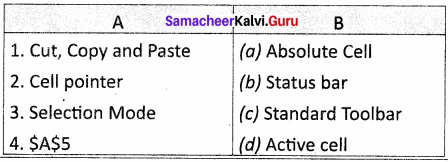
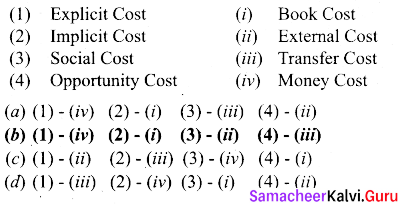
Match the following
Samacheer Kalvi 12th Computer Applications Solutions Chapter 16 Electronic Payment Systems
Answer:
(b) A1-B2, A2-B1, A3-B3, A4-B4

II. Short Answers

Question 1.
Define electronic payment system?
Answer:
The term electronic payment refers to a payment made from one bank account to another bank account using electronic methods forgoing the direct intervention of bank employees.

Samacheer Kalvi 12th Computer Applications Solutions Chapter 16 Electronic Payment Systems

Question 2.
Distinguish micro electronic payment and macro electronic payment?
Answer:
Micro Electronic Payment System:

  1. Payments of small system amount
  2. Less Security
  3. Eg. Subscriptions of online games

Macro Electronic Payment System:

  1. Payments of higher value
  2. Highly Secured
  3. Electronic account transfer

Samacheer Kalvi 12th Computer Applications Solutions Chapter 16 Electronic Payment Systems

Question 3.
List the types of micro electronic payments based on its algorithm?
Answer:

  1. Hash chain based micro electronic payment systems.
  2. Hash collisions and hash sequences based micro electronic payment systems.
  3. Shared secrete keys based micro electronic payment systems.
  4. Probability based micro electronic payment systems.

Question 4.
Explain the concept of e-wallet?
Answer:
Electronic wallets (e-wallets) or electronic purses allow users to make electronic transactions quickly and securely over the Internet through smartphones or computers.

Samacheer Kalvi 12th Computer Applications Solutions Chapter 16 Electronic Payment Systems

Question 5.
What is a fork in cryptocurrency?
Answer:
Many cryptocurrencies operate on the basis of the same source code, in which the authors make only a few minor changes in parameters like time, date, distribution of blocks, number of coins, etc. These currencies are called as fork. In fork, both cryptocurrencies can share a common transaction history in block chain until the split.

PART – III
III. Explain in Brief Answers

Question 1.
Define micro electronic payment and its role in E-Commerce?
Answer:

  1. It is an on-line payment system designed to allow efficient and frequent payments of small amounts.
  2. In order to keep transaction costs very low, the communication and computational costs are minimized here.
  3. The security of micro electronic payment systems is comparatively low
  4. The majority of micro electronic payment systems were designed to pay for simple goods on the Internet, e.g., subscriptions of online games, read journals, listen to a song or watch a movie online etc.

Samacheer Kalvi 12th Computer Applications Solutions Chapter 16 Electronic Payment Systems

Question 2.
Compare and contrast the credit card and debit card?
Answer:
Credit Card:
A credit card is different from a debit card where the credit card issuer lends money to customer instead of deducting it from customer’s bank account instantly.

Debit Card:
Credit card is an electronic payment system normally used for retail transactions. A credit card enables the bearer to buy goods or services from a vendor, based on the cardholder’s promise to the card issuer to payback the value later with an agreed interest.

Question 3.
Explain briefly Anatomy of a credit card?
Answer:
Publisher:
Emblem of the issuing bank

Credit card number:
The modem credit card number has 16-digit unique identification number.

Samacheer Kalvi 12th Computer Applications Solutions Chapter 16 Electronic Payment Systems

Question 4.
Briefly explain the stored value card and its types?
Answer:
(i) Closed loop (single purpose):
In closed loop cards, money is metaphorically stored on the card in the form of binary- coded data. e.g. chennai metro rail travel card.

(ii) Open loop (multipurpose):
It is also called as prepaid-debit cards, e.g. Visa gift cards.

Samacheer Kalvi 12th Computer Applications Solutions Chapter 16 Electronic Payment Systems

Question 5.
Write a note on mining in cryptocurrency?
Answer:
Mining:
The cryptocurrency units are created by the solution of cryptographic tasks called mining. The miners not only generate new monetary units, but also initiate new transactions to the blockchain. As a reward, they will receive new Bitcoins.

PART – IV
IV. Explain in detail

Question 1.
What is credit card? Explain the key players of a credit card payment system and bring out the merits of it?
Answer:
Credit Card:
Credit card is an electronic payment system normally used for retail transactions. A credit card enables the bearer to buy goods or services from a vendor, based on the cardholder’s promise to the card issuer to payback the value later with an agreed interest. Every credit card account has a purchase limit set by the issuing bank or the firm. A credit card is different from a debit card where the credit card issuer lends money to customer instead of deducting it from customer’s bank account instantly.

The term credit card was first mentioned in 1887 in the sci-fi novel “Looking Backward” by Edward Bellamy. The modem credit cards concept was bom in the U.S.A, in the 1920s, when private companies began to issue cards to enable their customers to purchase goods on credit within their own premises.

Advantages of credit card:

  1. Most credit cards are accepted worldwide.
  2. It is not necessary to pay physical money at the time of purchase. The customer gets an extra period to pay the purchase.
  3. Depending on the card, there is no need to pay annuity.
  4. Allows purchases over the Internet in installments.
  5. Some issuers allows “round up” the purchase price and pay the difference in cash to make the transactions easy.

Key players in operations of credit card:
1. Bearer:
The holder of the credit card account who is responsible for payment of invoices in full (transactor) or a portion of the balance (revolver) the rest accrues interest and carried forward.

2. Merchant:
Storekeeper or vendor who sell or providing service, receiving payment made by its customers through the credit card.

3. Acquirer:
Merchant’s bank that is responsible for receiving payment on behalf of merchant send authorization requests to the issuing bank through the appropriate channels.

4. Credit Card Network:
It acts as the intermediate between the banks. The Company responsible for communicating the transaction between the acquirer and the credit card issuer. These entities operate
the networks that process credit card payments worldwide and levy interchange fees. E.g. Visa, MasterCard, Rupay

5. Issuer:
Bearer’s bank, that issue the credit card, set limit of purchases, decides the approval – of transactions, issue invoices for payment, charges the holders in case of default and offer card-linked products such as insurance, additional cards and rewards plan.

Samacheer Kalvi 12th Computer Applications Solutions Chapter 16 Electronic Payment Systems

Question 2.
Briefly explain Electronic Account transfer and its types?
Answer:
With the advent of computers, network technologies and electronic communications a large number of alternative electronic payment systems have emerged. These include ECS (Electronic Clearing Services), EFT (Electronic funds transfers), Real Time Gross Settlement system (RTGS) etc.

1. Electronic Clearing Services (ECS):
Electronic Clearing Service can be defined as repeated transfer of funds from one bank account to multiple bank accounts or vice versa using computer and Internet technology. Advantages of this system are bulk payments, guaranteed payments and no need to remember payment dates. ECS can be used for both credit and debit purposes i.e. for making bulk payments or bulk collection of amounts.

2. ECS credit:
ECS credit is used for making bulk payment of amounts. In this mode, a single account is debited and multiple accounts are credited. This type of transactions are Push transactions. Example: if a company has to pay salary to its 100 employees it can use ECS credit system than crediting every employees’ account separately.

3. ECS debit:
ECS debit is an inverse of ECS credit. It is used for bulk collection of amounts. In this mode, multiple accounts are debited and then a single account is credited. This type of transactions are Pull transactions. Example: The insurance premium of bulk number of customers

4. Electronic Funds Transfer:
Electronic Funds Transfer (EFT) is the “electronic transfer” of money over an online network. The amount sent from the sender’s bank branch is credited to the receiver’s bank branch on the same day in batches.

5. Real Time Gross Settlement:
Real Time Gross Settlement system (RTGS) is a payment system particularly used for the settlement of transactions between financial institutions, especially banks.

Real-time gross settlement transactions are:

1. Unconditional – the beneficiary will receive funds regardless of whether he 242 fulfills his obligations to the buyer or whether he would deliver the goods or perform a service of a quality consistent with the order.

2. Irrevocable – a correctly processed transaction cannot be reversed and its money cannot get refunded (the so-called settlement finality).

Samacheer Kalvi 12th Computer Applications Solutions Chapter 16 Electronic Payment Systems

Question 3.
Write a note on
(a) Internet banking
(b) Mobile banking

(a) Internet banking:
Internet banking is a collective term for E-banking, online banking, virtual banking (operates only on the Internet with no physical branches), direct banks, web banking and remote banking. Internet banking allows customers of a financial institution to conduct various financial transactions on a secure website operated by the banking institutions. This is a very fast and convenient way of performing any banking transactions.

It enables customers of a bank to conduct a wide range of financial transactions through its website. In fact, it is like a branch exclusively operating of an individual customer. The online banking system will typically connect to the core banking system operated by customers themselves (Self-service banking).

Advantages:

  1. The advantages of Internet banking are that the payments are made at the convenience of the account holder and are secured by user name and password, i.e. with Internet access it can be used from anywhere in the world and at any time.
  2. Any standard browser (e.g. Google Chrome) is adequate. Internet banking does not need .installing any additional software.

(b) Mobile banking:
Mobile banking is another form of net banking. The term mobile banking (also called m-banking) refers to the services provided by the bank to the customer to conduct banking transactions with the aid of mobile phones. These transactions include balance checking, account transfers, payments, purchases, etc.

Transactions can be done at any time and anywhere. The WAP protocol installed on a mobile phone qualifies the device through an appropriate application for mobile session establishment with the bank’s website. In this way, the user has the option of permanent control over the account and remote management of his own finances. Mobile Banking operations can be implemented in the following ways:

  • Contacting the call center.
  • Automatic IVR telephone service.
  • Using a mobile phone via SMS.
  • WAP technology.
  • Using smartphone applications.

Samacheer Kalvi 12th Computer Applications Solutions Chapter 16 Electronic Payment Systems

Question 4.
What is cryptocurrency? Explain the same?
Answer:
Cryptocurrency:

  • People have always valued unique and irreplaceable things. A unique thing always has a demand and acclaims a price.
  • A cryptocurrency is a unique virtual (digital) asset designed to work as a medium of exchange using cryptographic algorithm.
  • This algorithm secures the transactions by recording it in blockchain and controls the creation of additional units of the currency.
  • Cryptocurrency is also called as cryptocoins, e-cash, alternative currencies or virtual currencies and are classified as a subset of digital currencies.
  • Cryptocurrency can be defined as distributed accounting system based on cryptography, storing information about the state of ownership in conventional units.
  • The state of ownership of a cryptocurrency is related to individual system blocks called “portfolios”.
  • Only the holder of the corresponding private key would have control over a given portfolio and it is impossible to issue the same unit twice.
  • The function of cryptocurrency is based on technologies such as Mining, Blockchain, Directed Acyclic Graph, Distributed register (ledger), etc. The information about the . transaction is usually not encrypted and is available in clear text.

Bitcoin:
Bitcoin is the most popular and the first decentralized cryptocurrency. Bitcoin is the most popular cryptocurrency, but there are many other cryptocurrencies, which are referred to as “altcoins”.

Altcoins:

  1. Altcoins is the collective name for all cryptocurrencies that appeared after Bitcoin. The early Altcoins Litecoin and Namecoin appeared in 2011.
  2. From 2014, the 2nd generation of cryptocurrency appeared, such as Monero, Ethereum and Nxt. These crypto-coins have advanced features such as hidden addresses and smart contracts.
  3. In terms of trade, the creation of cryptocurrencies may be related to the ICO (Initial Coin Offer) procedure.

Block chain:

  • Block chains are an open distributed book that records transactions of cryptocurrencies between any two parties in an efficient and verifiable manner.
  • It is a continuously growing list of records, called blocks, which are linked to each other and protected using encryption algorithm.
    Each block typically contains a hash pointer as a link to a previous block. It records data about every transaction with its date and time.
  • Once recorded, the data in any given block cannot be altered without the alteration of all subsequent blocks.

Samacheer Kalvi 12th Computer Applications Solutions Chapter 16 Electronic Payment Systems

Question 5.
Explain in detail: Unified payments interface?
Answer:
(i) Unified Payments Interface (UPI) is a real-time payment system developed by National Payments Corporation of India (NCPI) to facilitate inter-bank transactions.

(ii) It is simple, secure and instant payment facility. This interface is regulated by the Reserve Bank of India and used for transferring funds instantly between two bank accounts through mobile (platform) devices. http://www. npci.org.in/

(iii) Unlike traditional e-wallets, which take a specified amount of money from user and store it in its own account, UPI withdraws and deposits funds directly from the bank account whenever a transaction is requested.

(iv) It also provides the “peer to peer” collect request which can be scheduled and paid as per requirement and convenience.

(v) UPI is developed on the basis of Immediate Payment Service (IMPS). To initiate a transaction, UPI applications use two types of address – global and local.

  • Global address includes bank account numbers and IFSC.
  • Local address is a virtual payment address.

(vi) Virtual payment address (VPA) also called as UPI-ID, is a unique ID similar to email id
(e.g. name@bankname) enable us to send and receive money from multiple banks and prepaid payment issuers.

(vii) Bank or the financial institution allows the customer to generate VPA using phone number associated with Aadhaar number and bank account number. VPA replaces bank account details thereby completely hides critical information.
(Viii) The MPIN (Mobile banking Personal Identification number) is required to confirm each payment. UPI allows operating multiple bank accounts in a single mobile application.

(ix) Some UPI application also allows customers to initiate the transaction using only Aadhaar number in absence VPA.

Advantages:

  1. Immediate money transfers through mobile device round the clock 24 × 7.
  2. Can use single mobile application for accessing multiple bank accounts.
  3. Single Click Authentication for transferring of fund.
  4. It is not required to enter the details such as Card no, Account number, IFSC etc. for every transaction.
  5. Electronic payments will become much easier without requiring a digital wallet or credit or debit card.

Samacheer Kalvi 12th Computer Applications Electronic Payment Systems Additional Questions and Answers

I. Choose The Best Answer

Question 1.
An electronic payment system is also called as …………………….
(a) liquidation
(b) clearing system
(c) clearing services
(d) all of these
Answer:
(d) all of these

Samacheer Kalvi 12th Computer Applications Solutions Chapter 16 Electronic Payment Systems

Question 2.
The electronic payment systems are classified into …………………….. types
(a) 2
(b) 3
(c) 4
(d) 5
Answer:
(a) 2

Question 3.
I: Micro Electronic payments are expensive public key cryptography.
II: Security of Micro Electronic Payment is low
(a) t-True, II-False
(b) I-False, II-True
(c) Both I, II are true
(d) Both I, II-False
Answer:
(b) I-False, II-True

Question 4.
Pick the odd one out
(a) read journals
(b) listen to a song
(c) watch a movie online
(d) Internet payment systems
Answer:
(d) Internet payment systems

Samacheer Kalvi 12th Computer Applications Solutions Chapter 16 Electronic Payment Systems

Question 5.
…………………….. are plastic cards that enable cashless payments.
Answer:
Payment Cards

Question 6.
How many card based payment systems are available (based on the transaction settlement method)
(a) 2
(b) 3
(c) 4
(d) 5
Answer:
(b) 3

Samacheer Kalvi 12th Computer Applications Solutions Chapter 16 Electronic Payment Systems

Question 7.
How many micro electronic payments systems are there based on simple cryptographic algorithms?
(a) 2
(b) 3
(c) 4
(d) 5
Answer:
(c) 4

Question 8.
……………………… is an electronic payment system normally used for retail transactions.
Answer:
Credit Card

Question 9.
The term credit card was first mentioned in the novel by ……………………..
Answer:
Edward Beltamy

Samacheer Kalvi 12th Computer Applications Solutions Chapter 16 Electronic Payment Systems

Question 10.
The term credit card was first mentioned in the sci-fi novel ………………………
(a) Looking Backward
(b) Arrival
(c) Interstellar
(d) Altered States
Answer:
(a) Looking Backward

Question 11.
The term credit cad was first mentioned in the sci-fi normal in the year ………………………
(a) 1997
(b) 1887
(c) 1987
(d) 1897
Answer:
(b) 1887

Samacheer Kalvi 12th Computer Applications Solutions Chapter 16 Electronic Payment Systems

Question 12.
The plastic cards was introduced in the year ……………………..
(a) 1957
(b) 1597
(c) 1955
(d) 1855
Answer:
(c) 1955

Question 13.
Who created Diners Club Card?
(i) Frank McNamara
(ii) Ralph Schneider
(iii) Edward Bellamy
(a) (i), (iii)
(b) (ii), (iii)
(c) (i), (ii)
(d) (i), (ii), (iii)
Answer:
(c) (i), (ii)

Samacheer Kalvi 12th Computer Applications Solutions Chapter 16 Electronic Payment Systems

Question 14.
The Diners Club Card was created in the year …………………………
(a) 1950
(b) 1955
(c) 1960
(d) 1965
Answer:
(a) 1950

Question 15.
Initially the Diners Club Card was made of ……………………..
(a) paper-cardboard
(b) plastic
(c) wood
(d) metal
Answer:
(a) paper-cardboard

Samacheer Kalvi 12th Computer Applications Solutions Chapter 16 Electronic Payment Systems

Question 16.
(I) The Diners Club Card was accepted only in 25 restaurants (initially).
(II) From 1965, the card was made of plastic.
(a) I-True, II-False
(b) I-False, II-True
(c) I, II-both True
(d) I, II-both are false
Answer:
(d) I, II-both are false

Question 17.
How many key players are there in the operation of credit card?
(a) 2
(b) 3
(c) 4
(d) 5
Answer:
(d) 5

Samacheer Kalvi 12th Computer Applications Solutions Chapter 16 Electronic Payment Systems

Question 18.
The ……………………. is the holder of the credit card account.
Answer:
Bearer

Question 19.
……………………. Network acts as the Intermediate between the banks.
Answer:
Credit Card

Question 20.
The credit card limit, approval of transactions, default charges are issued by
(a) issuer
(b) Merchant
(c) Acquirer
(d) Bearer
Answer:
(a) issuer

Samacheer Kalvi 12th Computer Applications Solutions Chapter 16 Electronic Payment Systems

Question 21.
Match the following (description of payment cards)
(i) width – 1.2.88 mm – 3.48 mm
(ii) height – 2. 53.98 mm
(iii) radius – 3. 85.60 mm
(iv) thickness – 4.0.76 mm
(a) (i)-3, (ii)-2, (iii)-1, (iv)-4
(b) (i)-1, (ii)-2, (iii)-3, (iv)-4
(c) (i)-4, (ii)-2, (iii)-1, (iv)-3
(d) (i)-2, (ii)- 1, (iii)-4, (iv)-3
Answer:
(a) (i)-3, (ii)-2, (iii)-1, (iv)-4

Question 22.
The credit card number has ……………………. digit unique identification number
(a) 8
(b) 16
(c) 15
(d) 20
Answer:
(b) 16

Question 27.
EMV means ………………………
Answer:
europay, Mastercard, Visa

Samacheer Kalvi 12th Computer Applications Solutions Chapter 16 Electronic Payment Systems

Question 28.
EMV is categorized into ………………………
Answer:
chip and signature, chip and PIN

Question 29.
How many curved lines are there in RFID symbol?
(a) 4
(b) 8
(c) 12
(d) 16
Answer:
(a) 4

Question 30.
……………………. is Ipdian domestic open loop card.
Answer:
Rupay

Samacheer Kalvi 12th Computer Applications Solutions Chapter 16 Electronic Payment Systems

Question 31.
Rupay was launched in the year
(a) 2001
(b) 2003
(c) 2009
(d) 2012
Answer:
(d) 2012

Question 32.
Which is a credit card security feature to prevent duplication?
(a) logo
(b) Hologram
(c) signature
(d) CW
Answer:
(b) Hologram

Samacheer Kalvi 12th Computer Applications Solutions Chapter 16 Electronic Payment Systems

Question 33.
CVC/CW means ………………….
Answer:
Card Verification Code/ Value

Question 34.
Which is used in contact less transactions.
(a) CVC2
(b) EMV
(c) RFID
(d) PIN
Answer:
(a) CVC2

Question 35.
……………………… is a 3 digit code printed to the left of signature pane to validate the card.
Answer:
CVC/CVV

Samacheer Kalvi 12th Computer Applications Solutions Chapter 16 Electronic Payment Systems

Question 36.
How many ways of processing debit card transactions are there?
(a) 2
(b) 3
(c) 4
(d) 5
Answer:
(b) 3

Question 37.
Which card is an electronic payment card where the transaction amount is deducted from the card holders Bank account?
(a) Credit card
(b) Debit card
(c) Smart card
(d) Paytm card
Answer:
(b) Debit card

Question 38.
Which is also known as online debit or PIN debit?
(a) EFTPOS
(b) POSEFT
(c) FETPOS
(d) FETSOP
Answer:
(a) EFTPOS

Samacheer Kalvi 12th Computer Applications Solutions Chapter 16 Electronic Payment Systems

Question 39.
……………………. is a type of debit card that is preloaded with certain amount.
Answer:
Stored value card

Question 40.
Which is true regarding stored value cards?
(i) It has default monetary value onto it.
(ii) The card may be disposed when the value is used.
(iii) It is used to make offline purchases
(a) (i), (ii), (iii)
(b) (ii), (iii)
(c) (i), (ii)
(d) (iii) alone
Answer:
(a) (i), (ii), (iii)

Samacheer Kalvi 12th Computer Applications Solutions Chapter 16 Electronic Payment Systems

Question 41.
How many varieties of stored value card are there?
(a) 2
(b) 3
(c) 4
(d) 5
Answer:
(a) 2

Question 42.
Pick the odd one out.
(a) closed loop cards
(b) open loop cards
(c) prepaid-debit cards
(d) visa gift cards
Answer:
(a) closed loop cards

Samacheer Kalvi 12th Computer Applications Solutions Chapter 16 Electronic Payment Systems

Question 43.
In which of the following cards in binary coded metaphorically stored on the card in binary coded data form?
(a) open loop cards
(b) prepaid-debit cards
(c) closed loop cards
(d) visa gift cards
Answer:
(c) closed loop cards

Question 44.
Which of the following is not the advantage of smart cards?
(a) Identification
(b) RFID
(c) datastorage
(d) application processing
Answer:
(b) RFID

Samacheer Kalvi 12th Computer Applications Solutions Chapter 16 Electronic Payment Systems

Question 45.
Smart cards are classified into ……………………. types.
(a) 2
(b) 3
(c) 4
(d) 5
Answer:
(a) 2

Question 46.
The two classifications of smart cards are ……………………… and ………………….. smart cards.
Answer:
contact and contactless

Question 47.
POS stands for ………………………
Answer:
Point of Sale

Question 48.
Contact smart cards have a contact area of approximately ……………………….
(a) 1 cms2
(b) 10 cms2
(c) 1 mm2
(d) 1 hectares
Answer:
(a) 1 cms2

Samacheer Kalvi 12th Computer Applications Solutions Chapter 16 Electronic Payment Systems

Question 49.
Find the statements which is not true?
(I) contact smart cards uses RF induction Technology
(II) smarts have Internal power Source
(III) Inductor is used to capture radio-frequency signal
(a) I, II
(b) II, III
(c) I, II
(d) III
Answer:
(c) I, II

Question 50.
Which technology is used in contactless smart cards.
(a) UV Induction
(b) RF Induction
(c) RFID
(d) IRID
Answer:
(b) RF Induction

Samacheer Kalvi 12th Computer Applications Solutions Chapter 16 Electronic Payment Systems

Question 51.
EFT means ………………………
Answer:
Electronic Funds Transfers

Question 52.
RTGS means …………………….
Answer:
Real Time Gross Settlement System

Question 53.
ECS ………………….. is used for making bulk payment of amounts.
Answer:
credit

Samacheer Kalvi 12th Computer Applications Solutions Chapter 16 Electronic Payment Systems

Question 54.
ECS ………………….. is used for bulk collection of amounts.
Answer:
debit

Question 55.
Identify the wrongly matched pair.
(a) EFPOS – PIN debit
(b) Offline debit – Signature debit
(c) ECS credit – Push transactions
(d) ECS debit – Pull transactions
Answer:
(a) EFPOS – PIN debit

Question 56.
EFT means
(a) National Electronic Fund Transactions
(b) National Electronic Fund Transfer
(c) National Electronic Finance Technology
(d) National Electronic Financial Transactions
Answer:
(b) National Electronic Fund Transfer

Samacheer Kalvi 12th Computer Applications Solutions Chapter 16 Electronic Payment Systems

Question 57.
RBI means ……………………..
Answer:
Reserve Bank of India

Question 58.
IDRBT stands for ……………………
Answer:
Institute for Development and Research in Banking Technology

Question 59.
NEFT initiated in the year ……………………..
(a) 2001
(b) 2003
(c) 2005
(d) 2009
Answer:
(c) 2005

Samacheer Kalvi 12th Computer Applications Solutions Chapter 16 Electronic Payment Systems

Question 60.
Which one of the following enables bank customer to transfer funds between any two banks?
(a) EFT
(b) NEFT
(c) EMI
(d) ECS
Answer:
(b) NEFT

Question 61.
…………………… payments are generally large-value payments
Answer:
RTGS

Question 62.
…………………… is the electronic transfer of money over an online network
Answer:
EFT

Question 63.
Which one of the following is the currency that flows in the form of data?
(a) RTGS
(b) EFT
(c) ECS
(d) E-cash
Answer:
(d) E-cash

Samacheer Kalvi 12th Computer Applications Solutions Chapter 16 Electronic Payment Systems

Question 64.
Cryptocurrency is also called as …………………..
(a) Cryptocoins
(b) e-cahs
(c) virtual currencies
(d) all of these
Answer:
(d) all of these

Question 65.
The state of ownership of a cryptocurrency is related to individual system blocks called ………………………
(a) portfolios
(b) virtual asset
(c) erytography
(d) none of these
Answer:
(a) portfolios

Samacheer Kalvi 12th Computer Applications Solutions Chapter 16 Electronic Payment Systems

Question 66.
What are the technologies used in cryptocurrency?
(a) Mining
(b) block chain
(c) Directed Acyclic Graph
(d) All of these
Answer:
(d) All of these

Question 67.
The first form of cryptocurrency is ……………………….
(a) Digicash
(b) D-cash
(c) E-cash
(d) Crypto cash
Answer:
(a) Digicash

Question 68.
“Digicash” was invented by …………………….
Answer:
David Chaum

Question 69.
Digicash was invented in the year ………………………
(a) 1978
(b) 1980
(c) 1985
(d) 1989
Answer:
(d) 1989

Samacheer Kalvi 12th Computer Applications Solutions Chapter 16 Electronic Payment Systems

Question 70.
Identify the wrongly matched pair.
(a) Digicash- 1989
(b) Bitcoin- 2009
(c) SHA-254-crytographic Hash function
(d) Altcoin – 2011
Answer:
(c) SHA-254-crytographic Hash function

Question 71.
Which is the most popular and the first decentralized cryptocurrency?
(a) Digicash
(b) Bitcoin
(c) Altcoins
(d) block chain
Answer:
(b) Bitcoin

Question 72.
Bitcoin payment system was developed under the pseudonym ……………………….
Answer:
Satosi Nakamoto

Samacheer Kalvi 12th Computer Applications Solutions Chapter 16 Electronic Payment Systems

Question 73.
………………….. was developed to build alternative root DNS servers.
Answer:
Namecoin

Question 74.
Which cryptocurrency has a higher transaction rate?
(a) Altcoin
(b) Litecoin
(c) Bitcoin
(d) Namecoin
Answer:
(b) Litecoin

Question 75.
Making few minor changes in the parameters of cryptocurrency is called ………………………..
(a) altoin
(b) Block
(c) Blockchain
(d) Fork
Answer:
(d) Fork

Samacheer Kalvi 12th Computer Applications Solutions Chapter 16 Electronic Payment Systems

Question 76.
As the value of altcoins becomes ………………….. it is considered as dead.
(a) Null
(b) 0
(c) infinity
(d) negative
Answer:
(b) 0

Question 77.
Pick the odd one out.
(a) Bitshares
(b) Mastercoin
(c) Ripple
(d) Nxt
Answer:
(c) Ripple

Question 78.
Pick the odd one out.
(a) Monera
(b) Nxt
(c) Ethereum
(d) Mastercoin
Answer:
(d) Mastercoin

Samacheer Kalvi 12th Computer Applications Solutions Chapter 16 Electronic Payment Systems

Question 79.
The Cryptocurrency units are created by the solution of cryptographic tasks called ………………………..
(a) mining
(b) Block chain
(c) Hash
(d) Brick and Mortar
Answer:
(a) mining

Question 80.
Find the statements which are not true.
(i) The miners generate new monetary units
(ii) Miners doesh’t initiate new transactions
(iii) Miners receive new Bitcoins
(a) (i)
(b) (iii)
(c) (ii)
(d) All are true
Answer:
(c) (ii)

Question 81.
ICO means ……………………….
Answer:
Intial coin offer

Samacheer Kalvi 12th Computer Applications Solutions Chapter 16 Electronic Payment Systems

Question 82.
Which one of the following are an open distributed book that records transactions of crypto currencies?
(a) mining
(b) e-wallets
(c) ICO
(d) Block chains
Answer:
(d) Block chains

Question 83.
Each block in the block chain contains ………………….. pointer
(a) dash
(b) hash
(c) memory
(d) link
Answer:
(b) hash

Samacheer Kalvi 12th Computer Applications Solutions Chapter 16 Electronic Payment Systems

Question 84.
Which one of the following is an electronic wallet services?
(a) paypal
(b) block chain
(c) mining
(d) hash
Answer:
(a) paypal

Question 85.
The term mobile banking is also called ………………………
Answer:
m-banking

Question 86.
……………………. operates only on the Internet with no physical branches.
Answer:
virtual banking

Question 87.
OTP means ……………………….
Answer:
One-Time Password

Question 88.
PJN means ……………………
Answer:
Personal Identification Number

Samacheer Kalvi 12th Computer Applications Solutions Chapter 16 Electronic Payment Systems

Question 89.
ACHmeans …………………….
Answer:
Automated Clearing Home

Question 90.
IFSC stands for ……………………
Answer:
Indian Financial System Code

Question 91.
……………………… is an 11 digit alpha-numeric code issued Reserve Bank of India
(a) IIT
(b) IIM
(c) IFSC
(d) IFCS
Answer:
(c) IFSC

Question 92.
UPI means ………………………
Answer:
Unified Payments

Samacheer Kalvi 12th Computer Applications Solutions Chapter 16 Electronic Payment Systems

Question 93.
NCPI means …………………..
Answer:
National Payments Corporation of India

Question 94.
Unified Payments Interface is a real time payment system developed by NCPI to facilitate inter-bank transactions.
Answer:
Unified Payments Interface

Question 95.
IMPS stands for ………………………
Answer:
Immediate Payment Service

Question 96.
UPI applications …………………………. types of address.
(a) 2
(b) 3
(c) 4
(d) 5
Answer:
(a) 2

Samacheer Kalvi 12th Computer Applications Solutions Chapter 16 Electronic Payment Systems

Question 97.
UPI applications are classified into two types of addresses like …………………….. and ……………………
Answer:
global and local

Question 98.
Which address in UPI is a virtual payment address?
(a) Global
(b) local
(c) private
(d) public
Answer:
(b) local

Question 99.
………………… also called as UPI-ID.
Answer:
Virtual Payment Address(VPA)

Question 100.
MPIN means ……………………..
Answer:
Mobile Banking Personal Identification Number

Samacheer Kalvi 12th Computer Applications Solutions Chapter 16 Electronic Payment Systems

Question 101.
USSD means …………………..
Answer:
Unstructured Supplementary Service Data

Question 102.
COD means …………………..
Answer:
Cash on Delivery

Question 103.
BHIM stands for …………………….
Answer:
Bharat Interface for Money

Question 104.
NPCI means …………………….
Answer:
National Payments Corporation of India

Question 105.
BHIM is an exclusive mobile app for UPI developed by ……………………..
(a) 2014
(b) 2015
(c) 2016
(d) 2017
Answer:
(c) 2016

Samacheer Kalvi 12th Computer Applications Solutions Chapter 16 Electronic Payment Systems

Question 106.
……………………. is a type of fraud where same cryptocurrency is spent in more than one transactions.
Answer:
Double Spend

Question 107.
RThs are …………………. and ……………………
Answer:
Unconditional, Irrevocable

II. Short Answer

Question 1.
Write note on payment cards?
Answer:
Payment cards are plastic cards that enable cashless payments. They are simple embossed plastic card that authenticates the card holder on behalf of card issuing company, which allows the user to make use of various financial services.

Samacheer Kalvi 12th Computer Applications Solutions Chapter 16 Electronic Payment Systems

Question 2.
Give some examples for macro online payment systems?
Answer:
Some of the popular macro on-line payment systems are mentioned below:

  1. Card based payment systems
  2. Electronic account transfer
  3. Electronic cash payment systems
  4. Mobile payment systems and internet payment systems

Question 3.
Write note on E-cash?
Answer:
Electronic cash is (E-Cash) is a currency that flows in the form of data. It converts the cash value into a series of encrypted sequence numbers, and uses these serial numbers to represent the market value of various currencies in reality.

Samacheer Kalvi 12th Computer Applications Solutions Chapter 16 Electronic Payment Systems

Question 4.
Mention the advantages of UPI?
Answer:

  1. Immediate money transfers through mobile device round the clock 24 × 7.
  2. Can use single mobile application for accessing multiple bank accounts,
  3. Single Click Authentication for transferring of fund.
  4. It is not required to enter the details such as Card no, Account number, IFSC etc. for every transaction.
  5. Electronic payments will become much easier without requiring a digital wallet or credit or debit card.

Question 5.
Define COD?
Answer:
Cash on delivery (COD) also called as collection on delivery, describes a mode of payment in which the payment is made only on receipt of goods rather in advance.

Samacheer Kalvi 12th Computer Applications Solutions Chapter 16 Electronic Payment Systems

Question 6.
Define BHIM?
Answer:
Bharat Interface for Money (BHIM) is an exclusive mobile app for UPI developed by National Payments Corporation of India (NPCI) and launched on 30 December 2016. It is intended to facilitate e-payments directly through banks and drive towards cashless transactions.

III. Explain in Brief Answer

Question 1.
How will you do the Micro electronic payment transactions?
Answer:
In general, the parties involved in the micro on-line payments are Customer, Service Provider and Payment processor. The Micro electronic payment transactions can be explained in the following way.

Step 1:
Customer proves his authentication and the payment processor issues micro payments.

Step 2:
Customer pays the micro payments to the online service provider and gets the requested goods or services form them.

Step 3:
Service provider deposits micro payments received from the customer to the payment processor and gets the money.

Samacheer Kalvi 12th Computer Applications Solutions Chapter 16 Electronic Payment Systems

Question 2.
Mention the three types of card based payment systems?
Answer:
Based on the transaction settlement method there are three widely used card based payment systems. They are:

  1. Credit card based payment systems (pay later)
  2. Debit card based payment systems (pay now)
  3. Stored value card based payment systems (pay before)

Question 3.
Mention the advantages of credit card?
Answer:
Advantages of credit card:

  1. Most credit cards are accepted worldwide.
  2. It is not necessary to pay physical money at the time of purchase. The customer gets an extra period to pay the purchase.
  3. Depending on the card, there is no need to pay annuity.
  4. Allows purchases over the Internet in installments.
  5. Some issuers allows “round up” the purchase price and pay the difference in cash to make the transactions easy.

Samacheer Kalvi 12th Computer Applications Solutions Chapter 16 Electronic Payment Systems

Question 4.
Write note on ‘The Diner Club Card’?
Answer:
In February 1950, Frank McNamara and Ralph Schneider created The Diners Club card which was made of paper-cardboard. Initially The card was accepted in only 27 restaurants From 1955, the card was made of plastic. The Diners Club still exists today under the name Diners Club International.

Question 5.
Write note on Anatomy of a Credit Card?
Answer:
All Payment cards (including debit card) are usually plastic cards of size 85.60 mm width x 53.98 mm height, rounded comers with a radius of 2.88 mm to 3.48 mm and thickness of 0.76 mm.

Question 6.
Write note on Credit Card number?
Answer:
Credit card number:
The modem credit card number has 16-digit unique identification number.

Samacheer Kalvi 12th Computer Applications Solutions Chapter 16 Electronic Payment Systems

Question 7.
Mention the three ways of processing debit card transactions?
Answer:
There are three ways of processing debit card transactions:

  1. EFTPOS (also known as online debit or PIN debit)
  2. Offline debit (also known as signature debit)
  3. Electronic Purse Card System

Question 8.
Mention the major advantage of stored value card?
Answer:
The major advantage of stored value card is that customers don’t need to have a bank account to get prepaid cards.

Samacheer Kalvi 12th Computer Applications Solutions Chapter 16 Electronic Payment Systems

Question 9.
Write note on Smart Card?
Answer:
Smart cards along with the regular features of any card based payment system holds a EMV chip. This chip is similar to well-known sim card in appearance.

Question 10.
Mention the advantages of Smart Cards?
Answer:
The advantage of Smart cards is that it can provide identification, authentication, data storage and application processing.

Question 11.
Write note on ECS debit?
Answer:
ECS debit:
ECS debit is an inverse of ECS credit. It is used for bulk collection of amounts. In this mode, multiple accounts are debited and then a single account is credited. This type of transactions are Pull transactions. Example: The insurance premium of bulk number of customers.

Samacheer Kalvi 12th Computer Applications Solutions Chapter 16 Electronic Payment Systems

Question 12.
Write note on NEFT?
Answer:
(NEFT) is an electronic funds transfer system initiated by the Reserve Bank of India (RBI) in – November 2005. NEFT enables a bank customer to transfer funds between any two NEFT- enabled bank accounts on a one-to-one basis. It is done via electronic messages.

Question 13.
Give the two types of Real-time gross settlement transactions?
Answer:
Real-time gross settlement transactions are:
Unconditional – the beneficiary will receive funds regardless of whether he fulfills his obligations to the buyer or whether he would deliver the goods or perform a service of a quality consistent with the order.

Irrevocable – a correctly processed transaction cannot be reversed and its money cannot get refunded (the so-called settlement finality).

Samacheer Kalvi 12th Computer Applications Solutions Chapter 16 Electronic Payment Systems

Question 14.
How are the Mobile Banking operations implemented?
Answer:
Mobile Banking operations can be implemented in the following ways:

  1. Contacting the call center.
  2. Automatic IVR telephone service.
  3. Using a mobile phone via SMS.
  4. WAP technology
  5. Using smartphone applications.

Question 15.
Mention advantages of Internet Banking?
Answer:
1. The advantages of Internet banking are that the payments are made at the convenience of the account holder and are secured by user name and password, i.e. with Internet access it can be used from anywhere in the world and at any time.

2. Any standard browser (e.g. Google Chrome) is adequate. Internet banking does not need installing any additional software.

Samacheer Kalvi 12th Computer Applications Solutions Chapter 16 Electronic Payment Systems

Question 16.
Explain the two types of addresses in UPI applications?
Answer:
UPI applications use two types of address – global and local.

  1. Global address includes bank account numbers and IFSC.
  2. Local address is a virtual payment address.

IV. Explain in detail

Question 1.
Explain Debit Card?
Answer:
Debit Card:
Debit Card is an electronic payment card where the transaction amount is deducted directly from the card holder’s bank account upon authorization.

Generally, debit cards function as ATM cards and act as a substitute for cash The way of using debit cards and credit cards is generally the same but unlike credit cards, payments using a debit card are immediately transferred from the cardholder’s designated bank account, instead of them paying the money back at a later with added interest. In modem era the use of debit cards has become so widespread’.

The debit card and credit card are identical in their physical properties. It is difficult to differentiate two by their appearance unless they have the term credit or debit imprinted. Currently there are three ways of processing debit card transactions:

  1. EFTPOS (also known as online debit or PIN debit)
  2. Offline debit (also known as signature debit)
  3. Electronic Purse Card System 2. Explain Smart

Samacheer Kalvi 12th Computer Applications Solutions Chapter 16 Electronic Payment Systems

Question 2.
Explain Smart Card?
Answer:
Smart card:
The modem version of card based payment is smart cards. Smart cards along with the regular features of any card based payment system holds a EMV chip.

This chip is similar to well-known sim card in appearance but differ in its functionalities. The advantage of Smart cards is that it can provide identification, authentication, data storage and application processing. Smart cards can be classified into Contact smart cards and Contactless smart, Contact Smart card & POS cards.

Samacheer Kalvi 12th Computer Applications Solutions Chapter 16 Electronic Payment Systems

(i) Contact smart cards:
Contact smart cards have a contact area of approximately 1 square centimeter, comprising several gold – plated contact pads. These pads provide electrical connectivity only when inserted into a reader, which is also used as a communications medium between the smart card and a host. e.g. a point of sale terminal(POS).

(ii) Contactless smart cards:
Contactless smart card is empowered by RF induction technology. Unlike contact smart cards, these cards require only near proximity to an antenna to communicate. Smart cards, whether they are contact or contactless cards do not have an internal power source. Instead, they use an inductor to capture some of the interrupting radio-frequency signal, rectify it and power the card’s processes.

Samacheer Kalvi 12th Computer Applications Solutions Chapter 15 E-Commerce

Students can Download Computer Applications Chapter 15 E-Commerce Questions and Answers, Notes Pdf, Samacheer Kalvi 12th Computer Applications Book Solutions Guide Pdf helps you to revise the complete Tamilnadu State Board New Syllabus and score more marks in your examinations.

Tamilnadu Samacheer Kalvi 12th Computer Applications Solutions Chapter 15 E-Commerce

Samacheer Kalvi 12th Computer Applications E-Commerce Text Book Back Questions and Answers

PART – I
I. Choose The Correct Answer

Question 1.
A company can be called E-Business if
(a) it has many branches across the world.
(b) it conduct business electronically over the Internet.
(c) it sells commodities to a foreign country.
(d) it has many employees.
Answer:
(b) it conduct business electronically over the Internet.

Samacheer Kalvi 12th Computer Applications Solutions Chapter 15 E-Commerce

Question 2.
Which of the following is not a tangible good?
(a) Mobile
(b) Mobile Apps
(c) Medicine
(d) Flower bouquet
Answer:
(b) Mobile Apps

Question 3.
SME stands for
(a) Small and medium sized enterprises
(b) Simple and medium enterprises .
(c) Sound messaging enterprises
(d) Short messaging enterprises
Answer:
(a) Small and medium sized enterprises

Samacheer Kalvi 12th Computer Applications Solutions Chapter 15 E-Commerce

Question 4.
The dotcom phenomenon deals with
(a) Textile industries
(b) Mobile phone companies
(c) Internet based companies
(d) All the above
Answer:
(c) Internet based companies

Question 5.
Which of the following is not correctly matched.
(a) The First Wave of Electronic Commerce: 1985-1990
(b) The Second Wave of Electronic Commerce: 2004 – 2009
(c) The Third Wave of Electronic Commerce: 2010 – Present
(d) Dotcom burst: 2000 – 2002
Answer:
(a) The First Wave of Electronic Commerce: 1985-1990

Samacheer Kalvi 12th Computer Applications Solutions Chapter 15 E-Commerce

Question 6.
Assertion (A): The websites of first wave dotcom companies were only in English
Reason (R): The dotcom companies of first wave are mostly American companies.
(a) Both (A) and (R) are correct and (R) is the correct explanation of (A)
(b) Both (A) and (R) are correct, but (R) is not the correct explanation of (A)
(c) (A) is true and (R) is false
(d) (A) is false and (R) is true
Answer:
(a) Both (A) and (R) are correct and (R) is the correct explanation of (A)

Question 7.
Off-shoring means
(a) Work outsourced to a branch of its own company
(b) Work outsourced to new employees
(c) Work outsourced to a third party locally
(d) Work outsourced to a third party outside its own country
Answer:
(b) Work outsourced to new employees

Samacheer Kalvi 12th Computer Applications Solutions Chapter 15 E-Commerce

Question 8.
G2G systems are classified into
(a) International facing and external facing
(b) Internet facing and Extranet facing
(c) Internal flag and external flag
(d) Internet flag and Extranet flag
Answer:
(a) International facing and external facing

Question 9.
……………………. host the e-books on their websites.
(a) Bulk-buying sites
(b) Community sites
(c) Digital publishing sites
(d) Licensing sites
Answer:
(c) Digital publishing sites

Samacheer Kalvi 12th Computer Applications Solutions Chapter 15 E-Commerce

Question 10.
Which of the following is not a characteristics of E-Commerce?
(a) Products cannot be inspected physically before purchase.
(b) Goods are delivered instantly.
(c) Resource focus supply side
(d) Scope of business is global.
Answer:
(c) Resource focus supply side

PART – II
II. Short Answer

Question 1.
Define E-Commerce?
Answer:
E-Commerce can be described as the process of buying or selling products, services or information via computer networks.

Samacheer Kalvi 12th Computer Applications Solutions Chapter 15 E-Commerce

Question 2.
Distinguish between E-Business and E-Commerce?
Answer:
E-Business:
E-Business is grounded on technologies such as Network Infrastructures (like Internet, Intranet, Extranet), Multimedia content & network publishing infrastructures (like HTML), Messaging & information distribution infrastructures (e-mail), and other Common business service infrastructures (Online Transaction Processing).

E-Commerce:
E-Commerce is commercial transaction through Internet, but E-Business entirely depends on the Internet for its every intra-company and inter-company activities such as marketing, fiance, manufacturing, selling.

Samacheer Kalvi 12th Computer Applications Solutions Chapter 15 E-Commerce

Question 3.
Differentiate tangible goods and electronic goods with example of your own?
Answer:
Tangible goods:
Tangible form – e.g. a digital camera purchased by a consumer from an online. shopping website which might be delivered at the requested address.

Electronic goods:
Electronic form – e.g. a music album or a software downloaded from a site which might be delivered in electronic form.

Question 4.
What is dotcom bubble and dotcom burst?
Answer:
Dotcom Bubble:
1. The Dotcom Bubble was a historic excessive growth (excessive assumption) of economy that occurred roughly between 1995 and 2000.

2. During the dotcom bubble, the value of equity markets grew exponentially with the NASDAQ composite index of US stock market rising from under 1000 points to more than 5000 points.
Dotcom Burst

3. The Nasdaq-Composite stock market index, fell from 5046.86 to 1114.11. This is infamously, known as the Dotcom Crash or Dotcom Burst.

4. This began on March 11,2000 and lasted until October 9,2002. During the crash, thousands of online shopping companies, like as Pets.com failed and shut down.

Samacheer Kalvi 12th Computer Applications Solutions Chapter 15 E-Commerce

Question 5.
Write a short note on out-sourcing?
Answer:
Out-sourcing are generally associated with B2B E-Commerce. If a company’s work is hired to another company, it would be termed as out-sourcing.

PART – III
Explain in Brief Answer

Question 1.
Describe how E-Commerce is related to socio-technological changes?
Answer:
Growth of E-Commerce is also related to the socio-technological changes. The more, the medium becomes deep-rooted, the more, are the users drawn towards it. Increase of users, increases the markets. As the markets expand, more business organizations are attracted. The more businesses accumulate it create competition. The competition leads to innovation; innovation in turn drives the development of technology; technology facilitates E-Commerce’s growth.

Samacheer Kalvi 12th Computer Applications Solutions Chapter 15 E-Commerce

Question 2.
Write a short note on the third wave of E-Commerce?
Answer:
The Third Wave of Electronic Commerce: 2010 – Present
1. The third wave is brought on by the mobile technologies. It connects users via mobile devices for real-time and on-demand transactions, mobile technologies.

2. It connects users via mobile devices for real-time and on-demand transactions.

3. Not only the information is filtered by time, but also the geographic coordinates are used to screen the specific location-tailored information properly.

4. The term Web 3.0, summarize the various characteristics of the future Internet which include Artificial Intelligence, Semantic Web, Generic Database etc.

Samacheer Kalvi 12th Computer Applications Solutions Chapter 15 E-Commerce

Question 3.
Explain B2B module in E-Commerce?
Business to Business (B2B)
Answer:
In B2B E-Commerce, commercial transactions take place between different business organizations, through the Internet. For example, a cycle company may buy tyres from another company for their cycles. When compared to other models, the value per transaction in B2B transaction is high, because of bulk purchases. The company also might get the advantage of discounts on bulk purchases.
Out-sourcing and Off-shoring are generally associated with B2B E-Commerce.

  1. If a company’s work is hired to another company, it would be termed as out-sourcing.
  2. If the work is outsourced to a company, which is outside of its own country, is termed as off-shoring.

Samacheer Kalvi 12th Computer Applications Solutions Chapter 15 E-Commerce

Question 4.
Write a note on name-your-price websites?
Answer:
Name-your-price sites are just like normal retail sites. In contrast, the buyer negotiates with the retailer for a particular product or service, https://in.hotels.com/

Question 5.
Write a note on physical product dispute of E-Commerce?
Answer:
Physical product disputes are a major disadvantage in E-Commerce. E-Commerce purchases are often made on trust. This is because, we do not have physical access to the product. Through Internet is an effective channel for visual and auditory information it does not allow full scope for our senses.

We can see pictures of the perfumes, but could not smell their fragrance; we can see pictures of a cloth, but not its quality. If we want to inspect something, we choose what we look at and how we look at it. But in online shopping, we would see only the pictures the seller had chosen for us. People are often much more comfortable in buying the generic goods (that they have seen or experienced before and in which there is little ambiguity) rather than unique or complex things via the Internet.

PART – IV
IV. Explain in detail

Question 1.
Write about the development and growth of Electronic Commerce?
Answer:
The Development and Growth of Electronic Commerce:
Economists describe four distinct waves (or phases) that occurred in the Industrial Revolution. In each wave, different business strategies were successful. Electronic commerce and the information revolution brought about by the Internet likely go through such series of waves.

The First Wave of Electronic Commerce: 1995 -2003
(i) The Dotcom companies of first wave are mostly American companies. Thereby their websites were only in English. The Dotcom bubble had attracted huge investments to first wave companies.

(ii)As the Internet was mere read-only web (web 1.0) and network technology was in its beginning stage, the bandwidth and network security was very low.

(iii) Only EDI and unstructured E-mail remained as a mode of information exchange between businesses.

(iv) But the first wave companies enjoyed the first-move advantage and customers had left with no options.

The Second Wave of Electronic Commerce: 2004 – 2009

(i) The second wave is the rebirth of E-Commerce after the dotcom burst. The second wave is considered as the global wave, with sellers doing business in many countries and in many languages.

(ii) Language translation and currency conversion were focused in the second wave websites.
(iii) The second wave companies used their own internal funds and gradually expanded their E-Commerce opportunities.

(iv) As a result E-Commerce grows more steadily, though more slowly. The rapid development of network technologies and interactive web (web 2.0, a period of social media) offered the consumers more choices of buying. The increased web users nourished E-Commerce companies (mostly B2C companies) during the second wave.

The Third Wave of Electronic Commerce: 2010 – Present

(i) The third wave is brought on by the mobile technologies. It connects users via mobile devices for real-time and on-demand transactions, mobile technologies.

(ii) It connects users via mobile devices for real-time and on-demand transactions. Not only the information is filtered by time, but also the geographic coordinates are used to screen the specific location-tailored information properly.

(iii) The term Web 3.0, summarize the various characteristics of the future Internet which include Artificial Intelligence, Semantic Web. Generic Database etc.

Samacheer Kalvi 12th Computer Applications Solutions Chapter 15 E-Commerce

Question 2.
List all the E-Commerce business models and explain any four briefly?
Answer:
Classification of E-Commerce Business models:
Business organizations, Consumers and Government (also called as Administrations) are the major parties in the E-Commerce. Sometimes Employees (Informal workers) also indulge in this system. Based upon the entities involved in transaction, E-Commerce has been classified into the following typical categories. The model in which the government plays as an entity is termed as e- Governance.
Samacheer Kalvi 12th Computer Applications Solutions Chapter 15 E-Commerce img 1

  1. Business to Business (B2B)
  2. Business to Consumer (B2C)
  3. Business to Government (B2G)
  4. Consumer to Business (C2B)
  5. Consumer to Consumer (C2C)
  6. Consumer to Government (C2G)
  7. Government to Business (G2B)
  8. Government to Consumer (G2C)
  9. Government to Government (G2G)

1. Business to Business (B2B):
In B2B E-Commerce, commercial transactions take place between different business organizations, through the Internet. For example, a cycle company may buy tyres from another company for their cycles. When compared to other models, the value per transaction in B2B transaction is high, because of bulk purchases. The company also might get the advantage of discounts on bulk purchases.

Out-sourcing and Off-shoring are generally associated with B2B E-Commerce.

  1. If a company’s work is hired to another company, it would be termed as out-sourcing.
  2. If the work is outsourced to a company, which is outside of its own country, is termed as off-shoring.

Samacheer Kalvi 12th Computer Applications Solutions Chapter 15 E-Commerce img 2

2. Business to Consumer (B2C):
In B2C E-Commerce, commercial transactions take place between business firms and their consumers. It is the direct trade between companies and end-consumers via the Internet. B2C companies sell goods, information or services to customers through online in a more personalized dynamic environment and is considered as real competitor for a traditional storekeeper. An example of B2C transaction is a book company selling books to customers. This mode is intended to benefit the consumer and can say B2C E-Commerce works as ’retail store’ over Internet.
Samacheer Kalvi 12th Computer Applications Solutions Chapter 15 E-Commerce img 3

3. Business to Government (B2G):
B2G is a business model that refers to business organizations sells products, services or information to Governments or to its administrations. In other words, when a company get paid for its goods, services by the Government through Internet it is called as B2G model. B2G networks models provide a way for businesses to bid on Government projects or products those Governments might need for their organizations, e.g. A Government or its administration buys laptops for students from a business.
Samacheer Kalvi 12th Computer Applications Solutions Chapter 15 E-Commerce img 4

4. Consumer to Business (C2B):
C2B can be described as a form of E-Commerce where, the transaction is originated by the consumers. The consumers will fix a set of requirements or specific price for a service or a commodity. C2B model, is also called as reverse auction model. Here, customer bid his price for a service or a product. Then E-Commerce business entity will match the requirements of the consumers to the best possible extent.

For instance, in a travel website (eg. yatra.com) a consumer may specify his dates of trayel, his source and destination, number of tickets required and range of hotel etc. The website then finds out the various options for him which best meets his requirements. These websites generate revenue through affiliate links, sponsored advertisement or even a small commission in every booking, e.g. Name-your-price websites.
Samacheer Kalvi 12th Computer Applications Solutions Chapter 15 E-Commerce img 5

5. Consumer to Consumer (C2C):
C2C in E-Commerce provides opportunity for trading of products or services among consumers who are connected through the Internet. In brief when something is bought and sold between two consumers using Internet it is called C2C E-Commerce. Here the websites act as a platform to facilitate the transaction. The electronic tools and Internet infrastructure are employed to support transactions between individuals. Typically, this type of E-Commerce works as Consumer to Business to Consumer (C2B2C).

It means that a consumer would contact a business in search for a suitable customer. Most of the auction websites and matrimonial websites are working on this methodology. For example, a consumer who wants to sell his property can post an advertisement on the website (eg: timesclassifieds.com). Another person who is interested in buying a property can browse the property, advertisement posted on this site. Thus, the two consumers can get in touch with each other for sale/purchase of property through another business’ website.
Samacheer Kalvi 12th Computer Applications Solutions Chapter 15 E-Commerce img 5

6. Consumer to Government (C2G):
Citizens as Consumers and Government engage in C2G E-Commerce. Here an individual consumer interacts with the Government. C2G models usually include income tax or house tax payments, fees for issuance of certificates or other documents. People paying for renewal of license online may also fall under this category.
Samacheer Kalvi 12th Computer Applications Solutions Chapter 15 E-Commerce img 7

7. Government to Business (G2B):
G2B is closely related to B2G. G2B in E-Commerce refers to a business model where Government providing services or information to business organization. It may be a formal offer such as a takeover bid for a road project.
Samacheer Kalvi 12th Computer Applications Solutions Chapter 15 E-Commerce img 8

G2B is a part of e-govemance. The Government provides information about business rules, requirement and permission needed for starting a new business, and other specifications in its portal. The objective of G2B is to reduce burdens on business, provide one-stop access to information thereby boost the economy.
Samacheer Kalvi 12th Computer Applications Solutions Chapter 15 E-Commerce img 9

8. Government to Consumer (G2C):
G2C in E-Commerce is very similar to C2G. Here the Government provides platform for its citizens to avail its services and information through th Internet. The services may be issuance of ceriticates through online. e.g. https://csc.gov.in/governmenttocitizen.
Samacheer Kalvi 12th Computer Applications Solutions Chapter 15 E-Commerce img 10

9. Government to Government (G2G):
G2G is the online (usually non-commercial) interaction between Government organizations or departments. G2G’s principle objective is to implement e-govemance rather commerce. G2G model in e-govemance involves distributing data or information between its agencies/ departments. G2G systems can be classified into two types

Internal facing or local level – joining up a single Government’s bureaucracies, e.g. https:// www.nic.in/
External facing or international level – joining up multiple Governments’ bureaucracy.

Samacheer Kalvi 12th Computer Applications Solutions Chapter 15 E-Commerce

Question 3.
Explain any five E-Commerce revenue models?
Answer:
(i) Auction site is a kind of website, that auctions items on the Internet and levies some commission from the sales, e.g. https://www.ebay.com/
Samacheer Kalvi 12th Computer Applications Solutions Chapter 15 E-Commerce img 11

(ii) Banner advertisement site displays advertisements of other companies in its websites and thereby earns revenue.
Samacheer Kalvi 12th Computer Applications Solutions Chapter 15 E-Commerce img 12

(iii) Bulk-buying sites collect a number of users together all of who want to buy similar items; the site negotiates a discount with the supplier and takes a commission, e.g. https://www.alibaba.com/
Samacheer Kalvi 12th Computer Applications Solutions Chapter 15 E-Commerce img 13

(iv) Digital publishing sites effectively host the e-books or magazines on the web. They make profits in a number of ways such as advertising, selling etc., https://wordpress.org/
Samacheer Kalvi 12th Computer Applications Solutions Chapter 15 E-Commerce img 14

(v) Licensing sites allow other websites to make use of their software. For example, the search engines which allow a visitor of the site to search within the website more easily.

Samacheer Kalvi 12th Computer Applications Solutions Chapter 15 E-Commerce

Question 4.
How would you differentiate a traditional commerce and E-Commerce?
Answer:
Traditional vs E-Commerce:
Traditional Commerce:

  1. Traditional commerce is buying or selling of products and services physically.
  2. Customer can easily identify, authenticate and talk to the merchant.
  3. Physical stores are not feasible to be open all the time.
  4. Products can be inspected physically before purchase.
  5. Scope of business is limited to particular area.
  6. Resource focus Supply side.
  7. Business Relationship is Linear.
  8. Marketing is one way marketing.
  9. Payment is made by cash, cheque, cards etc.
  10. Most goods are delivered instantly.

E-Commerce:

  1. E-Commerce carries out commercial transactions electronically on the Internet.
  2. Neither customer nor merchant see the other.
  3. It is always available on all time and all days of the year.
  4. Products can’t be inspected physically before purchase. .
  5. Scope of business is global. Vendors can expand their business Worldwide.
  6. Resource focus Demand side.
  7. Business Relationship is End-to-end.
  8. One-to-one marketing.
  9. Payment system is mostly credit card and through fund transfer.
  10. It takes time to transport goods.

Samacheer Kalvi 12th Computer Applications Solutions Chapter 15 E-Commerce

Question 5.
What are the advantages and disadvantages of E-Commerce to a consumer?
Advantages and Disadvantages of E-Commerce:
Answer:
The pros and cons of E-Commerce affect three major stakeholders: consumers business organisations, and society.
The following are the advantages and disadvantages of E-Commerce for a consumer.

Advantages:
1. E-Commerce system is operated on all days and all the day. It is able to conduct business 24 × 7. Neither consumer nor suppliers need physical store to be opened to do business electronically. People can interact with businesses at the time of their convenience.

2. Speed is a major advantage in E-Commerce. Advanced Electronic communications systems allow messages to reach across the world instantaneously. There is no need to wait days for a catalogue to arrive by post. Communication delay is not a part of the Internet or E-Commerce world.

3. The Internet is too easy to ‘shop around’ for products and services that may be more cheaper and effective than left o buy only in a Brick and Mortar shop. It provides an opportunity to buy at reduced costs. It is possible to, explore the Internet, identify original manufacturers, thereby bypass wholesalers and achieve a cheaper price.

4. The whole world becomes a shop for today’s customers. They can have wide choice by comparing and evaluating the same product at different websites before making a purchase decision.

5. Customers can shop from home or anywhere at their convenience. They don’t need a long wait to talk to a salesman. They can read the details regarding model numbers, prices, features etc. of the product from the website and buy at their own convenience. Payments can also be made through online.

Disadvantages:
1. E-Commerce is often used to buy goods that are not available locally but from businesses all over the world. Physical goods need to be transported, which takes time and costs money. In traditional commerce, when we walk out of a shop with an item, it’s ours; we have it; we know what it is, where it is and how it looks. But in E-Commerce we should wait between placing the order and having the product in hand. Some E-Commerce companies handle this by engaging their customer updating status of their shipments.

2. Unlike returning goods to a traditional shop returning goods through online is believed to be an area of difficulty. The doubts about the period of returning, will the returned goods reach source in time, refunds, exchange and postage make one tiresome.

3. Privacy issues are serious in E-Commerce. In E-Commerce generating consumer information is inevitable. Not all the companies use the personal information they obtained to improve services to consumers. Many companies misuse the information and make money out of it. It is true that privacy concerns are a critical reason why people get cold feet about online shopping.

4. Physical product disputes are a major disadvantage in E-Commerce. E-Commerce purchases are often made on trust. This is because, we do not have physical access to the product. Though Internet is an effective channel for visual and auditory information it does not allow full scope for our senses. We can see pictures of the perfumes, but could not smell their fragrance; we can see pictures of a cloth, but not its quality.

If we want to inspect something, we choose what we look at and how we look at it. But in online shopping, we would see only the pictures the seller had chosen for us. People are Often much more comfortable in buying the generic goods (that they have seen or experienced before and in which there is little ambiguity) rather than unique or complex things via the Internet.

5. We couldn’t think of ordering a single ice cream or a coffee from a shop in Paris. Though specialized and refrigerated transport can be used, goods bought and sold via the Internet need to survive the trip from the supplier to the consumer. This makes the customers turn back towards traditional supply chain arrangements for perishable and non-durable goods.

6. Delivery ambiguity. Since supplying businesses can be conducted across the world, it can be uncertain whether they are indeed genuine businesses or just going to take our money. It is pretty hard to knock on their door to complain or seek legal recourse. Further, even if the item is sent, it is easy to start bothering whether or not it will ever arrive on time.
The following are some of the advantages and disadvantages of E-Commerce for a Business organisation.

Benefit of E-Commerce to a business organisation –
Access to Global Market:
The Internet spans the world of E-Commerce, and it is possible to trade with any business or a person who is connected with the Internet. It helps to access the global marketplace. Simple local businesses such as herbal product stores are able to market and sell their products internationally using E-Commerce. Thus, the whole world becomes a potential market for an E-Commerce company.

Samacheer Kalvi 12th Computer Applications Chapter 15 E-Commerce Additional Question and Answer

I. Choose the Best Answer

Question 1.
The term E-Business was coined by ……………………….
(a) Apple
(b) IBM
(c) Microsoft
(d) Sun Microsystems
Answer:
(b) IBM

Samacheer Kalvi 12th Computer Applications Solutions Chapter 15 E-Commerce

Question 2.
The, term E-Business was coined in the year
(a) 1996
(b) 2001
(c) 2003
(d) 2005
Answer:
(a) 1996

Question 3.
Find the wrong statement from the following.
(a) E-commerce is a subset of E-Business
(b) E-Business is a subset of E-Commerce
Answer:
(b) E-Business is a subset of E-Commerce

Samacheer Kalvi 12th Computer Applications Solutions Chapter 15 E-Commerce

Question 4.
SCM means
(a) Supply Chain Management
(b) Small Company Management
(c) Short Chain Management
(d) Surplus Charge Management
Answer:
(a) Supply Chain Management

Question 5.
…………………… can be described as the process of buying or selling products, services or information via computer networks.
Answer:
E-Commerce

Question 6.
E-Commerce first emerged on private networks in ……………………….
(a) 1965
(b) 1967
(c) 1970
(d) 1972
Answer:
1970

Samacheer Kalvi 12th Computer Applications Solutions Chapter 15 E-Commerce

Question 7.
…………………… paved the way for the E-commerce.
(a) Electronic Data Interchanges
(b) teleshopping
(c) both a & b
(d) none of these
Answer:
(c) both a & b

Question 8.
SME mean ……………………….
Answer:
Small and Medium-Sized Enterprises

Question 9.
Who invented Teleputer?
(a) Michael Aldrich
(b) Sting’s
(c) Bob Frankston
(d) Dan Bricklin
Answer:
(a) Michael Aldrich

Samacheer Kalvi 12th Computer Applications Solutions Chapter 15 E-Commerce

Question 10.
Teleputer was invented in the year
(a) 1974
(b) 1976
(c) 1978
(d) 1980
Answer:
(d) 1980

Question 11.
Online Transaction Processing was developed in the year ………………………
(a) 1976
(b) 1978
(c) 1979
(d) 1981
Answer:
(c) 1979

Question 12.
Fusion of Television, Computer and Telecom network is called ………………………
Answer:
Teleputer

Samacheer Kalvi 12th Computer Applications Solutions Chapter 15 E-Commerce

Question 13.
Joe Mccambley ran the first ever online banner ad in the year
(a) Oct 1994
(b) Nov 1996
(c) Oct 1996
(d) Nov 1994
Answer:
(a) Oct 1994

Question 14.
Match the following.
1. e Bay sold its first item – (i) July 1995
2. Amazon sold its first item – (ii) Aug 1994
3. The first business to business transactions – (iii) Sep 1995
4. First secure retail transaction on web – (iv) 1981
(a) 1-(iii)2-(i) 3-(iv) A-(ii)
(b) 1-(i) 2-(ii) 3-(iii) 4-(iv)
(c) 1 -(iv) 2-(iii) 3-(i) 4-(ii)
(d) 1-(ii) 2-(i) 3-(iv) 4-(iii)
Answer:
(a) 1-(iii)2-(i) 3-(iv) A-(ii)

Samacheer Kalvi 12th Computer Applications Solutions Chapter 15 E-Commerce

Question 15.
Group on launched in the year ……………………..
(a) 2001
(b) 2003
(c) 2008
(d) 2007
Answer:
(c) 2008

Question 16.
The first online-only shop is ……………………….
Answer:
Zappo’s

Question 17.
…………………….. means shopping at a distance.
Answer:
Teleshopping

Samacheer Kalvi 12th Computer Applications Solutions Chapter 15 E-Commerce

Question 18.
eBay sold its first item-a broken ………………………
(a) laser printer
(b) laser pointer
(c) science textbook
(d) album
Answer:
(b) laser pointer

Question 19.
Amazon sold its first item ………………………..
(a) science textbook
(b) Maths textbook
(c) Tamil textbook
(d) English textbook
Answer:
(a) science textbook

Question 20.
The dotcom Bubble was a historic excessive growth of economy that occured roughly between …………………… and …………………….
(a) 1990-95
(b) 1995-2000
(c) 2005-2010
(d) 2015-20
Answer:
(b) 1995-2000

Samacheer Kalvi 12th Computer Applications Solutions Chapter 15 E-Commerce

Question 21.
The another name for Dotcom Burst is …………………………
Answer:
Doctom Crash

Question 22.
How many types of E-commerce Business models are there?
(a) 7
(b) 8
(c) 9
(d) 10
Answer:
(c) 9

Question 23.
Outsourcing and Off shoring comes under …………………….. Business models?
(a) B2B
(b) B2C
(c) B2G
(d) C2B
Answer:
(a) B2B

Samacheer Kalvi 12th Computer Applications Solutions Chapter 15 E-Commerce

Question 24.
The commercial transactions that takes place between business firms and their consumers are ………………………
(a) B2B
(b) B2C
(c) B2G
(d) C2B
Answer:
(a) B2B

Question 25.
When a company get paid for its goods, services by the Government through Internet it is called as ………………………. model.
(a) B2B
(b) B2C
(c) B2G
(d) C2B
Answer:
(c) B2G

Samacheer Kalvi 12th Computer Applications Solutions Chapter 15 E-Commerce

Question 26.
Which model is also called as reverse auction model?
(a) B2B
(b) B2C
(c) B2G
(d) C2B
Answer:
(d) C2B

Question 27.
C2C can be termed as ………………………..
(a) C2B2C
(b) CCB22
(c) 22CCB
(d) B2C2B
Answer:
(a) C2B2C

Samacheer Kalvi 12th Computer Applications Solutions Chapter 15 E-Commerce

Question 28.
Find the Wrongly matched pair.
(i) yatra.com – C2B
(ii) Income tax – C2G
(iii) Income tax – C2G
(iv) ebiz.gov.in – G2B
(a) (i), (ii)
(b) (ii), (iii), (iv)
(c) (iii)
(d) (iv)
Answer:
(d) (iv)

Question 30.
Matrimonial websites come under ……………………… models.
(a) C2B
(b) B2C
(c) B2B
(d) C2C
Answer:
(d) C2C

Samacheer Kalvi 12th Computer Applications Solutions Chapter 15 E-Commerce

Question 31.
Pick the odd one out.
(a) house tax payments
(b) Income tax payments
(c) auction payments
(d) fess for issuance of certificates
Answer:
(c) auction payments

Question 32.
Which model is a part of e-govemance?
(a) G2B
(b) B2C
(c) C2G
(d) G2G
Answer:
(a) G2B

Samacheer Kalvi 12th Computer Applications Solutions Chapter 15 E-Commerce

Question 33.
How many types of classifications of G2G systems are there?
(a) 2
(b) 3
(c) 4
(d) 5
Answer:
(a) 2

Question 34.
Affiliate site is also called as …………………….
Answer:
price comparision website

Question 35.
…………………… collect a number of users together all of who want to buy similar items.
Answer:
Bulk-Buying Sites

Samacheer Kalvi 12th Computer Applications Solutions Chapter 15 E-Commerce

Question 36.
Identify the statement which is wrong about E-commerce
(а) Resource focus demand sick
(b) Business Relationship is linear
(c) one to one marketing
(d) products can’t be inspected physically before purchase
Answer:
(b) Business Relationship is linear

Question 37.
Which among the following is not the benefits of E-commerce?
(a) Access to global market
(b) lower Transaction cost
(c) High cost of entry
(d) computer platform-independent
Answer:
(c) High cost of entry

Question 38.
ARmeans ………………………
Answer:
Augument reality

Samacheer Kalvi 12th Computer Applications Solutions Chapter 15 E-Commerce

Question 39.
VR means ……………………..
Answer:
Virtual Reality

Question 40.
……………………….. is a 3-dimensional experience of witnessing the virtual items by augmenting the real objects with the virtual ones.
Answer:
Augument Reality

Question 41.
………………….. an online platform for writing articles about a topic.
Answer:
Blog

Question 42.
……………………. is the term that refers to a business that has a physical store; opposite of online store.
Answer:
Brick and Mortar

Samacheer Kalvi 12th Computer Applications Solutions Chapter 15 E-Commerce

Question 43.
……………………… a free, open source online blogging platform.
Answer:
Word press

II. Short Answer

Question 1.
When a company is called as E-Business?
Answer:
A company can be called E-Business if and only if –

  1. It has the ability to conduct business electronically over Internet.
  2. It manages payment transaction through Internet.
  3. It has a platform for selling products & services via Internet.

Samacheer Kalvi 12th Computer Applications Solutions Chapter 15 E-Commerce

Question 2.
What is a teleputer?
Answer:
Teleputer, which was a fusion of Television, Computer and Telecom networking technologies.

Question 3.
Classify of E-commerce Business Models?
Answer:

  1. Business to Business (B2B)
  2. Business to Consumer (B2C)
  3. Business to Government (B2G)
  4. Consumer to Business (C2B)
  5. Consumer to Consumer (C2C)
  6. Consumer to Government (C2G)
  7. Government to Business (G2B)
  8. Government to Consumer (G2C)
  9. Government to Government (G2G)

Samacheer Kalvi 12th Computer Applications Solutions Chapter 15 E-Commerce

Question 4.
Write note on Business to Consumer?
Answer:
Business to Consumer (B2C):
In B2C E-Commerce, commercial transactions take place between business firms and their consumers. It is the direct trade between companies and end-consumers via the Internet. B2C companies sell goods, information or services to customers through online in a more personalized dynamic environment and is considered as real competitor for a traditional storekeeper. An example of B2C transaction is a book company selling books to customers. This mode is intended to benefit the consumer and can say B2C E-Commerce works as ’retail store’ over Internet.

Question 5.
Classify G2G models?
Answer:
G2G systems can be classified into two types:

  1. Internal facing or local level-joining up a single Government’s bureaucracies, e.g. https:// www.nic.in/
  2. External facing or international level – joining up multiple Governments’ bureaucracy

III. Explain in Brief Answer

Question 1.
Explain the Benefits of E-commerce to a business organisation?
Answer:
Benefit of E-Commerce to a business organisation.

1. Access to Global Market:
The Internet spans the world of E-Commerce, and it is possible to trade with any business or a person who is connected with the Internet. It helps to access the global marketplace. Simple local businesses such as herbal product stores are able to market and sell their products internationally using E-Commerce. Thus, the whole world becomes a potential market for an E-Commerce company.

2. Lower Transaction Cost:
E-Commerce reduces the cost of business transactions substantially. For instance, significant number of customer service representatives in a bank can be reduced by using net banking. Since these interactions are initiated by customers, the customers provide a lot of data for the transactions that may otherwise need to be entered by employees. This means that some of the work and costs are effectively shifted to customers; this is referred as‘customer outsourcing’.

3. 24×7 working:
A website is open all 24 hours, 7 days in a week. As E-Commerce firm can provide information about its products and services to customers around the clock, it can thus, take
orders, keep an eye on delivery of goods and receive payments at any time.

4. Low cost of entry:
Though E-Commerce was fist emerged in private networks it did not remain the same. Internet has changed the face of E-Commerce. The Internet is all about democratization. Internet is a place where the small guy can effectively fight against the giants and hope to win. Days when E-Commerce was only for affordable large national chains are gone.
Today, it is common for retailers to move their traditional store to online with very less add-on only for building a good website.

5. Computer platform-independent:
Most computers have the ability to communicate via the Internet, irrespective of operating systems and hardware. Consumers need not have to upgrade their computer or network to participate in E-Commerce. They are not limited by existing hardware or software.

Also the E-Commerce company need not worry about fast changes in computer network technology. E-Commerce applications can be more efficiently developed and distributed because they are platform independent. Internet’s altruism helps E-Commerce.

6. Snapping middleman:
E-Commerce enjoys the benefit of bypassing middlemen and reaching the end customer directly through Internet. In B2C E-Commerce business firms establish a direct contact with their customers by eliminating middlemen. It helps to increase the sales of the organization without any interventions. This results in cheaper price for consumers and higher
profit margins for the companies.

Samacheer Kalvi 12th Computer Applications Solutions Chapter 15 E-Commerce

Question 2.
Explain various limitations of Ecommerce for a business organisation?
Answer:
1. People won’t buy all products online:
There are certain products like high price jewels, clothes or furnishings which people might not like to buy online. They might want to, inspect it, feel the texture of the fabric etc. which are not possible in E-Commerce. As the online shopping does not allow physical inspection, customers have to rely on electronic images of the products.

E-Commerce is an effective means for buying known and established services, that is, things that are being used every day. Example booking tickets, buying books, music CDs and software. It is not suitable for dealing with the new or unexpected. Traditional commerce always takes advantage when it is perishables and touch and feel products.

2. Competition and Corporate vulnerability:
Access to Global Market is an beneficial on one hand but it also come with a competition. Open Internet has paved way to all business firms to operate in the global market. Many businesses have been already facing international competition from web-enabled business opponents.

The competitors may access product details, catalogs, and other information about a business through its website and makes it vulnerable. They might then indulge in web harvesting. Web harvesting is the illegal activity of extracting business intelligence from competitor’s web pages.

3. Security:
Security remains to be a problem for E-Commerce. Customers might be reluctant to give their credit card number to the website. As lot of cyber frauds takes place in E-Commerce transactions, people generally afraid to provide their personal information. Legal issues arise when the customer’s data falls in the hands of strangers. Fraudulent activities in traditional commerce is comparatively less as there is personal interaction between the buyer and the seller.

4. Customer loyalty:
Business cannot survive long without loyal customers. The customers would like to buy from a website where they are able to get the best deal. They cannot be loyal to a particular seller. In traditional commerce, shopkeeper would interact with the consumer “face-to-face” and gain their loyalty too.

In E-Commerce, the interaction between the business and the consumer is “screen-to-face”. The customers would feel that they do not have received sufficient personal attention. Since there is no personal touch in E-Business, companies could not win over their loyalty easily.

5. Shortage of skilled employees:
Though most of the process in E-Commerce is automated, some sectors like packaging and delivery, needs manual interventions. There could be problems related to shipping delays which would need technically qualified staff with an aptitude to resolve.

E-Commerce has difficulty in recruiting, training and retaining talented people. There is a great shortage of skilled employees. Traditional organizational structures and poor work cultures in some places inhibit the growth of E-Commerce.

6. Size and value of transactions:
The delivery cost of a pen surpasses the cost of pen itself. E-Commerce is most often conducted using credit card for payments, and as a result very small and very large transactions tend not to be conducted online.

Samacheer Kalvi 12th Computer Applications Solutions Chapter 12 DNS (Domain Name System)

Students can Download Computer Applications Chapter 12 DNS (Domain Name System) Questions and Answers, Notes Pdf, Samacheer Kalvi 12th Computer Applications Book Solutions Guide Pdf helps you to revise the complete Tamilnadu State Board New Syllabus and score more marks in your examinations.

Tamilnadu Samacheer Kalvi 12th Computer Applications Solutions Chapter 12 DNS (Domain Name System)

Samacheer Kalvi 12th Computer Applications DNS (Domain Name System) Text Book Back Questions and Answers

PART – I
I. Choose The Correct Answer

Question 1.
Which of the following is used to maintain all the directory of domain names?
(a) Domain name system
(b) Domain name space
(c) Name space
(d) IP address
Answer:
(a) Domain name system

Samacheer Kalvi 12th Computer Applications Solutions Chapter 12 DNS (Domain Name System)

Question 2.
Which of the following notation is used to denote IPv4 addresses?
(a) Binary
(b) Dotted-decimal
(c) Hexadecimal
(d) a and b
Answer:
(d) a and b

Question 3.
How many bits are used in the IPv6 addresses?
(a) 32
(b) 64
(c) 128
(d) 16
Answer:
(c) 128

Samacheer Kalvi 12th Computer Applications Solutions Chapter 12 DNS (Domain Name System)

Question 4.
Expression ion of URL is
(a) Uniform Resource Location
(b) Universal Resource Location
(c) Uniform Resource Locator
(d) Universal Resource Locator
Answer:
(c) Uniform Resource Locator

Question 5.
How many types are available in Relative URL?
(a) 2
(b) 3
(c) 4
(d) 5
Answer:
(b) 3

Samacheer Kalvi 12th Computer Applications Solutions Chapter 12 DNS (Domain Name System)

Question 6.
Maximum characters used in the label of a node?
(a) 255
(b) 128
(c) 63
(d) 32
Answer:
(c) 63

Question 7.
In domain name, sequence of labels are separated by
(a) ;
(b) .(dot)
(c) :
(d) NULL
Answer:
(b) .(dot)

Samacheer Kalvi 12th Computer Applications Solutions Chapter 12 DNS (Domain Name System)

Question 8.
Pick the odd one out from the following.
(a) node
(b) label
(c) domain
(d) server
Answer:
(d) server

Question 9.
Which of the following initiates the mapping of domain name to IP address?
(a) Zone
(b) Domain
(c) Resolver
(d) Name servers
Answer:
(c) Resolver

Question 10.
Which is the contiguous area up to which the server has access?
(a) Zone
(b) Domain
(c) Resolver
(d) Name servers
Answer:
(a) Zone

Samacheer Kalvi 12th Computer Applications Solutions Chapter 12 DNS (Domain Name System)

Question 11.
ISP stands for
(a) International Service provider
(b) Internet Service Provider
(c) Internet service Protocol
(d) Index service provider
Answer:
(b) Internet Service Provider

Question 12.
TLD stands for
(a) Top Level Data
(b) Top Logical Domain
(c) Term Level Data
(d) Top Level Domain
Answer:
(d) Top Level Domain

Question 13.
Which of the following statements are true?
(i) Domains name is a part of URL.
(ii) URL made up of four parts
(iii) The relative URL is a part of Absolute URL
(iv) URL doesn’t contain any protocol
(a) (i) & (ii)
(b) (ii)
(c) (i), (ii) & (iii)
(d) i, (ii) & (iv)
Answer:
(c) (i), (ii) & (iii)

Samacheer Kalvi 12th Computer Applications Solutions Chapter 12 DNS (Domain Name System)

Question 14.
Assertion(A) :The number of addresses used in IPv6 addressing method is 128.
Reason (R): IPv6 address is a 128 bit unique address.
(a) A is true and R is false.
(b) A is false and R is true.
(c) Both A and R are correct and R is the correct explanation of A.
(d) Both A and R are correct and R is not the correct explanation of A.
Answer:
(b) A is false and R is true.

Samacheer Kalvi 12th Computer Applications Solutions Chapter 12 DNS (Domain Name System)

Question 15.
Match the following
(i) domian – 1. progress that initiates trAnswer:lation
(ii) Zone – 2. contains database of domain names
(iii) name server – 3. single node
(iv) resolver – 4. contiguous nodes
(a) (i)-1 (ii)-4 (iii)-3 (iv)-2
(b) (i)-3 (ii)-4 (iii)-2 (iv)-1
(c) (i)-3 (ii)-2 (iii)-1 (iv)-4
(d) (i)-3 (ii)-4 (iii)-1 (iv)-2
Answer:
(b) (i)-3 (ii)-4 (iii)-2 (iv)-1

PART – II
II. Short Answer

Question 1.
List any four domain names?
Answer:
Domain Name:

  1. com
  2. edu
  3. gov
  4. mil

Meaning:

  1. Commercial Organisation
  2. Educational Institution
  3. Government (US)
  4. Military groups

Samacheer Kalvi 12th Computer Applications Solutions Chapter 12 DNS (Domain Name System)

Question 2.
What is an IP address?
Answer:
Internet Protocol (IP) address is simply the logical address in the network layer. Like how the door number/flat number is used to differentiate individual house from others in the same apartment IP address is also used to find the host system in the whole network.

Question 3.
What are the types of IP address?
Answer:

  1. IPv4 Address and
  2. IPv6 Address

Question 4.
What is an URL?
Answer:

  1. URL (Uniform Resource Locator) is the address of a document on the Internet.
  2. URL is made up four parts-protocols, hostname, folder name and file name.
  3. Each part has its own specific functions.

Question 5.
List out four URLs you know?
Answer:
URL:

  1. http: //www. example.com/index, html
  2. http://www.computer.com
  3. http://www.ibm.com
  4. https://www.hellotravel.com

Samacheer Kalvi 12th Computer Applications Solutions Chapter 12 DNS (Domain Name System)

Question 6.
What are the types of URL?
Answer:

  1. URL (Uniform Resource Locator) is the address of a document on the Internet.
  2. URL is divided into two types: Absolute URL and Relative URL

Question 7.
What is a domain?
Answer:

  1. A domain is a single node of the Domain Namespace.
  2. In the domain name space (DNS) tree structure domain is a sub structure tree. The domain can be further divided into sub domains.

Question 8.
What is a zone?
Answer:

  1. It is the area up to which the server has access.
  2. Zone is defined as a group of contiguous domains and sub domains. If the zone has a single domain, then zone and domain are the same.

Samacheer Kalvi 12th Computer Applications Solutions Chapter 12 DNS (Domain Name System)

Question 9.
What is a resolver?
Answer:

  1. The resolver is a program which is responsible for initiating the trAnswer:lation of a domain name into an IP address.
  2. Since a resolver is stored in the host, there is no need of any protocol to form a connection between the resolver and the user program.

Question 10.
What are the categories available in domain name space?
Answer:
There are 3 important components in the Domain Name System. They are Namespace, Name server and Zone.

Samacheer Kalvi 12th Computer Applications Solutions Chapter 12 DNS (Domain Name System)

Question 11.
Write any four generic Top Level Domain?
Answer:
Domain Name:

  1. com
  2. edu
  3. gov
  4. mil

Meaning:

  1. Commercial Organisation
  2. Educational Institution
  3. Government (US)
  4. Military groups

PART – III
III. Explain in Brief Answer

Question 1.
Write a note on DNS?
Answer:
Domain Name System (DNS) maintains all the directory of domain names/host names and help us to access the websites using the domain/host names. To enable the use of domain names in a network, the Domain Name System (DNS) is used.

Samacheer Kalvi 12th Computer Applications Solutions Chapter 12 DNS (Domain Name System)

Question 2.
Differentiate IPv4 and IPv6?
Answer:
IPv4:

  1. IPv4 address is a 32 bit unique address given to a computer system
  2. The number of address that can be formed is 232
  3. It is represented by Binary notation Dotted-decimal notation

IPv6:

  1. IPv6 address is a 128 bit unique address given to a computer system
  2. The number of addresses formed in IPv6 is 2128
  3. It is represented by 4 digit Hexadecimal numbers.

Samacheer Kalvi 12th Computer Applications Solutions Chapter 12 DNS (Domain Name System)

Question 3.
Differentiate Domain name and URL?
Answer:
Domain name:

  1. Domain name is the trAnswer:lated and simpler form of IP address
  2. Part of URL
  3. It is subdivided into subdomains eg, .in, .uk

URL:

  1. URL is the full web address used to locate a webpage
  2. Complete web address including domain names.
  3. It is divided into method domain name, port, path www.ibm.com

Question 4.
What are the differences between Absolute URL and Relative URL?
Answer:
Absolute URL:

  1. Absolute URL is the complete address of a document on the Internet.
  2. Absolute URL contains all the information that are required to find the files on the . Internet.
  3. If any of the four parts is missing then the browser would not able to link to the specific file. So, all the four parts is very important in absolute URL.

Relative URL:

  1. Relative URL is the partial address of a document on the Internet.
  2. Relative URL contains only file name or file name with folder name.
  3. We can use this type of URL when the file is on the same server related to original document.

Samacheer Kalvi 12th Computer Applications Solutions Chapter 12 DNS (Domain Name System)

Question 5.
Write a note on domain name?
Answer:

  1. Domain name is the sequence of labels. In domain name the sequence of labels are separated ‘ by dot (.).
  2. The domain name is always read from the lower level to higher level i.e., from the leaf node to root node.
  3. Since the root node always represent NULL string, all the domain name ending with dot.

Samacheer Kalvi 12th Computer Applications Solutions Chapter 12 DNS (Domain Name System)

Question 6.
Differentiate web address and URL?
Answer:
Web Address:

  1. A Web Address more commonly defines a unique name that helps people remember a URL
  2. It is usually in simpler form such as Amazon.com
  3. Generally your browser will recognize the proper URL when you type in a web address

URL:

  1. URL stands for Uniform Resource Locator. A is the address of a particular website, audio stream or document available on the web
  2. URL’s consist of the Internet protocol needed to access the item you wish to locate on the host computer.

PART – IV
IV. Explain in detail

Question 1.
Explain briefly the components of DNS?
Answer:
DNS Components:
There are three important components in the Domain Name System. They are:

  1. Namespace
  2. Name server
  3. Zone

1. Name Space:

  • The domain names must be very unique and appropriate. The names should be selected from a namespace.
  • The name space can be organized in two ways
  • Flat name space
  • Hierarchical name space
  • Flat name space is where the name is assigned to the IP address. They do not have any specific structure.
  • Hierarchical name space is where the name is made up of several parts. The first part may represent the nature of organization, the second part may represent the name of organization, and third part may represent the department of the organization.
  • Domain name space was designed to achieve hierarchical name space.

2. Name Servers:

  • The information which needs to be stored in Domain name space is quite large. Single system would be inefficient to store such a huge amount as responding to requests from all over the world. It also becomes unreliable because in case of any failure the data becomes inaccessible.
  • Name Server is a main part in the Domain Name System (DNS). It trAnswer:late the domain names to IP addresses.
  • Name server contains the DNS database which consists of domain names and their corresponding IP addresses.
  • There is a need to store large number of domain names for the world wide usage, so plenty of servers are used in the hierarchical manner.
  • Name servers do the important task of searching the domain names. While you searching a website, Local Name server (provided by ISP) ask the different name servers until one of them find out your Answer:wer. At last it returns IP address for that domain name.

3. Zone:

  • The entire name space is divided into many different zones. It is the area up to which the server has access.
  • Zone is defined as a group of contiguous domains and sub domains. If the zone has a single domain, then zone and domain are the same.
  • Every zone has the server which contains a database called zone file. Using the zone file, the DNS server replies the queries about hosts in its zone. There are two copies of zone files available, Master file and slave file.

Samacheer Kalvi 12th Computer Applications Solutions Chapter 12 DNS (Domain Name System)

Question 2.
Classify and Explain the IP address?
Answer:
IP Address:
Internet Protocol (IP) address is simply the logical address in the network layer. Like how the door number/flat number is used to differentiate individual house from others in the same apartment IP address is also used to find the host system in the whole network. Due to increase in the number of system in a network there is a need of more addresses which lead to two addressing methods i.e., IPv4 and IPv6.

IPv4 Address:
1. IPv4 address is a 32-bit unique address given to a computer system. No two systems can have same IP address.

2. If the network has p connections then ‘ p’ addresses should be there.

3. An address space is the total number of addresses that can be made by that protocol. It is determined by the number of bits that the protocol use.

4. If the protocol uses ‘n’ bits then the address space of that protocol would be ‘2n’ addresses can be formed. So, the number of addresses that can be formed in IPv4 is 232.

5. There are two ways to represent the IP address – Binary notation

Dotted-decimal notation:
In binary notation the address is expressed as 32-bit binary values.
For E.g. 00111001 10001001 00111000 00000111
In dotted-decimal notation the address is written in decimal format separated by dots(.). For e.g. 128.143.137.144
Samacheer Kalvi 12th Computer Applications Solutions Chapter 12 DNS (Domain Name System)

IPv6 Address:
1. IPv6 address is a 128-bit unique address given to a computer system. The number of addresses that can be formed in IPv6 is 2128.

2. In IPv6 address, the 128 bits are divided into eight 16-bits blocks.

3. Each block is then changed into 4-digit Hexadecimal numbers separated by colon symbols. E.g. 2001:0000:32313:DFE1:0063:0000:0000:FEFB.
Samacheer Kalvi 12th Computer Applications Solutions Chapter 12 DNS (Domain Name System)

Question 3.
Explain about the name server?
Answer:
Name Servers:
1. The information which needs to be stored in Domain name space is quite large. Single system would be inefficient and insufficient to store such a huge amount as responding to requests from all over the world. It also becomes unreliable because in case of any failure the data becomes inaccessible.

2. The solution to this problem is to distribute the information among many computers. The best way to do that is to divide the entire space into many domains and sub domains

3. DNS also allows domains to be further divided into sub domains. By this, the solution to the problem is obtained and hierarchy of servers is also maintained.

4. Name servers store the data and provide it to clients when queried by them. Name Servers are programs that run on a physical system and store all the zone data.

5. Name Server is a main part in the Domain Name System (DNS). It translate the domain names to IP addresses.

6. Name server contains the DNS database which consists of domain names and their corresponding IP addresses.

7. There is a need to store large number of domain names for the world wide usage, so plenty of servers are used in the hierarchical manner.

8. Name servers do the important task of searching the domain names. While you searching a website, Local Name server (provided by ISP) ask the different name servers until one of them find out your Answer:wer. At last it returns IP address for that domain name.

Types of Name Servers
There are three types of Name Servers which control the entire Domain Name System:
(i) Root Name Server – top level server which contains entire DNS tree, maintained by ICANN.
There are 13 servers.

(ii) Primary/Master Name Server – contains a zone resource records. These records are updatable by domain name holders such as organizations.

(iii) Secondary/Slave Name Server – contains a copy of primary server files. This server has no authority to update, but reduce the workload of master server by sharing the queries.

Samacheer Kalvi 12th Computer Applications Solutions Chapter 12 DNS (Domain Name System)

Question 4.
What is domain name space? Explain?
Answer:
Domain Name Space:
Domain name space was designed to achieve hierarchical name space. In this, the names are represented as a tree like structure with root element on the top and this tree can have a maximum of 128 levels starting from root element taking the level 0 to level 127.
Samacheer Kalvi 12th Computer Applications Solutions Chapter 12 DNS (Domain Name System)
This diagram represent the domain name space where the root element is present at the top most level i.e., level 0. The root element always represents the NULL string (empty, string). The next level to the root element is node (children of root element). Each node in the tree has a label and a domain name.

Samacheer Kalvi 12th Computer Applications Solutions Chapter 12 DNS (Domain Name System)

Label:

  1. It is a string which can have maximum of 63 characters.
  2. Each node in that level should have different labels thereby assuring the individuality of the domain name.
  3. In other words, Labels are the names given to domains.
  4. Domain is a sub tree in domain name space tree structure. The domain can be further divided into sub domains.

Domain name:
It is the sequence of labels. In domain name the sequence of labels are separated by dot (.).

Samacheer Kalvi 12th Computer Applications Solutions Chapter 12 DNS (Domain Name System)

Question 5.
Explain how the DNS is working?
Answer:
1. When the user enters the URL (consists of protocol, domain name, folder name, file name) in the browser, the system fist checks its DNS cache for the corresponding IP address.

2. If the IP address is found in the cache then the information is retrieved from cache.

3. If not, then the system needs to perform DNS query i.e., the system needs to query the resolver about the IP address from Internet Service Provider (ISP).

4. Each resolver has its own cache and if it is found in that then that information is retrieved.

5. If not, then the query is passed to next domain server i.e., TLD (Top Level Domain) which reviews the request and direct the query to name servers associated with that specific domain.

6. Until the query is solved it is passed to next level domains. At last the mapping and the record are returned to the resolver who checks whether the returned value is a record or an error.

7. Then the resolver returns the record back to the computer browser which is then viewed by the user.
Samacheer Kalvi 12th Computer Applications Solutions Chapter 12 DNS (Domain Name System)

Samacheer Kalvi 12th Computer Applications Solutions DNS (Domain Name System) Additional Question and Answer

I. Choose the Best Answer

Question 1.
Expand DNS?
(a) Direct Name Server
(b) Domain Name System
(c) Domain Name Security
(d) Direct Name Service
Answer:
(b) Domain Name System

Question 2.
Which of the following statements are true?
(i) Internet is based on IP address, not domain names.
(ii) Internet is based on domain names not on IP names.
(iii) It is easy to use domain names.
(a) (i) (iii)
(b) (i) (ii)
(c) (ii)
(d) (iii) (ii)
Answer:
(a) (i) (iii)

Samacheer Kalvi 12th Computer Applications Solutions Chapter 12 DNS (Domain Name System)

Question 3.
While typing a web address, DNS trAnswer:lates it into a machine friendly IP address.
(a) True
(b) False
Answer:
(a) True

Question 4.
Who invented DNS?
(i) Jon Postel
(ii) Jerold 3
(iii) V. Mockapetris
(iv) Bob Frton
(a) (i) and (ii)
(b) (ii) and (iv)
(c) (i) and (iii)
(d) (ii) and (iv)
Answer:
(c) (i) and (iii)

Question 5.
……………………….. was known as “God of the Internet” .
Answer:
Jan Postel

Question 6.
IP stands for
(a) Input process
(b) Input
(c) Internet Protocol
(d) Internet Power
Answer:
(c) Internet Protocol

Samacheer Kalvi 12th Computer Applications Solutions Chapter 12 DNS (Domain Name System)

Question 7.
…………………………. address is the logical address in the Network Layer
Answer:
Internet Protocol

Question 8.
How many IP addressing methods are there?
(a) 1
(b) 2
(c) 3
(d) 4
Answer:
(b) 2

Question 9.
How many ways of IPV4 address represenations are there
(a) 1
(b) 2
(c) 3
(d) 4
Answer:
(b) 2

Question 10.
In ………………………… notation, the address is written in decimal format separated by dots.
Answer:
dotted-decimal

Samacheer Kalvi 12th Computer Applications Solutions Chapter 12 DNS (Domain Name System)

Question 11.
What is the equivalent binary valu eof 143?
Answer:
(a) 100000
(b) 10001001
(c) 10010000
(d) 10001111
Answer:
(d) 10001111

Question 12.
IPV4 address is a ……………………….. bit unique address given to a computer
(a) 8
(b) 16
(c) 32
(d) 64
Answer:
(c) 32

Question 13.
If the protocol uses ‘n’ bits then the address space of that protocol would be …………………….
(a) n
(b) n2
(c) 2n
(d) 2n
Answer:
(d) 2n

Samacheer Kalvi 12th Computer Applications Solutions Chapter 12 DNS (Domain Name System)

Question 14.
The two wyas to represent the IPV4 address are ………………………… and ………………………… notations.
Answer:
Binary, Dotted-Decimal

Question 15.
The number of address that can be formed in IPV6 is
(a) 128
(b) 32
(c) 232
(d) 2128
Answer:
(d) 2128

Question 16.
In IPV6 address, the 128 bits are divided into …………………………….. 16-bits blocks.
(a) 8
(b) 4
(c) 2
(d) 1
Answer:
(a) 8

Question 17.
Each blocks in IPV6 address is changed into ………………………… Hexadecimal numbers.
(a) 8 digits
(b) 4 digit
(c) 2 digit
(d) 1 digit
Answer:
(b) 4 digit

Samacheer Kalvi 12th Computer Applications Solutions Chapter 12 DNS (Domain Name System)

Question 18.
Which number representations are used in IPV6 addressing?
(a) Binary
(b) decimal
(c) octal
(d) Hexadecimal
Answer:
(d) Hexadecimal

Question 19.
In IPV6 Addressing, hexadecimal numbers are separated by ……………………………
(a) :
(b) •
(c) ,
(d) ;
Answer:
(a) :

Samacheer Kalvi 12th Computer Applications Solutions Chapter 12 DNS (Domain Name System)

Question 20.
Which is the address of a document on the Internet?
(a) IPV4
(b) IPV6
(c) IP
(d) URL
Answer:
(d) URL

Question 21.
How many parts are there in the URL?
(a) 4
(b) 5
(c) 6
(d) 1
Answer:
(a) 4

Samacheer Kalvi 12th Computer Applications Solutions Chapter 12 DNS (Domain Name System)

Question 22.
How many types of URL’s are there?
(a) 1
(b) 2
(c) 3
(d) 4
Answer:
(b) 2

Question 23.
Pick the odd one out.
(a) protocols
(b) hostname
(c) server
(d) Folders
Answer:
(c) server

Question 24.
Match the following.
(i) Absolute URL – 1. Dotted Decimal notation
(ii) Relative URL – 2. Partial Address
(iii) IPV4 – 3. HexaDecimal Notation
(iv) IPV6 – 4. Complete address
(a) (i)-1 (ii)-2 (iii)-3 (iv)-4
(b) (i)-4 (ii)-2 (iii)-1 (iv)-3
(c) (i)-4 (ii)-3 (iii)-2 (iv)-1
(d) (i)-4 (ii)-1 (iii)-2 (iv)-3
Answer:
(b) (i)-4 (ii)-2 (iii)-1 (iv)-3

Samacheer Kalvi 12th Computer Applications Solutions Chapter 12 DNS (Domain Name System)

Question 25.
Depending on the location of the document, the URL is divided into ………………………… and ………………………. URL
Answer:
Absloute and Relative

Question 26.
Find the wrong statement from the following.
(I) Relative URL is used when the file is on the different server.
(II) Relative URL is needed when the file is on the same server.
Answer:
(I) Relative URL is used when the file is on the different server.

Question 27.
How many important components are there in the Domain Name System?
(a) 2
(b) 3
(c) 4
(d) 5
Answer:
(b) 3

Samacheer Kalvi 12th Computer Applications Solutions Chapter 12 DNS (Domain Name System)

Question 28.
Pick the odd one out.
(a) Relative URL
(b) Namespace
(c) Name Server
(d) Zone
Answer:
(a) Relative URL

Question 29.
There are …………………………. ways of arranging the name space?
(a) 1
(b) 2
(c) 3
(d) 4
Answer:
(b) 2

Samacheer Kalvi 12th Computer Applications Solutions Chapter 12 DNS (Domain Name System)

Question 30.
Identify the statements which are true.
(I) Flat name space is the name assigned to the IP address.
(II) They have a specific structure.
(III) They can be used in large systems.
(IV) They need to be accessed and controlled centrally
(a) I. IV
(b) I, II, III
(c) II, III, IV
(d) III, IV
Answer:
(a) I. IV

Question 31.
Find the wrongly matched pair about Hierarchical name spaces.
(a) First part – Nature of organization
(b) IInd part – Name or organization
(c) IIIrd part – Department or organization
(d) IVth part – Location of organization
Answer:
(d) IVth part – Location of organization

Samacheer Kalvi 12th Computer Applications Solutions Chapter 12 DNS (Domain Name System)

Question 32.
In hierarchical name space, names are represented with …………………………… structure.
(a) honey comb
(b) tree
(c) root
(d) hair like
Answer:
(b) tree

Question 33.
Which is present on the top in tree like structure hierarchical name space?
(a) root
(b) top
(c) tree
(d) name
Answer:
(a) root

Samacheer Kalvi 12th Computer Applications Solutions Chapter 12 DNS (Domain Name System)

Question 34.
In hierarchical name space, level 0 is …………………………..
(a) root
(b) top
(c) tree
(d) bottom
Answer:
(a) root

Question 35.
A tree can have a maximum of ………………………….. levels.
(a) 64
(b) 128
(c) 256
(d) 612
Answer:
(b) 128

Question 36.
A tree with 128 levels starting from root element taking the level …………………………. to ………………………………
(a) 1 to 128
(b) 0 to 128
(c) 1 to 127
(d) 0 to 127
Answer:
(d) 0 to 127

Samacheer Kalvi 12th Computer Applications Solutions Chapter 12 DNS (Domain Name System)

Question 37.
Find the wrong statement from the following
(a) The root element always represents the pointer
(b) The root element always represents the NULL string
(c) The root element always represents the empty string.
Answer:
(a) The root element always represents the pointer

Question 38.
The …………………………… level to the root element is the children node of root element.
(a) 0
(b) 1
(c) next
(d) previous
Answer:
(c) next

Question 39.
Each node in the tree has a ……………………………. and a ……………………….
Answer:
label, domian name

Question 40.
…………………………. are the names given to domains.
Answer:
Labels

Samacheer Kalvi 12th Computer Applications Solutions Chapter 12 DNS (Domain Name System)

Question 41.
Which is a subtree in domain name space tree structure?
(a) Domain
(b) root domain
(c) co-domain
(d) sub-domain
Answer:
(a) Domain

Question 42.
The domain can be further divided into ………………………..
(a) domain root
(b) root domain
(c) subdomain
(d) co-domain
Answer:
(c) subdomain

Samacheer Kalvi 12th Computer Applications Solutions Chapter 12 DNS (Domain Name System)

Question 43.
The domain name is always read from ………………………….. level to ………………………….. level.
(a) lower to higher
(b) higher to lower
(c) center to end
(d) beginning to center
Answer:
(a) lower to higher

Question 44.
Which one of the following is not allowed while giving domain names?
(a) alphabets
(b) digits
(c) spaces
(d) Hyphens
Answer:
(c) spaces

Question 45.
Length of the domain names is from ………………………… to ………………………. characters.
(a) 1 to 64
(b) 1 to 63
(c) 2 to 64
(d) 2 to 63
Answer:
(d) 2 to 63

Samacheer Kalvi 12th Computer Applications Solutions Chapter 12 DNS (Domain Name System)

Question 46.
The entire Domain name may be at most of …………………………….. characters long.
(a) 63
(b) 64
(c) 254
(d) 253
Answer:
(d) 253

Question 47.
Find the true statement from the following.
(a) Domain names are case – sensitive.
(b) Hyphen can be used as first characters of a domain name.
(c) Special symbols are not permitted in Domain names
(d) spaces are allowed
Answer:
(c) Special symbols are not permitted in Domain names

Question 48.
………………………… is the last part of a domain name.
Answer:
Top level domain

Question 49.
Generic top level domains are maintained by
(a) IANA
(b) ICWA
(c) WHOIS
(d) WHO
Answer:
(a) IANA

Samacheer Kalvi 12th Computer Applications Solutions Chapter 12 DNS (Domain Name System)

Question 50.
Which is the domain name for Non profit organization?
(a) NGO
(b) NPO
(c) NONORG
(d) ORG
Answer:
(d) ORG

Question 51.
…………………….. is the domain name for information service providers.
(a) isp
(b) inf
(c) info
(d) insepr
Answer:
(c) info

Question 52.
How many characters are used for country domain names?
(a) 1
(b) 2
(c) 3
(d) 4
Answer:
(b) 2

Samacheer Kalvi 12th Computer Applications Solutions Chapter 12 DNS (Domain Name System)

Question 53.
Match the following country domain names
(i) Srilanka – 1. cn
(ii) China – 2. Ik
(iii) Canada – 3. sg
(iv) Singapore – 4. ca
(a) (i)-2 (ii)-1 (iii)-4 (iv)-3
(b) (i)-1 (ii)-2 (iii)-3 (iv)-4
(c) (i)-4 (ii)-3 (iii)-2 (iv)-1
(d) (i)-4 (ii)-l (iii)-2 (iv)-3
Answer:
(a) (i)-2 (ii)-1 (iii)-4 (iv)-3

Question 54.
…………………………. is the domain name for Bangladesh
(a) Bd
(b) Ba
(c) Bg
(d) Bn
Answer:
(a) Bd

Question 55.
………………………….. is the country domain name for srilanka
(a) si
(b) lk
(c) sr
(d) sk
Answer:
(b) lk

Samacheer Kalvi 12th Computer Applications Solutions Chapter 12 DNS (Domain Name System)

Question 56.
Which language is also used in three country top level Domain names?
(a) English
(b) Urdu
(c) Tamil
(d) Hindi
Answer:
(c) Tamil

Question 57.
Pick the odd one out
(Countries using Tamil Language in Domain Names)
(a) India
(b) Singapore
(c) Bangladesh
(d) Srilanka
Answer:
(c) Bangladesh

Samacheer Kalvi 12th Computer Applications Solutions Chapter 12 DNS (Domain Name System)

Question 58.
Which programs runs on a physical system stores all the zone data?
(a) Name Servers
(b) Clients
(c) DNSO
(d) IP address
Answer:
(a) Name Servers

Question 59.
Which converts the IP address to domain name?
(a) Domain
(b) Name server
(c) Inverse domain
(d) Server
Answer:
(c) Inverse domain

Question 60.
Which is a main part of the DNS?
(a) Domain
(b) Name Server
(c) Subdomain
(d) Label
Answer:
(b) Name Server
Samacheer Kalvi 12th Computer Applications Solutions Chapter 12 DNS (Domain Name System)

Question 61.
Which one of the following is not a function of Name servers?
(a) It trAnswer:late the domain names to IP addresses
(b) It searches the domain names.
(c) It returns IP address
(d) It does not store Zone data
Answer:
(d) It does not store Zone data

Question 62.
Pick the odd one out.
(a) Root name Server
(b) Client Server
(c) Primary name Server
(d) Slave Name Server
Answer:
(b) Client Server

Question 63.
Master Name Server is otherwise called as ………………………….
Answer:
Primary Name Server

Samacheer Kalvi 12th Computer Applications Solutions Chapter 12 DNS (Domain Name System)

Question 64.
Match the following
(i) Root Name Server – 1. copy of primary server files
(ii) Master Name Server – 2. Zone resource records
(iii) Slave Name Server – 3. Zone file
(iv) Zone – 4. top level server
(a) (i)-1 (ii)-2 (iii)-3 (iv)-4
(b) (i)-4 (ii)-3 (iii)-2 (iv)-1
(c) (i)-1 (ii)-4 (iii)-3 (iv)-2
(d) (i)-4 (ii)-2 (iii)-1 (iv)-3
Answer:
(d) (i)-4 (ii)-2 (iii)-1 (iv)-3

Question 65.
How many Root Name Servers are there?
(a) 10
(b) 13
(c) 20
(d) 23
Answer:
(b) 13

Question 66.
………………………….. server has entire DNS tree.
(a) Root Name
(b) Primary
(c) Master Name
(d) Slave Name
Answer:
(a) Root Name

Question 67.
Find the correct statement
(I) Slave Name Server contains copy of primary server files
(II) Slave Name has authority to update.
(a) I-True, II-False
(b) I-False, II-True
(c) I, II – Both True
(d) I, II – Both False
Answer:
(a) I-True, II-False

Samacheer Kalvi 12th Computer Applications Solutions Chapter 12 DNS (Domain Name System)

Question 68.
What is the another name for Slave Name Server?
(a) Root
(b) Primary
(c) Master
(d) Secondary
Answer:
(d) Secondary

Question 69.
Which Name Server can update the records?
(a) Root
(b) Primary
(c) Secondary
(d) Slave
Answer:
(b) Primary

Question 70.
ICANN stands for ………………………….
Answer:
Internet Corporation for Assigned Name and Numbers

Question 71.
How many copies of zone files are there?
(a) 2
(b) 3
(c) 4
(d) 5
Answer:
(a) 2

Samacheer Kalvi 12th Computer Applications Solutions Chapter 12 DNS (Domain Name System)

Question 72.
The two copies of zone files are ………………………… and ……………………….
Answer:
Master file, Slave file

Question 73.
Every Zone has the server which contains a database called
(a) Zone file
(b) Master Name Server
(c) Slave Name Server
(d) Root file
Answer:
(a) Zone file

Question 74.
Find the wrong statement.
(I) protocol is needed to form a connection between the resolver and the user program
(II) protocol is not necessary to form a connection between the resolver and the user program
Answer:
(I) protocol is needed to form a connection between the resolver and the user program

Question 75.
While typing the URL in browser, the browser send the URL to …………………………..
(a) DNS
(b) DMS
(c) ICANN
(d) WHOIS
Answer:
(a) DNS

Samacheer Kalvi 12th Computer Applications Solutions Chapter 12 DNS (Domain Name System)

Question 76.
server is used to host the websites and to deliver the contents of websites using
(a) DNS
(b) HTTP
(c) WWW
(d) ISP
Answer:
(b) HTTP

Question 77.
……………………….. directs the query to name servers associated with that specific domain.
(a) TLD
(b) DNS
(c) ICANN
(d) ISP
Answer:
(a) TLD

Question 78.
IANA stands for ………………………..
Answer:
Internet Assigned Numbers Authority

Samacheer Kalvi 12th Computer Applications Solutions Chapter 12 DNS (Domain Name System)

Question 79.
The registered domain names and their Answer:wers are available in
(a) ICT
(b) WHOIS
(c) IANA
(d) WHO WAS
Answer:
(b) WHOIS

Question 80.
Which of the following are managed by IANA?
(a) DNS Root
(b) IP Addressing
(c) Internet protocol resource handling
(d) All of these
Answer:
(d) All of these

Samacheer Kalvi 12th Computer Applications Solutions Chapter 12 DNS (Domain Name System)

Question 81.
……………………………. URL contains all the four necessary and fundamental parts of URL.
Answer:
Absolute

II. Short Answer

Question 1.
Name the four parts of URL?
Answer:
URL is made up four parts-protocols, hostname, folder name and file name. Each part has its own specific functions. Depending on the applications, additional information can be added to the URL but the common and fundamental URL consists of these four parts.

Samacheer Kalvi 12th Computer Applications Solutions Chapter 12 DNS (Domain Name System)

Question 2.
How are the name spaces organized?
Answer:
The name space can be organized in two ways

  1. Flat name space
  2. Hierarchical name space

Samacheer Kalvi 12th Computer Applications Solutions Chapter 12 DNS (Domain Name System)

Question 3.
What is the use of Generic Top-level Domain names?
Answer:
Give Example.
Generic Top-Level Domain names:
Top level domain is the last part of a domain name. Generic top level domains are used for generic purpose and maintained by IANA.
Generic Domian Names:
Samacheer Kalvi 12th Computer Applications Solutions Chapter 12 DNS (Domain Name System)

Question 4.
Define Country top-leve domain names?
Country top-level domain names
Answer:
Country domain uses 2-character country abbreviation according to country. For e.g., google, in – for INDIA, google.us for US.
Country domain names:
Samacheer Kalvi 12th Computer Applications Solutions Chapter 12 DNS (Domain Name System)

Question 5.
What is Inverse domain?
Answer:
Inverse domain performs the opposite task of normal DNS query. It converts the IP address to domain name.

Samacheer Kalvi 12th Computer Applications Solutions Chapter 12 DNS (Domain Name System)

Question 6.
What is WHOIS?
Answer:
The WHOIS is a service of ICANN. It is a free, publicly available directory containing the details of registered domain names and their owners (registrants), https://whois.icann.org/en

Question 7.
Write the demerits of Flat name space?
Answer:
The major disadvantage of flat name space is that they cannot be used in large system. Because they need to be accessed and controlled centrally to avoid ambiguity and redundancy.

III. Explain in Brief Answer

Question 1.
What are the two ways to represent IPV4 address? Explain with examples?
Answer:
There are two ways to represent the IP address:

  1. Binary notation
  2. Dotted-decimal notation

In binary notation the address is expressed as 32-bit binary values.
For E.g. 00111001 10001001 00111000 00000111

In dotted-decimal notation the address is written in decimal format separated by dots(.).
For e.g. 128.143.137.144

Samacheer Kalvi 12th Computer Applications Solutions Chapter 12 DNS (Domain Name System)

Question 2.
What is meant by Label?
Answer:
Label:
It is a string which can have maximum of 63 characters. Each node in that level should have different labels thereby assuring the individuality of the domain name. In other words, Labels are the names given to domains. Domain is a sub tree in domain name space tree structure. The domain can be further divided into sub domains.

Question 3.
List any six country domain names?
Answer:
Domain Name – Meaning
in – India
us – United States
fr – France
uk – United Kingdom
ca – Canada
au – Australia

Samacheer Kalvi 12th Computer Applications Solutions Chapter 12 DNS (Domain Name System)

Question 4.
Explain the types of Name servers?
Answer:
Types of Name Servers:
There are three types of Name Servers which control the entire Domain Name System:
Root Name Server – top level server which contains entire DNS tree, maintained by ICANN. There are 13 servers.

Primary/Master Name Server- contains a zone resource records. These records are updatable by domain name holders such as organizations.

Secondary/Slave Name Server – contains a copy of primary server files. This server has no authority to update, but reduce the workload of master server by sharing the queries.

Question 5.
Write note on ICANN?
Answer:
ICANN, Internet Corporation for Assigned Name and Numbers is the Non-profit Organization which assigns names and numbers for all Internet resources like domain names and IP addresses.

Samacheer Kalvi 12th Computer Applications Solutions Chapter 12 DNS (Domain Name System)

Question 6.
What is IANA?
Answer:
IANA is an affiliated authority of ICANN. IANA does the overall management of the DNS Root, IP addressing, and other Internet protocol resource handling. IANA takes care of a number of key aspects of the DNS, including the root zone, and the domains .int and .arpa. https://www.iana.org/

IV. Explain in detail

Question 1.
Explain URL?
Answer:
Uniform Resource Locator (URL):
URL (Uniform Resource Locator) is the address of a document on the Internet. URL is made up four parts-protocols, hostname, folder name and file name. Each part has its own specific functions. Depending on the applications, additional information can be added to the URL but the common and fundamental URL consists of these four parts.
Samacheer Kalvi 12th Computer Applications Solutions Chapter 12 DNS (Domain Name System)
The basic URL where http is a protocol, www.cms.tn.gov.in is a hostname / domain name, sites/default/files/press release are the folders and pr070119a.jpg is the file name. These are all the basic information which can be obtained from a URL.

URL Type:
Depending on the location of the document the URL is divided into 2 types

  1. Absolute URL
  2. Relative URL

Absolute URL:
Absolute URL is the complete address of a document on the Internet. Absolute URL contains all the information that are required to find the files on the Internet. These are similar to postal address if any of the information is missing then the post will not be able to deliver to the right person. Similarly, if any of the four parts is missing then the browser would not able to link to the specific file. So, all the four parts is very important in absolute URL.

Relative URL:
Relative URL is the partial address of a document on the Internet. Relative URL contains only file name or file name with folder name. We can use this type of URL when the file is on the same server related to original document.

Samacheer Kalvi 12th Computer Applications Solutions Chapter 12 DNS (Domain Name System)

Question 2.
Explain the Basic rules of Domain names?
Answer:
Basic rules of Domain names:

  1. Domain can consists of Alphabets a through z, and the digits 0 through 9.
  2. Hyphens are allowed, but hyphens can not be used as first character of a domain name.
  3. Spaces are not allowed
  4. Special symbols (such as !,$,&, _ and so on) are not permitted, length of 2, and the maximum length of 63 characters.
  5. The entire name may be at most 253 characters long.
  6. Domain names are not case-sensitive.(It may be upper, lower or mixing of both case letters)

Samacheer Kalvi 12th Computer Applications Solutions Chapter 10 Introduction to Computer Networks

Students can Download Computer Applications Chapter 10 Introduction to Computer Networks Questions and Answers, Notes Pdf, Samacheer Kalvi 12th Computer Applications Book Solutions Guide Pdf helps you to revise the complete Tamilnadu State Board New Syllabus and score more marks in your examinations.

Tamilnadu Samacheer Kalvi 12th Computer Applications Solutions Chapter 10 Introduction to Computer Networks

Samacheer Kalvi 12th Computer Applications Introduction to Computer Networks Text Book Back Questions and Answers

PART – I
I. Choose The Correct Answer

Question 1.
A set of computers connecting together is called as …………………………
(a) Network
(b) Server
(c) Hub
(d) Node
Answer:
(a) Network

Samacheer Kalvi 12th Computer Applications Solutions Chapter 10 Introduction to Computer Networks

Question 2.
Computer network devices that originates route and terminate the data were called as ………………………………
(a) Hub
(b) Resource
(c) Node
(d) Cable
Answer:
(c) Node

Question 3.
Match the period and methods available on history of computer networking in the Internet
1.1950 – (a) X.25 TCP/IP
2. 1966 – (b) SAGE
3. 1976 – (c) WAN
4. 1972 – (d) ARCNET
(a) 1 -(d) 2-(c) 3-(b) 4-(d)
(b) 1 -(c) 2-(d) 3-(b) A-(a)
(c) 1-(a) 2-(b) 3-(c) 4-(d)
(d) 1-(b) 2-(c) 3-(d) 4-(a)
Answer:
(d) 1-(b) 2-(c) 3-(d) 4-(a)

Samacheer Kalvi 12th Computer Applications Solutions Chapter 10 Introduction to Computer Networks

Question 4.
Western Electric introduced the first widely used …………………………… that implemented true computer control.
(a) Packet switch
(b) Arpanet
(c) Host
(d) Telephone switch
Answer:
(d) Telephone switch

Question 5.
Wi-Fi is short name for ………………………………
(a) Wireless Fidelity
(b) Wired fidelity
(c) Wired fiber optic
(d) Wireless fiber optic
Answer:
(a) Wireless Fidelity

Samacheer Kalvi 12th Computer Applications Solutions Chapter 10 Introduction to Computer Networks

Question 6.
People everywhere can express and publish their ideas and opinions via …………………………
(a) Tele-medicine
(b) blogging
(c) Server
(d) Node
Answer:
(b) blogging

Question 7.
Which one of the following periods, the speed capacity supported towards gigabit on computer network?
(a) SABRE
(b) SAGE
(c) NEW FIBRE OPTICS
(d) ARCNET
Answer:
(c) NEW FIBRE OPTICS

Question 8.
One among them was challenging to the business people on computer networking
(a) Hacking
(b) Viruses
(c) Both a & b
(d) none of the above
Answer:
(c) Both a & b

Samacheer Kalvi 12th Computer Applications Solutions Chapter 10 Introduction to Computer Networks

Question 9.
………………………….. able to predict, manage, and protect the computer network at Internet.
(a) Artificial intelligence
(b) Broadband provider
(c) Cloud computing
(d) TrAnswer:ceivers
Answer:
(a) Artificial intelligence

Question 10.
…………………………… use less power comparing with single trAnswer:mitter or satellite often cell towers nearer.
(a) Mobile devices
(b) TrAnswer:istors
(c) WIFI
(d) Communication
Answer:
(a) Mobile devices

Question 11.
People now a days getting relaxed via ……………………………..
(a) Business
(b) Corporate company
(c) News papers
(d) Social media
Answer:
(d) Social media

Samacheer Kalvi 12th Computer Applications Solutions Chapter 10 Introduction to Computer Networks

Question 12.
Which one of the following is not the social media
(a) Gmail
(b) Facebook
(c) twitter
(d) Linkedin
Answer:
(a) Gmail

Question 13.
Facebook was created at ………………………….. year
(a) 2002
(b) 2004
(c) 2013
(d) 2010
Answer:
(b) 2004

Question 14.
In mobile network, land areas for network coverage was distributed as ……………………………….
(a) Firmware
(b) cells
(c) Range
(d) Service
Answer:
(b) cells

Samacheer Kalvi 12th Computer Applications Solutions Chapter 10 Introduction to Computer Networks

Question 15.
Which one were harmful to computer?
(a) Bloggers
(b) Browser
(c) Hackers
(d) twitter
Answer:
(c) Hackers

Question 16.
Which innovation made the people to use Internet?
(a) Social web
(b) Mobile technology
(c) Mobile App
(d) Both a & b
Answer:
(d) Both a & b

PART – II
II. Short Answer

Question 1.
Define Computer Network?
Answer:

  1. A set of computers connected together for the purpose of sharing resources is called as computer networks.
  2. At present, Internet is the most common resource shared everywhere.

Samacheer Kalvi 12th Computer Applications Solutions Chapter 10 Introduction to Computer Networks

Question 2.
Define Internet?
Answer:

  1. Networks of network is called Internet.
  2. Now a days the Internet plays a vital role.
  3. It provides all the information and services to us.

Question 3.
What are the common uses of computer network?
Answer:
The common uses of computer network are

  1. Communication
  2. Resource sharing
  3. Data (or) software sharing
  4. Money saving

Samacheer Kalvi 12th Computer Applications Solutions Chapter 10 Introduction to Computer Networks

Question 4.
List out some features of mobile network?
Answer:
Features of Mobile Networks:
1. Less consumption of power is used by mobile devices comparing with a single mitter or satellite often cell towers were nearer.

2. Huge capacity than a large mitter, at single frequency can be used for different or many links as long as they are in different in cells.

3. Covering large area than a single mitter, we can add more towers indefinitely and cannot be limited by any horizon limits.

Samacheer Kalvi 12th Computer Applications Solutions Chapter 10 Introduction to Computer Networks

Question 5.
Difference between wired and wireless networks?
Answer:
Networks at home were connected in two ways they are:

  1. Wired network
  2. Wireless network

A Wired network system connected with network cable. For example speakers, CCTV, printers, outdoors, and scanners etc., with cables.
A Wireless network is connecting devices like tablets(tab), indoor cameras and E-readers, etc., without cables (WiFi).

PART – III
III. Explain in Brief Answer

Question 1.
Define ARPANET?
Answer:
First In 1969, four nodes of ARPANET were connected between four universities namely the university of California at Los Angeles, at Santa Barbara, the Stanford Research Institute and the university of Utah using the 50 Kbit/s circuits.

Packet -switched networks was the theoretical work to model was performed by Leonard Kl’einrock, ARPANET was which underpinned the development of it and his theoretical work on hierarchical routing in late 1970 s with his student Farouk Kamoun remains critical to the operation of the Internet today.

Samacheer Kalvi 12th Computer Applications Solutions Chapter 10 Introduction to Computer Networks

Question 2.
What is the usage of cloud storage and cloud computing?
Answer:
Cloud Storage:
Cloud Storage is without any Just a storage of data on online. It can be access from different area geographical limits

Cloud Computing:
Cloud Computing is based on Internet computing, to share resources, software and information.

Samacheer Kalvi 12th Computer Applications Solutions Chapter 10 Introduction to Computer Networks

Question 3.
What is meant by artificial Intelligence?
Answer:

  1. Artificial intelligence able to be a better predict traffic as it collects and analyzes data in real time,
  2. some of network managers were better prepared for big events such as the World cup, Olympics, Valentine’s Day, which often put on the Internet under pressure.
  3. Now the networks were monitored by algorithm that enables for anomalous build-ups of traffic and activity which may be the result of nasty activities such as (DDos) Distributed Denial-of-Service attacks and attempted hacks.
  4. This Artificial Network powering algorithms will become most intelligent; it might find faster and reliable methods of anticipating threats and cleaning networks.

Samacheer Kalvi 12th Computer Applications Solutions Chapter 10 Introduction to Computer Networks

Question 4.
List out some usefulness of social networks?
Answer:
Social networking lead us some extremely useful benefits to their individuals and communities:

(i) Group information sharing over long distances:
1. Although friends and family members can keep in contact via mobile phone calls or by text messages, social nets suggestion a much richer environment for staying connected. To many scenarios such as sharing photo albums videos or convey their wishes someone, work better these networks because an entire group can participate together with one.

2. Group discussions became more convenient.

(ii) Broadcast announcements:

  1. Cities can more comfort to spread word of emergencies and natural calamities.
  2. Venues and local shops can advertise upcoming events on social networks.
  3. Businesses able market their products to customers (and retrieve some direct feedback).

(iii) Fostering diversity of thought.:
1. Some critics of social networks point out that online communities attract people by similar interests and backgrounds.

2. when the people with different opinions do get together on online, many discussions seem to degenerate into personal attacks and so-called “flame wars.” It can be argued, by online debates
are healthy in the long run.

Samacheer Kalvi 12th Computer Applications Solutions Chapter 10 Introduction to Computer Networks

Question 5.
How computer networks saves the money saving?
Answer:
Money saving:
Using the computer networking, it’s important financial aspect for organization because it saves money. It reduces the paper work, man power and save the time.

PART – IV
IV. Explain in detail

Question 1.
Define computer networking and Internet. Explain different developments on computer network and Internet?
Answer:
History of Computer Networking and the Internet:
The history of computer networks and its development were briefly explained in the table given below:
Samacheer Kalvi 12th Computer Applications Solutions Chapter 10 Introduction to Computer Networks A set of computers connected together for the purpose of sharing resources is called as computer networks. At present, Internet is the most common resource shared everywhere. Some of the shared resources are file server, web camera, speakers, printer, scanner, fax machine etc., Accessing services such as WWW (World Wide Web), Digital audio, Digital video which are shared t use applications, software, and storage servers. All are well-known the term Internet Networks of network is called Internet.
Samacheer Kalvi 12th Computer Applications Solutions Chapter 10 Introduction to Computer Networks

Samacheer Kalvi 12th Computer Applications Solutions Chapter 10 Introduction to Computer Networks

Question 2.
Explain the growth of the computer networking?
Answer:
Now a days computer network technology was developing in very interesting ways. Some keys developed that have occurred over past several years included.
1. Growth on popularity of cloud storage and cloud computing. On behalf of buying physical copies of games, music and movies, increasingly downloading (or streaming) and buy digital licenses their need via Internet.

2. Developments on mobile network infrastructurerboth deployments of 4G and 3G networks (older) that have allow the people in their developed areas who can allow it to their smart mobile phones as video broadcasting system and as mobile television. Some of the people underlying and staying connected all the times, whenever they at the workplace, via a home network, via public WiFi hotspots or smart phones.

3. Difficulties faced by the service providers (include Google)in expanding their residential fiber optic cables Internet service due to increased competition and installation cost from other broadband providers.

4. Even though 4G LTE mobile network was not reached by many parts of world, the industry of telecommunication has been hard working on the development of their next generation “5G” cellular communication Technology.

5. This 5G intense to boost up the speed the mobile connections dramatically. Exactly how much customers was in need of this 5G connection and to go.

6. When 4G was initially being developed, companies are not waited and they do not feel shy to advertisement about the 5G efforts.

7. It might be tested on laboratory on by prototype versions of some elements then it may be standard 5G consumers were also interested on the promise of signal coverage with 5G.,
Samacheer Kalvi 12th Computer Applications Solutions Chapter 10 Introduction to Computer Networks

1. Artificial intelligence will help to maintain, manage, and protect it. Now the networks were monitored by algorithm that enables for anomalous build-ups of traffic and activity which may be the result of nasty activities such as (DDos) Distributed Denial-of-Service attacks and attempted hacks.

2. This Artificial Network powering algorithms will become most intelligent; it might find faster and reliable methods of anticipating threats and cleaning networks.

3. Artificial intelligence able to be a better predict traffic as it collects and analyzes data in real time, some of network managers were better prepared for big events such as the World cup , Olympics, Valentine’s Day, which often put on the Internet under pressure.

Samacheer Kalvi 12th Computer Applications Solutions Chapter 10 Introduction to Computer Networks

Question 3.
Mention some uses of network at business, home, mobile, social application?
Answer:
(i) Networks in Business:
1. In twenty first centuries communications is necessary for successful business operations and technology for the business interaction.

2. Computer networks were faster, the Internet became full strength and wireless communications has been formed the way of business performed.

3. By the usage of latest technologies, such as cloud computing, are being used to allow globally without scarifying security or limiting user access.

4. Internet conversations happen faster, Quick Decision making saves a lot of time, we all know that “time is money” in business.

5. Through e-banking we can pay or receive money from or to the customer may be easily done via gateways or by online payments were much easier on this method. Here any type of business it might large or small scale B2C, B2B, B2G,C2B, C2C, C2G, G2B,G2C, G2G or commercial that trAnswer:fer of information across the Internet can be done here.

(ii) Networks at Home:
Network at home is a group of devices such as computers, mobile, speakers, camera, game system, and printer that connect via network with each other. Networks at home were connected in two ways they are

  1. Wired network
  2. Wireless network

A Wired network system connected with network cable . For example speakers, CCTV, printers, outdoors, and scanners etc., with cables.
A Wireless network is connecting devices like tablets(.tab), indoor cameras and E-readers, etc., without cables (WiFi).
Network at home plays main role to access all such as e-banking, e-leaming, e-govemance, – e-health, telemedicine, call centers, video conferencing, digitalization of memories, can easy to access and use by avoiding lot of time and stacked at queue.
From the home we ordered delicious food from various hotels and restaurants at time without delay can be bought via Internet.

(iii) Mobile Networks:
Mobile network is the network connecting devices without cable (wireless). Mobile computers, such as laptop, tablet, and hand held computers, were fastest growing segments.

(iv) Social Application:
Very fast and easiest way to cover all the people, who they are connected in social network media. For example WhatsApp, Face book, twitter, blogs, pintrest, Linkedln, classmates and so on. Through the above social media we share our thoughts in different formats and different size of files.

Samacheer Kalvi 12th Computer Applications Solutions Introduction to Computer Networks Additional Question and Answer

I. Choose the Best Answer

Question 1.
www means ………………………………
Answer:
world wide web

Question 2.
Which one of the following resources cannot be shared?
(a) printer
(b) scanner
(c) speakers
(d) monitor
Answer:
(d) monitor

Samacheer Kalvi 12th Computer Applications Solutions Chapter 10 Introduction to Computer Networks

Question 3.
Network of Network is called ………………………….
(a) Internet
(b) Intranet
(c) Extranet
(d) Local net
Answer:
(a) Internet

Question 4.
The computers which are connected to network are called as …………………………
(a) computer
(b) nodes
(c) Intemodes
(d) CPU
Answer:
(b) nodes

Samacheer Kalvi 12th Computer Applications Solutions Chapter 10 Introduction to Computer Networks

Question 5.
In networking, nodes are identified by its …………………………….
(a) Protocol
(b) Layer
(c) IP address
(d) TCL address
Answer:
(c) IP address

Question 6.
Who co-designed TCP/IP protocols?
(a) Vint cerf
(b) Bill gates
(c) Lawrence
(d) Roberts
Answer:
(a) Vint cerf

Samacheer Kalvi 12th Computer Applications Solutions Chapter 10 Introduction to Computer Networks

Question 7.
Who is the founding father of Internet?
(a) Vint cerf
(b) Bob Frankston
(c) Danbricklin
(d) Laerence Robert
Answer:
(a) Vint cerf

Question 8.
Expand SAGE
(a) Semi-Automatic Ground Environment
(b) Self – Auto General Engine
(c) Super – Automatic General Engine
(d) Super – Auto Ground Environment
Answer:
(a) Semi-Automatic Ground Environment

Samacheer Kalvi 12th Computer Applications Solutions Chapter 10 Introduction to Computer Networks

Question 9.
Expand SABRE
(a) Self Automated Base Relational Entity
(b) Semi Automatic Business Research Environment
(c) Super Automatic BIOS Return Entity
(d) Star Automated Base Router Entity
Answer:
(b) Semi Automatic Business Research Environment

Question 10.
In which year SABRE was developed?
(a) 1958
(b) 1950
(c) 1960
(d) 1968
Answer:
(c) 1960\

Samacheer Kalvi 12th Computer Applications Solutions Chapter 10 Introduction to Computer Networks

Question 11.
Find the wrongly matched pair from the following.
(a) SAGE – V. S. Military Radar System
(b) SABRE – Airline Reservation System
(c) Hosts – Cyclades
(d) Arpanet – Token – passing Network
Answer:
(d) Arpanet – Token – passing Network

Question 12.
Paul Baran developed …………………………
(a) Packet Switching
(b) SAGE
(c) SABRE
(d) node
Answer:
(a) Packet Switching

Question 13.
NPL stands for ……………………………
Answer:
National Physical Laboratory

Question 14.
What is the line speed of NPL network?
(a) 268 kb/s
(b) 768 kb/s
(c) 678 kb/s
(d) 578 kb/s
Answer:
(b) 768 kb/s

Samacheer Kalvi 12th Computer Applications Solutions Chapter 10 Introduction to Computer Networks

Question 15.
Identify the correctly matched pair from the following.
(i) 1963 – Intergalactic Computer Network
(ii) 1996 – New Fibre Optic Cables
(iii) 1974 – Hosts
(iv) 1967 -WAN
(a) (ii)
(b) (iii)
(c) (iv)
(d) (i)
Answer:
(d) (i)

Question 16.
Intergalactic computer Network was developed in the year ………………………….
(a) 1950
(b) 1960
(c) 1963
(d) 1967
Answer:
(c) 1963

Samacheer Kalvi 12th Computer Applications Solutions Chapter 10 Introduction to Computer Networks

Question 17.
An experimental paper on WAN has been published by ………………………………..
(a) Thomas Marill
(b) Robert
(c) Lawrence
(d) Abramson
Answer:
(a) Thomas Marill vb

Question 18.
……………………….. was the first french networm for making host, for reliable data delivery.
(a) ARPANET
(b) CYCLADES
(c) ARCNET
(d) WAN
Answer:
(b) CYCLADES

Question 19.
Ethernet is a ………………………. based networking System.
Answer:
Aloha

Samacheer Kalvi 12th Computer Applications Solutions Chapter 10 Introduction to Computer Networks

Question 20.
A memo at Xerox PARC was written by ……………………………..
Answer:
Robert Metcalfe

Question 21.
Who created ARCNET?
(a) Leonard Kleinrock
(b) Cyclades
(c) Robert Metcalfe
(d) John Murphy
Answer:
(d) John Murphy

Samacheer Kalvi 12th Computer Applications Solutions Chapter 10 Introduction to Computer Networks

Question 22.
Match the following
(i) Ethernet – (I) Ieonard Kleinrock
(ii) Arcnet – (II) Robert Metcalfe
(iii) WAN – (III) John Murphy
(iv) Packet-Switched Network – (IV) Thomas Manu
(a) II III IV I
(b) I II III IV
(c) IV II I III
(d) IV I II III
Answer:
(a) II III IV I

Question 23.
Find which is wrong.
INTERNET stands for
(a) INTERnational NETwork
(b) INTER connected Computer NETwork
(c) Intersecting Notions TrAnswer:mitted Electronically Round Newly Engineered
(d) All are correct
Answer:
(d) All are correct

Samacheer Kalvi 12th Computer Applications Solutions Chapter 10 Introduction to Computer Networks

Question 24.
Pick the odd one out.
(a) Flipkart
(b) Gmail
(c) Amazon
(d) Snap deal
Answer:
(b) Gmail

Question 25.
………………………… is used to collect the certificates online.
(a) e-leaming
(b) e-governance
(c) e-certificates
(d) e-degree
Answer:
(b) e-governance

Question 26.
How many million active users are there in Facebook?
(a) 1230
(b) 2320
(c) 2230
(d) 3220
Answer:
(c) 2230

Samacheer Kalvi 12th Computer Applications Solutions Chapter 10 Introduction to Computer Networks

Question 27.
DDos means …………………………….
Answer:
Distributed Denial-of-service

Question 28.
……………………….. me one device accessed by many systems.
Answer:
Resource sharing

Question 29.
Pick the odd one out.
(a) B2C
(b) A2B
(c) B2B
(d) C2C
Answer:
(b) A2B

Samacheer Kalvi 12th Computer Applications Solutions Chapter 10 Introduction to Computer Networks

Question 30.
Because of Internet
(I) Direct human interactions are reduced
(II) Working environment is shrinked.
(a) I-True II-False
(b) I-False II-True
(c) I, II-both True
(d) I, II-both False
Answer:
(c) I, II-both True

Question 31.
Network at home can be connected in …………………………….. ways.
Answer:
2

Question 34.
Identify which is not an attribute of social network.
(a) Membership
(b) Human relationship building
(c) Frequent return visits
(d) DSL
Answer:
(d) DSL

Samacheer Kalvi 12th Computer Applications Solutions Chapter 10 Introduction to Computer Networks

Question 35.
When the people with different opinions get together online, then that generate personal attacks called ……………………………
(a) Flame War
(b) blue war
(c) Black war
(d) Netwar
Answer:
(a) Flame War

Question 36.
The mobile electronic device used to read digital e-book is called …………………………….
Answer:
e-Reader

Samacheer Kalvi 12th Computer Applications Solutions Chapter 10 Introduction to Computer Networks

Question 37.
………………………….. are malware treats or computer worms that replicates by its own.
Answer:
Viruses

II. Short Answer

Question 1.
Name the attributes of social networkings?
Answer:

  1. Membership
  2. Content contribution
  3. Frequent return visits
  4. Human relationship building

III. Explain in Brief Answer

Question 1.
What are the disadvantages of Internet?
Answer:
Disadvantages of Internet:

  1. Simply wasting the precious time on Internet by surfing, searching unwanted things.
  2. Lot of unnecessary information is also there, why because any one can post anything on their webpage, blogs.
  3. Hackers and viruses can easily theft our more valuable information available in the Internet. There a lot of security issues are there in E-banking.

Samacheer Kalvi 12th Computer Applications Solutions Chapter 10 Introduction to Computer Networks

Question 2.
Write a note on E-Banking?
Answer:
E-Banking plays an important role in our day today life, via Internet it can be accessed anytime, anywhere 24/7.
The speed and efficiency was very much better than that of done by counter at bank.
Now a days online payment were done via Internet to avoid standing in the queue at office to pay bills with very low action fees.

Question 3.
Write note on Resource Sharing?
Answer:
1. ‘Resource sharing meAnswer: one device accessed by many systems.

2. It allows all kind of programs, equipment’s and available data to anyone via network to irrespective of the physical location of the resource of them.

3. Simply resource sharing is sharing such as printers, scanner, PDA, fax machine, and modems. For example, many computers can access one printer if it is in networks.

4. Write note on Software or data sharing.
Using computer network, application or other software will be stored at central computer or server. We can share one software from one to another. It provides high reliability source of the data.

For example, all files can not be taken backup or duplicate on more than one computer. So if one is not unavailable due to hardware failure or any other reason, the copies can be used.

Samacheer Kalvi 12th Computer Applications Solutions Chapter 10 Introduction to Computer Networks

Question 4.
Write note on Software or data sharing?
Answer:

  1. Using computer network, application or other software will be stored at central computer or server.
  2. We can share one software from one to another. It provides high reliability source of the data.
  3. For example, all files can not be taken backup or duplicate on more than one computer.
  4. So if one is not unavailable due to hardware failure or any other reason, the copies can be used.

Samacheer Kalvi 12th Computer Applications Solutions Chapter 10 Introduction to Computer Networks

Question 5.
Write note on e-market or online shopping?
Answer:

  1. e-market or by online shopping we can get from tooth paste to car, all the travelling tickets and services can be done easier via Internet and computer networking. No geographical can separate them.
  2. From the home we ordered delicious food from various hotels and restarants at time without delay can be bought via Internet.

IV. Explain in detail

Question 1.
Explain how Social Networks are useful to the Individuals and community?
Answer:
Usefulness of Social Networks:
Besides being a fun place to meet and relax with people, social networking lead us some extremely useful benefits to their individuals and communities:

1. Group information sharing over long distances:
Although friends and family members can keep in contact via mobile phone calls or by text messages, social nets suggestion a much richer environment for staying connected.

To many scenarios such as sharing photo albums videos or convey their wishes someone, work better these networks because an entire group can participate together with one. Overall, group discussions became more convenient as not everyone needs to be online at the exact same moment to post comments.

2. Broadcast announcements:

  1. Cities can more comfort to spread word of emergencies and natural calamities.
  2. Venues and local shops can advertise upcoming events on social networks.
  3. Businesses able market their products to customers (and retrieve some direct feedback).

3. Fostering diversity of thought:

  1. Some critics of social networks point out that online communities attract people by similar interests and backgrounds.
  2. Indeed, when the people with different opinions do get together on online, many discussions seem to degenerate into personal attacks and so-called “flame wars.”
  3. It can be argued, by online debates are healthy in the long run.
  4. Although individuals may begin with more extreme views, over time their thinking gets influenced may begin with more extreme views, over time their thinking gets influenced by the comments of others at least to some extent.
  5. For people who struck with busy schedule can have some relaxation and known current affairs, news via this social networks can easier to wish someone and keep on touch their follower, loveable person.

Samacheer Kalvi 10th Maths Model Question Paper 5 English Medium

Students can Download Samacheer Kalvi 10th Maths Model Question Paper 5 English Medium Pdf, Samacheer Kalvi 10th Maths Model Question Papers helps you to revise the complete Tamilnadu State Board New Syllabus and score more marks in your examinations.

Tamilnadu Samacheer Kalvi 10th Maths Model Question Paper 5 English Medium

Instructions

  • The question paper comprises of four parts.
  • You are to attempt all the parts. An internal choice of questions is provided wherever applicable.
  • All questions of Part I, II, III and IV are to be attempted separately.
  • Question numbers 1 to 14 in Part I are Multiple Choice Quèstions of one-mark each. These are to be answered by choosing the most suitable answer from the given four alternatives and.writing the option code and the corresponding answer.
  • Question numbers 15 to 28 in Part II àre two-marks questions. These are to be answered in about one or two sentences.
  • Question numbers 29 to 42 in Part III are five-marks questions. These are to be answered in about three to five short sentences.
  • Question numbers 43 to 44 in Part IV are eight-marks questions. These are to be answered in detail. Draw diagrams wherever necessary.

Time: 3 Hours
Max Marks: 100

PART-I

I. Choose the correct answer. Answer all the questions. [Answers are in bold] [14 × 1 = 14]

Question 1.
If n(A × B) = 6 and A = {1, 3} then n (B) is ………….. .
(1) 1
(2) 2
(3) 3
(4) 6
Answer:
(3) 3

Samacheer Kalvi 10th Maths Model Question Paper 5 English Medium

Question 2.
Given F1 = 1, F2 = 3 and Fn = Fn-1+ Fn-2 then F5 is ………….. .
(1) 3
(2) 5
(3) 8
(4) 11
Answer:
(4) 11

Question 3.
In an A.P., the first term is 1 and the common difference is 4. How many terms of the A.P must be taken for their sum to be equal to 120?
(1) 6
(2) 7
(3) 8
(4) 9
Answer:
(3) 8

Question 4.
f = {(2, a), (3, b), (4, b), (5, c)} is a ………….. .
(1) identity function
(2) one-one function
(3) many-one function
(4) constant function
Answer:
(3) many-one function

Question 5.
The number of points of intersection of quadratic polynomial x2 + 4x + 4 with the x axis is ………….. .
(1) 0
(2) 1
(3) 0 (or) 1
(4) 2
Answer:
(2) 1

Samacheer Kalvi 10th Maths Model Question Paper 5 English Medium

Question 6.
The non-diagonal elements in any unit matrix are ………….. .
(1) 0
(2) 1
(3) m
(4) n
Answer:
(1) 0

Question 7.
If A is a 2′ 3 matrix and B is a 3′ 4 matrix, how many columns does AB have?
(1) 3
(2) 4
(3) 2
(4) 5
Answer:
(2) 4

Question 8.
In figure CP and CQ are tangents to a circle with centre at O. ARB is another tangent touching the circle at R. If CP = 11 cm and BC = 7 cm then the length of BR is ………….. .
Tamil Nadu 10th Maths Model Question Paper 5 English Medium - 1
(1) 6 cm
(2) 5 cm
(3) 8 cm
(4) 4 cm
Answer:
(4) 4 cm

Question 9
The slope of the line joining (12, 3), (4, a) is \(\frac { 1 }{ 8 }\). The value of ‘a’ is ………….. .
(1) 1
(2) 4
(3) -5
(4) 2
Answer:
(4) 2

Samacheer Kalvi 10th Maths Model Question Paper 5 English Medium

Question 10.
If x = a tan θ and y = b sec θ then ………….. .
(1) \(\frac{y^{2}}{b^{2}}-\frac{x^{2}}{a^{2}}=1\)
(2) \(\frac{x^{2}}{a^{2}}-\frac{y^{2}}{b^{2}}=1\)
(3) \(\frac{x^{2}}{a^{2}}+\frac{y^{2}}{b^{2}}=1\)
(4) \(\frac{x^{2}}{a^{2}}-\frac{y^{2}}{b^{2}}=0\)
Answer:
(1) \(\frac{y^{2}}{b^{2}}-\frac{x^{2}}{a^{2}}=1\)

Question 11.
A letter is chosen at random from the letter of the word “PROBABILITY”. Find the probability that it is not a vowel.
(1) \(\frac{1}{5}\)
(2) \(\frac{2}{3}\)
(3) \(\frac{1}{3}\)
(4) \(\frac{3}{5}\)
Answer:
(2) \(\frac{2}{3}\)

Question 12.
The height of a right circular cone whose radius is 5 cm and slant height is 13 cm will be ………….. .
(1) 12 cm
(2) 10 cm
(3) 13 cm
(4) 5 cm
Answer:
(1) 12 cm

Question 13.
If the mean and co-efficient of variation of a data are 4 and 87.5% then the standard deviation is ………….. .
(1) 3.5
(2) 3
(3) 4.5
(4) 2.5
Answer:
(1) 3.5

Samacheer Kalvi 10th Maths Model Question Paper 5 English Medium

Question 14.
Variance of first 20 natural numbers is ………….. .
(1) 32.25
(2) 44.25
(3) 33.25
(4) 30
Answer:
(3) 33.25

PART-II

II. Answer any ten questions. Question No. 28 is compulsory. [10 × 2 = 20]

Question 15.
Define a function.
Answer:
A relation “f” between two non-empty sets X and Y is called a function from X to Y if for each x ∈ X there exists only one y ∈ Y such that (x, y) ∈ f

Question 16.
Compute x such that 104 ≡ x (mod 19)
Answer:
102 = 100 ≡ 5 (mod 19)
104 = (102)2 ≡ 52 (mod 19)
104 = 25 (mod 19)
104 = 6 (mod 19)
(since 25 ≡ 6 (mod 19))
Therefore, x = 6

Question 7.
Simlify \(\frac{4 x^{2} y}{2 z^{2}} \times \frac{6 x z^{3}}{20 y^{4}}\)
Answer:
Tamil Nadu 10th Maths Model Question Paper 5 English Medium - 2

Question 18.
Pari needs 4 hours to complete the work. His friend Yuvan needs 6 hours to complete the work. How long will it take to complete if they work together?
Answer:
Let the work done by Pari and Yuvan together be x
Work done by Pari = \(\frac { 1 }{ 4 }\)
Work done by Yuvan = \(\frac { 1 }{ 6 }\)
By the given condition
\(\frac{1}{4}+\frac{1}{6}=\frac{1}{x} \Rightarrow \frac{3+2}{12}=\frac{1}{x}\)
\(\frac{5}{12}=\frac{1}{x}\)
5x = 12 ⇒ x = \(\frac{12}{5}\)
x = \(2 \frac{2}{5}\) hours (or) 2 hours 24 minutes

Samacheer Kalvi 10th Maths Model Question Paper 5 English Medium

Question 19.
Find the values of x, y and z from the following equation \(\left( \begin{matrix} 12 & 3 \\ x & \frac { 3 }{ 2 } \end{matrix} \right) =\left( \begin{matrix} y & z \\ 3 & 5 \end{matrix} \right) \)
Answer:
Since the given matrices are equal then all the corresponding elements are equal. y = 12, z = 3, x = 3
The value of x = 3, y = 12 and z = 3

Question 20.
What length of ladder is needed to reach a height of 7 ft along the wall when the base of the ladder is 4 ft from the wall? A
Answer:
Tamil Nadu 10th Maths Model Question Paper 5 English Medium - 3
Let x be the length of the ladder. BC = 4 ft, AC = 7 ft.
By Pythagoras theorem we have, AB2 = AC2 + BC2
x2 = 72 + 42 gives x2 = 49 + 16
x2 = 65. Hence, x = √65
The number √65 is between 8 and 8.1.
82 = 64 < 65 < 65.61 = 8.12
Therefore, the length of the ladder is approximately 8.1 ft.

Question 21.
Prove that \(\sqrt{\frac{1+\cos \theta}{1-\cos \theta}}\) = cosec θ + cot θ
Answer:
Tamil Nadu 10th Maths Model Question Paper 5 English Medium - 4

Samacheer Kalvi 10th Maths Model Question Paper 5 English Medium

Question 22.
The radius of a sphere increases by 25%. Find the percentage increase in its surface area.
Answer:
Let the radius of the be “r”
Surface area of the sphere = 4πr2sq.units …… (1)
If the radius is increased by 25%
New radius = \(\frac { 25 }{ 100 }\) × r + r
= \(\frac { r }{ 4 }\) + 4
= \(\frac{r+4 r}{4}=\frac{5 r}{4}\)
Surface area of the sphere
= 4π\(\left(\frac{5 r}{4}\right)^{2}\) sq.units
= 4 × π × \(\frac{25 r^{2}}{16}\)
= \(\frac{25 \pi r^{2}}{4}\) sq.units
Difference in surface area
= \(\frac{25 \pi r^{2}}{4}-4 \pi r^{2}\)
= \(\pi r^{2}\left(\frac{25}{4}-4\right)\)
= \(\pi r^{2}\left(\frac{25-16}{4}\right)\)
= \(\pi r^{2}\left(\frac{9}{4}\right)=\frac{9 \pi r^{2}}{4}\)
Percentage of increase in surface area
Tamil Nadu 10th Maths Model Question Paper 5 English Medium - 5
Percentage of increase in surface area = 56.25%

Question 23.
The standard deviation and mean of a data are 6.5 and 12.5 respectively. Find the coefficient of variation.
Answer:
Standard deviation of a data (σ) = 6.5
Mean of the data (x̄) = 12.5
Coefficient of variation = \(\frac{\sigma}{x} \times 100 \%\) ⇒ \(\frac{6.5}{12.5} \times 100 \%\) = 52%
Coefficient of variation = 52%

Samacheer Kalvi 10th Maths Model Question Paper 5 English Medium

Question 24.
If f{x) = 3 + x, g(x) = x – 4, then check whether fog = gof
Answer:
f(x) = 3 + x ; g(x) = x – 4
fog = f[g(x)]
= f(x – 4)
= 3 + x – 4
= x – 1
gof = g [f(x)}
= g(3 + x)
= 3 + x – 4
= x – 1
∴ fog = gof

Question 25.
An organization plans to plant saplings in 25 streets in a town in such a way that one sapling for the first street, three for the second, nine for the third and so on. How many saplings are needed to complete the work?
Answer:
Here n = 25, a = 1, r = 3
Sn = \(a \frac{\left(r^{n}-1\right)}{r-1}\)
S25 = \(\frac{1\left(3^{25}-1\right)}{3-1}\)
= \(\frac{3^{25}-1}{2}\)

Question 26.
Find the 19th term of an A.P. – 11, -15, -19,……..
Answer:
First term (a) = -11
Common difference (d) = -15 – (-11)
= -15 + 11 = -4
n = 19 .
tn = a + (n – 1) d
tn = -11 + 18(-4)
= -11 – 72
t19 = -83
∴ 19th term of an A.P. is – 83

Question 27.
Find the value of ZB AC in the given triangle.
Answer:
Tamil Nadu 10th Maths Model Question Paper 5 English Medium - 6
In right triangle ABC
Tamil Nadu 10th Maths Model Question Paper 5 English Medium - 8
θ = tan-1 \(\left(\frac{4}{5}\right)\) = tan-1 (0.8)
θ = 38.7° (since tan 38.7° = 0.8011)
∠BAC = 38.7°

Question 28.
The vertices of a triangle are A(-1,3), B(-1, 1) and C(5, 1). Find the length of the median through the vertex C.
Answer:
Tamil Nadu 10th Maths Model Question Paper 5 English Medium - 9
Mid point of AB = \(\left(\frac{x_{1}+x_{2}}{2}, \frac{y_{1}+y_{2}}{2}\right)\)
= \(\left(\frac{-1+1}{2}, \frac{3-1}{2}\right)\)
= (0,1)
Length of the median CD = \(\sqrt{\left(x_{2}-x_{1}\right)^{2}+\left(y_{2}-y_{1}\right)^{2}}\)
= \(\sqrt{(5-0)^{2}+(1-1)^{2}}\)
= \(\sqrt{25}\) = 5

Samacheer Kalvi 10th Maths Model Question Paper 5 English Medium

PART – III

III. Answer any ten questions. Question No. 42 is compulsory. [10 × 5 = 50]

Question 29.
Let f be a function f : N → N be defined by f(x) = 3x + 2, x ∈ N
(i) Find the images of 1, 2,3
(ii) Find the pre – images of 29, 53
(iii) Identify the type of function.
Answer:
The function f: N → N is defined by f(x) = 3x + 2
(i) If x = 1, f(1) = 3(1) + 2 = 5
If x = 2, f(2) = 3(2) + 2 = 8
If x = 3, f(3) = 3(3) + 2=11
The images of 1, 2, 3 are 5, 8, 11 respectively.

(ii) If x is the pre-image of 29, then f(x) = 29 . Hence 3x + 2 = 29
3x = 21 ⇒ x = 9.
Similarly, if x is the pre-image of 53, then f(x) = 53.
Hence 3x + 2 = 53 3x = 51 ⇒ x = 17.
Thus the pre-images of 29 and 53 are 9 and 17 respectively.

(iii) Since different elements of N have different images in the co-domain, the function f is one – one function.
The co-domain of f is N.
But the range of f = {5, 8, 11, 14, 17,…} is a proper subset of N.
Therefore f is not an onto function. That is, f is an into function.
Thus f is one – one and into function.

Question 30.
Let f: A → B be a function defined by f(x) = \(\frac { x }{ 2 }\) – 1, where A = {2,4,6,10,12} and B = {0,1,2, 4,5,9}. Represent f by
(i) set of ordered pairs (ii) a table (iii) an arrow diagram (iv) a graph
Answer:
A= {2, 4, 6, 10, 12} and B = {0, 1, 2, 4, 5, 9}
f(x) = \(\frac { x }{ 2 }\) – 1
f(2) = \(\frac { 2 }{ 2 }\) – 1 = 1 – 1 = 0
f(4) = \(\frac { 4 }{ 2 }\) – 1 = 2 – 1 = 1
f(6) = \(\frac { 6 }{ 2 }\) – 1 = 3 – 1 = 2
f(10) = \(\frac { 10 }{ 2 }\) – 1 = 5 – 1 = 4
f(12) = \(\frac { 12 }{ 2 }\) – 1 = 6 – 1 = 5

(i) Set of ordered pairs
f = {(2, 0) (4, 1) (6, 2) (10, 4) (12, 5}

(ii) Table
Tamil Nadu 10th Maths Model Question Paper 5 English Medium - 10

(iii) Arrow diagram
Tamil Nadu 10th Maths Model Question Paper 5 English Medium - 11

(iv) Graph
Tamil Nadu 10th Maths Model Question Paper 5 English Medium - 12

Samacheer Kalvi 10th Maths Model Question Paper 5 English Medium

Question 31.
The ratio of 6th and 8th term of an A.P is 7:9. Find the ratio of 9th term to 13th terms.
Answer:
Given t6 : t8 = 7 : 9 (using tn = a + (n – 1)d
a + 5d : a + 7d =7 : 9
9(a + 5d) = 7(a + 7d)
9a + 45d = 7a + 49d
9a – 7a = 49d – 45d
2a = 4d
a = 2d
To find t9 : t13
t9 : t13 = a + 8d : a + 12d
= 2d + 8d : 2d + 12d
= 10d : 14d
= 5 : 7
∴ t9 : t13 = 5 : 7

Question 32.
The sum of first n, In and 3n terms of an A.P. are S1 S2 and S3 respectively. Prove that S3 = 3 (S2 – S1).
Answer:
If S1 S7 and S3 are sum of first n, 2n and 3n terms of an A.P. respectively then
Tamil Nadu 10th Maths Model Question Paper 5 English Medium - 13
Tamil Nadu 10th Maths Model Question Paper 5 English Medium - 14

Question 33.
Find the values of m and n if the exprtession \(\frac{1}{x^{4}}-\frac{6}{x^{3}}+\frac{13}{x^{2}}+\frac{m}{x}+n\) is a perfect a square.
Answer:
Tamil Nadu 10th Maths Model Question Paper 5 English Medium - 15
Since it is a perfect square
\(\frac { 1 }{ 2 }\)(m + 12) = 0
m + 12 = 0
m = -12
n – 4 = 0
n = 4
∴ The value of m = -12 and n = 4

Samacheer Kalvi 10th Maths Model Question Paper 5 English Medium

Question 34.
If α, β are the roots of the equation 2x2 – x – 1 = 0 then form the equation whose roots are α2β, β2α.
Answer:
2x2 – x – 1 = 0 ⇒ Here a = 2, b = -1,c = -1
α + β = \(\frac{-b}{a}=\frac{-(-1)}{2}=\frac{1}{2}\)
α + β = \(\frac{c}{a}=\frac{-1}{2}\)
Given roots are α2β, β2α
Summ of the roots α2β + β2α = αβ (α + β) = \(-\frac{1}{2}\left(\frac{1}{2}\right)=-\frac{1}{4}\)
Product of the roots (α2β) × (β2α) = α3β3 = (αβ)3 =
\(\left(-\frac{1}{2}\right)^{3}=-\frac{1}{8}\)
The required equation is x2 – (Sum of the roots) x + (Product of the roots) = 0
\(x^{2}-\left(-\frac{1}{4}\right) x-\frac{1}{8}=0\) gives 8x2 + 2x – 1 = 0

Question 35.
P and Q are the mid-points of the sides CA and CB respectively of a ∆ABC, right angled at C. Prove that 4(AQ2 + BP2) = 5AB2.
Answer:
Tamil Nadu 10th Maths Model Question Paper 5 English Medium - 16
Since, ∆AQC is a right triangle at C, AQ2 = AC2 + QC2 ……. (1)
Also, ∆BPC is a right triangle at C, BP2 = BC2 + CP2 ……… (2)
From (1) and (2), AQ2 + BP2 = AC2 + QC2 + BC2 + CP2
4(AQ2 + BP2) = 4AC2 + 4QC2 + 4BC2 + 4CP2
= 4AC2 + (2QC)2 + 4BC2 + (2CP)2
= 4AC2 + BC2 + 4BC2 + AC2 (Since P and Q are mid points)
= 5(AC2 + BC2)
4(AQ2 + BP2) = 5AB2 (By Pythagoras Theorem)

Question 36.
Find the equation of a straight line passing through (1, -4) and has intercepts which are in the ratio 2:5.
Answer:
Let the x-intercept be 2a and the y intercept 5a
The equation of a line is \(\frac{x}{a}+\frac{y}{a}=1\) ⇒ \(\frac{x}{2 a}+\frac{y}{5 a}=1\)
The line passes through the point (1, -4)
\(\frac{1}{2 a}+\frac{(-4)}{5 a}=1\) ⇒ \(\frac{1}{2 a}-\frac{4}{5 a}=1\)
Multiply by 10a
(L.C.M of 2a and 5a is 10a)
5 – 8 = 10a ⇒ -3 = 10a ⇒ a = \(\frac{-3}{10}\)
The equation of the line is \(\frac{x}{2(-3 / 10)}+\frac{y}{5(-3 / 10)}=1\)
\(\frac{x}{-3 / 5}+\frac{y}{-3 / 2}=1\) ⇒ \(\frac{5 x}{-3}+\frac{2 y}{-3}=1\)
\(\frac{-5 x}{3}-\frac{2 y}{3}=1\)
Multipy by 3
– 5x – 2y = 3 ⇒ – 5x – 2y – 3 = 0
5x + 2y + 3 = 0
The equation of a line is 5x + 2y + 3 = 0

Samacheer Kalvi 10th Maths Model Question Paper 5 English Medium

Question 37.
From the top of the tower 60m high the angles of depression of the top and bottom of a vertical lamp post are observed to be 38° and 60° respectively. Find the height of the lamp post (tan 38° = 0.7813, √3 = 1.732)
Answer:
Tamil Nadu 10th Maths Model Question Paper 5 English Medium - 17
Let the height of the lamp post be “h”
The height of the tower (BC) = 60 m
∴ EC = 60 – h
Let AB be x
In the right ∆ ABC
tan 60° = \(\frac{B C}{A B}\)
√3 = \(\frac{60}{x}\)
x = \(\frac{60}{\sqrt{3}}\) …… (1)
In the right ∆ DEC, tan 38° = \(\frac{E C}{D E}\)
0.7813 = \(\frac{60-h}{x}\)
x = \(\frac{60-h}{0.7813}\) ….. (2)
Froom (1) and (2) we get
\(\frac{60}{\sqrt{3}}=\frac{60-h}{0.7813}\)
60 × 0.7813 = 60√3 – √3h
46.88 = 60√3 – √3h
√3h = 60√3 – 46.88
= 60 × 1.732 – 46.88
= 103.92 – 46.88
1.732 h = 57.04 ⇒ h = \(\frac{57.04}{1.732}\)
h = \(\frac{5704}{1732}\) = 32.93m
∴ Height of the lamp post = 32.93 m

Question 38.
Calculate the weight of a hollow brass sphere if the diameter is 14 cm and thickness is 1 mm, and whose density is 17.3 g/cm3.
Answer:
Let r and R be the inner and outer radii of the hollow sphere.
Given that, inner diameter d = 14 cm; inner radius r = 7 cm; thickness = 1 mm = \(\frac{1}{10}\) cm
Outer radius R = 7 + \(\frac{1}{10}=\frac{71}{10}\) = 7.1 cm
Volume of hollow sphere = \(\frac{4}{3}\) π (R3 – r3) cu. cm
= \(\frac{4}{3} \times \frac{22}{7}\)(357.91 -343) = 62.48 cm3
But, weight of brass in 1 cm3 = 17.3 gm
Total weight = 17.3 × 62.48 = 1080.90 gm
Therefore, total weight is 1080.90 grams.

Samacheer Kalvi 10th Maths Model Question Paper 5 English Medium

Question 39.
Find the Co-efficient of variation of 24, 26,33,37,29,31
Answer:
Arrange in ascending order we get 24, 26,29, 31,33,37
Assumed mean = 29
Tamil Nadu 10th Maths Model Question Paper 5 English Medium - 18
Tamil Nadu 10th Maths Model Question Paper 5 English Medium - 19
\(\frac{4.32}{30} \times 100\) = \(\frac{432}{30}=14.4\)
Coefficient of variation = 14.4%

Question 40.
Two dice, one blue and one grey, are thrown at the same time. Write down all the possible outcomes. W hat is the probability that the sum of the two numbers appearing on the top of the dice is ………………. .
Answer:
When we roll two dice
Sample space = {(1. 1) (1,2) (1, 3) (1, 4) (1, 5) (1, 6)
(2, 1) (2, 2) (2, 3) (2, 4) (2, 5) (2, 6)
(3, 1) (3, 2) (3, 3) (3, 4) (3, 5) (3, 6)
(4, 1) (4, 2) (4, 3) (4, 4) (4, 5) (4, 6)
(5, 1) (5, 2) (5, 3) (5, 4) (5, 5) (5, 6)
(6, 1) (6, 2) (6, 3) (6. 4) (6, 5) (6, 6)}
n(S) = 36
(i) Let A be the event of getting the sum of two number is 8
A = {(2, 6) (3, 5) (4, 4) (5, 3) (6, 2)} 5
n(A) = 5
P(A) = \(\frac{n(\mathrm{A})}{n(\mathrm{S})}=\frac{5}{36}\)

(ii) Let B be the event of getting the sum of the two numbers is 13.
B = { }
n(B) = 0
P(B) = \(\frac{n(\mathrm{B})}{n(\mathrm{S})}=\frac{0}{36}=0\)

(iii) Let C be the event of getting the sum of the two numbers is less than 12 or equal to 12.
n(C) = 36
P(C) = \(\frac{n(\mathrm{C})}{n(\mathrm{S})}=\frac{36}{36}=1\)

Question 41.
Find two consecutive positive integers, sum of whose squares is 365.
Answer:
Let the two consecutive positive integers be “x” and x + 1
Sum of squares = 365
x2 + (x+1)2 = 365
2x2 + 2x – 364 = 0
x2 + x – 182 = 0
Tamil Nadu 10th Maths Model Question Paper 5 English Medium - 20
(x + 14) (x – 13) = 0
x + 14 = 0 or x – 13 = 0
x = -14 or x = 13 (rejecting -14. Given positive integer)
The consecutive terms are 13 and 14.

Samacheer Kalvi 10th Maths Model Question Paper 5 English Medium

Question 42.
A cylindrical bucket of 32 cm high and with radius of base 18 cm, is filled with sand completely. This bucket is emptied on the ground and a conical heap of sand is formed. If the height of the conical heap is 24 cm, find the radius and slant height of the heap.
Answer:
Cylindrical bucket
Height of the bucket (h) = 32 cm
Radius of the bucket (r) = 18 cm

Conical heap
Height of the cone (H) = 24 cm
Let the radius of the conical heap be “P ”
By the given condition
Volume of the conical heap = Volume of the cylindrical bucket
\(\frac { 1 }{ 3 }\)πR2H = πr2
\(\frac { 1 }{ 3 }\) × R2 × 24 = r2H
\(\frac { 1 }{ 3 }\) × R2 × 24 = 18 × 18 × 32
R2 = \(\frac{18 \times 18 \times 32 \times 3}{24}\)
= \(\frac{18 \times 18 \times 4 \times 3}{3}\)
= 18 × 18 × 4
= 36 cm
Slant height of the cone (l) = \(\sqrt{H^{2}+R^{2}}\)
= \(\sqrt{24^{2}+36^{2}}\)
= \(\sqrt{(12 \times 2)^{2}+(12 \times 3)^{2}}\)
= 12\(\sqrt{2^{2}+3^{2}}\)
= 12√13
Slant height of the cone = 12√13 cm
Radius of the cone = 36 cm

PART – IV

IV. Answer all the questions. [2 × 8 = 16]

Question 43.
(a) PQ is a chord of length 8 cm to a circle of radius 5 cm. The tangents at P and Q intersect at a point T. Find the length of the tangent TP.
Answer:
Tamil Nadu 10th Maths Model Question Paper 5 English Medium - 21
Let TR = y. Since, OT is perpendicular bisector of PQ
PR = QR = 4 cm
In ∆ORP, OP2 = OR2 + PR2
QR2 = OP2 – PR2
OR2 = 52 – 42 = 25 – 16 = 9
OR = 3 cm
OT = OR + RT = 3 + y …. (1)
In ∆PRT , TP2 = TR2 + PR2 …. (2)
and ∆OPT we have, OT2 = TP2 + OP2
OT2 = (TR2 + PR2) + OP2 (substitute for TP2 from (2)
(3 + y)2 = y2 + 42 + 52(substitute for OT from (1))
9 + 6y + y2 = y2 + 16 + 5 There fore y = TR = \(\frac{16}{3}\)
6y = 41 – 9 we get y = \(\frac{16}{3}\)
From (2) TP2 = TR2 + PR2
TP2 = \(\left(\frac{16}{3}\right)^{2}+4^{2}=\frac{256}{9}+16=\frac{400}{9} \mathrm{so}, \mathrm{TP}=\frac{20}{3} \mathrm{cm}\)

Samacheer Kalvi 10th Maths Model Question Paper 5 English Medium

[OR]

(b) Draw a triangle ABC of base BC = 8 cm, ∠A = 60° and the bisector of ∠A meets BC at D such that BD = 6 cm.
Answer:
Tamil Nadu 10th Maths Model Question Paper 5 English Medium - 22
Tamil Nadu 10th Maths Model Question Paper 5 English Medium - 23
Step 1 : Draw a line segment BC = 8 cm.
Step 2 : At B, draw’ BE such that ∠CBE = 60° .
Step 3 : At B, draw BF such that ∠EBF = 90° .
Step 4 : Draw the perpendicular bisector to BC, w’hich intersects BF at O and BC at G.
Step 5 : With O as centre and OB as radius draw a circle.
Step 6 : From B, mark an arc of 6 cm on BC at D.
Step 7 : The perpendicular bisector intersects the circle at I. Joint ID.
Step 8 : ID produced meets the circle at A. Now join AB and AC.
Then ∆ABC is the required triangle.

Question 44.
(a) Draw the graph of y = x2 + 3x – 4 and hence use it to solve x2 + 3x – 4 = 0.
Answer:
Let y = x2 + 3x – 4
(i) Draw the graph of y = x2 + 3x – 4
Tamil Nadu 10th Maths Model Question Paper 5 English Medium - 24
(ii) Plot the points (-5, 6), (-4, 0), (-3, -4), (-2, -6), (-1, -6), (0, -4), (1, 0), (2, 6), (3, 14) on the graph using suitable scale.
(iii) Join the points by a free hand smooth curve.
The smooth curve is the graph of y = x2 + 3x – 4
(iv) To solve x2 + 3x – 4 = 0, subtract x2 + 3x – 4 = 0 from y = x2 + 3x – 4.
y = o
∴ The point of intersection with the X – axis is the solution set.
The solution set is -4 and 1.
Tamil Nadu 10th Maths Model Question Paper 5 English Medium - 25

[OR]

Samacheer Kalvi 10th Maths Model Question Paper 5 English Medium

(b) A motor boat whose speed is 18 km/hr in still water takes 1 hour more to go to 24 km upstream than to return downstream to the same spot. Find the speed of the stream.
Answer:
Let the speed of the stream be “x” km/hr
Speed of the motor boat to go for upstream = (18 – x) km/hr
Speed of the motor boat to go for down stream = (18 + x) km/hr
Time taken to go for upstream = \(\frac{24}{18-x}\) hour
Time taken to go for down stream = \(\frac{24}{18-x}\)
By the given condition
\(\frac{24}{18-x}-\frac{24}{18+x}=1\)
\(\frac{24(18+x)-24(18-x)}{(18-x)(18+x)}=1\)
432 + 24x + 432 + 24x = (18 – x)(18 – x)
48x = 324 – x2
x2 + 48x – 324 = 0
x2 + 54x – 6x – 324 = 0
x(x + 54) – 6 (x + 54) = 0
(x + 54) (x – 6) = 0
x + 54 = 0 or x – 6 = 0
x = -54 or x = 6 (speed cannot be negative)
∴ Speed of the boat = 6 km/hr

Samacheer Kalvi 12th Computer Applications Solutions Chapter 6 PHP Conditional Statements

Students can Download Computer Applications Chapter 6 PHP Conditional Statements Questions and Answers, Notes Pdf, Samacheer Kalvi 12th Computer Applications Book Solutions Guide Pdf helps you to revise the complete Tamilnadu State Board New Syllabus and score more marks in your examinations.

Tamilnadu Samacheer Kalvi 12th Computer Applications Solutions Chapter 6 PHP Conditional Statements

Samacheer Kalvi 12th Computer Applications PHP Conditional Statements Text Book Back Questions and Answers

PART – I
I. Choose The Correct Answer

Question 1.
What will be the output of the following PHP code?
<?php
$x;
if ($x) print “hi”;
else
print “how are u”;?>
(a) how are u
(b) hi
(c) error
(d) no output
Answer:
(c) error

Samacheer Kalvi 12th Computer Applications Solutions Chapter 6 PHP Conditional Statements

Question 2.
What will be the output of the following PHP code?
<?php
$x = 0;
if ($x++)
print “hi”;
else
print “how are u”;
?>
(a) hi
(b) no output
(c) error
(d) how are u
Answer:
(d) how are u

Question 3.
What will be the output of the following PHP code?
<?php
$x;
if ($x = 0)
print “hi”;
else
print “how are u”;
print “hello”
?>
(a) how are uhello
(b) hihello
(c) hi
(d) no output
Answer:
(d) no output

Samacheer Kalvi 12th Computer Applications Solutions Chapter 6 PHP Conditional Statements

Question 4.
Statement which is used to make choice between two options and only option is to be performed is written as
(a) if statement
(b) if else statement
(c) then else statement
(d) else one statement
Answer:
(b) if else statement

Question 5.
What will be the output of the following PHP code?
<?php
$a =“”;
if ($a)
print “all”;
if
else
print “some”;
?>
(a) all
(b) some
(c) error
(d) no output
Answer:
(c) error

Samacheer Kalvi 12th Computer Applications Solutions Chapter 6 PHP Conditional Statements

Question 6.
What will be the output of the following PHP code?
<?php
$a = “”;
if ($a)
print “all”;
if
else
print “some”;
?>
(a) all
(b) some
(c) error
(d) no output
Answer:
(c) error

Samacheer Kalvi 12th Computer Applications Solutions Chapter 6 PHP Conditional Statements

Question 7.
What will be the output of the following PHP code?
<?php
$x = 10;
$y = 20;
if ($x > $y + $y != 3)
print “hi”;
else
print “how are u”;
?>
(a) how are u
(b) hi
(c) error
(d) no output
Answer:
(b) hi

Question 8.
What will be the output of the following PHP code?
<?php
$x = 10;
$y = 20;
if ($x > $y && 1||1)
print “hi” ;
else
print “how are u”;
?>
(a) how are u
(b) hi
(c) error
(d) no output
Answer:
(b) hi

Samacheer Kalvi 12th Computer Applications Solutions Chapter 6 PHP Conditional Statements

Question 9.
What will be the output of the following PHP code?
<?php
if (-100)
print “hi”;
else
print “how are u”;
?>
(a) how are u
(b) hi
(c) error
(d) no output
Answer:
(b) hi

PART – II
II. Short Answer

Question 1.
Define Conditional Statements in PHP?
Answer:
Conditional statements are useful for writing decision making logics. It is most important feature of many programming languages, including PHP. They are implemented by the following types:

  1. if Statement
  2. if…else Statement
  3. if…elseif….else Statement
  4. switch Statement

Samacheer Kalvi 12th Computer Applications Solutions Chapter 6 PHP Conditional Statements

Question 2.
Define if statement in PHP?
Answer:
If statement executes a statement or a group of statements if a specific condition is satisfied as per the user expectation.
Syntax: if (condition)
{
Execute statement(s) if condition is true;
}

Question 3.
What is if else statement in PHP?
Answer:
If else statement in PHP:

  1. If statement executes a statement or a group of statements if a specific condition is satisfied by the user expectation.
  2. When the condition gets false (fail) the else block is executed.

Syntax:
if (condition)
{
Execute statement(s) if condition is true;
}
else
{
Execute statement(s) if condition is false;
}

Samacheer Kalvi 12th Computer Applications Solutions Chapter 6 PHP Conditional Statements

Question 4.
List out Conditional Statements in PHP?
Answer:
if Statement

  1. if…else Statement
  2. if…elseif….else Statement
  3. switch Statement

Question 5.
Write Syntax of the If else statement in PHP?
Answer:
if (condition)
{
Execute statement(s) if condition is true;
}
else
{
Execute statement(s) if condition is false;
}

Samacheer Kalvi 12th Computer Applications Solutions Chapter 6 PHP Conditional Statements

Question 6.
Define if…elseif….else Statement in PHP?
Answer:

  1. If-elseif-else statement is a combination of if-else statement.
  2. More than one statement can execute the condition based on user needs.

Question 7.
Usage of Switch Statement in PHP?
Answer:

  1. The switch statement is used to perform different actions based on different conditions.
  2. Switch statements work the same as if statementsbut they can check for multiple values at a time.

Samacheer Kalvi 12th Computer Applications Solutions Chapter 6 PHP Conditional Statements

Question 8.
Write Syntax of Switch statement?
Answer:
switch (n) {
case label 1:
code to be executed if n=label 1; break; case label2:
code to be executed if n=label2; break; case label3:
code to be executed if n=label3; break;
default:
code to be executed if n is different from all labels;

Question 9.
Compare if and if else statement?
Answer:
If:
If statement executes a statement or a group of statements if a specific condition is satisfied as per the user expectation. When the condition fails, nothing happens.

If else:
If statement executes a statement or a group of statements if a specific condition is satisfied by the user expectation. When the condition gets false (fail) the else block is executed.

PART – III
III. Explain in Brief Answer

Question 1.
Write the features Conditional Statements in PHP?
Answer:
PHP Conditional statements:

  1. Conditional statements are useful for writing decision making logics.
  2. It is most important feature of many programming languages, including PHP.
  3. They are implemented by the following types:
  4. if Statement
  5. if…else Statement
  6. if…elseif….else Statement
  7. switch Statement

Samacheer Kalvi 12th Computer Applications Solutions Chapter 6 PHP Conditional Statements

Question 2.
Write the purpose of if elseif else statement?
Answer:

  1. If statement executes a statement or a group of statements if a specific condition is satisfied by the user expectation. When the condition gets false (fail) the else block is executed.
  2. If-elseif-else is a combination of if-else statement.
  3. More than one statement can execute the condition based on user needs.
  4. User can select from many choices.

Question 3.
Differentiate Switch and if else statement?
Answer:
Switch:

  1. Switch statement uses single expression for multiple choices.
  2. If all the cases are not matched default will be executed.
  3. It test only for equality.
  4. It evaluates only for character or integer

If-else:

  1. If else statement uses multiple statement for multiple choices.
  2. Nothing happens.
  3. It tests for equality as well as for logical ‘ expressions.
  4. any data type is allowed.

Samacheer Kalvi 12th Computer Applications Solutions Chapter 6 PHP Conditional Statements

Question 4.
Write Short notes on Switch statement?
Answer:

  1. The switch statement is used to perform different actions based on different conditions.
  2. It tests for equality only. –
  3. It uses default value, when all the case values are not matched.
  4. It can have multiple ease values.

Samacheer Kalvi 12th Computer Applications Solutions Chapter 6 PHP Conditional Statements

Question 5.
Differentiate if statement and if elseif else statement?
Answer:
if elseif else statement:

  1. If-elseif-else statement is a combination of if-else statement. .
  2. More than one statement can execute the condition based on user needs.
  3. If the condition is false more alternatives are there.

PART – IV
IV. Explain in detail

Question 1.
Explain Function Conditional Statements in PHP?
Answer:
Function Conditional Statements:

  1. Function conditional statement is the function specified inside the conditional statements.
  2. We can’t call conditional function before its definition.

Syntax:
if(expression)
{
function function_name( )
{
block of statements;
}
}
function_name( ); // calling function.
Eg:
<? php
display( );
if(TRUE)
{
function display( )
{
echo “condition and function”;
}
}
Output: condition and function

Samacheer Kalvi 12th Computer Applications Solutions Chapter 6 PHP Conditional Statements

Question 2.
Discuss in detail about Switch statement with an example?
Answer:
Switch Case:

  1. The switch statement is used to perform different actions based on different conditions.
  2. Switch statement tests only for equality.
  3. More case values can be given.
  4. When all the case values are not matched, then default will be executed.

Syntax:
switch (n) {
case label 1:
code to be executed if n=labe11;
break;
case labe12:
code to be executed if n=labe12;
break;
case labe13:
code to be executed if n=labe13; ,
break;
…….
default:
code to be executed if n is different from all labels;
}

Samacheer Kalvi 12th Computer Applications Solutions Chapter 6 PHP Conditional Statements

Question 3.
Explain the process Conditional Statements in PHP?
PHP Conditional statements:
Answer:
Conditional statements are useful for writing decision making logics. It is most important feature of many programming languages, including PHP. They are implemented by the following types:

(i) if Statement:
If statement executes a statement or a group of statements if a specific condition is satisfied as per the user expectation.

(ii) if…else Statement:
If statement executes a statement or a group of statements if a specific condition is satisfied by the user expectation. When the condition gets false (fail) the else block is executed.

(iii) if…elseif….else Statement:
If-elseif-else statement is a combination of if-else statement. More than one statement can execute the condition based on user needs.

(iv) Switch Case:
The switch statement is used to perform different actions based on different conditions based on different conditions.

Samacheer Kalvi 12th Computer Applications Solutions Chapter 6 PHP Conditional Statements

Question 4.
Explain concepts of if elseif else statement?
Answer:
If elseif else statement in PHP:
If-elseif-else statement is a combination of if-else statement. More than one statement can execute the condition based on user needs.
Syntax:
if (1st condition)
{
Execute statement(s) if condition is true;
}
elseif(2nd condition)
{
Execute statement(s) if 2nd condition is true;
}
else
{
Execute statement(s) if both conditions are false;
}
Example:
<?php
$Pass_Mark=35;
$first_class=60;
$Student_Mark=70;
if ($Student_Mark>= $first_class)
{
esho “The Student is eligible for the promotion with First Class”;
elseif ($Student_Mark>= $Pass_Mark)
{
echo “The Student is eligible for the promotion”;
}
else
{
echo “The Student is not eligible for the promotion”;
}?>

Samacheer Kalvi 12th Computer Applications Solutions Chapter 6 PHP Conditional Statements

Question 5.
Explain if else statement in PHP?
Answer:
If else statement in PHP:
If statement executes a statement or a group of statements if a specific condition is satisfied by the user expectation. When the condition gets false (fail) the else block is executed.
Syntax:
if (condition)
{
Execute statement(s) if condition is true;
} else
{
Execute statement(s) if condition is false;
}
Example:
<?php
$Pass_Mark=35;
$Student_Mark=70;
if ($Student_Mark>= $Pass_Mark)
{
echo “The Student is eligible for the promotion”;
}
else
{
echo “The Student is not eligible for the promotion”; }
?>

Samacheer Kalvi 12th Computer Applications Solutions PHP Conditional Statements Additional Question and Answer

I. Choose the Best Answer

Question 1.
How many types of php conditional statements are there?
(a) 2
(b) 3
(c) 4
(d) 5
Answer:
(c) 4

Samacheer Kalvi 12th Computer Applications Solutions Chapter 6 PHP Conditional Statements

Question 2.
When the condition in If-else block fails then …………………………. block will be executed?
(a) if
(b) else
(c) Nested if
(d) while
Answer:
(b) else

Question 3.
The ……………………….. statement is used to perform different actions based on different conditions.
Answer:
switch

Samacheer Kalvi 12th Computer Applications Solutions Chapter 6 PHP Conditional Statements

Question 4.
The …………………………… block will be executed if it is not matched with any of the case values in switch.
Answer:
default

Question 5.
The if statement contains ………………………….. expressions.
(a) arithmetic
(b) logical
(c) boolean
(d) Terriary
Answer:
(c) boolean

Samacheer Kalvi 12th Computer Applications Solutions Chapter 6 PHP Conditional Statements

Question 6.
If statements have to be given in …………………………
(a) ( )
(b) <>
(c) [ ]
(d) { }
Answer:
(a) ( )

Question 7.
The block of statements have to be enclosed with
(a) ( )
(b) <>
(c) [ ]
(d) { }
Answer:
(d) { }

Samacheer Kalvi 12th Computer Applications Solutions Chapter 6 PHP Conditional Statements

Question 8.
Which of the following can check for multiple values at a time?
(a) If
(b) If else
(c) Nested else
(d) Switch
Answer:
(d) Switch

II. Short Answer

Question 1.
Give the Syntax for If else if else statements in php?
Answer:
if (1st condition)
{
Execute statement(s) if condition is true;
}
elseif(2nd condition)
{
Execute statement(s) if 2nd condition is true;
}
else
{
Execute statement(s) if both conditions are false;
}

Samacheer Kalvi 10th Maths Model Question Paper 4 English Medium

Students can Download Samacheer Kalvi 10th Maths Model Question Paper 4 English Medium Pdf, Samacheer Kalvi 10th Maths Model Question Papers helps you to revise the complete Tamilnadu State Board New Syllabus and score more marks in your examinations.

Tamilnadu Samacheer Kalvi 10th Maths Model Question Paper 4 English Medium

Instructions

  • The question paper comprises of four parts.
  • You are to attempt all the parts. An internal choice of questions is provided wherever applicable.
  • All questions of Part I, II, III and IV are to be attempted separately.
  • Question numbers 1 to 14 in Part I are Multiple Choice Quèstions of one-mark each. These are to be answered by choosing the most suitable answer from the given four alternatives and.writing the option code and the corresponding answer.
  • Question numbers 15 to 28 in Part II àre two-marks questions. These are to be answered in about one or two sentences.
  • Question numbers 29 to 42 in Part III are five-marks questions. These are to be answered in about three to five short sentences.
  • Question numbers 43 to 44 in Part IV are eight-marks questions. These are to be answered in detail. Draw diagrams wherever necessary.

Time: 3 Hours
Max Marks: 100

PART – 1

I. Choose the correct answer. Answer all the questions. [14 × 1 = 14]

Question 1.
If there are 10 relations from a set A = {1, 2, 3,4, 5} to a set B, then the number of elements in B is ………….. .
(1) 3
(2) 2
(3) 4
(4) 8
Answer:
(2) 2

Samacheer Kalvi 10th Maths Model Question Paper 4 English Medium

Question 2.
If g = {(1,1),(2, 3),(3,5),(4,7)} is a function given by g(x) = αx + β then the values of α and β are ………….. .
(1) (-1,2)
(2) (2,-1)
(3) (-1,-2)
(4) (1,2)
Answer:
(2) (2,-1)

Question 3.
If 74k = ………….. (mod 100)
(1) 1
(2) 2
(3) 3
(4) 4
Answer:
(1) 1

Question 4.
The next term ot the sequence \(\frac{3}{16}, \frac{1}{8}, \frac{1}{12}, \frac{1}{18}\) is ………….. .
(1) \(\frac{1}{24}\)
(2) \(\frac{1}{27}\)
(3) \(\frac{2}{3}\)
(4) \(\frac{1}{81}\)
Answer:
(2) \(\frac{1}{27}\)

Question 5.
If (x – 6) is the HCF of x2 – 2x – 24 and x2 – kx – 6 then the value of K is ………….. .
(1) 3
(2) 5
(3) 6
(4) 8
Answer:
(2) 5

Question 6.
Find the matrix X if 2X + \(\left[ \begin{matrix} 1 & 3 \\ 5 & 7 \end{matrix} \right] =\left[ \begin{matrix} 5 & 7 \\ 9 & 5 \end{matrix} \right]\) ………….. .
(1) \(\left[ \begin{matrix} -2 & -2 \\ 2 & -1 \end{matrix} \right] \)
(2) \(\left[ \begin{matrix} 2 & 2 \\ 2 & -1 \end{matrix} \right] \)
(3) \(\left[ \begin{matrix} 1 & 2 \\ 2 & 2 \end{matrix} \right] \)
(4) \(\left[ \begin{matrix} 2 & 1 \\ 2 & 2 \end{matrix} \right] \)
Answer:
(2) \(\left[ \begin{matrix} 2 & 2 \\ 2 & -1 \end{matrix} \right] \)

Samacheer Kalvi 10th Maths Model Question Paper 4 English Medium

Question 7.
The two tangents from an external points P to a circle with centre at O are PA and PB. If ∠APB = 70° then the value of ∠AOB is ………….. .
(1) 100°
(2) 110°
(3) 120°
(4) 130°
Answer:
(2) 110°

Question 8.
The equation of a line passing through the origin and perpendicular to the line 7x – 3y + 4 = 0 is ………….. .
(1)7x – 3y + 4 = 0
(2) 3x – 7y + 4 = 0
(3) 3x + 7y = 0
(4) 7x – 3y = 0
Answer:
(3) 3x + 7y = 0

Question 9.
If x = a tan θ and y = b sec θ then ………….. .
(1) \(\frac{y^{2}}{b^{2}}-\frac{x^{2}}{a^{2}}=1\)
(2) \(\frac{x^{2}}{a^{2}}-\frac{y^{2}}{b^{2}}=1\)
(3) \(\frac{x^{2}}{a^{2}}-\frac{y^{2}}{b^{2}}=0\)
(4) \(\frac{y^{2}}{b^{2}}-\frac{x^{2}}{a^{2}}=0\)
Answer:
(1) \(\frac{y^{2}}{b^{2}}-\frac{x^{2}}{a^{2}}=1\)

Question 10.
The ratio of the volumes of a cylinder, a cone and a sphere, if each has the same diameter and same height is ………….. .
(1) 1:2:3
(2) 2:1:3
(3) 1:3:2
(4) 3:1:2
Answer:
(4) 3:1:2

Samacheer Kalvi 10th Maths Model Question Paper 4 English Medium

Question 11.
The probability of getting a job for a person is \(\frac { x }{ 3 }\). If the probability of not getting the job is \(\frac { 2 }{ 3 }\) then the value of x is ………….. .
(1) 2
(2) 1
(3) 3
(4) 1.5
Answer:
(2) 1

Question 12.
Variance of the first 11 natural numbers is ………….. .
(1) √5
(2) √10
(3) 5√2
(4) 10
Answer:
(4) 10

Question 13.
If α and β are the roots of the equation ax2 + bx + c = 0 then (α + β)2 is ………….. .
(1) \(-\frac{b^{2}}{a^{2}}\)
(2) \(\frac{c^{2}}{a^{2}}\)
(3) \(\frac{b^{2}}{a^{2}}\)
(4) \(\frac{b c}{a}\)
Answer:
(3) \(\frac{b^{2}}{a^{2}}\)

Question 14.
If K(x) = 3x – 9 and L(x) = 7x – 10 then Lok is ………….. .
(1) 21x + 73
(2) -21x + 73
(3) 21x – 73
(4) 22x – 73
Answer:
(3) 21x – 73

Samacheer Kalvi 10th Maths Model Question Paper 4 English Medium

PART – II

II. Answer any ten questions. Question No. 28 is compulsory. [10 × 2 = 20]

Question 15.
Let A = {1,2,3,4,…, 45} and R be the relation defined as “is square of ” on A. Write R as a subset of A × A. Also, find the domain and range of R.
Answer:
A = {1,2,3,4. . . .45} .
The relation is defined as “is square of’
R = {(1, 1) (2, 4) (3, 9) (4, 16) (5, 25) (6, 36)} .
Domain of R = {1, 2, 3, 4, 5, 6}
Range of R = {1,4,9,16,25,36}

Question 16.
If f(x) = 3x – 2, g(x) = 2x + k and if fog = gof, then find the value of k.
Answer:
f(x) = 3x – 2, g(x) = 2x + k
fog(x) = f(g(x)) = f(2x + k) = 3(2x + k) – 2 = 6x + 3k – 2
Thus, fog(x) = 6x + 3k – 2.
gof(x) = g(3x – 2) = 2(3x – 2) + k
Thus, gof(x) = 6x – 4 + k.
Given that fog = gof
Therefore, 6x + 3k – 2 = 6x – 4 + k
6x – 6x + 3k – k = – 4 + 2 ⇒ k = – 1

Question 17.
Find the rational form of the number \(0 . \overline{123}\).
Answer:
Letx = \(0 . \overline{123}\)
= 0.123123123….
= 0.123 + 0.000123 + 000000123 + ….
This is an infinite G.P
Here a = 0.123, r = \(\frac{0.000123}{0.123}\) = 0.001
Sn = \(\frac{a}{1-r}=\frac{0.123}{1-0.001}=\frac{0.123}{0.999}=. \frac{41}{333}\)

Samacheer Kalvi 10th Maths Model Question Paper 4 English Medium

Question 18.
How many consecutive odd integers beginning with 5 will sum to 480?
Answer:
First term (a) = 5
Common difference (d) = 2 (consecutive odd integer)
Sn = 480
Tamil Nadu 10th Maths Model Question Paper 4 English Medium - 1
\(\frac { n }{ 2 }\) [2a + (n – 1)d] = 480
\(\frac { n }{ 2 }\) [10 + (n – 1)2] = 480
\(\frac { n }{ 2 }\) [10 + 2n – 2] = 480
\(\frac { n }{ 2 }\) (8 + 2 n) = 480
n( 4 + n) = 480
4n + n2 – 480 = 0
n2 + 4n – 480 = 0
(n + 24) (n – 20) = 0
n + 24 = 0 or n – 20 = 0
n = -24 or n = 20 [number of terms cannot be negative]
∴ Number of consecutive odd integers is 20

Question 19.
Simplify \(\frac{5 t^{3}}{4 t-8} \times \frac{6 t-12}{10 t}\)
Answer:
Tamil Nadu 10th Maths Model Question Paper 4 English Medium - 2

Samacheer Kalvi 10th Maths Model Question Paper 4 English Medium

Question 20.
Solve the following quadratic equations by factorization method √2x2 + 7x + 5 √2 = 0
Answer:
√2x2 + 7x + 5√2 = 0
√2x2 + 2x + 5x + 5√2 = 0
√2x(x + √2) + 5(x + √2) = 0
(x + √2) + 5(x + √2) = 0
Tamil Nadu 10th Maths Model Question Paper 4 English Medium - 32
(x + √2) or 5(x + √2) = 0 (equate the product of factors to zero)
x = -√2 or √2x = -5 x ⇒ x = \(\frac{-5}{\sqrt{2}}\)
The roots are -√2, \(\frac{-5}{\sqrt{2}}\)

Question 21.
Find the value of a, b, c, d from the equation \(\begin{pmatrix} a-b & 2a+c \\ 2a-b & 3c+d \end{pmatrix}=\begin{pmatrix} 1 & 5 \\ 0 & 2 \end{pmatrix}\)
Answer:
The given matrices are equal. Thus all corresponding elements are equal.
Therefore, a – b = 1 …(1)
2a + c = 5 …(2)
2a – b = 0 ….(3)
3c + d = 2 …(4)
(3) gives 2a – b = 0 …(4)
2 a = b …(5)
Put 2a = b in equation (1), a – 2a = 1 gives a = -1
Put a = -1 in equation (5), 2(-1) = b gives b = -2 .
Put a = -1 in equation (2), 2(-1) + c = 5 gives c = 7
Put c = 7 in equation (4), 3(7) + d = 2 gives = -19
Therefore, a = -1, b = -2, c = 7, d = -19

Samacheer Kalvi 10th Maths Model Question Paper 4 English Medium

Question 22.
In ∆ABC, D and E are points on the sides AB and AC respectively such that DE || BC If AD = 8x -7 , DB = 5x – 3 , AE = 4x – 3 and EC = 3x – 1, find the value of x.
Answer:
Tamil Nadu 10th Maths Model Question Paper 4 English Medium - 3
Given AD = 8x – 7; BD = 5x – 3; AE = 4x – 3; EC = 3x – 1
In ∆ABC we have DE || BC
By Basic proportionality theorem
\(\frac{A D}{D B}=\frac{A E}{E C}\)
\(\frac{8 x-7}{5 x-3}=\frac{4 x-3}{3 x-1}\)
(8x – 7) (3x -1) = (4x -3) (5x -3)
24x2 – 8x – 21x + 7 = 20x2 – 12x – 15x + 9
24x2 – 20x2 – 29x + 27x + 7 – 9 = 0
4x2 – 2x – 2 = 0 .
2x2 – x – 1 = 0 (Divided by 2)
2x2 – 2x + x – 1 = 0
Tamil Nadu 10th Maths Model Question Paper 4 English Medium - 4
2x(x – 1) + 1 (x – 1) = 0
(x – 1) (2x + 1) = 0
x – 1 = 0 or 2x + 1 = 0
x = 1 or 2x = -1 ⇒ x = \(\frac { 1 }{ 2 }\) (Negative value will be omitted)
The value of x = 1

Samacheer Kalvi 10th Maths Model Question Paper 4 English Medium

Question 23.
The hill in the form of a right triangle has its foot at (19, 3) . The inclination of the hill to the ground is 45°. Find the equation of the hill joining the foot and top.
Answer:
Tamil Nadu 10th Maths Model Question Paper 4 English Medium - 5
Slope of AB (m) = tan 45° = 1
Equation of the hill joining the foot and the top is 45°
y – y1 = m(x – x1
y – 3 = 1(x – 19)
y – 3 = x – 19
– x + y – 3 + 19 = 0
– x + y + 16 = 0
x – y – 16=0
The required equation is x – y – 16 = 0

Question 24.
Prove that \(\sqrt{\frac{1+\sin \theta}{1-\sin \theta}}\) = sec θ + tan θ
Answer:
Tamil Nadu 10th Maths Model Question Paper 4 English Medium - 6

Samacheer Kalvi 10th Maths Model Question Paper 4 English Medium

Question 25.
If the total surface area of a cone of radius 7cm is 704 cm2, then find its slant height.
Answer:
Given that, radius r = 7 cm
Now, total surface area of the cone = πr(l + r)sq. units
T.S.A = 704 cm2
704 = \(\frac { 22 }{ 7 }\) × 7(l + 7)
32 = l + 7 implies l = 25 cm
Therefore, slant height of the cone is 25 cm.

Question 26.
The first term of an A.P is 6 and the common difference is 5. Find the A.P and its general term.
Answer:
Given a = 6, d = 5
General term tn = a + (n – 1) d
= 6 + (n – 1)5
= 6 + 5n – 5
= 5n + 1
The general form of the A.P is a, a + d, a + 2d ………
The A.P. is 6, 11, 16, 21 …. 5n + 1

Question 27.
If θ is an acute angle and tan θ + cot θ = 2 find the value of tan7θ + cot7θ
Answer:
Given tan θ + cot θ = 2
tan θ + \(\frac{1}{\tan \theta}\) = 2
\(\frac{\tan ^{2} \theta+1}{\tan \theta}\) = 2
tan2θ + 1 = 2 tan θ
tan2θ – 2 tan θ + 1 = 0
(tan θ – 1)2 = 0
∴ tanθ – 1 = 0
tanθ = 1
tanθ = tan45 ⇒ θ = 45°
tan7θ + cot7θ = tan745° + cot 745°
= (1)7 + (1)7
= 2

Samacheer Kalvi 10th Maths Model Question Paper 4 English Medium

Question 28.
Cards marked with the numbers 2 to 101 are placed in a box and mixed thoroughly one card is drawn from this box. Find the probability that the number on the card is a number which is a perfect square.
Answer:
Sample space = {2, 3, 4,… 101}
n(s) = 100
Let A be the event of getting perfect square numbers
A= {4, 9, 16, 25, 36, 49, 64, 81, 100}
n(A) = 9
P(A) = \(\frac{n(\mathrm{A})}{n(\mathrm{S})}=\frac{9}{100}\)
Probability of getting a card marked with a number which is a perfect square is \(\frac{9}{100}\)

PART – III

III. Answer any ten questions. Question No. 42 is compulsory. [10 × 5 = 50]

Question 29.
Consider the functions f(x) = x2, g(x) = 2x and h(x) = x + 4 Show that (fog)oh = fo(goh)
Answer:
f(x) = x2 ; g(x) = 2x and h(x) = x + 4
(fog) x = f[g(x)]
= f( 2X)
= (2x)2
= 4x2
(fog) oh (x) = fog [h(x)]
= fog(x + 4)
= 4(x + 4)2
= 4[x2 + 8x + 16]
= 4x2 + 32x + 64 ….(1)
goh (x) = g[h(x)]
= g(x + 4)
= 2(x + 4)
= 2x + 8
fo(goh)x = fo[goh(x)}
= f[2x + 8}
= (2x + 8)2
= 4x2 + 32x + 64 ……. (2)
From (1) and (2) we get (fog) oh = fo(goh)

Samacheer Kalvi 10th Maths Model Question Paper 4 English Medium

Question 30.
Tamil Nadu 10th Maths Model Question Paper 4 English Medium - 7
(i) f(4)
(ii) f(-2)
(iii) f(4) + 2f(1)
(iv) \(\frac{f(1)-3 f(4)}{f(-3)}\)
Answer:
The function f is defined by three values in intervals I, II, III as shown by the side
Tamil Nadu 10th Maths Model Question Paper 4 English Medium - 8
For a given value of x = a, find out the interval at which the point a is located, there after find f(a) using the particular value defined in that interval.
(i) First, we see that, x = 4 lie in the third interval.
Therefore, f(x) = 3x – 2 ; f(4) = 3(4) – 2 = 10

(ii) x = -2 lies in the second interval.
Therefore, f(x) = x2 – 2 ; f(-2) = (-2)2 – 2 = 2

(iii) From (i), f(4) = 10.
To find f(1), first we see that x = 1 lies in the second interval.
Therefore,f(x) = x2 – 2 => f(1) = 12 – 2 = -1
So, f(4) + 2f(1) = 10 + 2 (-1) = 8

(iv) We know that f(1) = -1 and f(4) = 10.
For finding f(-3), we see that x = -3 , lies in the first interval.
Therefore, f(x) = 2x + 7; thus, f(-3) = 2(-3) + 7 = 1
Hence, \(\frac{f(1)-3 f(4)}{f(-3)}=\frac{-1-3(10)}{1}=-31\)

Question 31.
If (m + 1)th term of an A.P. is twice the (n + 1)th> term, then prove that (3m + 1)th term is twice the (m + n + 1)th term.
Answer:
tn = a + (n – 1)d
Given tm+1 = 2 tn+1
a + (m + 1 – 1)d = 2[a + (n + 1 – 1)d]
a + md = 2(a + nd) ⇒ a + md = 2a + 2nd
md – 2nd = a
d(m – 2n) = a ……. (1)
To prove that t3m + 1 = 2(t3m + n + 1)
L.H.S. = t3m + 1
= a + (3m + 1 – 1 )d
= a + 3md
= d(m – 2n) + 3md (from 1)
= md – 2nd + 3md
= 4md – 2nd
= 2d (2m – n)

R.H.S. = 2 (tm + n + 1)
= 2[a + (m + n + 1 – 1) d]
= 2 [a + (m + n)d]
= 2 [d (m – 2n) + md + nd)] (from 1)
= 2 [dm – 2nd + md + nd]
= 2 [2md – nd] = 2d (2m – n)
R.H.S = L.H.S
∴ t(3m + 1)= 2t(m + n + 1)

Samacheer Kalvi 10th Maths Model Question Paper 4 English Medium

Question 32.
Find the sum to n terms of the series 5 + 55 + 555 + ….
Answer:
The series is neither Arithmetic nor Geometric series. So it can be split into two series and then find the sum.
5 + 55 + 555 + …. + n terms = 5[1 + 11 + 111 + …. + n terms]
= \(\frac { 5 }{ 9 }\)[9 + 99 + 999 + …. + « terms]
= \(\frac { 5 }{ 9 }\)[(10 – 1) + (100 – 1) + (1000 – 1) + …. + n terms)]
= \(\frac { 5 }{ 9 }\)[(10 + 100 + 1000 + …. +n terms) -n]
= \(\frac{5}{9}\left[\frac{10\left(10^{n}-1\right)}{(10-1)}-n\right]=\frac{50\left(10^{n}-1\right)}{81}-\frac{5 n}{9}\)

Question 33.
Vani, her father and her grand father have an average age of 53. One-half of her grand father’s age plus one-third of her father’s age plus one fourth of Vani’s age is 65. If 4 years ago Vani’s grandfather was four times as old as Vani then how old are they all now?
Answer:
Let the age of Vani be”x” years
Vani father age = “y” years
Vani grand father = “z” years
By the given first condition.
\(\frac{x+y+z}{3}=53\)
x + y + z = 159….(1)
By the given 2nd condition.
\(\frac{1}{2} z+\frac{1}{3} y+\frac{1}{4} x=65\)
Multiply by 12
6z + 4y +3x = 780
3x + 4y + 6z = 780 ….(2)
By the given 3rd condition
z – 4 = 4 (x – 4) ⇒ z – 4 = 4x – 16
-4x + z = -16 + 4
4x – z = 12 ….(3)
Tamil Nadu 10th Maths Model Question Paper 4 English Medium - 9
Substitute the value of x = 24 in (3)
4 (24) – z = 12
96 – z = 12
-Z = 12 – 96
z = 84
Substitute the value of
x = 24 and z = 84 in (1)
24 + y + 84 = 159
y + 108 = 159
y = 159 – 108
= 51
Vani age = 24 years
Vani’s father age = 51 years
Vani – grand father age = 84 years

Samacheer Kalvi 10th Maths Model Question Paper 4 English Medium

Question 34.
If A = \(\left( \begin{matrix} 1 & 2 & 1 \\ 2 & -1 & 1 \end{matrix} \right)\) and B = \(\left( \begin{matrix} 2 & -1 \\ -1 & 4 \\ 0 & 2 \end{matrix} \right)\) show that (AB)T = BTAT
Answer:
Tamil Nadu 10th Maths Model Question Paper 4 English Medium - 10
Tamil Nadu 10th Maths Model Question Paper 4 English Medium - 11

Question 35.
In figure, O is the centre of the circle with radius 5 cm. T is a point such that OT = 13 cm and OT intersects the circle E, if AB is the tangent to the circle at E, find the length of AB.
Answer:
Tamil Nadu 10th Maths Model Question Paper 4 English Medium - 12
In the right ∆ OTP,
PT2 = OT2 – OP2
= 132 – 52
= 169 – 25 = 144
PT = √144 = 12 cm
Since lengths of tangent drawn from a point to circle are equal.
∴ AP = AE = x .
AT = PT – AP
= (12 – x) cm
Since AB is the tangent to the circle E.
∴ OE ⊥ AB .
∠OEA= 90°
∠AET = 90°
In ∆AET, AT2 = AE2 + ET2
In the right triangle AET,
AT2 = AE2 + ET2
(12 – x)2 = x2 + (13 – 5)2
144 – 24x + x2 = x2 + 64
24x = 80 ⇒ x = \(\frac{80}{24}=\frac{20}{6}=\frac{10}{3}\)
BE = \(\frac{10}{3}\) cm
AB = AE + BE
= \(\frac{10}{3}+\frac{10}{3}=\frac{20}{3}\)
∴ Length of AB = \(\frac{20}{3}\) cm
Samacheer Kalvi 10th Maths Model Question Paper 4 English Medium

Question 36.
Find the area of the quadrilateral whose vertices are at (-9, 0), (-8, 6), (-1, -2) and (-6,-3)
Answer:
Tamil Nadu 10th Maths Model Question Paper 4 English Medium - 13
Let the vertices A(-9, 0), B(-8, 6), C(-1, -2) and D(-6, -3)
Plot the vertices in a graph and take them in counter – clock wise order.
Area of the Quadrilateral DCB
= \(\frac { 1 }{ 2 }\) [(x1y2 + x2y3 + x3y4 + x4y1) – (x2y1 + x3y2 + x4y3 + x1y4 )]
Tamil Nadu 10th Maths Model Question Paper 4 English Medium - 14
= \(\frac { 1 }{ 2 }\) [27 + 12- 6 + 0 -(0 + 3 + 16 – 54)]
= \(\frac { 1 }{ 2 }\) [33 -(-35)]
= \(\frac { 1 }{ 2 }\) [33 + 35] = \(\frac { 1 }{ 2 }\) × 68 = 34 sq. units.
Area of the Quadrilateral = 34 sq. units

Question 37.
A pole 5 m high is fixed on the top of a tower. The angle of elevation of the top of the pole observed from a point ‘A’ on the ground is 60° and the angle of depression to the point ‘A’ from the top of the tower is 45°. Find the height of the tower. (√3 = 1.732)
Answer:
Let BC be the height of the tower and CD be the height of the pole.
Let‘A’be the point of observation.
Let BC = x and AB = y.
From the diagram,
Tamil Nadu 10th Maths Model Question Paper 4 English Medium - 16
∠BAD = 60° and ∠XCA = 45° = ∠BAC ,
In right triangle ABC, tan 45° = \(\frac{B C}{A B}\)
gives 1 = \(\frac { x }{ y }\) so, x = y …… (1)
In right triangle ABD, tan60° = \(\frac{B D}{A B}=\frac{B C+C D}{A B}\)
gives √3 = \(\) so, √3y = x + 5
we get √3x = x + 5 [From (1)]
Tamil Nadu 10th Maths Model Question Paper 4 English Medium - 15
Hence, height of the tower is 6.83 m.

Samacheer Kalvi 10th Maths Model Question Paper 4 English Medium

Question 38.
A shuttle cock used for playing badminton has the shape of a frustum of a cone is mounted on a hemisphere. The diameters of the frustum are 5 cm and 2 cm. The height of the entire shuttle cock is 7 cm. Find its external surface area.
Answer:
Tamil Nadu 10th Maths Model Question Paper 4 English Medium - 17
Radius of the lower end of the frustum (r) = 1 cm
Radius of the upper end of the frustum (R) = 2.5 cm
Height of the frustum (h) = 6 cm
Let “l” be the slant height of the frustum
l = \(\sqrt{h^{2}+(\mathrm{R}-r)^{2}}\)
= \(\sqrt{6^{2}+(2.5-1)^{2}}\)
= \(\sqrt{36+2.25}\) = \(\sqrt{38.25}\)
= 6.18 cm
External surface area of shuttle cock = C.S.Aof the frustum + C.S.Aof a hemisphere
= πl(R + r) + 2 πr2
= π [6.18 (2.5 + 1) + 2 × 12] cm2
= \(\frac { 22 }{ 7 }\)[6.18 × 3.5 + 2]
= \(\frac { 22 }{ 7 }\) × (21.63 + 2)
= \(\frac { 22 }{ 7 }\) × 23.63 cm2 = 74.26 cm2
External surface area = 74.26 cm2

Question 39.
The mean and variance of seven observations are 8 and 16 respectively. If five of these are 2, 4,10,12 and 14, then find the remaining two observations.
Answer:
Let the missing two observation be ‘a’ and ‘b’
Arithmetic mean = 8
Tamil Nadu 10th Maths Model Question Paper 4 English Medium - 18
\(\frac{2+4+10+12+14+a+b}{7}\) = 8 ⇒ \(\frac{42+a+b}{7}\) = 8
a + b + 42 = 56
a + b = 56 – 42
a + b = 14 ……… (1)
Variance = 16
Variance = \(\frac{\Sigma x_{i}^{2}}{n}-\left(\frac{\Sigma x_{i}}{n}\right)^{2}\)
Tamil Nadu 10th Maths Model Question Paper 4 English Medium - 19
560 – 460 = a2 + b2
a2 + b2 = 100 ⇒ (a + b)2 – 2ab = 100 [a2 + b2 = (a+b)2 – 2 ab]
142 – 2 ab = 100 ⇒ 196 – 2 ab = 100 [a + b = 14(from (1)]
196 – 100 = 2ab
96 = 2ab ⇒ ab = \(\frac{96}{2}\) = 48
∴ b = \(\frac{48}{a}\) …… (2)
Substitute thr value of b = \(\frac{48}{a}\) in (1)
a + \(\frac{48}{a}\) = 14 ⇒ a2 + 48 = 14a
a2 – 14a + 48 = 0 ⇒ (a – 6) (a – 8) = 0
a = 6 or 8
when a = 6
b = \(\frac{48}{a}=\frac{48}{6}=8\) = 8

when a = 8
b = \(\frac{48}{a}=\frac{48}{6}=8\) = 6

Tamil Nadu 10th Maths Model Question Paper 4 English Medium - 20
∴ Missing observation is 8 and 6 (or) 6 and 8

Samacheer Kalvi 10th Maths Model Question Paper 4 English Medium

Question 40.
From a solid circular cylinder with height 10 cm and radius of the base 6 cm, a right circular cone of the same height and same base is removed. Find (i) the volume of the remaining solid also, find (ii) the whole surface area.
Answer:
Circular cylinder
Radius of the base (r) = 6 cm
Height of the cylinder (h) = 10 cm

Circular Cone
Radius of the base (R) = 6 cm
Height of the cone (H) = 10 cm

(i) Volume of the remaining solid = Volume of the cylinder – Volume of the cone
Tamil Nadu 10th Maths Model Question Paper 4 English Medium - 21
= πr2h – \(\frac { 1 }{ 3 }\)πR2H
= π(r2h – \(\frac { 1 }{ 3 }\)R2H)
= \(\frac { 22 }{ 7 }\) [6 × 6 × 10 – \(\frac { 1 }{ 3 }\) × 6 × 6 × 10] cm2
= \(\frac { 22 }{ 7 }\) [360 – 120] cm3
= \(\frac { 22 }{ 7 }\) × 240 cm3
= \(\frac { 5280 }{ 7 }\) cm3 = 754.29 cm3

(ii) Slant height of a cone = \(\sqrt{h^{2}+r^{2}}\)
= \(\sqrt{10^{2}+6^{2}}\)
= \(\sqrt{100+36}\)
= \(\sqrt{136}\) = 11.66 cm
Whole surface area of the solid = curved surface area of the cylinder + curved surface area of the cone + base area
= 2 πrh + πRI + πr2
= π[2 × 6 × 10 + 6 × 11.66 + 6 × 6]
= \(\frac { 22 }{ 7 }\)[120 + 69.96 + 36] cm2
= \(\frac { 22 }{ 7 }\) × 225.96 cm2
= \(\frac { 4971.12 }{ 7 }\) cm2
= 710.16 cm2
(i) Volume of the remaining solid = 754.29 cm3
(ii) whole surface area = 710.16 cm2

Samacheer Kalvi 10th Maths Model Question Paper 4 English Medium

Question 41.
If a and p are the roots of the equation 3x2 – 6x + 1=0 form the equation whose roots are 2α + β and 2β + α
Answer:
α and β are the roots of 3x2 – 6x + 1 = 0
α + β = \(\frac { 6 }{ 3 }\) = 2
αβ = \(\frac { 1 }{ 3 }\)
Given the roots are 2α + β; 2β + α
Sum of the roots = 2α + β + 2β + α
= 2(α + β) + (α + β)
= 2(2) + 2
= 6
Product of roots = (2α + β) (2β + α)
= 4αβ + 2α2 + 2β2 + αβ
= 5αβ + 2(α2 + β2)
5αβ + 2[(α + β)2 – 2αβ]
= 5 × \(\frac { 1 }{ 3 }\) + 2 (4 – 2 × \(\frac { 1 }{ 3 }\))
= \(\frac { 5 }{ 3 }\) + \(2\left(\frac{12-2}{3}\right)\)
= \(\frac { 5 }{ 3 }\) + 2 × \(\frac { 10 }{ 3 }\)
= \(\frac{5}{3}+\frac{20}{3}\)
= \(\frac { 25 }{ 3 }\)
The quadratic polynomial is x2 – (sum of the roots)x – product of the roots = 0
x2 – 6x + \(\frac { 25 }{ 3 }\) = 0
3x2 – 18x + 25 = 0

Question 42.
Tw o dice are rolled simultaneously. Find the probability that that sum of the numbers on the faces is neither divisible by 3 nor by 4.
Answer:
Sample space = {(1,1), (1,2), (1,3), (1,4), (1,5), (1,6), (2,1), (2,2), (2,3), (2,4), (2,5), (2,6), (3.1) , (3,2), (3,3), (3,4), (3,5), (3,6), (4,1), (4,2), (4,3), (4,4), (4,5), (4,6), (5.1) , (5,2), (5,3), (5,4), (5,5), (5,6), (6,1), (6,2), (6,3), (6,4), (6,5), (6,6)}
n(S) = 36
Let A be the event of getting the sum is divisible by 3 ‘
A = { (1,2) (2,1) (1,5) (5,1) (2,4) (4,2) (3,3) (3,6) (6,3) (4,5) (5,4) (6,6)}
n (A) = 12
P(A) = \(\frac{n(\mathrm{A})}{n(\mathrm{S})}=\frac{12}{36}\)
Let B be the event of getting a sum is divisible by 4.
B = {(1,3) (2,2) (2,6) (3,1) (3,5) (4,4) (5,3) (6,2) (6,6)} n (B) = 9
n(B) = 9
P(B) = \(\frac{n(\mathrm{B})}{n(\mathrm{S})}=\frac{9}{36}\)
A ∩ B = {(6,6)}
n(A ∩ B) = 1
P(A ∩ B) = \(\frac{n(\mathrm{A} \cap \mathrm{B})}{n(\mathrm{S})}=\frac{1}{36}\)
P(A ∪ B) = P(A) + P(B) – P (A ∩ B)
\(=\frac{12}{36}+\frac{9}{36}-\frac{1}{36}\)
\(=\frac{12+9-1}{36}=\frac{20}{36}\)
Neither divisible by 3 nor by 4
P(A’ ∩ B’) = P(A ∪ B)’
= 1 – p(A ∪ B) = 1 – \(\frac{20}{36}=\frac{36-20}{36}\)
= \(\frac{16}{36}=\frac{4}{9}\)

Samacheer Kalvi 10th Maths Model Question Paper 4 English Medium

PART-IV

IV. Answer all the questions. [2 × 8 = 16]

Question 43.
(a) Draw the two tangents from a point which is 10 cm away from the centre of a circle of radius 5 cm. Also, measure the lengths of the tangents.
Answer:
Tamil Nadu 10th Maths Model Question Paper 4 English Medium - 22
Tamil Nadu 10th Maths Model Question Paper 4 English Medium - 23
Steps of construction:

  1. With. O as centre, draw a circle of radius 5 cm.
  2. Draw a line OP = 10 cm.
  3. Draw a perpendicular bisector of OP, which cuts OP at M.
  4. With M as centre and MO as radius draw a circle which cuts previous circle at A and B.
  5. Join AP and BP. AP and BP are the required tangents.

Verification: In the right ∆ OAP
PA2 = OP2 – OA2
= 102 – 52 = \(\sqrt{100-25}\) = √75 = 8.7 cm.
Length of the tangent is 8.7 cm

Samacheer Kalvi 10th Maths Model Question Paper 4 English Medium

[OR]

(b) Construct a ∆PQR which the base PQ = 4.5 cm, R = 35° and the median from R to RG is 6 cm.
Answer:
Tamil Nadu 10th Maths Model Question Paper 4 English Medium - 24
Tamil Nadu 10th Maths Model Question Paper 4 English Medium - 25
Steps of construction

  1. Draw a line segment PQ = 4.5 cm
  2. At P, draw PE such that ∠QPE = 60°
  3. At P, draw PF such that ∠EPF = 90°
  4. Draw the perpendicular bisect to PQ, which intersects PF at O and PQ at G.
  5. With O as centre and OP as radius draw a circle.
  6. From G mark arcs of radius 5.8 cm on the circle. Mark them at R and S
  7. Join PR and RQ. PQR is the required triangle.
  8. Samacheer Kalvi 10th Maths Model Question Paper 4 English Medium

Question 44.
(a) Draw the graph of y = x2 and hence solve x2 – 4x – 5 = 0.
Answer:
Given equations are y = x2 and x2 – 4x – 5 = 0
(i) Assume the values of x from – 4 to 5.
Tamil Nadu 10th Maths Model Question Paper 4 English Medium - 26
(ii) Plot the points (-4, 16), (- 3, 9), (-2,4), (-1, 1), (0, 0), (1, 1), (2,4), (3, 9), (4, 16), (5, 25).
(iii) Join the points by a smooth curve.
(iv) Solve the given equations
Tamil Nadu 10th Maths Model Question Paper 4 English Medium - 27
Tamil Nadu 10th Maths Model Question Paper 4 English Medium - 28
(v) The points of intersection of the line and the parabola are (-1, 1) and (5, 25).
The x-coordinates of the points are -1 and 5.
Thus solution set is {- 1, 5}.
Tamil Nadu 10th Maths Model Question Paper 4 English Medium - 29

[OR]

Samacheer Kalvi 10th Maths Model Question Paper 4 English Medium

(b) Draw the graph of y – x2 -5x – 6 and hence solve x2 – 5x – 14 = 0
Answer:
Let y = x2 – 5x – 6
(i) Draw the graph of y = x2 – 5x – 6 by preparing the table of values as below.
Tamil Nadu 10th Maths Model Question Paper 4 English Medium - 30
(ii) Plot the points (-3, 18), (-2, 8), (-1, 0), (0, -6), (1, -10), (2, -12), (3, -12), (4, -10), (5, -6), (6, 0) and (7, 8).
(iii) Join the points by a free hand to get smooth curve.
(iv) To solve x2 – 5x – 14 = 0, subtract x2 – 5x – 14 = 0 from y = x2 – 5x – 6.
Tamil Nadu 10th Maths Model Question Paper 4 English Medium - 31
The equation y = 8 represent a straight line draw a straight line through y = 8 intersect the curve at two places. From the two points draw perpendicular line to the X – axis it will intersect at -2 and 7.
The solution is -2 and 7

Samacheer Kalvi 12th Computer Applications Solutions Chapter 9 Connecting PHP and MYSQL

Students can Download Computer Applications Chapter 9 Connecting PHP and MYSQL Questions and Answers, Notes Pdf, Samacheer Kalvi 12th Computer Applications Book Solutions Guide Pdf helps you to revise the complete Tamilnadu State Board New Syllabus and score more marks in your examinations.

Tamilnadu Samacheer Kalvi 12th Computer Applications Solutions Chapter 9 Connecting PHP and MYSQL

Samacheer Kalvi 12th Computer Applications Connecting PHP and MYSQL Text Book Back Questions and Answers

PART – I
I. Choose The Correct Answer

Question 1.
Which one of the following statements instantiates the mysqli class?
(a) mysqli = new mysqli( )
(b) $mysqli = new mysqli( )
(c) $mysqli->new.mysqli( )
(d) mysqli->new.mysqli( )
Answer:
(b) $mysqli = new mysqli( )

Question 2.
which one is correct way, we can retrieve the data in the result set of MySQL using PHP?
(a) mysql_fetch_row
(b) mysql_fetch_array
(c) mysql_fetch_object
(d) All the above
Answer:
(d) All the above

Samacheer Kalvi 12th Computer Applications Solutions Chapter 9 Connecting PHP and MYSQL

Question 3.
How Can we Create a Database Using PHP and MySQL?
(a) mysqli_create_db(“Database Name”)
(b) mysqli_create_db(“Data”)
(c) create_db(“Database Name”)
(d) create_db(“Data”)
Answer:
(a) mysqli_create_db(“Database Name”)

Question 4.
Which is the correct function to execute the SQL queries in PHP?
(a) mysqli_query(“Connection Object”,“SQL Query”)
(b) query(“Connection Object”, “SQL Query”)
(c) mysql_query(“Connection Object”,“SQL Query”)
(d) mysql_query(“SQL Query”)
Answer:
(a) mysqli_query(“Connection Object”,“SQL Query”)

Question 5.
Which is the correct function Closing Connection in PHP?
(a) mysqli_close(“Connection Object”)
(b) close(“Connection Object”);
(c) mysql_close(“Connection Object”)
(d) mysqli_close(“Database Object”);
Answer:
(a) mysqli_close(“Connection Object”)

Samacheer Kalvi 12th Computer Applications Solutions Chapter 9 Connecting PHP and MYSQL

Question 6.
Which is the correct function-to establish Connection in PHP?
(a) mysqli_connect(“Server Name”,“User Name”,“Password”,“DB Name”);
(b) connect(“Server Name”,“User Name”,“Password”,“DB Name”);
(c) mysql_connect(“Server Name”,“User Name”,“Password”,“DB Name”);
(d) mysqli connect (“Database Object”);
Answer:
(a) mysqli_connect(“Server Name”,“User Name”,“Password”,“DB Name”);

Question 7.
Which is the not a correct MySQL Function in PHP?
(a) Mysqli_connect( ) Function
(b) Mysqli_close( ) Function
(c) mysqli_Select_data( ) Function
(d) mysqli_affected_rows( ) Function
Answer:
(c) mysqli_Select_data( ) Function

Samacheer Kalvi 12th Computer Applications Solutions Chapter 9 Connecting PHP and MYSQL

Question 8.
How many parameter are required for MYSQLi connect function in PHP?
(a) 2
(b) 3
(c) 4
(d) 5
Answer:
(c) 4

Question 9.
How many parameter are required for MYSQLi query function in PHP?
(a) 2
(b) 3
(c) 4
(d) 5
Answer:
(a) 2

Samacheer Kalvi 12th Computer Applications Solutions Chapter 9 Connecting PHP and MYSQL

Question 10.
How many parameter are required for MYSQLi Close function in PHP?
(a) 1
(b) 2
(c) 3
(d) 5
Answer:
(a) 1

Question 11.
Which version of PHP supports MySQLi functions?
(a) Version 2.0
(b) Version 3.0
(c) Version 4.0
(d) Version 5.0
Answer:
(d) Version 5.0

PART – II
II. Short Answer

Question 1.
What are the MySQLi function available PHP?
Answer:

  1. Mysqli_connect( ) Function
  2. Mysqli_close( ) Function
  3. mysqli_select_db( ) Function
  4. mysqli_affected_rows( ) Function
  5. mysqli_connect_error( ) Function
  6. mysqlifetchassoc( ) Function

Samacheer Kalvi 12th Computer Applications Solutions Chapter 9 Connecting PHP and MYSQL

Question 2.
What is MySQLi function?
Answer:
MySQLi functions:

  1. The Mysqli functions allows you to access MySQL database servers.
  2. For the MySQL functions to be available, you must compile PHP with support for the MySQLi extension.

Question 3.
What are the types MySQLi function available PHP?
Answer:
Types of MySQL Functions in PHP:

  1. Database connections
  2. Managing Database connections
  3. Performing Queries
  4. Closing connection

Samacheer Kalvi 12th Computer Applications Solutions Chapter 9 Connecting PHP and MYSQL

Question 4.
Difference between Connection and Close function?
Answer:
Connection:

  1. Before accessing MySQL Database, connect to Database Server machine via PHP scripting language using Mysqli_ connect( ) Function.
  2. This function requires 4 parameters.

Close function:

  1. mysqli close( ) Function is used to close an existing opened database connection between PHP scripting and MySQL Database Server.
  2. This function requires only one parameter.

Question 5.
Give few examples of MySQLi Queries?
Answer:
$sql=“SELECT student_name,student_age FROM student”;mysqli_query($con,$sql); sql stmt = “SELECT * FROM my contacts”;
$result = mysqli_query($connection,$sql_stmt).

Samacheer Kalvi 12th Computer Applications Solutions Chapter 9 Connecting PHP and MYSQL

Question 6.
What is Connection string?
Answer:
The variables are used to connect to the Database server. They are

  1. $servername → Database Server IP address
  2. $usemame → Database Server User Name
  3. $password → Database Server Password
  4. $DB_Name → Database Name

The mysqli connect function uses these variables and connect Database server from PHP scripting. If connection gets fail, output will be printed with MySQL error code. Otherwise connection is success.

Samacheer Kalvi 12th Computer Applications Solutions Chapter 9 Connecting PHP and MYSQL

Question 7.
What is web Database?
Answer:
Web Database:
A web database is a wide term for managing data online. A web database gives you the ability to build your own databases.
Ex. Bank, airline and rental car reservation.

Question 8.
What is mysqli_fetch_assoc( ) Function?
Answer:
mysqli_fetch_assoc( );
Fetches a result row as an associative array.
Syntax:
mysqli_fetch_assoc(result);

Samacheer Kalvi 12th Computer Applications Solutions Chapter 9 Connecting PHP and MYSQL

Question 9.
Define mysqli_connect_error( ) Function?
Answer:
mysqli connect_error( ):
It returns the error description from the last connection error.
Syntax:
mysqli_connect_ertror( ):

Question 10.
Define mysqii_affected_rows( ) Function?
Answer:
my sql i_affected_rows( ):
mysqli_affected_rows( ) returns the number of affected rows in the previous MYSQL operation.

Syntax:
mysqli_affected_rows(connection)

PART – III
III. Explain in Brief Answer

Question 1.
Write the Syntax for MySQLi Queries?
Answer:
Syntax:
mysqli_query(“Connection Object’’,“SQL Query”)

Samacheer Kalvi 12th Computer Applications Solutions Chapter 9 Connecting PHP and MYSQL

Question 2.
Write is the purpose of MySQLi function available?
Answer:
MySQL Function in PHP
In PHP Scripting language many functions are available for MySQL Database connectivity and executing SQL queries.MySQLi is extension in PHP scripting language which gives access to the MYSQL database. MySQLi extension was introduced version 5.0.0.
Samacheer Kalvi 12th Computer Applications Solutions Chapter 9 Connecting PHP and MYSQL
The MySQLi extension contains the following important functions which are related to MySQL database connectivity and management.

  1. Mysqli_connect( ) Function
  2. Mysqli_close( ) Function
  3. mysqli_select_db( ) Function
  4. mysqli_affected_rows( ) Function
  5. mysqli_connect_error( ) Function
  6. mysqli_fetch_assoc( ) Function

Samacheer Kalvi 12th Computer Applications Solutions Chapter 9 Connecting PHP and MYSQL

Question 3.
Differentiate mysqli_affected_rows( ) Function and mysqli_fetch_assoc( ) Function?
Answer:
Fetch assoc( )
mysqli_fetch_assoc( ):
Fetches a result row as an associative array.

Syntax:
mysqli fetch_assoc(result)

Affected rows( )
my sqli_affected_ro ws( ):
mysqli affected_rows( ) returns the number of affected rows in the previous MYSQL operation.

Syntax:
mysqli_affected_rows(connection)

Question 4.
Write MySQL Connection Syntax with example?
Answer:
Syntax:
mysqli_eonnect(“Server Name”, “User Name”, “password”, “DB Name”);
Example:
<?php
Sservername = “localhost”;
Susername = “username”;
Spassword = “password”;
$DB_name = “SchooLDB”;
// Create connection
$conn = mysqli_connect($servemame, Susername, Spassword,$DB_name);

Samacheer Kalvi 12th Computer Applications Solutions Chapter 9 Connecting PHP and MYSQL

Question 5.
Write a note PHP MySQL database connection?
Answer:
Database Connections:
Before accessing MySQL Database, connect to Database Server machine via PHP scripting language using Mysqli_connect() Function.

Syntax:
mysqli_connect(“Server Name”, “User Name”,“Password”,“DB Name”);
This function requires four parameters to connect to database server. Database Server name, Database username, password and Database Name.

Managing Database Connections:
The below code snippet describes managing database connection methods and features. c?php
$servername = “localhost”;
$username = “username”;
$password = “password”;
$DBname = “SchoolDB”;
// Create connection
$conn = mysqli_connect($servemame, Susername, Spassword,$DB_name).

PART – IV
IV. Explain in detail

Question 1.
Discuss in detail about MySQL functions with example?
Answer:
MySQL Function in PHP:
In PHP Scripting language many functions are available for MySQL Database connectivity and executing SQL queries. MySQLi is extension in PHP scripting language which gives access to the MYSQL database. MySQLi extension was introduced version 5.0.0.
Samacheer Kalvi 12th Computer Applications Solutions Chapter 9 Connecting PHP and MYSQL
The MySQLi extension contains the following important functions which are related to MySQL database connectivity and management.

  1. Mysqli_connect( ) Function
  2. Mysqli_close( ) Function
  3. mysqli_select_db( ) Function
  4. mysqli_affected_rows( ) Function
  5. mysqli_connect_error( ) Function
  6. mysqli_fetch_assoc( ) Function

1. Database Connections:
Before accessing MySQL Database, connect to Database Server machine via PHP scripting language using Mysqli_connect() Function.
Syntax:
mysqli_connect(“Server Name”,“User Name”,“Password”,“DB Name”);
This function requires four parameters to connect to database server. Database Server name, Database username, password and Database Name.

2. Managing Database Connections:
The below code snippet describes managing database connection methods and features.
<?php
$servemame = “localhost”;
$usemame = “username”;
$password = “password”;
$DB_name = “School_DB”;
// Create connection
$conn = mysqli_connect($servemame, Susemame, $password,$DB_name);
The mysqli connect function uses these variables and connect Database server from PHP scripting. If connection gets fail, output will be printed with MySQL error code. Otherwise connection is success.

3. Performing Queries:
The main goal of MySQL and PHP connectivity is to retrieve and manipulate the data from MySQL database server. The SQL query statements are helping with PHP MySQL extension to achieve the objective of MySQL and PHP connection, “mysqliquery” is a function, helps to execute the SQL query statements in PHP scripting language.
Syntax:
mysqli_query(“Connection Object”,’’SQL Query”)

Example:
$con=mysqli_connect(“localhost”,“my_user”,“my_password”,“Student_DB “); $sql=”SELECT student_name,student_age FROM student”;mysqli_query($con,$sql);

4. Closing Connection:
mysqli_close( ) Function is used to close an existing opened database connection between PHP scripting and MySQL Database Server.

Samacheer Kalvi 12th Computer Applications Solutions Chapter 9 Connecting PHP and MYSQL

Question 2.
Explain the Database error handling and management process in PHP?
Answer:
Managing Database Connections:
The below code snippet describes managing database connection methods and features.
<?php
$servemame = “localhost”;
$username = “username”;
$password = “password”;
$DBname = “SchoolDB”;
// Create connection
Sconn = mysqli_connect($servemame, Susername, Spassword,SDBname);
// Check connection
if (! Sconn) {
die(“Ccnnection failed: “ . mysqli_connect_error( ));
}.
echo “Connected successfully”;
?>,
In the above code snippet, three variables are used to connect to the Database server. They are

  1. $servemame → Database Server IP address
  2. $usemame → Database Server User Name
  3. $password → Database Server Password
  4. $DB_Name → Database Name

The mysqli_connect function uses these variables and connect Database server from PHP scripting. If connection gets fail, output will be printed with MySQL error code. Otherwise connection is success.

Samacheer Kalvi 12th Computer Applications Solutions Chapter 9 Connecting PHP and MYSQL

Question 3.
Explain in details types of MySQL connection method in PHP?
Answer:
Database Connections:
Before accessing MySQL Database, connect to Database Server machine via PHP scripting language using Mysqli_connect( ) Function.

Syntax:
mysqli_connect(“Server Name”,“User Name”,“Password”,“DB Name”);
This function requires four parameters to connect to database server. Database Server name, Database username, password and Database Name.

Managing Database Connections:
The below code snippet describes managing database connection methods and features.
<?php
$servemame = “localhost”;
$usemame = “username”;
$password = “password”;
SDB_name = “SchoolDB”;
// Create connection
$conn = mysqli_connect($servemame, Susemame, Spassword,$DB_name);
// Check connection
if(!$conn){
die(“Connection failed: “ . mysqli_connect_error( ));
}
echo “Connected successfully”;
?>
In the above code snippet, three variables are used to connect to the Database server. They are

  1. $servemame → Database Server Server IP address
  2. $username → Database Server User Name
  3. $password → Database Server Password
  4. $DBName → Database Name

The mysqli_connect function uses these variables and connect Database server from PHP scripting. If connection gets fail, output will be printed with MySQL error code. Otherwise connection is success.

Samacheer Kalvi 12th Computer Applications Solutions Chapter 9 Connecting PHP and MYSQL

Question 4.
Explain MySQLi Queries with examples?
Answer:
Performing Queries:
The main goal of MySQL and PHP connectivity is to retrieve and manipulate the data from MySQL database server. The SQL query statements are helping with PHP MySQL extension ^to achieve the objective of MySQL and PHP connection. “mysqli_query” is a function, helps to execute the SQL query statements in PHP scripting language.

Syntax:
mysqli_query(“Connection Object” “SQL Query”)
Example:
$con=mysqli_connect(“localhost”,“my_user”,“my_password”,“Student_DB”); $sql=“SELECT student_name,student_age FROM student”;mysqli_query($con,$sql);

Closing Connection:
mysqli_close( ) Function is used to close an existing opened database connection between. PHP scripting and MySQL Database Server.

Syntax:
mysqli_close(“Connection Object”);
<?php
$con=mysqli_connect(“localhost”,“$user”,“$password”,“SCHOOLDB”);
// ….some PHP code… mysqli_close($con);
?>

Example of PHP and MySQL Program:
<?php .
$servemame = “localhost”;
$usemame = “username”;
$password = “password”;
$dbname = “schoolDB”;
$connection = mysqli_connect(“$servemame”, “$usemame”, “$password” “$dbname”);
if (mysqli_connect_error ( ))
{
echo “Failed to connect to MySQL:”
mysqli_connect_error( );
}
sql stmt = “SELECT * FROM mycontacts”; //SQL select query
$result = mysqli_query($connection,$sql_stmt);//execute SQL statement$rows =
mysqli__num_r°ws($result);// get number of rows returned
if($rows) {
while ($row = mysqli_fetch_array($result)) {
echo ‘ID:’. $row[‘id’]. ‘<br>’;

Samacheer Kalvi 12th Computer Applications Solutions Connecting PHP and MYSQL Additional Question and Answer

I. Choose The Best Answer

Question 1.
The combination of PHP and MYSQL has become very popular …………………………. web scripting language in internet.
Answer:
Server side

Question 2.
According to recent Survey, approximately ………………………….. websites are running using PHP.
Answer:
544 million

Samacheer Kalvi 12th Computer Applications Solutions Chapter 9 Connecting PHP and MYSQL

Question 3.
Which is used to convert PHP code into C++?
(a) LPLP
(b) HPHP
(c) BPBP
(d) APAP
Answer:
(b) HPHP

Question 4.
Expand HPHP:
(a) W\gh Power High Power
(b) Heavy Processor Heavy Processor
(c) Hip Hop
(d) High Hop
Answer:
(c) Hip Hop

Samacheer Kalvi 12th Computer Applications Solutions Chapter 9 Connecting PHP and MYSQL

Question 5.
Which of the following has written alternative version of PHP?
(a) Facebook
(b) Twitter
(c) Instagram
(d) Whatsapp
Answer:
(a) Facebook

Question 6.
RAD meAnswer: ………………………..
(a) Rigid Application Design
(b) Rapid Application Development
(c) Rare App Design
(d) Raster Audio Development
Answer:
(b) Rapid Application Development

Samacheer Kalvi 12th Computer Applications Solutions Chapter 9 Connecting PHP and MYSQL

Question 7.
………………………….. is a server side scripting language designed for web development.
Answer:
php

Question 8.
Which is a request for data or ‘information’ from a database table?
(a) row
(b) record
(c) query
(d) report
Answer:
(c) query

Samacheer Kalvi 12th Computer Applications Solutions Chapter 9 Connecting PHP and MYSQL

Question 9.
Which is an open-source relational database management system?
(a) MySQL
(b) Foxpro
(c) MS-Access
(d) Excel
Answer:
(a) MySQL

Samacheer Kalvi 12th Computer Applications Solutions Chapter 9 Connecting PHP and MYSQL

Question 10.
Pick the odd one out.
(a) PRADO
(b) Cake
(c) cake PHP
(d) Symphony
Answer:
(b) Cake

II. Short Answer

Question 1.
Mention Some RDBMS Softwares?
Answer:
Relational Database Management System (RDMS) softwares are MySQL, Oracle, IBM DB2, and Microsoft SQLSERVER etc.

Samacheer Kalvi 12th Computer Applications Solutions Chapter 9 Connecting PHP and MYSQL

Question 2.
What is the main goal of providing connectivity between MySql and php?
Answer:
The main goal of MySQL and PHP connectivity is to retrieve and manipulate the data from MySQL database server.

  1. The SQL query statements are helping with PHP MySQL extension to achieve the objective of MySQL and PHP connection.
  2. “mysqli_query” is a function, helps to execute the SQL query statements in PHP scripting – language.

III. Explain in Brief Answer

Question 1.
Write a Snippet code to check database connection?
Answer:
// Check connection
if(!$conn){
die(“Connection failed: “ . mysqli_connect_error( ));
}
echo “Connected successfully”;
?>

Samacheer Kalvi 12th Computer Applications Solutions Chapter 9 Connecting PHP and MYSQL

Question 2.
Name the parameters of connect functions?
Answer:

  1. $servemame → Database Server Server IP address
  2. $username → Database Server User Name
  3. $password → Database Server Password
  4. $DBName → Database Name

Samacheer Kalvi 12th Computer Applications Solutions Chapter 9 Connecting PHP and MYSQL

Question 3.
Write any 3 special features of PHP?
Answer:

  1. PHP can embed easily with HTML and client side scripting language
  2. PHP has built-in function which is easily connect to MySQL database
  3. PHP scripting language has been supported by many Software frameworks

Question 4.
Mention some web frameworks design structures to promote rapid application development (RAD)?
Answer:
Some of these include PRADO, CakePHP, Symfony, Codeigniter, Laravel, Yii Framework, Phalcon and Zend Framework, offering features similar to other web frameworks.

Samacheer Kalvi 12th Computer Applications Solutions Chapter 5 PHP Function and Array

Students can Download Computer Applications Chapter 5 PHP Function and Array Questions and Answers, Notes Pdf, Samacheer Kalvi 12th Computer Applications Book Solutions Guide Pdf helps you to revise the complete Tamilnadu State Board New Syllabus and score more marks in your examinations.

Tamilnadu Samacheer Kalvi 12th Computer Applications Solutions Chapter 5 PHP Function and Array

Samacheer Kalvi 12th Computer Applications PHP Function and Array Text Book Back Questions and Answers

I. Choose The Correct Answer

Question 1.
Which one of the following is the right way of defining a function in PHP?
(a) function {function body }
(b) data type functionName(parameters) {function body}
(c) functionName(parameters) {function body }
(d) function functionName(parameters) { function body }
Answer:
(d) function functionName(parameters) { function body }

Samacheer Kalvi 12th Computer Applications Solutions Chapter 5 PHP Function and Array

Question 2.
A function in PHP which starts with ………. (double underscore) is known as …………………………
(a) Magic Function
(b) Inbuilt Function
(c) Default Function
(d) User Defined Function
Answer:
(a) Magic Function

Question 3.
PHP’s numerically indexed array begin with position ………………………..
(a) 1
(b) 2
(c) 0
(d) -1
Answer:
(c) 0

Samacheer Kalvi 12th Computer Applications Solutions Chapter 5 PHP Function and Array

Question 4.
Which of the following are correct ways of creating an array?
(i) state[0] = “Tamilnadu”;
(ii) $state[ ] = arfay(“Tamilnadu”);
(iii) $state[0] = “Tamilnadu”;
(iv) $state = array(“Tamilnadu”);
(a) (iii) and (iv)
(b) (ii) and (iii)
(c) Only (i)
(d) (ii), (iii) and (iv)
Answer:
(a) (iii) and (iv)

Question 5.
What will be the output of the following PHP code? <?php
$a=array(“A”,“Cat”,“Dog”,“A”,“Dog”);
$b=array(“A”,“A”,“Cat”,“A”,“Tiger”);
$c=array_combine($a,$b);
print_r(array_count_values($c));
?>
(а) Array ([A] => 5 [Cat] => 2 [Dog] => 2 [Tiger] => 1)
(b) Array ([A] => 2 [Cat] => 2 [Dog] => 1 [Tiger] => 1)
(c) Array ([A] => 6 [Cat] => 1 [Dog] => 2 [Tiger] => 1)
(d) Array ([A] => 2 [Cat] => 1 [Dog] => 4 [Tiger] => 1)
Answer:
(а) Array ([A] => 5 [Cat] => 2 [Dog] => 2 [Tiger] => 1)

Samacheer Kalvi 12th Computer Applications Solutions Chapter 5 PHP Function and Array

Question 6.
For finding nonempty elements in array we use
(a) is_array ( ) function)
(b) sizeof( ) function
(c) array_count ( ) function
(d) count ( ) function
Answer:
(d) count ( ) function

Question 7.
Indices of arrays can be either strings or numbers and they are denoted as
(a) $my_array {4}
(b) $my array [4]
(c) $my_array |4|
(d) None of these
Answer:
(b) $my array [4]

Samacheer Kalvi 12th Computer Applications Solutions Chapter 5 PHP Function and Array

Question 8.
PHP arrays are also called as
(a) Vector arrays
(b) Perl arrays
(c) Hashes
Answer:
(c) Hashes

Question 9.
As compared to associative arrays, vector arrays are much
(a) Faster
(b) Slower
(c) Stable
(d) None of them
Answer:
(b) Slower

Samacheer Kalvi 12th Computer Applications Solutions Chapter 5 PHP Function and Array

Question 10.
What functions count elements in an array?
(a) count
(b) both a and b
(c) Array Count
(d) Count_array
Answer:
(b) both a and b

PART – II
I. Short Answer

Question 1.
Define Function in PHP?
Answer:
In most of the programming language, a block of segment in a program that performs a specific operation tasks (Insert, Execute, Delete, Calculate, etc.). This segment is also known as Function. A Function is a type of sub routine or procedure in a program.

Samacheer Kalvi 12th Computer Applications Solutions Chapter 5 PHP Function and Array

Question 2.
Define User defined Function?
Answer:
User Defined Function:
User Defined Function (UDF) in PHP gives a privilege to user to write own specific operation inside of existing program module.

Function Declaration:
A user-defined Function declaration begins with the keyword “function”.

Samacheer Kalvi 12th Computer Applications Solutions Chapter 5 PHP Function and Array

Question 3.
What is parameterized Function?
Answer:
Parameterized Function:

  1. PHP Parameterized functions are the functions with parameters or arguments.
  2. Required information can be shared between function declaration and function calling part inside the program.
  3. The parameter is also called as arguments, it is like variables.
  4. The arguments are mentioned after the function name and inside of the parenthesis.
  5. There is no limit for sending arguments, just separate them with a comma notation.

Samacheer Kalvi 12th Computer Applications Solutions Chapter 5 PHP Function and Array

Question 4.
List out System defined Functions?
Answer:

  1. round
  2. cos
  3. tan
  4. is_number
  5. rand etc
  6. sqrt
  7. sin
  8. pi
  9. number_format

Question 5.
Define Array in PHP?
Answer:
Array is a concept that stores more than one value of same data type (homogeneous) in single array variable. They are 3 types of array in PHP.

  1. Indexed Arrays
  2. Associative Array and
  3. Multi-Dimensional Array

Samacheer Kalvi 12th Computer Applications Solutions Chapter 5 PHP Function and Array

Question 7.
Usage of Array in PHP?
Answer:
One of the most useful aspects of using arrays in PHP is when combined with the foreach statement. This allows you to quickly loop though an array with very little code.

Question 8.
List out the types of array in PHP?
Answer:
Samacheer Kalvi 12th Computer Applications Book Solutions Chapter 5 PHP Function and Array img 1

Question 9.
Define associative array?
Answer:
Associative arrays are a key-value pair data structure. Instead of having storing data in a linear array, with associative arrays you can store your data in a collection and assign it a unique key which you may use for referencing your data.

Samacheer Kalvi 12th Computer Applications Solutions Chapter 5 PHP Function and Array

Question 10.
Write array Syntax in PHP?
Answer:
Array defines with the keyword array( )
Samacheer Kalvi 12th Computer Applications Solutions Chapter 5 PHP Function and Array

PART – III
III. Explain in Brief Answer

Question 1.
Write the features of System defined Functions?
Answer:
System Defined Functions: A function is already created by system it is a reusable piece or block of code that performs a specific action. Functions can either return values when called or can simply perform an operation without returning any value.
Features of System defined functions:

  1. System defined functions are otherwise called as predefined or built-in functions.
  2. PHP has over 700 built in functions that performs different tasks.
  3. Built in functions are functions that exists in PHP installation package.

Samacheer Kalvi 12th Computer Applications Solutions Chapter 5 PHP Function and Array

Question 2.
Write the purpose of parameterized Function?
Answer:

  1. Required information can be shared between function declaration and function calling part inside the program.
  2. The parameter is also called as arguments, it is like variables. The arguments are mentioned after the function name and inside of the parenthesis.
  3. There is no limit for sending arguments, just separate them with a comma notation.

Question 3.
Differentiate user define and system defined Functions?
Answer:
System defined:

  1. These functions are already present in the system (comes along with installation package).
  2. Cannot be edited.
  3. Name is provided by the developer Eg. isnum( ), isalpha( ).

System defined:

  1. These functions are already present in the system (comes along with installation package).
  2. Cannot be edited.
  3. Name is provided by the developer Eg. isnum( ), isalpha( ).

Samacheer Kalvi 12th Computer Applications Solutions Chapter 5 PHP Function and Array

Question 4.
Write Short notes on Array?
Array in PHP
Answer:
Array is a concept that stores more than one value of same data type (homogeneous) in single array variable. They are 3 types of array concepts in PHP.

  1. Indexed Arrays,
  2. Associative Array and
  3. Multi-Dimensional Array.

Samacheer Kalvi 12th Computer Applications Solutions Chapter 5 PHP Function and Array

Question 5.
Differentiate Associate array and Multidimensional array?
Answer:
Associate array:
Associative arrays are a key-value pair data structure. Instead of having storing data in a* linear array, with associative arrays you can store your data in a collection and assign it a unique key which you may use for referencing your data.

Multidimensional array:
A multidimensional array is an array containing one or more arrays. PHP understands multidimensional arrays that are two, three, four, five, or more levels deep. However, arrays more than three levels deep are hard to manage for most people.

PART – IV
IV. Explain in detail

Question 1.
Explain Function concepts in PHP?
Answer:
Functions in PHP
In most of the programming language, a block of segment in a program that performs a specific operation tasks (Insert, Execute, Delete, Calculate, etc.). This segment is also known as Function. A Function is a type of sub routine or procedure in a program.

Function will be executed by a call to the Function and the Function returns any data type values or NULL value to called Function in the part of respective program.
The Function can be divided into three types as follows:

  1. User defined Function,
  2. Pre-defined or System or built-in Function, and
  3. Parameterized Function.

1. User Defined Function:
User Defined Function (UDF) in PHP gives a privilege to user to write own specific operation inside of existing program module. Two important steps the Programmer has to create for users define Functions are: Function declaration and Function calling.

2. System Define Functions:
A function is already created by system it is a reusable piece or block of code that performs a specific action. Functions can either return values when called or can simply perform an operation without returning any value.

3. Parameterized Function:
PHP Parameterized functions are the functions with parameters or arguments.

Samacheer Kalvi 12th Computer Applications Solutions Chapter 5 PHP Function and Array

Question 2.
Discuss in detail about User defined Functions?
Answer:
User Defined Function:

  1. User can create their own functions.
  2. User Defined Function (UDF) in PHP gives a privilege to user to write own specific operation inside of existing program module.
  3. Two important steps the Programmer has to create for users define Functions are:

Function Declaration:
A user-defined Function declaration begins with the keyword “function”. User can write any custom logic inside the function block.
Syntax:
function functionName( )
{
Custom Logic code to be executed;
}
Function Calling:
A function declaration part will be executed by a call to the function. Programmer has to create Function Calling part inside the respective program.
Syntax:
functionName( );
Example:
<?php
function insertMsg( )
{
echo “Student Details Inserted Successfully!”;
}
insertMsg( ); // call the function
?>
Parameterized Function:

  1. Required information can be shared between function declaration and function calling part inside the program.
  2. The parameter is also called as arguments, it is like variables.
  3. The arguments are mentioned after the function name and inside of the parenthesis. There is no limit for sending arguments, just separate them with a comma notation.

Samacheer Kalvi 12th Computer Applications Solutions Chapter 5 PHP Function and Array

Question 3.
Explain the Multidimensional Array?
Answer:
Multidimensional Arrays:

  1. A multidimensional array is an array containing one or more arrays.
  2. PHP understands multidimensional arrays that are two, three, four, five, or more levels deep.
  3. However, arrays more than three levels deep are hard to manage for most people.

Example:
<?php
// A two-dimensional array Sstudent-array
(
array(“Iniyan”, 100,96),
array(“Kavin”,60,59),
array(“Nilani”,1313,139)
);
echo $$student[0][0].“: Tamil Mark: “.$student [0][1]English mark: “.$student [0] [2].”<br>”;

echo $$student[1][0].“: Tamil Mark: “.$student [1][1].”. English mark: “.$student [1] [2].”<br>”;

echo $$student[2][0].“: Tamil Mark: “.$student [2][1]English mark: “.$student [2] [2].”<br>”;
?>

Samacheer Kalvi 12th Computer Applications Solutions Chapter 5 PHP Function and Array

Question 4.
Explain Array concepts and their types?
Answer:
Arrays in PHP:
Array is a concept that stores more than one value of same data type (homogeneous) in single array variable. They are 3 types of array concepts in PHP.

  1. Indexed Arrays,
  2. Associative Array and
  3. Multi-Dimensional Array.

SYNTAX:
Array Syntax:
Array defines with the keyword array( )
Samacheer Kalvi 12th Computer Applications Solutions Chapter 5 PHP Function and Array

1. Indexed Arrays:
Arrays with numeric index for the available values in array variable which contains key value pair as user / developer can take the values using keys.

2. Associative Arrays:

  1. Associative arrays are a key-value pair data structure.
  2. Instead of having storing data in a linear array, with associative arrays you can store your data in a collection and assign it a unique key which you may use for referencing your data.

Samacheer Kalvi 12th Computer Applications Solutions Chapter 5 PHP Function and Array

Question 3.
Multidimensional Arrays?
Answer:

  1. A multidimensional array is an array containing one or more arrays. .
  2. PHP understands multidimensional arrays that are two, three, four, five, or more levels deep.
  3. However, arrays more than three levels deep are hard to manage for most people.

Question 5.
Explain Indexed array and Associate array in PHP?
Answer:
Indexed Arrays:
Arrays with numeric index for the available values in array variable which contains key value pair as user / developer can take the values using keys.
Example:
<?php
$teacher_name=array(“Iniyan”, “Kavin”, “Nilani”);
echo “The students name are “ . $teacher_name[0]. “, “ . $$teacher_name[l]. “ and” . $teacher_name[2].
?>

Associative Arrays:

  1. Associative arrays are a key-value pair data structure.
  2. Instead of having storing data in a, linear array, with associative arrays you can store your data.

Example:
<?php
$Marks=array(“Studentl”=>“35”,“Student2”==>“17”,“Student3”=>“43”);
echo “Studentl mark is” . $Marks[‘Studentl’]. “ is eligible for qualification”;
echo “Student2 mark is” . $Marks[‘Student2’]. “ is not eligible for qualification”;

Samacheer Kalvi 12th Computer Applications Solutions PHP Function and Array Additional Questions and Answers

I. Choose the Best Answer

Question 1.
………………………. are functions that exist in PHP installation package.
Answer:
Built-in functions

Question 2.
PHP has over ………………………. built in functions.
(a) 200
(b) 500
(c) 700
(d) 900
Answer:
(c) 700

Samacheer Kalvi 12th Computer Applications Solutions Chapter 5 PHP Function and Array

Question 3.
A function is a type of …………………………… in a program.
(a) sub routine
(b) procedure
(c) both a & b
(d) array
Answer:
(c) both a & b

Question 4.
How many classification of functions are there?
(a) 2
(b) 3
(c) 4
(d) 5
Answer:
(b) 3

Samacheer Kalvi 12th Computer Applications Solutions Chapter 5 PHP Function and Array

Question 5.
Find the wrong statement from the following?
(a) pre-defined functions are called as built-in functions
(b) pre-defined functions are called as system functions
(c) parameterized functions are called system functions
Answer:
(c) parameterized functions are called system functions

Question 6.
UDF stands for …………………………..
Answer:
User defined functions

Samacheer Kalvi 12th Computer Applications Solutions Chapter 5 PHP Function and Array

Question 7.
Pick the odd one out related to functions.
(a) userdefined
(b) pre-defined
(c) system
(d) builtin
Answer:
(a) userdefined

Question 8.
Find the statement which is correct.
I: A user-defined function declaration begins with the keyword “user”
II: user can write any custom logic inside the function block
(a) I-True, II-False
(b) I-Flase, II-True
(c) I, II-True
(d) I, II-False
Answer:
(b) I-Flase, II-True

Samacheer Kalvi 12th Computer Applications Solutions Chapter 5 PHP Function and Array

Question 9.
The parameter is also called as
(a) Arguments
(b) Value
(c) Calling function
(d) return
Answer:
(a) Arguments

Question 10.
THe arguments are separated by
(a) .
(b) :
(c) ,
(d) ;
Answer:
(c) ,

Samacheer Kalvi 12th Computer Applications Solutions Chapter 5 PHP Function and Array

Question 11.
The arguments have to be enclosed within
(a) [ ]
(b) <>
(c) { }
(d) ( )
Answer:
(d) ( )

Question 12.
The function blocks are given by
(a) [ ]
(b) <>
(c) { }
(d) ( )
Answer:
(c) { }

Question 13.
How many arguments can be send to return a value in a function?
(a) 2
(b) 3
(c) 4
(d) No limit
Answer:
(d) No limit

Samacheer Kalvi 12th Computer Applications Solutions Chapter 5 PHP Function and Array

Question 14.
Which statement can be used to return a value in a function?
(a) pass
(b) call
(c) return
(d) give
Answer:
(c) return

Question 15.
Which is used to store more than one value in a single variable of same data type?
(a) Array
(b) Functions
(c) Class
(d) Object
Answer:
(a) Array

Samacheer Kalvi 12th Computer Applications Solutions Chapter 5 PHP Function and Array

Question 16.
How many types of arrays are there?
(a) 1
(b) 2
(c) 3
(d) 4
Answer:
(c) 3

Question 17.
Pick the odd one out.
Indexed, Associative, Multi functional, Multi dimensional
Answer:
Multi functional

Samacheer Kalvi 12th Computer Applications Solutions Chapter 5 PHP Function and Array

Question 18.
What is the keyword for creating an array?
(a) Arr( )
(b) array( )
(c) a( )
(d) a[ ]
Answer:
(b) array( )

Question 19.
One of the most useful aspects of using array is when it is combined with the …………………………. statement.
(a) if
(b) while
(c) for
(d) foreach
Answer:
(d) foreach

Samacheer Kalvi 12th Computer Applications Solutions Chapter 5 PHP Function and Array

Question 20.
…………………………. specifies the value in the syntax of Association Array.
(a) value
(b) val
(c) value at
(d) value of
Answer:
(a) value

Question 21.
The key in the Associative Array may be of …………………………… or …………………………..
Answer:
numeric or string

Question 22.
………………………… arrays are a key value pair data structure.
(a) Indexed
(b) Numeric
(c) Associative
(d) Multidimensional
Answer:
(c) Associative

Samacheer Kalvi 12th Computer Applications Solutions Chapter 5 PHP Function and Array

Question 23.
In PHP ………………………….. are Information hiding.
(a) Functions
(b) Variables
(c) Keywords
(d) datatypes
Answer:
(a) Functions

II. Short Answer

Question 1.
Classify functions?
Answer:
The Function can be divided in to three types as follow

  1. User defined Function,
  2. Pre-defined or System or built-in Function, and
  3. Parameterized Function.

Samacheer Kalvi 12th Computer Applications Solutions Chapter 5 PHP Function and Array

Question 2.
Define Magic functions?
Answer:

  1. A function in PHP which starts with underscore ( ) is called as magic function.
  2. Magic function is present inside the class.

III. Explain in Brief Answer

Question 1.
Write a PHP program for function with one arguments?
Answer:
<?php
function School_Name($sname) {
echo $sname.“in Tamilnadu.<br>”;
}
SchoolName (“Government Higher Secondary School Madurai”);
SchoolName (“Government Higher Secondary School Trichy”);
School Name (“Government Higher Secondary School Chennai”);
School Name (“Government Higher Secondary School Kanchipuram”);
School Name (“Government Higher Secondary School Tirunelveli”);
?>

Samacheer Kalvi 12th Computer Applications Solutions Chapter 5 PHP Function and Array

Question 2.
Give an example for function with two arguments?
Answer:
<?php
function School_Name($sname,$Stfength) {
echo $sname.“in Tamilnadu and Student Strength is”.$Strength;
}
School Name (“Government Higher Secondary School Madurai”,200);
School Name (“Government Higher Secondary School Trichy”,300);
School Name (“Government Higher Secondary School Chennai”,250);
School Name (“Government Higher Secondary School Kanchipuram”, 100);
School Name (“Government Higher Secondary School Tirunelveli”,200);
?>

Question 3.
Write a PHP program to explain function with return values?
Answer:
For a function to return a value, use the return statement
<?php
function sum($x, $y) {
$z = $x + $y;
return $z;
}
echo “5 + 10 = “ . sum(5, 10). “<br>”;
echo “7 + 13 = “ . sum(7, 13). “<br>”;
echo “2 + 4 = “ . sum(2, 4);
?>

Samacheer Kalvi 12th Computer Applications Solutions Chapter 5 PHP Function and Array

Question 4.
Give the Syntax for Associative Arrays?
Answer:
Associative Arrays Syntax:
array(key ⇒ value,key ⇒ value,key ⇒ value,etc.);
key = Specifies the key (numeric or string)
value = Specifies the value.

Question 5.
What is the use of array combine( ) in PHP?
Answer:
The array_combine( ) is an inbuilt function in PHP.
It is used to combine two arrays and create a new array by using one array for keys and another for values.
Eg. $c = array_combine($a, $b);

Samacheer Kalvi 12th Computer Applications Solutions Chapter 5 PHP Function and Array

IV. Explain in detail

Question 1.
Give important characteristics of PHP functions?
Answer:

  1. PHP Functions are Reducing duplication of code.
  2. PHP Functions are Decomposing complex problems into simpler pieces.
  3. PHP Functions are Improving clarity of the code.
  4. PHP Functions are Reuse of code.
  5. PHP Functions are Information hiding.

Samacheer Kalvi 12th Computer Applications Solutions Chapter 8 Forms and Files

Students can Download Computer Applications Chapter 8 Forms and Files Questions and Answers, Notes Pdf, Samacheer Kalvi 12th Computer Applications Book Solutions Guide Pdf helps you to revise the complete Tamilnadu State Board New Syllabus and score more marks in your examinations.

Tamilnadu Samacheer Kalvi 12th Computer Applications Solutions Chapter 8 Forms and Files

Samacheer Kalvi 12th Computer Applications Forms and Files Text Book Back Questions and Answers

PART – I
I. Choose The Correct Answer

Question 1.
When you use the $_GET variable to collect data, the data is visible to..
(a) none
(b) only you
(c) everyone
(d) selected few
Answer:
(c) everyone

Samacheer Kalvi 12th Computer Applications Solutions Chapter 8 Forms and Files

Question 2.
Which one of the following should not be used while sending passwords or other sensitive information?
(a) GET
(b) POST
(c) REQUEST
(d) NEXT
Answer:
(a) GET

Question 3.
Which directive determines whether PHP scripts on the server can accept file uploads?
(a) file_uploads
(b) fileupload
(c) filejnput
(d) file_intake
Answer:
(a) file_uploads

Samacheer Kalvi 12th Computer Applications Solutions Chapter 8 Forms and Files

Question 4.
In HTML form <input type=”text”> is used for …………………………..
(a) One line text
(b) Block of text
(c) One paragraph
(d) None
Answer:
(a) One line text

Question 5.
HTML classes that is already defined and allow us to apply styles on it are called as ………………………….
(a) Pseudo classes
(b) Css classes
(c) Javascript classes
(d) Nre
Answer:
(b) Css classes

Samacheer Kalvi 12th Computer Applications Solutions Chapter 8 Forms and Files

Question 6.
If you would like to read a file character by character which function do you use?
(a) fopen( )
(b) fread( )
(c) fgetc( )
(d) fleo
Answer:
(c) fgetc( )

Question 7.
PHP is a ……………………….. typed language.
(a) User
(b) Loosely
(c) Server
(d) System
Answer:
(c) Server

Samacheer Kalvi 12th Computer Applications Solutions Chapter 8 Forms and Files

Question 8.
What does fopen( ) function do in PHP?
(a) It used to open files in PHP
(b) It used to open Remote Server
(c) It used to open folders in PI-IP
(d) It used to open Remote Computer
Answer:
(b) It used to open Remote Server

Question 9.
How PHP files can be accessed?
(a) Through Web Browser
(b) Through HTML files
(c) Through Web Server
(d) All of Above
Answer:
(d) All of Above

Samacheer Kalvi 12th Computer Applications Solutions Chapter 8 Forms and Files

Question 10.
Which of the following functions reads the entire contents of a file?
(a) fgets( )
(b) file_get_contents( )
(c) fread( )
(d) readfile( )
Answer:
(b) file_get_contents( )

PART – II
II. Short Answer

Question 1.
Define HTML form controls?
Answer:
Main objective of PHP and HTML form controls are to collect data from users. The various form controls are

  1. Text inputs
  2. Checkbox
  3. File Select
    • Buttons
    • Radio box
    • FormTag

Samacheer Kalvi 12th Computer Applications Solutions Chapter 8 Forms and Files

Question 2.
Define for Form Handling method in PHP?
Answer:

  1. Form tag is used to mention a method (POST or GET) and control the entire form controls in the HTML document.
  2. All input values are synchronized and sent to the server via POST or GET method.

Question 3.
What is Form Validation in PHP?
Answer:

  1. Validation is a process of checking the input data submitted by the user from client machine.
  2. There are two types of validation available in PHP. They are as follows, Client-Side Validation, Server Side Validation.

Samacheer Kalvi 12th Computer Applications Solutions Chapter 8 Forms and Files

Question 4.
List out HTML control to support PHP language?
Answer:
Basic HTML Form Controls
The following control types are available in HTML form controlling:

  1. Text inputs
  2. Checkbox
  3. File Select
  4. Buttons
  5. Radio box
  6. Form Tag

Text inputs contain textbox and text area controls. Buttons may contain Submit button, Reset button and Cancel Button.

Samacheer Kalvi 12th Computer Applications Solutions Chapter 8 Forms and Files

Question 5.
Write Syntax of Text box in HTML?
Answer:
Name: <input type-‘text” name=“name”><br>
E-mail: <input type=“texf ’ name=“email”><br>

Question 6.
Define File handling in PHP?
Answer:
Files
File handling is an important activity of all web application development process. Files are processed for different tasks using the following events:

  1. PHP Open a File
  2. PHP Read a File
  3. PHP Close a File
  4. PHP Write a File
  5. PHP Appending a File and
  6. PHP uploading a File.

Samacheer Kalvi 12th Computer Applications Solutions Chapter 8 Forms and Files

Question 7.
Define Browse button in HTML?
Answer:
Browse Button in HTML:

  1. In the <Input> tag mention type = “file” attribute shows the input field as a file-select control, with a “Browse” button next to the input control.
  2. Browse button is used to search for any file or websites.

Question 8.
Write Syntax of Browse button in HTML?
Answer:
Syntax:
<input type = file name = browse>

Samacheer Kalvi 12th Computer Applications Solutions Chapter 8 Forms and Files

Question 9.
Compare Text box and Text Area?
Answer:
Text Box:

  1. Text Box is a single line box
  2. Text boxes are generally used for collecting information such as names, email addresses.

Text Area:

  1. Text area is a multiple line box
  2. Text area’s are generally used to gather feedback or comments.
  3. It has a limit of 32700 characters.

Samacheer Kalvi 12th Computer Applications Solutions Chapter 8 Forms and Files

Question 10.
Usage of File open function?
Answer:

  1. fopen( ) is a system function available in PHP.
  2. This function helps to open a file in the server.
  3. It contains two parameters one for the file and the other one specifies in which mode the file should be opened (Read/Write).

PART – III
III. Explain in Brief Answer

Question 1.
Write the features Form Handling?
Answer:
Form Handling:

  1. Form controls are used to collect data from the users and sent to server.
  2. When the user keying the input data in HTML controls and clicks the submit button the request will be generated and reaches a PHP file which is mentioned in the FORM tag under the Action attribute.
  3. All input values are synchronized and sent to the server via POST method or GET method.
  4. Once the data reaches the server, two PHP variables such as $_POST and $_GET collects – the data and prepares the response accordingly.

Samacheer Kalvi 12th Computer Applications Solutions Chapter 8 Forms and Files

Question 2.
Write the purpose Get method and Post method?
Answer:
All input values are synchronized and sent to the server via POST method or GET method. Method is an attribute form tag in HTML. Once the data reaches the server, two PHP variables such as $_POST and $_GET collects the data and prepares the response accordingly.

Post Method:
The input data sent to the server with POST method is stored in the request body of the client’s HTTP request.

Get Method:
The input data sent to the server with POST method via URL address is known as query string. All input data are visible by user after they clicks the submit button.

Samacheer Kalvi 12th Computer Applications Solutions Chapter 8 Forms and Files

Question 3.
Differentiate Get and Post Method?
Answer:
Get Method:

  1. It is used to send data through URL address.
  2. All the input data are visible.
  3. It is faster.
  4. It is less secure.

Post Method:

  1. It is send through clients HTTP request.
  2. It is not visible.
  3. It is little slow.
  4. It is secured.

Samacheer Kalvi 12th Computer Applications Solutions Chapter 8 Forms and Files

Question 4.
Write short notes on File handling?
Answer:

  1. File handling is an important activity of all web application development process.
  2. Files are processed for different tasks using the following events:
    1. Opening a file
    2. Reading a file
    3. closing a file
    4. To write a file
    5. To append a file
    6. To upload a file

Samacheer Kalvi 12th Computer Applications Solutions Chapter 8 Forms and Files

Question 5.
Write short notes on File handling functions?
Answer:

  1. fopen( ) – PHP Open a File
  2. fread( ) – PHP Read a File,
  3. fclose( ) – PHP Close a File,
  4. fwrite( ) – PHP Write a File,
  5. file_put_contents( ) – PHP Appending a File

PART – IV
IV. Explain in detail

Question 1.
Explain Form Handling methods?
Answer:
PHP Basic Form Handling:

  1. When the user keying the input data in HTML controls and clicks the submit button the request will be generated and reaches a PHP file which is mentioned in the FORM tag under the Action attribute.
  2. All input values are synchronized and sent to the server via POST method or GET method.
  3. Method is an attribute form tag in HTML. Once the data reaches the server, two PHP variables such as $_POST and $_GET collects the data and prepares the response accordingly.

Post Method:
The input data sent to the server with POST method is stored in the request body of the client’s HTTP request.

Get Method:
The input data sent to the server with POST method via URL address is known as query string. All input data are visible by user after they clicks the submit button.
Example:
Test.html:
<htnjl>
<body>
<form action=“welcome.php” method=“posf’>
Name: <input type=“text” name=“name”><br>
E-mail: <input type=“text” name=“email”><br>
<input type=“submif’>
</form>
</body>
</html>
Welcome.php:
<html>
<body>
Welcome <?php echo $_POST[“name”]; ?><br>
Your email address is: <?php echo $_POST[“email”]; ?>
</body>
</html>
Samacheer Kalvi 12th Computer Applications Solutions Chapter 8 Forms and Files

  • HTML File contains two Text Box (Name and Email), One Button and one form tag. The remote server PHP file (welcome.php) is mentioned in form tag under the Action Attribute.
  • In “Welcome.Php” file, PHP variables such as $_POST and SGET collects the data and prepares the response accordingly.
  • Eventually the user will receive the output response in the client machine’s browser screen.

Samacheer Kalvi 12th Computer Applications Solutions Chapter 8 Forms and Files

Question 2.
Discuss in detail about HTML form controls?
Answer:
Basic HTML Form Controls
The following control types are available in HTML form controlling:

  1. Text inputs
  2. Buttons
  3. Checkbox
  4. Radio box
  5. File Select
  6. Form Tag

Samacheer Kalvi 12th Computer Applications Solutions Chapter 8 Forms and Files

  1. Text inputs contain textbox and text area controls.
  2. Buttons may contain Submit button, Reset button and Cancel Button.
  3. Checkbox is the important feature which selects more than one value from the HTML form.
  4. Radio box is similar to checkbox but one value can be chosen at a time.
  5. File select is the best feature to select one file from the local machine to server machine at a time.
  6. Form tag is used to mention a method (POST or GET) and control the entire form controls in the HTML document

Samacheer Kalvi 12th Computer Applications Solutions Chapter 8 Forms and Files

Question 3.
Explain the process File handling?
Answer:
File handling is an important activity of all web application development process. Files are processed for different tasks using the following events:

  1. PHP Open a File,
  2. PHP Read a File,
  3. PHP Close a File,
  4. PHP Write a File,
  5. PHP Appending a File and
  6. PHP uploading a File.

1. Open a File:
fopen( ) is a system function available in PHP. This function helps to open a file in the server. It contains two parameters one for the file and the other one specifies in which mode the file should be opened (Read/Write).
Syntax:
$file_Object= fopen(“FileName”, “Read/WriteMode”) or die(“Error Message!”);
Example:
<?php
Smyfile = fopen(“Student.txt’’, “r”) or die(“Unable to open file!”);
?>

2. Read a File:
The fread( ) function reads from an open file. The file object comes from fopen function.
Syntax:
ffead($file_Object,filesize(“FileName”));
Example:
<?php
fread($myfile,filesize(“Student.txt”));
?>

3. Close a File:
The fclose( ) function is used to close an opened file. The file object comes from fopen function.
Syntax:
fclose($file_Object);
Example:
fclose($myfile)

4. write a File:
The fwrite( ) function is used to write to a file.
Syntax:
fwrite($myfile, $txt);
Example:
fwrite($myfile, $txt)

5. Appending a File
The file_put_contents( ) function is used to Append to a file. The various parameters used in appending a file are
Syntax:
file_put_contents(file, data, mode, context)
Samacheer Kalvi 12th Computer Applications Solutions Chapter 8 Forms and Files

6. File Upload:

  1. File upload is the best feature to select one file from the local machine to server machine.
  2. Form tag is used to mention a method as POST or GET and encrypt attribute mentioned as “multipart/form-data”.
  3. In the <Input> tag mention type=”file” attribute shows the input field as a file-select control, with a “Browse” button next to the input control. The form above sends data to a file called “Student_photo_upload.php”.
  4. First, ensure that PHP is configured to allow file uploads.
  5. In Server machine “php.ini” file, search for the file_uploads directive, and set it to On:
    “file_upIoads = On”

Samacheer Kalvi 12th Computer Applications Solutions Chapter 8 Forms and Files

Question 4.
Explain concepts of HTTP Uploading process?
Answer:
File Upload:
1. File upload is the best feature to select one file from the local machine to server.machine. Form tag is used to mention a method as POST or GET and encrypt attribute mentioned as “multipart/form-data”.

2. In the <Input> tag mention type=”file” attribute shows the input field as a file-select control, with a “Browse” button next to the input control.

3. The form above sends data to a file called “Student_photo_upload.php”.

4. First, ensure that PHP is configured to allow file uploads.

5. In Server machine “php.ini” file, search for the file_uploads directive, and set it to On:
“file_upIoads = On”

6. After submitting the upload button the request reaches to Student_photo_upload.php file. In the file $_FILES variable collects all uploaded file information such as name of the file, size of the file and extension of the file etc.

7. All the details are checked thoroughly and the errors are saved in an array variable.

8. The file finally moves under the image directory if the array error variable is empty.

Samacheer Kalvi 12th Computer Applications Solutions Chapter 8 Forms and Files

Question 5.
Explain in detail of File handling functions?
Answer:
File handling is an important activity of all web application development process. Files are processed for different tasks using the following events:

  1. PHP Open a File,
  2. PHP Read a File,
  3. PHP Close a File,
  4. PHP Write a File,
  5. PHP Appending a File and
  6. PHP uploading a File.

1. Open a File
fopen( ) is a system function available in PHP. This function helps to open a file in the server. It contains two parameters one for the file and the other one specifies in which mode the file should be opened (Read/Write).
Syntax:
$file_Object= fopen(“FileName”, “Read/WriteMode”) or die(“Error Message!”);
Example:
<?php
$myfile = fopen(“Student.txf’, “r”) or die(“Unable to open file!”);
?>

2. Read a File:
The ffead( ) function reads from an open file. The file object comes from fopen function.
Syntax:
fread($file_Object,filesize(“FileName”));
Example:
<?php
fread($myfile,filesize(“Student,txt”));
?>

3. Close a File:
The fclose( ) function is used to close an opened file. The file object comes from fopen function.
Syntax:
fclose($file_Object);
Example:
fclose($myfile);

4. write a File:
The fwrite( ) function is used to write to a file.
Syntax:
fwrite($myfile, $txt);
Example:
fwrite($myfile, $txt);

5. Appending a File
The file_put_contents( ) function is used to Append to a file. The various parameters used in appending a file.
file_put_contents (file, data, mode, context)
Samacheer Kalvi 12th Computer Applications Solutions Chapter 8 Forms and Files

6. File Upload:
1. File upload is the best feature to select one file from the local machine to server machine.
Form tag is used to mention a method as POST or GET and encrypt attribute mentioned as “multipart/form-data”.

2. In the <Input> tag mention type=“file” attribute shows the input field as a file-select control, with a “Browse” button next to the input control. The form above sends data to a file called “Student_photo_upload.php”.
Note: First, ensure that PHP is configured to allow file uploads.

3. In Server machine “php.ini” file, search for the file_uploads directive, and set it to On:
“fileuploads = On”

Samacheer Kalvi 12th Computer Applications Solutions Forms and Files Additional Question and Answer

1. Choose the Best Answer

Question 1.
………………………… inputs contain text box and text area controls.
Answer:
Text

Question 2.
Pick the odd one out.
(a) Submit
(b) Reset
(c) File
(d) Cancel
Answer:
(c) File

Samacheer Kalvi 12th Computer Applications Solutions Chapter 8 Forms and Files

Question 3.
Which one of the control selects more than one value from the HTML form?
Answer:
(a) Checkbox
(b) Reset
(c) Buttons
(d) Text
Answer:
(a) Checkbox

Question 4.
…………………………. is used to select one value can be chosen at a time.
(a) Checkbox
(b) Radio box
(c) Textbox
(d) File
Answer:
(b) Radio box

Samacheer Kalvi 12th Computer Applications Solutions Chapter 8 Forms and Files

Question 5.
Which is the best feature to select one file from the local machine to server machine at a time?
(a) Radio box
(b) Check box
(c) File select
(d) Textbox
Answer:
(c) File select

Question 6.
Find the Incorrect pair.
(a) Radio box – one value a time
(b) File select – Select one file from local machine to server
(c) Text – Text Box
(d) Input – Text Area
Answer:
(d) Input – Text Area

Samacheer Kalvi 12th Computer Applications Solutions Chapter 8 Forms and Files

Question 7.
Which tag is used to mention POST or GET method?
(a) Frame
(b) Form
(c) File
(d) Input
Answer:
(b) Form

Question 8.
…………………………. is an attribute of form tag in HTML.
(a) post
(b) Get
(c) method
(d) php get
Answer:
(c) method

Samacheer Kalvi 12th Computer Applications Solutions Chapter 8 Forms and Files

Question 9.
In get method, the input data sent URL address is known as …………………………….
Answer:
query string

Question 10.
………………………. is a process of checking the input data submitted by the user from client machine.
(a) collection
(b) verification
(c) validation
(d) Report
Answer:
(c) validation

Question 11.
How many types of validation are available in PHP?
(a) 1
(b) 2
(c) 3
(d) 4
Answer:
(b) 2

Samacheer Kalvi 12th Computer Applications Solutions Chapter 8 Forms and Files

Question 12.
The two types of validation are ………………………. and …………………………. validation.
Answer:
client side and server-slide

Question 13.
Pick the odd one out
(a) PHP
(b) JS
(c) JSP
(d) ASP
Answer:
(b) JS

Question 14.
Find the statement which is true.
(a) The input data validations are performed on the clients machine’s web browser
(b) The input data validations are performed on the server machine
Answer:
(a) The input data validations are performed on the clients machine’s web browser

Samacheer Kalvi 12th Computer Applications Solutions Chapter 8 Forms and Files

Question 15.
The “required” attributed in HTML input tags are present in ………………………. validation.
(a) server side
(b) client side
(c) PHP script
(d) script code
Answer:
(b) client side

Question 16.
Which one of the following is not an back-end application?
(a) CGI
(b) HTML
(c) ASP Script
(d) PHP Script
Answer:
(b) HTML

Samacheer Kalvi 12th Computer Applications Solutions Chapter 8 Forms and Files

Question 17.
How many parameters are there in fopen( ) functions?
(a) 1
(b) 2
(c) 3
(d) 4
Answer:
(b) 2

Question 18.
The …………………………… function reads from an open file.
Answer:
fread( )

Question 19.
Which function is used to append to a file?
(a) fread( )
(b) fopen( )
(c) file_put_contents( )
(d) fwrite( )
Answer:
(c) file_put_contents( )

Samacheer Kalvi 12th Computer Applications Solutions Chapter 8 Forms and Files

Question 20.
How many parameters are there in file_put_contents( ) function?
(a) 2
(b) 3
(c) 4
(d) 5
Answer:
(c) 4

Question 21.
How many parameters are required and options in the file_put_contents( )?
(a) 1,2
(b) 2,2
(c) 3,2
(d) 2,1
Answer:
(b) 2,2

Samacheer Kalvi 12th Computer Applications Solutions Chapter 8 Forms and Files

Question 22.
The data to be written to the file cannot be …………………………….
(a) string
(b) pointers
(c) array
(d) data stream
Answer:
(b) pointers

Question 23.
………………….. is set of options in append that can modify the behaviour of a stream.
(a) file
(b) data
(c) mode
(d) context
Answer:
(d) context

Samacheer Kalvi 12th Computer Applications Solutions Chapter 8 Forms and Files

Question 24.
In the file $_FILES variable collect all uploaded file information such as
(a) name of the file
(b) size of the file
(c) extension of the file
(d) all the above
Answer:
(d) all the above

Question 25.
The file finally moves under the ……………………… directory if the array error variable is empty.
(a) image
(b) post
(c) get
(d) file
Answer:
(a) image

Question 26.
AJAX me ……………………………………..
Answer:
Asynchronous Javascript

Samacheer Kalvi 12th Computer Applications Solutions Chapter 8 Forms and Files

Question 27.
AJAX uses ………………………… to display the data.
Answer:
HTML DOM

II. Short Answer

Question 1.
Give the syntax for fopen( ) function?
Answer:
Syntax:
$file_Object= fopen(“FileName”, “ReadAVriteMode”) or die(“Error Message!”);

Samacheer Kalvi 12th Computer Applications Solutions Chapter 8 Forms and Files

Question 2.
Give the syntax for fread( ) function?
Answer:
Syntax:
fread($file_Object,filesize(“FileName”));

III. Explain in Brief Answer

Question 1.
Write note on client-side validation?
Answer:
Client-Side Validation: The input data validations are performed on the client machine’s web browsers using client side scripts like Java script or adding “required” attribute in HTML input tags.

Samacheer Kalvi 12th Computer Applications Solutions Chapter 8 Forms and Files

Question 2.
What is meant by Server side validation?
Answer:
Server Side Validation: After the submission of data, validations are performed on the server side using the programming like PHP, ASP or JSP etc. available in the server machine.

Question 3.
Write a code to do validation in client side?
Answer:
Example:
<input> required Attribute in HTML <form action=“welcome.php”>
Username: <input type=“text” name=“name” required>
<input type=“submit”>
</form>
Samacheer Kalvi 12th Computer Applications Solutions Chapter 8 Forms and Files

Samacheer Kalvi 12th Computer Applications Solutions Chapter 8 Forms and Files

Question 4.
Give the syntax for fclose( ) function?
Answer:
Syntax:
fclose($file_Objecdt):

Question 5.
Explain various parameters used in appending the file?
Answer:
Samacheer Kalvi 12th Computer Applications Solutions Chapter 8 Forms and Files

IV. Explain in detail

Question 1.
Write a HTML program to produce the following output?
Samacheer Kalvi 12th Computer Applications Solutions Chapter 8 Forms and Files
Test.html:
<html>
<body>
<form action=“welcome.php” method=“post”>
Name: <input type=“text” name=“name”><br>
E-mail: <input type=“text” name=“email”><br>
<input type=“siibmit”>
</form>
</body>
– </html>
Welcome.php:
<html>
<body>
Welcome <?php echo $_POST[“name”]; ?><br>
Your email address is: <?php echo $_POST[“email”]; ?> </body>
</html>

Samacheer Kalvi 12th Computer Applications Solutions Chapter 8 Forms and Files

Question 2.
Explain how to append a file in PHP?
PHP Appending a File
Answer:
The file_put_contents( ) function is used to Append to a file.
Syntax:
file_put_contents(file, data, mode, context)
Samacheer Kalvi 12th Computer Applications Solutions Chapter 8 Forms and Files
Example:
<?php
$txt = “Student id”;
Smyfile = file_put_contents(Togs.txt’, $txt.
PHP EOL, FILEAPPEND | LOCK_EX);
?>