Tamil Nadu 11th Economics Previous Year Question Paper March 2019 English Medium

Students can Download Tamil Nadu 11th Economics Previous Year Question Paper March 2019 English Medium Pdf, Tamil Nadu 11th Economics Model Question Papers helps you to revise the complete Tamilnadu State Board New Syllabus and score more marks in your examinations.

TN State Board 11th Economics Previous Year Question Paper March 2019 English Medium

Instructions:

  1.  The question paper comprises of four parts.
  2.  You are to attempt all the parts. An internal choice of questions is provided wherever applicable.
  3. questions of Part I, II. III and IV are to be attempted separately
  4. Question numbers 1 to 20 in Part I are objective type questions of one -mark each. These are to be answered by choosing the most suitable answer from the given four alternatives and writing the option code and the corresponding answer
  5. Question numbers 21 to 30 in Part II are two-marks questions. These are to be answered in about one or two sentences.
  6. Question numbers 31 to 40 in Parr III are three-marks questions, These are to be answered in about three to five short sentences.
  7. Question numbers 41 to 47 in Part IV are five-marks questions. These are to be answered) in detail. Draw diagrams wherever necessary.

Time: 2½ Hours
Maximum Marks: 90

Part – I

Choose the correct answer. Answer all the questions. [20 × 1 = 20]

Question 1.
Who defined “Economics as the Science of Wealth”?
(a) Karl Marx
(b) Paul A. Samuelson
(c) Max Muller
(d) Adam Smith
Answer:
(d) Adam Smith

Question 2.
Utility means ________.
(a) Total value of commodity
(b) Desire for goods and services
(c) Equilibrium point at which demand and supply are equal
(d) Want satisfying capacity of goods and services
Answer:
(d) Want satisfying capacity of goods and services

Question 3.
Given the consumer’s surplus is ₹ 75 and the actual price is ₹ 372, find the potential price.
(a) 447
(b) 50
(c) 375
(d) 474
Answer:
(a) 447

Question 4.
Which factor is called the changing agent of the society?
(a) Organizer
(b) Capital
(c) Labour
(d) Land
Answer:
(a) Organizer

Tamil Nadu 11th Economics Previous Year Question Paper March 2019 English Medium

Question 5.
Which of the following is not a characteristic of land?
(a) Heterogeneous
(b) Gift of Nature
(c) Its limited supply
(d) It is mobile
Answer:
(d) It is mobile

Question 6.
α + β = 1 refers _______.
(a) Increasing returns to scale
(b) Constant returns to scale
(c) Diminishing returns to scale
(d) None
Answer:
(b) Constant returns to scale

Question 7.
Formula for estimating average variable cost.
(a) TFC/Q
(b) TAC/Q
(c) TC/Q
(d) TVC/Q
Answer:
(d) TVC/Q

Tamil Nadu 11th Economics Previous Year Question Paper March 2019 English Medium

Question 8.
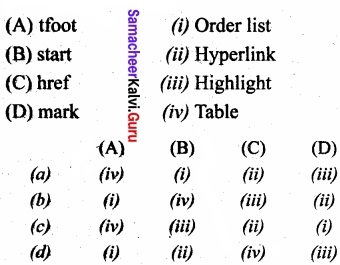
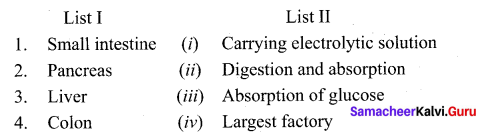
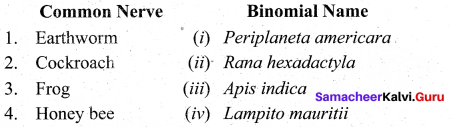
Match the following:
Tamil Nadu 11th Economics Previous Year Question Paper March 2019 English Medium 1
Answer:
(b) (1) – (iv), (2) – (1), (3) – (ii), (4) – (iii)

Question 9.
The concept of imperfect competition was propounded by _________.
(a) J.M. Keynes
(b) Irving Fisher
(c) Marshall
(d) Joan Robinson
Answer:
(d) Joan Robinson

Question 10.
Identify the wrong statement about the features of Duopoly.
(a) There is product differentiation.
(b) They fix the price for their product to maximise their profit.
(c) Each seller is fully aware of his rival’s motive and actions.
(d) Both sellers may collude regarding the sale of commodity.
Answer:
(a) There is product differentiation.

Question 11.
“Wages is a sum of money paid under contract by an employer to a worker for the services rendered.” – Who said this statement?
(a) Walker
(b) Marshall
(c) Ricardo
(d) Benham
Answer:
(d) Benham

Question 12.
The first Wi-Fi facility was provided by Indian Railways in
(a) Bengaluru
(b) Chennai
(c) Delhi
(d) Mumbai
Answer:
(a) Bengaluru

Question 13.
Density of population =
(a) Total population / land area of the region
(b) Total population / Employment
(c) Land area / Total population
(d) Land area / Employment
Answer:
(a) Total population / land area of the region

Tamil Nadu 11th Economics Previous Year Question Paper March 2019 English Medium

Question 14.
The oldest large scale industry in India is _______.
(a) Steel
(b) Cement
(c) Cotton
(d) Jute
Answer:
(c) Cotton

Question 15.
Twelfth Five Year Plan period ________.
(a) 2007-2012
(b) 1997-2002
(c) 2012-2017
(d) 2002-2007
Answer:
(c) 2012-2017

Question 16.
India is the largest producer of ______ in the world
(a) petrol
(b) diesel
(c) fruits
(d) gold
Answer:
(c) fruits

Question 17.
‘India lives in villages’, said by ________.
(a) V.K.R.V. Rao
(b) J.C. Kumarappa
(c) Mahatma Gandhi
(d) Jawaharlal Nehru
Answer:
(c) Mahatma Gandhi

Question 18.
______ are set up with a view to develop rural economy by providing credit and other facilities to small and marginal farmers.
(a) MUDRA Bank
(b) RRB
(c) SHG
(d) NABARD
Answer:
(b) RRB

Tamil Nadu 11th Economics Previous Year Question Paper March 2019 English Medium

Question 19.
Which of the following is wrongly matched?
(a) SAIL – Salem
(b) The Pump City – Coimbatore tax
(c) BHEL – Trichy
(d) Knitting City – Karur
Answer:
(d) Knitting City – Karur

Question 20.
The first person to apply mathematical method to economic problem was ________.
(a) G. Crammer
(b) Paul Samuelson
(c) Sir William Petty
(d) Giovanni Ceva
Answer:
(d) Giovanni Ceva

Part – II

Answer any seven questions in which question No. 30 is compulsory. [7 × 2 = 14]

Question 21.
Define Consumer’s Surplus according to Alfred Marshall.
Answer:
Alfred Marshall defines Consumer’s Surplus as “the excess of price which a person would be willing to pay a thing rather than go without the thing, over that which he actually does pay is the economic measure of this surplus satisfaction. This may be called consumers surplus”.

Question 22.
What is meant by Sunk Cost?
Answer:
A cost incurred in the past and cannot be recovered in future is called as Sunk Cost. This is historical but irrelevant for future business decisions. It is called as sunk because, they are unalterable, unrecoverable and if once invested it should be treated as drowned or disappeared.

Question 23.
What are the kinds of profit? Explain them.
Answer:
There are three kinds of profit:

  • Monopoly Profit: Profit earned by the firm because of its monopoly control.
  • Windfall Profit: Sometimes, profit arises due to changes in price level. Profit is due to unforeseen factors.
  • Profit as functional reward: Just like rent, wage and interest, profit is earned by the entrepreneur for his entrepreneurial function.

Tamil Nadu 11th Economics Previous Year Question Paper March 2019 English Medium

Question 24.
What is NITI Aayog? What are its functions?
Answer:

  • The Planning Commission has been replaced by the NITI Aayog on 1 st January, 2015.
  • NITI (National Institution for Transforming India) Aayog will monitor, coordinate and ensure implementation of the accepted sustainable development goals.
  • NITI Aayog serves as a knowledge hub and monitors progress in the implementation of policies and programmes of the Government of India.
  • It includes the matters of national and international importance on the economic front, dissemination of best practices from within the .country and from other nations, the infusion of new policy ideas and specific issue-based support.

Question 25.
State any four features of developed economy.
Answer:
Features of a Developed Economy:

  1. High National Income
  2. High Per Capita Income
  3. High Standard of Living
  4. Full Employment of Resources

Question 26.
Define disinvestment.
Answer:
Disinvestment means selling of government securities of Public Sector Undertakings [PSUs] to other PSUs or Private Sectors or banks. This process has not been fully implemented.

Question 27.
Define Cottage Industry. State any two characteristics of cottage industries.
Answer:
Cottage industries are generally associated with agriculture and provide both part-time and full-time jobs in rural areas. Some important characteristics of cottage industries are:

  1. These industries are carried out by artisans in their own homes at their own risk and for their own benefit.
  2. No or little outside labour is employed. Normally, the members of the household provide the necessary labour.

Question 28.
What is crop insurance?
Answer:}
Agriculture in India is highly prone to risks like droughts and floods. It is necessary to protect the farmers from natural calamities and ensure their credit eligibility for the next season.

For this purpose, the Government of India introduced many agricultural schemes throughout the country. The Pradhan Mantri Fasal Bima Yojana (Prime Minister’s Crop Insurance Scheme) was launched on 18 February 2016.

Tamil Nadu 11th Economics Previous Year Question Paper March 2019 English Medium

Question 29.
Find the value of the determinant for the matrix A = \(\left(\begin{array}{cc}
3 & 4 \\
10 & -2
\end{array}\right)\)
Answer:
Given matrix A = \(\left(\begin{array}{cc}
3 & 4 \\
10 & -2
\end{array}\right)\) then, the department
|A| = \(\left|\begin{array}{ll}
3 & 4 \\
10 & -2
\end{array}\right|\) = 3(-2) – 10(4)
= – 6 – 40 = -46 is the value of the determinant.

Question 30.
Write short notes on mineral resources of Tamil Nadu.
Answer:

  • Tamil Nadu has a few mining projects based on Titanium, Lignite, Magnesite, Graphite, Limestone, Granite and Bauxite.
  • The first one is the Neyveli Lignite Corporation that has led development of large industrial complex around Neyveli in Cuddalore district with thermal power plants, Fertilizer and Carbonisation plants.
  • Magnesite mining is at Salem from which mining of Bauxite ores are carried out at Yercaud and this region is also rich in Iron Ore at Kanjamalai. Molybdenum is found in Karadikuttam in Madurai district.

Part – III

Answer any seven questions in which question No. 40 is compulsory. [7 × 3 = 21]

Question 31.
What are the differences between micro-economics and macro-economics.
Answer:
Micro Economics:

  1.  It is that branch of economics which deals with the economic decision making of individual economic agents such as the producer, the consumer etc.
  2. It takes into account small components of the whole economy
  3. It deals with the process of price determination in case of individual products and factors of production.
  4. It is known as price theory.
  5. It is concerned with the optimization goals of individual consumers and producers.

Macro Economics:

  1. It is that branch of economics which deals with aggregates and averages of the entire economy. E.g., aggregate output, national income, aggregate savings and investment, etc.
  2. It takes into consideration that economy of the country as a whole.
  3. It deals with general price-level in any economy.
  4. It is also known as the income theory.
  5. It is concerned with the optimization of the growth process of the entire economy.

Tamil Nadu 11th Economics Previous Year Question Paper March 2019 English Medium

Question 32.
Describe the features of human wants.
Answer:
(a) Wants are unlimited:
Human wants are countless in number and various in kinds. When one want is satisfied another want crops up. Human wants multiply with the growth of civilization and development.

(b) Wants become habits:
Wants become habits; for example, when a man starts reading news paper in the morning, it becomes a habit. Same is the case with drinking tea or chewing pans.

(c) Wants are Satiable:
Though we cannot satisfy all our wants, at the same time we can satisfy particular wants at a given time. When one feels hungry, he takes food and that want is satisfied.

(d) Wants are Alternative:
There are alternative ways to satisfy a particular want. E.g., Idly, dosa or chappathi.

(e) Wants are Competitive:
All our wants are not equally important. So, there is competition among wants. Hence, we have to choose more urgent wants than less urgent wants.

(f) Wants are Complementary:
Sometimes, satisfaction of a particular want requires the use of more than one commodity. Example: Car and Petrol, Ink and Pen.

(g) Wants are Recurring:
Some wants occur again and again. For example, if we feel hungry, we take food and satisfy out want. But after sometime, we again feel hungry and want food.

Question 33.
Find out the missing Marginal Product and Average Product for the given table.
Tamil Nadu 11th Economics Previous Year Question Paper March 2019 English Medium 2
Answer:
Tamil Nadu 11th Economics Previous Year Question Paper March 2019 English Medium 3

Question 34.
Define opportunity cost with an example.
Answer:

  • Opportunity refers to the cost of next best alternative use. In other words, it is the value of the next best alternative foregone.
  • For example, a farmer can cultivate both paddy and sugarcane in a farm land. If he cultivates paddy, the opportunity cost of paddy output is the amount of sugarcane output given up. Opportunity Cost is also called as ‘Alternative Cost’ or ‘Transfer Cost’.

Tamil Nadu 11th Economics Previous Year Question Paper March 2019 English Medium

Question 35.
What is Monopsony?
Answer:
Monopsony is a market structure in which there is only one buyer of a good or service. If there is only one customer for a certain good, that customer has monopsony power in the market for that good. Monopsony is analogous to monopoly, but monopsony has market power on the demand side rather than on the supply side.

Question 36.
What are the types of Natural resources?
Answer:
Water resources:
Tamil Nadu is not endowed with rich natural resources compared to other States. It accounts for three per cent of water sources, four per cent of land area against six per cent of population.

North East monsoon is the major source of rainfall followed by South West monsoon. There are 17 river basins in Tamil Nadu. The main rivers are Palar, Cheyyar, Ponnaiyar, Cauvery, Bhavani, Vaigai, Chittar, Tamiraparani, Vellar, Noyyal Siruvani, Gundar, Vaipar, Valparai, etc. Wells are the largest source of irrigation in Tamil Nadu (56%).

Mineral resources:
Tamil Nadu has a few mining projects based on Titanium, Lignite, Magnesite, Graphite, Limestone, Granite and Bauxite. The first one is the Neyveli Lignite Corporation that has led development of large industrial complex around Neyveli in Cuddalore district with thermal power plants, Fertilizer and Carbonisation plants.

Magnesite mining is at Salem from which mining of Bauxite ores are carried out at Yercaud and this region is also rich in Iron Ore at Kanjamalai. Molybdenum is found in Karadikuttam in Madurai district.

Question 37.
List out the objectives of MUDRA BANK.
Answer:

  1. Regulate the lender and the borrower of micro-finance and bring stability to the
    micro-finance system. .
  2. Extend finance and credit support to Micro-finance Institutions (MFI) and agencies that lend money to small businesses, retailers, self-help groups and individuals.
  3. Register all MFIs and introduce a system of performance rating and accreditation for the first time.
  4. Offer a Credit Guarantee scheme for providing guarantees to loans being offered to micro businesses.
  5. Introduce appropriate technologies to assist in the process of efficient lending, borrowing and monitoring of distributed capital.

Question 38.
Describe the development of Textile industry in Tamil Nadu.
Answer:

  • Tamil Nadu is the largest textile hub of India.
  • Tamil Nadu is known as the “Yam Bowl” of the country accounting for 41% of India’s cotton yam production.
  • The textile industry plays a significant role in the Indian economy by providing direct employment to an estimated 35 million people, and thereby contributing 4% of GDP and 35% of gross export earnings.
  • The textile sector contributes to 14% of the manufacturing sector.
  • From spinning to garment manufacturing, entire textile production chain facilities are in Tamil Nadu.
  • About half of India’s total spinning mill capacity is in Tamil Nadu.
  • The western part of Tamil Nadu comprising Coimbatore, Tirupur, Erode, Dindigul and Karur has the majority of spinning mills manufacturing cotton, polyester, blended yam and silk yam used by garment units in Tamil Nadu, Maharastra etc.,
  • Yam is also exported to China, Bangladesh, etc.,
  • Tirupur known as “knifting city” is the exporter of garments worth USD (United States Dollar) 3 billion.
  • Karur is the major home for textile manufacturing (curtain cloth, bed linens, kitchen linens, toilet linens, table linens, wall hangings etc.,) and export hub in India.
  • Erode is the main cloth market in South India for both retail and wholesale ready-mades.

Tamil Nadu 11th Economics Previous Year Question Paper March 2019 English Medium

Question 39.
Solve for x quantity demanded if 16x – 4 = 68 + 7x.
Answer:
16x – 4 = 68 + 7x
16x – 7x = 68 + 4
9x = 72
x = \(\frac{72}{9}\)
x = 8

Question 40.
Differentiate between Rent and Quasi-Rent.
Answer:
Rent:

  1. Rent accrues to land
  2. The supply of land is fixed forever.
  3. It enters into price

Quasi – Rent:

  1. Quasi-Rent accrues to manmade appliances.
  2. The supply of manmade appliances is fixed for a short period only.
  3. It does not enter into price.

Part – IV

Answer all the questions. [7 × 5 = 35]

Question 41.
(a) Explain basic problems of the economy with the help of Production Possibility Curve.
Answer:
Production possibility curve shows the menu of choice along which a society can choose to substitute one good for another assuming a given state of technology and given total resources.

Assumptions:

  • The time period does not change
  • Techniques of production are fixed.
  • There is full employment in the economy.
  • Only two goods can be produced from the given resources
  • Resources of production are fully mobile.

Tamil Nadu 11th Economics Previous Year Question Paper March 2019 English Medium 4
Tamil Nadu 11th Economics Previous Year Question Paper March 2019 English Medium 5

Explanation:

  1. The quantity of food is shown on x-axis and the number of cars is shown on y-axis.
  2. The different six production possibilities are being shown as point P1 P2 P3 P4 P5 & P6.
  3. A maximum of 500 tons of food can be produced, given the existing technology.
  4. If on the other hand, all resources are instead used for producing cars, 25 cars can be produced.
  5. In between these two extremes, possibilities exist.
  6. If we are willing to give up some food, we can have some cars.

[OR]

(b) Explain the public transport system in Tamil Nadu.
Answer:
Tamil Nadu has a well established transportation system that connects all parts of the State. This is partly responsible for the investment in the State. Tamil Nadu is served by an extensive road network in terms of its spread and quality, providing links between urban centres, agricultural market-places and rural habitations in the countryside. However, there is scope for improvement.

(a) Road Transport:

  • There are 28 national highways in the State covering a total distance of 5,036 km.
  • The State has a total road length of 167,000 km, of which 60,628 km are maintained by Highways Department.
(b) Rail Transport:

  • Tamil Nadu has a well-developed rail network as part of Southern Railway, Headquartered at Chennai.
  • Tamil Nadu has a total railway track length of 6,693 km and there are 690 railway stations in the State.
  • Main rail junctions in the State include Chennai, Coimbatore, Erode, Madurai, Salem, Tiruchirapalli and Tirunelveli.
  • Chennai has a well-established, suburban Railway network, a Mass Rapid Transport system and is currently developing a Metro System, with its first underground stretch operational since May 2017.

(c) Air Transport:

  • Tamil Nadu has four major international airports.
  • Chennai International Airport is currently the third largest airport in India.
  • Other international Airports in Tamil Nadu include Coimbatore International Airports, Madurai International Airport and Tiruchirapalli International Airport.
  • It also has domestic airports at Tuticorin, Salem, and Madurai.
  • Increased industrial activity has given rise to an increase in passenger traffic as well as freight movement which has been growing at over 18% per year.

(d) Ports:

  • Tamil Nadu has three major ports; one each at Chennai, Ennore and Tuticorin, as well as one intermediate port in Nagapattinam, and 23 minor ports.
  • The ports are currently capable of handling over 73 million metric tonnes of cargo annually (24 % share of India).
  • All the minor ports are managed by the Tamil Nadu Maritime Board, Chennai Port.
  • This is an artificial harbour and the second principal port in the country for handling containers.
  • It is currently being upgraded to have a dedicated terminal for cars capable of handling 4,00,000 vehicles.
  • Ennore port was recently converted from an intermediate port to a major port and handles all the coal and ore traffic in Tamil Nadu.

Tamil Nadu 11th Economics Previous Year Question Paper March 2019 English Medium

Question 42.
(a) Explain the law of demand with a diagram.
Answer:
Definition:
According to Alfred Marshall, the Law of Demand said as “the quantity demanded increases with a fall in price and diminishes with a rise in price”.

Assumptions of Law of Demand:

  1. The income of the consumer remain constant.
  2. The taste, habit and preference of the consumer remain the same.
  3. The prices of other related goods should not change.
  4. There should be no substitutes for the commodity in study.
PriceQuantity
Demanded
51
42
33
24
15

Tamil Nadu 11th Economics Previous Year Question Paper March 2019 English Medium 6

Explanation:

  1. Quantity demanded and Y axis represents the price of the commodity.
  2. DD is the demand curve, which has a negative slope.
  3. Slope downward from left to right which indicates that when price falls, the demand expands and when price rises, the demand contracts.

Conclusion:
Therefore, the law of demand states that there is an inverse relationship between the price and the quantity demanded of a commodity.

[OR]

(b) Illustrate the Ricardian theory of Rent.
Answer:
Definition:
According to Ricardo, “Rent is the that portion of the produce of the earth which is paid to the landlord for the use of the original and indestructible powers of the soil”.

Assumptions:

  1. Land differs in fertility.
  2. The law of diminishing returns operates in agriculture.
  3. Rent depends upon fertility and location of land.
  4. Theory assumes perfect competition.

Schedule of Ricardian Theory of Rent:

Grades of LandsProduction (in bags)Surplus (i.e., Rent in bags)
A4040 – 20 = 20
B3030 – 20 = 10
C2020 – 20 = 0

Tamil Nadu 11th Economics Previous Year Question Paper March 2019 English Medium 7

Explanation:

  1. In diagram, X axis represents various grades of land and Y axis represents yield per acre (in bags).
  2. 0A, AB and BC are the ‘A’ Grade, ‘B’ grade and ‘C’ grade lands respectively.
  3. The application of equal amount of labour and capital on each of them gives a yield represented by the rectangles standing just about the respective bases.
  4. The ‘C’ grade land is the ‘no-rent land’ “A” and “B” grade lands are “intra – marginal lands”.

Question 43.
(a) Describe the properties of Iso – quants with the help of diagrams.
Answer:
Properties of Iso-quant Curve:
Tamil Nadu 11th Economics Previous Year Question Paper March 2019 English Medium 8
1. The iso-quant curve has negative slope.
It slopes downwards from left to right indicating that the factors are substitutable. If more of one factor is used, less of the other factor is needed for producing the same level of output. In the diagram combination A refers to more of capital K5 and less of labour L2. As the producer moves to B, C, and D, more labour and less capital are used.

2. Convex to the origin.
This explains the concept of diminishing Marginal Rate of Technical Substitution (MRTSLK). For example, the capital substituted by 1 unit of labour goes on decreasing when moved from top to bottom. If so, it is called diminishing MRTS. Constant MRTS (straight line) and increasing MRTS (concave) are also possible. It depends on the nature of iso-quant curve.

This means that factors of production are substitutable to each other. The capital substituted per unit of labour goes on decreasing when the iso-quant is convex to the origin.

Marginal Rate of technical substitution
Tamil Nadu 11th Economics Previous Year Question Paper March 2019 English Medium 9

3. Non inter-section of Iso-quant curves.
For instance, point A lie on the isoquants IQ1 and IQ2. But the point C shows a higher output and the point B shows a lower level of output IQ1.
If C = A, B = A, then C = B. But C > B which is illogical.
Tamil Nadu 11th Economics Previous Year Question Paper March 2019 English Medium 10

4. An upper iso-quant curve represents a higher level of output.
Higher IQs show higher outputs and lower IQs show lower outputs, for upper iso-quant curve implies the use of more factors than the lower isoquant curve.

The arrow in the figure shows an increase in the output with a right and upward shift of an iso-quant curve.
Tamil Nadu 11th Economics Previous Year Question Paper March 2019 English Medium 11

5. Iso-quant curve does not touch either X axis or Y axis.
No iso-quant curve touches the X axis or Y axis because in IQ1 only capital is used, and in IQ2 only labour is used.
Tamil Nadu 11th Economics Previous Year Question Paper March 2019 English Medium 12

[OR]

(b) Explain about the Industry clusters in Tamil Nadu
Answer:

  • Chennai is sometimes referred to as the Health Capital of India or the Banking Capital of India, having attracted investments from International Finance Corporations and the World Bank. It is also called as Detroit of Asia.
  • Tamil Nadu has a network of about 110 industrial parks / estates that offer developed plots with supporting infrastructure.
  • Also, the Government is promoting other industrial parks like Rubber Park, Apparel Park, Floriculture Park, TICEL Park for Biotechnology, Siruseri IT Park and Agro Export Zones.
  • The heavy engineering manufacturing companies are Centred around the subrubs of Chennai. Chennai boasts of global car manufacturing giants as well as home grown companies.
    Tamil Nadu 11th Economics Previous Year Question Paper March 2019 English Medium 13
  • Karur is known for its bus body building which contributes 80% of South Indian bus body building.
  • TNPL is the Asia’s largest ecofriendly paper mill. Salem is called as steel city and has many sago producing units and mineral wealth.
  • Sivakasi is the leader in printing, fireworks, safety matches production in India. It contributes to 80% of India’s total safety matches production and 90% of India’s total fireworks production.
  • Thoothukudi is the gateway of Tamil Nadu. It is a major chemical producer next only to Chennai.

Tamil Nadu 11th Economics Previous Year Question Paper March 2019 English Medium

Question 44.
(a) Bring out the relationship between AR and MR curves under various price conditions.
Answer:
If a firm is able to sell additional units at the same price then AR and MR will be constant and equal. If the firm is able to sell additional units only by reducing the price, then both AR and MR will fall and be different.

Constant AR and MR (at Fixed Price):
When price remains constant or fixed, the MR will be also constant and will coincide with AR. Under perfect competition as the price is uniform and fixed, AR is equal to MR and their shape will be a straight line horizontal to X axis. The AR and MR Schedule under constant price is given in the below table and in the diagram.
Tamil Nadu 11th Economics Previous Year Question Paper March 2019 English Medium 14

Declining AR and MR (at Declining Price):
When a firm sells large quantities at lower prices both AR and MR will fall but the fall in MR will be more steeper than the fall in the AR.

It is to be noted that MR will be lower than AR. Both AR and MR will be sloping downwards straight from left to right. The MR curve divides the distance between AR Curve and Y axis into two equal parts. The decline in AR need not be a straight line or linear. If the prices are declining with the increase in quantity sold, the AR can be non-linear, taking a shape of concave or convex to the origin.

[OR]

(b) If the demand function is P = 35 – 2x – x2 and the demand x0 is 3, what will be the consumer’s surplus?
Answer:
Given demand function,
P = 35 – 2x – x2 For x = 3
P = 35 – 2(3) – 32
= 35 – 6 – 9.
P = 20 Therefore,
CS = (Area of the curve below the demand curve from 0 to 3) – Area of the rectangle (20 x – = 60)
Tamil Nadu 11th Economics Previous Year Question Paper March 2019 English Medium 15
= 105 – 9 – 9 – 60 = 27 Units

Question 45.
(a) Explain the features of Oligopoly.
Answer:

  • Few large firms: Very few big firms own the major control of the whole market by producing major portion of the market demand.
  • Interdependence among firms: The price and quality decisions of a particular firm are dependent on the price and quality decisions of the rival firms.
  • Group behaviour: The firms under oligopoly relalise the importance of mutual cooperation.
  • Advertisment cost: The oligopolist could raise sales either by advertising or improving the quality of the product.
  • Nature of product: The oligopoly means homogeneous products and imperfect oligopoly deals with- heterogeneous products.
  • Price rigidity: It implies that prices are difficult to be changed. The oligopolistic firms do not-change their prices due to the fear of rivals’ reaction.

[OR]

(b) Write a brief note on the Gandhian economic ideas.
Answer:
1. Village Republics:
To Gandhi, India lives in villages. He was interestred in developing the villages j as self sufficient units. He opposed extensive use of machinery, urbanization and industrialization.

2. On Machinery:
Gandhi described machinery as “Great Sin’. He said that “Books could be written to demonstrate the evils it is necessary to realize that machinery is bad. Instead of welcoming machinery as a boon, we should look upon it as an evil. It would ultimately crease.

3. Industrialism:
Gandhi considered industrialism as a curse on mankind. He thought industrialism depended entirely on a country’s capacity to exploit.

4. Decentralization:
He advocated a decentralized economy, i.e., production at a large number of places on a small scale or production in the people’s homes.

5. Villge Sarvodaya:
According to Gandhi, “Real India was to be found in villages and not in towns or cities. So he suggested the development of self sufficient, self-dependent villages.

6. Bread Labour:
Gandhi realized the dignity of human labour. He believed that God created man to eat his bread by sweat of his brow. Bread labour or body labour was the expression that Gandhi used to mean manual labour.

7. The Dcotrine of Trusteeship:
Trusteeship provides a means of transforming the present capitalist order of society into an egalitarian one. It gives no quarter to capitalism. However, now India experiences * S both casino capitalism and crony capitalsm.

8. On the Food Problem:
Gandhi was against any sort of food controls. He thought Such controls only created artificial scarcity. Once India was begging for food grain, but India tops the world with very large production of foodgrains, fruits, vegetables, milk, egg, meat etc.

9. On population:
Gandhi opposed the method of population control through contraceptives. He was, however, in favour of birth control as a sovereign remedy to the problem of over population.

10. On Prohibition:
Gandhi advocated cent per cent prohibition. He regarded the use of liquor as a disease rather than a vice. He felt that it was better for India to be poor than to have thousands of drunkards. But, now many states depend on revenue from liquor sales.

Tamil Nadu 11th Economics Previous Year Question Paper March 2019 English Medium

Question 46.
(a) Explain the objectives of nationalization of commercial banks.
Answer:
The Government of India nationalized the commercial banks to achieve the following objectives:

  • The main objective of nationalization was to attain Social Welfare. Sectors such as agriculture, small and village industries were in need of funds for their expansion and further economic development.
  • Nationalisation of banks helped to curb private monopolies in order to ensure a smooth supply of credit to socially desirable sections.
  • In India, nearly 70% of population lived in rural areas. Therefore it was needed to encourage the banking habit among the rural population.
  • Nationalisation of banks was required to reduce the regional imbalances where the banking facilities were not available.
  • Before Independence, the numbers of banks were certainly inadequate. After nationalization, new bank branches were opened in both rural and urban areas.
  • Banks created credit facilities mainly to the agriculture sector and its allied activities after nationalization.

After New Economic Policy 1991, the Indian banking Industry has been facing the new horizons of competitions, efficiency and productivity.

[OR]

(b) How are the information and communication technologies (ICT) used in economics?
Answer:
Information and Communication Technology (ICT) is the infrastructure that enables computing faster and accurate. The following table gives an idea of range of technologies that fall under the category of ICT.

InformationTechnologies
CreationPersonal Computer, Digital Camera, Scanner, Smart Phone.
ProcessingCalculation, PC, Smart Phone
StorageCD, DVD, Pen Drive, Microchip, Cloud
DisplayPC, TV, Projector, Smart Phone
TransmissionInternet, Teleconference, Video Conferencing, Mobile Technology, Radio
ExchangeE-mail, Cell phone

THE EVALUATION OF ICT HAS FIVE PHASES.
They are evolution in

  1. Computer
  2. PC
  3. Microprocessor
  4. Internet and
  5. Wireless links

In Economics, the uses of mathematical and statistical tools need the support of ICT for data compiling, editing, manipulating and presenting the results. In general, SPSS and Excel packages are often used by researchers in economics. Such Software is designed to do certain user tasks. Word process, spread sheet and web browser are some of the examples which are frequently used while undertaking analysis in the study of economics.

Tamil Nadu 11th Economics Previous Year Question Paper March 2019 English Medium

Question 47.
(a) Explain the objectives and characteristics of Special Economic Zones (SEZ).
Answer:

  • The Special Economic Zones [SEZs] Policy was announced in April 2000.
  • The Special Economic Zones Act of 2005, the government has so far notified about 400 such zones in the country.
Major objectives of SEZs:

  • To enhance foreign investment, especially to attract foreign direct investment [FDI] and thereby increasing GDP.
  • To increase shares in Global Export. (International Business)
  • To generate additional economic activity.
  • To create employment opportunities.
  • To develop infrastructure facilities.
  • To exchange technology in the global market.

Main Characteristics of SEZ:

  • Geographically demarked area with physical security.
  • Administrated by single body authority.
  • Streamlined procedures.
  • Having separate custom area.
  • Governed by more liberal economic laws.
  • Greater freedom to the firms located in SEZs. .

[OR]

(b) Analyse the causes for Rural Indebtedness.
Answer:
The causes for rural indebtedness may be summarized as below:

  • Poverty of Farmers: The vicious circle of poverty forces the farmers to borrow for consumption, cultiviation and celebrations., Thus, poverty, debt and high rates of interest hold the farmer in the grip of money lenders.
  • Failure of Monsoon: Frequent failure of monsoon is a curse to the farmers and they have to suffer due to the failure of nature. Therefore, farmers find it difficult to identify good years to repay their debts.
  • Litigation: Due to land disputes litigation in the court compels them to borrow heavily. Being uneducated and ignorant they are caught in the litigation process and dry away their savings and resources.
  • Money Lenders and High Rates of Interest: The rate of interest charged by the local money lenders is very high and the compounding of interest leads to perpetuate indebtedness of the farmer.

Samacheer Kalvi 12th Maths Solutions Chapter 7 Applications of Differential Calculus Ex 7.10
You can Download Samacheer Kalvi 12th Maths Book Solutions Guide Pdf, Tamilnadu State Board help you to revise the complete Syllabus and score more marks in your examinations.

Tamilnadu Samacheer Kalvi 12th Maths Solutions Chapter 7 Applications of Differential Calculus Ex 7.10

Choose the correct or the most suitable answer.

Question 1.
The volume of a sphere is increasing in volume at the rate of 3πcm3/sec. The rate of change of its radius when radius is \(\frac{1}{2}\) cm …….
(a) 3 cm/s
(b) 2 cm/s
(c) 1 cm/s
(d) \(\frac{1}{2}\) cm/s
Solution:
(a) 3 cm/s
Hint:
Samacheer Kalvi 12th Maths Solutions Chapter 7 Applications of Differential Calculus Ex 7.10 1

Question 2.
A balloon rises straight up at 10 m/s. An observer is 40 m away from the spot where the balloon left the ground. Find the rate of change of the balloon’s angle of elevation in radian per second when the balloon is 30 metres above the ground.
Samacheer Kalvi 12th Maths Solutions Chapter 7 Applications of Differential Calculus Ex 7.10 2
Solution:
(b) \(\frac{4}{25}\) radian/sec
Hint:
Samacheer Kalvi 12th Maths Solutions Chapter 7 Applications of Differential Calculus Ex 7.10 3
Samacheer Kalvi 12th Maths Solutions Chapter 7 Applications of Differential Calculus Ex 7.10 4

Samacheer Kalvi 12th Maths Solutions Chapter 7 Applications of Differential Calculus Ex 7.10

Question 3.
The position of a particle moving along a horizontal line of any time t is given by s(t) = 80t – 16t2. The time at which the particle is at rest is …….
Samacheer Kalvi 12th Maths Solutions Chapter 7 Applications of Differential Calculus Ex 7.10 5
Solution:
(2) t = \(\frac{1}{3}\)
Hint:
Samacheer Kalvi 12th Maths Solutions Chapter 7 Applications of Differential Calculus Ex 7.10 6

Question 4.
A stone is thrown up vertically. The height it reaches at time t seconds is given by x = 80t – 16t2. The stone reaches the maximum height in time t seconds is given by …..
(a) 2
(b) 2.5
(c) 3
(d) 3.5
Solution:
(b) 2.5
Hint:
Samacheer Kalvi 12th Maths Solutions Chapter 7 Applications of Differential Calculus Ex 7.10 7

Question 5.
Find the point on the curve 6y = x3 + 2 at which y-coordinate changes 8 times as fast as x-coordinate is …….
(a) (4, 11)
(b) (4, -11)
(c) (-4, 11)
(d) (-4, -11)
Solution:
(a) (4, 11)
Samacheer Kalvi 12th Maths Solutions Chapter 7 Applications of Differential Calculus Ex 7.10 8

Question 6.
The abscissa of the point on the curve f(x) = \(\sqrt{8-2 x}\) at which the slope of the tangent is -0.25?
(a) -8
(b) -4
(c) -2
(d) 0
Solution:
(b) -4
Samacheer Kalvi 12th Maths Solutions Chapter 7 Applications of Differential Calculus Ex 7.10 9

Question 7.
The slope of the line normal to the curve f(x) = 2cos 4x at x = \(\frac{\pi}{2}\) is ……..
Samacheer Kalvi 12th Maths Solutions Chapter 7 Applications of Differential Calculus Ex 7.10 10
Solution:
(c) \(\frac{\sqrt{3}}{12}\)
Samacheer Kalvi 12th Maths Solutions Chapter 7 Applications of Differential Calculus Ex 7.10 11

Samacheer Kalvi 12th Maths Solutions Chapter 7 Applications of Differential Calculus Ex 7.10

Question 8.
The tangent to the curve y2 – xy + 9 = 0 is vertical when
Samacheer Kalvi 12th Maths Solutions Chapter 7 Applications of Differential Calculus Ex 7.10 12
Solution:
(b) \(y=\pm \sqrt{3}\)
Hint:
Samacheer Kalvi 12th Maths Solutions Chapter 7 Applications of Differential Calculus Ex 7.10 13
Samacheer Kalvi 12th Maths Solutions Chapter 7 Applications of Differential Calculus Ex 7.10 14

Question 9.
Angle between y2 = x and x2 = y at the origin is ……
Samacheer Kalvi 12th Maths Solutions Chapter 7 Applications of Differential Calculus Ex 7.10 15
Samacheer Kalvi 12th Maths Solutions Chapter 7 Applications of Differential Calculus Ex 7.10 155
Solution:
(c) \(\frac{\pi}{2}\)
Hint:
The angle between the parabolas is the angle between the axes = \(\frac{\pi}{2}\)

Question 10.
Samacheer Kalvi 12th Maths Solutions Chapter 7 Applications of Differential Calculus Ex 7.10 100
(a) 0
(b) 1
(c) 2
(d) ≤
Solution:
(a) 0
Hint:
Samacheer Kalvi 12th Maths Solutions Chapter 7 Applications of Differential Calculus Ex 7.10 18

Question 11.
The function sin4 x + cos4 x is increasing in the interval
Samacheer Kalvi 12th Maths Solutions Chapter 7 Applications of Differential Calculus Ex 7.10 19
Solution:
(c) \(\left[\frac{\pi}{4}, \frac{\pi}{2}\right]\)
Hint:
Samacheer Kalvi 12th Maths Solutions Chapter 7 Applications of Differential Calculus Ex 7.10 20

Question 12.
The number given by the Rolle’s theorem for the function x3 – 3x2, x ∈ [0, 3] is ………
(a) 1
(b) \(\sqrt{2}\)
(c) \(\frac{3}{2}\)
(d) 2
Solution:
(d) 2
Hint:
Samacheer Kalvi 12th Maths Solutions Chapter 7 Applications of Differential Calculus Ex 7.10 21

Samacheer Kalvi 12th Maths Solutions Chapter 7 Applications of Differential Calculus Ex 7.10

Question 13.
The number given by the Mean value theorem for the function \(\frac{1}{x}\), x ∈ [1, 9] is …..
(a) 2
(b) 2.5
(c) 3
(d) 3.5
Solution:
(c) 3
Hint:
Samacheer Kalvi 12th Maths Solutions Chapter 7 Applications of Differential Calculus Ex 7.10 22

Question 14.
The minimum value of the function |3 – x | + 9 is ………
(a) 0
(b) 3
(c) 6
(d) 9
Solution:
(d) 9
Hint:
f(x) = |3 – x| + 9
Minimum value of |3 – x| = 0
Minimum value of |3 – x| + 9 = 0 + 9 = 9

Question 15.
The maximum slope of the tangent to the curve y = ex sin x, x ∈ [0, 2n] is at …………
Samacheer Kalvi 12th Maths Solutions Chapter 7 Applications of Differential Calculus Ex 7.10 23
Solution:
(b) \(x=\frac{\pi}{2}\)
Hint:
Samacheer Kalvi 12th Maths Solutions Chapter 7 Applications of Differential Calculus Ex 7.10 24
Samacheer Kalvi 12th Maths Solutions Chapter 7 Applications of Differential Calculus Ex 7.10 25

Question 16.
The maximum value of the function x2e-2x, x > 0 is ……..
Samacheer Kalvi 12th Maths Solutions Chapter 7 Applications of Differential Calculus Ex 7.10 26
Solution:
(c) \(\frac{1}{e^{2}}\)
Hint:
Samacheer Kalvi 12th Maths Solutions Chapter 7 Applications of Differential Calculus Ex 7.10 27

Question 17.
One of the closest points on the curve x2 – y2 = 4 to the point (6, 0) is ……..
Samacheer Kalvi 12th Maths Solutions Chapter 7 Applications of Differential Calculus Ex 7.10 28
Solution:
(c) \((3, \sqrt{5})\)
Hint:
Samacheer Kalvi 12th Maths Solutions Chapter 7 Applications of Differential Calculus Ex 7.10 29
Substituting all the given options we get minimum distance point \((3, \sqrt{5})\)

Question 18.
The maximum product of two positive numbers, when their sum of the squares is 200, is ……..
(a) 100
(b) \(25 \sqrt{7}\)
(c) 28
(d) \(24 \sqrt{14}\)
Solution:
(a) 100
Samacheer Kalvi 12th Maths Solutions Chapter 7 Applications of Differential Calculus Ex 7.10 30Samacheer Kalvi 12th Maths Solutions Chapter 7 Applications of Differential Calculus Ex 7.10 30

Question 19.
The curves = ax4 + bx2 with ab > 0
(a) has no horizontal tangent
(b) is concave up
(c) is concave down
(d) has no points of inflection
Solution:
(d) has no points of inflection

Question 20.
The point of inflection of the curve y = (x – 1)3 is ……….
(a) (0, 0)
(b) (0, 1)
(c) (1, 0)
(d) (1, 1)
Solution:
(c) (1, 0)
Hint:
Samacheer Kalvi 12th Maths Solutions Chapter 7 Applications of Differential Calculus Ex 7.10 31

Samacheer Kalvi 12th Maths Solutions Chapter 7 Applications of Differential Calculus Ex 7.10 Additional Questions Solved

Question 1.
The gradient of the curve y = – 2x3 + 3x + 5 at x = 2 is ………
(a) -20
(b) 27
(c) -16
(d) -21
Solution:
(d) -21
Hint:
Samacheer Kalvi 12th Maths Solutions Chapter 7 Applications of Differential Calculus Ex 7.10 32

Samacheer Kalvi 12th Maths Solutions Chapter 7 Applications of Differential Calculus Ex 7.10

Question 2.
The rate of change of area A of a circle of radius r is ……..
Samacheer Kalvi 12th Maths Solutions Chapter 7 Applications of Differential Calculus Ex 7.10 33
Solution:
(b) \(2 \pi r \frac{d r}{d t}\)
Samacheer Kalvi 12th Maths Solutions Chapter 7 Applications of Differential Calculus Ex 7.10 34

Question 3.
A spherical snowball is melting in such a way that its volume is decreasing at a rate of 1 cm3/min. The rate at which the diameter is decreasing when the diameter is 10 cms is …………….
Samacheer Kalvi 12th Maths Solutions Chapter 7 Applications of Differential Calculus Ex 7.10 35
Solution:
(a) \(\frac{-1}{50 \pi} \mathbf{c m} / \mathbf{m i n}\)
Samacheer Kalvi 12th Maths Solutions Chapter 7 Applications of Differential Calculus Ex 7.10 36
Samacheer Kalvi 12th Maths Solutions Chapter 7 Applications of Differential Calculus Ex 7.10 37

Question 4.
Samacheer Kalvi 12th Maths Solutions Chapter 7 Applications of Differential Calculus Ex 7.10 38
Samacheer Kalvi 12th Maths Solutions Chapter 7 Applications of Differential Calculus Ex 7.10 39
Solution:
(b) \(x=a \cos ^{3} \theta ; y=a \sin ^{3} \theta\)
Hint:
Samacheer Kalvi 12th Maths Solutions Chapter 7 Applications of Differential Calculus Ex 7.10 40

Question 5.
If the normal to the curve \(x^{2 / 3}+y^{2 / 3}=a^{2 / 3}\) makes an angle θ with the x – axis then the slope of the normal is ……..
(a) – cot θ
(b) tan θ
(c) – tan θ
(d) cot θ
Solution:
(b) tan θ
Hint:
Since the normal to the curve makes an angle θ with the x axis.
Slope of the normal = tan θ

Question 6.
What is the surface area of a sphere when the volume is increasing at the same rate as its radius?
(a) 1
(b) \(\frac{1}{2 \pi}\)
(c) 4π
(d) \(\frac{4 \pi}{3}\)
Solution:
(a) 1
Hint:
Samacheer Kalvi 12th Maths Solutions Chapter 7 Applications of Differential Calculus Ex 7.10 41

Question 7.
For what values of x is the rate of increase of x3 – 2x2 + 3x + 8 is twice the rate of increase of x.
Samacheer Kalvi 12th Maths Solutions Chapter 7 Applications of Differential Calculus Ex 7.10 42

Solution:
(d) \(\left(\frac{1}{3}, 1\right)\)
Hint:
Samacheer Kalvi 12th Maths Solutions Chapter 7 Applications of Differential Calculus Ex 7.10 43

Samacheer Kalvi 12th Maths Solutions Chapter 7 Applications of Differential Calculus Ex 7.10

Question 8.
If the volume of an expanding cube is increasing at the rate of 4cm3/sec then the rate of change of surface area when the volume of the cube is 8 cubic cm is …….
(a) 8cm2/sec
(b) 16cm2/sec
(c) 2cm2/sec
(d) 4cm2/sec
Solution:
(a) 8cm2/sec
Hint:
Samacheer Kalvi 12th Maths Solutions Chapter 7 Applications of Differential Calculus Ex 7.10 44
Let surface area of the cube S = 6a2

Question 9.
If a normal makes an angle θ with positive x-axis then the slope of the curve at the point where the normal is drawn is ……..
(a) – cot θ
(b) tan θ
(c) – tan θ
(d) cot θ
Solution:
(a) – cot θ
Hint:
Samacheer Kalvi 12th Maths Solutions Chapter 7 Applications of Differential Calculus Ex 7.10 45

Question 10.
If the velocity of a particle moving along a straight line is directly proportional to the square of its distance from a fixed point on the line. Then its acceleration is proportional to …….
(a) s
(b) s2
(c) s3
(d) s4
Solution:
(c) s3
Hint:
Let s be the distance of the particle from fixed point on the line at time at t and V be the velocity. Then V ∝ s2

Samacheer Kalvi 12th Maths Solutions Chapter 7 Applications of Differential Calculus Ex 7.10 46

Question 11.
The Rolle’s constant for the function y = x2 on [-2, 2] is …………..
Samacheer Kalvi 12th Maths Solutions Chapter 7 Applications of Differential Calculus Ex 7.10 47
Solution:
(b) 0
Hint:
Let f(x) = y = x2
f'(x) = 2x = 0
By Rolle’s theorem there exists a ‘c’ such that
f'(c) = 0 ⇒ 2c = 0 ⇒ c = 0 ∈ (-2, 2)

Question 12.
The value ‘c’ of Lagranges Mean Value Theorem for f(x) = \(\sqrt{x}\) when a = 1 and b = 4 is ………
Samacheer Kalvi 12th Maths Solutions Chapter 7 Applications of Differential Calculus Ex 7.10 48
Solution:
(a) \(\frac{9}{4}\)
Hint:
Samacheer Kalvi 12th Maths Solutions Chapter 7 Applications of Differential Calculus Ex 7.10 49

Samacheer Kalvi 12th Maths Solutions Chapter 7 Applications of Differential Calculus Ex 7.10

Question 13.
In a given semi circle of diameter 4 cm a rectangle is to be inscribed. The maximum area of the rectangle is ……..
(a) 2
(b) 4
(c) 8
(d) 16
Solution:
(b) 4
Hint:
Let the side of the rectangle be ‘a’ cm
Maximum rectangle inscribed in a circle is a square.
The diagonal of the rectangle = 4 cm
Samacheer Kalvi 12th Maths Solutions Chapter 7 Applications of Differential Calculus Ex 7.10 50
Samacheer Kalvi 12th Maths Solutions Chapter 7 Applications of Differential Calculus Ex 7.10 51
2a2 = 16
a2 = 8 cm
The maximum area = 8
Half of the area of the square = 4 cm

Question 14.
The least possible perimeter of a rectangle of area 100 m2 is ……..
(a) 10
(b) 20
(c) 40
(d) 60
Solution:
(c) 40
Hint:
Let the length of the rectangle = x m
Let the length of the breadth = y m
Samacheer Kalvi 12th Maths Solutions Chapter 7 Applications of Differential Calculus Ex 7.10 52
The least perimeter = 2(x + y) = 2(10 + 10) = 40 cm

Question 15.
Which of the following curves is concave down ?
(a) y = -x2
(b) y = x2
(c) y = ex
(d) y = x2 + 2x – 3
Solution:
(a) y = -x2
Samacheer Kalvi 12th Maths Solutions Chapter 7 Applications of Differential Calculus Ex 7.10 534

Samacheer Kalvi 12th Maths Solutions Chapter 7 Applications of Differential Calculus Ex 7.10

Question 16.
The point of inflection of the curve y = x4 is at …….
(a) x = 0
(b) x = 3
(c) x = 12
(c) no where
Solution:
(a) x = 0
Hint:
Samacheer Kalvi 12th Maths Solutions Chapter 7 Applications of Differential Calculus Ex 7.10 53

Must Read:

Pivot Level Calculator

Samacheer Kalvi 12th Computer Applications Solutions Chapter 17 E-Commerce Security Systems

Students can Download Computer Applications Chapter 17 E-Commerce Security Systems Questions and Answers, Notes Pdf, Samacheer Kalvi 12th Computer Applications Book Solutions Guide Pdf helps you to revise the complete Tamilnadu State Board New Syllabus and score more marks in your examinations.

Tamilnadu Samacheer Kalvi 12th Computer Applications Solutions Chapter 17 E-Commerce Security Systems

Samacheer Kalvi 12th Computer Applications E-Commerce Security Systems Text Book Back Questions and Answers

PART – I
I. Choose The Correct Answer

Question 1.
In E-Commerce, when a stolen credit card is used to make a purchase it is termed as ………………………
(a) Friendly fraud
(b) Clean fraud
(c) Triangulation fraud
(d) Cyber squatting
Answer:
(b) Clean fraud

Samacheer Kalvi 12th Computer Applications Solutions Chapter 17 E-Commerce Security Systems

Question 2.
Which of the following is not a security element involved in E-Commerce?
(a) Authenticity
(b) Confidentiality
(c) Fishing
(d) Privacy
Answer:
(c) Fishing

Question 3.
Asymmetric encryption is also called as ……………………..
(a) Secure Electronic Transaction
(b) Certification Authority
(c) RSA algorithm
(d) Payment Information
Answer:
(c) RSA algorithm

Samacheer Kalvi 12th Computer Applications Solutions Chapter 17 E-Commerce Security Systems

Question 4.
The security authentication technology does not include
(i) Digital Signatures
(ii) Digital Time Stamps
(iii) Digital Technology
(iv) Digital Certificates
(a) (i), (ii) & (iv)
(b) (ii) & (iii)
(c) (i), (ii) & (iii)
(d) all the above
Answer:
(b) (ii) & (iii)

Question 5.
PGP stands for
(a) Pretty Good Privacy
(b)Pretty Good Person
(c) Private Good Privacy
(d) Private Good Person
Answer:
(a) Pretty Good Privacy

Samacheer Kalvi 12th Computer Applications Solutions Chapter 17 E-Commerce Security Systems

Question 6.
…………………… protocol is used for securing credit cards transactions via the Internet
(a) Secure Electronic Transaction (SET)
(b) Credit Card Verification
(c) Symmetric Key Encryption
(d) Public Key Encryption
Answer:
(a) Secure Electronic Transaction (SET)

Question 7.
Secure Electronic Transaction (SET) was developed in
(a) 1999
(b) 1996
(c) 1969
(d) 1997
Answer:
(b) 1996

Samacheer Kalvi 12th Computer Applications Solutions Chapter 17 E-Commerce Security Systems

Question 8.
The websites secured by Secure Socket Layer protocols can be identified using
(a) html://
(b) http://
(c) htmls://
(d) https://
Answer:
(d) https://

Question 9.
3-D Secure, a protocol was developed by
(a) Visa
(b) Master
(c) Rupay
(d) PayTM
Answer:
(a) Visa

Samacheer Kalvi 12th Computer Applications Solutions Chapter 17 E-Commerce Security Systems

Question 10.
Which of the following is true about Ransomware
(a) Ransomware is not a subset of malware
(b) Ransomware deletes the file instantly
(c) Typopiracy is a form of ransomware
(d) Hackers demand ransom from the victim
Answer:
(d) Hackers demand ransom from the victim

II. Short Answers

Question 1.
Write about information leakage in E-Commerce?
(i) Information leakage:
The leakage of trade secrets in E-Commerce mainly includes two aspects:

  1. The content of the transaction between the vendor and customer is stolen by the third party;
  2. The documents provided by the merchant to the customer or vice versa are illegally used by the another. This intercepting and stealing of online documents is called information leakage.

Samacheer Kalvi 12th Computer Applications Solutions Chapter 17 E-Commerce Security Systems

Question 2.
Write a short note on typopiracy?
Answer:
Typopiracy:

  • Typopiracy is a variant of Cyber Squatting. Some fake websites try to take advantage of users’ common typographical errors in typing a website address and direct users to a different website.
  • Such people try to take advantage of some popular websites to generate accidental traffic for their websites, e.g. www.goggle.com,www.faceblook.com

Question 3.
Define non-repudiation?
Answer:
Non-repudiation: prevention against violation agreement after the deal.

Samacheer Kalvi 12th Computer Applications Solutions Chapter 17 E-Commerce Security Systems

Question 4.
List the different types of security technologies in E-Commerce?
Answer:

  1. Encryption technology is an effective information security protection.
  2. It is defined as converting a Plaintext into meaningless Ciphertext using encryption algorithm thus ensuring the confidentiality of the data.
  3. The encryption or decryption process use a key to encrypt or decrypt the data.

Samacheer Kalvi 12th Computer Applications Solutions Chapter 17 E-Commerce Security Systems

Question 5.
Write about digital signature?
Answer:

  1. A digital signature is a mechanism that is used to verify that a particular digital document, message or transaction is authentic.
  2. Digital signatures are used to verify the trustworthiness of the data being sent.

PART – III
III. Explain in Brief Answer

Question 1.
Write a note on certification authorities (CA)?
Answer:
Digital certificates are issued by recognized Certification Authorities (CA). When someone requests a digital certificate, the authority verifies the identity of the requester, and if the requester fulfills all requirements, the authority issues it. When the sender uses a certificate to sign a document digitally, receiver can trust the digital signature because he trusts that CA has done their part verifying the sender’s identity.

Samacheer Kalvi 12th Computer Applications Solutions Chapter 17 E-Commerce Security Systems

Question 2.
List some E-Commerce Security Threats?
Answer:

  1. Information leakage
  2. Tampering
  3. Payment frauds
  4. Malicious code threats
  5. Distributed Denial of Service (DDoS) Attacks
  6. Cyber Squatting
  7. Typopiracy

Samacheer Kalvi 12th Computer Applications Solutions Chapter 17 E-Commerce Security Systems

Question 3.
Differentiate asymmetric and symmetric algorithms?
Answer:
Symmetric Key Encryption:

  1. Same key is used for both encryption and decryption
  2. Speed of encryption or decryption is very fast
  3. Plain text and cipher text are of same size
  4. Algorithms like DES, AES, RC4 uses symmetric key encryption
  5. Provides confidentiality
  6. The number of key used grows exponentially with the number of users

Asymmetric Key Encryption:

  1. Different keys are used for encryption and decryption
  2. Speed of encryption or decryption is comparatively slow
  3. The size of cipher text is always greater than plain text.
  4. Algorithms like RSA, ECC, DSA use asymmetric key encryption
  5. Provides confidentiality, authenticity and ‘ non-repudiation
  6. The number of key used grows linearly with the number of users

Samacheer Kalvi 12th Computer Applications Solutions Chapter 17 E-Commerce Security Systems

Question 4.
Write a note on PGP?
Answer:
Pretty Good Privacy (PGP): Phil Zimmermann developed PGP in 1991. It is a decentralized encryption program that provides cryptographic privacy and authentication for data communication. PGP encryption uses a serial combination of hashing, data compression, symmetric-key cryptography and asymmetric-key cryptography and works on the concept of “web of trust”.

Question 5.
Explain 3D secure payment protocols?
Answer:
3-D Secure is a secure payment protocol on the Internet. It was developed by Visa to increase the level of transaction security, and it has been adapted by MasterCard. It gives a better authentication of the holder of the payment card, during purchases made on websites. The basic concept of this (XML-based) protocol is to link the financial authorization process with an online authentication system. This authentication model comprise 3 domains (hence the name 3D) which are:

  1. The Acquirer Domain
  2. The Issuer Domain
  3. The interoperability Domain.

PART – IV
IV. Explain in detail

Question 1.
Write about dimensions of E-Commerce Security?
Answer:
The following are some of the security elements involved in E-Commerce:

  1. Authenticity: conforming genuineness of data shared.
  2. Availability: prevention against data delay or removal.
  3. Completeness: unification of all business information.
  4. Confidentiality: protecting data against unauthorized disclosure.
  5. Effectiveness: effective handling of hardware, software and data.
  6. Integrity: prevention of the data being unaltered or modified.
  7. Non-repudiation: prevention against violation agreement after the deal.
  8. Privacy: prevention of customers’ personal data being used by others.
  9. Reliability: providing a reliable identification of the individuals or businesses.
  10. Review ability: capability of monitoring activities to audit and track the operations.

Samacheer Kalvi 12th Computer Applications Solutions Chapter 17 E-Commerce Security Systems

Question 2.
Explain encryption technology?
Answer:
Encryption technology:
Encryption technology is an effective information security protection. It is defined as converting a Plaintext into meaningless Ciphertext using encryption algorithm thus ensuring the confidentiality of the data. The encryption or decryption process use a key to encrypt or decrypt the data. At present, two encryption technologies are widely used. They are symmetric key encryption system and an asymmetric key encryption system.

Symmetric key encryption:
The Data Encryption Standard (DES) is a Symmetric key data encryption method. It was introduced in America in the year 1976, by Federal Information Processing Standard (FIPS).

DES is the typical block algorithm that takes a string of bits of cleartext (plaintext) with a fixed length and, through a series of complicated operations, transforms it into another encrypted text of the same length. DES also uses a key to customize the transformation, so that, in theory, the algorithm can only be deciphered by people who know the exact key that has been used for encryption. The DES key is apparently 64 bits, but in fact the algorithm uses only 56. The other eight bits are only used to verify the parity and then it is discarded.

Today, it is considered that DES is not safe for many applications, mainly because of its relatively smaller key size (56-bit). But the key length can be easily increased by multiple use of the DES, described as Triple-DES, also known as TDES, 3DES or DESede.

Asymmetric or Public key encryption:
Asymmetric encryption also called as RSA (Rivest-Shamir-Adleman) algorithm. It uses public- key authentication and digital signatures. Until 1970s, there were only symmetric cryptosystems in which transmitter and receiver must have the same key. This raises the problem of key exchange andJcey management.

Unlike a symmetric encryption, the communicating parties need not know other’s private- key in asymmetric encryption. Each user generates their own key pair, which consists of a private key and a public key. A public-key encryption method is a method for converting a plaintext with a public key into a ciphertext from which the plaintext can be retrieved with a private key.

Samacheer Kalvi 12th Computer Applications Solutions Chapter 17 E-Commerce Security Systems

Question 3.
Differentiate digital signatures and digital certificates?
Answer:
Digital signature:

  1. A digital signature is a mechanism that is used to verify that a particular digital document, message or transaction is authentic.
  2. Digital signatures are used to verify the trustworthiness of the data being sent
  3. Digital signature is to ensure that a data remain secure from the point it was issued and it was not modified by a third party.
  4. It provides authentication, non-repudiation and integrity
  5. A digital signature is created using a Digital Signature Standard (DSS). It uses a SHA- 1 or SHA-2 algorithm for encrypting and decrypting the message.
  6. The document is encrypted at the sending end and decrypted at the receiving end using asymmetric keys.

Digital certificate:

  1. A digital certificate is a computer file which officially approves the relation between the holder of the certificate and a particular public key.
  2. Digital certificates are used to verify the trustworthiness of the sender.
  3. Digital certificate binds a digital signature to an entity
  4. It provides authentication and security.
  5. A digital certificate works on the principles , of public key cryptography standards (PKCS). It creates certificate in the X.509 or PGP format.
  6. A digital certificate consist of certificate’s owner name and public key, expiration date, a Certificate Authority ‘s name , a Certificate Authority’s digital signature.

Samacheer Kalvi 12th Computer Applications Solutions Chapter 17 E-Commerce Security Systems

Question 4.
Define Secure Electronic Transaction (SET) and its features?
Answer:
There are two kinds of security authentication protocols widely used in E-Commerce, namely Secure Electronic Transaction (SET) and Secure Sockets Layer (SSL).

Secure Electronic Transaction:
Secure Electronic Transaction (SET) is a security protocol for electronic payments with credit cards, in particular via the Internet. SET was developed in 1996 by VISA and MasterCard, with the participation of GTE, IBM, Microsoft and Netscape.

The implementation of SET is based on the use of digital signatures and the encryption of transmitted data with asymmetric and symmetric encryption algorithms. SET also use dual signatures to ensure the privacy.

The SET purchase involves three major participants: the customer, the seller and the payment gateway. Here the customer shares the order information with the seller but not with the payment gateway. Also the customer shares the payment information only with the payment gateway but not with the seller.

So, with the SET, the credit card number may not be known to the seller and will not be stored in seller’s files also could not be recovered by a hacker. The SET protocol guarantees the security of online shopping using credit cards on the open network. It has the advantages of ensuring the integrity of transaction data and the non-repudiation of transactions. Therefore, it has become the internationally recognized standard for credit card online transaction.

SET system incorporates the following key features:

  • Using public key encryption and private key encryption ensure data confidentiality.
  • Use information digest technology to ensure the integrity of information.
  • Dual signature technology to ensure the identity of both parties in the transaction.

Samacheer Kalvi 12th Computer Applications Solutions Chapter 17 E-Commerce Security Systems

Question 5.
Briefly explain SSL?
Answer:
Secure Sockets Layers:
The most common Cryptographic protocol is Secure Sockets Layers (SSL). SSL is a hybrid encryption protocol for securing transactions over the Internet. The SSL standard was developed by Netscape in collaboration with MasterCard, Bank of America, MCI and Silicon Graphics.

It is based on a public key cryptography process to ensure the security of data transmission over the internet. Its principle is to establish a secure communication channel (encrypted) between a client and a server after an authentication step.

The SSL system acts as an additional layer, to ensure the security of data, located between the application layer and the transport layer in TCP.

For example, a user using an internet browser to connect to an SSL secured E-Commerce site will send encrypted data without any more necessary manipulations. Secure Sockets Layers (SSL) was renamed as Transport Layer Security (TLS) in 2001. But still it is popularly known under the name SSL. TLS differs from SSL in the generation of symmetric keys.

Today, all browsers in the market support SSL, and most of the secure communications are proceeded through this protocol. SSL works completely hidden for the user, who does not have to intervene in the protocol. The only thing the user has to do is make sure the URL starts with https:// instead of http:// where the “s” obviously means secured. It is also preceded by a green padlock.

Samacheer Kalvi 12th Computer Applications E-Commerce Security Systems Additional Questions and Answers

I. Choose The Correct Answer

Question 1.
…………………… has become the critical factor and core issue in any E-business.
Answer:
Security

Question 2.
…………………… cause harm to the computers.
Answer:
Viruses

Samacheer Kalvi 12th Computer Applications Solutions Chapter 17 E-Commerce Security Systems

Question 3.
The stealing of online documents is called …………………….
(a) phishing
(b) virus
(c) Frauds
(d) information leakage
Answer:
(d) information leakage

Question 4.
Destroying the authenticity and integrity of the business information is ……………………….
(a) Information leakage
(b) Tampering
(c) Squatting
(d) Phishing
Answer:
(b) Tampering

Samacheer Kalvi 12th Computer Applications Solutions Chapter 17 E-Commerce Security Systems

Question 5.
How many types of payment frauds are there?
(a) 2
(b) 3
(c) 4
(d) 5
Answer:
(b) 3

Question 6.
When the customer demands free reclaim or refund then it is …………………….
(a) Friendly Fraud
(b) Clean Fraud
(c) Triangular Fraud
(d) Unclean Fraud
Answer:
(a) Friendly Fraud

Samacheer Kalvi 12th Computer Applications Solutions Chapter 17 E-Commerce Security Systems

Question 7.
Which is the fake online shops offering cheapest price and collecting credit card data?
(a) Friendly Fraud
(b) Clean Fraud
(c) Triangulation Fraud
(d) Square Fraud
Answer:
(c) Triangulation Fraud

Question 8.
The credit card information can be extracted using ……………………….
(a) malware
(b) cross site scripting
(c) SQL injection
(d) all of these
Answer:
(d) all of these

Samacheer Kalvi 12th Computer Applications Solutions Chapter 17 E-Commerce Security Systems

Question 9.
DDoS means ……………………..
Answer:
Distributed Denial of Service

Question 10.
What is the other name for DDoS attacks?
(a) Nature Flood
(b) Network Flood
(c) Cyber Flood
(d) Virus Flood
Answer:
(b) Network Flood

Question 11.
Which is true about information leakage?
Answer:
(I) The contents of the transaction between the vendor and customer is stolen by the third party
(II) The documents provided by the merchant to the customer or vice versa are illegally used by another.
(a) I, II-both True
(b) I, II-False
(c) I-True, II-False
(d) I-False, II-True
Answer:
(a) I, II-both True

Samacheer Kalvi 12th Computer Applications Solutions Chapter 17 E-Commerce Security Systems

Question 12.
…………………… is the illegal practice of registering an Intranet domain neames.
(a) Cyber squatting
(b) DDoS
(c) Malicious code
(d) Tampering
Answer:
(a) Cyber squatting

Question 13.
Directing users to a different website by taking advantage of user’s common type graphical errors in typing and direct users to different website is ………………………
(a) Cyber Squatting
(b) Typopiracy
(c) DDoS
(d) Tampering
Answer:
(b) Typopiracy

Samacheer Kalvi 12th Computer Applications Solutions Chapter 17 E-Commerce Security Systems

Question 14.
Identify the typography.
(a) google.com
(b) facebook.com
(c) goggle.com
(d) gmail.com
Answer:
(c) goggle.com

Question 15.
Which refers to unauthorized intrusion into a computer or a network?
(a) Cracking
(b) Hacking
(c) Tampering
(d) DDoS
Answer:
(b) Hacking

Samacheer Kalvi 12th Computer Applications Solutions Chapter 17 E-Commerce Security Systems

Question 16.
Unification of all business information is
(a) Authenticity
(b) Availability
(c) Completeness
(d) Integrity
Answer:
(c) Completeness

Question 17.
Match the following
(i) Authencity – 1. preventing data to be altered
(ii) Integrity – 2. Conforming genuineness of data shared
(iii) Reliability – 3. prevention against violation agreement after deal
(iv) Non Repudiation – 4. reliable identification of ‘individual’
(a) (i)-2 (ii)-1 (iii)-4 (iv)-3
(b) (i)-1 (ii)-2 (iii)-3 (iv)-4
(c) (i)-4 (ii)-3 (iii)-2 (iv)-1
(d) (i)-4 (ii)-2 (iii)-1 (iv)-3
Answer:
(a) (i)-2 (ii)-1 (iii)-4 (iv)-3

Samacheer Kalvi 12th Computer Applications Solutions Chapter 17 E-Commerce Security Systems

Question 18.
Review ability is the capability of …………………………
(a) monitoring activities to audit and track the operations
(b) prevention of customer data used by others
(c) effective handling of hardware, software
(d) preventing data delay or removal
Answer:
(a) monitoring activities to audit and track the operations

Question 19.
Identity which is not a security technology in E-commerce transaction.
(a) Encryption
(b) Authentication technology
(c) Authentication protocol
(d) Integrity
Answer:
(d) Integrity

Question 20.
How many types of encryption technologies are there?
(a) 2
(b) 3
(c) 4
(d) 5
Answer:
(a) 2

Samacheer Kalvi 12th Computer Applications Solutions Chapter 17 E-Commerce Security Systems

Question 21.
The conversion of plaintext into meaningless ciphertext is done by ………………………..
Answer:
encryption algorithm

Question 22.
DES is ………………………
Answer:
Data Encryption Standard

Question 23.
Which one is the symmetric key data encryption method?
(a) DAS
(b) DES
(c) SED
(d) EDS
Answer:
(b) DES

Samacheer Kalvi 12th Computer Applications Solutions Chapter 17 E-Commerce Security Systems

Question 24.
FIPS means
(a) Finance Insurance Private Sector
(b) Finance Insurance Public Sector
(c) Federal Information Processing Standard
(d) None of these
Answer:
(c) Federal Information Processing Standard

Question 25.
Data Encryption standard was introduced in ………………………..
(a) America
(b) Africa
(c) India
(d) Russia
Answer:
(a) America

Samacheer Kalvi 12th Computer Applications Solutions Chapter 17 E-Commerce Security Systems

Question 26.
DES was introduced in the year
(a) 1972
(b) 1975
(c) 1976
(d) 1978
Answer:
(c) 1976

Question 27.
DES was introduced by ………………………..
(a) FEPS
(b) FIPS
(c) FPS
(d) FPSE
Answer:
(b) FIPS

Samacheer Kalvi 12th Computer Applications Solutions Chapter 17 E-Commerce Security Systems

Question 28.
The DES key is apparently ……………………….. bits.
(a) 16
(b) 32
(c) 64
(d) 128
Answer:
(c) 64

Question 29.
How many bits are used for parity check?
(a) 2
(b) 4
(c) 8
(d) 16
Answer:
(c) 8

Question 30.
How many bits are used by DES algorithm?
(a) 8
(b) 1
(c) 56
(d) 64
Answer:
(c) 56

Samacheer Kalvi 12th Computer Applications Solutions Chapter 17 E-Commerce Security Systems

Question 31.
Triple – DES are also known as
(a) IDES
(b) 3DES
(c) DESede
(d) all of these
Answer:
(d) all of these

Question 32.
RSA means …………………….. algorithm.
Answer:
Rivest-Shamir-Adleman

Question 33.
What is the other name for Asymmetric key encryption?
(a) Symmetric
(b) DES
(c) Public
(d) Private
Answer:
(c) Public

Samacheer Kalvi 12th Computer Applications Solutions Chapter 17 E-Commerce Security Systems

Question 34.
A ……………………. method is used for converting a plain text with a public key into a cipher text.
Answer:
public-key encryption

Question 35.
Find the correct statement about symmetric key encryption.
(a) plain text and cipher text are of same size
(b) The size of cipher text is always greater than plain text.
Answer:
(a) plain text and cipher text are of same size

Question 36.
The number of key used grows lineraly with the number of users in ……………………….
Answer:
asymmetric key Encryption

Samacheer Kalvi 12th Computer Applications Solutions Chapter 17 E-Commerce Security Systems

Question 37.
Pick the odd one out.
(a) DES
(b) AES
(c) RC4
(d) DSA
Answer:
(d) DSA

Question 38.
Pick the odd on out.
(a) RSA
(b) RC4
(c) ECC
(d) DSA
Answer:
(b) RC4

Question 39.
Find the statement which is not true?
(a) Different keys are used for encryption and decryption
(b) Speed of encryption is Fast
(c) Speed of decryption is Slow
(d) The number of key used grows linearly
Answer:
(b) Speed of encryption is Fast

Question 40.
Public key encryption is devised by
(i) Whitfield Diffie
(ii) Mastin E. Heilman
(iii) Robert John
(a) (i)
(b) (ii), (iii)
(c) (i), (iii)
(d) (i),(ii)
Answer:
(d) (i),(ii)

Samacheer Kalvi 12th Computer Applications Solutions Chapter 17 E-Commerce Security Systems

Question 41.
Public key encryption was devised in the year ………………………
(a) 1972
(b) 1974
(c) 1976
(d) 1978
Answer:
(c) 1976

Question 42.
A …………………….. is also known as public key certificate.
Answer:
digital certificate

Question 43.
Which one of the following is not present in the digital certificates?
(a) Sender’s identity
(b) digital signature
(c) Sender Name
(d) Public key
Answer:
(c) Sender Name

Samacheer Kalvi 12th Computer Applications Solutions Chapter 17 E-Commerce Security Systems

Question 44.
Digital certificates are issued by recognized
(a) CA
(b) MA
(c) DA
(d) DC
Answer:
(a) CA

Question 45.
CA stands for ……………………..
Answer:
Certification Authority

Samacheer Kalvi 12th Computer Applications Solutions Chapter 17 E-Commerce Security Systems

Question 46.
Common digital certificate systems are ……………………. and ………………………..
Answer:
X.509 and PGP

Question 47.
PGP was developed by ………………………
(a) Whitfield Diffie
(b) Martin E. Heilman
(c) Phil Zimmermann
(d) all the three
Answer:
(c) Phil Zimmermann

Samacheer Kalvi 12th Computer Applications Solutions Chapter 17 E-Commerce Security Systems

Question 48.
PGP was developed in the year …………………….
(a) 1988
(b) 1981
(c) 1973
(d) 1991
Answer:
(d) 1991

Question 49.
PGP works on the concept of ………………………
Answer:
“Web of trust”

Samacheer Kalvi 12th Computer Applications Solutions Chapter 17 E-Commerce Security Systems

Question 50.
Which One of the following is the decentralised encryption program?
(a) PGP
(b) X.509
(c) MGP
(d) X.511
Answer:
(a) PGP

Question 51.
The X.509 system is a centralized system digital certificate.
Answer:
X.509

Question 52.
Pick the odd one out.
(a) TCS
(b) CTS
(c) MTNL
(d) e-mudhra
Answer:
(b) CTS

Samacheer Kalvi 12th Computer Applications Solutions Chapter 17 E-Commerce Security Systems

Question 53.
A …………………….. is a mechanism that is used to verify that the particular digital document, message or transaction is authentic
Answer:
digital signature

Question 54.
PKI means
(a) Public Key Instruction
(b) Public Key Infrastructure
(c) Public Key Interface
(d) Public Key Interrupt
Answer:
(b) Public Key Infrastructure

Samacheer Kalvi 12th Computer Applications Solutions Chapter 17 E-Commerce Security Systems

Question 55.
A …………………….. is a hardware component that are used to identify and authenticate users.
Answer:
Security token

Question 56.
DSS means ………………………
Answer:
Digital Signature Standard

Question 57.
PKCS means …………………………
Answer:
Public key cryptography standards

Question 58.
A digital signature is created using
(a) HSS
(b) DSS
(c) PKCS
(d) PGP
Answer:
(b) DSS

Samacheer Kalvi 12th Computer Applications Solutions Chapter 17 E-Commerce Security Systems

Question 59.
A digital signature has ……………………. algorithm for encrypting and decrypting the message.
(i) SHA-1
(ii) SHA-2
(iii) PGP
(iv) X.509
(a) (i),(ii)
(b) (ii), (iii)
(c) (iii), (iv)
(d) (i), (iv)
Answer:
(a) (i),(ii)

Question 60.
Digital certificate binds a ……………………… to an entity.
Answer:
(a) 2

Question 61.
There are …………………… kinds of security authentication protocols widely used in E-commerce.
(a) 2
(b) 3
(c) 4
(d) 5
Answer:
(a) 2

Samacheer Kalvi 12th Computer Applications Solutions Chapter 17 E-Commerce Security Systems

Question 62.
SET means
(a) Secure Electronic Transaction
(b) Safe Encryption Time
(c) Signature Ensure Transaction
(d) Socket Electronic Transaction
Answer:
(a) Secure Electronic Transaction

Question 63.
SSL means ……………………..
Answer:
Secure Sockets Layer

Samacheer Kalvi 12th Computer Applications Solutions Chapter 17 E-Commerce Security Systems

Question 64.
SET was developed with the participation of
(a) GTE
(b) IBM
(c) Microsoft
(d) all of these
Answer:
(d) all of these

Question 65.
Find the wrong statement.
(a) SET uses dual signatures to ensure privacy.
(b) The SET protocol guarantees the security of online shopping using credit cards.
(c) SET is a security protocol.
(d) It ensures non-integrity of information.
Answer:
(d) It ensures non-integrity of information.

Samacheer Kalvi 12th Computer Applications Solutions Chapter 17 E-Commerce Security Systems

Question 66.
SSL means ……………………
Answer:
Secure Socket Layers

Question 67.
Which is a hybrid encryption protocol for securing transactions over the Internet?
(a) DSL
(b) SSL
(c) IP
(d) HTTP
Answer:
(b) SSL

Samacheer Kalvi 12th Computer Applications Solutions Chapter 17 E-Commerce Security Systems

Question 68.
TLS means ……………………
Answer:
Transport Layer Security

Question 69.
SSL was renamed as TLS in the year ……………………..
(a) 1999
(b) 2000
(c) 2001
(d) 2002
Answer:
(c) 2001

Question 70.
Where is SSL located?
(i) Transport layer
(ii) Application layer
(iii) Session layer
(iv) Physical layer
(v) Presenation layer
(a) (i) and (ii)
(b) (ii) and (iii)
(c) (iii) and (iv)
(d) (iv) and (v)
Answer:
(a) (i) and (ii)

Samacheer Kalvi 12th Computer Applications Solutions Chapter 17 E-Commerce Security Systems

Question 71.
The SSL standard was developed by ……………………..
(a) Mozilla
(b) google
(c) Netscape
(d) Internet
Answer:
(c) Netscape

Question 72.
The most common cryptographic protocol is …………………….
Answer:
Secure Socket Layer

Question 73.
In https://, ‘s’ stands for …………………….
(a) safe
(b) secure
(c) socket
(d) squatting
Answer:
(b) secure

Samacheer Kalvi 12th Computer Applications Solutions Chapter 17 E-Commerce Security Systems

Question 74.
…………………… is a secure payment protocol on the Internet.
Answer:
3D secure

Question 75.
3D secure is adapted by ……………………
(a) Visa
(b) Master card
(c) Smart card
(d) Gift cards
Answer:
(b) Master card

Samacheer Kalvi 12th Computer Applications Solutions Chapter 17 E-Commerce Security Systems

Question 76.
How many domains are there in the 3-D secure protocol?
(a) 2
(b) 3
(c) 4
(d) 5
Answer:
(b) 3

Question 77.
Pick the odd one out.
(a) The Acquirer Domain
(b) The bearer domain
(c) The Issuer Domain
(d) The interoperability domain
Answer:
(b) The bearer domain

II. Short Answers

Question 1.
What is E-commerce Security?
Answer:
E-Commerce security is a set of protocols that safely guide E-Commerce transactions through the Internet.

Samacheer Kalvi 12th Computer Applications Solutions Chapter 17 E-Commerce Security Systems

Question 2.
What is virus?
Answer:
Viruses cause harm to the computers thereby harms the efficient and smooth functioning of E-Commerce. Some viruses destroy all the information stored in a computer and cause huge loss of revenue and time.

Question 3.
What is meant by cyber squatting?
Answer:
Cyber Squatting:
Cyber squatting is the illegal practice of registering an Internet domain . name that might be wanted by another person in an intention to sell it later for a profit.

Samacheer Kalvi 12th Computer Applications Solutions Chapter 17 E-Commerce Security Systems

Question 4.
What is security token?
Answer:
A security token is a hardware component that are used to identify and authenticate users.

Question 5.
Define Hacking?
Answer:
Hacking refers to unauthorized intrusion into a computer or a network. That is to say breaking security to gain access to a website illegally and intercept confidential information.

Samacheer Kalvi 12th Computer Applications Solutions Chapter 17 E-Commerce Security Systems

Question 6.
What is Ransomware?
Answer:
Ransomware:
Ransomware is a type of malware that usually encrypt all the files in a target’s computer and threatens to publish the critical data unless a ransom (money) is paid.

Question 7.
List some common digital certificate systems?
Answer:
Common digital certificate systems are X.509 and PGR

  1. Pretty Good Privacy (PGP):
  2. The X.509

Question 8.
WMt is SSL?
Answer:
The most common Cryptographic protocol is Secure Sockets Layers (SSL). SSL is a hybrid encryption protocol for securing transactions over the Internet. It is based on a public key cryptography process.

Samacheer Kalvi 12th Computer Applications Solutions Chapter 17 E-Commerce Security Systems

Question 9.
Define OTP?
Answer:
One-Time Password (OTP):
A dynamic password that is valid for one login session or transaction provides a potential security for a e-payment transaction.

Question 10.
Define Brute-Force attack?
Answer:
Brute-force attacks is the simplest attack method for breaking any encryption; that is, trying all the possible keys one by one.

III. Explain in Brief Answer

Question 1.
Define Phishing?
Answer:
Phishing is also a E-Commerce threat in which a target is contacted by e-mail, telephone or text message by someone who pretend himself as a genuine authority. They try to trap individuals to provide sensitive data such as, banking and credit card details, OTP, PIN or passwords. Once they succeed, the results would lead to devastating acts such as identity theft and financial loss.

Samacheer Kalvi 12th Computer Applications Solutions Chapter 17 E-Commerce Security Systems

Question 2.
What is meant by Tampering?
Answer:
Tampering:
E-Commerce has the problem of the authenticity and integrity of business information. When hackers grasp the data transmitted on the network, it can be falsified in the middle through various technical means, and then sent to the destination, thereby destroying the authenticity and integrity of the data.

Question 3.
Explain various types of payment frauds?
Answer:
Payment frauds: Payment frauds have subsets like Friendly fraud (when customer demands- false reclaim or refund), Clean fraud (when a stolen credit card is used to make a purchase) Triangulation fraud (fake online shops offering cheapest price and collect credit card data) etc.

Samacheer Kalvi 12th Computer Applications Solutions Chapter 17 E-Commerce Security Systems

Question 4.
What is DDoS?
Answer:
Distributed Denial of Service (DDoS) Attacks: It is a process of taking down an E-Commerce site by sending continious overwhelming request to its server. This attack will be conducted from numerous unidentified computers using botnet. This attack will slow down and make the server inoperative. DDoS attacks is also called as network flooding.

Question 5.
What is DES?
Answer:
The Data Encryption Standard (DES) is a Symmetric key data encryption method. DES is the typical block algorithm that takes a string of bits of cleartext (plaintext) with a fixed length and, through a series of complicated operations, transforms it into another encrypted text of the same length.

Samacheer Kalvi 12th Computer Applications Solutions Chapter 17 E-Commerce Security Systems

Question 6.
Explain the key features of SET?
Answer:
SET system incorporates the following key features:

  1. Using public key encryption and private key encryption ensure data confidentiality.
  2. Use information digest technology to ensure the integrity of information.
  3. Dual signature technology to ensure the identity of both parties in the transaction.

Samacheer Kalvi 12th Computer Applications Solutions Chapter 17 E-Commerce Security Systems

Question 7.
Name the 3 domains of 3D secure?
Answer:

  1. The Acquirer Domain
  2. The Issuer Domain
  3. The interoperability Domain

IV. Explain in detail

Question 1.
Explain various types of E-commerce threats?
Answer:
(i) Information leakage:
The leakage of trade secrets in E-Commerce mainly includes two aspects: (a) the content of the transaction between the vendor and customer is stolen by the third party; (b) the documents provided by the merchant to the customer or vice versa are illegally used by the another. This intercepting and stealing of online documents is called information leakage.

(ii) Tampering:
E-Commerce has the problem of the authenticity and integrity of business information. When hackers grasp the data transmitted on the network, it can be falsified in the middle through various technical means, and then sent to the destination, thereby destroying the authenticity and integrity of the data.

(iii) Payment frauds:
Payment frauds have subsets like Friendly fraud (when customer demands false reclaim or refund), Clean fraud (when a stolen credit card is used to make a purchase Triangulation fraud (fake online shops offering cheapest price and collect credit card data) etc.

(iv) Malicious code threats:
Within an E-Commerce site, there are multiple vulnerable areas that can serve as an intrusion point for a hacker to gain payment and user information. Using malware, Cross Site Scripting or SQL Injection, an attacker will extract the credit card information and sell the acquired data on black markets. Fraud is then committed to extract the greatest value possible through E-Commerce transactions or ATM withdrawals, etc.

(v) Distributed Denial of Service (DDoS) Attacks:
It is a process of taking down an E-Commerce site by sending continious overwhelming request to its server. This attack will be conducted from numerous unidentified computers using botnet. This attack will slow down and make the server inoperative. DDoS attacks is also called as network flooding.

(vi) Cyber Squatting:
Cybers quatting is the illegal practice of registering an Internet domain name that might be wanted by another person in an intention to sell it later for a profit.

Samacheer Kalvi 12th Computer Applications Solutions Chapter 17 E-Commerce Security Systems

Question 2.
Explain common digital certificate systems?
Answer:
Common digital certificate systems are X.509 and PGP:
1. Pretty Good Privacy (PGP):
Phil Zimmermann developed PGP in 1991. It is a decentralized encryption program that provides cryptographic privacy and authentication for data communication. PGP encryption uses a serial combination of hashing, data compression, symmetric-key cryptography and asymmetric-key cryptography and works on the concept of “web of trust”.

2. The X.509 system is a centralized system in which the authenticity of the key is guaranteed by the hierarchy of certification authorities formally certifying the key relationship with the identity of its owner. Due to its clear responsibility, it is easier to implant in the law, X.509 is currently world wide accepted certification technology.

Samacheer Kalvi 11th Computer Applications Solutions Chapter 4 Theoretical Concepts of Operating System

Students can Download Computer Applications Chapter 4 Theoretical Concepts of Operating System Questions and Answers, Notes Pdf, Samacheer Kalvi 11th Computer Applications Book Solutions Guide Pdf helps you to revise the complete Tamilnadu State Board New Syllabus and score more marks in your examinations.

Tamilnadu Samacheer Kalvi 11th Computer Applications Solutions Chapter 4 Theoretical Concepts of Operating System

Samacheer Kalvi 11th Computer Applications Theoretical Concepts of Operating System Text Book Back Questions and Answers

I. Choose The Correct Answer

Question 1.
Operating system is a:
(a) application software
(b) hardware
(c) system software
(d) component
Answer:
(c) system software

Samacheer Kalvi 11th Computer Applications Solutions Chapter 4 Theoretical Concepts of Operating System

Question 2.
Identify the usage of operating systems:
(a) easy interaction between the human and computer
(b) controlling input & output Devices
(c) managing use of main memory
(d) all the above
Answer:
(d) all the above

Question 3.
Which of the following is not a function of an Operating System?
(a) Process Management
(b) Memory Management
(c) Security management
(d) Complier Environment
Answer:
(d) Complier Environment

Samacheer Kalvi 11th Computer Applications Solutions Chapter 4 Theoretical Concepts of Operating System

Question 4.
Which of the following OS is a Commercially licensed Operating system?
(a) Windows
(b) UBUNTU
(c) FEDORA
(d) REDHAT
Answer:
(a) Windows

Question 5.
Which of the following Operating systems support Mobile Devices?
(a) Windows 7
(b) Linux
(c) BOSS
(d) iOS
Answer:
(d) iOS

Samacheer Kalvi 11th Computer Applications Solutions Chapter 4 Theoretical Concepts of Operating System

Question 6.
File Management manages:
(a) files
(b) folders
(c) directory systems
(d) All the Above
Answer:
(d) All the Above

Question 7.
Interactive Operating System provides:
(a) Graphics User Interface (GUI)
(b) Data Distribution
(c) Security Management
(d) Real Time Processing
Answer:
(a) Graphics User Interface (GUI)

Question 8.
Android is a:
(a) Mobile Operating
(b) Open Source
(c) Developed by Google
(d) All the above
Answer:
(d) All the above

Samacheer Kalvi 11th Computer Applications Solutions Chapter 4 Theoretical Concepts of Operating System

Question 9.
Which of the following refers to Android operating system’s version?
(a) JELLY BEAN
(b) UBUNTU
(c) OS/2
(d) MITTIKA
Answer:
(a) JELLY BEAN

II. Short Answers

Question 1.
What are the advantages of memory management in Operating System?
Answer:
Memory Management is the process of controlling and coordinating computer’s main memory and assigning memory block (space) to various running programs to optimize overall computer performance. The Memory management involves the allocation of specific memory blocks to individual programs based on user demands. At the application level, memory management ensures the availability of adequate memory for each running program at all times.

Samacheer Kalvi 11th Computer Applications Solutions Chapter 4 Theoretical Concepts of Operating System

Question 2.
What is the multi-user Operating system?
Answer:
Multi-user operating system is used in computers and laptops that allow same data and applications to be accessed by multiple users at the same time. The users can also communicate with each other. Eg: Windows, Linux and UNIX.

Question 3.
What is a GUI?
Answer:
The Graphical User Interface is a type of user interface that allows users to interact with electronic devices through graphical icons and visual indicators such as secondary notation, instead of text-based user interfaces, typed command labels or text navigation.

Question 4.
List out different distributions of Linux operating system?
Answer:
Different distributions of Linux are Linux Mint, Fedora, Ubuntu, BOSS, RedHat.

Samacheer Kalvi 11th Computer Applications Solutions Chapter 4 Theoretical Concepts of Operating System

Question 5.
What are the security management features available ip Operating System?
Answer:
The Operating System provides three levels of securities to the user end. They are

  1. File access level
  2. System level
  3. Network level.

Question 6.
What is multi-processing?
Answer:
This is a one of the features of Operating System. It has two or more processors for a single running process (job). Processing takes place in parallel is known as parallel processing. Each processor works on different parts of the same task or on two or more different tasks.

Samacheer Kalvi 11th Computer Applications Solutions Chapter 4 Theoretical Concepts of Operating System

Question 7.
What are the different Operating Systems used in computer?
Answer:
Some of the popular Operating Systems used in personal computers and laptops are Windows, UNIX and Linux. The mobile devices mostly use Android and iOS as mobile OS.

III. Explain In Brief.

Question 1.
What are the advantages and disadvantages of Time-sharing features?
Answer:
Advantages:

  1. Provides the advantage of quick response.
  2. Avoids duplication of software
  3. Reduces CPU idle time.

Disadvantages:

  1. Problem of data communication and security.
  2. Problem of reliability.

Samacheer Kalvi 11th Computer Applications Solutions Chapter 4 Theoretical Concepts of Operating System

Question 2.
Explain and List out examples of mobile operating system?
Answer:
Mobile devices such as phones, tablets and MP3 players are different from desktop and laptop computers and hence they need special Operating Systems. Examples of mobile Operating Systems are Apple iOS and Google Android. Operating systems for mobile devices generally are not as fully featured as those made for desktop and laptop computers and they are not able to run all software.

Android:
It is a mobile operating system developed by Google, based on Linux and designed primarily for touch screen mobile devices such as smart phones and tablets. Google has further developed Android TV for televisions, Android Auto for cars and Android Wear for wrist watches, each with a specialized PCs and other electronic gadgets.

Samacheer Kalvi 11th Computer Applications Solutions Chapter 4 Theoretical Concepts of Operating System

Question 3.
What are the differences between Windows and Linux Operating system?
Answer:
Windows:

  1. Microsoft Windows is a family of proprietary operating system.
  2. It is a user interface.
  3. Windows can only be modified by the company that owns it.

Linux:

  1. Linux is a family of open-source operating system.
  2. It is a command line access.
  3. It can be modified and distributed by anyone around the world.

Samacheer Kalvi 11th Computer Applications Solutions Chapter 4 Theoretical Concepts of Operating System

Question 4.
Explain the process manangement algorithms in Operating System?
Answer:
The following algorithms are mainly used to allocate the job (process) to the processor.

  1. FIFO
  2. SJF
  3. Round Robin
  4. Based on Priority.

1. FIFO (First In First Out) Scheduling:
This algorithm is based on queuing technique. Assume that a student is standing in a queue (Row) to get grade sheet from his/her teacher. The other student who stands first in the queue gets his/her grade sheet first and leaves from the queue (Row). Followed by the next student in the-queue gets it corrected and so on.

This is the basic logic of the FIFO algorithm.
Technically, the process that enters the queue first is executed first by the CPU, followed by the next and so on. The processes are executed in the order of the queue (row).

2. SJF (Shortest Job First) Scheduling:
This algorithm works based on the size of the job being executed by the CPU.
Consider two jobs A and B.
(a) A = 6 kilo bytes
(b) B = 9 kilo bytes
First the job “A” will be assigned and then job “B” gets its turn.

3. Round Robin Scheduling:
The Round Robin (RR) scheduling algorithm is designed especially for time sharing systems. Jobs (processes) are assigned and processor time in a circular method. For example take three jobs A, B, C. First the job A is assigned to CPU then job B and job C and then again A, B and C and so on.

4. Based On Priority:
The given job (process) is assigned based on a Priority. The/job which has higher priority is more important than other jobs. Take two jobs A and B. Let the priority of A be 5 and priority B be 7.
Job B is assigned to the processor before job A.

IV. Explain in detail.

Question 1.
Explain the concept of a Distributed Operating System?
Answer:
This feature takes care of the data and application that are stored and processed on multiple physical locations across the world over the digital network (internet/intranet).

The Distributed Operating System is used to access shared data and files that reside in any machine around the world. The user can handle the data from different locations. The users can access as if it is available on their own computer. The advantages of distributed Operating System are as follows:

  1. A user at one location can make use of all the resources available at another location over the network.
  2. Many computer resources can be added easily in the network
  3. Improves the interaction with the customers and clients.
  4. Reduces the load on the host computer.

Samacheer Kalvi 11th Computer Applications Solutions Chapter 4 Theoretical Concepts of Operating System

Question 2.
Explain the main purpose of an operating system?
Answer:
In earlier day’s user had to design the application to die internal structure of the hardware. Operating system was needed to enable the user to design the application without the knowledge of the computer’s internal structure and hardware system.
Nowadays, user needs an interface to interact with the computer and controls the execution of all kinds of programs without knowing the intemals-of the hardware.
Usage of Operating system:

  1. Easy interaction between the human and computer.
  2. Starting computer operation automatically when power is turned on.
  3. Loading and scheduling users program.
  4. Controlling input and output devices.
  5. Managing use of main memory.
  6. Providing security to users program.

Question 3.
Explain advantages and disadvantages of open source operating systems?
Answer:
Advantages:

  1. It’s cheaper.
  2. It is high quality.
  3. Open source operating system is very reliable.
  4. Help us become more flexible.
  5. Creativity.

Disadvantages:

  1. Vulnerable to malicious users.
  2. It is not always user-friendly.
  3. Personalized support is rarely available.
  4. institutional and organizational procurement process affecting the decision making process.

Samacheer Kalvi 11th Computer Applications Theoretical Concepts of Operating System Additional Questions and Answers

I. Choose The Correct Answer

Question 1.
…………………….. is set of instructions that perform specific test.
(a) Software
(b) Hardware
(c) Instruction
(d) Data
Answer:
(a) Software

Samacheer Kalvi 11th Computer Applications Solutions Chapter 4 Theoretical Concepts of Operating System

Question 2.
There are types of software.
(a) 2
(b) 3
(c) 4
(d) 6
Answer:
(a) 2

Question 3.
…………………… is a set of programs to perform specific task.
(a) Software
(b) System software
(c) Application software
(d) Hardware
Answer:
(c) Application software

Samacheer Kalvi 11th Computer Applications Solutions Chapter 4 Theoretical Concepts of Operating System

Question 4.
………………….. is an application software.
(a) Linux
(b) Unix
(c) MS-Word
(d) Windows
Answer:
(c) MS-Word

Question 5.
………………….. is an system software:
(a) Windows
(b) MS-Word
(c) MS-Excell
(d) Lotus
Answer:
(a) Windows

Question 6.
An operating system allows only a single user to perform a task at a time is called as a:
(a) single user operating system
(b) multi-user operating system
(c) time sharing
(d) distributed operating system
Answer:
(a) single user operating system

Samacheer Kalvi 11th Computer Applications Solutions Chapter 4 Theoretical Concepts of Operating System

Question 7.
The operating system provides ……………………… levels of securities to the end user.
(a) four
(b) five
(c) six
(d) three
Answer:
(d) three

Question 8.
The expansion of FIFO is ……………………….
(a) First In First Out
(b) Fast in Fast Out
(c) Fast In First Out
(d) First in Fast Out
Answer:
(a) First In First Out

Samacheer Kalvi 11th Computer Applications Solutions Chapter 4 Theoretical Concepts of Operating System

Question 9.
The expansion of SJF is ……………………..
(a) Slower Job First
(b) Slower Job Front
(c) Shortest Job First
(d) Shortest Job Front
Answer:
(a) Slower Job First

Question 10.
………………… Security is offered by the password in a multi-user environment:
(a) System level
(b) File level
(c) Network level
(d) Software level
Answer:
(a) System level

Samacheer Kalvi 11th Computer Applications Solutions Chapter 4 Theoretical Concepts of Operating System

Question 11.
The Linux operating system was originated in the year:
(a) 1991
(b) 1997
(c) 1980
(d) 1993
Answer:
(a) 1991

Question 12.
………………….. is an example for a single user operating system:
(a) Windows
(b) Linux
(c) Unix
(d) MS-Dos
Answer:
(d) MS-Dos

Samacheer Kalvi 11th Computer Applications Solutions Chapter 4 Theoretical Concepts of Operating System

Question 13.
………………….. management is the process of controlling and coordinating computer’s main memory:
(a) Memory
(b) Process
(c) Security
(d) Fault tolerance
Answer:
(a) Memory

Question 14.
The …………………… operating system is used to access shared data and files that residue in any machine around the world:
(a) multi user
(b) single user
(c) distributed
(d) time sharing
Answer:
(c) distributed

Samacheer Kalvi 11th Computer Applications Solutions Chapter 4 Theoretical Concepts of Operating System

Question 15.
The scheduling algorithm is desinged especially for time sharing system:
(a) FIFO
(b) SJF
(c) Round Robin
(d) Based on priority
Answer:
(c) Round Robin

Question 16.
iOS was created and developed by:
(a) Apple Inc
(b) IBM
(c) Apple iOS
(d) Microsoft
Answer:
(a) Apple Inc

Samacheer Kalvi 11th Computer Applications Solutions Chapter 4 Theoretical Concepts of Operating System

Question 17.
…………………. is a computer related mistake:
(a) Data
(b) Program
(c) File
(d) Error
Answer:
(d) Error

II. Short Answers

Question 1.
What is a software?
Answer:
A software is set of instructions that perform specific task. It interacts basically with the hardware to generate the desired output.

Samacheer Kalvi 11th Computer Applications Solutions Chapter 4 Theoretical Concepts of Operating System

Question 2.
Mention the types of software?
Answer:
Software is classified into two types:

  1. Application Software
  2. System Software.

Question 3.
Define application software?
Answer:
Application software is a set of programs to perform specific task. For example MS-Word is an application software to create text document and VLC player is familiar application software to play audio, video files and many more.

Samacheer Kalvi 11th Computer Applications Solutions Chapter 4 Theoretical Concepts of Operating System

Question 4.
Define system software?
Answer:
System software is a type of computer program that is designed to run the computer’s hardware and application programs. For example Operating System and Language Processor.

Question 5.
Define OS?
Answer:
An Operating System (OS) is a system software which serves as an interface between a user and a computer.

Question 6.
Write the key features of the operating system?
Answer:
The key features of the operating system are:

  1. User Interface
  2. Memory Management
  3. Process Management
  4. Security Management
  5. Fault Tolerance
  6. File Management.

Samacheer Kalvi 11th Computer Applications Solutions Chapter 4 Theoretical Concepts of Operating System

Question 7.
What is the main objective of memory management?
Answer:
The objective of Memory Management process is to improve both the utilization of the CPU and the speed of the computer’s response to its users via main memory. For these reasons the computers must keep several programs in main memory that associates with many different Memory Management schemes.

Question 8.
What is Garbage collection?
Answer:
Allocation and de-allocation of memory blocks as needed by the program in main memory is called Garbage collection.

Samacheer Kalvi 11th Computer Applications Solutions Chapter 4 Theoretical Concepts of Operating System

Question 9.
How the processes are classified?
Answer:
A computer consists of a collection of processes, they are classified as two categories:

  1. Operating System processes which is executed by system code
  2. User Processes which is execute by user code

Question 10.
Write the resources of a process?
Answer:
A process needs certain resources including CPU time, memory, files and I/O devices to finish its task.

II. Short Answers

Question 1.
What is a software?
Answer:
A software is set of instructions that perform specific task. It interacts basically with the hardware to generate the desired output.

Samacheer Kalvi 11th Computer Applications Solutions Chapter 4 Theoretical Concepts of Operating System

Question 2.
Mention the types of software?
Answer:
Software is classified into two types:

  1. Application Software
  2. System Software.

Question 3.
Define application software?
Answer:
Application software is a set of programs to perform specific task. For example MS-Word is an application software to create text document and VLC player is familiar application software to play audio, video files and many more.

Samacheer Kalvi 11th Computer Applications Solutions Chapter 4 Theoretical Concepts of Operating System

Question 4.
Define system software?
Answer:
System software is a type of computer program that is designed to run the computer’s hardware and application programs. For example Operating System and Language Processor.

Question 5.
Define OS?
Answer:
An Operating System (OS) is a system software which serves as an interface between a user and a computer.

Samacheer Kalvi 11th Computer Applications Solutions Chapter 4 Theoretical Concepts of Operating System

Question 6.
Write the key features of the operating system?
Answer:
The key features of the operating system are:

  1. User Interface
  2. Memory Management
  3. Process Management
  4. Security Management
  5. Fault Tolerance
  6. File Management.

Question 7.
What is the main objective of memory management?
Answer:
The objective of Memory Management process is to improve both the utilization of the CPU and the speed of the computer’s response to its users via main memory. For these reasons the computers must keep several programs in main memory that associates with many different Memory Management schemes.

Samacheer Kalvi 11th Computer Applications Solutions Chapter 4 Theoretical Concepts of Operating System

Question 8.
What is Garbage collection?
Answer:
Allocation and de-allocation of memory blocks as needed by the program in main memory is called Garbage collection.

Question 9.
How the processes are classified?
Answer:
A computer consists of a collection of processes, they are classified as two categories:

  1. Operating System processes which is executed by system code
  2. User Processes which is execute by user code

Question 10.
Write the resources of a process?
Answer:
A process needs certain resources including CPU time, memory, files and I/O devices to finish its task.

Samacheer Kalvi 11th Computer Applications Solutions Chapter 4 Theoretical Concepts of Operating System

Question 11.
What is Round Robin Scheduling?
Answer:
The Round Robin (RR) scheduling algorithm is designed especially for time sharing systems. Jobs (processes) are assigned and processor time in a circular method. For example take three jobs A, B, C. First the job A is assigned to CPU then job B and job C and then again A, B and C and so on.

Question 12.
What is meant by fault tolerance?
Answer:
The Operating Systems should be robust. When there is a fault, the Operating System should not crash, instead the Operating System have fault tolerance capabilities and retain the existing state of system.

Samacheer Kalvi 11th Computer Applications Solutions Chapter 4 Theoretical Concepts of Operating System

Question 13.
List the prominent operating system/
Answer:
Prominent OS are as follows:

  1. UNIX
  2. Microsoft Windows
  3. Linux
  4. iOS
  5. Android

Question 14.
What is Unix?
Answer:
UNIX is a family of multitasking, multi-user operating systems that derive originally from AT&T Bell Labs, where the development began in the 1970s by Ken Thompson and Dennis Ritchie.

Samacheer Kalvi 11th Computer Applications Solutions Chapter 4 Theoretical Concepts of Operating System

Question 15.
What is iOS?
Answer:
iOS (formerly iPhone OS) is a mobile Operating System created and developed by Apple Inc., exclusively for its hardware. It is the Operating System that presently powers many of the company’s mobile devices, including the iPhone, iPad and iPod Touch. It is the second most popular mobile Operating System globally after Android.

Question 16.
What is meant by Error Log File?
Answer:
The user interface should reduce number of errors committed by the user with little practice the user should be in a position to avoid errors (Error Log File).

Samacheer Kalvi 11th Computer Applications Solutions Chapter 4 Theoretical Concepts of Operating System

Question 17.
What is process?
Answer:
A process is the unit of work (program) in a computer. A word-processing program being run by an individual user on a computer is a process. A system task, such as sending output to a printer or screen, can also be called as a Process.

Question 18.
Expand the following FAT and NTFS?
Answer:
FAT – File Allocation Table.
NTFS – NeXT generation File System.

III. Explain in Brief.

Question 1.
Write the uses of operating system?
Answer:
The main use of Operating System is –

  1. To ensure that a computer can be used do to exact if what the user wants it do.
  2. Easy interaction between the users and computers.
  3. Starting computer operation automatically when power is turned on (Booting).
  4. Controlling Input and Output Devices.
  5. Manage the utilization of main memory.
  6. Providing security to user programs.

Samacheer Kalvi 11th Computer Applications Solutions Chapter 4 Theoretical Concepts of Operating System

Question 2.
Mention the types of operating system?
Answer:

  1. Single user operating system
  2. Multi-user operating system
  3. Multi processing operating system
  4. Time sharing operating system
  5. Real time operating system
  6. Distributed operating system
  7. Interactive operating system.

Question 3.
How the operating system provides securities to the end user?
The Operating System provides three levels of securities to the user end.
They are

  1. File access level
  2. System level
  3. Network level.

(i) In order to access the files created by other people, you should have the access permission. Permissions can either be granted by the creator of the file or bythe administrator of the system.

(ii) System level security is offered by the password in a multi-user environment.
Both windows and Linux offer the password facility.

(iii) Network security is an indefinable one. So people from all over the world try to provide such a security.

Samacheer Kalvi 11th Computer Applications Solutions Chapter 4 Theoretical Concepts of Operating System

Question 4.
Write short notes on time-sharing?
Answer:
This is a one of the features of Operating Systems. It allows execution of multiple tasks or processes concurrently. For each task a fixed time is allocated. This division of time is called Time- sharing. The processor switches rapidly between various processes after a time is elapsed or the process is completed.

For example assume that there are three processes called PI, P2, P3 and time allocated for each process 30, 40, 50 minutes respectively. If the process PI completes within 20 minutes then processor takes the next process P2 for the execution. If the process P2 could not complete within 40 minutes, then the current process P2 will be paused and switch over to the next process P3.

Samacheer Kalvi 11th Computer Applications Solutions Chapter 4 Theoretical Concepts of Operating System

Question 5.
Write the responsibilities of operating system in connection with memory management?
Answer:
The Operating System is responsible for the following activities in connection with memory management:

  1. Keeping track of which portion of memory are currently being used and who is using them.
  2. Determining which processes (or parts of processes) and data to move in and out of memory.
  3. Allocation and de-allocation of memory blocks as needed by the program in main memory. (Garbage Collection)

Question 6.
Write the responsibilities of operating system associated with the process management?
Answer:
The Operating System is responsible for the following activities associated with the process management:

  1. Scheduling processes and threads on the CPUs.
  2. Creating and deleting both user and system processes.
  3. Suspending and resuming processes.
  4. Providing mechanisms for process synchronization.
  5. Providing mechanisms for process communication.

Samacheer Kalvi 11th Computer Applications Solutions Chapter 4 Theoretical Concepts of Operating System

Question 7.
Write short note on file management?
Answer:
File management is an important function of OS which handles the data storage techniques. The operating System manages the files, folders and directory systems on a computer. Any type of data in a computer is stored in the form of files and directories/folders through File Allocation Table (FAT). The FAT stores general information about files like filename, type (text or binary), size, starting address and access mode (sequential/indexed/indexed-sequential/direct/relative).

The file manager of the operating system helps to create, edit, copy, allocate memory to the files and also updates the FAT. The OS also takes care of the files that are opened with proper access rights to read or edit them. There are few other file management techniques available like Next Generation File System (NTFS) and ext2 (Linux).

Question 8.
What are the advantages of distributed operating system?
Answer:
The advantages of distributed Operatirfg System are as follows:

  1. A user at one location can make use of all the resources available at another location over the network.
  2. Many computer resources can be added easily in the network
  3. Improves the interaction with the customers and clients.
  4. Reduces the load on the host computer.

Samacheer Kalvi 11th Computer Applications Solutions Chapter 4 Theoretical Concepts of Operating System

Question 9.
Write short note on Linux?
Answer:
Linux is a family of open-source operating systems. It can be modified and distributed by anyone around the world. This is different from proprietary software like Windows, which can only be modified by the company that owns it. The main advantage of Linux operating system is that it is open source. There are many versions and their updates. Most of the servers run on Linux because it is easy to customize.

There are a few different distributions of Linux, like Ubuntu, Mint, Fedora, RedHat, Debian, Google’s Android, Chrome OS, and Chromium OS which are popular among users.

The Linux operating system was originated in 1991, as a project of “Linus Torvalds” from a university student of Finland. He posted information about his project on a news group for computer students and programmers. He received support and assistance from a large pool of volunteers who succeeded in creating a complete and functional Operating System. Linux is similar to the UNIX operating system.

Linux distributions:
Linux mint, Fedora, Ubuntu, BOSS, Redhat.

Samacheer Kalvi 11th Computer Applications Solutions Chapter 4 Theoretical Concepts of Operating System

Question 10.
Write in detail about memory management?
Answer:
Memory Management is the process of controlling and coordinating computer’s main memory and assigning memory block (space) to various running programs to optimize overall computer performance. The Memory management involves the allocation of specific memory blocks to individual programs based on user demands. At the application level, memory management ensures the availability of adequate memory for each running program at all times.

The objective of Memory Management process is to improve both the utilization of the CPU and the speed of the computer’s response to its users via main memory. For these reasons the computers must keep several programs in main memory that associates with many different Memory Management schemes.
The Operating System is responsible for the following activities in connection with memory management:

  • Keeping track of which portion of memory are currently being used and who is using them.
  • Determining which processes (or parts of processes) and data to move in and out of memory.
  • Allocation and de-allocation of memory blocks as needed by the program in main memory. (Garbage Collection)

Samacheer Kalvi 11th Computer Applications Solutions Chapter 4 Theoretical Concepts of Operating System

Question 11.
How will you classify the operating system?
Answer:
Samacheer Kalvi 11th Computer Applications Solutions Chapter 4 Theoretical Concepts of Operating System

IV. Explain in detail.

Question 1.
What is a software? Explain the types of software?
Answer:
A software is set of instructions that perform specific task. It interacts basically with the hardware to generate the desired output.

Types of Software:
Software is classified into two types:
(i) Application Software
(ii) System Software.
Application software is a set of programs to perform specific task. For example MS-word is an application software to create text document and VLC player is familiar application software to play audio, video files and many more. System software is a type of computer program that is designed to run the computer’s hardware and application programs. For example Operating System and Language Processor.

Samacheer Kalvi 11th Computer Applications Solutions Chapter 4 Theoretical Concepts of Operating System

Question 2.
Explain in detail the User Interface (Ul) in operating system?
Answer:
User interface is one of the significant feature in Operating System. The only way that user can make interaction with a computer. If the computer interface is not user-friendly, the user slowly reduces the computer usage from their normal life. This is a main reason for key success of GUI (Graphical User Interface) based Operating System. The GUI is a window based system with a pointing device to direct I/O, choose from menus, make selections and a keyboard to enter text.Its vibrant colours attract the user very easily. Beginners are impressed by the help and pop up window message boxes. Icons are playing vital role of the particular application.

Now Linux distribution is also available as GUI based Operating System. The following points are considered when User Interface is designed for an application.

  1. The user interface should enable the user to retain this expertise for a longer time.
  2. The user interface should also satisfy the customer based on their needs.
  3. The user interface should save user’s precious time. Create graphical elements like Menus,Window,Tabs, Icons and reduce typing work will be an added advantage of the Operating System.
  4. The ultimate aim of any product is to satisfy the customer. The User Interface is also to satisfy the customer.
  5. The user interface should reduce number of errors committed by the user with little practice the user should be in a position to avoid errors (Error Log File).

Samacheer Kalvi 11th Computer Applications Solutions Chapter 4 Theoretical Concepts of Operating System

Question 3.
Explain the process management?
Answer:
Process management is function that includes creating and deleting processes and providing mechanisms for processes to communicate and synchronize with each other.
A process is the unit of work (program) in a computer. A word-processing program being run by an individual user on a computer is a process. A system task, such as sending output to a printer or screen, can also be called as a Process.
A computer consists of a collection of processes, they are classified as two categories:

  1. Operating System processes which is executed by system code
  2. User Processes which is execute by user code

All these processes can potentially execute concurrently on a single CPU.
A process needs certain resources including CPU time, memory, files and I/O devices to finish its task.
The Operating System is responsible for the following activities associated with the process management:

  1. Scheduling processes and threads on the CPUs
  2. Creating and deleting both user and system processes
  3. Suspending and resuming processes
  4. Providing mechanisms for process synchronization
  5. Providing mechanisms for process communication.

Samacheer Kalvi 11th Computer Applications Solutions Chapter 1 Introduction to Computers

Students can Download Computer Applications Chapter 1 Introduction to Computers Questions and Answers, Notes Pdf, Samacheer Kalvi 11th Computer Applications Book Solutions Guide Pdf helps you to revise the complete Tamilnadu State Board New Syllabus and score more marks in your examinations.

Tamilnadu Samacheer Kalvi 11th Computer Applications Solutions Chapter 1 Introduction to Computers

Samacheer Kalvi 11th Computer Applications Introduction to Computers Text Book Back Questions and Answers

I. Choose The Correct Answer

Question 1.
First generation computers used:
(a) vacuum tubes
(b) transistors
(c) integrated circuits
(d) microprocessors
Answer:
(a) vacuum tubes

Samacheer Kalvi 11th Computer Applications Solutions Chapter 1 Introduction to Computers

Question 2.
Name the volatile memory:
(a) ROM
(b) PROM
(c) RAM
(d) EPROM
Answer:
(c) RAM

Question 3.
Identify the output device:
(a) keyboard
(b) memory
(c) monitor
(d) mouse
Answer:
(c) monitor

Samacheer Kalvi 11th Computer Applications Solutions Chapter 1 Introduction to Computers

Question 4.
Identify the input device:
(a) printer
(b) mouse
(c) plotter
(d) projector
Answer:
(b) mouse

Question 5.
……………………… output device is used for printing building plan, flex board, etc.
(a) Thermal printer
(b) Plotter
(c) Dot matrix
(d) Inkjet printer
Answer:
(b) Plotter

Samacheer Kalvi 11th Computer Applications Solutions Chapter 1 Introduction to Computers

Question 6.
In ATM machines, which one of the following is used to:
(a) touch screen
(b) speaker
(c) monitor
(d) printer
Answer:
(a) touch screen

Question 7.
When a system restarts ………………………. which type of booting is used?
(a) Warm booting
(b) Cold booting
(c) Touch boot
(d) Real boot
Answer:
(a) Warm booting

Samacheer Kalvi 11th Computer Applications Solutions Chapter 1 Introduction to Computers

Question 8.
Expand POST:
(a) Post on self Test
(b) Power on Software Test
(c) Power on Self Test
(d) Power on Self Text
Answer:
(c) Power on Self Test

Question 9.
Which one of the following is the main memory?
(a) ROM
(b) RAM
(c) Flash drive
(d) Hard disk
Answer:
(b) RAM

Samacheer Kalvi 11th Computer Applications Solutions Chapter 1 Introduction to Computers

Question 10.
Which generation of computer used IC’s?
(a) First
(b) Second
(c) Third
(d) Fourth
Answer:
(d) Fourth

II. Short Answers

Question 1.
What is a computer?
Answer:
“A Computer is an electronic device that takes raw data (unprocessed) as an input from the user and processes it under the control of a set of instructions (called program), produces a result (output), and saves it for future use.”

Samacheer Kalvi 11th Computer Applications Solutions Chapter 1 Introduction to Computers

Question 2.
Distinguish between data and information?
Answer:
Data:
Data is defined as an unprocessed collection of raw facts, suitable for communication, interpretation or processing.
Eg: 134, 16, ‘Kavitha’ ‘C’ are data. This will not give any meaningful message.

Information:
Information is a collection of facts from which conclusions may be drawn.
Eg: Kavitha is 16 years old.

Question 3.
What are the components of a CPU?
Answer:
The CPU has three components which are Control Unit, Arithmetic and Logic Unit (ALU) and Memory Unit.

Samacheer Kalvi 11th Computer Applications Solutions Chapter 1 Introduction to Computers

Question 4.
What is the function of an ALU?
Answer:
The ALU is a part of the CPU where various computing functions are performed on data. The ALU performs arithmetic operations such as addition, subtraction, multiplication, division and logical operations. The result of an operation is stored in internal memory of CPU. The logical operations of ALU promote the decision-making ability of a computer.

Question 5.
Write the functions of control unit?
Answer:
The control unit controls the flow of data between the CPU, memory and I/O devices. It also controls the entire operation of a computer.

Samacheer Kalvi 11th Computer Applications Solutions Chapter 1 Introduction to Computers

Question 6.
What is the function of memory?
Answer:
The memory unit is of two types which are primary memory and secondary memory. The primary memory is used to temporarily store the programs and data when the instructions are ready to execute. The secondary memory is used to store the data permanently.

The Primary Memory is volatile, that is, the content is lost when the power supply is switched off. The Random Access Memory (RAM) is an example of a main memory. The Secondary memory is non volatile, that is, the content is available even after the power supply is switched off. Hard disk, CD-ROM and DVD ROM are examples of secondary memory.

Question 7.
Differentiate Input and output unit?
Answer:
Input unit:
Input unit is used to feed data to the computer, initially which can be stored in the memory unit for further processing.
Eg: Keyboard, Mouse, etc.

Output unit:
An output unit is any hardware component that conveys information in users understandable form.
Eg: Printer, Plotter etc.

Samacheer Kalvi 11th Computer Applications Solutions Chapter 1 Introduction to Computers

Question 8.
Distinguish Primary and Secondary memory?
Answer:
Primary memory:

  1. It is used to temporarily store the programs and data when the instructions are ready to execute.
  2. It is a volatile memory that is, the content is lost when the power supply is switched off.
  3. Eg: Random Access Memory (RAM)

Secondary memory:

  1. It is used to store the data permanently.
  2. It is a non-volatile memory that is, the content is available even after the power supply is switched off.
  3. Eg: Hard disk, CD-ROM and DVD ROM.

III. Explain in Brief

Question 1.
What are the characteristics of a computer?
Answer:
The general characteristics of computers are speed, memory capacity, accuracy, diligence, representativeness, reliability, endurance and versatility.

Samacheer Kalvi 11th Computer Applications Solutions Chapter 1 Introduction to Computers

Question 2.
Write the applications of computer?
Answer:
The applications of computers are business, education, marketing, banking, insurance, communication, health care, military, engineering design.

Question 3.
What is an input device? Give two examples?
Answer:
The input device is the component through which data and instructions are provided to the computer. Eg: Keyboard and mouse.

Question 4.
Name any three output devices?
Answer:
The output device is the component which delivers the data and informtion proceed by the CPU. Eg: Monitor, plotter, printers.

Samacheer Kalvi 11th Computer Applications Solutions Chapter 1 Introduction to Computers

Question 5.
Differentiate optical and Laser mouse?
Answer:
Optical Mouse:

  1. It uses Red, Blue or Green led.
  2. It has three buttons.
  3. It is less sensitive and sensitive towards surface.

Laser Mouse:

  1. It use only infrared led.
  2. It has as many as 12 buttons and can be programmed by user.
  3. It is highly sensitive and able to. work on any hard surface.

Samacheer Kalvi 11th Computer Applications Solutions Chapter 1 Introduction to Computers

Question 6.
Write short note on impact printer?
Answer:
These printers print with striking of hammers or pins on ribbon. These printers can print on miflti-part (using carbon papers) by using mechanical pressure. Eg: Dot Matrix printers and Line matrix printers.

A Dot matrix printer that prints using a fixed number of pins or wires. Each dot is produced by a tiny metal rod, also called a “wire” or “pin”, which works by the power of a tiny electromagnet or solenoid, either directly or through a set of small levers. It generally prints one line of text at a time. The printing speed of these printers varies from 30 to 1550 CPS (Character Per Second).
Samacheer Kalvi 11th Computer Applications Solutions Chapter 1 Introduction to Computers

Line matrix printers use a fixed print head for printing. Basically, it prints a page-wide line of dots. But it builds up a line of text by printing lines of dots. Line printers are capable of printing much more than 1000 Lines Per Minute, resulting in thousands of pages per hour. These printers also uses mechanical pressure to print on multi-part (using carbon papers).

Question 7.
Write the characteristics of sixth generation?
Answer:

  1. Parallel and Distributed computing.
  2. Computers have become smarter, faster and smaller.
  3. Development of robotics.
  4. Natural Language Processing.
  5. Development of Voice Recognition Software.

Samacheer Kalvi 11th Computer Applications Solutions Chapter 1 Introduction to Computers

Question 8.
Write the significant features of monitor?
Answer:
Monitor is the most commonly used output device to display the information. It looks like a TV, Pictures on a monitor are formed with picture elements called Pixels. Monitors may either be Monochrome which display text or images in Black and White or can be color, which display results in multiple colors.

There are many types of monitors available such as CRT (Cathode Ray Tube), LCD (Liquid Crystal Display) and LED (Light Emitting Diodes). The monitor works with the VGA (Video Graphics Array) card. The video graphics card helps the keyboard to communicate with the screen. It acts as an interface between the computer and display monitor. Usually the recent motherboards incorporate built-in video card.

IV. Explain in detail

Question 1.
Explain the basic components of a computer with a neat diagram?
Answer:
The computer is the combination of hardware and software. Hardware is the physical component of a computer like motherboard, memory devices, monitor, keyboard etc., while software is the set of programs or instructions. Both hardware and software together make the computer system function.
Samacheer Kalvi 11th Computer Applications Solutions Chapter 1 Introduction to Computers

Input device:
Input unit is used to feed any form of data to the computer, which can be stored in the memory unit for further processing. Eg: Keyboard, mouse, etc.

Central processing unit (CPU):
CPU is the major component which interprets and executes software instructions. It also control the operation of all other components such as memory, input and output units. It accepts binary data as input, process the data according to the instructions and provide the result as output. The CPU has three components which are Control unit, Arithmetic and logic unit (ALU) and Memory unit.

(i) Arithmetic and Logic Unit:
The ALU is a part of the CPU where various computing functions are performed on data. The ALU performs arithmetic operations such as addition, subtraction, multiplication, division and logical operations. The result of an operation is stored in internal memory of CPU. The logical operations of ALU promote the decision making ability of a computer.

(ii) Control Unit:
The control unit controls the flow of data between the CPU, memory and I/O devices. It also controls the entire operation of a computer.

Output Unit:
An Output Unit is any hardware component that conveys information to users in an understandable form. Example: Monitor, Printer etc.

Memory Unit:
The Memory Unit is of two types which are primary memory and secondary memory. The primary memory is used to temporarily store the programs and data when the instructions are ready to execute. The secondary memory is used to store the data permanently.

(i) The Primary Memory is volatile, that is, the content is lost when the power supply is switched off. The Random Access Memory (RAM) is an example of a main memory.

(ii) The Secondary memory is non volatile, that is, the content is available even after the power supply is switched off. Hard disk, CD-ROM and DVD ROM are examples of secondary memory.

Samacheer Kalvi 11th Computer Applications Solutions Chapter 1 Introduction to Computers

Question 2.
Discuss the various generations of computers?
Answer:
Growth in the computer industry is determined by the development in technology. Based on various stages of development, computers can be divided into different generations.
Samacheer Kalvi 11th Computer Applications Solutions Chapter 1 Introduction to Computers

Question 3.
Explain the following:

  1. Inkjet Printer
  2. Multimedia projector
  3. Bar code
  4. QR code Reader.

1. Inkjet Printer:
inkjet Printers use colour cartridges which combined Magenta, Yellow and Cyan inks to create color tones. A black cartridge is also used for monochrome output. Inkjet printers work by spraying ionised ink at a sheet of paper. The speed of Inkjet printers generaly range from 1-20 PPM (Page Per Minute).

They use the technology of firing ink by heating it so that it explodes towards the paper in bubbles or by using piezoelectricity in which tiny electric currents controlled by electronic circuits are used inside the printer to spread ink in jet speed. An Inkjet printer can spread millions of dots of ink at the paper every single second.

2. Multimedia projector:
Multimedia projectors are used to produce computer output on a big screen. These are used to display presentations in meeting halls or in classrooms.

3. Bar code / QR code Reader:
A Bar code is a pattern printed in lines of different thickness. The Bar code reader scans the information on the bar codes transmits to the Computer for further processing. The system gives fast and error free entry of information into the computer.

4. QR (Quick response) Code:
The QR code is the two dimension bar code which can be read by a camera and processed to interpert the image.

Samacheer Kalvi 11th Computer Applications Introduction to Computers Additional Important Questions and Answers

I. Choose The Correct Answer

Question 1.
………………….. is the father of computer.
(a) John Napier
(b) William Oughtred
(c) Blaise Pascal
(d) Charles Babbage
Answer:
(d) Charles Babbage

Samacheer Kalvi 11th Computer Applications Solutions Chapter 1 Introduction to Computers

Question 2.
The expansion of ALU is:
(a) Arithmetic Logic Unit
(b) Arithmetic Long Unit
(c) Arithmetic Law Unit
(d) Arithmetic Logo Unit
Answer:
(a) Arithmetic Logic Unit

Question 3.
The first generation was in the year:
(a) 1942-1955
(b) 1955-1964
(c) 1964-1975
(d) 1975-present
Answer:
(a) 1942-1955

Samacheer Kalvi 11th Computer Applications Solutions Chapter 1 Introduction to Computers

Question 4.
The first generation computers used:
(a) assembly language
(b) machine language
(c) high level language
(d) word processor language
Answer:
(b) machine language

Question 5.
……………………. used in second generation computers.
(a) Punched cards
(b) Plotter
(c) Printers
(d) Keyboard
Answer:
(a) Punched cards

Samacheer Kalvi 11th Computer Applications Solutions Chapter 1 Introduction to Computers

Question 6.
Second generation computers used:
(a) vaccum tube
(b) transistor
(c) integrated circuit
(d) micro processor
Answer:
(b) transistor

Question 7.
Batch processing and multi programming operating system were used in:
(a) first generation
(b) second generation
(c) third generation
(d) fourth generation
Answer:
(b) second generation

Samacheer Kalvi 11th Computer Applications Solutions Chapter 1 Introduction to Computers

Question 8.
The second generation was in the year:
(a) 1942-1955
(b) 1955-1964
(c) 1964-1975
(d) 1975-1980
Answer:
(b) 1955-1964

Question 9.
Third generation computers used:
(a) vaccum tube
(b) transistor
(c) integrated circuit
(d) microprocessor
Answer:
(c) integrated circuit

Samacheer Kalvi 11th Computer Applications Solutions Chapter 1 Introduction to Computers

Question 10.
The third generation was in the year:
(a) 1955 – 1964
(b) 1964 – 1975
(c) 1975 – 1980
(d) 1942 – 1955
Answer:
(b) 1964- 1975

Question 11.
High level language appeared in:
(a) first generation
(b) second generation
(c) third generation
(d) fourth generation
Answer:
(c) third generation

Samacheer Kalvi 11th Computer Applications Solutions Chapter 1 Introduction to Computers

Question 12.
Fourth generation computers used:
(a) vaccum tube
(b) transistor
(c) integrated circuit
(d) microprocessor
Answer:
(d) microprocessor

Question 13.
Portable computers are introduced in generation.
(a) first
(b) second
(c) third
(d) fourth
Answer:
(d) fourth

Question 14.
Fourth generation computers was in the year:
(a) 1942-1955
(b) 1955-1964
(c) 1964-1975
(d) 1975-1980
Answer:
(d) 1975-1980

Samacheer Kalvi 11th Computer Applications Solutions Chapter 1 Introduction to Computers

Question 15.
Microcomputer series such as IBM and APPLE developed in ………………………. generation.
(a) first
(b) second
(c) third
(d) fourth
Answer:
(d) fourth

Question 16.
Fifth generation was in the year:
(a) 1980-1990
(b) 1955-1964
(c) 1980 – present
(d) 1942-1955
Answer:
(c) 1980 – present

Question 17.
Computers can recognize images and graphs in:
(a) first generation
(b) second generation
(c) fourth generation
(d) fifth generation
Answer:
(d) fifth generation

Samacheer Kalvi 11th Computer Applications Solutions Chapter 1 Introduction to Computers

Question 18.
Introduction of Artificial intelligence is in ………………….. generation.
(a) sixth
(b) third
(c) fourth
(d) fifth
Answer:
(d) fifth

Question 19.
…………………….. is in the sixth generation.
(a) Introduction of portable computers
(b) Introduction of artificial intelligence
(c) Development of robotics
(d) Introduction of word processors
Answer:
(c) Development of robotics

Samacheer Kalvi 11th Computer Applications Solutions Chapter 1 Introduction to Computers

Question 20.
Sixth generation computers are:
(a) batch processing
(b) parallel processing
(c) natural language processing
(d) natural networks
Answer:
(c) natural language processing

Question 21.
Voice Recognition is in the generation.
(a) sixth
(b) fourth
(c) fifth
(d) third
Answer:
(a) sixth

Question 22.
……………………….. is the ability of a computer program to understand human language.
(a) NLP
(b) CPU
(c) ANN
(d) AI
Answer:
(a) NLP

Samacheer Kalvi 11th Computer Applications Solutions Chapter 1 Introduction to Computers

Question 23.
……………………. is a component of artificial intelligence.
(a) CPU
(b) ANN
(C) NLP
(d) ALU
Answer:
(C) NLP

Question 24.
……………………. deals with the design, construction, operation and use of robots.
(a) NLP
(b) Robotics
(c) AI
(d) ANN
Answer:
(b) Robotics

Question 25.
…………………… is the study and application of extremely small things.
(a) Nanotechnology
(b) ANN
(c) Natural language processing
(d) Bio Engineering
Answer:
(a) Nanotechnology

Question 26.
…………………… involves the ability to see and to control individual atoms and molecules.
(a) Robotics
(b) Artificial neural networks
(c) Nanotechnology
(d) NLP
Answer:
(c) Nanotechnology

Samacheer Kalvi 11th Computer Applications Solutions Chapter 1 Introduction to Computers

Question 27.
……………………. that applies engineering principles of design and analysis to biological systems and biomedical technologies.
(a) Nanotechnology
(b) Robotics
(c) Bio-engineering
(d) NLP
Answer:
(c) Bio-engineering

Question 28.
……………………… is the term used for rawfacts and figures.
(a) Data
(b) Information
(c) Mother board
(d) Data processing
Answer:
(a) Data

Question 29.
Data represented in useful and meaningful form is:
(a) data processing
(b) information
(c) data
(d) information set
Answer:
(b) information

Samacheer Kalvi 11th Computer Applications Solutions Chapter 1 Introduction to Computers

Question 30.
The conversion of data to information is called:
(a) computer
(b) information
(c) data processing
(d) software
Answer:
(c) data processing

Question 31.
The computer is the combination of:
(a) hardware and software
(b) mother board and memory devices
(c) monitor and keyboard
(d) monitor and CPU
Answer:
(a) hardware and software

Question 32.
…………………. is the physical components of a computer.
(a) Software
(b) Hardware
(c) Mouse
(d) CPU
Answer:
(b) Hardware

Samacheer Kalvi 11th Computer Applications Solutions Chapter 1 Introduction to Computers

Question 33.
……………………. is the set of programs or instructions.
(a) Hard ware
(b) Soft ware
(c) Input – Process – Output
(d) Data
Answer:
(b) Soft ware

Question 34.
Every task given to a computer follows an:
(a) instruction
(b) input – process – output cycle
(c) data
(d) process cycle
Answer:
(b) input – process – output cycle

Question 35.
holds the data and instructions during the processing.
(a) Input unit
(b) Memory unit
(c) Output unit
(d) Storage imit
Answer:
(b) Memory unit

Samacheer Kalvi 11th Computer Applications Solutions Chapter 1 Introduction to Computers

Question 36.
…………………….. is the component through which data and instructions are provided to the computer.
(a) Input device
(b) Output device
(c) Memory xmit
(d) Storage device
Answer:
(a) Input device

Question 37.
…………………. is the heart of the computer.
(a) Memory
(b) Software
(c) Storage devices
(d) CPU
Answer:
(d) CPU

Samacheer Kalvi 11th Computer Applications Solutions Chapter 1 Introduction to Computers

Question 38.
The …………………. is the component which delivers the data and inffomation processed by the CPU.
(a) memory storage device
(b) input device
(c) CPU
(d) output device
Answer:
(d) output device

Question 39.
The expansion of CPU is:
(a) Central Processing Unit
(b) Central Prefix Unit
(c) Central Power Unit
(d) Central Printer Unit
Answer:
(a) Central Processing Unit

Question 40.
…………………….. is the logical machine which interprets and executes software instructions.
(a) CPU
(b) Mother Board
(c) Input Device
(d) Storage Device
Answer:
(a) CPU

Question 41.
The CPU has ………………….. units.
(a) four
(b) five
(c) two
(d) three
Answer:
(d) three

Samacheer Kalvi 11th Computer Applications Solutions Chapter 1 Introduction to Computers

Question 42.
The ……………………… performs arithmetic operations.
(a) ALU
(b) CPU
(c) control unit
(d) memory unit
Answer:
(a) ALU

Question 43.
The ……………………. operations of ALU promote the decision making ability of a computer.
(a) arithmetic
(b) logical
(c) comparison
(d) text
Answer:
(b) logical

Samacheer Kalvi 11th Computer Applications Solutions Chapter 1 Introduction to Computers

Question 44.
The unit controls the flow of data between the CPU, memory and I/O devices.
(a) memory
(b) ALU
(c) CPU
(d) control
Answer:
(d) control

Question 45.
The memory unit is of ………………………. kinds.
(a) three
(b) four
(c) five
(d) two
Answer:
(d) two

Question 46.
……………………… memory is used to temporarily store the programs and data.
(a) Primary
(b) Secondary
(c) PROM
(d) EPROM
Answer:
(a) Primary

Samacheer Kalvi 11th Computer Applications Solutions Chapter 1 Introduction to Computers

Question 47.
…………………….. is the most common input device used today.
(a) Keyboard
(b) Mouse
(c) Scanner
(d) Light Pen
Answer:
(a) Keyboard

Question 48.
……………………….. is a pointing device used to control the movement of the cursor on the display screen.
(a) Keyboard
(b) Scanner
(c) Trackball
(d) Mouse
Answer:
(d) Mouse

Question 49.
……………………… are used to enter information directly into the computer’s memory.
(a) Mouse
(b) Keyboard
(c) Scanner
(d) Trackball
Answer:
(c) Scanner

Samacheer Kalvi 11th Computer Applications Solutions Chapter 1 Introduction to Computers

Question 50.
…………………… used for computer security equipped with the fingerprint recognition.
(a) Fingerprint scanner
(b) Retinal scanner
(c) Optical character – Reader
(d) Touch Screen
Answer:
(a) Fingerprint scanner

Question 51.
……………………. uses the unique patterns on a person’s retina blood vessels.
(a) Scanners
(b) Finger print scanner
(c) Barcode reader
(d) Retinal scanner
Answer:
(d) Retinal scanner

Samacheer Kalvi 11th Computer Applications Solutions Chapter 1 Introduction to Computers

Question 52.
……………………. is an input device which is used to draw lines or figures on a computer screen.
(a) OCR
(b) Light pen
(c) Mouse
(d) Keyboard
Answer:
(b) Light pen

Question 53.
……………………. is a device which detects alpha numeric characters printed or written on a paper.
(a) Optical Character Reader
(b) Light Pen
(c) Scanner
(d) Bar code Reader
Answer:
(a) Optical Character Reader

Samacheer Kalvi 11th Computer Applications Solutions Chapter 1 Introduction to Computers

Question 54.
………………….. reads bar codes and converts them into electric pulses to be processed by a computer.
(a) Scanner
(b) Track Ball
(c) Mouse
(d) Bar Code Reader
Answer:
(d) Bar Code Reader

Question 55.
A ……………………. convert human speech into electrical signals.
(a) digital camera
(b) touch screen
(c) microphone
(d) keyboard
Answer:
(c) microphone

Question 56.
…………………….. converts graphics directly into the digital form.
(a) Microphone
(b) Light pen
(c) Touch screen
(d) Digital Camera
Answer:
(d) Digital Camera

Samacheer Kalvi 11th Computer Applications Solutions Chapter 1 Introduction to Computers

Question 57.
……………………. is a display device that allows the uses to interact with a computer by using the finger.
(a) Microphone
(b) Light pen
(c) Touch screen
(d) Digital Camera
Answer:
(c) Touch screen

Question 58.
…………………….. is a device for signalling by hand.
(a) Keyer
(b) Microphone
(c) Touchscreen
(d) Scanner
Answer:
(c) Touchscreen

Samacheer Kalvi 11th Computer Applications Solutions Chapter 1 Introduction to Computers

Question 59.
…………………… is the most commonly used output device to display the information.
(a) Printer
(b) Monitor
(c) Plotter
(d) Keyer
Answer:
(b) Monitor

Question 60.
……………………. is used to produce graphical output on papers.
(a) Printers
(b) Plotters
(c) Monitor
(d) Scanners
Answer:
(b) Plotters

Question 61.
……………………. are used to print the information on papers.
(a) Plotters
(b) Monitor
(c) Printers
(d) Scanners
Answer:
(c) Printers

Question 62.
Printers are divided into ……………………… main categories.
(a) three
(b) two
(c) four
(d) five
Answer:
(b) two

Samacheer Kalvi 11th Computer Applications Solutions Chapter 1 Introduction to Computers

Question 63.
The printing speed.of serial dot matrix printers varies from:
(a) 50 to 1000 cps
(b) 100 to 1000 cps
(c) 40 to 1550 cps
(d) 30 to 1550 cps
Answer:
(d) 30 to 1550 cps

Question 64.
Line printers are capable of printing much ……………………… lines per minute.
(a) more than 500
(b) more than 800
(c) more than 100
(d) more than 1000
Answer:
(d) more than 1000

Samacheer Kalvi 11th Computer Applications Solutions Chapter 1 Introduction to Computers

Question 65.
……………………. produces voice output.
(a) Printer
(b) Projector
(c) Speakers
(d) Plotters
Answer:
(c) Speakers

Question 66.
…………………….. is used to produce computer output on a big screen.
(a) Monitor
(b) Multimedia projector
(c) Speakers
(d) Plotters
Answer:
(b) Multimedia projector

Question 67.
Booting process is of types.
(a) two
(b) three
(c) four
(d) five
Answer:
(a) two

Samacheer Kalvi 11th Computer Applications Solutions Chapter 1 Introduction to Computers

Question 68.
Cold Booting is also called as:
(a) hard booting
(b) soft booting
(c) rough booting
(d) fast booting
Answer:
(a) hard booting

Question 69.
……………………. transfers from hard disk into main memory.
(a) Assembler
(b) Complier
(c) Bootstrap loader
(d) Loader
Answer:
(c) Bootstrap loader

II. Short Answers

Question 1.
What is a Registers?
Answer:
Registers are the high speed temporary storage locations in the CPU. Although the number of registers varies from computer to computer, there are some registers which are common to all computers.

Samacheer Kalvi 11th Computer Applications Solutions Chapter 1 Introduction to Computers

Question 2.
What type of challenges in natural language processing (NLP) frequently involved?
Answer:
Speech Recognition, Natural Language Understanding and Natural Language Generation.

Question 3.
What is a function of Robotics?
Answer:
Robotics deals with the design, construction, operation and use of robots, as well as computer systems for their control, sensory feedback and processing.

Samacheer Kalvi 11th Computer Applications Solutions Chapter 1 Introduction to Computers

Question 4.
What is Data?
Answer:
Data is defined as an unprocessed collection of raw facts, suitable for communication, interpretation or processing.
Eg: 134, 16 ‘Kavitha’, ‘C’ are data. This will not give any meaningful message.

Question 5.
What is Information?
Answer:
Information is a collection of facts from which conclusions may be drawn. In simple words we can say that data is the raw facts that is proqessed to give meaningful, ordered or structured information. Eg: Kavitha is 16 years old. This information is about Kavitha and conveys some meaning. This conversion of data into information is called data processing.

Samacheer Kalvi 11th Computer Applications Solutions Chapter 1 Introduction to Computers

Question 6.
Write the different types of mouse?
Answer:
Different types of mouse available are: Mechanical Mouse, Optical, Laser Mouse, Air Mouse, 3D Mouse, Tactile Mouse,firgonomic Mouse and Gaming Mouse.

Question 7.
What is Track Ball?
Answer:
Track ball is similar to the upside- down design of the mouse. The user moves the ball directly, while the device itself remains stationary. The user spins the ball in various directions to navigate the screen movements.

Question 8.
Mention the uses of scanner?
Answer:
Scanners are used to enter the information directly into the computer’s memory. This device works like a Xerox machine. The scanner converts any type of printed or written information including photographs into a digital format, which can be manipulated by the computer.

Samacheer Kalvi 11th Computer Applications Solutions Chapter 1 Introduction to Computers

Question 9.
What is the use of plotters?
Answer:
Plotter is an output device that is used to produce graphical output’ on papers. It uses single color or multi color pens to draw pictures.

Question 10.
How the printers are categorized?
Answer:
Printers are used to print the information on papers. Printers are divided into two main categories:

  1. Impact Printers.
  2. Non Impact Printers.

Question 11.
Name the types of Booting process?
Answer:
Booting process is of two types.

  1. Cold Booting
  2. Warm Booting.

Samacheer Kalvi 11th Computer Applications Solutions Chapter 1 Introduction to Computers

Question 12.
What is meant by Cold Booting?
Answer:
When the system starts from initial state i.e. it is switched on, we call it cold booting or Hard Booting. When the user presses the Power button, the instructions are read from the ROM to initiate the booting process.

Question 13.
What is meant by Warm Booting?
Answer:
When the system restarts or when Reset button is pressed, we call it Warm Booting or Soft Booting. The system does not start from initial state and so all diagnostic tests need not be carried out in this case. There are chances of data loss and system damage as the data might not have been stored properly.

Question 14.
Write the performance of a Retinal Scanner?
Answer:
This performs a retinal scan which is a biometric technique that uses unique patterns on a person’s retinal blood vessels.

III. Explain in Brief

Question 1.
What is a mouse?
Answer:
Mouse (wired/wireless) is a pointing device used to control the movement of the cursor on the display screen. It can be used to select icons, menus, command buttons or activate something on a computer. Some mouse actions are move, click, double click, right click, drag and drop.

Samacheer Kalvi 11th Computer Applications Solutions Chapter 1 Introduction to Computers

Question 2.
What are the variety of mouse available?
Answer:
Variety of mouse available, they are: Mechanical Mouse, Optical and Laser Mouse, Air Mouse, 3D Mouse, Tactile Mouse, Pucks, Ergonomic Mouse and Gaming Mouse. Among all the types, Mechanical and Optical and Laser mouse is very familiar.

Question 3.
What are the two main type of printers? Give example?
Answer:
Printers are used to print the information on papers. Printers are divided into two main categories: (i) Impact Printers and (ii) Non Impact printers
(i) Impact Printers:
These printers print with striking of hammers or pins on ribbon. These printers can print on multi-part (using carbon papers) by using mechanical pressure. Eg: Dot Matrix printers and Line matrix printers are impact printers.

(ii) Non-Impact Printers:
These printers do not use striking mechanism for printing. They use electrostatic and laser technology. Quality and speed of these printers is better than Impact printers. Eg: Laser printers and Inkjet printers are non-impact printers.

Samacheer Kalvi 11th Computer Applications Solutions Chapter 1 Introduction to Computers

Question 4.
What is the classification of memory?
Answer:
The Memory Unit is of two kinds which are primary memory and secondary memory. The primary memory is used to temporarily store the programs and data when the instructions are ready to execute.
Eg: RAM The secondary memory is used to permanently store the data. Eg: Hard disk, CD-ROM

Question 5.
What is boot sequence? (or) Write the process of Booting?
Answer:
An Opertaing System (OS) is a basic software that makes the computer to work. When a computer is switched on, there is no information in its RAM.At the same time, in ROM, the pre-written program called POST (Power on Self Test) will be executed first. This program checks if the devices like RAM, keyboard, etc., are connected properly and ready to operate.

If these devices are ready, then the BIOS (Basic Input Output System) gets executed. This process is called Booting. Thereafter, a program called “Bootstrap Loader” transfers OS from hard disk into main memory. Now the OS gets loaded (Windows/Linux, etc.,) and will get executed. Booting process is of two types.(i) Cold Booting, (ii) Warm Booting.

Samacheer Kalvi 11th Computer Applications Solutions Chapter 1 Introduction to Computers

Question 6.
Write short notes on sixth generation computing?
Answer:
In the Sixth Generation, computers could be defined as the era of intelligent computers, based on Artificial Neural Networks. One of the most dramatic changes in the sixth generation will be the explosive growth of Wide Area Networking. Natural Language Processing (NLP) is a component of Artificial Intelligence (AI). It provides the ability to develop the computer program to understand human language.

Question 7.
Write the mechanism for mechanical mouse?
Answer:

  1. A small ball is kept inside and touches the pad through a hole at the bottom of the mouse.
  2. When the mouse is moved, the ball rolls.
  3. This movement of the ball is converted into signals and sent to the computer.

Question 8.
Write the function of keyboard?
Answer:
Keyboard (wired / wireless, virtual) is the most common input device used today. The individual keys for letters, numbers and special characters are collectively known as character keys. This keyboard layout is derived from the keyboard of original typewriter.

The data and instructions are given as input to the computer by typing on the keyboard. Apart from alphabet and numeric keys, it also has Function keys for performing different functions. There are different set of keys available in the keyboard such as character keys, modifier keys, system and GUI keys, enter and editing keys, function keys, navigation keys, numeric keypad and lock keys.

Samacheer Kalvi 11th Computer Applications Solutions Chapter 1 Introduction to Computers

Question 9.
Write short notes on
(i) Optical character reader
(ii) Voice input system.

(i) Optical Character Reader:
It is a device which detects characters printed or written on a paper with OCR, a user can scan a page from a book. The Computer will recognize the characters in the page as letters and punctuation marks and stores. The Scanned document can be edited using a wordprocessor.

(ii) Voice Input System:
Microphone serves as a voice Input device. It captures the voice data and send it to the Computer. Using the microphone along with speech recognition software can offer a completely new approach to input information into the Computer.

Question 10.
Expand the following:
(i) POST
(ii) BIOS
(iii) NLP
Answer:
(i) POST:
Power on Self Test.

(ii) BIOS:
Basic Input Output System.

(iii) NLP:
Natural Language Processing.

Samacheer Kalvi 11th Computer Applications Solutions Chapter 1 Introduction to Computers

Question 11.
How the touch screen allows the user to interact with computer?
Answer:
A touch screen is a display device that allows the user to interact with a computer by using the . finger. It can be quite useful as an alternative to a mouse or keyboard for navigating a Graphical User Interface (GUI). Touch screens are used on a wide variety of devices such as computers, laptops, monitors, smart phones, tablets, cash registers and information kiosks. Some touch screens use a grid of infrared beams to sense the presence of a finger instead of utilizing touch- sensitive input.

Question 12.
What is the use of Fingerprint Scanner?
Answer:
Fingerprint Scanner is a fingerprint recognition device used for computer security equipped with the fingerprint recognition feature that uses biometric technology. Fingerprint Reader / Scanner is a very safe and convenient device for security instead of using passwords, which is vulnerable to fraud and is hard to remember.

Samacheer Kalvi 11th Computer Applications Solutions Chapter 1 Introduction to Computers

Question 13.
Write about the light pen?
Answer:
A light pen is a pointing device shaped like a pen and is connected to a monitor. The tip of the light pen contains a light-sensitive element which detects the light from the screen enabling the computer to identify the location of the pen on the screen. Light pens have the advantage ofedrawing’ directly onto the screen, but this becomes hard to use, and is also not accurate.

Question 14.
What is hardware and software?
Answer:
Hardware is the physical component of a computer like motherboard, memoiy devices, monitor, keyboard etc. while software is the set of programs or instructions.

Samacheer Kalvi 11th Computer Applications Solutions Chapter 1 Introduction to Computers

Question 15.
Give the use of speakers?
Answer:
Speakers produce voice output (audio). Using speaker along with speech synthesize software, the computer can provide voice output. This has become very common in places like airlines, schools, banks, railway stations, etc.

IV. Explain in detail

Question 1.
List a few commonly used Input devices and explain them briefly?
Answer:
The most commonly used Input devices are:
(i) Keyboard:
Keyboard (wired / wireless, virtual) is the most common input device used today. The individual keys for letters, numbers and special characters are collectively known as character keys. This keyboard layout is derived from the keyboard of original typewriter.

The data and instructions are given as input to the computer by typing on the keyboard. Apart from alphabet and numeric keys, it also has Function keys for performing different functions. There are different set of keys available in the keyboard such as character keys, modifier keys, system and GUI keys, enter and editing keys, function keys, navigation keys, numeric keypad and lock keys.

(ii) Mouse:
Mouse (wired/wireless) is a pointing device used to control the movement of the cursor on the display screen. It can be used to select icons, menus, command buttons or activate something on a computer. Some mouse actions are move, click, double click, right click, drag and drop.

(iii) Scanner:
Scanners are used to enter the information directly into the computer’s memory. This device works like a Xerox machine. The scanner converts any type of printed or written information including photographs into a digital format, which can be manipulated by the computer.

(iv) Barcode Readers:
A Bar code is a pattern printed in lines of different thickness. The Bar code reader scans the information on the bar codes transmits to the Computer for further processing. The system gives fast and error free entry of information into the computer.

(v) Digital camera:
It captures images J videos directly in the digital form. It uses a CCD (Charge Coupled Device) electronic chip. When light falls on the chip through the lens, it converts light rays into digital format.

Samacheer Kalvi 11th Computer Applications Solutions Chapter 1 Introduction to Computers

Question 2.
Write the commonly used output devices and explain them briefly?
Answer:
The most commonly used output devices are
(i) Monitor
(ii) Printers.

(i) Monitor:
Monitor is the most commonly used output device to display the information. It looks like a TV, Pictures on a monitor are formed with picture elements called Pixels. Monitors may either be Monochrome which display text or images in Black and White or can be color, which display results in multiple colors. There are many types of monitors available such as CRT (Cathode Ray Tube), LCD (Liquid Crystal Display) and LED (Light Emitting Diodes). The monitor works with the VGA (Video Graphics Array) card. The video graphics card helps the keyboard to communicate with the screen. It acts as an interface between the computer and display monitor. Usually the recent motherboards incorporate built-in video card.

(ii) Printers:
Printers are used to print the information of papers. Printers are divided into two main categories.
Samacheer Kalvi 11th Computer Applications Solutions Chapter 1 Introduction to Computers

(a) Impact Printers:

The memory unit is of two types which are primary memory and secondary memory. The primary memory is used to temporarily store the programs and data when the instructions are ready to execute. The secondary memory is used to store the data permanently.

The Primary Memory is volatile, that is, the content is lost when the power supply is switched off. The Random Access Memory (RAM) is an example of a main memory. The Secondary memory is non volatile, that is, the content is available even after the power supply is switched off. Hard disk, CD-ROM and DVD ROM are examples of secondary memory.

(b) Non-Impact Printers:
These printers do not use striking mechanism for printing. They use electrostatic or laser technology. Quality and speed of these printers are better than Impact printers. Eg: Laser printers and Inkjet printers are non-impact printers.

Thermal Printers:
It is a digital printing process which produces a printed image by selectively heating coated thermochromic paper, or thermal paper as it is commonly known, when the paper passes over the thermal print head. The coating turns black in the areas where it is heated, producing an image. Two colour direct thermal printers can print both black and an additional colour (often red) by applying heat at two different temperature.

Laser Printers:
Laser printers mostly work with similar technology used by photocopiers. It makes a laser beam scan back and forth across a drum inside the printer, building up a pattern. It can produce very good quality of graphic images. One of the chief characteristics of laser printer is their resolution – how many Dots per inch(DPI). The available resolution range around 1200 dpi. Approximately it can print 100 pages per minute(PPM).

Inkjet Printers:
inkjet Printers use colour cartridges which combined Magenta, Yellow and Cyan inks to create color tones. A black cartridge is also used for monochrome output. Inkjet printers work by spraying ionised ink at a sheet of paper. The speed of Inkjet printers generaly range from 1-20 PPM (Page Per Minute).

They use the technology of firing ink by heating it so that it explodes towards the paper in bubbles or by using piezoelectricity in which tiny electric currents controlled by electronic circuits are used inside the printer to spread ink in jet speed. An Inkjet printer can spread millions of dots of ink at the paper every single second.

Question 3.
Explain the types of mouse?
Answer:
Samacheer Kalvi 11th Computer Applications Solutions Chapter 1 Introduction to Computers

Samacheer Kalvi 11th Computer Applications Solutions Chapter 2 Number Systems

Students can Download Computer Applications Chapter 2 Number Systems Questions and Answers, Notes Pdf, Samacheer Kalvi 11th Computer Applications Book Solutions Guide Pdf helps you to revise the complete Tamilnadu State Board New Syllabus and score more marks in your examinations.

Tamilnadu Samacheer Kalvi 11th Computer Applications Solutions Chapter 2 Number Systems

Samacheer Kalvi 11th Computer Applications Number Systems Text Book Back Questions and Answers

I. Choose The Correct Answer

Question 1.
Which refers to the number of bits processed by a computer’s CPU?
(a) Byte
(b) Nibble
(c) Word length
(d) Bit
Answer:
(c) Word length

Samacheer Kalvi 11th Computer Applications Solutions Chapter 2 Number Systems

Question 2.
How many bytes does 1 KiloByte contain?
(a) 1000
(b) 8
(c) 4
(d) 1024
Answer:
(d) 1024

Question 3.
Expansion for ASCII:
(a) American School Code for Information Interchange
(b) American Standard Code for Information Interchange
(c) All Standard Code for Information Interchange
(d) American Society Code for Information Interchange
Answer:
(b) American Standard Code for Information Interchange

Samacheer Kalvi 11th Computer Applications Solutions Chapter 2 Number Systems

Question 4.
2^50 is referred as:
(a) kilo
(b) tera
(c) peta
(d) zetta
Answer:
(c) peta

Question 5.
How many characters can be handled in Binary Coded Decimal System?
(a) 64
(b) 255
(c) 256
(d) 128
Answer:
(a) 64

Question 6.
For 11012 what is the Hexadecimal equivalent?
(a) F
(b) E
(c) D
(d) B
Answer:
(c) D

Samacheer Kalvi 11th Computer Applications Solutions Chapter 2 Number Systems

Question 7.
What is the 1 ’s complement of 00100110?
(a) 00100110
(b) 11011001
(c) 11010001
(d) 00101001
Answer:
(b) 11011001

Samacheer Kalvi 11th Computer Applications Solutions Chapter 2 Number Systems

Question 8.
Which amongst this is not an Octal number?
(a) 645
(b) 234
(c) 876
(d) 123
Answer:
(c) 876

II. Short Answers

Question 1.
What is data?
Answer:
The term data comes from the word datum, which means a raw fact. The data is a fact about people, places or some objects.
Eg: Let ‘Name’, ‘Age’, ‘Class’, ‘Marks’ and ‘Subject’ be some defined variables. Now, let us assign a value to each of these variables.
Name = Rajesh
Age = 16
Class = XI
Mark – 65
Subject = Computer Science
In the above example, the values assigned to the five different variables are called data.

Samacheer Kalvi 11th Computer Applications Solutions Chapter 2 Number Systems

Question 2.
Write the l’s complement procedure?
Answer:

  1. Step 1: Convert given Decimal number into Binary
  2. Step 2: Check if the binary number contains 8 bits, if less add 0 at the left most bit, to make it as 8 bits.
  3. Step 3: Invert all bits (i.e. Change 1 as 0 and 0 as 1)

Question 3.
Convert (46)10 into Binary number?
Samacheer Kalvi 11th Computer Applications Solutions Chapter 2 Number Systems img 1

Question 4.
We cannot find 1’s complement for (28)10. State reason?
Answer:
1’s complement representation is an easier approach to represent signed numbers. This is for negative numbers only. This (28)10 this whole numbers cannot be determined by negative number because the number whose MSB is 1.

Samacheer Kalvi 11th Computer Applications Solutions Chapter 2 Number Systems

Question 5.
List the encoding systems for characters immemory?
Answer:
There are several encoding systems used for computer. They are

  1. BCD: Binary Coded Decimal.
  2. EBCDIC: Extended Binary Coded Decimal Interchange Code.
  3. ASCII: American Standard Code for Information Interchange.
  4. Unicode
  5. ISCII: Indian Standard Code for Information Interchange.

III. Explain in Brief

Question 1.
What is radix of a number system? Give example?
Answer:
A numbering system is a way of representing numbers. The most commonly used numbering system in real life is Decimal number system. Other number systems are Binary, Octal, Hexadecimal number system. Each number system is uniquely identified by its base value or radix. Radix or base is the count of number of digits in each number system. Radix or base is the general idea behind positional numbering system.
Eg: (123)10, (547)g, (1001)2, (25)16.

Samacheer Kalvi 11th Computer Applications Solutions Chapter 2 Number Systems

Question 2.
Write note on binary number system?
Answer:
There are only two digits in the Binary system, namely, 0 and 1. The numbers in the binary system are represented to the base 2 and the positional multipliers are the powers of 2. The left most bit in the binary number is called as the Most Significant Bit (MSB) and it has the largest positional weight. The right most bit is the Least Significant Bit (LSB) and has the smallest positional weight.
Samacheer Kalvi 11th Computer Applications Solutions Chapter 2 Number Systems img 2
Eg: The binary sequence (1101)2 has the decimal equivalent:
(1101)2 = 1 × 23+ 1 × 22 + 0 × 21 + 1 × 20
= 8 + 4 + 0+ 1 = (13)10

Question 3.
Convert (150)10 into Binary, then convert that Binary number to Octal?
Binary number:
Samacheer Kalvi 11th Computer Applications Solutions Chapter 2 Number Systems img 3
Binary number to octal:
Samacheer Kalvi 11th Computer Applications Solutions Chapter 2 Number Systems img 4

Question 4.
Write short note on ISCII?
Answer:
ISCII is the system of handling the character of Indian local languages. This as a 8-bit coding system. Therefore it can handle 256 (2s) characters. This system is formulated by the department of Electronics in India in the year 1986-88 and recognized by Bureau of Indian Standards (BIS). Now this coding system is integrated with Unicode.

Samacheer Kalvi 11th Computer Applications Solutions Chapter 2 Number Systems

Question 5.
Add:
(i)-2210+1510
(ii) 2010+ 2510
Answer:
(i) -22 +15
The binary equivalent of 22 is 00010110
Samacheer Kalvi 11th Computer Applications Solutions Chapter 2 Number Systems img 5
The binary equivalent of 15 is 1111.
Binary addition of -22 and +15
Samacheer Kalvi 11th Computer Applications Solutions Chapter 2 Number Systems img 6

(ii) 20 + 25
Binary number for 20 = 00010100
Binary number or 25 = 00011001
Samacheer Kalvi 11th Computer Applications Solutions Chapter 2 Number Systems img 7

IV. Explain in detail.

Question 1.
(a) Write the procedure to convert fractional Decimal to Binary.
(b) Convert (98.46)10 to Binary.
Answer:
(a) The method of repeated multiplication by 2 has to be used to convert such kind of decimal fractions.
The steps involved in the method of repeated multiplication by 2:

Step 1: Multiply the decimal fraction by 2 and note the integer part. The integer part is either 0 or 1.
Step 2: Discard, the integer part of the previous product. Multiply the fractional part of the previous product by 2 Repeat Step 1 until the same fraction repeats or terminates (0).
Step 3: The resulting integer part forms a sequence of Os and Is that become the binary equivalent of decimal fraction.
Step 4: The final answer is to be written from first integer part obtained till the last integer part obtained.
Samacheer Kalvi 11th Computer Applications Solutions Chapter 2 Number Systems img 8
Samacheer Kalvi 11th Computer Applications Solutions Chapter 2 Number Systems img 9
(98.46)10 = (1100010.011101011…..)2

Samacheer Kalvi 11th Computer Applications Solutions Chapter 2 Number Systems

Question 2.
Find 1’s Complement and 2’s Complement for the following Decimal number:
(a) – 98
(b) -135
(a) – 98
First convert given decimal number into binary:
Samacheer Kalvi 11th Computer Applications Solutions Chapter 2 Number Systems img 10
Binary number = 1100010
Second, check binary number as 8 bits, If less add 0 as the left most bit, 01100010
Third, Invert all bits (change 1 as 0 and 0 as 1)
1’s complement for 10011101.

2’s complement:
Samacheer Kalvi 11th Computer Applications Solutions Chapter 2 Number Systems img 11
(b) – 135
First convert gives decimal number into Binary.
Samacheer Kalvi 11th Computer Applications Solutions Chapter 2 Number Systems img 12
Binary number = 10000111
Second, check binary number as 8 bits, If less add 0 at the left most bit. It has 8 bits, 10000111.
Third, Invert all bits (change 1 as 0 and 0 as 1)
1 ’s complement for 01111000.
2’s complement:
Samacheer Kalvi 11th Computer Applications Solutions Chapter 2 Number Systems
2’s complement of – 135 – 01111001

Samacheer Kalvi 11th Computer Applications Solutions Chapter 2 Number Systems

Question 3.
(a) Add 11010102+ 1011012
(b) Subtract 11010112 – 11101022
Answer:
(a) 11010102 + 1011012
Samacheer Kalvi 11th Computer Applications Solutions Chapter 2 Number Systems img 13
11010102 + 1011012 = 100101112

(b) 11010112 – 1110102
Samacheer Kalvi 11th Computer Applications Solutions Chapter 2 Number Systems img 14
11010112 – 1110102 = 1100012

Samacheer Kalvi 11th Computer Applications Number Systems Additional Questions and Answers

I. Choose The Correct Answer

Question 1.
A bit is the short form of:
(a) binary data
(b) binary digit
(c) binary decimal
(d) big digit
Answer:
(b) binary digit

Samacheer Kalvi 11th Computer Applications Solutions Chapter 2 Number Systems

Question 2.
A ……………………… is a collection of 4 bits.
(a) bit
(b) byte
(c) nibble
(d) word length
Answer:
(c) nibble

Question 3.
A collection of 8 bits is called:
(a) bit
(b) byte
(c) word length
(d) nibble
Answer:
(b) byte

Samacheer Kalvi 11th Computer Applications Solutions Chapter 2 Number Systems

Question 4.
2^40 is referred as:
(a) mega
(b) giga
(c) peta
(d) tera
Answer:
(d) tera

Question 5.
2^70 is referred as:
(a) peta
(b) exa
(c) zetta
(d) yotta
Answer:
(c) zetta

Samacheer Kalvi 11th Computer Applications Solutions Chapter 2 Number Systems

Question 6.
1024 GB is referred as:
(a) kilo byte
(b) mega byte
(c) giga byte
(d) tera byte
Answer:
(d) tera byte

Question 7.
……………………. are used to represent characters in a text.
(a) Bits
(b) Bytes
(c) Nibble
(d) Wordlength
Answer:
(b) Bytes

Samacheer Kalvi 11th Computer Applications Solutions Chapter 2 Number Systems

Question 8.
The ASCII value for blank space is:
(a) 32
(b) 91
(c) 48
(d) 65
Answer:
(a) 32

Question 9.
The ASCII value for numeric 0 is:
(a) 32
(b) 91
(c) 48
(d) 65
Answer:
(c) 48

Samacheer Kalvi 11th Computer Applications Solutions Chapter 2 Number Systems

Question 10.
Each number system is uniquely identified by its:
(a) decimal value
(b) binary value
(c) base value or radix
(d) octal value
Answer:
(c) base value or radix

Question 11.
The range of ASCII values for lower case alphabets is from:
(a) 97 to 122
(b) 65 to 90
(c) 98 to 122
(d) 97 to 123
Answer:
(a) 97 to 122

Samacheer Kalvi 11th Computer Applications Solutions Chapter 2 Number Systems

Question 12.
The range of ASCII values for upper case alphabets is from:
(a) 97 to 122
(b) 65 to 90
(c) 66 to 90
(d) 65 to 97
Answer:
(b) 65 to 90

Question 13.
The expansion of MSB is:
(a) most significant bit
(b) most signed bit
(c) must significant bit
(d) must signed bit
Answer:
(a) most significant bit

Question 14.
The expansion of LSB is:
(a) lower significant bit
(b) least significant bit
(c) lower signed bit
(d) least signed bit
Answer:
(b) least significant bit

Samacheer Kalvi 11th Computer Applications Solutions Chapter 2 Number Systems

Question 15.
Radix of octal number is:
(a) 2
(b) 10
(c) 16
(d) 1
Answer:
(d) 1

Question 16.
The binary sequence (1101 )2 has the decimal equivalent:
(a) (25)10
(b) ( 15)10
(c) (17)10
(d) (13)10
Answer:
(d) (13)10

Question 17.
In hexadecimal C represents:
(a) 11
(b) 0
(c) 12
(d) 15
Answer:
(c) 12

Samacheer Kalvi 11th Computer Applications Solutions Chapter 2 Number Systems

Question 18.
The simplest method to represent negative binary numbers is called:
(a) signed magnitude
(b) unsigned magnitude
(c) magnitude bit
(d) unmagnitude bit
Answer:
(a) signed magnitude

Question 19.
EBDIC coding system can handle …………………….. characters.
(a) 64
(b) 255
(c) 256
(d) 128
Answer:
(c) 256

Samacheer Kalvi 11th Computer Applications Solutions Chapter 2 Number Systems

Question 20.
The most commonly used coding scheme is the:
(a) Binary Coded Decimal
(b) Extended Binary Coded Decimal Interchange Code
(c) Indian Standard Code for Information Interchange
(d) American Standard Code for Information Interchange
Answer:
(d) American Standard Code for Information Interchange

II. Short Answers

Question 1.
Define word length?
Answer:
Word length refers to the number of bits processed by a Computer’s CPU. For example, a word length can have 8 bits, 16 bits, 32 bits and 64 bits (Present day Computers use 32 bits or 64 bits).

Samacheer Kalvi 11th Computer Applications Solutions Chapter 2 Number Systems

Question 2.
Define byte?
Answer:
A collection of 8 bits is called Byte. A byte is considered as the basic unit of measuring the memory size in the computer.

Question 3.
What is a bit?
Answer:
A bit is the short form of Binary digit which can be ‘0’ or ‘1’. It is the basic unit of data in computers.

Samacheer Kalvi 11th Computer Applications Solutions Chapter 2 Number Systems

Question 4.
What is Decimal Number System?
Answer:
It consists of 0,1,2,3,4,5,6,7,8,9 (10 digits). It is the oldest and most popular number system used in our day-to-day life. In the positional number system, each decimal digit is weighted relative to its position in the number. This means that each digit in the number is multiplied by 10 raised to a power corresponding to that digit’s position.

Question 5.
What is meant by Octal Number System?
Answer:
Octal number system uses digits 0, 1, 2, 3, 4, 5, 6 and 7 (8 digits). Each octal digit has its own positional value or weight as a power of 8.

Samacheer Kalvi 11th Computer Applications Solutions Chapter 2 Number Systems

Question 6.
Convert (547)8 to its decimal equivalent?
Answer:
The Octal sequence (547)g has the decimal equivalent:
(547)8 = 5 × 82 + 4 × 81 + 7 × 80
= 5 × 64 + 4 × 8 + 7 × 1
= 320 + 32 + 7 – (359)10

Question 7.
Convert (65)10 into its equivalent binary number?
Answer:
Samacheer Kalvi 11th Computer Applications Solutions Chapter 2 Number Systems img 15

Question 8.
How will you convert decimal to octal? Give example?
Answer:
To convert Decimal to Octal, “Repeated Division by 8” method can be used. In this method, we have to divide the given number by 8.
Eg: Convert (65)10 into its equivalent Octal Number.
Samacheer Kalvi 11th Computer Applications Solutions Chapter 2 Number Systems img 16

Samacheer Kalvi 11th Computer Applications Solutions Chapter 2 Number Systems

Question 9.
Write octal numbers and their binary equivalent?
Answer:
Samacheer Kalvi 11th Computer Applications Solutions Chapter 2 Number Systems img 17

Question 10.
Convert (11010110)2 into octal equivalent?
Answer:
Samacheer Kalvi 11th Computer Applications Solutions Chapter 2 Number Systems img 18

Question 11.
Convert the following binary numbers to decimal
(i) 11101
(ii) 1011010
Answer:
Samacheer Kalvi 11th Computer Applications Solutions Chapter 2 Number Systems img 19
(11101)2 = (29)10

(ii) 1011010
Samacheer Kalvi 11th Computer Applications Solutions Chapter 2 Number Systems img 20
(1011010)2 = (90)10

Question 12.
Convert (3EF)16 to decimal?
Answer:
Samacheer Kalvi 11th Computer Applications Solutions Chapter 2 Number Systems img 21
(3EF)16 = (1007)10

Question 13.
Convert (111011)2 into its equivalent decimal number?
Answer:
Samacheer Kalvi 11th Computer Applications Solutions Chapter 2 Number Systems img 22
(111011)2 = (59)10

Samacheer Kalvi 11th Computer Applications Solutions Chapter 2 Number Systems

Question 14.
In what ways the numbers are represented in computers?
Answer:
The numbers are represented in computers in different ways:

  1. Signed Magnitude representation.
  2. 1 ’s Complement.
  3. 2’s Complement

Question 15.
What is a character set?
Answer:
In general, 26 uppercase letters, 26 lowercase letters, 0 to 9 digits and special characters are used in a computer is called character set. All these character set are denoted through numbers only.

III. Explain in Brief

Question 1.
Write the hierarchy of data representation?
Answer:
Samacheer Kalvi 11th Computer Applications Solutions Chapter 2 Number Systems img 23

Question 2.
Write short note on hexadecimal number system?
Answer:
A hexadecimal number is represented using base 16. Hexadecimal or Hex numbers are used as a shorthand form of binary sequence. This system is used to represent data in a more compact manner. Since 16 symbols are used, 0 to F, the notation is called hexadecimal. The first 10 symbols are the same as in the decimal system, 0 to 9 and the remaining 6 symbols are taken from the first 6 letters of the alphabet sequence, A to F, where A represents 10, B is 11, C is 12, D is 13, E is 14 and F is 15.
Eg: The hexadecimal sequence (25)16 has the decimal equivalent:
(25)16 = 2 × 161 + 5 × 160
= 32 + 5 = (37)10

Samacheer Kalvi 11th Computer Applications Solutions Chapter 2 Number Systems

Question 3.
Write the steps for binary to decimal conversion?
Answer:
To convert Binary to Decimal we can use positional notation method.

  1. Step 1: Write down the Binary digits and list the powers of 2 from right to left (Positional Notation)
  2. Step 2: For each positional notation written for the digit, now write the equivalent weight.
  3. Step 3: Multiply each digit with its corresponding weight.
  4. Step 4: Add all the values.

Question 4.
How will you convert binary to octal?
Answer:

  1. Step 1: Group the given binary number into 3 bits from right to left.
  2. Step 2: You can add preceding 0 to make a group of 3 bits if the left most group has less than 3 bits.
  3. Step 3: Convert equivalent octal value using “2’s power positional weight method”.

Eg: Convert (11010110)2 to its Octal equivalent.
Samacheer Kalvi 11th Computer Applications Solutions Chapter 2 Number Systems img 24
(11010110)2 = (326)8

Samacheer Kalvi 11th Computer Applications Solutions Chapter 2 Number Systems

Question 5.
Write the steps for converting binary to hexadecimal?
Answer:

  1. Step 1: Group the given number into 4 bits from right to left.
  2. Step 2: You can add preceding 0’s to make a group of 4 bits if the left most group has less than 4 bits.
  3. Step 3: Convert equivalent Hexadecimal value using “2’s power positional weight method”.

Eg: Convert (1111010110)2 to Hexadecimal.
Samacheer Kalvi 11th Computer Applications Solutions Chapter 2 Number Systems img 25
[Note: 0’s are added to the left most group to make it a group of 4 bits]
(1111010110)2 = (3D6)16

Question 6.
Write the steps for octal to decimal conversion?
Answer:
To convert octal to decimal, we can use positional notation method.

  1. Write down the octal digits and list the powers of 8 from right to left(Positional Notation).
  2. For each positional notation of the digit write the equivalent weight.
  3. Multiply each digit with its corresponding weight
  4. Add all the values

Eg: Convert (1265)8 to equivalent Decimal number.
Samacheer Kalvi 11th Computer Applications Solutions Chapter 2 Number Systems img 26
(1265)8 = 512 × 1 + 64 × 2 + 8 × 6 + 1 × 5
= 512 + 128 + 48 + 5
(1265)8 = (693)10

Samacheer Kalvi 11th Computer Applications Solutions Chapter 2 Number Systems

Question 7.
Write the steps for converting hexadecimal to decimal?
Answer:
To convert Hexadecimal to Decimal we can use positional notation method.

  1. Write down the Hexadecimal digits and list the powers of 16 from right to left (Positional Notation).
  2. For each positional notation written for the digit, now write the equivalent weight.
  3. Multiply each digit with its corresponding weight.
  4. Add all the values to get one final value.

Eg: Convert (25F)16 into its equivalent Decimal number.
Samacheer Kalvi 11th Computer Applications Solutions Chapter 2 Number Systems img 28
(25F)16 = 2 × 256 + 5 × 16 + 15 × 1
= 512 + 80 + 15
(25F)16 = (607)10

Samacheer Kalvi 11th Computer Applications Solutions Chapter 2 Number Systems

Question 8.
Write short note on signed magnitude representation?
Answer:
The value of the whole numbers can be determined by the sign used before it. If the number has ‘+’ sign or no sign it will be considered as positive. If the number has ‘-‘ sign it will be considered as negative.
Eg: + 43 or 43 is a positive number,
– 43 is a negative number.
In signed binary representation, the left most bit is considered as sign bit. If this bit is 0, it is a positive number and if it 1, it is a negative number. Therefore a signed binary number has 8 bits, only 7 bits used for storing values (magnitude) and the 1 bit is used for sign.
+ 43 is represented in memory as follows:
Samacheer Kalvi 11th Computer Applications Solutions Chapter 2 Number Systems img 29
– 43 can be represented in memory as follows:
Samacheer Kalvi 11th Computer Applications Solutions Chapter 2 Number Systems img 30

Question 9.
Write 2’s complement procedure with example?
Answer:
The 2’s-complement method for negative number is as follows:

  1. Invert all the bits in the binary sequence (i.e., change every 0 tol and every 1 to 0 i.e., 1’s complement)
  2. Add 1 to the result to the Least Significant Bit (LSB).

Eg: 2’s Complement represent of (-24)10
Samacheer Kalvi 11th Computer Applications Solutions Chapter 2 Number Systems img 31

Question 10.
Write short note Unicode?
Answer:
This coding system is, used in most of the modem computers. The popular coding scheme after ASCII is Unicode. ASCII can represent only 256 characters. Therefore English and European Languages alone can be handled by ASCII. Particularly there was a situation, when the languages like Tamil, Malayalam, Kannada and Telugu could not be represented by ASCII. Hence, the Unicode was generated to handle all the coding system of Universal languages. This is 16 bit code and can handle 65536 characters.

IV. Explain in detail

Question 1.
Give the steps to convert fractional binary to decimal equivalent with example?
Answer:
Step 1: Convert integral part of Binary to Decimal equivalent using positional notation method.
Step 2: To convert the fractional part of binary to its decimal equivalent.
Step 2.1: Write down the Binary digits in the fractional part.
Step 2.2: For all the digits write powers of 2 from left to right starting from 2-1,2-22, 2-3………………… 2-n, now write the equivalent weight.
Step 2.3: Multiply each digit with its corresponding weight.
Step 2.4: Add all the values which you obtained in Step 2.3.
Samacheer Kalvi 11th Computer Applications Solutions Chapter 2 Number Systems img 32
Step 3: To get final answer write the integral part (after conversion), followed by a decimal point(.) and the answer arrived at Step 2.4.
Eg: Convert the given Binary number (11.011)2 into its decimal equivalent Integer part (11)2 = 3.
Samacheer Kalvi 11th Computer Applications Solutions Chapter 2 Number Systems img 32
3 + (0 × 0.5 + 1 × 0.25 + 1 × 0.125) = 3. 375
(11.011)2 = (3.375)10

Samacheer Kalvi 11th Computer Applications Solutions Chapter 2 Number Systems

Question 2.
Explain in detail the different encoding systems used for computer?
Answer:
There are several encoding systems used for computer. They are –
(i) Binary Coded Decimal (BCD):
This encoding system is not in the practice right now. This is 26 bit encoding system. This can handle 26 = 64 characters only.

(ii) American Standard Code for Information Interchange (ASCII):
This is the most popular encoding system recognized by United States. Most of the computers use this system. Remember this encoding system can handle English characters only. This can handle 27 bit which means 128 characters.

In this system, each character has individual number. The new edition (version) ASCII – 8, has 28 bits and can handle 256 characters are represented from 0 to 255 unique numbers.

The ASCII code equivalent to the uppercase letter ‘ A’ is 65. The binary representation of ASCII (7 bit) value is 1000001. Also 01000001 in ASCII-8 bit.

(iii) Extended Binary Coded Decimal Interchange Code (EBCDIC):
This is similar to ASCII Code with 8 bit representation. This coding system is formulated by International Business Machine(IBM). The coding system can handle 256 characters. The input code in ASCII can be converted to EBCDIC system and vice – versa.

(iv) Indian Standard Code for Information Interchange (ISCII):
ISCII is the system of handling the character of Indian local languages. This as a 8-bit coding system. Therefore it can handle 256 (28) characters. This system is formulated by the department of Electronics in India in the year 1986-88 and recognized by Bureau of Indian Standards (BIS). Now this coding system is integrated with Unicode.

(v) Unicode:
This coding system is used in most of the modem computers. The popular coding scheme after ASCII is Unicode. ASCII can represent only 256 characters. Therefore English and European Languages alone can be handled by ASCII. Particularly there was a situation, when the languages like Tamil, Malayalam, Kannada and Telugu could not be represented by ASCII. Hence, the Unicode was generated to handle all the coding system of Universal languages. This is 16 bit code and can handle 65536 characters.

Tamil Nadu 11th Economics Model Question Paper 1 English Medium

Students can Download Tamil Nadu 11th Economics Model Question Paper 1 English Medium Pdf, Tamil Nadu 11th Economics Model Question Papers helps you to revise the complete Tamilnadu State Board New Syllabus and score more marks in your examinations.

TN State Board 11th Economics Model Question Paper 1 English Medium

Instructions:

  1.  The question paper comprises of four parts.
  2.  You are to attempt all the parts. An internal choice of questions is provided wherever applicable.
  3. questions of Part I, II. III and IV are to be attempted separately
  4. Question numbers 1 to 20 in Part I are objective type questions of one -mark each. These are to be answered by choosing the most suitable answer from the given four alternatives and writing the option code and the corresponding answer
  5. Question numbers 21 to 30 in Part II are two-marks questions. These are to be answered in about one or two sentences.
  6. Question numbers 31 to 40 in Parr III are three-marks questions, These are to be answered in about three to five short sentences.
  7. Question numbers 41 to 47 in Part IV are five-marks questions. These are to be answered) in detail. Draw diagrams wherever necessary.

Time: 3 Hours
Maximum Marks: 90

Part – I

Choose the correct answer. Answer all the questions: [20 × 1 = 20]

Question 1.
The shape of the indifference curve is …………..
(a) Price line
(b) Budget line
(c) ISO – cost line
(d) All the above
Answer:
(d) All the above

Tamil Nadu 11th Economics Model Question Paper 1 English Medium

Question 2.
The basic problem studied in Economics is ……………
(a) Unlimited wants
(b) Unlimited means
(c) Scarcity
(d) Strategy to meet all our wants
Answer:
(c) Scarcity

Question 3.
The man – made physical goods used to produce other goods and services are referred to as …………….
(a) Land
(b) Labour
(c) Capital
(d) Organisation
Answer:
(c) Capital

Question 4.
Identify the advantages of rural roads
(a) rural marketing
(b) rural employment
(c) rural development
(d) all the above
Answer:
(d) all the above

Question 5.
In monopoly, MR curve lies below ……………
(a) TR
(b) MC
(c) AR
(d) AC
Answer:
(c) AR

Question 6.
The concept of elasticity of demand was introduced by……………..
(a) Ferguson
(b) Keynes
(c) Adam Smith
(d) Marshall
Answer:
(d) Marshall

Tamil Nadu 11th Economics Model Question Paper 1 English Medium

Question 7.
The Secondary factors are……………..
(a) Capital
(b) Organisation
(c) Both (a) and (b)
(d) Labour
Answer:
(a) Capital

Question 8.
When marginal utility reaches zero, the total utility will be ………….
(a) minimum
(b) maximum
(c) zero
(d) negative
Answer:
(b) maximum

Question 9.
Author of “An inquiry into the Nature and causes of wealth of Nations”.
(a) Alfred Marshall
(b) Adam Smith
(c) Lionel Robbins
(d) Paul A Samuelson
Answer:
(b) Adam Smith

Question 10.
In investment proposals filed by MSMEs, TN ranks ………………
(a) I
(b) II
(c) III
(d) IV
Answer:
(a) I

Question 11.
Identify the formula of estimating average cost.
(a) AVC/Q
(b) TC/Q
(c) TVC/Q
(d) AFC/Q
Answer:
(b) TC/Q

Question 12.
The Goods and Services Tax came into effect on
(a) 1st July 2017
(b) 1st July 2016
(c) 1st January 2017
(d) 1st January 2016
Answer:
(a) 1st July 2017

Tamil Nadu 11th Economics Model Question Paper 1 English Medium

Question 13.
Pick the odd one out:
(a) Luxuries
(b) Comforts
(c) Necessaries
(d) Agriculture goods
Answer:
(d) Agriculture goods

Question 14.
The concept of consumer’s surplus is associated with ………..
(a) Adam Smith
(b) Marshall
(c) Robbins
(d) Ricardo
Answer:
(b) Marshall

Question 15.
Who has given scarcity definition of economics?
(a) Adam Smith
(b) Alfred Marshall
(c) Robbins
(d) Robertson
Answer:
(c) Robbins

Question 16.
Saved amount is called …………..
(a) Capital
(b) Income
(c) Production
(d) Output
Answer:
(a) Capital

Question 17.
Which theory is generally included under micro economics?
(a) Price theory
(b) Income theory
(c) Employment theory
(d) Trade theory
Answer:
(a) Price theory

Question 18.
Expansion of FDI
(a) Foreign Private Investment
(b) Foreign Port folio Investment
(c) Foreign Direct Investment
(d) Forex Private Investment
Answer:
(c) Foreign Direct Investment

Question 19.
Marginal Utility is measured by using the formula of
(a) TUn – TUn-1
(b) TUn – TUn+1
(c) TUn + TUn+1
(d) TUn – TUn+1
Answer:
(a) TUn – TUn-1

Question 20.
The indifference curve are
(a) vertical
(b) horizontal
(c) positive sloped
(d) Negatively sloped
Answer:
(d) Negatively sloped

Tamil Nadu 11th Economics Model Question Paper 1 English Medium

Part-II

Answer any seven question in which Question No. 30 is compulsory. [7 × 2 = 14]

Question 21.
Mention any two types of price discrimination?
Answer:

  1. Personal: Different prices are charged for different individuals. For example, the railways give tickets at concessional rate to the ‘Senior citizens’ for the same journey.
  2. Geographical: Different prices are charged at different places for the same product. For example, a book sold within India at a price is sold in a foreign country at lower price.

Question 22.
Distinguish between real and money wages.
Answer:
Money Wages :

  1. Money wages are referred to the wages paid in terms of money.
  2. Depend upon the standard of living workers in a country.

Real Wages :

  1. Real wages are the wages paid in terms of goods and services.
  2. Depend upon the purchasing power of money.

Question 23.
Mention the classification of wants.
Answer:
Wants are broadly classified into three categories.

  • Necessaries: Goods which are indispensable for the human beings to exist in the world are called “Necessaries”. For example, food, clothing and shelter.
  • Comforts: Goods which are not indispensable for life but to make our life easy, convenient and comfortable are called “Comforts”. Ex: TV, Fan, Refrigerator and Air conditioner.
  • Luxuries: Goods which are not very essential but are very costly are known as “Luxuries”. ( Ex: Jewellery, Diamonds and Cars. However, for people with higher income they may look necessaries or comforts.

Question 24.
What are the degrees of price elasticity of demand?
Answer:
The price elasticity of demand, commonly known as the elasticity of demand refers to the responsiveness and sensitiveness of demand for a product to the changes in its price. In other words, the price elasticity of demand is equal to

Question 25.
State any two features of developed economy.
Answer:

  1. High National Income
  2. High Per Capita Income

Question 26.
Define Utility.
Answer:

  • Utility is the capacity of a commodity to satisfy human wants.
  • Utility cannot be cardinally measured, but can be ranked or compared or ordered by ordinal number such as I, II, III and so on.

Tamil Nadu 11th Economics Model Question Paper 1 English Medium

Question 27.
Name the basic approaches to consumer behaviour.
Answer:
There are two basic approaches, namely:
1. Utility approach

  • The utility approach involves the use of measurable (cardinal) utility to study consumer behaviour.
  • Marshall is the chief exponent of the utility approach to the theory of demand. It is known cardinal utility analysis or Marginal utility analysis or marshallian utility analysis.

2. Indifference curve approach

The indifference curve approach was the idea of comparable utility [ordinal utility] J.R. Hicks and R.G.D. Allen introduced the indifference curve approach.

Question 28.
What are the conditions for produces’s equilibrium?
Answer:

  • Producer equilibrium implies the situation where producer maximizes his output.
  • It is also known as optimum combination of the factors of production.
  • In short, the producer manufactures a given amount of output with ‘ least cost combination of factors’, with his given budget.

Question 29.
State the meaning of liquidity preference.
Answer:

  • Liquidity preference means the preference of the people to hold wealth in the form of liquid cash rather than in other non – liquid assets like bonds, securities, bills of exchange, land, building, gold etc.
  • “Liquidity Preference is the preference to have an equal amount of cash rather than of claims against other”.

Question 30.
Explicit Cost- Define.
Answer:
Payment made to other for the purchase of factors of production is known as Explicit Costs. It refers to the actual expenditures of the firm to purchase or hire the inputs the firm needs.

Tamil Nadu 11th Economics Model Question Paper 1 English Medium

Part – III

Answer any seven question in which Question No. 40 is compulsory. [7 × 3 = 21]

Question 31.
Explain the concept of consumer’s equilibrium with a diagram.
Answer:
Consumer Equilibrium: The consumer reaches equilibrium at the point where the budget line is tangent on the indifference curve.

‘T’ is the point of equilibrium as budget line AB is tangent on indifference curve IC3 the upper most IC which implies maximum possible level of satisfaction.

At equilibrium point, the slope of IC refers to MRSxy and the slope of BL (Budget Line) refers to ratio of price of x to price of y.

i.e., \(\frac{P_{x}}{P_{y}}\) Therefore \(\mathrm{MRS}_{\mathrm{xy}}=\frac{\mathrm{P}_{\mathrm{x}}}{\mathrm{P}_{\mathrm{y}}} \)
Tamil Nadu 11th Economics Model Question Paper 1 English Medium q31

Question 32.
Explain social infrastructure.
Answer:

  • Social infrastructure refers to those structures which are improving the quality of manpower and contribute indirectly towards the growth of an economy.
  • These structures are outside the system of production and distribution.
  • The development of these social structures help in increasing the efficiency and productivity of manpower.
  • For example, schools, colleges, hospitals and other civic amenities.
  • It is a fact that one of the reasons for the low productivity of Indian workers is the lack of development of social infrastructure.

The status and developments in the social infrastructure in India are discussed below:

Education in India:
The India education system has flourished and developed with the growing needs of the economy.

Health in India:

  • Health in India is a state government responsibility.
  • The Central Council of Health and Welfare formulates the various health care projects and health department reform policies.

Question 33.
Write a short note on welfare economics given by Amartya Sen.
Answer:

  • Amartya Kumar Sen has included the concept of entitlement items like nutrition, food, medical and health care, employment, security of food supply in times of famine etc.
  • He considered famine as arising out of the failure of establishing a system of entitlements.

Question 34.
What are the characteristics of land?
Answer:

  • Land is a primary factor of production
  • Land is a passive factor of production
  • Land is the free gift of nature
  • Land has no cost of production
  • Land is fixed in supply. It is inelastic in supply
  • Land is permanent
  • Land is immovable
  • Land is heterogeneous as it differs in fertility
  • Land has alternative uses
  • Land is subject to Law of Diminishing Returns.

Question 35.
Briefly explain the concept of consumer’s equilibrium.
Answer:
The consumer reaches equilibrium at the point where the budget line is tangent on the indifference curve.
T is the point of equilibrium as budget line AB is tangent on indifference curve IC3 the upper IC which implies maximum possible level of satisfaction’.

At equilibrium point, the slope of IC refers to MRSXY and the slope of BL (Budget Line) refers to ratio of price of X to price of Y z.e. P x/ Py . Therefore MRSxy = Px / Py

Question 36.
The Handicrafts were declined in India in British period. Why?
Answer:

  • The Indian handicrafts products had a worldwide market.
  • Indian exports consisted chiefly of hand weaved cotton and silk fabrics, calicoes, artistic
    wares, wood carving etc. ,
  • Through discriminatory tariff policy, the British Government purposefully destroyed the
    handicrafts.
  • With the disappearance of Nawabs and Kings. There was no one to protect Indian handicrafts.
  •  Indian handicraft products could not complete with machine – made products.
  • The introduction of railways in India increased the domestic market for the British goods.

Question 37.
Elucidate the different types of land tenure system in colonial India.
Answer:
Land Tenure refers to the system of land ownership and management. The features that distinguish a land tenure system from the others relate to the following:

  • Who owns the land.
  • Who cultivates the land.
  • Who is responsible for paying the land revenue to the government.

Based on these questions, three different types of land tenure existed in India before Independence. They were:

  • Zamindari System or the Landlord – Tenant System.
  • Mahalwari System or Communal System of Farming.
  • Ryotwari System or the Owner Cultivator System.

Zamindari System or the Land lord Tenant System:

  • Under this system the land lord or the Zamindars were declared as the owners of the land and they were responsible to pay the land revenue to the government.
  • The share of the government in total rent collected was fixed as 10/11th the balance going to the
    Zamindars as remuneration.

Mahalwari System or Communal System of Farming:

  • After introduction of this system, it was later extended to Madhya Pradesh and Punjab.
  • The ownership of the land was maintained by the collective body usually the villagers which served as a unit of management.

Ryotwari System (or) the Owner Cultivator System:

  • This system was initially introduced in Tamil Nadu and later extended to Maharashtra,
  • Gujarat, Assam, Coorg, East Punjab and Madhya Pradesh.
  • Under this system the ownership rights of use and control of land were held by the tiller himself.\

Tamil Nadu 11th Economics Model Question Paper 1 English Medium

Question 38.
State and explain the elasticity of supply.
Answer:

    • Elasticity of supply may be defined as the degree of responsiveness of change in supply to change in price on the part of sellers.
    • It is Mathematically expressed as,
      Elasticity of supply = Proportionate change in supply / Proportionate change in price
      Tamil Nadu 11th Economics Model Question Paper 1 English Medium - 3

Where Qs represents the supply, P represents price , A denotes a change.

Question 39.
Write the strategy of Jawaharlal Nehru in India’s planning.
Answer:

  • Jawaharlal Nehru was responsible for the introduction of planning in our country.
  • To Jawaharlal Nehru, the Plan was essentially an integrated approach for development.
  • Initiating the debate on the Second Plan in the Lok Sabha in May 1956, Nehru spoke on the theme of planning.
  • Nehru Said “the essence of planning is to find the best way to utilize all resources of manpower, of money and so on”.
  • Planning for Nehru was essentially linked up with industrialization and eventual self-reliance for the country’s economic growth on a self-accelerating growth.
  • Nehru carried through this basic strategy of planned development.

Question 40.
What are the reasons for upward sloping supply curve?
Answer:
A supply curve represents the data given in the supply schedule. As the price of the commodity increases, the quantum supplied of the commodity also increases. Thus the supply curve has a positive slope from left to right.

The quantum supplied of commodity x is represented on X axis. And the price of the commodity is represented on the Y axis. The points such as e, d, c, b and a on the supply curve SS’, represent various quantities at different prices.
Tamil Nadu 11th Economics Model Question Paper 1 English Medium - 4

Tamil Nadu 11th Economics Model Question Paper 1 English Medium

Part – IV

Answer all the questions. [7 × 5 = 35]

Question 41.
(a) Discuss the short run cost curves with suitable diagram.
Short run Cost Curves:
Total Fixed Cost (TFC):
Answer:
All payments for the fixed factors of production are known as Total Fixed Cost. A hypothetical TFC is shown in below table and diagram .
Tamil Nadu 11th Economics Model Question Paper 1 English Medium - 5

For instance if TC = Q3 – 18Q2 + 91Q + 12, the fixed cost here is 12. That means, if Q is zero, the Total cost will be 12, hence fixed cost.
It could be observed that TFC does not change with output. Even when the output is zero, the fixed cost is ₹ 1000. TFC is a horizontal straight line, parallel to X axis.

Total Variable Cost (TVC):
All payments to the variable factors of production is called as Total Variable Cost. Hypothetical TVC is shown in the below table and diagram.
Tamil Nadu 11th Economics Model Question Paper 1 English Medium - 6

In the diagram the TVC is zero when nothing is produced. As output increases TVC also increases. TVC curve slopes upward from left to right.
For instance in TC = Q3 – 18 Q2 + 91 Q + 12, variable cost, TVC = Q3 – 18Q2 + 91Q

Total Cost Curves:
Total Cost means the sum total of all payments made in the production. It is also called as Total Cost of Production.
Total cost is the summation of Total Fixed Cost (TFC) and Total Variable Cost (TVC). It is written symbolically as
TC = TFC + TVC. For example, when the total fixed cost is ₹ 1000 and the total variable cost is ₹ 200 then the Total cost is = ₹ 1200 (₹1000 + ₹ 200).
If TFC = 12 and
TVC = Q3– 18 Q2 + 91 Q
TC = 12 + Q3 – 18 Q2 + 91 Q
Tamil Nadu 11th Economics Model Question Paper 1 English Medium - 7

Average Fixed Cost (AFC):
Average Fixed Cost refers to the fixed cost per unit of output. It is obtained by dividing the total fixed cost by the quantity of output. AFC = TFC / Q where, AFC denotes average fixed cost, TFC denotes total fixed cost and Q denotes quantity of output. For example, if TFC is 1000 and the quantity of output is 10, the AFC is ₹ 100, obtained by dividing ₹ 1000 by 10. TVC is shown in below table and diagram.
Tamil Nadu 11th Economics Model Question Paper 1 English Medium - 8
It is to be noted that

  • AFC declines as output increases, as fixed cost remains constant.
  • AFC cuiwe is a downward sloping throughout its length, never touching X and Y axis. It is asymptotic to both the axes.
  • The shape of the AFC curve is a rectangular hyperbola.

Average Variable Cost (AVC):
Average Variable Cost refers to the total variable cost per unit of output. It is obtained by dividing total variable cost (TVC) by the quantity of output (Q). AVC = TVC / Q where, AVC denotes Average Variable cost, TVC denotes total variable cost and Q denotes quantity of output. For example, When the TVC is ₹ 300 and the quantity produced is 2, the AVC is ₹ 150,
(AVC = 300/2 = 150) AVC is shown in the below table and diagram.
Tamil Nadu 11th Economics Model Question Paper 1 English Medium - 9

Average Total Cost (ATC) or Average Cost (AC):
Average Total Cost refers to the total cost per unit of output.

It can be obtained in two ways.

1. By dividing the firm’s total cost (TC).by the quantity of output (Q). ATC = TC / Q.
For example, if TC is ₹ 1600 and quantity of output is Q = 4, the Average Total Cost is ₹ 400. (ATC = 1600/4 = 400)
If ATC is Q3 – 18 Q3 + 91 Q + 12, then AC = Q2 – 18 Q +91 + 12/Q

2. By ATC is derived by adding together Average Fixed Cost (AFC) and Average Variable Cost (AVC) at each level of output. ATC = AFC + AVC:
For example, when Q = 2, TFC = 1000, TVC = 300; AFC = 500; AVC =150; ATC=650. ATC or AC is shown in the below table and diagram
Tamil Nadu 11th Economics Model Question Paper 1 English Medium - 10
Tamil Nadu 11th Economics Model Question Paper 1 English Medium - 11

Marginal Cost (MC):
Marginal Cost is the cost of the last single unit produced. It is defined as the change in total costs resulting from producing one extra unit of output. In other words, it is the addition made to the total cost by producing one extra unit of output. Marginal cost is important for deciding whether any additional output can be produced or not. MC = ATC / AQ where MC denotes Marginal Cost, ATC denotes change in total cost and AQ denotes change in total quantity. For example, a firm produces 4 units of output and the Total cost is ₹ 1600. When the firm produces one more unit (4+1 = 5 units) of output at the total cost of ₹ 1900, the marginal cost is ₹ 300.
Tamil Nadu 11th Economics Model Question Paper 1 English Medium - 12

[OR]

(b) Bring out the features of perfect competition.
Answer:
(i) Large Number of Buyers and sellers

  • “A large number of buyers” implies that each individual buyer buys a very very small quantum of a product as compared to that found in the market.
  • This means that he has no power to fix the price of the product.
  • He is only a price-taker and not a price-maker
  • Large number of sellers” implies that share of each individual seller is a very very small quantum of a product.
  • No power to fix the price of the product.

(ii) Homogeneous Product and Uniform Price

  • The product sold and bought is homogeneous in nature, in the sense that the units of the product are perfectly substitutable.
  • All the units of the product are identical i.e., of the same size, shape, colour, quality etc.
  • Therefore, a uniform price prevails in the market.

(iii) Free Entry and Exit

  • In the short run, it is possible for the very efficient producer, producing the product at a very low cost, to earn super normal profits.
  • An inefficient producer, who is unable to bring down the cost incurs loss.

(iv) Absence of Transport Cost :
The prevalence of the uniform price is also due to the absence of the transport cost.

(v) Perfect Mobility of Factors of Production

  • The prevalence of the uniform price is also due to the perfect mobility of the factors of production.
  • As they enjoy perfect freedom to move from one place to another and from one occupation to another, the price gets adjusted.

(vi) Perfect Knowledge of the Market
All buyers and sellers have a thorough knowledge of the quality of the product, prevailing price etc.

(vii) No Government Intervention
There is no government regulation on supply of raw materials, and in the determination of price etc.

Question 42.
(a) Describe the features of oligopoly.
Answer:
Features of oligopoly:

  • Few large firms: Veiy few big firms own the major control of the whole market by producing major portion of the market demand.
  • Interdependence among firms: The price and quality decisions of a particular firm are dependent on the price and quality decisions of the rival firms.
  • Group behaviour: The firms under oligopoly realise the importance of mutual . co-operation.
  • Advertisement cost: The oligopolist could raise sales either by advertising or improving the quality of the product.
  • Nature of product: Perfect oligopoly means homogeneous products and imperfect oligopoly deals with heterogeneous products.
  • Price rigidity: It implies that prices are difficult to be changed. The oligopolistic firms do not change their prices due to the fear of rival’s reaction.

[OR]

(b) Discuss about the Indian Economy during British period.
Answer:
Indian Economy during the British period:

  • India’s sea route trade to Europe started only after the arrival of Vasco da Gama in Calicut, India on May 20, 1498.
  • The Portuguese had traded in Goa as early as 1510.
  • In 1601 the East India Company was chartered, and the English began their first inroads into the Indian ocean.
  • In 1614 Sir Thomas Roe was successful in getting permission from Jahangir for setting up factories and slowly moved all parts of India.
  • Hundred years after Battle of Plassey, the rule of the East India Company finally did come
    to an end.
  • In 1858, British Parliament passed a law through which the power for governance of India was transferred from the East India Company [EIC] to the British Crown.
  • Even the transfer of power from the East India Company to the British Crown did not materially alter the situation.
  • Britain had exploited India over a period of two centuries of its colonial rule.

On the basis of the form of colonial exploitation, economic historians have divided the whole period into three phases:

  1. The period of merchant Capital
  2. The period of Industrial Capital
  3. The period of Finance Capital

Tamil Nadu 11th Economics Model Question Paper 1 English Medium

Question 43.
(a) What is GST? Write its advantages.
Answer:

  • GST – Goods and Services Tax. GST is defined as the tax levied when a consumer buys a good or service.
  • Removing cascading tax effect
  • Single point tax
  • Higher threshold for registration
  • Composition scheme for small business
  • Online simpler procedure under GST
  • Defined treatment for e-commerce
  • Increased efficiency in logistics
  • Regulating the unorganized sector

[OR]

(b) What are the remedial measures for Rural unemployment?
Answer:
Remedial measures for Rural unemployment:
In order to reduce rural unemployment in the country there is a need to take integrated and coordinated efforts from various levels. A few remedial measures are listed below:

Subsidiary Occupation: To reduce the seasonal unemployment rural people should be encouraged to adopt subsidiary occupations. Loans should be granted and proper arrangements should be made for marketing their products.

Rural Works Programme: Rural Works Programme such as construction and maintenance of roads, digging of drains, canals etc., should be planned during off season to provide gainful employment to the unemployed.

Irrigation Facilities: Since rainfall is uncertain irrigation facilities should be expanded to enable the farmers to adopt multiple cropping.

Rural Industrialization: To provide employment new industries should be set up in rural areas. Technical Education: Employment oriented courses should be introduced in schools and colleges to enable the literate youth to start their own units.

Question 44.
(a) The demand function is given by x = 20 – 2p – p2 where p and x are the price and the quantity respectively. Find the elasticity of demand for p = 2.5.
Answer:
Tamil Nadu 11th Economics Model Question Paper 1 English Medium - 13
Tamil Nadu 11th Economics Model Question Paper 1 English Medium - 14

[OR]
(b) Solve for x quantity demanded if 16x – 4 = 68 + 7x.
Answer:
16x – 4 = 68 + 7x
16x – 7x = 68 + 4
9x = 72
x = 72/9
∴ x = 8

Question 45.
(a) Bring out Jawaharlal Nehru’s contribution to the idea of economic development.
Answer:

  • Jawaharlal Nehru, one of the chief builders of Modem India, was the first Prime Minister of Independent India.
  • He was a great patriot, thinker and statesman.

(i) Democracy and Secularism:

  • Jawaharlal Nehru was a firm believer in democracy.
  • He believed in free speech civil liberty, adult franchise and the Rule of Law and Parliamentary democracy.
  • Secularism, is another signal contribution of Nehru to India.

(ii) Planning:

  • Jawaharlal Nehru was responsible for the introduction of planning in our country.
  • Jawaharlal Nehru, the Plan was essentially an integrated approach for development.
  • Nehru Spoke on the theme of planning.
  • He said “the essence of planning is to find the best way to utilize all resources of manpower, of money and so on”.
  • “Planning for Nehru was essentially linked up with Industrialization and eventual self-reliance for the country’s economic growth on a self-accelerating growth.
  • Nehru carried through this basis strategy of planned development.
  • Nehru’s contribution to the advancement of science, research, technology and industrial development cannot be forgotten.
  • It was during is period, many IITs and Research Institutions were established.
  • Nehru always in insisted on “ scientific temper”.

[OR]

(b) – Describe the performance of 12 five year plans in India.
Answer:
Performance of Five Year Plans:
First Five Year Plan – [1951 -1956]

  • It was based on the Harrod – Domar Model.
  • Its main focus was on the agricultural development of the country. ,
  • This plan was successful and achieved the GDP growth rate of 3.6%. [more than its target]

Second Five Year Plan – [1956 – 1961]

  • It was based on the P.C. Mahalanobis Model.
  • Its main focus was on the industrial development of the country.
  • This plan was successful and achieved growth rate of 4.1%

Third Five Year Plan- [1961-1966].

  • This plan was called ‘Gadgil Yojana’.
  • The main target of this plan was to make the economy independent and to reach self propelled position or take off.
  • Due to Indo – China war, this plan could not achieve its growth target of 5.6%.

Fourth Five Year Plan – [1969 -1974]

  • There are two main objectives of this plan (i.e) growth with stability and progressive achievement of self reliance.
  • This plan failed and could achieve growth rate of 3.3% only against the target of 5.7%.

Fifth Five Year Plan – [1974 1979]

  • In this plan top priority was given to agriculture, next came industry and mines.
  • This plan achieved the growth of 4.8% against the target of 4.4%.

Sixth Five Year Plan-[1980-1985]

  • The basic objective of this plan was poverty eradication and technological self reliance.
  • Its growth target was 5.2% but it achieved 5.7%

Seventh Five Year Plan – [1985 – 1990]

  • This plan establishment of the self sufficient economy, opportunities for productive employment.
  • Its growth target was 5.0% but it achieved 6.0%

Eighth Five Year Plan – [1992-1997]

  • In this plan the top priority was given to development of the human resources (i.e) employment, education and public health.
  • This plan was successful and got annual growth rate of 6.8%.

Ninth Five Year Plan-[1997-2002]

  • The main focus of this plan was “growth with justice and equity”.
  • This plan failed to achieve the growth target of 7% and Indian economy grew only at the rate of 5.6%.

Tenth Five Year Plan – [2002 – 2007]

  • This plan aimed to double the per capita income of India in the next 10 years.
  • It aimed to reduce the poverty ratio of 15%
  • Its growth target was 8.0% but it achieved only 7.2%

Eleventh Five Year Plan – [2007 – 2012]

  • Its main theme was “faster and more inclusive growth”.
  • Its growth rate target was 8.1% but it achieved only 7.9%

Twelfth Five Year Plan – [2012 – 2017]

  • Its main theme is “faster, more inclusive and sustainable growth”.
  • Its growth rate target is 8%
  • Since the Indian Independence the five year plans of India played a very prominent role in the economic development of the country.

Tamil Nadu 11th Economics Model Question Paper 1 English Medium

Question 46.
(a) If TC = 2.5q3 – 13q2 + 50q + 12 derive the MC function and AC function.
Answer:
Tamil Nadu 11th Economics Model Question Paper 1 English Medium - 15

[OR]

(b) What are the ideas of information and communication technology used in Economics?
Answer:
Information and communication Technology [ICT] is the infrastructure that enables computiftg faster and accurate.
The following table given an idea of range of technologies that fall under the category of ICT

S.NoInformationTechnologies
1.CreationPersonal computers, Digital Camera, Scanner, Smart Phone
2.ProcessingCalculator, PC – Personal Computer, Smart Phone
3.StorageCD, DVD, Pen Drive, Microchip, Cloud
4.DisplayPC – Personal computer, TV – Television, Projector, Smart Phone
5.TransmissionInternet, Teleconference, Video, Conferencing, Mobile, Technology, Radio
6.ExchangeE – mail, Cell Phone

The evaluation of ICT has five phases:

They are evaluation in: (a) Computer (b) PC – Personal Computer (c) Micro Processor ‘ (d) Internet (e) Wireless links
In Economics, the uses of mathematical and statistical tools need the support of ICT for: (a) Data Compiling (b) Editing (c) Manipulating (d) Presenting the results

Tamil Nadu 11th Economics Model Question Paper 1 English Medium

Question 47.
(a) Bring out the relationship between AR and MR curves under various price conditions.
Answer:
Relationship between AR and MR Curves: If a firm is able to sell additional units at the same price then AR and MR will be constant and equal. If the firm is able to sell additional units only by reducing the price, then both AR and MR will fall and be different.
Constant AR and MR (at Fixed Price): When price remains constant or fixed, the MR will be also constant and will coincide with AR. Under perfect competition as the price is uniform and fixed, AR is equal to MR and their shape will be a straight line horizontal to X axis. The AR and MR Schedule under constant price is given in the below table and in the diagram.
Tamil Nadu 11th Economics Model Question Paper 1 English Medium - 16

Declining AR and MR (at Declining Price)
When a firm sells large quantities at lower prices both AR and MR will fall but the fall in MR
will be more steeper than the fall in the AR.

Tamil Nadu 11th Economics Model Question Paper 1 English Medium - 17

It is to be noted that MR will be lower than AR. Both AR and MR will be sloping downwards straight from left to right. The MR curve divides the distance between AR Curve and Y axis into two equal parts. The decline in AR need not be a straight line or linear. If the prices are declining with the increase in quantity sold, the AR can be non-linear, taking a shape of concave or convex to the origin.

[OR]

(b) Define Market.
Answer:

  • Market refers to a physical place, where commodities and services are bought and sold. In Economics, The term “market” refers to a system of exchange between the buyers and the sellers of a commodity.
  • Besides direct exchanges, there are exchanges that are carried out through correspondence, telephones, online, e-mail etc.

A market has the following characteristic features:

  1. Buyers and sellers of a commodity or a service
  2. A commodity to be bought and sold
  3. Price agreeable to buyer and seller
  4. Direct or indirect exchange.

Samacheer Kalvi 12th Computer Applications Solutions Chapter 18 Electronic Data Interchange – EDI

Students can Download Computer Applications Chapter 18 Electronic Data Interchange – EDI Questions and Answers, Notes Pdf, Samacheer Kalvi 12th Computer Applications Book Solutions Guide Pdf helps you to revise the complete Tamilnadu State Board New Syllabus and score more marks in your examinations.

Tamilnadu Samacheer Kalvi 12th Computer Applications Solutions Chapter 18 Electronic Data Interchange – EDI

Samacheer Kalvi 12th Computer Applications Electronic Data Interchange – EDI Text Book Back Questions and Answers

PART – I
I. Choose The Correct Answer

Question 1.
EDI stands for ……………………
(a) Electronic Details Information
(b) Electronic Data Information
(c) Electronic Data Interchange
(d) Electronic Details Interchange
Answer:
(c) Electronic Data Interchange

Question 2.
Which of the following is an internationally recognized standard format for trade, transportation, insurance, banking and customs?
(a) TSLFACT
(b) SETFACT
(c) FTPFACT
(d) EDIFACT
Answer:
(d) EDIFACT

Samacheer Kalvi 12th Computer Applications Solutions Chapter 18 Electronic Data Interchange - EDI

Question 3.
Which is the first industry-sjpecific EDI standard?
(a) TDCC
(b) VISA
(c) Master
(d) ANSI
Answer:
(a) TDCC

Question 4.
UNSM stands for:
(a) Universal Natural Standard message
(b) Universal Notations for Simple message
(c) United Nations Standard message
(d) United Nations Service message
Answer:
(c) United Nations Standard message

Samacheer Kalvi 12th Computer Applications Solutions Chapter 18 Electronic Data Interchange - EDI

Question 5.
Which of the following is a type of EDI?
(a) Direct EDI
(b) Indirect EDI
(c) Collective EDI
(d) Unique EDI
Answer:
(a) Direct EDI

Question 6.
Who is called as the father of EDI?
(a) Charles Babbage
(b) Ed Guilbert
(c) Pascal
(d) None of the above
Answer:
(b) Ed Guilbert

Samacheer Kalvi 12th Computer Applications Solutions Chapter 18 Electronic Data Interchange - EDI

Question 7.
EDI interchanges starts with ……………………. and ends with ……………………..
(a) UNA, UNZ
(b) UNB, UNZ
(c) UNA, UNT
(d) UNB, UNT
Answer:
(b) UNB, UNZ

Question 8.
EDIFACT stands for ………………………
(a) EDI for Admissible Commercial Transport
(b) EDI for Advisory Committee and Transport
(c) EDI for Administration, Commerce and Transport
(d) EDI for Admissible Commerce and Trade
Answer:
(c) EDI for Administration, Commerce and Transport

Question 9.
The versions of EDIFACT are also called as ……………………….
(a) Message types
(b) Subsets
(c) Directories
(d) Folders
Answer:
(c) Directories

Samacheer Kalvi 12th Computer Applications Solutions Chapter 18 Electronic Data Interchange - EDI

Question 10.
Number of characters in an single EDIFACT messages ……………………..
(a) 5
(b) 6
(c) 4
(d) 3
Answer:
(b) 6

PART – II
II. Short Answer

Question 1.
Define EDI?
Answer:
The Electronic Data Interchange (EDI) is the exchange of business documents between one trade partner and another electronically. It is transferred through a dedicated channel or – through the Internet in a predefined format without much human intervention.

Samacheer Kalvi 12th Computer Applications Solutions Chapter 18 Electronic Data Interchange - EDI

Question 2.
List few types of business documents that are transmitted through EDI?
Answer:

  1. Direct EDI EDIviaVAN
  2. EDI via FTP/VPN, SFTP, FTPS
  3. Web EDI
  4. Mobile EDI

Question 3.
What are the 4 major components of EDI?
Answer:
There are four major components of EDI. They are:

  1. Standard document format
  2. Translator and Mapper
  3. Communication software
  4. Communication network

Samacheer Kalvi 12th Computer Applications Solutions Chapter 18 Electronic Data Interchange - EDI

Question 4.
What is meant by directories in EDIFACT?
Answer:
The versions of EDIFACT are also called as directories. These EDIFACT directories will be revised twice a year; on 1 st April and 1 st October to include new or update, existing EDIFACT messages. EDIFACT directories have names like D. 18B (D stands for Directory, 18 is the year and A/B indicates the month of release)

Question 5.
Write a note on EDIFACT subsets?
Answer:
Due to the complexity, branch-specific subsets of EDIFACT have developed. These subsets of EDIFACT include only the functions relevant to specific user groups.
Example:

  • CEFIC – Chemical industry
  • EDIFURN – furniture industry
  • EDIGAS – gas business

PART – III
III. Explain in Brief Answer

Question 1.
Write a short note on EDI?
Answer:

  1. The Electronic Data Interchange (EDI) is the exchange of business documents between one trade partner and another electronically.
  2. It is transferred through a dedicated channel or through the Internet in a predefined format without much human intervention.
  3. It is used to transfer documents such as delivery notes, invoices, purchase orders, advance ship notice, functional acknowledgements etc.
  4. These documents are transferred directly from the computer of the issuing company to that of the receiving company, with great time saving and avoiding many errors of traditional “on paper” communications.

Samacheer Kalvi 12th Computer Applications Solutions Chapter 18 Electronic Data Interchange - EDI

Question 2.
List the various layers of EDI?
Answer:
Electronic data interchange architecture specifies four different layers namely –

  1. Semantic layer
  2. Standards translation layer
  3. Transport layer
  4. Physical layer

These EDI layers describes how data flows from one computer to another.
Samacheer Kalvi 12th Computer Applications Solutions Chapter 18 Electronic Data Interchange - EDI

Samacheer Kalvi 12th Computer Applications Solutions Chapter 18 Electronic Data Interchange - EDI

Question 3.
Write a note on UN/EDIFACT?
Answer:

  • United Nations / Electronic Data Interchange for Administration, Commerce and Transport
  • (UN / EDIFACT) is an international EDI – standard developed under the supervision of the United Nations.
  • In 1987, the UN / EDIFACT syntax rules were approved as ISO: IS09735 standard by the International Organization for Standardization.
  • EDIFACT includes a set of internationally agreed standards, catalogs and guidelines for electronic exchange of structured data between independent computer systems.

Samacheer Kalvi 12th Computer Applications Solutions Chapter 18 Electronic Data Interchange - EDI

Question 4.
Write a note on EDIFACT message?
Answer:
The basic standardization concept of EDIFACT is that there are uniform message types called United Nations Standard Message (UNSM). In so-called subsets, the message types can be specified deeper in their, characteristics depending on the sector. The message types, all of which always have exactly one nickname consisting of six uppercase English alphabets. The message begins with UNH and ends with UNT.
Service messages
To confirm / reject a message, CONTRL and APERAK messages are sent.

  1. CONTRL – Syntax Check and Confirmation of Arrival of Message
  2. APERAK – Technical error messages and acknowledgment
  3. Data exchange
  4. CREMUL – multiple credit advice
  5. DELFOR-Delivery forecast
  6. IFTMBC – Booking confirmation

Samacheer Kalvi 12th Computer Applications Solutions Chapter 18 Electronic Data Interchange - EDI

Question 5.
Write about EDIFACT separators?
EDI Separators:
Answer:
EDIFACT has the following punctuation marks that are used as standard separators.
Character:

  1. Apostrophe
  2. Plus sign +
  3. Colon:
  4. Question mark ?
  5. Period

Uses:

  1. Segment terminator
  2. Segment tag and data element separator
  3. Component data element separator
  4. Release character
  5. Decimal point

IV. Explain in detail

Question 1.
Briefly explain various types of EDI?
Answer:
The types of EDI were constructed based on how EDI communication connections and the conversion were organized. Thus based on the medium used for transmitting EDI documents the following are the major EDI types.

  1. Direct EDI
  2. EDI via VAN
  3. EDI via-FTP/VPN, SFTP, FTPS
  4. Web EDI
  5. Mobile EDI
  6. Direct EDI/Point-to-Point

It is also called as Point-to-Point EDI. It establishes a direct connection between various business stakeholders and partners individually. This type of EDI suits to larger businesses with a lot of day to day business transactions.

EDI via VAN:
EDI via VAN (Value Added Network) is where EDI documents are transferred with the support of third party network service providers. Many businesses prefer this network model to protect them from the updating ongoing complexities of network technologies.

EDI via FTP/VPN, SFTP, FTPS:
When protocols like FTP/VPN, SFTP and FTPS are used for exchange of EDI based documents through the Internet or Intranet it is called as EDI via FTP/VPN, SFTP, FTPS.

Web EDI:
Web based EDI conducts EDI using an web browser via the Internet. Here the businesses are allowed to use any browser to transfer data to their business partners. Web based EDI is easy and convenient for small and medium organizations.

Mobile EDI:
When smartphones or other such handheld devices are used to transfer EDI documents it is called as mobile EDI. Mobile EDI applications considerably increase the speed of EDI transactions.

Samacheer Kalvi 12th Computer Applications Solutions Chapter 18 Electronic Data Interchange - EDI

Question 2.
What are the advantages of EDI?
Answer:
Advantages of EDI:
EDI was developed to solve the problems inherent in paper-based transaction processing and in other forms of electronic communication. Implementing EDI system offers a company greater control over its supply chain and allow it to trade more effectively. It also increases productivity and promotes operational efficiency. The following are the other advantages of EDI.

  1. Improving service to end users
  2. Increasing productivity
  3. Minimizing errors
  4. Slashing response times
  5. Automation of operations
  6. Cutting costs
  7. Integrating all business and trading partners
  8. Providing information on process Status
  9. Optimizing financial ratios

EDI Layers:
Electronic data interchange architecture specifies four different layers namely;

  1. Semantic layer
  2. Standards translation layer
  3. Transport layer
  4. Physical layer

These EDI layers describes how data flows from one computer to another.
Samacheer Kalvi 12th Computer Applications Solutions Chapter 18 Electronic Data Interchange - EDI

Samacheer Kalvi 12th Computer Applications Solutions Chapter 18 Electronic Data Interchange - EDI

Question 3.
Write about structure of EDIFACT?
Answer:
EDIFACT Structure:
EDIFACT is a hierarchical structure where the top level is referred to as an interchange, and lower levels contain multiple messages. The messages consist of segments, which in turn consist of composites. The final iteration is a data element.

Segment Tables:
Segment table lists the message tags. It contains the tags, tag names, requirements designator and repetition field. The requirement designator may be mandatory (M) or conditional (C). The (M) denotes that the segment must appear at least once. The (C) denotes that the segment may be used if needed. e.g. C10 indicates repetitions of a segment or group between 0 and 10.
Samacheer Kalvi 12th Computer Applications Solutions Chapter 18 Electronic Data Interchange - EDI

Samacheer Kalvi 12th Computer Applications Solutions Electronic Data Interchange – EDI Additional Questions and Answers

1. Choose The Correct Answer

Question 1.
……………………. is the exchange of business documents between one trade partner and another electronically.
(a) EDI
(b) UDI
(c) FDI
(d) DDI
Answer:
(a) EDI

Samacheer Kalvi 12th Computer Applications Solutions Chapter 18 Electronic Data Interchange - EDI

Question 2.
Identify which one of the following is not a EDI standard?
(a) EDIFACT
(b) XML
(c) ANSI ASC X12
(d) HTML
Answer:
(d) HTML

Question 3.
……………………. is a paperless trade.
(a) EDI
(b) XML
(c) EDIF
(d) EFT
Answer:
(a) EDI

Question 4.
…………………… is a paperless payment.
(a) EDI
(b) EFT
(c) XML
(d) EDIFAC
Answer:
(b) EFT

Samacheer Kalvi 12th Computer Applications Solutions Chapter 18 Electronic Data Interchange - EDI

Question 5.
TDCC stands for ………………………
Answer:
Transportation Data Coordinating Committee

Question 6.
TDCC was formed in the year …………………….
(a) 1964
(b) 1966
(c) 1968
(d) 1970
Answer:
(c) 1968

Question 7.
The first EDI standard was released by TDCC in the year
(a) 1972
(b) 1975
(c) 1976
(d) 1978
Answer:
(b) 1975

Samacheer Kalvi 12th Computer Applications Solutions Chapter 18 Electronic Data Interchange - EDI

Question 8.
Expand EDIA
(a) Electronic Data Interchange Authorigy
(b) Electronic Data Information Association
(c) Electronic Data Interchange Association
(d) Electronic Device Interface Amplifier
Answer:
(c) Electronic Data Interchange Association

Question 9.
The TDCC is renamed as EDIA in the year ……………………….
(a) 1972
(b) 1975
(c) 1976
(d) 1978
Answer:
(d) 1978

Question 10.
ANSI stands for …………………….
Answer:
American National Standards Institute

Samacheer Kalvi 12th Computer Applications Solutions Chapter 18 Electronic Data Interchange - EDI

Question 11.
EDIA has become …………………….. committee.
(a) ANSIXI2
(b) ANSIXI3
(c) ANSIXI4
(d) ANSIX15
Answer:
(a) ANSIXI2

Question 12.
EDIFACT is created by …………………..
(a) UN
(b) WHO
(c) UNESCO
(d) UNICEF
Answer:
(a) UN

Samacheer Kalvi 12th Computer Applications Solutions Chapter 18 Electronic Data Interchange - EDI

Question 13.
EDIFACT was created in ……………………..
(a) 1982
(b) 1978
(c) 1981
(d) 1985
Answer:
(d) 1985

Question 14.
Identify the statement which is not true?
(a) The first EDI message was sent from the Holland – American Streamship line to Trans-Atlantic Shipping Company
(b) It is send usign telex
(c) It took 2 minutes to send a full page
(d) These messages were written on the CD to load into another computer
Answer:
(d) These messages were written on the CD to load into another computer.

Samacheer Kalvi 12th Computer Applications Solutions Chapter 18 Electronic Data Interchange - EDI

Question 15.
The first EDI message was sent in ………………………
(a) 1955
(b) 1965
(c) 1975
(d) 1985
Answer:
(b) 1965

Question 16.
How many major classifications of EDI are there?
(a) 2
(b) 3
(c) 4
(d) 5
Answer:
(d) 5

Question 17.
Pick the odd one out.
(a) Direct EDI
(b) Web EDI
(c) Android EDI
(d) Mobile EDI
Answer:
(c) Android EDI

Samacheer Kalvi 12th Computer Applications Solutions Chapter 18 Electronic Data Interchange - EDI

Question 18.
…………………… is also called as point-to-point EDI.
Answer:
Direct EDI

Question 19.
Which EDI is better for day to day business transactions?
(a) Direct EDI
(b) EDI via VAN
(c) Web EDI
(d) Mobile EDI
Answer:
(a) Direct EDI

Question 20.
Expand VAN?
(a) Value Added Network
(b) Voice Added Network
(c) Vast Area Network
(d) Value Area Network
Answer:
(a) Value Added Network

Samacheer Kalvi 12th Computer Applications Solutions Chapter 18 Electronic Data Interchange - EDI

Question 21.
A …………………….. acts as an intermediary between trading partners.
(a) VAN
(b) Web
(c) Mobile
(d) FTPs
Answer:
(a) VAN

Question 22.
……………………… is convenient for small and medium organizations.
Answer:
web based EDI

Samacheer Kalvi 12th Computer Applications Solutions Chapter 18 Electronic Data Interchange - EDI

Question 23.
Match the following
(i) point to point EDI – 1. easy for small and medium organizations.
(ii) EDI via VAN – 2. Speed Transactions.
(iii) EDI via FTP/VPN, SFTP, FTPS – 3. Large day to day business transactions
(iv) Web EDI – 4. Third party Network service providers.
(v) Mobile EDI – 5. Uses protocols
(a) (i)-3 (ii)-4 (iii)-5 (iv)-1 (v) 2
(b) (i)-1 (ii)-2 (iii)-3 (iv)-4 (v)-5
(c) (i)-5 (ii)-4 (iii)-3 (iv)-2 (v)-1
(d) (i)-4 (ii)-3 (iii)-2 (iv)-1 (v)-5
Answer:
(a) (i)-3 (ii)-4 (iii)-5 (iv)-1 (v) 2

Question 24.
How many layers are there in EDI?
(a) 2
(b) 3
(c) 4
(d) 5
Answer:
(c) 4

Samacheer Kalvi 12th Computer Applications Solutions Chapter 18 Electronic Data Interchange - EDI

Question 25.
Pick the odd one out.
(a) Semantic layer
(b) Transport layer
(c) Session layer
(d) Physical layer
Answer:
(c) Session layer

Question 26.
Identify the wrongly matched pair.
(a) Semantic layer – application level services
(b) Standard layer – ANSI XI2
(c) Transport layer – FTP, TELNET
(d) Physical layer – Electronic mail
Answer:
(d) Physical layer – Electronic mail

Samacheer Kalvi 12th Computer Applications Solutions Chapter 18 Electronic Data Interchange - EDI

Question 27.
MIME, HTTP, FTP comes under …………………….. layer.
(a) Semantic
(b) Standard
(c) Transport
(d) Physical
Answer:
(c) Transport

Question 28.
How many major components of EDI are there?
(a) 2
(b) 3
(c) 4
(d) 5
Answer:
(c) 4

Samacheer Kalvi 12th Computer Applications Solutions Chapter 18 Electronic Data Interchange - EDI

Question 29.
Which one of the following is not a major component of EDI?
(a) Standard document
(b) Standard translation
(c) Translator and Mapper
(d) Communication Software
Answer:
(b) Standard translation

Question 30.
………………………. is the EDI standard for warehousing Industry.
Answer:
WINS

Question 31.
GTDI means …………………………
Answer:
Guideline for Trade Data Interchange

Samacheer Kalvi 12th Computer Applications Solutions Chapter 18 Electronic Data Interchange - EDI

Question 32.
ECE stands for
(a) Economic Commission for Europe
(b) Electronic and Communication Engineering
(c) Electrical and Communication Engineering
(d) Easy control Edges
Answer:
(a) Economic Commission for Europe

Question 33.
UN/EDIFACT is officially proposed in the year ………………………
(a) 1986
(b) 1987
(c) 1988
(d) 1989
Answer:
(a) 1986

Samacheer Kalvi 12th Computer Applications Solutions Chapter 18 Electronic Data Interchange - EDI

Question 34.
The EDIFACT directories will be revised …………………….
(a) twice a year
(b) once in a year
(c) thrice a year
(d) cannot be revised
Answer:
(a) twice a year

Question 35.
In EDIFACT directories A/B indicates the ……………………… of release.
Answer:
month

Samacheer Kalvi 12th Computer Applications Solutions Chapter 18 Electronic Data Interchange - EDI

Question 36.
Find the wrongly matched pair.
(a) EDICHEM – Chemical Industry
(b) EDIFURN – Furniture Industry
(c) EDIGAS – Gas Business
Answer:
(a) EDICHEM – Chemical Industry

Question 37.
Which one of the following is a hierarchical structure with multiple messages?
(a) CEFIC
(b) EDIFACT
(c) EDIFURN
(d) EDIGAS
Answer:
(b) EDIFACT

Samacheer Kalvi 12th Computer Applications Solutions Chapter 18 Electronic Data Interchange - EDI

Question 38.
The top level in EDIFACT is referred to as ………………………..
(a) Subsets
(b) Segment
(c) interchange
(d) data
Answer:
(c) interchange

Question 39.
In EDIFACT, the messages consist of which in turn consist of …………………….. which in turn consist of ……………………….
Answer:
segments and composites

Question 40.
The final iteration in EDIFACT is
(a) data element
(b) control variable
(c) interchange
(d) subset
Answer:
(a) data element

Samacheer Kalvi 12th Computer Applications Solutions Chapter 18 Electronic Data Interchange - EDI

Question 41.
………………………. indicates the repetitions of a segment or group between 0 and 10.
(a) A10
(b) BIO
(c) C1O
(d) D1O
Answer:
(c) C1O

Question 42.
……………………. lists the tags, tag names, requirements designator and repetitation fields.
Answer:
Segment Table

Question 43.
The interchange is also called as …………………..
Answer:
envelope

Samacheer Kalvi 12th Computer Applications Solutions Chapter 18 Electronic Data Interchange - EDI

Question 44.
The EDIFACT message begins and ends with …………………….
(a) UNH, UNT
(b) UNB, UNZ
(c) UNH, UNZ
(d) UNB, UNT
Answer:
(a) UNH, UNT

Question 45.
………………….. show technical error messages in EDIFACT.
Answer:
APERAK

Samacheer Kalvi 12th Computer Applications Solutions Chapter 18 Electronic Data Interchange - EDI

Question 46.
A segment is a …………………….. character alphanumeric code.
Answer:
3

Question 47.
In EDIFACT message ………………………… is the format for century, year, month, date, hour, minute.
Answer:
CCYYMMDDHHMM

Question 48.
……………………. is date/time information in the segment.
Answer:
DTM

Samacheer Kalvi 12th Computer Applications Solutions Chapter 18 Electronic Data Interchange - EDI

Question 49.
Which is the release character?
(a) :
(b) ?
(c) .
(d) +
Answer:
(b) ?

Question 50.
Which punctuator is segment tag?
(a) ,
(b) +
(c) :
(d) !
Answer:
(b) +

Question 51.
Which is used for component data element separator?
(a) :
(b) +
(c) ?
(d) ?
Answer:
(a) :

Samacheer Kalvi 12th Computer Applications Solutions Chapter 18 Electronic Data Interchange - EDI

Question 52.
…………………… is the segment terminator.
(a) :
(b) +
(c) ‘
(d) ?
Answer:
(c) ‘

II. Short Answers

Question 1.
What is VAN?
Answer:
A value-added network is a company, that is based on its own network, offering EDI services to other businesses. A value-added network acts as an intermediary between trading partners. The principle operations of value- added networks are the allocation of access rights and providing high data security.

Samacheer Kalvi 12th Computer Applications Solutions Chapter 18 Electronic Data Interchange - EDI

Question 2.
Write note on EDI Via FTP/VPN, SFTP, FTPS?
Answer:
EDI via FTP/VPN, SFTP, FTPS:
When protocols like FTP/VPN, SFTP and FTPS are used for exchange of EDI based documents through the Internet or Intranet it is called as EDI via FTP/VPN, SFTP, FTPS. .

Question 3.
Write a short note on Segment Table?
Answer:
Segment Tables:
Segment table lists the message tags. It contains the tags, tag names, requirements designator and repetitation field. The requirement designator may be mandatory (M) or conditional (C). The (M) denotes that the segment must appear atleast once. The (C) denotes that the segment may be used if needed.

Samacheer Kalvi 12th Computer Applications Solutions Chapter 18 Electronic Data Interchange - EDI

Question 4.
Mention Some examples for FDIFACT subset?
Answer:

  1. GEFIC – Chemical industry
  2. EDIFURN – furniture industry
  3. EDIGAS – gas business

Question 5.
Write note on EDIFACT Segment?
Answer:
EDIFACT Segment
It is the subset of message. A segment is a three-character alphanumeric code. These segments are listed in segment tables. Segments may contain one, or several related user data elements.

Samacheer Kalvi 12th Computer Applications Solutions Chapter 18 Electronic Data Interchange - EDI

Question 6.
Mention service messages in EDIFACT?
Answer:

  1. CONTRL- Syntax Check and Confirmation of Arrival of Message
  2. APERAK – Technical error

Question 7.
Mention data exchange in EDIFACT message?
Answer:
Data exchange:
CREMUL – multiple credit advice DELFOR-Delivery forecast IFTMBC – Booking confirmation.

Samacheer Kalvi 12th Computer Applications Solutions Chapter 18 Electronic Data Interchange - EDI

Question 8.
Write note on EDI Interchange?
Answer:
EDI Interchange:
Interchange is also called as envelope. The top level of EDIFACT structure is Interchange. An interchange may contain multiple messages. It starts with UNB and ends with UNZ.

III. Explain in detail

Question 1.
Explain EDI standards?
Answer:
EDI Standards:

  • The standard is the most critical part of the entire EDI. Since EDI is the data transmission and information exchange in the form of an agreed message format, it is important to develop a unified EDI standard.
  • The EDI standard is mainly divided into the following aspects: basic standards, code-standards, message standards, document standards, management standards, application standards, communication standards and security standards.
  • The first industry-specific EDI standard was the TDCC published by the Transportation Data coordinating Committee in 1975.
  • Then other industries started developing unique standards based on their individual needs. E.g. WINS in the warehousing industry.
  • Since the application of EDI has become more mature, the target of trading operations is often not limited to a single industry.
  • In 1979, the American National Standards Institute Accredited Standard Committee (ANSI ASC) developed a wider range of EDI standard called ANSI XI2.
  • On the other hand, the European region has also developed an integrated EDI standard. Known as GTDI (Guideline for Trade Data Interchange).
  • ANSI X12 and GTDI have become the two regional EDI standards in North America and Europe respectively.
  • After the development of the two major regional EDI standards and a few years after trial, the two standards began to integrate and conduct research and development of common EDI standards.
  • Subsequently, the United Nations Economic Commission for Europe (UN/ECE/WP.4) hosted the task of the development of international EDI standards. In 1986, UN/EDIFACT is officially proposed. The most widely used EDI message standards are the United Nations EDIFACT and the ANSI X12.

Samacheer Kalvi 10th Social Science Model Question Paper 2 English Medium

Students can Download Samacheer Kalvi 10th Social Science Model Question Paper 2 English Medium Pdf, Samacheer Kalvi 10th Social Science Model Question Papers helps you to revise the complete Tamilnadu State Board New Syllabus and score more marks in your examinations.

Tamil Nadu Samacheer Kalvi 10th Social Science Model Question Paper 2 English Medium

General Instructions:

  1. The question paper comprises of four parts
  2. You are to attempt all the questions in each part. An internal choice of questions is provided wherever applicable.
  3. All questions of Part I, II, III and IV are to be attempted separately.
  4. Question numbers 1 to 14 in Part I are Multiple Choice Questions of one mark each.
    These are to be answered by writing the correct answer along with the corresponding option code and the corresponding answer
  5. Question numbers 15 to 28 in Part II are of two marks each. Any one question should be answered compulsorily.
  6. Question numbers 29 to 42 in Part III are of five marks each. Any one question should be answered compulsorily.
  7. Question numbers 43 to 44 in Part IV are of Eight marks each. Draw diagrams wherever necessary.

Time: 3 Hours
Maximum Marks: 100

Part – I

Answer all the questions. Choose the correct answer [14 × 1 = 14]

Question 1.
Which country emerged as the strongest in East Asia towards the close of nineteenth century?
(a) China
(b) Japan
(c) Korea
(d) Mongolia
Answer:
(b) Japan

Question 2.
Who made peru as part of their dominions?
(a) English
(b) Spaniards
(c) Russian
(d) French
Answer:
(b) Spaniards

Question 3.
What was the name of the Samaj founded by Dayanand Saraswati?
(a) Arya Samaj
(b) Brahmo Samaj
(c) Prathana Samaj
(d) Adi Brahmo Samaj
Answer:
(a) Arya Samaj

Samacheer Kalvi 10th Social Science Model Question Paper 2 English Medium

Question 4.
Who had borrowed money from the East India Company to meet the expenses he had incurred during the Carnatic war?
(a) Velunachiyar
(b) Puli Thevar
(c) NawabofArcot
(d) Raja of Travancore
Answer:
(c) NawabofArcot

Question 5.
……………………..was the official newspaper of the Self-Respect Movement.
(c) Kudi Arasu
(b) Puratchi
(c) Viduthalai
(d) Paguththarivu
Answer:
(c) Kudi Arasu

Question 6.
The Southern most point of India is ……………..
(a) Andaman
(b) Kanyakumari
(c) Indira Point
(d) Kavaratti
Answer:
(c) Indira Point

Question 7
……………………is the highest gravity in India.
(a) Hirakud dam
(b) Bhakra Nangal dam
(c) Mettur dam
(d) Nagarjuna Sagar dam
Answer:
(b) Bhakra Nangal dam

Question 8.
The first Jute mill of India was established at ………………
(a) Gujarat
(b) Rajasthan
(c) Maharashtra
(d) Tamil Nadu
Answer:
(c) Maharashtra

Question 9.
Which of the following passes is not located in the Western Ghats of Tamil Nadu?
(a) Palghat
(b) Shencottah
(c) Bhorghat
(d) Achankoil
Answer:
(c) Bhorghat

Question 10.
Second staple food of the people of Tamil Nadu is…………………..
(a) Pulses
(b) Millets
(c) Oil seeds
(d) Rice
Answer:
(b) Millets

Samacheer Kalvi 10th Social Science Model Question Paper 2 English Medium

Question 11.
The Indian constitution gives to its citizens………………………
(a) Double citizenship
(b) Single citizenship
(c) Single citizenship in some states and double in others .
(d) None of the above
Answer:
(b) Single citizenship

Question 12.
The Agreement signed by India and China in 1954 related …………..
(a) Trade and Commerce
(b) Restoration of normal relations
(c) Cultural exchange programmes
(d) The Five Principles of Co-existence
Answer:
(d) The Five Principles of Co-existence

Question 13.
Which one sector is highest employment in the GDP?
are an essential aspect of a nation’s development.
(a) Agricultural Sector
(b) Industrial Sector
(c) Service Sector
(d) None of the above
Answer:
(c) Service Sector

Question 14.
………………are an essential aspect of a nation’s development.
(a) Agriculture
(b) Industry
(c) Railway
(d) None of these
Answer:
(a) Agriculture

Part – II

Answer any 10 questions. Question No. 28 is compulsory. [10 × 2 = 20]

Question 15.
Point out the essence of the Berlin Colonial Conference 1884-1885.
Answer:

  • The Berlin Colonial Conference of 1884-85 had that Africa should be divided into spheres of influence of various colonial powers.
  • The war between the British and Boers in South Africa, however, was in defiance of this
    resolution.

Question 16.
Write a note on Third World Countries.
Answer:

  • The capitalist countries led by the US were politically designated as the First Worlds, while the communist states led by the Soviet Union came to be known as the Second World states, outside these two were called third World.
  • During the Cold War, third World consisted of the developing world the former colonies of Africa, Asia, and Latin America.
  • With the break up of the Soviet Union in 1991, and the process of globalisation, the term Third World has lost its relevance.

Samacheer Kalvi 10th Social Science Model Question Paper 2 English Medium

Question 17.
What do you mean by drain of wealth?
Answer:
The colonial economy was a continuous transfer of resources from India to Britain without any favourable returns back to India. This is called the drain to wealth.

Question 18.
Discuss the importance of Hindu Religious Endowment Act passed by the Justicite ministry ?
Answer:

  • Tamil Nadu has a large number of temples. These temples commanded huge resources which were monopolised and exploited by the dominant caste in the society and led to mismanagement of public resources.
  • The Justice Party introduced the Hindu Religious Endowment Act in 1926 and enabled any individual, irrespective of their caste affiliation, to become member of the temple committee and govern the resources of the religious institutions.

Question 19.
State the west flowing rivers of India.
Answer:

  • The Narmada and the Tapi are the west flowing rivers of the Peninsular India:
  • These rivers drain into the Arabian Sea.
  • These rivers form estuaries on the west coast.
  • These rivers are devoid of an large tributary system.
  • Narmada river is the largest among the west flowing rivers of peninsular India. Its principal tributaries are Bushner, Halon, Heran, Banjar, Dudhi, Shakkar, Tawa, Bama and Kolar.
  • Tapti river is one of only the three rivers in peninsular India that run from east to west. The others being the Narmada and the Mahi.
  • The major tributaries are Vaki, Gomai, Arunavati, Aner, Nesu, Buray Panjhra and Bori. It outfall into the Arabian sea through the Gulf of Cambay.

Question 20.
Write a note on Pipeline network transport in India.
Answer:

  • Pipelines are used for transporting crude oil, petroleum products and natural products and natural gas from oil fields to the refineries, factories and big thermal power plants.
  • Pipelines are more reliable and considerably safer mode of transportation.
  • The possibility of pilferage or product less on pipelines is almost negligible. The basic limitations of pipelines is that they are capital intensive mode of transportation.

Question 21.
How is coastal plain formed?
Answer:
It is formed by the rivers that flow towards east and drain in the Bay of Bengal.

Question 22.
What is MRTS?
Answer:
MRTS means mass Rapid Transport System and currently developing a Metro System, with its first underground stretch in operation since May 2017.

Question 23.
What is a Writ?
Answer:
A writ is an order or command issued by a Court in writing under its seal.

Question 24.
Write about India’s foreign policy.
Answer:
Nehru, India’s first Prime Minister, was opposed to the rivalry of the two superpowers (America and Russia). The aim of India’s foreign policy of that time was ‘world co-operation, world peace, end of colonial imperialism, racial equality and non-alignment’.

Question 25.
What is meant by Gross Domestic Product?
Answer:
The GDP is the market value of all the final goods and services produced in the country during a time period.

Question 26.
Write the types of globalization.
Answer:
There are three types of globalization –

  • Archaic globalization
  • Proto globalization and
  • Modem globalization.

Question 27.
Why we pay tax to the government?
Answer:
The levying of taxes aims to raise revenue to fund governance or to alter prices in order to affect demand. States and their functional equivalents throughout history have used money provided by taxation to carry out many functions.

Some of these include expenditures on economic infrastructure (transportation, sanitation, public safety, education, healthcare cur systems, to name a few), military, scientific research, culture and the arts, public works and public insurance and the operation of government itself. A government’s ability to raise taxes is called its fiscal capacity.

Samacheer Kalvi 10th Social Science Model Question Paper 2 English Medium

Question 28.
Name the states that lead in the production of iron ore in India.
Answer:
Jharkhand, Odisha, Chattisgarh, Karnataka, Andhra Pradesh and Tamil Nadu.

Part – III

Answer any 10 questions. Question No. 42 is compulsory. [10 × 5 = 50]

Question 29.
Fill in the blanks:
(i) Japan forced a war on China in the year ………………
(ii) The major tribal revolt took place in chota nagpur region was ……………
(iii) The Cauvery rises in hills of …………………. district in Karnataka.
(iv) Governor of the state government surrenders his resignation to
(v) A better economy introduce rapid development of the ……………….
Answers
(i) 1894
(ii) Kolrevolt
(iii) Coorg
(iv) President
(v) Capital market

Question 30.
Match the following:
Samacheer Kalvi 10th Social Science Model Question Paper 2 English Medium - 1
Answer:
Samacheer Kalvi 10th Social Science Model Question Paper 2 English Medium - 2

Question 31.
Match the following:
Samacheer Kalvi 10th Social Science Model Question Paper 2 English Medium - 3
Answer:
Samacheer Kalvi 10th Social Science Model Question Paper 2 English Medium - 4

Question 32.
(a) Distinguish between
(i) Himalayan Rivers and Peninsular Rivers.
(ii) Andaman and Nicobar Islands and Lakshadweep Islands.
Answer:
(a) (i) Himalayan Rivers and Peninsular Rivers

Himalayan Rivers:

  • Originate from Himalayas.
  • Long and wide Perennial in nature.
  • Perennial in nature.
  • Unsuitable for hydropower generation.
  • Middle and lower courses are navigable.

Peninsular Rivers:

  • Originate from Western Ghats.
  • Short and arrow.
  • Non Perennial in nature.
  • Suitable for hydropower generation.
  • Not useful for navigation.

(ii) Andaman and Nicobar Islands and Lakshadweep Islands
Andaman and Nicobar Islands :

  • They are located in the Bay of Bengal.
  • They are far off from India.
  • Port Blair is the capital.
  • They are about 572 islands.
  • Only 38 are inhabited.

Lakshadweep Islands:

  • They are located in the Arabian Sea.
  • They are of coral origin
  • Kavaratti is the administration headquaters.
  • They are 27 islands here.
  • Only 11 islands are inhabited.

Samacheer Kalvi 10th Social Science Model Question Paper 2 English Medium

(b) Give reason: The great Indian desert is called Marusthali.
Answer:
The Thar desert, also known as the Great Indian desert is a large arid region in the north western part of the Indian Subcontinent that covers an area of 2,00,000 Km2 and forms a natural boundary between India and Pakistan.
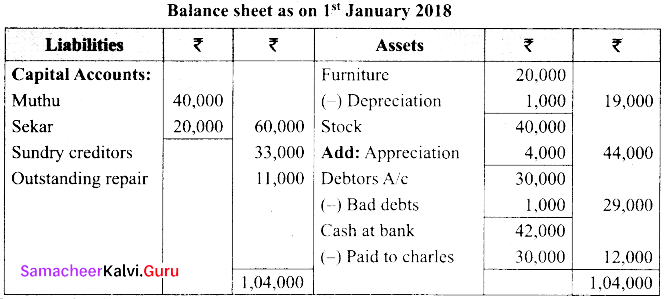
Marusthali means sand-dune. It covered eastern portion of the Great Indian Thar Desert in western Rajasthan. It extends over about 24,000 square miles north of the Luni River.
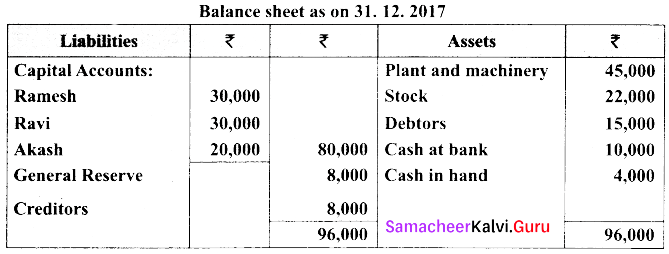
Question 33.
Attempt an essay on the Arab-Israeli wars of 1967 and 1973.
Answer:
(i) The formation of Palestinian Liberation Organisation (PLO) was never friendly to Israel. It came to be attached frequently by Palestinian guerrilla groups based in Syria, Lebanon and Jordan. Israel also made violent retaliation.

(ii) In November 1966, Israel attacked the village of Al-Sami in the Jordanian West Bank. The death toll in this attack was 18. In April 1967 Israel started air battle with Syria which resulted in the shooting down of six Syrian Mig fighter jet.

(iii) In his bid to show Egypt’s support for Syria, Nasser mobilised Egyptian forces in the Sinai, seeking the removal of UN emergency forces stationed there on May 18. On May 22, he closed the Gulf Aqaba to Israeli shifting.

(iv) On June 5, Israel stopped a sudden pre-emptive air strike that destroyed more than 90 percent of Egypt’s air force on the tarmac. A similar air assault was in capacitated the Syria air force. Within three ways, Israel captured the Gaza Strip and all the Senai Peninsula up to the East Bank of the Suez Canal.

(v) On June 7, the Israeli forces drove Jordanian forces out of East Jerusalem and most the West Bank. The War ended when the UN Security Council called for a ceasefire. Arab-Israel War of 1973: Egypt and Syria made a secret agreement in January 1973 to bring their armies under one command.

(vi) Hafez al-Assad, the President of Syria was keen on retrieving Golan Heights. As Assad was aware that his country’s weapons were dated, he offered the Israelis a peace deal of they would withdraw from Sinai. Israel rejected the offer.

(vii) Egypt and Syria then launched a sudden attack on the Yom Kippur religions holiday on 6 October 1973. Though Israel suffered heavy casualties, it could finally push back the Arab forces. But this time, due to UN intervention, Israel was forced to return to 1967 position. Arabs gained nothing out of this war too.

Question 34.
Estimate Periyar E.V.R’s decisive contribution to the social transformation of Tamil Nadu?
Answer:
Periyar was a great social reformer. His contribution to the social transformation of Tamil Nadu is really praise worthy.

  • He launched ‘Temple entry’ movement to provide the lower caste people easy access to the temples.
  • He also started the Self-Respect movement in 1925, with the determination that there ought to be ‘no God; no religion; no Gandhi; no Congress; and no Brahmins’.
  • Periyar was critical of patriarchy. He condemned child marriage and the Devadasi system. Right from 1929, when the Self-Respect conference began to voice its concern over the plight of women, Periyar had been emphasising on women’s right to divorce and property.
  • He advocated atheism as a mode of critique to deconstruct the established practices of faith, culture and custom. Periyar wanted religion to be replaced by rationalism.
  • He welcomed equal rights for males and females in property, guardianship and adoption. He was strong champion of birth control and contraception.

Question 35.
What is urbanization? Explain its impacts.
Answer:
The process of society’s transformation from rural to urban is known as urbanization. The level of urbanization of a place is assessed based on the size of population of the towns and cities and the proportion of population engaged in non agricultural sectors. These two are closely linked to the process of industrialization and expansion of the secondary and tertiary sectors of economy.

Impacts of urbanization:

  • Urbanization and population concentration go hand – in – hand and are closely related to each other. A rapid rate of urbanization in a society is taken as an indicator of its economic development.
  • Urbanization is increasing rapidly in the developing countries including India.
  • Rural to urban migration leads to population explosion in urban areas. Metropolitan cities like Mumbai, Kolkatta and Delhi have more population than that can accommodate.

The following are the major problem of urbanization in India:

  • It creates urban sprawl.
  • It makes overcrowding in urban centres.
  • It leads to shortage of houses in urban areas.
  • It leads to the formation of slums.
  • It increases traffic congestion in cities.
  • It creates water scarcity in cities.
  • It creates drainage problems.
  • It poses the problem of solid waste management.
  • It increases the rate of crime.

Question 36.
Write about Road Safety Rules.
Answer:

  • Aware of the road signals
  • Stop, look and cross
  • Listen and ensure whether a vehicle is approaching
  • Don’t rush on roads
  • Cross roads in pedestrian crossings
  • Don’t stretch hands while driving vehicles
  • Never cross road at bends and stay safe in a moving vehicle

Question 37.
What are the powers and functions of the Chief Minister?
Answer:
The powers and the functions of the Chief Minister are:

  • The Chief Minister is the head of the Council of Ministers. He recommends the persons who can be appointed as ministers by the Governor. He allocates the portfolio among the ministers.
  • He presides over the meetings of the council of Ministers and influences its decisions.
  • The Chief Minister is the principal channel of communication between Governor and the Council of Ministers.
  • He announces the Government policies on the floor of the House. He can introduce the Bills in the Legislative Assembly.
  • For smooth functioning of the State and for good Centre – State relations, he has to develop a rapport with the Union Government.

Question 38.
Explain the role of taxation in economic development.
Answer:
The role of taxation in developing economics is as follows.

1. Resource mobilisation: Taxation enables the government to mobilise a substantial amount of revenue. The tax revenue is generated by imposing direct taxes such as personal income tax and corporate tax and indirect taxes such as customs duty, excise duty, etc.

2 Reduction in equalities of income: Taxation follows the principle of equity. The direct
taxes are progressive in nature. Also certain indirect taxes, such as taxes on luxury goods, is also progressive in nature.

3. Social welfare: Taxation generates social welfare. Social welfare is generated due to higher taxes on certain undesirable products like alcoholic products.

4. Foreign exchange: Taxation encourages exports and restricts imports, Generally developing countries and even the developed countries do not impose taxes on export items.

5. Regional development: Taxation plays an important role in regional development, Tax incentives such as tax holidays for setting up industries in backward regions, which induces business firms to set up industries in such regions.

6. Control of inflation: Taxation can be used as an instrument for controlling inflation. Through taxation the government can control inflation by reducing the tax on the commodities.

Samacheer Kalvi 10th Social Science Model Question Paper 2 English Medium

Question 39.
Write briefly the history of globalization.
Answer:
The historical background of globalization can be discussed in three steps –
(i) Archaic Globalization – It is an early form of globalization. It existed during the Hellenistic Age. It established a trade link between the Roman Empire, Parthian Empire and the Han Dynasty. The commercial links between these powers inspired the development of the Silk Road. The Islamic Golden Age was also an important early stage of globalization.

(ii) Proto Globalization – It was characterised by the rise of maritime European empires in the 16th and 17th centuries. In the 17th century, globalization became private business phenomenon like British East India Company founded in 1600, described as the first multinational company.

(iii) Modern Globalization – The 19th and 20th centuries witnessed the advent of modem globalization. Global trade and capital investment increased. Several multinational firms came into being.

Question 40.
What are the contributions of Industrialization to development?
Answer:

(i) As stated earlier, it is essential to produce inputs to other producers in an economy. Even agriculture requires inputs from industry such as fertilisers and tractors to increase productivity.

(ii) Second, a market exists for both producers and consumer goods. Even services like banking, transport and trade are dependent on production of industrial goods.

(iii) Third, by using modem methods of production, industries contribute to better productivity and hence lower cost of production of all goods produced. It therefore helps people to buy goods at a cheaper rate and help create demand for more products.

(iv) Fourth, through such expansion of production, industrialisation helps to absorb the labour force coming out of agriculture. Employment generation is therefore an important objective of industrialisation.

(v) Fifth, a related advantage of industrialisation is therefore technological change. Through use of modem techniques, industrialisation contributes to learning of such methods and their improvement. As a result labour productivity, ie, output per unit of labour input increases, which can help workers earn higher wages.

(vi) Sixth, expanding incomes lead to more demand for goods and services. If an economy is not able to produce enough to meet such demand, it has to rely on imports and therefore spend a lot of foreign exchange. If the economy does not earn enough from exporting, it will be difficult to meet the growing demand. Industrialisation therefore helps an economy to save and also generate foreign exchange through exports. .

Question 41.
Draw a time line for the following:
five important events between 1889-1935.
Answer:
Samacheer Kalvi 10th Social Science Model Question Paper 2 English Medium – 5

Question 42.
Mark the following places on the world map.
(i) Great Britain
(ii) Russia
(iii) Hawai Island
(iv) Germany
(v) Norway
Answer:
Samacheer Kalvi 10th Social Science Model Question Paper 2 English Medium - 6

Part – IV

Answer both questions. [2 × 8 = 16]

Question 43.
(a) Japanese Aggression in South-east Asia
(i) Name the South-east Asian countries which fell to the Japanese.
(ii) Account for the setback of Allies in the Pacific region?
(iii) What is the significance of Battle of Midway?
(iv) What happened to the Indians living in Burma?
Answer:
(a) Japanese Aggression in South-east Asia:

(i) Guam, the Philippines, Hong Kong, Singapore, Malaya, the Dutch East Indies (Indonesia) and Burma.
(ii) The Allies faced many reverses in the Pacific region because of their inadequate preparations. The colonial rulers, especially the British, withdrew from their territories, leaving the local people to face the atrocities of the Japanese.
(iii) The US navy defeated the Japanese navy in the Battle of Midway.
(iv) Many Indians walked all the way from Burma to the Indian border, facing hardships. Many died of disease and exhaustion. Those who remained suffered under the Japanese.

(b) Aligarh Movement
(i) What is the main aim of this movement? ‘
(ii) Who is considered the soul of this movement?
(iii) Why were English books translated into Urudu?
(iv) Name the college which was later raised to the status of a University?
Answer:
(b) Aligarh Movement:

(i) The main aim of the Aligarh Movement was to persuade the Muslims to acquire modem knowledge and English language.
(ii) Sir Sayed Ahmed Khan is considered the soul of the Aligarh Movement.
(iii) Many English Books were translated into Urdu in order to enable the Muslims to accept the western science and take up government services.
(iv) Aligarh Muhammadan Anglo-Oriental College.

[OR]

Question 43.
(c) Factors leading to the rise of National Movement.
(i) How did the national leaders inspire the people?
(ii) When was the Vernacular Press Act passed?
(iii) What was the policy of the British?
(iv) How did the British consider the Indians?
Answer:
(c) Factors leading to the rise of National Movement:

(i) They inspired the people with the ideas of self-respect and self-confidence.
(ii) The Vernacular Press Act was passed in 1878.
(iii) The British followed the policy of “Divide and Rule”.
(iv) The British considered the Indians as inferior and uncivilized.

(d) Maraimalai Adigal
(i) Name the Sangam texts for which Maraimalai Adigal wrote commentaries.
(ii) Name the journal where he worked as a young man.
(iii) Why did he oppose imposition of Hindi?
(iv) Who were the key influences in Maraimalai Adigal’s life?
Answer:
(d) Maraimalai Adigal

(i) Pattinappalai and Mullaipattu.
(ii) Siddhanta Deepika
(iii) Adigal promoted the use of pure Tamil words and removal of the Sanskrit influences from Tamil language. He painted out that Tamil language would suffer with the introduction of Hindi.
(iv) His teachers P. Sundaram Pillai and Somasundara Nayagar were the key influences in Maraimalai Adigal’s life.

Question 44.
Mark the following places on the given outline map of India.
(i) Zaskar range
(ii) River Ganga
(iii) Baghelkhand Plateau
(iv) Coffee growing area
(v) Any one Iron ore production area
(vi) Bombay high
(vii) Andaman & Nicobar Island
(viii) Cotton growing area
Answer:
Samacheer Kalvi 10th Social Science Model Question Paper 2 English Medium - 7

[OR]

Mark the following places on the given outline map of Tamil Nadu:
(i) Red soil area
(ii) Mangrove forest
(iii) Villupuram
(iv) One oil seeds area
(v) Udagamandalam
(vi) Kancheepuram
(vii) Gomukhi dam
(viii) River Tamirabarani
Answer:
Samacheer Kalvi 10th Social Science Model Question Paper 2 English Medium - 8

Map for Q. 42
(i) Great Britain
(ii) Russia
(iii) Hawai Island
(iv) Germany
(v) Norway
Answer:
Samacheer Kalvi 10th Social Science Model Question Paper 2 English Medium - 10

Map for Q. 44
(i) Zaskar range
(ii) River Ganga
(iii) Baghelkhand Plateau
(iv) Coffee growing area
(v) Any one Iron ore production area
(vi) Bombay high
(vii) Andaman & Nicobar Island
(viii) Cotton growing area
Answer:
Samacheer Kalvi 10th Social Science Model Question Paper 2 English Medium - 9

Map for Q. 44
(i) Red soil area
(ii) Mangrove forest
(iii) Villupuram
(iv) One oil seeds area
(v) Udagamandalam
(vi) Kancheepuram
(vii) Gomukhi dam
(viii) River Tamirabarani
Answer:
Samacheer Kalvi 10th Social Science Model Question Paper 2 English Medium - 11

Samacheer Kalvi 10th Maths Model Question Paper 2 English Medium

Students can Download Samacheer Kalvi 10th Maths Model Question Paper 2 English Medium Pdf, Samacheer Kalvi 10th Maths Model Question Papers helps you to revise the complete Tamilnadu State Board New Syllabus and score more marks in your examinations.

Tamilnadu Samacheer Kalvi 10th Maths Model Question Paper 2 English Medium

Instructions

  • The question paper comprises of four parts.
  • You are to attempt all the parts. An internal choice of questions is provided wherever applicable.
  • All questions of Part I, II, III and IV are to be attempted separately.
  • Question numbers 1 to 14 in Part I are Multiple Choice Quèstions of one-mark each. These are to be answered by choosing the most suitable answer from the given four alternatives and.writing the option code and the corresponding answer.
  • Question numbers 15 to 28 in Part II àre two-marks questions. These are to be answered in about one or two sentences.
  • Question numbers 29 to 42 in Part III are five-marks questions. These are to be answered in about three to five short sentences.
  • Question numbers 43 to 44 in Part IV are eight-marks questions. These are to be answered in detail. Draw diagrams wherever necessary.

Time: 3 Hours
Max Marks: 100
PART-I

I. Choose the correct answer. Answer all the questions. [14 × 1 = 14]

Question 1.
Let f and g be two functions given by f = {(0,1),(2,0),(3,-4),(4,2),(5,7)} g = {(0,2),(1, 0),(2,4),(-4,2),(7, 0)} then the range of fog is …………. .
(1) {0,2,3,4,5}
(2) {-4,1,0,2,7}
(3) {1,2,3,4,5}
(4) {0,1,2}
Answer:
(4) {0,1,2}

Samacheer Kalvi 10th Maths Model Question Paper 2 English Medium

Question 2.
An A.P consists of 31 terms. If its 16th term is m, then the sum of all the terms of this A.P. is …………. .
(1) 16m
(2) 62 m
(3) 31m
(4) \(\frac{31}{2}\)m
Answer:
(3) 31m

Question 3.
The value of (13 + 23 + 33 +….+ 153) – (1 + 2 + 3 +….+ 15) is …………. .
(1) 14400
(2) 14200
(3) 14280
(4) 14520
Answer:
(3) 14280

Question 4.
Which of the following should be added to make x4 + 64 a perfect square …………. .
(1) 4x2
(2) 16x2
(3) 8x2
(4) -8x2
Answer:
(2) 16x2

Question 5.
The number of points of intersection of the quadratic polynomial x2 + 4x + 4 with the X axis is …………. .
(1) 0
(2) 1
(3) 0 or 1
(4) 2
Answer:
(2) 1

Question 6.
In the adjacent figure ∠BAC = 90° and AD ⊥BC then …………. .
Tamil Nadu 10th Maths Model Question Paper 2 English Medium - 1
(1) BDCD = BC2
(2) AB.AC = BC2
(3) BD.CD = AD2
(4) AB.AC = AD2
Answer:
(3) BDCD = AD2

Question 7.
If (5, 7), (3, p) and (6, 6) are collinear, then the value of p is …………. .
(1) 3
(2) 6
(3) 9
(4) 12
Answer:
(3) 9

Question 8.
(1 + tan θ + sec θ) (1 + cot θ – cosec θ) is equal to …………. .
(1) 0
(2) 1
(3) 2
(4) -1
Answer:
(3) 2

Samacheer Kalvi 10th Maths Model Question Paper 2 English Medium

Question 9.
The total surface area of a cylinder whose radius is \(\frac{1}{3}\) of its height is
(1) \(\frac{9 \pi h^{2}}{8}\) sq. units
(2) 24πh2 sq. units
(3) \(\frac{8 \pi h^{2}}{9}\) sq. units
(4) \(\frac{56 \pi h^{2}}{9}\) sq. units
Answer:
(3) \(\frac{8 \pi h^{2}}{9}\) sq. units

Question 10.
The mean of 100 observations is 40 and their standard deviation is 3. The sum of squares of all deviations is …………. .
(1) 40000
(2) 160900
(3) 160000
(4) 30000
Answer:
(2) 160900

Question 11.
The probability a red marble selected at random from a jar containing p red, q blue and r green marbles is …………. .
(1) \(\frac{q}{p+q+r}\)
(2) \(\frac{p}{p+q+r}\)
(3) \(\frac{p+q}{p+q+r}\)
(4) \(\frac{p+r}{p+q+r}\)
Answer:
(1) \(\frac{q}{p+q+r}\)

Question 12.
If there are 28 relation from a set A = {2,4, 6, 8} to a set B, then the number of elements in B is …………. .
(1) 7
(2) 14
(3) 5
(4) 4
Answer:
(1) 7

Samacheer Kalvi 10th Maths Model Question Paper 2 English Medium

Question 13.
If a1 ,a2, a3 ……….. are in A.P. such that \(\frac{a_{4}}{a_{7}}=\frac{3}{2}\), then the 13th term of the AP is …………. .
(1) \(\frac{3}{2}\)
(2) 0
(3) 12a1
(4) 14a1
Answer:
(2) 0

Question 14.
The X-intercept of the line 2x – 3y + 5 = 0 is …………. .
(1) \(\frac{5}{2}\)
(2) \(\frac{-5}{2}\)
(3) \(\frac{2}{5}\)
(4) \(\frac{-2}{5}\)
Answer:
(2) \(\frac{-5}{2}\)

PART-II

II. Answer any ten questions. Question No. 28 is compulsory. [10 × 2 = 20]

Question 15.
A function f is defined by f(x) = 3 – 2x. Find x such that f(x2) = (f (x))2.
Answer:
f(x) = 3 – 2x
f(x2) = 3 – 2 (x2)
= 3 – 2x2
(f(x)2 = (3 – 2x)2
= 9 + 4x2 – 12x
But f(x2) = (f(x))2
3 – 2x2 = 9 + 4x2 – 12x
– 2x2 – 4x2 + 12x + 3 – 9 = 0
– 6x2 + 12x – 6 = 0
(÷ by – 6) ⇒ x2 – 2x + 1 = 0
(x – 1)(x – 1) = 0
x – 1 = 0 or x – 1 = 0
x = 1
The value of x = 1

Samacheer Kalvi 10th Maths Model Question Paper 2 English Medium

Question 16.
If f(x) = x2 – 1, g(x) = x – 2 find a, if gof (a) = 1.
Answer:
f(x) = x2 – 1 ; g(x) = x – 2
gof = g [f(x)]
= g(x2 – 1)
= x2 – 1 – 2
= x2 – 3
given gof (a) = 1
a2 – 3 = 1 [But gof(x) = x2 – 3]
a2 = 4
a = √4 = ± 2
The value of a = ± 2

Question 17.
Find the number of integer solutions of = 1 (mod 15).
Answer:
3x ≡ 1 (mod 15) can be written as
3x – 1 = 15k for some integer k
3x = 15k + 1
x = \(\frac{15 k+1}{3}\) = 5k + \(\frac{1}{3}\)
Since 5k is an integer, 5k + \(\frac{1}{3}\) cannot be an integer. So there is no integer solution.

Question 18.
Find the rational form of the number \(0 . \overline{123}\)
Answer:
Let x = \(0 . \overline{123}\)
= 0.123123123 ….
= 0.123 + 0.000123 + 000000123 + ….
This is an infinite G.P
Here a = 0.123, r = \(\frac{0.000123}{0.123}\) = 0.001
Sn = \(\frac{a}{1-r}=\frac{0.123}{1-0.001}=\frac{0.123}{0.999}\)
Sn = \(\frac{41}{333}\)

Samacheer Kalvi 10th Maths Model Question Paper 2 English Medium

Question 19.
Find the GCD of 12(x4 – x3), 8(x4 – 3x3 + 2x2) whose LCM is 24x3 (x – 1)(x – 2)
Answer:
Tamil Nadu 10th Maths Model Question Paper 2 English Medium - 2
p(x) = 12(x4 – x3)
= 12x3(x – 1)
g(x) = 8(x4 – 3x3 + 2x2)
= 8x2(x2 – 3x + 2)
= 8x2(x – 2) (x – 1)
L.C.M = 24x3(x – 1) (x – 2)
G.C.D = \(\frac{p(x) \times g(x)}{\text { L.C.M. }}\)
= \(\frac{12 x^{3}(x-1) \times 8 x^{2}(x-2)(x-1)}{24 x^{3}(x-1)(x-2)}\)
G.C.D = 4x2(x – 1)

Question 20.
Find the square root of the polynomial x4 – 12x3 + 42x2 – 36x + 9 by division method
Answer:
Tamil Nadu 10th Maths Model Question Paper 2 English Medium - 3
\(\sqrt{x^{4}-12 x^{3}+42 x^{2}-36 x+9}\) = |x2 – 6x + 3|

Samacheer Kalvi 10th Maths Model Question Paper 2 English Medium

Question 21.
Write expression \(\frac{\alpha+3}{\beta}+\frac{\beta+3}{\alpha}\) interms of α + β and αβ.
Answer:
Tamil Nadu 10th Maths Model Question Paper 2 English Medium - 4

Question 22.
In the given diagram show that ∆PST ~ ∆PQR
Answer:
Tamil Nadu 10th Maths Model Question Paper 2 English Medium - 5
In ∆PST and ∆PQR,
\(\frac{P S}{P Q}=\frac{2}{2+1}=\frac{2}{3}\) , \(\frac{P T}{P R}=\frac{4}{4+2}=\frac{2}{3}\)
Thus, \(\frac{P S}{P Q}=\frac{P T}{P R}\) and ∠P is common
Therefore, by SAS similarity,
∆PST ~ ∆PQR

Question 23.
Find the value of for which the given points (2,3), (4, a) and (6, -3) are collinear.
Answer:
Let the points be A (2, 3), B(4, a) and C(6, -3).
Since the given points are collinear.
Area of a triangle =0
Tamil Nadu 10th Maths Model Question Paper 2 English Medium - 6
\(\frac { 1 }{ 2 }\) [(x1y1 + x2y2 + x3y1) – (x2y1 + x3y2 + x1y3)] = 0
\(\frac { 1 }{ 2 }\) [(2a – 12 + 18) – (12 + 6a – 6)] = 0
2a + 6 – (6 + 6a) = 0
2a + 6 – 6 – 6a = 0
-4 a = 0 ⇒ a = \(\frac { 0 }{ 4 }\) = 0
The value of a = 0

Samacheer Kalvi 10th Maths Model Question Paper 2 English Medium

Question 24.
The horizontal distance between two buildings is 70 m. The angle of depression of the top of the first building when seen from the top of the second building is 45°. If the height of the second building is 120 m, find the height of the first building.
Answer:
Tamil Nadu 10th Maths Model Question Paper 2 English Medium - 7
Let the height of the first building AD be “x” m
∴ EC = 120 – x
In the right ∆ CDE,
tan 45° = \(\frac{C E}{C D}\)
1 = \(\frac{120-x}{70}\) ⇒ 70 = 120 – x
x = 50m
∴ The height of the first building is 50 m

Question 25.
If the coefficient of variation of a collection of data is 57 and its standard deviation is 6,84, then find the mean.
Answer:
Given coefficient of variation =57
Standard deviation (σ) = 6.84
C.V = \(\frac{\sigma}{\bar{x}}\)
57 = \(\frac{6.84}{\bar{x}} \times 100\)
x̄ = \(\frac{6.84}{57} \times 100=\frac{684}{57}=12\)
∴ Arithmetic mean x̄ = 12

Question 26.
The radius and height of a cylinder are in the ratio 2:7. If the curved surface area of the cylinder is 352 sq.cm. Find its radius.
Answer:
Let the radius be “2x” and the height be “7x”
Curved surface area = 352cm2
2πrh = 352
2 × \(\frac{22}{7}\) × 2x × 7x = 352
44 × 2x2 = 352
x2 = \(\frac{352}{44 \times 2}=\frac{176}{44}=4\)
x = √4 = 2
Radius of the cylinder (2 × 2) = 4 cm

Samacheer Kalvi 10th Maths Model Question Paper 2 English Medium

Question 27.
A number is selected at random from integers 1 to 100. Find the probability that it is not a perfect cube.
Answer:
Sample space = {1, 2, 3,…. 100}
n(S) = 100
Let A be the event of getting a perfect cube.
A = (1, 8, 27, 64)
n(A) = 4
p(A) = \(\frac{n(\mathrm{A})}{n(\mathrm{S})}\)
p(A) = \(\frac{4}{100}=\frac{1}{25}\)
The Probability that the selected number is not a perfect cube is
P(Ā) = 1 – P(A)
= 1 – \(\frac{1}{25}\)
= \(\frac{24}{25}\)

Question 28.
Find the value of k if 13 + 23 + 33 + ……… + k3 = 2025
Answer:
13 + 23 + 33 + ……… + k3 = 2025
\(\left[\frac{k(k+1)}{2}\right]^{2}\) = 2025
\(\frac{k(k+1)}{2}\) = \(\sqrt{2025}\) = 45
k2 + k = 90
K2 + k – 90 = 0
(k + 10) (k + 9) = 0
k = -10 or k = 9 k = 9 (k = -10) is not possible
∴ The value of k = 9

Samacheer Kalvi 10th Maths Model Question Paper 2 English Medium

Part – III

III. Answer any ten questions. Question No. 42 is compulsory. [10 × 5 = 50]

Question 29.
Let A = The set of all natural numbers less than 8, B = The set of all prime numbers less than 8, C = The set of even prime number. Verify that A × (B – C) = (A × B) – (A × C)
Answer:
A= {1,2, 3, 4, 5,6, 7}; B = {2, 3, 5,7} and C= {2}
B – C = {2, 3, 5, 7} – {2}
= {3,5,7}
A × (B – C) = {1,2, 3,4, 5,6,7} × {3, 5,7}
= {(1,3) (1, 5) (1, 7) (2, 3) (2, 5) (2, 7) (3,3) (3, 5) (3, 7) (4, 3) (4, 5) (4, 7) (5,3) (5, 5) (5, 7) (6, 3) (6, 5) (6, 7) (7, 3) (7, 5) (7, 7)} …. (1)

A × B = {1,2, 3,4, 5,6,7} × {2, 3, 5,7}
= {(1,2) (1, 3) (1, 5) (1, 7) (2, 2) (2, 3) (2, 5) (2, 7) (3, 2) (3, 3) (3, 5) (3, 7) (4,2) . (4, 3) (4, 5) (4, 7) (5, 2) (5, 3) (5, 5) (5, 7) (6, 2) (6, 3) (6, 5) (6, 7) (7, 2) (7, 3) (7, 5) (7, 7)}

A × C = {1,2, 3, 4, 5, 6, 7} × {2}
= {(1, 2) (2, 2) (3, 2) (4, 2) (5, 2) (6, 2) (7, 2)}

(A × B) – (A × C) = {(1, 3) (1, 5) (1, 7) (2, 3) (2, 5) (2, 7) (3, 3) (3, 5) (3, 7) (4, 3) (4, 5) (4, 7) (5, 3) 5, 5) (5, 7) (6, 3) (6, 5) (6, 7) (7, 3) (7, 5) (7, 7)} ….(2)
From (1) and (2) we get
A × (B – C) = (A × B) – (A × C)

Question 30.
If f(x) = x – 4, g(x) = x2 and h(x) = 3x – 5 prove that fo(goh) = (fog)oh
Answer:
f(x) = x – 4; g(x) = x2; h(x) = 3x – 5
fog (x) = f[g(x)]
= f(x2)
= x2 – 4
(fog) oh(x) = fog[h(x)]
= fog (3x – 5)
= (3x – 5)2 – 4
= 9x2 – 30x + 25 – 4
= 9x2 – 30x + 21 …. (1)
goh(x) = g[h(x)]
= g(3x – 5)
= (3x – 5)2
= 9x2 + 25 – 30x
fo(goh) x = f[goh(x)]
= f [9x2 – 30x + 25]
= 9x2 – 30x + 25 – 4
= 9x2 – 30x + 21 ….(2)
Fróm (1) and (2) we get (fog)oh = fo(goh)

Samacheer Kalvi 10th Maths Model Question Paper 2 English Medium

Question 31.
In an A.P., sum of four consecutive terms is 28 and their sum of their squares is 276. Find the four numbers.
Answer:
Let us take the four terms in the form (a – 3d), (a – d), (a + d) and (a + 3d).
Since sum of the four terms is 28,
a – 3d + a – d + a + d + a + 3d = 2%
4a = 28 gives a = 7
Similarly, since sum of their squares is 276,
(a – 3d)2 + (a – d)2 + (a + d)2+ (a + 3d)2 = 276.
a2 – 6ad + 9d2 + a2 – 2ad + d2 + a2 + 2ad + d2 + a2 + 6ad + 9d2 = 276
4a2 + 20d2 = 276 ⇒ 4(7)2 + 20d2 = 276.
d2 = 4 gives d = ± 2
If d = 2 then the four numbers are 7 – 3(2), 7 – 2, 7 + 2, 7 + 3(2)
That is the four numbers are 1, 5, 9 and 13.
If a = 7, d = -2 then the four numbers are 13, 9, 5 and 1
Therefore, the four consecutive terms of the A.P. are 1, 5, 9 and 13.

Question 32.
If a, b, c are three consecutive terms of an A.P. and x, y, z are three consecutive terms of a G.P. then prove that xb – c × yc – a × z a – b = 1.
Answer:
a, b, c are three consecutive terms of an A.P
∴ a = a, b = a + d and c = a + 2d respectively ……. (1)
x, y, z are three consecutive terms of a G.P
∴ x = x, y = xr, z = xr2 respectively ….(2)
L.H.S = xb – c × yc – a × z a – b
( Substitute the values from 1 and 2 we get)
Tamil Nadu 10th Maths Model Question Paper 2 English Medium - 8
L.H.S = R.H.S
Hence it is proved

Samacheer Kalvi 10th Maths Model Question Paper 2 English Medium

Question 33.
There are 12 pieces of five, ten and twenty rupee currencies whose total value is ₹105. But when first 2 sorts are interchanged in their numbers its value will be increased by ₹20. Find the number of currencies in each sort.
Answer:
Let the number of ₹5 currencies be “x”
Let the number of ₹10 currencies be “y”
and the number of ₹20 currencies be “z”
By the given first condition
x + y + z = 12 …….. (1)
By the given second condition
5x + 10y + 20z = 105
x + 2y + 4z = 21 (÷5) …….. (2)
By the given third condition
10x + 5y + 20z = 105 + 20
10x + 5y + 20z = 125
2x + y + 4z = 25 ………. (3)
Tamil Nadu 10th Maths Model Question Paper 2 English Medium - 9
Tamil Nadu 10th Maths Model Question Paper 2 English Medium - 10
Substituting the value of x = 7 in (5)
7 – y = 4 ⇒ – y = 4 – 7
-y = -3 ⇒ y = 3
Substituting the value of x = 7, y = 3 in …. (1)
7 + 3 + z = 12
z = 12 – 10 = 2
x = 7,y = 3,z = 2
Number of currencies in ₹ 5 = 7
Number of currencies in ₹ 10 = 3
Number of currencies in ₹ 20 = 2

Samacheer Kalvi 10th Maths Model Question Paper 2 English Medium

Question 34.
Find the square root of the expression \(\frac{4 x^{2}}{y^{2}}+\frac{20 x}{y}+13-\frac{30 y}{x}+\frac{9 y^{2}}{x^{2}}\)
Answer:
Tamil Nadu 10th Maths Model Question Paper 2 English Medium - 11

Question 35.
If A = \(\left[ \begin{matrix} 3 & 1 \\ -1 & 2 \end{matrix} \right]\) show that A2 – 5A + 7I2 = 0
Answer:
Tamil Nadu 10th Maths Model Question Paper 2 English Medium - 12
L.H.S = R.H.S
∴ A2 – 5A + 7I2 = 0

Samacheer Kalvi 10th Maths Model Question Paper 2 English Medium

Question 36.
State and prove Thales theorem
Answer:
A straight line drawn parallel to a side of triangle intersecting the other two sides, divides the sides in the same ratio.
Tamil Nadu 10th Maths Model Question Paper 2 English Medium - 13
Proof
Given : In ∆ABC, D is a point on AB and E is a point on AC.
To prove : \(\frac{A D}{D B}=\frac{A E}{E C}\)
Construction : Draw a line DE || BC
Tamil Nadu 10th Maths Model Question Paper 2 English Medium - 14
Tamil Nadu 10th Maths Model Question Paper 2 English Medium - 15

Question 37.
Find the value of k, if the area of a quadrilateral is 28 sq. units, whose vertices are (-4, -2), (-3, k), (3,-2) and (2,3)
Answer:
Let the vertices A (-4, -2), B (-3, k), C (3, -2) and D (2, 3)
Area of the Quadrilateral = 28 sq. units
\(\frac { 1 }{ 2 }\) [(x1y2 + x2y3 + x3y4 + x4y1) – (x2y1 + x3y2 + x4y3 + x1y4)] = 28
Tamil Nadu 10th Maths Model Question Paper 2 English Medium - 16
\(\frac { 1 }{ 2 }\) [(-4k + 6 + 9 – 4)-(6 + 3k – 4 – 12)] = 28
\(\frac { 1 }{ 2 }\) [(-4k + 11) – (3k – 10)] = 28
-4k + 11 – 3k + 10 = 56
-7k + 21 = 56
-7k = 56 – 21
-7k = 35 ⇒ 7k = -35
k = \(-\frac{35}{7}\) = -5
∴ The value of k = -5

Samacheer Kalvi 10th Maths Model Question Paper 2 English Medium

Question 38.
A bird is sitting on the top of a 80 m high tree. From a point on the ground, the angle of elevation of the bird is 45° . The bird flies away horizontally in such away that it remained at a constant height from the ground. After 2 seconds, the angle of elevation of the bird from the same point is 30° . Determine the speed at which the bird flies. (√3 = 1.732)
Answer:
A is the initial position of the bird
B is the final position of the bird
Let the speed of the bird be “s”
Distance = speed × time
Tamil Nadu 10th Maths Model Question Paper 2 English Medium - 17
∴ AB = 2 s
Let CD be x
∴ CE = x + 2s
In the ∆ CDA, tan 45° = \(\frac{A D}{C D}\)
1 = \(\frac{80}{x}\)
x = 80 …(1)
In the ∆ BCE
tan 30° = \(\frac{\mathrm{BE}}{\mathrm{CE}}\)
\(\frac{1}{\sqrt{3}}=\frac{80}{x+2 s}\)
x + 2 s = 80 √3
x = 80 √3 – 2 s …(2)
From (1) and (2) we get
80 √3 – 2 s = 80
80 √3 – 80 = 2s ⇒ 80(√3 – 1) = 2 s
s = \(\frac{80(\sqrt{3}-1)}{2}\) = 40 (1.732 – 1) = 40 × 0. 732 = 29. 28
Speed of the flying bird = 29. 28 m / sec

Question 39.
The total marks scored by two students Sathya and Vidhya in 5 subjects are 460 and 480 with standard deviation 4.6 and 2.4 respectively. Who is more consistent in performance?
Answer:
Total marks scored by Sathya = 460
Total marks scored by Vidhya = 480
Number of subjects = 5
x̄ = 92%
Mean marks of Sathya = \(\frac{460}{5}\)
Given standard deviation, (σ) = 4.6
Coefficient of variation = \(\frac{\sigma}{\bar{x}} \times 100 \%\)
= \(\frac{4.6}{92} \times 100 \%\)
= \(\frac{460}{92}=5 \%\)
Mean marks of vidhya = \(\frac{480}{5}\)
Given standard deviation (σ) = 2.4
Coefficient of variation = \(\frac{2.4}{96} \times 100=\frac{240}{96}=2.5 \%\)
CV1 > CV2
Vidhya coefficient of variation is less than Sathya
∴ Vidhya is more consistent.

Samacheer Kalvi 10th Maths Model Question Paper 2 English Medium

Question 40.
The perimeters of the ends of frustum of a cone are 207.24 cm and 169.56 cm. If the height of the frustum be 8 cm, find the whole surface area of the frustum. [Use π = 3.14]
Answer:
Tamil Nadu 10th Maths Model Question Paper 2 English Medium - 18
Let the radii of circular ends be R and r [R > r]
Perimeter of circular ends are 207.24 cm and 169.56 cm
∴ 2πR = 207.24 cm
⇒ R = \(\frac{207.24}{2 \pi}=\frac{207.24}{2 \times 3.14}=33\)
⇒ R = 33m and 2 πr = 169.56
⇒ r = \(\frac{169.56}{2 \pi}=\frac{169.56}{2 \times 3.14}=27\)
Slant-height of the frustum
l = \(\sqrt{h^{2}+(\mathrm{R}-r)^{2}}\)
\(=\sqrt{8^{2}+(33-27)^{2}}\)
\(=\sqrt{64+36}\) = 10 cm
The whole surface area of the frustum = π [(R2 + r22) + (R + r) l]
∴ Required whole surface area of the frustum
= 3.14 [332 + 272 + (33 + 27) × 10] cm2
= 3.14 [1089 + 729 + 600] cm2
= 3.14 [2418] cm2
= 7592.52 cm2

Question 41.
A jar contains 54 marbles each of which is blue, green or white. The probability of selecting a blue marbles at random from the jar is \(\frac { 1 }{ 3 }\) and the probability of selecting a green marble at random is \(\frac { 4 }{ 9 }\) . How many white marbles does the jar contain?
Answer:
n(S) =54
Let the number of blue marble, be ‘x’
Let A be the event of getting blue marbles
n(A) = x
P(A) = \(\frac{n(\mathrm{A})}{n(\mathrm{S})}\)
\(\frac{1}{3}=\frac{x}{54}\)
3x = 54
x = \(\frac{54}{3}\) = 18
Number of blue marble is 18. Let the number of green marble be “y”. Let B be the event of getting green marbles.
Tamil Nadu 10th Maths Model Question Paper 2 English Medium - 19
P(B) = \(\frac{n(\mathrm{B})}{n(\mathrm{S})}\)
\(\frac{4}{9}=\frac{y}{54}\)
9y = 54 × 4
y = \(\frac{54 \times 4}{9}\) = 24
Blue marbles + green marbles + white marbles = 54
18 + 24 + white marbles = 54
∴ Number of white marbles = 54 – 42 = 12
The jar contain 12 white marbles.

Samacheer Kalvi 10th Maths Model Question Paper 2 English Medium

Question 42.
One – fourth of a herd of camels was seen in the forest. Twice the square root of the herd had gone to mountain and the remaining 15 camels were seen on the bank of a river. Find the total number of camels.
Answer:
Le the total number of camels be ‘x’
Number of camels seen in the forest = \(\frac { x }{ 4 }\)
Number of camels gone to the mountain = 2√x
Number of camels on the bank of river = 15
Total number of camels = \(\frac { x }{ 4 }\) + 2√x + 15
x = \(\frac { x }{ 4 }\) + 2√x + 15
4x = x + 8√x + 60 (muliply by 4)
3x – 8√x – 60 = 0
Let x = a2
3a2 – 8√a2 – 60 = 0
3a2 – 8a – 6 = 0
3a (a – 6) + 10(a – 6) = 0
(3a + 10) (a – 6) = 0
3a + 10 = 0 or a – 6 = 0
a = \(\frac{-10}{3}\) or a = 6
x = \(\left(\frac{-10}{3}\right)^{2}\) or 62(x = a2)
x = \(\frac{100}{9}\) (or) 36
Number of camels can-not be a fraction
∴ Number of camels = 36

PART – IV

IV. Answer all the questions. [2 × 8 = 16]

Question 43.
(a) Construct a triangle similar to a given triangle PQR with its sides equal to \(\frac { 7 }{ 4 }\) of the corresponding sides of the triangle PQR
Answer:
Given a triangle PQR, we are required to construct another triangle whose sides are \(\frac { 7 }{ 4 }\) of the corresponding sides of the triangle PQR.
Tamil Nadu 10th Maths Model Question Paper 2 English Medium - 20
Steps of construction
1. Construct a ∆PQR with any measurement.
2. Draw a ray QX making an acute angle with QR on the side opposite to vertex P.
3. Locate 7 points (the greater of 7 and 4 in \(\frac { 7 }{ 4 }\))
Q1, Q2, Q3, Q4, Q5, Q6 and Q7 on QX so that
QQ1 = Q1Q2 = Q2Q3 = Q3Q4= Q4Q5 = Q5Q6 = Q6Q7
4. Join Q4 (the 4th point, 4 being smaller of 4 and 7 in \(\frac { 7 }{ 4 }\)) to R and draw a line through Q7 parallel to Q4 R, intersecting the extended line segment QR at R’.
5. Draw a line through R’ parallel to RP intersecting the extended line segment QP at P’ Then ∆P’QR’ is the required triangle each of whose sides is seven-fourths of the corresponding sides of ∆PQR.

[OR]

Samacheer Kalvi 10th Maths Model Question Paper 2 English Medium

(b) Take a point which is 11 cm away from the centre of a circle of radius 4 cm and draw the two tangents to the circle from that point.
Answer:
Radius = 4 cm; Distance 11 cm
Tamil Nadu 10th Maths Model Question Paper 2 English Medium - 21
Tamil Nadu 10th Maths Model Question Paper 2 English Medium - 22
Steps of construction:

  1. With O as centre, draw a circle of radius 4 cm.
  2. Draw a line OP = 11 cm.
  3. Draw a perpendicular bisector of OP, which cuts OP at M.
  4. With M as centre and MO as radius, draw a circle which cuts previous circle A and B.
  5. Join AP and BP. AP and BP are the required tangents.
    This the length of the tangents PA = PB = 10.2 cm

Verification: In the right angle triangle OAP
PA2 = OP2 – OA2
= 112 – 42 = 121 – 16= 105
PA = √105 = 10.2 cm
Length of the tangents = 10.2 cm

Samacheer Kalvi 10th Maths Model Question Paper 2 English Medium

Question 44.
(a) Draw the graph of y = x2 + 3x + 2 and use it to solve x2 + 2x + 1 = 0.
Answer:
(i) Draw the graph of y = x2 + 3x + 2 preparing the table of values as below.
Tamil Nadu 10th Maths Model Question Paper 2 English Medium - 23
(ii) Plot the points (-4, 6), (-3, 2), (-2, 0), (-1, 0), (0, 2), (1, 6), (2, 12), (3, 20) (4, 30).
(iii) To solve x2 + 2x + 1 = 0 subtract x2 + 2x + 1 = 0 from y = x2 + 3x + 2
Tamil Nadu 10th Maths Model Question Paper 2 English Medium - 24
(iv) Draw the graph of y = x +1 from the table
Tamil Nadu 10th Maths Model Question Paper 2 English Medium - 25
The equation y = x + 1 represents straight line.
This line intersect the curve at only one point (-1, 0). The solution set is (-1).
Tamil Nadu 10th Maths Model Question Paper 2 English Medium - 26

[OR]

Samacheer Kalvi 10th Maths Model Question Paper 2 English Medium

(b) (2x – 3) (x + 2) = 0
y = (2x – 3) (x + 2)
= 2x2 + 4x – 3x – 6
= 2x2 + x – 6
(i) Prepare a table of values for y from x – 4 to 4
Tamil Nadu 10th Maths Model Question Paper 2 English Medium - 27+
(ii) Plot the points (-4, 22) (-3, 9) (-2, 0) (-1, -5) (0, -6) (1,-3), (2, 4), (3, 15) and (4, 30).
(iii) Join the points by a free hand smooth curve.
The curve intersect the X – axis at (-2, 0) and \(\left(1 \frac{1}{2}, 0\right)\)
∴ The solution set is \(\left(-2,1 \frac{1}{2}\right)\)
(iv) Since there are two points of intersection with X – axis, the quadratic equation has real and un – equal roots.