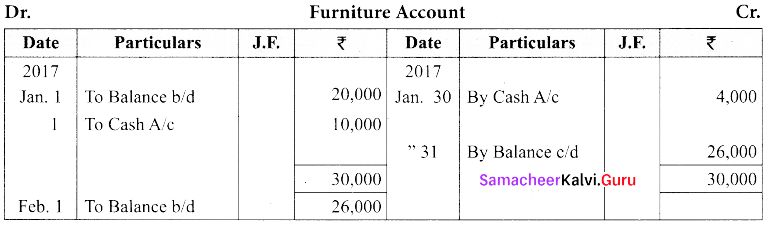
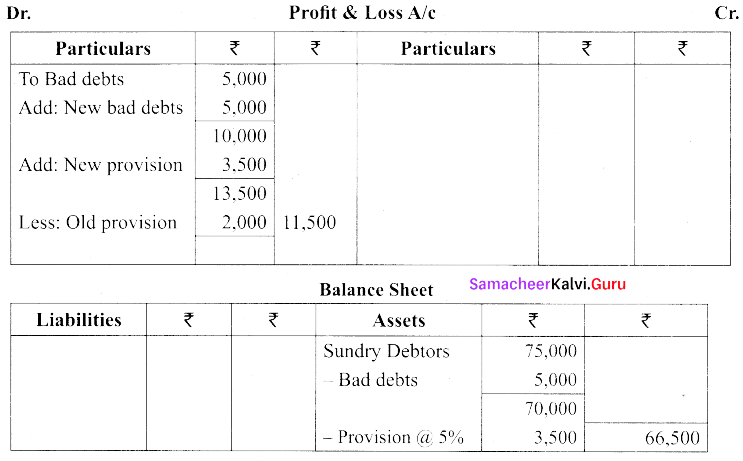
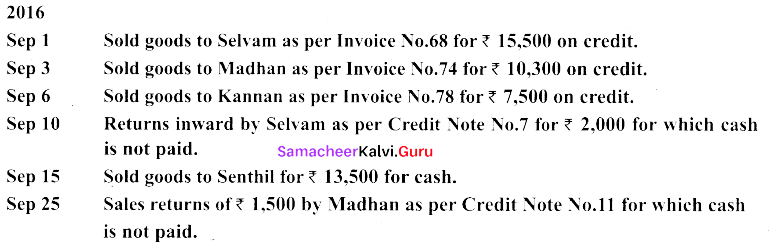
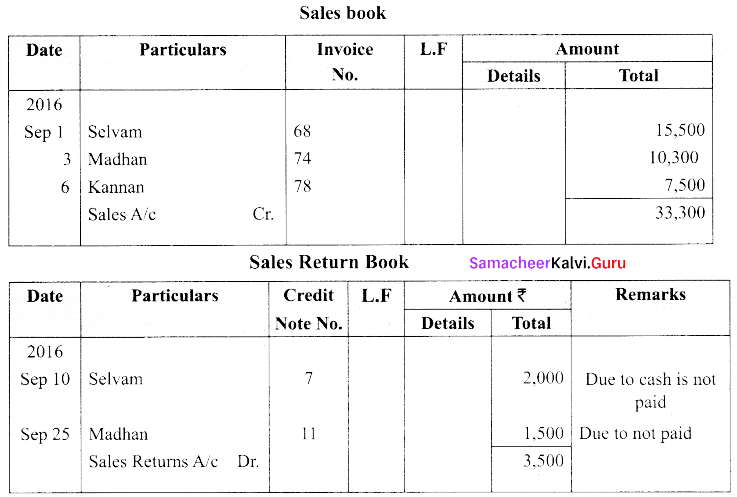
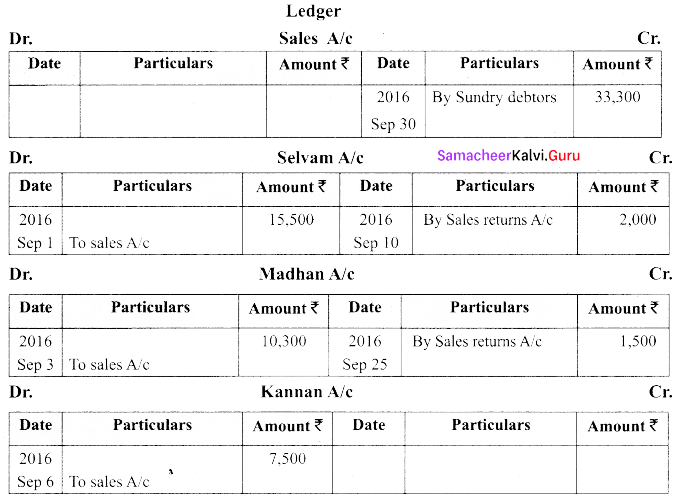
Tamil Nadu 11th Accountancy Model Question Paper 2 English Medium

Students can Download Tamil Nadu 11th Accountancy Model Question Paper 2 English Medium Pdf, Tamil Nadu 11th Accountancy Model Question Papers helps you to revise the complete Tamilnadu State Board New Syllabus and score more marks in your examinations.

TN State Board 11th Accountancy Model Question Paper 2 English Medium

General Instructions:

  1. The question paper comprises of four parts.
  2. You are to attempt all the parts. An internal choice of questions is provided wherever applicable.
  3. All questions of Part I, II, III, and IV are to be attempted separately.
  4. Question numbers 1 to 20 in Part I are Multiple Choice Questions of one mark each.
    These are to be answered by choosing the most suitable answer from the given four alternatives and writing the option code and the corresponding answer.
  5. Question numbers 21 to 30 in Part II are two-mark questions. These are to be answered in about one or two sentences.
  6. Question numbers 31 to 40 in Part III are three-mark questions. These are to be answered in the above three to five short sentences.
  7. Question numbers 41 to 47 in Part IV are five-mark questions. These are to be answered in detail Draw diagrams wherever necessary.

Time: 3 Hours
Maximum Marks: 90

Part – I

Answer all the questions. Choose the correct answer. [20 × 1 = 20]

Question 1.
In …………, Luca Pacioli an Italian developed double-entry book-keeping system.
(a) 1494
(b) 1944
(c) 1894
(d) 1794
Answer:
(a) 1494

Tamil Nadu 11th Accountancy Model Question Paper 2 English Medium

Question 2.
Which of the following does not follow dual aspect concept?
(a) Increase in one asset and decrease in other asset
(b) Increase in both asset and liability
(c) Decrease in one asset and decrease in other asset
(d) Increase in one asset and increase in capital
Answer:
(c) Decrease in one asset and decrease in other asset

Question 3.
Which one of the following is representative personal account?
(a) Buildings A/c
(b) Outstanding salary A/c
(c) Mahesh A/c
(d) Balan & Co.
Answer:
(b) Outstanding salary A/c

Question 4.
Prepaid rent is a ……………………….
(a) Nominal A/c
(b) Personal A/c
(c) Real A/c
(d) Representative personal A/c
Answer:
(d) Representative personal A/c

Tamil Nadu 11th Accountancy Model Question Paper 2 English Medium

Question 5.
The amount brought into the business by the proprietor should be credited to ……………..
(a) Cash A/c
(b) Drawings A/c
(d) Representative personal A/c
(d) Suspense A/c
Answer:
(d) Representative personal A/c

Question 6.
A list which contains balances of accounts to know whether the debit and credit balances are
matched is …………
(a) Journal
(b) Day book
(c) Trial balance
(d) Balance sheet
Answer:
(c) Trial balance

Question 7.
Which of the following method(s) can be used for preparing trial balance?
(a) Balance method
(b) Total method
(c) Total and balance method
(d) (a), (b) and (c)
Answer:
(d) (a), (b) and (c)

Question 8.
Sales return book is used to record …………….
(a) Returns of goods by the customer for which cash is paid immediately
(b) Returns of goods by the customer for which cash is not paid immediately
(c) Returns of assets by the customer for which cash is not paid immediately
(d) Returns of assets by the customer for which cash is paid immediately
Answer:
(b) Returns of goods by the customer for which cash is not paid immediately

Question 9.
Purchase of fixed assets on credit basis is recorded in
(a) Purchases book
(b) Sales book
(c) Purchases returns book
(d) Journal proper
Answer:
(d) Journal proper

Tamil Nadu 11th Accountancy Model Question Paper 2 English Medium

Question 10.
The balance in the petty cash book is ……….
(a) An expense
(b) A profit
(c) An asset
(d) A liability
Answer:
(c) An asset

Question 11.
When money is withdrawn from bank, the bank ………………..
(a) Credits customer’s account
(b) Debits customer’s account
(c) Debits and credits customer’s account
(d) None of these
Answer:
(b) Debits customer’s account

Question 12.
Which of the following errors will not affect the trial balance?
(a) Wrong balancing of an account
(b) Posting an amount in the wrong account but on the correct side
(c) Wrong totalling of an account
(d) Carried forward wrong amount in a ledger account
Answer:
(b) Posting an amount in the wrong account but on the correct side

Question 13.
Goods returned by Senguttuvan were taken into stock, but no entry was passed in the books, while rectifying this error, which of the following accounts should be debited?
(a) Senguttuvan account
(b) Sales returns account
(c) Returns outward account
(d) Purchases returns account
Answer:
(b) Sales returns account

Question 14.
Cash received from sale of fixed assets is credited to ………..
(a) Profit and loss account
(b) Fixed asset account
(e) Depreciation account
(d) Bank account
Answer:
(b) Fixed asset account

Question 15.
Depreciation is caused by ……………..
(a) Lapse of time
(b) Usage
(c) Obsolescence
(d) (a), (b) and (c)
Answer:
(d) (a), (b) and (c)

Tamil Nadu 11th Accountancy Model Question Paper 2 English Medium

Question 16.
Revenue expenditure is intended to benefit ………………
(a) Past period
(b) Future period
(c) Current period
(d) Any period
Answer:
(c) Current period

Question 17.
Pre-operative expenses are ………………….
(a) Revenue expenditure
(b) Prepaid revenue expenditure
(c) Deferred revenue expenditure
(d) Capital expenditure
Answer:
(d) Capital expenditure

Question 18.
Bank overdraft should be shown………………….
(a) In the trading account
(b) Profit and loss account
(c) On the liabilities side
(d) On the assets side
Answer:
(c) On the liabilities side

Question 19.
If there is no existing provision for doubtful debts, provision created for doubtful debts is………………….
(a) Debited to bad debts account
(b) Debited to sundry debtors account
(c) Credited to bad debts account
(d) Debited to profit and loss account
Answer:
(d) Debited to profit and loss account

Question 20.
One of the limitations of computerized accounting system is ……………….
(a) System software
(b) Accuracy
(c) Versatility
(d) Storage
Answer:
(a) System software

Part – II

Answer any seven questions in which question No. 21 is compulsory: [7 × 2 = 14]

Question 21.
Who are External users?
Answer:
External users are the persons who are outside the organisation but piake use of accounting information for their purposes.

Question 22.
What is Real account?
Answer:
All accounts relating to tangible and intangible properties and possessions are called real accounts. .

Question 23.
Write any two procedure for balancing an account.
Answer:

  • The debit and credit columns of an account are to be totalled separately.
  • The difference between the two totals is to be ascertained.

Tamil Nadu 11th Accountancy Model Question Paper 2 English Medium

Question 24.
Mention any two features of trial balance.
Answer:

  • Trial balance contains the balances of all ledger accounts.
  • It is prepared on a specific date, that is why, the word, “as on ” is used at the top.

Question 25.
What is Purchases book?
Answer:
Purchases book is a subsidiary book in which only credit purchases of goods are recorded.

Question 26.
What is Contra entry?
Answer:
When the two accounts involved in a transactions are cash account and bank account, then both the aspects are entered in the cash book itself. As both the debit and credit aspects of a transaction are recorded in the cash book, such entries are called contra entries.

Question 27.
What is bank overdraft?
Answer:
It is not possible to have unfavourable cash balance in the cash book. But, it is possible to have unfavourable balance in the bank account. When the business is not having sufficient money in its bank account, it can borrow money from the bank. As a result of this, amount is overdrawn from bank.

Question 28.
What is compensating errors?
Answer:
The errors that make up for each other or neutralise each other are known as compensating errors.

Question 29.
Define Depreciation.
Answer:
According to R.N. Carter, “Depreciation is the gradual and permanent decrease in the value of an asset from any cause”.

Question 30.
What is opening entry?
Answer:
The balances of various accounts which are not closed at the end of the accounting period are carried forward to the next accounting period.

Part – III

Answer any seven questions in which question No. 31 is compulsory: [7 × 3 = 21]

Question 31.
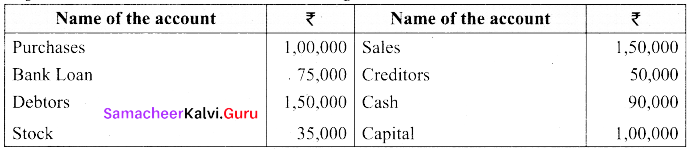
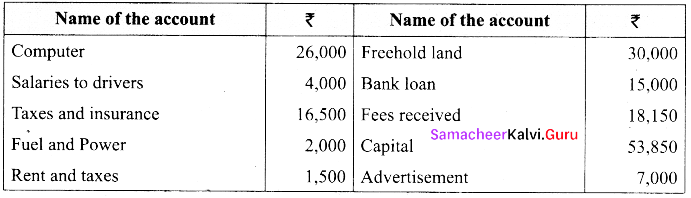
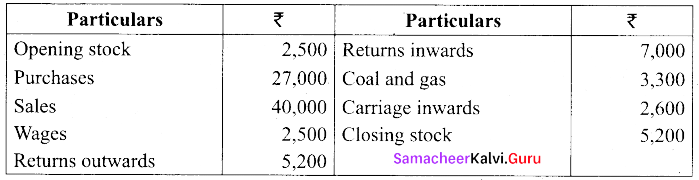
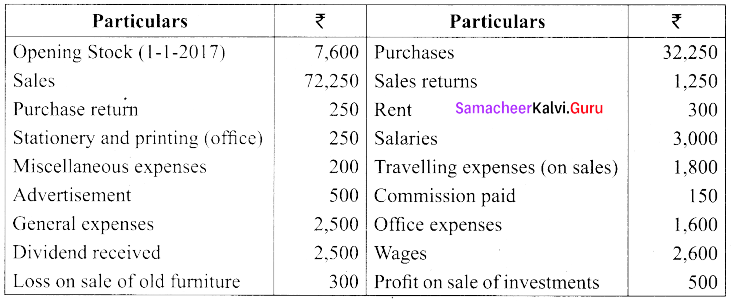
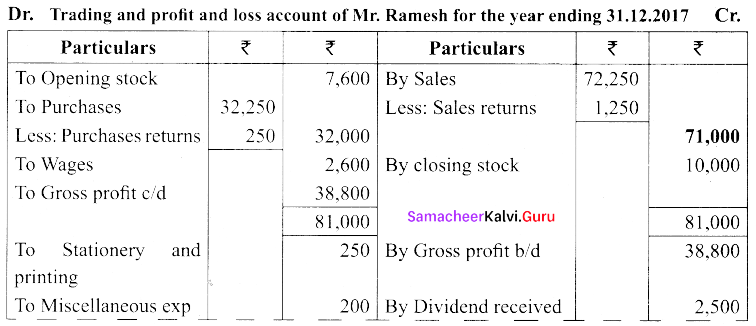
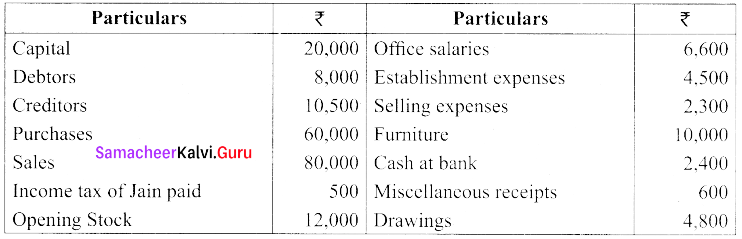
From the following balances taken from the books of Saravanan, calculate gross profit for the year ended December 31, 2017.
Tamil Nadu 11th Accountancy Model Question Paper 2 English Medium - 1
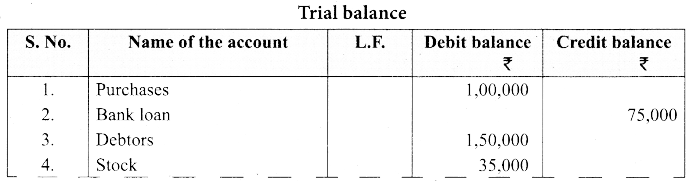
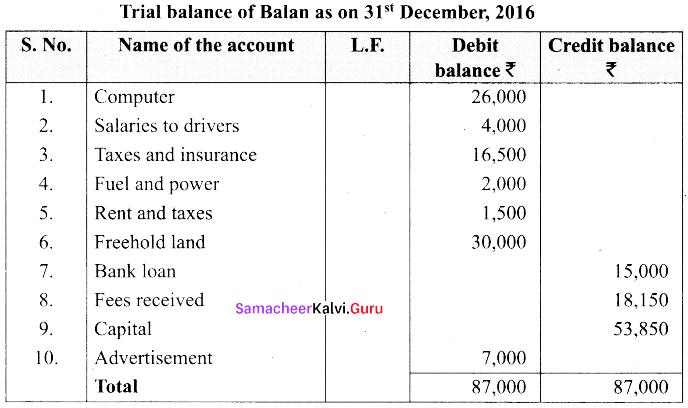
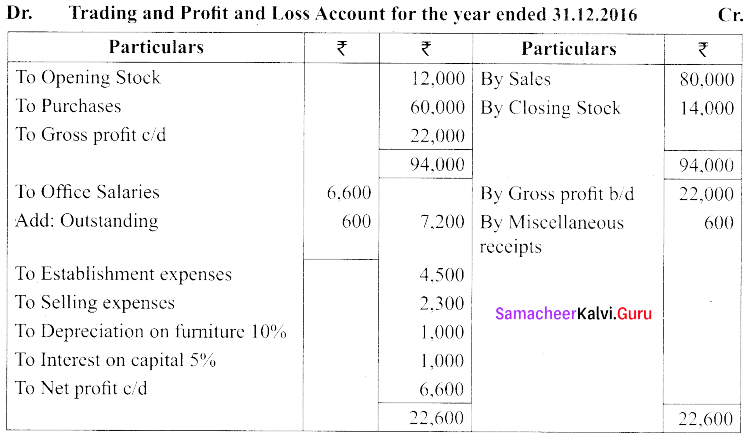
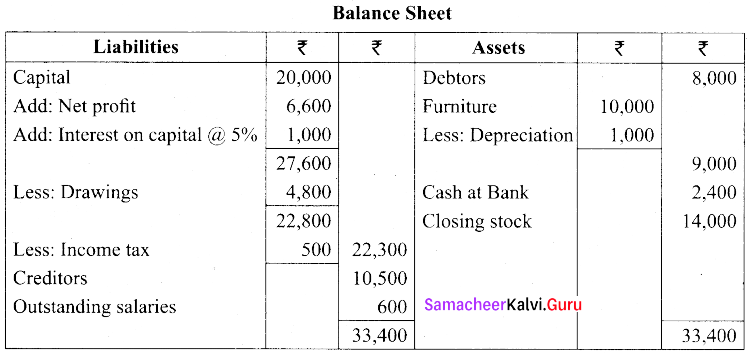
Answer:
Tamil Nadu 11th Accountancy Model Question Paper 2 English Medium - 2

Question 32.
Mention any three limitations of computerised accounting system.
Answer:

  1. Heavy cost of installation
  2. Cost of trading and
  3. Fear of unemployment.

Question 33.
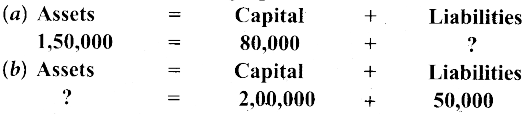
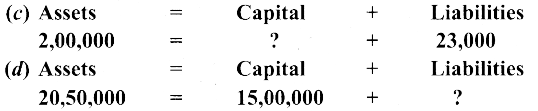
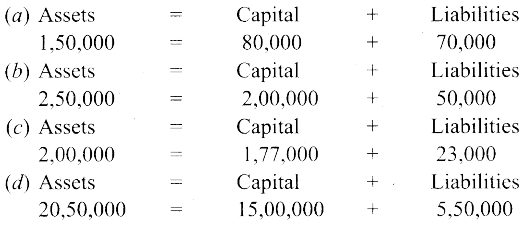
Complete the accounting equation.
Tamil Nadu 11th Accountancy Model Question Paper 2 English Medium - 3
Answer:
Tamil Nadu 11th Accountancy Model Question Paper 2 English Medium - 4

Tamil Nadu 11th Accountancy Model Question Paper 2 English Medium

Question 34.
Give journal entries for the following transactions.
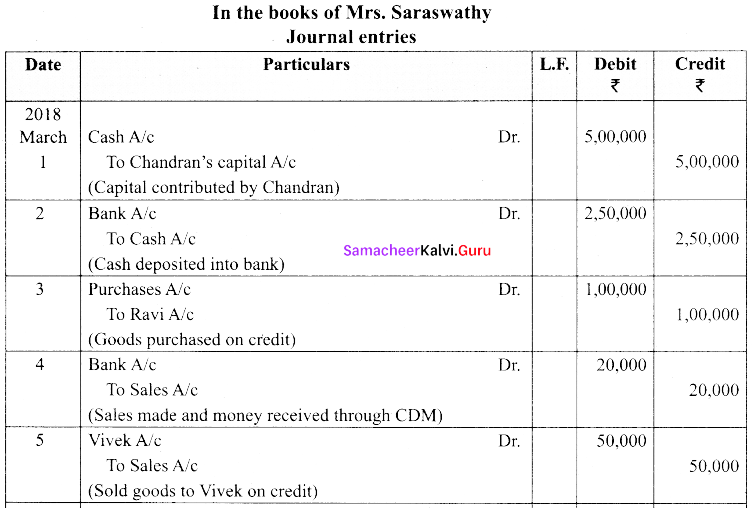
Tamil Nadu 11th Accountancy Model Question Paper 2 English Medium - 5
Answer:
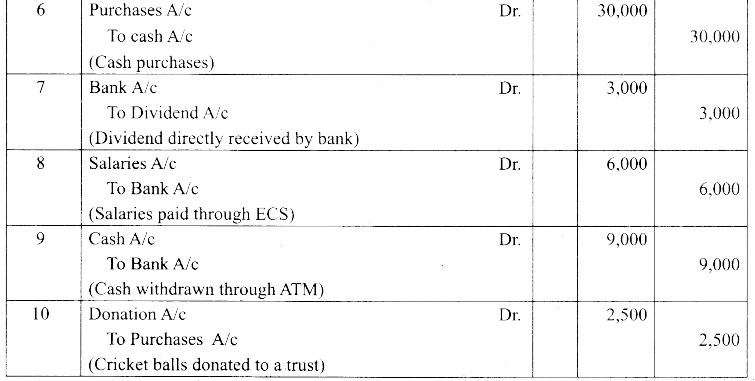
Tamil Nadu 11th Accountancy Model Question Paper 2 English Medium - 6
Tamil Nadu 11th Accountancy Model Question Paper 2 English Medium - 7

Question 35.
Journalise the following transactions and post them to ledger. On May 20, 2018, Ram paid salaries ₹ 15,000; electricity charges ₹ 8,000 and wages ₹ 2,000.
Answer:
Tamil Nadu 11th Accountancy Model Question Paper 2 English Medium - 8

Question 36.
State whether the balance of each of the following accounts should be placed in the debit or the credit column of the trial balance.
1. Sundry debtors 2. Sundry creditors 3. Cash in hand 4. Bank overdraft 5. Salary 6. Discount allowed
Answer:
Tamil Nadu 11th Accountancy Model Question Paper 2 English Medium - 9

Tamil Nadu 11th Accountancy Model Question Paper 2 English Medium

Question 37.
The preparation of the bills receivable and bills payable books is explained through the following examples:
Answer:

Date

Particulars

2017 July 1Acceptance received from Nirmala for ₹ 5,000 payable after 3 months.
July 20Acceptance given to Shailaja’s bill for ₹ 3,000 payable after 3 months.
July 31Acceptance received from Faisal for ₹ 1,000 payable after 60 days.
Aug 5Farid’s bill for ₹ 1,000 payable after 6 months accepted.
Aug 11Mohan’s acceptance for ₹ 700 payable after 90 days received

Answer:
Tamil Nadu 11th Accountancy Model Question Paper 2 English Medium - 10

Question 38.
What are the advantages of petty cash book (any three)?
Answer:

  1. There can be better control over petty payments.
  2. There is saving of time of the main cashier.
  3. Cash book is not loaded with many petty payments.

Question 39.
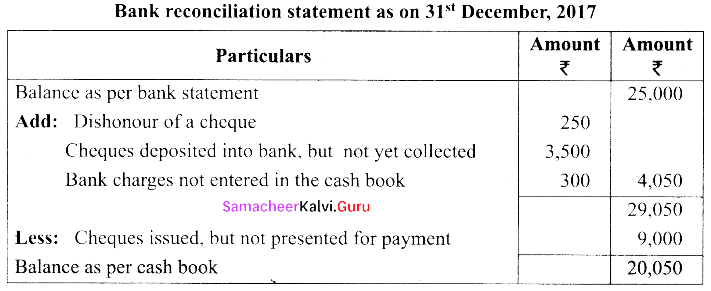
Prepare bank reconciliation statement as on 31st December, 2017 from the following informations.
(a) Balance as per bank statement (pass book) is ₹ 25,000.
(b) No record has been made in the cash book for a dishonour of a cheque for ₹ 250.
(c) Cheques deposited into bank amounting to ₹ 3,500twere not yet collected.
(d) Bank charges of ₹ 300 have not been entered in the cash books.
(e) Cheques issued amounting for ₹ 9,000 have been presented for payment.
Answer:
Tamil Nadu 11th Accountancy Model Question Paper 2 English Medium - 11

Tamil Nadu 11th Accountancy Model Question Paper 2 English Medium

Question 40.
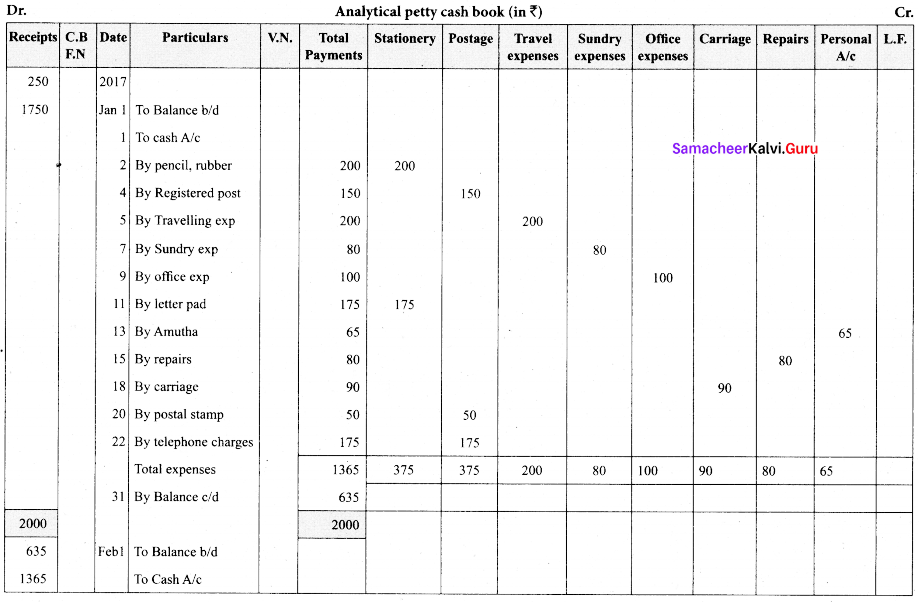
Prepare an analytical petty cash book from the following information on the imprest systems:
Tamil Nadu 11th Accountancy Model Question Paper 2 English Medium - 12
Answer:
Tamil Nadu 11th Accountancy Model Question Paper 2 English Medium - 13

Part – IV

Answer all the questions: [7 × 5 = 35]

Question 41.
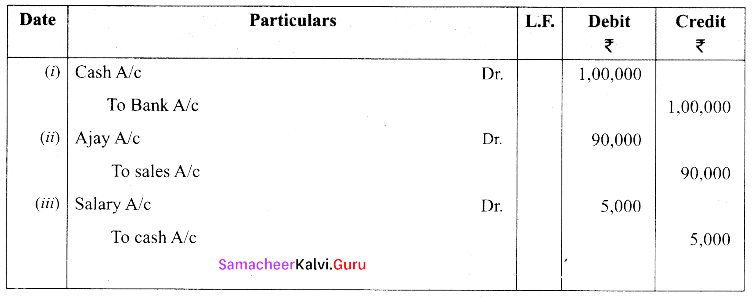
(a) Pass journal entries for the following:

S.No.Particulars

1.Commenced business with cash1,00,000
2.Deposited cash with bank40,000
3.Purchased goods for cash5,000
4.Sold goods to Vignesh10,000
5.Paid salaries by cash5,000

Answer:
Tamil Nadu 11th Accountancy Model Question Paper 2 English Medium - 14

Tamil Nadu 11th Accountancy Model Question Paper 2 English Medium

[OR]

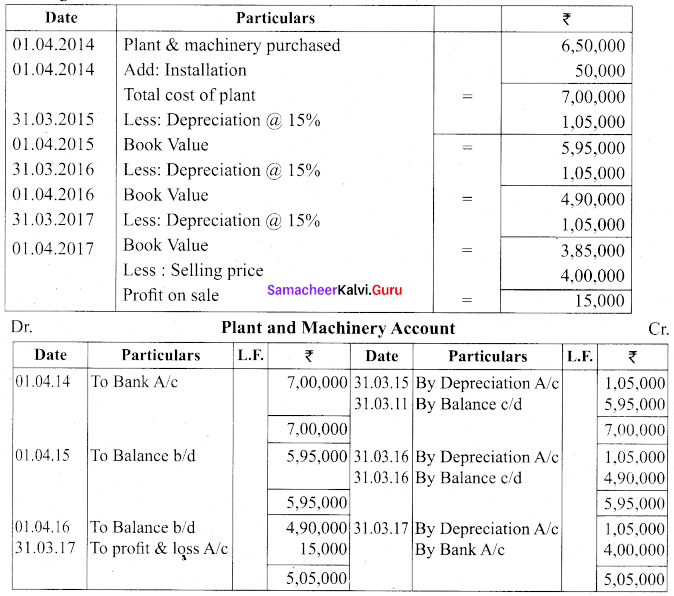
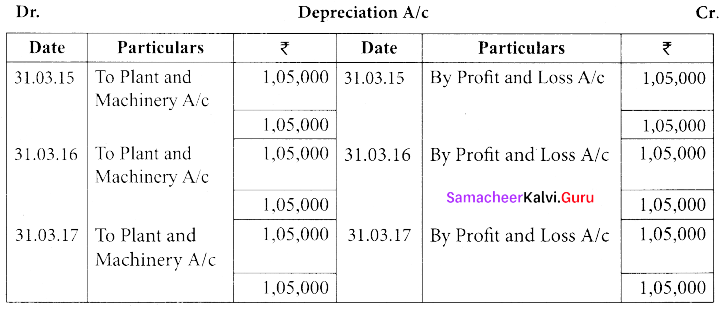
(b) On 1st April 2008, Sudha and Company purchased machinery for ₹ 64,000. To instal the machinery expenses incurred was ₹ 28,000. Depreciate machinery 10% p.a. under straight line method. On 30th June, 2010 the worn out machinery was sold for ₹ 52,000. The books are closed on 31st December every year. Show machinery account.
Answer:
Tamil Nadu 11th Accountancy Model Question Paper 2 English Medium - 15
Tamil Nadu 11th Accountancy Model Question Paper 2 English Medium - 16

Question 42.
(a) Rectify the following errors which were located at the time of preparing the trial balance.
1. The total of the discount column on the debit side of the cash book of ₹ 225 was posted twice.
2. Goods of the value of ₹ 75 returned by Ponnalagu was not posted to her account.
3. Cash received from Herosini ₹ 1,000 was not posted.
4. Interest received ₹ 300 has not been posted.
5. Rent paid ₹ 100 was posted to rent account as ₹ 10.
Answer:
1. Discount account should be debited with ₹ 225.
2. Sales return account should be credited with ₹ 75.
3. Cash account should be debited with ₹ 1,000.
4. Interest account should be debited with ₹ 300.
5. Rent account should be credited with ₹ 90.

[OR]

(b) Show the accounting equation on the basis of the following:

S.No.Particulars

1.Started business with cash60,000
2.Purchased goods for cash20,000
3.Sold goods for cash costing ₹ 10,000 for15,000
4.Paid rent by cash500
5.Purchased furniture for cash6,000

Answer:
Tamil Nadu 11th Accountancy Model Question Paper 2 English Medium - 17

Tamil Nadu 11th Accountancy Model Question Paper 2 English Medium

Question 43.
(a) Show the direct ledger postings for the following transactions.
Tamil Nadu 11th Accountancy Model Question Paper 2 English Medium - 32
Answer:
Tamil Nadu 11th Accountancy Model Question Paper 2 English Medium - 18
Tamil Nadu 11th Accountancy Model Question Paper 2 English Medium - 19
Tamil Nadu 11th Accountancy Model Question Paper 2 English Medium - 20

[OR]

(b) State whether the following are capital or revenue.
1. ₹ 5,000 spent towards additions to buildings.
2. Second-hand motor car purchased for ₹ 30,000 and paid ₹ 2,000 as repairs immediately.
3. ₹ 10,000 was spent on painting the new factory.
4. Freight and cartage on the new machine ₹ 150, erection charges ? 200.
5. ₹ 150 spent on repairs before using a second hand car purchased recently.
Answer:
1. Capital expenditure
2. Capital expenditure
3. Capital expenditure
4. Capital expenditure
5. Capital expenditure

Tamil Nadu 11th Accountancy Model Question Paper 2 English Medium

Question 44.
(a) Prepare trial balance as on 31st March, 2017.

Particulars

Capital60,000
Purchases58,000
Advertising expenses5,000
Lighting8,00
Car expenses1,200
Discount received3,250
Plant and machinery40,000
Sales82,000
Drawings5,250
Motor car35,000

Answer:
Tamil Nadu 11th Accountancy Model Question Paper 2 English Medium - 21

[OR]

(b) From the trial balances given by Saif, prepare final accounts for the year ended 31st March, 2018 in his books.
Tamil Nadu 11th Accountancy Model Question Paper 2 English Medium - 22
Answer:
Tamil Nadu 11th Accountancy Model Question Paper 2 English Medium - 23
Tamil Nadu 11th Accountancy Model Question Paper 2 English Medium - 24

Question 45.
(a) Prepare Sales book and sales returns book of M/s. Ponni and Co.

Date

Particulars

2017 Aug 1Sold goods to Senthil as per Invoice No. 68 for ₹ 20,500 on credit.
Aug 4Sold goods to Madhavan as per Invoice No. 74 for ₹ 12,800 on credit.
Aug 7Sold goods to Kanagasabai as per Invoice No. 78 for ₹ 7,500 on credit.
Aug 15Returns inward by Senthil as per credit note No.7 for ₹ 1,500 for which cash is not paid.
Aug 20Sold goods to Selvam for ₹ 13,300 for cash.
Aug 25Sales returns of? 1,800 by Madhavan as per credit note No. 11 for which cash is not paid.

Answer:
Tamil Nadu 11th Accountancy Model Question Paper 2 English Medium - 25

Tamil Nadu 11th Accountancy Model Question Paper 2 English Medium

[OR]

(b) Enter the following transactions in a single column cash book of Seshadri for May, 2017.
Tamil Nadu 11th Accountancy Model Question Paper 2 English Medium - 26
Answer:
Tamil Nadu 11th Accountancy Model Question Paper 2 English Medium - 27

Question 46.
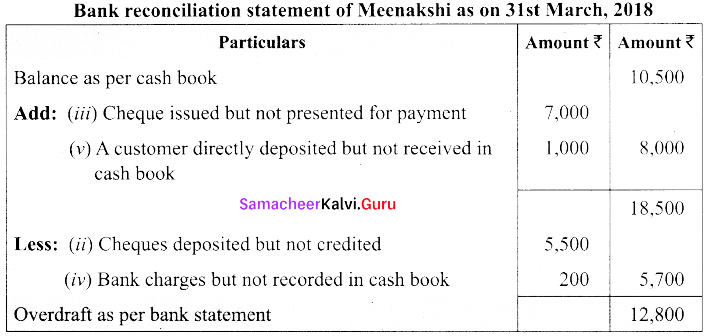
(a) From the following particulars of Kamakshi traders, prepare a bank reconciliation
statement as on 31st March, 2018.
a. Debit balance as per cash book ₹ 10,500.
b. Cheques deposited into bank amounting to ₹ 5,500 credited by bank, but entered twice in the cash book.
c. Cheques issued and presented for payment amounting to ₹ 7,000 omitted in the cash book.
d. Cheque book charges debited by the bank ₹ 200 not recorded in the cash book.
e. Cash of ₹ 1,000 deposited by a customer of the business in cash deposit machine not recorded in the cash book.
Answer:
Tamil Nadu 11th Accountancy Model Question Paper 2 English Medium - 28

[OR]

(b) Prepare a Triple Column Cash book of Rahim from the following transactions.
Tamil Nadu 11th Accountancy Model Question Paper 2 English Medium - 29
Answer:
Tamil Nadu 11th Accountancy Model Question Paper 2 English Medium - 30

Tamil Nadu 11th Accountancy Model Question Paper 2 English Medium

Question 47.
(a) Sharmili & Co. incurred the following expenses during the year 2018. Classify the following items under capital or revenue.
1. Purchase of furniture of ₹ 1,000,
2. Purchase of second hand machinery ₹ 4,000.
3. ₹ 50 paid for carriage on goods purchased.
4. ₹ 175 paid for repairs on second hand machinery as soon as it was purchased.
5. ₹ 600 wages paid for installation of plant.
Answer:
1. Capital expenditure
2. Capital expenditure
3. Revenue expenditure
4. Capital expenditure
5. Capital expenditure

[OR]

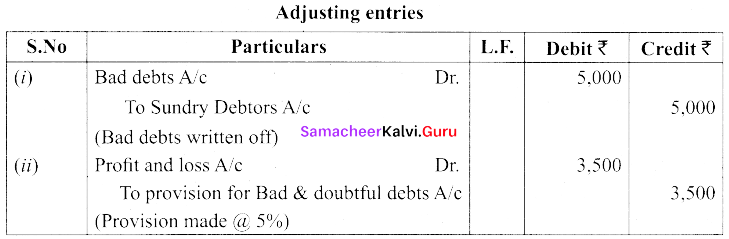
(b) Pass adjusting entries for the following:
a. The closing stock was valued at ₹ 5,000.
b. Outstanding salaries ₹ 150.
c. Insurance prepaid ₹ 450.
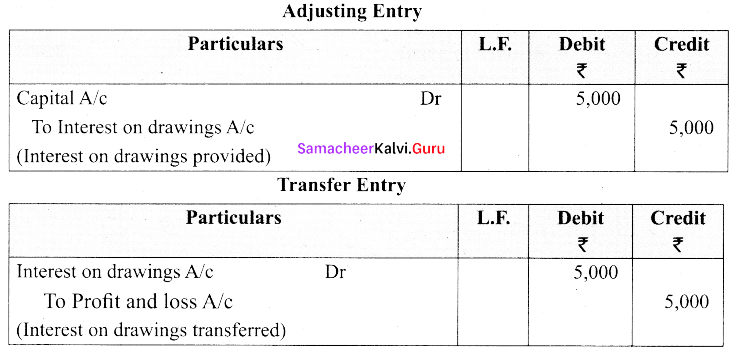
d. Interest on drawings ₹ 50.
e. Write off bad debts ₹ 500.
Answer:
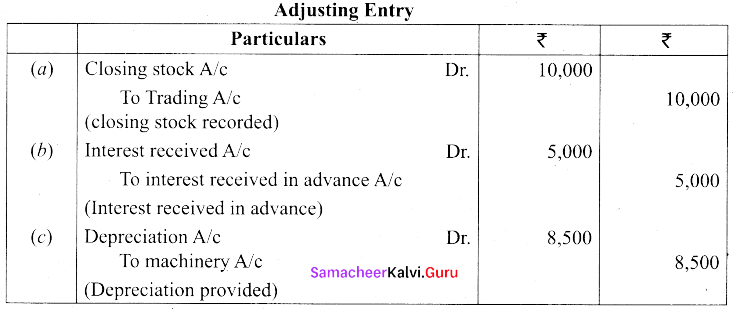
Tamil Nadu 11th Accountancy Model Question Paper 2 English Medium - 31

Tamil Nadu 12th Accountancy Model Question Paper 3 English Medium

Students can Download Tamil Nadu 12th Accountancy Model Question Paper 3 English Medium Pdf, Tamil Nadu 12th Accountancy Model Question Papers helps you to revise the complete Tamilnadu State Board New Syllabus and score more marks in your examinations.

TN State Board 12th Accountancy Model Question Paper 3 English Medium

General Instructions:

  1. The question paper comprises of four parts.
  2. You are to attempt all the parts. An internal choice of questions is provided wherever applicable.
  3. All questions of Part I, II, III and IV are to be attempted separately.
  4. Question numbers 1 to 20 in Part I are Multiple Choice Questions of one mark each.
    These are to be answered by choosing the most suitable answer from the given four alternatives and writing the option code and the corresponding answer.
  5. Question numbers 21 to 30 in Part II are two-mark questions. These are to be answered in about one or two sentences.
  6. Question numbers 31 to 40 in Part III are three-mark questions. These are to be answered in above three to five short sentences.
  7. Question numbers 41 to 47 in Part IV are five-mark questions. These are to be answered in detail Draw diagrams wherever necessary.

Time: 2.30 Hours
Maximum Marks: 90

Part – I

Answer all the questions. Choose the correct answer. [20 × 1 = 20]

Question 1.
Which of the following items relating to bills payable is transferred to total creditors account?
(a) Opening balance of bills payable
(b) Closing balance of bills payable
(c) Bills payable accepted during the year
(d) Cash paid for bills payable
Answer:
(c) Bills payable accepted during the year

Question 2.
The amount of credit sales can be computed from _______.
(a) Total debtors A/c
(b) Total creditors A/c
(c) Bills receivable A/c
(d) Bills payable A/c
Answer:
(a) Total debtors A/c

Question 3.
Income and expenditure account is prepared to find out ________.
(a) Profit or loss
(b) Cash and bank balance
(c) Surplus or deficit
(d) Financial position
Answer:
(c) Surplus or deficit

Question 4.
Which of the following should not be recorded in the income and expenditure account?
(a) Sale of old newspaper
(b) Loss on sale of assets
(c) Honorarium paid to the secretary
(d) Sale proceeds of furniture
Answer:
(d) Sale proceeds of furniture

Tamil Nadu 12th Accountancy Model Question Paper 3 English Medium

Question 5.
When fixed capital method is adopted by a partnership firm, which of the following items will appear in capital account?
(a) Additional capital introduced
(b) Interest on capital
(c) Interest on drawings
(d) Share of profit
Answer:
(a) Additional capital introduced

Question 6.
When a partner withdraws regularly a fixed sum of money at the middle of every month, period for which interest is to be calculated on the drawings as on average is _______.
(a) 5.5 months
(b) 6 months
(c) 12 months
(d) 6.5 months
Answer:
(b) 6 months

Question 7.
When the average profit is ₹ 25,000 and the normal profit is ₹ 15,000, super profit is
(a) ₹ 25,000
(b) ₹ 5,000
(c) ₹ 10,000
(d) ₹ 15,000
Answer:
(c) ₹ 10,000

Question 8.
Book profit of 2017 is ₹ 35,000; Non-recurring income included in the profit is ₹ 1,000; and abnormal loss was ₹ 2,000 then the he adjusted profit is _______.
(a) ₹ 36,000
(b) ₹ 35,000
(c) ₹ 38,000
(d) ₹ 34,000
Answer:
(a) ₹ 36,000

Tamil Nadu 12th Accountancy Model Question Paper 3 English Medium

Question 9.
At the time of admission, the goodwill brought by the new partner may be credited to the capital accounts of _______.
(a) all the partners
(b) the old partners
(c) the new partners
(d) the sacrificing partners
Answer:
(d) the sacrificing partners

Question 10.
Which of the following statements is not true in relation to admission of a partner?
(a) Generally mutual rights of the partners change
(b) The profits and losses of the previous years distributed to the old partners
(c) The firm is reconstituted under a new agreement
(d) The existing agreement does not come to an end
Answer:
(d) The existing agreement does not come to an end

Question 11.
At the time of retirement of a partner, determination of gaining ratio is required ______.
(a) To transfer revaluation profit or loss
(b) To distribute accumulated profits and losses
(c) To adjust goodwill
(d) None of these
Answer:
(c) To adjust goodwill

Question 12.
If the final amount due to a retiring partner is not paid immediately, it is transferred to ________.
(a) Bank A/c
(b) Retiring partner’s capital A/c
(c) Retiring partner’s loan A/c
(d) Other partner’s capital A/c
Answer:
(c) Retiring partner’s loan A/c

Question 13.
The amount received over and above the par value is credited to ________.
(a) Securities premium A/c
(b) Calls-in-advance A/c
(c) Share capital A/c
(d) Forfeited shares A/c
Answer:
(a) Securities premium A/c

Tamil Nadu 12th Accountancy Model Question Paper 3 English Medium

Question 14.
Which of the following is false?
(a) Issued capital can never be more than the authorized capital
(b) In the case of under subscription, issued capital will be less than the subscribed capital
(c) Reserve capital can be called at the time of winding up
(d) Paid up capital is part of called up capital
Answer:
(b) In the case of under subscription, issued capital will be less than the subscribed capital

Question 15.
Which of the following statement is not a tool of financial statement analysis?
(a) Trend analysis
(b) Common size statement
(c) Comparative statement
(d) Standard costing
Answer:
(d) Standard costing

Question 16.
The term “fund” refers to ______.
(a) Current liabilities
(b) Working capital
(c) Fixed assets
(d) Non – current assets
Answer:
(b) Working capital

Question 17.
Match list I with list II and select the correct answer:
Tamil Nadu 12th Accountancy Model Question Paper 3 English Medium img 1
Answer:
(a) i – 1
(b) ii – 4
(c) iii – 3
(d) iv – 2

Tamil Nadu 12th Accountancy Model Question Paper 3 English Medium

Question 18.
To test the liquidity of a concern, which of the following ratios are useful?
(i) Quick ratio
(ii) Net profit ratio
(iii) Debt-equity ratio
(iv) Current ratio.
Select the correct answer using codes
(a) (i) and (ii)
(b) (i) and (iv)
(c) (ii) and (iii)
(d) (ii) and (iv)
Answer:
(b) (i) and (iv)

Question 19.
Contra voucher is used for ______.
(a) Master entry
(b) Withdrawal of cash from bank for office use
(c) Reports
(d) Credit purchase of assets
Answer:
(b) Withdrawal of cash from bank for office use

Question 20.
Which is not the default group in Tally?
(a) Suspense Account
(b) Outstanding expenses
(c) Sales account
(d) Investment
Answer:
(b) Outstanding expenses

Part – II

Answer any seven questions in which question No. 30 is compulsory. [7 × 2 = 14]

Question 21.
What is a statement of affairs?
Answer:
A statement of affairs is a statement showing the balances of assets and liabilities on a particular date. This method of ascertaining profit is also called as statement of affairs method or networth method or capital comparison method.

Tamil Nadu 12th Accountancy Model Question Paper 3 English Medium

Question 22.
From the following information, calculate the amount of stationery to be shown in income and expenditure account for the year ended 31st March 2016.
Tamil Nadu 12th Accountancy Model Question Paper 3 English Medium img 2
Answer:
Tamil Nadu 12th Accountancy Model Question Paper 3 English Medium img 3

Question 23.
Sundar drew regularly ₹ 2,000 at end of the every month during the year. Calculate interest on drawings @ 10 % p.a.
Answer:
Tamil Nadu 12th Accountancy Model Question Paper 3 English Medium img 4

Question 24.
The following are the profits of a firm in the last 5 year :
2014 – ₹ 10,000, 2015 – ₹ 11,000; 2016 – ₹ 12,000; 2017 – ₹ 13,000; and 2018 – ₹ 14,000.
Calculate the value of goodwill at 2 years purchase of average profit of 5 years.
Answer:
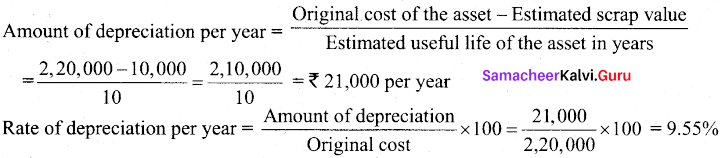
Goodwill = Average profit × No. of years of purchase
Tamil Nadu 12th Accountancy Model Question Paper 3 English Medium img 5
Goodwill = Average profit × No. of years of purchase
= ₹ 12,000 × 2 = ₹ 24,000
= ₹ 24,000

Question 25.
What is meant by revaluation of assets and liabilities?
Answer:
When a partner is admitted into the partnership, the assets and liabilities are revalued as the current value may differ from the book value. Determination of current values of assets and liabilities is called revaluation of assets and liabilities.

Tamil Nadu 12th Accountancy Model Question Paper 3 English Medium

Question 26.
A, B and C are partners sharing profit ratio 5:3:2 on 31.3.2018. A retries on the date of retirement, the books of the firm showed a reserve fund of ₹ 1,50,000. Pass the journal entry to transfer reserve fund.
Answer:
Tamil Nadu 12th Accountancy Model Question Paper 3 English Medium img 6

Question 27.
Vinod company Ltd issued ₹ 40000 preference share ₹ 100 each premium of ₹ 30.
Answer:
Tamil Nadu 12th Accountancy Model Question Paper 3 English Medium img 7

Question 28.
What is trend analysis?
Answer:
Trend analysis refers to the study of movement of figures over a period. The trend may be increasing trend or decreasing trend or irregular.

Question 29.
Calculate Debt-equity ratio.
Tamil Nadu 12th Accountancy Model Question Paper 3 English Medium img 8
Answer:
Deb-equity ratio = \(\frac{\text { Total long term debts }}{\text { Shareholders fund }}\)
Total long term deb = Debentures + Long term ratio
= 2,00,000 + 1,00,000
= ₹ 3,00,000
Share holders funds = Equity share capital + General Reserve
= 4,00,000 + 3,00,000
= ₹ 7,00,000
∴ Deb equity ratio = \(\frac{3,00,000}{7,00,000}\) = 0.43 : 1

Tamil Nadu 12th Accountancy Model Question Paper 3 English Medium

Question 30.
What are accounting reports?
Answer:
Accounting report is a compilation of accounting information that are derived from the . accounting records of a business concern. Accounting reports may be classified as routine reports and special purpose reports.

Part – III

Answer any seven questions in which question No. 40 is compulsory. [7 × 3 = 21]

Question 31.
From the following details, calculate the missing figure.

Particulars
Drawings1,00,000
Additional capital20,000
Opening capital2,00,000
Profit made during the year50,000

Answer:
Tamil Nadu 12th Accountancy Model Question Paper 3 English Medium img 9
Tamil Nadu 12th Accountancy Model Question Paper 3 English Medium img 10

Question 32.
How will the following items appear in the final accounts of the club for the year ending 31st March 2017. Received subscription of ₹ 80,000 during the year 2016-17. This includes ₹ 10,000 for 2015-16, and ₹ 6,000 for the year 2017-18. Subscription of ₹ 2,000 is still outstanding for the year 2016-17.
Answer:
Tamil Nadu 12th Accountancy Model Question Paper 3 English Medium img 11
Tamil Nadu 12th Accountancy Model Question Paper 3 English Medium img 12

Tamil Nadu 12th Accountancy Model Question Paper 3 English Medium

Question 33.
From the following information, prepare the capital account of partners Rooban and Devi when their capitals are fluctuating.
Tamil Nadu 12th Accountancy Model Question Paper 3 English Medium img 13
Answer:
Tamil Nadu 12th Accountancy Model Question Paper 3 English Medium img 14
Tamil Nadu 12th Accountancy Model Question Paper 3 English Medium img 15

Question 34.
From the following information relating to Sridevi enterprises, calculate the value of goodwill on the basis of 4 years purchase of the average profits of 3 year.
a) Profits for the year ending 31st Dec 2016, 2017 and 2018 were ₹ 1,75,000, ₹ 1,50,001; raid ₹ 2,00,000 respectively.
b) A non-recurring income of ₹ 45,000 is included in the profit of the year 2016.
c) The closing stock of the year 2017 was overvalued by ₹ 30.000.
Answer:
Tamil Nadu 12th Accountancy Model Question Paper 3 English Medium img 16
Tamil Nadu 12th Accountancy Model Question Paper 3 English Medium img 17
Goodwill = Average profit × Number of years of purchase
= 1,60,000 × 4
= ₹ 6,40,000

Question 35.
Seenu and Siva are partners sharing profits in the ratio of 5:3. In the view of Kowsalya admission, they decided,
a) To increase the value of building by ₹ 80,000.
b) To bring into record investment @ ₹ 20,000; so far not recorded.
c) To decrease the value of machinery by ₹ 28,000; and furniture by ₹ 24,000.
d) To write off sundry creditors by ₹ 32,000. Pass entries and prepare revaluation account.
Answer:
Tamil Nadu 12th Accountancy Model Question Paper 3 English Medium img 18
Tamil Nadu 12th Accountancy Model Question Paper 3 English Medium img 19

Tamil Nadu 12th Accountancy Model Question Paper 3 English Medium

Question 36.
Kevin, Madhan and Ranjith are partners sharing of profit ratio 4:3:3. Kevin retires from the firm on 31st Dec 2018. On the date of retirement his capital account shows a credit balance of ₹ 1,50,000. pass the journal entries of,
(a) The amount due is paid of immediately
(b) The amount due is not paid immediately
(c) ₹ 1,00,000 is paid balance in future
Answer:
Tamil Nadu 12th Accountancy Model Question Paper 3 English Medium img 20
Tamil Nadu 12th Accountancy Model Question Paper 3 English Medium img 21

Question 37.
Sara company issues 10,000 equity shares of ₹ 10 each payable fully on application.
Pass journal entry if the shares are issued.
(i) At par,
(ii) At a premium of 2/- per share
Answer:
Tamil Nadu 12th Accountancy Model Question Paper 3 English Medium img 22

Question 38.
From the following particulars, Prepare comparative income statement of A Ltd.
Tamil Nadu 12th Accountancy Model Question Paper 3 English Medium img 23
Answer:
Tamil Nadu 12th Accountancy Model Question Paper 3 English Medium img 24
Tamil Nadu 12th Accountancy Model Question Paper 3 English Medium img 25

Question 39.
Calculate operating profit ratio under the following cases
Case 1: Revenue from operations ₹ 16,00,000 operation profit ₹ 4,00,000
Case 2: Revenue from operations ₹ 40,00,000 operating cost ₹ 28,00,000
Case 3: Revenue from operations ₹ 20,00,000 Gross profit 25% on revenue from operations; operating expenses ₹ 2,00,000.
Answer:
Tamil Nadu 12th Accountancy Model Question Paper 3 English Medium img 26
Operating profit = Gross profit – Operating expenses
Gross profit = 25% of 20,00,000 = ₹ 5,00,000
Operating profit = 5,00,000 – 2,00,000 = ₹ 3,00,000
∴ Operating profit ratio = \(\frac{3,00,000}{20,00,000}\) x 100 = 15%

Tamil Nadu 12th Accountancy Model Question Paper 3 English Medium

Question 40.
Mention the commonly used voucher types in Tally ERP. 9.
Answer:
The following are some of the major accounting voucher used in an organisation.

  • Receipt voucher
  • Payment voucher
  • Contra voucher
  • Purchase voucher
  • Sales voucher
  • Journal voucher

Part – IV

Answer all the questions. [7 × 5 = 35]

Question 41.
(a) Ananth does not keep his books under system. Find the profit or loss made by him for the year ending 31st March 2019.
Tamil Nadu 12th Accountancy Model Question Paper 3 English Medium img 27
Ananth had withdrawn ₹ 60,000 for his personal use. He had introduced ₹ 1,70,000 as capital for expansion of his business. Create a provision of 5% on debtor. Plant and machinery is to be depreciated at 10%.
Answer:
Calculation of opening capital:
Tamil Nadu 12th Accountancy Model Question Paper 3 English Medium img 28
Calculation of closing capital:
Tamil Nadu 12th Accountancy Model Question Paper 3 English Medium img 29
Tamil Nadu 12th Accountancy Model Question Paper 3 English Medium img 30
Tamil Nadu 12th Accountancy Model Question Paper 3 English Medium img 31

[OR]

(b) From the following Receipts and payments account of Coimbatore cricket club for the year ending 31st March 2016. Prepare income and expenditure account for the year ending 31st March 2016 and a balance sheet as on that date.
Answer:
Tamil Nadu 12th Accountancy Model Question Paper 3 English Medium img 32
Additional information:
On 1st April 2015, the club had stock of balls and bats of ₹ 3,000 and an advance subscription of ₹ 500 surplus on account of tournaments should be kept in reserve for permanent pavilion. Subscription due on 31.3.2016 was ₹ 2,000; stock of bats and balls on 31.3.2016 was ₹ 1,000.
Answer:
Calculation of capital fund:
Tamil Nadu 12th Accountancy Model Question Paper 3 English Medium img 33
Tamil Nadu 12th Accountancy Model Question Paper 3 English Medium img 34
Tamil Nadu 12th Accountancy Model Question Paper 3 English Medium img 35

Tamil Nadu 12th Accountancy Model Question Paper 3 English Medium

Question 42.
(a) A and B are partners in a firm sharing ratio at 4:1. On 1st January 2018, their capitals were ₹ 20,000 and ₹ 10,000, respectively. The partnership deed specifies the following
(a) Interest capital is to be allowed at 5% p. a.
(b) Interest on drawings charged to A and B are ₹ 200 : 300
(c) The net profit of the firm before considering interest on capital and interest on drawings amounted ₹ 18,000.
Give necessary journal entries and prepare profit and loss appropriation account for the year ended 31.12.2018. Assume that capitals are fluctuating.
Answer:
Tamil Nadu 12th Accountancy Model Question Paper 3 English Medium img 36
Tamil Nadu 12th Accountancy Model Question Paper 3 English Medium img 37
Tamil Nadu 12th Accountancy Model Question Paper 3 English Medium img 38

[OR]

(b) From the following receipts and payments A/c of defence club and from the information, prepare income and expenditure account for the year ended 31st March 2016 and balance sheet.
Tamil Nadu 12th Accountancy Model Question Paper 3 English Medium img 39
Tamil Nadu 12th Accountancy Model Question Paper 3 English Medium img 40
(i) The club has 50 members each paying annual subscription of ₹ 2,500, subscription outstanding on 31st March 2015 were to extent ₹ 30,000.
(ii) On 31st March 2016, salaries outstanding amounted to ₹ 10,000; salaries paid in 2015-16 included ₹ 30,000 for the year 2014-15.
(iii) On 1st April 2015, the club owned buildings valued at ₹ 10,00,000. Furniture ₹ 1,00,000 and books ₹ 1,00,000.
Answer:
Tamil Nadu 12th Accountancy Model Question Paper 3 English Medium img 41
Tamil Nadu 12th Accountancy Model Question Paper 3 English Medium img 42
Tamil Nadu 12th Accountancy Model Question Paper 3 English Medium img 43
Tamil Nadu 12th Accountancy Model Question Paper 3 English Medium img 44
Working note:
Tamil Nadu 12th Accountancy Model Question Paper 3 English Medium img 45

Question 43.
(a) Antony and Ranjith started a business on 1.4.2018 with capitals of ₹ 4,00,000 and ₹ 3,00,000. According to the deed, Antony is to get salary of ₹ 90,000 p. a. Ranjith is to get 25% commission on profit after allowing salary to Antony and interest on capital @ 5% p. a. but after charging such commission. Partners are equal. Profit earned by firm is ₹ 3,65,000. Prepare profit and loss Appropriation account.
Answer:
Tamil Nadu 12th Accountancy Model Question Paper 3 English Medium img 46
Tamil Nadu 12th Accountancy Model Question Paper 3 English Medium img 47

[OR]

(b) Durga and Preethi entered into a partnership agreement on 1st April 2018. Durga contributing ₹ 1,00,000 and preethi ₹ 1,20,000.
(a) Profit and losses to be shared in the ratio 3:2 as between Durga and Preethi
(b) Partners to be entitled to interest on capital @ 5% p.a.
(c) Interest on drawings to be charged for Durga ₹ 1200. Preethi ₹ 1800
(d) Durga to receive salary of ₹ 20,000 for the year and
(e) Preethi to receive a commission of ₹ 8,000.
During the year, the firm made a profit of ₹ 80,000 before adjustment of interest, salary and commission, prepare Profit and Loss Appropriation A/c.
Answer:
Tamil Nadu 12th Accountancy Model Question Paper 3 English Medium img 48

Tamil Nadu 12th Accountancy Model Question Paper 3 English Medium

Question 44.
(a) From the following information, calculate the value of goodwill of the firm of Chander and Gupta.
(a) At least 3 years purchase of average profits
(b) At least 3 years purchase of super profits
(c) On the basis of capitalisation of super profits
(d) On the basis of capitalisation of average profits
(i) Average capital employed in the business ₹ 7,00,000
(ii) Net trading results of past year, 2014 – 147600 (profit) loss 2015 – ₹ 148100; profit 2016 – ₹ 4,48,700
(iii) Rate of interest expected from capital having regard risk 18% remuneration to each partner his service Rs 500 per month.
Answer:
(i) Calculation of average maintainable profits and super profits
Tamil Nadu 12th Accountancy Model Question Paper 3 English Medium img 49

(ii) Calculation of value of goodwill:
(a) At 3 years purchase of average profit:
Average maintainable profits × No. of years purchase
= 1,37,400 × 3 = ₹ 4,12,200
(b) At 3 years purchase of super profits
Super profits × No. of years purchase
= ₹ 11,400 × 3 = ₹ 34,000
(c) On the basis of capitalisation of super profits
Tamil Nadu 12th Accountancy Model Question Paper 3 English Medium img 50
(d) On the basis of capitalisation of average profits:
Tamil Nadu 12th Accountancy Model Question Paper 3 English Medium img 51

[OR]

(b) The following is the balance sheet of A and B sharing profits 3:2 as on 31.3.2018
Tamil Nadu 12th Accountancy Model Question Paper 3 English Medium img 52
On 1.4.2018 they decided to admit ‘C’ into the partnership
(a) ‘C’ Shall bring in a capital of ₹ 30,000.
(b) Goodwill of the firm being valued at ₹ 20,000.
(c) Buildings be appreciated by 10%.
(d) Stock be depreciated by ₹ 3,000 and provision for outstanding liability be created at ₹ 2,000.
Prepare Revaluation, capital A/c and balance sheet.
Answer:
Tamil Nadu 12th Accountancy Model Question Paper 3 English Medium img 53
Tamil Nadu 12th Accountancy Model Question Paper 3 English Medium img 54
Tamil Nadu 12th Accountancy Model Question Paper 3 English Medium img 55

Question 45.
(a) Shankar, Saleem and Pandian are partners with ratio of 3:2:1. Their balance as follows 31.12. 2018.
Answer:
Tamil Nadu 12th Accountancy Model Question Paper 3 English Medium img 56
On 1.1.2019, Pandian died and on his death following arrangements were made
(i) Stock to be depreciated by 10%.
(ii) Land is to appreciated by Rs 11,000.
(iii) To provide ₹ 3,000 for bad debtors.
(iv) The final amount due to Pandian was not paid.
Prepare revaluation A/c partner’s capital A/c and Balance sheet of the firm after death.
Tamil Nadu 12th Accountancy Model Question Paper 3 English Medium img 57
Tamil Nadu 12th Accountancy Model Question Paper 3 English Medium img 58
Tamil Nadu 12th Accountancy Model Question Paper 3 English Medium img 59
Tamil Nadu 12th Accountancy Model Question Paper 3 English Medium img 60

[OR]

(b) P, Q and R are partners sharing losses 2:3:1. Their balance sheet on 31st Dec 2018 was as follows.
Tamil Nadu 12th Accountancy Model Question Paper 3 English Medium img 61
R retires on 31st Dec 2018. Subject to following canditions,
(а) A goodwill account is created in the books at ₹ 24,000.
(b) Machinery to be depreciated by 10%
(c) Furniture to be depreciated by 5%
(d) Stock to be appreciated by 15% and factory building by 10%
(e) Reserve for doubtful debtors to be raised to ₹ 2,000.
Prepare necessary ledger accounts and show the balance sheet.
Answer:
Tamil Nadu 12th Accountancy Model Question Paper 3 English Medium img 62
Tamil Nadu 12th Accountancy Model Question Paper 3 English Medium img 63
Tamil Nadu 12th Accountancy Model Question Paper 3 English Medium img 64
Tamil Nadu 12th Accountancy Model Question Paper 3 English Medium img 65

Tamil Nadu 12th Accountancy Model Question Paper 3 English Medium

Question 46.
(a) Vairam Ltd. issued 60,000 shares @ 10% each premium of Rs 3/- per share payable as follows: On application ₹ 6/- on Allotment ₹ 5/- (including premium) on first and final call ₹ 2. Issue was fully subscribed and the amounts due were received except Saritha to whom 1,000 shares were allotted who failed to pay the allotment money and first and final call money. Here shares were forfeited. All the forfeited shares were reissued to Parimala @ ₹ 7/- per share. Pass journal entries.
Answer:
Tamil Nadu 12th Accountancy Model Question Paper 3 English Medium img 66
Tamil Nadu 12th Accountancy Model Question Paper 3 English Medium img 67
Tamil Nadu 12th Accountancy Model Question Paper 3 English Medium img 68

[OR]

(b) From the followings balance sheet of Universe Ltd as on 31st March 2016 and 2017 Prepare comparative balance sheet.
Answer:
Tamil Nadu 12th Accountancy Model Question Paper 3 English Medium img 69
Tamil Nadu 12th Accountancy Model Question Paper 3 English Medium img 70
Tamil Nadu 12th Accountancy Model Question Paper 3 English Medium img 71

Tamil Nadu 12th Accountancy Model Question Paper 3 English Medium

Question 47.
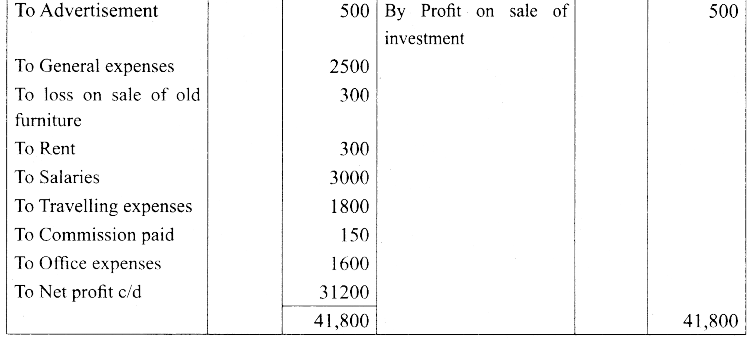
(a) Following is the trading and profit and loss Account of a company. Calculate profitability ratio for the year ended 31.3.2018
Answer:
Tamil Nadu 12th Accountancy Model Question Paper 3 English Medium img 72
Tamil Nadu 12th Accountancy Model Question Paper 3 English Medium img 73
(d) Operating cost ratio = \(\frac{\text { Operation cost }}{\text { Revenue from operation }}\) × 100
Operating Cost = Cost of revenue from Operation + Operating expenses
Cost of revenue from operation = Revenue from Operation – Gross profit
= ₹ 5,60,000 -2,01,000
= ₹ 3,59,000
Operating expenses = Selling and distribution expenses + administrative expenses
= 20,000 + 89,000 = ₹ 1,09,000
Tamil Nadu 12th Accountancy Model Question Paper 3 English Medium img 74
Note:
Operating Cost Ratio = 100% – Operating Profit Ratio
= 100% – 16.43
= 83.57%

[OR]

(b) What are the applications of computerised accounting system?
Answer:
Computerised accounting system refers to the system of maintaining accounts using computer. It involves the processing of accounting transactions through the use of computer in order to maintain and produce accounting records and reports.

The applications of computerised accounting system are as follows:
(i) Maintaining accounting records:
In computerised accounting system, accounting records can be maintained easily and efficiently for long time period. It does not require a large amount of physical space. It facilitates fast and accurate retrieval of data and information.

(ii) Inventory management:
Computerised accounting system facilitates efficient management of inventory, fast moving, slow moving and obsolete inventory can be identified. Updated information about availability of inventory, Level of inventory etc, can be obtained instantly.

(iii) Payroll Preparation:
Payroll involves the calculation of amount due to an employee. Pay of an employee may be calculated based on hours/days worked or units produced.

(iv) Report generation:
Computerised accounting system helps to generate various routine and special purpose reports.

(v) Data import/export:
Accounting data and information can be imported from or exported to other users within the organisation as well as outside the organisation.

(vi) Taxation:
Computerised accounting system helps to compute various taxes and to deduct these and deposit the same to the Government account.

Tamil Nadu 11th Economics Model Question Paper 5 English Medium

Students can Download Tamil Nadu 11th Economics Model Question Paper 5 English Medium Pdf, Tamil Nadu 11th Economics Model Question Papers helps you to revise the complete Tamilnadu State Board New Syllabus and score more marks in your examinations.

TN State Board 11th Economics Model Question Paper 5 English Medium

Instructions:

  1.  The question paper comprises of four parts.
  2.  You are to attempt all the parts. An internal choice of questions is provided wherever applicable.
  3. questions of Part I, II. III and IV are to be attempted separately
  4. Question numbers 1 to 20 in Part I are objective type questions of one -mark each. These are to be answered by choosing the most suitable answer from the given four alternatives and writing the option code and the corresponding answer
  5. Question numbers 21 to 30 in Part II are two-marks questions. These are to be answered in about one or two sentences.
  6. Question numbers 31 to 40 in Parr III are three-marks questions, These are to be answered in about three to five short sentences.
  7. Question numbers 41 to 47 in Part IV are five-marks questions. These are to be answered) in detail. Draw diagrams wherever necessary.

Time: 3 Hours
Maximum Marks: 90

Part – I

Choose the correct answer. Answer all the questions: [20 × 1 = 20]

Question 1.
Cost functions are derived from ………………. function.
(a) production
(b) investment
(c) demand
(d) consumption
Answer:
(a) production

Tamil Nadu 11th Economics Model Question Paper 5 English Medium

Question 2.
Producer’s equilibrium is achieved at the point where: …………….
(a) Marginal Rate of Technical Substitution [MRTS] is greater than the price ratio
(b) MRTS is lesser than the price ratio
(c) MRTS and price ratio are equal to each other
(d) The slopes of isoquant and isocost lines are different
Answer:
(c) MRTS and price ratio are equal to each other

Question 3.
Utility means
(a) Equilibrium point at which demand and supply are equal
(b) Want-satisfying capacity of goods and services
(c) Total value of commodity
(d) Desire for goods and services
Answer:
(b) Want-satisfying capacity of goods and services

Question 4.
Which one of the following is a developed nation?
(a) Mexico
(b) Ghana
(c) France
(d) Srilanka
Answer:
(c) France

Tamil Nadu 11th Economics Model Question Paper 5 English Medium

Question 5.
The weakness of Indian Economy is
(a) Economic disparities
(b) Mixed economy
(c) Urbanisation
(d) Adequate employment opportunities
Answer:
(a) Economic disparities

Question 6.
Explicit cost plus implicit cost denote cost.
(a) social
(b) economic
(c) money
(d) fixed
Answer:
(b) economic

Question 7.
“Economics is a science” The basis of this statement is
(a) Relation between cause and effect
(b) Use of deductive method and inductive method for the formations of laws
(c) Experiments
(d) All of the above
Answer:
(d) All of the above

Question 8.
The world fastest growing economy is
(a) USA
(b) UK
(c) Germany
(d) India
Answer:
(d) India

Tamil Nadu 11th Economics Model Question Paper 5 English Medium

Question 9.
Find the odd one out:
(a) “An inquiry into the nature and the causes of the wealth of nations”
(b) “ Principles of Economics”
(cj “Nature of significance of Economic Science”
(d) “ Ceteris paribus”
Answer:
(b) “ Principles of Economics”

Question 10.
Choice is always constrained or limited by the ………………. of our resources.
(a) scarcity
(b) supply
(c) demand
(d) abundance
Answer:
(a) scarcity

Question 11.
Identify the year of launch of MUDRA Bank.
(a) 1995
(b) 2000
(c) 2010
(d) 2015
Answer:
(d) 2015

Question 12.
The highest rate of tax under GST is [as on July 1st 2017]
(a) 18%
(b) 24%
(c) 28%
(d) 32%
Answer:
(c) 28%

Tamil Nadu 11th Economics Model Question Paper 5 English Medium

Question 13.
The concept of meeting unexpected expenditure according to Keynes is
(a) Transaction motive
(b) Precautionary motive
(c) Speculative motive
(d) Personal motive
Answer:
(b) Precautionary motive

Question 14.
The cost that remains constant at all levels of output is…………….cost.
(a) fixed
(b) variable
(c) real
(d) social
Answer:
(a) fixed

Question 15.
Revenue received from the sale of additional unit is termed as revenue.
(a) profit
(b) average
(c) marginal
(d) total
Answer:
(c) marginal

Question 16.
Function with single independent variable is ………………….
(a) Multivariate function
(b) Bivariate function
(c) Univariate function
(d) Polynomial function
Answer:
(c) Univariate function

Question 17.
The new economic policy is concerned with the following:
(a) foreign investment
(b) foreign technology
(c) foreign trade
(d) all the above
Answer:
(d) all the above

Tamil Nadu 11th Economics Model Question Paper 5 English Medium

Question 18.
Utility is a ………………… concept.
(a) objective
(b) subjective
(c) mathematical
(d) derivative
Answer:
(b) subjective

Question 19.
The head quarters of southern Railway is
(a) Tiruchirapalli
(b) Chennai
(c) Madurai
(d) Coimbatore
Answer:
(b) Chennai

Question 20.
Which feature is identified with rural areas?
(a) Low population density
(b) High population density
(c) Low natural resources
(d) Low human resources
Answer:
(a) Low population density

Part – II

Answer any seven question in which Question No. 30 is compulsory. [7 × 2 = 14]

Question 21.
Explicit cost – define
Answer:
Payment made to other for the purchase of factors of production is known as Explicit Costs. It refers to the actual expenditures of the firm to purchase or hire the inputs the firm needs.

Question 22.
What is meant by distribution?
Answer:
Distribution means division of income among the four factors of production in terms of rent to landlords, wage to labourer, interest to capital and profit to entrepreneurs. The theory of functional distribution deals with how the relative prices of these factors of production are determined. The theory of factor prices is popularly known as the theory of distribution.

Question 23.
Define opportunity cost and provide an example.
Answer:

  • Opportunity cost refers to the cost of next best alternative use. In other words, it is the value of the next best alternative foregone.
  • For example, a farmer can cultivate both paddy and sugarcane in a farm land. –
  • If he cultivates paddy, the opportunity cost of paddy output is the amount of sugarcane output given up.
  • Opportunity Cost is also called as “ Alternative Cost” or Transfer cost.

Tamil Nadu 11th Economics Model Question Paper 5 English Medium

Question 24.
Write the short note on natural resources.
Answer:

  • Any stock or reserve that can be drawn from nature is a Natural Resources.
  • The major natural resources are – land, forest, water, mineral and energy.
  • India is rich in natural resources, but majority of the Indians are poor.
  • Nature has provided with diverse climate, several rivers for irrigation and power generation, rich minerals, rich forest and diverse soil.

Question 25.
What do you mean by interest?
Answer:

  • Interest is the reward paid by the borrower to the lender for the use of capital.
  • Interest is the price paid for the use of capital in any market.
  • Generally speaking, interest is a payment made by a borrower to the lender for the money borrowed.

Question 26.
List out the reasons for low per capita income as given by V.K.R.V. Rao.
Answer:
Rao ga c the following reasons for low per capita income and low levels of per capita nutrition in India:

  • Uneconomic holdings with sub-divisions and fragmentation.
  • Low levels of water availability for crops.
  • Excess population pressure on agriculture due to the absence of a large industrial sector.
  • Absence of capital.
  • Absence of autonomy in currency policy, and in general in monetary matters encouraging holding of gold.

Question 27.
What is meant by Economics?
Answer:

  • The term or word ‘Economics’ comes from the Ancient Greek “oikonomikos” [oikos means “households” and nomos means “management” “custom” or “law”].
  • Thus, the term “Economics” means “management of households”.
  • The subject was earlier known as “Political Economy” is renamed as Economics.

Question 28.
Find the average cost function where TC = 60 + lOx + 15x2
Answer:
Tamil Nadu 11th Economics Model Question Paper 5 English Medium - 1

Tamil Nadu 11th Economics Model Question Paper 5 English Medium

Question 29.
Give the meaning of non- renewable energy.
Answer:
Non-renewable energy sources :

  • The sources of energy which cannot be renewed or re-used are called non-renewable energy sources.
  • Basically these are the energy sources which will get exhausted over a period of time.
  • Some of the examples of this kind of resources are coal, oil, gas etc.

Question 30.
Point out any one feature of Indian Economy.
Answer:
India has a mixed economy:

  • Indian economy is a typical example of mixed economy.
  • This means both private and public sector co-exist and function smoothly.
  • The fundamental and heavy industrial units are being operated under the public sector, while, due to the liberalization of the economy, the private sector has gained importance.
  • This markets it a perfect model for public-private partnership.

Part – III

Answer any seven question in which Question No. 40 is compulsory. [7 × 3 = 21]

Question 31.
Define Economic Development.
Answer:

  • The economic development is indicated not just by GDP, but by an increase in citizen’s quality of life or well being. .
  • The quality of life is being assessed by several indices such as Human Developments Index [HDI]
  • On the basis of the level of economic development, nations are classified as developed and developing economies.
  • Developed economies are those countries which are industrialized.
  • Developments economics are also termed as advanced countries.
  • On the other hand, countries which have not fully utilized their resources like land, mines, workers, etc. and have low per capita income are termed as under developed economics.

Question 32.
Specify the nature of entry of competitors in perfect competition and monopoly?
Answer:
Nature of entry of competitors in perfect competition:

  • Large number of Buyers and sellers.
  • Homogeneous product and uniform price.
  • Free entry and exit.
  • Absence of Transport cost.
  • Perfect Mobility of factors of production.
  • Perfect knowledge of the Market.
  • No Government Intervention.

Nature of entry of competitors in Monopoly:

  • There is a single producer / seller of a product.
  • The product of a monopolist is unique and has no close substitute.
  • There is strict barrier for entry of any new firm.
  • The monopolist is a price-maker.
  • The monopolist earns maximum profit / abnormal profit.

Tamil Nadu 11th Economics Model Question Paper 5 English Medium

Question 33.
What are the steps involved in executing a MS Excel Sheet?
Answer:

  • MS – excel is used in data analysis by using formula.
  • A spread sheet is a large sheet of paper which contains rows and columns.
  • The intersection of rows and columns is termed as cell.
  • MS – Excel 2007 version supports up to 1 million rows and 16 thousand columns per work sheet.

MS Excel Start From Various Options:

  • Click Start → Program → Micro Soft Excel
  • Double click the MS Excel Icon from the Desktop

Worksheet:
MS – Excel work sheet is a table like document containing rows and columns with data
and formula

There are four kinds of calculation operators. They are:

  1. Arithmetic
  2. Comparison
  3. Text Concatenation [link together]
  4. Reference

MS – Excel helps to do data analysis and data presentation in the form of graphs, diagrams, area chart, line chart etc.

Question 34.
Differentiate between firm and Industry.
Firm
A firm refers to a single production unit in an industry, producing a large or a small quantum of a commodity or service, and selling it at a price in the market.
Its main objective is to earn a profit. There may be other objectives as described by managerial and behavioral theories of the firm.

Industry :
An industry refers to a group of firms producing the same product or service in an economy. For example: A group of firms producing cement is called a cement industry.

Question 35.
What are the measures taken towards Globalization?
Answer:

  • As globalization measures tend to integrate all economies of the world and bringing them all under one umbrella.
  • They pave the way for redistribution of economic power at the world level.
  • Well-developed countries are favoured in this process and the welfare of the less- developed countries will be neglected.
  • Globalization refers to the integration of the domestic (Indian) economy with the rest of the world.
  • Import liberalization through reduction of tariff and non-tariff barriers, opening the doors to Foreign Direct Investment (FDI) and Foreign Portfolio Investment (FPI) are some of the measures towards globalization.

Tamil Nadu 11th Economics Model Question Paper 5 English Medium

Question 36.
Describe the development of textile Industry in Tamil Nadu.
Answer:

  • Tamil Ncidu is the largest textile hub of India.
  • Tamil Nadu is known as the “Yam Bowl” of the country accounting for 41% of India’s cotton yam production.
  • The textile industry plays a significant role in the Indian economy by providing direct employment to an estimated 35.million people, and thereby coiitributing 4% of GDP and 35% of gross export earnings.
  • The textile sector contributes to 14% of the manufacturing sector.
  • From spinning to garment manufacturing, entire textile production chain facilities are in Tamil Nadu.
  • About half of India’s total spinning mill capacity is. in Tamil Nadu.
  • The western part of Tamil Nadu comprising Coimbatore, Tirupur, Erode, Dindigul and Karur has the  majority of spinning mills manufacturing cotton, polyester, blended yam and silk yam used by garment units in Tamil Nadu, Maharastra etc.,
  • Yam is also exported to China, Bangladesh, etc.,
  • Tirupur known as “knitting city” is the exporter of garments worth USD (United States Dollar) 3 billion.
  • Karur is the major home for textile manufacturing (curtain cloth, bed linens, kitchen linens, toilet linens, table linens, wall hangings etc.,) and export hub in India.
  • Erode is the main cloth market in South India for both retail and wholesale ready-mades.

Question 37.
The Handicrafts declined in India in British Period. Why?
Answer:

  • The Indian handicrafts products had a worldwide market. ,
  • Indian exports consisted chiefly of hand weaved cotton and silk fabrics, calicoes, artistic wares, wood carving etc.
  • Through discriminatory tariff policy, the British Government purposefully destroyed the handicrafts.
  • With the disappearance of Nawabs and Kings. There was no one to protect Indian handicrafts.
  • Indian handicraft products could not complete with machine – made products.
  • The introduction of railways in India increased the domestic market for the British goods.

Question 38.
What are the renewable sources of power in Tamil Nadu?
Answer:
Energy:

  • Tamil Nadu tops in power generation among the southern States as seen in following table.
  • Installed capacity of power utilities in States in southern region.
  • Tamil Nadu is in the forefront of all other Indian States in installed capacity.
  • Muppandal wind farm is a renewable energy source, supplying the villagers with electricity for work.

Tamil Nadu 11th Economics Model Question Paper 5 English Medium - 2

  • Wind farms were built in Nagercoil and Tuticorin apart from already existing ones around Coimbatore, Pollachi, Dharapuram and Udumalaipettai.
  • These areas generate about half of India’s 2,000 megawatts of wind energy or two percent of the total power output of India.

Thermal Power:

  • In Tamil Nadu the share of thermal power in total energy sources is very high and the thermal power plants are at Athippattu [North Chennai] Ennore, Mettur, Neyveli and Thoothukudi.
  • The generation of power under various sources is given below.

Tamil Nadu 11th Economics Model Question Paper 5 English Medium - 3

Hydel Energy:

  • There are about 20 hydro-electric units in Tamil Nadu.
  • The prominent units are Hundah, Mettur, Periyar, Maravakandy, Parson Valley etc.

Solar Energy:
Tamil Nadu tops in solar power generation in India as seen in following table:
Tamil Nadu 11th Economics Model Question Paper 5 English Medium - 4
Southern Tamil Nadu is considered as one of the most suitable regions in the country for developing solar power projects.

Wind Energy:

  • Tamil Nadu has the highest installed wind energy capacity in India.
  • The State has very high quality of offshore wind energy potential off the Tirunelveli coast and southern Thoothukudi and Rameswaram coast.

Tamil Nadu 11th Economics Model Question Paper 5 English Medium

Question 39.
State any two causes of housing problem in rural areas.
Answer:

  • House is one of the basic needs of every family. Provision of better housing facilities increases the productivity of labour. The housing problem is getting aggravated due to rapid adaptation of nuclear families.
  • Housing does not mean provision of house alone but also proper water supply, good sanitation, proper disposal of sewage etc.

Question 40.
Describe the features of human wants.
Answer:

  • Wants are unlimited: Human wants are countless in number and various in kinds. When one want is satisfied another want crops up. Human wants multiply with the growth of civilization and development.
  • Wants become habits: Wants become habits; for example, when a man starts .reading news paper in the morning, it becomes a habit. Same is the case with drinking tea or chewing pans.
  • Wants are Satiable: Though we cannot satisfy all our wants, at the same time we can
    satisfy particular wants at a given time. When one feels hungry, he takes food and that want is satisfied. .
  • Wants are Alternative: There are alternative ways to satisfy a particular want eg. Idly, dosa or chappathi.
  • Wants are Competitive: All our wants are not equally important. So, there is competition among wants. Hence, we have to choose more urgent wants than less urgent wants.
  • Wants are Complementary: Sometimes, satisfaction of a particular want requires the use of more than one commodity. Example: Car and Petrol, Ink and Pen.
  • Wants are Recurring: Some wants occur again and again. For example, if we feel hungry, we take food and satisfy our want. But after sometime, we again feel hungry and want food.

Part – IV

Answer all the questions. [7 × 5 = 35]

Question 41.
(a) Illustrate the Ricardian Theory of Rent.
Answer:

  • The Classical theory of Rent is called “Ricardian Theory of Rent.”
  • “Rent is that portion of the produce of the earth which is paid to the landlord for the use of the original and indestructible powers of the soil” – David Ricardo

Ricardian theory of rent assumes the following:

  • Land differs in fertility.
  • The law of diminishing returns operates in agriculture.
  • Rent depends upon fertility and location of land .
  • Theory assumes perfect competition.
  • It is based on the assumption of long period.
  • There is existence of marginal land or no – rent land.
  • Land has certain “Original and indestructible powers”.
  • Land is used for cultivation only.
  • Most fertile lands are cultivated first.

Statement of the Theory:
There are three grades of land, namely A, B and C in that island. ‘A’ being most fertile ‘B’ less fertile and ‘C’ the least fertile. They will first cultivate all the most fertile land. The yield per acre on ‘A’ grade land is 40 bags of paddy. The same amount labour and capital employed in ‘A’ grade land. The yield per acre on ‘B’ grade land is 30 bags of paddy.

The Surplus of 10 bags [ 40-30] per acre appears on ‘A’ grade land. This is “ Economic Rent” land of ‘A’ grade land.

The yield per acre on ‘C’ grade land is 20 bags of paddy. This surplus of ‘A’ grade land is now raised to 20 bags [40-20] and it is the “ Economic Rent” of ‘A’ grade land.
The ‘C’ grade land cost of production is just equal to the price of its produce and therefore does not yield any rent [20-20]. Hence ‘C’ grade land is called ‘No – Rent land or marginal . land ’. The land which yields rent is called Ricardian Theory of Rent “intra-marginal land”.
Tamil Nadu 11th Economics Model Question Paper 5 English Medium - 5
Tamil Nadu 11th Economics Model Question Paper 5 English Medium - 6

Diagrammatic Explahation:

  • In diagram, X- axis represents various grades of land and Y axis represents yield per acre [in bags].
  • OA, AB and BC are the ‘A’ grade ‘B’ grade and ‘C’ grade lands respectively.
  • The ‘C’ grade land is the no – rent land.”
  • ‘A’ land ‘B’ grade lands are “intra – marginal lands”.
  • The economic rent yielded by ‘A’ and ‘B’ grade lands is equal to the shaded area of their respective rectangles.

[OR]

(b) Write the important mineral resources in India.
Answer:
Important Mineral Resources:
(i) Iron -ore:

  • India possesses high quality iron -ore in abundance.
  • The total reserves of iron-ore in the country are about 14.630 million tonnes of haematite and 10,619 million tonnes of magnetite.
  • Hematite iron is mainly found is Chattisgarh, Jharkhand, Odisha , Goa and Karnataka.
  • Some deposits of iron ore are also found in Kerala, Tamilnadu and Andra Pradesh.

(ii) Coal and Lignite:

  • Coal is the largest available mineral resource.
  • India ranks third in the world after China and USA in coal production
  • The main centres of coal in India are the West Bengal, Bihar, Madhya. Pradesh, Maharashtra, Odisha and Andhra Pradesh.
  • Bulk of the coal production comes from Bengal-Jharkhand coalfields.

(iii) Bauxite:

  • Bauxite is a main source of metal like aluminium.
  • Major reserves are concentrated in the East Coast bauxite deposits of Odisha and Andhra Pradesh.

(iv) Mica:

  • Mica is a heat resisting mineral which is also a bad conductor of electricity.
  • It is used in electrical equipments as an insulator. ‘
  • India stands first in sheet mica production and contributes 60% of mica trade in the world.
  • The important mica bearing pegmatite is found in Andhra Pradesh, Jharkhand, Bihar and Rajasthan.

(v) Curde Oil:

  • Oil is being explored in India at many place of Assam and Gujarat.
  • Digboi, Badarpur, Naharkatia, Kasimpur, Palliaria, Rudrapur, Shivsagar, Mourn [All in Assam] and Hay of Khambhat, Ankaleshwar and Kalor [All in Gujarat] are the important places of oil exploration in India.

(vi) Gold:

  • India possesses only a limited gold reserve.
  • There are only three main gold mine regions Kolar Goldfield, Kolar district and Hutti goldfield in Raichur district [both in Karnataka] and Ramgiri Goldfield in Anantpur district [Andhra Pradesh]

(vii) Diamond:

  • The total reserves of diamond is estimated at around 4582, thousand carats which are mostly available in Panna [Madhya Pradesh], Rammallakota of Kumur district of Andhra Pradesh and also in the basin of Krishna River.
  • The new Kimberlile fields have been discovered in Raipur and Pastar districts of Chhattisgarh, Nuapada and Bargarh districts of Odisha, Narayanpet-Maddur Krishna areas of Andhra Pradesh and Raichur-Gulbarga districts of Karnataka.

Tamil Nadu 11th Economics Model Question Paper 5 English Medium

Question 42.
(a) What are basic economics problems?
Answer:
Basic economics problems:

  • If resources are abundant and wants are so few, then there would be no economic problem.
  • But this situation can never exist.
  • Resources are always scarce and our wants are numerous.
    Hence in every society certain choices have to be made.

The Economic Problem :

  • Wants, desires; unlimited
  • Resources: Scarce – Not freely available
  • Economic choice
  • Economics – How people use scarce resources to satisfy unlimited wants.

What and how much to produce?
Every society must decide on what goods it will produce and how much of these it will produce.

In this process, the crucial decisions include:

  • Whether to produce more of food, clothing and housing or to have more luxury goods.
  • Whether to have more agricultural goods or to have industrial goods and services.
  • Whether to use more resources in military services.
  • Whether to have more consumption goods or to have investment goods.
  • Whether to spend more on basic education or higher education.

How to produce?
Every society has to decide whether it will use labour – intensive technology on capital intensive technology; that is whether to use more labour and less more machines and vice versa.

For whom to produce?

  • Every society must also decide how its produce be distributed among the different sections of the society.
  • It must also decide who gets more and who gets less?
  • It should also decide whether or not a minimum amount of consumption be ensured for everyone in the society.
  • Due to the scarcity of resources, a society faces the compulsion of making choice among alternatives.
  • It face the problem of allocating the scare resources to the production of different possible goods and services and of distributing the produced goods and services among individuals within the economy.

[OR]

(b) List out the properties of iso-quants with the help of diagrams.
Answer:
Properties of Iso-quant Curve:

1. The iso-quant curve has negative slope.
It slopes downwards from left to right indicating that the factors are substitutable. If more of one factor is used, less of the other factor is needed for producing the same level of output. In the diagram combination A refers to more of capital K5 and less of labour L2. As the producer moves to B, C, and D, more labour and less capital are used.

2. Convex to the origin.
This explains the concept of diminishing Marginal Rate of Technical Substitution (MRTSlk). For example, the capital substituted by 1 unit of labour goes on decreasing when moved from top to bottom. If so, it is called diminishing MRTS. Constant MRTS (straight line) and increasing MRTS (concave) are also possible. It depends on the nature of iso-quant curve.
Tamil Nadu 11th Economics Model Question Paper 5 English Medium - 7

This means that factors of production are substitutable to each other. The capital substituted per unit of labour goes on decreasing when the iso-quant is convex to the origin.
Tamil Nadu 11th Economics Model Question Paper 5 English Medium - 8

3. Non inter-section of Iso-quant curves.
For instance, point A lie on the isoquants IQ1 and IQ2 But the point C shows a higher output and the point B shows a lower level of output IQ1 If C = A, B = A, then C = B. But C > B which is illogical.
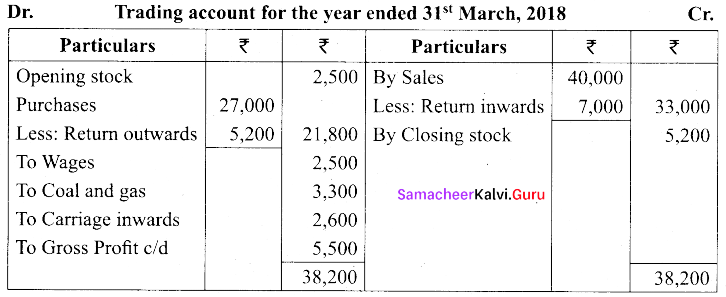
Tamil Nadu 11th Economics Model Question Paper 5 English Medium - 9

4. An upper iso-quant curve represents a higher level of output.
Higher IQS show higher outputs and lower IQs show lower outputs, for upper iso-quant curve implies the use of more factors than the lower isoquant curve. ‘
The arrow in the figure shows an increase in the output with a right and upward shift of an iso-quant curve.
Tamil Nadu 11th Economics Model Question Paper 5 English Medium - 10

5. Iso-quant curve does not touch either X axis or Y axis.
No iso-quant curve touches the X axis or Y axis because in IQ1 only capital is used, and in IQ2 only labour is used.
Tamil Nadu 11th Economics Model Question Paper 5 English Medium - 11

Tamil Nadu 11th Economics Model Question Paper 5 English Medium

Question 43.
(a) Bring out features of perfect competition.
Answer:
Features of the perfect competition:
(0 Large Number of Buyers and sellers

  • “A large number of buyers” implies that each individual buyer buys a very very small quantum of a product as compared to that found in the market.
  • This means that he has no power to fix the price of the product.
  • He is only a price-taker and not a price-maker ‘
  • Large number of sellers” implies that share of each individual seller is a very very small quantum of a product.
  • No power to fix the price of the product.

(ii) Homogeneous Product and Uniform Price

  • The product sold and bought is homogeneous in nature, in the sense that the units of the product are perfectly substitutable.
  • All the units of the product are identical i.e., of the same size, shape, colour, quality etc.
  • Therefore, a uniform price prevails in the market.

(iii) Free Entry and Exit

  • In the short run, it is possible for the very efficient producer, producing the product at a very low cost, to earn super normal profits.
  • An inefficient producer, who is unable to bring down the cost incurs loss.

(iv) Absence of Transport Cost
The prevalence of the uniform price is also due to the absence of the transport cost.

(v) Perfect Mobility of Factors of Production

  • The prevalence of the uniform price is also due to the perfect mobility of the factors of production.
  • As they enjoy perfect freedom to move from one place to another and from one occupation to another, the price gets adjusted.

(vi) Perfect Knowledge of the Market
All buyers and sellers have a thorough knowledge of the quality of the product, prevailing price etc.

(vii) No Government Intervention
There is no government regulation on supply of raw materials, and in the determination of price etc.

[OR]

(b) Explain the Marginal productivity theory of distribution.
Answer:
Introduction:

  • This theory was developed by Clark, Wickseed and Walras . The Marginal productivity theory of Distribution explains how the prices of various factors of production are determined.
  • This theory explains how rent, wages, Interest and profit are determined.
  • This theory is also known as “ General Theory of Distribution ” or “ National Dividend Theory of Distribution”.

Assumptions:

  • All the factors of production are homogenous.
  • Factors of production can be substituted for each other.
  • There is perfect competition both in the factor market and product market.
  • There is perfect mobility of factors of production.
  • There is full employment of factors.
  • This theory is applicable only in the long – run.
  • The entrepreneurs aim at profit maximization!
  • There is no government intervention in fixing the price of a factor.
  • There is no technological change. ,

Explanation of the theory:
According to the Marginal Productivity Theory of Distribution, the price or the reward for any factor of production is equal to the marginal productivity of that factor. Each factor is rewarded according to its marginal productivity.

Marginal Product:
The Marginal Product is also known as “ Marginal Physical Product “ [MPP]. The Marginal Product of a factor of production means the addition made to total product by employment of an additional unit of that factor. The Marginal Product may be expressed as MPP, VMP and MRP.

  • Marginal Physical product [MPP]: The Marginal Physical Product of a factor is the increment in the total product obtained by the employment of an additional unit of that factor.
  • Value of a marginal product [VMP]: The Value of Marginal Product is obtained by multiplying the marginal physical product of the factor by the price of product. Symbolically VMP = MPP x Price
  • Marginal Revenue product : [MRP]: The Marginal Revenue Product of a factor is the increment in the total revenue which is obtained by the employment of an additional unit of that factor.
    MRP = MPP x MR

The Marginal Productivity Theory of Distribution states that

  • The price of a factor of production depends upon its productivity.
  • The price of a factor is determined by and will be equal to marginal revenue product of that factor.
  • Under certain conditions the price of a factor will be equal to both the average and marginal products of that factor.

Tamil Nadu 11th Economics Model Question Paper 5 English Medium

Question 44.
(a) Analyse the causes for Rural Indebtedness.
Answer:
The Causes for Rural Indebtedness:
(i) Poverty of Farmers:

  • The vicious circle of poverty forces the farmers to borrow for consumption and cultivation.
  • Thus poverty, debt and high rates of interest hold the farmer in the grip of money lenders.

(ii) Failure of Monsoon:

  • Frequent failure of monsoon is a curse to the farmers and they have to suffer due to the failure of nature.
  • Farmers find it difficult to identify good years to repay their debts. ‘

(iii) Litigation:

  • Due to land disputes litigation in the court compels them to borrow heavily.
  • Being uneducated and ignorant they are caught in the litigation process and dry away their savings and resources.

(iv) Money Lenders and High Rate of Interest:
The rate of interest charged by the local money lenders is very high and the compounding
of interest leads to perpetuate indebtedness of the farmer.

[OR]

(b) Explain shift in the demand curve.
Answer:
A shift in the demand curve occurs with a change in the value of a variable other than its price in the general demand function. An increase or decrease in demand due to changes in conditions of demand is shown by way of shifts in the demand curve.

On the left hand side of the diagram, the original demand curve is dd, the price is OP, and the quantity demanded is P3. Due to change in the conditions of demand (change in income, taste or change in prices of substitutes and /or complements) the quantity . demanded decreases from OQ1 to OQ2. This is shown in the demand curve to the left side new demand curve is d1d1,. This is called decrease in demand.

On the right hand side of the diagram, the original price is OP1 and the quantity demanded is OQ1 . Due to changes in other conditions, the quantity purchased has increased to OQ2 Thus the demand curve shifts to the right d1d1. This is called increase in demand.
Tamil Nadu 11th Economics Model Question Paper 5 English Medium - 12
‘Extension’ and ‘Contraction’ of demand follow a change in price. Increases and decreases in demand take place when price remains the same and the other factors bring about demand changes.

Tamil Nadu 11th Economics Model Question Paper 5 English Medium

Question 45.
(a) What is Duopoly and characteristics of Duopoly?
Answer:
Duopoly is a special case of the theory of oligopoly in which there are only two sellers. Both the sellers are completely independent and no agreement exists between them. Even though they are independent, a change in the price and output of one will affect the other, and may set a chain of reactions. A seller may, however, assume that his rival is unaffected by what he does, in that case he takes only his own direct influence on the price.

Characteristics of Duopoly:

  • Each seller is fully aware of his rival’s motive and actions.
  • Both sellers may collude (they agree on all matters regarding the sale of the commodity).
  • They may enter into cut-throat competition.
  • There is no product differentiation. .
  • They fix the price for their product with a view to maximising their profit.

[OR]

(b) Explain the Marginal Productivity Theory of Distribution.
Answer:
Introduction:

  • This theory was developed by Clark, Wickseed and Walras. The Marginal productivity theory of Distribution explains how the prices of various factors of production are determined.
  • This theory explains how rent, wages, Interest and profit are determined.
  • This theory is also known as “General Theory of Distribution” or “National Dividend Theory of Distribution”.

Assumptions:

  • All the factors of production are homogenous.
  • Factors of production can be substituted for each other.
  • There is perfect competition both in the factor market and product market.
  • There is perfect mobility of factors of production.
  • There is full employment of factors.
  • This theory is applicable only in the long – run.
  • The entrepreneurs aim at profit maximization.
  • There is no government intervention in fixing the price of a factor.
  • There is no technological change.

Explanation of the theory:
According to the Marginal Productivity Theory of Distribution, the price or the reward for any factor of production is equal to the marginal productivity of that factor. Each factor is rewarded according to its marginal productivity.

Marginal Product:
The Marginal Product is also known as “ Marginal Physical Product “ [MPPJ. The Marginal Product of a factor Of production means the addition made to total product by employment of an additional unit of that factor. The Marginal Product may be expressed as MPP, VMP and MRP.

  • Marginal Physical Product [MPP]: The Marginal Physical Product of a factor is the increment in the total product obtained by the employment of an additional unit of that factor.
  • Value of a Marginal Product [VMP]: The Value of Marginal Product is obtained by multiplying the marginal physical product of the factor by the price of product. Symbolically VMP = MPP x Price
  • Marginal Revenue Product: [MRP]: The Marginal Revenue Product of a factor is the increment in the total revenue which is obtained by the employment of an additional unit of that factor.
    MRP = MPP x MR

The Marginal Productivity Theory of Distribution states that

  • The price of a factor of production depends upon its productivity.
  • The price of a factor is determined by and will be equal to marginal revenue product of that factor.
  • Under certain conditions the price of a factor will be equal to both the average and marginal products of that factor.

Question 46.
(a) Explain the objectives and characteristics of SEZs.
Answer:

  • The Special Economic Zones [SEZs] Policy was announced in April 2000.
  • The Special Economic Zones Act of 2005, the government has so far notified about 400 such zones in the country.

Major objectives of SEZs:

  • To enhance foreign investment, especially to attract foreign direct investment [FDI] and thereby increasing GDP.
  • To increase shares in Global Export. (International Business)
  • To generate additional economic activity.
  • To create employment opportunities.
  • To develop infrastructure facilities.
  • To exchange technology in the global market.

Main Characteristics of SEZ:

  • Geographically demarked area with physical security.
  • Administrated by single body authority.
  • Streamlined procedures.
  • Having separate custom area.
  • Governed by more liberal economic laws.
  • Greater freedom to the firms located in SEZs.

[OR]

(b) Describe the qualitative aspects of population.
Answer:
Tamil Nadu stands sixth in population with 7.21 crore against India’s 121 crore as per 2011 censes. Tamil Nadu’s population is higher than that of several countries according to UN report. Tamil Nadu population 7.2 [crores] in 2017.

Density:

  • The density of population which measures population per sq.km is 555 [2011] against 480 [2001],
  • Tamil Nadu ranks 12th in density among the Indian States and overall it is 382 for India.

Urbanisation:

  • Tamil Nadu is the most urbanized state with 48.4% of urban population against 31.5% for • India as a whole.
  • The State accounts for 9.61% of total urbanites irt India against 6% share of total population.
  • Sex Ratio [Numbers of female per 1000 males],
  • Balanced sex ratio implies improvement in quality of life of female population.
  • The sex ratio in Tamil Nadu is nearing balance with 995 which is far better compared to most of the states and all India level.
  • Tamil Nadu stands third next only to Kerala State and Puducherry Union Territory in sex ratio.

Tamil Nadu 11th Economics Model Question Paper 5 English Medium - 13

Tamil Nadu 11th Economics Model Question Paper 5 English Medium

Question 47.
(a) Explain basic problems of the economy with the help of production possibility curve.
Answer:
The problem of choice between relatively scarce commodities due to limited productive resources with the society can be illustrated with the help of a geometric device, is known as production possibility curve. Production possibility curve shows the menu of choice
along which a society can choose to substitute one good for another, assuming a given state of technology and given total resources.

The explanation arid analysis of production possibility curve is based upon certain assumptions, some of them are following:

  • The time period does not change. It remains the same throughout the curve.
  • Techniques of production are fixed.
  • There is full employment in the economy.
  • Only two goods can be produced from the given resources.
  • Resources of production are fully mobile.
  • The factors of production are given in quantity and quality.
  • The low of diminishing returns operates in production.

Every production possibility curve is based upon these assumptions. If some of these assumptions changes or negelected, then it affects the nature of production possibility curve.

To draw this curve we take the help of production possibilities schedule, as shown below.
Production possibilities schedule
Tamil Nadu 11th Economics Model Question Paper 5 English Medium - 14

The schedule suggests that if all resources are thrown into the production of food, a maximum of 500 tons of food can be produced, given the existing technology. If on the other hand, all resources are instead used for producing cars, 25 cars can be produced. In between these two extreme possibilities exist. If we are willing to give up some food, we can have some cars.

We can obtain a production possibility curve by drawing production possibilities schedule graphically. The quantity of food is shown on x-axis and the number of cars is shown on y-axis, the different six production possibilities are being shown as point P1 P2 P3 P4 P5 & P6

Problems of the economy

1. The problem of choice:
The problem of choice arise because of the given limited resources and unlimited wants, may relate to the allocation of resources between the goods for the higher income group and the lower income group and the goods for the defense and the civilians. Since PPC is the locus of the combination of the goods the problem of choice will not arises when we choose any point on PPC.

2. Solution of central problems:
The central problems of an economy can be explained with the help of PPC. The solution of problem of what to produce involves the decision regarding the choice of location on the production possibility carves. A production combination represented by any point inside the PPC indicates that the economy is using inefficient methods of production and inefficient combination of resources.

Tamil Nadu 11th Economics Model Question Paper 5 English Medium

[OR]

(b) What are the properties of indifference curve?
Answer:
Indifference curves are subjective and unique to each person nevertheless they have in common the following properties:

1. Indifference curve must have negative slope:
An indifference curve has a negative slope, which denotes that if the quantity of ‘ commodity (y) decreases, the quantity of the other (x) must increase, if the consumer is to stay on the same level of satisfaction.
Tamil Nadu 11th Economics Model Question Paper 5 English Medium - 15

2. Indifference curves are convex to the origin:
Indifference curves are not only negatively sloped, but are also convex to the origin.
The convexity of the indifference curves implies that not only two commodities are substitutes for each other but also the fact that the marginal rate of substitution (MRS) between the goods decreases as a consumer moves along an indifference curve.
Tamil Nadu 11th Economics Model Question Paper 5 English Medium - 17

3. Indifference curve cannot intersect:
IC1 is lower indifference curve denoting lesser satisfaction. Combination C and B fall on IC1
IC2 is upper indifference curve denoting higher satisfaction. C and A combinations are on IC2
At the point of intersection, C = B on IC1 and C = A on IC2. So A = B whereas, A is in upper IC and B is on lower IC.
This is not possible.

4. Indifference curves do not touch the horizontal or vertical axis.
If they touch the axis, it violates the basic assumption that the consumer purchases two commodities in a combination.

Samacheer Kalvi 11th Computer Applications Solutions Chapter 7 Spreadsheets Basics (OpenOffice Calc)

Students can Download Computer Applications Chapter 7 Spreadsheets Basics (OpenOffice Calc) Questions and Answers, Notes Pdf, Samacheer Kalvi 11th Computer Applications Book Solutions Guide Pdf helps you to revise the complete Tamilnadu State Board New Syllabus and score more marks in your examinations.

Tamilnadu Samacheer Kalvi 11th Computer Applications Solutions Chapter 7 Spreadsheets Basics (OpenOffice Calc)

Samacheer Kalvi 11th Computer Applications Spreadsheets Basics (OpenOffice Calc) Text Book Back Questions and Answers

I. Choose The Correct Answer

Question 1.
Which is the first electronic spreadsheet?
(a) Excel
(b) Lotus 1-2-3
(c) VisiCalc
(d) OpenOffice Calc
Answer:
(c) VisiCalc

Question 2.
Which of the following applications was the parent to OpenOffice Calc?
(a) VisiCalc
(b) LibreCalc
(c) Lotus 123
(d) StarOffice Calc
Answer:
(b) LibreCalc

Samacheer Kalvi 11th Computer Applications Solutions Chapter 7 Spreadsheets Basics (OpenOffice Calc)

Question 3.
Grid of cells with a programmable calculator:
(a) Spreadsheet
(b) Database
(c) Word processor
(d) Linux
Answer:
(a) Spreadsheet

Question 4.
A column heading in Calc as a:
(a) Number
(b) Symbol
(c) Date
(d) Alphabet
Answer:
(d) Alphabet

Samacheer Kalvi 11th Computer Applications Solutions Chapter 7 Spreadsheets Basics (OpenOffice Calc)

Question 5.
Which key is used to move the cell pointer in the forward direction within the worksheet?
(a) Enter
(b) Tab
(c) Shift + Tab
(d) Delete
Answer:
(b) Tab

Question 6.
A formula in Calc may begin with:
(a) =
(b) +
(c) –
(d) All the above
Answer:
(d) All the above

Samacheer Kalvi 11th Computer Applications Solutions Chapter 7 Spreadsheets Basics (OpenOffice Calc)

Question 7.
What will be the result from the following formula? (Assume A1 = 5, B2 = 2)? + A1 B2:
(a) 7
(b) 25
(c) 10
(d) 52
Answer:
(b) 25

Question 8.
What will be the result from the following expression? (AssumeH1 = 12, H2 = 12)? = H1<>H2:
(a) True
(b) False
(c) 24
(d) 1212
Answer:
(b) False

Samacheer Kalvi 11th Computer Applications Solutions Chapter 7 Spreadsheets Basics (OpenOffice Calc)

Question 9.
Which of the following symbol is used to make a cell address as an absolute reference?
(a) +
(b) %
(c) &
(d) $
Answer:
(d) $

Question 10.
Which of the following key combinations is used to increase the width of the current column?
(a) Alt + Right arrow
(b) Ctrl + Right arrow
(c) Alt + Left arrow
(d) Ctrl + Left arrow
Answer:
(a) Alt + Right arrow

II. Short Answers

Question 1.
What are the types of toolbars available in OpenOffice Calc?
Answer:
Under the menu bar, there are three toolbars available by default. They are:

  1. Standard toolbar
  2. Formatting toolbar
  3. Formula bar

Samacheer Kalvi 11th Computer Applications Solutions Chapter 7 Spreadsheets Basics (OpenOffice Calc)

Question 2.
What is a Cell pointer?
Answer:
Cell pointer is a rectangle box which can be moved around the worksheet. The cell in which the cell pointer is currently located is known as “Active cell”. When you type any content, it will appear in the active cell.

Question 3.
Write about the text operator in OpenOffice Calc?
Answer:
In Calc, “&” is a text operator which is used to combine two or more texts as a single text. Joining two different texts is also known as “Text Concatenation”. An expression using the text operator has the following syntax:

Question 4.
Write the general syntax of constructing a formula in Calc?
Answer:
General Syntax of constructing a formula is:
= cell referencel <operator> cell reference2 <operator>
Cell references are of two types

  1. Relative cell reference
  2. Absolute Cell reference.

If you refer cell addresses directly while constructing formulae, it is called as “Relative Cell reference”.

Samacheer Kalvi 11th Computer Applications Solutions Chapter 7 Spreadsheets Basics (OpenOffice Calc)

Question 5.
What are the keyboard shortcuts to cut, copy and paste?
Answer:
Cut:
Cells you want to cut the formula using Ctrl + X.

Copy:
Copy the formula using Ctrl + C.

Paste:
Paste the copied formula using Ctrl + V.

Question 6.
Can you edit the contents of a cell? If yes, explain any one of the method of editing the cell content?
Answer:
Yes, you can edit the contents of a cell in several distinct ways. Use this method convenient for you,

  1. Double-click the cell you would like to edit. The cursor is placed where you double clicked.
  2. Press the F2 key, the cursor is placed at the end of the text.
  3. Click anywhere in the formula bar. The formula bar changes to have an entered and check mark.

Samacheer Kalvi 11th Computer Applications Solutions Chapter 7 Spreadsheets Basics (OpenOffice Calc)

Question 7.
What are the options available in “Insert Cells” dialog box?
Answer:
The “Insert Cells” dialog box appear with four options.

  1. Shift cells down
  2. Shift cells right
  3. Entire row
  4. Entire Column

Question 8.
Match the following:
Samacheer Kalvi 11th Computer Applications Solutions Chapter 7 Spreadsheets Basics (OpenOffice Calc)
Answer:

  1. (c)
  2. (d)
  3. (b)
  4. (a)

Samacheer Kalvi 11th Computer Applications Solutions Chapter 7 Spreadsheets Basics (OpenOffice Calc)

Question 9.
Define the following
(i) Text Operator
(ii) Rows and Columns of spreadsheet.
Answer:
(i) Text Operator:
In Calc, “&” is a text operator which is used to combine two or more texts as a single text. Joining two different texts is also known as “Text Concatenation”. An expression using the text operator has the following syntax:

(ii) Rows and Columns of spreadsheet: the formula bar contains the worksheet of work area which consist of grid cells The worksheet has number of rows and columns, where each column is labelled as A, B, C, D … AA, AB, AC … and the rows are numbered from 1,2,3 … OpenOffice Calc version 4.1.5 contains 1024 columns and 10,48,576 rows. Column heading starts from A and end with AMJ. In the case of Microsoft Excel 2016, there are 16,384 columns (A to XF(d) and 10,48,576 rows available.

Samacheer Kalvi 11th Computer Applications Solutions Chapter 7 Spreadsheets Basics (OpenOffice Calc)

Question 10.
Differentiate between Copy-Paste and Cut-Paste?
Answer:
Copy – paste:

  1. Select the cell or group of cell you want to copy, then using Ctrl + C (or) Edit → copy (or) copy icon.
  2. Select the cells in which you want to paste, using Ctrl + V (or) Edit → paste (or) paste – icon.

Cut- paste:

  1. Select the cell or group of cell you want to cut, then using Ctrl + X (or) Edit → cut (or) cut-icon.
  2. Move the cell pointer to the cell in which you want to paste, using Ctrl + V (or) Edit → paste (or) paste-icon.

III. Explain in Brief

Question 1.
Write a short note on OpenOffice Calc?
Answer:
OpenOffice.org (OOo), commonly known as OpenOffice, is the leading open-source office software suite for word processing, spreadsheets, presentations, graphics, database and more. It is available in many languages and works on all common computers. It stores all your data in an International open standard format and can also read and write files from other common office software package.

Samacheer Kalvi 11th Computer Applications Solutions Chapter 7 Spreadsheets Basics (OpenOffice Calc)

Question 2.
Write about inserting columns and rows in Calc?
Answer:
Inserting columns:
In Calc, you can insert a new column anywhere in the worksheet.

Step 1:
Select the column where a new column should be inserted.

Step 2:
Right-click on the selected column name that you selected. A pop-up menu will appears.

Step 3:
click the “Insert Columns” option from the menu.

Now, a new column will be inserted to the left of the current column.
A new column can also be inserted using Insert → Columns command.

Inserting rows:
In Calc, you can insert a new row anywhere in the worksheet.

Step 1:
Select the row where a new row to be inserted.

Step 2:
Right-click on the row number a pop-up menu will appears.

Step 3:
click “Insert Rows” option from the menu.
Now, a new row will be inserted to above the current row.

Insert → Rows command is used to insert a new row.

Samacheer Kalvi 11th Computer Applications Solutions Chapter 7 Spreadsheets Basics (OpenOffice Calc)

Question 3.
Differentiate Deleting data using Backspace and Delete?
Answer:

  1. Backspace key is used to delete the character left of the insertion pointer of the cell.
  2. Delete key is used to delete the character right of the insertion pointer of the cell.
  3. This can be done while typing or after typing in the cell.

Question 4.
Write any three formatting options?
Answer:
Samacheer Kalvi 11th Computer Applications Solutions Chapter 7 Spreadsheets Basics (OpenOffice Calc)

Question 5.
In cell A1 = 34, A2 = 65, A3 = 89; write the formula to find the average?
Answer:
To find the average, using anyone of the following ways.
Typing in the formula bar

  1. = (A1+A2+A3)/3 (or)
  2. = AVERAGE (A1; A3)

IV. Explain in detail

Question 1.
Explain about changing the column width in Calc?
Answer:
Changing the column width in Calc in different ways available.
(i) Using mouse to change the column width. Keep the mouse button pressed and drag left or right in order to change the width of the column.

(ii) Using the dialog to change the column width. Click to choose Format → Column → Width, then enter the column width in the dialog box, which appears on the screen, then click OK button. Now that you want coloumn width increased.

Samacheer Kalvi 11th Computer Applications Solutions Chapter 7 Spreadsheets Basics (OpenOffice Calc)

Question 2.
Write the steps to generate the following series. 5, 10, 20 ……………….. 2560?
Answer:

  1. Select Edit → Fill → Series option is used to generate different set of series. Now fill series dialog box appeared.
  2. Down / right / up / left, select the cell direction in the dialog box.
  3. Choose growth series type, this type can generate multiplication series. This is suitable for given series.
  4. Initial value of the series should be typed in the start value text box. That is 5.
  5. End value of the series should be type in the end value text box, that is 2560.

Increment value between the first and second value of your series. So, the next value (third value) of the series will be generated based on this value. If you want to generate a decreasing order series, negative value should be specified an on increment value.

Samacheer Kalvi 11th Computer Applications Solutions Chapter 7 Spreadsheets Basics (OpenOffice Calc)

Question 3.
Read the following table
Answer:
Samacheer Kalvi 11th Computer Applications Solutions Chapter 7 Spreadsheets Basics (OpenOffice Calc)
Above table shows the sales figures for “Air Cooler” sold in four major cities of Tamilnadu from the year 2012 to 2016. Based on this data, write the formula to calculate the following.
(i) Total sales in the year 2015.
= SUM (B5 : E5) (or)
= B5 + C5 + D5 + E5

(ii) Total sales in Coimbatore from 2012 to 2016.
= SUM (E2 : E6) (or)
= E2 + E3 + E4 + E5 + E6

(iii) Total sales in Madurai and Tiruchi during 2015 and 2016.
= SUM (C5 : C6 ~ D5 : D6)

(iv) Average sales in Chennai from 2012 to 2016.
– AVERAGE (B2 ; B6) (or)
= (B2 + B3 + B4 + B5 + B6)/5

(v) In 2016, how many “Air Coolers” are sold in Chennai compared to Coimbatore?
= SUM IF (B2 : B6, > = , E2 : E6, “CHENNAI”, “COIMBATORE”)

Samacheer Kalvi 11th Computer Applications Spreadsheets Basics (OpenOffice Calc) Additional Questions and Answers

I. Choose The Correct Answer

Question 1.
……………………. is a very useful office automation tool for a tabular form.
(a) Word
(b) Calc
(c) Spreadsheet
(d) Database
Answer:
(c) Spreadsheet

Samacheer Kalvi 11th Computer Applications Solutions Chapter 7 Spreadsheets Basics (OpenOffice Calc)

Question 2.
Which name of the spreadsheet software is Microsoft Corporation introduced?
(a) Lous 1-2-3
(b) Excel
(c) StarCalc
(d) VisiCalc
Answer:
(b) Excel

Question 3.
The father of the spreadsheet is called:
(a) Charles Babbage
(b) Daniel Singer Dan Bricklin
(c) Stephen Hawking
(d) Bill Gates
Answer:
(b) Daniel Singer Dan Bricklin

Samacheer Kalvi 11th Computer Applications Solutions Chapter 7 Spreadsheets Basics (OpenOffice Calc)

Question 4.
The popular open source spreadsheet software presently maintained by Apache foundation:
(a) VisiCalc
(b) OpenOffice Calc
(c) Excel
(d) StarCalc
Answer:
(b) OpenOffice Calc

Question 5.
Which feature help you to add the contents of a cluster of adjacent cells?
(a) Autosum
(b) Autofill
(c) Function
(d) Chart
Answer:
(a) Autosum

Samacheer Kalvi 11th Computer Applications Solutions Chapter 7 Spreadsheets Basics (OpenOffice Calc)

Question 6.
Which feature guides you to work effectively while you work by displaying various helpful tips and techniques?
(a) Charts
(b) Wizard
(c) Function
(d) Autosum
Answer:
(b) Wizard

Question 7.
Which feature can be used to create formulas to complex calculation?
(a) Charts
(b) Wizard
(c) Function
(d) Autosum
Answer:
(c) Function

Samacheer Kalvi 11th Computer Applications Solutions Chapter 7 Spreadsheets Basics (OpenOffice Calc)

Question 8.
The main area of the OpenOffice code Calc window is called:
(a) Work area
(b) cell
(c) box
(d) function bar
Answer:
(a) Work area

Question 9.
How many worksheet available in the spreadsheet by default?
(a) 1
(b) 2
(c) 3
(d) 4
Answer:
(c) 3

Samacheer Kalvi 11th Computer Applications Solutions Chapter 7 Spreadsheets Basics (OpenOffice Calc)

Question 10.
Which menu contains the commands which are used to modify the environment of Calc?
(a) View
(b) Insert
(c) Tools
(d) Help
Answer:
(a) View

Question 11.
Which menu lists inbuilt help features available with OpenOffice?
(a) View
(b) Insert
(c) Tools
(d) Help
Answer:
(d) Help

Samacheer Kalvi 11th Computer Applications Solutions Chapter 7 Spreadsheets Basics (OpenOffice Calc)

Question 12.
The bar, which is used a very important elements in a spreadsheet:
(a) Formula bar
(b) Formatting toolbar
(c) Standard bar
(d) Scrolling bar
Answer:
(a) Formula bar

Question 13.
Which box is used to show the contents of the current cell and shows what you typed in a cell?
(a) Address box
(b) Name box
(c) Input line
(d) None of the above
Answer:
(c) Input line

Samacheer Kalvi 11th Computer Applications Solutions Chapter 7 Spreadsheets Basics (OpenOffice Calc)

Question 14.
Which button is used to move the screen the relative distance?
(a) Scroll buttons
(b) Vertical scroll bar
(c) Horizontal scroll bar
(d) None of the above
Answer:
(a) Scroll buttons

Question 15.
The intersection of every row and column makes a box, which is called:
(a) cell
(b) row
(c) column
(d) table
Answer:
(d) table

Question 16.
The combination of column headings and row number:
(a) row number
(b) cell address
(c) column heading
(d) table
Answer:
(b) cell address

Question 17.
A rectangle element which can be moved around the worksheet:
(a) cell
(b) cell address
(c) cell pointer
(d) active cell
Answer:
(c) cell pointer

Samacheer Kalvi 11th Computer Applications Solutions Chapter 7 Spreadsheets Basics (OpenOffice Calc)

Question 18.
The cell in which the cell pointer is currently located is known as:
(a) cell
(b) cell address
(c) cell pointer
(d) active cell
Answer:
(d) active cell

Question 19.
How many navigation buttons are used to move the different worksheet?
(a) 1
(b) 2
(c) 3
(d) 4
Answer:
(d) 4

Samacheer Kalvi 11th Computer Applications Solutions Chapter 7 Spreadsheets Basics (OpenOffice Calc)

Question 20.
At the bottom of the sheet tabs and horizontal scrolling bar is called:
(a) status bar
(b) formula bar
(c) standard bar
(d) scroll bar
Answer:
(a) status bar

Question 21.
Which is shows current serial number of the sheet / total number of sheets available?
(a) Sheet count
(b) Page style
(c) Selection mode
(d) Zoom
Answer:
(a) Sheet count

Samacheer Kalvi 11th Computer Applications Solutions Chapter 7 Spreadsheets Basics (OpenOffice Calc)

Question 22.
How many modes shows the selection mode of the current sheet?
(a) 1
(b) 2
(c) 3
(d) 4
Answer:
(c) 3

Question 23.
When you open a new spreadsheet, the cell pointer is located in cell A1. So the cell A1 is known as:
(a) Cell pointer
(b) Home cell
(c) Bottom cell
(d) Direct cell
Answer:
(b) Home cell

Samacheer Kalvi 11th Computer Applications Solutions Chapter 7 Spreadsheets Basics (OpenOffice Calc)

Question 24.
Which keys are used to move the cell pointer anywhere in the worksheet?
(a) Shift key
(b) Tab key
(c) Direction keys
(d) Home key
Answer:
(c) Direction keys

Question 25.
How many direction keys are available to move the cell pointer in the worksheet?
(a) 1
(b) 2
(c) 3
(d) 4
Answer:
(d) 4
Samacheer Kalvi 11th Computer Applications Solutions Chapter 7 Spreadsheets Basics (OpenOffice Calc)

Question 26.
How many data types are generally classified using spreadsheet?
(a) 2
(b) 3
(c) 4
(d) 5
Answer:
(d) 5

Question 27.
In generally, the data can be entered in the cell, the default aligned is:
(a) left
(b) right
(c) center
(d) justify
Answer:
(a) left

Samacheer Kalvi 11th Computer Applications Solutions Chapter 7 Spreadsheets Basics (OpenOffice Calc)

Question 28.
The Indian data format in the system:
(a) DD / MM / YYYY
(b) YYYY / MM / DD
(c) MM / DD / YYYY
(d) None of these
Answer:
(a) DD / MM / YYYY

Question 29.
Combination of values, operators and cell references is called as:
(a) Data
(b) Operators
(c) Expression
(d) Reference
Answer:
(c) Expression

Samacheer Kalvi 11th Computer Applications Solutions Chapter 7 Spreadsheets Basics (OpenOffice Calc)

Question 30.
How many operators can support the OpenOffice Calc?
(a) 1
(b) 2
(c) 3
(d) 4
Answer:
(d) 4

Question 31.
Relational operators are also known as:
(a) Comparative operator
(b) Arithmetic operator
(c) Logical operator
(d) Boolean operator
Answer:
(a) Comparative operator

Samacheer Kalvi 11th Computer Applications Solutions Chapter 7 Spreadsheets Basics (OpenOffice Calc)

Question 32.
A continuous group of cell is called as:
(a) range
(b) reference
(c) relational
(d) text
Answer:
(a) range

Question 33.
How many types of reference operators are used in the spreadsheet?
(a) 1
(b) 2
(c) 3
(d) 4
Answer:
(c) 3

Samacheer Kalvi 11th Computer Applications Solutions Chapter 7 Spreadsheets Basics (OpenOffice Calc)

Question 34.
Which is the range reference operator using worksheet?
(a) ,
(b) ;
(c) :
(d) –
Answer:
(c) :

Question 35.
Which is the reference concatenation operator used in calc?
(a) ,
(b) ;
(c) ~
(d) :
Answer:
(c) ~

Samacheer Kalvi 11th Computer Applications Solutions Chapter 7 Spreadsheets Basics (OpenOffice Calc)

Question 36.
Which is the Intersection Operator using OpenOffice calc?
(a),
(b) \
(c) ~
(d) !
Answer:
(d) !

Question 37.
Which of the following operator is used as text operator?
(a) \
(b) ~
(c) &
(d) :
Answer:
(c) &

Samacheer Kalvi 11th Computer Applications Solutions Chapter 7 Spreadsheets Basics (OpenOffice Calc)

Question 38.
How many types of cell reference are used in the worksheet?
(a) 1
(b) 2
(c) 3
(d) 4
Answer:
(b) 2

Question 39.
The OpenOffice calc, spreadsheets are stored the default extension file name is:
(a) .xls
(b) .ods
(c) .txt
(d) .doc
Answer:
(b) .ods

Question 40.
The extension file name of the animated image is:
(a) .gif
(b) .ods
(c) .jpg
(d) .mp3
Answer:
(a) .gif

Samacheer Kalvi 11th Computer Applications Solutions Chapter 7 Spreadsheets Basics (OpenOffice Calc)

Question 41.
Which of the following combination key can be used as close the document?
(a) Ctrl + W
(b) Ctrl + C
(c) Ctrl + E
(d) Ctrl + L
Answer:
(a) Ctrl + W

Question 42.
If you are not willing to save the file, then click:
(a) open
(b) discard
(c) ok
(d) save
Answer:
(b) discard

Question 43.
The process of copy and paste can be replaced by a click and drag it is called as:
(a) autofill
(b) copy the cell
(c) move the cell
(d) delete the cell
Answer:
(a) autofill

Samacheer Kalvi 11th Computer Applications Solutions Chapter 7 Spreadsheets Basics (OpenOffice Calc)

Question 44.
How many options having insert cells dialog box?
(a) 1
(b) 2
(c) 3
(d) 4
Answer:
(d) 4

Question 45.
The user gives additional effect to the text in a cell is known as:
(a) formatting
(b) deleting
(c) copying
(d) moving
Answer:
(a) formatting

Question 46.
Which of the shortcut key is to align the center the data within the cell?
(a) Ctrl + C
(b) Ctrl + E
(c) Ctrl + B
(d) Ctrl +1
Answer:
(b) Ctrl + E

Samacheer Kalvi 11th Computer Applications Solutions Chapter 7 Spreadsheets Basics (OpenOffice Calc)

Question 47.
Which of the following shortcut key is used to visually change the format of a numeric content in currency symbol?
(a) Ctrl + Shift + 4
(b) Ctrl + Shift + 5
(c) Ctrl + Shift + 6
(d) Ctrl + Shift + 3
Answer:
(a) Ctrl + Shift + 4

Question 48.
How many types are there to inserting functions into worksheet?
(a) 1
(b) 2
(c) 3
(d) 4
Answer:
(b) 2

Samacheer Kalvi 11th Computer Applications Solutions Chapter 7 Spreadsheets Basics (OpenOffice Calc)

Question 49.
Which operator can be used in begins a function?
(a) +
(b) –
(c) =
(d) i
Answer:
(c) =

Question 50.
Which combination of shortcut key can be involved in function wizard?
(a) Ctrl + FI
(b) Ctrl + F2
(c) Ctrl + F3
(d) Ctrl + F4
Answer:
(b) Ctrl + F2

Samacheer Kalvi 11th Computer Applications Solutions Chapter 7 Spreadsheets Basics (OpenOffice Calc)

Question 51.
How many types of tabs are used in function wizard?
(a) 1
(b) 2
(c) 3
(d) 4
Answer:
(b) 2

Question 52.
How many types function are categorized?
(a) 9
(b) 10
(c) 11
(d) 12
Answer:
(c) 11

Samacheer Kalvi 11th Computer Applications Solutions Chapter 7 Spreadsheets Basics (OpenOffice Calc)

Question 53.
The OpenOffice Calc, arguments are separated by:
(a) ,
(b) –
(c) :
(d) .
Answer:
(b) –

Question 54.
The one of the most important feature of spreadsheet is the ability to create that based on numeric data is:
(a) charts
(b) data
(c) series
(d) range
Answer:
(a) charts

Samacheer Kalvi 11th Computer Applications Solutions Chapter 7 Spreadsheets Basics (OpenOffice Calc)

Question 55.
The chart should be created in the specify the range of data is called:
(a) charts
(b) data range
(c) series
(d) format
Answer:
(b) data range

Question 56.
Which one of the method is used to re-arrange the items in ascending or descending order based on alphabets?
(a) Filtering
(b) Sorting
(c) Range
(d) Series
Answer:
(b) Sorting

Question 57.
Which method are used to show only the selected portion of data from a large size database?
(a) Sorting
(b) Filters
(c) Series
(d) Data range
Answer:
(b) Filters

Samacheer Kalvi 11th Computer Applications Solutions Chapter 7 Spreadsheets Basics (OpenOffice Calc)

Question 58.
How many types of filters are available?
(a) 1
(b) 2
(c) 3
(d) 4
Answer:
(c) 3

Question 59.
The formatting aspect of the data tools lies in the virtualization of those data for easy understanding of the user that can you specify:
(a) conditional formatting
(b) filter
(c) sorting
(d) None of these
Answer:
(a) conditional formatting

II. Short Answers

Question 1.
Name the some popular spreadsheet software?
Answer:
VisiCalc, Lotus 1-2-3, StartCalc, MS-Excel, OpenOffice Calc etc.,

Samacheer Kalvi 11th Computer Applications Solutions Chapter 7 Spreadsheets Basics (OpenOffice Calc)

Question 2.
How to create a new worksheet in OpenOffice Calc?
Answer:
A new spreadsheet can be created from various methods. From windows, select Start → All Programs → OpenOffice → OpenOffice Calc.
Double click on “OpenOffice” icon the desktop.

Question 3.
What is the spreadsheet?
Answer:
The outline of the window is very similar to other application windows of OpenOffice. The main area of the Calc window is called as “Work area” or “Worksheet”.
A worksheet is a grid of cells with a programmable calculator attached to each cell.

Question 4.
What is a cell and cell address?
Answer:
Intersection of each row and column makes a box which is called as “Cell”. Each cell has its unique address. Cell address is the combination of column heading and row number.

Samacheer Kalvi 11th Computer Applications Solutions Chapter 7 Spreadsheets Basics (OpenOffice Calc)

Question 5.
How will you working with data in a worksheet?
Answer:
When you open a new spreadsheet, the cell pointer is located in cell Al. So, the Cell A1 is known as “Home Cell”. Cell pointer can be moved anywhere in the spreadsheet using the • direction keys.

Question 6.
What is the uses of direction keys?
Answer:
“Tab key” is used to move the cell pointer towards the right side or forward direction. “Shift+Tab” is used to move backward i.e. from right to left in a row. “Enter” key is also used to move the cell pointer. Enter moves the cell pointer to a cell below the current cell i.e. downwards. Four “direction keys” are used to move the cell pointer anywhere in the worksheet.

Samacheer Kalvi 11th Computer Applications Solutions Chapter 7 Spreadsheets Basics (OpenOffice Calc)

Question 7.
How can you entering formula in the worksheet?
Answer:
In Calc, you can enter formulas in two methods, either directly into the cell or at the input line. Formula in Calc may start with equal (=) or plus (+) or minus (-) sign followed by a combination of values, operators and cell references. But, as a general , practice, all formulas should start with an equal sign. If any formula starts with a + or -, the values will be considered as positive or negative respectively.

Samacheer Kalvi 11th Computer Applications Solutions Chapter 7 Spreadsheets Basics (OpenOffice Calc)

Question 8.
What is an Expression?
Answer:
Operators are symbols for doing some mathematical, statistical and logical calculations, combination of values, operators and cell references is called as “Expression”.

Question 9.
What are the variety of operators in Calc?
Answer:

  1. Arithmetic Operators
  2. Relational Operators
  3. Reference Operators
  4. Text Operators.

Question 10.
What is meant by relational operators?
Answer:
Relational operators are symbols used for comparing two values such as greater than, less than, equal to etc. The relational operators are also called as “Comparative operators”. These operators return either a True or a False.
List of Relational operators:
> – greater than
< – less than
> = – greater than equal to
< = – less than equal to
= – equal to
<> – not equal to

Samacheer Kalvi 11th Computer Applications Solutions Chapter 7 Spreadsheets Basics (OpenOffice Calc)

Question 11.
What is called range? Give its types?
Answer:
Reference operators are used to refer cell ranges. A continuous group of cells is called as “Range”. There are three types of reference operators that are used to refer cells in Calc. They are –

  1. Range Reference Operator
  2. Range Concatenation
  3. Intersection Operator

Question 12.
What is a Range reference operator?
Answer:
Colon (:) is the range reference operator. It is used to group a range of cells. An expression using a range operator has the following syntax: reference left : reference right.

Where reference left is the starting cell address of a linear group of cells or upper left comer address of a rectangular group of cells. Reference right may be a last cell address of a linear group or lower right comer address of a rectangular group of cells.

Samacheer Kalvi 11th Computer Applications Solutions Chapter 7 Spreadsheets Basics (OpenOffice Calc)

Question 13.
What is reference concatenation operator and write the syntax with example?
Answer:
Concatenation means joining together. Tilde (~) symbol is used as a concatenation operator in Calc. An expression using a concatenation operator has the following syntax: reference left ~ reference right.

Eg: If you want to find the sum of the values from Alto A6 and C3 to F3.
The formula is = SUM (A1 : A6 ~ C3 : F3)

Question 14.
What is a intersection operator and write the syntax?
Answer:
Intersection operator is used to join two set of groups. It is very similar to Range concatenation operator. The intersection operator is represented by an exclamation, reference left reference right.

Samacheer Kalvi 11th Computer Applications Solutions Chapter 7 Spreadsheets Basics (OpenOffice Calc)

Question 15.
What are the steps should follow to construction of formula?
Answer:
To construct a formula, you should follow the steps below:

  1. Cell pointer should be in the cell in which you want to display the result.
  2. Formula should begin with an = sign.
  3. In a formula, use only cell reference (cell addresses) instead of the actual values within the cells.
  4. While constructing a formula, BODMAS rule should be kept in mind.

Question 16.
What is a Absolute cell reference and give the example?
Answer:
(i) While writing a formula, if you use the $ symbol in front of a column name and row number, it will become an “Absolute Cell reference”.

(ii) Examples of Absolute cell references:
Adding values of A1, B1, C1, D1 = $A$1 + $B$1 + $C$1 + $D$1
Subtract E4 from H3 = $H$3 – $E$4.

Samacheer Kalvi 11th Computer Applications Solutions Chapter 7 Spreadsheets Basics (OpenOffice Calc)

Question 17.
What is the help of file extension in the file name?
Answer:
A file extension or file name extension helps to identify the type of file. Following table gives the file extension of commonly used files.

Question 18.
What is meant by Auto save?
Answer:
The OpenOffice saves a file at regular intervals. This is called as “Auto Save” feature. The default time interval is 15 minutes. It can be reduced even to one minute. If any unexpected shutdown occurs, this feature will recover your file.

Samacheer Kalvi 11th Computer Applications Solutions Chapter 7 Spreadsheets Basics (OpenOffice Calc)

Question 19.
How can you Inserting multiple columns?
Answer:
Step 1: Select the column where a new column should be inserted.
Step 2: Right-click on the selected column name that you selected. A pop-up menu appears. Step 3: Click the “Insert Columns” option from the menu.
Now, a new column will be inserted to the left of the current column.

Question 20.
How can you delete multiple columns or rows in worksheet?
Answer:
Multiple columns or rows can be deleted at a time.

  1. Select the required columns or rows for deletion.
  2. Right-click on the selected columns or row.
  3. Choose Delete Columns or Delete Rows from the pop-up menu or Edit → Delete Cells.

Samacheer Kalvi 11th Computer Applications Solutions Chapter 7 Spreadsheets Basics (OpenOffice Calc)

Question 21.
Write the syntax of direct insert method SUM function?
Answer:
SUM is the most frequently used function to add a set of values.
The syntax of the SUM ( ) is
= SUM (range 1; range 2; range 3 ……….. range n)
If you want to know the sum of the values on A1, A2, A3, A4, A4 in A5, Place your cell pointer in A5 and directly type the formulae as follows.
= SUM (A1 : A4)

Samacheer Kalvi 11th Computer Applications Solutions Chapter 7 Spreadsheets Basics (OpenOffice Calc)

Question 22.
What are the points should be kept in mind while inserting a function?
Answer:
While inserting a function the following points should be kept in mind.

  1. A function should begin with an equal sign.
  2. Use proper name of the function to be used.
  3. Arguments should be given within the brackets as per the syntax. Each function has unique argument list.
  4. Press, “Enter” key aftef typing the function.

Question 23.
Describe the chart?
Answer:
One of the most important features of spreadsheet is the ability to create charts based on numeric data. The charts are used to present data in an easy manner. Creating charts is the key factor for the of success of spreadsheet. OpenOffice Calc provides a “chart wizard” to create and manipulate charts.

Samacheer Kalvi 11th Computer Applications Solutions Chapter 7 Spreadsheets Basics (OpenOffice Calc)

Question 24.
What are the types of chart wizard?
Answer:
Chart wizard has 4 steps viz.

  1. Chart type
  2. Data Range
  3. Data Series and
  4. Chart Elements.

Question 25.
What is meant by sorting?
Answer:
Sorting is the process of arranging data in ascending or descending order. There are two types of sorting in OpenOffice Calc. They are,

  1. Simple Sorting
  2. Multi Sorting
  3. Sort by selection.

Samacheer Kalvi 11th Computer Applications Solutions Chapter 7 Spreadsheets Basics (OpenOffice Calc)

Question 26.
What is the use of filters with types?
Answer:
Filter is a way of limiting the information that appears on screen. Filters are a feature for displaying and browsing a selected list or subset of data from a worksheet. The visible records satisfy the condition that the user sets. Those that do not satisfy the condition are only hidden, but not removed. OpenOffice Calc allows three types of filters. They are AutoFilter, Standard Filter and Advanced Filter.

Question 27.
How can you change the worksheet name?
Answer:
Every sheet name can be renamed. To rename a sheet, just double-click on the sheet, which will show a small box. It shows the current name; delete or overwrite the existing name and type a new name; click OK button. New name will be displayed on the sheet.

Samacheer Kalvi 11th Computer Applications Solutions Chapter 7 Spreadsheets Basics (OpenOffice Calc)

Question 28.
What is the hierachy of operators using in arithmetic Calculation?
Answer:
When arithmetic operators are used in a formula, Calc calculates the results using the rule of precedence followed in Mathematics. The order is:

  1. Exponentiation ( A )
  2. Negation (-)
  3. Multiplication and Division ( *, /)
  4. Addition and Subtraction (+, -)

Question 29.
What is the use of formatting text?
Answer:
Formatting Data in a cell gives additional effect to the text. Additional effect includes changing the font style, font size, automatic wrapping, bold, underline, italic etc. The data in Calc can be formatted in several ways. Using formatting icons can be used.

Samacheer Kalvi 11th Computer Applications Solutions Chapter 7 Spreadsheets Basics (OpenOffice Calc)

Question 30.
What is save?
Answer:
Technically saving is a process of transferring or shifting contents from primary memory. (RAM) to Secondary storage medium such as Hard disk, Pen drive, memory chip etc.

III. Explain in Brief

Question 1.
Write the important elements in the formula bar?
Answer:
Formula bar:
This is a very important element in a spreadsheet. It contains Name box, Function Wizard, Sum button, Function button and Input line.

Name box:
It display the current cell address

Function Wizard:
It is used to insert function

Sum button:
It is used to quickly insert sum function

Input Line:
This is used to show the contents of the current cell. It always shows actually what you typed in a cell. It is also used to edit the contents.

Samacheer Kalvi 11th Computer Applications Solutions Chapter 7 Spreadsheets Basics (OpenOffice Calc)

Question 2.
What is the use of scrolling bar in the spreadsheet?
Answer:
Spreadsheet window also has two sets of scrolling bars.

  1. Vertical Scrollbar
  2. Horizontal Scrollbar
  3. Scroll Buttons

1. Vertical Scroll bar:
It is used to move the screen up and down.

2. Horizontal Scroll bar:
It is used move the screen left and right.

3. Scroll buttons:
Used to move the screen the relative distance.

Samacheer Kalvi 11th Computer Applications Solutions Chapter 7 Spreadsheets Basics (OpenOffice Calc)

Question 3.
What are the uses in the navigation buttons?
Answer:
On the left of the sheet tab, four navigation buttons are used to move sheets if you have more number of worksheets.
Samacheer Kalvi 11th Computer Applications Solutions Chapter 7 Spreadsheets Basics (OpenOffice Calc)

  1. Move to the First sheet
  2. Move to the previous sheet
  3. Move to Next sheet
  4. Move to the Last sheet

Left comer of status bar shows the total count of sheets and the present active sheet number.
Eg: if the status bar shows sheet 3/12; 3 refers to the serial number of the current sheet and 12 refers to the total number of sheets available.

Question 4.
What are the different types of Data types?
Answer:
Data are in different types. Data are made up of alphabets, numbers, Date and time is another data type even though it has numbers and symbols. In general, data types are classified as:
Alphabetic data type – consists of alphabets only.
Numeric data type – consists only numbers (whole number or fractional numbers)
Alphanumeric data types – consists of a combination of alphabets and numerals
Date data type – consists only dates
Time data type – consists only time

Samacheer Kalvi 11th Computer Applications Solutions Chapter 7 Spreadsheets Basics (OpenOffice Calc)

Question 5.
How will you save the worksheet?
Answer:
The process of saving a worksheet is very similar to saving a document. Steps to save a worksheet are as follows:
Step 1: File → Save (or) Ctrl + S (or) Click “Save” icon on the standard tool bar.
Step 2: If the spreadsheet has not been saved previously, the Save As dialog box will appear.
Step 3: Type the name in “File Name” list box. OpenOffice Calc Spreadsheets are stored with extension .ods by default.
Step 4: Click ‘Save’ button.

Question 6.
How can you open an existing worksheet?
Answer:
To reopen an existing worksheet, the File → Open command (or) “Open” icon (or) Ctrl + O can be used. An Open dialog will appears that is similar to “Save As” dialog box.
The name of the file to be opened can be chosen from the list or folder in which worksheet has been saved.

Samacheer Kalvi 11th Computer Applications Solutions Chapter 7 Spreadsheets Basics (OpenOffice Calc)

Question 7.
Write about power ( ) function?
Answer:
POWER ( ) is a function which is used to calculate power of an exponent value of a number. This function is categorized as a Mathematical function. There are two inputs needed to find the power value of a number. They are, Base value and exponent value. For example, to find the value of 25 is the base value, 2 is the exponent value.
Hence, the syntax of POWER ( ) is
= POWER (Base ; Exponent)
Both Base and Exponent are arguments. In Calc, arguments are separated by a semicolon.

IV. Explain in detail

Question 1.
Write the any 5 features of OpenOffice Calc?
Answer:
(i) Connecting with Excel:
Ability to open, edit, and save Microsoft Excel spreadsheets.

(ii) AutoSum:
Helps you to add the contents of a cluster of adjacent cells.

(iii) List AutoFill:
Automatically extends cell formatting when a new item is added to the end of a list.

(iv) AutoFill:
Allows you to quickly fill cells with repetitive or sequential data such as chronological dates or numbers, and repeated text. AutoFill can also be used to copy functions. You can also alter text and numbers with this feature.

(v) Charts:
helps you in presenting a graphical representation of your data in the form of Pie, Bar, Line charts and more. OpenOffice Calc provides a ‘Chart Wizard’ to create and manipulate charts.

(vi) Functions:
which can be used to create formula to perform complex calculations on data.

(vii) Database functions:
To arrange, store, and filter data.

Samacheer Kalvi 11th Computer Applications Solutions Chapter 7 Spreadsheets Basics (OpenOffice Calc)

Question 2.
Draw a OpenOffice Calc window and mark the parts?
Answer:
Samacheer Kalvi 11th Computer Applications Solutions Chapter 7 Spreadsheets Basics (OpenOffice Calc)

  1. Title Bar
  2. Control Buttons
  3. Menu Bar
  4. Tools Bar
  5. Name Box / Address Box
  6. Quick Function Wizard
  7. Formula Bar / Input Line
  8. Formatting Properties
  9. Zoom
  10. Scrollbar
  11. Status Bar

Samacheer Kalvi 11th Computer Applications Solutions Chapter 7 Spreadsheets Basics (OpenOffice Calc)

Question 3.
Explain the Menu Bar?
Answer:
Below the title bar is menu bar. Most of the menus are very similar to what you learn in OpenOffice Writer.
Samacheer Kalvi 11th Computer Applications Solutions Chapter 7 Spreadsheets Basics (OpenOffice Calc)
(i) File:
Menu contains the commands of all file management tasks like, Create a new file, Open an existing file, Close the current file, Save a file, Save a file in another name, print file, Export file etc.

(ii) Edit:
Menu contains the editing commands like, cut, copy, paste, Undo, Redo, Fill etc., Most of the menu items are similar to Writer Edit menu. But, for Calc, some special editing options are available under this menu.

(iii) View:
Menu contains the commends which are used to modify the environment of calc.

(iv) Insert:
Menu contains commands for inserting various calc elements such as cells, columns, rows, functions, charts etc.,

(v) Format:
Menu contains the commands of various text and cell formatting features.

(vi) Tools:
Menu contains various tools and functions such as spell check, protect document, insert pictures, macros, etc.,

(vii) Data:
Menu contains the commands to manipulate data in a spreadsheet such as sort, filter, subtotal, validity etc.,

(viii) Window:
Menu shows display options such as New Window, Close Windows, Split and Freeze.

(ix) Help:
Menu lists in-built help features available with OpenOffice.

Samacheer Kalvi 11th Computer Applications Solutions Chapter 7 Spreadsheets Basics (OpenOffice Calc)

Question 4.
Explain the status bar in the worksheet?
Answer:
Below of the sheet tabs and horizontal scrolling bar is “Status Bar”. It shows the current status of the worksheet.
Samacheer Kalvi 11th Computer Applications Solutions Chapter 7 Spreadsheets Basics (OpenOffice Calc)
(i) Sheets count:
Displays current serial number of the sheet / total number of sheets available.

(ii) Page Style:
Displays the page style of the current sheet. To make changes, just double¬click on “Default” and it will show you the “Page Style” dialog box, which is used to change the margin, orientation, paper size, inserting header, footer, border style etc.,

(iii) Selection Mode:
Displays the selection mode of the current sheet. There are three modes available to select the cells of a worksheet. They are, Standard (ST(d), Extend (EXT) and Add (AD (d).

(iv) Unsaved Changes:
An asterisk ( * ) symbol indicates the changes made in the worksheet that are not yet saved. If you saved your changes, it will disappear.

(v) Cell information:
Shows the sum of the values of selected cells.

(vi) Zoom slider:
used to increase or decrease the view scale (zoom). The default zooming scale is 140%.

Samacheer Kalvi 11th Computer Applications Solutions Chapter 7 Spreadsheets Basics (OpenOffice Calc)

Question 5.
Tabulate the Arithmetic operators with example?
Answer:
Arithmetic operators are the symbols for performing simple arithmetic operations such as addition, subtraction, multiplication, division etc., These operators return a numerical result.
Samacheer Kalvi 11th Computer Applications Solutions Chapter 7 Spreadsheets Basics (OpenOffice Calc)

Question 6.
Tabulate the Relational operators with example?
Answer:
Relational operators are symbols used for comparing two values such as greater than, less than, equal to etc. So, the relational operators are also called as Comparative operators. These operators return either a True or a False.
Samacheer Kalvi 11th Computer Applications Solutions Chapter 7 Spreadsheets Basics (OpenOffice Calc)

Samacheer Kalvi 11th Computer Applications Solutions Chapter 7 Spreadsheets Basics (OpenOffice Calc)

Question 7.
How can you generating series in a worksheet?
Answer:
Edit → Fill → Series Command is used to generate different set of series. Before using this feature, a set of cells should be selected. Using Fill Series feature, you can fill series of values at any direction. (Remember that, auto fill only fills either right or down).
Samacheer Kalvi 11th Computer Applications Solutions Chapter 7 Spreadsheets Basics (OpenOffice Calc)
Direction:
Down / Right / Up / Left (Selected cell direction will be default).

Series type:

Linear:
To generate addition series (2, 4, 6, 8, 10 )

Growth:
To generate multiplication series (2, 4, 8, 16, 32, 64 ………………)

Date:
To generate date series (when you select date as series type; time unit section gets enabled.)

AutoFill:
To generate a continuous series of values (1, 2, 3, ). When you select “AutoFill”, time unit section and End value, increment text boxes become disabled.

Time Unit:
(Enabled only when you select the series type as “Date”.) To generate date series day-wise To generate date series weekend-wise To generate date series month-wise

Year:
To generate date series year-wise

Start Value:
Initial value of the series should be typed

End Value:

  1. End value of the series should be typed
  2. If you fail to specify the end value, Series will be generated upto the selected cells.
  3. If your selection is less than the specified end value, series will be generated only upto the selected cells.

Samacheer Kalvi 11th Computer Applications Solutions Chapter 7 Spreadsheets Basics (OpenOffice Calc)

Question 8.
Write the any five familiar file type of extension?
Answer:
Familiar File Type:

  1. Text Files
  2. Microsoft Word Documents
  3. OpenOffice Documents
  4. Microsoft Excel
  5. OpenOffice Calc
  6. Microsoft PowerPoint

Extension:

  1. .txt
  2. .doc/.docx
  3. .odt
  4. .xls / .xlsx
  5. .ods
  6. ppt / .pptx

Samacheer Kalvi 11th Computer Applications Solutions Chapter 7 Spreadsheets Basics (OpenOffice Calc)

Question 9.
What are the types of Function categorised in a drop down list box?
Answer:
Function Wizard has two tabs viz. Functions and Shortcuts. In Functions Tab, the list of categories is available in Category drop down list box. In Calc, the functions are categorized into 11 types. They are,

  1. Database
  2. Date and Time
  3. Financial
  4. Information
  5. Logical
  6. Mathematical
  7. Array
  8. Statistical
  9. Spreadsheet
  10. Text
  11. Add-in

Samacheer Kalvi 11th Computer Applications Solutions Chapter 7 Spreadsheets Basics (OpenOffice Calc)

Question 10.
How can you Insert and using power ( ) function in a worksheet?
Answer:
Step 1:
In cell A2 type the base value 25.

Step 2:
In cell B2 type the exponent value 2.

Step 3:
Move the cell pointer to C2; in which you want display result.

Step 4:
Click (fx) icon from Formula bar (or) choose Insert —► Functions (or) Press Ctrl + F2.

Step 5:
Pull down category list box, Choose “Mathematical”.
All function under Mathematical category displayed in the “Functions” list box.

Step 6:
Scroll the “Functions” list box and select “POWER ( )”.
The function wizard shows description about the selected function on the right comer of the dialog box.

Step 7:
Click “Next” command button. Now, Function wizard appears.

Step 8:
Click on the cell which is contains the base value (A2).
Now, Minimized wizard shows the cell address you selected (A2).

Step 9:
Click “Maximize” button to display full wizard. Now, Function wizard appears.

Step 10:
Directly type the cell address which is contains exponent, in Exponent box; or repeat steps 7, 8 and 9.
The Formula box the displays syntax of the with input values and Result box displays the result value.

Step 11:
Result Function box at the top right comer is also shows the result of the function.
If the result is correct, click “OK” button, else click “Back” button, to display the previous page of this wizard.

Samacheer Kalvi 11th Computer Applications Solutions Chapter 7 Spreadsheets Basics (OpenOffice Calc)

Question 11.
How an you create a chart and write the steps?
Answer:
The following steps is followed to create a chart for the given data.
Step 1:
Select Data: Select the data from A1 to F11.

Step 2:
To open the Chart Wizard: Click “Chart” icon from Standard toolbar (or) choose
Insert → Chart.

Step 3:
Selecting Chart type and shape: Select “Chart type” as Column and style as Normal
Check “3D look” and click “Cylinder shape”. Click “Next” button.
If the user wants change any other type or shape, click on the style image. Preview of the chart displayed on the backgroup of the chart wizard. So, you can view the chart at every stage of design.

Step 4:
Defining Data range:
In this case, the data has been selected earlier. So, the selected data range is displayed in “Data range” box.
Other settings are by default, “Next” to move step 5.

Step 5:
Adding or Removing Data series:

  • “Data Series” list box shows all the columns to be included in the chart.
  • Click on the “Total” in the data series box and click “Remove” button to remove the column.
  • If you don’t want to add or remove any other column click “Next” button to move to the last step.

Step 6:
Adding Title, Subtitle, Name of X and Y axis:

  • Type the title and subtitle of the chart in “Title” and “Subtitle” box.
  • Type the name of the X and Y-axis in the respective boxes.
  • The display layout textbox is selected to the right which is the default.
  • Click “Finish” button.

Samacheer Kalvi 11th Computer Applications Solutions Chapter 7 Spreadsheets Basics (OpenOffice Calc)

Question 12.
What is a filter and explain its types?
Answer:
Filter is a way of limiting the information that appears on screen. Filters are a feature for displaying and browsing a selected list (or) subset of data from a worksheet. The visible records satisfy the condition that the user sets. Those that do not satisfy the condition are only hidden, but not removed.
Samacheer Kalvi 11th Computer Applications Solutions Chapter 7 Spreadsheets Basics (OpenOffice Calc)
OpenOffice Calc allows three types of filters. They are AutoFilter, Standard Filter and Advanced Filter.

(i) Auto Filter:
Auto Filter applies a drop-down list box to each field (columns) filled with similar data available in that field. Using the list box item, you can filter the data that matches the criteria of the data concerned.

Using Auto Filter:

  • Click Auto Filter icon available on the “Standard tools bar” (or) Click Data → Filter → Auto Filter.
  • The list box contains similar data in the fields.
  • Each list box item will be considered as filter criteria.
  • Select the data iterrf from the list box. Now, Calc shows only the records which are satisfy the selected criteria.

Removing Auto Filter:

  • To remove auto filter, click “Auto filter” icon once again .
  • The original table is displayed without filter.

(ii) Standard Filter:
Auto filter is used only for single criteria on a data, whereas the Standard filter is used for multiple critieria to filter.

Step 1:

  1. Select Data → Filter → Standard Filter.
  2. Now, the entire data is selected and “Standard Filter” dialog box dispalys.

Step 2:

  1. Select the column heading from the “Field name” list box for first criteria.
  2. Select conditional opeator such as >, <, = etc., from “Condition” list box.
  3. Type or select the value of criteria in the “Value” box.

Step 3:

  1. Select the one of the logical operator (And / Or) from “Operator” list box to fix second criteria.
  2. Follow the step 2, for the next criteria.

Step 4:
Click “OK” to finish.
Samacheer Kalvi 11th Computer Applications Solutions Chapter 7 Spreadsheets Basics (OpenOffice Calc)
Remove Standard Filter:
Select Data → Filter → Remove Filter.

Tamil Nadu 11th Economics Model Question Paper 4 English Medium

Students can Download Tamil Nadu 11th Economics Model Question Paper 4 English Medium Pdf, Tamil Nadu 11th Economics Model Question Papers helps you to revise the complete Tamilnadu State Board New Syllabus and score more marks in your examinations.

TN State Board 11th Economics Model Question Paper 4 English Medium

Instructions:

  1.  The question paper comprises of four parts.
  2.  You are to attempt all the parts. An internal choice of questions is provided wherever applicable.
  3. questions of Part I, II. III and IV are to be attempted separately
  4. Question numbers 1 to 20 in Part I are objective type questions of one -mark each. These are to be answered by choosing the most suitable answer from the given four alternatives and writing the option code and the corresponding answer
  5. Question numbers 21 to 30 in Part II are two-marks questions. These are to be answered in about one or two sentences.
  6. Question numbers 31 to 40 in Parr III are three-marks questions, These are to be answered in about three to five short sentences.
  7. Question numbers 41 to 47 in Part IV are five-marks questions. These are to be answered) in detail. Draw diagrams wherever necessary.

Time: 3 Hours
Maximum Marks: 90

Part – I

Choose the correct answer. Answer all the questions: [20 × 1 = 20]

Question 1.
The first person used the mathematics in economics is ………………..
(a) Sir William Petty
(b) Giovanni Ceva
(c) Adam Smith
(d) Irving Fisher
Answer:
(a) Sir William Petty

Tamil Nadu 11th Economics Model Question Paper 4 English Medium

Question 2.
Countries today are to be ……………….. for their growth.
(a) Dependent
(b) Interdependent
(c) Free trade
(d) Capitalist
Answer:
(b) Interdependent

Question 3.
Abstinence Theory of Interest was propounded by …………………
(a) Alfred Marshall
(b) N W Senior
(c) Bohm – Bawerk
(d) Knut Wicksell
Answer:
(b) N W Senior

Tamil Nadu 11th Economics Model Question Paper 4 English Medium

Question 4.
The main aim of the firm as ………………..
(a) Product maximisation
(b) Profit maximisation
(c) Saving maximisation
(d) Investment maximisation
Answer:
(b) Profit maximisation

Question 5.
First world war started in the year ………………..
(a) 1914
(b) 1814
(c) 1941
(d) 1841
Answer:
(a) 1914

Question 6.
In 1614, Sir Thomas Roe was successful in getting permission from ………………..
(a) Akbar
(b) Shajakhan
(c) Jahangir
(d) Noorjakhan
Answer:
(c) Jahangir

Question 7.
The PQLI was developed by ………………..
(a) Planning commission
(b) Nehru
(c) Morris
(d) Biswajeet
Answer:
(c) Morris

Tamil Nadu 11th Economics Model Question Paper 4 English Medium

Question 8.
The process of improving the rural areas, rural people and rural living is defined as . ………………..
(a) Rural economy
(b) Rural economics
(c) Rural employment
(d) Rural development
Answer:
(d) Rural development

Question 9.
Who among the following propagated Gandhian Economic thinkings?
(a) Jawaharlal Nehru
(b) V.K.R.V. Rao
(c) J.C. Kumarappa
(d) A.K. Sen
Answer:
(c) J.C. Kumarappa

Question 10.
The New Foreign Trade Policy was announced in the year ………………..
(a)2000
(b) 2002
(c) 2010
(d) 2015
Answer:
(d) 2015

Question 11.
“An Indian farmer is bom in debt; lives in debt, dies in debt and bequeaths debt” – who said this?
(a) Adam Smith
(b) Gandhi
(c) Amartya Sen
(d) Sir Malcolm Darling
Answer:
(d) Sir Malcolm Darling

Tamil Nadu 11th Economics Model Question Paper 4 English Medium

Question 12.
Which of the following is a feature of monopolistic competition?
(a) One seller
(b) Few sellers
(c) Product differentiation
(d) No entry
Answer:
(c) Product differentiation

Question 13.
The main source of irrigation in Tamil Nadu is ………………..
(a) River
(b) Tank
(c) Well
(d) Canals
Answer:
(c) Well

Question 14.
What is the term used to denote the co – existence of two different features in an economy?
(a) Technology
(b) Dependency
(c) Dualism
(d) Inequality
Answer:
(c) Dualism

Question 15.
A statement of equality between two quantities is called ………………..
(a) Inequality
(b) Equality
(c) Equations
(d) Functions
Answer:
(c) Equations

Question 16.
In health Index, Tamil Nadu is ahead of ………………..
(a) Kerala
(b) Punjab
(c) Gujarat
(d) All the above
Answer:
(c) Gujarat

Question 17.
The first differentiation of Total Revenue function gives ………………..
(a) average revenue
(b) profit
(c) marginal revenue
(d) zero
Answer:
(c) marginal revenue

Tamil Nadu 11th Economics Model Question Paper 4 English Medium

Question 18.
The arguments against LPG is ………………..
(a) economic growth
(b) more investment
(c) disparities among people and regions
(d) modernizations
Answer:
(c) disparities among people and regions

Question 19.
Suppose D = 50 – 5P. When D is zero then ………………..
(a) Pis 10
(b) P is 20
(c) Pis5
(d) P is – 10
Answer:
(a) Pis 10

Question 20.
In which market form does absence of competition prevail?
(a) Perfect competition
(b) Monopoly
(c) Duopoly
(d) Oligopoly
Answer:
(b) Monopoly

Part – II

Answer any seven questions in which Question No. 30 is compulsory. [7 × 2 = 14]

Question 21.
State the various components of central sector schemes under post-harvest measures.
Answer:

  • Mega food parks, Integrated cold chain, Value Addition Preservation, Infrastructure and modernization of slaughter house.
  • Scheme for quality Assurance, Codex Standards Research and Development and other promotional activities.

Question 22.
Define “ Excess capacity”.
Answer:

  • Excess capacity is the difference between the optimum output that can be produced and the actual output produced by the firm.
  • In the long run, a monopolistic firm produces delibourately output which is less than the optimum output that is the output corresponding to the minimum average cost.
  • This leads to excess capacity which is actually a waste in monopolistic competition.

Question 23.
Name out the different types of land tenure existed in India before independence.
Answer:
The three different types of land tenure existed in India before independence. They were:

  • Zamindari System (or) Landlord – Tenant System
  • Mahalwari System (or) Communal System of farming
  • Ryotwari System (or) the owner Cultivator System

Tamil Nadu 11th Economics Model Question Paper 4 English Medium

Question 24.
What are the renewable sources of power in Tamil Nadu?
Answer:

  • Tamil Nadu tops in power generation among the southern States as seen in following table.
  • Installed capacity of power utilities in States in southern region.
  • Tamil Nadu is in the forefront of all other Indian States in installed capacity.
  • Muppandal wind farm is a renewable energy source, supplying the villagers with electricity for work.
  • Wind farms were built in Nagercoil and Tuticorin apart from already existing ones around Coimbatore, Pollachi, Dharapuram and Udumalaipettai.
  • These areas generate about half of India’s 2,000 megawatts of wind energy or two percent of the total power output of India.

Tamil Nadu 11th Economics Model Question Paper 4 English Medium - 1

Thermal Power:

  • In Tamil Nadu the share of thermal power in total energy sources is very high and the thermal power plants are at Athippattu [North Chennai] Ennore, Mettur, Neyveli and Thoothukudi.
  • The generation of power under various sources is given below.

Tamil Nadu 11th Economics Model Question Paper 4 English Medium - 2

Hydel Energy:

  • There are about 20 hydro-electric units in Tamil Nadu.
  • The prominent units are Hundah, Mettur, Periyar, Maravakandy, Parson Valley etc.

Solar Energy:
Tamil Nadu tops in solar power generation in India as seen in following table:
Tamil Nadu 11th Economics Model Question Paper 4 English Medium - 3

Southern Tamil Nadu is considered as one of the most suitable regions in the country for
developing solar power projects.

Wind Energy:

  • Tamil Nadu has the highest installed wind energy capacity in India.
  • The State has very high quality of offshore wind energy potential off the Tirunelveli coast
    and southern Thoothukudi and Rameswaram coast.

Question 25.
Write a short note on village sarvodhaya.
Answer:

  • According to Gandhi, “Real India was to be found in village and not is towns or cities”.
  • So he suggested the development of self-sufficient self-dependent villages.

Question 26.
State the production Function.
Answer”
Production function refers to the relationship among units of the factors of production [in puts] and the resultant quantity of a good produced [out put].
According to George J. Stigler,” Production function is the relationship between inputs of productive services per unit of time and outputs of product per unit of time.

Question 27.
What is profit?
Answer:

  • The entrepreneur coordinates all the other three factors (land, labour and capital) of production.
  • Entrepreneur is rewarded for his services in the form of profit.
  • Profit is a return to the entrepreneur for the use of his entrepreneurial ability.
  • It is the net income of the organizer.
  • Profit is the amount left with the entrepreneur after he has payments made for all the other factors (land, labour and capital) used by him in the production process.

Tamil Nadu 11th Economics Model Question Paper 4 English Medium

Question 28.
Mention the indicators which are used to calculate HDI.
Answer:
HDI is based on the following three indicators:

  • Longevity is measured by life expectancy at birth.
  • Educational attainments.
  • Standard of living is measured by real GDP per Capita [PPP $].

Question 29.
What are Giffen goods? why?
Answer:
Giffen Paradox: The Giffen good or inferior good is an exception to the law of demand. When the price of an inferior goods, falls, the poor will buy less and vice versa.

Question 30.
Rural poverty – Define.
Answer:

  • Rural poverty refers to the existence of poverty in rural areas.
  • Poverty in India has been defined as the situation in which an individual fails to earn sufficient income to buy the basic minimum of subsistence.
  • On the basis of recommended nutritional intake, persons consuming less than 2400 calories per day in rural areas are treated as they are under rural poverty.

Part – III

Answer any seven questions in which Question No. 40 is compulsory. [7 × 3 = 21]

Question 31.
Explain the scarcity definition of Economics and assess it.
Answer:

  • Lionel Robbins published a book “An Essay on the Nature and Significance of Economic Science” in 1932.
  • According to him, “Economics is a science which studies human behaviour as a relationship between ends and scarce means which .have alternative uses.”

The major features of Robbins’ definition:

  • Ends refer to human wants.
  • Human beings have unlimited number of wants.
  • Resources or means that go to satisfy the unlimited human wants are limited or scarce in supply.
  • The scarcity of a commodity is to be considered only in relation to its demand.
  • Further the scarce means are capable of having alternative uses.
  • An individual grades his wants and satisfies first his most urgent want.
  • Economics, according to Robbins, is a science of choice.

Criticism:

  • Robbins does not make any distinction between goods conductive to human welfare and goods that are not.
  • Economics deals not only with the micro-economic aspects of resource-allocation and the determination of the price of a commodity.
  • Robbins’ definition does not cover the theory of economic growth and development.

Tamil Nadu 11th Economics Model Question Paper 4 English Medium

Question 32.
Distinguish between explicit cost and Implicit cost.
Explicit Cost :

  1. Payment made to others for the purchase of factors of production is known as Explicit Costs.
  2. It refers to the actual expenditures of the firm to purchase or hire the inputs the firm needs.
  3. Explicit cost includes wages, payment of raw materials, rent for the building, interest for capital invested, expenditure on transport and advertisement, other expenses like licence fee, depreciation and insurance charges.

Implicit Cost :

  1. Payment made to the use of resources that the firm already owns, is known as Implicit Cost.
  2. Implicit Cost refers to the imputed cost of a firm’s self-owned and self employed resources.
  3. A firm or producer may use his own land, building, machinery, car and other factors in the process of production.

Question 33.
What are the crucial decisions involving ‘What is produced’?
Answer:
Every society much decide on what goods it will produce and how much of these it will produce.
In this process, the crucial decisions include:

  • Whether to produce more of food, clothing and housing or to have more luxury goods.
  • Whether to have more agricultural goods or to have industrial goods and services.
  • Whether to use more resources in education and health or to use more resources in military services.
  • Whether to have more consumption goods or to have investment goods.
  • Whether to spend more on basic education or higher education.

Question 34.
Enumerate the remedial measures to rural poverty. ,
Answer:

  • Since rural unemployment and rural poyerty are interrelated, creation of employment opportunities would support elimination of poverty.
  • Poverty alleviation schemes and programmes have been implemented, modified, consolidated, expanded and improved over time.
  • However, unemployment, begging, rag-picking and slumming continues.
  • Unless employment is given to all the people poverty cannot be eliminated.

Question 35.
Write a note on Foreign Investment Policy.
Answer:

  • Foreign Investment Policy measure has enhanced the Industrial competition and improved . business environment in the country.
  • Foreign Investment including FDI and FPI were allowed.
  • The government announced a specified list of high technology and high investment priority industries.
  • Automatic permission was granted for Foreign Direct Investment [FDI] upto 51% foreign equity.
  • The limit was raised to 74% and subsequently to 100% for many of these industries.
  • Foreign Investment Promotion Board [FIPB] has been set up to negotiate with international firms and approve foreign direct investment.

Tamil Nadu 11th Economics Model Question Paper 4 English Medium

Question 36.
State any two districts with favourable sex ratio. Indicate the ratios.
Answer:
Population Growth in Tamil Nadu Districts at a (2011 census) Sex Ratio highest and lowest:
Sex Ratio (per 1000 males) District with highest
Tire Nilgiris (1041 females), Thanjavur (1031 females), Nagapattinam (1025 females)
Sex Ratio (per 1000 males) District with Lowest
Theni (900 females), Dharmapuri (946 females)

Question 37.
Write a note on Foreign Investment Policy.
Answer:

  • Foreign Investment Policy measure has enhanced the Industrial competition and improved business environment in the country.
  • Foreign Investment including FDI and FPI were allowed.
  • The government announced a specified list of high technology and high investment priority industries.
  • Automatic permission was granted for Foreign Direct Investment [FDI] upto 51% foreign equity.
  • The limit was raised to 74% and subsequently to 100% for many of these industries.
  • Foreign Investment Promotion Board [FIPB] has been set up to negotiate with international firms and approve foreign direct investment.

Question 38.
Mention the relationship between Marginal utility and Total utility.
Answer:

Marginal utility :

  1. Marginal utility goes on diminishing.
  2. Marginal utility becomes zero.
  3. Marginal utility becomes negative.

Total utility :

  1. Total utility goes on Increasing.
  2. Total utility maximum.
  3. Total utility diminishes.

Question 39.
Bring out the Relationship among Total, Average and Marginal Products.
Answer:
Tamil Nadu 11th Economics Model Question Paper 4 English Medium - 4

Question 40.
State and explain the elasticity of supply.
Answer:

  • Elasticity of supply may be defined as the degree of responsiveness of change in supply to change in price on the part of sellers.
  • It is Mathematically expressed as,
    Elasticity of supply = Proportionate change in supply / Proportionate change in price
    Tamil Nadu 11th Economics Model Question Paper 4 English Medium - 5

Where Qs represents the supply, P represents price , A denotes a change.

Part – IV

Answer all the questions. [7 × 5 = 35]

Question 41.
(a) Explain the law of equi-marginal utility.
Answer:
The law of the Equi-marginal utility:

  • The law of diminishing marginal utility is applicable only to the want of a single commodity.
  • The law of equi – marginal utility explains the behavior of a consumer when he consumer more than one commodity.
  • Wants are unlimited but the income which is available are limited.
  • This law explains how the consumer spends his limited income on various commodities to get maximum satisfaction.
  • Law of Equi – Marginal Utility is also known as the law of substitution.
  • “The law of consumer’s equilibrium ”
  • “Gossen’s second law ” and “ The law of maximum satisfaction”.

Definition:

Marshall states the law as If a person has a thing which he can put to several uses, he will distribute it among these uses in such a way that it has the same marginal utility in all. For, if it had a greater marginal utility in one use than another he would gain by taking away some of it from the second use and applying it to first”.

Assumption:

  • The consumer is rational in the sense that he wants to get maximum satisfaction.
  • The utility of each commodity is measurable in cardinal numbers.
  • The marginal utility of money remains constant.
  • The income of the consumer is given.
  • There is perfect competition in the market.
  • The prices of the commodities are given.
  • The law of diminishing marginal utility operates.

Illustration:
This law can be illustrated with the help of table. Let us assume that the consumer has a given income of ₹11. He wants to spend this entire income [i.e.₹11 ] on Apple and Orange. The price of an Apple and the price of an orange is ₹1 each.
Tamil Nadu 11th Economics Model Question Paper 4 English Medium - 6

If the consumer wants to attain maximum utility, he should buy 6 units of apples and 5 units of oranges, so that she can get [92 + 58] = 150 units. No other combination of Apple and Orange can give higher than 150 utilities .
Tamil Nadu 11th Economics Model Question Paper 4 English Medium - 7

Diagrammatic Illustration:

  • fn the diagram, X – axis represents the amount of money spent and Y-axis represents the marginal utilities of Apple and Orange respectively.
  • If the consumer spends ₹ 6 on Apple and ₹ 5 on Orange, the marginal utilities of both are equal, i.e. AA1 — BB1 [4 = 4], Hence, he gets maximum utility:

Criticisms:

  • In practice, utility cannot be measured, only be felt.
  • This law cannot be applied to durable goods.

Tamil Nadu 11th Economics Model Question Paper 4 English Medium

[OR]

(b) Explain the Internal and External economies of scale.
Answer:
Internal Economics of Scale:

  • Internal Economies of scale refers to the advantages enjoyed by the production unit which causes a reduction in the cost of production of the commodity.
  • For example, a firm enjoying the advantage of an application of most modem machinery, generation of internal capital, an improvement in managerial skill etc. are sure to reduce the cost of production. They are of various types:

(a) Technical Economies:

  • When the size of the firm is large, large amount of capital can be used.
  • There is a possibility to introduce up-to-date technologies; this improves productivity of ‘ the firm.
  • Research and development strategies can be applied easily.

(b) Financial Economies:
Big firms can float shares in the market for capital expansion, while small firms cannot easily float shares in the market.

(c) Managerial Economies:
Large scale production facilitates specialization and delegation.

(d) Labour Economies:

  • Large scale production implies greater and minute division of labour.
  • This leads to specialization which enhances the quality.
  • This increases the productivity of the firm.

(e) Marketing Economies:

  • In the context of large scale production, the producers can both buy raw-materials in bulk at cheaper cost and can take the products to distant markets.
  • They enjoy a huge bargaining power.

(f) Economies of survival:

  • Product diversification is possible when there is large scale production.
  • This reduces the risk in production.
  • Even if the market for one product collapses, market for other commodities offsets it.

External Economies of Scale:

  • External Economies of Scale refer to changes in any factor outside the firm causing an improvement in the production process. ,
  • This can take place in the case of industry also.
  • These are the advantages enjoyed by all the firms in industry due to the structural growth.

Important external economies of scale are listed below :

  1. Increased transport facilities
  2. Banking facilities
  3. Development of townships
  4. Development of information and communication.

Tamil Nadu 11th Economics Model Question Paper 4 English Medium

Question 42.
(a) Explain various divisions of Economics.
Answer:
Economics sub divisions are:

(i) Consumption:

  • Human wants coming under consumption is the starting point of economic activity.
  • In this section the characteristics of human wants based on the behaviour of the consumer, the diminishing marginal utility and consumer’s surplus are dealt with.

(ii) Production:

  • Production is the process of transformation of inputs into output.
  • This division covers the characteristics and role of the factors of production namely land, labour, capital and organization.

(iii) Exchange:

  • Exchange is concerned with price determination in different market forms.
  • This division covers trade and commerce.
  • Consumption is possible only if the produced commodity is placed in the hands of the consumer.

(iv) Distribution:

  • Production is the result of the coordination of factors of production.
  • Since a commodity is produced with the efforts of land, labour, capital and organization, the produced wealth has to be distributed among the cooperating factors.
  • The reward for factors of production is studied in this division under rent, wages, interest and profit.
  • Distribution studies about the pricing of factors of production.

Tamil Nadu 11th Economics Model Question Paper 4 English Medium

[OR]

(b) Discuss about the Indian Economy during British period.
Answer:
Indian Economy during the British period:

  • India’s sea route trade to Europe started only after the arrival of Vasco da Gama in Calicut, India on May 20, 1498.
  • The Portuguese had traded in Goa as early as 1510.
  • In 1601 the East India Company was chartered, and the English began their first inroads into the Indian ocean.
  • In 1614 Sir Thomas Roe was successful in getting permission from Jahangir for setting up factories and slowly moved all parts of India.
  • Hundred years after Battle of Plassey, the rule of the East India Company finally did come to an end.
  • In 1858, British Parliament passed a law through which the power for governance of India was transferred from the East India Company [EIC] to the British Crown.
  • Even the transfer of power from the East India Company to the British Crown did not materially alter the situation.
  • Britain had exploited India over a period of two centuries of its colonial rule.

On the basis of the form of colonial exploitation, economic historians have divided the whole period into three phases:

  • The period of merchant Capital
  • The period of Industrial Capital
  • The period of Finance Capital.

Question 43.
(a) Describe briefly the Innovation Theory of Profit.
Answer:
Innovation Theory of Profit:

  • Innovation theory of profit was propounded by Joesph. A. Schumpeter.
  • Schumpeter says an entrepreneur is not only an undertaker of a business, but also an innovator in the process of production.
  • Profit is the reward for “innovation”.

According to Schumpeter, an innovation may consist of the following:

  •  Introduction of a new product.
  •  Introduction of a new method of production.
  • Opening up of a new market.
  • Discovery of new raw materials
  • Reorganization of an industry / firm.

When any one of these innovations is introduced by an entrepreneur, it leads to reduction in the cost of production and thereby brings profit to an entrepreneur.

To obtain profit continuously, the innovator needs to innovate continuously. The real • innovators do so. Imitative entrepreneurs cannot innovate.

Tamil Nadu 11th Economics Model Question Paper 4 English Medium

[OR]

(b) Explain the strong features of Indian economy.
Answer:
Strengths of Indian Economy:
1. India has a mixed economy:

  • Indian economy is a typical example of mixed economy.
  • This means both private and public sectors co-exist and function smoothly.
  • The fundamental and heavy industrial units are being operated under the public sector.
  • The liberalization of the economy, the private sector has gained importance.
  • This makes it a perfect model for public-private partnership.

2. Agriculture plays the key role:

  • Agriculture being the maximum pursued occupation in India.
  • It plays an important role in its economy as well.
  • Around 60% of the people in India depend upon agriculture for their livelihood.
  • In fact, about 17% of our GDP today is contributed by the agriculture sector.
  • Green revolution, ever green revolution and inventions is bio technology have made agriculture self sufficient and also surplus production.
  • The export of agriculture products such as fruits, vegetables, spices, vegetable oils, tobacco, animal skin, etc. also add to forex earning through international trading.

3. An emerging market:

  • Indian has emerged as vibrant economy sustaining stable GDP growth rate even in the midst of global downtrend.
  • This has attracted significant foreign capital through FDI and FII.
  • India has a high potential for prospective growth.
  • This also makes it an emerging market for the world.

4. Emerging Economy:

  • Emerging as a top economic giant among the world economy.
  • India bags the seventh position in terms of nominal Gross Domestic Product [GDP] and third in terms of Purchasing Power Parity [PPP]
  • As a result of rapid economic growth, Indian economy has a place among the G20 countries.

5 Fat Growing Economy:

  •  India’s economy is well known for high and sustained growth.
  • The world’s fastest growing economy in the year 2016-17 with the growth rate of 7.1 % in GDP.

6. Fast Growing Service Sector:

  • The service sector, contributes a lion’s share of the GDP in India.
  • There has been a high rise growth in the technical sectors like information technology.

7. Large Domestic Consumption:

  • With the faster growth rate in the economy the standard of living has improved a lot.
  • The standard of living has considerably improved and life style has changed.

8. Rapid Growth of Urban Areas:

  • Urbanization is a key ingredient of the growth of any economy.
  • Improved connectivity is transport and communication, education and health have speeded up the pace of urbanization.

9. Stable Macro Economy:

  • The Indian economy has been projected and considered as one of the most stable economies of the world.
  • The current year’s Economic survey represents the Indian economy to be a “heaven of macroeconomic stability, resilience and optimism”.

10. Demographic dividend:

  • This means that India is a pride owner of the maximum percentage of youth.
  • The young population is not only motivated but skilled and trained enough to maximize the growth.
  • Thus human capital plays a key role in maximizing the growth prospects is the countiy.
  • This has invited foreign investments to the country and outsourcing opportunities too.

Tamil Nadu 11th Economics Model Question Paper 4 English Medium

Question 44.
(a) Elucidate the laws of Returns to Scale. Illustrate.
Laws of Returns To Scale: In the long – run, there is no fixed factor; all factors are variable. The laws of returns to scale explain the relationship between output and the scale of inputs in the long – run when all the inputs are increased in the same proportion.

Assumptions:
Laws of Returns to Scale are based on the following assumptions.

  • All the factors of production, [such as land, labour and capital] are variable but organization is fixed.
  • There is no change in technology.
  • There is perfect competition in the market.
  • Outputs or returns are measured in physical quantities.

Three Phases of Returns to Scale:

  1. Increasing Returns to Scale: In this case if all inputs are increased by one percent,
    output increase by more than one percent. ‘
  2. Constant Returns to Scale: In this case if all inputs are increased by one percent, output increases exactly by one percent.
  3. Diminishing Returns to Scale: In this case if all inputs are increased by one percent, output increases by less than one percent.

Tamil Nadu 11th Economics Model Question Paper 4 English Medium - 8

The three laws of returns to scale can be explained with the help of the diagram below. In the figure, the movement from point a to point b represents increasing returns to scale. Because, between these two points output has doubled, but output has tripled. The law of constant returns to scale is implied by the movement from the point b to point c. Because, between these two points inputs have doubled and output also has doubled. Decreasing returns to scale are denoted by the movement from the point c to point d since doubling the factors from 4 units to 8 units product less than the increase in inputs, that is by 33.33%.

[OR]

(b) Discuss the long run cost curve with suitable diagram.
Answer:

  • In the long run all factors of production become variable. The existing size of the firm can be increased in the case of long run. There are neither fixed inputs nor fixed costs in the long run.
  • LAC is given in diagram.
  • Long run average cost (LAC) is equal to long run total costs divided by the level of output.
    LAC = LTC/Q

where, LAC denotes Long-Run Average Cost,
LTC denotes Long-run Total Cost and Q denotes the quantity of output. The LAC curve is derived from short-run average cost curves. It is the locus of points denoting the least cost curve of producing the corresponding output. The LAC curve is called as ‘Plant Curve’ or ‘Boat shape Curve’ or ‘Planning Curve’ or ‘Envelop Curve’.
Tamil Nadu 11th Economics Model Question Paper 4 English Medium - 9

Tamil Nadu 11th Economics Model Question Paper 4 English Medium

Question 45.
(a) Illustrate the uncertainty Bearing Theory of profit.
Answer:
Uncertainty theory was propounded by the American economist Frank H.Knight. Profit is the reward for “ uncertainty bearing”. He distinguishes between “ Insurable” and “non-insurable” risks.

Insurable Risks:

  • Certain risks are measurable or calculable .
  • Some of the examples of these risks are the risk of fire, theft and natural disasters.
  • Such risks are compensated by the Insurance companies.

Non-Insurable Risks:

  • There are some risks which are immeasurable or incalculable.
  • The examples of these risks are competition, market condition, technology change and public policy.
  • No Insurance Company can undertake these risks.
  • The term “risks” covers the first type of events (measurable – insurable)
  • The term “uncertainty” covers the second type of events (unforeseeable or incalculable or not measurable or non-insurable).
  • According to Knight, profit does not arise.
  • On account of risk-taking, because the entrepreneur can guard himself against a risk by taking a suitable insurance policy.
  • Uncertain events cannot be guarded against in that way.
  • An entrepreneur takes himself the burden of facing an uncertain event, he secures remuneration.
  • That remuneration is “profit”.

[OR]

(b) Write a brief note on the Gandhian economic ideas.
Answer:
Gandhian Economics is based on ethical foundations. Gandhi wrote “ Economics that hurts the moral well-being of an individual or a nation is immoral, and therefore , Sinful”. Gandhi repeated the same belief” that economy is untrue which ignores dr disregards moral values”.

Salient features of Gandhian Economic Thought:

(i) Village Republics:

  • India lives in villages.
  • He was interested in developing the villages as self-sufficient units.
  • He opposed extensive use of machinery, urbanization and industrialization.

(ii) On Machinery :

  • Gandhi described machinery as ‘Great sin’. He said that “Books could be written to demonstrate its evils”.
  • It is necessary to realize that machinery is bad.
  • Instead of welcoming machinery as a boon, we should look upon it as an evil. •
  • It would ultimately cease.

(iii) Industrialism:

  • Gandhi considered industrialism as a curse on mankind.
  • He thought industrialism depended entirely on a country’s capacity to exploit.

(iv) Decentralization:
Gandhi advocated a decentralized economy i.e., production at a large number of places on a small scale or production in the people’s homes.

(v) Village Sarvodaya:

  • According to Gandhi, “ Real India was to be found in villages and not in towns or cities”.
  • He suggested, self – dependent villages.

(vi) Bread Labour:

  • Gandhi realized the dignity of human labour.
  • He believed that God created man to eat his bread by the sweat of his brow.
  • Bread labour or body labour was the expression that Gandhi used to mean manual labour.

(vii) The Doctrine of Trusteeship:
Trusteeship provides a means of transforming the present capitalist order of society into an egalitarian one.

(viii) On the Food Problem:

  • Gandhi was against any sort of food controls.
  • Once India was begging for food grain, but now India tops the world with very large production of food grains, fruits, vegetables, milk, egg, meat etc.

(ix) On Population:

  • Gandhi opposed the method of population control through contraceptives.
  • He was, however, in favour of birth control through Brahmacharya or self – control.
  • He considered self – control as a sovereign remedy to the problem of over population,

(x) On Prohibition:

  • Gandhi regarded the use of liquor as a disease rather than a vice.
  • He felt that it was better for India to be poor than to have thousands of drunkards.
  • Many states depend on revenue from liquor sales.

Question 46.
(a) Describe briefly the innovation Theory of profit.
Answer:
Innovation Theory of Profit:

  • Innovation theory of profit was propounded by Joesph. A. Schumpeter.
  • Schumpeter says an entrepreneur is not only an undertaker of a business, but also an • innovator in the process of production.
  • Profit is the reward for “innovation”.
  • According to Schumpeter, an innovation may consist of the following:
    1. Introduction of a new product.
    2. Introduction of a new method of production.
    3. Opening up of a new market.
    4. Discovery of new raw materials
    5. Reorganization of an industry / firm. –
  • When any one of these innovations is introduced by an entrepreneur, it leads to reduction in the cost of production and thereby brings profit to an entrepreneur.
  • To obtain profit continuously, the innovator needs to innovate continuously. The real innovators do so. Imitative entrepreneurs cannot innovate.

Tamil Nadu 11th Economics Model Question Paper 4 English Medium

[OR]

(b) Describe the performance of 12 five year plans in India.
Performance of Five Year Plans:
First Five Year Plan – [1951 – 1956]

  • It was based on the Harrod – Domar Model.
  • Its main focus was on the agricultural development of the country.
  • This plan was successful and achieved the GDP growth rate of 3.6%. [more than its target]

Second Five Year Plan – [1956 – 1961]

  • It was based on the P.C. Mahalanobis Model.
  • Its main focus was on the industrial development of the country.
  • This plan was successful and achieved growth rate of 4.1%

Third Five Year Plan- [1961- 1966]

  • This plan was called ‘Gadgil Yojana’.
  • The main target of this plan was to make the economy independent and to reach self propelled position or take off.
  • Due to Indo – China war, this plan could not achieve its growth target of 5.6%.

Fourth Five Year Plan – [1969 – 1974]

  • There are two main objectives of this plan (i.e) growth with stability and progressive achievement of self reliance.
  • This plan failed and could achieve growth rate of 3.3% only against the target of 5.7%.

Fifth Five Year Plan – [1974 – 1979]

  • In this plan top priority was given to agriculture, next came industry and mines.
  • This plan achieved the growth of 4.8% against the target of 4.4%.

Sixth Five Year Plan – [1980 -1985]

  • The basic objective of this plan was poverty eradication and technological self reliance.
  • Its growth target was 5.2% but it achieved 5.7%

Seventh Five Year Plan – [1985 – 1990]

  • This plan establishment of the self sufficient economy, opportunities for productive employment.
  • Its growth target was 5.0% but it achieved 6.0% .

Eighth Five Year Plan – [1992-1997]

  • In this plan the top priority was given to development of the human resources (i.e) employment, education and public health.
  • This plan was successful and got annual growth rate of 6.8%.

Ninth Five Year Plan – [1997 – 2002]

  • The main focus of this plan was “growth with justice and equity”.
  • This plan failed to achieve the growth target of 7% and Indian economy grew only at the rate of 5.6%.

Tenth Five Year Plan – [2002 – 2007]

  • This plan aimed to double the per capita income of India in the next 10 years.
  • It aimed to reduce the poverty ratio of 15%
  • Its growth target was 8.0% but it achieved only 7.2%

Eleventh Five Year Plan – [2007 – 2012]

  • Its main theme was “faster and more inclusive growth”.
  • Its growth rate target was 8.1% but it achieved only 7.9%

Twelfth Five Year Plan – [2012 – 2017]

  • Its main theme is “faster, more inclusive and sustainable growth”.
  • Its growth rate target is 8%
  • Since the Indian Independence the five year plans of India played a very prominent role in the economic development of the country.

Tamil Nadu 11th Economics Model Question Paper 4 English Medium

Question 47.
(a) Explain the economy of Agriculture in Tamil Nadu.
Answer:

  • Tamil Nadu, with seven agro climatic zone and varied soil types is better suited for the production of fruits, vegetables, spices, plantation crops, flowers and medicinal plants.
  • The State is the largest producer of loose flowers and the third largest producer of fruits. Tamil Nadu has historically been an agricultural State.
  • At present, Tamil Nadu is the India’s second biggest producer of rice, next only to West
    Bengal.
  • The state is one of the major producers of turmeric. It is also the leading producer of Kambu, Com, Groundnut, Oil seeds and Sugarcane.
  • It ranks first in production of plantation crops and banana and coconut, second in mbber and cashew nut, third in pepper and fourth in sugarcane.
  • The gross cropped area under all crops was 58.97 lakh hectares in the year 2013-14. The area under food crops account for 72.9% and that of non-food crops is 27.1%.
  • Among the food crops paddy takes a major share. Among the non-food crops, groundnut and coconut take a major share.

[OR]

(b) Explain the public transport system in Tamil Nadu.
Answer:
Transport: Tamil Nadu has a well established transportation system that connects all parts of the State. This is partly responsible for the investment in the State. Tamil Nadu is served by an extensive road network in terms of its spread and quality, providing links between urban centres, agricultural market-places and rural habitations in the countryside. However, there is scope for improvement.

Road Transport:

  • There are 28 national highways in the State covering a total distance of 5,036 km.
  • The State has a total road length of 167,000 km, of which 60,628 km are maintained by Highways Department.

Rail Transport:

  • Tamil Nadu has a well-developed rail network as part of Southern Railway, Head quartered at Chennai.
  • Tamil Nadu has a total railway track length of 6,693 km and there are 690 railway stations in the State.
  • Main rail junctions in the State include Chennai, Coimbatore, Erode, Madurai, Salem, Tiruchirapalli and Tirunelveli.
  • Chennai has a well-established suburban Railway network, a Mass Rapid Transport system and is currently developing a Metro System, with its first underground stretch operational since May 2017.

Air Transport:

  • Tamil Nadu has four major international airports.
  • Chennai International Airport is currently the third largest airport in India.
  • Other international Airports in Tamil Nadu include Coimbatore International Airports, Madurai International Airport and Tiruchirapalli International Airport.
  • It also has domestic airports at Tuticorin, Salem, and Madurai.
  • Increased industrial activity has given rise to an increase in passenger traffic as well as freight movement which has been growing at over 18% per year.

Ports:

  • Tamil Nadu has three major ports; one each at Chennai, Ennore and Tuticorin, as well as one intermediate port in Nagapattinam, and 23 minor ports.
  • The ports are currently capable of handling over 73 million metric tonnes of cargo annually (24 % share of India).
  • All the minor ports are managed by the Tamil Nadu Maritime Board, Chennai Port.
  • This is an artificial harbour and the second principal port in the country for handling containers.
  • It is currently being upgraded to have a dedicated terminal for cars capable of handling 4,00,000 vehicles.
  • Ennore port was recently converted from an intermediate port to a major port and handles all the coal and ore traffic in Tamil Nadu.

Tamil Nadu 11th Economics Model Question Paper 3 English Medium

Students can Download Tamil Nadu 11th Economics Model Question Paper 3 English Medium Pdf, Tamil Nadu 11th Economics Model Question Papers helps you to revise the complete Tamilnadu State Board New Syllabus and score more marks in your examinations.

TN State Board 11th Economics Model Question Paper 3 English Medium

Instructions:

  1.  The question paper comprises of four parts.
  2.  You are to attempt all the parts. An internal choice of questions is provided wherever applicable.
  3. questions of Part I, II. III and IV are to be attempted separately
  4. Question numbers 1 to 20 in Part I are objective type questions of one -mark each. These are to be answered by choosing the most suitable answer from the given four alternatives and writing the option code and the corresponding answer
  5. Question numbers 21 to 30 in Part II are two-marks questions. These are to be answered in about one or two sentences.
  6. Question numbers 31 to 40 in Parr III are three-marks questions, These are to be answered in about three to five short sentences.
  7. Question numbers 41 to 47 in Part IV are five-marks questions. These are to be answered) in detail. Draw diagrams wherever necessary.

Time: 3 Hours
Maximum Marks: 90

Part – I

Choose the correct answer. Answer all the questions: [20 × 1 = 20]

Question 1.
The costs of self-owned resources are termed as ………………… cost.
(a) real
(b) explicit
(c) money
(d) implicit
Answer:
(d) implicit

Tamil Nadu 11th Economics Model Question Paper 3 English Medium

Question 2.
The concept of elasticity of demand was introduced by ………………………….
(a) Ferguson
(b) Keynes
(c) Adam Smith
(d) Marshall
Answer:
(d) Marshall

Question 3.
Elasticity of demand is equal to one indicates………………………
(a) Unitary Elastic Demand
(b) Perfectly Elastic Demand
(c) Perfectly Inelastic Demand
(d) Relatively Elastic Demand
Answer:
(a) Unitary Elastic Demand

Question 4.
When price remains constant, AR will be ……………………..MR.
(a) equal to
(b) greater than
(c) less than
(d) not related to
Answer:
(a) equal to

Question 5.
Which is considered as the basic unit for rural areas?
(a) Panchayat
(b) Village
(c) Town
(d) Municipality
Answer:
(b) Village

Question 6.
India is the largest producer of ……………….. in the world.
(a) fruits
(b) gold
(c) petrol
(d) diesel
Answer:
(a) fruits

Question 7.
Under perfect competition, the shape of demand curve of a firm is …………………….
(a) vertical
(b) horizontal
(c) negatively sloped
(d) positively sloped
Answer:
(b) horizontal

Tamil Nadu 11th Economics Model Question Paper 3 English Medium

Question 8.
According to the Loanable Funds Theory, supply of loanable funds is equal to ……………………..
(a) S + BC + DH + DI
(b) I + DS + DH + BM
(c) S+ DS + BM + DI
(d) S + BM + DH + DS
Answer:
(a) S + BC + DH + DI

Question 9.
A book seller sold 40 books with the price of ₹ 10 each. The total revenue of the seller is ₹ …………………
(a) 100
(b) 200
(c) 300
(d) 400
Answer:
(d) 400

Question 10.
Increase in demand is caused by …………….
(a) increase in tax
(b) higher subsidy
(c) increase in interest rate
(d) decline in population
Answer:
(b) higher subsidy

Question 11.
Density of population = …………………………..
(a) Land area / Total population
(b) Land area / Employment .
(c) Total population / land area of the region
(d) Total population / Employment
Answer:
(c) Total population / land area of the region

Tamil Nadu 11th Economics Model Question Paper 3 English Medium

Question 12.
The position of Indian Economy among the other strongest economies in the world is ……………..
(a) Fourth
(b) Sixth
(c) Fifth
(d) Tenth
Answer:
(b) Sixth

Question 13.
A Statement of equality between two quantities is called ……………..
(a) Inequality
(b) Equality
(c) Equations
(d) Functions
Answer:
(c) Equations

Question 14.
Product obtained from additional factors of production is terms as ……………
(a) Marginal product
(b) Total product
(c) Average product
(d) Annual product
Answer:
(a) Marginal product

Question 15.
An example of selling cost is ……………..
(a) Raw material cost
(b) Transport cost
(c) Advertisement cost
(d) Purchasing cost
Answer:
(c) Advertisement cost

Question 16.
Indicate the cause for rural poverty……………..
(a) lack of non – farm employment
(b) high employment
(c) low inflation
(d) high Investment
Answer:
(a) lack of non – farm employment

Tamil Nadu 11th Economics Model Question Paper 3 English Medium

Question 17.
Knitted garment production is concentrated in……………..
(a) Coimbatore
(b) Tiruppur
(c) Erode
(d) Karur
Answer:
(b) Tiruppur

Question 18.
Identify the feature of rural economy.
(a) Dependence on agriculture
(b) High population density
(c) Low level of population
(d) Low level of inequality
Answer:
(a) Dependence on agriculture

Question 19.
Which of the following cities does not have international airport?
(a) Madurai
(b) Tiruchirapalli
(c) Paramakudi
(d) Coimbatore
Answer:
(c) Paramakudi

Question 20.
Which of the following is the way of privatisation?
(a) Disinvestment
(b) Denationalization
(c) Franchising
(d) All the above
Answer:
(d) All the above

Part-II

Answer any seven questions in which Question No. 30 is compulsory. [7 x 2 = 14]

Question 21.
What is Iso-cost line?
Answer:

  • The iso-cost line is an important component in analysing producer’s behaviour.
  • The iso-cost line illustrates all the possible combinations of two factors that can be used at given costs and for a given producer’s budget.
  • Simply stated, an iso-cost line represents different combinations of inputs which shows the same amount of cost.
  • The iso-cost line gives information on factor prices and financial resources of the firm.
  • It is otherwise called as “iso-price line” or “isO-income line” or “iso-expenditure line” or “total outlay curve”.

Tamil Nadu 11th Economics Model Question Paper 3 English Medium

Question 22.
Who is price – taker?
Answer:
‘A large number of buyers’ implies that each individual buyer buys a very very small quantum of a product as compared to that found in the market. This means that he has no power to fix . the price of the product. He is only a price taker.

Question 23.
State the various components of central sector schemes under post-harvest measures.
Answer:

  • Mega food parks, Integrated cold chain, Value Addition Preservation, Infrastructure and modernization of slaughter house.
  • Scheme for quality Assurance, Codex Standards, Research and Development and other promotional activities.

Question 24.
What is the Value of marginal product?
Answer:
The Value of Marginal Product is obtained by multiplying the marginal physical product of the factor by the price of product. Symbolically VMP = MPP x Price

Question 25
What are the degrees of price elasticity of demand?
Answer:
The price elasticity of demand, commonly known as the elasticity of demand refers to the responsiveness and sensitiveness of demand for a product to the changes in its price. In other words, the price elasticity of demand is equal to
Tamil Nadu 11th Economics Model Question Paper 3 English Medium - 1

Question 26.
Define “Excess Capacity”.
Answer:

  • Excess capacity is the difference between the optimum output that can be produced and the actual output produced by the firm.
  • In the long run, a monopolistic firm produces deliberately output which is less than the optimum output that is the output corresponding to the minimum average cost.
  • This leads to excess capacity which is actually a waste in monopolistic competition.

Tamil Nadu 11th Economics Model Question Paper 3 English Medium

Question 27.
What is meant by Economics?
Answer:

  • The term or word ‘Economics’ comes from the Ancient Greek “oikonomikos” [oikos means “households” and nomos means “management” “custom” or “law”].
  • Thus, the term “Economics” means “management of households”.
  • The subject was earlier known as “Political Economy” is renamed as Economics.

Question 28.
What are the objectives of Tenth five year plan.
Answer:
Tenth Five Year Plan [2002 – 2007]

  • This plan aimed to double the per capita income of India in the next 10 years.
  • It aimed to reduce the poverty ratio to 15% by 2012.
  • Its growth target was 8.0% but it achieved only 7.2%

Question 29.
Define Rural Electrification.
Answer:

  • Rural Electrification refers to providing electrical power to rural areas.
  • The main aims of rural electrification are to provide electricity to agricultural operations and to enhance agricultural productivity.
  • To increase cropped area, to promote rural industries and to lighting the villagers.
  • In order to improve this facility the supply of electricity is almost free for agricultural purpose in many states and the electricity tariff is charged in rural areas is kept very low.

Question 30.
What are the phases of colonial exploitation of India?
Answer:

  • India was a colony for long time. Colonialism refers to a system of political and social relations between two countries, of which one is the ruler and the other is its colony.
  • The ruling country not only has political control over the colony, but it also determines the economic policies of the subjugated country.
  • The people living in a colony cannot take independent decisions in respect of utilisation of the country’s resources and important economic activities.
  • India had the bitter experience of colonialism.

Tamil Nadu 11th Economics Model Question Paper 3 English Medium

Part-III

Answer any seven questions in which Question No. 40 is compulsory. [7 x 3 = 21]

Question 31.
Explain about the period of Merchant capital.
Answer:

  • The period of merchant capital was from 1757 to 1813.
  • The only aim of the East India Company was to earn profit by establishing monopoly trade in the goods with India and the East India’s.
  • During this period, India had been considered as the best hunting ground for capital by the East Indian company to develop industrial capitalism is Britain.
  • When Bengal and South India came under political shake of the East India company in 1750s and 1760s, the objective of monopoly trade was fulfilled.
  • The company administration succeeded in generating huge surpluses which were repatriated to England, and the Indian leaders linked this problem of land revenue with that of the drain.
  • Above all, the officers of the company were unscrupulous and corrupt.

Question 32.
Illustrate the uses of Mathematical Methods in Economics.
Answer:
Uses of Mathematical Methods in Economics:

  • Mathematical Methods help to present the economic problems in a more precise form.
  • Mathematical Methods help to explain economic concepts.
  • Mathematical Methods help to use a large number of variables in economic analyses.
  • Mathematical Methods help to quantity the impact or effect of any economic activity implemented by Government or anybody. There are of course many other uses.

Question 33.
Elucidate the different types of land tenure system in colonial India.
Answer:
Land Tenure refers to the system of land ownership and management. The features that distinguish a land tenure ‘system from the others relate to the following:

  • Who owns the land
  • Who cultivates the land.
  • Who is responsible for paying the land revenue to the government.

Based on these questions, three different types of land tenure existed in India before Independence. They were:

  • Zamindari System or the Land Lord – Tenant System.
  • Mahalwari System or Communal System of Farming.
  • Ryotwari System or the Owner Cultivator System.

Zamindari System or the Land lord Tenant System:

  • Under this system the land lord or the Zamindars were declared as the owners of the land and.they were responsible to pay the land revenue to the government.
  • The share of the government in total rent collected was fixed as 10/11th the balance going to the Zamindars as remuneration.

Mahalwari System or Communal System of Farming:

  • After introduction of this system, it was later extended to Madhya Pradesh and Punjab.
  • The ownership of the land was maintained by the collective body usually the villagers which served as a unit of management.

Ryotwari System (or) the Owner Cultivator System:

  • This system was initially introduced in Tamil Nadu and later extended to Maharashtra, Gujarat, Assam, Coorg, East Punjab and Madhya Pradesh.
  • Under this system the* ownership rights of use and control of land were held by the tiller himself.

Tamil Nadu 11th Economics Model Question Paper 3 English Medium

Question 34.
What are the features of a market?
Answer:

  • Buyers and sellers of a commodity or a service.
  • A commodity to be bought and sold.
  • Price agreeable to buyer and seller.
  • Direct or indirect exchange.

Question 35.
Explain GSDP in Tamil Nadu.
Answer:

  • The Gross State Domestic Product (GSDP) refers to the total money value of all the goods and services produced annually in the state.
  • Tamil Nadu is the second largest economy in Jndia with a GSDP of $ 207.8 billion in 2016-2017 according to the Directorate of Economics and Statistics, Tamil Nadu.
  • The GSDP of Tamil Nadu is equal to the GDP of Kuwait on nominal term and GDP of UAE on PPP terms. Per capita GSDP would be better for intercountry or interstate comparisons.
  • Tamil Nadu GSDP = $207.8 billion in 2016-17.

Question 36.
Distinguish between micro economics and macro economics.
Answer:
Micro Economics

  1. It is that branch of economics which deals with the economic decision-making of individual economic agents such as the producer, the consumer etc.
  2. It takes into account small components of the whole economy.
  3. It deals with the process of price determination in case of individual products and factors of production.
  4. It is known as price theory
  5. It is concerned with the optimization goals of individual consumers and producers

Macro Economics :

  1. It is that branch of economics which deals with aggregates and averages of the entire economy. E.g., aggregate output, national income, aggregate savings arid investment, etc.
  2. It takes into consideration the economy of the country as a whole.
  3. It deals with general price-level in any economy.
  4. It is also known as the income theory.
  5. It is concerned with the optimization of the growth process of the entire economy.

Question 37.
What are the important features of utility?
Answer:

  • Utility is psychological. It depends on the consumer’s mental attitude. For example, a vegetarian derives no utility from mutton.
  • Utility is not equivalent to usefulness. For example, a smoker derives utility from a cigarette; but, his health gets affected.
  • Utility is not the same a pleasure. A sick person derives utility from taking a medicine, but definitely it is not providing pleasure.
  • Utility is personal and relative. An individual obtains varied utility from one and the same good in different situations and places.
  • Utility is the function of the intensity of human want. An individual consumer faces a tendency of diminishing utility.
  • Utility cannot be measured objectively. It is a subjective concept and it cannot be measured numerically.
  • Utility has no ethical or moral significance. For example, a cook derives utility from a knife using which he cuts some vegetables, and a killer wants to stab his enemy by that knife. In economics, a commodity has utility if it satisfies a human want.

Tamil Nadu 11th Economics Model Question Paper 3 English Medium

Question 38.
What are the steps involved in executing a MS Excel Sheet?
Answer:

  1. MS – excel is used in data analysis by using formula.
  2. A spread sheet is a large sheet of paper which contains rows and columns.
  3. The intersection of rows and columns is termed as cell.
  4. MS – Excel 2007 version supports up to 1 million rows and 16 thousand columns per work sheet.

MS Excel Start From Various Options:

  • Click Start → Program → Micro Soft Excel
  • Double click the MS Excel Icon from the Desktop

Worksheet:
MS – Excel work sheet is a table like document containing rows and columns with data
and formula .

There are four kinds of calculation operators. They are:

  1. Arithmetic
  2. Comparison
  3. Text Concatenation [link together]
  4. Reference

MS – Excel helps to do data analysis and data presentation in the form of graphs, diagrams, area chart, line chart etc.

Question 39.
Write any three objectives of Industrial Policy 1991.
Answer:

  • Economic development of a country particularly depends on the process of Industrialisation.
  • At the time of Independence, India inherited a weak and shallow Industrial base.
  • Therefore during the post-Independence period, the Government of India took special emphasis on the development of a solid Industrial base.

Question 40.
What are the main menus of MS word?
Answer:

Main Menus of MS word :

  1. Home menu :
    It is used to change the fonts, font size, change the text color and apply text style bold, italic, underline etc.
  2. Insert :
    It is used to insert page numbers, charts, tables, shapes, word art forms, equations, symbols and pictures
  3. Page Lay out :
    It is used to change the margin size, split the text into more columns, background colour of a page
  4. Review:
    Spell Check, Grammar, Translate
  5. View:
    Print layout, full screen, reading, document view

Ms word is a word processor, which helps to create, edit, print and save documents for future retrieval and reference.

Tamil Nadu 11th Economics Model Question Paper 3 English Medium

Part – IV

Answer all the questions. [7 x 5 = 35]

Question 41.
(a) Bring out the relationship between AR and MR curves under various price conditions.
Answer:
Relationship between AR and MR Curves:
If a firm is able to sell additional units at the same price then AR and MR will be constant and equal. If the firm is able to sell additional units only by reducing the price, then both AR and MR will fall and be different.

Constant AR and MR (at Fixed Price)
When price remains constant or fixed, the MR will be also constant and will coincide with AR. Under perfect competition as the price is uniform and fixed, AR is equal to MR and their shape will be a straight line horizontal to X – axis. The AR and MR Schedule under constant price is given in the below table and in the diagram.
Tamil Nadu 11th Economics Model Question Paper 3 English Medium - 2

Declining AR and MR (at Declining Price)
When a firm sells large quantities at lower prices both AR and MR will fall but the fall in MR will be more steeper than the fall in the AR.

It is to be noted that MR will be lower than AR. Both AR and MR will be sloping downwards straight from left to right. The MR curve divides the distance between AR Curve and Y-axis into two equal parts. The decline in AR need not be a straight line or linear. If the prices are declining with the increase in quantity sold, the AR can be non-linear, taking a shape of concave or convex to the origin.
Tamil Nadu 11th Economics Model Question Paper 3 English Medium - 3

[OR]

(b) Describe the features of oligopoly.
Answer:
Features of oligopoly:

  • Few large firms: Very few big firms own the major control of the whole market by producing major portion of the market demand.
  • Interdependence among firms: The price and quality decisions of a particular firm are dependent on the price and quality decisions of the rival firms.
  • Group behaviour: The firms under oligopoly realise the importance of mutual co-operation.
  • Advertisement cost: The oligopolist could raise sales either by advertising or improving the quality of the product.
  • Nature of product: Perfect oligopoly means homogeneous products and imperfect oligopoly deals with heterogeneous products.
  • Price rigidity: It implies that prices are difficult to be changed. The oligopolistic firms do not change their prices due to the fear of rival’s reaction.

Question 42.
(a) Illustrate the Richardian theory of Rent.
Answer:

  • The Classical theory of Rent is called “ Ricardian Theory of Rent.”
  • “Rent is that portion of the produce of the earth which is paid to the landlord for the use of the original and indestructible powers of the soil.” – David Ricardo

Ricardian theory of rent assumes the following:

  • Land differs in fertility.
  • The law of diminishing returns operates in agriculture
  • Rent depends upon fertility and location of land
  • Theory assumes perfect competition.
  • It is based on the assumption of long period.
  • There is existence of marginal land or no – rent land.
  • Land has certain “Original and indestructible powers”.
  • Land is used for cultivation only.
  • Most fertile lands are cultivated first.

Statement of the Theory:
There are three grades of land, namely A, B and C in that island. ‘A’ being most fertile ‘B’ less fertile and ‘C’ the least fertile. They will first cultivate all the most fertile land. The yield per acre on ‘A’ grade land is 40 bags of paddy. The same amount labour and capital employed in ‘A’ grade land. The yield per acre on ‘B’ grade land is 30 bags of paddy.

The Surplus of 10 bags [ 40-30] per acre appears on ‘A’ grade land. This is “ Economic Rent” land of ‘A’ grade land.
The yield per acre on ‘C’ grade land is 20 bags of paddy. This surplus of ‘A’ grade land is now raised to 20 bags [40-20] and it is the “ Economic Rent” of ‘A’ grade land.

The ‘C’ grade land cost of production is just equal to the price of its produce and therefore does not yield any rent [20-20], Hence ‘C’ grade land is called ‘No – Rent land or marginal land ’. The land which yields rent is called Ricardian Theory of Rent “intra-marginal land”.
Tamil Nadu 11th Economics Model Question Paper 3 English Medium - 4

Diagrammatic Explanation:

  • In diagram, X- axis represents various grades of land and Y-axis represents yield per acre [in bags].
  • OA, AB and BC are the ‘A’ grade ‘B’ grade and ‘C’ grade lands respectively.
  • The ‘C ’ grade land is the no – rent land.”
  • ‘A’ land ‘B’ grade lands are “intra – marginal lands”.
  • The economic rent yielded by ‘A’ and ‘B’ grade lands is equal to the shaded area of their respective rectangles.
    Tamil Nadu 11th Economics Model Question Paper 3 English Medium - 5

Tamil Nadu 11th Economics Model Question Paper 3 English Medium

[OR]

(b) Differentiate between ‘firm’ and ‘Industry’.
Answer:
Firm :
A firm refers to a single production unit in an industry, producing a large or a small quantum of a commodity or service, and selling it at a price in the market.

Its main objective is to earn a profit. There may be other objectives as described by managerial and behavioral theories of the firm.

Industry :
An industry refers to a group of firms producing the same product or service in an economy. For example: A group of firms producing cement is called a cement industry.

Question 43.
(a) List out the properties of Iso-quants with the help of diagrams.
Answer:
Properties of Iso-quant Curve:
Tamil Nadu 11th Economics Model Question Paper 3 English Medium - 6

1. The iso-quant curve has negative slope.
It slopes downwards from left to right indicating that the factors are substitutable. If more of one factor is used, less of the other factor is needed for producing the same level of output. In the diagram combination A refers to more of capital K5 and less of labour Lr As the producer moves to B, C, and D, more labour and less capital are used.

2. Convex to the origin.
This explains the concept of diminishing Marginal Rate of Technical Substitution (MRTSLk). For example, the capital substituted by 1 unit of labour goes on decreasing when moved from top to bottom. If so, it is called diminishing MRTS. Constant MRTS (straight line) and increasing MRTS (concave) are also possible. It depends on the nature of iso-quant curve.

This means that factors of production are substitutable to each other. The capital substituted per unit of labour goes on decreasing when the iso-quant is convex to the origin.

Tamil Nadu 11th Economics Model Question Paper 3 English Medium - 7

3. Non inter-section of Iso-quant curves.
For instance, point A lie on the isoquants IQ1 and IQ2 But the point C shows a higher
output and the point B shows a lower level of output IQ1.
If C = A, B = A, then C = B.
But C > B which is illogical.
Tamil Nadu 11th Economics Model Question Paper 3 English Medium - 8

4. An upper iso-quant curve represents a higher level of output.
Higher IQS show higher outputs and lower IQS show lower outputs, for upper iso-quant curve implies the use of more factors than the lower isoquant curve.

The arrow in the figure shows an increase in the output with a right and upward shift of an iso-quant curve.
Tamil Nadu 11th Economics Model Question Paper 3 English Medium - 9

5. Iso-quant curve does not touch either X – axis or Y – axis.
No iso-quant curve touches the X axis or Y axis because in IQ1, only capital is used, and in IQ2 only labour is used.
Tamil Nadu 11th Economics Model Question Paper 3 English Medium - 10

[OR]

(b) If total cost = 10 + Q3, find out AC, AVC, TFC, AFC when Q = 5.
Answer:
Formulas: TC = TFC + TVC
Tamil Nadu 11th Economics Model Question Paper 3 English Medium - 11
Tamil Nadu 11th Economics Model Question Paper 3 English Medium - 12

  1. TC = 10 + Q3. Total cost has two components TFC and TVC.
  2. TFC = is the total fixed cost which does not change with the level of output.
  3. It is determined by putting the value of Q.

Given the total cost function TC = 10 + Q3
Q = units of output. Where Q = 5
Here TFC = 10 (TFC will not change when output changes.)
TC = 10 + (5)3
TC = 10 – 125
TC = 135
.’. 135 = 10 +TVC
135 – 10= TVC
TVC =125
TVC = 125, TC = 135 .’. TFC = ?
TC = (TFC + TVC)
135 = x + 125 .
135 – 125 = 10
.’. TFC =10
Tamil Nadu 11th Economics Model Question Paper 3 English Medium - 13
AC = AFC + AVC
AC = 2 + 25
AC = 27

Tamil Nadu 11th Economics Model Question Paper 3 English Medium

Question 44.
(a) Explain the public transport system in Tamil Nadu.
Transport: Tamil Nadu has a well established transportation system that connects all parts of the State. This is partly responsible for the investment in the State. Tamil Nadu is served by an extensive road network in terms of its spread and quality, providing links between urban centres, agricultural market-places and rural habitations in the countryside. However, there is scope for improvement.

Road Transport:

  • There are 28 national highways in the State covering a total distance of 5,036 km.
  • The State has a total road length of 167,000 km, of which 60,628 km are maintained by Highways Department.

Rail Transport:

  • Tamil Nadu has a well-developed rail network as part of Southern Railway, Head quartered at Chennai.
  • Tamil Nadu has a total railway track length of 6,693 km and there are 690 railway stations in the State.
  • Main rail junctions in the State include Chennai, Coimbatore, Erode, Madurai, Salem, Tiruchirapalli and Tirunelveli.
  • Chennai has a well-established suburban Railway network, a Mass Rapid Transport system and is currently developing a Metro System, with its first underground stretch operational since May 2017.

Air Transport:

  • Tamil Nadu has four major international airports.
  • Chennai International Airport is currently the third largest airport in India.
  • Other international Airports in Tamil Nadu include Coimbatore International Airports, Madurai International

Airport and Tiruchirapalli International Airport.

  • It also has domestic airports at Tuticorin, Salem, and Madurai.
  • Increased industrial activity has given rise to an increase in passenger traffic as well as freight movement which has been growing at over 18% per year.

Ports:

  • Tamil Nadu has three major ports; one each at Chennai, Ennore and Tuticorin, as well as one intermediate port in Nagapattinam, and 23 minor ports.
  • The ports are currently capable of handling over 73 million metric tonnes of cargo annually (24 % share of India).
  • All the minor ports are managed by the Tamil Nadu Maritime Board, Chennai Port.
  • This is an artificial harbour and the second principal port in the country for handling containers.
  • It is currently being upgraded to have a dedicated terminal for cars capable of handling 4,00,000 vehicles.
  • Ennore port was recently converted from an intennediate port to a major port and handles all the coal and ore traffic in Tamil Nadu.

Tamil Nadu 11th Economics Model Question Paper 3 English Medium

[OR]

(b) What are the ideas of Information and communication technology used in economics?
Answer:
Introduction: Information and communication Technology [ICT] is the infrastructure that enables computing faster and accurate.
The following table gives an idea of range of technologies that fall under the category of ICT

S.No.InformationTechnologies
1.CreationPersonal computers, Digital Camera, Scanner, Smart Phone
2.ProcessingCalculator, PC – Personal Computer, Smart Phone
3.StorageCD, DVD, Pen Drive, Microchip, Cloud
4.DisplayPC – Personal computer, TV – Television, Projector, Smart Phone
5.TransmissionInternet, Teleconference, Video, Conferencing, Mobile, Technology, Radio
6.ExchangeE – mail, Cell Phone

The evaluation of ICT has five phases:
They are evaluation in: (a) Computer (b) PC – Personal Computer (c) Micro Processor
(d) Internet (e) Wireless links
In Economics, the uses of mathematical and statistical tools need the support of ICT for:
(a) Data Compiling (b) Editing (c) Manipulating (d) Presenting the results

Question 45.
(a) Mention the function of APMC?
Answer:
The Agriculture Produce Market Committee [APMC] Act 2003, the Agricultural Produce Market Committee [AMPC] is a statutory body constituted by State Government in order to trade in agricultural or horticultural or livestock products.

Functions of APMC:

  • To promote public private partnership in the ambit of agricultural markets.
  • To provide market led extension services to farmer.
  • To bring transparency in pricing system and transactions taking place in market in a transparent manner.
  • To ensure payments to the farmers for the sale of agricultural produce on the same day.
  • To promote agricultural activities.
  • To display data on arrivals and rates of agricultural produce from time to time into the market.

[OR]

(b) List out the objectives of MUDRA Bank.
Answer:

  • Regulate the lender and the borrower of microfinance and bring stability to the microfinance system.
  • Extend finance and credit support to Micro Finance Institutions [MFI] and agencies that lend money to small businesses, retailers, self-help groups and individuals.
  • Register all MFIs and introduce a system of performance rating and accreditation for the first time.
  • Offer a Credit Guarantee scheme for providing guarantees to loans being offered to micro businesses.
  • Introduce appropriate technologies to assist in the process of efficient lending, borrowing and monitoring of distributed capital.

Question 46.
(a) Examine the law of variable proportions with the help of a diagram.
Answer:
The law states that if all other factors are fixed and one input is varied in the short run, the total output will increase at an increasing rate at first instance, be constant at a point and then eventually decrease. Marginal product will become negative at last.

According to G.Stigler, “As equal increments of one input are added, the inputs of other productive services being held constant, beyond a certain point, the resulting increments , of product will decrease, i.e., the marginal product will diminish”.

Assumptions:
The Law of Variable Proportions is based on the following assumptions.

  • Only one factor is variable while others are held constant.
  • All units of the variable factor are homogeneous.
  • The product is measured in physical units.
  • There is no change in the state of technology.
  • There is no change in the price of the product.

Total Product (TP)
Total product refers to the total amount of commodity produced by the combination of all inputs in a given period of time.
Summation of marginal products, i.e. TP = EMP where, TP = Total Product, MP = Marginal Product

Average Product (AP)
Average Product is the result of the total product divided by the total units of the input employed. In other words, it refers to the output per unit of the input.
Mathematically, AP = TP/N
Where, AP = Average Product
TP = Total Product
N = Total units of inputs employed

Marginal Product (MP)
Marginal Product is the addition or the increment made to the total product when one more unit of the variable input is employed. In other words, it is the ratio of the change in the total product to the change in the units of the input. It is expressed as

MP = ATP/AN
where, MP = Marginal Product
∆TP = Change in total product
∆N = Change in units of input
It is also expressed as
MP = TP (n) – TP (n -1)
Where, MP = Marginal Product
TP(n) = Total product of employing n’h unit of a factor .
TP(n – 1) = Total product of employing the previous unit of a factor, that is, (n – 1)th unit of a factor.

The Law of Variable Properties is explained with the help of the following schedule and diagram.

Tamil Nadu 11th Economics Model Question Paper 3 English Medium - 14

In above table, units of variable factor (labour) are employed along with other fixed factors of production. The table illustrates that there are three stages of production. Though total product increases steadily at first instant, constant at the maximum point and then diminishes, it is always positive forever. While total product increases, marginal product increases up to a point and then decreases. Total product increases up to the point where the marginal product is zero. When total product tends to diminish marginal product becomes negative.

In diagram, the number of workers is measured on X axis while TPL, APL and MPL are denoted on Y axis. The diagram explains the three stages of production as given in the above table.

Stage I
In the first stage MPL increases up to third labourer and it is higher than the average product, so that total product is increasing at an increasing rate. The tendency of total product to increase at an increasing rate stops at the point A and it begins to increase at a decreasing rate. This point is known as ‘Point of Inflexion’.

Stage II
In the second stage, MPL decreases up to sixth unit of labour where MPL curve intersects the X-axis. At fourth unit of labour MPL = APL. After this, MPL curve is lower than the APL .TPL increases at a decreasing rate.

Stage III
Third stage of production shows that the sixth unit of labour is marked by negative MPL, the APL continues to fall but remains positive. After the sixth unit, TPL declines with the employment of more units of variable factor, labour.

Tamil Nadu 11th Economics Model Question Paper 3 English Medium

[OR]

(b) Discuss the short run cost curves with suitable diagram.
Answer:
Short run Cost Curves:
Total Fixed Cost (TFC):
All payments for the fixed factors of production are known as Total F ixed Cost. A hypothetical TFC is shown in below table and diagram.

Output (in unit)Total Fixed Cost (in ₹)
0.1000
1.1000
2.1000
3.1000
4.1000
5.1000

Tamil Nadu 11th Economics Model Question Paper 3 English Medium - 15

For instance if TC = Q3 – 18Q2 + 91Q + 12, the fixed cost here is 12. That means, if Q is zero, the Total cost will be 12, hence fixed cost.
It could be observed that TFC does not change with output. Even when the output is zero, the fixed cost is ₹ 1000. TFC is a horizontal straight line, parallel to X axis.

Total Variable Cost (TVC):
All payments to the variable factors of production is called as Total Variable Cost. Hypothetical TVC is shown in the below table and diagram.

Output (in unit)Total Fixed Cost (in ₹)
0.0
1.200
2.300
3.400
4.600
5.900

Output (in unit) Total Variable Cost (in ?)

Tamil Nadu 11th Economics Model Question Paper 3 English Medium - 16

In the diagram the TVC is zero when nothing is produced. As output increases TVC also increases. TVC curve slopes upward from left to right.

For instance in TC = Q3 – 18 Q2 + 91 Q + 12, variable cost, TVC = Q3 – 18 Q2 + 91 Q

Total Cost Curves:
Total Cost means the sum total of all payments made in the production. It is also called as Total Cost of Production. Total cost is the summation of Total Fixed Cost (TFC) and Total Variable Cost (TVC). It is written symbolically as

TC = TFC + TVC. For example, when the total fixed cost is ₹ 1000 and the total variable cost is ? 200 then the Total cost is = ₹ 1200 (₹ 1000 + ₹ 200).

If TFC = 12 and
TVC = Q3 – 18 Q2 + 91 Q
TC= 12 + Q3 – 18 Q2 + 91 Q
Tamil Nadu 11th Economics Model Question Paper 3 English Medium - 17
Tamil Nadu 11th Economics Model Question Paper 3 English Medium - 18

Average Fixed Cost (AFC):
Average Fixed Cost refers to the fixed cost per unit, of output. It is obtained by dividing the total fixed cost by the quantity of output. AFC = TFC / Q where, AFC denotes average fixed cost, TFC denotes total fixed cost and Q denotes quantity of output. For example, if TFC is 1000 and the quantity of output is 10, the AFC is ₹ 100, obtained by dividing ₹ 1000 by 10. TVC is shown in below table and diagram.
Tamil Nadu 11th Economics Model Question Paper 3 English Medium - 19

It is to be noted that

  1. AFC declines as output increases, as fixed cost remains constant.
  2. AFC curve is a downward sloping throughout its length, never touching X and Y axis. It is asymptotic to both the axes.
  3. The shape of the AFC curve is a rectangular hyperbola.

Average Variable Cost (AVC):
Average Variable Cost refers to the total variable cost per unit of output. It is obtained by dividing total variable cost (TVC) by the quantity of output (Q). AVC = TVC / Q where, AVC denotes Average Variable cost, TVC denotes total variable cost and Q denotes quantity of output. For example, When the TVC is ₹ 300 and the quantity produced is 2, the AVC is ₹ 150, (AVC = 300/2 = 150) AVC is shown in the below table and diagram.
Tamil Nadu 11th Economics Model Question Paper 3 English Medium - 20

Average Total Cost (ATC) or Average Cost (AC):
Average Total Cost refers to the total cost per unit of output.
It can be obtained in two ways.

1. By dividing the firm’s total cost (TC) by the quantity of output (Q). ATC = TC / Q.
For example, if TC is ₹ 1600 and quantity of output is Q = 4, the Average Total Cost is ₹ 400. (ATC = 1600/4 = 400)
If ATC is Q3 – 18 Q2 + 91 Q + 12, then AC = Q2 – 18 Q +91 + 12/Q

2. By ATC is derived by adding together Average Fixed Cost (AFC) and Average Variable Cost (AVC) at each level of output. ATC = AFC + AVC.

For example, when Q = 2, TFC = 1000, TVC = 300; AFC = 500; AVC =150; ATC=650.
ATC or AC is shown in the below table and diagram
Tamil Nadu 11th Economics Model Question Paper 3 English Medium - 21

Marginal Cost (MC):
Marginal Cost is the cost of the last single unit produced. It is defined as the change in total costs resulting from producing one extra unit of output. In other words, it is the addition made to the total cost by producing one extra unit of output. Marginal cost is important for deciding whether any additional output can be produced or not. MC = ∆TC / AQ where MC denotes Marginal Cost, ∆TC denotes change in total cost and ∆Q denotes change in total quantity.

For example, a firm produces 4 units of output and the Total cost is ₹ 1600. When the firm produces one more unit (4+1 = 5 units) of output at the total cost of ₹ 1900, the marginal cost is ₹ 300. MC = 1900 – 1600 = ₹ 300
Tamil Nadu 11th Economics Model Question Paper 3 English Medium - 22

Tamil Nadu 11th Economics Model Question Paper 3 English Medium

Question 47.
(a) Describe the performance of Tenth, Eleventh and Twelfth five year plan in India.
Answer:
Performance of Five Year Plans:
First Five Year Plan-[1951-1956]

  • It was based on the Harrod – Domar Model.
  • Its main focus was on the agricultural development of the country.
  • This plan was successful and achieved the GDP growth rate of 3.6%. [more than its target]

Second Five Year Plan-[1956-1961]

  • It was based on the P.C. Mahalanobis Model.
  • Its main focus was on the industrial development of the country.
  • This plan was successful and achieved growth rate of 4.1 %

Third Five Year Plan- [1961-1966]

  • This plan was called ‘Gadgil Yojana’.
  • The main target of this plan was to make the economy independent and to reach self propelled position or take off.
  • Due to Indo – China war, this plan could not achieve its growth target of 5.6%.

Fourth Five Year Plan – [1969 – 1974]

  • There are two main objectives of this plan (i.e) growth with stability and progressive achievement of self reliance. ‘
  • This plan failed and could achieve growth rate of 3.3% only against the target of 5.7%.

Fifth Five Year Plan-[1974-1979]

  • In this plan top priority was given to agriculture, next came industry and mines.
  • This plan achieved the growth of 4.8% against the target of 4.4%.

Sixth Five Year Plan – [1980 – 1985]

  • The basic objective of this plan was poverty eradication and technological self reliance.
  • Its growth target was 5.2% but it achieved 5.7%

Seventh Five Year Plan – [1985 – 1990]

  • This plan establishment of the self sufficient economy, opportunities for productive employment.
  • Its growth target was 5.0% but it achieved 6.0% ‘

Eighth Five Year Plan-[1992-1997]

  • In this plan the top priority was given to development of the human resources (i.e) employment, education and public health.
  • This plan was successful and got annual growth rate of 6.8%.

Ninth Five Year Plan – [1997 – 2002]

  • The main focus of this plan was “growth with justice and equity”.
  • This plan failed to achieve the growth target of 7% and Indian economy grew only at the rate of 5.6%.

Tenth Five Year Plan – [2002 – 2007]

  • This plan aimed to double the per capita income of India in the next 10 years.
  • It aimed to reduce the poverty ratio of 15%
  • Its growth target was 8.0% but it achieved only 7.2%

Eleventh Five Year Plan – [2007 – 2012]

  • Its main theme was “faster and more inclusive growth”.
  • Its growth rate target was 8.1 % but it achieved only 7.9%

Twelfth Five Year Plan – [2012 – 2017]

  • Its main theme is “faster, more inclusive and sustainable growth”.
  • Its growth rate target is 8%
  • Since the Indian Independence the five year plans of India played a very prominent role in the economic development of the country.

Tamil Nadu 11th Economics Model Question Paper 3 English Medium
[OR]

(b) Explain the Foreign Investment policy.
Answer:

  • Foreign Investment Policy measure has enhanced the Industrial competition and improved business environment in the country.
  • Foreign Investment including FDI and FPI were allowed.
  • The government announced a specified list of high technology and high investment priority industries.
  • Automatic permission was granted for Foreign Direct Investment [FDI] upto 51% foreign equity.
  • The limit was raised to 74% and subsequently to 100% for many of these industries.
  • Foreign Investment Promotion Board [FIPB] has been set up to negotiate with international firms and approve foreign direct investment.

Tamil Nadu 11th Biology Model Question Paper 1 English Medium

Students can Download Tamil Nadu 11th Biology Model Question Paper 1 English Medium Pdf, Tamil Nadu 11th Biology Model Question Papers helps you to revise the complete Tamilnadu State Board New Syllabus and score more marks in your examinations.

TN State Board 11th Biology Model Question Paper 1 English Medium

Instructions:

  1. The question paper comprises of four parts Questions for Botany and Zoology are asked separately.
  2. You are to attempt all the parts. An internal choice of questions is provided wherever applicable.
  3. All questions of Part I, II, III, and IV are to be attempted separately.
  4. Question numbers 1 to 8 in Part I are Multiple Choice Questions of one mark each. These are to be answered by choosing the most suitable answer from the given four alternatives and Writing the option code and the Corresponding answer.
  5. Question numbers 9 to  4 in Part II are two-marks questions. This also is answered in about one or list sentences.
  6. Question numbers 15 to 19 in Part III are three-marks questions These are to be answered in about three to five short sentences.
  7. Question numbers 20 and 21 in Part  IV are five-marks questions. These are to be answered in detail Draw diagrams wherever necessary.

Time: 3 Hours
Maximum Marks: 70

Bio-Botany [Maximum Marks: 35]

Part – I

Answer all the questions. Choose the correct answer.  [8 × 1 = 8]

Question 1.
Which of the following pteridophyte is used as a biofertiliser?
(a) Marsilea
(b) Pteridium
(c) Pteris
(d) Azolla
Answer:
(d) Azolla

Question 2.
Which is not a character of root stock?
(a) Nodes
(b) Intemodes
(c) Terminal bud
(d) Root cap
Answer:
(d) Root cap

Tamil Nadu 11th Biology Model Question Paper 1 English Medium

Question 3.
Who first proposed the early elementary rule of naming plants?
(a) A.P.de Candolle
(b) Linnaeus
(c) Alphonse de Candolle
(d) Simpson
Answer:
(b) Linnaeus

Question 4.
Which of the following alone is formed in the division of plant cells?
(a) Aster
(b) Centrioles
(c) Spindle
(d) Microtubules
Answer:
(c) Spindle

Tamil Nadu 11th Biology Model Question Paper 1 English Medium

Question 5.
A complete turn of the helix comprises
(a) 34 nm
(b) 3.4 nm
(c) 20 nm
(d) 2 nm
Answer:
(b) 3.4 nm

Question 6.
Sun hemp is obtained from
(a) Crotolaria juncea
(b) Corchorus capsularis
(c) Linum ustitaissimum
(d) Cannabis sativa
Answer:
(a) Crotolaria juncea

Question 7.
The color of the light is determined by its
(a) Intensity
(b) Refractive power
(c) Wave length
(d) Reflection
Answer:
(c) Wave length

Question 8.
Which among the following step is common in both aerobic and anaerobic respiration?
(a) Pyruvate oxidation
(b) Glycolysis
(c) ETC
(d) TCA cycle
Answer:
(b) Glycolysis

Tamil Nadu 11th Biology Model Question Paper 1 English Medium

Part – II

Answer any four of the following questions. [4 × 2 = 8]

Question 9.
Write the chemical composition of bacterial cell wall.
Answer:
The chemical composition of cell wall is rather complex and is made up of peptidoglycan or mucopeptide (N-acetyl glucosamine, N-acetyl muramic acid and peptide chain of 4 or 5 aminoacids).

Question 10.
Differentiate between vegetative morphology & reproductive morphology.
Answer:
Vegetative morphology :
Vegetative morphology deals with the shoot system and root system.

Reproductive morphology :
Reporductive morphology deals with flowers, inflorescence, fruits and seeds.

Question 11.
What are vernacular names? Give an example.
Answer:
Vernacular names are kjiown as common names, Example: Albizia amara L. is called as Usilai in South Tamil Nadu and Thurinji in North Tamil Nadu.

Question 12.
What is the role of plasmodesmata in a plant cell?
Answer:
Plasmodesmata act as a channel between the protoplasm of adjacent cells through which I many substances pass through.

Tamil Nadu 11th Biology Model Question Paper 1 English Medium

Question 13.
Define transport in plants. Mention the tissues involved in transportation.
Answer:
Transport is the process of moving water, minerals and food to all parts of the plant body.
Conducting tissues such as xylem and phloem play an important role in transport.

Question 14.
What is a Lichen?
Answer:
Lichens is a mutual association of Algae and Fungi. Algae prepares food and fungi absorbs water and provides thallus structure.

Part – III

Answer any three questions in which question number 19 is compulsory. [3 x 3 = 9]

Question 15.
List out the importance of Mycorrhiza.
Answer:

  • Flelps to derive nutrition in Monotropa, a saprophytic angiosperm.
  • Improves the availability of minerals and water to the plants.
  • Provides drought resistance to the plants.
  • Protects roots of higher plants from the attack of plant pathogens.

Question 16.
Classify buds based on their origin & function.
Answer:
Based on origin, buds are classified into (a) Terminal or Apical bud and (b) Lateral or Axillary or Axil bud. Based on function, buds are classified into (a) Vegetative bud and (b) Floral or Reproductive bud.

Question 17.
Distinguish between Karyokinesis & Cytokinesis.
Answer:
Karyokinesis

  1. Involves division of nucleus.
  2. Nucleus develops a constriction at the center and becomes dumbcllshaped.
  3. Constriction deepens and divides the nucleus into two.

Cytokinesis :

  1. Involves division of cytoplasm.
  2. Plasma membrane develops a constriction along nuclear constriction.
  3. It deepens centripetally and finally divides the cell into two cells.

Question 18.
Draw & label bicollateral vascular bundle.
Answer:
Tamil Nadu 11th Biology Model Question Paper 1 English Medium - 1

Tamil Nadu 11th Biology Model Question Paper 1 English Medium

Question 19.
Point out the significances of photorespiration.
Answer:
Significance of photorespiration

  • Glycine and Serine synthesised during this process are precursors of many biomolecules like chlorophyll, proteins, nucleotides.
  • It consumes excess NADH + H+ generated.
  • Glycolate protects cells from Photo oxidation.

Part – IV

Answer all the questions. [2 × 5 = 10]

Question 20.
Define ptyxis & explain its types.
Answer:
Rolling or folding of individual leaves is called ptyxis. There are seven types of ptyxis as follows:

  1. Reclinate – When the upper half of the leaf blade is bent upon the lower half as in loquat (Eriobotiya japonica).
  2. Conduplicate – When the leaf is folded lengthwise along the mid-rib, as in guava, sweet
    potato and camel’s foot tree (Bauhinia).
  3. Plicate or Plaited – When the leaf is repeatedly folded longitudinally along ribs in a zig¬zag manner, as in Borassus flabellifer.
  4. Circinate – When the leaf is rolled from the apex towards the base like the tail of a dog, as in ferns.
  5. Convolute – When the leaf is rolled from one margin to the other, as in banana, aroids and Indian pennywort. Musa and members of Araceae.
  6. Involute – When the two margins are rolled on the upper surface of the leaf towards the mid-rib or the centre of the leaf, as in water lily, lotus, Sandwich Island Climber (.Antigonon) and Plumbago.
  7. Crumpled – When the leaf is irregularly folded as in cabbage.

[OR]

Explain Clitoria ternatea in botanical terms. Draw floral diagram.
Answer:
Tamil Nadu 11th Biology Model Question Paper 1 English Medium - 2

  1. Habit: Twining climber
  2. Root: Branched tap root system having nodules.
  3. Stem: Aerial, weak stem and a twiner.
  4. Leaf: Imparipinnately compound, alternate, stipulate showing reticulate venation. Leaflets are stipellate.
    Petiolate and stipels are pulvinated.
  5. Inflorescence: Solitary and axillary
  6. Flower: Bracteate, bracteolate, bracteoles usually large, pedicellate, heterochlamydeous, complete, bisexual, pentamerous, zygomorphic and hypogynous.
  7. Calyx: Sepals 5, synsepalous, green showing valvate aestivation. Odd repel is anterior in position.
  8. Corolla: Petals 5, white or blue apopetalous, irregular papilionaceous corolla showing, descendingly imbricate aestivation.
  9. Androecium: Stamens 10, diadelphous (9) + 1 nine stamens fused to form a bundle and the tenth stamen is free. Anthers are dithecous, basifixed, introse and dechising by longitudinal slits.
  10. Gynoecium: Monocarpellary, uni-locular, with many ovules on marginal placentation, ovary superior, style simple and incurved with feathery stigma.
  11. Fruit: Legume
  12. Seed: Non-endospermous, reniform.
  13. Floral Formula:
    Tamil Nadu 11th Biology Model Question Paper 1 English Medium - 3

Tamil Nadu 11th Biology Model Question Paper 1 English Medium

Question 21.
Explain about Cohesion – Tension Theory.
Answer:
Cohesion-tension theory was originally proposed by Dixon and Jolly (1894) and again put forward by Dixon (1914, 1924). This theory is based on the following features:

i. Strong cohesive force or tensile strength of water: Water molecules have the strong mutual force of attraction called cohesive force due to which they cannot be easily separated from one another. Further, the attraction between a water molecule and the wall of the xylem element is called adhesion. These cohesive and adhesive force works together to form an unbroken continuous water column in the xylem. The magnitude of the cohesive force is much high (350 atm) and is more than enough to ascent sap in the tallest trees.

ii. Continuity of the water column in the plant: An important factor which can break the water column is the introduction of air bubbles in the xylem. Gas bubbles expanding and displacing water within the xylem element is called cavitation or embolism. However, the overall continuity of the water column remains undisturbed since water diffuses into the adjacent xylem elements for continuing ascent of sap.

iii. Transpiration pull or Tension in the unbroken water column: The unbroken water column from leaf to root is just like a rope. If the rope is pulled from the top, the entire rope will move upward. In plants, such a pull is generated by the process of transpiration which is known as transpiration pull. Water vapour evaporates from mesophyll cells to the intercellular spaces near stomata as a result of active transpiration.

The water vapours are then transpired through the stomatal pores. Loss of water from mesophyll cells causes a decrease in water potential. So, water moves as a pull from cell to cell along the water potential gradient. This tension, generated at the top (leaf) of the unbroken water column, is transmitted downwards from petiole, stem and finally reaches the roots. The cohesion theory is the most accepted among the plant physiologists today.

[OR]

Demonstrate alcoholic fermentation using Kuhne’s apparatus.
Answer:
Demonstration of alcoholic fermentation:
Take a Kuhne’s fermentation tube which consists of an upright glass tube with side bulb. Pour 10% sugar solution mixed with baker’s yeast into the fermentation tube the side tube is filled plug the mouth with lid. After some time, the glucose solution will be fermented. The solution will give out an alcoholic smell and level of solution in glass column will fall due to the accumulation of CO2 gas.

It is due to the presence of zymase enzyme in yeast which converts the glucose solution into alcohol and CO2. Now introduce a pellet of KOH into the tube, the KOH will absorb CO2 and the level of solution will rise in upnght tube.
Tamil Nadu 11th Biology Model Question Paper 1 English Medium - 4

Tamil Nadu 11th Biology Model Question Paper 1 English Medium

Bio-Zoology[Maximum Marks: 35]

Part – I

Answer all the questions. Choose the correct answer. [Answers are in bold] [8 × 1 = 8]

Question 1.
Two words comprising the binomial nomenclature are
(a) Family & genus
(b) Order & Family
(c) Genus & species
(d) Species & Variety
Answer:
(c) Genus & species

Question 2.
Which of the following animals has a true coelom?
(a) Ascaris
(b) Pheretima
(c) Sycon
(d) Taenia Solium
Answer:
(b) Pheretima

Tamil Nadu 11th Biology Model Question Paper 1 English Medium

Question 3.
Tamil Nadu 11th Biology Model Question Paper 1 English Medium - 8
Answer:
(a) 1 – (ii), 2 – (i),  3 – (iv), 4 – (iii)

Question 4.
ERV stands for ………..
(a) Expiratory Reserve Volume
(b) Exchange Reserve Volume
(c) Exchange Residual Volume
(d) Expiratory Residual Volume
Answer:
(a) Expiratory Reserve Volume

Question 5.
Which of the following is an correct statement?
(a) There are about 5 to 6-5 millions of RBC mnr3 of blood in a healthy man.
(b) Approximately 7000 to 8000 per cubic mm of WBC’s are seen in the blood of an average healthy individuals. ‘
(c) Lymphocytes constitute 38% of WBC’s
(d) Blood normally contains 1,50,000-3,50,000 platelets mm-3 of blood.
Answer:
(d) Blood normally contains 1,50,000-3,50,000 platelets mm-3 of blood.

Question 6.
Which of the following is an incorrect statement?
(a) Sarcomere is the functional unit of cardiac muscles.
(b) Myoglobin is a red-coloured respiratory pigment of the muscle fibre.
(c) The study of muscle is called myology.
(d) Skeletal muscle is attacked to the bone by a bundle of collagen fibres known as tendon.
Answer:
(a) Sarcomere is the functional unit of cardiac muscles.

Tamil Nadu 11th Biology Model Question Paper 1 English Medium

Question 7.
Which is right combination of names of ear ossicles?
(a) Malleus, incus and cochlus
(b) Malleus, incus and stapes
(c) Magnus, incus and stapes
(d) Malleus, incus and cochlea
Answer:
(b) Malleus, incus and stapes

Question 8.
This breed is chiefly found in West Bengal.
(a) Brahma
(b) Aseet
(c) Leghorn
(d) Chittagorg
Answer:
(d) Chittagorg

Part – II

Answer any four of the following questions. [4 × 2 = 8]

Question 9.
Name the sensory organs of arthopods?
Answer:
Antennae, Simple and Compound eyes, statocysts.

Question 10.
Distinguish between living and non living things
Answer:
Living things :

  1. Living things exhibit life processes such as nutrition, respiration, excretion, metabolism. growth, movement.
  2. These are b lotie component of ecosystem.

Non-living things

  1. Non living things do not exhibit life processes.
  2. These are abiotic component of ecosystem.

Question 11.
Define tissues.
Answer:
Group of cells that are similar in structure and perform a common or related functions are called tissues.

Question 12.
Draw the diagram of Rana hexadactlya – Brain dorsal view.
Answer:
Tamil Nadu 11th Biology Model Question Paper 1 English Medium - 5

Question 13.
Name the proteins which regulates the contraction of muscles.
Answer:
Actin, myosin, tropomyosin and troponin.

Tamil Nadu 11th Biology Model Question Paper 1 English Medium

Question 14.
List any three common uses of shellac.
Answer:

  1. Shellac with denatural alcohol is used to remove dust on the walls.
  2. Coating of metals with shellac prevents rusting.
  3. Shellac coating on citrus fruits increases their shelf life.

Part – III

Answer any three questions in which question number 19 is compulsory. [3 × 3 = 9]

Question 15.
What are flame cells and their functions?
Answer:
Flame cells are the specialized excretory cells in flatworms. They help in excretion and osmoregulation. Flame cells or solanocytes are the excretory cells.

Question 16.
How does cockroach survive without a head?
Answer:
A cockroach can live for a week without its head. Due to their open circulatory system, and the fact that they breathe through little holes on each of their body segments, since they are not dependent on the mouth or head to breathe. The cockroach dies later due to starvation.

Question 17.
Distinguish between Oviparous and Viviparous animals.
Answer:
Oviparous animals  :

  1. The egg laying animals are known as Oviparous animals.
  2. They make contain yolk for embryonic development, eg. Birds

Viviparous animals :

  1. The animals which give birth to young ones are called Viviparous animals.
  2. The developing embryo derives nutrients from the parent, eg. Man

Question 18.
Explain limbic systems.
Answer:
Limbic system: The inner part of the cerebral hemisphere constitutes the limbic system. The main components of limbic system are olfactory bulbs, cingulate gyrus, mammillary body, . amygdala, hippocampus and hypothalamus. The limbic system is called ‘emotional brain’ because it plays a primary role in the regulation of pleasure, pain, anger, fear, sexual feeling and affection. The hippocampus and amygdala also play a role in memory. Brain stem is the part of the brain between the spinal cord and the diencephalon. It consists of mid brain, pons varolii and medulla oblongata.

Question 19.
Draw the diagram and label the parts of lobes of cerebral hemisphere.
Answer:
Tamil Nadu 11th Biology Model Question Paper 1 English Medium - 6

Tamil Nadu 11th Biology Model Question Paper 1 English Medium

Part – IV

Answer all the questions. [2 x 5 = 10]

Question 20.
Write the general characteristics of phylum Echinodermata.
Answer:
All Echinoderms are marine animals. The adults are radially symmetrical but the larvae are bilaterally symmetrical. These animals have a mesodermal endoskeleton of calcareous ossicles and hence the name Echinodermata (spiny skin). They are exclusively marine with organ system level of organisation. The most distinctive feature of echinoderms is the presence of the water vascular system or ambulacral system with tube feet or podia, which helps in locomotion, capture and transport of food and respiration.

The digestive system is complete with mouth on ventral side and anus on the dorsal side. Excretory organs are absent. The nervous system and sensory organs are poorly developed. The circulatory system is open type without heart and blood vessels. Sexes are separate. Reproduction is sexual and fertilization is external, pevelopment is indirect with free swimming bilaterally symmetrical larval forms. Some echinoderms exhibit autotomy with remarkable powers of regeneration.

Examples: Asterias (Starfish or sea star), Echinus (Sea-urchin), Antedon (Sea-lily), Cucumaria (Sea-cucumber), Ophiura (Brittle star)

[OR]

Explain the respiratory system of Rana hexadactyla.
Answer:
Frog respires on land and in the water by two different methods. In water, skin acts as aquatic respiratory organ (cutaneous respiration). Dissolved oxygen in the water gets, exchanged through the skin by diffusion. On land, the buccal cavity, skin and lungs act as the respiratory organs. In buccal respiration on land, the mouth remains permanently closed while the nostrils remain open. The floor of the buccal cavity is alternately raised and lowered, so air is drawn into and expelled out of the buccal cavity repeatedly through the open nostrils. Respiration • by lungs is called pulmonary respiration. The lungs are a pair of elongated, pink coloured saclike structures present in the upper part of the trunk region (thorax). Air enters through the nostrils into the buccal cavity and then to the lungs. During aestivation and hibernation gaseous exchange takes place through skin.

Question 21.
What are the steps of insertion of nucleus into Oyster?
Answer:
In this method, a piece of mantle of living oyster is cut off and inserted together with a suitable nucleus inside the living tissue of another oyster. Following steps are taken for the insertion of nucleus.

a. Fitness of oyster for operation
The selected oysters for the insertion of nucleus should be healthy and strong enough to overcome the stress during operation

b. Preparation of graft tissues
The piece of tissue which is inserted inside the mantle is called as ‘GRAFT’ tissue. The outer edges of these graft squares must be known because nacre secreting cells are found only on the outer surface of the mantle so it is essential to keep the outer surface in contact with the inserted nucleus.

c. Preparation of nucleus
Any small particle may function as nucleus to initiate the pearl formation but it is reported that calcareous nucleus is the best because the deposition of nacre was found to be more on calcarious nucleus.

d. Insertion of nucleus
For the insertion of nucleus, oysters are fixed in a desk clamp in the position of right valve facing upward. Mantle folds are smoothly touched to expose the foot and the main body mass, followed by an incision into the epithelium of the foot and a slender channel into the main mass one graft tissue which functions as a bed for the nucleus.

e. Post operation care :
Nucleated oysters are placed into cages and suspended into sea water and attached with floating rafts to a depth of 2 to 3 metres for about 6 to 7 days to recover from the shocks due to operation. This period of 6 to 7 days is known as ‘Recovery period’. About 3000 to 3600 nucleated oysters are kept in different cages suspended in sea water at 2 to 3 meters depth for 3 to 6 years and undisturbed except at the time of clearing and inspection.

Tamil Nadu 11th Biology Model Question Paper 1 English Medium

[OR]

Write a note on Pectoral girdle.
Answer:
The upper limbs are attached to the pectoral girdles. These are very light and allow the upper limbs a degree of mobility not seen anywhere else in the body. The girdle is formed of two halves. Each half of the pectoral girdle consists of a clavicle or collar bone and a scapula. The scapula is a large, thin, triangular bone situated in the dorsal surface of the ribcage between the second and seventh ribs. It has a slightly elevated ridge called the spine which projects as a flat, expanded process called the acromion.

The clavicle articulates with this process. Below the acromion is a depression called the glenoid cavity which articulates with the head of the humerus to form the shoulder joint. Each clavicle is a long slender bone with two curvatures which lies horizontally and connects axial skeleton with appendicular skeleton.
Tamil Nadu 11th Biology Model Question Paper 1 English Medium - 7

Tamil Nadu 11th Physics Previous Year Question Paper June 2019 in English Medium

Students can Download Tamil Nadu 11th Physics Previous Year Question Paper June 2019 Pdf in English Medium, Tamil Nadu 11th Physics Model Question Papers helps you to revise the complete Tamilnadu State Board New Syllabus and score more marks in your examinations.

TN State Board 11th Physics Previous Year Question Paper June 2019 in English Medium

Instructions:

  • The question paper comprises of four parts.
  • You are to attempt all the parts. An internal choice of questions is provided wherever applicable.
  • All questions of Part I, II, III and IV are to be attempted separately.
  • Question numbers 1 to 15 in Part I are Multiple choice Questions of one mark each.  These are to be answered by choosing the most suitable answer from the given four alternatives and writing the option code and the corresponding answer.
  • Question numbers 16 to 24 in Part II are two-mark questions. These are lo be answered in about one or two sentences.
  • Question numbers 25 to 33 in Part III are three-mark questions. These are lo be answered in about three to five short sentences.
  • Question numbers 34 to 38 in Part IV are five-mark questions. These are lo be answered in detail. Draw diagrams wherever necessary.

Time: 2½ Hours
Max Marks: 70

PART – I

Answer all the questions. [15 × 1 = 15]

Question 1.
If π = 3.14, then the value of π2 is _________
(a) 9.8596
(b) 9.860
(c) 9.86
(d) 9.9
Answer:
(c) 9.86
π = 3.14
π2 = (3.14)2 = 9.8596
Rounding off, we get π2 = 9.86

Question 2.
If an object is thrown vertically upward with initial speed ‘u ’ from the ground, then the time
taken by the object to return to the ground is ________
(a) \(\frac{u^{2}}{2 g}\)
(b) \(\frac{u^{2}}{g}\)
(c) \(\frac{u}{2 g}\)
(d) \(\frac{2 u}{g}\)
Answer:
(d) \(\frac{2 u}{g}\)
When body moves upward, v = 0; s = h
v = u + at
Tamil Nadu 11th Physics Previous Year Question Paper June 2019 in English Medium 1

Question 3.
If the position vector of a particle is given by \(\vec{r}=5 t^{2} \hat{i}+7 t \hat{j}+4 \hat{k}\), then its velocity lies in:
(a) X-Z plane
(b) X-Y plane
(c) along Y-direction
(d) along X- direction
Answer:
(b) X-Y plane
Tamil Nadu 11th Physics Previous Year Question Paper June 2019 in English Medium 2

Question 4.
Force acting on a particle moving at constant speed:
(a) always zero
(b) need not be zero
(c) always non-zero
(d) cannot be concluded
Answer:
(a) always zero

Tamil Nadu 11th Physics Previous Year Question Paper June 2019 in English Medium

Question 5.
What of the following force is pseudo force?
(a) viscous force
(b) surface tension
(c) centrifugal force
(d) cannot be concluded
Answer:
(c) centrifugal force

Question 6.
What is the minimum velocity with which a body of mass ‘m’ must enter a vertical loop of radius R, so that it can complete the loop?
(a) \(\sqrt{2 g R}\)
(b) \(\sqrt{3 g R}\)
(c) \(\sqrt{5 g R}\)
(d) \(\sqrt{g R}\)
Answer:
(c) \(\sqrt{5 g R}\)

Question 7.
A rigid body rotates with an angular momentum ‘L’. If its kinetic energy is halved, the angular momentum will be:
(a) L
(b) \(\frac{\mathrm{L}}{2}\)
(c) 2L
(d) \(\frac{\mathbf{L}}{\sqrt{2}}\)
Answer:
(d) \(\frac{\mathbf{L}}{\sqrt{2}}\)
Tamil Nadu 11th Physics Previous Year Question Paper June 2019 in English Medium 3

Question 8.
A round object of mass M and radius R rolls down without slipping along an inclined plane. The fractional force:
(a) decreases the rotational and translational motion
(b) dissipates kinetic energy as heat
(c) converts transnational energy into rotational energy
(d) decreases the rotational motion
Answer:
(c) converts transnational energy into rotational energy

Tamil Nadu 11th Physics Previous Year Question Paper June 2019 in English Medium

Question 9.
If the radius of Earth is ‘R’, at what height acceleration due to gravity becomes zero?
(a) R
(b) \(\frac{R}{4}\)
(c) 2R
(d) \(\frac{R}{2}\)
Answer:
(d) \(\frac{R}{2}\)

Question 10.
If two wires have the same dimension but of different materials, the graph between load and extension is as follow, then which of the following is true:
Tamil Nadu 11th Physics Previous Year Question Paper June 2019 in English Medium 4
(a) YB = YA
(b) YA < YB (c) YA > YB
(d) YA = YB = 0
Answer:
(c) YA > YB

Question 11.
The wettability of a surface by a liquid depends primarily on __________
(a) viscosity
(b) surface tension
(c) density
(d) the angle of contact between the surface and the liquid
Answer:
(d) the angle of contact between the surface and the liquid

Question 12.
The efficiency of a heat engine working between 27°C and 127°C is:
(a) 50 %
(b) 25 %
(c) 12.5 %
(d) 75 %
Answer:
(b) 25 %
T1 = 127°C = 400 K
T2 = 27°C = 300 K
Tamil Nadu 11th Physics Previous Year Question Paper June 2019 in English Medium 5

Question 13.
The ratio \(\gamma=\frac{C_{P}}{C_{V}}\) for a gas mixture consisting of 8 g of helium and 16 g of oxygen is :
(a) \(\frac{23}{15}\)
(b) \(\frac{15}{23}\)
(c) \(\frac{27}{11}\)
(d) \(\frac{17}{27}\)
Answer:
(c) \(\frac{27}{11}\)
Helium is a mono atomic gas and oxygen is diatomic gas.
Tamil Nadu 11th Physics Previous Year Question Paper June 2019 in English Medium 6

Question 14.
In a simple harmonic oscillation, the acceleration against displacement for one complete oscillation will be __________
(a) an ellipse
(b) a circle
(c) a parabola
(d) a straight line
Answer:
(d) a straight line

Tamil Nadu 11th Physics Previous Year Question Paper June 2019 in English Medium

Question 15.
A person standing between two parallel hills fires a gun and hears the first echo after ‘t1’ sec, and the second echo after ‘t2’ sec. The distance between the hills is _______
(a) \(\frac{v\left(t_{1}-t_{2}\right)}{2}\)
(b) \(\frac{v\left(t_{1} t_{2}\right)}{2\left(t_{1}+t_{2}\right)}\)
(c) \(v\left(t_{1}+t_{2}\right)\)
(d) \(\frac{v}{2}\left(t_{1}+t_{2}\right)\)
Answer:
(d) \(\frac{v}{2}\left(t_{1}+t_{2}\right)\)
Distance b/w man and hill 1, d1 = \(\frac{v t_{1}}{2}\)
Distance b/w man and hill 2, d2 = \(\frac{v t_{2}}{2}\)
Distance b/w the two hills, d = d1 + d2
\(\mathrm{d}=\frac{\mathrm{v}\left(\mathrm{t}_{1}+\mathrm{t}_{2}\right)}{2}\)

PART – II

Answer any six questions in which Q. No. 23 is compulsory. [6 × 2 = 12]

Question 16.
Check the following equation by dimensional method: E = mc2
Answer:
Let us assume that the Energy E depends on mass m and velocity of light c.
E ∝ ma cb
E = kmacb where K a constant
Dimensions of E = [ML2T-2]
Dimensions of m = [M]
Dimensions of c = [LT-1]
Substituting the values in the above equation [ML2T-2] = K [M]a[LT-1]b
By equating the dimensions,
a = 1; b = 2; -b = -2
E = k.mc2
The value of constant k = 1
E = mc2
This is Einstein’s mass energy relation.

Tamil Nadu 11th Physics Previous Year Question Paper June 2019 in English Medium

Question 17.
What is the difference between scalar and vector? Give examples.
Answer:

ScalarVector
Which has only magnitude and no directionWhich has both magnitude and direction?
It is a one-dimensional quantity.It is a multi-dimensional quantity.
It follows ordinary algebra rules.
Ex. Length, mass
It follows vector algebra rules.
Ex. force, velocity

Question 18.
State Lami’s theorem.
Answer:
If a system of three concurrent and coplanar forces is in equilibrium, then Lami’s theorem states that the magnitude of each force of the system is proportional to sine of the angle between the other two forces.
\(\left|\overrightarrow{\mathrm{F}}_{1}\right| \propto \sin \alpha,\left|\overrightarrow{\mathrm{F}}_{2}\right| \propto \sin \beta,\left|\overrightarrow{\mathrm{F}}_{3}\right| \alpha \sin \gamma\)

Question 19.
Define the centre of gravity.
Answer:
The centre of gravity of a body is the point at which the entire weight of the body acts, irrespective of the position and orientation of the body.

Question 20.
An electron moving with velocity 2.2 × 10⁶ m/s, revolving in a circular orbit of radius 0.53 Å. Calculate its angular velocity.
Answer:
v = 2.2 × 10⁶ m/s
r = 0.53 Å = 0.53 × 10⁻¹⁰ m
Angular velocity, \(\omega=\frac{v}{r}=\frac{2.2 \times 10^{6}}{0.53 \times 10^{-10}}\)
ω = 4.15 × 10¹⁶ rads-1

Question 21.
What is Reynold’s number? Give its significance.
Answer:
It is a dimensionless number which determines the nature of the flow of fluid through a pipe. Reynold’s number is given by,
\(\mathrm{R}_{\mathrm{c}}=\frac{\rho v \mathrm{D}}{\mathrm{n}}\)
If, Rc < 1000 – streamline
Rc > 2000 – turbulent
1000 < Rc < 2000 – unsteady

Question 22.
Define specific heat capacity.
Answer:
Specific heat capacity of a substance is defined as the amount of heat energy required to raise the temperature of 1 kg of a substance by 1 Kelvin or 1°C
∆Q = ms∆T
Therefore, \(s=\frac{1}{m}\left(\frac{\Delta Q}{\Delta T}\right)\)
The SI unit for specific heat capacity is J kg-1 K-1

Question 23.
Define the root mean square speed.
Answer:
Root mean square speed is defined as the square root of the mean of the square of speeds of all molecules.

Tamil Nadu 11th Physics Previous Year Question Paper June 2019 in English Medium

Question 24.
A particle executing SHM covers a displacement of half of the amplitude in one second. Calculate its time period.
Answer:
Displacement, X = A sin(ωt)
Tamil Nadu 11th Physics Previous Year Question Paper June 2019 in English Medium 7

PART – III

Answer any six questions in which Q. No. 29 is compulsory. [6 × 3 = 18]

Question 25.
What are the limitations of dimensional analysis?
Answer:
Limitations of Dimensional analysis

  1. This method gives no information about the dimensionless constants in the formula like 1, 2, ……… π, e, etc.
  2. This method is not suitable to derive relations involving trigonometric, exponential and logarithmic functions.
  3. It can only check on whether a physical relation is dimensionally correct but not the correctness of the relation. For example, using dimensional analysis, \(s=u t+\frac{1}{3} a t^{2}\) is dimensionally correct whereas the correct relation is \(s=u t+\frac{1}{2} a t^{2}\)

Question 26.
Find the maximum speed at which a car turn round a curve of 36 m radius on a level road. Given the co-eff. of friction between the tyre and road is 0.53.
Answer:
Radius of the curve r = 36 m
Coefficient of friction µ = 0.53
Acceleration due to. gravity g = 10 ms-2
\(v_{\max }=\sqrt{\mu r g}=\sqrt{0.53 \times 36 \times 10}=13.81 \mathrm{ms}^{-1}\)

Question 27.
Give the difference between elastic and inelastic collision.
Answer:

Elastic collisionInelastic collision
1. Total kinetic energy is conserved.1. Total kinetic energy is not conserved.
2. Forces involved are conservative forces.2. Forces involved are non-conservative forces.
3. Mechanical energy is not dissipated.3. Mechanical energy is dissipated into heat, light and sound etc.

Question 28.
The position vector of the particle has a length of 1 m makes an angle of 30° with X-axis. What are the lengths of x and y components of the position vector?
Answer:
Given:
Length of position vector = 1 m
Angle made with x-axis = 30
Tamil Nadu 11th Physics Previous Year Question Paper June 2019 in English Medium 8
Length of X component (OB) = OA cos θ = 1 × cos 30°
\(l_{x}=\frac{\sqrt{3}}{2} \mathrm{m}\) (or) 0.87 m
Length of Y component (AB) = OA sin θ = 1 × sin 30° = \(\frac{1}{2}\) = 0.5 m.
ly = 0.5 m

Tamil Nadu 11th Physics Previous Year Question Paper June 2019 in English Medium

Question 29.
State Kepler’s laws.
Answer:

  1. Law of Orbits: Each planet revolves moves around the Sun in an elliptical orbit with the Sun at one of the foci of the ellipse.
  2. Law of the area: The radial vector line joining the Sun to a planet sweeps equal areas in equal intervals of time.
  3. Law of the period: The square of the time period of revolution of a planet around the Sun in its elliptical orbit is directly proportional to the cube of the semi-major axis of the ellipse.
    T2 ∝ a3
    \(\frac{T^{2}}{a^{3}}\) = constant

Question 30.
Explain any three factors affecting the surface tension of a liquid.
Answer:

  1. The presence of any contamination or impurities considerably affects the force of surface tension depending upon the degree of contamination.
  2. The presence of dissolved substances can also affect the value of surface tension. For example, a highly soluble substance like sodium chloride (NaCl) when dissolved in water (H2O) increases the surface tension of water. But the sparingly soluble substance like phenol or soap solution when mixed in water decreases the surface tension of water.
  3. Electrification effects surface tension. When a liquid is electrified, surface tension decreases. Since external force acts on the liquid surface due to electrification, the area of the liquid surface increases which acts against the contraction phenomenon of the system.

Question 31.
Define degrees of freedom. Give an example.
Answer:
The minimum number of independent coordinates needed to specify the position and configuration of a thermo-dynamical system in space is called the degree of freedom of the So its degree of freedom is one.
Example:

  1. A free particle moving along x-axis needs only one coordinate to specify it completely. So its degree of freedom is one.
  2. Similarly, a particle moving over a plane has two degrees of freedom.
  3. A particle moving in space has three degrees of freedom.

Tamil Nadu 11th Physics Previous Year Question Paper June 2019 in English Medium

Question 32.
Explain any three applications of reflection of a sound wave.
Answer:
(a) Stethoscope: It works on the principle of multiple reflections. It consists of three main parts:

  • Chest piece
  • Earpiece
  • Rubber tube

(b) Echo: An echo is a repetition of sound produced by the reflection of sound waves from a wall, mountain or other obstructing surfaces. The speed of sound in air at 20°C is 344 ms-1. If we shout at a wall which is at 344 m away, then the sound will take 1 second to reach the wall. After reflection, the sound will take one more second to reach us. Therefore, we hear the echo after two seconds.

(c) SONAR: Sound Navigation and Ranging. Sonar systems make use of reflections of sound waves in the water to locate the position or motion of an object. Similarly, dolphins and bats use the sonar principle to find their way in the darkness.

Question 33.
A child is playing on a sliding board. If he is sliding down:
(a) Mention the forces acting on the child.
(b) Draw FBD (Free Body Diagram).
(c) Write the force equation.
Answer:
(a) ma = mg sin θ – fk
Tamil Nadu 11th Physics Previous Year Question Paper June 2019 in English Medium 9
(c) F = mg sin θ

PART – IV

Answer all the questions. [5 × 5 = 25]

Question 34.
(a) Explain in detail the triangle law of addition.
Answer:
Let us consider two vectors \(\overrightarrow{\mathrm{A}}\) and \(\overrightarrow{\mathrm{B}}\) as shown in figure. To find the resultant of the two vectors we apply the triangular law of addition as follows:
Tamil Nadu 11th Physics Previous Year Question Paper June 2019 in English Medium 10
Represent the vectors \(\overrightarrow{\mathrm{A}}\) and \(\overrightarrow{\mathrm{B}}\) by the two adjacent sides of a triangle taken in the same order. Then the resultant is given by the third side of the triangle as shown in figure. To explain further, the head of the first vector \(\overrightarrow{\mathrm{A}}\) is connected to the tail of the second vector \(\overrightarrow{\mathrm{A}}\). Let θ be the angle between \(\overrightarrow{\mathrm{A}}\) and \(\overrightarrow{\mathrm{B}}\). Then \(\overrightarrow{\mathrm{R}}\) is the resultant vector connecting the tail of the first vector \(\overrightarrow{\mathrm{A}}\) to the head of the second vector \(\overrightarrow{\mathrm{B}}\). The magnitude of \(\overrightarrow{\mathrm{R}}\)(resultant) is given geometrically by the length of \(\overrightarrow{\mathrm{R}}\) (OQ) and the direction of the resultant vector is the angle between \(\overrightarrow{\mathrm{R}}\) and \(\overrightarrow{\mathrm{A}}\). Thus we write \(\overrightarrow{\mathrm{R}}=\overrightarrow{\mathrm{A}}+\overrightarrow{\mathrm{B}}\)
\(\overrightarrow{\mathrm{OQ}}=\overrightarrow{\mathrm{OP}}+\overrightarrow{\mathrm{PQ}}\)

1. Magnitude of resultant vector: The magnitude and angle of the resultant vector are determined by using triangle law of vectors as follows.
From the figure, consider the triangle ABN, which is obtained by extending the side OA to ON. ABN is a right-angled triangle.
Tamil Nadu 11th Physics Previous Year Question Paper June 2019 in English Medium 11
Tamil Nadu 11th Physics Previous Year Question Paper June 2019 in English Medium 12
Tamil Nadu 11th Physics Previous Year Question Paper June 2019 in English Medium 13
[OR]
Question 34(b).
Discuss the four types of oscillation.
Answer:
(i) Free oscillations: When the oscillator is allowed to oscillate by displacing its position from the equilibrium position, it oscillates with a frequency which is equal to the natural frequency of the oscillator. Such an oscillation or vibration is known as free oscillation or free vibration. In this case, the amplitude, frequency and the energy of the vibrating object remain constant.
Examples:

  • The vibration of a tuning fork.
  • Vibration in a stretched string.
  • Oscillation of a simple pendulum.
  • Oscillations of a spring-mass system.

(ii) Damped oscillations: During the oscillation of a simple pendulum (in the previous case), we have assumed that the amplitude of the oscillation is constant and also the total energy of the oscillator is constant. But in reality, in a medium, due to the presence of friction and air drag, the amplitude of oscillation decreases as time progresses. It implies that the oscillation is not sustained and the energy of the SHM decreases gradually indicating the loss of energy. The energy lost is absorbed by the surrounding medium. This type of oscillatory motion is known as damped oscillation. In other words, if an oscillator moves in a resistive medium, its amplitude goes on decreasing and the energy of the oscillator is used to do work against the resistive medium. The motion of the oscillator is said to be damped and in this case, the resistive force (or damping force) is proportional to the velocity of the oscillator.
Examples:

  • The oscillations of a pendulum (including air friction) or pendulum oscillating inside an oil-filled container.
  • Electromagnetic oscillations in a tank circuit.
  • Oscillations in a dead beat and ballistic galvanometers.

(iii) Maintained oscillations: While playing in swing, the oscillations will stop after a few cycles, this is due to damping. To avoid damping we have to supply a push to sustain oscillations. By supplying energy from an external source, the amplitude of the oscillation can be made constant. Such vibrations are known as maintained vibrations.
Example:
The vibration of a tuning fork getting energy from a battery or from the external power supply.

(iv) Forced oscillations: Any oscillator driven by an external periodic agency to overcome the damping is known as a forced oscillator or driven oscillator. In this type of vibration, the body executing vibration initially vibrates with its natural frequency and due to the presence of external periodic force, the body later vibrates with the frequency of the applied periodic force. Such vibrations are known as forced vibrations.
Example: Soundboards of stringed instruments.

Tamil Nadu 11th Physics Previous Year Question Paper June 2019 in English Medium

Question 35.
(a) Explain the vertical motion of blocks connected by a string.
Answer:
Vertical motion: Consider two blocks of masses m1 and m2 (m1 > m2) connected by light and inextensible string that passes over a pulley as shown in Figure.
Tamil Nadu 11th Physics Previous Year Question Paper June 2019 in English Medium 14
Let the tension in the string be T and acceleration a.
When the system is released, both the blocks start moving, m2 vertically upward and m1 downward with same acceleration a. The gravitational force m1g on mass m1 is used in lifting the mass m2.
The upward direction is chosen as y-direction. The free-body diagrams of both masses are shown in Figure.
Tamil Nadu 11th Physics Previous Year Question Paper June 2019 in English Medium 15
Applying Newton’s second law for mass m2
\(\mathrm{T} \hat{j}-m_{2} g \hat{j}=m_{2} a \hat{j}\)
The left-hand side of the above equation is the total force that acts on m2 and the right-hand side is the product of mass and acceleration of m2 in the y-direction.
By comparing the components on both sides, we get
T – m2g = m2a …… (1)
Similarly, applying Newton’s second law for mass m1
\(\mathbf{T} \hat{j}-m_{1} g \hat{j}=-m_{1} a \hat{j}\)
As mass mx moves downward (\(-\hat{j}\)), its acceleration is along (\(-\hat{j}\)) By comparing the components on both sides, we get
T – m1g = -m1a
m1g – T = m1a ……. (2)
Adding equations (1) and (2), we get
m1g – m2g = m1a + m2a
(m1 – m2)g = (m1 + m2)a …….. (3)
From equation (3), the acceleration of both the masses is
\(a=\left(\frac{m_{1}-m_{2}}{m_{1}+m_{2}}\right) g\) …… (4)
If both the masses are equal (m1 = m2), from equation (4)
a = 0
This shows that if the masses are equal, there is no acceleration and the system as a whole will be at rest.
To find the tension acting on the string, substitute the acceleration from the equation (4) into the equation (1).
Tamil Nadu 11th Physics Previous Year Question Paper June 2019 in English Medium 16
[OR]
Question 35(b).
What are stationary waves? Write the characteristics of stationary waves.
Answer:
Explanation of stationary waves: When the wave hits the rigid boundary it bounces back to the original medium and can interfere with the original waves. A pattern is formed, which are known as standing waves or stationary waves.
Characteristics of stationary waves:

  1. Stationary waves are characterised by the confinement of a wave disturbance between two rigid boundaries. This means, the wave does not move forward or backwards in a medium (does not advance), it remains steady at its place. Therefore, they are called “stationary waves or standing waves”.
  2. Certain points in the region in which the wave exists have maximum amplitude, called as anti-nodes and at certain points, the amplitude is minimum or zero, called as nodes.
  3. The distance between two consecutive nodes (or) anti-nodes is \(\frac{\lambda}{2}\)
  4. The distance between a node and its neighbouring anti-node is \(\frac{\lambda}{4}\)
  5. The transfer of energy along the standing wave is zero.

Tamil Nadu 11th Physics Previous Year Question Paper June 2019 in English Medium

Question 36(a).
Derive the expression of a moment of inertia of the rod about an axis passing through its centre and perpendicular to the rod.
Answer:
Let us consider a uniform rod of mass (M) and length (l) as shown in the figure. Let us find an expression for moment of inertia of this rod about an axis that passes through the centre of mass and perpendicular to the rod. First, an origin is to be fixed for the coordinate system so that it coincides with the centre of mass, which is also the geometric centre of the rod. The rod is now along the x-axis. We take an infinitesimally small mass (dm) at a distance (x) from the origin. The moment of inertia (dl) of this mass (dm) about the axis is, dl = (dm)x2
As the mass is uniformly distributed, the mass per unit length (λ) of the rod is, \(\lambda=\frac{\mathbf{M}}{l}\)
The (dm) mass of the infinitesimally small length as, dm = λdx = \(\frac{M}{l}\) dx
The moment of inertia (i) of the entire rod can be found by integrating dI,
\(\begin{aligned}
&\mathrm{I}=\int d \mathrm{I}=\int(d m) x^{2}=\int\left(\frac{\mathrm{M}}{l} d x\right) x^{2}\\
&\mathrm{I}=\frac{\mathrm{M}}{l} \int x^{2} d x
\end{aligned}\)
As the mass is distributed on either side of the origin, the limits for integration are taken from to -l/2 to l/2
Tamil Nadu 11th Physics Previous Year Question Paper June 2019 in English Medium 17
Tamil Nadu 11th Physics Previous Year Question Paper June 2019 in English Medium 18
[OR]
Question 36(b).
State ideal gas laws. Derive the equation of state for an ideal gas.
Answer:
Boyle’s law: For a given gas at low pressure (density) kept in a container of volume V, experiments revealed the following information.
When the gas is kept at a constant temperature, the pressure of the gas is inversely proportional to the volume P ∝ \(\frac{1}{V}\)
Charles’ law: When the gas is kept at constant pressure, the volume of the gas is directly proportional to absolute temperature V ∝ T.
By combining these two equations we have
PV = CT. Here C is a positive constant.
We can infer that C is proportional to the number of particles in the gas container by considering the following argument. If we take two containers of the same type of gas with the same volume V, same pressure P and same temperature T, then the gas in each container obeys the above equation. PV = CT. If the two containers of gas are considered as a single system, then the pressure and temperature of this combined system will be same but volume will be twice and a number of particles will also be double.
Tamil Nadu 11th Physics Previous Year Question Paper June 2019 in English Medium 19
For this combined system, V becomes 2V, so C should also double to match with the ideal gas equation \(\frac{P(2 V)}{T}=2 C\). It implies that C must depend on the number of particles in the gas and also should have the dimension of \(\left[\frac{\mathrm{PV}}{\mathrm{T}}\right]=\mathrm{JK}^{-1}\). So we can write the constant C as k times the number of particles N.
Here k is the Boltzmann constant (1.381 × 10⁻²³ JK-1) and it is found to be a universal constant. So the ideal gas law can be stated as follows
PV = NkT ……..(1)
The equation (1) can also be expressed in terms of mole.
Suppose if the gas contains µ mole of particles then the total number of particles can be written as N = µNA …(2)
where NA is Avogadro number (6.023 × 10²³ mol-1)
Substituting for N from equation (2), the equation (1) becomes PV = µNAkT. Here NAk = R called universal gas constant and its value is 8.314 J /mol. K
So the ideal gas law can be written for µ mole of gas as
PV = µRT ……..(3)
This is called the equation of state for an ideal gas. It relates the pressure, volume and temperature of the thermodynamic system at equilibrium.

Question 37(a).
Derive the expression of escape speed.
Answer:
Consider an object of mass M on the surface of the Earth. When it is thrown up with an initial speed vi, the initial total energy of the object is
\(\mathrm{E}_{i}=\frac{1}{2} \mathrm{M} v_{i}^{2}-\frac{\mathrm{GMM}_{\mathrm{E}}}{\mathrm{R}_{\mathrm{E}}}\) ……. (1)
where ME is the mass of the Earth and RE the radius of the Earth. The term \(-\frac{\mathrm{GMM}_{\mathrm{E}}}{\mathrm{R}_{\mathrm{E}}}\) is the potential energy of the mass M.
When the object reaches a height far away from Earth and hence treated as approaching infinity, the gravitational potential energy becomes zero [U(∞) = 0] and the kinetic energy becomes zero as well. Therefore the final total energy of the object becomes zero. This is for minimum energy and for minimum speed to escape. Otherwise, kinetic energy can be nonzero.
Ef = 0
According to the law of energy conservation,
Ei = Ef ……. (2)
Substituting (1) in (2) we get,
\(\frac{1}{2} \mathrm{M} v_{i}^{2}-\frac{\mathrm{GMM}_{\mathrm{E}}}{\mathrm{R}_{\mathrm{E}}}=0\)
\(\frac{1}{2} \mathrm{M} v_{i}^{2}=\frac{\mathrm{GMM}_{\mathrm{E}}}{\mathrm{R}_{\mathrm{E}}}\) …….(3)
Consider the escape speed, the minimum speed required by an object to escape Earth’s gravitational field, hence replace vi with ve i.e.,
\(\frac{1}{2} M v_{e}^{2}=\frac{G M M_{E}}{R_{E}}\)
Tamil Nadu 11th Physics Previous Year Question Paper June 2019 in English Medium 20
From equation (4) the escape speed depends on two factors acceleration due to gravity and radius of the Earth. It is completely independent of the mass of the object. By substituting the values of g (9.8 ms-2) and R, = 6400 km, the escape speed of the Earth is vg = 11.2 kms-1. The escape speed is independent of the direction in which the object is thrown. Irrespective of whether the object is thrown vertically up, radially outwards or tangentially it requires the same initial speed to escape Earth’s gravity.
[OR]
Question 37(b).
Explain the different types of moduli of elasticity.
Answer:
From Hooke’s law, the stress in a body is proportional to the corresponding strain, provided the deformation is very small. Here we shall define the elastic modulus of a given material. There are three types of elastic modulus.
(a) Young’s modulus (b) Rigidity modulus (or Shear modulus) (c) Bulk modulus
Young’s Modulus: When a wire is stretched or compressed, then the ratio between tensile stress (or compressive stress) and tensile strain (or compressive strain) is defined as Young’s modules.
Tamil Nadu 11th Physics Previous Year Question Paper June 2019 in English Medium 21
The negative sign indicates when pressure is applied on the body, its volume decreases. Further, the equation implies that a material can be easily compressed if it has a small value of bulk modulus. In other words, bulk modulus measures the resistance of solids to change in their volume. For example, we know that gases can be easily compressed than solids, which means, gas has a small value of bulk modulus compared to solids. The S.I. unit of K is the same as that of pressure i.e., Nm-2 or Pa (pascal).
The rigidity modulus or shear modulus: The rigidity modulus is defined as the ratio of the shearing stress to shearing strain,
Tamil Nadu 11th Physics Previous Year Question Paper June 2019 in English Medium 22
Further, the above implies, that a material can be easily twisted if it has a small value of rigidity modulus. For example, consider a wire, when it is twisted through an angle 0, a restoring torque is developed, that is
τ ∝ θ
This means that for a larger torque, the wire will twist by a larger amount (angle of shear θ is large). Since rigidity modulus is inversely proportional to the angle of shear, the modulus of rigidity is small. The S.I. unit of ηR is the same as that of pressure i.e., Nm-2 or pascal.

Tamil Nadu 11th Physics Previous Year Question Paper June 2019 in English Medium

Question 38.
(a) Two objects of masses 3 kg and 6 kg are moving with the same momentum of 30 kgms-1.
(i) Will they have the same kinetic energy?
(ii) Will they have the same speed? Prove it.
Answer:
m1 = 3 kg and m2 = 6 kg
P = 30 kg ms-1
Tamil Nadu 11th Physics Previous Year Question Paper June 2019 in English Medium 23
[OR]
Question 38(b).
In a series of successive measurements in an experiment, the readings of a period of rotation of a wheel were found out to be 2.15s, 2.25s, 2.28s and 2.32s. Calculate:
(i) mean value of the period of rotation
(ii) absolute error in each measurement
(iii) mean absolute error
(iv) relative error and
(v) percentage error. Express the result in proper form.
Answer:
Tamil Nadu 11th Physics Previous Year Question Paper June 2019 in English Medium 24
Tamil Nadu 11th Physics Previous Year Question Paper June 2019 in English Medium 25

Tamil Nadu 11th Physics Previous Year Question Paper March 2019 English Medium

Students can Download Tamil Nadu 11th Physics Previous Year Question Paper March 2019 English Medium Pdf, Tamil Nadu 11th Physics Model Question Papers helps you to revise the complete Tamilnadu State Board New Syllabus and score more marks in your examinations.

TN State Board 11th Physics Previous Year Question Paper March 2019 English Medium

Instructions:

  • The question paper comprises of four parts.
  • You are to attempt all the parts. An internal choice of questions is provided wherever applicable.
  • All questions of Part I, II, III and IV are to be attempted separately.
  • Question numbers 1 to 15 in Part I are Multiple choice Questions of one mark each.  These are to be answered by choosing the most suitable answer from the given four alternatives and writing the option code and the corresponding answer.
  • Question numbers 16 to 24 in Part II are two-mark questions. These are lo be answered in about one or two sentences.
  • Question numbers 25 to 33 in Part III are three-mark questions. These are lo be answered in about three to five short sentences.
  • Question numbers 34 to 38 in Part IV are five-mark questions. These are lo be answered in detail. Draw diagrams wherever necessary.

Time: 2½ Hours
Max Marks: 70

PART – I

Answer all the Questions. [15 × 1 = 15]

Question 1.
Which graph represents uniform acceleration?
Tamil Nadu 11th Physics Previous Year Question Paper March 2019 English Medium Q 1
Tamil Nadu 11th Physics Previous Year Question Paper March 2019 English Medium Q 2
Answer:
Tamil Nadu 11th Physics Previous Year Question Paper March 2019 English Medium Q 3

Question 2.
A body of mass 5 kg is thrown up vertically with a kinetic energy of 1000 J. If acceleration due to gravity is 10 ms-2, find the height at which the kinetic energy becomes half of the original value.
(a) 10 m
(b) 20 m
(c) 50 m
(d) 100 m
Answer:
(a) 10 m
Half KE is converted into potential energy.
Then PE = \(\frac{1}{2}\) KE
mgh = \(\frac{1000}{2}\) = 500
\(\mathrm{h}=\frac{500}{\mathrm{mg}}=\frac{500}{5 \times 10}=10 \mathrm{m}\)

Tamil Nadu 11th Physics Previous Year Question Paper March 2019 English Medium

Question 3.
The process in which heat transfer is by actual movement of molecules in fluids such as liquids and gases is called ________
(a) Thermal conductivity
(b) Convection
(c) Conduction
(d) Radiation
Answer:
(b) Convection

Question 4.
If the temperature of the wire is increased, then Young’s Modules will
(a) increase rapidly
(b) increase by a very small amount
(c) remain the same
(d) decrease
Answer:
(d) decrease

Question 5.
The amplitude and time period of a simple pendulum bob are 0.05 m and 2s respectively. Then the maximum velocity of the bob is :
(a) 0.157 ms-1
(b) 0.257 ms-1
(c) 0.10 ms-1
(d) 0.025 ms-1
Answer:
(a) 0.157 ms-1
Tamil Nadu 11th Physics Previous Year Question Paper March 2019 English Medium Q 4

Question 6.
There is a small bubble at one end and a bigger bubble at another end of a pipe. Which among the following will happen?
Tamil Nadu 11th Physics Previous Year Question Paper March 2019 English Medium Q 5
(a) remains in equilibrium
(b) smaller will grow until they collapse
(c) bigger will grow until they collapse
(d) none of the above
Answer:
(b) smaller will grow until they collapse
Excess pressure is \(\Delta P=P_{2}-P_{1}=\frac{4 T}{R}\)

Tamil Nadu 11th Physics Previous Year Question Paper March 2019 English Medium

Question 7.
A closed cylindrical container is partially filled with water. As the container rotates in a horizontal plane above a perpendicular bisector, its moment of inertia :
(a) remains constant
(b) depends on the direction of rotation
(c) increases
(d) decreases
Answer:
(c) increases

Question 8.
Which of the following represents a wave?
(a) \(\frac{1}{(x+v t)}\)
(b) sin (x + vt)
(c) (x – vt)3
(d) x(x + vt)
Answer:
(b) sin (x + vt)

Question 9.
Which of the following pairs of physical quantities have the same dimension?
(a) Torque and Power
(b) Force and Torque
(c) Force and Power
(d) Torque and Energy
Answer:
(d) Torque and Energy

Question 10.
If the internal energy of an ideal gas U and volume V are doubled then the pressure of the gas _______
(a) halves
(b) quadruples
(c) doubles
(d) remains the same
Answer:
(d) remains the same

Tamil Nadu 11th Physics Previous Year Question Paper March 2019 English Medium

Question 11.
For a satellite moving in an orbit around the earth, the ratio of kinetic energy to potential energy is:
(a) 2
(b) √2
(c) \(\frac { 1 }{ 2 }\)
(d) \(\frac{1}{\sqrt{2}}\)
Answer:
(c) \(\frac { 1 }{ 2 }\)
Tamil Nadu 11th Physics Previous Year Question Paper March 2019 English Medium Q 6

Question 12.
A refrigerator has a COP of 3. How much work must be supplied to a refrigerator in order to remove 200 J of heat from its interior?
(a) 33.33 J
(b) 44.44 J
(c) 66.67 J
(d) 50 J
Answer:
(c) 66.67 J
Tamil Nadu 11th Physics Previous Year Question Paper March 2019 English Medium Q 7

Question 13.
If the linear momentum of the object is increased by 0.1 % then the kinetic energy is increased by:
(a) 0.4 %
(b) 0.01 %
(c) 0.1 %
(d) 0.2 %
Answer:
(d) 0.2 %
Tamil Nadu 11th Physics Previous Year Question Paper March 2019 English Medium Q 8

Question 14.
What is the angular displacement made by a particle after 5s, when it starts from rest with an angular acceleration of 0.2 rads-2?
(a) 4 rad
(b) 1 rad
(c) 2.5 rad
(d) 5 rad
Answer:
(c) 2.5 rad
From the equation of circular motion, ω = 0
Tamil Nadu 11th Physics Previous Year Question Paper March 2019 English Medium Q 9

Question 15.
In an isochoric process, find which is relevant among the following :
(a) ΔU = 0
(b) ΔT = 0
(c) W = 0
(d) Q = 0
Answer:
(c) W = 0

Tamil Nadu 11th Physics Previous Year Question Paper March 2019 English Medium

PART – II

Answer any six of the following questions. Q. No. 24 is compulsory. [6 × 2 = 12]

Question 16.
Write any two errors of systematic errors. Explain them.
Answer:
Systematic errors: Systematic errors are reproducible inaccuracies that are consistently in the same direction. These occur often due to a problem that persists throughout the experiment. Systematic errors can be classified as follows.

  1. Instrumental errors: When an instrument is not calibrated properly at the time of manufacture, instrumental errors may arise. If a measurement is made with a meter scale whose end is worn out, the result obtained will have errors. These errors can be corrected by choosing the instrument carefully.
  2. Personal errors: These errors are due to individuals performing the experiment, maybe due to incorrect initial setting up of the experiment or carelessness of the individual making the observation due to improper precautions.

Question 17.
What is a projectile? Give two examples.
Answer:
Projectile: When an object is thrown in the air with some initial velocity and then allowed to move under the action of gravity alone, the object is known as a projectile.
Example:

  • A bullet fired from a rifle.
  • A ball is thrown in any direction

Question 18.
State Newton’s Second Law of Motion.
Answer:
The force acting on an object is equal to the rate of change of its momentum
\(\overrightarrow{\mathrm{F}}=\frac{d \vec{p}}{d t}\)

Tamil Nadu 11th Physics Previous Year Question Paper March 2019 English Medium

Question 19.
A car takes a turn with the velocity 50 ms-1 on a circular road of the radius of curvature
10 m. Calculate the centrifugal force experienced by a person of mass 60 kg inside the car.
Answer:
Given: Mass of a person = 60 kg
Velocity of the car = 50 ms-1
Radius of curvature = 10 m
Centrifugal force
\(\mathrm{F}=\frac{m \mathrm{V}^{2}}{r}=\frac{60 \times(50)^{2}}{10}=15,000 \mathrm{N}\)

Question 20.
Why is it more difficult to revolve a stone tied it to a longer string than a stone tied to a shorter string?
Answer:
MI of stone I = ml2 (l = length of string) l is large, α is very small
\(\begin{array}{l}
\tau=I \alpha \\
\alpha=\frac{\tau}{I}=\frac{\tau}{m l^{2}}
\end{array}\)
if l is large α is very small.
∴ more difficult to revolve.

Question 21.
State Stefan-Boltzmann law and write its expression.
Answer:
Stefan Boltzmann law states that the total amount of heat radiated per second per unit area of a black body is directly proportional to the fourth power of its absolute temperature.
E ∝ T4 (or) E = σT4

Question 22.
List the factors affecting Brownian motion.
Answer:

  1. Brownian motion increases with increasing temperature.
  2. Brownian motion decreases with bigger particle size, high viscosity and density of the liquid (or) gas.

Question 23.
“Soldiers are not allowed to march on a bridge.” Give reason.
Answer:
While crossing a bridge, if the period of stepping on the ground by marching soldiers be equal to the natural frequency of the bridge, it may be thrown into resonance vibration and the vibrations may be so large that the bridge may collapse. Thus to avoid resonant vibration of the bridge. Soldiers are ordered to break steps.

Tamil Nadu 11th Physics Previous Year Question Paper March 2019 English Medium

Question 24.
The surface tension of a soap solution is 0.03 Nm-1. How much work is done in producing soap bubble of radius 0.05 m?
Answer:
Surface area (∆s) = 4πr2 = 4 × 3.14 × (0.05)2
∆s = 0.0314 m
No. of surface area of a soap bubble = 2 (outer and inner area)
Total surface energy (E) = 2T∆S = 2 × 0.03 × 0.0314
E = 0.0018 J

PART – III

Answer any six of the following questions. Q. No. 33 is compulsory. [6 × 3 = 18]

Question 25.
What is the torque of the force \(\overrightarrow{\mathbf{F}}=3 \hat{i}-2 \hat{j}+4 \hat{k}\) acting at a point \(\vec{r}=2 \hat{i}+3 \hat{j}+5 \hat{k}\) about the origin?
Answer:
Tamil Nadu 11th Physics Previous Year Question Paper March 2019 English Medium Q 10

Question 26.
What are the various types of friction? Suggest a few methods to reduce friction.
Answer:
There are two types of Friction:
(i) Static Friction: Static friction is the force which opposes the initiation of motion of an object on the surface. The magnitude of static frictional force fs lies between \(0 \leq f_{s} \leq \mu_{s} N\)
where, µs — coefficient of static friction
N — Normal force
(ii) Kinetic friction: The frictional force exerted by the surface when an object slides is called kinetic friction. Also called as sliding friction or dynamic friction,
fk = µkN
where µk — the coefficient of kinetic friction
N — Normal force exerted by the surface on the object
Methods to reduce friction: Friction can be reduced

  1. By using lubricants
  2. By using Ball bearings
  3. By polishing
  4. By streamlining

Tamil Nadu 11th Physics Previous Year Question Paper March 2019 English Medium

Question 27.
A heavy body and a light body have the same momentum. Which one of them has more kinetic energy and why?
Answer:
Lighter body has more K.E. as K.E. = \(\frac{p^{2}}{2 m}\) and for constant p, K.E. ∝ \(\frac{1}{m}\).
The lighter body has more kinetic energy.

Question 28.
Find the rotational kinetic energy of a ring of mass 9 kg and radius 3 m rotating with 240 rpm about an axis passing through its centre and perpendicular to its plane.
Answer:
The rotational kinetic energy is, KE = \frac{1}{2} \mathrm{I} \omega^{2}
The moment of inertia of the ring is, I = MR2
I = 9 × 32 = 9 × 9 = 81 kg m2
The angular speed of the ring is,
Tamil Nadu 11th Physics Previous Year Question Paper March 2019 English Medium Q 11

Question 29.
What do you mean by the term weightlessness? Explain the state of weightlessness of a freely falling body.
Answer:
When a man is standing in the elevator, there are two forces acting on him.
1. The gravitational force acts downward. If we take the vertical direction as positive y-direction, the gravitational force acting on the man is \(\overrightarrow{\mathrm{F}}_{\mathrm{G}}=-m g \hat{j}\)
2. The normal force exerted by the floor on the man which acts vertically upward, \(\overrightarrow{\mathrm{N}}=\mathrm{N} \hat{j}\)
The weightlessness of freely falling bodies: Freely falling objects experience only gravitational force. As they fall freely, they are not in contact with any surface (by neglecting air friction). The normal force acting on the object is zero. The downward acceleration is equal to the acceleration due to the gravity of the Earth, i.e., (a = g)
Newton’s 2nd law acting on the man N = m(g – a)
a = g
∴ N = w(g – g) = 0

Tamil Nadu 11th Physics Previous Year Question Paper March 2019 English Medium

Question 30.
Derive the expression for the terminal velocity of a sphere falling through a viscous liquid.
Answer:
The expression for terminal velocity: Consider a sphere of radius r which falls freely through a highly viscous liquid of coefficient of viscosity η. Let the density of the material of the sphere be ρ and the density of the fluid be σ.
The gravitational force acting on the sphere,
Tamil Nadu 11th Physics Previous Year Question Paper March 2019 English Medium Q 12
Tamil Nadu 11th Physics Previous Year Question Paper March 2019 English Medium Q 13
Tamil Nadu 11th Physics Previous Year Question Paper March 2019 English Medium Q 14
Here, it should be noted that the terminal speed of the sphere is directly proportional to the square of its radius. If σ is greater than ρ, then the term (ρ – σ) becomes negative leading to a negative terminal velocity.

Question 31.
Explain the linear expansion of solid.
Answer:
Linear Expansion: In solids, for a small change in temperature
ΔT, the fractional change in length to \(\left(\frac{\Delta L}{L_{0}}\right)\) is directly proportional to ΔT.
Tamil Nadu 11th Physics Previous Year Question Paper March 2019 English Medium Q 15
\(\frac{\Delta \mathrm{L}}{\mathrm{L}_{0}}=\alpha_{\mathrm{L}} \Delta \mathrm{T}\)
Therefore, \(\alpha_{\mathrm{L}}=\frac{\Delta \mathrm{L}}{\mathrm{L}_{0} \Delta \mathrm{T}}\)
Where, αL = coefficient of linear expansion, ΔL = Change in length, L = Original length, ΔT = Change in temperature.

Question 32.
Write down any six postulates of the kinetic theory of gases.
Answer:

  1. All the molecules of a gas are identical, elastic spheres.
  2. The molecules of different gases are different.
  3. The number of molecules in a gas is very large and the average separation between them is larger than size of the gas molecules.
  4. The molecules of a gas are in a state of continuous random motion.
  5. The molecules collide with one another and also with the walls of the container.
  6. These collisions are perfectly elastic so. that there is no loss of kinetic energy during .collisions.
  7. Between two successive collisions, a molecule moves with uniform velocity.
  8. The molecules do not exert any force of attraction or repulsion on each other except during collision. The molecules do not possess any potential energy and the energy is wholly kinetic.
  9. The collisions are instantaneous. The time spent by a molecule in each collision is very small compared to the time elapsed between two consecutive collisions.
  10. These molecules obey Newton’s laws of motion even though they move randomly.

Tamil Nadu 11th Physics Previous Year Question Paper March 2019 English Medium

Question 33.
Two waves of wavelength 99 cm and 100 cm both travelling with the velocity of 396 ms-1 are made to interfere. Calculate the number of beats produced by them per sec.
Answer:
λ1 = 99 cm = 0.99 m
λ2 = 100 cm = 1 m
Velocity of sound waves in a gas is v = 396 ms-1
Relation between wavelength and velocity, v = λf
Tamil Nadu 11th Physics Previous Year Question Paper March 2019 English Medium Q 16

PART – IV

Answer all the questions. [5 × 5 = 25]

Question 34(a).
Explain the principle of homogeneity of dimensions and derive an expression for the force F acting on a body moving in a circular path depending on the mass of the body (m), velocity (v) and radius (r) of the circular path. Obtain the expression for the force by the dimensional analysis method (take the value k = 1)
Answer:
The principle of homogeneity of dimensions states that the dimensions of all the terms in a physical expression should be the same. For example, in the physical expression v2 = u2 + 2as, the dimensions of v2, u2 and 2as are the same and equal to [L2T-2].
F ∝ ma vb rc
F = K ma vb rc
Here K = 1
∴ F = ma vb rc
Dimensionally, [MLT-2] = [M]a [LT-1]b [L]c
Compare the power of M, L and T
a = 1 ….. (1)
b + c = 1 ….. (2)
-b = -2
b = 2 …… (3)
Sub (3) in (2) we get
b + c = 1
2 + c = 1
c = -1 …… (4)
Substitute a, b and c value in force equation
F = ma vb rc = m v2 r-1
\(F=\frac{m v^{2}}{r}\)
This equation is known as centripetal force.
[OR]
Question 34(b).
State and prove Bernoulli’s theorem for a flow of incompressible, non-viscous, and streamlined flow of liquid.
Answer:
Bernoulli’s theorem: According to Bernoulli’s theorem, the sum of pressure energy, kinetic energy, and potential energy per unit mass of an incompressible, non-viscous fluid in a streamlined flow remains a constant.
Mathematically, \(\frac{P}{\rho}+\frac{1}{2} v^{2}+g h=\text { constant }\)
This is known as Bernoulli’s equation.
Tamil Nadu 11th Physics Previous Year Question Paper March 2019 English Medium Q 17
Proof: Let us consider a flow of liquid through a pipe AB. Let V be the volume of the liquid when it enters A in a time t which is equal to the volume of the liquid leaving B at the same time. Let aA, vA and PA be the area of cross-section of the tube, the velocity of the liquid and pressure exerted by the liquid at A respectively.
Let the force exerted by the liquid at A is FA = PAaA
Distance travelled by the liquid in time t is d = vAt
Therefore, the work done is W = FAd = PAaAvAt
But aAvAt = aAd = V, the volume of the liquid entering at A.
Thus, the work done is the pressure energy (at A), W = FAd = PAV
Pressure energy per unit volume at A = \(\frac{\rho_{\mathrm{A}}}{\rho_{\mathrm{B}}}=\frac{4}{3}\)
Pressure energy per unit mass at A = \(\frac{\text { Pressure energy }}{\text { Mass }}=\frac{\mathrm{P}_{\mathrm{A}} \mathrm{V}}{m}=\frac{\mathrm{P}_{\mathrm{A}}}{\frac{m}{\mathrm{V}}}=\frac{\mathrm{P}_{\mathrm{A}}}{\rho}\)
Since m is the mass of the liquid entering at A in a given time, therefore, pressure energy of the liquid at A is \(\mathrm{E}_{\mathrm{PA}}=\mathrm{P}_{\mathrm{A}} \mathrm{V}=\mathrm{P}_{\mathrm{A}} \mathrm{V} \times\left(\frac{m}{m}\right)=m \frac{\mathrm{P}_{\mathrm{A}}}{\rho}\)
Potential energy of the liquid at A,
PEA = mghA
Due to the flow of liquid, the kinetic energy of the liquid at A,
\(\mathrm{KE}_{\mathrm{A}}=\frac{1}{2} m v_{\mathrm{A}}^{2}\)
Therefore, the total energy due to the flow of liquid at A,
EA = EPA + KEA + PEA
\(E_{A}=m \frac{P_{A}}{\rho}+\frac{1}{2} m v_{A}^{2}+m g h_{A}\)
Similarly, let aB, vB and PB be the area of cross section of the tube, velocity of the liquid and pressure exerted by the liquid at B. Calculating the total energy at EB, we get
Tamil Nadu 11th Physics Previous Year Question Paper March 2019 English Medium Q 18
The above equation is the consequence of the conservation of energy which is true until there is no loss of energy due to friction. But in practice, some energy is lost due to friction. This arises due to the fact that in a fluid flow, the layers flowing with different velocities exert frictional forces on each other. This loss of energy is generally converted into heat energy. Therefore, Bernoulli’s relation is strictly valid for fluids with zero viscosity or non-viscous liquids. Notice that when the liquid flows through a horizontal ‘ pipe, then
\(h=0 \Rightarrow \frac{\mathrm{P}}{\rho g}+\frac{1}{2} \frac{v^{2}}{g}=\text { constant }\)

Tamil Nadu 11th Physics Previous Year Question Paper March 2019 English Medium

Question 35.
(a) Prove the law of conservation of momentum. Use it to find the recoil velocity of a gun when a bullet is fired from it.
Answer:
In nature, conservation laws play a very important role. The dynamics of motion of bodies can be analysed very effectively using conservation laws. There are three conservation laws in mechanics. Conservation of total energy, conservation of total linear momentum, and conservation of angular momentum. By combining Newton’s second and third laws, we can derive the law of conservation of total linear momentum.
When two particles interact with each other, they exert equal and opposite forces on each other. The particle 1 exerts force \(\overrightarrow{\mathrm{F}}_{21}\) on particle 2 and particle 2 exerts an exactly equal and opposite force \(\overrightarrow{\mathrm{F}}_{21}\) on particle 1 according to Newton’s third law.
\(\overrightarrow{\mathrm{F}_{21}}=-\overrightarrow{\mathrm{F}_{12}}\) ….. (1)
In terms of momentum of particles, the force on each particle (Newton’s second law) can be written as
\(\overrightarrow{\mathrm{F}_{12}}=\frac{d \overrightarrow{p_{1}}}{d t} \text { and } \overrightarrow{\mathrm{F}_{21}}=\frac{d \overrightarrow{p_{2}}}{d t}\)
Here \(\vec{p}_{1}\) is the momentum of particle 1 which changes due to the force \(\overrightarrow{\mathrm{F}_{12}}\) exerted by particle 2. Further \(\vec{p}_{2}\) is the momentum of particle 2. This changes due to \(\overrightarrow{\mathrm{F}_{21}}\) exerted by particle 1.
Substitute equation (2) in equation (1)
Tamil Nadu 11th Physics Previous Year Question Paper March 2019 English Medium Q 19
It implies that \(\overrightarrow{p_{1}}+\overrightarrow{p_{2}}\) = constant vector (always).
\(\overrightarrow{p_{1}}+\overrightarrow{p_{2}}\) is the total linear momentum of the two particles (\(\overrightarrow{p_{\text {tot}}}=\overrightarrow{p_{1}}+\overrightarrow{p_{2}}\)). It is also called as total linear momentum of the system. Here, the two particles constitute the system. From this result, the law of conservation of linear momentum can be stated as follows.
If there are no external forces acting on the system, then the total linear momentum of the system (\(\vec{P}_{t o t}\)) is always a constant vector. In otherwords, the total linear momentum of the system is conserved in time. Here the word ‘conserve’ means that \(\overrightarrow{p_{1}}\) and \(\overrightarrow{p_{2}}\) can vary, in such a way that \(\overrightarrow{p_{1}}+\overrightarrow{p_{2}}\) is a constant vector.
The forces \(\overrightarrow{\mathrm{F}}_{12}\) and \(\overrightarrow{\mathrm{F}}_{21}\) are called the internal forces of the system, because they act only between the two particles. There is no external force acting on the two particles from outside. In such a case the total linear momentum of the system is a constant vector or is conserved.
Meaning of law of conservation of momentum:
1. The Law of conservation of linear momentum is a vector; law. It implies that both the magnitude and direction of total linear momentum are constant. In some cases, this total momentum can also be zero.
2. To analyse the motion of a particle, we can either use Newton’s second law or the law of conservation of linear momentum. Newton’s second law requires us to specify the forces involved in the process. This is difficult to specify in real situations. But conservation of linear momentum does not require any force involved in the process. It is convenient and hence important.
For example, when two particles collide, the forces exerted by these two particles on each other is difficult to specify. But it is easier to apply conservation of linear momentum during the collision process.
Examples:
Consider the firing of a gun. Here the system is Gun+bullet. Initially, the gun and bullet are at rest, hence the total linear momentum of the system is zero. Let \(\overrightarrow{\mathrm{P}}_{1}\) be the momentum of the bullet and \(\overrightarrow{\mathrm{P}}_{2}\) be the momentum of the gun before firing. Since initially both are at rest,
Tamil Nadu 11th Physics Previous Year Question Paper March 2019 English Medium Q 20
Total momentum before firing the gun is zero, \(\vec{p}_{1}+\vec{p}_{2}=0\)
According to the law of conservation of linear momentum, total linear momentum has to be zero after the firing also.
When the gun is fired, a force is exerted by the gun on the bulletin forward direction. Now the momentum of the bullet changes from \(\vec{p}_{1}+\vec{p}_{1}^{\prime}\). To conserve the total linear momentum of the system, the momentum of the gun must also change from \(\vec{p}_{2}\) to \(\vec{p}_{2}\)‘ Due to the conservation of linear momentum, \(\vec{p}_{1}^{\prime}+\vec{p}_{2}^{\prime}=0\). It implies that \(\overrightarrow{p_{1}^{\prime}}=-\vec{p}_{2}\) the momentum of the gun is exactly equal, but in the opposite direction to the momentum of the bullet. This is the reason after firing, the gun suddenly moves backwards with the momentum (-\vec{p}_{2}). It is called ‘recoil momentum’. This is an example of conservation of total linear momentum.
[OR]
Question 35(b).
State and prove parallel axis theorem.
Answer:
Parallel axis theorem: Parallel axis theorem states that the moment of inertia of a body about any axis is equal to the sum of its. moment of inertia about a parallel axis through its centre of mass and the product of the mass of the body and the square of the perpendicular distance between the two axes.
If IC is the moment of inertia of the body of mass M about an axis passing through the centre of mass, then the moment of inertia I about a parallel axis at a distance d from it is given by the relation,
I = IC + Md2
Let us consider a rigid body as shown in the figure. Its moment of inertia about an axis AB passing through the center of mass is IC. DE is another axis parallel to AB at a perpendicular distance d from AB. The moment of inertia of the body about DE is I. We attempt to get an expression for I in terms of IC. For this, let us consider a point mass m on the body at position x from its centre of mass.
The moment of inertia of the point mass about the axis DE is, m (x + d)2. The moment of inertia I of the whole body about DE is the summation of the above expression.
Tamil Nadu 11th Physics Previous Year Question Paper March 2019 English Medium Q 21
Tamil Nadu 11th Physics Previous Year Question Paper March 2019 English Medium Q 22

Tamil Nadu 11th Physics Previous Year Question Paper March 2019 English Medium

Question 36(a).
What is an elastic collision? Derive an expression for final velocities of two bodies which undergo elastic collision in one dimension.
Answer:
Elastic collision: In a collision, the total initial kinetic energy of the bodies (before the collision) is not equal to the total final kinetic energy of the bodies (after collision) then, it is called as inelastic collision, i.e.,
Consider two elastic bodies of masses m1 and m2 moving in a straight line (along positive x-direction) on a frictionless horizontal surface as shown in the figure.
Tamil Nadu 11th Physics Previous Year Question Paper March 2019 English Medium Q 23
In order to have a collision, we assume that the mass m1 moves faster than mass m2 i.e., u1 > u2. For elastic collision, the total linear momentum and kinetic energies of the two bodies before and after a collision must remain the same.
From the law of conservation of linear momentum,
Total momentum before collision (pi) = Total momentum after collision (pf)
Tamil Nadu 11th Physics Previous Year Question Paper March 2019 English Medium Q 24
This means that for any elastic head-on collision, the relative speed of the two elastic bodies after the collision has the same magnitude as before collision but in opposite direction. Further note that this result is independent of mass.
Rewriting the above equation for v1 and v2,
v1 = v12 + u2 – u1 ……… (6)
(or) v2 = u1 + v1 – u2 ……. (7)
To find the final velocities v1 and v2:
Substituting equation (7) in equation (2) gives the velocity of m1 as
Tamil Nadu 11th Physics Previous Year Question Paper March 2019 English Medium Q 25
The equations (10) and (11) show that in a one-dimensional elastic collision when two bodies of equal mass collide after the collision their velocities are exchanged.
Case 2: When bodies have the same mass i.e., m1 = m2 and second body (usually called target) is at rest (u2 = 0),
By substituting m1m2 = 0 and u2 = 0 in equations (8) and equations (9) we get,
from equation (8) ⇒ v1 = 0 ………(12)
from equation (9) ⇒ v2 = u1 ………(13)
Equations (12) and (13) show that when the first body comes to rest the second body moves with the initial velocity of the first body.
Case 3: The first body is very much lighter than the second body \(\left(m_{1}<<m_{2}, \frac{m_{1}}{m_{2}}<<1\right)\) then the ratio \(\frac{m_{1}}{m_{2}} \approx 0\) and also if the target is at rest (u2 = 0)
Dividing numerator and denominator of equation (8) by m2, we get
Tamil Nadu 11th Physics Previous Year Question Paper March 2019 English Medium Q 26
[OR]
Question 36(b).
How will you determine the velocity of sound using resonance air column apparatus?
Answer:
Resonance air column apparatus: The resonance air column apparatus and first, second and third resonance The resonance air column apparatus is one of the simplest techniques to measure the speed of sound in air at room temperature. It consists of a cylindrical glass tube of one-meter length whose one end A is open and another end B is connected to the water reservoir R through a rubber tube as shown in the figure. This cylindrical glass tube is mounted on a vertical stand with a scale attached to it. The tube is partially filled with water and the water level can be adjusted by raising or lowering the water in the reservoir R. The surface of the water will act as a closed-end and other as the open end. Therefore, it behaves like a closed organ pipe, forming nodes at the surface of water and antinodes at the closed end. When a vibrating tuning fork is brought near the open end of the tube, longitudinal waves are formed inside the air column. These waves move downward as shown in Figure, and reach the surfaces of water and get reflected and produce standing waves.

The length of the air column is varied by changing the water level until a loud sound is produced in the air column. At this particular length, the frequency of waves in the air column resonates with the frequency of the tuning fork (natural frequency of the tuning fork). At resonance, the frequency of sound waves produced is equal to the frequency of the tuning fork. This will occur only when the length of the air column is \(\left(\frac{1}{4}\right)^{t h}\) of the wavelength of the sound waves produced. Let the first resonance occur at length L1, then \(\frac{1}{4} \lambda=\mathrm{L}_{1}\) ……… (1)
But since the antinodes are not exactly formed at the open end, we have to include a correction, called end correction e, by assuming that the antinode is formed at some small distance above the open end. Including this end correction, the first resonance is
\(\frac{1}{4} \lambda=\mathrm{L}_{1}+e\) …….. (2)
Tamil Nadu 11th Physics Previous Year Question Paper March 2019 English Medium Q 27
Now the length of the air column is increased to get the second resonance. Let L2 be the length at which the second resonance occurs. Again taking end correction into account, we have
\(\frac{3}{4} \lambda=\mathrm{L}_{2}+e\) ……(3)
In order to avoid end correction, let us take the difference of equation (3) and equation (2)
\(\frac{3}{4} \lambda-\frac{1}{4} \lambda=\left(\mathrm{L}_{2}+e\right)-\left(\mathrm{L}_{1}+e\right) \Rightarrow \frac{1}{2} \lambda=\mathrm{L}_{2}-\mathrm{L}_{1}=\Delta \mathrm{L} \Rightarrow \lambda=2 \Delta \mathrm{L}\)
The speed of the sound in air at room temperature can be computed by using the formula
v = fλ = 2f∆L
Further, to compute the end correction, we use equation (2) and equation (3), we get
\(e=\frac{L_{2}-3 L_{1}}{2}\)

Tamil Nadu 11th Physics Previous Year Question Paper March 2019 English Medium

Question 37(a).
Derive Mayer’s relation for an ideal gas.
Answer:
Mayer’s relation: Consider µ mole of an ideal gas in a container with volume V, pressure P and temperature T.
When the gas is heated at the constant volume the temperature increases by dT. As no work is done by the gas, the heat that flows into the system will increase only the internal energy. Let the change in internal energy be dU.
If Cv is the molar specific heat capacity at constant volume, from the equation.
\(C_{V}=\frac{1}{\mu} \frac{d U}{d T}\) ………. (1)
dU = µCVdT ……. (2)
Suppose the gas is heated at constant pressure so that the temperature increases by dT. If ‘Q’ is the heat supplied in this process and ‘dV’ the change in volume of the gas.
Q = µCPdT …….(3)
If W is the workdone by the gas in this process, then
W = PdV …….. (4)
But from the first law of thermodynamics,
Q = dU + W ……….(5)
Substituting equations (2), (3) and (4) in (5), we get,
µCPdT = µCVdT + PdV
For mole of ideal gas, the equation of state is given by .
PV = µRT ⇒ PdV + VdP = µRdT
Since the pressure is constant, dP = 0
CPdT = CVdT +RdT
CP = CV + R (or) CP – CV = R ……(6)
This relation is called Mayer’s relation It implies that the molar specific heat capacity of an ideal gas at constant pressure is greater than molar specific heat capacity at constant volume. The relation shows that specific heat at constant pressure (sP) is always greater than specific heat at constant volume (sV).
[OR]
Question 37(b).
Explain the horizontal oscillations of a spring.
Answer:
Horizontal oscillations of a spring-mass system: Consider a system containing a block of mass m attached to a massless spring with stiffness constant or force constant or spring constant it placed on a smooth horizontal surface (frictionless surface) as shown in the figure. Let x0 be the equilibrium position or mean position of mass m when it is left undisturbed. Suppose the mass is displaced through a small displacement x towards right from its equilibrium position and then released, it will oscillate back and forth about its mean position x0. Let F be the restoring force (due to stretching of the spring) which is proportional to the amount of displacement of the block. For one dimensional motion, mathematically, we have
F ∝ x
F = -kx ….. (1)
where negative sign implies that the restoring force will always act opposite to the direction of the displacement. This equation is called Hooke’s law. Notice that, the restoring force is linear with the displacement (i.e., the exponent of force and displacement are unity). This is not always true; in case if we apply a very large stretching force, then the amplitude of oscillations becomes very large (which means, force is proportional to displacement containing higher powers of x) and therefore, the oscillation of the system is not linear and hence, it is called non-linear oscillation. We restrict ourselves only to linear oscillations throughout our discussions, which means Hooke’s law is valid (force and displacement have a linear relationship).
From Newton’s second law, we can write the equation for the particle executing simple harmonic motion
\(m \frac{d^{2} x}{d t^{2}}=-k x\) …….. (1)
\(\frac{d^{2} x}{d t^{2}}=-\frac{k}{m} x\) ……. (2)
Comparing the equation with simple harmonic motion equation, we get
\(\omega^{2}=\frac{k}{m}\) ……. (3)
which means the angular frequency or natural frequency of the oscillator is
\(\omega=\sqrt{\frac{k}{m}} \mathrm{rad} \mathrm{s}^{-1}\) ……. (4)
The frequency of the oscillation is
\(f=\frac{\omega}{2 \pi}=\frac{1}{2 \pi} \sqrt{\frac{k}{m}} \text { Hertz }\) …… (5)
and the time period of the oscillation is
\(\mathrm{T}=\frac{1}{f}=2 \pi \sqrt{\frac{m}{k}} \text { seconds }\) ……. (6)

Tamil Nadu 11th Physics Previous Year Question Paper March 2019 English Medium

Question 38.
(a) (i) Write down the equation of a freely falling body under gravity.
(ii) A ball is thrown vertically upwards with the speed of 19.6 ms-1 from the top of a building and reaches the earth in 6s. Find the height of the building.
Answer:
(i) Distance d traveled by an object falling for time ‘t’, u = 0; s = d; a = g
\(\begin{array}{l}
s=u t+\frac{1}{2} a t^{2} \\
d=\frac{1}{2} g t^{2}
\end{array}\)
Time ‘t’ taken for an object to fall distance ‘d’
\(t=\sqrt{\frac{2 d}{g}}\)
Instantaneous velocity vi of a falling object after elapsed time ‘t’
vi = gt
Instantaneous velocity vi of a falling object that has traveled distance ‘d’
\(v_{i}=\sqrt{2 g d}\)
(ii) u = -19.6 ms-1
a = 9.8 ms-2
t = 6 sec
height of the building,
\(\begin{aligned}
s &=u t+\frac{1}{2} a t^{2} \\
&=(-19.6 \times 6)+\frac{1}{2}(9.8)(6)^{2}=-117.6+176.4 \\
s &=58.8 \mathrm{m}
\end{aligned}\)
[OR]
Question 38(b).
(i) Define orbital velocity and establish an expression for it.
(ii) Calculate the value of orbital velocity for an artificial satellite of earth orbiting at a height of 1000 km (Mass of the earth = 6 × 1024 kg, radius of the earth = 64000 km).
Answer:
(i) Orbital velocity:
Orbital velocity is the velocity given to artificial satellite so that it may start revolving around the earth.
Expression for orbital velocity:
Consider a satellite of mass ‘m’ is revolving around the earth in a circular orbit of radius ‘r’, at a height ‘h’ from the surface of the earth.
Let ‘M’ be the mass of the earth and ‘R’ be the radius of the earth.
Therefore, r = R + h
The centripetal force that is required to revolve the satellite = \(\frac{m v_{0}^{2}}{r}\)
where, V0 is orbital velocity
Orbital velocity is produced by the gravitational force b/w the earth and the satellite = \(\frac{\mathrm{GMm}}{\mathrm{r}^{2}}\)
Tamil Nadu 11th Physics Previous Year Question Paper March 2019 English Medium Q 28
Tamil Nadu 11th Physics Previous Year Question Paper March 2019 English Medium Q 29
This is the expression for the orbital velocity.
(ii) Mass of the earth M = 6 × 1024 kg
The radius of the earth R = 64000 km
The height of the artificial satellite from the earth (h) = 1000 km
Gravitational constant, (G) = 6.67 × 10⁻¹¹ Nm-2 kg-2
Tamil Nadu 11th Physics Previous Year Question Paper March 2019 English Medium Q 30

Tamil Nadu 11th Economics Model Question Paper 2 English Medium

Students can Download Tamil Nadu 11th Economics Model Question Paper 2 English Medium Pdf, Tamil Nadu 11th Economics Model Question Papers helps you to revise the complete Tamilnadu State Board New Syllabus and score more marks in your examinations.

TN State Board 11th Economics Model Question Paper 2 English Medium

Instructions:

  1.  The question paper comprises of four parts.
  2.  You are to attempt all the parts. An internal choice of questions is provided wherever applicable.
  3. questions of Part I, II. III and IV are to be attempted separately
  4. Question numbers 1 to 20 in Part I are objective type questions of one -mark each. These are to be answered by choosing the most suitable answer from the given four alternatives and writing the option code and the corresponding answer
  5. Question numbers 21 to 30 in Part II are two-marks questions. These are to be answered in about one or two sentences.
  6. Question numbers 31 to 40 in Parr III are three-marks questions, These are to be answered in about three to five short sentences.
  7. Question numbers 41 to 47 in Part IV are five-marks questions. These are to be answered) in detail. Draw diagrams wherever necessary.

Time: 3 Hours
Maximum Marks: 90

Part – I

Choose the correct answer. Answer all the questions: [20 × 1 = 20]

Question 1.
The process of reasoning from particular to general is ………………….
(a) Deductive method
(b) Inductive method
(c) Positive Economics
(d) Normative Economics
Answer:
(b) Inductive method

Tamil Nadu 11th Economics Model Question Paper 2 English Medium

Question 2.
The relationship between the price of a commodity and the supply of commodity is ………………….
(a) negative
(b) positive
(c) zero
(d) increase
Answer:
(b) positive

Question 3.
Growth definition takes into account:
(a) The problem of choice in the dynamic frame work of Economics
(b) The problem of unlimited means in relation to wants
(c) The production and distribution of wealth
(d) The material welfare of human beings.
Answer:
(a) The problem of choice in the dynamic frame work of Economics

Tamil Nadu 11th Economics Model Question Paper 2 English Medium

Question 4.
Primary Institution is ………………….
(a) village
(b) cities
(c) both a & b
(d) urban
Answer:
(a) village

Question 5.
Density of population = ………………….
(a) Land area / Total Population
(b) Land area / Employment
(c) Total Population / Land area of the region
(d) Total Population / Employment
Answer:
(c) Total Population / Land area of the region

Question 6.
The Planning Commission was setup in the year ………………….
(a)1950
(b)1955
(c)1960
(d) 1952
Answer:
(a)1950

Question 7.
The arrival of Vasco-da Gama in Calicut, India ………………….
(a) 1498
(b) 1948
(c) 1689
(d) 1849
Answer:
(a) 1498

Tamil Nadu 11th Economics Model Question Paper 2 English Medium

Question 8.
If x + y = 5, x – y = 3 then value of x = ………………….
(a) 4
(b) 3
(c) 16
(d) 8
Answer:
(a) 4

Question 9.
The first known writer to apply mathematical method to economic problems was ………………….
(a) Cramer
(b) William Petty
(c) Giovanni Ceva
(d) Italian
Answer:
(c) Giovanni Ceva

Question 10.
Another name of price is ………………….
(a) Average Revenue
(b) Marginal Revenue
(c) Total Revenue
(d) Average cost
Answer:
(a) Average Revenue

Question 11.
Micro Economics is concerned with ………………….
(a) the economy as a whole
(b) different sectors of an economy
(c) the study of individual economic units behaviour
(d) the interactions with in the entire economy
Answer:
(c) the study of individual economic units behaviour

Question 12.
“ An Indian farmer is bom in debt, lives in debt, dies in debt and bequeaths debt”-who said this?
(a) Adam Smith
(b) Gandhi
(c) Amartya Sen
(d) Sir Malcolm Darling
Answer:
(d) Sir Malcolm Darling

Tamil Nadu 11th Economics Model Question Paper 2 English Medium

Question 13.
Formula for calculating AP is ………………….
(a) ∆TP/N
(b) ∆TP/AN
(c) TP/MP
(d) TP/N
Answer:
(d) TP/N

Question 14.
Identify the year of launch of MUDRA Bank?
(a) 1995
(b) 2000
(c)2010
(d) 2015
Answer:
(d) 2015

Question 15.
Identify the cause for rural indebtedness in India.
(a) Poverty
(b) High population
(c) High productivity
(d) Full employment
Answer:
(a) Poverty

Question 16.
The indifference are ………………….
(a) vertical
(b) horizontal
(c) positive sloped
(d) negatively sloped
Answer:
(d) negatively sloped

Question 17.
The functional relationship between “inputs” and “outputs” is called as ………………….
(a) Consumption Function
(b) Production Function
(c) Savings Function
(d) Investment Function
Answer:
(b) Production Function

Question 18.
Identify the agriculture related problem of rural economy.
(a) Poor communication
(b) Small size of landholding
(c) Rural poverty
(d) Poor banking network
Answer:
(b) Small size of landholding

Tamil Nadu 11th Economics Model Question Paper 2 English Medium

Question 19.
The primary factors of production are ………………….
(a) labour and organisation
(b) labour and capital
(c) Land and capital
(d) land and labour
Answer:
(d) land and labour

Question 20.
Profit is the reward for ………………….
(a) land
(b) organization
(c) capital
(d) labour
Answer:
(b) organization

Part – II

Answer any seven question in which Question No. 30 is compulsory. [7 × 2 = 14]

Question 21.
Name any two types of utility.
Answer:

  1. Time Utility: A sick man derives time utility from blood not at the time of its donation, but only at the operation-time, i.e., when it is used.
  2. Place Utility: A student derives place utility from a book not at the place of its publication (production centre) but only at the place of his education (consumption centre).

Question 22.
State the meaning of Special Economic Zones.
Answer:

  • The Special Economic Zones [SEZs] policy was announced in April 2000.
  • As per the Special Economic Zones Act of 2005, the government has so far notified about 400 such zones in the country.
  • The SEZ deprives the farmers of their land and livelihood, it is harmful to agriculture.
  • To promote export and Industrial growth in line with globalization the SEZ was introduced in many countries.

Question 23.
Distinguish between real and money wages.
Answer:

Money Wages :

  1. Money wages are referred to the wages paid in terms of money.
  2. Depend upon the standard of living workers in a country.

Real Wages :

  1. Real wages are the wages paid in terms of goods and services.
  2. Depend upon the purchasing power of money.

Question 24.
Define GSDP.
Answer:

  • The Gross State Domestic Product refers to the total money value of all the goods and services produced annually in the state.
  • Tamil Nadu is the second largest economy in India with a GSDP of $ 207.8 billion in 2016-2017 according to the Directorate of Economics and Statistics, Tamil Nadu.

Question 25.
What is the heritage tourism?
Answer:

  • Tamil Nadu has since ancient past been a hub for tourism.
  • In recent years, the state has emerged as one of the leading tourist destinations for both domestic and foreign tourists.
  • Tourism in Tamil Nadu is promoted by Tamil Nadu Tourism Development Corporation (TTDC), a Government of Tamil Nadu undertaking.
  • The State currently ranks the highest among Indian States with about 25 crore arrivals (in 2013). Approximately 28 lakh foreign and 11 crore domestic tourists visit the state.

Question 26.
Classify the factors of production.
(a) Land (b) Labour (c) Capital and (d) Organisation
Answer:
(a) Land: In Economics, land means all gifts of Nature owned and controlled by human beings which yield an income.
(b) Labour: Labour means manual labour or unskilled work.
(c) Capital: “Capital consists of all kinds of wealth other than free gifts of nature, which yield income”. Bohm-Bawerk defines it as ‘a produced means of production’.
(d) Organisation: The man behind organizing the business is called as ‘Organizer’ or ‘Entrepreneur’.

Question 27.
What do you mean by Micro Finance?
Answer:

  • Micro Finance also known as Micro credit is a financial service that offers loans, savings and insurance to entrepreneurs and small business owners who do not have access to traditional sources of capital like banks or investors.
  • The goal of micro financing is to provide individuals with money to invest in themselves or their business.
  • Micro finance is available through micro finance institutions, which range from small non-profit organisations to larger banks.

Tamil Nadu 11th Economics Model Question Paper 2 English Medium

Question 28.
Define Cost.
Answer:
Cost refers to the total expenses incurred in the production of a commodity. Cost analysis refers to the study of beheriour of cost in relation to one or more production criteria namely size of output, scale of production prices of factors and other economic variables.

Question 29.
What are the major ports in Tamil Nadu?
Answer:

  • Tamil Nadu has three major ports; one each at Chennai, Ennore, and Thoothkudi as well as one intermediate port in Nagpattinam, and 23 minor ports.
  • All the minor ports are managed by the Tamil Nadu Maritime Board, Chennai Port.
  • Ennore port was recently converted from an intermediate port to a major port and handles all the coal and ore traffic in Tamil Nadu.

Question 30.
Define Micro Industry.
Answer:

  • Micro, small and medium Enterprises are MSMEs produce a wide variety of products in almost all sectors.
  • The prominent among them are the engineering, electrical, chemicals, plastics, steel, paper, matches, textiles, hosiery and garments sector.

Part – III

Answer any seven question in which Question No. 40 is compulsory. [7 × 3 = 21]

Question 31.
What is GST advantages?
Answer:

  • GST – Goods and Services Tax. GST is defined as the tax levied when a consumer buys a good or service.
  • Removing cascading tax effect
  • Single point tax
  • Higher threshold for registration
  • Composition scheme for small business
  • Online simpler procedure under GST
  • Defined treatment for e-commerce .
  • Increased efficiency in logistics .
  • Regulating the unorganized sector

Tamil Nadu 11th Economics Model Question Paper 2 English Medium

Question 32.
Mention the Functions of APMC.
Answer:
The Agriculture Produce Market Committee [APMC] Act 2003, the Agricultural Produce Market Committee [AMPC] is a statutory body constituted by State Government in order to trade in agricultural or horticultural or livestock products.

Functions of APMC:

  • To promote public private partnership in the ambit of agricultural markets.
  • To provide market led extension services to farmer.
  • To bring transparency in pricing system and transactions taking place in market in a transparent manner.
  • To ensure payments to the farmers for the sale of agricultural produce on the same day.
  • To promote agricultural activities. ‘
  • To display data on arrivals and rates of agricultural produce from time to time into the market.

Question 33.
Define Economic Development.
Answer:

  • The economic development is indicated not just by GDP, but by an increase in citizen’s quality of life or well being.
  • The quality of life is being assessed by several indices such as Human Developments Index [HDI]
  • On the basis of the level of economic development, nations are classified as developed and developing economies.
  • Developed economies are those countries which are industrialized.
  • Developments economics are also termed as advanced countries.
  • On the other hand, countries which have not fully utilized their resources like land, mines, workers, etc. and have low per capita income are termed as under developed economics.

Question 34.
Explain the prospect for development of tourism.
Answer:

  • Tourism in Tamil Nadu is promoted by Tamil Nadu Tourism Development Corporation (TTDC), a Government of Tamil Nadu undertaking.
  • Tamil Nadu has since ancient past been a hub for tourism. In recent years, the state has emerged as one of the leading tourist destinations for both domestic and foreign tourists.
  • The state currently ranks the highest among Indian states with about 25 crore arrivals in 2013.
  • Approximately 28 lakh foreign and 11 crore domestic tourists visit the State.

Tourist arrival in India 2016
Tamil Nadu 11th Economics Model Question Paper 2 English Medium - 1

Question 35.
Mention the relationship between marginal utility and total utility.
Answer:
Marginal utility :

  1. Marginal utility goes-on diminishing.
  2. Marginal utility becomes zero.
  3. Marginal utility becomes negative.

Total utility:

  1. Total utility goes on Increasing.
  2. Total utility maximum.
  3. Total utility diminishes.

Tamil Nadu 11th Economics Model Question Paper 2 English Medium

Question 36.
Illustrate the uses of Mathematical Methods in Economics.
Answer:
Uses of Mathematical Methods in Economics:

  • Mathematical Methods help to present the economic problems in a more precise form.
  • Mathematical Methods help to explain economic concepts.
  • Mathematical Methods help to use a large number of variables in economic analyses.
  • Mathematical Methods help to quantity the impact dr effect of any economic activity implemented by Government or anybody. There are of course many other uses.

Question 37.
State the features of Duopoly.
Answer:

  • Each seller is fully aware of his rival’s motive and actions.
  • Both sellers may collude, (they agree on all matters regarding the sale of the commodity).
  • They may enter into cut-throat competition.
  • There is no perfect differentiation.
  • They fix the price for their product with a view to maximising their profit.

Question 38.
State Ambedkar’s Economic ideas on agricultural economics.
Answer:
In the 1918, Ambedkar published a paper “Small Holding in India and their Remedies”. Citing Adam Smith’s “Wealth of Nations”, he made a fine distinction between “Consolidation of Holdings” and Enlargement of Holdings”.

Question 39.
Write the VKRV Rao’s contribution on multiplier concept.
Answer:

  • VKRV Rao’s examination of the “Interrelation between investment, income and multiplier is an under developed economy” [1952] was his major contribution to macroeconofnic theory.
  • Asa thinker, teacher, economic adviser and direct policy maker, VKRV Rao followed the footstep of his great teacher, John Maynard Keynes.

Question 40.
Solve for x quantity demanded if 16x – 4 = 68 + 7x.
Answer:
16x – 4 = 68 + 7x
16x – 7x = 68 + 4
9x = 72
x = 72/9
.’. x = 8

Tamil Nadu 11th Economics Model Question Paper 2 English Medium

Part – IV

Answer all the questions. [7 × 5 = 35]

Question 41.
(a) Explain the objectives and characteristics of SEZs.
Answer:

  • The Special Economic Zones [SEZs] Policy was announced in April 2000.
  • The Special Economic Zones Act of 2005, the government has so far notified about 400 such zones in the country.

Major objectives of SEZs:

  • To enhance foreign investment, especially to attract foreign direct investment [FDI] and thereby increasing GDP.
  • To increase shares in Global Export. (International Business) ‘
  • To generate additional economic activity.
  • To create employment opportunities.
  • To develop infrastructure facilities.
  • To exchange technology in the global market.

Main Characteristics of SEZ:

  • Geographically demarked area with physical security.
  • Administrated by single body authority.
  • Streamlined procedures.
  • Having separate custom area.
  • Governed by more liberal economic laws.
  • Greater freedom to the firms located in SEZs.

[OR]

(b) The features of Rural Economy are peculiar – Argue.
Answer:
Features of Rural Economy:

  • Village is an Institution: The village is a Primary Institution and it satisfies almost all the needs of the rural community. The rural people have a feeling of belongingness and a sense of unity towards each other.
  • Dependence on Agriculture: The rural economy depends much on nature and agricultural
    activities. Agriculture and allied activities are the main occupation in rural areas.
  • Life of Rural people: Lifestyles in villages are very simple. Public services like education, housing, health and sanitation, transport and communication, banking, roads and markets are limited and unavailable. The standards of living of majority of rural people are poor and pitiable. In terms of methods of production, social organization and political mobilization, rural sector is extremely backward and weak.
  •  Population Density: Population density, measured by number of persons living per sq.km is very low and houses are scattered in the entire villages.
  • Employment: There exists unemployment, seasonal unemployment and under employment in rural areas.
  • Poverty: Poverty is a condition where the basic needs of the people like food, clothing and shelter are not being met.
  • Indebtedness: People in rural areas are highly indebted owing to poverty and underemployment, lack of farm and non – farm employment opportunities, low wage employment, seasonality in production, poor marketing network etc.
  • Rural Income: The Income of the rural people is constrained as the rural economy is not sufficiently vibrant to provide them.
  • Dependency: Rural households are largely dependent on social grants and remittances from family members working in urban areas and cities.
  • Dualism: Dualism means the co-existence of two extremely different features like developed and under developed. These characteristics are very common in rural areas.
  • Inequality: The distributions of income, wealth and assets are highly skewed among rural people. Land, livestock and other assets are owned by a few people.
  • Migration: Rural people are forced to migrate from villages to urban areas in order to seek gainful employment for their livelihood.

Tamil Nadu 11th Economics Model Question Paper 2 English Medium

Question 42.
(a) What are the characteristics of labour?
Answer:

  • Labour is the animate factor of production.
  • Labour is an active factor of production.
  • Labour implies several types. It may be manual [farmer] or intellectual [teacher, lawyer etc]
  • Labour is perishable.
  • Labour is inseparable from the labourer.
  • Labour is less mobile between places and occupations.
  • Labour is a means as well as an end. It is both the cause of production and consumer of the product.
  • Labour units are heterogeneous.
  • Labour differs in ability.
  • Labour – supply determines its reward [wage]
  • Labour has weak bargaining power.

[OR]

(b) Explain the Keynesian theory of Interest.
Answer:

  • Keynes’ Liquidity Preference Theory of Interest or The monetary Theory of Interest
  • Keynes propounded the Liquidity Preference Theory of Interest in his famous book,
    “ The General Theory of Employment, Interest and Money “in 1936.
  • According to Keynes, interest is purely a monetary phenomenon because the rate of interest is calculated in terms of money.
  • “Interest is the reward for parting with liquidity for a specified period of time”.

Meaning of Liquidity Preference:

  • Liquidity preference means the preference of the people to hold wealth in the form of liquid cash rather than in other non – liquid assets like bonds, securities, bills of exchange, land, building, gold etc.
  • “Liquidity Preference is the preference to have an amount of cash rather than of claims against others”. – Meyer.

Motives of Demand for Money:
According to Keynes, there are three motives for liquidity preferences. They are:

1. The Transaction Motive: –

The transaction motive relates to the desire of the people to hold cash for the current transactions [or-day-to-day expenses] M( = f(y)

2. The Precautionary Motive :

  • The precautionary motive relates to the desire of the people to hold cash to meet unexpected or unforeseen expenditures such as sickness, accidents, fire and theft.
  • The amount saved for this motive also depends on the level of Income Mp = f(y).

3. The Speculative Motive:

  • The speculative motive relates to the desire of the people to hold cash in order to take advantage of market movements regarding the future changes in the price of bonds and securities in the capital market. M = f(i)
  • There is inverse relation between liquidity preference and rate of interest.

Tamil Nadu 11th Economics Model Question Paper 2 English Medium - 2

Tamil Nadu 11th Economics Model Question Paper 2 English Medium

Question 43.
(a) Write a short note on Total Revenue.
Answer:
Total revenue is the amount of income received by the firm from the sale of its products. It is obtained by multiplying the price of the commodity by the number of units sold.
Tamil Nadu 11th Economics Model Question Paper 2 English Medium - 3
TR = P x Q
where, TR denotes Total Revenue, P denotes Price and Q denotes Quantity sold.

For example, a cell-phone company sold 100 cell-phones at the price of ₹ 500 each.
TR is ₹ 50,000.
(TR = 500 × 100 = 50,000).
Tamil Nadu 11th Economics Model Question Paper 2 English Medium - 4

When price is constant, the behaviour of TR is shown in the above table and diagram, assuming P = 5.
When P = 5; TR = PQ
When price is declining with increase in quantity sold. (e.g. Imperfect Competition on the goods market) the behaviour of TR is shown in the following table and diagram. TR can be
obtained from Demand function : If Q = 11 – p, when P = 1 Q = 10
Tamil Nadu 11th Economics Model Question Paper 2 English Medium - 5

TR = PQ = 1 x 10= 10
When P = 3, Q = 8, TR = 24
When P = 0, Q = 1, TR = 10

[OR]

(b) Explain price and output determined under monopolistic competition with help of diagram.
Answer:
Price and output Determination under Monopolistic competition:
The firm under monopolistic competition achieves its equilibrium when it’s MC = MR, and when its MC curve cuts its MR curve from below. If MC is less than MR, the sellers will find it profitable to expand their output.

Under Monopolistic Competition:

  1. The demand curve is downwards sloping.
  2. There are close substitutes.
  3. The demand curve is fairly elastic.

Under monopolistic competition, different firms produce different varieties of the product and sell them at different prices.
Each firm under monopolistic competition seeks to achieve equilibrium as regards.

  1. Price and output
  2. Product adjustment
  3. Selling cost adjustment.

Tamil Nadu 11th Economics Model Question Paper 2 English Medium - 6

Short-run equilibrium:
The profit maximisation is achieved when MC = MR.
‘OM’ is the equilibrium output. ‘OP’ is the equilibrium price. The total revenue is ‘OMQP’. And the total cost is ‘OMRS’.
Therefore, total profit is ‘PQRS’. This is super normal profit under short-run. But under differing revenue and cost conditions, the monopolistically competitive firms many incur loss.

As shown in the diagram, the AR and MR curves are fairly elastic. The equilibrium situation occurs at point ‘E’,
where MC = MR
and MC cuts MR from below.

The equilibrium output is OM and the equilibrium price is OR The total revenue of the firm is ‘OMQP’ and the total cost of the firm is ‘OMLK’ and thus the total loss is ‘PQLK’. This firm incurs loss in the short run.
Tamil Nadu 11th Economics Model Question Paper 2 English Medium - 7

Long-Run Equilibrium of the Firm and the Group Equilibrium.
In the short run a firm under monopolistic competition may earn super normal profit or incur loss. But in the long run, the entry of the new firms in the industry will wipe out the super normal profit earned by the existing firms. The entry of new firms and exit of loss making firms will result in normal profit for the firms in the industry.
Tamil Nadu 11th Economics Model Question Paper 2 English Medium - 8

In the long run AR curve is more elastic or flatter, because plenty’ of substitutes are available.
Hence, the firms will earn only normal profit.

Tamil Nadu 11th Economics Model Question Paper 2 English Medium

Question 44.
(a) State the Cobb – Douglas production function.
Answer:
The Cobb-Douglas Production Function was developed by Charles W. Cobb and Paul H. Douglas, based on their empirical study of American manufacturing industry’. It is a linear homogeneous production function which implies that the factors of production can be substituted for one another up to a certain extent only.
The Cobb-Douglas production function can be expressed as follows.
Q = ALαKβ

Where, Q = output; A = positive constant; K = capital; L = Labor a and (3 are positive fractions showing, the elasticity coefficients of outputs for the inputs labor and capital, respectively.
β = (1 – α) since α + β = 1. denoting constant returns to scale.

Factor intensity can be measured by the ratio β / α.
The sum of α + β shows the returns to scale.
(i) (α + β) = 1, constant returns to scale. ‘
(ii) (α + β) < 1, diminishing returns to scale. (iii) (α + β) > 1, increasing returns to scale.

  • The production function explains that with the proportionate increase in the factors, the output also increases in the same proportion.
  • Cobb-Douglas production function implies constant returns to scale.
  • Cobb-Douglas Production Function is a specific standard equation applied to describe how much output can be made with capital and labour inputs.

[OR]

(b) Bring out Jawaharlal Nehru’s contribution to the idea of economic development.
Answer:
Assumptions of Simple Income Determination:

  • Jawaharlal Nehru, one of the chief builders of Modem India, was the first Prime Minister of Independent India.
  • He was a great patriot, thinker and statesman.

(i) Democracy and Secularism:

  • Jawaharlal Nehru was a firm believer in democracy.
  • He believed in free speech civil liberty, adult franchise and the Rule of Law and Parliamentary democracy.
  • Secularism, is another signal contribution of Nehru to India.

(ii) Planning:

  • Jawaharlal Nehru was responsible for the introduction of planning in our country.
  • Jawaharlal Nehru, the Plan was essentially an integrated approach for development.
  • Nehru Spoke on the theme of planning.
  • He said “the essence of planning is to find the best way to utilize all resources of manpower, of money and so on”.
  • “Planning for Nehru was essentially linked up with Industrialization and eventual self-reliance for the country’s economic growth on an self-accelerating growth.
  • Nehru carried through this basis strategy of planned development.
  • Nehru’s contribution to the advancement of science, research, technology and industrial development cannot be forgotten.
  • It was during is period, many IITs and Research Institutions were established.
  • Nehru always in insited on “ scientific temper”.

Question 45.
(a) Discuss about the Indian economy during British Period.
Answer:
Indian Economy during the British period:

  • India’s sea route trade to Europe started only after the arrival of Vascoda Gama in Calicut, India on May 20, 1498.
  • The Portuguese had traded in Goa as early as 1510.
  • In 1601 the East India Company was chartered, and the English began their first inroads into the Indian ocean.
  • In 1614 Sir Thomas Roe was successful in getting permission from Jahangir for setting up factories and slowly moved all parts of India.
  • Hundred years after Battle of Plassey, the rule ofthe East India Company finally did come to an end.
  • In 1858, British Parliament passed a law through which the power for governance of India was transferred from the East India Company [EIC] to the British Crown.
  • Even the transfer of power from the East India Company to the British Crown did not materially alter the situation.
  • Britain had exploited India over a period of two centuries of its colonial rule.
  • On the basis of the form of colonial exploitation, economic historians have divided the whole period into three phases:
  1. The period of merchant Capital
  2. The period of Industrial Capital
  3. The period of Finance Capital

[OR]

(b) Describe the Achievement of the Green Revolution.
Answer:
Achievement of the Green Revolution:

  • The major achievement of the new strategy was to boost the production of major cereals viz., wheat and rice.
  • The Green Revolution was confined only to High Yielding Varieties [HYV] cereals, mainly rice, wheat, maize and jowar.
  • This strategy was mainly directed to increase the production of commercial crops or cash crops such as sugarcane, cotton, jute oilseeds and potatoes.
  • Per hectare productivity of all crops had increased due to better seeds.
  • Green Revolution had positive effect on development of Industries, which manufactured agricultural tools like tractors, engines, threshers and pumping sets.
  • Green Revolution had bought prosperity to rural people.
  • Increased production had generated employment opportunities for rural masses.
  • Due to multiple cropping and more use of chemical fertilizers, the demand for labour increased.
  • Financial resources were provided by banks and co-operative societies.
  • These banks provided loans to farmer on easy terms.

Tamil Nadu 11th Economics Model Question Paper 2 English Medium

Question 46.
(a) Explain the “Abolition of MRTP Act”.
Answer:

  • The New Industrial policy of 1991 has abolished the Monopoly and Restrictive Trade Practices Act 1969.
  • In 2010, the competition commission has emerged as the watchdog in monitoring competitive practices in the economy.
  • The policy caused big changes including emergence of a strong and competitive private sector and a sizable number of foreign companies in India.

[OR]

(b) What are the limitations of “LPG”.
Answer:

Liberalization measures, when effectively enforced, favour an unrestricted entry offoreign companies in the domestic economy. Such an entry prevents the growth of the local manufacturers.

Privatization measures favour the continuance of the monopoly power. Only the powerful people can sustain in business markets. Social justice cannot be easily established and maintained. As a result, the disparities tend to widen among people and among regions.

As globalization measures tend to integrate all economies of the world and bringing them all under one umbrella; they pave the way for redistribution of economic power at the world level. Only the already well developed countries are favoured in this process and the welfare of the less developed countries will be neglected. The economic crisis of the developed countries are easily spread to the developing economies through trade.

Tamil Nadu 11th Economics Model Question Paper 2 English Medium

Question 47.
(a) Compare and contrast various definitions of economics.
Answer:
1. Adam Smith’s wealth definition:

  • Adam Smith [1723-1790] in his book “An Inquiry into Nature and Cause of Wealth of ‘ Nations” [ 1776] \ defines “Economics as the science of wealth”
  • He-explains how a nation’s wealth is created and increased.
  • He considers that the individual in the society wants to promote his own gain and in this process, he is guided and led by an “invisible hand”
  • Adam Smith favours the introduction of “division of labour” to increase the quantum of output.
  • Severe competition in factories and society helps in bettering the product.
  • Supply force is very active and a commodity is made available to the consumers at the •lowest price.

2. Alfred Marshall welfare definition:

  • Alfred Marshall [1842-1924] in his book “Principles of Economics” [1890] defines economics thus “Political Economy” or Economics is a study of mankind in the ordinary business of life.
  • It examines that part of individual and social action which is most closely connected with the attainment and with the use of the material requisites of well being.
  • Thus , it is on one side a study of wealth and on the other and more important side, a part of the study of man”.

The important features of Marshall’s definition are:

  • Economics does not treat wealth as the be-all and end-all of economic activities.
  • Man promotes primarily welfare and not wealth.
  • The science of economics contains the concerns of ordinary people who are moved by love and not merely guided or directed by the desire to get maximum monetary benefit.
  • Economics is a social science. It studies people in the society who influence one another.

3. Lionel Robbins – Scarcity definition:

  • Lionel Robbins published a book “An Essay on the Nature and Significance of Economic Science” in 1932.
  • According to him, “Economics is a science which studies human behaviour as a relationship between ends and scarce means which have alternative uses”.

The major features of Robbins’ definition:

  • Ends refer to human wants, human beings have unlimited number of wants.
  • On the other hand, resources or means that go to satisfy the unlimited human wants are
    limited or scarce in supply.
  • The scarce means are capable of having alternative uses.
  • An individual grades his wants and satisfies first his most urgent want.
  • Economics, according to Robbins, is a science of choice.

4. Samuelson’s -growth definition:

Paul Samuelson defines economics as “the study of how men and society choose, with or without the use of money, to employ scarce productive resources which could have alternative uses to produce various commodities over time, and distribute them for consumption, now and in the future among various people and groups of society”.

The major implications of this definition are as follows:

  • Samuelson’s makes his definition dynamic by including the element of time in it.
  • Samuelson’s definition is applicable also in a barter economy.
  • His definition covers various aspects like production, distribution and consumption.
  • Samuelson treats economics as a social science.
  • Samuelson appears to be the most satisfactory.

Tamil Nadu 11th Economics Model Question Paper 2 English Medium

[OR]

(b) Explain the law of Equi-marginal utility.
Answer:
The law of the Equi-marginal utility:

  • The law of diminishing marginal utility is applicable only to the want of a single commodity.
  • The law of equi – marginal utility explains the behavior of a consumer when he consumer more than one commodity.
  • Wants are unlimited but the income which is available are limited.
  • This law explains how the consumer spends his limited income on various commodities to get maximum satisfaction.
  • Law of Equi – Marginal Utility is also known as the law of substitution.
  • “The law of consumer’s equilibrium ”
  • “Gossen’s second law ” and “ The law of maximum satisfaction”.

Definition:
Marshall states the law as ,“ If a person has a thing which he can put to several uses, he will distribute it among these uses in such a way that it has the same marginal utility in all. For, if it had a greater marginal utility in one use than another he would gain by taking away some of it from the second use and applying it to first”.

Assumption:

  • The consumer is rational in the sense that he wants to get maximum satisfaction.
  • The utility of each commodity is measurable in cardinal numbers.
  • The marginal utility of money remains constant. . .
  • The income of the consumer is given.
  • There is perfect competition in the market.
  • The prices of the commodities are given.
  • The law of diminishing marginal utility operates.

Illustration:
This law can be illustrated with the help of table. Let us assume that the consumer has a given income of ₹ 11. He wants to spend this entire income i.e. ₹ 11] on Apple and Orange. The price of an Apple and the price of an orange is ₹ 1 each.
Tamil Nadu 11th Economics Model Question Paper 2 English Medium - 9

If the consumer wants to attain maximum utility, he should buy 6 units of apples and 5 units of oranges, so that she can get [92 + 58] = 150 units. No other combination of Apple and Orange can give higher than 150 utilities.

Diagrammatic Illustration:

  • In the diagram, X – axis represents the amount of money spent and Y axis represents the marginal utilities of Apple and Orange respectively.
  • If the consumer spends ₹ 6 on Apple and ₹ 5 on Orange, the marginal utilities of both are equal, i.e. AA1 = BB1 [4 = 4], Hence, he gets maximum utility.

Criticisms:

  • In practice, utility cannot be measured, only be felt.
  • This law cannot be applied to durable goods.