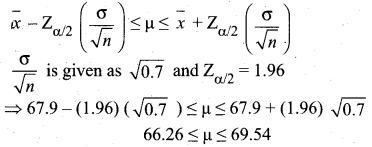
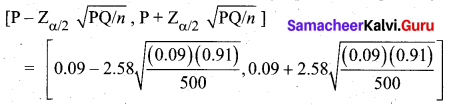
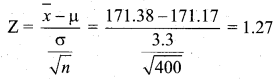
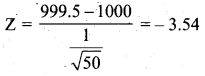
Samacheer Kalvi 12th Business Maths Solutions Chapter 5 Numerical Methods Ex 5.2

Students can download 12th Business Maths Chapter 5 Numerical Methods Ex 5.2 Questions and Answers, Samacheer Kalvi 12th Business Maths Book Solutions Guide Pdf helps you to revise the complete Tamilnadu State Board New Syllabus and score more marks in your examinations.
Tamilnadu Samacheer Kalvi 12th Business Maths Solutions Chapter 5 Numerical Methods Ex 5.2

Question 1.
Using graphic method, find the value of y when x = 48 from the following data:
Samacheer Kalvi 12th Business Maths Solutions Chapter 5 Numerical Methods Ex 5.2 Q1
Solution:
The given points are (40, 6.2), (50, 7.2) (60, 9.1) and (70, 12).
We plot the points on a graph with suitable scale
Samacheer Kalvi 12th Business Maths Solutions Chapter 5 Numerical Methods Ex 5.2 Q1.1
The value of y when x = 48 is 6.8

Question 2.
The following data relates to indirect labour expenses and the level of output
Samacheer Kalvi 12th Business Maths Solutions Chapter 5 Numerical Methods Ex 5.2 Q2
Estimate the expenses at a level of output of 350 units, by using the graphic method.
Solution:
Take the units of output along the x-axis, labour expenses along the y-axis.
The points to be plotted are (200, 2500), (300, 2800) (400, 3100), (640, 3820), (540, 3220), (580, 3640)
Samacheer Kalvi 12th Business Maths Solutions Chapter 5 Numerical Methods Ex 5.2 Q2.1
From the graph, the expenses at a level of output of 350 units are ₹ 2940.

Samacheer Kalvi 12th Business Maths Solutions Chapter 5 Numerical Methods Ex 5.2

Question 3.
Using Newton’s forward interpolation formula find the cubic polynomial.
Samacheer Kalvi 12th Business Maths Solutions Chapter 5 Numerical Methods Ex 5.2 Q3
Solution:
Newton’s forward interpolation formula is
Samacheer Kalvi 12th Business Maths Solutions Chapter 5 Numerical Methods Ex 5.2 Q3.1
y(x) = 1 + x – (x2 – x) + 2[x3 – 3x2 + 2x]
y(x) = 1 + x – x2 + x + 2x3 – 6x2 + 4x
f(x) = y = 2x3 – 7x2 + 6x + 1 is the required cubic polynomial

Question 4.
The population of a city in a census taken once in 10 years is given below.
Samacheer Kalvi 12th Business Maths Solutions Chapter 5 Numerical Methods Ex 5.2 Q4
Estimate the population in the year 1955.
Solution:
Samacheer Kalvi 12th Business Maths Solutions Chapter 5 Numerical Methods Ex 5.2 Q4.1
Let ‘x’ denote the year of the census. Let ‘y’ represent the population in lakhs. We have to find the population in the year 1955 (i.e) the value of y when x = 1955. Since the value of y is required near the beginning of the table, we use Newton’s forward interpolation formula.
Samacheer Kalvi 12th Business Maths Solutions Chapter 5 Numerical Methods Ex 5.2 Q4.2
Samacheer Kalvi 12th Business Maths Solutions Chapter 5 Numerical Methods Ex 5.2 Q4.3
Thus the estimated population in the year 1955 is 36.784 lakhs

Samacheer Kalvi 12th Business Maths Solutions Chapter 5 Numerical Methods Ex 5.2

Question 5.
In an examination the number of candidates who secured marks between certain intervals was as follows:
Samacheer Kalvi 12th Business Maths Solutions Chapter 5 Numerical Methods Ex 5.2 Q5
Estimate the number of candidates whose marks are less than 70.
Solution:
Let x be the marks and y be the number of candidates. The given class intervals are not continuous. So we make them continuous and find the cumulative frequency.
Samacheer Kalvi 12th Business Maths Solutions Chapter 5 Numerical Methods Ex 5.2 Q5.1
The difference table is as follows
Samacheer Kalvi 12th Business Maths Solutions Chapter 5 Numerical Methods Ex 5.2 Q5.2
Since the required value of y is near the end of the table, we use Newton’s backward interpolation formula
Samacheer Kalvi 12th Business Maths Solutions Chapter 5 Numerical Methods Ex 5.2 Q5.3
Hence the estimated value of the number of candidates whose marks are less than 70 is 197

Question 6.
Find the value of f(x) when x = 32 from the following table
Samacheer Kalvi 12th Business Maths Solutions Chapter 5 Numerical Methods Ex 5.2 Q6
Solution:
To find y = f(x) when x = 32 from the given table. Since the required value of y is near the beginning of the table, we use Newton’s forward interpolation formula.
Samacheer Kalvi 12th Business Maths Solutions Chapter 5 Numerical Methods Ex 5.2 Q6.1
The difference table is as follows
Samacheer Kalvi 12th Business Maths Solutions Chapter 5 Numerical Methods Ex 5.2 Q6.2
Samacheer Kalvi 12th Business Maths Solutions Chapter 5 Numerical Methods Ex 5.2 Q6.3
Hence the value of f(x) when x = 32 is 15.45

Samacheer Kalvi 12th Business Maths Solutions Chapter 5 Numerical Methods Ex 5.2

Question 7.
The following data gives the melting point of an alloy of lead and zinc where ‘t’ is the temperature in degree c and P is the percentage of lead in the alloy
Samacheer Kalvi 12th Business Maths Solutions Chapter 5 Numerical Methods Ex 5.2 Q7
Find the melting point of the alloy containing 84 per cent lead.
Solution:
To find T when P = 84. The required value of T is near the end of the table. So we use Newton’s backward interpolation formula.
Samacheer Kalvi 12th Business Maths Solutions Chapter 5 Numerical Methods Ex 5.2 Q7.1
⇒ 90 + n(10) = 84
⇒ n = \(\frac{84-90}{10}=\frac{-6}{10}=-0.6\)
The difference table is given below
Samacheer Kalvi 12th Business Maths Solutions Chapter 5 Numerical Methods Ex 5.2 Q7.2
Samacheer Kalvi 12th Business Maths Solutions Chapter 5 Numerical Methods Ex 5.2 Q7.3
Hence the melting point of the alloy containing 84 per cent lead is 286.9°C

Question 8.
Find f(2.8) from the following table.
Samacheer Kalvi 12th Business Maths Solutions Chapter 5 Numerical Methods Ex 5.2 Q8
Solution:
To find y = f(x) at x = 2.8 from the given table. We use Newton’s backward interpolation formula since the required value is near the end of the table.
Samacheer Kalvi 12th Business Maths Solutions Chapter 5 Numerical Methods Ex 5.2 Q8.1
2.8 = 3 + n(1)
n = 2.8 – 3 = -0.2
The difference table given below
Samacheer Kalvi 12th Business Maths Solutions Chapter 5 Numerical Methods Ex 5.2 Q8.2
y = 34 – 4.6 – 1.12 – 0.288
y = 27.992
Hence the value of f(x) at x = 2.8 is 27.992

Samacheer Kalvi 12th Business Maths Solutions Chapter 5 Numerical Methods Ex 5.2

Question 9.
Using interpolation estimate the output of a factory in 1986 from the following data
Samacheer Kalvi 12th Business Maths Solutions Chapter 5 Numerical Methods Ex 5.2 Q9
Solution:
Let x denote the year and y represent the output. The x values are not equidistant. So we use Lagrange’s formula
x0 = 1974, y0 = 25
x1 = 1978, y1 = 60
x2 = 1982, y2 = 80
x3 = 1990, y3 = 170
For x = 1986 we have to find y value
Samacheer Kalvi 12th Business Maths Solutions Chapter 5 Numerical Methods Ex 5.2 Q9.1
We find the different values separately and substitute in the formula.
Samacheer Kalvi 12th Business Maths Solutions Chapter 5 Numerical Methods Ex 5.2 Q9.2
y = 6.25 – 60 + 120 + 42.5
y = 108.75
The output of the factory in 1986 is 109 (thousand tonnes)

Question 10.
Use Lagrange’s formula and estimate from the following data the number of workers getting income not exceeding Rs. 26 per month.
Samacheer Kalvi 12th Business Maths Solutions Chapter 5 Numerical Methods Ex 5.2 Q10
Solution:
Let x represent the income per month and y denote the number of workers.
From the given data,
x0 = 15, y0 = 36
x1 = 25, y1 = 40
x2 = 30, y2 = 45
x3 = 35, y3 = 48
We have to find the value of y at x = 26
By Lagrange’s interpolation formula,
Samacheer Kalvi 12th Business Maths Solutions Chapter 5 Numerical Methods Ex 5.2 Q10.1
The different values are given in the table below
Samacheer Kalvi 12th Business Maths Solutions Chapter 5 Numerical Methods Ex 5.2 Q10.2
y = -0.432 + 31.68 + 11.88 – 2.112
y = 41.016
Thus the number of workers getting income not exceeding Rs.26 per month is 42

Samacheer Kalvi 12th Business Maths Solutions Chapter 5 Numerical Methods Ex 5.2

Question 11.
Using interpolation estimate the business done in 1985 from the following data.
Samacheer Kalvi 12th Business Maths Solutions Chapter 5 Numerical Methods Ex 5.2 Q11
Solution:
Let x denote the year of business and y (in lakhs) denote the amount of business.
From the given data,
x0 = 1982, y0 = 150
x1 = 1983, y1 = 235
x2 = 1984, y2 = 365
x3 = 1986, y3 = 525
We have to find the value of y when x = 1985.
By Lagrange’s interpolation formula,
Samacheer Kalvi 12th Business Maths Solutions Chapter 5 Numerical Methods Ex 5.2 Q11.1
We form a table for the different values
Samacheer Kalvi 12th Business Maths Solutions Chapter 5 Numerical Methods Ex 5.2 Q11.2
y = 481.25
Thus the business done in the year 1985 is estimated as 481.25 lakhs

Question 12.
Using interpolation, find the value of f(x) when x = 15
Samacheer Kalvi 12th Business Maths Solutions Chapter 5 Numerical Methods Ex 5.2 Q12
Solution:
We have to find the value of y when x = 15.
From the given data,
x0 = 3, y0 = 42
x1 = 7, y1 = 43
x2 = 11, y2 = 47
x3 = 19, y3 = 60
Since the intervals are unequal, we use the Lagrange’s interpolation formula,
Samacheer Kalvi 12th Business Maths Solutions Chapter 5 Numerical Methods Ex 5.2 Q12.1
The different values are given in the table below.
Samacheer Kalvi 12th Business Maths Solutions Chapter 5 Numerical Methods Ex 5.2 Q12.2
y = 10.5 – 43 + 70.5 + 15
y = 53
Hence the value of f(x) when x = 15 is 53

Samacheer Kalvi 12th Business Maths Solutions Chapter 6 Random Variable and Mathematical Expectation Ex 6.1

Students can download 12th Business Maths Chapter 6 Random Variable and Mathematical Expectation Ex 6.1 Questions and Answers, Samacheer Kalvi 12th Business Maths Book Solutions Guide Pdf helps you to revise the complete Tamilnadu State Board New Syllabus and score more marks in your examinations.

Tamilnadu Samacheer Kalvi 12th Business Maths Solutions Chapter 6 Random Variable and Mathematical Expectation Ex 6.1

Question 1.
Construct cumulative distribution function for the given probability distribution.
Samacheer Kalvi 12th Business Maths Solutions Chapter 6 Random Variable and Mathematical Expectation Ex 6.1 1
Solution:
Samacheer Kalvi 12th Business Maths Solutions Chapter 6 Random Variable and Mathematical Expectation Ex 6.1 2
Thus the cumulative distribution function is given by,
Samacheer Kalvi 12th Business Maths Solutions Chapter 6 Random Variable and Mathematical Expectation Ex 6.1 3

Question 2.
Let X be a discrete random variable with the following p.m.f.
Samacheer Kalvi 12th Business Maths Solutions Chapter 6 Random Variable and Mathematical Expectation Ex 6.1 4
Find and plot the c.d.f. of X.
Solution:
The probability distribution function can be written as follows:
Samacheer Kalvi 12th Business Maths Solutions Chapter 6 Random Variable and Mathematical Expectation Ex 6.1 5
We obtain
F(3) = P(x ≤ 3) = P(3) = 0.3
F(5) = P(x ≤ 5) = P(3) + P(5) = 0.3 + 0.2 = 0.5
F(8) = P(x ≤ 8) = P(3) + P(5) + P(8) = 0.5 + 0.3 = 0.8
F(10) = P(x ≤ 10) = P(3) + P(5) + P(8) + P(10) = 0.8 + 0.2 = 1
Samacheer Kalvi 12th Business Maths Solutions Chapter 6 Random Variable and Mathematical Expectation Ex 6.1 6
Samacheer Kalvi 12th Business Maths Solutions Chapter 6 Random Variable and Mathematical Expectation Ex 6.1 7

Samacheer Kalvi 12th Business Maths Solutions Chapter 6 Random Variable and Mathematical Expectation Ex 6.1

Question 3.
The discrete random variable X has the following probability function.
Samacheer Kalvi 12th Business Maths Solutions Chapter 6 Random Variable and Mathematical Expectation Ex 6.1 8
where k is a constant. Show that k = \(\frac{1}{18}\)
Solution:
The given probability function can be written as follows:
Samacheer Kalvi 12th Business Maths Solutions Chapter 6 Random Variable and Mathematical Expectation Ex 6.1 9
Since the condition of probability mass function is \(\sum_{i=1}^{\infty} p\left(x_{i}\right)=1\), we have
2k + 4k + 6k + 6k = 1
⇒ 18k = 1
⇒ k = \(\frac{1}{18}\)

Question 4.
The discrete random variable X has the probability function.
Samacheer Kalvi 12th Business Maths Solutions Chapter 6 Random Variable and Mathematical Expectation Ex 6.1 10
Show that k = 0.1
Solution:
\(\sum_{i=1}^{\infty} p\left(x_{i}\right)=1\)
gives k + 2k + 3k + 4k = 1
⇒ 10k = 1
⇒ k = \(\frac{1}{10}\) = 0.1

Samacheer Kalvi 12th Business Maths Solutions Chapter 6 Random Variable and Mathematical Expectation Ex 6.1

Question 5.
Two coins are tossed simultaneously. Getting a head is termed as a success. Find the probability distribution of the number of successes.
Solution:
Let X be the number of observed heads. The sample space S = {(H H), (H T), (T H), (T T)}
X takes the values 2, 1, 1, 0. Hence the probability distribution of the number of successes is given by
Samacheer Kalvi 12th Business Maths Solutions Chapter 6 Random Variable and Mathematical Expectation Ex 6.1 11

Question 6.
A random variable X has the following probability function.
Samacheer Kalvi 12th Business Maths Solutions Chapter 6 Random Variable and Mathematical Expectation Ex 6.1 12
(i) Find k
(ii) Evaluate P( X < 6), P(X ≥ 6) and P(0 < X < 5)
(iii) If P(X ≤ x) > \(\frac{1}{2}\), then find the minimum value of x.
Solution:
(i) Since the condition of probability mass function
\(\sum_{i=1}^{\infty} p\left(x_{i}\right)=1\)
\(\sum_{i=0}^{7} p\left(x_{i}\right)=1\)
0 + k + 2k + 2k + 3k + k2 + 2k2 + 7k2 + k = 1
⇒ 10k2 + 9k – 1 = 0
⇒ (10k – 1) (k + 1) = 0
⇒ k = \(\frac{1}{10}\) and k = -1
Since p(x) cannot be negative, k = -1 is not applicable. Hence k = \(\frac{1}{10}\)

Samacheer Kalvi 12th Business Maths Solutions Chapter 6 Random Variable and Mathematical Expectation Ex 6.1

(ii) P(X < 6) = P(X = 0) + P(X = 1) + P(X = 2) + P (X = 3) + P(X = 4) + P (X = 5)
= 0 + k + 2k + 2k + 3k + k2
= 8k + k2
= 8(\(\frac{1}{10}\)) + (\(\frac{1}{10}\))2 (∵ k = \(\frac{1}{10}\))
= \(\frac{8}{10}+\frac{1}{100}=\frac{81}{100}\)
Method 2:
P(X < 6) = 1 – P(X ≥ 6)
= 1 – [P(X = 6) + P (X = 7)]
= 1 – [2k2 + 7k2 + k]
= 1 – 9k2 – k
Samacheer Kalvi 12th Business Maths Solutions Chapter 6 Random Variable and Mathematical Expectation Ex 6.1 13
P(0 < X < 5) = P(X = 1) + P(X = 2) + P (X = 3) + P(X = 4)
= k + 2k + 2k + 3k = 8k
= \(\frac{8}{10}\)

(iii) P(X ≤ x) > \(\frac{1}{2}\)
To find the minimum value of x, let us construct the cumulative distribution function of X.
Samacheer Kalvi 12th Business Maths Solutions Chapter 6 Random Variable and Mathematical Expectation Ex 6.1 14
From the table we see that
P(X ≤ 0) = 0
P(X ≤ 1) = \(\frac{1}{10}\) = 0.1
P(X ≤ 2) = \(\frac{3}{10}\) = 0.3
P(X ≤ 3) = \(\frac{5}{10}\) = 0.5
P(X ≤ 4) = \(\frac{8}{10}\) = 0.8
So x = 4

Samacheer Kalvi 12th Business Maths Solutions Chapter 6 Random Variable and Mathematical Expectation Ex 6.1

Question 7.
The distribution of a continuous random variable X in range (-3, 3) is given by p.d.f.
Samacheer Kalvi 12th Business Maths Solutions Chapter 6 Random Variable and Mathematical Expectation Ex 6.1 15
Verify that the area under the curve is unity.
Solution:
We know that area under a curve f(x) between x = a and x = b is \(\int_{a}^{b} f(x) d x\)
Here the area is given by \(\int_{-3}^{3} f(x) d x\)
Samacheer Kalvi 12th Business Maths Solutions Chapter 6 Random Variable and Mathematical Expectation Ex 6.1 16
Thus the area under the curve is unity.

Question 8.
A continuous random variable X has the following distribution function:
Samacheer Kalvi 12th Business Maths Solutions Chapter 6 Random Variable and Mathematical Expectation Ex 6.1 17
Find (i) k and (ii) the probability density function.
Solution:
We have \(\frac{d}{d x}\)F(x) = f(x) ≥ 0, where F(x) is the distribution function and f(x) is the probability density function.
Here F(x) = 0 for x ≤ 1
f(x) = 0 for x ≤ 1
Again F(x) = 1 for x > 3
f(x) = \(\frac{d}{d x}\) (1) = 0 for x > 3
In 1 < x ≤ 3, F(x) = k(x – 1)4
f(x) = \(\frac{d}{d x}\) (k(x – 1)4) = 4k(x – 1)3
(i) We know that \(\int_{-\infty}^{\infty} f(x) d x\) = 1
This gives \(\int_{1}^{3} 4 k(x-1)^{3} d x=1\)
\(\left[k(x-1)^{4}\right]_{1}^{3}=1\)
k[16 – 0] = 1
k = \(\frac{1}{16}\)
(ii) The probability density function is
f(x) = \(\frac{1}{4}(x-1)^{3}\), 1 < x ≤ 3
= 0, otherwise

Samacheer Kalvi 12th Business Maths Solutions Chapter 6 Random Variable and Mathematical Expectation Ex 6.1

Question 9.
The length of time (in minutes) that a certain person speaks on the telephone is found to be a random phenomenon, with a probability function specified by the probability density function f(x) as
Samacheer Kalvi 12th Business Maths Solutions Chapter 6 Random Variable and Mathematical Expectation Ex 6.1 18
(a) Find the value of A that makes f(x) a p.d.f.
(b) What is the probability that the number of minutes that person will talk over the phone is (i) more than 10 minutes, (ii) less than 5 minutes and (iii) between 5 and 10 minutes.
Solution:
(a) For f(x) to be a p.d.f we must have \(\int_{-\infty}^{\infty} f(x) d x=1\)
According to the problem,
Samacheer Kalvi 12th Business Maths Solutions Chapter 6 Random Variable and Mathematical Expectation Ex 6.1 19
(b) (i) The probability that the number of minutes that person will talk is more than 10 minutes is given by
Samacheer Kalvi 12th Business Maths Solutions Chapter 6 Random Variable and Mathematical Expectation Ex 6.1 20
(b) (ii) The probability that the number of minutes is less than 5 is given by 5
Samacheer Kalvi 12th Business Maths Solutions Chapter 6 Random Variable and Mathematical Expectation Ex 6.1 21
(b) (iii) The probability that the number of minutes that person will talk is between 5 and 10 minutes is given by
Samacheer Kalvi 12th Business Maths Solutions Chapter 6 Random Variable and Mathematical Expectation Ex 6.1 22

Question 10.
Suppose that the time in minutes that a person has to wait at a certain station for a train is found to be a random phenomenon with a probability function specified by the distribution function.
Samacheer Kalvi 12th Business Maths Solutions Chapter 6 Random Variable and Mathematical Expectation Ex 6.1 23
(a) Is the distribution function continuous? If so, give its probability density function?
(b) What is the probability that a person will have to wait (i) more than 3 minutes, (ii) less than 3 minutes and (iii) between 1 and 3 minutes?
Solution:
(a) Yes. The distribution function is continuous. It is defined for all values of -∞ < x < ∞.
We know that \(\frac{d}{d x}\) F(x) = f(x). So we differentiate the given distribution function in the intervals where it is defined to find the density function.
Samacheer Kalvi 12th Business Maths Solutions Chapter 6 Random Variable and Mathematical Expectation Ex 6.1 24
Thus the probability density function is given by
Samacheer Kalvi 12th Business Maths Solutions Chapter 6 Random Variable and Mathematical Expectation Ex 6.1 25
(b) (i) The probability that a person will have to wait for more than 3 minutes is given by
Samacheer Kalvi 12th Business Maths Solutions Chapter 6 Random Variable and Mathematical Expectation Ex 6.1 26
Method 2:
P (X ≥ 3) = 1 – P(X ≤ 3) = 1 – F(3)
From the question F (3) = \(\frac{3}{4}\)
So P (X ≥ 3) = 1 – \(\frac{3}{4}\) = \(\frac{1}{4}\)
(b) (ii) The probability that a person will have to Wait for less than 3 minutes is
P(X ≤ 3) = F(3) = \(\frac{3}{4}\)
(b) (iii) Probability that the person will have to wait between 1 and 3 minutes is
Samacheer Kalvi 12th Business Maths Solutions Chapter 6 Random Variable and Mathematical Expectation Ex 6.1 27

Samacheer Kalvi 12th Business Maths Solutions Chapter 6 Random Variable and Mathematical Expectation Ex 6.1

Question 11.
Define the random variable.
Solution:
A Random variable is a set of possible values from a random experiment. The set of possible values is called the sample space. A random variable (r.v) is denoted by a capital letter such as X, Y and Z etc. If X and Y are r.v’s then X + Y is also an r.v.

Question 12.
Explain what are the types of a random variable?
Solution:
Random variables are classified into two types namely discrete and continuous random variables.
Discrete random variable: A discrete random variable has a finite number of possible values or an infinite sequence of countable real numbers.
Examples:

  1. X denotes the number of hits when trying 20 free throws.
  2. X denotes the number of customers who arrive at the bank from 8.30 – 9.30 AM Mon – Fri.
  3. X denotes the number of balls sold during a week in a particular shop.

Continuous random variable:
A continuous random variable takes all values in an interval of real numbers.
Examples:

  1. X denotes the time it takes for a bulb to bum out.
  2. X denotes the weight of a truck in a truck – weighing station.
  3. X denotes the amount of water in a bottle.

Samacheer Kalvi 12th Business Maths Solutions Chapter 6 Random Variable and Mathematical Expectation Ex 6.1

Question 13.
Define discrete random variable.
Solution:
A variable which can assume a finite number of possible values or an infinite sequence of countable real numbers is called a discrete random variable.
Examples:

  1. Marks obtained in an exam.
  2. Number of chocolates in a box.
  3. Number of phone calls during a day.
  4. Number of TV sets sold during a month by a dealer.

Question 14.
What do you understand by continuous random variable?
Solution:
A random variable which can take on any value (integral as well as fraction) in the interval is called a continuous random variable.
Examples:

  1. The speed of a train.
  2. Electricity consumption in kilowatt-hours.
  3. Height of people in a population
  4. Weight of students in a class.

Samacheer Kalvi 12th Business Maths Solutions Chapter 6 Random Variable and Mathematical Expectation Ex 6.1

Question 15.
Describe what is meant by a random variable.
Solution:
A Random variable is a set of possible values from a random experiment. The set of possible values is called the sample space. A random variable (r.v) is denoted by a capital letter such as X, Y and Z etc. If X and Y are r.v’s then X + Y is also an r.v.

Question 16.
Distinguish between discrete and continuous random variable.
Solution:

Discrete VariableContinuous Variable
1. A variable which can take only certain values.1. A variable which can take any value in a particular limit.
2. The value of the variables can increase incomplete numbers.2. Its value increases infractions but not in jumps.
3. Example: Number of students who opt for commerce in class 11, say 30, 35, 40, 45, and 50.3. Example: Height, Weight and age of family members: 50.5 kg, 30 kg, 42.8 kg and 18.6 kg.
4. Binomial, Poisson, Hypergeometric probability distributions come under this category.4. Normal, student’s t and chi-square distribution come under this category.

Question 17.
Explain the distribution function of a random variable.
Solution:
The discrete cumulative distribution function or distribution function of a real-valued discrete random variable X, which takes the countable number of points x1, x2,….. with corresponding probabilities p(x1), p(x2),…. is defined by
Samacheer Kalvi 12th Business Maths Solutions Chapter 6 Random Variable and Mathematical Expectation Ex 6.1 28
If X is a continuous random variable with probability density function fx(x), then the function FX(x) is defined by
Samacheer Kalvi 12th Business Maths Solutions Chapter 6 Random Variable and Mathematical Expectation Ex 6.1 29
is called the distribution function of the continuous random variable.

Samacheer Kalvi 12th Business Maths Solutions Chapter 6 Random Variable and Mathematical Expectation Ex 6.1

Question 18.
Explain the terms
(i) Probability mass function
(ii) Probability density function and
(iii) Probability distribution function.
Solution:
(i) Probability mass function: A probability mass function (p.m.f) is a function that gives the probability that a discrete random variable is exactly equal to some value. This is the means of defining a discrete probability distribution. Let X be a random variable with values x1, x2,…. xn….. Then the p.m.f is defined by
Samacheer Kalvi 12th Business Maths Solutions Chapter 6 Random Variable and Mathematical Expectation Ex 6.1 30
(ii) Probability density function: A probability density function (p.d.f) or density of a continuous random variable, is a function whose value at any given sample (or point) in the sample space gives the probability of the r.v. falling within the range of values. This probability is given by the area under the density function. The probability that an r.v. X takes a value in the interval [a, b] is given by
Samacheer Kalvi 12th Business Maths Solutions Chapter 6 Random Variable and Mathematical Expectation Ex 6.1 31
(iii) Probability distribution function: A probability distribution is a list of all of the possible outcomes of a random variable along with their corresponding probability values. When the r.v is discrete, the distribution function is called a probability mass function (p.m.f), and when the r.v is continuous, the distribution function is called a probability density function (p.d.f)
Examples:
Samacheer Kalvi 12th Business Maths Solutions Chapter 6 Random Variable and Mathematical Expectation Ex 6.1 32

Question 19.
What are the properties of
(i) discrete random variable and
(ii) continuous random variable?
Solution:
Discrete Random Variable:

  • A variable which can take only certain values.
  • The value of the variables can increase incomplete numbers
  • Binomial, Poisson, Hypergeometric probability distributions come under this category
  • Example: Number of students who opt for commerce in class 11, say 30, 35, 40, 45, and 50.

Continuous random variable:

  • A variable which can take any value in a particular limit.
  • Its value increases infractions but not in jumps.
  • Normal, student’s t and chi-square distribution come under this category.
  • Example: Height, Weight and age of family members: 50.5 kg, 30 kg, 42.8 kg and 18.6 kg.

Samacheer Kalvi 12th Business Maths Solutions Chapter 6 Random Variable and Mathematical Expectation Ex 6.1

Question 20.
State the properties of the distribution function.
Solution:

  • Property 1: The distribution function F is increasing, (i.e) if x ≤ y, then F(x) ≤ F(y)
  • Property 2: F(x) is continuous from right, (i.e) for each x ∈ R, F (x+) = F (x)
  • Property 3: F (∞) = 1
  • Property 4: F (-∞) = 0
  • Property 5: F'(x) = f(x)
  • Property 6: P(a ≤ X ≤ b) = F(b) – F(a)

Samacheer Kalvi 12th Business Maths Solutions Chapter 5 Numerical Methods Ex 5.1

Students can download 12th Business Maths Chapter 5 Numerical Methods Ex 5.1 Questions and Answers, Samacheer Kalvi 12th Business Maths Book Solutions Guide Pdf helps you to revise the complete Tamilnadu State Board New Syllabus and score more marks in your examinations.

Tamilnadu Samacheer Kalvi 12th Business Maths Solutions Chapter 5 Numerical Methods Ex 5.1

Question 1.
Evaluate (log ax)
Solution:
Samacheer Kalvi 12th Business Maths Solutions Chapter 5 Numerical Methods Ex 5.1 Q1

Question 2.
If y = x3 – x2 + x – 1 calculate the values of y for x = 0, 1, 2, 3, 4, 5 and form the forward differences table.
Solution:
Given y = x3 – x2 + x – 1
When
x = 0, y = 0 – 0 + 0 – 1 = -1
x = 1, y = 1 – 1 + 1 – 1 = 0
x = 2, y = 8 – 4 + 2 – 1 = 5
x = 3, y = 27 – 9 + 3 – 1 = 20
x = 4, y = 64 – 16 + 4 – 1 = 51
x = 5, y = 125 – 25 + 5 – 1 = 104
Samacheer Kalvi 12th Business Maths Solutions Chapter 5 Numerical Methods Ex 5.1 Q2

Question 3.
If h = 1 then prove that (E-1 ∆) x3 = 3x2 – 3x + 1.
Solution:
h = 1 To prove (E-1 ∆) x3 = 3×2 – 3x + 1
L.H.S = (E-1 ∆) x3 = E-1 (∆x3)
= E-1[(x + h)3 – x3]
= E-1( x + h)3 – E-1(x3)
= (x – h + h)3 – (x – h)3
= x3 – (x – h)3
But given h = 1
So(E-1 ∆) x3 = x3 – (x – 1)3
= x3 – [x3 – 3x2 + 3x – 1]
= 3x2 – 3x + 1
= RHS

Samacheer Kalvi 12th Business Maths Solutions Chapter 5 Numerical Methods Ex 5.1

Question 4.
If f(x) = x2 + 3x then show that ∆f(x) = 2x + 4
Solution:
f(x) = x2 + 3 x
∆f(x) = f(x + h) – f(x)
= (x + h)2 + 3(x + h) – x2 – 3x
= x2 + 2xh + h2 + 3x + 3h – x2 – 3x
= 2xh + 3h + h2
Put h = 1, ∆f(x) = 2x + 4

Question 5.
Evaluate \(\Delta\left[\frac{1}{(x+1)(x+2)}\right]\) by taking ‘1’ as the interval of differencing.
Solution:
Samacheer Kalvi 12th Business Maths Solutions Chapter 5 Numerical Methods Ex 5.1 Q5
Samacheer Kalvi 12th Business Maths Solutions Chapter 5 Numerical Methods Ex 5.1 Q5.1

Question 6.
Find the missing entry in the following table
Samacheer Kalvi 12th Business Maths Solutions Chapter 5 Numerical Methods Ex 5.1 Q6
Solution:
Since only four values of y are given, the polynomial which fits the data is of degree three. Hence fourth differences are zeros.
Samacheer Kalvi 12th Business Maths Solutions Chapter 5 Numerical Methods Ex 5.1 Q6.1

Samacheer Kalvi 12th Business Maths Solutions Chapter 5 Numerical Methods Ex 5.1

Question 7.
Following are the population of a district
Samacheer Kalvi 12th Business Maths Solutions Chapter 5 Numerical Methods Ex 5.1 Q7
Find the population of the year 1911?
Solution:
Since five values are given, the polynomial which fits the data is of degree four.
Samacheer Kalvi 12th Business Maths Solutions Chapter 5 Numerical Methods Ex 5.1 Q7.1
From the given table
y0 = 363, y1 = 391, y2 = 421, y4 = 467 and y5 = 501
501 – 5(467) + 10y3 – 10(421) + 5(391) – 363 = 0
501 – 2335 + 10y3 – 4210 + 1955 – 363 = 0
-501 + 2335 + 4210 – 1955 + 363 = 10y3
10y3 = 4452
y3 = 445.2
Hence the population of the year 1911 is 445 thousand

Samacheer Kalvi 12th Business Maths Solutions Chapter 5 Numerical Methods Ex 5.1

Question 8.
Find the missing entries from the following.
Samacheer Kalvi 12th Business Maths Solutions Chapter 5 Numerical Methods Ex 5.1 Q8
Solution:
Since only four values of f(x) are given, the polynomial which fits the data is of degree three. Hence fourth differences are zeros.
Solution:
Samacheer Kalvi 12th Business Maths Solutions Chapter 5 Numerical Methods Ex 5.1 Q8.1
Samacheer Kalvi 12th Business Maths Solutions Chapter 5 Numerical Methods Ex 5.1 Q8.2

Samacheer Kalvi 12th Business Maths Solutions Chapter 5 Numerical Methods Additional Problems

Students can download 12th Business Maths Chapter 5 Numerical Methods Additional Problems and Answers, Samacheer Kalvi 12th Business Maths Book Solutions Guide Pdf helps you to revise the complete Tamilnadu State Board New Syllabus and score more marks in your examinations.

Tamilnadu Samacheer Kalvi 12th Business Maths Solutions Chapter 5 Numerical Methods Additional Problems

One Mark Questions

Question 1.
Match the following.

(a) ∆f(x)(i) 2x + 1
(b) E2 f(x)(ii) 1 + ∆
(c) E(iii) f(x + h) – f(x)
(d) ∆x2, h = 1(iv) f(x + 2h)

Answer:
(a) – (iii), (b) – (iv), (c) – (ii), (d) – (i)

Question 2.
E-n f(x) is ______
(a) f(x + nh)
(b) f(x – nh)
(c) f(-nh)
(d) f(x – n)
Answer:
(b) f(x – nh)

Samacheer Kalvi 12th Business Maths Solutions Chapter 5 Numerical Methods Additional Problems

Question 3.
E is a _____
(a) shifting operator
(b) Displacement operator
(c) 1 + ∆
(d) all of these
(e) none of these
Answer:
(d) all of these

Question 4.
4 y3 = _______
(a) (E – 1)4 y3
(b) (E3 – 1) y3
(c) (E – 1)3 y0
(d) (E – 1)4 y0
Answer:
(a) (E – 1)4 y3

Samacheer Kalvi 12th Business Maths Solutions Chapter 5 Numerical Methods Additional Problems

Question 5.
Fill in the blanks.

  1. The two methods of interpolation are _______ and _______
  2. If values of x are not equidistant we use _______ method.
  3. ∆(f(x) + g(x)) = ______
  4. k yn = ______
  5. The first three terms in Newton’s method will give a ________ interpolation.

Answer:

  1. graphical method, algebraic method
  2. Lagrange’s method
  3. ∆f(x) + ∆g(x)
  4. k-1 yn+1 – ∆k-1 yn
  5. Parabolic

Question 6.
Say true or false

  1. ∇y2 = y1 – y0
  2. 2 yn = ∇yn – ∇yn+1
  3. When 5 values are given, the polynomial which fits the data is of degree 4
  4. E ∆ = ∆ E
  5. f(2) + ∆f(2) = f(3)

Answer:

  1. False
  2. True
  3. True
  4. True
  5. True

II. 2 Mark Questions

Question 1.
Find the missing term from the following data.
Samacheer Kalvi 12th Business Maths Solutions Chapter 5 Numerical Methods Additional Problems II Q1
Solution:
Since three values of y = f(x) are given, the polynomial which fits the data is of degree two.
Hence third differences are zero.
Samacheer Kalvi 12th Business Maths Solutions Chapter 5 Numerical Methods Additional Problems II Q1.1

Samacheer Kalvi 12th Business Maths Solutions Chapter 5 Numerical Methods Additional Problems

Question 2.
From the following data estimate the export for the year 2000
Samacheer Kalvi 12th Business Maths Solutions Chapter 5 Numerical Methods Additional Problems II Q2
Solution:
Consider a polynomial of degree two.
Hence third differences are zero.
Samacheer Kalvi 12th Business Maths Solutions Chapter 5 Numerical Methods Additional Problems II Q2.1

Question 3.
For the tabulated values of y = f(x), find ∆y3 and ∆3y2
Samacheer Kalvi 12th Business Maths Solutions Chapter 5 Numerical Methods Additional Problems II Q3
Solution:
Samacheer Kalvi 12th Business Maths Solutions Chapter 5 Numerical Methods Additional Problems II Q3.1

Question 4.
If f(x) = x2 + ax + b, find ∆r f(x)
Solution:
∆f(x) = f(x + h) – f(x)
= [(x + h )2 + a(x + h) + b] – [x2 + ax + b]
= 2xh + h2 + ah
2 f(x) = [2(x + h) h + h2 + ah] – [2xh + h2 + ah] = 2h2
3 f(x) = 0
Thus ∆r f(x) = 0 for all r ≥ 3

Samacheer Kalvi 12th Business Maths Solutions Chapter 5 Numerical Methods Additional Problems

Question 5.
Show that ∆3 y4 = ∇3 y7
Solution:
Samacheer Kalvi 12th Business Maths Solutions Chapter 5 Numerical Methods Additional Problems II Q5
Hence proved

III. 3 and 5 Marks Questions

Question 1.
If f(0) = 5, f(1) = 6, f(3) = 50, f(4) = 105, find f(2) by using Lagrange’s formula.
Solution:
Samacheer Kalvi 12th Business Maths Solutions Chapter 5 Numerical Methods Additional Problems III Q1
Samacheer Kalvi 12th Business Maths Solutions Chapter 5 Numerical Methods Additional Problems III Q1.1

Question 2.
Find y when x = 0.2 given that
Samacheer Kalvi 12th Business Maths Solutions Chapter 5 Numerical Methods Additional Problems III Q2
Solution:
Since the required value of y is near the beginning of the table, we use Newton’s forward difference formula
Samacheer Kalvi 12th Business Maths Solutions Chapter 5 Numerical Methods Additional Problems III Q2.1
Samacheer Kalvi 12th Business Maths Solutions Chapter 5 Numerical Methods Additional Problems III Q2.2

Samacheer Kalvi 12th Business Maths Solutions Chapter 5 Numerical Methods Additional Problems

Question 3.
Find the number of men getting wages between Rs.30 and Rs.35 from the following table:
Samacheer Kalvi 12th Business Maths Solutions Chapter 5 Numerical Methods Additional Problems III Q3
Solution:
The difference table
Samacheer Kalvi 12th Business Maths Solutions Chapter 5 Numerical Methods Additional Problems III Q3.1
Samacheer Kalvi 12th Business Maths Solutions Chapter 5 Numerical Methods Additional Problems III Q3.2
No. of men getting wages less than 35 is 24. Therefore the number of men getting wages between Rs.30 and Rs.35 is y (35) – y (30)
(i.e) 24 – 9 = 15

Question 4.
Using Newton’s formula estimate the population of town for the year 1995:
Samacheer Kalvi 12th Business Maths Solutions Chapter 5 Numerical Methods Additional Problems III Q4
Solution:
1995 lies in (1991, 2001). Hence we use Newton’s backward interpolation formula.
Here x = 1995, xn = 2001, h = 10
1995 = xn + nh
⇒ 1995 = 2001 + 10n
⇒ n = \(\frac{1995-2001}{10}\)
⇒ n = -0.6
The backward difference table is given below
Samacheer Kalvi 12th Business Maths Solutions Chapter 5 Numerical Methods Additional Problems III Q4.1
y = 101 – 4.8 + 0.48 + 0.056 + 0.1008
y = 96.8368
Hence the population for the year 1995 is 96.837 thousands.

Samacheer Kalvi 12th Business Maths Solutions Chapter 5 Numerical Methods Additional Problems

Question 5.
Using Lagrange’s formula find y(11) from the following table
Samacheer Kalvi 12th Business Maths Solutions Chapter 5 Numerical Methods Additional Problems III Q5
Solution:
Given
x0 = 6, y0 = 13
x1 = 7, y1 = 14
x2 = 10, y2 = 15
x3 = 12, y3 = 17
x = 11
Using Lagrange’s formula,
Samacheer Kalvi 12th Business Maths Solutions Chapter 5 Numerical Methods Additional Problems III Q5.1

Samacheer Kalvi 12th Business Maths Solutions Chapter 6 Random Variable and Mathematical Expectation Additional Problems

Students can download 12th Business Maths Chapter 6 Random Variable and Mathematical Expectation Additional Problems and Answers, Samacheer Kalvi 12th Business Maths Book Solutions Guide Pdf helps you to revise the complete Tamilnadu State Board New Syllabus and score more marks in your examinations.

Tamilnadu Samacheer Kalvi 12th Business Maths Solutions Chapter 6 Random Variable and Mathematical Expectation Additional Problems

One Mark Questions

Question 1.
If a fair coin is tossed three times the probability function p(x) of the number of heads x is _______
Samacheer Kalvi 12th Business Maths Solutions Chapter 6 Random Variable and Mathematical Expectation Additional Problems I Q1
Samacheer Kalvi 12th Business Maths Solutions Chapter 6 Random Variable and Mathematical Expectation Additional Problems I Q1.1
(d) None of these
Answer:
Samacheer Kalvi 12th Business Maths Solutions Chapter 6 Random Variable and Mathematical Expectation Additional Problems I Q1.2
Hint:
The sample space is HHH, HHT, HTH, HTT, THH, THT, TTH and TTT
Number of heads is 0, 1, 2, 3 with probability \(\frac{1}{8}, \frac{3}{8}, \frac{3}{8}\) and \(\frac{1}{8}\)

Question 2.
If a discrete random variable has the probability mass function as
Samacheer Kalvi 12th Business Maths Solutions Chapter 6 Random Variable and Mathematical Expectation Additional Problems I Q2
then the value of K is _______
(a) \(\frac{1}{11}\)
(b) \(\frac{1}{12}\)
(c) \(\frac{2}{13}\)
(d) \(\frac{4}{9}\)
Answer:
(b) \(\frac{1}{12}\)
Hint:
k + 3 k + 6k + 2k = 1
⇒ 12k = 1
⇒ k = \(\frac{1}{12}\)

Samacheer Kalvi 12th Business Maths Solutions Chapter 6 Random Variable and Mathematical Expectation Additional Problems

Question 3.
If the probability density function of X is f(x) = Cx (2 – x), and 0 < x < 2, then value of C is ______
(a) \(\frac{4}{3}\)
(b) \(\frac{6}{5}\)
(c) \(\frac{3}{4}\)
(d) \(\frac{3}{5}\)
Answer:
(c) \(\frac{3}{4}\)
Hint:
Samacheer Kalvi 12th Business Maths Solutions Chapter 6 Random Variable and Mathematical Expectation Additional Problems I Q3

Question 4.
The random variables X and Y are independent if ______
(a) E(XY) = 1
(b) E(XY) = 0
(c) E(XY) = E(X) E(Y)
(d) E(X + Y) = E(X) + E(Y)
Answer:
(c) E(XY) = E(X) E(Y)

Samacheer Kalvi 12th Business Maths Solutions Chapter 6 Random Variable and Mathematical Expectation Additional Problems

Question 5.
If a random variable X has the following distribution
Samacheer Kalvi 12th Business Maths Solutions Chapter 6 Random Variable and Mathematical Expectation Additional Problems I Q5
then the expected value of X is ______
(a) \(\frac{3}{2}\)
(b) \(\frac{1}{6}\)
(c) \(\frac{1}{2}\)
(d) \(\frac{1}{3}\)
Answer:
(b) \(\frac{1}{6}\)
Hint:
E(X) = \(\frac{-1}{3}-\frac{2}{6}+\frac{1}{6}+\frac{2}{3}=\frac{1}{3}-\frac{1}{6}=\frac{1}{6}\)

Question 6.
Var (4X + 7) = _____
(a) 7
(b) 16 Var (X)
(c) 11
(d) None of these
Answer:
(b) 16 Var (X)
Hint:
Var (4X + 7) = (42) Var (X)

Samacheer Kalvi 12th Business Maths Solutions Chapter 6 Random Variable and Mathematical Expectation Additional Problems

Question 7.
Match the following:

(a) Random variable(i) Arithmetic mean
(b) Speed of a car(ii) Discrete variable
(c) E(aX + b)(iii) Chance variable
(d) No. of students in a class(iv) Continuous variable
(e) E(X)(v) aE(X) + b

Answer:
(a) – (iii)
(b) – (iv)
(c) – (v)
(d) – (ii)
(e) – (i)

Question 8.
If E(X) = 2 and E(Z) = 4, then E (Z – X) is ______
(a) 2
(b) 6
(c) 0
(d) -2
Answer:
(a) 2
Hint:
E(Z – X) = E(Z) – E(X) = 4 – 2 = 2

Samacheer Kalvi 12th Business Maths Solutions Chapter 6 Random Variable and Mathematical Expectation Additional Problems

Question 9.
Fill in the blanks:

  1. The distribution function F (X) is equal to _______
  2. Two types of random variables are ______ and ______
  3. Probability mass function is also called ______
  4. Cumulative distribution function is also called ________
  5. Probability density function is also called ______ and _______
  6. d F(x) is known as ______ of X.
  7. E(X) is denoted by _______
  8. Variance is a measure of ______ or _______ of X.
  9. Standard deviation is defined as _______
  10. Mean is the _______ of a density. Variance is the ________ of a density.

Answers:

  1. P(X ≤ x)
  2. discrete and continuous
  3. discrete probability function
  4. distribution function
  5. continuous probability function, integrating the density function
  6. probability differential
  7. µx
  8. the spread, dispersion of the density
  9. √Var[X]
  10. center of gravity, the moment of inertia.

2 Mark Questions

Question 1.
Verify whether the following function is a probability mass function or not. Hence find c.d.f.
Samacheer Kalvi 12th Business Maths Solutions Chapter 6 Random Variable and Mathematical Expectation Additional Problems II Q1
Solution:
Σpi = \(\frac{1}{3}+\frac{2}{3}\) = 1 and pi > 0.
So the given function is a p.m.f. c.d.f is given by
F (x) = P (X ≤ x)
F(1) = P(X ≤ 1) = P(X = 1) = \(\frac{1}{3}\)
F(2) = P (X ≤ 2) = P(X = 1) + P (X = 2) = \(\frac{1}{3}+\frac{2}{3}\) = 1
Samacheer Kalvi 12th Business Maths Solutions Chapter 6 Random Variable and Mathematical Expectation Additional Problems II Q1.1

Question 2.
Consider the following probability distribution of X.
Samacheer Kalvi 12th Business Maths Solutions Chapter 6 Random Variable and Mathematical Expectation Additional Problems II Q2
Is p(xi) a p.m.f?
Solution:
p(xi) > 0 for all i
Samacheer Kalvi 12th Business Maths Solutions Chapter 6 Random Variable and Mathematical Expectation Additional Problems II Q2.1
Hence p(xi) is a p.m.f.

Samacheer Kalvi 12th Business Maths Solutions Chapter 6 Random Variable and Mathematical Expectation Additional Problems

Question 3.
The probability that a man fishing at a particular place will catch 1, 2, 3 and 4 fish are 0.4, 0.3, 0.2 and 0.1. What is the expected number of fish caught?
Solution:
Let X denote the no.of fish caught by the man.
Samacheer Kalvi 12th Business Maths Solutions Chapter 6 Random Variable and Mathematical Expectation Additional Problems II Q3
E(X) = 1(0.4) + 2 (0.3) + 3 (0.2) + 4 (0.1)
= 0.4 + 0.6 + 0.6 + 0.4
= 2

Question 4.
A random variable X has the following probability function.
Samacheer Kalvi 12th Business Maths Solutions Chapter 6 Random Variable and Mathematical Expectation Additional Problems II Q4
Find the value of K.
Solution:
We know that Σp(xi) = 1
⇒ 0.1 + K + 0.2 + 2K + 0.3 + K = 1
⇒ 4K + 0.6 = 1
⇒ 4K = 0.4
⇒ K = 0.1

Samacheer Kalvi 12th Business Maths Solutions Chapter 6 Random Variable and Mathematical Expectation Additional Problems

Question 5.
A person receives a sum of rupees equal to the square of the number that appears on the face when a die is tossed. How much money can he expect to receive?
Solution:
Let the random variable X denote the square of the number that can appear on the face of a die. Then the distribution is given by
Samacheer Kalvi 12th Business Maths Solutions Chapter 6 Random Variable and Mathematical Expectation Additional Problems II Q5

3 and 5 Marks Questions

Question 1.
For the following distribution of X.
Samacheer Kalvi 12th Business Maths Solutions Chapter 6 Random Variable and Mathematical Expectation Additional Problems III Q1
(i) P(X ≤ 1)
(ii) P(X ≤ 2 )
(iii) P(0 < X < 2)
Solution:
(i) P(X ≤ 1) = P (X = 1) + P (X = 0)
\(=\frac{1}{2}+\frac{1}{6}=\frac{4}{6}=\frac{2}{3}\)
(ii) P(X ≤ 2) = P(X = 2) + P(X = 1) + P(X = 0)
\(=\frac{3}{10}+\frac{1}{2}+\frac{1}{6}=\frac{29}{30}\)
(iii) P(0 < X < 2) = P(X = 1) = \(\frac{1}{2}\)

Question 2.
Given that p.d.f of a random variable X as follows
Samacheer Kalvi 12th Business Maths Solutions Chapter 6 Random Variable and Mathematical Expectation Additional Problems III Q2
Find K and c.d.f.
Solution:
Samacheer Kalvi 12th Business Maths Solutions Chapter 6 Random Variable and Mathematical Expectation Additional Problems III Q2.1
Samacheer Kalvi 12th Business Maths Solutions Chapter 6 Random Variable and Mathematical Expectation Additional Problems III Q2.2

Samacheer Kalvi 12th Business Maths Solutions Chapter 6 Random Variable and Mathematical Expectation Additional Problems

Question 3.
Suppose that the life in hours of a certain part of radio tube is an r.v X with p.d.f given by
Samacheer Kalvi 12th Business Maths Solutions Chapter 6 Random Variable and Mathematical Expectation Additional Problems III Q3
(i) What is the probability that all of three Such tubes in a given radio set will have to be replaced in the first 150 hours?
(ii) What is the probability that none of the three tubes will be replaced?
Solution:
(i) A tube in the radio set will have to be replaced during the first 150 hours if its life is less than 150 hours. Hence the required probability is
Samacheer Kalvi 12th Business Maths Solutions Chapter 6 Random Variable and Mathematical Expectation Additional Problems III Q3.1
The probability that all three of the original tubes will have to be replaced during the first 150 hours is \(\left(\frac{1}{3}\right)^{3}=\frac{1}{27}\)
(ii) The probability that a tube is not replaced is given by P(X > 150)
= 1 – P(X ≤ 150)
= 1 – \(\frac{1}{3}\)
= \(\frac{2}{3}\)
Hence the probability that none of the three tubes will be replaced during the 150 hours of operation is \(\left(\frac{2}{3}\right)^{3}=\frac{8}{27}\)

Question 4.
Let X be a continuous random variable with p.d.f:
Samacheer Kalvi 12th Business Maths Solutions Chapter 6 Random Variable and Mathematical Expectation Additional Problems III Q4
(i) Find ‘a’
(ii) compute P(X ≤ 1.5)
Solution:
Samacheer Kalvi 12th Business Maths Solutions Chapter 6 Random Variable and Mathematical Expectation Additional Problems III Q4.1
Samacheer Kalvi 12th Business Maths Solutions Chapter 6 Random Variable and Mathematical Expectation Additional Problems III Q4.2

Samacheer Kalvi 12th Business Maths Solutions Chapter 6 Random Variable and Mathematical Expectation Additional Problems

Question 5.
A random variable X has the probability function as follows:
Samacheer Kalvi 12th Business Maths Solutions Chapter 6 Random Variable and Mathematical Expectation Additional Problems III Q5
Find E(3X + 1), E(X2) and Var(X).
Solution:
E(X) = (-1) (0.2) + 0(0.3) + 1(0.5) = -0.2 + 0.5 = 0.3
So E(3X + 1) = 3 E(X) + 1 = 3(0.3) + 1 = 1.9
E(X2) = (-1)2 (0.2) + 02 (0.3) + 12 (0.5) = 0.2 + 0.5 = 0.7
Var(X) = E(X2) – [E(X)]2 = 0.7 – (0.3)2 = 0.61

Question 6.
A player tossed two coins. If two heads show he wins Rs.4. If one head shows he wins Rs.2, but if two tails show he must pay Rs.3 as a penalty. Calculate the expected value of ‘ the sum won by him.
Solution:
Let X be the discrete random variable denoting the sum won by the player. We know that,
Probability of getting 2 heads = \(\frac{1}{4}\)
Probability of getting 1 head is \(\frac{1}{2}\)
Probability of getting 2 tail is \(\frac{1}{4}\)
So the player wins Rs.4 with probability \(\frac{1}{4}\), he wins Rs. 2 with probability \(\frac{1}{2}\) and loses Rs.3 with probability \(\frac{1}{4}\)
Samacheer Kalvi 12th Business Maths Solutions Chapter 6 Random Variable and Mathematical Expectation Additional Problems III Q6
E(X) = 4(\(\frac{1}{4}\)) + 2(\(\frac{1}{2}\)) – 3(\(\frac{1}{4}\))
= 1 + 1 – \(\frac{3}{4}\)
= \(\frac{5}{4}\)
Thus the expected value of the sum won by him is Rs.1.25.

Samacheer Kalvi 12th Business Maths Solutions Chapter 2 Integral Calculus I Ex 2.9

Students can download 12th Business Maths Chapter 2 Integral Calculus I Ex 2.9 Questions and Answers, Samacheer Kalvi 12th Business Maths Book Solutions Guide Pdf helps you to revise the complete Tamilnadu State Board New Syllabus and score more marks in your examinations.

Tamilnadu Samacheer Kalvi 12th Business Maths Solutions Chapter 2 Integral Calculus I Ex 2.9

Evaluate the following using properties of definite integrals:

Question 1.
\(\int_{-\frac{\pi}{4}}^{\frac{\pi}{4}} x^{3} \cos ^{3} x d x\)
Solution:
Samacheer Kalvi 12th Business Maths Solutions Chapter 2 Integral Calculus I Ex 2.9 Q1

Question 2.
\(\int_{-\frac{\pi}{2}}^{\frac{\pi}{2}} \sin ^{2} \theta d \theta\)
Solution:
Samacheer Kalvi 12th Business Maths Solutions Chapter 2 Integral Calculus I Ex 2.9 Q2
Samacheer Kalvi 12th Business Maths Solutions Chapter 2 Integral Calculus I Ex 2.9 Q2.1

Question 3.
\(\int_{-1}^{1} \log \left(\frac{2-x}{2+x}\right) d x\)
Solution:
Samacheer Kalvi 12th Business Maths Solutions Chapter 2 Integral Calculus I Ex 2.9 Q3

Question 4.
\(\int_{0}^{\frac{\pi}{2}} \frac{\sin ^{7} x}{\sin ^{7} x+\cos ^{7} x} d x\)
Solution:
Samacheer Kalvi 12th Business Maths Solutions Chapter 2 Integral Calculus I Ex 2.9 Q4
Samacheer Kalvi 12th Business Maths Solutions Chapter 2 Integral Calculus I Ex 2.9 Q4.1

Question 5.
\(\int_{0}^{1} \log \left(\frac{1}{x}-1\right) d x\)
Solution:
Samacheer Kalvi 12th Business Maths Solutions Chapter 2 Integral Calculus I Ex 2.9 Q5

Question 6.
\(\int_{0}^{1} \frac{x}{(1-x)^{\frac{3}{4}}} d x\)
Solution:
Samacheer Kalvi 12th Business Maths Solutions Chapter 2 Integral Calculus I Ex 2.9 Q6
Samacheer Kalvi 12th Business Maths Solutions Chapter 2 Integral Calculus I Ex 2.9 Q6.1

Tamil Nadu 11th Physics Model Question Paper 5 English Medium

Students can Download Tamil Nadu 11th Physics Model Question Paper 5 English Medium Pdf, Tamil Nadu 11th Physics Model Question Papers helps you to revise the complete Tamilnadu State Board New Syllabus and score more marks in your examinations.

TN State Board 11th Physics Model Question Paper 5 English Medium

Tamil Nadu 11th Physics Model Question Paper 2 English Medium

Instructions:

  1. The question paper comprises of four parts
  2. You are to attempt all the parts. An internal choice of questions is provided wherever: applicable
  3. All questions of Part I, II, III, and IV are to be attempted separately
  4. Question numbers to 15 in Part I are Multiple choice Questions of one mark each. These are to be answered by choosing the most suitable answer from the given four alternatives and writing the option code and the corresponding answer
  5. Question numbers 16 to 24 in Part II are two-mark questions. These are lo be answered in about one or two sentences.
  6. Question numbers 25 to 33 in Part III are three-mark questions. These are lo be answered in about three to five short sentences.
  7. Question numbers 34 to 38 in Part IV are five-mark questions. These are lo be answered in detail. Draw diagrams wherever necessary.

Time: 3 Hours
Max Marks: 70

PART – I

Answer all the questions. [15 × 1 = 15]

Question 1.
The moment of inertia of a disc of mass M and radius R about an axis which is tangential to the circumference of the disc and parallel to the diameter is……….
(a) \(\frac{5}{4}\) MR²
(b) \(\frac{3}{2}\) MR²
(c) \(\frac{4}{5}\) MR²
(d) \(\frac{2}{3} \)MR²
Answer:
(a) \(\frac{5}{4}\) MR²

Question 2.
A swimmer’s speed in the direction of flow of river is 16 km h-1. Against the direction of flow of river, the swimmer’s speed is 8 km h-1. The swimmer’s speed in still water and the velocity of flow of the river respectively are……….
(a) 12 km h-1, 4 km h-1
(b) 4 km h-1, 12 km h-1
(c) 24 km h-1, 16 km h-1
(d) 16 km h-1, 24 km h-1
Answer:
(a) 12 km h-1, 4 km h-1
Hint:
According to the question u + v = 16 and u – v = 8
By solving, we get the speed of swimmer in still water, u = 12 km h-1
Speed of flow of river, v = 4 km h-1

Question 3.
Shear modulus is zero for………
(a) solids
(b) liquids
(c) gases
(d) liquids and gases
Answer:
(c) gases

Question 4.
If the length and time period of an oscillating pendulum have errors of 1% and 2% respectively. The error in the estimation of ‘g’ is ………
(a) 1%
(b) 2%
(c) 3%
(d) 5%
Answer:
(d) 5%
Hint:
\(\frac{ΔL}{L}\) = 1% and \(\frac{ΔT}{T}\) = 2%
Now we have, T = 2π\(\sqrt{\frac{T}{g}}\); g = 4π\(\frac{L}{T^2}\)
\(\frac{Δg}{g}\) × 100 = (\(\frac{ΔL}{L}\)×100) + 2(\(\frac{ΔL}{L}\) × 100) = 1% + 2(2%)

Question 5.
A system of binary stars of masses mA and mB are moving is a circular orbits of radius rA and rB respectively. If TA and TB are the time periods of masses mA and mB respectively then,………
(a) TA = TB
(b) If mA > mA than TA > TB
(c) If rB > rA than TB > TA
(d) \(\frac{T_A}{T_B}\) = (\(\frac{r_A}{r_B}\))3/2
Answer:
(a) TA = TB
Hint:
\(\frac{Gm_Am_B}{(r_A+r_B)^2}\) = \(\frac{m_Ar_A4π^2}{T_A^2}\) = \(\frac{m_Br_B4π^2}{T_A^2}\)
mA rA = mB rB ; TA = TB

Question 6.
The temperature of a wire is doubled. The Young’s modulus of elasticity………
(a) will also double
(b) will become four times
(c) will remain same
(d) will decrease
Answer:
(d) will decrease

Tamil Nadu 11th Physics Model Question Paper 2 English Medium

Question 7.
A small sphere of radius 2 cm falls from rest in a viscous liquid. Heat is produced due to viscous force. The rate of production of heat when the sphere attains its terminal velocity is proportional to
(a) 2²
(b) 2³
(c) 24
(d) 25
Answer:
(d) 25
Hint:
Rate of heat produced = F.V
(6πr|rv)v = bTtrirv2
(V α r²) Terminal velocity a r5 α 25
[Here r = 2 m]

Question 8.
The equations of two waves acting in perpendicular direction are given as x = a cos (ωt + δ) and y = a cos (ωt + α) where δ = α + π/2 the resultant wave represents……….
(a) a parabola
(b) a circle
(c) an ellipse
(d) a straight line
Answer:
(d) a straight line

Question 9.
Two vibrating tunning forks produces progressive waves given by y1 = 4 sin 500 πt and y2 = 2 sin 506 πt where t is in seconds, number of beats produced per minute is……….
(a) 60
(b) 3
(c) 369
(d) 180
Answer:
(d) 180
Hint:
ω1 = 2πf1 ω2 = 2πf2
500 π = 2πf1 506 π = 2πf2
f1 = 250 f2 = 253
f2 = f1 = 3 beats per sec and 3 × 60 = 180 beats per minute.

Question 10.
If the temperature of the wire is increased, then the young’s modulus will………
(a) remains the same
(b) decrease
(c) increase rapidly
(d) increase by very small amount
Answer:
(b) decrease

Question 11.
A light string passing over a smooth light pulley connects two blocks of masses m1 and m2 (vertically). If the acceleration of the system is g/8 then the ratio of the masses is
(a) 8 : 1
(b) 9 : 7
(c) 4 : 3
(d) 5 : 3
Answer:
(b) 9 : 7
Hint:
The FBD diagram, the force can be
m2a = T – m2g [a = \(\frac{g}{8}\)]
m1a = m1g – T
Adding we get, (m1 + m2) a = (m1 – m2)g
Putting the values, we get = \(\frac{m_1}{m_2}\) = \(\frac{9}{7}\)

Question 12.
A perfect gas is contained in a cylinder kept in vacuum. If the cylinder suddenly bursts, then the temperature of the gas……..
(a) is increased
(b) becomes OK
(c) remains unchanged
(d) is decreased
Answer:
(c) remains unchanged

Question 13.
The sample of gas expands from v1 to v2. The amount of work done by the gas is greatest, when the expansion is, ………..
(a) adiabatic
(b) isobaric
(c) isothermal
(d) equal in all cases
Answer:
(c) isothermal

Question 14.
The magnitude of a vector is given by……….
(a) |\(\vec{A}\)| = Ax² + Ay² + Az²
(b) |\(\vec{A}\)| = (Ax² + Ay² + Az²)1/2
(c) (A1 + A2 + A3
(d) A1 cos θ + A2 cos θ + A1 A2 cos θ
Answer:
(b) |\(\vec{A}\)| = (Ax² + Ay² + Az²)1/2

Tamil Nadu 11th Physics Model Question Paper 2 English Medium

Question 15.
Two soap bubbles of radii in the ratio of 2 : 1. What is the ratio of excess pressure inside them?
(a) 1 : 2
(b) 1 : 4
(c) 2 : 1
(d) 4 : 1
Answer:
(a) 1 : 2
Hint:
Tamil Nadu 11th Physics Model Question Paper 5 English Medium 1

PART – II

Answer any six questions in which Q. No 23 is compulsory.

Question 16.
The position of an object moving along x axis is given by x = a + b² here a = 8.5 m, b = 2.5 ms-2 and t is time in second. Calculate the velocity at t = 0 and t = 2 s and also calculate average velocity between t = 2 s and t = 4 s.
Answer:
v = \(\frac{dx}{dt}\) = \(\frac{d}{dt}\)(a + bt²) = 2bt = 5.0 t ms-1
At, t = 0, v = 0 ms-1 and at t = 2 s v = 10 ms-1
Average velocity = \(\frac{x(4)-x(2)}{4-2}\) = \(\frac{a+16b-a-4b}{2}\) = 6 b = 6 × 2.5 = 15.0 ms-1

Question 17.
Two vectors are given as \(\vec{b}\) = 2\(\hat{i}\) + 3\(\hat{j}\) + 5\(\hat{k}\) and F = 3\(\hat{i}\) – 2\(\hat{j}\) + 4\(\hat{k}\). Find the resultant vector.
Answer:
Tamil Nadu 11th Physics Model Question Paper 5 English Medium 2
\(\vec{τ}\) = (12 -(-10))\(\hat{i}\) + (15 – 8)\(\hat{j}\) + (-4 – 9)\(\hat{k}\)
\(\vec{τ}\) = 22\(\hat{i}\) + 7\(\hat{j}\) – 13\(\hat{k}\)

Question 18.
A ball is thrown downward from a height of 30 m with a velocity of 10 ms-1. Determine the velocity with which the ball strikes the ground by using law of conservation of energy.
Answer:
Given data:
Height from which the ball is dropped = 30 m
Velocity with which the ball is dropped = 10 ms-1
According to law of conservation of energy,
Gain in kinetic energy = Loss in potential energy
For bodies falling down, v² = u² + 2gh
v² = (10)² + 2 × 9.8 × 30 = 688
v = 26.23 ms-1

Question 19.
At what height, the value of g is same as at a depth of \(\frac{R}{2}\)?
Answer:
At depth = \(\frac{R}{2}\), value of acceleration due to gravity
Tamil Nadu 11th Physics Model Question Paper 5 English Medium 3

Question 20.
Give any two applications of viscosity.
Answer:

  1. The oil used as a lubricant for heavy machinery parts should have a high viscous coefficient. To select a suitable lubricant, we should know its viscosity and how it varies with temperature.
    [Note: As temperature increases, the viscosity of the liquid decreases]. Also, it helps to choose oils with low viscosity used in car engines (light machinery).
  2. The highly viscous liquid is used to damp the motion of some instruments and is used as brake oil in hydraulic brakes.
  3. Blood circulation through arteries and veins depends upon the viscosity of fluids.
  4. Millikan conducted the oil drop experiment to determine the charge of an electron. He used the knowledge of viscosity to determine the charge.

Question 21.
An object is in uniform motion along a straight line, what will be position time graph for the motion of object, if
(i) both x0 and v are positive |\(\vec{v}\)| is constant where x0 is position at t = 0.
(ii) x0 = positive, v = negative is |\(\vec{v}\)| constant.
(iii) x0 = negative, v = positive |\(\vec{v}\)| is constant.
(iv) both x0 and v are negative |\(\vec{v}\)| is constant.
Answer:
Tamil Nadu 11th Physics Model Question Paper 5 English Medium 4

Question 22.
A sphere contracts in volume by 0.01% when taken to the bottom of sea 1 km deep. Find the bulk modulus of the material of the sphere.
Answer:
Here
Tamil Nadu 11th Physics Model Question Paper 5 English Medium 5

Tamil Nadu 11th Physics Model Question Paper 2 English Medium

Question 23.
State the second law of thermodynamics in terms of entropy.
Answer:
“For all the processes that occur in nature (irreversible process), the entropy always increases. For reversible process entropy will not change”. Entropy determines the direction in which natural process should occur.

Question 24.
What is an epoch?
Answer:
The phase of a vibrating particle corresponding to time t = 0 is called initial phase or epoch. At, t = 0, Φ = Φ0
The constant Φ0 is called initial phase or epoch. It tells about the initial state of motion of the vibrating particle.

PART – III

Answer any six questions in which Q.No. 29 is compulsory. [6 × 3 = 18]

Question 25.
Derive the relation between torque and angular momentum.
Answer:
We have the expression for magnitude of angular momentum of a rigid body as, L = Iω. The expression for magnitude of torque on a rigid body is, τ = Ia.
We can further write the expression for torque as,
τ = I\(\frac{dω}{dt}\) (∵α = \(\frac{dω}{dt}\))
Where, ω is angular velocity and a is angular acceleration. We can also write equation,
Tamil Nadu 11th Physics Model Question Paper 5 English Medium 6

Question 26.
Discuss the properties of scalar and vector products.
Properties of vector (cross) product.
(i) The vector product of any two vectors is always another vector whose direction is perpendicular to the plane containing these two vectors, i.e., orthogonal to both the vectors \(\vec{A}\) and \(\vec{B}\) even though the vectors \(\vec{A}\) and \(\vec{B}\) may or may not be mutually orthogonal.

(ii) The vector product of two vectors is not commutative, i.e., \(\vec{A}\) × \(\vec{B}\) ≠ \(\vec{B}\) × \(\vec{A}\)
But., \(\vec{A}\) × \(\vec{B}\) = –[\(\vec{B}\) × \(\vec{A}\)]
Here it is worthwhile to note that |\(\vec{A}\) × \(\vec{B}\)| = |\(\vec{B}\) × \(\vec{A}\)| = AB sin θ i.e., in the case of the product vectors \(\vec{A}\) × \(\vec{B}\) and \(\vec{B}\) × \(\vec{A}\), the magnitudes are equal but directions are opposite to each other.

Properties of scalar product:

  1. The product quantity \(\vec{A}\).\(\vec{B}\) is always a scalar. It is positive if the angle between the vectors is acute (i.e., < 90°) and negative if the angle-between them is obtuse (i.e. 90°< θ < 180°).
  2. The scalar product is commutative, i.e. \(\vec{A}\).\(\vec{B}\) = \(\vec{B}\).\(\vec{A}\).
  3. The vectors obey distributive law i.e. \(\vec{A}\)(\(\vec{B}\) + \(\vec{C}\)) = \(\vec{A}\).\(\vec{B}\) + \(\vec{A}\).\(\vec{C}\).
  4. The angle between the vectors θ = cos-1 (\(\frac{\vec{A}.\vec{B}}{AB}\))

Question 27.
A block of mass m slides down the plane inclined at an angle 60° with an acceleration g/2. Find the co-efficient of kinetic friction.
Answer:
Kinetic friction comes to play as the block is moving on the surface.
The forces acting on the mass are the normal force perpendicular to surface, downward gravitational force and kinetic friction fk along the surface.
Along the x-direction.
Tamil Nadu 11th Physics Model Question Paper 5 English Medium 7
There is no motion along the y-direction as normal force is exactly balanced by the mg cos θ.
mg cos θ = N mg/2
Tamil Nadu 11th Physics Model Question Paper 5 English Medium 8

Tamil Nadu 11th Physics Model Question Paper 2 English Medium

Question 28.
Write a note on work done by a variable force?
Answer:
Tamil Nadu 11th Physics Model Question Paper 5 English Medium 9
When the component of a variable force F acts on a body, the small work done (dW) by the force in producing a small displacement dr is given by the relation
dW = F cos θ dr [F cos θ is the component of the variable force F] .
where, F and θ are variables. The total work done for a displacement from initial position ri. to final position rf is given by the relation,
\(\int_{\eta}^{r_{f}} d \mathrm{W}=\int_{r_{i}}^{r_{f}} \mathrm{F} \cos \theta dr\)
A graphical representation of the work done by a variable force is shown in figure given below. The area under the graph is the work done by the variable force.

Question 29.
Why do we have seasons on Earth?
Answer:
The common misconception is that ‘Earth revolves around the Sun, so when the Earth is very far away, it is winter and when the Earth is nearer, it is summer’. Actually, the seasons in the Earth arise due to the rotation of Earth around the Sun with 23.5° tilt. Due to this 23.5° tilt, when the northern part of Earth is farther to the Sun, the southern part is nearer to the Sun. So when it is summer in the northern hemisphere, the southern hemisphere experience winter.

Question 30.
Obtain an expression for the excess of pressure inside a liquid drop.
Answer:
Excess of pressure inside air bubble in a liquid: Consider an air bubble of radius R inside a liquid having surface tension T. Let P1 and P2 be the pressures outside and inside the air bubble, respectively. Now, the excess pressure inside the air bubble is AP = P1 – P2.
Tamil Nadu 11th Physics Model Question Paper 5 English Medium 10
In order to find the excess pressure inside the air bubble, let us consider the forces acting on the air bubble. For the hemispherical portion of the bubble, considering the forces acting on it, we get,

(i) The force due to surface tension acting towards right around the rim of length 2πR is FT = 2πRT
(ii) The force due to outside pressure P1 is to the right acting across a cross sectional area of πR² is Fp1 = P1πR²
(iii) The force due to pressure P2 inside the bubble, acting to the left is Fp2 = P2πR².
As the air bubble is in equilibrium under the action of these forces, Fp2 = FT + Fp1
P2πR² = 2πRT + P1πR² ⇒ (P1 – P2)πR² = 2πRT
Excess pressure is ΔP = P2 – P1 = \(\frac{2T}{R}\)

Tamil Nadu 11th Physics Model Question Paper 2 English Medium

Question 31.
Consider the Earth as a homogeneous sphere of radius R and a straight hole is bored in it through its centre. Show that a particle dropped into the hole will execute a simple harmonic motion such that its time period is
Answer:
T = 2π\(\sqrt{\frac{R}{g}}\)
Oscillations of a particle dropped in a tunnel along the diameter of the earth:
Consider earth to be a sphere of radius R and centre O. A straight tunnel is dug along the diameter of the earth. Let lg’ be the value of acceleration due to gravity at the surface of the Earth.

Suppose a body of mass ‘m’ is dropped into the tunnel and it is at point R i.e., at a depth d below the surface of the earth at any instant.
If g’ is acceleration due to gravity at P.
then g’ = g(1 – \(\frac{d}{R}\)) = g(\(\frac{R-d}{R}\))
If y is distence of the body from the centre of the earth then,
Tamil Nadu 11th Physics Model Question Paper 5 English Medium 11
R – d = y
∴ g’ = g(\(\frac{y}{R}\))
Force acting on the body a point p is
F= -mg’ = –\(\frac{mg}{R}\) y i.e.,F α y
Negative sign indicates that the force acts in the opposite direction of displacement.
Thus the body will execute SHM with force constant,
k = \(\frac{mg}{R}\)
The period of oscillation of the body will be
Tamil Nadu 11th Physics Model Question Paper 5 English Medium 12

Question 32.
Which of the following represents simple harmonic motion.,
(a) x = A sin ωt + B cos 2 ωt
(b) λ = Aelωt
(c) x = A ln ωt
Answer:
(a) x = A sin ωt + B cos 2 ωt
Tamil Nadu 11th Physics Model Question Paper 5 English Medium 13
This differential equation is not like the differential equation of a SHM. Therefore, x = A sin ωt + B cos 2ωt does not represent SHM.
Tamil Nadu 11th Physics Model Question Paper 5 English Medium 14
This differential equation is like the differential equation of SHM. Therefore, x = Aelωt represents SHM.

(c) x = A ln ωt
Tamil Nadu 11th Physics Model Question Paper 5 English Medium 15
This differential equation is not like the differential equation of a SHM. Therefore, x = A In ωt does not represent SHM.

Question 33.
Obtain an expression for the excess of pressure inside a liquid drop.
Answer:
Excess pressure inside the liquid drop: Consider a liquid drop of radius R and the surface tension of the liquid is T.
The various forces acting on the liquid drop are:
(i) Force due to surface tension FT = 2πRT towards right.
(ii) Force due to outside pressure Fp1 = P1πR² towards right.
(iii) Force due to inside pressure Fp2 = P2πR² towards left.
Tamil Nadu 11th Physics Model Question Paper 5 English Medium 16
As the drop is in equilibrium, Fp2 = FT = Fp1
P2πR² = 2πRT + P1πR² ⇒ (P2 – P1)πR² = 2πRT
Excess pressure is ΔP = P2 – P2 = \(\frac{2T}{R}\)

Tamil Nadu 11th Physics Model Question Paper 2 English Medium

PART – IV

Answer all the questions. [5 x 5 = 25]

Question 34 (a).
Explain in detail the idea of weightlessness using lift as an example.
Answer:
When a man is standing in the elevator, there are two forces acting on him.
1. Gravitational force which acts downward. If we take the vertical direction as positive y direction, the gravitational force acting on the man is \(\vec{F}_G\)G = – mg\(\hat{j}\)
2. The normal force exerted by floor on the man which acts vertically upward, \(\vec{N}\) = N\(\hat{j}\)

Weightlessness of freely falling bodies: Freely falling objects experience only gravitational force. As they fall freely, they are not in contact with any surface (by neglecting air friction). The normal force acting on the object is zero. The downward acceleration is equal to the acceleration due to the gravity of the Earth, i.e., (a = g)

Newton’s 2nd law acting on the man N = m(g – a) [∵a = g] N = 0.

[OR]

(b) How will you determine the velocity of sound using resonance air column apparatus?
Answer:
The resonance air column apparatus is one of the simplest techniques to measure the speed of sound in air at room temperature. It consists of a cylindrical glass tube of one meter length whose one end A is open and another end B is connected to the water reservoir R through a rubber tube as shown in figure. This cylindrical glass tube is mounted on a vertical stand with a scale attached to it. The tube is partially filled with water and the water level can be adjusted by raising or lowering the water in the reservoir R. The surface of the water will act as a closed end and other as the open end.

Therefore, it behaves like a closed organ pipe, forming nodes at the surface of water and antinodes at the closed end. When a vibrating tuning fork is brought near the open end of the tube, longitudinal waves are formed inside the air column. These waves move downward as shown in Figure, and reach the surfaces of water and get reflected and produce standing waves. The length of the air column is varied by changing the water level until a loud sound is produced in the air column. At this particular length the frequency of waves in the air column resonates with the frequency of the tuning fork (natural frequency of the tuning fork). At resonance, the frequency of sound waves produced is equal to the frequency of the tuning fork. This will occur only when the length of air column is proportional to (\(\frac{1}{4}\))th of the wavelength of the sound waves produced. Let the first resonance occur at length L1 then
Tamil Nadu 11th Physics Model Question Paper 5 English Medium 17
\(\frac{1}{4}\)λ = L1 ……..(1)
But since the antinodes are not exactly formed at the open end, we have to include a correction, called end correction e, by assuming that the antinode is formed at some small distance above the open end. Including this end correction, the first resonance is
\(\frac{1}{4}\)λ = L1 + e …….(2)
Now the length of the air column is increased to get the second resonance. Let L2 be the length at which the second resonance occurs. Again taking end correction into account, we have
\(\frac{3}{4}\)λ = L2 + e ……..(3)
In order to avoid end correction, let us take the difference of equation (2) and equation (1), we get \(\frac{3}{4}\)λ – \(\frac{1}{4}\)λ = (L2 + e) – (L1 + e) ⇒ \(\frac{1}{2}\)λ, = L2 – L1 = ΔL ⇒ λ = 2ΔL
The speed of the sound in air at room temperature can be computed by using the formula
v = fλ = 2fΔL
Further, to compute the end correction, we use equation (2) and equation (3), we get
e = \(\frac{L_2-3L_1}{2}\)

Tamil Nadu 11th Physics Model Question Paper 2 English Medium

Question 35 (a).
Briefly explain the origin of friction. Show that in an inclined plane, angle of friction is equal to angle of repose.
Answer:
If a very gentle force in the horizontal direction is given to an object at rest on the table it does not move. It is because of the opposing force exerted by the surface on the object which resists its motion. This force is called the frictional force.

During the time of Newton and Galileo, frictional force was considered as one of the natural forces like gravitational force. But in the twentieth century, the understanding on atoms, electron and protons has changed the perspective. The frictional force is actually the electromagnetic force between the atoms on the two surfaces. Even well polished surfaces have irregularities on the surface at the microscopic level.

The component of force parallel to the inclined plane (mg sin θ) tries to move the object down. The component of force perpendicular to the inclined plane (mg cos θ) is balanced by the Normal force (N).
N = mg cos θ ……(1)
When the object just begins to move, the static friction attains its maximum value
fs = \(f_{s}^{\max }\)
This friction also satisfies the relation
\(f_{s}^{\max }\) = µs sin θ ……(2)
Equating the right hand side of equations (1) and (2),
\(f_{s}^{\max }\)/N = sin θ / cos θ
From the definition of angle of friction, we also know that
tan θ = µs …….(3)
in which θ is the angle of friction.
Thus the angle of repose is the same as angle of friction. But the difference is that the angle of repose refers to inclined surfaces and the angle of friction is applicable to any type of surface.

[OR]

(b) Show that the minimum speed at the lowest point as \(\sqrt{5gr}\) in a vertical circle executed by the object.
Answer:
Minimum speed at the lowest point 1
To have this minimum speed (v2 = \(\sqrt{gr}\) at point 2, the body must have minimum speed
also at point 1. By making use of equation we can find the minimum speed at point 1.
\(v_{1}^{2}-v_{2}^{2}\) = 4gr ……..(1)
Substituting equation v2 = \(\sqrt{gr}\) in \(v_{1}^{2}-v_{2}^{2}\) = 4gr
\(v_{1}^{2}\) = 5gr
v1 = \(\sqrt{5gr}\) …..(2)
Tamil Nadu 11th Physics Model Question Paper 5 English Medium 18
The body must have a speed at point 1, v1 ≥ \(\sqrt{5gr}\) to stay in the circular path. From equations v2 = \(\sqrt{gr}\) and v1 = \(\sqrt{5gr}\), it is clear that the minimum speed at the lowest point 1 should be 5 times more than the minimum speed at the highest point 2, so that the body loops without leaving the circle.

Tamil Nadu 11th Physics Model Question Paper 2 English Medium

Question 36 (a).
What are the characteristics of stationery waves? Give the laws of transverse vibrations in a stretched string.
Characteristics of stationary waves:
1. Stationary waves are characterised by the confinement of a wave disturbance between two rigid boundaries. This means, the wave does not move forward or backward in a medium (does not advance), it remains steady at its place. Therefore, they are called “stationary waves or standing waves”.
2. Certain points in the region in which the wave exists have maximum amplitude, called as anti-nodes and at certain points the amplitude is minimum or zero, called as nodes.
3. The distance between two consecutive nodes (or) anti-nodes is \(\frac{λ}{2}\).
4. The distance between a node and its neighbouring anti-node is \(\frac{λ}{4}\).
5. The transfer of energy along the standing wave is zero.

Laws of transverse vibrations in stretched strings: There are three laws of transverse vibrations of stretched strings which are given as follows:
(i) The law of length: For a given wire with tension T (which is fixed) and mass per unit length µ (fixed) the frequency varies inversely with the vibrating length. Therefore,
f ∝ \(\frac{1}{l}\) ⇒ f = \(\frac{c}{l}\)
⇒ l × f = C, where C is a constant

(ii) The law of tension: For a given vibrating length l (fixed) and mass per unit length µ (fixed) the frequency varies directly with the square root of the tension T.
f ∝ √T
⇒ A√T, where A is constant

(iii) The law of mass: For a given vibrating length l (fixed) and tension T (fixed) the frequency varies inversely with the square root of the mass per unit length µ.
f ∝ \(\frac{1}{√µ}\)
⇒ f = \(\frac{B}{√µ}\) where B is constant

[OR]

(b) Define isothermal process. Derive an expression for work done in isothermal process.
Answer:
Isothermal process:
It is a process in which the temperature remains constant but the pressure and volume of a thermodynamic system will change. The ideal gas equation is PV = µRT

Work done in an isothermal process: Consider an ideal gas which is allowed to expand quasi-statically at constant temperature from initial state (Pii) to the final state (Pf, Vf). We can calculate the work done by the gas during this process. The work done by the gas,
W = \(\int_{v_{i}}^{v_{f}} \mathrm{p} d \mathrm{v}\) ……(1)
As the process occurs quasi-statically, at every stage the gas is at equilibrium with the surroundings. Since it is in equilibrium at every stage the ideal gas law is valid. Writing pressure in terms of volume and temperature,
P = \(\frac{µRT}{V}\) …….(2)
Substituting equation (2) in (1) we get
Tamil Nadu 11th Physics Model Question Paper 5 English Medium 19
In equation (3), we take µRT out of the integral, since it is constant throughout the isothermal process.
By performing the integration in equation (3), we get
W = µRT ln (\(\frac{V_f}{V_i}\)) …….(4)
Since we have an isothermal expansion, \(\frac{V_f}{V_i}\) < 1, so ln (\(\frac{V_f}{V_i}\)) < 0 As a result the work done by the gas during an isothermal expansion is positive.
The above result in equation (4) is true for isothermal compression also. But in an isothermal compression \(\frac{V_f}{V_i}\) < 1, so ln (\(\frac{V_f}{V_i}\)) < 0
As a result the work done on the gas in an isothermal compression is negative.
In the PV diagram the work done during the isothermal expansion is equal to the area under the graph.
Tamil Nadu 11th Physics Model Question Paper 5 English Medium 20
Similarly for an isothermal compression, the area under the PV graph is equal to the work done on the gas which turns out to be the area with a negative sign.

Tamil Nadu 11th Physics Model Question Paper 2 English Medium

Question 37 (a).
Convert a velocity of 72 km h-1 into ms-1 with the help of dimensional analysis.
Answer:
n1 = 72 km h-1 n2 = ? ms-1
L1 = 1 km L2 = 1 m
T1 = lh T2 = 1S
Tamil Nadu 11th Physics Model Question Paper 5 English Medium 21

[OR]

(b) convert
(i) 3 m.s-2 to km h-2
(ii) G = 6.67 × 10⁻¹¹ N m² kg-2 to cm³ g-1 s-2
Answer:
Tamil Nadu 11th Physics Model Question Paper 5 English Medium 22
= 3.8880 × 10⁴ km h-2 = 3.9 ×. 104 km h-2

(ii) G = 6.67 × 10⁻¹¹ Nm² kg-2
= 6.67 × 10⁻¹¹ (kg m s-2) (m² kg-2)
= 6.67 × 10⁻¹¹ kg-1 m³ s-2
= 6.67 × 10⁻¹¹ (1000 g)-1 (100 cm)³ (s-2)
= 6.67 × 10⁻¹¹ × \(\frac{1}{1000}\) × 100 × 100 × 100 g-1 cm³ s-2
= 6.67 × 10⁻⁸ g-1 cm³ s-2

Question 38 (a)
(i) A uniform sphere of mass 200 g rotates on a horizontal surface without shipping. If centre of the sphere moves with a velocity 2.00 cm/s then its kinetic energy is?
As the sphere rolls without slipping on the plane surface, it’s angular speed about the center is w = \(\frac{v_{\mathrm{CM}}}{r}\)
kinetic energy,
Tamil Nadu 11th Physics Model Question Paper 5 English Medium 23

(ii) Derive the expression for kinetic energy in rotating object and also derive the relation between rotational kinetic energy and angular momentum.
Let us consider a rigid body rotating with angular velocity co about an axis as shown in figure. Every particle of the body will have the same angular velocity co and different tangential velocities v based on its positions from the axis of rotation.
Tamil Nadu 11th Physics Model Question Paper 5 English Medium 24
Let us choose a particle of mass mi situated at distance ri. from the axis of rotation. It has a tangential velocity vi given by the relation, vi = ri ω. The kinetic energy KEi of the particle is,
KEi = \(\frac { 1 }{ 2 }\) mivi2
writing the expression with the angular velocity,
KE = \(\frac { 1 }{ 2 }\) mi(riω)2 = \(\frac { 1 }{ 2 }\) (miri22
For the kinetic energy of the whole body, which is made up of large number of such particles, the equation is written with summation as,
KE = \(\frac { 1 }{ 2 }\)(∑ miri2)w2
where, the term ∑ miri2) is the moment of inertia I of the whole body. ∑ miri2)
Hence, the expression for KE of the rigid body in rotational motion is,
KE = \(\frac { 1 }{ 2 }\)Iω2
This is analogous to the expression for kinetic energy in translational motion.
KE = \(\frac { 1 }{ 2 }\)Mv2

Relation between rotational kinetic energy and angular momentum:
Let a rigid body of moment of inertia I rotate with angular velocity w.
The angular momentum of a rigid body is, L = I ω
The rotational kinetic energy of the rigid body is, KE = \(\frac { 1 }{ 2 }\)I w2
By multiplying the numerator and denominator of the above equation with I, we get a relation between L and KE as,
KE =\(\frac { 1 }{ 2 }\) \(\frac{I^{2} \omega^{2}}{I}\) = \(\frac { 1 }{ 2 }\)\(\frac{(\mathrm{I} \omega)^{2}}{\mathrm{I}}\)

Tamil Nadu 11th Physics Model Question Paper 2 English Medium

[OR]

(b) what is a sonometer? Give its construction and working. Explain how to determine the frequency of tuning fork using sonometer.
Answer:
Stationary waves in sonometer:
Sono means sound related, and sonometer implies sound – related measurements. It is a device for demonstrating the relationship between the frequency of the sound produced in the transverse standing wave in a string, and the tension, length and mass per unit length of the string. Therefore, using this device, we can determine the following quantities:
Tamil Nadu 11th Physics Model Question Paper 5 English Medium 25

the frequency of the tuning fork or frequency of alternating current the tension in the string the unknown hanging mass.

Construction:
The sonometer is made up of a hollow box which is one meter long with a uniform metallic thin string attached to it. One end of the string is connected to a hook and the other end is connected to a weight hanger through a pulley as shown in figure. Since only one string is used, it is also known as monochord. The weights are added to the free end of the wrire to increase the tension of the wfire. Two adjustable wooden knives are put over the board, and their positions are adjusted to change the vibrating length of the stretched wire.

working:
A transverse stationary or standing wave is produced and hence, at the knife edges P and Q, nodes are formed. In between the knife edges, anti-nodes are formed. If the length of the vibrating element is l then
l = \(\frac { λ }{ 2 }\) ⇒ λ = 2l
Let f be the frequency of the vibrating element, T the tension of in the string and µ the mass per unit length of the string. Then using equation ,we get
ƒ = \(\frac { v }{ λ}\) = \(\frac { 1 }{ 2l }\)\(\sqrt{\frac{T}{\mu}}\)
Let p be the density of the material of the string and d be the diameter of the string. Then the mass per unit length µ,
µ = Area x density = πr2p = \(\frac{\pi \rho d^{2}}{4}\)
Tamil Nadu 11th Physics Model Question Paper 5 English Medium 26

Tamil Nadu 11th Physics Model Question Paper 2 English Medium

Tamil Nadu 11th Commerce Model Question Paper 3 English Medium

Students can Download Tamil Nadu 11th Commerce Model Question Paper 3 English Medium Pdf, Tamil Nadu 11th commerce Model Question Papers helps you to revise the complete Tamilnadu State Board New Syllabus and score more marks in your examinations.

TN State Board 11th Commerce Model Question Paper 3 English Medium

Instructions:

  1.  The question paper comprises of four parts.
  2.  You are to attempt all the parts. An internal choice of questions is provided wherever applicable.
  3. questions of Part I, II. III and IV are to be attempted separately
  4. Question numbers 1 to 20 in Part I are objective type questions of one -mark each. These are to be answered by choosing the most suitable answer from the given four alternatives and writing the option code and the corresponding answer
  5. Question numbers 21 to 30 in Part II are two-marks questions. These are to be answered in about one or two sentences.
  6. Question numbers 31 to 40 in Parr III are three-marks questions, These are to be answered in about three to five short sentences.
  7. Question numbers 41 to 47 in Part IV are five-marks questions. These are to be answered) in detail. Draw diagrams wherever necessary.

Time: 2\(\frac{1}{2}\) Hours
Maximum Marks: 90

Part – I

Choose the correct answer. Answer all the questions: [20 × 1 = 20]

Question 1.
Coca-cola company is an example of ………….
(a) MNC
(b) Govt Company
(c) Joint Venture
(d) Public company
Answer:
(a) MNC

Question 2.
A Government company purchases shares in the name of ………….
(a) Prime minister
(b) President
(c) Chief Justice of India
(d) State Chief Minister
Answer:
(b) President

Question 3.
The terms used in insurance are ………….
(i)) Nomination
(ii) Fixed Deposit
(iii) Indent
(iv) Surrender value
(a) (i) and (ii)
(b) (i) and (iv)
(c) (iii) and (iv)
(d) (ii) and (iii)
Answer:
(b) (i) and (iv)

Tamil Nadu 11th Commerce Model Question Paper 3 English Medium

Question 4.
The partnership deed is also called ………….
(a) Articles of Association
(b) Articles of partnership
(c) Partnership Act
(d) Partnership
Answer:
(b) Articles of partnership

Question 5.
A warehouse holds goods as a center ………….
(a) marketing
(b) storing
(c) distribution
(d) selling
Answer:
(c) distribution

Question 6.
Match List – I with List – II and select the correct answer using the codes given below:
List – I
(i) Chain stores
(ii) Market traders
(iii) Speciality stores
(iv) Auctioneers

List – II
1. Internal trader
2. Mercantile agent
3. Fixed shop large retailers
4. ixed shop small retailers

Codes:
(a) (i) 1, (ii) 2, (iii) 3, (iv) 4
(b) (i) 4, (ii) 3, (iii) 2, (iv) 1
(c) (i) 3, (ii) 1, (iii) 4, (iv) 2
(d) (i) 4, (ii) 2, (iii) 3, (iv) 1
Answer:
(c) (i) 3, (ii) 1, (iii) 4, (iv) 2

Tamil Nadu 11th Commerce Model Question Paper 3 English Medium

Question 7.
Which of the following is not a land transport?
(a) Bullock cart
(b) Tramways
(c) Air transport
(d) Railway transport
Answer:
(c) Air transport

Question 8.
The main benefits of logistics is ………….
(a) productivity
(b) cost minimisation
(c) profitability
(d) storage
Answer:
(b) cost minimisation

Question 9.
…………. In Joint Hindu family business, how one gets the membership?
(a) By agreement
(b) By birth
(c) By investing capital
(d) By Managing
Answer:
(c) By investing capital

Question 10.
Co-operative fails because of ………….
(a) Unlimited Membership
(b) Cash trading
(c) Mismanagement
(d) Loss-making
Answer:
(c) Mismanagement

Tamil Nadu 11th Commerce Model Question Paper 3 English Medium

Question 11.
Occupation of an engineer is ………….
(a) Employment
(b) Business
(c) Profession
(d) Sole proprietor
Answer:
(b) Business

Question 12.
Hindrance of risk is removed by ………….
(a) Transport
(b) Insurance
(c) Warehouse
(d) Advertisement
Answer:
(b) Insurance

Question 13.
Which of the following is not an electronic banking function?
(a) NEFT
(b) RTGS
(c) ECS
(d) Safety lockers
Answer:
(d) Safety lockers

Question 14.
…………. is an acknowledgement of receipt of goods issued by dock authorities to the owner of the goods.
(a) Dock receipt
(b) Dock warrant
(c) Warehouse warrant
(d) Delivery order
Answer:
(a) Dock receipt

Tamil Nadu 11th Commerce Model Question Paper 3 English Medium

Question 15.
Investment limit of micro enterprise under manufacturing sector does not exceed lakhs.
(a) 10
(b) 20
(c) 25
(d) 50
Answer:
(c) 25

Question 16.
The main aim of home trade is ………….
(a) To raise the standard of living
(b) To provide the essential goods and services economically
(c) To raise the national income
(d) To obtains all type of goods
Answer:
(b) To provide the essential goods and services economically

Question 17.
Day market is called as ………….
(a) Angadi
(b) Market
(c) Nalangadi
(d) Allangadi
Answer:
(c) Nalangadi

Tamil Nadu 11th Commerce Model Question Paper 3 English Medium

Question 18.
In which form, the owner, establisher and manager is only one?
(a) Joint enterprise
(b) Govt company
(c) Co-operative society
(d) Sole proprietor
Answer:
(d) Sole proprietor

Question 19.
Re-export trade is otherwise called as trade.
(a) Entrepot
(b) Export
(c) Import
(d) Foreign
Answer:
(a) Entrepot

Question 20.
The Head quarters of WTO is located at ………….
(a) New york
(b) London
(c) Geneva
(d) Brazil
Answer:
(c) Geneva

Part-II

Answer any seven questions in which Question No. 30 is compulsory. [7 x 2 = 14]

Question 21.
What is meant by Allangadi?
Answer:
The night market was called as Allangadi according to Saint Poet Ilango in Silapathigaram, Madurai-Kanchi.

Question 22.
An organization which is formed voluntarily for the public service ‘One man – One vote’ principle is followed in this organization. What is that organization? Write a short note about this.
Answer:
It is a co-operative organisation. Co-operative organisation is formed for the service of the members. It can be voluntarily organised by the public. In this organisation, man is given importance than money.

Tamil Nadu 11th Commerce Model Question Paper 3 English Medium

Question 23.
Who is called Karta?
Answer:
All the affairs of a Joint Hindu Family are controlled and managed by one person who is known as‘Karta or Manager’.

Question 24.
Write a note on ECS.
Answer:
Electronic Clearing Service (ECS) was launched by the RBI in 1995. It is an electronic method of fund transfer from a bank to another bank.

Question 25.
What do you mean by industry?
Answer:
Industry refers to economic activities, which are connected with conversion of resources into useful goods. The production side of business activity is referred as industry.

Question 26.
Who is a sleeping partner?
Answer:
A sleeping partner is the one who contributes capital and shares in the profits or losses of the firm but does not take part in the management of the business.

Question 27.
Write the meaning of the term ‘bank’.
Answer:
In simple words, bank is an institution, which deals in money and credit. The Bank, normally refers to Commercial Bank.

Question 28.
What is a crop insurance?
Answer:
This policy is to provide financial support to farmers in case of a crop failure due to drought or flood. It generally covers all risks of loss or damages relating to production of rice, wheat, millets, oil seeds and pulses, etc.

Tamil Nadu 11th Commerce Model Question Paper 3 English Medium

Question 29.
What do you mean by Articles of Association?
Answer:
Articles of Association is a secondary document which contains the purpose, duties and responsibilities of the members. It has to be filed with the registrar of companies at the time of forming the company. It contains the details of the internal management of the company.

Question 30.
What is Mutual funds?
Answer:
An individual investor, who wants to invest in equities and bond with a balance of risk and return generally can invest in mutual funds. Nowadays people invest in stock markets through a mutual fund.

Part-III

Answer any seven questions in which Question No. 40 is compulsory. [7 x 3 = 21]

Question 31.
What is meant by Government company?
Answer:
A “Government company” is defined under Section 2(45) of the Companies Act, 2013 as “any company in which not less than 51% of the paid-up share capital is held by the Central Government, or by any State Government or Governments, or partly by the Central Government and partly by one or more State Governments, and includes a company which is a subsidiary company of such a Government company”.

Tamil Nadu 11th Commerce Model Question Paper 3 English Medium

Question 32.
Explain any three features of public corporation.
Answer:
A public corporation is a form of public enterprise, which is created by a special Act of Parliament or State Legislature.
Features:

  1. Special Statute:
    It is created by a special Act of the Parliament or the State Legislature. The Act defines its objectives, functions and relations to the ministry.
  2. Separate Legal Entity:
    A public corporation is a separate legal entity with perpetual succession and common seal.
  3. Capital Provided by the Government:
    The capital of a public corporation is provided by the government or by agencies of the government.

Question 33.
Who can demand performance?
Answer:

  1. Promisee – Only a promisee can demand performance and not a stranger demand performance of the contract.
  2. Legal Representative – Legal representative can demand Exception performance. Contrary intention appears from the contract. Contract is of a personal nature.
  3. Third party – Exception to “stranger to a contract”.

Question 34.
What is Bill of lading?
Answer:
Bill of Lading, refers to a document signed by ship owner or to his agent mentioning that goods specified have been received and it would be delivered to the importer or his agent at the port of destination if good condition subject to terms and conditions mentioned therein.

Tamil Nadu 11th Commerce Model Question Paper 3 English Medium

Question 35.
Write short notes on:
(a) Industry
(b) Employment
Answer:
(a) Industry:
It includes all those business activities which are connected with raising, production or processing of consumer goods. Example – bread, butter and shoes.

(b) Employment:
It refers to the occupation in which people work for others and get remuneration in the form of wages or salaries. Example – manager, clerk, bank official.

Question 36.
What are the different modes of discharge by implied consent?
Answer:
Different modes of discharge by implied consent are:
(a) Novation
(b) Alteration
(c) Recession
(d) Remission
(e) Accord and Satisfaction
(f) Waiver
(g) Merger

Question 37.
State two disadvantages of franchising.
Answer:
(1) Franchising fees:
The initial franchising fee and the subsequent renewal fee can be very high in case of successful businesses. From the franchisee’s point of view, this may be a deterrent.

(2) Fixed royalty payment:
The franchisee has to make payment of royalty to the franchiser on a regular basis. This considerably reduces the income of the franchisee.

Tamil Nadu 11th Commerce Model Question Paper 3 English Medium

Question 38.
Who is a del-credere agent?
Answer:
The agent who guarantees to the principal the collection of cash from credit sales is called ‘del-credere agent’. If they do not pay the agent would bear the loss himself. He is given an additional commission known as del-credere commission bearing the risk.

Question 39.
Point out any three objectives of WTO.
Answer:

  1. Improving the standard of living of people in member countries.
  2. Making optimum utilization of world’s resources for sustainable development of member countries.
  3. Promoting an integrated more viable and durable trading system in the sphere of international business.

Question 40.
What are the contents of indent?
Answer:
Contents of an Indent:
(a) Quantity of goods sent
(b) Design of goods
(c) Price
(d) Nature of packing shipment
(e) Mode of shipment
(f) Period of delivery
(g) Mode of payment

Part – IV

Answer all the questions. [7 x 5 = 35]

Question 41(a).
Dissolution of firm means dissolution of partnership. In this, the business comes to an end. Dissolution of partnership means the termination of the original partnership agreement. Explain the circumstances of dissolving the partnership through court.
Answer:
Dissolution of partnership means that the business comes to an end. It may be dissolution of firm, or dissolution of partnership.
Dissolution of firm is taken in two ways:

  1. Without order of the court
  2. With the order of the court

Dissolution with the older of the court: The court may order dissolution of a firm at a suit of a partner in any of the following circumstances:
(a) When a partner becomes insane.
(b) Permanent incapacity of any partner.
(c) Misconduct of any partner.
(d) Breach of agreement which makes the business impracticable.
(e) Transfer of interest to third person.
(f) Continued loss.
(g) When the court finds that it is just and equitable to dissolve the firm.

Tamil Nadu 11th Commerce Model Question Paper 3 English Medium

[OR]

Question 41 (b).
Explain any five general utility functions of commercial banks.
Answer:
Secondary functions of commercial banks can be classified into agency services and general utility services.

General Utility Functions:

  1. Issue of demand drafts and bankers’ cheques:
    Demand drafts and Bankers’ cheques are issued to public and customers. Instead of sending money they can attach these instruments.
  2. Accepting bill of exchange:
    Banks accept bills on behalf of customers and make payments to the foreign exporter.
  3. Safety Lockers:
    Valuable documents and jewels etc can be kept in a vault provided by a bank for a rent.
  4. Letter of credit:
    This document is given by bank on behalf of importing customer to exporter, guaranteeing payment for the imports.
  5. Travellers’ cheques:
    Customers need not carry cash during travel in India or abroad. The denomination and words are printed in the cheque.

Question 42(a).
What are the hindrances of business? Explain any five hindrances.
Answer:
There are so many hindrances of business. They are as follows:

  1. Hindrance of Person:
    The manufacturers and consumers do not know each other. It is called as hindrance of a person. It is removed by the trade or trader. The trader is connecting the producer and the consumer.
  2. Hindrance of Place:
    The manufacturing place is different from the place of consumption. This difficulty is known as hindrance of place. It is removed by the transport.
  3. Hindrance of Time:
    Goods are produced in one season but may be demanded throughout the year. Some goods are produced throughout the year, but may be used in certain season. It is known as hindrance of time. It is removed by the warehouse.
  4. Hindrance of risk:
    Fire, theft, floods, etc., may bring huge loss to the business. It is known as hindrance of risk. It is overcome by the insurance companies.
  5. Hindrance of knowledge:
    The difficulty of not knowing the place and availability of goods is known as hindrance of knowledge. It is removed by advertising and communication.

[OR]

Question 42 (b).
Every business enterprise has certain objectives which regulate and generate its activities. The objectives may be classified into five types. Explain the objectives of business.
Answer:

(1) Economic Objectives:
Economic objectives of business refer to the objective of earning profit and also other objectives that are necessary to be pursued to achieve the profit objective, which includes creation of customers, regular innovations and best possible use of available resources.

(2) Social Objectives:
Social objectives are those objectives of business, which are desired to be achieved for the benefit of the society. Since business operates in a society by utilizing its scarce resources, the society expects something in return for its welfare.

(3) Organizational Objectives:
The organizational objectives denote those objectives an organization intends to accomplish during the course of its existence in the economy like expansion and modernization, supply of quality goods to consumers and customers’ satisfaction, etc.

(4) Human Objectives:
Human objectives refer to the objectives aimed at the well-being as well as fulfillment of expectations of employees as also of people who are disabled, handicapped and deprived of proper education and training. The human objectives of business may thus include economic well-being of the employees, social and psychological satisfaction of employees and development of human resources.

Tamil Nadu 11th Commerce Model Question Paper 3 English Medium

(5) National Objectives:
Being an important part of the country, every business must have the objective of fulfilling national goals and aspirations.

Question 43(a).
Write the procedure for registration of a partnership firm.
Answer:
Procedure for registration of a partnership firm:
A statement should be prepared stating the following particulars:

  • Name of the firm
  • The principal place of business
  • Name of other places where the firm carried on business
  • Names and addresses of all the partners
  • The date on which each partner joined the firm
  • The duration of the firm

This statement signed by all the partners should be produced to the Registrar of Firms along with the necessary registration fee of Rs. 3. Any change in the above particulars must be communicated to the Registrar within 14 days of such alteration.

[OR]

Question 43 (b).
Write short notes on:

  1. Analytical Industry
  2. Genetic Industry
  3. Construction Industry

Answer:

  1. Analytical Industry:
    It analyses and separates different elements from the same materials, as in the case of oil refinery.
  2. Genetic Industries:
    These industries remain engaged in breeding plants and animals for their use in further reproduction. The seeds, nursery companies, poultry, diary, piggery, hatcheries, nursery, fisheries, apiary and etc., are classic examples of genetic industries.
  3. Construction Industries:
    These industries are involved in the construction of building, dams, bridges, roads, as well as tunnels and canals.

Question 44 (a).
Explain any five essentials of a valid contract.
Answer:

  1. Offer and Acceptance:
    There must be two parties to an agreement namely one party making the offer and the other party accepting it.
  2. Legal Relationship:
    The parties must have the intention to create legal relationship between them. An agreement of Social or domestic nature is not at all a contract.
  3. Lawful Consideration (quid pro quo):
    As per Contract Act under Sec. 2(d) Consideration means something in return. A contract without consideration becomes invalid.
  4. Lawful Object (Section 23):
    The object of agreement should be lawful and legal. It must not be immoral, illegal or opposed to public policy.’
  5. Free Consent (Section 13 and 14):
    Consent of the parties must be free and genuine. Consent means agreeing upon same thing in the same sense at the same time i.e. there should be consensus – ad – idem. Consent is said to be free when it is not caused by coercion, undue influence, fraud, misrepresentation or mistake.

[OR]

Question 44 (b).
Tax is classified into direct and indirect tax. Tax is a revenue to the government. It is used for the welfare of the country. Distinguish between direct and indirect taxes.
Answer:
Tamil Nadu 11th Commerce Model Question Paper 3 English Medium - 1
Question 45 (a).
Explain the advantages of warehousing.
Answer:

Tamil Nadu 11th English Model Question Paper 5

Students can Download Tamil Nadu 11th English Model Question Paper 5 Pdf, Tamil Nadu 11th English Model Question Papers helps you to revise the complete Tamilnadu State Board New Syllabus and score more marks in your examinations.

TN State Board 11th English Model Question Paper 5

Instructions:

  1.  The question paper comprises of four parts.
  2.  You are to attempt all the parts. An internal choice of questions is provided wherever applicable.
  3. questions of Part I, II. III and IV are to be attempted separately
  4. Question numbers 1 to 20 in Part I are objective type questions of one -mark each. These are to be answered by choosing the most suitable answer from the given four alternatives and writing the option code and the corresponding answer
  5. Question numbers 21 to 30 in Part II are two-marks questions. These are to be answered in about one or two sentences.
  6. Question numbers 31 to 40 in Parr III are three-marks questions, These are to be answered in about three to five short sentences.
  7. Question numbers 41 to 47 in Part IV are five-marks questions. These are to be answered) in detail. Draw diagrams wherever necessary.

Time: 3.00 Hours
Maximum Marks: 90

PART – I

I. Answer all the questions. [20 × 1 = 20]
Choose the correct synonym for the underlined words from the options given.

Question 1.
Her silver locks were scattered untidily over her pale, puckered face.
(a) graceful
(b) fresh
(c) smoothed
(d) wrinkled
Answer:
(d) wrinkled

Question 2.
It is the efficiency rather than the inefficiency of human memory that compels my wonder.
(a) irritation
(b) inability
(c) inferiority
(d) ability
Answer:
(d) ability

Tamil Nadu 11th English Model Question Paper 5

Question 3
we have to re-call the struggles of the past and realize the perils and possibilities.
(a) safeties
(b) dangers
(c) securities
(d) certainty
Answer:
(b) dangers

Choose the correct antonym for the underlined words from the options given.

Question 4.
The other teams had already completed their weight in, which is compulsory for all players.
(a) required
(b) obligatory
(c) voluntary
(d) compulsion
Answer:
(b) obligatory

Question 5.
The staff looked so prosperous and unsympathetic.
(a) rich
(b) wealthy
(c) poor
(d) luxurious
Answer:
(c) poor

Question 6.
It was at this point that my wife looked at me with an expression of wonder – not anger or exasperation.
(a) irritation
(b) calmness
(c) vexation
(d) annoyance
Answer:
(b) calmness

Question 7.
Choose the clipped form of “Demonstration”.
(a) Demon
(b) Monster
(c) Demo
(d) Station
Answer:
(c) Demo

Question 8.
Choose the right definition for the given term “Pathologist”.
(a) one who studies diseases
(b) one who studies insects
(c) one who studies earthquake
(d) one who studies birds
Answer:
(a) one who studies diseases

Question 9.
Choose the meaning of the idiom “Back to the wall”.
(a) In serious difficulty
(b) abandoning one who is in difficulty
(c) try any mkhod to overcome a crisis
(d) sign of something going wrong
Answer:
(a) In serious difficulty

Question 10.
Choose the meaning of the foreign word in the sentence:
Talking business at dinner is a “faux pas” in France.
(a) genuine
(b) social blunder
(c) summary
(d) secret session
Answer:
(b) social blunder

Tamil Nadu 11th English Model Question Paper 5

Question 11.
Choose the word from the options given to form a compound word with “toll”.
(a) Plaza
(b) late
(c) proof
(d) wheel
Answer:
(a) Plaza

Question 12.
Form a new word by adding a suitable prefix to the root word “audible”.
(a) in
(b) re
(c) un
(d) de
Answer:
(a) in

Question 13.
Choose the expanded form of “GST”.
(a) Goods and Service Trade
(b) Goods and Savings Term
(c) Goods and Service Tax
(d) Good Social Tax
Answer:
(c) Goods and Service Tax

Question 14.
Choose the Tri-syllabic word.
(a) grandmother
(b) tourist
(c) photographer
(d) lesson
Answer:
(a) grandmother

Question 15.
Form a new word by adding a suitable suffix to the root word – accident.
(a) _ment
(b) _able
(c) _al
(d) _ic
Answer:
(c) _al

Question 16.
Replace the underlined word choosing the most appropriate phrasal verb.
The meeting will continue in your absence.
(a) carry on
(b) carry out
(c) carry off
(d) carry in
Answer:
(a) carry on

Question 17.
Choose the unclipped form of ‘mark’.
(a) remark
(b) market
(c) demarcate
(d) marks
Answer:
(c) demarcate

Question 18.
Complete the following sentence with the most appropriate phrase.
He played ……….. his illness.
(a) in case of
(b) in spite of
(c) in the event of
(d) with regards to
Answer:
(b) in spite of

Tamil Nadu 11th English Model Question Paper 5

Question 19.
Choose the most appropriate question tag for the following sentence.
Cities are increasingly becoming urbanised, ………?
(a) don’t they
(b) do they
(c) aren’t they
(d) are they
Answer:
(c) aren’t they

Question 20.
Complete the following sentence choosing the most appropriate modal verb.
Bharath ……….. like to meet the celebrity.
(a) will
(b) can
(c) would
(d) may
Answer:
(c) would

Part – II

II. Answer any seven of the following: [7 × 2 = 14]
(i) Read the following sets of poetic lines and answer any four of the following. [4 × 2 = 8]

Question 21.
“If this belief from heaven be sent,
If such be Nature’s holy plan.”
(a) What is the figure of speech implied in this line.
(b) Why does the poet call it ‘holy’?
Answer:
(a) Personification
(b) The poet believes that the harmonious, peaceful and happy co-existence of birds, plants, trees and brooks soothes the troubled mind of man. So, the poet feels as if he were inside a sacred place when he is in the woods. So, he calls the plan‘holy’.

Question 22.
“For he’s a fiend in feline shape, a monster of depravity
(a) Identify the poem and the poet.
(b) Explain the phrase ‘monster of depravity’.
Answer:
(a) Poem : Macavity – The Mystery Cat Poet: T.S. Eliot.
(b) Satan is called the master of depravity. T.S. Eliot calls Macavity, the master of depravity. He means that the cat is an embodiment of evil. He is wicked, all the time involved in doing something evil.

Question 23.
“A life that knows no kneeling and bending We are proud and feel so tall”
(a) What kind of a life, does the poet talk about?
(b) Pick out the alliterated words.
Answer:
(a) The poet talks about the ordinary people who do not bend before.the mighty. They defy authority and power in order to defend truth.
(b) knows and kneeling are the alliterated words.

Question 24.
“And nothing can we call our own but death And that small model of the barren earth”
(a) Pick out the rhyming words in these lines.
(b) What is the small model of the barren earth?
Answer:
(a) call, small and death, earth are rhyming words.
(b) The human body is the small model of barren earth.

Question 25.
“But now they only laugh with their teeth,
While their ice-block-cold eyes…”
(a) Who are ‘they’?
(b) Identify the figure of speech used here.
Answer:
(a) They are modem people.
(b) ‘Ice block cold eyes’ has been used as a metaphor. It implies that the man who laughs with his ice cold block eyes has no real emotions.

Tamil Nadu 11th English Model Question Paper 5

Question 26.
“With all my heart I do admire Athletes who sweat for fun or hire”
(а) Whom does the poet admire?
(b) For what reason do the athletes sweat?
Answer:
(a) The poet admires athletes who play games.
(b) The athletes play and sweat for fun or money.

(ii) Do as directed (any three) [3 × 2 = 6]

Question 27.
Rewrite the following dialogue in reported form.
Taj : Where are you going now?
Harsha : I am going to the library. Are you coming with me.
Answer:
Taj asked Harsha where he was going then. Harsha replied that he was going to the library and enquired whether he was coming with her.

Question 28.
Rewrite the following sentence in its passive form.
Kaleel wrote a letter to the editor.
Answer:
A letter to the editor was written by Kaleel.

Question 29.
Combine the sentences using ‘if’.
Ragavi did not come yesterday. She was ill.
Answer:
If Ragavi had not been ill, she would have come yesterday.

Question 30.
Transform the following into a complex sentence.
Balaji was too tired to work.
Answer:
Balaji was so tired that he could not work.

PART – III

III. Answer any seven of the following: [7 × 3 = 21]
(i) Explain any two of the following with Reference to the Context: [2 × 3 = 6]

Question 31.
“In that sweet mood when pleasant thoughts
Bring sad thoughts to the mind.”
Answer:
Reference : These lines are from the poem “Lines Written in Early Spring” written by William Wordsworth.

Context: William Wordsworth was inspired in a small woodland grove, a landscape of beauty. He came upon this spot when walking near Alford village. While sensing the blissful mood and happiness of birds, plants, creepers and the murmuring brook, he juxtaposed what humans did to their kind in Napoleonic wars and amidst happy nature couldn’t help feeling sad. At that occasion, he said these words.

Explanation: The poet was captivated by the celestial beauty of the woodland near Alford village. The chirping of birds, the blooming flowers and the brooks expressed their ecstasy of being alive. But their charm, peace and contentment made Wordsworth compare the lives of war-mongers. Suddenly he became sad.

Tamil Nadu 11th English Model Question Paper 5

Question 32.
“I have learned to wear my faces Like dresses …”
Answer:
Reference : These lines are from the poem “Once Upon a Time” written by Gabriel Okara.

Context : The poet says these words while admitting how he himself started putting on appearances to conform to the changed attitude of people in modem times.

Explanation : The poet registers his displeasure over the negative changes that have influenced the behaviour of adults. The adults have mastered the art of changing their facial expressions according to the situations merely to ensure social acceptance. The poet also has started wearing faces like dresses, changing them according to fashion and season and almost daily. He regrets his hypocrisy but is helpless.

Question 33.
“Our lands, our lives, and all, are Bolingbroke’s,
And nothing can we call our own but death;”
Answer:
Reference : These lines are from the poem “The Hollow Crown” by William Shakespeare. The poem is an excerpt from the play “Richard II”.

Context: Richard II after being defeated by his rebellious cousin Bolingbroke says these words in dejection.

Explanation : Henry II is routed in the war. Some of his loyal nobles try to cheer him up. But Richard II faces the hard reality. He openly admits his failure. He says their lands, lives and all belong to the victor Bolingbroke. They can call nothing but death as their own.

(ii) Answer any two of the following questions briefly: [2 × 3 = 6]

Question 34.
Why did the grandmother accompany the author to school?
Answer:
Grandma was a pious lady. The school was attached to the temple. So, the grandmother accompanied the author to his school. While he learnt letters of alphabets, she spent her time inside the temple reciting prayers and telling the beads of her rosary.

Question 35.
What is a tight corner? What happens when one finds oneself in a tight corner?
Answer:
Tight comer is a difficult situation. When one finds oneself in a tight comer, one worries and thinks seriously about the ways of getting out of it.

Question 36.
When does human memory work with less than its usual capacity?
Answer:
Human memory works with less than its usual capacity in matters like taking medicine. The author explains that human memory represents the willingness to remember certain things. It forgets what it does not wish to remember. Humans are blessed with “selective amnesia”.

Tamil Nadu 11th English Model Question Paper 5

(iii) Answer any three of the following: [3 × 3 = 9]

Question 37.
Re-arrange the shuffled words and frame into meaningful sentences.

  1. them/ being/ is/ a house /constructed/ by.
  2. the door/ not/ slammed/ be/ let.
  3. saw/ entering/I/ somebody/neighbour’s house/ my.

Answer:

  1. A house is being constructed by them.
  2. Let the door not be slammed.
  3. I saw somebody entering my neighbour’s house.

Question 38.
Extend the conversation with three more exchanges.
Seema : Could I get something to eat immediately?
Waiter : Yes Ma’am. We have hot idlies.
Answer:
Seema : I would like to have one plate of Idlies .
Waiter : Please be seated Ma’am. I’ll get you in two minutes.
Seema : And also a cup of coffee, please.
Waiter : Yes, Ma’am. Here it is.
Seema : What is the bill amount?
Waiter: It is fifty rupees, Ma’am.
Seema : Do you accept card?
Waiter : Yeah Ma’am. We accept both credit and debit cards.

Question 39.
Expand the following news headlines:

  1. AIIMS hospital at Madurai soon.
  2. New Syllabus and textbooks for Std 1, 6, 9 and 11 students.
  3. India won the ODI series against New Zealand.

Answer:
1. The Prime Minister has told the press reporters that all the clearances have been made for the All India Institute of Medical Sciences hospital at Madurai and it will function soon.

2. New syllabus and textbooks for standard 1,6,9 and 11th students are implemented this academic year 2018-19 by the Tamil Nadu Government.

3. In a series of five One Day International cricket matches with New Zealand, India won the trophy, by winning three matches against New Zealand.

Tamil Nadu 11th English Model Question Paper 5

Question 40.
Describe the process of making lime juice.
Answer:

  1. Wash and dry the limes. Cut each one into half with a sharp knife.
  2. Press or squeeze the lime halves using a citrus juicer.
  3. Add a pinch of salt and sugar to taste.
  4. Filter the content and add ice cubes.

PART – IV

IV. Answer the following: [7 × 5 = 35]

Question 41.
Why was Mary Kom named the “Queen of Boxing”.
Answer:
After Mary Korn’s first silver medal in Pennsylvania in 2001, there was no looking back. Her medal haul continued even after her marriage putting an end to the speculation of family and friends that her marriage may slow down her career progression. She retained the world title in the third World Women’s Boxing Championship at Podolsk in Russia in 2005. She won her fourth gold also in 2006. She had won several golds for India from 2001 to 2004. She had won all the Senior Women’s Boxing Championships, Second Women’s Championship (2002), Second Asian Women’s Boxing Championship at Hisar (2003) and the Witch Cup Boxing Championship at Paes, Hungary.

There were a number of other International World Championships in Taiwan, Vietnam, Denmark and so on. But it was retaining her World title in 2006 by defeating Steluta Duta of Romania which was considered as Mary Kom’s greatest achievement in life. With this hat-trick of World Championship wins, the media christened her, “Queen of Boxing” and “Magnificent Mary”.

[OR]

Bring out the pun in the title “The Accidental tourist”.
Answer:
The title “accidental tourist” implies that a man travels a lot and is always confused. He gets into trouble because of his unintentional acts and. clumsiness. He does not happen to travel by accident because he should buy a ticket, go to the airport and board the aircraft with careful plan. But during his travel he does meet with numerable accidents. The later interpretation is very apt for the author. The story depicts many humorous travel experiences like being pinned in a crash position in his own seat by a fellow passenger, spilling drink on a co-passenger, making his own teeth, gum, chin and tongue scrub-resistant navy blue by his unwise mannerism of sucking the pen, while thinking. The author accidentally gets into trouble often. Hence the pun in the use of “accidental” is pertinent.

Question 42.
Do you think the poet wants to say that man is unhappy because he has lost his link with nature and forgotten how to enjoy nature or because man is cruel to other men?
Answer:
The poet William Wordsworth wants to convey the readiness of nature to teach the art of living together in harmony, peace and bliss. But man has lost his sensitivity to listen to the joyful lessons of nature. His greed and love for possession of territories and abject cruelty to fellow humans and nature has disillusioned the poet. He has almost lost faith in the capacity of humans to love and live in harmony with nature.

Man has gone to the extent of denuding the forest which really sustains life on earth. Rare species in the forests are on the brink of extinction. Animals and birds in the red list are growing in number to the great distress of nature lovers. So, I believe Wordsworth is unhappy for both (i.e.) man’s losing the link with nature and his infinite capacity to be cruel to other men.

Tamil Nadu 11th English Model Question Paper 5

[OR]

Write a short summary of the poem “The Hollow Crown”.
Answer:
Shakespeare portrays the fleeting nature of human glory. King Richard II, on the verge of surrender to his rebellious cousin Bolingbroke, talks about the nature of temporal power and death. He talks about graves, epitaphs and worms. He explains how even monarchs leave nothing behind as their own except a small patch of land in which they are buried. The dejected king talks on various ways kings get killed. Some are slain in the battle field, some poisoned to death by their own spouses.

The kings who believed their bodies to be impregnable brass are shattered by just a pinprick. In fact, death is in supreme command which waits for the king, and only allows the king to act as if he were ruling and in control of everything. He chides his loyal friends who still believe that he is a monarch and tells them that he is an ordinary mortal just like them. He is humbled as he is powerless before the impending death.

Question 43.
Narrate the experiences of Leacock with the photographer.
Answer:
The author had to wait for an hour. He had a disturbing feeling that he had done an unwarrantable thing in breaking in on the photographer’s privacy and his scientific pursuits with a face like his. After studying his face for sometime the photographer said that the face was wrong. He commented that the face would be better three quarters full. Then he held the author’s face making him believe that he was going to kiss it.

He twisted the author’s face as far as it would go. He said that he didn’t like the head. He asked him to open the mouth a little and then close it. Then he said that the ears were bad. He suggested that he should droop them a little more. He asked him to roll his eyes under the lids. He asked him to turn his face upward a little and keep his hand on the knee. He instructed the author to hump the neck and contract the waist and also twist the hip. These numerous instructions and cynical comments about the features of his face annoyed him.

He exploded with anger saying that he had lived with the same face for forty years. He even wanted to leave the place without taking the photograph. When he was about to get up, the photographer clicked the button. The photographer looked pleased. He said that he had caught the author in a moment of animation. Thus the experience with the photographer was really annoying.

[OR]

Describe Miss Meadows’ mood before and after receiving the telegram. How did it affect her class.
Answer:
Miss. Meadow was heart-broken. The letter written by Basil had pierced her heart and she was bleeding. Her hatred and anger became a knife and she carried it with her. Her icy cold response to science Miss demonstrates it. She is least bothered about the tender feelings of young children who look at her face all time for a friendly nod or smile of approval. Her favourite pupil Mary Beazley is baffled at her treatment of the chrysanthemum she had brought with so much love.

The choice of the song “A lament” perfectly jells well with her worst mood. She is in fact in her heart lamenting over the loss of love, trust and future hopes. She is unnecessarily severe with young children forcing them to redo the singing which drives them to despair, pain and tears they manage to stifle. After she receives the telegram from Basil apologizing for his insane letter, her mood changes to joy. She takes the chrysanthemum and keeps it close to her lips to conceal her blush.

She goads the children to sing a song of joy congratulating some one for success. She persuades them to show warmth in their voices. Her warm and lively voice dominates the tremulous voices of the young ones. The young ones now realize that Miss Meadow who was in a wax earlier is now in her elements.

Tamil Nadu 11th English Model Question Paper 5

Question 44.
Write a summary or Make notes of the following passage.
Answer:
There are basically two types of auctions: ascending-bid auctions and descending-bid auctions. Ascending-bid auctions start out with a low bid for an object. The price of the object is gradually raised until only one bidder remains. By contrast, descending-bid auctions start out with a high bid and the price is progressively lowered until a customer expresses a willingness to purchase the object. Both procedures have a number of variants.

For example, in some types of auctions a professional auctioneer declares the suggested bids. In other types of auctions, however, the customers make their own bids. Another variant, used at places such as eBay or Yahoo Auction, is called a “buyout option”. A high price for an item is declared. Anyone willing to pay that price is guaranteed a purchase. This variant seems to appeal consumers who dislike uncertainty: for a fixed price they are guaranteed an object. “Buyout options” are most commonly used if the seller has a stock of several copies of the same item.

Both ascending-bid and descending-bid auctions can be conducted in either open or closed formats. In open formats, all participants know what exactly how much an object is going for. For example, at many Japanese fish markets, wholesalers gather around the fish to be purchased and raise their hands as the auctioneer names progressively higher prices. In closed auctions, participants are unaware of how much other participants are willing to pay for an object.

For example, a case in which participants used sealed envelopes to place their bids on a piece of real estate represents this type of auction. Though open auctions generally yield higher prices, closed formats are sometimes preferred in situations in which the privacy of the prospective buyers is considered paramount or the need to document precisely how much each party bid is high.
Answer:
Summary
No. of words given in the original passage: 302
No. of words to be written in the summary: 302/3 = 101 ± 5

Rough Draft
The-two types of auctions are ascending-bid and descending-bid. Ascending-bid start with a low bid and is raised until one remains. But, descending-bid auctions starts with a high bid and lowered until a customer buys. In some, a professional declares the bids. In others, the customers do. If you hate uncertainty and the seller has many copies, ‘Buyout option;’ is best since it’s fixed prize. Both procedures have a number of variants. They can be conducted in open or closed formats. In open formats, like Japanese fish markets all participants know the on-going rate. In closed auctions such as real estates, the participants use sealed envelopes. Though open auctions yield higher prices, closed formats are preferred.

Fair Draft
Types of Auctions
The two types of auctions are ascending-bid and descending-bid. Ascending-bid start with a low bid and is raised until one remains. But, descending-bid auctions starts with a high bid and lowered until a customer buys. In some, a professional declares the bids. In others, the customers do. If you hate uncertainty and the seller has many copies, ‘Buyout option’ is best since it’s fixed prize. They can be conducted in open or closed formats. In open formats, like Japanese fish markets, all participants know the on-going rate. In closed auctions such as real estates, the participants use sealed envelopes. Though open auctions yield higher prices, closed formats are preferred.

No. of words in the summary: 109

[OR]

Note-making
Title: Types of Auctions
Answer:
1. Two Types of Auctions
(a) Ascendg.-bid auctns.
(b) Descendg.-bid auctns.

2. Procedure
(a) Ascendg. start-low bid and gradly.raisd.
(b) Descendg. start-high bid and progressvly lowered.
(c) Both have no. of variants

  • Professnl. auctioners. declare the bids.
  • custmrs. make their own bids.
  • High price-anyone willing – a purchaser

3. Both conducted – either open or closed.
(a) Open formats – know what exctly.
(b) Closed auctns. – unaware – how much.

4. Prices yielded
(a) Open auctns – yield highr. prices
(b) Closed auctns. – preferred in stituatns. of privcy. of buyrs.

Abbreviations used: Ascendg. – ascending; Descendg. – Descending; progressvly – progressively; Professnl. – Professional; custmrs. – customers; exctly. – exactly; auctns. – auctions, highr. – higher; stituatns. – stituations; privcy. – privacy; buyrs. – buyers

Tamil Nadu 11th English Model Question Paper 5

Question 45.
Read the following passage carefully and answer the questions that follow.
The term plutocracy is generally used to describe these two distinct concepts: one of a historical nature and one of a modem political nature. The former indicates the political control of the state by an oligarchy of the wealthy. Examples of such plutocracies include the Roman Republic, some city-states in Ancient Greece, the civilization of Carthage, the Italian city-states/merchant republics of Venice, Florence, Genoa, and pre-WWII Empire of Japan zaibatsus. Before the equal voting rights movement managed to end it in the early 20th century, many countries used a system where rich persons had more votes than poor.

A factory owner may for instance have had 2000 votes while a worker had one or if they were very poor no right to vote at all. Even artificial persons such as companies had voting rights. Most western democracies permit partisan organizations to raise funds for politicians, and political parties frequently accept significant donations from various individuals (either directly or through corporations or advocacy groups.
Questions.

  1. What is the historical nature of plutocracy? .
  2. Which word in the passage mean “important”.
  3. State whether the following statement is True or False.
    The poor were denied the right to vote.
  4. Name any two plutocratic countries.
  5. How do political parties raise funds?

Answer:

  1. The historical nature of plutocracy is the political control of the state by an oligarchy of the wealthy.
  2. Significant means important.
  3. True
  4. Roman republic and some city – states in ancient Greece.
  5. Political parties frequently accept significant donations from various individuals (either directly or through corporations or advocacy groups).

[OR]

Read the following poem and answer the questions that follow:
Answer:
I know what the caged bird feels, alas!
When the sun is bright on the upland slopes;
When the wind stirs soft through the springing grass,
And the river flows like a stream of glass;
When the first bird sings and the first bud opes,
And the faint perfume from its chalice steals-
I know what the caged bird feels!
Questions.
3. In line 4, the phrase “like a stream of glass” suggests the water is………..
(a) cold
(b) clear
(c) dirty
(d) hard

2. In line 5, the word ‘opes” means
(a) Closes
(b) cracks
(c) opens
(d) falls

3. What is the tone or the mood of the poem?
4. Suggest a suitable title for the poem.
5. Pick one word from the poem which is opposite to ‘stink’.
Answer:

  1. (b) clear
  2. (c) opens
  3. The tone of the poem is desperation and agony.
  4. “Freedom” is the suitable title for the poem.
  5. perfume

Tamil Nadu 11th English Model Question Paper 5

Question 46.
Read the following advertisement and respond to it with a resume / bio-data / CV considering yourself fulfilling the conditions specified:
[Write XXXX for your name and YYYY for your address]
Wanted
English teacher – post graduate with computer knowledge, and good communication skills.
Minimum 2 Years of Experience is mandatory.
Apply to : Post Box No : 1998
C/o. The Hindu
Chennai – 02.

2nd February 2021
From
XXXX
YYYY

To
Post Box No : 1998
C/o. The Hindu,
Chennai – 600 002.
Respected Sir,
Sub : Application for the post of an English Teacher.
In response to your advertisement on ‘The Hindu’, dated 26th August 2018,1 wish to apply for the post of an English Teacher in your esteemed institution. I will be thankful, if you kindly select me as a candidate for the said post. My bio-data is enclosed herewith for your kind perusal.
Thank you,

Yours faithfully,
XXXX
Enel: Curriculum Vitae

Curriculum Vitae:

Name: XXXX
Father’s Name : S Tharanivel
Residential Address: YYYY
Date of Birth : 10.09.1992
Marital Status: Married
Educational Qualification : M.A., B.Ed. (English)
Computer Knowledge : Java, C++ Programming and Cisco Networking
Work Experience : Working as a post graduate English teacher in Chaitanya since June 2016.
Languages Known : English, Hindi, Telugu and Tamil.
Strength : Positive attitude to work.
References : Dr. S.K. Rajan, Professor in English, D.G. Vaishnav College, Arumbakkam, Chennai – 600 106.

Declaration:
I hereby declare that the above particulars are true and correct to the best of my knowledge.
Date: 2.2.2021
Place: YYYY
Signature
XXXX
Address on the Envelope :
To
Post Box No : 1998
C/o. The Hindu
Chennai – 600 002.

[OR]

Write a paragraph in about 200 words on any one of the following :
(a) My ambition in life.
(b) The impact of Computers in the modern world.
Answer:
(a) My ambition in life
“If music be the food of love play on” says Orsino in Shakespeare’s most famous play, “Twelfth Night”. I heard the melodious lullaby my mom used to sing when I was a baby in the cradle. I am told I had stayed awake long hours to listen to my mom’s charming voice. Most of my family members are passionately in love with music. They keep murmuring some classical song or Gajal even while mopping the floor of cutting vegetables. Unlike other parents, my parents never asked me if I wanted to become a doctor or engineer. They just let me be. Just like thirsty people gravitating towards water cooler in summer, I just listened to songs and enjoyed them.

I can never recall which point of time I decided to make a career in music. It just happened like falling in love. I started practicing music first with my family members. Then I learnt from a master. He initiated me into the dream world of ragas and helped me identify the names of ragas. He took me to music concerts where world’s best musicians sang and played both classical and western music. As music has no language, I listen to all kinds of songs. I’ve decided to become a musician by profession. I love to pursue music because it would be nice to do what you love most and be paid fabulously for it.

(b) The impact of Computers in the modern world:
Computers have encroached into all walks of modem life. Computers help us in billing, reserving trains or flight tickets. Transfer or receive money online. Browse through important website and refer to materials pertaining to important concepts. Refer to probable Questions for NEET/JEE/IIT from trusted websites. One can appear for recruitment tests through online.

Thus, one’s opportunities to get employed in Government services also is determined by computers. Computers guide the path of missiles and space crafts too. Lessons programmed in computer can be listened to and one can write mock tests and enhance the chances of success in academic career with the help of computer. We can use QR codes and see lesson related videos also through Diksha portal. Today without computer literacy (i.e.) 4th R, a person can’t be considered fully literate.

Tamil Nadu 11th English Model Question Paper 5

Question 47.
Frame a dialogue with a minimum of ten exchanges for the given situation:
Between two players after their team lose a match very narrowly.
Answer:
Player A: I can’t believe that we lost the match by just 2 runs.
Player B: I had very much confidence that we would win.
Player A: Our team has really talented players. Everybody is shocked and upset.
Player B: Definitely the umpire has made some mistakes.
Player A: Do you think that he has missed out something?
Player B: May be. But we too had a few drawbacks like Ravi dropped a very easy catch.
Player A: There was something wrong in our fielding also.
Player B: Yes, if Srikanth hadn’t missed that catch, things would have been different.
Player A: We should not worry about the defeat. We always have another chance.
Player B: Okay. Let us do more practice and prove our capacity in the next game.

[OR]

Develop the following hints into a readable passage and give a suitable title.
Farmer in a village – had a hen – Golden egg – farmer became rich by selling golden eggs – greedy – thought to get all eggs at a time – killed the hen – found no eggs.
Answer:
Greedy Farmer
Once upon a time, there lived a farmer in a village with his family. He had a hen which laid an egg every day. It was not an ordinary egg, but, a golden egg. He became rich by selling the golden eggs. But he was not satisfied with what he used to get daily. He became so greedy that he planned to get all the golden eggs at a time. He decided to kill the hen and get all the eggs together. The next day when the hen laid a golden egg, he caught hold of the hen, took a sharp knife, chopped off its neck and cut its body open. There was nothing but blood all around and no trace of any egg at all. He was very much grieved because now he would not get even a single egg.
Moral: One who desires more, loses all.

Tamil Nadu 11th English Model Question Paper 5

Samacheer Kalvi 12th Business Maths Solutions Chapter 4 Differential Equations Ex 4.4

Students can download 12th Business Maths Chapter 4 Differential Equations Ex 4.4 Questions and Answers, Samacheer Kalvi 12th Business Maths Book Solutions Guide Pdf helps you to revise the complete Tamilnadu State Board New Syllabus and score more marks in your examinations.

Tamilnadu Samacheer Kalvi 12th Business Maths Solutions Chapter 4 Differential Equations Ex 4.4

Solve the following:

Question 1.
\(\frac{d y}{d x}-\frac{y}{x}=x\)
Solution:
Samacheer Kalvi 12th Business Maths Solutions Chapter 4 Differential Equations Ex 4.4 Q1

Question 2.
\(\frac{d y}{d x}\) + y cos x = sin x cos x
Solution:
The given equation can be written as \(\frac{d y}{d x}\) + (cos x) y = sin x cos x
It is of the form \(\frac{d y}{d x}\) + Py = Q dx
Here P = cos x, Q = sin x cos x
∫P dx = ∫cos x dx = sin x
Samacheer Kalvi 12th Business Maths Solutions Chapter 4 Differential Equations Ex 4.4 Q2

Question 3.
x \(\frac{d y}{d x}\) + 2y = x4
Solution:
The given equation can be written as \(\frac{d y}{d x}+\frac{2}{x} y=x^{3}\)
Samacheer Kalvi 12th Business Maths Solutions Chapter 4 Differential Equations Ex 4.4 Q3

Question 4.
\(\frac{d y}{d x}+\frac{3 x^{2}}{1+x^{3}} y=\frac{1+x^{2}}{1+x^{3}}\)
Solution:
The given equation is of the form \(\frac{d y}{d x}\) + Py = Q
Samacheer Kalvi 12th Business Maths Solutions Chapter 4 Differential Equations Ex 4.4 Q4

Question 5.
\(\frac{d y}{d x}+\frac{y}{x}=x e^{x}\)
Solution:
The given equation is of the form \(\frac{d y}{d x}\) + Py = Q
Samacheer Kalvi 12th Business Maths Solutions Chapter 4 Differential Equations Ex 4.4 Q5
Samacheer Kalvi 12th Business Maths Solutions Chapter 4 Differential Equations Ex 4.4 Q5.1

Question 6.
\(\frac{d y}{d x}\) + y tan x = cos3 x
Solution:
The given equation is of the form \(\frac{d y}{d x}\) + Py = Q
where P = tan x, Q = cos3 x
Now ∫P dx = ∫tan x dx = log sec x
Samacheer Kalvi 12th Business Maths Solutions Chapter 4 Differential Equations Ex 4.4 Q6

Question 7.
If \(\frac{d y}{d x}\) + 2y tan x = sin x and if y = 0 when x = \(\frac{\pi}{3}\) express y in terms of x
Solution:
\(\frac{d y}{d x}\) + 2y tan x = sin x
Here P = 2 tan x and Q = sin x
∫P dx = ∫2 tan x = 2 log sec x = log sec2 x
Samacheer Kalvi 12th Business Maths Solutions Chapter 4 Differential Equations Ex 4.4 Q7
c = -sec\(\frac{\pi}{3}\) = -2
The solution is y sec2 x = sec x – 2

Question 8.
\(\frac{d y}{d x}+\frac{y}{x}=x e^{x}\)
Solution:
Samacheer Kalvi 12th Business Maths Solutions Chapter 4 Differential Equations Ex 4.4 Q8

Question 9.
A bank pays interest by continuous compounding, that is by treating the interest rate as the instantaneous rate of change of principal. A man invests ₹ 1,00,000 in the bank deposit which accrues interest, 8% per year compounded continuously. How much will he get after 10 years? (e0.8 = 2.2255)
Solution:
Let P be the principal at time ‘t’
According to the given condition,
Samacheer Kalvi 12th Business Maths Solutions Chapter 4 Differential Equations Ex 4.4 Q9
The man will get ₹ 2,22,550 after 10 years.