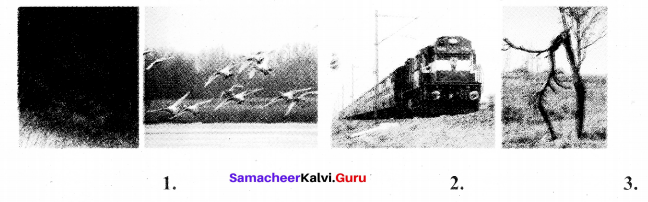
Samacheer Kalvi 7th Tamil Solutions Term 3 Chapter 1.4 திருநெல்வேலிச் சீமையும் கவிகளும்

Students can Download Tamil Chapter 1.4 திருநெல்வேலிச் சீமையும் கவிகளும் Questions and Answers, Summary, Notes Pdf, Samacheer Kalvi 7th Tamil Book Solutions Guide Pdf helps you to revise the complete Tamilnadu State Board New Syllabus and score more marks in your examinations.

Tamilnadu Samacheer Kalvi 7th Tamil Solutions Term 3 Chapter 1.4 திருநெல்வேலிச் சீமையும் கவிகளும்

மதிப்பீடு

Question 1.
டி.கே.சி. குறிப்பிடும் திருநெல்வேலிக் கவிஞர்கள் பற்றிய செய்திகளைத் தொகுத்து எழுதுக.
Answer:
கவிஞர்கள் தங்கள் கவித்திறத்தால் உலகையே ஆள்பவர்கள். அப்படிப்பட்டவர்கள் திருநெல்வேலி மாவட்டத்தில் பிறந்து திருநெல்வேலியைப் புகழ்பெறச் செய்துள்ளனர். அவர்களைப் பற்றி இக்கட்டுரையில் காண்போம்.
கடிகைமுத்துப் புலவர் இரு நூறு ஆண்டுகளுக்கு முன் வாழ்ந்தவர். இவர் வெங்கடேசுர எட்டப்ப ராஜாவைப் பற்றிப் பாடல்கள் பாடியுள்ளார். முக்கூடல் பள்ளு’ என்னும் சிற்றிலக்கியம் சீவலப்பேரி’ என்கிற முக்கூடல் பற்றியதாகும்.

Samacheer Kalvi 7th Tamil Solutions Term 3 Chapter 1.4 திருநெல்வேலிச் சீமையும் கவிகளும்

மதுரையிலிருந்து நெல்லைக்கு வந்தவர் பலபட்டடைச் சொக்கநாதப் புலவர். இவர் நெல்லையில் எழுந்தருளியுள்ள காந்திமதித் தாயைத் தரிசித்து உரிமையுடன் சுவாமியிடம் சிபாரிசு செய்ய வேண்டுகிறார்.
திருநெல்வேலிக்கு அருகில் உள்ள சீவைகுண்டத்துப் பெருமாளைப் போற்றிப் பாடியவர் பிள்ளைப் பெருமாள் ஆவர். ஆற்றுக்குத் தென்கரையில் நம்மாழ்வார் பிறந்த ஊரான ஆழ்வார் திருநகரில் உள்ளது. இதன் பழைய பெயர் திருக்குருகூர் . அவர் தமது ஈடுபாட்டைத் தமது திருவாய்மொழியில் பாடியுள்ளார்.

கொற்கை நகர முத்து வணிகத்தைப் பற்றி முத்தொள்ளாயிர ஆசிரியர் அனுபவித்துப் பாடியுள்ளார். சீதக்காதி என்ற பெருவணிகர் காயல்பட்டணத்தைச் சார்ந்தவர். அவர் பல புலவர்களை ஆதரித்தவர். அவர் இறந்த போது நமச்சிவாயப் புலவர்,
“கோமன் அழகமர் மால் சீதக் காதி கொடைக்கரத்துச்
சீமான் இறந்திட்ட போதே புலமையும் செத்ததுவே” என்று தம் உணர்ச்சியைப் பாடலாக்கினார்.

அருணகிரிநாதர் தாம் பாடிய திருப்புகழில் ஏரிநீர் நந்தவனங்களில் இருந்ததால் சேல்மீன்கள் துள்ளிக் குதித்தி பூஞ்செடிகொடிகளை அழித்தன எனப் பாடியுள்ளார்.
அண்ணாமலையார் கழுகுமலை முருகன் மேல் காவடிச் சிந்தைப் பாடியுள்ளார். சங்கரன் கோவிலில் உள்ள கோமதித் தாயைப் பற்றி அழகிய சொக்கநாதர் பக்தியோடு பாடியுள்ளார்.

கரிவலம் வந்த நல்லூர் என்னும் பெயர் கொண்ட ஸ்தலம் கருவை நல்லூர் ஆகும். இத்தலத்தைப் பற்றி திருக்கருவை வெண்பா அந்தாதி, பதிற்றுப்பத்தந்தாதி, கலித்துறை அந்தாதி ஆகிய நூல்களில் புலவர் ஒருவர் பாடியுள்ளார்.
குற்றால மலையின் இயற்கையைக் கண்ட திருஞான சம்பந்தர் நுண் துளி தூங்கும் குற்றாலம்’ என்று பாடியுள்ளார். இத்தலத்தைப் பற்றி மாணிக்கவாசகரும் உற்றாரை யான் வேண்டேன் என்ற பாடலில் குறிப்பிட்டுள்ளார்.

Samacheer Kalvi 7th Tamil Solutions Term 3 Chapter 1.4 திருநெல்வேலிச் சீமையும் கவிகளும்

திரிகூடராசப்பக் கவிராயர் தம் குற்றாலக் குறவஞ்சியில் இம்மலையின் வளத்தைக் குறி சொல்லுகின்ற பெண் கூறுவது போல் பாடியுள்ளார்.
இத்தகு பெருமைமிக்க திருநெல்வேலியைப் பற்றியும் அங்கு வாழ்ந்த புலவர்களின் புலமையையும் நினைவில் கொள்வோம்.

கற்பவை கற்றபின்

Question 1.
உங்களுக்குப் பிடித்த கவிதை ஒன்றைப் பற்றி வகுப்பறையில் கலந்துரையாடுக.
Answer:
மாணவன் 1 : இன்று நான் நூலகம் செல்லலாம் என்று புறப்பட்டேன். நல்ல மழை பெய்தததால் செல்லவில்லை.
மாணவன் 2 : எதற்கு நூலகத்திற்கு செல்ல வேண்டும்?
மாணவன் 1 : நான் எப்போதும் விடுமுறை என்றால் நூலகத்திற்குச் செல்வேன்.
எனக்குப் பிடித்த நூல்களைப் படித்து குறிப்பு எழுதிக் கொள்வேன்.
மாணவன் 2 : அப்படியா! நீ எழுதிய குறிப்பிலிருந்து எதைப் பற்றியாவது எனக்குக் கூறுகிறாயா?
மாணவன் 1 தாராளமாகக் கூறுகிறேன். உவமைக் கவிஞர் என்று போற்றப்படும்
சுரதாவின் கவிதை நூலில் ‘இன்பம்’ என்ற தலைப்பில் உள்ள கவிதை எனக்கு மிகவும் பிடித்திருந்தது.
“பழந்தமிழ் கற்றல் இன்பம்
பலநாடு சுற்றல் இன்பம்
எழுந்திடு புதுமை தன்னை
ஏற்றிடல் வாழ்வுக் கின்பம்.
…………….
…………….
பெற்றதை வழங்கி வாழும்
பெருங்குணம் பெறுதல் இன்பம்.

மாணவன் 2 : பாடலின் மிகவும் எளிமையாக இருக்கிறதே.
மாணவன் 1 : ஆமாம் பாடல் மிகவும் எளிமையானது. பொருள் பொதிந்த பாடல்.
மாணவன் 2 : பாடலின் பொருளைக் கூறு.
மாணவன் 1 : இன்பம் தருவன என்று கவிஞர் சிலவற்றைக் கூறுகிறார். பழந்தமிழ் இலக்கியங்களைக் கற்பது மகிழ்ச்சி தரும். பல நாடுகளுக்குப் பயணம் மேற்கொள்வது மனத்திற்கு மகிழ்ச்சி தரும். புதுமைகளை ஏற்றுக் கொள்ள வேண்டும். கற்றோர் நிறைந்த அவையில் தான் கற்ற கல்வியை எடுத்துரைப்பதும் வாழ்வில் வெற்றி பெறுவதற்கான செயல்களில் ஈடுபடுவதும் இன்பம் தரும். தீயோரின் நட்பை விலக்கி வாழ்தல், தாம் பெற்ற செல்வத்தைப் பிறருக்குக் கொடுத்து வாழும் சிறந்த குணம் பெறுதலும் இன்பம் தரும். இவையெல்லாவற்றையும் நாம் கருத்தில் கொண்டு செயல்பட்டால் நாமும் இன்பமாக வாழலாம்.
மாணவன் 2 : சரியாகச் சொன்னாய். இனிமேல் நீ நூலகம் செல்லும்போது என்னையும் அழைத்துச் செல்.
மாணவன் 1 : சரி! அழைத்துச் செல்கிறேன்.

Samacheer Kalvi 7th Tamil Solutions Term 1 Chapter 2.1 காடு

Students can Download Tamil Chapter 2.1 காடு Questions and Answers, Summary, Notes Pdf, Samacheer Kalvi 7th Tamil Book Solutions Guide Pdf helps you to revise the complete Tamilnadu State Board New Syllabus and score more marks in your examinations.

Tamilnadu Samacheer Kalvi 7th Tamil Solutions Term 1 Chapter 2.1 காடு

மதிப்பீடு

சரியான விடையைத் தேர்ந்தெடுத்து எழுதுக.

Question 1.
வாழை, கன்றை …………
அ) ஈன்றது
ஆ) வழங்கியது
இ) கொடுத்தது
ஈ) தந்தது
Answer:
அ) ஈன்றது

Samacheer Kalvi 7th Tamil Solutions Term 1 Chapter 2.1 காடு

Question 2.
‘காடெல்லாம்’ என்னும் சொல்லைப் பிரித்து எழுதக் கிடைப்பது………
அ) காடு + டெல்லாம்
ஆ) காடு + எல்லாம்
இ) கா + டெல்லாம்
ஈ) கான் + எல்லாம்
Answer:
ஆ) காடு + எல்லாம்

Question 3.
‘கிழங்கு + எடுக்கும்’ என்பதனைச் சேர்த்தெழுதக் கிடைக்கும் சொல் ………
அ) கிழங்கு எடுக்கும்
ஆ) கிழங்கெடுக்கும்
இ) கிழங்குடுக்கும்
ஈ) கிழங்கொடுக்கும்
Answer:
ஆ) கிழங்கெடுக்கும்

Samacheer Kalvi 7th Tamil Solutions Term 1 Chapter 2.1 காடு

நயம் அறிக

Question 1.
பாடலிலுள்ள மோனை, எதுகை, இயைபுச் சொற்களை எடுத்து எழுதுக.
Answer:
மோனை: ஒரு பாடலில் அடிகளிலோ, சீர்களிலோ முதல் எழுத்து ஒன்றி வருவது மோனைத் தொடை எனப்படும்.
அடிமோனை : கார்த்திகை – காடெல்லாம்
சீர்மோனை : குரங்கு – குடியிருக்கும்
மரங்கள் – மறைக்கும்

எதுகை : அடிகளிலோ, சீர்களிலோ முதல் எழுத்து அளவொத்து நிற்க, இரண்டாம் எழுத்து ஒன்றியமைவது எதுகைத் தொடை எனப்படும்.

அடிஎதுகை :

பார்த்திட – பார்வை
குரங்கு – மரங்கள்
கார்த்திகை – பார்த்திட
பச்சை – நச்சர
சிங்கம் – எங்கும்

Samacheer Kalvi 7th Tamil Solutions Term 1 Chapter 2.1 காடு

சீர்எதுகை :

காடு – கொடுக்கும்

இயைபு : அடிகள் தோறும் இறுதி எழுத்தோ , அசையோ, சீரோ, அடியோ ஒன்றி வருவது இயைபுத் தொடை எனப்படும்.

பொருள் கொடுக்கும் – ஈன்றெடுக்கும்
குடியிருக்கும் – கனிபறிக்கும்
மயில் நடிக்கும் – கிழங்கெடுக்கும்

குறுவினா

Question 1.
காட்டுப்பூக்களுக்கு எதனை உவமையாகக் கவிஞர் சுரதா குறிப்பிடுகிறார்?
Answer:

  • கார்த்திகை மாதத்தில் ஏற்றும் கார்த்திகை விளக்குகள் போலக் காடு முழுவதும் மலர்கள் மலர்ந்திருக்கும்.
  • அவற்றைப் பார்ப்பதற்கு கண்கள் குளிர்ச்சி பெறும் எனக் கவிஞர் காட்டுப் பூக்களுக்கு கார்த்திகை விளக்குகளை உவமையாகக் கூறுகிறார்.

Samacheer Kalvi 7th Tamil Solutions Term 1 Chapter 2.1 காடு

Question 2.
காட்டின் பயன்களாக கவிஞர் சுரதா கூறுவன யாவை?
Answer:
காட்டின் பயன்களாக கவிஞர் சுரதா கூறுவன :

  • காடு பலவகையான பொருள்களைத் தருகின்றது.
  • எல்லாரும் கூடி மகிழ்ந்திட குளிர்ந்த நிழலைத் தரும்.
  • காய்கனிகளைத் தந்து மற்ற உயிரினங்களை வாழச் செய்கிறது.
  • காட்டில் வசிக்கும் குரங்குகள் மரக்கிளைகளில் உள்ள, கனிகளைப் பறித்து உண்டு, தன் பசியைப் போக்கிக் கொள்ளும்.
  • மரங்கள் வெயிலை மறைத்து அங்கே நிழல் தரும்.
  • அடர்ந்த காடு வழிச் செல்வோர்க்குத் தடையாக இருக்கும்.

சிறுவினா

Question 1.
‘காடு’ பாடலில் விலங்குகளின் செயல்களாகக் கவிஞர் கூறுவனவற்றை எழுதுக.
Answer:

  • குரங்குகள் மரக்கிளைகளில் உள்ள கனிகளைப் பறித்து உண்ணும்.
  • பன்றிகள் காட்டில் உள்ள கிழங்குகளைத் தோண்டி உண்ணும்.
  • இந்தச் செயலைக் கண்டு நச்சுத் தன்மை உடைய பாம்புகள் அச்சத்தால் கலக்கம் அடையும்.
  • நரிகள் ஊளையிடும்.
  • மிகுந்த சுவையான தழையை யானைகள் தின்றபடி புதிய நடைபோடும்.
  • இயற்கையான காட்டில் வாழும் சிங்கம், புலி, கரடி, சிறுத்தை போன்ற விலங்கினங்கள் மனம் போன போக்கில் அலைந்து திரியும்.

Samacheer Kalvi 7th Tamil Solutions Term 1 Chapter 2.1 காடு

சிந்தனை வினா

Question 1.
காட்டை இயற்கை விடுதி என்று கவிஞர் கூறக் காரணம் என்ன?
Answer:

  • காடு இயற்கை தந்த கொடை, காடு இயற்கை தந்த விடுதி கார்த்திகை மாதத்து விளக்குகளைப் போல காட்டுப் பூச்சிகள் பூத்திருக்கும். அதனைப் பார்க்கும் கண்களுக்கு குளிர்ச்சியைத் தரும்.
  • குரங்குகள் மரக்கிளைகளில் உள்ள கனிகளைப் பறித்து உண்ணும்.
  • பச்சை நிறம் உடைய காட்டு மயில்கள் நடனமாடும்.
  • பன்றிகள் காட்டில் உள்ள கிழங்குகளைத் தோண்டி உண்ணும். இந்தச் செயலைக் கண்டு நச்சுத்தன்மை உடைய பாம்புகள் அச்சத்தால் கலங்கி நிற்கும். நரிக்கூட்டம் ஊளையிடும்.
  • யானைக்கூட்டம் சுவைதரும் தழையை உண்டுவிட்டு புதிய நடை போடும். காட்டில் சிங்கம், புலி, கரடி, சிறுத்தை போன்ற விலங்கினங்கள் எங்கும் அலைந்து திரியும்.
  • இயற்கைத் தந்த இடம் இந்தக் காடு. இது ஒரு தங்கும் விடுதி. இங்கு பறவைகள், விலங்கினங்கள் தங்கிச் செல்லும் செயலைத்தான் கவிஞர் காட்டை இயற்கை விடுதி என்று கூறி மகிழ்கிறார்.

Samacheer Kalvi 7th Tamil Solutions Term 1 Chapter 2.1 காடு

கற்பவை கற்றபின்

Question 1.
காடு என்னும் தலைப்பில் அமைந்த கிளிக்கண்ணி’ பாடலை இசையுடன் பாடி மகிழ்க.
Answer:
மாணவர்கள் தாங்களாகவே செய்ய வேண்டியவை.

Question 2.
பின்வரும் கிளிக்கண்ணிப் பாடலைப் பாடி மகிழ்க.
Answer:
நெஞ்சில் உரமுமின்றி
நேர்மைத் திறமுமின்றி
வஞ்சனை சொல்வாரடீ! – கிளியே
வாய்ச் சொல்லில் வீரரடி.
கூட்டத்தில் கூடிநின்று
கூவிப் பித்தலன்றி
நாட்டத்தில் கொள்ளாரடீ ! – கிளியே
நாளில் மறப்பாரடீ. ……….- பாரதியார்

Samacheer Kalvi 7th Tamil Solutions Term 1 Chapter 2.1 காடு

கூடுதல் வினாக்கள்

சொல்லும் பொருளும் :

1. ஈன்று – பெற்று
2. களித்திட – மகிழ்ந்திட
3. கொம்பு – கிளை
4. நச்சரவம் – விடமுள்ள பாம்பு
5. அதிமதுரம் – மிகுந்த சுவை
6. விடுதி – தங்கும் இடம்

விடையளி :

Question 1.
காட்டைக் குறிக்கும் வேறு பெயர்கள் யாவை?
Answer:
கா, கால், கான், கானகம், அடவி, அரண், ஆரணி, புரவு, பொற்றை , பொழில், தில்லம், அழுவம், இயவு, பழவம், முளரி, வல்லை , விடர், வியல், வனம், முதை, மிளை, இறும்பு,
சுரம், பொச்சை, பொதி, முளி, அரில், அறல், பதுக்கை , கணையம்.

Samacheer Kalvi 7th Tamil Solutions Term 1 Chapter 2.1 காடு

Question 2.
‘கிளிக்கண்ணி ‘ – குறிப்பு வரைக.
Answer:
(i) கிளியின் மொழி போன்ற இனிய சொற்களைப் பேசும் பெண்ணை நோக்கிக் ‘ கூறுவதாக இனிய சந்தத்தில் பாடப்படும் இசைப்பாடல் வகை கிளிக்கண்ணி ‘ ஆகும்.
(ii) கவிஞர் சுரதா எழுதிய பாடல் காடு. இப்பாடல் கிளிக்கண்ணி என்னும் பாவகையைச் சேர்ந்தது.

Question 3.
உவமைக் கவிஞர் எனப் போற்றப்படுபவர் யார்?
Answer:
உவமைக் கவிஞர் எனப் போற்றப்படுபவர் கவிஞர் சுரதா.

Question 4.
சுரதாவின் இயற்பெயர் என்ன?
Answer:
சுரதாவின் இயற்பெயர் இராசகோபாலன்

Samacheer Kalvi 7th Tamil Solutions Term 1 Chapter 2.1 காடு

Question 5.
சுரதா இயற்றிய நூல்கள் சிலவற்றைக் கூறுக?
Answer:
அமுதும் தேனும், தேன்மழை, துறைமுகம் உள்ளிட்ட பல நூல்களை இவர் இயற்றியுள்ளார்.

Question 6.
நமக்கு பாடமாக வந்துள்ள இப்பாடல் எதிலிருந்து எடுக்கப்பட்டது?
Answer:
இப்பாடல் சுரதா கவிதைகள் என்னும் நூலில் இயற்கை எழில் என்னும் பகுதியிலிருந்து எடுத்துத் தரப்பட்டுள்ளது.

பாடலின் பொருள்

கார்த்திகை விளக்குகள் போலக் காடு முழுவதும் மலர்கள் மலர்ந்திருக்கும். அவற்றைக் காணும் கண்கள் குளிர்ச்சி பெறும். காடு பல வகையான பொருள்களைத் தரும். காய்கனிகளையும் தரும். எல்லாரும் கூடி மகிழ்ந்திட குளிர்ந்த நிழல் தரும். அங்கே வசிக்கும் குரங்குகள் மரக்கிளைகளில் உள்ள, கனிகளைப் பறித்து உண்ணும். மரங்கள் வெயிலை மறைத்து நிழல் தரும். அடர்ந்த காடு வழிச்செல்வோர்க்குத் தடையாய் இருக்கும்.

Samacheer Kalvi 7th Tamil Solutions Term 1 Chapter 2.1 காடு

பச்சை நிறம் உடைய மயில்கள் நடனமாடும். பன்றிகள் காட்டில் உள்ள கிழங்குகளைத் தோண்டி உண்ணும். அதனைக் கண்டு நஞ்சினை உடைய பாம்புகள் கலக்கமடையும். நரிக்கூட்டம் ஊளையிடும். மிகுந்த சுவையுடைய தழையை யானைகள் தின்றபடி புதிய நடைபோடும். பூக்கள் பூத்துக் குலுங்கும் மரங்களில் குயில்கள் கூவும். இயற்கைத் தங்குமிடமாகிய காட்டில் சிங்கம், புலி, கரடி, சிறுத்தை போன்ற விலங்கினங்கள் எங்கும் அலைந்து திரியும்.

Samacheer Kalvi 12th Business Maths Solutions Chapter 10 Operations Research Ex 10.4

Students can download 12th Business Maths Chapter 10 Operations Research Ex 10.4 Questions and Answers, Samacheer Kalvi 12th Business Maths Book Solutions Guide Pdf helps you to revise the complete Tamilnadu State Board New Syllabus and score more marks in your examinations.

Tamilnadu Samacheer Kalvi 12th Business Maths Solutions Chapter 10 Operations Research Ex 10.4

Choose the correct answer.

Question 1.
The transportation problem is said to be unbalanced if _______
(a) Total supply ≠ Total demand
(b) Total supply = Total demand
(c) m = n
(d) m + n – 1
Answer:
(a) Total supply ≠ Total demand

Question 2.
In a non-degenerate solution number of allocation is ________
(a) Equal to m + n – 1
(b) Equal to m + n + 1
(c) Not equal to m + n – 1
(d) Not equal to m + n + 1
Answer:
(a) Equal to m + n – 1

Samacheer Kalvi 12th Business Maths Solutions Chapter 10 Operations Research Ex 10.4

Question 3.
In a degenerate solution number of allocations is ________
(a) equal to m + n – 1
(b) not equal to m + n – 1
(c) less than m + n – 1
(d) greater than m + n – 1
Answer:
(c) less than m + n – 1

Question 4.
The penalty in VAM represents the difference between the first ________
(a) Two largest costs
(b) Largest and Smallest costs
(c) Smallest two costs
(d) None of these
Answer:
(c) Smallest two costs

Samacheer Kalvi 12th Business Maths Solutions Chapter 10 Operations Research Ex 10.4

Question 5.
Number of basic allocation in any row or column in an assignment problem can be ________
(a) exactly one
(b) at least one
(c) at most one
(d) none of these
Answer:
(a) exactly one

Question 6.
North-West Comer refers to _________
(a) top left corner
(b) top right comer
(c) bottom right comer
(d) bottom left comer
Answer:
(a) top left corner

Samacheer Kalvi 12th Business Maths Solutions Chapter 10 Operations Research Ex 10.4

Question 7.
Solution for transportation problem using _________ method is nearer to an optimal solution.
(a) NWCM
(b) LCM
(c) VAM
(d) Row Minima
Answer:
(c) VAM

Question 8.
In an assignment problem the value of decision variable xij is _______
(a) 1
(b) 0
(c) 1 or 0
(d) none of them
Answer:
(c) 1 or 0

Samacheer Kalvi 12th Business Maths Solutions Chapter 10 Operations Research Ex 10.4

Question 9.
If the number of sources is not equal to the number of destinations, the assignment problem is called _______
(a) balanced
(b) unsymmetric
(c) symmetric
(d) unbalanced
Answer:
(d) unbalanced

Question 10.
The purpose of a dummy row or column in an assignment problem is to _________
(a) prevent a solution from becoming degenerate
(b) the balance between total activities and total resources
(c) provide a means of representing a dummy problem
(d) none of the above
Answer:
(b) the balance between total activities and total resources

Samacheer Kalvi 12th Business Maths Solutions Chapter 10 Operations Research Ex 10.4

Question 11.
The solution for an assignment problem is optimal if _________
(a) each row and each column has no assignment
(b) each row and each column has at least one assignment
(c) each row and each column has at most one assignment
(d) each row and each column has exactly one assignment
Answer:
(d) each row and each column has exactly one assignment

Question 12.
In an assignment problem involving four workers and three jobs, total numbers of assignments possible are ______
(a) 4
(b) 3
(c) 7
(d) 12
Answer:
(b) 3

Samacheer Kalvi 12th Business Maths Solutions Chapter 10 Operations Research Ex 10.4

Question 13.
Decision theory is concerned with ________
(a) analysis of information that is available
(b) decision making under certainty
(c) selecting optimal decisions in sequential problem
(d) All of the above
Answer:
(d) All of the above

Question 14.
A type of decision-making environment is _______
(a) certainty
(b) uncertainty
(c) risk
(d) all of the above
Answer:
(d) all of the above

Samacheer Kalvi 7th Tamil Solutions Term 1 Chapter 3.4 கப்பலோட்டிய தமிழர்

Students can Download Tamil Chapter 3.4 கப்பலோட்டிய தமிழர் Questions and Answers, Summary, Notes Pdf, Samacheer Kalvi 7th Tamil Book Solutions Guide Pdf helps you to revise the complete Tamilnadu State Board New Syllabus and score more marks in your examinations.

Tamilnadu Samacheer Kalvi 7th Tamil Solutions Term 1 Chapter 3.4 கப்பலோட்டிய தமிழர்

மதிப்பீடு

Question 1.
வ.உ.சிதம்பரனாரின் உரையை வாழ்க்கை வரலாறாகச் சுருக்கி எழுதுக.
Answer:
முன்னுரை :
‘சிதம்பரனாரின் பிரசங்கத்தைக் கேட்டால் செத்த பிணம் உயிர்பெற்று எழும், புரட்சி ஓங்கும் அடிமைப்பட்ட நாடு ஐந்தே நிமிடங்களில் விடுதலை பெறும்’ என்ற கூற்றின் படி பேச்சாற்றல் மிக்க வ.உ. சிதம்பரனாரின் வாழ்வியல் பற்றி இக்கட்டுரையில் காண்போம்.
Samacheer Kalvi 7th Tamil Solutions Term 1 Chapter 3.4 கப்பலோட்டிய தமிழர்

பிறப்பு மற்றும் பெற்றோர் :
சிதம்பரனார் 1872 ஆம் ஆண்டு செப்டம்பர் 5 ஆம் நாள் தமிழ்நாட்டில் தூத்துக்குடி மாவட்டம் வண்டானம் ஒட்டப்பிடாரம் என்ற ஊரில் பிறந்தார். பெற்றோர் உலகநாத பிள்ளை , பரமாயி அம்மாள் ஆவர்.

வழக்கறிஞர் பணி :
கல்லூரிப் படிப்பை முடித்த பின்னர் தன் தந்தையைப் போன்று வழக்கறிஞரானார். வ.உ.சி. ஏழைகளுக்காக வாதாடினார். சில சமயங்களில் கட்டணம் பெறாமலும் வாதாடினார். சிறந்த வழக்கறிஞர் என்று போற்றப்பட்டார்.

வெள்ளோட்டம் :
இந்திய தேசிய காங்கிரசில் சேர்ந்தார். வெள்ளையர்களின் கப்பலில் கூலி வேலை செய்யும் நம் நாட்டு மக்களின் அடிமைத்தனத்தை ஒழிக்க முனைந்தார். அம்முனைப்பால் ‘சுதேசக் கப்பல் கம்பெனி’ உருவாயிற்று. தலைவராகப் பாண்டித்துரை தேவர் பொறுப்பேற்றார். அவர்கள் வாங்கிய சுதேசக் கப்பல் வெள்ளோட்டத்திற்காகக் கொழும்புத் துறைமுகத்திற்குப் புறப்பட்டபோது அளவிலா மகிழ்ச்சியடைந்தார்.

Samacheer Kalvi 7th Tamil Solutions Term 1 Chapter 3.4 கப்பலோட்டிய தமிழர்

வெள்ளையர்களின் வீழ்ச்சி :

சுதேசக் கப்பலின் வருகையால் வெள்ளையர்களின் கப்பல் வாணிகம் தளர்ந்தது. வெள்ளையர்கள் பல சூழ்ச்சிகளைச் செய்தனர். வ.உ.சிதம்பரனாருக்குக் கையடக்கம் தருவதாகவும் கூறினர். பலரைப் பயமுறுத்தினர். இறுதியில் அடக்குமுறையைக் கையாண்டனர்.

சுதந்தர நாதம் எழுந்தது :

பரங்கியரை அசைக்க இயலாது என எண்ணி அடிமைப்பட்டனர் மக்கள். எதிர்த்துப் பேசாமல் சலாமிட்டும், தாளம் போட்டும், அரசாங்கப் பதுமைகளாய் ஆடியும், அரசு வாழ்க என்று பாடியும் தன்னிலையறியாமல் இருந்தனர். இச்சூழலில் சுதந்தர நாதம் எழுந்தது.

Samacheer Kalvi 7th Tamil Solutions Term 1 Chapter 3.4 கப்பலோட்டிய தமிழர்

வந்தே மாதரம் :

சுதந்தரம் எனது பிறப்புரிமை’ என்று முழங்கிய வடநாட்டு வீரரான பாலகங்காதர திலகரும். தென்னாட்டில் நாவீறுடைய பாரதியாரும் தென்னாட்டுத் திலகர் எனப் போற்றப்பட்ட வ.உ.சிதம்பரனாரும் வந்தே மாதரம்’ என்று முழங்கி மக்களிடம் ஆர்வத்தைத் தட்டி எழுப்பினர். பொதுக் கூட்டங்களிலும் தொழிலாளர் கூட்டங்களிலும் வ.உ.சி. ‘வந்தே மாதரத்தை அழுத்தமாகச் சொல்லுவார். அதைக் கேட்டு மக்கள் ஊக்கமுற்றனர்.

சிறைத்தண்டனை :

எரிவுற்ற அரசாங்கம் வ.உ.சி. யை எதிரியாகக் கருதியது. அதனால் வ.உ.சி.க்கு ‘இரட்டை வாழ்நாள் சிறைத்தண்டனை’ விதித்தது. ஆறாண்டுகள் கோவைச் சிறையிலும் கண்ணனூர்ச் சிறையிலும் கொடும்பணி ஆற்றினார். சிறைச்சாலையை தவச்சாலையாக எண்ணினார். அவர் விடுதலைக்காகப் புரிந்த அருந்தவச்செயல்கள் எண்ணிலடங்காதவை.

சிறைச்சாலையில் வ.உ.சி. :

சிறைச்சாலையில் அவரைப் பலரும் கண்காணித்தனர். கடும்பணி இட்டனர் பலர். ஆனால் அவர் எவரையும் வெறுத்ததில்லை . முறைதவறி நடந்தவர்களை எதிர்த்தார். வரைதவறிப் பேசியவர்களை வாயால் அடக்கினார். ஒரு முறை உடல் நலிந்து, உள்ளம் தளர்ந்து சிறைக்கூடத்தில் உட்கார்ந்திருந்த போது ஒரு ஜெயிலர், வ.உ.சி.க்குப் புத்திமதிகள் கூறினார். வெகுண்டெழுந்த வ.உ.சி. அடே மடையா! நீயா எனக்குப் புத்திமதி சொல்பவன்? மூடு வாயை ! உனக்கும் உன் அப்பனுக்கும் புத்தி சொல்வேன் நான். உன்னுடைய கவர்னருக்கும் மன்னருக்கும் புத்தி சொல்வேன் நான்’ என்று வேகமுறப் பேசினார். மானமிழந்து வாயிலிலிருந்து மறைந்தான் ஜெயிலர்.

Samacheer Kalvi 7th Tamil Solutions Term 1 Chapter 3.4 கப்பலோட்டிய தமிழர்

சிறையில் தமிழ்ப்பணி :

சிறைச்சாலையில் செக்கிழுத்த துயரத்தையும், கடும்பணிபுரிந்தபோது வந்த கண்ணீரையும் தமிழ் நூல்களைப் படித்து மாற்றிக்கொண்டார். தொல்காப்பியம்,

இன்னிலை ஆகிய நூல்களைப் படித்தார். ஆலன் என்பவர் இயற்றிய ஆங்கில மொழி
நூலை மனம் போல் வாழ்வு’ என்று தமிழில் மொழிபெயர்த்தார். மெய்யறிவு, மெய்யறம் என்ற நூல்களை இயற்றினார்.

முடிவுரை :

வ. உ. சிதம்பரனார் சிறையிலிருந்து விடுவிக்கப்பட்டவுடன் துறைமுகத்தை வந்து பார்த்தார். சுதேசக் கப்பலைக் காணாமல் துயருற்றார். பட்ட பாடெல்லாம் பயனற்றுப் போயிற்றே என்று பரிதவித்தார்.

பாயக்காண்பது சுதந்திரவெள்ளம்
பணியக் காண்பது வெள்ளையர் உள்ளம் என்று நாம் அனைவரும் பாடும் நாள் வரவேண்டும் என எண்ணினார். ஆனால் அந்நாள் வந்தபோது அவர் இவ்வுலகில் இல்லை . விடுதலைக்காகப் போராடி நாட்டு மக்களின் துயர் துடைத்த வ.உ.சி. அவர்கள் 1936 ஆம் ஆண்டு நவம்பர் மாதம் 18 ஆம் நாள் இயற்கை எய்தினார்.

கற்பவை கற்றபின்

Question 1.
பாரதியார், கொடிகாத்த குமரன் போன்ற விடுதலைப் போராட்ட வீரர்களுள் ஒருவராக
உங்களைக் கற்பனை செய்து கொண்டு வகுப்பில் உரையாற்றுக.
Answer:
வணக்கம்!
நான் தான் திருப்பூர் குமரன். என்னைக் கொடிகாத்த வீரன் என்று அன்போடு அழைப்பார்கள். இந்திய விடுதலைக்காகப் போராடி உயிர் நீத்த தியாகிகளுள் ஒருவன். 1932 ஆம் ஆண்டு சட்ட மறுப்பு இயக்கம் தொடங்கியது. அப்போதுதான் தமிழகம் முழுவதும் அறப்போராட்டம் பரவியது. திருப்பூரில் தேசபந்து இளைஞர் மன்ற உறுப்பினர்களாகிய நாங்கள் மறியல் போராட்டம் ஒன்றை ஏற்பாடு செய்திருந்தோம்.
Samacheer Kalvi 7th Tamil Solutions Term 1 Chapter 3.4 கப்பலோட்டிய தமிழர்

அதில் நாங்கள் அனைவரும் தீவிரமாகப் பங்கேற்றோம். அப்போராட்டத்திற்கு நானே தலைமை ஏற்றேன். ஊர்வலத்தில் இந்திய ஒன்றியத்தின் கொடியினை கையில் ஏந்தி அணிவகுத்துச் சென்றேன். அப்போதுதான் நான் காவலர்களால் தாக்கப்பட்டேன். என்னைக் காவலர்கள் தடியைக்கொண்டு மண்டை பிளக்குமாறு அடித்தார்கள். கையில் இந்தியக் கொடியை ஏந்தியபடி நான் மயங்கி விழுந்தேன்.

மயங்கிய நிலையிலும் கொடியைத் தாங்கிப் பிடித்திருந்தமையால் தான் என்னைக் கொடி காத்த குமரன் என்றழைத்தனர். என்னை மருத்துவமனையில் சேர்த்தனர், என் உயிர் பிரிந்தது. என் வருத்தமெல்லாம் இன்னும் கொஞ்ச நாள் உயிருடன் இருந்திருந்தால் நாட்டுக்காகப் பல போராட்டங்களில் கலந்து கொண்டிருப்பேன். வெள்ளையரிடம் இருந்து நாட்டைக் காக்கும் வரை போராடி இருப்பேன் என்பது தான்.

என்னைப் போன்று பலர் விடுதலைக்காக உழைத்து தங்கள் இன்னுயிரை நாட்டுக்காக ஈந்துள்ளனர்.

Samacheer Kalvi 7th Tamil Solutions Term 1 Chapter 3.4 கப்பலோட்டிய தமிழர்

நீங்கள் சுதந்தரக் காற்றைச் சுவாசிக்க தங்கள் உயிர் மூச்சை விட்டவர் பலர்.
நீங்கள் சுதந்தரம் என்ற பெயரில் நாகரிகம், பண்பாடு, கலாச்சாரம் என அனைத்தையும் சீரழித்து விட்டீர்கள். இவற்றை மட்டுமா சீரழித்தீர்கள்? இயற்கையையும் அழித்தீர்கள். மாணவச் செல்வங்களே இனிமேலாவது இந்தத் தவறுகளையெல்லாம் செய்யாமல் நாட்டையும் வீட்டையும் காப்பாற்றுங்கள் வளமான நாட்டை உருவாக்குங்கள்.
செய்வீர்கள் என்ற நம்பிக்கையுடன் விடைபெறுகிறேன்.

இன்னிலை ஆகிய நூல்களைப் படித்தார். ஆலன் என்பவர் இயற்றிய ஆங்கில மொழி நூலை மனம் போல் வாழ்வு’ என்று தமிழில் மொழிபெயர்த்தார். மெய்யறிவு, மெய்யறம் என்ற நூல்களை இயற்றினார்.

முடிவுரை :
வ. உ. சிதம்பரனார் சிறையிலிருந்து விடுவிக்கப்பட்டவுடன் துறைமுகத்தை வந்து பார்த்தார். சுதேசக் கப்பலைக் காணாமல் துயருற்றார். பட்ட பாடெல்லாம் பயனற்றுப் போயிற்றே என்று பரிதவித்தார்.

பாயக்காண்பது சுதந்திரவெள்ளம்

பணியக் காண்பது வெள்ளையர் உள்ளம் என்று நாம் அனைவரும் பாடும் நாள் வரவேண்டும் என எண்ணினார். ஆனால் அந்நாள் வந்தபோது அவர் இவ்வுலகில் இல்லை . விடுதலைக்காகப் போராடி நாட்டு மக்களின் துயர் துடைத்த வ.உ.சி. அவர்கள் 1936 ஆம் ஆண்டு நவம்பர் மாதம் 18 ஆம் நாள் இயற்கை எய்தினார்.

கற்பவை கற்றபின்

Question 1.
பாரதியார், கொடிகாத்த குமரன் போன்ற விடுதலைப் போராட்ட வீரர்களுள் ஒருவராக உங்களைக் கற்பனை செய்து கொண்டு வகுப்பில் உரையாற்றுக.
Answer:
வணக்கம்!
நான் தான் திருப்பூர் குமரன். என்னைக் கொடிகாத்த வீரன் என்று அன்போடு அழைப்பார்கள். இந்திய விடுதலைக்காகப் போராடி உயிர் நீத்த தியாகிகளுள் ஒருவன். 1932 ஆம் ஆண்டு சட்ட மறுப்பு இயக்கம் தொடங்கியது. அப்போதுதான் தமிழகம் முழுவதும் அறப்போராட்டம் பரவியது. திருப்பூரில் தேசபந்து இளைஞர் மன்ற உறுப்பினர்களாகிய நாங்கள் மறியல் போராட்டம் ஒன்றை ஏற்பாடு செய்திருந்தோம். அதில் நாங்கள் அனைவரும் தீவிரமாகப் பங்கேற்றோம். அப்போராட்டத்திற்கு நானே தலைமை ஏற்றேன். ஊர்வலத்தில் இந்திய ஒன்றியத்தின் கொடியினை கையில் ஏந்தி அணிவகுத்துச் சென்றேன். அப்போதுதான் நான் காவலர்களால் தாக்கப்பட்டேன். என்னைக் காவலர்கள் தடியைக்கொண்டு மண்டை பிளக்குமாறு அடித்தார்கள். கையில் இந்தியக் கொடியை ஏந்தியபடி நான் மயங்கி விழுந்தேன். மயங்கிய நிலையிலும் கொடியைத் தாங்கிப் பிடித்திருந்தமையால் தான் என்னைக் கொடி காத்த குமரன் என்றழைத்தனர். என்னை மருத்துவமனையில் சேர்த்தனர், என் உயிர் பிரிந்தது. என் வருத்தமெல்லாம் இன்னும் கொஞ்ச நாள் உயிருடன் இருந்திருந்தால் நாட்டுக்காகப் பல போராட்டங்களில் கலந்து கொண்டிருப்பேன். வெள்ளையரிடம் இருந்து நாட்டைக் காக்கும் வரை போராடி இருப்பேன் என்பது தான்.

Samacheer Kalvi 7th Tamil Solutions Term 1 Chapter 3.4 கப்பலோட்டிய தமிழர்

என்னைப் போன்று பலர் விடுதலைக்காக உழைத்து தங்கள் இன்னுயிரை நாட்டுக்காக ஈந்துள்ளனர். நீங்கள் சுதந்தரக் காற்றைச் சுவாசிக்க தங்கள் உயிர் மூச்சை விட்டவர் பலர்.

நீங்கள் சுதந்தரம் என்ற பெயரில் நாகரிகம், பண்பாடு, கலாச்சாரம் என அனைத்தையும் சீரழித்து விட்டீர்கள். இவற்றை மட்டுமா சீரழித்தீர்கள்? இயற்கையையும் அழித்தீர்கள். மாணவச் செல்வங்களே இனிமேலாவது இந்தத் தவறுகளையெல்லாம் செய்யாமல் நாட்டையும் வீட்டையும் காப்பாற்றுங்கள் வளமான நாட்டை உருவாக்குங்கள்.

செய்வீர்கள் என்ற நம்பிக்கையுடன் விடைபெறுகிறேன்.

Samacheer Kalvi 12th Business Maths Solutions Chapter 10 Operations Research Additional Problems

Students can download 12th Business Maths Chapter 10 Operations Research Additional Problems and Answers, Samacheer Kalvi 12th Business Maths Book Solutions Guide Pdf helps you to revise the complete Tamilnadu State Board New Syllabus and score more marks in your examinations.

Tamilnadu Samacheer Kalvi 12th Business Maths Solutions Chapter 10 Operations Research Additional Problems

I. One Mark Questions

Choose the correct Answer

Question 1.
Which of the following methods is used to verify the optimality of the current solution of the transportation problem?
(a) Least cost method
(b) Vogel’s method
(c) North-west comer rule
(d) None of these
Answer:
(a) Least cost method

Question 2.
The degeneracy’in the transportation problem indicates that _________
(a) Dummy allocations need to be added
(b) The problem has no feasible solution
(c) Multiple optimal solutions exist
(d) All of the above
Answer:
(c) Multiple optimal solutions exist

Samacheer Kalvi 12th Business Maths Solutions Chapter 10 Operations Research Additional Problems

Question 3.
The Hungarian method can also be used to solve ______
(a) Transportation problem
(b) Travelling salesman problem
(c) A linear programming problem
(d) All the above
Answer:
(b) Travelling salesman problem

Question 4.
An optimal solution of an assignment problem can be obtained only if, _________
(a) each row and column has only one zero element
(b) each row and column has at least one zero element
(c) The data is arranged in a square matrix
(d) None of the above
Answer:
(d) None of the above

Samacheer Kalvi 12th Business Maths Solutions Chapter 10 Operations Research Additional Problems

Question 5.
Say True or False.

  1. In a transportation problem, a single source may supply something to all destinations.
  2. A transportation model must have the same number of rows and columns.
  3. It is usually possible to find an optimal solution to a transportation problem that is degenerate.
  4. In a transportation problem, a dummy source is given a zero cost, while in an assignment problem, a dummy source is given a very high cost.
  5. The Hungarian method operates on the principle of matrix reduction, whereby the cost table is reduced to a set of opportunity costs.

Answer:

  1. True
  2. False
  3. True
  4. False
  5. True

Question 6.
Fill in the blanks.

  1. In a transportation problem, we must make the number of ________ and _______ equal.
  2. ______ or ______ are used to balance an assignment problem.
  3. The method of finding an initial solution based on opportunity costs is called _______
  4. ________ occurs when the number of occupied squares is less than the number of rows plus the number of columns minus one.
  5. Both transportation and assignment problems are members of a category of LP problems called ________
  6. In the case of an unbalanced problem, shipping cost coefficients of ______ are assigned to each dummy factory or warehouse.

Answer:

  1. units supplied, units demanded
  2. Dummy rows, dummy columns
  3. Vogel’s approximation method
  4. Degeneracy
  5. Network flow problems
  6. zero

Samacheer Kalvi 12th Business Maths Solutions Chapter 10 Operations Research Additional Problems

Question 7.
Match the following.

(a) Dummy column(i) Finding initial solution
(b) Northwest comer rule(ii) Rows ≠ Columns
(c) Hungarian method(iii) Supply ≠ Demand
(d) Feasible solution(iv) Assignment problem
(e) Unbalanced problem(v) All demand and supply constraints are met

Answer:
(a) – (iii)
(b) – (i)
(c) – (iv)
(d) – (v)
(e) – (ii)

Question 8.
The objective function of transportation problem is to ________
(a) Maximise total cost
(b) Minimise the total cost
(c) Total cost should be zero
(d) All the above
Answer:
(b) Minimise the total cost

Samacheer Kalvi 12th Business Maths Solutions Chapter 10 Operations Research Additional Problems

Question 9.
In transportation problem, optimal solution can be verified by using _______
(a) NWC
(b) LCM
(c) MODI method
(d) Matrix method
Answer:
(c) MODI method

Question 10.
The cells in the transportation problem can be classified as _______
(a) assigned cells and empty cells
(b) allocated cells and unallocated cells
(c) occupied and unoccupied cells
(d) assigned and unoccupied cells
Answer:
(c) occupied and unoccupied cells

Samacheer Kalvi 12th Business Maths Solutions Chapter 10 Operations Research Additional Problems

Question 11.
In transportation problem if total supply > total demand we add _________
(a) dummy row with cost 0
(b) dummy column with cost 0
(c) dummy row with cost 1
(d) dummy column with cost 1
Answer:
(b) dummy column with cost 0

Question 12.
In an LPP the objective function is to be ________
(a) Minimised
(b) Maximised
(c) (a) or (b)
(d) only (b)
Answer:
(c) (a) or (b)

Samacheer Kalvi 12th Business Maths Solutions Chapter 10 Operations Research Additional Problems

Question 13.
The method used for solving an assignment problem is called ________
(a) Reduced matrix method
(b) MODI method
(c) Hungarian method
(d) Graphical method
Answer:
(c) Hungarian method

II. 2 Mark Questions

Question 1.
Consider 3 jobs to be assigned to 3 machines. The cost for each combination is shown in the table below. Find the minimal job machine combinations.
Samacheer Kalvi 12th Business Maths Solutions Chapter 10 Operations Research Additional Problems 1
Solution:
Step 1:
Samacheer Kalvi 12th Business Maths Solutions Chapter 10 Operations Research Additional Problems 2
Step 2:
Samacheer Kalvi 12th Business Maths Solutions Chapter 10 Operations Research Additional Problems 3
Step 3: (Assignment)
Samacheer Kalvi 12th Business Maths Solutions Chapter 10 Operations Research Additional Problems 4
Optimal assignment:
Samacheer Kalvi 12th Business Maths Solutions Chapter 10 Operations Research Additional Problems 5

Question 2.
Find an initial basic feasible solution by LCM.
Samacheer Kalvi 12th Business Maths Solutions Chapter 10 Operations Research Additional Problems 6
Solution:
Samacheer Kalvi 12th Business Maths Solutions Chapter 10 Operations Research Additional Problems 7
Total cost = (1 × 2) + (6 × 1) + (4 × 4) + (4 × 6)
= 2 + 6 + 16 + 24
= 48

Samacheer Kalvi 12th Business Maths Solutions Chapter 10 Operations Research Additional Problems

Question 3.
Find an initial basic feasible solution by the North West Corner Rule (NWC).
Samacheer Kalvi 12th Business Maths Solutions Chapter 10 Operations Research Additional Problems 8
Solution:
Total demand = Total supply = 60
Samacheer Kalvi 12th Business Maths Solutions Chapter 10 Operations Research Additional Problems 9
Total cost = (10 × 9) + (11 × 6) + (12 × 8) + (2 × 3) + (25 × 11)
= 90 + 66 + 96 + 6 + 275
= 533

Question 4.
Find an initial basic feasible solution using Least cost method.
Samacheer Kalvi 12th Business Maths Solutions Chapter 10 Operations Research Additional Problems 10
Solution:
Total Demand = 5 + 8 + 7 + 14 = 34
Total Supply = 7 + 9 + 18 = 34
Since they are equal, problem is balanced.
Samacheer Kalvi 12th Business Maths Solutions Chapter 10 Operations Research Additional Problems 11
The minimum total transportation cost is = (7 × 10) + (2 × 70) + (7 × 40) + (3 × 40) + (8 × 8) + (7 × 20)
= 70 + 140 + 280 + 120 + 64 + 140
= Rs. 814

Samacheer Kalvi 12th Business Maths Solutions Chapter 10 Operations Research Additional Problems

Question 5.
Find the investment option using Maximin rule for the following:
Samacheer Kalvi 12th Business Maths Solutions Chapter 10 Operations Research Additional Problems 12
Solution:
Samacheer Kalvi 12th Business Maths Solutions Chapter 10 Operations Research Additional Problems 13
Max (5, -13, -5) = 5. Since the maximum payoff is 5, by maximin criteria, the decision is to invest in bonds.

III. 3 and 5 Marks Questions

Question 1.
Find an optimal solution to the following transportation problem by North West Corner Method.
Samacheer Kalvi 12th Business Maths Solutions Chapter 10 Operations Research Additional Problems 14
Solution:
Total supply = 65 = Total demand. So the given problem is balanced.
First allocation:
Samacheer Kalvi 12th Business Maths Solutions Chapter 10 Operations Research Additional Problems 15
Second allocation:
Samacheer Kalvi 12th Business Maths Solutions Chapter 10 Operations Research Additional Problems 16
Third allocation:
Samacheer Kalvi 12th Business Maths Solutions Chapter 10 Operations Research Additional Problems 17
Fourth allocation:
Samacheer Kalvi 12th Business Maths Solutions Chapter 10 Operations Research Additional Problems 18
Total Transportation cost
Samacheer Kalvi 12th Business Maths Solutions Chapter 10 Operations Research Additional Problems 19

Question 2.
Find an initial basic solution for the following transportation problem by Vogel’s Approximation method.
Samacheer Kalvi 12th Business Maths Solutions Chapter 10 Operations Research Additional Problems 20
Solution:
Total demand = 72 + 102 + 41 = 215 and
Total supply = 76 + 82 + 77 = 235.
Total supply > Total demand. So we add a dummy constraint with 0 unit cost and with allocation 20 (235 – 215). The modified table is
Samacheer Kalvi 12th Business Maths Solutions Chapter 10 Operations Research Additional Problems 21
First allocation:
Samacheer Kalvi 12th Business Maths Solutions Chapter 10 Operations Research Additional Problems 22
The maximum penalty is 16. Allot 20 units to cell (S2, Ddummy)
Second allocation:
Samacheer Kalvi 12th Business Maths Solutions Chapter 10 Operations Research Additional Problems 23
Third allocation:
Samacheer Kalvi 12th Business Maths Solutions Chapter 10 Operations Research Additional Problems 24
Fourth allocation:
Samacheer Kalvi 12th Business Maths Solutions Chapter 10 Operations Research Additional Problems 25
The final allocation table is given below.
Samacheer Kalvi 12th Business Maths Solutions Chapter 10 Operations Research Additional Problems 26
The minimum total cost = (76 × 8) + (21 × 24) + (41 × 16) + (20 × 0) + (72 × 8) + (5 × 16) = 2424

Samacheer Kalvi 12th Business Maths Solutions Chapter 10 Operations Research Additional Problems

Question 3.
A company has 4 men available for 4 separate jobs. Only one man can work on anyone job. The cost of assigning each man to each job is given below. Find the optimal solution by the Hungarian method.
Samacheer Kalvi 12th Business Maths Solutions Chapter 10 Operations Research Additional Problems 27
Solution:
The number of rows and columns are equal. So the given problem is a balanced assignment problem and we can get an optimal solution.
Step 1:
Samacheer Kalvi 12th Business Maths Solutions Chapter 10 Operations Research Additional Problems 28
Step 2:
Samacheer Kalvi 12th Business Maths Solutions Chapter 10 Operations Research Additional Problems 29
Step 3: (Assignment)
Samacheer Kalvi 12th Business Maths Solutions Chapter 10 Operations Research Additional Problems 30
We are not able to assign job for person B. Proceed as follows. Draw a minimum number of vertical and horizontal lines to cover all the zeros.
Samacheer Kalvi 12th Business Maths Solutions Chapter 10 Operations Research Additional Problems 31
Subtract the smallest element 1 from all the uncovered elements and add it to the elements which lie at the intersection of two lines. Thus we obtain another reduced matrix for fresh assignment.
Samacheer Kalvi 12th Business Maths Solutions Chapter 10 Operations Research Additional Problems 32
Total cost is
Samacheer Kalvi 12th Business Maths Solutions Chapter 10 Operations Research Additional Problems 33

Question 4.
There are five machines and five jobs are to be assigned and the cost matrix is given below. Find the proper assignment.
Samacheer Kalvi 12th Business Maths Solutions Chapter 10 Operations Research Additional Problems 34
Solution:
Step 1: (Row-reduction)
Samacheer Kalvi 12th Business Maths Solutions Chapter 10 Operations Research Additional Problems 35
Step 2: (Column – reduction)
Samacheer Kalvi 12th Business Maths Solutions Chapter 10 Operations Research Additional Problems 36
Step 3: (Assignment)
Samacheer Kalvi 12th Business Maths Solutions Chapter 10 Operations Research Additional Problems 37
We are not able to assign a machine to job D. We proceed as follows.
Samacheer Kalvi 12th Business Maths Solutions Chapter 10 Operations Research Additional Problems 38
The smallest uncovered element is 2. Subtract 2 from all those elements which are not covered. Add 2 all elements which are at the intersection of two lines. Then proceed with the new matrix.
Samacheer Kalvi 12th Business Maths Solutions Chapter 10 Operations Research Additional Problems 39
The assignment is as follows
Samacheer Kalvi 12th Business Maths Solutions Chapter 10 Operations Research Additional Problems 40

Samacheer Kalvi 12th Business Maths Solutions Chapter 10 Operations Research Additional Problems

Question 5.
The cost of transportation from 3 sources to four destinations are given in the follow¬ing table. Obtain an initial basic feasible solution using
(i) North West Corner Rule (NWC)
(ii) Least Cost Method (LCM) and
(iii) Vogel’s Approximation Method (VAM)
Samacheer Kalvi 12th Business Maths Solutions Chapter 10 Operations Research Additional Problems 41
Solution:
(i) North West Corner Rule
We start by allotting the units to the North -West Comer cell. We show all the allocations in a single table.
Samacheer Kalvi 12th Business Maths Solutions Chapter 10 Operations Research Additional Problems 42
Total transportation cost is (200 × 4) + (50 × 2) + (350 × 7) + (100 × 5) + (200 × 3) + (1 × 300)
= 800 + 100 + 2450 + 500 + 600 + 300
= Rs. 4750

(ii) Least cost method (LCM)
Samacheer Kalvi 12th Business Maths Solutions Chapter 10 Operations Research Additional Problems 43
Transportation cost is = (250 × 2) + (200 × 3) + (150 × 7) + (100 × 5) + (200 × 3) + (300 × 1)
= 500 + 600+ 1050 + 500 + 600 + 300
= Rs. 3550

Samacheer Kalvi 12th Business Maths Solutions Chapter 10 Operations Research Additional Problems

(iii) Vogel Approximation Method (VAM)
Samacheer Kalvi 12th Business Maths Solutions Chapter 10 Operations Research Additional Problems 44
There are five penalties which have the maximum value 2. The cell with the least cost is row 3 and hence select cell (3, D) for allocation.
Samacheer Kalvi 12th Business Maths Solutions Chapter 10 Operations Research Additional Problems 45
There are four penalties which have maximum value 2. Select cell (1, B) which has the least cost for allocation.
Samacheer Kalvi 12th Business Maths Solutions Chapter 10 Operations Research Additional Problems 46
The largest penalty is 6. Allot units to cell (2, A)
Samacheer Kalvi 12th Business Maths Solutions Chapter 10 Operations Research Additional Problems 47
The largest penalty is 3. Allot units to cell (3, B)
Samacheer Kalvi 12th Business Maths Solutions Chapter 10 Operations Research Additional Problems 48
We first allot 50 units to cell (3, C) which has less cost. Then the balance units we allot to cell (2, C). We get the final allocation table as follows.
Samacheer Kalvi 12th Business Maths Solutions Chapter 10 Operations Research Additional Problems 49
Transportation cost is = (250 × 2) + (200 × 3) + (250 × 5) + (150 × 4) + (50 × 3) + (300 × 1)
= 500 + 600 + 1250 + 600 + 150 + 300
= Rs. 3400

Samacheer Kalvi 12th Business Maths Solutions Chapter 8 Sampling Techniques and Statistical Inference Additional Problems

Students can download 12th Business Maths Chapter 8 Sampling Techniques and Statistical Inference Additional Problems and Answers, Samacheer Kalvi 12th Business Maths Book Solutions Guide Pdf helps you to revise the complete Tamilnadu State Board New Syllabus and score more marks in your examinations.

Tamilnadu Samacheer Kalvi 12th Business Maths Solutions Chapter 8 Sampling Techniques and Statistical Inference Additional Problems

Choose the correct answer:

Question 1.
Non sampling error is reduced by ________
(a) Increasing sample size
(b) Decreasing sample size
(c) Reducing amount of data
(d) None of these
Answer:
(d) None of these

Question 2.
Any numerical value calculated from sample data is called ______
(a) Error
(b) Statistic
(c) Bias
(d) Mean
Answer:
(b) Statistic

Samacheer Kalvi 12th Business Maths Solutions Chapter 8 Sampling Techniques and Statistical Inference Additional Problems

Question 3.
In sampling with replacement a sampling unit can be selected _______
(a) Only once
(b) More than one time
(c) Less than one time
(d) None of above
Answer:
(b) More than one time

Question 4.
Standard deviation of sampling distribution of any statistic is called ________
(a) Sampling error
(b) Type-I error
(c) Standard error
(d) Non-sampling error
Answer:
(c) Standard error

Question 5.
The difference between statistic and parameter is called ________
(a) Random error
(b) Sampling error
(c) Standard error
(d) Bias
(e) Error
Answer:
(e) Error

Samacheer Kalvi 12th Business Maths Solutions Chapter 8 Sampling Techniques and Statistical Inference Additional Problems

Question 6.
In random sampling, the probability of selecting an item from the population is _______
(a) unknown
(b) known
(c) undecided
(d) zero
Answer:
(b) known

Question 7.
Match the following:

(i) Type I error(a) determine whether a statistical result is significant
(ii) Type II error(b) Left-tailed test
(iii) Hypothesis testing(c) reject a true null hypothesis
(iv) H1 : µ > µ0(d) do not reject a false null hypothesis
(v) H1 : µ < µ0(e) Right-tailed test

Answer:
(i) – (c)
(ii) – (d)
(iii) – (a)
(iv) – (e)
(v) – (b)

Samacheer Kalvi 12th Business Maths Solutions Chapter 8 Sampling Techniques and Statistical Inference Additional Problems

Question 8.
Fill in the blanks:

  1. Any statement whose validity is tested on the basis of a sample is called ________
  2. The alternative hypothesis is also called _______
  3. The probability of rejecting the null hypothesis when it is true is called ________
  4. The hypothesis µ ≤ 10 is a _______
  5. If a hypothesis specifies the population distribution it is called ______

Answer:

  1. Statistical hypothesis
  2. Research hypothesis
  3. Level of significance
  4. Composite hypothesis
  5. Simple hypothesis

Question 9.
Null and alternative hypothesis are statements about ________
(a) population parameters
(b) sample parameters
(c) sample statistics
(d) none of the above
Answer:
(a) population parameters

2 and 3 Mark Questions

Question 1.
A random sample of size 50 with mean 67.9 is drawn from a normal population. If the S.E of the sample mean is √0.7, find a 95% confidence interval for the population mean.
Solution:
n = 50, \(\bar{x}\) = 67.9
95% confidence limits for the population mean µ are
Samacheer Kalvi 12th Business Maths Solutions Chapter 8 Sampling Techniques and Statistical Inference Additional Problems II Q1
Thus the 95% confidence intervals for estimating µ is given by (66.26, 69.54)

Samacheer Kalvi 12th Business Maths Solutions Chapter 8 Sampling Techniques and Statistical Inference Additional Problems

Question 2.
A random sample of 500 apples was taken from large consignment and 45 of them were found to be bad. Find the limits at which the bad apples lie at 99% confidence level.
Solution:
Sample size n = 500
Proportion of bad apples P = \(\frac{45}{500}\) = 0.09
So proportion of good apples Q = 1 – 0.09 = 0.91
The confidence limits for population proportion are given by,
Samacheer Kalvi 12th Business Maths Solutions Chapter 8 Sampling Techniques and Statistical Inference Additional Problems II Q2
= (0.09 – (2.58) (0.013), 0.09 + (2.58) (0.013)) .
= (0.09 – 0.034, 0.09 + 0.034)
= (0.056, 0.124)
Thus the bad apples lie between 5.6% and 12.4%

Question 3.
A sample of 400 students is found to have a mean height of 171.38 cms can it be regarded as a sample from a large population with mean height 171.17 cms and S.D 3.30 cms?
Solution:
Given
Sample size n = 400
Sample mean \(\bar{x}\) = 171.38 cm
Population mean µ = 171.17 cm
Population SD σ = 3.30 cm
H0 : µ = 171.17 cm
H1 : µ ≠ 171.17 cm
Test statistic:
Samacheer Kalvi 12th Business Maths Solutions Chapter 8 Sampling Techniques and Statistical Inference Additional Problems II Q3
The table value of \(z_{\alpha / 2}\) at 5% level is 1.96. Since Z < \(z_{\alpha / 2}\), H0 is accepted. Therefore the given sample can be regarded as one from the population with mean 171.17 cm.

Samacheer Kalvi 12th Business Maths Solutions Chapter 8 Sampling Techniques and Statistical Inference Additional Problems

Question 4.
An automatic machine fills tea in sealed tins with a mean weight of tea as 1 kg and S.D 1 gram. A random sample of 50 tins was examined and it was found that their mean weight was 999.5 grams. Is the machine working properly?
Solution:
Given
Sample size n = 50
Sample mean \(\bar{x}\) = 999.5 grams
Population mean µ = 1000 grams
Population SD σ = 1 gram
H0 : µ = 1 kg
H1 : µ ≠ 1 kg
Test statistic
Samacheer Kalvi 12th Business Maths Solutions Chapter 8 Sampling Techniques and Statistical Inference Additional Problems II Q4
The table value of \(z_{\alpha / 2}\) at 1% level = 2.58. Since |Z| > \(z_{\alpha / 2}\), H0 is rejected. Therefore the machine is not working properly.

5 Marks Questions

Question 1.
A simple random sample of size 100 has mean
(а) 15, the population variance being 25. Find an interval estimate of the population mean with a confidence level of 95% and 99%
(b) If the population variance is not given, what should be done to find out the required estimates?
Solution:
(a) Given
Sample size n = 100
Sample mean \(\bar{x}\) = 15
Population SD σ = 5
The 95% confidence interval for the population mean is \(\bar{x} \pm \mathrm{Z}_{\alpha / 2} \frac{\sigma}{\sqrt{n}}\)
Here \(z_{\alpha / 2}\) = 1.96. So we get
= 15 ± (1.96) (\(\frac{5}{\sqrt{100}}\))
= 15 ± (1.96) (0.5)
= 15 ± 0.98
= 14.02 and 15.98
Therefore 95% confidence interval for population mean µ is (14.02, 15.98)
The 99% confidence interval is \(\bar{x} \pm 2.58 \frac{\sigma}{\sqrt{n}}\)
= 15 ± 2.58 (\(\frac{5}{\sqrt{100}}\))
= 15 ± 2.58 (0.5)
= 13.71 and 16.29
Therefore 99% confidence interval for the population mean µ is (13.71, 16.29)
(b) If population S.D a is not known, then the sample S.D can be used in the place of o in estimating the confidence interval.

Samacheer Kalvi 12th Business Maths Solutions Chapter 8 Sampling Techniques and Statistical Inference Additional Problems

Question 2.
A factory is producing 50,000 pairs of shoes daily. From a sample of 500 pairs, 2% were found to be of sub-standard quality. Estimate the number of pairs that can be reasonably expected to be spoiled at 95% level of confidence.
Solution:
N = 50,000, n = 500, P = \(\frac{2}{100}\), Q = \(\frac{98}{100}\)
The estimated percentage of spoiled pairs in daily production = \(\frac{2}{100}\) × 50,000 = 1000
The limits for the number of spoiled pans at 95% level of confidence
Samacheer Kalvi 12th Business Maths Solutions Chapter 8 Sampling Techniques and Statistical Inference Additional Problems III Q2

Question 3.
A company that packages peanuts states that at a maximum 6% of the peanut shells contain no nuts. At random, 300 peanuts were selected and 21 of them were empty. With a significance level of 1% can the statement made by the company be accepted?
Solution:
The population proportion P = 6% = 0.06
The null hypothesis: H0 : P ≤ 0.06
Alternative hypothesis: H1 : P > 0.06
For α = 1% = 0.01. Zα = 2.33
The test statistic is P + 2.33 (\(\sqrt{\frac{(0.06)(0.94)}{300}}\)) = 0.092
(where n = 300, P = 0.06, Q = 0.94)
Since the calculated value is less than the table value, 0.092 < 2.33,we accept the null hypothesis H0.
Hence the statement of the company can be accepted.

Samacheer Kalvi 12th Business Maths Solutions Chapter 8 Sampling Techniques and Statistical Inference Additional Problems

Question 4.
A school principal claims that the students in his school are above average intelligence. A random sample of 30 students IQ scores has a mean score of 112.5. The mean population IQ is 100 with an SD of 15. Is there sufficient evidence to support the principal’s claim?
Solution:
Given
Population mean µ = 100
Population SD σ = 15
Sample size n = 30
Sample mean \(\bar{x}\) = 112.5
Null hypothesis H0 : µ = 100
(the students have average I.Q)
Alternative hypothesis H1 : µ > 100
(the students have above average I.Q scores)
Samacheer Kalvi 12th Business Maths Solutions Chapter 8 Sampling Techniques and Statistical Inference Additional Problems III Q4
Let the significance level α = 0.05. The table value Zα = 1.645, since this is one-tailed test.
Test Statistic:
Samacheer Kalvi 12th Business Maths Solutions Chapter 8 Sampling Techniques and Statistical Inference Additional Problems III Q4.1
Since 4.56 > 1.645 (ie) Z > Zα at 5% level, we reject the null hypothesis. Hence we conclude that the students have above average IQ scores. So the principal’s claim is right.

Samacheer Kalvi 12th Business Maths Solutions Chapter 8 Sampling Techniques and Statistical Inference Additional Problems

Question 5.
Boys of a certain age are known to have a mean weight of 85 pounds. A complaint is made that the boys living in hostels are underfed. So a sample of 25 boys are weighed and ‘ found to have a mean weight of 80.94 pounds. The population S.D is 11.6. What should be concluded about the complaint?
Solution:
Given n = 25, µ = 85, \(\bar{x}\) = 80.94, and σ = 11.6
Null hypothesis H0 : µ = 85 (the boys are not underfed)
Alternative hypothesis H1 : µ < 85 (the boys are underfed)
Test statistic:
Samacheer Kalvi 12th Business Maths Solutions Chapter 8 Sampling Techniques and Statistical Inference Additional Problems III Q5.1
Let us take the significance level α = 0.05. The table value is Zα = -1.645
Samacheer Kalvi 12th Business Maths Solutions Chapter 8 Sampling Techniques and Statistical Inference Additional Problems III Q5
Now -1.75 < -1.645 (i.e) Z < Zα. Therefore we reject the null hypothesis. Since the calculated value falls in the rejection region. Hence we conclude that the boys are underfed. So the complaint should be addressed immediately.

Samacheer Kalvi 12th Business Maths Solutions Chapter 9 Applied Statistics Additional Problems

Students can download 12th Business Maths Chapter 9 Applied Statistics Additional Problems and Answers, Samacheer Kalvi 12th Business Maths Book Solutions Guide Pdf helps you to revise the complete Tamilnadu State Board New Syllabus and score more marks in your examinations.

Tamilnadu Samacheer Kalvi 12th Business Maths Solutions Chapter 9 Applied Statistics Additional Problems

Choose the correct answer.

Question 1.
Match the following.

(a) Seasonal variation(i) Erratic variation
(b) Secular trend(ii) Business cycle
(c) Irregular variation(iii) Long time variation
(d) Cyclical variation(iv) Short time variation

Answer:
(a) – (iv)
(b) – (iii)
(c) – (i)
(d) – (ii)

Question 2.
The secular trend can be measure by ______
(a) 4 methods
(b) 1 method
(c) 2 methods
(d) none of these
Answer:
(a) 4 methods

Samacheer Kalvi 12th Business Maths Solutions Chapter 9 Applied Statistics Additional Problems

Question 3.
Method of simple averages is used to measure _________
(a) Secular trend
(b) Irregular variation
(c) Seasonal variation
(d) Cyclic variation
Answer:
(c) Seasonal variation

Question 4.
Increase in the number of patients in the hospital due to heatstroke is _______
(a) Secular trend
(b) Irregular variation
(c) Seasonal variation
(d) Cyclic variation
Answer:
(c) Seasonal variation

Question 5.
In time series seasonal variations can occur within a period of ________
(a) 4 years
(b) 3 years
(c) one year
(d) 9 years
Answer:
(c) one year

Samacheer Kalvi 12th Business Maths Solutions Chapter 9 Applied Statistics Additional Problems

Question 6.
Fill in the blanks.

  1. The method of moving averages is used to find the _________
  2. Most frequently used mathematical model of a time series is _________
  3. The sale of air condition increases during summer is a ________
  4. The fire in a factory is an example of ________
  5. The best-fitting trend is one in which the sum of squares of residuals is _______

Answer:

  1. Secular trend
  2. Multiplicative model
  3. Seasonal variation
  4. Irregular variation
  5. Least

Question 7.
True or False

  1. An index number is used to measure changes in a variable over time.
  2. The ratio of a new price to the base year price is called the price relative.
  3. The Laspeyre’s and Paasche index numbers are examples of weighted quantity index only.
  4. \(\frac{\sum p_{1} q_{1}}{\sum p_{0} q_{1}} \times 100\) is Laspeyre’s quantity index.
  5. Laspeyre’s price index regards the base year quantities as fixed.

Answer:

  1. True
  2. True
  3. False
  4. False
  5. True

Samacheer Kalvi 12th Business Maths Solutions Chapter 9 Applied Statistics Additional Problems

Question 8.
Index for base period is always taken as ______
(a) 100
(b) 1
(c) 200
(d) 0
Answer:
(a) 100

Question 9.
Consumer price index indicates _______
(a) Rise
(b) Fall
(c) both (a) & (b)
(d) neither (a) & (b)
Answer:
(c) both (a) & (b)

Question 10.
The purchasing power of money can be accessed through ______
(a) simple index
(b) Fisher’s index
(c) Consumer price index (CPI)
(d) Volume index
Answer:
(c) Consumer price index (CPI)

Samacheer Kalvi 12th Business Maths Solutions Chapter 9 Applied Statistics Additional Problems

Question 11.
For consumer price index, price quotations are collected from _______
(a) Fair price shops
(b) Government depots
(c) Retailers
(d) Whole-sale dealers
Answer:
(c) Retailers

Question 12.
The aggregative expenditure method and family budget method always give ________
(a) Different results
(b) Approximate results
(c) Same results
(d) None of these
Answer:
(c) Same results

Question 13.
The Federal Bureau of statistics prepares ________
(a) The wholesale price index
(b) CPI
(c) Sensitive price indicator
(d) All the above
Answer:
(d) All the above

Samacheer Kalvi 12th Business Maths Solutions Chapter 9 Applied Statistics Additional Problems

Question 14.
Paasche’s price index number is also called _________
(a) Base year weighted
(b) Current year weighted
(c) Simple aggregative index
(d) Consumer price index
Answer:
(b) Current year weighted

Question 15.
Index number calculated by Fisher’s formula is ideal because it satisfies ________
(a) Circular test
(b) Factor reversal test
(c) Time reversal test
(d) All of the above
Answer:
(d) All of the above

2 Mark Questions

Question 1.
From the data given below calculate seasonal Indices:
Samacheer Kalvi 12th Business Maths Solutions Chapter 9 Applied Statistics Additional Problems II Q1
Solution:
Samacheer Kalvi 12th Business Maths Solutions Chapter 9 Applied Statistics Additional Problems II Q1.1
Samacheer Kalvi 12th Business Maths Solutions Chapter 9 Applied Statistics Additional Problems II Q1.2

Question 2.
Using 3-year moving averages, determine the trend values from the following data.
Samacheer Kalvi 12th Business Maths Solutions Chapter 9 Applied Statistics Additional Problems II Q2
Solution:
Samacheer Kalvi 12th Business Maths Solutions Chapter 9 Applied Statistics Additional Problems II Q2.1

Samacheer Kalvi 12th Business Maths Solutions Chapter 9 Applied Statistics Additional Problems

Question 3.
A company estimates its average monthly sales in a particular year to be Rs.2,00,000. The seasonal indices of the sales data are given below. Draw a monthly sales budget for the company.
Samacheer Kalvi 12th Business Maths Solutions Chapter 9 Applied Statistics Additional Problems II Q3
Solution:
Samacheer Kalvi 12th Business Maths Solutions Chapter 9 Applied Statistics Additional Problems II Q3.1

Question 4.
Calculate the index for the data when the average percentage increases in the prices of items and weights are given. Food 15, clothing 3, Rent 4, Fuel 2, Miscellaneous 1, the percentage increases are 32, 54, 47, 78 and 58.
Solution:
Samacheer Kalvi 12th Business Maths Solutions Chapter 9 Applied Statistics Additional Problems II Q4

3 and 5 Marks Questions

Question 1.
Using Fisher’s Ideal Formula, compute price and quantity index number for 1984 with 1982 as the base year, from the given information.
Samacheer Kalvi 12th Business Maths Solutions Chapter 9 Applied Statistics Additional Problems III Q1
Solution:
Samacheer Kalvi 12th Business Maths Solutions Chapter 9 Applied Statistics Additional Problems III Q1.1
Samacheer Kalvi 12th Business Maths Solutions Chapter 9 Applied Statistics Additional Problems III Q1.2

Question 2.
Using the following data, compute Fisher’s Ideal price index number for the current year.
Samacheer Kalvi 12th Business Maths Solutions Chapter 9 Applied Statistics Additional Problems III Q2
Solution:
Samacheer Kalvi 12th Business Maths Solutions Chapter 9 Applied Statistics Additional Problems III Q2.1

Samacheer Kalvi 12th Business Maths Solutions Chapter 9 Applied Statistics Additional Problems

Question 3.
Calculate the cost of living Index number from the following data.
Samacheer Kalvi 12th Business Maths Solutions Chapter 9 Applied Statistics Additional Problems III Q3
Solution:
Samacheer Kalvi 12th Business Maths Solutions Chapter 9 Applied Statistics Additional Problems III Q3.1
Cost of living index number = \(\frac{\sum P W}{\sum W}=\frac{1568.75}{12}\) = 130.73

Question 4.
Given below are the values of the sample mean (\(\bar{X}\)) and the range (R) for ten samples of size 5 each. Find the control charts and comment on the state of the process.
Samacheer Kalvi 12th Business Maths Solutions Chapter 9 Applied Statistics Additional Problems III Q4
Use A2 = 0.58, D3 = 0, D4 = 2.115
Solution:
Samacheer Kalvi 12th Business Maths Solutions Chapter 9 Applied Statistics Additional Problems III Q4.1
Samacheer Kalvi 12th Business Maths Solutions Chapter 9 Applied Statistics Additional Problems III Q4.2
We observe that all the sample range values are within the control limits values of R chart, But two values of the sample \(\bar{X}\) (i.e) 37, 37 lies below the LCL and 49, 51 lie above the UCL. So the statistical process is out of control.

Samacheer Kalvi 12th Business Maths Solutions Chapter 9 Applied Statistics Additional Problems

Question 5.
Fit a straight line trend equation by the method of least squares and estimate the trend values.
Samacheer Kalvi 12th Business Maths Solutions Chapter 9 Applied Statistics Additional Problems III Q5
Solution:
Let Yt = a + bx be the trend line.
Let X = \(\frac{x-1964.5}{0.5}\), x denotes year.
Samacheer Kalvi 12th Business Maths Solutions Chapter 9 Applied Statistics Additional Problems III Q5.1
When x = 1961, Yt = 91.75 – 7(1.25) = 83
When x = 1962, Yt = 91.75 – 5(1.25) = 85.5
We can find other values similarly.

Samacheer Kalvi 12th Business Maths Solutions Chapter 9 Applied Statistics Miscellaneous Problems

Students can download 12th Business Maths Chapter 9 Applied Statistics Miscellaneous Problems and Answers, Samacheer Kalvi 12th Business Maths Book Solutions Guide Pdf helps you to revise the complete Tamilnadu State Board New Syllabus and score more marks in your examinations.

Tamilnadu Samacheer Kalvi 12th Business Maths Solutions Chapter 9 Applied Statistics Miscellaneous Problems

Question 1.
Using three yearly moving averages, Determine the trend values from the following data.
Samacheer Kalvi 12th Business Maths Solutions Chapter 9 Applied Statistics Miscellaneous Problems 1
Solution:
Samacheer Kalvi 12th Business Maths Solutions Chapter 9 Applied Statistics Miscellaneous Problems 2

Question 2.
From the following data, calculate the trend values using fourly moving averages.
Samacheer Kalvi 12th Business Maths Solutions Chapter 9 Applied Statistics Miscellaneous Problems 3
Solution:
Samacheer Kalvi 12th Business Maths Solutions Chapter 9 Applied Statistics Miscellaneous Problems 4

Samacheer Kalvi 12th Business Maths Solutions Chapter 9 Applied Statistics Miscellaneous Problems

Question 3.
Fit a straight line trend by the method of least squares to the following data.
Samacheer Kalvi 12th Business Maths Solutions Chapter 9 Applied Statistics Miscellaneous Problems 5
Solution:
Let x denote the years and y denote the sales. Since number of years is even,
we take X = \(\frac{x-1983.5}{0.5}\)
Samacheer Kalvi 12th Business Maths Solutions Chapter 9 Applied Statistics Miscellaneous Problems 6
Samacheer Kalvi 12th Business Maths Solutions Chapter 9 Applied Statistics Miscellaneous Problems 7
The trend values are obtained by substituting the years for x, and given in the table.
When x= 1980, Yt = 55.9875 + 0.83(-7) = 50.1775
When x = 1981, Yt = 55.9875 – 5(0.83) = 51.8375
When x = 1982, Yt = 55.9875 – 3(0.83) = 53.4975
When x= 1983, Yt = 55.9875 – (0.83) = 55.1575
When x = 1984, Yt = 55.9875 + (0.83) = 56.8175
When x = 1985, Yt = 55.9875 + 3(0.83) = 58.4775
When x = 1986, Yt = 55.9875 + 5(0.83) = 60.1375
When x = 1987, Yt = 55.9875 + 7(0.83) = 61.7975
We find that ΣYt = ΣY = 447.9

Question 4.
Calculate the Laspeyre’s, Paasche’s and Fisher’s price index number for the following data. Interpret the data.
Samacheer Kalvi 12th Business Maths Solutions Chapter 9 Applied Statistics Miscellaneous Problems 8
Solution:
Samacheer Kalvi 12th Business Maths Solutions Chapter 9 Applied Statistics Miscellaneous Problems 9
Samacheer Kalvi 12th Business Maths Solutions Chapter 9 Applied Statistics Miscellaneous Problems 10
From the index numbers, we conclude that for the same quantity, the price has reduced by 50.5% in the current year compared to the base year according to Laspeyre’s index. By the Paasche’s index number, we see that the price has reduced by 49.68% in the current year, and according to Fisher’s index number it has reduced by 49.9% in the current year.

Samacheer Kalvi 12th Business Maths Solutions Chapter 9 Applied Statistics Miscellaneous Problems

Question 5.
Using the following data, construct Fisher’s Ideal Index Number and show that it satisfies the Factor Reversal Test and Time Reversal Test?
Samacheer Kalvi 12th Business Maths Solutions Chapter 9 Applied Statistics Miscellaneous Problems 11
Solution:
Samacheer Kalvi 12th Business Maths Solutions Chapter 9 Applied Statistics Miscellaneous Problems 12
Samacheer Kalvi 12th Business Maths Solutions Chapter 9 Applied Statistics Miscellaneous Problems 13
This shows Fisher’s ideal index number satisfies time reversal test.
Samacheer Kalvi 12th Business Maths Solutions Chapter 9 Applied Statistics Miscellaneous Problems 14
This shows Fisher’s ideal index number satisfies factor reversal test.

Question 6.
Compute the consumer price index for 2016 on the basis of 2015 from the following data.
Samacheer Kalvi 12th Business Maths Solutions Chapter 9 Applied Statistics Miscellaneous Problems 15
Solution:
Consumer price index (CPI) is same as cost of living index. We use the aggregate expenditure method which gives CPI as CPI = \(\frac{\sum p_{1} q_{0}}{\sum p_{0} q_{0}} \times 100\)
Samacheer Kalvi 12th Business Maths Solutions Chapter 9 Applied Statistics Miscellaneous Problems 16
Consumer price index for the year 2016 is = \(\frac{174}{146.50} \times 100\) = 118.77
On the basis of the year 2015, The cost of living has increased by 18.77%

Samacheer Kalvi 12th Business Maths Solutions Chapter 9 Applied Statistics Miscellaneous Problems

Question 7.
An Enquiry was made into the budgets of the middle-class families in a city gave the following information.
Samacheer Kalvi 12th Business Maths Solutions Chapter 9 Applied Statistics Miscellaneous Problems 17
What changes in the cost of living have taken place in the middle-class families of a city?
Solution:
Samacheer Kalvi 12th Business Maths Solutions Chapter 9 Applied Statistics Miscellaneous Problems 18
For the middle-class families of the city, the cost of living has increased up to 26.1 % in 2011 as compared to 2010.

Question 8.
From the following data, calculate the control limits for the mean and range chart.
Samacheer Kalvi 12th Business Maths Solutions Chapter 9 Applied Statistics Miscellaneous Problems 19
Solution:
Since the sample size is 5, we used A2 = 0.577, D3 = 0, D4 = 2.114, from the table given.
Samacheer Kalvi 12th Business Maths Solutions Chapter 9 Applied Statistics Miscellaneous Problems 20
Samacheer Kalvi 12th Business Maths Solutions Chapter 9 Applied Statistics Miscellaneous Problems 21
We see that one sample \(\bar{X}\) value 47 is below the LCL of \(\bar{X}\). To infer that the process is not totally out of control since^the difference is less. Further investigation is recommended.

Samacheer Kalvi 12th Business Maths Solutions Chapter 9 Applied Statistics Miscellaneous Problems

Question 9.
The following data gives the average life (in hours) and a range of 12 samples of 5 lamps each. The data are
Samacheer Kalvi 12th Business Maths Solutions Chapter 9 Applied Statistics Miscellaneous Problems 22
Construct control charts for mean and range. Comment on the control limits.
Solution:
In this question the number of observations is 5 for each sample. So we use A2 = 0.577, D3 = 0, D4 = 2.114 from the table of control chart constants.
Samacheer Kalvi 12th Business Maths Solutions Chapter 9 Applied Statistics Miscellaneous Problems 23
Samacheer Kalvi 12th Business Maths Solutions Chapter 9 Applied Statistics Miscellaneous Problems 24
We observe that the sample \(\bar{X}\) value 1080 is below the LCL. All sample range values are within the control limits for R. We say that process is out of control.

Question 10.
The following are the sample means and ranges for 10 samples, each of size 5. Calculate the control limits for the mean chart and range chart and state whether the process is in control or not.
Samacheer Kalvi 12th Business Maths Solutions Chapter 9 Applied Statistics Miscellaneous Problems 25
Solution:
Samacheer Kalvi 12th Business Maths Solutions Chapter 9 Applied Statistics Miscellaneous Problems 26
Samacheer Kalvi 12th Business Maths Solutions Chapter 9 Applied Statistics Miscellaneous Problems 27
We observe that all sample \(\bar{X}\) values are within the control limits value of \(\bar{X}\) chart. But the sample range value 0.8 is above the UCL of the R chart. So we conclude that the process is out of control.

Samacheer Kalvi 12th Business Maths Solutions Chapter 10 Operations Research Ex 10.3

Students can download 12th Business Maths Chapter 10 Operations Research Ex 10.3 Questions and Answers, Samacheer Kalvi 12th Business Maths Book Solutions Guide Pdf helps you to revise the complete Tamilnadu State Board New Syllabus and score more marks in your examinations.

Tamilnadu Samacheer Kalvi 12th Business Maths Solutions Chapter 10 Operations Research Ex 10.3

Question 1.
Given the following pay-off matrix (in rupees) for three strategies and two states of nature.
Samacheer Kalvi 12th Business Maths Solutions Chapter 10 Operations Research Ex 10.3 Q1
Select a strategy using each of the following rule (i) Maximin (ii) Minimax
Solution:
(i) Maximin principle
Samacheer Kalvi 12th Business Maths Solutions Chapter 10 Operations Research Ex 10.3 Q1.1
Max (40, -20, -40) = 40. Since the maximum pay-off is Rs.40, the best strategy is S1 according to maximin rule.
(ii) Minimax principle
Samacheer Kalvi 12th Business Maths Solutions Chapter 10 Operations Research Ex 10.3 Q1.2
Min (60, 10, 150) = 10. Since the minimum pay- off is Rs. 10, the best strategy is S2 according to minimax rule.

Samacheer Kalvi 12th Business Maths Solutions Chapter 10 Operations Research Ex 10.3

Question 2.
A farmer wants to decide which of the three crops he should plant on his 100-acre farm. The profit from each is dependent on the rainfall during the growing season. The farmer has categorized the amount of rainfall as high, medium and low. His estimated profit for each is shown in the table.
Samacheer Kalvi 12th Business Maths Solutions Chapter 10 Operations Research Ex 10.3 Q2
If the farmer wishes to plant the only crop, decide which should be his best crop using (i) Maximin (ii) Minimax
Solution:
(i) Maximin principle
Samacheer Kalvi 12th Business Maths Solutions Chapter 10 Operations Research Ex 10.3 Q2.1
Max (2000, 3500, 4000) = 4000. Since the maximum profit is Rs. 4000, he must choose crop C as the best crop.
(ii) Minimax principle
Samacheer Kalvi 12th Business Maths Solutions Chapter 10 Operations Research Ex 10.3 Q2.2
Min (8000, 5000, 5000) = 5000. Since the minimum cost is Rs.5000, he can choose crop B and crop C as the best crop.

Samacheer Kalvi 12th Business Maths Solutions Chapter 10 Operations Research Ex 10.3

Question 3.
The research department of Hindustan Ltd. has recommended paying the marketing department to launch a shampoo of three different types. The marketing types of shampoo to be launched under the following estimated pay-offs for various level of sales.
Samacheer Kalvi 12th Business Maths Solutions Chapter 10 Operations Research Ex 10.3 Q2
What will be the marketing manager’s decision if (i) Maximin and (ii) Minimax principle applied?
Solution:
(i) Maximin principle
Samacheer Kalvi 12th Business Maths Solutions Chapter 10 Operations Research Ex 10.3 Q3.1
Max (10, 5, 3) = 10. Since the maximum pay-off is 10 units, the marketing manager has to choose Egg shampoo by Maximin rule.
(ii) Minimax principle
Samacheer Kalvi 12th Business Maths Solutions Chapter 10 Operations Research Ex 10.3 Q3.2
Min (30, 40, 55) = 30. Since the minimum pay-off is 30 units, the marketing manager has to choose Egg shampoo by minimax rule.

Samacheer Kalvi 12th Business Maths Solutions Chapter 10 Operations Research Ex 10.3

Question 4.
Following pay-off matrix, which is the optimal decision under each of the following rule (i) Maximin (ii) Minimax
Samacheer Kalvi 12th Business Maths Solutions Chapter 10 Operations Research Ex 10.3 Q4
Solution:
(i) Maximin principle
Samacheer Kalvi 12th Business Maths Solutions Chapter 10 Operations Research Ex 10.3 Q4.1
Max (5, 7, 9, 8) = 9. Since the maximum pay-off is 9, the optimal decision is A3 according to maximin rule.
(ii) Minimax principle
Samacheer Kalvi 12th Business Maths Solutions Chapter 10 Operations Research Ex 10.3 Q4.2
Min (14, 11, 11, 13) = 11. Since the minimum pay-off is 11, the optimal decision A2 and A3 according to minimax rule.

Samacheer Kalvi 12th Business Maths Solutions Chapter 9 Applied Statistics Ex 9.4

Students can download 12th Business Maths Chapter 9 Applied Statistics Ex 9.4 Questions and Answers, Samacheer Kalvi 12th Business Maths Book Solutions Guide Pdf helps you to revise the complete Tamilnadu State Board New Syllabus and score more marks in your examinations.

Tamilnadu Samacheer Kalvi 12th Business Maths Solutions Chapter 9 Applied Statistics Ex 9.4

Choose the correct answer.

Question 1.
A time series is a set of data recorded _______
(a) Periodically
(b) Weekly
(c) Successive points of time
(d) all the above
Answer:
(d) all the above

Question 2.
A time series consists of ________
(a) Five components
(b) Four components
(c) Three components
(d) Two components
Answer:
(b) Four components

Samacheer Kalvi 12th Business Maths Solutions Chapter 9 Applied Statistics Ex 9.4

Question 3.
The components of a time series which is attached to short term fluctuation are _______
(a) Secular trend
(b) Seasonal variations
(c) Cyclic variation
(d) Irregular variation
Answer:
(d) Irregular variation

Question 4.
Factors responsible for seasonal variations are ______
(a) Weather
(b) Festivals
(c) Social customs
(d) All the above
Answer:
(d) All the above

Samacheer Kalvi 12th Business Maths Solutions Chapter 9 Applied Statistics Ex 9.4

Question 5.
The additive model of the time series with the components T, S, C and I is _______
(a) y = T + S + C × I
(b) y = T + S × C × I
(c) y = T + S + C + I
(d) y = T + S × C + I
Answer:
(c) y = T + S + C + I

Question 6.
Least square method of fitting a trend is _______
(a) Most exact
(b) Least exact
(c) Full of subjectivity
(d) Mathematically unsolved
Answer:
(a) Most exact

Samacheer Kalvi 12th Business Maths Solutions Chapter 9 Applied Statistics Ex 9.4

Question 7.
The value of ‘b’ in the trend line y = a + bx is _________
(a) Always positive
(b) Always negative
(c) Either positive or negative
(d) Zero
Answer:
(c) Either positive or negative

Question 8.
The component of a time series attached to long term variation is trended as _______
(a) Cyclic variation
(b) Secular variations
(c) Irregular variation
(d) Seasonal variations
Answer:
(b) Secular variations

Samacheer Kalvi 12th Business Maths Solutions Chapter 9 Applied Statistics Ex 9.4

Question 9.
The seasonal variation means the variations occurring within ________
(a) A number of years
(b) within a year
(c) within a month
(d) within a week
Answer:
(b) within a year

Question 10.
Another name of the consumer’s price index number is _______
(a) Whole-sale price index number
(b) Cost of living index
(c) Sensitive
(d) Composite
Answer:
(b) Cost of living index

Samacheer Kalvi 12th Business Maths Solutions Chapter 9 Applied Statistics Ex 9.4

Question 11.
Cost of living at two different cities can be compared with the help of _______
(a) Consumer price index
(b) Value index
(c) Volume index
(d) Un-weighted index
Answer:
(a) Consumer price index

Question 12.
Laspeyre’s index = 110, Paasche’s index = 108, then Fisher’s Ideal index is equal to _______
(a) 110
(b) 108
(c) 100
(d) 109
Answer:
(d) 109
Hint:
Fisher’s Index = \(\sqrt{110 \times 108}\) = 109

Samacheer Kalvi 12th Business Maths Solutions Chapter 9 Applied Statistics Ex 9.4

Question 13.
Most commonly used index number is _________
(a) Volume index number
(b) Value index number
(c) Price index number
(d) Simple index number
Answer:
(c) Price index number

Question 14.
Consumer price index are obtained by ________
(a) Paasche’s formula
(b) Fisher’s ideal formula
(c) Marshall Edgeworth formula
(d) Family budget method formula
Answer:
(d) Family budget method formula

Samacheer Kalvi 12th Business Maths Solutions Chapter 9 Applied Statistics Ex 9.4

Question 15.
Which of the following Index number satisfy the time-reversal test?
(a) Laspeyre’s Index number
(b) Paasche’s Index number
(c) Fisher’s Index number
(d) All of them
Answer:
(c) Fisher’s Index number

Question 16.
While computing a weighted index, the current period quantities are used in the _______
(a) Laspeyre’s method
(b) Paasche’s method
(c) Marshall Edgeworth method
(d) Fisher’s ideal method
Answer:
(b) Paasche’s method

Samacheer Kalvi 12th Business Maths Solutions Chapter 9 Applied Statistics Ex 9.4

Question 17.
The quantities that can be numerically measured can be plotted on a ________
(a) p – chart
(b) c – chart
(c) x bar chart
(d) np – chart
Answer:
(c) x bar chart

Question 18.
How many causes of variation will affect the quality of a product?
(a) 4
(b) 3
(c) 2
(d) 1
Answer:
(c) 2

Samacheer Kalvi 12th Business Maths Solutions Chapter 9 Applied Statistics Ex 9.4

Question 19.
Variations due to natural disorder is known as _______
(a) random cause
(b) non-random cause
(c) human cause
(d) all of them
Answer:
(a) random cause

Question 20.
The assignable causes can occur due to _______
(a) poor raw materials
(b) unskilled labour
(c) faulty machines
(d) all of them
Answer:
(d) all of them

Samacheer Kalvi 12th Business Maths Solutions Chapter 9 Applied Statistics Ex 9.4

Question 21.
A typical control charts consists of ________
(a) CL, UCL
(b) CL, LCL
(c) CL, LCL, UCL
(d) UCL, LCL
Answer:
(c) CL, LCL, UCL

Question 22.
\(\bar{X}\) chart is a ______
(a) attribute control chart
(b) variable control chart
(c) neither Attribute nor variable control chart
(d) both Attribute and variable control chart
Answer:
(b) variable control chart

Samacheer Kalvi 12th Business Maths Solutions Chapter 9 Applied Statistics Ex 9.4

Question 23.
R is calculated using ______
(a) \(x_{\max }-x_{\min }\)
(b) \(x_{\min }-x_{\max }\)
(c) \(\bar{x}_{\max }-\bar{x}_{\min }\)
(d) Samacheer Kalvi 12th Business Maths Solutions Chapter 9 Applied Statistics Ex 9.4 Q23
Answer:
(a) \(x_{\max }-x_{\min }\)

Question 24.
The upper control limit for \(\bar{X}\) chart is given by _______
(a) \(\overline{\mathrm{X}}+\mathrm{A}_{2} \overline{\mathrm{R}}\)
(b) Samacheer Kalvi 12th Business Maths Solutions Chapter 9 Applied Statistics Ex 9.4 Q24
(c) Samacheer Kalvi 12th Business Maths Solutions Chapter 9 Applied Statistics Ex 9.4 Q24.1
(d) Samacheer Kalvi 12th Business Maths Solutions Chapter 9 Applied Statistics Ex 9.4 Q24.2
Answer:
(c) Samacheer Kalvi 12th Business Maths Solutions Chapter 9 Applied Statistics Ex 9.4 Q24.1

Samacheer Kalvi 12th Business Maths Solutions Chapter 9 Applied Statistics Ex 9.4

Question 25.
The LCL for R chart is given by ________
(a) \(\mathrm{D}_{2} \overline{\mathrm{R}}\)
(b) Samacheer Kalvi 12th Business Maths Solutions Chapter 9 Applied Statistics Ex 9.4 Q25
(c) Samacheer Kalvi 12th Business Maths Solutions Chapter 9 Applied Statistics Ex 9.4 Q25.1
(d) \(\mathbf{D}_{3} \overline{\mathbf{R}}\)
Answer:
(d) \(\mathbf{D}_{3} \overline{\mathbf{R}}\)