Samacheer Kalvi 10th Science Solutions Chapter 16 Plant and Animal Hormones

Students who are preparing for the Science exam can download this Tamilnadu State Board Solutions for Class 10th Science Chapter 16 from here for free of cost. These Tamilnadu State Board Textbook Solutions PDF cover all 10th Science Plant and Animal Hormones Book Back Questions and Answers.

All these concepts of Chapter 16 Plant and Animal Hormones are explained very conceptually by the subject teachers in Tamilnadu State Board Solutions PDF as per the prescribed Syllabus & guidelines. You can download Samacheer Kalvi 10th Science Book Solutions Chapter 16 Plant and Animal Hormones State Board Pdf for free from the available links. Go ahead and get Tamilnadu State Board Class 10th Science Solutions of Chapter 1 Plant and Animal Hormones.

Tamilnadu Samacheer Kalvi 10th Science Solutions Chapter 16 Plant and Animal Hormones

Kickstart your preparation by using this Tamilnadu State Board Solutions for Class 16th Science Chapter 16 Plant and Animal Hormones Questions and Answers and get the max score in the exams. You can cover all the topics of Chapter 16 easily after studying the Tamilnadu State Board Class 16th Science Textbook solutions pdf. Download the Tamilnadu State Board Science Chapter 16 Plant and Animal Hormones solutions of Class 16th by accessing the links provided here and ace up your preparation.

Samacheer Kalvi 10th Science Plant and Animal Hormones Textual Evaluation Solved

I. Choose the Correct Answer.

Plant And Animal Hormones Class 10 Question 1.
Gibberellins cause _____.
(a) Shortening of genetically tall plants
(b) Elongation of dwarf plants
(c) Promotion of rooting
(d) Yellowing of young leaves.
Answer:
(c) Promotion of rooting

10th Science Plant And Animal Hormones Question 2.
The hormone which has positive effect on apical dominance is:
(a) Cytokinin
(b) Auxin
(c) Gibberellin
(d) Ethylene
Answer:
(b) Auxin

Plant And Animal Hormones Class 10 Book Back Answers Question 3.
Which one of the following hormones is naturally not found in plants?
(a) 2, 4 – D
(b) GA3
(c) Gibberellin
(d) IAA.
Answer:
(a) 2, 4 – D

Samacheer Kalvi Guru 10th Science Question 4.
Avena coleoptile test was conducted by:
(a) Darwin
(b) N. Smit
(c) Paal
(d) F.W. Went
Answer:
(d) F.W. Went

Samacheer Kalvi.Guru 10th Science Question 5.
To increase the sugar production in sugarcanes they are sprayed with _____.
(a) Auxin
(b) Cytokinin
(c) Gibberellins
(d) Ethylene.
Answer:
(d) Ethylene.

Animal Hormones Class 10 Question 6.
LH is secreted by:
(a) Adrenal gland
(b) Thyroid gland
(c) Anterior pituitary
(d) Hypothalamus
Answer:
(c) Anterior pituitary

Kalvi Guru 10th Science Question 7.
Identify the exocrine gland _____.
(a) Pituitary gland
(b) Adrenal gland
(c) Salivary gland
(d) Thyroid gland.
Answer:
(c) Salivary gland

Plant And Animal Hormones Question 8.
Which organ acts as both exocrine gland as well as endocrine gland?
(a) Pancreas
(b) Kidney
(c) Liver
(d) Lungs
Answer:
(a) Pancreas

Plant Hormones And Animal Hormones Class 10 Question 9.
Which one is referred to as “Master Gland”?
(a) Pineal gland
(b) Pituitary gland
(c) Thyroid gland
(d) Adrenal gland.
Answer:
(b) Pituitary gland

II. Fill in the blanks.

Question 1.
______ causes cell elongation, apical dominance and prevents abscission.
Answer:
Auxin.

Question 2.
______ is a gaseous hormone involved in abscission of organs and acceleration of fruit ripening.
Answer:
Ethylene.

Question 3.
____ causes stomatal closure.
Answer:
Abscisic acid.

Question 4.
Gibberellins induce stem elongation in _____ plants.
Answer:
Corn and Pea.

Question 5.
The hormone which has a negative effect on apical dominance is _____.
Answer:
Cytokinin.

Question 6.
Calcium metabolism of the body is controlled by _____.
Answer:
Parathormone.

Question 7.
In the Islets of Langerhans, beta cells secrete _____.
Answer:
Insulin.

Question 8.
The growth and functions of the thyroid gland are controlled by _____.
Answer:
Hormone T3 and T4

Question 9.
Decreased secretion of thyroid hormones in the children leads to _____.
Answer:
Cretinism.

III. Match the following.

Question 1.
(a) Match the Column I with Columns II and III.

Column IColumn IIColumn III
AuxinGibberella fujikuroiAbscission
EthyleneCoconut milkIntermodal elongation
Abscisic acidColeoptile tipApical dominance
CytokininChloroplastRipening
GibberellinsFruitsCell division

(b) Match the following hormones with their deficiency states.

HormonesDisorders
1. Thyroxine(a) Acromegaly
2. Insulin(b) Tetany
3. Parathormone(c) Simple goitre
4. Growth hormone(d) Diabetes insipidus
5. ADH(e) Diabetes mellitus

Answer:
(a)

Column IColumn IIColumn III
AuxinColeoptile tipApical dominance
EthyleneFruitsRipening
Abscisic acidChloroplastAbscission
CytokininCoconut milkCell division
GibberellinsGibberella fujikuroiIntermodal elongation

(b)
1. (c) Simple goitre
2. (e) Diabetes mellitus
3. (b) Tetany
4. (a) Acromegaly
5. (d) Diabetes insipidus

IV. State whether True or false, If false write the correct statement.

Question 1.
A plant hormone concerned with stimulation of cell division and promotion of nutrient mobilization is cytokinin.
Answer:
True.

Question 2.
Gibberellins cause parthenocarpy in tomato.
Answer:
True.

Question 3.
Ethylene retards senescence of leaves, flowers and fruits.
Answer:
False.
Correct Statement: Ethylene hastens the senescence of leaves, flowers and fruits.

Question 4.
Exophthalmic goitre is due to the over secretion of thyroxine.
Answer:
True.

Question 5.
The pituitary gland is divided into four lobes.
Answer:
False.
Correct Statement: The Pituitary gland is composed of two lobes and performs different functions.

Question 6.
Estrogen is secreted by corpus luteum.
Answer:
False.
Correct Statement: Estrogen is produced by the Graafian follicles of the ovary.

V. Assertion and Reasoning Questions

Direction: In each of the following questions a statement of assertion (A) is given and a corresponding statement of Reason (R) is given just below it. Mark the correct statement as,
(a) If both A and R are true and R is the correct explanation of A
(b) If both A and R are true but R is not the correct explanation of A
(c) A is true but R is false
(d) Both A and R are false.

Question 1.
Assertion: Application of cytokinin to marketed vegetables can keep them fresh for several days.
Reason: Cytokinins delay senescence of leaves and other organs by mobilisation of nutrients.
Answer:
(d) Both A and R are false.

Question 2.
Assertion (A): Pituitary gland is referred to as “Master gland”.
Reason (R): It controls the functioning of other endocrine glands.
Answer:
(a) If both A and R are true and R is the correct explanation of A.

Question 3.
Assertion (A): Diabetes mellitus increases blood sugar levels.
Reason (R): Insulin decreases blood sugar levels.
Answer:
(a) If both A and R are true and R is the correct explanation of A.

VI. Answer in a word or sentence.

Question 1.
Which hormone promotes the production of male flowers in Cucurbits?
Answer:
Gibberellins promote the production of male flowers in Cucurbits.

Question 2.
Write the name of synthetic auxin.
Answer:
2, 4 Dichloro phenoxy Acetic Acid is the synthetic hormone.

Question 3.
Which hormone induces parthenocarpy in tomatoes?
Answer:
Gibberellins are efficient in the formation of seedless fruit, inducing parthenocarpy in tomatoes.

Question 4.
What is the hormone responsible for the secretion of milk in female after child birth?
Answer:
Prolactin stimulates the secretion of milk in female after child birth.

Question 5.
Name the hormones which regulate water and mineral metabolism in man.
Answer:
Antidiuretic or vasopressin hormone regulates water and mineral metabolism in man.

Question 6.
Which hormone is secreted during emergency situation in man?
Answer:
Adrenaline and Noradrenaline is secreted during emergency situation in man.

Question 7.
Which gland secretes digestive enzymes and hormones?
Answer:
The pancreas is exocrine and endocrine in nature. The exocrine pancreas secretes pancreatic juice which plays a role in digestion. The endocrine portion (Islets of Langerhans) secrete hormones.

Question 8.
Name the endocrine glands associated with kidneys.
Answer:
Adrenal gland is associated with kidneys.

VII. Short Answer Questions.

Question 1.
What are synthetic auxins? Give examples.
Answer:
Artificially synthesized auxins, which have the properties like auxins are called as synthetic auxins, eg. 2, 4-D (2, 4-Dichlorophenoxy Acetic acid, Indole-3-Propionic Acid, alpha – Naphthalene Acetic Acid (NAA), 2, 4, 5-T (2, 4, 5-Trichlorophenoxy Acetic acid) are some of the synthetic auxins.

Question 2.
What is bolting? How can it be induced artificially?
Answer:
Rosette plant (genetic dwarfism) plant exhibit excessive intermodal growth when they are treated with gibberellins. This sudden elongation of a stem followed by flowering is called bolting.

Question 3.
Bring out any two physiological activities of abscisic acid.
Answer:

  • During water stress and drought conditions, Abscisic acid causes stomatal closure.
  • ABA induces bud dormancy towards the approach of winter in trees like birch.

Question 4.
What will you do to prevent leaf fall and fruit drop in plants? Support your answer with reason.
Answer:
Artificially synthesized auxin to be sprayed to prevent leaf fall and fruit drop as Auxin prevent the formation of abscission layer.

Question 5.
What are chemical messengers?
Answer:
A chemical messenger is any compound that serves to transmit a message. A chemical messenger refers to hormones.

Question 6.
Write the differences between endocrine and exocrine gland.
Answer:
The exocrine gland secretes juices, which plays a role in digestion. An endocrine portion is made up of endocrine glands, which secrete hormones. The pancreas is exocrine and endocrine in nature.

Question 7.
What is the role of parathormone?
Answer:
Parathormone regulates calcium and phosphorous metabolism in the body. They act on bone, kidney and intestine to maintain blood calcium levels.

Question 8.
What are the hormones secreted by the posterior lobe of the pituitary gland? Mention the tissues on which they exert their effect.
Answer:

  • Vasopressin or Antidiuretic hormone.
  • Oxytocin is the two hormones of the posterior lobe of the pituitary gland.

In kidney tubules, the vasopressin hormone increases the reabsorption of water. It reduces the loss of water through urine.
Oxytocin helps in the contraction of the smooth muscles of the uterus at the time of childbirth and ” milk ejection from the mammary gland after childbirth.

Question 9.
Why are thyroid hormones refered as personality hormone?
Answer:
Thyroid hormones are essential for normal, physical, mental and personality development. So, it is called as personality hormone.

Question 10.
Which hormone requires iodine for its formation? What will happen if the intake of iodine in our diet is low?
Answer:
The hormones secreted by the thyroid gland are:

  • Triiodothyronine (T3)1
  • Tetraiodothyronine or Thyroxin (T4), which need an amino acid tyrosine and Iodine for its formation.

If the intake of Iodine in our diet is low or due to the inadequate supply of iodine in our diet leads to the enlargement of the thyroid gland, which protrudes, as swelling in the neck and is called as goitre.

VIII. Long Answer Questions

Question 1.
(a) Name the gaseous plant hormone. Describe its three different actions in plants.
Answer:
Ethylene is a gaseous plant hormone.

  1. Ethylene promotes the ripening of fruits. Eg: Tomato, Apple, Mango, Banana, etc.
  2. Ethylene inhibits the elongation of stem and root in dicots.
  3. Ethylene hastens the senescence of leaves and flowers.

(b) Which hormone is known as a stress hormone in plants? Why?
Answer:
Abscisic acid increases the tolerance of plants to various kinds of stress. So, it is also called a stress hormone. It is found in the chloroplast of plants.

Question 2.
Describe an experiment which demonstrates that growth-stimulating hormone is produced at the tip of the coleoptile?
Answer:
Went’s experiment was done by Frits warm out. This experiment demonstrates the growth-stimulating hormone Auxin is produced at the tip of the coleoptile.

He did a series of experiments in Avena Coleoptiles. In his first experiment, he removed the tips of Avena coleoptiles. The cut tips did not grow, indicating that the tips produced something essential for growth.
In his second experiment, he placed the agar blocks on the decapitated coleoptile tips. The coleoptile tips did not show any response.

In his third experiment, he placed the detached coleoptile tips on agar blocks. After an hour, the tips were discarded and placed this agar block on the decapitated coleoptile. It grew straight up, indicating that some chemical had diffused from the cut coleoptile tips into the agar block, which stimulated the growth.

From these experiments, Went concluded that, the chemical diffusing from the tip of coleoptile was responsible for the growth and he named it as “Auxin”.

Question 3.
Write the physiological effects of gibberellins.
Answer:

  1. Application of gibberellins on plants stimulate extraordinary elongation of intemode. Eg: Com and Pea.
  2. Treatment of rosette plants with gibberellin induces sudden shoot elongation followed by flowering. This is called bolting.
  3. Gibberellins promote the production of male flowers in monoecious plants (Cucurbits).
  4. Gibberellins break dormancy of potato tubers.
  5. Gibberellins are efficient than. auxins in inducing the formation of seedless fruit – Parthenocarpic fruits (Development of fruits without fertilization) Eg: Tomato.

Question 4.
Where are estrogens produced? What is the role of estrogens in the human body?
Answer:
Estrogen, the female sex hormone is produced by the Graafian follicles of the ovary.
Role of estrogen:

  • It brings about the changes that occur during puberty.
  • It initiates the process of oogenesis.
  • It stimulates the maturation of ovarian follicles in the ovary.
  • It promotes the development of secondary sexual characters (breast development and high pitched voice, etc).

Question 5.
What are the conditions which occur due to lack of ADH and insulin? How are the conditions different from one another?
Answer:
ADH:
Deficiency of ADH causes a disorder called diabetes insipidus.
Deficiency of ADH reduces the reabsorption of water and causes an increase in urea output (polyuria). This deficiency disorder is called Diabetes insipidus.

IX. Higher Order Thinking Skills (HOTS) Questions

Question 1.
What would be expected to happen if,

  1. Gibberellin is applied to rice seedlings?
  2. A rotten fruit gets mixed with unripe fruits.
  3. When cytokinin is not added to the culture medium.

Answer:

  1. When gibberellins are applied, it stimulates, the extraordinary elongation of internodes.
  2. The mass of undifferentiated cell is called callus. If the rotten fruits get mixed with unripe fruits, then the ethylene produced from the rotten fruits will hasten the ripening of the unripe fruits.
  3. If cytokinin is not added to the culture medium, then the cell division, growth and differentiation will not be observed.

Question 2.
A plant hormone was first discovered in Japan when rice plants were suffering from Bakanae disease caused by Gibberella fujikoroi. Based on this information answer the following questions:
(a) Identify the hormone involved in this process.
Answer:
Gibberellin is involved in this process.

(b) Which property of this hormone causes the disease?
Answer:
It stimulates extraordinary elongation of intemode.

(c) Give two functions of this hormone.
Answer:

  1. Gibberellin break dormancy of potato tubers.
  2. Gibberellin promotes the production of male flower in monoecious plant (Cucurbits).

Question 3.
Senthil has high blood pressure, protruded eyeball and increased body temperature. Name the endocrine gland involved and hormone secretion responsible for this condition.
Answer:
The endocrine gland is Thyroid gland, and the hormones secreted are Triiodothyronine (T3) and Tetraiodothyronine or Thyroxine (T4). The excess secretion of the Thyroid hormone leads to Grave’s disease. The symptoms are protrusion of eyeballs (exophthalmia), increased metabolic rate, high body temperature, profuse sweating, loss of body weight and nervousness.

Question 4.
Sanjay is sitting in the exam hall. Before the start of the exam, he sweats a lot, with increased rate of heart beat. Why does this condition occur?
Answer:
It is due to secretion of Epinephrine and Norepinephrine as it produced during conditions of stress and emotion. They are called as “Emergency hormones” or flight, fright and fight hormone.

Question 5.
Susan’s father feels very tired and frequently urinates. After clinical diagnosis, he was advised to take an injection daily to maintain his blood glucose level. What would be the possible cause for this? Suggest preventive measures.
Answer:
The deficiency of insulin causes Diabetes mellitus. He has Diabetes mellitus. Increase in blood sugar level (Hyperglycemia). He was advised to take an injection, Insulin, which helps in the conversion of glucose into glycogen, which is stored in the liver. It decreases the concentration of glucose in the blood.
Preventive measures:

  • Manage the weight
  • Exercise regularly
  • Eat a balanced healthy diet
  • Limit alcohol intake
  • Quit smoking
  • Control the blood pressure

Textbook Activities Solved

Activity 1.
Place two or three unripe tomatoes in a brown paper bag with a ripe banana and roll the top closed. In another bag place two or three unripe tomatoes only and roll the top closed, Observe what happens to the tomatoes? Why?
Answer:
As the banana continues to ripen in the first bag, it produces ethylene gas. The gas trapped in the bag will cause tomatoes to ripen. The tomatoes remain unripe in the second bag.

Samacheer Kalvi 10th Science Plant and Animal Hormones Additional Questions Solved

I. Fill in the blanks.

Question 1.
The chemical substances produced by plants are called _____.
Answer:
Hormones.

Question 2.
Tie two lobes of thyroid glands are connected by means of a narrow band of tissue called _____.
Answer:
Isthmus.

Question 3.
The chief cells of parathyroid glands are _____.
Answer:
Parathormone.

Question 4.
The other name for adrenal gland is _____.
Answer:
Supra Renal.

Question 5.
The hormones secreted by the adrenal cortex are _____.
Answer:
Corticosteroids

Question 6.
During water stress and drought conditions _______ causes stomatal closure.
Answer:
Abscisic acid.

Question 7.
Glucagon helps the break down of ______ to glucose in the liver.
Answer:
Glycogen.

Question 8.
The adrenal medulla is composed of ______ cells.
Answer:
Chromaffin.

Question 9.
The male sex hormone _______ is responsible for the development of secondary sexual characters.
Answer:
Testosterone.

Question 10.
_______ is a gaseous plant hormone, mainly concerned with maturation and ripening of fruits.
Answer:
Ethylene.

Question 11.
The other name for pituitary gland is _____.
Answer:
Hypophysis.

Question 12.
The glandular follicles of the thyroid gland are filled with colloid material called _____.
Answer:
Thyroglobulin.

II. Match the following.

Question 1.

1. Morphogenesis(a) Chromaffin cells
2. Bakanae disease(b) Male sex hormone
3. Tetany(c) Thymus
4. Testosterone(d) Gibberella fujikuroi
5. Adrenal medulla(e) Female sex hormone
6. Thymosin(f) Callus in tissue culture
7. Estrogen(g) Muscle spasm

Answer:

  1. (f) Callus in tissue culture
  2. (d) Gibberella fujikuroi
  3. (g) Muscle spasm
  4. (b) Male sex hormone
  5. (a) Chromaffin cells
  6. (c) Thymus
  7. (e) Female sex hormone.

III. Choose the odd one out.

Question 1.
Auxins, Parthenocarpy, apical dominance, Parathormone?
Answer:
Parathormone.

Question 2.
Senescence, Dormancy, Estrogen, abscission?
Answer:
Estrogen.

Question 3.
Glucagon, Endocrine, Exocrine, Gibberellins?
Answer:
Gibberellins.

Question 4.
Norepinephrine, Isthmus, tyrosine, thyroglobulin?
Answer:
Norepinephrine.

Question 5.
Gonads, Thyroid, Cytokinin, Thymus?
Answer:
Cytokinin.

IV. Match the following endocrine glands with their location.

Question 1.

1. Pituitary gland(a) Female sex gland
2. Thyroid gland(b) Male sex gland
3. Parathyroid(c) Above the kidney
4. Islets of Langerhans(d) The posterior surface of the thyroid lobe
5. Adrenal gland(e) The upper part of the chest, the lower end of the trachea
6. Testes(f) Base of midbrain
7. Ovary(g) Pancreas
8. Thymus(h) Trachea

Answer:

  1. (f) Base of midbrain
  2. (h) Trachea
  3. (d) The posterior surface of the thyroid lobe
  4. (g) Pancreas
  5. (c) Above the kidney
  6. (b) Male sex gland
  7. (a) Female sex gland
  8. (e) The upper part of the chest, the lower end of Trachea.

V. Write ‘True’ or ‘False’ for the following statements. Write the correct statement for false:

Question 1.
Auxins, cytokinins and gibberellins inhibit plant growth, while abscisic acid and Ethylene promote plant growth.
Answer:
False.
Correct Statement: Auxins, cytokinins and gibberellins promote plant growth, while abscisic acid and ethylene inhibit plant growth.

Question 2.
Glucagon helps in the breakdown of glycogen to glucose in the liver.
Answer:
True.

Question 3.
The thymus is partly an endocrine gland and partly a lymphoid gland.
Answer:
True.

Question 4.
Leydig cells from the cells of a female. Gonads located in the pelvic cavity.
Answer:
False.
Correct Statement: Leydig cells from the endocrine part of the testes.

Question 5.
Cretinism is caused due to increased secretion of the thyroid hormones in children.
Answer:
False.
Correct Statement: Cretinism is caused due to decreased secretion of the thyroid hormones in children.

Question 6.
Cytokinin promotes the growth of lateral buds even in the presence of apical buds.
Answer:
True.

VI. Answer the following in a word or with a sentence.

Question 1.
Where are Auxins produced?
Answer:
Auxins are produced at the tip of stems and roots from where they migrate to the zone of elongation.

Question 2.
What is Richmond Lang effect?
Answer:
Delaying the process of ageing in plants with the application of cytokinin is called Richmond Lang effect.

Question 3.
What is Richmond Lang effect?
Answer:
Application of cytokinin delays the process of ageing in plants. This is called Richmond Lang effect.

Question 4.
Give the uses of progesterone.
Answer:
Progesterone maintains pregnancy and regulates the menstrual cycle.

Question 5.
What are the secretions of alpha and beta cells of Islets of Langerhans?
Answer:
Alpha cells secrete glucagon and beta cells secrete Insulin.

Question 6.
What is the main function of Glucogen.
Answer:
Glucogon converts excess amount of glycogen stored under the muscle and liver to glucose. Thus raising the blood glucose level.

Question 7.
Name the two types of sex glands.
Answer:
Testes and Ovaries.

Question 8.
Specify the symptoms of acromegaly.
Answer:
Acromegaly leads to abnormal enlargement of head, face, hand and feet.

Question 9.
Name the three layers of the adrenal cortex.
Answer:

  • Zona glomerulosa
  • Zona fasciculata
  • Zona reticularis

Question 10.
What is Endocrinology?
Answer:
The branch of biology which deals with the study of the endocrine glands is called Endocrinology.

VII. Answer the following briefly.

Question 1.
Name the types of plant hormones.
Answer:

  • Auxins
  • Cytokinins
  • Gibberellins
  • Abscisic acid
  • Ethylene.

Question 2.
Growth hormone is important for normal growth. Explain.
Answer:
Growth hormone promotes the development and enlargement of all tissues •of the body. It stimulates the growth of muscles, cartilage and long bones. It controls cell metabolism.

Question 3.
What are Ductless glands? Why are they called so?
Answer:
Endocrine glands are called ductless glands because their secretions are diffused into the bloodstream, and are carried to the different parts of the body. They do not have specific ducts to carry the hormones.

Question 4.
Why pancreas is called as dual gland?
Answer:
The exocrine part of the pancreas produces pancreatic juice. The endocrine part produce islets of Langerhans, consists of two cells namely alpha cells that produce a hormone called glucagon and Beta cells that produce insulin. So, it is called as dual gland.

Question 5.
Write any three physiological effects of cytokinins.
Answer:

  • Cytokinins induce cell division.
  • Cytokinins promote the growth of lateral buds even in the presence of apical buds.
  • Cytokinesis causes cell enlargement.

Question 6
Which gland is a link between endocrine and lymphoid gland.
Answer:
Thymus is partly an endocrine gland and partly a lymphoid gland. It is located in the upper part of the chest covering the lower end of trachea. Thymosin is the hormone secreted by the thymus.

Question 7.
What are the functions of thyroid hormones? Write any three points.
Answer:

  • Production of energy by maintaining the Basal Metabolic Rate (BMR) of the body.
  • Helps to maintain normal body temperature.
  • Influences the activity of the Central Nervous System.

Question 8.
What are plant hormones?
Answer:
Plant hormones are organic molecules that are produced at extremely low concentration in plants. These molecules control morphological, physiological and biochemical responses.

Question 9.
Explain any three functions of Testosterone.
Answer:

  • It influences the process of spermatogenesis.
  • It stimulates protein synthesis and controls muscular growth.
  • Responsible for the development of secondary sexual characters (distribution of hair on body and face and deep voice pattern, etc.).

Question 10.
Write a short note on the thymus gland.
Answer:
The thymus gland is partly an endocrine gland and partly a lymphoid gland. It is located in the upper part of the chest covering the lower end of the trachea. Thymosin is the hormone secreted by Thymus.
Functions:

  • It has a stimulatory effect on the immune function.
  • It stimulates the production and differentiation of lymphocytes.

VIII. Draw a labelled diagram for the following.

Question 1.
Hormonal interaction in plant growth and development.
Answer:
Plant And Animal Hormones Class 10 Science Solutions Chapter 16 Samacheer Kalvi

Question 2.
Pancreas
Answer:
10th Science Plant And Animal Hormones Samacheer Kalvi Chapter 16

Question 3.
Adrenal gland
Answer:
Plant And Animal Hormones Class 10 Book Back Answers Chapter 16 Samacheer Kalvi

IX. Answer the following in detail.

Question 1.
With a neat labelled diagram, explain the pituitary gland and the types of hormones.
Answer:
Samacheer Kalvi Guru 10th Science Solutions Chapter 16 Plant And Animal Hormones
The pituitary gland is a pea-shaped compact mass of cells located at the base of the midbrain. As it regulates and controls the other endocrine glands, it is called “Master gland”

1. Hormones secreted by anterior pituitary:
(a) Growth Hormone (GH): It promotes the development and enlargement of all tissues. It stimulates the growth of muscles, cartilage and long bones. It controls cell metabolism. Decreased secretion of growth hormone leads to Dwarfism in children characterised by stunted growth, delayed skeletal formation and mental disability. Oversecretion of growth hormone leads to gigantism in children. Characterised by abnormal enlargement of head, face, hands and feet.

(b) Thyroid Stimulating Hormone (TSH) – a growth of thyroid gland.

(c) Adrenocorticotrophic hormone (ACTH) – Protein synthesis in the adrenal cortex.

(d) Gonadotrophic hormones (GTH) – for the normal development of Gonads.
The other two hormones are Follicle Stimulating Hormone (FSH); Luteinizing Hormones (LH)

(e) Prolactin (PRL) Initiates the development of mammary glands during pregnancy and production of milk after childbirth.

2. Hormones secreted by the posterior lobe:
(a) Vasopressin or Antidiuretic hormone (ADH) – It reduces the loss of water through urine. Deficiency of ADH reduces the reabsorption of water and causes an increase in urine output (polyuria). This deficiency disorder is called Diabetes insipidus.

(b) Oxytocin – It helps in the contraction of the smooth muscles of the uterus at the time of childbirth and milk ejection from the mammary gland after childbirth.

Question 2.
With a neat labelled diagram, explain thyroid gland, functions of thyroid hormones and the thyroid dysfunction.
Answer:
The thyroid gland is composed of two distinct lobes lying one on either side of the trachea. The two lobes are connected by means of a narrow band of tissue called as the isthmus, the gland is composed of glandular follicles and lined by cuboidal epithelium. The follicles are filled with colloid material called thyroglobulin. An amino acid tyrosine and iodine are involved in the formation of thyroid hormone.
The hormones secreted by the thyroid gland are:

  1. Triiodothyronine (T3)
  2. Tetraiodothyronine or Thyroxine (T4)
    Samacheer Kalvi.Guru 10th Science Solutions Chapter 16 Plant And Animal Hormones

Functions of Thyroid hormone:

  • Production of energy by maintaining the Basal Metabolic Rate (BMR) of the body.
  • Helps to maintain normal body temperature.
  • Influences the activity of the Central Nervous System.
  • Controls growth of the body and bone formation.
  • Essential for normal physical, mental and personality development. So it is called personality hormone.
  • Regulates cell metabolism.

When the thyroid gland fails to secrete the normal level of hormone, the condition is called thyroid dysfunction. It leads to the following conditions:
1. Hypothyroidism: It is caused due to the decreased secretion of the thyroid hormones.

  • Goitre: Goitre is caused due to the inadequate supply of iodine in our diet. It leads to the enlargement of the thyroid gland, protruded, marked swelling in the neck and is called goitre.
  • Cretinism: It is caused due to decreased secretion of thyroid hormone in children. The conditions are stunted growth, mental defect, lack of skeletal development and deformed bones. They are called as cretins.
  • Myxoedema: It is caused by the deficiency of thyroid hormone in adults. They are mentally sluggish, increase in body weight, puffiness of the face, hand etc.

2. Hyperthyroidism: It is caused due to the excess secretion of the thyroid hormone, which leads to Grave’s disease. The symptoms are protrusion of the eyeballs (Exopthalmia), increased metabolic rate, high body temperature, sweating, loss of body weight and nervousness.

Believing that the Tamilnadu State Board Solutions for Class 16th Science Chapter 16 Plant and Animal Hormones Questions and Answers learning resource will definitely guide you at the time of preparation. For more details about Tamilnadu State Board Class 16th Science Chapter 16 textbook solutions, ask us in the below comments and we’ll revert back to you asap.

Samacheer Kalvi 9th Social Science Civics Solutions Chapter 3 Human Rights

You can Download Samacheer Kalvi 9th Social Science Book Solutions Guide Pdf, Tamilnadu State Board help you to revise the complete Syllabus and score more marks in your examinations.

Tamilnadu Samacheer Kalvi 9th Social Science Civics Solutions Chapter 3 Human Rights

Human Rights Textual Exercise

I. Choose the correct answer.

Human Rights Class 9 Question 1.
‘Apartheid’ was followed by
(a) South Sudan
(b) South Africa
(c) Nigeria
(d) Egypt
Answer:
(b) South Africa

Samacheer Kalvi 9th Social Question 2.
…….. right exercises in the formation and administration of a government.
(a) Social
(b) Economic
(c) Political
(d) Cultural
Answer:
(c) Political

Samacheer Kalvi Guru 9th Social Question 3.
A 10 year old boy is working in a shop. Which right can you use to recover him?
(a) Right to equality
(b) Right to freedom
(c) Right against child labour exploitation
(d) Right to freedom of Religion
Answer:
(c) Right against child labour exploitation

Samacheer Kalvi Guru 9th Social Science Question 4.
Which one of the following rights has increased the influence of the people over bureaucracy?
(a) Right to equality
(b) Right to information
(c) Right to education
(d) Right to freedom
Answer:
(b) Right to information

Samacheerkalvi.Guru 9th Social Question 5.
What is the time limit to get the information from RTI Act 2005?
(a) 20 days
(b) 25 days
(c) 30 days
(d) 35 days
Answer:
(c) 30 days

9th Samacheer Kalvi Social Science Civics Solutions Chapter 3 Human Rights Question 6.
…….. right was removed from the fundamental Rights by the 44th Amendment.
(a) Right to own (or) sell property
(b) Right to freedom of religion
(c) Child labour and right against exploitation
(d) None of the above
Answer:
(c) Child labour and right against exploitation

9th Social Samacheer Kalvi Question 7.
Which of the following statements are true?
(i) The state Human Rights commission was established in 1993.
(ii) It has the power of a civil count.
(iii) It’s power extend beyond the state.
(iv) It can also recommend compensation to victims.
(a) (i) and (ii) are true
(b) (i) and (iii) are true
(c) (i), (ii) and (iii) are true
(d) (i), (ii) and (iv) are true
Answer:
(d) (i), (ii) and (iv) are true

Samacheer Kalvi 9th Social Solutions Question 8.
Consider the following statements.
Assertions (A): Rights and duties are the two sides of the same coin.
Reason (R): We have a right to freedom of religions. We have to promote harmony and the spirit of the people of other religions.
(a) both A and R are correct and R explains A
(b) both A and R are correct but R does not explain A
(c) A is correct but R is false
(d) A is false but R is correct
Answer:
(a) both A and R are correct and R explains A

9th Samacheer Kalvi Social Science Question 9.
According to the UNO a child is a person who has not completed the age of …….. years.
(a) 12
(b) 14
(c) 16
(d) 18
Answer:
(d) 18

9th Standard Samacheer Kalvi Social Science Question 10.
Kailash Satyarthi and Malala have been awarded Nobel Prize for
(a) Literature
(b) Peace
(c) Physics
(d) Economics
Answer:
(b) Peace

II. Fill in the blanks.

1. The Universal Declaration of Human Rights (UDHR) was adopted on ……….
2. The Universal Declaration of Human Rights Contains …….. articles.
3. The fundamental Duties were incorporated in the Constitution by ……… Amendment Act.
4. The National Human Rights commission was established on ………..
5. ………. Act came into effect on 1st April 2010.
6. Indian state to implement women ancestral property Act in 1989 was ………..
7. The Civil Rights movement in the United State was initiated by ……….
Answers:
1. 10th December 1948
2. 30
3. 42nd
4. 12th October 1993
5. Right to Education
6. Hindu Succession Act
7. Rosa Parks

III. Match the following:

Human Rights Class 9 Samacheer Kalvi Social Science Civics Solutions Chapter 3
Answers:
1. (c)
2. (e)
3. (a)
4. (b)
5. (d)

IV. Give short answers.

Samacheer Kalvi 9th Social Science Civics Book Solutions Question 1.
What is Human Right?
Answer:
The U.N.O defines Human rights as “The right inherent to all human beings, regardless of race, gender, nationality, ethnicity, language, religion or any other status. Every one is entitled to these rights without discrimination”.

Samacheer Kalvi Social 9th Question 2.
What are the fundamental rights?
Answer:

  • Right to Equality
  • Right to Freedom
  • Right against Exploitation
  • Right to Freedom of Conscience and Religion
  • Cultural and Educational Rights for minorities
  • Right to Constitutional Remedies

Question 3.
What are the Child Rights define by the UNO?
Answer:

  • Right to life
  • Right to family environment
  • Right to Education
  • Right to benefit from Social security
  • Right against sexual exploitation
  • Right against sale or trafficking
  • Right against other forms of exploitation like Child labour.

Question 4.
Write a short note on the Right to Constitutional Remedies.
Answer:
Fundamental Rights are guaranteed by the Constitution. By this right, a person can adopt Constitutional means and approach a court if he is denied the Fundamental Rights. The court then issues orders which are called ‘Writs’ to the government to restore the rights to the citizen. The Constitutional Remedies put to right anything which may be wrong in terms of the Constitution. This right therefore protects and safeguards all other rights.

Question 5.
Define: POCSO
Answer:

  1. The state should protect children from sexual exploitation and abuse, when they are forced or persuaded to take part in sexual activities physically or mentally.
  2. The Protection of Children from Sexual Offences Act, 2012.
  3. Regards the best interest of the child as being of paramount importance at every stage.

Question 6.
Why do children need special attention?
Answer:

  1. Children are considered to be the future citizens and an asset to a nation.
  2. They should be brought up with warmth and by nurturing their interest.
  3. The children when loved and appreciated, realizes their value.
  4. This makes the child feel secured and develops self-esteem.
  5. Eventually, the child is ready to face challenge in life with positive attitude.

Question 7.
What are the contributions to labourers by B.R. Ambedkar?
Answer:
Dr. B.R. Ambedkar’s contribution to labourers.

  • Reduction in Factory Working Hours (8 hours a day)
  • Compulsory Recognition of Trade Unions
  • Employment Exchange in India
  • Employees State Insurance (ESI)
  • Minimum Wages
  • Coal and Mica Mines Provident Fund

Question 8.
‘All are equal before law’. But we have enacted a separate law for women – Justify.
Answer:

  1. The National Commission for Women (NCW) is constituted in India to review the Constitutional and legal safeguards for women.
  2. Recommends remedial measures.
  3. Advises the government on all matters of policy affecting the welfare and development of women in the country.
  4. Women’s rights under the Constitution of India mainly include equality, dignity, and freedom from discrimination.

Question 9.
Write about the Right against exploitation.
Answer:
It is against the law of employ children below 14 years of age in mines, factories or other occupations. Neither contractor nor an employer can force a worker to do a job against the their will.

Question 10.
Differentiate: Fundamental Rights and Human Rights.
Answer:

Fundamental RightsHuman Rights
The elemental rights of the citizens of a country, which are listed in the constitution and enforceable under the law is known as fundamental rights.The rights that a human being deserves to survive with respect and freedoms.
Fundamental rights includes only those rights which are basic to a normal life.Human rights include those rights which are basic to a real life and are absolute, i.e. it cannot be taken away.
Fundamental rights are guaranteed under the constitution of the country.Human rights are recognised at international level.

V. Answer in Detail.

Question 1.
Write a paragraph about UDHR.
Answer:

  1. The Universal Declaration of Human Rights is a milestone document in the history of human rights.
  2. The Declaration was proclaimed by the United Nations General Assembly in Paris on 10th December 1948.
  3. The first time it sets out the fundamental human rights to be universally protected and the UDHR has been translated into many languages.
  4. There are 30 articles in the Universal Declaration of Human Rights and it guarantees freedom of expression as well as civil, political, social, economic and cultural rights. These rights apply to all people, irrespective of their race, gender and nationality, as all people are born free and equal.

Question 2.
What are fundamental duties? How would you follow these in your school premises?
Answer:
These were incorporated in the Constitution by the 42nd Amendment Act in 1976. The
Constitution states eleven Fundamental Duties as given below:

  1. Respect for the Constitution and its ideals and institutions, the National Flag and the
    National Anthem.
  2. To follow and cherish the noble ideals which inspired our National Struggle for freedom.
  3. To uphold and protect the sovereignty, unity and integrity of India.
  4. To defend the country and render national service when called upon to do so.
  5. To promote harmony and spirit of common brotherhood amongst all the people of India, transcending religious, linguistic, regional or sectional diversities, to renounce practices derogatory to the dignity of women.
  6. To value and preserve the rich heritage of our composite culture.
  7. To protect and improve the natural environment including forests, lakes, rivers and wildlife and have compassion on living creatures.
  8. To develop the scientific temper, humanism and the spirit of inquiry and reform.
  9. To safeguard public property and to abjure from violence.
  10. To strive towards excellence in all spheres of individual and collective activity, so that the nation constantly rises to higher levels of endeavour and achievements.
  11. To provide opportunities for education by the parent and guardian to their child or ward upto the age of 14 years.

Question 3.
How does the National Human Rights Commission protect our rights?
Answer:

  • To inquire into the violation of human rights or negligence in the prevention of such violation by a public servant
  • To intervene in court proceedings relating to human rights
  • To undertake and promote research in the field of human rights
  • To engage in human rights education among various sections of society
  • To encourage the effects of NGOs and institutions working in the field of human rights.

Question 4.
What are the benefits for workers provided by labour law?
Answer:

  • Reduction in Factory Working Hours (8 hours a day)
  • Compulsory Recognition of Trade Unions
  • Employment Exchange in India
  • Employees State Insurance (ESI)
  • Minimum Wages
  • Coal and Mica Mines Provident Fund

Women Labourers’ Welfare and Ambedkar Dr. B.R. Ambedkar framed many laws for women workers in India such as the ‘Mines Maternity Benefit Act’, ‘Women Labour Welfare Fund’, ‘Women and Child Labour Protection Act’, ‘Maternity Benefit for Women Labour’, and ‘Restoration of Ban on Employment of Women . on Underground Work in Coal Mines’.

Question 5.
How do you enjoy the fundamental rights in your life?
Answer:
Right to Equality before law and equal protection of law. Prohibition or discrimination on the grounds of religion, caste, races, gender or place of birth is offensive and one can seek justice from court.
Right to Freedom: Six different types of freedom are mentioned in the Constitution. They are:
(a) Freedom of speech and expression.
(b) Freedom to assemble peacefully without arms.
(c) Freedom to form associations and unions.
(d) Freedom to reside and settle in any part of India.
(e) Freedom to move freely throughout the territory of India.
(f) Freedom to practice any profession and carry on any occupation, trade or business.

Right against Exploitation

It is against the law to employ children below 14 years of age in mines, factories or other occupations. Neither contractor nor an employer can force a worker to do a job against the their will.

VI. Project and Activity

Question 1.
How do you protect yourself from child abuse/sexual exploitation and trafficking.
Answer:
You can do this activity under the guidance of your teacher.

Question 2.
Write an article titled “My country, My Rights”.
Answer:
You can do this activity under the guidance of your teacher.

Human Rights Additional Questions

I. Choose the correct answer.

Question 1.
UDHR has played a crucial role in promoting
(a) Individual Rights
(b) Human Rights
(c) Fundamental Rights
(d) None of the above
Answer:
(b) Human Rights

Question 2.
NCW was constituted to safeguard
(a) Students
(b) Women
(c) Labourers
(d) Children
Answer:
(b) Women

Question 3.
Fundamental duties were incorporated in the Indian Constitution in the year
(a) 1976
(b) 1980
(c) 1975
(d) 1950
Answer:
(a) 1976

Question 4.
Which of the following statements are true?
Answer:
(i) The general explanations of Human Rights by UDHR is not a legally binding document.
(ii) UDHR has a political and moral importance.
(a) (i) is correct (ii) is wrong
(b) (i) is wrong (ii) is correct
(c) (i), (ii) and (iii) are wrong
(d) Both (i) and (ii) are correct
Answer:
(d) Both (i) and (ii) are correct

II. Fill in the blanks.

1. In 1994 ……… became the President of South Africa.
2. UNO was established in the year ……
3. Political rights are given to the citizens by ………. .
4. Protection and promotion of human rights is India in the responsibility of ……….
5. The written order from the court or other legal authority is called a ………..
Answers:
1. Nelson Mandela
2. 1945
3. Law
4. NHRC
5. Writ

III. Match the following

Samacheer Kalvi 9th Social Science Civics Solutions Chapter 3 Human Rights
Answers:
1. (b)
2. (e)
3. (a)
4. (b)

IV. Give short answers.

Question 1.
What are Extended rights?
Answer:
The Child rights, SC and ST rights, Women rights, Right to information Act (RTI) and Labour laws come under Extended rights.

Question 2.
What is Apartheid?
Answer:
Apartheid means social discrimination. Apartheid was the highest form of discrimination that existed in South Africa. Places of residences were determined by racial classification. It was the governing policy in the country by the minority whites over the majority non-whites. The people of South Africa protested against racial discrimination.

Question 3.
Write a note on Nelson Mandela.
Answer:
Nelson Mandela raised his voice against Apartheid. When he organised defiant campaigns against the government, he was imprisoned. He was released in 1990 by the President F. W. de Klerk: The efforts taken by Mandela and de Klerk put an end to apartheid. In 1994, general election was held and Nelson Mandela, the leader of the African National Congress, became President.

Question 4.
What does the term Civil rights refer to?
Answer:
The term ‘ Civil rights’ refers to the basic rights afforded by laws of the government.
It is guaranteed to every person regardless of race, nationality, colour, gender, age, religion etc.

Question 5.
What is NHRC?
Answer:
The National Human Right Commission (NHRC) is an autonomous body constituted on 12th October 1993 under the protection of Human Rights Act, 1993. It consists of a chairman and few other members. NHRC is responsible for the protection and promotion of human rights in India. The Act defines the right relating to life, liberty, equality and dignity of the individual guaranteed by the Constitution or embodied in the international covenants.

V. Answer in detail.

Question 1.
What are the functions of SHRC?
Answer:
The functions of SHRC are,

  1. The SHRC shall enquire into violation of human rights in respect of matters specified in the state and concurrent lists.
  2. Its objectives and duties are the same as NHRC, but confined only to the state. It has a chairman and two members.
  3. It has the power of a civil court, and can take cognizance of cases if received.
  4. It can also recommend compensation to victims.

Question 2.
Explain Child Rights.
Answer:
Child Rights are,

(a) Right to life:

  1. A child has the right to survive even before its birth.
  2. The right to survival also includes the right to be born, the right to basic needs of food, shelter and clothing and a dignified living.

(b) Right to Family Environment:

  1. A child has the right to live a normal childhood in a family environment.
  2. Children who have been left destitute, abandoned or orphaned also have the right to live.
  3. These children can be given for adoption to caring families.

(c) Right to Education:
Right to Education Act is an Act of the Parliament of India enacted in 2009 for free and compulsory education for children from 6 to 14 years of age as under Article 21 A of the Constitution.

(d) Right against sale or trafficking:

  1. Children should be treated as individuals with fundamental human rights.
  2. Children are subj eCted to sale or trafficking for various reasons like economic exploitation, sexual exploitation, sexual abuse, drug trafficking and child labour.

(e) Right against sexual exploitation:

  1. The state should protect children from sexual exploitation and abuse.
  2. POCSO Act- Protection of Children from Sexual Offences Act in 2012.

Samacheer Kalvi 10th Maths Solutions Chapter 3 Algebra Ex 3.12

You can Download Samacheer Kalvi 10th Maths Book Solutions Guide Pdf, Tamilnadu State Board help you to revise the complete Syllabus and score more marks in your examinations.

Tamilnadu Samacheer Kalvi 10th Maths Solutions Chapter 3 Algebra Ex 3.12

10th Maths Exercise 3.12 Samacheer Kalvi Question 1.
If the difference between a number and its reciprocal is \(\frac{24}{5}\), find the number.
Solution:
Let a number be x.
Its reciprocal is \(\frac{1}{x}\)
\(x-\frac{1}{x}=\frac{24}{5}\)
\(\frac{x^{2}-1}{x}=\frac{24}{5}\)
5x2 – 5 -24x = 0 ⇒ 5x2 – 24x – 5 = 0
5x2 – 25x + x – 5 = 0
5x(x – 5) + 1 (x – 5) = 0
(5x + 1)(x – 5) = 0
x = \(\frac{-1}{5}\), 5
∴ The number is \(\frac{-1}{5}\) or 5.

Ex 3.12 Class 10 Samacheer Question 2.
A garden measuring 12m by 16m is to have a pedestrian pathway that is ‘w’ meters wide installed all the way around so that it increases the total area to 285 m2. What is the width of the pathway?
Solution:
Area of ABCD = 16 × 12 2
= 192 m2
Area of A’B’C’D’ (12 + 2w)(16 + 2w)
192 + 32 w + 24 w + 4 w2 = 285
10th Maths Exercise 3.12 Samacheer Kalvi Chapter 3 Algebra
4w2 + 56w – 93 = 0
4w2 + 62w – 6w – 93 = 0
2w(2w + 31) – 3(2w + 31) = 0
(2w – 3)(2w + 31) = 0
w = 1.5 or \(\frac{-31}{2}\) = 15.5
w = – 15.5 cannot possible 3
∴ w = \(\frac{3}{2}\) = 1.5 m
(w cannot be (-ve))
The width of the pathway = 1.5 m.

Exercise 3.12 Class 10 Samacheer Question 3.
A bus covers a distance of 90 km at a uniform speed. Had the speed been 15 km/hour more it would have taken 30 minutes less for the journey. Find the original speed of the bus.
Solution:
Let x km/hr be the constant speed of the bus.
The time taken to cover 90 km = \(\frac{90}{x}\) hrs.
When the speed is increased bus 15 km/hr.
= \(\frac{90}{x+15}\)
It is given that the time to cover 90 km is reduced by \(\frac{1}{2}\) hrs.
Ex 3.12 Class 10 Samacheer Kalvi Maths Solutions Chapter 3 Algebra
Exercise 3.12 Class 10 Samacheer Kalvi Maths Solutions Chapter 3 Algebra
The speed of the bus cannot be -ve value.
∴ The original speed of the bus is 45 km/hr.

10th Maths Exercise 3.12 Question 4.
A girl is twice as old as her sister. Five years hence, the product of their ages (in years) will be 375. Find their present ages.
Solution:
Let the age of the girl be = 2y years
Her sister’s age is = y years
(2y + 5)(y + 5) = 375
2y2 + 5y+ 10y + 25 – 375 = 0
2y2 + 15y – 350 = 0
10th Maths Exercise 3.12 Samacheer Kalvi Chapter 3 Algebra
y = 10, y cannot be (-ve).
∴ Girls age is 2y = 20 years.
Her sister’s age = y = 10 years.

10th Maths Exercise 3.12 Solution Question 5.
A pole has to be erected at a point on the T boundary of a circular ground of diameter j 20 m in such a way that the difference of its i distances from two diametrically opposite j fixed gates P and Q on the boundary is 4 m. Is i it possible to do so? If answer is yes at what j distance from the two gates should the pole j be erected?
Solution:
PQ = 20 m
PX – XQ = 4 m …………… (1)
10th Maths Exercise 3.12 Solution Samacheer Kalvi Chapter 3 Algebra
Squaring both sides,
PX2 + XQ2 – 2PX . QX = 16 (∵ ∠Q × p = 90°)
PQ2 – 2P × QX = 16
400 – 16 = 2PX × QX
384 = 2PX – QX
PX . QX = 192
∴ (PX + QX)2 = PX2 + QX2 + 2PX . QX
= 400 + 2 × 192
= 784 = 282
∴ PX + QX = 28
From (1) & (2) 2PX = 32 ⇒ PX = 16 m QX = 12 m
∴Yes, the distance from the two gates to the pole PX and QX is 12 m, 16m.

Exercise 3.12 Question 6.
From a group of black bees 2x2, square root of half of the group went to a tree. Again eight- ninth of the bees went to the same tree. The remaining two got caught up in a fragrant lotus. How many bees were there in total?
Solution:
Total no. of bees = 2x2
Exercise 3.12 Samacheer Kalvi 10th Maths Solutions Chapter 3 Algebra
18x2 – 9x – 16x2 = 2 × 9
2x2 – 9x – 18 = 0
(x – 6)(2x + 3) = 0
x = 6, x = \(\frac{-3}{2}\) (it is not possible)
No. of bees in total = 2x2
= 2 × 62 = 72

Samacheer Kalvi Guru 10th Maths Question 7.
Music is been played in two opposite galleries with certain group of people. In the first gallery a group of 4 singers were singing and in the second gallery 9 singers were singing. The two galleries are separated by the distance of 70 m. Where should a person stand for hearing the same intensity of the singers voice? (Hint: The ratio of the sound intensity is equal to the square of the ratio of their corresponding distances).
Solution:
Let the person stand at a distance ‘d’ from 2nd gallery having 9 singers.
Samacheer Kalvi Guru 10th Maths Solutions Chapter 3 Algebra Ex 3.12
Given that ratio of sound intensity is equal to the square of the ratio of their corresponding distance.
∴ \(\frac{9}{4}=\frac{d^{2}}{(70-d)^{2}}\)
4d2 = 9(70 – d)2
4d2 = 9(702 – 140d + d2)
4d2 = 9 × 702 – 9 × 140d + 9d2
∴ 5d2 – 9 × 140d + 9 × 702 = 0
5d2 = 1260d + 44100 = 0
d2 – 252d + 8820 = 0
10th Maths Exercise 3.12 9th Sum Samacheer Kalvi Chapter 3 Algebra
= \(\frac{420}{2} \text { or } \frac{84}{2}\)
= 120 or 42
∴ The person stand at a distance 28m from the first and 42 m from second gallery.

10th Maths Exercise 3.12 9th Sum Question 8.
There is a square field whose side is 10 m. A square flower bed is prepared in its centre leaving a gravel path all round the flower bed. The total cost of laying the flower bed and gravelling the path at ₹ 3 and ₹ 4 per square metre respectively is ₹364. Find the width of the gravel path.
Solution:
10th Maths Exercise 3.12 In Tamil Samacheer Kalvi Chapter 3 Algebra
Area of the flower bed = a2
Area of the gravel path = 100 – a2
Area of total garden =100
given cost of flower bed + gravelling = ₹ 364
3a2 + 4 (100 – a2) = ₹ 364
3a2 + 400 – 4a2 = 364
∴ a2 = 400 – 364
= 36 ⇒ a = 6
width of gravel path =\(\frac{10-6}{2}=\frac{4}{2}\) = 2 cm

10th Maths Exercise 3.12 In Tamil Question 9.
Two women together took 100 eggs to a market, one had more than the other. Both sold them for the same sum of money. The first then said to the second: “If I had your eggs, I would have earned ₹ 15”, to which the second replied: “If I had your eggs, I would have earned ₹ 6 \(\frac { 2 }{ 3 } \)”. How many eggs did each had in the beginning? Answer:
Number of eggs for the first women be ‘x’
Let the selling price of each women be ‘y’
Selling price of one egg for the first women = \(\frac { y }{ 100-x } \)
By the given condition
(100 – x) \(\frac { y }{ x } \) = 15 (for first women)
y = \(\frac { 15 }{ 100-x } \) ……(1)
x × \(\frac { y }{ (100-x) } \) = \(\frac { 20 }{ 3 } \) [For second women]
y = \(\frac { 20(100-x) }{ 3x } \) ……..(2)
From (1) and (2) We get
\(\frac { 15 }{ 100-x } \) = \(\frac { 20(100-x) }{ 3x } \)
45x2 = 20(100 – x)2
(100 – x)2 = \(\frac{45 x^{2}}{20}\) = \(\frac { 9 }{ 4 } \) x2
∴ 100 – x = \(\sqrt{\frac{9}{4} x^{2}}\)
100 – x = \(\frac { 3x }{ 2 } \)
3x = 2(100 – x)
3x = 200 – 2x
3x + 2x = 200 ⇒ 5x = 200
x = \(\frac { 200 }{ 5 } \) ⇒ x = 40
Number of eggs with the first women = 40
Number of eggs with the second women = (100 – 40) = 60

Samacheer Kalvi.Guru 10th Maths Question 10.
The hypotenuse of a right-angled triangle is 25 cm and its perimeter 56 cm. Find the length of the smallest side.
Solution:
Samacheer Kalvi.Guru 10th Maths Solutions Chapter 3 Algebra Ex 3.12
AB + BC + CA = 56 cm
AC = 25 cm
AB + BC = 56 – 25 = 31
AB2 + BC2 = AC2
(AB + BC)2 – 2AB . BC = AC2 [∵ a2 + b2 = (a + b)2 – 2ab]
312 – 2AB . BC = 252
-2AB . BC = 625 – 961
10th Maths Algebra Exercise 3.12 Samacheer Kalvi Chapter 3
Samacheerkalvi.Guru 10th Maths Solutions Chapter 3 Algebra Ex 3.12
∴ The length of the smallest side is 7 cm.

Samacheer Kalvi 10th Science Solutions Chapter 3 Thermal Physics

Students who are preparing for the Science exam can download this Tamilnadu State Board Solutions for Class 10th Science Chapter 1 from here for free of cost. These Tamilnadu State Board Textbook Solutions PDF cover all 10th Science Thermal Physics Book Back Questions and Answers.

All these concepts of Chapter 1 Laws of Motion are explained very conceptually by the subject teachers in Tamilnadu State Board Solutions PDF as per the prescribed Syllabus & guidelines. You can download Samacheer Kalvi 10th Science Book Solutions Chapter 1 Laws of Motion State Board Pdf for free from the available links. Go ahead and get Tamilnadu State Board Class 10th Science Solutions of Chapter 1 Laws of Motion.

Tamilnadu Samacheer Kalvi 10th Science Solutions Chapter 3 Thermal Physics

Kickstart your preparation by using this Tamilnadu State Board Solutions for Class 10th Science Chapter 3 Thermal Physics Questions and Answers and get the max score in the exams. You can cover all the topics of Chapter 3 easily after studying the Tamilnadu State Board Class 10th Science Textbook solutions pdf. Download the Tamilnadu State Board Science Chapter 3 Thermal Physics solutions of Class 10th by accessing the links provided here and ace up your preparation.

Samacheer Kalvi 10th Science Thermal Physics Textual Solved Problems

Thermal Physics Class 10 Question 1.
A container whose capacity is 70 ml is filled with a liquid up to 50 ml. Then, the liquid in the container is heated. Initially, the level of the liquid falls from 50 ml to 48.5 ml. Then we heat more, the level of the liquid rises to 51.2 ml. Find the apparent and real expansion.
Answer:
Level of the liquid L1 = 50 ml
Level of the liquid L2 = 48.5 ml
Level of the liquid L3 = 51.2 ml
Apparent expansion = L3 – L1 = 51.2 ml – 50 ml = 1.2 ml
Real expansion = L3 – L1 = 51.2 ml – 48.5 ml = 2.7 ml
So, Real expansion > apparent expansion.

10th Science Thermal Physics Question 2.
Keeping the temperature as constant, gas is compressed four times of its initial pressure. The volume of gas in the container changing from 20 cc (V1 cc) to V2 cc. Find the final volume V2.
Answer:
Initial pressure (P1) = P
Final Pressure (P2) = 4P
Initial volume (V1) = 20 cc = 20 cm3
Final volume (V2) = ?
Using Boyle’s Law, PV = constant
P1V1 = P2V2
\(\mathrm{V}_{2}=\frac{\mathrm{P}_{1}}{\mathrm{P}_{2}} \times \mathrm{V}_{1}=\frac{\mathrm{P}}{4 \mathrm{P}} \times 20 \mathrm{cm}^{3}\)
V2 = 5 cm3.

Samacheer Kalvi 10th Science Thermal Physics Textual Evaluation

I. Choose the correct answer

Thermal Physics Class 10 Book Back Answers Question 1.
The value of universal gas constant ______.
(a) 3.81 mol-1 KJ-1
(b) 8.03 J mol-1 K-1
(c) 1.38 mol-1 KJ-1
(d) 8.31 J mol-1 K-1.
Answer:
(d) 8.31 J mol-1 K-1.
Hint: Universal gas constant has a fixed value of 8.31 J mol-1 K-1.

Thermal Physics One Mark Questions And Answers Question 2.
If a substance is heated or cooled, the change in mass of that substance is _____.
(a) positive
(b) negative
(c) zero
(d) none of the above.
Answer:
(c) zero
Hint: Mass is always conserved during any change as the transmission of heat either cooling or heating.

10th Science Thermal Physics Book Back Answers Question 3.
If a substance is heated or cooled, the linear expansion occurs along the axis of:
(a) X or -X
(b) Y or -Y
(c) both (a) and (b)
(d) (a) or (b)
Answer:
(a) X or -X

Science Solution Class 10 Samacheer Kalvi Question 4.
Temperature is the average _____ of the molecules of a substance?
(a) the difference in K.E and P.E.
(b) the sum of P.E and K.E.
(c) the difference in T.E and P.E.
(d) the difference in K.E and T.E.
Answer:
(c) the difference in T.E and P.E.
Hint: As total energy of a substance is equal to the sum of the K.E, and P.E of atoms (or) molecules
Temperature is equal to the average KE of molecules
K.E = T.E – P.E.

Samacheer Kalvi 10th Science Solution Book Question 5.
In the Given diagram, the possible direction of heat energy transformation is _____.
Samacheer Kalvi 10th Science Solutions Chapter 7 Atoms and Molecules 1
(a) A ← B, A ← C, B ← C
(b) A → B, A → C, B → C
(c) A → B, A ← C, B → C
(d) A ← B, A → C, B ← C.
Answer:
(a) A ← B, A ← C, B ← C
Hint: Heat energy flows from a system of higher to lower temperature.
So the heat will flow towards lowest temperature A. i.e., B → A & C → A as the temperature of C is more than B.
The heat will flow C → B.

II. Fill in the blanks

Class 10 Science Chapter 3 Answers Question 1.
The value of Avogadro number _____.
Answer:
6.023 × 10²³ / mol.

Question 2.
The temperature and heat are _____ quantities.
Answer:
Scalar.

Question 3.
One calorie is the amount of heat energy required to raise the temperature of _____ of water through ____.
Answer:
1 gram, 1°C.

Question 4.
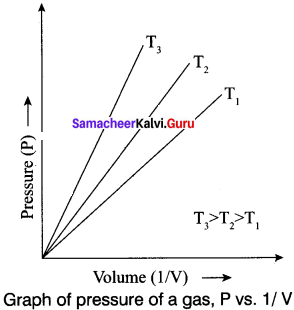
According to Boyle’s law, the shape of the graph between pressure and reciprocal of the volume is ______.
Answer:
Straight line.

III. State whether the following statements are true or false. if false explain why?

Question 1.
For a given heat in liquid, the apparent expansion is more than that of real expansion.
Answer:
False.
Correct Statement: When the liquid is heated in a container, first heat is gained by container which expands and level of liquid goes down, but immediately liquid receives the heat from container so apparent expansion is liquid.
Real expansion = Expansion of container + Apparent expansion

Question 2.
Thermal energy always flows from a system at a higher temperature to a system at a lower temperature.
Answer:
True.

Question 3.
According to Charles’s law, at constant pressure, the temperature is inversely proportional to volume.
Answer:
False.
Correct Statement: According to Charle’s law at constant pressure (P), the volume of gas is directly proportional to absolute temperature.
V ∝ T
(or)
T ∝ V.

IV. Match the items in column-I to the items in column-II

Question 1.

Column-IColumn-II
1. Linear expansion(a) change in volume
2. Superficial expansion(b) hot body to cold body
3. Cubical expansion(c) 1.381 × 10⁻²³ JK-1
4. Heat transformation(d) change in length
5. Boltzmann constant(e) change in an area

Answer:
1. (d) change in length
2. (e) change in the area
3. (a) change in volume
4. (b) hot body to cold body
5. (c) 1.381 × 10⁻²³ JK-1

V. Assertion and Reason Type Questions

(a) Both the assertion and the reason are true and the reason is the correct explanation of the assertion.
(b) Both the assertion and the reason are true but the reason is not the correct explanation of the assertion.
(c) Assertion is true but the reason is false.
(d) Assertion is false but the reason is true.

Question 1.
Assertion: There are no effects on other ends when the end of the rod is only heated.
Reason: Heat always flows from a region of lower temperature to higher temperature of the rod.
Answer:
(c) The assertion is true but the reason is false.
Correct Reason: Heat always flows from a region of higher temperature to lower the temperature of the rod.

Question 2.
Assertion: Gas is highly compressible than solid and liquid
Reason: Interatomic or intermolecular distance in the gas is comparably high.
Answer:
(a) Both the assertion and the reason are true and the reason is the correct explanation of the assertion.

VI. Answer in Briefly

Question 1.
Define one calorie.
Answer:
One calorie is defined as the amount of heat energy required to raise the temperature of 1 gram of water through 1°C.

Question 2.
Distinguish between linear, cubical and superficial expansion.
Answer:

Linear expansionCubical expansionSuperficial expansion
When a body is heated or cooled, the length of the body changes due to change in its temperature.If there is an increase in the volume of a solid body due to heating, it is called as cubical expansion.If there is an increase in the area of a solid object due to heating, then the expansion is called superficial expansion.
The ratio of increase in the length of the body per degree rise in temperature to its unit length.The ratio of increase in the volume of the body per degree rise in temperature to its unit volume is called a coefficient of cubical expansion.The ratio of increase in the area of the body per degree rise in temperature to its unit area is called a coefficient of superficial expansion.

Question 3.
What is co-efficient of cubical expansion?
Answer:
The ratio of increase in volume of the body per degree rise in temperature to its unit volume is called as coefficient of cubical expansion. This is also measured in K-1.

Question 4.
State Boyle’s law.
Answer:
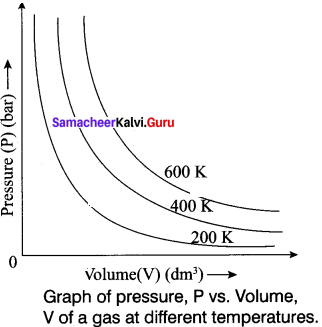
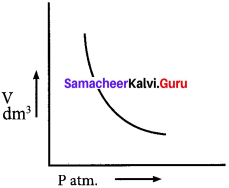
When the temperature of a gas is kept constant, the volume of a fixed mass of gas is inversely proportional to its pressure.
\(\mathrm{P} \propto \frac{1}{\mathrm{V}}\).

Question 5.
State-the law of volume.
Answer:
According to this law, When the pressure of gas is kept constant, the volume of a gas is directly proportional to the temperature of the gas.
V ∝ T
(OR)
\(\frac{V}{T}\) = constant

Question 6.
Distinguish between ideal gas and real gas.
Answer:

Ideal GasReal Gas
If the atoms or molecules of gas do not interact with each other then it is called as an ideal or perfect gas.If the atoms or molecules of a gases interact with each other with a definite amount of intermolecular (or) interatomic force, then it is called as real gas.
At very high temperature (or) low pressure, a real gas behaves as an ideal gas, because there is no interatomic (or) Intermolecular force of attraction.At very high temperature (or) low pressure, the interatomic (or) Intermolecular forces of attraction are weak in an ideal gas.

Question 7.
What is the co – efficient of real expansion?
Answer:
Coefficient of real expansion is defined as the ratio of the true rise in the volume of the liquid per degree rise in temperature to its unit volume.
The SI unit of coefficient of real expansion is K-1.

Question 8.
What is co-efficient of apparent expansion?
Answer:
Coefficient of apparent expansion is defined as the ratio of the apparent rise in the volume of the liquid per degree rise in temperature to its unit volume. The SI unit of coefficient of apparent expansion is K-1.

VII. Numerical Problems

Question 1.
Find the final temperature of a copper rod. Whose area of cross-section changes from 10 m2 to 11 m2 due to heating. The copper rod is initially kept at 90 K. (Coefficient of superficial expansion is 0.0021 K)?
Solution:
Given:
Area of copper rod A0 = A1 = 10 m2
Changes of area cross-section ∆A = A2 – A1 = 11 – 10 = 1 m2
Initial temperature t1 = 90 K
∆T = t2 – t1 = t2 – 90
Coefficient of superficial expansion αA = 0.0021 / K Then t2 = ?
Samacheer Kalvi 10th Science Solutions Chapter 7 Atoms and Molecules 2

Question 2.
Calculate the coefficient of cubical expansion of a zinc bar. Whose volume is increased 0. 25 m3 from 0.3 m3 due to the change in its temperature of 50 K?
Solution:
Given: αv of Zn bar
Volume of zinc bar V0 = V1 = 0.3 m3
Change in volume ∆V = V2 – V1 = 0.25 – 0.30 = 0.05 m3
Change in temperature ∆T = 50K
Coefficient of cubical expansion αv = ?
\(\alpha_{\mathrm{v}}=\frac{\Delta \mathrm{V}}{\mathrm{V}_{\mathrm{o}} \Delta \mathrm{T}}=\frac{0.05}{0.3 \times 50}=\frac{0.05}{15}\)
αv = 0.0033 K-1

VIII. Answer in Detail

Question 1.
Derive the ideal gas equation.
Answer:
The ideal gas equation is an equation, which relates all the properties of an ideal gas. An ideal gas obeys Boyle’s law and Charles’ law and Avogadro’s law.
According to Boyle’s law,
PV = constant ……. (1)
According to Charles’s law,
\(\frac { V }{ T }\) = constant ……. (2)
According to Avogadro’s law,
\(\frac { V }{ n }\) = constant ……. (3)
After combining equations (1), (2) and (3), you can get the following equation.
\(\frac { PV }{ nT }\) = constant ……. (4)
The above relation is called the combined law of gases. If you consider a gas, which contains μ moles of the gas, the number of atoms contained will be equal to p times the Avogadro number, NA
i.e. n = μNA ……. (5)
Using equation (5), equation (4) can be written as
PV/ μNAT = constant
The value of the constant in the above equation is taken to be kB, which is called as Boltzmann constant (1.38 × 10⁻²³ JK-1).
Hence, we have the following equation:
PV / μNAT = kB
PV = μNAkBT
Here, μNAkB = R, which is termed as universal gas constant whose value is 8.31 J mol-1 K-1.
PV = RT ……. (6)
The ideal gas equation is also called an equation of state because it gives the relation between the state variables and it is used to describe the state of any gas.

Question 2.
Explain the experiment of measuring the real and apparent expansion of a liquid with a neat diagram.
Answer:
(i) To start with, the liquid whose real and apparent expansion is to be determined is poured in a container up to a level. Mark this level as L1.
(ii) Now, heat the container and the liquid using a burner as shown in the figure Initially, the container receives the thermal energy and it expands.
(iii) As a result, the volume of the liquid appears to have reduced. Mark this reduced level of liquid as L2.
Samacheer Kalvi 10th Science Solutions Chapter 7 Atoms and Molecules 3
On further heating, the thermal energy supplied to the liquid through the container results in the expansion of the liquid. Hence, the level of liquid rises to L3. Now, the difference between the levels L1 and L3 is called apparent expansion, and the difference between the levels L2 and L3 is called real expansion. The real expansion is always more than that of apparent expansion.
Real expansion = L3 – L2
Apparent expansion = L3 – L1.

IX. HOT Questions

Question 1.
If you keep ice at 0°C and water at 0°C in either of your hands, in which hand you will feel more chillness? Why?
Answer:
The hand having ice at 0°C will feel more chillness than of 0°C water.
Reason: The 0°C ice takes more heat from hand equal to mL, to convert 0°C Ice water, 0°C as compared to 0°C water of same mass. Hence m & L are the mass and latent heat of fusion of water respectively.

Samacheer Kalvi 10th Science Thermal Physics Additional Questions

I. Choose the Correct Answer

Question 1.
At constant temperature, the volume of a given mass of gas is inversely proportional to its pressure is _____.
(a) Charle’s law
(b) Boyle’s law
(c) Avogadro’s law
(d) None of these.
Answer:
(b) Boyle’s law
Hint: At constant temperature, only Boyle’s law is there.

Question 2.
The value of equivalent to 0°C on the absolute scale is:
(a) – 273 K
(b) OK
(c) 273 K
(d) 373 K
Answer:
(c) 273 K

Question 3.
At constant pressure, the volume of a given mass of gas is proportional to _____.
(a) temperature
(b) atmospheric pressure
(c) absolute temperature
(d) none of these.
Answer:
(a) temperature
Hint: Charle’s law gives the relation between V & T at constant pressure.

Question 4.
The value of absolute zero temperature is:
(a) 273° C
(b) 100° C
(c) 0° C
(d) -273° K
Answer:
(d) -273° K

Question 5.
The ratio of change in dimension to the original dimension per degree kelvin change in temperature is _____.
(a) coefficient of linear expansion
(b) coefficient of cubical expansion
(c) coefficient of thermal expansion
(d) coefficient of areal expansion.
Answer:
(c) coefficient of thermal expansion
Hint: Coefficient of linear expansion
\(=\frac{\text { Change in dimension }}{\text { Original dimension } \times \Delta \mathrm{T}}\).

Question 6.
The relation between Fahrenheit and Kelvin scales of temperature is:
(a) K = F × \(\frac{5}{9}\)
(b) K = F – C
(c) K = (F + 460) × \(\frac{9}{5}\)
(d) K = (F + 460) × \(\frac{5}{9}\)
Answer:
(d) K = (F + 460) × \(\frac{5}{9}\)

Question 7.
Increase in area per unit area at 0°C per degree rise in temperature is _____.
(a) coefficient of linear expansion.
(b) coefficient of superficial expansion.
(c) coefficient of cubical expansion.
(d) none of these.
Answer:
(b) coefficient of superficial expansion.
Hint: As the superficial expansion is directly proportional to the original area of sheet and rise in temperature.

Question 8.
Coefficient of linear expansion depends upon _____.
(a) pressure
(b) volume
(c) nature of material
(d) none of these.
Answer:
(c) nature of material
Hint: α of a material depend on nature of material of rod.

Question 9.
If the temperature is the effect then ……… is the cause.
(a) Energy
(b) Work
(c) Heat
(d) Mass
Answer:
(c) Heat

Question 10.
For the measurement heat in the body following one of these is used _____.
(a) thermometer
(b) calorimeter
(c) pressure gauge
(d) multimeter.
Answer:
(b) calorimeter
Hint: Heat of a body can be measured with the help of calorimeter.

Question 11.
Transfer of heat from the hot end to cold end with out-migration of a molecule of solid is called _____.
(a) convection
(b) conduction
(c) Radiation
(d) none of these.
Answer:
(b) conduction
Hint: Heat flows from without migration of particle is conduction.

Question 12.
Amount of heat required to convert 10 g of ice at 0°C, into water at same temperature is:
(a) 3000 J
(b) 336 J
(c) 300 J
(d) 3360 J
Answer:
(b) 336 J

Question 13.
Process of transfer of heat in the form of electromagnetic wave (light) for which material medium not necessary is _____.
(a) conduction
(b) radiation
(c) convection
(d) none of these.
Answer:
(b) radiation
Hint: Heat can flow even in a vacuum (without medium) by radiation of electromagnetic wave.

Question 14.
When ice melts its volume:
(a) Increases
(b) Changes
(c) Decreases
(d) Remains same
Answer:
(c) Decreases

Question 15.
When 1 kg of water at 100°C is mixed with 1 kg of water at 65°C, the temperature of the mixture is:
(a) Less than 100°C
(b) Less 100°C
(c) Equal to 100°C
(d) Less than 100°C but more than 65°C
Answer:
(d) Less than 100°C but more than 65°C

II. Fill in the Blanks

Question 1.
_____ is the amount of heat required to raise the temperature of ____ water through 1 kelvin.
Answer:
one kilocalorie, one kg.

Question 2.
A thermometer is used to measure _____.
Answer:
Temperature.

Question 3.
In _____ scale of temperature no negative value of temperature.
Answer:
Kelvin.

Question 4.
_____ is the substance whose physical property is utilised for measuring temperature.
Answer:
Thermometric substance.

Question 5.
_____ is that temperature attained by two bodies when they are brought in thermal contact with each other are in thermal equilibrium, is attained.
Answer:
Equilibrium Temperature.

Question 6.
The lowest temperature attainable according to Charle’s law is _____.
Answer:
-273°C.

Question 7.
The P.E. of molecules in ideal gas to _____.
Answer:
Zero.

Question 8.
The nature of graph of P versus \(\left(\frac{1}{V}\right)\) for the given mass of gas at constant temperature is _____.
Answer:
Straight line.

Question 9.
As K.E. of the gas increases then the _____ increases.
Answer:
Temperature.

Question 10.
As pressure on a gas increases the P.E. between molecules of gas _____.
Answer:
decreases.

Question 11.
The relation between N (no. of molecules), P, V & T is _____.
Answer:
\(\mathrm{N}=\frac{\mathrm{K}_{\mathrm{B}} \mathrm{T}}{\mathrm{PV}}\).

Question 12.
H2 gas can behave like an ideal gas at ______ pressure and _____ temperature.
Answer:
low, high.

III. True or False. If false correct it.

Question 1.
According to Avogadro’s law, equal volumes of all gases under same pressure have equal numbers of molecules.
Answer:
True.

Question 2.
Boltzmann’s constant k is equal to the product of universal gas constant R and Avogadro number (NA)?
Answer:
False.
Correct Statement: \(\mathrm{K}_{\mathrm{B}}=\frac{\mathrm{R}}{\mathrm{N}_{\mathrm{A}}}\)

Question 3.
Number of molecules N in gas is equal to the product of the number of mole (n) of gas and Avogadro’s number (NA)?
Answer:
True.

Question 4.
A gas which obeys the relation PV = nRT at all temperature and pressure is called real gas.
Answer:
True.

Question 5.
If Q calorie heat is produced by spending mechanical work W then the mechanical equivalent of heat J = W × Q?
Answer:
False.
Correct Statement: \(\mathrm{J}=\frac{\mathrm{W}}{\mathrm{Q}}\).

Question 6.
The S.I. unit of coefficient of thermal expansion is per kelvin.
Answer:
True.

Question 7.
The real expansion of a liquid is equal to the difference between apparent expansion and expansion of the vessel.
Answer:
False.
Correct Statement: Real expansion = Apparent expansion + expansion of vessel.

IV. Match the following

Question 1.

1. Heat(a) Joule
2. Thermometer(b) Heating
3. The SI unit of heat(c) Temperature
4. Cool a cup of coffee, adding cold milk(d) Energy
5. gain by heat by a body(e) thermal equilibrium

Answer:
1. (d) Energy
2. (c) Temperature
3. (a) Joule
4. (e) thermal equilibrium
5. (b) Heating

Question 2.

1. Boyle’s Law(a) \(\mathrm{K}_{\mathrm{B}}=\frac{\mathrm{R}}{n}\)
2. Absolute Scale(b) V ∝ t
3. Charle’s Law(c) \(\mathrm{P} \propto \frac{1}{\mathrm{V}}\)
4. Boltzmann Constant(d) V ∝ n
5. Avogadro’s Law(e) 0 K (zero kelvin)

Answer:
1. (c) \(\mathrm{P} \propto \frac{1}{\mathrm{V}}\)
2. (e) 0 K (zero kelvin)
3. (b) V ∝ t
4. (a) \(\mathrm{K}_{\mathrm{B}}=\frac{\mathrm{R}}{n}\)
5. (d) V ∝ n

V. Assertion and Reasoning Type Questions

Mark the correct choice as
(a) Both the assertion and the reason are true and the reason is the correct explanation of assertion.
(b) Both the assertion and the reason are true but the reason is not the correct explanation of the assertion.
(c) Assertion is true but the reason is false.
(d) Assertion is false but the reason is true.

Question 1.
Assertion: Good conductors of heat are also a good conductor of electricity and vice-versa
Reason: Mainly electrons are responsible for there conduction.
Answer:
(a) Both assertion and reason are true and reason is the correct explanation of assertion.

Question 2.
Assertion: Air at some distance above the fire is hotter than the same distance sidewise.
Reason: Air surrounding the fire carries heat upward due to conventional current.
Answer:
(b) Both assertion and reason are true but reason is not the correct explanation of assertion.
Explanation: Quantity of heat by hot air due to hot conventional current upward is larger by heat side wise due to radiation.

Question 3.
Assertion: As the temperature of a gas increases the K.E of molecules increases, but P.E. decreases.
Reason: Due to the law of conservation of energy.
Answer:
(a) Both assertion and reason are true and reason is the correct explanation of assertion.

Question 4.
Assertion: Real expansion in liquids is always larger than apparent expansion.
Reason: Vessel of liquid expands 1st then the expansion of liquid in the vessel.
Answer:
(a) Both assertion and reason are true and reason is the correct explanation of assertion.

Question 5.
Assertion: There are no effects on other ends when one end of the rod is only heated.
Reason: Heat always flows from a region of higher temperature to lower the temperature of the rod.
Answer:
(d) An assertion is false but the reason is true.
Explanation: There are small effects forms on another end when one end of the rod is only heated.

VI. Short Answers.

Question 1.
What do you mean by triple point of water? Why it is unique?
Answer:
It is the temperature at which the three phases of water and gas of water are equally stable.

Question 2.
State the commonly used units of Temperature.
Answer:
The commonly used units of temperature are Kelvin, degree Celsius (°C) and degree Fahrenheit (°F).

Question 3.
Can the temperature of a body be negative on the kelvin scale?
Answer:
The temperature of a body can never be negative on kelvin. Because the lowest temperature on the Kelvin scale is 0 kelvin.

Question 4.
Do all solids expand on heating? If not give an example.
Answer:
All solid bodies do not expand on heating, semiconductor and camphor contracts on heating.

Question 5.
When are two physical bodies said to be in thermal equilibrium?
Answer:
Two or more physical systems or bodies are said to be in thermal equilibrium if there is no net flow of thermal energy between the systems.

Question 6.
Why does the solid expand on heating?
Answer:
When heat energy is supplied to a substance the E of molecule or atoms increases so the average distance between then increases. So the volume of matter (solid, liquid, gas) increases.

Question 7.
Why does a small gap is left between the iron rails on a railway track?
Answer:
Either due to temperature variation in summer and winter or due to frictional force between the wheel of train and rail, when the temperature increases the length of rail will increase and may bend in summer and the train may get derailed.

Question 8.
What is meant by Thermal energy?
Answer:
Thermal energy is a form of energy which is transferred between any two bodies due to the difference in their temperatures. Thermal energy is also known as ‘heat energy’ or simply ‘heat’.

Question 9.
Cooking gas containers are kept in lorry moving with uniform speed what will be the effect on the temperature of gas molecules?
Answer:
If the lorry is moving with uniform speed the speed of cooking gas molecules will also be uniform and the collisions will be least or loss of K.E will be least in turn increase in temperature will be less. If the lorry is not moving with uniform the cylinders and molecules collide more and more and their temperature may increase and can cause the fire in gas.

Question 10.
Define one Kilocalorie.
Answer:
One kilocalorie is defined as the amount of heat energy required to rise the temperature of 1 kilogram of water through 1°C.

Question 11.
At what temperature does all molecular motion cease? Explain.
Answer:
If molecular motion ceases then KE become zero and absolute scale of temperature is directly proportional to KE
T ∝ KE
µ KE = 0, T = 0 K
So at 0 – kelvin temperature motion of all molecules ceases.

Question 12.
Mention different types of expansion.
Answer:

  1. Linear expansion
  2. Superficial expansion
  3. Cubical expansion

Question 13.
Differentiate between conduction, convection and radiation.
Answer:

ConductionConvectionRadiation
Material medium is required.Material medium is required.Material medium is required.
It is due to the temperature difference.It is due to density difference.It occurs from all bodies above 0 K.
Heat flows from higher to lower temperature.Heat flows from lower to higher density.Heat flows from higher to lower temperature.
It heats up the medium.It also heats up the medium.It does not heat up the medium.
It is a slow process.It is also a slow process.It propagates with speed of light.
It does not obey the laws of refraction and reflection.It also does not obey the laws of refraction and reflection.It obeys the law of refraction and reflection.

Question 14.
Define co-efficient of linear expansion. State its unit.
Answer:
The ratio of increase in length of the body per degree rise in temperature to its unit length is called as the coefficient of linear expansion. The SI unit of Coefficient of Linear expansion is K-1.

VII. Numerical Problems

Question 1.
At what temperature the value of Celcius and Fahrenheit scale coincide.
Solution:
Samacheer Kalvi 10th Science Solutions Chapter 7 Atoms and Molecules 4
Samacheer Kalvi 10th Science Solutions Chapter 7 Atoms and Molecules 5

Question 2.
A constant volume thermometer using the gas reads a pressure of 1.75 × 10⁴ Pa at normal freezing of water and reads 2.39 × 10⁴ pa at normal boiling point of water. Obtained from the observation the temperature of absolute zero on the Celcius scale.
Solution:
Let temperature on Kelvin scale of the freezing point of water = T1K = 2.39 × 10⁴ Pa
Let temperature on Kelvin scale of a boiling point of water = T2K = 1.75 × 10⁴ Pa
As volume is constant so by universal gas law.
PV = nRT as volume and mass of gas in thermometer constant,
so
Samacheer Kalvi 10th Science Solutions Chapter 7 Atoms and Molecules 6
Samacheer Kalvi 10th Science Solutions Chapter 7 Atoms and Molecules 7

Question 3.
Convert 323 K to °C.
Answer:
T = 323 K
T°C = 323 – 273
= 50°C
∴ 323 K = 50°C

Question 4.
If the volume of a block of metal changes by 12% when it is heated by 30°C. What is the coefficient of linear expansion, superficial expansion?
Solution:
Samacheer Kalvi 10th Science Solutions Chapter 7 Atoms and Molecules 8

Question 5.
If the volume of a metallic block increases by 0.12% when it is heated through 20°C, what is the coefficient of cubical expansion.
Answer:
\(\frac{ΔV}{V}\) = 0.12% = \(\frac{0.12}{100}\)
Change in temperature ΔT = 20°C
Coefficient of cubical expansion
αV = \(\frac{ΔV}{VΔT}\)
= \(\frac{0.12}{100×20}\)
αV = 6 × 10⁻⁶/°C

VIII. Answer in Detail.

Question 1.
What are the characteristic feature of transfer of heat energy?
Answer:

  1. Heat always flows from a system at higher temperature to a system at lower temperature.
  2. The mass of a system is not altered when it is heated or cooled.
  3. For any exchange of heat, the heat gained by the cold system is equal to heat lost by the hot system. Heat gained = Heat lost

Question 2.
In the upper atmosphere, the kinetic temperature of the air is of the order of 1000 K even then one feels severe cold in these places. Why?
Answer:
As we go at higher altitude the density of air decreases. So distances between molecules increases due to less number of collisions between them. Due to above reason speed of air molecules, the kinetic temperature is of order 1000 K but due to higher altitude, the temperature decreases as the radiation from earth takes longer distance.

IX. Conceptional or Hot Questions.

Question 1.
The earth without its atmosphere would be inhospitably cold why?
Answer:
The earth without its atmosphere would be inhospitably cold.

Question 2.
Why does the pendulum clock run slow in summer and fast in winter?
Answer:
As we know that time period of pendulum clock \(\mathrm{T}=2 \pi \sqrt{\frac{\mathrm{L}}{\mathrm{g}}}\) at a place g and 2π are constant. so \(\mathrm{T} \alpha \sqrt{\mathrm{L}}\)
The length of pendulum in summer increases so the time period of a pendulum is increased. So pendulum takes more time to complete one oscillation and the clock becomes slow in summer. Vice – versa in winter it becomes fast as a time period of a pendulum is decreased due to a decrease in length of a pendulum.

Question 3.
Can you boil water in a paper cup? Explain.
Answer:
Yes, we can boil water in the paper cup due to the following reason.

  • Most type of paper bums at about 230°C.
  • Water can pass at the bottom through pores of the paper.
  • Hot water rises up due to hot conventional current and replaces the cold water.
  • Water boils at 100°C.

The heat of bums warms the water which rises up in a cup, by replacing cold water so heat does not heat up the paper. So water boils in a cup of paper.

Question 4.
The surroundings above a fire is hotter than the surroundings below the fire. Why?
Answer:
Air surrounding the fire carries heat upwards.

Question 5.
Why do the ventilators provide near the ceiling of the classroom?
Answer:
The density of hot air is smaller than cold air, so it rises up near the ceiling where it passes out. through ventilators and the cold air from the window, orders fill up the place.
Like this cold and fresh air remain near the floor and hot air passes out from ventilators.

Believing that the Tamilnadu State Board Solutions for Class 10th Science Chapter 3 Thermal Physics Questions and Answers learning resource will definitely guide you at the time of preparation. For more details about Tamilnadu State Board Class 10th Science Chapter 3 textbook solutions, ask us in the below comments and we’ll revert back to you asap.

Samacheer Kalvi 9th Social Science Economics Solutions Chapter 1 Understanding Development: Perspectives, Measurement and Sustainability

You can Download Samacheer Kalvi 9th Social Science Book Solutions Guide Pdf, Tamilnadu State Board help you to revise the complete Syllabus and score more marks in your examinations.

Tamilnadu Samacheer Kalvi 9th Social Science Economics Solutions Chapter 1 Understanding Development: Perspectives, Measurement and Sustainability

Understanding Development: Perspectives, Measurement and Sustainability Textual Exercise

I. Choose the correct answer.

9th Economics Samacheer Book Question 1.
Assertion (A): Development increases the quality of life.
Reason (R): People will have higher incomes, better education, better health and nutrition, less poverty. .
(a) Both (A) and (R) are true and (R) explains (A)
(b) Both (A) and (R) are true and (R) does not explain (A)
(c) (A) is correct and (R) is false
(d) (A) is false and (R) is true
Answer:
(a) Both (A) and (R) are true and (R) explains (A)

Expand The Following Ppp And Hdi Question 2.
The term‘Human resources’ refers to ……
(a) investment on poor people
(b) expenditure on agriculture
(c) investment on assests
(d) collective abilities of people
Answer:
(d) collective abilities of people

Expand The Following Nnp And Pci Question 3.
For comparing development between countries, their …… is considered to be one of the
most important attributes.
(a) growth
(b) income
(c) expenditure
(d) savings
Answer:
(b) income

Expand The Following Hdi Question 4.
……. is considered a true measure of national income.
(a) GNP
(b) GDP
(c) NNP
(d) NDP
Answer:
(c) NNP

Expand The Following Nnp Question 5.
The …… income is also called per capita income.
(a) average
(b) total
(c) people
(d) monthly
Answer:
(a) average

Expand Nnp And Pci Question 6.
Which one of the following country is not a G-8 country?
(a) Japan
(b) Canada
(c) Russia
(d) India
Answer:
(d) India

Class 9 Economics Chapter 1 Let’s Discuss Answers Question 7.
Which one of the following country is not a member of SAARC?
(a) India
(b) Pakistan
(c) China
(d) Bhutan
Answer:
(c) China

Class 9th Sst Economics Chapter 1 Question 8.
Assertion (A) : The Net Product (NNP) is considered as a true measure of national output.
Reason (R): It is also known as national income.
(a) Both (A) and (R) are true and (R) explains (A)
(b) Both (A) and (R) are true and (R) does not explain (A)
(c) (A) is correct and (R) is false
(d) (A) is false and (R) is true
Answer:
(a) Both (A) and (R) are true and (R) explains (A)

Sustainability Meaning In Tamil Question 9.
Assertion (A): Human resource is necessary for the progress of any country.
Reason (R): Investment in education and health of people can result in a high rate of returns in the future for a country.
(a) Both (A) and (R) are true and (R) explains (A)
(b) Both (A) and (R) are true and (R) does not explain (A)
(c) (A) is correct and (R) is false
(d) (A) is false and (R) is true
Answer:
(a) Both (A) and (R) are true and (R) explains (A)

Question 10.
The Human Development Index (HDI) does not take into account the following dimension in its calculation.
(a) Gender
(b) Health
(c) Education
(d) Income
Answer:
(a) Gender

Question 11.
Among the following states which state have the literacy rate (2011) higher than national average?
(a) Andhra Pradesh
(b) Uttar Pradesh
(c) Tamil Nadu
(d) None of these
Answer:
(c) Tamil Nadu

Question 12.
Sex-ratio means …..
(a) the ratio between adult-male and adult female in a population
(b) the ratio between female and male in a population
(c) the relationship between male of female
(d) the number of females per thousand males
Answer:
(b) the ratio between female and male in a population

Question 13.
Inter-generational equality is ensured under the process of
(a) Industrial progress
(b) Economic development
(c) Sustainable development
(d) Economic growth
Answer:
(b) Economic development

Question 14.
Find the odd one.
(a) Solar energy
(b) Wind energy
(c) Paper
(d) Natural gas
Answer:
(c) Paper

Question 15.
……….. is the state with highest installed solar capacity in India.
(a) Tamil Nadu
(b) West Bengal
(c) Kerala
(d) Andhra Pradesh
Answer:
(a) Tamil Nadu

Question 16.
……. resources are those which will get exhausted after years of use.
(a) Natural
(b) Renewable
(c) Non-Renewable
(d) New
Answer:
(c) Non-Renewable

Question 17.
Thermal plant emits large quantity of ……, which pollutes the environment.
(a) Oxygen
(b) Nitrogen
(c) Carbon
(d) Carbon dioxide
Answer:
(d) Carbon dioxide

II. Fill in the blanks

1. Economic progress of any country is known as ………
2. The head quarters of HRD Ministry is in ……..
3. The state having the highest literacy rate in India is ……….
4. Human Development Report of the world prepared and released by …….
5. Groundwater is an example of ……. resource.
6. The book An Uncertain Glory was written by ……..
Answers:
1. economic development
2. New Delhi
3. Kerala
4. UNDP
5. renewable
6. Prof. Amartya Sen

III. Match the following

9th Economics Samacheer Book Social Science Economics Solutions Chapter 1 Understanding Development: Perspectives, Measurement And Sustainability
Answers:
1. (d)
2. (c)
3. (b)
4. (a)

IV. Give Short answers

Question 1.
What do you mean by development?
Answer:

  1. The word ‘development’ refers to the progress of a particular field (or) a particular person.
  2. Similarly the economic progress of a country is known as ‘economic development’.
  3. However, the interpretation of the concept development keeps On changing from time to time, from person to person.

Question 2.
What are the indicators of development?
Answer:
The major indicators to measure the level of economic development are Net National Product (NNP), Per Capita Income (PCI), Purchasing Power Parity (PPP) and Human Development
Index (HDI).

Question 3.
Why NNP is not considered as an useful measure to compare a country’s development with other countries?
Answer:

  1. For measuring a country’s development, its income is considered to be one of the most
    important factors.
  2. NNP is considered as a true measure of National output.
    So NNP is not considered as an useful measure to compare a country’s development with
    other countries.

Question 4.
Why human resources is considered as the foremost resource of any country?
Answer:

  1. Human Resource is necessary for the progress of any country.
  2. The ‘Human Resources’ refers to the collective abilities of people, which can be utilised in the production sector.

So human resource is considered as the foremost resource of any country.

Question 5.
Expand the following:
1. PPP
2. HDI
Answer:
1. PPI – Purchasing Power Parity
2. HD – Human Development Index.

Question 6.
Expand the following:
1. NNP
2. PCI.
Answer:
1. NNP – Net National Product
2. PCI – Per Capita Income

Question 7.
What is‘Solar Power’?
Answer:
Solar power is the conversion of energy from sunlight into electricity either directly using photovoltaic cells (or) indirectly using concentrated solar power.

V. Answer in detail.

Question 1.
Discuss the policies for sustainable development.
Answer:

  1. India depends on thermal and hydro power plants to meet its power needs. Both these sources have an adverse environmental impact.
  2. Thermal power plants emit large quantities of carbon dioxide, which pollute the
    environment.
  3. Solar power is the conversion of energy from sunlight into electricity either directly
    using photovoltaic cells or indirectly using concentrated solar power.
  4. Solar panels absorb the sunlight as a source of energy to generate electricity. A solar electric system can reliably produce electricity for our home and offices.
  5. These distributed solar systems are often installed by home and business owners to reduce their electricity costs. Solar power in India is a fast-developing industry.
  6. Tamil Nadu is the state with highest installed solar capacity in India.
  7. Tamil Nadu is one of the leading solar power producing states in India. As on 31 July 2017, the total installed capacity in Tamil Nadu is 1,697 MW.

Question 2.
Describe in detail about environmental policies in India.
Answer:

  1. Environmental policies in India have been evolved considerably over the past three decades.
  2. These policies have covered a wide range of issues such as air, water pollution, waste management and biodiversity conservation.
  3. India faces challenges in economic development, which has to be achieved with limited resources, minimum externalities and in the presence of an uncertain climate.
  4. One of the approaches to overcome this challenge is through the path of sustainable development.
  5. The Supreme Court of India has interpreted and introduced new changes in environmental protection through a series of directions and judgements.

Question 3.
Differentiate between renewable and non-renewable resources.
Answer:
Expand The Following Ppp And Hdi Samacheer Kalvi 9th Social Science Economics Solutions Chapter 1 Understanding Development: Perspectives, Measurement And Sustainability

Question 4.
Mention any five environmental acts and their action.
Answer:
Expand The Following Nnp And Pci Samacheer Kalvi 9th Social Science Economics Solutions Chapter 1 Understanding Development: Perspectives, Measurement And Sustainability

VI. Projects and Activities.

List the various ways in which the problems of garbage and emissions are being dealt with around the world.
Plastic bags, broken glass, obsolete cell phone (or) used battery cells, they are all used products that require appropriate disposal to limit their harm to the environment.
The various ways in which the problem of garbage and emissions are being dealt:

  1. Collection
  2. transportation
  3. dumping
  4. recycling (or) sewage treatment.

Various waste disposal problems:

  1. Production of too much waste.
  2. Most of the waste is toxic.
  3. Landfills are a problem as well.
  4. Regulations are based on vested interests.
  5. Reliance of dying technologies to reduce and recycle waste.
  6. Some of the technologies marked as ‘green’ are not true in actual sense.

You can do this project with the help of your teacher.

VII. HOTS
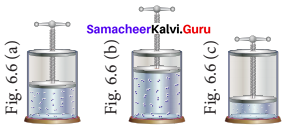
Write in detail what kind of environmental problems you face in your locality.
Location: Velachery – Chennai.
Problem: “Despite being one of the fastest growing localities with several up market malls and hotels living in Velachery still face basic problems such as
(a) Overflowing sewage
(b) Poor drainage
(c) The under ground water-breeding grounds for mosquitoes.
(d) There is always fear of contamination of drinking water.
(e) Everytime it pours in the city, most of Velachery drowns.
The above mentioned problems are the dominant ones in Velachery.

VIII. Life Skill.

Question 1.
How is the Per Capita income calculated?
Answer:
The average income is calculated by dividing the country’s total income by its total population. The average income is also called per capita income. Calculations on the per capita income of all countries are calculated only in the US dollar in order to compare International level.
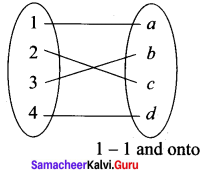
Understanding Development: Perspectives, Measurement and Sustainability Additional Questions

I. Choose the correct answer.

Question 1.
Assertion (A): The term ‘economic development’ refers to the overall growth of all sectors of
the economy.
Reason (R): By adoption of new technologies.
(a) Both (A) and (R) are true and (R) explains (A)
(b) Both (A) and (R) are true and (R) does not explain (A)
(c) (A) is correct and (R) is false
(d) (A) is false and (R) is true
Answer:
(a) Both (A) and (R) are true and (R) explains (A)

Question 2.
This is also known as National Income.
(a) NNP
(b) GDP
(c) PCI
(d) PPP
Answer:
(a) NNP

Question 3.
This is not a G8 country.
(a) Russia
(b) Canada
(c) France
(d) Nepal
Answer:
(d) Nepal

Question 4.
This is one among the ‘BRICS’ countries.
(a) China
(b) Afghanistan
(c) Nepal
(d) Pakistan
Answer:
(a) China

Question 5.
The enrolment for higher education in the highest in ……… in India.
(a) Kerala
(b) Tamil Nadu
(e) West Bengal
(d) Maharashtra
Answer:
(b) Tamil Nadu

Question 6.
This is a renewable resource.
(a) Metals
(b) Glass
(c) Wind energy
(d) Diesel
Answer:
(c) Wind energy

II. Fill in the blanks.

1. Every, human being has an ……… of his (or) her own to achieve progress in life.
2. Countries with higher income are considered to be ………
3. ………. became the third largest economy in terms of PPP.
4. ………. can be divided into renewable resources and non-renewable resources.
5. ……. absorb the sunlight as a source of energy to generate electricity.
Answers:
1. Ambition
2. More developed
3. India
4. Natural resources
5. Solar panels

III. Match the following
Expand The Following Hdi Samacheer Kalvi 9th Social Science Economics Solutions Chapter 1 Understanding Development: Perspectives, Measurement And Sustainability
1. (d)
2. (a)
3. (b)
4. (c)

IV. Give short answers.

Question 1.
What leads to development?
Answer:
If our thinking turns towards progress and about the ways to achieve the many goals for progress, it leads to development.

Question 2.
For comparing the development of various countries, total income is not an useful measure. How?
Answer:
Since the countries have different populations comparing total income will not be suggestive of what an average person is likely to earn. So, for comparing the development of various countries total income is not an useful measure.

Question 3.
Define Purchasing Power Parity.
Answer:
Purchasing Power Parity is defined as the number of units of a country’s currency required to buy the same amount of goods and services in the domestic market as one dollar would buy in the U.S.

Question 4.
What do you mean by Human Resource Development?
Answer:
Human Resource Development means the development of a person’s physical and mental abilities through education, health care and training.

Question 5.
Why do we say that investment in education and health of people can result in a high rate
of returns?
Answer:
If a child is invested with good education and health, he or she may turn to be very productive in future in the form of higher earnings and greater contribution to the society. Therefore that, investment in education and health of people can result in a high rate of returns

Question 6.
What is the end result of Development?
Answer:

  1. Development increases the quality of life.
  2. People will have higher incomes, better education, better health and nutrition, less poverty and more equality of opportunity.

V. Answer in detail.

Question 1.
Describe sustainability of Development.
Answer:
Sustainable economic development is taken to mean development without damaging the environment and not compromising with the needs of the future generation.

The consequences of environmental degradation do not respect national or state boundaries. Sustainability of development is comparatively a new area of knowledge in which scientists, economists, philosophers and other social scientists are working together.

Natural resources can be divided into renewable resources and non-renewable resources.
Groundwater is an example of a renewable resource. The question arises as to how sustainable development is possible if the resources are over-used rather than getting replenished. Non-renewable resources get exhausted after certain number of years of extracting and using them and they cannot be replenished.

To achieve real sustainability, we need to balance economic, social and environmental sustainability in equal harmony.

In general, the question of development or progress is continuous. At all times, as a member of society and as individuals, we need to ask where we want to go, what we wish to become and what our goals are.

Samacheer Kalvi 8th Tamil Solutions Chapter 4.5 வேற்றுமை

Tamilnadu State Board New Syllabus Samacheer Kalvi 8th Tamil Book Solutions Guide Pdf Chapter 4.5 வேற்றுமை Text Book Back Questions and Answers, Summary, Notes.

Tamilnadu Samacheer Kalvi 8th Tamil Solutions Chapter 4.5 வேற்றுமை

கற்பவை கற்றபின்

Question 1.
பாடப்பகுதியில் இடம்பெற்றுள்ள ஒரு பத்தியைத் தேர்ந்தெடுத்து, அதிலுள்ள வேற்றுமை உருபுகள் எடுத்து எழுதி வகைப்படுத்துக.
Answer:
இன்றைய கல்வி குறிப்பிட்ட பாடங்களை நெட்டுருச் செய்து தேர்வில் தேதி பட்டம் பெற்று ஒரு தொழிலில் நுழைவதற்குக் கல்வி ஒரு கருவியாகக் கொள்ளப்பட்டு வருகிறது. நாளடைவில் கல்விக்கும் வாழ்விற்கும் தொடர்பு இல்லாமல் போகிறது.

  • பாடங்களை – ஐ – இரண்டாம் வேற்றுமை உருபு
  • தேர்வில் – இல் – ஏழாம் வேற்றுமை உருபு
  • தொழிலில் – இல் – ஏழாம் வேற்றுமை உருபு
  • நுழைவதற்கு கு – நான்காம வேற்றுமை உருபு

பாடநூல் வினாக்கள்

சரியான விடையைத் தேர்ந்தெடுத்து எழுதுக.

Question 1.
பெயர்ச்சொல்லின் பொருளை வேறுபடுத்துவது ………………… ஆகும்
அ) எழுவாய்
ஆ) செயப்படுபொருள்
இ) பயனிலை
ஈ) வேற்றுமை
Answer:
ஈ) வேற்றுமை

Question 2.
எட்டாம் வேற்றுமை ……………………. வேற்றுமை என்று அழைக்கப்படுகிறது.
அ) எழுவாய்
ஆ) செயப்படுபொருள்
இ) விளி
ஈ) பயனிலை
Answer:
இ) விளி

Question 3.
உடனிகழ்ச்சிப் பொருளில் ………………………….. வேற்றுமை வரும்.
அ) மூன்றாம்
ஆ) நான்காம்
இ) ஐந்தாம்
ஈ) ஆறாம்
Answer:
அ) மூன்றாம்

Question 4.
‘அறத்தான் வருவதே இன்பம்’ – இத்தொடரில் …………………….. வேற்றுமை பயின்று வந்துள்ளது.
அ) இரண்டாம்
ஆ) மூன்றாம்
இ) ஆறாம்
ஈ) ஏழாம்
Answer:
ஆ) மூன்றாம்

Question 5.
‘மலர் பானையை வனைந்தாள்’ – இத்தொடர் …………………….. பொருளைக் குறிக்கிறது.
அ) ஆக்கல்
ஆ) அழித்தல்
இ) கொடை
ஈ) அடைதல்
Answer:
அ) ஆக்கல்

பொருத்துக

1. மூன்றாம் வேற்றுமை – அ) இராமனுக்குத் தம்பி இலக்குவன்
2. நான்காம் வேற்றுமை – ஆ) பாரியினது தேர்
3. ஐந்தாம் வேற்றுமை – இ) மண்ணால் குதிரை செய்தான்
4. ஆறாம் வேற்றுமை – ஈ) ஏவுதல் கலையில் சிறந்தவன் ஏகலைவன்
Answer:
1. இ
2. அ
3. ஈ
4. ஆ

சிறுவினா

Question 1.
எழுவாய் வேற்றுமையை விளக்குக.
Answer:

  • எழுவாயுடன் வேற்றுமை உருபுகள் எதுவும் இணையாமல், எழுவாய் தனித்து நின்று, இயல்பான பொருளைத் தருவது எழுவாய் வேற்றுமை என்பர்.
  • இதனை முதல் வேற்றுமை’ என்றும் கூறுவர்.
  • எடுத்துக்காட்டு: பாவை வந்தாள்.

Question 2.
நான்காம் வேற்றுமை உணர்த்தும் பொருள்கள் யாவை?
Answer:
கொடை, பகை, நட்பு, தகுதி, அதுவாதல், பொருட்டு, முறை, எல்லை.

Question 3.
உடனிகழ்ச்சிப் பொருளில் என்றால் என்ன?
Answer:

  • வினை கொண்டு முடிகிற பொருளைத் தன்னிடத்தும் உடன் நிகழ்கிறதாக உடையது உடனிகழ்ச்சி ஆகும்.
  • ஒடு, ஓடு ஆகிய மூன்றாம் வேற்றுமை உருபுகள் உடனிகழ்ச்சிப் பொருளில் வரும்.

எடுத்துக்காட்டு :

  • தாயோடு குழந்தை சென்றது.
  • அமைச்சரோடு அலுவலர்கள் சென்றனர்.

மொழியை ஆள்வோம்

கேட்க

Question 1.
கல்வியின் சிறப்புகளை விளக்கும் கதைகளைக் கேட்டு மகிழ்க.
Answer:
ஒரு ஊரில் வயதான பெரியவர் ஒருவர் இருந்தார். அவருக்கு இரண்டு மகன்கள். மூத்த மகன் படிப்பதே கிடையாது. அந்தப் பெரியவர் எவ்வளவு சொல்லியும் இளமைப்பருவத்தில் அவன் கேட்கவில்லை.

ஆனால் இளைய மகனோ, தந்தையின் சொல்லை மீறாமல் நன்கு படித்தான். தந்தையின் விருப்பப்படி விவசாயத்தைச் செய்தான். ஆனால் பெரிய மகனோ படிக்காமல், வேலைக்கும் செல்லாமல் ஊதாரித்தனமாக சுற்றிக் கொண்டிருப்பான்.

முதியவர் இறக்கும் போது ஒரு உயிலை எழுதி வைத்துச் சென்றார். வீட்டைச் சுற்றி உள்ள காலி இடத்தில் புதையல் இருக்கிறது என அதில் எழுதப்பட்டிருந்தது. அந்த முதியவர் இறந்தவுடன் காலியிடத்தை ஆளுக்குப் பாதியாகப் பிரித்துக் கொண்டனர்.

மூத்த மகன் தனக்குரிய பகுதியைத் தோண்டிப் பார்த்துவிட்டு புதையல் எதுவும் இல்லாததால், தன் தந்தை தன்னை ஏமாற்றி விட்டதாக சொல்லி குழிகளை மூடி விடுகிறான். ஆனால் இளையவனோ தோண்டிப் பார்த்துவிட்டு, அதனை மூட மனமில்லாமல் தென்னம் பிள்ளைகளை நட்டான்.

மூத்தவன் கல்வியறிவு இல்லாததால் சொத்தினை விற்று, பரம ஏழையாகப் போனான். இளையவனுக்கு, தென்னம் பிள்ளைகள் வளர்ந்து, பணத்தை அள்ளிக் கொடுத்தது.

கீழ்க்காணும் தலைப்பில் இரண்டு நிமிடம் பேசுக.

கல்வியே அழியாச் செல்வம்

தாயே! தமிழே! வணக்கம்.

தாய் பிள்ளை உறவு அம்மா உனக்கும் எனக்கும். பெருமைமிகு சபைக்கு முதற்கண் வணக்கம்.

கல்வியே அழியாச் செல்வம் என்னும் தலைப்பில் சில நிமிடங்கள் உங்கள் முன் பேசுகின்றேன். “தொட்டணைத் தூறும் மணற்கேணி மாந்தர்க்குக் கற்றனைத் தூறும் அறிவு” என்பார் திருவள்ளுவர். ஆம்! படிக்கப் படிக்கத்தான் நம் அறிவும் V பெருகும். அதுதான் அழியாத செல்வம். செல்வம் சேகரித்து வைத்திருந்தால் அது ஒருநாள் திருடு போகலாம். பொருட்கள் வாங்கி வைத்தால், அது ஒருநாள் வெள்ளத்தில் அடித்துச் செல்லலாம் அல்லது தீக்கு ஆளாகலாம். ஆனால் கல்விச் செல்வத்தைத் திருட முடியாது. எரிக்க முடியாது. வெள்ளத்தால் அடித்துச் செல்ல முடியாது.

மற்றவர் மனதில் அழியாமல் அது நிற்கும். அதனால் தான் அழியாத செல்வம் கல்விச் செல்வம் என்கின்றனர். எனவே அழியாத கல்விச் செல்வத்தை நாம் அனைவரும் கற்போம்.

நன்றி! வணக்கம்.

சொல்லக்கேட்டு எழுதுக.

தமிழ் மொழிக்கு வளம் சேர்த்த ஒரு நூல்; தமிழுக்கு வாழ்வியல் உண்மைகளை உணர்த்தும் ஒரு நூல்; தன் தோற்றத்தால் தமிழ்நாட்டுக்கு உலகப் பெரும் புகழைப் பெற்றுத் தந்த சிறந்த நூல் திருவள்ளுவரின் திருக்குறள். திருக்குறள் பற்றிப் பேசாத புலவர் இலர்; எழுதாத அறிஞர், எழுத்தாளர் இலர்.

பள்ளிப் பருவத்திலும் திருக்குறள் படிக்கப்படுகின்றது. பருவம் வளரவளர அதுவும் நுட்பமாகக் கற்கப்படுகின்றது. திருக்குறளுக்குரிய சிறப்பே அதுதான். அஃது எல்லாப் பருவத்தாருக்கும் வேண்டிய விழுமிய நூல். எனவே திருக்குறளில்லாத வீடும் இருக்கக் கூடாது! திருக்குறள் படிக்காத தமிழரும் இருக்கக் கூடாது!

கீழ்க்காண்பவற்றுள் ஒரு சொல்லை எடுத்து ஒன்றுக்கு மேற்பட்ட சொற்களுடன் இணைத்துப் புதிய சொற்களை உருவாக்குக.

மா – மாவிலை, மாமரம், மாங்காய்
தேன் – மலர்த்தேன், தேன்சிட்டு, தேன்கூடு
மலர் – தேன்மலர்
செம்மை – சேயிலை, செங்குருவி, செந்தேன்

சிட்டு – சிட்டுக்குருவி, தேன்சிட்டு
கனி – மாங்கனி, கனிமரம், தேன்கனி
குருவி – சிட்டுக்குருவி, குருவிக்கூடு
இலை – மாவிலை
காய் – மாங்காய், காய்கனி
கூடு – தேன்கூடு, குருவிக்கூடு
முட்டை – குருவிமுட்டை
மரம் – மாமரம், செம்மரம்

பின்வரும் தொடர்களில் உரிய இடங்களில் நிறுத்தக்குறிகளை இடுக.

1. பூக்கள் நிறைந்த இடம் சோலை ஆகும்.
2. திருக்குறள் அறம், பொருள், இன்பம் என்னும் முப்பால் பகுப்பு கொண்டது.
3. தமிழ்மொழி செம்மையானது, வலிமையானது, இளமையானது.
4. கபிலன், தன் தந்தையிடம் இன்று மாலை விளையாடப் போகட்டுமா? என்று கேட்டான்.
5. திரு. வி.. எழுதிய பெண்ணின் பெருமை என்னும் நூல் புகழ்பெற்றது.

பின்வரும் பத்தியில் உரிய இடங்களில் நிறுத்தக்குறிகளை இடுக.

நூல் பல கல் என்பர் பெரியோர். அறிவை வளர்க்கும் நூல்கள் அனைத்தையும் நம்மால் விலை கொடுத்து வாங்க முடியுமா? முடியாது. நூலகங்கள் இக்குறையை நீக்க உதவுகின்றன. பல்வேறு துறைகளைச் சேர்ந்த அனைத்து நூல்களும் நிறைந்த இடம் நூலகமாகும். நூலகத்தின் வகைகளாவன மைய நூலகம், மாவட்ட நூலகம், கிளை நூலகம், ஊர்ப்புற நூலகம். எனக்கு பிடித்த நூல்களுடன் வாழ்நாள் முழுவதும் சிறையில் அடைத்தாலும் மகிழ்ச்சியடைவேன் என்றார் நேரு. ஆகவே, நூலகத்தின் பயன் அறிவோம்! அறிவு வளம் பெறுவோம்!

கீழ்க்காணும் விளம்பரத்தைப் படித்து வினாக்களுக்கு விடை எழுதுக.

Samacheer Kalvi 8th Tamil Solutions Chapter 4.5 வேற்றுமை 1

Question 1.
எந்த நாளை முன்னிட்டுப் புத்தகக் கண்காட்சி நடத்தப்படுகிறது?
Answer:
உலகப் புத்தக நாள்.

Question 2.
புத்தகக் கண்காட்சி எங்கு நடைபெறுகிறது?
Answer:
இராயப்பேட்டை ஒய்.எம்.சி.ஏ மைதானம்.

Question 3.
புத்தகக் கண்காட்சி எத்தனை நாள்கள் நடைபெறுகிறது?
Answer:
11 நாட்கள். (ஏப்ரல் 13 முதல் ஏப்ரல் 23 வரை)

Question 4.
புத்தகக் கண்காட்சிக்கான நுழைவுக் கட்டணம் எவ்வளவு?
Answer:
நுழைவுக் கட்டணம் இல்லை.

Question 5.
புத்தகம் வாங்குவோருக்கு வழங்கப்படும் சலுகை யாது?
Answer:
10 சதவீதக் கழிவு.

கொடுக்கப்பட்டுள்ள குறிப்புகளைக் கொண்டு கட்டுரை எழுதுக.

முன்னுரை – நூலகத்தின் தேவை – வகைகள் – நூலகத்திலுள்ளவை – படிக்கும் முறை – முடிவுரை

நூலகம்

முன்னுரை :
‘நூலகம் அறிவின் ஊற்று’
‘வீட்டிற்கு ஒரு நூலகம் அமைப்போம்’
என்றார் பேரறிஞர் அண்ணா . ஊரில் உள்ள ஒரு நூலகத்தையாவது, நாம் பயன்படுத்த வேண்டாமா? நூலகத்தைப் பயன்படுத்தும் முன் நூலகத்தைப் பற்றி தெரிந்து கொள்வோம்.

நூலகத்தின் தேவை :
‘சாதாரண மாணவர்களையும்
சாதனையாளர்களாக உயர்த்துவது நூலகம்’

  • ஏழை மாணவர்களும் இளைஞர்களும் படிப்பதற்குத் தேவையான நூல்களை விலை கொடுத்து வாங்க முடிவதில்லை. சில நூல்களின் விலை மிகவும் அதிகமாக உள்ளது.
  • அன்றாடச் செய்தித்தாள்களைக் கூட அவர்களால் வாங்க இயலாத நிலை உள்ளது.
  • ஆகவே, இலவசமாக நூல்களைப் படிக்க நூலகம் தேவைப்படுகின்றது.

வகைகள் :
மாவட்ட மைய நூலகம், மாவட்ட கிளை நூலகம், ஊர்ப்புற நூலகம், தனியார் நூலகம், கல்லூரி நூலகம், பல்கலைக்கழக நூலகம், நடமாடும் நூலகம், மின் நூலகம் எனப் பலவகை நூலகங்கள் உள்ளன.

நூலகத்தில் உள்ளவை :
‘அறிவுப் பசிக்கு உணவு நூலகம்’
தமிழ் மற்றும் ஆங்கிலக் கதை, கவிதை, கட்டுரை, ஆய்வுநூல்கள், வரலாற்று நூல்கள், அறிவியல் நூல்கள், தொழில்நுட்ப நூல்கள், போட்டித் தேர்வு நூல்கள், நாளிதழ்கள், வார இதழ்கள், மாத இதழ்கள், அகராதிகள், களஞ்சியங்கள் ஆகியவை நூலகத்தில் உள்ளன.

படிக்கும் முறை :
நூலகத்தில் நூல்களை எடுத்து அமைதியாகப் படிப்பதற்காக ஒதுக்கப்பட்டுள்ள இடத்தில் அமர்ந்து படிக்க வேண்டும். நூல்களைக் கிழிக்கவோ, சேதப்படுத்துவதோ கூடாது. படித்து முடித்தவுடன் மீண்டும் உரிய அலமாரியில் நூலை வைக்க வேண்டும்.

முடிவுரை :
‘நம் அகம்
நூல் அகம்’
நாளும் நூல் பல கற்று சிறந்த மேதையாக வரவும், நூலகம் துணை செய்கிறது. நூலகம் தேடிச் சென்று, நூல்களைப் படிப்போம்! உயர்வோம்!!
‘நூலகம் அறிஞர்களின் வாழ்வில்லம்’

மொழியோடு விளையாடு

கீழ்க்காணும் வினாக்களுக்கு விடைகளைக் கட்டத்தில் நிரப்புக. வட்டத்தில் சிக்கிய எழுத்துகளை எடுத்து எழுதுக. எழுத்துகளை முறைப்படுத்தி கல்வி பற்றிய பழமொழியைக் கண்டறிக.

1. திரைப்படப் பாடலாசிரியர் சோமுவின் ஊர் …………………………
2. கேடில் விழுச்செல்வம் ……………………….
3. குமரகுருபரர் எழுதிய நூல்களுள் ஒன்று ……………………….
4. ‘கலன்’ என்னும் சொல்லின் பொருள் ……………………….
5. ஏட்டுக் கல்வியுடன் …………………………. கல்வியும் பயில வேண்டும்.
6. திரு. வி. க. எழுதிய நூல்களுள் ஒன்று ………………………
7. மா + பழம் என்பது …………………. விகாரம்.
Answer:
Samacheer Kalvi 8th Tamil Solutions Chapter 4.5 வேற்றுமை 2
Samacheer Kalvi 8th Tamil Solutions Chapter 4.5 வேற்றுமை 3
பழமொழி – அறிவே ஆற்றல்

நிற்க அதற்குத் தக…..

என் பொறுப்புகள்:

1. நாள்தோறும் ஒரு திருக்குறள் கற்பேன்.
2. அனைவரிடமும் அன்புகொண்டு வாழ்வேன்.

கலைச்சொல் அறிவோம்

1. நிறுத்தக்குறி – Punctuation
2. அணிகலன் – Ornament
3. திறமை – Talent
4. மொழிபெயர்ப்பு – Translation
5. விழிப்புணர்வு – Awareness
6. சீர்திருத்தம் – Reform

இணையத்தில் காண்க

Question 1.
திரு. வி. க. எழுதிய நூல்களின் விவரங்களை இணையத்தில் தேடி எழுதுக.
Answer:
Samacheer Kalvi 8th Tamil Solutions Chapter 4.5 வேற்றுமை 4
Samacheer Kalvi 8th Tamil Solutions Chapter 4.5 வேற்றுமை 5

கூடுதல் வினாக்கள்

சரியான விடையைத் தேர்ந்தெடுத்து எழுதுக.

Question 1.
வேற்றுமை வகை ……………….
அ) ஆறு
ஆ) ஏழு
இ) எட்டு
ஈ) மூன்று
Answer:
இ) எட்டு

Question 2.
இரண்டாம் வேற்றுமை உருபு ……………….
அ) கண்
ஆ) ஐ
இ) கண்
ஈ) ஓடு
Answer:
ஆ) ஐ

Question 3.
உடனிகழ்ச்சிப் பொருளில் வரும் வேற்றுமை ……………………
அ) நான்காம் வேற்றுமை
ஆ) ஐந்தாம் வேற்றுமை
இ) மூன்றாம் வேற்றுமை
ஈ) ஏழாம் வேற்றுமை
Answer:
இ) மூன்றாம் வேற்றுமை

Question 4.
‘முல்லைக்குத் தேர் கொடுத்தான்’ இதில் இடம்பெறும் நான்காம் வேற்றுமைப் பொருள்
அ) தகுதி
ஆ) நட்பு
இ) பகை
ஈ) கொடை
Answer:
ஈ) கொடை

Question 5.
‘புகை மனிதனுக்குப் பகை’ – இதில் இடம்பெறும் நான்காம் வேற்றுமைப் பொருள் ……………………
அ) தகுதி
ஆ) நட்பு
இ) பகை
ஈ) முறை
Answer:
இ) பகை

Question 6.
‘செங்குட்டுவனுக்குத் தம்பி இளங்கோ’ இதில் இடம்பெறும் நான்காம் வேற்றுமைப் பொருள் ……………….
அ) அதுவாதல்
ஆ) பொருட்டு
இ) முறை
ஈ) எல்லை
Answer:
இ) முறை

Question 7.
‘தலையின் இழிந்த மயிர்’ – இதில் இடம்பெறும் ஐந்தாம் வேற்றுமைப் பொருள்
அ) நீங்கல்
ஆ) ஒப்பு
இ) எல்லை
ஈ) ஏது
Answer:
அ) நீங்கல்

Question 8.
உரிமைப் பொருளில் வரும் வேற்றுமை ……………………….
அ) முதல் வேற்றுமை
ஆ) ஐந்தாம் வேற்றுமை
இ) ஆறாம் வேற்றுமை
ஈ) எல்லை
Answer:
இ) ஆறாம் வேற்றுமை

குறுவினா

Question 1.
வேற்றுமை என்றால் என்ன?
Answer:
பெயர்ச்சொல்லின் பொருளை வேறுபடுத்தும் முறைமையை வேற்றுமை என்பர்.

Question 2.
வேற்றுமை எத்தனை வகைப்படும்? அவை யாவை?
Answer:

  • வேற்றுமை எட்டு
  • வகைப்படும்.
  • முதல் வேற்றுமை
  • ஐந்தாம் வேற்றுமை
  • இரண்டாம் வேற்றுமை
  • ஆறாம் வேற்றுமை
  • மூன்றாம் வேற்றுமை
  • ஏழாம் வேற்றுமை
  • நான்காம் வேற்றுமை
  • எட்டாம் வேற்றுமை

Question 3.
வேற்றுமை உருபுகள் என்றால் என்ன?
Answer:
பெயர்ச்சொல்லுடன் இணைக்கப்படும் அசைகளை வேற்றுமை உருபுகள் என்பர்.

Question 4.
மூன்றாம் வேற்றுமைக்கு உரிய உருபுகள் யாவை?
Answer:
ஆல், ஆன், ஒடு, ஓடு.

Question 5.
ஐந்தாம் வேற்றுமைக்குரிய உருபுகள் யாவை?
Answer:
இல், இன்.

Question 6.
ஆறாம் வேற்றுமைக்கு உருபுகள் யாவை?
Answer:
அது, ஆது, அ.

Question 7.
உருபு இல்லாத வேற்றுமைகள் எவை?
Answer:

  • முதலாம் வேற்றுமை
  • எட்டாம் வேற்றுமை

Question 8.
மூன்றாம் வேற்றுமை உருபு எவ்வெவ் பொருள்களில் வரும்?
Answer:
கருப்பொருள், கருத்தா பொருள்.

Question 9.
சொல்லுருபுகள் என்றால் என்ன?
Answer:
சில இடங்களில் உறுப்புகளுக்குப் பதிலாக முழு சொற்களே வருவதும் உண்டு. அவற்றைச் சொல்லுருபுகள் என்பர்.

Question 10.
ஐந்தாம் வேற்றுமையிலும் ஏழாம் வேற்றுமையிலும் வரும் உருபு எது?
Answer:
இல்.

Question 11.
முதல் வேற்றுமை, எட்டாம் வேற்றுமை ஆகியவற்றின் வேறு பெயர்கள் யாவை?
Answer:

  • முதல் வேற்றுமையை எழுவாய் வேற்றுமை என்பர்.
  • எட்டாம் வேற்றுமையை விளி வேற்றுமை என்பர்.

Samacheer Kalvi 10th Maths Solutions Chapter 7 Mensuration Ex 7.2

You can Download Samacheer Kalvi 10th Maths Book Solutions Guide Pdf, Tamilnadu State Board help you to revise the complete Syllabus and score more marks in your examinations.

Tamilnadu Samacheer Kalvi 10th Maths Solutions Chapter 7 Mensuration Ex 7.2

10th Maths Exercise 7.2 Samacheer Kalvi Question 1.
A 14 m deep well with inner diameter 10 m is dug and the earth taken out is evenly spread all around the well to form an embankment of width 5 m. Find the height of the embankment.
Solution:
Inner diameter = 10 m
Inner radius = 5 m
Inner height = 14 m
10th Maths Exercise 7.2 Samacheer Kalvi Chapter 7 Mensuration
Volume of the cylinder = πr2h cubic units
\(=\frac{22}{7} \times 5 \times 5 \times 14\)
= 1100 m3
Volume of the hollow = n(R2 – r2)h cubic units
R = 10 m
r = 5 m
\(\Rightarrow \frac{22}{7} \times\left(10^{2}-5^{2}\right) h=1100 \mathrm{m}^{3}\)
(∵ the earth taken out = the earth spread all around)
Exercise 7.2 Class 10 Samacheer Kalvi Maths Solutions Chapter 7 Mensuration

Exercise 7.2 Class 10 Samacheer Kalvi Question 2.
A cylindrical glass with diameter 20 cm has water to a height of 9 cm. A small cylindrical metal of radius 5 cm and height 4 cm is immersed it completely. Calculate the raise of the water in the glass?
Solution:
The volume of the water raised = Volume of the cylindrical metal.
Ex 7.2 Class 10 Samacheer Kalvi Chapter 7 Mensuration
∴ The height of the raised water in the glass = 1 cm.

Ex 7.2 Class 10 Samacheer Question 3.
If the circumference of a conical wooden piece is 484 cm then find its volume when its height is 105 cm.
Solution:
Circumference of the base of the cone = 484 cm
height = 105 cm
∴ 2πr = 484
10th Maths Mensuration Exercise 7.2 Samacheer Kalvi Chapter 7
\(r=484 \times \frac{1}{2} \times \frac{7}{22}\)
= 77 cm
Samacheer Kalvi 10th Maths Chapter 7 Mensuration Ex 7.2 5

10th Maths Mensuration Exercise 7.2 Question 4.
A conical container is fully filled with petrol. The radius is 10m and the height is 15 m. If the container can release the petrol through its bottom at the rate of 25 cu. meter per minute, in how many minutes the container will be emptied. Round off your answer to the nearest minute.
Solution:
Volume of the cone = \(\frac{1}{3} \pi r^{2} h\) cu. units.
10th Maths Exercise 7.2 Samacheer Kalvi Chapter 7 Mensuration
Volume of the given conical container = \(\frac{1}{3} \times \pi \times 10 \times 10 \times 15\)
= 500π m3
10th Maths Exercise 7.2 In Tamil Samacheer Kalvi Chapter 7 Mensuration

10th Maths Exercise 7.2 Question 5.
A right angled triangle whose sides are 6 cm, 8 cm and 10 cm is revolved about the sides containing the right angle in two ways. Find the difference in volumes of the two solids so formed.
Solution:
When the triangle ABC is rotated about AB, the
10th Maths 7.2 Exercise Samacheer Kalvi Solutions Chapter 7 Mensuration

10th Maths Exercise 7.2 In Tamil Question 6.
The volumes of two cones of same base radius are 3600 cm3 and 5040 cm3. Find the ratio of heights.
Solution:
Samacheer Kalvi 10th Maths Mensuration Chapter 7 Ex 7.2

10th Maths 7.2 Exercise Question 7.
If the ratio of radii of two spheres is 4 : 7, find the ratio of their volumes.
Solution:
9th Maths Exercise 7.2 Samacheer Kalvi Chapter 7 Mensuration

Samacheer Kalvi 10th Maths Mensuration Question 8.
A solid sphere and a solid hemisphere have equal total surface area. Prove that the ratio of their volume is \(3 \sqrt{3} : 4\)
Solution:
10th Class Maths Exercise 7.2 Samacheer Kalvi Chapter 7 Mensuration

9th Maths Exercise 7.2 Samacheer Kalvi Question 9.
The outer and the inner surface areas of a spherical copper shell are 576π cm2 and 324π cm2 respectively. Find the volume of the material required to make the shell.
Solution:
Class 10 Maths Exercise 7.2 Solutions Samacheer Kalvi Chapter 7 Mensuration
9th Standard Maths Exercise 7.2 In Tamil Samacheer Kalvi Chapter 7 Mensuration

10th Class Maths Exercise 7.2 Question 10.
A container open at the top is in the form of a frustum of a cone of height 16 cm with radii of its lower and upper ends are 8 cm and 20 cm respectively. Find the cost of milk which can completely fill a container at the rate of ₹ 40 per litre.
Solution:
Volume of the frustum
10th Maths Chapter 7 Exercise 7.2 Samacheer Kalvi Mensuration
Solution Of Exercise 7.2 Maths Class 10 Samacheer Kalvi Chapter 7 Mensuration

Samacheer Kalvi 10th Maths Solutions Chapter 3 Algebra Ex 3.18

You can Download Samacheer Kalvi 10th Maths Book Solutions Guide Pdf, Tamilnadu State Board help you to revise the complete Syllabus and score more marks in your examinations.

Tamilnadu Samacheer Kalvi 10th Maths Solutions Chapter 3 Algebra Ex 3.18

10th Maths Exercise 3.18 Answers Question 1.
If A is of order p × q and B is of order q × r what is the order of AB and BA?
Solution:
If A is of order p × q [∵ p × q q × r = p × r]
the order of AB = p × r [∵ q × r p × q = r ≠ p]
Product of BA cannot be defined/found as the number of columns in B ≠. The number of rows in A.

10th Maths Exercise 3.18 Question 2.
If A is of order p × q and B is of order q × r what is the order of AB and BA?
Answer:
Order of A = a × (a + 3)
Order of B = b × (17 – b)
Given: Product of AB exist
a + 3 = b
a – b = – 3 ….(1)
Product of BA exist
17 – b = a
– a – b = -17
a + b = 17 ………(2)
(1) + (2) ⇒ 2a = 14
a = \(\frac { 14 }{ 2 } \) = 7
Substitute the value of a = 7 in (1)
7 – b = -3 ⇒ -b = -3 -7
-b = -10 ⇒ b = 10
The value of b = 7 and b = 10

Ex 3.18 Class 10 Question 3.
Find the order of the product matrix AB if
10th Maths Exercise 3.18 Answers Samacheer Kalvi Chapter 3 Algebra
Solution:
10th Maths Exercise 3.18 Samacheer Kalvi Chapter 3 Algebra

10th Maths Exercise 3.18 Samacheer Kalvi Question 4.
If A = \(\left[\begin{array}{ll}{2} & {5} \\ {4} & {3}\end{array}\right]\), B = \(\left[\begin{array}{cc}{1} & {-3} \\ {2} & {5}\end{array}\right]\) find AB, BA and check if AB = BA?
Solution:
Ex 3.18 Class 10 Samacheer Kalvi Maths Solutions Chapter 3 Algebra
10th Maths Exercise 3.18 Samacheer Kalvi Chapter 3 Algebra

Exercise 3.18 Class 10 Question 5.
Exercise 3.18 Class 10 Samacheer Kalvi Maths Solutions Chapter 3 Algebra
Solution:
Ex 3.18 Class 10 Samacheer Kalvi Maths Solutions Chapter 3 Algebra
10th Maths Exercise 3.18 In Tamil Samacheer Kalvi Chapter 3 Algebra
10th New Syllabus Maths Exercise 3.18 Samacheer Kalvi Chapter 3 Algebra

Ex 3.18 Class 10 Samacheer Question 6.
Show that the matrices A = \(\left[\begin{array}{ll}{1} & {2} \\ {3} & {1}\end{array}\right]\), B = \(\left[\begin{array}{cc}{1} & {-2} \\ {-3} & {1}\end{array}\right]\) satisfy commutative property AB = BA
Solution:
10th Maths Exercise 3.18 3rd Sum Samacheer Kalvi Chapter 3 Algebra

10th Maths Exercise 3.18 In Tamil Question 7.
10th Maths 3.18 Samacheer Kalvi Chapter 3 Algebra
(i) A(BC) = (AB)C
(ii) (A – B)C = (AC – BC)
(iii) (A- B)T = AT – BT
Solution:
(i) A(BC) = (AB)C
Samacheer Kalvi 10th Maths Graph Solutions Chapter 3 Algebra Ex 3.18
Samacheer Kalvi Guru 10th Maths Solutions Chapter 3 Algebra Ex 3.18
Samacheerkalvi.Guru 10th Maths Solutions Chapter 3 Algebra Ex 3.18
Algebra Std 10 Chapter 3 Samacheer Kalvi Ex 3.18

10th New Syllabus Maths Exercise 3.18 Question 8.
10th Maths Exercise 3.18 11th Sum Samacheer Kalvi Chapter 3 Algebra
Solution:
Algebra 10th Std Chapter 3 Samacheer Kalvi 10th Maths
Samacheer Kalvi Guru Maths 10th Chapter 3 Algebra Ex 3.18

10th Maths Exercise 3.18 3rd Sum Question 9.
Samacheer Kalvi Guru 10th Maths Solutions Chapter 3 Algebra Ex 3.18
Solution:
Samacheer Kalvi 10th Maths Chapter 3 Algebra Ex 3.18 19

10th Maths 3.18 Question 10.
Verify that A2 = I when A = \(\left(\begin{array}{cc}{5} & {-4} \\ {6} & {-5}\end{array}\right)\)
Solution:
Samacheer Kalvi 10th Maths Chapter 3 Algebra Ex 3.18 20

Samacheer Kalvi 10th Maths Graph Question 11.
Samacheer Kalvi 10th Maths Chapter 3 Algebra Ex 3.18 21
Solution:
Samacheer Kalvi 10th Maths Chapter 3 Algebra Ex 3.18 22

Samacheer Kalvi Guru 10th Maths Question 12.
Samacheer Kalvi 10th Maths Chapter 3 Algebra Ex 3.18 23
Solution:
Samacheer Kalvi 10th Maths Chapter 3 Algebra Ex 3.18 24
Samacheer Kalvi 10th Maths Chapter 3 Algebra Ex 3.18 25

Samacheerkalvi.Guru 10th Maths Question 13.
If A = \(\) show that A2 – 5A + 7I2 = 0.
Solution:
Samacheer Kalvi 10th Maths Chapter 3 Algebra Ex 3.18 26

Samacheer Kalvi 6th Maths Solutions Term 2 Chapter 1 Numbers Ex 1.2

You can Download Samacheer Kalvi 6th Maths Book Solutions Guide Pdf, Tamilnadu State Board help you to revise the complete Syllabus and score more marks in your examinations.
Samacheer Kalvi 6th Maths Solutions Term 2 Chapter Chapter 1 Numbers Ex 1.2

Tamilnadu Samacheer Kalvi 6th Maths Solutions Term 2 Chapter 1 Numbers Ex 1.2

6th Maths Guide Term 2 Question 1.
Fill in the blanks.
(i) The HCF of 45 and 75 is ______
(ii) The HCF of two successive even numbers is ______
(iii) If the LCM of 3 and 9 is 9, then their HCF is ______
(iv) The LCM of 26, 39 and 52 is ______
(v) The least number that should be added to 57 so that the sum is exactly divisible by 2, 3, 4 and 5 is ______
Solution:
(i) 15
(ii) 156
(iii) 2
(iv) 3
(v) 3

Samacheer Kalvi 6th Maths Book Solutions Question 2.
Say True or False
(i) The numbers 57 and 69 are co-primes.
(ii) The HCF of 17 and 18 is 1.
(iii) The LCM of two successive numbers is the product of the numbers.
(iv) The LCM of two co-primes is the sum of the numbers.
(v) The HCF of two numbers is always a factor of their LCM.
Solution:
(i) False
(ii) True
(iii) True
(iv) False
(v) True

Samacheer Kalvi 6th Maths Book Solutions Term 2 Question 3.
Find the HCF of each set of numbers using prime factorisation method.
(i) 18, 24
(ii) 51, 85
(iii) 61, 76
(iv) 84, 120
(v) 27, 45, 81
(vi) 45, 55, 95
Solution:
(i) 18, 24.
Prime factorisation of 18 = 2 × 3 × 3
Prime factorisation of 24 = 2 × 2 × 2 × 3
Common factors of 18 and 24 = 2 × 3 = 6
HCF (18, 24) = 6
6th Maths Guide Term 2 Samacheer Kalvi Chapter 1 Numbers Ex 1.2
(ii) 51, 85
Prime factorisation of 51 = 3 × 17
Prime factorisation of 85 = 5 × 17
Common factors of 51 and 85 = 17
HCF (51, 85) = 17
Samacheer Kalvi 6th Maths Book Solutions Term 2 Chapter 1 Numbers Ex 1.2

(iii) 61, 76
Prime factorisation of 61 = 1 × 61
Prime factorisation of 76 = 2 × 2 × 19 × 1
Common factors of 61 and 76 = 1
HCF (61, 76) = 1
Samacheer Kalvi 6th Maths Book Solutions Term 2 Chapter 1 Numbers Ex 1.2
(iv) 84, 120
Prime factorisation of 84 = 2 × 2 × 3 × 7
Prime factorisation of 120 = 2 × 2 × 2 × 3 × 5
Common factors of 84 and 120 = 2 × 2 × 3
HCF (84, 120) = 12
6th Maths Term 2 Exercise 1.2 Samacheer Kalvi Chapter 1 Numbers
(v) 27, 45, 81
Prime factorisation of 27 = 3 × 3 × 3
Prime factorisation of 45 = 3 × 3 × 5
Prime factorisation of 81 = 3 × 3 × 3 × 3
Common factors of 27, 45, 81 = 3 × 3 = 9
HCF (27, 45, 81) = 9
Samacheer Kalvi 6th Maths Solutions Term 2 Chapter 1 Numbers Ex 1.2
(vi) 45, 55, 95
Prime factorisation of 45 = 3 × 3 × 5
Prime factorisation of 55 = 5 × 11
Prime factorisation of 95 = 5 × 19
Common factors of 45, 55, 95 = 5
HCF (45, 55, 95) = 5
Samacheer Kalvi Guru 6th Maths Solutions Term 2 Chapter 1 Numbers Ex 1.2

6th Maths Term 2 Exercise 1.2 Question 4.
Find the LCM of each set of numbers using prime factorisation method.
(i) 6, 9
(ii) 8, 12
(iii) 10, 15
(iv) 14, 42
(v) 30, 40, 60
(vi) 15, 25, 75
Solution:
(i) 6, 9
Prime factorisation of 6 = 2 × 3
Prime factorisation of 9 = 3 × 3
Product of common factors = 3
Product of other factors = 2 × 3 = 6
LCM (6, 9) = 3 × 6 = 18

(ii) 8, 12
8 = 2 × 4 = 2 × 2 × 2
12 = 2 × 6 = 2 × 2 × 3
Product of common factors = 2 × 2 = 4
Product of other factors = 2 × 3 = 6
LCM = Product of common factors × Product of other factors = 4 × 6 = 24
LCM (8, 12) = 24.

(iii) 10, 15
10 = 2 × 5
15 = 3 × 5
Product of common factors = 5
Product of other factors = 2 × 3 = 6
LCM (10, 15) = Product of common factors × Product of other factors = 5 × 6 = 30

(iv) 14, 42
14 = 2 × 7
42 = 2 × 21 = 2 × 3 × 7
Product of common factors = 2 × 7
Product of other factor = 3
LCM (14, 42) = Product of common factors × Product of other factors = 2 × 7 × 3 = 42
LCM (14, 42) = 42

(v) 30, 40, 60
30 = 3 × 2 × 5
40 = 2 × 2 × 2 × 5
60 = 2 × 3 × 2 × 5
Product of highest powers of the common factors = 3 × 23 × 5 = 120
LCM (30, 40, 60) = 120

(vi) 15, 25, 75
15 = 5 × 3
25 = 5 × 5
75 = 5 × 5 × 3
Product of the highest powers of the common factors = 3 × 52 = 3 × 25 = 75
LCM (15, 25, 75) = 75

Samacheer Kalvi 6th Maths Question 5.
Find the HCF and the LCM of the numbers 154,198 and 286.
Solution:
Prime factorisation of 154 = 2 × 7 × 11
Prime Factorisation of 198 = 2 × 3 × 3 × 11
Prime factorisation of 286 = 2 × 11 × 13
Samacheer Kalvi 6th Maths Term 2 Chapter 1 Numbers Ex 1.2
To find HCF
Product of common factors of 154, 198 and 286 = 2 × 11 = 22
HCF (154, 198, 286) = 22
Samacheer Kalvi 6th Maths Guide Solutions Term 2 Chapter 1 Numbers Ex 1.2
To find LCM
Product of common factors of atleast two numbers = 2 × 11 = 22
Product of other factors = 7 × 3 × 3 × 13 = 819
LCM (154, 198, 286) = Product of common factors × Product of other factors = 22 × 819 = 18,018
LCM (154, 198,286) = 18,018
6th Maths Samacheer Kalvi Solutions Term 2 Chapter 1 Numbers Ex 1.2

Samacheer Kalvi Guru 6th Maths Question 6.
What is the greatest possible volume of a vessel that can be used to measure exactly the volume of milk in cans (in full capacity) of 80 litres, 100 litres and 120 litres?
Solution:
This Problem is HCF related problem
Prime factorisation of 80 = 2 × 2 × 2 × 2 × 5
Prime factorisation of 100 = 2 × 2 × 5 × 5
Prime factorisation of 120 = 2 × 2 × 2 × 3 × 5
Product of common factors 80, 100 and 120 = 2 × 2 × 5 = 20
HCF (80, 100, 120) = 20
The volume of the vessel = 20 litres
Samacheer Kalvi 6th Maths Book Term 2 Chapter 1 Numbers Ex 1.2

Samacheer Kalvi 6th Maths Term 2 Question 7.
The traffic lights at three different road junctions change after every 40 seconds, 60 seconds and 72 seconds respectively. If they changed simultaneously together at 8 a.m at the junctions, at what time will they simultaneously change together again?
Solution:
This is an LCM related problem
Finding the LCM of 40, 60 and 72
60 seconds = 1 min
360 min = 6 min
Samacheer Kalvi 6th Standard Maths Solutions Term 2 Chapter 1 Numbers Ex 1.2
LCM (40, 60, 72) = 2 × 2 × 3 × 5 × 2 × 3 = 360
After 360 seconds they will change again i.e after six minutes they will change again i.e at 8.06 am they will change again simultaneously.

Samacheer Kalvi 6th Maths Guide Question 8.
The LCM of two numbers is 210 and their HCF is 14. How many such pairs are possible?
Solution:
Let the numbers be 14x and 14y
14x × 14y = 14 × 210
⇒ \(x y=\frac{210}{14}=\frac{30}{2}=15\)
x = 1, y = 15; x = 3, y = 5
(14, 210), (42, 70) Two pairs

6th Maths Samacheer Kalvi Question 9.
The LCM of two numbers is 6 times their HCF. If the HCF is 12 and one of the numbers is 36, then find the other number.
Solution:
HCF = 12
Product of two numbers = LCM × HCF
36 × other number = 72 × 12
Other number = \(\frac{72×12}{36}\)
Other number = 24

Objective Type Questions

Samacheer Kalvi 6th Maths Book Term 2 Question 10.
Which of the following pairs is co-prime?
(a) 51, 63
(b) 52, 91
(c) 71, 81
(d) 81, 99
Solution:
(c) 71, 81

Samacheer Kalvi 6th Standard Maths Question 11.
The greatest 4 digit number which is exactly divisible by 8, 9 and 12 is
(a) 9999
(b) 9996
(c) 9696
(d) 9936
Solution:
(d) 9936

Samacheer Kalvi 6th Maths Solutions Question 12.
The HCF of two numbers is 2 and their LCM is 154. If the difference between numbers is 8, then the sum is
(a) 26
(b) 36
(c) 46
(d) 56
Solution:
(b) 36

Samacheer Kalvi Guru 6th Maths Guide Question 13.
Which of the following cannot be the HCF of two numbers whose LCM is 120?
(a) 60
(b) 40
(c) 80
(d) 30
Solution:
(c) 80

Samacheer Kalvi 9th Social Science Geography Solutions Chapter 4 Hydrosphere

You can Download Samacheer Kalvi 9th Social Science Book Solutions Guide Pdf, Tamilnadu State Board help you to revise the complete Syllabus and score more marks in your examinations.

Tamilnadu Samacheer Kalvi 9th Social Science Geography Solutions Chapter 4 Hydrosphere

Hydrosphere Textual Exercise

I. Choose the correct answer.

Hydrosphere 9th Class Question 1.
The Sunda Trench lies in the ……………… ocean.
(a) Atlantic
(b) Pacific
(c) Indian
(d) Antarctic
Answer:
(c) Indian

Hydrosphere Lesson Of 9th Class Pdf Question 2.
The temperature of the ocean waters generally ……………. at greater depth.
(a) increases
(b) decreases
(c) remains constant
(d) none of the above
Answer:
(b) decreases

Hydrosphere Lesson Of 9th Class Question 3.
Ocean currents are produced due to ………………….
(a) due to rotation of earth
(b) due to variation in temperature
(c) due to earth’s movement
(d) all the above
Answer:
(d) all the above

9th Class Social Hydrosphere Question 4.
Consider the following statements.
1. Most of the fishing grounds occur in areas where the continental shelf is wide.
2. Fishing is well developed in warm tropical waters.
3. Mixing of warm and cold currents facilitates plant nutrients for fish.
4. Inland fishing became significant in India.
(a) 1 and 2 are correct
(b) 1 and 3 are correct
(c) 2, 3 and 4 are correct
(d) 1, 2 and 3 are correct
Answer:
(b) 1 and 3 are correct

Hydrosphere Class 9 Question 5.
The oceanic ridge comes into existence due to ……………….
(a) convergence of tectonic plates
(b) divergence of tectonic plates
(c) lateral movements of plates
(d) stearing of plates
Answer:
(b) divergence of tectonic plates

Hydrosphere Solutions Question 6.
Which of the following indicates the correct sequence of the topography beneath the surface of the sea?
(a) Continental shelf-Continental slope-Sea plain-Sea trench.
(b) Continental slope-Continental shelf-Sea plain-Sea trench.
(c) Sea plain-Continental slope-Continental shelf-Sea trench.
(d) Continental slope-Sea plain-Continental shelf-Sea trench.
Answer:
(a) Continental shelf-Continental slope-Sea plain-Sea trench.

The Temperature Of The Ocean Waters Generally Question 7.
Which of the following is not correctly matched?
(a) Gulf Stream—Pacific Ocean
(b) Labrador current—North Atlantic Ocean
(c) Canary current—Mediterranean sea
(d) Mozambique current—Indian Ocehn.
Answer:
(a) Gulf Stream—Pacific Ocean; (c) Canary current—Mediterranean sea

9th Class Social 4th Lesson Questions And Answers Question 8.
The amount of planktons to be found in the ocean is determined by
1. Depth of the water
2. Ocean currents
3. Temperature and Salinity
4. Length of day and night
(a) 1 and 2 are correct
(b) 1, 2 and 3 are correct
(c) 1, 3 and 4 are correct
(d) All are correct
Answer:
(b) 1, 2 and 3 are correct

Questions 9 to 12 are of Assertion (A), Reason (R) type.
(A) both A and R are correct and R explains A.
(B) both A and R are correct but R does not explain A.
(C) A is correct but R is false.
(D) A is false but R is correct

Samacheer Kalvi 9th Social Question 9.
Assertion (A): Oceans are always shown in blue in maps.
Reason (R): It indicates the natural colour of the oceans.
Answer:
(A) both A and R are correct and R explains A.

Samacheer Kalvi 9th Social Science Geography Chapter 1 Question 10.
Assertion (A): Flat topped seamounts are known as Guyots.
Reason (R): All guyot features are of volcanic origin.
Answer:
(C) A is correct but R is false.

Question 11.
Assertion (A): Submarine canyons are deep gorges on the ocean floor.
Reason (R): They are mainly restricted to continental shelf, slope and rise
Answer:
(B) both A and R are correct but R does not explain A.

Question 12.
Assertion (A): Atolls are more common in the Atlantic ocean.
Reason (R): The marine population at the depth is less.
Answer:
(A) both A and R are correct and R explains A.

II. Match the following:

Hydrosphere 9th Class Samacheer Kalvi Geography Solutions Chapter 4
Answer:
1. (c)
2. (d)
3. (f)
4. (g)
5. (a)
6. (b)
7. (e)

III. Answer the following in brief:

Question 1.
What do you mean by the term Hydrosphere?
Answer:
Hydrosphere, the third sphere of Earth is a collection of all forms of water on the earth.

Question 2.
What is the hydrological cycle?
Answer:
The continuous movement of water on, above and below the earth’s surface is called the Hydrological cycle.

Question 3.
Mention the various relief features of ocean floor.
Answer:
The ocean basins are characterised by the following major relief features:

  • Continental shelf
  • Continental slope
  • Continental rise
  • Deep sea plain or Abyssal plain
  • Oceanic deep
  • Oceanic ridge.

Question 4.
What are the factors that generate the ocean currents?
Answer:
The factors that generate ocean currents are:

  • Earth’s rotation
  • Prevailing winds and
  • Differences in temperature and salinity of ocean water.

Question 5.
Write a brief note on sea waves.
Answer:
Sea waves are ripples on water caused when winds blow over the sea. The height of these waves depends on the speed of wind, its duration and the direction from which they blow.

IV. Distinguish the following:

Question 1.
Spring tide and Neap tide.
Answer:

S.No.Spring tideNeap tide
(i)When the Sun, Moon and Earth aligned in the same line, the collective gravitation pull of the Sun and Moon on earth’s water strengthens to form a high tide known as spring tide.When the Sun and Moon are at right angles their gravitational forces work against each other causing a low tide called Neap tide.
(ii)These tides always occur on Full moon and New moon days.A Neap tide occurs between two spring tides, i.e., twice a month when the first and last quarter moon appears.

Question 2.
Abyssal plains and Ocean deeps.
Answer:

S. No.Abyssal plainOcean deeps
(i)Abyssal plains are under water plains found on the deep ocean floor.These are the deepest part of the oceans.
(ii)These plains extend from continental rise to the mid-oceanic ridges.Trenches are the deepest part of the oceans. They occupy about 7% of the total relief of the ocean flour.
(iii)Abyssal plains are usually covered by the thick layer of sediments composed of clay, silt and sand.These are sediment free. So most trenches are V-shaped with steep sides.
(iv)Abyssal hills, sea mounts, guyots, coral atoll, etc., are the characteristic features.Epicentre of the great earthquakes is all found in the trenches.

Question 3.
Tidal power and Hydel power.
Answer:

S.No.

Tidal power

Hydel power

(i)Tidal power (or) tidal energy is a form of Hydro power that converts the energy obtained from tides into useful forms of power mainly electricity.Hydel power (or) water power is derived from the energy of falling water (or) fast running water which may be harnessed for useful purposes.
(ii)Tidal energy has potential for future electricity generation. Tides are more predictable than the wind and the sun.This is a renewable energy source because the water cycle is constantly renewed by the sun. Hydro power was used for mechanical milling such as grinding grains.

V. Give reasons for the following.

Question 1.
The northern hemisphere and the southern hemisphere are called land and water hemispheres respectively.
Answer:
The continents and oceans are however, not evenly distributed in the northern and the southern hemispheres. The northern hemisphere holds 61% of land whereas the southern hemisphere holds 81% of water. It is because of this pattern of land and water distribution, the northern hemisphere is called as the land hemisphere and the southern hemisphere is called the water . hemisphere.

Question 2.
Continental shelf provides good fishing ground.
Answer:
They are shallower, thus enables sunlight to penetrate through the water. This encourages abundant growth of grass, sea weeds and plankton. Hence these zones become the richest fishing grounds in the world, e.g. The Grand Banks of Newfoundland.

VI. Answer in a paragraph:

Question 1.
Write a paragraph on the origin of oceans.
Answer:

  1. The ocean is a continuous body of salt water that forms the major part of hydrosphere.
  2. Geoscientists believe that the oceans were formed on Earth nearly three billion years ago.
  3. It is difficult to believe that in the beginning there was no water on our planet.
  4. In due course of time, when the Earth started cooling, steam escaped from the interior and entered the atmosphere to form clouds.
  5. At first, the clouds brought incessant rains.
  6. The rain water filled the depressions for tens of thousands of years and eventually a super ocean was formed.

Question 2.
Write a note on continental shelf and continental slope.
Answer:
Continental Shelf:

  1. A shallow and gently sloping platform extending out from the adjoining continental land mass into the sea is called Continental Shelf.
  2. It is almost a uniform zone of sea bed with a gentle gradient.
  3. They are shallower, thus enables sunlight to penetrate through the water. This encourages abundant growth of grass, sea weeds and plankton. Hence these zones become the richest . fishing grounds in the world, e.g. The Grand Banks of Newfoundland.
  4. The continental shelves have extensive deposits of minerals and mineral fuels. Hence, this zone becomes accessible for oil drilling and mining activities: e.g. Mumbai High in Arabian Sea.

Continental Slope:

  1. A steep slope which descends from the edge of the continental shelf to the deep ocean- bed is called continental slope.
  2. It forms a boundary between the Continental Crust and the oceanic crust.
  3. This zone is free from deposits as they are steep. The most important characteristic of . continental slope is the presence of deep canyons and trenches.
  4. Due to the low penetration of sunlight, the slope has nearly freezing temperature.
    Hence aquatic life has very slow rate of metabolism. .

Question 3.
What do you mean by ocean currents? Explain its types.
Answer:
Oceans Currents: The movement of oceanic water on the surface and at the depths in a definite direction is called ocean current. Ocean currents are in clockwise motion in the northern hemisphere and in the anti-clockwise motion in the southern hemisphere.
The factors that generate ocean currents are:

  • Earth’s rotation
  • Prevailing winds and
  • Differences in temperature and salinity of ocean water.

On the basis of temperature, ocean currents are classified as warm currents and cold currents. The movement of ocean currents from the low latitudes (tropical zones) towards high latitudes (temperate and polar zones) is called warm current, e.g. Gulf Stream in Atlantic Ocean, North Equatorial Current in Pacific Ocean.

The movement of ocean currents from high latitudes (temperate and polar regions) to low latitudes (tropical regions) is called cold currents, e.g. Labrador Current in Atlantic Ocean and Peruvian Current in Pacific Ocean.

Question 4.
Explain the influences of the marine resources on mankind.
Answer:
The biotic and abiotic resources found in the oceanic water and at the bottoms are called marine resources. The ocean’s resources play a vital role in sustaining the needs of society.
A diverse array of marine organisms is used for food, medicine, cosmetics, and a wealth of • industrial applications. The world’s demand for energy,
minerals and water have become increasingly dependent on non-living marine resources.

Hydrosphere Additional Questions

I. Choose the correct answer.

Question 1.
The ……………. is called the Blue Planet.
(a) Earth
(b) Jupiter
(c) Mars
(d) Mercury
Answer:
(a) Earth

Question 2.
The …………… is the watery part of the earth.
(a) Lithosphere
(b) Atmosphere
(c) Hydrosphere
(d) Biosphere
Answer:
(c) Hydrosphere

Question 3.
The land of thousand lakes is ……………
(a) Norway
(b) Finland
(c) Britain
(d) Swedwen
Answer:
(b) Finland

Question 4.
The purest form of water is …………….
(a) rain water
(b) well water
(c) river water
(d) sea water
Answer:
(a) rain water

Question 5.
Extensive deposits of Minerals and Mineral fuels are found in ……………
(a) Continental slope
(b) Continental shelf
(c) Continental rise
(d) Deep Sea Plains
Answer:
(b) Continental shelf

Question 6.
Consider the following statements.
(i) Submarine Fans which are similar to the alluvial fans found in water.
(ii) Aquatic life has very slow rate of metabolism.
(iii) Dragon Hole is the deepest known under water sink hole in the world.
(iv) Abyssal plains are usually covered by the thick layer of sediments. ,
(a) (i) and (ii) are correct
(b) (ii) and (iii) are correct
(c) (iii) and (iv) are correct
(d) (ii), (iii) and (iv) are correct
Answer:
(d) (ii), (iii) and (iv) are correct

Question 7.
The humankind depends on the Marine resources for its …………….
(a) Agricultural purposes
(b) Survival
(c) Industrial purposes
(d) None of the above
Answer:
(b) Survival

Question 8.
Which of the following correctly matched?
(a) Pacific ocean and Green land
(b) Atlantic ocean and Mariana Trench
(c) Arctic ocean and Trinity Islands
(d) Indian ocean and Andaman Nicobar Islands
Answer:
(d) Indian ocean and Andaman Nicobar Islands

Questions 9 to 12 are Assertion (A) Reason (R) type.
(A) Both A and R are correct and R explains A.
(B) Both A and R are correct but R does not explain A.
(C) A is correct but R is false.

Question 9.
Assertion (A): Continental slope is free from deposits as they are steep.
Reason (R): Abyssal plains appear as a uniform flat and featureless plain.
Answer:
(B) Both A and R are correct but R does not explain A.

Question 10.
Assertion (A): Continental shelf is almost a uniform zone of sea bed with gentle gradient.
Reason (R): This enables sunlight to penetrate through the water.
Answer:
(A) Both A and R are correct and R explains A.

Question 11.
Assertion (A): Ocean currents are in clockwise motion in the Northern Hemisphere and in the anti-clockwise motion in the Southern hemisphere.
Reason (R): The movement of ocean currents from high latitudes to low latitudes is called warm currents.
Answer:
(C) A is correct but R is false.

Question 12.
Assertion (A): The ocean/sea water does not contains calcium in great quantities.
Reason (R): Many of the aquatic animals with shells use the dissolved calcium in the sea water to build their protective shells.
Answer:
(A) Both A and R are correct and R explains A.

II. Match the following.

Hydrosphere Lesson Of 9th Class Pdf Samacheer Kalvi Geography Solutions Chapter 4
Answer:
1. (e)
2. (f)
3. (a)
4. (b)
5. (c)
6. (d)

III. Answer the following in brief.

Question 1.
Mention the three major processes involved in the Hydrological cycle.
Answer:
The three major processes involved in the water cycle are evaporation, condensation and precipitation.

Question 2.
Why do we consider the oceans and seas as resource bowl of the earth?
Answer:
Oceans and seas are considered as resource bowl of the earth because of the immense availability of food, minerals, etc.

Question 3.
What Is Hypsometric curve?
Answer:
A Hypsometric Curve is a graphic representation which shows the height of a certain place • found on land and the height of ocean features at sea. ‘Hypso’ means height in Greek.

Question 4.
What do you know about Water Table?
Answer:
Water table is a level below the ground, where water is found collected beneath the Earth’s surface,

Question 5.
What is Dragon Hole?
Answer:
Dragon Hole is the deepest known underwater sink hole in the world. The local fishermen call it the‘eye’of the South China Sea.

Question 6.
Write a short note on the movement of the ocean water.
Answer:
The ocean water is dynamic. Temperature, salinity, density, external forces of the sun, moon and the winds keep the ocean waters in movement, both horizontally and vertically. . Waves and currents are in horizontal motion while tides have vertical motion.

Question 7.
What is called continental rise?
Answer:
At the base of the continental slope is a gently sloping layer of sediments which merge into the deep-sea floor. This underwater feature found between continental slope and abyssal plains is called the continental rise.

Question 8.
How is the energy of the falling wave water used?
Answer:
The energy of the falling wave water is used to turn hydro turbines to generate power. Wave energy power plants have been installed at Vizhinjam in Kerala coast and Andaman and Nicobar islands of India.

Question 9.
When was the National Institute oceanography established? What do they do?
Answer:
NIO (National Institute of Oceanography) was established in 1st January 1966. The headquarters of NIO is located at Dona Paula, Goa. It Conducts research and observations to understand oceanic features, Ocean engineering, marine Archaeology etc.

Question 10.
What is Sea Mount?
Answer:
Sea mount is an underwater mountain that rise from the sea floor due to undersea volcanic

IV. Distinguish the following.

Question 1.
Warm current and Cold current.
Answer:

Warm currentCold current
The movement of ocean currents from the low latitudes (tropical zones) towards high latitudes (temperate and polar zones) is called warm current, e.g. Gulf Stream in Atlantic Ocean, North Equatorial Current in Pacific Ocean.The movement of ocean currents from high latitudes (temperate and polar regions) to low latitudes (tropical regions) is called cold currents, e.g. Labrador Current in Atlantic Ocean and Peruvian Current in Pacific Ocean.

Question 2.
Water table and Aquifers.
Answer:

Water tableAquifers
Water table is a level below the ground, where water is found collected beneath the Earth’s surface.Aquifers are porous rock strata filled with water, found below the earth’s surface.

Question 3.
Isobath and Isohaline.
Answer:

Isobath

Isohaline

An imaginary line on a map joining the points of equal depths.An imaginary line on a map joining the points of equal salinity in oceans.

V. Give reasons for the following.

Question 1.
The earth is called the Blue Planet.
Answer:
The Earth is also called the Blue planet, as it holds water in abundance and thus stands unique among all other planets.

Question 2.
Oceans are the lifelines of Earth and Mankind.
Answer:
Oceans are the life blood of planet earth and mankind. The humankind depends on the marine resources’ for its survival. They are also essential for the economic prosperity, social wellbeing and quality of life.

Question 3.
Most of the Creek area get submerged.
Answer:
Most of the Creek area gets submerged due to high tide and at times of low tide, the creek emerges out along with poisonous creatures like snakes, scorpions.

Question 4.
Continental shelf provides good fishing ground.
Answer:
They are shallower, thus enables sunlight to penetrate through the water. This encourages abundant growth of grass, sea weeds and plankton. Hence these zones become the richest fishing grounds in the world, e.g. The Grand Banks of Newfoundland.

VI. Answer in a paragraph.

Question 1.
The Great Barrier Reef. Explain.
Answer:
The Great Barrier Reef: The Great Barrier reef is the world’s largest coral reef system composed of 2,900 individual reefs and 900 islands stretching for about 2,000 kilometres. It covers an area of about 3,50,000 km. The reef is located in the Coral sea, off the coast of Queensland, Australia. The Great Barrier Reef can be seen from the outer space. This sprawling coral reef system is one of the most biologically diverse places on the planet. .Coral reefs are built by billions of tiny organisms, known as Coral polyps.CNN labelled it as one of the seven natural wonders of the world.

In-text HOTs Questions

Question 1.
“71% of the earth is covered by water but very little can be used by humans. Why?
Answer:
“A little amount of fresh water which is suitable for human consumption is present on the earth. Rest of the water we find in oceans. Sea water is saline and not suitable for consumption.

Question 2.
The oceans are salty. Why?
Answer:

  1. As the rain erodes the rock acids in the rain water break down the rock.
  2. Ions (or) electrically charged atomic particles are created.
  3. These ions are carried away in runoff to streams and rivers and ultimately to the ocean.
  4. Many of the dissolved ions are used by organisms in the ocean are removed from the water.
  5. Others are left for long periods time where their concentrations increased overtime.
  6. Sodium and chloride are the most prevalent ions in Sea water, (about 90%) making sea water salty as it is salty.

Question 3.
Why is the salinity at the equator less even though it experiences high temperature.
Answer:
The salinity at the equator is less even though it experiences high temperature, because of heavy rainfall and high relative humidity as precipitation adds good amount of fresh water to ocean water.

Question 4.
“Though Caspian Sea is enclosed its salinity is just 14 to 17 parts per thousand. Why is it so?
Answer:

  1. The Caspian Sea is a fresh water lake in its Northern portions due to the current inflow of fresh water, and is most saline on the Iranian shore where the catchment basin centributes little flow.
  2. Currently the mean salinity of the Caspian sea is one third that of Earth’s oceans.

Question 5.
What will happen if the seas and oceans contain only fresh water?
Answer:

  1. Marine organisms would die as they are capable of surviving only in sea water (salt water).
  2. Coral formation could not take place as they are made up of calcareous minerals.
  3. Salt is quite important in daily usage.
  4. We would have to rely on artificial production without natural salt, which would incur a lot of monetary and infrastructural expenses.
  5. Salt water can hold heat better.
  6. Sea life is adapted to salt water.
  7. Ocean currents would be completely disrupted.

VIII. Enrichment Activity.

Question 1.
A) Study the map of ocean currents and then complete the table given below:

Major Ocean currents

OceansNorthern Hemisphere Southern Hemisphere
Pacific

Ocean

Kurashio Current (Warm)

Oyashio/Kurile Current (Cold)
Alaska Current (Warm)
California Current (Cold)

Peruvian/Humboldt Current (Cold)
Atlantic

Ocean

Canaries (Cold)

Gulf Stream (Warm)
North Atlantic Drift (Warm)
Labrador (Cold)

Benguela (Cold)
Indian

Ocean

North East Monsoon Current (Warm) South

West Monsoon Current (Warm)

West Australian Current (Cold)

B) Map Work:
Mark the cold currents in blue and the warm currents in red in a World outline map.
Hydrosphere Lesson Of 9th Class Samacheer Kalvi Geography Solutions Chapter 4