Samacheer Kalvi 10th Science Solutions Chapter 5 Acoustics

Students who are preparing for the Science exam can download this Tamilnadu State Board Solutions for Class 10th Science Chapter 5 from here for free of cost. These Tamilnadu State Board Textbook Solutions PDF cover all 10th Science Acoustics Book Back Questions and Answers.

All these concepts of Chapter 5 Acoustics are explained very conceptually by the subject teachers in Tamilnadu State Board Solutions PDF as per the prescribed Syllabus & guidelines. You can download Samacheer Kalvi 10th Science Book Solutions Chapter 5 Acoustics State Board Pdf for free from the available links. Go ahead and get Tamilnadu State Board Class 10th Science Solutions of Chapter 5 Acoustics.

Tamilnadu Samacheer Kalvi 10th Science Solutions Chapter 5 Acoustics

Kickstart your preparation by using this Tamilnadu State Board Solutions for Class 10th Science Chapter 5 Acoustics Questions and Answers and get the max score in the exams. You can cover all the topics of Chapter 5 easily after studying the Tamilnadu State Board Class 10th Science Textbook solutions pdf. Download the Tamilnadu State Board Science Chapter 5 Acoustics solutions of Class 10th by accessing the links provided here and ace up your preparation.

Samacheer Kalvi 10th Science Acoustics Textual Solved Problems

10th Science Acoustics Question 1.
At what temperature will the velocity of sound in the air be double the velocity of sound in air at 0° C?
Solution:
Let T° C be the required temperature. Let v1 and v2 be the velocity of sound at temperatures T1K and T2K respectively.
T1 = 273K (0°C) and T2 = (T°C + 273)K
\(\frac{v_{2}}{v_{1}}=\sqrt{\frac{\mathrm{T}_{2}}{\mathrm{T}_{1}}}=\sqrt{\frac{273+\mathrm{T}}{273}}=2\)
Here, it is given that, v2/v1 = 2
So \(\frac{273+\mathrm{T}}{273}=4\)
T = (273 × 4) – 273 = 819° C.

10th Science Solution Samacheer Kalvi Question 2.
A source producing a sound of frequency 90 Hz is approaching a stationary listener with a speed equal to (1 / 10) of the speed of sound. What will be the frequency heard by the listener?
Solution:
When the source is moving towards the stationary listener, the expression for apparent frequency is
\(n^{\prime}=\left(\frac{v}{v-v_{s}}\right) n\)
\(\begin{array}{l}{=\left(\frac{v}{v-\left(\frac{1}{10}\right) v}\right) n=\left(\frac{10}{9}\right) n} \\ {=\left(\frac{10}{9}\right) \times 90=100 \mathrm{Hz}}\end{array}\)

10th Science Solutions Samacheer Kalvi Question 3.
A source producing a sound of frequency 500 Hz is moving towards a listener with a velocity of 30 ms-1. The speed of the sound is 330 ms-1. What will be the frequency heard by the listener?
Solution:
When the source is moving towards the stationary listener, the expression for apparent frequency is
n’ = \(\left(\frac{v}{v-v_{\mathrm{s}}}\right) n\)
= \(\left(\frac{330}{330-30}\right) \times 500\)
= 550 Hz.

Guru Acoustics Question 4.
A source of sound is moving with a velocity of 50 ms-1 towards a stationary listener. The listener measures the frequency of the source as 1000 Hz. what will be the apparent frequency of the source when it is moving away from the listener after crossing him? (velocity of sound in the medium is 330 ms-1)
Solution:
When the source is moving towards the stationary listener, the expression for apparent frequency is
\(\begin{aligned} n^{\prime} &=\left(\frac{v}{v-v_{\mathrm{s}}}\right) n \\ 1000 &=\left(\frac{330}{330-50}\right) n \\ n &=\left(\frac{1000 \times 280}{330}\right) \end{aligned}\)
n = 848.48 Hz.
The actual frequency of the sound is 848.48 Hz. When the source is moving away from the stationary listener, the expression for apparent frequency is
\(\begin{aligned} n^{\prime} &=\left(\frac{v}{v+v_{\mathrm{s}}}\right) n \\ &=\left(\frac{330}{330+50}\right) \times 848.48 \end{aligned}\)
= 736.84 Hz.

Class 10 Science Chapter 5 Question Answer Question 5.
A source and listener are both moving towards each other with a speed v/10 where v is the speed of sound. If the frequency of the note emitted by the source is f, what will be the frequency heard by the listener?
Solution:
When source and listener are both moving towards each other, the apparent frequency is
\(\begin{aligned} n^{\prime} &=\left(\frac{v+v_{l}}{v-v_{s}}\right) n \\ n^{\prime} &=\left(\frac{v+\frac{v}{10}}{v-\frac{v}{10}}\right) n \\ n^{\prime} &=\frac{11}{9} \cdot f \\ &=1.22 f \end{aligned}\)

Class 10 Science Chapter 5 Question 6.
At what speed should a source of sound move away from a stationary observer so that the observer finds the apparent frequency equal to half of the original frequency?
Solution:
When the source is moving away from the stationary listener, the expression for the apparent frequency is
\(\begin{array}{l}{n^{\prime}=\left(\frac{v}{v+v_{\mathrm{s}}}\right) n} \\ {\frac{n}{2}=\left(\frac{v}{v+v_{\mathrm{s}}}\right) n} \\ {v_{\mathrm{s}}=v}\end{array}\)

Samacheer Kalvi 10th Science Acoustics Textual Evaluation

I. Choose the best Answer

Question 1.
When a sound wave travels through air, the air particles _____.
(a) vibrate along the direction of the wave motion
(b) vibrate but not in any fixed direction
(c) vibrate perpendicular to the direction of the wave motion
(d) do not vibrate.
Answer:
(a) vibrate along the direction of the wave motion

Question 2.
Velocity of sound in a gaseous medium is 330 ms-1. If the pressure is increased by 4 times without causing a change in the temperature,
the velocity of sound in the gas is:
(a) 330 ms-1
(b) 660 ms1
(c) 156 ms-1
(d) 990 ms-1
Answer:
(a) 330 ms-1

Question 3.
The frequency, which is audible to the human ear is _____.
(a) 50 kHz
(b) 20 kHz
(c) 15000 kHz
(d) 10000 kHz.
Answer:
(b) 20 kHz
Hint: Audible frequency hearing the human ear range between 20 Hz to 20 kHz

Question 4.
The velocity of sound in air at a particular temperature is 330 ms-1. What will be its value when temperature is doubled and the pressure is halved?
(a) 330 ms-1
(b) 165 ms-1
(c) 330 × √2 ms-1
(d) 320 × √2 ms-1
Answer:
(a) 330 ms-1

Question 5.
If a sound wave travels with a frequency of 1.25 × 10⁴ Hz at 344 ms-1, the wavelength will be _____.
(a) 27.52 m
(b) 275.2 m
(c) 0.02752 m
(d) 2.752 m.
Answer:
(c) 0.02752 m
Hint: Velocity of sound = frequency × wavelength
v = nλ
\(\lambda=\frac{v}{n}=\frac{344}{1.24 \times 10^{4}}\)
λ = 0.02752 m.

Question 6.
The sound waves are reflected from an obstacle into the same medium from which they were incident. Which of the following changes?
(a) speed
(b) frequency
(c) wavelength
(d) none of these.
Answer:
(d) none of these.
Hint: If there is the same medium of a reflected obstacle is used, there is no change in speed, frequency and wavelength of the sound.

Question 7.
Velocity of sound in the atmosphere of a planet is 500 ms-1. The minimum distance between the sources of sound and the obstacle to hear the echo, in point Is is:
(a) 17 m
(b) 20 m
(c) 25 m
(d) 50 m
Answer:
(c) 25 m

II. Fill in the blanks

Question 1.
The rapid back and forth motion of a particle about its mean position is called _____.
Answer:
vibrations.

Question 2.
If the energy in a longitudinal wave travels from south to north, the particles of the medium would be vibrating in _____.
Answer:
both north and south.

Question 3.
A whistle giving out a sound of frequency 450 Hz, approaches a stationary observer at a speed of 33 ms-1. The frequency heard by the observer is (speed of sound = 330 ms-1) ______.
Answer:
Data:
v = 330 ms-1
vS = 33 ms-1
n = 450 Hz
n’ =?
Apparent frequency
\(\begin{aligned} n^{\prime} &=\left(\frac{v}{v-v_{\mathrm{S}}}\right) n \\ &=\left(\frac{330}{330-33}\right) \times 450=1.11 \times 450 \end{aligned}\)
n’ = 500 Hz.

Question 4.
A source of sound is travelling with a velocity 40 km/h towards an observer and emits a sound of frequency 2000 Hz. If the velocity of sound is 1220 km/h, then the apparent frequency heard by the observer is _____.
Answer:
2068 Hz
Hint: Apparent frequency heard by the observer.
Data:
v = 1220 km/h (or) 339 ms-1
vS = 40 km/h (or) 11.1 ms-1
n = 2000 Hz
\(\begin{aligned} n^{\prime} &=\left(\frac{v}{v-v_{\mathrm{s}}}\right) n \\ &=\left(\frac{339}{339-11.1}\right) \times 2000 \end{aligned}\)
= 1.03385 × 2000
n’ = 2068 Hz.

III. True or False. If false give the reason

Question 1.
Sound can travel through solids, gases, liquids and even vacuum.
Answer:
False.
Reason: Sound can not travel in a vacuum. This is because sound waves are vibrating waves. In vacuum, where there are no atoms or molecules to vibrate.

Question 2.
Waves created by Earth Quake are Infrasonic.
Answer:
True.
Question 3.
The velocity of sound is independent of temperature.
Answer:
False.
Reason: For an ideal gas the velocity of sound depends on its temperature and is independent of gas pressure.

Question 4.
The velocity of sound is high in gases than liquids.
Answer:
False.
Reason: Velocity of a sound wave is maximum in solids because they are more elastic in nature than liquids and gases. Since gases are least elastic in nature, the velocity of sound is the least in a gaseous medium.
So VS > VL > VG.

IV. Match the following

Question 1.

1. Infrasonic(a) Compressions
2. Echo(b) 22 kHz
3. Ultrasonic(c) 10 Hz
4. High-pressure region(d) Ultrasonography

Answer:
1. (c) 10 Hz
2. (d) Ultrasonography
3. (b) 22 kHz
4. (a) Compressions

V. Assertion and Reason Type Questions

Mark the correct choice as
(a) If both the assertion and the reason are true and the reason is the correct explanation of the assertion.
(b) If both the assertion and the reason are true but the reason is not the correct explanation of the assertion.
(c) The assertion is true, but the reason is false.
(d) The assertion is false, but the reason is true.

Question 1.
Assertion: The change in air pressure affects the speed of sound.
Reason: The speed of sound in a gas is proportional to the square of the pressure
Answer:
(d) The assertion is false, but the reason is true.

Question 2.
Assertion: Sound travels faster in solids than in gases.
Reason: Solid posses a greater density than that of gases.
Answer:
(b) If both the assertion and the reason are true but the reason is not the correct explanation of the assertion.

VI. Answer very briefly

Question 1.
What is a longitudinal wave?
Answer:
If the particles of the medium vibrate along the direction of propagation of the wave.

Question 2.
What is the audible range of frequency?
Answer:
Audible range of frequency is from 20 Hz to 20000 Hz.

Question 3.
What is the minimum distance needed for an echo?
Answer:

  1. The minimum distance required to hear an echo is 1/20th part of the magnitude of the velocity of sound in air.
  2. If you consider the velocity of sound as 344 ms-1, the minimum distance required to hear an echo is 17.2 m.

Question 4.
What will be the frequency sound having 0.20 m as its wavelength, when it travels with a speed of 331 m s-1?
Answer:
Speed v = 331 m/s
Let the wave length be λ = 0.2 m
Let the frequency be n
∴ Frequency n = \(\frac{v}{λ}\) = \(\frac{331}{0.2}\) = \(\frac{3310}{2}\)
∴ Frequency = 1655 Hz

Question 5.
Name three animals, which can hear ultrasonic vibrations.
Answer:
Mosquitos, bats and dogs are the three animals that can hear ultrasonic vibrations.

VII. Answer briefly

Question 1.
Why does sound travel faster on a rainy day than on a dry day?
Answer:
When humidity increases, the speed of sound increases. That is why you can hear sound from long distances clearly during rainy seasons.

Question 2.
Why does an empty vessel produce more sound than a filled one?
Answer:
In an empty vessel, multiple reflections of sound takes place. Hence more sound is produced in an empty vessel than tilled one.

Question 3.
Air temperature in the Rajasthan desert can reach 46°C. What is the velocity of sound in air at that temperature? (v0 = 331 ms-1)
Answer:
Velocity of sound, v0 = 331 ms-1
Air temperature, T = 46° C
Velocity of sound in air temperature vT = (v0 + 0.61T) ms-1
= 331 + (0.61 × 46)
= 331 + 28.06
vT = 359.06 ms-1.

Question 4.
Explain why the ceilings of concert halls are curved.
Answer:
The ceilings of concert halls are curved so that multiple reflections of sound waves can take place.
The parabolic surfaces are used to focus the sound at a particular point. Hence sound will be louder.

Question 5.
Mention two cases in which there is no Doppler effect in sound?
Answer:

  1. When source (S) and listener (L) both are at rest.
  2. When S and L move in such a way that distance between them remains constant.
  3. When source S and L are moving in mutually perpendicular directions.
  4. If the source is situated at the centre of the circle along which the listener is moving.

VIII. Problem Corner

Question 1.
A sound wave has a frequency of 200 Hz and a speed of 400 ms-1 in a medium. Find the wavelength of the sound wave.
Solution:
A sound wave of frequency, n = 200 Hz
Speed, v = 400 ms-1
The wavelength of the sound wave, λ = \(\frac{v}{n}\)
λ = \(\frac{400}{200}\) = 2 m.

Question 2.
The thunder of cloud is heard 9.8 seconds later than the flash of lightning. If the speed of sound in air is 330 ms-1, what will be the height of the cloud?
Answer:
Speed of sound in air v = 330 m/s
Time to hear thunder t = 9.8 s
∴ Height of the cloud = v × t
= 330 × 9.8
= 3234 m.

Question 3.
A person who is sitting at a distance of 400 m from a source of sound is listening to a sound of 600 Hz. Find the time period between successive compressions from the source?
Solution:
Frequency = \(\frac{1}{\text { Time period }}\)
Time period = \(\frac{1}{\text { Frequency }}=\frac{1}{600}\)
T = 0.00167 seconds
The time period between successive compressions from the source is 0.00167 seconds.

Question 4.
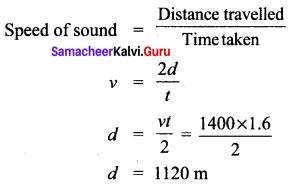
An ultrasonic wave is sent from a ship towards the bottom of the sea. It is found that the time interval between the transmission and reception of the wave is 1.6 seconds. What is the depth of the sea, if the velocity of sound in the seawater is 1400 ms-1?
Solution:
10th Science Acoustics Samacheer Kalvi Solutions Chapter 5
The depth of the sea is 1120 m.

Question 5.
A man is standing between two vertical walls 680 m apart. He claps his hands and hears two distinct echoes after 0.9 seconds and 1.1 seconds respectively. What is the speed of sound in the air?
Solution:
Given data is
d = 680 m
t1 = 0.9 s
t2 = 1.1 s
v = ?
\(\text { Velocity }=\frac{\text { Distance travelled by sound }}{\text { Time taken }}\)
\(v=\frac{2 d}{t}\)
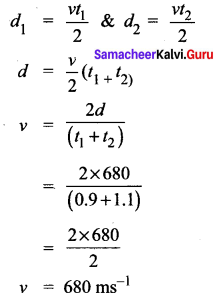
10th Science Solution Samacheer Kalvi Chapter 5 Acoustics

Question 6.
Two observers are stationed in two boats 4.5 km apart. A sound signal sent by one, under water, reaches the other after 3 seconds. What is the speed of sound in the water?
Answer:
Distance of boats d = 4.5 × 10³ m
= 4500 m.
Time t = 3 s
Speed of sound in water = \(\frac{d}{t}\)
= \(\frac{4500}{3}\)
= 1500 m/s

Question 7.
A strong sound signal is sent from a ship towards the bottom of the sea. It is received back after 1 s What is the depth of sea given that the speed of sound in water 1450 ms-1?
Solution:
Velocity of sound in water \(=\frac{\text { Distance travelled by sound }}{\text { Time taken }}\)
Depth of the sea, d = velocity × time
\(d=\frac{v t}{2}=\frac{1450 \times 1}{2}\) = 725 m.

IX. Answer in Detail

Question 1.
What are the factors that affect the speed of sound in gases?
Answer:
In the case of gases, the following factors affect the velocity of sound waves.
Effect of density : The velocity of sound in a gas is inversely proportional to the square root of the density of the gas. Hence, the velocity decreases as the density of the gas increases.
v ∝\(\sqrt{\frac{1}{d}}\)

Effect of temperature : The velocity of sound in a gas is directly proportional to the square root of its temperature. The velocity of sound in a gas increases with the increase in temperature v ∝ √T. Velocity at temperature T is given by the following equation:
Vr = (vo + 0.61 T)ms-1.
Here, vo is the velocity of sound in the gas at 0° C. For air, vo = 331 ms-1. Hence, the velocity of sound changes by 0.61 ms-1 when the temperature changes by one degree Celsius.

Effect of relative humidity : When humidity increases, the speed of sound increases. That is why you can hear sound from long distances clearly during rainy seasons.

Question 2.
What is mean by the reflection of sound? Explain.
Answer:
Reflection of Sound:
The bouncing of sound waves from the interface between two media is termed as the reflection of sound.
(a) Reflection at the boundary of a rarer medium

  • Consider a wave travelling in a solid medium striking on the interface between the solid and the air. The compression exerts a force F on the surface of the rarer medium.
  • As a rarer medium has smaller resistance for any deformation, the surface of separation is pushed backwards.
  • As the particles of the rarer medium are free to move, a rarefaction is produced at the interface. Thus, compression is reflected as rarefaction and a rarefaction travels from right to left.
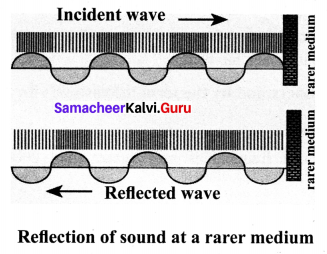
10th Science Solutions Samacheer Kalvi Chapter 5 Acoustics

(b) Reflection at the boundary of a denser medium

  • A longitudinal wave travels in a medium in the form of compressions and rarefactions. Suppose a compression travelling in the air from left to right reaches a rigid wall.
  • The compression exerts a force F on the rigid wall. In turn, the wall exerts an equal and
    opposite reaction R = -F on the air molecules. This results in a compression near the rigid wall.
  • Thus, a compression travelling towards the rigid wall is reflected back as a compression. That is the direction of compression is reversed.
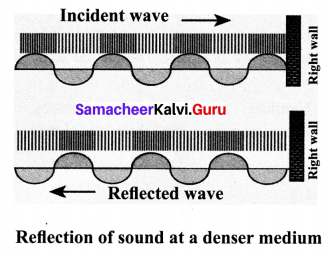
Guru Acoustics Samacheer Kalvi 10th Science Solutions Chapter 5

(c) Reflection at sound in curved surfaces

  • When the sound waves are reflected from the curved surfaces, the intensity of the reflected waves is changed.
  • When reflected from a convex surface, the reflected waves are diverged out and the intensity is decreased.
  • When sound is reflected from a concave surface, the reflected waves are converged and focused at a point. So the intensity of reflected waves is concentrated at a point.
  • Parabolic surfaces are used when it is required to focus the sound at a particular point. Hence, many halls are designed with parabolic reflecting surfaces.
  • In elliptical surfaces, sound from one focus will always be reflected the other focus, no matter where it strikes the wall.

Question 3.
(a) What do you understand by the term ‘ultrasonic vibration’?
(b) State three uses of ultrasonic vibrations.
(c) Name three animals which can hear ultrasonic vibrations.
Answer:
(a) Ultrasonic vibrations are the vibration with frequency greater than 20 KHz. Human ear cannot detect the ultrasonic vibration.

(b) (i) Ultrasonic waves are used in ultrasonography.
(ii) It is used to get signal images of a developing embryo in the mother’s uterus.
(in) They are used to forecast about tsunami and earthquake.

(c) Certain creatures like dog, bats, dolphins and mosquito can detect the waves.

Question 4.
What is an echo?
(a) State two conditions necessary for hearing an echo.
(b) What are the medical applications of echo?
(c) How can you calculate the speed of sound using echo?
Answer:
Echo: An echo is the sound reproduced due to the reflection of the original sound from various rigid surfaces such as walls, ceilings, surfaces of mountains, etc.

(a) (i) The persistence of hearing for human ears is 0.1 second. This means that we can hear two sound waves clearly if the time interval between the two sounds is at least 0.1 s. Thus, the minimum time gap between the original sound and an echo must be 0.1 s.

(ii) The above criterion can be satisfied only when the distance between the source of the sound and the reflecting surface would satisfy the following equation:
\(\begin{aligned} \text { Velocity } &=\frac{\text { Distance travelled by sound }}{\text { Timetaken }} \\ v &=\frac{2 d}{t} \\ d &=\frac{v t}{2} \end{aligned}\)
Since, t = 0.1 second, then \(d=\frac{v \times 0.1}{2}=\frac{v}{20}\)

(b) (i) The principle of echo is used in obstetric ultrasonography, which is used to create real – time visual images of the developing embryo or fetus in the mother’s uterus.
(ii) This is a safe testing tool, as it does not use any harmful radiations.

(c) Apparatus required:
A source of sound pulses, a measuring tape, a sound receiver and a stopwatch.
Calculation of speed of sound:
The sound pulse emitted by the source travels a total distance of 2nd while travelling from the source to the wall and then back to the receiver.
The time taken for this has been observed to be ‘t’. Hence, the speed of the sound wave is given by:
\(\text { Speed of sound }=\frac{\text { Distance travelled }}{\text { Timetaken }}=\frac{2 d}{t}\).

X. HOT Questions

Question 1.
Suppose that a sound wave and a light wave have the same frequency, then which one has a longer wavelength?
(a) Sound
(b) Light
(c) both (a) and (b)
(d) data not sufficient.
Answer:
(b) light
Explanation: The light wave has a longer wavelength because it has much greater speed.

Question 2.
When sound is reflected from a distant object, an echo is produced. Let the distance between the reflecting surface and the source of sound remain the same. Do you hear an echo sound on a hotter day? Justify your answer.
Answer:
Echo of sound is heard with less velocity and intensity on a hotter day. Because the velocity of sound is directly proportional to temperature of air. On a hotter day temperature will be higher so velocity of sound will be changed by higher values.

Samacheer Kalvi 10th Science Acoustics Additional Questions

I. Choose the best answer

Question 1.
Light can travel in a vacuum but not sound because of ______.
(a) speed of sound is very slow than light.
(b) light waves are electromagnetic in nature.
(c) sound waves are electromagnetic in nature.
(d) light waves are not electromagnetic in nature.
Answer:
(a) speed of sound is very slow than light.
Hint: Light can travel in a vacuum because light waves are electromagnetic in nature.

Question 2.
In a longitudinal wave there is a state of maximum compression at a point at an instant. The frequency of wave is 50 Hz. After what time will the same point be in the state of maximum rarefaction:
(a) 50 s
(b) 25 s
(c) 0.01 s
(d) 0.002 s
Answer:
(c) 0.01 s

Question 3.
When sound travels from air to water, which parameter does not change?
(a) Wavelength
(b) Frequency
(c) Velocity
(d) Temperature.
Answer:
(b) Frequency
Hint: Frequency remains unchanged when sound travels from air to water.

Question 4.
When a wave passes from one medium to another, there is a change of:
(a) Wavelength and velocity
(b) Wavelength and frequency
(c) Velocity and frequency
(d) Velocity only
Answer:
(a) Wavelength and velocity

Question 5.
At what temperature, the speed of sound in the air will become double of its value at 27°C?
(a) 54° C
(b) 627° C
(c) 327° C
(d) 927° C.
Answer:
(d) 927° C.
Hint:
\(\frac{v_{1}}{v_{2}}=\sqrt{\frac{\mathrm{T}_{1}}{\mathrm{T}_{2}}} \Rightarrow \frac{v_{1}}{2 v_{1}}=\sqrt{\frac{\mathrm{T}_{1}}{\mathrm{T}_{2}}}\)
⇒ \(\frac{1}{4}=\frac{27+273}{\mathrm{T}_{2}}\)
⇒ T2 = 300 × 4 = 1200 K
⇒ T2 = 1200 – 273 = 927° C.

Question 6.
Sound waves from a point source are propagating in all directions. What will be the ratios of amplitude at a distance 9 m and 25 m from the source?
(a) 9 : 25
(b) 25 : 9
(c) 3 : 5
(d) 81 : 625
Answer:
(b) 25 : 9

II. Fill in the blanks:

Question 1.
Sound waves in a gas are ______.
Answer:
Longitudinal.

Question 2.
The velocity of sound is the largest in ______.
Answer:
Steel.

Question 3.
Hertz is the unit of ______.
Answer:
Frequency.

Question 4.
Sound travels in rocks in the form of ______.
Answer:
Both longitudinal and transverse elastic waves.

Question 5.
The velocity of sound varies directly as the square root of the ______.
Answer:
The absolute temperature of the gas.

Question 6.
Reflection of sound waves obey the ______.
Answer:
Laws of reflection.

Question 7.
RADAR is the short form of ______.
Answer:
Radio Detection and Ranging.

Question 8.
The abbreviation of SONAR is ______.
Answer:
Sound Navigation and Ranging.

III. Match the following

Question 1.

MediumSpeed of Sound (m/s)
(i) Copper(a) 343
(ii) Water(b) 331
(iii) Air (0° c)(c) 5010
(iv) Air (at 20° c)(d) 1493

Answer:
(i) (c) 5010
(ii) (d) 1493
(iii) (b) 331
(iv) (a) 343.

Question 2.

WavesRange
(i) Audible(a) 340 m/s
(ii) Sound(b) greater than 20kHz
(iii) Infrasonic(c) 20Hz – 20 kHz
(iv) Light(d) below 20 Hz
(v) Ultrasonic(e) 3 × 10⁸ m/s

Answer:
(i) (c) 20 Hz – 20 kHz
(ii) (a) 340 m/s
(iii) (d) below 20 Hz
(iv) (e) 3 × 10⁸ m/s
(v) (b) greater than 20 kHz.

IV. Assertion and Reason Questions

Question 1.
Assertion: Sound wave cannot propagate through a vacuum but light can.
Reason: Sound wave cannot be polarised but light can.
(a) Both assertion and reason are true and the reason is the correct explanation of the assertion.
(b) Both assertion and reason are true but the reason is not the correct explanation of the assertion.
(c) Assertion is true but the reason is false.
(d) Both assertion and reason are false.
Answer:
(b) Both assertion and reason are true but the reason is not the correct explanation of the assertion.
Explanation: Sound waves, being mechanical waves, cannot travel through a vacuum. Light waves, electromagnetic waves, can travel through a vacuum.

Question 2.
Assertion: The velocity of sound increases with increase in humidity.
Reason: Velocity of sound does not depend upon the medium.
(a) both assertion and reason are true and the reason is the correct explanation of the assertion.
(b) both assertion and reason are true but reason is not the correct explanation of the assertion.
(c) Assertion is true but reason is false.
(d) Assertion is false but the reason is true.
Answer:
(c) The assertion is true but the reason is false.
Explanation: Velocity of sound increases with increase in humidity. The velocity of sound depends upon medium.

V. Answer Very Briefly

Question 1.
What is sound? Is it a force or energy?
Answer:
Sound is a vibration that typically propagates as an audible wave of pressure, through a transmission medium such as a gas, liquid or solid. Sound is not a force, it is an energy.

Question 2.
In which type of media, can longitudinal waves be propagated?
Answer:
Longitudinal waves can be propagated through solids, liquids and gases.

Question 3.
How does sound reach our ears from various sources?
Answer:
Sound reaches our ears in the form of transverse waves or vibrations from its source of production.

Question 4.
What is the minimum distance between two points in a wave having a phase difference of 2π?
Answer:
The minimum distance is the wavelength.

Question 5.
Suppose you and your friend are on the Moon. Will you be able to hear any sound produced by your friend?
Answer:

  • As the Moon does not have air, you will not be able to hear any sound produced by your friend.
  • Hence, you understand that the sound produced due to the vibration of different bodies needs a material medium like air, water, steel, etc, for its propagation.
  • Hence, sound can propagate through a gaseous medium or a liquid medium or a solid medium.

Question 6.
What is the effect of pressure on the speed of sound in gas?
Answer:
The increase of pressure has no effect on the speed of sound in a gas.

Question 7.
Write down the difference between the sound and light waves.
Answer:

SoundLight
1. Medium is required for the propagation1. Medium is not required for the propagation.
2. Sound waves are longitudinal.2. Light waves are transverse.
3. Wavelength ranges from 1.65 cm to 1.65 m.3. Wavelength ranges from 4 × 10⁻⁷ m to 7 × 10⁻⁷ m.
4. Sound waves travel in the air with a speed of about 340 ms-1 at NTP.4. Light waves travel in the air with a speed of 3 × 10⁸ ms-1

Question 8.
Define particle velocity.
Answer:
The velocity with which the particles of the medium vibrate in order to transfer the energy in the form of a wave is called particle velocity.

Question 9.
Define wave velocity.
Answer:
The velocity with which the wave travels through the medium is called wave velocity.

Question 10.
Define velocity of a sound wave.
Answer:
The distance travelled by a sound wave in unit time is called the velocity of a sound wave.
\(\text { Velocity }=\frac{\text { Distance }}{\text { Time taken }}\)

Question 11.
State the laws of reflection of sound.
Answer:
The incident wave, the normal to the reflecting surface and the reflected wave at the point of incidence lie in the same plane.
The angle of incidence ∠i is equal to the angle of reflection ∠r.

Question 12.
State ‘Laws of reflection’.
Answer:

  • The incident wave, the normal to the reflecting surface and the reflected wave at the point of incidence lie in the same plane.
  • The angle of incidence ∠i is equal to the angle of reflection ∠r.

Question 13.
What is meant by rarer and denser medium?
Answer:

  1. Rarer medium: The medium in which the velocity of sound increases compared to other medium is called rarer medium. (Water is rarer compared to air for sound).
  2. Denser medium: The medium in which the velocity of sound decreases compared to other medium is called denser medium. (Air is denser compared to water for sound)

VI. Problem Corner

Question 1.
A wave of length 0.60 cm is produced in air and travels with a velocity of 340 ms-1. Will it be audible to the human ear?
Solution:
Wavelength, λ = 0.6 × 10⁻² m
Velocity of sound, v = 340 ms-1
Frequency, n = \(\frac{v}{\lambda}\)
⇒ n = \(\frac{340}{0.6 \times 10^{-2}}\)
⇒ n = 566.66 × 10²
⇒ n = 567 × 102 Hz.

Question 2.
Consider a source moving towards a listener at a speed of 0.9 v. Where v is the velocity of sound. Calculate the apparent frequency if the actual frequency is 600 Hz.
Solution:
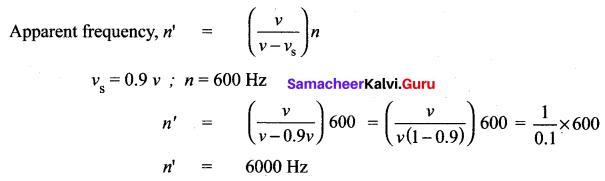
Class 10 Science Chapter 5 Question Answer Samacheer Kalvi Acoustics

Question 3.
Audible frequencies have a range of 20 Hz to 20,000 Hz. Express it in terms of wavelength in air.
Answer:
Let the velocity of sound in air be 340 m/s
Initial frequency v1 = 20 Hz
Initial wavelength λ1 = \(\frac{v}{V_1}\)
= \(\frac{340}{20}\) = 17 m
Final frequency v2 = 20 × 10³ Hz
Final wavelength λ2 = \(\frac{340}{20×10³}\)
= 17 × 10-3 = 0.017 m
The range of wavelength is from 17 m to 0.017 m

VII. Answer in detail.

Question 1.
Write down the applications of echo?
Answer:
Applications of echo:

  • Some animals communicate with each other over long distances and also locate objects by sending the sound signals and receiving the echo as reflected from the targets.
  • The principle of echo is used in obstetric ultrasonography, which is used to create real – time visual images of the developing embryo or fetus in the mother’s uterus. This is a safe testing tool, as it does not use any harmful radiations.
  • Echo is used to determine the velocity of sound waves in any medium.

Question 2.
Classify sound waves based on their frequencies.
Answer:
(i) Audible waves : These are sound waves with a frequency ranging between 20 Hz and 20,000 Hz. These are generated by vibrating bodies such as vocal cords, stretched strings etc.

(ii) Infrasonic waves : These are sound waves with a frequency below 20 Hz that cannot be heard by the human ear. eg: waves produced during earth quake, ocean waves, sound produced by whales, etc.

(iii) Ultrasonic waves : These are sound waves with a frequency greater than 20 kHz, Human ear cannot detect these waves, but certain creatures like mosquito, dogs, bats, dolphins can detect these waves, eg: waves produced by bats.

Question 3.
Write down the concept of Ear trumpet and Megaphone.
Answer:
Ear trumpet:

  • Ear trumpet is a hearing aid, which is useful by people who have difficulty in hearing.
  • In this device, one end is wide and the other end is narrow. The sound from the sources fall into the wide end and are reflected by its walls into the narrow part of the device. This helps in concentrating the sound and the sound enters the eardrum with more intensity. This enables a person to hear the sound better.

Megaphone:

  • A megaphone is a horn – shaped device used to address a small gathering of people.
  • It’s one end is wide and the other end is narrow. When a person speaks at the narrow end, the sound of his speech is concentrated by the multiple reflections from the walls of the tube. Thus, his voice can be heard loudly over a long distance.

Question 4.
What is the Doppler effect? Derive the formula for the change in apparent frequency
1. Both source and listener move towards and away from each other.
2. Both source and listener move one behind the other source follows the listener and listener follows the source.
3. A source at rest, listener moves towards and away from the source.
4. A listener at rest, the source moves towards and away from the listener.
Answer:
1.

Position of source and listenerNoteExpression for apparent frequency
(i) Both source and listener move
(ii) They move towards each other
(a) Distance between source and listener decreases.
(b) Apparent frequency is more than actual frequency.
\(n^{\prime}=\left(\frac{v+v_{\mathrm{L}}}{v-v_{\mathrm{S}}}\right) n\)
(i) Both source and listener move
(ii) They move away from each other
(a) Distance between source and listener increases.
(b) Apparent frequency is less than actual frequency.
(c) vS and vL become opposite to that in case-1.
\(n^{\prime}=\left(\frac{v-v_{\mathrm{L}}}{v+v_{\mathrm{S}}}\right) n\)

2.

Position of source and listenerNoteExpression for apparent frequency
(i) Both source and listener move
(ii) They move one behind the other
(iii) Source follows the listener
(a) Apparent frequency depends on the velocities of the source and the listener.
(b) vS becomes opposite to that in case-2.
\(n^{\prime}=\left(\frac{v-v_{\mathrm{L}}}{v-v_{\mathrm{S}}}\right) n\)
(i) Both source and listener move
(ii) They move one behind the other
(iii) The listener follows the source
(a) Apparent frequency depends on the velocities of the source and the listener.
(b) vS and vL become opposite to that in case-3.
\(n^{\prime}=\left(\frac{v+v_{\mathrm{L}}}{v+v_{\mathrm{s}}}\right) n\)

3.

Position of source and listenerNoteExpression for apparent frequency
(i) Source at rest
(ii) Listener moves towards the source
(a) Distance between source and listener decreases.
(b) Apparent frequency is more than actual frequency.
(c) vS = 0 in case-1.
\(n^{\prime}=\left(\frac{v+v_{\mathrm{L}}}{v}\right) n\)
(i) Source at rest
(ii) Listener moves away from the source
(a) Distance between source and listener increases.
(b) Apparent frequency is less than actual frequency.
(c) vS = 0 in case-2.
\(n^{\prime}=\left(\frac{v-v_{\mathrm{L}}}{v}\right) n\)

4.

Position of source and listenerNoteExpression for apparent frequency
(i) Listener at rest
(ii) Source moves towards the listener
(a) Distance between source and listener decreases.
(b) Apparent frequency is more than actual frequency.
(c) vL = 0 in case-1.
\(n^{\prime}=\left(\frac{v}{v-v_{\mathrm{S}}}\right) n\)
(i) Listener at rest
(ii) Source moves away from the listener
(a) Distance between source and listener increases.
(b) Apparent frequency is less than actual frequency.
(c) vL = 0 in case-2.
\(n^{\prime}=\left(\frac{v}{v+v_{\mathrm{S}}}\right) n\)

Question 5.
Explain echo method to measure velocity’ of sound.
Answer:
Apparatus required: A source of sound pulses, a measuring tape, a sound receiver, and a stop watch.
Procedure:

  1. Measure the distance ‘d’ between the source of sound pulse and the reflecting surface using the measuring tape.
  2. The receiver is also placed adjacent to the source. A sound pulse is emitted by the source.
  3. The stopwatch is used to note the time interval between the instant at which the sound pulse is sent and the instant at which the echo is received by the receiver. Note the time interval as ‘t’.
  4. Repeat the experiment for three or four times. The average time taken for the given number of pulses is calculated.

Calculation of speed of sound : The sound pulse emitted by the source travels a total distance of 2d while travelling from the source to the wall and then back to the receiver. The time taken for this has been observed to be ‘t’. Hence, the speed of sound wave is given by:
Speed of sound = \(\frac{distence Travelled}{Time Taken}\)
= \(\frac{2d}{t}\)

Believing that the Tamilnadu State Board Solutions for Class 10th Science Chapter 5 Acoustics Questions and Answers learning resource will definitely guide you at the time of preparation. For more details about Tamilnadu State Board Class 10th Science Chapter 5 textbook solutions, ask us in the below comments and we’ll revert back to you asap.
Samacheer Kalvi 8th Tamil Solutions Chapter 6.3 கொங்குநாட்டு வணிகம்

Tamilnadu State Board New Syllabus Samacheer Kalvi 8th Tamil Book Solutions Guide Pdf Chapter 6.3 கொங்குநாட்டு வணிகம் Text Book Back Questions and Answers, Summary, Notes.

Tamilnadu Samacheer Kalvi 8th Tamil Solutions Chapter 6.3 கொங்குநாட்டு வணிகம்

கற்பவை கற்றபின்

Question 1.
உங்கள் மாவட்டம் பற்றிய செய்திகளைத் திரட்டி எழுதுக.
Answer:
எங்களுடைய மாவட்டம் ஈரோடு மாவட்டம் ஆகும். கணிதமேதை ராமானுஜம், புலவர் குழந்தை, தீரன் சின்னமலை ஆகிய சான்றோர்கள் பிறந்து வளர்ந்த மாவட்டம் ஈரோடு மாவட்டம். அந்தியூர் குருநாதசாமி திருக்கோயில், பாரியூர் அம்மன் கோயில், பண்ணாரி அம்மன் கோயில், கொடுமுடி மகுடேஸ்வரர் கோயில் ஆகிய சிறப்புமிக்க கோயில்கள் அமைந்துள்ளன. பழமையான பிரப் தேவாலயம், மிட்டுமியா பாபா தர்கா, அலாவுதீன் பாட்சா தர்கா ஆகியவை அமைந்துள்ளன. வெள்ளோடு பறவைகள் சரணாலயம் ஈரோட்டில் தான் உள்ளது.

Question 2.
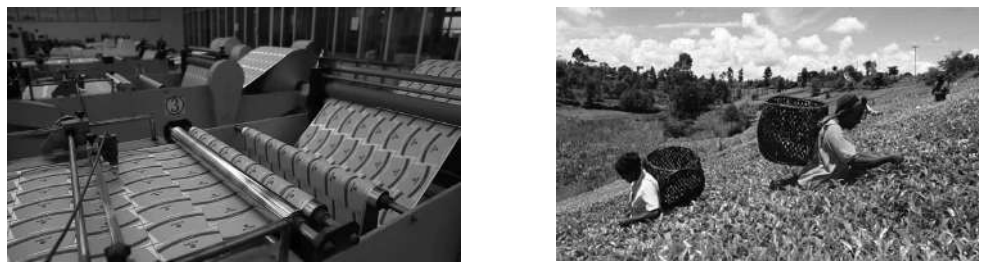
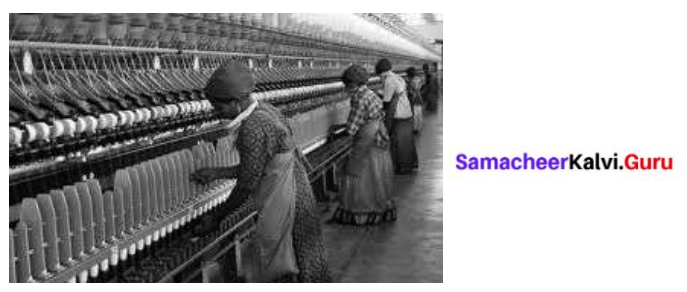
பல்வகைத் தொழில்கள் என்னும் தலைப்பில் படத்தொகுப்பு உருவாக்குக.
Answer:
Samacheer Kalvi 8th Tamil Solutions Chapter 6.3 கொங்குநாட்டு வணிகம் 1
Samacheer Kalvi 8th Tamil Solutions Chapter 6.3 கொங்குநாட்டு வணிகம் 2
Samacheer Kalvi 8th Tamil Solutions Chapter 6.3 கொங்குநாட்டு வணிகம் 3

பாடநூல் வினாக்கள்

சரியான விடையைத் தேர்ந்தெடுத்து எழுதுக.

Question 1.
‘வண்புகழ் மூவர் தண்பொழில் வரைப்பு’ என்று குறிப்பிடும் நூல் …………………………..
அ) தொல்காப்பியம்
ஆ) அகநானூறு
இ) புறநானூறு
ஈ) சிலப்பதிகாரம்
Answer:
அ) தொல்காப்பியம்

Question 2.
சேரர்களின் தலைநகரம் ……………………
அ) காஞ்சி
ஆ) வஞ்சி
இ) தொண்டி
ஈ) முசிறி
Answer:
ஆ) வஞ்சி

Question 3.
பழங்காலத்தில் விலையைக் கணக்கிட அடிப்படையாக அமைந்தது ……………………
அ) புல்
ஆ) நெல்
இ) உப்பு
ஈ) மிளகு
Answer:
ஆ) நெல்

Question 4.
ஆன்பொருநை என்று அழைக்கப்படும் ஆறு ……………….
அ) காவிரி
ஆ) பவானி
இ) நொய்யல்
ஈ) அமராவதி
Answer:
ஈ) அமராவதி

Question 5.
வீட்டு உபயோகப் பொருள்கள் தயாரிக்கும் தொழிற்சாலைகள் நிறைந்த மாவட்டம்
அ) நீலகிரி
ஆ) கரூர்
இ) கோயம்புத்தூர்
ஈ) திண்டுக்கல்
Answer:
இ) கோயம்புத்தூர்

கோடிட்ட இடங்களை நிரப்புக.

1. ‘மாங்கனி நகரம்’ என்று அழைக்கப்படும் நகரம் ………………………..
2. சுங்குடிச் சேலைகளுக்குப் புகழ்பெற்ற ஊர் …………………..
3. சேரர்களின் நாடு ………………….. எனப்பட்டது.
4. பின்னலாடை நகரமாக …………………. விளங்குகிறது.
Answer:
1. சேலம்
2. சின்னாளப்பட்டி (திண்டுக்கல்)
3. குடநாடு
4. திருப்பூர்

குறுவினா

Question 1.
மூவேந்தர்களின் காலம் குறித்து எழுதுக.
Answer:

  • மூவேந்தர்களின் காலத்தை வரையறுத்துக் கூறமுடியவில்லை.
  • வால்மீகி இராமாயணம், மகாபாரதம், அர்த்தசாத்திரம், அசோகர் கல்வெட்டு ஆகியவற்றில் மூவேந்தர்கள் குறித்த செய்திகள் இடம்பெற்றுள்ளன.
  • இதனால் இவர்கள் பல நெடுங்காலத்திற்கு முற்பட்டவர்கள் என்பதை அறியலாம்.

Question 2.
கொங்கு நாட்டில் பாயும் ஆறுகள் யாவை?
Answer:
காவிரி, பவானி, நொய்யல், ஆன்பொருநை (அமராவதி).

Question 3.
‘தமிழ்நாட்டின் ஹாலந்து’ என்று அழைக்கப்படும் ஊர் எது? ஏன்?
Answer:

  • ‘தமிழ்நாட்டின் ஹாலந்து’ என்று அழைக்கப்படும் ஊர் திண்டுக்கல்.
  • மலர் உற்பத்தியில் முதலிடம் வகிப்பதால், தமிழ்நாட்டின் ஹாலந்து என்று திண்டுக்கல் நகரம் போற்றப்படுகிறது.

சிறுவினா

Question 1.
கொங்கு மண்டலச் சதகம் கூறும் கொங்கு மண்டலத்தின் எல்லைகள் யாவை?
Answer:
வடக்கே பெரும்பாலை தெற்கே பழனி மலை, மேற்கே வெள்ளிமலை, கிழக்கே மதிற்கூரை என இந்நான்கு எல்லைக்கு உட்பட்ட பகுதியாகக் கொங்கு மண்டலம் விளங்கியதாகக் கொங்கு மண்டலச் சதகம் கூறுகிறது.

Question 2.
கரூர் மாவட்டம் பற்றிய செய்திகளைச் சுருக்கி எழுதுக.
Answer:
(i) கரூர் நகரத்திற்கு, வஞ்சிமா நகரம்’ என்ற பெயரும் உண்டு. கிரேக்க அறிஞர் தாலமி கரூரைத் தமிழகத்தின் முதன்மை உள்நாட்டு வணிக மையமாகக் குறிப்பிட்டுள்ளார்.

(ii) நெல், சோளம், கேழ்வரகு, கம்பு, கரும்பு போன்றவை இங்குப் பயிரிடப்படுகின்றன. கல்குவாரித் தொழிற்சாலைகள் இங்கு உள்ளன.

(iii) கைத்தறி நெசவு ஆடைகளுக்குப் பெயர் பெற்ற மாவட்டமாகக் கரூர் விளங்குகிறது.

(iv) தோல் பதனிடுதல், சாயம் ஏற்றுதல், சிற்ப வேலைகள் போன்ற தொழில்களும் நடைபெறுகின்றன.

(v)  பேருந்துக் கட்டுமானத் தொழிலின் சிகரமாகக் கரூர் விளங்குகிறது.

நெடுவினா

Question 1.
கொங்கு நாட்டின் உள்நாட்டு, வெளிநாட்டு வணிகம் குறித்து எழுதுக.
Answer:
உள்நாட்டு, வெளிநாட்டு வணிகத்தில் தமிழர்கள் சிறந்து விளங்கி உள்ளனர். கடல் வணிகத்தில் சேர நாடு சிறப்புற்றிருந்தது.

உள்நாட்டு வணிகம் :
சேர நாட்டில் உள்நாட்டு வணிகமும் நன்கு வளர்ச்சியுற்று இருந்தது. மக்கள் தத்தம் பொருள்களைத் தந்து தமக்குத் தேவையான பொருளைப் பெற்றனர். நெல்லின் விலையைக் கணக்கிட அடிப்படையாக இருந்தது என்பர். உப்பும் நெல்லும் ஒரே மதிப்புடையனவாக இருந்தன என்பதை அகநானூற்றின் 390வது பாடல் மூலம் அறியலாம்.

வெளிநாட்டு வணிகம் :
முசிறி சேரர்களின் சிறந்த துறைமுகங்களில் ஒன்றாக விளங்கியது. இங்கிருந்து தான் மற்ற நாடுகளுக்கு மிளகு, முத்து, யானை, தந்தங்கள், மணி போன்றவை ஏற்றுமதி செய்யப்பட்டன. பொன்மணிமிக்க புடவைகள், சித்திர வேலைப்பாடுகள் அமைந்த ஆடைகள், பவளம், செம்பு, கோதுமை ஆகியன இறக்குமதி செய்யப்பட்டன.

சிந்தனை வினா

Question 1.
நாட்டு மக்களின் நாகரிக நல்வாழ்விற்கு வணிகம் தவிர்த்து வேறு எவையெல்லாம் உதவும் என்று நீங்கள் கருதுகிறீர்கள்?
Answer:
நாட்டு மக்களின் நாகரிக நல்வாழ்விற்கு வணிகம் தவிர்த்து கலைகள் பலவும், அறிவியல் கோட்பாடுகளும், பண்டைய தமிழறிஞர்களின் சிந்தனைகளை மீட்டுக் கொணர்வதும், பொதுமைப் பண்பு, புத்தாக்க சிந்தனைகளும், பழைய நாகரிகங்களை வெளிக்கொணரும் அகழாய்வுகளும், பழந்தமிழ் இலக்கியங்களும் உதவும் என்று நான் கருதுகிறேன்.

கூடுதல் வினாக்கள்

சரியான விடையைத் தேர்ந்தெடுத்து எழுதுக.

Question 1.
மூவேந்தர்களில் பழமையானவர்கள் …………………..
அ) சேரர்
ஆ) சோழர்
இ) பாண்டியர்
ஈ) பல்ல வர்
Answer:
அ) சேரர்

Question 2.
சேரர்களின் கொடி ……………..
அ) புலி
ஆ) மீன் இ)வில்
இ) வில்
ஈ) முரசு
Answer:
இ) வில்

Question 3.
சேரனுக்கு உரிய பூ ……………………
அ) பனம்பூ
ஆ) வேப்பம்பூ
இ) அத்திப்பூ
ஈ) தாழம்பூ
Answer:
அ) பனம்பூ

Question 4.
“கொங்கு மண்டலச் சதகம்’ என்னும் நூலை இயற்றியவர் …………………….
அ) காளமேகப்புலவர்
ஆ) கார்மேகக் கவிஞர்
இ) கண்ண தாசன்
ஈ) வாணிதாசன்
Answer:
ஆ) கார்மேகக் கவிஞர்

கோடிட்ட இடங்களை நிரப்புக.

1. கடற்போர் வெற்றிகண்ட சேரன் ……………………..
2. ……………………. என்னும் பெயரே கோயம்புத்தூர் என்று மருவி வழங்கப்பட்டு வருகிறது.
3. பரப்பளவில் தமிழ்நாட்டின் இரண்டாவது பெரிய நகரம் ……………………..
4. தமிழகத்திலேயே மஞ்சள் சந்தை இடம்பெறும் ஒரே ஊர் …………………
5. இந்தியாவின் முதல் ஆயத்த ஆடைப் பூங்கா …………………..
6. ஆயத்த ஆடை பூங்கா அமைந்துள்ள மாவட்டம் ………………………
7. முட்டைக் கோழி வளர்ப்பிலும், முட்டை உற்பத்தியிலும் இந்தியாவிலேயே முதன்மை வகிக்கும் மாவட்டம் ………………………
8. ஏழைகளின் ஊட்டி ………………………
9. கிரேக்க அறிஞர் ……………………..
10. முத்து நகரம் …………………….
11. குட்டி ஜப்பான் ……………………..
12. தூங்கா நகரம் ……………………
13. தீப நகரம் …………….
Answer:
1. கோவன்புத்தூர்
2. செங்குட்டுவன்
3. ஈரோடு
4. ஈரோடு
5. நேதாஜி ஆயத்த ஆடைப் பூங்கா
6. திருப்பூர்
7. நாமக்கல்
8. ஏற்காடு
9. தாலமி
10. தூத்துக்குடி
11. சிவகாசி
12. மதுரை
13. திருவண்ணாமலை

குறுவினா

Question 1.
மூவேந்தர்கள் யாவர்?
Answer:
சேரர், சோழர், பாண்டியர்.

Question 2.
சேர நாட்டின் துறைமுகப்பட்டினங்கள் யாவை?
Answer:
தொண்டி, முசிறி, காந்தளூர்.

Question 3.
கொங்கு நாட்டுப் பகுதிகள் யாவை?
Answer:
சேலம் மற்றும் கோவைப் பகுதிகள் கொங்குநாட்டுப் பகுதிகள் ஆகும்.

Question 4.
ஒரு நாட்டு மக்களின் நாகரிக நல்வாழ்விற்கு அடிப்படை எவை?
Answer:
உழவு, கைத்தொழில் வணிகம்.

Question 5.
நீலகிரி மாவட்டத்தில் பெருமளவு பயிரிடப்படும் பயிர்கள் யாவை?
Answer:
காப்பி, தேயிலை, உருளைக்கிழங்கு, கேரட், முட்டைகோஸ்.

Question 6.
கோவை மாவட்டத்தில் பெருமளவு பயிரிடப்படும் பயிர்கள் யாவை?
Answer:
நெல், வாழை, கரும்பு, காய்கறிகள், பூக்கள்.

Question 7.
திண்டுக்கல்லில் விளைவிக்கப்படும் பயிர் வகைகள் யாவை?
Answer:
நெல், சோளம், தினை வகைகள், வாழைப்பழம், காய்கறிகள், மலர்கள்.

Question 8.
ஈரோட்டில் விளைவிக்கப்படும் பயிர்கள் யாவை?
Answer:
நெல், நிலக்கடலை, மஞ்சள், கரும்பு, பருத்தி.

Question 9.
திருப்பூரில் விளைவிக்கப்படும் முதன்மைப் பயிர்கள் யாவை?
Answer:
நெல், கரும்பு, பருத்தி, வாழை.

Question 10.
நாமக்கல் மாவட்டத்தில் பயிரிடப்படுவது யாவை?
Answer:
நெல், கரும்பு, சோளம், நிலக்கடலை, பருத்தி, திராட்சை, ஆரஞ்சு, காப்பி, பாக்கு, ஏலம்.

Question 11.
சேலம் மாவட்டத்தில் பயிரிடப்படும் பயிர் வகைகள் யாவை?
Answer:
நெல், பருப்புவகைகள், பருத்தி, கரும்பு, மாம்பழம், காப்பி, பாக்கு.

Question 12.
கரூர் மாவட்டத்தில் பயிரிடப்படும் பயிர்கள் யாவை?
Answer:
நெல், சோளம், கேழ்வரகு, கம்பு, கரும்பு.

சிறுவினா

Question 1.
சேரர்களைப் பற்றிய செய்திகளைச் சுருக்கி எழுதுக.
Answer:

  • மூவேந்தர்களில் பழமையானவர்கள் சேரர்கள்.
  • சேரர்களின் நாடு குடநாடு எனப்பட்டது.
  • சேரர்களின் தலைநகரம் வஞ்சி.
  • தொண்டி, முசிறி, காந்தளூர் ஆகியன சேரநாட்டின் துறைமுகப் டினங்களாக 10 விளங்கின.
  • சேரர்களின் கொடி விற்கொடி ஆகும்.

Question 2
நீலகிரி மாவட்டத்தில் அமைந்துள்ள தொழிற்சாலைகள் யாவை?
Answer:

  • தேயிலைத் தொழிற்சாலை
  • புகைப்படச் சுருள் தயாரிப்பு தொழிற்சாலை
  • துப்பாக்கி வெடிமருந்து தொழிற்சாலை
  • தைல மர எண்ணெய் தொழிற்சாலை

Question 3.
கோயம்புத்தூர் மாவட்டத்தில் அமைந்துள்ள தொழிற்சாலைகள் யாவை?
Answer:

  • பஞ்சாலைகள்
  • நூற்பாலைகள்
  • மின்சாரப் பொருட்கள்
  • எந்திரங்கள்
  • வீட்டு உபயோகப் பொருட்கள் தயாரிக்கும் தொழிற்சாலைகள் ஆகியன கோயம்புத்தூர் மாவட்டத்தில் நிறைந்துள்ளன.

Question 4.
ஈரோடு மாவட்டம் பற்றிய செய்திகளைச் சுருக்கி எழுதுக.
Answer:

  • தமிழ்நாட்டின் இரண்டாவது பெரிய நகரம் ஈரோடு.
  • இங்கு நெல், நிலக்கடலை, மஞ்சள், கரும்பு, பருத்தி, எள் போன்றவை பயிரிடப்படுகின்றன.
  • தமிழகத்திலேயே மஞ்சள் சந்தை உள்ள ஒரே மாவட்டம் ஈரோடு தான்.
  • துணி நூற்பாலைகள், எண்ணெய் ஆலைகள், சர்க்கரை ஆலைகள் பெருமளவில் இங்கு உள்ளன.
  • நூல் நூற்பு, துணிகளுக்குச் சாயம் ஏற்றுதல், அச்சிடுதல், தோல் பதனிடுதல் முதலான தொழில்களும் ஈரோடு மாவட்டத்தில் நடைபெறுகின்றன.

Samacheer Kalvi 10th Social Science Geography Solutions Chapter 4 Resources and Industries

Guys who are planning to learn and understand the topics of 10th Social Science Geography can grab this Tamilnadu State board solutions for Chapter 4 Resources and Industries Questions and Answers from this page for free of cost. Make sure you use them as reference material at the time of preparation & score good grades in the final exams.

Students who feel tough to learn concepts can take help from this Samacheer Kalvi 10th Social Science Book Solutions Guide Pdf, all the Questions and Answers can easily refer in the exams. Go to the below sections and get 10th Social Science Geography Chapter 4 Resources and Industries Tamilnadu State Board Solutions PDF.

Tamilnadu Samacheer Kalvi 10th Social Science Geography Solutions Chapter 4 Resources and Industries

Do you feel scoring more marks in the 10th Social Science Geography Grammar sections and passage sections are so difficult? Then, you have the simplest way to understand the question from each concept & answer it in the examination. This can be only possible by reading the passages and topics involved in the 10th Social Science Geography Board solutions for Chapter 4 Resources and Industries Questions and Answers. All the Solutions are covered as per the latest syllabus guidelines. Check out the links available here and download 10th Social Science Geography Chapter 4 textbook solutions for Tamilnadu State Board.

Resources and Industries Textual Exercise

I. Choose the correct answer.

India Resources And Industries Question 1.
Manganese is used in …
(a) Storage batteries
(b) Steel Making
(c) Copper smelting
(d) Petroleum Refining
Answer:
(b) Steel Making

10th Geography Samacheer Kalvi Question 2.
The Anthracite coal has:
(a) 80 to 95% Carbon
(b) Above 70% Carbon
(c) 60 to 70% Carbon
(d) Below 50% Carbon
Answer:
(a) 80 to 95% Carbon

Samacheer Kalvi 10th Geography Book Question 3.
The most important constituents of petroleum are hydrogen and
(a) Oxygen
(b) Water
(c) Carbon
(d) Nitrogen
Answer:
(c) Carbon

Samacheer Kalvi 10th Social Solutions Question 4.
The city which is called as the Manchester of South India is:
(a) Chennai
(b) Salem
(c) Madurai
(d) Coimbatore
Answer:
(d) Coimbatore

Samacheer Kalvi Guru 10th Social Science Question 5.
The first Jute mill of India was established at
(a) Kolkata
(b) Mumbai
(c) Ahmedabad
(d) Baroda
Answer:
(a) Kolkata

Social Solutions For Class 10 Samacheer Kalvi Question 6.
The first Nuclear Power station was commissioned in:
(a) Gujarat
(b) Rajasthan
(c) Maharashtra
(d) Tamil Nadu
Answer:
(c) Maharashtra

10th Social Samacheer Kalvi Question 7.
The most abundant source of energy is
(a) Biomass
(b) Sun
(c) Coal
(d) Oil
Answer:
(b) Sun

10th Social Science Samacheer Kalvi Question 8.
The famous Sindri Fertilizer Plant is located in:
(a) Jharkhand
(b) Bihar
(c) Rajasthan
(d) Assam
Answer:
(a) Jharkhand

Samacheer Kalvi 10th Social Question 9.
The nucleus for the development of the Chotanagpur plateau region is
(a) Transport
(b) Mineral Deposits
(c) Large demand
(d) Power Availability
Answer:
(b) Mineral Deposits

Samacheer Kalvi Guru 10th Social Question 10.
One of the shore based steel plants of India is located at:
(a) Kolkata
(b) Tuticorin
(c) Goa
(d) Visakhapatnam
Answer:
(d) Visakhapatnam

II. Match the following.

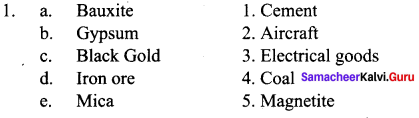
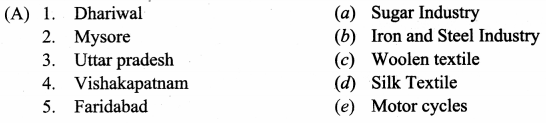
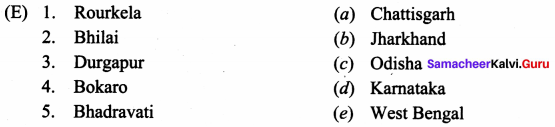
India Resources And Industries Samacheer Kalvi 10th Social Science Geography Solutions Chapter 4
Answer:
a – 2,
b – 1,
c – 4,
d – 5,
e – 3

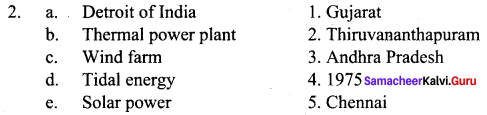
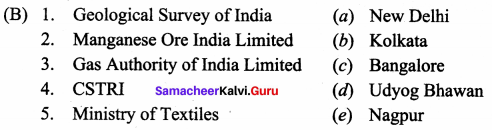
10th Geography Samacheer Kalvi Social Science Solutions Chapter 4 Resources And Industries
Answer:
a – 5,
b – 4,
c – 1,
d – 2,
e – 3

III. Answer the following questions briefly.

Samacheer Kalvi 10th Social Science Question 1.
Define the resource and state its types.
Answer:
Any matter or energy derived from the environment and is used by living things including humans is termed as resource. Based on continued availability classified into Renewable and Non-Renewable Resources.

10th Social India Outline Map Question 2.
Name the states that lead in the production of Iron ore in India.
Answer:
Jharkhand, Odisha Chhattisgarh, Karnataka, Andhra pradesh and Tamil Nadu.

Samacheer Kalvi Social Science 10th Std Question 3.
What are the minerals and its types?
Answer:
Mineral is a natural substance of organic or inorganic origin with definite chemical and physical properties.
Minerals are broadly grouped into two Metallic minerals and Non-Metallic minerals.

10th Samacheer Kalvi Social Question 4.
State the uses of magnesium.
Answer:

  1. It is an important minerals used for making iron and steel and serves as basic raw material for alloying.
  2. It is also used in manufacturing bleaching powder, insecticides, paints and batteries.

Social Samacheer Kalvi 10th Question 5.
What is natural gas?
Answer:

  1. Natural gas is a natural hydrocarbon gas mixture primarily consisting of methane.
  2. Usually accompanies the petroleum accumulations.
  3. It is formed when layers of decomposed plants and animals are exposed to intense heat and pressure over thousands of years.

Samacheer Kalvi Class 10 Social Science Solutions Question 6.
Name the different types of coal with their carbon content.
Answer:

  1. Anthracite: contains 80 to 90% Carbon
  2. Bituminous: contains 60 to 80% Carbon
  3. Lignite : 40 to 90% Carbon
  4. Peat: Contains less than 40% Carbon

Samacheer Kalvi 10 Social Question 7.
Mention the major areas of jute.production in India.
Answer:

  1. The major Jute producing area are in West Bengal and concentrated along Hoogly river within the radius of six kilometer of Kolkata.
  2. Andhra Pradesh, Bihar, Uttar Pradesh, Assam, Chattisgarh and Odisha are other jute producing areas.

Question 8.
Name the important oil producing regions of India.
Answer:
Oil in India is obtained from both from on-shore and off-shore areas.

Western Coast off shore oil fields:

  1. Mumbai high oil fields
  2. Gujarat Coast
  3. Basseim oil field, South of Mumbai high
  4. Ankleshwar
  5. Cambay-Luni Region
  6. Ahemedabad-Kalol Region
  7. Aliabet oil feild, south of Bhavanagar

Eastern Coast off shore oil fields:

  1. Brahmaputra valley
  2. Digboi oil feilds
  3. Nahoratiya oil fields
  4. Moran-Hugrijan oil field
  5. Rudrasagar-Lawa oil feilds
  6. Surrma valley
  7. Offshore of Andaman and Nicobar, Gulf of Mannar, Baleshwar coast, Punjab, Haryana and Uttar Pradesh.

IV. Distinguish between.

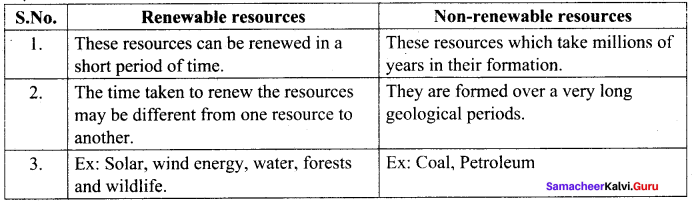
Question 1.
Renewable and Non-renewable resources.
Answer:
Samacheer Kalvi 10th Geography Book Solutions Chapter 4 Resources And Industries

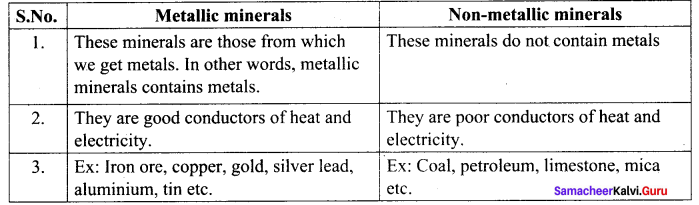
Question 2.
Metallic and non-metallic minerals.
Answer:
Samacheer Kalvi 10th Social Solutions Geography Chapter 4 Resources And Industries

Question 3.
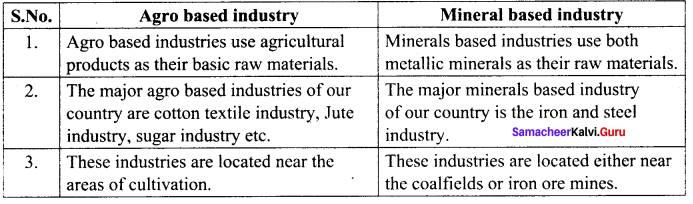
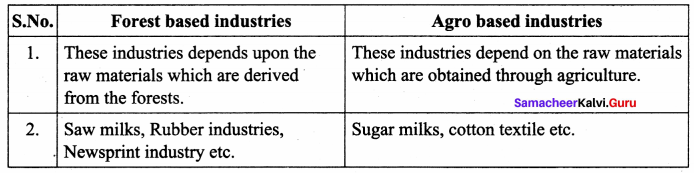
Agro based industry and mineral based industry.
Answer:
Samacheer Kalvi Guru 10th Social Science Geography Solutions Chapter 4 Resources And Industries

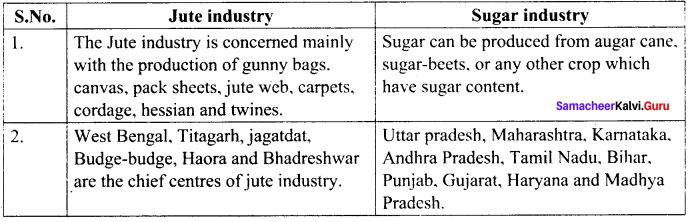
Question 4.
Jute industry and the sugar industry.
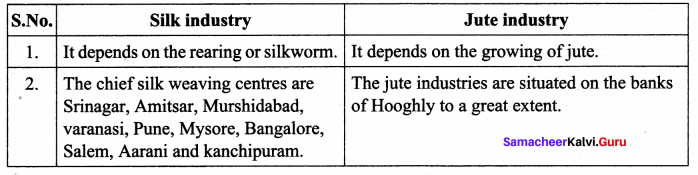
Answer:
Social Solutions For Class 10 Samacheer Kalvi Chapter 4 Resources And Industries

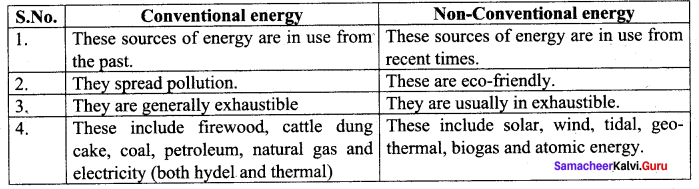
Question 5.
Conventional energy and Non-conventional energy.
Answer:
10th Social Samacheer Kalvi Science Geography Solutions Chapter 4 Resources And Industries

V. Answer the following in a paragraph.

Question 1.
Write about the distribution of cotton textile industries in India.
Answer:
The cotton textile industry is the largest organized modem industry of India.

The major cotton textile industries are concentrated in the States of Maharashtra. Gujarat, West Bengal, Uttar Pradesh and Tamil Nadu.

The location of cotton textile industries states are due to the presence of black cotton soil, humid climate, cheap labour, availability of capital, transport facilities, port facilities, power supply and good market.

Mumbai: Manchester of India.
Coimbatore: Manchester of South India
Kanpur: Manchester of Uttar Pradesh

The above cities have more number of cotton mills.

Question 2.
Explain the factors responsible for the concentration of jute industries in the hoogly region.
Answer:
Most of the Jute mills of India are centralised in “Hooghly Basin” of the West Bengal. The factors responsible for the concentration of Jute industry in Hooghly Basin region are:

  1. Ganga, Brahmaputra delta regions grow about 90% of India’s Jute and provides raw materials in jute mills.
  2. Coal for power is obtained from Raniganj coalfields.
  3. Hooghly River provides cheap water transport and soft water for washing, processing, retting and dyeing jute.
  4. Humid climate is favourable for spinning and weaving.
  5. Cheap labour is available from West Bengal, Bihar and Uttar Pradesh.
  6. Conductive port facility of Kolkata for export and import at Kolkata.

In addition to West Bengal, Jute mills are also located in Andhra pradesh, Uttar pradesh, Bihar, Madhya pradesh and Odisha.

India exports jute products to Australia, U.K, Thailand, U.S.A, Canada, Argentina, East Africa, New Zealand and Indonesia.

Question 3.
Write an account on the major iron and steel industries of India.
Answer:

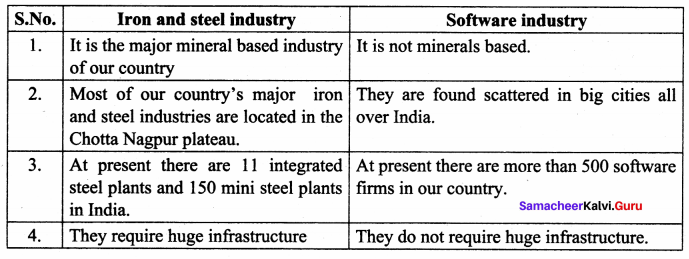
1. Mineral based industries:

  • The major minerals based industry of our country is the iron and steel industry.
  • It is a key or basic industry and lays the foundation for other industries.
  • These industries form the economic backbone of a country.

2. Location of Iron and Steel Industries:
Most of our country’s major iron and steel industries are located in the Chotanagpur plateau region.

3. Distribution of Iron and Steel Industries:
India has 11 integrated steel plant and 150 mini steel plants and a large number of rolling and re-rolling mills.

  1. Tata Iron and Steel Company [TISCO]: In 1911, Tata Iron and Steel Company was setup at Jamshedpur. Its major products are Pig Iron and Crude steel.
  2. Indian Iron and Steel Company [IISCO]: The Steel plant at Kulti, Bumpur and Hirapur were integrated and the Indian iron and steel company was set up at Bumpur in 1972.
  3. Visweshwaraya Iron Steel Ltd(VISL): Visweshwaraya Iron Steel Limited was set up in 1923 at Bhadravati in Karnataka. Its major products are alloy and sponge steel.
    • Hindustan Steel Limited (HSL) – Bhilai: It is located in Durg district of Chattisgarh. It started its production in 1957. Its major products are Railway Equipment and shipbuilding.
    • Hindustan Steel Limited (HSL) – Rourkela: It was established in 1965 in Odisha. Its major products include hot and cold rolled sheets, Galvanized sheets and electrical plates.
    • Hindustan Steel Limited (HSL) – Durgapur: It was established in 1959 in Durgapur of West Bengal. Its major products are alloy,steel, construction materials and railway equipments.
    • Hindustan Steel Limited (HSL) – Bokaro: It is situated in the Hazaribagh district of Jharkhand. It started its operation in 1972. Its major products are sludge and slog.
  4. Salem Steel Ltd: It is located at salem in Tamil Nadu. It started its production in 1982. The major products are stainless steel.
  5. Vijayanagar Steel Plant: The Vijayanagar Steel Plant has been set up at Tomagal in Karnataka. It started its production in 1994. The major products are flat steel and long steel.
  6. The Visakhapatnam Steel Plant(VSP): It started its operation in 1981 at Visakhapatnam in Andhra pradesh. Its major products are Hot metal.

4. Mini Steel Plants:

  1. Mini steel plants are decentralized secondary units with capacity ranging from 10,000 tonnes to 5 lakh tonnes per year.
  2. They produce mild steel, alloy steel and stainless steel.
  3. Most of the mini steel plants are located in areas far away from the major steel plants so that they can meet the local demands.

VI. On the outline map of India mark the following

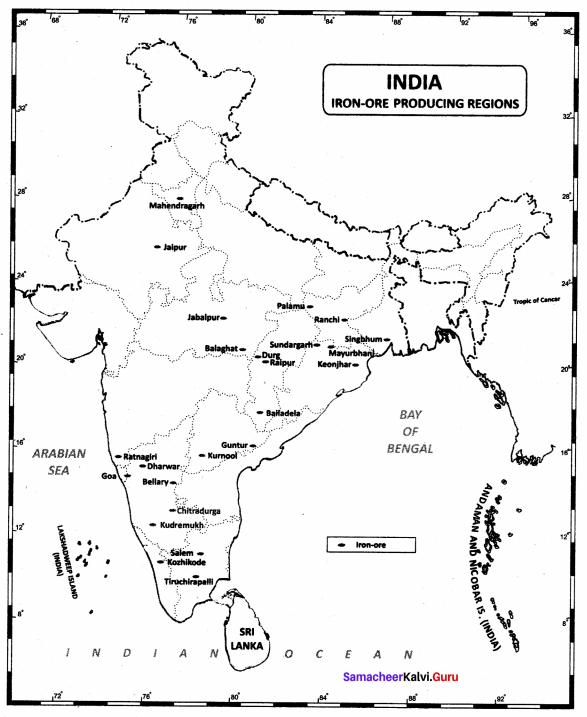
Question 1.
Iron ore production centres.
Answer:
10th Social Science Samacheer Kalvi Geography Solutions Chapter 4 Resources And Industries

Question 2.
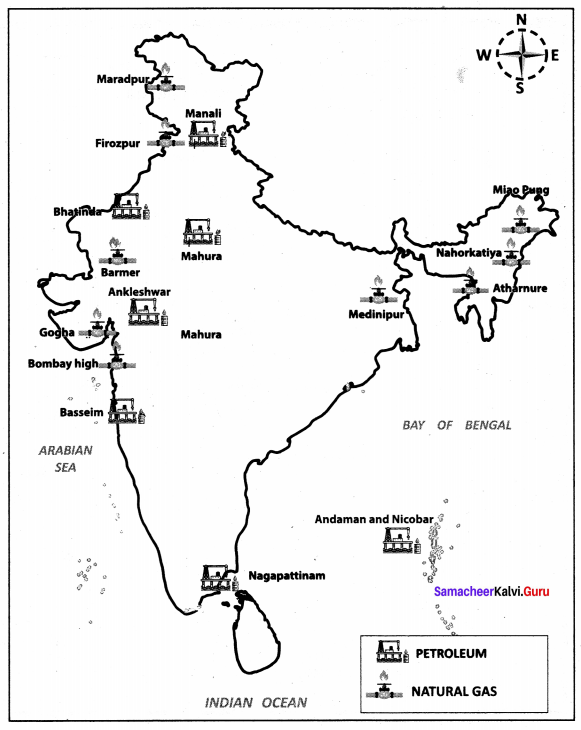
Centres of Petroleum and Natural Gas production.
Answer:
Samacheer Kalvi 10th Social Science Geography Solutions Chapter 4 Resources And Industries

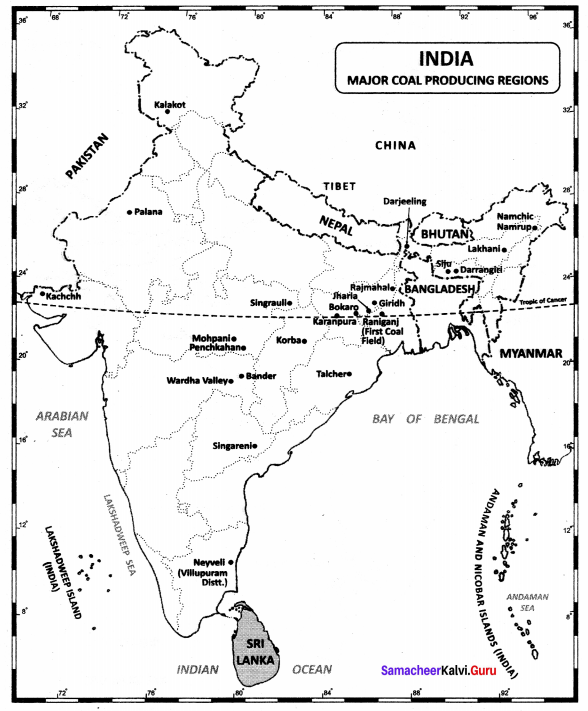
Question 3.
Coal mining centres.
Answer:
Samacheer Kalvi Guru 10th Social Science Geography Solutions Chapter 4 Resources And Industries

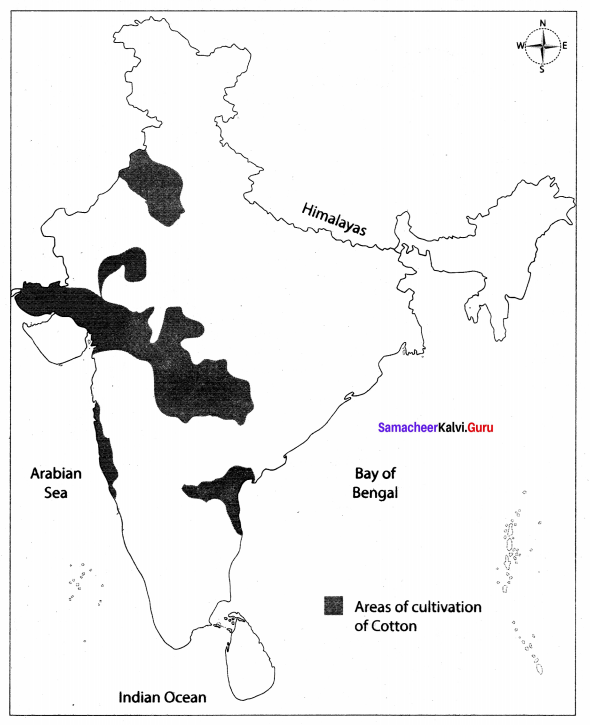
Question 4.
Areas of cltivation of cotton.
Answer:
Samacheer Kalvi 10th Social Science Geography Solutions Chapter 4 Resources And Industries

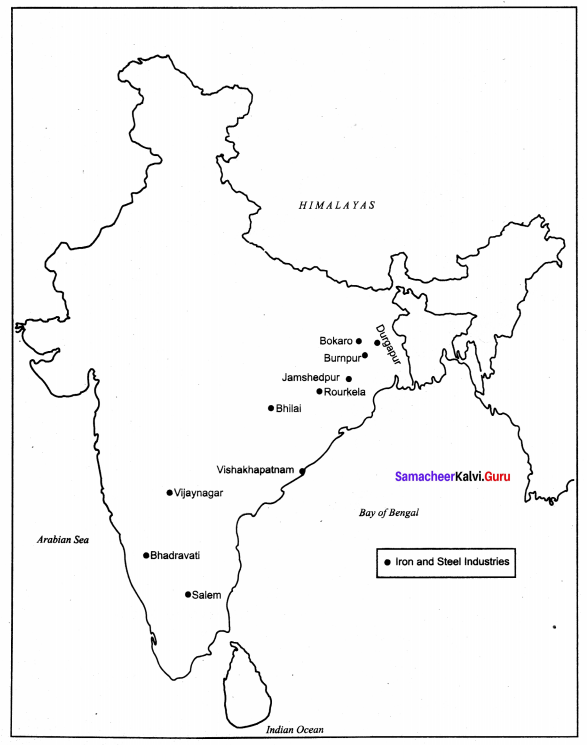
Question 5.
Iron and Steel Industries.
Answer:
10th Social India Outline Map Samacheer Kalvi Geography Solutions Chapter 4 Resources And Industries
Resources and Industries Additional Questions

I. Choose the correct answer.

Question 1.
The cotton textile industry is ……..
(a) Mineral-based industry
(b) Agro-based industry
(c) Forest-based industry
Answer:
(b) Agro-based industry

Question 2.
………………. is the largest coal-producing state in India.
(a) Rajasthan
(b) TamilNadu
(c) Jharkhand
(d) Odisha
Answer:
(c) Jharkhand

Question 3.
Tata Iron and Steel industry is located at ………
(a) Durgapur
(b) Bhilai
(c) Jamshedpur
Answer:
(c) Jamshedpur

Question 4.
………………. is the oldest oil field in the country.
(a) Gulf of Mannar
(b) Dibrugarh
(c) Digboi
(d) Rudra Sagar
Answer:
(c) Digboi

Question 5.
The City Known as Electronic Capital is ……….
(a) Kanpur
(b) Delhi
(c) Bangalore
Answer:
(c) Bangalore

Question 6.
The flexible mode of power generation is ………………. very quickly adapting to changing demands.
(a) Thermal power
(b) Hydropower
(c) Solar power
(d) Nuclear power
Answer:
(b) Hydropower

Question 7.
…….. is the major exporter of jute.
(a) India
(b) China
(c) Bangladesh
Answer:
(c) Bangladesh

Question 8.
Development of wind power in India began in the year:
(a) 1976
(b) 1966
(c) 1986
(d) 1906
Answer:
(c) 1986

Question 9.
Petroleum is also known as ……..
(a) Black oil
(b) Mineral oil
(c) Yellow liquid
Answer:
(b) Mineral oil

Question 10.
………………. is the process by which the cotton seeds are removed from the cotton fibre.
(a) Ginning
(b) Relting
(c) Pruning
(d) Tapping
Answer:
(a) Ginning

Question 11.
The first automobile industry was started at ………
(a) Uttar pradesh
(b) Kurla
(c) Lucknow
Answer:
(b) Kurla

Question 12.
Make in India programme was launched in ………………. the year:
(a) 2000
(b) 2004
(c) 2014
(d) 2016
Answer:
(c) 2014

Question 13.
The Oldest and the largest integrated Iron and Steel plant of India is
(a) Tata Iron and Steel Company
(b) Salem Steel Ltd
(c) Indian Iron and Steel Company
Answer:
(a) Tata Iron and Steel Company

Question 14.
India exports software service to nearly ………………. countries in the world.
(a) 65
(b) 75
(c) 85
(d) 95
Answer:
(d) 95

Question 15.
Jharkhand is the leading producer of
(a) Bauxite
(b) Mica
(c) Indian ore
Answer:
(b) Mica

Question 16.
………. is contained in the Monazite sand.
(a) Oil
(b) Thorium
(c) Coal
Answer:
(b) Thorium

Question 17.
Where are minerals usually found?
(a) On rocks
(b) On earth crust
(c) On ores
Answer:
(c) On ores

Question 18.
Minerals occur igneous and metamorphic rocks in
(a) the veins and the lodes
(b) layers
(c) alluvial deposit
Answer:
(a) the veins and the lodes

Question 19.
…….. is the basic minerals and the backbone of industrial development.
(a) Coal
(b) Copper
(c) Iron ore
Answer:
(c) Iron ore

Question 20.
…….. metal has a very high content of iron up to 70%.
(a) Magnetic ore
(b) Limonite ore
(c) Hematite ore
Answer:
(a) Magnetic ore

Question 21.
……… is the largest producer of manganese ore in India.
(a) Kudremukh
(b) Odisha
(c) Bailadila
Answer:
(b) Odisha

Question 22.
……… is the basic raw material for the cement industry.
(a) Gypsum
(b) Limestone
(c) Potash salt
Answer:
(b) Limestone

Question 23.
……. is the hardest mineral.
(a) Gold
(b) Diamond
(c) Ruby
Answer:
(b) Diamond

Question 24.
…….. is the softest mineral.
(a) Talc
(b) Salt
(c) Cement
Answer:
(a) Talc

Question 25.
Which one is not a ferrous mineral?
(a) Iron ore
(b) Copper
(c) Hematite
Answer:
(b) Copper

Question 26.
Which one of the following is not a property of Copper?
(a) It is ductile
(b) It is a good conductor
(c) It is hard
Answer:
(c) It is hard

Question 27.
The mineral ore from which aluminium is mainly obtained.
(a) Copper
(b) bauxite
(c) iron ore
Answer:
(b) bauxite

Question 28.
…….. is the finest iron ore.
(a) Hematite
(b) Magnetite
(c) Lignite
Answer:
(b) Magnetite

Question 29.
……. and …….. are obtained from veins and Nodes.
(a) Zinc and copper
(b) Copper and coal
(c) Coal and Bauxite
Answer:
(a) Zinc and copper

Question 30.
……. is not a conventional source of energy.
(a) Coal
(b) Biogas
(c) firewood
Answer:
(b) Biogas

Question 31.
The largest solar plant of India is located at …….
(a) Madhapur
(b) Nagarcoil
(c) Madurai
Answer:
(c) Madurai

II. Fill in the blanks.

1. ……… is a silvery grey element.
2. ……… is the first metal used by man.
3. Bauxite is an important one from which …….. is extracted.
4. In ancient time, ……… was used in ayurvedic medicine.
5. ……… is an inflammable organic substance composed mainly of hydrocarbons.
6. …….. usually accompanies petroleum accumulation.
7. India is the second-largest producer of ……..
8. ……… is the largest producer of silk.
9. The first paper mill of India was started in ………
10. The first Jute mill in India was established ……… at near Kolkata.
11. The by-product of the sugar industry are ……. and ……………
12. Most of the jute mills of India are centralized in …….. basin of the West Bengal
13. India is the ……… sugar-producing country in the world.
14. High-grade iron ore is available in …… in Jharkhand.
15. The fast-growing industry of India is …….. industry.
16. The Manchester of Tamil Nadu is ……..
17. The process of rearing silkworm is called ………
18. The first short based integrated steel plant in the country is the …
19. The Electronic capital of India is called ……….
20. Low quality brown coal is called ……..
21. …….. makes our toothpaste white.
22. The first hydro-electric power station in India was established at …….
23. Limestone is found in ………. rocks.
Answers:
1. Manganese
2. Copper
3. aluminium
4. Mica
5. Coal
6. Natural gas
7. raw silk
8. Karnataka
9. West Bengal
10. Rishra
11. Bagasse, Molasses
12. Hooghly
13. second
14. Singbhum
15. automobile
16. Coimbatore
17. Sericulture
18. Vishakhapatnam Steel Plant
19. Bangalore
20. lignite
21. Titanium Oxide
22. Darjeeling
23. Sedimentary

III. Match the following.

Samacheer Kalvi Social Science 10th Std Geography Solutions Chapter 4 Resources And Industries
Answers
1. (c)
2. (d)
3. (a)
4. (b)
5. (e)

10th Samacheer Kalvi Social Science Geography Solutions Chapter 4 Resources And Industries
Answers:
1. (b)
2. (e)
3. (a)
4. (c)
5. (d)

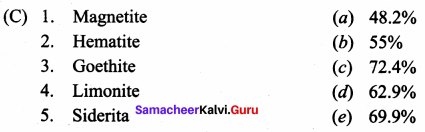
Social Samacheer Kalvi 10th Science Geography Solutions Chapter 4 Resources And Industries
Answers:
1. (c)
2. (e)
3. (d)
4. (b)
5. (a)

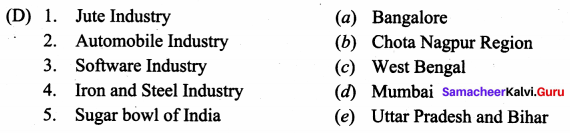
Samacheer Kalvi Class 10 Social Science Solutions Chapter 4 Resources And Industries
Answers:
1. (c)
2. (d)
3. (a)
4. (b)
5. (e)

Samacheer Kalvi 10 Social Science Geography Solutions Chapter 4 Resources And Industries
Answers:
1. (c)
2. (a)
3.(e)
4. (b)
5. (e)

IV. Answer in one or two words.

Question 1.
What makes our toothpaste white?
Answer:
Titanium oxide

Question 2.
Name the rock which is made of one mineral.
Answer:
Limestone

Question 3.
How many minerals have been identified so far in the world?
Answer:
Nearly 2000

Question 4.
Name the mineral which is used to harden steel during manufacturing.
Answer:
Manganese

Question 5.
Which is the most abundantly available fossil fuel?
Answer:
Coal

Question 6.
How many thermal power plants are there in India?
Answer:
310 thermal plants

Question 7.
Which energy can be produced from ocean water?
Answer:
Tidal energy

Question 8.
What are two categories of minerals?
Answer:

  1. Metallic
  2. Non-metallic

Question 9.
Name the two countries which import iron ore from India?
Answer:
Japan and India

Question 10.
In what form ore minerals generally found?
Answer:
In the form of ores.

Question 11.
Name the two important coalfields of India?
Answer:
Jharia and Bokaro

V. Answer in brief.

Question 1.
Give the full form of these abbreviated words:
Answer:
SAIL – Steel Authority of India Limited
MOIL – Manganese Ore India Limited
HCL – Hindustan Copper Limited
NALCO – National Aluminium Company Limited
NLCIL – Neyveli Lignite Corporation of India Limited

Question 2.
How do we get metals?
Answer:
We get metals by processing minerals ores.

Question 3.
What are the uses of petroleum?
Answer:
Petroleum is used as a source of power and fuel for automobiles, aeroplanes, ships and locomotives.

Question 4.
What are the by products of Jute industry?
Answer:
Gunny bags, canvas, pack sheets, jute webs, lassian, carpets, cordage and twines

Question 5.
What are the by-products of petroleum?
Answer:
The by-products of petroleum are Lubricants, Kerosene, Vaseline, Tar, Soap, Terylene and Wax.

Question 6.
List out the sugar-producing states of India?
Answer:
Uttar Pradesh, Bihar, Punjab, Haryana, Maharashtra, Karnataka, Andhra Pradesh, Tamil Nadu.

Question 7.
Name some of the Nuclear power stations in India.
Answer:

  1. Rawatbhatta-Kota in Rajasthan.
  2. Kalpakkam and Kudankulam in Tamil Nadu.
  3. Narora in Uttar Pradesh.
  4. Kaiga in Karnataka and Kakrapara in Gujarat.

Question 8.
List out the leading states of paper production in our country.
Answer:
West Bengal, Maharashtra, Madhya Pradesh, Karnataka and Andhra Pradesh.

Question 9.
Name some of the major software industries in the country?
Answer:
Tata Consultancy Services (TCS) , L and T Infotech, i-Flex, Accenture, Cognizant, GalexE Solutions India Pvt Limited and ITC Infotech are the major software industries in the country.

Question 10.
How are the industries classified on the basis of raw materials?
Answer:

  1. Agro based industries
  2. Forest based industries
  3. Mineral based industries

Question 11.
Define the term ‘ore’.
Answer:
The term ‘ore’ is used to describe an accumulation of any mineral mixed with other elements.

Question 12.
Why is natural gas considered an eco-friendly fuel?
Answer:
Because of low carbon dioxide emissions.

Question 13.
How is thermal electricity generated?
Answer:
Thermal electricity is generated by using coal, petroleum and natural gas.

Question 14.
How is hydro-electricity generated?
Answer:
Hydro-electricity is generated by fast flowing water.

Question 15.
What is called pruning?
Answer:
Trimming of over grown branches of tea plants is known as pruning.

Question 16.
What is ginning?
Answer:
The seeds are separated from the cotton fibre by means of a process called ginning.

Question 17.
Name the chief silk weaving centers of India.
Answer:
Srinagar, Amritsar, Murshidabad, V aranasi, Pune, Mysore, Bangalore, Arani and Kanchipuram. Karnataka is famous for silk worm rearing.

Question 18.
What is Byssionosis?
Answer:
Byssionosis also called “Brown lung disease” or “Monday fever” ia an occupational lung disease caused dust in inadequately ventilated working environments.

Question 19.
Mention any four activities which require energy.
Answer:

  1. Cook food
  2. Provide light and heat
  3. Propel vehicles
  4. Drive machinery in industries

Question 20.
How is natural gas used?
Answer:
Natural gas is used as a source of energy as well as an industrial raw material in the petrochemical industry.

Question 21.
Mention any three major iron ore belts of India.
Answer:

  1. Odisha – Jharkhand belt
  2. Durg – Bastar – Chandrapur belt in Chattisgarh and Maharashtra
  3. Bellary – Chitradurga – Chikmangalur – Tumkur belt in Karnataka

Question 22.
Mention the properties of Mica.
Answer:

  1. It is made up of a series of plates or leaves.
  2. It splits easily into thin sheets.
  3. Mica can be clear, black, green, red, yellow or brown.
  4. Mica is considered an important mineral used in electric and electronic industries.

Question 23.
What is solar energy?
Answer:
The energy obtained from the sun is known as the solar energy. It does not cause environmental problems as it is pollution free.

Question 24.
Mention the importance of sugar industry.
Answer:
India is the world’s second largest producer of sugarcane after Brazil. Sugar industry provide employment to 2.86 lakh workers, besides creating extensive indirect employment and income for 25 million cultivators of sugarcane. It is also an important source of excise duty.

Question 25.
Write about Silk industry.
Answer:
India is one of the large producer of raw silk. Sericulture is the process of rearing silkworm. The chief silk weaving centres are Srinagar, Amritsar, Murshidabad, Varanasi, Pune, Mysore, Bangalore, Salem, Arani and Kanchipuram. Karnataka is famous for silkworm rearing.
India exports exclusively silk fabrics like scarves, dress-materials and sarees. The principal buyers of Indian silk are West Germany, Singapore, USA, UK, Russia, Saudi Arabia and Kuwait.

Question 26.
How are deposits of bauxite formed and aluminium obtained?
Answer:
Bauxite deposits are formed due to decomposition of wide variety of rocks rich in aluminium silicates. Ores containing aluminium are obtained from bauxite which is a clay-like substance from which alumina and later aluminium is obtained.

Question 27.
Write the importance of Solar energy.
Answer:

  1. Solar energy does not cause environmental problems as it is pollution free.
  2. India has enormous possibilities of tapping solar system.
  3. It is becoming popular in rural and remote areas of India. Thus, it will be able to minimise the dependence of rural households on firewood and dunk cake.

Question 28.
How is nuclear energy obtained?
Answer:
Nuclear energy is obtained by altering the structure of atoms. When such an alteration is made, much energy is released in the form of heat and this is used to generate electric power. Uranium and thorium, which are available in Jharkhand and the Aravalli ranges of Rajasthan are used for generating atomic or nuclear power. The monazite sands of Kerala is also rich in thorium.

Question 29.
Give the importance of the Salem Steel Plant.
Answer:
Salem Steel Plant started for commercial production in 1982. It is a major producer of world class stainless steel, which is exported to USA, Mexico, Australia and some other countries of South East Asia.

Question 30.
Give an account of Electronic industry of India.
Answer:
India has made remarkable progress in electronic and computer technology since 1996. “Bangalore” is known as the Electronic Capital of India as it is the leading centre for the production of electronic goods. The other centres are Hyderabad, Delhi, Mumbai, Chennai, Kolkata, Kanpur, Pune, Lucknow, Jaipur, Coimbatore etc. India can now boast as the leading exporter of electronic goods. It covers a wide range of products including television, transistor, telephone, cellular phones, computer and varied equipment for posts and telegraph, defence, railway and meteorological departments.

VI. Distinguish Between.

Question 1.
Textile industry and Jute industry
Answer:
Samacheer Kalvi 10th Social Science Geography Solutions Chapter 4 Resources and Industries 86

Question 2.
Solk industry and Jute industry
Answer:
Samacheer Kalvi 10th Social Science Geography Solutions Chapter 4 Resources and Industries 87

Question 3.
Automobile industry and Electronic industries
Answer:
Samacheer Kalvi 10th Social Science Geography Solutions Chapter 4 Resources and Industries 88

Question 4.
Forest based industries and Agro based industries
Answer:
Samacheer Kalvi 10th Social Science Geography Solutions Chapter 4 Resources and Industries 89

Question 5.
Ginning and Retting
Answer:
Samacheer Kalvi 10th Social Science Geography Solutions Chapter 4 Resources and Industries 95
Ginning Retting
The seeds are separated from the cotton fibre by the process of Ginning. Retting is a micro-biology process which loosens the outer bark and makes it easier to remove the jute fibres from the stalk.

Question 6.
Iron and steel industry and Software industry
Answer:
Samacheer Kalvi 10th Social Science Geography Solutions Chapter 4 Resources and Industries 96

VII. Answer in detail.

Question 1.
What are Resources? How they are classified based on their availability? Give examples.
Answer:

(i) Natural resources are the matter or energy obtained from the environment used by living things including human beings.

(ii) Natural resources include air, water, soil, minerals, fossil, fuels, plants, wild life etc..

(iii) They are classified on several basis. Based on continued availability the resources are classified into two types:

Renewable Resources:
The resources which have natural regeneration after their utilization. Eg: Solar energy, Wind energy, Bio gas, tidal energy, wave energy etc

Non – Renewable Resources:
The resources that cannot be replaced again after utilization.
Eg: Minerals like Coal, Petroleum, Natural gas, Iron ore, Manganese, Bauxite etc.

(iv) Many natural resources are used as raw materials and they play a vital role in the economic development of a region.

Question 2.
Describe the factors encouraging cotton textile industry in Mumbai.
Answer:
Mumbai in Maharashtra is the leading cotton textile center and it is called the “Manchester of India”.
The following factors favour the cotton industries in Mumbai:

  1. Location of port facilities for the export of finished goods.
  2. Well connected to rail and road links with cotton growing area.
  3. Humid coastal climate favours yarning.
  4. Availability of capital goods and finance.
  5. Availability of manpower.

VIII. Expand the following:

1. NFTDC – Non-Ferrous Material Technology Department Centre
2. SAIL – Steel Authority of India Limited
3. MOIL Manganese Ore India Limited
4. HCL – Hindustan Copper Limited
5. NALCO – National Aluminium Company Limited
6. CIL Coal India Limited
7. MOP & NG – The Ministry of Petroleum and Natural Gas
8. GAIL The Gas Authority of India Limited
9. CNG Compressed Natural Gas
10. NPCIL – The Nuclear Power Corporation of India Limited
11. DAE – Department of Atomic Energy
12. NHPC National Hydroelectric Power Corporation
13. MNES Ministry of Non-Conventional Energy Source
14. NIWE – The National Institute of Wind Energy
15. CSTRI – Central Silk Technological Research Institute
16. NEPA National Newsprint and Paper Mills
17. BHEL – Bharat Heavy Electrical Limited
18. TCS Tata Consultancy Service
19. NTPC – National Thermal Power Corporation

We think the data given here clarify all your queries of Chapter 4 and make you feel confident to attempt all questions in the examination. So, practice more & more from Tamilnadu State Board solutions for 10th Social Science Geography Chapter 4 Resources and Industries Questions and Answers & score well. Need any information regarding this then ask us through comments & we’ll give the best possible answers very soon.

Samacheer Kalvi 10th Maths Solutions Chapter 7 Mensuration Ex 7.3

You can Download Samacheer Kalvi 10th Maths Book Solutions Guide Pdf, Tamilnadu State Board help you to revise the complete Syllabus and score more marks in your examinations.

Tamilnadu Samacheer Kalvi 10th Maths Solutions Chapter 7 Mensuration Ex 7.3

10th Maths Exercise 7.3 Samacheer Kalvi Question 1.
A vessel is in the form of a hemispherical bowl mounted by a hollow cylinder. The diameter is 14 cm and the height of the vessel is 13 cm. Find the capacity of the vessel.
Solution:
Diameter = 14 cm
Radius = 7 cm
Total height = 13 cm
Height of the cylindrical part = 13 – 7
= 6 cm
∴ Capacity of the vessel = Capacity of the cylinder + Capacity of the hemisphere.
10th Maths Exercise 7.3 Samacheer Kalvi Chapter 7 Mensuration
∴ The total volume = 924 + 718.67
The capacity of the vessel = 1642.67 cm3

Exercise 7.3 Class 10 Samacheer Kalvi Question 2.
Nathan, an engineering student was asked to make a model shaped like a cylinder with two cones attached at its two ends. The diameter of the model is 3 cm and its length is 12 cm. If each cone has a height of 2 cm, find the volume of the model that Nathan made.
Solution:
Volume of the model = Volume of the cylinder + Volume of 2 cones.
Exercise 7.3 Class 10 Samacheer Kalvi Solutions Chapter 7 Mensuration
Ex 7.3 Class 10 Samacheer Kalvi Solutions Chapter 7 Mensuration
The volume of the model that Nathan made = 66 cm3

Ex 7.3 Class 10 Samacheer Question 3.
From a solid cylinder whose height is 2.4 cm and the diameter 1.4 cm, a cone of the same height and same diameter is carved out. Find the volume of the remaining solid to the nearest cm3.
Solution:
Volume of the cylinder = πr2h cu. units
Volume of the cone = \(\frac{1}{3} \pi r^{2} h\) cu. units
10th Maths Exercise 7.3 Solutions Chapter 7 Mensuration Samacheer Kalvi
d = 1.4 cm, r = 0.7 cm = \(\frac{7}{10}\)
h = 2.4 cm = \(\frac{24}{10}\)
Volume of the cylinder:
Samacheer Kalvi 10th Maths Chapter 7 Mensuration Ex 7.3 5
Volume of cone carved out
9th Maths Exercise 7.3 Samacheer Kalvi Chapter 7 Mensuration
∴ Volume of the remaining solid = Volume of the cylinder – Volume of the cone
= 3.696 – 1.232
= 2.464
= 2.46 cm3

10th Maths Exercise 7.3 Question 4.
A solid consisting of a right circular cone of height 12 cm and radius 6 cm standing on a hemisphere of radius 6 cm is placed upright in a right circular cylinder full of water such that it touches the bottom. Find the volume of the water displaced out of the cylinder, if the radius of the cylinder is 6 cm and height is 18 cm.
10th Maths Mensuration Exercise 7.3 Solutions Chapter 7 Samacheer Kalvi
Solution:
Volume of water displaced out = Volume of the solid immersed in.
Volume of the solid = Volume of the cone + Volume of the hemisphere
10th Maths 7.3 Solutions Chapter 7 Mensuration Samacheer Kalvi
Samacheer Kalvi 10th Maths Mensuration Solutions Chapter 7 Mensuration
∴ The volume of water displaced out = Volume of the solid
= (1) + (2)
= 905.14 cm3

9th Maths Exercise 7.3 Samacheer Kalvi Question 5.
A capsule is in the shape of a cylinder with two hemisphere stuck to each of its ends. If the length of the entire capsule is 12 mm and the diameter of the capsule is 3 mm, how much medicine it can hold?
Solution:
Volume of medicine the capsule can hold = Volume of the cylinder + 2 volume of hemisphere
Volume of the cylinder part
Class 10 Maths Exercise 7.3 Solutions Chapter 7 Mensuration Samacheer Kalvi
10th Math Exercise 7.3 Solutions Chapter 7 Mensuration Samacheer Kalvi
∴ The total volume = 56.571 mm3
∴ The volume of the medicine the capsule can hold = 56.57 mm3

10th Maths Mensuration Exercise 7.3 Question 6.
As shown in figure a cubical block of side 7 cm is surmounted by a hemisphere. Find the surface area of the solid.
10th Maths Samacheer Kalvi Solutions Chapter 7 Mensuration Ex 7.3
Solution:
Clearly, greatest diameter of the hemisphere is equal to the length of an edge of the cube is 7 cm.
Radius of the hemisphere = \(\frac{7}{2}\) cm
Now, total surface area of the solid = Surface area of the cube + Curved surface area of the hemisphere – Area of the base of the hemisphere.
Samacheer Kalvi Guru 10th Maths Solutions Chapter 7 Mensuration Ex 7.3

10th Maths 7.3 Question 7.
A right circular cylinder just enclose a sphere of radius r units.
Calculate
(i) the surface area of the sphere
(ii) the curved surface area of the cylinder
(iii) the ratio of the areas obtained in (i) and (ii).
Solution:
(i) Surface area of sphere = 4πr2 sq. units
Samacheer Kalvi 10th Maths Solutions Chapter 7 Mensuration Ex 7.3

Samacheer Kalvi 10th Maths Mensuration Question 8.
A shuttle cock used for playing badminton has the shape of a frustum of a cone is mounted on a hemisphere. The diameters of the frustum are 5 cm and 2 cm. The height of the entire shuttle cock is 7 cm. Find its external surface area.
Solution:
External surface area of the cock = Surface area of frustum + CSA of hemisphere
Samacheer Kalvi 10th Books Maths Solutions Chapter 7 Mensuration Ex 7.3
Ex 7.3 Class 10 Maths Solutions Chapter 7 Mensuration Samacheer Kalvi

Samacheer Kalvi 8th Tamil Solutions Chapter 3.3 தமிழ்ர் மருந்தும்

Tamilnadu State Board New Syllabus Samacheer Kalvi 8th Tamil Book Solutions Guide Pdf Chapter 3.3 தமிழ்ர் மருந்தும் Text Book Back Questions and Answers, Summary, Notes.

Tamilnadu Samacheer Kalvi 8th Tamil Solutions Chapter 3.3 தமிழ்ர் மருந்தும்

கற்பவை கற்றபின்

Question 1.
நீங்கள் மருத்துவரிடம் கேட்க விரும்பும் ஐந்து வினாக்களை எழுதுக.
Answer:
(i) பல மருந்துகளின் பெயர்களை மருத்துவ நூல்களில் படிக்கின்றோம். ஆனால், அந்த மருந்துகளைப் பார்த்ததே இல்லை. மற்றவர்களுக்கும் தெரிவது இல்லை. அதைத் தெரிந்து கொண்டால் அந்த மருந்துகளின் பயன்பாட்டை நாங்கள் பயன்படுத்த வழி உண்டு. அதற்கு மருத்துவராக விளங்கும் நீங்கள் வழிவகை செய்ய முடியுமா?

(ii) வேதிக்கலப்பு இல்லாத உணவு இன்று குறைவு. அப்படி இருக்கும் போது நோய்கள் விரைவாகவே வந்து விடுகின்றன. இதிலிருந்து மீண்டுவர தாங்கள் கூறும் அறிவுரை யாது?

(iii) பழைய மருத்துவ தாவரங்களை மீட்டுருவாக்கம் செய்ய வழிவகை உள்ளதா?

(iv) நவீன மருத்துவத்தைத் தவிர்த்து நாட்டு மருத்துவத்திற்கு நுழைய அரசு மருத்துவமனையில் பழைய மருத்துவமுறைக்கு வழி உள்ளதா?

(v) தமிழர் மருத்துவத்தைப் பெரும்பாலான தமிழர்களே ஏற்றுக்கொள்ளாத போது, தமிழர் மருத்துவத்தை உலக அளவில் பறைசாற்றுவது எப்படி?

Question 2.
உங்கள் பகுதிகளில் கிடைக்கும் மூலிகைகளின் மாதிரிகளைத் திரட்டி அவற்றின் பயன்களை எழுதிக் காட்சிப்படுத்துக.
Answer:
மாணவர் செயல்பாடு.

பாடநூல் வினாக்கள்

சரியான விடையைத் தேர்ந்தெடுத்து எழுதுக.

Question 1.
தொடக்க காலத்தில் மனிதர்கள் மருத்துவத்திற்கு ………………………… பயன்படுத்தினர்.
அ) தாவரங்களை
ஆ) விலங்குகளை
இ) உலோகங்களை
ஈ) மருந்துகளை
Answer:
அ) தாவரங்களை

Question 2.
தமிழர் மருத்துவத்தில் மருந்து என்பது ……………………… நீட்சியாகவே உள்ளது.
அ) மருந்தின்
ஆ) உடற்பயிற்சியின்
இ) உணவின்
ஈ) வாழ்வின்
Answer:
இ) உணவின்

Question 3.
உடல் எடை அதிகரிப்பதால் ஏற்படும் நோய்களுள் ஒன்று ……………………..
அ) தலைவலி
ஆ) காய்ச்ச ல்
இ) புற்றுநோய்
ஈ) இரத்தக்கொதிப்பு
Answer:
ஈ) இரத்தக்கொதிப்பு

Question 4.
சமையலறையில் செலவிடும் நேரம் ……………………… செலவிடும் நேரமாகும்.
அ) சுவைக்காக
ஆ) சிக்கனத்திற்காக
இ) நல்வாழ்வுக்காக
ஈ) உணவுக்காக
Answer:
இ) நல்வாழ்வுக்காக

குறுவினா

Question 1.
மருத்துவம் எப்போது தொடங்கியது?
Answer:
தொடக்க காலத்தில் மனிதனுக்கு நோய் வந்தபோது இயற்கையாக வளர்ந்த தாவரங்களைக் கொண்டும், அவனுக்கு அருகில் கிடைத்த தாவர, கனிம, சீவப் பொருள்களைக் கொண்டும் நோயைத் தீர்க்க முயன்றிருப்பான். அப்போதே மருத்துவம் தொடங்கியது.

Question 2.
நல்வாழ்விற்கு நாம் நாள்தோறும் செய்ய வேண்டியவை யாவை?
Answer:

  • 45 நிமிடத்தில் 3 கி.மீ. நடைப்பயணம்.
  • 15 நிமிடம் யோகா, தியானம், மூச்சுப்பயிற்சி.
  • 7 மணி நேர தூக்கம்.
  • 3 லிட்டர் தண்ணீ ர் அருந்துதல்.

Question 3.
தமிழர் மருத்துவத்தில் மருந்துகளாகப் பயன்படுவன யாவை?
Answer:
மூலிகை, தாவர இலை, தாவர வேர், உலோகங்கள், பாஷாணங்கள், தாதுப்பொருட்கள் ஆகியன தமிழர் மருத்துவத்தில் மருந்துப்பொருட்களாகப் பயன்படுகின்றனவாகும்.

சிறுவினா

Question 1.
நோய்கள் பெருகக் காரணம் என்ன?
Answer:

  • மனிதன் இயற்கையை விட்டு விலகி வந்ததுதான் முதன்மைக் காரணம்.
  • மாறிப்போன உணவு, மாசு நிறைந்த சுற்றுச்சூழல், மன அழுத்தம் இவை மூன்றும் குறிப்பிடத்தக்க காரணங்கள்.
  • தன் உணவுக்காக வேறு எதைப்பற்றியும் கவலை கொள்ளாமல், நிலத்தை உரங்களாலும், பூச்சிக்கொல்லிகளாலும் நச்சுப்படுத்தலாம் என்ற
  • அலட்சியமான எண்ணம், மன அழுத்தம், எது கேளிக்கை? எது குதூகலம்? எது படிப்பு? எது சிந்தனை? என்ற புரிதல் இல்லாமை ஆகியவற்றைக் கூடுதல் காரணங்களாகச் சொல்லலாம்.
  • நம்முடைய வாழ்வியலைச் செம்மைப்படுத்துவதற்காக நாம் அறிவியல் அறிவை, மேம்பட்ட அறிவை வளர்த்தோம். ஆனால் நுண்ணறிவைத் தொலைத்துவிட்டோம்.
  • இயற்கையோடு இயைந்து வாழலாம் என்கிற அறிவை நாம் மறந்துவிட்டோம். இதுவே இன்றைக்குப் பல நோய்கள் பெருக மிக முக்கியமான காரணம் ஆகும்.

Question 2.
பள்ளிக் குழந்தைகளுக்கு மருத்துவர் கூறம் அறிவுரைகள் யாவை?
Answer:

  • நோய் வந்த பின்பு மருத்துவமனைக்குச் செல்வதை விட வருமுன் காக்கும் வாழ்க்கையை வாழக் கற்றுக் கொள்ளுங்கள்.
  • சரியான உணவு, சரியான உடற்பயிற்சி, சரியான தூக்கம் ஆகிய மூன்றும் உங்களை நலமாக வாழவைக்கும்.
  • விலை உயர்ந்த உணவுதான் சரியான உணவு என்று எண்ணாதீர்கள்.
  • எளிமையாகக் கிடைக்கக்கூடிய காய்கறிகள், கீரைகள், பழங்கள், சிறுதானியங்களை உணவில் சேர்த்துக் கொள்ளுங்கள்.
  • கணினித் திரையிலும், கைபேசியிலும் விளையாடுவதைத் தவிர்த்து நாள்தோறும் ஓடியாடி விளையாடுங்கள்.
  • இரவுத் தூக்கம் மிகவும் இன்றியமையாதது. உரிய நேரத்தில் உறங்கச் செல்லுங்கள். அதிகாலையில் விழித்தெழுங்கள் உங்களை எந்த நோயும் அண்டாது.

நெடுவினா

Question 1.
தமிழர் மருத்துவத்தின் சிறப்புகளாக மருத்துவர் கூறும் செய்திகளைத் தொகுத்து எழுதுக.
Answer:
(i) வேர்பாரு; தழைபாரு மிஞ்சினக்கால் பற்பசெந்தூரம் பாரே’ என்றனர் சித்தர்கள்.

(ii) வேர், தழையால் குணம் அடையாதபோது சில நாட்பட்ட நோய்களுக்கு, தாவரங்கள் மட்டும் அல்லாமல் உலோகங்களையும் பாஷாணங்களையும் சித்த மருந்துகளாக நம் முன்னோர்கள் பயன்படுத்தியிருக்கிறார்கள்.

(iii) அந்தக் காலத்தில் எப்படி மூலிகைகளை மருந்தாகப் பார்த்தார்களோ அப்படியே தாதுப்பொருட்களையும், உலோகத்தையும் பார்த்தார்கள்.

(iv) அவற்றை மருந்துகளாக மாற்றும் வல்லமை சித்தமருத்துவத்தில் இருந்திருக்கிறது.

(v) ஒரு மருந்தை எடுத்துக்கொண்டால் அதற்கு விளைவும் இருக்கும்; பக்கவிளைவும் இருக்கும். ஆனால் தமிழர் மருத்துவத்தில் பக்க விளைவுகள் இல்லை. அதற்குக் காரணம் மருந்து என்பதே உணவின் நீட்சியாக இருக்கிறது.

(vi) ஒரு கவளம் சோற்றை உடல் எப்படி எடுத்துக்கொள்கிறதோ, அப்படியே தான் சித்த மருத்துவத்தின் லேகியத்தையும், சூரணத்தையும் உடல் எடுத்துக்கொள்ளும்.

(vii) அதனால் உணவு எப்படி பக்கவிளைவுகளைத் தருவதில்லையோ அதே போலச் சித்த மருந்துகளும் பக்கவிளைவுகளை ஏற்படுத்துவதில்லை.

(viii) தமிழர் மருத்துவத்தின் சிறப்பு என்னவென்றால், தனித்துவமான பார்வை இதன் முதல் சிறப்பு; இரண்டாவது சூழலுக்கு இசைந்த மருத்துவம் இது. இந்த மருத்துவத்தின் பயன்பாடோ, மூலக்கூறுகளோ, மருந்துகளோ சுற்றுச்சூழலைச் சிதைக்காது.

(ix) மிக முக்கியமான சிறப்பு என்னவென்றால், நோய்க்கான சிகிச்சையை மட்டும் சொல்லாமல், நோய் மீண்டும் வராமலிருப்பதற்கான வாழ்வியலையும் சொல்கிறது.

(x) அதாவது நோய்நாடி நோய் முதல் நாடி’ என்ற திருக்குறளின்படி நோயை மட்டுமன்றி, அதன் காரணிகளையும் கண்டறிந்து ஒருவரை நோயில்லாத மனிதராக்குகிறது.

சிந்தனை வினா

Question 1.
நோயின்றி வாழ நாம் என்னென்ன வழிகளைக் கையாளலாம்?
Answer:
இயற்கையோடு இணைந்து உண்ணல்:
மனிதனின் அடிப்படைத் தேவைகளுள் முதன்மையானது உணவு. மக்கள் உண்ணும் உணவும் உணவுப் பழக்கவழக்கங்களுமே அவர்களது உடல் நலத்தையும் உள நலத்தையும் தீர்மானிக்கின்றன. தமிழர் மருத்துவத்தில் உணவு என்பது அனைத்து நோய்களையும் தீர்க்கக் கூடிய சஞ்சீவி மருந்தாகக் கருதப்படுகிறது.

உண்ணும் முறை :
எளிதில் செரிக்கக் கூடிய பழம், காய், பருப்பு, அரிசி, கோதுமை, பால் இவற்றையே குடல் ஏற்றுக் கொள்கிறது. நாச்சுவை கருதி உண்ணாமல், உடல் நலங்கருதி உண்ணுதலே நல்லது. உணவை விரைவாக விழுங்கக்கூடாது; நன்றாக மென்று விழுங்குதல் வேண்டும்.

பயிற்சிகள் :
தினமும் நாற்பத்தைந்து நிமிடத்தில் மூன்று கி.மீ. நடைப்பயணம், பதினைந்து நிமிடம் யோகா, தியானம், மூச்சுப்பயிற்சி, ஏழு மணிநேர தூக்கம், மூன்று லிட்டர் தண்ணீ ர் அருந்துவது அவசியம்.

தவிர்க்க வேண்டியன:
நோய்க்கு முதல் காரணம் உப்பு. இதனைக் குறைவாக சேர்த்தல் நன்று. உப்பு நிறைந்த பொருள்களான ஊறுகாய், அப்பளம், வடகம், கருவாடு, வறுத்த முந்திரிபருப்பு, வறுத்த உருளைச் சீவல், வாழைக்காய்ச் சீவல், புளித்த மோர் முதலியனவற்றை முழுவதுமாகத் தவிர்த்தல் வேண்டும். கொழுப்பு நிறைந்த இறைச்சிகள், முட்டையின் மஞ்சள் கரு, தயிர், நெய், வெண்ணெய், பாலாடை, பனிக்கூழ், இனிப்புக்கட்டி ஆகியவற்றை நீக்குதல் வேண்டும்.

சமச்சீர் உணவு :
‘உணவே மருந்து மருந்தே உணவு’ என்று வாழ்ந்தவர்கள் நம் முன்னோர்கள். ஒருவர் உட்கொள்ளும் உணவில் புரதம், கொழுப்பு, மாச்சத்து, கனிமங்கள், நுண்ணூட்டச் சத்துகள் சேர்ந்ததே சமச்சீர் உணவு. எனவே, அளவறிந்து உண்ண வேண்டியது அவசியமாகும்.

கூடுதல் வினாக்கள்

சரியான விடையைத் தேர்ந்தெடுத்து எழுதுக.

Question 1.
அருந்தும் உணவே அருமருந்தென அறிந்தவர் ………………………… மக்கள்.
அ) கேரள
ஆ) தெலுங்கு
இ) தமிழ்
ஈ) கர்நாடகம்
Answer:
இ) தமிழ்

Question 2.
………………….. மக்கள் உடற்கூறு பற்றிய அறிவிலும், மருத்துவம் பற்றிய புரிதலிலும் சிறந்து விளங்கினர்.
அ) தமிழ்
ஆ) சீனா
இ) ஆங்கிலேயர்
ஈ) கேரளம்
Answer:
அ) தமிழ்

Question 3.
தமிழர் மருத்துவம் ………………………. என்று அழைக்கப்படுகிறது.
அ) ஹோமியோபதி
ஆ) அலோபதி
இ) அக்குபஞ்சர்
ஈ) சித்த மருத்துவம்
Answer:
ஈ) சித்த மருத்துவம்

Question 4.
உடலை வளப்படுத்தி உள்ளத்தைச் சீராக்குவது …………………… கலை.
அ) நாட்டியம்
ஆ) ஓவியம்
இ) உடற்பயிற்சி
ஈ) யோகனம்
Answer:
ஈ) யோகனம்

Question 5.
தமிழர் ………………………. சாங்கியம், ஆசீவகம் ஆகும்.
அ) மெய்யியல்
ஆ) வரலாறு
இ) அறிவியல்
ஈ) தத்துவங்கள்
Answer:
ஈ) தத்துவங்கள்

Question 6.
…………………. மற்றும் ……………………. காலத்தில் அந்தந்த மதங்களின் கூறுகள் நம் மருத்துவத்தில் இருந்தன.
அ) இந்து, முஸ்லிம்
ஆ) சைவம், வைணவம்
இ) இந்து, சமணம்
ஈ) சமணம், பௌத்தம்
Answer:
ஈ) சமணம், பௌத்தம்

Question 7.
………………………….. களுடைய நவீன அறிவியல் பார்வை நம்மீது தாக்கத்தை ஏற்படுத்தியது.
அ) பாரசீகர்கள்
ஆ) ஆங்கிலேயர்கள்
இ) ஆரியர்கள்
ஈ) முகலாயர்கள்
Answer:
ஆ) ஆங்கிலேயர்கள்

Question 8.
‘வேர்பாரு; தழைபாரு மிஞ்சினக்கால் பற்பசெந்தூரம் பாரே’ என்றனர் ……………………….
அ) தமிழர்கள்
ஆ) சித்தர்கள்
இ) சைவர்கள்
ஈ) முன்னோர்கள்
Answer:
ஆ) சித்தர்கள்

Question 9.
நாட்பட்ட நோய்களுக்கு, தாவரங்கள் மட்டும் அல்லாமல் ……………………….. களையும் பயன்படுத்தினர்.
அ) உலோகங்கள்
ஆ) அலோகங்கள்
இ) சாயங்கள்
ஈ) வேதியல்
Answer:
அ) உலோகங்கள்

Question 10.
தாதுப்பொருட்களையும், உலோகத்தையும் மருந்துகளாக மாற்றும் வல்லமை …………………….. மருத்துவத்தில் இருந்திருக்கிறது.
அ) நவீன
ஆ) மூலிகை
இ) சித்த
ஈ) சீன
Answer:
இ) சித்த

Question 11.
‘நோய்நாடி நோய் முதல்நாடி’ என்று கூறியவர் ………………………
அ) கம்பர்
ஆ) வள்ளுவர்
இ) ஔவையார்
ஈ) திருமூலர்
Answer:
ஆ) வள்ளுவர்

Question 12.
தினமும் ………………………… நிமிடத்தில் மூன்று கி.மீ. நடைப்பயணம் மேற்கொள்ள வேண்டும்.
அ) 25
ஆ) 30
இ) 40
ஈ) 45
Answer:
ஈ) 45

Question 13.
தினமும் …………………… நிமிடம் யோகா செய்ய வேண்டும்.
அ) 10
ஆ) 15
இ) 20
ஈ) 25
Answer:
ஆ) 15

Question 14.
தினமும் …………………… மணிநேரம் தூங்குவது அவசியம்.
அ) 7
ஆ) 8
இ) 6
ஈ) 5
Answer:
அ) 7

Question 15.
தினமும் ………………… லிட்டர் தண்ணீ ர் அருந்துவது அவசியம்.
அ) 5
ஆ) 4
இ) 2
ஈ) 3
Answer:
ஈ) 3

Question 16.
கணினித்திரையிலும் கைபேசியிலும் விளையாடுவதைத் தவிர்த்து நாள்தோறும் ………………………….. விளையாடுங்கள்.
அ) கபடி
ஆ) நொண்டி
இ) ஓடியாடி
ஈ) செஸ்
Answer:
இ) ஓடியாடி

பிரித்து எழுதுக

மருந்தென = மருந்து + என
உடற்கூறுகள் = உடல் + கூறுகள்
தங்களுக்கென = தங்களுக்கு + என
வந்துள்ளோம் = வந்து + உள்ளோம்
முயன்றிருப்பான் = முயன்று + இருப்பான்

அறிந்திருப்பர் = அறிந்து + இருப்பர்
பழந்தமிழர் = பழமை + தமிழர்
வளப்படுத்தி = வளம் + படுத்தி
மருந்தில்லா = மருந்து + இல்லா
இவற்றுக்கெல்லாம் = இவற்றுக்கு + எல்லாம்

கண்டறிந்து = கண்டு + அறிந்து
வாழ்வியலுடன் = வாழ்வியல் + உடன்
துரிதமாக = துரிதம் + ஆக
மாறிப்போனது = மாறி + போனது
ஒளிந்திருக்கும் = ஒளிந்து + இருக்கும்

சேர்த்தெழுதுக

இரத்தம் + கொதிப்பு = இரத்தக்கொதிப்பு
உடல் + பயிற்சி = உடற்பயிற்சி
அவசியம் + ஆயிற்று = அவசியமாயிற்று
நாள் + பட்ட = நாட்பட்ட
மீண்டு + எழுந்து = மீண்டெழுந்து

என்று + எல்லாம் = என்றெல்லாம்
பட்டியல் + இட்டு = பட்டியலிட்டு
சுற்று + சூழல் = சுற்றுச்சூழல்
மட்டும் + அன்றி = மட்டுமன்றி
மற்று + ஒரு = மற்றொரு

உணவுக்கு + ஆக = உணவுக்காக
நுண் + அறிவு = நுண்ணறிவு
சரி + அன்று = சரியன்று
சமையல் + அறை = சமையலறை
விழித்து + எழுங்கள் = விழித்தெழுங்கள்

குறுவினா

Question 1.
பாடப்பகுதியில் வள்ளுவர் மருந்து பற்றிய குறளாக குறிப்பிடுவது எது?
Answer:
‘மருந்தென வேண்டாவாம் யாக்கைக்கு அருந்தியது
அற்றது போற்றி உணின்’ என்கிறார் வள்ளுவர்.

Question 2.
பாரம்பரிய மருத்துவ முறையில் தமிழ் மக்கள் எவ்வாறு சிறந்திருந்தனர்?
Answer:

  • தமிழ்மக்கள் உடற்கூறுகள் பற்றிய அறிவிலும், மருத்துவம் பற்றிய புரிதலிலும் சிறந்து விளங்கினர்.
  • உலகில் பல்வேறு மருத்துவ முறைகள் இருந்தாலும் தங்களுக்கெனப் பாரம்பரிய மருத்துவ முறைகளையும் உருவாக்கிப் பின்பற்றி வந்தனர்.

Question 3.
பழந்தமிழரின் மருத்துவம் பற்றிய குறிப்புகள் எவற்றில் கிடைக்கின்றன?
Answer:
பழந்தமிழர்கள் மருத்துவத்தை அறிந்தது மட்டுமன்றி மருத்துவத்தில் சிறந்தும் விளங்கினார்கள் என்பதற்கான குறிப்புகள் பழந்தமிழ் இலக்கியங்களில் கிடைக்கின்றன.

Question 4.
பழந்தமிழர்கள் அறிந்திருந்த மருத்துவ முறைகள் யாவை?
Answer:
பழந்தமிழர்கள், மூலிகை மருத்துவம், அறுவை மருத்துவம், மருந்தில்லா மருத்துவம் போன்றவற்றையும் உடலை வளப்படுத்தி உள்ளத்தைச் சீராக்கும் யோகம் முதலிய
கலைகளையும் அறிந்திருந்தார்கள்.

Question 5.
தமிழர் எவ்வுண்மையை விளக்கினர்?
Answer:
நோயை இயற்கையில் கிடைக்கும் பொருட்கள், அப்பொருளின் தன்மை அதன் சுவை இவற்றைக் கொண்டே குணப்படுத்த முடியும் என்ற உண்மையை மிகத்தெளிவாக விளக்கினர்.

Question 6.
தமிழர் மருத்துவத்தின் முக்கியச் சிறப்பு என்ன?
Answer:
(i) தமிழர் மருத்துவத்தின் மிக முக்கியமான சிறப்பு என்னவென்றால், நோய்க்கான சிகிச்சையை மட்டும் சொல்லாமல், நோய் மீண்டும் வராமலிருப்பதற்கான வாழ்வியலையும் சொல்கிறது.

(ii) அதாவது நோய்நாடி நோய் முதல் நாடி’ என்ற குறளின்படி நோயை மட்டுமன்றி அதன் காரணிகளையும் கண்டறிந்து ஒருவரை நோயில்லாத மனிதராக்குகிறது.

Question 7.
இன்று நோய்கள் பெருகுவதற்கான மூன்று காரணங்கள் யாவை?
Answer:

  • மனிதன் இயற்கையை விட்டு விலகி வந்ததுதான் முதன்மைக் காரணம்.
  • மாறிப்போன உணவு, மாசு நிறைந்த சுற்றுச்சூழல், மன அழுத்தம் இவை மூன்றும் குறிப்பிடத்தக்க காரணங்கள்.

சிறுவினா

Question 1.
தமிழர் மருத்துவ முறைகள் எவ்வாறு பரிணாம வளர்ச்சி அடைந்தது?
Answer:
(i) தமிழரது நிலம், நிறைந்த பண்பாடுகளும் தத்துவங்களும் அடங்கியது.

(ii) நோய்கள் எல்லாம் பேய், பிசாசுகளால் வருகின்றன; பாவ, புண்ணியத்தால் வருகின்றன என்று உலகத்தின் பல பகுதிகளில் சொல்லிக் கொண்டிருந்த காலத்தில், தமிழர் தத்துவங்களான சாங்கியம், ஆசீவகம் போன்றவை உடலுக்கும் ஏற்படும் மாற்றங்களை விளங்கின.

(iii) நோயை இயற்கையில் கிடைக்கும் பொருட்கள், அப்பொருள்களின் தன்மை அதன் சுவை இவற்றைக் கொண்டே குணப்படுத்த முடியும் என்ற உண்மையை மிகத் தெளிவாக விளக்கினர்.

(iv) தமிழர் மருத்துவம் பண்பாட்டுக் கூறாக ஆகும்போது நாட்டு வைத்தியமாகவும், பாட்டி வைத்தியமாகவும் மரபு சார்ந்த சித்த வைத்தியமாகவும், உணவு சார்ந்த
மருத்துவமாகவும், பண்பாடு சார்ந்த மருத்துவமாகவும் விரிந்திருக்கிறது.

Question 2.
உயர்வாக இருந்த தமிழர் மருத்துவமுறை பிறகு பின்தங்கிப் போனதற்குக் காரணம் என்ன ?
Answer:

  • நம்மீது நிகழ்ந்த படையெடுப்புகள் தாக்கத்தை ஏற்படுத்தின.
  • தமிழர் மருத்துவம் அவரவர்வாழ்வியலுடனும், தத்துவங்களுடனும் பிணைந்துதான் வந்து கொண்டிருந்தது.
  • சமணர் மற்றும் பௌத்தர் காலத்தில் அந்தந்த மதங்களின் கூறுகள் நம் மருத்துவத்தில் இருந்தன. பிறகு சைவம் ஓங்கிய போது சைவ சித்தாந்தத்தின் கூறுகள் கலந்தன.
  • இறுதியில் ஆங்கிலேயர்கள் வந்தனர். அவர்களுடைய நவீன அறிவியல் பார்வை நம்மீது தாக்கத்தை ஏற்படுத்தியது.
  • சித்த மருத்துவம் என்பது மரபுவழி மருத்துவமாகவும், நாட்டு மருத்துவமாகவும் சுருங்கியது. இறுதியில் கிராமம் சார்ந்த மருத்துவமாக மாறிப்போனது.
  • நவீன மருத்துவத்தில், துரிதமாகச் சில நோய்களுக்குக் கிடைத்த தீர்வுகள் பெரும்பயனையும் வரவேற்பையும் கொடுத்தன.

Question 3.
தமிழர் மருத்துவம் மறுமலர்ச்சி அடைவதற்கான காரணங்கள் யாவை?
Answer:
(i) பல ஆண்டுகளுக்குப் பின்னால் தான் பாரம்பரிய மருத்துவம் மிகப்பெரிய அனுபவத்தின் நீட்சி என்பதும் மிகப்பெரிய பட்டறிவில் ஒரு பெரிய அறிவியல் கண்டிப்பாக ஒளிந்திருக்கும் என்பதும் புரியத் தொடங்கின. குறிப்பாகச் சர்க்கரை, இரத்தக்கொதிப்பு, புற்றுநோய், மாரடைப்பு முதலிய வாழ்வியல் நோய்கள் பெருகிய நிலையைச் சொல்லலாம்.

(ii) இவற்றைத் தீர்க்க வெறும் இரசாயன மருந்துகள் போதா. கூடவே உணவு, வாழ்வியல், உடற்பயிற்சி, யோகம் இவையும் கூட்டாக மேற்கொள்ளப்பட வேண்டும்.

(iii) தொடர் சிகிச்சைக்குப் பிற பக்க விளைவுகள் இல்லா மருந்துகளின் தேவை அவசியமாயிற்று. அதன் பிறகுதான் எல்லா நாடுகளிலும் இருக்கும் பாரம்பரிய மருத்துவ முறைகளின் மீது, நவீன அறிவியல் பார்வை விழத் தொடங்கியது.

(iv) அதனால் சித்த மருத்துவத்தின் தொன்மையும், தமிழர்களின் தொன்மையும் புரிய ஆரம்பித்தன் ஆய்வுகள் மேற்கொள்ளப்பட்டன.

(v) நாட்பட்ட நோய்களுக்கு மட்டுமல்லாது புதிய தொற்றுநோய் மாதிரியான சவால்களுக்கும் இது சிறந்த மாற்றாக இருப்பது தெரிய வந்தது.

(vi) இன்றைக்குப் பெருவாரியாக இது மீண்டெழுந்து வந்து கொண்டிருக்கிறது.

Question 4.
மருத்துவத்தில் பக்கவிளைவுகள் பற்றி மருத்துவர் கூறிய கருத்துகள் யாவை?
Answer:
(i) ஒரு மருந்தை எடுத்துக்கொண்டால் அதற்கு விளைவும் இருக்கும்; பக்க விளைவும் இருக்கும். ஆனால், தமிழர் மருத்துவத்தில் பக்க விளைவுகள் இல்லை . அதற்குக் காரணம் மருந்து என்பதே உணவின் நீட்சியாக இருக்கிறது.

(ii) ஒரு கவளம் சோற்றை உடல் எப்படி எடுத்துக்கொள்கிறதோ, அப்படியே தான் சித்த மருத்துவத்தின் இலேகியத்தையும், சூரணத்தையும் உடல் எடுத்துக்கொள்ளும்.

(iii) அதனால், உணவு எப்படிப் பக்க விளைவுகளைத் தருவதில்லையோ அதே போலச் சித்த மருந்துகளும் பக்கவிளைவுகளை ஏற்படுத்துவதில்லை.

(iv) இருந்த போதிலும் சித்த மருத்துவத்தின் மீது தற்போது நடக்கும் பல அறிவியல் ஆய்வுகள் மூலம் அவற்றைத் தர நிர்ணயம் செய்து யாருக்கு எந்த மருந்து, எந்த அளவில், எந்தத் துணை மருந்து கொடுத்தால் பக்க விளைவு இருக்காது என்று பட்டியலிட்டுள்ளனர்.

Question 5.
உணவைக் குறைப்பதுதான் எடையைக் குறைக்கும் வழியா விளக்குக.
Answer:

  • இன்றைக்குப் பல உணவுக் கட்டுப்பாட்டு முறைகள் உள்ளன. எல்லாம் நல்ல முயற்சிகள் தாம். ஆனால், அவற்றைப் பின்பற்றுவதற்குத் தம் உடல் ஏற்றதாக இருக்கிறதா என்பதைக் குடும்ப மருத்துவரிடம் கேட்டு முடிவெடுக்க வேண்டும்.
  • ஏனென்றால், இன்றைக்குப் பலரும் இணையத்தைப் பார்த்து அம்முறைகளுக்குச் செல்கிறார்கள்.
  • சிலருக்கு அவை கேடு விளைவிக்கக்கூடும். தடாலடியாக எடையைக் குறைப்பது சரியன்று .
  • ஒரு குறிப்பிட்ட கால இடைவெளிகளில் ஒன்று, ஒன்றரை ஆண்டுகளில் எடையைக் கட்டுக்குள் கொண்டு வர முயற்சிக்க வேண்டும்.
  • அவசர யுகம் என்றாலும் உணவு உண்பதில், சில ஒழுக்கங்களைக் கடைப்பிடித்தாக வேண்டும்.
  • உணவுக்காக சமையலறையில் செலவிடும் நேரத்தை, நல்வாழ்விற்காகச் செலவிடும் நேரம் என நினைக்க வேண்டும்.

நெடுவினா

Question 1.
மருத்துவத்தின் தொடக்கம் குறித்தும், நாள்தோறும் நாம் செய்ய வேண்டியன குறித்தும், மாணவர்கள் கடைப்பிடிப்பன குறித்தும் எழுதுக.
Answer:
மருத்துவத்தின் தொடக்கம் :
தொடக்க காலத்தில் மனிதனுக்கு நோய் வந்தபோது இயற்கையாக வளர்ந்த தாவரங்களைக் கொண்டும் அவனுக்கு அருகில் கிடைத்தத் தாவர, கனிம, சீவப் பொருள்களைக் கொண்டும் நோயைத் தீர்க்க முயன்றிருப்பான். தாவரங்களின் வேர், பட்டை, இலை, பூ, கனி முதலியவற்றை மருந்தாகப் பயன்படுத்தியிருப்பான். இவ்வாறுதான் மனிதர்களுக்கும் மருத்துவத்திற்குமான தொடர்பு தொடங்கியது.

நாள்தோறும் செய்ய வேண்டியன :
தினமும் நாற்பத்தைந்து நிமிடத்தில் மூன்று கி.மீ. நடைப்பயணம், பதினைந்து நிமிடம் யோகா, தியானம், மூச்சுப்பயிற்சி, ஏழுமணி நேர தூக்கம், மூன்று லிட்டர் தண்ணீர் அருந்துவது அவசியம். எங்கோ விளையும் ஆப்பிளைச் சாப்பிடுவதை விட, நமது ஊரில் விளையும் கொய்யா, இலந்தை, நாவல், பப்பாளி, நெல்லி, வாழைப்பழங்கள் ஆகியவற்றைக் காலை உணவுக்கு முன்பு சாப்பிடலாம்.

மாணவர்கள் கடைப்பிடிக்க வேண்டியன:
நோய் வந்த பின்பு மருத்துவமனைக்குச் செல்வதை விட வருமுன் காக்கும் வாழ்க்கையை வாழக் கற்றுக் கொள்ளுங்கள். சரியான உணவு, சரியான உடற்பயிற்சி, சரியான தூக்கம் ஆகிய மூன்றும் உங்களை நலமாக வாழ வைக்கும். விலை உயர்ந்த உணவுதான் சரியான உணவு என்று எண்ணாதீர்கள்.

எளிமையாகக் கிடைக்கக்கூடிய காய்கறிகள், கீரைகள், பழங்கள், சிறுதானியங்களை உணவில் சேர்த்துக் கொள்ளுங்கள். கணினித்திரையிலும் கைபேசியிலும் விளையாடுவதைத் தவிர்த்து நாள்தோறும் ஓடியாடி விளையாடுங்கள். இரவுத்தூக்கம் இன்றியமையாதது. உரிய நேரத்தில் உறங்கச் செல்லுங்கள்; அதிகாலையில் விழித்தெழுங்கள் உங்களை எந்த நோயும் அண்டாது.

Samacheer Kalvi 9th Maths Solutions Chapter 3 Algebra Ex 3.10

You can Download Samacheer Kalvi 9th Maths Book Solutions Guide Pdf, Tamilnadu State Board help you to revise the complete Syllabus and score more marks in your examinations.

Tamilnadu Samacheer Kalvi 9th Maths Solutions Chapter 3 Algebra Ex 3.10

9th Maths Exercise 3.10 Solutions Question 1.
Draw the graph for the following
(i) y = 2x
(ii) y = 4x – 1
(iii) y = \(\left(\frac{3}{2}\right)\) x + 3
(iv) 3x + 2y = 14
Solution:
(i) Put x = -1, y = 2 × -1 = -2
When x = 0, y = 2 × 0 = 0
When x = 1, y = 2 × 1 = 2
9th Maths Exercise 3.10 Solutions Chapter 3 Algebra Samacheer Kalvi
The points (x, y) to be plotted: (-1, -2), (0, 0), (1, 2)

(ii) When x = -1 ⇒ y = 4 (-1) -1
y = – 4 – 1 = – 5
x = 0 ⇒ y = 4 × 0 – 1 = -1
x = 1 ⇒ y = 4 × 1 – 1 = 3
9th Maths Graph Solutions Chapter 3 Algebra Ex 3.10 Samacheer Kalvi
The points (x, y) to be plotted: (-1, -5), (0, -1), (1, 3)

9th Graph Exercise 3.10 Maths Solutions Chapter 3 Algebra Samacheer Kalvi
The points to be plotted: (-2, 0), (0, 3), (2, 6)

9th Graph Samacheer Kalvi Maths Solutions Chapter 3 Algebra Ex 3.10
9th Maths Graph Exercise 3.10 Solutions Chapter 3 Algebra Samacheer Kalvi
The points to be plotted: (-2, 10), (0, 7), (2, 4)

9th Maths Graph Question 2.
Solve graphically
(i) x + y = 7; x – y = 3
(ii) 3x + 2y = 4; 9x + 6y – 12 =0
(iii) \(\frac{x}{2}+\frac{y}{4}=1 ; \frac{x}{2}+\frac{y}{4}=2\)
(iv) x – y = 0; y + 3 = 0
(v) y = 2x + 1; y + 3x – 6 = 0
(vi) x = -3, y = 3
Solution:
(i) We can find x and y intericepts and thus of the two points on the lines (1), (2)
x + y = 7 ……… (1), x – y = 3 …………. (2)
To draw the graph of (1)
Put x = 0 in (1)
0 + y = 7 ⇒ y = 7
Thus A (0, 7) is a point on the line
Put y = 0 in (1)
x + 0 = 7 ⇒ x = 7
Thus B (7, 0) is another point on the line
Plot A and B. Join them to produce the line (1).
To draw the graph of (2), we can adopt the same procedure.
9th Maths Exercise 3.10 Solutions Chapter 3 Algebra Samacheer Kalvi
When x = 0,(2) ⇒ x – y = 3
0 – y = 3 ⇒ y = -3
P (0, -3) is a point on the line.
Put y = 0 in (2); x – 0 = 3
x = 3
∴ Q (3, 0) is another point on the line (2)
Plot P, Q
1 The point of intersection (5, 2) of lines (1), (2) is a solution

(ii) 3x + 2y = 4 ……. (1)
9x + 6y= 12 ………. (2)
To draw the graph of (1)
Put x = 0 in (1) ⇒ 3 (0) + 2y = 4
2y = 4
y =2
∴ A (0, 2) is a point on the line (1)
Put y = 0 in (1) ⇒ 3x + 2(0) = 4
3x = 4
x = \(\frac{4}{3}\) = 1.3
∴ B (1.3, 0) is another point on the line (1)
Plot the points A, B. Join them to produce the line (1)
To draw the graph of (2)
Put x = 0 in (2) ⇒ 9 (0) + 6y = 12
6y = 12
y = 2
∴ P (0, 2) is a point on the line (2)
Put y = 0 in (2) ⇒ 9x + 6(0) = 12
9x = 12
x = \(\frac{12}{9}=\frac{4}{3}\)
x = 1.3
9th Standard Graph Samacheer Kalvi Chapter 3 Algebra Ex 3.10
Q (1.3, 0) is another point on the line (2)
Plot P, Q. Join them to produce the line (2).
The point of intersection of the lines (1), (2) is a solution.
[A, B],[P, Q] represent the same line.
∴ All the points on one line are also on the other.
This means we have an infinite number of solutions.

9th Class Maths Graph Samacheer Kalvi Solutions Chapter 3 Algebra Ex 3.10
∴ Comparing (1), (2) we can conclude their slopes are equal
∴ The lines are parallel and will not meet at any point and hence no solution exists.
Let us draw the graphs of (1) & (2)
(1) ⇒ 2x + y = 4, Put x = 0 in (1) ⇒ y = 4
∴ A (0, 4) is a point on (1)
Put y = 0 in (1) ⇒ 2x = 4
x = 2
∴ B (2, 0) is another point on (1)
Plot A, B ; Join them to produce the line (1)
(2) ⇒ 2x + y = 8, Put x = 0 in (2)
2(0) + y = 8
y = 8, P (0,8) is a point
Put y = 0 in (2) ⇒ 2x + 0 = 8
2x = 8
x = 4, Q (4, 0) is another point on the line (2)
9th Standard Maths Graph Chapter 3 Algebra Ex 3.10 Samacheer Kalvi
Plot P, Q: Join them to produce the line (2)

(iv) x – y = 0 ………….. (1) ⇒ -y = -x ⇒ y = x
10th Maths Exercise 3.10 Samacheer Kalvi Chapter 3 Algebra
Put x = 0 in (1), 0 – y = 0
-y = 0 ⇒ y = 0
A (0, 0) is a point on the line (1)
Put y = 0 in (1) ⇒ x – 0 = 0 ⇒ x = 0
B (-3, -3) is also the same point as A
(2) ⇒ y + 3 = 0
y = -3
∴ from (1) y = -3 = x
∴ B (-3, -3) is the solution

(v) y = 2x + 1 …………… (1)
9th Std Maths Graph Solutions Chapter 3 Algebra Ex 3.10 Samacheer Kalvi
Samacheer Kalvi Guru 9th Maths Solutions Chapter 3 Algebra Ex 3.10
The points of intersection (1, 3) of the lines (1) and (2) is a solution. The solution is the point that is common to both the lines.
∴ The solution is as x = 1, y = 3.

(vi) The point of intersection (-3, 3) is a solution.
Samacheer Kalvi 9th Maths Solutions Chapter 3 Algebra Ex 3.10
x + y = 7 ……… (1), x – y = 3 …………. (2)
To draw the graph of (1)
Put x= 0 in (1)
0 + y = 7 ⇒ y =7
Thus A (0, 7) is a point on the line
Put y = 0 in (1)
x + 0 = 7 ⇒ x =7
Thus B (7, 0) is another point on the line
Plot A and B. Join them to produce the line (1).
To draw the graph of (2), we can adopt the same procedure.
When x = 0, …….. (2) ⇒ x – y = 3
0 – y = 3 ⇒ y = -3
P (0, -3) is a point on the line.
Put y = 0 in (2) ; x – 0 = 3
x = 3
∴ Q (3, 0) is another point on the line (2) Plot P, Q

9th Graph Exercise 3.10 Question 3.
Two cars are 100 miles apart. If they drive towards each other they will meet in 1 hour. If they drive in the same direction they will meet in 2 hours. Find their speed by using graphical method.
Solution:
Let x, y be the speed of the two cars. If the two cars travel towards each other they will meet in 1 hr. The distance between them d = 100; \(\frac{d}{s}\) = t
i.e., \(\frac{100}{x+y}\) = 1 ⇒ x + y = 100 ………. (1)
If the two cars travel in the same direction they will meet in 2 hrs.
x + y = \(\frac{100}{2}\) ⇒ x – y = 50 ………….. (2)
Samacheer Kalvi 9th Maths Chapter 3 Algebra Ex 3.10 14
x + y = 10 ………….. (1)
Put x = 0 in (1), then 0 + y = 100 ⇒ y =100
A (0, 100) is a point on (1)
Put y = 0 in (1), then x + 0 = 100 ⇒ x =100
B (100, 0) is another point on (1)
Plot A & B. Join them to produce the line (1)
Similarly by x – y = 50
Put x = 0 in (2), then 0 – y = 50 ⇒ y = -50
P (0, -50) is a point on (2)
Put y = 0 in (2), then x – 0 = 50 ⇒ x = 50
Q (50, 0) is another point on (2)
Samacheer Kalvi 9th Maths Chapter 3 Algebra Ex 3.10 15
Plot P & Q. Join them to produce the line (2)
The point of intersection (75, 25) of the two lines (1) & (2) is the solution.
∴ The solution i.e., the speed of the two cars x and y is given by x = 75 km and y = 25 km

Samacheer Kalvi 10th Social Science History Solutions Chapter 3 World War II

Guys who are planning to learn and understand the topics of 10th Social Science History can grab this Tamilnadu State board solutions for Chapter 3 World War II Questions and Answers from this page for free of cost. Make sure you use them as reference material at the time of preparation & score good grades in the final exams.

Students who feel tough to learn concepts can take help from this Samacheer Kalvi 10th Social Science Book Solutions Guide Pdf, all the Questions and Answers can easily refer in the exams. Go to the below sections and get 10th Social Science History Chapter 3 World War II Tamilnadu State Board Solutions PDF.

Tamilnadu Samacheer Kalvi 10th Social Science History Solutions Chapter 3 World War II

Do you feel scoring more marks in the 10th Social Science History Grammar sections and passage sections are so difficult? Then, you have the simplest way to understand the question from each concept & answer it in the examination. This can be only possible by reading the passages and topics involved in the 10th Social Science History Board solutions for Chapter 3 World War II Questions and Answers. All the Solutions are covered as per the latest syllabus guidelines. Check out the links available here and download 10th Social Science History Chapter 3 textbook solutions for Tamilnadu State Board.

World War II Textual Exercise

I. Choose the correct answer.

10th Social World Map Question 1.
When did the Japanese formally sign of their surrender?
(a) 2 September, 1945
(b) 2 October, 1945
(c) 15 August, 1945
(d) 12 October, 1945
Answer:
(a) 2 September, 1945

10th World Outline Map Question 2.
Who initiated the formation of League of Nations?
(a) Roosevelt
(b) Chamberlain
(c) Woodrow Wilson
(d) Baldwin
Answer:
(c) Woodrow Wilson

Samacheer Kalvi 10th Social Solutions Question 3.
Where was the Japanese Navy defeated by the US Navy?
(a) Battle of Guadalcanal
(b) Battle of Midway
(c) Battle of Leningrad
(d) Battle of El Alamein
Answer:
(b) Battle of Midway

10th World Map Question 4.
Where did the US drop its first atomic bomb?
(a) Kavashaki
(b) Innoshima
(c) Hiroshima
(d) Nagasaki
Answer:
(c) Hiroshima

History Chapter 3 Question 5.
Who were mainly persecuted by Hitler?
(a) Russians
(b) Arabs
(c) Turks
(d) Jews
Answer:
(d) Jews

Meaning In Tamil Question 6.
Which Prime Minister of England who signed the Munich Pact with Germany?
(a) Chamberlain
(b) Winston Churchill
(c) Lloyd George
(d) Stanley Baldwin
Answer:
(a) Chamberlain

Social Science World Map Question 7.
When was the Charter of the UN signed?
(a) June 26, 1942
(b) June 26, 1945
(c) January 1, 1942
(d) January 1, 1945
Answer:
(b) June 26, 1945

World Map For 10th Class Question 8.
Where is the headquarters of the International Court of Justice located?
(a) New York
(b) Chicago
(c) London
(d) The Hague
Answer:
(d) The Hague

II. Fill in the blanks.

1. Hitler attacked ……… which was a demilitarised zone.
2. The alliance between Italy, Germany and Japan is known as ……..
3. ……… started the Lend Lease programme.
4. Britain Prime Minister …….. resigned in 1940.
5. Saluting the bravery of the ………. Churchill said that “Never was so much owed by so many to so few”.
6. is a device used to find out the enemy aircraft from a distance.
7. ………. The Universal Declaration of Human Rights set forth fundamental human rights in articles.
8. After the World War II ……… was voted into power in Great Britain.
Answers:
1. Rhineland
2. Axis power
3. US – President Roosevelt
4. Chamberlain
5. British Royal airforce
6. Radar
7. 30
8. Labour party

III. Choose the correct statement.

World War Question 1.
(i) Banking was a major business activity among Jews.
(ii) Hitler persecuted the Jews.
(iii) In the concentration camps Jews were killed.
(iv) The United Nations has currently 129 member countries in it.
(a) (i) and (ii) are correct
(b) (i) and (ii) is correct
(c) (ii) and (iv) are correct
(d) (i) is correct and (ii), (iii) and (iv) are correct
Answer:
(a) (i) and (ii) are correct 2.

History Chapter 3 Class 10 Question 2.
Assertion: President Roosevelt realised that the United States had to change its policy of isolation.
Reason: He started a programme of Lend Lease in 1941.
(a) Both A and R are correct
(b) A is right but R is not the correct reason
(c) Both A and R are wrong
(d) R is right but it has no relevance to A
Answer:
(b) A is right but R is not the correct reason

IV. Match the following.

10th Social World Map Science History Solutions Chapter 3 Samacheer Kalvi
Answers:
1. (e)
2. (d)
3. (a)
4. (b)
5. (c)

V. Answer the questions briefly.

History Class 10 Chapter 3 Question 1.
Mention the important clauses of the Treaty of Versailles relating to Germany.
Answer:
Here are the important clauses of the Treaty of Versailles relating to Germany:

  1. Germany was forced to give up territories to the west, north and east of the German border;
  2. Germany had to disarm and was allowed to retain a very restricted armed force (army, navy and air force);
  3. As reparations for the War, Germany was expected to pay for the military and civilian cost of the War to the Allied nations.

World War 2 In Tamil Question 2.
Who were the three prominent dictators of the post World War I ?
Answer:
Mussolini of Italy, Hitler from Germany and Franco from Spain were the three prominent dictators of post-world war I.

Question 3.
How did Hitler get support from the people of Germany?
Answer:
Hitler was well aware of the discontent among the Germans. He used his oratorical skills to sway the common people and promised them to return the glorious military past of Germany. He founded the National Socialist Party, generally known as “the Nazis”. The fundamental platform on which Hitler built his support was the notion of the racial superiority of the Germans as a pure. ‘Aryan’ race and a deep-seated hatred of the Jews.

Hitler came to power in 1933 and ruled Germany for twelve long years.

Question 4.
Describe the Pearl Harbour incident.
Answer:
America had installed strong naval base in Pearl harbour, Hawaii on December 1941, Japan attacked America’s pacific fleet without any warning. Japan’s idea was to cripple America so that they can freely move towards South-east Asian countries. But, when many battle ships and numerous fighter planes were destroyed, the U.S.A. declared war on Japan.

Question 5.
What do you know of Beveridge Report?
Answer:
In 1942, a report commonly known as the Beveridge Report was published in the United Kingdom. The report proposed a series of measures which the government should adopt to provide citizens with adequate income, health care, education, housing and employment to overcome poverty and disease which were the major impediments to general welfare.

Question 6.
Name the Bretton Woods Twins.
Answer:
The World Bank and the International Monetary Fund (IMF) are referred to as the Bretton Woods Twins. The International Bank for Reconstruction and Development (IBRD) and International Development Agency (IDA) together often referred as the World Bank.

Question 7.
What are the objectives of IMF?
Answer:
The objectives of the IMF are to:

  1. foster global monetary cooperation,
  2. secure financial stability,
  3. facilitate international trade,
  4. promote high employment and sustainable economic growth, and
  5. reduce poverty around the world.

VI. Answer the questions given under each caption.

Question 1.
Battle of Stalingrad

(a) When did Germany attack Stalingrad?
Answer:
The Germans attack Stalingrad in August 1942.

(b) What were the main manufactures of Stalingrad?
Answer:
The main manufactures of Stalingrad were armaments and tractors.

(c) What was the name of the plan formulated by Hitler to attack Stalingrad?
Answer:
“Operation Blue” or “Fall Blau” was the name of the plan formulated by ‘ Hitler to attack Stalingrad.

(d) What is the significance of the Battle of Stalingrad?
Answer:
The people of Russia successfully defended the city of Stalingrad. It stopped the German advance into the Soviet Union and favoured the allies. It was a great patriotic war by the Russians.

Question 2.
Japanese Aggression in South-east Asia

(а) Name the South-east Asian countries which fell to the Japanese.
Answer:
Guam, the Philippines, Hong Kong, Singapore, Malaya, the Dutch East Indies (Indonesia) and Burma.

(b) Account for the setback of Allies in the Pacific region?
Answer:
The Allies faced many reverses in the Pacific region because of their inadequate preparations. The colonial rulers, especially the British, withdrew from their territories, leaving the local people to face the atrocities of the Japanese.

(c) What is the significance of Battle of Midway?
Answer:
The US navy defeated the Japanese navy in the Battle of Midway.

(d) What happened to the Indians living in Burma?
Answer:
Many Indians walked all the way from Burma to the Indian border, facing hardships. Many died of disease and exhaustion. Those who remained suffered under the Japanese.

Question 3.
General Assembly and Security Council

(a) List the permanent member countries of the Security Council.
Answer:
The United States, Britain, France, Russia and China are permanent member countries of the Security Council.

(b) What is the Holocaust?
Answer:
Holocaust refers to World’s worst ever genocide of killing nearly six million Jews by the Germans during the Second World War.

(c) Who was the Chairperson of the UN Commission on Human Rights?
Answer:
The widow of the American President Franklin Roosevelt was the chairperson of the UN commission on Human Rights.

(d) What is meant by veto?
Answer:
Veto is an constitutional right to reject a decision or proposal made by a law making body. Each of the permanent members of the UNO has the right of veto.

VII. Answer in detail.

Question 1.
Attempt an essay on the rise and fall of Adolf Hitler.
Answer:
Hitler was great orator. He swayed the people by his impassioned speeches, promising a return to the glorious military past of Germany. He founded the National Socialist Party, known as ‘the Nazis’. He came to power in 1933 and ruled Germany till 1945, with a small group of fanatic followers. He rearmed Germany. He made huge expenditure on the recruitment of armed forces and the manufacture of armaments and machinery for the army, navy and air force. Soon the economic condition of Germany got strengthened and the problem of unemployment came to an end. In 1938, Hitler invaded Austria and Czechoslovakia. Sudetenland in Czechoslovakia was German-speaking, and Hitler’s claim was that the German-speaking people should be united in one nation. Though Hitler gave an assurance in the Munich Pact that Germany would not attack any other country, but this was broken immediately.

In 1939, he invaded Czechoslovakia. Poland was attacked next, and this was the final act which resulted in declaration of war by Britain and France against Germany. In June 1940, Italy joined Germany, and in September 1940, Japan also joined the Axis Powers. The German army followed a tactic of ‘lightning strike’ to storm into various countries and overrun them. In June 1941, German army invaded Russia and remained successful in the initial years. But ultimately got defeated due to the resistance by Soviet army, and the fierce Russian winter. In the Battle of Alamein 1942, the Allied forces counter-attacked and defeated the German and Italian forces in North Africa. The German army was chased across the desert, out of North Africa. The war continued till Hitler’s suicide in April 1945.

Question 2.
Analyse the effects of World War II.
Answer:
The long term effects of II World War were mostly unpleasant but a little platform of cherishment to the colonies by way of extending them independence. The radiation from the atom bombs were not clearly estimated at the time of war.

New geo-political power alignment: The world got itself split into two new political super powers. One led by the United States with anti-communist ideas and the other one led by Soviet Russia with communist ideas.

Nuclear proliferation: The United States and the Soviet Union built large stock of nuclear powered weapons. This was just like a race between them. Britain and France also joined in the race. More and more resources were spent by the countries for destructive purposes.

International agencies: International agencies like the United Nations Organisation, the World Bank and the International Monetary Fund came into existence.

Independence of the colonies: Colonial powers were forced to give independence.

Empowerment of Women: Women power entered into the labour force in great numbers. There was a change in social relations and more and more women become economically independent.

Question 3.
Assess the structure and activities of the UN.
Answer:
The United Nations came into existence in the year 1945 to achieve lasting peace among all nations which were inter-dependent. It functions like any government, through its principal organs which are similar to the legislative, executive and judicial wings of a state.

  1. The General Assembly is the body in which each member state is represented. It meets once a year and issues of interest and points of conflict are discussed in the Assembly.
  2. The Security Council has fifteen members, five of them (the USA, Britain, France, Russia and China) are permanent members. The other ten temporary members are elected in rotation from different parts of the world. Each of the permanent members has the right to veto any decision by the other members of the Security Council.
  3. The UN Secretariat is headed by the Secretary General, who is elected by the General Assembly on the recommendation of the Security Council.
  4. The International Court of Justice is the Judicial wing of the United Nations. Its headquarter is at The Hague.
  5. The fifth organ of the UN is the Economic and Social Council (ECOSOC). It is responsible for coordinating all the economic and social work of the United Nations.

Activities of the United Nations

Human rights, the problems of refugees, climate change, gender equality are all within the ambit of the activities of the United Nations. The UN Peace-keeping force has acted in many areas of conflict all over the world.

VIII. Students Activity

Question 1.
Group project involving students to prepare an album with pictures on different phases of the World War II.
Answer:
You can do this activity under the guidance of your teacher.

Question 2.
A debate in the class on the success or failure of the UN in preserving World Peace.
Answer:
You can do this activity by discussing the points in the class under the guidance of your teacher.

Question 3.
Marking the Allies and Axis countries, as well as important battlefields of World War II in a world map.
Answer:
10th World Outline Map Social Science History Solutions Chapter 3 Samacheer Kalvi

IX. Map Work

Mark the following on the world map:
1. Axis Power Countries
2. Allied Power Countries
3. Hiroshima, Nagasaki, Hawai Island, Moscow, San Fransico
Samacheer Kalvi 10th Social Solutions Science History Chapter 3 World War Ii

2.
10th World Map Social Science History Solutions Chapter 3 Samacheer Kalvi

History Chapter 3 Samacheer Kalvi 10th Social Science World War Ii

World War II Additional Questions

I. Choose the correct answer:

Question 1.
This treaty contained the seeds of the second world war ………
(a) Treaty of London
(b) Treaty of Rome
(c) Treaty of Versailles
Answer:
(c) Treaty of Versailles

Question 2.
The Dictator of Spain was called:
(a) Mussolini
(b) Franco
(c) Hitler
(d) Edi-Amin
Answer:
(b) Franco

Question 3.
The country emerged as a World power after the First World war was ………
(a) China
(b) India
(c) Japan
Answer:
(c) Japan

Question 4.
Hitler came to power in ……………….. and ruled till 1945.
(a) 1932
(b) 1936
(c) 1934
(d) 1933
Answer:
(d) 1933

Question 5.
In September 1938, Hitler threatened a war on ………
(a) Czechoslovakia
(b) Poland
(c) Finland
Answer:
(a) Czechoslovakia

Question 6.
Italy invaded Ethiopia in ……………….. when they asked help from League of nations, got no help.
(a) 1931
(b) 1935
(c) 1937
(d) 1939
Answer:
(b) 1935

Question 7.
Blitzkrieg means a ………
(a) Lightning war
(b) Trench warfare
(c) Guerilla warfare
Answer:
(a) Lightning war

Question 8.
World War II was ……………….. war.
(a) Traditional
(b) Modem
(c) Scientific
(d) Alarming
Answer:
(b) Modem

Question 9.
Hitler signed the Non-Aggression pact with ……………
(a) Gorbachev
(b) Stalin
(c) Lenin
Answer:
(b) Stalin

Question 10.
In the year ……………….. Italy and Japan joined the axis powers.
(a) 1939
(b) 1937
(c) 1935
(d) 1940
Answer:
(d) 1940

II. Fill in the blanks:

1. The great powers of the world split up into two opposing groups namely the ……… and the ………
2. ……… was humiliated by the Treaty of Versailles.
3. The dictators ……… and ……… started Nazism and Fascism.
4. The Japanese attacked American fleet stationed at ……… on December 7, 1941.
5. America dropped atom bombs on the cities of ……… and ……… on August 6th and
9th of 1945.
6. The Second World War came to an end in ………
7. The German Air force was known as ………
8. In 1941, Prime Minister Winston Churchill and president F.D.Roosevelt concluded the ………
9. The Munich agreement was signed between Britain and ………
10. In 1945, at the end of the Second World War Hiroshima and Nagasaki were destroyed by ………
11. Hitler sent his airforce to drop bombs on ………
12. The UNO was established in ………
13. The UN charter was signed at ………
14. UNO’s main deliberative body is ………
15. The seat of International Court of Justice is at ………
Answers:
1. Allies and Axis
2. Germany
3. Hitler and Mussolini
4. Pearl Harbour
5. Hiroshima and Nagasaki
6. 1945
7. Luftwaffe
8. Atlantic Charter
9. Germany
10. America
11. Russia
12. 1945
13. San Francisco
14. The General Assembly
15. The Hague

III. Match the following:

Meaning In Tamil Samacheer Kalvi 10th Social Science History Solutions Chapter 3 World War Ii
Answers:
1.(c)
2. (e)
3. (a)
4. (b)
5. (d)

Social Science World Map Samacheer Kalvi 10th History Solutions Chapter 3
Answers:
1. (c)
2. (d)
3. (a)
4. (e)
5. (b)

World Map For 10th Class Samacheer Kalvi Social Science History Solutions Chapter 3
Answers:
1. (d)
2. (e)
3. (b)
4. (c)
5. (a)

IV. Answer briefly:

Question 1.
How did Japan sowed the seeds for Second World War?
Answer:

  1. Japan emerged as a world power after the First World War.
  2. The industrial development and economic growth forced Japan to follow the policy of imperialism.
  3. It signed Rome – Berlin – Tokyo Axis with Italy and Germany and sowed the seeds for the second world war.

Question 2.
List down the important organs of the UN.
Answer:

  • FAO – Food and Agricultural organisation
  • WHO – World Health Organisation
  • UNESCO – United Nations Educational, Scientific and Cultural organisation
  • UNICEF – United Nations Children’s Fund
  • UNDP – United Nations Development programme

Question 3.
What was the immediate cause of the Second World War?
Answer:

  1. In 1939, Hitler demanded from Poland and right to construct a military road connecting East Prussia and Germany through Polish corridor.
  2. He also demanded the surrender of Danzig.
  3. When Poland refused, Hitler made a lightning attack on Poland known as Blitzkrieg on 1st September 1939. It was the immediate cause of the second world war.
  4. Britain and France declared war on Germany in support of Poland and Second World War started.

Question 4.
What are the principal organs of the UNO?
Answer:

  1. The General Assembly
  2. The Security Council
  3. The Secretariat
  4. The International Court of Justice
  5. The Economic and Social Council.

Question 5.
Write a short note on Atlantic charter.
Answer:

  1. In August 1941, the British prime minister Winston Churchill and U.S. president F.D.Roosevelt met on the board of the battleship Augusta.
  2. They signed the Atlantic charter and agreed to launch a massive attack against the common enemy Germany.

Question 6.
What is meant by “Lend-Lease”?
Answer:
President Roosevelt of U.S.A. brought the Lend-Lease programme in 1941. Arms, food, military equipment, other supplies were sent to power in the name of loan which would be returned after use.

Question 7.
What were the main objectives of the UNO?
Answer:

  1. To maintain international peace and security.
  2. To develop friendly relations among nations.
  3. To settle International disputes by peaceful means.
  4. To be a centre for helping nations to achieve these goals.

Question 8.
What is the difference between a ‘Vote’ and a ‘Veto’?
Answer:
Veto: It is the right to block a decision or can be called as Negative vote by law.
Vote: It is the right law that is done infavour of a person/party. This can be called as positive vote.

Question 9.
Mention any two major achievements of the UNO.
Answer:

  1. The UNO settled disputes between Israel and Palestine, Iran and Iraq, and withdrawal of Soviet troops from Afghanistan.
  2. It has signed many Nuclear Test Ban Treaties like NTBT in 1963 and CTBT in 1996.

Question 10.
What is meant by the Holocaust?
Answer:
The word ‘Holocaust’ refers to the mass killing of nearly six million jews by the Germans during II World War. This was done because the Nazis completely want to exterminate jews completely from Germany and all other countries where they are.

Question 11.
Name the five permanent members of the security council.
Answer:
The USA, the UK, the France, the Russian Federation and the China.

Question 12.
What are the official languages of the UNO?
Answer:
The official languages of the UNO are Arabic, Chinese, English, French, Russian and Spanish. However its working languages are English and French.

Question 13.
How does the UNO get its financial aid?
Answer:
UNO gets its financial aid mainly from USA and from other member nations.

V. Answer all the questions given under each caption:

Question 1.
Aggressive Act of Hitler

(a) When did Hitler came to power?
Answer:
Hitler came to power in 1933.

(b) What did he do to bring back glorious Germany?
Answer:
He began to re-arm Germany. The recruitment of the armed forces, new armaments and machinery for the army, navy and air force.

(c) What was the name of the alliances he had with Japan and Italy?
Answer:
Rome-Berlin-Tokyo axis.

(d) What was his claim for Sudetenland?
Answer:
He claimed that the German-speaking people should be United into one nation and Sudetenland people were German-speaking people.

Question 2.
End of War

(a) Where did a big American and British force land?
Answer:
The American and British force landed in Normandy.

(b) With whom did they join?
Answer:
They joined with the secret underground French forces.

(c) What did Hitler do?
Answer:
He committed suicide.

(d) When did America drop atom bomb on Hiroshima and Nagasaki?
Answer:
America dropped atom bombs on the cities of Hiroshima and Nagasaki on August 6th and 9th of 1945.

Question 3.
Outbreak Of II World War.

(a) What are the axis powers?
Answer:
Germany, Italy and Japan.

(b) What is the significance of Blitzkrieg?
Answer:
Blitzkrieg means lightning strike which was the tactic followed by Germany to storm into various countries and over run them.

(c) Which country’s naval force was very powerful among the european naval forces?
Answer:
The British Royal Navy was very powerful among the European naval forces.

(d) How did British and French Saved their soldiers at the Battle of Dunkrik?
Answer:
British saved their men by calling all those who had boats/small ship and put them into use.The French formed the nucleus of their army.

VI. Answer the following in detail:

Question 1.
Write and explain any two International agencies of the UNO.
Answer:
The need for international co-operation and achieving peace among the world nations led to the formation of the international agencies of the UNO.

These agencies are:

  1. The World Bank
  2. The International Monetary Fund
  3. The International Labour Office (ILO)
  4. The International Finance Corporation.

The World Bank:
(i) The World Bank was established in 1945. It is located in Washington, USA. All the members of IMF are also the members of the World Bank.

(ii) The two main organs of the World Bank are the International Bank for Reconstruction and Development (IBRD) and the International Development Agency (IDA). Together they are called “World Bank”.

(iii) Earlier, the IBRD was funding only for the reconstruction activities of the European countries after World War II. Later, its work expanded to promote economic development for poor countries and development projects for developing countries.

(iv) The Bank also works on the key areas like poverty alleviation, and other basic issues of the Societies of the World. The International Development Agency (IDA): It lends money to the governments for developmental activities.

The International Development Agency (IDA): It lends money to the governments for developmental activities.

These loans are given at low rate of interest and for 50 long years. Therefore they are called as soft loans.

The International Finance Corporation (IFC): It mainly functions with private enterprises in developing countries.

The International Labour Office: Is located in Geneva, Switzerland. It works on issues related to Labour and employment.

Question 2.
What are the major achievements of the UNO?
Answer:

  1. The UNO has rendered a great service in establishing peace, and security by solving various problems.
  2. Political disputes are solved by security council, legal disputes by International court of Justice and others by special agencies.
  3. UNO has solved many International disputes.
  4. It preserves peace in the world through peaceful negotiations.
  5. It settled disputes between Israel and Palestine, Iran and Iraq and withdrawal of Soviet troops from Afghanistan.
  6. In the conference, all countries adopted “Agenda 21”, a blueprint to promote economic development and protect natural resources.
  7. The UNO established the International Research and Training Institute for the Advancement of Women.
  8. It has supported many programmes and projects to improve the quality of life for women in over 100 countries.
  9. The UNO played a vital role in the Suez canal crisis of 1956. It made France, Britain, and Israel to withdraw their troops from Egypt.
  10. The UNO also settled the Korean war and Vietnam war.

Question 3.
Describe the International Monetary Fund (IMF).
Answer:

  1. The International Monetary Fund was primarily the brainchild of Harry Dexter White and John Maynard Keynes, the famous economist.
  2. It was formally organized in 1945 with 29 member countries.
  3. Now it has a membership of 189 countries.
  4. Its primary objective is to ensure financial stability and development across the world,
  5. The main agenda is to promote international monetary co-operation, expansion of international trade and exchange stability.
  6. The Fund lends money from its resources to countries facing balance of payments problems.
  7. It imposes stringent conditions on the borrowing nations to tighten their budgets, practice fiscal prudence and reduce their expenditure.
  8.  This is often unpopular, especially among the developing countries which may have to cut down on various programmes which provide subsidies to the people.

World War Samacheer Kalvi 10th Social Science History Solutions Chapter 3

We think the data given here clarify all your queries of Chapter 3 and make you feel confident to attempt all questions in the examination. So, practice more & more from Tamilnadu State Board solutions for 10th Social Science History Chapter 3 World War II Questions and Answers & score well. Need any information regarding this then ask us through comments & we’ll give the best possible answers very soon.

Samacheer Kalvi 7th Maths Solutions Term 1 Chapter 1 Number System Ex 1.1

Students can Download Maths Chapter 1 Number System Ex 1.1 Questions and Answers, Notes Pdf, Samacheer Kalvi 7th Maths Book Solutions Guide Pdf helps you to revise the complete Tamilnadu State Board New Syllabus and score more marks in your examinations.

Tamilnadu Samacheer Kalvi 7th Maths Solutions Term 1 Chapter 1 Number System Ex 1.1

7th Standard Maths Number System Exercise 1.1 Question 1.
Fill in the blanks:
(i) (-30) + ____ = 60
(ii) (-5) + ___ = -100
(iii) (-52) + (-52) = ____
(iv) ____ + (-22) = 0
(v) ____ + (-70) = 70
(vi) 20 + 80 + ___ = 0
(vii) 75 + (-25) = ____
(viii) 171 + ___ = 0
(ix) [(-3) + (-12)] + (-77) = _____ + [(12) + (-77)]
(x) (-42) + [____ + (-23)] = [____ + 15] + ____
Solution:
(i) 90
(ii) -95
(iii) -104
(iv) 22
(v) 140
(vi) -100
(vii) 50
(viii) -171
(ix) -3
(x) +15; -42; -23

7th Maths Guide Exercise 1.1 Question 2.
Say True or False.
(i) The additive inverse of (-32) is -32
(ii) (-90) + (-30) = 60
(iii) (-125) + 25 = -100
Solution:
(i) False
(ii) False
(iii) True

7th Maths Exercise 1.1 Samacheer Kalvi Question 3.
Add the following.
(i) 8 and-12 using number line.
Solution:
Starting at zero on the number line facing positive direction and move 8 steps forward reaching 8.
7th Standard Maths Number System Exercise 1.1 Term 1 Chapter 1 Samacheer Kalvi
Then we move 12 steps
backward to represent -12 –
and reach at -4.
∴ 8 + (-12) = -4

(ii) (-3) and (-5) using number line.
Solution:
Starting at zero on the number line facing positive direction and move 3 steps backward reaching-3.
7th Maths Guide Exercise 1.1 Term 1 Chapter 1 Number System Samacheer Kalvi
Then we move 5 steps backward to represent -5 and reach -8.
∴ (-3) + (-5) = -8

(iii) (-100) + (-10)
Solution:
(-100) + (-10) = -100 – 10 = -110

(iv) 20 + (-72)
Solution:
20 + (-72) = 20 – 72 = -52

(v) 82 + (-75)
Solution:
82 + (-75) = 82 – 75 = 7

(vi) -48 + (-15)
Solution:
-48 + (-15) = -48 – 15 = -63

(vii) -225 + (-63)
Solution:
-225 + (-63) = -225 – 63 = -288

Samacheer Kalvi 7th Maths Book Answers Question 4.
Thenmalar appeared for competitive exam which has negative scoring of 1 mark for each incorrect answers. In paper I she answered 25 question incorrectly and in paper II13 questions incorrectly. Find the total reduction of marks.
Solution:
For each incorrect question the score = -1
In paper I, score for 25 incorrect questions – 25 × (-1) = -25
In paper II, for 13 incorrect question the score = 13 × (-1) = -13
The total marks get reduced = (-25) + (-13) = -38
-38 marks will be reduced.

SamacheerKalvi.Guru

Samacheer Kalvi 7th Maths Book Solutions Question 5.
In a quiz competition, Team A scored +30, -20, 0 and team B scored -20, 0,+30 in three successive rounds. Which team will win? Can we say that we can add integers in any order?
Solution:
Total score of team A = [(+30) + (-20)] + 0 = (+10) + 0 = 10
Total score of team B = [(-20) + 0] + (+30)
= -20 + 30 = +10
Score of team A = Score of team B.
Yes, we say that we can add integers in any order.

7th Standard Maths Exercise 1.1 Question 6.
Are (11 + 7) +10 and 11 + (7 + 10) equal? Mention the property.
Solution:
First we take (11 + 7) + 10 = 18 + 10 = 28
Now 11 + (7 + 10) = 11 + 17 = 28
In both the cases the sum is 28. ∴ (11 + 7) + 10 = 11 + (7 + 10)
This property is known as associative property of integers under addition.

7th Maths Exercise 1.1 Question 7.
Find 5 pairs of integers that added to 2.
Solution:
0 + 2 = 2
1 + 1 = 2
-1+3 = 2
-2 + 4 = 2
-3 + 5 =2 (and many more.)

Objective Type Questions

Samacheer Kalvi Guru 7th Maths Question 8.
The temperature at 12 noon at a certain place was 18° above zero. If it decreases at the rate of 3° per hour at what time if would be 12° below zero?
(i) 12 mid night
(ii) 12 noon
(iii) 10 am
(iv) 10 pm
Solution:
(iv) 10 pm
: ’Temperature at 12 noon = 18° above zero = +18°
Rate of decrease per hour = -3°
Temperature 12° below zero = -12°
-12 is 30 units to the left of+18°
Time at which it reach -12° = \(\frac{30}{3}\) = 10 h
10 hrs after 12 noon = 10 pm

Samacheer Kalvi 7th Maths Question 9.
Identify the problem with negative numbers as its answer.
(i) -9 +(-5) + 6
(ii) 8 + (-12) – 6
(iii) -4 + 2 + 10
(iv) 10 + (-4) + 8
Solution:
(i) -9 +(-5) + 6
(i) -9 + (-5) + 6 = -14 + 6 = -8
(ii) 8 + (-12) + 6 = -4 + 6 = – 2
(iii) -4 + 2 + 10 = -2 + 10 = 8
(iv) 10 + (-4) + 8 = 6 + 8 = 14

SamacheerKalvi.Guru

Samacheer Kalvi 7th Maths Book Question 10.
(-10) + (+7) = ____
(i) +3
(ii) -3
(iii) -17
(iv) +17
Solution:
(ii) -3

Samacheer Kalvi Guru 7th Standard Maths Question 11.
(-8) + 10 + (-2) = ____
(i) 2
(ii) 8
(iii) 0
(iv) 20
Solution:
(iii) 0

Maths 7th Samacheer Kalvi Question 12.
20 + (-9) + 9 = ____
(i) 20
(ii) 29
(iii) 11
(iv) 38
Solution:
(i) 20

Samacheer Kalvi 10th Science Solutions Chapter 18 Heredity

Students who are preparing for the Science exam can download this Tamilnadu State Board Solutions for Class 10th Science Chapter 18 from here for free of cost. These Tamilnadu State Board Textbook Solutions PDF cover all 10th Science Heredity Book Back Questions and Answers.

All these concepts of Chapter 18 Heredity are explained very conceptually by the subject teachers in Tamilnadu State Board Solutions PDF as per the prescribed Syllabus & guidelines. You can download Samacheer Kalvi 10th Science Book Solutions Chapter 18 Heredity State Board Pdf for free from the available links. Go ahead and get Tamilnadu State Board Class 10th Science Solutions of Chapter 1 Heredity.

Tamilnadu Samacheer Kalvi 10th Science Solutions Chapter 18 Heredity

Kickstart your preparation by using this Tamilnadu State Board Solutions for Class 18th Science Chapter 18 Heredity Questions and Answers and get the max score in the exams. You can cover all the topics of Chapter 18 easily after studying the Tamilnadu State Board Class 18th Science Textbook solutions pdf. Download the Tamilnadu State Board Science Chapter 18 Heredity solutions of Class 18th by accessing the links provided here and ace up your preparation.

Samacheer Kalvi 10th Science Heredity Textual Evaluation Solved

I. Choose the Correct Answer.

Question 1.
According to Mendel, alleles have the following character ______.
(a) Pair of genes
(b) Responsible for character
(c) Production of gametes
(d) Recessive factors.
Answer:
(a) Pair of genes

Question 2.
9 : 3 : 3 : 1 ratio is due to:
(a) Segregation
(b) Crossing over
(c) Independent assortment
(d) Recessiveness
Answer:
(c) Independent assortment

Question 3.
The region of the chromosome where the spindle fibres get attached during cell division ______.
(a) Chromomere
(b) Centrosome
(c) Centromere
(d) Chromonema.
Answer:
(c) Centromere

Question 4.
The centromere is found at the centre of the ……… chromosome.
(a) Telocentric
(b) Metacentric
(c) Sub-metacentric
(d) Acrocentric
Answer:
(b) Metacentric

Question 5.
The ______ units form the backbone of the DNA.
(a) 5 carbon sugar
(b) Phosphate
(c) Nitrogenous bases
(d) Sugar phosphate.
Answer:
(c) Nitrogenous bases

Question 6.
Okasaki fragments are joined together by:
(a) Helicase
(b) DNA polymerase
(c) RNA primer
(d) DNA ligase
Answer:
(d) DNA ligase

Question 7.
The number of chromosomes found in human beings are ______.
(a) 22 pairs of autosomes and 1 pair of allosomes.
(b) 22 autosomes and 1 allosome.
(c) 46 autosomes.
(d) 46 pairs of autosomes and 1 pair of allosomes.
Answer:
(a) 22 pairs of autosomes and 1 pair of allosomes.

Question 8.
The loss of one or more chromosome in a ploidy is called:
(a) Tetraploidy
(b) Aneuploidy
(c) Euploidy
(d) polyploidy
Answer:
(b) Aneuploidy

II. Fill in the blanks.

Question 1.
The pairs of contrasting character (traits) of Mendel are called ______.
Answer:
Alleles or allelomorphs.

Question 2.
The physical expression of a gene is called ______.
Answer:
Phenotype.

Question 3.
The thin thread-like structures found in the nucleus of each cell are called ______.
Answer:
Chromosomes.

Question 4.
DNA consists of two _______ chains.
Answer:
Polynucleotide.

Question 5.
An inheritable change in the amount or the structure of a gene or a chromosome is called ______.
Answer:
Mutation.

III. Identify whether the statement is True or False. Correct the False Statement.

Question 1.
A typical Mendelian dihybrid ratio of F2 generation is 3 : 1.
Answer:
False.
Correct statement: A typical Mendelian dihybrid ratio of F2 generation is 9 : 3 : 3 : 1.

Question 2.
A recessive factor is altered by the presence of a dominant factor.
Answer:
True.

Question 3.
Each gamete has only one allele of a gene.
Answer:
True.

Question 4.
hybrid is an offspring from a cross between genetically different parent.
Answer:
True.

Question 5.
Some of the chromosomes have an elongated knob-like appendage known as a telomere.
Answer:
False.
Correct statement: Some of the chromosomes have an elongated knob – like appendage known as the satellite.

Question 6.
New nucleotides are added and a new complementary strand of DNA is formed with the help of enzyme DNA polymerase.
Answer:
True.

Question 7.
Down’s syndrome is a genetic condition with 45 chromosomes.
Answer:
False.
Correct statement: Down’s syndrome is the genetic condition with 21 chromosomes.

IV. Match the following.

Question 1.

Column AColumn B
1. Autosomes(a) Trisomy 21
2. Diploid condition(b) 9 : 3 : 3 : 1
3. Allosome(c) 22 pair of chromosome
4. Down’s syndrome(d) 2n
5. Dihybrid ratio(e) 23rd pair of chromosome

Answer:
1. (c) 22 pair of chromosome
2. (d) 2n
3. (e) 23rd pair of chromosome
4. (a) Trisomy 21
5. (b) 9 : 3 : 3 : 1.

V. Answer in a Sentence.

Question 1.
What is a cross in which inheritance of two pairs of contrasting characters is studied?
Answer:
Dihybrid cross.

Question 2.
Name the conditions when both the alleles are identical.
Answer:
Homozygous

Question 3.
A garden pea plant produces axial white flowers. Another of the same species produced terminal violet flowers. Identify the dominant trait?
Answer:

  • Axial position – a dominant trait
  • White flowers – a recessive trait
  • Terminal position – a recessive trait
  • Violet flower – dominant trait.

Question 4.
What is the name given to the segments of DNA, which are responsible for the inheritance of a particular character?
Answer:
Genes

Question 5.
Name the bond which binds the nucleotides in a DNA.
Answer:
The hydrogen bonds bind the nucleotides in a DNA.

VI. Short Answer Questions.

Question 1.
Why did Mendel select pea plant for his experiments?
Answer:

  • The pea plant is self-pollinating and so it is very easy to raise pure breeding individuals.
  • It has a short life span, as it is an annual.
  • It is easy to cross-pollinate.
  • It has deeply defined contrasting characters.
  • The flowers are bisexual.

Question 2.
What do you understand by the term phenotype and genotype?
Answer:
Phenotype is the outward appearance or morphological character of an organism. The expression of gene or the genetic make up of an individual for a particular trait is called genotype.

Question 3.
What are allosomes?
Answer:
Out of 23 pairs of chromosomes, 22 pairs are autosomes and the 23rd pair is the allosome or sex chromosome.

Question 4.
What are Okazaki fragments?
Answer:
For the synthesis of new DNA, two things are required one is RNA primer and the enzyme primase. The DNA polymerase moves along the newly formed RNA primer nucleotides, which leads to the elongation of DNA. In the other strand, DNA is synthesis in small fragments called okazaki fragments. These fragments are linked by the enzyme called ligase.

Question 5.
Why is euploidy considered to be advantageous to both plants and animals?
Answer:
In euploidy condition, the individual bears more than the usual number of diploid chromosomes. The triploid plants and animals are sterile. The tetraploid plants, often result in increased fruit and flower size.

Question 6.
A pure tall plant (TT) is crossed with pure dwarf plant (tt), what would be the F1 and F2 generations? Explain.
Answer:
When a pure tall plant (TT) is crossed with pure dwarf plant (tt), In F1 generation all the plants will be tall. In F2 generation by selling the F1 monohybrid the tall and dwarf plant will be in the ratio of 3 : 1. In F2 generation phenotypic ratio will be 3 : 1. genotypic ratio will be 1 : 2 : 1

Question 7.
Explain the structure of a chromosome.
Answer:
The chromosomes are thin long and thread-like structures, consisting of two identical strands called sister chromatids. They are held together by a centromere. Each chromatid is made up of a spirally coiled thin structure called chromonema. The bead-like structures along the length are called chromomeres. The chromosomes are made up of DNA, RNA, chromosomal proteins (histones and non-histones) and certain metallic ions. These proteins give structural support to the chromosome.

Question 8.
Label the parts of the DNA in the diagram given below. Explain the structure briefly. Structure of DNA.
Answer:
DNA is the hereditary material as it contains the genetic information. DNA is a large molecule, consisting of millions of nucleotides. Each nucleotide consists of three compounds.
Samacheer Kalvi 10th Science Solutions Chapter 18 Heredity 1
(a) A sugar molecule – Deoxy Ribose sugar

(b) A nitrogenous base [Purines and Pyrimidines]

  • Purines (Adenine and Guanine)
  • Pyrimidines (Cytosine and Thymine)

(c) A phosphate group Nucleoside and Nucleotide:
Nucleoside = Nitrogen base + sugar
Nucleotide = Nucleoside + Phosphate
The nucleotides are formed according to the purines and pyrimidines present in them.

VII. Long Answer Questions.

Question 1.
Explain with an example of the inheritance of the dihybrid cross. How is it different from a monohybrid cross?
Answer:
The dihybrid cross involves the inheritance of two pairs of contrast characteristics, round – yellow seeds and wrinkled – green seeds. When pea plants having round – yellow seeds cross – bred with pea plants having wrinkled – green seeds, in the first generation (F1), only round yellow seeds were produced.
No wrinkled – green seeds were obtained. Round yellow colour seeds were dominant and wrinkled-green seeds were recessive.

When round – yellow seeds were cross-bred by self-pollination, four types of seeds having different combinations of shape and colour were obtained in the F2 generation. They were round- yellow, round-green, wrinkled-yellow and wrinkled – green seeds.
Samacheer Kalvi 10th Science Solutions Chapter 18 Heredity 2
A dihybrid cross produced four types of F2 offsprings in the ratio of 9 with two dominant traits, 3 with one dominant trait and one recessive trait, 3 with another dominant trait and another recessive trait and one with two recessive traits. The new combinations of traits with round green and wrinkled yellow had appeared in the dihybrid cross (F2 generation). The ratio of each phenotype of seeds in the F2 generation is 9 : 3 : 3 : 1. This is known as the Dihybrid ratio.

Difference between a monohybrid cross and dihybrid cross:
Monohybrid cross:
Monohybrid cross is a genetic cross, that involves a single pair of genes, which is responsible for one trait.
Parents differ by a single trait.
Monohybrid ratio in F2 generation is 3 : 1.

Dihybrid cross:
Dihybrid cross is a genetic cross, that involves two pairs of genes, which are responsible for two traits,
The parents have two different independent traits.
The dihybrid ratio in the F2 generation is 9 : 3 : 3 : 1.

Question 2.
How is the structure of DNA organised? What is the biological significance of DNA?
Answer:
DNA is the hereditary material, as it contains the genetic information. It is a large molecule consisting of millions of nucleotides, so it is called a polynucleotide. Each nucleotide consists of three components.
(a) A sugar molecule – Deoxyribose sugar

(b) A nitrogenous base – There are two types of the nitrogenous base in DNA they are

  • Purines (Adenine and Guanine)
  • Pyrimidines (Cytosine and Thymine)

(c) A phosphate group – The polynucleotide chains from a double helix. Nitrogenous bases in the centre are linked to sugar – phosphate units, which form the backbone of the DNA. Pairing between the nitrogenous bases is very specific and is always between purine and pyrimidine, linked by hydrogen bonds.

Adenine (A) links Thymine (T) with two hydrogen bonds [A=T]. Cytosine (C) links Guanine (G) with three hydrogen bonds (C = G). The hydrogen bonds between the nitrogenous bases make the DNA molecule stable. The nucleotides in a helix are joined together by phosphodiester bonds.
Samacheer Kalvi 10th Science Solutions Chapter 18 Heredity 3
The biological significance of DNA:

  • It is responsible for the transmission of heredity information from one generation to the next generation.
  • It contains the information required for the formation of proteins.
  • It controls the developmental process and life activities of an organism.

Question 3.
The sex of the newborn child is a matter of chance and neither of the parents may be considered responsible for it. What would be the possible fusion of gametes to determine the sex of the child?
Answer:
Out of 23 pairs of chromosomes, 22 pairs are autosomes and one pair (23rd pair) is the sex chromosome. The female gametes or the eggs formed are similar in their chromosome type [22 + XX], So human females are homogametic. The male gametes or sperms produced are of two types. They are produced in equal proportions. The sperm bearing [22 + X] chromosomes and the sperm bearing (22 + Y) chromosomes. So human males are called heterogametic.

It is a chance, as to which category of sperm fuses with the egg. If the egg [X] is fused by the X – bearing sperm an [XX] individual (female) is produced. If the egg [X] is fused by the Y – bearing sperm an [XY] individual (male) is produced. The sperm produced by the father determines the sex of the child. The mother is not responsible for determining the sex of the child.
Samacheer Kalvi 10th Science Solutions Chapter 18 Heredity 4

VIII. Higher Order Thinking Skills (HOTS) Questions

Question 1.
Flowers of the garden pea are bisexual and self-pollinated. Therefore, it is difficult to perform hybridization experiment by crossing a particular pistil with the specific pollen grains. How Mendel made it possible in his monohybrid and dihybrid crosses?
Answer:
As the garden pea is self-pollinating plant the parent plant were emasculated to prevent self pollination.
The anthers were collected from male parent and dusted on the female parent and the stigma was bagged.

Question 2.
Pure-bred tall pea plants are first crossed with pure-bred dwarf pea plants. The pea – plants obtained in the F1 generation are then cross-bred to produce F2 generation of pea plants.

  1. What do the plants of the F1 generation look like?
  2. What is the ratio of tall plants to dwarf plants in the F2 generation?
  3. Which type of plants was missing in F1, generation but reappeared in the F2 generation?

Answer:

  1. Tall
  2. 1 : 2 : 1
  3. Dwarf plants.

Question 3.
Kavitha gave birth to a female baby. Her family members say that she can give birth to only female babies because of her family history. Is the statement given by her family members true. Justify your answer.
Answer:
No, the statement is not true.
Sex determination is a chance of probability as to which category of sperm fuses with the eggs. If the egg(x) is fused by the x-bearing sperm, then
individual is female. If the egg (x) is fused by the y-bearing sperm then the individual is male. The sperm produced by the father only determines the sex of the child.

IX. Value-Based Questions

Question 1.
Under which conditions does the law of independent assortment hold good and why?
Answer:
Mendel gave this law based on his dihybrid cross experiment. Here the total number of individuals is F2 will be sixteen which occur in a ratio of 9 : 3 : 3 : 1 where two parental classes and two new combination will be produced.

Samacheer Kalvi 10th Science Heredity Additional Questions Solved

I. Fill in the blanks.

Question 1.
The branch of biology that deals with the genes, genetic variation and heredity of living organisms is called ______.
Answer:
Genetics.

Question 2.
The chromatids are held together by ______.
Answer:
Centromere.

Question 3.
______ is the enzyme, which separates the double helix of DNA, above the replication fork.
Answer:
Topoisomerase.

Question 4.
_____ mutation is the changes occurring in the nucleotide sequence of a gene.
Answer:
Gene or point.

Question 5.
The end of the chromosome is called ______.
Answer:
Telomere.

Question 6.
The constriction of the chromosome at any point is called ______.
Answer:
Nuclear Zone.

Question 7.
The nucleotides in a helix are joined together by ______ bonds.
Answer:
Phosphodiester.

II. Match the following:

Question 1.

1. Homozygous(a) polynucleotide
2. Genes(b) human male
3. DNA(c) occurs in pairs and alike
4. Heterozygous(d) segments of DNA
5. Heterogametic(e) bind DNA to the origin of replication site
6. Autosome(f) occurs in pairs and unlike
7. Helicase(g) somatic characters

Answer:

  1. (c) occurs in pairs and alike
  2. (d) segments of DNA
  3. (a) polynucleotide
  4. (f) occurs in pairs and unlike
  5. (b) Human male
  6. (g) somatic characters
  7. (e) bind DNA to the origin of replication site.

III. Choose the correct answer.

Question 1.
The thin long thread-like structures consisting of two identical strands ______.
(a) Hybrid
(b) Chromosomes
(c) Genes
(d) DNA and RNA.
Answer:
(b) Chromosomes

Question 2.
A cross between a tall plant (TT) and short pea plant (tt) resulted in progeny that were all tall plants because:
(a) Tallness is the dominant trait
(b) Shortness in the dominant trait
(c) Tallness in the recessive trait
(d) Height of pea plant is not governed by gene ‘T’ or ‘t’
Answer:
(a) Tallness is the dominant trait

Question 3.
The number, size and shape of chromosomes in the cell nucleus of an organism ______
(a) Karyotype
(b) Heterozygous
(c) Autosome
(d) Nucleotide
Answer:
(a) Karyotype

Question 4.
In human males all the chromosomes are paired perfectly except one. The unpaired chromosomes are:
(a) large chromosome
(b) small chromosome
(c) Y- chromosome
(d) X- chromosome
Answer:
(c) Y- chromosome

Question 5.
The addition or deletion in the number of chromosomes present in a cell is called _______
(a) Homogametic
(b) Polymerase
(c) Ploidy
(d) Nucleoside
Answer:
(c) Ploidy

IV. Write true or false for the statements. Correct the false statement.

Question 1.
The character which expresses itself is called the dominant condition and that which is masked is called recessive condition. Answer:
True

Question 2.
The chromosomes of body cells of an organism are haploid in condition and the single set of chromosomes in gametes are diploid in condition.
Answer:
False
Correct statement: The chromosomes of body cells of an organism are diploid in condition and the single set of chromosomes in gametes are haploid in condition.

Question 3.
The mother is responsible for determining the sex of the child. The sperm produced by the father does not determine the sex of the child.
Answer:
False
Correct statement: The mother is not responsible for determining the sex of the child. The sperm produced by the father determines the sex of the child.

Question 4.
The human female is called Homogametic. The human males are called heterogametic.
Answer:
True

Question 5.
Adenine always links with Guanine with three hydrogen bonds and cytosine always links with thymine with two hydrogen bonds.
Answer:
False
Correct statement: Adenine always links with thymine with two hydrogen bonds. Cytosine always links with Guanine with three hydrogen bonds.

V. Match the following persons with the correct statements.

Question 1.

1. Waldeyar(a) Role of chromosome in heredity
2. James Watson and Crick(b) Father of genetics
3. Hugo de Vries(c) Down’s syndrome
4. Langdon Down(d) Chromosomes
5. T.H Morgan(e) Mutation
6. Gregor Johan Mendel(f) Model of DNA

Answer:

  1. (d) chromosomes
  2. (f) Model of DNA
  3. (e) Mutation
  4. (c) Down’s syndrome
  5. (a) Role of chromosome in heredity
  6. (b) Father of genetics

VI. Answer the following in a word or with a sentence.

Question 1.
Who is the father of genetics?
Answer:
Gregor Johann Mendel.

Question 2.
Name the plant on which Mendel performed his experiment.
Answer:
Pisum sativum (Garden Pea).

Question 3.
What is locus?
Answer:
Each gene is present at a specific position on a chromosome called its locus.

Question 4.
Who proposed the double helical model of DNA?
Answer:
Watson and Crick

Question 5.
What does the dihybrid cross involve?
Answer:
The dihybrid cross involves the inheritance of two pairs of contrasting characteristics.

Question 6.
What are the components of chromosome?
Answer:
The components of chromosomes are DNA, RNA, chromosomal proteins like histones and non histones and certain metallic ions.

Question 7.
What are Nucleoside and Nucleotide?
Answer:
Nucleoside = Nitrogen base + sugar
Nucleotide = Nucleoside + phosphate

VII. Answer the following briefly.

Question 1.
Write the Law of purity of gametes.
Answer:
When a pair of contrasting alleles are brought together in a heterozygote, the two members of the allelic pair remain together without mixing and when gametes are formed, the two separate out, so that only one enters each gamete.

Question 2.
What are chromonema and chromomeres?
Answer:
Each chromatid is made up of a spirally coiled thin structure called chromonema. The chromonema has a number of bead – like structures along its length which are called chromomeres.

Question 3.
Explain the types of chromosome-based on the position of the centromere.
Answer:
Samacheer Kalvi 10th Science Solutions Chapter 18 Heredity 5
Based on the position of the centromere, the chromosomes are classified as follows:

  • Telocentric: The centromere is at the proximal end. The chromosomes are rod – shaped.
  • Acrocentric: The centromere is found at the end with a short arm and a long arm. They are rod-shaped chromosomes.
  • Sub metacentric: The centromere is found near the centre of the – chromosome. Thus forming two unequal arms. They are J shaped or L shaped chromosomes.
  • Metacentric: The centromere occurs in the centre of the chromosome and forms two equal arms. They are V – shaped chromosomes.

Question 4.
Give reason for the appearance of new combination of characters in F2 progene.
Answer:
At the time of gamete formation in the F1 Hybrid genes character asserted independently resulted in the appearance of new combination of character in the F2 progene.

Question 5.
What is sickle cell anaemia?
Answer:
Sickle cell anaemia is caused by the mutation of a single gene. This alteration in gene brings a change in the structure of protein part of Haemoglobin molecule. The red blood cells, that carry the haemoglobin is sickle-shaped and oxygen-carrying capacity reduces, causing sickle cell anaemia.

Question 6.
Represent the phenotypic, genotypic ratio of both monohybrid cross and dihybrid cross in 72 generations of pea plants.
Answer:
Monohybrid cross:
Phenotypic ratio – 3 : 1
Genotypic ratio – 1 : 2 : 1

Dihybrid cross:
Phenotypic ratio – 9 : 3 : 3 : 1
Genotypic ratio – 1 : 2 : 2 : 1 : 4 : 1 : 2 : 2 : 1.

Question 7.
How do chromosomes take part in the formation of the male and female child?
Answer:
Fertilization of the egg (22 + X) with a sperm [22 + X] will produce a female child [44 + XX] The fertilization of the egg (22 + X) with a sperm [22 + Y] will give rise to a male child [44 + XY].

VIII. Answer the following in detail.

Question 1.
Explain the regions of chromosomes with a neat labelled diagram.
Answer:
The chromosomes are thin, long and thread-like structures, with two identical strands called chromatids. They are held together by a centromere. The chromatid is made up of spirally coiled, a thin structure called chromonema, which has a number of bead-like structures along its length called chromomeres.

A chromosome consists of the following regions:

  1. Primary constriction: The two arms of a chromosome meet at a point called primary constriction or centromere. The centromere is the region, where spindle fibres attach to the chromosome during cell division.
  2. Secondary constriction: Some chromosomes have a secondary constriction at any point of the chromosome, called the nuclear zone or nucleolar organizer. (Formation of the nucleolus in the nucleus).
  3. Telomere: The end of the chromosome is called telomere. Each extremity of the chromosome has a polarity and prevents it from joining the adjacent chromosome. It maintains and provides stability to the chromosomes.
  4. Satellite: Some of the chromosomes have an elongated knob-like appendage at one end of the chromosome, known as a satellite. The chromosomes with satellites are called as sat- chromosomes.
    Samacheer Kalvi 10th Science Solutions Chapter 18 Heredity 6

Question 2.
Given an account of the Laws of Mendel.
Answer:
Mendel proposed three important laws which are now called as Mendel’s Laws of Heredity.
(i) Law of Dominance : “When two homozygous individuals with one or more sets of contrasting characters are crossed, the characters that appear in the F1 hybrid are dominant and those that do not appear in F1 are recessive characters”.

(ii) Law of Segregation or Law of purity of gametes : “When a pair of contrasting factors or genes or allelomorphs are brought together in a heterozygote or hybrid, the two members of the allelic pair remain together without mixing and when gametes are formed, the two separate out, so that only one enters each gamete.”

(iii) Law of independent assortment : “In case of inheritance of two or more pairs of characters simultaneously, the factors or genes of one pair assort out independently of the other pair.”

Question 3.
Explain the monohybrid cross, with a diagram and describe the interpretation of Mendel oh monohybrid cross.
Answer:
Crosses involving the inheritance of only one pair of contrasting characters are called monohybrid cross. It is a cross between two forms of a single trait like a cross between tall and dwarf plant. In a monohybrid cross, a pure breeding tall plant and a pure breeding dwarf plant, results, tall and monohybrids in the F1 generation.

In the F2 generation, selfing of the F1 monohybrids resulted in tall and dwarf plants in the ratio of 3 : 1. The external expression of a particular trait is known as the phenotype. So the phenotypic ratio is 3 : 1.
In the F2 generations, 3 different types were obtained.
Tall Homozygous – TT (pure) – 1
Tall Heterozygous – Tt – 2
Dwarf Homozygous – tt – 1
So the genotypic ratio 1 : 2 : 1.
A genotype is the genetic expression of an organism.

Mendel’s interpretation on monohybrid cross:
Factors are passed on from one generation to another, factors are referred to as genes. Tallness and dwarfism are determined by a pair of contrasting factors tall plant T, a dominant character and a plant is dwarf’s’, recessive character in pairs. Pure breeding tall plants (TT) and pure dwarf plants (tt) are called homozygous. If they are unlike, (Tt) they are referred to as heterozygous.
Samacheer Kalvi 10th Science Solutions Chapter 18 Heredity 7
(i) Two factors make up a pair of contrasting characters are called alleles or allelomorphs. One member of each pair is contributed by one parent.

(ii) When two factors of a trait are brought together, by fertilization, only one expresses itself (tallness), masking the expression of the other (dwarfness). The character which expresses itself is called dominant and the character, which is masked is called recessive.

(iii) The factors for tallness [T] and dwarfness (t) are separate entities, and in a gamete either T or t is present. When F1 hybrids are self crossed the two entities separate and then unite independently, forming tall and dwarf plants.

Question 4.
Explain Mendel’s laws of heredity with the results of a dihybrid cross.
Answer:
Mendel crossed pea plants having round yellow seeds (dominant) with pea plants having wrinkled green seeds. In the F1 generation, round shape, yellow colour of the seeds were dominant over the wrinkled green colour seeds. When the hybrids of the F1 generation were cross-bred by self-pollination, the dihybrid cross, produced four types of F2 offsprings in the ratio of 9, with two dominant traits, 3 with one dominant trait and one recessive trait, 3 with another dominant trait and another recessive trait and 1 with two recessive traits.

Two new combinations of traits with round green and wrinkled yellow had appeared in the dihybrid cross. [F2 generation]
Mendel’s law of heredity:
(i) Law of dominance: When two homozygous individuals with contrasting characters are crossed, the characters, that appear in the F1 hybrid are dominant and those do not appear in F1 are recessive characters.

(ii) Law of segregation or Law of purity of gametes: When a pair of contrasting factors or genes are brought together, in a heterozygote the contrasting pair remain together without, mixing and when gametes are formed, the two separate out so that only one enters each gamete.

(iii) Law of Independent Assortment: In case of inheritance of two or more pairs of characters simultaneously, the factors or genes of one pair assort out independently of the other pair.

Question 5.
Explain the Watson and Crick model of DNA.
Answer:
Watson and Crick model of DNA:
DNA molecules consist of two polynucleotide chains. These chains form a double helix. Structure, with two strands, which run anti-parallel to one another. Nitrogenous bases in the centre are linked to sugar – phosphate units, which form the backbone of the DNA. Pairing between the nitrogenous bases is very specific and is always between purine and pyrimidine linked by hydrogen bonds.

Adenine [A] links Thymine [T] with two hydrogen bonds (A = T)
Cytosine [C] links Guanine [G] with three hydrogen bonds (C = G). This is called complementary base pairing.
Hydrogen bonds between the nitrogenous bases make the DNA molecule stable.
Each turn of the double helix is 34 A° (3.4 nm). There are ten base pairs in a complete turn.
Nucleotides in a helix are joined together by phosphodiester bonds.
Samacheer Kalvi 10th Science Solutions Chapter 18 Heredity 8
Samacheer Kalvi 10th Science Solutions Chapter 18 Heredity 9

Question 6.
Explain in detail, the various steps of DNA replication.
Answer:
Replication of DNA:
Replication of DNA occurs within a cell. DNA molecule produces exact copies of its own structure during replication.
The two strands of a DNA molecule have complementary base pairs, the nucleotides of each strand, provide the information needed to produce its new strand. The two resulting daughter cells contain exactly the same genetic information as the parent cell.
Samacheer Kalvi 10th Science Solutions Chapter 18 Heredity 10
DNA replication involves the following steps:
(a) Origin of replication: The points on the DNA, where replication begins, is the site of origin of replication. The two strands open and separate at this point, forming the replication fork.

(b) An unwinding of DNA molecule: The enzyme, helicase, bind to the origin of a replication site. Helicase separates the two strands of DNA. The enzyme called topoisomerase separates the double helix above the replication fork and removes the twists formed during the unwinding process.

(c) Formation of RNA primer: An RNA primer is a short segment of RNA nucleotides. The primer is synthesized by the DNA template, close to the origin of a replication site.

(d) Synthesis of the new complementary strand from the parent strand: After the formation of RNA primer, nucleotides are added with the help of an enzyme DNA polymerase, a new complementary strand of DNA is formed from each of the parent strands. The daughter strand is synthesized as a continuous strand, which is called the leading strand.

The short segments of DNA are synthesized, in the other strand and called lagging strand. The short segments of DNA are called Okazaki fragments. The enzyme DNA ligase joins the fragments. The replication fork of the two sides meets at a site called terminus, which is stimulated opposite to origin of a replication site.

IX. Higher Order Thinking Skills [HOTS] Questions

Question 1.
What do you understand about DNA, gene and chromosome in short?
Answer:
Deoxy ribonucleic acid [DNA] is the material located in the cells and nucleus, that makes up the chromosomes and genes. Its molecule is in the shape of a double helix.

A gene is a segment of DNA that is passed down from parents to children and confers a trait to the offspring. Genes are organised and packaged in units called chromosomes.

Chromosomes are thin, long thread-like structures contain two identical strands, called chromatids, held together by a centromere. Humans have 23 pairs of chromosomes.

Question 2.
What is the difference between a gene mutation and a chromosomal mutation?
Answer:

Gene mutationChromosomal mutation
1. A change in the nucleotide sequence, in a particular gene.1. A change in several genes in the chromosome.
2. Gene mutation is only a structural alteration.2. The chromosomal mutation is either numerical or structural changes in the entire DNA strand.

Believing that the Tamilnadu State Board Solutions for Class 18th Science Chapter 18 Heredity Questions and Answers learning resource will definitely guide you at the time of preparation. For more details about Tamilnadu State Board Class 18th Science Chapter 18 textbook solutions, ask us in the below comments and we’ll revert back to you asap.
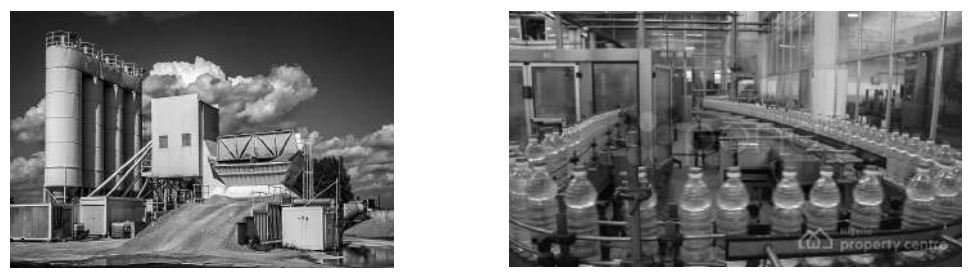
Samacheer Kalvi 9th Maths Solutions Chapter 1 Set Language Ex 1.6

You can Download Samacheer Kalvi 9th Maths Book Solutions Guide Pdf, Tamilnadu State Board help you to revise the complete Syllabus and score more marks in your examinations.
Tamilnadu Samacheer Kalvi 9th Maths Solutions Chapter 1 Set Language Ex 1.6

Exercise 1.6 Class 9 Maths Samacheer Question 1.
(i) If n(A) = 25, n(B) = 40, n(A ∪ B) = 50 and n(B’) = 25 , find n(A ∩ B) and ii(U).
(ii) If n(A) = 300, n(A ∪ B) = 500, n(A ∩ B) = 50 and n(B’) = 350, find n(B) and n(U).
Solution:
(i) n(A ∩ B) = n(A) + n(B) – n(A ∪ B)
n(A ∩ B) = 25 + 40 – 50 = 65 – 50 = 15
n(U) = n(B) + n(B’) = 40 + 25 = 65

(ii) n(U) = n(B) + n(B’)
n(A ∩ B) = n(A) + n(B) – n(A B)
n(B) = n(A ∪ B) + n(A ∩ B) – n(A) = 500 + 50 – 300 = 250
n(U) = 250 + 350 = 600

9th Maths Exercise 1.6 Question 2.
If U = {x : x ∈ N, x ≤ 10}, A = {2, 3, 4, 8, 10) and b = {1, 2, 5, 8, 10}, then verify that n(A ∪ B) = n(A) + n(B) – n(A ∩ B)
Solution:
n(A) = 5, n(B) = 5
A ∪ B = {1, 2, 3, 4, 5, 8, 10}, A ∩ B= {2, 8, 10}
n(A ∪ B) = 7, n(A ∩ B) = 3
L.H.S n(A ∪ B) = 7
R.H.S = n(A) + n(B) – n(A ∩ B) = 5 + 5 – 3 = 7
∴ L.H.S = R.H.S proved.

9th Standard Maths Exercise 1.6 Question 3.
Verify n(A ∪ B ∪ C) = n(A) + n(B) + n(C) – n(A ∩ B) – n(B ∩ C) – n(A ∩ C) + n(A ∩ B ∩ C) for the following sets.
(i) A = {a, c, e, f, h}, B = {c, d, e, f} and C = {a, b, c, f}
(ii) A = {1, 3, 5} B = {2, 3, 5, 6} and C = {1, 5, 6, 7}.
Solution:
n(A ∪ B ∪ C) = n(A) + n(B) + n(C) – n(A ∩ B) – n(B ∩ C) – n(A ∩ C) + n(A ∩ B ∩ C)

(i) A = {a, c, e, f, h}, B = {c, d, e, f}, C = {a, b, c, f}
n (A) = 5, n (B) = 4, n (C) = 4
n( A ∩ B) =3
n(B ∩ C) = 2
n( A ∩ C) =3
n( A ∩ B ∩ C) = 2
A ∩ B = {c, e, f}
B ∩ C = {c, f}
A ∩ C = {a, c, f}
A ∩ B ∩ C = {c, f}
A ∪ B ∪ C = {a, c, d, e, f, b, h}
∴ n(A ∪ B ∪ C) = 7 ……………. (1)
n(A) + n(B) + n(C) – n(A ∩ B) – n(B ∩ C) – n(A ∩ C) + n(A ∩ B ∩ C)
= 5 + 4 + 4 – 3 – 2 – 3 + 2 = 15 – 8 = 7 ……………… (2)
∴ (1) =(2)
⇒ n(A ∪ B ∪ C) = n(A) + n(B) + n(C) – n(A ∩ B) – n(B ∩ C) – n(A ∩ C) + n(A ∩ B ∩ C)
Hence it is verified.

(ii) A = {1, 3, 5}, B = {2, 3, 5, 6 }, C = {1, 5, 6,7} = 3, n (B) = 4, n (C) = 4
n(A ∩ B) = 2
n(B ∩ C) = 2
n(C ∩ A) = 2
n(A ∩ B ∩ C) = 1
n(A ∪ B ∪ C) = 6
n(A ∪ B ∪ C) = n(A) + n(B) + n(C) – n(A ∩ B) – n(B ∩ C) – n(A ∩ C) + n(A ∩ B ∩ C)
6 = 3 + 4 + 4 – 2 – 2 – 2 + 1 = 12 – 6 = 6
Hence it is verified.

9th Maths 1.6 Question 4.
In a class, all students take part in either music or drama or both. 25 students take part in music, 30 students take part in drama and 8 students take part in both music and drama. Find
(i) The number of students who take part in only music.
(ii) The number of students who take part in only drama.
(iii) The total number of students in the class.
Solution:
Let the number of students take part in music is M.
Let the number of students take part in drama is D.
By using venn diagram
Exercise 1.6 Class 9 Maths Samacheer Kalvi Chapter 1 Set Language
(i) The number of students take part in only music is 17.
(ii) The number of students take part in only drama is 22.
(iii) The total number of students in the class is 17 + 8 + 22 = 47.

Samacheer Kalvi Guru 9th Maths Question 5.
In a party of 45 people, each one likes tea or coffee or both. 35 people like tea and 20 people like coffee. Find the number of people who
(i) like both tea and coffee.
(ii) do not like tea.
(iii) do not like coffee.
Solution:
Let the people who like tea be T.
Let the people who like coffee be C
By using formula
n( A ∪ B) = n(A) + n(B) – n(A ∩ B)

(i) n(T ∩ C) = n(T) + n(C) – n(T ∪ C) = 35 + 20 – 45 = 55 – 45 = 10
The number of people who like both coffee and tea = 10.

(ii) The number of people who do not like Tea
n(T) = n(U) – n(T) = 45 – 35 = 10

(iii) The number of people who do not like coffee
n(C’) = n(U) – n(C) = 45 – 20 = 25.

Samacheer Kalvi 9th Standard Maths Question 6.
In an examination 50% of the students passed in Mathematics and 70% of students passed in Science while 10% students failed in both subjects. 300 students passed in at least one subjects. Find the total number of students who appeared in the examination, if they took examination in only two subjects.
Solution:
Let the students who appeared in the examination be 100%.
Let the percentage of students who failed in mathematics be M.
Let the percentage of students who failed in science be S.
Failed in Maths = 100 % – Pass% = 100% – 50% = 50%
Failed in Science% 100% – 70% = 30%
Failed in both% = 10%
n(M ∪ S) = n(M) + n(S) – n(M ∩ S)
= 50% + 30% – 10% = 70%
% of students failed in atleast one subject = 70%
∴ The % of students who have passed in atleast one subject = 100% – 70% = 30%
30% = 300
∴ \(100 \%=\frac{100 \times 300}{30}=1000\)
∴ The total number of students who appeared in the examination = 1000 students.

Samacheer Kalvi 9th Maths Solutions Pdf Question 7.
A and B are two sets such that n(A – B) = 32 + x, n(B – A) = 5x and n(A ∩ B) = x. Illustrate the information by means of a venn diagram. Given that n(A) = n(B), calculate the value of x.
Solution:
9th Maths Exercise 1.6 Samacheer Kalvi Chapter 1 Set Language
n (A – B) = 32 +x
n(B – A) = 5x
n(A ∩ B) = x
n( A) = n(B)
32 + x + x = 5x + x
32 + 2x = 6x
4x = 32
x = 8

Samacheer Kalvi 9th Maths Question 8.
Out of 500 car owners investigated, 400 owned car A and 200 owned car B, 50 owned both A and B cars. Is this data correct?
Solution:
n( A ∪ B) = n(A) + n(B) – n( A ∩ B)
n(A ∪ B) = 500 (given) …………. (1).
n( A) = 400
n(B) = 200
n( A ∩ B) =50
∴ n(A ∩ B) = 400 + 200 – 50 = 550 …………… (2)
1 ≠ 2
∴ This data is incorrect.

9th Maths Samacheer Kalvi Question 9.
In a colony, 275 families buy Tamil newspaper, 150 families buy English newspaper, 45 families buy Hindi newspaper, 125 families buy Tamil and English newspapers, 17 families buy English and Hindi newspapers, 5 families buy Tamil and Hindi newspapers and 3 families buy all the three newspapers. If each family buy atleast one of these newspapers then find
(i) Number of families buy only one newspaper
(ii) Number of families buy atleast two newspapers
(iii) Total number of families in the colony.
Solution:
(i) Tamil Newspaper buyers n(A) = 275
English Newspaper buyers n(B) = 150
Hindi Newspaper buyers n(C) = 45
Tamil and English Newspaper buyers n(A ∩ B) = 125
English and Hindi Newspaper buyers n(B ∩ C) = 17
Hindi and Tamil Newspaper buyers n(C ∩ A) = 5
All the three Newspaper buyers n(A ∩ B ∩ C) = 3
9th Standard Maths Exercise 1.6 Solutions Chapter 1 Set Language Samacheer Kalvi
(i) Number of families buy only one newspaper = 148 + 11 + 26 = 185
(ii) Number of families buy atleast two news papers = 122 + 14 + 2 + 3 = 141
(iii) Total number of families in the colony = 148 + 11 + 26 + 122 + 14 + 2 + 3 = 326

Question 10.
A survey of 1000 farmers found that 600 grew paddy, 350 grew ragi, 280 grew corn, 120 grew paddy and ragi, 100 grew ragi and corn, 80 grew paddy and corn. If each farmer grew atleast any one of the above three, then find the number of farmers who grew all the three.
Solution:
9th Maths 1.6 Solutions Chapter 1 Set Language Samacheer Kalvi
a = 600 – (120 – x + x + 80 – x)
= 600 – (200 – x)
= 600 – 200 + x
= 400 + x
b = 350 – (120 – x + x + 100 – x)
= 350 – (220 – x)
= 350 – 230 + x
= 130 + x
c = 280 – (80 – x + x + 100 – x)
= 2800 – (180 – x) = 280 – 180 + x = 100 + x
Each farmer grew atleast one of the above three, the number of farmers who grew all the three is x.
= a + b + c + 120 – x + 100 – x + 80 – x + x = 1000
400 + x + 130 + x + 100 + x + 120 – x + 100 – x + 80 – x + x= 1000
∴ 930 + x = 1000
x = 1000 – 930 = 70
∴ 70 farmers grew all the three crops

9th Standard Maths Samacheer Kalvi Question 11.
In the adjacent diagram, if n(U) = 125,y is two times of x and z is 10 more than x, then find the value of x, y and z.
Samacheer Kalvi Guru 9th Maths Solutions Chapter 1 Set Language Ex 1.6
Solution:
n(U) = 125
y = 2x
z = x + 10
∴ x + y + z + 4 + 17 + 6 + 3 + 5 = 125
x + 2x + x + 10 + 35 = 125
4x + 45 = 125
4x = 125 – 45
4x = 80
x = 20
∴ y = 2x = 2 × 20 = 40
z = x + 10 = 20 + 10 = 30
Hence x = 20 ; y = 40; z = 30

Samacheer Kalvi Guru Maths 9th Question 12.
Each student in a class of 35 plays atleast one game among chess, carrom and table tennis. 22 play chess, 21 play carrom, 15 play table tennis, 10 play chess and table tennis, 8 play carrom and table tennis and 6 play all the three games. Find the number of students who play (i) chess and carrom but not table tennis (ii) only chess (iii) only carrom (Hint: Use Venn diagram)
Solution:
Samacheer Kalvi 9th Standard Maths Solutions Chapter 1 Set Language Ex 1.6
A – Chess
B – Carrom
C – Table Tennis
n(A) = 22
n(B) = 21
n(C) = 15
n(A ∩ C) = 10
n(B ∩ C) = 8
n(A ∩ B ∩ C) = 6
(i) y = 22 – (x + 6 + 4) = 22 – (x + 10)
= 22 – x – 10
= 12 – x
z = 21 – (x + 6 + 2) = 21 – (8 + x)
21 – 8 – x = 13 – x
y + z + 3 + x + 2 + 4 + 6 = 35
12 – x + 13 – x + 15 + x = 35
40 – x = 35
x = 40 – 35 = 5
(i) Number of students who pay only chess and Carrom but not table tennis = 5
(ii) Number of students who play only chess = 12 – x = 12 – 5 = 7
(iii) Number of students who play only carrom = 13 – x = 13 – 5 = 8

9th Class Maths Exercise 1.6 Solution Question 13.
In a class of 50 students, each one come to school by bus or by bicycle or on foot. 25 by bus, 20 by bicycle, 30 on foot and 10 students by all the three. Now how many students come to school exactly by two modes of transport?
Solution:
Samacheer Kalvi 9th Maths Solutions Pdf Chapter 1 Set Language Ex 1.6
A – by bus
B – by bicycle
C – on foot
n(A) = 25
n(B) = 20
n(C) = 30
n(A ∩ B ∩ C ) = 10
n(A ∪ B ∪ C ) = n(A) + n(B) + n(C) – n(A ∩ B) – n(B ∩ C) – n(C ∩ A) + n(A ∩ B ∩ C)
50 = 25 + 20 + 30 – (10 + x) – (10 + y) – (10 + z) + 10
50 = 75 – 10 – x – 10 – y – 10 – z + 10
= 75 – 20 – (x + y + z)
= 55 – (x + y + z)
x + y + z = 55 – 50 = 5
∴ The number of students who come to school exactly by two modes of transport = 5