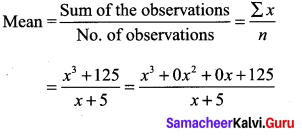
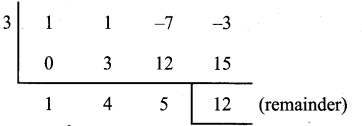
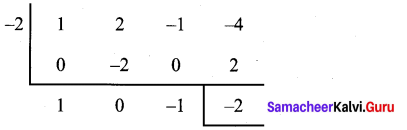
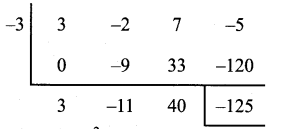
Samacheer Kalvi 10th Maths Solutions Chapter 2 Numbers and Sequences Ex 2.2

You can Download Samacheer Kalvi 10th Maths Book Solutions Guide Pdf, Tamilnadu State Board help you to revise the complete Syllabus and score more marks in your examinations.

Tamilnadu Samacheer Kalvi 10th Maths Solutions Chapter 2 Numbers and Sequences Ex 2.2

10th Maths Exercise 2.2 Samacheer Kalvi Question 1.
For what values of natural number n, 4n can end with the digit 6?
Solution:
4n = (2 × 2)n = 2n × 2n
2 is a factor of 4n.
So, 4n is always even and end with 4 and 6.
When n is an even number say 2, 4, 6, 8 then 4n can end with the digit 6.
Example:
42 = 16
43 = 64
44 = 256
45 = 1,024
46 = 4,096
47 = 16,384
48 = 65, 536
49 = 262,144

Ex 2.2 Class 10 Samacheer Question 2.
If m, n are natural numbers, for what values of m, does 2n × 5m ends in 5?
Answer:
2n is always even for any values of n.
[Example. 22 = 4, 23 = 8, 24 = 16 etc]

5m is always odd and it ends with 5.
[Example. 52 = 25, 53 = 125, 54 = 625 etc]
But 2n × 5m is always even and end in 0.
[Example. 23 × 53 = 8 × 125 = 1000
22 × 52 = 4 × 25 = 100]
∴ 2n × 5m cannot end with the digit 5 for any values of m.

Exercise 2.2 Class 10 Maths Samacheer Question 3.
Find the H.C.F. of 252525 and 363636.
Solution:
To find the H.C.F. of 252525 and 363636
Using Euclid’s Division algorithm
363636 = 252525 × 1 + 111111
The remainder 111111 ≠ 0.
∴ Again by division algorithm
252525 = 111111 × 2 + 30303
The remainder 30303 ≠ 0.
∴ Again by division algorithm.
111111 = 30303 × 3 + 20202
The remainder 20202 ≠ 0.
∴ Again by division algorithm
30303 = 20202 × 1 + 10101
The remainder 10101 ≠ 0.
∴ Again using division algorithm
20202 = 10101 × 2 + 0
The remainder is 0.
∴ 10101 is the H.C.F. of 363636 and 252525.

10th Maths Exercise 2.2 Question 4.
If 13824 = 2a × 3b then find a and b.
Solution:
If 13824 = 2a × 3b
Using the prime factorisation tree
10th Maths Exercise 2.2 Samacheer Kalvi Chapter 2 Numbers And Sequences
13824 = 2 × 2 × 2 × 2 × 2 × 2 × 2 × 2 × 2 × 3 × 3 × 3
= 29 × 33 = 2a × 3b
∴ a = 9, b = 3.

10th Maths Exercise 2.2 In Tamil Question 5.
If p1x1 × p2x2 × p3x3 × p4x4 = 113400 where p1, p2, p3, p4 are primes in ascending order and x1, x2, x3, x4 are integers, find the value of P1, P2, P3, P4 and x1, x2, x3, x4.
Solution:
If p1x1 × p2x2 × p3x3 × p4x4 = 113400
p1, p2, p3, P4 are primes in ascending order, x1, x2, x3, x4 are integers.
using Prime factorisation tree.
Ex 2.2 Class 10 Samacheer Kalvi Chapter 2 Numbers And Sequences
113400 = 2 × 2 × 2 × 3 × 3 × 3 × 3 × 5 × 5 × 7
= 23 × 34 × 52 × 7
= p1x1 × p2x2 × p3x3 × p4x4
∴ p1= 2, p2 = 3, p3 = 5, p4 = 7, x1 = 3, x2 = 4, x3 = 2, x4 = 1.

Question 6.
Find the L.C.M. and H.C.F. of 408 and 170 by applying the fundamental theorem of arithmetic.
Solution:
408 and 170.
Exercise 2.2 Class 10 Maths Samacheer Kalvi Chapter 2 Numbers And Sequences
408 = 23 × 31 × 171
170 = 21 × 51 × 171
10th Maths Exercise 2.2 Samacheer Kalvi Chapter 2 Numbers And Sequences
∴ H.C.F. = 21 × 171 = 34.
To find L.C.M, we list all prime factors of 408 and 170, and their greatest exponents as follows.
10th Maths Exercise 2.2 In Tamil Chapter 2 Numbers And Sequences Samacheer Kalvi
∴ L.C.M. = 23 × 31 × 51 × 171
= 2040.

10th Maths 2.2 Exercise Question 7.
Find the greatest number consisting of 6 digits which is exactly divisible by 24, 15, 36?
Solution:
To find L.C.M of 24, 15, 36
10th Maths 2.2 Exercise Samacheer Kalvi Chapter 2 Numbers And Sequences
24 = 23 × 3
15 = 3 × 5
36 = 22 × 32
10th Maths Ex 2.2 Chapter 2 Numbers And Sequences Samacheer Kalvi
∴ L.C.M = 23 × 32 × 51
= 8 × 9 × 5
= 360
If a number has to be exactly divisible by 24, 15, and 36, then it has to be divisible by 360. Greatest 6 digit number is 999999.
Common multiplies of 24, 15, 36 with 6 digits are 103680, 116640, 115520, …933120, 999720 with six digits.
∴ The greatest number consisting 6 digits which is exactly divisible by 24, 15, 36 is 999720.

10th Maths Ex 2.2 Question 8.
What is the smallest number that when divided by three numbers such as 35, 56 and 91 leaves remainder 7 in each case?
Answer:
Find the L.C.M of 35, 56, and 91
35 – 5 × 7 56
56 = 2 × 2 × 2 × 7
91 = 7 × 13
L.C.M = 23 × 5 × 7 × 13
= 3640
Since it leaves remainder 7
The required number = 3640 + 7
= 3647
The smallest number is = 3647

10th Maths 2.2 Question 9.
Find the least number that is divisible by the first ten natural numbers.
Solution:
The least number that is divisible by the first ten natural numbers is 2520.
Hint:
1,2, 3,4, 5, 6, 7, 8,9,10
The least multiple of 2 & 4 is 8
The least multiple of 3 is 9
The least multiple of 7 is 7
The least multiple of 5 is 5
∴ 5 × 7 × 9 × 8 = 2520.
L.C.M is 8 × 9 × 7 × 5
= 40 × 63
= 2520

Samacheer Kalvi 10th Maths Solutions Chapter 3 Algebra Ex 3.14

You can Download Samacheer Kalvi 10th Maths Book Solutions Guide Pdf, Tamilnadu State Board help you to revise the complete Syllabus and score more marks in your examinations.

Tamilnadu Samacheer Kalvi 10th Maths Solutions Chapter 3 Algebra Ex 3.14

Ex 3.14 Class 10 Samacheer Question 1.
Write each of the following expression in terms of α + β and αβ.
Ex 3.14 Class 10 Samacheer Kalvi Chapter 3 Algebra
Solution:
10th Maths Exercise 3.14 Samacheer Kalvi Chapter 3 Algebra

10th Maths Exercise 3.14 Samacheer Kalvi Question 2.
The roots of the equation 2x2 – 7x + 5 = 0 are α and β. Without solving the root find
Exercise 3.14 Class 10 Samacheer Kalvi Chapter 3 Algebra
Solution:
2x2 – 7x + 5 = x2 – \(\frac{7}{2} x+\frac{5}{2}\) = 0
α + β = \(\frac{7}{2}\)
αβ = \(\frac{5}{2}\)
10th Maths Exercise 3.14 Samacheer Kalvi Chapter 3 Algebra
10th Maths Exercise 3.14 Solutions Samacheer Kalvi Chapter 3 Algebra

Exercise 3.14 Class 10 Samacheer Question 3.
The roots of the equation x2 + 6x – 4 = 0 are α, β. Find the quadratic equation whose roots are
(i) α2 and β2
(ii) \(\frac{2}{\alpha} \text { and } \frac{2}{\beta}\)
(iii) α2β and β2α
Solution:
If the roots are given, the quadratic equation is x2 – (sum of the roots) x + product the roots = 0.
For the given equation.
x2 + 6x – 4 = 0
α + β = -6
αβ = -4
(i) α2 + β2 = (α + β)2 – 2αβ
= (-6)2 – 2(-4) = 36 + 8 = 44
α2β2 = (αβ)2 = (-4)2 = 16
∴ The required equation is x2 – 44x – 16 = 0.
10th Maths Exercise 3.14 Solution Samacheer Kalvi Chapter 3 Algebra

(iii) α2β + β2α = αβ(α + β)
= -4(-6) = 24
α2β × β2α = α3β3 = (αβ)3 = (-4)3 = -64
∴ The required equation = x2 – 24x – 64 – 0.

10th Maths Exercise 3.14 Question 4.
If α, β are the roots of 7x2 + ax + 2 = 0 and if β – α = \(\frac{-13}{7}\) Find the values of a.
Solution:
Maths Book For Class 10 Samacheer Kalvi Samacheer Kalvi Chapter 3 Algebra Ex 3.14

10th Maths Exercise 3.14 Solutions Question 5.
If one root of the equation 2y2 – ay + 64 = 0 is twice the other then find the values of a.
Solution:
Let one of the root α = 2β
α + β = 2β + β = 3β
Given
10th Maths Algebra Samacheer Kalvi Chapter 3 Algebra Ex 3.14
a2 = 576
a = 24, -24

10th Maths Exercise 3.14 Solution Question 6.
If one root of the equation 3x2 + kx + 81 = 0 (having real roots) is the square of the other then find k.
Solution:
3x2 + kx + 81 = 0
Let the roots be α and α2
10th Samacheer Maths Solutions Chapter 3 Algebra Ex 3.14

Samacheer Kalvi 11th Chemistry Solutions Chapter 4 Hydrogen

Enhance your subject knowledge with Tamilnadu State Board for Chapter 4 Hydrogen and learn all the underlying concepts easily. Make sure to Download Samacheer Kalvi 11th Chemistry Book Solutions, Notes Pdf Chapter 4 Hydrogen Questions and Answers PDF on a day to day basis and score well in your exams. Are given after enormous research by people having high subject knowledge. You can rely on them and prepare any topic of Chemistry as per your convenience easily.

Tamilnadu Samacheer Kalvi 11th Chemistry Solutions Chapter 4 Hydrogen

Students looking for Chapter 4 Hydrogen Concepts can find them all in one place from our Tamilnadu State Board Solutions. Simply click on the links available to prepare the corresponding topics of Chemistry easily. Samacheer Kalvi 11th Chemistry Chapter wise Questions and Answers are given to you after sample research and as per the latest edition textbooks. Clarify all your queries and solve different questions to be familiar with the kind of questions appearing in the exam. Thus, you can increase your speed and accuracy in the final exam.

Samacheer Kalvi 11th Chemistry Hydrogen Textual Evaluation Solved

I. Choose The Correct Answer:
11th Chemistry Chapter 4 Book Back Answers Question 1.
Which of the following statements about hydrogen is incorrect ? (NEET – 2016)
(a) Hydrogen ion, H3O+ exists freely in solution.
(b) Dihydrogen acts a,s a reducing agent.
(c) Hydrogen has three isotopes of which tritium is the most common.
(d) Hydrogen never acts as cation in ionic salts.
Answer:
(c) Hydrogen has three isotopes of which tritium is the most common.
Hint:
Correct statement:
Hydrogen has three isotopes of which protium is the most common.

11th Chemistry Lesson 4 Book Back Answers Question 2.
Water gas is ………..
(a) H2 O(g)
(b) CO + H2O
(C) CO + H2
(d) CO + N2
Answer:
(c) CO + H2

11th Chemistry 4th Lesson Book Back Answers Question 3.
Which one of the following statements is incorrect with regard to ortho and para dihydrogen ?
(a) They are nuclear spin isomers
(b) Ortho isomer has zero nuclear spin whereas the para isomer has one nuclear spin
(c) The para isomer is favoured at low temperatures
(d) The thermal conductivity of the para isomer is 50% greater than that of the ortho isomer.
Answer:
(b) Ortho isomer has zero nuclear spin whereas the para isomer has one nuclear spin
Hints:
Correct statement:
Ortho isomer – one nuclear spin Para isomer – zero nuclear spin

11th Chemistry Unit 4 Book Back Answers Question 4.
Ionic hydrides are formed by …………….
(a) halogens
(b) chalogens
(c) inert gases
(d) group one elements
Answer:
(d) group one elements
e.g., Sodium hydride (Na+ H )

Chemistry Class 11 Samacheer Kalvi Question 5.
Tritium nucleus contains ……………..
(a) 1p + 0n
(b) 2p + 1n
(c) 1p + 2n
(d) none of these
Answer:
(c) lp + 2n
1T3 (le, lp, 2n)

Class 11 Chemistry Solutions Samacheer Kalvi Question 6.
Non-stoichiometric hydrides are formed by……………..
(a) palladium, vanadium
(b) carbon, nickel
(c) manganese, lithium
(d) nitrogen, chlorine
Answer:
(a) palladium, vanadium

11th Chemistry Hydrogen Lesson Question 7.
Assertion : Permanent hardness of water is removed by treatment with washing soda.
Reason : Washing soda reacts with soluble calcium and magnesium chlorides and sulphates in hard water to form insoluble carbonates
(a) Both assertion and reason are true and reason is the correct explanation of assertion.
(b) Both assertion and reason are true but reason is not the correct explanation of assertion.
(c) Assertion is true but reason is false
(d) Both assertion and reason are false
Answer:
(a) Both assertion and reason are true and reason is the correct explanation of assertion.
Ca2+ + Na2CO3 → CaCO3↓ + 2Na+

11th Chemistry 4th Chapter Question 8.
If a body of a fish contains 1.2 g hydrogen in its total body mass, if all the hydrogen is replaced with deuterium then the increase in body weight of the fish will be ……………
(a) 1.2 g
(b) 2.4 g
(c) 3.6 g
(d) \(\sqrt{4.8}\) g
Answer:
(a) 1.2 g
Hints:
Mass of deuterium = 2 × mass of protium
If all the 1.2 g hydrogen is replaced with deuterium, the weight will become 2.4g. Hence the increase in body weight is (2.4 – 1.2 = 1.2 g).

Samacheer Kalvi 11th Chemistry Book Solutions Question 9.
The hardness of water can be determined by volumetrically using the reagent …………..
(a) sodium thio sulphate
(b) potassium permanganate
(c) hydrogen peroxide
(d) EDTA
Answer:
(d) EDTA

Hydrogen 11th Chemistry Question 10.
The cause of permanent hardness of water is due to ………….
(a) Ca(HCO3)2
(b) Mg(HCO3k)3
(c) CaCl2
(d) MgCO3
Answer:
(c) CaCl2
Hints:
Permanent hardness if water is due to the presence of the chlorides, nitrates and sulphates of Ca2+ and Mg2+ ions.

Hydrogen Class 11 Questions And Answers Question 11.
Zeolite used to soften hardness of water is, hydrated ………….
(a) Sodium aluminium silicate
(b) Calcium aluminium silicate
(c) Zinc aluminium borate
(d) Lithium aluminium hydride
Answer:
(a) Sodium aluminium silicate
Zeolite is sodium aluminium silicate.
(NaAlSi2O6 .H2O)

11th Chemistry Deleted Book Back Questions Question 12.
A commercial sample of hydrogen peroxide marked as 100 volume H2O2, it means that ……………
(a) 1 ml of H2O2 will give 100 ml O2 at STP
(b) 1 L of H2O2 will give 100 ml O2 at STP
(c) 1 L of H2O2 will give 22.4 L O2
(d) 1 ml of H2O2 will give 1 mole of O2 at STP
Answer:
(a) 1 ml of H2O2 will give 100 ml O2 at STP

Samacheer Kalvi Guru 11th Chemistry Question 13.
When hydrogen peroxide is shaken with an acidified solution of potassium dichromate in presence of ether, the ethereal layer turns blue due to the formation of
(a) Cr2 O3
(b) CrO42-
(c) CrO(O2)2
(d) none of these
Answer:
(c) CrO(O2)2 CrO(O2)2
Hints:
Cr2O72- + 2H+ + 4H2O2 → 2CrO(O2)2 + 5H2O

Samacheer Kalvi 11th Chemistry Question 14.
For de colorization of 1 mole of acidified KMnO4, the moles of H2O2 required is …………….
(a) \(\frac {1}{2}\)
(b) \(\frac {3}{2}\)
(c) \(\frac {5}{2}\)
(d) \(\frac {7}{2}\)
Answer:
(c) \(\frac {5}{2}\)
Hints:
2MnO4 + 5H2O2(aq) + 6H+ → 2Mn2++ 5O2 + 8H2O

11th Chemistry Samacheer Kalvi Question 15.
Volume strength of 1.5 N H2O2 is ……………..
(a) 1.5
(b) 4.5
(c) 16.8
(d) 8.4
Answer:
(d) 8.4
Hints:
Volume strength of hydrogen peroxide = Normality of hydrogen peroxide × 5.6 = 1.5 x 5.6 = 8.4
11th Chemistry Chapter 4 Book Back Answers Samacheer Kalvi Hydrogen
Volume strength of hydrogen peroxide 11th Chemistry Lesson 4 Book Back Answers Samacheer Kalvi Hydrogen
= Normality × \(\frac {17 × 22.4}{68}\)
Volume strength of hydrogen peroxide = Normality x 5.6

Samacheer Kalvi Chemistry 11th Question 16.
The hybridization of oxygen atom is H2O and H2O2 are respectively
(a) sp and sp3
(b) sp and sp
(c) sp and sp2
(d) sp3 and sp3
Answer:
(d) sp3 and sp3

Samacheer Kalvi 11th Chemistry Solutions Question 17.
The reaction H3PO2 + D2O → H2DPO2 + HDO indicates that hypo-phosphorus acid is ……………
(a) tri basic acid
(b) di basic acid
(c) mono basic acid
(d) none of these
11th Chemistry 4th Lesson Book Back Answers Samacheer Kalvi Hydrogen
Answer:
(c) mono basic acid
Hints:
Hypophosphorus acid on reaction with D2O, only one hydrogen is replaced P by deuterium and hence it is mono basic.

Samacheer Kalvi Class 11 Chemistry Solutions Question 18.
In solid ice, oxygen atom is surrounded
(a) tetrahedrally by 4 hydrogen atoms
(b) octahedrally by 2 oxygen and 4 hydrogen atoms
(c) tetrahedrally by 2 hydrogen and 2 oxygen atoms
(d) octahedrally by 6 hydrogen atoms
Answer:
(a) tetrahedrally by 4 hydrogen atoms

Samacheer Kalvi 11th Chemistry Guide Pdf Question 19.
The type of H-bonding present in ortho nitro phenol and p-nitro phenol are respectively ……………
(a) inter molecular H-bonding and intra molecular H-bonding
(b) intra molecular H-bonding and inter molecular H-bonding
(c) intra molecular H – bonding and no H – bonding
(d) intra molecular H – bonding and intra molecular H – bonding
11th Chemistry Unit 4 Book Back Answers Samacheer Kalvi Hydrogen
Answer:
(A) intra molecular H-bonding and inter molecular H-bonding

11 Chemistry Samacheer Kalvi Question 20.
Heavy water is used as ……………
(a) modulator in nuclear reactions
(b) coolant in nuclear reactions
(c) both (a) and (b)
(d) none of these
Answer:
(c) both (a) and (A)
Hints:
Heavy water is used as moderator as well as coolant in nuclear reactions.

Samacheer Kalvi.Guru 11th Chemistry Question 21.
Water is a ……………
(a) basic oxide
(b) acidic oxide
(c) amphoteric oxide
(d) none of these
Answer:
(c) amphoteric oxide

II. Write brief answer to the following questions

Question 22.
Explain why hydrogen is not placed with the halogen in the periodic table.
Answer:

  • Hydrogen resembles alkali metals as well as halogens.
  • Hydrogen resembles more alkali metals than halogens.
  • Electron affinity of hydrogen is much less than that of halogen atom. Hence the tendency to form hydride ion is low compared to that of halogens.
  • In most of its compounds hydrogen exists in +1 oxidation state. Therefore it is reasonable to place the hydrogen in group 1 along with alkali metals as shown in the latest periodic table published by IUPAC.

Question 23.
the cube at 0°C is placed in some liquid water at 0°C, the ice cube sinks – Why ?
Answer:

  • In an ice cube, each atom is surrounded tetrahedrally by four water molecules through hydrogen bond and its density is low.
  • Liquid water at 0°C has the density as 999.82 kg/cm3. Maximum density is attained by water only at 4°C as 1000 kg/cm3.
  • When the temperature changed from 4°C to 0°C, the density of water decreases rather than increases. This is called anomalous expansion of water.
  • The reason for this phenomenon lies in the structure of ice lattice and hydrogen bonding in water.
  • At 0°C, ice cube sinks in liquid water at 0°C because of the lesser density and greater volume of water.

Question 24.
Discuss the three types of Covalent hydrides.
Answer:

  1. They are the compounds in which hydrogen is attached to another element by sharing of electrons.
  2. The most common examples of covalent hydrides are methane, ammonia, water and hydrogen chloride.
  3. Molecular hydrides of hydrogen are further classified into three categories as,
    • Electron precise (CH4, C2 H6 , SiH4 , GeH4 )
    • Electron-deficient (B2 H6 ) and
    • Electron-rich hydrides (NH3 , H2O)
  4. Since most of the covalent hydrides consist of discrete, small molecules that have relatively weak intermolecular forces, they are generally gases or volatile liquids.

Question 25.
Predict which of the following hydrides is a gas on a solid (a) HCl (b) NaH. Give your reason.
Answer:

  • At room temperature, HCl is a colourless gas and the solution of HCl in water is called hydrochloric acid and it is in liquid state.
  • Sodium hydride NaH is an ionic compound and it is made of sodium cations (Na+) and hydride (H) anions. It has the octahedral crystal structure. It is an alkali metal hydride.

Question 26.
Write the expected formulas for the hydrides of 4th period elements. What is the trend in the formulas? In what way the first two numbers of the series different from the others ?
Answer:
The expected formulas for the hydrides of 4th period elements MH4 (electron precise). M2H6 (electron deficient) and MH3 (electron rich).
The trend in formula is –

  • Electron precise hydrides – CH4 C2H6, SiH4, GeH4
  • Electron deficient hydrides – B2H6
  • Electron rich hydrides – NH3, H2O

The first two members of the series KH, CaH2 are ionic hydrides whereas the other members of the series CH4, C2H6, SiH4, B2H6, NH3 are covalent hydrides.

Question 27.
Write chemical equation for the following reactions.

  1. reaction of hydrogen with tungsten (VI) oxide NO3 on heating.
  2. hydrogen gas and chlorine gas.

Answer:

  1. 3H2 + WO2 → W + 3H2O
    Hydrogen reduces tungsten (VI) oxide. WO3 to tungsten at high temperature.
  2. H2 + Cl2 → 2HCl (Hydrogen Chloride)
    Hydrogen reacts with chlorine at room temperature under light to give hydrogen chloride.

Question 28.
Complete the following chemical reactions and classify them in to (a) hydrolysis (b) redox (c) hydration reactions.

  1. KMnO4 + H2O2
  2. CrCl3+ H4O →
  3. CaO + H2O →

Answer:

  1. 2KMnO4 + 3H2O2 → 2MnO2 + 2KOH + 3H2O + 3O2(g)
    This reaction is a redox reaction.
  2. CrCl3 + 6H2O2 → [Cr(H2O)6)] Cl3
    This reaction is a hydration reaction.
  3. CaO + H2O → Ca(OH)2
    This reaction is a hydrolysis reaction.

Question 29.
Hydrogen peroxide can function as an oxidizing agent as well as reducing agent. Substantiate this statement with suitable examples.
Answer:
Hydrogen peroxide can function as an oxidizing agent as well as reducing agent.

  • H2O2 act as oxidizing agent in acidic medium. For example,
    Chemistry Class 11 Samacheer Kalvi Solutions Chapter 4 Hydrogen
  • H2O2 act as reducing agent in basic medium. For example,
    Class 11 Chemistry Solutions Samacheer Kalvi Chapter 4 Hydrogen>

Question 30.
Do you think that heavy water can be used for drinking purposes ?
Answer:

  • Heavy water (D2O) contains a proton and a neutron. This makes deuterium about twice as heavy as protium, but it is not radioactive. So heavy water is not radioactive.
  • If you drink heavy water, you don’t need to worry about radiation poisoning. But it is not completely safe to drink, because the biochemical reaction in our cells are affected by the difference in the mass of hydrogen atoms.
  • If you drink an appreciable volume of heavy water, you might feel dizzy because of the density difference. It would change the density of fluid in your inner ear. So it is unlikely to drink heavy water.

Question 31.
What is water-gas shift reaction?
Answer:
The carbon monoxide of water gas can be converted to carbon dioxide by mixing the gas mixture with more steam at 400°C and passed over a shift converter containing iron/copper catalysts. This reaction is called water-gas shift reaction.
CO + H2O → CO2 + H2

Question 32.
Justify the position of hydrogen in the periodic table?
Answer:
Hydrogen resembles alkali metals in the following aspects.

  1. Electronic configuration Is1 as alkali metals have ns1.
  2. Hydrogen forms unipositive H+ ion like alkali metals Na+, K+.
  3. Hydrogen form halides (HX), oxides (H2O) peroxide (H2O2) like alkali metals (NaX. Na2O, Na2O2).
  4. Hydrogen also acts as reducing agent like alkali metals. Hydrogen resembles halogens in the following aspects.
  5. Hydrogen has a tendency to gain one electron to form hydride ion (H) as halogens to form halide ion. (X).
  6. Comparing the properties of hydrogen with alkali metals and with halogens, we can conclude that hydrogen resembles more alkali metals. In most of the compounds hydrogen exist in +1 oxidation state.
  7. Therefore, it is reasonable to place the hydrogen in group 1 along with alkali metals as shown in the latest periodic table published by IUPAC.

Question 33.
What are isotopes? Write the names of isotopes of hydrogen.
Answer:

  1. Isotopes are atoms of the same element that have the same atomic number but having different mass numbers (or) Isotopes are atoms with the same number of protons and electrons but differ in number of neutrons.
  2. Hydrogen has three naturally occuring isotopes namely Protium (1H1), Deuterium (1H2) and Tritium (1H3).
    11th Chemistry Hydrogen Lesson Samacheer Kalvi Chapter 4

Question 34.
Give the uses of heavy water.
Answer:

  1. Heavy water is used as moderator in nuclear reactors as it can lower the energies of fast moving neutrons.
  2. D2O is commonly used as an tracer to study organic reaction mechanisms and mechanism of metabolic reactions.
  3. It is also used as a coolant in nuclear reactors as it absorbs the heat generated.

Question 35.
Explain the exchange reactions of deuterium.
Answer:
Deuterium can replace reversibly hydrogen in compounds either partially or completely depending upon the reaction conditions. These reactions occur in the presence of deuterium.
11th Chemistry 4th Chapter Hydrogen Samacheer Kalvi

Question 36.
How do you convert para hydrogen into ortho hydrogen ?
Answer:
Para hydrogen can be converted into ortho hydrogen by the following ways:

  • By treating with catalysts platinum or iron.
  • By passing an electric discharge
  • By heating > 800°C.
  • By mixing with paramagnetic molecules such as O2, NO, NO2.
  • By treating with nascent/atomic hydrogen.

Question 37.
Mention the uses of deuterium.
Answer:

  • Deuterium is used as a tracer element.
  • Deuterium is used to study the movement of ground water by isotopic effect.

Question 38.
Explain preparation of hydrogen using electrolysis.
Answer:
High purity of hydrogen (>99.9%) is obtained by the electrolysis of water containing traces of acid or alkali or electrolysis of aqueous solution of sodium hydroxide or potassium hydroxide using a nickel anode and iron cathode. This process is not economical for large scale production.
At anode : 2OH → H2O + ½ O2 + 2e
At cathode : 2H2O + 2e → 2OH + H2
Overall reaction : H2O → H2 + 14 O2

Question 39.
A groups metal (A) which is present in common salt reacts with (B) to give compound (C) in which hydrogen is present in -1 oxidation state. (B) on reaction with a gas (C) to give universal solvent (D). The compound (D) on reacts with (A) to give (B), a strong base. Identify A, B, C, D and E. Explain the reactions.
Answer:
1.Group (1) metal (A) is present in common salt NaCl. So, (A) is sodium – Na.
2. Sodium reacts with hydrogen (B) to give sodium hydride – NaH (C) in which hydrogen is in -1 oxidation state.
Samacheer Kalvi 11th Chemistry Book Solutions Chapter 4 Hydrogen
3. Hydrogen on reaction with oxygen (O2) gas which is (C) to give a universal solvent water (D).
Hydrogen 11th Chemistry Solutions Chapter 4 Samacheer Kalvi
4. Water (D) reacts with sodium metal (A) to give a strong base sodium hydroxide NaOH which is (E).
Hydrogen Class 11 Questions And Answers Chapter 4 Samacheer Kalvi
Samacheer Kalvi 11th Chemistry Solutions Chapter 4 Hydrogen

Question 40.
An isotope of hydrogen (A) reacts with diatomic molecule of element which occupies group number 16 and period number 2 to give compound (B) is used as a modulator in nuclear reaction. (A) adds on to a compound (C), which has the molecular formula C3H6 to give (D). Identify A, B, C and D.
Answer:
1. An isotope of hydrogen Deuterium (A) reacts with diatomic molecule of element belongs to group number 16 and period number 2 oxygen O2 to give a compound (B) which is heavy water D2O. D2O is used as a moderator in nuclear reaction.
11th Chemistry Deleted Book Back Questions Samacheer Kalvi Chapter 4
2. Deuterium reacts with C3H6 propane (C) to give Deutero propane C2D6 (D).
Samacheer Kalvi 11th Chemistry Solutions Chapter 4 Hydrogen

Question 41.
NH3 has exceptionally high melting point and boiling point as compared to those of the hydrides of the remaining element of group 15- Explain.
Answer:

  1. NH3 has exceptionally high melting point and boiling point due to hydrogen bonding between NH3 molecules.
  2. Each molecule can form a maximum of 4 hydrogen bonds but on average 1 hydrogen bond per molecule as there is only one lone pair on NH3 available for hydrogen bonding.
  3. Hydrogen bonding is strong intermolecular attraction as H on NH3 acts like a proton due to partial positive on it whole N has the partial negative charge. Thus when the very polarized H comes close to a N atom in another NH3 molecule, a very strong hydrogen bond is formed.
  4. Due to much strong intermolecular interactions compared to weaker permanent dipole-dipole interactions between other XH3 molecules in group 15, large amount of energy are required to overcome the forces, giving it the highest boiling point and highest melting point.

Question 42.
Why interstitial hydrides have a lower density than the parent metal.
Answer:

  • d block elements form metallic or interstitial hydrides, on heating with dihydrogen under pressure.
  • Hydrogen atom being small in size occupy some in the metallic lattice producing distortion without any change in its type.
  • The densities of these hydrides are lower than those of metals from which they are formed since the crystal lattice expands due to the inclusion of dihydrogen.

Question 43.
How do you expect the metallic hydrides to be useful for hydrogen storage?
Answer:
In metallic hydrides, hydrogen is adsorbed as H-atoms. Due to the adsorption of H atoms the metal lattice expands and become unstable. Thus, when metallic hydride is heated, it decomposes to form hydrogen and finely divided metal. The hydrogen evolved can be used as fuel.

Question 44.
Arrange NH3, H2O and HF in the order of increasing magnitude of hydrogen bonding and explain the basis for your arrangement.
Answer:

  • Increasing magnitude of hydrogen bonding among NH3, H2O and HF is
    HF>H2O>NH3
  • The extent of hydrogen bonding depends upon electronegativity and the number of hydrogne atoms available for bonding.
  • Among N, F nd O the increasing order of their electronegativities are
    N<O H2O>NH3.

Question 45.
Compare the structures of H2O and H2O2.
Answer:
In water, O is sp3 hybridized. Due to stronger lone pair-lone pair repulsions than bond pair-bond pair repulsions, the HOH bond angle decreases from 109.5° to 104.5°. Thus water molecule has a bent structure.
Samacheer Kalvi Guru 11th Chemistry Solutions Chapter 4 Hydrogen
H2O2 has a non-planar structure. The 0 – H bonds are in different planes. Thus, the structure of H2O2 is like an open book.
Samacheer Kalvi 11th Chemistry Solutions Chapter 4 Hydrogen

Samacheer Kalvi 11th Chemistry Hydrogen Additional Questions Solved

I. Choose the correct answer:

Question 1.
Which one of the following element mostly present in the sun and the stars?
(a) Hydrogen
(b) Lithium
(c) Helium
(d) Beryllium
Answer:
(a) Hydrogen

Question 2.
is the most abundant 90% of all atoms…………
(a) Lithium
(b) Hydrogen
(c) Oxygen
(d) Silicon
Answer:
(A) Hydrogen

Question 3.
At room temperature normal hydrogen consists of …………….
(a) 25% ortho form + 75% para form
(b) 50% ortho form + 50% para form
(c) 75% ortho form + 25% para form
(d) 60% ortho form + 40% para form
Answer:
(c) 75% ortho form + 25% para form

Question 4.
Which one of the metal is used to convert para hydrogen into ortho hydrogen?
(a) Copper
(b) Aluminium
(c) Sodium
(d) Platinum
Answer:
(d) Platinum

Question 5.
Consider the following statements…………….
(i) In ortho form of hydrogen molecule, the nuclear spins are opposed to each other
(ii) The magnetic moment of para hydrogen is twice that of ortho hydrogen
(iii) By passing an electric discharge, para hydrogen can be converted into ortho hydrogen. Which of the above statement is/are not correct?
(a) (i) only
(b) (iii) only
(c) (i) and (ii)
(d) (ii) and (iii)
Answer:
(c) (i) and (ii)

Question 6.
Which of the following is not used in the conversion of para hydrogen into ortho hydrogen?
(a) by heating more than 800°C
(b) by passing an electric discharge
(c) by mixing with atomic hydrogen
(d) by mixing with diamagnetic molecules
Answer:
(d) by mixing with diamagnetic molecules

Question 7.
The magnetic moment of para hydrogen is ……………
(a) one
(b) zero
(c) twice
(d) maximum
Answer:
(b) zero

Question 8.
Which one of the following does not contain neutron?
(a) ordinary hydrogen
(b) Heavy hydrogen
(c) Radioactive hydrogen
(d) Deuterium
Answer:
(a) ordinary hydrogen

Question 9.
The half life period of tritium is ……………..
(a) 123.3 year
(b) 12.33 years
(c) 1 year
(d) 1600 years
Answer:
(a) 12.33 years

Question 10.
Which of the following is used in illumination of wrist watches?
(a) Phosphorous
(b) Radon
(c) Tritium
(d) Deuterium
Answer:
(c) Tritium

Question 11.
Which one of the following is used to study the movements of ground water?
(a) Deuterium
(b) Protium
(c) Tritium
(d) HD
Answer:
(a) Deuterium

Question 12.
By which rays nuclear reactions are induced in upper atmosphere to produce tritium?
(a) α-rays
(b) β-rays
(c) γ-rays
(d) cosmic rays
Answer:
(d) cosmic rays

Question 13.
Which of the following is produced by bombardment of neutrons with lithium?
(a) Deuterium
(b) Protium
(c) Tritium
(d) Beryllium
Answer:
(c) Tritium

Question 14.
Consider the following statements ……………..
(i) Tritium is a beta emitting radioactive isotope of hydrogen.
(ii) Deuterium is known as heavy hydrogen.
(iii) Deuterium is used in emergency exit signs.
Which of the following statement is/are not correct?
(a) (i) only
(b) (iii) only
(c) (i) and (ii)
(d) (i) (ii) and (iii)
Answer:
(b) (iii) only

Question 15.
Which of the following mixture of gases is called water gas?
(a) CO2(g)  + H2(g)
(b) CO2(g) + N2(g)
(c) CO(g) + H2(g)
(d) N2(g) + H2(g)
Answer:
(c) CO(g) + H2(g)

Question 16.
Consider the following statements.
(i)Hydrogen is a colourless, odourless, tasteless heavy and highly inflammable gas.
(ii) Hydrogen is a good reducing agent.
(ii) Hydrogen can be liquefied under low pressure and high temperature.
Which of the above statements is/are not correct?
(a) (i) only
(b) (ii) only (c)
(c) (i) and (iii)
(d) (ii) and (Hi)
Answer:
(c) (i) and (iii)

Question 17.
The products formed during the cracking long chain hydrocarbon C6H12 are
(a) CO2 + H2O
(b) CO + H2
(c) C6H10 + H2
(d) C6H6 + 3H2
Answer:
(d) C6H6 + 3H2

Question 18.
Which one of the following is manufactured in Haber’s process?
(a) SO3
(b) NH3
(C) N2
(d) H2
Answer:
(b) NH3

Question 19.
Hydrogen combines with carbon monoxide in the presence of copper catalyst will synthesise
(a) Ethanol
(b) Methane
(c) Methanol
(d) Methanal
Answer:
(c) Methanol

Question 20.
Match the List-I and List-II using the correct code given below the list.
List-I
A. Hydrogenation of unsaturated vegetable oils
B. Calcium hydride
C. Liquid hydrogen
D. Atomic hydrogen

List-II
1. Rocket fuel
2. Welding of metals
3. Desiccant
4. Margarine
11th Chemistry Samacheer Kalvi Solutions Chapter 4 Hydrogen
Answer:
Samacheer Kalvi Chemistry 11th Solutions Chapter 4 Hydrogen

Question 21.
Statement-I: Hydrogen is placed at the top of the group which is in-line with the latest periodic table.
Statement-II: Hydrogen has a tendency to lose its electron to form H+, thus showing electropositive character like alkali metals. On the other hand, hydrogen has a tendency to gain an electron to yield H , thus showing electronegative character like halogens.
(a) Statements-I and II are correct and Statement-II is the correct explanation of statement-I.
(b) Statements-I and II are correct but Statement-II is not the correct explanation of statement-I.
(c) Statement-I is correct but Statement-II is wrong.
(d) Statement-I is wrong but Statement-II is correct.
Answer:
(a) Statements-I and II are correct and Statement-II is the correct explanation of statement-I.

Question 22.
Statement-I: The magnetic moment of para-hydrogen is zero.
Statement-II: The spins of two hydrogen atoms in para H2 molecule neutralise each other.
(a) Statements-I and II are correct and Statement-II is the correct explanation of statement-I.
(b) Statements-I and II are correct but Statement-II is not the correct explanation of statement-I.
(c) Statement-I is correct but Statement-II is wrong.
(d) Statement-I is wrong but Statement-II is correct.
Answer:
(a) Statements-I and II are correct and Statement-II is the correct explanation of statement-I.

Question 23.
Which of the following process is important in food industry?
(a) Dehydration
(b) Dehalogenation
(c) Hydrogenation
(d) Carboxylation
Answer:
(c) Hydrogenation

Question 24.
Which of the following is used as desiccants to remove moisture from organic solvents?
(a) Calcium hydride
(b) LiAlH4
(c) Sodium boro hydride
(d) Sodium hydride
Answer:
(a) Calcium hydride

Question 25.
Which of the following is used for cutting and welding?
(a) Atomic hydrogen and oxy hydrogen torches
(b) Liquid hydrogen
(c) Calcium hydride
(d) Sodium boro hydride
Answer:
(a) Atomic hydrogen and oxy hydrogen torches

Question 26.
Liquid hydrogen is used as
(a) a rocket fuel as well as in space research
(b) fuel cells for generating electrical energy
(c) cutting and welding torch
(d) desiccant to remove moisture from organic solvent
Answer:
(a) a rocket fuel as well as in space research

Question 27.
Which one of the following is a universal solvent?
(a) Alcohol
(b) Ether
(c) CCl4
(d) Water
Answer:
(d) Water

Question 28.
At the temperature conditions of the earth (300K) the OPR of H2O is ……………
(a) 2.5
(b) 3
(c) 1
(d) zero
Answer:
(b) 3

Question 29.
Water does not react with
(a) Sodium
(b) Magnesium
(c) Beryllium
(d) Calcium
Answer:
(c) Beryllium

Question 30.
Which of the following does not have any effect with water?
(a) Sodium
(b) Iron
(c) Lead
(d) Mercury
Answer:
(d) Mercury

Question 31.
Which set of the metals do not have any effect on water?
(a) Ag, Au, Pt
(b) Na, Mg, Al
(c) Fe, Ca, Zn
(d) Fe, Pb, Na
Answer:
(a) Ag, Au, Pt

Question 32.
Which of the following non-metal reacts with ordinary water?
(a) Carbon
(b) Sulphur
(c) Chlorine
(d) Phosphorous
Answer:
(c) Chlorine

Question 33.
Consider the following statements.
(i) Silver, Gold, Mercury and Platinum do not have any effect on water.
(ii) Carbon, Sulphur and Phosphorous do not react with water.
(iii) Beryllium reacts with water less violently.
Which of the following statements is/are not correct?
(a) (i) only
(b) (ii) and (iii)
(c) (iii) only
(d) (ii) only
Answer:
(c) (iii) only

Question 34.
Which one of the following is used as a bleach?
(a) Cl2 water
(b) Br, water
(c) Water gas
(d) Liquid hydrogen
Answer:
(a) Cl2 water

Question 35.
Water is an/a oxide.
(a) neutral
(b) acidic
(c) basic
(d) amphoteric
Answer:
(d) amphoteric

Question 36.
Permanent hardness of water is removed by
(a) boiling
(b) lime
(c) washing soda
(d) chlorine
Answer:
(c) washing soda

Question 37.
Which one of the following is used as water softener?
(a) Zeolites
(b) lime
(c) washing soda
(d) bleaching powder
Answer:
(a) Zeolites

Question 38.
In chelating method of softening of hard water is used.
(a) magnesia
(b) lime
(c) EDTA
(d) washing soda
Answer:
(c) EDTA

Question 39.
Which of the following is used to remove toxic and heavy metals from water?
(a) zeolites
(b) magnesia
(c) Bleaching agent
(d) lime
Answer:
(a) zeolites

Question 40.
Match the List-I and List-Il using the code given below the list.
List-I
A. Heavy water
B. Hydrogen peroxide
C. Heavy hydrogen
D. Lithium Aluminium hydride

List-Il
1. Antiseptic
2. Moderator
3. Reducing agent
4. Tracer
Samacheer Kalvi 11th Chemistry Solutions Chapter 4 Hydrogen
Answer:
Samacheer Kalvi Class 11 Chemistry Solutions Chapter 4 Hydrogen

Question 41.
Consider the following statements.
(i) H2O2 is a powerful oxidising agent.
(ii) H2O2 is stored in dark coloured bottles
(iii) H2O2 is used as moderator in nuclear reactors.
Which of the above statements is/are not correct.
(a) (i) only
(b) (i) and (ii)
(c) (iii) only
(d) (i), (ii) and (iii)
Answer:
(c) (iii) only

Question 42.
Statement-I: Heavy water has been widely used as moderator in nuclear reactors.
Statement-Il: Heavy water can lower the energies of fast moving neutrons.
(a) Statements-I and II are correct and Statement-Il is the correct explanation of statement-I.
(b) Statements-I and II are correct but Statement-IT is not the correct explanation of statement-I;
(c) Statement-I is correct but Statement-Il is wrong.
(d) Statement-I is wrong but Statement-Il is correct.
Answer:
(a) Statements-I and II are correct and Statement-Ills the correct explanation of statement-I.

Question 43.
Which one of the following is prepared in industry by the auto oxidation of 2-alkylanthraquional?
(a) Heavy water
(b) Deuterium
(c) Hydrogen peroxide
(d) Tritium
Answer:
(c) Hydrogen peroxide

Question 44.
Which one of the following is an ionic or saline hydride?
(a) SiH4
(b) GeH4
(c) B2H6
(cl) LiH
Answer:
(d) LiH

Question 45.
Which one of the following is an electron deficient hydride?
(a) C2H6
(b) B2H6
(c) GeH4
(d) CH4
Answer:
(b) B2H6

Question 46.
Which of the following pair is an electron rich hydride?
(a) NH3, H2O
(b) CH4, C2H6
(c) B2H6, GeH4
(d) CH4, SiH4
Answer:
(a) NH3, H2O

Question 47.
Which one of the following is not a covalent hydride?
(a) Ammonia
(b) Methane
(c) Lithium hydride
(d) water
Answer:
(e) Lithium hydride

Question 48.
Metallic hydrides are otherwise called …………….
(a) Salt hydrides
(b) Saline hydrides
(c) molecular hydrides
(d) Interstitial hydrides
Answer:
(d) Interstitial hydrides

Question 49.
Which one of the following is used for hydrogen storage applications?
(a) Saline hydrides
(b) Interstitial hydrides
(c) covalent hydrides
(d) molecular hydrides
Answer:
(b) Interstitial hydrides

Question 50.
Which one of the following is known as Hydrogen sponge?
(a) Lithium hydride
(b) Diborane
(c) Palladium hydride
(d) Ammonia
Answer:
(c) Palladium hydride

Question 51.
Which of the following is the correct order of stability of bonds?
(a) Hydrogen bond < CovaLent bond < Vanderwaals bond
(b) Vanderwaals bond < Hydrogen bond <Covalent, bond
(c) Vanderwaals bond > Hydrogen bond > Covalent bond
(d) Covalent bond < Hydrogen bond <Vanderwaals bond
Answer:
(b) Vanderwaals bond < Hydrogen bond <Covalent, bond

Question 52.
Which one of the following does not have intramolecular hydrogen bonding?
(a) water
(b) o-nitrophenol
(c) Salicylaldehyde
(d) Salicylic acid
Answer:
(a) water

Question 53.
Which of the following contains intramolecular hydrogen bonding?
(a) Acetic acid
(b) o-nitrophenol
(c) Hydrogen fluoride
(d) water
Answer:
(b) o-nitrophenol

Question 54.
Consider the following statements.
(i) In ice, each oxygen atom is surrounded by hydrogen atoms tetrahedrally to four water molecules.
(ii) Acetic acid exists as dimer due to intra molecular hydrogen bonding.
(iii) Strong hydrogen bonds lead to an increase in the melting and boiling points.
Which of the above statements is/are not correct? ,
(a) (ii) only
(b) (i) and (iii)
(c) (i) (ii) and (iii)
(d) (i) only
Answer:
(a) (ii) only

Question 55.
Which one of the following is an example for Clatharate hydrate?
(a) CuSO4.5H2O
(b) Na2CO3. 10H2O
(c) CH4. 20 H2O
(d) FeSO3.7H2O
Answer:
(c) CH4. 20 H2O

Question 56.
Which one of the following is not a crystalline hydrate?
(a) CH4. 20H2O
(b) Na2,CO3. 10H2O
(c) CuSO4.5H2O
(d) FeSO4.7H20
Answer:
(a) CH4. 20H2O

Question 57.
Statement-I: Hydrogen can be used as a clean burning fuel.
Statement-II: Hydrogen on combustion give only water as end product and it is free from pollutants.
(a) Statements-I and li are correct and Statement-lI is the correct explanation of statement-I.
(b) Statements-I and II are correct but Statement-Il is not the correct explanation of statement-I.
(e) Statement-I is correct but Statement-Il is wrong.
(d) Statement-I is wrong but Statement-lI is correct.
Answer:
(a) Statements-I and II are correct and Statement-Il is the correct explanation of statement-I.

Question 58.
Which isotope of hydrogen is radioactive?
(a) Protium
(b) Deuterium
(c) Tritium
(d) H
Answer:
(c) Tritium

Question 59.
Which type of elements form interstitial hydrides ………..
(a) s-block and p-block
(b) p-block only
(c) d-block and f-block
(d) s-block only
Answer:
(c) d-block and f-block

Question 60.
Which of the following is named as perhydrol and used as an antiseptic?
(a) D2O
(b) H2O2
(c) NaH
(d) B2H6
Answer:
(b) H2O2

Question 61.
Which of the following causes temporary hardness of water?
(a) MgCl2
(b) Na2SO4
(c) Mg(HCO3)2
(d) NaCl
Answer:
(c) Mg(HCO3)2

Question 62.
Which of the following can oxidise Hydrogen peroxide?
(a) acidified KMnO4
(b) Cu
(c) dil. HNO4
(d) CrO2Cl2
Answer:
(a) acidified KMnO4

Question 63.
Which type of hydrides are generally non-stoichiometric in nature?
(a) Metallic hydride
(b) Covalent hydrides
(c) Ionic hydride
(d) Saline hydride
Answer:
(a) Metallic hydride

Question 64.
Hydrogen gas is generally prepared by the ………….
(a) reaction of granulated zinc with dilute H2SO4
(b) reaction of zinc with cone, H2SO4
(c) reaction of pure zinc with dil. H2SO4
(d) action of stream on red hot coke
Answer:
(a) reaction of granulated zinc with dilute H2SO4

Question 65.
The higher density of water than that of ice is due to ……………
(a) dipole-dipole interaction
(b) dipole-induced dipole interaction
(c) hydrogen bonding
(d) all of these
Answer:
(c) hydrogen bonding

Question 66.
Hydrogen resembles halogens in many respects for which several factors are responsible. Of the following factors which one is most important in this respect?
(a) Its tendency to lose an electron to form a cation.
(b) Its tendency to gain an electron to attain stable electronic configuration.
(c) Its low negative electron gain enthalpy value.
(d) Its small size.
Answer:
(b) Its tendency to gain an electron to attain stable electronic configuration.

Question 67.
Metal hydrides are ionic, covalent or molecular in nature. Among L1H, NaH, KH, RbH, CsH, the correct order of increasing ionic character is ………….
(a) LiH>NaH>CsH>KH>RbH
(b) LiH<NaH<KH<RbHCsH>NaH>Kil>LIH
(d) NaH>CsH>RbH>LiH>KH
Answer:
(b) LiH<NaH<KH<RbH<CsH

Question 68.
Statement-I: Permanent hardness of water is removed by treatment with washing soda ………..
Statement-II: Washing soda reacts with soluble magnesium and calcium sulphate to form insoluble carbonate.
(a) Statements-I and II are correct and Statement-Il is the correct explanation of statement-I.
(b) Statements-I and II are correct but Statement-Il is not the correct explanation of statement-I.
(c) Statement-I is correct but Statement-II is wrong.
(d) Statement-I is wrong but Statement-II is correct.
Answer:
(a) Statements-I and II are correct and Statement-Ills the correct explanation of statement-I.

Question 69.
Which of the following is a saline hydride?
(a) HCl
(b) NH3
(c) NaH
(d) PbH
Answer:
(e) NaH

Question 70.
Which metal does not liberate H2 gas from dilute aqueous hydrochloric acid at 298 K?
(a) Mg
(b) Zn
(c) Al
(d) Cu
Answer:
(d) Cu

Question 71.
When zeolite is treated with hard water, the sodium ions are exchanged with …………
(a) H+ ions and Cl ions
(b) Ca2+ ions
(c) Cl ions
(d) Ca2+ ions and Mg2+ ions
Answer:
(d) Ca2+ ions and Mg2+ ions

Question 72.
The most abundant element in the universe is …………..
(a) Carbon
(b) Nitrogen
(c) Silicon
(d) Hydrogen
Answer:
(d) Hydrogen

Question 73.
Which of the following can effectively remove all types of hardness of water?
(a) Soap
(b) Slaked lime
(c) Washing soda
(d) Zeolite
Answer:
(a) Soap

Question 74.
A commercial sample of H2O2 is labelled as 100 volume. Its percentage strength is nearly
(a) 10%
(b) 30%
(c) 100%
(d) 90%
Answer:
(b) 30%

Question 75.
Which of the following will not produce di hydrogen gas?
(a) Cu + dil (HCl)
(b) CH2(g) + H2O(g)
(c) Zn + dil. HCl
(cl) C(s) + H2O(g)
Answer:
(a) Cu + dil (HCl)

Samacheer Kalvi 11th Chemistry Hydrogen 2-Mark Questions
Question 1.
Draw and define ortho and para hydrogen molecule.
Answer:
Molecular hydrogen have oriho and para form in which the nuclear spins are aligned or opposed, respectively.
Samacheer Kalvi 11th Chemistry Guide Pdf Solutions Chapter 4 Hydrogen

Question 2.
What is the nuclear reaction that take place in the sun and other stars?
Answer:
The sun and other stars are composed mainly of 85 – 95% hydrogen which generates their energy by nuclear fusion of hydrogen nuclei into helium.

Question 3.
Mention the uses of tritium.
Answer:

  • Tritium has replaced radium in application such as emergency exit sign.
  • Tritium is used in illumination of wrist watches.

Question 4.
Draw the structures of three isotopes of hydrogen, Hydrogen Deuterium
Answer:
11 Chemistry Samacheer Kalvi Solutions Chapter 4 Hydrogen

Question 5.
What is the half life period of tritium? How is it undergoes radioactive disintegration?
Answer:

  • The half life of tritium = 12.33 years.
  • Tritium is a beta-emitting radioactive isotope of hydrogen.
    Samacheer Kalvi.Guru 11th Chemistry Solutions Chapter 4 Hydrogen

Question 6.
Why hydrogen gas is used as fuel?
Answer:
Hydrogen burns in air, virtually free from pollution and produces significant amount of energy. This reaction is used in fuel cells to generate electricity.
2H2(g) + O2(g) → 2H2O(l) + energy

Question 7.
How ammonia is manufactured from Hydrogen? Give the uses of ammonia.
Answer:

  • Ammonia is manufactured by Habe?s prôcess in which the largest consumer of hydrogen is used.
    N2(g) + 3H2(g) ⇌ 2 NH3(g)
  • Ammonia is employed for the manufacture of nitric acid, fertilizers and explosives.

Question 8.
how ¡s methanol synthesized from hydrogen? Give the uses of methanol.
Answer:

  • Huge quantities of hydrogen are used for the synthesis of methanol from carbon monoxide in presence of copper catalyst.
    CO(g) + 2H2(g) → CH3OH(l)
  •  Methanol is an industrial solvent and a starting material for the manufacture of formaldehyde used in makihg plastics.

Question 9.
What is hydrogenation? Give one example.
Answer:
Hydrogenation is a reaction in which addition of hydrogen to an alkene /alkyne. Compounds containing multiple bonds.
Samacheer Kalvi 11th Chemistry Solutions Chapter 4 Hydrogen

Question 10.
How is hydrogen used in metallurgy? Prove it with an example.
Answer:
In metallurgy, for the extraction of pure metals from their mineral sources, hydrogen is used to reduce many metal oxides to metals at high temperatures.
CuO(s) +H2(g) → Cu(s) +H(2)O(g)

Question 11.
How alkali metals react with water? Give an equation?
Answer:
The most reactive alkali metals decompose water in the cold with the evolution of hydrogen and leaving an alkali solution.
2Na(s) +2H2O(l) → 2NaOH(aq) +H2(g)

Question 12.
What happens when steam is passed over red hot iron?
Answer:
When steam is passed over red hot iron, iron oxide will be formed with the release of hydrogen.
3Fe(s) + 4H2O(l) → Fe3O + 4H4(g)

Question 13.
Explain the action of chlorine with water.
Answer:
Chlorine reacts with the water to form hydrochloric acid and hypochiorous acid.
Cl2(g) + H2O(l) → HCl(aq) + HOCl(aq)

Question 14.
What is temporary hardness of water? How is it removed?
Answer:
Temporary hardness of water is due to the presence of soluble bicarbonates of magnesium and calcium. By heating / boiling, these salts decomposed into insoluble carbonate and hydroxide, respectively. The resulting precipitates can be removed by filtration.
Ca (HCO3)2(aq) → CaCO3(s) + H2O(l) + CO2(l)
Mg(HCO3)2(aq) → Mg(OH)2(s) + CO2(g)

Question 15.
What ¡s permanent hardness of water? How ¡t will be removed?
Answer:
Permanent hardness of water is due to the presence of soluble salts of magnesium and calcium in the form of chlorides and suiphates in water. It can be removed by adding washing soda which reacts with these metal chlorides and suiphates in hard water to form insoluble carbonates.
MCl2(aq) + Na2CO3(aq) → MCO3(s) + 2NaCl(aq)
MSO4(aq) + Ni2 CO3(aq) → MCO3(s) + Na2SO4(s)
Where M = Ca or Mg.

Question 16.
How would you prepare Hydrogen peroxide?
Answer:
Hydrogen peroxide can be prepared by adding a metal peroxide to dilute acid.
BaO2(s)+ H2SO4(aq) → BaSO4(s) + H3O2(aq)

Question 17.
H2O2 is always stored in plastic bottles. Why?
Answer:
The aqueous solution of hydrogen peroxide is spontaneously disproportionate to give oxygen. The reaction is slow but it is explosive when it is catalyzed by metal or alkali dissolved from glass. For this reason, its solution are stored in plastic bottles.
H2O2(aq) → H2O(l) + ½ O2(g)

Question 18.
Why H2O2 ¡s used as mild antiseptic?
Answer:
The oxidising property of hydrogen peroxide and harmless nature of its products such as water and oxygen, leads to oxidation of pollutants in water and act as a mild antiseptic.

Question 19.
Why the bond angle in solid phase of H2O2 is reduced when compared to gas phase of H2O2?
Answer:
Both the gas phase and solid phase, H2O2 adopt a skew configuration due to the repulsive interaction of the OH bonds with lone pairs of electrons on each oxygen atoms. Indeed, it is the smallest molecule known to show hindered rotation about a single bond. In the solid phase, the dihedral angle is sensitive and hydrogen bonding decreases from 111.50 in the gas phase to 90.2 in the solid phase.

Question 20.
What is meant by 100 – volume hydrogen peroxide?
Answer:
A 30% solution is marketed as 100 – volume hydrogen peroxide indicating that at STP, 100 volumes of oxygen are liberated per millimeter of the solution.

Question 21.
Prove that Hydrogen peroxide is a vigorous oxidizing agent and the solution of H2O2 is slightly acidic.
Answer:
H2 O2(aq) + 2 H2O(l) ⇌ H3 O+(aq) + HO+2(aq)

H3O+ Hydronium ion formation proves that solution of H2O2 is acidic. Because it donates H+ to H2O to form H3O+ ion.
H2O2 oxidizes Ferrous sulphate to Ferric sulphate in acidic medium.
2FeSO4(aq) + H2SO4(aq) + H4O2(aq) ⇌ Fe2(SO4)3(aq)( + 2H2O(l)

Question 22.
What is meant by binary hydride? Give example.
Answer:
A binary hydride is a compound formed by hydrogen with other electropositive elements including metals and non-metals, e.g., LiH or MgH2.

Question 23.
What are ternary hydrides? Give example?
Answer:
Ternary hydrides are compounds in which the molecule is constituted by hydrogen and two types of elements, e.g., LiBH4 or LiAlH4.

Question 24.
What arc the different types of hydrides?
Answer:
The hydrides are classified as Ionic, Covalent and Metallic Hydrides.
Ionic hydride – LiH
Covalent hydride – CH4
Metallic hydride -TiH

Question 25.
Why metallic hydrides are called interstitial hydrides? Give one example.
Answer:
Metallic hydrides are usually obtained by hydrogenation of metals and alloys in which hydrogen occupies the interstitial sites (voids). Hence, they are called interstitial hydrides. e.g., PdH.

Question 26.
What is hydrogen bonding?
Answer:
When a hydrogen atom (H) is covalently bonded to a highly electronegative atom such as fluorine (F) or oxygen (O) or nitrogen (N), the bond is polarized in such a way that the hydrogen atom is able to form a weak bond between the hydrogen atom of a molecule and the electronegative atom of a second molecule. The bond thus formed is a hydrogen bond and it is denoted by dotted lines (……)

Question 27.
What are the types of hydrogen bonding? Give example.
Answer:
There are two types of hydrogen bonding.

  • Intramolecular hydrogen bonding: It can occur with a molecule. e.g., o – nitrophenol.
  • Intermolecular hydrogen bonding: It is formed between two molécules of same type or different type. e.g., H2O.

Question 28.
Explain about the type of bonding present in hydrogen fluoride?
Answer:
In hydrogen fluoride (HF), for example, one molecule is strongly attracted to the fluorine on its neighboring hydrogen. In both liquid and solid, hydrogen fluoride forms long hydrogen bonded zig-zag chains as a consequence of the orientation of the lone pairs on the fluorine atoms.
Samacheer Kalvi 11th Chemistry Solutions Chapter 4 Hydrogen

Question 29.
Ice is less dense than water at 0°C. Justify this statement.
Answer:
In ice, each oxygen atom is surrounded tetrahedrally by through hydrogen bonds to four water molecules. That is, the presence of two hydrogen atoms and two lone electron pairs (on oxygen) in each water molecule results in a three – dimensional structure. The arrangements creates an open structure, which in turn accounts for the fact that ice is less dense than water at 0°C.

Question 30.
Draw the structure of –

  1. Acetic acid
  2. Water.

Answer:
1. Acetic acid:
Samacheer Kalvi 11th Chemistry Solutions Chapter 4 Hydrogen
2. Water:
Samacheer Kalvi 11th Chemistry Solutions Chapter 4 Hydrogen

Question 31.
Write a note about gas hydrates.
Answer:
Gas hydrates are a kind of inclusion compounds, where gas molecules arc trapped in the crystal lattice having voids of right size, without being chemically bonded. An interesting hydrate is that of the hydronium ion (H2O) in the gas-phase, similar to methane hydrate. Each water molecule is bonded to three others in the dodecahedron.

Question 32.
Give the advantages of future fuel – Hydrogen.
Answer:
Hydrogen is considered as a potential candidate for this purpose as it is a clean burning fuel. Hence, hydrogen can directly be used as a fuel and can replace existing gasoline (petrol) diesellkerosene powered engines, and indirectly be used with oxygen in fuel cells to generate electricity. One major advantage of using hydrogen is that the combustion product is essentially free from pollutants; the end product formed in both cases is water.

Question 33.
What do you understand by the term non-stoichiometric hydrides’? Do you expect this type of hydrides to be formed by alkali metals? Justify your answer.
Answer:
Those hydrides which do not have fixed composition are called non-stoichiometric hydrides, and the composition varies with temperature and pressure. This type of hydrides are formed by d and f-block elements. They cannot be formed by alkali metals because alkali thetal hydrides form ionic hydrides.

Question 34.
How does the atomic hydrogen or oxy – hydrogen torch function for cutting and welding purposes? Explain.
Answer:
When hydrogen is burnt in oxygen the reaction is highly exothermic, it produces very high temperature nearly 4000°C which is used for cutting and welding purposes.

Question 35.
How does H2O2 behave as bleaching agent?
Answer:
Bleaching action of H2O2 is due to the oxidation of colouring matter by nascent oxygen.
H2 O2 → H2O(l) + O(g)

Question 36.
Can we use concentrated sulphuric acid and pure zinc in the preparation of dihydrogen?
Answer:
Cone. H2SO4 cannot be used because it acts as an oxidizing agent also and gets reduced to SO2
Zn + 2H2SO4 (Conc.) → ZnSO4 + 2H2O + SO2
Pure Zn is not used because it is non-porous and reaction will be slow. The impurities in Zn help in constitute of electrochemical couple and speed up reaction.

Question 37.
Write the chemical reactions to show the amphoteric nature of water.
Answer:
Water is amphotenc in nature and it behaves both as an acid as well as base. With acids stronger than itself (e.g., H2S) it behaves as a base and with bases stronger than itself (e.g., NH3) it acts as an acid.

  1. As a base : H2O(l) + H2S(aq) → H3 O(aq) + HS(aq)
  2. As an acid : H2O(l) + NH3(aq) → OH(aq) + NH+4(aq)

Question 38.
Why is hydrogen peroxide stored ¡n wax-lined plastic coloured bottles?
Answer:
The decomposition of H2O2 occurs readily in the presence of rough surface (acting as catalyst). It is also decomposed by exposure of light. Therefore, wax-lined smooth surface and coloured bottles retard the decomposition of H2O2.

Samacheer Kalvi 11th Chemistry Hydrogen 3 – Mark Questions

Question 1.
Compare the properties of ortho and para hydrogen.
Answer:

s.noPropertiesOrtho hydrogenPara hydrogen
1.Melting point13.95 K13.83 K
2.Boiling point20.39 K20.26 K
3.Vapour pressurecNormalhigher
4.Magnetic momentTwicezero

Question 2.
Compare the properties of isotopes of hydrogen.
Answer:

s.noPropertyProtiumDeuteriumTritium
1.Atomic natureHDT
2.Atomic mass1.0082.0143.016
3.Nuclear stabilityStableStableRadioactive
4.Molecular hydrogenH2D2T2
5.Abundance(%)99.9850.015᷉10-16
6.Molecular mass2.0164.0286.032

Question 3.
Draw the structure of the isotopes of hydrogen and distinguish them.
Answer:
Samacheer Kalvi 11th Chemistry Solutions Chapter 4 Hydrogen

Question 4.
Explain the different methods of preparation of Tritium with equation.
Answer:
It occurs naturally as a result of nuclear reactions induced by cosmic rays in the upper atmosphere.
Samacheer Kalvi 11th Chemistry Solutions Chapter 4 Hydrogen

Question 5.
How would you prepare hydrogen in the laboratory?
Answer:
Small amounts of hydrogen are conveniently prepared in laboratory by the reaction of metals, such as zinc, iron and tin, with dilute acid.
Zn(s)  + 2HCl(aq) → ZnCl2(s) + H2(g)
In principle, any metal with a negative standard reduction potential will react with an acid to generate hydrogen.
Samacheer Kalvi 11th Chemistry Solutions Chapter 4 Hydrogen

Question 6.
What happens when hydrogen reacts with –

  1. O2
  2. Cl2
  3. Na ?

Answer:

  1. 2 H2(g) + O2(g) → 2 H2O(l) – Water
  2. H2(g) + Cl2(g) → 2 HCl(g) – Hydrogen Chloride
  3. 2 Na(s) + H2(g) → 2 NaH(s) – Sodium hydride

Question 7.
Write a note about ortho water and para water.
Answer:

  1. Water exists in space in the interstellar clouds, ¡n proto-planetary disks, in the comets and icy satellites of the solar system, and on the Earth.
  2. In particular, the ortho-to-para ratio (OPR) of water in space has recently received attention. Like hydrogen, water can also be classified into ortho-H2O and para-H2O, in which the directions are antiparallel.
    Samacheer Kalvi 11th Chemistry Solutions Chapter 4 Hydrogen
  3. At the temperature conditions of the Earth (300 K), the OPR of H2O is 3.
  4. At low temperatures below (< 50 K) the amount of para-H2O increases. It is known that the OPR of water in interstellar clouds and comets has more para-H2O (OPR = 2.5) than on Earth.

Question 8.
Water ¡s an amphoteric oxide. Justify this statement.
Answer:

  1. Water is an amphoteric oxide. It has the ability to act an acid as well as a base. That is, water shows this behavior when it reacts with hydrogen chloride and ammonia.
  2. When water reacts with ammonia, it behaves as an acid.
    Samacheer Kalvi 11th Chemistry Solutions Chapter 4 Hydrogen
  3. When water reacts with hydrogen chloride, behaves as a base.
    Samacheer Kalvi 11th Chemistry Solutions Chapter 4 Hydrogen
    So water is an amphoteric oxide.

Question 9.
Distinguish between Hard water and Soft water.
Answer:
Hard water:

  • Presence of magnesium and calcium in the form of bicarbonate, chloride and sulphate in water makes hard water.
  • Cleaning capacity of soap is rcduced when used in hard water.
  • When hard water is boiled deposits of insoluble carbonates of magnesium and calcium are obtained.

Soft water:

  • Presence of soluble salts of calcium and magnesium in water makes it soft water.
  • Cleaning capacity of soap is more when used in soft water.
  • When soft water is boiled, there is no deposition of salts.

Question 10.
Explain the action of soap with hard water.
Answer:

  • The cleaning capacity of soap is reduced when used in hard water.
  • Soaps are sodium or potassium salts of long chain fatty acids.
  • When soap is added to hard water, the divalent magnesium and calcium cations present in hard water react with soap.
  • The sodium salts present in soaps are converted to their corresponding magnesium and calcium salts which are precipitated as scum or precipitate.
    M2+ + 2RCOONa (RCOO)2M(s) + 2Na+(aq);
    Where, M Ca or Mg;
    R = C17H35.

Question 11.
Describe about ion exchange method of softening water (or) Explain Zeolite (or) Permutit process.
Answer:

  1. Hardness can be removed by passing through an ion-exchange bed like zeohtes or resin containing column. Thus, the zeolites work as water softener.
  2. Zeolites are hydrated sodium alumini-silicates with a general formula, NaO.Al2O3.xSiO2.yH2O (x = 2 – 10, y = 2 – 6). They have high ion exchange capacity.
  3. The complex structure can represented as Na2 – Z with sodium as exchangeable cations. This method is called zeolite or permutit process.
  4. Zeolites have porous structure in which the monovalent sodium ions are loosely held and can be exchanged with hardness producing divalent metal ions (Ca or Mg) in water.
    Na2 – Z(s) + M2+(aq) → M-Z(s) + 2Na+(aq)
  5. When exhausted, the materials can be regenerated by treating with aqueous sodium chloride. Hard minerals caught in the zeolite are released and they get replenished with sodium ions.
    M-Z(s) + 2NaCl(aq) → Na(s)-Z(s) + MCl2(aq)

Question 12.
Explain about the exchange reactions of deuterium oxide.
Answer:
When compounds containing hydrogen are treated with D2O, hydrogen undergoes an exchange for Deuterium.
Samacheer Kalvi 11th Chemistry Solutions Chapter 4 Hydrogen

Question 13.
Complete the following reactions.
A14C3 + D2O → ?
CaC2 + D2O →?
Mg3N2 + D2O →?
Ca3P2 + D2O →?
Answer:
Samacheer Kalvi 11th Chemistry Solutions Chapter 4 Hydrogen

Question 14.
What are the uses of hydrogen peroxide?
Answer:

  • H2O2 is used in water treatment to oxidize pollutants.
  • H2O2 is used as a mild antiseptic.
  • H2O2 is used as a bleach in textile, paper and hair-care industry.

Question 15.
Prove that H2O2 act as reducing agent ¡n alkaline medium.
Answer:
In alkaline conditions, H2O2 act as a reducing agent.
2KMnO4(aq)(Potassium permanganate) + 3 H2SO4(aq) + 5H2O2(aq) → K2 SO4 + 2MnSO4 + 8H2 O(l) + 5O2(g)

Question 16.
Write a note about saline (or) ionic hydride.
Answer:
Ionic hydrides composed of an electropositive metal, generally, an alkali or alkaline-earth metal (except beryllium and magnesium) formed by transferring of electrons from metal to hydrogen atoms. They can be prepared by the reaction of elements at about 400°C. These are salt-like, high-melting, white, crystalline solids having hydride ions (H) and metal cations (Mn+).
2Li(s) + H2(g) → 2LiH(s) (Lithiuinhydride)
2 Ca(s) + H2(g) → 2 CaH2(s) (Calcium hydride)

Question 17.
What are metallic hydrides? Explain about it.
Answer:

  • Metallic hydrides are obtained by hydrogenation of metals and alloys in which hydrogen occupies the interstitial sites (voids). Hence, they are called interstitial hydrides.
  • The hydrides show properties similar to parent metals and hence they are also known as metallic hydrides.
  • They arc mostly non-stoichiometric with variable composition (TiH1.5-1.818 and PdH0.6-0.8).
  • Some are relatively light, inexpensive and thermally unstable which makes them useful for hydrogen storage applications. Example, TiH2, ZrH2, ZnH2.

Question 18.
What are intra molecular hydrogen bonding? Explain with an example.
Answer:

  1. Intramolecular hydrogen bonds are those which occur within one single molecule. This occurs between two functional groups within a molecule.
    Samacheer Kalvi 11th Chemistry Solutions Chapter 4 Hydrogen
  2. An intramolecular hydrogen bond (dashed lines) joins the OH group to the doubly bonded oxygen atom of the carboxyl group on the same molecule. e.g., Salicylic acid.
    Samacheer Kalvi 11th Chemistry Solutions Chapter 4 Hydrogen
  3. Salicylic acid act as an analgesic and antipyretic.

Question 19.
What are intermolecular hydrogen bonds? Explain with example.
Answer:

  1. Intermolecular hydrogen bonds occur between two separate molecules. They can occur between any numbers of like or unlike molecules as long as hydrogen donors and acceptors are present in positions in which they can interact.
  2. For e.g., Intermolecular hydrogen bonds can occur between ammonia molecules alone, between water molecules alone or between ammonia and water.
    Samacheer Kalvi 11th Chemistry Solutions Chapter 4 Hydrogen
    Samacheer Kalvi 11th Chemistry Solutions Chapter 4 Hydrogen

Question 20.
Explain about the importance of hydrogen bonding ¡n proteins.
Answer:

  • Hydrogen bonds occur in complex biomolecules such as proteins and in biological systems.
  • For example, hydrogen bonds play an important role in the structure of deoxyribonucleic acid (DNA), since it holds together the two helical nucleic acid chains.
  • In these systems, hydrogen bonds are formed between specific pairs, for example. with a thymine unit in one chain bonding to an adenine unit in another; similarly, a cytosine unit in one chain bonds to a guanine unit in another.
  • Intramolecular hydrogen bonding also plays an important role in the structure of polymers, both synthetic and natural.

Question 21.
What are Clatharate hydrate? Explain it with suitable example.
Answer:

  • Gas hydrates ¡n which the guest molecules are not bonded chemically but retained by the structure of host is called Clatharates.
  • Water forms clatharate hydrates, e.g., methane hydrate (CH4 20H2O) which arc a type of ice that will bum when a lit match is held to it.
  • The structure of methane hydrate is made of linked polyhedra that contains 20 hydrogen bonded water molecules forming a cage in which methane molecule is trapped.
  • Deposits of methane clatharates occur naturally in deep sea bed.
  • Hydrates are commonly obtained when water is frozen in presence of a gas such as argon, methane, etc.
  • Most gases form hydrates under high pressure.

Question 22.
What are crystalline hydrates? Explain it with example.
Answer:

  1. In these, hydrogen bonding is very important. Often the water molecules serve to fill in the interstices and bind together structure.
  2. A specific example is CuSO4  5H2O.
  3. Although there are five water molecules for every divalent copper ion, only four are coordinated to the cation, it’s six-coordination being completed from sulphate anions. The fifth water molecule is held in place of hydrogen bonds, O – H – O, between it and two coordinated water molecules and then coordinate sulphate anion.
  4. Water forms hydrated salts during crystallization. Examples, Na2 CO3 . 10H2O, FeSO4 .7H2O.
  5. The water present in the hydrates is called as water of hydration.

Question 23.
What do you understand by –

  1. Electron-deficient
  2. Electron-precise
  3. Electron-rich compounds of hydrogen? Provide justification with suitable examples.

Answer:

  1. Electron deficient hydrides:
    Compounds in which central atom has incomplete octet, are called electron deficient hydrides. For example, BeH2 , BH3  are electron deficient hydrides
  2. Electron precise hydrides:
    Those compounds in which exact number of electrons are present in central atom or the central atom contains complete octet are called precise hydrides e.g., CH4 , SiH4, GeH4 etc. are precise hydrides.
  3. Electron rich hydrides:
    Those compounds in which central atom has one or more lone pair of excess electrons are called electron rich hydrides. e.g., NH3, H2O.

Question 24.
What causes the temporary and permanent hardness of water?
Answer:
Temporary hardness of water is due to the presence of bicarbonates of calcium and magnesium in water i.e., Ca(HCO3)2 and Mg(HCO3) in water. Permanent hardness of water is due to the presence of soluble chlorides and suiphates of calcium and magnesium i.e., CaCl2, CaSO4, MgCl2 and MgSO4.

Question 25.
Write chemical reaction to show the amphoteric nature of water.
Answer:
Water is amphoteric in nature because it acts as an acid.
Samacheer Kalvi 11th Chemistry Solutions Chapter 4 Hydrogen
Question 26.
What is the difference between the terms ‘hydrolysis’ and ‘hydration’?
Answer:
Hydrolysis is a chemical reaction in which a substance reacts with water under neutral, acidic or alkaline conditions.
Samacheer Kalvi 11th Chemistry Solutions Chapter 4 Hydrogen
Hydration on the other hand is the property of a chemical compound to take up molecules of water of crystallization and get hydrated.
Samacheer Kalvi 11th Chemistry Solutions Chapter 4 Hydrogen

Samacheer Kalvi 11th Chemistry Hydrogen 5-Mark Questions

Question 1.
Explain about the different industrial preparation of hydrogen.
Answer:
In the large scale, hydrogen is produced currently by steam reforming of hydrocarbons. Steam and methane reacts with each other in the presence of nickel catalyst at 35 atm and at a temperature of 800°C gives hydrogen.
CH4(g) + H2O(g) → CO(g) +3H2(g)
Steam is passed over a red hot coke to produce carbon monoxide and hydrogen.
Samacheer Kalvi 11th Chemistry Solutions Chapter 4 Hydrogen
Water is reduced to hydrogen with carbon monoxide by passing over iron oxide catalyst at 400°C.
CO(g) + H2O(g) → CO2(g) + H2(g)
Hydrogen is produced as a by-product in oil refining industry during the cracking of long chain hydrocarbons.
C6H12(g) → CH66(g) + 3H2(g)
Hydrogen is also obtained in the manufacture of chlonne and sodium hydroxide via electrolysis of a concentrated solution of sodium chloride.

Question 2.
Explain about the uses of hydrogen compounds.
Answer:

  • The hydrogen compounds such as sodium borohydride (NaBH4) and lithium aluminium hydride (LiAlH4) are commonly used as reducing agents in organic chemistry.
  • Hydrides such as sodium hydride (NaH) and potassium hydride (KH) are used as strong bases in organic synthesis.
  • Calcium hydride is used as desiccant to remove moisture from organic solvents.
  • Hydride complexes are catalysts.
  • Atomic hydrogen and oxy-hydrogen torches for cutting and welding.
  • Hydrogen is used in fuel cells for generating electrical energy.
  • Liquid hydrogen is used as a rocket fuel as well as in space research.
  • Metallic hydrides are used in battery applications.

Question 3.
Describe the process of water softening and purification.
Answer:

  1. An idealised image of water softening process involves replacement of cations such as Mg, Ca and Fe in water with sodium ions.by a cation exchange zeolite. The ion exchange zeolites or resins are used to replace the Mg and Ca ions found in hard water with sodium ions.
  2. They can be recharged by washing it with a solution containing a high concentration of sodium ions.
  3. The calcium and magnesium ions migrate from the zeolite or resin being replaced by sodium ions from the solution until a new equilibrium is reached. That is, the salt is used to recharge an ion exchange medium, which itself is used to soften the water.
  4. A couple of other methods, namely chelating method and reverse osmosis are also used to soften hard water. Chelating method employs a polydentate ligand such as EDTA, while reserve osmosis uses high pressure to force the water through a semi-permeable membrane.
  5. In the case of water purification application, ion exchange zeolites or resins are used to remove toxic (eg., copper) and heavy metal (e.g., cadmium or lead) ions from solution, replacing them with harmless sodium or potassium ions.

Question 4.
(a) How is H2O2 prepared?
(b) Explain about the structure of H2O2.
Answer:
(a) Hydrogen peroxide can be made by adding a metal peroxide to dilute acid.
BaO2(s) + H(s)SO4 → BaSO4(s) + H2O2(aq)
(b) Structure of H2O2
Samacheer Kalvi 11th Chemistry Solutions Chapter 4 Hydrogen

1. H2O2 has a non-polar structure. The molecular dimensions in the gas phase and solid phase differ as shown in the figure.

2. Both in gas phase and solid phase, the H2O2 molecule adopt a skew configuration due to repulsive interaction of the – OH bonds with lone pairs of electrons on each oxygen atom.

3. Indeed, it is the smallest molecule known to show hindrance rotation about a single bond. in solid phase, the dihedral angle is sensitive and hydrogen bonding decreasing from 111.50 in the gas phase to 90.2°, in the solid phase.

4. Structurally, H2O2 is represented by the dihydroxyl formula in which the two O-H groups do not lie in the same plane. In the solid phase of molecule, the dihedral angle reduces to 90.2° due to hydrogen bonding and the O-O-H angle expands from 94.8° to 101.9°.

5. One way of explaining the shape of hydrogen peroxide is that the hydrogen atoms would lie on the pages of a partly opened book, and the oxygen atoms along the spin.

Question 5.
Explain about Hydrogen sponge.
Answer:
1. Hydrogen sponge (or) Metal hydride e.g., palladium-hydrogen system is a binary hydride (PdH).

2. Upon heating, H atoms diffuse through the metal to the surface and recombine to form molecular hydrogen. Since no other gas behaves this way with palladium, this process has been used to separate hydrogen gas from other gases:
2Pd(s) + H2(g) ⇌ 2PdH(s)

3. The hydrogen molecule readily adsorb on the palladium surface, where it dissociates into atomic hydrogen. The dissociated atoms dissolve into the interstices or voids (octahedral or tetrahedral) of the crystal lattice.
Samacheer Kalvi 11th Chemistry Solutions Chapter 4 Hydrogen

4. Technically, the formation of metal hydride is by chemical reaction but it behaves like a physical storage method, i.e., it is absorbed and released like a water sponge. Such a reversible uptake of hydrogen in metals and alloys is also attractive for hydrogen Storage and for rechargeable metal hydride battery applications.

Question 6.
How are reducing agents in synthetic organic chemistry prepared?
Answer:
Hydrogen has a tendency to react with reactive metals like lithium, sodium to give corresponding hydrides.
2Li+H2 → 2LiH
2Na+H2 → 2NaH
These hydrides are used as reducing agents in synthetic organic chemistry. It is also used to prepare important hydrides such as lithium aluminium hydride and sodium boro hydride (organic reducing agents).
4 LiH + AlCl3 → Li[AIH4] + 3 LiCl
4 NaH + B(OCH3)3 → Na[BH4] + 3 CH3ONa

Question 7.
How does water react with –
1. SiCl4
2. P4O10
Answer:
1. Water reacts with SiCl4 to give silica.
SiCl4 + 4H2O → Si(OH)4 + 4HCl
Samacheer Kalvi 11th Chemistry Solutions Chapter 4 Hydrogen
2. Water reacts with P4O10 to give ortho phosphoric acid.
Samacheer Kalvi 11th Chemistry Solutions Chapter 4 Hydrogen

Question 8.
Explain about the structure of CuSO4.5H2O
Answer:
Copper sulphate pentahydrate CuSO4.5H2O. In this compound, 4 water molecules form coordinate bonds while the fifth water molecule present outside the coordination can form intermolecular hydrogen bond with another molecule as [Cu(H2O)2] SO2.H2O.
Samacheer Kalvi 11th Chemistry Solutions Chapter 4 Hydrogen

Question 9.
How is hydrogen peroxide prepared on industrial scale?
Answer:
On an industrial scale, hydrogen peroxide is prepared by auto oxidation of of 2-alkyl antliraquinol.
Samacheer Kalvi 11th Chemistry Solutions Chapter 4 Hydrogen

Question 10.
How is hydrogen peroxide is used to restore the white colour of old paintings.
Answer:
Hydrogen peroxide is used to restore the white colour which was lost due to the reaction of hydrogen suiphide in air with the white pigment Pb3(OH)2(CO3)2 to form black colored lead suiphide (PbS) Hydrogen peroxide oxidises black coloured lead suiphide to white coloured lead sulphate, there by restoring the colour.
PbS + 4H2O2 → PbSO2 + 4H2O

We as a team believe the information prevailing regarding the Samacheer Kalvi Solutions for 11th Chemistry Chapter 4 Hydrogen has been helpful in clearing your doubts to the fullest. For any other help do leave us your suggestions and we will look into them. Stay in touch to get the latest updates on Tamilnadu State Board Solutions for different subjects in the blink of an eye.

Samacheer Kalvi 10th Maths Solutions Chapter 2 Numbers and Sequences Ex 2.7

You can Download Samacheer Kalvi 10th Maths Book Solutions Guide Pdf, Tamilnadu State Board help you to revise the complete Syllabus and score more marks in your examinations.

Tamilnadu Samacheer Kalvi 10th Maths Solutions Chapter 2 Numbers and Sequences Ex 2.7

10th Maths Exercise 2.7 Samacheer Kalvi Question 1.
Which of the following sequences are in G.P?
(i) 3, 9, 27, 81, ……..
(ii) 4, 44, 444, 4444, ………
(iii) 0.5, 0.05, 0.005, ……..
(iv) \(\frac { 1 }{ 3 } \),\(\frac { 1 }{ 6 } \),\(\frac { 1 }{ 12 } \)………
(v) 1, -5, 25, -125, …….
(vi) 120, 60, 30, 18, …….
(vii) 16, 4, 1, \(\frac { 1 }{ 4 } \), ……
Solution:
(i) 3, 9, 27, 81
r = Common ratio
10th Maths Exercise 2.7 Samacheer Kalvi Chapter 2 Numbers And Sequences
Ex 2.7 Class 10 Samacheer Kalvi Maths Solutions Chapter 2 Numbers And Sequences
Ex 2.7 Class 10 Maths Solutions Chapter 2 Numbers And Sequences Samacheer Kalvi
10th Maths Exercise 2.7 Question 2.
Write the first three terms of the G.P. whose first term and the common ratio are given below.
(i) a = 6, r = 3
(ii) a = \(\sqrt { 2 }\) , r = \(\sqrt { 2 }\)
(iii) a = 1000, r = \(\frac { 2 }{ 5 } \)
Solution:
(i) a = 6, r = 3
tn = arn-1
t1 = ar1-1 = ar0 = a = 6
t2 = ar2-1 = ar1 = 6 × 3 = 18
t3 = ar3-1 = ar2 = 6 × 32 = 54
∴ The 3 terms are 6, 18, 54, ….
Exercise 2.7 Class 10 Maths Solutions Chapter 2 Numbers And Sequences Samacheer Kalvi
The 3 terms are 1000, 400, 160, ……………

Ex 2.7 Class 10 Samacheer Question 3.
In a G.P. 729, 243, 81,… find t7.
Solution:
G.P = 729, 243, 81 ……
t7 = ?
10th Maths 2.7 Exercise Samacheer Kalvi Chapter 2 Numbers And Sequences

Ex 2.7 Class 10 Question 4.
Find x so that x + 6, x + 12 and x + 15 are consecutive terms of a Geometric Progression.
Answer:
\(\frac{t_{2}}{t_{1}}\) = \(\frac { x+12 }{ x+6 } \),\(\frac{t_{3}}{t_{2}}\) = \(\frac { x+15 }{ x+12 } \)
Since it is a G.P.
\(\frac { x+12 }{ x+6 } \) = \(\frac { x+15 }{ x+12 } \)
(x + 12)2 = (x + 6) (x + 15)
x2 + 24x + 144 = x2 + 21x + 90
3x = -54 ⇒ x = \(\frac { -54 }{ 3 } \) = -18

Exercise 2.7 Class 10 Maths Question 5.
Find the number of terms in the following G.P.
(i),4, 8, 16, …, 8192
(ii) \(\frac { 1 }{ 3 } \),\(\frac { 1 }{ 9 } \),\(\frac { 1 }{ 27 } \),……\(\frac { 1 }{ 2187 } \)
Solution:
(i) 4, 8, 16, …… 8192
10th Math Exercise 2.7 Solution Samacheer Kalvi Chapter 2 Numbers And Sequences
Class 10 Maths Exercise 2.7 Solutions Samacheer Kalvi Chapter 2 Numbers And Sequences

10th Maths 2.7 Exercise Question 6.
In a G.P. the 9th term is 32805 and 6th term is 1215. Find the 12th term.
Solution:
In a G.P
tn = arn-1
t9 = 32805
t6 = 1215
t12 = ?
Let
t9 = ar8 = 32805 ………(1)
t6 = ar5 = 1215 ………. (2)
Exercise 2.7 Class 10 Maths Solution Samacheer Kalvi Chapter 2 Numbers And Sequences

10th Math Exercise 2.7 Solution Question 7.
Find the 10th term of a G.P. whose 8th term is 768 and the common ratio is 2.
Answer:
Here r = 2, t8 = 768
t8 = 768 (tn = arn-1)
a. r8-1 = 768
ar7 = 768 …..(1)
10th term of a G.P. = a.r 10-1
= ar9
= (ar7) × (r2)
= 768 × 22 (from 1)
= 768 × 4 = 3072
∴ 10th term of a G.P. = 3072

Class 10 Maths Exercise 2.7 Solutions Question 8.
If a, b, c are in A.P. then show that 3a,3b,3c are in G.P.
Solution:
If a, b, c are in A.P
t2 – t1 = t3 – t2
b – a = c – b
2b = c + a
To prove that 3a, 3b, 3c are in G.P
⇒ 32b = 3c+a + a [Raising the power both sides]
⇒ 3b.3b = 3c.3a
\(\Rightarrow \frac{3^{b}}{3^{a}}=\frac{3^{c}}{3^{b}}\)
\(\Rightarrow \frac{t_{2}}{t_{1}}=\frac{t_{3}}{t_{1}}\)
⇒ Common ratio is same for 3a,3b,3c
⇒ 3a, 3b, 3c forms a G.P
∴ Hence it is proved .

Exercise 2.7 Class 10 Maths Solution Question 9.
In a G.P. the product of three consecutive terms is 27 and the sum of the product of two terms taken at a time is \(\frac { 57 }{ 2 } \). Find the three terms.
Solution:
Let the three consecutive terms in a G.P are \(\frac { a }{ r } \), a, ar.
Their Product = \(\frac { a }{ r } \) × a × ar = 27
a3 = 27 = 33
a = 3
Sum of the product of terms taken two at a time is \(\frac { 57 }{ 2 } \)
2.7 Exercise Class 10 Maths Solutions Chapter 2 Numbers And Sequences Samacheer Kalvi
Exercise 2.7 Class 10 Maths Solutions Chapter 2 Numbers And Sequences Samacheer Kalvi

2.7 Exercise Class 10 Question 10.
A man joined a company as Assistant Manager. The company gave him a starting salary of ₹60,000 and agreed to increase his salary 5% annually. What will be his salary after 5 years?
Solution:
Starting salary = ₹ 60,000
Increase per year = 5%
∴ At the end of 1 year the increase
= 60,0,00 × \(\frac { 5 }{ 100 } \)
₹ 3000
∴ At the end of first year his salary
= ₹ 60,000 + 3000
I year salary = ₹ 63,000
II Year increase = 63000 × \(\frac { 5 }{ 100 } \)
At the end of II year, salary
= 63000 + 3150
= ₹ 66150
III Year increase = 66150 × \(\frac { 5 }{ 100 } \)
= 3307.50
At the end of III year, salary = 66150 + 3307.50
= ₹ 69457.50
IV year increase = 69457.50 × \(\frac { 5 }{ 100 } \)
= ₹ 3472.87
10 Class Math Exercise 2.7 Solution Pdf Samacheer Kalvi Chapter 2 Numbers And Sequences

Exercise 2.7 Class 10 Question 11.
Sivamani is attending an interview for a job and the company gave two offers to him. Offer A: ₹ 20,000 to start with followed by a guaranteed annual increase of 3% for the first 5 years.
Offer B: ₹ 22,000 to start with followed by a guaranteed annual increase of 3% for the first 5 years.
What is his salary in the 4th year with respect to the offers A and B?
Solution:
Offer A
Starting salary ₹ 20,000
Annual increase 6%
10th Maths Exercise 2.7 In Tamil Samacheer Kalvi Chapter 2 Numbers And Sequences
At the end of
III year ,salary = 22472 + 1348 = 23820
∴ IV year salary = ₹ 23820
Offer B
Starting salary = ₹ 22,000
10th Maths Exercise 2.7 10th Sum Samacheer Kalvi Chapter 2 Numbers And Sequences
Salary as per Option A = ₹ 23820
Salary as per Option B = ₹ 24040
∴ Option B is better.

10 Class Math Exercise 2.7 Solution Pdf Question 12.
If a, b, c are three consecutive terms of an A.P. and x, y, z are three consecutive terms of a G.P. then prove that xb-c × yc-a × za-b = 1.
Solution:
a, b, c are three consecutive terms of an AP.
∴ Let a, b, c be a, a + d, a + 2d respectively ………… (1)
x, y, z are three consecutive terms of a GP.
∴ Assume x, y, z as x, x.r, x.r2 respectively ……… (2)
PT : xb-c , yc-a , za-b = 1
Substituting (1) and (2) in LHS, we get
LHS = xa+d-a-2d × (xr)a+2d-a × (xr2)a-a-d
= (x)-d . (xr)2d (xr2)-d
= \(\frac{1}{x^{d}}\) × x2d . r2d × \(\frac{1}{x^{d} r^{2 d}}\) = 1 = RHS

Samacheer Kalvi 9th Maths Solutions Chapter 1 Set Language Ex 1.2

You can Download Samacheer Kalvi 9th Maths Book Solutions Guide Pdf, Tamilnadu State Board help you to revise the complete Syllabus and score more marks in your examinations.

Tamilnadu Samacheer Kalvi 9th Maths Solutions Chapter 1 Set Language Ex 1.2

9th Maths Exercise 1.2 Samacheer Kalvi Question 1.
Find the cardinal number of the following sets.
(i) M = {p, q, r, s, t, u}
(ii) P = {x : x = 3n + 2, n ∈ W and x < 15}
(iii) Q = {v : v = \(\frac { 4 }{ 3n }\) ,n ∈ N and 2 < n ≤ 5}
(iv) R = {x : x is an integers, x ∈ Z and -5 ≤ x < 5}
(v) S = The set of all leap years between 1882 and 1906.
Solution:
(i) n(M) = 6
(ii) W = {0, 1, 2, 3, ……. }
if n = 0, x = 3(0) + 2 = 2
if n = 1, x = 3(1) + 2 = 5
if n = 2, x = 3(2) + 2 = 8
if n = 3, x = 3(3)+ 2 =11
if n = 4, x = 3(4) + 2=14
∴ P= {2, 5, 8, 11, 14}
n(P) = 5

(iii) N = {1,2, 3, 4, …..}
n ∈ {3, 4, 5}
9th Maths Exercise 1.2 Samacheer Kalvi Chapter 1 Set Language
n(Q) = 3

(iv) x ∈ z
R = {-5, – 4, -3, -2, -1, 0, 1, 2, 3, 4}
n(R)= 10.

(v) S = {1884, 1888, 1892, 1896, 1904}
n (S) = 5.

9th Maths Set Language Exercise 1.2 Question 2.
Identify the following sets as finite or infinite.
(i) X = The set of all districts in Tamilnadu.
(ii) Y = The set of all straight lines passing through a point.
(iii) A = {x : x ∈ Z and x < 5}
(iv) B = {x : x2 – 5x + 6 = 0, x ∈ N}
Solution:
(i) Finite set
(ii) Infinite set
(iii) A = { ……. , -2, -1, 0, 1, 2, 3, 4}
∴ Infinite set

(iv) x2 – 5x + 6 = 0
(x – 3) (x – 2) = 0
B = {3, 2}
∴ Finite set.

9th Maths Exercise 1.2 Question 3.
Which of the following sets are equivalent or unequal or equal sets?
(i) A = The set of vowels in the English alphabets.
B = The set of all letters in the word “VOWEL”
(ii) C = {2, 3, 4, 5}
D = {x : x ∈ W, 1 < x < 5}
(iii) X = A = { x : x is a letter in the word “LIFE”}
Y = {F, I, L, E}
(iv) G = {x : x is a prime number and 3 < x < 23}
H = {x : x is a divisor of 18}
Solution:
(i) A = {a, e, i, o, u}
B = {V, O,W, E, L}
The sets A and B contain the same number of elements.
∴ Equivalent sets

(ii) C ={2, 3, 4, 5}
D = {2, 3, 4}
∴ Unequal sets

(iii) X = {L, I, F, E}
Y = {F, I, L, E}
The sets X and Y contain the exactly the same elements.
∴ Equal sets.

(iv) G = {5, 7, 11, 13, 17, 19}
H = {1, 2, 3, 6, 9, 18}
∴ Equivalent sets.

9th Maths Set Language Exercise 1.2 Solutions Question 4.
Identify the following sets as null set or singleton set.
(i) A = (x : x ∈ N, 1 < x < 2}
(ii) B = The set of all even natural numbers which are not divisible by 2.
(iii) C = {0}
(iv) D = The set of all triangles having four sides.
Solution:
(i) A = { } ∵ There is no element in between 1 and 2 in Natural numbers.
∴ Null set

(ii) B = { } ∵ All even natural numbers are divisible by 2.
∴ B is Null set

(iii) C = {0}
∴ Singleton set

(iv) D = { }
∵ No triangle has four sides.
∴ D is a Null set.

9th Maths Exercise 1.2 In Tamil Question 5.
State which pairs of sets are disjoint or overlapping?
(i) A = {f, i, a, s} and B = {a, n, f, h, s)
(ii) C = {x : x is a prime number, x > 2} and D = {x : x is an even prime number}
(iii) E = {x: x is a factor of 24} and F = {x : x is a multiple of 3, x < 30}
Solution:
(i) A = {f, i, a, s}
B = {a, n, f, h, s}
A ∩ B ={f, i, a, s} ∩ {a, n,f h, s} = {f, a, s}
Since A ∩ B ≠ ϕ , A and B are overlapping sets.

(ii) C = {3, 5, 7, 11, ……}
D = {2}
C ∩ D = {3, 5, 7, 11, …… } ∩ {2} = { }
Since C ∩ D = Ø, C and D are disjoint sets.

(iii) E = {1, 2, 3, 4, 6, 8, 12, 24}
F = {3, 6, 9, 12, 15, 18, 21, 24, 27}
E ∩ F = {1, 2, 3, 4, 6, 8, 12, 24} ∩ {3, 6, 9, 12, 15, 18, 21, 24, 27}
= {3, 6, 12, 24}
Since E ∩ F ≠ ϕ, E and F are overlapping sets.

9th Standard Maths Exercise 1.2 In Tamil Question 6.
If S = {square,rectangle,circle,rhombus,triangle}, list the elements of the following subset of S.
(i) The set of shapes which have 4 equal sides.
(ii) The set of shapes which have radius.
(iii) The set of shapes in which the sum of all interior angles is 180°
(iv) The set of shapes which have 5 sides.
Solution:
(i) {Square, Rhombus}
(ii) {Circle}
(iii) {Triangle}
(iv) Null set.

9th Standard Maths Exercise 1.2 Question 7.
If A = {a, {a, b}}, write all the subsets of A.
Solution:
A= {a, {a, b}} subsets of A are { } {a}, {a, b}, {a, {a, b}}.

9th Std Maths Exercise 1.2 Question 8.
Write down the power set of the following sets.
(i) A = {a, b}
(ii) B = {1, 2, 3}
(iii) D = {p, q, r, s}
(iv) E = Ø
Solution:
(i) The subsets of A are Ø, {a}, {b}, {a, b}
The power set of A
P(A ) = {Ø, {a}, {b}, {a,b}}

(ii) The subsets of B are ϕ, {1}, {2}, {3}, {1, 2}, {2, 3}, {1, 3}, {1, 2, 3}
The power set of B
P(B) = {Ø, {1}, {2}, {3}, {1, 2}, {2, 3}, {1, 3}, {1, 2, 3}}

(iii) The subset of D are Ø, {p}, {q}, {r}, {s}, {p, q}, {p, r}, {p, s}, {q, r}, {q, s}, {r, s},{p, q, r}, {q, r, s}, {p, r, s}, {p, q, s}, {p, q, r, s}}
The power set of D
P(D) = {Ø, {p}, {q}, {r}, {s}, {p, q}, {p, r}, {p, s}, {q, r}, {q, s}, {r, s}, {p, q, r}, {q, r, s}, {p, r, s}, {p, q, s}, {p, q, r, s}

(iv) The power set of E
P(E) = { }.

9th Maths 1.2 In Tamil Question 9.
Find the number of subsets and the number of proper subsets of the following sets.
(i) W = {red,blue, yellow}
(ii) X = { x2 : x ∈ N, x2 ≤ 100}.
Solution:
(i) Given W = {red, blue, yellow}
Then n(W) = 3
The number of subsets = n[P(W)] = 23 = 8
The number of proper subsets = n[P(W)] – 1 = 23 – 1 = 8 – 1 = 7

(ii) Given X ={1,2,3, }
X2 = {1, 4, 9, 16, 25, 36, 49, 64, 81, 100}
n(X) = 10
The Number of subsets = n[P(X)] = 210 = 1024
The Number of proper subsets = n[P(X)] – 1 = 210 – 1 = 1024 – 1 = 1023.

9th Maths 1.2 Exercise Question 10.
(i) If n(A) = 4, find n[P(A)].
(ii) If n(A) = 0, find n[P(A)].
(iii) If n[P(A)] = 256, find n(A).
Solution:
(i) n( A) = 4
n[ P(A)] = 2n = 24 = 16
(ii) n(A) = 0
n[P(A)] = 20 = 1
(iii) n[P(A)] = 256
9th Maths Set Language Exercise 1.2 Samacheer Kalvi Chapter 1
n[P(A)] = 28
∴ n(A) = 8.

Samacheer Kalvi 11th Chemistry Solutions Chapter 6 Gaseous State

Enhance your subject knowledge with Tamilnadu State Board for Chapter 6 Gaseous State and learn all the underlying concepts easily. Make sure to Download Samacheer Kalvi 11th Chemistry Book Solutions, Notes Pdf Chapter 6 Gaseous State Questions and Answers PDF on a day to day basis and score well in your exams. Are given after enormous research by people having high subject knowledge. You can rely on them and prepare any topic of Chemistry as per your convenience easily.

Tamilnadu Samacheer Kalvi 11th Chemistry Solutions Chapter 6 Gaseous State

Students looking for Chapter 6 Gaseous State Concepts can find them all in one place from our Tamilnadu State Board Solutions. Simply click on the links available to prepare the corresponding topics of Chemistry easily. Samacheer Kalvi 11th Chemistry Chapter wise Questions and Answers are given to you after sample research and as per the latest edition textbooks. Clarify all your queries and solve different questions to be familiar with the kind of questions appearing in the exam. Thus, you can increase your speed and accuracy in the final exam.

Samacheer Kalvi 11th Chemistry Gaseous State Textual Evaluation Solved

I. Choose the correct answer from the following:

11th Chemistry Lesson 6 Book Back Answers Question 1.
Gases deviate from ideal behavior at high pressure. Which of the following statement (s) is correct for non – ideality?
(a) at high pressure the collision between the gas molecule become enormous
(b) at high pressure the gas molecules move only in one direction
(c) at high pressure, the volume of gas become insignificant
(d) at high pressure the inter molecular interactions become significant
Answer:
(d) at high pressure the inter molecular interactions become significant

11th Chemistry Chapter 6 Book Back Answers Question 2.
Rate of diffusion of a gas is …………
(a) directly proportional to its density
(b) directly proportional to its molecular weight
(c) directly proportional to its square root of its molecular weight
(d) inversely proportional to the square root of its molecular weight
Answer:
(d) inversely proportional to the square root of its molecular weight

Gaseous State 11th Chemistry Question 3.
Which of the following is the correct expression for the equation of state of van der Waals gas?
11th Chemistry Lesson 6 Book Back Answers Samacheer Kalvi Gaseous State
Answer:
11th Chemistry Chapter 6 Book Back Answers Samacheer Kalvi Gaseous State

11th Chemistry Unit 6 Book Back Answers Question 4.
When an ideal gas undergoes unrestrained expansion, no cooling occurs because the molecules ………….
(a) are above inversion temperature
(b) exert no attractive forces on each other
(c) do work equal to the loss in kinetic energy
(d) colide without loss of energy
Answer:
(b) exert no attractive forces on each other

11th Chemistry Gaseous State Question 5.
Equal weights of methane and oxygen is mixed in an empty container at 298 K. The fraction of total pressure exerted by oxygen ………..
(a) 1/3
(b) 1/2
(c) 2/3
(d) 1/3 × 273 × 298
Answer:
(a) 1/3
Hint:
mass of methane = mass of oxygen = a
number of moles of methane = \(\frac {a}{16}\)
number of moles of Oxygen = \(\frac {a}{32}\)
mole fraction of Oxygen = Gaseous State 11th Chemistry Solutions Chapter 6 Samacheer Kalvi
Partial pressure of oxygen = mole fraction x Total Pressure = \(\frac {1}{3}\)P

Gaseous State Class 11 Question 6.
The temperatures at which real gases obey the ideal gas laws over a wide range of pressure is called …………
(a) Critical temperature
(b) Boyle temperature
(c) Inversion temperature
(d) Reduced temperature
Answer:
(b) Boyle temperature
Hint:
The temperature at which real gases obey the ideal gas laws over a wide range of pressure is called Boyle temperature

Gaseous State Class 11 Notes Pdf Question 7.
In a closed room of 1000 m3 a perfume bottle is opened up. The room develops a smell. This is due to which property of gases?
(a) Viscosity
(b) Density
(c) Diffusion
(d) None
Answer:
(c) Diffusion

Samacheer Kalvi Guru 11th Chemistry Question 8.
A bottle of ammonia and a bottle of HCl connected through a long tube are opened simultaneously at both ends. The white ammonium chloride ring first formed will be ………….
(a) At the center of the tube
(b) Near the hydrogen chloride bottle
(c) Near the ammonia bottle
(d) Throughout the length of the tube
Answer:
(b) Near the hydrogen chloride bottle
Hint:
Rate of diffusion α 1/√m
mNH3  = 17
mHCl = 36.5
γNH3  > γHCl
Hence white fumes first formed near hydrogen chloride.

Samacheer Kalvi Class 11 Chemistry Solutions Question 9.
The value of universal gas constant depends upon ………..
(a) Temperature of the gas
(b) Volume of the gas
(c) Number of moles of the gas
(d) units of Pressure and volume
Answer:
(d) units of Pressure and volume

Samacheer Kalvi.Guru 11th Chemistry Question 10.
The value of the gas constant R is …………
(a) 0.082 dm3 atm.
(b) 0.987 cal mol-1 K-1
(c) 8.3 J mol-1K-1
(d) 8 erg mol-1K-1
Answer:
(c) 8.3 J mol-1K-1

Samacheerkalvi.Guru 11th Chemistry Question 11.
Use of hot air balloon in sports at meteorological observation is an application of
(a) Boyle’s law
(b) Newton’s law
(c) Kelvin’s law
(d) Brown’s law
Answer:
(a) Boyle’s law

Class 11 Chemistry Solutions Samacheer Kalvi Question 12.
The table indicates the value of van der Waals constant ‘a’ in (dm3)2 atm. mol-2
11th Chemistry Unit 6 Book Back Answers Samacheer Kalvi Gaseous State
The gas which can be most easily liquefied is ………….
(a) O2
(b) N2
(c) NH3
(d) CH4
Answer:
(c) NH3
Hint:
Higher the value of ‘a’, greater the intermolecular force of attraction, easier the liquefaction. Option (c) is correct

Gaseous State Questions And Answers Pdf Question 13.
Consider the following statements.
(i) Atmospheric pressure is less at the top of a mountain than at sea level
(ii) Gases are much more compressible than solids or liquids
(iii) When the atmospheric pressure increases the height of the mercury column rises Select the correct statement.
(a) (i) and (ii)
(b) (ii) and (iii)
(c) (i) and (iii)
(d) (i), (ii) and (iii)
Answer:
(d) (i), (ii) and (iii)

Class 11 Gaseous State Question 14.
Compressibility factor for CO2 at 400 K and 71.0 bar is 0.8697. The molar volume of CO2 under these conditions is ………..
(a) 22.04 dm3
(b) 2.24 dm3
(c) 0.41 dm3
(d) 19.5 dm3
Answer:
(c) 0.41 dm3
Compressibility factor (z) = \(\frac {Pv}{nRT}\)
V = \(\frac {z x nRT }{p}\)
11th Chemistry Gaseous State Samacheer Kalvi Chapter 6 Gaseous State
V = 0.41 dm3

Samacheer Kalvi 11th Chemistry Solution Question 15.
If temperature and volume of an ideal gas is increased to twice its values, the initial pressure P becomes ………….
(a) 4P
(b) 2P
(c) P
(d) 3P
Answer:
(c) P
Hint:
Gaseous State Class 11 Chemistry Solutions Chapter 6 Gaseous State Samacheer Kalvi
P2 = P2 Option (c)

Question 16.
At identical temperature and pressure, the rate of diffusion of hydrogen gas is 3\(\sqrt{3}\) times that of a hydrocarbon having molecular formula What is the value of n?
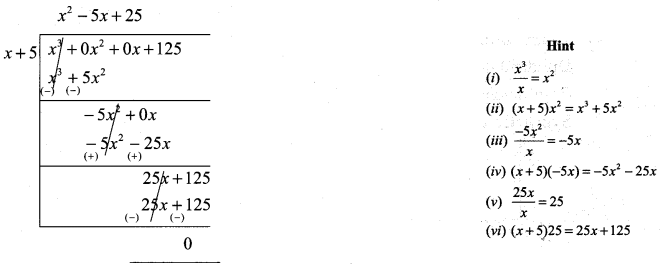
(a) 8
(b) 4
(c) 3
(d) 1
Answer:
(b) 4.
Hint:
Gaseous State Class 11 Notes Pdf Chemistry Solutions Chapter 6 Gaseous State Samacheer Kalvi
Squaring on both sides and rearranging
27 x 2 = mCnH2n-2
54 = n(12) + (2n-2)(l)
54 = 12n+2n – 2
54 = 14n – 2
n = (54 + 2)/14 = 56/14 = 4

Question 17.
Equal moles of hydrogen and oxygen gases are placed in a container, with a pin-hole through which both can escape what fraction of oxygen escapes in the time required for one-half of the hydrogen to escape. (NEET phase 1)
(a) 3/8
(b) 1/2
(c) 1/8
(d) 1/4
Answer:
(c) 1/8
Hint:
Samacheer Kalvi Guru 11th Chemistry Solutions Chapter 6 Gaseous State
The fraction of oxygen that escapes in the time required for one half of the hydrogen to escape is 1/8

Question 18
The variation of volume V, with temperature T, keeping pressure constant is called the coefficient of thermal expansion ie α = \(\frac{1}{V}\left(\frac{\partial V}{\partial T}\right)_{P}\)For an ideal gas α is equal to ………..
(a) T
(b) 1/T
(c) P
(d) none of these
Answer:
(b) 1/T
Hint:
Samacheer Kalvi Class 11 Chemistry Solutions Chapter 6 Gaseous State

Question 19.
Four gases P, Q, R and S have almost same values of ‘b’ but their ‘a’ values (a, b are Van der Waals Constants) are in the order Q < R < S < P. At a particular temperature, among the four gases the most easily liquefiable one is ………….
(a) P
(b) Q
(c) R
(d) S
Answer:
(a) P
Hint:
Greater the ‘a’ value, casier the liquefaction

Question 20.
Maximum deviation from ideal gas is expected from (NEET)
(a) CH4(g)
(b) NH3(g)
(c) H2(g)
(d) N2(g)
Answer:
(b) NH3(g)

Question 21.
The units of Van der Waals constants ‘b’ and ‘a’ respectively
(a) mol L-1 and L atm2 mol-1
(b) mol L and L atm mol2
(c) mol-1 L and L2 atm mol-1
(d) none of these
Answer:
(c) mol-1 L and L2 atm mol-1
Hint:
an2/V2 atm
a = atm L2/mol2 = L2 mol-2 atm
nb = L
b = L /mol = L mol-1

Question 22.
Assertion : Critical temperature of CO2 is 304 K, it can be liquefied above 304 K.
Reason : For a given mass of gas, volume is to directly proportional to pressure at constant temperature.
(a) both assertion and reason arc true and reason is the correct explanation of assertion
(b) both assertion and reason are true but reason is not the correct explanation of assertion
(c) assertion is true but reason is false
(d) both assertion and reason are false
Answer:
(d) both assertion and reason are false
Hint:
Correct Statement: Critical temperature of CO2 is 304 K. It means that CO2 cannot be liquefied above 304 K, whatever the pressure may applied. Pressure is inversely proportional to volume.

Question 23.
What is the density of N, gas at 227°C and 5.00 atm pressure? (R = 0.082 L atm K-1 mol-1)
(a) 1.40 g/L
(b) 2.81 g/L
(c) 3.41 g/L
(d) 0.29 g/L
Answer:
(c) 3.41 g/L
Hint:
Density = \(\frac {Mass}{Volume}\)
Samacheer Kalvi.Guru 11th Chemistry Solutions Chapter 6 Gaseous State

Question 24.
Which of the following diagrams correctly describes the behaviour of a fixed mass of an ideal gas ? (T is measured in K)
Samacheerkalvi.Guru 11th Chemistry Solutions Chapter 6 Gaseous State
Answer:
Class 11 Chemistry Solutions Samacheer Kalvi Chapter 6 Gaseous State
For a fixed mass of an ideal gas V α T
P α 1/V
and PV = Constant

Question 25.
25 g of each of the following gases are taken at 27°C and 600 mm Hg pressure. Which of these will have the least volume?
(a) HBr
(b) HCl
(c) HF
(d) HI
Answer:
(d) HI
Hint:
At a given temperature and pressure
Volume α number of moles
Volume α Mass / Molar mass
Volume α 28 / Molar mass
i.e. if molar mass is more , volume is less. Hence Hl has the least volume.

II. Answer these questions briefly.

Question 26.
State Boyle’s law.
Answer:
Boyle’s law states that at a given temperature. the volume occupied by a fixed mass of a gas is inversely proportional to its pressure.
V α \(\frac {1}{P}\);
where T and n are fixed or PV = Constant = k

Question 27.
A balloon filled with air at room temperature and cooled to a much lower temperalure can be used as a model for Charles’ law.
Answer:
Charles’ law:

  • V T at constant P and n (or) \(\frac {V}{T}\) = Constant
  • A balloon filled with air at room temperature and cooled to a much lower temperature. the size of the balloon is reduced. Because if the temperature of the gas decreases, the volume also decreases in a direct proportion.
  • When temperature is reduced, the gas molecules inside in over slower due to decreased temperature and hence the volume decreases.

Question 28.
Name two items that can serve as a model for Gay Lussac’s law and explain.
Answer:
Gay Lussac’s law:
1. P α T at constant volume (or) = \(\frac {V}{T}\)
2. Example – 1:
You fill the car type completely full of air on the hottest day of summer. The type cannot change it shape and volume. But when winter comes, the pressure inside the lyre is reduced and the shape is also reduced. This confirms that pressure and temperature are direct related to each other.
3. Example – 2:
The egg in the bottle experiment.
Gaseous State Questions And Answers Pdf Samacheer Kalvi 11th Chemistry Solutions Chapter 6
A glass bottle is taken, inside the bottle put some pieces of cotton with fire. Then place a boiled egg (shell removed) at the top of the bottle. The temperature inside the bottle increases from the fire, rising (he pressure. By scaling the bottle with egg, the fire goes on, dropping the temperature and pressure. This causes the egg to be sucked into the bottle.
P α T is proved (or) = \(\frac{P_{1}}{V_{1}}=\frac{P_{2}}{V_{2}}\)

Question 29.
Give the mathematical expression that relates gas volume and moles. Describe in words what the mathematical expression means.
Answer:

  1. The mathematical relationship betwêen the volume of a gas and the number of moles is V α n
  2. \(\frac{V_{1}}{n_{1}}=\frac{V_{2}}{n_{2}}\) = Constant
    Where V1 and n1 are the volume and number of moles of a gas and V2 and n2 are the values of volume and number of moles of same gas at a different set of conditions.
  3. If the volume of the gas increase then the number of moles of the gas also increases.
  4. At a certain temperature and pressure, the volume of a gas is dirctly proportional to the number of the moles of the gas.

Question 30.
What are ideal gases? In what way real gases differ from ideal gases.
Answer:

  1. Ideal gases are the gases that obey gas laws or gas equation PV = nRT.
  2. Real gases do not obey gas equation. PV = nRT.
  3. The deviation of real gases from ideal behaviour is measure in terms of a ratio of PV to nRT. This is termed as compression factor (Z). Z = \(\frac {PV}{nRT}\)
  4. For ideal gases Z = 1.
  5. For real gases Z > 1 or Z < 1. For example, at high pressure real gases have Z >1 and at intermediate pressure Z < 1.
  6.  Above the Boyle point Z> 1 for real gases and below the Boyle point, the real gases first show a decrease for Z, reaches a minimum and then increases with the increase in pressure.
  7. So, it is clear that at low pressure and high temperature, the real gases behave as ideal gases.

Question 31.
Can a Van der Waals gas with a = 0 be liquefied? Explain.
Answer:

  • a = 0 for a Van der Waals gas i.e. for a real gas. Van der Waals constant a = 0. It cannot be liquefied.
  • If a = 0, there is a very less interaction between the molecules of gas.
  • ‘a’ is the measure of strength of Van der Waals force of attraction between the molecules of the gas.
  • If a is equal to zero, the Van der Waals force of attraction is very less and the gas cannot be liquefied.

Question 32.
Suppose there ¡s a tiny sticky area on the wan of a container of gas. Molecules hitting this area stick there permanently. Is the pressure greater or less than on the ordinary area of walls?
Answer:

  • Molecules hitting the tiny sticky area on the wall of the container of gas moves faster as they get closer to adhesive surface, but this effect is not permanent.
  • The pressure on the sticky wall is greater than on the ordinary area of walls.

Question 33.
Explain the following observations
(a) Aerated water bottles are kept under water during summer
(b) Liquid ammonia bottle is cooled before opening the seal
(c) The type of an automobile is inflated to slightly lesser pressure in summer than in winter
(d) The size of a weather balloon becomes larger and larger as it ascends up into larger altitude
Answer:
(a) In aerated water bottles, CO2 gas is passed through the aqueous solution under pressure because the solubility of the gas in water is not very high. In summer, the solubility of the gas in water is likely to decrease because of the rise in temperature. Thus, in summer, more of gas will be present above the liquid surface in the glass bottle.

In case, the pressure of the gas becomes too high, the glass will not be able to withstand the pressure and the bottle may explode. To avoid this, the bottles are kept under water. As a result, the temperature is likely to decrease and the solubility of CO2 is likely to increase in aqueous solution resulting in decreased pressure.

(b) Liquid ammonia bottle contains the gas under very high pressure. If the bottle is opened as such, then the sudden decrease in pressure will lead to a large increase in volume of the gas. As a result, the gas will come out of the bottle all of a sudden with force. This will lead to the breakage of the bottle and also causes accident.

However, if the bottle is cooled under tap water for sometime, there will be a decrease in the volume of a gas to a large extent. if the seal is opened now, the gas will corne out of the bottle at a slower rate, reduces the chances of accident.

(c) The pressure of air is directly proportional to the temperature. Since the temperature is higher in summer than in higher, the pressure of the air in the tube of the lyre is likely to be quite high as compared to winter. It is quite likely that the tube may burst under high pressure in summer, Therefore, it is advisable to inflate the types to lesser pressure in summer than in winter.

(d) The volume of the gas is inversely proportional to pressure at a given temperature according to Boyle’s law. As the weather balloon ascends, the pressure tends to decrease. As a result, the volume of the gas inside the balloon or the size of the balloon is likely to increase.

Question 34.
Give suitable explanation for the following facts about gases.
(a) Gases don’t settle at the bottom of a container
(b) Gases diffuse through all the space available to them and
(c) Explain with an increase in temperature
Answer:
(a) Gases by definition are the least dense state of matter. They have negligible intermolecular forces of attraction. So they are all free to roam separately. So the least dense gas particles will not sink at the bottom of a container.

(b) When a sample of a gas introduced to one part of a closed container, its molecules very quickly disperse throughout the container, this process by which molecules disperse in space in response to differences in concentration is called diffusion. For e.g., you can smell perfume in a room, because it difluses into the air totally inside the room.

(c) Diffusion is faster at higher temperature because the gas molecules have greater kinetic energy. Since heat increase the motion, then diffusion happens faster.

Question 35.
Suggest why there ¡s no hydrogen (H2) in our atmosphere. Why does the moon have no atmosphere?
Answer:
1. Hydrogen is the lightest element thus when produced in free state, it rises above all the other gases to the top of the atmosphere, where it is open to cosmic storms and solar flares. There it literally leaks from the atmosphere to the empty space. Hydrogen easily gains velocity required to escape Earth’s magnetic field. Hydrogen is very reactive in nature. So it would have reacted with O2 , in its way to produce H2O. So majority portion of H2 reacts and very less amount of it present in the upper level of atmosphere and gains velocity to escape the atmosphere.

2. Moon has no atmosphere because the value of acceleration due to gravity ‘g’ on the surface of the moon is small. Therefore, the value of escape velocity on the surface of the moon is very small. The molecule of the atmospheric gases on the surface of the moon have thermal velocities greater than the escape velocity. That’s why all the molecules of gases have escaped and there is no atmosphere in the moon. The moon has insufficient gravity to retain an atmosphere. So we conclude that moon has no atmosphere.

Question 36.
Explain whether a gas approaches ideal behaviour or deviates from ideal behaviour if –
(a) it is compressed to a smaller volume at constant temperature
(b) the temperature is raised while keeping the volume constant
(c) more gas is introduced into the same volume and at the same temperature
Answer:
(a) it a gas is compressed to a smaller volume at constant temperature, pressure is increased. At high pressure with a smaller volume, the gas deviates from ideal behaviour.

(b) If a gas temperature is raised keeping the volume constant, the pressure of the gas will increase. At high pressure, the gas deviates from ideal behaviour.

(c) if more gas is introduced into the same volume and at the same temperature, the number of moles are increasing. if the volume remains same, the increased number of moles collide with each other and kinetic energy increases and pressure decreases. At increased pressure, the gas deviates from ideal behaviour.

Question 37.
Which of the following gases would you expect to deviate from ¡deal behaviour under conditions of low temperature F Cl2, or Br2? Explain.
Answer:
1. Bromine deviates (Br2) from the ideal gas maximum than Cl2 and F2. Because Br2 has biggest size (atomic weight 79.9) provides maximum attraction between bromine molecules which is directly proportional to the size of the molecule and the boiling point of the liquid made from those molecules.

2. Br2 deviates from ideal behaviour because it has largest atomic radii compared to Cl2 and F2. So it contains more electrons than other two, and the Vander Waals forces are stronger in Br2 than in Cl2 and F2. So Br2 deviates from ideal behaviour.

Question 38.
Distinguish between diffusion and effusion.
Answer:
Diffusion:

  • Diffusion is the spreading of molecules of a substance throughout a space or a second substance.
  • Diffusion refers to the ability of the gases to mix with each other.
  • E.g.. Spreading of something such as brown tea liquid spreading through the water in a tea cup.

Effusion:

  • Effusion is the escape of gas molecules through a very small hole in a membrane into an evacuated area.
  • Effusion is a ability of a gas to travel through a small pin-hole.
  • E.g., pouring out something like the soap studs bubbling out from a bucket of water.

Question 39.
Aerosol cans carry clear warning of heating of the can. Why?
Answer:
Aerosol cans carry clear warning of heating of the can. As the temperature rises, pressure in the can will increase and ambient temperatures about 120°F may lead to explosions. So aerosol cans should always be stored in dry areas where they will not be exposed to excessive temperatures. You should never throw an aerosol can onto a fire or leave it in the direct sunlight. even it is empty. This is because the pressure will build up so much that the can will burst. It is due to 2 reasons.

  • The gas pressure increases.
  • More of the liquefied propellant turns into a gas.

Question 40.
When the driver of an automobile applies brake, the passengers are pushed toward the front of the car but a helium balloon is pushed toward back of the car. Upon forward acceleration the passengers are pushed toward the front of the car. Why?
Answer:
1. When the driver of an automobile applies brake, the passengers are pushed toward the front of the car due to inertia of the body, but a helium balloon pushed toward back of the car. Helium balloon responds to the air around it. Helium molecules are lighter than air of our atmosphere, and so they move toward back by gravity as a result of the accelerating frame.

2. Upon forward acceleration, the passengers arc pushed toward the front of the car, because the body in motion tends to stay in motion until acted upon by an outside force. Helium balloon is going to move opposite to this pseudo gravitational force.

Question 41.
Would it be easier to drink water with a straw on the top of Mount Everest?
Answer:
It is difficult to drink water with a straw on the top of Mount Everest. This is because the reduced atmospheric pressure is less effective in pushing water into the straw at the top of the mountain because gravity falls off gradually with height. The air pressure falls off, there isn’t enough atmospheric pressure to push the water up in the straw all the way to the mouth.

Question 42.
Write the Van der Waals equation for a real gas. Explain the correction term for pressure and volume.
Answer:
Van der Waals equation of state for real gases is –
\(\left(P+\frac{a n^{2}}{V^{2}}\right)(V-n b)\) = nRT

Correction term for pressure:
\(\frac{\mathrm{an}^{2}}{\mathrm{V}^{2}}\) is the pressure correction. It represents the intermolecular interaction that causes the non ideal behaviour.

Correction term for Volume:
V – nb is the volume correction. it is the effective volume occupied by real gas.

Question 43.
Derive the values of critical constants from the Van der Waals constants.
Answer:
Derivation of critical constants from the Van der Waals constants:
Van der Waals equation is,
\(\left(P+\frac{a n^{2}}{V^{2}}\right)(V-n b)\) = nRT for 1 mole
From this equation, the values of critical constant PCVC and TC arc derived in terms of a and b the Van der Waals constants.
\(\left(P+\frac{a n^{2}}{V^{2}}\right)(V – b)\) = RT ………..(1)
On expanding the equestion (1)
P V + \(\frac {a}{V}\) – pb – \(\frac{\mathrm{ab}}{\mathrm{V}^{2}}\) – RT = 0 ………(2)
Multiplying eqestion (2) by \(\frac{V^{2}}{P}\),
Class 11 Gaseous State Samacheer Kalvi Chemistry Solutions Chapter 6
equation (3) is rearranged in the powers of V
V3 – \(\left[\frac{\mathrm{RT}}{\mathrm{P}}+\mathrm{b}\right]\) V2 + \(\frac {aV}{P}\) –
= 0 ………..(4)
The above equation (4) is an cubic equation of V, which can have three roots. At the critical point. all the three values of V are equal to the critical volume VC.
i.e. V = VC.
V – VC = O ……….(5)
(V – VC)3 = O ………(6)
(V3 – 3VCV2 + 3VC3V – VC3 = 0 ………(7)
As the equation (4) is identical with equation (7), comparing the ‘V’ ternis in (4) and (7),
Samacheer Kalvi 11th Chemistry Solution Chapter 6 Gaseous State
Divide equation (11) by (10)
Samacheer Kalvi 11th Chemistry Solutions Chapter 6 Gaseous State
When equation (12) is substituted in (10)
Samacheer Kalvi 11th Chemistry Solutions Chapter 6 Gaseous State
substituting the values of Vc and Pc in equation (9)
Samacheer Kalvi 11th Chemistry Solutions Chapter 6 Gaseous State
Critical constant a and b can be calculated using Van der Waals Constant as follows:
Samacheer Kalvi 11th Chemistry Solutions Chapter 6 Gaseous State

Question 44.
Why do astronauts have to wear protective suits when they are on the surface of moon?
Answer:
In space, there is no pressure, if we do wear a pressurised suit, our body will die. In space, we have to wear a pressurised suit, otherwise our body will continue to push out and blow up like a balloon. It would look cool, but we will be dead. So the astronauts in space must wear a pressurised suit (protective suits).

Question 45.
When ammonia combines with HCl, NH4 Cl is formed as white dense fumes. Why do more funies appear near HCl?
Answer:

  1. When ammonia combines with HCl, NH4 Cl is formed as white dense fumes. The reaction takes place in neutralization between a weak base and a strong acid.
  2. The property of the gas is diffusion.
  3. Diffusion of gases Ammonia and hydrogen chloride. Concentrated ammonia solution is placed on a pad in one end of a tube and concentrated HCl on the pad at the other. After about a minute, the gases diffuses far enough to meet and a ring of solid ammonium chloride is formed near the HCl end.

Question 46.
A sample of gas at 15°C at 1 atm has a volume of 2.58 dm3. Vhen the temperature is raised to 38°C at I atm does the volume of the gas increase? if so, calculate the final volume.
Answer:
Samacheer Kalvi 11th Chemistry Solutions Chapter 6 Gaseous State
V2 = 2.78 dm3 i.e. volume increased from 2.58 dm3 to 2.78 dm3.

Question 47.
A sample of gas has a volume of 8.5 dm3 at an unknown temperature. When the sample is submerged in ice water at 0°C, its volume gets reduced to 6.37 dm3. What ¡s its initial temperature?
Answer:
Samacheer Kalvi 11th Chemistry Solutions Chapter 6 Gaseous State
T1 = 364.28 K

Question 48.
Of two samples of nitrogen gas, sample A contains 1.5 moles of nitrogen in a vessel of volume of 37.6 dm3 at 298K, and the sample B is in a vessel of volume 16.5 dm3 at 298 K. Calculate the number of moles in sample B.
Answer:
nA = 1.5 mol nB = ?
VA = 37.6 dm3 VB = 16.5 dm3
(T = 298 K constant)
Samacheer Kalvi 11th Chemistry Solutions Chapter 6 Gaseous State

Question 49.
Sulphur hexafluoride is a colourless, odourless gas; calculate the pressure exerted by 1.82 moles of the gas in a steel vessel of volume 5.43 dm3 at 69.5°C, assuming ¡deal gas behaviour.
Answer:
n = 1.82 mole
V = 5.43 dm3
T = 69.5 + 273 = 342.5
P = ?
PV = nRT
P = \(\frac {nRT}{V}\)
Samacheer Kalvi 11th Chemistry Solutions Chapter 6 Gaseous State
P = 94.25 atm.

Question 50.
Argon is an inert gas used in light bulbs to retard the vapourlzation of the tungsten filament. A certain light bulb containing argon at 1.2 atm and 18°C is heated to 85°C at constant volume. Calculate its final pressure in atm.
Answer:
P1 = 1.2 atm
T1 = 18°C + 273 = 291 K
T2 = 85°C + 273 = 358 K
P2 = ?
\(\frac{P_{1}}{T_{1}}=\frac{P_{2}}{T_{2}}\)
Samacheer Kalvi 11th Chemistry Solutions Chapter 6 Gaseous State-

Question 51.
A small bubble rises from the bottom of a lake, where the temperature and pressure are 6°C and 4 atm. to the water surface, where the temperature is 25°C and pressure is 1 atm. Calculate the final volume in (mL) of the bubble, if its initial volume is 1.5 mL.
Answer:
T1 = 6°C + 273 = 279 K
P1 = 4 atm V1 = 1.5m
T2 = 25°C + 273 = 298 K
P2 = 1 atm V 1 = ?
\(\frac{P_{1} V_{1}}{T_{1}}=\frac{P_{2} V_{2}}{T_{2}}\)
Samacheer Kalvi 11th Chemistry Solutions Chapter 6 Gaseous State-
V2 = 6.41 mol.

Question 52.
Hydrochloric acid is treated with a metal to produce hydrogen gas. Suppose a student carries out this reaction and collects a volume of 154.4 x 10⁻³ dm3 of a gas at a pressure of 742 mm of Hg at a temperature of 298 K. What mass of hydrogen gas (in mg) did the student collect?
Answer:
V = 154.4 x 10⁻³dm3
P = 742 mm of Hg
T = 298 K m = ?
n = \(\frac{PV}{RT}\) = Samacheer Kalvi 11th Chemistry Solutions Chapter 6 Gaseous State-
= 0.006 mol
n = \(\frac{PV}{RT}\)
n = \(\frac{Mass}{Molar Mass}\)
Mass = n x Molar mass
= 0.006 x 2.016
= 0.0121 g = 12.1 mg.

Question 53.
It takes 192 sec for an unknown gas to diffuse through a porous wall and 84 sec for N2 gas to effuse at the same temperature and pressure. What is the molar mass of the unknown gas?
Answer:
Samacheer Kalvi 11th Chemistry Solutions Chapter 6 Gaseous State

Question 54.
A tank contains a mixture of 52.5 g of oxygen and 65.1 g of CO2 at 300 K the total pressure in the tank ¡s 9.21 atm. Calculate the partial pressure (in atm.) of each gas in the mixture.
Answer:
mO2 = 52.5 g
PO2 = ?
mCO2 = 65.1 g
PCO2 = ?
T = 300 K P = 9.21 atm
PO2 = XO2 x total pressure
Samacheer Kalvi 11th Chemistry Solutions Chapter 6 Gaseous State-
PO2 = XO2 x Total pressure
= 0.53 x 9.21 atm = 4.88 atm
PCO2 = XCO2 x Total pressure
= 0.47 x 9.21 atm = 4.33 atm

Question 55.
A combustible gas Is stored in a metal tank at a pressure of 2.98 atm at 25 °C. The tank can withstand a maximum pressure of 12 atm after which it will explode. The building in which the tank has been stored catches fire. Now predict whether the tank will blow up first or start melting? (Melting point of the metal = 1100 K).
Answer:
T1 = 298 K;
P1 = 2.98 atm;
T2 = 1100K;
P2 = ?
\(\frac{P_{1}}{T_{1}}=\frac{P_{2}}{T_{2}}\)
P2 = \(\frac{P_{1}}{T_{1}} \times T_{2}\)
= \(\frac{2.98 \mathrm{atm}}{298 \mathrm{K}} \times 1100 \mathrm{K}\) = 11 atm
At 1100 K, the pressure of the gas inside the tank will become 11 atm. Given that tank can withstand a maximum pressure of 12 atm, the tank will start melting first.

In Text Questions – Evaluate Yourself

Question 1.
Freon-I 2, the compound widely used in the refrigerator system as coolant causes depletion of ozone layer. Now It has been replaced by eco-friendly compounds. Consider 1.5 dm3 sample of gaseous freon at a pressure of 0.3 atm. If the pressure is changed to 1.2 atm. at a constant temperature, what will be the volume of the gas increased or decreased?
Answer:
Volume of freon (V1) = 1.5 dm3
Pressure (P1) = 0.3 atm
‘T’ is constant
P2 = 1.2 atm
V2 = ?
P1V1 = P2V2
V2 = \(\frac{P_{1} V_{1}}{P_{2}}\)
Samacheer Kalvi 11th Chemistry Solutions Chapter 6 Gaseous State-
= 0.375 dm3
Volume decreased from 1.5 dm3 to 0.375 dm3

Question 2.
Inside a certain automobile engine, the volume of air in a cylinder is 0.375 dm3, when the pressure is 1.05 atm. When the gas is compressed to a volume of 0.125 dm3 at the same temperature, what is the pressure of the compressed air?
Answer:
V1 = 0.375dm3
V2 = 0.125 dm3
P1 = 1.05 atm
P2 = ?
T – Constant
P1V1 = P2V2
P2 = \(\frac{P_{1} V_{1}}{V_{2}}=\frac{10.5 \times 0.375}{0.125}\)
= 3.15 atm.

Question 3.
A sample of gas has a volume of 3.8 dm3 at an unknown temperature. When the sample is submerged in ice water at 0°C, its volume gets reduced to 2.27 dm3. What is its initial temperature?
Answer:
V1 = 3.8 dm3
T2 = 0°C = 273K
T1 = ? V2 = 2.27dm3
\(\frac{V_{1}}{T_{1}}=\frac{V_{2}}{T_{2}}\)
Samacheer Kalvi 11th Chemistry Solutions Chapter 6 Gaseous State-
T1 = 457 K

Question 4.
An athlete in a kinesiology research study has his lung volume of 7.05 dm3 during a deep inhalation. At this volume the lungs contain 0.312 mole of air. During exhalation the volume of his Jung decreases to 2.35 dm3 How many moles of air does the athlete exhale during exhalation? (assume pressure and temperature remain constant)
Answer:
V1 = 7.05 dm3
V2 = 2.35 dm3
n1 = 0.312 mol
n1 =?
‘P’ and ‘T’ are constant
\(\frac{V_{1}}{n_{1}}=\frac{V_{2}}{n_{2}}\)
Samacheer Kalvi 11th Chemistry Solutions Chapter 6 Gaseous State-
n2 = 0.104 mol
Number of moles exhaled = 0.312 – 0.104 = 0.208 moles

Question 5.
A small bubble rises from the bottom of a lake, where the temperature and pressure are 8° C and 6.4 atm. to the water surface, where the temperature ¡s 25°C and pressure is 1 atm. Calculate the final volume in (ml) of the bubble, if its initial volume is 2.1 ml.
Answer:
T1 = 8°C = 8 + 273 = 281K
P1 = 6.4atm V1 = 2.1 mol
T2 = 25°C = 25 + 273 = 298 K
P2 = 1 atm
V2 = ?
\(\frac{P_{1} V_{1}}{T_{1}}=\frac{P_{2} V_{2}}{T_{2}}\)
Samacheer Kalvi 11th Chemistry Solutions Chapter 6 Gaseous State-
V2 = 14.25 ml

Question 6.
(a) A mixture of He and O2 were used ¡n the ‘air’ tanks of underwater divers for deep dives. For a particular dive 12 dm3 of O2 at 298 K, I atm. and 46 dm3 of He, at 298 K, 1 aim. were both pumped into a 5 dm3 tank. Calculate the partial pressure of each gas and the total pressure In the tank at 298 K
Answer:
Samacheer Kalvi 11th Chemistry Solutions Chapter 6 Gaseous State
P = 1 atm
Vtotal = 5 dm3
PO2 = XO2 x Ptotal
Samacheer Kalvi 11th Chemistry Solutions Chapter 6 Gaseous State
PHe = 3.54 atm

Question 6.
(b) A sample of solid KClO3 (potassium chlorate) was heated in a test tube to obtain O2 according to the reaction 2KClO3 → 2KCl(s) + 3O2 The oxygen gas was collected by downward displacement of water at 295 K. The total pressure of the mixture is 772 mm of Hg. The vapour pressure of water is 26.7 mn of Hg at 300K. What is the partial pressure of the oxygen gas?
Answer:
2KCl3(s) → 2KCl(s) 3O3(g)
Ptotal = 772 mm Hg
PH2O = 26.7 mm Hg
Ptotal = PO2 + PH2O
PO2 = Ptotal – PH2O
P1 = 26.7 mm Hg
T1 = 300 K
T2 = 295 K
P2 = ?
\(\frac{P_{1}}{T_{1}}=\frac{P_{2}}{T_{2}}\)
Samacheer Kalvi 11th Chemistry Solutions Chapter 6 Gaseous State
P2 = 26.26 mm Hg
∴ PO2 = 772 – 26.26
= 745.74 mm Hg

Question 7.
A flammable hydrocarbon gas of particular volume is found to diffuse through a small hole in 1.5 minutes. Under the same conditions of temperature and pressure an equal volume of bromine vapour takes 4.73 min to diffuse through the same hole. Calculate the molar mass of the unknown gas and suggest what this gas might be, (Given that molar mass of bromine = 159.8 g/ mole)
Answer:
t1 = 1.5 minutes (gas)hydrocarbon
t2 = 4.73 minutes (gas)Bromi
Samacheer Kalvi 11th Chemistry Solutions Chapter 6 Gaseous State
n (12) + (2n + 2) 1 = 16 (general formula for hydrocarbon CnH2n+2)
12n + 2n + 2 = 16
14n = 16 – 2
14n = 14
n = 1
The hydrocarbon is C1H2(1) + 2 = CH4

Question 8.
Critical temperature of H2O, NH3 and CO2 are 647.4, 405.5 and 304.2 K, respectively. When we start cooling from a temperature of 700 K which will liquefy first and which will liquefy finally?
Answer:
Critical temperature of a gas is defined as the temperature above which it cannot be liquefied even at high pressures.
∴ When cooling starts from 700 K, H2O vill liquefied first, then followed by ammonia and finally carbon dioxide will liquefied.

In-Text Example Problems

Question 9.
In the below figure, let us find the missing parameters [volume in (b) and pressure in (c)]
P1 = 1 atm P2 = 2 atm P3 = ? atm
V1 I dm3  V2 =? dm3 V3 = 0.25 dm3
T1 = 298 K T2 = 298 K T3 = 298 K
Solution:
According to Boyle’s law, at constant temperature for a given mass of gas at constant temperature,Samacheer Kalvi 11th Chemistry Solutions Chapter 6 Gaseous State
P1V1 = P2V2 = P3V3
I atm x 1 dm3 = 2 atm x V2 = P3x 0.25 dm3
∴ 2 atm x V2 = 1 atm x 1 dm3
Samacheer Kalvi 11th Chemistry Solutions Chapter 6 Gaseous State
V2 = 0.5 dm3
and P3 x 0.25 dm3 = 1 atm x 1 dm3
Samacheer Kalvi 11th Chemistry Solutions Chapter 6 Gaseous State
P3 = 4atm

Question 10.
In the below figure, let us find the missing parameters [volume in (b) and temperature in (c)]
P1 = 1 atm P2 = 1 atm P3 = 1 atm
V1 = 0.3dm3 V2 = ?dm3 V3 = 0.15dm3
T1 = 200K T2 = 300 K T3 = ? K
Answer:
Samacheer Kalvi 11th Chemistry Solutions Chapter 6 Gaseous State
According to Charles law,
Samacheer Kalvi 11th Chemistry Solutions Chapter 6 Gaseous State
T3 = 100k

Question 11.
Calculate the pressure exerted by 2 moles of sulphur hexafluoride in a steel vessel of volume 6 dm3 at 70°C assuming It is an ideal gas.
Answer:
We will use the ideal gas equation for this calculation as below:
P = \(\frac {nRT}{V}\)
Samacheer Kalvi 11th Chemistry Solutions Chapter 6 Gaseous State
= 9.39 atm.

Question 12.
A mixture of gases contains 4.76 mole of Ne, 0.74 mole of Ar and 2.5 mole of Xe. Calculate the partial pressure of gases, if the total pressure is 2 atm. at a fixed temperature. Solve this problem using Dalton’s law.
Answer:
PNe = XNe PTotal
Samacheer Kalvi 11th Chemistry Solutions Chapter 6 Gaseous State
PNe = XNe PTotal = 0.595 x 2 = 1.19 atm.
PNe = XNe PTotal = 0.093 x 2 = 0. 186 atm.
PNe = XNe PTotal = 0.312 x 2 = 0.624 atm.

Question 13.
An unknown gas diffuses at a rate of 0.5 time that of nitrogen at the same temperature and pressure. Calculate the molar mass of the unknown gas.
Answer:
Samacheer Kalvi 11th Chemistry Solutions Chapter 6 Gaseous State

Question 14.
If a scuba diver takes a breath at the surface filling his lungs with 5.82 dm3 of air what volume will the air in his lungs occupy when he drives to a depth, where the pressure ¡s 1.92 atm. (assume temperature is constant and the pressure at the surface is exactly 1 atm.)
Solution :
Temperature = Constant
Pressure at the surface = 1 atm – P1
Pressure at the depth = 1.92 atm – P2
Vdlume of air breathing at the surface of the air = 5.82 dm3 – V1
Volume of air breathing at the depth = V2 = ?
Samacheer Kalvi 11th Chemistry Solutions Chapter 6 Gaseous State
V1 = 3.03 dm3
The volume of air scuba diver’s lung occupy = 3.03 dm3

Question 15.
Inside a certain automobile engine, the volume of air in a cylinder is 0.475 dm3, when the pressure is 1.05 atm. When the gas is compressed, the pressure increased to 5.65 atm. at the same temperature. What is the volume of compressed air?
Solution:
Volume of air in the cylinder 0.475 dm3 – V1
Pressure of air P1 = 1.05 atm
Increased pressure P2 = 5.65 atm
Volume of air compressed V2 = ?
P1V1 = P2V2
Samacheer Kalvi 11th Chemistry Solutions Chapter 6 Gaseous State
V2 = 0.08827 dm3
Compressed volume of air = 0.08 827 dm3

Samacheer Kalvi 11th Chemistry Gaseous State Additional Questions Solved

I. Choose the correct answer.

Question 1.
For one mole of a gas, the ideal gas equation is ………..
(a) PV = \(\frac {1}{2}\) RT
(b) PV = RT
(c) PV = \(\frac {3}{2}\)RT
(d) PV = \(\frac {5}{2}\)RT
Answer:
(b) PV= RT

Question 2.
The average kinetic energy of the gas molecule is …………
(a) inversely proportional to its absolute temperature
(b) directly proportional to its absolute temperature
(c) equal to the square of its absolute temperature
(d) All of the above
Answer:
(b) directly proportional to Its absolute temperature

Question 3.
Which of the following is the correct mathematical relation for Charles’ law at constant pressure?
(a) V ∝ T
(b) V ∝ t
(c) V ∝ – \(\frac {1}{T}\)
(d) all of above
Answer:
(a) V ∝ T

Question 4.
At constant temperature, the pressure of the gas is reduced to one-third, the volume
(a) reduce to one-third
(b) increases by three times
(c) remaining the same
(d) cannot be predicted
Answer:
(b) increases by three times

Question 5.
With rise in temperature, the surface tension of a liquid …………
(a) decreases
(b) increases
(c) remaining the same
(d) none of the above
Answer:
(a) decreases

Question 6.
Viscosity of a liquid is a measure of ……………
(a) repulsive forces between the liquid molecules
(b) frictional resistance
(c) intermolecular forces between the molecules
(d) none of the above
Answer:
(b) frictional resistance

Question 7.
The cleansing action of soaps and detergents is due to …………..
(a) internal friction
(b) high hydrogen bonding
(c) viscosity
(d) surface tensions
Answer:
(d) surface tensions

Question 8.
In Vander Waals equation of state for a non-ideal gas the net force of attraction among the molecules is given by ………..
(a) \(\frac{\mathrm{an}^{2}}{\mathrm{V}^{2}}\)
(b) P + \(\frac{\mathrm{an}^{2}}{\mathrm{V}^{2}}\)
(c) P – \(\frac{\mathrm{an}^{2}}{\mathrm{V}^{2}}\)
(d) – \(\frac{\mathrm{an}^{2}}{\mathrm{V}^{2}}\)
Answer:
(a) \(\frac{\mathrm{an}^{2}}{\mathrm{V}^{2}}\)

Question 9.
The compressibility factor, z for an ideal gas is ………….
(a) zero
(b) less than one
(c) greater than one
(d) equal to one
Answer:
(d) equal to one

Question 10.
Which of the following gases will have the lowest rate of diffusion?
(a) H2
(b) N2
(c) F2
(d) O2
Answer:
(c) F2

Question 11.
Which of the following is a mono atomic gas in nature?
(a) Oxygen
(b) Hydrogen
(c) Helium
(d) Ozone
Answer:
(c) Helium

Question 12.
Which of the following is a diatomic gas in nature?
(a) Oxygen
(b) Ozone
(c) Helium
(d) Radon
Answer:
(a) Oxygen

Question 13.
Which one of the following is not a monoatomic gas?
(a) Neon
(b) Xenon
(c) Argon
(d) Oxygen
Answer:
(d) Oxygen

Question 14.
Among the following groups which contains monoatomic gases?
(a) Group 17
(b) Group 18
(c) Group 1
(d) Group 15
Answer:
(b) Group 18

Question 15.
Which of the following is a tri atomic gas at room temperature?
(a) Oxygen
(b) Helium
(c) Ozone
(d) Nitrogen
Answer:
(c) Ozone

Question 16.
Which of the following gas is essential for our survival?
(a) N2
(b) H2
(c) O2
(d) He
Answer:
(c) O2

Question 17.
Among the following, which is deadly poison?
(a) CO2
(b) HCN
(c) HCl
(d) NH3
Answer:
(b) HCN

Question 18.
Which of the following is not chemically inert?
(a) Helium
(b) Oxygen
(c) Argon
(d) Krypton
Answer:
(b) Oxygen

Question 19.
Match the List-I and List-II using the correct code given below the list.
Samacheer Kalvi 11th Chemistry Solutions Chapter 6 Gaseous State

Answer:
Samacheer Kalvi 11th Chemistry Solutions Chapter 6 Gaseous State

Question 20.
Pressure of a gas is equal to ………..
(a) \(\frac {F}{a}\)
(b) F x a
(c) \(\frac {a}{F}\)
(d) F – a
Answer:
(a) \(\frac {F}{a}\)

Question 21.
The SI unit of pressure is ………..
(a) Nm-2  Kg-1
(b) Pascal
(c) bar
(d) atmosphere
Answer:
(b) Pascal

Question 22.
Statement-I: The pressure cooker takes more time for cooking at high altitude.
Statement-II: Air is subjected to Earth’s gravitational force. The pressure of air gradually decreases from the surface of the Earth to higher altitude.
(a) Statement-I and II are correct and Statement-II is the correct explanation of Statement-I
(b) Statement-I and II are correct but Statement-II is not the correct explanation of Statement-I
(e) Statement-I is wrong but Statement-II is correct
(ð) Statement-I is correct but Statement-II is wrong
Answer:
(a) Statement-I and II are correct and Statement-II is the correct explanation of Statement-I

Question 23.
The instrument used for measuring the atmospheric pressure is …………….
(a) lactometer
(b) barometer
(c) electrometer
(d) ammeter
Answer:
(b) barometer

Question 24.
The standard atmospheric pressure at sea level at 0°C is equal to ……………..
(a) 1 mm Hg
(b) 76 mm Hg
(c) 760 mm Hg
(d) 680 mm Hg
Answer:
(c) 760 mm Hg

Question 25.
Mathematical expression of Boyle’s law is ………….
(a) P1V1 = P2V2
(b) \(\frac {P}{V}\) = Constant
(c) \(\frac {V}{T}\) = Constant
(J) \(\frac {P}{T}\) = Constant
Answer:
(a) P1V1 = P2V2

Question 26.
Statement-I: If the volume of a fixed mass of a gas is reduced to half at constant temperature the gas pressure doubles.
Statement-II: If the volume is halved, the density of the gas is doubled.
(a) Statement-I and II are correct and Statement-II is the correct explanation of Statement-I
(b) Statement-I and II are correct but Statement-II is not the correct explanation of Statement-I
(c) Statement-I is correct but Statement-II is wrong
(d) Statement-I is wrong but Statement-II is correct
Answer:
(a) Statement-I and liare correct and Statement-II is the correct explanation of Statement-I

Question 27.
Which one of the following represents the Charles’ law?
(a) PV = Constant
(b) \(\frac {V}{T}\) = Constant
(c) VT Constant
(d) \(\frac {T}{V}\) = R
Answer:
(b) \(\frac {V}{T}\) = Constant

Question 28.
Which one of the following is absolute zero?
(a) 293 K
(b) 273 K
(c) – 273.15°C
(d) 0°C
Answer:
(c) – 273.15°C

Question 29.
\(\frac {P}{T}\) = Constant is known as …………..
(a) Boyle’s law
(b) Charles’ law
(c) Gay Lussac’s law
(d) Dalton’s law
Answer:
(c) Gay Lussac’s law

Question 30.
The ideal gas equation is …………..
(a) PV = RT for 1 mole
(b) P1 V1 = P2V2
(c) \(\frac {P}{T}\) = R
(d) P = P2 + P2 + P2
Answer:
(a) PV = RT for 1 mole

Question 31.
The value of Universal gas constant in a ideal gas equation is equal to ………….
(a) 8.3 14 KJ
(b) 0.082057 dm3 atm mol-1 K-1
(c) 1 Pascal
(d) 8.314 x 10⁻²Pascal
Answer:
(b) 0.082057 dm3 atm mol-1 K-1

Question 32.
Mathematical expression of Graham’ s law is ……………….
Samacheer Kalvi 11th Chemistry Solutions Chapter 6 Gaseous State
Answer:
Samacheer Kalvi 11th Chemistry Solutions Chapter 6 Gaseous State

Question 33.
Which law is used in the isotopic separation of deuterium and protium?
(a) Boyle’s law
(b) Charles’ law
(c) Graham’ s law
(d) Gay Lussac’s law
Answer:
(c) Graham’ s law

Question 34.
The value of compression factor Z is equal to ………….
(a) \(\frac {nRT}{PV}\)
(b) \(\frac {PV}{RT}\)
(c) PV x nRT
(d) \(\frac {PV}{nRT}\)
Answer:
(d) \(\frac {PV}{nRT}\)

Question 35.
The value of critical volume is equal in terms of Vander Waals constant is ……….
(a) 3b
(b) \(\frac{8a}{27 Rb}\)
(c) \(\frac{a}{27 b^{2}}\)
(d) \(\frac{2a}{Rb}\)
Answer:
(a) 3b

Question 36.
The value of critical temperature of carbon dioxide is …………
(a) 273 K
(b) 303.98 K
(c) 373 K
(d) – 80°C
Answer:
(b) 303.98 K

Question 37.
Match the List-I and List-II using the correct code given below the list.
Samacheer Kalvi 11th Chemistry Solutions Chapter 6 Gaseous State
Answer:
Samacheer Kalvi 11th Chemistry Solutions Chapter 6 Gaseous State

Question 38.
The value of critical pressure of CO2 is ……………….
(a) 173 atm
(b) 73 atm
(c) 1 atm
(d) 22.4 atm
Answer:
(b) 73 atm

Question 39.
The temperature below which a gas obey Joule Thomson effect is called …………..
(a) critical temperature
(b) standard temperature
(c) inversion temperature
(d) normal temperature
Answer:
(c) Inversion temperature

Question 40.
The substance used in adiabatic process of liquefaction is ……………
(a) liquid helium
(b) gadolinium sulphate
(c) iron sulphate
(d) liquid ammonia
Answer:
(b) Gadolinium sulphate

Question 41.
The temperature produced in adiabatic process of liquefaction is …………..
(a) zero kelvin
(b) -273 K
(c) 10-4 K
(d) 104 K
Answer:
(c) 10-4 K

Question 42.
The molecules of a gas A travel four times faster than the molecules of gas B at same temperature. The ratio of molecular weight MA/ MB is ………….
(a) 1/16
(b) 4
(c) 1/4
(d) 16
Answer:
(a) 1/16

Question 43.
The compressibility factor for an ideal gas is …………….
(a) 1.5
(b) 2
(c) 1
(d) x
Answer:
(c) 1

Question 44.
Which of the following pair will diffuse at the same rate?
(a) CO2 and N2O
(b) CO2 and NO
(c) CO2 and CO
(d) N2O and NO
Answer:
(a) CO2 and N2O

Question 45.
The value of Vander Waals constant “a” is maximum for ……………….
(a) helium
(b) nitrogen
(c) methane
(d) ammonia
Answer:
(d) Ammonia

Question 46.
A person living in Shimla observed that cooking food with using pressure cooker takes more time. The reason for this observation is that at high altitude …………..
(a) pressure increases
(b) temperature decreases
(c) pressure decreases
(a) temperature decreases
Answer:
(c) pressure decreases

Question 47.
Statement-I : At constant temperature PV vs V plot for real gases is not a straight line.
Statement-II : At high pressure, all gases have Z >1, but at intermediate pressure most gases have Z <1.
(a) Statement-I and II are correct and Statement-II is the correct explanation of Statement-I
(b) Statement-I and II are correct but Statement-II is not the correct explanation of Statement-I
(c) Statement-I is correct but Statement-Il is wrong
(d) Statement-I is wrong but Statement-Il is correct .
Answer:
(a) Statement-I and liare correct and Statement-II is the correct explanation of Statement-I

Question 48.
Statement-I: Gases do not liquefy above their critical temperature, even on applying high press ure.
Statement-II: Above critical temperature, the molecular speed is high and intermolecular
attractions cannot hold the molecules together because they escape because of high speed.
(a) Statement-I and II are correct and Statement-II is the correct explanation of Statement-I
(b) Statement-I and II are correct but Statement-II is not the correct explanation of Statement-I
(c) Statement-I is correct but Statement-II is wrong
(d) Statement-I is wrong but Statement-II is correct
Answer:
(c) Statement-I and II are correct and Statement-IIs the correct explanation of Statement-I

Question 49.
The rate of diffusion of a gas is ………….
(a) directly proportional to its density
(b) directly proportional to its molecular mass
(c) directly proportional to its square root of its molecular mass
(d) inversely proportional to its square root of its molecular mass
Answer:
(d) inversely proportional to its square root of its molecular mass

Question 50.
In a closed flask of 5 liters, 1.0 g of H2 is heated from 300 to 600 K, which statement is not correct’?
(a) pressure of the gas increases
(b) the rate of the collusion increase
(c) the number of moles of gas increases
(d) the energy of gaseous molecules increases
Answer:
(c) the number of moles of gas increases

Question 51.
Match the List-I and List-II using the correct code given below the list.
Samacheer Kalvi 11th Chemistry Solutions Chapter 3 Periodic Classification of Elements - 49
Answer:
Samacheer Kalvi 11th Chemistry Solutions Chapter 6 Gaseous State

Question 52.
Consider the following statements.
(i) All the gases have higher densities than liquids and solids.
(ii) All gases occupy zero volume at absolute zero.
(iii) At very low pressure all gases exhibit ideal behaviour.
Which of the above statement is/are not correct?
(a) (i) only
(b) (ii) only
(c) (iii) only
(d) (ii) and (iii) only
Answer:
(a) (i) only

Question 53.
Which of the following gas is present maximum in atmospheric air?
(a) O2
(b) N2
(c) H2
(d) radon
Answer:
(b) N2

Question 54.
Which law is used in the process of enriching the isotope of U235 from other isotopes?
(a) Boyle’s law
(b) Dalton’s law of partial pressure
(c) Graham’s law of diffusion
(d) Charles’ law
Answer:
(c) Graham’s law of diffusion

Samacheer Kalvi 11th Chemistry Gaseous State 2 – Mark Questions

Question 1.
Identify the elements that are in gaseous state under normal atmospheric conditions.
Answer:

  • Hydrogen, nitrogen, oxygen, fluorine and chlorine exist as gaseous diatomic molecules.
  • Another form of oxygen namely ozone tr iatomic molecule exist as a gas at room temperature.
  • Noble gases namely helium, neon, argon, krypton, xenon and radon are mono atomic gases.

Question 2.
Distinguish between a gas and a vapour.
Answer:

  • Gas : A substance that is normally in a gaseous state at ordinary temperature and pressure. .,e.g., Hydrogen.
  • Vapou r: The gaseous form of any substance that is a liquid or solid at normal temperature and pressure. e.g., At 298 K and 1 atm, water exist as water vapour.

Question 3.
Define pressure. Give its units.
Answer:

  • Pressure is defined as the force exerted by a gas on unit area of the wall. Force F
  • Pressure = \(\frac {Force}{Area}\) = \(\frac {F}{a}\)
  • The SI unit of pressure is Pascal (Pa)

Question 4.
Define atmospheric pressure. What is its value?
Answer:

  • The pressure exerted on a unit area of Earth by the colunm of air above it is called atmospheric pressure.
  • The standard atmospheric pressure = 1 atm.
  • 1 atm = 760 mm Hg.

Question 5.
Deep sea divers ascend slowly and breath continuously by time they reach the surface. Give reason.
Answer:

  • For every 10 m of depth, a diver experiences an additional 1 atm of pressure due to the weight of water surrounding him.
  • At 20 m, the diver experiences a total pressure of 3 atm. So the most important rule in diving is never hold breath.
  • Divers must ascend slowly and breath continuously allowing the regulator to bring the air pressure in their lungs to 1 atm by the time they reach the surface.

Question 6.
Most aeroplanes cabins are artificially pressurized. Why?
Answer:
The pressure decreases with the increase in altitude because there are fewer molecules per unit volume of air. Above 9200 m (30,000 ft), for example, where most commercial aeroplanes fly, the pressure is so low that one could pass out for lack of oxygen. For this reason most aeroplanes cabins arc artificially pressurized.

Question 7.
What is the reason behind the cause of ear pain while climbing a mountain? How it can be rectified?
Answer:

  • When one ascends a mountain in a plain, the external pressure drops while the pressure within the air cavities remains the same. This creates an imbalance.
  • The greater internal pressure forces the eardrum to bulge outward causing pain.
  • With time and with the help of a yawn or two, the excess air within your ear’s cavities escapes thereby equalizing the internal and external pressure and relieving the pain.

Question 8.
State Charles’ law.
Answer:
Charles’ law:
For a fixed mass of a gas constant pressure, the volume is directly proportional to temperature (K).
Mathematically V – T at constant P and n. (or) \(\frac {V}{T}\) = Constant (or) \(\frac{V_{1}}{T_{1}}=\frac{V_{2}}{T_{2}}\) = Constant

Question 9.
What are the applications of Charles’ law?
Answer:

  • A hot air inside the balloon rises because of its decreased density and causes the balloon to float  inside the balloon rises because of its decreased density and causes the balloon to float.
  • If you take a helium balloon outside on a chilly day, the balloon will crumble. Once you get back into warm area, the balloon will return to its original shape. This is because, in accordance with Charles’ law, a gas like helium takes up more space when it is warm.

Question 10.
State Avogadro’s hypothesis.
Answer:
Equal volumes of all gases under the same conditions of temperature and pressure contain equal number of molecules. Mathematically V ∝ n
\(\frac{V_{1}}{n_{1}}=\frac{V_{2}}{n_{2}}\) = Constant

Question 11.
Define Dalton’s law of partial pressure.
Answer:
Dalton’s law of partial pressure:
It states that the total pressure of a mixture of gases is the sum of partial pressures of the gases present.
Ptotal = P1 + P2 + P3

Question 12.
What are the applications of Dalton’s law of partial pressure?
Answer:
1. Physicians report the pressure of the patient’s gases in blood, analyzed by hospital lab, the values are reported as partial pressures.
Gas – Normal range
PCO2 35 – 45mm of Hg
PO2  80 – 100 mm of Hg

2. When gas is collected by downward displacement of water, the pressure of dry vapour collected is computed using Dalton’s law
Samacheer Kalvi 11th Chemistry Solutions Chapter 3 Periodic Classification of Elements - 50

Question 13.
How can you identify a heavy smoker with the help of Dalton’s law?
Answer:
Physicians report the pressure of the patient’s gases in blood, analyzed by hospital lab. The values are reported as partial pressures.
Samacheer Kalvi 11th Chemistry Solutions Chapter 3 Periodic Classification of Elements - 51
A heavy smoker may be expected to have low O2 and huge CO2 partial pressures.

Question 14.
Define Graham’s law of diffusion.
Answer:
Graham’s law of diffusion:
The rate of diffusion or effusion is inversely proportional to the square root of molecular mass of a gas through an orifice.
\(\frac{\mathrm{r}_{\mathrm{A}}}{\mathrm{r}_{\mathrm{B}}}=\sqrt{\frac{\mathrm{M}_{\mathrm{B}}}{\mathrm{M}_{\mathrm{A}}}}\)
rArB = rate of diffusion of gases A, B
MA, MB = Molecular mass of gases A, B

Question 15.
Helium diffuses more than air. Give reason.
Answer:
Take two balloons, one is filled with air and another with helium. After one day, the helium balloon was shrunk, because helium being lighter diffuses out faster than the air

Question 16.
Explain about the applications of Graham’s law of diffusion.
Answer:

  • Graham’s law of diffusion is useful to determine the molecular mass of the gas if the rate of diffusion is known.
  • Graham’s law forms the basis of the process of enriching the isotopes of U235 from other isotopes and also useful in isotopic separation of deuterium and protium.

Question 17.
What is compression factor?
Answer:
The deviation of real gases from ideal behaviour is measured in terms of a ratio of PV to nRT.
This is termed as compression factor.
Compression factor = Z = \(\frac {PV}{nRT}\)
For ideal gases Z = 1 at all temperature and pressures.

Question 18.

  1. Define critical temperature.
  2. What is the critical temperature of CO2 gas?

Answer:

  1. The temperature below which a gas can be liquefied by application of pressure is known as critical temperature.
  2. The critical temperature of CO2 gas is 303.98 K.

Question 19.

  1. Define critical pressure.
  2. What is the critical pressure of CO2 gas?

Answer:

  1. Critical temperature (PC) of a gas is defined as the minimum pressure required to liquefy.
  2. The critical pressure of CO2 is 73 atm.

Question 20.
CO2 gas cannot be liquefied at room temperature. Give reason.
Answer:
Only below the critical temperature, by the application of pressure, a gas can be liquefied. CO2 has critical temperature as 303.98 K. Room temperature means (30 + 273 K) 3O3 K. At room temperature, (critical temperature) even by applying large amount of pressure CO2 cannot be liquefied. Only below the critical temperature, it can be liquefied. At room temperature, CO2 remains as gas.

Question 21.
What is meant by Joule-Thomson effect?
Answer:
The phenomenon of lowering of temperature when a gas is made to expand adiabatically form a region of high pressure into a region of low pressure is known as Joule-Thomson effect.

Question 22.
Define inversion temperature.
Answer:
The temperature below which a gas obey Joule-Thomson effect is called inversion temperature (Ti).
Ti = \(\frac {2a}{Rb}\)

Question 23.
State and explain Boyle’s law. Represent the law graphically.
Answer:
It states that, the pressure of a fixed mass of a gas is inversely proportional to its volume if temperature is kept constant.
P – \(\frac {1}{V}\)
PV = Constant (n and T are constant)
P1v1 = P2V2
Graphical Representation:
Samacheer Kalvi 11th Chemistry Solutions Chapter 6 Gaseous State

Question 24.
Give an expression for the van der Waals equation. Give the significance of the constants used in the equation. What are their units?
Answer:
\(\left(P+\frac{n^{2} a}{V^{2}}\right)\) (V- nb) = nRT
Where n is the number of moles present and ‘a’’ b’ are known as van der Waals constants.

Significance of Van der Waals constants:
Van der Waals constant ‘a’:
‘a’ is related to the magnitude of the attractive forces among the molecules of a particular gas. Greater the value of’a’, more will be the attractive forces.
Unit of’a’ = L2 mol-2

Van der Waals constant ‘b’:
‘b’ determines the volume occupied by the gas molecules which depends upon size of molecule.
Unit of ‘b’ = L mol-1

Question 25.
What are ideal and real gases? Out of CO2 and NH3 gases, which is expected to show more deviation from the ideal gas behaviour?
Answer:
Ideal gas:
A gas that follows Boyle’s law, Charles’ law and Avogadro law strictly is called an ideal gas. It is assumed that intermolecular forces are not present between the molecules of an ideal gas.

Real gases:
Gases which deviate from ideal gas behaviour are known as real gases. NH3 is expected to show more deviation. Since NH3 is polar in nature and it can be liquefied easily.

Samacheer Kalvi 11th Chemistry Gaseous State 3 – Mark Questions

Question 1.
Explain the graphical representation of Boyle’s law.
Answer:
Boyle’s law states that at a given temperature the volume occupied by a fixed mass of a gas is inversely proportional to its pressure. V ∝ (T and n are fixed) .
If the pressure of the gas increases, volume will decrease and if the pressure of the gas decreases, the volume will increase. So PV = Constant.
Samacheer Kalvi 11th Chemistry Solutions Chapter 6 Gaseous State

Question 2.
What are the consequences of Boyle’s law?
Answer:
1. if the volume of a fixed mass of a gas is reduced to half at constant temperature the gas pressure doubles.
2. Boyle’s law also helps to relate pressure to density.
P1V1 = P3V3 (Boyle’s law)
\(P_{1} \frac{m}{d_{1}}=P_{2} \frac{m}{d_{2}}\)
Where ‘m’ is the mass, d1 and d2 are the densities of gases at pressure P1 and P2. The density of the gas is directly proportional to pressure.

Question 3.
Explain Charles’ law with an experimental illustration.
Answer:
Charles’ law states that for a fixed mass of a gas at constant pressure, the volume is directly proportional to temperature (K).
V ∝ T (or) \(\frac {V}{T}\) = Constant
Samacheer Kalvi 11th Chemistry Solutions Chapter 6 Gaseous State

Volume vs Temperature:
If a balloon is moved from an ice water bath to a boiling water bath, the gas molecules inside move faster due to increased temperature and hence the volume increases.

Question 4.
Explain the graphical representation of Charles’ law.
Answer:
1. Variation of volume of the gas sample with temperature at constant pressure.
2. Each line (iso bar) represents the variation of volume with temperature at certain pressure. The pressure increases from P1 to P5.
3.  i.e. P1<P2 < P3  <P4 < P5 . When these lines are extrapolated to zero volume, they intersect at a temperature of -273.15°C.
4. All gases are becoming liquids, if they are cooled to sufficiently low temperatures.
5. In other words, all gases occupy zero volume at absolute zero. So the volume of a gas can be measured over only a limited temperature range.
Samacheer Kalvi 11th Chemistry Solutions Chapter 6 Gaseous State

Question 5.
Explain graphicl representation of Gay Lussac’s law
Answer:
Gay Lussac’s law
At constant volume, the pressure of a fixed mass of a gas is directly proportional to temperature.
P – T (or) \(\frac {P}{T}\) = Constant
It can be graphically represented as shown here:
Lines in the pressure vs temperature graph are known as isochores (constant volume) of a gas.
Samacheer Kalvi 11th Chemistry Solutions Chapter 6 Gaseous State

Question 6.
Explain the graphical representation of Avogadro’s hypothesis.
Answer:
Avogadros hypothesis states that equal volumes of all gases under the same conditions of temperature and pressure contain equaLnumbr of molecules.
V ∝ n
\(\frac{V_{1}}{n_{1}}=\frac{V_{2}}{n_{2}}\) = Constant.
Where V1 and are the volume and number 10- of moles of a gas and V2 and n2 are the different set of values of volume and number of moles of the same gas.

Samacheer Kalvi 11th Chemistry Solutions Chapter 6 Gaseous State

A better example to iflustrate Avogadro’s Number of Moles (n) hypothesis is to observe the effect of pumping more gas into a balloon. When more gas molecules (particularly CO2) are passed, the volume of the balloon increases. The pressure and temperature stay constant as the balloon inflates, so the increase in volume is due to the increase in the quantity of gas inside the balloon.

Question 7.
Derive ideal gas equation.
Answer:
The gaseous state is described completely using the following four variables T, P, V and n. Each gas law relates one variable of a gaseous sample to another while the other two variables are held constant. Therefore, combining all equations into a single equation will enable to account for the change in any or all of the variables.
Boyle’s law: V ∝ \(\frac{1}{P}\)
Charles’ law: V ∝ T
Avogadro’s law: V ∝ n
We can combine these equations into the following general equation that describes the physical
behaviour of all gases.
V ∝ \(\frac{nT}{P}\)
V = \(\frac{nRT}{P}\)
V = , where R = Proportionately constant.
The above equation can be rearranged to give PV = nRT – Ideal gas equation. Where, R is also known as Universal gas constant.

Question 8.
Derive the various values of R, gas constant.
Answer:
1. For standard conditions in which P is 1 atm, volume 22.4 14 dm3 for 1 mole at 273.15 K.
Samacheer Kalvi 11th Chemistry Solutions Chapter 6 Gaseous State
= 0.08205 7 dm3 atm mol-1 K-1

2. Where P = 105 Pascal, V = 22.71 x 10⁻³ m3 for I mole of a gas at 273.15 K.
Samacheer Kalvi 11th Chemistry Solutions Chapter 6 Gaseous State
= 8.314 pa m3 K-1 mol-1
=8.314x 10⁻²bar dm3 K-1mol-1
R = 8.314 J K-1 mol-1.

Question 9.
What is meant by Boyle temperature (or) Boyle point? How is it related with compression point?
Answer:
(1) Over a range of low pressures, the real gases can behave ideally at a particular temperature called as Boyle temperature or Boyle point.
(2) The Boyle point varies with the nattirc of the gas.
(3) Above the Boyle point, the compression point Z > 1 for real gases i.e. real gases show positive deviation.
(4) Below the Boyle point, the real gases first show a decrease for Z, reaches a minimum and then increase with increase in pressure. So, it is clear that at low pressure and at high temperature, the real gases behave as ideal gases.
Samacheer Kalvi 11th Chemistry Solutions Chapter 6 Gaseous State

Question 10.
Explain the different methods used for liquefaction of gases.
Answer:

  • Linde’s method: Joule-Thomson effect is used to get liquid air or any other gas.
  • Claude’s process: In addition to Joule-Thomson effect, the gas is allowed to perform mechanical work so that more cooling is produced.
  • Adiabatic process: This method of cooling is produced by removing the magnetic property of magnetic material e.g. Gadolinium sulphate. By this method, a temperature of 10-4 K i.e. as low as zero Kelvin can be achieved.

Samacheer Kalvi 11th Chemistry Gaseous State 5 – Mark Question

Question 1.
How CH4 He and NH3 are deviating from ideal behaviour? (or) Explain how real gases deviate from ideal behaviour.
Answer:
1. The gases which obeys gas equation PV = nRT are known as ideal gases. The gases which do not obey PV = nRT are known as real gases.

2. The gas laws and the kinetic theory are based on the assumption that molecules in the gas phase occupy negligible volume (assumption 1) and that they do not exert any force on one another either attractive or repulsive (assumption 2). Gases whose behaviour is consistent with these assumptions are said to exhibit ideal behaviour.

3. The following graph shows RT plotted against P for three real gases and an ideal gas at a given temperature.

4. According to ideal gas equation, PV/RT is equal to n. Plot PV/RT versus P for ‘n’ moles oigas at 0°C. For1 mole of an ideal gas PV/ RT is equal to 1 irrespective of the pressure of the gas.

5. For real gases, we observe various deviations from ideal behaviour at high pressure. At very low pressure, all gases exhibit ideal behaviour, ie. PV/RT values all converge to n as P approaches zero.
Samacheer Kalvi 11th Chemistry Solutions Chapter 6 Gaseous State
6. For real gases, this is true only at moderate low pressures. (≤ 5 atm) significant variation occurs as the pressure increases. Attractive forces operate among molecules at relatively short deviation.

7. At atmospheric pressure, the molecules in a gas are far apart and attractive forces arc negligible. At high pressure, the density of the gas increases and the molecules are much closer to one another. Intermolecular forces can be significant enough to affect the motion of the molecules and the gas will not behave ideally.

Question 2.
Derive Van der Waals equation of state.
Answer:
1. Consider the effect of intermolecular forces on the pressure exerted by a gas form the following explanation.

2. The speed of a molecule that is moving toward the wall of a container is reduced by the attractive forces exerted by its neighbours. Hence, the measured gas pressure is Q lower than the pressure the gas would exert, if it behave ideally.
Samacheer Kalvi 11th Chemistry Solutions Chapter 6 Gaseous State
Where ‘a’ is the proportionality constant and depends on the nature of the gas and n and V are the number of moles and volume of the container and respectively an2/ V2 is the correction term.

3. The frequency of encounters increases with the square of the number of molecules per unit volume n2/ V2. Therefore an2/ V2 represents the intermolecular interaction that causes non-ideal behaviour.

4.  Another correction is concerned with the volume ¿ccupied by the gas molecules. ‘V’ represents the volume of the container. As every individual molecule of a real gas occupies certain volume, the effective volume V- nb which is the actually available for the gas, n is the number of moles and b is a constant of gas.

5.  Hence Van der Waals equation of state for real gases are given as \(\left(P+\frac{a n^{2}}{V^{2}}\right)\) (V – nb) = nRT Where a and b are Van der Waals constants.

Question 3.
Explain about Andrew’s experimental isotherms of CO2 gas.
Answer:
1. Andrew plotted isotherms of carbon dioxide at different temperatures. it is then proved that many real gases behave in a similar manner like CO2.

2. At a temperature of 303.98 K, CO2 remains as a gas. Below this temperature, CO2, turns into liquid CO2 at 7 3atm. It is called the critical temperature of CO2.
Samacheer Kalvi 11th Chemistry Solutions Chapter 6 Gaseous State

3. At 303.98 K and 73 atm pressure, CO3,, becomes a liquid but remains a gas at higher temperature.

4. Below the critical temperature, the behaviour of CO2 is different. For example, consider an isotherm of CO2 at 294.5 K, it is a gas until the point B, is reached. At B, a liquid separates along the line BC, both the liquid and gas co-exist. At C, the gas is completely condensed.

5. If the pressure is higher than at C, only the liquid is compressed so, a steep rise in pressure is observed. Thus, there exist a continuity of state.

6.  A gas below the critical temperature can be liquefied by applying pressures.

Activity – 1
The table below contains the values of pressure measured at different temperatures for 1 moie of an ideal gas. Plot the values in a graph and verify the Gay Lussac’s law. [Lines in the pressure vs temperature graph are known as iso chores (constant volume) of a gas]
Samacheer Kalvi 11th Chemistry Solutions Chapter 6 Gaseous State
Solution:
Gay Lussac’s law at constant volume = \(\frac{P_{1}}{T_{1}}=\frac{P_{2}}{T_{2}}\)
Samacheer Kalvi 11th Chemistry Solutions Chapter 6 Gaseous State
If temperature increases, pressure also increases.
So \(\frac{P_{1}}{T_{1}}=\frac{P_{2}}{T_{2}}\)
Samacheer Kalvi 11th Chemistry Solutions Chapter 6 Gaseous State

We as a team believe the information prevailing regarding the Samacheer Kalvi Solutions for 11th Chemistry Chapter 6 Gaseous State has been helpful in clearing your doubts to the fullest. For any other help do leave us your suggestions and we will look into them. Stay in touch to get the latest updates on Tamilnadu State Board Solutions for different subjects in the blink of an eye.

Samacheer Kalvi 10th Science Solutions Chapter 17 Reproduction in Plants and Animals

Students who are preparing for the Science exam can download this Tamilnadu State Board Solutions for Class 10th Science Chapter 17 from here for free of cost. These Tamilnadu State Board Textbook Solutions PDF cover all 10th Science Reproduction in Plants and Animals Book Back Questions and Answers.

All these concepts of Chapter 17 Reproduction in Plants and Animals are explained very conceptually by the subject teachers in Tamilnadu State Board Solutions PDF as per the prescribed Syllabus & guidelines. You can download Samacheer Kalvi 10th Science Book Solutions Chapter 17 Reproduction in Plants and Animals State Board Pdf for free from the available links. Go ahead and get Tamilnadu State Board Class 10th Science Solutions of Chapter 1 Reproduction in Plants and Animals.

Tamilnadu Samacheer Kalvi 10th Science Solutions Chapter 17 Reproduction in Plants and Animals

Kickstart your preparation by using this Tamilnadu State Board Solutions for Class 17th Science Chapter 17 Reproduction in Plants and Animals Questions and Answers and get the max score in the exams. You can cover all the topics of Chapter 17 easily after studying the Tamilnadu State Board Class 17th Science Textbook solutions pdf. Download the Tamilnadu State Board Science Chapter 17 Reproduction in Plants and Animals solutions of Class 17th by accessing the links provided here and ace up your preparation.

Samacheer Kalvi 10th Science Reproduction in Plants and Animals Textual Evaluation Solved

I. Choose the Correct Answer.

Reproduction In Plants And Animals Class 10 Samacheer Question 1.
The plant which propagates with the help of its leaves is ______.
(a) Onion
(b) Neem
(c) Ginger
(d) Bryophyllum.
Answer:
(d) Bryophyllum

10th Science 17th Lesson Question 2.
Asexual reproduction takes place through budding in:
(a) Amoeba
(b) Yeast
(c) Plasmodium
(d) Bacteria
Answer:
(b) Yeast

Samacheer Kalvi Guru 10th Science Question 3.
Syngamy results in the formation of ______.
(a) Zoospores
(b) Conidia
(c) Zygote
(d) Chlamydospores.
Answer:
(c) Zygote

Reproduction In Plants And Animals Class 10 Pdf Question 4.
The essential parts of a flower are:
(a) Calyx and Corolla
(b) Calyx and Androecium
(c) Corolla and Gynoecium
(d) Androecium and Gynoecium
Answer:
(d) Androecium and Gynoecium

Samacheer Kalvi 10th Standard Question 5.
Anemophilous flowers have ______.
(a) Sessile stigma
(b) Small smooth stigma
(c) Coloured flower
(d) Large feathery stigma.
Answer:
(d) Large feathery stigma.

10th Class Biology Reproduction Lesson Question 6.
Male gametes in angiosperms are formed by the division of:
(a) Generative cell
(b) Vegetative cell
(c) Microspore mother cell
(d) Microspore
Answer:
(a) Generative cell

Question 7.
What is true of gametes?
(a) They are diploid
(b) They give rise to gonads
(c) They produce hormones
(d) They are formed from gonads.
Answer:
(d) They are formed from gonads.

Question 8.
A single highly coiled tube where sperms are stored, get concentrated and mature is known as:
(a) Epididymis
(b) Vasa efferentia
(c) Vas deferens
(d) Seminiferous tubules
Answer:
(a) Epididymis

Question 9.
The large elongated cells that provide nutrition to developing sperms are ______.
(a) Primary germ cells
(b) Sertoli cells
(c) Leydig cells
(d) Spermatogonia.
Answer:
(b) Sertoli cells

Question 10.
Estrogen is secreted by:
(a) Anterior pituitary
(b) Primary follicle
(c) Graffian follicle
(d) Corpus luteum
Answer:
(c) Graffian follicle

Question 11.
Which one of the following is an IUCD?
(a) Copper – T
(b) Oral pills
(c) Diaphragm
(d) Tubectomy.
Answer:
(a) Copper – T

II. Fill in the Blanks.

Question 1.
The embryo sac in a typical dicot at the time of fertilization is ______.
Answer:
Female Gametophyte.

Question 2.
After fertilization the ovary develops into ______.
Answer:
Fruit.

Question 3.
Planaria reproduces asexually by ______.
Answer:
Regeneration.

Question 4.
Fertilization is ______ in humans.
Answer:
Internal.

Question 5.
The implantation of the embryo occurs at about ______ day of fertilization.
Answer:
6 to 7.

Question 6.
_______ is the first secretion from the mammary gland after childbirth.
Answer:
Colostrum.

Question 7.
Prolactin is a hormone produced by ______.
Answer:
Anterior Pituitary.

III. Match the following.

Question 1.

Column IColumn II
1. Fission(a) Spirogyra
2. Budding(b) Amoeba
3. Fragmentation(c) Yeast

Answer:
1. (b) Amoeba
2. (c) Yeast
3. (a) Spirogyra.

Question 2.
Match the following terms with their respective meanings.

1. Parturition(a) The duration between pregnancy and birth
2. Gestation(b) Attachment of zygote to the endometrium
3. Ovulation(c) Delivery of baby from a uterus
4. Implantation(d) Release of an egg from Graafian follicle

Answer:
1. (c) Delivery of baby from a uterus
2. (a) Duration between pregnancy and birth
3. (d) Release of the egg from Graafian follicle
4. (b) Attachment of zygote to the endometrium.

IV. State whether the following statements are True or False. Correct the false statement.

Question 1.
The stalk of the ovule is called pedicle.
Answer:
False.
Correct Statement: Stalk of the ovule is called funiculus.

Question 2.
Seeds are the product of asexual reproduction.
Answer:
False.
Correct Statement: Seeds are the product of Sexual reproduction.

Question 3.
Yeast reproduces asexually by means of multiple fission.
Answer:
False.
Correct Statement: Yeast reproduces asexually by means of budding.

Question 4.
The part of the pistil which serves as a receptive structure for the pollen is called as style.
Answer:
False.
Correct Statement: The part of the pistil which serves as a receptive structure for the pollen is called as stigma.

Question 5.
Insect pollinated flowers are characterized by dry and smooth pollen.
Answer:
False.
Correct Statement: Insect pollinated flowers are characterized by larger and spiny pollen.

Question 6.
Sex organs produce gametes, which are diploid.
Answer:
False.
Correct Statement: Sex organs produce gametes, which are haploid.

Question 7.
LH is secreted by the posterior pituitary.
Answer:
False.
Correct Statement: LH is secreted by the anterior pituitary.

Question 8.
Menstrual cycle ceases during pregnancy.
Answer:
True.

Question 9.
Surgical methods of contraception prevent gamete formation.
Answer:
True.

Question 10.
The increased level of estrogen and progesterone is responsible for menstruation.
Answer:
False.
Correct Statement: The decreased level of estrogen and progesterone is responsible for menstruation.

V. Answer in a word or sentence.

Question 1.
If one pollen grain produces two male gametes, how many pollen grains are needed to fertilize 10 ovules?
Answer:
One sperm fuses with the egg and forms a diploid zygote. So 10 pollen grains are needed to fertilize 10 ovules.

Question 2.
In which part of the flower germination of pollen grains takes place?
Answer:
Germination of pollen grains takes place in the stigma of the female flower.

Question 3.
Name two organisms which reproduce through budding.
Answer:
Yeast, Hydra.

Question 4.
Mention the function of endosperm.
Answer:
Endosperm provides food to the developing embryo.

Question 5.
Name the hormone responsible for the vigorous contractions of the uterine muscles.
Answer;
Oxytocin, from the posterior pituitary, is responsible for the vigorous contractions of the uterine muscles.

Question 6.
What is the enzyme present in acrosome of sperm?
Answer:
Acrosome contain hyaluronidase an enzyme that help the sperm to enter the ovum during fertilization.

Question 7.
When is World Menstrual Hygiene Day observed?
Answer:
Every year May 28 is observed as World Menstrual Hygiene Day.

Question 8.
What is the need for contraception?
Answer:
Contraception is one of the best birth control measures to check population growth.

Question 9.
Name the part of the human female reproductive system where the following occurs.

  1. Fertilization
  2. Implantation

Answer:

  1. Oviduct of the female genital tract.
  2. Uterus

VI. Short Answer Questions.

Question 1.
What will happen if you cut Planaria into small fragments?
Answer:
Breaking of fragments of Planaria results into many fragments. Each fragment having one cell will give rise to a new Planaria, by cell division.

Question 2.
Why is vegetative propagation practiced for growing some type of plants?
Answer:
No gametic fusion is required in vegetative reproduction. In this type, new plantlets are formed from vegetative cells, buds or organ of plant. The vegetative part of plant get detached from the parent body and grows into an Independent daughter plant.

Question 3.
How does binary fission differ from multiple fission?
Answer:

Binary fissionMultiple fission
1. The nucleus divides into two parts.1. The nucleus divides into many parts.
2. It gives rise to new individuals.2. It gives rise to many individuals
3. Cytoplasm divides after each nuclear division.3. Cytoplasm does not divide after every nuclear division.
4. eg. Amoeba.4. eg. Plasmodium.

Question 4.
Define Triple fusion.
Answer:
The fusion of one male gamete (n) fuses with the secondary nucleus (2n) to produce primary endosperm nucleus (3n) is called Triple fusion.

Question 5.
Write the characteristics of insect-pollinated flowers.
Answer:
Pollination with the help of insects like flies and honey bees are called Entomophily. To attract those insects, these flowers are brightly coloured, have smell and nectar.

Question 6.
Name the secondary sex organs in male.
Answer:
Secondary sex organs in male are seminiferous tubules, epididymis, sperm duct, seminal vesicles, prostrate gland, cowper’s gland and penis.

Question 7.
What is colostrum? How is milk production hormonally regulated?
Answer:
The first fluid which is released from the mammary gland after childbirth is called colostrum. Milk production from alveoli of the mammary gland is stimulated by prolactin secreted from the anterior pituitary. The ejection of milk is stimulated by the posterior pituitary hormone oxytocin.

Question 8.
How can menstrual hygiene be maintained during menstrual days?
Answer:
Menstrual hygiene to be maintained during menstrual days are:

  1. Sanitary pads should be changed regularly to avoid infections due to microbes from vagina and sweat from genitals.
  2. Use of warm water to clean genitals helps to get rid of menstrual cramps.
  3. Wearing loose clothing rather than tight-fitting clothes will ensure the airflow around the genitals and prevent sweating.

Question 9.
How does developing embryo gets its nourishment inside the mother’s body?
Answer:
The placenta allows the exchange of food materials, diffusion of oxygen, excretion of nitrogenous wastes and elimination of carbon-di-oxide. A cord, containing blood vessels that connect the placenta with the foetus is called the umbilical cord.

Question 10.
Identify the parts A, B, C and D.
Reproduction In Plants And Animals Class 10 Samacheer Kalvi Science Solutions Chapter 17
Answer:
The parts A, B, C and D are:
10th Science 17th Lesson Samacheer Kalvi Reproduction In Plants And Animals

Question 11.
Write the events involved in the sexual reproduction of a flowering plant.
(a) Discuss the first event and write the types.
(b) Mention the advantages and the disadvantages of that event.
Answer:
(a) The first event is pollination. Pollination is the process of transfer of pollen grains from anther to stigma of a flower. The two types of pollination are self-pollination and cross pollination.

(b) Advantages of self-pollination:

  1. Self-pollination is possible in certain bisexual flowers.
  2. Flowers do not depend on agents for pollination.
  3. There is no wastage of pollen grains.

Disadvantages of self-pollination:

  1. The seeds are less in numbers.
  2. The endosperm is minute. Therefore, the seeds produce weak plants.
  3. New varieties of plants cannot be produced.

Advantages of cross pollination:

  1. The seeds produced as a result of cross pollination, develop and germinate properly and grow into better plants, i.e., cross pollination leads to the production of new varieties.
  2. More viable seeds are produced.

Disadvantages of cross-pollination:

  1. Pollination may fail due to distance barrier.
  2. More wastage of pollen grains.
  3. It may introduce some unwanted characters.
  4. Flowers depend on the external agencies for pollination.

Question 12.
Why are the human testes located outside the abdominal cavity? Name the pouch in which they are present?
Answer:
The testicles, produce sperm and testosterone. The testicles are located outside the body because the sperms develop best at a temperature, several degrees lower than normal body temperature. The pouch, is scrotum, a sac – like structure, in which the testes are present.

Question 13.
Luteal phase of the menstrual cycle is also called the secretory phase. Give reason.
Answer:
In leutal phase LH and FSH decreases, corpus luteum produces progesterone and its level increases followed by a decline progesterone also stimulates the glands in the uterus to secrete substances that maintain the endometrium and keep it from breaking down. For this reason, this phase of menstrual cycle is called secretory phase.

Question 14.
Why are family planning methods not adopted by all the people of our country?
Answer:

  • Illiteracy
  • Emphasis is in rural areas and not in villages.
  • Door to door campaign to encourage families could not be done because of overpopulation.
  • Poor economic status and poverty of most of the people in India.
  • Age-Old cultural norms continue to cause, poor family planning practices, all across the country.

VII. Long Answer Questions.

Question 1.
With a neat labelled diagram describe the parts of a typical angiosperms ovule.
Answer:
The main part of the ovule is the nucellus which is enclosed by two integuments, leaving an opening called micropyle. The ovule is attached to the ovary wall by a stalk, called funiculus. The basal part is Chalaza.
Samacheer Kalvi Guru 10th Science Solutions Chapter 17 Reproduction In Plants And Animals
The embryo sac contains seven cells and the eighth nuclei located within the nucellus. Three cells at the micropylar end form the egg apparatus and the three cells at the chalazalnte9uments end are the antipodal cells. The remaining two nuclei are called polar nuclei found in the centre. In the egg apparatus, one is the egg cell (female gamete) and the remaining two cells are the synergids.

Question 2.
What are the phases of the menstrual cycle? Indicate the changes in the ovary and uterus.
Answer:
The four phases of the menstrual cycle are:

  • Menstrual or Destructive phase
  • Follicular or Proliferative phase
  • Ovulatory phase
  • Luteal or secretory phase.

Events of the menstrual cycle and changes in ovary and changes in the uterus.

PhaseDaysChanges in OvaryChanges in UterusHormonal changes
Menstrual phase4 – 5 daysDevelopment of primary follicles.Breakdown of uterine endometrial lining leads to bleeding.The decrease in progesterone and oestrogen.
Follicular phase6th – 13th
day
Primary follicles grow to become a fully mature Graafian follicle.Endometrium regenerates through proliferation.FSH and Oestrogen increase.
Ovulatory phase14th dayThe Graafian follicle ruptures, and releases the ovum (egg).Increase in endometrial thickness.LH peak.
Luteal phase15th – 28th dayEmptied Graafian follicle develops into corpus luteum.The endometrium is prepared for implantation if fertilization of the egg takes place if fertilization does not occur corpus luteum degenerates, uterine wall ruptures, bleeding starts and unfertilized egg is expelled.LH and FSH decrease, Corpus luteum produces progesterone and its level increases followed by a decline, if menstrual bleeding occurs.

VIII. Higher Order Thinking Skills (HOTS) Questions

Question 1.
In angiosperms the pollen germinates to produce pollen tube that carries two gametes. What is the purpose of carrying two gametes when single gamete can fertilize the egg?
Answer:
In angiosperms, one sperm cell fuses with the egg cell to form the zygote, while the other fuses with the two polar nuclei that form the endosperm which nourishes the developing embryo.

Question 2.
Why the menstrual cycle does not take place before puberty and during pregnancy?
Answer:
The reproducing period of a women’s life starts and becomes functional and an increase in sex hormone production starts only in puberty. So the menstrual cycle does not take place before puberty. The release of a mature egg, maintains the lining of the uterus, during pregnancy. During pregnancy, the placenta produces progesterone. This maintains the lining of the uterus during pregnancy and it means that menstruation does not happen.

Question 3.
Read the following passage and answer the questions that follow.
Rahini and her parents were watching a television programme. An advertisement flashed on the screen which was promoting use of sanitary napkins. Rahini’s parents suddenly changed the channel, but she objected to her parents and explained the need and importance of Such advertisement.

(a) What is first menstruation called? When does it occur?
Answer:
The first menstruation is called Menarche. In human females, the menstrual cycle starts at the age of 11 – 13 years which marks the onset of puberty.

(b) List out the napkin hygiene measures taken during menstruation?
Answer:

  1. The sanitary pad and tampons should be wrapped properly and discarded because they can spread infections.
  2. Sanitary pad or tampon should not be flushed down the toilet.
  3. Napkin incinerators are to be used properly for disposal of used napkins.

(c) Do you think that Rahini’s objection towards her parents was correct? If so, Why?
Answer:
Yes. Awareness to be created in maintaining menstrual hygeine and importance of menstrual hygeine for good health.

Samacheer Kalvi 10th Science Reproduction in Plants and Animals Additional Questions Solved

I. Fill in the blanks.

Question 1.
The reproduction process is to preserve individual species and is called ______.
Answer:
Self – perpetuation.

Question 2.
The _______ grains are produced in the anther within the pollen sac.
Answer:
Pollen.

Question 3.
The _____ contains the future plant or embryo, which develops into a seedling.
Answer:
Seed.

Question 4.
Each testis is covered with a layer of fibrous tissue called ______.
Answer:
Tunica albuginea.

Question 5.
The first fluid which is released from the mammary gland after childbirth is called ______.
Answer:
Colostrum.

Question 6.
The organs of the reproductive system are divided into ______ and ____ (accessory) sex organs.
Answer:
Primary, secondary.

Question 7.
The plasma membrane of an ovum is surrounded by inner thin _____ and an outer thick ______.
Answer:
Zona pellucida, Corona Radiata.

Question 8.
______ is the practice of healthy living and personal cleanliness.
Answer:
Hygiene.

Question 9.
Testosterone initiates the process of ______.
Answer:
Spermatogenesis.

Question 10.
The cortex of ovary is composed of a connective tissue called ______.
Answer:
Stroma.

Question 11.
In plants, the fusion of one sperm with the egg is called ______.
Answer:
Syngamy.

Question 12.
The _______ provides energy for the movement of the tail in sperm, causing sperm motility, which is essential for fertilization.
Answer:
Mitochondria.

Question 13.
Self – pollination is also known as ______.
Answer:
Autogamy

Question 14.
During spore formation, a structure called sporangium develops from the ______.
Answer:
Fungal hyphae.

II. Choose the correct pair from the following.

Question 1.
(a) Chalaza and pollination
(b) Calyx and spores
(c) Anemophily and hydrophily
(d) Stamens and Planaria.
Answer:
(c) Anemophily and hydrophily

Question 2.
(a) Oogenesis and spermatogenesis
(b) Fragmentation and Fertilization
(c) Primary follicle and fission
(d) Micropyle and Regeneration.
Answer:
(a) Oogenesis and spermatogenesis

Question 3.
(a) Scrotum and sporangium
(b) Pollination and population
(c) Spermatogenesis and seminiferous tubules
(d) Diaphragm and Blastocyst.
Answer:
(c) Spermatogenesis and seminiferous tubules

Question 4.
(a) Autogamy and Budding
(b) Funiculus and chalaza
(c) Bulbils and spirogyra
(d) Polar nuclei and pollination.
Answer:
(b) Funiculus and chalaza

Question 5.
(a) Tuberous root and granulosa cells
(b) Corolla and Graafian follicle
(c) Synergids and Regeneration
(d) The vegetative and generative cell.
Answer:
(d) The vegetative and generative cell.

III. Match the following.

Question 1.

1. Offsprings(a) Pollination by insects
2. Anemophily(b) Pollination by animals
3. Spermatogenesis(c) Blood vessels
4. Umbilical cord(d) Expulsion of the young one
5. Entomophily(e) Seminiferous tubules
6. Parturition(f) Sexual reproduction
7. Zoophily(g) Pollination by wind

Answer:

  1. (f) Sexual reproduction
  2. (g) Pollination by wind
  3. (e) Seminiferous tubules
  4. (c) Blood vessels
  5. (a) Pollination by insects
  6. (d) Expulsion of the young one
  7. (b) Pollination by animals.

IV. Choose the correct answer.

Question 1.
The male and the female gametes contain this material on the chromosomes, which transmit the character traits to the next generation.
(a) genes
(b) chromoplast
(c) septum
(d) spores
Answer:
(a) genes

Question 2.
Raphe and hilium in seed represent:
(a) Nucellus
(b) Funiculus
(c) Integument
(d) Micropyle
Answer:
(b) Funiculus

Question 3.
The corona radiata is formed of ______.
(a) Vitelline membrane
(b) Oxytocin
(c) Zygote
(d) Follicle.
Answer:
(d) Follicle.

Question 4.
Pollination is followed by:
(a) Seed formation
(b) Fragmentation
(c) Fertilization
(d) Budding
Answer:
(c) Fertilization

Question 5.
The membrane forming the surface layer of the ovum is called ______.
(a) Entomophily
(b) Exine
(c) Vitelline membrane
(d) Intine.
Answer:
(c) Vitelline membrane

V. Write True or False for the following statements. Write the correct statement for the incorrect statement.

Question 1.
Sexual reproduction involves the fusion of two diploid gametes to form a haploid individual (Zygote).
Answer:
False.
Correct Statement: Sexual reproduction involves the fusion of two haploid gametes, to form a diploid individual (Zygote).

Question 2.
Accessory sex organ in man includes the Gonads. (Testes in males and Ovaries in female).
Answer:
False.
Correct Statement: Primary sex organ in man include the Gonads. (Testes in males and Ovaries in female).

Question 3.
The connective tissue of Cortex called stroma is lined by the germinal epithelium cells called Granulosa cells.
Answer:
True.

Question 4.
The mature ovum or egg in the female is elliptical in shape and has full of yolk.
Answer:
False.
Correct Statement: The mature ovum or egg is spherical in shape and is always free of yolk.

Question 5.
The menstrual cycle ceases around 48-50 years of age and this stage is termed as menopause.
Answer:
True.

VI. Answer the following briefly.

Question 1.
What is the role of acrosome in human sperm?
Answer:
The sperm head has a like structure called acrosome. It contain hyaluronidase an enzyme that helps the sperm to enter the ovum during fertilization.

Question 2.
What are the significance of fertilization and the post-fertilization changes?
Answer:
Significance of fertilization:

  • It stimulates the ovary to develop into a fruit.
  • It helps in the development of new characters from two different individuals.

Post – fertilization changes:

  • The ovule develops into a seed.
  • The integuments of the ovule develop into the seed coat.
  • The ovary enlarges and develops into a fruit.

Question 3.
What is Asexual reproduction? Explain the spore formation in Rfiizoptis with a diagram.
Answer:
Production df an offspring by a single parent without the formation and fusion of gametes is called Asexual reproduction. Asexual reproduction occurs by spore formation. In Rhizopus, during spore formation, a structure called sporangium develops from the fungal hypha. The nucleus divides several times within the sporangium and each nucleus with a small amount of cytoplasm develops into a spore. The spores are liberated and they develop into new hypha after reaching the ground or substratum.
Reproduction In Plants And Animals Class 10 Pdf Samacheer Kalvi Science Solutions Chapter 17

Question 4.
What could be the reasons for adopting contraceptive methods?
Answer:
Contraception is one of the best birth control measures. A number of techniques or method have been developed to prevent pregnancies in women which leads to welfare of the family group and society.

Question 5.
Explain the following:
(a) Toilet Hygiene
(b) Napkin Hygiene
(c) Menstrual Hygiene
Answer:
(a) Toilet Hygiene:

  • To reduce the bad odour and infection, the floors of the toilet should be kept clean and dry.
  • Toilet flush handles, doorknobs, light switches and walls should be cleaned with disinfectants to kill harmful germs and bacteria.
  • Hands should be washed with soap, before and after toilet use.

(b) Napkin Hygiene:

  • To prevent infections, the sanitary pad, and tampon should be wrapped and discarded properly.
  • Sanitary pad and tampon should not be flushed down the toilet.
  • Napkin incinerators are to be used properly for disposal of used napkins.

(c) Menstrual Hygiene:

  • Sanitary pads should be changed regularly, to avoid infections due to microbes from vagina and sweat from genitals.
  • Use of warm water to clean genitals helps to get rid of menstrual cramps.
  • Wear loose clothing, to have airflow around the genitals and prevent sweating.

Question 6.
Explain the structure of the following:
(a) Testes
(b) Ovary
Answer:
(a) Testes: Testes are the reproductive glands of the male, that are Oval shaped, which lie outside the abdominal cavity of a man, in a sac-like structure called Scrotum. Each testis is covered with a layer of fibrous tissue called tunica albuginea. Septa divides the testes into pyramidal lobules, in which lie seminiferous tubules, cells of Sertoli and the Leydig cells. The process of spermatogenesis takes place in the seminiferous tubules. The Sertoli cells are the supporting cells and provide nutrients to the developing sperms. The Leydig cells lie between the seminiferous tubules and secrete testosterone. It initiates the process of spermatogenesis.

(b) Ovary: Ovaries are located on either side of the lower abdomen, composed of two almond-shaped bodies, each lying near the lateral end of the fallopian tube. Each ovary has an outer cortex and an inner medulla. The cortex is composed of a network of connective tissue called stroma and is lined by the germinal epithelium. The epithelial cells called the granulosa cells to surround each ovum in the ovary together forming the primary follicle. As the egg grows larger, the follicle also enlarges and gets filled with the fluid and is called the Graafian follicle.

Question 7.
What do you know about the National Health Programme?
Answer:
To improve the reproductive health of the people, National Health Programmes such as,
(a) Family Welfare Programme:

  • Maternal and Child Health Care (MCH).
  • Immunization of mothers, infants and children.
  • Nutritional supplement to pregnant women and children.
  • Motivate couples to accept contraceptive methods and to have small family norms, which improve economic status, living status and quality of life.

(b) Reproductive and Child Health Care (RCH)

  • Pregnancy and childbirth.
  • Postnatal care of the mother and child.
  • Importance of breastfeeding.
  • Prevention of reproductive tract infections and sexually transmitted diseases.

Question 8.
What is gastrulation?
Answer:
The transformation of blastula into gastrula and the formation of primary germ layers (Ectoderm, Mesoderm and Endoderm) by rearrangement of the cells is called gastrulation.

Question 9.
What is implantation?
Answer:
The process of attachment of the blastocyst to the uterine wall (endometrium) is called implantation. The blastocyst (fertilized egg) reaches the uterus and gets implanted in the uterus. The fertilized egg becomes implanted in about 6 to 7 days after fertilization.

VII. Draw a labelled diagram of the following.

Question 1.
Cross Section of:
(a) Human testes
(b) Human ovary
Answer:
(a) Human testes:
Samacheer Kalvi 10th Standard Science Solutions Chapter 17 Reproduction In Plants And Animals

(b) Human ovary:
Samacheer Kalvi 10th Science Solutions Chapter 17 Reproduction in Plants and Animals 6

VIII. Write the expansion for the following abbreviations.

Question 1.

  1. WHO
  2. RCH
  3. MCH
  4. STD
  5. IUD
  6. UTI
  7. LH
  8. FSH.

Answer:

  1. WHO – World Health Organization
  2. RCH – Reproductive and Child Health Care
  3. MCH – Maternal and Child Health Care
  4. STD – Sexually Transmitted Diseases
  5. IUD – Intra-Uterine Device
  6. UTI – Urinary Tract Infection
  7. LH – Luteinizing Hormone
  8. FSH – Follicle Stimulating Hormones.

IX. Answer the following in detail. Draw diagrams wherever necessary.

Question 1.
With the help of a neat labelled diagram, explain, how does fertilization take place in flowering plants.
Answer:
The mature pollen grain contains two cells, the vegetative and the generative cell. The vegetative cell contains a large nucleus. The generative cell divides mitotically and forms two male gametes.

Pollen grains reach the stigma and begin to germinate. Pollen grain forms a small tube-like structure called pollen tube, which emerges through the germ pore. The contents of the pollen grain move into the tube. The pollen tube grows through the tissues of the stigma and style and finally reaches the ovule through the micropyle.
Samacheer Kalvi 10th Science Solutions Chapter 17 Reproduction in Plants and Animals 7
The vegetative cell degenerates and the generative cell divides to form two sperms or male gametes. Tip of pollen tube bursts and the two sperms enter the embryo sac. One sperm fuses with the egg and this process is called Syngamy and forms a diploid zygote. The other sperm fuses with the secondary nucleus, which is called the Triple fusion, to form the primary endosperm nucleus, which is triploid in nature.

Since two types of fusion syngamy and triple fusion take place in an embryo sac, the process is termed as double fertilization. After triple fusion, primary endosperm nucleus develops into an endosperm, which provides food to the developing embryo. Later the synergids and antipodal cells degenerate.

Question 2.
With examples and with the help of a neat labelled diagram, explain the different types of vegetative reproduction of plants.
Answer:
Vegetative reproduction takes place through,
(i) Leaves:
Samacheer Kalvi 10th Science Solutions Chapter 17 Reproduction in Plants and Animals 8
In Bryophyllum, small plants grow at the leaf notches.

(ii) Stem:
In plants like, strawberry aerial weak stems, touch the ground and give adventitious roots and buds. The offspring becomes an independent plant, when it is detached from the parent plant.
Samacheer Kalvi 10th Science Solutions Chapter 17 Reproduction in Plants and Animals 9

(iii) Root: Tuberous roots are used to develop new plants, eg. Asparagus, Sweet potato.

(iv) Bulbils: In some plants, the flower bud, modifies into the globose bulb, which is called bulbils. When these bulbils fall on the ground they grow into new plants, eg. Agave.

(v) Fragmentation: The breaking of the filament into many fragments is called fragmentation. Each fragment having one cell will give rise to a new filament by cell division, eg. Spirogyra.
Samacheer Kalvi 10th Science Solutions Chapter 17 Reproduction in Plants and Animals 10

(vi) Fission:
Samacheer Kalvi 10th Science Solutions Chapter 17 Reproduction in Plants and Animals 11
The parent cell divides into two daughter cells and each cell develops into a new adult organism eg. Amoeba.

(vii) Budding:
Samacheer Kalvi 10th Science Solutions Chapter 17 Reproduction in Plants and Animals 12
Formation of a daughter individual from a small projection, the bud arising on the parent body is called budding, eg. Yeast.

(viii) Regeneration: The ability of the lost body parts of an individual organism to give rise to a whole new organism is called regeneration. Regeneration takes place by the specialized mass of cells, eg. Hydra and Planaria.

Question 3.
Explain the two types of pollination and write the advantages and disadvantages of the types of pollination.
Answer:
The two types of pollination are
(a) Self – pollination: The transfer of pollen grains from the anther to the stigma of the same flower or another flower borne on the same plant is called self – pollination.
eg. Hibiscus. Self – pollination is also called Autogamy.
Advantages of self – pollination:

  • Self – pollination is possible in certain bisexual flowers.
  • Flowers do not depend on agents for pollination.
  • There is no wastage of pollen grains.

Disadvantages of self – pollination:

  • The seeds are less in numbers.
  • The endosperm is minute, so the seeds produce weak plants.
  • New varieties of plants cannot be produced.

(b) Cross-pollination: The transfer of pollen grains from the anthers of a flower to the stigma of a flower on another plant of the same species is called Cross-pollination, eg. Apples, Grapes, Plum.
Advantages of Cross-pollination:

  • The seeds produced as a result of cross-pollination, develop and germinate properly and grow into better plants.
  • Cross-pollination leads to the production of new varieties.
  • More viable seeds are produced.

Disadvantages of Cross-pollination:

  • Pollination may fail due to the distance barrier.
  • More wastage of pollen grains.
  • It may introduce some unwanted characters.
  • Flowers depend on the external agencies for pollination.

Question 4.
Explain the structure of Human Sperm and Ovum with a neat labelled diagram.
Answer:
1. Structure of Human sperm:
The spermatozoa consist of a head, middle piece and tail. The sperm head is elongated and formed by the condensation of the nucleus. The anterior portion has a cap-like structure called acrosome, which contains an enzyme hyaluronidase, that helps the sperm to enter the ovum during fertilization. A short neck connects the head and middle piece, which comprises the centrioles. The middle piece contains the mitochondria which provides energy for the movement of tail. It brings about sperm motility, which is essential for fertilization.
Samacheer Kalvi 10th Science Solutions Chapter 17 Reproduction in Plants and Animals 13

2. Structure of Ovum:
The mature ovum or egg is spherical in shape, free of yolk and contains abundant cytoplasm and the nucleus. The ovum is surrounded by three membranes. The plasma membrane is surrounded by inner thin zona pellucida and an outer thick corona radiata, which is formed of follicle cells. The membrane forming the surface layer of the ovum is called the vitelline membrane. The fluid-filled space between zona pellucida and the surface of the egg is called perivitelline space.
Samacheer Kalvi 10th Science Solutions Chapter 17 Reproduction in Plants and Animals 14

Question 5.
Explain the Agents of cross-pollination.
Answer:
Cross – pollination takes place through the agency of animals, insects, wind and water.
(a) Pollination by the wind: The pollination with the help of wind is called Anemophily. The Anemophilous flowers produce an enormous amount of pollen grains, which are small, smooth, dry and light in weight. This kind of pollen can blow off at a distance of more than 1,000 km. The stigmas are large, protruding and hairy to trap the pollen grains, eg. Grasses and some Cacti.

(b) Pollination by insects: Pollination with the help of insects like honey bees, flies are called entomophily. These flowers are brightly coloured, have the smell and have nectar, to attract insects. The pollen grains are larger in size, and the exine is pitted and spiny, so it can easily adhere firmly on the sticky stigma. About 80% of the pollination by insects is carried by honey bees.

(c) Pollination by water: The pollination with the help of water is called hydrophily. This takes place in aquatic plants. Pollen grains are produced in large numbers. Pollen grains float on the surface of water till they land on the stigma of female flowers, eg. Hydrilla, Vallisneria.

(d) Pollination by Animals: When pollination takes place with the help of animals, it is called Zoophily. The flowers have bright colour, size and scent to attract animals, eg. Sunbird pollinates flowers of Canna, Gladioli etc., Squirrels pollinate flowers of silk cotton tree.

Question 6.
Explain the parts of a flower, with a neat labelled diagram.
Answer:
The flower is the reproductive organ of a flowering plant. A flower is a modified shoot. A flower consists of four whorls borne on the thalamus. The whorls are from outside. The parts of a typical flower are as follows:
Samacheer Kalvi 10th Science Solutions Chapter 17 Reproduction in Plants and Animals 15

(a) Calyx: Calyx consists of sepals, forms the outermost whorl. They are non-essential or accessory whorls. It protects the flower bud.

(b) Corolla: Corolla consists of petals, which are modified leaves. They are often brightly coloured and in different shapes to attract pollinators. They are non-essential or accessory whorls because they do not directly take part in the reproduction.

(c) Androecium:
Samacheer Kalvi 10th Science Solutions Chapter 17 Reproduction in Plants and Animals 16
Androecium is the male reproductive part of a flower and is called an essential whorl, as they take part directly in reproduction. The androecium is composed of stamens. Each stamen consists of a stalk called the filament and a small bag like structure called anther at the tip. The pollen grains are produced in the anther within the pollen sac.

Pollen grains are spherical and have a two-layered wall. The hard outer layer is exine, which has apertures, called Germpore. The inner thin layer is intine, which is continuous and made up of cellulose and pectin. Mature pollen grain contain two cells, the vegetative and generative cell. Vegetative cell contains a large nucleus. The generative cell divides, to form two male
gametes.

(d) Gynoecium:
Gynoecium is the female reproductive part of a flower. It is an essential whorl because they take part directly in reproduction. Gynoecium is made up of carpels. It has (a) Ovary (b) Style (c) Stigma. Ovary contains the ovules. The main part of the ovule is the nucellus and is enclosed by two integuments, Jk. leaving an opening called as micropyle. The ovule is attached to the ovary wall, by a stalk called Funiculus.
Samacheer Kalvi 10th Science Solutions Chapter 17 Reproduction in Plants and Animals 17

Question 7.
Explain the steps involved from fertilization to foetal development in human.
Answer:
Fertilization in human is internal and occurs in the Oviduct of the female genital tract. It takes place in the ampulla of the fallopian tube. An oocyte is alive for about 24 hours after it is released from follicle. The sperm enters into the ovum, fuses and forms a zygote, which is a fertilized ovum. This process is called fertilization.

(a) Cleavage and formation of Blastula: The first cleavage takes place about 30 hours after fertilization. Cleavage is a series of rapid mitotic divisions of the zygote, to form many-celled blastula (Blastocyst), which comprises an outer layer of smaller cells and inner mass of larger cells.

(b) Implantation: The blastocyst (fertilized egg) reaches the uterus and gets implanted. The process of attachment of the blastocyst to the uterine wall is called Implantation. The fertilized egg, implanted in about 6 to 7 days after fertilization.

(c) Gastrulation: After implantation, the transformation of blastula into Gastrula and the formation of primary germ layers (Ectoderm, Mesoderm and Endoderm) by rearrangement of the cells takes place, which is called Gastrulation.

(d) Organogenesis: The various organs of the foetus are established from the different germ layers, during Organogenesis.

(e) Formation of Placenta: Placenta is a disc-shaped structure, attached to the Uterine wall between the developing embryo and maternal tissues. It allows the exchange of food materials, diffusion of oxygen, excretion of nitrogenous wastes and elimination of carbon-di-oxide. The cord which connects the placenta with the foetus is called the umbilical cord.

(f) Pregnancy (Gestation): Embryo attains its development in the uterus. Gestation period of human is 280 days. During pregnancy the uterus expands up to 500 times of its normal size.

(g) Parturition (Child Birth): Oxytocin from the posterior pituitary stimulates the uterine contractions and provides force to expel the baby from the uterus, causing birth. Parturition is the expulsion of young one from the mother’s Uterus at the end of gestation.

(h) Lactation: The process of milk production after childbirth from the mammary glands of the mother is called lactation. Milk production from the mammary gland is stimulated by prolactin, a hormone secreted by anterior pituitary. The ejection of milk is stimulated by posterior pituitary hormone oxytocin.

Question 8.
What is population explosion? Explain the different ways of family planning.
Answer:
The sudden and rapid rise in the size of the human population is called the Population Explosion. Contraception: Contraception is one of the best birth control measures. The devices used for contraception are called contraceptive devices. The common contraceptive methods used to prevent pregnancy are as follows:

(a) Barrier methods: This method prevents the meeting of an ovum by the sperms. The entry of sperm is prevented into the female reproductive tract by a barrier.

  • Condom: Condom is made of thin rubber or latex sheath. Condom prevents deposition of sperms in the vagina. A condom protects against Sexually Transmitted Diseases (STD) like Syphilis and AIDS.
  • Diaphragm (Cervical cap): Vaginal diaphragm fitting into the vagina or a cervical cap fitting over the cervix. This prevents the entry of sperms into the uterus.

(b) Hormonal Methods: Hormonal preparations are in the form of pills or tablets (contraceptive pills). These hormones stop the release of an egg from the ovary.

(c) Intra – Uterine Devices (IUDs): The intrauterine device (IUD) are contraceptive devices, inserted into the uterus. Lippe’s Loop and Copper-T, made of copper and plastic are two synthetic devices, commonly used in India. This can remain for a period of 3 years. This reduces the sperm fertilizing capacity and prevents implantation.

(d) Surgical methods: Surgical contraception or sterilization techniques are terminal methods to prevent any pregnancy. This procedure in males is called as vasectomy (ligation of vas deferens) and in females, it is called tubectomy (ligation of fallopian tube). These are methods of permanent birth control.

Believing that the Tamilnadu State Board Solutions for Class 17th Science Chapter 17 Reproduction in Plants and Animals Questions and Answers learning resource will definitely guide you at the time of preparation. For more details about Tamilnadu State Board Class 17th Science Chapter 17 textbook solutions, ask us in the below comments and we’ll revert back to you asap.

Samacheer Kalvi 11th Maths Solutions Chapter 1 Sets Ex 1.3

You can Download Samacheer Kalvi 11th Maths Book Solutions Guide Pdf, Tamilnadu State Board help you to revise the complete Syllabus and score more marks in your examinations.

Tamilnadu Samacheer Kalvi 11th Maths Solutions Chapter 1 Sets Ex 1.3

11th Maths Exercise 1.3 Answers Question 1.
Suppose that 120 students are studying in 4 sections of eleventh standard in a school. Let A denote the set of students and B denote the set of the sections. Define a relation from A to B as “x related toy if the student x belongs to the section y”. Is this relation a function? What can you say about the inverse relation? Explain your answer.
Solution:
(i) A = {set of students in 11th standard}
B = {set of sections in 11sup>th standard}
R : A ➝ B ⇒ x related to y
⇒ Every students in eleventh Standard must in one section of the eleventh standard.
⇒ It is a function.
Inverse relation cannot be a function since every section of eleventh standard cannot be related to one student in eleventh standard.

Exercise 1.3 Class 11 Maths State Board Question 2.
Write the values of f at – 4, 1, -2, 7, 0 if
11th Maths Exercise 1.3 Answers Samacheer Kalvi Chapter 1 Sets
Solution:
f(-4) = -(-4) + 4 = 8
f(1) = 1 – 12 = 0
f(-2) = (-2)2 – (-2) = 4 + 2 = 6
f(7) = 0
f(0) = 0

11th Maths Exercise 1.3 Question 3.
Write the values of f at -3, 5, 2, -1, 0 if
Exercise 1.3 Class 11 Maths State Board Samacheer Kalvi Chapter 1 Sets
Solution:
f(-3) = (-3)2 – 3 – 5 = 9 – 8 = 1
f(5) = (5)2 + 3(5) – 2 = 25 + 15 – 2 = 38
f(2) = 4 – 3 = 1
f(-1) = (-1)2 + (-1) – 5 = 1 – 6 = -5
f(0) = 0 – 3 = -3

11th Maths Exercise 1.3 Solutions Question 4.
State whether the following relations are functions or not. If it is a function check for one-to-oneness and ontoness. If it is not a function, state why?
(i) If A = {a, b, c] and/= {(a, c), (b, c), (c, b)};(f: A ➝ A).
(ii) If X = {x, y, z} and/= {(x, y), (x, z), (z, x)}; (f: X ➝ X).
Solution:
(i) f : A ➝ A
11th Maths Exercise 1.3 Samacheer Kalvi Chapter 1 Sets
It is a function but it is not 1 – 1 and not onto function.

(ii) f : X ➝ X
11th Maths Exercise 1.3 Solutions Samacheer Kalvi Chapter 1 Sets
x ∈ X (Domain) has two images in the co-domain x. It is not a function.

11th Maths Exercise 1.3 Answers Samacheer Question 5.
Let A = {1, 2, 3, 4} and B = {a, b, c, d}. Give a function from A ➝ B for each of the following:
(i) neither one-to-one nor onto.
(ii) not one-to-one but onto.
(iii) one-to-one but not onto.
(iv) one-to-one and onto.
Solution:
A = {1, 2, 3, 4}
B = {a, b, c, d}.
11th Maths Exercise 1.3 Answers Samacheer Kalvi Chapter 1 Sets
R = {(1, b) (2, b) (3, c) (4, d)} is not 1-1 and not onto

(iii) Not possible

(iv) 11 Maths Exercise 1.3 Samacheer Kalvi Chapter 1 Sets

11 Maths Exercise 1.3 Question 6.
Find the domain of \(\frac{1}{1-2 \sin x}\)
Solution:
11th Maths Exercise 1.3 In Tamil Samacheer Kalvi Chapter 1 Sets

11th Maths Exercise 1.3 In Tamil Question 7.
Find the largest possible domain of the real valued function f(x) = \(\frac{\sqrt{4-x^{2}}}{\sqrt{x^{2}-9}}\)
Solution:
Samacheer Kalvi 11 Maths Solutions Chapter 1 Sets Ex 1.3
∴ No largest possible domain
The domain is null set

Samacheer Kalvi 11 Maths Solutions Question 8.
Find the range of the function \(\frac{1}{2 \cos x-1}\)
Solution:
The range of cos x is – 1 to 1
Exercise 1.3 Class 11 Maths Solutions Chapter 1 Sets Samacheer Kalvi

Exercise 1.3 Class 11 Maths Question 9.
Show that the relation xy = -2 is a function for a suitable domain. Find the domain and the range of the function.
Solution:
xy = – 2 ⇒ y = -2/x
which is a function
The domain is (-∞, 0) ∪ (0, ∞) and range is R – {0}

Samacheer Kalvi Guru 11th Maths Question 10.
If f, g : R ➝ R are defined by f(x) = |x| + x and g(x) = |x| – x, find gof and fog.
Solution:
Samacheer Kalvi Guru 11th Maths Chapter 1 Sets Ex 1.3

Samacheer Kalvi 11th Maths Question 11.
If f, g, h are real valued functions defined on R, then prove that
(f + g)oh = foh + goh. What can you say about fo(g + h) ? Justify your answer.
Solution:
Let f + g = k
Samacheer Kalvi 11th Maths Solutions Chapter 1 Sets Ex 1.3
= (f + g((h(x))
= f[h(x)] + g [h(x)]
= foh + goh
(i.e.,)(f + g)(o)h = foh + goh
fo(g + h) is also a function

Samacheer Kalvi Guru 11 Maths Question 12.
If f: R ➝ R is defined by f(x) = 3x – 5, prove that f is a bijection and find its inverse.
Solution:
P(x) = 3x – 5
Let y = 3x – 5 ⇒ 3x = y + 5
Samacheer Kalvi Guru 11 Maths Solutions Chapter 1 Sets Ex 1.3

Samacheer Kalvi 11th Maths Book Back Answers Question 13.
The weight of the muscles of a man is a function of his body weight x and can be expressed as W(x) = 0.35x. Determine the domain of this function.
Solution:
W(x) = 0.35x
Since body weight x is positive and if it increases then W(x) also increase.
Domain is (0, ∞) i.e.,x > 0

Samacheerkalvi.Guru 11th Maths Question 14.
The distance of an object falling is a function of time t and can be expressed as s(t) = -16t2. Graph the function and determine if it is one-to-one.
Solution:
s(t) = -16t2
Suppose S(t1) = S(t2)
Samacheer Kalvi 11th Maths Book Back Answers Chapter 1 Sets Ex 1.3
since time cannot be negative, we to take t1 = t2
Hence it is one-one.

t0123
s0-16-64-144

Samacheerkalvi.Guru 11th Maths Solutions Chapter 1 Sets Ex 1.3

Samacheer Kalvi.Guru 11th Maths Question 15.
The total cost of airfare on a given route is comprised of the base cost C and the fuel surcharge S in rupee. Both C and S are functions of the mileage m; C(m) = 0.4m + 50 and S(m) = 0.03m. Determine a function for the total cost of a ticket in terms of the mileage and find the airfare for flying 1600 miles.
Solution:
C – base cost,
S = fuel surcharge,
m = mileage
C(m) = 0.4 m + 50
S(m) = 0.03 m
Total cost = C(m) + S(m)
= 0.4 m + 50 + 0.03 m
= 0.43 m + 50
for 1600 miles
T(c) = 0.43 (1600) + 50 = 688 + 50 = ₹ 738

Samacheer Kalvi Class 11 Maths Question 16.
A salesperson whose annual earnings can be represented by the function A(x) = 30, 000 + 0.04x, where x is the rupee value of the merchandise he sells. His son is also in sales and his earnings are represented by the function S(x) = 25, 000 + 0.05x. Find (A + S)(x) and determine the total family income if they each sell Rupees 1,50,00,000 worth of merchandise.
Solution:
A(x) = 30, 000 + 0.04x, where x is merchandise rupee value
S(x) = 25000 + 0.05 x
(A + S) (x) = A(x) + S(x)
= 30000 + 0.04x + 25000 + 0.05 x
= 55000 + 0.09x
(A + S) (x) = 55000+ 0.09x
They each sell x = 1,50,00,000 worth of merchandise
(A + S) x = 55000 + 0.09 (1,50,00,000)
= 55000 + 13,50,000
∴ Total income of family = ₹ 14,05,000

Samacheer Kalvi Class 11 Maths Solutions Question 17.
The function for exchanging American dollars for Singapore Dollar on a given day is f(x) = 1.23x, where x represents the number of American dollars. On the same day the function for exchanging Singapore Dollar to Indian Rupee is g(y) = 50.50y, where y represents the number of Singapore dollars. Write a function which will give the exchange rate of American dollars in terms of Indian rupee.
Solution:
f(x) = 1. 23x where x is number of American dollars.
g(y) = 50.50y where y is number of Singapore dollars.
gof(x) = g(f(x))
= g(1. 23x)
= 50.50 (1.23x)
= 62.115 x

Question 18.
The owner of a small restaurant can prepare a particular meal at a cost of Rupees 100. He estimates that if the menu price of the meal is x rupees, then the number of customers who will order that meal at that price in an evening is given by the function D(x) = 200 – x. Express his day revenue, total cost and profit on this meal as functions of x.
Solution:
cost of one meal = ₹ 100
Total cost = ₹ 100 (200 – x)
Number of customers = 200 – x
Day revenue = ₹ (200 – x) x
Total profit = day revenue – total cost
= (200 – x) x – (100) (200 – x)

Question 19.
The formula for converting from Fahrenheit to Celsius temperatures is \(y=\frac{5 x}{9}-\frac{160}{9}\)
Find the inverse of this function and determine whether the inverse is also a function.
Solution:
Samacheer Kalvi.Guru 11th Maths Solutions Chapter 1 Sets Ex 1.3

Question 20.
A simple cipher takes a number and codes it, using the function f(x) = 3x – 4. Find the inverse of this function, determine whether the inverse is also a function and verify the symmetrical property about the line y = x (by drawing the lines).
Solution:
f(x) = 3x – 4
Let y = 3x – 4
Samacheer Kalvi Class 11 Maths Solutions Chapter 1 Sets Ex 1.3

Samacheer Kalvi 11th Maths Solutions Chapter 1 Sets Ex 1.3 Additional Questions

Question 1.
Find the domain and range of the function \(f(x)=\frac{1}{\sqrt{x-5}}\)
Solution:
Given that : f(x) \(f(x)=\frac{1}{\sqrt{x-5}}\)
Here, it is clear that / (x) is real when x – 5 > 0 ⇒ x > 5
Hence, the domain = (5, ∞)
Now to find the range put
Samacheer Kalvi Class 11 Maths Solutions Chapter 1 Sets Ex 1.3
For x ∈ (5, ∞), y ∈ R+.
Hence, the range of f = R+.

Question 2.
If \(f(x)=\frac{x-1}{x+1}\), then show that
Samacheer Kalvi 11th Maths Solutions Chapter 1 Sets Ex 1.3 91
Solution:
Samacheer Kalvi 11th Maths Solutions Chapter 1 Sets Ex 1.3 92

Question 3.
Find the domain of each of the following functions given by:
\(f(x)=\frac{x^{3}-x+3}{x^{2}-1}\)
Solution:
Samacheer Kalvi 11th Maths Solutions Chapter 1 Sets Ex 1.3 93
Here, f(x) is not defined if x2 – 1 ≠ 0
(x – 1) (x + 1) ≠ 0
x ≠ 1, x ≠ -1
Hence, the domain of f = R – {-1, 1}

Question 4.
Find the range of the following functions given by
f(x) = 1 + 3 cos 2x
Solution:
Given that: f(x) = 1 + 3 cos 2x
We know that -1 ≤ cos 2x ≤ 1
⇒ -3 ≤ 3 cos 2x ≤ 3 ⇒ -3 + 1 ≤ 1 + 3 cos 2x ≤ 3 + 1
⇒ -2 ≤ 1 + 3 cos 2x ≤ 4 ⇒ -2 ≤ f(x) ≤ 4
Hence the range of f = [-2, 4]

Question 5.
Find the domain and range of the function \(f(x)=\frac{x^{2}-9}{x-3}\)
Solution:
Samacheer Kalvi 11th Maths Solutions Chapter 1 Sets Ex 1.3 55
Domain off: Clearly f(x) is not defined for x – 3 = 0 i.e. x = 3.
Therefore, Domain (f) = R – {3}
Range off: Let f(x) = y. Then,
Samacheer Kalvi 11th Maths Solutions Chapter 1 Sets Ex 1.3 65
It follows from the above relation that y takes all real values except 6 when x takes values in the set R – {3}. Therefore, Range (f) = R {6}.

Question 6.
Find the range of the following functions given by f(x) = \(\frac{1}{2-\sin 3 x}\)
Solution:
Samacheer Kalvi 11th Maths Solutions Chapter 1 Sets Ex 1.3 565

Samacheer Kalvi 9th Maths Solutions Chapter 2 Real Numbers Ex 2.2

You can Download Samacheer Kalvi 9th Maths Book Solutions Guide Pdf, Tamilnadu State Board help you to revise the complete Syllabus and score more marks in your examinations.

Tamilnadu Samacheer Kalvi 9th Maths Solutions Chapter 2 Real Numbers Ex 2.2

9th Maths Exercise 2.2 Samacheer Kalvi Question 1.
Express the following rational numbers into decimal and state the kind of decimal expansion.
(i) \(\frac { 2 }{ 7 }\)
(ii) \(-5 \frac{3}{11}\)
(iii) \(\frac { 22 }{ 3 }\)
(iv) \(\frac { 327 }{ 200 }\)
Solution:
(i) \(\frac { 2 }{ 7 }\)
9th Maths Exercise 2.2 Samacheer Kalvi Chapter 2 Real Numbers
\(\frac{2}{7}=0 . \overline{285714}\)
Nen-terminating and recurring

(ii) \(-5 \frac{3}{11}\)
9th Maths Exercise 2.2 In Tamil Samacheer Kalvi Chapter 2 Real Numbers
\(-5 \frac{3}{11}=-5 . \overline{27}\)
Nen-terminating and recurring

(iii) \(\frac { 22 }{ 3 }\)
9th Standard Maths Exercise 2.2 Samacheer Kalvi Chapter 2 Real Numbers
\(\frac{22}{3}=7 . \overline{3}\)
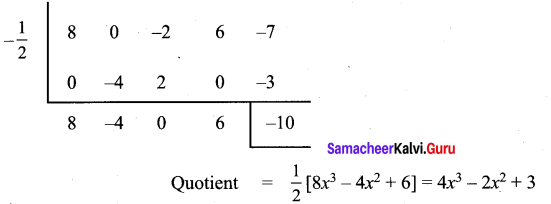
Nen-terminating and recurring

(iv) \(\frac { 327 }{ 200 }\)
9th Maths Exercise 2.2 Samacheer Kalvi Chapter 2 Real Numbers
\(\frac { 327 }{ 200 }\) = 1.635, Terminating.

9th Maths Exercise 2.2 In Tamil Question 2.
Express \(\frac { 1 }{ 13 }\) in decimal form. Find the length of the period of decimals.
Solution:
9th Maths 2.2 Samacheer Kalvi Chapter 2 Real Numbers
\(\frac{1}{13}=0 . \overline{076923}\) has the length of the period of decimals = 6.
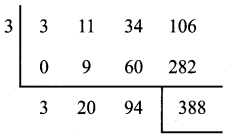
9th Standard Maths Exercise 2.2 Question 3.
Express the rational number \(\frac { 1 }{ 13 }\) in recurring decimal form by using the recurring decimal expansion of \(\frac { 1 }{ 11 }\) . Hence write \(\frac { 71 }{ 33 }\) in recurring decimal form.
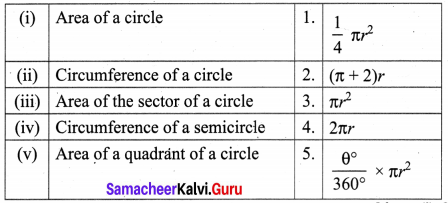
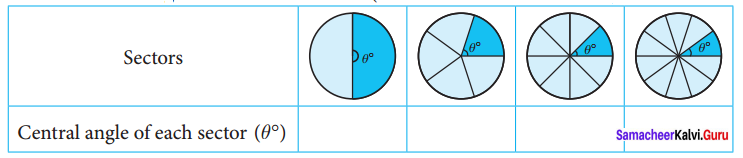
Solution:
The recurring decimal expansion of \(\frac { 1 }{ 11 }\) = 0.09090909…. = \(0.\overline { 09 }\)
Class 9 Maths Chapter 2 Real Numbers Samacheer Kalvi Ex 2.2

9th Maths Exercise 2.2 Question 4.
Express the following decimal expression into rational numbers.
(i) \(0.\overline { 24 }\)
(ii) \(2.\overline { 327 }\)
(iii) -5.132
(iv) \(3.1\overline { 7 }\)
(v) \(17.\overline { 215 }\)
(vi) \(-21.213\overline { 7 }\)
Solution:
(i) \(0.\overline { 24 }\)
Let x = \(0.\overline { 24 }\) = 0.24242424……… ….(1)
(Here period of decimal is 2, multiply equation (1) by 100)
100x = 24.242424 ………. ….(2)
(2) – (1)
100x – x = 24.242424…. – 0.242424….
99x = 24
x = \(\frac { 24 }{ 99 }\)

(ii) \(2.\overline { 327 }\)
Let x = 2.327327327…… …………. (1)
(Here period of decimal is 3, multiply equation (1) by 1000)
1000x = 2327.327… ……………. (2)
(2) – (1)
1000x – x = 2327.327327… – 2.327327….
999x = 2325
x = \(\frac { 2325 }{ 999 }\)

(iii) -5.132
\(x=-5.132=\frac{-5132}{1000}=\frac{-1283}{250}\)

(iv) \(3.1\overline { 7 }\)
Let x = 3.1777 ……. ………… (1)
(Here the repeating decimal digit is 7, which is the second digit after the decimal point, multiply equation (1) by 10)
10x = 31.7777 …….. …………. (2)
(Now period of decimal is 1, multiply equation (2) by 10)
100x = 317.7777…….. …………….. (3)
(3) – (2)
100x – 10x = 317.777…. – 31.777….
90x = 286
\(x=\frac{286}{90}=\frac{143}{45}\)

(v) \(17.\overline { 215 }\)
Let x = 17.215215 ……. ………. (1)
1000x = 17215.215215…… …………. (2)
(2) – (1)
1000x – x = 17215.215215… – 17.215…
999x = 17198
x = \(\frac { 17198 }{ 999 }\)

(vi) \(-21.213\overline { 7 }\)
Let x = -21.2137777… ……….. (1)
10x = -212.137777…… ……….. (2)
100x = -2121.37777…… ………… (3)
1000x = -21213.77777…. ……….. (4)
10000x = 212137.77777….. ………… (5)
(Now period of decimal is 1, multiply equation (4) it by 10)
(5) – (4)
10000x – 1000x = (-212137.7777…) – (-21213.7777…)
9000x = -190924
x = –\(\frac { 190924 }{ 9000 }\)

9th Maths 2.2 Question 5.
Without actual division, find which of the following rational numbers have terminating decimal expansion.
(i) \(\frac { 7 }{ 128 }\)
(ii) \(\frac { 21 }{ 15 }\)
(iii) 4\(\frac { 9 }{ 35 }\)
(iv) \(\frac { 219 }{ 2200 }\)
Solution:
(i) \(\frac { 7 }{ 128 }\)
Exercise 2.2 Class 9 Maths Solutions Samacheer Kalvi Chapter 2 Real Numbers
So \(\frac{7}{128}=\frac{7}{2^{7} 5^{0}}\)
This of the form 4m, n ∈ W
So \(\frac { 7 }{ 128 }\) has a terminating decimal expansion.

(ii) \(\frac { 21 }{ 15 }\)
9th Maths Real Numbers Samacheer Kalvi Chapter 2 Ex 2.2
So \(\frac { 21 }{ 15 }\) has a terminating decimal expansion.

(iii) 4\(\frac { 9 }{ 35 }\) = \(\frac { 149 }{ 35 }\)
9th Class Maths Exercise 2.2 Samacheer Kalvi Chapter 2 Real Numbers
\(\frac{49}{35}=\frac{149}{5^{1} 7^{1}}\)
∴ This is not of the form \(\frac{p}{5^{1} 7^{1}}\)
So 4\(\frac { 9 }{ 35 }\) has a non-terminating recurring decimal expansion.

(iv) \(\frac { 219 }{ 2200 }\)
Maths 9th Class Chapter 2 Real Numbers Samacheer Kalvi Ex 2.2
\(\frac{219}{2200}=\frac{219}{2^{3} 5^{2} 11^{1}}\)
∴ This is not of the form \(\frac{p}{2^{m} 5^{n}}\)
So \(\frac { 219 }{ 2200 }\) has a non-terminating recurring decimal expansion.

Samacheer Kalvi 9th Social Science History Solutions Chapter 5 The Classical World

You can Download Samacheer Kalvi 9th Social Science Book Solutions Guide Pdf, Tamilnadu State Board help you to revise the complete Syllabus and score more marks in your examinations.

Tamilnadu Samacheer Kalvi 9th Social Science History Solutions Chapter 5 The Classical World

The Classical World Textual Exercise

I. Choose the correct answer.

The Classical World 9th Class Question 1.
…………….. is the Greek city-state which resisted the Persians to the end.
(a) Acropolis
(b) Sparta
(c) Athens
(d) Rome
Answer:
(c) Athens

Attempt An Account Of Slavery In Rome Question 2.
The other name for Greeks was …………….
(a) Hellenists
(b) Hellenes
(c) Phoenicians
(d) Spartans
Answer:
(b) Hellenes

Samacheer Kalvi 9th Books Social Science Question 3.
The founder of Han dynasty was …………..
(a) Wu Ti
(b) Hung Chao
(c) Liu Pang
(d) Mangu Khan
Answer:
(c) Liu Pang

Question 4.
…………… was the Roman Governor responsible for the crucifixion of Jesus.
(a) Innocent I
(b) Hildebrand
(c) Leo I
(d) Pontius Pilate
Answer:
(d) Pontius Pilate

Question 5.
The Peloponnesian War was fought between ……………… and ……………
(a) Greeks and Persians
(b) Plebeians and Patricians
(c) Spartans and Athenians
(d) Greeks and Romans
Answer:
(c) Spartans and Athenians

II. Find out the correct statement.

Question 1.
(i) First Persian attack on Greece failed.
(ii) The downfall of Roman Empire is attributed to Julius Caesar.
(iii) The Barbarians who invaded Rome were considered to be culturally advanced.
(iv) Buddhism weakened the Roman Empire.
(a) (i) is correct
(b) (ii) is correct
(c) (ii) and (iii) are correct
(d) (iv) is correct
Answer:
(a) (i) is correct

Question 2.
(i) Euclid developed a model for the motion of planets and stars.
(ii) Romans established a republic after overthrowing Etruscans.
(iii) Acropolis became a famous slave market.
(iv) Rome and Carthage united to drive out the Greeks.
(a) (i) is correct
(b) (ii) is correct
(c) (ii) and (iv) are correct
(d) (iv) is correct
Answer:
(c) (ii) and (iv) are correct

Question 3.
(i) Silk road was closed during the Han dynasty.
(ii) Peasant uprisings posed threats to Athenian democracy.
(iii) Virgil’s Aeneid glorified Roman imperialism.
(iv) Spartacus killed Julius Caesar. f
(a) (i) is correct
(b) (ii) is correct
(c) (ii) and (iv) are correct
(d) (iii) is correct
Answer:
(d) (iii) is correct

Question 4.
(i) Roman Emperor Marcus Aurelius was a tyrant.
(ii) Romulus Aurelius was the most admired ruler in Roman History.
(iii) Fabius was a famous Carthaginian General.
(iv) Tacitus is respected more than Livy as a historian.
(a) (i) is correct
(b) (ii) is correct
(c) (ii) and (iii) are correct
(d) (iv) is correct
Answer:
(d) (iv) is correct

Question 5.
(i) Buddhism went to China from Japan
(ii) After crucifixion of Jesus, St Thomas spread the Christian doctrine
(iii) St Sophia Cathedral was the most magnificent building in Europe
(iv) Trajan was one of the worst dictators Rome had.
(a) (i) is correct
(b) (ii) is correct
(c) (iii) is correct
(d) (iv) is correct
Answer:
(c) (iii) is correct

III. Match the following:

The Classical World 9th Class Samacheer Kalvi  Social Science History Solutions Chapter 5
Answer:
1. (e)
2. (c)
3. (a)
4. (b)
5. (d)

IV. Fill in the blanks.

1. Greeks defeated the Persians at ………………
2. …………… stood in favour of poor peasants in Roman republic.
3. Buddhism came to China from India during the reign of …………… dynasty.
4. The most magnificent building in Europe was ……………
5. ……….. and …………… were Magistrates in Rome.
Answers:
1. Marathon in 490 B.C.
2. Tiberius Gracchus and Garius do Gracchus
3. Han
4. St. Sophia Cathedral
5. Marius and Sulla

V. Answer all questions given under each heading.

Question 1.
Emergence of Rome as an empire
(a) Who were the Gracchus brothers?
Answer:
Tiberius Gracchus and Garius do Gracchus were Patricians. They voiced their opinion in favour of the poor peasants.

(b) What role did they play?
Answer:
They voiced their opinion in favour of the poor peasants.

(c) What was the outcome of their martyrdom?
Answer:
The Martyrdom of the Gracchus brothers played a decisive role in the transformation of the Roman Republic into the Roman Empire.

(d) Who was the first Roman Emperor?
Answer:
Marus Aureillus was the first Roman Emperor.

Question 2.
Han Dynasty
(a) Who was the founder of Han Empire?
Answer:
Han Dynasty was founded by Liu Pang.

(b) What was the capital of Han Empire?
Answer:
The capital of Han Empire was Chang-an.

(c) Where did they have their new capital?
Answer:
They had their new capital at Xuchang.

(d) Who was the powerful ruler of the Han dynasty?
Answer:
The most popular and powerful ruler was Wu Ti.

VI. Answer the following briefly.

Question 1.
Attempt an account of slavery in Rome.
Answer:

  • A major source of revenue to the Roman state was slave trade.
  • The island of Delos became a great slave market.
  • There were more slave revolts in Rome than in Greece.
  • The revolt of spartacus was the most famous.

Question 2.
Highlight the main contribution of Constantine.
Answer:
The main contribution of Constantine was, conversion to Christianity. He himself became a Christian and Christianity became the official religion of the Empire.

Question 3.
What do you know of the Carthaginian leader Hannibal?
Answer:

  • Hannibal was a Carthaginian General who defeated the Roman Army and made a great part of Italy a desert in the Punic War.
  • In the Second Punic War Hannibal was defeated in the Battle of Zama.
  • Pursued by the Roman army, Hannibal ended his life by poisoning himself.

Question 4.
What were the reasons for the prosperity of Han Empire?
Answer:

  1. The Han Empire threw open the silk road for trade.
  2. A large export trade mainly in silk reached as far as the Roman Empire.
  3. In the North artisans and herders of rival “barbarian” dynasties brought in new techniques like the methods harnessing horses, use of saddle and stirrup, techniques of building bridges and mountain roads and seafaring.
  4. Such innovations made Han Empire prosperous.

Question 5.
Write about St. Sophia Cathedral.
Answer:

  • St. Sophia Cathedral was built in mid-sixth century AD (CE) The most magnificent building in Europe at that time, it was known for its innovative architectural techniques.
  • This Cathedral was turned into a mosque by the Ottoman Turks when they captured Constantinople.

VII. Answer the following in detail:

Question 1.
Discuss the rise and growth of Athens, pointing out its glorious legacy.
Answer:
In Athens, the pressure from below resulted in the replacement of both oligarchy’and tyranny by “democracy”. The law-making power in Athens was vested in an assembly open to all freemen. Judges and lower officials were chosen by lots. This arrangement was resented by ‘ the upper classes who considered democracy to be the rule of the mob.

The Persian danger had united the Greeks. When this danger was removed, they started quarrelling again. The history of many Greek city-states was one of continual struggles by the rich landowners against “democracy”. The only exception was Athens, where “democracy’ survived for about 200 years.

Question 2.
Highlight the contributions of Rome to World Civilization.
Answer:
The Byzantine emperors, who ruled from the city of Constantinople for about 1,000 years,
called themselves Romans. But their language was Greek. The splendor of Constantinople with its luxurious royal palaces, its libraries, its scholars familiar with the writings of Greeks 1 and Romans and its fascinating St. Sophia Cathedral are the legacies they have left behind.

However, in terms of the development of science and technology, there was no progress during this I period. The economies of the Empire’s provinces were in the hands of large local landowners. The small peasants always lived on the edge of poverty. The fundamental weakness of
Byzantine Civilization stood exposed when the participants of Fourth Crusade pillaged it and I ruled it.

Student Activities

Question 1.
In an outline map of Europe, the students are to sketch the extent of Western and Eastern Roman Empire.
Answer:
Attempt An Account Of Slavery In Rome Samacheer Kalvi 9th Social Science History Solutions Chapter 5 The Classical World

The Classical World Additional Questions

I. Choose the correct answer.

Question 1.
………….. a fortified city of ancient Greeks on a hill in Athens is an illustrative example of their advancement.
(a) Acropolis
(b) Athens
(c) Sparta
(d) None of the above
Answer:
(a) Acropolis

Question 2.
The word …………….. literally means “rule of the people”.
(a) Autocracy
(b) Communism
(c) Socialism
(d) Democracy
Answer:
(d) Democracy

Question 3.
Aristotle was the disciple of ……………
(a) Socrates
(b) Plato
(c) Pericles
(d) Augustus
Answer:
(b) Plato

Question 4.
“Natural History” was completed by ………….
(a) Pliny the Elder
(b) Antoninus Pius
(c) Marcus Aurelius
(d) Tacitus
Answer:
(a) Pliny the Elder

Question 5.
……………. came to China from India during the reign of Han Dynasty.
(a) Jainism
(b) Sikhism
(c) Buddhism
(d) Christianity
Answer:
(c) Buddhism

Question 6.
……………. started spreading the Christian doctrine after the Crucifixion of Jesus.
(a) St. Paul
(b) St. Thomas
(c) St. Antony
(d) St. John
Answer:
(a) St. Paul

II. Find out the correct statement.

Question 1.
(i) Until 8th Century B.C. (BCE) Greece was different from the rest of the world.
(ii) Democracy literally means “rule of the people”.
(iii) The Greek city-states have an elaborate bureaucracy.
(iv) The entire period of Alexander’s reign was not spent on wars.
(a) (i) is correct
(b) (ii) is correct
(c) (ii) and (iii) are correct
(d) (iv) is correct
Answer:
(b) (ii) is correct

Question 2.
(i) Prisoners of war were enslaved in Rome.
(ii) Rome developed into a normal town.
(iii) In the beginning Rome was a society of Business men.
(iv) A major source of revenue to the Roman state was slave trade.
(a) (i) is correct
(b) (ii) is correct
(c) (i) and (iv) are correct
(d) (iii) is correct
Answer:
(c) (i) and (iv) are correct

Question 3.
(i) The revolt of spartacus was the most famous.
(ii) The Island of Delos became a great slave market.
(iii) Catalina’s victory led to mob violence.
(iv) Livy was a Poetist.
(a) (i) is correct
(b) (i) and (ii) are correct
(c) (iii) is correct
(d) (iv) is correct
Answer:
(b) (i) and (ii) are correct

Question 4.
(i) Han Empire once again threw open the silk road for trade.
(ii) Buddhism came to China from Indonesia.
(iii) With Buddhism came the influence of Indian art to Korea.
(iv) The period after Han rule witnessed political stability across the country.
(a) (i) is correct
(b) (i) and (iii) are correct
(c) (ii) is correct
(d) (iii) and (iv) are correct
Answer:
(a) (i) is correct

Question 5.
(i) Jewish had no faith on Jesus.
(ii) They hoped Messiah would not arrive.
(iii) Jesus was against the rich and the hypocrites.
(iv) Christianity did not spread in Europe.
(a) (i) is correct
(b) (ii) is correct
(c) (iii) is correct
(d) (iv) is correct
Answer:
(c) (iii) is correct

III. Match the following:

Samacheer Kalvi 9th Books Social Science History Solutions Chapter 5 The Classical World
Answer:
1. (f)
2. (g)
3. (a)
4. (b)
5. (c)
6. (d)
7. (e)

IV. Fill in the blanks.

1. Under ……….. the new rich exploited the smaller landholders.
2. The Persian danger had united the ……………..
3. Cultural development that took place rapidly after Alexander’s death. 323 BC is called ………….. civilization.
4. A major source of revenue to the Roman state was ……………
5. The most distinguished writers of the ……………… Age brought glory to the empire.
6. The most popular and powerful ruler of Han Dynasty was …………….
7. Some of the Buddhist art of the time show the impact of …………… styles.
8. One of the Roman emperors …………….. himself became a Christian.
9. Internal Crisis and invasion of Franks, Goths and Vandals ended the …………….
10. Christianity became a state religion of …………….. and began to spread in Europe.
Answers:
1. Oligarchy
2. Greeks
3. Hellenistic
4. Slave trade
5. Augustus
6. Wu Ti
7. Hellenistic
8. Constantine
9. Roman Empire
10. Byzantium

V. Answer all questions given under each heading.

Question 1.
Athenian Democracy.
(a) What replaced the oligarchy and tyranny in Athens?
Answer:
Democracy.

(b) With whom the law-making power was vested in Athens?
Answer:
The law making power in Athens was vested in an assembly open to all freemen.

(c) What united the Greeks?
Answer:
The Persian danger had united the Greeks.

(d) How many years were Democracy survived in Athens?
Answer:
Democracy survived in Athens for about 200 years.

Question 2.
Hellenistic Civilization.
(a) Who established the kingdom in Macedonia?
Answer:
Alexander the Great.

(b) How did this kingdom succeed?
Answer:
This kingdom succeeded in annexing two historic empires of Egypt and the Middle East.

(c) How did Alexander spend his life?
Answer:
The entire period of Alexander’s reign was spent on wars.

(d) When did the cultural development take place? What is it called?
Answer:
After the death of 323 B.C. and is called Hellenistic civilization.

VI. Answer the following briefly.

Question 1.
What do you know about the classical world?
Answer:

  1. Greece, Rome and China represented the classical world which ended with the fall of Western Roman Empire.
  2. Until the end of 5th Century AD (CE) Christianity was confined to the Roman Empire.

Question 2.
Why did the first Persian attack on Greece failed?
Answer:
The first Persian attack on Greece failed due to the fact that Persian army suffered from disease and lack of food during its March.

Question 3.
Comment on the ‘Age of Pericles’.
Answer:

  1. Athens, despite hostility and disturbance from sparta, became a noble city with magnificent buildings.
  2. There were great artists and great thinkers.
  3. Historians therefore call this the Age of Pericles.

Question 4.
What do you know about the Socrates?
Answer:

  1. Socrates was the greatest of the thinkers of the Pericles Era.
  2. As a philosopher he discussed difficult problems with his friends to bring out the truth out of discussions.

Question 5.
Who were the capable rulers in Rome after the death of Augustus?
Answer:
Trajan (98-117), Antoninus Pius (138-161) and Marcus Aurelius (161-180) were the capable enlightened rulers.

Question 6.
Who were Barbarians?
Answer:
A group of people from a very different country (or) culture that is considered to be less culturally advanced and more violent than their own were Barbarians.

Question 7.
What is known as Silk Road (or) Silk Route?
Answer:
The trade route from China to Asia Minor and India, known as the Silk Road or Silk Route, linked China with the West. Goods and ideas between the two great civilizations of Rome and China were exchanged through this route. Silk went westward, and wools, gold, and silver went east. China received Buddhism from India via the Silk Road.

Question 8.
Who spreaded Christianity after Jesus’s crucifixion?
Answer:

  1. St. Paul started spreading the Christian doctrine.
  2. Paul succeeded in his effort and Christianity gradually spread.

VII. Answer the following in detail.

Question 1.
Explain the “Rise of Christianity”.
Answer:
(i) After a brief period of glory in the days of David and Solomon, the Jewish people had a great fall and experienced extreme hardship.

(ii) While spreading out all over the Roman Empire and elsewhere, they hoped that a Messiah would arrive to restore their pristine glory.

(iii) Initially they laid much hopes on Jesus. Jesus was against the rich and the hypocrites, and condemned certain observances and ceremonials.

(iv) This was not to the liking of the priests, who turned against Jesus and handed him over to the Roman Governor Pontius Pilate. Looked upon as a political rebel by the Roman authorities, Jesus was tried and crucified.

(v) After Jesus’s crucifixion, St Paul started spreading the Christian doctrine. Paul succeeded in his effort and Christianity gradually spread.

(vi) Romans were prepared to tolerate Christianity. But the refusal of the Christians to pay respect to the Emperor’s image was viewed as political treason.

(vii) It led to the persecution of Christians. Their property was confiscated and they were thrown to the lions.

(viii) Yet the Roman Empire did not succeed in suppressing Christianity. One of the Roman emperors Constantine himself became a Christian. Christianity thus became the official religion of the Empire.