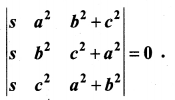
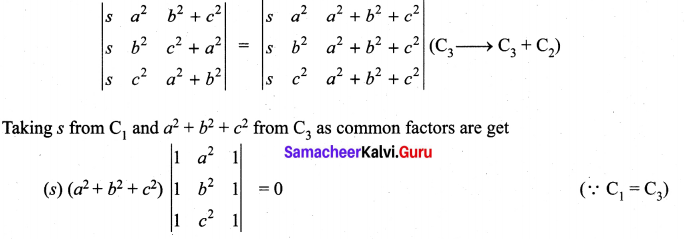
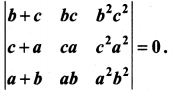
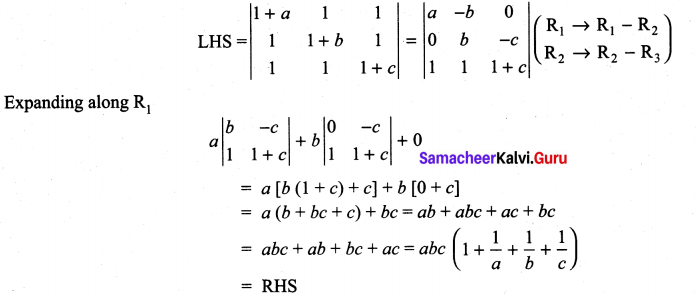
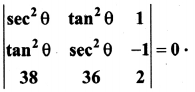
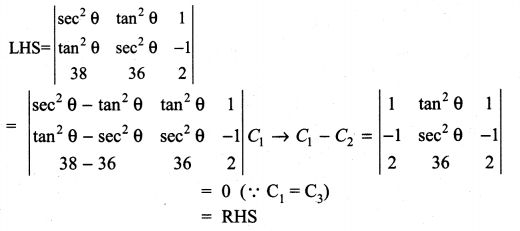
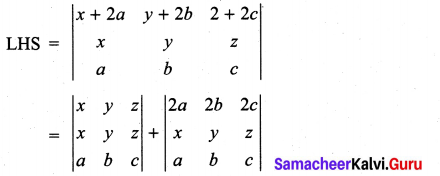
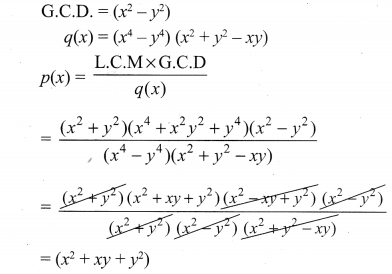
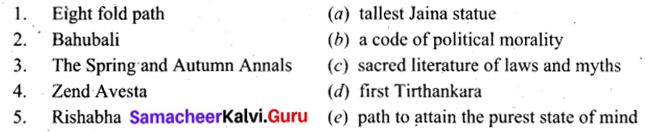
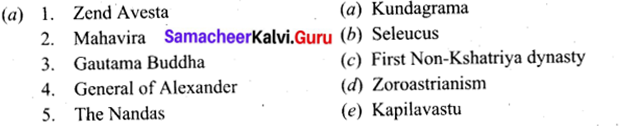
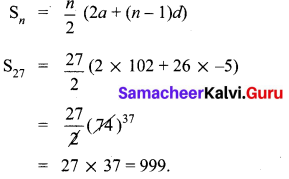
Samacheer Kalvi 10th Maths Solutions Chapter 6 Trigonometry Ex 6.1

You can Download Samacheer Kalvi 10th Maths Book Solutions Guide Pdf, Tamilnadu State Board help you to revise the complete Syllabus and score more marks in your examinations.

Tamilnadu Samacheer Kalvi 10th Maths Solutions Chapter 6 Trigonometry Ex 6.1

10th Maths Exercise 6.1 Samacheer Kalvi Question 1.
Prove the following identities.
(i) cot θ + tan θ = sec θ cosec θ
(ii) tan4θ + tan2θ = sec4θ – sec2θ
Solution:
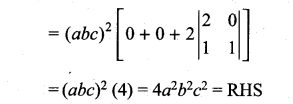
Samacheer Kalvi 10th Maths Chapter 6 Trigonometry Ex 6.1 1

10th Maths Trigonometry Exercise 6.1 Question 2.
Prove the following identities
10th Maths Exercise 6.1 Samacheer Kalvi Solutions Chapter 6 Trigonometry
Solution:
10th Maths Trigonometry Exercise 6.1 Samacheer Kalvi Solutions Chapter 6
Exercise 6.1 Class 10 Samacheer Kalvi Maths Solutions Chapter 6 Trigonometry

Exercise 6.1 Class 10 Samacheer Kalvi Question 3.
Prove the following identities
10th Trigonometry Exercise 6.1 Samacheer Kalvi Maths Solutions Chapter 6
Solution:
Ex 6.1 Class 10 Samacheer Maths Solutions Chapter 6 Trigonometry
10th Maths Exercise 6.1 Samacheer Kalvi Solutions Chapter 6 Trigonometry

10th Trigonometry Exercise 6.1 Question 4.
Prove the following identities
(i) sec6θ = tan6θ + 3tan2θ sec2θ + 1
(ii) (sinθ + secθ)2 + (cosθ + cosecθ)2
= 1 + (secθ + cosecθ)2
(i) L.H.S = sec6θ = (sec2θ)3 = (1 + tan2θ )3 = (tan2θ + 1)3
(a + b)3 = a3 + 3a2b + 3ab2 + b3
= (tan2θ)3 + 3(tan2θ)2 × 1 + 3 × tan2θ × 12 + 1
= tan6θ + 3tan2θ × (sec2θ – 1) + 3tan2θ + 1
= tan6θ + 3tan2θsec2θ – 3tan2θ + 3tan2θ +1
= tan6θ + 3tan2θ sec2θ + 1 = R.H.S

(ii) L.H.S = (sinθ + secθ )2 + (cosθ + cosecθ)2
= sin2θ + 2sinθ secθ + sec2θ + cos2θ + 2cosθ cosecθ+ cosec2θ
Trigonometry Exercise 6.1 Samacheer Kalvi 10th Maths Solutions Chapter 6

Ex 6.1 Class 10 Samacheer Question 5.
Prove the following identities
10th Maths 6.1 Samacheer Kalvi Solutions Chapter 6 Trigonometry
Solution:
10th Maths Exercise 6.1 In Tamil Samacheer Kalvi Chapter 6 Trigonometry
Samacheer Kalvi 10th Maths Chapter 6 Trigonometry Ex 6.1 10
10th Samacheer Kalvi Maths Trigonometry Solutions Chapter 6 Ex 6.1

10th Maths Exercise 6.1 Question 6.
Prove the following identities
6.1 Trigonometry Answers Samacheer Kalvi 10th Maths Solutions Chapter 6
Solution:
10th Math 6.1 Solution Samacheer Kalvi Solutions Chapter 6 Trigonometry
Trigonometry 6.1 Samacheer Kalvi 10th Maths Solutions Chapter 6
10th Math 6.1 Samacheer Kalvi Solutions Chapter 6 Trigonometry

Trigonometry Exercise 6.1 Question 7.
Chapter 6 Trigonometry Answers Samacheer Kalvi 10th Maths Solutions Ex 6.1
Solution:
10th Maths Chapter 6 Solution Samacheer Kalvi Trigonometry Ex 6.1
10th Maths Solution Samacheer Kalvi Chapter 6 Trigonometry Ex 6.1

10th Maths 6.1 Question 8.
Class 10 Maths Chapter 6 Samacheer Kalvi Trigonometry Ex 6.1
Solution:
(i) LHS:
10th Maths Samacheer Kalvi Solution Chapter 6 Trigonometry Ex 6.1
Chapter 6 Maths Class 10 Samacheer Kalvi Trigonometry Ex 6.1
Class 10th Maths Samacheer Kalvi Solution Chapter 6 Trigonometry Ex 6.1
Trigonometry Class 10 State Board Samacheer Kalvi Chapter 6 Trigonometry Ex 6.1

10th Maths Exercise 6.1 In Tamil Question 9.
(i) If sinθ + cosθ = p and secθ + cosecθ = q then prove that q(p2 – 1) = 2p
(ii) If sinθ(1 + sin2θ) = cos2θ, then prove that cos6θ – 4cos4θ + 8cos2θ = 4
Solution:
Samacheer Kalvi 10th Maths Chapter 6 Trigonometry Ex 6.1 24
(ii) Given sinθ(1 + sin2θ) = cos2θ
Sustitute sin2θ = 1 – co2θ and take cos θ = c
squaring (1) on bothsides we get
sin2θ(1 + sin2θ)2 = cos4θ
(1 – c2)(1 + 1 – c2) = c4
(1 – c2)(2 – c2)2 = c4
(1 – c2)(4 + c4– 4c2) = c4
4 + c4– 4c2 – 4c2 – c6 + 4c4 = c4
 -c6 + 4c4 – 8c2 = -4
c6 – 4c4 + 8c2 = -4
ie cos 6θ – 4cos 4θ + 8cos2θ = 4 = RHS
∴ Hence proved

10th Samacheer Kalvi Maths Trigonometry Question 10.
Samacheer Kalvi 10th Maths Chapter 6 Trigonometry Ex 6.1 26
Solution:
Samacheer Kalvi 10th Maths Chapter 6 Trigonometry Ex 6.1 27

Samacheer Kalvi 10th Maths Solutions Chapter 8 Statistics and Probability Ex 8.4

You can Download Samacheer Kalvi 10th Maths Book Solutions Guide Pdf, Tamilnadu State Board help you to revise the complete Syllabus and score more marks in your examinations.

Tamilnadu Samacheer Kalvi 10th Maths Solutions Chapter 8 Statistics and Probability Ex 8.4

10th Maths Exercise 8.4 Samacheer Kalvi Question 1.
If P(A) = \(\frac{2}{3}\), P(B) = \(\frac{2}{5}\), P(A∪B) = 13 then find P(A∩B).
Solution:
P(A) = \(\frac{2}{3}\), P(B) = \(\frac{2}{5}\), P(A∪B) = \(\frac{1}{3}\)
P(A ∩ B) = P(A) + P(B) – P(A∪B)
10th Maths Exercise 8.4 Samacheer Kalvi Chapter 8 Statistics And Probability

Ex 8.4 Class 10 Samacheer Question 2.
A and B are two events such that, P(A) = 0.42, P(B) = 0.48, and P(A ∩ B) = 0.16. Find
(i) P(not A)
(it) P(not B)
(iii) P(A or B)
Answer:
(i) P(not A) = 1 – P (A) = 1 – 0.42 = 0.58
(ii) P(not B) = 1 – P(B) = 1 – 0.48 = 0.52
(iii) P(A or B) = P(A) + P(B) – P(A ∩ B) = 0.42 + 0.48 – 0.16 = 0.90 – 0.16 = 0.74

Exercise 8.4 Class 10 Samacheer Question 3.
If A and B are two mutually exclusive events of a random experiment and P(not A) = 0.45, P(A∪B) = 0.65, then find P(B).
Solution:
A and B are two mutually exclusive events of a random experiment.
P(not A) = 0.45,
P(A) = 1 – P(not A)
P(A∪B) = 0.65 = 1 – 0.45 = 0.55
P(A∪B) = P(A) + P(B) = 0.65
0.55 + P(B) = 0.65
P(B) = 0.65 – 0.55
= 0.10

10th Maths Exercise 8.4 Question 4.
The probability that atleast one of A and B occur is 0.6. If A and B occur simultaneously with probability 0.2, then find P(\(\bar{A}\)) + P(\(\bar{B}\)).
Answer:
Here P (A ∪ B) = 0.6, P (A ∩ B) = 0.2
P (A ∪ B) = P (A) + P (B) – P (A ∩ B)
0.6 = P (A) + P (B) – 0.2
P(A) + P(B) = 0.8
P(\(\bar{A}\)) + P(\(\bar{B}\)) = 1 – P(A) + 1 – P(B)
= 2 – [P(A) + P(B)]
= 2 – 0.8
= 1.2

10th Maths 8.4 Solutions Question 5.
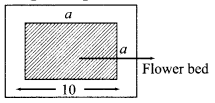
The probability of happening of an event A is 0.5 and that of B is 0.3. If A and B are mutually exclusive events, then find the probability that neither A nor B happen.
Solution:
P(A) = 0.5 Since A and B are mutually inclusive events
P(B) = 0.3 events.
P(\(\overline{\mathbf{A}}\))∪P(\(\overline{\mathbf{B}}\)) = 1 – [P(A) + P(B)]
= 1 – [0.5 + 0.3] = 0.2

10th Maths Probability Exercise 8.4 Question 6.
Two dice are rolled once. Find the probability of getting an even number on the first die or a total of face sum 8.
Solution:
Two dice rolled once.
Ex 8.4 Class 10 Samacheer Kalvi Maths Solutions Chapter 8 Statistics And Probability
Exercise 8.4 Class 10 Samacheer Kalvi Maths Solutions Chapter 8 Statistics And Probability

10th Maths Ex 8.4 Question 7.
From a well-shuffled pack of 52 cards, a card is drawn at random. Find the probability of it being either a red king or a black queen.
Solution:
n(S) = 52
No. of Red cards = 26,
Red king cards = 2
No. of Black cards = 26,
Black queen cards = 2
No. of red king cards = n(K) = 2
10th Maths Exercise 8.4 Samacheer Kalvi Chapter 8 Statistics And Probability
∴ The probability of being either a red king or a black queen = \(\frac{1}{13}\).

10th Maths Exercise 8.4 Solution Question 8.
A box contains cards numbered 3, 5, 7, 9,… 35, 37. A card is drawn at random from the box. Find the probability that the drawn card has either multiples of 7 or a prime number.
Solution:
S = {3, 5, 7, 9, 11, 13, 15, 17, 19, 21, 23, 25, 27, 29, 31, 33, 35, 37}
n(S) = 18
Multiplies of seven cards (A) = {7, 21, 35}
= n(A) = 3
10th Maths 8.4 Solutions Samacheer Kalvi Chapter 8 Statistics And Probability
Let the prime number cards B
B = {3, 5, 7, 11, 13, 17, 19, 23, 29, 31, 37}
n(B) = 11
10th Maths Probability Exercise 8.4 Samacheer Kalvi Chapter 8

10th Maths Exercise 8.4 In Tamil Question 9.
Three unbiased coins are tossed once. Find the probability of getting at most 2 tails or at least 2 heads.
Solution:
When we toss three coins, the sample space S = {HHH, TTT, HTT, THH, HHT, TTH, HTH, THT}
n(S) = 8
Event of getting at most 2 tails be A.
∴ A = { HHH, HTT, THH, HHT, TTH, HTH, THT}
10th Maths Ex 8.4 Samacheer Kalvi Chapter 8 Statistics And Probability

10th Maths Statistics And Probability Question 10.
The probability that a person will get an electrification contract is the probability that he will not get plumbing contract is \(\frac{3}{5}\). The probability of getting at least one contract is \(\frac{5}{8}\). What is the probability that he will get both?
Solution:
10th Maths Exercise 8.4 Solution Samacheer Kalvi Chapter 8 Statistics And Probability
10th Maths Exercise 8.4 In Tamil Samacheer Kalvi Chapter 8 Statistics And Probability

10th Maths 8.4 Question 11.
In a town of 8000 people, 1300 are over 50 years and 3000 are females. It is known that 30% of the females are over 50 years. What is the probability that a chosen individual from the town is either a female or over 50 years ?
Solution:
10th Maths Statistics And Probability Samacheer Kalvi Chapter 8 Ex 8.4

10th Exercise 8.4 Question 12.
A coin is tossed thrice. Find the probability of getting exactly two heads or at least one tail or two consecutive heads.
Solution:
Three coins tossed simultaneously.
S = { HHH, TTT, HHT, TTH, HTH, THT, HTT, THH}
n(S) = 8
Happening of getting exactly two heads be A.
A= {HHT, HTH, THH}
n(A) = 3
10th Maths 8.4 Samacheer Kalvi Solutions Chapter 8 Statistics And Probability
Event of getting at least one tail be B.
∴ B = {TTT, HHT, TTH, HTH, THT, HTT, THH}
10th Exercise 8.4 Samacheer Kalvi Maths Solutions Chapter 8 Statistics And Probability
Samacheer Kalvi Guru 10th Maths Solutions Chapter 8 Statistics And Probability Ex 8.4

Samacheer Kalvi Guru 10th Maths Question 13.
If A, B, C are any three events such that probability of B is twice as that of probability of A and probability of C is thrice as that of probability of A and if P(A∩B) = \(\frac{1}{6}\), P(B∩C) = \(\frac{1}{4}\), P(A∩C) = \(\frac{1}{8}\), \(\mathbf{P}(\mathbf{A} \cup \mathbf{B} \cup \mathbf{C})=\frac{9}{10}, \mathbf{P}(\mathbf{A} \cap \mathbf{B} \cap \mathbf{C})=\frac{1}{15}\), then find P(A), P(B) and P(C)?
Solution:
P(B) = 2P(A)
P(C) = 3P(A)
10th Maths Chapter 8 Exercise 8.4 Samacheer Kalvi Statistics And Probability
10th Math 8.4 Solution Samacheer Kalvi Chapter 8 Statistics And Probability

10th Maths Chapter 8 Exercise 8.4 Question 14.
In a class of 35, students are numbered from 1 to 35. The ratio of boys to girls is 4:3. The roll numbers of students begin with boys and end with girls. Find the probability that a student selected is either a boy with a prime roll number or a girl with a composite roll number or an even roll number.
Solution:
n(S) = 35
10 Maths 8.4 Samacheer Kalvi Solutions Chapter 8 Statistics And Probability
Class 10th Maths Ex 8.4 Solutions Samacheer Kalvi Chapter 8 Statistics And Probability

Samacheer Kalvi 8th Tamil Solutions Chapter 5.5 தொகைநிலை, தொகாநிலைத் தொடர்கள்

Tamilnadu State Board New Syllabus Samacheer Kalvi 8th Tamil Book Solutions Guide Pdf Chapter 5.5 தொகைநிலை, தொகாநிலைத் தொடர்கள் Text Book Back Questions and Answers, Summary, Notes.

Tamilnadu Samacheer Kalvi 8th Tamil Solutions Chapter 5.5 தொகைநிலை, தொகாநிலைத் தொடர்கள்

கற்பவை கற்றபின்

Question 1.
பாடப்பகுதியில் இடம்பெற்றுள்ள தொகைநிலைத் தொடர், தொகாநிலைத் தொடர்களைக் கண்டறிந்து தனித்தனியே தொகுக்க.
Answer:
தொகைநிலைத் தொடர்கள்
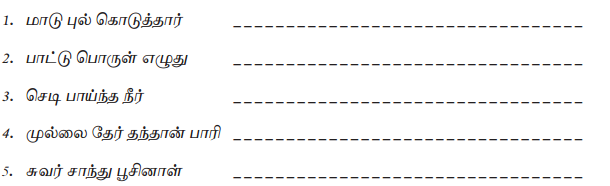
Samacheer Kalvi 8th Tamil Solutions Chapter 5.5 தொகைநிலை, தொகாநிலைத் தொடர்கள் 1
Samacheer Kalvi 8th Tamil Solutions Chapter 5.5 தொகைநிலை, தொகாநிலைத் தொடர்கள் 2
Samacheer Kalvi 8th Tamil Solutions Chapter 5.5 தொகைநிலை, தொகாநிலைத் தொடர்கள் 3

தொகா நிலைத்தொடர்கள்

Samacheer Kalvi 8th Tamil Solutions Chapter 5.5 தொகைநிலை, தொகாநிலைத் தொடர்கள் 4
Samacheer Kalvi 8th Tamil Solutions Chapter 5.5 தொகைநிலை, தொகாநிலைத் தொடர்கள் 5
Samacheer Kalvi 8th Tamil Solutions Chapter 5.5 தொகைநிலை, தொகாநிலைத் தொடர்கள் 11

பாடநூல் வினாக்கள்

சரியான விடையைத் தேர்ந்தெடுத்து எழுதுக.

Question 1.
சொற்களுக்கு இடையே வேற்றுமை உருபு மறைந்து வருவது ……………………….
அ) வேற்றுமைத் தொகை
ஆ) உம்மைத் தொகை
இ) உவமைத் தொகை
ஈ) அன்மொழித் தொகை
Answer:
அ) வேற்றுமைத் தொகை

Question 2.
‘செம்மரம்’ என்னும் சொல் …………………. த்தொகை.
அ) வினை
ஆ) பண்பு
இ) அன்மொழி
ஈ) உம்மை
Answer:
ஆ) பண்பு

Question 3.
‘கண்ணா வா!’ – என்பது ……………….. த் தொடர்.
அ) எழுவாய்
ஆ) விளி
இ) வினைமுற்று
ஈ) வேற்றுமை
Answer:
ஆ) விளி

பொருத்துக

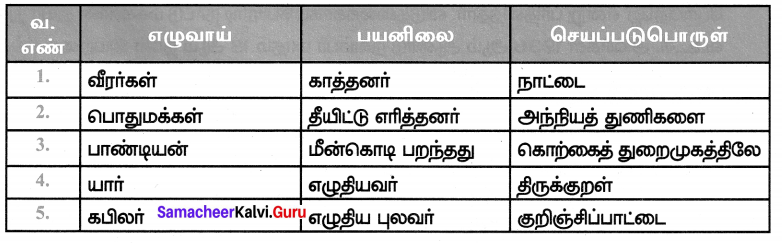
1. பெயரெச்சத் தொடர் – அ) கார்குழலி படித்தாள்.
2. வினையெச்சத் தொடர் – ஆ) புலவரே வருக.
3. வினைமுற்றுத் தொடர் – இ) பாடி முடித்தான்.
4. எழுவாய்த் தொடர் – ஈ) எழுதிய பாடல்.
5. விளித் தொடர் – உ) வென்றான் சோழன்.
Answer:
1. ஈ
2. இ
3. உ
4. அ
5. ஆ

சிறுவினா

Question 1.
தொகைநிலைத் தொடர்கள் எத்தனை வகைப்படும்? அவை யாவை?
Answer:
தொகைநிலைத் தொடர்கள் ஆறு வகைப்படும். அவையாவன:

  • வேற்றுமைத்தொகை
  • உவமைத்தொகை
  • வினைத்தொகை
  • உம்மைத்தொகை
  • பண்புத்தொகை
  • அன்மொழித்தொகை

Question 2.
இரவு பகல் என்பது எவ்வகைத் தொடர் என விளக்குக.
Answer:

  • ‘இரவு பகல்’ இத்தொடர், ‘இரவும் பகலும்’ என விரிந்து பொருள் தருகின்றது.
  • இதில் சொல்லின் இடையிலும் இறுதியிலும் `உம்’ என்னும் இடைச் சொல் மறைந்து நின்று பொருள் தருகிறது.
  • இவ்வாறு சொற்களுக்கு இடையிலும் இறுதியிலும் ‘உம்’ என்னும் இடைச் சொல் மறைந்து நின்று பொருள் தருவதை உம்மைத்தொகை என்பர்.

Question 3.
அன்மொழித்தொகையை எடுத்துக்காட்டுடன் விளக்குக.
Answer:
வேற்றுமை, வினை, பண்பு, உவமை, உம்மை ஆகிய தொகைநிலைத் தொடர்களில் அவை அல்லாத வேறு பிற சொற்களும் மறைந்து வருவது அன்மொழித்தொகை எனப்படும்.

சான்று : பொற்றொடி வந்தாள்.

இத்தொடர் ‘பொன்னாலாகிய வளையலை அணிந்த பெண் வந்தாள்’ என்னும் பொருள் தருகிறது. இதில் ‘ஆல்’ என்னும் மூன்றாம் வேற்றுமை உருபும் ‘ஆகிய என்னும் அதன் பயனும் மறைந்து வந்துள்ளது. ‘வந்தாள்’ என்னும் சொல்லால் பெண் என்பதையும் குறிப்பதால், இது மூன்றாம் வேற்றுமைப் புறத்துப் பிறந்த அன்மொழித் தொகை ஆகும்.

மொழியை ஆள்வோம்

கீழ்க்காணும் தலைப்பில் இரண்டு நிமிடம் பேசுக.

1. கைத்தொழில் ஒன்றைக் கற்றுக்கொள்

பெருமை மிகுந்த சான்றோர் சபைக்கு என் முதற்கண் வணக்கத்தைத் தெரிவித்துக் கொள்கின்றேன். இப்பெருமைமிகு சபையில் நான் பேச எடுத்துக் கொண்ட தலைப்பு கைத்தொழில் ஒன்றைக் கற்றுக்கொள் என்பதாகும்.

ஏட்டுச் சுரைக்காய் கறிக்கு உதவாது’ என்பார்கள். அதைப்போல ஏட்டுப் படிப்பு படித்தவர்களுக்கு எந்த வேலையும் கிடைப்பதாகத் தெரியவில்லை.

படித்தாலும், படித்துப் பட்டம் பெற்றாலும் கைத்தொழில் ஒன்றையும் நாம் கூடவே, சேர்த்துக் கற்றுக்கொள்ள வேண்டும். படிப்புக்கேற்ற வேலை கிடைக்கும் வரை அந்த வேலைக்காகக் காத்திராமல் கற்ற கைத்தொழில் நமக்கு மிகவும் பயன்படும்.

தையல், ஓவியம், மரவேலை, மின்னணுச் சாதனங்கள் பழுதுபார்ப்பு, தட்டச்சு, கணிப்பொறி, கூடை பின்னுதல், அலங்காரப் பொருட்கள் செய்தல் இவற்றைப் பொழுதுபோக்கிற்காக நாம் பள்ளியில் கற்றாலும், அங்கு ஆழமாக ஆழ்ந்து கற்க வேண்டும். அதுவேதான், பிற்காலத்தில் படிப்புக்கு ஏற்ற வேலை கிடைக்கும் வரையில் நமக்கு நல்ல சம்பாத்தியத்தைக் கொடுக்கும்.

ஏட்டுக்கல்வி கைவிட்டாலும், கைத்தொழில் கல்வி உன்னைக் கைவிடாது என்பதைப் புரிந்து கொள்ள வேண்டும். எனவே, இளைஞர்களாகிய நாம் கைத்தொழில் ஒன்றைக் கற்றுக் கொள்ள வேண்டும் என்று சொல்லி என்னுடைய உரையை நிறைவு செய்கின்றேன்.

2. இதயம் கவரும் இசை

என்னை ஈன்ற தாய் மொழிக்கும், இந்தச் சான்றோர் பேரவைக்கும் முதற்கண் வணக்கத்தைத் தெரிவித்துக்கொண்டு, இதயம் கவரும் இசை என்ற நல்லதொரு தலைப்பில் சில நிமிடங்கள் பேசுகின்றேன். ஒவ்வொருநாளும் ஒவ்வொரு மனிதனுக்கும் ஒவ்வொரு பிரச்சினைகள் இருக்கத்தான் செய்கின்றன. துன்பங்கள் நம்மைத் துரத்தும் போது மன அமைதி தானாக தேடி வருவதில்லை . இசையின் பக்கம் நாம் தான் ஓடி வர – வேண்டும். புல்லாங்குழல் இசையும், வீணை இசையும், நாத முழக்கமும், மத்தளம் இசையும் மனதைப் பண்படுத்தும். இசைக்கச்சேரி கேட்கும் போது இதயமெல்லாம் மென்மையாகிவிடும்.

சங்க காலத்தில் தலைவன் ஒருவன் கள் உண்ட மயக்கத்தில் படுத்து கிடக்கின்றான். தொலைவில் தலைவிதினையைக் காயவைத்துக் கொண்டிருக்கின்றாள். தலைவன் படுத்து இருந்த இடத்தை நோக்கி மத யானை ஒன்று ஓடி வருகின்றது .ஐயோ! தலைவனுக்கு என்ன ஆகுமோ? என்று கவலைப்படாமல், தலைவி அருகிலிருந்த யாழை எடுத்து மீட்டினாள். மதம் பிடித்த யானை யாழ் இசையில் மயங்கி தலைவனை மிதிக்காமல் தெளிந்து சென்றதாம். இசை உயிரையும் காப்பாற்றும்.

குழந்தை பிறந்ததும் தாலாட்டி இசை செய்தான், அவன் வளர்ந்து திருமணம் ஆகும் போதும் மங்கள இசைதான். இப்படி இசை வாழ்வில் எத்தனையோ இடத்திலும் இடம் பெற்றிருக்கிறது. நம் வாழ்க்கையில் ‘இதயம் கவரும் இசை அனைவரையும் கவரும் தசை’ என்று சொல்லி என் உரையை நிறைவு செய்கிறேன்.

நன்றி! வணக்கம்!!

சொல்லக் கேட்டு எழுதுக.

முல்லை நில மக்களாகிய ஆயர்கள் குழல் ஊதுவதில் வல்லவர்கள். இதனைச் சம்பந்தர் திருப்பதிகத்தில் அமைந்த நிகழ்ச்சி ஒன்று விளக்குகிறது. திருவண்ணாமலைச் சாரலில் ஆயர் ஒருவர் ஆநிரைகளையும் எருமையினங்களையும் மேய்த்துக் கொண்டிருந்தார். மாலையில் அவற்றை எல்லாம் ஒன்று திரட்டினார்.

அப்போது எருமை ஒன்று காணாமல் போனதை அறிந்தார். தன் கையிலிருந்த குழலை எடுத்து இனிய இசையை எழுப்பினார். இன்னிசை கேட்ட எருமை அவரை வந்தடைந்தது. இவ்வாறு ஆயர்களின் இசைத் திறத்தைத் திருப்பதிகம் விளக்குகிறது.

கோடிட்ட இடங்களில் பொருத்தமான சொல்லுருபுகளை இட்டு நிரப்புக.

(கொண்டு, இருந்து, உடைய, காட்டிலும், ஆக, நின்று, உடன், விட, பொருட்டு)

1. இடி ………………….. மழை வந்தது.
2. மலர்விழி தேர்வின் …………………. ஆயத்தமானாள்.
3. அருவி மலையில் …………………. வீழ்ந்தது.
4. தமிழைக் ……………….. சுவையான மொழியுண்டோ !
5. யாழ், தமிழர் …………………….. இசைக் கருவிகளுள் ஒன்று.
Answer:
1. உடன்
2. பொருட்டு
3. இருந்து
4. காட்டிலும்
5. உடைய

பின்வரும் இசைக்கருவிகளின் பெயர்களை அகர வரிசைப்படுத்துக.

படகம், தவில், கணப்பறை, பேரியாழ், உறுமி, உடுக்கை, தவண்டை , பிடில், நாகசுவரம், மகுடி.
Answer:
உடுக்கை, உறுமி, கணப்பறை, தவண்டை , தவில், நாகசுவரம், படகம், பிடில், பேரியாழ், மகுடி.

பின்வரும் இணைச்சொற்களை வகைப்படுத்துக.

உற்றார் உறவினர், விருப்பு வெறுப்பு, காலைமாலை, கன்னங்கரேல், ஆடல்பாடல், வாடிவதங்கி, பட்டிதொட்டி, உள்ளும் புறமும், மேடுபள்ளம், நட்ட நடுவில்.

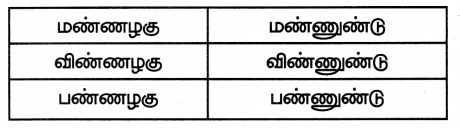
Samacheer Kalvi 8th Tamil Solutions Chapter 5.5 தொகைநிலை, தொகாநிலைத் தொடர்கள் 7

சரியான இணைச்சொற்களை இட்டு நிரப்புக.

(மேடுபள்ளம், ஈடுஇணை, கல்விகேள்வி, போற்றிப்புகழப்பட, வாழ்வு தாழ்வு, ஆடிஅசைந்து)

1. சான்றோர் எனப்படுபவர் …………………………. களில் சிறந்தவர் ஆவார்.
2. ஆற்று வெள்ளம் …………………… பாராமல் ஓடியது.
3. இசைக்கலைஞர்கள் …………………. வேண்டியவர்கள்.
4. தமிழ் இலக்கியங்களின் பெருமைக்கு …………………….. இல்லை.
5. திருவிழாவில் யானை ………………. வந்தது.
Answer:
1. கல்விகேள்வி
2. மேடுபள்ளம்
3. போற்றிப்புகழப்பட
4. ஈடுஇணை
5. ஆடி அசைந்து

கடிதம் எழுதுக

இருப்பிடச் சான்று வேண்டி வட்டாட்சியருக்கு விண்ணப்பம் எழுதுக.

அனுப்புநர்
சா. சுந்தர்,
த/பெ. ஆ. சங்கர்
34, குறிஞ்சி நகர்,
ஈரோடு – 638 001.

பெறுநர்
உயர்திரு. வட்டாட்சியர் அவர்கள்,
வட்டாட்சியர் அலுவலகம்,
ஈரோடு.

மதிப்புக்குரிய அய்யா,

பொருள் : இருப்பிடச் சான்றிதழ் வேண்டுதல் சார்பாக. வணக்கம்.

ஈரோடு, அரசு உயர்நிலைப் பள்ளியில் எட்டாம் வகுப்பு படிக்கின்றேன். 34, குறிஞ்சி நகர், ஈரோடு – 638 001 என்ற முகவரியில் பத்து ஆண்டுகளாக நாங்கள் வசித்து வருகின்றோம். அரசின் கல்வி உதவித்தொகைக்கு விண்ணப்பிக்க இருப்பிடச் சான்றிதழ் தேவைப்படுகின்றது. இத்துடன் குடும்ப அட்டை நகலும் ஆதார் அட்டை நகலும் இணைத்துள்ளேன். ஆகவே, எனக்கு இருப்பிடச் சான்றிதழ் வழங்கும்படி பணிவுடன் கேட்டுக் கொள்கிறேன்.

நன்றி!

இடம் : ஈரோடு
நாள் : 25.06.2020

இப்படிக்கு,
தங்கள் உண்மையுள்ள,
சா. சுந்தர்.

உறைமேல் முகவரி:
பெறுநர்
உயர்திரு. வட்டாட்சியர் அவர்கள்,
வட்டாட்சியர் அலுவலகம்,
ஈரோடு.

மொழியோடு விளையாடு

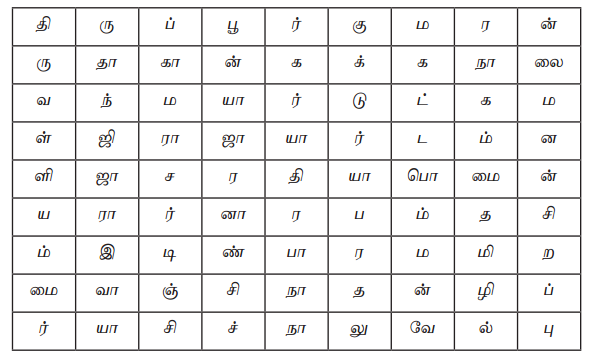
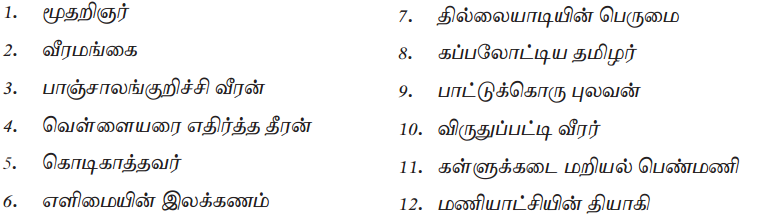
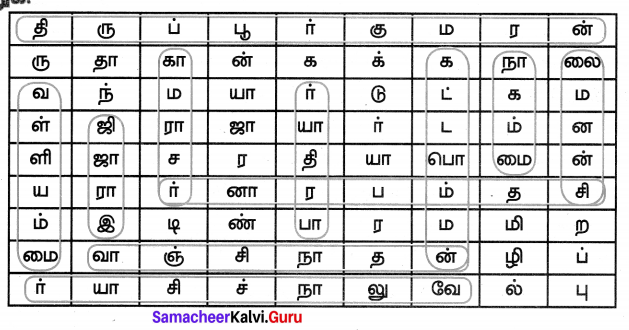
குறுக்கெழுத்துப்புதிர்.

Samacheer Kalvi 8th Tamil Solutions Chapter 5.5 தொகைநிலை, தொகாநிலைத் தொடர்கள் 8

இடமிருந்து வலம் :
1. முதற்கருவி எனப் பெயர் பெற்றது.
2. யாழிலிருந்து உருவான பிற்காலக் கருவி
7. இயற்கைக் கருவி
12. விலங்கின் உறுப்பைப் பெயராகக் கொண்ட கருவி

வலமிருந்து இடம் :
4. வட்டமான மணி போன்ற கருவி
8. ஐந்து வாய்களைக் கொண்ட கருவி
9. இசைக்கருவிகளை இசைத்துப் பாடல் பாடுவோர்

மேலிருந்து கீழ் :
1. 19 நரம்புகளைக் கொண்ட யாழ்
3. ஒன்றோடு ஒன்று மோதி இசைக்கப்படுபவை
5. சிறிய வகை உடுக்கை
6. பறை ஒரு ……………… கருவி

கீழிருந்து மேல் :
8. மூங்கிலால் செய்யப்படும் காற்றுக்கருவி
10. வீணையில் உள்ள நரம்புகளின் எண்ணிக்கை
11. திருமணத்தின்போது கொட்டும் முரசு

நிற்க அதற்குத் தக

என் பொறுப்புகள்:

1. கைவினைக்கலைகளுள் ஒன்றைக் கற்றுக்கொள்வேன்.
2. இசைக் கலையை வளர்த்த சான்றோர்களைப் பற்றி அறிந்து போற்றுவேன்.

கலைச்சொல் அறிவோம்
1. கைவினைப் பொருள்கள் – Crafts
2. புல்லாங்குழல் – Flute
3. முரசு – Drum .
4. கூடைமுடைதல் – Basketry
5. பின்னுதல் – Knitting
6. கொம்பு – Horn
7. கைவினைஞர் – Artisan
8. சடங்கு – Rite

இணையத்தில் காண்க

இசையின் வகைப்பாடுகள் பற்றிய செய்திகளை இணையத்தில் தேடி எழுதுக.

Samacheer Kalvi 8th Tamil Solutions Chapter 5.5 தொகைநிலை, தொகாநிலைத் தொடர்கள் 12

Samacheer Kalvi 8th Tamil Solutions Chapter 5.5 தொகைநிலை, தொகாநிலைத் தொடர்கள் 13

கூடுதல் வினாக்கள்

சரியான விடையைத் தேர்ந்தெடுத்து எழுதுக..

Question 1.
திருவாசகம் படித்தாள் – இதில் மறைந்து வரும் வேற்றுமை உருபு …………………..
அ) இரண்டாம் வேற்றுமை உருபு
ஆ) மூன்றாம் வேற்றுமை உருபு
இ) நான்காம் வேற்றுமை உருபு
ஈ) ஐந்தாம் வேற்றுமை உருபு
Answer:
அ) இரண்டாம் வேற்றுமை உருபு

Question 2.
கம்பர் பாடல் – இதில் இடம்பெற்றுள்ள வேற்றுமையுருபு ……………………
அ) கு
ஆ) இன்
இ) அது
ஈ) கண்
Answer:
இ) அது

Question 3.
காலம் கரந்த பெயரெச்சம் ………………..
அ) வினைத்தொகை
ஆ) பண்புத்தொகை
இ) வேற்றுமைத்தொகை
ஈ) உவமைத்தொகை
Answer:
அ) வினைத்தொகை

Question 4.
ஆடுகொடி, வளர்தமிழ் – ஆகியன …………………. க்குச் சான்றுகள்.
அ) வேற்றுமைத்தொகை
ஆ) உம்மைத்தொகை
இ) உவமைத்தொகை
ஈ) வினைத்தொகை
Answer:
ஈ) வினைத்தொகை

Question 5.
வெண்ணிலவு, கருங்குவளை ஆகியன ………………….. க்குச் சான்றுகளாகும்.
அ) வினைத்தொகை
ஆ) பண்புத்தொகை
இ) உவமைத்தொகை
ஈ) உம்மைத்தொகை
Answer:
ஆ) பண்புத்தொகை

Question 6.
இருபெயரொட்டு பண்புத்தொகைக்குச் சான்றாக அமையும் ஒன்றினைத் தேர்வு செய்க.
அ) மலர்விழி
ஆ) இரவுபகல்
இ) பொற்றொடி வந்தாள்
ஈ) பனைமரம்
Answer:
ஈ) பனைமரம்

Question 7.
இரவுபகல், தாய்தந்தை ஆகியன ………………………. க்குச் சான்றாகும்.
அ) அன்மொழித்தொகை
ஆ) உவமைத்தொகை
இ) உம்மைத்தொகை
ஈ) இருபெயரொட்டுப் பண்புத்தொகை
Answer:
இ) உம்மைத்தொகை

Question 8.
தொகாநிலைத் தொடர் வகைகள்
அ) 6
ஆ) 8
இ) 9
ஈ) 3
Answer:
இ) 9

Question 9.
எழுவாய்த் தொடர் அமையும் சான்றினைத் தேர்ந்தெடுக்க.
அ) மல்லிகை மலர்ந்தது
ஆ) நண்பா படி
இ) சென்றனர் வீரர்
ஈ) வரைந்த ஓவியம்
Answer:
அ) மல்லிகை மலர்ந்தது

Question 10.
‘நண்பா படி’ என்பது ……………………
அ) எழுவாய்த் தொடர்
ஆ) விளித் தொடர்
இ) வினைமுற்றுத்தொடர்
ஈ) பெயரெச்சத் தொடர்
Answer:
ஆ) விளித்தொடர்

குறுவினா

Question 1.
வேற்றுமைத் தொகை என்றால் என்ன? சான்று தருக.
Answer:

  •  இருசொற்களுக்கு இடையில் வேற்றுமை உருபு மறைந்துவந்து பொருள் தந்தால், அதனை வேற்றுமைத் தொகை என்பர். 
  • சான்று: திருவாசகம் (ஐ)படித்தான். (இரண்டாம் வேற்றுமைத் தொகை)

Question 2.
உருபும் பயனும் உடன்தொக்கத் தொகை என்றால் என்ன? சான்று தருக.
Answer:

  • ஒரு தொடரில் வேற்றுமை உருபும் அதன் பொருளை விளக்கும் சொல்லும் மறைந்து வருவது உருபும் பயனும் உடன் தொக்கத் தொகை எனப்படும்.
  • சான்று: பால் குடம்.
  • பாலைக் கொண்ட குடம்’ இரண்டாம் வேற்றுமை உருபும் பயனும் உடன் தொக்கத் தொகை.

Question 3.
வினைத்தொகையை சான்றுடன் விளக்குக.
Answer:

  • காலம் காட்டும் இடைநிலையும், பெயரெச்சவிகுதியும் மறைந்து வரும் பெயரெச்சம் வினைத்தொகை என்பர்.
  • சான்று: வளர்தமிழ். இதில் காலம் காட்டும் இடைநிலைகள் தொக்கி வந்துள்ளன.
  • வளர்ந்த தமிழ், வளர்கின்ற தமிழ், வளரும் தமிழ் எனவும் முக்காலத்திற்கும் பொருந்தும் படியாகப் பொருள் தருகின்றன. எனவே, இது வினைத்தொகை ஆகும்.

Question 4.
பண்புத்தொகை என்றால் என்ன? சான்று தருக.
Answer:

  • பண்புப்பெயருக்கும் அது தழுவி நிற்கும் பெயர்ச்சொல்லுக்கும் இடையே ‘ஆன்’, ‘ஆகிய’ என்னும் பண்பு உருபுகள் மறைந்து வருவது பண்புத்தொகை எனப்படும்.
  • சான்று: வெண்ணிலவு, கருங்குவளை.

Question 5.
‘மலர்விழி’ என்னும் சான்று அமையும் தொகை யாது? விளக்கு.
Answer:
‘மலர்விழி’ என்பது உவமைத்தொகை. மலர் போன்ற விழி என்ற பொருளைத் தருகிறது. ‘மலர்’ என்பது உவமை. ‘விழி’ என்பது உவமேயம். ‘போன்ற’ என்பது உவம உருபு. உவமைக்கும் உவமேயத்துக்கும் இடையில் உவம உருபு மறைந்து வந்தால் அது உவமைத்தொகை எனப்படும்.

Question 6.
எண்ணும்மை என்றால் என்ன? சான்று தருக.
Answer:
ஒன்றுக்கு மேற்பட்ட சொற்களில் ‘உம்’ என்னும் உருபு வெளிப்பட வருவது எண்ணும்மை ஆகும். சான்று: இரவும் பகலும், பசுவும் கன்றும்

சிறு வினா

Question 1.
தொகாநிலைத் தொடர் என்றால் என்ன? அதன் வகைகளை எழுதுக.
Answer:
(i) ஒரு தொடரில் இரு சொற்கள் வந்து அவற்றின் இடையில் சொல்லுருபு மறையாமல் நின்று பொருள் தந்தால் அதனை தொகாநிலைத்தொடர் என்பர்.

(ii) தொகாநிலைத்தொடர் ஒன்பது வகைப்படும். எழுவாய்த்தொடர், விளித்தொடர், வினைமுற்றுத் தொடர், பெயரெச்சத் தொடர், வினையெச்சத் தொடர், வேற்றுமைத் தொகாநிலைத் தொடர், இடைச்சொல் தொடர், உரிச்சொல் தொடர், அடுக்குத்தொடர்.

Samacheer Kalvi 11th Physics Solutions Chapter 3 Laws of Motion

For those looking for help on 11th Physics can use the Tamilnadu State Board Solutions for 11th Physics Chapter 3 Laws of Motion prevailing for free of cost.

Download the Samacheer Kalvi 11th Physics Book Solutions Questions and Answers Notes Pdf, for all Chapter Wise through the direct links available and take your preparation to the next level. The Tamilnadu State Board Solutions for 11th Physics Chapter 3 Laws of Motion Questions and Answers covers all the topics and subtopics within it. Practice using these Samacheer Kalvi 11th Physics Book Solutions Questions and Answers for Chapter 3 Laws of Motion PDF and test your preparation level and bridge the knowledge gap accordingly.

Tamilnadu Samacheer Kalvi 11th Physics Solutions Chapter 3 Laws of Motion

If you have any queries take the help of the Tamilnadu State Board Solutions for 11th Physics Chapter 3 Laws of Motion Questions and Answers learn all the topics in it effectively. We have everything covered and you can Practice them often to score better grades in your exam. By going through the Samacheer Kalvi 11th Physics Book Solutions Questions and Answers you can attempt the actual exam with utmost confidence.

Samacheer Kalvi 11th Physics Chapter 3 Laws of Motion Textual Questions Solved

Samacheer Kalvi 11th Physics Laws of Motion Multiple Choice Questions

11th Physics Chapter 3 Book Back Answers Question 1.
When a car takes a sudden left turn in the curved road, passengers are pushed towards the right due to
(a) inertia of direction
(b) inertia of motion
(c) inertia of rest
(d) absence of inertia
Answer:
(a) inertia of direction

Samacheer Kalvi 11th Physics Solution Chapter 3 Question 2.
An object of mass m held against a vertical wall by applying horizontal force F as shown in the figure. The minimum value of the force F is [IIT JEE 1994]
(a) Less than mg
(b) Equal to mg
(c) Greater than mg
(d) Cannot determine
Answer:
(c) Greater than mg

11th Physics Lesson 3 Book Back Answers Question 3.
A vehicle is moving along the positive x direction, if sudden brake is applied, then
(a) frictional force acting on the vehicle is along negative x direction
(b) frictional force acting on the vehicle is along positive x direction
(c) no frictional force acts on the vehicle
(d) frictional force acts in downward direction
Answer:
(a) frictional force acting on the vehicle is along negative x direction

11th Physics 3rd Chapter Book Back Answers Question 4.
A book is at rest on the table which exerts a normal force on the book. If this force is considered as reaction force, what is the action force according to Newton’s third law?
(a) Gravitational force exerted by Earth on the book
(b) Gravitational force exerted by the book on Earth
(c) Normal force exerted by the book on the table
(d) None of the above
Answer:
(c) Normal force exerted by the book on the table

Laws Of Motion Class 11 State Board Question 5.
Two masses m1 and m2 are experiencing the same force where m1 < m2 The ratio of their acceleration \(\frac{a_{1}}{a_{2}}\) is –
(a) 1
(b) less than 1
(c) greater than 1
(d) all the three cases
Answer:
(c) greater than 1

Samacheer Kalvi Guru 11th Physics Question 6.
Choose appropriate free body diagram for the particle experiencing net acceleration along negative y direction. (Each arrow mark represents the force acting on the system).
11th Physics Chapter 3 Book Back Answers Samacheer Kalvi Laws Of Motion
Answer:
Samacheer Kalvi 11th Physics Solution Chapter 3 Laws Of Motion

Class 11 Physics Solutions Samacheer Kalvi Question 7.
A particle of mass m sliding on the smooth double inclined plane (shown in figure) will experience –
(a) greater acceleration along the path AB
(b) greater acceleration along the path AC
(c) same acceleration in both the paths
(d) no acceleration in both the paths
11th Physics Lesson 3 Book Back Answers Samacheer Kalvi Laws Of Motion
Answer:
(a) greater acceleration along the path AC

Samacheer Kalvi 11th Physics Question 8.
Two blocks of masses m and 2m are placed on a smooth horizontal surface as shown. In the first case only a force F1  is applied from the left. Later only a force F2  is applied from the right. If the force acting at the interface of the two blocks in the two cases is same, then F1 : F2 is [Physics Olympiad 2016]
11th Physics 3rd Chapter Book Back Answers Samacheer Kalvi Laws Of Motion
(a) 1 : 1
(b) 1 : 2
(c) 2 : 1
(d) 1 : 3
Answer:
(c) 2 : 1

11th Physics 3rd Lesson Book Back Answers Question 9.
Force acting on the particle moving with constant speed is –
(a) always zero
(b) need not be zero
(c) always non zero
(d) cannot be concluded
Answer:
(b) need not be zero

11th Physics 3rd Chapter Exercise Question 10.
An object of mass m begins to move on the plane inclined at an angle 0. The coefficient of static friction of inclined surface is lay. The maximum static friction experienced by the mass is –
(a) mg
(b) µs mg
(c) µs mg sin θ
(d) µs mg cos θ
Answer:
(d) µs mg cos θ

Class 11 Samacheer Physics Solutions Question 11.
When the object is moving at constant velocity on the rough surface –
(a) net force on the object is zero
(b) no force acts on the object
(c) only external force acts on the object
(d) only kinetic friction acts on the object
Answer:
(a) net force on the object is zero

Samacheer Kalvi 11th Physics Book Back Answers Question 12.
When an object is at rest on the inclined rough surface –
(a) static and kinetic frictions acting on the object is zero
(b) static friction is zero but kinetic friction is not zero
(c) static friction is not zero and kinetic friction is zero
(d) static and kinetic frictions are not zero
Answer:
(c) static friction is not zero and kinetic friction is zero

Class 11 Physics Samacheer Kalvi Question 13.
The centrifugal force appears to exist –
(a) only in inertial frames
(b) only in rotating frames
(c) in any accelerated frame
(d) both in inertial and non-inertial frames
Answer:
(b) only in rotating frames

11th Physics Unit 3 Book Back Answers Question 14.
Choose the correct statement from the following –
(a) Centrifugal and centripetal forces are action reaction pairs
(b) Centripetal forces is a natural force
(c) Centrifugal force arises from gravitational force
(d) Centripetal force acts towards the center and centrifugal force appears to act away from the center in a circular motion
Answer:
(d) Centripetal force acts towards the center and centrifugal force appears to act away from the center in a circular motion

Laws Of Motion Class 11 Numericals With Solutions Pdf Question 15.
If a person moving from pole to equator, the centrifugal force acting on him –
(a) increases
(b) decreases
(c) remains the same
(d) increases and then decreases
Answer:
(a) increases

Samacheer Kalvi 11th Physics Laws of Motion Short Answer Questions

Question 1.
Explain the concept of inertia. Write two examples each for inertia of motion, inertia of rest and inertia of direction.
Answer:
The inability of objects to move on its own or change its state of motion is called inertia. Inertia means resistance to change its state. There are three types of inertia:
1. Inertia of rest:
The inability of an object to change its state of rest is called inertia of rest.
Example:

  • When a stationary bus starts to move, the passengers experience a sudden backward push.
  • A book lying on the table will remain at rest until it is moved by some external agencies.

2. Inertia of motion:
The inability of an object to change its state of uniform speed (constant speed) on its own is called inertia of motion.
Example:

  • When the bus is in motion, and if the brake is applied suddenly, passengers move forward and hit against the front seat.
  • An athlete running is a race will continue to run even after reaching the finishing point.

3. Inertia of direction:
The inability of an object to change its direction of motion on its own is called inertia of direction.
Example:

  • When a stone attached to a string is in whirling motion, and if the string is cut suddenly, the stone will not continue to move in circular motion but moves tangential to the circle.
  • When a bus moving along a straight line takes a turn to the right. The passengers are thrown towards left.

Question 2.
State Newton’s second law.
Answer:
The force acting on an object is equal to the rate of change of its momentum –
\(\overline{\mathrm{F}}\) = \(\frac{d \bar{p}}{d t}\)

Question 3.
Define one newton.
Answer:
One newton is defined as the force which acts on 1 kg of mass to give an acceleration 1 ms-2 in the direction of the force.

Question 4.
Show that impulse is the change of momentum.
Answer:
According to Newton’s Second Law
F = \(\frac {dp}{dt}\) i.e. dp = Fdt
Integrate it over a time interval from ti  to tf
Laws Of Motion Class 11 State Board Samacheer Kalvi Chapter 3 Laws Of Motion
Pi → initial momentum of the object at ti
Pf → Final momentum of the object at tf
Pf – Pi = ∆p = change in momentum during the time interval ∆t.
\(\int_{t_{i}}^{t_{f}} \mathrm{F} \cdot d t=\mathrm{J}\) is called the impulse.
If the force is constant over the time interval ∆t, then
Samacheer Kalvi 11th Physics Solutions Chapter 3 Laws of Motion
Hence the proof.

Question 5.
Using free body diagram, show that it is easy to pull an object than to push it.
Answer:
When a body is pushed at an arbitrary angle θ [0 to \(\frac {π}{2}\)], the applied force F can be resolved into two components as F sin 0 parallel to the surface and F cos 0 perpendicular to the surface as shown in figure. The total downward force acting on the body is mg + F cos θ. It implies that the normal force acting on the body increases. Since there is no acceleration along the vertical direction the normal force N is equal to
Npush = mg + F cos θ …………(1)
As a result the maximal static friction also increases and is equal to
\(f_{S}^{\max }\) = \(\mu_{r} \mathrm{N}_{\mathrm{push}}\) = µs(mg + F cos θ) ……(2)
Equation (2) shows that a greater force needs to be applied to push the object into motion.
Samacheer Kalvi Guru 11th Physics Solutions Chapter 3 Laws Of Motion

When an object is pulled at an angle θ, the applied force is resolved into two components as shown in figure. The total downward force acting on the object is –
Npull = mg – F cos θ ………….(3)
Class 11 Physics Solutions Samacheer Kalvi Chapter 3 Laws Of Motion

Equation (3) shows that the normal force is less than – Npush. From equations (1) and (3), it is easier to pull an object than to push to make it move.

Question 6.
Explain various types of friction. Suggest a few methods to reduce friction.
Answer:
There are two types of Friction:
(1) Static Friction:
Static friction is the force which opposes the initiation of motion of an object on the surface. The magnitude of static frictional force fs lies between
\(0 \leq f_{s} \leq \mu_{s} \mathrm{N}\)
where, µs – coefficient of static friction
N – Normal force

(2) Kinetic friction:
The frictional force exerted by the surface when an object slides is called as kinetic friction. Also called as sliding friction or dynamic friction,
fk – µkN
where µk – the coefficient of kinetic friction
N – Normal force exerted by the surface on the object

Methods to reduce friction:
Friction can be reduced

  • By using lubricants
  • By using Ball bearings
  • By polishing
  • By streamlining

Question 7.
What is the meaning by ‘pseudo force’?
Answer:
Pseudo force is an apparent force which has no origin. It arises due to the non-inertial nature of the frame considered.

Question 8.
State the empirical laws of static and kinetic friction.
Answer:
The empirical laws of friction are:

  • Friction is independent of surface of contact.
  • Coefficient of kinetic friction is less than coefficient of static friction.
  • The direction of frictional force is always opposite to the motion of one body over the other.
  • Frictional force always acts on the object parallel to the surface on which the objet is placed,
  • The magnitude of frictional force between any two bodies in contact is directly proportional to the normal reaction between them.

Question 9.
State Newton’s third law.
Answer:
Newton’s third law states that for every action there is an equal and opposite reaction.

Question 10.
What are inertial frames?
Answer:
Inertial frame is the one in which if there is no force on the object, the object moves at constant velocity.

Question 11.
Under what condition will a car skid on a leveled circular road?
Answer:
On a leveled circular road, if the static friction is not able to provide enough centripetal ’force to turn, the vehicle will start to skid
\(\mu_{s}<\frac{v^{2}}{r g}\)

Samacheer Kalvi 11th Physics Laws of Motion Long Answer Questions

Question 1.
Prove the law of conservation of linear momentum. Use it to find the recoil velocity of a gun when a bullet is fired from it.
Answer:
In nature, conservation laws play a very important role. The dynamics of motion of bodies can be analysed very effectively using conservation laws. There are three conservation laws in mechanics. Conservation of total energy, conservation of total linear momentum, and conservation of angular momentum. By combining Newton’s second and third laws, we can derive the law of conservation of total linear momentum. When two particles interact with each other, they exert equal and opposite forces on each other.

The particle 1 exerts force \(\overrightarrow{\mathrm{F}}_{12}\) on particle 2 and particle 2 exerts an exactly equal and opposite force \(\overrightarrow{\mathrm{F}}_{12}\) on particle 1 according to Newton’s third law.
\(\overrightarrow{\mathrm{F}}_{12}\) = –\(\overrightarrow{\mathrm{F}}_{12}\) ……..(1)
In terms of momentum of particles, the force on each particle (Newton’s second law) can be written as –
\(\overrightarrow{\mathrm{F}}_{12}\) = \(\frac{d \vec{p}_{1}}{d t}\) and \(\overrightarrow{\mathrm{F}}_{21}\) = \(\frac{d \vec{p}_{2}}{d t}\) ………(2)
Here \(\vec{p}_{1}\) is the momentum of particle 1 which changes due to the force \(\overrightarrow{\mathrm{F}}_{12}\) exerted by particle 2. Further Po is the momentum of particle \(\vec{p}_{2}\) This changes due to \(\overrightarrow{\mathrm{F}}_{21}\) exerted by particle 1.
Substitute equation (2) in equation (1)
\(\frac{d \vec{p}_{1}}{d t}\) = – \(\frac{d \vec{p}_{2}}{d t}\) …………(3)
\(\frac{d \vec{p}_{1}}{d t}\) + \(\frac{d \vec{p}_{2}}{d t}\) = 0 ………(4)
\(\frac {d}{dt}\)(\(\vec{p}_{1}\) + \(\vec{p}_{2}\)) = 0
It implies that \(\vec{p}_{1}\) + \(\vec{p}_{2}\) = constant vector (always).
\(\vec{p}_{1}\) + \(\vec{p}_{2}\) is the total linear momentum of the two particles (\(\vec{p}_{tot}\) = \(\vec{p}_{1}\) + \(\vec{p}_{2}\)).It is also called as total linear momentum of the system. Here, the two particles constitute the system. From this result, the law of conservation of linear momentum can be stated as follows.

If there are no external forces acting on the system, then the total linear momentum of the system (\(\vec{p}_{tot}\)) is always a constant vector. In other words, the total linear momentum of the system is conserved in time. Here the word ‘conserve’ means that \(\vec{p}_{1}\) and \(\vec{p}_{2}\) can vary, in such a way that \(\vec{p}_{1}\) + \(\vec{p}_{2}\) is a constant vector.

The forces \(\overrightarrow{\mathrm{F}}_{12}\) and \(\overrightarrow{\mathrm{F}}_{21}\) are called the internal forces of the system, because they act only between the two particles. There is no external force acting on the two particles from outside. In such a case the total linear momentum of the system is a constant vector or is conserved.

Meaning of law of conservation of momentum:
1. The Law of conservation of linear momentum is a vector law. It implies that both the magnitude and direction of total linear momentum are constant. In some cases, this total momentum can also be zero.

2. To analyse the motion of a particle, we can either use Newton’s second law or the law of conservation of linear momentum. Newton’s second law requires us to specify the forces involved in the process. This is difficult to specify in real situations. But conservation of linear momentum does not require any force involved in the process. It is convenient and hence important.
Samacheer Kalvi 11th Physics Solutions Chapter 3 Laws Of Motion

For example, when two particles collide, the forces exerted by these two particles on each other is difficult to specify. But it is easier to apply conservation of linear momentum during the collision process.

Examples:
Consider the firing of a gun. Here the system is Gun+bullet. Initially the gun and bullet are at rest, hence the total linear momentum of the system is zero. Let \(\vec{p}_{1}\) be the momentum of the bullet and \(\vec{p}_{2}\) the momentum of the gun before firing. Since initially both are at rest,

11th Physics 3rd Lesson Book Back Answers Laws Of Motion Samacheer Kalvi
Total momentum before firing the gun is zero, \(\vec{p}_{1}\) + \(\vec{p}_{2}\) = 0.
According to the law of conservation of linear momentum, total linear momentum has to be zero after the firing also.

When the gun is fired, a force is exerted by the gun on the bullet in forward direction. Now the momentum of the bullet changes from \(\vec{p}_{1}\) to \(\vec{p}_{1}\) To conserve the total linear momentum of the system, the momentum of the gun must also change from \(\vec{p}_{2}\) to \(\vec{p}_{2}^{\prime}\). Due to the conservation of linear momentum, \(\vec{p}_{1}\) + \(\vec{p}_{2}^{\prime}\) = 0.

It implies that \(\vec{p}_{1}^{\prime}\)= \(\vec{p}_{2}^{\prime}\), the momentum of the gun is exactly equal, but in the opposite direction to the momentum of the bullet. This is the reason after firing, the gun suddenly moves backward with the momentum (-\(\vec{p}_{2}^{\prime}\)). It is called ‘recoil momentum’. Th is is an example of conservation of total linear momentum.
11th Physics 3rd Chapter Exercise Samacheer Kalvi Laws Of Motion

Question 2.
What are concurrent forces? State Lami’s theorem.
Answer:
Concurrent force:
A collection of forces is said to be concurrent, if the lines of forces act at a common point.

Lami’s Theorem:
If a system of three concurrent and coplanar forces is in equilibrium, then Lami’s theorem states that the magnitude of each force of the system is proportional to sine of the angle between the other two forces.
i.e. |\(\overrightarrow{\mathrm{F}}_{1}\)|∝ sin α, |\(\overrightarrow{\mathrm{F}}_{2}\)| ∝ sin β, |\(\overrightarrow{\mathrm{F}}_{2}\)| ∝ sin γ,

Question 3.
Explain the motion of blocks connected by a string in

  1. Vertical motion
  2. Horizontal motion.

Answer:
When objects are connected by strings and When objects are connected by strings and a force F is applied either vertically or horizontally or along an inclined plane, it produces a tension T in the string, which affects the acceleration to an extent. Let us discuss various cases for the same.

Case 1:
Vertical motion:
Consider two blocks of masses m1 and m2 (m1> m2) connected by a light and in-extensible string that passes over a pulley as shown in Figure.

Class 11 Samacheer Physics Solutions Chapter 3 Laws Of Motion

Let the tension in the string be T and acceleration a. When the system is released, both the blocks start moving, m2 vertically upward and mk, downward with same acceleration a. The gravitational force m1g on mass m1 is used in lifting the mass m2. The upward direction is chosen as y direction. The free body diagrams of both masses are shown in Figure.
Samacheer Kalvi 11th Physics Book Back Answers Chapter 3 Laws Of Motion

Applying Newton’s second law for mass m2 T \(\hat{j}\) – m2 g \(\hat{j}\) = m2 a \(\hat{j}\) The left hand side of the above equation is the total force that acts on m2 and the right hand side is the product of mass and acceleration of m2 in y direction.
By comparing the components on both sides, we get
T = m2 g = m2 a ……….(1)
Similarly, applying Newton’s second law for mass m2
T \(\hat{j}\) – m1 g\(\hat{j}\) = m1a\(\hat{j}\)
As mass m1 moves downward (-\(\hat{j}\)), its acceleration is along (-\(\hat{j}\))
By comparing the components on both sides, we get
T = m1g = -m1a
m1g – T = m1a ………..(2)
Adding equations (1) and (2), we get
m1g – m2g = m1a + m2a
(m1 – m2)g = (m1 + m2)a …………(3)
From equation (3), the acceleration of both the masses is –
a = (\(\frac{m_{1}-m_{2}}{m_{1}+m_{2}}\))g ………..(4)
If both the masses are equal (m1 = m2), from equation (4)
a = 0
This shows that if the masses are equal, there is no acceleration and the system as a whole will be at rest.
To find the tension acting on the string, substitute the acceleration from the equation (4) into the equation (1).
T = m2g = m2(\(\frac{m_{1}-m_{2}}{m_{1}+m_{2}}\))
T = m2g + m2 (\(\frac{m_{1}-m_{2}}{m_{1}+m_{2}}\))g ……….(5)
By taking m2g common in the RHS of equation (5)
Class 11 Physics Samacheer Kalvi Solutions Chapter 3 Laws Of Motion
Equation (4) gives only magnitude of acceleration.
For mass m1, the acceleration vector is given by \(\vec{a}\) = –\(\frac{m_{1}-m_{2}}{m_{1}+m_{2}}\)\(\hat{j}\)
For mass m2, the acceleration vector is given by \(\vec{a}\) = \(\frac{m_{1}-m_{2}}{m_{1}+m_{2}}\) \(\hat{j}\)

Case 2:
Horizontal motion:
In this case, mass m2 is kept on a horizontal table and mass m1, is hanging through a small pulley as shown in figure. Assume that there is no friction on the surface
11th Physics Unit 3 Book Back Answers Samacheer Kalvi Laws Of Motion
As both the blocks are connected to the un stretchable string, if m1 moves with an acceleration a downward then m2 also moves with the same acceleration a horizontally.
The forces acting on mass m2 are

  • Downward gravitational force (m2g)
  • Upward normal force (N) exerted by the surface
  • Horizontal tension (T) exerted by the string

The forces acting on mass m1 are

  • Downward gravitational force (m1g)
  • Tension (T) acting upwards

The free body diagrams for both the masses is shown in figure.

Laws Of Motion Class 11 Numericals With Solutions Pdf Samacheer Kalvi
Applying Newton’s second law for m1
T\(\hat{i}\) – m1g\(\hat{j}\) = -m1a\(\hat{j}\) (alongy direction)
By comparing the components on both sides of the above equation,
T – m1g = -m1a …………(1)
Applying Newton’s second law for m2
Ti = m1ai (along x direction)
By comparing the components on both sides of above equation,
T = m2a ………….(2)
There is no acceleration along y direction for m2.
N\(\hat{j}\) – m2g\(\hat{j}\) = 0
By comparing the components on both sides of the above equation
N – m2g = 0
N = m2g ……….(3)
By substituting equation (2) in equation (1), we can find the tension T
m2a – m1g = -m1a
m2a + m1a = m1g
a = \(\frac{m_{1}}{m_{1}+m_{2}}\)g …………(4)
Tension in the string can be obtained by substituting equation (4) in equation (2)
T = \(\frac{m_{1} m_{2}}{m_{1}+m_{2}}\)g ………..(5)

Comparing motion in both cases, it is clear that the tension in the string for horizontal motion is half of the tension for vertical motion for same set of masses and strings. This result has an important application in industries. The ropes used in conveyor belts (horizontal motion) work for longer duration than those of cranes and lifts (vertical motion).

Question 4.
Briefly explain the origin of friction. Show that in an inclined plane, angle of friction is pqual to angle of repose.
Answer:
If a very gentle force in the horizontal direction is given to an object at rest on the table it does not move. It is because of the opposing force exerted by the surface on the object which resists its motion. This force is called the frictional force. During the time of Newton and Galileo, frictional force was considered as one of the natural forces like gravitational force. But in the twentieth century, the understanding on atoms, electron and protons has changed the perspective.

The frictional force is actually the electromagnetic force between the atoms on the two surfaces. Even well polished surfaces have irregularities on the surface at the microscopic level. The component of force parallel to the inclined plane (mg sin θ) tries to move the object down. The component of force perpendicular to the inclined plane (mg cos θ) is balanced by the Normal force (N).
N = mg cos θ ………(1)

When the object just begins to move, the static friction attains its maximum value
fs = \(f_{s}^{\max }\) = µs N
This friction also satisfies the relation
\(f_{s}^{\max }\) = µs mg sin θ ……….(2)
Equating the right hand side of equations (1) and (2),
(\(f_{s}^{\max }\))/N = sin θ / cos θ
From the definition of angle of friction, we also know that
tan θ = µs ………..(3)
in which θ is the angle of friction.
Thus the angle of repose is the same as angle of friction. But the difference is that the angle of repose refers to inclined surfaces and the angle of friction is applicable to any type of surface.

Question 5.
State Newton’s three laws and discuss their significance.
Answer:
First Law:
Every object continues to be in the state of rest or of uniform motion (constant velocity) unless there is external force acting on it.

Second Law:
The force acting on an object is equal to the rate of change of its momentum

Third Law:
For every action there is an equal and opposite reaction.

Significance of Newton’s Laws:
1. Newton’s laws are vector laws. The equation \(\overline{\mathrm{F}}\) = m\(\overline{\mathrm{a}}\) is a vector equation and essentially it is equal to three scalar equations. In Cartesian coordinates, this equation can be written as Fx\(\hat{i}\) + Fy\(\hat{j}\) + Fz\(\hat{j}\) = max\(\hat{i}\) + may\(\hat{j}\) + maz\(\hat{j}\)
By comparing both sides, the three scalar equations are

Fx = max The acceleration along the x-direction depends only on the component of force acting along the x – direction.
Fy = may The acceleration along the y direction depends only on the component of force acting along the y – direction.
Fz = maz The acceleration along the z direction depends only on the component of force acting along the z – direction.
From the above equations, we can infer that the force acting along y direction cannot alter the acceleration along x direction. In the same way, Fz cannot affect ay and ax. This understanding is essential for solving problems.

2. The acceleration experienced by the body at time t depends on the force which acts on the body at that instant of time. It does not depend on the force which acted on the body before the time t. This can be expressed as
\(\overline{\mathrm{F}}\)(t) = m\(\overline{\mathrm{a}}\)(t)
Acceleration of the object does not depend on the previous history of the force. For example, when a spin bowler or a fast bowler throws the ball to the batsman, once the ball leaves the hand of the bowler, it experiences only gravitational force and air frictional force. The acceleration of the ball is independent of how the ball was bowled (with a lower or a higher speed).

3. In general, the direction of a force may be different from the direction of motion. Though in some cases, the object may move in the same direction as the direction of the force, it is not always true. A few examples are given below.

Case 1:
Force and motion in the same direction:
When an apple falls towards the Earth, the direction of motion (direction of velocity) of the apple and that of force are in the same downward direction as shown in the Figure.
Samacheer Kalvi 11th Physics Solutions Chapter 3 Laws of Motion

Case 2:
Force and motion not in the same direction:
The Moon experiences a force towards the Earth. But it actually moves in elliptical orbit. In this case, the direction of the force is different from the direction of motion as shown in Figure.

Samacheer Kalvi 11th Physics Solutions Chapter 3 Laws of Motion

Case 3:
Force and motion in opposite direction:
If an object is thrown vertically upward, the direction of motion is upward, but gravitational force is downward as shown in the Figure.

Samacheer Kalvi 11th Physics Solutions Chapter 3 Laws of Motion

Case 4:
Zero net force, but there is motion:
When a raindrop gets detached from the cloud it experiences both downward gravitational force and upward air drag force. As it descends towards the Earth, the upward air drag force increases and after a certain time, the upward air drag force cancels the downward gravity. From then on the raindrop moves at constant velocity till it touches the surface of the Earth. Hence the raindrop comes with zero net force, therefore with zero acceleration but with non-zero terminal velocity. It is shown in the Figure

Samacheer Kalvi 11th Physics Solutions Chapter 3 Laws of Motion

4. If multiple forces \(\overrightarrow{\mathrm{F}}_{1}\), \(\overrightarrow{\mathrm{F}}_{2}\), \(\overrightarrow{\mathrm{F}}_{3}\),……. \(\overrightarrow{\mathrm{F}}_{n}\) act on the same body, then the total force (\(\overrightarrow{\mathrm{F}}_{net}\)) is equivalent to the vectorial sum of the individual forces. Their net force provides the acceleration.
\(\overrightarrow{\mathrm{F}}_{net}\) = \(\overrightarrow{\mathrm{F}}_{1}\) + \(\overrightarrow{\mathrm{F}}_{2}\) + \(\overrightarrow{\mathrm{F}}_{3}\) + ……… + \(\overrightarrow{\mathrm{F}}_{n}\)
Samacheer Kalvi 11th Physics Solutions Chapter 3 Laws of Motion
Newton’s second law for this case is –
\(\overrightarrow{\mathrm{F}}_{net}\) = m\(\overline{\mathrm{a}}\)
In this case the direction of acceleration is in the direction of net force.
Example:
Bow and arrow

Samacheer Kalvi 11th Physics Solutions Chapter 3 Laws of Motion

5. Newton’s second law can also be written in the following form.
Since the acceleration is the second derivative of position vector of the body \(\left(\vec{a}=\frac{d^{2} \vec{r}}{d t^{2}}\right)\)
the force on the body is –
\(\overline{\mathrm{F}}\) = m\(\frac{d^{2} \vec{r}}{d t^{2}}\)
From this expression, we can infer that Newton’s second law is basically a second order ordinary differential equation and whenever the second derivative of position vector is not zero, there must be a force acting on the body.

6. If no force acts on the body then Newton’s second law, m = \(\frac{d \vec{v}}{d t}\) = 0
It implies that \(\overline{\mathrm{v}}\) = constant. It is essentially Newton’s first law. It implies that the second law is consistent with the first law. However, it should not be thought of as the reduction of second law to the first when no force acts on the object. Newton’s first and second laws are independent laws. They can internally be consistent with each other but cannot be derived from each other.

7. Newton’s second law is cause and effect relation. Force is the cause and acceleration is the effect. Conventionally, the effect should be written on the left and cause on the right hand side of the equation. So the correct way of writing Newton’s second law is –
m\(\overline{\mathrm{a}}\) = \(\overline{\mathrm{F}}\) or \(\frac{d \vec{p}}{d t}\) = \(\overline{\mathrm{F}}\)

Question 6.
Explain the similarities and differences of centripetal and centrifugal forces.
Answer:
Salient features of centripetal and centrifugal forces.
Centripetal Force:

  • It is a real force which is exerted on the body by the external agencies like gravitational force, tension in the string, normal force etc.
  • Acts in both inertial and non-inertial frames
  • It acts towards the axis of rotation or center of the circle in circular motion
    \(\left|\overrightarrow{\mathrm{F}}_{\mathrm{C}_{\mathrm{P}}}\right|\) = mω2r = \(\frac{m v^{2}}{r}\)
  • Real force and has real effects
  • Origin of centripetal force is interaction between two objects.
  • In inertial frames centripetal force has to be included when free body diagrams are drawn.

Centrifugal Force:

  • It is a pseudo force or fictitious force which cannot arise from gravitational force, tension force, normal force etc.
  • Acts only in rotating frames (non-inertial frame)
  • It acts outwards from the axis of rotation or radially outwards from the center of the circular motion
    \(\left|\overrightarrow{\mathrm{I}}_{\mathrm{C}_{\mathrm{f}}}\right|\) = mω2r = \(\frac{m v^{2}}{r}\)
  • Pseudo force but has real effects
  • Origin of centrifugal force is inertia. It does not arise from interaction. In an inertial frame the object’s inertial motion appears as centrifugal force in the rotating frame.
  • In inertial frames there is no centrifugal force. In rotating frames, both centripetal and centrifugal force have to be included when free body diagrams are drawn.

Question 7.
Briefly explain ‘centrifugal force’ with suitable examples.
Answer:
To use Newton’s first and second laws in the rotational frame of reference, we need to include a Pseudo force called centrifugal force. This centrifugal force appears to act on the object with respect to rotating frames.

Circular motion can be analysed from two different frames of reference. One is the inertial frame (which is either at rest or in uniform motion) where Newton’s laws are obeyed. The other is the rotating frame of reference which is a non – inertial frame of reference as it is accelerating.

When we examine the circular motion from these frames of reference the situations are entirely different. To use Newton’s first and second laws in the rotational frame of reference, we need to include a pseudo force called ‘centrifugal force’. This ‘centrifugal force’ appears to act on the object with respect to rotating frames. To understand the concept of centrifugal force, we can take a specific case and discuss as done below.
Samacheer Kalvi 11th Physics Solutions Chapter 3 Laws of Motion

Free body diagram of a particle including the centrifugal force Consider the case of a whirling motion of a stone tied to a string. Assume that the stone has angular velocity ω in the inertial frame (at rest). If the motion of the stone is observed from a frame which is also rotating along with the stone with same angular velocity ω then, the stone appears to be at rest.

This implies that in addition to the inward centripetal force – mω2r there must be an equal and opposite force that acts on the stone outward with value +mω2r . So the total force acting on the stone in a rotating frame is equal to zero (-mω2r + mω2 r = 0). This outward force +mω2r is called the centrifugal force. The word ‘centrifugal’ means ‘flee from center’.

Note that the ‘centrifugal force’ appears to act on the particle, only when we analyse the motion from a rotating frame. With respect to an inertial frame there is only centripetal force which is given by the tension in the rstring. For this reason centrifugal force is called as a ‘pseudo force’. A pseudo force has no origin. It arises due to the non inertial nature of the frame considered. When circular motion problems are solved from a rotating frame of reference, while drawing free body diagram of a particle, the centrifugal force should necessarily be included as shown in the figure.

Question 8.
Briefly explain ‘rolling friction’.
Answer:
The invention of the wheel plays a crucial role in human civilization. One of the important applications is suitcases with rolling on coasters. Rolling wheels makes it easier than carrying luggage. When an object moves on a surface, essentially it is sliding on it. But wheels move on the surface through rolling motion. In rolling motion when a wheel moves on a surface, the point of contact with surface is always at rest. Since Rolling and kinetic friction the point of contact is at rest, there is no relative motion between the wheel and surface.
Samacheer Kalvi 11th Physics Solutions Chapter 3 Laws of Motion

Hence the frictional fore is very less. At the same time if an object moves without a wheel, there is a relative motion between the object and the surface. As a result frictional force is larger. This makes it difficult to move the object. The figure shows the difference between rolling and kinetic friction. Ideally in pure rolling, motion of the point of contact with the surface should be at rest, but in practice it is not so.

Due to the elastic nature of the surface at the point of contact there will be some deformation on the object at this point on the wheel or surface as shown in figure. Due to this deformation, there will be minimal friction between wheel and surface. It is called ‘rolling friction. In fact, rolling friction’ is much smaller than kinetic friction.

Question 9.
Describe the method of measuring angle of repose.
Answer:
When objects are connected by strings and When objects are connected by strings and a force F is applied either vertically or horizontally or along an inclined plane, it produces a tension T in the string, which affects the acceleration to an extent. Let us discuss various cases for the same.
Samacheer Kalvi 11th Physics Solutions Chapter 3 Laws of Motion

Case 1:
Vertical motion:
Consider two blocks of masses m1 and m2 (m1> m2) connected by a light and in extensible string that passes over a pulley as shown in Figure.

Let the tension in the string be T and acceleration a. When the system is released, both the blocks start moving, m2 vertically upward and mk, downward with same acceleration a. The gravitational force m1g on mass m1 is used in lifting the mass m2. The upward direction is chosen as y direction. The free body diagrams of both masses are shown in Figure.
Samacheer Kalvi 11th Physics Solutions Chapter 3 Laws of Motion

Applying Newton’s second law for mass m2
T \(\hat{j}\) – m2g\(\hat{j}\) = m2a\(\hat{j}\) The left hand side of the above equation is the total force that acts on m2 and the right hand side is the product of mass and acceleration of m2 in y direction.
By comparing the components on both sides, we get
T = m2g = m2a ……….(1)

Similarly, applying Newton’s second law for mass m2
T \(\hat{j}\) – m1g\(\hat{j}\) = m1a\(\hat{j}\)
As mass mj moves downward (-\(\hat{j}\)), its acceleration is along (-\(\hat{j}\))
By comparing the components on both sides, we get
T = m1g = -m1a
m1g – T = m1a ………..(2)

Adding equations (1) and (2), we get
m1g – m2g = m1a + m2a
(m1 – m2)g = (m1 + m2)a …………(3)
From equation (3), the acceleration of both the masses is –
a = (\(\frac{m_{1}-m_{2}}{m_{1}+m_{2}}\))g ………..(4)
If both the masses are equal (m1 = m2), from equation (4)
a = 0
This shows that if the masses are equal, there is no acceleration and the system as a whole will be at rest.
To find the tension acting on the string, substitute the acceleration from the equation (4) into the equation (1).
T = m2g = m2(\(\frac{m_{1}-m_{2}}{m_{1}+m_{2}}\))
T = m2g + m2 (\(\frac{m_{1}-m_{2}}{m_{1}+m_{2}}\))g ……….(5)
By taking m2g common in the RHS of equation (5)
Samacheer Kalvi 11th Physics Solutions Chapter 3 Laws of Motion
Equation (4) gives only magnitude of acceleration
For mass m1, the acceleration vector is given by \(\vec{a}\) = –\(\frac{m_{1}-m_{2}}{m_{1}+m_{2}}\)\(\hat{j}\)
For mass m2, the acceleration vector is given by \(\vec{a}\) = \(\frac{m_{1}-m_{2}}{m_{1}+m_{2}}\) \(\hat{j}\)

Case 2:
Horizontal motion:
In this case, mass m2 is kept on a horizontal table and mass m1, is hanging through a small pulley as shown in figure. Assume that there is no friction on the surface
Samacheer Kalvi 11th Physics Solutions Chapter 3 Laws of Motion
As both the blocks are connected to the un stretchable string, if m1 moves with an acceleration a downward then m2 also moves with the same acceleration a horizontally.
The forces acting on mass m2 are

  1. Downward gravitational force (m2g)
  2. Upward normal force (N) exerted by the surface
  3. Horizontal tension (T) exerted by the string

The forces acting on mass m1 are

  1. Downward gravitational force (m1g)
  2. Tension (T) acting upwards

The free body diagrams for both the masses is shown in figure 2.
Samacheer Kalvi 11th Physics Solutions Chapter 3 Laws of Motion
Applying Newton’s second law for m1
T\(\hat{i}\) – m1g\(\hat{j}\) = -m1a\(\hat{j}\) (alongy direction)
By comparing the components on both sides of the above equation,
T – m1g = -m1a …………(1)
Applying Newton’s second law for m2
T\(\hat{i}\) = m1a\(\hat{i}\) (along x direction)
By comparing the components on both sides of above equation,
T = m2a ………….(2)
There is no acceleration along y direction for m2.
N\(\hat{j}\) – m2g\(\hat{j}\) = 0
By comparing the components on both sides of the above equation
N – m2g = 0
N = m2g ……….(3)
By substituting equation (2) in equation (1), we can find the tension T
m2a – m1g = -m1a
m2a + m1a = m1g
a = \(\frac{m_{1}}{m_{1}+m_{2}}\)g …………(4)
Tension in the string can be obtained by substituting equation (4) in equation (2)
T = \(\frac{m_{1} m_{2}}{m_{1}+m_{2}}\)g ………..(5)

Comparing motion in both cases, it is clear that the tension in the string for horizontal motion is half of the tension for vertical motion for same set of masses and strings. This result has an important application in industries. The ropes used in conveyor belts (horizontal motion) work for longer duration than those of cranes and lifts (vertical motion).

Question 10.
Explain the need for banking of tracks.
Answer:
In a leveled circular road, skidding mainly depends on the coefficient of static friction py. The coefficient of static friction depends on the nature of the surface which has a maximum limiting value. To avoid this problem, usually the outer edge of the road is slightly raised compared to inner edge. This is called banking of roads or tracks. This introduces an inclination, and the angle is called banking angle. “Let the surface of the road make angle 9 with horizontal surface. Then the normal force makes the same angle 9 with the vertical. When the car takes a turn.Samacheer Kalvi 11th Physics Solutions Chapter 3 Laws of Motion

there are two forces acting on the car:
(a) Gravitational force mg (downwards)
(b) Normal force N (perpendicular to surface)
We can resolve the normal force into two components N cos θ and N sin θ. The component balances the downward gravitational force ‘mg’ and component will provide the necessary centripetal acceleration. By using Newton second law.
Samacheer Kalvi 11th Physics Solutions Chapter 3 Laws of Motion

The banking angle 0 and radius of curvature of the road or track determines the safe speed of the car at the turning. If the speed of car exceeds this safe speed, then it starts to skid outward but frictional force comes into effect and provides an additional centripetal force to prevent the outward skidding.

At the same time, if the speed of the car is little lesser than safe speed, it starts to skid inward and frictional force comes into effect, which reduces centripetal force to prevent inward skidding. However if the speed of the vehicle is sufficiently greater than the correct speed, then frictional force cannot stop the car from skidding.

Question 11.
Calculate the centripetal acceleration of Moon towards the Earth.
Answer:
The centripetal acceleration is given by a = \(\frac{v^{2}}{r}\) This expression explicitly depends on Moon’s speed which is nontrivial. We can work with the formula
ω2Rm = am
am is centripetal acceleration of the Moon due to Earth’s gravity, ω is angular velocity
Rm is the distance between Earth and the Moon, which is 60 times the radius of the Earth.
Rm = 60R = 60 x 6.4 x 106 = 384 x 106 m
As we know the angular velocity ω = \(\frac { 2π}{ T }\) and T = 27.3 days = 27.3 x 24 x 60 x 60 second = 2.358 x 10⁶ sec.
By substituting these values in the formula for acceleration
a6 = \(\frac{\left(4 \pi^{2}\right)\left(384 \times 10^{6}\right)}{\left(2.358 \times 10^{8}\right)^{2}}\) = 0.00272 ms-2

Samacheer Kalvi 11th Physics Laws of Motion Conceptual Questions

Question 1.
Why it is not possible to push a car from inside?
Answer:
While trying to push a car from outside, he pushes the ground backwards at an angle. The ground offers an equal reaction in the opposite direction, so car can be moved. But the person sits inside means car and the person becomes a single system, and the force given will be a internal force. According to Newton’s third law, total internal force acting on the system is zero and it cannot accelerate the system.

Question 2.
There is a limit beyond which the polishing of a surface increases frictional resistance rather than decreasing it why?
Answer:
Friction is a contact force. Friction is directly proportional to area of contact. In the normal surfaces there are bumps to interlock the surfaces in contact. But the surfaces are polished beyond certain limit. The area of contact will be increased and the molecules come closer to each other. It increases electrostatic force between the molecules. As a result it increases friction.

Question 3.
Can a single isolated force exist in nature? Explain your answer.
Answer:
No. According to Newton’s third law, for every action, there is an equal and opposite reaction. So, whatever case we consider, if there is an action there is always a reaction. So it is impossible.

Question 4.
Why does a parachute descend slowly?
Answer:
A parachute descends slowly because the surface area of parachute is large so that air gives more resistance when it descends down.

Question 5.
When walking on ice one should take short steps. Why?
Answer:
Let R represent the reaction offered by the ground. The vertical component R cos θ will balance the weight of the person and the horizontal component R sin θ will help the person to walk forward.
Now, normal reaction = R cos θ
Friction force = R sin θ
Coefficient of friction, µ = \(\frac {R sin θ}{R cos θ }\) = tan θ
In a long step, θ is more. So tan θ is more. But p has a fixed value. So, there is danger of slipping in a long step.
Samacheer Kalvi 11th Physics Solutions Chapter 3 Laws of Motion

Question 6.
When a person walks on a surface, the frictional force exerted by the surface on the person is opposite to the direction of motion. True or false?
Answer:
False. In frictional force exerted by the surface on the person is in the direction of his motion. Frictional force acts as an external force to move the person. When the person trying to move, he gives a push to ground on the backward direction and by Newton’s third law he is pushed by the ground in the forward direction. Hence frictional force acts along the direction of motion.

Question 7.
Can the coefficient of friction be more than one?
Answer:
Yes. The coefficient of friction can be more than one in some cases such as silicone rubber. Coefficient of friction is the ratio of frictional force to normal force, i.e. F = μR. If p is greater than one means frictional force is greater than normal force. But in general case the value is usually between 0 and 1.

Question 8.
Can we predict the direction of motion of a body from the direction of force on it?
Answer:
Yes. The direction of motion is always opposite to the force of kinetic friction. By using the principle of equilibrium, the direction of force of static friction can be determined. When the object is in equilibrium, the frictional force must point in the direction which results as a net force is zero.

Question 9.
The momentum of a system of particles is always conserved. True or false?
Answer:
True. The total momentum of a system of particles is always constant i.e. conserved. When no external force acts on it.

Samacheer Kalvi 11th Physics Laws of Motion Numerical Problems

Question 1.
A force of 50 N act on the object of mass 20 kg. shown in the figure. Calculate the acceleration of the object in x and y directions.
Answer:
Given F = 50 N and m = 20 kg
(1) component of force along x – direction
Fx = F cos θ
= 50 x cos 30° = 43.30 N
ax = \(\frac{F_{x}}{m}\) = \(\frac {43.30}{20}\) =2.165 ms-2

(2) Component of force along y – direction
Fy = F sin θ = 50 sin 30° = 25 N
ay = \(\frac{F_{y}}{m}\) = \(\frac {25}{20}\) = 1.25 ms-2

Samacheer Kalvi 11th Physics Solutions Chapter 3 Laws of Motion

Question 2.
A spider of mass 50 g is hanging on a string of a cob web as shown in the figure. What is the tension in the string?
Answer:
Given m = 50 g, T = ?
Tension in the string T = mg
= 50 x 10-2 x 9.8 = 0.49 N

Question 3.
What is the reading shown in spring balance?
Samacheer Kalvi 11th Physics Solutions Chapter 3 Laws of Motion
Answer:
When a spring balance hung on a rigid support and load is attached at its other end, the weight of the load exerts a force on the rigid support in turn support exerts equal and opposite force on that load, so that balance will be stretched. This is the principle of spring balance. Flence the answer is 4 kg.
Given: m = 2 kg, 0 = 30°.
Resolve the weight into its component as mg sin θ and mg cos θ.
Here mg sin θ acts parallel to the surface
∴ W = mg sin θ
= 2 x 9.8 x sin 30° = 2 x 9.8 x \(\frac {1}{2}\) = 9.8 N

Question 4.
The physics books are stacked on each other in the sequence: +1 volumes 1 and 2; +2 volumes 1 and 2 on a table
(a) Identify the forces acting on each book and draw the free body diagram.
(b) Identify the forces exerted by each book on the other.
Answer:
Let m1, m2, m3, m4, are the masses of +1 volume I and II and +2 volumes I & II
Samacheer Kalvi 11th Physics Solutions Chapter 3 Laws of Motion

(a) Force on book m4

  • Downward gravitational force acting downward (m3g)
  • Upward normal force (N3) exerted by book of mass m3
    Samacheer Kalvi 11th Physics Solutions Chapter 3 Laws of Motion |

(b) Force on book m3

  • Downward gravitational force (m3g)
  • Downward force exerted by m4 (N4)
  • Upward force exerted by m2 (N2)
    Samacheer Kalvi 11th Physics Solutions Chapter 3 Laws of Motion

(c) Force on book m2

  • Downward gravitational force (m2g)
  • Downward force exerted by m3 (N3)
  • Upward force exerted by m1 (CN1)
    Samacheer Kalvi 11th Physics Solutions Chapter 3 Laws of Motion

(d) Force on book m1

  • Downward gravitational force exerted by earth (m1g)
  • Downward force exerted by m2 (N2)
  • Upward force exerted by the table (Ntable)
    Samacheer Kalvi 11th Physics Solutions Chapter 3 Laws of Motion

Question 5.
A bob attached to the string oscillates back and forth. Resolve the forces acting on the bob in to components. What is the acceleration experienced by the bob at an angle θ.
Answer:
The gravitational force (mg) acting downward can be resolved into two components as mg cos θ and mg sin θ
T – tension exerted by the string.
Tangential force FT = maT = mg sin θ
∴ Tangential acceleration aT = g sin θ
Centripetal force Fc = mac = T – mg cos θ
ac = \(\frac { T – mg cos θ }{ m }\)
Samacheer Kalvi 11th Physics Solutions Chapter 3 Laws of Motion

Question 6.
Two masses m1 and m2 are connected with a string passing over a friction-less pulley fixed at the comer of the table as shown in the figure. The coefficient of static friction of mass m1 with the table is µs Calculate the minimum mass m3 that may be placed on m1to prevent it from sliding. Check if m1 = 15 kg, m2 = 10 kg, m3 = 25 and µs = 0.2.
Samacheer Kalvi 11th Physics Solutions Chapter 3 Laws of Motion
Solution:
Let m3 is the mass added on m1
Maximal static friction
\(f_{s}^{\max }\) = µsN = µs (m1 + m3 )g
Here
N = (m1 + m3 )g
Tension acting on string = T = m2 g
Equate (1) and (2)
µs(m1 + m3) = m2g
µsm1 + µsm3 = m2
m3 = \(f_{s}^{\max }\) – m1

(ii) Given,
m1 = 15 kg, m2 = 10 kg : m3 = 25 kg and µs = 0.2
m3 = \(f_{s}^{\max }\) – m1
m3 = \(\frac {10}{ 0.2 }\) – 15 = 50 – 15 = 35 kg
The minimum mass m3 = 35 kg has to be placed on ml to prevent it from sliding. But here m3 = 25 kg only.
The combined masses (m1 + m3) will slide.

Question 7.
Calculate the acceleration of the bicycle of mass 25 kg as shown in Figures 1 and 2.
Samacheer Kalvi 11th Physics Solutions Chapter 3 Laws of Motion
Answer:
Given:
Mass of bicycle m = 25 kg
Fig. I:
Net force acting in the forward direction, F = 500 – 400 = 100 N
acceleration a = \(\frac { F}{ m }\) = \(\frac { 100 }{25}\) = 4 ms-2

Fig. II:
Net force acting on bicycle F = 400 – 400 = 0
∴ acceleration a = \(\frac { F}{ m }\) = \(\frac { 0}{25}\) = 0

Question 8.
Apply Lami’s theorem on sling shot and calculate the tension in each string?
Samacheer Kalvi 11th Physics Solutions Chapter 3 Laws of Motion
Answer:
Given F = 50 N, θ = 30°
Here T is resolved into its components as T sin θ and T cos θ as shown.
According to Lami’s theorem,
\(\frac { F}{sin θ}\) = \(\frac { T}{sin (180 – θ)}\) = \(\frac { T}{sin (180 – θ)}\)
\(\frac { F}{sin θ}\) = \(\frac { T}{sin θ}\)
\(\frac { F}{2 sin θ cos θ}\) = \(\frac { T}{sin θ}\) [T = \(\frac { T}{2 cos θ}\) ]
T = \(\frac {T}{2 cos θ}\) = \(\frac { 50}{ 2 cos 30}\) = 28.868 N

Question 9.
A football player kicks a 0.8 kg ball and imparts it a velocity 12 ms-1. The contact between the foot and ball is only for one – sixtieth of a second. Find the average kicking force.
Answer:
Given,
Mass of the ball = 0.8 kg
Final velocity (V) =12 ms-1 and time t =\(\frac {1}{60}\) s
Initial velocity = 0
We know the average kicking force
F = ma = \(\frac {m(v – u)}{t}\) = \(\frac{0.8(12-0)}{\left(\frac{1}{60}\right)}\)
F = 576 N

Question 10.
A stone of mass 2 kg is attached to a string of length 1 meter. The string can withstand maximum tension 200 N. What is the maximum speed that stone can have during the whirling motion?
Solution:
Given,
Mass of a stone = 2 kg,
length of a string = 1 m
Maximum tension = 200 N
The force acting on a stone in the whirling motion is centripetal force. Which is provided by tension of the string.
Tmax = Fmax = \(\frac{m \mathrm{V}_{\mathrm{max}}^{2}}{r}\)
200 = \(v_{\max }^{2}\) = 100
\(v_{\max }^{2}\) = 10 ms-1

Question 11.
Imagine that the gravitational force between Earth and Moon is provided by an invisible string that exists between the Moon and Earth. What is the tension that exists in this invisible string due’ to Earth’s centripetal force? (Mass of the Moon = 7.34 x 10²² kg, Distance between Moon and Earth = 3.84 x 10⁸ m).

Samacheer Kalvi 11th Physics Solutions Chapter 3 Laws of Motion
Solution:
Given,
Mass of the moon = 7.34 x 10²² kg
Distance between moon and earth = 3.84 x 10⁸ m
Centripetal force = F = \(\frac{m \mathrm{V}^{2}}{r}\) = \(\frac{7.34 \times 10^{22} \times\left(1.023 \times 10^{3}\right)^{2}}{3.84 \times 10^{8}}\) = 2 x 10²⁰

Question 12.
Two bodies of masses 15 kg and 10 kg are connected with light string kept on a smooth surface. A horizontal force F = 500 N is applied to a 15 kg as shown in the figure. Calculate the tension acting in the string.
Samacheer Kalvi 11th Physics Solutions Chapter 3 Laws of Motion
Answer:
Given,
m1  = 15 kg, m2  = 10 kg, F = 500 N
Tension acting in the string T = \(\frac{m_{2}}{m_{1}+m_{2}}\) F
T = \(\frac {10}{25}\) x 500 = 200 N

Question 13.
People often say “For every action there is an equivalent opposite reaction”. Here they meant ‘action of a human’. Is it correct to apply Newton’s third law to human actions? What is meant by ‘action’ in Newton third law? Give your arguments based on Newton’s laws.
Answer:
Newton’s third law is applicable to only human’s physical actions which involves physical force. Third law is not applicable to human’s psychological actions or thoughts.

Question 14.
A car takes a turn with velocity 50 ms-1 on the circular road of radius of curvature To m. Calculate the centrifugal force experienced by a person of mass 60 kg inside the car?
Answer:
Given,
Mass of a person = 60 kg
Velocity of the car = 50 ms-1
Radius of curvature = 10 m
Centrifugal force F = \(\frac{m \mathrm{V}^{2}}{r}\) = \(\frac{60 \times(50)^{2}}{10}\) = 15,000 N

Question 15.
A long stick rests on the surface. A person standing 10 m away from the stick. With what minimum speed an object of mass 0.5 kg should he thrown so that it hits the stick. (Assume the coefficient of kinetic friction is 0.7).
Answer:
Given,
Distance (s) = 10 m
Mass of the object (m) = 0.5 kg
Coefficient of kinetic friction (µ) = 0.7
Work done in moving a body in horizontal surface ω = µR x s = µmg x s
This work done is equal to initial kinetic energy of the object
\(\frac{1}{2} m v^{2}\) = µ mg s
\(\left|v^{2}\right|\) = 2 µgs = 2 x 0.7 x 9.8 x 10
v2 = 14 x 9.8 = 137. 2
v = 11. 71 ms-1

Samacheer Kalvi 11th Physics Laws of Motion Additional Questions Solved

Samacheer Kalvi 11th Physics Laws of Motion Multiple Choice Questions

Question 1.
The concept “force causes motion” was given by –
(a) Galileo
(b) Aristotle
(c) Newton
(d) Joule
Answer:
(b) Aristotle

Question 2.
Who decoupled the motion and force?
(a) Galileo
(b) Aristotle
(c) Newton
(d) Joule
Answer:
(a) Galileo

Question 3.
The inability of objects to move on its own or change its state of motion is called as –
(a) force
(b) momentum
(c) inertia
(d) impulse
Answer:
(c) inertia

Question 4.
Inertia means –
(a) inability
(b) resistance to change its state
(c) movement
(d) inertial frame
Answer:
(b) resistance to change its state

Question 5.
When a bus starts to move from rest, the passengers experience a sudden backward push is an example for –
(a) Inertia of motion
(b) Inertia of direction
(c) Inertia of rest
(d) back pull
Answer:
(c) Inertia of rest

Question 6.
If the brake is applied in the moving bus suddenly, passengers move forward is an example for –
(a) Inertia of motion
(b) Inertia of direction
(c) Inertia of rest
(d) back pull
Answer:
(a) Inertia of motion

Question 7.
In whirling motion, if the string is cut suddenly, the stone moves tangential to circle is an –
(a) Inertia of motion
(b) Inertia of direction
(c) Inertia of rest
(d) back pull
Answer:
(b) Inertia of direction

Question 8.
Newtons laws are applicable in –
(a) Inertial frame
(b) non inertial frame
(c) in any frame
(d) none
Answer:
(a) Inertial frame

Question 9.
The accelerated train is an example for –
(a) inertial frame
(b) non-inertial frame
(c) both (a) and (b)
(d) none of the above
Answer:
(b) non-inertial frame

Question 10.
Rate of change of momentum of an object is equal to –
(a) acceleration
(b) work done
(c) force
(d) impulse
Answer:
(c) force

Question 11.
The product of mass and velocity is –
(a) force
(b) impulse
(c) momentum
(d) acceleration
Answer:
(c) momentum

Question 12.
Unit of momentum –
(a) kg ms-2
(b) kg ms-1
(c) MLT-2
(d) MLT-1
Answer:
(b) kg ms-1

Question 13.
According to Newton’s third law –
(a) F12 = F21
(*) F12 = -F21
(c) F12 + F21 = 0
(d) F12 x F21 = 0
Answer:
(a) F12 = F21

Question 14.
According to Newton’s third law –
(a) \(\overrightarrow{\mathrm{F}_{12}}=\overrightarrow{\mathrm{F}_{21}}\)
(b) \(\overrightarrow{\mathrm{F}_{12}}=-\overrightarrow{\mathrm{F}_{21}}\)
(c) \(\mathrm{F}_{12}+\mathrm{F}_{21}\) = 0
(d) \(\mathrm{F}_{12}x\mathrm{F}_{21}\) = 0
Answer:
(b) \(\overrightarrow{\mathrm{F}_{12}}=-\overrightarrow{\mathrm{F}_{21}}\)

Question 15.
The law which is valid in both inertial and non-inertial frame is –
(a) Newton’s first law
(b) Newton’s second law
(c) Newton’s third law
(d) none
Answer:
(c) Newton’s third law

Question 16.
When a force is applied on a body, it can change –
(a) velocity
(b) momentum
(c) direction of motion
(d) all the above
Answer:
(d) all the above

Question 17.
The rate of change of velocity is 1 ms-2 when a force is applied on the body of mass 75 gm the force is –
(a) 75 N
(b) 0.75 N
(c) 0.075 N
(d) 0.75 x 10⁻³ N
Answer:
(c) Force is given by
F = m a
= 75 gm x 1 cm s-2 = 75 x 10-3 x 1 = 75 x 10-3 = 0.075 N

Question 18.
The action and reaction forces acting on –
(a) same body
(b) different bodies
(c) either same or different bodies
(d) none of the above
Answer:
(b) different bodies

Question 19.
Newton’s first law of motion gives the concept of –
(a) velocity
(b) energy
(c) momentum
(d) Inertia
Answer:
(d) Inertia

Question 20.
Inertia of a body has direct dependence on –
(a) velocity
(b) area
(c) mass
(d) volume
Answer:
(c) mass

Question 21.
If a car and a scooter have the same momentum, then which one is having greater speed?
(a) scooter
(b) car
(c) both have same velocity
(d) data insufficient
Answer:
(a) scooter

Question 22.
Newton’s second law gives –
(a) \(\overrightarrow{\mathrm{F}} \propto \frac{d \overrightarrow{\mathrm{P}}}{\mathrm{dt}}\)
(b) \(\overrightarrow{\mathrm{F}}=\frac{d \overrightarrow{\mathrm{P}}}{\mathrm{dt}}\)
(c) \(\overrightarrow{\mathrm{F}}=m \vec{a}\)
(d) all the above
Answer:
(d) all the above

Question 23.
1 dyne is –
(a) 105N
(b) 10-5N
(c) 1N
(d) 10-3N
Answer:
(b) 10-5N

Question 24.
If same force is acting on two masses m1 and m2, and the accelerations of two bodies are a1 and a2 respectively, then –
(a) \(\frac{a_{2}}{a_{1}}=\frac{m_{2}}{m_{1}}\)
(b) \(\frac{a_{1}}{a_{2}}=\frac{m_{1}}{m_{2}}\)
(c) \(\frac{a_{1}}{a_{2}}=\frac{m_{2}}{m_{1}}\)
(d) m1 a1 + m2a2 = 0
Answer:
(c) \(\frac{a_{1}}{a_{2}}=\frac{m_{2}}{m_{1}}\)

Question 25.
If a force \(\overline{\mathrm{F}}\) = 3\(\hat{i}\) – 4\(\hat{j}\) N produces an acceleration of 10 ms-2 on a body, then the mass of a body is –
(a) 10 kg
(b) 9 kg
(c) 0.9 kg
(d) 0.5 kg
Answer:
\(\overline{\mathrm{F}}\) = 3\(\hat{i}\) – 4\(\hat{j}\)
Magnitude:
|\(\overline{\mathrm{F}}\)| = \(\sqrt{9+16}\) = \(\sqrt{25}\) = 5N
F = ma
⇒ m = \(\frac{|\mathrm{F}|}{a}\) = \(\frac{5}{10}\) = \(\frac{1}{2}\) = 0.5 kg

Question 26.
A constant retarding force of 50 N is applied to a body of mass 20 kg moving initially with a speed of 15 ms-1. How long does the body take to stop?
(a) 0.75 s
(b) 1.33 s
(c) 6 s
(d) 35 s
Answer:
Acceleration a = \(\frac{-F}{m}\) = \(\frac{50}{20}\) = – 2.5 ms-2
u = l5 ms-1
v = 0
t = ?
v = u + at
0 = 15 – 2.5t
t = \(\frac{15}{2.5}\) = 6s

Question 27.
Rain drops come down with –
(a) zero acceleration and non zero velocity
(b) zero velocity with non zero acceleration
(c) zero acceleration and non zero net force
(d) none
Answer:
(a) zero acceleration and non zero velocity

Question 28.
If force is the cause then the effect is –
(a) mass
(b) potential energy
(c) acceleration
(d) Inertia
Answer:
(c) acceleration

Question 29.
In free body diagram, the object is represented by a –
(a) line
(b) arrow
(c) circle
(d) point
Answer:
(d) point

Question 30.
When an object of mass m slides on a friction less surface inclined at an angle 0, then normal force exerted by the surface is –
(a) g cos θ
(b) mg cos θ
(c) g sin θ
(d) mg tan θ
Answer:
(b) mg cos θ

Question 31.
The acceleration of the sliding object in an inclined plane –
(a) g cos θ
(b) mg cos θ
(c) g sin θ
(d) mg sin θ
Answer:
(c) g sin θ

Question 32.
The speed of an object sliding in an inclined plane at the bottom is –
(a) mg cos θ
(b) \(\sqrt{2 s g sin θ}\)
(c) \(\sqrt{2 s g cos θ}\)
(d) \(\sqrt{2 s g tan θ}\)
Answer:
(b) \(\sqrt{2 s g sin θ}\)

Question 33.
The acceleration of two bodies of mass m1 and m2 in contact on a horizontal surface is –
(a) \(a=\frac{\mathbf{F}}{m_{1}}\)
(b) \(a=\frac{F}{m_{2}}\)
(c)  \(a=\frac{\mathrm{F}}{m_{1}+m_{2}}\)
(d) \(a=\frac{\mathrm{F}}{m_{1} m_{2}}\)
Answer:
(c)  \(a=\frac{\mathrm{F}}{m_{1}+m_{2}}\)

Question 34.
Two blocks of masses m1 and m2 (m1 > m2) in contact with each other on frictionless, horizontal surface. If a horizontal force F is given on m1, set into motion with acceleration a, then reaction force on mass m1 by m2, is –
(a) \(\frac{\mathrm{F} m_{1}}{m_{1}+m_{2}}\)
(b) \(\frac{m_{1} m_{2}}{\mathrm{F} m_{1}}\)
(c) \(\frac{m_{1} m_{2}}{\mathrm{F} m_{2}}\)
(d) \(\frac{\mathrm{F} m_{2}}{m_{1}+m_{2}}\)
Answer:
(d) \(\frac{\mathrm{F} m_{2}}{m_{1}+m_{2}}\)

Question 35.
If two masses m1 and m2 (m1 > m2) tied to string moving over a frictionless pulley, then acceleration of masses –
(a) \(\frac{\left(m_{1}-m_{2}\right)}{m_{1}+m_{2}}\) g
(b) \(\frac{m_{1}+m_{2}}{\left(m_{1}-m_{2}\right)}\) g
(c) \(\frac{2 m_{1} m_{2}}{m_{1}+m_{2}}\) g
(d) \(\frac{m_{1} m_{2}}{2 m_{1} m_{2}}\) g
Answer:
(a) \(\frac{\left(m_{1}-m_{2}\right)}{m_{1}+m_{2}}\) g

Question 36.
if two masses m1 and m2 (m1 > m2)tied to string moving over a frictionless pulley, then acceleration of masses –
(a) \(\frac{\left(m_{1}-m_{2}\right)}{m_{1}+m_{2}}\) g
(b) \(\frac{m_{1}+m_{2}}{\left(m_{1}-m_{2}\right)}\) g
(c) \(\frac{2 m_{1} m_{2}}{m_{1}+m_{2}}\) g
(d) \(\frac{m_{1} m_{2}}{2 m_{1} m_{2}}\) g
Answer:
(a) \(\frac{\left(m_{1}-m_{2}\right)}{m_{1}+m_{2}}\) g

Question 37.
Three massses is in contact as shown. If force F is applied to mass m1, the acceleration of three masses is –
(a) \(\frac{\mathrm{F}}{m_{1}+m_{2}+m_{3}}\)
(b) \(\frac{m_{1} F}{\left(m_{1}+m_{2}+m_{3}\right)}\)
(c) \(\frac{\left(m_{2}+m_{3}\right) F}{\left(m_{1}+m_{2}+m_{3}\right)}\)
(d) \(\frac{m_{3} \mathrm{F}}{m_{1}+m_{2}+m_{3}}\)
Samacheer Kalvi 11th Physics Solutions Chapter 3 Laws of Motion q37
Answer:
(a) \(\frac{\mathrm{F}}{m_{1}+m_{2}+m_{3}}\)

Question 38.
Three masses in contact is as shown above. If force F is applied to mass m1 then the contact force acting on mass m2 is –
(a) \(\frac{\mathrm{F}}{m_{1}+m_{2}+m_{3}}\)
(b) \(\frac{m_{1} F}{\left(m_{1}+m_{2}+m_{3}\right)}\)
(c) \(\frac{\left(m_{2}+m_{3}\right) F}{\left(m_{1}+m_{2}+m_{3}\right)}\)
(d) \(\frac{m_{3} \mathrm{F}}{m_{1}+m_{2}+m_{3}}\)
Answer:
(c) \(\frac{\left(m_{2}+m_{3}\right) F}{\left(m_{1}+m_{2}+m_{3}\right)}\)

Question 39.
Three masses is contact as shown. It force F is applied to mass m1, then the contact force acting on mass m3 is –
(a) \(\frac{\mathrm{F}}{m_{1}+m_{2}+m_{3}}\)
(b) \(\frac{m_{1} F}{\left(m_{1}+m_{2}+m_{3}\right)}\)
(c) \(\frac{\left(m_{2}+m_{3}\right) F}{\left(m_{1}+m_{2}+m_{3}\right)}\)
(d) \(\frac{m_{3} \mathrm{F}}{m_{1}+m_{2}+m_{3}}\)
Answer:
(d) \(\frac{m_{3} \mathrm{F}}{m_{1}+m_{2}+m_{3}}\)

Question 40.
Two masses connected with a string. When a force F is applied on mass m2. The acceleration produced is –
Samacheer Kalvi 11th Physics Solutions Chapter 3 Laws of Motion q40
(a) \(\frac{\mathrm{F}}{m_{1}+m_{2}}\)
(b) \(\frac{\mathbf{F}}{m_{1}-m_{2}}\)
(c) \(\frac{m_{1}+m_{2}}{\mathrm{F}}\)
(d) \(\frac{m_{3} \mathrm{F}}{m_{1}+m_{2}+m_{3}}\)
Answer:
(a) \(\frac{\mathrm{F}}{m_{1}+m_{2}}\)

Question 41.
Two masses connected with a string. When a force F is applied on mass m2. The force acting on m1 is –
(a) \(\frac{m_{1} \mathrm{F}}{m_{1}+m_{2}}\)
(b) \(\frac{m_{2} \mathrm{F}}{m_{1}+m_{2}}\)
(c) \(\frac{m_{1}+m_{2}}{m_{1}} \mathbf{F}\)
(d) \(\frac{m_{1}+m_{2}}{m_{2}} \mathbf{F}\)
Answer:
(b) \(\frac{m_{2} \mathrm{F}}{m_{1}+m_{2}}\)

Question 42.
If a block of mass m lying on a frictionless inclined plane of length L height h and angle of inclination θ, then the velocity at its bottom is –
(a) g sin θ
(b) g cos θ
(c) \(\sqrt{2 g h}\)
(d) \(\sqrt{2 a sin θ}\)
Answer:
(c) \(\sqrt{2 g h}\)

Question 43.
If a block of mass m lying on a frictionless inclined plane of length L, height h and angle of inclination θ, then the time take taken to reach the bottom is –
(a) g sing θ
(b) sin θ \(\sqrt{\frac{2 h}{g}}\)
(c) sin θ \(\sqrt{\frac{g}{h}}\)
(d) \(\frac{1}{\sin \theta} \sqrt{\frac{2 h}{g}}\)
Answer:
(d) \(\frac{1}{\sin \theta} \sqrt{\frac{2 h}{g}}\)

Question 44.
A rocket works on the principle of conservation of –
(a) energy
(b) mass
(c) angular momentum
(d) linear momentum
Answer:
(b) mass

Question 45.
A bomb at rest explodes. The total momentum of all its fragments is –
(a) zero
(b) infinity
(c) always 1
(d) always greater then 1
Answer:
(a) zero

Question 46.
A block of mass m1 is pulled along a horizontal friction-less surface by a rope of mass m2 If a force F is given at its free end. The net force acting on the block is –
(a) \(\frac{m_{1} \mathrm{F}}{m_{1}-m_{2}}\)
(b) F
(c) \(\frac{m_{2} \mathrm{F}}{\left(m_{1}+m_{2}\right)}\)
(d) \(\frac{m_{1} \mathrm{F}}{\left(m_{1}+m_{2}\right)}\)
Answer:
(b) F

Question 47.
A block of mass m is pulled along a horizontal surface by a rope. The tension in the rope will be same at all the points –
(a) if the rope is accelerated
(b) if the rope is mass less
(c) always
(d) none of the above
Answer:
(b) if the rope is mass less

Question 48.
The lines of forces act at a common point is called as –
(a) concurrent forces
(b) co-planar forces
(c) equilibrium
(d) resultant
Answer:
(a) concurrent forces

Question 49.
If the lines of forces act in the same plane, they can be –
(a) concurrent forces
(b) coplanar forces
(c) either concurrent force or coplanar forces
(d) Lami’s force
Answer:
(d) concurrent forces

Question 50.
Lami’s theorem is applicable only when the system of forces are is –
(a) same plane
(b) different plane
(c) equilibrium
(d) none of the above
Answer:
(c) equilibrium

Question 51.
Due to the action of internal forces of the system, the total linear momentum of the system is –
(a) a variable
(b) a constant
(c) always zero
(d) always infinity
Answer:
(c) always zero

Question 52.
The velocity with which a gun suddenly moves backward after firing is –
(a) linear velocity
(b) positive velocity
(c) recoil velocity
(d) v1 + v2
Answer:
(c) recoil velocity

Question 53.
If a very large force acts on an object for a very short duration, then the force is called as –
(a) Newtonian force
(b) impulsive force
(c) concurrent force
(d) coplanar force
Answer:
(A) impulsive force

Question 54.
The unit of impulse is –
(a) Nm
(b) Ns
(c) Nm2
(d) Ns-2
Answer:
(b) Ns

Question 55.
The force which always opposes the relative motion between an object and the surface where it is placed is –
(a) concurrent force
(b) frictional force
(c) impulsive force
(d) coplanar force
Answer:
(b) frictional force

Question 56.
The force which opposes the initiation of motion of an object on the surface is –
(a) static friction
(b) kinetic friction
(c) friction
(d) zero
Answer:
(d) static friction

Question 57.
When the object is at rest, the resultant of gravitational force and upward normal force is –
(a) Static force
(b) zero
(c) one
(d) infinity
Answer:
(b) zero

Question 58.
The magnitude of static frictional force d lies between –
(a) 0 ≤ f ≤ µsN
(b) 0 ≥f ≥ µsN
(c) 0 and 1
(d) 0 and minimal static frictional force.
Answer:
(a) 0 ≤ f ≤ µsN

Question 59.
The unit of co-efficient of static friction is –
(a) N
(b) N m
(c) N s
(d) no unit
Answer:
(d) no unit

Question 60.
If the object is at rest and no external force is applied on the object, the static friction acting on the object is –
(a) µsN
(b) zero
(c) one
(d) infinity
Answer:
(d) no unit

Question 61.
When object begins to slide, the static friction acting on the object attains –
(a) zero
(b) minimum
(c) maximum
(d) infinity
Answer:
(c) maximum

Question 62.
The static friction does not depend upon –
(a) the area of contact
(b) normal force
(c) the magnitude of applied force
(d) none of the above
Answer:
(a) the area of contact

Question 63.
Which of the following pairs of materials has minimum amount of coefficient of static friction is –
(a) Glass and glass
(b) wood and wood
(c) ice and ice
(d) steel and steel
Answer:
(c) ice and ice

Question 64.
Kinetic friction is also called as –
(a) sliding friction
(b) dynamic friction
(c) both (a) and (b)
(d) static friction
Answer:
(c) both (a) and (b)

Question 65.
The unit of coefficient of kinetic friction is/has –
(a) Nm
(b) Ns
(c) Nm2
(d) no unit
Answer:
(d) no unit

Question 66.
The nature of materials in mutual contact decides –
(a) µs
(b) µk
(c) µs or µk
(d) none
Answer:
(c) µs or µk

Question 67.
Coefficient of kinetic friction is less than –
(a) O
(b) one
(c) µs
(d) µsN
Answer:
(c) µs

Question 68.
The static friction –
(a) increases linearly
(b) is constant
(c) zero
(d) varies parabolically
Answer:
(a) increases linearly

Question 69.
The kinetic friction –
(a) increases linearly
(b) is constant
(c) zero
(d) varies parabolically
Answer:
(b) is constant

Question 70.
Kinetic friction is independent of –
(a) nature of materials
(b) temperature of the surface
(c) applied force
(d) none of the above
Answer:
(c) applied force

Question 71.
The angle between the normal force and the resultant force of normal force and maximum frictional force is –
(a) angle of friction
(b) angle of repose
(c) angle of inclination
(d) none of the above
Answer:
(a) angle of friction

Question 72.
The angle friction θ is given by –
(a) tan µs
(b) tan-1 µs
(c) \(\frac{f S^{\mathrm{max}}}{N}\)
(d) sin-1 µs
Answer:
(b) tan-1 µs

Question 73.
The angle of inclined plane with the horizontal such that an object placed on it begins to slide is –
(a) angle of friction
(b) angle of repose
(c) angle of response
(d) angle of retardation
Answer:
(b) angle of repose

Question 74.
Comparatively, which of the following has lesser value than others?
(a) static friction
(b) kinetic friction
(c) Rolling friction
(d) skiping friction
Answer:
(c) Rolling friction

Question 75.
The origin of friction is –
(a) electrostatic interaction
(b) electromagnetic interaction magnetic
(c) photon interaction
(d) interaction
Answer:
(b) electromagnetic interaction

Question 76.
Friction can be reduced by –
(a) polishing
(b) lubricating
(c) using ball bearings
(d) all the above
Answer:
(c) using ball bearings

Question 77.
For a particle revolving in a circular path, the acceleration of the particle is –
(a) along the tangent
(b) along the radius
(c) along the circumference of the circle
(d) zero
Answer:
(b) along the radius

Question 78.
A particle moves along a circular path under the action of a force. The work done by the force is –
(a) Positive and non zero
(b) zero
(c) Negative and non zero
(d) none of the above
Answer:
(b) zero

Question 79.
A bullet hits and gets embedded in a solid block resting on a horizontal frictionless table. Which of the following is conserved?
(a) Momentum and kinetic energy
(b) kinetic energy alone
(c) Momentum alone
(d) potential energy alone
Answer:
(c) Momentum alone

Question 80.
The origin of the centripetal force can be –
(a) gravitational force
(b) frictional force
(c) coulomb force
(d) all the above
Answer:
(d) all the above

Question 81.
Centripetal acceleration is –
(a) \(\frac{m v^{2}}{r}\)
(b) \(\frac{v^{2}}{r}\)
(c) r v2
(d) rω
Answer:
(b) \(\frac{v^{2}}{r}\)

Question 82.
Centripetal acceleration is –
(a) \(\frac{m v^{2}}{r}\)
(b) r ω2
(c) rv2
(d) rω
Answer:
(c) rω2

Question 83.
The centripetal force is –
(a) \(\frac{m v^{2}}{r}\)
(b) rω2
(c) both (a) and (b)
(d) none
Answer:
(c) both (a) and (b)

Question 84.
When a car is moving on a circular track the centripetal force is due to –
(a) gravitational force
(b) frictional force
(c) magnetic force
(d) elastic force
Answer:
(b) frictional force

Question 85.
If the road is horizontal then the normal force and gravitational force are –
(a) equal and along the same direction
(b) equal and opposite
(c) unequal and along the same direction
(d) unequal and opposite
Answer:
(b) equal and opposite

Question 86.
The velocity of a car for safe turn on leveled circular road –
(a) \(v \leq \sqrt{\mu_{s} r g}\)
(b) \(v \geq \sqrt{\mu_{s} r g}\)
(c) \(v=\sqrt{\mu_{s} rg}\)
(d) \(v \leq \mu_{s} rg\)
Answer:
(a) \(v \leq \sqrt{\mu_{s} r g}\)

Question 87.
In a leveled circular road, skidding mainly depends on –
(a) µs
(b) µk
(c) acceleration
(d) none
Answer:
(a) µs

Question 88.
The speed of a car to move on the banked road so that it will have safe turn is –
(a) µsrg
(b) \(\sqrt{r g \tan \theta}\)
(c) rg tan θ
(d) r2g tan θ
Answer:
(b) \(\sqrt{r g \tan \theta}\)

Question 89.
Centrifugal force is a –
(a) pseudo force
(b) real force
(c) forced acting towards center
(d) none of the above
Answer:
(a) pseudo force

Question 90.
Origin of centrifugal force is due to –
(a) interaction between two
(b) inertia
(c) electromagnetic interaction
(d) inertial frame
Answer:
(b) inertia

Question 91.
Centripetal force acts in –
(a) inertial frame
(b) non inertial frame
(c) both (a) and (h)
(d) linear motion
Answer:
(c) both (a) and (b)

Question 92.
Centrifugal force acts in –
(a) inertial frame
(b) non inertial frame
(c) both (a) and (b)
(d) linear motion
Answer:
(b) non inertial frame

Question 93.
A cricket ball of mass loo g moving with a velocity of 20 ms-1 is brought to rest by a player in 0.05s the impulse of the ball is –
(a) 5 Ns
(b) – 2 Ns
(c) – 2.5 Ns
(d) zero
Answer:
(b) – 2 Ns
mass = 0.1 kg
Initial velocity t = 20 ms-1
Final velocity y = 0
Change in momentum in impulse = m(v – u) = 0.1(0 – 20) = – 2 Ns

Question 94.
If a stone tied at the one end of a string of length 0.5 m is whirled in a horizontal circle with a constant speed 6 ms-1  then the acceleration of the shone is –
(a) 12 ms-2
(b) 36 ms-2
(c) 2π2 ms-2
(d) 72 ms-2
Answer:
(d) Centripetal acceleration = \(\frac{v^{2}}{r}\) = \(\frac{6^{2}}{0.5}\) = \(\frac{36}{0.5}\) = 72 ms-2

Question 95.
A block of mass 3 kg is at rest on a rough inclined plane with angle of inclination 30° with horizontal. If .is 0.7, then the frictional force is –
(a) 17.82 N
(b) 1.81 N
(c) 3.63 N
(d) 2.1 N
Answer:
(a) Frictional force = µmg cos θ = 0.7 x 3 x 9.8 cos 30° = 17.82 N

Question 96.
Two masses 2 kg and 4 kg are tied at the ends of a mass less string and which is passing over a friction-less pulley. The tension in the string is –
(a) 3.68 N
(b) 78.4 N
(c) 26 N
(d) 13.26 N
Answer:
(c) Tension in the string T = \(\frac{2 m_{1} m_{2}}{\left(m_{1}+m_{2}\right)}\)g
T = \(\frac{2 x 2 x 4}{2 + 4}\) x 9.8 = \(\frac{16}{6}\) x 9.8 = 26.13 N

Question 97.
A bomb of 10 kg at rest explodes into two pieces of mass 4 kg and 6 kg. if the velocity of 4 kg mass is 6 ms-1 then the velocity of 6 kg is –
(a) – 4 ms-1
(b) – 6 ms-1
(c) – 24 ms-1
(d) – 2.2 ms-1
Answer:
(a) According to law of conservation of momentum
m1v1 + m2v2 = 0
v2 = –\(\frac{m_{1} v_{1}}{m_{2}}\) = \(\frac{4 x 6}{6}\) = -4ms-1

Question 98.
A body is subjected under three concurrent forces and it is in equilibrium. The resultant of any two forces is –
(a) coplanar with the third force
(b) is equal and opposite to third force
(c) both (a) and (b)
(d) none of the above
Answer:
(c) both (a) and (b)

Question 99.
An impulse is applied to a moving object with the force at an angle of 20° with respect to velocity vector. The angle between the impulse vector and the change in momentum vector is –
(a) 0°
(b) 30°
(c) 60°
(d) 120°
Answer:
(a) Impulse and change in momentum are in same direction. So the angle is zero.

Question 100.
A bullet of mass m and velocity v1 is fired into a large block of wood of mass M. The final velocity of the system is-
(a) \(\frac{v_{1}}{m+\mathrm{M}}\)
(b) \(\frac{m v_{1}}{m+\mathrm{M}}\)
(c) \(\frac{m+m}{m} v_{1}\)
(d) \(\frac{m+m}{m-M} v_{1}\)
Answer:
(b) \(\frac{m v_{1}}{m+\mathrm{M}}\)

Question 101.
A block of mass 2 kg is placed on the floor. The co – efficient of static friction is 0.4. The force of friction between the block and floor is –
(a) 2.8 N
(b) 7.8 N
(c) 2 N
(d) zero
Answer:
(b) The force required to move = = µR = µmg = 0.4 x 2 x 9.8 = 7.84 N

Question 102.
A truck weighing 1000 kg is moving with velocity of 50 km/h on smooth horizontal roads. A mass of 250 kg is dropped into it. The velocity with which it moves now is –
(a) 12.5 km/h
(b) 20 km/h
(c) 40 km/h
(d) 50 km/h
Answer:
(c) According to law of conservation of linear momentum
m2 v2 = (m1 + m2)v2
v2 = \(\frac{m_{1} v_{1}}{m_{1}+m_{2}}\) = \(\frac{1000 \times 50}{1250}\) = 40 km/h

Question 103.
A body of mass loo g is sliding from an inclined plane of inclination 30°. if u = 1.7, then the frictional force experienced is –
(a) \(\frac{3.4}{\sqrt{3}}\)N
(b) 1.47 N
(c) \(\frac{\sqrt{3}}{3.4}\)N
(d) 1.38 N
Answer:
(b) Frictional force F = µ mg cos θ = 1.7 x 0.1 x 10 cos 30°= \(\frac{1.7}{2}\) x \(\sqrt{3}\) = 1.47 N

Samacheer Kalvi 11th Physics Laws of Motion Short Answer Questions (1 Mark)

Question 1.
A passenger sitting in a car at rest, pushes the car from within. The car doesn’t move, why?
Answer:
For motion, there should be external force.

Question 2.
Give the magnitude and directions of the net force acting on a rain drop falling with a constant speed.
Answer:
as \(\overline{\mathrm{a}}\) = 0 so \(\overline{\mathrm{F}}\) = 0.

Question 3.
Why the passengers in a moving car are thrown outwards when it suddenly takes a turn?
Answer:
Due to inertia of direction.

Question 4.
You accelerate your car forward. What is the direction of the frictional force on a package resting on the floor of the car?
Answer:
The package in the accelerated car (a non inertial frame) experiences a Pseudo force in a direction opposite to that of the motion of the car. The frictional force on the package which acts opposite to this pseudo force is thus in the same direction (forward) as that of the car.

Question 5.
What is the purpose of using shockers in a car?
Answer:
To decrease the impact of force by increasing the time for which force acts.

Question 6.
Why are types made of rubber not of steel?
Answer:
Since coefficient of friction between rubber and road is less than the coefficient of friction between steel and road.

Question 7.
Wheels are made circular. Why?
Answer:
Rolling friction is less than sliding friction.

Question 8.
If a ball is thrown up in a moving train, it comes back to the thrower’s hands. Why?
Answer:
Both during its upward and downward motion, the ball continues to move inertia of motion with the same horizontal velocity as the train. In this period, the ball covers the same horizontal distance as the train and so it comes back to the thrower’s hand.

Question 9.
Calculate the force acting on a body which changes the momentum of the body at the rate of 1 kg-m/s2 .
Answer:
As F = rate change of momentum
F = 1 kg-m/s2 = 1N

Question 10.
On a rainy day skidding takes place along a curved path. Why?
Answer:
As the friction between the types and road reduces on a rainy day.

Question 11.
Why does a gun recoils when a bullet is being fired?
Answer:
To conserve momentum.

Question 12.
Why is it difficult to catch a cricket ball than a tennis ball even when both are moving with the same velocity?
Answer:
Being heavier, cricket ball has higher rate of change of momentum during motion so more force sumed.

Question 13.
The distance travelled by a moving body is directly proportional to time. Is any external force acting on it?
Answer:
As s ∝ t, so acceleration a = 0, therefore, no external force is acting on the body.

Question 14.
Calculate the impulse necessary to stop a 1500 kg car moving at a speed of 25 ms-1.
Answer:
Use formula I = change in momentum = m(v – u) (Impulse – 37500 Ns)

Question 15.
Lubricants are used between the two parts of a machine. Why?
Answer:
To reduce friction and so to reduce wear and tear.

Question 16.
What provides the centripetal force to a car taking a turn on a level road?
Answer:
Force of friction between the type and road provides centripetal force.

Question 17.
A body is acted upon by a number of external forces. Can it remain at rest?
Answer:
Yes, if the external forces acting on the body can be represented in magnitude and direction by the sides of a closed polygon taken in the same order.

Question 18.
Bodies of larger mass need greater initial effort to put them in motion. Why?
Answer:
As F = ma so for given a, more force will be required to put a large mass in motion.

Question 19.
An athlete runs a certain distance before taking a long jump Why?
Answer:
So that inertia of motion may help him in his muscular efforts to take a longer jump.

Question 20.
Action and reaction forces do not balance each other. Why?
Answer:
As they acts on different bodies.

Question 21.
The wheels of vehicles are provided with mudguards. Why?
Answer:
When the wheel rotates at a high speed, the mud sticking to the wheel flies off tangentially, this is due to inertia of direction. If order that the flying mud does not spoil the clothes of passer by the wheels are provided with mudguards.

Question 22.
China wares are wrapped in straw paper before packing. Why?
Answer:
The straw paper between the China ware increases the Time of experiencing the jerk during transportation. Hence impact of force reduces on China wares.

Question 23.
Why is it difficult to walk on a sand?
Answer:
Less reaction force.

Question 24.
The outer edge of a curved road is generally raised over the inner edge Why?
Answer:
In addition to the frictional force, a component of reaction force also provides centripetal force.

Question 25.
Explain why the water doesn’t fall even at the top of the circle when the bucket full of water is upside down rotating in a vertical circle?
Answer:
Weight of the water and bucket is used up in providing the necessary centripetal force at the top of the circle.

Question 26.
Why does a speedy motor cyclist bends towards the center of a circular path while taking a turn on it?
Answer:
So that in addition of the frictional force, the horizontal component of the normal reaction also provides the necessary centripetal forces.

Question 27.
An impulse is applied to a moving object with a force at an angle of 20° wr.t. velocity vector, what is the angle between the impulse vector and change in momentum vector ?
Answer:
Impulse and change in momentum are along the same direction. Therefore angle between these two vectors is zero.

Samacheer Kalvi 11th Physics Laws of Motion Short Answer Questions (2 Marks)

Question 28.
A man getting out of a moving bus runs in the same direction for a certain distance. Comment.
Answer:
Due to inertia of motion.

Question 29.
If the net force acting upon the particle is zero, show that its linear momentum remains constant.
Answer:
As F x \(\frac {dp}{dt}\)
when F = 0, \(\frac {dp}{dt}\) = 0 so P = constant

Question 30.
A force of 36 dynes is inclined to the horizontal at an angle of 60°. Find the acceleration in a mass of 18 g that moves in a horizontal direction.
Answer:
F = 36 dyne at an angle of 60°
Fx = F cos 60° = 18 dyne
Fx = max
So ax = \(\frac{F_{x}}{m}\) = 1 cm /s2

Question 31.
The motion of a particle of mass m is described by h = ut + \(\frac {1}{2}\) gt2. Find the force acting on particle.
Answer:
a = ut + \(\frac {1}{2}\) gt2
find a by differentiating h twice w.r.t.
a = g
As F = ma so F = mg (answer)

Question 32.
A particle of mass 0.3 kg is subjected to a force of F = -kx with k= 15 Nmr-1. What will be its initial acceleration if it is released from a point 20 cm away from the origin?
Answer:
As F = ma so F = -kx = ma
a = \(\frac {-kx}{m}\)
for x = 20 cm, ⇒ a = -10 m/s2.

Question 33.
A 50 g bullet is fired from a 10 kg gun with a speed of 500 ms-1. What is the speed of the recoil of the gun?
Answer:
Initial momentum = 0
Using conservation of linear momentum mv + MV = 0
V = \(\frac {-mv}{M}\) ⇒ V = 2.5 m/s

Question 34.
Smooth block is released at rest on a 45° incline and then slides a distance d. If the time taken of slide on rough incline is n times as large as that to slide than on a smooth incline. Show that coefficient of friction, µ = \(\left(1-\frac{1}{n^{2}}\right)\)
Answer:
When there is no friction, the block slides down the inclined plane with acceleration. a = g sin θ
when there is friction, the downward acceleration of the block is a’ = g (sin θ – µ cos θ)
As the block Slides a distance d in each case so
d = \(\frac {1}{2}\) at2 = \(\frac {1}{2}\) a’t’2
\(\frac{a}{a^{\prime}}=\frac{t^{\prime 2}}{t^{2}}=\frac{(n t)^{2}}{t^{2}}\) = n2
or \(\frac {g sin θ}{g(sin θ – µ cos θ)}\) = n2
Solving, we get (Using θ = 45°)
µ = 1 – \(\frac{1}{n^{2}}\)

Question 35.
A spring balance is attached to the ceiling of a lift. When the lift is at rest spring balance reads 49 N of a body hang on it. If the lift moves:

  1. Downward
  2. upward, with an acceleration of 5 ms2
  3. with a constant velocity.

What will be the reading of the balance in each case?
Answer:
1.  R = m(g – a) = 49 N
so = m = \(\frac {49}{9.8}\) = 5 kg
R = 5 (9.8 – 5)
R = 24 N

2. R = m(g + a)
R = 5 (9.8 + 5)
R = 74 N

3.  as a = 0 so R = mg = 49 N

Question 36.
A bob of mass 0.1 kg hung from the ceiling of room by a string 2 m long is oscillating. At its mean position the speed of a bob is 1 ms-1. What is the trajectory of the ‘oscillating bob if the string is cut when the bob is –

  1. At the mean position
  2. At its extreme position.

Answer:

  1. Parabolic
  2. vertically downwards

Question 37.
A block placed on a rough horizontal surface is pulled by a horizontal force F. Let f be the force applied by the rough surface on the block. Plot a graph of f versus F.
Answer:

Samacheer Kalvi 11th Physics Solutions Chapter 3 Laws of Motion
Unto point A, f = F (50 Long as block is stationary) beyond A, when F increases, block starts moving f remains constant.

Question 38.
A mass of 2 kg is suspended with thread AB. Thread CD of the same type is attached to the other end of 2 kg mass.

  • Lower end of the lower thread is pulled gradually, hander and hander is the downward direction so as to apply force on AB Which of the thread will break & why?
  • If the lower thread is pulled with a jerk, what happens?

Answer:

  • Thread AB breaks down
  • CD will break.

Question 39.
A block of mass M is held against a rough vertical wall by pressing it with a finger. If the coefficient of friction between the block and the wall is p and the acceleration due to gravity is g, calculate the minimum force required to be applied by the finger to held the block against the wall?
Answer:
Samacheer Kalvi 11th Physics Solutions Chapter 3 Laws of Motion
For the block not to fall f = Mg
But f = µR = µF so
µF = Mg
F = \(\frac {Mg}{µ}\)

Samacheer Kalvi 11th Physics Laws of Motion Short Answer Questions (3 Marks) & Numericals

Question 40.
A block of mass 500 g is at rest on a horizontal table. What steady force is required to give the block a velocity of 200 cm s-2 in 4 s?
Answer:
Use F – ma
a = \(\frac {v – u}{ t }\) = \(\frac {200- 0}{ 4 }\) = 50 cm/s2
F = 500 x 50 = 25,000 dyne.

Question 41.
A force of 98 N is just required to move a mass of 45 kg on a rough horizontal surface. Find the coefficient of friction and angle of friction?
Answer:
F = 48 N,R = 45 x 9.8 = 441 N
µ = \(\frac {F’}{ R}\) = 0.22
Angle of friction θ = tan-1 0.22 = 12°24′

Question 42.
Calculate the force required to move a train of 2000 quintal up on an incline plane of 1 in 50 with an acceleration of 2 ms-2. The force of friction per quintal is 0.5 N.
Answer:
Force of friction = 0.5 N per quintal
f = 0.5 x 2000 = 1000 N
m = 2000 quintals = 2000 x 100 kg
sin θ = \(\frac {1}{50}\), a – 2 m/s2
In moving up an inclined plane, force required against gravity
mg sin θ = 39200 N
And force required to produce acceleration = ma
= 2000 x 100 x 2 = 40,0000 N
Total force required = 1000 + 39,200 + 40,0000 = 440200 N.

Question 43.
A force of 100 N gives a mass m1, an acceleration of 10 ms-2 and of 20 ms-2 to a mass m2.
What acceleration must be given to it if both the masses are tied together?
Answer:
Suppose, a = acceleration produced if m1 and m2 are tied together,
F = 100 N
Let a1 and a2 be the acceleration produced in m1 and m2 respectively.
∴ a1 and a2 = 20ms-2 (given)
Again m1 = \(\frac{\mathrm{F}}{a_{1}}\) and m2 = \(\frac{\mathrm{F}}{a_{2}}\)
⇒ m1 = \(\frac {100}{10}\) = 10kg
and m2 = \(\frac {100}{20}\) = 5kg
∴ m1 + m2 = 10 + 5 = 15
so, a = \(\frac{\mathbf{F}}{m_{1}+m_{2}}\) = \(\frac {100}{15}\) = \(\frac {20}{3}\) = 6.67 ms2

Question 44.
The pulley arrangement of figure are identical. The mass of the rope is negligible. In (a) mass m is lifted up by attaching a mass (2m) to the other end of the rope. In (b), m is lifted up by pulling the other end of the rope with a constant downward force F = 2 mg. In which case, the acceleration of m is more?
Samacheer Kalvi 11th Physics Solutions Chapter 3 Laws of Motion
Answer:
Case (a):
a = \(\frac {2m – m}{2m + m}\) g = a = \(\frac {g}{3}\)
Case (b):
FBD of mass m
ma’ = T – mg
ma’ = 2 mg – mg
⇒ ma’ = mg
a’ = g
So in case (b) acceleration of m is more.

Question 45.
Figure shows the position-time graph of a particle of mass 4 kg. What is the
Samacheer Kalvi 11th Physics Solutions Chapter 3 Laws of Motion
(a) Force on the particle for t < 0, t > 4s, 0 < t < 4s?
(b) Impulse at t = 0 and t = 4s?
(Consider one dimensional motion only)
Answer:
(a) For t < 0. No force as Particles is at rest. For t > 4s, No force again particle comes at rest.
For 0 < t < 4s, as slope of OA is constant so velocity constant i.e., a = 0, so force must be zero.

(b) Impulse at t = 0
Impulse = change in momentum
I = m(v – w) = 4(0 – 0.75) = 3 kg ms-1
Impulse at t = 4s
1 = m(v – u) = 4 (0 – 0.75) = -3 kg ms-1

Question 46.
What is the acceleration of the block and trolley system as the figure, if the coefficient of kinetic friction between the trolley and the surface is 0.04? Also Calculate friction in the string: Take g = 10 m/s2, mass of the string is negligible.
Samacheer Kalvi 11th Physics Solutions Chapter 3 Laws of Motion
Answer:
Free body diagram of the block
30 – T = 3a
Free body diagram of the trolley
Samacheer Kalvi 11th Physics Solutions Chapter 3 Laws of Motion
T – fk = 20 a ………….(2)
where fk = µk= 0.04 x 20 x 10 = 8 N
Solving (i) & (ii), a = 0.96 m/s2 and T = 27.2 N

Question 47.
Three blocks of masses ml = 10 kg, m2 = 20 kg are connected by strings on smooth horizontal surface and pulled by a force of 60 N. Find the acceleration of the system and frictions in the string.
Samacheer Kalvi 11th Physics Solutions Chapter 3 Laws of Motion
Solution:
All the blocks more with common acceleration a under the force F = 60 N.
F = (m1 + m2 + m3)a
a = \(\frac{\mathrm{F}}{\left(m_{1}+m_{2}+m_{3}\right)}\) = 1 m/s2
to determine, T1 →Free body diagram of m1.
Samacheer Kalvi 11th Physics Solutions Chapter 3 Laws of Motion
T1 = m1a = 10 x 1 = 10 N
to determine, T2 →Free body diagram of m3
Samacheer Kalvi 11th Physics Solutions Chapter 3 Laws of Motion
F – T2 = m3a
Solving, we get T2 = 30 N

Question 48.
The rear side of a truck is open and a box of 40 kg mass is placed 5m away from the open end. The coefficient of friction between the box and the surface below it is 0.15 on a straight road, the truck starts from rest and accelerates with 2 m/s2. At what distance from the starting point does the box fall off the truck ? (ignore the size of the box)
Answer:
Force on the box due to accelerated motion of the truck
F = ma = 40 x 2 = 80 N (in forward direction)
Reaction on the box, F’ = F = 80 N (in backward direction)
Force of limiting friction, f = µR = 0 .15 x 40 x 10 = 60 N
Net force on the box in backward direction is P = F’ f = 80 – 60 = 20 N
Backward acceleration in the box = a= \(\frac {p}{m}\) = \(\frac {20}{40}\) = 0.5 ms-2
t = time taken by the box to travel s = 5 m and falls off the truck, then from
s = ut + \(\frac {1}{2}\) at2
5 = 0 x t + \(\frac {1}{2}\) x 0.5 x t2
t = 4.47
If the truck travels a distance x during this time
then x = 0 x 4.34 +\(\frac {1}{2}\) x 2 x (4.471)2
x = 19.98 m

Question 49.
A block slides down as incline of 30° with the horizontal. Starting from rest, it covers 8 m in the first 2 seconds. Find the coefficient of static friction.
Use s = ut + \(\frac {1}{2}\) at2
a = \(\frac{2 s}{t^{2}}\) at2 as u = 0
µ = \(\frac{g sin θ – a}{g Cos θ }\)
Putting the value and solving, µ = 0.11

Question 50.
A helicopter of mass 2000 kg rises with a vertical acceleration of 15 m/s2 . The total mass of the crew and passengers is 500 kg. Give the magnitude and direction of the:
(a) Force on the floor of the helicopter by the crew and passenger.
(b) Action of the rotor of the helicopter on the surrounding air
(c) Force on the helicopter due to the surrounding air (g = 10 m/s2 )
Answer:
(a) Force on the floor of the helicopter by the crew and passengers
= apparent weight of crew and passengers
= 500(10+ 15)
=12500 N

(b) Action of rotor of helicopter on surrounding air is Obviously vertically downwards, because helicopter rises on account of reaction of this force. Thus force of action
= (2000 + 500) (10 + 15)
= 2500 x 25
= 62,500 N

(c) Force on the helicopter due to surrounding air is obviously a reaction. As action and reaction are equal and opposite, therefore
Force of reaction F’ = 62,500 vertically upwards.

Question 51.
A rectangular box lies on a rough inclined surface. The coefficient of friction between the surface and the box is (µ). Let the mass of the box be m.

  1.  At what angle of inclination θ of the plane to the horizontal will the box just start to slide down the plane ?
  2. What is the force acting on the box down the plane, if the angle of inclination of the plane is increased to a > θ.
  3. What is the force needed to be applied upwards along the plane to make the box either remain stationary or just move up with uniform speed ?
  4. What is the force needed to be applied upwards along the plane to pk kg f make the box move up the plane with acceleration a ?

Answer:
1. When the box just starts sliding
µ = tanθ
or 0 = tan-1 µ

2. Force acting on the box down the plane
= mg (sin a – µ cos a)

3. Force needed mg (sin a + µ cos a)

4. Force needed = mg (sin a + µ cos a) + ma.
Samacheer Kalvi 11th Physics Solutions Chapter 3 Laws of Motion

Question 52.
Two masses of 5 kg and 3 kg are suspended with help of mass less in extensible string as shown. Calculate T1 and T2 when system is going upwards with acceleration m/s2. (Use g 9.8 m/s2)
Answer:
According Newton’s second law of motion
(1) T1 – (m1 + m2)g = (m1 + m2)a
T1 = (m1 + m2)(a + g) = (5 + 3) (2 + 9.8)
T1 = 94.4 N

(2) T2 – m2g = m2a
T2 = m2 (a + g)
T2 = 3(2 + 9.8)
T2 = 35.4 N

Samacheer Kalvi 11th Physics Solutions Chapter 3 Laws of Motion

Question 53.
There are few forces acting at a Point P produced by strings as shown, which is at rest. Find the forces F1 & F1
Samacheer Kalvi 11th Physics Solutions Chapter 3 Laws of Motion
Answer:
Using Resolution of forces IN and 2N and then applying laws of vector addition. Calculate for F1 & F1.
F1 = \(\frac{1}{\sqrt{2}}\) N, F2 = \(\frac{3}{\sqrt{2}}\)N

Question 54.
A hunter has a machine gun that can fire 50g bullets with a velocity of 150 ms A 60 kg tiger springs at him with a velocity of 10 ms-1. How many bullets must the hunter fire into the target so as to stop him in his track?
Answer:
Given m = mass of bullet = 50 gm = 0.50 kg
M = mass of tiger = 60 kg
v = Velocity of bullet – 150 m/s
V = Velocity of tiger = – 10 m/s
(v It is coming from opposite direction n = no. of bullets fired per second at the tiger so as to stop it.)
Pi = 0, before firing ……..(i)
Pf = n (mv) + MV …………(ii)
∴ From the law of conservation of momentum,
Pi = Pf
⇒ 0 = n (mv) + MV
n = \(\frac{MV}{mv}\) = \(\frac{-60 \times(-10)}{0.05 \times 150}\) = 80

Question 55.
Two blocks of mass 2 kg and 5 kg are connected by an ideal string passing over a pulley. The block of mass 2 kg is free to slide on a surface inclined at an angle of 30° with the horizontal whereas 5 kg block hangs freely. Find the acceleration of the system and the tension in the string.
Samacheer Kalvi 11th Physics Solutions Chapter 3 Laws of Motion
Let a be the acceleration of the system and T be the Tension in the string. Equations of motions for 5 kg and 2 kg blocks are
5g – T = 5a
T – 2g sin θ – f = 2a
where f = force of limiting friction
= µR = µ mg cos θ = 0.3 x 2 g x cos 30°
Solving (1) & (2)
a = 4.87 m/s2

We as a team believe the knowledge shared on our page regarding the Samacheer Kalvi 11th Physics Book Solutions Questions and Answers for Chapter 3 Laws of Motion has cleared all your queries. For any other help don’t hesitate and leave us a comment so that we will get back to you at the soonest. Stay connected to our page to avail the latest updates regarding the Tamilnadu State Board Solutions for various subjects in a matter of seconds.

Samacheer Kalvi 8th Tamil Solutions Chapter 5.3 நாட்டுப்புறக் கைவினைக் கலைகள்

Tamilnadu State Board New Syllabus Samacheer Kalvi 8th Tamil Book Solutions Guide Pdf Chapter 5.3 நாட்டுப்புறக் கைவினைக் கலைகள் Text Book Back Questions and Answers, Summary, Notes.

Tamilnadu Samacheer Kalvi 8th Tamil Solutions Chapter 5.3 நாட்டுப்புறக் கைவினைக் கலைகள்

கற்பவை கற்றபின்

Question 1.
உங்கள் பகுதியில் கிடைக்கும் களிமண், பனையோலை போன்ற பொருள்களைப் பயன்படுத்திக் கைவினைப் பொருள்களைச் செய்து காட்சிப்படுத்துக.
Answer:
Samacheer Kalvi 8th Tamil Solutions Chapter 5.3 நாட்டுப்புறக் கைவினைக் கலைகள் 1

Question 2.
பனையோலையால் செய்யப்படும் பல்வேறு கைவினைப்பொருள்களின் படங்களைச் சேகரித்து படத்தொகுப்பு உருவாக்குக.
Answer:
Samacheer Kalvi 8th Tamil Solutions Chapter 5.3 நாட்டுப்புறக் கைவினைக் கலைகள் 2

பாடநூல் வினாக்கள்

சரியான விடையைத் தேர்ந்தெடுத்து எழுதுக.

Question 1.
பழந்தமிழ் இலக்கியங்களைப் பாதுகாத்து வைத்தவை ……………………
அ) கல்வெட்டுகள்
ஆ) செப்பேடுகள்
இ) பனையோலைகள்
ஈ) மண்பாண்டங்கள்
Answer:
இ) பனையோலைகள்

Question 2.
பானை ………………….. ஒரு சிறந்த கலையாகும்.
அ) செய்தல்
ஆ) வனைதல்
இ) முடைதல்
ஈ) சுடுதல்
Answer:
ஆ) வனைதல்

Question 3.
‘மட்டுமல்ல’ எனும் சொல்லைப் பிரித்து எழுதக் கிடைப்பது ……………………
அ) மட்டு + மல்ல
ஆ) மட்டம் + அல்ல
இ) மட்டு + அல்ல
ஈ) மட்டும் + அல்ல
Answer:
ஈ) மட்டும்+அல்ல

Question 4.
கயிறு + கட்டில் என்பதனைச் சேர்த்தெழுதக் கிடைக்கும் சொல் …………………….
அ) கயிற்றுக்கட்டில்
ஆ) கயிர்க்கட்டில்
இ) கயிறுக்கட்டில்
ஈ) கயிற்றுகட்டில்
Answer:
அ) கயிற்றுக்கட்டில்

பின்வரும் சொற்களைச் சொற்றொடரில் அமைத்து எழுதுக.

1. முழுவதும் – பாடநூல் முழுவதும் வாசித்தால்தான் தெளிவு கிடைக்கும்.
2. மட்டுமல்லாமல் – ஏட்டுக் கல்வி மட்டுமல்லாமல் தொழில் கல்வியும் கற்க வேண்டும்.
3. அழகுக்காக – பல அரங்குகளில் சுடுமண் சிற்பங்களை அழகுக்காக வைத்திருப்பார்கள்.
4. முன்பெல்லாம் – முன்பெல்லாம் மண்பாண்டங்களை அதிகம் பயன்படுத்தினார்கள்.

குறுவினா

Question 1.
எவற்றையெல்லாம் கைவினைக்கலைகள் எனக் கூறுகிறோம்?
Answer:
மண் பொம்மைகள் செய்தல், மரப்பொம்மைகள் செய்தல், காகிதப்பொம்மைகள் செய்தல், தஞ்சாவூர்த்தட்டு செய்தல், சந்தன மாலையும் ஏலக்காய் மாலையும் செய்தல், மாட்டுக்கொம்பினால் கலைப் பொருட்கள் செய்தல் ஆகியவற்றை எல்லாம் கைவினைக் கலைகள் எனக் கூறுகிறோம்.

Question 2.
மண்பாண்டம், சுடுமண் சிற்பம் – ஒப்பிடுக.
Answer:
Samacheer Kalvi 8th Tamil Solutions Chapter 5.3 நாட்டுப்புறக் கைவினைக் கலைகள் 3

Question 3.
பனையோலையால் உருவாக்கப்படும் பொருள்கள் யாவை?
Answer:
குழந்தைகளுக்கான கிளுகிளுப்பை பொம்மைகள், பொருள்களை வைத்துக்கொள்ள உதவும் சிறிய கொட்டான், பெரிய கூடை, சுளகு, விசிறி, தொப்பி, ஓலைப்பாய், பனை மட்டை நாரிலிருந்து கயிறு, கட்டில், கூடை போன்றவை செய்யப்படுகின்றன.

சிறுவினா

Question 1.
பிரம்பினால் பொருள்கள் செய்யும் முறையைக் கூறுக.
Answer:
(i) பிரம்பு என்பது ஒரு தாவரம். முதலில் பிரம்புகளை நெருப்பில் காட்டிச் சூடுபடுத்த வேண்டும்.

(ii) சூடான பிரம்பை நட்டு வைத்திருக்கும் இரண்டு பாறைகளுக்கு இடையே செலுத்தி வளைக்க வேண்டும். அது வேண்டிய வடிவத்தில் கம்பி போல வளையும்.

(iii) பின்னர் அதனை தண்ணீரில் நனைத்து வைத்து விட்டால், அப்படியே நிலைத்து விடும். பிறகு அவற்றை இணைத்துச் சிறு ஆணிகளை அறைந்தும், சிறு பிரம்பு இழைகளைக் கொண்டும் தேவையான பொருட்களாக மாற்ற வேண்டும்.

Question 2.
மூங்கிலால் செய்யப்படும் பொருள்கள் குறித்து எழுதுக.
Answer:
மட்டக்கூடை, தட்டுக்கூடை, கொட்டுக்கூடை, முறம், ஏணி, சதுரத்தட்டி, கூரைத்தட்டி, தெருக்கூட்டும் துடைப்பம், மாடுகளுக்கான மூஞ்சிப்பெட்டி, பழக்கூடை, பூக்கூடை, பூத்தட்டு, கட்டில், புல்லாங்குழல், புட்டுக்குழாய், கால்நடைகளுக்கு மருந்து புகட்டும் குழாய், தொட்டில், பாடை ஆகியவை அனைத்தும் மூங்கிலால் செய்யப்படும் பொருள்கள் ஆகும்.

நெடுவினா

Question 1.
தமிழகக் கைவினைக் கலைகளைப் பற்றிய செய்திகளைத் தொகுத்து எழுதுக.
Answer:
மண்பாண்டக் கலை :

  • குடம், தோண்டி, கலயம், கடம், மூடி, உழக்கு, அகல், உண்டியல், அடுப்பு, தொட்டி ஆகிய அனைத்துப் பொருட்களும் சுத்தமான களிமண்ணால் செய்யப்பட்டவை.
  • பக்குவப்படுத்தப்பட்ட களிமண், மெல்லிய மணல் சாம்பல் ஆகியவற்றைக் கலந்து எடுத்துக் கொள்ள வேண்டும்.
  • சக்கரத்தின் நடுவே வைத்து உரிய வடிவத்தால் அதைக் கொண்டு வர வேண்டும். பிறகு அடிப்பகுதியில் நூல் அல்லது ஊசியால் அறுத்து எடுத்து காயவைக்க வேண்டும். பிறகு உரிய மண்பாண்டம் தயாராகிவிடும்.
  • மண்பாண்டங்களில் சமைத்த உணவு உடலுக்கு நல்லது.
  • திருவிழாக் காலங்களிலும் சமயச் சடங்குகளிலும் மண்பானைகள் இன்றுவரை பயன்படுத்தப்பட்டு வருகின்றன.

மூங்கில் கலை :
(i) மூங்கில் கொண்டு பல கைவினைப் பொருட்கள் செய்யப்படுகின்றன.

(ii) மட்டக்கூடை, தட்டுக்கூடை, கொட்டுக்கூடை, முறம், ஏணி, சதுரத்தட்டி, கூரைத்தட்டி, தெருக்கூட்டும் துடைப்பம், மாடுகளுக்கான மூஞ்சிப்பெட்டி, பழக்கூடை, பூக்கூடை, பூத்தட்டு, கட்டில், புல்லாங்குழல், புட்டுக்குழாய், கால்நடைகளுக்கு மருந்து புகட்டும் குழாய், தொட்டில், பாடை ஆகிய அனைத்தும் மூங்கிலால் செய்யப்படும் பொருள்கள் ஆகும்.

(iii) முன்பு எல்லாம் திருமணத்தின் போது சீர்த்தட்டுகளாகப் பயன்படுத்தினர்

பனையோலைக் கலை :
(i) பனையோலையில் பல கைவினைப் பொருட்கள் உருவாக்கப்படுகின்றன.

(ii) குழந்தைகளுக்கான கிளுகிளுப்பை பொம்மைகள், பொருள்களை வைத்துக் கொள்ள உதவும் சிறிய கொட்டான், பெரிய கூடை, சுளகு, விசிறி, தொப்பி, ஓலைப்பாய், பனை மட்டை நாரிலிருந்து கயிறு, கட்டில், கூடை போன்றவை செய்யப்படுகின்றன.

பிரம்புக் கலை :
(i) பிரம்பு என்பது ஒரு தாவரம்.

(ii) முதலில் பிரம்புகளை நெருப்பில் காட்டி சூடுபடுத்த வேண்டும். சூடான பிரம்பை நட்டு வைத்திருக்கும் இரண்டு பாறைகளுக்கு இடையே செலுத்தி வளைக்க வேண்டும்.

(iii) அது வேண்டிய வடிவத்தில் கம்பி போல வளையும். பின்னர் அதனைத் தண்ணீரில் நனைத்து வைத்து விட்டால், அப்படியே நிலைத்து விடும். பிறகு அவற்றை இணைத்துச் சிறு ஆணிகளை அறைந்தும், சிறு பிரம்பு இழைகளைக் கொண்டு கூட்டியும் தேவையான பொருட்களாக மாற்ற வேண்டும்.

(iv) பிரம்பு மிகவும் குளிர்ச்சியானது. எனவே அதில் அமர்வது உடல்நலத்துக்கு நல்லது.
(v) மேலும் பிரம்புப்பொருள் வீட்டுக்கு அழகையும் கொடுக்கும்.

சிந்தனை வினா

Question 1.
கைவினைக் கலைகளுக்கும் சுற்றுச்சூழல் பாதுகாப்பிற்கும் இடையேயுள்ள தொடர்பு குறித்து எழுதுக.
Answer:
(i) கைவினைப் பொருட்கள் அனைத்தும் இயற்கையான பொருளால் தயாரிக்கப் படுபவை.

(ii) செயற்கையான பொருளோ தீங்கு விளைவிக்கும் இரசாயனமோ இதில் பயன்படுத்தப்படுவது இல்லை.

(iii) இயற்கையாகக் கிடைக்கும் களிமண், பனை ஓலை, மூங்கில், பிரம்பு ஆகியவற்றை முதன்மைப் பொருளாகக் கொண்டு கைவினைப் பொருட்கள் செய்யப்படுகின்றன.

(iv) கைவினைக் கலைகளுக்குப் பயன்படுத்தப்படக்கூடிய பொருட்களின் மீதத்தைப் பூமியில் புதைத்தாலும், அவை மக்கி விடும். இதனால் சுற்றுப்புறத்திற்கு எந்தத் தீங்கும் ஏற்படாது.

கூடுதல் வினாக்கள்

சரியான விடையைத் தேர்ந்தெடுத்து எழுதுக.

Question 1.
பானை ஓடுகள் கிடைத்துள்ள இடம் …………………..
அ) சிந்துசமவெளி
ஆ) ஆதிச்சநல்லூர்
இ) செம்பியன் கண்டியூர்
ஈ) கீழடி
Answer:
அ) சிந்துசமவெளி

Question 2.
முதுமக்கள் தாழிகள் கிடைத்துள்ள தமிழக இடம் ……………………..
அ) சிந்துசமவெளி
ஆ) ஆதிச்சநல்லூர்
இ) செம்பியன் கண்டியூர்
ஈ) கீழடி
Answer:
ஆ) ஆதிச்சநல்லூர்

Question 3.
மிகவும் பழமையான கைவினைக் கலைகளில் ஒன்று ………………….
அ) பிரம்புக் கலை
ஆ) மண்பாண்டக் கலை
இ) பனை ஓலைக்கலை
ஈ) மூங்கில் கலை
Answer:
ஆ) மண்பாண்டக் கலை

Question 4.
குளங்கள், ஆற்றங்கரைகள், வயல்வெளிகள் ஆகிய இடங்களில் கிடைக்கும் ……………………
அ) செம்மண்
ஆ) களிமண்
இ) வண்டல் மண்
ஈ) உவர்மன்
Answer:
ஆ) களிமண்

Question 5.
பானை செய்யும் சக்கரத்தின் வேறு பெயர் ………………..
அ) ஊசி
ஆ) நூல்
இ) திருவை
ஈ) சுழல்
Answer:
இ) திருவை

Question 6.
குழந்தைகளைப் படுக்க வைக்க உதவும் பாய் …………………..
அ) பந்திப்பாய்
ஆ) திண்ணைப் பாய்
இ) பட்டுப் பாய்
ஈ) தடுக்குப் பாய்
Answer:
ஈ) தடுக்குப் பாய்

Question 7.
உட்காரவும் படுக்கவும் உதவும் ………………… பாய்.
அ) பந்திப்பாய்
ஆ) திண்ணைப் பாய்
இ) பட்டுப் பாய்
ஈ) தடுக்குப் பாய்
Answer:
ஆ) திண்ணைப் பாய்

Question 8.
“முற்காலத்தில் பாய்மரக் கப்பல்களில் பயன்படுத்தியது கூட பாய் தான்” என்பதைக் கூறும் நூல் ………………….
அ) அகநானூறு
ஆ) பரிபாடல்
இ) புறநானூறு
இ) பதிற்றுப்பத்து
Answer:
இ) புறநானூறு

Question 9.
தமிழ்நாட்டின் மாநில மரம் ……………………
அ) தென்னை மரம்
ஆ) மாமரம்
இ) பனை மரம்
ஈ) மூங்கில் மரம்
Answer:
இ) பனை மரம்

Question 10.
பிரம்பு என்பது …………………. வகையைச் சேர்ந்த தாவரம்.
அ) செடி
ஆ) கொடி
இ) மரம்
ஈ) நீர்நிலை
Answer:
ஆ) கொடி

Question 11.
கலாமஸ் ரொடாங் என்னும் தாவரவியல் பெயர் கொண்டது …………………
அ) பிரம்பு
ஆ) மூங்கில்
இ) மண்பாண்டம்
ஈ) பனையோலை
Answer:
அ) பிரம்பு

குறுவினா

Question 1.
கைவினைக் கலைகள் என்றால் என்ன?
Answer:
அன்றாடப் பயன்பாட்டுக்காக அழகிய பொருள்களைத் தொழில் முறையில் உருவாக்கும் கலையைக் கைவினைக் கலை என்பர்.

Question 2.
மூங்கில் வகைகள் யாவை?
Answer:

  • கல் மூங்கில்
  • மலை மூங்கில்
  • கூட்டு மூங்கில்

என மூங்கில் மூன்று வகைப்படும்.

Question 3.
கைவினைப் பொருட்கள் செய்யப் பயன்படும் மூங்கில் எவை?
Answer:
கூட்டு மூங்கிலே கைவினைப் பொருட்கள் செய்யப் பயன்படும் மூங்கில் ஆகும்.

Question 4.
மண்பாண்டப் பொருட்கள் யாவை?
Answer:
பானை, சட்டி, குடம், தோண்டி, கலயம், கடம், மூடி, உழக்கு, அகல், உண்டியல், அடுப்பு, தொட்டி ஆகியன மண்பாண்டப் பொருட்கள் ஆகும்.

Question 5.
களிமண் கிடைக்கும் இடங்கள் யாவை?
Answer:
குளங்கள், ஆற்றங்கரைகள் மற்றும் வயல்வெளிகள் ஆகியவற்றில் களிமண் கிடைக்கும்.

Question 6.
திருவை என்றால் என்ன?
Answer:
மண் பானை செய்யும் சக்கரத்தையே திருவை என்பர்.

Question 7.
மண்பாண்டங்களால் கிடைக்கும் நன்மைகள் யாவை?
Answer:

  • மண்பாண்டங்களில் சமைத்த உணவு நல்ல சுவையுடன் இருக்கும்.
  • மண்பாண்டத்தில் செய்யப்படும் உணவே உடல் நலத்திற்கும் நல்லது.
  • மண் பானையில் வைத்த தண்ணீர் குளிர்ச்சியாக இருக்கும்.

Question 8.
சுடுமண் சிற்பங்கள் என்றால் என்ன?
Answer:
மண்பாண்டங்களைப் போன்றே களிமண்ணால் செய்யப்பட்டுச் சூளையில் சுட்டு எடுக்கப்படுபவை சுடுமண் சிற்பங்கள் ஆகும்.

Question 9.
பாயின் வகைகள் யாவை?
Answer:

  • படுக்கும் பாய்
  • பந்திப் பாய்
  • திண்ணைப் பாய்
  • பட்டுப்பாய்
  • தொழுகைப் பாய்

Question 10.
பிரம்பு தருவிக்கப்படும் இடங்கள் யாவை?
Answer:
அஸ்ஸாம், அந்தமான், மலேசியா ஆகிய இடங்களில் இருந்து பிரம்பு தருவிக்கப் படுகிறது.

Question 11.
பிரம்புப் பொருட்களால் கிடைக்கும் நன்மைகள் யாவை?
Answer:

  • பிரம்பு மிகவும் குளிர்ச்சியானது. எனவே, அதில் அமர்வது உடல்நலத்துக்கு நல்லது.
  • மேலும், பிரம்புப் பொருள் வீட்டுக்கு அழகையும் கொடுக்கும்.

சிறுவினா

Question 1.
தமிழருக்கும் மண்பாண்டக் கலைக்கும் உள்ள தொடர்பைக் காட்டும் சான்றுகள் யாவை?
Answer:

  • சிந்து சமவெளி அகழாய்வில் பானை ஓடுகள் கிடைத்துள்ளன.
  • தமிழ்நாட்டில் ஆதிச்சநல்லூரில் முதுமக்கள் தாழிகள் கிடைத்துள்ளன.
  • நாகை மாவட்டம் செம்பியன் கண்டியூரில் கலையழகு மிகுந்த மண்கலங்கள் கண்டுபிடிக்கப்பட்டுள்ளன.
  • மதுரைக்கு அருகில் உள்ள கீழடியில் ஏராளமான சுடுமண் பொருட்கள் கிடைத்துள்ளன.
  • இவையெல்லாம் தமிழருக்கும் மண்பாண்டக் கலைக்கும் உள்ள தொடர்பைக் காட்டும் சான்றுகளாகும்.

Question 2.
பாயின் வகைகளை விளக்குக.
Answer:

  • குழந்தைகளைப் படுக்க வைப்பது தடுக்குப் பாய்.
  • உட்கார்ந்து உண்ண உதவுவது பந்திப் பாய்.
  • உட்காரவும் படிக்கவும் உதவுவது திண்ணைப் பாய்.
  • திருமணத்துக்குப் பயன்படுவது பட்டுப் பாய்.
  • இஸ்லாமியர் தொழுகைக்குப் பயன்படுத்துவது தொழுகைப் பாய்.

Question 3.
பாய்களில் எவையெவை இடம்பெற்றிருந்தன?
Answer:
(i) திருமணத்திற்குப் பயன்படுத்தும் பாய்களில் மணமக்கள் பெயர்கள் இடம் -5 பெற்றிருந்தன.

(ii) குத்துவிளக்கு, மயில், பூக்கள், வழிபாட்டுச் சின்னங்கள் ஆகியவையும் பாய்களில் இடம்பெற்றிருந்தன.

Question 4.
பிரம்பினால் செய்யப்பட்ட பலவகைப் பொருட்கள் யாவை?
Answer:

  • கட்டில்
  • ஊஞ்சல்
  • நாற்காலி
  • மேசை
  •  பூக்கூடை
  • பழக்கூடை
  • இடியாப்பத் தட்டு
  • அர்ச்சனைத் தட்டு
  • வெற்றிலைப் பெட்டி

Samacheer Kalvi 8th Maths Solutions Term 1 Chapter 1 Rational Numbers Ex 1.1

Students can Download Maths Chapter 1 Rational Numbers Ex 1.1 Questions and Answers, Notes Pdf, Samacheer Kalvi 8th Maths Book Solutions Guide Pdf helps you to revise the complete Tamilnadu State Board New Syllabus and score more marks in your examinations.

Tamilnadu Samacheer Kalvi 8th Maths Solutions Term 1 Chapter 1 Rational Numbers Ex 1.1

8th Maths Exercise 1.1 Samacheer Kalvi Question 1.
Fill in the blanks:
(i) \(\frac{-19}{5}\) lies between the integers _____ and _____
(ii) The rational number that is represented by 0.44 is ______.
(iii) The standard form of \(\frac{+58}{-78}\) is _____.
(iv) The value of \(\frac{-5}{12}+\frac{7}{15}\) = ______
(v) The value of \(\left(\frac{-15}{23}\right) \div\left(\frac{+30}{-46}\right)\) is ______
Solution:
(i) -4 and -3
(ii) \(\frac{11}{25}\)
(iii) \(\frac{-29}{39}\)
(iv) \(\frac{1}{20}\)
(v) 1

8th Maths Exercise 1.1 In Tamil Question 2.
Say True or False.
(i) 0 is the smallest rational number.
(ii) There are an unlimited rationals between 0 and 1.
(iii) The rational number that does not have a reciprocal is 0.
(iv) The only rational number which is its own reciprocal is -1.
(v) The rational numbers that are equal to their additive inverses are 0 and -1.
Solution:
(i) False
(ii) True
(iii) True
(iv) False
(v) False

8th Maths Exercise 1.1 Question 3.
List five rational numbers between 2 and 0
(i) -2 and 0
(ii) \(\frac{-1}{2}\) and \(\frac{3}{5}\)
(iii) 0.25 and 0.35
(iv) -1.2 and -2.3
Solution:
(i) -2 and 0
8th Maths Exercise 1.1 Samacheer Kalvi Term 1 Chapter 1 Rational Numbers
8th Maths Exercise 1.1 In Tamil Samacheer Kalvi Term 1 Chapter 1 Rational Numbers

Samacheer Kalvi 8th Maths Solutions Term 1 Pdf Question 4.
Write four rational numbers equivalent to -3 7
(i) \(\frac{-3}{5}\)
(ii) \(\frac{7}{-6}\)
(iii) \(\frac{8}{9}\)
Solution:
8th Maths Exercise 1.1 Samacheer Kalvi Term 1 Chapter 1 Rational Numbers
Samacheer Kalvi 8th Maths Solutions Term 1 Pdf Chapter 1 Rational Numbers Ex 1.1
8th Standard Maths Exercise 1.1 Answers Samacheer Kalvi Term 1 Chapter 1 Rational Numbers

8th Standard Maths Exercise 1.1 Answers Question 5.
Draw the number line and represent the following rational numbers on it.
8th Maths Book Example Sums Samacheer Kalvi Term 1 Chapter 1 Rational Numbers Ex 1.1
Solution:
Samacheer Kalvi.Guru 8th Maths Solutions Term 1 Chapter 1 Rational Numbers Ex 1.1
Maths 8th Guide Samacheer Kalvi Solutions Term 1 Chapter 1 Rational Numbers Ex 1.1

8th Maths Book Example Sums Question 6.
Find the rational numbers for the points marked on the number line.
Samacheer Kalvi 8th Maths Solutions Term 1 Chapter 1 Rational Numbers Ex 1.1
Solution:
(i) The number lies between -3 and -4. The unit part between -3 and -4 is divided into 3 equal parts and the second part is asked.
∴ The required number is \(-3 \frac{2}{3}=-\frac{11}{3}\).
(ii) The required number lies between 0 and -1. The unit part between 0 and -1 is divided into 5 equal parts, and the second part is taken.
∴The required number is \(-\frac{2}{5}\)
(iii) The required number lies between 1 and 2. The unit part between 1 and 2 is divided into 4 equal parts and the third part is taken.
∴ The required number is \(1 \frac{3}{4}=\frac{7}{4}\)

Samacheer Kalvi.Guru 8th Maths Question 7.
Using average, write 3 rational numbers between \(\frac{14}{5}\) and \(\frac{16}{3}\)
Solution:
8th Maths 1.1 Samacheer Kalvi Term 1 Chapter 1 Rational Numbers
8th Std Maths Exercise 1.1 Samacheer Kalvi Term 1 Chapter 1 Rational Numbers
Maths Term 1 Samacheer Kalvi 8th Maths Chapter 1 Rational Numbers Ex 1.1

Maths 8th Guide Samacheer Kalvi Question 8.
Verify that -(-x) is the same x for:
(i) x = \(\frac{11}{15}\)
(ii) x = \(\frac{-31}{45}\)
Solution:
Maths 8th Class Chapter 1 Exercise 1.1 Samacheer Kalvi Term 1 Rational Numbers
8th Maths In Tamil Samacheer Kalvi Term 1 Chapter 1 Rational Numbers Ex 1.1

Samacheer Kalvi 8th Maths Solutions Question 9.
Re-arrange suitable and add :
\(\frac{-3}{7}+\frac{5}{6}+\frac{4}{7}+\frac{1}{3}+\frac{13}{-6}\)
Solution:
8th Standard Maths Book Exercise 1.1 Samacheer Kalvi Term 1 Chapter 1 Rational Numbers

8th Maths 1.1 Question 10.
What should be added to \(\frac{-8}{9}\) to get \(\frac{2}{5}\).
Solution:
Let the number to be added = x
8th Maths Guide Samacheer Kalvi Term 1 Chapter 1 Rational Numbers Ex 1.1

8th Std Maths Exercise 1.1 Question 11.
Subtract \(\frac{-8}{44}\) from \(\frac{-17}{11}\)
Solution:
8th Maths Book Answer Samacheer Kalvi Term 1 Chapter 1 Rational Numbers Ex 1.1

Maths Term 1 Question 12.
Evaluate:
(i) \(\frac{9}{2} \times \frac{-11}{3}\)
(ii) \(\frac{-7}{27} \times \frac{24}{-35}\)
Solution:
8th Std Maths Guide Samacheer Kalvi Term 1 Chapter 1 Rational Numbers Ex 1.1

Maths 8th Class Chapter 1 Exercise 1.1 Question 13.
Divide
(i) \(\frac{-21}{5}\) by \(\frac{-7}{-10}\)
(ii) \(\frac{-3}{13}\) by -3
(iii) -2 by \(\frac{-6}{15}\)
Solution:
Samacheer Kalvi Guru 8th Maths Book Solutions Term 1 Chapter 1 Rational Numbers Ex 1.1

8th Maths In Tamil Question 14.
Simplify \(\left(\frac{2}{5}+\frac{3}{2}\right)+\frac{3}{10}\) as a rational number and show that it is between 6 and 7.
Solution:
8th Std Maths Book Answers Samacheer Kalvi Term 1 Chapter 1 Rational Numbers Ex 1.1

8th Standard Maths Book Exercise 1.1 Question 15.
Write the five rational numbers which are less than -2.
Solution:
All the integers are rational numbers
∴ Rational numbers less than -2 are -10, -15, -20, -25, -30

8th Maths Guide Question 16.
Compare the following pairs of rational numbers
Samacheer Kalvi 8th Maths Book Term 1 Chapter 1 Rational Numbers Ex 1.1
Solution:
8th Maths Book Samacheer Kalvi Term 1 Chapter 1 Rational Numbers Ex 1.1
Samacheer Kalvi 8th Maths Term 1 Chapter 1 Rational Numbers Ex 1.1 23
\(\frac{10}{15}<\frac{12}{15}\)
∴ \(\frac{2}{3}<\frac{4}{5}\)

8th Maths Book Answer Question 17.
Arrange the following rational numbers is ascending and descending order.
Samacheer Kalvi 8th Maths Term 1 Chapter 1 Rational Numbers Ex 1.1 24
Solution:
Samacheer Kalvi 8th Maths Term 1 Chapter 1 Rational Numbers Ex 1.1 25
Samacheer Kalvi 8th Maths Term 1 Chapter 1 Rational Numbers Ex 1.1 26
Samacheer Kalvi 8th Maths Term 1 Chapter 1 Rational Numbers Ex 1.1 27
Samacheer Kalvi 8th Maths Term 1 Chapter 1 Rational Numbers Ex 1.1 28

Objective Type Questions

8th Std Maths Guide Question 18.
The number which is subtracted from \(\frac{-6}{11}\) to get \(\frac{8}{9}\) is
Samacheer Kalvi 8th Maths Term 1 Chapter 1 Rational Numbers Ex 1.1 29
Solution:
(B) \(\frac{-142}{99}\)
Hint:
Let x be the number be subtracted
Samacheer Kalvi 8th Maths Term 1 Chapter 1 Rational Numbers Ex 1.1 31

Samacheer Kalvi Guru 8th Maths Book Solutions Question 19.
Which of the following rational numbers is the greatest?
Samacheer Kalvi 8th Maths Term 1 Chapter 1 Rational Numbers Ex 1.1 30
Solution:
(A) \(\frac{-17}{24}\)
Hint:
LCM of 24, 16, 8, 32 = 8 × 2 × 3 × 2 = 96
Samacheer Kalvi 8th Maths Term 1 Chapter 1 Rational Numbers Ex 1.1 32
Samacheer Kalvi 8th Maths Term 1 Chapter 1 Rational Numbers Ex 1.1 33
∴ \(\frac{-17}{24}\) is the greatest number.

8th Std Maths Book Answers Question 20.
\(\frac{-5}{4}\) is a rational number which lies between
(A) 0 and \(\frac{-5}{4}\)
(B) -1 and 0
(C) -1 and -2
(D) -4 and -5
Solution:
(C) -1 and -2
Hint:
\(\frac{-5}{4}\) = \(-1 \frac{1}{4}\)
∴ \(\frac{-5}{4}\) lies between -1 and -2.

Samacheer Kalvi 8th Maths Book Question 21.
The standard form of \(\frac{3}{4}+\frac{5}{6}+\left(\frac{-7}{12}\right)\) is
Samacheer Kalvi 8th Maths Term 1 Chapter 1 Rational Numbers Ex 1.1 34
Solution:
(D) 1
Hint:
Samacheer Kalvi 8th Maths Term 1 Chapter 1 Rational Numbers Ex 1.1 35

8th Maths Book Samacheer Kalvi Question 22.
The sum of the digits of the denominator in the simplest form of \(\frac{112}{528}\)
(A) 4
(B) 5
(C) 6
(D) 7
Solution:
(C) 6
Hint:
Samacheer Kalvi 8th Maths Term 1 Chapter 1 Rational Numbers Ex 1.1 36
Sum of digits in the denominator = 3 + 3 = 6

Question 23.
The rational number (numbers) which has (have) additive inverses is (are)
(A) 7
(B) \(\frac{-5}{7}\)
(C) 0
(D) all of these
Solution:
(D) all of these
Hint:
Additive inverse of 7 is -7
Additive inverse of \(\frac{-5}{7}\) is \(\frac{-5}{7}\)
Additive inverse of 0 is 0.

Question 24.
Which of the following pairs is equivalent?
Samacheer Kalvi 8th Maths Term 1 Chapter 1 Rational Numbers Ex 1.1 37
Solution:
(B) \(\frac{16}{-30}, \frac{-8}{15}\)
Hint:
Samacheer Kalvi 8th Maths Term 1 Chapter 1 Rational Numbers Ex 1.1 38
∴ \(\frac{16}{-30}\) and \(\frac{8}{15}\) are equivalent fraction.

Question 25.
\(\frac{3}{4} \div\left(\frac{5}{8}+\frac{1}{2}\right)\) =
Samacheer Kalvi 8th Maths Term 1 Chapter 1 Rational Numbers Ex 1.1 39
Solution:
(C) \(\frac{2}{3}\)
Hint:
Samacheer Kalvi 8th Maths Term 1 Chapter 1 Rational Numbers Ex 1.1 40

Samacheer Kalvi 10th Science Solutions Chapter 2 Optics

Students who are preparing for the Science exam can download this Tamilnadu State Board Solutions for Class 10th Science Chapter 1 from here for free of cost. These Tamilnadu State Board Textbook Solutions PDF cover all 10th Science Optics Book Back Questions and Answers.

All these concepts of Chapter 1 Laws of Motion are explained very conceptually by the subject teachers in Tamilnadu State Board Solutions PDF as per the prescribed Syllabus & guidelines. You can download Samacheer Kalvi 10th Science Book Solutions Chapter 1 Laws of Motion State Board Pdf for free from the available links. Go ahead and get Tamilnadu State Board Class 10th Science Solutions of Chapter 1 Laws of Motion.

Tamilnadu Samacheer Kalvi 10th Science Solutions Chapter 2 Optics

Kickstart your preparation by using this Tamilnadu State Board Solutions for Class 10th Science Chapter 2 Optics Questions and Answers and get the max score in the exams. You can cover all the topics of Chapter 2 easily after studying the Tamilnadu State Board Class 10th Science Textbook solutions pdf. Download the Tamilnadu State Board Science Chapter 2 Optics solutions of Class 10th by accessing the links provided here and ace up your preparation.

Samacheer Kalvi 10th Science Optics Textual Solved Problems

10th Science Optics Book Back Answers Question 1.
Light rays travel from vacuum into a glass whose refractive index is 1.5. If the angle of incidence is 30°, calculate the angle of refraction inside the glass.
Solution:
According to Snell’s law,
Optics Lesson Book Back Answers Samacheer Kalvi 10th Science Solutions Chapter 2

Optics Lesson Book Back Answers Question 2.
A beam of light passing through a diverging lens of focal length 0.3 m appears to be focused at a distance 0.2 m behind the lens. Find the position of the object.
Solution:
f = -0.3 m, v = -0.2 m
10th Science Optics Lesson Samacheer Kalvi Science Solutions Chapter 2

10th Science Optics Lesson Question 3.
A person with myopia can see objects placed at a distance of 4 m. If he wants to see objects at a distance of 20 m, what should be the focal length and power of the concave lens he must wear?
Solution:
Given that x = 4 m and y = 20 m.
Focal length of the correction lens is, \(f=\frac{x y}{x-y}\)
\(\begin{aligned} f &=\frac{4 \times 20}{4-20} \\ &=\frac{80}{-16}=-5 \mathrm{m} \end{aligned}\)
Power of the correction lens \(=\frac{1}{f}=-\frac{1}{5}=-0.2 \mathrm{D}\).

Optics 10th Class Question 4.
For a person with hypermetropia, the near point has moved to 1.5 m. Calculate the focal length of the correction lens in order to make his eyes normal.
Solution:
Given that, d = 1.5 m; D = 25 cm = 0.25 m (For a normal eye).
The focal length of the correction lens is,
Optics 10th Class Samacheer Kalvi Science Solutions Chapter 2

Samacheer Kalvi 10th Science Optics Textual Evaluation

I. Choose the correct answer.

10th Standard Optics Lesson Question 1.
The refractive index of four substances A, B, C and D are 1.31, 1.43, 1.33, 2.4 respectively. The speed of light is maximum in ____.
(a) A
(b) B
(c) C
(d) D.
Answer:
(a) A

10th Optics Lesson Question 2.
A small bulb is placed at the principal focus of a convex lens. When the bulb is switched on, the lens will produce:
(a) a convergent beam of light
(b) a divergent beam of light
(c) a parallel beam of light
(d) a coloured beam of light
Answer:
(a) a convergent beam of light

Class 10 Science Optics Question 3.
A small bulb is placed at the principal focus of a convex lens. When the bulb is switched on, the lens will produce ____.
(a) a convergent beam of light
(b) a divergent beam of light
(c) a parallel beam of light
(d) a coloured beam of light.
Answer:
(c) a parallel beam of light

Samacheer Kalvi Guru 10th Science Question 4.
Magnification of a convex lens is:
(a) Positive
(b) negative
(c) either positive or negative
(d) zero
Answer:
(a) Positive

Samacheer Kalvi 10th Science Solutions Question 5.
A convex lens forms a real, diminished point sized image at the focus. Then the position of the object is at _____.
(a) focus
(b) infinity
(c) at 2f
(d) between f and 2f.
Answer:
(b) infinity

Samacheer Kalvi 10th Science Solution Question 6.
Power of a lens is -4D, then its focal length is _____.
(a) 4m
(b) -40m
(c) -0.25 m
(d) -2.5 m.
Answer:
(c) -0.25m

10th Science Samacheer Kalvi Question 7.
In a myopic eye, the image of the object is formed:
(a) behind the retina
(b) on the retina
(c) in front of the retina
(d) on the blind spot
Answer:
(c) in front of the retina

Science Solution Class 10 Samacheer Kalvi Question 8.
The eye defect ‘presbyopia’ can be corrected by ______.
(a) convex lens
(b) concave lens
(c) convex mirror
(d) bifocal lenses.
Answer:
(d) bifocal lenses.

Samacheer Kalvi 10th Science Question 9.
Which of the following lens would you prefer to use while reading small letters found in a dictionary?
(a) A convex lens of focal length 5 cm
(b) A concave lens of focal length 5 cm
(c) A convex lens of focal length 10 cm
(d) A concave lens of focal length 10 cm.
Answer:
(c) A convex lens of focal length 10 cm

10th Science Solution Samacheer Kalvi Question 10.
If VB, VG, VR be the velocity of blue, green and red light respectively in a glass prism, then which of the following statement gives the correct relation?
(a) VB = VG = VR
(b) VB > VG > VR
(c) VB < VG < VR
(d) VB < VG > VR
Answer:
(c) VB < VG < VR

II. Fill in the Blanks.

Samacheer Kalvi Guru 10th Science Book Back Answers Question 1.
The path of the light is called as ______.
Answer:
ray of light.

Samacheer Kalvi 10 Science Question 2.
The refractive index of a transparent medium is always greater than _____.
Answer:
one.

10th Samacheer Kalvi Science Question 3.
If the energy of the incident beam and the scattered beam are the same, then the scattering of light is called _____ scattering.
Answer:
elastic.

Samacheer Kalvi 10th Science Solution Book Question 4.
According to Rayleigh’s scattering law, the amount of scattering of light is inversely proportional to the fourth power of its ____.
Answer:
wavelength.

Question 5.
Amount of light entering into the eye is controlled by ______.
Answer:
Iris.

III. True or False. If False Correct it.

Question 1.
The velocity of light is greater in a denser medium than in a rarer medium?
Answer:
False.
Correct Statement: Velocity of light is lesser in a denser medium than in rarer medium

Question 2.
The power of the lens depends on the focal length of the lens?
Answer:
True.

Question 3.
Increase in the converging power of eye lens cause ‘hypermetropia’.
Answer:
True.

Question 4.
The convex lens always gives a small virtual image.
Answer:
False.
Correct Statement: The convex lens give enlarged. Virtual image when it is placed between pole and principal focus.

IV. Match the Following.

Question 1.

1. Retina(a) Pathway of light
2. Pupil(b) Far point comes closer
3. Ciliary muscles(c) Near point moves away
4. Myopia(d) Screen of the eye
5. Hypermetropia(e) Power of accommodation

Answer:
1. (d) Screen of the eye
2. (a) Pathway of light
3. (e) Power of accommodation
4. (b) Far point comes closer
5. (c) Near point moves away

V. Assertion and Reasoning Type Questions

Mark the correct choice as?
(a) If both assertion and reason are true and reason is the correct explanation of assertion.
(b) If both assertion and reason are true but reason is not the correct explanation of assertion.
(c) Assertion is true but reason is false.
(d) Assertion is false but the reason is true.

Question 1.
Assertion: If the refractive index of the medium is high (denser medium) the velocity of the light in that medium will be small
Reason: Refractive index of the medium is inversely proportional to the velocity of the light
Answer:
(a) If both assertion and reason are true and reason is the correct explanation of assertion.

Question 2.
Assertion: Myopia is due to the increase in the converging power of the eye lens.
Reason: Myopia can be corrected with the help of the concave lens.
Answer:
(b) If both assertion and reason are true but reason is not the correct explanation of assertion.

VI. Answer Briefly.

Question 1.
What is refractive index?
Answer:
The ratio of the speed of light in a vacuum to the speed of light in a medium is defined as the refractive index ‘µ’ of that medium.

Question 2.
State Snell’s law.
Answer:
The ratio of the sine of the angle of incidence and sine of the angle of refraction is equal to the ratio of refractive indices of the two media. This law is also known as Snell’s law.
\(\frac{\sin i}{\sin r}=\frac{\mu_{2}}{\mu_{1}}\)

Question 3.
Draw a ray diagram to show the image formed by a convex lens when the object is placed between F and 2F.
Answer:
Ray diagram for an object placed between F and 2F
10th Standard Optics Lesson Samacheer Kalvi Chapter 2

Question 4.
Define dispersion of light.
Answer:
When a beam of white light or composite light is refracted through any transparent media such as glass or water, it is split into its component colours. This phenomenon is called as ‘dispersion of light’.

Question 5.
State Rayleigh’s law of scattering.
Answer:
Rayleigh’s scattering law states that “The amount of scattering of light is inversely proportional to the fourth power of its wavelength”.
Amount of scattering \(\mathrm{s} \propto \frac{1}{\lambda^{4}}\)

Question 6.
Differentiate convex lens and concave lens.
Answer:

Convex LensConcave Lens
1. The lens which is thicker at the centre than at the edges.1. The lens is thinner at the centre than at the edges.
2. Abeam of light passing through it, is converged to a point.2. A beam of light passing through it is diverged or spread out.
3. It is called a converging lens.3. It is called a diverging lens.

Question 7.
What is power of accommodation of eye?
Answer:
The ability of the eye lens to focus nearby as well as the distant objects is called power of accommodation of the eye.

Question 8.
What are the causes of ‘Myopia’?
Answer:
Myopia, also known as short-sightedness, occurs due to the lengthening of the eyeball. With this defect, nearby objects can be seen clearly but distant objects cannot be seen clearly.

Question 9.
Why does the sky appear in blue colour?
Answer:
When sunlight passes through the atmosphere, the blue colour (shorter wavelength) is scattered to a greater extent than the red colour (longer wavelength). This scattering causes the sky to appear in blue colour.

Question 10.
Why are traffic signals red in colour?
Answer:

  1. The wavelength of red colour is more than other colours.
  2. Red colour will travel longer distance without scattering.
  3. Red colour gets least scattered and reaches people.

VII. Give the Answer in Detail.

Question 1.
List any five properties of light.
Answer:

  1. Light is a form of energy.
  2. Light always travels along a straight line.
  3. Light does not need any medium for its propagation. It can even travel through vacuum.
  4. The speed of light in vacuum or air is, c = 3 × 10⁸ ms-1.
  5. Since, light is in the form of waves, it is characterized by a wavelength (k) and a frequency (v), which are related by the following equation: c = v λ (c – velocity of light).
  6. Different coloured light has different wavelength and frequency.
  7. Among the visible light, violet light has the lowest wavelength and red light has the highest wavelength.
  8. When light is incident on the interface between two media, it is partly reflected and partly refracted.

Question 2.
Explain the rules for obtaining images formed In a convex lens with the help of a ray diagram.
Answer:
Rule 1: When a ray of light strikes the convex or concave lens obliquely at its optical centre, it continues to follow its path without any deviation.
10th Optics Lesson Samacheer Kalvi Science Solutions Chapter 2
Rule 2: When rays parallel to the principal axis strikes a convex or concave lens, the refracted rays are converged to (convex lens) or appear to diverge from (concave lens) the principal focus.
Class 10 Science Optics Samacheer Kalvi Solutions Chapter 2
Rule 3: When a ray passing through (convex lens) or directed towards (concave lens) the principal focus strikes a convex or concave lens, the refracted ray will be parallel to the principal axis.
Samacheer Kalvi Guru 10th Science Solutions Chapter 2 Optics

Question 3.
Differentiate the eye defects: Myopia and Hypermetropia?
Answer:

MyopiaHypermetropia
(i) Myopia, also known as short-sightedness, occurs due to the lengthening of the eyeball.(i) Hypermetropia, also known as long-sightedness, occurs due to the shortening of the eyeball.
(ii) With this defect, nearby objects can be seen clearly but distant objects cannot be seen clearly.(ii) With this defect, distant objects can be seen clearly but nearby objects cannot be seen clearly.
(iii) The focal length of the eye lens is reduced or the distance between the eye lens and retina increases.(iv) The focal length of the eye lens is increased or the distance between the eye lens and retina decreases.
(iv) The far point will not be infinity for such eyes and the far point has come closer.(iv) Hence, the near point will not be at 25 cm for such eyes and the near point has moved farther.
(v) Due to this, the image of distant objects is formed before the retina.(v) Due to this, the image of nearby objects is formed behind the retina.
(vi) This defect can be corrected using a concave lens(vi) This defect can be corrected using a convex lens.

Question 4.
Explain the construction and working of a ‘Compound Microscope’.
Answer:
Construction:

  • A compound microscope consists of two convex lenses. The lens with the shorter focal length is placed near the object, and is called an ‘objective lens’ or ‘objective piece’.
  • The lens with larger focal length and larger aperture placed near the ‘observer’s eye is called as ‘eye lens’ or ‘eyepiece’.
  • Both the lenses are fixed in a narrow tube with adjustable provision.

Samacheer Kalvi 10th Science Solutions Chapter 2 Optics
Working:

  • The object (AB) is placed at a distance slightly greater than the focal length of the objective lens (u > f0).
  • A real, inverted and magnified image (A’B’) is formed at the other side of the objective lens.
  • This image behaves like the object for the eye lens. The position of the eye lens is adjusted in such a way, that the image (A’B’) falls within the principal focus of the eyepiece.
  • This eyepiece forms a virtual, enlarged and erect image (A” B”) on the same side of the object.
  • A compound microscope has 50 to 200 times more magnification power than the simple microscope.

VIII. Numerical Problems:

Question 1.
An object is placed at a distance 20 cm from a convex lens of focal length 10 cm. Find the image distance and nature of the image.
Solution:
Samacheer Kalvi 10th Science Solution Chapter 2 Optics
10th Science Samacheer Kalvi Solutions Chapter 2 Optics
Nature of the image real enlarged and inverted image.

Question 2.
An object of height 3 cm is placed at 10 cm from a concave lens of focal length 15 cm. Find the size of the image.
Solution:
u = -10 cm [left side of lens]
f = -15 cm [left side of lens]
h = 3 cm
Science Solution Class 10 Samacheer Kalvi Chapter 2 Optics
Samacheer Kalvi 10th Science Solutions Chapter 2 Optics
Nature of image: When an object is placed at 10 cm from the left side of the lens, a virtual image is formed between the optical centre and focus of a concave lens. The size of the image is smaller than that of the object.

IX. Higher-Order Thinking (HOT) Questions:

Question 1.
While doing an experiment for the determination of the focal length of a convex lens, Raja Suddenly dropped the lens. It got broken into two halves along the axis. If he continues his experiment with the same lens,

  1. Can he get the image?
  2. Is there any change in the focal length?

Answer:

  1. Yes, he can get the image, because the lens is broken into two halves along the axis.
  2. No, focal length remains the same for the lens if it’s broken (or) not broken.

Question 2.
The eyes of the nocturnal birds like owl are having a large cornea and a large pupil. How does it help them?
Answer:

  1. Owl has large pupil so that it provides a larger pathway for light to flow towards the retina.
  2. In addition it has large comer so that a bigger image of the insects would be formed on the retina.
  3. In this way the eyes of the nocturnal birds help them to identify the elements in the surroundings.

Samacheer Kalvi 10th Science Optics Additional Questions

I. Choose the correct answer.

Question 1.
The speed of light in vacuum or air is _____.
(a) 3 × 10⁻⁸ ms-1
(b) 3 × 10⁸ ms-1
(c) 3 × 10⁸ m-1s
(d) 3 × 10-18 ms-1.
Answer:
(b) 3 × 10⁸ ms-1

Question 2.
If the energy of the incident beam of light and the scattered beam of light are same, then it is known as:
(a) Inelastic scattering
(b) Elastic scattering
(c) Raman scattering
(d) Mie scattering
Answer:
(b) Elastic scattering

Question 3.
Which is the following is not an example of colloid _____.
(a) milk
(b) ice – cream
(c) pure water
(d) smoke.
Answer:
(c) pure water

Question 4.
The band of colours is termed as _____.
(a) monochromatic source
(b) composite light
(c) spectrum
(d) dispersion of light.
Answer:
(c) spectrum

Question 5.
Water droplets, pollen and dust cause scattering.
(a) Elastic
(b) Inelastic
(c) Mie
(d) Rayleigh
Answer:
(c) Mie

Question 6.
_____ scattering takes place when the diameter of the Scatterer is similar to or larger than the wavelength of the incident light.
(a) Rayleigh
(b) Tyndall
(c) Mie
(d) Raman.
Answer:
(c) Mie

Question 7.
The colour of the sun is red at sunrise and sunset. This occurs due to _____ scattering.
(a) Rayleigh
(b) Mie
(c) Tyndall
(d) Raman.
Answer:
(a) Rayleigh

Question 8.
A lens may be considered to be made up of:
(a) lenses
(b) prisms
(c) mirrors
(d) transparent medium
Answer:
(b) prisms

Question 9.
If one of the faces of a bi-convex lens is plane, it is known as a ______.
(a) convex lens
(b) Plano-convex lens
(c) concave lens
(d) Plano concave lens.
Answer:
(b) Plano-convex lens

Question 10.
The spectral lines having a frequency equal to the incident ray frequency is called ______.
(a) Spectral lines
(b) Raman lines
(c) Colour lines
(d) Rayleigh lines.
Answer:
(d) Rayleigh lines.

Question 11.
The lens that is thinner in the middle than at the edges is called:
(a) concave lens
(b) bifocal lens
(c) cylindrical lens
(d) convex lens
Answer:
(a) concave lens

Question 12.
Magnification of a concave lens is ______.
(a) positive
(b) negative
(c) either positive or negative
(d) zero.
Answer:
(b) negative

Question 13.
Where should an object be placed so that a real image is formed at infinity is obtained by a convex lens _____.
(a) 2F
(b) 0
(c) F
(d) >2F.
Answer:
(c) F

Question 14.
The focal length of a lens is the distance between:
(a) optic centre and principal focus
(b) optic centre and centre of curvature
(c) principal focus and centre of curvature
(d) none
Answer:
(a) optic centre and principal focus

Question 15.
Lens Maker’s formula is _____.
10th Science Solution Samacheer Kalvi Chapter 2 Optics
Answer:
Samacheer Kalvi Guru 10th Science Book Back Answers Chapter 2 Optics

Question 16.
The power of a lens is numerically defined as the reciprocal of its _____.
(a) wavelength
(b) frequency
(c) focal length
(d) refractive index.
Answer:
(c) focal length

Question 17.
When the object is placed at the principal focus of concave lens, the image will be formed at:
(a) 2F
(b) F
(c) infinity
(d) between F and 2F
Answer:
(c) infinity

Question 18.
Astigmatism can be corrected by using _____ lens.
(a) convex
(b) concave
(c) cylindrical
(d) bifocal.
Answer:
(c) cylindrical

Question 19.
The least distance of distinct vision for the normal human eye is ______.
(a) 30 cm
(b) 25 cm
(c) 35 cm
(d) infinity.
Answer:
(b) 25 cm

Question 20
To get a real and diminished image using convex lens, the object must be placed:
(a) at F
(b) beyond 2F
(c) at 2F
(d) beyond F
Answer:
(b) beyond 2F

II. Fill in the Blanks.

Question 1.
The interacting particle of the medium is called ______.
Answer:
Scatterer.

Question 2.
When a beam of light is refracted through any transparent media, it split into its component colours. This is called as _____.
Answer:
dispersion of light.

Question 3.
The speed of light in a medium is high if the refractive index of the medium is _____?
Answer:
low.

Question 4.
The spectral lines which are having frequencies other than the incident ray frequency are called _____?
Answer:
Raman lines.

Question 5.
_____ lenses are used to correct the defect of vision called hypermetropia.
Answer:
Convex.

Question 6.
______ lenses are used as the eye lens of the Galilean Telescope.
Answer:
Concave.

Question 7.
By convention, the power of a convex lens is taken as _____ whereas the power of a concave lens is taken as _____
Answer:
positive, negative.

Question 8.
The diameter of a human eye is _____?
Answer:
2.3 cm.

Question 9.
_____ is achieved by changing the focal length of the eye lens with the help of ciliary muscles.
Answer:
Power of accommodation.

Question 10.
_____ is the coloured part of an eye.
Answer:
Iris.

Question 11.
______ is used to observe parts of flower, insects and fingerprints in the field of forensic science.
Answer:
Simple microscope.

Question 12.
A _____ works based on the principle of the vernier.
Answer:
travelling microscope.

Question 13.
A _____ telescope is used to view heavenly bodies like stars, planets galaxies and satellites.
Answer:
astronomical.

Question 14.
_______ is an optical instrument used to see distant objects clearly.
Answer:
Telescope.

Question 15.
_______ is the most sensitive part of the human eye.
Answer:
Retina.

Question 16.
A convex lens is ______ in the middle than at edges.
Answer:
Thicker.

Question 17.
_____ lens produces mostly real images.
Answer:
Convex.

Question 18.
The SI unit of power of a lens is _____.
Answer:
dioptre.

Question 19.
The amount of scattering of light is _____ proportional to the fourth power of its wavelength.
Answer:
inversely.

Question 20.
Refractive index of the medium is dependent on the ______ of the light.
Answer:
wavelength.

III. True or False. If False Correct it.

Question 1.
Light always travels along a straight line.
Answer:
True.

Question 2.
The incident ray, the refracted ray of light and the normal to the refracting surface all lie in the different plane.
Answer:
False.
Correct Statement: The incident ray, the refracted ray of light and the normal to the refracting surface all lie in the same plane.

Question 3.
The angle of refraction is the same for different colours.
Answer:
False.
Correct Statement: The angle of refraction is different for different colours.

Question 4.
The scattering of light rays by the colloidal particles in the colloidal solution is called the Tyndall effect.
Answer:
True.

Question 5.
The convex lens is also called a diverging lens.
Answer:
False.
Correct Statement: Concave lens is also called the diverging lens.

Question 6.
Convex lenses are used in making microscope, telescope and slide projectors.
Answer:
True.

Question 7.
The distances measured against the direction of incident light are taken as negative.
Answer:
True.

Question 8.
Converging lenses are used in wide-angle spy hole indoors.
Answer:
False.
Correct Statement: Diverging lenses or concave lenses are used in wide-angle spy hole indoors.

Question 9.
If the magnification is less than 1, then we get a diminished image.
Answer:
True.

Question 10.
A compound microscope has 50 to 200 times more magnification power than the simple microscope.
Answer:
True.

IV. Match the following.

Question 1.

1. Snell’s law(a) 25 cm
2. Rayleigh scattering(b) Diverging lens
3. Mie scattering(c) converging lens
4. Bi-Convex lens(d) Front surface of an eyeball
5. Bi-concave lens(f) Infinity
6. Cornea(g) The sky to appear in blue colour
7. Near point of eye(h) \(\frac{\sin i}{\sin r}=\frac{\mu_{2}}{\mu_{1}}\)
8. Far point of the eye(i) White appearance of the clouds
9. Presbyopia(j) Torrid lenses
10. Astigmatism(k) Bifocal lenses

Answer:
1. (h) \(\frac{\sin i}{\sin r}=\frac{\mu_{2}}{\mu_{1}}\)
2. (g) The sky to appear in blue colour
3. (i) White appearance of the clouds
4. (c) converging lens
5. (b) Diverging lens
6. (d) Front surface of an eyeball
7. (a) 25 cm
8. (f) Infinity
9. (k) Bifocal lenses
10. (j) Torrid lenses

V. Assertion and Reasoning Type Questions

Mark the correct choice as?
(a) If both assertion and reason are true and the reason is the correct explanation of assertion.
(b) If both assertion and reason are true but the reason is not the correct explanation of assertion.
(c) Assertion is true but the reason is false.
(d) Assertion is false but the reason is true.

Question 1.
Assertion: The refractive index of the medium is different for different coloured lights.
Reason: The refractive index of a medium is dependent on the wavelength of the light.
Answer:
(a) If both assertion and reason are true and reason is the correct explanation of assertion.

Question 2.
Assertion: A parallel beam of light passing through the concave lens, is diverged or spread out.
Reason: A convex lens is also called a diverging lens.
Answer:
(c) Assertion is true but the reason is false.

Question 3.
Assertion: Magnification power of microscopes can be decreased by increasing the focal length of the lens used.
Reason: Due to constructional limitations, the focal length of the lens cannot be decreased beyond certain unit.
Answer:
(d) The assertion is false but the reason is true.

VI. Answer Briefly.

Question 1.
Why does the cloud appear in white colour?
Answer:

  • Mie scattering is responsible for the white appearance of the clouds.
  • When white light falls on the water drop, all the colours are equally scattered which together form the white light.

Question 2.
Define Raman Scattering.
Answer:
Raman Scattering is defined as “The interaction of light ray with the particles of pure liquids or transparent solids, which leads to a change in wavelength or frequency.”

Question 3.
Differentiate stokes line and anti-stokes lines.
Answer:

  1. Stokes lines: The lines having frequencies lower than the incident frequency is called stokes lines.
  2. Antistokes lines: The lines having frequencies higher than the incident frequency are called Antistokes lines.

Question 4.
What is meant by colloid?
Answer:
A colloid is a microscopically small substance that is equally dispersed throughout another material.
Example: Milk, Ice cream, muddy water, smoke.

Question 5.
What are the applications of the convex lens?
Answer:

  1. Convex lenses are used as camera lenses.
  2. They are used as magnifying lenses.
  3. They are used in making microscope, telescope and slide projectors.
  4. They are used to correct the defect of vision called hypermetropia.

Question 6.
Give the lens formula.
Answer:
The lens formula gives the relationship among distance of the object (u), the distance of the image (v) and the focal length (f) of the lens. It is expressed as
\(\frac{1}{f}=\frac{1}{v}-\frac{1}{u}\)
It is applicable to both convex and concave lenses.

Question 7.
What are the applications of a concave lens?
Answer:

  1. Concave lenses are used as eye lens of ‘Galilean Telescope’
  2. They are used in wide-angle spy hole indoors.
  3. They are being used to correct the defect of vision called ‘myopia’

Question 8.
What are the uses of a simple microscope?
Answer:
Simple microscopes are used

  1. By watch repairers and jewellers.
  2. To read small letters clearly.
  3. To observe parts of flower, insects etc.
  4. To observe Anger prints in the field of forensic science.

Question 9.
Define power of a lens.
Answer:

  1. The ability of a lens to converge (convex lens) or diverge (concave lens) is called its power.
  2. The power of a lens can be defined as the deep of convergence or divergence of light rays.
  3. Power of a lens is numerically defined as the reciprocal of its focal length.
    \(\mathrm{P}=\frac{1}{f}\)
    The SI unit of power of a lens is dioptre.

Question 10.
Define magnification of a lens.
Answer:
It is defined as the ratio of the height of the image to the height of an object. Magnification is denoted by the letter ‘m’.If the height of the object is ‘h’ and the height of the image is h’, the magnification produced by a lens is,
\(m=\frac{\text { height of the image }}{\text { height of the object }}=\frac{h^{\prime}}{h}\)
Also, it is related to the distance of the object (w) and the distance of the image (v) as follows:
\(m=\frac{\text { distance of the image }}{\text { distance of the object }}=\frac{v}{u}\)

Question 11.
Give the lens maker’s formula.
Answer:
The lens maker’s formula is one such equation. It is given as
\(\frac{1}{f}=(\mu-1)\left(\frac{1}{\mathrm{R}_{1}}-\frac{1}{\mathrm{R}_{2}}\right)\)
where µ is the refractive index of the material of the lens; R1 and R2 are the radii of curvature of the two faces of the lens; f is the focal length of the lens.

Question 12.
Based on the initial and final energy of the light beam, classify the scattering.
Answer:
Based on the initial and final energy of the light beam, scattering can be classified as

  • Elastic scattering
  • Inelastic scattering

Question 13.
Based on the nature and size of the scatter. Classify the scattering.
Answer:
The nature and size of the scatterer result in different types of scattering. They are

  • Rayleigh scattering
  • Mie scattering
  • Tyndall scattering
  • Raman scattering

Question 14.
Why does the sky appear in red colour at sunrise and sunset?
Answer:

  1. At sunrise and sunset, the light rays from the Sun have to travel a larger distance in the atmosphere than at noon.
  2. Most of the blue lights are scattered away and only the red light which gets least scattered reaches us. Therefore, the colour of the Sun is red at sunrise and sunset.

Question 15.
Discuss the advantages and disadvantages of the telescope.
Answer:
Advantages:

  • Elaborate view of the Galaxies, Planets, stars and other heavenly bodies is possible.
  • The camera can be attached for taking photographs for the celestial objects.
  • The telescope can be viewed even with the low intensity of light.

Disadvantages:

  • Frequent maintenances needed.
  • It is not easily portable one.

VII. Give the Answer in Detail.

Question 1.
What is scattering? Explain two types of scattering.
Answer:
When a beam of light, interacts with a constituent particle of the medium, it undergoes many kinds of scattering. Based on initial and final energy of the light beam,scattering can be classified as,
(i) Elastic scattering: If the energy of the incident beam of light and the scattered beam of light are same, then it is called as ‘elastic scattering’.
(ii) Inelastic scattering: If the energy of the incident beam of light and the scattered beam of light are not same, then it is called as ‘inelastic scattering’.

Question 2.
Explain the types of Scattering.
Answer:
Types of Scattering.
When a beam of light, interacts with a constituent particle of the medium, it undergoes many kinds of scattering.
Based on the initial and final energy of the light beam, scattering can be classified as

  1. Elastic scattering: If the energy of the incident beam of light and the scattered beam of light are same, then it is called as ‘elastic scattering’.
  2. Inelastic scattering: If the energy of the incident beam of light and the scattered beam of light are not same, then it is called as ‘inelastic scattering’.

The nature and size of the Scatterer result in different types of scattering. They are

  • Rayleigh scattering
  • Mie scattering
  • Tyndall scattering
  • Raman scattering

Question 3.
Explain the Cartesian sign convention.
Answer:
According to Cartesian sign convention,

  1. The object is always placed on the left side of the lens.
  2. All the distances are measured from the optical centre of the lens.
  3. The distances measured in the same direction as that of incident light are taken as positive.
  4. The distances measured against the direction of incident light are taken as negative.
  5. The distances measured upward and perpendicular to the principal axis is taken as positive.
  6. The distances measured downward and perpendicular to the principal axis is taken as negative.

Believing that the Tamilnadu State Board Solutions for Class 10th Science Chapter 2 Optics Questions and Answers learning resource will definitely guide you at the time of preparation. For more details about Tamilnadu State Board Class 10th Science Chapter 2 textbook solutions, ask us in the below comments and we’ll revert back to you asap.

Samacheer Kalvi 11th Physics Solutions Chapter 2 Kinematics

For those looking for help on 11th Physics can use the Tamilnadu State Board Solutions for 11th Physics Chapter 2 Kinematics prevailing for free of cost.

Download the Samacheer Kalvi 11th Physics Book Solutions Questions and Answers Notes Pdf, for all Chapter Wise through the direct links available and take your preparation to the next level. The Tamilnadu State Board Solutions for 11th Physics Chapter 2 Kinematics Questions and Answers covers all the topics and subtopics within it. Practice using these Samacheer Kalvi 11th Physics Book Solutions Questions and Answers for Chapter 2 Kinematics PDF and test your preparation level and bridge the knowledge gap accordingly.

Tamilnadu Samacheer Kalvi 11th Physics Solutions Chapter 2 Kinematics

If you have any queries take the help of the Tamilnadu State Board Solutions for 11th Physics Chapter 2 Kinematics Questions and Answers learn all the topics in it effectively. We have everything covered and you can Practice them often to score better grades in your exam. By going through the Samacheer Kalvi 11th Physics Book Solutions Questions and Answers you can attempt the actual exam with utmost confidence.

Samacheer Kalvi 11th Physics Kinematics Textual Questions Solved

Samacheer Kalvi 11th Physics Kinematics Multiple Choice Questions

Samacheer Kalvi 11th Physics Solution Chapter 2 Question 1.
Which one of the following Cartesian coordinate systems is not followed in physics?
Samacheer Kalvi 11th Physics Solution Chapter 2 Kinematics
Answer:
11th Physics Chapter 2 Book Back Answers Samacheer Kalvi Kinematics

11th Physics Chapter 2 Book Back Answers Question 2.
Identify the unit vector in the following:
(a) \(\hat{i}+\hat{j}\)
(b) \(\frac{\hat{i}}{\sqrt{2}}\)
(c) \(\hat{k}-\frac{\hat{j}}{\sqrt{2}}\)
(d) \(\frac{\hat{i}+\hat{j}}{\sqrt{2}}\)
Answer:
(d) \(\frac{\hat{i}+\hat{j}}{\sqrt{2}}\)

11th Physics Kinematics Book Back Answers Question 3.
Which one of the following physical quantities cannot be represented by a scalar?
(a) Mass
(b) length
(c) momentum
(d) magnitude of acceleration
Answer:
(c) momentum

11th Physics Lesson 2 Book Back Answers Question 4.
Two objects of masses m1 and m2, fall from the heights h1 and h2 respectively. The ratio of the magnitude of their momenta when they hit the ground is [AIPMT 20121]
(a) \(\sqrt{\frac{h_{1}}{h_{2}}}\)
(b) \(\sqrt{\frac{m_{1} h_{1}}{m_{2} h_{2}}}\)
(c) \(\frac{m_{1}}{m_{2}} \sqrt{\frac{h_{1}}{h_{2}}}\)
(d) \(\frac{m_{1}}{m_{2}}\)
Answer:
(c) \(\frac{m_{1}}{m_{2}} \sqrt{\frac{h_{1}}{h_{2}}}\)

11th Physics 2nd Chapter Book Back Answers Question 5.
If a particle has negative velocity and negative acceleration, its speed
(a) increases
(b) decreases
(c) remains same
(d) zero
Answer:
(a) increases

Physics Class 11 Unit 2 Kinematics Question 6.
If the velocity is\(\overrightarrow{\mathrm{v}}\) – 2\(\hat{i}\) +t2\(\hat{j}\) – 9\(\overrightarrow{\mathrm{k}}\) , then the magnitude of acceleration at t = 0.5 s is
(a) 1 m s-2
(b) 1 m
(c) zero
(d) -1 m s s-2
Answer:
(a) 1 m s-2

11th Physics 2nd Lesson Book Back Answers Question 7.
If an object is dropped from the top of a building and it reaches the ground at t = 4 s, then the height of the building is (ignoring air resistance) (g = 9.8 m s-2).
(a) 77.3 m
(b) 78.4 m
(c) 80.5 m
(d) 79.2 m
Answer:
(b) 78.4 m

Samacheer Kalvi 11th Physics Solution Chapter 1 Question 8.
A ball is projected vertically upwards with a velocity v. It comes back to ground in time t. Which v -1 graph shows the motion correctly?[NSEP 00 – 01]
11th Physics Kinematics Book Back Answers Chapter 2 Samacheer Kalvi
Answer:
11th Physics Lesson 2 Book Back Answers Samacheer Kalvi Kinematics

Physics Chapter 2 Kinematics Question 9.
If one object is dropped vertically downward and another object is thrown horizontally from the same height, then the ratio of vertical distance covered by both objects at any instant is
(a) 1
(b) 2
(c) 4
(d) 0.5
Answer:
(a) 1

11th Physics Unit 2 Question 10.
A ball is dropped from some height towards the ground. Which one of the following represents the correct motion of the ball?
Tamilnadu Samacheer Kalvi 11th Physics Solutions Chapter 2 Kinematics
Answer:
Tamilnadu Samacheer Kalvi 11th Physics Solutions Chapter 2 Kinematics

Samacheer Kalvi Guru 11th Physics Question 11.
If a particle executes uniform circular motion in the xy plane in clockwise direction, then the angular velocity is in
(a) +y direction
(b) +z direction
(c) -z direction
(d) -x direction
Answer:
(c) -z direction

Samacheer Kalvi 11th Physics Question 12.
If a particle executes uniform circular motion, choose the correct statement [NEET 2016]
(a) The velocity and speed are constant.
(b) The acceleration and speed are constant.
(c) The velocity and acceleration are constant.
(d) The speed and magnitude of acceleration are constant.
Answer:
(d) The speed and magnitude of acceleration are constant.

Samacheer Kalvi 11th Physics Solution Book Question 13.
If an object is thrown vertically up with the initial speed u from the ground, then the time taken by the object to return back to ground is
(a) \(\frac{u^{2}}{2 g}\)
(b) \(\frac{u^{2}}{g}\)
(c) \(\frac{u}{2 g}\)
(d) \(\frac{2 u}{g}\)
Answer:
(d) \(\frac{2 u}{g}\)

Samacheer Kalvi Physics 11th Question 14.
Two objects are projected at angles 30° and 60° respectively with respect to the horizontal direction. The range of two objects are denoted as R30° and R60°– Choose the correct relation from the following:
(a) R30° = R60°
(b) R30° = 4R60°
(c) \(\mathrm{R}_{30^{\circ}}=\frac{\mathrm{R}_{60^{\circ}}}{2}\)
(d) R30° = 2R60°
Answer:
(a) R30° = R60°

11th Physics Samacheer Kalvi Question 15.
An object is dropped in an unknown planet from height 50 m, it reaches the ground in 2 s. The acceleration due to gravity in this unknown planet is
(a) g = 20 m s-2
(b) g = 25 m s-2
(c) g = 15 m s-2
(d) g = 30 m s -2
Answer:
(a) g = 25 m s-2

Samacheer Kalvi 11th Physics Kinematics Short Answer Questions

11th Physics Samacheer Kalvi Question 1.
Explain what is meant by Cartesian coordinate system?
Answer:
At any given instant of time, the frame of reference with respect to which the position of the object is described in terms of position coordinates (x, y, z) is called Cartesian coordinate system.

Physics Class 11 Samacheer Kalvi Question 2.
Define a vector. Give examples.
Answer:
Vector is a quantity which is described by the both magnitude and direction. Geometrically a vector is directed line segment.
Example – force, velocity, displacement.

Class 11 Physics Samacheer Kalvi Question 3.
Define a scalar. Give examples.
Answer:
Scalar is a property which can be described only by magnitude.
Example – mass, distance, speed.

Samacheer Kalvi 11th Physics Solution Chapter 3 Question 4.
Write a short note on the scalar product between two vectors.
Answer:
The scalar product (or dot product) of two vectors is defined as the product of the magnitudes of both the vectors and the cosine of the angle between them. Thus if there are two vectors \(\overrightarrow{\mathrm{A}}\) and \(\overrightarrow{\mathrm{B}}\) having an angle 0 between them, then their scalar product is defined as \(\overrightarrow{\mathrm{A}}\) • \(\overrightarrow{\mathrm{B}}\) = AB cos 0. Here, AB and are magnitudes of \(\overrightarrow{\mathrm{A}}\) and \(\overrightarrow{\mathrm{B}}\).

11th Samacheer Kalvi Physics Book Back Answers Question 5.
Write a short note on vector product between two vectors.
Answer:
The vector product or cross product of two vectors is defined as another vector having a magnitude equal to the product of the magnitudes of two vectors and the sine of the angle between them. The direction of the product vector is perpendicular to the plane containing the two vectors, in accordance with the right hand screw rule or right hand thumb rule. Thus, if\(\overrightarrow{\mathrm{A}}\) and \(\overrightarrow{\mathrm{B}}\) are two vectors, then their vector product is written as \(\overrightarrow{\mathrm{A}}\) × \(\overrightarrow{\mathrm{B}}\) which is a vector C defined by \(\overrightarrow{\mathrm{c}}\) = \(\overrightarrow{\mathrm{A}}\) x \(\overrightarrow{\mathrm{B}}\) = (AB sin 0) \(\hat{n}\)
The direction \(\hat{n}\) of \(\overrightarrow{\mathrm{A}}\) x \(\overrightarrow{\mathrm{B}}\) , i.e., \(\overrightarrow{\mathrm{c}}\) is perpendicular to the plane containing the vectors \(\overrightarrow{\mathrm{A}}\) and \(\overrightarrow{\mathrm{B}}\).

Samacheer Kalvi 11 Physics Solutions Question 6.
How do you deduce that two vectors are perpendicular?
Answer:
If two vectors \(\overrightarrow{\mathrm{A}}\) and \(\overrightarrow{\mathrm{B}}\) are perpendicular to each other than their scalar product \(\overrightarrow{\mathrm{A}}\) \(\overrightarrow{\mathrm{B}}\) = 0 because cos 90° = 0. Then he vectors \(\overrightarrow{\mathrm{A}}\) and \(\overrightarrow{\mathrm{B}}\) are said to be mutually orthogonal.

Samacheer Kalvi 11th Physics Book Back Answers Question 7.
Define displacement and distance.
Answer:
Distance is the actual path length traveled by an object in the given interval of time during the motion. It is a positive scalar quantity. Displacement is the difference between the final and initial positions of the object in a given interval of time. It can also be defined as the shortest distance between these two positions of the object. It is a vector quantity.

Samacheer Kalvi 11th Physics Guide Pdf Question 8.
Define velocity and speed.
Answer:
Speed is defined as the ratio of total distance covered to the total time taken, it is a scalar quantity and always it is positive. Velocity is defined as the ratio of the displacement vector to the corresponding time interval. It is a vector quantity or it can also be defined as rate of change of displacement.

Question 9.
Define acceleration.
Answer:
Acceleration of a particle is defined as the rate of change of velocity or it can also be defined as the ratio of change in velocity to the given interval of time.

Question 10.
What is the difference between velocity and average velocity.
Answer:
11th Physics 2nd Chapter Book Back Answers Samacheer Kalvi Kinematics

Question 11.
Define a radian?
One radian is the angle subtended at the center of a circle by an arc that is equal in length to the radius of the circle.
1 rad = 57.295°

Question 12.
Define angular displacement and angular velocity.
Answer:
1. Angular displacement:
The angle described by the particle about the axis of rotation in a given time is called angular displacement.

2. Angular velocity:
The rate of change of angular displacement is called angular velocity.

Question 13.
What is non uniform circular motion?
If the speed of the object in circular motion is not constant, then we have non-uniform circular motion. For example, when the bob attached to a string moves in vertical circle, the speed of the bob is not the same at all time Whenever the speed is not same in circular motion, the particle will have both centripetal and tangential acceleration.

Question 14.
Write down the kinematic equations for angular motion.
Answer:
Kinematic equations for circular motion are –

  1. \(\omega=\omega_{0}+\alpha t\)
  2. \(\theta=\omega_{0} t+\frac{1}{2} \alpha t^{2}\)
  3. \(\omega^{2}=\omega_{o}^{2}+2 \alpha \theta\)
  4. \(\theta=\frac{\left(\omega_{0}+\omega\right)}{2} t\)

Here,
ω0  = initial angular velocity
ω = final angular velocity
θ = angular displacement
α = angular acceleration
t = time.

Question 15.
Write down the expression for angle made by resultant acceleration and radius vector in the non uniform circular motion.
Answer:
The angle made by resultant acceleration and radius vector in the non uniform circular motion is –
\(\tan \theta=\frac{a_{t}}{\left(\frac{V^{2}}{r}\right)}\) or \(\theta=\tan ^{-1}\left(\frac{a_{t}}{\left(\frac{V^{2}}{r}\right)}\right)\)

Samacheer Kalvi 11th Physics Kinematics Long Answer Questions

Question 1.
Explain in detail the triangle law of addition.
Answer:
Let us consider two vectors \(\overrightarrow{\mathrm{A}}\) and \(\overrightarrow{\mathrm{B}}\) as shown in figure. To find the resultant of the two vectors we apply the triangular.

Law of addition as follows:
present the vectors A and by the two adjacent sides of a triangle taken in the same order. Then the resultant is given by the third side of the triangle as shown in figure.
Physics Class 11 Unit 2 Kinematics Samacheer Kalvi
11th Physics 2nd Lesson Book Back Answers Samacheer Kalvi
To explain further, the head of the first vector \(\overrightarrow{\mathrm{A}}\) is connected to the tail of the second vect \(\overrightarrow{\mathrm{B}}\) Let O he the angle between\(\overrightarrow{\mathrm{A}}\) and \(\overrightarrow{\mathrm{B}}\). Then \(\overrightarrow{\mathrm{R}}\) is the resultant vector connecting the tail of the first vector \(\overrightarrow{\mathrm{A}}\) to the head of the second vector \(\overrightarrow{\mathrm{B}}\) The magnitude of \(\overrightarrow{\mathrm{R}}\). (resultant) given geometrically by the length of (OQ) and the direction of the resultant vector is the angle between \(\overrightarrow{\mathrm{R}}\). and \(\overrightarrow{\mathrm{A}}\). Thus we write
\(\overrightarrow{\mathrm{R}}\) = \(\overrightarrow{\mathrm{A}}\) +\(\overrightarrow{\mathrm{B}}\) \(\overrightarrow{\mathrm{OQ}}\) = \(\overrightarrow{\mathrm{OP}}\) + \(\overrightarrow{\mathrm{PQ}}\)

1. Magnitude of resultant vector:
The magnitude and angle of the resultant vector ar determined by using triangle law of vectors as follows.From figure, consider the triangle ABN, which is obtained by extending the side OA to ON. ABN is a right angled triangle.
Samacheer Kalvi 11th Physics Solution Chapter 1 Kinematics
From figure, let R is the magnitude of the resultant of \(\overrightarrow{\mathrm{A}}\) and \(\overrightarrow{\mathrm{B}}\).
cos θ = \(\frac { AN}{ B }\) ∴ AN = B cos θ and sinθ = \(\frac { BN}{ B }\) ∴BN = B sinθ
For ∆ OBN, we have OB2 = ON2 + BN2
⇒ R2 = (A + B cos θ)2 + (B sinθ)2
⇒ R2 = A2 + B2 cos2θ + 2ABcosθ B2 sin2θ
⇒ R2 = A2 + B2(cos2θ + sin2θ) + 2AB cos θ
⇒ R2 = \(\sqrt{A^{2}+B^{2}+2 A B \cos \theta}\)

2. Direction of resultant vectors:
If 0 is the angle between \(\overrightarrow{\mathrm{A}}\) and \(\overrightarrow{\mathrm{B}}\) then,
\(|\overrightarrow{\mathrm{A}}+\overrightarrow{\mathrm{B}}|=\sqrt{\mathrm{A}^{2}+\mathrm{B}^{2}+2 \mathrm{AB} \cos \theta}\)
If R makes an angle α with \(\overrightarrow{\mathrm{A}}\) , then in AOBN,
tan α = \(\frac { BN}{ ON }\) = \(\frac { BN}{ OA + AN }\)
tan α = \(\frac { B sinθ }{ A + B cosθ}\) ⇒ α = \(\tan ^{-1}\left(\frac{B \sin \theta}{A+B \cos \theta}\right)\)

Question 2.
Discuss the properties of scalar and vector products.
Answer:
Properties of scalar product of two vectors are:
(1) The product quantity \(\overrightarrow{\mathrm{A}}\) . \(\overrightarrow{\mathrm{B}}\) is always a scalar. It is positive if the angle between the vectors is acute (i.e., < 90°) and negative if the angle between them is obtuse (i.e. 90°<0< 180°).

(2) The scalar product is commutative, i.e. \(\overrightarrow{\mathrm{A}}\) \(\overrightarrow{\mathrm{B}}\) ≠ \(\overrightarrow{\mathrm{B}}\). \(\overrightarrow{\mathrm{A}}\)

(3) The vectors obey distributive law i.e. \(\overrightarrow{\mathrm{A}}\)(\(\overrightarrow{\mathrm{B}}\) + \(\overrightarrow{\mathrm{C}}\)) = \(\overrightarrow{\mathrm{A}}\) . \(\overrightarrow{\mathrm{B}}\) + \(\overrightarrow{\mathrm{A}}\) .\(\overrightarrow{\mathrm{C}}\)
(4) The angle between the vectors θ = \(\cos ^{-1}\left[\frac{\overrightarrow{\mathrm{A}} \cdot \overrightarrow{\mathrm{B}}}{\mathrm{AB}}\right]\)

(5) The scalar product of two vectors will be maximum when cos θ = 1, i.e. θ = 0°, i.e., when the vectors are parallel;
\((\overrightarrow{\mathrm{A}} \cdot \overrightarrow{\mathrm{B}})_{\max }=\mathrm{AB}\)

(6) The scalar product of two vectors will be minimum, when cos θ = -1, i.e. θ = 180°.
\((\overrightarrow{\mathrm{A}} \cdot \overrightarrow{\mathrm{B}})_{\min }=-\mathrm{AB}\) when the vectors are anti-parallel.

(7) If two vectors \(\overrightarrow{\mathrm{A}}\) and \(\overrightarrow{\mathrm{B}}\) are perpendicular to each other than their scalar product \(\overrightarrow{\mathrm{A}}\) .\(\overrightarrow{\mathrm{B}}\) = 0, because cos 90° 0. Then the vectors \(\overrightarrow{\mathrm{A}}\) and \(\overrightarrow{\mathrm{B}}\) are said to be mutually orthogonal.

(8) The scalar product of a vector with itself is termed as self-dot product and is given by (\(\overrightarrow{\mathrm{A}}\))2 = \(\overrightarrow{\mathrm{A}}\) . \(\overrightarrow{\mathrm{A}}\) = AA cos 0 = A2. Here angle 0 = 0°.
The magnitude or norm of the vector \(\overrightarrow{\mathrm{A}}\) is |\(\overrightarrow{\mathrm{A}}\)| = A = \(\sqrt{\overrightarrow{\mathrm{A}} \cdot \overrightarrow{\mathrm{A}}}\).

(9) In case of a unit vector \(\hat{n}\)
\(\hat{n}\) . \(\hat{n}\) = 1 x 1 x cos 0 = 1. For example, \(\hat{i}\) – \(\hat{i}\) = \(\hat{j}\) . \(\hat{j}\) = \(\hat{k}\) . \(\hat{k}\) = 1.

(10) In the case of orthogonal unit vectors, \(\hat{i}\),\(\hat{j}\) and \(\hat{k}\),
\(\hat{i}\) . \(\hat{j}\) = \(\hat{j}\).\(\hat{k}\) = \(\hat{k}\) . \(\hat{i}\)= 1.1 cos 90° = 0

(11) In terms of components the scalar product of \(\overrightarrow{\mathrm{A}}\) and \(\overrightarrow{\mathrm{B}}\) can be written as
\(\overrightarrow{\mathrm{A}}\).\(\overrightarrow{\mathrm{B}}\) = (Ax\(\hat{i}\) + Ay\(\hat{j}\) + Az\(\hat{k}\)).(Bx\(\hat{i}\) + By\(\hat{j}\) + Bz\(\hat{k}\))
= A xBx + AyBy+ AzBz, with all other terms zero.
The magnitude of vector | \(\overrightarrow{\mathrm{A}}\) | is given by
| \(\overrightarrow{\mathrm{A}}\) | = A = \(\sqrt{\mathrm{A}_{x}^{2}+\mathrm{A}_{y}^{2}+\mathrm{A}_{z}^{2}}\)

Properties of vector product of two vectors are:
(1) The vector product of any two vectors is always another vector whose direction is perpendicular to the plane containing these two vectors, i.e., orthogonal to both the vectors \(\overrightarrow{\mathrm{A}}\) and \(\overrightarrow{\mathrm{B}}\), even though the vectors \(\overrightarrow{\mathrm{A}}\) and \(\overrightarrow{\mathrm{B}}\) may or may not be mutually orthogonal.

(2) The vector product of two vectors is not commutative, i.e., \(\overrightarrow{\mathrm{A}}\) x \(\overrightarrow{\mathrm{B}}\) ≠ \(\overrightarrow{\mathrm{B}}\) x \(\overrightarrow{\mathrm{A}}\). But,
\(\overrightarrow{\mathrm{A}}\) x \(\overrightarrow{\mathrm{B}}\)=-\(\overrightarrow{\mathrm{B}}\) x \(\overrightarrow{\mathrm{A}}\).
Here it is worthwhile to note that |\(\overrightarrow{\mathrm{A}}\) x \(\overrightarrow{\mathrm{B}}\)| =
|\(\overrightarrow{\mathrm{B}}\) x \(\overrightarrow{\mathrm{A}}\)| = AB sin 0 i.e., in the case of the product vectors \(\overrightarrow{\mathrm{B}}\)=-\(\overrightarrow{\mathrm{B}}\) and \(\overrightarrow{\mathrm{B}}\) x \(\overrightarrow{\mathrm{A}}\), the magnitudes are equal but directions are opposite to each other.

(3) The vector product of two vectors will have maximum magnitude when sin 0 = 1, i.e., 0 = 90° i.e., when the vectors \(\overrightarrow{\mathrm{A}}\) and \(\overrightarrow{\mathrm{B}}\) are orthogonal to each other.
\((\overrightarrow{\mathrm{A}} \times \overrightarrow{\mathrm{B}})_{\mathrm{max}}=\mathrm{AB} \hat{n}\) = AB \(\hat{n}\)

(4) The vector product of two non-zero vectors will be minimum when sin θ = 0, i.e θ = 0° or 180°
\((\overrightarrow{\mathrm{A}} \times \overrightarrow{\mathrm{B}})_{\min }=0\)
i. e., the vector product of two non – zero vectors vanishes, if the vectors are either parallel or anti parallel.

(5) The self – cross product, i.e., product of a vector with itself is the null vector
\(\overrightarrow{\mathrm{A}}\) x \(\overrightarrow{\mathrm{A}}\) = AA sin 0° \(\hat{n}\) = \(\overrightarrow{\mathrm{0}}\) In physics the null vector 0 is simply denoted as zero.

(6) The self – vector products of unit vectors are thus zero.
\(\hat{i}\) x \(\hat{i}\) = \(\hat{ j}\) x \(\hat{j}\) = \(\hat{k}\) x \(\hat{k}\) = 0

(7) In the case of orthogonal unit vectors, \(\hat{i}\), \(\hat{j}\). \(\hat{k}\) , in accordance with the right hand screw rule:
\(\hat{i}\) x \(\hat{j}\) = \(\hat{k}\), \(\hat{j}\) x \(\hat{k}\) = \(\hat{i}\) and \(\hat{k}\) x \(\hat{i}\) = \(\hat{j}\)
Physics Chapter 2 Kinematics Samacheer Kalvi 11th
Also, since the cross product is not commutative,
\(\hat{j}\) x \(\hat{i}\) = –\(\hat{k}\), \(\hat{k}\) x \(\hat{j}\) = –\(\hat{i}\) and \(\hat{i}\) x \(\hat{k}\) = \(\hat{j}\)

(8) In terms of components, the vector product of two vectors \(\overrightarrow{\mathrm{A}}\) and \(\overrightarrow{\mathrm{B}}\) is –
11th Physics Unit 2 Samacheer Kalvi Kinematics
Note that in the \(\hat{j}^{\mathrm{th}}\) component the order of multiplication is different than \(\hat{i}^{\mathrm{th}}\) and \(\hat{k}^{\mathrm{th}}\) components.

(9) If two vectors \(\overrightarrow{\mathrm{A}}\) and \(\overrightarrow{\mathrm{B}}\) form adjacent sides in a parallelogram, then the magnitude of |\(\overrightarrow{\mathrm{A}}\) x \(\overrightarrow{\mathrm{B}}\)| will give the area of the parallelogram as represented graphically in figure.
Samacheer Kalvi Guru 11th Physics Solutions Chapter 2 Kinematics

(10) Since we can divide a parallelogram into two equal triangles as shown in the figure, the area of a triangle with \(\overrightarrow{\mathrm{A}}\) and \(\overrightarrow{\mathrm{B}}\) as sides is \(\frac { 1 }{ 2 }\) |\(\overrightarrow{\mathrm{A}}\) x \(\overrightarrow{\mathrm{B}}\)| . This is shown in the Figure. A number of quantities used in Physics are defined through vector products. Particularly physical quantities representing rotational effects like torque, angular momentum, are defined through vector products.
Samacheer Kalvi 11th Physics Solutions Chapter 2 Kinematics

Question 3.
Derive the kinematic equations of motion for constant acceleration.
Answer:
Consider an object moving in a straight line with uniform or constant acceleration ‘a’. Let u be the velocity of the object at time t = 0, and v be velocity of the body at a later time t.

Velocity – time relation:
(1) The acceleration of the body at any instant is given by the first derivative of the velocity with respect to time,
a = \(\frac {dv}{dt}\) or dv = a dt
Integrating both sides with the condition that as time changes from 0 to t, the velocity changes from u to v. For the constant acceleration,
Samacheer Kalvi 11th Physics Solution Book Chapter 2 Kinematics

(2) The velocity of the body is given by the first derivative of the displacement with respect to time.
v = \(\frac {ds}{dt}\) or ds = vdt
and since v = u + at,
we get ds = (u+ at ) dt
Assume that initially at time t = 0, the particle started from the origin. At a later time t, the particle displacement is s. Further assuming that acceleration is time-independent, we have
Samacheer Kalvi Physics 11th Physics Solutions Chapter 2 Kinematics
Velocity – displacement relation:

(3) The acceleration is given by the first derivative of velocity with respect to time.
a = \(\frac {dv}{dt}\) = \(\frac {dv}{ds}\) = \(\frac {ds}{dt}\) = \(\frac {dv}{ds}\) v [since ds/dt = v] where s is displacement traverse
This is rewritten as a = \(\frac{1}{2} \frac{d v^{2}}{d s}\) or ds = \(\frac{1}{2 a} d\left(v^{2}\right)\) Integrating the above equation, using the fact when the velocity changes from u2 to v2, displacement changes from 0 to s, we get
11th Physics Samacheer Kalvi Solutions Chapter 2 Kinematics
We can also derive the displacement 5 in terms of initial velocity u and final velocity v. From equation we can
write,
at = v – u
Substitute this in equation, we get
Physics Class 11 Samacheer Kalvi Solutions Chapter 2 Kinematics

Question 4.
Derive the equations of motion for a particle (a) falling vertically (b) projected vertically.
Answer:
’Equations of motion for a particle falling vertically downward from certain height. Consider an object of mass m falling from a height h. Assume there is no air resistance. For convenience, let us choose the downward direction as positive y – axis as shown in the figure. The object experiences acceleration ‘g’ due to gravity which is constant near the surface of the Earth. We can use kinematic equations to explain its motion. We have The acceleration \(\overrightarrow{\mathrm{a}}\) = g \(\hat{i}\)
By comparing the components, we get,
Equations of motion for a particle thrown vertically upwards,
ax = 0, ax = 0, ay = g Let us take for simplicity, ay = a = g

Class 11 Physics Samacheer Kalvi Solutions Chapter 2 Kinematics
If the particle is thrown with initial velocity ‘u’ downward which is in negative y – axis, then velocity and position at of the particle any time t is given by
v = u + gt
v = ut + \(\frac {1}{2}\) – gt2
The square of the speed of the particle when it is at a distance y from the hill – top, is v2 = u2 + 2 gy
Suppose the particle starts from rest.
Then u = 0
Then the velocity v, the position of the particle and v2 at any time t are given by (for a point y from the hill – top)
v = gt …………(i)
y = \(\frac {1}{2}\) – gt2 …………(ii)
v2 = 2gy …………(iii)
The time (t = T) taken by the particle to reach the ground (for which y = h), is given by using equation (ii),
h = \(\frac {1}{2}\) – gT2 …………(iv)
T = \(\sqrt{\frac{2 h}{g}}\) …………(v)
The equation (iv) implies that greater the height (h), particle takes more time (T) to reach the ground. For lesser height (h), it takes lesser time to reach the ground. The speed of the particle when it reaches the ground (y = h) can be found using equation (iii), we get,
\(v_{\text {ground }}=\sqrt{2 g h}\) …………(vi)
The above equation implies that the body falling from greater height (h) will have higher velocity when it reaches the ground. The motion of a body falling towards the Earth from a small altitude (h<<R), purely under the force of gravity is called free fall. (Here R is radius of the Earth).

case (ii):
A body thrown vertically upwards:
Consider an object of mass m thrown vertically upwards with an initial velocity u. Let us neglect the air friction. In this case we choose the vertical direction as positive y axis as shown in the figure, then the acceleration a = -g (neglect air friction) and g points towards the negative y axis. The kinematic equations for this motion are,
The velocity and position of the object at any time t are,
11th Samacheer Kalvi Physics Book Back Answers Chapter 2 Kinematics
v = u – gt ……………(vii)
s = ut – \(\frac {1}{2}\) – gt2 …………..(viii)
The velocity of the object at any position y (from the point where the object is thrown) is
v2 = u2 – 2gy …………..(ix)

Question 5.
Derive the equation of motion, range and maximum height reached by the particle thrown at an oblique angle 9 with respect to the horizontal direction.
Answer:
This projectile motion takes place when the initial velocity is not horizontal, but at some angle with the vertical, as shown in Figure.
(Oblique projectile)
Examples:

  • Water ejected out of a hose pipe held obliquely.
  • Cannon fired in a battle ground.

Samacheer Kalvi 11 Physics Solutions Chapter 2 Kinematics
Consider an object thrown with initial velocity at an angle θ with the horizontal.
Then,
\(\overrightarrow{\mathrm{u}}\) = ux î + uy\(\hat{j}\) .
where ux = u cos θ is the horizontal component and uy = u sin θ the vertical component of velocity. Since the acceleration due to gravity is in the direction opposite to the direction of vertical component uy , this component will gradually reduce to zero at the maximum height of the projectile. At this maximum height, the same gravitational force will push the projectile to move downward and fall to the ground. There is no acceleration along the x direction throughout the motion. So, the horizontal component of the velocity (ux = u cos θ) remains the same till the object reaches the ground. Hence after the time t, the velocity along horizontal motion vx = ux + axt = ux = u cos θ. The horizontal distance travelled by projectile m time t is sx = \(u_{x} t+\frac{1}{2} a_{x} t^{2}\)
Here, sx = x, ux = u cos θ, ax = 0
Samacheer Kalvi 11th Physics Book Back Answers Chapter 2 Kinematics
Thus, x = u cos θ or t = \(\frac {x}{u cos θ}\) ……..(i)
Next, for the vertical motion vy= uy + ayt
Here uy = u sin θ, ay = -g (acceleration due to gravity acts opposite to the motion).
Thus, vy= u sin θ – gt
The vertical distance traveled by the projectile in the same time t is
Here, sy = y, uy = u sin θ, ax = -g. Then
y = u sinθ t – \(\frac {1}{2}\) – gt2 ………..(ii)
Substitute the value of t from equation (i) in equation (ii), we have .
Samacheer Kalvi 11th Physics Guide Pdf Chapter 2 Kinematics
Thus the path followed by the projectile is an inverted parabola Maximum height (hmax): The maximum vertical distance travelled by the projectile during the journey is called maximum height. This is determined as follows:
For the vertical part of the motion.
\(v_{y}^{2}=u_{y}^{2}+2 a_{y} s\)
Here, uy = u sin θ, a = -g, s = hmax, and at the maximum height vy = 0
Hence, (0)2 = u2 sin2 θ = 2 ghmax or \(h_{\max }=\frac{u^{2} \sin ^{2} \theta}{2 g}\)

Time of flight (Tf):
The total time taken by the projectile from the point of projection till it hits the horizontal plane is called time of flight. This time of flight is the time taken by the projectile to go from point O to B via point A as shown
we know that sy = y = 0 (net displacement in y-direction is zero),
uy = u sin θ, ay = -g , t = Tf Then
Tamilnadu Samacheer Kalvi 11th Physics Solutions Chapter 2 Kinematics
Horizontal range (R):
The maximum horizontal distance between the point of projection and the point on the horizontal plane where the projectile hits the ground is called horizontal range (R). This is found easily since the horizontal component of initial velocity remains the same. We can write Range R = Horizontal component of velocity x time of flight = u cos θ x \(\mathrm{T}_{f}=\frac{u^{2} \sin 2 \theta}{g}\) The horizontal range directly depends on the initial speed (u) and the sine of angle of projection (θ). It inversely depends on acceleration due to gravity ‘g’.
For a given initial speed u, the maximum possible range is reached when sin 2θ is maximum, sin 2θ = 1. This implies 2θ = π/2 or θ = \(\frac {π}{4}\) This means that if the particle is projected at 45 degrees with respect to horizontal, it attains maximum range, given by.
\(\mathrm{R}_{\max }=\frac{u^{2}}{g}\) ………..(vi)

Question 6.
Derive the expression for centripetal acceleration.
Answer:
In uniform circular motion the velocity vector turns continuously without changing its magnitude (speed), as shown in figure.
Tamilnadu Samacheer Kalvi 11th Physics Solutions Chapter 2 Kinematics
Note that the length of the velocity vector is not changed during the motion, implying that the speed remains constant. Even though the velocity is tangential at every point in the circle, the acceleration is acting towards the center of the circle. This is called centripetal acceleration. It always points towards the center of the circle. This is shown in the figure.
Tamilnadu Samacheer Kalvi 11th Physics Solutions Chapter 2 Kinematics
The centripetal acceleration is derived from a simple geometrical relationship between position and velocity vectors.
Tamilnadu Samacheer Kalvi 11th Physics Solutions Chapter 2 Kinematics

Let the directions of position and velocity vectors shift through the same angle θ in a small interval of time ∆t, as shown in figure. For uniform circular motion, r = \(\left|\vec{r}_{1}\right|\) = \(\left|\vec{r}_{2}\right|\) and v = \(\left|\vec{v}_{1}\right|\) = \(\left|\vec{v}_{2}\right|\). If the particle moves from position vector \(\vec{r}_{1}\) to \(\vec{r}_{2}\), the displacement is given by ∆\(\overrightarrow{\mathrm{r}}\) = \(\vec{r}_{2}\) – \(\vec{r}_{1}\) and the change in velocity from \(\vec{v}_{1}\) to\(\vec{v}_{2}\) is given by ∆\(\overrightarrow{\mathrm{v}}\) = \(\vec{v}_{2}\) – \(\vec{v}_{1}\),. The magnitudes of the displacement ∆r and of ∆v satisfy the following relation. \(\frac {∆r}{r}\) = \(\frac {-∆v}{v}\) = θ Here the negative sign implies that ∆v points radially inward, towards the center of the circle.
Tamilnadu Samacheer Kalvi 11th Physics Solutions Chapter 2 Kinematics
For uniform circular motion v = cor, where co is the angular velocity of the particle about center. Then the centripetal acceleration can be written as.
a = -ω2r

Question 7.
Derive the expression for total acceleration in the non uniform circular motion.
Answer:
If the speed of the object in circular motion is not constant, then we have non-uniform circular motion. For example, when the bob attached to a string moves in vertical circle, the speed of the bob is not the same at all time. Whenever the speed is not same in circular motion, the particle will have both centripetal and tangential acceleration as shown in the figure.
Tamilnadu Samacheer Kalvi 11th Physics Solutions Chapter 2 Kinematics
The resultant acceleration is obtained by vector sum of centripetal and tangential acceleration Since centripetal acceleration is \(\frac{v^{2}}{r}\), the magnitude of this resultant acceleration is given by –\(\dot{a}_{\mathrm{R}}=\sqrt{a_{t}^{2}+\left(\frac{v^{2}}{r}\right)^{2}}\)
This resultant acceleration makes an angle 0 with the radius vector as shown in figure.
This angle is given by tan θ = \(\frac{a_{t}}{\left(v^{2} / r\right)}\)

Samacheer Kalvi 11th Physics Kinematics Numerical Questions

Question 1.
The position vector of the particle has length 1 m and makes 30° with the x-axis. What are the lengths of the x and y – components of the position vector?
Answer:
Given,
Length of position vector = 1 m
Angle made with x axis = 30
Solution:
Length of X component (OB) = OA cos θ
= 1 x cos 30°
= \(\frac{\sqrt{3}}{2}\) (or) 0.87 m
Length of Y component (AB) = OA sin θ = 1 x sin 30° = \(\frac { 1 }{ 2 }\) = 0.5 m.
Tamilnadu Samacheer Kalvi 11th Physics Solutions Chapter 2 Kinematics

Question 2.
A particle has its position moved from \(\vec{r}_{1}\) = 3\(\hat{i}\) + 4\(\hat{j}\) to r2 = \(\hat{i}\) + 2\(\hat{i}\). Calculate the displacement vector (∆\(\overrightarrow{\mathrm{r}}\) ) and draw the \(\vec{r}_{1}\), \(\vec{r}_{2}\) and ∆\(\overrightarrow{\mathrm{r}}\) vector in a two dimensional Cartesian coordinate system.
Answer:
Given,
Position vectors \(\vec{r}_{1}\) = 3\(\hat{i}\) + 4\(\hat{j}\)
\(\vec{r}_{1}\) = \(\hat{i}\) + 2\(\hat{j}\)
Solution:
Displacement vector:
∆r= \(\vec{r}_{2}\) – \(\vec{r}_{1}\) = (1 – 3)\(\hat{i}\) + (2 – 4) \(\hat{j}\)
∆r = -2\(\hat{i}\) -2\(\hat{j}\) = -2(\(\hat{i}\) + \(\hat{j}\))
Tamilnadu Samacheer Kalvi 11th Physics Solutions Chapter 2 Kinematics

Question 3.
Calculate the average velocity of the particle whose position vector changes from \(\vec{r}_{1}\) = 5\(\hat{i}\) + 6\(\hat{j}\) to \(\vec{r}_{2}\) = 2\(\hat{i}\) + 3 \(\hat{j}\) in a time 5 seconds.
Answer:
Given,
Position vectors of a particle
\(\vec{r}_{1}\) = 5\(\hat{i}\) + 6\(\hat{j}\),
\(\vec{r}_{2}\) = 2\(\hat{i}\) + 35\(\hat{j}\)
time(t) = 5s
Solution:
Tamilnadu Samacheer Kalvi 11th Physics Solutions Chapter 2 Kinematics

Question 4.
Convert the vector \(\overrightarrow{\mathrm{r}}\) = 3\(\hat{i}\) + 2\(\hat{j}\) into a unit vector.
Answer:
Given:
Position vector\(\hat{r}\) = 3\(\hat{i}\) + 2\(\hat{j}\)
Solution:
Tamilnadu Samacheer Kalvi 11th Physics Solutions Chapter 2 Kinematics

Question 5.
What are the resultants of the vector product of two given vectors given by \(\overrightarrow{\mathrm{A}}\) = 4\(\hat{i}\) – 2\(\hat{j}\) + \(\hat{k}\) and \(\overrightarrow{\mathrm{B}}\) = 5\(\hat{i}\) + 3\(\hat{j}\) – 4\(\hat{k}\) ?
Answer:
Given,
Vectors \(\overrightarrow{\mathrm{A}}\) = 4\(\hat{i}\) – 2\(\hat{j}\) + \(\hat{k}\)
\(\overrightarrow{\mathrm{B}}\) = 5\(\hat{i}\) + 3\(\hat{j}\) – 4\(\hat{k}\)
Solution:
Tamilnadu Samacheer Kalvi 11th Physics Solutions Chapter 2 Kinematics

Question 6.
object at an angle such that the horizontal range is 4 times of the maximum height. What is the angle of projection of the object?
Answer:
Give,
Horizontal range = 4Hmax
Solution:
Tamilnadu Samacheer Kalvi 11th Physics Solutions Chapter 2 Kinematics

Question 7.
The following graphs represent velocity – time graph. Identity what kind of motion a particle undergoes in each graph.
Tamilnadu Samacheer Kalvi 11th Physics Solutions Chapter 2 Kinematics
Answer:
(a) At all the points, slope of the graph is constant.
∴ \(\overrightarrow{\mathrm{a}}\) = constant

(b) No change in magnitude of velocity with respect to time
∴ \(\overrightarrow{\mathrm{v}}\) = constant

(c) Slope of this graph is greater than graph (a) but constant
∴ \(\overrightarrow{\mathrm{a}}\) = constant but greater than the graph (a)

(d) At each point slope of the curve increases.
∴ \(\overrightarrow{\mathrm{a}}\) is a variable and object is in accelerated motion.

Question 8.
The following velocity – time graph represents a particle moving in the positive x-direction. Analyse its motion from 0 to 7 s. Calculate the displacement covered and distance travelled by the particle from 0 to 2 s.
Tamilnadu Samacheer Kalvi 11th Physics Solutions Chapter 2 Kinematics
Answer:
As per graph,
(a) From 0 to 1.5 s the particle moving in a opposite direction.

  • From 1.5 s to 2 s the particle is moving with increasing velocity.
  • From 2 s to 5 s velocity of the particle is constant of magnitude 1 ms -1
  • From 5 s to 6 s velocity of the particle is decreasing.
  • From 6 s to 7 s the particle is at rest.

(b) Distance covered by the particle – Area covered under (v -t) graph
Tamilnadu Samacheer Kalvi 11th Physics Solutions Chapter 2 Kinematics
Displacement of the particle
Tamilnadu Samacheer Kalvi 11th Physics Solutions Chapter 2 Kinematics

Question 9.
A particle is projected at an angle of θ with respect to the horizontal direction. Match the following for the above motion.
(a) vx – decreases and increases
(b) vy  – remains constant
(c) Acceleration – varies
(d) Position vector – remains downward
Answer:
(a) vx = remains constant
(b) vy = decreases and increases
(c) a = remains downward
(d) r = varies

Question 10.
A water fountain on the ground sprinkles water all around it. If the speed of the water coming out of the fountain is v, calculate the total area around the fountain that gets wet.
Answer:
Given,
Speed of water = v
Solution:
Water comes from a fountain can be taken as projectile and the distance covered is maximum range of projectile i.e. θ = 45°.
Range of the particle (Rmax) = \(\frac{v^{2}}{g}\) sin 2θ = \(\frac{v^{2}}{g}\)
here, Rmax is radius of the area covered.
Tamilnadu Samacheer Kalvi 11th Physics Solutions Chapter 2 Kinematics

Question 11.
The following table gives the range of a particle when thrown on different planets. All the particles are thrown at the same angle with the horizontal and with the same initial speed. Arrange the planets in ascending order according to their acceleration due to gravity, (g value).
Tamilnadu Samacheer Kalvi 11th Physics Solutions Chapter 2 Kinematics
Answer:
Range = \(\frac{v^{2}}{g}\) sin 2θ ∴ g α \(\frac { 1 }{ range }\)
Ascending order of the planet with respect to their “g” is Mercury, Mars, Earth, Jupiter.

Question 12.
The resultant of two vectors A and B is perpendicular to vector A and its magnitude is equal to half of the magnitude of vector B. Then the angle between A and B is
(a) 30°
(b) 45°
(c) 150°
(d) 120°
Answer:
Given:
Resultant of \(\overrightarrow{\mathrm{A}}\) & \(\overrightarrow{\mathrm{B}}\) is perpendicular to \(\overrightarrow{\mathrm{A}}\) and magnitude of resultant (C) = \(\frac { 1 }{ 2 }\) \(\overrightarrow{\mathrm{B}}\) and α = 90°
Solution:
(i) Magnitude of resultant:
Tamilnadu Samacheer Kalvi 11th Physics Solutions Chapter 2 Kinematics

(ii) direction of resultant:
Tamilnadu Samacheer Kalvi 11th Physics Solutions Chapter 2 Kinematics

Question 13.
Compare the components for the following vector equations
(a) T\(\hat{j}\) -mg\(\hat{j}\) = ma\(\hat{j}\)
(b) \(\overrightarrow{\mathrm{T}}\) + \(\overrightarrow{\mathrm{F}}\) = \(\overrightarrow{\mathrm{A}}\) + \(\overrightarrow{\mathrm{B}}\)
(c) \(\overrightarrow{\mathrm{T}}\) – \(\overrightarrow{\mathrm{F}}\) = \(\overrightarrow{\mathrm{A}}\) – \(\overrightarrow{\mathrm{B}}\)
(d) T\(\hat{j}\) + mg\(\hat{j}\)= ma\(\hat{j}\)
Answer:
Components of the vectors
(a) T – mg = ma
(b) \(\overline{\mathrm{T}}_{x}+\overline{\mathrm{F}}_{x}\) = \(\overline{\mathrm{A}}_{x}+\overline{\mathrm{B}}_{x}\) (or) \(\overline{\mathrm{T}}_{y}+\overline{\mathrm{F}}_{y}=\overline{\mathrm{A}}_{y}+\overline{\mathrm{B}}_{y}\)
(c) \(\overline{\mathrm{T}}_{x}-\overline{\mathrm{F}}_{x}=\overline{\mathrm{A}}_{x}+\overline{\mathrm{B}}_{x}\)  (or) \(\overline{\mathrm{T}}_{y}-\overline{\mathrm{F}}_{y}=\overline{\mathrm{A}}_{y}+\overline{\mathrm{B}}_{y}\)
(d) T + mg = ma

Question 14.
Calculate the area of the triangle for which two of its sides are given by the vectors A = 5\(\hat{i}\) – 3\(\hat{j}\), B = 4\(\hat{i}\) + 6\(\hat{j}\) .
Answer:
Solution:
Area of the triangle = \(\frac { 1 }{ 2 }\) |\(\overrightarrow{\mathrm{A}}\) x \(\overrightarrow{\mathrm{A}}\)|
Tamilnadu Samacheer Kalvi 11th Physics Solutions Chapter 2 Kinematics

Question 15.
If Earth completes one revolution in 24 hours, what is the angular displacement made by Earth in one hour? Express your answer in both radian and degree.
Answer:
Given,
time period of earth = 24 hours
Solution:
Earth covers 360° in 24 hours
∴Angular displacement m 1 hour = \(\frac { 360° }{ 24 }\) = 15° (or) \(\frac { π }{ 12 }\)
Angular displacement in radian = \(\frac { 15° }{ 57.295° }\) = 0.262 rad

Question 16.
An object is thrown with initial speed 5 ms -1 with an angle of projection 30°. What is the height and range reached by the particle?
Answer:
Given,
Initial speed (u) = 5 ms-1
Angle of projection θ = 30°
Solution:
Tamilnadu Samacheer Kalvi 11th Physics Solutions Chapter 2 Kinematics

Question 17.
A foot – ball player hits the ball with speed 20 ms-1 with angle 30° with respect to horizontal direction as shown in the figure. The goal post is at a distance of 40 m from him. Find out whether ball reaches the goal post.
Tamilnadu Samacheer Kalvi 11th Physics Solutions Chapter 2 Kinematics
Answer:
Given:
Initial speed (u) = 20 ms-1
Angle of projection (θ) = 30°
The distance of the goal post = 40 m
Solution:
Range of the projectile
Tamilnadu Samacheer Kalvi 11th Physics Solutions Chapter 2 Kinematics
The distance of goal post is 40 m. But the range of the ball is 35.35 m only. So ball will not reach the goal post.

Question 18.
If an object is thrown horizontally with an initial speed 10 ms -1 from the top of a building of height 100 m. What is the horizontal distance covered by the particle?
Answer:
Given,
Initial speed =10 ms-1
Height of the building (h) = 100 m
Range = ?
Solution:
Range of the object = R = \(u \sqrt{\frac{2 h}{g}}\) = 10\(\sqrt{\frac{200}{9.8}}\) = 45.1 m
R = 45 m.

Question 19.
An object is executing uniform circular motion with an angular speed of \(\frac { π }{ 12 }\) radian per second. At t = 0 the object starts at angle θ = 0. What is the angular displacement of the particle after 4 s?
Answer:
Given:
Angular speed = \(\frac { π }{ 12 }\) rad/ sec
Solution:
Angular speed = \(\frac { Angular displacement}{ time taken }\)
Angular displacement = \(\frac { π }{ 12 }\) x 4 = \(\frac { π }{ 12 }\) = 60°

Question 20.
Consider the x-axis as representing east, the v – axis as north and z – axis as vertically upwards. Give the vector representing each of the following points.
(a) 5 m north east and 2 m up
(b) 4 m south east and 3 m up
(c) 2 m north west and 4 m up
Answer:
Given,
Solution:
(a) Length along X – axis = 5 cos 45° = \(\frac{5}{\sqrt{2}}\)m
Length along Y- axis = 5 sin 45° = \(\frac{5}{\sqrt{2}}\)m
Length along Z – Axis = 2 m
In vector rotation = \(\frac{5}{\sqrt{2}}\)\(\hat{i}\) + \(\frac{5}{\sqrt{2}}\)\(\hat{j}\) + 2\(\hat{k}\) = \(\frac{5(\hat{i}+\hat{j})}{\sqrt{2}}\) + 2\(\hat{k}\)

Tamilnadu Samacheer Kalvi 11th Physics Solutions Chapter 2 Kinematics

(b) Length along X = 4 cos 45° = \(\frac{4}{\sqrt{2}}\)m
Length along Y = 4 sin 45° = \(\frac{4}{\sqrt{2}}\)m
Length along Z-axis = 3 m
In vector rotation = \(\frac{4}{\sqrt{2}}\)\(\hat{i}\) – \(\frac{4}{\sqrt{2}}\)\(\hat{i}\) + 3k = 4(\(\hat{i}\) – \(\hat{j}\)) \(\sqrt{2}+3 \hat{k}\)

(c) Length along X = – 2 cos 45° = \(\sqrt{2}+3 \hat{k}\) = \(\frac{2}{\sqrt{2}} m=\sqrt{2} m\)
Length along Y = 2 sin 45° = \(\frac{2}{\sqrt{2}} m=\sqrt{2} m\)
length along Z = 4 m
∴ In vector rotation = \(-\sqrt{2} \hat{i}+\sqrt{2} \hat{j}+4 \hat{k}\)

Question 21.
The Moon is orbiting the Earth approximately once in 27 days, what is the angle transformed by the Moon per day?
Answer:
Given,
period of moon = 27 days
Solution:
i.e. in 27 days moon covers 360°
In one day angle traversed by moon = \(\frac { 360° }{ 2H }\) = 13.3°

Question 22.
An object of mass m has angular acceleration a = 0.2 rad s2. What is the angular displacement covered by the object after 3 second? (Assume that the object started with angle zero with zero angular velocity).
Answer:
Given,
Angular acceleration = α = 0.2 rad s-2
Time = 3s
Initial velocity = 0
Solution:
Tamilnadu Samacheer Kalvi 11th Physics Solutions Chapter 2 Kinematics

Samacheer Kalvi 11th Physics Kinematics Additional Questions Solved

Samacheer Kalvi 11th Physics Kinematics Multiple Choice Questions 

Question 1.
The radius of the earth was measured by –
(a) Newton
(b) Eratosthenes
(c) Galileo
(d) Ptolemy
Answer:
(b) Eratosthenes

Question 2
The branch of mechanics which deals with the motion of objects without taking force into account is –
(a) kinetics
(b) dynamics
(c) kinematics
(d) statics
Answer:
(c) kinematics

Question 3.
If the coordinate axes (x, y, z) are drawn in anticlockwise direction then the co-ordinate system is known as –
(a) Cartesian coordinate system
(b) right handed coordinate system
(c) left handed coordinate system
(d) cylindrical coordinate system
Answer:
(b) right handed coordinate system

Question 4.
The dimension of point mass is –
(a) 0
(b) 1
(c) 2
(d) kg
Answer:
(a) 0

Question 5.
If an object is moving in a straight line then the motion is known as –
(a) linear motion
(b) circular motion
(c) curvilinear motion
(d) rotational motion
Answer:
(a) linear motion

Question 6.
An athlete running on a straight track is an example for the whirling motion of a stone attached to’a string is a –
(a) linear motion
(b) circular motion
(c) curvilinear motion
(d) rotational motion
Answer:
(a) linear motion

Question 7.
The whirling motion of a stone attached to a string is a –
(a) linear motion
(b) circular motion
(c) curvilinear motion
(d) rotational motion
Answer:
(b) circular motion

Question 8.
Spinning of the earth about its own axis is known as –
(a) linear motion
(b) circular motion
(c) curvilinear motion
(d) rotational motion
Answer:
(d) rotational motion

Question 9.
If an object executes a to and fro motion about a fixed point, is an example for –
(a) rotational motion
(b) vibratory motion
(c) circular motion
(d) curvilinear motion
Answer:
(b) vibratory motion

Question 10.
Vibratory motion is also known as –
(a) circular motion
(b) rotational motion
(c) oscillatory motion
(d) spinning
Answer:
(c) oscillatory motion

Question 11.
The motion of satellite around the earth is an example for –
(a) circular motion
(b) rotational motion
(c) elliptical motion
(d) spinning
Answer:
(a) circular motion

Question 12.
An object falling freely under gravity close to earth is –
(a) one dimensional
(b) circular motion
(c) rotational motion
(d) spinning motion
Answer:
(a) one dimensional

Question 13.
Motion of a coin on a carrom board is an example of –
(a) one dimensional motion
(b) two dimensional motion
(c) three dimensional motion
(d) none
Answer:
(b) two dimensional motion

Question 15.
A bird flying in the sky is an example of –
(a) one dimensional motion
(b) two dimensional motion
(c) three dimensional motion
(d) none
Answer:
(c) three dimensional motion

Question 16.
Example for scalar is –
(a) distance
(b) displacement
(c) velocity
(d) angular momentum
Answer:
(a) distance

Question 17.
Which of the following is not a scalar?
(a) Volume
(b) angular momentum
(c) Relative density
(d) time
Answer:
(b) angular momentum

Question 18.
Vector is having –
(a) only magnitude
(b) only direction
(c) bot magnitude and direction
(d) either magnitude or direction
Answer:
(c) both magnitude and direction

Question 19.
“norm” of the vector represents –
(a) only magnitude
(b) only direction
(c) both magnitude and direction
(d) either magnitude or direction
Answer:
(a) only magnitude

Question 20.
If two vectors are having equal magnitude and same direction is known as –
(a) equal vectors
(b) col-linear vectors
(c) parallel vectors
(d) on it vector
Answer:
(a) equal vectors

Question 21.
The angle between two collinear vectors is / are –
(a) 0°
(b) 90°
(c) 180°
(d) 0° (or) 180°
Answer:
(d) 0° (or) 180°

Question 22.
The angle between parallel vectors is –
(a) 0°
(b) 90°
(c) 180°
(d) 0° (or) 180°
Answer:
(a) 0°

Question 23.
The angle between anti parallel vectors is –
(a) 0°
(b) 90°
(c) 180°
(d) 0° (or) 180°
Answer:
(c) 180°

Question 24.
Unit vector is –
(a) having magnitude one but no direction
(b) \(A \widehat{A}\)
(c) \(\frac{\widehat{A}}{A}\)
(d) |A|
Answer:
(c) \(\frac{\widehat{A}}{A}\)

Question 25.
A unit vector is used to specify –
(a) only magnitude
(b) only direction
(c) either magnitude (or) direction
(d) absolute value
Answer:
(b) only direction

Question 26.
The angle between any two orthogonal unit vectors is –
(a) 0°
(b) 90°
(c) 180°
(d) 360°
Answer:
(b) 90°

Question 27.
If \(\hat{n}\) is a unit vector along the direction of \(\overrightarrow{\mathrm{A}}\), the \(\hat{n}\) is-
(a) \(\overrightarrow{\mathrm{A}}\) A
(b) n x A
(c) \(\overrightarrow{\mathrm{A}} / \mathrm{A}\)
(d \(\overrightarrow{\mathrm{A}}\) |A|
Answer:
(c) \(\overrightarrow{\mathrm{A}} / \mathrm{A}\)

Question 28.
The magnitude of a vector can not be-
(a) positive
(b) negative
(e) zero
(cl) 90
Answer:
(b) negative

Question 29.
If R = P + Q, then which of the following is true?
(a) P > Q
(b) Q >P
(c) P = Q
(d) R > P, Q
Answer:
(d) R > P, Q

Question 30.
A force of 3 N and 4 N are acting perpendicular to an object, the resultant force is-
(a) 9 N
(b) 16 N
(c) 5 N
(d) 7 N
Answer:
(c) 5 N

Question 31.
Torque is a-
(a) scalar
(b) vector
(c) either scalar (or) vector
(d) none
Answer:
(6) vector

Question 32.
The resultant of \(\overrightarrow{\mathrm{A}}\) + \(\overrightarrow{\mathrm{B}}\) acts along x – axis. If A = 2\(\hat{i}\) – 3 \(\hat{j}\) + 2\(\hat{k}\) then B is-
(a) -2\(\hat{i}\) + \(\hat{j}\) + \(\hat{k}\)
(b) 3\(\hat{j}\) – 2\(\hat{k}\)
(c) -2\(\hat{i}\) -3 \(\hat{j}\)
(d) -2\(\hat{i}\) – 2\(\hat{k}\)
Answer:
(b) 3\(\hat{j}\) – 2\(\hat{k}\)

Question 33.
The angle between (\(\overrightarrow{\mathrm{A}}\) + \(\overrightarrow{\mathrm{B}}\)) and (\(\overrightarrow{\mathrm{A}}\) – \(\overrightarrow{\mathrm{B}}\)) can be –
(a) only 0°
(b) only 90°
(c) between 0° and 90°
(d) between 0° and 180°
Answer:
(d) between 0° and 180°

Question 34.
If a vector \(\overrightarrow{\mathrm{A}}\) = 3\(\hat{i}\) + 2\(\hat{j}\) then what is 4 A-
(a) 12\(\hat{i}\) + 8\(\hat{j}\)
(b) 0.75\(\hat{i}\) + 0.5\(\hat{j}\)
(c) 3\(\hat{i}\) + 2\(\hat{j}\)
(d) 7\(\hat{i}\) + 6\(\hat{j}\)
Answer:
(a) 12\(\hat{i}\) + 8\(\hat{j}\)

Question 35.
If P = mV then the direction of P along-
(a) m
(b) v
(c) both (a) and (b)
(d) neither m nor v
Answer:
(b) v

Question 36.
The scalar product \(\overrightarrow{\mathrm{A}}\). \(\overrightarrow{\mathrm{B}}\) is equal to-
(a) \(\overrightarrow{\mathrm{A}}\) + \(\overrightarrow{\mathrm{B}}\)
(b) AB sin θ
(c) AB cos θ
(d) \(\overrightarrow{\mathrm{A}}\) + \(\overrightarrow{\mathrm{B}}\)
Answer:
(c) AB cos θ

Question 37.
The scalar product \(\overrightarrow{\mathrm{A}}\).\(\overrightarrow{\mathrm{B}}\)is equal to-
(a) \(\overrightarrow{\mathrm{A}}\) +\(\overrightarrow{\mathrm{B}}\)
(b) \(\overrightarrow{\mathrm{A}}\). \(\overrightarrow{\mathrm{B}}\)
(c) AB sin θ
(d) (\(\overrightarrow{\mathrm{A}}\) x \(\overrightarrow{\mathrm{B}}\)
Answer:
(b) \(\overrightarrow{\mathrm{A}}\). \(\overrightarrow{\mathrm{B}}\)

Question 38.
The scalar product of two vectors will be maximum when θ is equal to –
(a) 0°
(b) 90°
(c) 180°
(d) 270°
Answer:
(a) 0°

Question 39.
The scalar product of two vectors will be minimum. When θ is equal to –
(a) 0°
(b) 45°
(c) 180°
(d) 60°
Answer:
(c) 180°

Question 40.
The vectors A and B to be mutually orthogonal when –
(a) \(\overrightarrow{\mathrm{A}}\) + \(\overrightarrow{\mathrm{B}}\) = 0
(b) \(\overrightarrow{\mathrm{A}}\) –\(\overrightarrow{\mathrm{B}}\) = 0
(c) \(\overrightarrow{\mathrm{A}}\).\(\overrightarrow{\mathrm{B}}\) = 0
(d) \(\overrightarrow{\mathrm{A}}\) x \(\overrightarrow{\mathrm{B}}\) = 0
Answer:
(c) \(\overrightarrow{\mathrm{A}}\).\(\overrightarrow{\mathrm{B}}\) = 0

Question 41.
The magnitude of the vector is –
(a) A2
(b) \(\sqrt{\mathrm{A}^{2}}\)
(c) \(\sqrt{\mathrm{A}}\)
(d) \(\sqrt[3]{\mathrm{A}}\)
Answer:
(b) \(\sqrt{\mathrm{A}^{2}}\)

Question 42.
\(\hat{i}\) .\(\hat{j}\) is –
(a) 0
(b) I
(c) ∞
(d) none
Answer:
(a) 0

Question 43.
If \(\overrightarrow{\mathrm{A}}\) and \(\overrightarrow{\mathrm{B}}\) are two vectors, which are acting along x, y respectively, then \(\overrightarrow{\mathrm{A}}\) and \(\overrightarrow{\mathrm{B}}\) lies along –
(a) x
(b) y
(c) z
(d) none
Answer:
(c) z

Question 44.
The direction of \(\overrightarrow{\mathrm{A}}\) x \(\overrightarrow{\mathrm{B}}\) is given by-
(a) right hand screw rule
(b) right hand thumb rule
(c) both (a) and (b)
(d) neither (a) and (b)
Answer:
(c) both (a) and (b)

Question 45.
\(\overrightarrow{\mathrm{A}}\) x \(\overrightarrow{\mathrm{B}}\) is –
(a) AB cos θ
(b) AB sin θ
(c) AB tan θ
(d) AB sec θ
Answer:
(b) AB sin θ

Question 46.
\(\overrightarrow{\mathrm{A}}\) x \(\overrightarrow{\mathrm{B}}\) isequal to –
(a) \(\overrightarrow{\mathrm{B}}\) x \(\overrightarrow{\mathrm{A}}\)
(b) \(\overrightarrow{\mathrm{A}}\) + \(\overrightarrow{\mathrm{B}}\)
(c) –\(\overrightarrow{\mathrm{B}}\) x \(\overrightarrow{\mathrm{A}}\)
(d) \(\overrightarrow{\mathrm{A}}\) – \(\overrightarrow{\mathrm{B}}\)
Answer:
(c) –\(\overrightarrow{\mathrm{B}}\) x \(\overrightarrow{\mathrm{A}}\)

Question 47.
The vector product of any two vectors gives a –
(a) vector
(b) scalar
(e) tensor
(d) col-linear
Answer:
(a) vector

Question 48.
|\(\overrightarrow{\mathrm{A}}\) x \(\overrightarrow{\mathrm{B}}\)| is equal to –
(a) -|\(\overrightarrow{\mathrm{A}}\) x \(\overrightarrow{\mathrm{B}}\)|
(b) |\(\overrightarrow{\mathrm{B}}\) x \(\overrightarrow{\mathrm{A}}\)|
(c) -|\(\overrightarrow{\mathrm{B}}\) x \(\overrightarrow{\mathrm{A}}\)|
(d) \( \frac{\overline{\mathrm{A}} \times \overline{\mathrm{B}}}{|\overline{\mathrm{A}} \times \overline{\mathrm{B}}|}\)
Answer:
(b) |\(\overrightarrow{\mathrm{B}}\) x \(\overrightarrow{\mathrm{A}}\)|

Question 49.
The vector product of two vectors will have maximum magnitude when θ is equal to –
(a) 0°
(b) 90°
(c) 180°
(d) 360°
Answer:
(b) 90°

Question 50.
The vector product of two non-zero vectors will be minimum when O is equal to –
(a) 0°
(b) 180°
(e) both (a) and (b)
(d) neither (a) nor (b)
Answer:
(e) both (a) and (b)

Question 51.
The product of a vector with itself is equal to –
(a) 0
(b) 1
(c) ∞
(d) A2
Answer:
(a) 0

Question 52.
\(\hat{i}\) x \(\hat{i}\) is –
(a) 0
(b) 1
(c) ∞
(d) \(\hat{j}\)
Answer:
(a) 0

Question 53.
\(\hat{i}\) x \(\hat{j}\) is –
(a) \(\hat{i}\)
(b) \(\hat{j}\)
(c) \(\hat{k}\)
(d) \(\overrightarrow{\mathrm{z}}\)
Answer:
(c) \(\hat{k}\)

Question 54.
\(\hat{j}\) x \(\hat{i}\) is –
(a) –\(\hat{i}\)
(b) –\(\hat{j}\)
(c) –\(\hat{k}\)
(d) \(\overrightarrow{\mathrm{z}}\)
Answer:
(c) –\(\hat{k}\)

Question 55.
If two vectors \(\overrightarrow{\mathrm{A}}\) and \(\overrightarrow{\mathrm{B}}\) form adjacent sides of parallelogram, then the magnitude of |\(\overrightarrow{\mathrm{A}}\) x \(\overrightarrow{\mathrm{B}}\)| will give of parallelogram –
(a) length
(b) area
(c) volume
(d) diagonal
Answer:
(b) area

Question 56.
If \(\overrightarrow{\mathrm{P}}\) – \(\overrightarrow{\mathrm{Q}}\) then which of the following is incorrect. –
(a) \(\hat{P}\) = \(\hat{Q}\)
(b) |\(\hat{P}\)| = |\(\hat{Q}\)|
(c) P\(\hat{Q}\) = Q\(\hat{A}\)
(d) \(\hat{P}\) \(\hat{Q}\) = PQ
Answer:
(d) \(\hat{P}\) \(\hat{Q}\) = PQ

Question 57.
The momentum of a particle is \(\overrightarrow{\mathrm{P}}\) = cos θ \(\hat{i}\) + sin θ \(\hat{j}\) . The angle between momentum and the force acting on a body is –
(a) 0°
(b) 45°
(c) 90°
(d) 180°
Answer:
(c) 90°

Question 58.
A and B are two vectors, if A and B are perpendicular to each other then –
(a) \(\overrightarrow{\mathrm{A}}\) x \(\overrightarrow{\mathrm{B}}\) = 0
(b) \(\overrightarrow{\mathrm{A}}\) x \(\overrightarrow{\mathrm{B}}\) = l
(c) \(\overrightarrow{\mathrm{A}}\) \(\overrightarrow{\mathrm{B}}\) = 0
(d) \(\overrightarrow{\mathrm{A}}\) \(\overrightarrow{\mathrm{B}}\) = \(\overrightarrow{\mathrm{A}}\)\(\overrightarrow{\mathrm{B}}\)
Answer:
(c) \(\overrightarrow{\mathrm{A}}\) \(\overrightarrow{\mathrm{B}}\) = 0

Question 59.
The angle between two vectors -3\(\hat{i}\) + 6\(\hat{k}\) and 2\(\hat{i}\) + 3\(\hat{j}\) + \(\hat{k}\) is –
(a) 0°
(b) 45°
(c) 60°
(d) 90°
Answer:
(d) 90°

Question 60.
The radius vector is 2\(\hat{i}\) + \(\hat{j}\) + \(\hat{k}\) while linear momentum is 2\(\hat{i}\) + 3\(\hat{j}\) + \(\hat{k}\) Then the angular momentum is
(a) -2\(\hat{i}\) + 4\(\hat{k}\)
(b) 4\(\hat{i}\) – 8\(\hat{k}\)
(c) 2\(\hat{k}\) – 4\(\hat{j}\) + 2\(\hat{k}\)
(d) 4\(\hat{i}\) – 8\(\hat{j}\)
Answer:
(a) -2\(\hat{i}\) + 4\(\hat{k}\)

Question 61.
Which of the following cannot be a resultant of two vectors of magnitude 3 and 6?
(a) 3
(b) 6
(c) 10
(d) 7
Answer:
(c) 10

Question 62.
Twelve forces each of magnitude 10 N acting on a body at an angle of 30° with other forces then their resultant is-
(a) 10 N
(b)120 N
(c) \(\frac{10}{\sqrt{3}}\)
(d) zero

Question 63.
Two forces are in the ratio of 3 : 4. The maximum and minimum of their resultants are in the ratio is –
(a) 4 : 3
(b) 3 : 4
(c) 7 : 1
(d) 1 : 7
Answer:
(c) 7 : 1

Question 64.
If | \(\overrightarrow{\mathrm{P}}\) + \(\overrightarrow{\mathrm{Q}}\) | = |\(\overrightarrow{\mathrm{P}}\) | + |\(\overrightarrow{\mathrm{Q}}\)|. The angle between the vectors \(\overrightarrow{\mathrm{P}}\) and \(\overrightarrow{\mathrm{Q}}\) is –
(a) 0°
(b) 180°
(c) 60°
(d) 90°
Answer:
(a) 0°
|\(\overrightarrow{\mathrm{P}}\) + \(\overrightarrow{\mathrm{Q}}\) | = |\(\overrightarrow{\mathrm{P}}\) | + |\(\overrightarrow{\mathrm{Q}}\)|
Square on both sides and the resultant becomes
P2 + Q2 + 2PQ cos θ = P2 + Q2 + 2PQ cos θ = 1
θ = 0

Question 65.
If |\(\overrightarrow{\mathrm{P}}\) + \(\overrightarrow{\mathrm{Q}}\) = |\(\overrightarrow{\mathrm{P}}\) | — |\(\overrightarrow{\mathrm{P}}\)|, then the angle between the vectors \(\overrightarrow{\mathrm{P}}\) and \(\overrightarrow{\mathrm{Q}}\)
(a) 0°
(b) 90°
(c) 180°
(d) 360°
Answer:
(c) |\(\overrightarrow{\mathrm{P}}\) + \(\overrightarrow{\mathrm{Q}}\)| = |\(\overrightarrow{\mathrm{P}}\) | |\(\overrightarrow{\mathrm{P}}\)| ‘
Square on both side, and the resultant becomes
P2 + Q2 + 2PQ cos θ = P2 + Q2 – 2PQ .
cos θ = -1
θ = 180°

Question 66.
If |\(\overrightarrow{\mathrm{P}}\) x \(\overrightarrow{\mathrm{Q}}\)| = |\(\overrightarrow{\mathrm{P}}\) . \(\overrightarrow{\mathrm{Q}}\)| then angle between \(\overrightarrow{\mathrm{P}}\) and \(\overrightarrow{\mathrm{Q}}\) then angle between P and Q will be –
(a) 0°
(b) 30°
(c) 45°
(d) 60°
Answer:
(c) |\(\overrightarrow{\mathrm{P}}\) x \(\overrightarrow{\mathrm{Q}}\)| = |\(\overrightarrow{\mathrm{P}}\) . \(\overrightarrow{\mathrm{Q}}\)| Expand the terms
PQ sinθ = PQ cos θ
tan θ = 1
θ = 45°

Question 67.
If | \(\overrightarrow{\mathrm{P}}\) + \(\overrightarrow{\mathrm{Q}}\) | = |\(\overrightarrow{\mathrm{P}}\) | |\(\overrightarrow{\mathrm{Q}}\)|, then angle between \(\overrightarrow{\mathrm{P}}\) and \(\overrightarrow{\mathrm{Q}}\) will be –
(a) 0°
(b) 45°
(c) 90°
(d) 180°
Answer:
(c) | \(\overrightarrow{\mathrm{P}}\) + \(\overrightarrow{\mathrm{Q}}\) | = |\(\overrightarrow{\mathrm{P}}\)| |\(\overrightarrow{\mathrm{Q}}\) |
Square on both side, and the resultants become,
P2 + Q2 + 2PQ cos 0 = P2 + Q2 – 2PQ cos θ 4PQ cos θ = 0
θ = 90°

Question 68.
If A and B are the sides of triangle, then area of triangle –
(a) \(\frac{1}{2}|\overrightarrow{\mathrm{A}} \cdot \overrightarrow{\mathrm{B}}|\)
(b) \(\frac{1}{2}|\overrightarrow{\mathrm{A}} \times \overrightarrow{\mathrm{B}}|\)
(c) AB sin θ
(d) AB cos θ
Answer:
(b) \(\frac{1}{2}|\overrightarrow{\mathrm{A}} \times \overrightarrow{\mathrm{B}}|\)

Question 69.
A particle moves in a circular path of radius 2 cm. If a particle completes 3 rounds, then the distance and displacement of the particle are –
(a) 0 and 37.7
(b) 37.7 and 0
(c) 0 and 0
(d) 37.7 and 37.7
Answer:
(b) Radius = 2 cm
Circumference of the circle = 2nr = 4n cm
Distance covered in 3 rounds = 127r cm = 37.7 cm
Initial and final positions are same
∴ Displacement = 0

Question 70.
If rx and r2 are position vectors, then the displacement vector is –
(a) \(\vec{r}_{1} \times \vec{r}_{2}\)
(b) \(\vec{r}_{1} \cdot \vec{r}_{2} \)
(c) \(\vec{r}_{1}+\vec{r}_{2}\)
(d) \(\vec{r}_{2}+\vec{r}_{1} \)
Answer:
(d) \(\vec{r}_{2}+\vec{r}_{1} \)

Question 71.
The ratio of the displacement vector to the corresponding time interval is –
(a) average speed
(b) average velocity
(c) instantaneous speed
(d) instantaneous velocity
Answer:
(b) average velocity

Question 72.
The ratio of total path length travelled by the particle in a time interval –
(a) average speed
(b) average velocity
(c) instantaneous speed
(d) instantaneous velocity
Answer:
(a) average speed

Question 73.
The product of mass and velocity of a particle is –
(a) acceleration
(b) force
(c) torque
(d) momentum
Answer:
(d) momentum

Question 74.
The area under the force, displacement curve is –
(a) potential energy
(b) work done.
(c) impulse
(d) acceleration
Answer:
(b) work done

Question 75.
The area under the force, time graph is –
(a) momentum
(b) force
(c) work done
(d) impulse
Answer:
(d) impulse

Question 76.
The unit of momentum is –
(a) kg ms-1
(b) kg ms-2
(c) kg m2s-1
(d) kg-1 m2 s-1
Answer:
(b) kg ms-2

Question 77.
The slope of the position – time graph will give –
(a) displacement
(b) velocity
(c) acceleration
(d) force
Answer:
(d) force

Question 78.
The area under velocity-time graph gives-
(a) positive
(b) negative
(c) either positive (or) negative
(d) zero
Answer:
(c) either positive (or) negative

Question 79.
The magnitude of distance is always-
(a) positive
(b) negative
(c) either positive (or) negative
(d) zero
Answer:
(a) positive

Question 80.
If two objects A and B are moving along a straight line in the same direction with the velocities vA and vB respectively, then the relative velocity is-
(a) vA + vB
(b) vA – vB
(c) vA vB
(d) vA / vB
Answer:
(b) VA – VB

Question 81.
If two objects A and B are moving along a straight line in the opposite direction with the velocities VA and VB respectively, then relative velocity is-
(a) VA + VB
(b) VA – VB
(c) VA . VB
(d) VA / VB
Answer:
(a) VA + VB

Question 82.
If two objects moving with a velocities of VA and VB at an angle of 0 between them, the relative velocity is –
Tamilnadu Samacheer Kalvi 11th Physics Solutions Chapter 2 Kinematics
Answer:
Tamilnadu Samacheer Kalvi 11th Physics Solutions Chapter 2 Kinematics

Question 83.
A person moving horizontally with velocity \(\overrightarrow{\mathrm{V}_{m}}\) The relative velocity of rain with respect to the person is –
(a) \(\mathrm{V}_{\mathrm{R}}+\mathrm{V}_{\mathrm{m}}\)
(b) \(\sqrt{\mathrm{V}_{\mathrm{R}}+\mathrm{V}_{m}}\)
(c) \(\mathrm{V}_{\mathrm{R}}-\mathrm{V}_{m}\)
(d) \(\sqrt{\mathrm{v}_{\mathrm{R}}^{2}+\mathrm{V}_{m}^{2}}\)
Answer:
(d) \(\sqrt{\mathrm{v}_{\mathrm{R}}^{2}+\mathrm{V}_{m}^{2}}\)

Question 84.
A person moving horizontally with velocity \(\overrightarrow{\mathrm{V}_{m}}\) . Rain falls vertically with velocity \(\overrightarrow{\mathrm{V}_{R}}\) To save himself from the rain, he should hold an umbrella with vertical at an angle of –
(a) \(\tan ^{-1}\left(\frac{V_{R}}{V_{m}}\right)\)
(b) \(\tan ^{-1}\left(\frac{V_{m}}{V_{R}}\right)\)
(c) \(\tan \theta=\mathrm{V}_{m}+\mathrm{V}_{\mathrm{R}}\)
(d) \(\tan ^{-1}\left(\mathrm{V}_{\mathrm{R}}+\mathrm{V}_{m} / \mathrm{V}_{\mathrm{R}}-\mathrm{V}_{m}\right)\)
Answer:
(b) \(\tan ^{-1}\left(\frac{V_{m}}{V_{R}}\right)\)

Question 85.
A car starting from rest, accelerates at a constant rate x for sometime after which it decelerates at a constant rate v to come to rest. If the total time elapsed is t, the maximum velocity attained by the car is given by –
Tamilnadu Samacheer Kalvi 11th Physics Solutions Chapter 2 Kinematics
Answer:
Tamilnadu Samacheer Kalvi 11th Physics Solutions Chapter 2 Kinematics

Question 86.
A car covers half of its journey with a speed of 10 ms-1 and the other half by 20 ms-1. The average speed of car during the total journey is –
(a) 70 ms-1
(b) 15 ms-1
(c) 13.33 ms-1
(d) 7.5 ms-1
Answer:
(c) Let x is the total distance
Time to cover 1st half = \(\frac{x / 2}{10}\)
Time to cover 2nd half = \(\frac{x / 2}{20}\)
Average speed =
Tamilnadu Samacheer Kalvi 11th Physics Solutions Chapter 2 Kinematics

Question 87.
A swimmer can swim in still water at of 10 ms-1 While crossing a river his average speed is 6 ms-1. If he crosses the river in the shortest possible time, what is the speed of flow of water?
(a) 16 ms-1
(b) 4 ms-1
(c) 60 ms-1
(d) 8 ms-1
Answer:
(d) The resultant velocity of swimmer must be perpendicular to speed of water to cross the river in a shortest time
∴ \(v_{s}^{2}=v^{2}+v_{w}^{2}\)
\(v_{w}^{2}=v_{s}^{2}-v^{2}\) = 100 – 36 = 64
∴ V = 8 m/s-1

Question 88.
A 100 m long train is traveling from North to South at a speed of 30 ms-1. A bird is flying from South to North at a speed of 10-1. How long will the bird take to, cross the train?
(a) 3 s
(b) 2.5 s
(c) 10 s
(d) 5 s
Answer:
(b) Length of train = 100 m
Relative velocity = 30 + 10 = 40 ms-1
Time taken to cross the train (t) = \(\frac {distance}{ R.velocity }\) = \(\frac { 100 }{ 40 }\) = 2.5 s

Question 89.
The first derivative of position vector with respect to time is –
(a) velocity
(b) acceleration
(c) force
(d) displacement
Answer:
(a) velocity

Question 90.
The second derivative of position vector with respect to time is –
(a) velocity
(b) acceleration
(c) force
(d) displacement
Answer:
(b) acceleration

Question 91.
The slope of displacement-time graph gives –
(a) velocity
(b) acceleration
(c) force
(d) displacement
Answer:
(a) velocity

Question 92.
The slope of velocity-time graph gives –
(a) velocity
(b) acceleration
(c) force
(d) displacement
Answer:
(b) acceleration

Question 93.
The position vector of a particle is \(\vec{r}\) = 4t2\(\hat{i}\) + 2t\(\hat{j}\) + 3t\(\hat{k}\) The acceleration of a particle is having only –
(a) X – component
(b) Y – component
(c) Z – component
(d) X – Y component
Answer:
(a) X – component
4t2\(\hat{i}\) + 2t\(\hat{j}\) + 3t\(\hat{k}\)
\(\vec{v}\) = \(\frac{d \vec{r}}{dt}\) = 8t\(\hat{i}\) + 2\(\hat{j}\)
a = \(\frac{d^{2} r}{d t^{2}}\) = 8\(\hat{i}\) a is having only X-component.

Question 94.
The position vector of a particle is \(\vec{r}\) = 4t2\(\hat{i}\) + 2t\(\hat{j}\) + 3t\(\hat{k}\). The speed of the particle at t = 5 s is –
(a) 42 ms-1
(b) 3s
(c) 3 ms-1
(d) 40 ms-1
Answer:
(a) 42 ms-1
\(\vec{r}\) = 4t2\(\hat{i}\) + 2t\(\hat{j}\) + 3t\(\hat{k}\)
Speed v = — = \(\frac{d \vec{r}}{dt}\) = 8t\(\hat{i}\) + 2\(\hat{j}\)
at t = 5 s v = 40 + 2 = 42

Question 95.
An object is moving in a straight line with uniform acceleration a, the velocity-time relation is –
(a) u = v + at
(b) v = u + at
(c) v2 = u2 + a2t2
(d) v2 – u2 = at
Answer:
(b) v = u + at

Question 96.
An object is moving in a straight line with uniform acceleration, the displacement-time relation is –
(a) S = \(u t^{2}+\frac{1}{2} a t^{2}\)
(b) S = \(u t-\frac{1}{2} a t^{2}\)
(c) S = \(u t+\frac{1}{2} a t^{2}\)
(d) S = \(u t-a t^{2}\)
Answer:
(c) S = \(u t+\frac{1}{2} a t^{2}\)

Question 97.
An object is moving in a straight line with uniform acceleration, the velocity-displacement reflation is –
(a) V = u + 2as
(b) S = ut + -at
(c) V2 = u2 – 2as
(d) V2 = u2 + 2as
Answer:
(d) V2 = u2 + 2as

Question 98.
For free-falling body, its initial velocity is –
(a) 0
(b) 1
(c) ∞
(d) none
Answer:
(a) 0

Question 99.
An object falls from a height h (h<<R), the speed of the object when it reaches the ground is –
(a) \(\frac{1}{2} g t^{2}\)
(b) \(\sqrt{g t}\)
(c) gh
(d) \(\sqrt{2 g h}\)
Answer:
(d) \(\sqrt{2 g h}\)

Question 100.
An object falls from a height h (h<< R) the time taken by an object to reaches the ground is –
(a) \(\frac{1}{2} g t^{2}\)
(b) \(\sqrt{2 g h}\)
(c) \(\sqrt{\frac{2 h}{g}}\)
(d) \(\sqrt{\frac{2 g}{h}}\)
Answer:
(d) \(\sqrt{\frac{2 g}{h}}\)

Question 101.
In the absence of air resistance, horizontal velocity of the projectile is –
(a) always negative
(b) equal to ‘g’
(c) directly proportional to g
(d) a constant
Answer:
(d) a constant

Question 102.
In the horizontal projection, the range of the projectile is –
(a) \(\sqrt{\frac{2 h}{g}}\)
(b) \(u \sqrt{\frac{h}{g}}\)
(c) \(u \sqrt{\frac{2 h}{g}}\)
(d) \(u \sqrt{\frac{g}{2 h}}\)
Answer:
(c) \(u \sqrt{\frac{2 h}{g}}\)

Question 103.
In oblique projection, maximum height attained by the projectile is –
(a) \(\frac { t }{ u cos θ }\)
(b) \(\frac { u cos θ }{ 2g }\)
(c) \(\frac { 2g }{ u cos θ }\)
(d) \(\frac{u^{2} \sin ^{2} \theta}{2 g}\)
Answer:
(d) \(\frac{u^{2} \sin ^{2} \theta}{2 g}\)

Question 104.
In oblique projection time of flight of a projectile is –
(a) \(\frac{u^{2} \sin ^{2} \theta}{2 g}\)
(b) \(\frac { 2u cos θ }{ g }\)
(c) \(\frac{u^{2} \sin 2 \theta}{g}\)
(d) \(\frac{u^{2}}{g}\)
Answer:
(b) \(\frac { 2u cos θ }{ g }\)

Question 105.
In oblique projection horizontal range of the projectile is –
(a) \(\frac{u^{2} \sin ^{2} \theta}{2 g}\)
(b) \(\frac { 2u cos θ }{ g }\)
(c) \(\frac{u^{2} \sin 2 \theta}{g}\)
(d) \(\frac{u^{2}}{g}\)
Answer:
(a) \(\frac{u^{2} \sin ^{2} \theta}{2 g}\)

Question 106.
In oblique projection, maximum horizontal range of the projectile is –
(a) \(\frac{u^{2} \sin ^{2} \theta}{2 g}\)
(b) \(\frac { 2u cos θ }{ g }\)
(c) \(\frac{u^{2} \sin 2 \theta}{g}\)
(d) \(\frac{u^{2}}{g}\)
Answer:
(d) \(\frac{u^{2}}{g}\)

Question 107.
One radian is equal to –
(a) \(\frac {π}{ 180 }\) degree
(b) 60°
(c) 57.295°
(d) 53.925°
Answer:
(c) 57.295°

Question 108.
In relation between linear and angular velocity is –
(a) ω = vr
(b) ω = \(\frac {v }{ r }\)
(c) ω = \(\frac { r}{ v }\)
(d) ω = \(\frac { r }{ ω }\)
Answer:
(b) ω = \(\frac {v }{ r }\)

Question 109.
Centripetal acceleration is given by –
(a) \(\frac{v^{2}}{r}\)
(b) \(-\frac{v^{2}}{r}\)
(c) \(\frac{r}{v^{2}}\)
(d) \(-\frac{r}{v^{2}}\)
Answer:
(b) \(-\frac{v^{2}}{r}\)

Question 110.
In uniform circular motion –
(a) Speed changes but velocity constant
(b) Velocity changes but speed constant
(c) both speed and velocity are constant
(d) both speed and velocity are variable
Answer:
(b) Velocity changes but speed constant

Question 111.
In non – uniform circular motion, the resultant acceleration is given by –
Tamilnadu Samacheer Kalvi 11th Physics Solutions Chapter 2 Kinematics
Answer:
Tamilnadu Samacheer Kalvi 11th Physics Solutions Chapter 2 Kinematics

Question 112.
In non – uniform circular motion, the resultant acceleration makes an angle with the radius vector is –
Samacheer Kalvi 11th Physics Solutions Chapter 2 Kinematics Q112
Answer:
Tamilnadu Samacheer Kalvi 11th Physics Solutions Chapter 2 Kinematics

Question 113.
A compartment of an uniformly moving train is suddenly detached from the train and stops after covering some distance. The distance covered by the compartment and distance covered by the train in the given time –
(a) both will be equal
(b) second will be half of first
(c) first will be half of second
(d) none
Answer:
(c) first will be half of second

Question 114.
An object is dropped from rest. Its v – t graph is –
Tamilnadu Samacheer Kalvi 11th Physics Solutions Chapter 2 Kinematics
Answer:
Tamilnadu Samacheer Kalvi 11th Physics Solutions Chapter 2 Kinematics

Question 115.
When a ball hits the ground as free fall and renounces but less than its original height? Which is represented by –
Tamilnadu Samacheer Kalvi 11th Physics Solutions Chapter 2 Kinematics
Answer:
Tamilnadu Samacheer Kalvi 11th Physics Solutions Chapter 2 Kinematics

Question 116.
Which of the following graph represents the equation y = mx – C?
Tamilnadu Samacheer Kalvi 11th Physics Solutions Chapter 2 Kinematics
Answer:
Tamilnadu Samacheer Kalvi 11th Physics Solutions Chapter 2 Kinematics

Question 117.
Which of the following graph represents the equation y = mx + C?
Tamilnadu Samacheer Kalvi 11th Physics Solutions Chapter 2 Kinematics
Answer:
Tamilnadu Samacheer Kalvi 11th Physics Solutions Chapter 2 Kinematics

Question 118.
Which of the following graph represents the equation y = mx?
Tamilnadu Samacheer Kalvi 11th Physics Solutions Chapter 2 Kinematics
Answer:
Tamilnadu Samacheer Kalvi 11th Physics Solutions Chapter 2 Kinematics

Question 119.
Which of the following graph represents the equation y = -mx + C?
Tamilnadu Samacheer Kalvi 11th Physics Solutions Chapter 2 Kinematics
Answer:
Tamilnadu Samacheer Kalvi 11th Physics Solutions Chapter 2 Kinematics

Question 120.
Which of the following graph represents the equation y = kx2?
Tamilnadu Samacheer Kalvi 11th Physics Solutions Chapter 2 Kinematics
Answer:
Tamilnadu Samacheer Kalvi 11th Physics Solutions Chapter 2 Kinematics

Question 121.
X = -ky2 is represented by –
Tamilnadu Samacheer Kalvi 11th Physics Solutions Chapter 2 Kinematics
Answer:
Tamilnadu Samacheer Kalvi 11th Physics Solutions Chapter 2 Kinematics

Question 122.
X = ky2 is represented by –
Tamilnadu Samacheer Kalvi 11th Physics Solutions Chapter 2 Kinematics
Answer:
Tamilnadu Samacheer Kalvi 11th Physics Solutions Chapter 2 Kinematics

Question 123.
y = kx2 is represented by –
Tamilnadu Samacheer Kalvi 11th Physics Solutions Chapter 2 Kinematics
Answer:
Tamilnadu Samacheer Kalvi 11th Physics Solutions Chapter 2 Kinematics

Question 124.
X °∝\(\frac { 1 }{ Y }\) (or) XY = constant is represented by –
Tamilnadu Samacheer Kalvi 11th Physics Solutions Chapter 2 Kinematics
Answer:
Tamilnadu Samacheer Kalvi 11th Physics Solutions Chapter 2 Kinematics

Question 125.
y = e-kx is represented by –
Tamilnadu Samacheer Kalvi 11th Physics Solutions Chapter 2 Kinematics
Answer:
Tamilnadu Samacheer Kalvi 11th Physics Solutions Chapter 2 Kinematics

Question 126.
Y = 1 – e-kx is represented by –
Tamilnadu Samacheer Kalvi 11th Physics Solutions Chapter 2 Kinematics
Answer:
Tamilnadu Samacheer Kalvi 11th Physics Solutions Chapter 2 Kinematics

Question 127.
\(\frac{x^{2}}{a^{2}}+\frac{y^{2}}{b^{2}}\) = 1 is represented by –
Tamilnadu Samacheer Kalvi 11th Physics Solutions Chapter 2 Kinematics
Answer:
Tamilnadu Samacheer Kalvi 11th Physics Solutions Chapter 2 Kinematics

Question 128.
Let y =f(x) is a function. Its maxima (or) minima can be obtained by –
(a) y = 0
(b) f(x) = 0
(c) \(\frac {dy}{dx}\) = 0
(d) \(\frac{d^{2} y}{d x^{2}}\) = 0
Answer:
(c) \(\frac {dy}{dx}\) = 0

Question 129.
A particle at rest starts moving in a horizontal straight line with uniform acceleration. The ratio of the distance covered during the fourth and the third second is –
(a) \(\frac {4}{ 3 }\)
(b) \(\frac { 26 }{ 9 }\)
(e) \(\frac { 7}{ 5 }\)
(d) 2
Answer:
(c) The distance travelled during nth second –
Sn  = u + \(\frac { 1 }{ 2 }\) a (2n -1)
Distance travelled during 4th second S1 = \(\frac { 1 }{ 2 }\) (8 – 1)
Distance travelled during 3rd second S2 = \(\frac { 1 }{ 2 }\) a(6 – 1)
\(\frac{\mathrm{S}_{1}}{\mathrm{S}_{2}}\) = \(\frac { 7 }{ 5 }\)

Question 130.
The distance travelled by a body, falling freely from rest in t = 1s, t = 2s and t = 3s are in the ratio of –
(a) 1 : 2 : 3
(h) 1 : 3 : 5
(c) 1 : 4 : 9
(d) 9 : 4 : 1
Answer:
(c) The distance travelled by a free falling body S = \(\frac { 1 }{ 2 }\) gt2
∴ S α t2
∴ S1 : S2  : S3 : 12 : 22 : 32 = 1 : 4 : 9.

Question 131.
The displacement of the particle along a straight line at time ¡ is given by X = a + ht + ct2 where a, b, c are constants. The acceleration of the particle is-
(a) a
(b) b
(c) c
(d) 2c
Answer:
(d) X = a + bt + ct2
\(\frac { dX }{ dt }\) = v = b + 2ct
Acceleration = \(\frac{d^{2} X}{d t^{2}}\) = 2c.

Question 132.
Two bullets are fired at an angle of θ and (90 – θ) to the horizontal with same speed. The ratio of their times of flight is –
(a) 1 : 1
(b) 1: tan θ
(c) tan θ : 1
(d) tan2 θ : 1
Answer:
(c) Time of flight tf =  \(\frac { 2x sinθ}{ 9 }\)
tf α sinθ
∴ \(\frac{t_{f_{1}}}{t_{f_{2}}}\) = \(\frac { sinθ }{sin (90 – θ) }\) = \(\frac { sinθ }{cos θ }\) = tanθ
\(t_{f_{1}}: t_{f_{2}}\) = tan θ : 1

Question 133.
A particle moves along a circular path under the action of a force. The work done by the force is –
(a) positive and non zero
(b) zero
(c) negative and non-zero
(d) none
Answer:
(b) zero

Question 134.
For a particle, revolving in a circle with speed, the acceleration of the particle is –
(a) along the tangent
(b) along the radius
(c) along its circumference
(d) zero
Answer:
(b) along the radius

Question 135.
A gun fires two bullets with same velocity at 60° and 30° with horizontal. The bullets strike at the same horizontal distance. The ratio of maximum height for the two bullets is in the ratio of –
(a) 1 : 2
(b) 3 : 1
(c) 2 : 1
(d) 1 : 3
Answer:
(b) 3 : 1
Max height attained hmax = \(\frac{u^{2} \sin ^{2} \theta}{2 g}\)
∴ hmax α sin2 θ i.e hmax α \(\frac { 1-cos2θ}{ 2 }\)
\(\frac{h_{\max 1}}{h_{\max } 2}\) = \(\frac{3 / 2}{1 / 2}\) = 3

Question 136.
A ball is thrown vertically upward. it is a speed of lo m/s. When it has reached one half of its maximum height. I-low high does the ball rise? (g = 10 ms-2)
(a) 5 m
(b) 7 m
(c) 10 m
(d) 12 m
Answer:
(c) 10 m

Question 137.
A car moves from X to Y with a uniform speed Vn  and returns to Y with a uniform speed Vd The average speed for this round trip is –
Tamilnadu Samacheer Kalvi 11th Physics Solutions Chapter 2 Kinematics
Answer:
Tamilnadu Samacheer Kalvi 11th Physics Solutions Chapter 2 Kinematics

Question 138.
Two projectiles of same mass and with same velocity are thrown at an angle of 60° and 30° with the horizontal then which of the following will remain same?
(a) time of flight
(b) range of projectile
(c) maximum height reached
(d) all the above
Answer:
(b) range of projectile

Question 139.
A n object of mass 3 kg is at rest. Now a force of \(\overrightarrow{\mathrm{F}}\) = 6 t2\(\hat{i}\) + 4t\(\hat{j}\) is applied on the object, then the velocity of object at t = 3 second is –
(a) 18\(\hat{i}\) + 3 \(\hat{j}\)
(b) 18\(\hat{i}\) + 6\(\hat{j}\)
(c) 3 \(\hat{i}\) + 18\(\hat{j}\)
(d) 18 \(\hat{i}\) + 4\(\hat{j}\)
Answer:
(b) F = 6 t2\(\hat{i}\) + 4t\(\hat{j}\)
Tamilnadu Samacheer Kalvi 11th Physics Solutions Chapter 2 Kinematics

Question 140.
The angle for which maximum height and horizontal range are same for a projectile is –
(a) 32°
(b) 48°
(c) 76°
(d) 84°
Answer:
(c) 76°
Hmax = horizontal range
\(\frac{u^{2} \sin ^{2} \theta}{2 g}\) = \(\frac{u^{2} \sin 2 \theta}{g}\)
\(\frac{\sin ^{2} \theta}{2}\) = 2 sin θ cos θ = sin θ = 4 cos θ tan θ = 4 θ = 76°

Question 141.
A bullet is dropped from some height, when another bullet is fired horizontally from the same height. They will hit the ground –
Tamilnadu Samacheer Kalvi 11th Physics Solutions Chapter 2 Kinematics
(a) depends upon mass of bullet
(b) depends upon the observer
(c) one after another
(d) simultaneously
Answer:
(d) simultaneously

Question 142.
From this velocity – time graph, which of the following is correct?
(a) Constant acceleration
(b) Variable acceleration
(c) Constant velocity
(d) Variable acceleration
Answer:
(b) Variable acceleration

Question 143.
When a projectile is at its maximum height, the direction of its velocity and acceleration are –
(a) parallel to each other
(b) perpendicular to each other
(c) anti – parallel to each other
(d) depends on its speed
Answer:
(b) perpendicular to each other

Question 144.
At the highest point of oblique projection, which of the following is correct?
(a) velocity of the projectile is zero
(b) acceleration of the projectile is zero
(c) acceleration of the projectile is vertically downwards
(d) velocity of the projectile is vertically downwards
Answer:
(c) acceleration of the projectile Is vertically downwards

Question 145.
The range of the projectile depends –
(a) The angle of projection
(b) Velocity of projection
(c) g
(d) all the above
Answer:
(d) all the above

Question 146.
A constant force is acting on a particle and also acting perpendicular to the velocity of the particle. The particle describes the motion in a plane. Then –
(a) angular displacement is zero
(b) its velocity is zero
(c) it velocity is constant
(d) it moves in a circular path
Answer:
(d) it moves in a circular path

Question 147.
If a body moving in a circular path with uniform speed, then –
(a) the acceleration is directed towards its center
(b) velocity and acceleration are perpendicular to each other
(c) speed of the body is constant but its velocity is varying
(d) all the above
Answer:
(d) all the above

Question 148.
A body is projected vertically upward with the velocity y = 3\(\hat{i}\) + 4\(\hat{j}\) ms-1. The maximum height attained by the body is (g 10 ms-2).
(a) 7 m
(b) 1.25 m
(c) 8 m
(d) 0.08 m
Answer:
(b) v = 3\(\hat{i}\) + 4\(\hat{j}\)
Hmax = \(\frac{v^{2} \sin ^{2} \theta}{2 g}\) = \(\frac{v^{2}}{2 g}\) [ θ = 90 ]
v = \(\sqrt{9+16}\)  = \(\sqrt{25}\)
v2 = 25
Hmax = \(\frac{25}{20}\)  = \(\frac { 5 }{ 4 }\) = 1.25 m

Samacheer Kalvi 11th Physics Kinematics Short Answer Questions – I (1 Mark)

Question 1.
What is frame of reference?
Answer:
In a coordinate system, the position of an object is described relative to it, then such a coordinate system is called as frame of reference.

Question 2.
What are the types of motion?
Answer:

  • Linear motion
  • Circular motion
  • Rotational motion
  • Vibratory motion.

Question 3.
What is linear motion? Give example.
Answer:
An object is said to be in linear motion if it moves in a straight line.
Example – an athlete running on a straight track.

Question 4.
What is circular motion? Give example.
Answer:
Circular motion is defined as a motion described by an object traversing a circular path.
Example – The whirling motion of a stone attached to a string.

Question 5.
What is rotational motion? Give example.
Answer:
During a motion every point in the object traverses a circular path about an axis except the points located on the axis, is called as rotational motion.
Example – Spinning of the earth about its own axis.

Question 6.
What is vibratory motion? Give example.
Answer:
If an object or particle executes a to and fro motion about a fixed point, it is said to be in vibratory motion.
Example – Vibration of a string on a guitar.

Question 7.
What is one dimensional motion? Give example.
Answer:
One dimensional motion is the motion of a particle moving along a straight line.
Example –  Motion of a train along a straight railway track.

Question 8.
What is two dimensional motion? Give example.
Answer:
If a particle moving along a curved path in a plane, then it is said to be in two dimensional motion.
Example – Motion of a coin on a carrom board.

Question 9.
What is three dimensional motion? Give example.
Answer:
If a particle moving in used three dimensional space, then the particle is said to be in three dimensional motion.
E.g. A bird flying in the sky.

Question 10.
Write about the properties of components of vectors.
Answer:
If two vectors \(\overline{\mathrm{A}}\) and \(\overline{\mathrm{B}}\) are equal, then their individual components are also equal. then their individual components are also equal.
Let\(\overline{\mathrm{A}}\) = \(\overline{\mathrm{B}}\)
then Ax  \(\hat{i}\) + Ay \(\hat{j}\) + Az \(\hat{k}\) = Bx \(\hat{i}\) + By \(\hat{j}\) + Bz \(\hat{k}\)
i.e. Ax = Bx, Ay =  By  = Az = Bz

Question 11.
Give an example for scalar product of two vectors.
Answer:
The work done by a force \(\overrightarrow{\mathrm{F}}\) to move an object through a small displacement \(\overrightarrow{\mathrm{dr}}\) then
Work done W = \(\overrightarrow{\mathrm{F}}\) .\(\overrightarrow{\mathrm{dr}}\) (or) W = F dr cos θ

Question 12.
Give any three example for vector product of two vectors.
Answer:

  1. Torque \(\overrightarrow{\mathrm{t}}\) = \(\overrightarrow{\mathrm{r}}\) x \(\overrightarrow{\mathrm{F}}\). Where i is force and \(\overrightarrow{\mathrm{F}}\) is force and \(\overrightarrow{\mathrm{r}}\) position vector of a particle.
  2. Angular momentum \(\overrightarrow{\mathrm{L}}\) = \(\overrightarrow{\mathrm{r}}\) x \(\overrightarrow{\mathrm{P}}\) where \(\overrightarrow{\mathrm{P}}\) is the linear momentum.
  3. Linear velocity \(\overrightarrow{\mathrm{v}}\) = \(\overrightarrow{\mathrm{ω}}\) x \(\overrightarrow{\mathrm{r}}\) where \(\overrightarrow{\mathrm{ω}}\) is angular velocity.

SamacheerKalvi.Guru

Question 13.
What is position vector?
Answer:
It is vector which denotes the position of a particle at any instant of time, with respect to some reference frame or coordinate system.
The position \(\overrightarrow{\mathrm{r}}\) vector of the particle at a point P is given by
\(\overrightarrow{\mathrm{r}}\) = x\(\hat{i}\) + y\(\hat{j}\) + z\(\hat{k}\)
where x, y and z are components of \(\overrightarrow{\mathrm{r}}\).

Question 14.
Write a note an momentum.
Answer:
Momentum of a particle is defined as product of mass with velocity. It is denoted as \(\overrightarrow{\mathrm{p}}\) Momentum is also a vector quantity
\(\overrightarrow{\mathrm{r}}\) = m\(\overrightarrow{\mathrm{v}}\)
The direction of momentum is also in the direction of velocity, and the magnitude of momentum is equal to product of mass and speed of the particle.
p = mv
In component form the momentum can be written as
px\(\hat{i}\) + py\(\hat{j}\)+ pz\(\hat{k}\) = mvx\(\hat{i}\) + mvy\(\hat{j}\) + mvz\(\hat{k}\)
Here,
px = x component of momentum and is equal to mvx
Px = y component of momentum and is equal to mvy
Px = z component of momentum and is equal to mvz

Question 15.
“Displacement vector is basically a position vector”. Comment on it.
Answer:
This statement is almost correct only. Because the displacement vector also gives the position of a point just like a position vector. The difference between these two vectors is p. The displacement vector gives the position of a point with respect to a point other than origin but position vector gives the position of a point with respect to origin.

Question 16.
Will two dimensional motion with an acceleration only in one dimension?
Answer:
Yes. In oblique projection, the acceleration is acting vertically downward but the object follows a parabolic path.

Question 17.
A foot ball is kicked by a player with certain angle to the horizontal. Is there any point at which velocity is perpendicular to its acceleration.
Answer:
Yes. At its maximum height in the parabolic path vertical velocity is zero but due to horizontal component, velocity acts along horizontally, but acceleration of the

Question 18.
Give any two examples for parallelogram law of vectors.
Answer:

  • the flight of a bird
  • working of a sling.

Question 19.
Why does rubber ball bounce greater heights on hills than in plains?
Answer:
The maximum height attained by the projectile is inversely proportional to acceleration due to gravity. At greater height, acceleration due to gravity will be lesser than plains. So ball can bounce higher in hills than in plains.

Question 20.
Is it possible for body to have variable velocity but constant speed? Give example.
Answer:
Yes, it is possible. In horizontal circular motion the speed of a particle is always constant but due to the variation in direction continuously, the velocity of a particle varies.

Question 21.
What is relative velocity?
Answer:
When two objects are moving with different velocities, then the velocity of one object with respect to another object is called relative velocity of an object with respect to another.

Question 22.
What is average acceleration?
Answer:
The average acceleration is defined as the ratio of change in velocity over the time interval
aavg = \(\frac{\Delta \overrightarrow{\mathrm{v}}}{\Delta t}\) It is a vector quantity.

Question 23.
Write a note an instantaneous acceleration.
Answer:
Instantaneous acceleration or acceleration of a particle at time ‘t’ is given by the ratio of change in velocity over ∆t, as ∆t approaches zero.
Acceleration Tamilnadu Samacheer Kalvi 11th Physics Solutions Chapter 2 Kinematics
In other words, the acceleration of the particle at an instant t is equal to rate of change of velocity

(1) Acceleration is a vector quantity. Its SI unit is ms-2 and its dimensional formula is [M°L1 T-2]

(2) Acceleration is positive if its velocity is increasing, and is negative if the velocity is decreasing. The negative acceleration is called retardation or deceleration.

Question 24.
Write an acceleration in terms of its component?
(Or)
Show that the acceleration is the second derivative of position vector with respect to time.
Answer:
in terms of components, we can write,
Tamilnadu Samacheer Kalvi 11th Physics Solutions Chapter 2 Kinematics
are the components of instantaneous acceleration. Since each component of velocity is the derivative of the corresponding coordinate, we can express the components ax, ay, and az as
Tamilnadu Samacheer Kalvi 11th Physics Solutions Chapter 2 Kinematics
Then the acceleration vector \(\overrightarrow{\mathrm{a}}\) it self is
Tamilnadu Samacheer Kalvi 11th Physics Solutions Chapter 2 Kinematics
Thus acceleration is the second derivative of position vector with respect to time.

Question 25.
What are the examples of projectile motion?
Answer:

  1. An object dropped from window of a moving train.
  2. A bullet fired from a rifle.
  3. A ball thrown in any direction.
  4. A javelin or shot put thrown by an athlete.
  5. A jet of water issuing from a hole near the bottom of a water tank.

Question 26.
Explain projectile motion.
Answer:
A projectile moves under the combined effect of two velocities.

  • A uniform velocity in the horizontal direction, which will not change provided there is no air resistance.
  • A uniformly changing velocity (i.e., increasing or decreasing) in the vertical direction.

There are two types of projectile motion:

  • Projectile given an initial velocity in the horizontal direction (horizontal projection)
  • Projectile given an initial velocity at an angle to the horizontal (angular projection)

To study the motion of a projectile, let us assume that,

  • Air resistance is neglected.
  • The effect due to rotation of Earth and curvature of Earth is negligible.
  • The acceleration due to gravity is constant in magnitude and direction at all points of the motion of the projectile.

Question 27.
What is time of flight?
Answer:
The time taken for the projectile to complete its trajectory or time taken by the projectile to hit the ground is called time of flight.

Question 28.
Under what condition is the average velocity equal the instantaneous velocity?
Answer:
When the body is moving with uniform velocity.

Question 29.
Draw Position time graph of two objects, A & B moving along a straight line, when their relative velocity is zero.
Tamilnadu Samacheer Kalvi 11th Physics Solutions Chapter 2 Kinematics

Question 30.
Suggest a situation in which an object is accelerated and have constant speed.
Answer:
Uniform Circular Motion.

Question 31.
Two balls of different masses are thrown vertically upward with same initial velocity. Maximum heights attained by them are h1 and h2 respectively what is h1/h2?
Answer:
Same height,
∴  h1/h2 = 1

Question 32.
A car moving with velocity of 50 kmh-1 on a straight road is ahead of a jeep moving with velocity 75 kmh-1 would the relative velocity be altered if jeep is ahead of car?
Answer:
No change.

Question 33.
Which of the two – linear velocity or the linear acceleration gives the direction of motion of a body?
Answer:
Linear velocity.

Question 34.
Will the displacement of a particle change on changing the position of origin of the coordinate system?
Answer:
Will not change.

Question 35.
If the instantaneous velocity of a particle is zero, will its instantaneous acceleration be necessarily zero?
Answer:
No. (highest point of vertical upward motion under gravity).

Question 36.
A projectile is fired with Kinetic energy 1 KJ. If the range is maximum, what is its Kinetic energy, at the highest point?
Answer:
Here \(\frac { 1 }{ 2 }\) mv2 =1kJ=1000 J, θ = 45°
At the highest point, K.E. = \(\frac { 1 }{ 2 }\) m(v cos 0)2 = \(\frac { 1 }{ 2 }\)\(\frac{m v^{2}}{2}\) = \(\frac {1000}{ 2 }\) = 500 J.

Question 37.
Write an example of zero vector.
Answer:
The velocity vectors of a stationary object is a zero vectors.

Question 38.
State the essential condition for the addition of vectors.
Answer:
They must represent the physical quantities of same native.

Question 39.
When is the magnitude of (\(\overline{\mathrm{A}}\) + \(\overline{\mathrm{B}}\)) equal to the magnitude of (\(\overline{\mathrm{A}}\) – \(\overline{\mathrm{B}}\))?
Answer:
When \(\overline{\mathrm{A}}\) is perpendicular to \(\overline{\mathrm{B}}\).

Question 40.
What is the maximum number of component into which a vector can be resolved?
Answer:
Infinite.

Question 41.
A body projected horizontally moves with the same horizontal velocity although it moves under gravity Why?
Answer:
Because horizontal component of gravity is zero along horizontal direction.

Question 42.
What is the angle between velocity and acceleration at the highest point of a projectile motion?
Answer:
90°.

Question 43.
When does

  • height attained by a projectile maximum?
  • horizontal range is maximum?

Answer:

  • Height is maximum at θ = 90
  • Range is maximum at θ = 45.

Question 44.
What is the angle between velocity vector and acceleration vector in uniform circular motion?
Answer:
90°.

Question 45.
A particle is in clockwise uniform circular motion the direction of its acceleration is radially inward. If sense of rotation or particle is anticlockwise then what is the direction of its acceleration?
Answer:
Radial in ward.

Question 46.
A train is moving on a straight track with acceleration a. A passenger drops a stone. What is the acceleration of stone with respect to passenger?
Answer:
\(\sqrt{a^{2}+g^{2}}\) where g = acceleration due to gravity.

Question 47.
What is the average value of acceleration vector in uniform circular motion over one cycle?
Answer:
Null vector.

Question 48.
Does a vector quantity depends upon frame of reference chosen?
Answer:
No.

Question 49.
What is the angular velocity of the hour hand of a clock?
Answer:
ω = \(\frac {2π}{ 12 }\) = \(\frac { π }{6}\) rad h-1

Question 50.
What is the source of centripetal acceleration for earth to go round the sun?
Answer:
Gravitation force of sun.

Question 51.
What is the angle between (\(\overrightarrow{\mathrm{A}}\) + \(\overrightarrow{\mathrm{A}}\) ) and (\(\overrightarrow{\mathrm{A}}\) – \(\overrightarrow{\mathrm{A}}\)) ?
Answer:
90°

Samacheer Kalvi 11th Physics Kinematics Short Answer Questions – II (2 Marks)

Question 1.
What are positive and negative acceleration in straight line motion?
Solution:
If speed of an object increases with time, its acceleration is positive. (Acceleration is in the direction of motion) and if speed of an object decreases with time its acceleration is negative (Acceleration is opposite to the direction of motion).

Question 2.
Can a body have zero velocity and still be accelerating? If yes gives any situation.
Solution:
Yes, at the highest point of vertical upward motion under gravity.

Question 3.
The displacement of a body is proportional to t3, where t is time elapsed. What is the nature of acceleration –  time graph of the body?
Solution:
As a α t3 ⇒ s = kt3
Velocity, V = \(\frac { ds }{ dt }\) = 3 kt3
Acceleration, a = \(\frac { dv }{ dt }\) = 3 kt3
i.e., a α t
⇒ motion is uniform, acceleration motion, a – t graph is straight-line.

Question 4.
Suggest a suitable physical situation for the following graph.
Tamilnadu Samacheer Kalvi 11th Physics Solutions Chapter 2 Kinematics
Solution:
A ball thrown up with some initial velocity rebounding from the floor with reduced speed after each hit.

Question 5.
An object is in uniform motion along a straight line, what will be position time graph for the motion of object, if (i) x0 = positive, v = negative is constant.
(i) x0 = positive, v = negative is |\(\vec{v}\) | constant.
(ii) both x0 and v are negative |\(\vec{v}\) | is constant.
(iii) x0 = negative, v = positive |\(\vec{v}\) | is constant.
(iv) both x0 and v are positive |\(\vec{v}\) | is constant where x0 is position at t = 0.
Solution:
Tamilnadu Samacheer Kalvi 11th Physics Solutions Chapter 2 Kinematics

Question 6.
A cyclist starts from centre O of a circular park of radius 1 km and moves along the path OPRQO as shown. If he maintains constant speed of 10 ms-1. What is his acceleration at point R in magnitude & direction?
Tamilnadu Samacheer Kalvi 11th Physics Solutions Chapter 2 Kinematics
Solution:
Centripetal acceleration, ac = \(\frac{v^{2}}{r}\) = \(\frac{10^{2}}{1000}\) = 0.1 m/s2 along RO.

Question 7.
What will be the effect on horizontal range of a projectile when its initial velocity is doubled keeping angle of projection same?
Solution:
\(\frac{u^{2} \sin 2 \theta}{g}\) ⇒ R α u2
Range comes four times.

Question 8.
The greatest height to which a man can throw a stone is h. What will be the greatest distance upto which he can throw the stone?
Solution:
Maximum height:
H = \(\frac{u^{2} \sin ^{2} \theta}{g}\) ⇒ Hmax = \(\frac{u^{2}}{2g}\) = h (at θ = 90)
Maximum range Rmax = \(\frac{u^{2}}{g}\) = 2h

Question 9.
A person sitting in a train moving at constant velocity throws a ball vertically upwards. How will the ball appear to move to an observer.

  • Sitting inside the train
  • Standing outside the train

Solution:

  • Vertical straight line motion
  • Parabolic path.

Question 10.
A gunman always keep his gun slightly tilted above the line of sight while shooting. Why?
Solution:
Because bullet follow Parabolic trajectory under constant downward acceleration.

Question 11.
Is the acceleration of a particle in circular motion not always towards the center. Explain.
Solution:
No acceleration is towards the center only in case of uniform circular motion.

Samacheer Kalvi 11th Physics Kinematics Short Answer Questions – III (3 Marks)

Question 1.
Draw
(a) acceleration – time
(b) velocity – time
(c) Position – time graphs representing motion of an object under free fall. Neglect air resistance.
Solution:
The object falls with uniform acceleration equal to ‘g’
Tamilnadu Samacheer Kalvi 11th Physics Solutions Chapter 2 Kinematics

Question 2.
The velocity time graph for a particle is shown in figure. Draw acceleration time graph from it.
Tamilnadu Samacheer Kalvi 11th Physics Solutions Chapter 2 Kinematics
Solution:
Tamilnadu Samacheer Kalvi 11th Physics Solutions Chapter 2 Kinematics

Question 3.
For an object projected upward with a velocity v0, which comes back to the same point after some time, draw
(i) Acceleration – time graph
(ii) Position – time graph
(iii) Velocity time graph
Solution:
Tamilnadu Samacheer Kalvi 11th Physics Solutions Chapter 2 Kinematics

Question 4.
The acceleration of a particle in ms2 is given by a = 3t2 + 2t + 2, where time t is in second. If the particle starts with a velocity v = 2 ms-1 at t = 0, then find the velocity at the end of 2s.
Solution:
Samacheer Kalvi 11th Physics Solutions Chapter 2 Kinematics Q4

Question 5.
At what angle do the two forces (P + Q) and (P – Q) act so that the resultant is \(\sqrt{3 P^{2}+Q^{2}}\)?
Solution:
Use
R = \(\sqrt{3 P^{2}+Q^{2}}\)
R = \(\sqrt{3 \mathrm{P}^{2}+\mathrm{Q}^{2}}\)
A = P + Q
B = P – Q
solve, θ = 60°

Question 6.
A car moving along a straight highway with speed of 126 km h 1 is brought to a stop within a distance of 200 m. What is the retardation of the car (assumed uniform) and how long does it take for the car to stop?
Solution:
Initial velocity of car,
u = 126 kmh-1 = 126 x \(\frac {5}{18}\) ms-1 = 35 ms-1 ………(i)
Since, the car finally comes to rest, v = 0
Distance covered, s = 200 m, a = ?, t = ?
v2 = u2 – 2as
or a = \(\frac{v^{2}-u^{2}}{2 s}\) ………..(ii)
substituting the values from eq. (i) in eq . (ii), we get
a = \(\frac{0-(35)^{2}}{2 \times 200}\) = \(\frac{0-(35)^{2}}{2 \times 200}\)
= \(-\frac{46}{16}\) ms-2 = -3.06 ms-2
Negative sign shows that acceleration in negative which is called retardation, i.e., car is uniformly retarded at – a = 3.06 ms-2.
To find t, let us use the relation
v = u + at
t = \(\frac {v-u}{ a }\)
use a = -3.06 ms-2, v = 0, u = 35 ms-1
∴ t = \(\frac {v-u}{ a }\) = \(\frac {0-35}{ -3.06 }\) = 11.44 s
∴ t = 11.44 sec

Samacheer Kalvi 11th Physics Kinematics Long Answer Questions
Question 1.
Explain the types of motion with example.
Answer:
(a) Linear motion:
An object is said to be in linear motion if it moves in a straight line.
Examples:

  • An athlete running on a straight track
  • AA particle falling vertically downwards to the Earth.

(b) Circular motion:
Circular motion is defined as a motion described by an object traversing a circular path.
Examples:

  • The whirling motion of a stone attached to a string.
  • The motion of a satellite around the Earth.
  • These two circular motions are shown in figure.

Tamilnadu Samacheer Kalvi 11th Physics Solutions Chapter 2 Kinematics

(c) Rotational motion:
If any object moves in a rotational motion about an axis, the motion is called ‘rotation’. During rotation every point in the object transverses a circular path about an axis, (except the points located on the axis).
Examples:

  • Rotation of a disc about an axis through its center
  • Spinning of the Earth about its own axis.
  • These two rotational motions are shown in figure

Tamilnadu Samacheer Kalvi 11th Physics Solutions Chapter 2 Kinematics

(d) Vibratory motion:
If an object or particle executes a to-and-fro motion about a fixed point, it is said to be in vibratory motion. This is sometimes also called oscillatory motion.
Examples:

  • Vibration of a string on a guitar
  • Movement of a swing
  • These motions are shown in figure

Tamilnadu Samacheer Kalvi 11th Physics Solutions Chapter 2 Kinematics
Other types of motion like elliptical motion and helical motion are also possible.

Question 2.
What are the different types of vectors? ,
Answer:
1. Equal vectors:
Two vectors A and B are said to be equal when they have equal magnitude and same direction and represent the same physical quantity
Tamilnadu Samacheer Kalvi 11th Physics Solutions Chapter 2 Kinematics
(a) Collinear vectors:
Col-linear vectors are those which act along the same line. The angle between them can be 0° or 180°.

(i) Parallel vectors:
If two vectors A and B act in the same direction along the same line or on parallel lines, then the angle between them is 0°. Geometrical representation of parallel vectors.
Tamilnadu Samacheer Kalvi 11th Physics Solutions Chapter 2 Kinematics

(ii) Anti-parallel vectors:
Two vectors A and B are said to be anti – parallel when they are in opposite directions along the same line or on parallel lines. Then the angle between them is 180°.
Tamilnadu Samacheer Kalvi 11th Physics Solutions Chapter 2 Kinematics
2. Unit vector:
A vector divided by its magnitude is a unit vector. The unit vector for \(\overrightarrow{\mathrm{A}}\) is denoted by \(\widehat{A}\) . It has a magnitude equal to unity or one.
Since, \(\widehat{A}\) = \(\frac{\bar{A}}{A}\) we can write \(\overrightarrow{\mathrm{A}}\) = A\(\widehat{A}\)
Thus, we can say that the unit vector specifies only the direction of the vector quantity.

3. Orthogonal unit vectors:
Let \(\hat{i}\), \(\hat{j}\) and \(\hat{k}\) be three unit vectors which specify the directions along positive x-axis, positive y-axis and positive z-axis respectively. These three unit vectors are directed perpendicular to each other, the angle between any two of them is 90°.\(\hat{i}\), \(\hat{j}\) and \(\hat{k}\) and are examples of orthogonal vectors. Two vectors which are perpendicular to each other are called orthogonal vectors as shown in the figure.
Tamilnadu Samacheer Kalvi 11th Physics Solutions Chapter 2 Kinematics

Question 3.
Explain the concept of relative velocity in one and two dimensional motion.
Answer:
When two objects A and B are moving with different velocities, then the velocity of one object A with respect to another object B is called relative velocity of object A with respect to B.

Case I:
Consider two objects A and B moving with uniform velocities VA and VB, as shown, along straight tracks in the same direction \(\overrightarrow{\mathrm{V}}_{\mathrm{A}}\), \(\overrightarrow{\mathrm{V}}_{\mathrm{B}}\) with respect to ground.
The relative velocity of object A with respect to object B is \(\overrightarrow{\mathrm{V}}_{\mathrm{AB}}\) = \(\overrightarrow{\mathrm{V}}_{\mathrm{A}}\) – \(\overrightarrow{\mathrm{V}}_{\mathrm{B}}\).
The relative velocity of object B with respect to object A is \(\overrightarrow{\mathrm{V}}_{\mathrm{BA}}\) = \(\overrightarrow{\mathrm{V}}_{\mathrm{B}}\) – \(\overrightarrow{\mathrm{V}}_{\mathrm{A}}\) Thus, if two objects are moving in the same direction, the magnitude of relative velocity of one object with respect to another is equal to the difference in magnitude of two velocities.

Case II.
Consider two objects A and B moving with uniform velocities \(\overrightarrow{\mathrm{V}}_{\mathrm{A}}\) and \(\overrightarrow{\mathrm{V}}_{\mathrm{B}}\) along the same straight tracks but opposite in direction.
Tamilnadu Samacheer Kalvi 11th Physics Solutions Chapter 2 Kinematics
The relative velocity of an object A with respect to object B is –
\(\overrightarrow{\mathrm{V}}_{\mathrm{AB}}\) = \(\overrightarrow{\mathrm{V}}_{\mathrm{A}}\) – (-\(\overrightarrow{\mathrm{V}}_{\mathrm{B}}\)) = \(\overrightarrow{\mathrm{V}}_{\mathrm{A}}\) + \(\overrightarrow{\mathrm{V}}_{\mathrm{B}}\)

The relative velocity of an object B with respect to object A is
\(\overrightarrow{\mathrm{V}}_{\mathrm{AB}}\) = –\(\overrightarrow{\mathrm{V}}_{\mathrm{A}}\) – \(\overrightarrow{\mathrm{V}}_{\mathrm{A}}\) = – (\(\overrightarrow{\mathrm{V}}_{\mathrm{A}}\) + \(\overrightarrow{\mathrm{V}}_{\mathrm{B}}\))
Thus, if two objects are moving in opposite directions, the magnitude of relative velocity of one object with respect to other is equal to the sum of magnitude of their velocities.

Case III.
Consider the velocities \(\overrightarrow{\mathrm{v}}_{\mathrm{A}}\) and \(\overrightarrow{\mathrm{v}}_{\mathrm{B}}\) at an angle θ between their directions. The relative velocity of A with respect to B, \(\overrightarrow{\mathrm{v}}_{\mathrm{AB}}\) = \(\overrightarrow{\mathrm{v}}_{\mathrm{A}}\) – \(\overrightarrow{\mathrm{v}}_{\mathrm{B}}\)
Then, the magnitude and direction of \(\overrightarrow{\mathrm{v}}_{\mathrm{AB}}\) is given by \(\overrightarrow{\mathrm{v}}_{\mathrm{AB}}\) = \(\sqrt{\vec{v}_{\mathrm{A}}^{2}+\vec{v}_{\mathrm{B}}^{2}-2 v_{\mathrm{A}} v_{\mathrm{B}} \cos \theta}\) and tan β = \(\frac{v_{\mathrm{B}} \sin \theta}{v_{\mathrm{A}}-v_{\mathrm{B}} \cos \theta}\) (Here β is angle between (\(\overrightarrow{\mathrm{v}}_{\mathrm{B}}\) and \(\overrightarrow{\mathrm{v}}_{\mathrm{A}}\))
\(\overrightarrow{\mathrm{v}}_{\mathrm{A}}\) – \(\overrightarrow{\mathrm{v}}_{\mathrm{B}}\) cos θ .

(i) When θ = 0, the bodies move along parallel straight lines in the same direction, We have \(\overrightarrow{\mathrm{v}}_{\mathrm{AB}}\) = (\(\overrightarrow{\mathrm{v}}_{\mathrm{A}}\) – \(\overrightarrow{\mathrm{v}}_{\mathrm{B}}\)) in the direction of \(\overrightarrow{\mathrm{v}}_{\mathrm{A}}\) . Obviously \(\overrightarrow{\mathrm{v}}_{\mathrm{BA}}\) = (\(\overrightarrow{\mathrm{v}}_{\mathrm{B}}\) + \(\overrightarrow{\mathrm{v}}_{\mathrm{A}}\)) in the direction of \(\overrightarrow{\mathrm{v}}_{\mathrm{B}}\).

(ii) When θ = 180°, the bodies move along parallel straight lines in opposite directions,
We have \(\overrightarrow{\mathrm{v}}_{\mathrm{AB}}\) = (\(\overrightarrow{\mathrm{v}}_{\mathrm{A}}\)+ \(\overrightarrow{\mathrm{v}}_{\mathrm{B}}\)) in the direction of \(\overrightarrow{\mathrm{v}}_{\mathrm{A}}\) . Similarly, vBA = (vB + vA) in the direction of \(\overrightarrow{\mathrm{v}}_{\mathrm{B}}\) .

(iii) If the two bodies are moving at right angles to each other, then 0 = 90°. The magnitude of the relative velocity of A with respect to B = \(\overrightarrow{\mathrm{v}}_{\mathrm{AB}}\) = \(\sqrt{v_{\mathrm{A}}^{2}+v_{\mathrm{B}}^{2}}\).

(iv) Consider a person moving horizontally with velocity \(\overrightarrow{\mathrm{V}}_{\mathrm{M}}\) . Let rain fall vertically with velocity \(\overrightarrow{\mathrm{V}}_{\mathrm{R}}\) . An umbrella is held to avoid the rain. Then the relative velocity of the rain with respect to the person is,
Tamilnadu Samacheer Kalvi 11th Physics Solutions Chapter 2 Kinematics
which has magnitude
\(\overrightarrow{\mathrm{V}}_{\mathrm{RM}}\) = \(\overrightarrow{\mathrm{V}}_{\mathrm{R}}\) – \(\overrightarrow{\mathrm{V}}_{\mathrm{M}}\)
And direction 0 = tan-1\(\left(\frac{V_{\mathrm{M}}}{\mathrm{V}_{\mathrm{R}}}\right)\) with the vertical as shown in figure.

Question 4.
Shows that the path of horizontal projectile is a parabola and derive an expression for
1. Time of flight
2. Horizontal range
3. resultant relative and any instant
4. speed of the projectile when it hits the ground?
Answer:
Consider a projectile, say a ball, thrown horizontally with an initial velocity \(\vec{u}\) from the top of a tower of height h. As the ball moves, it covers a horizontal distance due to its uniform horizontal velocity u, and a vertical downward distance because of constant acceleration due to gravity g. Thus, under the combined effect the ball moves along the path OPA. The motion is in a 2 – dimensional plane. Let the ball take time t to reach the ground at point A, Then the horizontal distance travelled by the ball is x(t) = x, and the vertical distance travelled is y(t) = y.
Tamilnadu Samacheer Kalvi 11th Physics Solutions Chapter 2 Kinematics
We can apply the kinematic equations along the x direction and y direction separately. Since this is two-dimensional motion, the velocity will have both horizontal component ux and vertical component uy.

Motion along horizontal direction:
The particle has zero acceleration along x direction. So, the initial velocity ux remains constant throughout the motion. The distance traveled by the projectile at a time t is given by the equation x = uxt +\(\frac { 1 }{ 2 }\) at2 . Since a = 0 along x direction, we have x = uxt ……….(1)

Motion along downward direction:
Here uy = 0 (initial velocity has no downward component), a = g (we choose the + ve y – axis in downward direction), and distance y at time t.
From equation, y = uxt +\(\frac { 1 }{ 2 }\) at2 we get
y = \(\frac { 1 }{ 2 }\) at2 …………..(2)

Substituting the value oft from equation (i) in equation (ii) we have
Tamilnadu Samacheer Kalvi 11th Physics Solutions Chapter 2 Kinematics
y = Kx2
where K = \(\frac{g}{2 u_{x}^{2}}\) is constant
Equation (iii) is the equation of a parabola. Thus, the path followed by the projectile is a parabola.

1. Time of Flight:
The time taken for the projectile to complete its trajectory or time taken by the projectile to hit the ground is called time of flight. Consider the example of a tower and projectile. Let h be the height of a tower. Let T be the time taken by the projectile to hit the ground, after being thrown horizontally from the tower.

Tamilnadu Samacheer Kalvi 11th Physics Solutions Chapter 2 Kinematics
We know that sy = uyt + \(\frac { 1 }{ 2 }\) at2 for vertical motion. Here .sy = h, t = T, uy = 0 (i.e., no initial vertical velocity). Then h = \(\frac { 1 }{ 2 }\) gt2 or T = \(\sqrt{\frac{2 h}{g}}\) Thus, the time of flight for projectile motion depends on the height of the tower, but is independent of the horizontal velocity of projection. If one ball falls vertically and another ball is projected horizontally with some velocity, both the balls will reach the bottom at the same time. This is illustrated in the Figure

2. Horizontal range:
The horizontal distance covered by the projectile from the foot of the tower to the point where the projectile hits the ground is called horizontal range.
For horizontal motion, we have
sx = uxt + \(\frac { 1 }{ 2 }\) at2
Here,sx = R (range), ux = u, a = 0 (no horizontal acceleration) T is time of flight. Then horizontal range = uT
Since the time of flight T = \(\sqrt{\frac{2 h}{g}}\) we substitute this and we get the horizontal range of the particle as R = u \(\sqrt{\frac{2 h}{g}}\)
The above equation implies that the range R is directly proportional to the initial velocity u and inversely proportional to acceleration due to gravity g.

3. Resultant Velocity (Velocity of projectile at any time):
At any instant t, the projectile has velocity components along both x-axis and y-axis. The resultant of these two components gives the velocity of the projectile at that instant t, as shown in figure. The velocity component at any t along horizontal (x-axis)
is Vx = Ux + axt
Since, ux = u, ax = 0 , we get
ux = u ax = 0 we get
vx = u
The component of velocity along vertical direction (y – axis) is vy = uy + ayt
Since, uy= 0, ay = g, we get
Vy = gt
Hence the velocity of the particle at any instant is –
v = u\(\hat{i}\) + g\(\hat{j}\)
The speed of the particle at any instant t is given by
v = \(\sqrt{v_{x}^{2}+v_{y}^{2}}\)
v= \(\sqrt{u^{2}+g^{2} t^{2}}\)

Tamilnadu Samacheer Kalvi 11th Physics Solutions Chapter 2 Kinematics

4. Speed of the projectile when it hits the ground:
When the projectile hits the ground after initially thrown horizontally from the top of tower of height h, the time of flight is –
t = \(\sqrt{\frac{2 h}{g}}\)
The horizontal component velocity of the projectile remains the same i.e vx = u.
The vertical component velocity of the projectile at time T is
v = gT = g \(\sqrt{\frac{2 h}{g}}\) = \(\sqrt{\frac{2gh}\)
The speed of the particle when it reaches the ground is
v = \(\sqrt{u^{2}+2 g h}\).

Question 5.
Derive the relation between Tangential acceleration and angular acceleration.
Answer:
Consider an object moving along a circle of radius r. In a time ∆t, the object travels in an arc distance As as shown in figure. The corresponding angle subtended is ∆θ
The ∆s can be written in terms of ∆θ
∆s = r∆θ ………(i)
in a time ∆t, we have
\(\frac { ∆s }{ ∆t}\) = t \(\frac { ∆θ }{ ∆t}\) …………(ii)
¡n the limit ∆t – 0, the above equation becomes
\(\frac { ds }{ dt}\) = rω …………….(iii)
Here \(\frac { ds }{ dt}\) is linear speed (y) which is tangential to the circle and co is angular speed.
So equation (iii) becomes.
v r = rω …….(iv)
Tamilnadu Samacheer Kalvi 11th Physics Solutions Chapter 2 Kinematics
which gives the relation between linear speed and angular speed.
Eq. (iv) is true only for circular motion. In general the relation between linear and angular velocity is given by
\(\vec{v}\) = \(\vec{\omega} \times \vec{r}\) ………..(v)
For circular motion eq. (y) reduces to eq. (iv) since \(\overrightarrow{\mathrm{ω}}\) and \(\overrightarrow{\mathrm{r}}\)are perpendicular to each other.
Differentiating the eq. (iv) with respect to time, we get (since r is constant)
\(\frac { dv }{ dt}\) = \(\frac { rdv }{ dt}\) = rα
Here \(\frac { dv }{ dt}\) Is the tangential acceleration and is denoted as at = \(\frac {dω}{ dt}\)is the angular acceleration
α. Then eq. (v) becomes
at = rα ………..(vii)

Samacheer Kalvi 11th Physics Kinematics Numerical Questions

Question 1.
The V – t graphs of two objects make angle 30° and 60° with the time axis. Find the ratio of their accelerations.
Solution:
\(\frac{a_{1}}{a_{2}}\) = \(\frac{tan 30}{tan 60}\) = \(\frac{1 / \sqrt{3}}{\sqrt{3}}\) = \(\frac{1}{3}\) = 1 : 3.

Question 2.
When the angle between two vectors of equal magnitudes is 2n/?>, prove that the magnitude of the resultant is equal to either.
Solution:
R = \(\left(\mathrm{P}^{2}+\mathrm{Q}^{2}+2 \mathrm{PQ} \cos \theta\right)^{1 / 2}\) = \(\left(p^{2}+p^{2}+2 p \cdot p \cos \frac{2 \pi}{3}\right)\) = \(\left[2 p^{2}+2 p^{2}\left(\frac{-1}{2}\right)\right]^{1 / 2}\) = p.

Question 3.
If \(\overline{\mathrm{A}}\) = 3\(\hat{i}\) + 4\(\hat{j}\) and \(\overline{\mathrm{B}}\) = 7\(\hat{i}\) + 24 \(\hat{j}\), find a vector having the same magnitude as \(\overline{\mathrm{B}}\) and parallel to \(\overline{\mathrm{A}}\).
Solution:
\(|\overrightarrow{\mathrm{A}}|=\sqrt{3^{2}+4^{2}}=5\)
also \(|\overrightarrow{\mathrm{B}}|=\sqrt{7^{2}+24^{2}}=25\)
desired vector = \(|\overrightarrow{\mathrm{B}}|\) \(\widehat{A}\) = 25 x \(\frac{3 \hat{i}+4 \hat{j}}{5}\) = 5(3\(\hat{j}\) + 4\(\hat{j}\)) = 15 \(\hat{i}\) + 20\(\hat{j}\).

Question 4.
What is the vector sum of n coplanar forces, each of magnitude F, if each force makes an angle of \(\frac {2 π}{ n }\) with the preceding force?
Solution:
Resultant force is zero.

Question 5.
A car is moving along X- axis. As shown in figure it moves from O to P in 18 seconds and return from P to Q in 6 second. What are the average velocity and average speed of the car in going from

  • O to P
  • From O to P and hack to Q

Tamilnadu Samacheer Kalvi 11th Physics Solutions Chapter 2 Kinematics

Solution:

  • O to P, Average velocity =20 ms-1
  • O to P and back to Q

Average velocity = 10 ms-1
Average speed = 20 ms-1

Question 6.
On a 60 km straight road, a bus travels the first 30 km with a uniform speed of 30 kmh-1 . How fast must the bus travel the next 30 km so as to have average speed of 40 kmh-1 for the entire trip?
Solution:
Tamilnadu Samacheer Kalvi 11th Physics Solutions Chapter 2 Kinematics

Question 7.
The displacement x of a particle varies with time as x = 4t2 – 15t + 25. Find the position, velocity and acceleration of the particle at t = O.
Solution:
Position, x = 25 m
Velocity = \(\frac { dx}{dt}\)8t – 15
t = 0, v = 0 – 15 = -15 m/s
acceleration, a = \(\frac { dx}{dt}\) = 8 ms-2

Question 8.
A driver takes 0.20 second to apply the breaks (reaction time). If he is driving car at a speed of 54 kmh-1 and the breaks cause a deceleration of 6.0 ms-2. Find the distance travelled by car after he sees the need to put the breaks.
Solution:
(distance covered during 0.20 s) + (distance covered until rest)
= (15 x 0.25) + [18.75] = 21.75 m.

Question 9.
From the top of a tower 100 m in height a ball is dropped and at the same time another ball is projected vertically upwards from the ground with a velocity of 25 m/s. Find when and where the two balls will meet? (g = 9.8 m/s)
Solution:
For the ball dropped from the top
x = 4.9 t2…….(i)
For the ball thrown upwards
100 – x =25t – 4.9 t2 …….(ii)
From eq. (i) and (ii)
t = 4s  x = 78.4 m.

Question 10.
A ball thrown vertically upwards with a speed of 19.6 ms-1 from the top of a tower returns to the earth in 6s. Find the height of the tower, (g = 9.8 m/s)
Solution:
s = ut + \(\frac { 1 }{ 2 }\) at2
-h = 19. 6 x 6 + \(\frac { 1 }{ 2 }\) x (-9.8) x (6)2
h = 58.8 m.

Question 11.
Two town A and B are connected by a regular bus service with a bus leaving in either direction every T min. A man cycling with a speed of 20 kmh-1 in the direction A to B notices that a bus goes past him every 18 min in the direction of his motion, and every 6 min in the opposite direction. What is the period T of the bus service and with what speed do the buses ply of the road?
Solution:
V =40 krnh-1 and T = 9 min.

Question 12.
A motorboat is racing towards north at 25 kmh-1 and the water current in that region is 10 kmh-1 in the direction of 60° east of south. Find the resultant velocity of the boat.
Solution:
V= 21.8 kmh-1
angle with north, θ = 23.4°.

Question 13.
An aircraft is flying at a height of 3400 m above the ground. If the angle subtended at a ground observation point by the aircraft position 10 second apart is 30°, what is the speed of the aircraft?
Solution:
Speed = 182.2 ms-1

Question 14.
A boat is moving with a velocity (3\(\hat{i}\) -4\(\hat{j}\)) with respect to ground. The water in river is flowing with a velocity (-3\(\hat{i}\) – 4\(\hat{j}\)) with respect to ground. What is the relative velocity of boat with respect to river?
Solution:
\(\overrightarrow{\mathrm{V}}_{\mathrm{BW}}\)= \(\overrightarrow{\mathrm{V}}_{\mathrm{B}}\).

Question 15.
A hiker stands on the edge of a clift 490 m above the ground and throws a stone horizontally with an initial speed of 15 ms-1. Neglecting air resistance, find the time taken by the stone to reach the ground and the speed with which it hits the ground. (g 9.8 ms-2)
Solution:
time = 10 seconds
V = \(\sqrt{\mathrm{V}_{s}^{2}+\mathrm{V}_{Y}^{2}}\) = \(\sqrt{15^{2}+98^{2}}\) = 99.1 m/s-1

Question 16.
A bullet fired at an angle of 30° with the horizontal hits the ground 3 km away. By adjusting the angle of projection, can one hope to hit the target 5 km away ? Assume that the muzzle speed to be fixed and neglect air resistance.
Solution:
Maximum Range = 3.46 km
So it is not possible.

Question 17.
A stone tied to the end of a string 80 cm long is whirled in a horizontal circle with a constant speed. If the stone makes 14 revolutions in 25 seconds, what is the magnitude and direction of acceleration of the stone?
Solution:
\(\frac { 88 }{ 25 }\) rad s-1, \(\frac { 2π}{ T}\) = \(\frac { 2πN}{t}\)
a = 991.2 cm s-2

Question 18.
A cyclist is riding with a speed of 27 kmh-1 . As he approaches a circular turn on the road of radius 30 m-2, he applies brakes and reduces his
speed at the constant rate 0.5 ms-2. What is the magnitude and direction of the net acceleration of the cyclist on the circular turn?
Solution:
ac = \(\frac{v^{2}}{r}\) = 0.7ms-2
at = 0.5 ms-2
a = \(\sqrt{a^{2}-a^{2}}\) = 0.86 ms-2
If O is the angle between the net acceleration and the velocity of the cyclist, then
0= tan-1 \(\left(\frac{a_{c}}{a_{\mathrm{T}}}\right)\) = tan-1 = 54°28′

Question 19.
If the magnitude of two vectors are 3 and 4 and their scalar product is 6, find angle between them and also find \(\overrightarrow{\mathrm{A}} \times \overrightarrow{\mathrm{B}}\)|
Solution:
\(\overrightarrow{\mathrm{A}}\).\(\overrightarrow{\mathrm{B}}\) = AB cos θ
|\(\overrightarrow{\mathrm{A}} \times \overrightarrow{\mathrm{B}}\)| = AB sin θ
or 6 = (3 x 4) cos θ = 3 x 4 x 60°
or θ = 60°
= 3 x 4 x \(\frac{\sqrt{3}}{2}\) = \(6 \sqrt{3}\)

Question 20.
Find the value ofA so that the vector \(\overrightarrow{\mathrm{A}}\) = 2 \(\hat{i}\) + \(\hat{j}\) + \(\hat{k}\) and \(\overrightarrow{\mathrm{B}}\) = 4\(\hat{i}\) -2 \(\hat{j}\) +2\(\hat{k}\) are perpendicular to each other.
Solution:
\(\overrightarrow{\mathrm{A}} \perp \overrightarrow{\mathrm{B}}\)
⇒ \(\overrightarrow{\mathrm{A}} \cdot \overrightarrow{\mathrm{B}}\)
⇒ t = 3

Question 21.
The velocity time graph of a particle is given by –
Tamilnadu Samacheer Kalvi 11th Physics Solutions Chapter 2 Kinematics

  •  Calculate distance and displacement of particle from given v – t graph.
  • Specify the time for which particle undergone acceleration, retardation and moves with constant velocity.
  • Calculate acceleration, retardation from given v – t graph.
  • Draw acceleration-time graph of given v – t graph.

Solution:
(i) distance = area of ∆OAB + area of trapezium BCDE = 12 + 28 = 40 m
(ii) displacement area of ∆OAB – area of trapezium BCDE = 12 – 28 = – 16 m

  • times acc. \((0 \leq t \leq 4) \) and \((12\leq t \leq 16) \)
  • retardation \((4\leq t \leq 8) \)
  • constant velocity \((8\leq t \leq 12) \)
    Tamilnadu Samacheer Kalvi 11th Physics Solutions Chapter 2 Kinematics

We as a team believe the knowledge shared on our page regarding the Samacheer Kalvi 11th Physics Book Solutions Questions and Answers for Chapter 2 Kinematics has cleared all your queries. For any other help don’t hesitate and leave us a comment so that we will get back to you at the soonest. Stay connected to our page to avail the latest updates regarding the Tamilnadu State Board Solutions for various subjects in a matter of seconds.

Samacheer Kalvi 10th Social Science Geography Solutions Chapter 1 India: Location, Relief and Drainage

Guys who are planning to learn and understand the topics of 10th Social Science Geography can grab this Tamilnadu State board solutions for Chapter 1 India: Location, Relief and Drainage Questions and Answers from this page for free of cost. Make sure you use them as reference material at the time of preparation & score good grades in the final exams.

Students who feel tough to learn concepts can take help from this Samacheer Kalvi 10th Social Science Book Solutions Guide Pdf, all the Questions and Answers can easily refer in the exams. Go to the below sections and get 10th Social Science Geography Chapter 1 India: Location, Relief and Drainage Tamilnadu State Board Solutions PDF.

Tamilnadu Samacheer Kalvi 10th Social Science Geography Solutions Chapter 1 India: Location, Relief and Drainage

Do you feel scoring more marks in the 10th Social Science Geography Grammar sections and passage sections are so difficult? Then, you have the simplest way to understand the question from each concept & answer it in the examination. This can be only possible by reading the passages and topics involved in the 10th Social Science Geography Board solutions for Chapter 1 India: Location, Relief and Drainage Questions and Answers. All the Solutions are covered as per the latest syllabus guidelines. Check out the links available here and download 10th Social Science Geography Chapter 1 textbook solutions for Tamilnadu State Board.

India: Location, Relief and Drainage TEXTUAL EXERCISE

I. Choose the correct answer.

10th Social Geography 1st Lesson Question 1.
The north-south extent of India is
(a) 2,500 km
(b) 2,933 km
(c) 3,214 km
(d) 2,814 km
Answer:
(c) 3,214 km

India Location Relief And Drainage Question 2.
The Southern most point of India is:
(a) Andaman
(b) Kanyakumari
(c) Indira Point
(d) Kavaratti
Answer:
(c) Indira Point

India – Location, Relief And Drainage Questions And Answers Question 3.
The extent of Himalayas in the east-west is about
(a) 2,500 km
(b) 2,400 km
(c) 800 km
(d) 2,200 km
Answer:
(a) 2,500 km

India Location Relief And Drainage Pdf Question 4.
……………. River is known as ‘Sorrow of Bihar’.
(a) Narmada
(b) Godavari
(c) Kosi
(d) Damodar
Answer:
(c) Kosi

India Location Relief And Drainage Questions And Answers Question 5.
Deccan Plateau covers an area of about ……. sq.km.
(a) 8 lakh
(b) 6 lakh
(c) 5 lakh
(d) 7 lakh
Answer:
(d) 7 lakh

India Location, Relief And Drainage Notes Question 6.
A landmass bounded by sea on three sides is referred to as:
(a) Coast
(b) Island
(c) Peninsula
(d) Strait
Answer:
(c) Peninsula

South Indian Rivers Are East Flowing Give Reason Question 7.
The Palk Strait and Gulf of Mannar separates India from ………
(a) Goa
(b) West Bengal
(c) Sri Lanka
(d) Maldives
Answer:
(c) Sri Lanka

India Location, Relief And Drainage Pdf Question 8.
The highest peak in South India is:
(a) Ooty
(b) Kodaikanal
(c) Anaimudi
(d) Jindhagada
Answer:
(c) Anaimudi

10th Geography Samacheer Kalvi Question 9.
………… Plains are formed by the older alluviums.
(a) Bhabar
(b) Tarai
(c) Bhangar
(d) Khadar
Answer:
(c) Bhangar

Samacheer Kalvi 10th Geography Book Question 10.
Pulicat Lake is located between the states of:
(a) West Bengal and Odisha
(b) Karnataka and Kerala
(c) Odisha and Andhra Pradesh
(d) Tamil Nadu and Andhra Pradesh
Answer:
(d) Tamil Nadu and Andhra Pradesh

II. Match the following.

10th Social Geography 1st Lesson Samacheer Kalvi India: Location, Relief And Drainage
Answers:
1. (c)
2. (a)
3. (e)
4. (b)
5. (d)

III. Give Reasons.

10th Social Geography Unit 1 Question 1.
The Himalayas are called young fold mountains.
Answer:
They were formed by earth movements which affected the relief of the earth in the last phase of its geological history. Because of the young age which is evident from the striking contrast in relief, Himalayan ranges are called young fold mountains.

10th Samacheer Kalvi Social Question 2.
North Indian Rivers are perennial.
Answer:
North Indian Rivers have their origin from the snow-covered Himalayas. As these rivers have water throughout the year they are referred to as perennial rivers.

Question 3.
Chottanagpur Plateau is rich in mineral resources.
Answer:
Chottanagpur Plateau is a store house of mineral resources such as mica, bauxite, copper, limestone, iron ore and coal.

Question 4.
The great Indian desert is called Marusthali.
Answer:
In Sanskrit Marusthali means ‘dead land’. It is the region of the actual desert with severe arid climate and very low vegetation. This region has different types of sand dunes.

Question 5.
The Eastern states are called seven sisters.
Answer:
Mizoram and Manipur are connected to the rest of India through Basak Village in Assam. And
it is due to this interdependence, they were given the sobriquet. It is a well known fact that the
states of Arunachal Pradesh, Assam, Meghalaya, Manipur, Mizoram, Nagaland and Tripura were named the seven sisters in 1972.

Question 6.
The river Godavari is often referred as Vridha Ganga.
Answer:
“Vridha” means old. It originates and flow through the Peninsular plateau, the oldest among the physiographic divisions of India. Like River Ganga,Godavari is the longest with an area of 3.13 lakh km2, among the peninsular rivers. Hence the river is often referred as “Vridha Ganga”.

IV. Distinguish between the following

Question 1.
Himalayan rivers and Peninsular rivers.
Answer:

S.No.Himalayan RiversPeninsular Rivers
1.Originate from HimalayasOriginate from Western Ghats
2.Long and wide Perennial in natureShort and arrow
3.Perennial in natureNon Perennial in nature
4.Unsuitable for hydropower generationSuitable for hydropower generation
5.Middle and lower courses are navigableNot useful for navigation

Question 2.
Western Ghats and Eastern Ghats.
Answer:
India Location Relief And Drainage Samacheer Kalvi 10th Social Science Geography Solutions Chapter 1

Question 3.
Himadri and Himachal.
Answer:
India - Location, Relief And Drainage Questions And Answers Samacheer Kalvi 10th Social Science Geography Solutions Chapter 1

Question 4.
Western Coastal Plains and Eastern Coastal Plains.
Answer:
India Location Relief And Drainage Pdf Samacheer Kalvi 10th Social Science Geography Solutions Chapter 1

V. Answer in brief.

Question 1.
Name the neighbouring countries of India.
Answer:
India shares its land boundaries with Pakistan in the west, Afghanistan in the north-west, China, Nepal and Bangladesh in the east.
Our Southern neighbours across the sea consists of the two island countries, namely Sri Lanka and Maldives.

Question 2.
Give the importance of lST.
Answer:
The longitudinal extent of India between the West and the East is about 30° from Gujarat to Arunachal Pradesh. This longitudinal difference make a difference of nearly 2 hours in local time between Gujarat in the West and Arunachal Pradesh in the East. In order to avoid the time difference between the places 1ST is calculated. The Indian Standard Time is calculated based on 82°30′ East longitude.

Question 3.
Write a short note on Deccan Plateau.
Answer:

  • The Deccan Plateau is a triangular landmass that lies to the south of the river Narmada.
  • This is the largest physiographic division of our country.
  • It covers an area of about 16 lakh sq.km (about half of the total area of the country)
  • It is an old rocky plateau region.
  • The topography consists of a series of plateaus and hill ranges interspersed with river valleys.
  • It is higher in the west and slopes gently eastwards.
  • The Western Ghats and the Eastern Ghats mark the western and the eastern edges of the Deccan plateau respectively.
  • Aravalli hills mark the north-western boundary of the plateau region.
  • Its northern and north-eastern boundaries are marked by the Bundelkhand upland, Kaimur and Rajmahal hills.
  • Western Ghats lie parallel to the Western coast. They are continuous and can be crossed through passes only like Thai, Bhor and the Pal Ghats. It is higher then the Eastern Ghats. It cause orographic rain by facing the rain-bearing moist winds to rise along the western slopes of the Ghats. The height of the Western Ghats progressively increases from north to south. The highest peak include the Anaimudi (2,695 metres) and the DodaBetta (2,637 metres).
  • The Eastern Ghats stretch from the Mahanadi valley to the Nilgiris in the south. The Eastern Ghats are discontinuous and irregular and dissected by rivers draining into the Bay of Bengal. Mahendragiri (1,501 metres) is the highest peak in the Eastern Ghats. Shevroy Hills and the Javadi Hills are located to the southeast of the Eastern Ghats. The famous hill stations of Udagamandalam, popularly Known as Ooty and the Kodaikanal are located here.
  • One of the distinct features of the peninsular plateau is the black soil area known as Deccan Trap. This is of volcanic region hence the rocks are igneous. These rocks have denuded over time and are responsible for the formation of black soil. ‘

Question 4.
State the west-flowing rivers of India.
Answer:
Narmadha, Tapti and Mahi are the west-flowing rivers of India. They flow into the Arabian Sea through Gulf of Cambay.

Question 5.
Write a brief note on the island group of Lakshadweep.
Answer:

  • It lies close to the Malabar coast of Kerala.
  • This group of islands is composed of small coral islands.
  • Earlier they were known as Laccadive, Minicoy and Amindive. In 1973, these were named as Lakshadweep.
  • It covers small area of 32 sq.km. Kavaratti island is the administrative headquarters of Lakshadweep.
  • This island group has great diversity of flora and fauna. The Pitti island which is uninhabited, has a bird sanctuary.

VI. Answer in a paragraph.

Question 1.
Explain the divisions of the Northern Mountains and its importance to India.
Answer:

  1. Northern mountains are the youngest and the loftiest mountain chains in the world.
  2. It stretches for a distance of2500km from the Indus gorge in the West to Brahmaputra gorge in the East.
  3. The major divisions of the Northern mountains are:
    • The Trans Himalayas
    • Himalayas
    • Eastern or Purvanchal hills

(i) The Trans Himalayas:

  • It lies in Jammu and Kashmir and Tibetian plateau.
  • It is also known as Western Himalayas. As its areal extent is more in Tibet, it is also known as Tibetean Himalayas.
  • The rocks of this region are of Thethys sediments and contain fossils bearing marine sediments.
  • The prominent ranges of this division are Zaskar, Ladakh, Kailash and Karakoram.

(ii) The Himalayas:

  • It is formed by the uplifted compression of the Thethys sea due to tectonic forces.
  • It has three parallel ranges.

(a) The Greater Himalayas (Himadri)
(b) The Lesser Himalayas (Himachal)
(c) The Outer Himalayas (Siwaliks)

(a) The Greater Himalayas or Himadri:

  • The most continuous range.
  • Almost all the lofty peaks of the Himalayas are located in this range.
    Eg: Mt. Everest (8,848m) and Kanchenjunga (8,586m).
  • It is the region of permanent snow cover.
  • It has many glaciers like Gangothri, Yamunothri and Siachen.

(b) The Lesser Himalayas or Himachal:

  • It is the middle range of Himalayas.
  • Made up of rocks like slate, limestone and quartzite.
  • Important ranges pir panjal, Dhauladhar and Mahabharat.
  • Familiar for hill stations – Shimla, Mussourie Nainital, Almora, Ranikhet and Daijeeling.

(c) The Outer Himalayas or Siwaliks:

  • It is the most discontinuous range dissected by the Himalayan rivers.
  • The longitudinal valleys found between the Siwaliks and the Himachal are called Duns in the West and Duars in the East. Eg: Dehradun.
  • This range is ideal for the development of settlements.

(iii) The Eastern Himalayas or Purvanchal Hills:

  • They are the Eastern off shoots of Himalayas.
  • Most of these hills are located along the border of India and Myanmar.
  • Some of the important hills are Patkai Bum, Naga hills, Manipur hills, Mizo hills, Garo hills, Khasi hills and Jaintia hills.
  • Collectively known as Purvanchal hills.

Importance:

  • Forms as the natural barrier to the Sub continent.
  • Source for many perennial rivers such as Indus, Ganges and Brahmaputra.
  • Paradise of tourists due to its natural beauty.
  • Renowned for rich bio-diversity.
  • Many hill stations and Pilgrim centres like Amamath, Kedamath, Badrinath and Vaishnavidevi temple are located.
  • Natural climatic barrier prevents the cold winds from Central Asia. Blocks the South west monsoon winds and causes heavy rainfall to North India.

Question 2.
Give an account on the major peninsular rivers of India.
Answer:

  • The rivers in South India are called the Peninsular rivers.
  • Most of the rivers originate from the Western Ghats.
  • These are seasonal rivers, (non-perennial)
  • They have a large seasonal fluctuation in volume of water as they are solely fed by rain.
  • These rivers flow in valleys with steep gradients.
  • Based on the direction of flow, the Peninsular rivers are divided into the west flowing and east flowing rivers.

East Flowing Rivers:

1. Mahanadi:

  1. It originates near Sihawa in Raipur district of Chattisgarh and flows through Odisha.
  2. Its length is 851 km.
  3. Seonath, Telen, Sandur and lb are its major tributaries.
  4. The main stream of Mahanadi gets divided into several distributaries such as Paika, Birupa, Chitartala, Genguti and Nun.
  5. The Mahanadi empties its water in Bay of Bengal.

2. Godavari:

  1. Godavari is the longest river (1,465 km) with an area of 3.13 lakh km2 among the Peninsular rivers.
  2. It is also called Vridha Ganga.
  3. It originates in Nasik district of Maharashtra, a portion of Western Ghats.
  4. It flows through the states of Telangana and Andhra Pradesh before joining Bay of Bengal.
  5. Puma, Penganga, Pranitha, Indravati, Tal and Salami are its major tributaries.
  6. The river near Rajahmundry gets divided into two Channels called Vasistha and Gautami and forms one of the largest deltas in India.
  7. Kolleru, a fresh water lake is located in the deltaic region of the Godavari.

3. Krishna:

  1. The river Krishna originates from a spring at a place called Mahabaleshwar in the Western Ghats of Maharashtra.
  2. Its length is 1,400 km and an area of 2.58 lakh sq km.
  3. It is the second longest Peninsular river Bhima, Peddavagu, Musi, Koyna and Thungab hadra are the major tributaries of this river.
  4. It also flows through Andhra Pradesh and joins in Bay of Bengal, at Hamasaladevi.

4. Kaveri:

  1. The river Kaveri originates at Talakaveri, Kudagu hills of Karnataka.
  2. Its length is 800 km.
  3. The river Kaveri is called Dhakshin Ganga or Ganga of south.
  4. Harangi, Hemavati, Kabini, Bhavani, Arkavathy, Noyyal, Amaravathi etc are the main tributaries of the river Kaveri.
  5. In Karnataka the river bifurcates twice, forming the sacred islands of Srirangapatnam and Sivasamudram.
  6. While entering Tamil Nadu, the Kaveri continues through a series of twisted wild gorges until it reaches Hogenakkal Falls and flows through a straight, narrow gorge near Salem.
  7. The Kaveri breaks at Srirangam Island with two channels, river Coleroon and Kaveri.
  8. At last, it empties into the Bay of Bengal at Poompuhar.

West Flowing Rivers:

1. Narmada:

  1. It rises in Amarkantak Plateau in Madhya Pradesh at an elevation of about 1057 m and flows for a distance of about 1,312 km.
  2. It covers an area of 98,796 sq km and forms 27 km long estuary before outfalling into the Arabian Sea through the Gulf of Cambay.
  3. It is the largest among the west flowing rivers of Peninsular India.
  4. Its principal tributaries are Burhner, Halon, Heran, Banjar, Dudhi, Shakkar, Tawa, Bama and Kolar.

2. Tapti:

  1. The Tapti is one of the major rivers of Peninsular India with the length of about 724 km.
  2. It covers an area of 65,145 sq km.
  3. Tapti river rises near Multai in the Betul district of Madhya Pradesh at an elevation of about 752 m.
  4. It is one of only the three rivers in Peninsular India that run from east to west – the others being the Narmada and the Mahi.
  5. The major tributaries are Vaki, Gomai, Arunavati, Aner, Nesu, Buray, Panjhra and Bori.
  6. It out falls into the Arabian Sea through the Gulf of Cambay.

3. Give a detailed account on the basin of the Ganga.

  1. The Ganga River system is the largest drainage system of India.
  2. The river Ganga is 2,480 km long.
  3. It rises in the Gangotri glacier in the Himalayas at a height of 6000 metres.
  4. It cuts deep gorges through the Siwalik range and enters into the plain at Haridwar.
  5. The Ganga plain occupies an area of about 3,37,000 covering the states of Uttar Pradesh, Bihar and West Bengal.
  6. The river Yamuna rises in Yamunotri glacier. After flowing for a distance of about 1300 km, it joins Ganga on its right bank at Allahabad.
  7. The rivers Chambal, Betwa, Son and Ken rise in the Deccan Plateau and join Ganga on its right bank.
  8. The Ghandak, the Gomati, the Ghaghara and the Kosi join the Ganga on its left bank.
  9. It is covered by thick alluvial sediments.
  10. The Ganga plains slopes gently from Haryana and drains into Bay of Bengal.
  11. It is covered by thick alluvial sediments.
  12. The largest distributary of Ganga is Hooghly.
  13. Most of the Ganga Delta lies in Bangladesh.
  14. The Seaward of the Ganga Delta has tidal estuaries, sand banks and islands known as Sunderbans.

VII. Map exercises: Mark the following in the outline map of India

Question 1.
Major mountain ranges – Karakoram, Ladakh, Zaskar, Aravalli, Western Ghats, Eastern Ghats.
Answer:
India Location Relief And Drainage Questions And Answers Samacheer Kalvi 10th Social Science Geography Solutions Chapter 1

Question 2.
Major rivers — Indus, Ganga, Brahmaputra, Narmada, Tapti, Mahanadi, Godavari, Krishna & Kaverl.
Answer:
India Location, Relief And Drainage Notes Samacheer Kalvi 10th Social Science Geography Solutions Chapter 1

Question 3.
Major plateaus – Malwa, Chotanagpur, Deccan.
Answer:
India Location, Relief And Drainage Pdf Samacheer Kalvi 10th Social Science Geography Solutions Chapter 1

VIII. Activities

Question 1.
Observe the Peninsular Plateau map of India and mark the major plateau divisions of India.
Answer:
10th Geography Samacheer Kalvi Chapter 1 India: Location, Relief And Drainage

Question 2.
Prepare a table showing the major West flowing and East flowing rivers of peninsular India.
Answer:
Samacheer Kalvi 10th Geography Book Solutions Chapter 1 India: Location, Relief And Drainage

Question 3.
Assume that you are travelling from West Bengal to Gujarat along the beautiful coasts of India. Find out the states which you would pass through.
I will pass through the states of Odisha, Andhra Pradesh, Tamil Nadu, Kerala, Karnataka and Maharashtra.
Answer:
10th Social Geography Unit 1 Samacheer Kalvi India: Location, Relief And Drainage

Question 4.
Find out the states through which the river Ganga flows.
The river Ganga flows through the states of Uttarakhand, Uttar Pradesh, Bihar, Jharkhand, and West Bengal.
Answer:
10th Samacheer Kalvi Social Science Geography Solutions Chapter 1 India: Location, Relief And Drainage

Question 5.
Prepare a table showing the major rivers in India and find out it’s tributaries, origin, length and area.
Answer:
Samacheer Kalvi 10th Social Science Geography Solutions Chapter 1 India Location, Relief and Drainage 67
Samacheer Kalvi 10th Social Science Geography Solutions Chapter 1 India Location, Relief and Drainage 678

Find Out:

Question 1.
The number of Union Territories along the Western Coast and Eastern Coast?
Answer:

  1. Along Western coast – Four – Diu, Daman, Dadra and Nagar Haveli, Lakshadweep islands.
  2. Along the Eastern coast -Two – Puducherry and Andaman and the Nicobar Islands.

Question 2.
Area wise which is the smallest and largest state?
Answer:
Largest state: Rajasthan
Smallest State: Goa

Question 3.
The states which do not have an international border or lie on the coast.
Answer:
The States that do not share an International boundary or lie on the coast are Haryana, Madhya Pradesh, Jharkhand and Chattisgarh and Telangana.
Union Territories – Chandigarh and Delhi.

Question 4.
Classify into four groups each having common frontiers with
i) Pakistan
ii) China
iii) Myanmar and
iv) Bangladesh
Answer:
Pakistan: Jammu and Kashmir, Punjab, Rajasthan and Gujarat.
China: Jammu and Kashmir, Himachal Pradesh, Sikkim and Arunachal Pradesh.
Myanmar: Arunachal Pradesh, Nagaland, Manipur, Mizoram.
Bangladesh: Bihar, West Bengal, Jharkhand, Assam, Meghalaya and Tripura.

Question 5.
Find the Hill stations which are located in Himalayan Mountains.
Answer:
Shimla, Mussourie, Nainital, Almora. Ranikhet, Darjeeling and Kulu Manali are some of the hill stations in Himalayan mountains.

Question 6.
In which river the Gerosappa (jog) fall is found?
Answer:
Sharavathi River

India: Location, Relief and Drainage Additional Questions

I. Choose the correct answer.

Question 1.
India covers an area of ………. million sq.kms.
(a) 3.2
(b) 3.5
(c) 3.8
Answer:
(a) 3.2

Question 2.
India’s longest border is with:
(a) Bangladesh
(b) Srilanka
(c) Bhutan
(d) Afghanistan
Answer:
(a) Bangladesh

Question 3.
In India, there is a vast plain in ………
(a) north
(b) south
(c) east
Answer:
(a) north

Question 4.
Till 2024 the ………………… will be the capital for both the States of Andhra pradesh and Telangana.
(a) Hyderabad
(b) Secunderabad
(c) Nellore
(d) Amaravati
Answer:
(a) Hyderabad

Question 5.
India is situated into southern part of ……….
(a) Indo-Myanmar
(b) Asia
(c) Sri Lanka
Answer:
(b) Asia

Question 6.
The ………………… ranges of the Himalayas is the most continuous of all the ranges.
(a) Himachal
(b) Aravalli
(c) Siwaliks
(d) Himadri
Answer:
(d) Himadri

Question 7.
India occupies ………. % of the world’s land area.
(a) 3.5
(b) 2.4
(c) 7.5
Answer:
(b) 2.4

Question 8.
The deltaic region of lower Ganga, the uplands are known as:
(a) Chars
(b) Bhangar
(c) Terai
(d) Bils
Answer:
(a) Chars

Question 9.
India is the ……….. largest country regarding its area.
(a) seventh
(b) third
(c) fourth
Answer:
(a) seventh

Question 10.
The ………………… river system is the largest drainage system of India.
(a) Yamuna
(b) Godavari
(c) Ganga
(d) Kaveri
Answer:
(c) Ganga

Question 11.
India is ………….. times smaller than USA.
(a) ten
(b) seven
(c) three
Answer:
(c) three

Question 12.
India has a predominant position in the ……. realm.
(a) Bay of Bengal
(b) Indian Ocean
(c) Arabian Sea
Answer:
(b) Indian Ocean

Question 13.
No other country has such a large ……….. line.
(a) mountain
(b) plateau
(c) coastal
Answer:
(c) coastal

Question 14.
India is connected with China, Japan and Australia through ………..
(a) Malaccan Strait
(b) Suez canal
(c) Palk Strait
Answer:
(a) Malaccan Strait

Question 15.
The 0° Meridian passes through Greenwich in ……………
(a) New york
(b) England
(c) Los Angeles
Answer:
(b) England

Question 16.
Dehra Dun is the capital of ………..
(a) Uttar Pradesh
(b) Sikkim
(c) Uttranchal
Answer:
(c) Uttranchal

Question 17.
India is a ……….. country with total freedom of worship.
(a) republic
(b) democratic
(c) secular
Answer:
(c) secular

Question 18.
According to gaseous mass theory, the earth was separated from the ………….
(a) Universe
(b) Sun
(c) Milky way
Answer:
(b) Sun

Question 19.
The ……… force on Tethys sea gave rise to “Himalayas”.
(a) depressional
(b) compressed
(c) longitudinal
Answer:
(b) compressed

Question 20.
The Himalayas started growing up due to ………. of the agents of denudation.
(a) deposition
(b) transportation
(c) erosion
Answer:
(c) erosion

Question 21.
The Gangetic plain was formed due to ………..
(a) erosion
(b) transportation
(c) deposition
Answer:
(c) deposition

Question 22.
The major physiographical units of India are ………
(a) six
(b) five
(c) four
Answer:
(a) six

Question 23.
The Himalayas are made of ………… rocks.
(a) sedimentary
(b) igneous
(c) volcanic
Answer:
(a) sedimentary

Question 24.
Pamir knot is in the ………… part of India.
(a) north-east
(b) north-west
(c) south-east
Answer:
(b) north-west

Question 25.
Ladakh is in the north-west of ……….
(a) Himachal Pradesh
(b) Kashmir
(c) Kerala
Answer:
(b) Kashmir

Question 26.
The northernmost range of Himalayas is ………
(a) Himachal
(b) Siwaliks
(c) Himadri
Answer:
(c) Himadri

Question 27.
Himachal is highly ………. topography.
(a) smooth
(b) rugged
(c) narrow
Answer:
(b) rugged

Question 28.
Pirpanjal lies in ……… state.
(a) Kashmir
(b) Himachal Pradesh
(c) Arunachal Pradesh
Answer:
(a) Kashmir

Question 29.
Amamath, Kedranath and Badrinath are the …….. of Himachal range.
(a) valleys
(b) hill resorts
(c) pilgrimages
Answer:
(c) pilgrimages

Question 30.
Siwaliks is the ………. range, made up of mud and soft rocks.
(a) discontinuous
(b) broad
(c) continuous
Answer:
(a) discontinuous

Question 31.
An example of longitudinal valley of Siwaliks is ………..
(a) Nainital
(b) Mussouri
(c) Dehra Dun
Answer:
(c) Dehra Dun

Question 32.
……… supports the growth of thick forest in siwaliks.
(a) Pebbles and gravels
(b) Muds and soft rock
(c) fine silt
Answer:
(c) fine silt

Question 33.
The Purvachal mountains are of ……… height.
(a) medium
(b) short
(c) very tall
Answer:
(a) medium

Question 34.
The Himalayas act as the ……. barrier protecting from the foreign invasions.
(a) physical
(b) natural
(c) climate
Answer:
(a) physical

Question 35.
…… soil helps the cultivation of crops in great plain.
(a) block
(b) alluvium
(c) fertile
Answer:
(b) alluvium

Question 36.
There are dense forests on the ……….. of the Himalayan.
(a) peak
(b) valleys
(c) slopes
Answer:
(c) slopes

Question 37.
The ……… attract the tourists by its scenic beauty and pleasant climate.
(a) hill stations
(b) pilgrimages
(c) valleys
Answer:
(a) hill stations

Question 38.
The great Plain was formed due to …….. force.
(a) compression
(b) depression
(c) longitudinal
Answer:
(b) depression

Question 39.
The depression was caused in the plains out of ………..
(a) erosion
(b) transportation
(c) deposition
Answer:
(c) deposition

Question 40.
The rivers passed their ways by eroding their ……. when Himalayas lifted themselves high.
(a) passes
(b) mountains
(c) valleys
Answers:
(c) valley

II. Fill in the blanks.

1. The land in India gets abundance sunshine from the ………. sun.
2. India is the ……….. largest country with respect to area.
3. The shallow sea divided the Angara and Gondwana land was ………
4. The south eastern part of the Deccan plateau is known as ……….
5. The description of the physical relief features of a country is known as ………
6. The Pamir Knot, popularly known as the ……….
7. Mount Everest is the highest peak of the world with an altitude of ………..
8. The largest tributary of the Ganga is ……..
9. The largest plateau of the peninsular region is ………
10. The largest and longest of the Peninsular river is …………
11. The Cauvery rises in hills of …….. district in Karnataka.
12. The ………. river rises in Agasthiar hills.
13. India is connected with Europe through ………….
14. Himalayas and Karakoram provide a ……… boundary in the north.
15. Godwin Austin known as ………. is the highest peak of India.
16. The water body around the compact land mass was called …………
17. Karakoram stretches out eastern from ………..
18. …………. is the longest glacier.
19. The gaps providing natural routes across the mountains are called …………
20. The beautiful Kashmir valley is found in ……… ranges.
21. The narrow longitudinal valleys of siwaliks are called ………..
22. A flat low lying land of the Great plain is made up of ……….
23. The ……….. is a narrow porous zone along the foothills of Siwaliks.
24. The ………. is a zone of dampers and marshes covered with forests.
25. The Indus river flows into Pakistan through ………..
26. Ganga river reaches plain at …………..
27. Dams across the rivers help in generating ……….. power.
28. The Sub division of the peninsular plateau are the …….. and the ………..
29. At the apex of the Deccan plateau is ……….
30. The other name of the Deccan plateau is ………. plateau.
31. The Passes in the Western Ghats are ………., ………. and ………
32. The rivers of the Peninsular India originate on the ……… ghats.
33. ………, ……….. are the distributaries of the cauvery.
34. ……… and ……….. of the special markages of the fast coast plain.
35. River Ganga is known as the river ………. in Bangladesh.
Answers
1. tropical
2. seventh
3. tethys
4. Telengana
5. physiography
6. Roof of the World
7. 8,848 metres
8. Hooghly
9. Deccan plateau
10. Godavari
11.coorg
12. Thamiraparani
13. suez canal
14. natural
15. Mount K2
16. Panthalasa
17. Pamir Knot
18. Siachin
19. Passes
20. dhauladhar
21. duns
22. alluvium
23. Bhabar
24. Terail
25. Kashmir
26. Haridwar
27. hydroelectric
28. Central highland, Deccan plateau
29. Kanyakumari
30. lava
31. Thai ghat, Bohr ghat, Pal ghat
32. western
33. vennar, vettar
34. Lagoons, delta
35. Padma

III. Match the following.

Samacheer Kalvi 10th Social Science Geography Solutions Chapter 1 India Location, Relief and Drainage 80
Answers
1. (b)
2. (c)
3. (d)
4. (e)
5. (a)

Samacheer Kalvi 10th Social Science Geography Solutions Chapter 1 India Location, Relief and Drainage 81
Answers:
1. (d)
2. (c)
3. (e)
4. (b)
5. (a)

Samacheer Kalvi 10th Social Science Geography Solutions Chapter 1 India Location, Relief and Drainage 82
Answers:
1. (c)
2. (e)
3. (b)
4. (d)
5. (a)

Samacheer Kalvi 10th Social Science Geography Solutions Chapter 1 India Location, Relief and Drainage 83
Answers:
1. (e)
2. (c)
3. (b)
4. (a)
5. (d)

Samacheer Kalvi 10th Social Science Geography Solutions Chapter 1 India Location, Relief and Drainage 84
Answers:
1. (d)
2. (c)
3. (e)
4. (a)
5. (b)

Samacheer Kalvi 10th Social Science Geography Solutions Chapter 1 India Location, Relief and Drainage 88
Answers:
1. (c)
2. (b)
3. (d)
4. (e)
5. (a)

Samacheer Kalvi 10th Social Science Geography Solutions Chapter 1 India Location, Relief and Drainage 86
Answers:
1. (d)
2. (e)
3. (b)
4. (a)
5. (c)

Samacheer Kalvi 10th Social Science Geography Solutions Chapter 1 India Location, Relief and Drainage 87
Answers:
1. (d)
2. (a)
3. (e)
4. (b)
5. (c)

IV. Distinguish Between:

Question 1.
Konkan Coast and Malabar Coast.
Answer:

S.No.Konkan CoastMalabar Coast
1.It extent from Gujarat to Goa.It is located between Mangalore and Kanyakumari.
2.It has some features of marine erosions like cliffs and reefs.It contains a large number of long and narrow lagoons.
3.The Northern part is sandy and the southern part is rocky and rugged.The lagoons and backwaters serve as inland waterways.

Question 2.
Andaman and Nicobar Islands and Lakshadweep Islands.
Answer:

S.No.Andaman and Nicobar IslandsLakshadweep Islands
1.They are located in the Bay of Bengal.They are located in the Arabian Sea.
2.They are far off from India.They are of coral origin.
3.Port Blair is the capital.Kavaratti is the administration headquaters.
4.They are about 572 islands.They are 27 islands here.
5.Only 38 are inhabited.Only 11 islands are inhabited.

Question 3.
The Bundelkhand and The Baghelkhand.
Answer:

S.No.The BundalkhandThe Baghelkhand
1.It is located towards the south of the Yamuna river.It lies to the east of “Maikala Range”.
2.It is composed of igneous and metamorphic rocks.It is made up of sand stone and limestone.
3.In the northern part of it, there is rich deposit of alluvium.The central part of the plateau acts as water divide between the Son and the Mahanadhi drainage basins.

Question 4.
GMT and IST.
Answer:

S.No.GMTIST
1.It means Greenwich Mean Time.It means Indian Standard Time
2.GMT is calculated at 0° longitude.India’s central meridian is 82° 30′ E longitude.
3.It passes through Greenwich.It passes through Mirzapur.
4.It is the World Standard Time.It is the Indian Standard Time.

Question 5.
The Bhabar Plain and The Khadar Plain.

S.No.The Bhabar PlainThe Khadar Plain
1.It lies to the south of the Siwalik from west to east.It is the new alluvium of the plains.
2.It is a pebble studded zone of porous beds.They form a continuous belt of fresh deposits of silt every year during rainy season.
3.This plain is not suitable for cultivation. Only big trees with large roots thrive in this regionThe Khadar land consists of sand, silt, clay and mud. It is highly fertile soil.

V. Answer in One Word.

Question 1.
The tropic of Cancer does not pass through which state?
Answer:
Odisha

Question 2.
What is the easternmost longitude of India?
Answer:
97° 25′ E

Question 3.
Which latitude divides India into two equal halves?
Answer:
Tropic of Cancer (23° 30′ N)

Question 4.
Name the island group which lies towards east of India.
Answer:
Andaman and Nicobar

Question 5.
What is the percentage of land area that India occupies with respect to the world?
Answer:
2.4%

Question 6.
What is the distance between east and weat extremity of India in Kilometres?
Answer:
2933 km

Question 7.
What is the time lag from Gujarat to Arunachal Pradesh?
Answer:
2 hrs

Question 8.
The Standard Meridian of India passes through Mirzapur, it is located on which state of India.
Answer:
Uttar Pradesh

Question 9.
How much distance has been reduced between India and Europe by the construction of the Suez Canal?
Answer:
7000 km distance

Question 10.
Which is the smallest state of India area wise?
Answer:
Goa

Question 11.
What is the southernmost part of India?
Answer:
Indira Point

Question 12.
What is southernmost part of Indian mainland?
Answer:
Kanyakumari

Question 13.
Which states of India shares their border with Myanmar?
Answer:
Tripura, Mizoram, Manipur, and Nagaland.

Question 14.
Name the Eastern Coastal States of India.
Answer:
Odisha, West Bengal, Tamil Nadu, Andhra Pradesh.

Question 15.
Name the landmass bounded by sea on three sides.
Answer:
Peninsular

Question 16.
Which is the most of the volcanoes and earthquakes in the world located?
Answer:
The Peninsular Plateau

Question 17.
Name the mountain ranges in the eastern part of India forming its boundary with Myanmar.
Answer:
Purvanchal

Question 18.
What is the name given to longitudinal valley that lies between lesser Himalayas and Shivaliks?
Answer:
Duns

Question 19.
Name the part of the Himalayas lying between the Kali and Tista rivers.
Answer:
Nepal Himalayas

Question 20.
Which river has the largest inhabited riverine islands in the world?
Answer:
Brahmaputra

Question 21.
What is the soil of Bangar region that contains calcareous deposits locally known as?
Answer:
Kankar

Question 22.
What is the swampy and marshy region of Northern plains called as?
Answer:
Terai

Question 23.
What is the highest peak in the Eastern Ghats?
Answer:
Mahendragiri (1502 mt)

Question 24.
Name the second highest peak of Western Ghats.
Answer:
Doda Betta

Question 25.
Which type of soil is found in Deccan Trap region?
Answer:
Black soil

Question 26.
Name the major west flowing rivers in the peninsular plateau.
Answer:
Narmada and Tapti

Question 27.
Name the largest river of the Indian Ocean.
Answer:
Luni

Question 28.
What is the name given to the southern part of eastern coastal plains?
Answer:
Coromandel

Question 29.
Which is the largest salt water lake of India?
Answer:
Chilika

Question 30.
Which physiographic division is the storehouse of minerals?
Answer:
Peninsular Plateau

VI. Answer in brief.

Question 1.
India is a Sub-continent.
Answer:
India possesses distinct continental characteristics in physiography, climate, natural vegetation, minerals, human resources etc., Hence India is known as “Subcontinent”.

Question 2.
Mention the tributaries and distributaries of Cauvery.
Answer:
Tributaries: Amaravathi, Noyyal and Bhavani.
Distributaries: Vennar, vettar and Kudamurutti

Question 3.
Write the latitudinal and longitudinal extent of India.
Answer:
India extends from 8°4’N to 37°6 ‘N latitudes and 68°7 ‘E to 97°25 ‘E longitude. It is located in the North-Eastern hemisphere. The Tropic of cancer (23°30’N) passes through the middle of the country dividing it into two halves.

Question 4.
When did the Suez Canal start functioning and how did it benefit India?
Answer:
The Suez Canal started functioning in 1869.
Benefits of India.

  1. It reduced the distance between India and Europe by 7,000 km.
  2. The Canal in the boom for trade as it had reduced the transportation cost and number of days involved.

Question 5.
Name the major physiographic divisions of India.
Answer:
Based on the geological structure, India is divided into 6 major physiographic divisions namely.

  1. The Himalayan Mountains (Northern mountains)
  2. The Great Northern plains
  3. The Peninsular plateau
  4. The Great Indian desert
  5. The Coastal plains
  6. The Islands

Question 6.
Which features modified the relief features of India?
Answer:
Besides geological functions, a lot of processes such as weathering erosion and deposition have created and modified the relief to its present form.

Question 7.
Name the prominent ranges of Trans-Himalayas.
Answer:
The prominent ranges of Trans-Himalayas are Karakoram, Zaskar, Ladak and Kailash.

Question 8.
What is the extent of Northern plains of India?
Answer:
It spreads over an area of 7 lakh sq.km. The plain being about 2400 km long and 240 to 320 km broad.

Question 9.
What are ‘Duns’?
Answer:
The longitudinal valley found between the Siwaliks and Himachal range are called Duns in the West and Duars in the East. These are the ideal sites for human settlements and agriculture.

Question 10.
What is doab?
Answer:
A tract of land between two rivers is called a doab. It made up of two words ‘do’ meaning ‘two’ and ab meaning ‘water’.

Question 11.
To which parts are Ganga plains extended?
Answer:
The Ganga plain extends between Ghagger and Teesta rivers. It is spread over Haryana, Delhi, Uttar Pradesh, Jharkhand and West Bengal.

Question 12.
How are riverine islands formed?
Answer:
Rivers moving from mountains carry alluvium with them and do the depositional work. In the lower course because of gentle slope, the river velocity decrease, and therefore islands are formed.

Question 13.
Where is -Deccan Trap located and what does it composed of?
Answer:
The black soil area in the peninsular plateau regions is known as Deccan trap. They extend from Gujarat to Delhi in a southwest – northeast direction. This is of volcanic origin hence the rocks are igneous.

Actually these rocks have descended over time and are responsible for the formation of black soil. The Aravalli hills lie on the western and northwestern margins of the peninsular plateau. These are highly eroded hills and are found as broken hills.

Question 14.
What are Barchans?
Answer:
They are crescent shaped dunes.

Question 15.
What are the climate characteristics of Indian desert?
Answer:
The region recevies very low rainfall below 150 mm per year. Streams appear during the rainy season. Soon after they disappear into the sand as they do not have enough water to reach the sea.

VII. Answer the following in paragraph.

Question 1.
What do you mean by drainage system? Write a note on it.
Answer:

  1. A drainage system is an integrated system of tributaries and trunk stream which collects and drains surface water into the sea, lake or some other water body.
  2. The total area drained by a river and its tributaries is known as a drainage basin.
  3. The drainage pattern of an area is the result of the geological structure of the respective areas.
  4. The river system provides irrigation, drinking water, power generation and livelihood for a large number of population.
  5. The drainage system of India is broadly divided into two major groups on the basis of their location. They are
    • The Himalayan rivers
    • Peninsular rivers

Question 2.
“Unity in Diversity”. Explain.
Answer:
India is a vast country with a diversity of Physical characteristics.

Diversity in Natural Phenomena

  1. India has unique landforms ranging from the highest peaks to the lowest plains. In the north India, Mount Godwin Austin, otherwise known as Mt. K2 is the highest peak of India and coastal plains are the lowest in the South India.
  2. The Climate varies from the tropical to the temperate zone. Mawsynram in Meghalaya receives the highest amount of rainfall whereas the thar desert receives very low rainfall.
  3. We have wet dense tropical forest on the western Ghats, Mangrove trees in the sundarbans of West Bengal and the shrubs and sparse vegetation in the Thar desert.
  4. The diversity of the physical environment and climate has made India an ideal habitat for varieties of flora and fauna.

Diversity in Natural Phenomena
India is a secular country with total freedom of worship. People follow Hinduism, Christianity, Islam, Sikkism, Buddhism, Jainism and Zoroastrianism with cultural diversities.

Unity in Diversity
Inspite of its physical, religion and racial varities, the ‘Indian Culture’ unites all people. Hence India is known for her “Unity in diversity”.

People shed all their differences and stand together when is a crisis. The best examples are kargil invasions and natural calamities like floods and Tsunami. Even if we differ in many factors, we are all one in the fact we are Indians.

Question 3.
Give an account on Punjab-Haryana plains.
Answer:

  1. Punjab Haryana plains are one among the subdivisions of the Northern plains.
  2. They are formed by the deposition of the rivers Sutlej, Beas and Ravi, the tributaries of River Indus.
  3. They lie to the North-east of the Great Indian Desert.
  4. These plains are found over an area of about 1.75 lakh sq.km.
  5. These plains act as water-divide (Doab) to the rivers Yamuna-Sutlej and Ganga-Yamuna.

Question 4.
Explain the origin of the Himalayas.
Answer:

  1. Millions of years ago there was only one landmass on the surface of the earth. It was surrounded by ocean on all sides.
  2. The landmass was called “ Pangea”. It was surrounded by a waterbody Known as “Panthalasa”.
  3. This large landmass split up into two parts. The northern part was known as “Angaraland” and the southern part was known as “Gondwana land”.
  4. The Sea seperating these two was called the Tethys Sea.
  5. This Sea stretched along an east-west direction.
  6. The rivers from Angara and Gondwana deposited the silts along the Tethys Sea.
  7. After a long period, due to tectonic forces the deposits up lifted to forms fold mountains called the Himalayan range.
  8. It is an young fold mountain.
  9. The Himalayas is the home of several high peak. However, it holds the record of having the maximum number of highest peaks among any mountains range in world. Out of the heights peaks in this world, Himalayas holds nine.

Question 5.
Give an account of the four divisions of Himalayas from west to east along with Purvanchal hills respectively.
Answer:
Divisions of the Himalayas of the basis of regions from west to east. These division have been demarcated by river valleys.

(i) Punjab Himalayas:
The part of the Himalayas lying between Indus and Sutlej has been traditionally known as Punjab Himalayas but it is also known as regionally as Kashmir and Himachal Himalaya from west to east respectively.

(ii) Kumaon Himalayas:
The part of the Himalayas lying between Satluj and Kali rivers is known as Kumaun Himalayas.

(iii) Assam Himalayas:
The Kali and Tista rivers demarcate the Nepal Himalayas and the past lying between Tista and Dihang rivers is known as Assam Himalayas.

Purvachal:

  1. The Brahmaputra marks the eastern most boundary of the Himalayas. Beyond the Dihang gorge, the Himalayas bend sharply to the south and spread along the eastern boundary of India. They are known as Purvanchal or the Eastern hills and mountains.
  2. These hills running through the north-eastern states are mostly composed of strong sandstones which are sedimentary rocks.
  3. It covered with dense forests, they mostly runs as parallel ranges and valleys.
  4. The Purvanchal comprises the Patkai hills, the Naga hills, Manipur hills and the Mizo hills.

Question 6.
Give a detailed account on the Great Northern Plains.
Answer:
Formation:
The Northern Plain has been formed by the interplay of the three major river systems namely – The Indus, The Ganga, and The Brahmaputra along with their tributaries. This plain is formed of alluvial soil. The deposition of alluvium in a vast basis lying of the foothills of the Himalayas over millions of years formed this fertile plain.

Extension:

It spread over an area of 7 lakh sq.km. The plain being about 2400 km long and 240 to 320 km broad, is a densely populated physiographic division.
Importance:
With a rich soil caves combined with adequate water supply and favourable climate it is agriculturally a very production past of India.

Important Features:

  1. In the lower course, due to gentle slope, the velocity of the river decreases which results in the formation of riverine islands. Majuli, in the Brahmaputra River is the largest inhabited riverine island in the world.
  2. The rivers in their lower course split into numerous channels due to the deposition of silt. These channels are known as tributaries.
  3. The Northern Plain is broadly divided into three sections. Punjab plains, Ganga plains and Brahmaputra plains.
  4. According to the variations in relief features, the Northern plains can be divided into four regions – Bhabar, Terai, Bhangar and Khadar.

Punjab Plains:
The Western part of the Northern plain is referred to as the Punjab plains formed by the Indus and its tributaries. The larger part of this plain lies in Pakistan Indus and its tributaries – The Jhelum, the Chenab, the Ravi, the Beas and the Satluj originate in the Himalayas. This section of the plain is dominated by the doabs.

Ganga Plains:
They extend between Ghagger and Teesta rivers. It is spread over the states of North India like Haryana, Delhi, U.P., Bihar, Partly Jharkhand and West Bengal.

Brahmaputra plains:
In the east of Ganga plains lies the Brahmaputra plains. They cover the areas of Assam and Arunachal Pradesh.
According to the variations in relief features, the Northern plains can be divided into four regions.

Bhabar:
The rivers after descending from the mountains deposit pebbles in a narrow belt of about 8 to 16 km in width lying parallel to the slopes of the Shivaliks. It is known as Bhabar. All the streams disappear in this Bhabar belt.

Terai:
South of this belt, the streams and rivers re-emerge and create a wet swampy and marshy region known as ‘Terai’. This was a thickly forested region full of wildlife.

The Terai is wider in the eastern parts of the Great plains, especially in Brahmaputra valley due to heavy rainfall. In many states, the Terai forest have been cleaned for cultivation.

Khadar:
The newer younger deposits of the flood plains are called Khadar. They are renamed almost every year and so are fertile. Thus ideal for intensive agriculture. The Khadar tracts are enriched by fresh deposits of silt every year during rainy seasons. The Khadar land consists of sand, silt, clay and mud. It is highly fertile soil.

Delta Plains:
The deitaic plains is an extension of the Khadar land. It covers about 1.9 sq.km in the lower reaches of the Ganga River. It is an area of deposition as the river flows in this tract sluggishly. The deltaic plain consists mainly of old mud, new mud and marsh. In the delta region, the uplands are called “chars”. While the marshy areas are called ‘Bils’

Question 7.
Write in brief about Peninsular Plateau.
Answer:
Location:

  1. The Peninsular plateau is located to the south of northern great plains.
  2. It covers an area of about 16 lakh sq.km.
  3. Boundaries of the Peninsular plateau.
    • North – Aravalli, Vindhya, Satpura and Rajmahal ranges
    • West – Western Ghats
    • East – Eastern Ghats
  4. The average height varies between 600 – 900 mts above the mean sea level.
  5. The general slope is from west to east broad divisions, namely the Central Highlands and the Deccan Plateau.

Central Highlands:

  • The part of the Peninsular plateau lying to the north of the Narmada river covering a major area of the Malwa Plateau is known as the Central Highlands

Malwa Plateau:

  • Malwa Plateau is bounded by the Aravalli range, the Vindhya range and Bundelthand.
  • The Chambal river and its tributaries have created ravines in the northern part of the plateau.

The Bundelkhand:

  • It is located towards the south of the Yamuna river.
  • It is composed of igneous and metamorphic rocks.
  • In the northern part, the Ganga and Yamuna rivers have deposited alluvium.
  • The hilly areas are made up of sandstone and granite.
  • Betwa and Ken rivers have carved out deep gorges.

The Baghelkhand:

  • It lies to the east of “Maikala Range”.
  • It is made up of sandstone and limestone in the west and granite in the east.
  • The central part of the plateau acts as water divide between the Son and the Mahanadhi drainage system.

The Chotanagpur Plateau:

  • It is located towards the northeast.
  • It is drained by Damodar, Sabamarekha, Koel and Barakar rivers.
  • The Damodar river flows from west to east through the middle of this region.
  • This region has a series of plateau and hills.

Deccan Plateau:

  1. It is made up of lava and is covered with black soil.
    Boundaries of Deccan Plateau.

    • North-east – Vindhya and Satpura mountains
    • North – Mahadev and Maikala range
    • West – Western Ghats
    • East – Eastern Ghats
  2. It is a tableland composed of the old crystalline, igneous and metamorphic rocks.
  3. It is formed due to the breaking and drifting of the Gondwana land.
  4. It has broad and shallow valleys and rounded hills.
  5. It is a triangular landmass that lies to the south of the river Narmada.
  6. The Satpura range flanks its broad base in the north while the Mahadev, the Kaimur hills and the Maikal range form its eastern extensions.
  7. The Deccan plateau is higher in the weat and slopes gently eastwards.
  8. Rivers like Mahanadhi, Godavari, Krishna and Kaveri flow eastwards and join the Bay of Bengal.
  9. It is separated by a fault from the Chotanagpur plateau.
  10. It made up of lava rocks and has black regur soils.

Question 8.
Write about the Indian Desert.
Answer:

  1. The Indian desert lies towards the western margins of the Aravalli Hills.
  2. It is an undulating sandy plain covered with sand dunes.
  3. This regions receives very low rainfall below 150 mm per year.
  4. It has arid climate with low vegetation cover.
  5. Streams appear during the rainy season, soon after they disappear into the sand as they do not have enough water to reach the sea. Luni is the only large rivers in this region.
  6. Barchans (Crescent-shaped dunes) covers large areas more prominent in Jaisalmer but longitudinal dunes become more prominent near the Indo-Pakistan boundary.
  7. It is the world 7th largest desert and world 9th largest sub tropical desert located in western part of the India.
  8. There are two major division on the Thar desert. They are known as the Actual desert region (Marusthali) and the semi desert region (Bhangar).

Question 9.
Differences between Himalayan rivers and Peninsular rivers.
Answer:
Samacheer Kalvi 10th Social Science Geography Solutions Chapter 1 India Location, Relief and Drainage 90

We think the data given here clarify all your queries of Chapter 1 and make you feel confident to attempt all questions in the examination. So, practice more & more from Tamilnadu State Board solutions for 10th Social Science Geography Chapter 1 India: Location, Relief and Drainage Questions and Answers & score well. Need any information regarding this then ask us through comments & we’ll give the best possible answers very soon.

Samacheer Kalvi 9th Maths Solutions Chapter 3 Algebra Ex 3.4

You can Download Samacheer Kalvi 9th Maths Book Solutions Guide Pdf, Tamilnadu State Board help you to revise the complete Syllabus and score more marks in your examinations.

Tamilnadu Samacheer Kalvi 9th Maths Solutions Chapter 3 Algebra Ex 3.4

9th Maths Exercise 3.4 Question 1.
Expand the following :
(i) (2x + 3y + 4z)2
(ii) (-p + 2q + 3r)2
(iii) (2p + 3)(2p – 4)(2p – 5)
(iv) (3a + 1)(3a – 2)(3a + 4)
Solution:
(i) (2x + 3y + 4z)2
(a + b + c)2 ≡ a2 + b2 + c2 + 2ab + 2bc + 2ca
∴ (2x + 3y + 4z)2 = (2x)2 + (3y)2 + (4z)2 + 2 (2x) (3y) + 2 (3y) (4z) + 2 (4z) (2x)
= 4x2 + 9y2 + 16z2 + 12xy + 24yz + 16zx

(ii) (-p + 2q + 3r)2
(a + b + c)2 ≡ a2 + b2 + c2 + 2ab + 2bc + 2ca
(-p + 2q + 3r)2 = (-p)2 + (2q)2 + (3r)2 + 2(-p) (2q) + 2(2q) (3r) + 2 (-p) (3r)
= p2 + 4q2 + 9r2 – 4pq +12qr – 6rp

(iii) (2p + 3)(2p – 4)(2p – 5)
(x + a) (x + b) (x + c) ≡ x3 + (a + b + c) x2 + (ab + be + ca) x + abc
(2p + 3)(2p – 4)(2p – 5) = (2p)3 + (3 – 4 – 5) (2p)2 + [(3 × – 4)2 + (-4 × -5) + (-5 × 3)] 2p + 3 × – 4 × – 5
= 8p3 + (-6) (4p2) + [-12 + 20 + (-15)] 2p + 60
= 8p3 – 24p2 + (-7)2p + 60
(2p + 3)(2p – 4)(2p – 5) = 8p3 – 24p2 – 14p + 60

(iv) (3a + 1)(3a – 2)(3a + 4)
(x + a) (x + b) (x + c) ≡ x3 + (a + b + c) x2 + (ab + bc + ca) x + abc
(3a + 1)(3a – 2)(3a + 4) = (3a)3 + (1 – 2 + 4) (3a)2 + [1 × (- 2) + (-2 × 4) + 4 × 1] (3a) + 1 × -2 × 4
= 27a3 + 3 (9a2) + (-2 – 8 + 4)3a – 8
= 27a3 + 27a2 – 8a – 8

9th Maths Algebra Exercise 3.4 Question 2.
Using algebraic identity, find the coefficients of x2, x and constant term without actual expansion.
(i) (x + 5)(x + 6)(x + 7)
(ii) (2x + 3)(2x – 5)(2x – 6)
Solution:
(i) (x + 5)(x + 6)(x + 7)
(x + a) (x + b) (x + c) ≡ x3 + (a + b + c) x2 + (ab + bc + ca) x + abc
Co-efficient of x2 = a + b + c = 5 + 6 + 7 = 18
Co-efficient of x2 = ab + bc + ca = (5 × 6) + (6 × 7) + (7 × 5)
= 30 + 42 + 35 = 107
Constant term = abc = 5 × 6 × 7
Co-efficient of constant term = 210

(ii) (2x + 3)(2x – 5)(2x — 6)
∴ Co-efficient of x2 = 4 (a + b + c) = 4 (3 + (-5) + (-6))
= 4 × (-8) = -32
Co-efficient of x = 2 (ab + bc + ca)
= 2 [3 × (-5) + (-5) (-6) + (-6) (3)]
= 2[-15 + 30- 18] = 2 × (-3) = -6
Constant term = abc = 3 × (-5) × (-6) = 90

9th Maths 3.4 Question 3.
If (x + a)(x + b)(x + c) = x3 + 14x2 + 59x + 70, find the value of
(i) a + b + c
(ii) \(\frac{1}{a}+\frac{1}{b}+\frac{1}{c}\)
(iii) a2 + b2 + c2
(iv) \(\frac{a}{b c}+\frac{b}{a c}+\frac{c}{a b}\)
Solution:
(x + a)(x + b)(x + c) = x3 + 14x2 + 59x + 70 …………….. (1)
(x + a) (x + b) (x + c) ≡ x3 + (a + b + c) x2 + (ab + bc + ca) x + abc …………. (2)
(i) Comparing (1) & (2)
We get, a + b + c = 14
(ii) \(\frac{1}{a}+\frac{1}{b}+\frac{1}{c}=\frac{b c+a c+a b}{a b c}=\frac{59}{70}\)
(iii) (a + b + c)2 = a2 + b2 + c2 + 2ab + 2bc + 2ca
(a + b + c)2 = a2 + b2 + c2 + 2(ab + bc + ca)
= 142 – 2 (59) = 196 – 118 = 78
(iv) \(\frac{a}{b c}+\frac{b}{a c}+\frac{c}{a b}=\frac{a^{2}+b^{2}+c^{2}}{a b c}=\frac{78}{70}=\frac{39}{35}\)

Exercise 3.4 Class 9 Question 4.
Expand
(i) (3a – 4b)3
(ii) (x + \(\frac{1}{y}\))3
Solution:
(i) (3a – 4b)3 We know that
(x – y)3 = x3 – 3x2y + 3xy2 – y3
(3a-4b)3 = (3a)3 – 3 (3a)2 (4b) + 3 (3a) (4b)2 – (4b)3
= 27a3 – 108a2b + 144 ab2 – 64b3

(ii) (x + \(\frac{1}{y}\))3
(x + y)3 ≡ x3 + 3x2y + 3xy2 + y3
\(\left(x+\frac{1}{y}\right)^{3}=x^{3}+\frac{3 x^{2}}{y}+\frac{3 x}{y^{2}}+\frac{1}{y^{3}}\)

9th Maths Exercise 3.4 In Tamil Question 5.
Evaluate the following by using identities:
(i) 983
(ii) 10013
Solution:
(i) 982 = (100 – 2)3
(a – b)3 ≡ a3 – 3a2b + 3ab2 – b3
983 = (100 – 2)3 = 1003 – 3 × 1002 × + 3 × 100 × 22 – 23
= 1000000 – 3 × 10000 × 2 + 300 × 4 – 8
= 1000000 – 60000 + 1200 – 8 = 1001200 – 60008 = 941192

(ii) 10013 = (1000 + 1)3
(a + b)3 ≡ a3 + 3a2b + 3ab2 + b3
(1000 + 1)3 = 10003 + 3(10002) × 1 + 3 × 1000 × 12 + 13
= 1000,000,000 + 3,000,000 + 3000 + 1 = 1,003,003,001

Ex 3.4 Class 9 Question 6.
If (x + y + z) = 9 and (xy + yz + zx) = 26 then find the value of x2 + y2 + z2.
Solution:
(x + y + z) = 9 and(xy + yz + zx) = 26
x2 + y2 + z2 = (x + y + z)2 – 2 (xy + yz + zx)
= 92 – 2 × 26 = 81 – 52 = 29

9th Standard Maths Exercise 3.4 Question 7.
Find 27a3 + 64b3, if 3a + 4b = 10 and ab = 2.
Solution:
3a + 4b = 10, ab = 2
(3a + 4b)3 = (3a)3 + 3 (3a)2 (4b) + 3 (3a) (4b)2 + (4b)3
(27a3 + 64b3) = (3a + 4b)3 – 3 (3a) (4b) (3a + 4b)
∵ x3 + y3 = (x + y)3 – 3xy – (x + y)
= 103 – 36 ab (10)= 1000 – 36 × 2 × 10
= 1000 – 720 = 280

Exercise 3.4 Class 9 Maths Solution Question 8.
Find x3 – y3, if x – y = 5 and xy = 14.
Solution:
x – y = 5, xy = 14
x3 – y3 = (x – y)3 + 3xy (x – y) = 53 + 3 × 14 × 5
= 125 + 210 = 335

Class 9 Maths Exercise 3.4 Solutions Question 9.
If a + \(\frac{1}{a}\) = 6, then find the value of a3 + \(\frac{1}{a^{3}}\)
Solution:
a3 + b3 = (a + b)3 – 3ab (a + b)
9th Maths Exercise 3.4 Samacheer Kalvi Chapter 3 Algebra

9th Math 3.4 Solution Question 10.
If x2 + \(\frac{1}{x^{2}}\) = 23, then find the value of x + \(\frac{1}{x}\) and x3 + \(\frac{1}{x^{3}}\)
Solution:
9th Maths Algebra Exercise 3.4 Samacheer Kalvi Chapter 3

Maths Exercise 3.4 Class 9 Question 11.
If (y – \(\frac{1}{y}\))3 = 27, then find the value of y3 – \(\frac{1}{y^{3}}\)
Solution:
9th Maths 3.4 Samacheer Kalvi Chapter 3 Algebra

9th Class Maths Exercise 3.4 Solution Question 12.
Simplify : (i) (2a + 36 + 4c)(4a2 + 9b2 + 16c2 – 6ab – 12bc – 12bc – 8ca)
(ii) (x – 2y + 3z) (x2 + 4y2 + 9z2 + 2xy + 6yz – 3xz)
Solution:
(i) (2a + 36 + 4c)(4a2 + 9b2 + 16c2 – 6ab – 12bc – 12bc – 8ca)
We know that
(a + b + c) (a2 + b2 + c2 – ab – bc – ca) = a3 + b3 + c3 × 3 abc
∴ (2a + 36 + 4c) (4a2 + 9b2 + 16 c2 – 6 ab – 12 bc – 8 ca)
= (2a)3 + (3b)3 + (4c)3 – 3 × 2a × 36 × 4c
= 8a3 + 27b3 + 64c3 – 72 abc

(ii) (x – 2,y + 3z) (x2 + 4y2 + 9z2 + 2xy + 6yz – 3xz)
(a + b + c) (a2 + b2 + c2 – ab – bc – ca) = a3 + b3 + c3 – 3abc .
∴ (x – 2y + 3z) (x2 + 4y2 + 9z2 + 2xy + 6yz – 3xz)
= x3 + (-2y)3 + (3z)3 – 3 × x × (-2y) (3z)
= x3 – 8y3 + 27z3 + 18 xyz

9th Maths Exercise 3.4 Samacheer Kalvi Question 13.
By using identity evaluate the following:
(i) 73 – 103 + 33
(ii) 1 + \(\frac{1}{8}-\frac{27}{8}\)
Solution:
(i) 73 – 103 + 33
(a + b + c) (a2 + b2 + c2 – ab – bc – ca) = a3 + b3 + c3 – 3 abc
If a + b + c = 0, then a3 + b3 + c3 = 3 abc
∴ 7 – 10 + 3 = 0
⇒ 73 – 103 + 33 = 3 × 7 × – 10 × 3
= 9 × -70 = -630
Exercise 3.4 Class 9 Samacheer Kalvi Chapter 3 Algebra

9th Class Math Exercise 3.4 Solution Question 14.
If 2x – 3y – 4z = 0, then find 8x3 – 27y3 – 64z3.
Solution:
If 2x – 3y – 4z = 0 then 8x3 – 27y3 – 64z3 = ?
If x + y + z = 0 then x3 + y3 + z3 = 3xyz
8x3 – 21 y3 – 64z3 = (2x)3 + (-3y)3 + (-4z)3
= 3 × 2x × -3y × – 4z = 72 xyz