Samacheer Kalvi 11th Commerce Solutions Chapter 11 Types of Banks

Students can find the most related topics which helps them to analyse the concepts if they practice according to the chapter-wise page. It is necessary for the students to practice more Questions and Answers for Tamilnadu State Board Solutions of 11th Commerce are given in the pdf format in chapter 11 Types of Banks Questions and Answers so that students can prepare in both online and offline modes. So, Download Samacheer Kalvi 11th Commerce Book Solutions Questions and Answers, Notes Pdf, to score good marks.

Samacheer Kalvi 11th Commerce Solutions Chapter 11 Types of Banks

Get the Questions and Answers, in Tamilnadu State Board 11th Commerce Solutions for Chapter 11 Types of Banks. Learn the concepts of 11th Commerce Chapter-Wise by referring to the Tamilnadu State Board Solutions for Chapter 11 Types of Banks Questions and Answers. Hence we suggest the students to Download Samacheer Kalvi 11th Commerce Book Solutions Questions and Answers pdf to enhance your knowledge.

Samacheer Kalvi 11th Commerce Types of Banks Textbook Exercise Questions and Answers

I. Choose the Correct Answer

Question 1.
Which bank is not a Industrial Bank?
(a) ICICI
(b) HSBC
(c) SIDBI
(d) IDBI
Answer:
(b) HSBC

Question 2.
The Local Area Banks are promoting
(a) Rural savings
(b) Business savings
(c) Industrial development
(d) Agricultural development
Answer:
(a) Rural savings

Question 3.
Foreign banks are begun their operation since
(a) 1978
(b) 1979
(c) 1980
(d) 1981
Answer:
(c) 1980

II. Very Short Answer Questions

Question 1.
Give the meaning of Commercial Banks.
Answer:
Banks which accept deposits from the public and grant loans to traders, individuals, agriculture, industries, transport etc., in order to earn profit.

Question 2.
What do you mean by Industrial Banks?
Answer:
Huge finance required for investment, expansion and modernisation of big industries and others are granted by a separate type of banks called development Banks. They are also called as industrial banks.

Question 3.
Briefly explain about Correspondent Banks?
Answer:
A bank in a country can appoint another bank in a foreign country to act as correspondent bank.

Question 4.
What are Foreign Banks?
Answer:
Banks which have registered office in a foreign country and branches in India are called foreign banks.

III. Short Answer Questions

Question 1.
Write a short note on Local Area Banks. Give two examples.
Answer:
Local Area Bank (LAB) scheme was introduced by the RBI in August 1996. LABs are small private sector banks established in rural and semi-urban areas. Each bank serves two or three adjoining districts only. Their main objective is to mobilise rural savings (accept deposits) and invest them in the same areas.

Examples:

  1. Coastal Local Area Bank, Vijayawada, Andhra Pradesh.
  2. Subhadra Local Area Bank Limited, Kolhapur, Maharashtra

Question 2.
Answer:
What are the objectives involved in Regional Rural Banks?
Answer:
Their objective is to develop rural economy and play supplementary role to cooperative societies. They mobilise deposits from the rural public and provide finance to rural artisans, small entrepreneurs and farmers and try to avoid their dependency on money lenders. As on 31.3.2016, there were 56 RRBs in India with 14,494 branches. They are regulated and supervised by NABARD.

Question 3.
Mention the purposes of Agricultural and Co – operative banks.
Answer:
Their foremost objective is providing service to its members for rural and agricultural development and not profit earning. They are set up in towns and villages rather than cities. Compared to the commercial banks they offer less variety of services as the bye laws do not permit all commercial bank activities.

IV. Long Answer Questions

Question 1.
Explain the various types of banks based on organization with examples.
Answer:
1. Commercial banks:
Banks which accept deposits from the public and grant loans to traders, individuals, agriculture, industries, transport, etc. in order to earn profit. Their lending is in comparatively small amounts and mostly for short and medium period. e.g.. State Bank of India

2. Development Banks:
Huge finance required for investment, expansion and modernisation of big industries and others are granted by a separate type of banks called development Banks. They are also called industrial banks, e.g., IFCI, SIDBl.

3. Cooperative Banks:
All cooperative banks in India are owned by its customers or members who are farmers, small traders and others. Cooperative banks in India are either urban based or rural based. example NAFED, Tamil Nadu State Apex Cooperative Bank – Head Office, Chennai.

4. Foreign Banks:
Banks which have registered office in a foreign country and branches in India.are called foreign banks, e.g., Bank of America – USA.

5. Regional Rural Banks (RRBs):
The RRBs were formed under the Regional Rural Bank Act 1976, jointly by the Central Government, State Government, and a sponsor bank, exsmple Pandian Grama Bank.

Question 2.
Explain the types of banks based on ownership pattern.
Answer:
Any bank in which not less than 51 percent of shares are owned by the Government are called Government banks or public sector commercial banks. All nationalized banks (19 banks, in 2017), SBI and IDBI Ltd. are public sector commercial banks. All of them are joint stock company type banks. There are corporation type banks. Each corporation type bank is established by a separate Act of Parliament and is fully owned by Government of India.

All banking companies owned by private people are called private sector commercial banks. All cooperative banks are owned by its members from the public.

  1. Nationalised banks: Indian bank, IOB, etc.
  2. Public sector banks: State Bank of India, IDBI Bank Ltd.
  3. Private sector banks: Lakshmi Vilas Bank, Karur Vysya Bank.

Samacheer Kalvi 11th Commerce Cooperative Organisation Additional Questions and Answers

I. Choose the Correct Answer:

Question 1.
Patru, Varavu, Selavu, Laabam, Nashtam which all,collectively known as ‘Iynthogai’ is otherwise called ……………..
(a) Trial Balance
(b) Ledger
(c) Journal
(d) Transaction
Answer:
(a) Trial Balance

Question 2.
Bank of Hindustan was the first bank in India established in ……………..
(a) 1771
(b) 1770
(c) 1932
(d) 1930
Answer:
(b) 1770

Question 3.
The General Bank of India was established in ……………..
(a) 1786
(b) 1796
(c) 1766
(d) 1787
Answer:
(a) 1786

Question 4.
Bank of Calcutta was the first joint stock bank established in
(a) 1806
(b) 1807
(c) 1805
(d) 1808
Answer:
(a) 1806

Question 5.
World bank otherwise called ……………..
(a) IBRD
(b) IMF
(c) RBI
(d) SBI
Answer:
(a) IBRD

Question 6.
International Monetary Fund (IMF) in which India became the member in ……………..
(a) 1947
(b) 1946
(c) 1945
(d) 1950
Answer:
(c) 1945

Question 7.
The state bank of India came into being in ……………..
(a) 1995
(b) 1945
(c) 1955
(d) 1965
Answer:
(c) 1955

II. Very Short Answer Questions:

Question 1.
What do you mean by Cooperative banks?
Answer:
All cooperative banks in India are owned by its customers or members who are farmers, small traders and others. Cooperative banks in India are either urban based or rural based.

Question 2.
What is Scheduled bank?
Answer:
All banks which satisfied the norms and included in the Second Schedule to the RBI Act, 1934 are called scheduled banks.

Case Study

Question 1.
You are the Agricultural bank manager; a farmer approaches you for loan from your bank for purchasing a tractor and other farm equipment. How would you sanction the loan?
Answer:
National Bank for Agriculture and Rural Development (NABARD) is such a bank National Cooperative Development Corporation (NCDC). These banks are giving bank loans for agriculture. If I were a bank manager, I ask the farmer the details of security. Land documents and other securities must be collected from the agriculturist. Then I check the productivity of his land.

How much earnings from that land in every year. If the regular incomes and yielding getting from that land, we can allow loan sanction for that farmer. Before that the terms and conditions of the loan sanction letter to be given. He has to read and put the signature in that credit letter.

Question 2.
Due to natural calamities, the farmer could not repay the loan. He has no other way to repay the loan. How to collect loan from the farmer?
Answer:
We can ask the Government, if any policy has been changed and sanctioned any compensations. Otherwise we can ask him whether insurance took the harvesting land. If he did the insurance policy, the Insurance company can give the compensations and we can collect from them, or we can give notice and give the auction on that land and recover money from that auction by the land document. The land was hypothecated by the bank and the loan was given. So we can have a chance to recover that loan.

Share this Tamilnadu State Board Solutions for 11th Commerce Chapter 11 Types of Banks Questions and Answers with your friends to help them to overcome the issues in exams. Keep visiting this site Tamilnadu State Board Solutions frequently to get the latest information on different subjects. Clarify your doubts by posting the comments and get the answers in an easy manner.
Samacheer Kalvi 11th English Grammar Reported Speech

Students who are interested in learning of 11th English Grammar Reported Speech Questions and Answers can use Tamilnadu State Board Solutions of 11th English Chapter Wise Pdf. First check in which chapter you are lagging and then Download Samacheer Kalvi 11th English Book Solutions Questions and Answers Summary, Activity, Notes Chapter Wise. Students can build self confidence by solving the solutions with the help of Tamilnadu State Board English Solutions. English is the scoring subject if you improve your grammar skills. Because most of the students will lose marks by Grammar grammar mistakes. So, we suggest you to Download Tamilnadu State Board 11th English Solutions according to the chapters.

Tamilnadu Samacheer Kalvi 11th English Grammar Reported Speech

Check out the topics covered in Grammar Reported Speech Questions and Answers before you start your preparation. Improve your grammar skills with the help of Samacheer Kalvi 11th English Book Solutions Questions and Answers pdf links. The solutions for Tamilnadu State Board 11th English Textbook are prepared by the English experts. So, if you follow Tamilnadu State Board Solutions 11th English Textbook Solutions you can cover all the topics in Grammar Reported Speech Questons and Answers. This helps to improve your communication skills.

A. Write what the people actually said:
1. The teacher told the students that the students had done very well in the test.
The teacher said to the students, “You have done very well in the test”.

2. The Prime Minister said that he was determined to abolish poverty.
The Prime Minister said, “I am determined to abolish poverty”.

3. All holy scriptures advise us to do our duty without worrying about the result.
All holy scriptures say, “Do your duty without worrying about the result”.

4. The teacher asked me whether I was going to join the medical course or the engineering
The teacher said to me, “Are you going to join the Medical course or Engineering course?”

5. Shyam’s grandfather advised him not to waste his time in unnecessary activities.
Shyam’s grandfather said to him, “Don’t waste your time in unnecessary activities”.

6. The fairy exclaimed that the woodcutter was very greedy.
“What a greedy woodcutter!” the fairy said.

7. The teacher asked the students not to look at their neighbor.
The teacher said to the students, “Don’t look at your neighbor”.

8. The collector ordered the clerk to prepare the report that day itself.
The collector said to the clerk, “Prepare the report today itself.”

B. Report the actual words of the speaker:

1. “I do not know who has taken my wallet,” said Mohan to his brother.
Mohan told his brother that he did not know who had taken his wallet.

2. Jeevan said to his teacher, “ I cannot understand this lesson. Will you teach it to me again?”
Jeevan told his teacher that he could not understand that lesson and asked if she/he would ‘ teach that to him again.

3. Kumar said to me, “My bicycle looks better than yours.”
Kumar told me that his bicycle looked better than his.

4. The teacher said to Sameer, “Have you completed your assignment?”
The teacher asked Sameer if/whether he had completed his homework.

5. The teacher said to the girls, “Where do you want to go for a one-day trip?”
The teacher asked the girls where they wanted to go for a one-day trip.

6. The boy said to his mother, “When will you buy me an ice-cream?”
The boy asked his mother when she would buy him ice-cream.

The main aim is to share the knowledge and help the students of 11th English to secure the best score in their final exams. Use the concepts of Samacheer Kalvi 11th English Book Solutions Grammar Reported Speech Questions and Answers in Real time to enhance your skills. If you have any doubts you can post your comments in the comment section, We will clarify your doubts as soon as possible without any delay.

Samacheer Kalvi 11th Commerce Solutions Chapter 10 Reserve Bank of India

Students can find the most related topics which helps them to analyse the concepts if they practice according to the chapter-wise page. It is necessary for the students to practice more Questions and Answers for Tamilnadu State Board Solutions of 11th Commerce are given in the pdf format in chapter 10 Reserve Bank of India Questions and Answers so that students can prepare in both online and offline modes. So, Download Samacheer Kalvi 11th Commerce Book Solutions Questions and Answers, Notes Pdf, to score good marks.

Samacheer Kalvi 11th Commerce Solutions Chapter 10 Reserve Bank of India

Get the Questions and Answers, in Tamilnadu State Board 11th Commerce Solutions for Chapter 10 Reserve Bank of India. Learn the concepts of 11th Commerce Chapter-Wise by referring to the Tamilnadu State Board Solutions for Chapter 10 Reserve Bank of India Questions and Answers. Hence we suggest the students to Download Samacheer Kalvi 11th Commerce Book Solutions Questions and Answers pdf to enhance your knowledge.

Samacheer Kalvi 11th Commerce Reserve Bank of India Textbook Exercise Questions and Answers

I. Choose the Correct Answer

Question 1.
Which bank has the power to issue bank notes?
(a) Central bank
(b) Commercial bank
(c) Co – operative banks
(d) Foreign banks
Answer:
(a) Central bank

Question 2.
The Central bank of India is …………….
(a) PNB
(b) SBI
(c) ICICI
(d) RBI
Answer:
(d) RBI

Question 3.
The Reserve Bank of India commenced its operations from April 1,
(a) 1936
(b) 1935
(c) 1934
(d) 1933
Answer:
(b) 1935

Question 4.
Bankers are not only dealers of money but also leaders in …………….
(a) Economic development
(b) Trade development
(c) Industry development
(d) Service development
Answer:
(a) Economic development

Question 5.
Which of the following is not a function of a central bank?
(a) Guiding and regulating the banking system of a country
(b) Deal with the general public
(c) Acts essentially as Government banker
(d) Maintains deposit accounts of all other banks
Answer:
(b) Deal with the general public

II. Very Short Answer Questions

Question 1.
What are the services included in Service businesses?
Answer:
Educational, Medical, Hospitality and banking are the services included in service businesses. Bank service is the nerve center of industry and commerce in a country.

Question 2.
Write the meaning of ‘Bank’.
Answer:
In simple words, bank is an institution, which deals in money and credit. The Bank, normally refers to Commercial Bank.

Question 3.
Briefly explain about Central Bank.
Answer:
Every nation has one central bank. It is owned by the Government of the country. The control over the entire banking system of a country is vested with this apex bank. Central banks are known by different names in different countries. In India the Reserve Bank of India (RBI) is the central bank.

III. Short Answer Questions

Question 1.
Mention the importance of banking services.
Answer:
Banking service is the nerve center of industry and commerce in a country. It plays a vital role by providing the money required for their regular functioning and development.

Question 2.
Explain the origin of RBI.
Answer:
The Imperial Bank of India carried out the note issue and other functions of the central bank. In 1926 the Hilton-Young Commission or the Royal Commission on Indian Currency and Finance (J. M. Keynes and Sir Ernest Cable were its members) made recommendation to create a central bank. As a result the RBI Act 1934 was passed and RBI launched in operations from April 1,1935. RBI was established with a share capital of Rs. 5 crores divided into shares of Rs. 100 each fully paid up. The Head office of the RBI is situated in Mumbai.

Question 3.
Who are the persons involved in RBI administration?
Answer:
The RBI is governed by the central board of directors. The 21 members board is appointed by the Government of India. It consists of:

  1. One Governor and four deputy governors appointed for a period of four years.
  2. Ten Directors from various fields
  3. Two Government officials
  4. Four Directors – one each from local boards.

IV. Long Answer Questions

Question 1.
Classify the various functions of Reserve Bank of India.
Answer:
The functions of the RBI can be grouped under three heads:
(i) Leadership and Supervisory Functions, (ii) Traditional Functions and, (iii) Promotional Functions.

(i) Leadership and Supervisory Functions:

  1. India’s Representative in World Financial Institutions
  2. Regulator and Supervisor of Indian Banking System
  3. Monetary Authority
  4. Closely Monitoring Economic Parameters
  5. Promptly Responding to New Challenges

(ii) Traditional Functions:

  1. Banker and Financial Advisor to the Government
  2. Monopoly of Note Issue
  3. Banker’s Bank
  4. Controller of Credit and Liquidity
  5. Quantitative Methods of Credit Control
  6. Qualitative Credit Control Measures
  7. Lender of the Last Resort
  8. Clearing House Services
  9. Custodian of Foreign Exchange Reserves
  10. Maintenance of Foreign Exchange Rate
  11. Collection and Publication of Authentic Data

(iii) Promotional Functions:

  1. Nurturing Banking Habits among the Public
  2. Grievance Settlement Measures
  3. Agricultural Development
  4. Promotion of Small Scale Industries
  5. Facilitates Foreign Trade
  6. Supports Cooperative Sector

Question 2.
Explain the organizational structure of RBI.
Answer:
The head office of the RBI is situated in Mumbai. This central office has 33 departments in 2017. It has four zonal offices in Mumbai, Delhi, Calcutta and Chennai functioning under local boards with deputy governors as their heads. It also has 19 regional offices and 11 sub – offices (2017). The RBI is governed by a central board of directors. The 21 member board is appointed by the Government of India. It consists of:

  1. One Governor and four deputy governors appointed for a period of four years,
  2. Ten Directors from various fields
  3. Two Government officials
  4. Four Directors – one each from local boards.

Samacheer Kalvi 11th Commerce Cooperative Organisation Additional Questions and Answers

I. Choose the Correct Answer:

Question 1.
The head office of the RBI is situated in …………….
(a) Calcutta
(b) Mumbai
(c) Delhi
(d) Chennai
Answer:
(b) Mumbai

Question 2.
IBRD is otherwise called as …………….
(a) IMF
(b) World Bank
(c) SBI
(d) RBI
Answer:
(b) World Bank

Question 3.
When did India became a member in IBRD and IMF?
(a) 1946
(b) 1947
(c) 1945
(d) 1946
Answer:
(c) 1945

Question 4.
Banking Regulation Act, …………….
(a) 1947
(b) 1949
(c) 1945
(d) 1946
Answer:
(b) 1949

Question 5.
Currency notes are printed at …………….
(a) Nasik
(b) Mumbai
(c) Delhi
(d) Kolkatta
Answer:
(a) Nasik

Question 6.
When did India carry out demonetization?
(a) Nov 8, 1996
(b) Nov 8, 2016
(c) Nov 8, 2006
(d) Nov 8, 2017
Answer:
(b) Nov 8, 2016

Question 7.
Among global currencies, Indian rupee is given the code ……………….
(a) INR
(b) Rs.
(c) NRI
(d) IRN
Answer:
(a) INR

II. Very Short Answer Questions

Question 1.
What is Statutory Liquidity Ratio (SLR)?
Answer:
It is the ratio of money and money equivalents kept within the bank in proportion to the total Time and Demand Liabilities with them.

Question 2.
What is Cash Reserve Ratio (CRR)?
Answer:
It is the ratio of Cash reserves with the RBI kept by Scheduled banks in proportion to the total Time and Demand Liabilities with them.

For Future Learning

Question 1.
Know the Central Banks of Some other Countries.
Answer:
The Central Bank of Russia is the Bank of Russia
The Central Bank of Sri Lanka is the Central Bank of Sri Lanka

  • The Central Bank of the USA is Federal Reserve tori The Fed
  • The Central Bank of Pakistan is The State Bank of Pakistan

Question 2.
Mention the names of Central Banks in three other countries.
Answer:

  • Australia – Reserve Bank of Australia
  • Algeria – Bank of Algeria
  • Canada – Bank of Canada

Case Study

Question 1.
Taka up a recent newspaper clipping about RBI such as the measures taken to reduce NPA. etc.
Answer:
The non – performing asset (NPA) situation has been one of the contentious issue in the country over the last few years. Even though demonstration has been issue Recently, the issue of NPAs has been at the foremost of the banking fraternity’s concerns in the last year. In the Context of an ordinance issued by the government to provide more independence to the Reserve Bank of India (RBI), it is important to understand what can really be done, considering that RBI has more powers to address this issue. The question for the RBI now is “How will it solve the problem?”. While experts have commented on various measures, it would also be prudent to look across the border to China to see how to deal with this.

  1. The first was to reduce risks by strengthening banks and spearheading reforms to the state – owned enterprises (SOEs) by reducing their level of debt. .
  2. The second important measure was enacting laws that allowed the creation of assets management companies, equity participation and most importantly asset – based securitization.
  3. The third key measure that the China took was to ensure the government had the financial loss of the debt “discounted” and debts equity swaps were allowed in case of growth opportunity.
  4. The fourth measure they took was producing incentives like tax breaks, exemption from administrative fees and transparent evaluation norms.
  5. To conclude, it is important to look after some of the key measures taken by other countries to address the NPA issue.
  6. India should leam from it, especially is the context of valuations, securitization and more targeted NPA redresal mechanism.
    Sri Ram Balasubramanian is an economist First Published: Wednesday, May 10, 2017

Question 2.
Arrange for a group discussion on customer grievances and the cases settled by Banking Ombudsman offices.
Answer:
Banking Ombudsman offices:
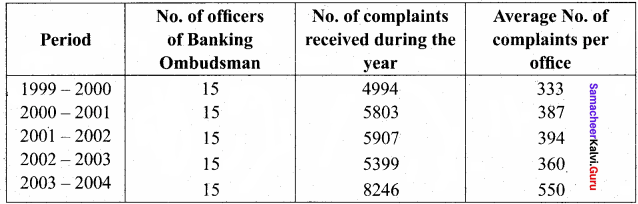
The Banking Ombudsman scheme-, 1995 was notified by RBI on June 14, 1995 in terms fo the power confessed on the Bank by Section 35 A of the Banking Regulations Act 1949 (10 of 1949) to provide for a system of redressal of grievances against banks. The scheme sought to establish a system of expeditions and inexpensive resolutions of customers complaints. The scheme is operation since 1995 and was revised during the year 2002. The scheme is being executed by Banking Ombudsman appointed by RBI at 15 centres covering the entire country.

Question 3.
Visit the RBI website www.rbi.org.in to read and have a discussion on any annual report, etc.
Answer:
Name of the complaints received by the Banking Ombudsman
Samacheer Kalvi 11th Commerce Solutions Chapter 10 Reserve Bank of India
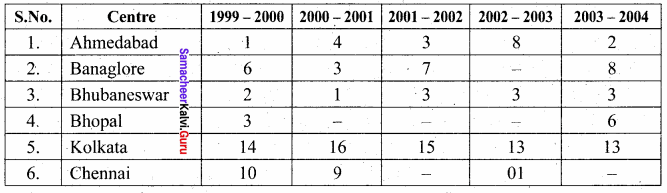
Awards issued by the Banking Ombudsman
Samacheer Kalvi 11th Commerce Solutions Chapter 10 Reserve Bank of India
and so on …. till 15 centres.

Share this Tamilnadu State Board Solutions for 11th Commerce Chapter 10 Reserve Bank of India Questions and Answers with your friends to help them to overcome the issues in exams. Keep visiting this site Tamilnadu State Board Solutions frequently to get the latest information on different subjects. Clarify your doubts by posting the comments and get the answers in an easy manner.

Samacheer Kalvi 11th English Grammar Sentence Transformation

Students who are interested in learning of 11th English Grammar Sentence Transformation Questions and Answers can use Tamilnadu State Board Solutions of 11th English Chapter Wise Pdf. First check in which chapter you are lagging and then Download Samacheer Kalvi 11th English Book Solutions Questions and Answers Summary, Activity, Notes Chapter Wise. Students can build self confidence by solving the solutions with the help of Tamilnadu State Board English Solutions. English is the scoring subject if you improve your grammar skills. Because most of the students will lose marks by Grammar grammar mistakes. So, we suggest you to Download Tamilnadu State Board 11th English Solutions according to the chapters.

Tamilnadu Samacheer Kalvi 11th English Grammar Sentence Transformation

Check out the topics covered in Grammar Sentence Transformation Questions and Answers before you start your preparation. Improve your grammar skills with the help of Samacheer Kalvi 11th English Book Solutions Questions and Answers pdf links. The solutions for Tamilnadu State Board 11th English Textbook are prepared by the English experts. So, if you follow Tamilnadu State Board Solutions 11th English Textbook Solutions you can cover all the topics in Grammar Sentence Transformation Questons and Answers. This helps to improve your communication skills.

The table given below contains the basic principles to transform the sentences:

SimpleComplex (sub-ordinating conjunction)Ccompound (co-ordinating conjunction)
too ………………………………. toso ………………………………. thatVery ………………………………. and so
In the case of/in the event ofIf / Unless ………………………………. (not)or, or else, otherwise
In spite of / Despite+Noun phraseThough/although/even thoughbut, yet, still
Samacheer Kalvi 11th English Grammar Sentence Transformation
Being, Having On+verb+ing (gerund) Till, after, before+’v’ing

Transform the sentences according to the instructions given in the bracket:

Question 1.
The boy was very hungry, so he ate the whole cake, (change into a simple sentence)
Answer:
Being very hungry, the boy ate the whole cake.

Question 2.
Though the lizard made several attempts, it could not catch the spider. (change into a compound sentence)
Answer:
The lizard made several attempts yet it could not catch the spider.

Question 3.
The lady was very ill. She could not go to the office. (Change into a complex sentence)
Answer:
As the lady was ill, she could not go to the office.

Question 4.
The doctor made several attempts. He could not save the old man. (Change into a simple sentence)
Answer:
In spite of making several attempts, the doctor could not save the old man.

Question 5.
She was bold. So, she became an astronaut. (Change into a simple sentence)
Answer:
Being bold, she became an astronaut.

Question 6.
As it rained heavily, the schools were closed, (change into a compound sentence)
Answer:
It rained heavily and so the schools were closed.

Question 7.
She was very tired. She couldn’t walk. (Change into a simple sentence)
Answer:
She was too tired to walk.

Question 8.
He burnt his midnight oil. Yet, he did not clear his CA examination with distinction. (Change into a complex sentence)
Answer:
Even though/Although/Though he burnt his midnight oil, he did not clear his CA examination with distinction.

Question 9.
The master was very angry. He shouted at the sleeping watchman. (Change into a simple sentence)
Answer:
Being very angry, the master shouted at the sleeping watchman.

Question 10.
Though the leader made many efforts, he could not bring unity among the party cadres. (Change into a compound sentence)
Answer:
The leader made many attempts but he could not bring unity among the party cadres.

The main aim is to share the knowledge and help the students of 11th English to secure the best score in their final exams. Use the concepts of Samacheer Kalvi 11th English Book Solutions Grammar Sentence Transformation Questions and Answers in Real time to enhance your skills. If you have any doubts you can post your comments in the comment section, We will clarify your doubts as soon as possible without any delay.

Samacheer Kalvi 11th English Grammar Conditional Clause

Students who are interested in learning of 11th English Grammar Conditional Clause Questions and Answers can use Tamilnadu State Board Solutions of 11th English Chapter Wise Pdf. First check in which chapter you are lagging and then Download Samacheer Kalvi 11th English Book Solutions Questions and Answers Summary, Activity, Notes Chapter Wise. Students can build self confidence by solving the solutions with the help of Tamilnadu State Board English Solutions. English is the scoring subject if you improve your grammar skills. Because most of the students will lose marks by Grammar grammar mistakes. So, we suggest you to Download Tamilnadu State Board 11th English Solutions according to the chapters.

Tamilnadu Samacheer Kalvi 11th English Grammar Conditional Clause

Check out the topics covered in Grammar Conditional Clause Questions and Answers before you start your preparation. Improve your grammar skills with the help of Samacheer Kalvi 11th English Book Solutions Questions and Answers pdf links. The solutions for Tamilnadu State Board 11th English Textbook are prepared by the English experts. So, if you follow Tamilnadu State Board Solutions 11th English Textbook Solutions you can cover all the topics in Grammar Conditional Clause Questons and Answers. This helps to improve your communication skills.

Definition of a conditional clause
A conditional clause is a type of subordinate clause, most commonly introduced by the conjunction ‘if’ or ‘unless’. Like most subordinate clauses introduced by a conjunction, the conditional clause can either go before the main clause, or after it.

Example: If I have enough money (conditional clause), I will go to Japan (main clause).

First, Second, and Third Conditional:

  1. First conditional: If I have enough money, I will go to Japan.
  2. Second conditional: If I had enough money, I would go to Japan.
  3. Third conditional: If I had, had enough money, I would have gone to Japan.

Learn the following structures and learn the verbs:
1. If you study well, you will get centum
As per the aforesaid structures do the following exercises:

1. Put the milk in the fridge. It will go sour.
If you don’t put the milk in the fridge, it will go sour.
Or
If you put the milk in the fridge, it will not go sour.

2. Close the door. The stray dog will not enter the home.
If you close the door, the stray dog will not enter the home.
Or
If you don’t close the door, the stray dog will enter the home.

3. Work part-time. You will earn while you learn.
If you work part time, you will earn while you learn.

4. I were an angel. I could make honest people rich.
If I were an angel, I could make honest people rich.

5. I were his teacher. I would teach him to be respectful to women.
If I were his teacher, I would teach him to be respectful to women.

6. You talk ill of others. Others will talk ill of you naturally.
If you talk ill of others, others will talk ill of you naturally.

7. You waste drinking water now. There will be scarcity of potable water in future.
If you waste drinking water now, there will be scarcity of potable water in future.

8. He persisted. He would win.
If he persisted, he would win.

9. We reduce the use of fossil fuels. There will be less pollution.
If we reduce the use of fossil fuels, there will be less pollution.

10. I had the wings of a bird. I would fly abroad without a passport.
If I had the wings of a bird, I would fly abroad without a passport.

11. I had the power. I would eliminate poverty in the world.
If I had the power, I would eliminate poverty in the world.

12. I had rescued the baby. People would have called me a hero.
If I had rescued the baby, people would have called me a hero.

13. I were you. I would not incur Sasi’s displeasure.
If I were you, I would not incur Sasi’s displeasure.

14. You value your life. Leave the child unharmed.
If you value your life, leave the child unharmed.

15. It rains. I shall stay at home.
If it rains, I shall stay at home.

The main aim is to share the knowledge and help the students of 11th English to secure the best score in their final exams. Use the concepts of Samacheer Kalvi 11th English Book Solutions Grammar Conditional Clause Questions and Answers in Real time to enhance your skills. If you have any doubts you can post your comments in the comment section, We will clarify your doubts as soon as possible without any delay.

Samacheer Kalvi 11th Commerce Solutions Chapter 9 Government Organisation

Students can find the most related topics which helps them to analyse the concepts if they practice according to the chapter-wise page. It is necessary for the students to practice more Questions and Answers for Tamilnadu State Board Solutions of 11th Commerce are given in the pdf format in chapter 9 Government Organisation Questions and Answers so that students can prepare in both online and offline modes. So, Download Samacheer Kalvi 11th Commerce Book Solutions Questions and Answers, Notes Pdf, to score good marks.

Samacheer Kalvi 11th Commerce Solutions Chapter 9 Government Organisation

Get the Questions and Answers, in Tamilnadu State Board 11th Commerce Solutions for Chapter 9 Government Organisation. Learn the concepts of 11th Commerce Chapter-Wise by referring to the Tamilnadu State Board Solutions for Chapter 9 Government Organisation Questions and Answers. Hence we suggest the students to Download Samacheer Kalvi 11th Commerce Book Solutions Questions and Answers pdf to enhance your knowledge.

Samacheer Kalvi 11th Commerce Government Organisation Textbook Exercise Questions and Answers

I. Choose the Correct Answer

Question 1.
The share capital of the government company must not be less than …………….
(a) 49%
(b) 51%
(c) 50 %
(d) 25%
Answer:
(b) 51%

Question 2.
Airport Authority of India is a public enterprise. Identify the fortti of organisation.
(a) Statutory Corporations
(b) Departmental undertakings
(c) Multi – National Corporation
(d) State Owned Company
Answer:
(b) Departmental undertakings

Question 3.
The oldest form of organisation in public sector …………….
(a) Public sector undertakings
(b) Departmental undertakings
(c) Multi – national corporation
(d) Statutory corporation
Answer:
(b) Departmental undertakings

Question 4.
A Government company purchases shares in the name of …………….
(a) Prime Minister
(b) President
(c) Chief Justice of India
(d) State Chief Minister
Answer:
(b) President

Question 5.
The primary objective of the state enterprises is to …………….
(a) Earn profit
(b) provide employment
(c) Serve the people
(d) None of these
Answer:
(c) Serve the people

II. Very Short Answer Questions

Question 1.
State the different types of public sectors enterprises.
Answer:

  1. Departmental Undertaking
  2. Public Corporation
  3. Government Company

Question 2.
What is the basic feature of a Departmental undertaking?
Answer:

  1. Formation : A departmental undertaking is established either as a separate full – fledged ministry or as a sub-division of a ministry (i.e. department) of the Government.
  2. No Separate Entity : A departmental undertaking does not have an independent entity distinct from the Government.

Question 3.
Give two examples for each of the following:
Answer:

  1. Private sector enterprises
  2. Global enterprises
  3. Public enterprises

Answer:

1. Private sector enterprises

  • Sole proprietorship
  • Partnership

2. Global enterprises

  • Coca – Cola Corporation
  • Unilever

3. Public enterprises

  • Life Insurance Corporation
  • Oil and Natural Gas Commission (ONGC)

Question 4.
State the form of public enterprises which is most suitable for projects related to National Security.
Answer:
Strategic industries like defence, and atomic power cannot be better managed other than government departments. Departmental undertakings can maintain secrecy in their working.

Question 5.
The Industrial Policy Resolution 2001 exclusively reserved for few industries for the public sector. Name these industries.
Answer:

  1. Departmental Undertaking
  2. Public Corporations
  3. Government Companies

III. Short Answer Questions

Question 1.
List the areas where the state or central ownership is a preferred form of business organisation. Justify your choice of areas.’
Answer:

  1. Coal Miners Authority Ltd.
  2. Steel Authority of India Ltd.
  3. Indian Telephone Industries
  4. Tamil Nadu State Corporation Ltd.

A company owned by central and/or State Government is called a Government Company. Either whole of the capital or majority of the shares are owned by the Government.

Question 2.
What are the different kinds of organisations that come under the public sector?
Answer:

  1. Departmental Undertaking
  2. Public Corporations
  3. Government Companies

Question 3.
List the names of some enterprises under the public sector and classify them.
Answer:
Departmental Undertaking Public Corporations Government Companies
Samacheer Kalvi 11th Commerce Solutions Chapter 9 Government Organisation

Question 4.
Define Departmental undtertakings.
Answer:
Departmental form of organisation of managing state enterprises is the oldest form of organisation. Under departmental form of organisation, a public enterprise is run as a separate full – fledged ministry or as a major sub – division of a department of the Government.

Question 5.
What is meant by Government Company?
Answer:
A “Government company” is defined under Section 2(45) of the Companies Act, 2013 as “any company in which not less than 51% of the paid-up share capital is held by the Central Government, or by any State Government or Governments, or partly by the Central Government and partly by one or more State Governments, and includes a company which is a subsidiary company of such a Government company”.

IV. Long Answer Questions

Question 1.
What are the advantages and disadvantages of Departmental undertaking?
Answer:
Advantages:
1. Easy Formation:
It is easy to set up a departmental undertaking. The departmental undertaking is created by an administrative decision of the Government, involving no legal formalities for its formation.

2. Direct and Control of Parliament or State Legislature:
The departmental undertaking is directly responsible to the Parliament or the State legislature through its overall head i.e. the minister concerned.

3. Secrecy Maintained:
Strategic industries like defence and atomic power cannot be better managed other than government departments. Department undertakings can maintain secrecy in their working.

Disadvantages:
1. Red – Tape and Bureaucracy: There is too much of procedures which results in delay. Commercial organisation cannot afford delay in taking decisions.

2. Incidence of Additional Taxation: Losses incurred by a departmental enterprise are met out of the treasury. This very often necessitates additional taxation the burden of which falls on the common man.

Question 2.
What are the features of Public corporation? (Any 5)
Answer:
1. Special Statute:
A public corporation is created by a special Act of the Parliament or the State Legislature. The Act defines its powers, objectives, functions and relations with the ministry and the Parliament (or State Legislature).

2. Separate Legal Entity:
A public corporation is a separate legal entity with perpetual succession and common seal. It has an existence, independent of the Government. It can own property; can make contracts and file suits, in its own name.

3. Capital Provided by the Government:
The capital of a public corporation is provided by the Government or by agencies controlled by the government.- However, many public corporations have also begun to raise money from the capital market.

4. Financial Autonomy:
A public corporation enjoys financial autonomy. It prepares its own budget; and has authority to retain and utilize its earnings for its business.

5. Management by Board of Directors: Its management is vested in a Board of Directors, appointed or nominated by the Government. But there is no Governmental interference in the day – to – day working of the corporation.

Question 3.
What are the Features of Government company? (Any 5)
Answer:
1. Registration Under the Companies Act:
A Government company is formed through registration under the Companies Act, 1956; and is subject to the provisions of this Act, like any other company. However, the Central Government may direct that any of the provisions of the Companies Act shall not apply to a Government company or shall apply with certain modifications.

2. Executive Decision of Government:
A Government company is created by an executive decision of the Government, without seeking the approval of the Parliament or the State Legislature.

3. Separate Legal Entity:
A Government company is a legal entity separate from the Government. It can acquire property; can make contracts and can file suits, in its own name.

4. Whole or Majority Capital Provided by Government:
The whole or majority (at least 51 %) of the capital of a Government company is provided by the Government; but the revenues of the company are not deposited into the treasury.

5. Majority of Government Directors:
Being in possession of a majority of share capital, the Government has authority to appoint majority of directors, on the Board of Directors of a government company.

Question 4.
What are the advantages and disadvantages of Public corporation?
Advantages:
1. Bold Management due to Operational Autonomy:
A public corporation enjoys internal operational autonomy; as it is free from Governmental control. It can, therefore, run in a business like manner. Management can take bold decisions involving experimentation in its lines of activities, taking advantage of business situations.

2. Legislative Control:
Affairs of a public corporation are subject to scrutiny by Committees of Parliament or State Legislature. The Press also keeps a watchful eye on the working of a public corporation. This keeps a check on the unhealthy practices on the part of the management of the public corporation.

3. Qualified and Contented Staff:
Public corporation offers attractive service conditions to its staff. As such it is able to attract qualified staff.

Disadvantages:
1. Autonomy and Flexibility, Only in Theory:
Autonomy and flexibility advantages of a public corporation exist only in theory. In practice, there is a lot of interference in the working of a public corporation by ministers, government officers and other politicians.

2. Misuse of Monopolistic Power:
Public corporations often enjoy monopoly in their field of operation. As such, on the one hand they are indifferent to consumer needs and problems; and on the other hand, often do not hesitate to exploit consumers.

Question 5.
What are the features of Departmental organisation? (Any 5)
Answer:
1. Formation : A departmental undertaking is established either as a separate full – fledged ministry or as a sub-division of a ministry (i.e. department) of the Government.

2. No Separate Entity : A departmental undertaking does not have an independent entity distinct from the Government.

3. Ultimate Responsibility : The ultimate responsibility for the management of a departmental undertaking lies with the minister concerned who is responsible to the Parliament or State Legislature for the affairs of the departmental undertaking. The minister, in turn, delegates his authority downwards to various other management levels, in the departmental undertaking.

4. Governmental Financing : The departmental undertaking is financed through annual budget appropriations by the Parliament or the State Legislature. The revenues of the undertaking are paid into the government treasury.

5. Accounting and Audit : The departmental undertaking is subject to the normal budgeting, accounting and audit procedures, which are applicable to all Government departments.

Case Study

Case 1:
You are a newly appointed MD of a foreign sector tourist Bus transport company. The management of the bus Transport undertaking of your city finds that its buses are not able to attract very many tourists. Private Mini – Buses are seen to be preferred by people on certain routes. As a result, the undertaking is incurring losses. Therefore, management wants to reformulate its price policy. As a CEO or MD what advice can you give to it? Explain.
Answer:

  1. For attract the people, they can change the buses with new facilities.
  2. Wi – fi facilities can be provided.
  3. New painted buses with luxury can run.
  4. Air condition facilities can apply.
  5. At low cost they can run the bus.
  6. New engine can introduce for control of air problems.
  7. The government has the power of control the buses. So they can provide subsidy facilities to the people to attract.
  8. Buses can be remodelling with new ideas among the people.
  9. Can adopt new innovations to attract the people
  10. Tickets cost may be reduced.

Case 2:
Mr. Sudhan is studying in B.Com, 1st year. His father, Mr. Somu is a leading businessman in Chennai. Somehow, Mr. Sudhan does not know anything about utilities. But he is to prepare a lesson for his class in this topic. He request his father for help. His father tells Mr. Sudhan that Public utilities are no different from his own business except that these are controlled by Government instead of private people. Meanwhile, Mr. Chandrasekaran a friend of Mr. Somu comes there. Mr. Chandrasekaran is an employee of Chennai Electricity Supply Undertaking. Mr. Chandrasekaran intervenes in the conversation going on between Mr.Somu and his son and hold that Mr. Sudhan is not correct; there are other special features of public uutilities, too. Perform the characters of Mr. Sudhan, Mr.Somu and Mr. Chandrasekaran and state your positions.

Characters of Mr. Somu: He is a leading businessman in Chennai. He teaches about his business to his son. He explains the differences private and public government business.

  1. Government business need not control because Government will do the business.
  2. Private business people will be controlled by Government in the way to paying tax to the Government.
  3. Public utilities can be served by Mr. Somu because the utilities services have been done by him.

Characters of Mr. Chandrasekaran:
He is an employee of Chennai Electricity Supply Undertaking. It is a board organisation. It is Government organisation. He explains about the Public Utilities. Electricity supply is very important one to public. The service is given by Government. Electricity supply gives benefits to people, industries, factory, business offices, agriculturalists and household.

Characters of Mr. Sudhan:
He is studying in B.Com., 1st year. He is good to give a speech in his college about public utilities. He gathered sufficient information about public utilities from his father and his father’s friend. He is a student and he is studying commerce. He learns business, trade and industries in text book. Practically he got information from his father’s friend Mr. Chandrasekaran.

Share this Tamilnadu State Board Solutions for 11th Commerce Chapter 9 Government Organisation Questions and Answers with your friends to help them to overcome the issues in exams. Keep visiting this site Tamilnadu State Board Solutions frequently to get the latest information on different subjects. Clarify your doubts by posting the comments and get the answers in an easy manner.

Samacheer Kalvi 11th English Grammar Active and Passive Voice

Students who are interested in learning of 11th English Grammar Active and Passive Voice Questions and Answers can use Tamilnadu State Board Solutions of 11th English Chapter Wise Pdf. First check in which chapter you are lagging and then Download Samacheer Kalvi 11th English Book Solutions Questions and Answers Summary, Activity, Notes Chapter Wise. Students can build self confidence by solving the solutions with the help of Tamilnadu State Board English Solutions. English is the scoring subject if you improve your grammar skills. Because most of the students will lose marks by Grammar grammar mistakes. So, we suggest you to Download Tamilnadu State Board 11th English Solutions according to the chapters.

Tamilnadu Samacheer Kalvi 11th English Grammar Active and Passive Voice

Check out the topics covered in Grammar Active and Passive Voice Questions and Answers before you start your preparation. Improve your grammar skills with the help of Samacheer Kalvi 11th English Book Solutions Questions and Answers pdf links. The solutions for Tamilnadu State Board 11th English Textbook are prepared by the English experts. So, if you follow Tamilnadu State Board Solutions 11th English Textbook Solutions you can cover all the topics in Grammar Active and Passive Voice Questons and Answers. This helps to improve your communication skills.

There are two ways of expressing an action by using a transitive verb.
Read the following sentences:

  • Magesh killed a rat.
  • A rat was killed by Magesh.

These two sentences have the same meaning. These are simply two different ways of saying the same thing. There is, however, a shift in stress on the agent and also a change in the form of verb.

In sentence (i), the subject ‘Magesh’ is the ‘doer’ of the action. It acts or is active. So the verb ’’killed’’ is in active voice.

In sentence (ii), the subject ‘A raf is the ‘receiver’ of action. It suffers the action done by someone else (Magesh, in this case). It is acted upon. So the verb ‘was killed’ is in passive voice.

A. Rewrite the following sentences using passive voice:
1. Mala will enjoy the vacation in Kodaikanal.
The vacation in Kodaikanal will be enjoyed by Mala.

2. Our friends must have triggered this quarrel.
This quarrel must have been triggered by our friends.

3. The police has verified the truth of his testimony.
The truth of his testimony has been verified by the police.

4. Circumstances will oblige Mr. Rao to quit his post.
Mr. Rao will be obliged by the circumstances to quit his post.

5. Someone pinched Peter’s wallet in the train.
Peter’s wallet has been pinched by someone in the train.

6. How have you solved the puzzle? .
How has the puzzle been solved by you?

7. The drunkards created nuisance during the marriage party.
Nuisance was created by the drunkards during the marriage party.

8. Is it possible to buy LED TV in installments with 0% interest?
Can LED TV be bought in installments with 0% interest?

9. Who taught you such a rude behaviour?
By whom were you taught such a rude behaviour?

10. One must endure what is incurable.
What can’t be cured has to be endured.
A heart specialist must be necessarily consulted now.

B. Rewrite the following sentences using active voice:

1. Have you ever been refused a loan before by any bank?
Has any bank refused a loan before to you?

2. Was my data card seen by you?
Did you see my data card?

3. We are taught English excellently by Mr. Henry.
Mr. Henry teaches us English excellently.

4. Shall I be taken to the Taj Mahal?
Will you take me to the Taj Mahal?

5. The earth is said to be flat by some.
Some say that the earth is flat.

6. Why should she be suspected by you?
Why should you suspect her?

7. This technical work could have been done only by an adult.
Only an adult could have done this technical work.

8. Those who help themselves are helped by God.
God helps those who help themselves.

9. A village is ravaged by a cyclone occasionally.
A cyclone ravages a village occasionally.

10. Let the boats are lowered and the drowning man is rescued.
Lower the boats and rescue the drowning man.

The main aim is to share the knowledge and help the students of 11th English to secure the best score in their final exams. Use the concepts of Samacheer Kalvi 11th English Book Solutions Grammar Active and Passive Voice Questions and Answers in Real time to enhance your skills. If you have any doubts you can post your comments in the comment section, We will clarify your doubts as soon as possible without any delay.

Samacheer Kalvi 11th English Grammar Prepositions

Students who are interested in learning of 11th English Grammar Prepositions Questions and Answers can use Tamilnadu State Board Solutions of 11th English Chapter Wise Pdf. First check in which chapter you are lagging and then Download Samacheer Kalvi 11th English Book Solutions Questions and Answers Summary, Activity, Notes Chapter Wise. Students can build self confidence by solving the solutions with the help of Tamilnadu State Board English Solutions. English is the scoring subject if you improve your grammar skills. Because most of the students will lose marks by Grammar grammar mistakes. So, we suggest you to Download Tamilnadu State Board 11th English Solutions according to the chapters.

Tamilnadu Samacheer Kalvi 11th English Grammar Prepositions

Check out the topics covered in Grammar Prepositions Questions and Answers before you start your preparation. Improve your grammar skills with the help of Samacheer Kalvi 11th English Book Solutions Questions and Answers pdf links. The solutions for Tamilnadu State Board 11th English Textbook are prepared by the English experts. So, if you follow Tamilnadu State Board Solutions 11th English Textbook Solutions you can cover all the topics in Grammar Prepositions Questons and Answers. This helps to improve your communication skills.

Choose the appropriate preposition to complete the sentence:

Question 1.
The driver jumped …………………… the burning bus.
(a) from
(b) down
(c) up
Answer:
(a) from

Question 2.
He handed over the answer script …………………… the warning bell.
(a) behind
(b) over
(c) before
Answer:
(c) before

Question 3.
The cheetah jumped …………………… the fence and entered the city.
(a) through
(b) against
(c) over
Answer:
(c) over

Question 4.
Human sacrifices were practiced …………………… the aborigines of Africa.
(a) with
(b) for
(c) by
Answer:
(c) by

Question 5.
The lady has been missing …………………… last week.
(a) from
(b) since
(c) on
Answer:
(b) since

Question 6.
They picked the flowers …………………… great care.
(a) between
(b) along
(c) with
(c) with

Question 7.
Ramesh went …………………… Tom’s place to settle the bills.
(a) to
(b) on
(c) in
Answer:
(a) to

Question 8.
Deva has promised to come …………………… us for the picture.
(a) for
(b) along
(c) with
Answer:
(c) with

Question 9.
People are attracted more …………………… Diana’s kindness than her riches.
(a) from
(b) towards
(c) of
(b) towards

Question 10.
He walked …………………… with him in the forest for another 15 km.
(a) along
(b) towards
(c) on
Answer:
(a) along

Question 11.
She was carried away …………………… his promises.
(a) by
(b) during
(c) of
Answer:
(a) by

Question 12.
He saw the train moving …………………… the lady with a cell phone on the track.
(a) for
(b) beneath
(c) towards
Answer:
(c) towards

Question 13.
My boss was quite satisfied …………………… the outcome of the new executive’s work.
(a) in
(b) with
(c) of
Answer:
(b) with

Question 14.
She laughed till the tears ran …………………… her cheeks.
(a) down
(b) with
(c) on
Answer:
(a) down

Question 15.
He tried to complete the project …………………… all his resources.
(a) for
(b) in
(c) with
Answer:
(c) with

Question 16.
Ram was a thin, tall and handsome bachelor …………………… a Roman nose.
(a) far
(b) with
(c) of
Answer:
(b) with

Question 17.
They found the missing wallet …………………… the bench in the park.
(a) under
(b) for
(c) down
Answer:
(a) under

Question 18.
My friend has a great sense …………………… humour.
(a) of
(b) on
(c) with
Answer:
(a) of

Question 19.
Many people travel to Kerala to work …………………… small companies.
(a) in
(b) under
(c) on
Answer:
(a) in

Question 20.
Ragu leaves for work …………………… seven in the morning.
(a) beneath
(b) at
(c) from
Answer:
(b) at

The main aim is to share the knowledge and help the students of 11th English to secure the best score in their final exams. Use the concepts of Samacheer Kalvi 11th English Book Solutions Grammar Prepositions Questions and Answers in Real time to enhance your skills. If you have any doubts you can post your comments in the comment section, We will clarify your doubts as soon as possible without any delay.

Samacheer Kalvi 11th Commerce Solutions Chapter 8 Multi-National Corporations (MNCs)

Students can find the most related topics which helps them to analyse the concepts if they practice according to the chapter-wise page. It is necessary for the students to practice more Questions and Answers for Tamilnadu State Board Solutions of 11th Commerce are given in the pdf format in chapter 8 Multi-National Corporations (MNCs) Questions and Answers so that students can prepare in both online and offline modes. So, Download Samacheer Kalvi 11th Commerce Book Solutions Questions and Answers, Notes Pdf, to score good marks.

Samacheer Kalvi 11th Commerce Solutions Chapter 8 Multi-National Corporations (MNCs)

Get the Questions and Answers, in Tamilnadu State Board 11th Commerce Solutions for Chapter 8 Multi-National Corporations (MNCs). Learn the concepts of 11th Commerce Chapter-Wise by referring to the Tamilnadu State Board Solutions for Chapter 8 Multi-National Corporations (MNCs) Questions and Answers. Hence we suggest the students to Download Samacheer Kalvi 11th Commerce Book Solutions Questions and Answers pdf to enhance your knowledge.

Samacheer Kalvi 11th Commerce Multi-National Corporations (MNCs) Textbook Exercise Questions and Answers

I. Choose the Correct Answer

Question 1.
A Multinational Corporation can be defined as a firm which ……………..
(a) Is beyond the control of any government
(b) Is one of the top 200 firms in the world
(c) Owns companies in more than one country
(d) All the above
Answer:
(c) Owns companies in more than one country

Question 2.
Centralised control in MNC’s implies control exercised by ……………..
(a) Branches
(b) Subsidiaries
(c) Headquarters
(d) Parliament
Answer:
(c) Headquarters

Question 3.
Enterprises operating in several countries but managed from one country is termed as ……………..
(a) Government company
(b) Multinational Company
(c) Private company
(d) Joint Venture
Answer:
(b) Multinational Company

Question 4.
Dispersal of decision making power to branches/affiliates/subsidiaries by head office represents ……………..
(a) Centralisation
(b) Decentralisation
(c) Power
(d) Integration
Answer:
(b) Decentralisation

Question 5.
Coca – Cola company is an example of ……………..
(a) MNC
(b) Government company
(c) Joint Venture
(d) Public company
Answer:

II. Very Short Answer Questions

Question 1.
Define Multinational Company.
Answer:
“A multinational corporation owns and manages business in two or more countries.” – Neil H. Jacoby

Question 2.
Write any two advantages of MNC.
Answer:
1. Low Cost Labour : MNC set up their facilities in low cost countries and produce goods/ services at lower cost.

2. Quality Products : The resource, experience and expertise of MNCs in the sphere of research and development enables the host country to establish its research and development system which helps it in producing quality goods and services at least possible cost.

Question 3.
Give two examples of MNC.
Answer:

  1. Coca – Cola Corporation
  2. Unilever

Question 4.
Name the type of business enterprise which operates in more than one country.
Answer:
A multinational corporation is known by various names such as: global enterprise, international enterprise, world enterprise, transnational corporation etc.

III. Short Answer Questions

Question 1.
What are the advantages of MNC’s?
Answer:
1. Low Cost Labour:
MNC set up their facilities in low cost countries and produce goods/ service at lower cost. It gains cost advantage and sells its products and services of good quality at low cost.

2. Quality Products:
The resource, experience and expertise of MNCs in the sphere of research and development enables the host country to establish its research and development system which helps it in producing quality goods and services at least possible cost.

3. Proper Use of Idle Resources:
Because of their advanced technical knowledge, MNCs are in a position to properly utilise idle physical and human resources of the host country. This results in an increase in the National Income of the host country.

4. Improvement in Balance of Payment Position:
MNCs help the host countries to increase their exports. As such, they help the host country to improve upon its Balance of Payment position.

5. Technical Development:
MNCs carry the advantages of technical development to host countries. In fact, MNCs are a vehicle for transference of technical development from one country to another. Because of MNCs poor host countries also begin to develop technically.

Question 2.
What are the disadvantages of MNC’s?
Answer:
1. Danger for Domestic Industries : MNCs, because of their vast economic power, pose a danger to domestic industries; which are still in the process of development. Domestic industries cannot face challenges posed by MNCs.

2. Transfer of Outdated Technology : Where MNCs transfer outdated technology to host nation, it serves no purpose.

3. No Benefit to Poor People : MNCs produce only those things, which are used by the rich. Therefore, poor people of host countries do not get, generally, any benefit, out of MNCs.

4. Danger to Independence : Initially MNCs help the Government of the host country, in a number of ways and then gradually start interfering in the political affairs of the host country.

5. Deprivation of Job Opportunity of Local People: MNCs may not generate job opportunities to the people of home country.

Case Study

Public enterprises are established to achieve the goal of economic and social development of the country. They are managed and controlled by Central or State Governments through ministers or government officials. Many times their poor performance i influences the policy formulation and running of the enterprise into loss. Even the big business houses use their influence and get the policies formulated in their favour. State the role of ministers or government to frame the policies for the success of public enterprises.
Answer:
Role of Ministers or governments to frame the policies for the success of public enterprises.

  1. The ministers or governments encourage to start multinational companies.
  2. It is easy to form in our country.
  3. The economic policy is favorable to the multi – nation corporations.
  4. The national income will increase by starting MNCs in India.
  5. At low cost the products to be produced and sold to people with minimum range of profits.
  6. Tax relaxation can be permitted because the Government allowed to start business.
  7. Tax revenue can be increased to the Government.
  8. New technologies can be imported from developed countries.
  9. Culture can be improved among the people.
  10. Communication may be developed.

Share this Tamilnadu State Board Solutions for 11th Commerce Chapter 8 Multi-National Corporations (MNCs) Questions and Answers with your friends to help them to overcome the issues in exams. Keep visiting this site Tamilnadu State Board Solutions frequently to get the latest information on different subjects. Clarify your doubts by posting the comments and get the answers in an easy manner.

Samacheer Kalvi 11th English Grammar Modals

Students who are interested in learning of 11th English Grammar Modals Questions and Answers can use Tamilnadu State Board Solutions of 11th English Chapter Wise Pdf. First check in which chapter you are lagging and then Download Samacheer Kalvi 11th English Book Solutions Questions and Answers Summary, Activity, Notes Chapter Wise. Students can build self confidence by solving the solutions with the help of Tamilnadu State Board English Solutions. English is the scoring subject if you improve your grammar skills. Because most of the students will lose marks by Grammar grammar mistakes. So, we suggest you to Download Tamilnadu State Board 11th English Solutions according to the chapters.

Tamilnadu Samacheer Kalvi 11th English Grammar Modals

Check out the topics covered in Grammar Modals Questions and Answers before you start your preparation. Improve your grammar skills with the help of Samacheer Kalvi 11th English Book Solutions Questions and Answers pdf links. The solutions for Tamilnadu State Board 11th English Textbook are prepared by the English experts. So, if you follow Tamilnadu State Board Solutions 11th English Textbook Solutions you can cover all the topics in Grammar Modals Questons and Answers. This helps to improve your communication skills.

General Characteristics Of Modals
1. Modals are never used alone. A Principal verb is either present or implied;
as—
I can sing. He will help you.

2. Modals do not change according to the number or person of the subject;
as—
I can. We can. You can. He can. They can. etc.
I may. We may. You may. He may. They may. etc.

3. Modals have no Infinitive, Present Participle or Past Participle forms.

4. Modals cannot be used in all the tenses. When a modal does not fall in this pattern, it works as a Principal Verb; as—
God willed so.
He needs a pen.
She dared to go into the dark forest.
(Here will, need and dare are used as main verbs)

Relationship of Modals with Tenses
(i) May, can, shall and will are in present forms while might, could, should and would are their past forms.

The two forms express different meanings, but usually no difference of time, e.g. the difference between may and might is often that of degree of probability,

as-
She may come today. {possibility/likely to happen)
She might come today. (remote possibility/less likely)

(ii) However, if the verb in the main clause is in the past tense, the forms might, could, should and would serve as regular past tenses;

as—
1. He said, “I can help you.”
He said that he could help her.
2. You said, “She will come back soon.”
You said that she would come back soon.
3. Sheetal said, “May I use this pen, madam?”
Sheetal asked her teacher if she might use that pen.

(III) When we want to express the past time in verb phrases involving modals, we use the Present Perfect Tense of the Principal Verb;
as –
She must have reached home by now.
You ought to have told me all the facts.

Quasi Modals
Quasi modals are also called semi-modals. There are four quasi modals: ‘used to’, ‘need to’, ‘dare to’ and ‘ought to’.

Question 1.
Supply suitable modal/quasi-modal verb for the following sentences.
(a) _________ you direct me to the collector office?
(b) _________ We respect our elders.
(c) You _________ come tomorrow if you are unable to finish the task today.
(d) I _________ visit the gym regularly during holidays.
(e) We _________ get a hike in our salary this month.
Answer:
(a) Can
(b) should
(c) should
(d) used to
(c) would

Question 2.
Supply suitable modal/quasi-modal verb for the following sentences
(a) One _________ obey the traffic rules.
(b) _________ I ask you a favour, Sir?
(c) She _________ sing and dance.
(d) Kapil Dev _________ play football initially.
(c) You _________ wait as it is getting dark now.
Answer:
(a) must
(b) Can
(c) can
(d) used to
(c) need not

Question 3.
Supply suitable modal/quasi-modal verb for the following sentences:
(a) _________ God bless you
(b) I wish you _________ disclose the truth to me.
(c) You _________ not write on the wall.
(d) She _________ play tennis during her college days.
(c) Rich men _________ help the poor.
Answer:
(a) May
(b) could
(c) should
(d) used to
(c) must

Question 4.
Supply suitable modal/quasi-modal verb for the following sentences.
(a) During our trip to Gujarat, we _________ visit Sabarmati Ashram.
(b) Blue Whale game promoters _________ be severely punished.
(c) You _________ respect your parents and take care of them in their old age.
(d) They _________ speak against Dinakaran as he has lot of influence.
(c) You _________ not know every word to understand the story.
Answer:
(a) shall
(b) must
(c) ought to
(d) dare not
(c) need

Question 5.
Supply suitable modal/quasi-modal verb for the following sentences
(a) You _________ not apologise for a flimsy mistake.
(b) Ramu is so timid that he _________ not discuss major issues with his wife.
(c) You _________ donate your old books to needy students.
(d) Thou _________ not steal.
(c) My _________ brother be happy to see you.
Answer:
(a) need
(b) dare
(c) should
(d) shall
(c) will

The main aim is to share the knowledge and help the students of 11th English to secure the best score in their final exams. Use the concepts of Samacheer Kalvi 11th English Book Solutions Grammar Modals Questions and Answers in Real time to enhance your skills. If you have any doubts you can post your comments in the comment section, We will clarify your doubts as soon as possible without any delay.