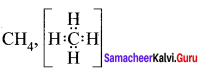
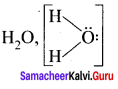
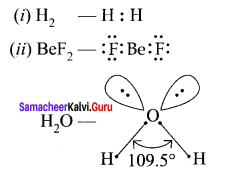
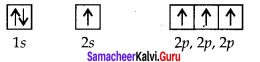
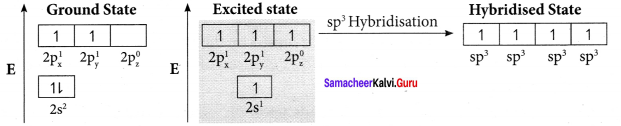
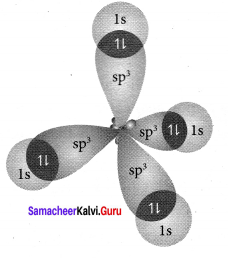
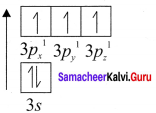
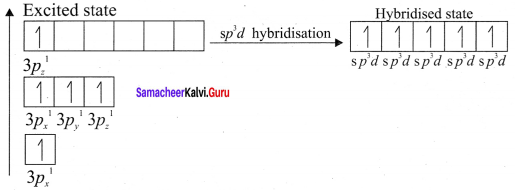
Samacheer Kalvi 11th Chemistry Solutions Chapter 10 Chemical Bonding

Enhance your subject knowledge with Tamilnadu State Board for Chapter 10 Chemical Bonding and learn all the underlying concepts easily. Make sure to Download Samacheer Kalvi 11th Chemistry Book Solutions Notes Pdf Chapter 10 Chemical Bonding Questions and Answers PDF on a day to day basis and score well in your exams. Are given after enormous research by people having high subject knowledge. You can rely on them and prepare any topic of Chemistry as per your convenience easily.

Tamilnadu Samacheer Kalvi 11th Chemistry Solutions Chapter 10 Chemical Bonding

Students looking for Chapter 10 Chemical Bonding Concepts can find them all in one place from our Tamilnadu State Board Chemical Bonding. Simply click on the links available to prepare the corresponding topics of Chemistry easily. Samacheer Kalvi 11th Chemistry Chapter wise Questions and Answers are given to you after sample research and as per the latest edition textbooks. Clarify all your queries and solve different questions to be familiar with the kind of questions appearing in the exam. Thus, you can increase your speed and accuracy in the final exam.

Samacheer Kalvi 11th Chemistry Chapter 10 Chemical Bonding Textual Evaluation Solved

Samacheer Kalvi 11th Chemistry Chemical Bonding Multiple Choice Questions

Question 1.
In which of the following compounds does the central atom obey the octet rule?
(a) XeF4
(b) AICI3
(c) SF6
(d) SO2
Answer:
(d) SCl2
Solution:
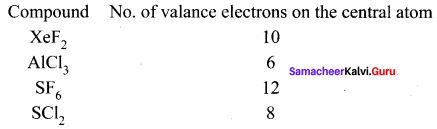
Samacheer Kalvi 11th Chemistry Solutions Chapter 10 Chemical Bonding-1
Hence in (d) SCl2 octet rule is followed

Question 2.
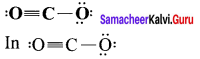
In the molecule OA = C = OB the formal charge on OA, C and OB are respectively.
(a) – 1, 0, +1
(b) +1, 0, – 1
(c) – 2, 0, +2
(d) 0, 0, 0
Answer:
(d) 0, 0, 0
Samacheer Kalvi 11th Chemistry Solutions Chapter 10 Chemical Bonding-2
Formal charge of Samacheer Kalvi 11th Chemistry Solutions Chapter 10 Chemical Bonding-3
Formal charge of C = 4 – \(\left( 0+\frac { 8 }{ 2 } \right)\) = 4 – 4 = 0

Question 3.
Which of the following is electron deficient?
(a) PH3
(b) (CH3)2
(c) BH3
(d) NH3
Answer:
(c) BH3
Solution:
Samacheer Kalvi 11th Chemistry Solutions Chapter 10 Chemical Bonding-3 – electron rich,
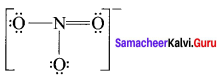
CH3 – CH3 – Covalent neutral molecule,
BH3 – electron deficient

Question 4.
Which of the following molecule contain no π bond?
(a) SO2
(b) NO2
(c) CO2
(d) H2O
Answer:
(d) H2O
Solution:
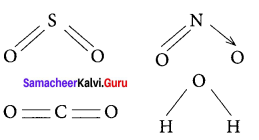
Samacheer Kalvi 11th Chemistry Solutions Chapter 10 Chemical Bonding-5
Water (H2O) contains only σ bonds and no π bonds.

Question 5.
The ratio of number of sigma (σ) and pi (π) bonds in 2- butynal is …………..
(a) 8/3
(b) 5/3
(c) 8/2
(d) 9/2
Answer:
(d) 9/2
Solution:
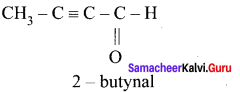
Samacheer Kalvi 11th Chemistry Solutions Chapter 10 Chemical Bonding-6
no. of σ bonds = 8 [4C – H; 3C – C; 1C— O]
no.of π bonds = 3 [2C – C; 1C – O]
∴ratio = \(\frac { 8 }{ 3 }\)

Question 6.
Which one of the following is the likely bond angles of sulphur tetrafluoride molecule?
(a) 120°, 80°
(b) 109°. 28
(c) 90°
(d) 89°, 117°
Answer:
(d) 89°, 117°
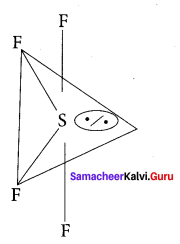
Samacheer Kalvi 11th Chemistry Solutions Chapter 10 Chemical Bonding-7
Solution:
Normal bond angle in regular trigonal bipyramidal are 90° and 120°. Due to l.p – b.p repulsion, bond angle is reduced to 89°, 117° option (d).

Question 7.
Assertion: Oxygen molecule is paramagnetic.
Reason: It has two unpaired electron in its bonding molecular orbital.
(a) both assertion and reason are true and reason is the correct explanation of assertion
(b) both assertion and reason are true but reason is not the correct explanation of assertion
(c) assertion is true but reason is false
(d) Both assertion and reason are false
Answer:
(c) assertion is true but reason is false
Correct statement: Oxygen molecule is paramagnetic
Correct Reason: It has two unpaired electrons in its antibonding molecular orbital.

Question 8.
According to Valence bond theory, a bond between two atoms is formed when ……………….
(a) fully filled atomic orbitals overlap
(b) half filled atomic orbitals overlap
(c) non-bonding atomic orbitals overlap
(d) empty atomic orbitals overlap
Answer:
(b) half filled atomic orbitals overlap

Question 9.
In CIF3, NF3 and BF3 molecules the chlorine, nitrogen and boron atoms are …………………….
(a) sp3 hybridised
(b) sp3, sp3 and sp2 respectively
(c) sp2 hybridised
(d) sp3d, sp3 and sp2 hybridised respectively
Answer:
(d) sp3d, sp3 and sp2 hybridised respectively
Solution:
CIF3 – sp3d hybridisation
NF3 – sp3 hybridisation
BF3 – sp2 hybridisation

Question 10.
When one s and three p orbitais hybridise,
(a) four equivalent orbitais at 900 to each other will be formed
(b) four equivalent orbitais at 1090 28’ to each other will be formed.
(c) four equivalent orbitals, that are lying the same plane will be formed
(d) none of these
Answer:
(b) four equivalent orbitals at 109° 28′ to each other will be formed.

Question 11.
Which of these represents the correct order of their increasing bond order?
(a) C2 < C22- < O2
(b) C22- < C2+ < O2 < O22-
(c) O22- < O2+ < O2 < C22-
(d) O22- < C2+ < O2 < C22-
Answer:
(d) O22- < C2+ < O2 < C22-
Solution:
bond order = (nb – na)
bond order of O22- = \(\frac { 1 }{ 2 }\) (8 – 6) = 1
bond order of C2+ = \(\frac { 1 }{ 2 }\) (5 – 2) = 1.5
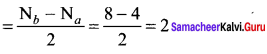
bond order of O2 = \(\frac { 1 }{ 2 }\) (8 – 4) = 2
bond order of C22- = \(\frac { 1 }{ 2 }\) (8 – 2) = 3

Question 12.
Hybridisation of central atom in PCl5 involves the mixing of orbitais.
(a) s, px, py, dx2, dx2-y2
(b) s, px, py, pxy, dx2-y2
(c) s, px, py, pz, dx2-y2
(d) px, py, pxy, dx2-y2
Answer:
(c) s, px, py, pz, dx2-y2
Solution:
PCl5 – sp3d hybridisation s, px, py, pz, dx2-y2

Question 13.
The correct order of O – O bond length in hydrogen peroxide, ozone and oxygen is ……………..
(a) H2O2 > O3 > O2
(b) O2 > O3 > H2O
(c) O2 > H2O2 > O3
(d) O3 > O2 > H2O2
Answer:
(b) O2 > O3 > H2O2
Solution:
The bond order for O2, O3 and H2O2 decreases in the order 2 > 1.5 > 1

Question 14.
Which one of the following is diamagnetic?
(a) O2
(b) O22-
(c) O22+
(d) None of these
Answer:
(b) O22-
Solution:
O22- is diamagnetic. Additional two electrons are paired in anti-bonding molecular orbits π*2py and π*2pz

Question 15.
Bond order of a species is 2.5 and the number of electrons are in its bonding molecular orbital is found to be 8. The no. of electrons in its anti-bonding molecular orbital is ………………….
(a) three
(b) four
(c) zero
(d) cannot be calculated form the given information.
Answer:
(a) three
Solution:
Bond order = \(\frac { 1 }{ 2 }\) (nb – na)
2.5 = \(\frac { 1 }{ 2 }\) (8 – na)
⇒ 5 = 8
⇒ na = 8 – 5 = 3

Question 16.
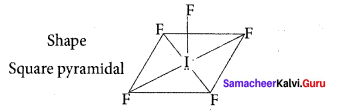
Shape and hybridisation of IF5 are ………….
(a) Trigonal bipyramidal, sp3d2
(b) Trigonal bipyramidal, sp3d
(c) Squai2e pyramidal, sp3d2
(d) Octahedral, sp3d2
Answer:
(c) Square pyramidal, sp3d2
Solution:
IF5 – 5 bond pair + 1 lone pair
∴ hybridisation sp3d2
Samacheer Kalvi 11th Chemistry Solutions Chapter 10 Chemical Bonding-10

Question 17.
Pick out the incorrect statement from the following.
(a) sp3 hybrid orbitais are equivalent and are at an angle of 1 09°28’ with each other.
(b) dsp2 hybrid orbitais are equivalent and bond angle between any two of them is 900.
(c) All five sp3d hybrid orbitais arc not equivalent. Out of these five sp3d hybrid orbitais, three are at an angle of 120°, remaining two are perpendicular to the plane containing the other three
(d) none of these
Answer:
(c) All five sp3d hybrid orbitals are not equivalent. Out of these five sp3d hybrid orbitals, three are at an angle of 120° remaining two are perpendicular to the plane containing the other three.

Question 18.
The molecules having same hybridisation, shape and number of lone pairs of electrons are ………………..
(a) SeF4, XeO2F2
(b) SF4, XeF2
(c) XeOF4, TeF4
(d) SeCI4, XeF4
Answer:
(a) SeF4, XeO2F2
Solution:
SeF4, XeO2F2 – sp3d hybridisation
T – shaped, one lone pair on central atom.

Question 19.
In which of the following molecules / ions BF3, NO2, H2O the centrai atom is sp2 hybridised?
(a) NO2 and H2O
(b) NO2 and H2O
(c) BF3 and NO2
(d) BF3 and NH2
Answer:
(c) BF3 and NO2
Solution:
H2O – Central atom sp3 hybridised
NO2 – Central atom sp2 hybridised
BF3 – Central atom sp2 hybridised
NH2  – Central atom sp3 hybridised

Question 20.
Some of the following properties of two species, NO3 and H3O+ are described below. Which one of them is correct?
(a) dissimilar in hybridisation for the central atom with different structure.
(b) isostnictural with same hybridisation for the Central atom.
(c) different hybridisation for the central atom with same structure
(d) none of these
Answer:
(a) dissimilar in hybridisation for the central atom with different structure.
Solution:
NO3 – sp2 hybridisation, planar
H3O+ – sp3 hybridisation, pyramidal

Question 21.
The types of hybridisation on the five carbon atom from right to left in the, 2,3 pentadiene.
(a) sp3, sp2, sp, sp2, sp3
(b) sp3, sp, sp, sp, sp3
(c) sp2, sp, sp2, sp , sp3
(d) sp3, sp3, sp2, sp3, sp3
Answer:
(a) sp3, sp2, sp, sp2, sp3
Solution:
Samacheer Kalvi 11th Chemistry Solutions Chapter 10 Chemical Bonding-11

Question 22.
XeF2 is isostructural with ………..
(a) SbCl2
(b) BaCl2
(c) TeF2
(d) ICl2
Answer:
(d) ICl2
Solution:
XeF2 is isostructural with ICI2

Question 23.
The percentage of s-character of the hybrid orbitais in methane, ethane, ethene and ethyne are respectively ………………..
(a) 25, 25, 33.3, 50
(b) 50, 50, 33.3, 25
(c) 50, 25, 33.3, 50
(d) 50, 25, 25. 50
Answer:
(a) 25, 25, 33.3, 50
Solution:
Samacheer Kalvi 11th Chemistry Solutions Chapter 10 Chemical Bonding-12

Question 24.
Of the following molecules, which have shape similar to carbon dioxide?
(a) SnCI2
(b) NO2
(c) C2H2
(d) All of these
Answer:
(c) C2H2
Solution:
CO2 – Linear
C2H2 – Linear

Question 25.
According to VSEPR theory, the repulsion between different parts of electrons obey the order …………………
(a) l.p – l.p > b.p – b.p > l.p – b.p
(b) b.p – b.p > b.p – 1.p > l.p – b.p
(c) l.p – l.p > b.p – l.p > b.p – b.p
(d) b.p – b.p > l.p – l.p > b.p – l.p
Answer:
(c) l.p – l.p > b.p – l.p > b.p – b.p

Question 26.
Shape of CIF3 is ……………………..
(a) Planar triangular
(b) Pyramidal
(c) ‘T’ Shaped
(d) none of these
Answer:
(c) ‘T’ Shaped
Solution:
dF3 – sp3d hybridisation

Question 27.
Non- Zero dipole moment is shown by …………………
(a) CO2
(b) p – dichlorobenzene
(c) carbon tetrachloride
(d) water
Answer:
(d) water
Solution:
Samacheer Kalvi 11th Chemistry Solutions Chapter 10 Chemical Bonding-13

Question 28.
Which of the following conditions is not correct for resonating structures?
(a) the contributing structure must have the same number of unpaired electrons.
(b) the contributing structures should have similar energies.
(c) the resonance hybrid should have higher energy than any of the contributing structure.
(d) none of these
Answer:
(c) the resonance hybrid should have higher energy than any of the contributing structure.
Solution:
Correct statement is – the resonance hybrid should have lower energy than any of the contributing structure.

Question 29.
Among the following, the compound that contains, ionic, covalent and coordinate linkage is …………………
(a) NH4Cl
(b) NH3
(c) NaCl
(d) none of these
Answer:
(a) NH4Cl

Question 30.
CaO and NaCl have the same crystal structure and approximately the same radii. If U is the lattice energy of NaCl, the approximate lattice energy of CaO is ………….
(a) U
(b) 2U
(c) U/2
(d) 4U
Answer:
(d) 4U

Samacheer Kalvi 11th Chemistry Chemical Bonding Short Answer Questions.

Question 31.
Define the following

  1. Bond order
  2. Hybridisation
  3. a- bond

Answer:
1. Bond order:
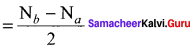
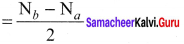
Bond orderSamacheer Kalvi 11th Chemistry Solutions Chapter 10 Chemical Bonding-14
The number of bonds formed between the two bonded atoms in a molecule is called bond order.

2. Hybridisation:
It is a process of mixing of atomic orbitais of the same atom with. comparable energy to form equal number of new equivalent orbitais with same energy. The resultant orbitais are called hybridised orbitais and they possess maximum symmetry and definite orientation in space so as to minimise the force of repulsion between their electrons.

3. σ – bond:
When two atomic orbitais overlap linearly along the axis, the resultant bond is called sigma (σ) bond.

Question 32.
What is a pi bond?
Answer:
Pi – bond:
When two atomic orbitals overlap sideways, the resultant covalent bond is called a pi (π) bond.

Question 33.
In CH4, NH3 and H2O, the central atom undergoes sp3 hybridisation-yet their bond angles are different, why?
Answer:
1. In CH4, NH3 and H2O the central atom undergoes sp3 hybridisation. But their bond angles are different due to the presence of lone pair of electrons.

2. It can be explained by VSEPR theory. According to this theory, even though the hybridisation is same, the repulsive force between the bond pairs and lone pairs arc not same.

3. Bond pair-Bond pair < Bond pair – Lone pair < Lone pair – Lone pair So due to the varying repulsive force the bond pairs and lone pairs are distorted from regular geometry and organise themselves in such a way that repulsion will be minimum and stability will be maximum.

4. In case of CH4, there are 4 bond pairs and no lone pair of electrons. So it remains in its regular geometry. i.e., tetrahedral with bond angle 109° 28’.

5. H2O has 2 bond pairs and 2 lone pairs. There is large repulsion between lp – lp. Again repulsion between lp – bp is more than that of 2 bond pairs. So 2 bonds are more restricted to form inverted V shape (or) bent shape molecule with a bond angle of 104° 35’.

6. NH3 has 3 bond pairs and 1 lone pair. There is repulsion between lp – bp. So 3 bonds are more restricted to form pyramidal shape with bond angle equal to 107° 18’.

Question 34.
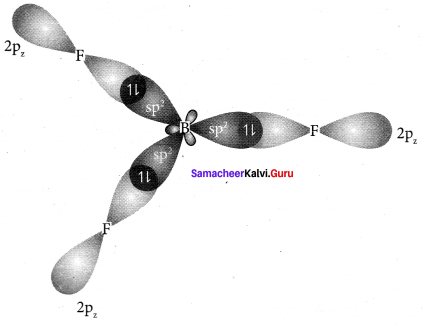
Explain sp2 hybridisation in BF3
Answer:
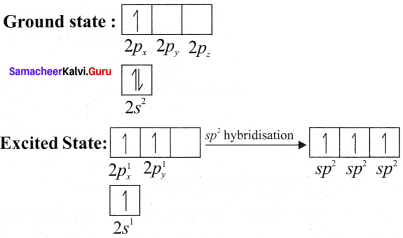
1. sp2 hybridisation in boron trifluoride – Boron atom – B. Electronic configuration [H2]2s22p2.
Samacheer Kalvi 11th Chemistry Solutions Chapter 10 Chemical Bonding-15

2. In boron, the s orbital and two p orbitals in the valence shell hybridises to generate three equivalent sp2 orbitais. These 3 orbitaIs lie in the same xy plane and the angle between any two orbitals is equal to 120°.

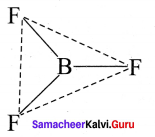
3. The 3 sp2 hybridised orbitais of boron now overlap with the 2pz orbitais of fluorine (3 atoms). This overlap takes place along the axis.
Samacheer Kalvi 11th Chemistry Solutions Chapter 10 Chemical Bonding-16
Samacheer Kalvi 11th Chemistry Solutions Chapter 10 Chemical Bonding-17

Question 35.
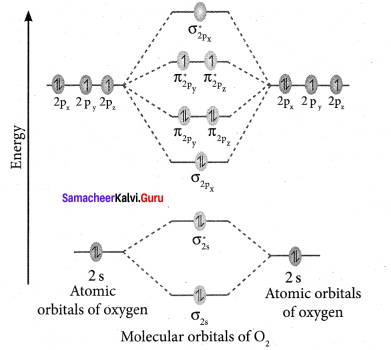
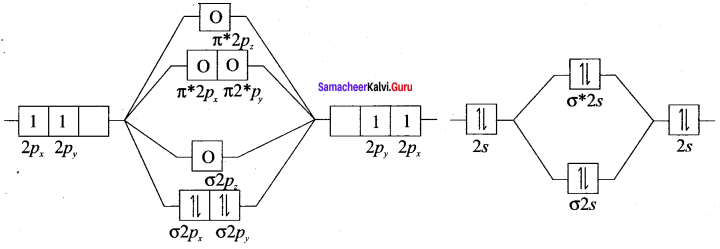
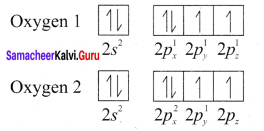
Draw the M.O diagram for oxygen molecule and calculate its bond order and show that O2 is paramagnetic.
Answer:
Samacheer Kalvi 11th Chemistry Solutions Chapter 10 Chemical Bonding-18

  1. Electronic configuration of O atom is is 1s2 2s2 2P4
  2. Electronic configuration of O, molecule is
    Samacheer Kalvi 11th Chemistry Solutions Chapter 10 Chemical Bonding-19
  3. Bond order = Samacheer Kalvi 11th Chemistry Solutions Chapter 10 Chemical Bonding-20
  4. Molecule has two unpaired electrons, hence it is paramagnetic.

Question 36.
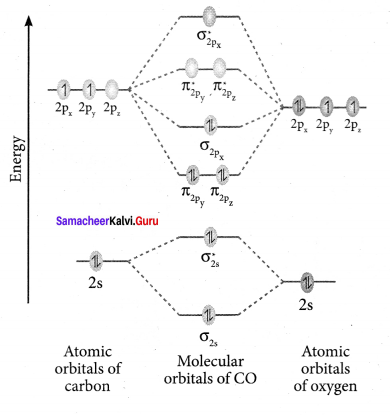
Draw MO diagram of CO and calculate its bond order.
Answer:
Samacheer Kalvi 11th Chemistry Solutions Chapter 10 Chemical Bonding-21

  1. Electronic configuration of C atom: 1s2 2s2 2p2
    Electronic configuration of O atom: 1s2 2s2 2p4
  2. Electronic configuration of CO molecule is: σ1s2 σ*1s2 σ2s2 σ*22 π2py2 π2pz2 σ2px2
  3. Bond order Samacheer Kalvi 11th Chemistry Solutions Chapter 10 Chemical Bonding-22
  4. Molecule has no unpaired electron, hence it is diamagnetic.

Question 37.
What do you understand by Linear combination of atomic orbitais in MO theory.
Answer:
Linear combination of atomic orbitais (LCAO):
1. The wave functions for the molecular orbitais can be obtained by solving Schrodinger wave equation for the molecule. Since solving Schrodinger wave equation is too complex, a most common method linear combination of atomic orbitais (LCAO) is used to obtain wave function for molecular orbitals.

2. Atomic orbitais are represented by wave functions ψ. Consider two atomic orbitals represented by the wave functions ψA and ψB with comparable energy that combines to form two molecular orbitals.

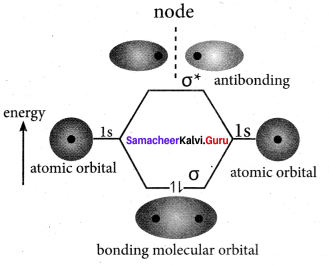
3. One is bonding molecular orbitai (ψ bonding) and the other is anti-bonding molecular orbital (ψ anti-bonding).

4. The wave function for molecular orbitais, ψA and ψB can be obtained by the LCAO as shown below:
ψbonding = ψA + ψB
ψanti-bonding = ψA – ψB

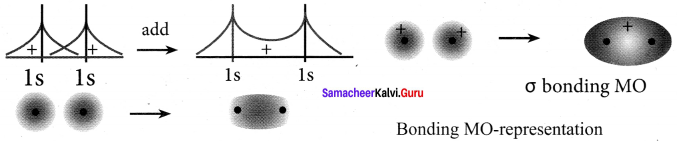
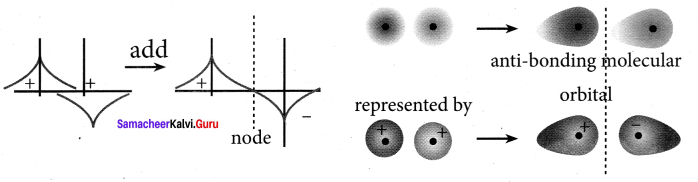
5. The formation of bonding molecular orbital can be considered as the result of constructive interference of the atomic orbitais and the formation of anti-bonding molecular orbital can be the result of the destructive interference of the atomic orbitais.

6. The formation of two molecular orbitals from two is orbitals is show below.

Constructive interaction:
The two is orbitals are in phase and have the same signs.
Samacheer Kalvi 11th Chemistry Solutions Chapter 10 Chemical Bonding-23

Destructive interaction:
The two is orbitals are out of phase and have opposite signs
Samacheer Kalvi 11th Chemistry Solutions Chapter 10 Chemical Bonding-24
Samacheer Kalvi 11th Chemistry Solutions Chapter 10 Chemical Bonding-25

Question 38.
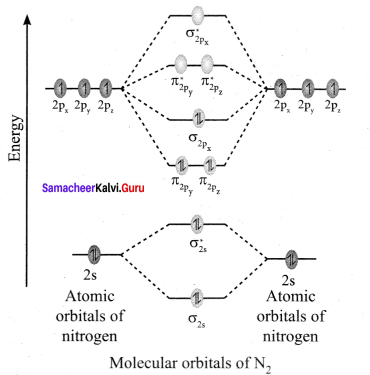
Discuss the formation of N2 molecule using MO Theory.
Answer:
Samacheer Kalvi 11th Chemistry Solutions Chapter 10 Chemical Bonding-26

  1. Electronic configuration of N atom 1s2 2s2 2p3.
  2. Electronic configuration of N, molecule is: σ1s2 σ*1s2 σ2s2 σ*22 π2py2 π2pz2 σ2px2
  3. Bond order Samacheer Kalvi 11th Chemistry Solutions Chapter 10 Chemical Bonding-27
  4. Molecule has no unpaired electrons hence, it is diamagnetic.

Question 39.
What is dipole moment?
Answer:
1. The polarity of a covalent bond can be measured in terms of dipole moment which is defined as: µ = q x 2d, where µ is the dipole moment, q is the charge, 2d is the distance between the two charges.

2. The dipole moment is a vector quantity and the direction of the dipole moment points from the negative charge to positive charge.

3. The unit of dipole moment is Coulomb metre (C m). It is usually expressed in Debye unit (D).

4. 1 Debye = 3.336 x 10⁻³⁰ Cm

Question 40.
Linear form of carbon dioxide molecule has two polar bonds. yet the molecule has zero dipole moment, why?
Answer:

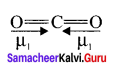
  1. The linear form of carbon dioxide has zero dipole moment, even though it has two polar bonds.
  2. In CO2, there are two polar bonds [C = O], which have dipole moments that are equal in magnitude but have opposite direction.
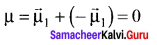
  3. Hence the net dipole moment of the CO2 is µ = µ1 + µ2 = µ1 +( – µ1) = 0
  4. Samacheer Kalvi 11th Chemistry Solutions Chapter 10 Chemical Bonding-28
  5. In this case Samacheer Kalvi 11th Chemistry Solutions Chapter 10 Chemical Bonding-187

Question 41.
Draw the Lewis structures for the following species.

  1. NO3
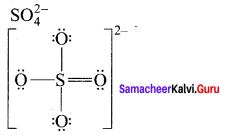
  2. SO42-
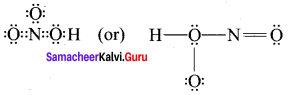
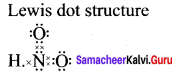
  3. HNO3
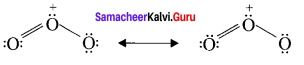
  4. O3

Answer:
1. NO3
Samacheer Kalvi 11th Chemistry Solutions Chapter 10 Chemical Bonding-29

2. SO42-
Samacheer Kalvi 11th Chemistry Solutions Chapter 10 Chemical Bonding-30

3. HNO3
Samacheer Kalvi 11th Chemistry Solutions Chapter 10 Chemical Bonding-31
4. O3
Samacheer Kalvi 11th Chemistry Solutions Chapter 10 Chemical Bonding-32

Question 42.
Explain the bond formation in BeCl2 and MgCl2. BeCl2 bond formation:
Answer:
1. Electronic confiuration of Be(Z = 4) is 1s2 2s2 and electronic configuration of Cl (Z = 17) is 1s2 2s2 2p6 3s2 3p5.

2. Beryllium has 2 electrons in its valence shell and chlorine atoms (2) have 7 electrons in their valence shell.

3. By losing two electrons, Beryllium attains the inert gas configuration of Helium and becomes a dipositive cation, Be2+ and each chlorine atom accepts one electron to become (Cl) uninegative anion and attains the stable electronic configuration of Argon.

4. Then Be2+ combine with 2Cl ions to form an ionic crystal in which they are held together by electrostatic attractive forces.

5. During the formation of 1 mole of BeCl2, the amount of energy released is – 468 kJ/mol. This favours the formation of BeCl, and its stabilisation.

MgCI2 bond formation:
1. Electronic configuration of Mg (z = 12) is 1s2 2s2 2p6 3s2.
Electronic configuration of Cl (z = 17) is 1s2 2p6 3p6 3p5

2. Magnesium has 2 electrons in its valence shell and chlorine has 7 electrons in its valence shell.

3. By losing two electrons, magnesium attains the inert gas configuration of Neon and becomes a dipositive cation (Mg2+) and two chlorine atoms accept these electrons to become two uninegative anions [2Cl] by attaining the stable inert gas configuration of Argon.

4. These ions, Mg2+ and 2Cl combine to form an ionic crystal in which they are held together by electrostatic attractive forces.

5. The energy released during the formation of 1 mole of MgCl2 is – 783 kJ/mole. This favours the formation of MgCI2 and its stabilisation.

Question 43.
Which bond is stronger or π? Why?
Answer:
1. Sigma bonds (σ) are stronger than Pi bonds (π). Because, sigma bonds are formed from bonding orbitals directly between the nuclei of the bonding atoms, resulting in greater overlap and a strong sigma bond (axial overlapping).

2. π bonds results from overlap of atomic orbitals that are in contact through two areas of overlap (lateral overlapping). Pi bonds are more diffused bonds than sigma bonds.

Question 44.
Define bond energy.
Answer:
Bond energy:
Bond energy (or) Bond enthalpy is defined as the minimum amount of energy required to break one mole of a bond in molecules in their gaseous state. The unit of bond energy is kJ mol-1

Question 45.
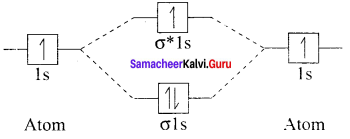
Hydrogen gas is diatomic whereas inert gases are monoatormic – explain on the basis of MO theory.
Answer:
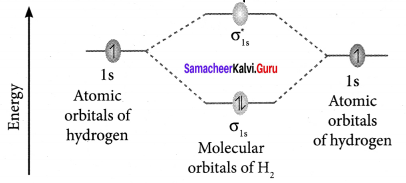
1. Hydrogen gas is diatomic. According to MO theory. which is based on quantum mechanics H2 molecule can be represented in terms of the following diagram called M.O. diagram.
Samacheer Kalvi 11th Chemistry Solutions Chapter 10 Chemical Bonding-33
H – H. i.e.. H2 molecule has two atoms which are connected by 1 σ bond. So it is diatomic.

2. But in the case of inert gases. the valence shell is fully filled i.e.. an octet (8 electrons) (or) duplet (2 electrons) in case of Helium, due to which they are in monoatomic state and remain stable. So they do not combine with any atom (neither of same or of different elements). Due to this they do no exist in diatomic state and always exist in mono – atomic state.

Question 46.
What is Polar Covalent bond? Explain with example.
Answer:
1. If a covalent bound is formed between atoms having different electronegativities. the atom with higher electronegativity will have greater tendency to attract the shared pair of electrons towards itself than the other atom. As a result, the cloud of shared electron pair gets distorted and polar covalent bond is formed.

2. Example – HF – Hydrogen fluoride:
The electronegativities of hydrogen and fluorine on Pauling’s scale are 2.1 and 4 respectively. It means that fluorine attract the shared pair of

electrons approximately twice as much as hydrogen which leads to partial negative charge on fluorine atom and partial positive charge on hydrogen atom. Hence, the H – F bond is said to be a polar covalent bond.

Question 47.
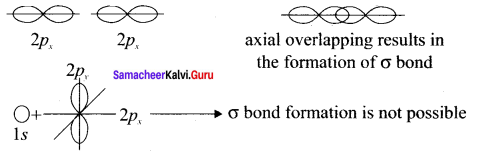
Considering x-axis as molecular axis, which out of the following will form a sigma bond.

  1. 1s and 2py
  2. 2px and 2px
  3. 2px and 2pz
  4. 1s and 2Pz

Answer:
Along X-axis as molecular axis, only 2p and 2p can form a sigma bond
Samacheer Kalvi 11th Chemistry Solutions Chapter 10 Chemical Bonding-34

Question 48
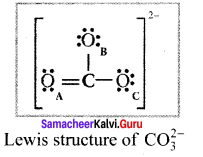
Explain resonance with reference to carbonate ion
Samacheer Kalvi 11th Chemistry Solutions Chapter 10 Chemical Bonding-35
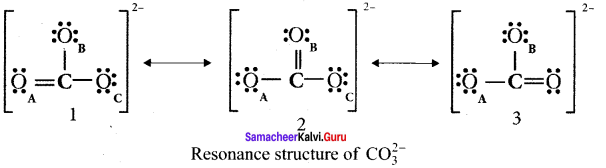
1. For the above structure, we can draw two additional lewis structures by moving the lone pairs from the other two oxygen atoms OB and OC. and thus creating three similar structures in which the relative positive of the atoms are same.
Samacheer Kalvi 11th Chemistry Solutions Chapter 10 Chemical Bonding-36

2. They only differ in the position of bonding and lone pair of electrons. Such structures are called resonance structures and this phenomenon is called resonance.

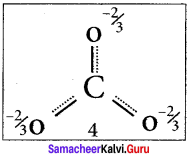
3. It is evident from the experimental results that all carbon-oxygen bonds in carbonate ion are equivalent. The actual structure of the molecule is said to be a resonance hybrid, an average of these 3 resonance forms. The following structure gives a qualitative idea about the correct structure of CO32- (carbonate) ion.
Samacheer Kalvi 11th Chemistry Solutions Chapter 10 Chemical Bonding-37

Question 49.
Explain the bond formation in ethylene and acetylene.
Answer:
Bonding in Ethylene, C2H4
1. Bonding in ethylene can he explained by hybridisation concept.

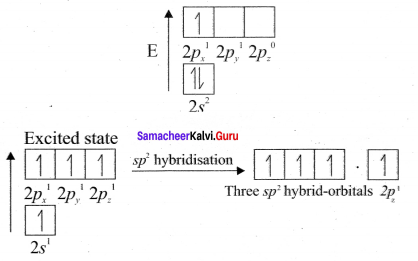
2. The valency of carbon is 4. The electronic configuration of carbon is 1s2 2s2 2px1 2py1 2pz0. One electron from 2s orbital is promoted to 2pz. orbital in the excited state to satisfy the valency of carbon.
Samacheer Kalvi 11th Chemistry Solutions Chapter 10 Chemical Bonding-38

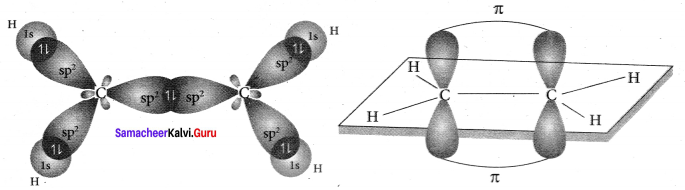
3. In ethylene both the carbon atoms undergo sp2 hybridisation involving 2s, 2px and spy orbitals resulting in 3 equivalent sp2 hybridised orbitals lying in the XY plane at an angle of 1200 to each other. The unhybridised 2pz orbital lies perpendicular to the xy plane.
Samacheer Kalvi 11th Chemistry Solutions Chapter 10 Chemical Bonding-39

4. One of the sp2 hybndised orbitals of each carbon atoms lying along the X – axis linearly overlaps with each other resulting in the formation of C – C sigma bond. The other two sp2 hybridised orbitals of both carbon atom linearly overlap with the four is orbitals of four hydrogen atoms leading to the formation of two C – H sigma bonds on each carbon atom.

5. The unhybridised 2pz orbital of both carbon atoms can overlap only sideways as they are not in the molecular axis. This lateral overlap results in the formation of a pi bond between the two carbon atoms.

Bonding in acetylene (C2H2):
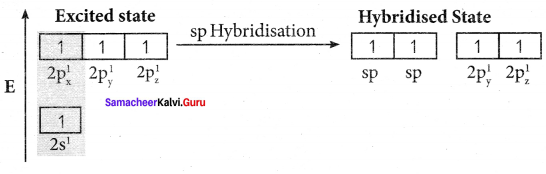
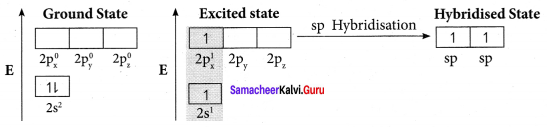
1. The electronic configuration of valence shell of carbon atom in the ground state is [He] 2s2 2px1 2pz0. One electron from 2s orbital is promoted to 2pz orbital in the excited state to satisfy the valency of carbon.

2. In acetylene molecule, both the carbon atoms are in sp hybridised state. The 2s and 2px orbitals resulting in two equivalent sp hybridised orbitals are formed lying in a straight line along the X – axis. The unhybridised 2py, and 2pz orbitais lie perpendicular to the X-axis.
Samacheer Kalvi 11th Chemistry Solutions Chapter 10 Chemical Bonding-41
Samacheer Kalvi 11th Chemistry Solutions Chapter 10 Chemical Bonding-42
Samacheer Kalvi 11th Chemistry Solutions Chapter 10 Chemical Bonding-43

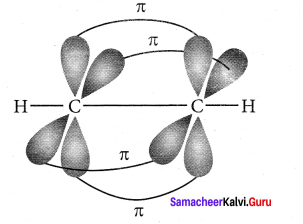
3. One of the two sp hybridised orbitals of each carbon atom linearly overlaps with each other resulting in the formation of a C – C sigma bond. The other sp hybridised orbital of both carbon atoms linearly overlap with the two is orbitals of two hydrogen atoms leading to the formation of one C – H sigma bond on each carbon atom.

4. The unhybridised 2py and 2pz orbitals of each carbon atom overlap sideways. This lateral overlap results in the formation of two pi bonds. (py – py) and (pz – pz) between the two carbon atoms.

Question 50.
What type of hybridisations are possible ¡n the following geometeries?

  1. octahedral
  2. tetrahedral
  3. square planar.

Answer:

  1. Octahedral geometry is possible by sp3d2 (or) d2sp3 hybridisation.
  2. Tetrahedral geometry is possible by sp3 hybridisation.
  3. Square planar geometry is possible by dsp2 hybridisation.

Question 51.
Explain VSEPR theory. Applying this theory to predict the shapes of F7 and SF6.
Answer:
VSEPR theory:
1. The shape of the molecules depend on the number of valence shell electron pair around the central atom.

2. There are two types of electron pairs namely, bond pairs and lone pairs.

3. Each pair of valence electrons around the central atom repel each other and hence they are located as far away as possible in three dimensional space to minimise the repulsion between them.

4. The repulsive interaction between the different types of electron pairs is in the following
order:
Samacheer Kalvi 11th Chemistry Solutions Chapter 10 Chemical Bonding-44

5. The lone pair of electrons are localised only on the central atom and interact with only one nucleus whereas the bond pairs are shared between two atoms and they interact with two nuclei. Because of this, the lone pairs occupy more space and have greater repulsive power than the bond pairs in a molecule.

IF7:
It is an AB7 type molecule. This molecule has 7 bond pair of electrons and no lone pair of electrons. Due to bond pair-bond pair interaction of electrons, IF7 has pentagonal bipyramidal shape.
Samacheer Kalvi 11th Chemistry Solutions Chapter 10 Chemical Bonding-45

SF6:
It is an AB6 type molecule. This molecule has 6 bond pairs of electrons and no lone pair of electrons. Due to bond pair-bond pair interaction of electrons, SF6 has octahedral shape.
Samacheer Kalvi 11th Chemistry Solutions Chapter 10 Chemical Bonding-46

Question 52.
CO2 and H2O both are triatomic molecules but their dipole moment values are different. Why?
Answer:
1. Linear form of carbon dioxide has zero dipole moment. In CO2 the dipole moment of two polar bonds are equal in magiitude but have opposite direction. Hence, the net dipole moment of the CO2 molecule is
µ = µ1 + µ2
µ = µ1 + (- µ1) = 0
Samacheer Kalvi 11th Chemistry Solutions Chapter 10 Chemical Bonding-47
In this caseSamacheer Kalvi 11th Chemistry Solutions Chapter 10 Chemical Bonding-48

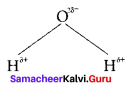
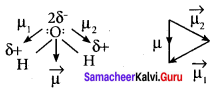
2. But in the case of water, net dipole moment is the vector sum µ1 + µ2 as follows:
Samacheer Kalvi 11th Chemistry Solutions Chapter 10 Chemical Bonding-49
Dipole moment in water is found to be 1.85 D.

3. CO2 and H2O both are triatomic molecules but their dipole moment values are zero and 1.85 D respectively.

Question 53.
Which one of the following has highest bond order? N2, N2+ or N2 ?
Answer:
N2 (14 electrons)
Bond order = 3, Samacheer Kalvi 11th Chemistry Solutions Chapter 10 Chemical Bonding-50
N2+ (13 electrons)
Bond order = 2.5, Samacheer Kalvi 11th Chemistry Solutions Chapter 10 Chemical Bonding-51
N2(15 electrons)

Samacheer Kalvi 11th Chemistry Solutions Chapter 10 Chemical Bonding-52
So N2 has the highest bond order.

Question 54.
Explain the covalent character in ionic bond.
Answer:
1. Ionic compounds like lithium chloride shows covalent character and it is soluble in organic solvents such as ethanol.

2. The partial covalent character in ionic compounds can be explained on the basis of a phenomenon called polarisation.

3. In an ionic compound, there is an electrostatic attractive force between the cation and anion. The positively charged cation attract the valence electrons of anion while repelling the nucleus.

This cause a distortion in the electron cloud of the anion and its electron density drills towards the cation, which results in some sharing of valence electrons between these ions. Thus, a partial covalent character is developed between them. This phenomenon is called polarisation.

4. Thus due to polarisation, ionic compounds shows covalent character.

Question 55.
Describe Fajan’s rule.
Answer:
1. The ability of a cation to polarise an anion is called its polarising ability and the tendency of an anion to get polarised is called its polarisibility. The extent of polarisation in an ionic compound is given by the Fajans rule.

2. To show greater covalent character, both the cation and anion should have high charge on them. Higher the positive charge on the Cation greater will be the attraction on the electron cloud of the anion.

Similarly higher the magnitude of negative charge on anion, greater is its polansability. For example, Na+ < Mg2+ < Al3+, the covalent character also follows the order – NaCI < MgCl2 < AICI3

3. The smaller cation and larger anion show greater covalent character due to the greater extent of polarisation. e.g., LiCl is more covalent than NaCI.

4. Cation having ns2np6nd10 configuration shows greater polarising power than the cations with ns2np6 configuration. e.g., CuCI is more covalent than NaCl.

Samacheer Kalvi 11th Chemistry Chemical Bonding In Text Questions Evaluate yourself

Question 1.
Draw the lewis structures for

  1. Nitrous acid (HNO2)
  2. Phosphoric acid
  3. Sulphur troxide (SO3)

Answer:
1. Nitrous acid (HNO2)
Samacheer Kalvi 11th Chemistry Solutions Chapter 10 Chemical Bonding-53

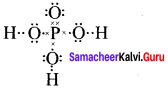
2. Phosphoric acid
Samacheer Kalvi 11th Chemistry Solutions Chapter 10 Chemical Bonding-54

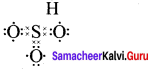
3. Sulphur troxide (SO3)
Samacheer Kalvi 11th Chemistry Solutions Chapter 10 Chemical Bonding-55

Question 2.
Calculate the formal charge on each atom of carbonyl chloride (COCl2)
Answer:
Formal charge  Samacheer Kalvi 11th Chemistry Solutions Chapter 10 Chemical Bonding-188
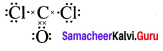
Carbonyl chloride COCl2
Samacheer Kalvi 11th Chemistry Solutions Chapter 10 Chemical Bonding-56
Formal charge on carbon atom = 4 – \(\left[ 0+\frac { 8 }{ 2 } \right]\) = 4 – 4 = 0
Formal charge on chlorine atom = 7 – \(\left[ 6+\frac { 2 }{ 2 } \right]\) = 7 – 7 = 0
Formal charge on oxygen atom = 6 – \(\left[ 4+\frac { 4 }{ 2 } \right]\) = 6 – 6 = 0

Question 3.
Explain the ionic bond formation in MgO and CaF2
Magnesium oxide (MgO):
Answer:
Electronic configuration of Mg – 1s2 2s2 2p5 3s2
Electronic configuration of O – 1s2 2s2 2p6 3s6 3p4.
1. Magnesium has two electrons in its valence shell and oxygen has six electrons in its valence shell.

2. By losing two electrons, Mg acquires the inert gas configuration of Neon and becomes a dipositive cation Mg2+
Mg → Mg2+ + 2e

3. Oxygen accepts the two electrons to become a dinegative oxide anion, O2- thereby attaining the inert gas configuration of Neon.
O + 2e → O2-

4. These two ions, Mg2+ and O2- combine to form an ionic crystal in which they are held together by electrostatic attractive forces.

5. During the formation of magnesium oxide crystal 601.6 kJ mol-1 energy is released . This favours the formation of magnesium oxide (MgO) and its stabilisation.

CaF2, Calcium fluoride
1.  Calcium, Ca: [Ar] 4s2, Fluorine F: [He] 2s2 2p5

2. Calcium has two electrons in its valence shell and fluorine has seven electrons in its valence shell.

3. By losing two electrons, calcium attains the inert gas configuration ofArgon and becomes a dipositive cation, Ca2+.

4. Two fluorine atoms, each one accepts one electron to become two unincgative fluoride ions (F) thereby attaining the stable configuration of Neon.

5. These three ions combine to form an ionic crystal in which they are held together by electrostatic attractive force.

6. During the formation of calcium fluoride crystal 1225.91 kJ mol-1 of energy is released. This favours the formation of calcium fluoride, CaF2 and its stabilisation.

Question 4.
Write the resonance structures for

  1. Ozone molecule
  2. N2O

Answer:
1. Ozone molecule, O3
Samacheer Kalvi 11th Chemistry Solutions Chapter 10 Chemical Bonding-57

2. Nitrous oxide, N2O
Samacheer Kalvi 11th Chemistry Solutions Chapter 10 Chemical Bonding-58

Question 5.
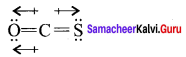
Of the two molecules OCS and CS2 which one has higher dipole moment value? Why?
Answer:
OCS and CS2
Samacheer Kalvi 11th Chemistry Solutions Chapter 10 Chemical Bonding-59

The dipole moment µOCS = 0.7 149 ± 0.0003 Debye.
CS2:
S = C = S
In CS2, the bond dipoles of 2C = S have same values and bond dipoles cancel each other so dipole moment of CS2 is zero. Among OCS and CS2, OCS has a higher dipole moment because in OCS oxygen is more electronegative than sulphur and C = S and C = O bonds in OCS molecules do not cancel each other.

On the other hand CS2, due to linear structure, the bond dipole of two C = S bonds cancel each other. On the other hand, CS2 due to linear structure, the bond dipoles of two C = S bonds cancel each other and thc recultant dipo’c moment value is zero. So OCS has a higher dipole moment than CS2.

Question 6.
Arrange the following in the decreasing order of Bond angle

  1. CH4, H2O, NH3
  2. C2H2, BF3, CCl4

Answer:
1. CH4, H2O, NH3:
NH3 = 107°, Water= 104.5°, CH4 = 109.5°
Decreasing order of bond angle: H2O < NH3 < CH4

2. C2H2, BF3, CCl4:
C2H2 = 1800, BF3 = 120°, CCl4 = 109.5°
Decreasing order of bond angle: CCl4 < BF3 < C2H2

Question 7.
Bond angle in PH4+ is higher than in PH3. Why?
Answer:
Phosphorous in both PH3 and PH4+ is sp3 hybridised. Due to the absence of lone pair – bond pair repulsion and presence of four identical bond pair – bond pair interactions, PH4+ assumes tetrahedral geometry with a bond angle of 109° 28’.

But PH3 has three bond pairs and one lone pair around P. Due to greater lone pair-bond pair repulsion than bond pair-bond pair repulsion, the tetrahedral angle decreases from 109° 28’ to 93.6°. As a result PH3 is pyramidal.
PH3 – Pyramidal with bond angle of 93.6°. PH4+ Tetrahedral with bond angle of 109° 28’.

Question 8.
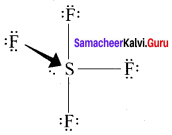
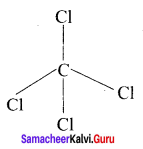
Explain the bond formation in SF4 and CCl4 using hybridisation concept.
Answer:
In SF4, the central atom is sp3d hybridised.
1. The molecule SF3 will have a total 34 valence electron 6 form sulphur, 7 each from four fluorine atoms.

2. Sulphur atom will from 4 single bonds with fluorine atoms. These bonds account for the 8 electrons out of the 34 valence electrons. Each fluorine atom will have 3 lone pair of electrons in order to have a complete octet structure.

These lone pairs will use up 24 valence electrons. So the total used valence electrons, are 32. The remaining 2 electrons will be placed on the sulphur atom as a lone pair. Sulphur atom gets a total of 10 electrons 8 from the bonds and 2 as lone pair.

3. This is quite Sulphur atom gets a total of 10 electrons 8 from the bonds and 2 as lone pair. This is quite possible for sulphur because it has easy access to its 3d orbital which means that it can expand its octet and accommodate more than 8 electrons.

4. Sulphur forms 4 single bonds and has 1 lone pair which means that its steric number is equal to 5. In this case sulphur will use five hybrid orbitais, such as one 3s orbital three 3p orbitais and one 3d orbital. So the central atom is sp3d hybridised.
Samacheer Kalvi 11th Chemistry Solutions Chapter 10 Chemical Bonding-60

CCl4:
1. It is not necessary to invoke hybridisation especially in CCl4. It must be invoked for all tetrahedral bonds of carbon and other atoms.

2. The electronic configuration of an isolated carbon atom in its ground state is 1s2 s2 2p2.

3. CCl4 is a tetrahedral molecule comprising of four single bonds known as a bonds between the carbon atom and the chlorine atoms. In this type of bonding, the 2s orbital and three 2p orbitals of carbon atoms are mixed to produce four identical orbitals, a process known as sp3 hybridisation.
Samacheer Kalvi 11th Chemistry Solutions Chapter 10 Chemical Bonding-61

Question 9.
The observed bond length of N2+ is larger than N2 while the bond length in NO+ is less than in NO. Why?
Answer:
(a)
(1) By molecular orbital theory, the bond order of both N2+ is 2.5 whereas N2 is 3.

2. N2 has 5e in the antibonding molecular orbital whereas N2+ has 4e in the antibonding molecular orbital. So N2+ will make a stronger and shorter bond length.

3. More the bond order and bond strength, and lesser will be the bond length.

4. So we can easily conclude N2 has more bond length than N2
Bond order in Samacheer Kalvi 11th Chemistry Solutions Chapter 10 Chemical Bonding-62
Bond order inSamacheer Kalvi 11th Chemistry Solutions Chapter 10 Chemical Bonding-63
So, N2 is more stable than N2+. But bond length N2+ is greater than N2.

(b) NO+ & NO
Bond order of NO = 2.5
Bond order of NO+ = 3
Due to lesser bond order in NO, the bond length is greater than NO+ So, NO+ bond length is shorter than NO bond length.

Question 10.
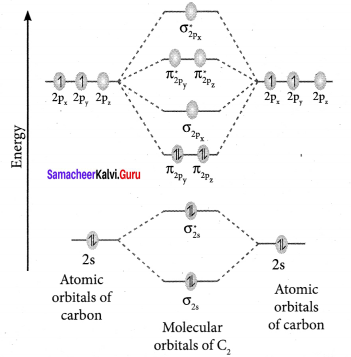
Draw the MO diagram for acetylide ion C22- and calculate its bond order.
Answer:
Acetylide ion, C22- in acetylene
Samacheer Kalvi 11th Chemistry Solutions Chapter 10 Chemical Bonding-64
Electronic configuration of C2 ion is:
σ1s2 σ*1s2 σ1s2 π2px2 π2py2
Samacheer Kalvi 11th Chemistry Solutions Chapter 10 Chemical Bonding-65
Bond order
Samacheer Kalvi 11th Chemistry Solutions Chapter 10 Chemical Bonding-66

Samacheer Kalvi 11th Chemistry Chemical Bonding Additional Questions Solved

Samacheer Kalvi 11th Chemistry Chemical Bonding 1 Mark Questions and Answer:

I. Choose the correct answer.

Question 1.
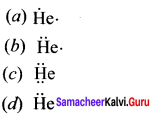
Which is the correct Lewis structure of Helium?
Samacheer Kalvi 11th Chemistry Solutions Chapter 10 Chemical Bonding-67
Answer:
Samacheer Kalvi 11th Chemistry Solutions Chapter 10 Chemical Bonding-68
Solution:
Helium has only two electrons in its valence shell which is represented as a pair of dots (duplet).

Question 2.
Which one of the following form only covalent bonds?
(a) Alkali metals
(b) Metals
(c) Non metals
(d) Metalloids
Answer:
(c) Non metals

Question 3.
In which one of the following molecule triple bond is present?
(a) O2
(b) H2
(c) CO2
(d) N2
Answer:
(d) N2
Solution:
N ≡ N

Question 4.
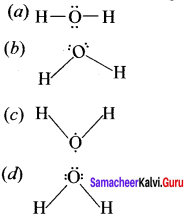
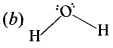
Which of the following is the lewis structure of water?
Samacheer Kalvi 11th Chemistry Solutions Chapter 10 Chemical Bonding-69
Answer:
Samacheer Kalvi 11th Chemistry Solutions Chapter 10 Chemical Bonding-70

Question 5.
Which one of the following element forms only one bond?
(a) Carbon
(b) Oxygen
(c) Fluorine
(d) Nitrogen
Answer:
(c) Fluorine

Question 6.
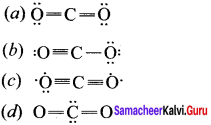
Which one is the preferred structure of CO2?
Samacheer Kalvi 11th Chemistry Solutions Chapter 10 Chemical Bonding-71
Answer:
Samacheer Kalvi 11th Chemistry Solutions Chapter 10 Chemical Bonding-189

Question 7.
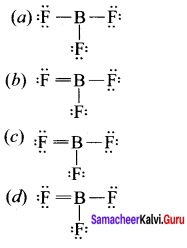
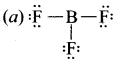
Which is the correct lewis structure of BF3?
Samacheer Kalvi 11th Chemistry Solutions Chapter 10 Chemical Bonding-72
Answer:
Samacheer Kalvi 11th Chemistry Solutions Chapter 10 Chemical Bonding-73

Question 8.
Statement I: In sulphur hexafluoride, the central atom has more than eight valence electrons.
Statement II: The central atom can accommodate additional electron pairs by using outer vacant d orbitals.
(a) Statements I and II are correct and statement II is the correct explanation of statement I.
(b) Statements I and II are correct but statement II is not the correct explanation of statement I.
(c) Statement I is correct but statement II is wrong.
(d) Statement I is wrong but statement II is correct.
Answer:
(a) Statements I and II are correct and statement II is the correct explanation of statement I.

Question 9.
Which one of the following molecule has complete octet?
(a) BF3
(b) BeCl2
(c) BCl3
(d) CCI4
Answer:
(d) CCI4

Question 10.
Which one of the following does not have electrovalent bond?
(a) KCI
(b) NaI
(c) MgO
(d) CCI4
Answer:
(d) CCI4

Question 11.
Which one of the following has an ionic bond?
(a) CO2
(b) CH4
(c) CaF2
(d) BeCI2
Answer:
(c) CaF2

Question 12.
During the formation of 1 mole of KCI crystal, the amount of energy released is ………….
(a) 418.81 kJ
(b) 348.56 kJ
(c) 718 kJ
(d) 70.25 kJ
Answer:
(c) 718 kJ

Question 13.
Which one of the following has coordinate covalent bond?
(a) CaF2
(b) MgO
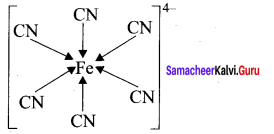
(c) [Fe(CN)6]4-
(d) KCI
Answer:
(c) [Fe(CN)6]4-

Question 14.
The distance between the nuclei of the two covalently bonded atoms is called …………….
(a) bond order
(b) bond length
(c) bond angle
(d) bond enthalpy
Answer:
(b) bond length

Question 15.
The length of a bond can be determined by ……………
(a) spectroscopic method
(b) x – ray diffraction method
(c) electron-diffraction method
(d) all the above
Answer:
(d) all the above

Question 16.
The value of carbon-carbon single bond length is ………..
(a) 1.43A
(b) 1.54Å
(c) 1.33A
(d) 1.20A
Answer:
(b) 1.54Å

Question 17.
The value of carbon – carbon double bond length is …………..
(a) 1.43Å
(b) 1.20Å
(c) 1.54A
(d) 1.33A
Answer:
(d) l.33A

Question 18.
The value of carbon – carbon triple bond length is ……………..
(a) 1.33A
(b) l.20Å
(C) 1.54A
(d) 1.43A
Answer:
(b) 1.20Å

Question 19.
Among the following which one has bond order as 3?
(a) N2
(b) O2
(c) HCHO
(d) CH4
Answer:
(a) N2

Question 20.
Which one of the flowing has bond order as 2?
(a) N2
(b) C2 – H4
(c) CH4
(d) HCN
Answer:
(b) C2H4

Question 21.
Identify the molecule with bond order 1.
(a) N2
(b) O2
(c) H2
(d) C2H4
Answer:
(c) H2

Question 22.
Which one of the following has zero dipole moment?
(a) HF
(b) H2
(c) CO
(d) NO
Answer:
(b) H2

Question 23.
Which one of the following is called polar molecule?
(a) H3
(b) O2
(c) F2
(d) NO
Answer:
(d) NO

Question 24.
Statement I: CuCl is more covalent than NaCI.
Statement II: As compared to Na+. Cu+ is small and have 3s2 3p6 3d10 configuration and show greater polarisation.
(a) Statement I & II are correct and II is the correct explanation of I
(b) Statement I & II are correct but II is not the correct explanation of I
(c) Statement I & II are correct but II is wrong
(d) Statement I & II are wrong and II is the correct.
Answer:
(a) Statement I & II are correct and II is the correct explanation of I

Question 25.
Which of the following has see saw shape?
(a) PCl5
(b) IO2F2
(c) SOF4
(d) ClO33
Answer:
(b) IO2F2

Question 26.
Which one of the following has trigonal bipyramidal shape?
(a) SF6
(b) IF4+
(c) AsF5
(d) SF4
Answer:
(c) AsF5

Question 27.
Which one of the following does not have tetrahedral shape?
(a) NH4+
(b) ClO4
(c) HCHO
(d) CH4
Answer:
(c) HCHO

Question 28.
Which one of the following has linear shape?
(a) O3
(b) CO32-
(c) NO3
(d) BCl3
Answer:
(a) O3

Question 29.
Which of the following has linear shape?
(a) PCI5
(b) SnBr2
(c) BeCl2
(d) CCl2F2
Answer:
(c) BeCl2

Question 30.
Which one of the following has tetrahedral shape?
(a) HCHO
(b) BeCl2
(c) PbCl2
(d) CF2Cl2
Answer:
(d) CF2CI2

Question 31.
Which one of the following pair has T – shapcd structure?
(a) BrF3, CIF3
(b) SF4, IF4+
(c) PCl5, AsF5
(d) NH3, PF3
Answer:
(a) BrF3, CIF3

Question 32.
Which one of the following has pentagonal bipyramidal shape?
(a) XeF4
(b) XeOF4
(c) IF7
(d) IOF5
Answer:
(c) IF7

Question 33.
Which one of the following has linear shape?
(a) I3
(b) ICI4
(c) BrF5
(d) IOF5
Answer:
(a) I3

Question 34.
Which one of the following is the correct increasing order of bond angle?
(a) H2O < CH4 < BF3 < BeCI2
(b) BeCI2 < BF3 < CH4 < H2O
(c) BF3 < CH4 < BeCI2 < H2O
(d) CH4 < BeCI2 < H2O < BF3
Answer:
(a) H2O < CH4 < BF3 < BeCI2

Question 35.
Which one of the following hybridisation takes place in the formation of BeCI2?
(a) sp2
(b) sp
(c) sp3
(d) dsp2
Answer:
(b) sp

Question 36.
Which hybridisation is possible in BF3?
(a) sp2
(b) sp
(c) sp3
(d) sp3d
Answer:
(a) sp2

Question 37.
Which one of the following has bond order as 2.5?
(a) O2
(b) NO
(c) CO
(d) H2
Answer:
(b) NO

Question 38.
Which one of the following is an electron deficient compound?
(a) Al2Cl6
(b) AlBr3
(c) SF6
(d) BF3
Answer:
(d) BF3

Question 39.
Apply the VSEPR model to XeF4, which of the following molecular shape is consistent with the model?
(a) Square planar
(b) Tetrahedral
(c) Square pyramidal
(d) Octahedral
Answer:
(a) Square planar

Question 40.
On the basis of molecular orbital theory, select the most appropriate option.
(a) The bond order of O2 is 2.5 and it is paramagnetic
(b) The bond order of O2 is 1.5 and it is paramagnetic
(c) The bond order of O2 is 2 and it is diamagnetic
(d) The bond order of O2 is 2 and it is paramagnetic
Answer:
(d) The bond order of O2 is 2 and it is paramagnetic

Question 41.
Which of the following molecule does not exist due to its zero bond order?
(a) H2
(b) He2+
(c) He2
(d) H2+
Answer:
(c) He2

Question 42.
Which of the following molecules have bond order equal to 1?
(a) NO, HF, HCl, Li2, CO
(b) H2, Li2, HF, Br2, HCI
(c) Li2, B2, CO, NO, He2+
(d) B2, CO, He2+, NO, HF
Answer:
(b) H2, Li2, HF, Br2, HCI
Solution:
Bond order of He2+ = 0.5
Bond order of NO = 2.5
Bond order of CO = 3

Question 43.
Arrange the following molecules in decreasing order of bond length.
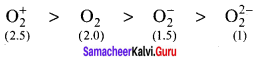
(a) O2 >O2 > O2+ > O22-
(b) O22- > O2 > O2 > O2
(c) O22- > O2 > O2+ > O2
(d) O2+ > O2+ > O22- > O2
Answer:
(b) O22- > O2 > O2 > O2
Solution: Since the bond length is inversely proportional to the bond order so option ‘b’ is correct.

Question 44.
Among the following which shows the maximum covalent character?
(a) MgCI2
(b) FeCI2
(c) SnCI2
(d) AICI3
Answer:
(d) AICI3

Question 45.
Which of the following has maximum number of lone pairs associated with Xe?
(a) XeF2
(b) XeO3
(c) XeF4
(d) XeF6
Answer:
(a) XeF2

Question 46.
During the formation of a chemical bond …………………
(a) energy decreases
(b) energy increases
(c) energy remains zero
(d) energy remains constant
Answer:
(a) energy decreases

Question 47.
Using MO theory, predict which of the following species has the shortest bond length?
(a) O2+
(b) O2
(c) C22-
(d) O22+
Answer:
(d) O22+

Question 48.
Identify the incorrect statement regarding the molecule XeO4.
(a) XeO4 molecule is tetrahedral
(b) XeO4 molecule is square planar
(c) There are four pπ – dπ bonds
(d) There are four sp3 – p, s bonds
Answer:
(b) XeO4 molecule is square planar

Question 49.
Which of the following contains maximum number of lone pairs on the central atom?
(a) ClO3
(b) XeF4
(c) SF4
(d) I3
Answer:
(d) I3

Question 50.
Which one of the following is a correct set?
(a) H2O, sp3, bent
(b) H2O, sp2, linear
(c) NH4+, dsp2, square planar
(d) CH4+, dsp2 tetrahedal
Answwer:
(a) H2O, sp3, bent

II. Match the following

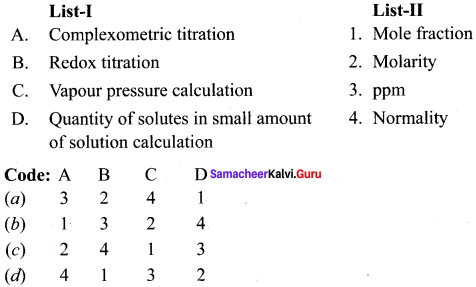
Question 1.
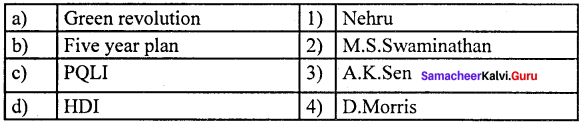
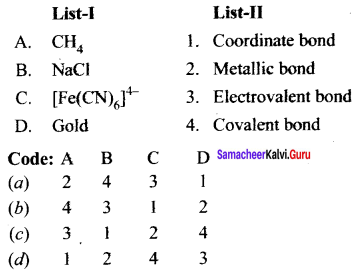
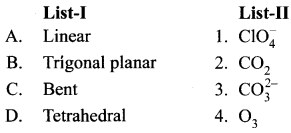
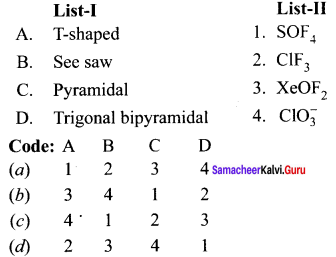
Samacheer Kalvi 11th Chemistry Solutions Chapter 10 Chemical Bonding-76
Answer:
(b) 4 3 1 2

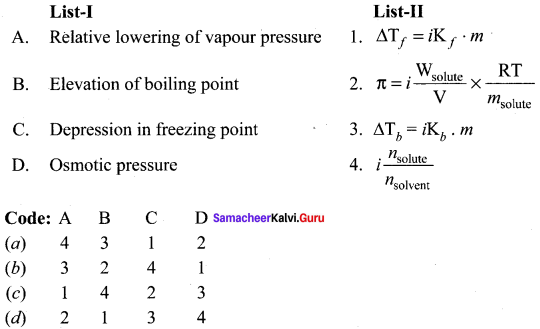
Question 2.
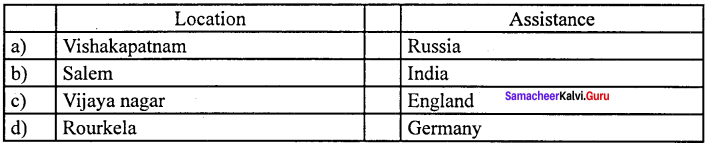
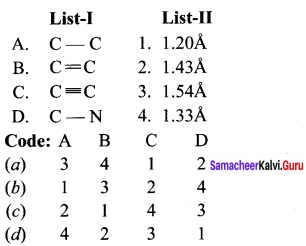
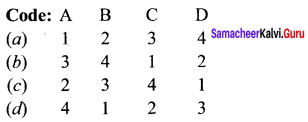
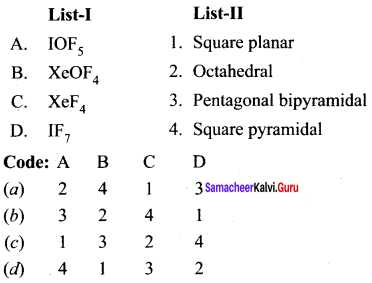
Samacheer Kalvi 11th Chemistry Solutions Chapter 10 Chemical Bonding-77
Answer:
(a) 3 4 1 2

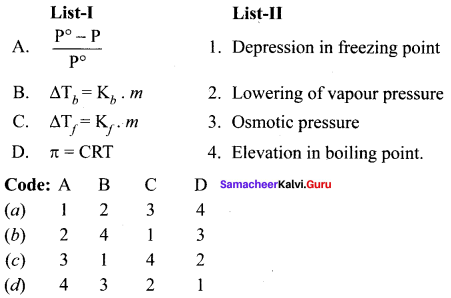
Question 3.
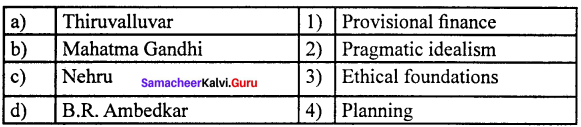
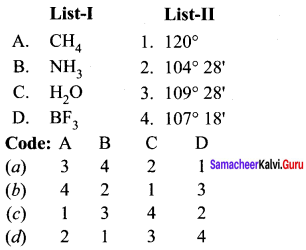
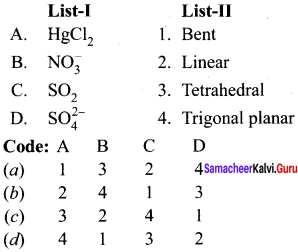
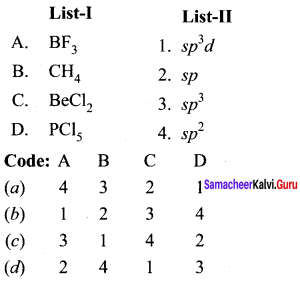
Samacheer Kalvi 11th Chemistry Solutions Chapter 10 Chemical Bonding-78
Answer:
(a) 3 4 2 1

Question 4.
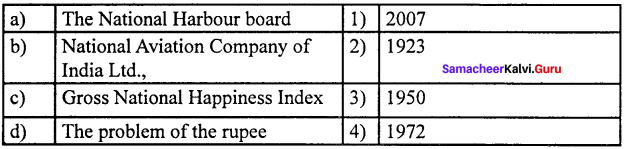
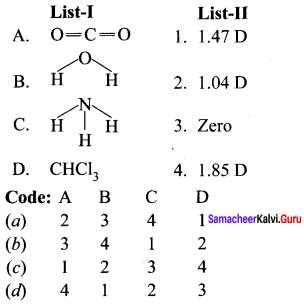
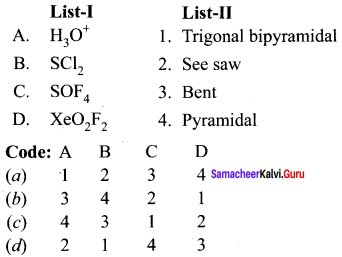
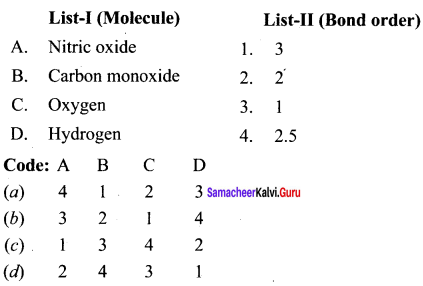
Samacheer Kalvi 11th Chemistry Solutions Chapter 10 Chemical Bonding-79
Answer:
(b) 3 4 1 2

Question 5.
Samacheer Kalvi 11th Chemistry Solutions Chapter 10 Chemical Bonding-80
Samacheer Kalvi 11th Chemistry Solutions Chapter 10 Chemical Bonding-80.1
Answer:
(c) 2 3 4 1

Question 6.
Samacheer Kalvi 11th Chemistry Solutions Chapter 10 Chemical Bonding-81
Answer:
(b) 2 4 1 3

Question 7.
Samacheer Kalvi 11th Chemistry Solutions Chapter 10 Chemical Bonding-82
Answer:
(c) 4 3 1 2

Question 8.
Samacheer Kalvi 11th Chemistry Solutions Chapter 10 Chemical Bonding-83
Answer:
(d) 2 3 4 1

Question 9.
Samacheer Kalvi 11th Chemistry Solutions Chapter 10 Chemical Bonding-84
Answer:
(a) 2 4 1 3

Question 10.
Samacheer Kalvi 11th Chemistry Solutions Chapter 10 Chemical Bonding-85
Answer:
(a) 4 3 2 1

Question 11.
Samacheer Kalvi 11th Chemistry Solutions Chapter 10 Chemical Bonding-86
Answer:
(a) 4 1 2 3

III. Fill in the blanks.

Question 1.
The electrovalent bond is present in ………..
Answer:
NaCI
Solution:
Na+ cation and Cl anion are held together by electrostatic attractive forces and this is called electrovalent bond.

Question 2.
The structure (or) shape of water molecule is …………
Answer:
inverted ‘V’ shape
Solution:
Samacheer Kalvi 11th Chemistry Solutions Chapter 10 Chemical Bonding-87

Question 3.
The structure of CO2 is ………..
Answer:
linear
Solution:
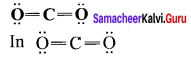
Samacheer Kalvi 11th Chemistry Solutions Chapter 10 Chemical Bonding-88

Question 4.
In the formation of a chemical bond between Na and C[, they attain the stable configuration of …………….
Answer:
Ne, Ar
Solution:
Na+: 1s2 2s2 2p6 = [Ne]
Cl: 1s2 2s2 3s2 3p6 = [Ar]

Question 5.
The mutual sharing of one or more pair of electrons between the two combining atoms results in the formation of …………..
Answer:
Covalent bond

Question 6.
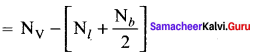
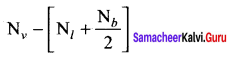
Formal charge of an atom can be calculated by the formula ………….
Answer:
Samacheer Kalvi 11th Chemistry Solutions Chapter 10 Chemical Bonding-89

Question 7.
The formal charge on the carbon atom in the following structure
Samacheer Kalvi 11th Chemistry Solutions Chapter 10 Chemical Bonding-90 is …………………
Answer:
zero
Solution:
Formal charge on carbon atom
Samacheer Kalvi 11th Chemistry Solutions Chapter 10 Chemical Bonding-91

Question 8.
The formal charge on both oxygen atoms in the structure
Samacheer Kalvi 11th Chemistry Solutions Chapter 10 Chemical Bonding-92 is …………..
Answer:
0
Solution:
Formal charge on oxygen
Samacheer Kalvi 11th Chemistry Solutions Chapter 10 Chemical Bonding-93

Question 9.
The formal charge on singly bonded oxygen atom in the structure
Samacheer Kalvi 11th Chemistry Solutions Chapter 10 Chemical Bonding-94 is …………..
Answer:
-1
Solution:
Formal charge on singly bonded oxygen atom
Samacheer Kalvi 11th Chemistry Solutions Chapter 10 Chemical Bonding-95

Question 10.
The formal charge on the triply bonded oxygen atom in the structure
Samacheer Kalvi 11th Chemistry Solutions Chapter 10 Chemical Bonding-96 is …………
Answer:
+ 1
Solution:
Formal charge on triply bonded oxygen atom
Samacheer Kalvi 11th Chemistry Solutions Chapter 10 Chemical Bonding-97

Question 11.
The complete transfer of one or more valence electron from one atom to another leads to the formation of ………….
Answer:
Ionic bond

Question 12.
The shape of the molecule is determined approximately by ……………
Answer:
bond angle

Question 13.
The unit of bond enthalpy is …………..
Answer:
kJ mol-1

Question 14.
The electronegativity of hydrogen and fluorine on Pauling’s scale are …………..
Answer:
2.1 and 4

Question 15.
The unit of dipole moment is ……………
Answer:
Coulomb-1 m2

Question 16.
The dipole moment of CO2 is ……………
Answer:
0
Solution:
Samacheer Kalvi 11th Chemistry Solutions Chapter 10 Chemical Bonding-98

Question 17.
The shape of sulphur hexafluoride is …………
Answer:
Octahedral

Question 18.
The type of hybridisation takes place in methane is ………………
Answer:
sp3

Question 19.
The type of hybridisation takes place in SF6 is …………..
Answer:
sp3d2

Question 20.
The number of lone pair of electrons on C – atom present in CO2 are …………
Answer:
4

Qustion 21.
In SF6, the bond angle is …………….
Answer:
900

Question 22.
The ions have noble gas electronic configuration was suggested by ……………….
Answer:
Kossel

Question 23.
Tetrachlorornethane is a molecule …………..
Answer:
non polar

Question 24.
In C2H4, type of bonds present are ……………
Answer:
Covalent bonds only

Question 25.
Molecule with bond of shape trigonal pyramid is …………..
Answer:
BF3

Question 26.
When magnesium reacts with oxygen, nature of bond formed is …………….
Answer:
ionic

Question 27.
The number of lone pair of electrons in water molecule is …………..
Answer:
2

Question 28.
Double bonds as compared to single bonds are ……………….
Answer:
Shorter

Question 29.
Number of chlorine atoms which form equatorial bonds in PCI5 molecule are/is ………..
Answer:
3

Question 30.
The hybridisation of B in BF3 is ……………
Answer:
sp2

Question 31.
Bond order of O2, F3, N2 respectively are ……………
Answer:
2, 1, 3

Question 32.
Hybridisation which takes place in acetylene is …………….
Answer:
sp

Question 33.
Bond order of O2, F2, N2 respectively are ………….
Answer:
2, 1,3

Question 34.
Hybridisation which takes place in acetylene is …………..
Answer:
sp

Question 35.
The hybndisation of orbitais of N atom in NO3, NO3+ and NH4+ are respectively ……………….
Answer:
sp2, sp, sp3

Question 36.
Malleability and ductility of metals can be accounted due to the capacity of layers of …………………. to slide over one another.
Answer:
metal ions

Question 37.
For a stable molecule, the value of bond order must be ……………
Answer:
positive

Question 38.
In acetylene molecule between the carbon atoms there are ………….. σ and ……………. bonds.
Answer:
one, two

IV. Choose the odd one out.

Question 1.
(a) Hydrogen
(b) Chlorine
(c) Neon
(d) Argon
Answer:
(c) Neon. It is mono atomic whereas others are diatomic.

Question 2.
(a) NaCl
(b) CO2
(c) LiF
(d) MgO
Answer:
(b) CO2. It contains covalent bond whereas others have ionic bond.

Question 3.
(a) Methane
(b) Ceasium chloride
(c) Ammonia
(d) Boron trifluoride
Answer:
(b) Ceasium chloride. It is an ionic compound whereas others are covalent compounds.

Question 4.
(a) H2
(b) O2
(c) Cl2
(d) F2
Answer:
(b) O2. It’s bond order is 2 whereas in others bond order is 1.

Question 5.
(a) BeCI2
(b) CS2
(c) BF3
(d) HCN
Answer:
(c) BF3. It is AB3 type whereas others are AB2 type.

Question 6.
(a) XeO2F2
(b) PCI5
(c) AsF5
(d) SOF4
Answer:
(a) XeO2F2. It is AB4L type whereas others are AB5 type.

V. Choose the correct pair.

Question 1.
(a) NaCI – ionic compound
(b) NH3 – coordinate compound
(c) BF3 – ionic compound
(d) H2 – ionic compound
Answer:
(a) NaCl – ionic compound

Question 2.
(a) O2 – Bond order 3
(b) H2 – Bond order 2
(c) N2 – Bond order 3
(d) Cl2 – Bond order 2
Answer:
(c) N2 – Bond order 3
[N = N] Bond order is 3.

Question 3.
(a) CH4 – ionic bond
(b) BF3 – dative bond
(c) NH3 – metallic bond
(d) CCI4 – covalent bond
Answer:
(d) CCI4 – covalent bond

Question 4.
(a) CH4 – 107° 18’
(b) H2O – 109°28’
(c) NH3 – 104°35’
(d) BF3 – 120°
Answer:
(d) BF3 – 120°

Question 5.
(a) AB3 – Linear
(b) AB3 – V-shape(or)bent
(c) AB4 – Trigonal planar
(d) AB5 – T-shape
Answer:
(a) AB3 – Linear

VI. Choose the incorrect pair.

Question 1.
(a) CS2 – Linear
(b) BF1 – Trigonal planar
(c) CH4 – T-shape
(d)NH3 – Pyramidal
Answer:
(c) CH4 – T-shape

Question 2.
(a) AB3 – Trigonal planar
(b) AB3L2 – T-shape
(c) AB5 – Trigonal bipyramidal
(d) AB3L – Bent
Answer:
(a) AB3L : Bent.
Actually AB3L is pyramidal.

Question 3.
(a) AB7 – IF7
(b) AB4L2 – ICI4
(c) AB6 – XeOF4
(d) AB5L – IF5
Ans.
(c) AB6 – XeOF4
Actually XeOF4 is AB5L type.

Question 4.
(a) Fluorine – Bond order 1
(b) Oxygen – Bond order 2
(c) Nitrogen – Bond order 2
(d) Cyanide – Bond order 3
Answer:
(c) Nitrogen – Bond order 2.
Actually N = N bond order is 3.

Question 5.
(a) CH4 – sp3
(b) PCI5 – sp3d
(c) BeCl2 – sp
(d) BF3 – sp3d2
Answer:
(d) BF3 – sp3d2
Actually BF4 is sp2 hybridised.

VII. Assertion and Reason.

Question 1.
Assertion (A): Diatomic molecules such as H2, O2, F2 are non-polar molecules.
Reason (R): H2, O2, F2 have zero dipole moment.
(a) Both (A) and (R) are correct and (R) is the correct explanation of (A).
(b) Both (A) and (R) are correct but (R) is not the correct explanation of (A).
(c) (A) is correct but (R) is wrong.
(d) (A) is wrong but (R) is correct.
Answer:
(a) Both (A) and (R) are correct and (R) is the correct explanation of (A).

Question 2.
Assertion (A): HF, HCl, CO and No are polar molecules.
Reason (R): They have non zero dipole moments and so they are polar molecules.
(a) Both (A) and (R) are correct and (R) is the correct explanation of(A).
(b) Both (A) and (R) are correct but (R) is not the correct explanation of(A).
(c) (A) is correct but (R) is wrong.
(d) (A) is wrong but (R) is correct.
Answer:
(a) Both (A) and (R) are correct and (R) is the correct explanation of(A).

Question 3.
Assertion (A): H2, Li2, C2, N2 are diamagnetic.
Reason (R): All have no unpaired electrons and so they are diamagnetic.
(a) Both (A) and (R) are correct and (R) is the correct explanation of(A).
(b) Both (A) and (R) are correct but (R) is not the correct explanation of(A).
(c) (A) is correct but (R) is wrong.
(d) (A) is wrong but (R) is correct.
Answer:
(a) Both (A) and (R) are correct and (R) is the correct explanation of (A).

Question 4.
Assertion (A): B2, O2, NO are paramagnetic in nature.
Reason (R): They have unpaired electrons and are paramagnetic.
(a) Both (A) and (R) are correct but (R) is not the correct explanation of(A).
(b) Both (A) and (R) are correct and (R) is the correct explanation of(A).
(c) (A) is correct but (R) is wrong.
(d) (A) is wrong but (R) is correct.
Answer:
(b) Both (A) and (R) are correct and (R) is the correct explanation of (A).

Question 5.
Assertion (A): Metals have high thermal conductivity.
Reason (R): Absence of bond gap is the main reason for high thermal conductivity.
(a) Both (A) and (R) are correct and (R) is the correct explanation of(A).
(b) Both (A) and (R) are correct but (R) is not the correct explanation of(A).
(c) (A) is correct but (R) is wrong.
(d) (A) is wrong but (R) is correct.
Answer:
(b) Both (A) and (R) are correct but (R) is not the correct explanation of(A).

Question 6.
Assertion (A): Metals have high thermal conductivity.
Reason (R): Due to thermal excitation of many electrons from the valence band to the conductance band, metals have high thermal conductivity.
(a) Both (A) and (R) are correct and (R) is the correct explanation of(A).
(b) Both (A) and (R) are correct but (R) is not the correct explanation of(A).
(c) (A) is wrong but (R) is correct.
(d) (A) is correct but (R) is wrong.
Answer:
(a) Both (A) and (R) are correct and (R) is the correct explanation of(A).

VIII. Choose the correct statement.

Question 1.
(a) The metallic luster is due to reflection of light by the electron cloud.
(b) Metals have low inciting point and low boiling point.
(c) Metals have low thermal conductivity.
(d) Electrical conductivity of metals is low.
Answer:
(a) The metallic luster is due to reflection of light by the electron cloud.

Question 2.
(a) NO molecules is diamagnetic
(b) O2 molecules is paramagnetic
(c) N2 molecules is paramagnetic
(d) Li2 molecules is paramagnetic
Answer:
(b) O2 molecules is paramagnetic

Question 3.
(a) BeCl2 undergoes sp3 hybridisation
(b) 8F3 undergoes sp3d hybridisation
(c) CH4 undergoes sp3d2 hybridisation
(d) PCl5 undergoes sp3d hybridisation
Answer:
(d) PCl5 undergoes sp3d hybridisation

Samacheer Kalvi 11th Chemistry Chemical Bonding 2 Mark Questions and Answers

I. Write brief answer to the following questions.

Question 1.
What are chemical bonds?
Answer:
The interatomic attractive forces which holds the constituent atoms/ions together in a molecule are called chemical bonds.

Question 2.
State octet rule.
Answer:
The atoms transfer or share electrons so that all the atoms involved in chemical bonding obtain eight electrons in their outer shell (valence shell). It is called octet rule.

Question 3.
What is meant by covalent bond?
Answer:
The mutual sharing of one or more pair of electrons between two combining atoms results in the formation of a chemical bond called a covalent bond.

Question 4.
Draw the lewis structure of

  1. H2O
  2. SO3.

Answer:
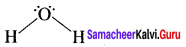
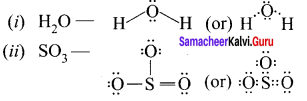
Samacheer Kalvi 11th Chemistry Solutions Chapter 10 Chemical Bonding-99

Question 5.
Calculate the formal charge on the carbon atom and oxygen atom in the structure
Samacheer Kalvi 11th Chemistry Solutions Chapter 10 Chemical Bonding-100
Answer:
Formal charge on carbon
Samacheer Kalvi 11th Chemistry Solutions Chapter 10 Chemical Bonding-101
Formal charge on oxygen
Samacheer Kalvi 11th Chemistry Solutions Chapter 10 Chemical Bonding-102

Question 6.
Calculate the formal charge on the carbon atom and oxygen atom in the structure
Samacheer Kalvi 11th Chemistry Solutions Chapter 10 Chemical Bonding-103
Answer:
Formal charge on carbon
Samacheer Kalvi 11th Chemistry Solutions Chapter 10 Chemical Bonding-104
Formal charge on singly bonded oxygen
Samacheer Kalvi 11th Chemistry Solutions Chapter 10 Chemical Bonding-105
Formal charge on triply bonded oxygen
Samacheer Kalvi 11th Chemistry Solutions Chapter 10 Chemical Bonding-106

Question 7.
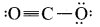
AmongSamacheer Kalvi 11th Chemistry Solutions Chapter 10 Chemical Bonding-107 and Samacheer Kalvi 11th Chemistry Solutions Chapter 10 Chemical Bonding-108 which is a preferable structure for CO2 molecule why?
Answer:
Structure I of Samacheer Kalvi 11th Chemistry Solutions Chapter 10 Chemical Bonding-109
Formal charge on carbon
Samacheer Kalvi 11th Chemistry Solutions Chapter 10 Chemical Bonding-110
Formal charge on oxygen
Samacheer Kalvi 11th Chemistry Solutions Chapter 10 Chemical Bonding-111

Structure II of Samacheer Kalvi 11th Chemistry Solutions Chapter 10 Chemical Bonding-112
Formal charge on carbon
Samacheer Kalvi 11th Chemistry Solutions Chapter 10 Chemical Bonding-113
Formal charge on singly bonded oxygen
Samacheer Kalvi 11th Chemistry Solutions Chapter 10 Chemical Bonding-114
Formal charge on triply bonded oxygen
Samacheer Kalvi 11th Chemistry Solutions Chapter 10 Chemical Bonding-115
A structure in which all formal charges are zero is preferred over the one with non – zero charges. In case of CO2 structure , structure I is preferred over the structure II as it has zero formal charge for all the atoms.

Question 8.
Draw the lewis structures of a few molecules containing odd electrons.
Answer:
Few molecules have a central atom with an odd number of valence electrons. For example, in nitrogen dioxide and nitric oxide all the atoms does not have octet configuration.
Samacheer Kalvi 11th Chemistry Solutions Chapter 10 Chemical Bonding-116

Question 9.
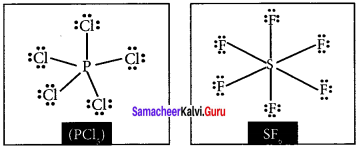
Draw the lewis structure of PCl5 and SF6
Answer:
Samacheer Kalvi 11th Chemistry Solutions Chapter 10 Chemical Bonding-117

Question 10.
Define bond length.
Answer:
The distance between the nuclei of two covalently bonded atoms is called bond length. For e.g., in a covalent molecule A – B. the bond length is equal to the sum of the radii of bonded atoms. i.e., rA + rß = bond length.

Question 11.
Prove that bond order is inversely proportional to bond length.
Answer:
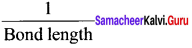
1. Bond order ∝ Samacheer Kalvi 11th Chemistry Solutions Chapter 10 Chemical Bonding-118

2. An example for illustrating the above equation is Carbon – carbon single bond length (I .54Å) is longer than the carbon-carbon double bond length (1 .34Å) and the carbon- carbon triple bond length (1 .20Å).

Question 12.
Define Bond angle.
Answer:
Covalent bonds are directional in nature and are oriented in specific direction in space. This directional nature creates a fixed angle between two covalent bonds in a molecule and this angle is termed as bond angle.

Question 13.
Define Resonance.
Answer:
The similar structures in which the relative position of the atoms are same but they differ in the position of bonding and lone pair of electrons are called resonance structures and this phenomenon is called resonance.

Question 14.
What are polar and non-polar molecules?
Answer:
1. Diatomic molecules such as H2, O2, F2 have zero dipole moment and are called non polar molecules.

2. Molecules such as HF, HCl, CO, NO have non zero dipole moment values and are called polar molecules.

Question 15.
What is meant by polarisaion?
Answer:
The ability of a cation to polarise an anion is called its polarising ability and the tendency of the anion to get polarised is called its polarisability. This phenomenon is known as polarisation.

Question 16.
Among NaCI, MgCI2 and AICI3 which shows more covalent character? Why?
Answer:
Among, the ionic compounds NaCI, MgCl2 and AICI3 the charge of the cation increases in the order Na+ < Mg2+ < Al3+, thus the covalent character also follows the same order NaCl < MgCI2 < AlCI3. So AICI3 shows more covalent character.

Question 17.
Lithium chloride is more covalent than sodium chloride. Justify this statement.
Answer:
1. The smaller cation and larger anion shows greater covalent character due to greater extent of polarisation.

2. The size of Li+ ion is smaller than Na+ ion and hence the polarising power of Li+ ion is more. So lithium chloride is more covalent than sodium chloride.

Question 18.
Lithium iodide is more covalent than Lithium chloride. Give reason.
Answer:
Lithium iodide is more covalent than Lithium chloride as the size of I ion is larger than Cl ion. Hence I ion will be more polarised than Cl ion by the cation Li+. So LiI is more covalent than LiCl.

Question 19.
Draw the structure of AB4L and AB3L2 type of molecules with example.
Answer:
AB4L:
Bond pairs = 4
Lone pair = 1
Shape = see saw
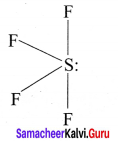
e.g., SF4 Strucutre

Samacheer Kalvi 11th Chemistry Solutions Chapter 10 Chemical Bonding-119

AB3L2:
Bond pairs = 3
Lone pair = 2
Shape = T shaped
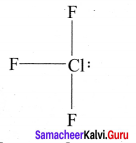
e.g., CIF3 Strucutre
Samacheer Kalvi 11th Chemistry Solutions Chapter 10 Chemical Bonding-120

Question 20.
Draw the structure of AB4L2 and AB7 type of molecules with example
Answer:
1. AB4L2:
Bond pairs = 4
Lone pairs = 2
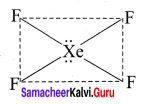
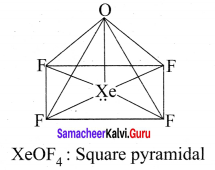
Shape = Square planare.g., XeF4
Samacheer Kalvi 11th Chemistry Solutions Chapter 10 Chemical Bonding-121

2. AB7:
Bond pairs = 7
Lone pairs = Nil
Shape = pentagonal bipyramidal
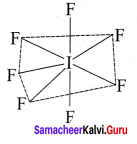
e.g., IF7
Samacheer Kalvi 11th Chemistry Solutions Chapter 10 Chemical Bonding-122

Question 21.
Explain the bond formation of hydrogen molecule.
Answer:
1. Electronic configuration of hydrogen atom is 1s1.

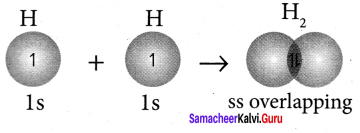
2. During the formation of H2 molecule, the 1 s orbitais of two hydrogen atoms containing one unpaired electron with opposite spin overlaps with each other along the internuclear axis.

This overlap is called s – s overlap. Such axial overlap results in the formation of a sigma (σ) covalent bond.
Samacheer Kalvi 11th Chemistry Solutions Chapter 10 Chemical Bonding-123

Question 22.
Explain the bond formation of fluorine molecule.
Answer:
1. Valence shell electronic confIguration of fluorine atom is 2s2 2px2 2py2 2pz1

2. When the half filled pz orbitais of two fluorine atoms overlap along the z – axis, a σ covalent bond is formed between them.
Samacheer Kalvi 11th Chemistry Solutions Chapter 10 Chemical Bonding-124

Question 23.
How is HF molecule formed?
Answer:

  1. Electronic configuration of hydrogen atom is 1s1.
  2. Valence shell electronic configuration of fluorine atom is 2s2 2px2 2py2 2pz1.
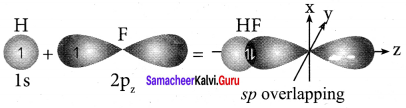
  3. When half filled is orbital of hydrogen linearly overlaps with a halt filled 2pz orbital of fluorine, a σ covalent bond is formed between hydrogen and fluorine.

Samacheer Kalvi 11th Chemistry Solutions Chapter 10 Chemical Bonding-125

Question 24.
What is meant by metallic bond?
Answer:
The forces that keep the atoms of the metal so closely in a metallic crystal constitute what is generally known as the metallic bond.

Question 25.
Why metallic bonding is referred as electronic bonding?
Answer:
1. Metallic crystals are an assemblage of positive ions immersed in a gas of free electrons. The free electrons are due to the ionisation of the valence electrons of the atom of the metal.

2. As the valence electrons of the atoms are freely shared by all the ions in the crystal, the metallic bonding is also referred to as electronic bonding.

Question 26.
Metals have high density. Give reason.
Answer:
The electrostatic attraction between the metal ions and the free electrons yields a three dimensional close packed crystal with a large number of nearest metal ions. So metals have high density.

Question 27.
Metals are ductile in nature. why?
Answer:
In the close packed structure of metallic crystal. it contains many slip planes along which movement can occur during mechanical loading, so the metal acquires ductility.

Question 28.
Give reason behind the lustrous nature, high melting point and boiling point of metals?
Answer:
1. The metallic lustre is due to the reflection of light by the electron cloud.

2. As the metallic bond is strong enough. the metal atoms are reluctant to break apart into a liquid or gas, so the metals have high melting and boiling points.

Question 29.
Metals are very good electrical conductors. Why?
Answer:
1. The bonding in metal is explained by molecular orbital theory. As per this theory. the atomic orbitals of large number of atoms in a crystal overlap to form numerous bonding and anti-bonding molecular orbitals without any band gap.

2. The bonding molecular orbitals are completely filled with an electron pair in each, and the anti-bonding molecular orbitals are empty.

3. Absence of band gap accounts for high electrical conductivity of metals.

Question 30.
Metals have high thermal conductivity. Give reason.
Answer:
High thermal conductivity of metals is due to thermal excitation of many electrons from the valence band to the conduction band.

Question 31.
Except Cu, Ag and Au, most metals are black. Why?
Answer:
Most metals are black except copper, silver and gold. It is due to the absorption of light of all wavelengths. Absorption of light of all wavelengths is due to the absence of band gap in metals.

Question 32.
Write the favourable factors for the formation of ionic bond.
Answer:

  1. Low ionisation enthalpy of metal atoms.
  2. High electron gain enthalpy of non-metal atoms.
  3. High lattice enthalpy of compound formed.

Question 33.
Although geometries of NH3 and H2O molecules are distorted tetrahedral, bond angle in water is less than that of ammonia. Discuss.
Answer:
Samacheer Kalvi 11th Chemistry Solutions Chapter 10 Chemical Bonding-126
Because of two lone pair of electrons on O – atom, repulsion on bond pairs is greater in H2O in comparison to NH3. Thus, the bond angle is less in H2O molecules.

Question 34.
Write the significance/applications of dipole moment.
Answer:

  1. In predicting the nature of the molecules: Molecules with specific dipole moments are polar in nature and those with zero dipole moments are non-polar in nature.
  2. In the determination of shapes of molecules.
  3. In calculating the percentage of ionic character.

Question 35.
Although both CO2 and H2O are triatomic molecules, the shape of H2O molecule is bent while that of CO2 is linear. Explain this on the basis of dipole moment.
Answer:
In CO2, there are two C = O bonds. Each C = O bond is a polar bond. The net dipole moment of CO2 moleculc is zero. This is possible only if CO2 is a linear molecule. (O = C = O). The bond dipoles of two C = O bonds cancels the dipole moment of each other.

Whereas, H2O molecule has a net dipole moment (1.84 D). H2O molecule has a bent structure because here the O – H bonds are oriented at an angle of 104.5° and do not cancel the bond dipole moments of each other.

Question 36.
What is the total number of sigma and pi bonds in the following molecules?

  1. C2H2
  2. C2H4

Answer:

1. H – C = C – H
Sigma bond = 3
π bond = 2

2.Samacheer Kalvi 11th Chemistry Solutions Chapter 10 Chemical Bonding-127
Sigma bond = 5
π bond = 1

Question 37.
Use molecular orbital theory to explain why the Be2 molecule does not exist
Answer:
E.C of Be = 1 s2 2s2
M.O.E.C of Be2 = σ1s2 σ2s2 σ*2s2
Bond order = \(\frac { 1 }{ 2 }\) (4 – 4) = 0
Hence, Be2

Question 38.
Compare the relative stabililty of the following species and indicate their magnetic properties O2, O2+, O2 (superoxide), O22-(peroxide)
Answer:
O2 – Bond order = 2 paramagnetic
O2+ – Bond order = 2.5, paramagnetic
O2 – Bond order = 1.5, paramagnetic
O22- – Bond order = 1, diagmagnetic
Order of relative stability is:
Samacheer Kalvi 11th Chemistry Solutions Chapter 10 Chemical Bonding-128

Question 39.
Account for the following:

  1. Water is a liquid while H2S is a gas
  2. NH3 has higher boiling point than PH3.

Answer:

  1. In case of water, hydrogen bonding causes association of the H2O molecules. There is no such hydrogen bonding in H2S, that is why it is a gas.
  2. There is hydrogen bonding in NH3 but not in PH3.

Question 40.
Why B2 is paramagnetic in nature while C2 is not?
Answer:
The molecular orbital electronic configuration of both B2 and C2 are:
B2:
Samacheer Kalvi 11th Chemistry Solutions Chapter 10 Chemical Bonding-129
C2:
Samacheer Kalvi 11th Chemistry Solutions Chapter 10 Chemical Bonding-130
Since, B2 has two unpaired electrons, therefore, B2 is paramagnetic C2 has no unpaired electron, therefore, C2 is diamagnetic.

Samacheer Kalvi 11th Chemistry Chemical Bonding 3 Mark Questions and Answers

Question 1.
Draw the lewis structure of

  1. Nitrogen
  2. Carbon
  3. Oxygen

Answer:
Samacheer Kalvi 11th Chemistry Solutions Chapter 10 Chemical Bonding-131
Samacheer Kalvi 11th Chemistry Solutions Chapter 10 Chemical Bonding-132

Question 2.
Draw the lewis structure of

  1. Ammonia
  2. Methane
  3. Dinitrogen pentoxide.

Answer:
Lewis dot structures of Molecules
Samacheer Kalvi 11th Chemistry Solutions Chapter 10 Chemical Bonding-133

Question 3.
Calculate the bond enthalpy of OH bond in water.
Answer:
1. In the case of polyatomic molecules with two or more same bond types, the arithmetic mean of the bond energy value of the same type of bonds is considered as average bond enthalpy.

2. For e.g., in water, there are two OH bonds present and the energy needed to break them are not same.

3. H2O(g) → H(g) + OH(g)
∆H1 = 502 kJ mol-1
OH(g) → H(g) + O(g)
∆H = 427 kJ mol
The average bond enthalpy of OH bond in water = \(\frac { 502 + 427 }{ 2 }\) = 464.5 kJ mol-1

Question 4.
Explain how the ionic character in a covalent bond is related to electronegativity?
Answer:
1. The extent of ionic character in a covalent bond can be related to the electronegativity difference of the bonded atoms.

2. In a typical polar molecule Aδ- – Bδ+ the electronegativity difference (XA – XB) can be used to predict the percentage of the ionic character as follows

3. If the electronegativity difference XA – XB is equal to 1.7, then the bond A – B has 50% ionic character.

4. If it is greater than 1.7, then the bond XA – XB has more than 50% ionic character.

5. If it is greater than 1.7, then the bond A – B has more than 50% ionic character.

6. If it is lesser than 1.7, then the bond A – B has less than 50% ionic character.

Question 5.
CuCI is more covalent than NaCl. Give reason.
Answer:
1. Cations having ns2np6nd10 configuration show greater polansing power than the cations with ns2 np6 configuration. Hence they show greater covalent character.

2. CuCI is more covalent than NaCI. As compared to Na+ (1.13Å), Cu+(0.6Å)is small and has 3s23p63d10 configuration.

3. Electronic configuration of Cu+: [Ar] 3d10
Electronic configuration of Na+: [He] 2s22p6
So CuCI is more covalent than NaCI

Question 6.
Draw the structure of AB2, AB3, AB3L type of molecules with example.
Answer:
1. AB2
Number of bond pairs = 2
Shape = Linear
Example – BeCl2
Samacheer Kalvi 11th Chemistry Solutions Chapter 10 Chemical Bonding-134

2. AB3
Number of bond pairs = 3
Shape = Tirgonal planar
Example – BF3
Samacheer Kalvi 11th Chemistry Solutions Chapter 10 Chemical Bonding-135

3. AB2L
Number of bond pairs = 2
Number of lone pairs = 1
Shape = Bent (or) inverted V shape
Example – O3
Samacheer Kalvi 11th Chemistry Solutions Chapter 10 Chemical Bonding-136

Question 7.
Give example and structure of

  1. AB3L
  2. AB5
  3. AB2L2

type of molecules with example.
Answer:
1. AB3L
Number of bond pairs = 3
Number of lone pairs = 1
Shape = Pyramidal
Example – NH3
Samacheer Kalvi 11th Chemistry Solutions Chapter 10 Chemical Bonding-137

2. AB5
Number of bond pairs = 5
Number of lone pairs = 0
Shape = Trigonal bipyramidal
Example = PCIC5
Samacheer Kalvi 11th Chemistry Solutions Chapter 10 Chemical Bonding-138

3. AB2L2
Number of bond pairs = 2
Number of lone pairs = 2
Shape = Bent
Example – H2O
Samacheer Kalvi 11th Chemistry Solutions Chapter 10 Chemical Bonding-139

Question 8.
Draw the shape of

  1. XeF2
  2. IOF5
  3. XeOF4

Answer:
1. XeF2
Samacheer Kalvi 11th Chemistry Solutions Chapter 10 Chemical Bonding-140

2. IOF5
Samacheer Kalvi 11th Chemistry Solutions Chapter 10 Chemical Bonding-141

3. XeOF4
Samacheer Kalvi 11th Chemistry Solutions Chapter 10 Chemical Bonding-142

Question 9.
Explain the bonding in oxygen molecule.
Answer:
1. Valence shell electronic configuration of oxygen atom is
2s2 2px2 2py12pz1
Samacheer Kalvi 11th Chemistry Solutions Chapter 10 Chemical Bonding-143

2. When the half filled pz orbitaIs of two oxygen atoms overlap along the z – axis a σ covalent bond is formed between them. Other two hail filled py orbitais of two oxygen atoms overlap laterally to form a π – cova1ent bond between the oxygen atoms.

3. Thus in oxygen molecule, two oxygen atoms are connected by two covalent bonds (double bond). The other two pair of electrons present in the 2s and 2px orbital do not involve in bonding and remains as lone pair on the respective oxygen atoms.
Samacheer Kalvi 11th Chemistry Solutions Chapter 10 Chemical Bonding-144

Question 10.
Explain about the molecular orbital diagram of hydrogen molecule.
Answer:
Samacheer Kalvi 11th Chemistry Solutions Chapter 10 Chemical Bonding-145

  1. Electronic configuration of H atom 1s1
  2. Electronic configuration of H, molecule – σ1s1
    Bond order Samacheer Kalvi 11th Chemistry Solutions Chapter 10 Chemical Bonding-146
  3. Molecule (H2) has no unpaired electrons, hence it is diamagnetic.

Question 11.
Draw and explain the M.O. diagram of lithium molecule.
Answer:
Samacheer Kalvi 11th Chemistry Solutions Chapter 10 Chemical Bonding-147

  1. Electronic configuration of Li atom – 1s1
  2. Electronic configuration of Li2 molecule is ais2 σ*1s2 σ*1s2 σs2
  3. Bondorder = Nb – Nb/2 = 4 – 2/2
  4. Li2 molecule has no unpaired electrons, hence it is diamagnetic.

Question 12.
Draw and explain the M.O. diagram of Boron molecule.
Samacheer Kalvi 11th Chemistry Solutions Chapter 10 Chemical Bonding-148
Answer:

  1. Electronic configuration of B = 1s2 2s2 2p3
  2. Electronic configuration of B, = σ1s2 σ*1s2σ2s2 σ*2s2 π2px1 π 2pz1
  3. Bond order Samacheer Kalvi 11th Chemistry Solutions Chapter 10 Chemical Bonding-149
  4. B2 molecule has two unpaired electrons hence it is paramagnetic.

Question 13.
Draw and explain the molecular orbital diagram of carbon molecule.
Answer:
Samacheer Kalvi 11th Chemistry Solutions Chapter 10 Chemical Bonding-150

  1. Electronic configuration of C atom – 1s2 2s2 2p2
  2. Electronic configuration of C2 molecule is σ1s2 σ*1s2 σ*2s2 σ*2s2 π 2px2 π 2py2
  3. Bond orderSamacheer Kalvi 11th Chemistry Solutions Chapter 10 Chemical Bonding-151

Question 14.
Write Lewis dot symbols for atoms of the following elements: Mgq Naq B O, N, Br.
Answer:
Samacheer Kalvi 11th Chemistry Solutions Chapter 10 Chemical Bonding-152

Question 15.
write Lewis symbols for the following atoms and ions: S and S2-; Al and Al3+; H and OH
Answer:
Samacheer Kalvi 11th Chemistry Solutions Chapter 10 Chemical Bonding-153

Question 16.
Draw the Lewis structures for the following molecules and ions H2S, SiCl4, BeF2, CO32-, HCOOH
Answer:
Samacheer Kalvi 11th Chemistry Solutions Chapter 10 Chemical Bonding-154

Question 17.
Define Octet rule. Write its significance and limitations.
Answer:
Octet rule:
Atoms of elements combine with each other in order to complete their respective octet so as to acquire the stable nearest noble gas configuration.

Significance:
It helps to explain why dilfferent atoms combine with each other to form ionic compounds or covalent compounds.

Limitations of Octet rule:
1. According to octet rule, atoms take part in chemical combination to achieve the configuration of nearest noble gas elements.

However, some of noble gas elements like Xenon have formed compounds with fluorine and oxygen. For example: XeF2, XeF4, XeO3 etc. Therefore, validity of the octet rule has been challenged.

2. This theory does not account for the shapes of molecules.

Question 18.
Write the resonance structure for SO3, NO2 and NO3
Answer:
Samacheer Kalvi 11th Chemistry Solutions Chapter 10 Chemical Bonding-155

Question 19.
What do you understand by bond pairs and lone pairs of electrons? Illustrate by giving one example of each type.
Answer:
The electron pair involved in sharing between two atoms during covalent bonding is called shared pair or bond pair. At the same time, the electron pair which is not involved in sharing is called lone pair of electrons.
For example, in Samacheer Kalvi 11th Chemistry Solutions Chapter 10 Chemical Bonding-156
there are only 4 bond pairs, but in Samacheer Kalvi 11th Chemistry Solutions Chapter 10 Chemical Bonding-157 there are two bond pairs and two lone pairs.

Question 20.
Distinguish between a sigma bond and a pi bond
Answer:
Sigma (σ) Bond

  1. σ – bond is formed by the axial overlap of the atomic orbitais.
  2. The bond is quite strong.
  3. Only one lobe ofthep-orbitals is involved in the overlap.
  4. Electron cloud of the molecular orbital is symmetrkal around the internuclear axis.

Pi (π) Bond

  1. π – bonnd is formed by the sidewise overlap of atomic orbitais.
  2. It is comparatively a weaker bond.
  3. Both lobes of the p-orbitais are involved in the overlap.
  4. The electron cloud is not symmetrical.

Question 21.
Write the Important conditions required for the linear combination of atomic orbitals to form molecular orbitals.
Answer:
1. The combining atomic orbitals should have comparable energies. For example, is orbital of one atom can combine with 1s atomic orbital of another atom, 2s orbitai can combine with 2s orbital and so on.

2. The combining atomic orbitals must have proper orientations so that they are able to overlap to a considerable extent.

3. The extent of overlapping should be large.

Question 22.
What are Lewis structures? Write the Lewis structure of H2, BeF2 and H2O.
Answer:
The outer shell electrons are shown as dots surrounding the symbol of the atom. These symbols are known as Lewis symbols or Lewis structures. The Lewis structure of
Samacheer Kalvi 11th Chemistry Solutions Chapter 10 Chemical Bonding-158

Question 23.
What are the main postulates of Valence Shell Electron Pair Repulsion (VSEPR) theory?
Answer:

  1. The shape of a molecule depends upon the no. of electron pairs around the central atom.
  2. There is a repulsive force between the electron pairs, which tend to repel one another.
  3. The electron pairs in space tend to occupy such positions that they arc at maximum distance, so that the repulsive force will be minimum.
  4. A multiple bond is treated as lilt is a single bond and the remaining electron pairs which constitute the bond may be regarded as single super pair.

Question 24.
Apart from tetrahedral geometry, another possible geometry for CH4 is square planar with four H atoms at the corners of the square and C atom at its centre. Explain why CH4 is not square planar?
Answer:
Electronic configuration of carbon atom: C: σ1s22s22p2.
in the excited state, the orbital picture of carbon can be represented as:
Samacheer Kalvi 11th Chemistry Solutions Chapter 10 Chemical Bonding-159
Hence, carbon atom undergoes sp3 hybridisation in CH4 molecule and takes tetrahedral shape.
Samacheer Kalvi 11th Chemistry Solutions Chapter 10 Chemical Bonding-160
For a square planar shape, the hybridisation of the central atom has to be dsp3. However, an atom of carbon does not have d – orbitals to undergo dsp3 hybridisation. Hence, the structure of CH4 is tetrahedral.

Question 25.
Explain why BeH2 molecule has a zero dipole moment although the Be – H bonds are polar.
Answer:
The Lewis structure for BeH2 molecule is as follows:Samacheer Kalvi 11th Chemistry Solutions Chapter 10 Chemical Bonding-161. There is no lone pair at the central atom (Be) and there are two bond pairs. Hence, BeH2, is of the type AB2. It has a linear structure.
Samacheer Kalvi 11th Chemistry Solutions Chapter 10 Chemical Bonding-162
Dipole moments of each Be – H bond are equal and opposite in direction. Therefore, they nullify each other. Hence, BeH2 has a net zero dipole moment.

IV. Answer the following questions in detail:

Question 1.
Explain about Kossel-Lewis approach to chemical bonding.
Answer:
1. Kossel and Lewis approach to chemical bonding is based on the inertness of the noble gases which have little or no tendency to combine with other atoms.

2. They proposed that noble gases are stable due to their completely filled outer electronic configuration.

3. Elements other than noble gases try to attain the completely filled outer electronic configuration by losing, gaining or sharing one or more electrons from their outer shell.

4. For e.g., sodium loses one electron to form Na ion and chlorine accepts that electron to give chloride ion, Cl.These two ions are held together by electrostatic attractive forces, a bond known as an electrovalent bond.
Samacheer Kalvi 11th Chemistry Solutions Chapter 10 Chemical Bonding-163

5. In diatomic molecules such as nitrogen and oxygen, they achieve the stable noble gas electronic configuration by mutual sharing of electrons.

6. Lewis introduced a scheme to represent the chemical bond and the electrons present in the outer shell of the atom called Lewis dot structure.
Samacheer Kalvi 11th Chemistry Solutions Chapter 10 Chemical Bonding-164

7. For example, the electronic configuration of nitrogen is 1s22s22p3. It has 5 electrons in its outer shell. The lewis structure of nitrogen isSamacheer Kalvi 11th Chemistry Solutions Chapter 10 Chemical Bonding-165

8. In N, molecule, equal sharing of 3 electrons from each nitrogen atom takes place as fol lows
Samacheer Kalvi 11th Chemistry Solutions Chapter 10 Chemical Bonding-166

Question 2.
What is meant by covalent bond?
Explain the covalent bonding in H2, O2, N2.
Answer:
1. Mutual sharing of one or more pair of electrons between two combining atoms results in the formation of a chemical bond called a covalent bond.

2. If two atoms share just one pair of electron, a single covalent bond is formed as in the çase of hydrogen molecule (H2).

3. If two or three electron pairs are shared benveen the two combining atoms, then the covalent bond is called double bond and triple bond respectively, as in the case of O2 and N2 molecules respectively.
Samacheer Kalvi 11th Chemistry Solutions Chapter 10 Chemical Bonding-167

Question 3.
What is an ionic bond?
Explain about the formation of ionic bond with a suitable example.
Answer:
1. The complete transfer of electrons leads to the fomiation of a cation and an anion. Both these ions are held together by electrostatic attractive forces which is known as ionic bond.

2. KCl: Potassium chloride
Electronic configuration of K [Ar] 4s
Eleçtronic configuration of Cl = [Ne] 3s2 3p5

3. Potassium has 1 electron in its valence shell and chlorine has 7 electrons in its valence shell.

4. By losing one electron potassium attains the nearest inert gas configuration of Argon and becomes a unipositive cation (K) and chlorine accepts this electron to become uninegative chloride ion (CI) to attain the stable configuration of nearest noble gas, Argon.

5. These two ions combine to form an ionic crystal in which they are held together by electrostatic attractive forces.

6. During the formation of one mole of potassium chloride crystal from its constituent ions, 718 kJ of energy is released. This favours the formation of KCl and its stabilisation.

Question 4.
Define coordinate covalent bond. Illustrate the formation of coordinate covalent bond with a suitable example.
Answer:
1. In the bond formation, one of the combining atoms donates a pair of electrons i.e., two electrons which are necessary for the covalent bond formation and these electrons are shared by both the combining atoms, and the bond formed is called coordinate covalent bond.

2. The combining atom which donates the pair of electron is called the donor atom and the other atom is called the acceptor atom. This bond is denoted by an arrow starting from the donor atom pointing towards the acceptor atom.

3. For example, in ferricyanide ion [Fe(CN)6]4- each cyanide ion (CN) donates a pair of electrons to form a coordinate bond with iron (Fe2+) and these electrons are shared by Fe2+ and CN ions.

4. Samacheer Kalvi 11th Chemistry Solutions Chapter 10 Chemical Bonding-168

5. Ammonia having a lone pair of electrons donates its pair to an electron deficient molecule such as BF3 to form a coordinate covalent bond
Samacheer Kalvi 11th Chemistry Solutions Chapter 10 Chemical Bonding-169

Question 5.
Explain about valence bound theory for the formation of H2 molecule.
Answer:
1. Two hydrogen atoms Ha and Hb are separated by infinite distance. At this stage, there is no interaction between these two atoms and the potential energy of this system is arbitrarly taken as zero.

2. As these two atoms approach each other, in addition to electrostatic attractive forces between the nucleus and its own electrons, the following new forces begins to operate
Samacheer Kalvi 11th Chemistry Solutions Chapter 10 Chemical Bonding-170

3. The new attractive forces Samacheer Kalvi 11th Chemistry Solutions Chapter 10 Chemical Bonding-171 arise between:

  • nucleus of Ha and valence electron of Hb
  • nucleus of Hb and the valence electron of Ha

4. The new repulsive forces Samacheer Kalvi 11th Chemistry Solutions Chapter 10 Chemical Bonding-172 arise between:

  • the nucleus Of Ha and Hb
  • the valence electrons of Ha and Hb

5. The attractive forces tend to bring Ha and Hb together whereas the repulsive forces tends to push them apart.

6. At the initial stage, as the two hydrogen atoms approach each other, the attractive forces are stronger than repulsive forces and the potential energy decreases.

7. A stage is reached where the net attractive forces are exactly balanced by repulsive forces and the potential energy of the system acquires a minimum energy.

8. At this stage, there is a maximum overlap between the atomic orbitals of Ha and Hb and atoms Ha and Hb are now said to be bonded together by a covalent bond.

Question 6.
What arc the salient features of Valence Bond (VB) theory?
Answer:
1. When half filled orbitals of two atoms overlap, a covalent bond will be formed between them.

2. The resultant overlapping orbitals are occupied by the two electrons with opposite spins. For example when H2 is formed, the two is electron of two hydrogen atoms get paired up and occupy the overlapped orbitals.

3. The strength of a covalent bond depends upon the extent of overlap of atomic orbitals. Greater the overlap, larger is the energy released and stronger will be the bond formed.

4. Each atomic orbital has a specific direction (excepts-orbital which is spherical) and hence orbital overlap takes place in the direction that maximises overlap.

5. Depending upon the nature of overlap, the bonds are classified as σ covalent bond and π it covalent bond.

6. When two atomic orbitals overlap linearly along the axis, the resultant bend is called a sigma (σ) bond. This overlap is also called or “axial overlap”.

7. When two atomic orbitals overlap sideways the resultant covalent bond is called a pi (π) bond.

Question 7.
Explain about sp hybridisation with suitable example.
Answer:

  1. bond rormation in Beryllium chloride takes place by sp hybridisation.
  2. The valence shell of Beryllium has the electronic configuration as follows:

Samacheer Kalvi 11th Chemistry Solutions Chapter 10 Chemical Bonding-173

3. In BeCl2, both the Be – Cl bonds are equivalent and it was observed that the molecule is linear. VB theory explains this observed behaviour by sp hybridisation. One of the paired electrons in the 2s orbital gets excited to 2p orbital.

4. Now the 2s and 2p orbitals hybridise and produce two equivalent sp hybridised orbitals which have 50% s-character and 50% p-character. These sp hybridised orbitals are oriented in opposite direction.

5. Each of the sp hybridised orbitals linearly overlap with p orbital of the chlorine to form a covalent bond between Be and Cl atoms as follow:
Samacheer Kalvi 11th Chemistry Solutions Chapter 10 Chemical Bonding-174

Question 8.
Explain the formation of methane using VB theory?
Answer:
1. Methane is formed by sp3 hybridisation. In CH4 molecule, the central carbon atom is bounded to four hydrogen atoms.

2. The ground state valence shell electronic configuration of carbon is [He] 2s22px2 2py1 2px0

3. En order to form four covalent bonds with the four hydrogen atoms, one of the paired electrons in 2s orbital of carbon is promoted to its 2Pz orbital in the excited state.

4. The one 2s orbital and three 2p orbitals of carbon atom mixes to give four equivalent sp3 hybridised orbitals. The angle between any of the two sp3 hybridised orbitals is 109°•28’
Samacheer Kalvi 11th Chemistry Solutions Chapter 10 Chemical Bonding-175

5. The Is orbital of the four hydrogen atoms overlap linearly with the four sp3 hybridised orbitais of carbon to form four C – H σ bonds in the methane molecule as follows
Samacheer Kalvi 11th Chemistry Solutions Chapter 10 Chemical Bonding-176

Question 9.
Explain sp3d hybridisation with a suitable example.
Answer:
1. In the PCl5 molecule, the central atom phosphorous is covalently bonded to five chlorine atoms. Here the atomic orbitals of phosphorous undergoes sp3d2 hybridisation which involves its one 3s orbital, three 3p orbitals and one vacant 3d orbital (dz2)

2. The ground state electronic configuration of phosphorous is [Ne] 3s23px23py13pz1
Samacheer Kalvi 11th Chemistry Solutions Chapter 10 Chemical Bonding-177

3. One of the paired electrons in the 3s orbital of phosphorous ¡s promoted to one of its vacant 3d orbital (dz2) in the excited state.
Samacheer Kalvi 11th Chemistry Solutions Chapter 10 Chemical Bonding-178

4. The 3pz orbitals of the five chlorine atoms linearly overlap along the axis with the five sp3d hybridised orbitals of phosphorous to form the five P – CI bonds as follows.
Samacheer Kalvi 11th Chemistry Solutions Chapter 10 Chemical Bonding-179

Question 10.
Explain about. sp3d2 hybridisation with an example.
Answer:
1. In sulphur hexafluoride SF6, the central atom sulphur extend its octet to undergo sp3d hybridisation to generate six sp3d2 hybridised orbitals which accounts for six equivalent S – F bonds.

2. The ground state electronic configuration of sulphur is [Ne] 3s23px13py13pz1
Samacheer Kalvi 11th Chemistry Solutions Chapter 10 Chemical Bonding-180

3. One electron each form 3s orbital and 3p orbital of sulphur is promoted to its two vacant 3d orbitals dz2 and dx2-y2 in the excited state.
Samacheer Kalvi 11th Chemistry Solutions Chapter 10 Chemical Bonding-181

4. A total of six valence orbitals from sulphur (one 3s orbital, three 3p orbitals and two 3d orbitals) (dx2 and dx2-y2) which mixes to give six equivalent sp3d2 hybridised orbitals. The orbital geometry is octahedral.

5. The six sp3d2 hybridised orbitals of sulphur overlaps linearly with 2pz orbital of six fluorine atoms to form the six S – F bonds in sulphur hexa fluoride.
Samacheer Kalvi 11th Chemistry Solutions Chapter 10 Chemical Bonding-182

Question 11.
Explain about the salient features of molecular orbital theory.
Answer:
1. When atoms combine to form molecules, their individual atomic orbitals lose their identity and form new orbitals called molecular orbitals.

2. The shape of molecular orbitals depend upon the shapes of combining atomic orbitals.

3. The number of molecular orbitals formed is the same as the number of combining atomic orbitals. half the number of molecular orbitals formed will have lower energy and are called bonding orbitals, while the remaining half molecular orbitals will have higher energy and are called anti-bonding molecular orbitals.

4. The bonding molecular orbitals are represented as σ (sigma), π (pi), δ (delta) and the corresponding anti-bonding orbitals are called σ*, π* and δ*.

5. The electrons in the molecule are accommodated in the newly formed molecular orbitals. The filling of electrons in these orbitals follow Autbau’s Principle, Pauli’s exclusion principle and Hund’s rule as in the case of filling of electrons in the atomic orbitals.

6. Bond order gives the number of covalent bonds between the two combining atoms. The bond order of a molecule can be calculated using
the foLlowing equation:
Samacheer Kalvi 11th Chemistry Solutions Chapter 10 Chemical Bonding-183
Nb = Number of electrons in bonding molecular orbitals.
Na = Number of electrons in anti-bonding molecular orbitals.

7. A bond order of zero value indicates that the molecule does not exist.

Question 12.
Explain the MO diagram for NO molecule.
Samacheer Kalvi 11th Chemistry Solutions Chapter 10 Chemical Bonding-184
Answer:

  1. Electronic configuration of N atom is 1s2 2s2 2p3
  2. Electronic configuration of O atom is 1s2 2s2 2p4
  3. Electronic configuration of NO molecule is
    Samacheer Kalvi 11th Chemistry Solutions Chapter 10 Chemical Bonding-185
  4. Bond order Samacheer Kalvi 11th Chemistry Solutions Chapter 10 Chemical Bonding-186
  5. NO molecule has one unpaired electron, hence it is paramagnetic.

Question 13.
Explain about metallic bonding.
Answer:
1. The forces that keep the atoms of the metal so closely in a metallic crystal constitute what is known as metallic bond.

2. According to Drude and Lorentz, metallic crystal is an assemblage of positive ions immersed in a gas of free electrons. The free electrons are due to ionisation of the valence electrons of the atoms of the metal.

3. As the valence electrons of the atoms are freely shared by all the ions in the crystal, the metallic bonding is referred to as electronic bonding.

4. The electrostatic attraction between the metal ions and the free electrons yield a three dimensional close packed crystal with a large number of nearest metal ions. So metals have high density.

5. As the close packed structure contains many slip planes along which movement can occur during mechanical loading, metal acquires ductility.

6. As metal ion is surrounded by electron cloud in all directions, the metallic bonding has no and thermal conductivity. The metallic lustre is due to the reflection of light by the electron cloud.As the metallic bond is strong enough, the metal atoms are reluctant to break apart into a liquid or gas, so the metals have high melting and boiling points.
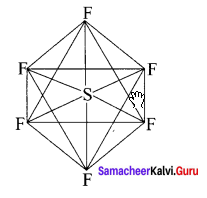
7. High thermal conductivity of metals is due. to thermal excitation of many electrons from the valence bond to the conduction band.

Question 14.
Explain about the bonding in metals by molecular orbital theory.
Answer:
1. According to molecular orbital theory the atomic orbitals of large number of atoms in a crystal overlap to form numerous bonding and anti-bonding molecular orbitals without any band gap.

2. The bonding molecular orbitals are completely filled with an electron pair in each and the anti-bonding molecular orbitals are empty.

3. Absence of band gap accounts for high electrical conductivity of metals.

4. High thermal conductivity is due to thermal excitation of many electrons from the valence band to the conduction band.

5. With an increase in temperature, the electrical conductivity decreases due to vigorous thermal motion of lattice ions that disrupts the uniform lattice structure. that is required for free motion of electrons within the crystal.

Common Errors

  1. The number of bonds formed by elements may go wrong.
  2. When writing Lewis structure, electrons may be written in an irregular way.
  3. Coordinate covalent bond should not be written as a line

Rectifications

  1. Always hydrogen and fluorine form 1 bond Oxygen 2 bonds, Nitrogen 3 bonds, Carbon 4 bonds
  2. When writing lewis structure, each atom should be surrounded by eight electrons in such a way as 4 pairs of electrons.
  3. Coordinate covalent bond should be written from donor atom to acceptor atom as an arrow mark Donor→ Acceptor

We as a team believe the information prevailing regarding the Samacheer Kalvi Chemical Bonding for 11th Chemistry Chapter 10 Chemical Bonding has been helpful in clearing your doubts to the fullest. For any other help do leave us your suggestions and we will look into them. Stay in touch to get the latest updates on Tamilnadu State Board Chemical Bonding for different subjects in the blink of an eye.

Samacheer Kalvi 11th Chemistry Solutions Chapter 9 Solutions

Enhance your subject knowledge with Tamilnadu State Board for Chapter 9 Solutions and learn all the underlying concepts easily. Make sure to Download Samacheer Kalvi 11th Chemistry Book Solutions, Notes Pdf Chapter 9 Solutions Questions and Answers PDF on a day to day basis and score well in your exams. Are given after enormous research by people having high subject knowledge. You can rely on them and prepare any topic of Chemistry as per your convenience easily.

Tamilnadu Samacheer Kalvi 11th Chemistry Solutions Chapter 9 Solutions

Students looking for Chapter 9 Solutions Concepts can find them all in one place from our Tamilnadu State Board Solutions. Simply click on the links available to prepare the corresponding topics of Chemistry easily. Samacheer Kalvi 11th Chemistry Chapter wise Questions and Answers are given to you after sample research and as per the latest edition textbooks. Clarify all your queries and solve different questions to be familiar with the kind of questions appearing in the exam. Thus, you can increase your speed and accuracy in the final exam.

Samacheer Kalvi 11th Chemistry Chapter 9 Solutions Textual Evaluation Solved

Samacheer Kalvi 11th Chemistry Solutions Multiple Choice Questions

Question 1.
The molality of a solution containing 1 .8g of glucose dissolved in 250g of water is …………
(a) 0.2 M
(b) 0.01 M
(c) 0.02 M
(d) 0.04 M
Answer:
(d) 0.04 M
Solution:
Samacheer Kalvi 11th Chemistry Solutions Chapter 9 Solutions-1

Question 2.
Which of the following concentration terms is/are independent of temperature?
(a) molality
(b) molarity
(c) mole fraction
(d) (a) and (c)
Answer:
(d) (a) and (c)
Solution:
Molality and mole fraction are independent of temperature.

Question 3.
Stomach acid, a dilute solution of HCI can be neutralised by reaction with Aluminium hydroxide
Al(OH)3 + 3HCl(aq) → AlCl3 + 3H2O
How many millilitres of 0.1 M Al(OH)3 solution are needed to neutralise 21 mL of 0.1 M HCl
(a) 14 mL
(b) 7 mL
(c) 21 mL
(d) none of these
Answer:
(b) 7 mL
Solution:
M1 x V1 = M2 x V2
∵ 0.1 M Al(OH)3 gives 3 x 0.1 = 0.3 M OH ions .
0.3 x V1 = 0.1 x 21
V1= \(\frac { 0.1 x 21 }{ 0.3 }\) = 7ml

Question 4.
The partial pressure of nitrogen in air is 0.76 atm and its Henry’s law constant is 7.6 x 10⁴ atm at 300K. What is the mole fraction of nitrogen gas in the solution obtained when air is bubbled through water at 300K?
(a) 1 x 10⁻⁴
(b) 1 x 10⁻⁶
(c) 2 x 10⁻⁵
(d) 1 x 10⁻⁵
Answer:
(d) 1 x 10⁻⁵
Solution:
PN2 = 0.76atm
KH = 7.6 x 10⁴
x = ?
PN2 = KH . x
0.76 = 7.6 x 10⁴x x
x = \(\frac { 0.76 }{ 7.6\times { 10 }^{ 4 } }\) = 1 x 10⁻⁵

Question 5.
The Henry’s law constant for the solubility of Nitrogen gas in water at 350K is 8 x 10⁴ atm. The mole fraction of nitrogen in air is 0.5. The number of moles of Nitrogen from air dissolved in 10 moles of water at 350K and 4 atm pressure is ………….
(a) 4 x 10⁻⁴
(b) 4 x 10⁴
(c) 2 x 10⁻²
(d) 2.5 x 10⁻⁴
Answer:
(d) 2.5 x 10⁻⁴
Solution:
KH = 8 x 10⁴
(xN2 )in air = 0.5
Total pressure = 4 atm
Partial pressure of nitrogen = Mole fraction Total pressure
= O.5 x 4 = 2
Samacheer Kalvi 11th Chemistry Solutions Chapter 9 Solutions-3

Question 6.
Which one of the following is incorrect for ideal solution?
(a) ∆Hmix = 0
(b) ∆Umix = o
(c) ∆P = PObserved – PCalculated by raoults law = 0
(d) ∆Gmix = 0
Answer:
(d) ∆Gmix = 0
Solution:
For an ideal solution, ∆Smix \(\neq\) 0; Hence ∆Gmix \(\neq\) 0
∴ Incorrect is ∆Gmix = 0

Question 7.
Which one of the following gases has the lowest value of Henry’s law constant?
(a) N2
(b) He
(c) CO2
(d) H2
Answer:
(c) CO2
Solution:
Carbon dioxide; most stable gas and has lowest value of Henry’s Law constant.

Question 8.
P1 and P2 are the vapour pressures of pure liquid components, 1 and 2 respectively of an ideal binary solution if x1 represents the mole fraction of component 1, the total pressure of the solution formed by 1 and 2 will be ………
(a) P1 + x1(P2 – P1)
(b) P2 – x1(P2 + P1)
(c) P1 – x2(P1 – P2)
(d) P1 + x2(P1 – P2)
Answer:
(c) P1 – x2(P1 – P2)
Solution:
Ptotal = P1 + P2
= P1 x1 + P2x2
= P1(1 – x2) + P2x2
= P1 – P1x2 + P2x2 = P1 – x2(P1 – P2)
[∵x1 + x2 = 1
x1 = 1 – x2]

Question 9.
Osomotic pressure (π) of a solution is given by the relation ……………
(a) π = nRT
(b) πV = nRT
(c) πRT = n
(d) none of these
Answer:
(b) πV = nRT
Solution:
n = CRT
n = \(\frac { n }{ V }\)
π V = nRT

Question 10.
Which one of the following binary liquid mixtures exhibits positive deviation from Raoults law?
(a) Acetone + chloroform
(b) Water + nitric acid
(c) HCI + water
(d) ethanol + water
Answer:
(d) ethanol + water

Question 11.
The Henry’s law constants for two gases A and B are x and y respectively. The ratio of mole fractions of A to B is 0.2. The ratio of mole fraction of B and A dissolved in water will be …………
(a) \(\frac { 2x }{ y }\)
(b) \(\frac { y }{ 0.2x }\)
(c) \(\frac { 0.2x }{ y }\)
(d) \(\frac { 5x }{ y }\)
Answer:
(d) \(\frac { 5x }{ y }\)
Solution:
Given,
Samacheer Kalvi 11th Chemistry Solutions Chapter 9 Solutions-4

Question 12.
At 100°C the vapour pressure of a solution containing 6.5g a solute in 100g water is 732mm. If Kb = 0.52, the boiling point of this solution will be …………..
(a) 102°C
(b) 100°C
(c) 101°C
(d) 100.52°C
Answer:
(c) 101°C
Solution:
\(\frac { ΔP }{ P° }\) = \(\frac { { n }_{ 2 } }{ { n }_{ 1 } }\)
W2 = 6.5g
W1 = 100g
Kb = 0.52
Samacheer Kalvi 11th Chemistry Solutions Chapter 9 Solutions-5
Samacheer Kalvi 11th Chemistry Solutions Chapter 9 Solutions-6

Question 13.
According to Raoults law, the relative Lowering of vapour pressure for a solution is equal to….
(a) molefraction of solvent
(b) mole fraction of solute
(c) number of moles of solute
(d) number of moles of solvent
Answer:
(b) mole fraction of solute
Solution:
\(\frac { ∆P }{ P° }\) = x2 (Mole fraction of the solute)

Question 14.
At same temperature. which pair of the following solutions are isotonic?
(a) 0.2 M BaCl2 and 0.2M urea
(b) 0.1 M glucose and 0.2 M urea
(c) 0.1 MNaCl and 0.1 MK2SO4
(d) 0.1 MBa(NO3)2 and 0.1 MNa2 SO4
Answer:
(d) 0.1 M Ba (NO3)2 and 0.1 M Na2 SO4
Solution:
0.1 x 3 ion [Ba2 + 2NO3], 0.1 x 3 ion [2Na+, SO4]

Question 15.
The empirical formula of a non-electrolyte(X) is CH2O. A solution containing six gram of X exerts the same osmotic pressure as that of 0.025 M glucose solution at the same temperature. The molecular formula of X is
(a) C2H4O2
(b) C8H16O8
(c) C4H8O4
(d) CH2O
Answer:
(b) C8H16O8
Solution:
1)non electrolute = (π2)glucose
C1RT = C2RT
Samacheer Kalvi 11th Chemistry Solutions Chapter 9 Solutions-7
\(\frac { 6 }{ n(30) }\) = 0.025
n = \(\frac { 6 }{ 0.025 x 30 }\) = 30
∴ Molecular formula C8H16O8

Question 16.
The KH for the solution of oxygen dissolved in water is 4 x 10⁴ atm at a given temperature. If the partial pressure of oxygen in air is 0.4 atm, the mole fraction of oxygen in solution is …………..
(a) 4.6 x 10³
(b) 1.6 x 10⁴
(c) 1 x 10⁻⁵
(d) 1 x 10⁵
Answer:
(c) 1 x 10⁻⁵
Solution:
KH = 4 x 10⁴ atm,
(PO2)air = 0.4 atm,
(xo2)in solution = ?
air – in solution
(PO2)air = KH(xo2)in solution
0.4 = 4 x 10⁴(xo2)in solution
(xo2)in solution = \(\frac { 0.4 }{ 4\times { 10 }^{ 4 } }\) = 1 x 10⁻⁵

Question 17.
Normality of 1.25M sulphuric acid is …………
(a) 1.25 N
(b) 3.75 N
(c) 2.5 N
(d) 2.25 N
Answer:
(c) 2.5 N
Solution:
Normality of H2SO4 = (No. of replacable H+) x M = 2 x 1.25 = 2.5 N

Question 18.
Two liquids X and Y on mixing gives a warm solution. The solution is …………..
(a) ideal
(b) non-ideal and shows positive deviation from Raoults law
(c) ideal and shows negative deviation from Raoults Law
(d) non – ideal and shows negative deviation from Raoults Law
Answer:
(d) non – ideal and shows negative deviation from Raoults Law
Solution:
∆Hmix is negative and show negative deviation from Raoults law.

Question 19.
The relative lowering of vapour pressure of a sugar solution in water is 3.5 x 10⁻³. The mole fraction of water in that solution is …………
(a) 0.0035
(b) 0.35
(c) 0.0035/18
(d) 0.9965
Answer:
(d) 0.9965
Solution:
Samacheer Kalvi 11th Chemistry Solutions Chapter 9 Solutions-9

Question 20.
The mass of a non-volatile solute (molar mass 80 g mol-1) which should be dissolved in 92g of toluene to reduce its vapour pressure to 90% ………..
(a) 10g
(b) 20g
(c) 9.2 g
(d) 8.89g
Answer:
(d) 8.89g
Solution:
Samacheer Kalvi 11th Chemistry Solutions Chapter 9 Solutions-10
Samacheer Kalvi 11th Chemistry Solutions Chapter 9 Solutions-11

Question 21.
For a solution, the plot of osmotic pressure (π) verses the concentration (e in mol L-1) gives a straight line with slope 310 R where ‘R’ is the gas constant. The temperature at which osmotic pressure measured is ………..
(a) 310 x 0.082 K
(b) 3 10°C
(c) 37°C
(d) \(\frac { 310 }{ 20.082}\)
Answer:
(c) 37°C
Solution:
π = CRT
y = x(m)
m = RT
310 R = RT
T = 310 K
= 37°C

Question 22.
200 ml of an aqueous solution of a protein contains 1 .26g of protein. At 300K, the osmotic pressure of this solution is found to be 2.52 x 10⁻³ bar. The molar mass of protein will be (R =0.083 Lhar mol-1 K-1) ……………
(a) 62.22 Kg mol-1
(b) 12444 g mol-1
(c) 300g mol-1
(d) none of these
Answer:
(a) 62.22 Kg mol-1
Solution:
π = CRT
M = \(\frac { WRT }{ π1 }\) = \(\frac { 1.26\times 0.083\times 300 }{ 2.52\times { 10 }^{ -3 }\times 0.2 }\) = 62.22Kg mol-1

Question 23.
The Van’t Hoff factor (i) for a dilute aqueous solution of the strong electrolyte barium hydroxide is ………..
(a) 0
(b) 1
(c) 2
(d) 3
Answer:
(b) 1
Solution:
Ba(OH)2 dissociates to form Ba2+ and 2OH-1 ion
α = \(\frac { (i – 1) }{ (n – 1) }\)
i = α (n – 1) + 1
n = i = 3 ( for Ba (OH)2, α = 1 )

Question 24.
What is the molality of a 10% w/w aqueous sodium hydroxide solution?
(a) 2.778
(b) 2.5
(c) 10
(a) 0.4
Answer:
(b) 2.5
Solution:
100% \(\frac { w }{ w }\) aqueous NaOH solution means that 10 g of sodium hydroxide in 100g solution.
Samacheer Kalvi 11th Chemistry Solutions Chapter 9 Solutions-13

Question 25.
The correct equation for the degree of an associating solute, ‘n’ molecules of which undergoes association in solution, is ………
(a) α = \(\frac { n(i – 1) }{ n – 1 }\)
(b) α2 = \(\frac { n(1 – i) }{ n – 1 }\)
(c) α = \(\frac { n(i – 1) }{ 1 – n }\)
(d) α = \(\frac { n(1 – i) }{ n(1 – i) }\)
Answer:
(c) α = \(\frac { n(i – 1) }{ 1 – n }\)
Solution:
α = \(\frac { (i – 1)n }{ (n – 1) }\) (or) \(\frac { n(i – 1) }{ (1 – n) }\)

Question 26.
Which of the following aqueous solutions has the highest boiling point?
(a) 0.1 M KNO3
(b) 0.1 M Na3PO4
(c) 0.1 M BaCl2
(d) 0.1 M K2SO4
Answer:
(a) 0.1 M KNO3
Solution:
Elevation of boiling point is more in the case of Na3PO4(no. of ions 4; 3 Na+, PO43-)

Question 27.
The freezing point depression constant for water is 1.86° k kg mo1-1 . If 5g Na2SO4 is dissolved in 45g water, the depression in freezing point is 3.64°C. The van’t Hoff factor for Na2SO4 is ……..
(a) 2.50
(b) 2.63
(c) 3.64
(d) 5.50
Answer:
(a) 2.50
Solution:
Kf = 1.86
W2 = 5g
∆Tf = 3.64
M2 = 142
W1 = 45g
ΔTf = i x Kf
Samacheer Kalvi 11th Chemistry Solutions Chapter 9 Solutions-14

Question 28.
Equimolal aqueous solutions of NaCI and KCI are prepared. If the freezing point of NaCI is – 2°C, the freezing point of KCI solution is expected to be ………
(a) – 2°C
(b) – 4°C
(c) – 1°C
(d) 0°C
Answer:
(a) – 2°C
(b) – 4°C
(c) – 1°C
(d) 0°C
Solution:
Equimolal aqueous solution of KCI also shows 2° C depression in freezing point.

Question 29.
Phenol dimerises in henzene having van’t Hoff factor 0.54. What is the degree of association?
(a) 0.46
(b) 92
(c) 46
(d) 0.92
Answer:
(d) 0.92
Solution:
α = \(\frac { (1-i)n }{ (n-1) }\) = \(\frac { (1 – 0.54)2 }{ (2 – 1) }\) = 0.46 x 2 = 0.92
Question 30.
Assertion : An ideal solution obeys Raoults Law
Reason : In an ideal solution, solvent-solvent as well as solute-solute interactions are similar to solute-solvent interactions.
(a) both assertion and reason are true and reason is the correct explanation of assertion
(b) both assertion and reason are true but reason is not the correct explanation of assertion
(c) assertion is true but reason is false
(d) both assertion and reason are false
Answer:
(a) both assertion and reason are true and reason is the correct explanation of assertion

Samacheer Kalvi 11th Chemistry Solutions Short Answer Questions

Question 31.
Define

  1. Molality
  2. Normality

Answer:
1. Molality (m):
It is defined as the number of moles of the solute present in 1 kg of the solvent
Samacheer Kalvi 11th Chemistry Solutions Chapter 9 Solutions-15

2. Normality (N):
It is defined as the number of gram equivalents of solute in I litre of the solution.
Samacheer Kalvi 11th Chemistry Solutions Chapter 9 Solutions-16

Question 32.
What is a vapour pressure of liquid? What is relative lowering of vapour pressure?
Answer:
1. The pressure of the vapour in equilibrium with its liquid ¡s called vapour pressure of the liquid at the given temperature.

2. The relative lowering of vapour pressure is defined as the ratio of lowering of vapour. pressure to vapour pressure of pure solvent. Relative lowering of vapour pressure
Samacheer Kalvi 11th Chemistry Solutions Chapter 9 Solutions-17

Question 33.
State and explain Henry’s law.
Answer:
Henry’s law:
This law states “that the partial pressure of the gas in vapour phase is directly proportional to the mole fraction (x) of the gaseous solute in the solution at low concentrations.”
Psolute ∝ xsolute in solution
Psolute = KH. xsolute in solution
xsolute = mole fraction of solute in the solution
KH = empirical constant.
Psolute = Vapour pressure of the solute (or) the partial pressure of the gas in vapour state. The value of KH depends on the nature of the gaseous solute and solvent.

Question 34.
State Raoult law and obtain expression for lowering of apour pressure when nonvolatile solute is dissolved in solvent.
Answer:
Raoult’s law:
This law states that “in the case of a solution of volatile liquids the partial vapour pressure of each component (A & B) of the solution is directly proportional to its mole fraction.
PA ∝ x A
when xA = 1,
then k = P°A
(P°A = vapour pressure of pure component)
PA = P°A . xa
PB = P°B . xb
when a non volatile is dissolved in pure water, the vapour pressure of the pure solvent will decrease. In such solution, the vapours pressure of the solution will depend only on the solvent molecules as the solute is non-volatile.
Psolution ∝ xA
Psolution = k . xA
xA = 1, k = P°solvent
solution = P°solvent – Psolution
Lowering of vapour pressure = P°solvent – Psolution
Relative lowering of vapour pressure = \(\frac { P° – P }{ P° }\) = xB
where xB = Mole fraction of solute.

Question 35.
What is molal depression constant? Does it depend on nature of the solute?
Answer:
Kf = molar freezing point depression constant or cryoscopic constant.
∆Tf = Kf . m,
where
∆Tf = depression in freezing point.
m = molality of the solution
Kf = cryoscopic constant
If m = I
∆Tf = Kf
i.e., cryoscopic constant is equal to the depression in freezing point for 1 molal solution cryoscopic constant depends on the molar concentration of the solute particles. Kf is directly proportional to the molal concentration of the solute particles.
Samacheer Kalvi 11th Chemistry Solutions Chapter 9 Solutions-18
WB = mass of the solute
WA = mass of solvent
MB = molecular mass of the solute.

Question 36.
What is osmosis?
Answer:
Osmosis is a spontaneous process by which the solvent molecules pass through a semipermeable membrane from a solution of lower concentration to the solution of higher concentration.

Question 37.
Define the term bisotonic
Answer:
1. Two solutions having same osmotic pressure at a given temperature are called isotonic solutions.

2. When such solutions arc separated by a semipermeable membrane, solvent flow between one to the other on either direction is same. i.e.. the net solvent flow between two isotonic solutions is zero.

Samacheer Kalvi 11th Chemistry Solutions Long Answer Questions

Question 38.
You are provided with a solid ‘A’ and three solutions of A dissolved in water – one saturated, one unsaturated, and one super saturated. How would you determine each solution?
Answer:
1. Saturated solution:
When maximum amount of solute is dissolved in a solvent, any more addition of solute will result in precipitation at a given temperature and pressure. Such a solution is called a saturated solution.

2. Unsaturated solution:
When minimum amount of solute is dissolved in a solvent at a given temperature and pressure is called an unsaturated solution.

3. Super saturated solution:
It is a solution that holds more solute than it normally could in its saturated form.

Example:

  1. A saturated solution where the addition of more compound would not dissolve in the solution. 359 g of NaCI in 1 litre of watcr at 25°C.
  2. An unsaturated solution has the capacity to dissolve more of the compound. 36 g of NaCI in 1 litre of water at 25°C.
  3. A super saturated solution is the solution in which crystals can start growing. 500 g of NaCI in 1 litre of water at 25°C.

Question 39.
Explain the effect of pressure on the solubility.
Answer:
1. The change in pressure does not have any significant effect in the solubility of solids and liquids as they are not compressible. However the solubility of gases generally increases with increase of pressure.

2. According to Le – chatlier’s principle, the increase in pressure will shift the equilibrium in the direction which will reduce the pressure. Therefore, more number of gaseous molecules dissolves in the solvent.

3. If pressure increases, solubility of gas also increases.

Question 40.
A sample of 12 M Concentrated hydrochloric acid has a density 1.2 gL-1. Calculate the molality.
Answer:
Given:
Molarity = 12 M HCI
Density of the solution = 1.2 g L-1
In 12 M HCl solution, there are 12 moles of HCl in 1 litre of the solution.
Samacheer Kalvi 11th Chemistry Solutions Chapter 9 Solutions-19
Calculate mass of water (solvent)
Mass of 1 litre HCI solution = density x volume
= 1.2gmL-1 x 1000 mL = 1200g
Mass of LICI = No. of moles of HCI x molar mass of HCI
= 12mol x 36.5 g mol-1 = 438g
Mass of waler = mass of HCI solution – mass of HCI
Mass of waler = 1200 – 438 = 762 g
Molalily =\(\frac { 12 }{ 0.762 }\) = 15.75m

Question 41.
A 0.25 M glucose solution at 370.28 K has approximately the pressure as blood. What is the osmotic pressure of blood?
Solution.
C = 0.25 M
T = 37O.28 K
(π)gIucose = CRT
(π) = 0.25 mol L-1 x 0.082 L atm K-1 morl-1 x 370.28K
= 7.59 atm

Question 42.
Calculate the molality of a solution containing 7.5g of glycine (NH2 – CH2 – COOH) dissolved in 500g of water.
Solution:
Samacheer Kalvi 11th Chemistry Solutions Chapter 9 Solutions-20

Question 43.
Which solution has the lower freezing point? 10g of methanol (CH3OH) in 100g of water (or) 20g of ethanol (C2H5HO) In 200g of water.
Solution:
∆Tf = Kf . m i.e. ∆Tf ∝ m
Samacheer Kalvi 11th Chemistry Solutions Chapter 9 Solutions-21
∴ Depression in freezing point is more in methanol solution and it will have lower freezing point.

Question 44.
How many moles of solute particles are present in one litre of 10-4 M potassium sulphate?
Solution:
In 10-4M K2SO4 solution, there are 10-4 moles of potassium sulphate.
K2SO4 molecule contains 3 ions (2 K+ and 1SO42-)
1 mole of K2SO4 contains 3 x 6.023 x 1023 ions
10 mole of K2SO4 contains 3 x 6.023 x 102 x 10-4 ions = 18.069 x 10¹⁹

Question 45.
Henry’s law constant for solubility of methane in benzene is 4.2 x 10⁻⁵ mm Hg at a particular constant temperature. At this temperature, calculate the solubiiitv of methane at

  1. 75O mm Hg
  2. 84OnimHg

Solution:
(KH)Benzene = 4.2 x 10⁻⁵ mm Hg. Solubility of methane = ? P = 750 mm Hg, p = 840 mm Hg
According to Henry’s Law,
P = KH . xsolution
750 mm Hg = 4.2 x 10⁻⁵ mm Hg . xsolution
Samacheer Kalvi 11th Chemistry Solutions Chapter 9 Solutions-24

Question 46.
The observed depression in freezing point of water for a particular solution is 0.093°C. Calculate the concentration of the solution in molality. Given that molal depression constant for water is 1.86 K kg mol-1.
Solution:
T1= 0.093°C = 0.093K
m = ?
Kf = 1.86K kg mol-1
∆Tf = kf . m
Samacheer Kalvi 11th Chemistry Solutions Chapter 9 Solutions-24

Question 47.
The vapour pressure of pure henzene (C6H6) at a given temperature is 640 mm Hg. 2.2 g of non – volatile solute is added to 40 g of benzene. The vapour pressure of the solution is 600 mm Hg. Calculate the molar mass of the solute?
Solution:
P0C6H6 = 640 mm Hg
W2 = 2.2 g (non volatile solute)
W1 = 40 g (benzene)
Psolution = 600 mm Hg
M2 = ?
Samacheer Kalvi 11th Chemistry Solutions Chapter 9 Solutions-25

Samacheer Kalvi 11th Chemistry Solutions In Text Questions – Evaluate Yourself

Question 1.
If 5.6 g of KOH is present in (a) 500 mL and (b) I litre of solution, calculate the molarity of each of these solutions.
Solution.
Mass of KOH = 5.6g
No. of moles = \(\frac { 5.6 }{ 5.6 }\) = 0.1 mol
1. Volume of the solution = 500 ml = 0.5 L

2. Volume of the solution = IL
Samacheer Kalvi 11th Chemistry Solutions Chapter 9 Solutions-26

3. Volume of the solution = IL
Molarity = \(\frac { 0.1 }{ 1 }\) M

Question 2.
2.82 g of glucose is dissolved in 30 g of water. Calculate the mole fraction of glucose and water.
Solution:
Mass of glucose = 2.82 g
No. of moles of glucose = \(\frac { 2.82 }{ 180 }\) = 0.0 16
Mass of water = 30g = \(\frac { 30 }{ 18 }\) = 1.67
xH2O = \(\frac { 1.67 }{ 1.67 + 0.016 }\) = \(\frac { 1.67 }{ 1.686 }\) = 0.99
xH2O + xglucose = 1
0.99 + xglucose = 1
xglucose = 1 – 0.99 = 0.01

Question 3.
The antiseptic solution of iodopovidone for the use of external application contains 10% w/v of iodopovidone. Calculate the amount of iodopovidone present in a typical dose of 1.5 mL.
Solution:
10% \(\frac { w }{ v }\) means that 10 g of solute in 100 ml solution
∴ Amount of iodopovidone in 1.5 ml = \(\frac { 10g }{ 100ml }\) x 1.5 ml = 0.15 g

Question 4.
A litre of sea water weighing about 1.05 kg contains 5 mg of dissohed oxygen (O2). Express the concentration of dissolved oxygen in ppm.
Solution:
Samacheer Kalvi 11th Chemistry Solutions Chapter 9 Solutions-28

Question 5.
Describe how would you prepare the following solution from pure solute and solvent

  1. 1 L of aqueous solution of 1.5 M COCI2.
  2. 500 mL of 6.0 % (v/v) aqueous methanol solution.

Solution:

  1. mass of 1.5 moles of COCI2 = 1.5 x 129.9 = 194.85g
  2. 194.85g anhydrous cobalt chloride is dissolved in water and the solution is make up to one litre in a standard flask.

Question 6.
How much volume of 6 M solution of NaOH is required to prepare 500 mL of 0.250 M NaOH solution.
Solution:
6% \(\frac { v }{ v }\) aqueous solution contains 6g of methanol in 100 ml solution. To prepare 500 ml of 6% v/v solution of methanol 30g methanol is taken in a 500 ml standard flask and required quantity of water is added to make up the solution to 500 ml.

Question 7.
Calculate the proportion of O2 and N2 dissolved in water at 298 K. When air containing 20% O2 and 80% N2 by volume is in equilibrium with water at 1 atm pressure. Henry’s law constants for two gases are KH(O2) = 4.6 x atm and KH (N2) 8.5 x 10⁴ atm.
Solution:
C1V1 = C2V2
6M (V1) = 0.25M x 500 ml
V1 = \(\frac { 0.25 x 500 }{ 6 }\)
V1 = 20.3 mL

Question 8.
Explain why the aquatic species are more comfortable in cold water during winter season rather than warm water during the summer.
Solution:
Total pressure = 1 atm
PN2 = \((\frac { 80 }{ 100 })\) x Total pressure = \(\frac { 80 }{ 100 }\) x 1 atm = 0.8 atm
PO2 = \((\frac { 20 }{ 100 })\) x 1 = 0.2 atm
According to Henry’s Law
Psolute = KH x solute in solution
PN2 = (KH)Nitrogen x Mole fraction of Nitrogen in solution
Samacheer Kalvi 11th Chemistry Solutions Chapter 9 Solutions-29

Question 9.
Calculate the mole fractions of benzene and naphthalene in the vapour phase when an ideal liquid solution is formed by mixing 128 g of naphthalene with 39g of benzene. It is given that the vapour pressure of pure benzene is 50.71 mm Hg and the vapour pressure of pure naphthalene is 32.06 mm Hg at 300 K.
Solution:
P0pure benzene = 50.71 mm Hg
P0nepthalene = 32.06 mm Hg
Number of moles of benzene = \(\frac { 39 }{ 78 }\) = 0.5 mol
Number of moles of naphthalcne = \(\frac { 128 }{ 128 }\) =1 mol
Mole fraction of benzene = \(\frac { 0.5 }{ 1.5 }\) = 0.33
Mole fraction of naphthalene = 1 – 0.33 = 0.67
Partial vapour pressure of benzene =P0benzene x Mole fraction of benzene
= 50.71 x 0.33 = 16.73 mm Hg
Partial vapour pressure of naphthalene = 32.06 x 0.67 = 21.48mm Hg
Mole fraction of benzene in vapour phase = \(\frac { 16.73 }{ 16.73 + 21.48 }\) = \(\frac { 16.73 }{ 38.21 }\) = 0.44
Mole fraction of naphthalene in vapour phase = 1 – 0.44 = 0.56

Question 10.
Vapour pressure of a pure liquid A is 10.0 torr at 27°C. The vapour pressure is lowered to 9.0 torr on dissolving one grani of B in 20g of A. If the molar mass of A is 200 g mol-1 then calculate the molar mass of B.
Solution:
P0A = 10 torr
Psolution = 9 torr
WA = 20 g
WB = 1 g
MA = 200 g mol-1
MB = ?
Samacheer Kalvi 11th Chemistry Solutions Chapter 9 Solutions-30

Question 11.
2.56g of Sulphur is dissolved in 100g of carbon disuiphide. The solution boils at 319.692K. What is the molecular formula ofSulphur in solution? The boiling pointof CS2 is 319. 450K. Given that Kb for CS2 = 2.42 K kg mol-1
Solution:
W2 = 2.56g
W1 = 100g
T = 319.692 K
Kb = 2.42 K kg mol-1
∆Tb = (319.692 – 319.450) K = 0.242 K
Samacheer Kalvi 11th Chemistry Solutions Chapter 9 Solutions-31
M2 = 256g mol-1
Molecular mass of sulphur in solulion = 256 g mol-1
Atomic mass of one mole of sulphur atom = 32
No. of atoms in a molecule of sulphur = \(\frac { 256 }{ 32 }\) = 8
Hence, molecular tòrmula of sulphur is S8.

Question 12.
2g of a non electrolyte solute dissolved in 75g of benzene lowered the freezing point of benzene by 0.20 K. The freezing point depression constant of benzene is 5.12 K Kg mol-1. Find the molar mass of the solute.
Solution:
W2 = 2g
W1 = 75g
∆Tf = 0.2 K
kf = 5.12 K kg mol-1
M2 = ?
Samacheer Kalvi 11th Chemistry Solutions Chapter 9 Solutions-32

Question 13.
What is the mass of glucose (C6H12O6) in it one litre solution is isotonic with 6g L-1 of urea (NH2CONH2)?
Solution:
Osmotic pressure of urea solution (π1) = CRT
\(\frac { { W }_{ 2 } }{ { M }_{ 2 }V }\)RT = \(\frac { 6 }{ 60 x 1 }\) x RT
Osmotic pressure of glucose solution
2) \(\frac { { W }_{ 2 } }{ 180\times 1 }\) x RT
For isotonic solution, π1 = π2
\(\frac { 6 }{ 60 }\) = \(\frac { { W }_{ 2 } }{ 180\times 1 }\) RT ⇒ W2 = \(\frac { 6 }{ 60 }\) x 180
W2 = 18 g

Question 14.
0.2m aqueous solution of KCI freezes at – 0.68°C calculate van’t Hoff factor. Kf for water is 1.86 K kg mol-1.
Solution:
Samacheer Kalvi 11th Chemistry Solutions Chapter 9 Solutions-36
Given,
∆Tf = 0.680 K
m = 0.2 m,
∆Tf (observed) = 0.680K
∆Tf(Calculated) = kf
m = 1.86 K kg mol-1 x 0.2 mol kg-1 = 0.372K
Samacheer Kalvi 11th Chemistry Solutions Chapter 9 Solutions-37

Samacheer Kalvi 11th Chemistry Solutions Example problems Solved

Question 1.
What volume of 4M HCI and 2M HCI should be mixed to get 500 mL of 2.SM HCI?
Solution:
Let the volume of 4M HCl required to prepare 500 mL of 2.5 M HCI = x mL
Therefore, the required volume of 2M HCI = (500 – x) mL
We know from the equation x = \(\frac { 250 }{ 2 }\) = 125 mL
Hence, volume of 4M HCI required = 125 mL
Volume of 2M HCl required = (500 – 125) mL = 375 mL

Question 2.
0.24g of a gas dissolves in 1 L of water at 1.5 atm pressure. Calculate the amount of dissolved gas when the pressure is raised to 6.0 atm at constant temperature.
Solution:
Psolute = KH xsolute in solution
At pressure 1.5 atm, p1 = KH x1 ………..(1)
At pressure 6.0 atm, p2 = KHx2 …………..(2)
Dividing equation (1) by (2)
Weget
\(\frac { { P }_{ 1 } }{ { P }_{ 2 } }\) = \(\frac { { x }_{ 1 } }{ { x }_{ 2 } }\)
\(\frac { 1.5 }{ 6.0 }\) = \(\frac { { 0.24 } }{ { x }_{ 2 } }\)
Therefore
x2 = \(\frac { 0.24×6.0 }{ 1.5 }\) = 0.96 g/L

Question 3.
An aqueous solution of 2% nonvolatile solute exerts a pressure of 1.004 bar at the boiling point of the solvent. What is the molar mass of the solute when PA° is 1.013 bar?
Solution:
Samacheer Kalvi 11th Chemistry Solutions Chapter 9 Solutions-38
In a 2% solution weight of the solute is 2g and solvent is 98g
ΔP = PA0 – Psolution = 1.013 – 1.004 bar = 0.009 bar
Samacheer Kalvi 11th Chemistry Solutions Chapter 9 Solutions-39

Question 4.
0.75 g of an unknown substance is dissolved in 200 g solvent. If the elevation of boiling point is 0.15 K and molal elevation constant is 7.5K kg more then, calculate the molar mass of unknown substance.
Solution:
∆Tb = Kb m = Kb x W2 x 1000/M2 x W1
M2 = Kb x W2 x 1000/∆Tb x W1
= 7.5 x 0.75 x 1000/0.15 x 200 = 187.5g mol-1

Question 5.
Ethylene glycol (C2H6O2) can be used as an antifreeze in the radiator of a car. Calculate the temperature when ice will begin to separate from a mixture with 20 mass percent of glycol in water used in the car radiator. Kf for water = 1.86 K kg mol-1 and molar mass of ethylene glycol is 62g mol-1.
Solution:
Weight of solute (W2) = 20 mass percent of solution means 20g of ethylene glycol
Weight of solvent (water) W1 = 100 – 20 = 80g
Samacheer Kalvi 11th Chemistry Solutions Chapter 9 Solutions-40
The temperature at which the ice will begin to separate is the freezing of water after the addition of solute i.e. 7.5 K lower than the normal freezing point of water (273 – 7.5)K = 265.5K

Question 6.
At 400K 1.5 g of an unknown substance is dissolved in solvent and the solution is made to 1.5 L. Its osmotic pressure is found to be 0.3 bar. Calculate the molar mass of the unknown substance.
Solution:
Samacheer Kalvi 11th Chemistry Solutions Chapter 9 Solutions-41

Question 7.
The depression in freezing point is 0.24K obtained by dissolving 1g NaCI in 200g water. Calculate van’t – Hoff factor. The molal depression constant is 1.86 K kg mol-1.
Solution:
Sol. Molar mass of solute
Samacheer Kalvi 11th Chemistry Solutions Chapter 9 Solutions-42

Samacheer Kalvi 11th Chemistry Solutions Additional Questions Solved

Samacheer Kalvi 11th Chemistry Solutions 1 Mark Questions and Answers

I. Choose the correct answer.

Question 1.
Among the following, which one is mostly present in sea water?
(a) NaCI
(b) Nal
(c) KCI
(d) MgBr2
Answer:
(a) NaCI

Question 2.
Statement I: The most common property of sea water and air is homogeneity.
Statement II: The homogeneity implies uniform distribution of their constituents through the mixture.
(a) Statements I and II arc correct and II is the correct explanation of I.
(b) Statements I and II are correct but II is not the correct explanation of I.
(c) Statement I is correct but II is wrong.
(d) Statement I is wrong but II is correct.
Answer:
(a) StatementI I and II are correct and II is the correct explanation I.

3. Which one of the following is a homogeneous mixture?
(a) Sea water
(b) Air
(c) Alloys
(d) All the above
Answer:
(d) All the above

Question 4.
Statement I: Salt solution is an aqueous solution.
Statement II: If water is used as the solvent, the resultant solution is called an aqueous solution.
(a) Statements I and II are correct but II is not the correct explanation of I.
(b) Statements I and II are correct and II is the correct explanation of I.
(c) Statement I is correct but statement II is wrong.
(d) Statement I is wrong but statement II is correct.
Answer:
(b) Statements I and II are correct and II is the correct explanation of I.

Question 5.
Statement I: The dissolution of ammonium nitrate increases steeply with increase in temperature.
Statement II: The dissolution process of ammonium nitrate is endothermic in nature.
(a) Statement I and II are correct and statement II is the correct explanation of statement I.
(b) Statement I and II are correct but II is not the correct explanation of I.
(c) Statement I is correct but II is wrong.
(d) Statement I is wrong but II is correct.
Answer:
(a) Statement I and II are correct and statement II is the correct explanation of statement I.

Question 6.
In which of the following compound the solubility decreases with increase of temperature?
(a) sodium chloride
(b) ammonium nitrate
(c) cerie sulphate
(d) calcium chloride
Answer:
(c) ceric sulphate

Question 7.
Which of the following is not an ideal solution?
(a) Benzene & toluene
(b) n – Hexane & n – Heptane
(c) Ethyliodide & ethyl bromide
(d) Ethanol and water
Answer:
(d) Ethanol and water

Question 8.
Which one of the following shows positive deviation from Raoult’s law?
(a) Ethyliodide and Ethyl bromide
(b) Ethyl alcohol and cyclohexane
(c) Chioro benzene & bromo benzene
(d) Benzene & toluenc
Answer:
(b) Ethyl alcohol and cyclohexane

Question 9.
Which one of the following is not an non-ideal solution showing positive deviation?
(a) Benzene & acetone
(b) CCl4 & CHCI3
(c) Acetone & ethyl alcohol
(d) Benzene and toluene
Answer:
(d) Benzene and toluene

Question 10.
Which of the following shows negative deviation from Raoults law?
(a) Phenol and aniline
(b) Benzene and toluene
(c) Acetone and ethanol
(d) Bcnzene and acetone
Answer:
(a) Phenol and aniline

Question 11.
Which of the following is not an non-ideal solution showing negative deviation?
(a) Phenol and aniline
(b) Ethanol and water
(c) Acetone + Chlorotorm
(d) n – Heptane and n – Hexane
Answer:
(d) n – Heptanc and n – Hexane

Question 12.
Statement I: A solution of potassium chloride in water deviates from ideal behavior.
Statement II: The solute dissociates to give K and Cl ion which form strong ion dipole interaction with water molecules.
(a) Statement I & II are correct and II is the correct explanation of I
(b) Statement I & II are correct but II is not correct explanation of I
(c) Statement I is correct but statement II is wrong.
(d) Statement I is wrong but statement II is correct.
Answer:
(a) Statement I & II are correct and II is the correct explanation of I

Question 13.
Statement I: Acetic acid deviates from ideal behaviour.
Statement II: Acetic acid exists as a dimer by forming inter molecular hence deviates from Raoults law.
(a) Statement I & II are correct and II is the correct explanation of I.
(b) Statement I & II are correct but II is not the correct explanation of I.
(c) Statement I is true but II is wrong.
(d) Statement I is wrong but II is correct.
Answer:
(a) Statement I & II are correct but II is the correct explanation of I.

Question 14.
Which one of the following has found to have abnormal molar mass? hydrogen bonds and
(a) NaCl
(b) KCI
(c) Acetic acid
(d) all the above
Answer:
(d) All the above

Question 15.
What would be the value of van’t Hoff factor for a dilute solution of K2SO4 in water.
(a) 3
(b) 2
(c) 1
(d) 4
Answer:
(a) 3
Solution:
ions produced = n = 3
Since
K2SO4 → 2K+ + SO42-
K2SO4 is completely dissociated so
∝ = \(\frac { i – 1 }{ n – 1 }\) = \(\frac { i – 1 }{ 3 – 1 }\) = 1
i – 1 = 1 x 2
i – 1 = 2
i = 2+1 = 3

Question 16.
In the determination of molar mass of AB using a colligative property, what may be the value of van’t Hoff factor if the solute is 50% dissociates?
(a) 0.5
(b) 1.5
(c) 2.5
(d) 1
Answer:
(b) 1.5
Solution:
∝ = \(\frac { i – 1 }{ n – 1 }\) = 0.5
\(\frac { i – 1 }{ 2 – 1 }\) = 0.5
i – 1 = 0.5
i = 0.5 + 1 = 1.5

Question 17.
Which of the following solution has the highest boiling point?
(a) 5.85% solution of NaCI
(b) 18.0% solution of glucose
(c) 6.0% solution of urea
(d) All have same boiling point
Answer:
(a) 5.85% solution of NaCl

Question 18.
Which one of the following pair is called an ideal solution?
(a) nicotine – water
(b) water – ether
(c) water – alcohol
(d) Chiorobenzene – bromobenzene
Answer:
(d) Chiorobenzene – bromobenzene

Question 19.
Which of the following is not a colligative property?
(a) optical activity
(b) osmotic pressure
(c) elevation boiling point
(d) depression in freezing point
Answer:
(a) optical activity

Question 20.
On dissolving sugar in water at room temperature solution feels cool to touch. Under which of the following cases dissolution of sugar will be most rapid?
(a) Sugar crystals in cold water
(b) Sugar crystals in hot water
(c) powdered sugar in cold water
(d) powdered sugar in hot water
Answer:
(d) powdered sugar in hot water

II. Match the following.
Question 1.
Samacheer Kalvi 11th Chemistry Solutions Chapter 9 Solutions-43
Answer:
(a) 3 4 1 2

Question 2.
Samacheer Kalvi 11th Chemistry Solutions Chapter 9 Solutions-44
Answer:
(d) 3 4 2 1

Question 3.
Samacheer Kalvi 11th Chemistry Solutions Chapter 9 Solutions-45
Answer:
(c) 2 4 1 3

Question 4.
Samacheer Kalvi 11th Chemistry Solutions Chapter 9 Solutions-46
Answer:
(a) 4 3 1 2

Question 5.
Samacheer Kalvi 11th Chemistry Solutions Chapter 9 Solutions-47
Answer:
(b) 2 4 1 3

III. Fill in the blanks.

Question 1.
……… covers more than 70% of the earth’s surface.
Answer:
Seawater

Question 2.
……… is an important naturally occurring solution.
Answer:
Air

Question 3.
An example of solid homogeneous mixture is ……….
Answer:
Brass

Question 4.
A mixture of N2, O2, CO2 and other traces of gases is known as ………
Answer:
Air

Question 5
……… a non – aqueous solution.
Answer:
Br2 in CCl4

Question 6.
……… is an example for gaseous solution.
Answer:
Camphor in nitrogen gas

Question 7 .
……… is used for dental filling.
Answer:
Amalgam of potassium

Question 8.
Carbonated water is an example for ………
Answer:
Liquid solution

Question 9.
Humid oxygen is an example of ………
Answer:
Gaseous solution

Question 10.
The concentration of commercially available H2O2 is ………
Answer:
3%

Question 11.
The molality of the solution containing 45g of glucose dissolved in 2kg of water is ………
Answer:
0.125m
Samacheer Kalvi 11th Chemistry Solutions Chapter 9 Solutions-48

Question 12.
5.845 g of NaCl is dissolved in water and the solution was made up to 500 mL using a standard flask. The strength of the solution in molarity is ………
Answer:
0.2 M
Solution:
Samacheer Kalvi 11th Chemistry Solutions Chapter 9 Solutions-49

Question 13.
3.15 g of oxalic acid dihydrate is dissolved in water and the solution was made up to 100 ml using a standard flask. The strength of the solution in normality is ………
Answer:
0.5N
Solution:
Samacheer Kalvi 11th Chemistry Solutions Chapter 9 Solutions-50

Question 14.
5.85 g of NaCI is dissolved in water and the solution was made upto 500 ml using a standard flask. The strength of the solution in formality is ………
Answer:
0.2 F
Solution:
Samacheer Kalvi 11th Chemistry Solutions Chapter 9 Solutions-51

Question 15.
Neomycin, amino glycoside antibiotic cream contains 300 mg of neomycin sulphate the active ingredient in 30 g of oinment base. The mass percentage of neomycin is ………
Answer:
1%
Solution:
The mass percentage of neomycin
Samacheer Kalvi 11th Chemistry Solutions Chapter 9 Solutions-52

Question 16.
0.5 mole of ethanol is mixed with 1.5 mole of water. Then the mole fraction of ethanol and water are ……….
Answer:
0.25, 0.75
Solution:
Samacheer Kalvi 11th Chemistry Solutions Chapter 9 Solutions-53
= \(\frac { 0.5 }{ 1.5 + 0.5 }\) = \(\frac { 0.5 }{ 2.0 }\) = 0.25
Mole fraction of water = \(\frac { 1.5 }{ 2.0 }\) = 0.75

Question 17.
50 mL of tincture of benzoin, an antiseptic solution contains 10 ml of benzoin. The volume percentage of benzoin is ……….
Answer:
20%
Solution:
Volume percentage of benzoin
Samacheer Kalvi 11th Chemistry Solutions Chapter 9 Solutions-54
= \(\frac { 10 }{ 50 }\) x 100 = 20%

Question 18.
A 60 ml of paracetamol pediatric oral suspension contains 3g of paracetamol. The mass percentage of paracciamol is …………
Answer:
5%
Solution:
Mass percentage of paracetamol =
Samacheer Kalvi 11th Chemistry Solutions Chapter 9 Solutions-55
= \(\frac { 3 }{ 60 }\) x 100 = 5%

Question 19.
50 ml of tap water contains 20 mg of dissolved solids. The TDS value in ppm is ………..
Answer:
400 ppm
Solution:
Samacheer Kalvi 11th Chemistry Solutions Chapter 9 Solutions-56

Question 20.
The concentration term used in the neutralisation reactions is …………
Answer:
Normality

Question 21.
The concentration term is used in the calculation of vapour pressure of solution is …………..
Answer:
Mole fraction

Question 22.
The term used to express the active ingredients present in therapeutics is ………
Answer:
Percentage units

Question 23.
When maximum amount of solute is dissolved in a solvent at a given temperature, the solution is called ………..
Answer:
Saturated solution

Question 24.
The solvent in which sodium chloride readily dissolves is …………
Answer:
Water

Question 25.
………… is used by deep-sea divers.
Answer:
Helium, nitrogen and oxygen

Question 26.
The mathematical expression of Raoult’s law is ………..
Answer:
PA = PA0 . XA

Question 27.
……….. is an ideal solution?
Answer:
Chloro benzene & bromo benzene

Question 28.
………….. is important in some vital biological systems.
Answer:
osmotic pressure

Question 29.
………. is not a colligative property.
Answer:
vapour pressure

Question 30.
According to van’t Hoff equation. the value of osmotic pressure t is equal to …………
Answer:
π = CRT

Question 31.
The osmotic pressure of the blood cells is approximately equal to at 37°C.
Answer:
7 atm.

Question 32.
Which one of the following is applied in water purification?
Answer:
reverse osmosis

Question 33.
In commercial reverse osmosis process, the semi permeable membrane used is ………..
Answer:
cellulose acetate

Question 34.
The degree of dissociation α is equal to ……….
Answer:
\(\frac { i – 1 }{ n – 1 }\)

Question 35.
The degree of association a is equal to ……….
Answer:
\(\frac { (i – 1)n }{ n – 1 }\)

Question 36.
The estimated vantt Hoff factor for acetic acid solution in benzene is ………..
Answer:
0.5

Question 37.
The estimated van’t Hoff factor for sodium chloride in water is ………..
Answer:
2

Question 38.
Number of moles of the solute dissolved per dm3 of solution is ……….
Answer:
molarity

Question 39.
Molarity of pure water is ………….
Answer:
55.55
Solution:
Samacheer Kalvi 11th Chemistry Solutions Chapter 9 Solutions-57
Question 40.
18 g of glucose is dissolved in 90 g of water. The relative lowering of vapour pressure is equal to ………..
Answer:
0.1
Solution:
\(\frac { P° – P }{ P° }\) = x2
x2 = No. of moles of glucose
\(\frac { 18 }{ 180 }\) = 0.1
\(\frac { P° – P }{ P° }\) = 0.1

Question 41.
When NaCl is dissolved in water, boiling point ………..
Answer:
increases

Question 42.
Use of glycol as antifreezer in automobile is an important application of …………….
Answer:
Colligative property

Question 43.
Ethylene glycol is mixed with water and used as antifreezer in radiators because …………..
Answer:
it lowers the freezing point of water

Question 44.
Colligative properties of a solution depend on ………… present in it.
Answer:
Number of solute particles

Question 45.
Low concentration of oxygen in the blood and tissues of people living at high altitude is due to ………….
Answer:
low atmospheric pressure

IV. Choose the odd one out.

Question 1.
(a) Air
(b) Camphor in nitrogen gas
(c) Humid oxygen
(d) Salt water
Answer:
(d) Salt water.
a, b and e are gaseous solution whereas d is a liquid solution.

Question 2.
(a) CO2 dissolve in water
(b) Salt water
(c) Solution of H2 in palladium
(d) Ethanol dissolved in water
Answer:
(c) Solution of H2 in palladium
a, b and d are liquid solutions whereas c is a solid solution.

Question 3.
(a) Amalgam of potassium
(b) Camphor in nitrogen gas
(c) Solution of H2 in palladium
(d) Gold alloy
Answer:
(b) Camphor in nitrogen gas
a, b and d arc solid solutions whereas b is gaseous solution.

Question 4.
(a) Vapour pressure
(b) Lowering ofvapour pressure
(c) Osmotic pressure
(d) Elevation of boiling point
Answer:
(a) Vapour pressure
b, e and dare colligative properties whereas a is a physical property.

Question 5.
(a) Benzene and tolucne
(b) Chlorobenzene and Bromobenzene
(c) Benzene and acetone
(d) n – hexane and n – heptane
Answer:
(a) Benzene and acetone
a, b and dare ideal solutions whereas c is a non-ideal solution.

Question 6.
(a) Ethyl alcohol and cyclohexane
(b) Ethyl bromide and ethyl iodide
(c) Acetone and ethyl alcohol
(d) Benzene and acetone
Answer:
(a) Ethyl bromide and ethyl iodide
a, e and dare non-ideal solutions whereas b is an ideal solution.

V. Choose the correct pair.

Question 1.
(a) Humid oxygen – Liquid solution
(b) Gold alloy – Solid solution
(c) Salt water – Gaseous solution
(d) Solution of H2 in palladium – Gaseous solution
Answer:
(b) Gold alloy – Solid solution

Question 2.
(a) Air – Gaseous solution
(b) Amalgam of potassium – Liquid solution
(c) Salt water – Solid solution
(d) Carbonated water – Solid solution
Answer:
(a) Air – Gaseous solution

Question 3.
(a) Benzene and toluene – Non-ideal solution
(b) Benzcnc and acetone – Non-ideal solution
(c) Chlorobenzene and bromo henzene – Non-ideal solution
(d) Carbon tetrachloride and Chloroform – ideal solution
Answer:
(b) Benzene and acetone – Non-ideal solution

Question 4.
(a) Benzene and toluene – Ideal solution
(b) n-hexane and n-heptane – Non-ideal solution
(c) Ethyl iodide and ethyl bromide – Non-ideal solution
(d) Chiorobenzene and bromo benzene – Non-ideal solution
Answer:
(a) Benzene and toluene – Ideal solution

VI. Choose the incorrect pair.
Question 1.
Samacheer Kalvi 11th Chemistry Solutions Chapter 9 Solutions-59
Answer:
Samacheer Kalvi 11th Chemistry Solutions Chapter 9 Solutions-60

Question 2.
(a) Benzene and acetone – Ideal solution
(b) Ethyl alcohol and cyclohexane – Non-ideal solution
(C) n-hexane and n-heptanc – Ideal solution
(d) Chioro benzene – Ideal solution
Answer:
(a) Benzene and acetone – Ideal solution

VII Assertion & Reason.

Question 1.
Assertion (A) : When NaCI is added to water, a depression in freezing point is observed.
Reason (R): The lowering of vapour pressure of a solution causes the depression in freezing poi nl.
(a) Assertion and Reason are correct and R is the correct explanation of A.
(b) Both A and R are correct but R is not the correct explanation of A.
(c) A is correct but R is wrong
(d) A is wrong but R is correct
Answer:
(a) Assertion and Reason are correct and R is the correct explanation of A.

Question 2.
Assertion (A): Ammonia reacts with water does not obey Henry’s law.
Reason (R): The gases reacting with the solvent does not obey Henry’s law.
(a) Both (A) and (R) are correct and (R) is the correct explanation of (A).
(b) Both (A) and (R) are correct but (R) is not the correct explanation of (A).
(c) (A) is correct hut (R) is wrong.
(d) (A) is wrong but (R) is correct.
Answer:
(a) Both (A) and (R) are correct and (R) is the correct explanation of (A).

Question 3.
Assertion (A): Acetic acid solution deviates from Raoult’s law.
Reason (R): Association of solute molecules exists as a dimer by forming intermolecular. hydrogen bonds and hence deviates from Raoult’s law.
(a) Both (A) and (R) arc wrong.
(b) Both (A) and (R) are correct and (R) is the correct explanation of (A).
(c) (A) is correct but (R) is wrong.
(d) (A) is wrong but (R) is correct.
Answer:
(b) Both (A) and (R) are correct and (R) is the correct explanation of (A).

VIII. Choose the correct statement.

Question 1.
(a) Raoult’s law is applicable to volatile solid solute in liquid solvent
(b) Henry’s law is applicable to solution containing solid solute in liquid solvent
(c) For very dilute solutions, the solvent obeys Raoult’s law and the solute obeys Henry’s law.
(d) For saturated solution containing volatile solid solute in liquid solvent both laws are obeyed.
Answer:
(c) For very dilute solutions. the solvent obeys Raoult’s law and the solute obeys LIenrys law.

Samacheer Kalvi 11th Chemistry Solutions 2 Marks Questions and Answers

I. Write brief answer to the following questions:

Question 1.
What is the common property observed in naturally existing solution? Explain it.
Answer:

  1. Sea water, air are the naturally existing homogeneous mixture. The common property observed in these is homogeneity.
  2. The homogeneity implies uniform distribution of their constituents or components through out the mixture.

Question 2.
Define solution with an example.
Answer:
1. A solution is a homogeneous mixture of two or more substances consisting of atoms. ions or molecules.

2. For example, when a small amount of NaCl is dissolved in water, a homogeneous solution is obtained. In this solution, Na+ and C ions are uniformly distributed in water. Here NaCI is the solute and water is the solvent.

Question 3.
What are aqueous and non aqueous solution? Give example.
Answer:

  1. If the solute is dissolved in the solvent water, the resultant solution is called as an aqueous solution. e.g., salt in water.
  2. If the solute is dissolved in the solvent other than water such as benzene, ether, CCl4 etc, the resultant solution is called a non aqueous solution. e.g., Br, in CCI4.

Question 4.
Define molality.
Answer:
Molality is defined as the number of moles of solute present in 1 kg of the solvent.
Samacheer Kalvi 11th Chemistry Solutions Chapter 9 Solutions-61

Question 5.
Define molaritv.
Answer:
Molarity is defined as the number of moles of solute present in 1 litre of the solution.
Samacheer Kalvi 11th Chemistry Solutions Chapter 9 Solutions-62

Question 6.
Define normality.
Answer:
Normality is deflncd as the number of gram equivalents of solute present in 1 litre of the solution.
Samacheer Kalvi 11th Chemistry Solutions Chapter 9 Solutions-63

Question 7.
Define forniality.
Answer:
Formality (F) is defined as the number of formula weight of solute present in 1 litre of the solution.
Samacheer Kalvi 11th Chemistry Solutions Chapter 9 Solutions-64

Question 8.
Define mole fraction.
Answer:
Mole fraction of a component is the ratio of number of moles of the component to the total number of moles of all components present in the solution.
Samacheer Kalvi 11th Chemistry Solutions Chapter 9 Solutions-65

Question 9.
Show that the sum of mole fraction of a solution is equal to one.
Answer:
Consider a solution containing two components A and 13 whose mole fractions are xA and xB respectively. Let the number of moles of two components A and B are nA and nB respectively.
Samacheer Kalvi 11th Chemistry Solutions Chapter 9 Solutions-66

Question 10.
Define mass percentage.
Answer:
Mass percentage is defined as the ratio of the mass of the solute in g to the mass of solution in g multiplied by 100.
Samacheer Kalvi 11th Chemistry Solutions Chapter 9 Solutions-67

Question 11.
Define volume percentage.
Answer:
Volume percentage is defined as the ratio of volume of solute in mL to the volume of solution in ml multiplied by 100.
Samacheer Kalvi 11th Chemistry Solutions Chapter 9 Solutions-68

Question 12.
Define mass by volume percentage.
Answer:
It is defined as the ratio of the mass of the solute in g to the volume of the solution in ml multiplied by 100.
Samacheer Kalvi 11th Chemistry Solutions Chapter 9 Solutions-69

Question 13.
What is meant by ppm? Where is it used?
Answer:
1. part per million =
Samacheer Kalvi 11th Chemistry Solutions Chapter 9 Solutions-70

2. ppm is used to express the quantity of solutes present in small amounts in solutions.

Question 14.
What is meant by stock solution (or) standard solution? What is meant by working standard?
Answer:
1. A standard solution or a stock solution is a solution whose concentration is accurately known.

2. At the time of experiment, the solution with required concentration is prepared by diluting the stock solution. This diluted solution is called working standard.

Question 15.
Define solubilitv.
Answer:
The solubility of a substance is defined as the amount of the solute that can be dissolved in loo g of the solvent at a given temperature to form a saturated solution.

Question 16.
Ammonia is more soluble than oxygen in water. Why?
Answer:
Ammonia forms hydrogen bonding with water molecules, this intermolecular bonds arc very strong and thus the ammonia is more soluble in water. Ammonia is strongly interact with water to form ammonium hydroxide. But oxygen is more electronegative it is not able to interact with water more. So NH3 is more soluble than O2 in water.

Question 17.
Solubility of a solid solute in a liquid solvent increases with increase in temperature. Justify this statement.
Answer:
When the temperature is increased,the average kinetic energy of the molecules of the solute and the solvent increases. The increase in the kinetic energy facilitates the solvent molecules to break the intermolecular attractive forces that keep the solute molecules together and hence the solubility increases.

Question 18.
Dissolution of ammonium nitrate increases with increase in temperature. Why?
Answer:
The dissolution process of ammonium nitrate is endothermic. So the solubility increases with increase in temperature.

Question 19.
What is the relationship between the solubility of eerie sulphate with temperature?
Answer:
The dissolution of eerie sulphate is exothermic and the solubility decreases with the increase in temperature.

Question 20.
Why in the dissolution of CaCl2, the solubilit increases moderately with high temperature?
Answer:
Even though the dissolution of CaCI2, is cxothcrmic, the soluhility increases moderately with increase in temperature. Here the entropy factor plays a significant role in deciding the position of equilibrium.

Question 21.
Why the carbonated drinks are stored in pressurized container?
Answer:
1. The carbonated beverages contain CO2 dissolved in them. To dissolve the CO2 in these drinks, CO2 gas is bubbled through them under high pressure.

2. These containers are sealed to maintain the pressure. When we open these containers at atmospheric pressure, the pressure of the CO2 drops to the atmospheric pressure level and hence bubbles of CO2 rapidly escape from the solution and show effervescence.

Question 22.
Define

  1. Evaporation
  2. Condensation.

Answer:
1. Evaporation:
If the kinetic energy of molecules in the liquid state overcomes the intermolecular force of attraction between them, then the molecules will escape from the liquid state. This process in called evaporation.

2. Condensation:
The vapour molecules are in random motion during which they collide with each other and also with the walls of the container. As the collision is inelastic, they lose their energy and as a result the vapour returns back to liquid state. This process is called as condensation.

Question 23.
State Dalton’s law of partial pressure.
Answer:
According to Dalton’s law of partial pressure, the total pressure in a closed vessel will be equal to the sum of the partial pressure of the individual components.
Ptotal = PA + PB

Question 24.
Give the reason behind the lowering of vapour pressure in the dissolution of NaCl in water?
Answer:
NaCI is a non volatile solute. When a non volatile solute is dissolved in pure solvent, the vapour pressure of pure solvent will decrease. In such solution, vapour pressure of the solution will depend only on the solvent molecules as the solute is non-volatile.

Question 25.
What are ideal solution? Give example.
Answer:
An ideal solution is a solution in which each component i.e., the solute as well as the solvent obeys the Raoult’s law over the entire range of concentration.

Question 26.
What are non-ideal solution? Give example.
Answer:

  1. The solutions which do not obey Raoult’s law over the entire range of concentration are called non-ideal solutions.
  2. The deviation of the non-ideal solution from the Raoult’s law may be positive (or) negative.
  3. Example, Ethyl alcohol and cyclohexane.

Question 27.
What are colligative properties? Give example.
Answer:
The properties which do not depend on the chemical nature of the solute but depends only on the number of solute particles present in the solution are called colligative properties. e.g.,

  1. Relative lowering of vapour pressure – \(\frac { P° – P}{ P° }\)
  2. Osmotic pressure – π
  3. Elevation of boiling point – ∆Tb
  4. Depression in freezing point – ∆Tf

Question 28.
What is meant by elevation of boiling point?
Answer:
1. The boiling point of a liquid is the temperature at which its vapour pressure becomes equal to the atmospheric pressure.

2. When a non-volatile solute is added to pure solvent at its boiling point, the vapour pressure of the solution is lowered below 1 atm. To bring the vapour pressure again to 1 atm, the temperature of the solution has to be increased.

3. As a result, the solution boils at a higher temperature (Tb) then the boiling point of pure solvent (Tb°). This increase in the boiling point is known as elevation of boiling point.

Question 29.
Define ebullioscopic constant.
Answer:
Ebullioscopic constant kb, is equal to the elevation in boiling point for 1 molal solution.
Samacheer Kalvi 11th Chemistry Solutions Chapter 9 Solutions-71

Question 30.
Define osmotic pressure.
Answer:
Osmotic pressure can be defined as the pressure that must be applied to the solution to stop the influx of the solvent (to stop osmosis) through the semipermeable membrane.

Question 31.
Write the Van’t Hoff equation of osmotic pressure.
Answer:
Van’t Hoff equation states that for dilute solutions, the osmotic pressure is directly proportional to the molar concentration of the solute and the temperature of the solution.
π = CRT
where
π = Osmotic pressure
C = concentration
T = Temperature
R = gas constant

Question 32.
Define Van’t Hoff factor.
Answer:
van’t Hoff factor (I) is defined as the ratin of the actual molar mass to the abnormal molar mass of the solute.
Samacheer Kalvi 11th Chemistry Solutions Chapter 9 Solutions-72

Question 33.
How is degree of dissociation and degree of association are related with van’t Hoff factor?
Answer:
The degree of dissociation or association can be related to van’t Hoff factor
1. using the following relationship

  • αdissociation = \(\frac { i – 1 }{ n – 1 }\)
  • αassociation = \(\frac { (1 – i)n }{ n – 1 }\)

where n = number of solute particles

Question 34.
Give an example of a solid solution ¡n which the solute is a gas.
Answer:
Solution of hydrogen in palladium.

Question 35.
What role does the molecular interaction play in solution of alcohol and water?
Answer:
There is strong hydrogen bonding in alcohol molecules as well as water molecules. The intermolecular forces both in alcohol and water are H-bonds. When alcohol and water are mixed,

they form solution because of formation of H-bonds between alcohol and H2O molecules hut these interactions are weaker and less extensive than those in pure water. Hence, they show positive deviation from ideal behaviour.

Question 36.
Why do gases always tend to be less soluble in liquids as the temperature is raised?
Answer:
Mostly dissolution of gases in liquid is an exothermic process. it is because the fact that this process involves decrease of entropy. Thus, increase of temperature tends to push the equilibrium towards backward direction as a result of which solubility of the gas decrease with rise in temperature.
(Gas + Solvent \(\rightleftharpoons\) Solution + Heat)

Question 37.
Why is the freezing point depression of 0.1 M NaCl solution nearly twice that of 0.1M glucose solution?
Answer:
NaCl is an electrolyte and it dissociates completely whereas glucose being a non-electrolyte does not dissociate. Hence, the number of particles in 0.1 M NaCl solution is nearly double for NaCI solution than that for glucose solution of same molarity.

Therefore depression in freezing point being a colligative property ¡s nearly twice for NaCl solution than that for glucose solution of same molarity.

Question 38.
Why a person suffering from high blood pressure is advised to take minimum quantity of common salt?
Answer:
Osmotic pressure is directly proportional to the concentration of solutes. Our body fluid contains a number of solutes. On taking large amount of salt, ions entering into the body fluid thereby raises the concentration of solutes. As a result, osmotic pressure increases which may rupture the blood cells.

Samacheer Kalvi 11th Chemistry Solutions 3 Marks Questions and Answers

Question 1.
What are gaseous solution ? Give its various types with example
Answer:
Samacheer Kalvi 11th Chemistry Solutions Chapter 9 Solutions-73

Question 2.
What are liquid solutions ? Explain with example
Answer:
Samacheer Kalvi 11th Chemistry Solutions Chapter 9 Solutions-74

Question 3.
What are solid solution? Give example.
Answer:
Samacheer Kalvi 11th Chemistry Solutions Chapter 9 Solutions-75

Question 4.
How will you prepare a standard solution?
Answer:

  1. A standard solution or a stock solution is a solution whose concentration is accurately known.
  2. A standard solution of required concentration can be prepared by dissolving a required amount of a solute in a suitable amount of solvent.
  3. It is done by transforming a known amount of solute to a standard flask of definite volume. A small amount of water is added lo the flask and shaken well to dissolve the salt.
  4. Then water is added to the flask to bring the solution level lo the mark indicated at the top end of the flask.
  5. The flask is stoppered and shaken well to make concentration uniform.

Question 5.
What are the advantages of standard solution.
Answer:
1. The error due to weighing the solute can be minimised by using concentrated stock solution that requires large quantities of solute.

2. We can prepare working standards of different concentrations by diluting the stock solution which is more efficient since consistency is maintained.

3. Some of the concentrated solutions are more stable and are less likely to support microbial growth than working standards used in the experiments.

Question 6.
Explain the solubilities of ammonium nitrate, calcium chloride, ceric sulphate and sodium chloride in water at different temperature with a graph.
Answer:
1. The solubility of sodium chloride does not vary appreciably as the maximum solubility is achieved at normal temperature. In fact, there is only 10% increase in solubility between 0°C to 100°C.

2. The dissolution process of ammonium nitrate is endothermic, the solubility increases with

3. In the case of eerie sulphate. the dissolution is exothermic and the solubility decreases with increase in temperature.

4. Even though the dissolution of calcium chloride is exothermic, the solubility increases moderately with increase in temperature. Here the entropy factor also plays a significant role in deciding the position of equilibrium.
Samacheer Kalvi 11th Chemistry Solutions Chapter 9 Solutions-76

Question 7.
Explain the effect of temperature gaseous solute ¡n liquid solvent.
Answer:
1. In the case of gaseous solute in liquid solvent, the solubility decreases with increase in temperature.

2. When a gaseous solute dissolves in a liquid solvent, its molecules interact with solvent molecules with weak inter molecular forces when the temperature increases, the average. kinetic energy of the molecules present in the solution also increases.

3. The increase in kinetic energy breaks (he weak inter molecular forces between the gaseous solute and liquid solvent with results in the release of the dissolved gas molecules to gaseous state.

4. The dissolution of most of the gases in Liquid solvents is an endothermic process, the increase in temperature decreases the dissolution of gaseous molecules.

Question 8.
Give reason why aquatic species are less sustained in hot water?
Answer:
There will be decrease in solubility of gases in solution with increase in temperature. During summer, in hot water rivers, due to high temperature. the availability of dissolved oxygen decreases. So the aquatic species are less sustained in hot water.

Question 9.
Deep – sea divers use air diluted with helium gas in their tanks. Why? (or) Justify this statement.
Answer:
1. Deep-sea divers carry a compressed air tank for breathing at high pressure under water. This air tank contains nitrogen and oxygen which are not very soluble in blood and other body fluids at normal pressure.

2. As the pressure at the depth is far greater than the surface atmospheric pressure, more nitrogen dissolves in the blood when the diver breathes from tank.

3. When the divers ascends to the surface, the pressure decreases, the dissolved nitrogen comes out of the blood quickly forming bubbles in the blood stream.

These bubbles restrict blood flow, affect the transmission of nerve impulses and can even burst the capillaries or block them. This condition is called “the bends” which are painful and dangerous to life.

4. To avoid such dangerous condition they use air diluted with helium gas (11.7 % helium, 56.2% nitrogen and 32.1% oxygen) of lower solubility of helium in the blood than nitrogen.

Question 10.
What are the limitations of Henry’s law?
Answer:

  1. Henry’s law is applicable at moderate temperature and pressure only.
  2. Only the less soLuble gases obey Henry’s law.
  3. The gases reacting with solvent do not obey Henry’s law.
  4. The gases obeying Henrys law should not associated or dissociated while dissolving in the solvent.

Question 11.
Explain how benzene in toluene obeys Raoult’s law.
Samacheer Kalvi 11th Chemistry Solutions Chapter 9 Solutions-77
Answer:
The variation of vapour pressure of pure benzene and toluenc with its mole fraction is given in the graph.
1. The vapour pressure of pure toluene and pure benzene are 22.3 and 74.7 mm Hg respectively.

2. The graph shows the partial vapour pressure of pure components increases linearly with the increase of the mole fraction of the respective components. The total pressure at any composition of the solute and solvent is given by the straight line.

3. Psolution = P0toluene + xbenzene (P0benzene – P0toluene)

Question 12.
Derive the relationship between the relative lowering of vapour pressure and mole fraction of the solute.
Answer:
Psolution ∝ xA by Raoult’s law. where xA is the mole fraction of the solvent.
Psolution = k . xA
When
xA = 1
k = P0solvent
P0solvent = partial pressure of pure solvent
Psolution = P0solvent . xA
Samacheer Kalvi 11th Chemistry Solutions Chapter 9 Solutions-78
where
xB = mole fraction of the solute
xA + xB = 1
xB = 1 – xA
Samacheer Kalvi 11th Chemistry Solutions Chapter 9 Solutions-79

Question 13.
How would you compare Raoult’s law and Henry’s law.
Answer:
1. According to Raou It’s law, for a solution containing a non volatile solute.
Psolution = P0solvent . xsolute

2. According to henry’s law, Psolution = KH . xsolute in solution

3. The difference between the above two laws is the proportionality constant P° (Raoult’s law) and KH (Heniys law).

4. henry’s law is applicable to solution containing gaseous solute in liquid solvent, while Raoult’s law is applicable to non volatile solid solute in the liquid solvent.

5. If the solute is non volatile then the Henry’s law constant will become equal to the vapour pressure of pure solvent Po. thus Raoult’s law becomes a special case of Henry’s law.

6. For very dilute solutions, the solvent obeys Raoult’s law and the solute obeys Henry’s law.

Question 14.
What are the necessary conditions for an ideal solution? Give two example. For an ideal solution
1. There is no change in volume on mixing two components (solute and solvent)
∆Vmixing = O

2. There is no exchange of heat when the solute is dissolved in solvent (∆Hmixing = 0)

3. Escaping tendency of the solute and the solvent present in it should be same as in pure liquids.

4. Examples – For ideal solution: Benzene and toluene, n-Hexane and n-Heptane, ethyl bromide and ethyl iodide, chlorobenzene and bromo benzene.

Question 15.
Explain how non-ideal solutions shows positive deviation from Raoult’s law.
Answer:

  1. Let us consider the positive deviation shown by a solution of ethyl alcohol and water.
  2. In this solution, the hydrogen bonding interaction between ethanol and water is weaker than those hydrogen bonding interactions amongst themselves (ethyl alcohol-ethyl alcohol and water-water interaction).
  3. This results in the increased evaporation of both componeins from the aqueous solution of ethanol.
  4. Consequently, the vapour pressure of the solution is greater than the vapour pressure predicted by Raoult’s law.
  5. Here, the mixing OCCSS is endothermic i.e., (∆Hmixing > O) and there will be a slight increase in volume (∆Vmixing > O)

Samacheer Kalvi 11th Chemistry Solutions Chapter 9 Solutions-80

Question 16.
Explain with suitable example about negative deviation from law.
Answer:
1. Let us consider a solution of phenol and aniline. Both phenol and aniline form hydrogen bonding interactions amongst themselves.

2. When mixed with aniline, the phenol molecule forms hydrogen bonding interactions with aniline, which are Stronger than the hydrogen bonds formed amongst themselves.

3. Formation of new hydrogen bonds considerably reduce the escaping tendency of phenol and aniline from the solution.

4. Asa result, the vapour pressure of the solution is less and there is a slight decrease in volume (∆Vmixing < 0) on mixing.

5. During this process evolution of heat takes place i.e., ∆Vmixing < 0 (exothermic).

6. Examples – Acetone + Chloroform, Chloroform + Diethyl ether
Samacheer Kalvi 11th Chemistry Solutions Chapter 9 Solutions-81

Question 17.
The vapour pressure of a solution containing a non volatile, non-electrolyte solute is always lower than that of pure solvent. Give reason.
Answer:
1. The vapour pressure of a solution (P) containing flOfl volatile solute is lower than that of pure solvent (P°).

2. Consider a closed system is which a pure solvent is in equilibrium with its vapour. At equilibrium the molar Gibbs free energies of solvent in a liquid and gaseous phase are equal (∆G = O).

3. When a solute is added to this solvent the dissolution takes place and its free energy (G) decreases due to increase in entropy.

4. In order to maintain the equilibrium, the free energy of the vapour phase must also decrease.

5. At a given temperature, the only way to lower the free energy of the vapour is to reduce its pressure.

6. Thus the vapour pressure of the solution must decrease to maintain the equilibrium.

Question 18.
Show that relative lowering of vapour pressure is a colligative property.
Answer:
According to Raoult’s law,
Psolution xA, where xA = mole fraction of solvent.
Psolution = k . xA, where k = proportionality constant
For a pure solvent,
Vapour pressure = P°, xA = 1
solution = k x 1 = k
Substituting P°solvent in Raoult’s law
Psolution = P°solvent . xA
Relative lowenng of vapour pressure
Samacheer Kalvi 11th Chemistry Solutions Chapter 9 Solutions-82
substituting Psolution as P°xB in the above eaquation
Relative lowering of vapour pressure
Samacheer Kalvi 11th Chemistry Solutions Chapter 9 Solutions-83
xA + xB = I
where xB = mole fraction of solute. It is clear that the relative lowering of vapour pressure depends only on the mole fraction ofthe solute (xB) and is independent of its nature. Therefore relative lowering of vapour pressure is a colligative property.

Question 19.
Explain why boiling point of solution is greater than that of pure solvent?
Answer:
When a non volatile solute is added to a pure solvent at its boiling point, the vapour pressure of the solution is lowered below 1 atm. To bring the vapour pressure again to I atm the temperature of the solution has to be increased.

As a result, the solution boils at a higher temperature (Tb) than the boiling point of the pure solvent (T°b). This increase in the boiling point is known as elevation of boiling point ∆Tb = Tb – T°b.

Question 20.
Graphically prove that Tb ¡s greater than T°b.
Answer:
Samacheer Kalvi 11th Chemistry Solutions Chapter 9 Solutions-84
1. The vapour pressure of the solution increases with increase in temperature. The variation of vapour pressure with respect to temperature of pure water is given by the curve – A.

2. At 100°C, the vapour pressure of water is equal to I atm. Hence, the boiling point of water is 100°C (T°b).

3. When a solute is added to water, the vapour pressure of the resultant solution is lowered. The variation of vapour pressure with respect to temperature for the solution is given by curve-B.

4. From the graph, it is evident that the vapour pressure of the solution is equal to 1 atm. pressure at the temperature Tb which is greater than T°b. The difference between these two temperatures (Tb – T°b) gives the elevation of boiling point.
∆Tb = Tbb.

Question 21.
Derive the relationship between the elevation of boiling point and molar mass of non volatile solute.
Answer:
The elevation of boiling point ∆Tb = Tbb.
∆Tb is directly proportional to the concentration of the solute particles.
∆Tb ∝ m, (m = molaLiiy)
∆Tb = kb. m, where kb = ebullioscopic constant
Samacheer Kalvi 11th Chemistry Solutions Chapter 9 Solutions-85

Question 22.
Define

  1. freezing point
  2. Depression in freezing point.

Explain with graph.
Answer:
Samacheer Kalvi 11th Chemistry Solutions Chapter 9 Solutions-86
1. Freezing point is defined as the temperature at which the solid and the liquid states of the substances have the same vapour pressure.

2. When a non volatile solute is added to water at its freezing point, the freezing point of water is lowered from 0°C. The lowering of freezing point of the solvent when a solute is added is called depression in freezing point AT1..

3. ∆Tf = T0f – Tf

Question 23.
Define

  1. cryoscopic constant
  2. ebullioscopic constant

Answer:

1. ∆Tf = kf. m, where kf = cryoscopic constant. If m = 1. then ATf = kf
kf is defined as depression in freezing point for 1 molal solution.

2. ∆Tf = kf. m where kf ebullioscopic constant. If m = 1 then ATf = kf
kb is defined as elevation in boiling point for 1 molal solution.

Question 24.
What are the significances of osmotic pressure over other colligative properties ?
Answer:
1. Unlike elevation of boiling point and the depression in freezing point, the magnitude of osmotic pressure is large.

2. The osmotic pressure can be measured at room temperature enables to determine the molecular mass of biomolecules which are unstable at higher temperature.

3. Even for a very dilute solution, the osmotic pressure is large.

Question 25.
What is haemolysis ? intravenous fluid are isotonic to blood?
Answer:
1. The osmotic pressure of the blood cells is approximately equal to 7 atm at 37°C.

2. The intravenous injections should have saine osmotic pressure as that of the blood (isotonic vith blood).

3. If the intravenous solutions are too dilute that is hypotonie, the solvent from outside of the cells flow into the cell to normalise the osmotic pressure and this process is called haernolysis causes the cells to burst.

4. On the other hand, if the solution is too concentrated, that is hypertonic. the solvent molecules will flow out of the cells,which causes the cells to shrink and die.

5. For this reason, the intravenous fluids are prepared such that they are isotonic to blood (0.9% mass/volume sodium chloride solution).

Question 26.
Explain reverse osmosis.
Answer:
1. The pure water moves through the semipermeable membrane to the NaCl solution due to osmosis.

2. This process can be reversed by applying pressure greater than the osmotic pressure to the solution side. Now the pure water moves from the solution side to the solvent side and this process is called reverse osmosis.

3. Reverse osmosis can be defined as a process in which a solvent passes through a semipermeable membrane in the opposite direction of osmosis, when subjected to a hydrostatic pressure greater than the osmotic pressure.

Question 27.
Explain about the application of reverse osmosis in water purification.
Answer:
1. Reverse osmosis is used in the desalination of sea water and also in the purification of drinking water.

2. When a pressure higher than the osmotic pressure is applied on the solution side (sea water) the water molecules moves from solution side to the solvent side through semi permeable membrane (opposite to osmotic flow). The pure water can be collected.

3. Cellulose acetate (or) polyamide membranes are commonly used in commercial system.
Samacheer Kalvi 11th Chemistry Solutions Chapter 9 Solutions-87

Question 28.
Acetic acid is found to have molar mass as 120 g mol-1. Prove it.
Answer:
1. In certain solvent, solute molecules associate to form a dimer. This reduces the total number of molecules formed in solution and as a result the calculated molar mass will be higher than the actual molar mass.

2. Acetic acid in benzene exist as a dimer
Samacheer Kalvi 11th Chemistry Solutions Chapter 9 Solutions-88

3. The molar mass of acetic acid calculate using colligative properties is found to be around 120 g mol-1 is two times of the actual molar mass 60 g mol-1.

Question 29.
Depression in freezing point of NaCI is twice that of in urea. Why?
Answer:
1. The electrolyte NaCI dissociates completely into its constituent ions in their aqueous solution. This causes an increase in the total number olparticles present in the solution.

2. When we dissolve 1 mole of NaCI in water it. dissociates and gives 1 mole of Na+ and 1 mole of Cl. Hence the solution will have 2 moles of particles.

But when we dissolve 1 mole of urea (non electrolyte) in water it appears as 1 mole only. So the colligative property value would be double in NaCl than in urea.

Question 30.
What is van’t Hoff factor? Calculate the van’t Hoff factor value for

  1. acetic acid
  2. NaCl

Answer:
1. van’t Hoff factor is defined as the ratio ofthe actual molar mass to the abnormal (calculated) molar mass of the solute.

2.
Samacheer Kalvi 11th Chemistry Solutions Chapter 9 Solutions-89
van’t Hoff factor (1) for acetic acid = \(\frac { 60 }{ 120 }\) = 0.5

3. van’t Hoff factor (2) for NaCl = \(\frac { 117 }{ 58.5 }\) = 2

Question 31.
Differentiate between ideal solution and non-ideal solution.
Answer:
Ideal solution
An ideal solution is a solution in which each component obeys the Raoult’s law over the entire range of concentration.
For an ideal solution,

  • ∆Hmixing = 0
  • ∆Vmixing = 0

Example: Benzenc and toluene n – Hexane and n – Heptane

Non-ideal solution
The solutions which do not obey Raoult’slaw over the entire range of concentrationsare called non-ideal solution.
For a non-ideal solution.

  • ∆Hmixing \(\quad \neq\) 0
  • ∆Vmixing \(\quad \neq\) 0

Example: Ethyl alcohol and Cyclo hexane, Benzene and acetone .

Question 32.
Explain the factors when i = 1, i < 1 and i >1 ?
Answer:
1. For a solute that does not dissociate or associate the vant’s hoff factor is equal to 1 (i = 1) and the molar mass will be close to the actual molar mass.

2. For that solute that associate to form higher oligomers in solution, the van’t Hoff factor will be less than 1 (i < 1) and the observed molar mass will be greater than the actual molar mass.

3. For solutes that dissociates into their constituent ions the van’t Hoff factor will be more than one (i > 1) and the observed molar mass will be less than the normal molar mass.

Question 33.
State Henry’s law and mention some of its important applications.
Answer:
Henry’s law: The solubility of a gas in a liquid is directly proportional to the pressure of the gas.
Application of Henry’s law:

  1. In the production of carbonated beverages
    (as solubility of CO2 increase at high pressure).
  2. In the deep sea diving.
  3. In the function of lungs.
  4. For climbers or people living at high altitudes,

Question 34.
What type of non – idealities are exhibited by cyclohexane – ethanol and acetone – chloroform mixture? Give reason for your answer.
Answer:
Ideal solutions are those which obey Raoult’s law over extreme range of concentration. Ideal solutions have another important properties:

  • ∆Hmix = 0
  • ∆Vmix = 0

Here-forces of attraction between A – A. B – B and A – B are of the same order. Non ideal solutions do not obey Raoult’s law over the entire range of concentration.
∆Hmixing\(\quad \neq\) 0 and ∆Vmixing\(\quad \neq\) 0

Cyclohexane – ethanol mixture shows positive deviation from Raoult’s law because forces of attraction between cyclohexane and ethanol are less than in between pure cyclohexane as well as pure ethanol.

Acetone-Chloroform mixture shows negative deviation from Raoults law because forces of attraction between acetone and chloroform are higher than that in between pure acetone and pure chloroform molecules.

Question 35.
Given below is the sketch of a plant for carrying out a process.
Samacheer Kalvi 11th Chemistry Solutions Chapter 9 Solutions-90

  1. Name the process occurring in the above plant.
  2. To which container does the net flow of solvent take place?
  3. Name one SPM which can he used in this plant.
  4. Give one practical use of the plant.

Answer:

  1. Reverse osmosis
  2. In fresh water container from salt water container.
  3. Cellulose acetate is semipermeable membrane (SPM)
  4. Purification of water

Question 36.
Define the term osmotic pressure. Describe how the molecular mass of a substance can be determined by a method based on measurement of osmotic pressure?
Answer:
π = CRT
π = \(\frac { n }{ V }\)RT
πV = nRT
Samacheer Kalvi 11th Chemistry Solutions Chapter 9 Solutions-91
Osmotic pressure is inversely proportional to the molecular mass of the soLute.

Question 37.
1. Menthol is a crystalline substance with peppermint taste. A 6.2% solution of menthol in cyclohexane freezes at – 1.95°C.

Determine the formula mass of menthol. The freezing point and molal depression constant of cyclohexane are 6.5°C and 20.2 K m-1, respectively.

2. State Henry’s Law and mention its two important applications.

3. Which of the following has higher boiling point and why? 0.1 M NaCl or 0.1 M Glucose
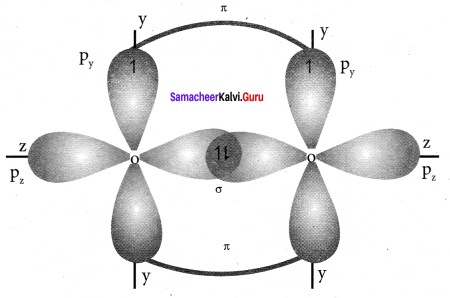
Answer:
1.
Samacheer Kalvi 11th Chemistry Solutions Chapter 9 Solutions-92
MB = 158 g mol-1

2. Henry’s Law:
The solubility of a gas in a liquid is directly proportional to the pressure of the gas.
Applications:

  • Solubility of CO2 is increased at high pressure.
  • Mixture of He and O2 are used by deep sea divers because he is less soluble than nitrogen.

3. 0.1 M NaCI, because it dissociates in solution and furnishes greater number of particles per unit volume while glucose being a non-electrolyte does not dissociate.

Question 38.
Water is a universal solvent. But alcohol also dissolves most of the substances soluble in water and also many more. Boiling point of water is 100°C and that of alcohol is 80°C. The specific heat of water is much higher than the specific heat of alcohol.

  1. List out three possible differences if instead of water as the liquid ¡n our body we had alcohol.
  2. What value can you derive from this special property of water and its innumerable uses in sustaining life on earth?

Answer:
1.
(i) Even a small rise in temperature in the surroundings will raise the temperature of’ the body because the specific heat of alcoholis much less than the specific heat of water. So, in order to cool the body, more sweating will take place.

(ii) As there is less H bonding in alcohol, it will gel evaporated faster. The alcohol will be evaporated at such a faster rate that the liquid has to be ingested all the time.

(iii) Ice which floats on water helps aquatic life to exist even in winter as water insulates the heat from liquid below it to go back to the surroundings. Solid alcohol does not have such special properties.

2. Praise is to the almighty that has so thoughtfully given such special properties to water and made it a liquid that could sustain life on earth.

Question 39.
State Henry’s law for solubility of a gas in a liquid. Explain the significance of Henry’s law constant (KH). At the same temperature, hydrogen is more soluble in water than helium. Which of theni will have a higher value of KH and Why?

Answer:
Henry’s law states that the solubility of a gas in liquid at a given temperature is directly proportional to the partial pressure of the gas.
P = KH x
where P is the pressure of the gas, x is the mole fraction of the gas in the solution and KH is the Henry’s law constant. KH is a function of the nature oIgas.

Higher the value of KH at a given temperature. lower is the solubility of the gas in the liquid. As helium is less soluble in water, so it has a higher value of KH than hydrogen.

Henry’s Law:
As dissolution of agar in liquid is an exothermic process, therefore, the solubility should decrease with in increase in temperature.

Question 40.
What is meant by positive and negative deviations from Raoult’s law and how is the sign ∆Hmix of related to positive and negative deviations from Raoult’s law?
Answer:
Negative deviations:
In these type of deviations, the partial vapour pressure of each component A and B of solution is higher than the vapour pressure calculated from Raoult’s law. For example -Water and ethanol, chloroform and water.

Positive deviations:
In case of positive deviation A – B interactions are weaker than those between A – A or B – B. This means that in such solutions molecules or A (or B) will find it easier to positive deviation from Raoult’s law.

Samacheer Kalvi 11th Chemistry Solutions 5 Marks Questions and Answers

II. Answer the following questions in detail:

Question 1.

  1. Define solution.
  2. Explain the types of solutions with suitable example.

Answer:
1. A solution is a homogeneous mixture of two or more substances, consisting of atoms. ions or molecules.

2. Types and examples of solution.
Samacheer Kalvi 11th Chemistry Solutions Chapter 9 Solutions-93

Question 2.

  1. Define Solubility
  2. Explain about the factors that influences the solubility

Answer:

1. The solubility of a substance at a given temperature is defined as the amount of the solute that can be dissolved in 100 g of the solvent at a given temperature to form a saturated solution.

2. Factors influencing solubility
(a) Nature of solute and solvent: Sodium chloride, an ionic compound readily dissolves in polar solvent such as water but it does not dissolve in non polar solvent such as benzene. Most of the organic compounds dissolve in organic solvent and do not dissolve in water.

(b) Effect of temperature: Generally, the solubility of a solid solute in a liquid solvent increases with increase in temperature. The dissolution of NaCl does not vary as the maximum solubility is achieved at normal temperature.

The dissolution of ammonium nitrate is endothermic, the solubility increases with increase in temperature. The dissolution of eerie sulphate is exothermic and the solubility decreases with increase of temperature. In the case of gaseous solute in liquid solvent the soluhility decreases with increase in temperature.

Effect of pressure:
Generally the change in pressure does not have any significant effect in the solubility of solids and l?quids as they are not compressible. However, the solubility of gases generally increases with increase of pressure.

Question 3.
Explain about the factors that are responsible for deviation from Raoult’s law.
Answer:
1. Solute-solvent interactions:
For an ideal solution, the interaction between the solvent molecules (A – A), the solute molecules (B – B) and between the solvent and solute molecules (A – B) are expected to be similar. if these interactions are dissimilar, there will be a deviation from ideal behaviour.

2. Dissolution of solute:
When a solute present in a solution dissociates to give its constituent ions, the resultant ions interact strongly with the solvent and causes deviation from Raoult’s law. e.g., KCI in water deviates from ideal behaviour due to dissociation as K+ and Cl ion which form strong ion-dipole interaction with water molecules.

3. Association of solute:
Association of solute molecules can also cause deviation from ideal behaviour. For example in solution acetic acid exists as a dimer by forming intermolecular hydrogen bonds and hence deviates from Raoult’s law.

4. Temperature:
An increase in temperature of the solution increases the average kinetic energy of the molecules present in the solution which cause decrease in the attractive force between them. As result, the solution deviates from Raoult’s law.

5. Pressure:
At high pressure, the molecules tends to stay close to each other and therefore there will be an increase in their intermolecular attraction. Thus a solution deviates from Raoult’s law at high pressure.

6. Concentration:
When the concentration is increased by adding solute, the solvent-solute interaction becomes significant. This causes deviation from Raoult’s law.

Question 4.
How would you determine molar mass from relative lowering of vapour pressure.
Answer:
1. The measurement of relative lowering of vapour pressure can be used to determine the molar mass of a non-volatile solute.

2. A known mass of the solute is dissolved in a known quantity of solvent. The relative lowering of vapour pressure is measured experimentally.

3. According to Raoult’s law, the relative lowering of vapour pressure is
Samacheer Kalvi 11th Chemistry Solutions Chapter 9 Solutions-94
WA = weight of solvent
WB = weight of solute
MA = Molar mass of solvent
MB = molar mass of solute
Samacheer Kalvi 11th Chemistry Solutions Chapter 9 Solutions-95
where nA = number of moles of solvent
nB = number of moles of solute.
For dilute solution, nA > > nB, nA + nB = nA
Then, Samacheer Kalvi 11th Chemistry Solutions Chapter 9 Solutions-96
Number of moles of solvent and solute arc
Samacheer Kalvi 11th Chemistry Solutions Chapter 9 Solutions-97
Samacheer Kalvi 11th Chemistry Solutions Chapter 9 Solutions-98
From the above equation, molar mass of the solute MB can be calculated using the known values of WA, WB, MA and the measured relative lowering of vapour pressure.

Question 5.
How would you determine the molar mass from osmotic pressure.
Answer:
According to van’t Hoff equation
π = CRT
C = \(\frac { n }{ V }\)
Here n = number of moles of solute dissolved in ‘V’ litre of the solution.
π = \(\frac { n }{ V }\) . RT = πV = nRT
If the solution is prepared by dissolving WB of the non-volatile solute in WA g of solvent, then the number of moles of ‘n’ is
Samacheer Kalvi 11th Chemistry Solutions Chapter 9 Solutions-99
where
MB = molar mass of the solute
Substituting n value, we get
Samacheer Kalvi 11th Chemistry Solutions Chapter 9 Solutions-100
From the above equation, we can calculate the molar mass of the solute.

Question 6.
What are ideal and non-ideal solutions? Explain with suitable diagram the behaviour of ideal solutions.
Answer:
Ideal solutions:
The solutions which obey Raoult’s law over the entire range of concentration are known as ideal solutions. Ideal solutions are formed by mixing the two components which are identical in molecular size, in structure and have almost identical intermolecular forces.

Examples:

  1. Benzene and toluene
  2. n – Hexane and n-Heptane
  3. Chiorobenzene and bromobenzene.

Characteristics:

  1. They must obey Raoult’s law.
  2. ∆H mixing should be zero.
  3. ∆W mixing should be zero, i.e. volume change on mixing is zero.

Non – ideal solutions:
The solutions which do not obey Raoult’s law are called non-ideal solutions. In case of non – ideal solutions there is a change in volume and heat energy when the two components are mixed.
Samacheer Kalvi 11th Chemistry Solutions Chapter 9 Solutions-101

Characteristics:

  1. They does not obey Raoult’s law.
  2. ∆Vmix \(\quad \neq\) 0
  3. ∆Hmix \(\quad \neq\) 0

Behaviour of Ideal Solutions:
A plot of P1 or P2 versus the mole fraction x1 and x2 for an ideal solution gives a linear plot. These Lines (I and II)pass through the points and respectively whenx1 and x2 is equal to unity.

Similarly the plot (Line III) of Ptotal versus x2 is also linear. The minimum value of is P1° and the maximum value is P2°, assuming that component 1 is less volatile than component 2, i.e. P1° < P20.

Question 7.
Explain with a suitable diagram and appropriate example, why some non-ideal solution shows positive deviation from Raou It’s law.
Answer:
Some non-ideal solutions show positive deviation from Raoult’s law. Consider a solution of two components A and B.  If A-B interactions in the solution are weaker than the A – A and B – B interactions in the two liquids forming the solution, then the escaping tendency of molecules A and B from the solution become more than in pure liquids.

The total vapour pressure will be greater than the corresponding vapour pressure as expected on the basis of Raoult’s law. This type of behaviour of solution is called positive deviation from Raoult’s law. The boiling point of such solutions are lowered. Mathematically,
PA < PA0 xA
PB < PB0 xB
The total vapour pressure is less than PA + PB
P < PA + PB
P < P°A x xA + P°B xB
Hence
P1 = PA
P2 = PB
Examples of solutions showing positive deviations

  1. Ethyl alcohol and water
  2. Benzene and acetone
  3. Ethyl alcohol and cyclohcxanc
  4. Carbon tetrachloride and chloroform.

Samacheer Kalvi 11th Chemistry Solutions Chapter 9 Solutions-102

Question 8.

  1. What is Osmotic pressure and how is it related to the molecular mass of a non volatile substances?
  2. What advantage the osmotic pressure method has over the elevation of boiling point method for determining the molecular mass?

Answer:
1. Osmotic pressure:
It is the pressure of the solution column that can prevent the entry of solvent molecules through a semi-permeable membrane, when the solution and the solvent are separated by the same. It is denoted by π. Its unit is mm 11g or atmosphere.
We know that, π = CRT
where π is the osmotic pressure and R is the gas constant
π = \(\frac { { n }_{ 2 } }{ V }\) RT
where V is volume of solution per litre containing n2 moles of solute.
Samacheer Kalvi 11th Chemistry Solutions Chapter 9 Solutions-103
By the above relation molar mass of solute can be calculated.

2. The osmotic pressure method has the advantage over other methods as pressure measurement is around the room temperature and molarity of the solution is used instead of molality.

The technique of osmotic pressure for determination of molar mass of solutes is particularly useful for biomolecules as they are generally not stable at higher temperature and polymers have poor solubility.

III. Numerical Problems

Question 1.
Calculate the mole fraction of benzene ¡n solution containing 30% by mass in carbon tetrachioride.
Solution:
30% of benzene in carbon tetrachloride by mass means that Mass of benzene in the solution = 30g
Mass of solution = 100g
Mass of carbon tetrachloride = 100g – 30g = 70g
Molar mass of benzene (C6H6) = 78 g mol-1
Molar mass of CCl4 = 12 + (4 x 35.5) 154g mol-1
Samacheer Kalvi 11th Chemistry Solutions Chapter 9 Solutions-104

Question 2.
Calculate (he molarity of each of the following solutions:
Solution:

  1. 30 g of CO(NO3)2. 6H2O = in 4.3 L of solution
  2. 30 mL of 0.5 M H2SO4 diluted to 500 mL.

1. Molar mass of CO(NO3)2. 6H2O = 58.7 + 2(14 + 48) + (6 x 8)g mol-1
= 58.7 + 124 + 108g mol-1 = 290.7 gmol-1
Samacheer Kalvi 11th Chemistry Solutions Chapter 9 Solutions-105
Volume of solution = 4.3 L
Samacheer Kalvi 11th Chemistry Solutions Chapter 9 Solutions-106

2. 1000 mL of 0.5 M H2SO4 Contain H2SO4 = 0.5 moles
30 mL of 0.5 M H2SO4 contain H2SO4 = \(\frac { 0.5 }{ 1000 }\) x 30 mole = 0.015 mole
Volume of solution = 500 mL = 0.500 L
Samacheer Kalvi 11th Chemistry Solutions Chapter 9 Solutions-107

Question 3.
Calculate the mass of urea (NH2CONH2) required in making 2.5 kg of 0.25 molal aqueous solution.
Solution:
0.25 molal aqueous solution means that
Moles of urea = 0.25 mole
Mass of solvent (water) = 1 kg = 1000 g
Molar mass of urea = 14 + 2 + 12 + 16 + 14 + 2 = 6Og mol-1
0.25 mole of urea = 60 x 0.25 mole = 15 g
Total mass of the solution = 1000 + 15 g = 1015 g = 1.015 g
Thus, 1.015 kg of solution contain urea = 15 g
2.5 kg of solution will require urea = \(\frac { 15 }{ 1.015 }\) x 2.5 kg = 37g

Question 4.
H2S, a toxic gas with rotten egg like smell is used for the qualitative analysis. 1f the solubility of H2S in water at STP is 0.195 m. Calculate Henrvs law constant.
Solution:
Solubility of H2S gas = 0.195 m
= 0.195 mole in 1 kg of the Solvent (water)
1 kg of the solvent (water) = 1000 g Samacheer Kalvi 11th Chemistry Solutions Chapter 9 Solutions-108
Mole fraction of H2S gas in the solution (x) = \(\frac { 0.195 }{ 0.195 + 55.55 }\) = 0.0035
Pressure at STP = 0.98 7 bar
Applying Henry’s law
PH2S = KH x xH2S
Samacheer Kalvi 11th Chemistry Solutions Chapter 9 Solutions-109

Question 5.
Vapour pressure of pure water at 298 K is 23.8 mm Hg. 50 g of urea (NH2CONH2) is dissolved in 850 g of water. Calculate the vapour pressure of water for this solution and its relative lowering.
Solution:
Here
1 = 23.8 mm
W2 = 50g
M2 (urea) = 60g mol-1
W1 = 850g
M1(Water) = 18g mol-1
Here we have to calculate Ps
Applying Raoult’s law,
Samacheer Kalvi 11th Chemistry Solutions Chapter 9 Solutions-110
Thus, relative lowering of vapour pressure = 0.017
Substituting P° = 23.8 mm Hg
Samacheer Kalvi 11th Chemistry Solutions Chapter 9 Solutions-111
We get,
23.8 – Ps = 0.017 Ps
Ps = 23.4 mm Hg
Thus, vapour pressure of water in the solution = 23.4 mm Hg

Question 6.
Boiling point of water at 750 mm Hg is 99.63°C. How much sucrose is to be added to 500g of water such that it boils at 100°C? .
Solution:
Elevation in boiling point required, ∆Tb = 100 – 99.63° = 0.37°
Mass of solvent (water) W1 = 500g
Mass of solute, C12H22O11 = 342 g mol-1
Molar mass of solvent M1 = 18 g mol-1
Applying the formula,
Samacheer Kalvi 11th Chemistry Solutions Chapter 9 Solutions-112

Question 7.
Concentrated nitric acid used in laboratory work is 68% nitric acid by mass in aqueous solution. What should be the molarity of such a sample of the acid if the density of the solution is 1.504g mL-1?
Solution:
68% nitric acid by mass means that
Mass of nitric acid = 68 g
Mass of solution = 100 g
Molar mass of HNO3 = 63g mol-1
68g HNO3 = mole = 1.079 mole
Density of solution = 1.504 g mL-1
Volume of solution = \(\frac { 100 }{ 1.504 }\) mL = 66.5 mL = 0.0665 L
Samacheer Kalvi 11th Chemistry Solutions Chapter 9 Solutions-113

Question 8.
A solution is obtained by mixing 300 g of 25% solution and 400 g of 40% solution by mass. Calculate tile mass percentage of the resulting solution.
Solution:
300 g of 25% solution contains solute = 75g
400g of 40% solution contains solute = 160 g
Total mass of solute = 160 + 75 = 235 g
Total mass oÍ’ solution = 300 + 400 = 700 g
% of solute in the final solution = \(\frac { 235 }{ 700 }\) x 1oo = 33.5%
% of water in the finaI solution = 100 – 33.5 = 66.5%

Question 9.
A sample of drinking water was found to be severely contaminated with chloroform (CHCI3) supposed to be a carcinogen. The level of contamination was 15 ppm (by mass)

  1. express this in percentage by mass
  2. determine the molality of chloroform in the water sample.

Solution:
1. 15 ppm means 15 parts in million (106) parts by mass in the solution
% of mass = \(\frac { 15 }{ { 10 }^{ 6 } }\) x 100 = 1.5 x 10⁻⁴

2. Taking 15g chloroform in 106g of the solution
Mass of the solvent = 106 g
Molar mass of CHCl3 = 12 + 1 + (3 x 35.5) = 119.5 g mol-1
Samacheer Kalvi 11th Chemistry Solutions Chapter 9 Solutions-114

Question 10.
An aqueous solution of 2% non-volatile solute exerts a pressure of 1.004 bar at normal boiling point of the solvent. What is the molar mass of the solute?
Solution:
Vapour pressure of pure water at the boiling point
(P°) = 1 atm 1.013 bar
Vapour pressure of solution Ps = 1.004 bar
M1 = 18 g mol-1
M2 = ?
Mass of solute = W2 = 2g
Mass of solution = 100g
Mass of solvent W1 = 98 g
Applying Raoult’s law for dilute solution
Samacheer Kalvi 11th Chemistry Solutions Chapter 9 Solutions-115

Question 11.
A 5% solution (by mass) of cane sugar in water has freezing point of 271 K. Calculate the freezing point of 5% glucose in water if freezing point of pure water is 273.15K.
Solution:
Molar mass of cane sugar
C12H22O11 = 342 g mol-1
Molality of sugar = \(\frac { 5 x 1000 }{ 342 x 100 }\) = 0.146
∆T2 for sugar solution = 273.15 – 271 = 2.15°
∆Tf = Kf x m
Kf = \(\frac { 2.15 }{ 0.146 }\)
Molality of glucose solution = \(\frac { 5 }{ 180 }\) x \(\frac { 1000 }{ 100 }\) = 0.278 m
∆Tf (Glucose) = \(\frac { 2.15 }{ 0.146 }\) x 0.278 = 4.09°K
Freezing point of glucose solution = 273.15 – 4.09 = 269.06 K

Question 12.
Calculate the amount of benzoic acid (C6HCOOH) required for preparing 250 mL of 0.15 M solution in methanol.
Solution:
0.15 M solution means that 0.15 moles of C6H5COOH is present in IL
= 1000 mL of the solution
Molar mass of C6H5COOH = 72 + 5 + 12 + 32 + 1 = 122 g mol-1
Thus, 1000 mL of solution contains benzoic acid = 18.3g
250 mL of solution will contain benzoic acid
= \(\frac { 18.3 }{ 1000 }\) x 250 = 4.575 g

Question 13.
A solution containing 8 g of a substance in 100 g of diethyl ether boils at 36.86°C, whereas pure ether boils at 35.60 °C. Determine the molecular mass of the solute (For ether Kb 2.02 K kg mol-1)
Solution:
We have, mass of solute, W2 = 8 g
Mass of solvent, W1 = 100 g
Elevation of boiling point
∆Tb = 36.86 – 35.60 = 1.260C
Kb = 2.02
Molecular mass of the solute
Samacheer Kalvi 11th Chemistry Solutions Chapter 9 Solutions-116
= 128.25g mol-1

Question 14.
Ethylene glycol (molar mass = 62 g mol-1) is a common automobile antifreeze. Calculate the freezing point of a solution containing 12.4 of this substance in 100 g of water. Would it be advisable to keep this substance ¡n the car radiator during summer? (Kf for water = 1.86 k kg/mol-1) (Kb for water = 0.512 K kg/mol-1)
Solution:
Samacheer Kalvi 11th Chemistry Solutions Chapter 9 Solutions-117
Since water boils at 100°C, so a solution containing ethylene glycol will boil at 101.024 °C, SO it is advisable to keep this substance in car radiator during summer.

Question 15.
15.0 g of an unknown molecular material is dissolved in 450g of water. The resulting solution freezes at – 0.34°C. What is the molar mass of the material? Kf for water = 1.86 K kg mol-1.
Solution:
W(solute) = 1 5.0 g
W(solvent) = 450 g
∆Tf = T°f – Tf = 0 – ( – 0.34) = 0.34 °C
∆Tf = kf m
0.34 = 1.86 x \(\frac { 15 }{ M }\) x \(\frac { 1000 }{ 450 }\)
M = \(\frac { 1.86 x 15 x 1000 }{ 0.34 x 450 }\) = 182.35 g mol-1

Common Errors
Common Errors:

  1. Students are writing solute, solvent, students get confused to write A (or) B, 1 (or)2.
  2. Mole, mole fraction may be confused.
  3. In writing osmosis definition Students get confused in mentioning concentration terms.
  4. van’t Hoff factor I formula may be con fused.
  5. Students may get contused rhen they write solute and solvent.
  6. Mole and mole fraction may be confused by students.
  7. Standard solutions must be known.
  8. When students write Raoult’s law, they get confused with solute and solvent.
  9. When they write the definition of osmosis, the conc. term may be little con fused.
  10. van’t Hoff equation may be written wrongly.

Rectifications:

  1. Always solvent is first so it is denoted as A (or) 1 solute is second so, it is denoted as B (or)2.
  2. Mole = n ; Mole fraction x
  3. Osmosis-movenient of solvent from low concentration to high concentration through a semipermeable membrane.
  4. Samacheer Kalvi 11th Chemistry Solutions Chapter 9 Solutions-118
  5. For e.g.. solid in liquid means solid is the solute and liquid is the solvent.
  6. Samacheer Kalvi 11th Chemistry Solutions Chapter 9 Solutions-119
  7. 1 N = 1 normal solution, 0.1 N Decinormal solution, 0.01 N = Centinormal solution
  8. In Raoult’s law, “A” is always solvent and “B” is always solute.
  9. In osmosis, always solvent rnoes through semi permeable membrane from low concentration to high concentration.
  10. van’t Hoff factory = i
    Samacheer Kalvi 11th Chemistry Solutions Chapter 9 Solutions-120

We as a team believe the information prevailing regarding the Samacheer Kalvi Solutions for 11th Chemistry Chapter 9 Solutions has been helpful in clearing your doubts to the fullest. For any other help do leave us your suggestions and we will look into them. Stay in touch to get the latest updates on Tamilnadu State Board Solutions for different subjects in the blink of an eye.

Samacheer Kalvi 11th Chemistry Solutions Chapter 8 Physical and Chemical Equilibrium

Enhance your subject knowledge with Tamilnadu State Board for Chapter 8 Physical and Chemical Equilibrium and learn all the underlying concepts easily. Make sure to Download Samacheer Kalvi 11th Chemistry Book Solutions, Notes Pdf Chapter 8 Physical and Chemical Equilibrium Questions and Answers PDF on a day to day basis and score well in your exams. Are given after enormous research by people having high subject knowledge. You can rely on them and prepare any topic of Chemistry as per your convenience easily.

Tamilnadu Samacheer Kalvi 11th Chemistry Solutions Chapter 8 Physical and Chemical Equilibrium

Students looking for Chapter 8 Physical and Chemical Equilibrium Concepts can find them all in one place from our Tamilnadu State Board Solutions. Simply click on the links available to prepare the corresponding topics of Chemistry easily. Samacheer Kalvi 11th Chemistry Chapter wise Questions and Answers are given to you after sample research and as per the latest edition textbooks. Clarify all your queries and solve different questions to be familiar with the kind of questions appearing in the exam. Thus, you can increase your speed and accuracy in the final exam.

Samacheer Kalvi 11th Chemistry Chapter 8 Physical and Chemical Equilibrium Textual Evaluation Solved

Samacheer Kalvi 11th Chemistry Physical and Chemical Equilibrium Multiple Choice Questions

Question 1.
If Kb and Kf for a reversible reactions are 0.8 x 10⁻⁵ and 1.6 x 10⁻⁴ respectively, the value of the equilibrium constant is
(a) 20
(b) 0.2 x 10⁻¹
(c) 0.05
(d) None of these
Answer:
(a) 20
Solution:
Samacheer Kalvi 11th Chemistry Solutions Chapter 8 Physical and Chemical Equilibrium-110

Question 2.
At a given temperature and pressure, the equilibrium constant values for the equilibria
Samacheer Kalvi 11th Chemistry Solutions Chapter 8 Physical and Chemical Equilibrium-111
The relation between K1 and K2 is
Samacheer Kalvi 11th Chemistry Solutions Chapter 8 Physical and Chemical Equilibrium-112
Answer:
Samacheer Kalvi 11th Chemistry Solutions Chapter 8 Physical and Chemical Equilibrium-113
Solution:
Samacheer Kalvi 11th Chemistry Solutions Chapter 8 Physical and Chemical Equilibrium-114

Question 3.
The equilibrium constant for a reaction at room temperature is K1 and that at 700 K is K2. If K1 > K2 then
(a) The forward reaction is exothermic
(b) The forward reaction is endothermic
(c) The reaction does not attain equilibrium
(d) The reverse reaction is exothermic
Answer:
(a) The forward reaction is exothermic
Solution:
T1 = 25 + 273 = 298 K, T2 = 700 K
Samacheer Kalvi 11th Chemistry Solutions Chapter 8 Physical and Chemical Equilibrium-115
In this case, T2 > T1 and K1 > K2
Samacheer Kalvi 11th Chemistry Solutions Chapter 8 Physical and Chemical Equilibrium-116
ΔH° is – ve i.e., forward reaction is exothermic.

Question 4.
The formation of ammonia from N2(g) and H2(g) is a reversible reaction
N2(g) + 3H2(g) \(\rightleftharpoons\) 2NH3(g) + Heat
What is the effect of increase of temperature on this equilibrium reaction
(a) equilibrium is unaltered
(b) formation of ammonia is favoured
(c) equilibrium is shifted to the left
(d) reaction rate does not change
Answer:
(c) equilibrium is shifted to the left
Solution:
Increase in temperature, favours the endothermic reaction, given that formation of NH3 is exothermic i.e., the reverse reaction is endothermic.
∴ Increase in temperature, shift the equilibrium to left

Question 5.
Solubility of carbon dioxide gas in cold water can be increased by ………….
(a) increase in pressure
(b) decrease in pressure
(c) increase in volume
(d) none of these
Answer:
(a) increase in pressure
Solution:
Samacheer Kalvi 11th Chemistry Solutions Chapter 8 Physical and Chemical Equilibrium-117
increase in pressure, favours the forward reaction.

Question 6.
Which one of the following is incorrect statement?
(a) for a system at equilibrium, Q is always less than the equilibrium constant
(b) equilibrium can be attained from either side of the reaction
(c) presence of catalyst affects both the forward reaction and reverse reaction to the same extent
(d) Equilibrium constant varied with temperature
Answer:
(a) for a system at equilibrium, Q is always less than the equilibrium constant
Solution:
Correct statement is, for a system at equilibrium, Q = Keq

Question 7.
K1 and K2 are the equilibrium constants for the reactions respectively.
Samacheer Kalvi 11th Chemistry Solutions Chapter 8 Physical and Chemical Equilibrium-118
What is the equilibrium constant for the reaction NO2(g) \(\rightleftharpoons\) \(\frac { 1 }{ 2 }\)N2(g) + O2(g)
Samacheer Kalvi 11th Chemistry Solutions Chapter 8 Physical and Chemical Equilibrium-119
Answer:
Samacheer Kalvi 11th Chemistry Solutions Chapter 8 Physical and Chemical Equilibrium-120
Solution:
Let equilibrium constant for the required reaction be K. Then,
Samacheer Kalvi 11th Chemistry Solutions Chapter 8 Physical and Chemical Equilibrium-121

Question 8.
In the equilibrium, 2A(g) \(\rightleftharpoons\) 2B(g) + C2(g) the equilibrium concentrations of A, B and C, at 400 K are 1 x 10⁴ M, 2.0 x 10⁻³ M, 1.5 x 10⁻⁴ M respectively. The value of Kc. for the equilibrium at 400 K is
(a) 0.06
(b) 0.09
(c) 0.62
(d) 3 x 10⁻²
Answer:
(a) 0.06
Solution:
[A] = 1 x 10⁻⁴ M
[B] = 2 x 10⁻³ M
[C] = 1.5 x 10⁻⁴ M
Samacheer Kalvi 11th Chemistry Solutions Chapter 8 Physical and Chemical Equilibrium-122

Question 9.
An equilibrium constant of 3.2 x 10⁻⁶ for a reaction means, the equilibrium is ………
(a) largely towards forward direction
(b) largely towards reverse direction
(c) never established
(d) none of these
Answer:
(b) largely towards reverse direction
Solution:
Samacheer Kalvi 11th Chemistry Solutions Chapter 8 Physical and Chemical Equilibrium-123

Question 10.
\(\frac { { K }_{ c } }{ { K }_{ p } }\) for the reaction, N2(g) + 3H2(g) \(\rightleftharpoons\) 2NH3(g) is ………
(a) \(\frac { 1 }{ RT }\)
(b) \(g\sqrt { RT } \)
(c) RT
(d) (RT)2
Answer:
(d) (RT)2
Solution:
N2(g) + 3H2(g) \(\rightleftharpoons\) 2NH3(g)
∆ng = 2 – 4 = – 2
Kp = Kc (RT)-2
\(\frac { { K }_{ c } }{ { K }_{ p } }\) = (RT)2

Question 11.
For the reaction, AB(g) \(\rightleftharpoons\) A(g) + B(g), at equilibrium, AB is 20% dissociated at a total pressure of R The equilibrium constant K is related to the total pressure by the expression ………..
(a) P = 24 Kp
(b) P = 8 Kp
(c) 24 p = Kp
(d) none of these
Answer:
(a) P =24 Kp
Solution:
Samacheer Kalvi 11th Chemistry Solutions Chapter 8 Physical and Chemical Equilibrium-125

Question 12.
In which of the following equilibrium, K and K are not equal?
(a) 2NO(g) \(\rightleftharpoons\) N2(g) + O2(g)
(b) SO2(g) + NO2(g) \(\rightleftharpoons\) SO3(g) + NO(g)
(c) H2(g) + I2(g) \(\rightleftharpoons\) 2HI(g)
(d) PCI5(g) \(\rightleftharpoons\) PCl3(g) + Cl2(g)
Answer:
(d) PCI5(g) \(\rightleftharpoons\) PCl3(g) + Cl2(g)
Solution:
For reactions given in options (a), (b) and (c) ∆ng = 0
For option (d) ∆ng = 2 – 1 = 1
∴ Kp = Kc (RT)

Question 13.
If x is the fraction of PCI5 dissociated at equilibrium in the reaction,
PCl5 \(\rightleftharpoons\) PCl3 + Cl2
then starting with 0.5 moIe of PCI5 the total number of moles of reactants and products at equilibrium is
(a) 0.5 – x
(b) x + 0.5
(e) 2x + 0.5
(d) x ± 1
Answer:
(b) x + 0.5
Solution:
Samacheer Kalvi 11th Chemistry Solutions Chapter 8 Physical and Chemical Equilibrium-126
Total no. of moles at equilibrium = 0.5 – x + x + x = 0.5 + x

Question 14.
The values of Kp1 and Kp2 for the reactions X \(\rightleftharpoons\) Y + Z and A \(\rightleftharpoons\) 2B are in the ratio 9 : 1 if degree of dissociation and initial concentration of X and A be equal then total pressure at equilibrium P1, and P2 are in the ratio
(a) 36 : 1
(b) 1: 1
(c) 3 : 1
(d) 1: 9
Answer:
(a) 36: 1
Solution:
Samacheer Kalvi 11th Chemistry Solutions Chapter 8 Physical and Chemical Equilibrium-127
Samacheer Kalvi 11th Chemistry Solutions Chapter 8 Physical and Chemical Equilibrium-128

Question 15.
In the reaction, Fe(OH)3(s) \(\rightleftharpoons\) Fe3+(aq) + 3OH(aq), if the concentration of OH ions is decreased by ¼ times, then the equilibrium concentration of Fe3+ will …………
(a) not changed
(b) also decreased by ¼ times
(c) increase by 4 times
(d) increase by 64 times
Answer:
(d) increase by 64 times
Solution:
Samacheer Kalvi 11th Chemistry Solutions Chapter 8 Physical and Chemical Equilibrium-129
[∵ Concentration of solids is constant)
When concentration of OH ions decreased by \(\frac { 1 }{ 4 }\) times, then
Samacheer Kalvi 11th Chemistry Solutions Chapter 8 Physical and Chemical Equilibrium-130
To maintain KC as constant, concentration of Fe3+ will increase by 64 times.

Question 16.
Consider the reaction where Kp = 0.5 at a particular temperature
PCI5(g) \(\rightleftharpoons\) PCI3(g) + Cl2(g) if the three gases are mixed in a container so that the partial pressure of each gas is initially 1 atm, then which one of the following is true?
(a) more PCI3 will be produced
(b) more Cl2 will be produced
(c) more PCI5 will be produced
(d) none of these
Answer:
(c) more PCI5 will be produced .
Solution:
Kp = 0.5
Samacheer Kalvi 11th Chemistry Solutions Chapter 8 Physical and Chemical Equilibrium-131
Q = \(\frac { 1 x 1 }{ 1 }\)
Q > Kp
∴Reverse reaction is favoured; i.e., more PCI5 will be produced.

Question 17.
Equimolar concentrations of H2 and I2 are heated to equilibrium in a 1 litre flask. What percentage of initial concentration of H2 has reacted at equilibrium if rate constant for both forward and reverse reactions are equal
(a) 33%
(b) 66%
(c)(33)2 0/0
(d) 16.5%
Answer:
(a) 33%
Solution:
Samacheer Kalvi 11th Chemistry Solutions Chapter 8 Physical and Chemical Equilibrium-132
As degree of dissociation cannot be negative. Therefore, degree of dissociation
= \(\frac { a }{ 3 }\) x 100 = 33.33%

Question 18.
In a chemical equilibrium, the rate constant for the forward reaction is 2.5 x 1 and the equilibrium constant is 50. The rate constant for the reverse reaction is ……….
(a) 11.5
(b) 5
(c) 2 x 10²
(d) 2 x 10³
Answer:
(b) 5
Solution:
Samacheer Kalvi 11th Chemistry Solutions Chapter 8 Physical and Chemical Equilibrium-133

Question 19.
Which of the following is not a general characteristic of equilibrium involving physical process
(a) Equilibrium is possible only in a closed system at a given temperature
(b) The opposing processes occur at the same rate and there is a dynamic but stable condition
(c) All the physical processes stop at equilibrium
(d) All measurable properties of the system remains constant
Answer:
(c) All the physical processes stop at equilibrium
Solution:
Correct statement – Physical processes occurs at the same rate at equilibrium.

Question 20.
For the fórmation of two moles of SO3(g) from SO2 and O2, the equilibrium constant is K1. The equilibrium constant for the dissociation of one mole of SO3 into SO2 and O2 is …………
Samacheer Kalvi 11th Chemistry Solutions Chapter 8 Physical and Chemical Equilibrium-134
Answer:
Samacheer Kalvi 11th Chemistry Solutions Chapter 8 Physical and Chemical Equilibrium-135
Solution:
2SO2 +O2 \(\rightleftharpoons\) 2SO3
Samacheer Kalvi 11th Chemistry Solutions Chapter 8 Physical and Chemical Equilibrium-136
Dissociation of 1 mole of 2SO3
Samacheer Kalvi 11th Chemistry Solutions Chapter 8 Physical and Chemical Equilibrium-137

Question 21.
Match the equilibria with the corresponding conditions …………
(i) Liquid \(\rightleftharpoons\) Vapour – 1. Melting point
(ii) Solid \(\rightleftharpoons\) Liquid – 2. Saturated solution
(iii) Solid \(\rightleftharpoons\) Vapour – 3. Boiling point
(iv) Solute (s) \(\rightleftharpoons\) Solute (Solution) – 4. Sublimation point
5. Unsaturated solution
Samacheer Kalvi 11th Chemistry Solutions Chapter 8 Physical and Chemical Equilibrium-138
Answer:
(b) 3, 1, 4, 2

Question 22.
Consider the following reversible reaction at equilibrium, A + B \(\rightleftharpoons\) C, if the concentration of the reactants A and B are doubled, then the equilibrium constant will ………
(a) be doubled
(b) become one fourth
(c) be halved
(d) remain the same
Answer:
(d) remain the same
Solution:
A + B \(\rightleftharpoons\) C
KC = \(\frac { [C] }{ [A] [B] }\)
If [A] and [B] are doubled, [C] increases 4 times to maintain KC as constant.
∴ Equilibrium constant will remain the same.

Question 23.
[CO(H2O)6]2+ (aq) (pink) + 4C (aq) \(\rightleftharpoons\) [COCI4]2- (aq) (blue) + 6H2O (1) In the above reaction at equilibrium, the reaction mixture is blue in colour at room temperature. On cooling this mixture, it becomes pink in colour. On the basis of this information, which one
of the following is true?
(a) ∆H > 0 for the forward reaction
(b) ∆H = 0 for the reverse reaction
(c) ∆H < 0 for the forward reaction
(d) Sign of the ∆H cannot be predicted based on this information.
Answer: (a) ∆H > 0 for the forward reaction
Solution:
On cooling, reverse reaction predominates and the solution is pink in colour. Decrease in temperature, favours the reverse reaction i.e. reverse reaction is exothermic (∆H < 0)and for the forward reaction is endothermic (∆H > 0).

Question 24.
The equilibrium constants of the following reactions are:
N2 + 3H2 \(\rightleftharpoons\) 2NH3 ; K1
N2 + O2 \(\rightleftharpoons\) 2NO ; K2
H2+ \(\frac { 1 }{ 2 }\)O2 \(\rightleftharpoons\) H2O ; K3
The equilibrium constant (K) for the reaction; Samacheer Kalvi 11th Chemistry Solutions Chapter 8 Physical and Chemical Equilibrium-140 will be
Samacheer Kalvi 11th Chemistry Solutions Chapter 8 Physical and Chemical Equilibrium-141
Answer:
Samacheer Kalvi 11th Chemistry Solutions Chapter 8 Physical and Chemical Equilibrium-167
Solution:
Samacheer Kalvi 11th Chemistry Solutions Chapter 8 Physical and Chemical Equilibrium-143

Question 25.
A 20 litre container at 400 K contains CO2(g) at pressure 0.4 atm and an excess of SrO (neglect the volume of solid SrO). The volume of the container is now decreased by moving the movable piston fitted in the container. The maximum volume of the container, when pressure of CO2 attains its maximum value will be.
Given that: SrCO3(s) \(\rightleftharpoons\) SrO(s) + CO2(g)
(a) 2 litre
(b) 5 litre
(c) 10 Litre
(d) 4 litre
Answer:
(b) 5 litre
Solution:
Given that Kp = 1.6 atm
V1 = 20 L
V2 = ?
T1 = 400 K
T2 = 400 K
Kp = Pco2
Pco2 = 1.6 atm
P1 = 0.4 atm
P2 = 1.6 atm
Samacheer Kalvi 11th Chemistry Solutions Chapter 8 Physical and Chemical Equilibrium-144

Samacheer Kalvi 11th Chemistry Physical and Chemical Equilibrium Short Answer Questions

Question 26.
If there is no change in concentration, why is the equilibrium state considered dynamic?
Answer:
At chemical equilibrium the rate of two opposing reactions are equal and the concentration of. reactants and products do not change with time. This condition is not static and is dynamic, because both the forward and reverse reactions are still occurring with the same rate and no macroscopic change is observed. So chemical equilibrium is in a state of dynamic equilibrium.

Question 27.
For a given reaction at a particular temperature, the equilibrium constant has constant value. Is the value of Q also constant? Explain.
Answer:
In the chemical reaction, as the reaction proceeds, there is a continuous change in the concentration of reactants and products and also the Q value until the reaction reaches the equilibrium. So even at particular temperature, Q is not constant. Even once the equilibrium is achieved then change in concentration of reactants or products, pressure, volume will change the value of Q.

Question 28.
What is the relation between Kp and KC. Give one example for which Kp is equal to KC.
Answer:
The relation between Kp and Kc is Kp = KC (RT)∆ng
Kp = equilibrium constant is terms of partial pressure.
Kc = equilibrium constant is terms of concentration.
R = gas constant
T = Temperature.
∆ng = Difference between the sum of the number of moles of products and the sum of number of moles of reactants in the gas phase. When ∆ng = 0
Kp = KC(RT)0 = KC i.e., Kp = KC
Example: H2(g) + I2(g) \(\rightleftharpoons\) 2HI(g)
∆ng = 2 – 2 = 0
∴ Kp = KC for the synthesis of HI.

Question 29.
For a gaseous homogeneous reaction at equilibrium, number of moles of products are greater than the number of moles of reactants. Is KC is larger or smaller than Kp ?
Answer:
For a homogeneous reaction at equilibrium, number of moles of products (np) are greater than the number of moles of reactants (nR) then ∆ng = + ve
np > nR
∆ng = + ve
If ∆ng is ve, Kp value is greater than KC
Kp = KC. (RT)+ve
Kp > KC
Example: PCl5 \(\rightleftharpoons\) PCl3(g) + Cl2(g)
2 – 1 = 1
Kp = KC (RT)1
Kp > KC

Question 30.
When the numerical value of the reaction quotient (Q) is greater than the equilibrium constant (K), in which direction does the reaction proceed to reach equilibrium?
Answer:
When Q > KC the reaction will proceed in the reverse direction, i.e, formation of reactants.

Question 31.
For the reaction: A2(g) + B2(g) \(\rightleftharpoons\) 2AB(g); ∆H is – ve.
Answer:
The following molecular scenes represent different reaction mixture
(A – dark grey, B – light grey)
Samacheer Kalvi 11th Chemistry Solutions Chapter 8 Physical and Chemical Equilibrium-145

  1. Calculate the equilibrium constant Kp and KC
  2. For the reaction mixture represented by scene (x), (y) the reaction proceed in which directions?
  3. What is the effect of increase in pressure for the mixture at equilibrium?

Answer:
1. Samacheer Kalvi 11th Chemistry Solutions Chapter 8 Physical and Chemical Equilibrium-146
At equilibrium
Samacheer Kalvi 11th Chemistry Solutions Chapter 8 Physical and Chemical Equilibrium-147

2.
Samacheer Kalvi 11th Chemistry Solutions Chapter 8 Physical and Chemical Equilibrium-148

3.  Since ∆ng = 2 – 2 = 0, thus, pressure has no effect. So by increasing the pressure, equilibrium will not be affected.

Question 32.
State Le – Chatelier principle.
Answer:
It states that If a system at equilibrium is disturbed, then the system shifts itself in a direction that nullifies the effect of that disturbance.

Question 33.
Consider the following reactions

  1. H2(g) + l2(g) \(\rightleftharpoons\) 2HI(g)
  2. CaCO3(s) \(\rightleftharpoons\) CaO(s) + CO2(g)
  3. S(s) + 3F2(g) \(\rightleftharpoons\) SF6(g)

In each of the above reaction find out whether you have to increase (or) decrease the volume to increase the yield of the product.
Answer:
1.  H2(g) + l2(g) \(\rightleftharpoons\) 2HI(g)
In the above equilibrium reaction, volume of gaseous molecules is equal on both sides. So increase or decrease the volume will not affect the equilibrium and there will be no change in the yield of product.

2. Samacheer Kalvi 11th Chemistry Solutions Chapter 8 Physical and Chemical Equilibrium-149
Volume is greater in product side. By decreasing the pressure, volume will increase thus, to get more of product CO2, the pressure should be decreased or volume should be increased.

3. Samacheer Kalvi 11th Chemistry Solutions Chapter 8 Physical and Chemical Equilibrium-150
Volume is lesser in product side. So by increasing the pressure, equilibrium shifts to the product side.

Question 34.
State law of mass action.
Answer:
The law states that “At any instant, the rate of chemical reaction at a given temperature is directly proportional to the product of the active masses of the reactants at that instant.”

Question 35.
Explain how will you predict the direction of an equilibrium reaction.
Answer:

  1. A large value of KC indicates that the reaction reaches equilibrium with high product yield.
  2. A low value of KC indicate that the reaction reaches equilibrium with low product formed.
  3. In general, if the K is greater than I the reaction proceeds nearly to completion. If is less than 10-3, the reaction rarely proceeds.
  4. If K < 10-3, reverse reaction is favoured. If Kc > 103, forward reaction is favoured.

Samacheer Kalvi 11th Chemistry Physical and Chemical Equilibrium Long Answer Questions

Question 36.
Derive a general expression for the equilibrium constant Kp and KC for the reaction.
3H2(g) + N2(g) \(\rightleftharpoons\) 2NH3(g)
Answer:
In the formation of ammonia, ‘a’ moles of Nitrogen and ‘b’ moles of hydrogen gas are allowed to react in a container of volume of ‘V’. Let ‘x’ moles of nitrogen react with 3x moles of hydrogen to give 2x moles of ammonia.
N2(g) + 3H2(g) \(\rightleftharpoons\) 2NH3(g)
Samacheer Kalvi 11th Chemistry Solutions Chapter 8 Physical and Chemical Equilibrium-151
Applying law of mass action
Samacheer Kalvi 11th Chemistry Solutions Chapter 8 Physical and Chemical Equilibrium-152
Total number of moles at equilibrium n = a – x + b -3x + 2x = a + b – 2x
Samacheer Kalvi 11th Chemistry Solutions Chapter 8 Physical and Chemical Equilibrium-153
Total number of moles at equilibrium
n = a – x + b – 3x + 2x = a + b – 2x
Samacheer Kalvi 11th Chemistry Solutions Chapter 8 Physical and Chemical Equilibrium-154

Question 37.
Write a balanced chemical equation for an equilibrium reaction for which the equilibrium constant is given by expression?
Answer:
Samacheer Kalvi 11th Chemistry Solutions Chapter 8 Physical and Chemical Equilibrium-155

Question 38.
What is the effect of added inert gas on the reaction at equilibrium at constant volume?
Answer:
When an inert gas (i.e., a gas which does not react with any other species involved in equilibrium) is added to an equilibrium system at constant volume, the total number of moles. of gases present in the container increases, that is, the total pressure of gases increases, the partial pressure of the reactants and the products are unchanged. Hence at constant volume, addition of inert gas has no effect on equilibrium.

Question 39.
Derive the relation between Kp and KC.
Answer:
Consider a general reaction in which all reactants and products are ideal gases.
x A + y B \(\rightleftharpoons\)  lC+mD
The equilibrium constant KC is
Samacheer Kalvi 11th Chemistry Solutions Chapter 8 Physical and Chemical Equilibrium-156
The ideal gas equation is
PV = nRT or P = \(\frac { n }{ V }\) RT
Since,
Active mass = molar concentration = \(\frac { n }{ V }\)
P = Active mass x RT
Based on the above expression, the partial pressure of the reacants and products can be expressed as
Samacheer Kalvi 11th Chemistry Solutions Chapter 8 Physical and Chemical Equilibrium-157
On substitution in equation (2),
Samacheer Kalvi 11th Chemistry Solutions Chapter 8 Physical and Chemical Equilibrium-158
By comparing equation (1) and (4), we get
Kp = KC (RT) ∆ng
where ∆ng is the difference between the sum of number of moles of products and the sum of number of moles of reactants in the gas phase.
(i) If ∆ng = 0, Kb = KC(RT)0
Kp = KC
Example: H2(g) + I2 \(\rightleftharpoons\) 2HI(g)

(ii) where
∆ng = +Ve
Kp = KC (RT)+ve
Kp = KC
Example: 2NH3(g) N2(g) + 3H2(g)

(iii) When
∆ng = -Ve
Kp = KC (RT)-ve
Kp < KC
Example: 2SO2(g) +O2(g) \(\rightleftharpoons\) 2SO3(g)

Question 40.
One mole of PCl5 is heated in one litre closed container. If 0.6 mole of chlorine is found at equilibrium, calculate the value of equilibrium constant.
Answer:
Given that
Samacheer Kalvi 11th Chemistry Solutions Chapter 8 Physical and Chemical Equilibrium-159

Question 41.
For the reaction: SrCO2(s) \(\rightleftharpoons\) SrO (s) + CO2(g), the value of equilibrium constant Kp = 2.2 x 10⁻⁴ at 1002K. Calculate KC for the reaction.
Answer:
For the reaction, SrCO2(s) \(\rightleftharpoons\) SrO (s) + CO2(g)
∆ng = 1 – 0 = 1
Kp = Kp (RT)
2.2 x 10-4 = KC (0.0821)(1002)
Samacheer Kalvi 11th Chemistry Solutions Chapter 8 Physical and Chemical Equilibrium-160

Question 42.
To study the decomposition of hydrogen iodide, a student fills an evacuated 3 litre flask with 0.3 mol of HI gas and allows the reaction to proceed at 500°C. At equilibrium he found the concentration of HI which is equal to 0.05 M. Calculate Kp and KC for this reaction.
Answer:
Samacheer Kalvi 11th Chemistry Solutions Chapter 8 Physical and Chemical Equilibrium-161
Samacheer Kalvi 11th Chemistry Solutions Chapter 8 Physical and Chemical Equilibrium-162
Samacheer Kalvi 11th Chemistry Solutions Chapter 8 Physical and Chemical Equilibrium-168

Question 43.
Oxidation of nitrogen monoxide was studied at 200°C with initial pressures of 1 atm NO and 1 atm of O2. At equilibrium partial pressure of oxygen is found to be 0.52 atm. Calculate Kp value.
Answer:
2NO(g) + O2(g) \(\rightleftharpoons\) 2NO2(g)
Samacheer Kalvi 11th Chemistry Solutions Chapter 8 Physical and Chemical Equilibrium-164
Samacheer Kalvi 11th Chemistry Solutions Chapter 8 Physical and Chemical Equilibrium-165

Question 44.
1 mol of CH4, 1 mole of CS2 and 2 mol of H2S are 2 moI of H2 are mixed in a 500 mL flask. The equilibrium constant for the reaction KC = 4 x 10⁻² mol2 lit-2. In which direction will the reaction proceed to reach equilibrium?
Answer:
Samacheer Kalvi 11th Chemistry Solutions Chapter 8 Physical and Chemical Equilibrium-166
∴ The reaction will proceed in the reverse direction to reach the equilibrium.

Question 45.
At particular temperature KC = 4 x 10⁻² for the reaction
H2S(g) \(\rightleftharpoons\) 2H2(g) + \(\frac { 1 }{ 2 }\) S2(g). Calculate KC for each of the following reaction
(i). H2S(g) \(\rightleftharpoons\) 2H2(g) + S2(g)
(ii). 3H2S(g) \(\rightleftharpoons\) 3H2(g) + \(\frac { 3 }{ 2 }\) S2(g)
Answer:
KC = 4 x 10⁻² for the reaction
Samacheer Kalvi 11th Chemistry Solutions Chapter 8 Physical and Chemical Equilibrium-167
For the reaction 3H2S(g) \(\rightleftharpoons\) 3H2(g) + \(\frac { 3 }{ 2 }\) S2(g)
Samacheer Kalvi 11th Chemistry Solutions Chapter 8 Physical and Chemical Equilibrium-168

Question 46.
28 g of nitrogen and 6 g of hydrogen were mixed in a 1 litre closed container. At equilibrium 17g NH3 was produced. Calculate the weight of nitrogen, hydrogen at equilibrium.
Answer:
Given
Samacheer Kalvi 11th Chemistry Solutions Chapter 8 Physical and Chemical Equilibrium-169
[NH3] = \((\frac { 17 }{ 17 })\) = 1 mol = 2x
x = 0.5 mol
At equilibrium, [N2] = 1 – x = 0.5 mol
[H2] = 3 – 3x = 3 – 3 (0.5) = 1.5 mol
Weight of N2 (no. of moles of N2) x molar mass of N2 = 0.5 x 28 = 14g
Weight of H2 = (no. of moles of H2) x molar mass of H2= 1.5 x 2 = 3g

Question 47.
The equilibrium for the dissociation of XY2 is given as,
2XY2 (g) \(\rightleftharpoons\) 2XY (g) + Y2(g).
If the degree of dissociation x is so small compared to one. Show that 2 Kp = Px3 where P is the total pressure and K is the dissociation equilibrium constant of XY2.
Answer:
2XY2 (g) \(\rightleftharpoons\) 2XY (g) + Y2(g)
Samacheer Kalvi 11th Chemistry Solutions Chapter 8 Physical and Chemical Equilibrium-170
Samacheer Kalvi 11th Chemistry Solutions Chapter 8 Physical and Chemical Equilibrium-171
Question 48.
A sealed container was filled with I mol of A, (g), I mol B, (g) at 800 K and total pressure 1.00 bar. Calculate the amounts of the components in the mixture at equilibrium given that K = 1 for the reaction:
A2(g) + B2(g) \(\rightleftharpoons\) 2AB(g)
Answer:
A2(g) + B2(g) \(\rightleftharpoons\) 2AB(g)
Samacheer Kalvi 11th Chemistry Solutions Chapter 8 Physical and Chemical Equilibrium-172
Samacheer Kalvi 11th Chemistry Solutions Chapter 8 Physical and Chemical Equilibrium-173
[B2]eq = 1 – x = 1 – 0.33 = 0.667
[AB]2 = 2x = 2 x 0.33 = 0.66
Question 49.
Deduce the Vant Hoff equation.
Answer:
This equation gives the quantitative temperature dependance of equilibrium constant K. The relation between standard free energy change ∆G° and equilibrium constant is
∆G° = – RT ln K  …………(1)
We know that,
∆G° = ∆H° – T∆S°        ………….(2)
Substituting (1) in equation (2)
– RT lnK = ∆H° – T∆S°

Rearranging, ln K = \(\frac { – ∆H° }{ RT }\) + \(\frac { ∆S° }{ R }\)   ………….(4)
Differentiating equation (3) with respect to temperature
d(lnK) ∆H° \(\frac { d(lnK) }{ dT }\) = \(\frac { { \triangle H }^{ 0 } }{ { RT }^{ 2 } }\)
Equation (4) is known as differential form of van’t Hoff equation. On integrating the equation 4, between T1 and T2 with their respective equilibrium constants and K2
Samacheer Kalvi 11th Chemistry Solutions Chapter 8 Physical and Chemical Equilibrium-174
Equation is known as integrated form of van’t Hoff equation.

Question 50.
The equilibrium constant K for the reaction
N2(g) + 3H2(g) = 2NH3(g) is 8.19 x 10²
at 298 K and 4.6 x 10⁻¹ at 498 K. Calculate ∆H° for the reaction.
Answer:
Samacheer Kalvi 11th Chemistry Solutions Chapter 8 Physical and Chemical Equilibrium-175
Samacheer Kalvi 11th Chemistry Solutions Chapter 8 Physical and Chemical Equilibrium-176

Question 51.
The partial pressure of carbon dioxide in the reaction CaCO3(s) \(\rightleftharpoons\) CaO (s) + CO2(g) is 1.017 x 10⁻³ atm at 500° C. Calculate Kp, at 600° C for the reaction. ∆H for the reaction is 181 kJ mol-1 and does not change in the given range of temperature.
Answer:
Samacheer Kalvi 11th Chemistry Solutions Chapter 8 Physical and Chemical Equilibrium-177

Samacheer Kalvi 11th Chemistry Physical and Chemical Equilibrium In – Text problems Solved

Question 1.
Consider the following reaction
Fe3+(aq) + SCN(aq) [Fe(SCN)]2+(aq)
A solution is made with initial Fe3+, SCN concentration of 1 x 10⁻³ M and 8 x 10⁻⁴M respectively. At equilibrium [Fe(SCN)]2+ concentration is 2 x 10⁻⁴M. Calculate the value of equilibrium constant.
Answer:
Samacheer Kalvi 11th Chemistry Solutions Chapter 8 Physical and Chemical Equilibrium-1

Question 2.
The atmospheric oxidation of NO
2NO(g) + O2(g) \(\rightleftharpoons\) 2NO2(g)
was studied with initial pressure of 1 atm of NO and I atm of O2. At equilibrium, partial pressure of oxygen is 0.52 atm. Calculate Kp of the reaction.
Answer:
Samacheer Kalvi 11th Chemistry Solutions Chapter 8 Physical and Chemical Equilibrium-2
As,
1 – x = 0.52
x = 0. 48
= At equilibrium,
PNO = 1 – 2x = 1 – 2(0.48) = 0.04
PNO2 = 2x = 2(0.48) = 0.96
Samacheer Kalvi 11th Chemistry Solutions Chapter 8 Physical and Chemical Equilibrium-3

Question 3.
The following water gas shift reaction is an important industrial process for the production of hydrogen gas.
CO(g) + H2O(g) \(\rightleftharpoons\) CO2(g) + H2(g) At a given temperature Kp = 2.7.  If 0.13 moI of CO, 0.56 moI of water, 0.78 mol of CO2 and 0.28 mol of H2 are introduced into a 2L flask, find out in which direction must the reaction proceed to reach equilibrium.
Answer:
CO(g) + H2O(g) \(\rightleftharpoons\) CO2(g) + H2(g)
Given
Kp = 2.7
[CO] = 0.13 mol, [H2O] = 0.56 mol
[CO2] = 0.78 mol; [H2] = 0.28 mol
V = 2L
Kp = KC (RT)Δng
2.7 = KC(RT)°
KC = 2.7
Samacheer Kalvi 11th Chemistry Solutions Chapter 8 Physical and Chemical Equilibrium-1.2
Q = 3
Q > KC Hence, the reaction proceed in the reverse direction.

Question 4.
1 moI of PCl5, kept in a closed container of volume 1 dm3 and was allowed to attain equilibrium at 423 K. Calculate the equilibrium composition of reaction mixture. (The KC value for PCl5 dissociation at 423 K is 2)
Answer:
PCl5 \(\rightleftharpoons\) PCL3 + Cl2
Given that [PCl5]initial = 1 mol
V = 1 dm3
KC = 2
Samacheer Kalvi 11th Chemistry Solutions Chapter 8 Physical and Chemical Equilibrium-4
∴ Equilibrium concentration of
[PCl5]eq = \(\frac { 1-x }{ 1 }\) = 1 – 0.732 = 0.268 M
[PCl3]eq = \(\frac { x }{ 1 }\) = \(\frac { 0.732 }{ 1 }\) = 0.732
[Cl2]eq = \(\frac { x }{ 1 }\) = \(\frac { 0.732 }{ 1 }\) = 0.732

Question 5.
The equilibrium constant for the following reaction is 0.15 at 298 K and 1 atm pressure.
Answer:
N2O4(g) \(\rightleftharpoons\) 2NO2(g)
T1 = 298 K
Kp1 = 0.15
T2 = 1000C = 100 + 273 = 373 K
Kp2 = ?
Samacheer Kalvi 11th Chemistry Solutions Chapter 8 Physical and Chemical Equilibrium-5

Samacheer Kalvi 11th Chemistry Physical and Chemical Equilibrium In – Text problems Solved

Question 1.
One mole of H2 and one mole of I2 are allowed to attain equilibrium in 1 lit container. If the equilibrium mixture contains 0.4 mole of HI. Calculate the equilibrium constant.
Answer:
Given data: [H2] = I mole, [I2] = 1 mole
At equilibrium, [HI] = 0.4 mole, KC = ?
H2(g) + I2(g) \(\rightleftharpoons\) 2HI(g)
Samacheer Kalvi 11th Chemistry Solutions Chapter 8 Physical and Chemical Equilibrium-6

Question 2.
The equilibrium concentrations of NH3, N2 and H2 are 1.8 x 10² M, 1.2 x 10⁻² M and 3 x 10⁻² M respectively. Calculate the equilibrium constant for the formation of NH3 from N2 and H2. [Hint: M = mol lit-1]
Answer:
Given data:
[NH3] 1.8 x 10⁻² M, [N2] = 1.2 x 10⁻²M, [H2] 3 x 10⁻² M, KC = ?
Samacheer Kalvi 11th Chemistry Solutions Chapter 8 Physical and Chemical Equilibrium-7

Question 3.
The equilibrium constant at 298 K for a reaction is 100.
A+ B \(\rightleftharpoons\) C + D
If the initial concentration of all the four species is 1 M, the equilibrium concentration of D (in mol lit-1) will be
Answer:
Given data: [A] = [B] = [C] = [D] = 1 M, KC = 100, [D]eq = ?
Let x be the number of moles reactants reacted
Samacheer Kalvi 11th Chemistry Solutions Chapter 8 Physical and Chemical Equilibrium-8

Question 4.
For an equilibrium reaction Kp = 0.0260 at 25° C and ?H = 32.4 kJ mor-1. Calculate Kp at 37° C.
Answer:
T1 = 25 + 273 = 298 K
T2 = 37 + 273 = 310 K
ΔH = 32.4 kJ mor-1 = 32400 J mol-1
R = 8.314 JK-1 mol-1
Kp1 = 0.0260
Kp2 = ?
Samacheer Kalvi 11th Chemistry Solutions Chapter 8 Physical and Chemical Equilibrium-9
Samacheer Kalvi 11th Chemistry Solutions Chapter 8 Physical and Chemical Equilibrium-10

Samacheer Kalvi 11th Chemistry Physical and Chemical Equilibrium Additional Questions 

I. Choose the correct answer.

Question 1.
Which of the following represents physical equilibrium?
(a) PCl5(g) \(\rightleftharpoons\) PCl3(g) + Cl2(g)
(b) H2(g) + I2(g) \(\rightleftharpoons\) 2HI(g)
(c) H2O(l) \(\rightleftharpoons\) H2O(g)
(d) N2(g) + 3H2(g) \(\rightleftharpoons\) 2NH3(g)
Answer:
(c) H2O(l) \(\rightleftharpoons\) H2O(g)
Solution:
Physical states arc in equilibrium i.e., liquid – vapour equilibrium.

Question 2.
Which one of the following is an example of chemical equilibrium?
(a) 2NO(g) + O2(g) \(\rightleftharpoons\) 2NO2(g)
(b) I2(s) \(\rightleftharpoons\) I2(g)
(c) H2O(s) \(\rightleftharpoons\) H2O(1)
(d) NH2CI(s) \(\rightleftharpoons\) NH4CI(g)
Answer:
(a) 2NO(g) + O2(g) \(\rightleftharpoons\) 2NO2(g)
Solution:
All the other three are physical equilibrium. Only (a) is chemical equilibrium.

Question 3.
Which one of the following does not undergo sublimation?
(a) Iodine
(b) water
(c) Camphor
(d) Ammonium chloride
Answer:
(b) Water

Question 4.
At chemical equilibrium,
(a) rate of forward reaction = rate of backward reaction
(b) rate of forward reaction > rate of backward reaction
(c) rate of forward reaction < rate of backward reaction
(d) rate of forward reaction = rate of backward reaction
Answer:
(a) rate of forward reaction = rate of backward reaction

Question 5.
Which of the following is an example of homogeneous equilibrium?
(a) H2O(1) \(\rightleftharpoons\) H2O(g)
(b) CaCO3(s) \(\rightleftharpoons\) CaO(s) + CO(g)
(c) H2(g) + I2(g) \(\rightleftharpoons\) 2HI(g)
(d) 2CO(g) \(\rightleftharpoons\) CO2(g) + C(s)
Answer:
(c) H2(g) + I2(g) \(\rightleftharpoons\) 2HI(g)
Solution:
Here all reactants and products are in same phase i.e., gaseous phase.

Question 6.
Which of the following is an example of heterogeneous equilibrium?
(a) Synthesis of HI
(b) Dissociation of PCI5
(c) Acid hydrolysis of ester
(d) Decomposition of limestone
Answer:
(d) Decomposition of limestone
Solution:
CaCO3(s) → CaO(s) + CO2(g)
Here CO2 is in gaseous state while CaCO3 and CaO are in solid state.

Question 7.
Statement I: In dissociation of PCI5 to PCI3 and CI2, Kp > KC
Statement II: In dissociation of PCI5, Δng = – ve and so Kp > KC.
(a) Statement I & II are correct and statement II is the correct explanation of statement I.
(b) Statement I & II are correct but statement II is not the correct explanation of statement I.
(c) Statement I is correct but statement II is wrong.
(d) Statement I is wrong but statement II is correct.
Answer:
(c) Statement I is correct but statement II is wrong.
Solution:
Δng = 2 – 1 = 1 = +ve

Question 8.
In the reaction, 2NH3(g) \(\rightleftharpoons\) N2(g) + 3H2(g)
(a) Kp = KC
(b) Kp < KC
(c) Kp > KC
(d) Kp = \(\frac { 1 }{ { K }_{ C } }\)
Answer:
(c) Kp > KC
Solution:
Kp = KC (RT)Δng and Δng = 4 – 2 = 2
∴ Kp = KC (RT)2 = Kp > KC

Question 9.
In which of the following reaction, Kp is equal to KC ?
(a) N2(g) ± O2(g) \(\rightleftharpoons\) 2NO(g)
(b) 2NH3(g) \(\rightleftharpoons\) N2(g) + 3H2(g)
(c) 2H2(g) + O2(g) \(\rightleftharpoons\) 2H2O(g)
(d) PCI5(g) \(\rightleftharpoons\) PCI3(g) + CI2
Answer:
(a) N2(g) ± O2(g) \(\rightleftharpoons\) 2NO(g)
Solution:
KC (RT)Δng when Δng = 0 then K = K for option (a), Δng = 2 – 2 = 0

Question 10.
In the equilibrium reaction CaCO3(s) \(\rightleftharpoons\) CaO(s) + CO2(g) whose concentration remains constant at a given temperature?
(a) CaO
(b) CO2
(e) CaCO3
(d) Both (a) and (c)
Answer:
(d) Both (a) and (c)
Solution:
Concentration of solids remains constant at a particular temperature.

Question 11.
Consider the following equilibrium reaction and relate their equilibrium constants
(i) N2 + O2 \(\rightleftharpoons\) 2NO; K1
(ii) 2NO + O2 \(\rightleftharpoons\) 2NO2; K2
(iii) N2 + 2O2 \(\rightleftharpoons\) 2NO2; K3
(a) K3 = K2 = K1
(b) K1 x K3 = K2
(c) K1 x K2 = K3
(d) \(\frac { { K }_{ 1 } }{ { K }_{ 2 } }\) = K3
Answer:
(c) K1 x K2 = K3
Solution:
Samacheer Kalvi 11th Chemistry Solutions Chapter 8 Physical and Chemical Equilibrium-11

Question 12.
Statement I: A pure solid in an equilibrium reaction has the same concentration at a given temperature.
Statement II: The solid does not expand to fill its container and it has same number of moles of its volume.
(a) Statement I and II are correct and statement II is the correct explanation of statement of I.
(b) Statement I and II are correct but II is not the correct explanation of!.
(c) Statement I and II are not correct.
(d) Statement I is wrong but 11 is correct.
Answer:
(a) Statement I and II are correct and statement II is the correct explanation of statement of I.

Question 13.
Find the Q value of the reaction H2(g) + I2(g) \(\rightleftharpoons\) 2HI(g) at an instant where concentration of H2, I2 and HI are found to be 0.2 moI L-1, 0.2 mol L-1, and 0.6 moI L-1 respectively.
(a) 48
(b) 9
(c) 0.9
(d) 90
Answer:
(b) 9
Solution:
Samacheer Kalvi 11th Chemistry Solutions Chapter 8 Physical and Chemical Equilibrium-12

Question 14.
For the reaction N2O4(g) \(\rightleftharpoons\) 2NO2(g) KC = 0.21 at 373 K. The concentrations of N2O4 and NO2 are found to be 0.125 mol dm-3 and 0.5 mol dm-3 respectively at a given temperature. Predict the direction of the reaction.
(a) At equilibrium
(b) reverse direction
(c) forward direction
(d) Both reverse and forward direction
Answer:
(b) reverse direction
Solution:
Samacheer Kalvi 11th Chemistry Solutions Chapter 8 Physical and Chemical Equilibrium-13
KC = 0.21
Q = 2
Q > KC
Hence the reaction will proced in the reverse direction

Question 15.
Which of the following does not alter the equilibrium?
(a) catalyst
(b) concentration
(c) temperature
(d) pressure
Answer:
(a) catalyst

Question 16.
Statement I. In Haber’s process, NH3 is liquefied and removed.
Statement II. In manufacture of NH3, liquefied and removal of NH3, keeps the reaction moving in forward direction.
(a) Statement I and II are correct and II is the correct explanation of I.
(b) Statement I and II are correct but II is not the correct explanation of I.
(c) Statement I is wrong but statement II is correct.
(d) Statement I is correct but statement II is wrong.
Answer:
(a) Statement I and II are correct and II is the correct explanation of I.
Solution:
Removal of NH3 will decrease its concentration which favours the production of NH3 according to the Le – Chatelier’s principle.

Question 17.
In which of the following reaction, pressure has no effect?
(a) N2 + 3N2 \(\rightleftharpoons\) 2NH3(g)
(b) 2SO2(g) + O2(g) \(\rightleftharpoons\) 2SO3(g)
(c) N2O4(g) \(\rightleftharpoons\) 2NO2(g)
(d) H2(g) + I2(g) \(\rightleftharpoons\) 2HI(g)
Answer:
(d) H2(g) + I2(g) \(\rightleftharpoons\) 2HI(g)
Solution:
In the reaction H2(g) + I2(g) \(\rightleftharpoons\) 2HI(g) the volumes are equal on both sides and so pressure has no effect.

Question 18.
Among the following reactions which one has Kp = KC
(a) N2O4 \(\rightleftharpoons\) 2NO(g)
(b) 2SO2(g) + O2(g) \(\rightleftharpoons\) 2SO3(g)
(c) N2(g) + O2(g) \(\rightleftharpoons\) 2NO(g)
(d) N2(g) + 3H2(g) \(\rightleftharpoons\) 2NH3(g)
Answer:
(c) N2(g) + O2(g) \(\rightleftharpoons\) 2NO(g)
Solution:
Kp = KC. RTΔng
In equation N2(g) + O2(g) \(\rightleftharpoons\) 2NO(g)
Δng = 0
Kp = KC. RT°
Kp = KC

Question 19.
Statement I. Addition of an inert gas at constant volume has no effect on equilibrium.
Statement II. When an inert gas is added, the total number of moles of gases present in the container increases and total pressure also increases, the partial pressure of the products and reactants are unchanged.
(a) Statement I and II are correct but statement II is not the correct explanation of I.
(b) Statement I and II are correct and statement II is the correct explanation of 1.
(c) Statement I is correct but statement II is not correct.
(d) Statement I is wrong but statement II is correct.
Answer:
(b) Statement I and II are correct and statement II is the correct explanation of I.

Question 20.
Which one of the following equation is not correct?
(a) ΔG° = – RTInK
(b) ΔG° = ΔH° – TΔS°
(c) – RTInK = ΔH° – TΔS°
(d) In k = \(\frac { ΔH° }{ T }\) – \(\frac { ΔS° }{ R }\)
Answer:
(d) In k = \(\frac { ΔH° }{ T }\) – \(\frac { ΔS° }{ R }\)

Question 21.
The equilibrium expression, KC = [CO2] represents the reaction.
(a) C(s) + O2(g) \(\rightleftharpoons\) CO2(g)
(b) CaCO3(s) \(\rightleftharpoons\) CaO(s) + CO2(g)
(c) 2CO(g) + O2(g) \(\rightleftharpoons\) 2CO2(g)
(d) CaO(s) + CO2(g) \(\rightleftharpoons\) CaCO3(s)
Answer:
(b) CaCO3(s) \(\rightleftharpoons\) CaO(s) + CO2(g)

Question 22.
Hydrogen molecule (H2) can be dissociated into hydrogen atoms (H). Which one of the following changes will not increase the number of atoms present at equilibrium?
(a) adding H atoms
(b) increasing the temperature
(c) increasing the total pressure
(d) increasing the volume of the container
Answer:
(d) increasing the total pressure container
Solution:
It favours backward reaction i.e., formation of H2 molecule.

Question 23.
What is the expression for Keq for the reaction, 2N2O(g) + O2(g) \(\rightleftharpoons\) 4NO(g)?
Samacheer Kalvi 11th Chemistry Solutions Chapter 8 Physical and Chemical Equilibrium-14
Answer:
Samacheer Kalvi 11th Chemistry Solutions Chapter 8 Physical and Chemical Equilibrium-15

Question 24.
What is the correct expression for the representation of the solubility product constant of Ag2CrO4 ?
(a) [Ag+]2 [CrO42-]
(b) [2Ag+] [CrO42-]
(c) [Ag+] [CrO42-]
(d) [2Ag+]2 [CrO42-]
Answer:
(a) [Ag+]2 [CrO42-]

Question 25.
H2 + S \(\rightleftharpoons\) H2S + energy. In this reversible reaction, select the factor which will shift the equilibrium to the right.
(a) adding heat
(b) adding H2S
(c) blocking hydrogen gas reaction
(d) removing hydrogen suiphide gas
Answer:
(a) removing hydrogen suiphide gas

Question 26.
What effect does a catalyst have on the equilibrium position of a reaction?
(a) a catalyst favours the formation of products
(b) a catalyst favours the formation of reactants
(c) a catalyst does not change the equilibrium position of a reaction
(d) a catalyst may favour reactants or product formation, depending upon the direction in which the reaction is written.
Answer:
(c) a catalyst does not change the equilibrium position of a reaction

Question 27.
A chemist dissolves an excess of BaSO4 in pure water at 25°C if its Ksp = 1 x 10⁻¹⁰. What is the concentration of barium in the water?
(a) 10-4 M
(b) 10-5 M
(c) 10-15 M
(a) 10-6 M
Answer:
(c) 10-15 M
Solution:
Ksp = [Ba2+] [SO42-]
1 x 10-10 = (x) (x)
10-5 = x

Question 28.
If in a mixture where Q = K, then what happens?
(a) the reaction shift towards products
(b) the reaction shift towards reactants
(c) nothing appears to happen, but forward and reverse reactions are continuing at the same rate
(d) nothing happens
Answer:
(c) nothing appears to happen, but forward and reverse reactions are continuing at the same rate

Question 29.
If dissociation for reaction PCI5 \(\rightleftharpoons\) PCI3 + Cl2 is 20% at 1 atm pressure. Calculate the value of KC.
(a) 0.04
(b) 0.05
(c) 0.07
(d) 0.06
Answer:
(d) 0.05
Solution:
Samacheer Kalvi 11th Chemistry Solutions Chapter 8 Physical and Chemical Equilibrium-18

Question 30.
What would be the value of Δng for the reaction NH4CI(s) \(\rightleftharpoons\) NH2(g) + HCI(g)?
(a) 1
(b) 0.5
(c) 2
(d) 1.5
Answer:
(c) 2
Solution:
Δng = np – nr = 2 – 0 = 2

Question 31.
Which of the following is not a general characteristic of equilibria involving physical processes?
(a) Equilibrium is possible only in a close system at a given temperature
(b) All measurable properties of the system remain constant
(c) All the physical processes stop at equilibrium
(d) The opposing processes occur at the same rate and there is dynamic but stable condition
Answer:
(c) All the physical processes stop at equilibrium

Question 32.
At 500K, equilibrium constant KC for the following reaction is 5, \(\frac { 1 }{ 2 }\)H2(g) + \(\frac { 1 }{ 2 }\)I2(g) \(\rightleftharpoons\) HI(g) what would be the equilibrium constant KC. for the reaction 2HI(g) \(\rightleftharpoons\) H2(g) + I2(g)
(a) 0.44
(b) 0.04
(c) 25
(d) 2.5
Answer:
(b) 0.04
Solution:
Samacheer Kalvi 11th Chemistry Solutions Chapter 8 Physical and Chemical Equilibrium-19

Question 33.
For the reaction 2NO2(g) \(\rightleftharpoons\) 2NO(g) + O2 (g), KC = 1.8 x 10⁻⁶ at 1850C. At the same temperature the value of KC for the reaction. NO(g) + \(\frac { 1 }{ 2 }\)O2 \(\rightleftharpoons\) NO2(g) is ……….
(a) 0.9 x 10⁶
(b) 7.5 x 10²
(c) 1.95 x 10⁻³
(d) 1.95 x 10³
Answer:
(b) 7.5 x 10²
Solution:
The reaction is reversed and halved.
Samacheer Kalvi 11th Chemistry Solutions Chapter 8 Physical and Chemical Equilibrium-20

Question 34.
Which of the following reaction will be favoured at low pressure?
(a) N2 + O2 \(\rightleftharpoons\) 2NO
(b) H2 ± I2 \(\rightleftharpoons\) 2HI
(c) PCI5 \(\rightleftharpoons\) PCI3 + Cl2
(d) N2 + 3H2 \(\rightleftharpoons\) 2NH3
Answer:
(c) PCI5 \(\rightleftharpoons\) PCI3 + Cl2

Question 35.
Consider the reaction CaCO3(s) \(\rightleftharpoons\) CaO(s) + CO2(g) is a closed container at equilibrium. What would be the effect of addition of CaCO3 on the equilibrium?
(a) increases
(b) remains unaffected
(c) decreases
(d) unpredictable
Answer:
(b) remains unaffected

Question 36.
For the reaction PCI5(g) \(\rightleftharpoons\) PCI3(g) + Cl2(g) the forward reaction at constant temperature is favoured by …………………
(a) introducing an inert gas at constant volume
(b) introducing PCl3(g) at constant volume
(c) introducing PCl5(g) at constant volume
(d) introducing CI2(g) at constant volume
Answer:
(c) introducing PCI5(g) at constant volume

Question 37.
The equilibrium of the reaction N2(g) + 3H2(g) \(\rightleftharpoons\) 2NH3(g) will shift to product side when….
(a) Kp > 1
(b) Q < Kp
(c) Q = Kp
(d) Q = 2Kp
Answer:
(b) Q < Kp

Question 38.
NO2 is involved in the formation of smog and acid rain. A reaction that is important in the formation of NO2 is O3(g) + NO(g) \(\rightleftharpoons\) O2(g) + NO2(g) KC = 6.0 x 1034. If the air over a section of New Delhi contained 1.0 x 10⁻⁶ M of O3, 1.0 x 10⁻⁵ M of NO, 2.5 x 10⁻⁴ M of NO2 and 8.2 x 10⁻³ of O2, what can we conclude?
(a) there will be a tendency to form more NO and O2
(b) there will be a tendency to form more NO2 and O2
(c) there will be a tendency to form more NO2 and O3
(d) there will no tendency for change because the reaction is at equilibrium
Answer:
(b) there will be a tendency to form more NO2 and O2
Solution:
Samacheer Kalvi 11th Chemistry Solutions Chapter 8 Physical and Chemical Equilibrium-21
As Q < KC the reaction will hive a tendency to move forward.

Question 39.
Haemoglobin (Hb) forms bond with oxygen and given oxyhaemoglobin (HbO2). This process is partially regulated by the concentration of H3O+ and dissolved CO2 in blood as HbO2 +H3O+ + CO2 \(\rightleftharpoons\) H+ – Hb – CO2 + O2 + H2O. If there is production of lactic acid and CO2 during a muscular exercise, then
(a) more HbO2 is formed
(b) more O2 is released
(c) CO2 is released
(d) both (b) and (c)
Answer:
(b) more O2 is released

Question 40.
In the reaction N2 + 3H2 \(\rightleftharpoons\) 2NH3 + x k Cal, one mole of N2 reacts with. 3 moles of H2 at equilibrium. Then the value of a (degree of dissociation) is approximately ……………… P is the pressure at equilibrium
Samacheer Kalvi 11th Chemistry Solutions Chapter 8 Physical and Chemical Equilibrium-22
Answer:
Samacheer Kalvi 11th Chemistry Solutions Chapter 8 Physical and Chemical Equilibrium-23
Solution:
Samacheer Kalvi 11th Chemistry Solutions Chapter 8 Physical and Chemical Equilibrium-24

II. Match the following.

Question 1.
Samacheer Kalvi 11th Chemistry Solutions Chapter 8 Physical and Chemical Equilibrium-25
Answer:
(a) 2, 1, 4, 3

Question 2.
Samacheer Kalvi 11th Chemistry Solutions Chapter 8 Physical and Chemical Equilibrium-26
Answer:
(b) 2, 3, 4, 1

Question 3.
Samacheer Kalvi 11th Chemistry Solutions Chapter 8 Physical and Chemical Equilibrium-27
Answer:
(a) 4, 1, 2, 3

Question 4.
Samacheer Kalvi 11th Chemistry Solutions Chapter 8 Physical and Chemical Equilibrium-28
Answer:
(a) 3, 4, 1, 2

Question 5.
Samacheer Kalvi 11th Chemistry Solutions Chapter 8 Physical and Chemical Equilibrium-29
Answer:
(b) 2, 3, 4, 1

III. Fill in the blanks.

Question 1.
Transport of oxygen by Hemoglobin in our body is ………… a reaction.
Answer:
reversible

Question 2.
The temperature at which the solid and liquid phases of a substance are at equilibrium is called …………
Answer:
Freezing point

Question 3.
Thejemperature at which the liquid and vapour phases are at equilibrium is called …………
Answer:
Condensation point

Question 4.
………… law is used to explain gas-solution equilibrium processes.
Answer:
Henry’ law

Question 5.
In the reaction 2H2(g) + O2(g) \(\rightleftharpoons\) 2H2O(g), the Kp value is equal to ………
Answer:
< KC
Solution:
Δng = 2 – 3 = -1
Samacheer Kalvi 11th Chemistry Solutions Chapter 8 Physical and Chemical Equilibrium-30

Qustion 6.
The expression of K for the reaction CO2(g) + H2O(l) \(\rightleftharpoons\) H+(aq) + HCO3(aq) is equal to …………..
Answer:
Samacheer Kalvi 11th Chemistry Solutions Chapter 8 Physical and Chemical Equilibrium-31

Question 7.
The expression of K for the reversible reaction 2CO(g) \(\rightleftharpoons\) CO2(g) + C(s)
Answer:
Samacheer Kalvi 11th Chemistry Solutions Chapter 8 Physical and Chemical Equilibrium-32

Question 8.
The Ang value for the reaction 2NO(g) + O2(g) \(\rightleftharpoons\) 2NO2(g) is …………….
Answer:
– 1
Solution:
Δng = np – nr = 2 – 3 = -1

Question 9.
The correct differential form of van’t Hoff equation is ………….
Answer:
Samacheer Kalvi 11th Chemistry Solutions Chapter 8 Physical and Chemical Equilibrium-33

Question 10.
For the reaction H2(g) + I2(g) \(\rightleftharpoons\) 2HI(g), the equilibrium constant K is
Answer:
Samacheer Kalvi 11th Chemistry Solutions Chapter 8 Physical and Chemical Equilibrium-34

Question 11.
PCI5 is kept in a closed container at a temperature of 250K the equilibrium concentrations of PCI5, PCl3 and Cl2 are 0.045 moles L-1, 0.096 moles L-1, 0.096 moles L-1 respectively. The value of equilibrium constant for the reaction PCI5(g) \(\rightleftharpoons\) PCl3(g) + Cl2(g) will be ……………………
Answer:
0.205
Solution:
Samacheer Kalvi 11th Chemistry Solutions Chapter 8 Physical and Chemical Equilibrium-35

Question 12.
Equilibrium constant changes with ………………..
Answer:
Both temperature and pressure

Question 13.
For the reaction 2HI(g) \(\rightleftharpoons\) H2(g) + I2(g) at 720 K, the equilibrium constant value is 50. The equilibrium constant for the reaction H2(g) + I2(g) \(\rightleftharpoons\) 2HI(g) at the same temperature will be ………..
Answer:
0.02
Solution:
Forward reaction equilibrium constant K1 = 50
Reverse reaction equilibrium constant K2 = ?
K2 = \(\frac { 1 }{ { K }_{ 1 } }\) = \(\frac { 1 }{ 50 }\) = 0.02

Question 14.
If equilibrium constant for the reaction N2(g) + 3H2(g) \(\rightleftharpoons\) 2NH3(g) at 298 K is 2.54, the value of equilibrium constant for the reaction \(\frac { 1 }{ 2 }\)N2 + \(\frac { 3 }{ 2 }\)H2 \(\rightleftharpoons\) NH3 will be ………….
Answer:
1.59
Solution:
Samacheer Kalvi 11th Chemistry Solutions Chapter 8 Physical and Chemical Equilibrium-37

Question 15.
The chemical system at equilibrium is not affected by addition of ……………..
Answer:
catalyst

Question 16.
A catalyst will increase the rate of a chemical reaction by lowering the ……………
Answer:
activation energy

Question 17.
In a closed system, A(s) \(\rightleftharpoons\) 3B(g) + 3C(g) If partial pressure of C is doubled, then partial pressure of B will be ………….. times the original value.
Answer:
\(\frac { 1 }{ 2\sqrt { 2 } }\)

Question 18.
Consider the following gaseous equilibria with equilibrium constants K1 and K2 respectively
SO2 + \(\frac { 1 }{ 2 }\)O2(g) \(\rightleftharpoons\) SO3(g) – K1
2SO3(g) \(\rightleftharpoons\) 2SO2(g) + O2(g) – K2
The equilibrium constants are related as ………….
Answer:
Samacheer Kalvi 11th Chemistry Solutions Chapter 8 Physical and Chemical Equilibrium-39.1
Solution:
Samacheer Kalvi 11th Chemistry Solutions Chapter 8 Physical and Chemical Equilibrium-39

Question 19.
K2 for the following reaction at 700 K is 1.3 x 10⁻³ atm-1. The K at same temperature for the reaction 2SO2(g) + O2(g) \(\rightleftharpoons\) 2SO3(g) will be ………….
Answer:
7.4 x 10⁻²
Solution:
Samacheer Kalvi 11th Chemistry Solutions Chapter 8 Physical and Chemical Equilibrium-40

Question 20.
For the reaction PCI23(g) + CI2(g) \(\rightleftharpoons\) PCI5(g) at 250°C, the value of KC is 26 then the value of Kp on the same temperature will be ……………
Answer:
0.61
Solution:
Samacheer Kalvi 11th Chemistry Solutions Chapter 8 Physical and Chemical Equilibrium-41

Question 21.
In the reaction N2(g) + 3H2(g) \(\rightleftharpoons\) 2NH3(g), the value of the equilibrium constant depends on ………………
Answer:
the temperature

Question 22.
K1 and K2 are velocity constant o forward and backward reactions. The equilibrium constant KC of the reaction is …………
Answer:
\(\frac { { K }_{ 1 } }{ { K }_{ 2 } }\)

Question 23.
The equilibrium constant of the reaction 3C2H2 \(\rightleftharpoons\) C6H6 is 4.0 at a temperature of T K. If the equilibrium concentration of C2H2 is 0.5 molesL-1, the concentration of C6H6 is …………..
Answer:
Samacheer Kalvi 11th Chemistry Solutions Chapter 8 Physical and Chemical Equilibrium-42

Question 24.
In an equilibrium reaction for which ΔG0 = 0, the equilibrium constant K should be = ……………
Answer:
1

Question 25.
The equilibrium constant for the reaction 2SO2(g) + O2(g) \(\rightleftharpoons\) 2SO3(g) is 5. If the equilibrium constant mixture contains equal moles of SO3 and SO2, the equilibrium partial pressure of O2,
gas is ……………..
Answer:
0.2 atm
Solution:
Samacheer Kalvi 11th Chemistry Solutions Chapter 8 Physical and Chemical Equilibrium-43

Question 26.
In the reaction NH4CI(s) \(\rightleftharpoons\) NH3(g) + HCI(g) the value Offlg is Δng ………………….
Answer:
2
Solution:
Δng = np(g) – nr(g) = 2 – 0 = 2

IV. Choose the odd one out.

Question 1.
(a) see – saw
(b) tug – of – war
(c) sublimation of camphor
(d) Acid hydrolysis of an ester
Answer:
(d) Acid hydrolysis of an ester Acid hydrolysis of an ester is a chemical equilibrium.
Samacheer Kalvi 11th Chemistry Solutions Chapter 8 Physical and Chemical Equilibrium-44
Whereas a, b, c are examples of physical equilibrium.

Question 2.
(a) Synthesis of hydrogen iodide
(b) Decomposition of calcium carbonate
(c) Sublimation of iodine
(d) Dissociation of PCl5
Answer:
(c) Sublimation of iodine Sublimation of iodine I2(s) \(\rightleftharpoons\) I2(g) is an example of physical equilibrium, whereas a, b and dare examples of chemical equilibrium.

Question 3.
(a) Synthesis of HI
(b) Dissociation of PCl5
(e) Synthesis of NH3
(d) Decomposition of CaCO3
Answer:
(a) Decomposition of CaCO3
Decomposition of CaCO3 is an example of heterogeneous equilibrium.
CaCO3(s) \(\rightleftharpoons\) CaO(s) + CO2(g)
Where as a, b, c are examples of homogeneous equilibrium.

Question 4.
Samacheer Kalvi 11th Chemistry Solutions Chapter 8 Physical and Chemical Equilibrium-46
Answer:
Samacheer Kalvi 11th Chemistry Solutions Chapter 8 Physical and Chemical Equilibrium-47
Synthesis of SO3 is an example of homogeneous equilibrium whereas the others a, b and d are heterogeneous equilibrium.

Question 5.
Samacheer Kalvi 11th Chemistry Solutions Chapter 8 Physical and Chemical Equilibrium-48
Answer:
Samacheer Kalvi 11th Chemistry Solutions Chapter 8 Physical and Chemical Equilibrium-49
(b) is an example of heterogeneous equilibrium whereas the others a, c and d are homogeneous equilibrium.

V. Choose the correct pair.

Question 1.
(a) Q = KC : Reaction is in equilibrium state
(b) Q < KC : Reaction proceed in reverse direction
(c) Q > KC : Reaction proceed in ftrward direction
(d) Q = KC : Reaction proceed in both directions
Answer:
(a) Q = KC : Reaction is in equilibrium state

Question 2.
Samacheer Kalvi 11th Chemistry Solutions Chapter 8 Physical and Chemical Equilibrium-50
Answer:
Samacheer Kalvi 11th Chemistry Solutions Chapter 8 Physical and Chemical Equilibrium-51

Question 3.
(a) Kp = KC : Synthesis of HI
(b) Kp > KC : Dissociation of PCl5
(c) Kp < KC : Synthesis of SO3
(d) Kp = KC : Synthesis of HI
Answer:
(a) Kp = KC : Synthesis of HI
H2(g) + I2(g) \(\rightleftharpoons\) 2HI(g) : Δng = 2 – 2 = 0
ΔKp = KC

VI. Choose the incorrect pair.

Question 1.
(a) Acid hydrolysis of an ester – Homogeneous equilibrium
(b) Synthesis of Ammonia – Homogeneous equilibrium
(c) Decomposition of CaCO3 – Homogeneous equilibrium
(d) Synthesis of HI – Homogeneous equilibrium
Ans.
(c) Decomposition of CaCO3: Homogeneous equilibrium It is a heterogeneous equilibrium.

Question 2.
Samacheer Kalvi 11th Chemistry Solutions Chapter 8 Physical and Chemical Equilibrium-52
Answer:
Samacheer Kalvi 11th Chemistry Solutions Chapter 8 Physical and Chemical Equilibrium-53

VII. Assertion and Reason.

Question 1.
Assertion (A): Chemical equilibrium is in a state of dynamic equilibrium.
Reason (R): At equilibrium the forward and backward reactions are proceeding at the same rate and no macroscopic change is observed.
(a) Both (A) and (R) are correct and (R) is the correct explanation of(A).
(b) Both (A) and (R) are correct but (R) is not the correct explanation of(A).
(c) (A) is correct but (R) is wrong.
(d) (A) is wrong but (R) is correct.
Answer:
(a) Both (A) and (R) are correct and (R) is the correct explanation of(A).

Question 2.
Assertion (A): In Haber’s process, NH3 is liquefied and removed.
Reason (R): Because of the reaction keeps moving in the backward direction.
(a) Both (A) and (R) are correct but (R) is not the correct explanation of(A).
(b) Both (A) and (R) are correct and (R) is the correct explanation of(A).
(c) (A) is correct but (R) is wrong.
(d) (A) is wrong but (R) is correct.
Answer:
(b) Both (A) and (R) are correct and (R) is the correct explanation of(A).

Question 3.
Assertion (A): In the dissociation of PCI5 at constant pressure and temperature addition of helium at equilibrium increases the dissociation of PCl5.
Reason (R): Helium removes CI, from the field of action.
(a) Both A and R are true and R is the correct explanation of A.
(b) Both A and R are true but R is the not the correct explanation of A.
(c) A is true but R is false
(d) Both A and R are false
Answer:
(d) Both A and R are false

VIII. Choose the incorrect statement.

Question 1.
(a) In equilibrium mixture of ice and water kept in perfectly insulted flask, mass of ice and water does not change with time.
(b) The intensity of red colour increases when oxalic acid is added to a solution containing iron (III) nitrate and potassium thiocyanate
(c) On addition of catalyst the equilibrium constant value is not affected
(d) Equilibrium constant for a reaction with negative .H value decreases as the temperature increases.
Answer:
(b) The intensity of red colour increases when oxalic acid is added to a solution containing iron (III) nitrate and potassium thiocyanate

Solution:
Oxalate ions of oxalic acid form complex with ferric ions thus decrease its concentration thus, concentration of red complex in product decreases.

Samacheer Kalvi 11th Chemistry Physical and Chemical Equilibrium 2 Mark Questions and Answers.

I. Write brief answer to the following questions:

Question 1.
Define the state of equilibrium.
Answer:
At a particular stage, the rate of the reverse reaction is equal to that of the forward reaction indicating a state of equilibrium.

Question 2.
What are the different types of equilibrium? Explain with example?
Answer:
1. Physical equilibrium:
A system in which the amount of matter constituting different phases does not change with time is said to be in physical equilibrium.
H2O(s) \(\rightleftharpoons\) H2O(1). Solid-liquid equilibrium.

2. Chemical equilibrium:
Chemical reactions in which the forward and backward reactions are proceeding at the same rate and no macroscopic change is observed is said to be in chemical equilibrium. H2(g) + I2(g) \(\rightleftharpoons\) 2HI(g)

Question 3.
Explain about the equilibrium involving dissolution of solid in liquid with suitable example.
Answer:
When sugar is added to water at a particular temperature. it dissolves to form sugar solution. When more sugar is added to that solution, a particular stage sugar remains as solid and results in the formation of saturated solution. Here a dynamic equilibrium is established between the solute molecules ii the solid phase and in the solution phase.
Samacheer Kalvi 11th Chemistry Solutions Chapter 8 Physical and Chemical Equilibrium-54

Question 4.
How is a gas – solution equilibrium exist?
Answer:
When a gas dissolves in a liquid under a given pressure, there will be an equilibrium between gas molecuLes in the gaseous state and those dissolved in the liquid. Example – In carbonate beverages the following equilibrium exists.
CO2(g) \(\rightleftharpoons\)  CO2 (Solution)

Question 5.
What is meant by active mass? Give its unit.
Answer:
The active mass represents the molar concentration of the reactants (or) products.
Samacheer Kalvi 11th Chemistry Solutions Chapter 8 Physical and Chemical Equilibrium-55

Question 6.
Show that Kp = KC with two example
Answer:
Samacheer Kalvi 11th Chemistry Solutions Chapter 8 Physical and Chemical Equilibrium-56

Question 7.
Give two examples of equilibrium reactions where Kp > KC.
Answer:
Samacheer Kalvi 11th Chemistry Solutions Chapter 8 Physical and Chemical Equilibrium-57

Question 8.
When will be Kp < KC? Give two example.
Answer:
Samacheer Kalvi 11th Chemistry Solutions Chapter 8 Physical and Chemical Equilibrium-58

Question 9.
Write the KC for the reaction CO2(g) + H2O(l) \(\rightleftharpoons\) H+(aq) + HCO3(aq)
Answer:
H2O(l) is a pure liquid and its concentration remains constant.
Solution:
Samacheer Kalvi 11th Chemistry Solutions Chapter 8 Physical and Chemical Equilibrium-59

Question 10.
Samacheer Kalvi 11th Chemistry Solutions Chapter 8 Physical and Chemical Equilibrium-60 What is the value of K4 in A \(\rightleftharpoons\) D
Answer:
Samacheer Kalvi 11th Chemistry Solutions Chapter 8 Physical and Chemical Equilibrium-61

Question 11.
Write the Kp and KC for the following reactions
(i) 2SO2(g) + O2(g) \(\rightleftharpoons\) 2SO3(g)
(ii)2CO(g) \(\rightleftharpoons\) CO2(g) + C(s)
Answer:
Samacheer Kalvi 11th Chemistry Solutions Chapter 8 Physical and Chemical Equilibrium-62

Question 12.
Explain how the equilibrium constant K. predict the extent of a reaction.
Answer:
1. The value of equilibrium constant KC tells us the extent of the reaction i.e., it indicates how far the reaction has proceeded towards product formation at a given temperature.

2. A large value of KC indicates that the reaction reaches equilibrium with high product yield on the other hand, lower value of KC indicates that the reaction reaches equilibrium with low product yield.

3. If KC > 103 the reaction proceeds nearly to completion.

4. If KC < 10-3 the reaction rarely proceeds.

5. If the KC is in the range 10-3 to 103 significant amount of both reactants and products are present at equilibrium.

Question 13.
Samacheer Kalvi 11th Chemistry Solutions Chapter 8 Physical and Chemical Equilibrium-63
Predict the extent of the above two reactions.
Answer:
In the reactions, decomposition of water at 500 K and oxidation 01 nitrogen at 1000 K, the value of KC is very less KC < 10-3. So reverse reaction is favoured.
∴ Products << reactants

Question 14.
Explain about the extent of reaction of dissociation of bromine mono chloride at 1000 K.
Answer:
2BrCl(g) \(\rightleftharpoons\) Br2(g) + Cl2(g) KC = 5
10-3 <  KC <  103
both forward and backward reaction make significant progress. Neither forward nor reverse reaction predominates.

Question 15.
What is the KC value for formation of HCl at 700 K? Predict the extent of the reaction?
Answer:
H2(g) + I2(g) \(\rightleftharpoons\) 2HI(g) at 700 K
KC = 57.0
10-3 <KC <103
So both forward and backward reaction make significant progress. Neither forward nor reverse reaction predominates.

Question 16.
What is the KC value of formation of HCI at 300 K? Explain it.
Answer:
H2(g) – Cl2(g) \(\rightleftharpoons\) 2HCI(g) at 300 K
K2 = 4 x 1031
KC > 103 So[products] >> [Reactant]
Reaction nearly goes to completion. So forward reaction is favoured.

Question 17.
2CO(g) + O2(g) \(\rightleftharpoons\) 2CO2(g) at 1000 K. What is the Kc this reaction? Predict the extent of this reaction.
Answer:
2CO(g) + O2(g) \(\rightleftharpoons\) 2CO2(g) at 1000 K
KC = 2.2 x 10²²
KC > 103.
So [Products] >> [Reactants]
Reaction nearly goes to completion and forward reaction is favoured.

Question 18.
Define Q value for a chemical equilibrium reaction.
Answer:
Consider a homogeneous reversible reaction xA + yB \(\rightleftharpoons\) lC + mD For the above reaction under non-equilibrium conditions, reaction quotient Q is defined as the ratio of the product of active masses of reaction products raised to the respective stoichiometric coefficients in the balanced chemical equation to that of the reactants. Under non equilibrium conditions,
Q = \(\frac { d(Ink) }{ dt }\) ΔH° = \(\frac { { \triangle H }^{ 0 } }{ { RT }^{ 2 } }\)

Question 19.
Explain the diagrammatic expression about the direction of reaction.
Answer:
Samacheer Kalvi 11th Chemistry Solutions Chapter 8 Physical and Chemical Equilibrium-65
In (i) Q < KC, the reaction will proceed in forward direction.
In (ii) Q = KC, the reaction is in equilibrium state.
In (iii) Q> KC, the reaction will proceed in the reverse direction.

Question 20.
Explain about the effect of catalyst in an equilibrium reaction?
Answer:
Addition of catalyst does not affect the state of equilibrium. The catalyst increases the rate of both the forward and reverse reactions to the same extent. Hence it does not change the equilibrium composition of the reaction mixture.

Question 21.
For the following equilibrium. KC = 6.3 x 10¹⁴ at 1000K
NO(g) + O3(g) \(\rightleftharpoons\) NO2(g) + O2(g)
Both the forward and reverse reactions in the equilibrium are elementary bimolecular reactions what is KC for the reverse reaction?
Answer:
For the reverse reaction Samacheer Kalvi 11th Chemistry Solutions Chapter 8 Physical and Chemical Equilibrium-66

Question 22.
Explain why pure liquids and solids can be ignored while writing the value of equilibrium constants.
Answer:
This is because molar concentration of a pure solid or liquid is independent of the amount present.
Samacheer Kalvi 11th Chemistry Solutions Chapter 8 Physical and Chemical Equilibrium-67
Since density of pure liquid or solid is fixed and molar mass is also fixed, therefore molar concentration are constant.

Question 23.
A sample of Hl(g) is placed in a flask at a pressure of 0.2 atm. At equilibrium partial pressure of HI(g) is 0.04 atm. What is Kp for the given equilibrium?
2HI(g) \(\rightleftharpoons\) H2 (g) + I2(g)
Answer:
pHI = 0.04 atm. pH2 = 0.08 atm; pl2 = 0.08 atm
Samacheer Kalvi 11th Chemistry Solutions Chapter 8 Physical and Chemical Equilibrium-68

Question 24.
The equilibrium constant expression for a gas reaction is.
Samacheer Kalvi 11th Chemistry Solutions Chapter 8 Physical and Chemical Equilibrium-69
Write the balanced chemical equation corresponding to this expression.
Answer:
Balanced chemical equation for the reaction is
4 NO(g) + 6 H2O(g) \(\rightleftharpoons\) 4NH3(g) + 5O2(g)

Question 25.
Predict which of the following will have appreciable concentration of reactions and products:
Samacheer Kalvi 11th Chemistry Solutions Chapter 8 Physical and Chemical Equilibrium-70
Answer:
Following conclusion can be drawn from the values of
(a) Since the value of K is very small, this means that the molar concentration of the products is very small as compared to that of the reactants.
(b) Since the value of K is quite large, this means that the molar concentration of the products is very large as compared to that of the reactants.
(c) Since the value of K is 1.8, this means that both the products and reactants have appreciable concentrations.

Question 26.
Write the equilibrium constant (KC) expression for the following reactions.
Samacheer Kalvi 11th Chemistry Solutions Chapter 8 Physical and Chemical Equilibrium-71
Answer:
Samacheer Kalvi 11th Chemistry Solutions Chapter 8 Physical and Chemical Equilibrium-72

Question 27.
For the equilibrium 2NOCI(g) \(\rightleftharpoons\) 2NO(g) + CI2(g) the value of the equilibrium constant KC is 3.75 x at 1069 K. Calculate the Kp for the reaction at this temperature?
Answer:
We know that Kp = Kc(RT)∆ng
For the above reaction, ∆ng = (2 + 1) – 2 = 1
Kp = 3.75 x 10⁻⁶ (0.0831 x 1069) = 3.3 x 10⁻⁴

Question 28.
The value of Kc for the reaction 2A \(\rightleftharpoons\) B + C is 2 x 10⁻³. At a given time, the composition of reaction mixture is [A] [B] [C] = 3 x 10⁻⁴ M. In which direction the reaction will proceed?
Answer:
For the reaction, the reaction quotient Q is given by QC = [B] [C]/[A]2
as [A] = [B] = [C] = 3 x 10⁻⁴ M
Qc (3 x 10⁻⁴)(3 x 10⁻⁴)/(3 x 10-4)2 = l
as QC > KC so, the reaction will proceed in the reverse direction.

Question 29.
Dihydrogen gas is obtained from natural gas by partial oxidation with steam as per following endothermic reaction:
CH4(g) + H2O(g) \(\rightleftharpoons\) CO(g) + 3H2(g)
(a) Write an expression for Kp for the above reaction.
(b) How will the values of Kp and composition of equilibrium mixture be affected by
(i) increasing the pressure
(ii) increasing the temperature
(iii) using a catalyst
Answer:
Samacheer Kalvi 11th Chemistry Solutions Chapter 8 Physical and Chemical Equilibrium-73
(b) (I) value of Kp will not change, equilibrium will shift in backward direction.
(ii) value of Kp will increase and reaction will proceed in forward direction.
(iii) no effect.

II. Answer the following questions:

Question 1.
Explain about the formation of solid-liquid equilibrium with suitable example.
Answer:
1. Consider melting of ice in a closed container at 273 K. This system reach a state of physical equilibrium in which the amount of water in the solid phase and liquid phase does not change with time.

2. In this process. the total number of water molecules leaving from and returning to the solid phase at any instant are equal.

3. If some ice cubes and water are placed in a thermos flask (at 273K and I atm) then there will be no change in the mass of ice and water.

4. At equilibrium: Rate of melting of ice Rate of freezing of water
H2O(l) \(\rightleftharpoons\) H2O(g)

Question 2.
How is liquid – vapour equilibrium exist?
Answer:
1. Liquid water is in equilibrium with vapour at 373 K and I atm pressure in a closed vessel

2. Rate of evaporation = Rate of condensation

Question 3.
What is meant by boiling point and condensation point of the liquid?
Answer:
The temperature at which the liquid and vapour phases are at equilibrium is called the boiling point and condensation point of the liquid.

Question 4.
Define melting point (or) freezing point of the substance.
Answer:
The temperature at which the solid and liquid phases of a substance are at equilibrium is called the melting point or freezing point of substance.

Question 5.
Illustrate the formation of solid – vapour equilibrium with suitable example.
Answer:
1. Consider a system in which the solid sublimes to vapour. e.g., I, (or) camphor.
2. When solid iodine is placed in a closed transparent vessel, after sometime, the vessel gets filled up with violet vapour due to sublimation of iodine.
3. Initially the intensity of the violet colour increases, after some time it decreases and finally it becomes constant as the following equilibrium is attained.
I2(s) \(\rightleftharpoons\) I2 (g)

Question 6.
Give three examples for solid vapour equilibrium.
Answer:
I2(s) \(\rightleftharpoons\) I2 (g)
Camphor (s) \(\rightleftharpoons\) Camphor (g)
NH4CI(s) \(\rightleftharpoons\) NH4CI(g)

Question 7.
Explain the following diagrams.
Diagram – 1
Samacheer Kalvi 11th Chemistry Solutions Chapter 8 Physical and Chemical Equilibrium-74
Answer:

  1. As the concentration of the products increases, more products collide and react in the backward direction.
  2. As the rate of the reverse reaction increases, the rate of the forward reaction decreases.
  3. Eventually the rate of both reactions becomes equal.

Diagram-II
Samacheer Kalvi 11th Chemistry Solutions Chapter 8 Physical and Chemical Equilibrium-75

  1. Concentration of reactants decreases with time initially and concentration of products increases with time.
  2. After sometime, equilibrium is reached i.e., concentration of reactants and products remains constant.

Question 8.
What are the types of chemical equilibrium? Explain with suitable example.
Answer:

  1. Chemical equilibrium is of two types:
    • Homogeneous equilibrium
    • Heterogeneous equilibrium.
  2. In a homogeneous equilibrium, all the reactants and products are in the same phase
    H2(g) + I2(g) \(\rightleftharpoons\) 2HI(g)
    In the above equilibrium H2, I2 and HI are in the gaseous state.
  3. If the reactants and products of a reaction in equilibrium are in different phases, then it is calLed heterogeneous equilibrium.
    e.g., CaCO3(s) \(\rightleftharpoons\) CaO(s) + CO3(g)

Question 9.
Write the value of K and K equation for CaCO3(s) \(\rightleftharpoons\) CaO(s) + CO2(g)
Answer:
A pure solid always has the same concentration at a given temperature, as it does not expand to fill its container i.e., it has the same no. of moles of its volume. Therefore the concentration of pure solid is a constant. So the expression if K and K is K [CO2], K = PCO2

Question 10.
Consider the following equilibrium reaction and relate their equilibrium constants

  1. N2 + O2 \(\rightleftharpoons\) 2NO, K1
  2. 2NO + O2 \(\rightleftharpoons\) 2NO2, K1
  3. N2 + 2O2 \(\rightleftharpoons\) 2NO2, K3

Answer:
Samacheer Kalvi 11th Chemistry Solutions Chapter 8 Physical and Chemical Equilibrium-77

Question 11.
Explain the effect of concentration in an equilibrium state?
Answer:
At equilibrium, the concentration of the reactants and products does not change. The addition of more reactants or products to the reacting system at equilibrium causes an increase in their respective concentration.

According to Le – Chatelier’s principle, the effect of increase in concentration of a substance is to shift the equilibrium in a direction that consumes the added substance. For example,
H2(g) + I2(g) \(\rightleftharpoons\) 2HI(g)

The addition of H2 or I2 to the equilibrium mixture, disturbs the equilibrium. In order to minimize the stress, the system shifts the reaction in a direction where H2 and I2 are consumed i.e., formation of additional HI would balance the effect of added reactant.

Hence the equilibrium shifts to the right (forward direction). i.e., the equilibrium is re – established. Similarly, removal of HI (Product) also favours forward reaction. If HI is added to the equilibrium mixture, the concentration of HI is increased and system proceeds in the reverse direction to nullify the effect of increase in concentration of HI.

Question 12.
Consider the reaction, N2(g) + 3H2(g) \(\rightleftharpoons\) 2NH3(g). Explain the effect of pressure on this equilibrium reaction.
Answer:
N2(g) + 3H2(g) \(\rightleftharpoons\) 2NH3(g)
In the above equilibrium, if the pressure is increased, the volume wiLl decreases. The system responds to this effect by reducing the number of gas molecules. i.e., it favours the formation of ammonia. If the pressure is reduced, the volume will increases. It favours the decomposition of ammonia.

Question 13.
Why pressure has no effect on the synthesis of HI?
Answer:
(i) When the total number of moles of gaseous reactants and gaseous products are equal, the change in pressure has no effect on system at equilibrium.
H2(g) + I2(g) \(\rightleftharpoons\) 2HI(g)
Here the number of moles of reactants and products are equal. So the pressure has no effect on such equilibrium with ∆ng = O.

Question 14.
Explain the effect of temperature on the following equilibrium reaction.
N2(g) + 3H2(g) \(\rightleftharpoons\) 2NH3(g) ∆H = – 92.2 kJ.
Answer:
In this equilibrium, N2(g) + 3H2(g) \(\rightleftharpoons\) 2NH3(g) ∆H = – 92.2 kJ.

Forward reaction is exothermic while the reverse reaction is endothermic. If the temperature of the system increased, the system responds by decomposing some of ammonia molecules to nitrogen and hydrogen by absorbing the supplied heat energy.

Similarly, the system responds to a drop in the temperature by forming more ammonia molecule from nitrogen and hydrogen which release heat energy.

Question 15.
How does oxygen exchanges between maternal and fetal blood in a pregnant woman?
Answer:
1. In a pregnant women, the oxygen supply for the fetus is provided by the maternal blood in the placenta where the blood vessels of both mother and fetus arc in close proximity. Both fetal and maternal hemoglobin binds tO oxygen reversibly as follows.
Samacheer Kalvi 11th Chemistry Solutions Chapter 8 Physical and Chemical Equilibrium-78

2. In the above two equilibrium, the equilibrium constant value for the oxygenation of fetal hemoglobin is higher which is due to its higher affinity for oxygen compared to adult hemoglobin. Hence in placenta, the oxygen from the mother’s blood s effectively transferred to fetal hemoglobin.

Question 16.
What is K for the following reaction in state of equilibrium?
2SO2(g) + O2 \(\rightleftharpoons\) 2SO3(g)
(Given:[SO2] = 0.6 M; [O2] = 0.82 M; and [SO3] = 1.90 M
Answer:
2SO2(g) + O2 \(\rightleftharpoons\) 2SO3(g)
Samacheer Kalvi 11th Chemistry Solutions Chapter 8 Physical and Chemical Equilibrium-79

Question 17.
At a certain temperature and total pressure of 105Pa, iodine vapours contain 40% by volume of iodine atoms in the equilibrium 12(g) \(\rightleftharpoons\) 2I(g). Calculate Kp for the equilibrium.
Answer:
According to available data:
Total pressure of equilibrium mixture = 105 Pa
Partial pressure of iodine atoms (1) = \(\frac { 40 }{ 100 }\) x (105 Pa) = 0.4 x 10⁵ Pa
Partial pressure of iodine molecules (I2) = \(\frac { 60 }{ 100 }\) x (105 Pa) = 0.6 X 10⁵ Pa
Samacheer Kalvi 11th Chemistry Solutions Chapter 8 Physical and Chemical Equilibrium-80

Question 18.
A mixture of 1.57 mol of N2, 1.92 mol of H2 and 8.13 mol of NH3 is introduced into a 20 L reaction vessel at 500 K. At this temperature, the equilibrium constant KC for the reaction
N2(g) + 3H2(g) \(\rightleftharpoons\) 2NH3(g) is 1.7 x 10⁻²
Is this reaction at equilibrium? if not. what is the direction of net rection?
Answer:
The reaction is: N2(g) + 3H2(g) \(\rightleftharpoons\) 2NH3(g)
Concentration quotient (Q ) =
Samacheer Kalvi 11th Chemistry Solutions Chapter 8 Physical and Chemical Equilibrium-81
The equilibrium constant (Kr) for the reaction = 1.7 x 10⁻²
As QC \(\neq\) KC; this means that the reaction is not in a state of equilibrium.

Question 19.
What is the effect of:

  1. addition of H2
  2. addition of CH3OH
  3. removal of CO
  4. removal of CH3OH

On the equilibrium 2H2(g) + CO(g) \(\rightleftharpoons\) CH3OH(g)
Answer:

  1. Equilibrium will be shifted in the forward direction.
  2. Equilibrium will be shifted in the backward direction.
  3. Equilibrium will be shifted in the backward direction.
  4. Equilibrium will be shifted in the forward direction.

Question 20.
At 473 K, the equilibrium constant Kc for the decomposition of phosphorus pentachioride (PCl5) is 8.3 x 10⁻³ . If decomposition proceeds as:
Answer:
PCI5(g) \(\rightleftharpoons\) PCI3(g) + Cl2(g);
∆H = + 124.0 kJ mol-1

  1. Write an expression for K. for the reaction.
  2. What is the value of K for the reverse reaction at the same temperature.
  3. What would be the effect on KC if
    • More of PCI5 is added
    • Temperature is increased.

Answer:
1. The expression for Samacheer Kalvi 11th Chemistry Solutions Chapter 8 Physical and Chemical Equilibrium-82
2.  For reverse reaction Samacheer Kalvi 11th Chemistry Solutions Chapter 8 Physical and Chemical Equilibrium-83
3.
(I) By adding more of PCI5, value of Kc will remain constant because there is no change in temperature.
(ii) By increasing the temperature the forward reaction will be favoured since it is endotherniic in nature. Therefore, the value of equilibrium constant will increase.

Question 21.
Dihydrogen gas used in Haher’s process is produced by reacting methane from natural gas with high temperature stam. The first stage of two stage reaction involves the formation of CO and H2. In second stage, CO formed in first stage is reacted with more steam in water gas shift reaction.
Answer:
CO(g) + H2O(g) \(\rightleftharpoons\) CO2(g) + H2(g)
If a reaction vessel at 400°C is charged with an equimolar mixture of CO and steam so that PCO = PH2O = 4.0 bar., what will be the partial pressure of 2 at equilibrium? Kp = 0.1 at 400°C.
Answer:
Let the partial pressure of hydrogen (H2) at equilibrium point p bar
Samacheer Kalvi 11th Chemistry Solutions Chapter 8 Physical and Chemical Equilibrium-84

Question 22.
The value of KC for the reaction 3O2(g) \(\rightleftharpoons\) 2O3(g) is 2.0 x 10-50 So at 25°C. If equilibrium concentration of 0, in 25°C is 1.6 x 10² what is the concentration of O3?
Answer:
3O2(g) \(\rightleftharpoons\) 2O3(g)
Samacheer Kalvi 11th Chemistry Solutions Chapter 8 Physical and Chemical Equilibrium-85

Question 23.
The reaction CO(g) + 3H2(g) \(\rightleftharpoons\) CH4(g) + H2O(g) is at equilibrium at 1300 K in a 1K flask. It also contain 0.30 mol of CO, 0.10 mol of H2 and 0.02 mol of H2O and an unknown amount of CH4 in the flask. Determine the concentration of CH4 in the mixture. The equilibrium constant, KC for the reaction at the given temperature is 3.90.
Answer:
Samacheer Kalvi 11th Chemistry Solutions Chapter 8 Physical and Chemical Equilibrium-86

Question 24.
The following concentration were obtained for the formation of NH3 from N2 and H2 at equilibrium at 500 K.

  • [N2(g)] 1.5 x 10⁻² M
  • [H2(g)] = 3.0 x 10⁻² M
  • [NH3]= 1.2 x 10⁻²M.

Calculate equilibrium constant.
Answer:
N2(g) + 3H2(g) \(\rightleftharpoons\) 2NH3(g)
Calculate equilibrium constant
Answer:
Samacheer Kalvi 11th Chemistry Solutions Chapter 8 Physical and Chemical Equilibrium-87

Question 25.

  1. In the reaction A+ B → C + D, what will happen to the equilibrium if concentration of A is increased?
  2. The equilibrium constant for a reaction is 2 x 10-23 at 25°C and 2 x 10⁻² at 50°C. Is the reaction endothermic or exothermic?
  3. Mention at least three ways by which the concentration of SO3 can be increased in the following reaction in a state of equilibrium. 2SO2(g) + O2(g) \(\rightleftharpoons\) 2SO3(g)

Answer:

  1. The reaction will shift in the forward direction.
  2. Endothermic
  3. following reaction
    • increasing concentration of SO2
    • increasing pressure.
    • increasing concentration of oxygen.

Samacheer Kalvi 11th Chemistry Chapter 8 Physical and Chemical Equilibrium

Question 26.
PCI5, PCI3 and CI2 are at equilibrium at 500 K and having concentration I.59M PCl3, l.59M
CI2 and 1.41M PCI5. Calculate K. for the reaction PCl5 \(\rightleftharpoons\) PCl3 + Cl2
Answer:
The equilibrium constant K. for the above reaction can be written as:
Samacheer Kalvi 11th Chemistry Solutions Chapter 8 Physical and Chemical Equilibrium-88

Question 27.
Given the equilibrium
N2O4(g) \(\rightleftharpoons\) 2NO2(g) with Kp = 0.15 atm at 298 K
(a) What is Kp using pressure in torr?
(b) What is KC using units of moles per litre.
Answer:
Samacheer Kalvi 11th Chemistry Solutions Chapter 8 Physical and Chemical Equilibrium-89

III. Answer the following questions in detail:

1. Derive the values of equilibrium constants Kp and KC for a general reaction
x A + y B \(\rightleftharpoons\) lC + mD
Answer:
Let us consider a reversible reaction x A + y B \(\rightleftharpoons\) lC + mD
where A, B are the reactants C and D are the product and x, y. l and m are the stoichiometric coefficients of A. B, C and D respectively. Applying the law of mass action the rate of forward reaction.
rf ∝ [A]x [B]y or rf Kf [A]x [B]y
Similarly the rate of backward reaction
rb ∝ [C]l [D]m or rb = Kb [C]l [D]m
where Kf and Kb are proportionality constants.
At equilibrium, Rate of forward reaction (rf) = Rate of backward reaction (rb)
Samacheer Kalvi 11th Chemistry Solutions Chapter 8 Physical and Chemical Equilibrium-90
where KC is the equilibrium constant in terms of concentration. At a given temperature, the ratio of the product of active masses of reaction products raised to the respective stoichiometric coefficients in the balanced chemical equation to that of the reactants is a constant known as equilibrium constant.

If the reactants and products of the above reaction are in gas phase, then the equilibrium constant can be written in terms of partial pressures
Samacheer Kalvi 11th Chemistry Solutions Chapter 8 Physical and Chemical Equilibrium-91
where PA, PB, PC and PD are the partial pressure of gases A, B, C and D respectively.

Question 2.
Derive the values of K and K for the synthesis of HI.
Answer:
H2(g) + I2(g) \(\rightleftharpoons\) 2HI(g)
Let us consider the formation of HI in which ‘a’ moles of hydrogen, ‘b’ moles of iodine gas are allowed to react in an container of volume ‘V’. Let ‘x’ moles of each of H2, and I2, react together to form 2x moles of HI.
Samacheer Kalvi 11th Chemistry Solutions Chapter 8 Physical and Chemical Equilibrium-92

Question 3.
Derive the values of K and K for dissociation of PCI5.
Answer:
Consider that ‘a’ moles of PCl5 is taken in container of volume ‘V’ Let x moles of PCI5 be dissociated into x moles of PCI3 and x moles of Cl2.
Samacheer Kalvi 11th Chemistry Solutions Chapter 8 Physical and Chemical Equilibrium-93
Applying law of mass action
Samacheer Kalvi 11th Chemistry Solutions Chapter 8 Physical and Chemical Equilibrium-94
Where ‘n’ is the total number of moles at equilibrium
Samacheer Kalvi 11th Chemistry Solutions Chapter 8 Physical and Chemical Equilibrium-95

Question 4.
At certain temperature and under a pressure of 4 atm, PCl5 is 10% dissociated. Calculate the pressure at which PCI5 will be 20% dissociated at temperature remaining constant.
Calculation of Kp
Samacheer Kalvi 11th Chemistry Solutions Chapter 8 Physical and Chemical Equilibrium-96
Total no. of moles in the equilibrium mixture = 1 – α + α + α = (1 + α) mol.
Let the total pressure of equilibrium mixture = ρ atm
Samacheer Kalvi 11th Chemistry Solutions Chapter 8 Physical and Chemical Equilibrium-97
Samacheer Kalvi 11th Chemistry Solutions Chapter 8 Physical and Chemical Equilibrium-98
Samacheer Kalvi 11th Chemistry Solutions Chapter 8 Physical and Chemical Equilibrium-99
calculation of P under new condition
Samacheer Kalvi 11th Chemistry Solutions Chapter 8 Physical and Chemical Equilibrium-100

IV. Numerical Problems

Question 1.
Find the value of K for each of the following equlibria from the value of K
(a) 2NOCI(g) \(\rightleftharpoons\) 2NO(g) + Cl2(g); Kp= 1.8 x 10² atm at 500 K
(b) CaCO3(s) \(\rightleftharpoons\) CaO(s) + CO2(g): Kp = 167 atm at 1073 K.
Answer:
Samacheer Kalvi 11th Chemistry Solutions Chapter 8 Physical and Chemical Equilibrium-102

Question 2.
What is the equilibrium concentration of each of the substances in the equilibrium when the initial concentration of ICI was 0.78 M?
2ICI(g) \(\rightleftharpoons\) I2(g) + CI2(g); KC = 0.14
Answer:
Suppose at equilibrium, the molar concentration of both I2(g) and Cl2(g) is x mol L-1.
Samacheer Kalvi 11th Chemistry Solutions Chapter 8 Physical and Chemical Equilibrium-103

Question 3.
Equilibrium constant K for the reaction. N2(g) + 3H2(g) \(\rightleftharpoons\) 2NH3(g) at 500 K is 0.061. At particular time, the analysis shows that the composition of the reaction mixture is 3.0 mol L-1 of N2; 2.0 mol L-1 of H2; 0.50 moI L-1 of NH3. Is the reaction at equilibrium?
Answer:
The given reaction is: N2(g) + 3H2(g) \(\rightleftharpoons\) 2NH3(g)
According to available data
Samacheer Kalvi 11th Chemistry Solutions Chapter 8 Physical and Chemical Equilibrium-104

Common Errors

  1. In writing Kp, KC values from the equations, students may confuse to write whether products or reactants in the numerator or in the denominator
  2. When Kp = KC.(RT)0 students may confuse.
  3. In writing An values, students will consider all reactants and products.
  4. Students are confused to understand the concept of Q value and KC value.
  5. In writing chemical equilibrium reaction, you may miss the physical states of reactants and products.
  6. ∆ngvalue calculation will go wrong if you consider all the reactants and products.
  7. Equilibrium constant value is calculated under equilibrium condition and reaction quotient value defined at sometimes at equilibrium condition wrongly by the students.
  8. Chemical equilibrium condition must be known. Students may wrongly write in an open vessel, the equilibrium take place.
  9. Equilibrium symbol, students may wrongly write as =

Rectifications

  1. Always we have to write Kp & KC as Samacheer Kalvi 11th Chemistry Solutions Chapter 8 Physical and Chemical Equilibrium-105
  2. (Anything)° = 1. So Kp = KC.
  3. Only they have to consider gaseous reactants and gaseous products. Since solid and liquid are constant in their concentration.
  4. Q value is calculated under non equilibrium conditions. KC value is calculated under equilibrium condition.
  5. Physical states of reactants and products must be written as a subscript by the words s, l, g. (solid, liquid, gas)
  6. ∆ng = ngp – ngr You should consider only gaseous products and gaseous reactants.
  7. Reaction quotient Q value is calculated only under non-equilibrium conditions.
  8. Chemical equilibrium reactions are always take place at closed vessel only.
  9. Equilibrium reaction symbol is ⇔.

We as a team believe the information prevailing regarding the Samacheer Kalvi Solutions for 11th Chemistry Chapter 8 Physical and Chemical Equilibrium has been helpful in clearing your doubts to the fullest. For any other help do leave us your suggestions and we will look into them. Stay in touch to get the latest updates on Tamilnadu State Board Solutions for different subjects in the blink of an eye.

Samacheer Kalvi 11th English Letter Writing

Students who are interested in learning of 11th English Writing Letter Writing Questions and Answers can use Tamilnadu State Board Solutions of 11th English Chapter Wise Pdf. First check in which chapter you are lagging and then Download Samacheer Kalvi 11th English Book Solutions Questions and Answers Summary, Activity, Notes Chapter Wise. Students can build self confidence by solving the solutions with the help of Tamilnadu State Board English Solutions. English is the scoring subject if you improve your grammar skills. Because most of the students will lose marks by writing grammar mistakes. So, we suggest you to Download Tamilnadu State Board 11th English Solutions according to the chapters.

Tamilnadu Samacheer Kalvi 11th English Letter Writing

Check out the topics covered in Writing Letter Writing Questions and Answers before you start your preparation. Improve your grammar skills with the help of Samacheer Kalvi 11th English Book Solutions Questions and Answers pdf links. The solutions for Tamilnadu State Board 11th English Textbook are prepared by the English experts. So, if you follow Tamilnadu State Board Solutions 11th English Textbook Solutions you can cover all the topics in Writing Letter Writing Questons and Answers. This helps to improve your communication skills.

Letters are the most common forms of written communication. Writing letters is an art and it is mastered through practice. We write letters to friends and relatives to maintain contacts with them. However, in the present times with the boom in methods of communication, many of us don’t have the time or the inclination, or the temperament and the art to write letters. So telephone, fax and e-mail have replaced personal (informal) letters.


However, formal letters are still in vogue. Commerce, trade, official correspondence, public representation, complaints and other dealings, transactions and communication with the people are still conducted through letters. Students are therefore advised to cultivate the art and skill of letter writing. It must be remembered that different kinds of letters follow different conventions. . So, the format should suit the type.

Informal Letters
These are ordinary personal letters and informal invitations written to relatives, friends and acquaintances. The main characteristics of informal letters are:

  • These letters are first/second person presentations.
  • Personal feelings and emotions find an. expression.
  • The writer’s address is given in the usual place.
  • The salutation is usually ‘Dear’ plus ‘Name’.
  • The date of writing is given, but the year is generally omitted.
  • The style and tone are relaxed and informal.
  • Different tenses are used as the sense demands.
  • The complimentary close is: ‘Yours lovingly’ or ‘Yours truly’.


Formal Letters

A formal letter is different from a personal letter in tone and content. These letters are written for official purposes or commercial correspondence, so they must be systematic, specific in content and formalin the treatment of the’subject. The main features of formal letters are:

  • The matter is brief, clear and to the point.
  • There are separate paragraphs for separate topics.
  • The first paragraph indicates the theme of the letter.
  • The facts are stated in simple and direct language.
  • Long and high sounding words are avoided.
  • Even while lodging a complaint or making criticism, the tone should be polite.
  • Clumsy expressions should not be used.
  • The complimentary close is: ‘Yours sincerely’, or ‘Yours faithfully’.


Format/Layout Of A Formal Letter

08th March, 20XX

From
XXX
Sender’s Address & Phone No.

To
THE DIRECTOR
Addressee’s Address
………………………………
………………………………

Respected Sir/Madam,
SUB: For the post of a Senior Accountant
REF: The Hindu dated 06/03/20XX

With reference to your advertisement dated 6th March, 20XX in The Hindu, I hereby wish to apply for the post of a Senior Accountant in your esteemed organization.

If given an opportunity I assure you of my sincere service to the satisfaction of my superiors.

Please find enclosed my Bio-data for your kind perusal and looking forward to a positive reply at the earliest.


Thank you,
Yours sincerely,
XXX

To
The Director
………………………………
………………………………

Note: There is no punctuation after From and To
Thank you has been used instead of Thanking you

Types Of Formal Letters

A. Business Letters

  • Making enquiries/asking for information
  • Replying to enquiries/giving information
  • Placing orders and sending replies
  • Cancelling orders
  • Letters of complaints

B. Official Letters

  • Registering complaints regarding civic amenities, law & order, etc.
  • Making enquiries pertaining to deveopmental projects, health facilities, etc.
  • Making requests/appeals


C. Letter To The Editor

  • Giving suggestions on an issue (usually of public interest)
  • Expressing views on an issue already raised in an article/write-up/in a published letter

D. Letter Of Application

  • Applications for jobs

What Is A Bio-Data?
The application for a job is sometimes accompanied by a bio-data of the applicant. The bio-data is also called a resume or curriculum vitae (C.V.). It contains the following information about the candidate:

  • Personal information, e.g., age, health, sex, etc.
  • Educational/professional qualifications
  • Experience/suitability for the job


Bio-Data
Name: Xxx
Date Of Birth: 8th May, 1986
Marital Status: Married.
Husband’S Name: Mr. Shandy Rajeevan
Address For ComMUNICATION: YYY
Contact Number – MOBILE: 9988776655
Residence: 01222445566
Mother Tongue: Tamil
Language Known: English and Tamil, Hindi And Malayalam (to speak)
Passport Number: A7265511

Educational BacKGROUND : (In reverse chronological order)
Samacheer Kalvi 11th English Letter Writing 1
Professional ExPERIENCE : (In reverse chronological order)
Samacheer Kalvi 11th English Letter Writing 2


Hobbies: Photography, Gardening, Reading, Travelling
Expected Salary: Rs 35,000/per month
Salary Drawn: Rs 32,000/ per month
Reference: (1) Mr. Ravi (XYZ Pvt. Ltd.) 9998887777, (2) Mrs. Rani (Raj Enterprises) 9900000222

Declaration
I hereby declare that the above given information is true to my knowledge.
Station: YYY
Date: 08.03.20XX

XXX
SIGNATURE OF THE APPLICANT

Solved Questions
(i) Write a letter to your father seeking his permission to join the swimming class.
Answer:
Chennai
01.05.17

Dear father,

I’m fine. I hope all are fine at home. I wish to join a swimming class. Mr. Rakesh is the coach. The charges are only two hundred rupees per month. The classes start next Monday. Please give me permission.

Thank you,

Yours lovingly,
XYZ


To
Mr. Somu,
12,” Railway Station Road,
Thirunelveli

(ii) As Sports Secretary of your school, write a letter to the Secretary of the Sports Authority of India, Delhi requesting him for details regarding the sports scholarships that are available for students.
Answer:
20 April, 20XX
S. Narula
St. John’s School
Ramapuram
Chennai

The Secretary
Sports Authority of India
New Delhi

Sir,
Sub: Information regarding sports scholarship
I have come to know from my friend in Hyderabad that the Sports Authority of India awards scholarships to sports persons and athletes who distinguish themselves in various sports disciplines during their school days. The tenure of these sports scholarships varies from three to five years.


Some of our athletes have topped at the district level and have been selected for national events. They are keen to know the availability of sports scholarships awarded under your benign guidance. The specific conditions and eligibility criteria may please be intimated to us.

I hope you will provide the necessary information at the earliest.

Yours faithfully

S. Narula
Sports Secretary

To
The Secretary
Sports Authority of India
New Delhi


(iii) Ravi Mohan of 59 Adarsh Nagar, Secunderabad, a Class XII student of the Commerce stream sees this advertisement.
Coaching in Commerce Stream
Sure Shot Institute
14-A Lancer Barracks, Secunderabad
The best choice to ensure success in the exams
Hurry! Join our classes! Limited seats

He writes a letter to the institute seeking information about the subjects taught, the timings of the classes, class size and fees. Write his letter.
Answer:
16 July, 20XX
Ravi Mohan
59, Adarsh Nagar
Secunderabad
The Director
Sure Shot Institute
14 A, Lancer Barracks
Secunderabad Sir,


Sub: Coaching in Commerce stream
Kindly refer to your advertisement in the Deccan Times dated 15 July. I would like more information and details about the courses the institute offers, facilities available, timings, fee structure and size of classes/groups. I need coaching in Accountancy, Advanced Mathematics, and Statistics. Please let me know if coaching is available in all these subjects and what is the schedule. Does your institute cater to individual difficulties or do you discuss and resolve general problems?

Kindly enlighten me on all the above points. In case you have a detailed information booklet, do send it to my address given above.

Yours faithfully
Ravi Mohan

To
The Director
Sure Shot Institute
14 A, Lancer Barracks
Secunderabad


(iv) Write a letter to the Police Commissioner (Traffic) about the inadequate parking facilities in the commercial area of Nungambakkam, which is causing a lot of inconvenience to the people. You may also offer your suggestions to solve it. You are Rakesh/Radhika, No. 12, Nungambakkam, Chennai. (Word limit: 150 words) .
Answer:
12 March, 20XX
Radhika
No. 12, Nungambakkam
Chennai

The Police Commissioner (Traffic)
Chennai
Sir,

Sub: Inadequate parking facilities


I wish to draw your attention towards the lack of an essential civic amenity which causes trouble not only to the vehicle users but also to the general public. The inadequate parking facilities in the commercial street area of Nungambakkam has caused a sea of chaos, confusion and disorder. Most of the vehicles are parked on roads blocking the passages to and from the parking spaces. The problem gets worse during the evening hours. People are stranded as they can’t park their vehicles at places earmarked for parking. Nor can they move out easily towards the road from the parking spaces.
I would like to offer some practical suggestions:

(i) Vehicles with even number should be allowed on even days, i.e., (Tuesday, Thursday F and Saturday) while those with odd ones be used on odd days (Monday, Wednesday, Friday). This will cut the number of vehicles by 50%.

(ii) The parking lots should be controlled by the police so that entry/exit is not blocked.
I hope my suggestions will be implemented for public benefit.

Thank you,
Yours faithfully
Radhika

To
The Police Commissioner (Traffic)
Chennai


(v) As the Regional Manager of a leading XYZ Textile Company, Madurai, write a letter to the American Textile Company, Chennai offering two of your products for bulk sale.
15 April, 20XX
Xyz Textile Company
24 Temple Road
Madurai

The Senior Purchase Manager ,
The American Textile Company
14 Tank Bund Road
Chennai
Sir,
Sub: Offer of Products for Bulk Sale
Ref. STC/20/78

We are one of the leading manufacturers of textile products in India and our products are equally popular at home and abroad. We have received an enquiry from your branch office at Chennai regarding terms for bulk purchase.

We wish to inform you that we grant 30% trade discount to commercial/bulk purchases on an order for not less than one lakh at a time. We allow further discount of 5% to buyers whose orders exceed Five lakh per year.

Our latest price list and illustrated catalogue along with specimen of textiles are enclosed for your kind perusal and approval.
An early reply will be appreciated.


Yours sincerely
A. G. George Sales
Manager

To
The Senior Purchase Manager
The American Textile Company
14 Tank Bund Road
Chennai

(iv) You have placed an order for a few books with City Central Book Shop, Chennai. You have not received the books so far. Write a letter to the bookshop complaining about the non-compliance of your order.
Answer:
25 March, 20XX
A. Shanmugan
Globe Sr. Sec. School
Adambakkam
Chennai

City Central Book Shop
3rd Street
Mount Road
Chennai


Sir,
Sub: Non-compliance of the order No. 11/RS

This is with reference to our order No. 11/RS dated 4th March, 20XX regarding the delivery of a few books for our school library.

In this respect, I regret to state that despite repeated reminders on the phone, the books have not yet been delivered to the library so far. The new session has started and the books are required urgently for reference work by the students. I am quite upset about the non-compliance and negligent attitude shown by your shop towards our order. If the specified books don’t reach us within three days from the receipt of this letter, we will conclude that you are not interested in fulfilling this order. In that case, we’ll be compelled to place the order elsewhere. A list of

books ordered is being enclosed herewith. Kindly do the needful at the earliest.

Yours truly
A. Shanmugan
(Librarian)
Enel.—Photocopy of the book-list.

To
City Central Book Shop
3rd Street
Mount Road
Chennai


(vii) You are Vasanthi, a resident of Ayanavaram, Chennai. The residents feel inconvenience due to the frequent digging up of roads by various departments such as electricity, water supply, sewage, telephone, etc. Write a letter to the Editor, The Times of India, Chennai, highlighting the problem and suggesting remedial measures.
Answer:
25 July 20XX
Vasanthi
No. 2/8, Ayanavaram

The Editor
The Times of India
Chennai

Sir,
Sub: Frequent Digging up of Roads

I would like to highlight the problems faced by the residents of Ayanavaram due to the frequent digging up of roads by various departments, such as electricity, water supply, sewage, telephones, etc. We have to put up with traffic diversions almost every fortnight. The dug roads remain unrepaired and cause traffic hazards as well as accidents.

We have written to the Development Authority many times, but our repeated efforts have failed to bear any fruit. I hope the publication of the letter in your newspaper will draw the attention of the authorities to our plight and motivate them to expedite the repair work.


Yours faithfully
Vasanthi

To
The Editor
The Times of India,
Chennai

(viii) Ready Assurance Company, Coimbatore has given an advertisement in ‘The Hindu’ for recruitment of management trainees to be groomed as managers of their company. Apply for the same, giving your detailed bio-data (curriculum vitae). You are Asokan/ Adithi, 5th Main Road, T. Nagar, Chennai.
Answer:
10 March 20XX
Asokan
5th Main Road, T. Nagar
Chennai

The Personnel Manager
Ready Assurance Company
Coimbatore

Sir,
Sub: Recruitment of Management Trainee


With reference to your advertisement in The Hindu dated 5th March 20XX for management trainees to be groomed as managers for your company, I would like to be considered for the said post.

My Bio-data is enclosed for your perusal and consideration. If I am found suitable, I can appear for the interview at any time suitable to you. In case of selection, I assure you of my unstinted cooperation and devotion in the discharge of my duties.

Yours faithfully,
Asokan

To
The Personnel Manager
Ready Assurance Company
Coimbatore

Bio-Data
Name : Asokan Rajan
Father’s Name : Prof. S. Rajan
Address : 5th Main Road, T. Nagar, Chennai
Date of Birth : 7th August 1987
Educational Qualifications : 1. B.Com., Madras University, 2. MBA from Madurai
Experience : 2 years
Present Employment : Working with Global Management, Chennai
Marital Status : Unmarried
Personal Details : Age 29 years, Height : 5.5, Weight : 60 kg
Languages known : Tamil, English, Hindi, French
Hobbies : Reading, Listening to music, Painting
Reference : Professor Suresh Mohan, Madras University


Declaration
I hereby declare that the above given information is true to my knowledge.
Station : YYY
Date : 10.03.20XX

Asokan

(ix) You are Sunil/Sujatha Kannan, parent of a student of class XI. Write a letter to the Principal, Brilliant Public School, Dharmapuri, drawing his attention to the disorderliness, non-availability of books and lack of cooperation from the library staff and suggesting some improvements in the functioning of the school library.
Answer:
25 March 20XX
Sujatha Kannan
37, Dharmapuri
Tamil Nadu

The Principal
Brilliant Public School
Dharmapuri
Sir,


Sub: Improvements in School Library

During my visit to your school in connection with P.T.A. meeting, I happened to go to the library. I would like to draw your attention to the malfunctioning of the library. I sincerely feel that it can prove more useful to the students if few steps are taken to tone it up.

I was shocked at the disorderliness in the library. Books were lying in heaps and were not restored to the proper shelves. No wonder the book which the library has is reported to be non-available by the library staff. The lack of co-operation from the library staff makes the situation worse. You may take steps to make them alert and willing workers. The shortage/ non-availability of books, if any, may be made up by buying more copies of the volumes more in demand. The old and broken tables and chairs may be repaired if not replaced.

I hope that during our next meeting we shall find the library cosy, spick and span.

Yours faithfully
Sujatha Kannan

To
The Principal
Brilliant Public School
Dharmapuri

(x) Write a letter to the Headmaster of your school requesting him to issue your Transfer Certificate.
Answer:
26 July 20XX
S. Aran
12, Nehru Street
Alanganallur
The Headmaster
Government Boy’s Hr. Sec. School
Alanganallur


Sir,
Sub: Request to issue Transfer Certificate
I completed my Std X examination recently. My Roll No. was 18.1 studied in ‘B’ section. I am going to apply for ITI course pending the publication for SSLC results. Kindly issue me my Transfer Certificate.

Thank you,
Yours sincerely
S. Arun

To
The Headmaster
Government Boy’s Hr. Sec. School
Alanganallur


The main aim is to share the knowledge and help the students of 11th English to secure the best score in their final exams. Use the concepts of Samacheer Kalvi 11th English Book Solutions Writing Letter Writing Questions and Answers in Real time to enhance your skills. If you have any doubts you can post your comments in the comment section, We will clarify your doubts as soon as possible without any delay.

Samacheer Kalvi 11th English Narrative Writing

Students who are interested in learning of 11th English Writing Narrative Writing Questions and Answers can use Tamilnadu State Board Solutions of 11th English Chapter Wise Pdf. First check in which chapter you are lagging and then Download Samacheer Kalvi 11th English Book Solutions Questions and Answers Summary, Activity, Notes Chapter Wise. Students can build self confidence by solving the solutions with the help of Tamilnadu State Board English Solutions. English is the scoring subject if you improve your grammar skills. Because most of the students will lose marks by writing grammar mistakes. So, we suggest you to Download Tamilnadu State Board 11th English Solutions according to the chapters.

Tamilnadu Samacheer Kalvi 11th English Narrative Writing

Check out the topics covered in Writing Narrative Writing Questions and Answers before you start your preparation. Improve your grammar skills with the help of Samacheer Kalvi 11th English Book Solutions Questions and Answers pdf links. The solutions for Tamilnadu State Board 11th English Textbook are prepared by the English experts. So, if you follow Tamilnadu State Board Solutions 11th English Textbook Solutions you can cover all the topics in Writing Narrative Writing Questons and Answers. This helps to improve your communication skills.

Under this head you may be asked to recount an event/incident that you have experienced. It is a first-person account of the event or incident.


Format: Heading Writer’s name and class
Language: Should be semi-formal. Try to be simple but attractive and appealing. Avoid displaying your linguistic ability.

Content :

– factual information about incident/experience
– date, time, venue of the incident/experience
– sequence of actions/incidents
– reaction to the incident

Solved Questions
(i) Your grandmother completed eighty years of her age on August 16, 2017. Celebrating her 80th birthday was an event for the family.

Describe the event in your words (150-200 words) mentioning the following points:


– preparations for the occasion
– people who gathered
– honour given to the grandmother
– her reactions to the occasion
– her personality
– smart, witty, etc.
– your reactions

Answer:

Grandma Turns Eighty
[Naren, XI A]

Sixteenth August was a grand occasion for our family. My grandmother had turned eighty that day. We organised a family get-together. Messages had been sent to all my uncles, aunts and cousins. The ancestral home was decorated with flowers. A puja was performed in the temple. Then the main function began in the sitting room. It was a very cheerful occasion. All my uncles, aunts and cousins gathered under one roof. She was seated in a high arm chair. My uncle honoured her with a beautiful shawl. Then my parents presented her an almond coloured silk saree. Then came the turn of youngsters.


She appreciated all the gifts presented to her and blessed us. She is still smart, witty and energetic. Words of wit and wisdom dropped like honey from her lips. Dressed in her usual orange coloured dress, she appeared like a divine personality. Since I was the youngest member of the family, I received love and . affection from everyone. Sometimes I felt it was my birthday.

(ii) During the summer vacation Magesh visited his grandfather living in his native village Perambalur – Peraiyur. It was a very pleasant yet unusual experience for him. Thinking you are Magesh, write about such experiences in 150-200 words.
Answer:

Native Village Revisited
[by Magesh]

I had been to my native village five years ago and had very faint memories. But when I visited my grandfather during this summer vacation, all the earlier experiences were revived. What a contrast the village presented. Instead of bullocks, I saw tractors ploughing the fields. Electric motors were drawing water to irrigate fields which were full of tall and green maize plants. Many trees were planted on the boundaries of the farm.

However, the scene at the village pond remained more or less unchanged. I could still notice buffaloes lying in water, a boy riding one of them and rural women washing clothes there. What shocked me was that filthy water from drains was being carried to the pond. The old habits of villagers still persisted. Heaps of rubbish and dung were lying here and there. Stray dogs and pigs were wallowing in the dirt and mud. I beat a hasty retreat to my farmhouse as I could not stand the filth and nauseating smell.


The main aim is to share the knowledge and help the students of 11th English to secure the best score in their final exams. Use the concepts of Samacheer Kalvi 11th English Book Solutions Writing Narrative Writing Questions and Answers in Real time to enhance your skills. If you have any doubts you can post your comments in the comment section, We will clarify your doubts as soon as possible without any delay.

Samacheer Kalvi 11th English Writing Non-Verbal Interpretation

Students who are interested in learning of 11th English Writing Writing Non-Verbal Interpretation Questions and Answers can use Tamilnadu State Board Solutions of 11th English Chapter Wise Pdf. First check in which chapter you are lagging and then Download Samacheer Kalvi 11th English Book Solutions Questions and Answers Summary, Activity, Notes Chapter Wise. Students can build self confidence by solving the solutions with the help of Tamilnadu State Board English Solutions. English is the scoring subject if you improve your grammar skills. Because most of the students will lose marks by writing grammar mistakes. So, we suggest you to Download Tamilnadu State Board 11th English Solutions according to the chapters.

Tamilnadu Samacheer Kalvi 11th English Writing Non-Verbal Interpretation

Check out the topics covered in Writing Writing Non-Verbal Interpretation Questions and Answers before you start your preparation. Improve your grammar skills with the help of Samacheer Kalvi 11th English Book Solutions Questions and Answers pdf links. The solutions for Tamilnadu State Board 11th English Textbook are prepared by the English experts. So, if you follow Tamilnadu State Board Solutions 11th English Textbook Solutions you can cover all the topics in Writing Writing Non-Verbal Interpretation Questons and Answers. This helps to improve your communication skills.

A. Tabular Representation Of Data
(i) Study the following table pertaining to the monthly expenditure of two families and write three sentences on your inference about the data:


Heads of ExpensesThe Sridharan’sThe Hariharan’s
Food35%30%
Transport10%5%
Education25%20%
Recreation15%10%
Savings10%25%
Miscellaneous5%10%

Answer:

  • The Sridharans are more lavish than the Hariharan’s
  • They spend more money on food and recreation and enjoy life without much worry about the future.
  • The Hariharans are judicious in spending and save more for a rainy day.


(ii) Study the table and write three inferences on Agricultural yield (Rice) in India.
Samacheer Kalvi 11th English Writing Non-Verbal Interpretation 1
Answer:
(i) West Bengal tops in the cultivation of rice in terms of area under the plow. Next, Punj ab is doing sound rice cultivation with good yield. Thirdly, Andhra is doing fanning and cultivating rice successfully.


(iii) Study the following calendar and write three sentences of your inferences in March, 2018.
Samacheer Kalvi 11th English Writing Non-Verbal Interpretation 2
Answer:
(i) There are four Sundays.
(ii) There are five Saturdays.
(iii) There are 22 working days for Government organizations in March 2018.

B. PIE-CHART
(i) Study the pie-chart given and answer the questions that follow:
Samacheer Kalvi 11th English Writing Non-Verbal Interpretation 3
(a) What are the two types of movies liked by equal percentage of people?
(b) Which type of movie is preferred by most number of people?
(c) Which type is least enjoyed and favoured by people?
Answer:
(a) Science fiction based movies and comedies are liked by equal percentage of people.
(b) Romantic movies are preferred by most number of people.
(c) Drama is least enjoyed and favoured by people.


(ii) Study the pie-chart given and answer the questions that follow:
Samacheer Kalvi 11th English Writing Non-Verbal Interpretation 4
(a) What gets the maximum attention in Saravana’s home?
(b) Does the family spend a lot on education? How?
(c) What is your opinion about Saravana’s spending habit?
Answer:
(a) Food gets the maximum attention in Saravana’s home.
(b) No, the family spends only 10% of the income on education.
(c) He is a spendthrift. He spends more on entertainment and less on health and education.


C. Dialogue Writing
(i) Build up a conversation between a Principal and a parent.
Parent : Good morning, Sir. I was told that you wanted to meet me.
Principal : Good morning. Please sit down. Your son has got excellent drawing skills.
Parent : I am really glad to hear it. But what about his studies, Sir?
Principal : Please don’t get upset. He is a clever boy. He can do well in studies also.
Parent : How can I help him?
Principal : I have given him the address of a nearby Art school.
Parent : Thanks, Sir. I shall send him in the weekends.
Principal : This is a cheque for his fees there.
Parent : Thank you so much, Sir.
Principal : He has earned it. He only painted all the boards. He will become a great artist one day.


(ii) Build up a dialogue between an employer and a candidate at the interview.
Candidate : Good morning, Sir.
Employer : Welcome. Please sit down. Give me your certificates.
Candidate : Here they are! Along with the letter from Prof. Vašanth.
Employer : You mean Prof. Vasanth from American college?
Candidate : Yes, Sir. He was impressed with my acting as Othello.
Employer : Great! Have you participated in debates and elocution contests.
Candidate : Yes, Sir. These are my certificates.
Employer : Do you have experience in documenting?
Candidate : I video-documented NSS work during tsunami, Sir.
Employer : Do you have experience in edking newsletters?
Candidate : Yes, Sir.
Employer : Great. We are looking for a talented person to work as Media Documentation Officer. Will you accept the job for Rs 20,000 per month?
Candidate : Yes, Sir. Thanks.


(iii) Build up a dialogue between a policeman and a tourist who needs some guidance.
Tourist : Excuse me, Sir.
Police : Yes. How can I help you?
Tourist : Thank you, Sir. I just need to know the way to Chennai Airport.
Police : It is just five kilometers from here. By. what mode do you plan to go?
Tourist : I shall take a bus.
Police : Then cross the road to the opposite side. Take bus route No. 18G.
Tourist : Does the bus stop right at the Airport?
Police : Yes, right in front of the airport at Tirusulam stop.
Tourist : Thank you very much, Sir. Very kind of you.
Police : You’re most welcome.


Build up a dialogue between two friends regarding the use of plastics.
A : Hello… How are you?
B : Hello… Fine, nice to meet you.
A : It seems you are on your way to the bazaar.
B : Quite right. How do you know?
A : The cloth bag in your hand of course.
B : Your guess is absolutely right.
A : I haven’t brought any. The shopkeeper will give carrybags.
B : Yes. But they are plastic or polythene. We should not use them.
A : Why? What’s wrong?
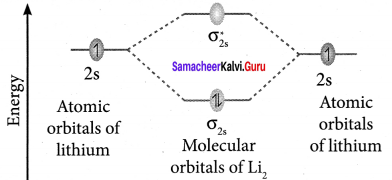
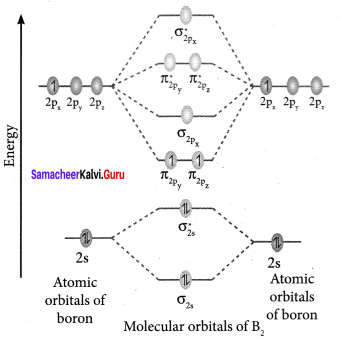
B : Plastic bag pollutes the soil. It is non-bio-degradable. Cloth bag is simple but bio-degradable.
A : Thank you. I will carry a cloth bag hereafter.


(v) Write a dialogue with at least five utterances between a Post Master and a student who wants to open a savings account in the post office.
Student : Good morning, Sir.
PM : Good morning. What shall I do for you?
Student : Sir, I want to open a savings account.
PM : Have you brought your Aadhar card?
Student : Yes, Sir.
PM : Have you brought two copies of passport size photograph of yourself?
Student : Yes, Sir.
PM : Fill in this application. How much do you want to deposit now?
Student : Rs 500, Sir.
PM : That is good to start with.
Student : Thank you, Sir.


D. E-MAIL
E-mail is one of the fastest and latest ways of communication. It is concise and one needs to be more technical. In such communication both the addresser and addressee need an E-mail ID where one can write a message. It is communicated through a server. So at both ends there should be a computer or laptop to receive the message.

Hints for writing E-mail

– Maintain brevity,
– Make it personal.
– Answer swiftly.
– Use proper structure & layout.
– Do not write in CAPITALS.
– Do not overuse Reply to All.
– Be careful with formatting.
– Use a meaningful subject.
– Use simple and lucid language.
– Use templates for frequently used responses.
– Do not attach unnecessary files.
– Do not overuse the high priority option.
– Revise/Review the e-mail before you send it.
– Take care with .abbreviations and emoticons.
– Do not use e-mail to discuss confidential matter.


Layout of an E-mail
Samacheer Kalvi 11th English Writing Non-Verbal Interpretation 5


Solved Questions
(i) You are Seema/Suresh, living at Chennai, Tamil Nadu. Write an e-mail to the health officer of your city drawing his attention to the unsanitary conditions of your locality.
Answer:

To[email protected]
From[email protected]
SubjectInsanitation in locality
Sir

I would like to draw your kind attention to the unsanitary conditions that have pervaded in our locality.

It is a new locality where one can find big and beautiful buildings. When it was brought into being a few years ago, the municipal authorities had given a word to look into the needs of the residents. Unfortunately, their promises proved to be. mere words. The roads of our locality are all muddy and take a shabby look whenever it rains. During sunny days, people spread dust in the surroundings. Samacheer Kalvi 11th English Writing Non-Verbal Interpretation

The drains stink as they are not regularly cleaned. Since there are no dustbins around, people throw the waste material on the roadside. Flies and mosquitoes buzz about all the time. These conditions have made residents vulnerable to diseases. I, therefore, request you to please look into the matter seriously and take steps to curb the situation.

We will be thankful if you do accordingly and help us.
Yours sincerely
Seema

(ii) You are Varghese/Mary. You have been invited to attend the wedding of your friend’s sister during summer vacation. Write an e-mail to him/her regretting your inability to attend it.
Answer:

To[email protected]
From[email protected]
SubjectInability to attend the wedding
Dear Ancy
Thank you for your cordial invitation on the occasion of your sister’s wedding. I, however, regret my inability to be with you on this happy occasion as we shall be leaving for Ooty for the summer holidays on 1 May, 20XX. Please excuse my absence. Samacheer Kalvi 11th English Writing Non-Verbal InterpretationDo convey my regards and best wishes to the couple.Yours sincerely
Varghese/Mary


The main aim is to share the knowledge and help the students of 11th English to secure the best score in their final exams. Use the concepts of Samacheer Kalvi 11th English Book Solutions Writing Writing Non-Verbal Interpretation Questions and Answers in Real time to enhance your skills. If you have any doubts you can post your comments in the comment section, We will clarify your doubts as soon as possible without any delay.

Samacheer Kalvi 11th English Report Writing

Students who are interested in learning of 11th English Writing Report Writing Questions and Answers can use Tamilnadu State Board Solutions of 11th English Chapter Wise Pdf. First check in which chapter you are lagging and then Download Samacheer Kalvi 11th English Book Solutions Questions and Answers Summary, Activity, Notes Chapter Wise. Students can build self confidence by solving the solutions with the help of Tamilnadu State Board English Solutions. English is the scoring subject if you improve your grammar skills. Because most of the students will lose marks by writing grammar mistakes. So, we suggest you to Download Tamilnadu State Board 11th English Solutions according to the chapters.

Tamilnadu Samacheer Kalvi 11th English Report Writing

Check out the topics covered in Writing Report Writing Questions and Answers before you start your preparation. Improve your grammar skills with the help of Samacheer Kalvi 11th English Book Solutions Questions and Answers pdf links. The solutions for Tamilnadu State Board 11th English Textbook are prepared by the English experts. So, if you follow Tamilnadu State Board Solutions 11th English Textbook Solutions you can cover all the topics in Writing Report Writing Questons and Answers. This helps to improve your communication skills.

Report writing is an attempt to gather information about an event, incident or accident from the persons concerned, the parties involved, the victims and authorities. The third-person point of view ensures objectivity in the report.


Guidelines
The heading is essential. The report may be in one or two paragraphs.

  • Be objective.
  • Organize the details properly. and logically.
  • Present the material systematically

How should a report be written?
Answer:
A report should:

– be in the form of a narrative
– include all relevant details
– mention the date and time of occurrence
– mention the facts
– be in the past tense
– focus on one particular event only
– mention the venue
– mention the cause, result, etc.


Report For A School Magazine
Format:
(a) Heading
(b) Writer’S Name And Class.

Heading/Title Of The Happening
[by Dhanwanth/Aditi]
…………………………………………………………………………
…………………………………………………………………………
…………………………………………………………………………
…………………………………………………………………………

Language: Should be semi-formal. Try to be simple but attractive and appealing. Avoid displaying your linguistic ability.


Content :

– factual information about school activity/event
– date, time, venue of the activity/event
– a sequence of event/program
– information about participants/chief guests/judges
– kind of organisation, people responsible for programme/arrangements
– results, if describing a contest

Report For A Newspaper
Usual subjects: Political news, sports news, crimes, accidents, natural disasters, etc.

Format :
(a) Headline
(b) ‘Byline’, i. e., by a correspondent/reporter or an agency as its source and
(c) Date-line-date and place of occurrence


Headline
[by Sudhir/Sudha, TOI Correspondent/Staff reporter]

Chennai, 9 March
…………………………………………………………………………
…………………………………………………………………………
…………………………………………………………………………
…………………………………………………………………………

Language and Style :

– quite formal
– passive voice is preferred
– journalistic jargon (vocabulary/expressions), e.g., according to ministry/party spokesman or according to government sources
– use of words like ‘alleged’ or ‘suspected’ before ‘murderer’, ‘smuggler’, ‘thief’, etc.


Content:
It is most important. The main information is given in the first two or
three sentences. Other essential information like date, place, occasion, etc., follow. The presentation should be symmetrical.

Solved Questions
(a) Write a report for your school magazine.
Answer:

The Annual Sports Day
[by Shekhar]

12th February, 20XX, was a big occasion for our school. The Annual Sports of our school were held on that day at our school playground. A colorful shamiana was erected for guests and teachers. The stands were also tastefully decorated. The athletes gathered in front of the stage at 8.30 a.m. There was a march-past. The Principal took the oath and declared the sports- meet open. At 9.30 the track events began with 200 metre race for boys and 100 metre race for girls. Field events like long jump, high jump, javelin throw and discus throw were held in between the races. The programme was beautifully planned. In the afternoon the cycle race, sack race and three legged-race provided amusement. The musical chair race for guests provided a lot of fun. Kamal of XIIA was declared the best athlete.


(b) The floods in the State of Tamil Nadu, adversely affected the area causing destruction to life, property, cattle and crops. As a news correspondent, you visited this state. Write the details of this disaster in 150-200 words. Also give a suitable title to your write up.
Answer:

Devastation By Floods
[XYZ, News Correspondent, The Express]

A visit to the flood-hit districts of the State of Tamil Nadu fills one with depressing thoughts. How can nature be so cruel? The cyclonic storm has proved a disaster for the state. Coastal areas have been hit hard. The villages and hamlets have been adversely affected. Thousands of acres of land having crops are still submerged in water. Millions of cattle have been washed away or perished in the flood waters. Thousands of the villagers have been rendered homeless. Hundreds of children and the aged have been swept off. Thus there has been an all round destruction of life, property, cattle and crops. Government agencies and voluntary groups have rushed to the help of the flood-affected victims. The situation is grim and calls for more concerted efforts.


The main aim is to share the knowledge and help the students of 11th English to secure the best score in their final exams. Use the concepts of Samacheer Kalvi 11th English Book Solutions Writing Report Writing Questions and Answers in Real time to enhance your skills. If you have any doubts you can post your comments in the comment section, We will clarify your doubts as soon as possible without any delay.

Samacheer Kalvi 11th English Solutions Prose Chapter 6 The Accidental Tourist

Students who are interested in learning of 11th English Prose Chapter 6 The Accidental Tourist Questions and Answers can use Tamilnadu State Board Solutions of 11th English Chapter Wise Pdf. First check in which chapter you are lagging and then Download Samacheer Kalvi 11th English Book Solutions Questions and Answers Summary, Activity, Notes Chapter Wise. Students can build self confidence by solving the solutions with the help of Tamilnadu State Board English Solutions. English is the scoring subject if you improve your grammar skills. Because most of the students will lose marks by writing grammar mistakes. So, we suggest you to Download Tamilnadu State Board 11th English Solutions according to the chapters.

Tamilnadu Samacheer Kalvi 11th English Solutions Prose Chapter 6 The Accidental Tourist

Check out the topics covered in Prose Chapter 6 The Accidental Tourist Questions and Answers before you start your preparation. Improve your grammar skills with the help of Samacheer Kalvi 11th English Book Solutions Questions and Answers pdf links. The solutions for Tamilnadu State Board 11th English Textbook are prepared by the English experts. So, if you follow Tamilnadu State Board Solutions 11th English Textbook Solutions you can cover all the topics in Prose Chapter 6 The Accidental Tourist Questons and Answers. This helps to improve your communication skills.

Warm up

Question 1.
Often on formal occasions, we admire friends and strangers who appear elegant, who are pleasant to converse with and who conduct themselves gracefully. At times, we also see people who are awkward, nervous and doubtful about their next move.
Recall a few examples of awkward actions that can cause discomfort or disturbance to others like spilling a cup of hot drink on someone nearby.
Answer:
Mr. X has travelling sickness. Once he was in a city bus, his wife advised him to take a polythene bag so that he can vomit inside it if he felt like it. But he forgot her advice. As the bus moved on, he had a feeling that he wasn’t fine. He craned his neck out of the window of the bus and vomited his undigested breakfast.

As the bus was moving fast, people seated behind him had their shirts and sarees sprinkled with the undigested breakfast and dinner. The conductor and driver got upset. The whole day, passengers refused to sit on those three seats.

Samacheer Kalvi 11th English The Accidental Tourist Textual Questions

A. Based on your understanding of the lesson, answer the following questions in one or two sentences each:

Question 1.
Give a few instances of Bryson’s confused acts.
Answer:
He would end up standing in an alley on the wrong side of a self-locking door trying to locate a restroom in a cinema theatre. He would often go to the hotel desk, atleast two to three times a day asking what was his room number. The author had a serious problem of orientation in any new place:

Question 2.
What were the contents of the bag?
Answer:
The contents of the bag were frequent flyercard, newspaper cuttings, loose papers, tobacco pipe, magazines, passport, English money and film.


Question 3.
Describe the Buttery cascade of things tumbling from the bag.
Answer:
The side of the bag flew open and everything within was extravagantly ejected over an area about the size of a tennis court. The carefully stored documents came raining down in a fluttery cascade. Coins bounced to a variety of noisy oblivions. Lidless tobacco tin rolled crazily across the concourse disgorging its content as it went.

Question 4.
Why did the author’s concern over tobacco shift to his finger?
Answer:
When the author saw the racing tobacco box disgorging its content, he worried about the need to buy expensive tobacco in England. But when he saw his own bleeding finger that he had gashed while forcefully opening the jammed zip, he shifted his cry to his finger.

Question 5.
What happened to Bryson when he leaned to tie his shoelace?
Answer:
When Bryson leaned to tie a shoe lace inside the air-craft, some one in the seat ahead of him threw his seat back into full recline. The author found himself pinned helplessly in a crash position.

Question 6.
How did Bryson free himself from the crash position?
Answer:
Bryson was able to disentangle himself only by clawing the leg of the man sitting next to him.

Question 7.
Give a brief account of the embarrassing situation of Bryson when he knocked down the drink.
Answer:
Bryson rose from the dinner table looking as if he had just experienced a localized seismic event. While opening the lid, he used to spill the contents on his family and fellow passengers and thus embarrassing them. To avoid such anxious moments, his wife used to give directions to the children. “Take the lids off the food for daddy”.

Question 8.
What was Bryson’s worst accident on a plane?
Answer:
During one of the flights, the author was jotting down his thoughts on a notebook. The important thoughts reflected how well he behaves in public places. His recorded thoughts were, “buy socks”, “clutch drinks carefully”. He was sucking the pen thoughtfully. He was oblivious of the fact that the pen was leaking. The leaked ink had left scrub-resistant navy blue on his mouth, gum, chin, tongue and teeth for several days.

Question 9.
What did Bryson wish to avoid in his life?
Answer:
Bryson wished to avoid air travel especially with his family members.

Question 10.
How would staying away from liquid mischief benefit Bryson?
Answer:
Staying away from liquid mischief would naturally reduce the expense on laundry bills.

B. Answer the following questions in about three to four sentences each:

Question 1.
Why doesn’t Bryson seem to be able to do easily what others seem to? Give a few reasons.
Answer:
Bryson lacks orientation. He has. great capacity in forgetting hotel rooms, the location of rest rooms in a cinema hall and the number of his room in a hotel. He goes atleast three times a day to the reception desk to ask which room is allotted to him.

Question 2.
What was the reaction of Bryson’s wife to his antics?
Answer:
Mrs. Bryson saw the quixotic behaviour of her husband. She was neither angry nor exasperated. But she just expressed her deep sense of wonder. She said, ‘I can’t believe you do this for a living”.

Question 3.
Briefly describe the ‘accidents’ encountered on the flight by Bryson.
Answer:
Once the author was trying to tie a shoe lace. He bent to tie it. Just that moment, the passenger in the front seat reclined in full swing. The author was pinned down in a crash position. On another occasion, he engaged an attractive woman in a witty conversation. While talking to her, he sucked his pen. The pen left a scrub-resistant navy blue on his gum, mouth, teeth and his chin for several days.

C. Based on your understanding of the text, answer the following questions in a paragraph of about 100 – 150 words:

Question 1.
‘To this day, I don’t know how I did it’ – What does ‘it’ refer to?
Answer:
Once, the author knocked a soft drink onto the lap of a sweet little lady sitting beside him. The flight attendant came and cleaned her up and brought him a replacement drink. Instantly he knocked ‘it’ onto the woman again. To this day, the author does not remember how he spilled the drink twice on the same lady passenger seated next to him in the aeroplane.

He just remembers reaching out for the new drink and watch helplessly as his arm, like some cheap prop in one of those 1950 horror movies with a name swept the drink from its perch and on to her lap. The sweet lady was a mm. She looked at him with a stupefied expression. She uttered an oath that started with oh! and ended with sake. In between she used some words the author had never heard before in public.

“I don’t know what is more messy, my room or my life. ”

Question 2.
But, when it’s my own – well, I think hysterics are fully justified’ – How?
Answer:
The author had planned to go to England with all his family members. He arrived at the Logan airport at Boston. When they were checking in, he suddenly remembered that he forgot to use his frequent flier card (British Airways). He also remembered how he had left it in a bag. He tried to open the bag. The zip was jammed. He tried to open it by force. After several attempts, it gave away spilling all the contents in a sprawling corridor in the airport. He ignored the flying documents, silver coins and even passport.

He worried about the tobacco box which was rolling away crazily disgorging its content on the way. He cried “My Tobacco” remembering how expensive it would be to buy tobacco for his pipe in England. Just then he realized that he was bleeding profusely. He had made a gash on his finger while trying to open the zip of his bag by force. He cried hysterically on seeing his own blood, “My finger” My finger”. In general, he was not comfortable flowing other’s blood. But when it came to spilling his own blood “hysterics” was really justified.

“Relived stress through hysterical screaming.”

Question 3.
Bring out the pun in the title ‘The Accidental Tourist’ (one who happens to travel by accident or one who meets with accidents often on his or her trips!).
Answer:
The title “accidental tourist” implies that a man travels a lot and is always confused. He gets into trouble because of his unintentional acts and clumsiness. He does not happen to travel by accident because he should buy a ticket, go to the airport and board the aircraft . wit(i careful plan. But during his travel he does meet with numerable accidents.

The later interpretation is very apt for the author. The story depicts many humorous travel experiences like being pinned in a crash position in his own seat by a fellow passenger, spilling drink on a co-passenger, making his own teeth, gum, chin and tongue scrub-resistant navy blue by his unwise mannerism of sucking the pen, while thinking. The author accidentally gets into trouble often. Hence the pun in the use of “accidental” is pertinent.

“Fill your life with adventures, not things Have stories to tell, not stuff to show.”

Question 4.
Can a clumsy person train himself/herself to overcome short comings? How could this be done?
Answer:
Yes, a clumsy person can train himself to overcome his short comings. People with severe Parkinsons’s disease too learn to hold a spoon and eat with great difficulties. Children with multiple disabilities and nervous problems learn to button up their shirts, tie the shoe laces and even assist friends with similar ailments. There is no difficulty in the world that is insurmountable. Practice makes one perfect. The author’s wife, without rebuking him publicly for his callous clumsiness, trains her children to be supportive of their father Mr. Bryson who always spills drinks or bumps on something or even sits on chewing gum or spilled oil.

As clumsiness is not a welcome behaviour pattern among adults, one must learn how to mend oneself and try to overcome one eccentricity per day with deliberate effort. The author does admit to restrain himself to reduce the laundry bill. But if he extends his efforts even during the presence of his family on long distance air-travels, it would be nice. Cultivating an acceptable behaviour in public places is not an impossible task for any sensible man.

‘‘I am not clumsy. It s just the floor that hates me.
The tables and chairs are bullies
And the wall gets in the way.”

Question 5.
As a fellow passenger of Bill Bryson on the flight, make a diary entry describing his clumsy behaviour during the trip and the inconveniences caused to others as a result of his nervousness.
Answer:
On that fatefulday, I was standing infront of the check in counter just behind a crazyman. He was making odd movement with his hands. It appeared that he was trying to open something. He had yanked the zip of his bag open. It spilled ejecting all the important contents. The funny thing was, the funny man was running behind a tin of tobacco which had already disgorged its content. Then he suddenly cried, “My finger”. May be he had hurt his finger. The funniest side of the whole episode was that he ignored passport, currency, coins and other fluttering travel documents. I had my sincere sympathy with the man but I couldn’t help laughing noiselessly because the fellow was really eccentric.

He did not have a sense of proportion. He gave importance to trifles and ignored the major things lying down fluttering in the corridor of the airport. During his flight he disgorged/spilled the contents of his drink and profusely tendered his apology to the lady next to him. He appeared as real as a buffoon when he appeared sheepish with navy blue ink smeared on his gum, teeth, chin and tongue. It reminded me of a lion faced monkey.

‘‘I have always had a reputation as a Bufoon.”

Additional Questions

Question 6.
Bill Bryson “ached to be suave”. Was he successful in his mission? List his “unsuave ways.
Answer:
Bill Bryson expresses his genuine desire to be “suave”. He would love just once in his life time to rise from the dinner table as if he had experienced an “extremely localized seismic event, get into a car without leaving 14 inch coat outride, wear light-coloured trousers without ever discovering at the end of the day that he had at various times and places sat on chewing gum, ice-cream cough syrup and motor oil. No, Bill Bryson was not successful in his mission. Twice he spilled his drinks on a sweet nun who happened to sit next to him. He tried to show off his wisdom to another attractive lady. As usual, he was sucking his pen.

His shirt, teeth and gum carried the unscrubbable navy blue stain for many days. He always did “liquid mischief’. His clumsy behaviour in the aeroplane made the saintly mm use abusive language. To avoid unsuave ways, he gave up air-travel with his family members. His wife and children supported him yet failed to be refined in manners.
‘‘Heroes, well, they don’t live so long.
But they ’re too suave, and we all admire them.”

Vocabulary

A. Foreign words and phrases .
You have come across the French phrases ‘en famille’ an <famille> and ‘bons mots’ ,ban ma:ts in the lesson. Now look at the following phrases and their meanings.

(a) viva voce – /vaivo vausi /- a spoken examination
(b) sine die -/sina’dAii:/- without a date being fixed
(c) resume -/rezju:mei/- a brief summary
(d) rapport -/rae’pa:(r)/- close relationship with good understanding
(e) bonafide – /bauna faidi/- genuine

B. Refer to the dictionary and find out the meanings of the following foreign words /phrases. Use them in sentences of your own:

  1. bon voyage
  2. in toto
  3. liaison
  4. ex gratia
  5. en masse
  6. en route
  7. ad hoc
  8. faux pas

1. Bon voyage – Express good wishes to some on leaving for a long journey.Hemalatha went to the airport and said “Bon voyage” to Keerthi who was about to leave for UK.

2. In toto- as a wholeThey accepted the business plan of Murali in toto.

3. Liaison – a close working relationship between people and organization. .The bank clerk regretted his liaison with the watchman who robbed the bank and vanished.

4. Ex gratia-compensation paid by the Government to the victim of an accident.
The Hon’ble Chief Minister gave each of the eight survivors of the Road accident an ex gratia of . two lakh rupees.

5. En masse – in a group all together
The striking workers ran en masse to the gate when the boss arrived.

6. Enroute – on the way
He stopped in Mumbai enroute to Kolkatta.


7. Adhoc – created for a particular
An adhoc committee was set up to probe the scam in the universities.

8. Faux pas – an embarrassing or tactless act, blunder
I did not disclose his fauxpas till he joined a college. .

Here is a list of some words borrowed from Indian languages and have been included in the Dictionary of English. Add more words to the table.

WORDORIGINMEANING
verandaHindia roofed platform along the outside of a house
bungalowHindia house in the Bengal style
chutneyHindia ground or mashed relish
cheetahSanskrituniquely marked
coirMalayalamrope
bambooKannadawood
bandicootTelugukind of rat
catamaranTamilmulti-hulled watercraft
guruSanskritmaster

C. Idioms

Look at the list of idioms given below. Find their meanings from a dictionary. Read the sentences that follow and replace the words in italics with the appropriate idioms, making suitable changes wherever necessary.

(a) right up one’s alley –
(b) drive one up the wall –
(c) hit the road-
(d) take (one) for a ride –
(e) in panic mode-

(a) The old man got irritated at the loud noise outside.
(b) We were driving, when it started raining heavily. After stopping for an hour, we began the journey again.
(c) Ramesh gave false excuses for not attending the meeting and deceived me.
(d) At the interview when questions were fired at me rapidly, I forgot every thing and grew irritated.
(e) I love thrillers and this book appeals to me strongly.
Answers
(a) driven up the wall
(b) hit the road
(c) he took me for a ride
(d) got into a panic mode
(e) is right up to my alley

listening Activity

Bala : Hello, Mahesh; where did you spend your holidays?

Mahesh : Well Bala, I had been to a place of ethereal beauty, Kerala.
Bala : Did you spend the three day holiday at Kerala?
Mahesh : Yes Bala. I visited Trivandrum, Quilon and Cochin.
Bala : What are the important tourist spots you visited there?
Mahesh : I shall just mention a few – The Art Museum called Chitralayam at Trivandrum, the King’s palace and the Kovalam Beach.
Bala : What did you see in Quilon?
Mahesh : The lovely scenery at Varkala, the oldest port of Quilon and the Periyar Lake Wild Life Sanctuary.
Bala : Tell me something about Cochin.
Mahesh : Cochin has earned the title ‘Venice of the East’. It is famous for coir and there are many historical monuments there. .
Bala : Oh, I see! I think you should take me to these spots next time you visit Kerala.
Mahesh : Of course! We shall explore its beauties and learn more about our motherland.

Listen to the dialogue read out by the teacher or to the recorded version and answer the questions that follow:

Question (i)
______ was one of the places visited by Mahesh.
(a) Srilanka
(b) Goa
(c) Kasi
(d) Cochin
Answer:
(d) Cochin

Question (ii)
The Art Museum at Trivandrum is called ________
(a) Swamalayam
(b) Gitalayam
(c) Chitralayam
(d) Saranalayam
Answer:
(c) Chitralayam

Question (iii)
Varkala is the oldest port of ________
(a) Quilon
(b) Andhra
(c) Puducherry
(d) the Andamans
Answer:
(a) Quilon

Question (iv)
Mahesh had been to the ________ Lake Wild Life Sanctuary.
(a) Chidambaram
(b) Pulicat
(c) Kovalam
(d) Periyar
Answer:
(d) Periyar

Question (v)
Cochin is called the ________ of the East.
(a) Granary
(b) Cuba
(c) Venice
(d) Pearl
Answer:
(c) Venice

Speaking Activity

(a) Build a dialogue of 8-10 exchanges between your friend and yourself, on the following situation:
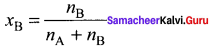
You were to board a train to Delhi. By mistake you got into the wrong train and fought for your seat there. On realising your mistake, you left the train shamefaced, after creating a commotion there. Role-play this situation before the class.
James : Last Friday I was caught in an embarrasing situation.
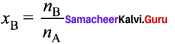
Rahim: Where? How?
James : All the passengers were waiting at the Chennai central station.
Rahim : Where were you heading to? .
James : Well, I was heading to New Delhi.
Rahim: What was the cause of your embarrassment?
James : I did not know about the last minute change of platform. I had got an open ticket to Delhi. Along with many other passengers, I rushed to the unreserved compartment and I boarded it in platform 6. But the platform was changed to 11. I got a comer seat and had a sense of pride.
Rahim : Then when did you realize your mistake?
James : A well-dressed boy asked me if I was going to Mysore. I was surprised and said that I was going to Delhi. He laughed aloud and said to the fellow passengers look, this young man is going to Delhi by Cauvery express. The train had started moving. I rushed out with my luggage and jumped out.
Rahim : Did you catch Tamil Nadu express or not?
James : Of course I did, but I had to travel standing for one night.
Rahim : I’m really sorry to hear it. Be careful in future.

(b) Speak to the class for a minute, as to how one should conduct oneself on formal occasions. (You could talk about table-manners especially while eating, general appearance, manner of speaking, etc.)

Manners maketh a man. While talking, one must look into the eyes of the person spoken to.
When someone else is talking, one should have the decency to pay attention and restate what was gathered to confirm one has understood the essence of the talk. When someone is asking something or enquiring something, one should not be meddling with other things. Such a behaviour amounts to an insult to the speaker. While eating along with friends, when you finish, never get up and leave the table to wash the hands. While eating, one must eat without making much noise. Care must be taken not to spill curry, drinks on the fellow diners.

While attending an interview or going to the college, one must wear neat dress and greet others with a cheerful face. While talking to elders one must always use “Sir” or Madam. While requesting use “please”. When receiving a help, remember to say ‘thank you’. When someone is hurt by an un wise remark, be quick to apologise or say “sorry”.

Reading

Caesar, the Hero of Mumbai on 26/11

1. Mumbai Caesar, the last surviving hero of his kind, died after the attack on one Thursday. Caesar, a Labrador retriever, was covered with tri-colour and given an emotional farewell from the city Police Force. The Mumbai Police Commissioner too marked the passing of the hero with a tweet.

2. Caesar, who was 11 years old was the sole survivor among the dogs of Mumbai Police who took part in bomb detection operations during the terrorist attack on Mumbai that began on November 26, .2008. He died of heart attack at a farm in Virar where he and his three canine buddies had been sent after retirement. During the terror attack in Mumbai, Caesar saved several lives when he sniffed out the hand grenades left by the terrorists at the busy CST railway station.


3. Caesar was also a part of the search team at Nariman house, where terrorists were held up for three days. Earlier he was also pressed into service for bomb search operation after the 2006 serial train blasts and July 2017 blast in Mumbai. The Mumbai police officials also tweeted their grief saying, “Services of retired members of Dog Squad during 26/11 will be unforgettable. We will remember our heroes forever.”
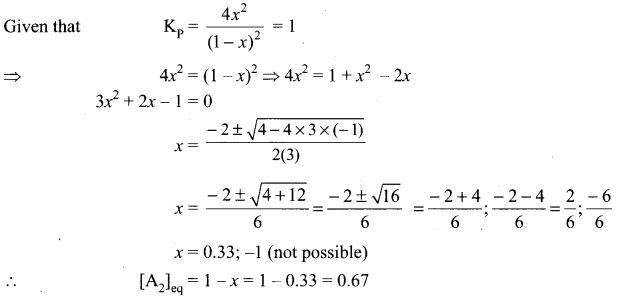
Answer the following questions.

Question 1.
Labrador retriever was covered with tri-colour. What does this signify?
The use of tri colour flag on the body of Labrador retriever signifies that it has served the nation like a soldier and deserves our homage.

Question 2.
How did Caesar save several lives at the CST railway station?
Answer:
During the terror attack at Mumbai, Caesar saved several lives when he sniffed out the hand grenades left by the terrorists at the busy CST railway station.

Question 3.
Which word in the passage (paragraph 3) means the same as ‘forced’.
Answer:
Pressed into means “forced”.

Question 4.
“Services of retired members of Dog Squad during 26/11 will be unforgettable”. Mention three services rendered by Caesar.
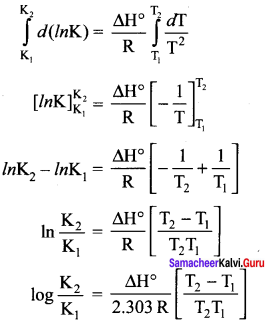
Answer:
Caesar had taken part in the bomb detection operations during the terrorist attack on Mumbai that began on Novmeber 26, 2008. Caeser saved several lives when he sniffed out the hand grenades left by the terrorists at the busy CST railway station. Caesar was also a part of bomb search operation after 2006 serial train blasts and July 2017 blast in Mumbai.

Question 5.
Caesar is a Labrador breed of dogs. Name a few other native breeds that are used by the Police force.
Answer:
The Blood hound, The German short haired pointer, The Boxer, The Doberman, The Dutch German Shepherd and The Giant Schnauzer are some of the famous breeds used by police force.

Question 6.
Try to rewrite the news item in your mother tongue without losing the spirit and flavour of the text. Give a suitable title to your translated version.
Answer:
வீரமரணம்
மும்பை 26\11 தாக்குதலில் குண்டு கண்டுபிடிக்கும் வீரநாய் சீசர் மரணம்.
1. மும்பை சீசர், அவரது சகாக்களில் கடைசியாக எஞ்சியிந்த மும்பை தாக்குதலுக்குப் பின் ஓர் வியாழக்கிழமை மரணமடைந்தது மீட்புப் பணியில் ஈடுபட்ட அந்த லப்ராடர் இனநாய் மூவ்வண்ணக் கொடியால் போர்த்தப்பட்டு ஓர் உணர்ச்சி மயமான பிரிவு உபச்சாரம் நகர காவல்துறையால் வழங்கப்பட்டது. சீசரின் வீரமரணத்தைப் பற்றி மும்பை காவல் ஆணையர் ட்வீட் செய்துள்ளார்.

2. பதினோறு வயது நிரம்பிய சீசர் மும்பை காவல்துறையில் பணியில் இருந்தது. தீவிரவாதத் தாக்குதலின் போது குண்டு கண்டுபிடிக்கும் பணியில் நவம்பர் 26, 2008 முதல் ஈடுபடுத்தப்பட்டு பயிற்சி பெற்ற பல நாய்களில் உயிர்தப்பிய ஒரே ஒரு நாயாகும். விரார் அருகே உள்ள பண்ணை வீட்டில் அது மாரடைப்பால் மரணமடைந்தது. அங்குதான் அதுவும் அதன் மூன்று தோழர்களும் பணி ஓய்வுக்குப் பின் அனுப்பப் பட்டிருந்தனர். மும்பை தீவிரவாதத் தாக்குதலின் போது, சீசர் தீவிரவாதிகள் விட்டுச் சென்ற பல கையெறிகுண்டுகளை மோப்பம் பிடித்து கண்டுபிடித்து மிகவும் பரப்பரப்பாக இயங்கிக் கொண்டிருந்த சத்ரபதிசிவாஜி இரயில் நிறுத்தத்தில் (CST) பல உயிர்களைக் காப்பாற்றியது.

3. மூன்று நாட்களாக தீவிரவாதிகள் பதுங்கியிருந்த நரிமன் பாயின்டில் தேடும் குழுவின் ஓர் அங்கமாக சீசரும் இருந்தது. 2006 ஆம் ஆண்டு தொடர்வண்டி குண்டுவெடிப்புச் சம்பவத்தின் போதும், ஜுலை 2017 மும்பை குண்டுவெடிப்புக்கு முன்னரும் பல முறை குண்டு தேடும் பணியில் அது ஈடுபடுத்தப்பட்டது. மும்பை காவல் அதிகாரிகளும் தமது துயரத்தை ட்விட்டர் வலை தளத்தில் “26/11 நாய் படையிலிருந்து ஓய்வுபெற்றவர்களது சேவை மறக்க இயலாதது. எங்களது வீரர்களை நாங்கள் என்றும் நினைவில் வைத்துப் போற்றுவோம்” எனப் பதிவு செய்தனர்.

Grammar

Now complete the following.

(a) Do as directed.

Question 1.
Dinesh and Prabhu wanted to meet Varsha at the bus stop. They went to the bus stop. (Change into a compound sentence)
Answer:
Dinesh and Prabhu wanted to meet Varsha at the bus stop and so they went to the bus stop.

Question 2.
Varsha reached the railw ay station. She was waiting for them there.(Change into a compound sentence)
Answer:
Varsha reached the railway station and she was waiting for them there.


Question 3.
While she waited at the train station, Varsha realized that the train was late. (Change into a simple sentence)
Answer:
Waiting at the railway station, Varsha realized that her train was late.

Question 4.
Dinesh and Prabhu left the bus stop. Varsha rang them. (Change into a complex sentence)
Answer:
After /When Dinesh and Prabhu left the bus stop, Varsha rang them.

Question 5.
The trio met at the station. Varsha left for Madurai. (Change into a complex sentence)
Answer:
After the trio met at the railway station, Varsha left for Madurai.

Question (b)
This paragraph has only simple sentences. Combine them into compound and complex sentences. The first one is done for you.
Answer:
One day Ajay and Tijo went to the canal. They wanted to catch some fish. Some people were playing nearby. They chose a better place. They took out the fishing rods. Suddenly there was a loud splash. They also heard a loud scream. Both Ajay and Tijo looked up. They saw something moving in the water. Then they saw a hand waving. Someone had fallen in the water. It was Yusuf. He had jumped into the water. He wanted to swim.
One day Ajay and Tijo went to the canal to catch some fish

One day Ajay and Tijo wanted to catch some fish and so they went to the canal. As some people were playing nearby, they chose a better place. When they took out the fishing rods, there was a loud splash and scream. As they looked up, they saw something like a hand waving, in the water. It was obvious that someone had fallen into the water. It was Yusuf who had jumped into the water to swim.

Question (c)
Here is one long sentence. Split them into smaller sentences.
Like all living things, human beings also need food in order to live as every part of the body must get a steady supply of food so that it can work properly, but first the food eaten has to be broken down through a process called digestion so that it can dissolve in the blood and carried to all parts of the body.
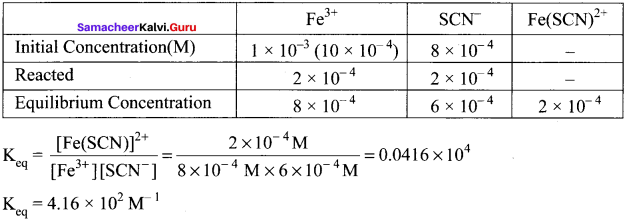
Answer:
Like all living things, human beings need food to live. Every part of the body must get a steady ‘ supply of food. Only then it can work properly. First the eaten food has to be broken down through digestion. The digested food dissolves into the blood. It is then carried to all parts of the body.
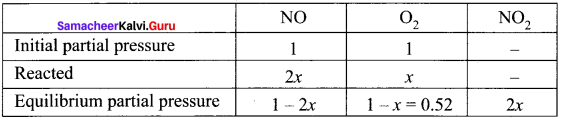

Writing

Now write a short story to explain these proverbs.

Question 1.
Actions speak louder than words.
Answer:
Vivek Pradhan was not a happy man.. Even the plush comfort of the air-conditioned compartment of the Shatabdi express could not cool his frayed nerves. He was the Project Manager and still not entitled to air travel. It was not the prestige he sought, he had tried to reason with the admin person, it was the savings in time. As Project Manager, he had so many things to do!!
He opened his case and took out the laptop, determined to put the time to some good use.

‘Are you from the software industry sir?’ the man beside him was staring appreciatively at the laptop. Vivek glanced briefly and mumbled in affirmation, handling the laptop now with exaggerated care and importance as if it were an expensive car.

‘You people have brought so much advancement to the country, Sir. Today everything is getting computerized.’ ‘Thanks,’ smiled Vivek, turning around to give the man a look. He always found it difficult to resist appreciation. The man was young and stockily built like a sportsman. He looked simple and strangely out of place in that little lap of luxury like a small town boy in a prep school. He probably was a railway sportsman making the most of his free travelling pass.

‘You people always amaze me,’ the man continued, ‘You sit in an office and write something on a computer and it does so many big things outside.’ Vivek smiled deprecatingly. Naiveness demanded reasoning not anger. ‘It is not as simple as that my friend. It is not just a question of writing a few lines. There is a lot of process that goes behind it.’ For a moment, he was tempted to explain the entire Software Development Lifecycle but restrained himself to a single statement.

‘It is complex, very complex.’ ‘It has to be. No wonder you people are so highly paid,’ came the reply. This was not turning out as Vivek had thought. A hint of belligerence crept into his so far affable, persuasive tone. ‘Everyone just sees the money. No one sees the amount of hard work we have to put in. Indians have such a narrow concept pf hard work. Just because we sit in an air-conditioned office, does not mean our brows do not sweat. You exercise the muscle;
‘we exercise the mind and believe me that is no less taxing.’

He could see, he had the man where he wanted, and it was time to drive home the point.

‘Let me give you an example. Take this train. The entire railway reservation system is computerized. You can book a train ticket between any two stations from any of the hundreds of computerized booking centers across the country. Thousands of transactions accessing a single database, at a time concurrently; data integrity, locking, data security. Do you understand the complexity in designing and coding such a system?’ The man was awestruck; quite like a child at a planetarium. This was something big and beyond his imagination.

‘You design and code such things?’ ‘I used to,’ Vivek paused for effect, ‘but now I am the Project Manager.’ ‘Oh! ’ sighed the man, as if the storm had passed over, ‘so your life is easy now.’ This was like the last straw for Vivek. He retorted, ‘Oh come on, does life ever get easy as you go up the ladder. Responsibility only brings more work. Design and coding! That is i the easier part. Now I do not do it, but I am responsible for it and believe me, that is far more

stressful. My job is to get the work done in time and with the highest quality. To tell you about the pressures, there is the customer at one end, .always changing his requirements, the user at the other, wanting something else, and your boss, always expecting you to have finished it i yesterday.’ Vivek paused in his diatribe, his belligerence fading with self-realization. What he had said, was not merely the outburst of a wronged man, it was the truth. And one need not get angry while defending the truth. ‘My friend,’ he concluded triumphantly, ‘you don’t know what it is to be in the Line of Fire’. The man sat back in his chair, his eyes closed as if in realization. When he spoke after sometime, it was with a calm certainty that surprised Vivek. ‘I know sir, I know what it is to be in the Line of Fire ’He was staring blankly, as if no passenger,
no train existed, just a vast expanse of time.

‘There were 30 of us when we were ordered to capture Point 4875 in the cover of the night. The enemy was firing from the top. There was no knowing where the next bullet was going to come from and for whom. In the morning when we finally hoisted the tri-colour at the top only four of us were alive.’ ‘You are a…?’ ‘I am Subedar Sushant from the 13 J&K Rifles on duty at Peak 4875 in Kargil. They tell me 1 have completed my term and can opt for a soft assignment. But, tell me sir, can one give up duty just because it makes life easier? On the dawn of that capture, one of my colleagues lay injured in the snow, open to enemy fire while we were hiding behind a bunker.

It was my job to go and fetch that soldier to safety. But my captain sahib refused me permission and went ahead himself. He said that the first pledge he had taken as a Gentleman Cadet was to put the safety and welfare of the nation foremost followed by the safety and welfare of the men he commanded his own personal safety came last, always and every time.’

‘He was killed as he shielded and brought that injured soldier into the bunker. Every morning thereafter, as we stood guard, I could see him taking all those bullets, which were actually meant for me . I know sir….I know, what it is to be in the Line of Fire.’ Vivek looked at him in disbelief not sure of how to respond. Abruptly, he switched off the laptop. It seemed trivial, even insulting to edit a Word document in the presence of a man for whom valour and duty was a daily part of life; valour and sense of duty which he had so far attributed only to epical heroes. The train slowed down as it pulled into the station, and Subedar Sushant picked up his bags to alight.

‘It was nice meeting you sir.’ Vivek fumbled with the handshake.

This hand… had climbed mountains, pressed the trigger, and hoisted the tri-colour. Suddenly, as if by impulse, he stood up in attention and his right hand went up in an impromptu salute,… It was the least he felt he could do for the country.

PS: The incident he narrated during the capture of Peak 4875 is a true-life incident during the Kargil war. Capt. Batra sacrificed his life while trying to save one of the men he commanded, as victory was within sight. For this and various other acts of bravery, he was awarded the Param Vir Chakra, the nation’s highest military award. Live humbly, there are great people around us, let us learn! Action speaks louder than words


Question 2.
Despair gives courage to a coward.
Answer:
Most of the time, we do not realize the talent that is within us. Certain situations help to bring out these special qualities to the fore. Just as a drowning man tries to hold on to anything that comes his way to save his life, we too come up with remedies beyond our imagination in desperate situations. We find the courage to do extraordinary things when we are in despair. Even a coward can be turned into a brave warrior in a life-threatening situation. Once there was an ant that lived in a tree by the side of a pond. He was very timid and was scared of even the slightest disturbance in the tree. One day a heavy wind blew across the tree and the ant fell into the pond and was struggling to swim and stay afloat. A pigeon that lived in the same tree broke a twig of the tree and threw it to the ant. The ant got on to the twig and the pigeon swooped down picked up the twig and placed it back on the tree. The ant thanked the pigeon profusely for saving his life.

As the days went by the ant and the pigeon became good friends. The pigeon always told the ant that he should learn to be a bit braver and face life boldly. But the ant remained the same. One day a hunter came to the pond to quench his thirst. As he was drinking water from the pond he noticed the pigeon sitting on the tree. The hunter wanted to shoot the pigeon and got his bow and arrow ready. The ant noticed this and wanted to desperately save his friend. The pigeon was fast asleep and there was no way to warn him since he was sitting a long way the ant jumped down from the tree and crawled as fast as he could and bit the toe of the hunter hard as he could. The hunter cried out in pain and missed his aim.

The pigeon woke up hearing the noise and noticed the hunter with his bow and arrow. It flew away to safety. The ant was very happy that it could save his friend and felt elated for having acted bravely for once in his life.

The story clearly illustrates that when placed in a desperate situation the ant could rise above its limitations and act bravely in order to save the pigeon’s life. So when the situation demands even a coward can turn into a courageous person.

Develop the following hints into a paragraph

As is the King, So are the Subjects

Once upon a time two kings ruled neighbouring kingdoms. King Arya was a great warrior. He looked after his subjects very well. People loved him. He was always looking for ways to increase their safety and welfare. All his subjects were happy. On the other hand, king Vaishal was a very lazy man. He spent his time entertaining himself. There was always singing, dancing and merry making. His subjects were very angry with him as he never came out of the palace to listen to their woes.

A powerful Sultan attacked both the kingdoms. King Arya’s army, being well-prepared was

Very alert. The enemy forces were really powerful. But men, women and even children i joined the hands of army to protect their king. King Vaishal’s subject soon after sensing the

impending war, started fleeing the kingdom. King was left all alone. People were not interested in protecting him as he was not interested in their welfare and safety.

King Vaishal realized his foolishness but it was too late. He was defeated in war and fled his country in disgrace to save his own life. King Arya defeated Sultan. This happened because King Arya always kept the welfare of his people in his heart all the time. His subjects reciprocated his love. They were loyal and supportive during testing times.

Writing A Curriculum Vitae

Vijayraj Joseph
Task: Write a CV for the post of a DTP operator at ABC Publishing House and send it to P.O. Box No. 2345 or E-mail it to [email protected]

Curriculum Vitae
Name : Vijay
Mobile No : 8765412385
email : [email protected]
Address : 17/2 Beach road,
Neelangarai Chennai

Career objective:
Looking for a challenging job in the field of Desk top publishing-which requires the optimum use of my skills in typing and designing and provides me opportunities for vertical growth.

Synopsis:
A graduate with a degree in computer science from Loyola college, Madras

Profile

  • Good working knowledge of computers.
  • Good at typing .
  • Excellent at wrapper designing and editing
  • Profound knowledge in Corel draw and photoshop
  • Expertise in MS word and Excel file handling.

Educational Qualification

  • B.Sc Computer Science with a second class
  • 12th with aggregate of 67% from GHSS, Koovathur
  • 10th with aggregate of 55% from GHSS, pudhupattinam, Kalpakkam

Previous Experience

  • Two years experience in student Xerox as a DTP operator

Projects done

  • Typed about 50 PhD dissertation and 20 M. Phil thesis
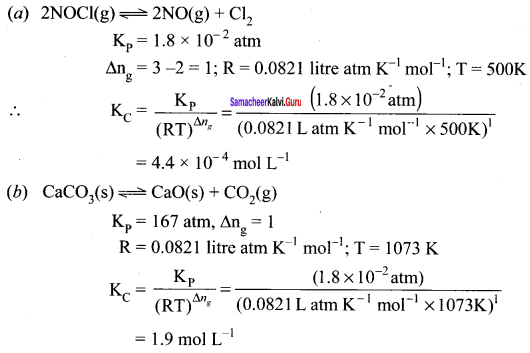
Extra-curricular Activities

  • NSS volunteer in college
  • Volleyball District player Strength:
  • A team player
  • Devoted and smart in work
  • Optimistic

Personal Details:
Date of birth : 06.09.1993
Sex : Male
Marital status : Single
Languages known : Tamil and English

Declaration
I hereby declare that the above furnished information is true to the best of my knowledge. If I am offered an opportunity, I shall prove my mettle and be worthy of your choice
S/d
Vijay

Task 1:
You see an advertisement in the newspaper. A publishing house in Chennai has brought out a paperback edition of the complete works of Khushwant Singh. You want to buy it. You are asked to send a Demand Draft for Rs.1000/- Fill in the following DD challan in favour of ‘X publishing house, New Delhi’, payable at Chennai. The surcharge for Rs.1000/- is Rs.25/-

Samacheer Kalvi 11th English Solutions Prose Chapter 6 The Accidental Tourist 4
Answer:
Samacheer Kalvi 11th English Solutions Prose Chapter 6 The Accidental Tourist 1
Task 2:
Fill in the following forms with imaginary details.
Question (a)
Samacheer Kalvi 11th English Solutions Prose Chapter 6 The Accidental Tourist 2

Answer:

Samacheer Kalvi 11th English Solutions Prose Chapter 6 The Accidental Tourist 5

Question (b)

Samacheer Kalvi 11th English Solutions Prose Chapter 6 The Accidental Tourist 3

Answer:

Samacheer Kalvi 11th English Solutions Prose Chapter 6 The Accidental Tourist 6

Question (c)

Samacheer Kalvi 11th English Solutions Prose Chapter 6 The Accidental Tourist 8

Answer:

Samacheer Kalvi 11th English Solutions Prose Chapter 6 The Accidental Tourist 9

The Accidental Tourist About the Author

Samacheer Kalvi 11th English Solutions Prose Chapter 6 The Accidental Tourist 7

Bill Bryson is an Anglo-American author of books on travel, English language, science and non-fiction topics. He stayed in Great Britain during his adult years. He served as the Chancellor of Durham University from 2005 to 2011. ’Neither here not there’, ‘Notes from a small island’, ‘A Walk in the woods’
‘A Short history of nearly everything’, ‘The Life and Times of the Thunderbolt Kid’, and Icons of England are some his famous

The Accidental Tourist Summary

The whole story revolves around the author’s inability to do ordinary things that other people do in public places like a cinema theatre or a plane. He has problems of orientation. He would try to reach a rest room but find himself behind a self-locking door. The author recounts how his anxiety ruined the happiness of people at the airport and how he himself suffered. For fear of such life-time incompatibility, the author refrained from making frequent trips and could never use his frequent flier miles for a trip to Bali island. The author had a flash of memory that he had joined British Airways frequent flier programme. His entire family arrived at Logan Airport in Boston. Unfortunately, he had placed the card in a carry-on-bag hanging around his neck.

The zip on’ the bag was jammed. He tried pulling it hard. He used force instead of commonsense, the zip gave way spilling the contents over an area as large as tennis court.

To the great embarrassment of all fellow passengers waiting at the airport, 14 ounce tin pipe, coins and other important documents flew helter-skelter. He was annoyed to see the snuff box rolling and emptying its content. Instead of trying to collect coins, documerit and important papers, he went behind the tobacco box crazily shouting, “My tobacco”. When he sensed oozing of blood from his finger that he had gashed while opening the bag’s jammed zip he shifted his attention immediately to his finger. The author’s wife, wondering at his hysterics said, “I can’t believe you do this for a living”.

Once in an aeroplane, the author leaned to tie his shoe lace. Just then some one in the front seat leaned back into full recline. The author found himself pinned helplessly in a crash position. Once the author spilled drinks on a fellow passenger too. He did it twice. He did not know how he did it.

The author was recording his important thoughts in a note book. They were as silly as he was “Buy socks, clutch drinks carefully”. He had fallen into a deep conversation with an attractive young lady in the next seat. Having lost his head, he amused her for about twenty minutes exchanging witty remarks to impress her. When he went to a rest room, he realized that the pen head leaked. His mouth, teeth and gums appeared in striking, scrub-resistent navy blue. To his disgust, it remained blue for many days.

The author wanted to be polished and sophisticated in his manners; But as serendipity would have it, he never left a dinner without making fellow diners realize that he had just experienced a local seismic event. Whenever he entered a car, he closed the door when his coat was still 14 inches outside the door. His trousers always brought evidence of his having sat on chewing gum, ice-cream, cough syrup or motor oil.

The author had clear prediction of the catastrophe he intended to venture into unconsciously. So, his wife would give directions to children like,

“Take the lid off the food for daddy” or put your hoods up children, Daddy’s going to cut his meat”. The author does all such cranky things only during his flight with his family.

While staying alone the author sat on his own down turned palms to prevent himself from doing some “liquid mischief ”. When alone, he never does things which would land him in some sure catastrophe.

The author admits his peculiar inability of earning flyer miles. He has a habitual forgetting of his “Frequent flyer mile card” while collecting his Boarding pass. Though he deserves to have earned 100,000 miles a year, and visited Bali on a free air ticket, he had earned only 212 air miles. While on a flight to Australia, the airline agency refused to grant air miles because the flyer mile card read as W. Bryson where as the name in the ticket read as B. Bryson.


He admits that he would never go to Bali because he has a peculiar habit of spilling the contents of food on board. People who have clumsy habits do overcome their awkwardness in public places with careful practice. As we live in a society, we should leam to conform to the norms of the society including table manners.

Textual:
alley – a narrow passage-way between or behind buildings
Bill – William (the letter W is changed to B and William is called Bill)
bons mots – (French) witty remarks
cascade – waterfall
catastrophe – a terrible disaster
concourse – the open central area in a
large public building (here‘airport’) /hall
consternation – worry
disgorging -discharging
en famille – (French) as a family
exasperation – irritation
extravagantly – excessively
gashed – cut deeply
hysterics – a fit of uncontrollable laughing or crying
suave – polite and sophisticated
venerable – valued
yanked – pulled with a jerk

Additional:
abruptly – suddenly
accumulated – collected
annoyed – angry and irritated
anxiety – worry
confused – disoriented
constantly – all the time
dumbstruck – shocked and speechless
entitled – deserving special treatment
evident – obvious
frequent – often
frustration – vexation
hysteries – uncontrolled emotion
jammed – packed tightly
oblivions – forgetfulness
panic – intense fear
specialty – particular skill

The Accidental Tourist Synonyms

Choose the most appropriate synonyms for the underlined words,

Question 1.
I am constantly filled with wonder.
(a) hardly
(b) regularly
(c) rarely
(d) sparsely
Answer:
(b) regularly

Question 2.
I yanked at the zip of the bag.
(a) pushed
(b) dragged
(c) jerked
(d) closed
Answer:
(c) jerked

Question 3.
He had always ended up in standing in an alley.
(a) maze
(b) road
(c) pathway
(d) hospital
Answer:
(c) pathway

Question 4.
He tried pulling it with great consternation.
(a) anger
(b) hatred
(c) pity
(d) worry
Answer:
(d) worry


Question 5.
All the contents of the bag were extravagantly ejected.
(a) frugally
(b) judiciously
(c) vainly
(d) lavishly
Answer:
(d) lavishly

Question 6.
The tin of tobacco rolled crazily across the concourse,
(a) closure
(b) locked up
(c) hall
(d) strait
Answer:
(c) hall

Question 7.
I had gashed my finger.
(a) bandaged
(b) plastered
(c) cut
(d) healed
Answer:
(c) cut

Question 8.
The tobacco tin went disgorging its content.
(a) attacking
(b) discharging
(c) collecting
(d) dusting
Answer:
(b) discharging

Question 9.
I always have catastrophies when I travel.
(a) condy
(b) disasters
(c) jokes
(d) joy
Answer:
(b) disasters

Question 10.
The author’s wife did not show anger or exasperation.
(a) pleasure
(b) irritation
(c) pain
(d) hatred
Answer:
(b) irritation

Question 11.
He amused her with urbane bons mots.
(a) news
(b) puzzles
(c) witticism/repartee jokes
(d) joked
Answer:
(c) witticism/repartee jokes

Question 12.
He explained the venerable relationship between Bill and William but in vain.
(a) loathsome
(b) valued
(c) hurt
(d) howled
Answer:
(b) valued

Question 13.
I ache to be suave.
(a) rude
(b) indecent
(c) dishonest
(d) polite / sophisticated
Answer:
(d) polite / sophisticated


Question 14.
When it’s my own blood, I think hysterics is justified.
(a) frenzied
(b) whisper
(c) rustle
(d) hustle
Answer:
(a) frenzied

Question 15.
My hair went into panic mode.
(a) courage
(b) fear
(c) joy
(d) pleasure
Answer:
(b) fear

The Accidental Tourist Antonyms

Choose the most appropriate antonyms for the underlined words.

Question 1.
I was shedding blood in a lavish manner.
(a) Extravagant
(b) frugal
(c) easy
(d) tough
Answer:
(b) frugal

Question 2.
I am constantly filled with wonder.
(a) inconstantly/rarely
(b) incorrectly
(c) infrequently
(d) incessantly
Answer:
(a) inconstantly/rarely

Question 3.
I pulled it with a frown.
(a) Scowl
(b) grimace
(c) mockery
(d) smile
Answer:
(d) smile

Question 4.
I managed to get myself freed.
(a) cleared
(b) disentagled
(c) imprisoned trapped
(d) discharged
Answer:
(c) imprisoned trapped

Question 5.
I watched dumbstruck as the carefully sorted documents came down in a cascade.
(a) ruffled
(b) excited
(c) expected
(d) petrified
Answer:
(c) expected

Question 6.
I was talking to an attractive lady.
(a) charming
(b) captivating
(c) unattractive / ugly
(d) ravishing
Answer:
(c) unattractive / ugly

Question 7.
I cried in horror.
(a) alarm
(b) antipathy
(c) disgust
(d) pleasure
Answer:
(d) pleasure

Question 8.
The author amused the lady with some witty remarks.
(a) bored
(b) doted
(c) delighted
(d) entertained
Answer:
(a) bored

Question 9.
Coins bounced to variety of noisy oblivions.
(a) Nuisance
(b) awareness
(c) forgetfulness
(d) unconscious
Answer:
(b) awareness


Question 10.
This had become a real frustration.
(a) Disappointment
(b) cramp
(c) discontentment
(d) fulfilment
Answer:
(d) fulfilment

The main aim is to share the knowledge and help the students of 11th English to secure the best score in their final exams. Use the concepts of Samacheer Kalvi 11th English Book Solutions Prose Chapter 6 The Accidental Tourist Questions and Answers in Real time to enhance your skills. If you have any doubts you can post your comments in the comment section, We will clarify your doubts as soon as possible without any delay.

Samacheer Kalvi 10th English Grammar American English and British English

Looking to improve English skills and gain more subject knowledge then the best resources that you can use here is Samacheer Kalvi 10th English Solutions for Grammar American English and British English Questions and Answers.

In the Samacheer Kalvi 10th English Guide for textbook solutions, subject experts covered all types of questions and answers related to the topics, quick notes, summary, solved & unsolved exercises, etc. If you are planning to prepare Chapter via textbook, then you’re suggested to go with this Samacheer Kalvi 10th English Book Solutions Questions and Answers PDF for better understanding and preparation.

Tamilnadu Samacheer Kalvi 10th English Grammar American English and British English

English Subject experts who are having max years of experience prepared this Tamilnadu State Board Solutions for 10th English Grammar American English and British English Questions and Answers. They have explained all the topics covered in the board prescribed latest syllabus in a simple way to understand easily. So, students can prepare English from this Samacheer Kalvi 10th English Book Questions and Answers PDF. Download the Tamilnadu State Board 10th English Workbook Answers PDF by accessing the below links and learn properly for the final exams to score well.

Give the American English word for the highlighted British English word in the following sentences:
1. The lift broke down.
2. We replaced the T.V. antenna with a new cable network.
3. Donald Trump addressed an angry crowd.
4. Run anti-clockwise.
5. Mala bought Oreo biscuits in a departmental store.
6. The biscuit is delicious.
7. Rice is transported in the goods train.
8. He uses jam to make sandwiches.
9. The cricket match was won by CSK.
10. The coffin was flown in a plane.
Answer:
1. elevator
2. aerial
3. mad
4. counter clockwise
5. cookies
6. cookie
7. freight train
8. jelly
9. game
10. casket

Give the British English word for the highlighted American English word in the following sentences:
1. Use sidewalk while walking along the speedway.
2. This flashlight works on rechargeable battery.
3. Use the subway for a safe crossing.
4. Don’t throw the garbage on the road.
5. We drove to the nearest filing station.
6. The plumber used a wrench to remove the leaking faucet.
7. Don’t keep the faucet open.
8. The tourists travelled in a street car.
9. Writing zip code ensures speedy delivery.
10. The baby in the stroller looked sweet.
Answer:
1. pavement
2. torch
3. underground
4. rubbish
5. Petrol station
6. spanner
7. tap
8. tram
9. post code
10. pram

We hope the data given here will benefit you to the fullest extent at the time of preparation. For better understanding of English subject this Samacheer Kalvi 10th English Answers for Class 10th English Grammar American English and British English PDF is the best resource. Download & ace up your preparation. Keep in touch with us and get the latest information on Tamilnadu State board Textbook Answers PDF.

Samacheer Kalvi 11th English Posters Writing

Students who are interested in learning of 11th English Writing Posters Writing Questions and Answers can use Tamilnadu State Board Solutions of 11th English Chapter Wise Pdf. First check in which chapter you are lagging and then Download Samacheer Kalvi 11th English Book Solutions Questions and Answers Summary, Activity, Notes Chapter Wise. Students can build self confidence by solving the solutions with the help of Tamilnadu State Board English Solutions. English is the scoring subject if you improve your grammar skills. Because most of the students will lose marks by writing grammar mistakes. So, we suggest you to Download Tamilnadu State Board 11th English Solutions according to the chapters.

Tamilnadu Samacheer Kalvi 11th English Posters Writing

Check out the topics covered in Writing Posters Writing Questions and Answers before you start your preparation. Improve your grammar skills with the help of Samacheer Kalvi 11th English Book Solutions Questions and Answers pdf links. The solutions for Tamilnadu State Board 11th English Textbook are prepared by the English experts. So, if you follow Tamilnadu State Board Solutions 11th English Textbook Solutions you can cover all the topics in Writing Posters Writing Questons and Answers. This helps to improve your communication skills.


Poster
Posters are placards displayed in a public place announcing or advertising something. Posters are notices, advertisements and invitations—all in one.

Purpose
The purpose of designing a poster is either to create social awareness about issues related to current problems and needs, or to advertise or even to extend public invitations and display notices.

Drafting
Posters should be colourful, attractive and tempting.

  1. They must be drafted carefully to attract the attention of the readers, excite their imagination and influence their minds.
  2. Posters are read from a distance. Do not give many details in a poster. Highlight only important issue/issues.


Main Features
(i) Layout

  • Visually attractive/Eye Catching
  • Title-suggestive/catchy
  • Use slogan, jingle or short verse
  • Sketch or simple drawings
  • Letters of different size and shape
  • Proportionate spacing, etc.

(ii) Contents

  • The theme or subject of the poster
  • Description or details associated with the theme
  • Essential details like time, date, venue, (for an event)
  • Name(s) of issuing authority/organisation, etc.

(iii) Expression

  • Phrases, slogans, persuasive language
  • Creativity in terms of content and design
  • Overall organisation and sequencing of the matter


Solved Questions
(a) As the Manager of ‘Excellent Coaching Centre’ run by you, prepare a poster calling the attention of students desirous of attending IIT, CPMT coaching to join your coaching centre.
Answer:
Samacheer Kalvi 11th English Notice Writing 1


(b) You were very upset about the reports on communal riots in various parts of the country. As a concerned social worker, design a poster in not more than 50 words, highlighting the importance of communal harmony. You are Vinaya/Vaneetha.
Answer:
Samacheer Kalvi 11th English Notice Writing 2


(c) Design a poster for promoting the need for joining the Defence Services. Answer:
Answer:
Samacheer Kalvi 11th English Notice Writing 3


The main aim is to share the knowledge and help the students of 11th English to secure the best score in their final exams. Use the concepts of Samacheer Kalvi 11th English Book Solutions Writing Posters Writing Questions and Answers in Real time to enhance your skills. If you have any doubts you can post your comments in the comment section, We will clarify your doubts as soon as possible without any delay.