Samacheer Kalvi 11th Commerce Solutions Chapter 32 Direct Taxes

Students can find the most related topics which helps them to analyse the concepts if they practice according to the chapter-wise page. It is necessary for the students to practice more Questions and Answers for Tamilnadu State Board Solutions of 11th Commerce are given in the pdf format in chapter 32 Direct Taxes Questions and Answers so that students can prepare in both online and offline modes. So, Download Samacheer Kalvi 11th Commerce Book Solutions Questions and Answers, Notes Pdf, to score good marks.

Samacheer Kalvi 11th Commerce Solutions Chapter 32 Direct Taxes

Get the Questions and Answers, in Tamilnadu State Board 11th Commerce Solutions for Chapter 32 Direct Taxes. Learn the concepts of 11th Commerce Chapter-Wise by referring to the Tamilnadu State Board Solutions for Chapter 32 Direct Taxes Questions and Answers. Hence we suggest the students to Download Samacheer Kalvi 11th Commerce Book Solutions Questions and Answers pdf to enhance your knowledge.

Samacheer Kalvi 11th Commerce Direct Taxes Textbook Exercise Questions and Answers

I. Choose the Correct Answer

Question 1.
Income Tax is ……………
(a) a business tax
(b) a direct tax
(c) an indirect tax
(d) none of these
Answer:
(b) a direct tax

Question 2.
Period of assessment year is ……………
(a) 1st April to 31st March
(b) 1st March to 28st Feb
(c) 1st July to 30st June
(d) 1st Jan to 31st Dec
Answer:
(a) 1st April to 31st March

Question 3.
The year in which income is earned is known as ……………
(a) Assessment Year
(b) Previous Year
(c) Light Year
(d) Calendar Year
Answer:
(b) Previous Year

Question 4.
The aggregate income under five heads is termed as ……………
(a) Gross Total Income
(b) Total Income
(c) Salary Income
(d) Business Income
Answer:
(b) Total Income

Question 5.
Agricultural income earned in India is ……………
(a) Fully Taxable
(b) Fully Exempted
(c) Not Considered for Income
(d) None of the above
Answer:
(b) Fully Exempted

II. Very Short Answer Questions

Question 1.
What is Income tax?
Answer:
Income tax is a direct tax under which tax is calculated on the income, gains or profits earned by a person such as individuals and. other artificial entities (a partnership firm, company, etc.).

Question 2.
What is meant by previous year?
Answer:
The year in which income is earned is called previous year. It is also normally consisting of a period of 12 months commencing on 1st April every year and ending on 31st March of the following year. It is also called as financial year immediately following the assessment year.

Question 3.
Define the term person?
Answer:
The term ‘person’ has been defined under the Income tax Act. It includes individual, Hindu, Undivided Family, Firm, Company, local authority, Association of person or body of Individual or any other artificial juridical persons.

Question 4.
Define the term assessee?
Answer:
Assessee means a person by whom any tax or any other sum of money is payable under this Act. It includes every person in respect of whom any proceeding has been taken for the assessment of his income or assessment of fringe benefits.

Question 5.
What is an assessment year?
Answer:
The term has been defined under section 2(9). The year in which tax is paid is called the assessment year. It normally consists of a period of 12 months commencing on 1st April every year and ending on 31st March of the following year.

III. Short Answer Questions

Question 1.
What is Gross Total Income?
Answer:
Income from the five heads, namely – Salaries, House Property, Profits and Gains of Business or Profession, Capital Gains, and Other Sources – is computed separately according to the provisions given in the Act. Income computed under these heads shall be aggregated after adjusting past and present losses and the total so arrived at is known as ‘Gross Total Income’.

Question 2.
List out the five heads of income.
Answer:
The five heads of income are:

  1. Income from‘Salaries’ [Sections 15 – 17];
  2. Income from ‘House Property’ [Sections 22 – 27];
  3. Income from ‘Profits and Gains of Business or Profession’ [Sections 28 – 44];
  4. Income from ‘Capital Gains’ [Sections 45 – 55]; and
  5. Income from‘Other Sources’ [Sections 56 – 59].

Question 3.
Write a note on Agricultural Income.
Answer:
Any rent or revenue derived from land which is situated in India and is used for agriculture purposes. Agricultural income is fully exempted from tax u/s 10(1) and as such does not form part of total income.

Question 4.
What do you mean by Total Income.
Answer:
Out of Gross Total Income, Income Tax Act 1961 allows certain deductions under section 80. After allowing these deductions the figure which we arrive at is called ‘Total Income’ and on this figure tax liability is computed at the prescribed rates.

  1. Gross Total Income ****
  2. Less: Deductions (Sec. 80C to 80U) ****
  3. Total Income (T.I.) ****

Question 5.
Write short notes on:

  1. Direct Tax
  2. Indirect Tax

Answer:
1. Direct Tax:
If a tax levied on the income or wealth of a person and is paid by that person (or his office) directly to the Government, , it is called direct tax, example Income – Tax, Wealth Tax, Capital Gains Tax, Securities Transaction Tax, Fringe Benefits Tax (from 2005), Banking Cash Transaction Tax (for Rs,50,000 and above – from 2005), etc. In India all direct taxes are levied and administered by Central Board of Direct Taxes.

2. Indirect Tax:
If tax is levied on the goods or services of a person (seller). It is collected from, the buyers and is paid by seller to the Government. It is called indirect tax example GST.

IV. Long Answer Questions

Question 1.
Elucidate any five features of Income Tax.
Features of Income Tax in India:
1. Levied as Per the Constitution Income tax is levied in India by virtue of entry No. 82 of list I (Union List) of Seventh Schedule to the Article 246 of the Constitution of India.

2. Levied by Central Government Income tax is charged by the Central Government on all incomes other than agricultural income. However, the power to charge income tax on agricultural income has been vested with the State Government as per entry 46 of list II, i.e., State List.

3. Direct Tax Income tax is direct tax. It is because the liability to deposit and ultimate burden are on same person. The person earning income is liable to pay income tax out of his own pocket and cannot pass on the burden of tax to another person.

4. Annual Tax Income tax is an annual tax because it is the income of a particular year which is chargeable to tax.

5. Tax on Person It is a tax on income earned by a person. The term ‘person’ has been defined under the Income tax Act. It includes individual, Hindu Undivided Family, Firm, Company, local authority, Association of person or body of Individual or any other artificial juridical persons. The persons who are covered under Income tax Act are called ‘assessees’.

Question 2.
Define Tax. Explain the term direct tax and indirect tax with an example.
Answer:
Tax is a compulsory contribution to state revenue by the Government. It is levied on the income or profits from business of individuals and institutions. It may be added to the price of goods, services or transactions. Tax is the basic source of revenue to the Government. This revenue is utilised for the expenses of civil administration, internal and external security, building infrastructure, etc.

There are two types of taxes – direct taxes and indirect, taxes.

1. Direct Tax:
If a tax levied on the income or wealth of a person and is paid by that person (or his office) directly to the Government, it is called direct tax, e.g., Income – Tax, Wealth Tax, Capital Gains Tax, Securities Transaction Tax, Fringe Benefits Tax (from 2005), Banking Cash Transaction Tax (for Rs.50,000 and above – from 2005), etc. In India all direct taxes are levied and administered by Central Board of Direct Taxes.

2. Indirect Tax:
If tax is levied on the goods or services of a person (seller). It is collected from the buyers and is paid by seller to the Government. It is called indirect tax. example GST.

Question 3.
List out any ten kinds of incomes chargeable under the head income tax.
Answer:

  1. Profits and gains of business or profession.
  2. Dividend
  3. Voluntary contribution received by a charitable / religious trust or university/education institution or hospital/electoral trust[ w.e.f. 01.04.2010]
  4. Value of perquisite or profit in lieu of salary taxable u/s 17 and social allowance or benefit specifically granted either to meet personal expenses or for performance Of duties of an office or an employment of profit.
  5. Export incentives, like duty drawback, cash compensatory support, sale of licenses, etc.
  6. Interest, salary, bonus, commission or remuneration earned by a partner of a firm from such firm.
  7. Capital gain chargeable u/s 45.
  8. Profits and gains from the business of banking carried on by a co – operative society with its members.
  9. Winning from lotteries, crossword puzzles, races including horse races, card games and other games of any sort or from gambling or betting of any form or nature whatsoever.
  10. Deemed income u/s 41 or 59.

Question 4.
Discuss the various kinds of assesses.
Answer:
Assessee means a person by whom any tax or any other sum of money is payable under this Act. It includes every person in respect of whom any proceeding has been taken for the assessment of his income or assessment of fringe benefits. The term ‘person’ includes the following:

  1. an individual
  2. a Hindu Undivided Family (HUE)
  3. a company
  4. a firm
  5. an Association Of Persons or a Body Of Individual, whether incorporated or not
  6. a local authority, and
  7. every artificial juridical person example an idol or deity.

Share this Tamilnadu State Board Solutions for 11th Commerce Chapter 32 Direct Taxes Questions and Answers with your friends to help them to overcome the issues in exams. Keep visiting this site Tamilnadu State Board Solutions frequently to get the latest information on different subjects. Clarify your doubts by posting the comments and get the answers in an easy manner.
Samacheer Kalvi 11th Commerce Solutions Chapter 31 Discharge and Breach of a Contract

Students can find the most related topics which helps them to analyse the concepts if they practice according to the chapter-wise page. It is necessary for the students to practice more Questions and Answers for Tamilnadu State Board Solutions of 11th Commerce are given in the pdf format in chapter 31 Discharge and Breach of a Contract Questions and Answers so that students can prepare in both online and offline modes. So, Download Samacheer Kalvi 11th Commerce Book Solutions Questions and Answers, Notes Pdf, to score good marks.

Samacheer Kalvi 11th Commerce Solutions Chapter 31 Discharge and Breach of a Contract

Get the Questions and Answers, in Tamilnadu State Board 11th Commerce Solutions for Chapter 31 Discharge and Breach of a Contract. Learn the concepts of 11th Commerce Chapter-Wise by referring to the Tamilnadu State Board Solutions for Chapter 31 Discharge and Breach of a Contract Questions and Answers. Hence we suggest the students to Download Samacheer Kalvi 11th Commerce Book Solutions Questions and Answers pdf to enhance your knowledge.

Samacheer Kalvi 11th Commerce Discharge and Breach of a Contract Textbook Exercise Questions and Answers

I. Choose the Correct Answer

Question 1.
On the valid performance of the contractual obligation by the parties, the contract ……………….
(a) Is discharged
(b) Becomes enforceable
(c) Becomes void
(d) None of these
Answer:
(a) Is discharged

Question 2.
An agreement to do an act impossible in itself under Section 56 is ……………….
(a) Void
(b) Valid
(c) Voidable
(d) Unenforceable
Answer:
(a) Void

Question 3.
Any agreement which becomes impossible to perform under various circumstances.
(a) Voidable
(b) Void
(c) Valid
(d) None of these
Answer:
(b) Void

Question 4.
Discharge by mutual agreement may involve ……………….
(a) Novation
(b) Rescission
(c) Alteration
(d) All of the above
Answer:
(d) All of the above

Question 5.
The compensation given for breach of contract is ……………….
(a) Damage
(b) Remuneration
(c) Money
(d) Cheque
Answer:
(a) Damage

II. Very Short Answer Questions

Question 1.
What are the kinds of consent?
Answer:
The consent may be of the following types:

  1. Express
  2. Implied

Question 2.
What are the types of Impossibility of Performance?
Answer:
There are two types of impossibility of performance, such as –

  1. Impossibility existing at the time of agreement.
  2. Impossibility arising subsequent to the formation of contract.

Question 3.
What is Quantum merit?
Answer:
The meaning of the phrase quantum merit is ‘as much as earned’.

III. Short Answer Questions

Question 1.
What are the different modes of discharge by implied consent?
Answer:
Different modes of discharge by implied consent are:

  1. Novation
  2. Alteration
  3. Recession
  4. Remission
  5. Accord and Satisfaction
  6. Waiver
  7. Merger

Question 2.
Define discharge by Performance.
Answer:
Performance implies carrying out the obligation of the contract. Performance must be completed according to the real intentions of the agreement. Performance must be done according to time and manner prescribed.

Question 3.
What are reasons for impossibility arising after the formation of contract?
Answer:
Impossibility arising subsequent to the formation of a contract or supervening impossibility may be:

  1. By some event beyond the control of the parties; or
  2. By some act either of the promisor or of the promisee.

Question 4.
What are the various rules regarding damages?
Answer:
Generally in the following cases, the court grants specific performance:

  1. When the act agreed to be done is such that compensation in money for its non – performance is not sufficient.
  2. When it is probable that compensation in money cannot be received for the non – performance of the act agreed to be done.
  3. When there is no standard for ascertaining the actual damage caused by the non – performance of the act agreed to be done.

IV. Long Answer Questions

Question 1.
Explain the ways of discharge of Contract?
Answer:
Different modes of discharge of contract have been provided under different sections of the Act:
1. Discharge by Performance : Performance implies carrying out the obligation of the contract. Performance must be completed according to the real intentions of the agreement. Performance must be done according to time and manner prescribed. Performance of contract may be of two types namely:

  • Actual performance
  • Attempted performance

2. By Agreement on Consent : Agreement between the parties comes to an end by mutually agreeing for it. Any contract is created by an agreement, hence in the same way, it can be discharged by an agreement. The consent may be of the following types:

  • Express consent
  • Implied consent

3. By Impossibility of Performance : A contract may be discharged if its performance becomes impossible. There are two types of impossibility of performance, such as –

  • Impossibility existing at the time of agreement.
  • Impossibility arising subsequent to the formation of contract.

4. By Lapse of Time : According to the Limitation Act, 1963 a contract must be performed within a specified time. If it is not performed within this specified time limit and against which if no action is taken by the promisee in the Court of Law within specified time, then the promisee is deprived of his remedy at law. In such cases, the contract is discharged.

5. By Operation of Law : A contract can be discharged by the operation of law. The operation of law by which contract can be discharged are as follows:

  • By Death
  • By Merger
  • By Insolvency
  • Unauthorized Alteration of the Terms of a Contract
  • Rights and liabilities vesting in the same person

Question 2.
Write about the various remedies for breach of contract.
Answer:
There are various types of remedies for the injured parties listed as follows:

1. Recission of Contract – In case of breach of contract by one party, then the other parties may rescind the contract and thereby the party is absolved from his all obligations under the contract.

2. Claim for Specific Performance – In some specific cases if the damages are not the adequate remedy, then the court can direct the party in breach for the specific performance of the contract. In such case, the promise is carried out as per terms and conditions of the contract.

3. Claim for Injunction – Injunction is an order passed by a competent Court restraining a person from doing some act. Injunction can be defined as a mode of securing the specific performance of the negative terms of a contract.

4. Claim for Quantum Merit – The claim for quantum merit may arise if a contract performed by one party has become discharged by breach of the other party. The meaning of the phrase quantum merit is as much as earned’.

5. Claim for Damages – The claim for quantum merit may arise if a contract performed by one party has become discharged by breach of the other party. The meaning of the phrase quantum merit is as much as earned.

Question 3.
Discuss the different types of damages awarded to the injured party.
Answer:
Damages are a monetary compensation awarded by the court to the injured party for the loss or injury suffered by him. As per contract, one party can claim damages if other party breach the contract. The main purpose of awarding the damages is to make good the loss suffered by him. It is known as doctrine of restitution. The Section 73 of the Indian Contract Act, 1872 deals with the compensation for loss or damages caused by a party for breach of contract. There are mainly four types of damages, such as

  1. Ordinary damages
  2. Special damages
  3. Vindictive or exemplary damages; and
  4. Nominal damages

Share this Tamilnadu State Board Solutions for 11th Commerce Chapter 31 Discharge and Breach of a Contract Questions and Answers with your friends to help them to overcome the issues in exams. Keep visiting this site Tamilnadu State Board Solutions frequently to get the latest information on different subjects. Clarify your doubts by posting the comments and get the answers in an easy manner.
Samacheer Kalvi 11th Commerce Solutions Chapter 30 Performance of Contract

Students can find the most related topics which helps them to analyse the concepts if they practice according to the chapter-wise page. It is necessary for the students to practice more Questions and Answers for Tamilnadu State Board Solutions of 11th Commerce are given in the pdf format in chapter 30 Performance of Contract Questions and Answers so that students can prepare in both online and offline modes. So, Download Samacheer Kalvi 11th Commerce Book Solutions Questions and Answers, Notes Pdf, to score good marks.

Samacheer Kalvi 11th Commerce Solutions Chapter 30 Performance of Contract

Get the Questions and Answers, in Tamilnadu State Board 11th Commerce Solutions for Chapter 30 Performance of Contract. Learn the concepts of 11th Commerce Chapter-Wise by referring to the Tamilnadu State Board Solutions for Chapter 30 Performance of Contract Questions and Answers. Hence we suggest the students to Download Samacheer Kalvi 11th Commerce Book Solutions Questions and Answers pdf to enhance your knowledge.

Samacheer Kalvi 11th Commerce Performance of Contract Textbook Exercise Questions and Answers

I. Choose the Correct Answer

Question 1.
On the valid performance of the contractual obligations by the parties, the contract ………………..
(a) Is discharged
(b) Become enforceable
(c) Becomes void
(d) Becomes legal
Answer:
(a) Is discharged

Question 2.
Which of the following persons can perform the contract?
(a) Promisor alone
(b) Legal representatives of promisor
(c) Agent of the promisor
(d) All the above
Answer:
(d) All the above

Question 3.
A, B, C jointly promised to pay Rs.50,000 to D. Before performance of the contract, C dies. Here, the contract ………………..
(a) Becomes void on C’s death
(b) Should be performed by A and B along with C’s legal representatives.
(c) Should be performed by A and B alone.
(d) Should be renewed between A, B and D.
Answer:
(b) Should be performed by A and B along with C’s legal representatives.

Question 4.
Which of these parties cannot demand performance of promise?
(a) Promisee
(b) Any of the Joint Promisees
(c) On the death of a Promisee, his Legal Representative.
(d) Stranger to the Contract
Answer:
(d) Stranger to the Contract

Question 5.
A person is said to be a third person if he is not a ………………..
(a) promisor
(b) promise
(c) agent
(d) Legal Representative
Answer:
(c) agent

II. Very Short Answer Questions

Question 1.
State the ways of Performing a Contract.
Answer:
There are mainly two ways of performing a contract such as:

  1. Actual Performance
  2. Attempted Performance

Question 2.
Who is a Legal Representative?
Answer:
Legal representative can demand Exception performance. Contrary intention appears from the contract. Contract is of a personal nature.

Question 3.
Who is an agent?
Answer:
According to Para 2 of Section 40, the promisor may employ a competent person such as agent to perform the promise, if the contract is not formed on personal condition.

Question 4.
Define Reciprocal Promise.
Answer:
Promises which form consideration or part of consideration for each other are called ‘reciprocal promise’.

Question 5.
By whom must contracts be performed?
Answer:

  1. Promisor himself
  2. Agent
  3. Representations
  4. Third person
  5. Joint Promisors

III. Short Answer Questions

Question 1.
What is a Valid tender?
Answer:
A valid tender of performance is considered to be the performance of a promise.

Question 2.
Who can execute and Perform a Contract?
Answer:
Promisor himself – Under Para 1 to Section 40, it is laid down that where it appears from the nature of the contract, the intention of the parties that any promise contained in it must be performed by the promisor himself or by his legal representatives or by any other competent person employed by him.

Question 3.
Who can demand performance?
Answer:

  1. Promisee – only a promisee can demand performance and not a stranger demand performance of the contract.
  2. Legal Representative – legal representative can demand Exception performance. Contrary intention appears from the contract. Contract is of a personal nature.
  3. Third party – Exception to “stranger to a contract”.

Question 4.
Write a note on the benefits of Reciprocal Promise.
Answer:
Promises which form consideration or part of consideration for each other are called ‘reciprocal promise’. For example X promises to sell his house to Y for Rs.5,00,000. The promises are reciprocal. X is the promisor to give the house and a promise to receive Rs.5,00,000. Y is the promise to receive the house and a promisor to pay Rs. 5,00,000.

Question 5.
Who is a Joint Promisors?
Answer:
Joint Promisors:
(a) Devolution of Joint Liabilities (Section 42)
Section 42 of Indian Contract Act lays down that “When two or more persons have made a joint promise, then unless a contrary intention appears in the contract, all such persons, during their joint lives and after the death of the last survivor, representatives of all, jointly must fulfil the promise”

(b) Devolution of Joint Rights (Section 45)
“When a person has made a promise to two or more persons jointly, then unless there is a contract to the contrary, the right to claim performance rests as between him and them, with them during their joint lives and after the death of them with representatives of such deceased person jointly with survivors, and after the death of last survivor, with the representatives of all jointly”.

IV. Long Answer Questions

Question 1.
Explain rules relating to place of performance of promise.
Answer:
Time and place of Performance of Promise:
It is only the promisee for whom the contract is performed. Only the promisee can demand the performance of the promise under a contract.

For Example:
X promises Y to pay Z ₹ 10,000/-. X does not pay the sum to Z. Here Z cannot bind X for the payment. It is only promisee Y who can enforce the promise against the promisor X. Of course, there are certain special cases, where a third party can enforce a promise though he is not a party to the contract For example in respect of trust, marriage settlement etc. In case of death of promisee, the representative appointed by him can ask for the performance of the promise under a contract.

Question 2.
Elucidate the provision regarding time as factor in performance.
Answer:
1. Under Section 46, performance within a reasonable time:
According to Section 46, a promisor is to perform his promise within a reasonable time. On the other hand, reasonable time will depend upon the circumstance of the case, the usage of trade or on the intention of the parties entering into the contract.
Example : A has given an order of supply of books in July which should be performed within 4 to 5 days of the month of July.

2. Under Section 47, specified time and place for performance:
If the promise is to be performed on a certain day, the promisor may undertake to perform it without application of the promisee. According to the Section 47, In such a case the promisor may perform the promise at any time during the usual hours of business on such day and at the place at which the promise ought to be performed.

Question 3.
How do you think appropriation of payments takes place?
Answer:
Appropriation means application of payments – The question of appropriation of payments arises when a debtor owes several debts to the same creditor and makes a payment that is not sufficient to discharge the whole indebtedness.

Appropriation of Payments : Sometimes, a debtor owes several distinct debts to the same creditor and he makes a payment which is insufficient to satisfy all the debts. In such a case, a question arises as to which particular debt the payment is to be appropriated. Section 59 to 61 of the Act lay down following rules as to appropriation of payments which provide an answer to this question.

Share this Tamilnadu State Board Solutions for 11th Commerce Chapter 30 Performance of Contract Questions and Answers with your friends to help them to overcome the issues in exams. Keep visiting this site Tamilnadu State Board Solutions frequently to get the latest information on different subjects. Clarify your doubts by posting the comments and get the answers in an easy manner.
Samacheer Kalvi 11th Commerce Solutions Chapter 28 Balance of Trade and Balance of Payments

Students can find the most related topics which helps them to analyse the concepts if they practice according to the chapter-wise page. It is necessary for the students to practice more Questions and Answers for Tamilnadu State Board Solutions of 11th Commerce are given in the pdf format in chapter 28 Balance of Trade and Balance of Payments Questions and Answers so that students can prepare in both online and offline modes. So, Download Samacheer Kalvi 11th Commerce Book Solutions Questions and Answers, Notes Pdf, to score good marks.

Samacheer Kalvi 11th Commerce Solutions Chapter 28 Balance of Trade and Balance of Payments

Get the Questions and Answers, in Tamilnadu State Board 11th Commerce Solutions for Chapter 28 Balance of Trade and Balance of Payments. Learn the concepts of 11th Commerce Chapter-Wise by referring to the Tamilnadu State Board Solutions for Chapter 28 Balance of Trade and Balance of Payments Questions and Answers. Hence we suggest the students to Download Samacheer Kalvi 11th Commerce Book Solutions Questions and Answers pdf to enhance your knowledge.

Samacheer Kalvi 11th Commerce Balance of Trade and Balance of Payments Textbook Exercise Questions and Answers

I. Choose the Correct Answer

Question 1.
The Statement which discloses a record of transactions between the residents of one country and residents of foreign country …………….
(a) Balance of Payment
(b) Balance of Trade
(c) Statement of Receipts and Payments
(d) Accounting Statement
Answer:
(a) Balance of Payment

Question 2.
The Balance of Payments councils consists of …………….
(a) Current Account
(b) Capital Account
(c) Receipts and Payments Account
(d) Both Current Account and Capital Account
Answer:
(d) Both Current Account and Capital Account

Question 3.
Foreign capital long – term loan and foreign currency reserve are recorded under …………….
(a) Official Capital
(b) Private Capital
(c) Banking Capital
(d) Both Private and Official Capital
Answer:
(b) Private Capital

Question 4.
The term official capital includes …………….
(a) RBI holdings of foreign currencies
(b) Special Drawing Rights held by the Government
(c) Both A and B
(d) Foreign Investment
Answer:
(c) Both A and B

Question 5.
Balance of payments surplus indicates …………….
(a) Exports are more than the Imports
(b) Imports are more than Exports
(c) Exports and Imports are at Equilibrium
(d) Exports and Imports are above Equilibrium
Answer:
(a) Exports are more than the Imports

II. Very Short Answer Questions

Question 1.
What do you mean by Balance of payments?
Answer:
Balance of payment refers to a systematic record of all economic transactions between the residents of one country and the residents of foreign countries during a particular period of time.

Question 2.
What do you mean by Balance of trade?
Answer:
Balance of trade denotes the difference between the value of import and the value of export during a year.

Question 3.
Define Balance of payments.
Answer:
According to International Monetary Fund, “The balance of payments for given period is a systematic records of all economic transactions taken place during the period between residents of the reporting countries.”

Question 4.
What is the composition of private capital?
Answer:
Private capital consists of foreign investments, long term loan and foreign currency deposits.

Question 5.
Mention the components of banking capital.
Answer:
Banking capital includes movement into external financial asset and liabilities commercial and co – operative banks authorized to dealing in foreign exchange.

Question 6.
Mention the components of official capital.
Answer:
It includes RBI’s holdings of foreign currency and special drawing rights (SDR) held by the Government.

III. Short Answer Questions

Question 1.
Why is Balance of payment prepared?
Answer:
Balance of payment help in framing monetary, fiscal and trade policies of country. Government keenly observes balance of payment position of its important trade partners in making policy decisions. It reveals whether a country produces enough economic output to pay for its growth.

Question 2.
What does Balance of payment disclose?
Answer:
A Balance of Payment surplus indicates that country’s exports are more than its imports and its government and residents are savers. A Balance of Payment deficit points to the fact that country’s import is more than the export. This situations forces the country to borrow from other countries to pay for its imports.

Question 3.
What are the credit items shown in currents accounts?
Answer:
A. Goods Export(visible)
B. Invisible Exports

  1. Transport service sold abroad
  2. Banking service sold abroad
  3. Insurance service sold abroad
  4. Income received on loan and investment made in foreign countries
  5. Expenses incurred by foreign tourists in India

Question 4.
State the components of capital account.
Answer:
Capital account consists of three components

  1. Private Capital
  2. Banking Capital
  3. Official Capital

IV. Long Answer Questions

Question 1.
Write down the structure of capital account.
Answer:
Capital account consists of three components

  1. Private Capital
  2. Banking Capital
  3. Official Capital

1. Private Capital : Private capital consists of foreign investments, long term loan and foreign currency deposits.
2. Banking Capital : Banking capital includes movement into external financial asset and liabilities commercial and co – operative banks authorized to dealing in foreign exchange.
3. Official Capital : It includes RBI’s holdings of foreign currency and special drawing rights (SDR) held by the Government.

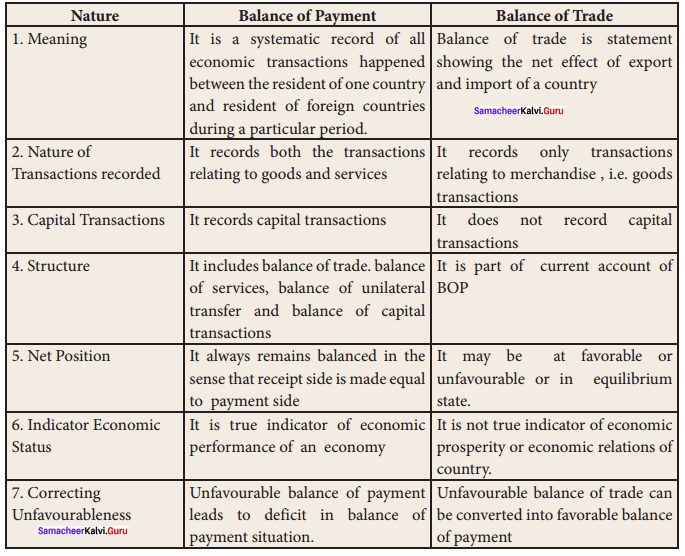
Question 2.
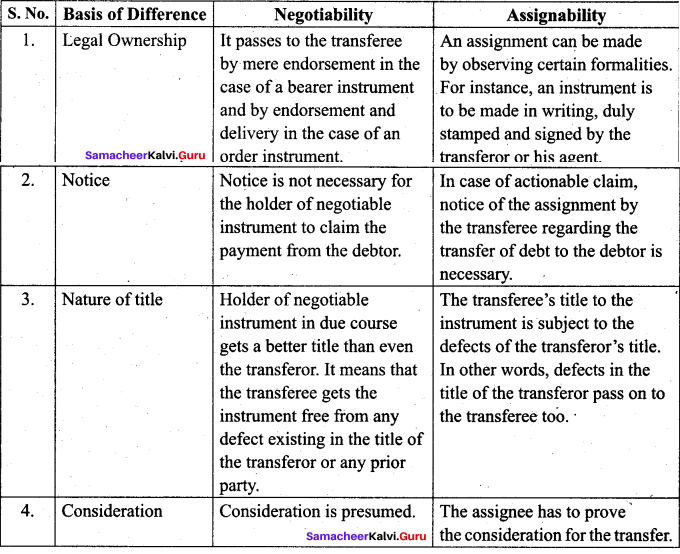
Distinguish balance of payment and balance of trade.
Answer:
Samacheer Kalvi 11th Commerce Solutions Chapter 28 Balance of Trade and Balance of Payments

Question 3.
Highlight the features of balance of trade.
Answer:

  1. Balance of trade is statement showing the net effect of export and import of a country.
  2. It records only transactions,relating to merchandise, i.e. goods transactions.
  3. It does not record capital transactions.
  4. It is part of current account of BOP.
  5. It may be at favorable or unfavourable or in equilibrium state.
  6. It is not true indicator of economic prosperity or economic relations of country. Unfavourable balance of trade can be converted into favorable balance of payment.

For Future Learning

Question a.
Impact of Balance of Payments and Trade.
Answer:
Global village is also a term to express the constituting relationship between economics and other social sciences throughout the world making it a part of our popular culture before it actually happened.

Question b.
Necessary for Global Village concept.
Answer:
The current account, capital account and financial account together make up the overall balance of payments, which accounts for all of the international inflows and outflows for a given Nation. The current account, as mentioned, capture the balance of trade meaning the purchases and sale of goods and services.

For Own Thinking

Question a.
Balance of Payment is key to economic development.
Answer:
Yes, it is correct.

Question b.
Importance of BOP and BOT.
Answer:
BOP:

  1. It presents the international financial positions of the country.
  2. It helps the government in taking decisions on monetary and fiscal policies on the one hand and on external trade and payments issued on the other.

BOT:

  1. It is the difference between a country’s import and export over a period of time.
  2. It is the largest component of the balance of payments for all nations.

Share this Tamilnadu State Board Solutions for 11th Commerce Chapter 28 Balance of Trade and Balance of Payments Questions and Answers with your friends to help them to overcome the issues in exams. Keep visiting this site Tamilnadu State Board Solutions frequently to get the latest information on different subjects. Clarify your doubts by posting the comments and get the answers in an easy manner.
Samacheer Kalvi 11th Commerce Solutions Chapter 29 Elements of Contract

Students can find the most related topics which helps them to analyse the concepts if they practice according to the chapter-wise page. It is necessary for the students to practice more Questions and Answers for Tamilnadu State Board Solutions of 11th Commerce are given in the pdf format in chapter 29 Elements of Contract Questions and Answers so that students can prepare in both online and offline modes. So, Download Samacheer Kalvi 11th Commerce Book Solutions Questions and Answers, Notes Pdf, to score good marks.

Samacheer Kalvi 11th Commerce Solutions Chapter 29 Elements of Contract

Get the Questions and Answers, in Tamilnadu State Board 11th Commerce Solutions for Chapter 29 Elements of Contract. Learn the concepts of 11th Commerce Chapter-Wise by referring to the Tamilnadu State Board Solutions for Chapter 29 Elements of Contract Questions and Answers. Hence we suggest the students to Download Samacheer Kalvi 11th Commerce Book Solutions Questions and Answers pdf to enhance your knowledge.

Samacheer Kalvi 11th Commerce Elements of Contract Textbook Exercise Questions and Answers

I. Choose the Correct Answer

Question 1.
An agreement enforceable by law is a ………………
(a) Enforceable acceptance
(b) Accepted offer
(c) Approved promise
(d) Contract
Answer:
(d) Contract

Question 2.
Every promise and every set of promises, forming the consideration for each other, is an ………………
(a) Agreement
(b) Contract
(c) Offer
(d) Acceptance
Answer:
(a) Agreement

Question 3.
Void agreement signifies ………………
(a) Agreement illegal in nature
(b) Agreement not enforceable by law
(c) Agreement violating legal procedure
(d) Agreement against public policy
Answer:
(b) Agreement not enforceable by law

Question 4.
Acceptance to be valid must ………………
(a) Be absolute
(b) Be unqualified
(c) Both be absolute & unqualified
(d) Be conditional
Answer:
(c) Both be absolute & unqualified

Question 5.
A contract with or by a minor is a ………………
(a) Valid contract
(b) Void contract
(c) Voidable contract
(d) Voidable at the option of either party
Answer:
(b) Void contract

II. Very Short Answer Questions

Question 1.
What is law?
Answer:
Law means a ‘set of rules’ which governs our behaviour and relating in a civilized society.

Question 2.
Why should one know law?
Answer:
One to should know the law to which he is subjected to because ignorance of law is no excuse.

Question 3.
Can a minor enter into a Contract?
Answer:
No, a minor cannot enter into contract.

Question 4.
Who can enter into a Contract?
Answer:
The Indian contract Act specifies that every person is competent to contract provided he is of the age of majority according to the Law which he is subject to and who is of sound mind.

Question 5.
Define Contract.
Answer:
Contract 2(h) An agreement enforceable by Law is a Contract.

III. Short Answer Questions

Question 1.
Define Offer.
Answer:
Offer (i.e. Proposal) [section 2(a)]: When one person signifies to another his willingness to do or to abstain from doing anything, with a view to obtaining the assent of that other person either to such act or abstinence, he is said to make a proposal.

Question 2.
What do you mean by Agreement?
Answer:
An “agreement” means ‘a promise or a set of promises’ forming consideration for each other. A promise arises when a proposal is accepted. By implication, an agreement is an accepted proposal. In other words, an agreement consists of an ‘offer’ and its ‘acceptance’.
Agreement = offer / Proposal + Acceptance

Question 3.
Define a Voidable Contract.
Answer:
An agreement which is enforceable by law at’the option of one or more parties but not at the option of the other- or others is a voidable contract. This is the result of coercion, undue influence, fraud and misrepresentation.

Question 4.
What do you mean by Revocation?
Answer:
The Revocation mean the withdrawal of an offer power of attorney.

Question 5.
Who is a promisor, promisee?
Answer:

  1. A promisor – Contract law – a person who makes a promise.
  2. A promisee – Contract law – a person to whom a promise is made.

IV. Long Answer Questions

Question 1.
Explain the essentials of a Valid Contract
Answer:
1. Offer and Acceptance : There must be two parties to an agreement namely one party making the offer and the other party accepting it.

2. Legal Relationship : The parties must have the intention to create legal relationship between them. An agreement of Social or domestic nature is not at all a contract.

3. Lawful Consideration (quid pro quo) : As per Contract Act under Sec.2(d) Consideration means something in return. A contract without consideration becomes invalid.

4. Lawful Object (Section 23) : The object of agreement should be lawful and legal. It must not be immoral, illegal or opposed to public policy.

5. Free Consent (Section 13 & 14) : Consent of the parties must be free and genuine. Consent means agreeing upon same thing in the same sense at the same time i.e. there should be consensus – ad – idem. Consent is said to be free when it is not caused by coercion, undue influence, fraud, misrepresentation or mistake.

6. Capacity of Parties (Section 11) : The parties to a contract must have capacity (legalability) to make valid contract.

7. Certainty of Terms (Section 29) : The agreement should be clear to the parities of the agreement. The agreement must be precise.

8. Possibility of Performance (Section 56) : The terms of the agreement should be capable of performance. An agreement to do an act, impossible in itself cannot be enforced.

9. Not declared Void : The agreement should be such that it should be capable of being enforced by law. Certain agreements have been expressly declared illegal or void by the law.

10. Necessary Legal Formalities : A contract may be oral or in writing. Where a particular type of contract is required by law to be in writing and registered, it must comply with necessary formalities as to writing, registration and attestation.

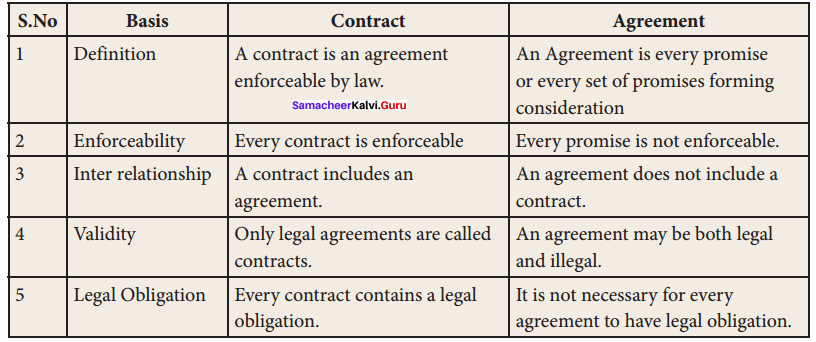
Question 2.
Difference between Contract and Agreement.
Answer:
Samacheer Kalvi 11th Commerce Solutions Chapter 29 Elements of Contract

Question 3.
Explain the classification of Contract on the basis of the Validity.
Answer:
1. Valid Contract : An agreement which fulfils all the essentials prescribed by law on the basis of its creation. For example S offers to sell his car for Rs.2,00,000 to T. T agrees to buy it. It is a Valid Contract.

2. Void Contract 2(j) : A contract which ceases to be enforceable by law. A contract which does not satisfy any of the essential elements of a valid contract is said to be Void.

3. Voidable Contract 2(i) : An agreement which is enforceable by law at the option of one or more parties but not at the option of the other or others is a voidable contract.

4. Illegal Contract : It is a contract which is forbidden by law. All illegal agreements are Void but all void agreements or contracts are not necessarily illegal. Contract that is immoral or opposed to public policy are illegal in nature.

5. Unenforceable Contract : Where a contract is unenforceable because of some technical defect i.e. absence in writing barred by imitation etc. If the parties perform the contract it will be valid, but the court will not compel them if they do not.

Question 4.
Explain the classification of Contract on the basis of the Formation.
Answer:
1. Express Contract : A contract made by word spoken or written. According to Section. 9, in so for as the proposal or acceptance of any promise is made in words, the promise is said to be express. For example P says to Q ‘will you buy my bicycle for Rs. 1,000?” Q says to P “Yes”.

2. Implied Contract : The implied contract is one, which is not expressly written but understood by the conduct of parties. Where the proposal or acceptance of any promise is made otherwise than in words, the promise is said to be implied. For example A gets into a public bus, there is an implied contract that he will pay the bus fare.

3. Quasi Contract : It is a contract created by law. Actually, there is no contract. It is based on the principle that “a person shall not be allowed to enrich himself unjustly at the expense of the other”. In other words it is an obligation of one party to another imposed by law independent of an agreement between the parties.

4. Tacit Contract : A contract is said to be tacit when it has to be inferred from the conduct of the parties. For example obtaining cash through automatic teller machine, sale by fall of.hammer of an auction sale.

Question 5.
Explain the classification of Contract on the basis of the Performance.
Answer:
1. Executed Contract : A contract in which both the parties have fulfilled their obligations under the contract. For example X contracts to buy a car from Y by paying cash, Y instantly delivers his car.

2. Executory Contract : A contract in which both the parties are yet to fulfil their obligations, it is said to be an executory contract. For example A agrees to buy B’s cycle by promising to pay cash on 15th June. B agrees to deliver the cycle on 20th June.

3. Unilateral Contract : A unilateral contract is a one sided contract in which only one party has performed his promise or obligation, the other party has to perform his promise or obligation.

For example X promises to pay Y a sum of Rs. 10,000 for the goods to be delivered by Y. X paid the money and Y is yet to deliver the goods.

4. Bilateral Contract : A contract in which both the parties commit to perform their respective promises is called a bilateral contract. For example R offers to sell his fiat car to S for Rs. 10,00,000 on acceptance of R’s offer by S, there is a promise by R to Sell the car and there is a promise by S to purchase the car, there are two promises.

For Future Learning

Question 1.
After studying this chapter any one can enter into Valid Contract and can also identify the essentials present in the contract.
Answer:
Anyone can enter into the valid contract but he must attain the age of majority. He should be sound mind.

Question 2.
After understanding this chapter entering into Offer and giving Acceptance becomes easier.
Answer:
Offer – Proposal
Acceptance – Proposal is accepted

Question 3.
After going through this chapter the value of consideration and the requirement for return payment can be understood better.
Answer:
Consideration means something in return.

Question 4.
After reviewing this chapter the parties who are allowed to enter and the parties who are not allowed to enter into a contract can be clearly demarcated.
Answer:
Major can enter into contract with sound mind. Minor cannot enter into contract with unsound mind.

Question 5.
After analysing this chapter an obligation imposed by law – Quasi Contracts are better understood and distinguished from other contracts.
Answer:
It is an obligation of one party to another imposed by law independent of an agreement between the parties.

Share this Tamilnadu State Board Solutions for 11th Commerce Chapter 29 Elements of Contract Questions and Answers with your friends to help them to overcome the issues in exams. Keep visiting this site Tamilnadu State Board Solutions frequently to get the latest information on different subjects. Clarify your doubts by posting the comments and get the answers in an easy manner.
Samacheer Kalvi 12th Commerce Solutions Chapter 26 Companies Act 2013

Enhance your subject knowledge with Tamilnadu State Board Solutions for 26th Commerce Chapter 26 Companies Act 2013 Questions and Answers and learn all the underlying concepts easily. Make sure to learn the subject from Tamilnadu State Board Solutions Chapter 26 Companies Act 2013 Questions and Answers PDF on a day to day basis and score well in your exams. You can Download Samacheer Kalvi 26th Commerce Book Solutions Questions and Answers are given after enormous research by people having high subject knowledge and for better scoring grade. You can rely on them and prepare any topic of Commerce as per your convenience easily.

Tamilnadu Samacheer Kalvi 12th Commerce Solutions Chapter 26 Companies Act 2013

Students those who are looking for Tamilnadu State Board Solutions Chapter 26 Companies Act 2013 Questions and Answers Concepts can find them all in one place from our site Tamilnadu State Board Solutions. Simply click on the links available to prepare the corresponding topics of Samacheer Kalvi 26th Commerce Book Solutions Questions and Answers easily. Clarify all your queries from chapter wise different questions to be familiar with the kind of questions appearing in the exam. Thus, you can increase your score and get higher grade in the final exam.

Samacheer Kalvi 12th Commerce Companies Act 2013 Textbook Exercise Questions and Answers

I. Choose the correct answer

Question 1.
The Company will have to issue the notice of situation of Registered Office to the Registrar of Companies with in _____ days from the date of incorporation.
(a) 14 days
(b) 21 days
(c) 30 Days
(d) 60 Days
Answer:
(c) 30 Days

Question 2.
How does a person who envisages the idea to form a company called?
(a) Director
(b) Company Secretary
(c) Registrar
(d) Promoter
Answer:
(d) Promoter

Question 3.
For which type of capital a company pays the prescribed fees at the time of registration?
(a) Subscribed Capital
(b) Authorised Capital
(c) Paid-up Capital
(d) Issued Capital
Answer:
(b) Authorised Capital

Question 4.
Which of the following types of shares are issued by a company to raise capital from the existing shareholders?
(a) Equity Shares
(b) Right Shares
(c) Preference Shares
(d) Bonus Shares
Answer:
(b) Right Shares

Question 5.
Specify the type of resolution to be passed to choose the location of Registered Office of the company within the town or village or city.
(a) Ordinary
(b) Special
(c) Either Ordinary or Special
(d) Board
Answer:
(d) Board

Question 6.
Who can issue stock?
(a) Public
(b) Private
(c) One Person
(d) Small
Answer:
(a) Public

Question 7.
Specify the document which comes under the Negotiable Instrument Act.
(a) Share Certificate
(b) Share
(c) Share Warrant
(d) Stock
Answer:
(c) Share Warrant

Question 8.
The shares which are offered to the existing shareholder at free of cost is known as _____
(a) Bonus Share
(b) Equity Share
(c) Right Share
(d) Preference Share
Answer:
(a) Bonus Share

Question 9.
The shares which are offered first to the existing shareholder at reduced price is known as _____
(a) Bonus Share
(b) Equity Share
(c) Right Share
(d) Preference Share
Answer:
(c) Right Share

Question 10.
The Companies Act 2013 Prohibits the issue of shares at _____ to the public.
(a) Premium
(b) Par
(c) Discount
(d) Both at par and Premium
Answer:
(c) Discount

II. Very Short Answer Questions

Question 1.
Who is called as Promoters?
Answer:
Promotion stage begins when the idea to form a company comes in the mind of a person. The person who envisage the idea is called a ‘promoter’.

Question 2.
What is Share?
Answer:
The term Share is viewed by a layman as a fraction or portion of total capital of the company which have equal denomination.

Question 3.
What do you mean by Equity Share?
Answer:
The share of a company which do not have any preferential rights with regard to dividend and repayment of share capital at the time of liquidation of a company, is called as equity share or ordinary share.

Question 4.
What do you understand by Preference Share?
Answer:
The term ‘preference shares’ means that part of the share capital the holders of which have a preferential right over payment of dividend (fixed amount or rate) and repayment of share capital in the event of winding up of the company.

Question 5.
What is Sweat Equity Shares?
Answer:
Sweat Equity Shares means issue of shares to employees or directors at a lower price for cash or other than Cash.

Question 6.
What is Bonus Shares?
Answer:
Bonus share means to utilize the company’s reserves and surpluses. Issue of shares to existing shareholders without taking any consideration is known as Bonus Shares.

Question 7.
What is Right Shares?
Answer:
The right shares are primarily issued to the existing equity shareholders through a letter of an issue, on pro rata basis.

Question 8.
What is Private placement?
Answer:
Private placement means offer of securities or invitation to subscribe to securities to a select group of persons through private placement offer letter.

Question 9.
Define Share Warrant.
Answer:
A share warrant is a negotiable instrument, issued by the public limited company only against fully paid up shares. It is also termed as a document of title because the holder of the share warrant is entitled to the number of shares mentioned in it.

Question 10.
What is Debentures?
Answer:
When a company needs funds for extension and development purpose without increasing its share capital, it can borrow from the general public by issuing certificates for a fixed period of time and at a fixed rate of interest. Such a loan certificate is called a debenture.

III. Short Answer Questions

Question 1.
Distinguish between shares and stocks.
Answer:

Basis for DifferenceSharesStocks
1. MeaningThe term ‘share’ means a fraction or unit of the total capital of the company which have equal denomination.Stock is created from fully paid shares by passing resolution in the general meeting. The Articles of Association of the company must permit this conversion.
2. DenominationAll the shares are of equal denomination.The denomination of stocks may. differ.
3. Paid up valueShares can be partly or fully paid up.Stock can only be fully paid up.

Question 2.
What do you understand by Issue of Securities at Premium?
Answer:
When shares are issued at a price above the face or nominal value, they are said to be issued at a premium. For example, a share having the face value of Rs. 10 is issued at Rs. 12. Here, Rs.2 is the premium. The amount of share premium has to be transferred to an account called the ‘ Securities Premium Account’

Question 3.
What is issue of shares at discount? What conditions should be fulfilled?
Answer:
When the shares are issued at a price below the face value they are said to be issued at a discount. For example, a share having the face value of Rs 10 is issued at Rs 8. The companies act 2013, prohibits the issue of shares at discount (Section 53), except sweat Equity share.

Question 4.
State condition stipulated for capital subscription at the time of promotion.
Answer:
For capital subscription, steps to be taken are listed below:

  1. The fulfilling formalities to raise necessary capital.
  2. Adhering to SEBI guidelines in this regard.
  3. Observing guidelines for Disclosure and investor protection issued by SEBI.
  4. Issuing prospectus.
  5. Appointing official banker of the company for receiving application from the investors.

Question 5.
Explain different kinds of preference shares.
Answer:
There are eight types of preference shares:

  1. Cumulative Preference shares: As the word indicates, all dividends are carried forward until specified.
  2. Non-cumulative Preference shares: These are opposite of cumulative.
  3. Redeemable Preference shares: Such preference shares can be claimed after a fixed period or after giving due notice. ,
  4. Non-Redeemable Preference shares: Such shares cannot be redeemed during the lifetime of the company.
  5. Convertible Preference shares: The shares can be converted into equity shares after a time period. .
  6. Non-convertible Preference shares: Non-convertible preference shares cannot be, at any time, converted into equity shares.
  7. Participating Preference shares.
  8. Non-Participating Preference shares.

IV. Long Answer Questions

Question 1.
Write the difference between Debentures and Shares.
Answer:
Debentures:

  1. Debentures mean a loan.
  2. Debenture holder gets fixed rate of Interest.
  3. Debentures generally have a charge on the assets of the company.
  4. Debentures can be issued at a discount.
  5. Debenture holders do not have any voting right.
  6. Interest on debentures is payable even if there are no profits.
  7. Interest paid on debenture is a business expense.

Shares:

  1. Shares are part of the capital of a company.
  2. Shareholders gets dividends with a varying rate.
  3. Shares do not carry any such charge.
  4. Shares cannot be issued at a discount.
  5. Shareholders enjoy voting right.
  6. Dividend is payable only if there is profit.
  7. Dividend is not a business expense.

Question 2.
Brief different stages in Formation of a Company.
Answer:
Section 3 (1) of the Act states that a company may be formed for any lawful purpose by-
(a) seven or more persons, where the company to be formed is to be a public company;
(b) two or more persons, where the company to be formed is to be a private company;
(c) one person, where the company to be formed is to be One Person Company.
The process of formation of company consists of different stages:
1. Promotion: Promotion stage begins when the idea to form a company comes in the mind of a person.

2. Registration: The second stage in the formation of the company is incorporation or – registration. In this stage, the promoter has to fix name of the company, prepare the necessary documents (Memorandum and Articles of Association), fix the registered office, and name of the directors. After this, certificate of incorporation is issued.

3. Capital Subscription: A public limited company having its share capital has to pass through two stages. One of them is capital subscription. The steps for this is:

  1. Formalities for raising capital
  2. Issuing prospectus
  3. Appointing official banker
  4. Pass resolution to make allotment

4. Commencement of Business: As per section 11 of the Act, a company having share capital should file with the Registrar, declaration stating that

  1. Every subscriber has paid the value of shares.
  2. Paid up capital is not less than Rs.5 lakhs for a public limited company and Rs.1 lakh in case of a private limited company.
  3. It has filed the Registrar, regarding the verification of registered office. After fulfilling these details, the Registrar will issue certificate of commencement of business.

Question 3.
What are the various kinds of Debentures?
Answer:
Debenture is a document issued by the company for acknowledging the loan from the public. Debentures are classified into different categories on the basis of:

  1. Convertibility of the Instrument
  2. Security of the Instrument
  3. Redemption ability; and
  4. Registration of Instrument.

1. On the basis of convertibility:
(a) Non-Convertible Debentures: These instruments cannot be converted into equity shares.
(b) Partly Convertible Debentures: Apart of these instruments are converted into equity shares.
(c) Fully Convertible Debentures: These are fully convertible into equity shares.
(d) Optionally Convertible Debentures: The investor can have the option to either convert the debentures at a price decided by the issuer or agreed upon at the time of issue.

2. On the basis of Security:
(a) Secured Debentures: These instruments are secured by a charge on the fixed assets of the issuer company.
(b) Unsecured Debentures: These instruments are unsecured against the assets.

3. On the basis of Redeemability:
(a) Redeemable Debentures: It refers to the debentures which will be redeemed in future.
(b) Irredeemable Debentures: It is a debenture, in which no specific time is specified by the companies to pay back the money.

4. On the basis of Registration:
(a) Registered Debentures: These are issued in the name of a particular person, who is registered by the company.
(b) Bearer Debentures: These are issued to the bearer and are negotiable instruments, and are transferred by mere delivery.

Question 4.
What formalities need to be fulfilled for companies having share capital to commence business?
Answer:
A public limited company having its share capital has to pass through two more stages. One of them is capital subscription, steps to be taken at this stage are listed below:

  1. The fulfilling formalities to raise necessary capital.
  2. Following the SEBI guidelines in this regard.
  3. Issuing prospectus.
  4. Appointing official banker of the company for receiving application from the investors.
  5. Passing resolution for making allotment by director.
  6. Despatch allotment letters to allottees.
  7. Filing allotment return with the Registrar.
  8. Issuing share certificates in exchange for their allotment letter.
  9. Ensuring collection of minimum subscription.

Question 5.
Write the difference between Share Certificate and Share Warrant.
Answer:
Share Certificate:

  1. A share certificate is an instrument in writing for the legal proof of the ownership.
  2. Every company must issue share certificate to its shareholders.
  3. Normally, the holder of the share certificate is to be the member of the company.
  4. The share certificate is issued by the company within three months of the allotment of shares.
  5. No need to authorized in the Articles of Association to issue share certificate.

Share Warrant:

  1. A share warrant is a negotiable instrument, issued against fully paid up shares.
  2. There is no compulsion of the issue of share warrants by the company.
  3. Generally, the holder of the share warrant is not the member of the company.
  4. Shares warrant can be issued only when the shares are fully paid up.
  5. The issue of a share warrant must be authorized in the Articles of Association of the company.

Samacheer Kalvi 12th Commerce Companies Act 2013 Additional Questions and Answers

I. Choose the Correct Answer
Question 1.
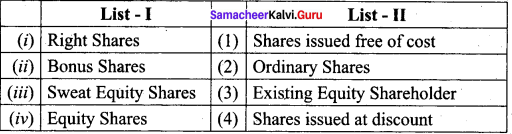
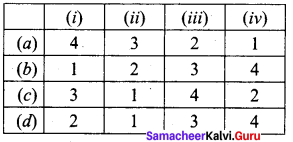
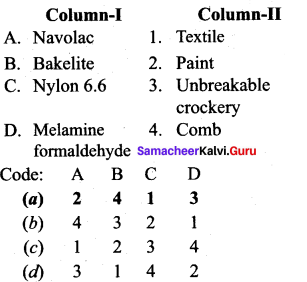
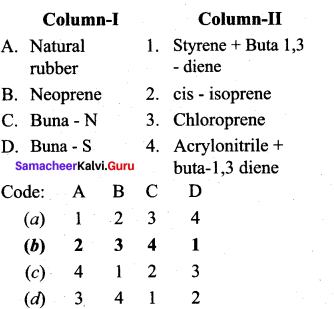
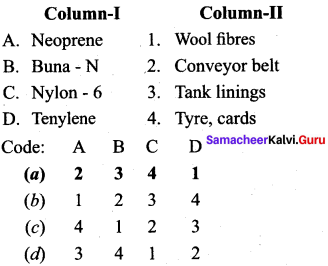
Match List I with List II and select the correct answer using the codes given below:

Samacheer Kalvi 12th Commerce Solutions Chapter 26 Companies Act 2013

Codes:

Samacheer Kalvi 12th Commerce Solutions Chapter 26 Companies Act 2013
Answer:
(c) 3,1,4,2

Question 2.
The first two stages of formation of a company are
(i) Issue of prospectus
(ii) Promotion
(iii) Issue of share certificate
(iv) Registration
(a) (i) and (ii)
(b) (ii) and (iv)
(c) (ii) and (iii)
(d) (i) and (iii)
Answer:
(b) (ii) and (iv)

We as a team believe the information prevailing regarding the Tamilnadu State Board Solutions for 26th Commerce Chapter 26 Companies Act 2013 Questions and Answers has been helpful in clearing your doubts to the fullest. For any other help do leave us your suggestions and we will look into them. Stay in touch to get the latest updates on Tamilnadu State Board Solutions for different subjects in the blink of an eye.

Samacheer Kalvi 12th Commerce Solutions Chapter 24 Types of Entrepreneurs

Enhance your subject knowledge with Tamilnadu State Board Solutions for 24th Commerce Chapter 24 Types of Entrepreneurs Questions and Answers and learn all the underlying concepts easily. Make sure to learn the subject from Tamilnadu State Board Solutions Chapter 24 Types of Entrepreneurs Questions and Answers PDF on a day to day basis and score well in your exams. You can Download Samacheer Kalvi 24th Commerce Book Solutions Questions and Answers are given after enormous research by people having high subject knowledge and for better scoring grade. You can rely on them and prepare any topic of Commerce as per your convenience easily.

Tamilnadu Samacheer Kalvi 12th Commerce Solutions Chapter 24 Types of Entrepreneurs

Students those who are looking for Tamilnadu State Board Solutions Chapter 24 Types of Entrepreneurs Questions and Answers Concepts can find them all in one place from our site Tamilnadu State Board Solutions. Simply click on the links available to prepare the corresponding topics of Samacheer Kalvi 24th Commerce Book Solutions Questions and Answers easily. Clarify all your queries from chapter wise different questions to be familiar with the kind of questions appearing in the exam. Thus, you can increase your score and get higher grade in the final exam.

Samacheer Kalvi 12th Commerce Types of Entrepreneurs Textbook Exercise Questions and Answers

I. Choose the Correct Answer

Question 1.
Choose the type of entrepreneur that isn’t based on function:
(a) Innovative
(b) Classical
(c) Fabian
(d) Drone
Answer:
(c) Fabian

Question 2.
Choose the type of Entrepreneur that is not based on Motivation:
(a) Pure
(b) Corporate
(c) Spontaneous
(d) Induced
Answer:
(c) Spontaneous

Question 3.
Which of the following is the Activity of a Business Entrepreneur?
(a) Production
(b) Marketing
(c) Operation
(d) All of the above
Answer:
(d) All of the above

Question 4.
Find the odd one out in context of Trading Entrepreneur.
(a) Selling
(b) Commission
(c) Buying
(d) Manufacturing
Answer:
(d) Manufacturing

Question 5.
Corporate Entrepreneur is also called as  _________
(a) Intrapreneur
(b) Promoter
(c) Manager
(d) Shareholder
Answer:
(b) Promoter

Question 6.
Poultry, Flowers, Fruits, etc., are called allied products of _________ entrepreneur.
(a) Corporate
(b) Retail
(c) Trading
(d) Agricultural
Answer:
(d) Agricultural

Question 7.
_________ Entrepreneur Supply Services Unlike.
(a) Hoteliers
(b) Banking
(c) Airlines
(d) Livestock
Answer:
(d) Livestock

Question 8.
Motive of a Pure Entrepreneur is _________
(a) Rendering service
(b) Earning profit
(c) Attaining status
(d) Both b and c
Answer:
(d) Both b and c

Question 9.
Which of these is based on Technology?
(a) Modem
(b) Professional
(c) Corporate
(d) Industrial
Answer:
(c) Corporate

Question 10.
Which of the below is not a characteristic of a Fabian Entrepreneur?
(a) Conservative
(b) Risk averse
(c) Sceptical
(d) Adaptive
Answer:
(d) Adaptive

II. Very Short Answer Questions

Question 1.
What is the other name of business entrepreneur?
Answer:
The term entrepreneur means the. person who takes steps for commencing the business. So he is otherwise called as organiser or proprietor.

Question 2.
Mention the other name for corporate entrepreneur.
Answer:
Corporate entrepreneur is called promoter. He/she takes initiative necessary to start an entity under corporate format.

Question 3.
Who are agricultural entrepreneur?
Answer:
Agricultural entrepreneurs are those entrepreneurs who raise farm products and market them.

Question 4.
State the name of the.following ventures:
a. Started by individuals for profit motive
b. Started by Government
c. Started by individuals and Government together
d. Started as a family business
Answer:
a. Private entrepreneur
b. State entrepreneurship
c. Induced entrepreneur
d. Classical entrepreneur

Question 5.
Give some examples of pure entrepreneurs.
Answer:
Dhirubai Ambani, Jamshedji Tata, T.V. Sundaram Iyengar, Seshadriji, Birla, Narayanamurthi, and Azim Premji are few examples of pure entrepreneurship.

III. Short Answer Questions

Question 1.
Who is a private entrepreneur?
Answer:
Ventures started by individual either singly or collectively at their own risk after mobilising – various, resources in order to earn profit are called private entrepreneurship.

Question 2.
What is political environment?
Answer:
To commence business, various factors are needed. Apart from all other factors, political environment is also essential. It means that the concessions, incentives provided by the government drive them to enter into venture. The government also provides support in the form of loans, subsidies and other taxes.

Question 3.
List down few examples of pure entrepreneurship.
Answer:
Pure entrepreneurs are individuals who are propelled to enter into venture by psychological and economic motives. They nurture desire of starting a particular venture and earning high profit there from and thus attaining a social status. They apply their knowledge, skill and insight in making the venture a great’ success in order to earn maximum profit out of the venture. Dhirubai Ambani, Jamshedji Tata, T.V. Sundaram Iyengar, Seshadriji, Birla, Narayanamurthi, and Azim Premji are few examples of pure entrepreneurship.

Question 4.
How does a professional entrepreneur operate?
Answer:
Professional entrepreneur is one who is having a rich expertise in starting a venture but lack interest in continuing the venture as a manager or as a owner. He/she simply sells out the venture started by him to someone else after its successful take-off.
Question 5.
Explain, about the agricultural entrepreneur.
Answer:
Agricultural entrepreneurs are those entrepreneurs who raise farm products and market them. They use the various inputs like labour, fertilizer, insecticide, water technology, etc., to raise the products and market their products either directly or through co-operative entities or through brokers or through tie up with large retailers.

IV. Long Answer Questions

Question 1.
Explain in detail on classification according to the type of business.
Answer:
Classification of Entrepreneur according to the type of business:

(i) Business Entrepreneur: He is called solo entrepreneur. He is the one who finds out an idea for a new product or service and establish a business enterprise.

(ii) Trading Entrepreneur: Trading entrepreneurs are those who restrict themselves to buying and selling finished goods.

(iii) Industrial Entrepreneur: These are entrepreneurs who manufacture products to cater to

(iv) Corporate Entrepreneur: He is called as promoter. He takes initiative necessary to start an entity under corporate format.
(v) Agricultural Entrepreneur: These entrepreneurs are those who raise farm products and market them.

Question 2.
Discuss the nature of functional entrepreneurs.
Answer:
Nature of functional entrepreneurs:

(i) Innovative Entrepreneur: He is a person who introduces new project. They observe the environment regarding information to the new venture.

(ii) Imitative Entrepreneur: He refers to the person who simply imitates existing knowledge or technology already in advance countries. Redesigning of products suited to the local conditions.

(iii) Fabian Entrepreneur: These are said to be conservatives and sceptical about any changes in their organisation. They are of risk-averse.

(iv) Drone Entrepreneur: Drone entrepreneurs are those who are totally opposed to changes in the environment. They used to operate in the-niche market.

Question 3.
Distinguish between the rural and urban entrepreneur.
Answer:

S. No.Rural EntrepreneurUrban Entrepreneur
1.It refers to the person who starts business in rural areas.It refers to the person who commences business in urban areas.
2.These entrepreneurs start doing business in the villages and small towns.They will do their business in state capital, towns, district headquarters, municipalities, etc.
3.They may be agricultural and trading entrepreneurs.They may be industrial or corporate entrepreneur.
4.The availability of material and labour is easy. So the cost of operation tends to be low.The availability of material and labour may be difficult. So the cost of operation may be high.

Samacheer Kalvi 12th Commerce Types of Entrepreneurs Additional Questions and Answers

I. A. Choose the Correct Answer

Question 1.
The entrepreneurs classified on the basis of type of business are __________
(i) Industrial entrepreneur
(ii) Technical entrepreneur
(iii) Professional entrepreneur
(iv) Business entrepreneur
(a) (i) and (iii)
(b) (i) and (iv)
(c) (ii) and (iii)
(d) (ii) and (iv)
Answer:
(b) (i) and (iv)

B. Fill in the blanks

Question 1.
Entrepreneur who commences his entrepreneurial activity in urban areas is called as __________
Answer:
urban entrepreneur

II. Very Short Answer Questions

Question 1.
Who is a service entrepreneur?
Answer:
The entrepreneurs enter into the business of giving service products to end consumers. Example: Banking, Insurance and Transport services.

Question 2.
Write a short note on retail entrepreneurs.
Answer
Retail entrepreneurs are those who enter into venture of distributing the end product to final consumer. They used to buy the goods from numerous wholesalers.

III. Short Answer Questions

Question 1.
Who are industrial entrepreneurs?
Answer:
Industrial entrepreneurs are those persons who manufacture products to cater the needs of the consumers. They may be small, medium and large entrepreneurs. Industrial entrepreneurs mobilise the resources of various types’.

Question 2.
Who are technical entrepreneurs?
Answer:
Technical entrepreneurs are those craftsmen like welder, fitter, turner, carpenter and goldsmith, photographer, weaver who start small business. They manufacture products/service of high quality. They simply focus on production rather than on marketing.

We as a team believe the information prevailing regarding the Tamilnadu State Board Solutions for 24th Commerce Chapter 24 Types of Entrepreneurs Questions and Answers has been helpful in clearing your doubts to the fullest. For any other help do leave us your suggestions and we will look into them. Stay in touch to get the latest updates on Tamilnadu State Board Solutions for different subjects in the blink of an eye.

Samacheer Kalvi 12th Commerce Solutions Chapter 23 Elements of Entrepreneurship

Enhance your subject knowledge with Tamilnadu State Board Solutions for 23th Commerce Chapter 23 Elements of Entrepreneurship Questions and Answers and learn all the underlying concepts easily. Make sure to learn the subject from Tamilnadu State Board Solutions Chapter 23 Elements of Entrepreneurship Questions and Answers PDF on a day to day basis and score well in your exams. You can Download Samacheer Kalvi 23th Commerce Book Solutions Questions and Answers are given after enormous research by people having high subject knowledge and for better scoring grade. You can rely on them and prepare any topic of Commerce as per your convenience easily.

Tamilnadu Samacheer Kalvi 12th Commerce Solutions Chapter 23 Elements of Entrepreneurship

Students those who are looking for Tamilnadu State Board Solutions Chapter 23 Elements of Entrepreneurship Questions and Answers Concepts can find them all in one place from our site Tamilnadu State Board Solutions. Simply click on the links available to prepare the corresponding topics of Samacheer Kalvi 23th Commerce Book Solutions Questions and Answers easily. Clarify all your queries from chapter wise different questions to be familiar with the kind of questions appearing in the exam. Thus, you can increase your score and get higher grade in the final exam.

Samacheer Kalvi 12th Commerce Elements of Entrepreneurship Textbook Exercise Questions and Answers

I. Choose the Correct Answer

Question 1.
Which of the below is a factor of production?
(a) Land
(b) Labour
(c) Entrepreneurship
(d) All of the above
Answer:
(d) All of the above

Question 2.
Entrepreneur is not classified as ________
(a) Risk Bearer
(b) Innovator
(c) Employee
(d) Organizer
Answer:
(b) Innovator

Question 3.
What are the characteristics of an entrepreneur?
(a) Spirit of enterprise
(b) Flexibility
(c) Self Confidence
(d) All of the above
Answer:
(d) All of the above

Question 4.
Which of the below is not classified into managerial functions?
(a) Planning
(b) Marketing
(c) Organizing
(d) Controlling
Answer:
(c) Organizing

Question 5.
Which of the below is a commercial function?
(a) Accounting
(b) Coordination
(c) Discovery of idea
(d) Planning
Answer:
(a) Accounting

II. Very Short Answer Questions

Question 1.
Mention any two features of entrepreneurs.
Answer:
Features of Entrepreneurs:

  1. Spirit of Enterprise: Entrepreneur should be bold enough to encounter risk arising from the venture undertaken.
  2. Self Confidence: Entrepreneur should have a self confidence in order to achieve high goals in the business.

Question 2.
List down the managerial functions of entrepreneurs.
Answer:

  1. Planning
  2. Organising
  3. Directing
  4. Controlling
  5. Coordination

Question 3.
List down the promotional functions of entrepreneurs.
Answer:

  1. Discovery of Idea
  2. Determining the business objectives
  3. Detailed Investigation
  4. Choice of form of enterprise
  5. Fullfillment of the formalities
  6. Preparation of Business Plan
  7. Mobilisation of funds
  8. Procurement of Machines and Materials

Question 4.
Define Intrapreneur.
Answer:
Intrapreneur is one who thinks and acts like an entrepreneur for the firm’s development during the course of employment in an organisation.

Question 5.
List the problems faced by the women entrepreneurs.
Answer:
There is a tremendous growth in the women entrepreneurship in India. But there are certain problems met by women entrepreneurs. They are as follows:-

  1. Problem of Finance: The external sources of funds for the women is limited because they do not generally own properties in their own name. They are depending on their own savings and small loans from friends and relatives.
  2. Lack of Education: Illiterate and semi-literate women entrepreneurs face difficulties in respect of accounts, money matters, marketing and day-to-day operations.
  3. Lack of Network Support: The success of business depends on the support of family members, friends and relatives. But it is reported that the women entrepreneurs get very limited support in times of crisis.
  4. Stiff Competition: They have to face acute competition for their goods from organised sector and from their male counterparts.
  5. Lack of Information: The lack of knowledge or limited knowledge about subsidies, concessions and incentives given by Government will affect the business.

III. Short Answer Questions

Question 1.
Define Entrepreneur.
Answer:
The person who establishes business is termed as entrepreneur. The output of an entrepreneurial process ends up in establishing an enterprise.

Question 2.
Distinguish between Entrepreneur and Manager.
Answer:

Basis of differenceEntrepreneurManager
MotiveThe very motive of an entrepreneur is to start a venture by setting of an entity.The very motive of manager is to render service in an entity setup for execution of venture.
StatusEntrepreneur is owner of the entity.Manager is a salaried employee in the entity set up for carrying on the venture.
Risk BearingEntrepreneur bears the eventual risk and uncertainty in operating the enterprise.Manager doesn’t bear any risk in the venture, where the venture is unsuccessful he/she simply quits the enterprise.

Question 3.
List down the commercial functions of Entrepreneur and explain them shortly.
Answer:
Commercial Functions of Entrepreneur:

(i) Production or Manufacturing: Under production function, entrepreneur has to take decision relating to selection of factory site, design and layout, type of products to be manufactured, research and development, product design, etc.

(ii) Marketing: Entrepreneur has to carry out following functions pertaining to marketing aspect namely consumer research, product planning and development, standardisation, packaging, pricing, warehousing, distribution, promotion etc.

(iii) Accounting: Entrepreneur has to arrange to prepare trading and profit and loss account in order to know the profit or loss incurred out of operation of the business and prepare balance sheet to know the financial status of business at a particular day.

(iv) Finance: In the sphere of financial function, an entrepreneur has to take decisions like choosing the right type of financing, framing the best dividend policy, acquiring of funds, efficiently managing fixed and current assets, maximising shareholders wealth and investing of funds efficiently and effectively.

(v) Human Resource Management: Entrepreneur has to estimate the manpower needs of the enterprise and accordingly decide the size of manpower required for various slots of organisational structure.

Question 4.
Explain the promotional functions of entrepreneur.
Promotional Functions of Entrepreneur
Answer:
(i) Discovery of Idea: The first and foremost function of entrepreneur is idea generation. A person may conceive his own ideas or develop the ideas contributed by others. Ideas can be generated through several ways like own experience and exposure of entrepreneur, keen observation of environment, education, training, market survey, environmental scanning and so on.

(ii) Determining the business objectives: Entrepreneur has to develop business objectives in the backdrop of nature of business and type of business activity i.e. nature of business, manufacturing or trading, type of business organisation chosen so that he/she can organise the venture in accordance with the objectives determined by him/her.

(iii) Detailed Investigation: Entrepreneur should investigate commercial feasibility of the product proposed to be produced and conduct market study to ascertain the potential demand for the product.

(iv) Choice of form of enterprise: Entrepreneur has to choose the appropriate form of organisation suited to implement the venture. There are various forms of organisation namely sole proprietor, partnership, company and co-operatives etc. which are in existence.

(v) Fulfilment of the formalities: Having chosen the appropriate type of organisation, entrepreneur has to take necessary steps to establish the form of organisation chosen. As regards sole trader, the formalities are barest minimum. In the case of partnership firm, entrepreneur has to arrange for partnership deed and he has to get the deed registered.

(vi) Preparation of Business Plan: Entrepreneur has to prepare a business plan or project report of the venture that he is proposing to take up.

(vii) Mobilisation of funds: Entrepreneur has to take steps to mobilise capital needed to implement the venture. Entrepreneur has to estimate the fixed capital and working capital required for running the project.

(viii) Procurement of Machines and Materials: Entrepreneur has to locate the various sources of supply of machineries, equipments and materials.

Question 5.
Explain the commercial functions of entrepreneur.
Answer:
(i) Production or Manufacturing: Under production function, entrepreneur has to take decision relating to selection of factory site, design and layout, type of products to be manufactured, research and development, product design, etc. The efficient and effective performance of production function depends on the proper production planning and control to a major extent.

(ii) Marketing: Entrepreneur has to carry out following functions pertaining to marketing aspect namely consumer research, product planning and development, standardisation, packaging, pricing, warehousing, distribution, promotion etc. The term marketing mix denotes the combination of four components namely product, price, promotion and physical distribution in the case of physical products and three more components are included in the case of service products namely people, process and physical evidence.

(iii) Accounting: Entrepreneur has to arrange to prepare trading and profit and loss account in order to know the profit or loss incurred out of operation of the business and prepare balance sheet to know the financial status of business at a particular day. Besides, cash flow and fund flow statements are prepared to ensure the adequacy of funds and cash for meeting various working capital needs of the business.

(iv) Finance: In the sphere of financial function, an entrepreneur has to take decisions like choosing the right type of financing, framing the best dividend policy, acquiring of funds, efficiently managing fixed and current assets, maximising shareholders wealth and investing of funds efficiently and effectively.

(v) Human Resource Management: Entrepreneur has to estimate the manpower needs of the enterprise and accordingly decide the size of manpower required for various slots of organisational structure. After determining the required manpower, the entrepreneur has to organise for recruitment procedure

selecting manpower, induction and training, determining compensation structure and incentives, designing motivation programmes, structuring wellbeing measures for employees, putting in place safety mechanism at workplace, performance evaluation and career advancement and structuring social security programmes.

IV. Long Answer Questions

Question 1.
How do you classify entrepreneurs?
Answer:
Entrepreneurs are now broadly classified into three groups namely risk bearer, organiser and
innovator.

1. Entrepreneur as a risk bearer : Entrepreneurs acts as an agent combining all factors of production to produce a product or service in order to sell at uncertain price in future.

2. Entrepreneur as an organiser : Entrepreneur is one who brings together various factors of production and creates an entity to produce product or service and supervise and coordinates several functions in the process.

3. Entrepreneur as an innovator : According to Joseph A. Schumpeter in the year 1934 used innovation as a criterion to define an individual as entrepreneur. According to him, entrepreneur is one who

    • Introduces a brand new product in the market.
    • Institutes new technology to produce a new product.
    • Discovers new course of supply of raw materials.

Question 2.
What are the characteristics of an entrepreneur?
Answer:
Characteristics of an Entrepreneur:

1. Spirit of Enterprise: Entrepreneur should be bold enough to encounter risk arising from Elements of Entrepreneurship 145 the venture undertaken.

2. Self-confidence: Entrepreneur should have self-confidence in order to achieve high goals in the business.

3. Flexibility: Entrepreneur should not doggedly stick to decisions in a rigid fashion.

4. Innovation: Entrepreneur should contribute something new or something unique to meet the changing requirements of customers namely new product, new method of production or distribution, adding new features to the existing product, uncovering a new territory for business, innovating new raw material, etc.

5. Resource Mobilisation: Entrepreneur should have the capability to mobilise both tangible inputs like manpower, money materials, technology, market, method etc., which are scattered over a wide area and certain intangible inputs like motivation, morale and innovativeness.

Question 3.
Distinguish between an Entrepreneur and an Intrapreneur.
Answer:

Samacheer Kalvi 12th Commerce Solutions Chapter 23 Elements of Entrepreneurship

Question 4.
Discuss the problems faced by Women Entrepreneurs.
Answer:
There is a tremendous growth in the women entrepreneurship in India. But there are certain problems met by women entrepreneurs.
They are as follows:-

  1. Problem of Finance: The external sources of funds for the women is limited because they do not generally own properties in their own name. They are depending on their own savings and loan from friends and relatives.
  2. Lack of Education: Illiterate and semi-literate women entrepreneurs face difficulties in respect of accounts, money matters, marketing and day-to-day operations.
  3. Lack of Network Support: The success of business depends on the support of family members, friends and relatives. But it is reported that the women entrepreneurs get very limited support in times of crisis.
  4. Stiff Competition: They have to face acute competition for their goods from organised sector and from their male counterparts.
  5. Lack of Information: The lack of knowledge or limited knowledge about subsidies, concessions and incentives given by Government will affect the business.

Question 5.
Explain in detail the various functions of an entrepreneur.
Answer:
The functions of an entrepreneur is divided into
(a) Promotional functions,
(b) Managerial functions
(c) Commercial functions.

(a) Promotional functions:
(i) Discovery of Idea: The first and foremost function of entrepreneur is idea generation. A person may conceive his own ideas or develop the ideas contributed by others. Ideas can be generated through several ways like own experience and exposure of entrepreneur, keen observation of environment, education, training, market survey, environmental scanning and so on.

(ii) Detailed Investigation: Entrepreneur should investigate commercial feasibility of the product proposed to be produced and conduct market study to ascertain the potential demand for the product.

(iii) Mobilisation of funds: Entrepreneur has to take steps to mobilise capital needed to implement the venture. Entrepreneur has to estimate the fixed capital and working capital required for running the project.

(b) Managerial functions:
(i) Planning: In this function, the entrepreneur has to lay down the objectives, goals, vision, mission, policies, procedures, programmes, budget, schedules etc., for enabling the venture to proceed towards established destinations.

(ii) Directing: In this function, the entrepreneur has to motivate, lead, guide and communicate with subordinates on an ongoing basis in order to accomplish pre-set goals.

(c) Commercial functions:
(i) Production or Manufacturing: Under production function, entrepreneur has to take decision relating to selection of factory site, design and layout, type of products to be manufactured, research and development.

(ii) Accounting: Entrepreneur has to arrange to prepare trading and profit and loss account in order to know the profit or loss incurred out of operation of the business and prepare balance sheet to know the financial status of business.

We as a team believe the information prevailing regarding the Tamilnadu State Board Solutions for 23th Commerce Chapter 23 Elements of Entrepreneurship Questions and Answers has been helpful in clearing your doubts to the fullest. For any other help do leave us your suggestions and we will look into them. Stay in touch to get the latest updates on Tamilnadu State Board Solutions for different subjects in the blink of an eye.

Samacheer Kalvi 12th Commerce Solutions Chapter 22 The Negotiable Instruments Act 1881

Enhance your subject knowledge with Tamilnadu State Board Solutions for 22th Commerce Chapter 22 The Negotiable Instruments Act 1881 Questions and Answers and learn all the underlying concepts easily. Make sure to learn the subject from Tamilnadu State Board Solutions Chapter 22 The Negotiable Instruments Act 1881 Questions and Answers PDF on a day to day basis and score well in your exams. You can Download Samacheer Kalvi 22th Commerce Book Solutions Questions and Answers are given after enormous research by people having high subject knowledge and for better scoring grade. You can rely on them and prepare any topic of Commerce as per your convenience easily.

Tamilnadu Samacheer Kalvi 12th Commerce Solutions Chapter 22 The Negotiable Instruments Act 1881

Students those who are looking for Tamilnadu State Board Solutions Chapter 22 The Negotiable Instruments Act 1881 Questions and Answers Concepts can find them all in one place from our site Tamilnadu State Board Solutions. Simply click on the links available to prepare the corresponding topics of Samacheer Kalvi 22th Commerce Book Solutions Questions and Answers easily. Clarify all your queries from chapter wise different questions to be familiar with the kind of questions appearing in the exam. Thus, you can increase your score and get higher grade in the final exam.

Samacheer Kalvi 12th Commerce The Negotiable Instruments Act 1881 Textbook Exercise Questions and Answers

I. Choose the Correct Answer

Question 1.
Negotiable Instrument Act was passed in the year ________
(a) 1981
(b) 1881
(c) 1994
(d) 1818
Answer:
(b) 1881

Question 2.
Negotiable Instrument is freely transferable by delivery if it is a ________ instrument.
(a) Order
(b) Bearer
(c) Both a and b
(d) None of the above
Answer:
(b) Bearer

Question 3.
The transferee of a Negotiable Instrument is the one ________
(a) Who transfer the instrument
(b) On whose name it is transferred
(c) Who enchases it
(d) None of the above
Answer:
(b) On whose name it is transferred

Question 4.
Number of parties in a bill of exchange are ________
(a) 2
(b) 6
(c) 3
(d) 4
Answer:
(c) 3

Question 5.
Section 6 of Negotiable Instruments Act 1881 deals with ________
(a) Promissory Note
(b) Bills of exchange
(c) Cheque
(d) None of the above
Answer:
(c) Cheque

Question 6.
________ cannot be a bearer instrument.
(a) Cheque
(b) Promissory Note
(c) Bills of exchange
(d) None of the above
Answer:
(a) Cheque

Question 7.
When crossing restrict further negotiation ________
(a) Not negotiable crossing
(b) General Crossing
(c) A/c payee crossing
(d) Special crossing
Answer:
(a) Not negotiable crossing

Question 8.
Which endorsement relieves the endorser from incurring liability in the event of dishonour?
(a) Restrictive
(b) Facultative
(c) Sans recourse
(d) Conditional
Answer:
(b) Facultative

Question 9.
A cheque will become stale after ________ months of its date.
(a) 3
(b) 4
(c) 5
(d) 1
Answer:
(a) 3

Question 10.
Document of title to the goods exclude ________
(a) Lorry receipt
(b) Railway receipt
(c) Airway bill
(d) Invoice
Answer:
(d) Invoice

II. Very Short Answer Questions

Question 1.
What is meant by Negotiable Instrument?
Answer:
A negotiable instrument is a document which entitles a person to a certain sum of money and which is transferable from one person to another by mere delivery or by endorsement and delivery.

Question 2.
Define Bill of Exchange.
Answer:
According to section 5 of the Negotiable Instruments Act, “a bill of exchange is an instrument in writing containing an unconditional order, signed by the maker, directing a certain person to pay a certain sum of money only to, or to the order of a certain person or to the bearer of the – instrument”.

Question 3.
List three characteristics of a Promissory Note.
Answer:
Characteristics of a Promissory Note:

  1. A promissory note must be in writing.
  2. The promise to pay must be unconditional.
  3. It must be signed by the maker.

Question 4.
What is meant by a cheque?
Answer:
According to section 6 of the Negotiable Instruments Act, 1881 defines a cheque as “a bill of exchange drawn on a specified banker and not expressed to be payable otherwise than on demand”.

Question 5.
Define Endorsement.
Answer:
“When the maker or holder of a negotiable instrument signs the name, otherwise that as such maker for the purpose of negotiation, on the back or face thereof, or on a slip of paper annexed thereto.”

III. Short Answer Questions

Question 1.
Explain the nature of a Negotiable Instrument.
Answer:
A negotiable instrument is transferable from one person to another without any formality, such as affixing stamp, registration, etc. When the instrument is held by holder in due course in the process of negotiation, it is cured of all defects in the instrument with respect to ownership. Though a bill, a promissory note or a cheque represents a debt, the transferee is entitled to sue on the instrument in his own name in case of dishonour, without giving notice to the debtor that he has become its holder.

Question 2.
Distinguish between Negotiability and Assignability.
Answer:

Samacheer Kalvi 12th Commerce Solutions Chapter 22 The Negotiable Instruments Act 1881

Question 3.
What are the characteristics of a bill of exchange?
Answer:
Characteristics of a Bill of Exchange:

  1. A bill of exchange is a document in writing.
  2. The document must contain an order to pay.
  3. The order must be unconditional.
  4. The instrument must be signed by the person who draws it.
  5. The name of the person on whom the bill is drawn must .be specified in the bill itself.

Question 4.
Distinguish between Bill of Exchange and Promissory Note.
Answer:

Samacheer Kalvi 12th Commerce Solutions Chapter 22 The Negotiable Instruments Act 1881

IV. Long Answer Questions

Question 1.
Mention the presumptions of Negotiable Instruments.
Answer:
Presumptions of Negotiable Instrument:

  1. Every negotiable instrument is presumed to have been drawn and accepted for consideration.
  2. Every negotiable instrument bearing, a date is presumed to have been made or drawn on such a date.
  3. It is presumed to have been accepted within a reasonable time after the date and before its maturity.
  4. The transfer of a negotiable instrument is presumed to have been made before maturity.
  5. When a negotiable instrument has been lost, it is presumed to have been duly stamped.
  6. The holder of a negotiable instrument is presumed to be a holder in due course.

Question 2.
Distinguish a cheque and a bill of exchange.
Answer:

Samacheer Kalvi 12th Commerce Solutions Chapter 22 The Negotiable Instruments Act 1881

Question 3.
Discuss in detail the features of a cheque.
Answer:
A cheque is a negotiable instrument drawn on a particular banker.
Features:
(i) Instrument in Writings:
A cheque or a bill or a promissory note must be an instrument in writing. Though the law does not prohibit a cheque being written in pencil, bankers never accept it because of risks involved. Alternation is quite easy but detection is impossible in such cases.

(ii) Unconditional Orders:
The instrument must contain an order to pay money. It is not necessary that the word ‘order’ or its equivalent must be used to make the document a cheque. It does not cease to be a cheque just because the world ‘please’ is used before the word pay. Further the order must be unconditional.

(iii) Drawn on a Specified Banker Only:
The cheque is always drawn on a specified banker. A cheque vitally differs from a bill in this respect as latter can be drawn on any person including a banker. The customer of a banker can draw the cheque only on the particular branch of the bank where he has an account.

(v) A Certain Sum of Money Only:
The order must be for payment of only money. If the banker is asked to deliver securities, the document cannot be called a cheque. Further, the sum of money must be certain.

(v) Payee to be Certain:
The cheque must be made payable to a certain person or to the order of a certain person or to the bearer of the instrument. The word, person includes corporate bodies, local authorities, associations, holders of office of an institution etc.

(vi) Signed by the Drawer:
The cheque is to be signed by the drawer. Further, it should tally with specimen signature furnished to the bank at the time of opening the account.

Question 4.
What are the requisites for a valid endorsement?
Answer:
If an endorsement is to be valid, it must possess the following requisites:

  1. Endorsement is to be made on the face of the instrument or on its back.
  2. When there is no space for making further endorsements a piece of paper can be attached
  3. Endorsement for only a part of the amount of the instrument is invalid.
  4. Endorsement is complete only when delivery of the instrument is made.
  5. Signing in block letters does not constitute regular endorsement.
  6. If the payee is an illiterate person, he can endorse it by affixing his thumb impression on the instrument.

Question 5.
Explain the different kinds of endorsements. .
Answer:
When the person signs on the back of the instrument to transfer his interest, it is known as endorsement. The endorsement are of various types:
(i) Blank or general endorsement:
When the endorser puts his mere signature on the back of an instrument without mentioning the name of the person to whom the endorsement is made, it is called Blank Endorsement

(ii) Endorsement in full or special endorsement:
If the endorser, in addition to his signature, mentions the name of the person to whom it is endorsed, is known as endorsement in full or special endorsement.

(iii) Conditional endorsement:
When the endorser of a negotiable instrument makes his liability dependent upon the happening of an event which may or may not happen, it is called conditional endorsement,

(iv) Restrictive endorsement:
When an endorsement restricts or prohibits further negotiability of the instrument, it is called Restrictive Endorsement.

(v) Partial Endorsement:
Where the endorsement seeks to transfer only a part of the amount payable under the instrument, the endorsement is called Partial Endorsement.

Samacheer Kalvi 12th Commerce The Negotiable Instruments Act 1881 Additional Questions and Answers

I. Choose the Correct Answer

Question 1.
A bill of exchange drawn on a specified banker is
(a) promissory note
(b) cheque
(c) hundi
(d) share
Answer:
(b) cheque

Question 2.
Grace days allowed to a Bill of exchange for calculation of due date is
(a) 4
(b) 10
(c) 3
(d) 5
Answer:
(c) 3

We as a team believe the information prevailing regarding the Tamilnadu State Board Solutions for 22th Commerce Chapter 22 The Negotiable Instruments Act 1881 Questions and Answers has been helpful in clearing your doubts to the fullest. For any other help do leave us your suggestions and we will look into them. Stay in touch to get the latest updates on Tamilnadu State Board Solutions for different subjects in the blink of an eye.

Samacheer Kalvi 12th Chemistry Solutions Chapter 15 Chemistry in Everyday Life

Are you searching for the Samacheer Kalvi 12th Chemistry Chapter Wise Solutions PDF? Then, get your Samacheer Kalvi 12th Chapter Wise Solutions PDF for free on our website. Students can Download Chemistry Chapter 15 Chemistry in Everyday Life Questions and Answers, Notes Pdf, Samacheer Kalvi 12th Chemistry Solutions Guide Pdf helps you to revise the complete Tamilnadu State Board New Syllabus and score more marks in your examinations.

Tamilnadu Samacheer Kalvi 12th Chemistry Solutions Chapter 15 Chemistry in Everyday Life

All concepts are explained in an easy way on our website. So, students can easily learn and practice Tamilnadu State Board 12th Chemistry Chapter 15 Chemistry in Everyday Life Question and Answers. You can enjoy the digitized learning with the help of the Tamilnadu State Board Chemistry Online Material.

Samacheer Kalvi 12th Chemistry Chapter 15 Chemistry in Everyday Life Textual Evaluation Solved

Samacheer Kalvi 12th Chemistry Chemistry in Everyday Life Multiple Choice Questions

Question 1.
Which of the following is an nalgesic?
(a) Streptornycin
(b) Chloromycetin
(c) Asprin
(d) Penicillin
Answer:
(c)Asprin

Question 2.
Dettol is the mixture of ……………
(a) Chioroxylenol and bithionol
(b) Chioroxylenol and a – terpineol
(c) phenol and iodine
(d) terpineol and bithionol
Answer:
(b) Chioroxylenol and a – terpineol

Question 3.
Antiseptics and disinfectants either kill or prevent growth of microorganisms. Identify which of the following statement is not true.
(a) dilute solutions of boric acid and hydrogen peroxide are strong antiseptics
(b) Disinfectants harm the living tissues
(c) A 0.2% solution of phenol is an antiseptic while 1% solution acts as a disinfectant
(d) Chlorine and iodine are used as strong disinfectants
Answer:
(a) dilute solutions of boric acid and hydrogen peroxide are strong antiseptics

Question 4.
Saccharin, an artificial sweetener is manufactured from ……………..
(a) cellulose
(b) toluene
(c) cyclohexene
(d) starch
Answer:
(b) toluene

Question 5.
Drugs that bind to the receptor site and inhibit its natural function are called …………….
(a) antagonists
(b) agonists
(c) enzymes
(d) molecular targets
Answer:
(a) antagonists

Question 6.
Aspirin is a/an ……………..
(a) acetylsalicylic acid
(b) benzoyl salicylic acid
(c) chlorobenzoic acid
(d) anthranilic acid
Answer:
(a) acetylsalicylic acid

Question 7.
Which one of the following structures represents nylon 6,6 polymer?
Samacheer Kalvi 12th Chemistry Solutions Chapter 15 Chemistry in Everyday Life-1
Answer:
Samacheer Kalvi 12th Chemistry Solutions Chapter 15 Chemistry in Everyday Life-2

Question 8.
Natural rubber has ………..
(a) alternate cis – and trans – configuration
(b) random cis – and trans-configuration
(c) all cis – configuration
(d) all trans – configuration
Answer:
(c) all cis – conflguration

Question 9.
Nylon is an example of …………..
(a) polyamide
(b) polythene
(c) polyester
(d) poly saccharide
Answer:
(a) polyamide

Question 10.
Terylene is an example of …………..
(a) polyamide
(b) polythene
(c) polyester
(d) poly saccharide
Answer:
(c) polyester

Question 11.
Which is the monomer of neoprene in the following?
Samacheer Kalvi 12th Chemistry Solutions Chapter 15 Chemistry in Everyday Life-3
Answer:
Samacheer Kalvi 12th Chemistry Solutions Chapter 15 Chemistry in Everyday Life-4

Question 12.
Which one of the following is a bio-degradable polymer?
(a) HDPE
(b) PVC
(c) Nylon 6
(d) PHBV
Answer:
(d) PHBV

Question 13.
Non stick cook wares generally have a coating of a polymer, whose monomer is ………….
(a) ethane
(b) prop – 2 – enenitrile
(c) chioroethene
(d) 1, 1, 2, 2 – tetrafluoroethane
Answer:
(d) 1, 1, 2, 2 – tetrafluoroethane

Question 14.
Assertion: 2 – methyl – I ,3 – butadiene is the monomer of natural rubber
Reason: Natural rubber is formed through aniònic addition polymerisation.
(a) If both assertion and reason are true and reason is the correct explanation of assertion
(b) if both assertion and reason are true but reason is not the correct explanation of assertion
(c) assertion is true but reason is false
(d) both assertion and reason are false
Answer:
(c) assertion is true but reason is false

Question 15.
An example of antifertility drug is ………….
(a) novesirol
(b) seldane
(c) salvarsan
(d) Chioramphenicol
Answer:
(a) novestrol

Question 16.
The drug used to induce sleep is …………..
(a) paracetamol
(b) bithional
(c) chioroquine
(d) equanil
Answer:
(d) equanil

Question 17.
Which of the following is a co – polymer?
(a) Orlon
(b) PVC
(c) Teflon
(d) PHBV
Answer:
(d) PHBV

Question 18.
The polymer used in making blankets (artificial wool) is ……………
(a) polystyrene
(b) PAN
(c) polyester
(d) polythene
Answer:
(b) PAN

Question 19.
Regarding cross-linked or network polymers, which of the following statement is incorrect?
(a) Examples are Bakelite and melamine
(b) They are formed from bi and tri-functional monomers
(c) They contain covalent bonds between various linear polymer chains
(d) They contain strong covalent bonds in their polymer chain
Answer:
(d) They contain strong covalent bonds in their polymer chain

Question 20.
A mixture of chioroxylenol and terpinecol acts as ……………
(a) antiseptic
(b) antipyretic
(c) antibiotic
(d) analgesic
Answer:
(a) antiseptic

II. Answer the following questions

Question 1.
Which chemical is responsible for the antiseptic properties of dettol?
Answer:
1. Chloroxylenol and

2. Terpineol are the chemicals responsible for the antiseptic properties of dettol. But among these two, chloroxylenol plays more important role. Chioroxylenol is an antiseptic and disinfectant which is used for skin disinfection and cleaning surgical instruments.

Question 2.
What are antibiotics?
Answer:
Antibiotics is a chemical substance produced by one microorganism, that selectively inhibits the growth of another micro organism. Example : penicillins and cephalosporins.

Question 3.
Name one substance which can act as both analgesic and antipyretic.
Answer:
Aspirin (acetylsalicylic acid) is a chemical substance which lowers body temperature (to normal) and also reduces body pain. Therefore it acts as both antipyretic and analgesic.

Question 4.
Write a note on synthetic detergents.
Answer:
1. Synthetic detergents are formulated products containing either sodium salts of alkyl hydrogen suiphates or sodium salts of long chain alkyL benzene suiphonic acids.

2. Synthetic detergents are three types. They are

  • anionic detergents – sodium lauryl sulphate.
  • Cationic detergents – n – hexadecyltrimethyl ammonium chloride.
  • Non-ionic detergents – Pentaerythrityl stearate.

3. Synthetic detergents can be used even in hard water, while soaps cannot be used in hard water.

4. The cleansing action of detergents are similar to the cleansing action of soaps.

5. When detergents are dissolved in water its hydrocarbon part attaches itself to grease and oil particles. Whereas its ionic part remains attached to water. Therefore when dirty clothes are agitated in solution of detergents then dirty particles sticks to the hydrocarbon part of detergents and at the same time the water loving ionic part pulls away this dirt from clothes.

Question 5.
How do antiseptics differ from disinfectants?
Answer:
An tisep tics

  1. Antiseptics are chemical substance which prevent the growth of micro organizers and may even kill them but are not harmful to living tissues.
  2. They are generally applied to living tissues such as wounds, cuts bulks and diseased surfaces.
  3. All the antiseptics are disinfectants.
  4. They are not ingested or swallowed.
  5. e.g., Povidone – iodine, Benzalkonium – Chloride

Disinfectants

  1. Disinfectants are chemical substances which kill microorganism or stop their growth but are harmful to human tissues.
  2. Disinfectants are applied to inanimated objects such as floors, drainage system, instruments etc.
  3. All the disinfectants are not antiseptics.
  4. They can be injected or swallowed.
  5. e.g. Alcohol, chlorine compunds.

Question 6.
What are food preservatives?
Answer:
Food preservatives are chemical substances are capable of inhibiting, retarding or arresting the process of fermentation, acidification or other decomposition of food by growth of micro organisms.
Examples:

  1. Acetic acid is used mainly as a preservative for preparation of pickles.
  2. Sodium meta suiphite is used as preservative for fresh vegetables and fruits.
  3. Sodium benzoate is used as preservative for juices.

Question 7.
Why do soaps not work ¡n hard water?
Answer:
Soaps are sodium or potassium salts of long – chain falty acids. Hard water contains calcium and magnesium ions. When soaps are dissolved in hard water, these ions displace sodium or potassium from insoluble calcium or magnesium salts of fatty acids. These insoluble salts separate as scum.
Samacheer Kalvi 12th Chemistry Solutions Chapter 15 Chemistry in Everyday Life-5
This is the reason why soaps do not work in hard water.

Question 8.
What are drugs? How are they classified?
Answer:
A drug is a substance that is used to modify or explore physiological systems or pathological states for the benefits of the recipient. it is used for the purpose of diagnosis, prevention cure or relief of a disease.

Classification of drugs:
Drugs care classified based on their proportions such as chemical structure, pharmacological effect, target system, site of action etc.

1. Classification based on the chemical structure:
In this classification, drugs with a common chemical skelton are classified into a single group. For example, ampicillin, amoxicillin, methiceillin etc. all have similar structure and are classified into a single group called penicillin.

Similarly we have other group of drugs such as opiates, steroids, catecholamines etc. Compounds having similar chemical structure are expected to have similar chemical properties. However, their biological actions are not always similar.

2. Classification based on the pharmacological effect:

  • In this classification, the drugs are grouped based on their biological effect that they produce on the recipient.
  • For example, the medicines that have the ability to kill the pathogenic bacteria are grouped as antibiotics.
  • This kind of grouping will provide the full range of drugs that can be used for a particular disease.

3. Classification based on the target system:

  • In this classification, the drugs are grouped based on the biological system (or) process that they target in the recipient.
  • This classification is more specific than the pharmacological classification.
  • For example, the antibiotics streptomycin and erythromycin inhibit the protein synthesis (target) in bacteria and are classified in a same group. However their mode of action is different.
  • Streptomycin inhibits the initiation of protein synthesis, while erythromycin prevents the incorporation of new aminoacids to the protein.

4. Classification based on the site of action:

  1. The drug molecule interacts with biomolecules such as enzymes, receptors etc, which are referred as drug targets.
  2. We can classify the drug based on the drug target with which it binds.
  3. This classification is highly specific compared to the others. These compounds often have a common mechanism of action, as the target is the same.

Question 9.
How the tranquilizers work in body?
Answer:

  1. They are neurologically active drugs.
  2. Tranquilizer acts on the central nervous system by blocking the neurotransitter dopamine in the brain.
  3. This drug is used for treatment of stress anxiety, depression, sleep disorders and severe mental diseases like schizophrenia.


Question 10.
Write the structural formula of aspirin.
Answer:
Samacheer Kalvi 12th Chemistry Solutions Chapter 15 Chemistry in Everyday Life-6

Question 11.
Explain the mechanism of cleansing action of soaps and detergents.
Answer:
Mechanism of cleansing action of soaps and detergents:
1. The cleansing action of both soaps and detergents from their ability to lower the surface tension of water, to emulsify oil or grease and to hold them in a suspension in water.

2. This ability is due to the structure of soaps and detergents.

3. In water a sodium soap dissolves to form soap anions and sodium cations. For example, the following chemical equation shows the ionisation of sodium palmitate.
Samacheer Kalvi 12th Chemistry Solutions Chapter 15 Chemistry in Everyday Life-7

4. A soap anion consists of a long hydrocarbon chain with a carboxylate group on one end. The hydrocarbon chain, which is hydrophobic, is soluble in oils or grease. The ionic part is the carboxylate group which is hydrophilic, is soluble in water.
Samacheer Kalvi 12th Chemistry Solutions Chapter 15 Chemistry in Everyday Life-8

5. In water, detergent dissolves to form detergent anions and sodium cations. For example the following chemical equations show the ionisation of sodium alkyl sulphate and sodium alkyl benzene sulphate.
Samacheer Kalvi 12th Chemistry Solutions Chapter 15 Chemistry in Everyday Life-9

6. The following explains the cleansing action of a soap or detergent on a piece of cloth with a greasy stain.

  1. A soap or detergent anion consists of a hydrophobic part and a hydrophilic part.
  2. Soap or detergent reduces the surface tension of water. Therefore the surface of the cloth is wetted thoroughly.
  3. The hydrophobic parts of the soap or detergents anions are soluble in grease.
  4. The hydrophilic parts of the anions are soluble in water.
  5. Scrubbing or mechanical agitation helps to pull the grease away from the cloth and the grease is broken into smaller droplets.
  6. Repulsion between the droplets causes the droplets to be suspended in water, fonning an emulsion.
  7. Thus the droplets do not coagulate or,redeposit on the cloth. Rinsing washes away the droplets.

Question 12.
Which sweetening agent are used to prepare sweets for a diabetic patient?
Answer:
Artificial sweetening agents such as,

  1. saccharin
  2. Alitame
  3. Aspartame

can be used in preparing sweets for diabetic patients.

Question 13.
What are narcotic and non – narcotic drugs. Give examples.
Answer:
1. Narcotic drug is an addictive drug that reduces pain, induces sleep and may alter mood or behaviour. Example: Morphine and codeine.

2. Non – narcotic drug are chemical substance (medications) used to control pain and inflammation. They are available at drugstores without a prescription or by prescription when given at higher doses. Example: Acetaminophen and paracetamol.

Question 14.
What are anti fertility drugs? Give examples.
Answer:
Artificially drugs are chemical substances which suppress the action of hormones that promote pregnancy. These drugs actually reduce the chances of pregnancy and act as a protection. Antifertility drugs are made up of derivatives of synthetic progesterone or a combination of derivatives of oestrogen and progesterone. Example : Ethynylestradiol, menstranol and norcthynodrel etc.

Question 15.
Write a note on co – polymer.
Answer:

  1. A polymer containing two or more different kinds of monomer units is called a co-polymer.
  2. Co – polymers have properties quite different from the homopolymers.
  3. The structural units of co-polymers are derived from the different monomers may be present in regular, alternation or in random order or strings of several units of one kind may alternate with strings of another.
  4. For example, Buna – S, Buna – N, Nylon – 6,6 etc. Buna – S contains styrene and butadiene monomer units.

Question 16.
What are bio degradable polymers? Give examples.
Answer:

  1. The materials that are readily decomposed by micro organisms in the environment are called biodegradable.
  2. Natural polymers degrade on their own after certain period of time but the synthetic polymers do not.
  3. The biopolymers which disintergrates by themselves in biological systems during a
  4. certain period of time by enzymatic hydrolysis and to some extent by oxidation are called biodegradable polymers.

Examples:

  1. Polyhydroxy butyrate (PHB)
  2. Polyhydroxy butyrate – co – hydroxyl valerate (PHBV)
  3. Polylactic acid (PLA)

Question 17.
How is terylene prepared?
Answer:
The monomers are ethylene glycol and terephthalic acid or dimethýlterephthalate. When these monomers are mixed and heated at 500K in the presence of zinc acetate and antimonytrioxide catalyst, terylene (or dacron) is formed.
Samacheer Kalvi 12th Chemistry Solutions Chapter 15 Chemistry in Everyday Life-10

Question 18.
Write a note on vulcanization of rubber.
Answer:

  1. Natural rubber is very soft and brisky. it has high water absorption capacity and low tensile strength. Its properties can be improved by a process called vulcanization.
  2. Natural rubber is mixed with 3 – 5% sulphur and heated at 100 – 150°C causes cross linking of the cis – 1, 4 polyisoprene chains through disuiphide ( – S – S – ) bonds.
  3. The physical properties of rubber can be altered by controlling the amount of sulphur that is used for vulcanization. When 3 to 10% sulphur is used the resultant rubber is somewhat harder but flexible.
  4. Following properties of rubber CH3

Samacheer Kalvi 12th Chemistry Solutions Chapter 15 Chemistry in Everyday Life-11

Question 19.
Classify the following as linear, branched or cross linked polymers …………………..

  1. Bakelite
  2. Nylon
  3. polvthene

Answer:

  1. Bakelite – cross linked polymer
  2. Nylon – Linear polymer
  3. Polythene – Linear polymer

Question 20.
Differentiate thermoplastic and thermosetting.
Answer:
Difference between thermoplastic and thermosetting:
Thermoplastic

  1. They soften on heating and harden on cooling, and they can be remoulded.
  2. They consists of linear long çhain polymers and low molecular weights polymers.
  3. All the polymer chains are held together by weak Vanderwaals forces.
  4. They are weak, soft and less brittle.
  5. They are formed by additon polymerisation
  6. They are soluble in organic solvents.
  7. Example: PVC, polythene, polystrene etc.

Thermosetting

  1. They do not soften on heating and they cannot be remoulded.
  2. The consist of three dimensional network structure and high molecular weight polymers.
  3. All the polymer chains are linked by strong covalent.
  4. They are strong, hard and more brittle.
  5. They are formed by condensation polymerisation.
  6. They are insoluble in organic solvents.
  7. Example: Bakelite, melamine etc.

Samacheer Kalvi 12th Chemistry Chemistry in Everyday Life Additional Questions

Samacheer Kalvi 12th Chemistry Chemistry in Everyday Life 1 mark Questions and Answers

I. Choose the best answer.

Question 1.
The substance that is used to modify physiological system for the benefit of the recipient is called …………….
(a) a drug
(b) a dye
(c) a food preservative
(d) soap
Answer:
(a) a drug

Question 2.
Which one interacts with macromolecular targets such as proteins to produce a therapeutic and useful biological response?
(a) Detergent
(b) cleansing agent
(c) medicine
(d) food preservative
Answer:
(c) medicine

Question 3.
The ratio between the maximum tolerated dose of a drug and a minimum curative dose is called …………..
(a) iso electric point
(b) therapeutic index
(c) critical point
(d) iso thermal point
Answer:
(b) therapeutic index

Question 4.
Which one of the following does not belong to penicillin group?
(a) Ampicillin
(b) Amoxicillin
(c) catecholamine
(d) mithicillin
Answer:
(c) catecholamine

Question 5.
Which of the following does belongs to penicillin group drugs?
(a) Mithicillin
(b) opiates
(c) steroids
(d) catecholamine
Answer:
(a) Mithicillin

Question 6.
Which one of the following is an antibiotic?
(a) erythromycin
(b) atenolol
(c) amlodipine
(d) propranolol
Answer:
(a) erythromycin

Question 7.
Which one of the following is not an antibiotic?
(a) amoxicillin
(b) cefixime
(c) amlodipine
(d) ampiciflin
Answer:
(c) amlodipine

Question 8.
Which one of the following is an example tbr antihypertensive drug?
(a) atenolol
(b) amoxicillin
(c) cefixime
(d) tetracycline
Answer:
(a) atenolol

Question 9.
Which of the following does not belongs to antihypertensive drug?
(a) atenolol
(b) amlodipine
(c) propranolol
(d) erythromycin
Answer:
(d) erythromycin

Question 10.
Which one of the following inhibits the initiation of protein synthesis?
(a) streptomycin
(b) erythromycin
(c) atenolol
(d) amlodipine
Answer:
(a) streptomycin

Question 11.
Which one of the following prevents the incorporation of new amino acids to the protein?
(a) atenolol
(b) streptomycin
(c) erythromycin
(d) tetracycline
Answer:
(c) erythromycin

Question 12.
Which one of the following inhibits the bacterial growth?
(a) p – amino benzoic acid
(b) sulphanilamide
(c) folic cid
(d) sodium benzoate
Answer:
(b) sulphanilamide

Question 13.
Which of the following is needed by many bacteria to produce folic acid?
(a) PABA
(b) DHPS
(c) TNB
(d) GTN
Answer:
(a) PABA

Question 14.
Which of the following is called PABA?
Answer:
(a) p – nitro benzanilic acid
(b) p – amino butyric acid
(c) p – amino benzene suiphonic acid
(d) p – amido benzene suiphonyl chloride
Answer:
(c) p – amino benzene suiphonic acid

Question 15.
Which one of the following binds to the receptor site should inhibit its natural function?
(a) antacids
(b) antioxidant
(c) antibiotics
(d) antagonists
Answer:
(d) antagonists

Question 16.
Which of the following is used in the reduced sleepiness?
(a) caffeine
(b) morphine
(c) suiphanilide
(d) p – aminobenzene sulphonic acid
Answer:
(a) caffeine

Question 17.
Which one of the following is used as painkiller?
(a) lodoform
(b) chloropicrin
(c) morphine
(d) coffeine
Answer:
(c) morphine

Question 18.
Which of the following is not an example of antacid?
(a) Histamine
(b) cimetidine
(c) ranitidine
(d) erythromycin
Answer:
(d) erythromycin

Question 19.
Which one of the following is used as an antacid?
(a) magnesium hydroxide
(b) aluminium hydroxide
(c) ranitidine
(d) all the above
Answer:
(d) all the above

Question 20.
Which one of the following is used to treat stress, anxiety, depression, sleep disorder and schizopherenia?
(a) Tranquilizer
(b) antibiotic
(c) analgesic
(d) opioids
Answer:
(a) Tranquilizer

Question 21.
Which one of the following is an example for tranquilizer?
(a) cimetidine
(b) diazepam
(c) histamine
(d) PABA
Answer:
(b) diazepam

Question 22.
Identify the medine that is used to treat stress, anxiety. depression and schizophrenia.
(a) valium
(b) cimetidinc
(c) chiorofom
(d) adenosine
Answer:
(a) valium

Question 23.
Which one of the following is used to reduce fever and prevent platelet coagulation?
(a) antibiotic
(b) antiseptic
(c) antioxidant
(d) antipyretic
Answer:
(d) antipyretic

Question 24.
Which one of the following is an anti inflamatory drug?
(a) morphine
(b) coheinc
(c) aspirin
(d) histidine
Answer:
(c) aspirin

Question 25.
Which one of the following is used to cure headache, muscle strain, arthritis?
(a) acetaminophen
(b) ibuprofen
(c) aspirin
(d) all the above
Answer:
(d) all the above

Question 26.
Which one of the foLlowing is used in the prevention of heart attacks?
(a) aspirin
(b) ibuprofen
(c) paracetamol
(d) morphine
Answer:
(a) aspirin

Question 27.
Which one of the following is an example of an àntipyretic?
(a) acetyl salicylic acid
(b) methyl salicylate
(c) paraldehyde
(d) diethyl ether
Answer:
(a) acetyl salicylic acid

Question 28.
Which one of the following is a non steroidal anti inflammatory drug?
(a) aspirin
(b) morphine
(c) haloperidol
(d) ibuprofen
Answer:
(d) ibuprofen

Question 29.
Which of the following is a major tranquilizer?
(a) diazepam
(b) valium
(c) clozapine
(d) alprazolm
Answer:
(c) clozapine

Question 30.
Which of the following is a minor tranquilizer?
(a) haloperidol
(b) clozapine
(c) morphine
(d) valium
Answer:
(d) valium

Question 31.
Consider the following statements
(i) Tranquilizers act on the central nervous system by blocking the neurotransmitter dopamine in the brain.
(ii) Histamines stimulate the secretion of HCI by activating the receptor in the stomach wall.
(iii) The antibiotic cimetidine inhibits the bacterial growth.
Which of the above statement is/are not correct?
(a) (i) only
(b) (¡) & (ii)
(c) (iii) only
(d) (ii) only
Answer:
(c) (iii) only

Question 32.
Consider the following statements
(i) Acetaminophen reduces fever by causing the hypothalamus to override a prostaglandin
(ii) opioids relieve pain and produce sleep and are addictive
(iii) Aspirin finds useful in the pain of terminal cancer.
Which of the above statement is/arc not correct?
(a) (i) only
(b) (ii) only
(c) (ii) & (iii)
(d) (iii) only
Answer:
(d) (iii) only

Question 33.
Which of the following are addictive and poisonous drug?
(a) ibuprofen
(b) aspirin
(c) morphine
(d) paracetamol
Answer:
(c) morphine

Question 34.
Which of the following are used for post operative pain and pain of terminal cancer?
(a) morphine, codeine
(b) ibuprofen, aspirin
(c) methyl salicylate, salicylic acid
(d) histidine, ranitidine
Answer:
(a) morphine, codeine

Question 35.
Which one of the following is an local anaesthetic?
(a) lidocaine
(b) Propofol
(c) iso flurane
(d) ibuprofen
Answer:
(a) lidocaine

Question 36.
Which one of the following is an example of general anaesthetic?
(a) propofol
(b) isoflurane
(c) ranitidine
(d) omeprazole
Answer:
(b) isoflurane

Question 37.
Identify the intraveneous general anaesthetics?
(a) milk of magnesia
(b) lidocaine
(c) omeprazole
(d) iso fharane
Answer:
(d) iso fharane

Question 38.
Which one of the following is an inhalational general anaesthetic?
(a) procain
(b) iso fiurane
(c) lidocaine
(d) rabeprazole
Answer:
(b) iso fiurane

Question 39.
Which one of the following is an antacid?
(a) omeprazole
(b) rabeprazole
(c) milk of magnesia
(d) all the above
Answer:
(d) all the above

Question 40.
Consider the following statements.
(i) Propofol cause a controlled and reversible loss of consciousness by affecting central nervous system.
(ii) Ibuprofen is used for major surgical procedures.
(iii) Lidocaine is used to relieve burning sensation in the chest / throat area.
Which of the above statement is/are not correct?
(a) (i) only
(b) (i) & (ii)
(c) (ii) & (iii)
(d) (i) & (iii)
Answer:
(c) (ii) & (iii)

Question 41.
Which one of the following is not an antacid?
(a) propofol
(b) ranitidine
(c) omeprazole
(d) rabeprazole
Answer:
(a) propofol

Question 42.
Which one of the following is used to provide relief from the allergic effects?
(a) cetrizine
(b) ampicillin
(c) erythromycin
(d) milk of magnesia
Answer:
(a) cetrizine

Question 43.
Which one of the following inhibits bacterial cell wall biosynthesis?
(a) eryLhromycin
(b) azithromycin
(c) penicillin
(d) cetrizine
Answer:
(c) penicillin

Question 44.
Which of the following is used to treat respiratory tract infections, genital, gastrointestinal tract and skin infections?
(a) ampicillin
(b) penicillin
(c) terfenadine
(d) azithromycin
Answer:
(d) azithromycin

Question 45.
Which one of the following is used to treat urinary tract infection and respiratory infections?
(a) doxycycline
(b) karamycin
(c) ciprolloxacin
(d) ibuprofen
Answer:
(c) ciprolloxacin

Question 46.
Which of the following is used in the treatment of cholera, acne vulgaris?
(a) fluoro quinolone
(b) aminoglycosides
(c) tetracycline
(d) macrolides
Answer:
(c) tetracycline

Question 47.
Which one of the following is used to treat infections caused by gram negative bacteria?
(a) kanamycin
(b) gentamycin
(c) neomycin
(d) all the above
Answer:
(d) all the above

Question 48.
Which one of the following inhibits bacterial enzyme DNA gyrase?
(a) doxy cycline
(b) kanamycin
(c) ciprofloxacin
(d) aspirin
Answer:
(c) ciprofloxacin

Question 49.
Which one of the following is an antiseptic?
(a) Hydrogen peroxide
(b) alcohol
(c) menstranol
(d) chlorine compounds
Answer:
(a) Hydrogen peroxide

Question 50.
Which one of the following is used to reduce the risk of infection during surgery?
(a) povidone – iodine
(b) ethynyles tradiol
(c) norethindrone
(d) acetyl salicylic acid
Answer:
(a) povidone – iodine

Question 51.
Consider the following statements
(i) Oestrogen, menstranol are synthetic hormones that suppresses ovulation / fertilisation,
(ii) Norethindrone used in birth control pills.
(iii) Chlorine compounds are used to reduce the risk of infection during surgery.
Which of the above statement is/are not correct?
(a) (i) only
(b) (ii) & (iii)
(c) (iii) only
(d) (i) & (iii)
Answer:
(c) (iii) only

Question 52.
Which one of the following is used as a preservative for the preparation of pickles and preservation of vegetables?
(a) sodium acetate
(b) acetic acid
(c) sodium carbonate
(d) salicylic acid
Answer:
(b) acetic acid

Question 53.
Which one is used as preservatives for fresh vegetables and fruits?
(a) Palmitic acid
(b) Palm oil
(c) sodium meta suiphite
(d) sulphur dioxide
Answer:
(c) sodium meta suiphite

Question 54.
Which one of the following is used as an emulsifier?
(a) sodium meta suiphite
(b) sucrose ester of palmiticacid
(c) sodium benzoate
(d) sodium bi carbonate
Answer:
(b) sucrose ester of palmiticacid

Question 55.
Which method is used to preserve food?
(a) pasteurisation & irration
(b) chilling and freezing
(c) drying and dehydration
(d) all the above
Answer:
(d) all the above

Question 56.
Which one of the following act as an antioxidant?
(a) Palmîtic acid
(b) butyl hydroxy toluene
(c) sodium benzoate
(d) Ascorbic acid
Answer:
(b) butyl hydroxy toluene

Question 57.
Consider the following statements.
(i) Addition of vitamins and minerals reduces the mall nutrient.
(ii) Flouring agents reduces the aroma of the food.
(iii) Antioxidants produce the formation of potentially toxic oxidation products of lipids.
Which of the above statement is/are not correct?
(a) (i) only
(b) (ii) only
(c) (ii) & (iii)
(d) (i) & (iii)
Answer:
(c) (ii) & (iii)

Question 58.
Which of the following is not a sugar substituent?
(a) Sorbitol
(b) mannitol
(c) xylitol
(d) cresol
Answer:
(d) cresol

Question 59.
Which of the following is not a sugar substituent?
(a) Butyl hydroxy toluene
(b) Butylated hydroxy anisole
(c) Aspartame
(d) Ascorbic acid
Answer:
(c) Aspartame

Question 60.
Identify the artificial sweeteners.
(a) Saccharin, sucralose
(b) culutaric acid, glycollic acid
(c) BHT, BHA
(d) GTN, TNG
Answer:
(a) Saccharin, sucralose

Question 61.
Glyceryl ester of long chain fatty acids are called …………..
(a) soap
(b) detergent
(c) antiseptic
(d) antibiotic
Answer:
(a) soap

Question 62.
Which one of the following describes the quality of soap?
(a) TFT value
(b) TFM value
(c) PPM value
(d) TFP value
Answer:
(b) TFM value

Question 63.
Sodium salt of long chain allyl benzene sulphomc acids are called ……………….
(a) soap
(b) detergent
(c) disinfectant
(d) antiseptic
Answer:
(b) detergent

Question 64.
Which one of the following is an anionic detergent?
(a) n – hexa decyl tri methyl ammonium chloride
(b) Peifla erythntyl stearate
(c) Sodium lauryl sulphate
(d) 3 – hydroxy – 2, 2 bis (hydroxy methyl) propyl heptonoate
Answer:
(c) Sodium lauryl sulphate

Question 65.
Which of the following is an example of catìonic detergent?
(a) Sodium lauryl sulphate
(b) sodium pahnitate
(c) sodium dodecyl benzene suiphonate
(d) n – hexa decyl timethyl ammonium chloride
Answer:
(d) n – hexa decyl timethyl ammonium chloride

Question 66.
Which one of the following is an example of non-ionic detergent?
(a) sodium lauryl sulphate
(b) n – hexa decyl trimethyl ammonium chloride
(c) Penta erythrityl stearate
(d) N, N, N – trimethyl hexa decan – 1 – aminium chloride
Answer:
(c) Penta erythrityl stearate

Question 67.
Which one of the following is a natural polymer?
(a) cellulose, silk
(b) PVC, Polythene
(c) Buna – N, Buna – S
(d) Bakelite, Nylon 6,6
Answer:
(a) cellulose, silk

Question 68.
Which one of the following is a synthetic rubber?
(a) Neoprene
(b) cellulose
(c) silk
(d) poly isoprene
Answer:
(a) Neoprene

Question 69.
Which one of the following is a semisynthetic polymer?
(a) poly isoprene
(b) viscose rayon
(c) nylon
(d) terylene
Answer:
(b) viscose rayon

Question 70.
Which one of the following is not a cross linked polymer?
(a) poly propylene
(b) bakelite
(c) melamine
(d) urea formaldehyde
Answer:
(a) poly propylene

Question 71.
Identify the thermo setting plastic?
(a) nylon 6, 6
(b) neoprene
(c) melamine
(d) bakelite
Answer:
(c) melamine

Question 72.
Which of the following is a thermoplastic?
(a) bakelite
(b) melamine
(c) urea formaldehyde
(d) polystrene
Answer:
(d) polystrene

Question 73.
Which one of the following is an elastomer?
(a) nylon 6,6
(b) terylene
(c) buna – S
(d) bakelite
Answer:
(c) buna – S

Question 74.
Which one of the following is an example for addition polymer?
(a) polyethylene
(b) PVC
(c) teflon
(d) all the above
Answer:
(d) all the above

Question 75.
Which one of the following is an example of condensation polymer?
(a) poly ethylene
(b) polyester
(c) PVC
(d) teflon
Answer:
(b) polyester

Question 76.
Which one of the following is not an additional polymer?
(a) poly ethylene
(b) PVC
(c) Nylon 66
(d) teflon
Answer:
(c) Nylon 66

Question 77.
Consider the following statements
(i) Nylon-6, 6 are polymerchains form fibres by hydrogen bonding.
(ii) Thermoplastic become hard on heating and soft on cooling and cannot be remoulded.
(iii) Cellulose and silk are synthetic polymers.
Which of the above statement is/are not correct? ,
(a) (i) only
(b) (ii) & (iii)
(c) (iii) only
(d) (i) & (iii)
Answer:
(b) (ii) & (iii)

Question 78.
Which one of the following is used as an free radical initiator in the preparation of polystrene?
(a) hydrogen peroxide
(b) methyl chloride
(c) Benzoyl peroxide
(d) Benzyl peroxide
Answer:
(c) Benzoyl peroxide

Question 79.
Which mechanism is followed in the synthesis of polystrene?
(a) free radical polymerisation
(b) cationic polymensation
(c) Anionic polymerisation
(d) SN1 mechanism

Question 80.
Which one of the polymer is used as insulation for cables, making toys?
(a) HDPE
(b) LDPE
(c) teflon
(d) orlon
Answer:
(b) LDPE

Question 81.
Which one of the following catalyst is used in the preparation of high density polyethylene?
(a) benzoyi peroxide
(b) zeigler natta catalyst
(c) ammonium per sulphate
(d) hydrogen peroxide
Answer:
(b) zeigler natta catalyst

Question 82.
Identify the zeiglar natta catalyst.
(a) TiCI4 + (C2H5)3AI
(b) (C2H5)4Pb + TiCl4
(c) AICl3 + HCI
(d) ZnCI2 + Cone. HCI
Answer:
(a) TiCI4 + (C2H5)3AI

Question 83.
Which of the following is used to make bottles and pipes?
(a) LDPE
(b) Terylene
(c) PVC
(d) HDPE
Answer:
(a) LDPE

Question 84.
Which polymer is used in preparing non-sticking utensils?
(a) orlon
(b) PAN
(c) teflon
(d) HDPE
Answer:
(c) teflon

Question 85.
Which one of the following is used as a substitute of wool for making blankets, sweaters?
(a) orlon
(b) terylene
(c) polyester
(d) nylon
Answer:
(a) orlon

Question 86.
What are the raw materials required for the manufacture of Nylon 6, 6?
(a) caprolactam + hydrazine
(b) adipic acid + hexa methylene diamine
(c) methanal + ammonia
(d) phenol + methanal
Answer:
(b) adipic acid + hexa methylene diamine

Question 87.
Which one of the following is not a condensation polymer?
(a) nylon 6, 6
(b) nylon 6
(c) polyethylene
(d) terylene
Answer:
(c) polyethylene

Question 88.
Which one is used in the manufacture of nylon-6?
(a) adipic acid + hexamethylene diamine
(b) succinic acid + hexamethylene tetramine
(c) ∈-amino carproic acid
(d) adipic acid + hexamethylene tetramine
Answer:
(c) ∈-amino carproic acid

Question 89.
Which one of the following is the other name of nylon 6, 6?
(a) poly urethane
(b) urotropine
(c) poly caprolactum
(d) poly hexametheylene adipamide
Answer:
(d) poly hexametheylene adipamide

Question 90.
Which one of the following is used in the manufacture of tyrecards fabrics?
(a) nylon 6, 6
(b) nylon 6
(c) orlon
(d) dacron
Answer:
(b) nylon 6

Question 91.
What are the raw materials required for the manufacture of terylene?
(a) ethylene glycol + terephthalic acid
(b) phthalic auhydride + phenol
(c) adipic acid + hexamethylene diamine
(d) phenol + methanal
Answer:
(a) ethylene glycol + terephthalic acid

Question 92.
Name the catalyst used in the preparation of terylene?
(a) zeiglar natta catalyst
(b) zincacetate + antimony oxide
(c) benzoyi peroxide
(d) ammonium persuiphate
Answer:
(b) zincacetate + antimony oxide

Question 93.
Which one of the following is used as glass reinforcing material in safety helmets?
(a) nylon
(b) bakelite
(c) terylene
(d) orlon
Answer:
(c) terylene

Question 94.
What are the raw materials required for the manufacture of bakelite?
(a) ethane 1, 2 – diol + benzene 1, 4 – dicarboxylic acid
(b) phenol + methanal
(c) adipic acid + hexamethylene diamine
(d) isoprene + methanal
Answer:
(b) phenol + methanal

Question 95.
Linear polymer of phenol formal dehyde is called
(a) novolac
(b) bakelite
(c) terylene
(d) orlon
Answer:
(a) novolac

Question 96.
Which one of the following is used to prepare combs and pens?
(a) navolac
(b) soft bakelite
(c) hard bakelite
(d) neoprene
Answer:
(a) navolac

Question 97.
Which one of the following thermo setting plastic is used in paints?
(a) melamine
(b) hard bakelite
(c) navolac
(d) soft bakelite
Answer:
(c) navolac

Question 98.
Which one of the following is used for making unbreakable crockery?
(a) phenol formal dehyde
(b) melamine formal dehyde
(c) urea formal dehyde
(d) navolac
Answer:
(b) melamine formal dehyde

Question 99.
What are the raw materials required to prepare Buna – S rubber?
(a) phenol + methanal
(b) melamine + methanal
(c) styrene + butadiene
(d) adipic acid + methanal
Answer:
(c) styrene + butadiene

Question 100.
Which one of the following element is used in vulcanization of rubber?
(a) oxygen
(b) nitrogen
(c) carbon
(d) sulphur
Answer:
(d) sulphur

Question 101.
Which one of the following is a natural rubber?
(a) Buna-S
(b) Buna-N
(c) cis – 1, 4 – poly isoprene
(d) neoprene
Answer:
(c) cis – 1, 4 – poly isoprene

Question 102.
The raw material is used in the manufacture of ieoprene?
(a) isoprene
(b) chloroprene
(c) 1, 3 – buta diene
(d) vinyl chloride
Answer:
(b) chloroprene

Question 103.
Which one of the following rubber is used in the manufacture of chemical container and conveyer belts?
(a) Buna – N
(b) neo prene
(c) Buna – S
(d) poly isoprene
Answer:
(b) neo prene

Question 104.
The raw materials required for the manufacture of Buna – N are …………..
(a) acrylonitrile + Buta – 1, 3 – diene
(b) chloro prene + buta – 1, 3 – diene
(c) terephthalic acid + ethane 1, 2 – diol
(d) phenol + methanal
Answer:
(a) acrylonitrile + Buta – 1, 3 – diene

Question 105.
Which of the following are required to prepare Buna – S?
(a) vinyl cyanide + 1, 3 – butadiene
(b) chioro prene + buta -1, 3 – diene
(c) buta – 1, 3 – diene + styrene
(d) isoprene + styrene
Answer:
(c) buta – 1, 3 – diene + styrene

Question 106.
Which of the following used in medical field such as surgical sutures, 1asma substitute?
(a) PHBV
(b) PLA
(c) PCE
(d) all the above
Answer:
(d) all the above

Question 107.
Which one of the following is not an example of biodegradable plastic?
(a) polyhydroxy butyrate
(b) poly glycollic acid
(c) polythene
(d) poly caprolactone
Answer:
(c) polythene

Question 108.
Which of the following is an example for bio degradable plastic?
(a) polystyrene
(b) poly vinyl chloride
(c) bakelite
(d) polylactic acid
Answer:
(d) polylactic acid

Question 109.
Which one of the following is used in orthopaedic devices and in controlled release of drugs?
(a) PHB
(b) PHBV
(c) PGA
(d) PLA
Answer:
(b) PHBV

Question 110.
Glycine and e-amino caproic acid polymenses to give …………..
(a) glycyl amine
(b) nylon 6, 6
(c) Nylon – 2 Nylon 6
(d) orlon
Answer:
(c) Nylon – 2 Nylon 6

Question 111.
Which one of the following is used in making automobiles and foot wear?
(a) Bun – S
(b) Buna – N
(c) natural rubber
(d) neoprene
Answer:
(a) Bun – S

Question 112.
Which one of the following is used as an insulator and making conveyor belts?
(a) terylene
(b) orlon
(c) neoprene
(d) Buna – N
Answer:
(c) neoprene

Question 113.
Which type of nylon is used in making brushes, synthetic fibres, parachute, ropes and carpets?
(a) nylon – 2
(b) nylon – 6
(c) nylon 6,6
(d) nylon – 2, nylon 6
Answer:
(c) nylon 6,6

Question 114.
Which one is used in making non-breakable cups and laminated sheets?
(a) bakelite
(b) urea formaldehyde
(c) PHBV
(d) teflon
Answer:
(b) urea formaldehyde

Question 115.
Which of the polymer is used in making fibres, safety belts, lyre cords and ropes?
(a) terylene
(b) orlon
(c) Nylon
(d) bakelite
Answer:
(a) terylene

Question 116.
Identify the monomer of nylon – 2.
(a) adipic + Hexamethylene tetramine
(b) caprolactam
(c) vinyl chloride
(d) chioroprene
Answer:
(b) caprolactam

Question 117.
Which of the following is a fibre?
(a) nylon
(b) neoprene
(c) PVC
(d) bakelite
Answer:
(a) nylon

Question 118.
Identify the food preservative which is most commonly used by food producers?
(a) sodium cloride
(b) sodium sulphate
(c) baking soda
(d) benzoic acid
Answer:
(a) sodium cloride

Question 119.
Which of the following act as an antiseptic and disinfectant respectiely?
(a) 0.2% phenol, 1% phenol
(b) 1% phenol, 0.2% phenol
(c) 2% phenol, 20% phenol
(d) 20% phenol, 2% phenol
Answer:
(a) 0.2% phenol, 1% phenol

Question 120.
Identify the narcotic which is used as an analgesic.
(a) phenol
(b) equanil
(c) morphine
(d) cetrizine
Answer:
(c) morphine

Question 121.
What type of drug pencillin is?
(a) anaesthetic
(b) antibiotic
(c) antipyretic
(d) analgesic
Answer:
(b) antibiotic

Question 122.
Ranitidine is used as an …………
(a) antioxidant
(b) antiseptic
(c) antacid
(d) antibiotic
Answer:
(c) antacid

Question 123.
Aspirin is chemically named as ………….
(a) methyl salicylate
(b) ethyl salicylate
(c) o – hydroxy benzoic acid
(d) acetyl salicylic acid
Answer:
(d) acetyl salicylic acid

Question 124.
Which of the following can be used an analgesic without causing addiction and any modification?
(a) morphine
(b) n – acetyl paraminophenol
(c) diazepam
(d) tetra hydro catenol
Answer:
(c) diazepam

Question 125.
Tranquilisers are substances used for the treatment of ……………..
(a) cancer
(b) AIDS
(c) mental diseases
(d) blood infection
Answer:

Question 126.
Which of the following represents a synthetic detergent?
Samacheer Kalvi 12th Chemistry Solutions Chapter 15 Chemistry in Everyday Life-12
Answer:
Samacheer Kalvi 12th Chemistry Solutions Chapter 15 Chemistry in Everyday Life-13

Question 127.
Which of the following represents a soap?
(a) C17H35COOk
(b) C17H35COOH
(c) C15H31COOOH
(d) (C17H35COO)2Ca
Answer:
(a) C17H35COOk

Question 128.
Which of the following drug is an analgesic?
(a) iodex
(b) valium
(c) analgin
(d) quinine
Answer:
(c) analgin

Question 129.
An antipyretic is …………
(a) chioro quinine
(b) paracetamol
(c) morphine
(d) ranitidine
Answer:
(b) paracetamol

Question 130.
Streptomycin is effective in the treatment of ……………
(a) tuberculosis
(b) malaria
(c) typhoid
(d) cholera
Answer:
(a) tuberculosis

Question 131.
A drug effective in the treatment of pneumonia, bronchitis etc is ………………….
(a) streptomycin
(b) aspirin
(c) penicillin
(d) paracetamol
Answer:
(c) penicillin

Question 132.
The substances which affect the central nervous system and induce sleep are called ………………..
(a) tranquilizers
(b) analgesics
(c) antioxidants
(d) antipyretic
Answer:
(a) tranquilizers

Question 133.
The correct structure of the drug paracetamol is ……………
Samacheer Kalvi 12th Chemistry Solutions Chapter 15 Chemistry in Everyday Life-14
Answer:
Samacheer Kalvi 12th Chemistry Solutions Chapter 15 Chemistry in Everyday Life-15

Quesiton 134.
Which of the following acts as an antioxidant in edible oils?
(a) Vitamin B
(b) Vitamin C
(c) Vitamin D
(d) Vitamin E
Answer:
(d) Vitamin E

Question 135.
Which of the following is an antidiabatic drug?
(a) insulin
(b) inulin
(c) chioroquine
(d) aspirin
Answer:
(a) insulin

Question 136.
Which of the following terms means pain killer?
(a) antibiotics
(b) analgesic
(c) antiseptic
(d) antioxidant
Answer:
(b) analgesic

Question 137.
The artificial sweetener containing chlorine that has the appearance and taste as the sugar and is stable at cooking temperature is …………….
(a) aspartame
(b) saccharin
(c) sucralose
(d) alitame
Answer:
(c) sucralose

Question 138.
The role of phosphate in detergent powder is …………..
(a) control pH level of the detergent water mixture
(b) remove Ca2+ and Mg2+ ions from water that causes hardness of water
(c) provide whiteness to the fabric
(d) more soluble in soft water
Answer:
(b) remove Ca2+ and Mg2+ ions from water that causes hardness of water

Question 139.
Which among the following is not an antibiotic?
(a) erythromycin
(b) oxytocin
(c) penicillin
(d) tetracycline
Answer:
(b) oxytocin

Question 140.
Commonly used antiseptic ‘dettoP is a mixture of …………..
(a) O – chloro phenozylenol + terpeneol
(b) O – cresol + terpenol
(c) phenol + terpeneol
(d) chioroxylenol + terpeneol
Answer:
(d) chioroxylenol + terpeneol

II. Fill in the blanks.

  1. The specific treatment of a disease using medicine is known as ……………..
  2. The drug which interacts with macro molecular targets such as proteins to produce a therapautic and useful biological response is called ………………
  3. ……………..is a substance that is used to modifS’ or explore physiological systems for the benefit of the recepient.
  4. Higher the value of …………….. safer is the drug
  5. The medicines that have ability to kill the pathogenic bacteria are grouped as ……………..
  6. Proteins which act as biological catalysts are called …………….. and those which are important for communication systems are called ……………..
  7. Many bacteria need …………….. in order to produce an important coenzyme, folic acid
  8. When adenosine binds to the adenosine receptors, it induces ……………..
  9. Morphine that used as a pain killer suppress the …………….. that causes pain.
  10. Histames stimulate the secretion of …………….. by activating the receptor in the stomach wall.
  11. …………….. acts on the central nervous system by blocking the neuro transmitter dopamine in the brain.
  12. …………….. reduce the pain without causing impairment of consciousness.
  13. …………….. are drugs that used to reduce fever and prevent platelet coagulation
  14. …………….. relieve pain and produces steeps and they are additive.
  15. …………….. neutralise the acid in the stomach that causes acidity.
  16. …………….. cause a controlled and reversible loss of consciousness by affecting central nervous SyStem.
  17. …………….. anaesthetics are often used for major surgical procedures.
  18. …………….. provide relief from allergic effects.
  19.  …………….. inhibits bacterial cell wall biosynthesis.
  20. …………….. inhibits bacterial enzyme DNA gyrase.
  21. …………….. stop or slow down the growth of microorganisms applied to living tissues.
  22. …………….. stop or slow down the growth of microorganisms used on inanimate objects.
  23. The substances which are not naturally a part of the food and added to improve the quality of food are called ……………..
  24. Flavouring agents added to food enhance the …………….. of the food.
  25. …………….. are substances which retard the oxidative deteriorations of food.
  26. Synthetic compounds which imprint a sweet sensation and possess no or negligible nutritional value are called ……………..
  27. Chemically soap is a …………….. or …………….. salt of higher fatty acids.
  28. …………….. is a sodium salt alkyl hydrogen sulphate or alkyl benzene suiphonic acid.
  29. The quality of soap is described interrns of …………….. and the …………….. quantity in the soap better is its quality
  30. …………….. become soft on heating and hard on cooling and they can be remoulded.
  31. …………….. donot become soft on heating but set to an infusible mass upon heating.
  32. In the manufacture of Teflon. the monomer used is ……………..
  33. …………….. is used as a substitute of wool for making blankets, sweaters
  34. …………….. is a monomer which polymerises to give nylon – 6.
  35. Para hydroxyl methyl phenols poíymerises to give a linear polymer called ……………..
  36. The monomer of natural rubber is ……………..
  37. For the vulcanization of natural rubber …………….. is used and heated to 100° 150°C.
  38. …………….. polymers are used in medical field such as surgical sutures, plasma substitute.
  39. A drug that binds to the receptor site should inhibit its natural function is called ……………..
  40. …………….. reduces fever by causing the hypothalamus to override a prostaglandin-induced increase in temperature.

Answer:

  1. chemotheropy
  2. medicine
  3. Drug
  4. therapeutic index
  5. antibiotics
  6. enzymes, receptors
  7. PABA
  8. sleepiness
  9. neuro transmitters
  10. HCI
  11. Tranquilizers
  12. Analgesics
  13. Antipyretic
  14. Narcotic Analgegics (or) opioids
  15. Antacids
  16. General anaesthetics
  17. Inhalational general
  18. Antihistamines
  19. Antimicrobials
  20. Fluoroquinolones
  21. Antiseptic
  22. Disinfectants
  23. food additives
  24. aroma
  25. Antioxidant
  26. artificial sweatness
  27. sodium, potassium
  28. Detergent
  29. TFM, TFM
  30. Thermoplastic
  31. Thermosetting
  32. tetra fluoroethylene
  33. orIon (or) PAN
  34. Caprolactam
  35. novolac
  36. cis – isoprene (OR) 2 – methyl buta- 1, 3 – diene
  37. sulphur
  38. Biodegradable
  39. antagonists
  40. Non steroidal anti inflammatory drugs (or) NSAIDS

III. Match the following

Question 1.
Samacheer Kalvi 12th Chemistry Solutions Chapter 15 Chemistry in Everyday Life-16
Answer:
(a) 2 4 1 3

Question 2.
Samacheer Kalvi 12th Chemistry Solutions Chapter 15 Chemistry in Everyday Life-17
Answer:
(a) 2 4 1 3

Question 3.
Samacheer Kalvi 12th Chemistry Solutions Chapter 15 Chemistry in Everyday Life-18
Answer:
(a) 4 3 1 2

Question 4.
Samacheer Kalvi 12th Chemistry Solutions Chapter 15 Chemistry in Everyday Life-19
Answer:
(a) 3 4 2 1

Question 5.
Samacheer Kalvi 12th Chemistry Solutions Chapter 15 Chemistry in Everyday Life-20
Answer:
(a) 3 2 4 1

Question 6.
Samacheer Kalvi 12th Chemistry Solutions Chapter 15 Chemistry in Everyday Life-21
Answer:
(a) 2 3 4 1

Question 7.
Samacheer Kalvi 12th Chemistry Solutions Chapter 15 Chemistry in Everyday Life-22
Answer:
(b) 3 4 1 2

Question 8.

Samacheer Kalvi 12th Chemistry Solutions Chapter 15 Chemistry in Everyday Life-23
Answer:
(a) 2 4 1 3

Question 9.
Samacheer Kalvi 12th Chemistry Solutions Chapter 15 Chemistry in Everyday Life-64
Answer:
(a) 3 4 1 2

Question 10.
Samacheer Kalvi 12th Chemistry Solutions Chapter 15 Chemistry in Everyday Life-65
Answer:
(a) 2 4 1 3

Question 11.

Answer:
(a) 2 4 1 3

Question 12.
Samacheer Kalvi 12th Chemistry Solutions Chapter 15 Chemistry in Everyday Life-24
Answer:
(a) 3 4 1 2

Question 13.
Samacheer Kalvi 12th Chemistry Solutions Chapter 15 Chemistry in Everyday Life-25
Answer:
(a) 4 1 2 3

Question 14.
Samacheer Kalvi 12th Chemistry Solutions Chapter 15 Chemistry in Everyday Life-26
Answer:
(a) 2 4 1 3

Question 15.
Samacheer Kalvi 12th Chemistry Solutions Chapter 15 Chemistry in Everyday Life-27
Answer:
(b) 2 3 4 1

Question 16.
Samacheer Kalvi 12th Chemistry Solutions Chapter 15 Chemistry in Everyday Life-28
Answer:
(a) 2 3 4 1

IV. Assertion and reasons.

Question 1.
Assertion(A): Higher the value of therapeutic index, safer the drug.
Reason (R): Therapeutic index is defined as the ratio between the maximum tolerated dose of a drug and the minimum curative dose.
(a) Both A and R are correct and R Is the correct explanation of A.
(b) Both A and R are correct but R dOes not explains A.
(c) A is correct but R is wrong.
(d) A is.wrong but R is correct.
Answer:
(a) Both A and R are correct and R Is the correct explanation of A.

Question 2.
Assertion(A): In all living systems, the biochemical reactions are catalysed by enzymes. This principle is applied to kill many pathogens.
Reason (R): The enzyme actions are highly essential for normal functioning of the system.
(a) Both A and R are correct and R explains A.
(b) Both A and R are correct but R does not explain A.
(c) A is correct but R is wrong.
(d) A is wrong but R is correct.
Answer:
(a) Both A and R are correct and R explains A.

Question 3.
Assertion(A): The drugs acts as an inhibitor to the enzyme catalyst.
Reason (R): A drug molecule that has a similar geometry (shape) as the substrate is administered, it can also bind to the enzyme and inhibit its activity.
(a) Both A and R are correct and R explains A.
(b) Both A and R are correct but R does not explain A.
(c) A is correct but R is wrong.
(d) A is wrong but R is correct.
Answer:
(a) Both A and R are correct and R explains A.

Question 4.
Assertion(A): Aspirin is an antipyretic and useful in the prevention of heart attacks.
Reason (R): Aspirin reduces fever and also prevent platelet coagulation.
(a) Both A and R are correct and R is the correct explanation of A.
(b) Both A and R are correct but R does not explain A.
(c) A is correct but R is wrong.
(d) A is wrong but R is correct.
Answer:
(a) Both A and R are correct and R is the correct explanation of A.

Question 5.
Assertion(A): Opioids produces coma and even death.
Reason (R): Opioids releive pain and produce sleep and drugs are addictive and also poisonous in nature.
(a) Both A and R are correct and R explains A.
(b) Both A and R are correct but R does not explain A.
(c) A is correct but R is wrong.
(d) A is wrong but R is correct.
Answer:
(a) Both A and R are correct and R explains A.

Question 6.
Assertion(A): Milk of magnesia and aluminium hydroxide are usually used as antacids.
Reason (R): Mg(OH)2 and Al(OH)3 are weak bases and they neutralise the acid in the stomach that causes acidity.
(a) Both A and R are correct and R explains A.
(b) Both A and R are correct but R does not explain A.
(c) A is correct but R is wrong.
(d) A is wrong but R is correct.
Answer:
(a) Both A and R are correct and R explains A.

Question 7.
Assertion(A): Procaine and Lidocaine are local anaesthetics and cause loss of sensation in the area in which it is applied without losing consciousness.
Reason (R): They block pain perception that is transmitted via peripheral nerve fibres to the brain.
(a) Both A and R are correct and R explains A.
(b) Both A and R are correct but R does not explain A.
(c) A is correct but R is wrong.
(d) A is wrong but R is correct.
Answer:
(a) Both A and R are correct and R explains A.

Question 8.
Assertion(A): Antioxidant such as butyl hydroxy toluene (BHT) and butylated hydroxy anisole (BHA) are added as good additives.
Reason (R): Antioxidants retard the oxidative deterioration of food which contain fat and oils is easily oxidised and turn rancid.
(a) Both A and R are correct and R is the correct explanation of A.
(b) Both A and R are correct but R does not explain A.
(c) A is correct but R is wrong.
(d) A is wrong but R is correct.
Answer:
(a) Both A and R are correct and R is the correct explanation of A.

Question 9.
Assrtion(A): Saccharin, sucralose are artificial sweeteners.
Reason (R): Synthetic compounds which imprint a sweet sensation and possess no or negligible nutritional value are called artificial sweeteners.
(a) Both A and R are correct and R does not explains A.
(b) Both A and R are correct and R explains A.
(c) A is correct but R is wrong.
(d) A is wrong but R is correct.
Answer:
(b) Both A and R are correct and R explains A.

Question 10.
Assertlon(A): Sulphur dioxide and suiphites are also used as food additive.
Reason (R): They act as antimicrobial agents, antioxidant and enzyme inhibitors.
(a) Both A and R are correct but R does not explains A.
(b) Both A and R are correct and R explains A.
(c) A is correct but R is wrong.
(d) A is wrong but R is correct.
Answer:
(b) Both A and R are correct and R explains A.

Question 11.
Asscrtion(A): During soap preparation, common salt is added to the reaction mixture.
Reason (R): Common salt decreases the solubility of soap and it helps to precipitate out from the aqueous solution.
(a) Both A and R are correct and R explains A.
(b) Both A and R are correct but R does not explain A.
(c) A is correct but R is wrong.
(d) A is wrong but R is correct.
Answer:
(a) Both A and R are correct and R explains A.

Question 12.
Assertion(A): Higher the TFM quantity in the soap, better is its quality.
Reason (R): The quality of the soap is described in terms of total fatty matter (TFM value). Grade I soap should have 76% minimum TFM value.
(a) Both A and R are correct and R explains A.
(b) Both A and R are correct but R does not explain A.
(c) A is correct but R is wrong.
(d) A is wrong but R is correct.
Answer:
(a) Both A and R are correct and R explains A.

Question 13.
Assertion(A): Natural rubber becomes strong and elastic when heated with sulphur.
Reason (R): Natural rubber is mixed with 3 – 5% sulphur and heated at 100 – 150°C causes cross linking of the cis – 1, 4 – polyisoprene chains through disulphide – s – s bonds.
(a) Both A and R are correct and R explains A.
(b) Both A and R are correct but R does not explain A.
(c) A is correct but R is wrong.
(d) A is wrong but R is correct.
Answer:
(a) Both A and R are correct and R explains A.

Question 14.
Assertion(A): Artificial sweeteners are added to the food to control the intake of calories.
Reason (R): Most of the artificial sweeteners are inert and do not metabolise in the body,
(a) Both A and R are correct and R explains A.
(b) Both A and R are correct but R does not explain
(c) A is correct but R is wrong.
(d) A is wrong but R is correct.
Answer:
(a) Both A and R are correct and R explains A.

Question 15.
Assertion(A): Penicillin (G) is an antihistamine.
Reason (R): Penicillin G is effective against gram positive as well as gram negative bacteria.
(a) Both A and R are correct and R explains A.
(b) Both A and R are correct but R does not explain A.
(c) A is correct but R is wrong.
(d) A is wrong but R is correct.
Answer:
(d) A is wrong but R is correct.

Question 16.
Assertlon(A): Enzymes have active sites that hold substrate molecule for a chemical reaction.
Reason (R): Drugs compete with natural substate by attaching covalently to the active site of enzyme.
(a) Both A and R are correct and R explains A.
(b) Both A and R are correct but R does not explain A.
(c) A is correct but R is wrong.
(d) A is wrong but R is correct.
Answer:
(c) A is correct but R is wrong.

Question 17.
Assertion(A): Transparent soaps are made by dissolving soaps in ethanol.
Reason (R): Ethanol made things invisible.
(a) Both A and R are correct and R explains A.
(b) Both A and R are correct but R does not explain A.
(c) A is correct but R Is wrong.
(d) A is wrong but R is correct.
Answer:
(c) A is correct but R Is wrong.

Question 18.
Assertion(A): Sodium chloride is added to precipitate soap after saponification.
Reason (R): Hydrolysis of esters of long chain fatty acids by alkali produces soap in colloidal form.
(a) Both A and R are correct and R explains A.
(b) Both A and R are correct but R does not explain A.
(c) A is correct but R is wrong.
(d) A is wrong but R is correct.
Answer:
(a) Both A and R are correct and R explains A.

Question 19.
Assertlon(A): Aspirin has antipyretic properties.
Reason (R): Aspirin gives relief from pain.
(a) Both A and R are correct and R explains A.
(b) Both A and R are correct but R does not explain A.
(c) A is correct but R is wrong.
(d) A is wrong but R is correct.
Answer:
(a) Both A and R are correct and R explains A.

Question 20.
Assertlon(A): Bithional is added to soap as an antiseptic.
Reason (R): Bithional is a suipha drug and destroy bacteria.
(a) Both A and R are correct and R explains A.
(b) Both A and R are correct but R does not explain A.
(c) A is correct but R is wrong.
(d) A is wrong but R is correct.
Answer:
(a) Both A and R are correct and R explains A.

VI. Find out the correct pair.

Question 1.
Ampicillin, amoxicillin, methiceillin, cetrizine, cephalosporin.
Answer:
Cetrizine. It is an antihistamine whereas others belongs to penicillin group.

Question 2.
Aluminium hydroxide, magnesium hydroxide, erythromycin, cimetidine, ranitidine.
Answer:
Erythromycin. It is antimicrobial whereas others are antacids.

Question 3.
Halo peridol, clozapine, aiprazolam, aspirin, diazepam.
Answer:
Aspirin. It is an analgesic and antipyretic whereas others are anaesthetics.

Question 4.
Acetamino phenol, ibuprofen, aspirin, morphine.
Answer:
Morphine. It is an opioids (narcotic analgesic) whereas others are non narcotic analgesics.

Question 5.
Morphine, heroin, hydrocodone, codeine, ibuprofen.
Answer:
Ibuprofen. It is a non narcotic analgesic whereas others are narcotic analgesics.

Question 6.
Procaine, lidocaine, cemitidine, propofol, iso flurane.
Answer:
Ccmitidine. It is an antacid whereas others are anaesthetics.

Question 7.
Omeprazole, rabeprazole, iso flurane, ranitidine, cemitidine.
Answer:
Isoflurane. It is an anaesthetic whereas others are antacids.

Question 8.
Cetrizine, levocetrizine, trefenadine, ampicillin, desloratatide.
Answer:
Ampicillin. It is antimicrobial whereas others are antihistamines.

Quesiton 9.
Penicillin, ampicillin, cephalosorins, hydrogen peroxide, carbapenems.
Answer:
Hydrogen peroxide. it is an antiseptic where as other are antimicrobials.

Question 10.
Hydrogen peroxide, povidone – iodine, chlorine compounds, benzalkonium chloride.
Answer:
Chlorine compounds. It is a disinfectant whereas others arc antiseptic.

Question 11.
Ethynylestradiol, menstranol, hydrogen peroxide, norethindrone, norethynodrel.
Answer:
Hydrogen peroxide. It is an antiseptic and a disinfectant whereas otheres are antifertility drugs.

Question 12.
Sodium benzoate, salt of sorbic acid, acetic acid, sodium bi carbonate, sodium meta suiphite.
Answer:
Sodium bi carbonate. It is a baking soda whereas others are food preservatives.

Question 13.
BIIT, BHA, SO2, Vitamin E, sorbitol.
Answer:
Sorbitol. It is a sugar substituent where as others are antioxidants.

Question 14.
Saccharin, butyl hydroxy toluene, aspartane, sucralose, alitaine.
Answer:
Butyl hydroxy toluene, It is an antioxidant where as others are artificial sweetening agents.

Question 15.
Cellulose, polyester, silk.
Answer:
Polyester. It is a synthetic polymer whereas others are natural polymer.

Question 16.
PVC, polythene, LDPE, cellulose, HDPE, bakelite
Answer:
Cellulose, It is a natural polymer whereas others are synthetic polymers.

Question 17.
Polythcne, PVC, Bakelite, polystrene.
Answer:
Bakelite. It is thermosetting plastic whereas others are thermoplastic.

Question 18.
Nylon 66, polyethylene, PVC, teflon.
Answer:
Nylon 66. It is a condensation polymer whereas others are addition polymers.

Question 19.
Neoprene, bakelite, Buna – S, Buna – N.
Answer:
Bakelite. It is a thermosetting plastic whereas others are synthetic rubber.

Question 20.
Nylon 66, Nylon 6, terylene, teflon, bakelite, melamine.
Answer:
Teflon. It is an additional polymer whereas others are condensation polymers.

Samacheer Kalvi 12th Chemistry Chemistry in Everyday Life 2 mark Questions and Answers

Question 1.
Define the term

  1. medicine
  2. chemotherapy

Answer:
1. Medicine:
The drug which interacts with macromolecular targets such as proteins to produce a therapeutic and useful biological response is called medicine.

2. Chemotherapy:
The specific treatment of a disease using medicine is known as chemotherapy.

Question 2.
Define the term therapeutic index.
Answer:
1. Therapeutic index is defined as the ratio between the maximum tolerated dose of a drug (above which it becomes toxîc) and the minimum curative dose (below which the drug is ineffective).

2. Higher the value of therapeutic index, safer is the drug.

Question 3.
Write about the classification of drugs based on the target system.
Answer:
1. In this classification, the drugs are grouped based on the biological system that they target in the recepient. For example, the antibiotics streptomycin and erthyromycin inhibit the protein synthesis in bacteria and are classified in the same group.

2. However their mode of action is different. Streptomycin inhibits the initiation of protein synthesis, while erythromycin prevents the incorporation of new amino acids to the protein.

Question 4.
Explain about the classification of drug based on the site of action.
1. The drug molecule interacts with biomolecules such as enzymes, receptors which are referred as drug targets. The drug is classified based on the drug target with which it binds.

2. This classification is highly specilic compared to others. These compounds often have a common mechanism of action, as the target is the same.

Question 5.
What are

  1. antagonists
  2. agonists.

Answer:

  1. The drugs which binds to the receptor site and inhibit its natural function are called antagonists.
  2. There are drugs which mimic the natural messenger by switching on the receptor. Those type of drugs are called agonists.

Question 6.
What is the difference between an agonist and antagonist?
Answer:

  1. Agonist and antagonist act in opposite directions. Agonist is a substance which combines with cell receptor to produce some reaction that is typical for that substance.
  2. On the other hand antagonist is the chemical which opposes or reduces the natural function.

Question 7.
Explain the action of agonist and antagonist with proper example.
Answer:
When adenosine binds to the adenosine receptors, it induces sleepiness. So adenosine is an agonist. On the other hand, the antogonist drug coffeine binds to the adenosine receptor and makes it inactive. This results in the reduced sleepiness (wakefulness).

Question 8.
Why ranitine is a better antacid than magnesium hydroxide?
Answer:
To treat acidity, weak base such as magnesium hydroxide is used. But this weak base make the stomach alkaline and trigger the production of much acid. This treatment only relieves the symptoms and does not control the cause. But ranitine stimulate the secretion of HCI by activating the receptor in the stomach wall which binds the receptor and inactivate them. So ranitine is a better antacid than magnesium hydroxide.

Question 9.
What is meant by non-steroidal anti inflammatory drugs? Give example.
Answer:
Non – steroidal anti inflammatory drugs reduces fever by causing the hypothalamus to override a prostaglandin – induced increase in temperature. eg., ibuprofen.

Question 10.
What are narcotic analgesics? Give examples.
Answer:

  1. Narcotic analgesics are opioids that relieve pain and produce sleep. These drugs are addictive. In poisonous dose, these produces coma and ultimately death. eg, morphine, codeine,
  2. These drugs are used for short term or long term relief of severe pain. Mainly used for post operative pain. Pain of terminal cancer.

Question 11.
What are general anaesthetics? Give example.
Answer:

  1. General anaesthetics are drugs cause a controlled and reversible loss of consciousness by affecting central nervous system. e.g., propofol, iso flurane.
  2. They are often used for major surgical procedures.

Question 12.
What are local anaesthetics? Give example. Mention its uses.
Answer:

  1. Local anaesthetics cause loss of sensation in the area in which it is applied without losing consciousness. They block pain perception that is transmitted via peripheral nerve fibre to the brain. e.g., procaine, lidocaine
  2. They are often used during minor surgical procedures.

Question 13.
Draw the structure of propofol? Mention its use.
Answer:
Propofol structure:
Samacheer Kalvi 12th Chemistry Solutions Chapter 15 Chemistry in Everyday Life-29

Question 14.
What are antihistamines? Give example and mention its use.
Answer:

  1. Antihistamines block histamine release from histamine – 1 receptors.
  2. eg., cetirizine, terfenadine, levocetirizine.
  3. It is used to provide relief from the allergic effects.

Question 15.
What are antimicrobials? Mention its function and its uses.
Answer:

  1. Antimicrobials inhibits bacterial cell wall biosynthesis.
  2. e.g., penicillin, ampicillin.
  3. It is used to treat skin infections, dental infections, ear infections, respiratory tract infections. Pneumonia, urinary tract infections and gonorrhoea.

Question 16.
Draw the structure of penicillin? Give its use.
Answer:
Samacheer Kalvi 12th Chemistry Solutions Chapter 15 Chemistry in Everyday Life-30
Penicillin is used to treat all type of infections pneumonia, urinary tract infections.

Question 17.
Draw the structure of ampicillin
Answer:
Samacheer Kalvi 12th Chemistry Solutions Chapter 15 Chemistry in Everyday Life-31

Question 18.
Write a note about macrolids.
Answer:

  1. Macrolids targets bacterial ribosomes and prevent protein production. e.g., erythromycin, azithromycin
  2. It is used to treat respiratory tract infections, genital, gastro intestinal tract and skin infections.

Question 19.
What are fluoroquinolones? Give its function and uses.
Answer:

  1. Fluoro quinolones inhibits bacterial enzyme DNA gyrase.
  2. e.g., clinafloxacin, ciprofloxacin
  3. It is used to treat urinary tract infections, skin infections and respiratory infections, pulmonary infections in cystic fibrosis.

Question 20.
What are tetracydines? Mention its function and uses.
Answer:

  1. Tetracyclines inhibit the bacterial protein synthesis via interaction with the 30 S subunit of the bacterial ribosome. eg., doxycycline, minocycline.
  2. It is used in the treatment of peptic ulcer disease, infections of the respiratory tract, cholera.

Question 21.
What are aminoglycosides? Give its function and uses.
Answer:

  1. Aminoglycosides bind to the 30 S subunit of the bacterial ribosome, thus stopping bacteria from making proteins.
  2. It is used to treat infections caused by gram negative bacteria.

Question 22.
What are food additives? Give example.
Answer:

  1. The substances which are not naturally a part of the food and added to improve the quality of food are called food additives.
  2. e.g., Aroma compounds, antioxidants, preservatives, stabilizers, food colours, buffering substances are food additives.

Question 23.
Explain about antioxidants.
Answer:

  1. Antioxidants are substances which retard the oxidative deteriotations of food. Food containing fats and oils is easily oxidised and turn rancid, .
  2. To prevent the oxidation of fats and oils, chemical BHT (butyl hydroxy toluene), BHA (butylated hydroxy anisole) are added as antioxidants.
  3. These materials readily undergo oxidation by reacting with free radicals generated by the oxidation of oils there by stop the chain reaction of oxidation of food.
  4. Sulphur dioxide, suiphites are also used as antioxidant and also act as antimicrobial agents and enzyme inhibitors.

Question 24.
What are sugarsubstituents? Give example.
Answer:
The compounds that are used like sugars for sweetening, but are metabolised without the influence of insulin are called sugar substituents. e.g., sorbitol, xylitol, mannitol.

Question 25.
What are artificial sweetening agents? Give example.
Answer:
Synthetic compounds which imprint a sweet sensation and possess no or negligible nutritional value are called artificial sweeteners. e.g., saccharin, aspartame, sucralose, alitame.

Question 26.
Define TFM value.
Answer:

  1. The quality of a soap is described in terms of total fatty matter (TFM value). It is defined as the total amount of fatty matter that can be separated from a sample after spliting with mineral acids.
  2. Higher the TFM value in the soap, better is its quality.
  3. As per BIS standards, Grade I soaps should have 76% minimum TFM value.

Quesiton 27.
Write a note about natural rubber and give Its structure.
Answer:
1. Rubber is a naturally occuring polymer. It is obtained from the latex that excludes from cuts in the bark of rubber tree.

2. The monomer unit of natural rubber is cis – iso prene (2 – methyl buta – 1,3 – diene). Thousands of isoprene units are linearly linked together in natural rubber. NaturaL rubber is not so strong (or) elastic. The properties of natural rubber can be modified by the process called vulcanization.
Samacheer Kalvi 12th Chemistry Solutions Chapter 15 Chemistry in Everyday Life-32

Question 28.
How is neoprene prepared? Give its use.
Answer:
1. The free radical polymerisation of the monomer 2 – chloro buta 1,3 – diene (chioroprene) gives neoprene.
Samacheer Kalvi 12th Chemistry Solutions Chapter 15 Chemistry in Everyday Life-33

2. It is used in the manufacture of chemical container, conveyer belts.

Question 29.
How Is Buna – N prepared? Give its use.
Answer:
1. Buna – N is prepared by the polymerisation of acrylonitile and buta – 1, 3 – diene
Samacheer Kalvi 12th Chemistry Solutions Chapter 15 Chemistry in Everyday Life-34

2. It is used in the manufacture of hoses and tank linings.

Question 30
How would you prepare Buna – S? Give its use.
Answer:
Buna – S is prepared by the polymerisation of buta – 1, 3 – diene and styrene in the ratio of 3 : 1 in the presence of sodium.
Samacheer Kalvi 12th Chemistry Solutions Chapter 15 Chemistry in Everyday Life-35

Uses:
It is used in making pneumatic tires in shoe heels and soles, and in gaskets.

Question 31.
How will you prepare PHBV? Give its use?
Answer:
1. The biodegrable polymer PHBV (Poly hydroxy butyrate-co hydroxyl valerate) is prepared by the polymerisation of monomers 3 – hydroxy butanoic acid and 3 – hydroxy pentanoic acid.
Samacheer Kalvi 12th Chemistry Solutions Chapter 15 Chemistry in Everyday Life-36

2. It is used in orthopacdic devices añd in controlled release of drugs.

Question 32.
How would you prepare Nylon – 2 – Nylon – 6 polymers?
Answer:
Nylon – 2 – Nylon 6 is a co polymer which contains polyamide linkages. It is obtained by the condensation polymerisation of monomers glycine and E-amino caproic acid.
Samacheer Kalvi 12th Chemistry Solutions Chapter 15 Chemistry in Everyday Life-37

Question 33.
What are natural and synthetic polimers? Give two examples of each type.
Answer:
Natural polymers:
Polymers which are found in nature, i.e., in animal and plants are called natural polymers. For example, proteins, starch, cellulose etc.

Synthetic polymers:
Man – made polymers are called synthetic polymers. For example plastics, synthetic fibres.

Question 34.
Distinguish between the terms homopolymer and copolymer and give an example of each.
Answer:
Homopolyers:
Polymers whose repeating structural units are dervied from only one type of monomer units are called homopolymers. For example, polythene, PVC, PAN etc.

Copolymers:
Polymers whose repeating units are derived from two or more types of monomer molecules are called co-polymers. For example, l3una – S, Buna – N, Nylon 6, 6 etc.

Question 35.
How can you differentiate between addition and condensation polymerisation?
Answer:
Addition polymerisation:
In this type of polymerisation, a large number of molecules of same or different monomers simply add to the other unit, leading to the formation of macromolecule. Addition polymerisation generally occurs among molecules containing double and triple bonds.

Condensation polymerisation:
In this type of polymerisation two or more bifunctional molecules undergo a series of independent condensation reactions usually with the elimination of simple molecules like water, alcohol, ammonia etc.

Question 36.
What are the monomeric repeating units of Nylon – 6 and Nylon 6, 6?
Answer:
Nylon 6 – Caprolactam. Nylon 6,6 – Adipic acid and Hexamethylenediamine

Question 37.
Write the names and structure of the monomers of the following polymers:

  1. Buna – S
  2. Buna – N
  3. Dacron
  4. Neoporene

Answer:
1. Butadiene, CH2 = CH – CH = CH2 ; Styrene, C6H5 – CH = CH2

2. Butadiene, CH2 = CH – CH = CH2 ; Acrylonitrile, Samacheer Kalvi 12th Chemistry Solutions Chapter 15 Chemistry in Everyday Life-38

3. Terephthalic acid,Samacheer Kalvi 12th Chemistry Solutions Chapter 15 Chemistry in Everyday Life-39 ; Ethylene glycol (Ethane – 1, 2 – diol)Samacheer Kalvi 12th Chemistry Solutions Chapter 15 Chemistry in Everyday Life-40

4. Chloroprene,Samacheer Kalvi 12th Chemistry Solutions Chapter 15 Chemistry in Everyday Life-41 ; 2 – Chloro – 1, 3 – butadine is the monomer of neoprene.

Question 38.
How is dacron obtained from ethylene glycol and terephthalic acid?
Answer:
Dacron is obtained by condensation polymerisation of ethylene glycol and terephthalic acid with the elimination of water molecules:
Samacheer Kalvi 12th Chemistry Solutions Chapter 15 Chemistry in Everyday Life-42

Question 39.
What is a biodegradable polymer? Give an example of a biodegradable aliphatic polyester.
Answer:
Polymers which disintegrate by themselves over a period of time due to environmental degradation by bacteria, etc. are called biodegradable polymers. Example: PHBV (poly hydroxy butrate – co – β hydroxyvalcrate)

Question 40.
What is the difference between elastomers and fibres? Give one example of each.
Answer:
Elastomers

  1. These are rubber like solids with elastic properties.
  2. These are held by the weak inter – molecular forces.
  3. Example: Buna-S and Buna-N.

Fibres

  1. These are th thread forming solids which possess high tensile strength and high modulus.
  2. These are held together by strong intermolecular forces like hydrogen bonding.
  3. Example: Nylon 6, 6 and polyesters (terylene)

Question 41.
What are thermoplastics and thermosetting polymers? Give one example of each.
Answer:
Thermoplastics:
Thermoplastics are linear polymers which can be repeatedly softened on heating and hardened on cooling and hence can be used again and again without any change in chemical composition and mechanical strength.

Thermosetting polymers:
Thermosetting polymers, are permanently setting polymers. On heating in a mould, they get hardened and set and cannot be softened again. This hardening on heating is due to cross linking between different polymeric chains which give rise to a three dimensional network solid. Example – Bakelite.

Question 42.
Differentiate between addition and condensation polymers based on the mode of polyrnerisation. Give one example of each type. 1
Answer:
Addition polymers

  1. They are formed by adding monomers to a growing polymer chaìn without loss of any molecule.
  2. They are formed from unsaturated compounds.
  3. Example: Polyethene, polypropene.

Condensation polymers

  1. They are formed by combining monomers together with the loss of small molecules like H2O, NH3, CO2 etc.
  2. Monomers have di or polyfunctional groups.
  3. Example: Nylon – 6, 6, Nylon – 6, Terylene.

Question 43.
Distinguish between ‘chain growth potymerisatlon and step growth polymerisation’ and give one example of each.
Answer:
Chain growth polymerisation

  1. Only one repeating unit is added at a time.
  2. Reaction is fast and polymer is formed at once. Example – polythene.

Step growth polymerisatlon

  1. Any two species present can react.
  2. Polymer is formed in gradual steps. Examply – Nylon-6, 6.

Question 44.
How are biopolymers more beneficial than synthetic polymers?
Answer:
Durability of synthetic polymers is advantageous, however it presents a serious waste disposable problem. In renewal of the disposable problem, biodegradable polymers are useful to us. Biopolymers arc safe in use. They disintegrate by themselves in biological system during a certain period of time by enzymatic hydrolysis and to some extent by oxidation and hence, are biodegradable. As a result, they do not cause any pollution.

Question 45.
Give the method of preparation of polyacrylonitrile?
Answer:
The addition polymerisation of acrylonitrile in the presence of a peroxide catalyst leads to the formation of polycrylonitrile. It is used as a substitute for wool in making fibres such as orlon or acrilan.
Samacheer Kalvi 12th Chemistry Solutions Chapter 15 Chemistry in Everyday Life-43

Samacheer Kalvi 12th Chemistry Chemistry in Everyday Life 3 mark Questions and Answers

Question 1.
Draw the structures of

  1. Suiphanilamide
  2. p – nltro benzoic acid

Answer:
1. Suiphanilamide
Samacheer Kalvi 12th Chemistry Solutions Chapter 15 Chemistry in Everyday Life-44

2. p – nitro benzoic acid:
Samacheer Kalvi 12th Chemistry Solutions Chapter 15 Chemistry in Everyday Life-45

Question 2.
Draw the structure of

  1. Adenosine (Agonist)
  2. Caffeine (Antagonist)

Answer:
1. Adenosinc (Agonist)
Samacheer Kalvi 12th Chemistry Solutions Chapter 15 Chemistry in Everyday Life-46

2. Caffeine (Antagonist)
Samacheer Kalvi 12th Chemistry Solutions Chapter 15 Chemistry in Everyday Life-47

Question 3.
Explain about

  1. Analgesics
  2. Antlinflammatory drugs
  3. Antipyretlcs

Answer:
1. Analgesics:
They alleviate pain by reducing local inflammatory response. They reduce the pain without causing impairment of consciousness.
Example: Paracetamol (Crocin).

2. Anti inflammatory drug:
They are used for short term pain relief and for modest pain like head ache, muscle strain, bruising or arthritis.
Example: Ibuprofen, Aspirin.

3. Antipyretics:
These drugs have many effects such as reducing fever, and preventing platelet coagulation.
Example: Aspirin.

Question 4.
Explain about anaesthetics with their types.
Answer:
1. Local anaesthetics: It causes loss of sensation in the area in which it is applied without losing consciousness. They block pain perception that is transmitted via peripheral nerve fibres to the brain. Example: Procaine, Li do Caine. They are often used during minor surgical procedures.

2. General anaesthetics:
They cause a controlled and reversible loss of consciousness by affecting central nervous system.
Example: Propofol, Isoflurane. They are often used for major surgical procedures.

Question 5.
Draw the structure of

  1. procaine
  2. Lidocaine

Answer:
1. Procaine
Samacheer Kalvi 12th Chemistry Solutions Chapter 15 Chemistry in Everyday Life-48

2. Lidocaine
Samacheer Kalvi 12th Chemistry Solutions Chapter 15 Chemistry in Everyday Life-49

Question 6.
Explain about antacids?
Answer:

  1. Antacids neutralise the acid in the stomach that causes acidity.
  2. They are used to relieve burning sensation in the chest, throat area caused by acid reflux. Example – Milk of magnesia, alumminium hydroxide, Ranitidine, Cemitidino, Omeprazole, Rabeprazole.

Question 7.
Distinguish between Antiseptic and Disinfectants.
Answer:
1. Antiseptic:
They are the drugs used to stop (or) slow down the growth of micro organism and they are applied to living tissue (body). Example: H2O2.

2. Disinfectant:
They are the drugs used to stop or slow the growth of micro organism and they are applied on inanimate objects (non living surfaces). Example: Chlorine compounds.

Question 8.
What are the advantages of food additives?
Answer:

  1. Uses of preservatives reduce the product spoilage and extend the shelf-life of food.
  2. Addition of vitamins and minerals reduces the mall nutrient.
  3. Flavouring agents enhance the aroma of the food.
  4. Antioxidants prevent the formation of potentially toxic oxidation products of lipids and other food constituents.

Question 9.
Differentiate soap and detergents?
Answer:
Soap

  1. Soaps are sodium or potassium salt of long chain fatty acid.
  2. Soaps are made from animal (or) plant fats and oils.
  3. Soaps have lesser cleansing action.
  4. Soaps are bio degradable.
  5. Soaps are less effective in hard water.
  6. They have a tendency to form a scum in hard water.
  7. Example: Sodium palmitate.

Detergent

  1. Detergent is sodium salt of alkyl hydrogen sulphate or alkyl benzene suiphonic acid.
  2. Detergents are made from petrochemicals.
  3. Detergents have more cleansing action.
  4. Detergents are non – bio degradable.
  5. Detergents are more effective even in hard water.
  6. They do not form scum with hard water.
  7. Example: Sodium lauryl sulphate.

Question 10.
What is LDPE? Give its preparation and uses.
Answer:
1. LDPE is low density poiy ethylene. It is formed by heating ethene at 2000 to 300°C under oxygen as a catalyst. This reaction follows free radical mechanism. The peroxide formed from oxygen acts as a free radical initiator.
Samacheer Kalvi 12th Chemistry Solutions Chapter 15 Chemistry in Everyday Life-50

2. LDPE is used as insulation for cables, making toys.

Question 11.
What is HDPE? Cive its preparation and use.
Answer:

  1. IIDPE is high density polyethylene. it is prepared by the polymerisation of ethylene at. 373k and 6 to 7 atm. using zeiglar Natta Catalyst)
  2. Samacheer Kalvi 12th Chemistry Solutions Chapter 15 Chemistry in Everyday Life-51
  3. It is used to make bottles, pipes.

Question 12.
What is Orlon? Give its preparation and use.
Answer:
1. Orlon is poiy acrylonitrite (PAN). It is prepared by the addition of polymerisation of vinyl cyanide using a peroxide initiator.

2.Samacheer Kalvi 12th Chemistry Solutions Chapter 15 Chemistry in Everyday Life-52

3. It is used as a substitute of wool for making blankets, sweaters etc.

Question 13.
How will you prepare Nylon 6,6.? Give its use.
Answer:
1. Nylon 6,6 can be prepared by mixing equimolar adipic acid and hexamethylene diaminc. With the elimination of water to form amide bonds.

2. Samacheer Kalvi 12th Chemistry Solutions Chapter 15 Chemistry in Everyday Life-53

3. It is used in textiles, manufacture of cards.

Question 14.
How will you prepare Nylon – 6? Give its use.
1. Capro tactum on heating at 533k in an inert atmosphere with traces of water gives E amino caproic acid which polymerises to give Nylon 6.

2.Samacheer Kalvi 12th Chemistry Solutions Chapter 15 Chemistry in Everyday Life-54

3. It is used in the manufacture of tyre cards, fabrics.

Question 15.
What is bakeite? How is it prepared? Give its uses.
Answer:
1. Bakelite is a thermo setting plastic. It is prepared from the monomers such as phenol and formaldehyde. The condensalion polymerisation take place in the presence of acid or base catalyst.

2. Phenol reacts with methanal to form ortho or para hydroxyl methyl phenols which on further reaction with phenol gives linear polymer called novolac. Novolac on further healing with formaldehyde undergoes cross linkages to form bakelite.

3.Samacheer Kalvi 12th Chemistry Solutions Chapter 15 Chemistry in Everyday Life-55

4.
Samacheer Kalvi 12th Chemistry Solutions Chapter 15 Chemistry in Everyday Life-56

  1. Novolac is used in paints.
  2. Soft bakelites are used in making glue for binding laminated wooden planks and in varnishes.
  3. Hard bakelites are used to prepare combs, pens.

Question 16.
How Is melamlue prepared? Give its use?
Answer:
Melamine and formaldehyde are the monomers. They undergo condensation polymerisation to form melamine formaldehyde resin.
Samacheer Kalvi 12th Chemistry Solutions Chapter 15 Chemistry in Everyday Life-57
Uses : It is used in making unbreakable crockery.

Question 17.
How is urea formaldehyde prepared?
Answer:
It is formed by condensation polymerisation of the monomers urea and formaldehyde. Uses – it is used in decorative laminates, textiles, wrinkle resistant fabrics, paper and glue wood.
Samacheer Kalvi 12th Chemistry Solutions Chapter 15 Chemistry in Everyday Life-58

Question 18.
Mention one use of each of the following:

  1. Ranitidine
  2. Paracetamol
  3. Tincture of iodine.

Answer:

  1. Rnitidine is used as an antacid.
  2. Paracetamol is used to bring down the body temperature during high fever.
  3. Tincture of iodine is used as an antiseptic. It is 2-3% solution of iodine in alcohol and water.

Question 19.
Describe the following with suitable examples:

  1. Preservatives
  2. Artificial sweetening agents.

Answer:
1. Preservatives:
Preservatives are the substances which are used to prevent spoilage of food due to microbial growth. Examples – Sodium benzoate, Common salt.

2. Artificial sweetening agents:
These are the chemical substances which are used to create sweet taste in food items in place of sugar.

Question 20.
Give one important use of each of the following:

  1. Bithional
  2. Chioramphenicol
  3. Streptomycin
  4. Paracetamol

Answer:

  1. Bithional is added to soap so as to impart antiseptic properties to the soap.
  2. Chioramphenicol is a broad spectrum antibiotic used in curing typhoid, meningitis.
  3. Streptomycin is used for the treatment of T.B (Tuberculosis).
  4. Paracetamol is an antipyretic used in bringing down temperature in high fever.

Question 21.
What are detergents? How are they classified? Why are detergents preferred over soaps?
Answer:
Detergents are suiphonate or hydrogen sulphate salts of long chain hydrocarbons containing 12-18 carbon atoms.
Types of detergents

  1. Cationic detergents
  2. Anionic detergents
  3. Non-ionic detergents

Advantages of detergents over soaps: Unlike soaps they work well even with hard water. They can work well even in acidic water. They are more effective than soaps.

Question 22.

  1. What class of drug is Ranitidine?
  2. If water contains dissolved Ca2+ ions, out of soaps and synthetic detergents, which will you use for cleaning clothes?
  3. Which of the following is an antisepctic? 0.2% phenol, 1% phenol.

Answer:

  1. It is an antacid.
  2. In this case we use synthetic detergents because it give foam with hard water.
  3. 0.2% solution of phenol acts as antiseptic.

Question 23.
Define the following by giving one example of each:

  1. Antiseptics
  2. Antioxidants
  3. Narcotic analgesics

Answer:

  1. Antiseptics are the chemicals applied to the living tissues either to kill or prevent the growth of micro organisms. Example : dettol.
  2. Antioxidants are the compounds which retards the action of oxygen on food and reduces its rate of decomposition by oxidation. Example: BHA.
  3. Narcotic analgesics are the chemicals used for the relief of pst operative pain. Example – morphine.

Question 24.
In order to wash clothes which cleaning agent what will you prefer and why: soap or synthetic detergents? Give one advantage of soaps and synthetic detergents each.
Answer:
Soaps have straight hydrocarbon chains and are easily degraded by bacteria present in the sewage water and hence, do not cause water pollution. Most of the detergents are non – biodegradable and hence cause water pollution of rivers and waterways. So, one will prefer soap.

Question 25.
Name the action of the following on the human body.

  1. Aspirin
  2. Penicillin
  3. Phenacetin
  4. Morphine
  5. Analgin
  6. Luminal
  7. Seconal
  8. Streptomycin

Answer:

  1. Aspirin is an analgesic which is used for relieving pain. It also prevents heart attack.
  2. Penicillin is an antibiotic used against large number of infections caused by various cocci, gram positive bacteria, etc. It is an effective drug for pneumonia, bronchitis, sore throat.
  3. Phenacetin is an antipyretic drug used to bring down the temperature of body in high fever.
  4. Morphine is an strong analgesic. It is a narcotic drug. It cause addiction. It gives relief from acute pain, induce sleep and unconsciousness in higher doses.
  5. Analgin is an antipyretic and analgesic. It brings down the temperature of body in fever and give relief from pain.
  6. Luminal produces sleep and it is a habit forming drug. It is also called a sedative tranquilliser.
  7. Seconal is an antidepressant (tranquiliser). Sometimes the patients are highly depressed and loses self – confidence. This drug produces feeling of well being and improved efficiency.
  8. Streptomycin is used as an antibiotic. It is used to cure tuberculosis.

Samacheer Kalvi 12th Chemistry Chemistry in Everyday Life 5 mark Questions

Question 1.
Explain free radical polymerisation with example.
Answer:
1. When alkenes are heated with free radical initiator such as benzoyl peroxide, they undergo polymerisation reaction. For example, styrene polymerises to polystrene when it is heated with a peroxide initator. The mechanism involves the following steps.

2. Initiation – Formation of free radical.
Samacheer Kalvi 12th Chemistry Solutions Chapter 15 Chemistry in Everyday Life-59

3. Propagation step.
Samacheer Kalvi 12th Chemistry Solutions Chapter 15 Chemistry in Everyday Life-60

4. Chain growth will continue with the successive addition of several thousands of monomer units.

5. Termination:
The above chain reaction can be stopped by stopping the supply of monomer or by coupling of two chains or reaction with an impurity such as oxygen.
Samacheer Kalvi 12th Chemistry Solutions Chapter 15 Chemistry in Everyday Life-61

Question 2.
How are polymers classified on the basis of forces operating between their molecules? To which of these classes does nylon-6,6 belong?
Answer:

  1. Elastomers: The polymer chains are held together by weak intermolecular forces. Example – Buna – S, Buna – N, Neoprene.
  2. Fibres: They have strong forces of attraction. Example – Polymides, (Nylon 6,6), polyesters.
  3. Thermoplastics: They are long chain molecules capable of repeatedly softening on heating and hardening on cooling. Example – Polythene, polystyrene.
  4. Thermosetting plastics: They do not become soft on heating and cannot be remoulded. Example – Bakelite, Nylon – 6,6, belong to fibres.

Samacheer Kalvi 12th Chemistry Solutions Chapter 15 Chemistry in Everyday Life-62

Common Errors

1. Medicines – Molecular fonnula are not given only structural fotmula are drawn.

Rectifications

1. It is written by counting the C, H, O, N in the compound. For example. Aspirin on Acetyt salicylic acid.
Samacheer Kalvi 12th Chemistry Solutions Chapter 15 Chemistry in Everyday Life-63

Hope you love the Samacheer Kalvi 12th Chemistry Chapter Wise Material. Clearly understand the deep concept of Chemistry learning with the help of Tamilnadu State Board 12th Chemistry Chapter 15 Chemistry in Everyday Life Questions and AnswersPDF. Refer your friends to and bookmark our website for instant updates. Also, keep in touch with us using the comment section.