Samacheer Kalvi 11th Commerce Solutions Chapter 24 Retailing

Students can find the most related topics which helps them to analyse the concepts if they practice according to the chapter-wise page. It is necessary for the students to practice more Questions and Answers for Tamilnadu State Board Solutions of 11th Commerce are given in the pdf format in chapter 24 Retailing Questions and Answers so that students can prepare in both online and offline modes. So, Download Samacheer Kalvi 11th Commerce Book Solutions Questions and Answers, Notes Pdf, to score good marks.

Samacheer Kalvi 11th Commerce Solutions Chapter 24 Retailing

Get the Questions and Answers, in Tamilnadu State Board 11th Commerce Solutions for Chapter 24 Retailing. Learn the concepts of 11th Commerce Chapter-Wise by referring to the Tamilnadu State Board Solutions for Chapter 24 Retailing Questions and Answers. Hence we suggest the students to Download Samacheer Kalvi 11th Commerce Book Solutions Questions and Answers pdf to enhance your knowledge.

Samacheer Kalvi 11th Commerce Retailing Textbook Exercise Questions and Answers

I. Choose the Correct Answer

Question 1.
Retailers deal in ……………… quantity of goods.
(a) Small
(b) Large
(c) Medium
(d) Limited
Answer:
(a) Small

Question 2.
Small scale Fixed retailers include ………………
(a) General stores
(b) Pedlars
(c) Cheap Jacks
(d) Hawkers
Answer:
(a) General stores

Question 3.
Small shops which deal in a particular line of products are called as ………………
(a) Market traders
(b) Single line stores
(c) Retailer
(d) Consumers
Answer:
(b) Single line stores

Question 4.
……………… are mobile traders Who deal in low priced articles with no fixed place of business.
(a) Shopping malls
(b) Super markets
(c) Street stalls
(d) Itinerant traders
Answer:
(d) Itinerant traders

II. Very Short Answer Questions

Question 1.
What is Retailing?
Answer:
Retailing is the process of selling the goods and services directly to the ultimate consumers in small quantities.

Question 2.
State the meaning of multiple shops.
Answer:
A number of identical retail shops with similar appearance normally deal in standardised and branded consumer products established in different localities owned and operated by manufacturers or intermediaries are called as Chain stores or Multiple shops.

Question 3.
Mention any two benefits of Vending machines.
Answer:
Automatic vending machine is a new form of direct selling. It is a machine operated by coins or tokens.

Question 4.
What are specialty stores?
Answer:
Speciality S tores deal in a particular type of product under one product line only. For example, Sweets shop specialised in Tirunelveli Halwa, Bengali Sweets, etc.

III. Short Answer Questions

Question 1.
Explain the features of general stores.
Answer:
General Stores sell a wide variety of products under one roof, most commonly found in a local market and residential areas to satisfy the day – to – day needs of the customers residing in nearby localities. They remain open for long hours at convenient timings and often provide credit facilities to their regular customers.

Question 2.
Give any four points of distinction between hire purchase system and installment system of selling.
Answer:
Hire Purchase System:

  • It is a system by which the seller agrees to sell the articles to the buyer on condition that the payment of the article will be made in a fixed number of instalments till the sale price is paid.
  • Though the buyer gets possession of the goods immediately on signing the contract the ownership does not pass on till the payment of last instalment.
  • The buyer prefers to pay a lump sum or a part of the price initially i.e., down payment and the balance in instalments as per the contract.
  • The seller continues to be the owner of the article till then.

Installment System:

  • Instalment system is a type of purchase in which the price amount of the product is not paid initially but in instalments.
  • Title or ownership of articles as well as possession is passed on to the buyer as soon as the first instalment is paid.
  • It is also called as deferred payment system.
  • On default of payment, the seller cannot seize the article but recover the dues through court.

Question 3.
Explain the characteristics of super markets.
Answer:

  1. Supermarkets are generally situated at the main shopping centres.
  2. The goods kept on racks with clearly labelled price and quality tags in such stores.
  3. The customers move into the store to pickup goods of their requirements, bring them to the cash counter, make payment and take home delivery.

Question 4.
What is meant by ‘mail order retailing’?
Answer:
Mail order houses are the retail outlets that sell their merchandise through mail. There is generally no direct personal contact between the buyers and the sellers in this type of trading.

IV. Long Answer Questions

Question 1.
State the features of Departmental stores.
Answer:

  1. Large Size: A department is a large scale retail showroom requiring a large capital investment by forming a joint stock company managed by a board of directors.
  2. Wide Choice: It acts as a universal provider of a wide range of products from low priced to very expensive goods (Pin to Car) to satisfy all the expected human needs under one roof.
  3. Departmentajly organised: Goods offered for sale are classified into various departments.
  4. Facilities provided: It provides a number of facilities and services to the customers such as restaurant, rest rooms, recreation, packing, free home delivery, parking, etc.
  5. Centralised puchasing: All the purchases are made centrally and directly from the manufacturers and operate separate warehouses whereas sales are decentralised in different departments.

Question 2.
What is meant by Consumer Cooperative Store? Explain its merits in brief.
Answer:
A consumers cooperative store is a retail organisation owned, managed and controlled by the consumers themselves to obtain products of daily use at reasonable low prices. Its objective is to eliminate profits to middlemen by establishing a direct contact with the manufacturers.

People belonging to middle and low income groups, at least 25 persons have to come together 1 to form a voluntary association, and get it registered under the Cooperative Societies Act. The capital of a cooperative store is raised by issuing shares to members. The management of the store is democratic and entrusted to an elected managing committee, where “one man one vote” is the rule.

The cooperative stores are very famous in Tamil Nadu. For example, Kamadhenu and Chinthamani cooperative supermarkets in Chennai, Karpagam in Vellore, etc.

Question 3.
Describe the role of chambers of commerce in promotion of internal trade.
Answer:
1. Transportation or inter – state movement of goods:
The Chambers facilitate registration of vehicles, surface transport policies, construction of highways and roads in promoting interstate movement of goods.

2. Harmonisation CGST and SGST structure.

3. Marketing of agro products and related issues:
The associations of agriculturists and other federations interact with farming cooperatives to streamline local subsidies and formulate marketing policies for selling agro products.

4. Weights and measures and prevention of duplication of brands:
They help the Government in formulation and implementation of uniform policies in weights and measures and prevention of duplication of brands.

5. Promoting sound infrastructure:
They interact with Government to construct roads, ports, electricity, railways, etc.

6. Labour legislation:
They interact with the Government on regular basis and the issues related to labour laws, retrenchments, compensation, etc., so that the industry can run efficiently, generate employment and achieve maximum productivity.

Share this Tamilnadu State Board Solutions for 11th Commerce Chapter 24 Retailing Questions and Answers with your friends to help them to overcome the issues in exams. Keep visiting this site Tamilnadu State Board Solutions frequently to get the latest information on different subjects. Clarify your doubts by posting the comments and get the answers in an easy manner.


Samacheer Kalvi 11th Commerce Solutions Chapter 23 Channels of Distribution

Students can find the most related topics which helps them to analyse the concepts if they practice according to the chapter-wise page. It is necessary for the students to practice more Questions and Answers for Tamilnadu State Board Solutions of 11th Commerce are given in the pdf format in chapter 23 Channels of Distribution Questions and Answers so that students can prepare in both online and offline modes. So, Download Samacheer Kalvi 11th Commerce Book Solutions Questions and Answers, Notes Pdf, to score good marks.

Samacheer Kalvi 11th Commerce Solutions Chapter 23 Channels of Distribution

Get the Questions and Answers, in Tamilnadu State Board 11th Commerce Solutions for Chapter 23 Channels of Distribution. Learn the concepts of 11th Commerce Chapter-Wise by referring to the Tamilnadu State Board Solutions for Chapter 23 Channels of Distribution Questions and Answers. Hence we suggest the students to Download Samacheer Kalvi 11th Commerce Book Solutions Questions and Answers pdf to enhance your knowledge.

Samacheer Kalvi 11th Commerce Channels of Distribution Textbook Exercise Questions and Answers

I. Choose the Correct Answer

Question 1.
Trade middleman who acts as a link between wholesaler and customers refers to a ……………..
(a) Producer
(b) Broker
(c) Retailer
(d) Customer
Answer:
(c) Retailer

Question 2.
Who is the first middleman in the channel of distribution?
(a) Wholesaler
(b) Producer
(c) Retailer
(d) Customer
Answer:
(a) Wholesaler

Question 3.
…………….. buy the goods from the producer and sell it to the retailers.
(a) Manufacturer
(b) Wholesaler
(c) Retailer
(d) Consumers
Answer:
(b) Wholesaler

Question 4.
………………. are agents who merely bring the buyer and the seller into contact.
(a) Broker
(b) Commission agent
(c) Selling agent
(d) Stockist
Answer:
(a) Broker

Question 5.
Merchant middlemen can be classified into …………….. categories.
(a) Three
(b) Two
(c) Five
(d) Four
Answer:
(b) Two

Question 6.
Wholesalers deal in …………….. quantity of goods.
(a) Small
(b) Large
(c) Medium
(d) Limited
Answer:
(b) Large

Question 7.
A is a mercantile agent to whom goods are entrusted for sale by a principal and takes physical possession of the goods, but does not obtain ownership.
(a) Broker
(b) Factor
(c) Warehouse – keeper
(d) Commission agent
Answer:
(b) Factor

II. Very Short Answer Questions

Question 1.
Who is a middleman?
Answer:
The term ‘Middlemen’ refers to all those who are in the link between the primary producer and the ultimate consumer in the exchange of goods or service.

Question 2.
Define Wholesaler.
Answer:
According to Cundiff and Still “wholesaler buys from the producer and sells merchandise to the retailers and other merchants and not to the consumers.

Question 3.
Define Retailer.
Answer:
According to S. Evelyn Thomas “the retailer is the last of the many links in the economic chain whereby the consumer’s wants are satisfied smoothly and efficiently by retailers”.

Question 4.
Who is a broker?
Answer:
A Broker is one who bargains for another and receives commission for his service. He is paid ‘brokerage’ for his services. He brings buyer and the seller to the negotiating process and arranges for finalising contracts between them.

Question 5.
What are the classifications of the merchant middlemen?
Answer:
Merchant middleman can be further sub – divided into:

  1. Wholesaler
  2. Retailer

Question 6.
Who are the mercantile agents?
Answer:
Mercantile Agents are also called functional middlemen. A businessman appoints a person to buy and sell goods on his behalf and gives him the right to borrow money on the security of goods. He is known as mercantile agent.

III. Short Answer Questions

Question 1.
What do you understand by channels of distribution?
Answer:
A channel is the route through which the goods are passed on to the ultimate consumer. There are direct channels or routes of distribution without middlemen. Indirect channel consists of one or more middlemen performing different functions. Middlemen help in the flow of goods towards the lakhs or crores of consumers.

Question 2.
Who is a factor?
Answer:
A factor is a mercantile agent to whom goods are entrusted for sale by a principal. He takes physical possession of the goods, though he does not obtain ownership of the goods. A factor sells goods in his own name without revealing the name of his principal.

Question 3.
Explain the types of mercantile agents.
Answer:
Kinds of Mercantile Agents or Agent Middlemen:

  1. Brokers
  2. Factors
  3. Commission Agents
  4. Del – credere Agents
  5. Auctioneers
  6. Warehouse keepers.

Question 4.
Explain any three characteristics of wholesalers.
Answer:

  1. Wholesalers buy goods directly from producers or manufacturers.
  2. Wholesalers buy goods in large quantities and sell in relatively smaller quantities.
  3. Wholesalers sell different varieties of a particular variety of product.

Question 5.
What are the services rendered by the wholesalers to the manufacturers?
Answer:
Services to Producers or Manufacturers:

  1. Economies in Large Scale
  2. Assistance in Distribution
  3. Warehousing Facility
  4. Forecasting of Demand
  5. Publicity of Goods
  6. Financial Assistance
  7. Risk – bearer
  8. Link

IV. Long Answer Questions

Question 1.
What are the characteristics of retailers?
Answer:
Following are the characteristics of retail traders:

  1. Retailer generally involves dealing in a variety of items. A retailer makes purchases from producers or wholesalers in bulk for sale to the end consumers in small quantities.
  2. Retail trade is normally carried on in or near the main market area.
  3. Generally, retailers involve buying on credit from wholesalers and selling for cash to consumers.
  4. A retailer has indirect relation with the manufacturer (through wholesalers) but a direct link with the consumers.

Question 2.
What are the functions of Wholesalers?
Answer:
Following are the functions of wholesalers:

  1. Collection of Goods : Wholesaler collects the goods from manufacturers or producers in bulk.
  2. Storage of Goods : Wholesaler collects and stores them safely in warehouses, till they are sold out.
  3. Distribution : Wholesaler sells goods to different retailers. Thus he performs the function of distribution.
  4. Financing : Wholesalers provide financial support to producers and manufacturers by providing money in advance to them.
  5. Risk Taking : Wholesaler buys finished goods from the producer and keeps them in the warehouses till the time they are sold and assumes the risk arising from price, spoilage of goods, and changes in demand.
  6. Grading Packing and Packaging : Wholesaler classifies the goods into different categories.
  7. Providing Information : Wholesalers provide valuable information to retailers and producers.
  8. Transportation : A wholesaler arranges for the transport of goods from producers to his warehouse and from the warehouse to retailer.

Question 3.
What are functions of Retailers?
Answer:

  1. Buying : A retailer buys a wide variety of goods from different wholesalers after estimating customer’s demand.
  2. Storage : A retailer maintains a ready stock of goods and displays them in the shop.
  3. Selling : The retailer sells the goods in small quantities according to the demand taste and preference of consumers.
  4. Grading and Packing : The retailer grades the goods which are not graded by manufacturers and wholesalers.
  5. Risk – bearing : A retailer always keeps stock of goods in anticipation of demand and bears the risk of loss due to fire, theft, spoilage, price fluctuations, etc.
  6. Transportation : Retailers often carry goods from manufacturers to their retail outlets.
  7. Financing : Some retailers grant credit facilities to his customers and provide the facility of return or exchange of goods.

Question 4.
Explain the services rendered by wholesalers to retailers.
Answer:

  1. Financial Assistance : Wholesalers provide financial assistance to retailers by selling goods on credit.
  2. Meeting the Requirements : Due to limited capital and lack of space in his facility a retailer cannot hold large variety of products.
  3. Introduction of New Products : Wholesalers bring new products and their uses to the notice of retailers.
  4. Price Stability : Wholesalers reduce price fluctuations by adjusting supply and demand and save the retailers from loss arising from price fluctuations.
  5. Economy in Transport : A wholesaler often delivers goods at the door steps of retailers and save their time and cost of transport.
  6. Regular Supply : Wholesalers keep large stock of varieties of goods and provide a regular supply of goods as per the retailer’s need.

Question 5.
What are the services rendered by retailers to wholesalers?
Answer:

  1. Help in Distribution Retailers relieve the manufacturers and wholesalers of the burden of collecting and executing a large number of small orders from various consumers.
  2. Market Information Retailer supply valuable information to wholesalers about changes in tastes, preferences, fashion etc. of consumers
  3. Large Scale Operation The manufacturers and wholesalers are freed from the trouble of making individual sales to consumers in small quantities.
  4. Help in Promotion Retailers participate in the promotional activities carried by manufacturers and wholesalers such as short time offers, coupons, free gifts, sales contests, etc.
  5. Personal Attention The retailer is able to provide more personal attention to his customers than the wholesaler is, He gives special services on the spot when the articles require minor repairs.

Question 6.
Explain the services rendered to consumers by Retailers.
Answer:

  1. Regular Supply of Goods : Retailers maintain a ready stock of various products of different manufacturers for sale to consumers.
  2. New Products Information: The retailers provide important information about the new arrival of products through their personal.
  3. Credit Facilities: Sometimes retailers provide credit facilities to their customers and enable them to increase their level of consumption.
  4. Wide Selection: Retailers generally keep stock of a variety of products of different manufacturers.
  5. Miscellaneous Services:
    • Retailers provide free door delivery services to the customers.
    • They provide after sale service to customers.
    • They allow cash discounts on their sales.

Question 7.
What are the factors affecting a channel of distribution?
Answer:
The factors affecting a channel of distribution are as follows:

  1. Product Characteristics : Seasonal products are distributed through less layer of middlemen. Non standardized products that are made according to customer specifications may be delivered directly.
  2.  Market Characteristics : The size of the market for the goods is a major factor while selecting the route for distribution of products.
  3. Number of Consumers : Large purchases made by few consumers require centralised distribution.
  4. Middlemen factor : Middlemen who are experienced and have produced more sales are wanted by all producers. Long channel naturally increases the cost and price of the product.
  5. Capacity of the Manufacturer : A financially strong producer may select a high technology oriented channel which will reduce cost in the long run.
  6. Cost and Time Involved in the Channel of Distribution : The channel cost should go along with the quality of service provided by middlemen.
  7. Services Required along with the Product :Machinery or equipment which need to be installed and demonstrated should be sold with shorter channel.
  8. Life Cycle of the Product : An established product can select an ordinary channel. But a new product entering into the market should be carefully promoted by experienced middlemen.

Case Study

A Rama industry was established to manufacturer fashion shoes. Since they were new in the market, they decided to sell their product through wholesalers. They appointed one wholesaler in each district and promised them verbally that they will remain the exclusive wholesalers in the area. After three years during one of the review meetings the sales manager informed that if company sells directly to retailers, they will be able to offer competitive prices, which will increase sales volume and eventually profits. He was directly supporting elimination of wholesalers.
a. Should the company follow sales manager’s suggestion and start direct business with retailers?
b. What values would the company ignore if they by – pass wholesalers to earn extra profit?
Answer:
Question a.
No, I don’t think that company should follow sales manager’s suggestion and start direct business with retailers, because it is the wholesalers who have put in all the effort to establish sales network and prepared a market for new product. The company has though verbally promised wholesalers the exclusivity to sell, so it may not send good signals about the company in the market. The wholesalers may sell the competitors’ product more aggressively, which may affect the company’s sales adversely.

Question b.
Values ignored are:

  1. Mutual trust
  2. Integrity
  3. Importance to relationships

Share this Tamilnadu State Board Solutions for 11th Commerce Chapter 23 Channels of Distribution Questions and Answers with your friends to help them to overcome the issues in exams. Keep visiting this site Tamilnadu State Board Solutions frequently to get the latest information on different subjects. Clarify your doubts by posting the comments and get the answers in an easy manner.
Samacheer Kalvi 11th Commerce Solutions Chapter 22 Types of Trade

Students can find the most related topics which helps them to analyse the concepts if they practice according to the chapter-wise page. It is necessary for the students to practice more Questions and Answers for Tamilnadu State Board Solutions of 11th Commerce are given in the pdf format in chapter 22 Micro, Small and Medium Enterprises (MSME) and Self Help Groups (SHGs) Questions and Answers so that students can prepare in both online and offline modes. So, Download Samacheer Kalvi 11th Commerce Book Solutions Questions and Answers, Notes Pdf, to score good marks.

Samacheer Kalvi 11th Commerce Solutions Chapter 22 Types of Trade

Get the Questions and Answers, in Tamilnadu State Board 11th Commerce Solutions for Chapter 22 Micro, Small and Medium Enterprises (MSME) and Self Help Groups (SHGs). Learn the concepts of 11th Commerce Chapter-Wise by referring to the Tamilnadu State Board Solutions for Chapter 22 Micro, Small and Medium Enterprises (MSME) and Self Help Groups (SHGs) Questions and Answers. Hence we suggest the students to Download Samacheer Kalvi 11th Commerce Book Solutions Questions and Answers pdf to enhance your knowledge.

Samacheer Kalvi 11th Commerce Types of Trade Textbook Exercise Questions and Answers

I. Choose the Correct Answer

Question 1.
The purchase of goods from a foreign country is called ………………
(a) Import
(b) Export
(c) Entrepot
(d) Re – export
Answer:
(a) Import

Question 2.
When goods are imported for the purpose of export it is called as ………………
(a) Foreign Trade
(b) Home Trade
(c) Entrepot
(d) Trade
Answer:
(c) Entrepot

Question 3.
……………… acts as a connective link between the producer and the consumer.
(a) Trade
(b) Industry
(c) Commerce
(d) Business
Answer:
(a) Trade

Question 4.
The aim of home trade is ………………
(a) To raise the standard of living
(b) To provide the essential goods and services economically
(c) To raise the national income
(d) To obtain all types of goods
Answer:
(b) To provide the essential goods and services economically

Question 5.
Internal trade can be classified into ……………… categories
(a) Three
(b) Four
(c) Two
(d) Five
Answer:
(c) Two

II. Very Short Answer Questions

Question 1.
Give the meaning of Trade?
Answer:
The buying and selling of goods and services consists of trade. Trade is conducted in order to earn profit.

Question 2.
What is Internal Trade?
Answer:
Buying and selling of goods and services within the boundaries of a nation are called internal trade. Internal trade is also called domestic trade or home trade.

Question 3.
Mr. Vikram who runs a textile industry regularly procures cotton from Germany. Name the type of trade he is engaged in.
Answer:
This is Import trade because Mr. Vikram procures (purchases) cotton from Germany Import means buying of goods from a foreign country for domestic use.

Question 4.
When Vikram of India sells cotton shirts to Amal of England, what type of trade he is engaged in?
Answer:
Vikram of India sells cotton shirts to Amal of England. So he is engaged in Export trade. Export trade means the sale of domestic goods to foreign countries.

Question 5.
How do you classify Trade?
Answer:
On the basis of geographical location of buyers and sellers, trade can be broadly classified into two categories (i) Internal trade and (ii) External trade

Question 6.
What are the classifications of internal trade?
Answer:
Type of International trade : Home trade consists of two main sub – divisions namely (i) Wholesale trade and (ii) Retail trade.

Question 7.
What is import trade?
Answer:
Import trade mean’s buying goods from a foreign country for domestic use. Example. India imports petroleum products from Gulf Countries.

Question 8.
Explain the meaning of Entrepot trade.
Answer:
Entrepot tiade means importing of goods from one country and exporting the same to foreign countries. It is also known as ‘Re – export trade’.

Question 9.
TVS is selling motor bikes in Europe. Under which type of trade can this be classified?
Answer:
TVS is selling motor bikes in Europe. This trade can be classified under Foreign trade.

Question 10.
What is the currency used in India in internal trade?
Answer:
INR (Indian Rupee) is used in India in internal trade. Payment of goods and services is made in the currency of home country.

III. Short Answer Questions

Question 1.
What is the classification of Foreign trade?
Answer:
Types of Foreign Trade

  1. Import Trade : Import trade means buying goods from a foreign country for domestic use.
  2. Export Trade : Export trade means the sale of domestic goods to foreign countries.
  3. Entrepot Trade : Entrepot trade means importing of goods from one country and exporting the same to foreign countries.

Question 2.
Give two examples of Entrepot trade.
Answer:

  1. Indian diamond merchants in Surat import uncut raw diamonds from South Africa. They cut and polish the diamonds in their units in India and re – export them to the International Diamond Market in Amsterdam.
  2. Singapore, Dubai, Hongkong are the largest entrepot trade centres in the world.

Question 3.
What do you mean by Export trade?
Answer:
Export trade means the sale of domestic goods to foreign countries. Export trade is necessary to sell domestic surplus goods, to make better utilization of resources, to earn foreign exchange, to increase national income, to generate employment and to increase Government revenue.

Question 4.
What is Wholesale trade?
Answer:
“Purchase of goods in bulk from the manufacturers and selling them in smaller quantities to other intermediaries” is known wholesale trade.

Question 5.
State the meaning of Retail trade.
Answer:
Retail trade deals with the distribution of goods in small quantities to the consumers.

Question 6.
Name any three retail traders in your locality.
Answer:

  1. Nilgiris Super Market
  2. Reliance Fresh
  3. A.N.S. Pandian Stores

Question 7.
State the main aim of trade.
Answer:
The essence of trade is to make goods and services available to those persons who need them and are able and willing to pay for them. Trade is conducted in order to earn profit.

IV. Long Answer Questions

Question 1.
What are the features of Internal trade?
Answer:

  1. The buying and selling of goods takes place within the boundaries of the same country.
  2. Payment for goods and services is made in the currency of the home country.
  3. It involves transactions between the producers, consumers and the middlemen.
  4. It consists of a distribution network of middlemen and agencies engaged in exchange of goods and services.
  5. In home trade the risk of transportation is very less when compared to the foreign trade.
  6. In home trade the laws prevailing in that country only have to be followed.
  7. The aim of home trade is to provide the goods and services economically.
  8. The goods must be a part of domestic production.
  9. Goods must be purchased from an individual or a firm established within a country.
  10. Goods can be delivered using locally available modes of transport.
  11. It does not involve any custom/import duty, but buyers need to pay the taxes to the Government.

Question 2.
Explain briefly the different types of Foreign trade?
Answer:
A. Import Trade:
Import trade means buying goods from a foreign country for domestic use. Example. India imports petroleum products from Gulf Countries. India imports machinery, equipment, materials etc. It is necessary to speed-up industrialization, to meet consumer demands and to improve standard of living.

B. Export Trade:
Export trade means the sale of domestic goods to foreign countries.

Examples:

  1. Export of Iron ore from India to Japan
  2. Selling of Tea from India to England.
  3. Export of jasmine flowers from Madurai to Singapore

Export trade is necessary to sell domestic surplus goods, to make better utilization of resources, to earn foreign exchange, to increase national income, to generate employment and to increase Government revenue

C. Entrepot Trade:
Entrepot trade means importing of goods from one country and exporting the same to foreign countries. lt is also known as “Re – export trade’.

Example Indian diamond merchants in Surat import uncut raw diamonds from South Africa. They cut and polish the diamonds in their units in India and re – export them to the International Diamond Market in Amsterdam.

Samacheer Kalvi 11th Commerce Types of Trade Additional Questions and Answers

I. Choose the Correct Answer

Question 1.
……………… trade is a trade between a seller and buyer of different countries.
(a) Foreign
(b) Export
(c) Enterpot
(d) Home
Answer:
(a) Foreign

Question 2.
……………… trade deals with the distribution of goods in small quantities to the consumers.
(a) Retail
(b) Wholesale
(c) Home
(d) Foreign
Answer:
(a) Retail

Question 3.
Selling of Tea from India to England – What type of trade is this?
Answer:
(a) Export
(b) Import
(c) Enterpot
(d) Home
Answer:
(a) Export

Question 4.
Re – export trade is otherwise called as ……………… trade.
(a) Enterpot
(b) Export
(c) Import
(d) Foreign
Answer:
(a) Enterpot

Question 5.
Hero pens produced in China and sold in India is an example for ……………… trade.
(a) Foreign
(b) Home
(c) Export
(d) Enterpot
Answer:
(a) Foreign

Case Study

Question 1.
Mr. Kovalan completed his M.Com. degree and proposed to start a business dealing powerloom machines. After a complete analysis, it was found that it is better to buy from foreign countries than to buy from domestic manufacturers. So what is your opinion whether to purchase from foreign countries or from domestic manufacturers.
Answer:
In my opinion, if he purchases from foreign countries, it will be a quality one. It will work a long time. First of all he should get the quotation from all countries. He can choose which is the low cost and high quality machines. A very good brand also can be chosen.

Share this Tamilnadu State Board Solutions for 11th Commerce Chapter 22 Micro, Small and Medium Enterprises (MSME) and Self Help Groups (SHGs) Questions and Answers with your friends to help them to overcome the issues in exams. Keep visiting this site Tamilnadu State Board Solutions frequently to get the latest information on different subjects. Clarify your doubts by posting the comments and get the answers in an easy manner.

Samacheer Kalvi 11th Commerce Solutions Chapter 21 Micro, Small and Medium Enterprises (MSME) and Self Help Groups (SHGs)

Students can find the most related topics which helps them to analyse the concepts if they practice according to the chapter-wise page. It is necessary for the students to practice more Questions and Answers for Tamilnadu State Board Solutions of 11th Commerce are given in the pdf format in chapter 21 Micro, Small and Medium Enterprises (MSME) and Self Help Groups (SHGs) Questions and Answers so that students can prepare in both online and offline modes. So, Download Samacheer Kalvi 11th Commerce Book Solutions Questions and Answers, Notes Pdf, to score good marks.

Samacheer Kalvi 11th Commerce Solutions Chapter 21 Micro, Small and Medium Enterprises (MSME) and Self Help Groups (SHGs)

Get the Questions and Answers, in Tamilnadu State Board 11th Commerce Solutions for Chapter 21 Micro, Small and Medium Enterprises (MSME) and Self Help Groups (SHGs). Learn the concepts of 11th Commerce Chapter-Wise by referring to the Tamilnadu State Board Solutions for Chapter 21 Micro, Small and Medium Enterprises (MSME) and Self Help Groups (SHGs) Questions and Answers. Hence we suggest the students to Download Samacheer Kalvi 11th Commerce Book Solutions Questions and Answers pdf to enhance your knowledge.

Samacheer Kalvi 11th Commerce Micro, Small and Medium Enterprises (MSME) and Self Help Groups (SHGs) Textbook Exercise Questions and Answers

I. Choose the Correct Answer

Question 1.
MSMED Act was enacted in the year ………………
(a) 2004
(b) 2007
(c) 2006
(d) 2008
Answer:
(c) 2006

Question 2.
MSMEs are important for the nation’s economy because they significantly contribute to ………………
(a) industrial production
(b) exports
(c) employment
(d) all the above
Answer:
(d) all the above

Question 3.
Self help groups convert the savings into a common fund known as ………………
(a) Common fund
(b) Group corpus fund
(c) Group fund
(d) none of the above
Answer:
(b) Group corpus fund

Question 4.
There are ……………… distinct modes of credit to Self Help Groups.
(a) 1
(b) 2
(c) 3
(d) 4
Answer:
(c) 3

Question 5.
Investment limit of a micro enterprise under manufacturing sector does not exceed ……………… lakhs.
(a) 10
(b) 20
(c) 25
(d) 50
Answer:
(c) 25

II. Very Short Answer Questions

Question 1.
What do you understand by the manufacturing enterprises?
Answer:
Manufacturing Enterprises refer to the enterprises engaged in the manufacturing or production of goods pertaining to any industry specified in the first schedule to the Industries (Development and Regulation) Act, 1951. The manufacturing enterprises are defined in terms of investment in plant and machinery.

Question 2.
Give some examples for micro enterprises.
Answer:
Micro enterprises are engaged in low scale activities such as clay pot making, fruits and vegetable vendors, transport (three wheeler tempos and autos), repair shops, cottage industries, small industries, handlooms, handicraft works etc.

Question 3.
What is the aim of NEEDS?
Answer:
Government of Tamil Nadu launched “New Entrepreneur – cum – Enterprise Development Scheme (NEEDS)” with a View to encouraging the educated youth to become the first generation entrepreneurs. The Scheme usages providing entrepreneurship development training to educated young entrepreneurs, preparing business plans and helping them to tie up with financial institutions to set up new business ventures besides linking them with major industrial clients.

Question 4.
What is a Self Help Group?
Answer:
Rural development is one of the main pillars of progress of India. It has lagged behind in many aspects of development even after six decades of the independence of India. Self Help Group has emerged as a new model for combating poverty.

Question 5.
State the investment limit for small enterprise in manufacturing and service sector.
Answer:
Samacheer Kalvi 11th Commerce Solutions Chapter 21 Micro, Small and Medium Enterprises (MSME) and Self Help Groups (SHGs)

III. Short Answer Questions

Question 1.
State the investment limit for medium enterprise engaged in Manufacturing and service sector.
Answer:
Samacheer Kalvi 11th Commerce Solutions Chapter 21 Micro, Small and Medium Enterprises (MSME) and Self Help Groups (SHGs)

Question 2.
List out the products produced by MSME in Tamil Nadu?
Answer:
In Tamil Nadu MSMEs sector produces a wide variety of products in almost all fields. The prominent among them are the textile, electronic products, engineering products, auto ancillaries, leather products, chemicals, plastics, garments, jewellery etc.

Question 3.
What is the role and significance of MSMEs in Indian Economy?
Answer:
Entrepreneurship is the key for economic development of any country. By empowering entrepreneur, MSME sector provides more employment opportunity to the people of India. It helps towards the industrialization of rural and backward areas. This sector reduces regional imbalance. It provides equality distribution of national’ income and wealth.

Question 4.
Explain any three features of Self Help Group.
Answer:

  1. The motto of every group members should be “saving first – credit latter”
  2. Self Help Group is homogeneous in terms of economic status.
  3. The ideal size of a Self Help Group ranges between 10 and 20 members.

Question 5.
What are the different ways in which banks fund Self Help Groups?
Answer:
There are three distinct modes of credit to SHGs. Under the first mode, banks lend directly to the SHGs. In the second mode, banks provide loans to the NGOs for onward lending to the SHGs and ultimately to micro entrepreneurs. Under the third mode, banks extend credit to the SHGs with the NGOs serving as facilitators. Out of these three methods, the last method of direct lending by bank with NGOs facilitation is widely practised.

IV. Long Answer Questions

Question 1.
What is the definition of MSME?
Answer:
In accordance with the provisions of Micro, Small and Medium Enterprises Development Act 2006, the micro, small and medium enterprises are classified into two classes. Entrepreneurship is the key for economic development of any country By empowering entrepreneurs, MSME sector provides more employment opportunities to the people of India. It helps towards the industrialization of rural and backward areas. This sector reduces regional imbalances. It provides equitable distribution of national income and wealth.

A. Manufacturing Enterprises:
They refer to the enterprises engaged in the manufacturing or production of goods pertaining to any industry specified in the first schedule to the Industries (Development and Regulation) Act, 1951. The manufacturing enterprises are defined in terms of investment in plant and machinery.

B. Service Enterprises:
They refer to the enterprises engaged in providing or rendering of services.

Question 2.
Explain the advantages of MSMEs?
Answer:

  1. Employment Potential : MSMEs generate more employment opportunities than large business concerns.
  2. Low Production Cost : MSMEs do not require skilled labourers or professionals to run the organisation. It employs cheap labour and thus minimizes the overhead.
  3. Low Investment : MSMEs do not require a huge capital to start the unit. It can employ locally available resources within the reach of the owner.
  4. Quick Decision Making : MSMEs need not hire professional managers to run the management on a day to day basis.
  5. Supplementary Role : MSMEs play a complementary role to serve as.a feeder to large scale industries.
  6. Establishment of Socialistic Pattern of Society : MSME sector contributes towards the establishment of socialistic, pattern of society by reducing the concentration of income and wealth.
  7. Balanced Regional Development : By encouraging MSMEs in industrially backward areas of India, balanced development can be achieved across all regions.
  8. Promotion of Self Employment and Self Reliance Spirit : MSMEs help to a great deal in developing a class of entrepreneurs.
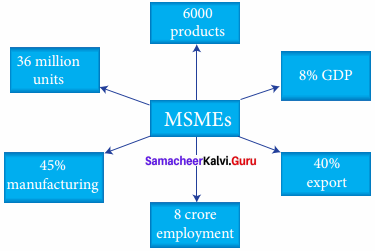
  9. Higher Contribution to Manufacturing and Export : MSMEs contribute 45% to the total manufacturing output and 40% to the exports from the country. It helps in earning precious foreign exchange in various countries across the world.

Question 3.
What are the objectives of SHCs?
Answer:

  1. Focusing on empowerment of women.
  2. Saving people from the clutches of money lenders
  3. Building capacity of women and to enable them to participate in generating activities.
  4. Creating the habit of saving in the minds of the people who are economically backward.
  5. Promoting entrepreneurship skills among women.
  6. Creating awareness about the importance of credit circle or revolving credit and the payment of the circle.
  7. Elevating the economic standard of the member’s families.
  8. Developing skills and facilitating credit linkages for eventual economic empowerment.
  9. Promoting awareness among the members about finding solutions for their economic problems.
  10. Identifying the common interest of the group members and carrying out their operations in the most efficient and economic way.
  11. Enabling the members to overcome all social and economic barriers.
  12. Promising and ensuring human rights to women at all stages of their life cycle.

Question 4.
Explain the advantages of MSME?
Answer:
The MSME Sector contributes about 8% to Gross Domestic Product (GDP) besides 45% to the total manufacturing output and 40% to the exports from the country on the production of more than 6000 products. This Sector consists of 36 million units and provides employment to over 8 crore peopte.
Samacheer Kalvi 11th Commerce Solutions Chapter 21 Micro, Small and Medium Enterprises (MSME) and Self Help Groups (SHGs)

Samacheer Kalvi 11th Commerce Micro, Small and Medium Enterprises (MSME) and Self Help Groups (SHGs) Additional Questions and Answers

I. Choose the Correct Answer

Question 1.
Tamil Nadu Corporation for Development of Women Limited (TNCDW) was established in the year …………….
(a) 1983
(b) 1984
(c) 1985
(d) 1995
Answer:
(a) 1983

Question 2.
“Mahalir Thittam” project was launched during …………….
(a) 1997 – 98
(b)1999 – 99
(c) 1999 – 2000
(d) 2000 – 2001
Answer:
(a) 1997 – 98

II. Very Short Answer Questions

Question 1.
State the investment limit for micro enterprise in manufacturing and service sector.
Answer:
Samacheer Kalvi 11th Commerce Solutions Chapter 21 Micro, Small and Medium Enterprises (MSME) and Self Help Groups (SHGs)

Question 2.
Give examples for Public Sector Banks.
Answer:
State Bank of India, Indian Bank, Indian Overseas Bank, Canara Bank.

For Future Learning

Question a.
World Association of Small & Medium enterprises (WASME)
Answer:
WASME is a global non-profit organization. Headquarters is at Noida.

Question b.
Ministry of MSME and its functions.
Answer:
MSME – Micro, Small, Medium Enterprises.

Ministry : Ministry of MSME, a branch of the Government of India, is the apex body for the formulation and administration of rules, regulations and laws relating to MSME in India.

Functions:
MSME : consequent to the increased globalization of the Indian economy and changed industrial environment. MSME is currently focusing on providing support in the fields of credit, marketing, technology and infrastructure to MSME.

Share this Tamilnadu State Board Solutions for 11th Commerce Chapter 21 Micro, Small and Medium Enterprises (MSME) and Self Help Groups (SHGs) Questions and Answers with your friends to help them to overcome the issues in exams. Keep visiting this site Tamilnadu State Board Solutions frequently to get the latest information on different subjects. Clarify your doubts by posting the comments and get the answers in an easy manner.
Samacheer Kalvi 11th Commerce Solutions Chapter 20 International Finance

Students can find the most related topics which helps them to analyse the concepts if they practice according to the chapter-wise page. It is necessary for the students to practice more Questions and Answers for Tamilnadu State Board Solutions of 11th Commerce are given in the pdf format in chapter 20 International Finance Questions and Answers so that students can prepare in both online and offline modes. So, Download Samacheer Kalvi 11th Commerce Book Solutions Questions and Answers, Notes Pdf, to score good marks.

Samacheer Kalvi 11th Commerce Solutions Chapter 20 International Finance

Get the Questions and Answers, in Tamilnadu State Board 11th Commerce Solutions for Chapter 20 International Finance. Learn the concepts of 11th Commerce Chapter-Wise by referring to the Tamilnadu State Board Solutions for Chapter 20 International Finance Questions and Answers. Hence we suggest the students to Download Samacheer Kalvi 11th Commerce Book Solutions Questions and Answers pdf to enhance your knowledge.

Samacheer Kalvi 11th Commerce International Finance Textbook Exercise Questions and Answers

I. Choose the Correct Answer

Question 1.
An instrument representing ownership interest in securities of a foreign issuer is called …………….
(a) an ownership certificate
(b) a depositary receipt
(c) an ownership receipt
(d) None of the above
Answer:
(b) a depositary receipt

Question 2.
Issuance of DRs is based on the increase of demand in the ……………
(a) International market
(b) Local market
(c) Existing shareholders
(d) All of the above
Answer:
(a) International market

Question 3.
ADRs are issued in …………….
(a) Canada
(b) China
(c) India
(d) The USA
Answer:
(d) The USA

Question 4.
Depositary receipts that are traded in an international market other than the United States are called …………….
(a) Global Depositary Receipts
(b) International Depositary Receipts
(c) Open Market Depositary Receipts
(d) Special Drawing Rights
Answer:
(a) Global Depositary Receipts

Question 5.
……………. bond is a special type of bond issued in the currency other than the home currency.
(a) Government Bonds
(b) Foreign Currency Convertible Bond
(c) Corporate Bonds
(d) Investment Bonds
Answer:
(b) Foreign Currency Convertible Bond

II. Very Short Answer Questions

Question 1.
Who are Foreign Institutional Investors?
Answer:
The Foreign Institutional Investors (FI1) can be defined as an investment made by a Non – resident in equity of domestic company without intention of acquiring management control.

Question 2.
What is a Depository Receipt?
Answer:
A depository receipt is a negotiable financial instrument issued by a bank to represent a foreign company’s equity shares or securities. They are issued to attract a greater amount of investment from other countries.

Question 3.
What is a GDR (Global Depository Receipt)?
Answer:
GDR is an instrument issued abroad by a company to raise funds in some foreign currencies and is listed and traded on a foreign stock exchange.

Question 4.
What is an American Depositary Receipt (ADR)?
Answer:
ADR is a dollar denominated negotiable certificate representing a non-US company in US market which allows the US citizens to invest in overseas securities.

Question 5.
What is a Foreign Currency Convertible Bond?
Answer:
Foreign currency convertible bond is a special type of bond issued in the currency other than the home currency. In other words, companies issue foreign currency convertible bonds to raise money in foreign currency

III. Short Answer Questions

Question 1.
Explain the importance of international finance.
Answer:

  1. International finance helps in calculating exchange rates of various currencies of nations and the relative worth of each and every nation in terms thereof.
  2. It helps in comparing the inflation rates and getting an idea about investing in international debt securities.
  3. It helps in ascertaining the.economic status of the various countries and in judging the foreign market.

Question 2.
What are Foreign Currency Convertible Bonds?
Answer:
Foreign currency convertible bond is a special type of bond issued in the currency other than the home currency. In other words, companies issue foreign currency convertible bonds to raise money in foreign currency.

Question 3.
Explain any three disadvantages of FDI.
Answer:
1. Exploiting Natural Resources : The FDI Companies deplete natural resources like water, forest, mines etc. As a result such resources are not available for the usage of common man in the host country.

2. Heavy Outflow of capital : Foreign companies are said to take away huge tunes in the form of dividend, royalty fees etc. This causes a huge outflow of capital from the host country.

3. Not Transferring Technology : Some foreign enterprises do not transfer the technology to developing countries. They mostly transfer second hand technology to the host country.

Question 4.
State any three features of ADR.
Answer:

  1. ADRs are denominated only in US dollars.
  2. They are issued only to investors who are American residents.
  3. The depository bank should be located in US.

Question 5.
State any three features of GDR.
Answer:

  1. It is a negotiable instrument and can be traded freely like any other security.
  2. GDRs are issued to investors across the country. It is denominated in any acceptable freely convertible currency.
  3. GDR is denominated in any foreign currency but the underlying shares would be denominated in local currency of the issuer.

IV. Long Answer Questions

Question 1.
Describe the importance of international finance?
Answer:

  1. International finance helps in calculating exchange rates of various currencies of nations and the relative worth of each and every nation in terms thereof
  2. It helps in comparing the inflation rates and getting an idea about investing in international debt securities.
  3. It helps in ascertaining the economic status of the various countries and in judging the foreign market.
  4. International Financial Reporting System (IFRS) facilitates comparison of financial statements made by various countries.
  5. It helps in understanding the basics of international organisations and maintaining the balance among them.

Question 2.
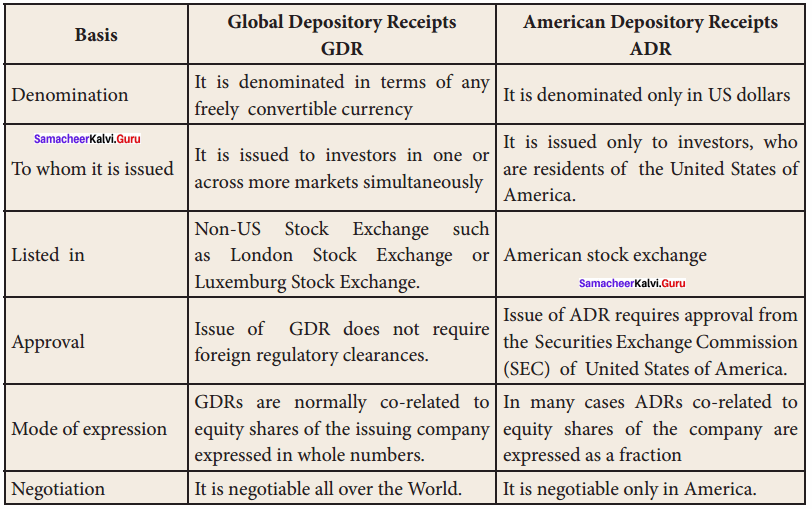
Distinguish between GDR and ADR.
Answer:
Samacheer Kalvi 11th Commerce Solutions Chapter 20 International Finance

Question 3.
State any five features of FCCB.
Answer:

  1. FCCB is issued by an Indian company in foreign currency.
  2. These are listed and traded in foreign stock exchange and similar to the debenture.
  3. It is a convertible debt instrument. It carries interest coupon. It is unsecured.
  4. It gives its holders the right to convert for a fixed numbers of shares at a pre – determined price.
  5. It can be converted into equity or depository receipt after a certain period.

Question 4.
Explain any five advantages of FDI.
Answer:
1. Achieving Higher Growth in National Income Developing countries get much needed capital through FDI to achieve higher rate of growth in national income.
International Finance

2. Help in Addressing BOP Crisis FDI provides inflow of foreign exchange resources into a country. This helps the country to solve adverse balance of payment position.

3. Faster Economic Development FDI brings technology, management and marketing skills along with it. These are crucial for achieving faster economic development of developing countries.

4. Generating Employment Opportunities: FDI generates a lot of employment opportunities in developing countries, especially in high skill areas.

5. Encouraging Competition in Host Countries Entry of FDI into developing country promotes healthy competition therein. This leads to enterprise in developing countries operating efficiently and effectively in the market. Consumers get a variety of products of good quality at market determined price which usually benefits the customers.

Samacheer Kalvi 11th Commerce International Finance Additional Questions and Answers

I. Choose the Correct Answer

Question 1.
…………….. is a section of financial economics that deals with the monetary interactions that occur between two or more countries.
(a) International finance
(b) Business finance
(c) DR
(d) GDR
Answer:
(a) International finance

Question 2.
From …………….., Foreign International Investors have been allowed to invest in all securities traded on the primary and secondary markets.
(a) 1992
(b) 1991
(c) 1995
(d) 1996
Answer:
(a) 1992

Question 3.
………………. is an instrument issued abroad by a company to raise funds in some foreign currencies and is listed and traded on a foreign stock exchange.
(a) GDR
(b) DR
(c) FDI
(d) FII
Answer:
(a) GDR

II. Very Short Answer Questions

Question 1.
Define Foreign Direct Investment (FDI).
Answer:
Foreign direct investment (FDI) is an investment made by a company or an individual in one country with business interests in another country, in the form of either establishing business operations or acquiring business assets in the other country, such as ownership or controlling interest in a foreign company.

Question 2.
What are Commercial Banks?
Answer:
Most of the commercial banks extend foreign currency loans for promoting business opportunities. The loans and services of various types, provided by banks differ from country to country.

Question 3.
What is International capital markets?
Answer:
Modem organisations including multinational companies depend upon sizeable borrowings in rupees as well as in foreign currencies. Prominent financial instruments used for this purpose are Depository Receipts.

Share this Tamilnadu State Board Solutions for 11th Commerce Chapter 20 International Finance Questions and Answers with your friends to help them to overcome the issues in exams. Keep visiting this site Tamilnadu State Board Solutions frequently to get the latest information on different subjects. Clarify your doubts by posting the comments and get the answers in an easy manner.

Samacheer Kalvi 11th Commerce Solutions Chapter 19 Sources of Business Finance

Students can find the most related topics which helps them to analyse the concepts if they practice according to the chapter-wise page. It is necessary for the students to practice more Questions and Answers for Tamilnadu State Board Solutions of 11th Commerce are given in the pdf format in chapter 19 Sources of Business Finance Questions and Answers so that students can prepare in both online and offline modes. So, Download Samacheer Kalvi 11th Commerce Book Solutions Questions and Answers, Notes Pdf, to score good marks.

Samacheer Kalvi 11th Commerce Solutions Chapter 19 Sources of Business Finance

Get the Questions and Answers, in Tamilnadu State Board 11th Commerce Solutions for Chapter 19 Sources of Business Finance. Learn the concepts of 11th Commerce Chapter-Wise by referring to the Tamilnadu State Board Solutions for Chapter 19 Sources of Business Finance Questions and Answers. Hence we suggest the students to Download Samacheer Kalvi 11th Commerce Book Solutions Questions and Answers pdf to enhance your knowledge.

Samacheer Kalvi 11th Commerce Sources of Business Finance Textbook Exercise Questions and Answers

I. Choose the Correct Answer
Question 1.
What is defined as the provision of money at the time when it is required?
(a) Finance
(b) Bank
(c) Cash management
(d) None of these
Answer:
(a) Finance

Question 2.
Internal sources of capital are those that are ……………..
(a) a generated through outsiders such as suppliers
(b) generated through loans from commercial banks
(c) generated through issue of shares
(d) generated within the business
Answer:
(d) generated within the business

Question 3.
Debenture holders are entitled to a fixed rate of ……………..
(a) Dividend
(b) Profits
(c) Interest
(d) Ratios
Answer:
(c) Interest

Question 4.
Public deposits are the deposits which are raised directly from ……………..
(a) the public
(b) the directors
(c) the auditors
(d) the owners
Answer:
(a) the public

Question 5.
Equity shareholders are the …………….. of a company.
(a) Creditors
(b) Owners
(c) Debtors
(d) Employees
Answer:
(b) Owners

Question 6.
Funds required for purchasing current assets is an example for ……………..
(a) Fixed Capital Requirement
(b) Ploughing Back of Profits
(c) Working Capital Requirement
(d) Lease Financing
Answer:
(c) Working Capital Requirement

Question 7.
Which of the following holder is given voting right?
(a) Debentures
(b) Preference Shares
(c) Equity shares
(d) Bonds
Answer:
(c) Equity shares

Question 8.
It may be wise to finance fixed assets through ………………
(a) Creditors
(b) Long term debts
(c) Bank Overdraft
(d) Bills Discounting
Answer:
(b) Long term debts

II. Very Short Answer Questions

Question 1.
Write a short notes on debentures.
Answer:
Debentures are an important instrument for raising long term debt capital. A company can raise funds through issue of debentures which bear a fixed rate of interest.

Question 2.
What do you mean by public deposits?
Answer:
Debentures are an important instrument for raising long term debt capital. A company can raise funds through issue of debentures which bear a fixed rate of interest.

Question 3.
Name any two sources of funds classified under borrowed funds.
Answer:

  1. Debentures
  2. Loan from banks

Question 4.
Name any two internal sources of business finance.
Answer:

  1. Retained earnings
  2. Collections form receivables

Question 5.
State any two factors that affect the choice of source of finance.
Answer:

  1. Cost
  2. Financial capacity to the firms

III. Short Answer Questions

Question 1.
Define Business finance.
Answer:
“Finance is that business activity which is concerned with the acquisition and conservation of capital fund in meeting the financial needs and overall objectives of business enterprises.” – B.O. Wheeler

Question 2.
What is pledge?
Answer:
A customer transfers the possession of an article with the creditor (banker) and receives loan. Till the repayment of loan, the article is under the custody of the borrower. If the debtor fails to refund the loan, creditor (banker) will auction the article pawned and adjust the outstanding loan from the sale proceeds.

Question 3.
List sources of raising long – term and short – term finance.
Answer:
Sources of Short Term Finance:

  1. Loans and Advances
  2. Bank Overdraft
  3. Discounting Bills of Exchange
  4. Trade Credit
  5. Pledge
  6. Hypothecation
  7. Mortgage
  8. Loans Against the Securities
  9. Clean Loan
  10. Commercial Paper (CP)
  11. Hire Purchase Finance
  12. Factoring

Sources of Long Term Finance:

  1. Shares (i) Equity Shares (ii) Preference Shares
  2. Debentures
  3. Retained Earnings
  4. Public Deposits
  5. Long Term Loan from Commercial Banks
  6. The Loans from Financial Institutions

Question 4.
For which purpose fixed capital is needed in business?
Answer:
Business enterprises need finance for fixed and working capital requirement. Fixed capital requirements include purchase of plant, machinery, furniture, fixtures, vehicles, and so on.

Question 5.
What do you mean by working capital requirement of business?
Answer:
Working capital requirements include purchase of raw materials, payment of salary and. wages, incurring operating expenses like telephone bills, carriage inward and outward, electricity charges, premium, stationery, etc.

IV. Long Answer Questions

Question 1.
List out the various sources of financing.
Answer:
The various sources of business finance can be classified into three categories on the basis of
(i) period basis
(ii) ownership basis
(iii) source of generation basis.

On the basis of period:

  1. Short term finance
  2. Medium term finance
  3. Long term finance

Sources of Short Term Finance:

  1. Loans and Advances
  2. Bank Overdraft
  3. Discounting Bills of Exchange
  4. Trade Credit
  5. Pledge
  6. Hypothecation
  7. Mortgage
  8. Loans Against the Securities
  9. Clean Loan
  10. Commercial Paper (CP)
  11. Hire Purchase Finance
  12. Factoring

Sources of Medium Term Finance:

  1. Loans from Banks
  2. Loan from Financial Institutions
  3. Lease Financing

Sources of Long Term Finance:

  1. Shares (i) Equity Shares (ii) Preference Shares
  2. Debentures
  3. Retained Earnings
  4. Public Deposits
  5. Long Term Loan from Commercial Banks
  6. The Loans from Financial Institutions

On the Basis of Ownership:

  1. Owner’s Funds
  2. Borrowed Funds

On the Basis of Generation of Funds:

  1. Internal Sources
  2. External Sources

Question 2.
What are the different types of short term finances given by commercial banks?
Answer:
1. Loans and Advances:
Loan is a direct advance made in lump sum which is credited to a separate loan account in the name of borrower. The borrower can withdraw the entire amount in cash immediately.

2. Bank Overdraft:
Bank overdraft refers to an arrangement whereby the bank allows the customers to overdraw the required amount from its current deposit account within a specified limit.

3. Discounting Bills of Exchange:
When goods are sold on credit, the suppliers generally draw bills of exchange upon customers who are required to accept it.

4. Trade Credit:
Trade credit is the credit extended by one trader to another for the purpose of purchasing goods and sendees. Purchaser need not pay money immediately after the purchase.

5. Pledge:
A customer transfers the possession of an article with the creditor (banker) and receives loan. Till the repayment of loan, the article is under the custody of the borrower. If the debtor fails to refund the loan, creditor (banker) will auction the article pawned and adjust the outstanding loan from the sale proceeds.

6. Hypothecation:
This is loan taken by depositing document of title to the property with the banker. Of course the physical possession of asset property is with the borrower. If the borrower fails to repay the loan amount, the article hypothecated will be sold in auction by the banker concerned.

Question 3.
Write short notes on

  1. Retained Earnings
  2. Lease financing

Answer:
1. Retained Earnings:
Retained earnings refer to the process of retaining a part of net profit year after year and reinvesting them in the business. It is also termed as ploughing back of profit. An individual would like to save a portion of his/her income for meeting the contingencies and growth needs.

Similarly profit making company would retain a portion of the net profit in order to finance its growth and expansion in near future. It is described to be the most convenient and economical method of finance.

2. Lease Financing:
Lease financing denotes procurement of assets through lease. For many small and medium enterprises, acquisition of plant and equipment and other permanent assets will be difficult in the initial stages. In such a situation Leasing is helping them to a greater extent.

Leasing here refers to the owning of an asset by any individual or a corporate body which will be given for use to another needy business enterprise on a rental basis. The firm which owns the asset is called ‘Lessor’ and the business enterprise which hires the asset is called ‘Lessee’.

The contract is called ‘Lease’. The lessee pays a fixed rent on agreed basis to the lessor for the use of the asset. The terms and conditions like lease period, rent fixed, mode of payment and allocation of maintenance, are mentioned in the lease contract.

At the end of the lease period, the asset goes back to the lessor. Alternatively lessee can own the asset taken on lease by paying the balance of price of asset concerned to lessor. Hence lease finance is a popular method of medium term business finance.

Question 4.
Write short notes on

  1. Owner’s funds
  2. Borrowed funds

Answer:
1. Owner’s Funds:
Owner’s funds mean funds which are provided by the owner of the enterprises who may be an individual, or partners or shareholders of a company. The profits reinvested in the business (ploughing back of profit or retained earnings) come under owner’s funds.

These funds are not required to be refunded during the life time of business enterprise. It provides the owner the right to control the management of the enterprise.

2. Borrowed Funds:
The term ‘borrowed funds’ denotes the funds raised through loans or borrowings. For example debentures, loans from banks and financial institutions, public deposits, trade credit, lease financing, commercial papers, factoring, etc., represent borrowed funds.

These borrowed sources of funds provide specific period before which the fund is to be returned. Borrower is under legal obligation to pay interest at given rate at regular intervals to the lender. Generally borrowed funds are obtained on the security of certain assets like bonds, land, building, stock, vehicles, machinery, documents of title to the goods, and the like.

Question 5.
Explain any four personal investment avenues.
Answer:
1. Public Provident Fund (PPF):
It is the safest long – term investment option for the investors in India. It is totally tax – free. PPF account can be opened in bank or post office. The money deposited cannot be withdrawn before 15 years and an investor can earn compound interest from this account.

However the investor can extend the time frame for the next five years if the investor does not opt to withdraw the amount matured for payment at maturity date. PPF investor can take loan against PPF account when he/she experiences financial difficulties.

2. Mutual Funds:
An individual investor who wants to invest in equities and bond with a balance of risk and return generally can invest in mutual funds. Nowadays people invest in stock markets through a mutual fund. Systematic investment plan is one of the best investment options in India.

3. Direct Equity or Share Purchase:
An individual can opt for investment in shares. But he has to analyse the market price of various shares traded in stock exchange, reputation of the company, consistency in the payment of dividend, the nature of the project undertaken by the company, growth prospects of industry in which a company is operating, before investing in shares. If the investment is made for a long time, it may yield good return.

4. Real Estate Investment:
Real estate is one of the fastest growing sectors in India. Buying, a flat or plot is supposed to be the best decision amongst the investment options. The value of the real asset may increase substantially depending upon the area of location and other support facilities available therein.

Samacheer Kalvi 11th Commerce Sources of Business Finance Additional Questions and Answers

I. Choose the Correct Answer:

Question 1.
Long term finance ………………
(a) more than 5 years
(b) above I year but below 5 years
(c) more than one year but below 3 years
(d) within one year
Answer:
(a) more than 5 years

Question 2.
The various sources of business finance can be classified into ………………
(a) three
(b) two
(c) four
(d) five
Answer:
(a) three

Question 3.
Business people hypothecate goods or equipment to get ……………… type of loan. It is a loan taken on the security of movable asset.
(a) Hypothecation
(b) Pledge
(c) Trade credit
(d) Bank overdraft
Answer:
(a) Hypothecation

Question 4.
……………… is a type of loan taken form the bank by lodging with the bank title deeds of immovable assets like land and building.
(a) Hypothecation
(b) Mortgage
(c) Clean loan
(d) Factoring
Answer:
(b) Mortgage

Question 5.
Source of Medium Term Finance is ………………
(a) share
(b) debentures
(c) Bank overdraft
(d) lease finance
Answer:
(d) lease finance

Question 6.
Which one is the internal source?
(a) Retained earnings
(b) Shares
(c) Debentures
(d) Public deposits
Answer:
(a) Retained earnings

Question 7.
Which one is the owner’s funds?
(a) Debentures
(b) Loan from banks
(c) Equity shares
(d) Commercial papers
Answer:
(c) Equity shares

II. Very Short Answer Questions

Question 1.
What do you mean by Bonds?
Answer:
Bonds are one of the ideal investment options for those investors who would like to invest their hard earned money safely. Bonds are issued both by government and public and private sector companies and financial institutions.

Question 2.
What is Mutual Funds?
Answer:
An individual investor who wants to invest in equities and bond with a balance of risk and return generally can invest in mutual funds. Nowadays people invest in stock markets through a mutual fund.

Question 3.
What is Commercial Paper (CP)?
Answer:
Commercial paper (CP) is an unsecured money market instrument in the form of a promissory note. It was introduced in India in 1990 under Section 45 W of the Reserve Bank of India Act.

III. Short Answer Questions

Question 1.
Mention any three significance of business finance.
Answer:

  1. A firm with adequate business finance can easily start any business venture.
  2. Business finance helps the business organisation to purchase raw materials from the supplier easily to produce goods.
  3. The business firm can meet financial liabilities like prompt payment of salary and wages, expenses, etc., in time with the help of sound financial support.

Question 2.
What is meant by preference shares?
Answer:
The fund raised by issue of preference shares is called preference share capital. Preference shares are those shares which enjoy priority regarding payment of dividend at a fixed rate out of the net profits of the company. They will get their dividend every year before any dividend is paid to equity shareholders.

They will have a right to get their settlement before the claims of equity shareholder are settled at the time of liquidation of company. However they do not have voting rights.

Case Study

Gokul Steel Ltd is a large and creditworthy company that manufactures steel for the Indian market. It now wants to cater the Asian market and decides to invest in new hi-tech machines. Since the investment is large, it requires long term finance. It decides to raise funds by issuing equity shares. The issue of equity shares involves huge floatation cost. To meet the expenses of floatation cost, the company decides to tap money market.
(a) Name and explain the money – market instrument the company can use for the above purpose.
(b) What is the duration for which the company can get funds through the instrument?
(c) State any other purpose for which this instrument can be used.
Answer:
The company can issue equity shares with premium. If the shares issue at premium value, the share can be subsided easily because the company has already created a credit worthy less. So it can easily raise their capital and get more funds and solve the huge requirement of funds.

(a) NSE (National Stock Exchange) – Gokul Steel Ltd.
BSE (Business Stock Exchange) – Equity shares

(b) Equity share capital for long term source of the company. One year, two years or life time of the company.

(c) In the future the shares can be used to change the value of shares. In the future this investment can be surrendered and get back the cash also with dividends.

Share this Tamilnadu State Board Solutions for 11th Commerce Chapter 19 Sources of Business Finance Questions and Answers with your friends to help them to overcome the issues in exams. Keep visiting this site Tamilnadu State Board Solutions frequently to get the latest information on different subjects. Clarify your doubts by posting the comments and get the answers in an easy manner.

Samacheer Kalvi 11th Commerce Solutions Chapter 18 Business Ethics and Corporate Governance

Students can find the most related topics which helps them to analyse the concepts if they practice according to the chapter-wise page. It is necessary for the students to practice more Questions and Answers for Tamilnadu State Board Solutions of 11th Commerce are given in the pdf format in chapter 18 Business Ethics and Corporate Governance Questions and Answers so that students can prepare in both online and offline modes. So, Download Samacheer Kalvi 11th Commerce Book Solutions Questions and Answers, Notes Pdf, to score good marks.

Samacheer Kalvi 11th Commerce Solutions Chapter 18 Business Ethics and Corporate Governance

Get the Questions and Answers, in Tamilnadu State Board 11th Commerce Solutions for Chapter 18 Business Ethics and Corporate Governance. Learn the concepts of 11th Commerce Chapter-Wise by referring to the Tamilnadu State Board Solutions for Chapter 18 Business Ethics and Corporate Governance Questions and Answers. Hence we suggest the students to Download Samacheer Kalvi 11th Commerce Book Solutions Questions and Answers pdf to enhance your knowledge.

Samacheer Kalvi 11th Commerce Business Ethics and Corporate Governance Textbook Exercise Questions and Answers

I. Choose the Correct Answer

Question 1.
Which of the following helps in maximising sale of goods to society?
(a) Business success
(b) laws and regulations
(c) Ethics
(d) Professional management
Answer:
(c) Ethics

Question 2.
Ethics is important for …………….
(a) Top management
(b) Middle level managers
(c) Non – managerial employees
(d) All of them
Answer:
(d) All of them

Question 3.
Which of the following does not ensure effective ethical practices in a business enterprise?
(a) Publication of a code
(b) Involvement of employees
(c) Establishment of compliance mechanisms
(d) none of them
Answer:
(a) Publication of a code

Question 4.
The role of top management is to guide the entire organisation towards …………….
(a) General behaviour
(b) Organisation behaviour
(c) Ethically upright behaviour
(d) Individual behaviour
Answer:
(c) Ethically upright behaviour

Question 5.
The ethical conduct of employees leading to standard practices results in …………….
(a) Good behaviour
(b) Bad behaviour
(c) Ethical behaviour
(d) Correct decision making
Answer:
(d) Correct decision making

II. Very Short Answer Questions

Question 1.
What is ethics?
Answer:
Ethics is derived from the Greek word ‘ethos’ which means a person’s fundamental orientation towards life. It governs the behaviour, derived from the moral standards which help to determine right or wrong, good or evil.

Question 2.
What do you mean by code?
Answer:
The organisation principles are defined in the written document called code.

Question 3.
State two ways by which ethics influences behaviour.
Answer:
Ethical behaviour is the acts consistent with the moral standards or codes of conduct established by society.

Question 4.
What is need for Corporate Governance?
Answer:
Corporate Governance is the system by which businesses are directed and controlled in the best interests of all stakeholders.Good corporate governance enables corporate success and economic development.

Question 5.
What are MNCs?
Answer:
MNC is defined to be an enterprise operating in several countries but managed from one country. A Multinational corporation is an organization doing business in more than one country.

III. Short Answer Questions

Question 1.
Define business ethics.
Answer:
Business ethics may be defined as a set of moral standards to be followed by owners, managers and business people. These standards determine the conduct and behaviour of business people. Business ethics reflects the conduct in the context of business.

Question 2.
What do you mean by the concept of business ethics?
Answer:
Business exists to supply goods and services to the people from social point of view but from individual point of view, the primary objective of any business unit is to make profit. The individual objective should not be in conflict with societal objective. These two objectives normally contradict each other, as one business enterprise may be good in individual objective and bad at social objective and vice versa.

Question 3.
Why is ethics necessary in business?
Answer:
All business units have realized that ethics is vitally important for the existence and progress of the business as well as the society. It is very important as it improves public image, earns public confidence, and leads to greater success. Ethics and profits go together in the long run. It enhances the quality of life, standard of living and business.

Question 4.
What are the benefit of Corporate Governance to Share holders.
Answer:

  1. Good corporate governance enables corporate success and economic development.
  2. Ensures stable growth of organizations.
  3. Aligns the interests of various stakeholders.
  4. Improves investors confidence and enables raising of capital.
  5. Reduces the cost of capital for companies.
  6. Has a positive impact on the share price.

Question 5.
Illustrate with example the working of a MNC.
Answer:
Any company is referred to as a multinational company or corporation (M. N. C.) when that company manages its operation or production or service delivery from more than a single country. It has its Headquarter based in one country with several other operating branches in different other countries. IBM, Microsoft, Pepsi Co., Sony, etc. are the examples of MNC’s.

IV. Long Answer Questions

Question 1.
Explain the different key elements of business ethics.
Answer:
1. Top Management Coriimitment:
Top management has a very important role to guide the entire organization towards ethical behaviour. The top level personnel in any organisation should work openly and strongly committed towards ethical conducts and guide people working at middle and low level to follow ethical behaviour.

2. Establishment of Compliance Mechanism:
To make sure that actual decisions match with a firm’s ethical standards, suitable mechanism should be established..

3. Publication of a “Code”:
Generally organisations formulate their own ethical codes for the conduct of the enterprise; it should followed by the employees of the organisation. The organisation principles are defined in the written docunient called code.

4. Involving Employees at All Levels:
It is the employees at different levels who implement ethics policies to make ethical business a reality. Therefore, their involvement in ethics programmes becomes a must.

5. Measuring Results:
The organisations from time to time keep a check on ethical practise followed. Although it is difficult to accurately measure the end results of ethics programmes, the firms can certainly audit to monitor compliance with ethical standards.

Question 2.
Describe the code of business ethics.
Answer:
Code of ethics documents the generally accepted principles of ethical conduct. They are statements of values and principles which define the purpose of an organisation. It gives a clear picture of the standards that employees should follow. It guides them in decision making. The code of business ethics can include the following:

  1. To offer goods at fair prices.
  2. To supply goods of good quality and not to deal in spurious and sub standard products.
  3. To listen to consumer’s complaints and to reduce them.
  4. Not to raise the price of its products unjustifiably.
  5. Not to resort hoarding and lack marketing.
  6. Not to resort to price cutting with the sole aim of killing competition.
  7. Not to issue advertisement containing false information or exaggerated claims.
  8. To pay fair wages to its employees and not to exploit them.
  9. To provide congenial work atmosphere.
  10. To design production process in such a way as to reduce environmental pollution.
  11. To keep proper books of accounts and records.
  12. To pay taxes regularly.
  13. To complaint with various business loss and never to flout Government regulations.

Question 3.
Explain the significance of Corporate Governance from the point of Stakeholders.
Answer:
Balanced economic development is made possible through transparent management under corporate governance. All Stakeholders interests are protected and promoted through corporate governance. Some of the benefits of corporate governance are as follows.

  1. Good corporate governance enables corporate success and economic development.
  2. Ensures stable growth of organizations.
  3. Aligns the interests of various stakeholders.
  4. Improves investors’ confidence and enables raising of capital.
  5. Reduces the cost of capital for companies.
  6. Has a positive impact on the share price
  7. Provides incentive to managers to achieve organizational objectives.
  8. Eliminates wastages, corruption, risks and mismanagement.
  9. Improves the image of the company.
  10. The organization is managed to benefit the stakeholders.
  11. Ensures efficient allocation of resources
  12. Creates a strong brand as an ethical business.

Question 4.
Discuss the role of International Benchmarking on the working of Companies in India.
Answer:
Asia : Independent Directors are a requirement for listed companies in all Asian economies, where most require at least l/3rd of the Board to be independent.

USA : The Council of Institutional Investors (CII), Corporate Governance Policies state that at least 2/3rd of the directors should be independent.

Europe : European commission urges member states to have sufficient number of independent npn-executive or supervisory directors on Board.

G20 / OECD : The latest principles encourage the prominent role of independent Board members.

Japan : In early. 2014, Japanese Prime Minister announced the goal of increasing the percentage of women in executive positions at Japanese companies to 30% by 2020.

UK : UK businesses had voluntary targets first set in 2011 i.e. to have 25% women on FTSE 100 (The Financial Times Stock Exchange) Boards by 2015.

Canada : At the Federal level, two bills are currently being tabled which will impose a 40% quota for female Board members of public companies and other regulated entities such as banks and insurance companies.

Brazil : A bill pending in the Brazilian Senate would impose a 40% female quota on the Boards of state owned enterprises by 2022.

France : French parliament adopted a bill that requires public companies making at least 50 million Euros in turnover and employing more than 500 workers to have 40% female Board representation by 2017.

Question 5.
Describe the benefits of increasing the number of MNCs.
Answer:

  1. Considers opportunities throughout the globe though they do the business in a few countries.
  2. To invest considerable portion of their assets internationally.
  3. They are huge industrial / business organisation.
  4. It engages in international production and operates plants in a number of countries.
  5. They take managerial decisions on a global perspective.
  6. They produce in one or a few countries and sell them in most of the countries.
  7. Their international operations are integrated into the corporations overall business.

The entry of MNC’s into India have proved quite beneficial for the growth and development of Indian economy providing employment Opportunities for the young generation.

Samacheer Kalvi 11th Commerce Business Ethics and Corporate Governance Additional Questions and Answers

I. Choose the Correct Answer:

Question 1.
Ethics governs the ……………..
(a) Behaviour
(b) Ethos
(c) Life
(d) Payoffs
Answer:
(a) Behaviour

Question 2.
The organisation principles are defined in the written document called ……………..
(a) Code
(b) Law
(c) Behaviour
(d) Ethical
Answer:
(a) Code

Question 3.
…………….. has its Headquarters based in one country with several other operating branches in different other countries.
(a) MNC
(b) GDP
(c) Company
(d) Business
Answer:
(a) MNC

Question 4.
There are …………….. primary types of bench making.
(a) Two
(b) Three
(c) Four
(d) Five
Answer:
(c) Four

Question 5.
…………….. bench making is a direct competitor-to-competitor comparison of a product, service process or method.
(a) Internal
(b) Competitive
(c) Functional
(d) Generic
Answer:
(b) Competitive

Future Learning

Question a.
Money earning cannot be sole objective of business or life.
Answer:
Primary objective is to make profit. The individual objective should not be with societal objectives.

Question b.
The mind of students to accept that ethics and consideration for environment, law etc can lengthen the income earning of an individual or business
Answer:
All business units have realized that ethics is vitally important for the existence and progress of the business as well as the society. Ethics and profits go together in the long run. It enhances the quality of life, standard of living and business.

Share this Tamilnadu State Board Solutions for 11th Commerce Chapter 18 Business Ethics and Corporate Governance Questions and Answers with your friends to help them to overcome the issues in exams. Keep visiting this site Tamilnadu State Board Solutions frequently to get the latest information on different subjects. Clarify your doubts by posting the comments and get the answers in an easy manner.

Samacheer Kalvi 11th Commerce Solutions Chapter 17 Social Responsibility of Business and Business Ethics

Students can find the most related topics which helps them to analyse the concepts if they practice according to the chapter-wise page. It is necessary for the students to practice more Questions and Answers for Tamilnadu State Board Solutions of 11th Commerce are given in the pdf format in chapter 17 Social Responsibility of Business and Business Ethics Questions and Answers so that students can prepare in both online and offline modes. So, Download Samacheer Kalvi 11th Commerce Book Solutions Questions and Answers, Notes Pdf, to score good marks.

Samacheer Kalvi 11th Commerce Solutions Chapter 17 Social Responsibility of Business and Business Ethics

Get the Questions and Answers, in Tamilnadu State Board 11th Commerce Solutions for Chapter 17 Social Responsibility of Business and Business Ethics. Learn the concepts of 11th Commerce Chapter-Wise by referring to the Tamilnadu State Board Solutions for Chapter 17 Social Responsibility of Business and Business Ethics Questions and Answers. Hence we suggest the students to Download Samacheer Kalvi 11th Commerce Book Solutions Questions and Answers pdf to enhance your knowledge.

Samacheer Kalvi 11th Commerce Social Responsibility of Business and Business Ethics Textbook Exercise Questions and Answers

I. Choose the Correct Answer

Question 1.
Which type of Responsibility gives the benefit to the Society out of its profits earned?
(a) legal
(b) Ethical
(c) Moral
(d) Economic
Answer:
(c) Moral

Question 2.
The Stakeholders of Socially Responsible business units are except ……………..
(a) Share holders
(b) Employees
(c) Government
(d) Company
Answer:
(d) Company

Question 3.
Assuming Social Responsibility of business helps the enterprise in
(a) Increase profit
(b) Decrease profit
(c) Sustainability
(d) Equilibrium
Answer:
(c) Sustainability

Question 4.
Socially Responsible business provides goods at ……………..
(a) High price
(b) Low price
(c) Reasonable price
(d) Moderate price
Answer:
(c) Reasonable price

Question 5.
Social Responsibility towards employees represents the following except ……………..
(a) Reasonable remuneration
(b) Proper facilities
(c) Social security
(d) Exploitation
Answer:
(d) Exploitation

II. Very Short Answer Questions

Question 1.
What do you mean by Social Responsibility?
Answer:
The term social responsibility is defined in various ways. Every businessman earns prosperity from business and should give back the benefit of this prosperity to society.

Question 2.
Give the meaning of Social Power.
Answer:
Businessmen have considerable social power. Their decisions and actions affect the lives and fortunes of the society. Businessmen should’assume social obligations commensurate with their social power.

Question 3.
What is a free enterprise?
Answer:
A business enterprise which accepts and discharges social obligations enjoys greater freedom. Thus, social responsibilities are essential for avoiding governmental action against business. Such action will reduce the freedom of decision making in business.

Question 4.
Who are called Stakeholders?
Answer:
A business organisation is a coalition of several interest groups are called stakeholders. Example – shareholders, customers, employees, suppliers, etc. Business should, therefore, work for the interest of all of them rather than for the benefit of shareholders /owners alone.

Question 5.
What is ethical Responsibility?
Answer:
Ethical Responsibility includes the behaviour of the firm that is expected by society but not codified in law. For example, respecting the religious sentiments and dignity of people while advertising for a product. There is an element of voluntary action in performing this responsibility.

III. Short Answer Questions

Question 1.
Define the Concept of Social Responsibility?
Answer:
“Social Responsibility requires managers to consider whether their action is likely to promote the public good, to advance the basic beliefs of our society, to contribute to its stability, strength and harmony” – Peter F. Drucker.

Question 2.
Why you do think Social Responsibility of business is needed?
Answer:
1. Self – Interest : A business unit can sustain in the market for a longer period only by assuming some social obligations. Normally businessmen recognise that they can succeed better by fulfilling the demands and aspirations of society.

2. Creation of Society : Business is a creation of society and uses the resources of society. Therefore, it should fulfil its obligations to society.

Question 3.
What are the benefits derived by employees of a Socially Responsible business enterprise?
Answer:

  1. Timely and regular payment of wages and salaries.
  2. Proper working conditions and welfare amenities.
  3. Opportunity for better career prospects.
  4. Job security as well as social security like facilities of provident fund, group insurance, pension, retirement benefits, etc.

Question 4.
Enumerate the points relating to why business units are Socially Responsible?
Answer:

  1. Protection of Stakeholders Interest
  2. Promotion of Society
  3. Assessment of Social Impact

Question 5.
List the kinds of Social Responsibility.
Answer:

  1. Economic responsibility
  2. Legal responsibility
  3. Ethical responsibility
  4. Discretionary responsibility

IV. Long Answer Questions

Question 1.
Explain in detail the concept and need for Social Responsibility?
Answer:
The term social responsibility is defined in various ways. Every businessman earns prosperity from business and should give back the benefit of this prosperity to society. This is voluntary. This benefit is the moral responsibility of business. As this benefit is supposed to be passed on to society, it can be said to be social responsibility of business.

Need:
1. Self – Interest : A business unit can sustain in the market for a longer period only by assuming some social obligations. Normally businessmen recognise that they can succeed better by fulfilling the demands and aspirations of society.

2. Creation of Society : Business is a creation of society. Therefore, it should fulfil its obligations to society.

3. Social Power : Businessmen have considerable social power. Their decisions and actions affect the lives and fortunes of the society.

4. Image in the Society : A business can improve its image in public by assuming social obligations, good relations with workers, consumers and suppliers help in the success of business.

Question 2.
Answer:
Illustrate with examples the arguments for Social Responsibility?
Answer:
1. Protection of Stakeholders Interest : A business organisation is a coalition of several interest groups or stakeholders. Example – shareholders, customers, employees, suppliers, etc.

2. Promotion of Society : Business is a sub – system of society. It draws support and sustenance from society in the form of inputs. Socially responsible behaviour is essential to sustain this relationship between business and society.

3. Assessment of Social Impact : During the course of its functioning, a business enterprise makes several decisions and actions. Its activities exercise a strong influence on the interests and values of society.

4. Organised Social Power : Large corporations have acquired tremendous social power through their multifarious operations. Social power may be misused in the absence of social, responsibility.

5. Legitimacy : It is in the enlightened self-interest of business to assume social responsibility.

6. Competence : Business organisations and their managers have proved their competence and leadership in solving economic problems.

7. Professional Conduct : Professional managers are required to display a keen social sensitivity and serve the society as a whole.

8. Public Opinion : Adoption of social responsibility as an objective will help to improve the public opinion of business.

Question 3.
Discuss the different groups benefited out of Social Responsibility of business?
Answer:

1. Lack of Conceptual Clarity : The concept of Social responsibility is very vague and amenable to different interpretations.

2. Dilution of Economic Goals : By accepting social responsibility, business will compromise with economic goals.

3. Lack of Social Skill : Business organisations and their managers are not familiar with social affairs.

4. Burden on Consumers : If business deals with social problems, cost of doing business would increase.

5. Responsibility without Power : Business organisations possess only economic power and not social power. It is unjust to impose social responsibilities with social power.

6. Misuse of Responsibilities : Acceptance of social responsibilities will involve diversion of precious managerial time and talent on social action programmes.

7. Lack of Yard – stick : Profitability is the common criteria for decision – making in business.

8. Improper Role : The proper role of business is to use its resources and energies efficiently so as to earn the best possible return on investment within the confines of law and ethics.

9. Over Loading Responsibility : Business organisations are already serving society by providing goods and services, generating employment, developing technology and contributing to public exchequer through tax payments.

Question 4.
How do you classify Social Responsibility?
Answer:
1. Economic responsibility:
A business enterprise is basically an economic entity and, therefore, its primary social responsibility is economic i.e., produce goods and services that society wants and sell them at a profit.

2. Legal responsibility:
Every business has a responsibility to operate within the laws of the land. Since these laws are meant for the good of the society, a law abiding enterprise is a socially responsible enterprise as well.

3. Ethical responsibility:
This includes the behavior of the firm that is expected by society but not codified in law. For example, respecting the religious sentiments and dignity of people while advertising for a product. There is an element of voluntary action in performing this responsibility.

4. Discretionary responsibility:
This refers to purely voluntary obligation that an enterprise assumes, for instance, providing charitable contributions to educational institutions or helping the affected people during floods or earthquakes.

It is the responsibility of the company management to safeguard the capital investment by avoiding speculative activity and undertaking only healthy business ventures which give good returns on investment.

Samacheer Kalvi 11th Commerce Social Responsibility of Business and Business Ethics Additional Questions and Answers

I. Choose the Correct Answer:

Question 1.
Management of business enterprises is being
(a) Professionalism
(b) Law and order
(c) Free enterprise
(d) Public awareness
Answer:
(a) Professionalism

Question 2.
How many kinds of Social Relationship of business?
(a) Two
(b) Three
(c) Four
(d) Five
Answer:
(c) Four

II. Very Short Answer Questions

Question 1.
What is Legal responsibility?
Answer:
Every business has a responsibility to operate within the laws of the land. Since these laws are meant for the good of the society, a law abiding enterprise is a socially responsible enterprise as well.

Question 2.
What is Public awareness?
Answer:
Now – a – days consumers and workers are well informed about their rights. Consumers expect better quality products at reasonable prices. Similarly, workers desire fair wages and other benefits.

Share this Tamilnadu State Board Solutions for 11th Commerce Chapter 17 Social Responsibility of Business and Business Ethics Questions and Answers with your friends to help them to overcome the issues in exams. Keep visiting this site Tamilnadu State Board Solutions frequently to get the latest information on different subjects. Clarify your doubts by posting the comments and get the answers in an easy manner.

Samacheer Kalvi 11th Commerce Solutions Chapter 16 Emerging Service Business in India

Students can find the most related topics which helps them to analyse the concepts if they practice according to the chapter-wise page. It is necessary for the students to practice more Questions and Answers for Tamilnadu State Board Solutions of 11th Commerce are given in the pdf format in chapter 16 Emerging Service Business in India Questions and Answers so that students can prepare in both online and offline modes. So, Download Samacheer Kalvi 11th Commerce Book Solutions Questions and Answers, Notes Pdf, to score good marks.

Samacheer Kalvi 11th Commerce Solutions Chapter 16 Emerging Service Business in India

Get the Questions and Answers, in Tamilnadu State Board 11th Commerce Solutions for Chapter 16 Emerging Service Business in India. Learn the concepts of 11th Commerce Chapter-Wise by referring to the Tamilnadu State Board Solutions for Chapter 16 Emerging Service Business in India Questions and Answers. Hence we suggest the students to Download Samacheer Kalvi 11th Commerce Book Solutions Questions and Answers pdf to enhance your knowledge.

Samacheer Kalvi 11th Commerce Emerging Service Business in India Textbook Exercise Questions and Answers

I. Choose the Correct Answer

Question 1.
A continuing relationship which provides a licence privileges do business and provides training, merchandising for a consideration is called …………….
(a) Franchising
(b) Factoring
(c) supply chain management
(d) Exchange
Answer:
(a) Franchising

Question 2.
A condition were a factors agrees to provide complete set of services like financing, debt collection, consultancy is called …………….
(a) Maturity factoring
(b) National factoring
(c) Full service factoring
(d) Recourse factoring
Answer:
(c) Full service factoring

Question 3.
Buying and selling ofgoods through electronic network is known as …………….
(a) E – commerce
(b) Internet
(c) Website
(d) Trade
Answer:
(a) E – commerce

Question 4.
An organization carrying out activities to move goods from producer to consumer is …………….
(a) Transport
(b) Logistics
(c) Channels
(d) Marketing
Answer:
(a) Transport

Question 5.
The role of government in logistics management is through …………….
(a) Legislations
(b) Governance
(c) Transport
(d) Distribution
Answer:
(d) Distribution

Question 6.
The main benefit of Logistics is …………….
(a) productivity
(b) Cost minimisation
(c) Profitability
(d) Storage
Answer:
(b) Cost minimisation

Question 7.
What aims for an effective management response over the longer run …………….
(a) Logistics
(b) Supply Chain Management
(c) Demand
(d) Supply
Answer:
(a) Logistics

Question 8.
The model that identifies alternatives, criteria for decision making and analyse alternatives to arrive at the best choice is …………….
(a) Routing model
(b) Scheduling model
(c) Inventory model
(d) Alternative Analysis
Answer:
(b) Scheduling model

Question 9.
A company under outsourcing transfers activities which are …………….
(a) Core
(b) Non – Core
(c) Business
(d) Non – Business
Answer:
(b) Non – Core

Question 10.
Business units can reduce expenditure by outsourcing front office work like ……………..
(a) Paper work
(b) file work
(c) Billing
(d) manufacture
Answer:
(b) file work

Question 11.
The main benefit of outsourcing is …………….
(a) Productivity
(b) Cost reduction
(c) Skill
(d) Units
Answer:
(b) Cost reduction

Question 12.
Outsourcing job is given to developing countries specifically for …………….
(a) Cheap labour
(b) Land
(c) Capital
(d) Factors
Answer:
(a) Cheap labour

Question 13.
Outsourcing is carried out for the benefit of …………….
(a) Global village
(b) Transport
(c) Factory
(d) Time and money
Answer:
(d) Time and money

II. Very Short Answer Questions

Question 1.
Who is a franchisee?
Answer:
The individual who acquires the right to operate the business or use the trademark of the seller is known as tire franchisee.

Question 2.
State two disadvantages of franchising?
Answer:
Franchising fees: The initial franchising fee and the subsequent renewal fee can be very high in case of successful businesses. From the franchisee’s point of view, this may be a deterrent. Fixed royalty payment: The franchisee has to make payment of royalty to the franchiser on a regular basis. This considerably reduces the income of the franchisee.

Question 3.
Who is a factor?
Answer:
The factor is an agent who buys the accounts receivables (Debtors and Bills Receivables) of a firm and provides finance to a firm to meet its working capital requirements.

Question 4.
Define outsourcing.
Answer:
BPO refers to outsourcing the work.which is routine in nature, to an outside agency.

Question 5.
What is need for outsourcing?
Answer:

  1. To focus on key function
  2. Benefit of specialization / efficiency
  3. Cost cutting
  4. Economic growth and development
  5. Increasing profit
  6. Catering to the dynamic demand

Question 6.
State the importance of BPO.
Answer:
BPO means getting contractual services of external companies or group of companies to complete special work or process of a company. For example call centres, data entry etc. This reduces the expenditure by using cheap labour available in developing countries like India, China etc.

Question 7.
What are the benefits of KPO?
Answer:
In short, KPO firms get knowledge related, information related, work done from outside firm and it involves high value work carried highly skilled staff.

Question 8.
Define Logistics.
Answer:
Logistics can be viewed as a logical extension of transportation and related areas to achieve an efficient and effective goods distribution system.

Question 9.
What is the need for Logistics?
Answer:
Logistics Management is defined as ‘Design and operation of the physical, managerial, and informational systems needed to allow goods to overcome time and space (from the producer to the consumer)’.

Question 10.
Write about the importance of Logistics.
Answer:
Organisations taking proactive managerial attention in coordinating the actors in logistics leads to reduced logistics costs and improved customer service.

Question 11.
What are the types of Logistics Applications?
Answer:

  1. Decision – wise
  2. Actor – wise
  3. Inbound logistics
  4. Outbound logistics.

Question 12.
What do you mean by E – commerce?
Answer:
E – commerce or Electronic commerce is the buying and selling of goods and services through electronic networks like internet.

III. Short Answer Questions

Question 1.
What are the types of franchising?
Answer:

  1. Product /trade name franchising : In this type, the franchisee exclusively deals with a manufacture’s product, example Kidzee, French Loaf outlets.
  2. Business format franchising : When a franchisor awards rights covering all business aspects as a complete business package to the franchisee it is called as business format franchising, example McDonald’s, Pizza Hut.

Question 2.
List the steps in factoring process.
Answer:

  1. The firm enters into a factoring arrangement with a factor, which is generally a financial institution, for invoice purchasing.
  2. Whenever goods are sold on credit basis, an invoice is raised and a copy of the same is sent to the factor.
  3. The debt amount due to the firm is transferred to the factor through assignment and the same is intimated to the customer.

Question 3.
Describe the benefits of Logistics.
Answer:
Generally a good transportation, storage, handling and information infrastructure helps in efficient logistics management. All firms are viewed as a collection of primary and secondary activities,

Question 4.
Explain the points of differences between Logistics and Supply Chain Management.
Answer:
Logistics:
Logistics Management deals with the efficient management of a static gap between demand and supply.

Supply Chain Management:
Supply Chain Management tries to identify the dynamic nature of the value creation itself such as responsiveness, quality and design. Hence, it aims for an effective management response over the longer run.

Question 5.
What is the impact of e-commerce on buyers?
Answer:

  1. Buyers could have a global access to information about variety of products and services available in the market.
  2. They could buy the products/services round the clock from anywhere in world.
  3. The prices of products bought through e – commerce tend to be relatively lower than those purchased physically in the conventional shops due to offers, discount etc.

IV. Long Answer Questions

Question 1.
Enumerate the characteristics of franchising.
Answer:

  1. Franchise relationship is based on an agreement which lays down terms and conditions of this relationship.
  2. The term of franchise may be for 5 years or more. The franchise agreement may be renewed with the mutual consent of the parties.
  3. The franchisee gives an undertaking not to carry any other competing business during the term of the franchise; and the franchiser gives an undertaking not to terminate the franchise agreement before its expiry except under situations which may justify the termination of the franchise agreement.
  4. The franchisee agrees to pay specified royalty to the franchiser, as per terms of the franchise agreement.
  5. Franchise means selling the same product and maintaining a similar type of shop decor (i.e. style of interior decoration) for which franchiser provides assistance to franchisee in organising, merchandising and management.

Question 2.
Elucidate the features of factoring.
Answer:

  1. Maintenance of book – debts : A factor takes the responsibility of maintaining the accounts of debtors of a business institution.
  2. Credit coverage : The factor accepts the risk burden of loss of bad debts leaving the seller to concentrate on his core business
  3. Cash advances : Around eighty percent of the total amount of accounts receivables is paid, as advance cash to the client.
  4. Collection service : Issuing reminders, receiving part payments, collection of cheques from part of the factoring service.
  5. Advice to clients : From the past history of debtors, the factor is able to provide advises regarding the credit worthiness of customers, perception of customers about the products of the client, etc.

Question 3.
Describe the benefits of Outsourcing.
Answer:
1. Focusing on Core Activities : Companies can focus on their core competence, a few areas , where the company has distinct capability. The rest of the activities (non – core) can be outsource to outside agencies.

2. To Fillip Economic Development : Outsourcing stimulates entrepreneurship, encourages employment opportunities, expands exports, enables tremendous growth of the economy.

3. Encourages Employment Opportunities : Companies that are outsourcing their non core activities provide chances for other small business units to take up the activities. This paves way for more job opportunities and new employment avenues.

4. Reduction in Investment : Companies through outsourcing avails the services of outsiders which in turn reduces the investment requirements. The amount so available can be utilized productively and this increases the profits.

5. Quest for Excellence : Outsourcing enables the firms to pursue excellence in two ways namely excelling themselves in the activities they do and excel outsiders by extending their capabilities through contracting out.

Question 4.
Explain the points of differences between BPO and KPO.
Answer:
BPQ:

  • BPO means getting contractual services of external companies or group of companies to complete special work or process of a company.
  • For example call centres, data entry etc. This reduces the expenditure by using cheap labour available in developing countries like India, China, etc.
  • To focus on key function.
  • Benefit of specialization / efficiency.
  • Cost cutting.

KPO:

  • KPO refer to outsourcing of Knowledge based Process! It means obtaining high end knowledge work from outside the organization in order to run the business successfully and in cost effective manner.
  • In short KPO firms get knowledge related, information related, work done from outside firm and it involves high value work carried highly skilled staff.
  • Usage of best skills.
  • Ultimate use of knowledge.
  • Finding solution to complex problem.

Question 5.
Write a note on e – commerce models.
Answer:
1. Business to customers (B2C):
This is fastest growing segment in e – commerce spare. Under this model, business concern sells directly to consumers.

2. Business to Business (B2B):
Under the model, business concerns transact with one another through internet. For instance, Snapdeal, Flipkart, Alibaba, Indiamart, Tradelndia.com etc.

3. Consumer to consumer (C2C):
Under this model, customers sell directly to other customers through online classified advertisement or through auction or through mobile or through market places. Example, Indian ventures in C2C are Kraftly App (buying and selling anythings) which deals in handmade products of a wide range. Onceagainstore.com is a website that buys pre-owned women’s fashion products. Other players are Quikr, OLX, ebay, etc.

4. Customer to Business (C2B):
This model is reverse to auction model. Products like automobile, electronic items furniture and similar product are traded by customer through websites. Naukri.com and Monster.com are examples of Indian Companies operating in this domain.

5. Business to. Government (B2G):
This model envisages selling products and services by business consumer to Government organization. For instance TCS operates the passport application process for the Government of India as part off – line process.

Samacheer Kalvi 12th Commerce Emerging Service Business in India Additional Questions and Answers

I. Choose the Correct Answer:

Question 1.
There are …………….. parties to a franchising agreement.
(a) two
(b) Three
(c) Four
(d) Five
Answer:
(a) two

Question 2.
There are …………….. types of franchising primarily.
(a) One
(b) Two
(c) Three
(d) Four
Answer:
(b) Two

Question 3.
Factoring means ……………..
(a) to make or do
(b) to work
(c) for credit
(d) for debit
Answer:
(a) to make or do

Question 4.
…………….. focuses on profit maximization rather than cost minimizing.
(a) SMC
(b) LM
(c) Transportation
(d) GST
Answer:
(a) SMC

Question 5.
Recently a new type of business in service sector is called ……………..
(a) BPO
(b) core
(c) non – core
(d) gardening
Answer:
(a) BPO

Question 6.
Business to Business (B2B) ……………..
(a) Snapdeal
(b) Monster.com
(c) TCS
(d) ebay
Answer:
(a) Snapdeal

Question 7.
Customer to Business (C2B) ……………..
(a) Flipkart
(b) Indiamart
(c) Olx
(d) Naukri.com
Answer:
(d) Naukri.com

II. Very Short Answer Questions

Question 1.
What is E-Business?
Answer:
E – Business is a broader term which includes internal and external transaction of an organization across the internet.

Question 2.
What do you mean by Business to Customers (B2C)?
Answer:
This is faster growing segment in e – commerce spare. Under this model, business concern sells directly to customers.

Question 3.
Mention any two advantages of franchising.
Answer:

  1. Reduces risk
  2. Business expansion.

III. Short Answer Questions

Question 1.
What is the impact of e – commerce on vendors?
Answer:

  1. Vendors could have a wider access to customers across the globe.
  2. This helps minimize the cost of operating business due to direct distribution of goods to end consumers thanks to minimum invention of intermediaries.
  3. Vendor could interact with multiple buyers and sellers.

For Future Learning

Question a.
You are a small scale manufacturer of ignition coils for automobiles, located near Ranipet. Explain how will you avail of financial credits through factoring if you get orders from
a. Ford India, Chennai
b. Maruti Suzuki, Gurgaon
c. Kun Hyundai, Seoul

Answer:
a. I can show the sources of business to get credit.

b.

  • To identify the activities involved in the movement of goods – Trade
  • To analyse the benefits of Logistics – Transport
  • To evaluate the areas which need more focus relating to Logistics – Kinds of transport
  • To understand critically and analyse the impact of Logistics on Profitability – To reduce cost and improve customer service.

c.

  • To identify the core activities of any business – Companies can focus on their core competence.
  • To analyse the benefits of Outsourcing non – core items – Outsource to outside agents.
  • To evaluate the areas which needs KPO – KPO firm get knowledge related, information related work done from outside firm.
  • To understand critically and analyse the impact of call centers

Share this Tamilnadu State Board Solutions for 11th Commerce Chapter 16 Emerging Service Business in India Questions and Answers with your friends to help them to overcome the issues in exams. Keep visiting this site Tamilnadu State Board Solutions frequently to get the latest information on different subjects. Clarify your doubts by posting the comments and get the answers in an easy manner.

Samacheer Kalvi 11th Commerce Solutions Chapter 15 Insurance

Students can find the most related topics which helps them to analyse the concepts if they practice according to the chapter-wise page. It is necessary for the students to practice more Questions and Answers for Tamilnadu State Board Solutions of 11th Commerce are given in the pdf format in chapter 15 Insurance Questions and Answers so that students can prepare in both online and offline modes. So, Download Samacheer Kalvi 11th Commerce Book Solutions Questions and Answers, Notes Pdf, to score good marks.

Samacheer Kalvi 11th Commerce Solutions Chapter 15 Insurance

Get the Questions and Answers, in Tamilnadu State Board 11th Commerce Solutions for Chapter 15 Insurance. Learn the concepts of 11th Commerce Chapter-Wise by referring to the Tamilnadu State Board Solutions for Chapter 15 Insurance Questions and Answers. Hence we suggest the students to Download Samacheer Kalvi 11th Commerce Book Solutions Questions and Answers pdf to enhance your knowledge.

Samacheer Kalvi 11th Commerce Insurance Textbook Exercise Questions and Answers

I. Choose the Correct Answer

Question 1.
The basic principle of insurance is …………….
(a) Insurable Interest
(b) Co – operation
(c) Subrogation
(d) Proximate cause
Answer:
(a) Insurable Interest

Question 2.
……………. is not a type of general insurance.
(a) Marine Insurance
(b) Life Insurance
(c) Fidelity Insurance
(d) Fire Insurance
Answer:
(b) Life Insurance

Question 3.
Which of the following is not a function of insurance?
(a) Lending Funds
(b) Risk sharing
(c) Assist in capital formation
(d) Protection of life
Answer:
(d) Protection of life

Question 4.
Which of the following in not applicable in insurance contract?
(a) Unilateral contract
(b) Conditional contract
(c) Indemnity contract
(d) Inter – personal contract
Answer:
(c) Indemnity contract

Question 5.
Which one of the following is a type of marine insurance?
(a) Money back
(b) Mediclaim
(c) Hull insurance
(d) Cargo insurance
Answer:
(d) Cargo insurance

II. Very Short Answer Questions

Question 1.
List any five important type of policies.
Answer:

  1. Life Insurance
  2. General Insurance
  3. Fire Insurance
  4. Marine Insurance
  5. Health Insurance

Question 2.
What is health insurance?
Answer:
In mid 80’s, most of the hospitals in India were government owned and treatment was free of cost. With the advent of Private Medical Care, the need for Health Insurance was felt and various Insurance Companies introduced Health Insurance as a Product. Presently the health insurance exists primarily in the form of ‘Mediclaim policy’.

III. Short Answer Questions

Question 1.
Define Insurance.
Answer:
“Insurance is a plan by themselves which large number of people associate and transfer to the shoulders of all, risk that attacks to individuals” – According to John Merge.

Question 2.
Give the meaning of crop insurance.
This policy is to provide financial support to farmers in case of a crop failure due to drought or flood. It generally covers all risks of loss or damages relating to production of rice, wheat, millets, oil seeds and pulses etc.

Question 3.
Write a note on IRDAI.
IRDAI – Insurance Regulatory Development and Authority is the statutory, independent and apex body that govern and supervise the Insurance Industry in India. It was constituted in 2000 by Parliament of India Act called IRDAI Act, 1999. Presently IRDAI headquarters is in Hyderabad.

IV. Long Answer Questions

Question 1.
Explain the various types of Insurance.
Answer:
Insurance covers various types of risks. All. contract of insurance can be broadly classified as follows:

  1. Life Insurance (or) Life Assurance
  2. Non – life Insurance (or) General Insurance

It can be further classified into:

  1. Fire Insurance
  2. Marine Insurance
  3. Health Insurance and
  4. Miscellaneous Insurance.

1. Life Insurance:
Life Insurance may be defined as a contract in which the insurance company called insurer undertakes to insure the life of a person called assured in exchange of a sum of money called premium which may be paid in one lump sum or monthly, quarterly, half yearly or yearly and * promises to pay a certain sum of money either on the death of the assured or on expiry of certain period.

2. Non – Life Insurance or General insurance:
It refers as the insurance not related to human but related to properties.

3. Fire Insurance:
Fire insurance is a contract whereby the insurer, in consideration of the premium paid, undertakes to make good any loss or damage caused by a fire during a specified period upto the amount specified in the policy.

4. Marine Insurance:
Marine insurance is a contract of insurance under which the insurer undertakes to indemnify the insured in the manner and to the extent thereby agreed against marine losses. The insured . pays the premium in consideration of the insurer’s (underwriter’s) guarantee to make good the losses arising from marine perils or perils of the sea.

5. Health Insurance:
In mid 80’s, most of the hospitals in India were government owned and treatment was free of cost. With the advent of Private Medical Care, the need for Health Insurance was felt and various Insurance Companies introduced Health Insurance as a Product. Presently the health insurance exists primarily in the form of ‘Mediclaim policy’.

Question 2.
Explain the principles of insurance.
Answer:
1. Utmost Good Faith:
According to this principle, both insurer and insured should enter into contract in good faith. Insured should provide all the information that impacts the subject matter. Insurer should provide all the details regarding insurance contract.

2. Insurable Interest:
The insured must have an insurable interest in the subject matter of insurance. Insurable interest means some pecuniary interest in the subject matter of the insurance contract.

3. Indemnity:
Indemnity means security or compensation against loss or damages. In insurance, the insured would be compensated with the amount equivalent to the actual loss and not the amount exceeding the loss. This principle ensures that the insured does not make any profit out of the insurance. This principle of indemnity is applicable to property insurance alone.

4. Causa Proxima:
The word ‘Causa proxima’ means ‘nearest cause’. According to this principle, when the loss is the result of two or more cause, the proximate cause, i.e. the direct. The direct, the most dominant and most effective cause of loss should be taken into consideration. The insurance company is not liable for the remote cause.

5. Contribution:
The same subject matter may be insured with more than one insurer then it is known as ‘Double Insurance’. In such a case, the insurance claim to be paid to the insured must be shared on contributed by all insurers in proportion to the sum assured by each one of them.

6. Subrogation:
Subrogation means ‘stepping the shoes on others’. According to this principle, once the claim of the insured has been settled, the ownership right of the subject matter of insurance passes on to the insurer.

7. Mitigation:
In case of a mishap, the insured must take off all possible steps to reduce or mitigate the loss or damage to the subject matter of insurance.

Question 3.
Discuss the causes of risk.
Answer:
Business risk arises due to a variety of causes which are classified as follows:
1. Natural Causes:
Human beings have little control over natural calamities like flood, earthquake, lightning, heavy rains, famine, etc. These result in heavy loss of life, property, and income in business.

2. Human Causes:
Human causes include such unexpected events like dishonesty, carelessness or negligence of employees, stoppage of work due to power failure, strikes, riots, management inefficiency, etc.

3. Economic Causes:
These include uncertainties relating to demand for goods, competition, price, collection of dues from customers, change of technology or method of production, etc. Financial problems like rise in interest rate for borrowing, levy of higher taxes, etc., also come under this type of causes as they result in higher unexpected cost of operation of business.

4. Other Causes:
These are unforeseen events like political disturbances, mechanical failures such as the bursting of boiler, fluctuations in exchange rates, etc. which lead to the possibility of business risks.

Samacheer Kalvi 12th Commerce Insurance Additional Questions and Answers

I. Choose the Correct Answer:

Question 1.
Presently IRDAI head quarters is in ……………..
(a) Hyderabad
(b) Chennai
(c) Mumbai
(d) Delhi
Answer:
(a) Hyderabad

Question 2.
‘Stepping the shoes on others’ means ……………..
(a) Subrogation
(b) Contribution
(c) Nearest cause
(d) Indemnity
Answer:
(b) Contribution

II. Very Short Answer Questions

Question 1.
What do you mean by Cargo Insurance?
Answer:
When a marine insurance policy is taken by the cargo owner to be compensated for loss caused to his cargo during the journey, it is known as cargo insurance.

Question 2.
What is Hull or ship insurance?
Answer:
When a ship is insured against any type of danger, it is known as hull insurance. This policy is taken to indemnify the insured for losses caused by damage to ship.

III. Short Answer Questions

Question 1.
What are the objectives of IRDAI?
Answer:

  1. To promote the interest and rights of policy holders.
  2. To promote and ensure the growth of Insurance Industry.
  3. To ensure speedy settlement of genuine claims and to prevent frauds and malpractices.

Share this Tamilnadu State Board Solutions for 11th Commerce Chapter 15 Insurance Questions and Answers with your friends to help them to overcome the issues in exams. Keep visiting this site Tamilnadu State Board Solutions frequently to get the latest information on different subjects. Clarify your doubts by posting the comments and get the answers in an easy manner.