Samacheer Kalvi 11th English Grammar Prefix/Suffix

Students who are interested in learning of 11th English Grammar Prefix/Suffix Questions and Answers can use Tamilnadu State Board Solutions of 11th English Chapter Wise Pdf. First check in which chapter you are lagging and then Download Samacheer Kalvi 11th English Book Solutions Questions and Answers Summary, Activity, Notes Chapter Wise. Students can build self confidence by solving the solutions with the help of Tamilnadu State Board English Solutions. English is the scoring subject if you improve your grammar skills. Because most of the students will lose marks by Grammar grammar mistakes. So, we suggest you to Download Tamilnadu State Board 11th English Solutions according to the chapters.

Tamilnadu Samacheer Kalvi 11th English Grammar Prefix/Suffix

Check out the topics covered in Grammar Prefix/Suffix Questions and Answers before you start your preparation. Improve your grammar skills with the help of Samacheer Kalvi 11th English Book Solutions Questions and Answers pdf links. The solutions for Tamilnadu State Board 11th English Textbook are prepared by the English experts. So, if you follow Tamilnadu State Board Solutions 11th English Textbook Solutions you can cover all the topics in Grammar Prefix/Suffix Questons and Answers. This helps to improve your communication skills.

Question 1.
Form a new word by adding a suitable prefix to the root word “important”.
(a) in________ (b) un________ (c) dis________ (d) mis________
Answer:
(b) unimportant

Question 2.
Form a new word by adding a prefix to the root word “difference”.
(a) un________ (b) in________ (c) im________ (d) dis________
Answer:
(b) indifference

Question 3.
Form a new word by adding a suitable prefix to the root word “fortune”.
(a) in________ (b) un________ (c) dis________ (d) mis________
Answer:
(d) misfortune

Question 4.
Form a new word by adding a suitable suffix to the root word “poet”.
(a) ________al (b) ________ic (c) ________ile (d) ________ion
Answer:
(b) poetic

Question 5.
Form a new word by adding a suitable suffix to the root word “kind”.
(a) ________ment (b) ________able (c) ________ity (d) ________ness
Answer:
(d) kindness

Question 6.
Form a new word by adding a suitable suffix to the root word “dismiss”.
(a) ________ment (b) ________ate (c) ________al (d) ________ular
Answer:
(c) dismissal

Question 7.
Form a new word by adding a suitable suffix to the root word ‘portray’.
(a) ________ment (b) ________able (c) ________al (d) ________ic
Answer:
(c) portrayal

Question 8.
Form a new word by adding a suitable suffix to the root word “doubt”.
(a) ________hood (b) ________ism (c) ________ly (d) ________fill
Answer:
(d) doubtful

Question 9.
Form a new word by adding a suitable suffix to the root word “need”.
(a) ________ness (b) ________ted. (c) ________y (d) ________ment
Answer:
(c) needy

Question 10.
Form a new word by adding a suitable suffix to the root word “eat”.
(a) ________able (b) ________ment (c) ________ly (d) ________ity
Answer:
(a) eatable

The main aim is to share the knowledge and help the students of 11th English to secure the best score in their final exams. Use the concepts of Samacheer Kalvi 11th English Book Solutions Grammar Prefix/Suffix Questions and Answers in Real time to enhance your skills. If you have any doubts you can post your comments in the comment section, We will clarify your doubts as soon as possible without any delay.
Samacheer Kalvi 11th English Grammar Framing Sentences

Students who are interested in learning of 11th English Grammar Framing Sentences Questions and Answers can use Tamilnadu State Board Solutions of 11th English Chapter Wise Pdf. First check in which chapter you are lagging and then Download Samacheer Kalvi 11th English Book Solutions Questions and Answers Summary, Activity, Notes Chapter Wise. Students can build self confidence by solving the solutions with the help of Tamilnadu State Board English Solutions. English is the scoring subject if you improve your grammar skills. Because most of the students will lose marks by Grammar grammar mistakes. So, we suggest you to Download Tamilnadu State Board 11th English Solutions according to the chapters.

Tamilnadu Samacheer Kalvi 11th English Grammar Framing Sentences

Check out the topics covered in Grammar Framing Sentences Questions and Answers before you start your preparation. Improve your grammar skills with the help of Samacheer Kalvi 11th English Book Solutions Questions and Answers pdf links. The solutions for Tamilnadu State Board 11th English Textbook are prepared by the English experts. So, if you follow Tamilnadu State Board Solutions 11th English Textbook Solutions you can cover all the topics in Grammar Framing Sentences Questons and Answers. This helps to improve your communication skills.

Question 1.
Use the word “equal” as a noun, adjective, verb and adverb in your own sentences.
Answer:

  • Sangeetha treated Tarun and Kavin as equals, (noun)
  • Father gave equal share of his property to his sons and daughters, (adj)
  • One plus one equals two. (verb)
  • We decided to divide the amount equally, (adverb)

Question 2.
Use the word ‘tear’ as a noun, verb, adjective and adverb in your own sentences.
Answer:

  • Don’t shed tears over loss of money, (noun)
  • Don’t tear the book, (verb)
  • She was given a tearful farewell, (adj)
  • Sheela tearfully left the hall, (adverb)

Question 3.
Use the word ‘like’ as a noun, verb, adjective and preposition in your own sentences.
Answer:

  • Great gurus are above likes and dislikes, (noun)
  • You need to carry out your duties whether you like it or not. (verb)
  • You must befriend like-minded persons, (adj)
  • Raj an looks like his father, (preposition)


Question 4.
Use the word ‘well’ as a noun, verb and an adjective in your own sentences.
Answer:

  • There is an unused well behind my house, (noun)
  • Tears welled up in her eyes on hearing her father’s death, (verb)
  • Sangeetha is well qualified for the Professor post, (adj)

Question 5.
Use the word “fine” as an adjective, a noun and a verb.
Answer:

  • She wore a fine jewel which caught everyone’s eyes, (adj)
  • The driver was asked to pay fine for skipping the red signal, (noun)
  • I was fined for over-speeding, (verb)


Question 6.
Use the word “after” as an adverb, a preposition and conjunction.
Answer:

  • Jill came tumbling after, (adv)
  • He returned after the accident, (prep)
  • After Martin finished his studies, he returned to India, (conjunction)

Question 7.
Use the word “wrong” as an adjective, adverb and a noun.
Answer:

  • You have taken the wrong road, (adj)
  • Hari was wrongly arrested, (adv)
  • We must differentiate the right and wrong, (noun)


Question 8.
Use the word “each” as an adjective and a pronoun.
Answer:

  • Each day brings its opportunity, (adj)
  • I received a rupee from each, (pronoun)

Question 9.
Use the word “as” as an adverb and a conjunction.
Answer:

  • We walked as fast as we could, (adv)
  • As he was late, we went without him. (conj)

Question 10.
Use the word “fast” as a noun, an adjective and adverb.
Answer:

  • He didn’t take anything during the fast, (noun)
  • I missed the fast train, (adj)
  • She speaks fast, (adv)


The main aim is to share the knowledge and help the students of 11th English to secure the best score in their final exams. Use the concepts of Samacheer Kalvi 11th English Book Solutions Grammar Framing Sentences Questions and Answers in Real time to enhance your skills. If you have any doubts you can post your comments in the comment section, We will clarify your doubts as soon as possible without any delay.
Samacheer Kalvi 11th Economics Solutions Chapter 12 Mathematical Methods for Economics

Immediately get Chapter Wise Tamilnadu State Board Solutions for 12th Economics to gain more marks and start Quick Revision of all Chapters. All Chapters Pdf is provided along with the Questions and Answers. You Can Dowload Samacheer Kalvi 12th Economics Book Solutions Questions and Answers for Chapter wise are given with a clear explanation. Tamilnadu State Board Solutions for 12th Economics Chapter 12 Mathematical Methods for Economics Questions and Answers is for free of cost.

Tamilnadu Samacheer Kalvi 11th Economics Solutions Chapter 12 Mathematical Methods for Economics

Tamilnadu State Board Solutions for 12th Economics Chapter 12 Mathematical Methods for Economics Questions and Answers PDF has all given in Chapter Wise Section. Check Out daily basis with Tamilnadu State Board Solutions 12th Economics PDF will help to improve your score. Improve your level of accuracy to answer a question by reading with Samacheer Kalvi 12th Economics Book Solutions Questions and Answers PDF.

Samacheer Kalvi 11th Economics Mathematical Methods for Economic Text Book Back Questions and Answers

Part – A
Multiple Choice Questions

Question 1.
Mathematical Economics is the integration of ____________
(a) Mathematics and Economics
(b) Economics and Statistics
(c) Economics and Equations
(d) Graphs and Economics
Answer:
(a) Mathematics and Economics

Question 2.
The construction of demand line or supply line is the result of using ____________
(a) Matrices
(b) Calculus
(c) Algebra
(d) Analytical Geometry
Answer:
(d) Analytical Geometry

Question 3.
The first person used the mathematics in Economics is ____________
(a) Sir William Petty
(b) Giovanni Ceva
(c) Adam Smith
(d) Irving Fisher
Answer:
(a) Sir William Petty

Question 4.
Function with single independent variable is known as ____________
(a) Multivariate Function
(b) Bivariate Function
(c) Univariate Function
(d) Polvnomial Function
Answer:
(c) Univariate Function

Question 5.
A statement of equality between two quantities is called ____________
(a) Inequality
(b) Equality
(c) Equations
(d) Functions
Answer:
(c) Equations

Question 6.
An incremental change in dependent variable with respect to change in independent variable is known as ____________
(a) Slope
(b) Intercept
(c) Variant
(d) Constant
Answer:
(a) Slope

Question 7.
(y – y1) = m (x – x1) gives the ____________
(a) Slope
(b) Straight line
(c) Constant
(d) Curve
Answer:
(b) Straight line

Question 8.
Suppose D = 50 – 5P. When D is zero then ____________
(a) P is 10
(b) P is 20
(c) P is 5
(d) Pis-10
Answer:
(a) Pis 10

Question 9.
Suppose D = 150 – 50P. Then, the slope is
(a) -5
(b) 50
(c) 5
(d) – 50
Answer:
(d) – 50

Question 10.
Suppose determinant of a matrix A = 0, then the solution ____________
(a) Exists
(b) Does not exist
(c) Is infinity
(d) Is zero
Answer:
(b) Does not exist

Question 11.
State of rest is a point termed as ____________
(a) Equilibrium
(b) Non – Equilibrium
(c) Minimum Point
(d) Maximum Point
Answer:
(a) Equilibrium

Question 12.
Differentiation of constant term gives ____________
(a) one
(b) zero
(c) infinity
(d) non – infinity
Answer:
(b) zero

Question 13.
Differentiation of xn is ____________
(a) nx (n – 1)
(b) nx (n + 1)
(c) zero
(d) one
Answer:
(a) nx (n – 1)

Question 14.
Fixed Cost is the ____________ term in cost function represented in mathematical form.
(a) Middle
(b) Price
(c) Quantity
(d) Constant
Answer:
(d) Constant

Question 15.
The first differentiation of Total Revenue function gives ____________
(a) Average Revenue
(b) Profit
(c) Marginal Revenue
(d) Zero
Answer:
(c) Marginal Revenue

Question 16.
The elasticity of demand is the ratio of ____________
(a) Marginal demand function and Revenue function
(b) Marginal demand function to Average demand function
(c) Fixed and variable revenues
(d) Marginal Demand function and Total demand function
Answer:
(b) Marginal demand function to Average demand function

Question 17.
If x + y = 5 and x – y = 3 then, Value of x ____________
(a) 4
(b) 3
(c) 16
(d) 8
Answer:
(a) 4

Question 18.
Integration is the reverse process of
(a) Difference
(b) Mixing
(c) Amalgamation
(d) Differentiation
Answer:
(d) Differentiation

Question 19.
Data processing is done by ____________
(a) PC alone
(b) Calculator alone
(c) Both PC and Calculator
(d) Pen drive
Answer:
(c) Both PC and Calculator

Question 20.
The command Ctrl + M is applied for ____________
(a) Saving
(b) Copying
(c) getting new slide
(d) deleting a slide
Answer:
(c) getting new slide

Part – B
Answer the following questions in one or two sentences

Question 21.
If 62 = 34 + 4x  what is x?
solution:
If 62 = 34 + 4x what is x
Given:
62 = 34 + 4x
34 + 4x = 62
4x = 62-34
4x = 28
x = \(\frac { 28 }{ 4 }\)
x = 7

Question 22.
Given the demand function q = 150 – 3p, derive a function for MR.
Solution:
Given:
q = 150 – 3p
\(\frac { dq }{ dq }\) = 0 – 3 (1)
\(\frac { dq }{ dq }\) = – 3
Revenue = price × quantity = p (150 – 3p)
= p (150 – 3p)
= 150p – 3p2
MR = \(\frac { dq }{ dq }\) = 150 \(\frac { dq }{ dq }\) -6p \(\frac { dq }{ dq }\)
= 150 (\(\frac { – 1 }{ 3 }\)) – 6p (\(\frac { – 1 }{ 3 }\))
= – 50 + 2p
= – 50 = 2 (\(\frac { 150 – q }{ 3 }\))
= 50 + 100 + \(\frac { – 2 q }{ 3 }\)
= 50 – \(\frac { 2 q }{ 3 }\)
= 50 – \(\frac { 2 }{ 3 }\) (150 – 3p)
MR = 2p – 50

Question 23.
Find the average cost function where TC = 60 + 10x +15x2
Solution:
Given:
TC = 60 + 10x +15x2
Average Cost = \(\frac { TC }{ x }\)
= \(\frac{60+10 x+15 x^{2}}{x}\)
= \(\frac { 60 }{ x }\) + \(\frac { 10x }{ x }\) + \(\frac{15 x^{2}}{x}\)
AC = \(\frac { 60 }{ x }\) + 10 + 15x

Question 24.
The demand function is given by x = 20 – 2p – p2 where p and x are the price and the quantity respectively. Find the elasticity of demand for p = 2.5.
Solution:
Given:
x = 20 – 2p – p2
p = 2.5
ed = (\(\frac { p }{ x }\)) (\(\frac { dx }{ dp }\))
If p = 2.5 then x,
x = 20 – 2 (2.5) – (2.5)2
= 20 – 5 – (6.25)
= 15 – 6.25
x = 8.75
Here x = 20 – 2p – p2
\(\frac { dx }{ dp }\) = 0 – 2 (1) – 2p
= -2 – 2p
If P = 2.5 then
\(\frac { dx }{ dp }\) = -2 – 2 (2.5)
= -2 – 5
\(\frac { dx }{ dp }\) = – 7
ed = \(\frac { -2.5 }{ 8.75 }\) × – 7
= 0.2857 × – 7
ed = 2

Question 25.
Suppose the price p and quantity q of a commodity are related by the equation q = 30 – 4p – p2
find :

  1. ed at p = 2
  2. MR

Solution:
Given:
q = 30 – 4p – p2
1. ed = (\(\frac { p }{ x }\))(\(\frac { dx }{ dp }\))
If P = 2 then
x = 30 – 4 (2) – 22
= 30 – 8 – 4
=20 – 12
x = 18
\(\frac { dx }{ dp }\) =30 – 4p – p2
= 0 – 4 – 2p
= 0 – 4 – 2 (2)
= -4 -4
= -8
ed = \(\frac { 2 }{ 18 }\) (-8)
x = – \(\frac { 16 }{ 18 }\)
ed = – 0.88

2. MR
TR = p ×q
TR = p (30 – 4p – p2)
= 30p – 4p2 – p3
MR = \(\frac { d(TR) }{ dp }\)
= 30 – 8p – 3p2
If p = 2
MR = 30 – 8 (2) – 3 (2)2
= 30 – 16 12
MR = 2

Question 26.
What is the formula for elasticity of supply if you know the supply function?
Solution:
Elasticity of supply = (\(\frac { p }{ q }\)) (\(\frac { dq }{ dp }\))

Question 27.
What are the Main menus of MS Word?
Answer:

  1. Home menu
  2. Insert
  3. Page layout
  4. Reference
  5. Review
  6. View
  7. Print layout
  8. Outline
  9. Task pane
  10. Tool bars
  11. Header and footer
  12. Foot notes

Part – C
Answer the following questions in one Paragraph

Question 28.
Illustrate the uses of Mathematical Methods in Economics.
Answer:

  1. Mathematical methods help to present the economic problems in a more precise form.
  2. Mathematical methods help to explain economic concepts.
  3. Mathematical methods help to use a large number of variables in economic analyses.
  4. Mathematical methods help to quantify the impact or effect of any economic activity implemented by government or anybody.

Question 29.
Solve for A: quantity demanded if 16x – 4 = 68 + 7x.
Solution:
Given:
16x  – 4 = 68 + 1x
16x – 7x = 68 + 4
9x = 72
x = (\(\frac { 72 }{ 9 }\))
x = 8

Question 30.
A firm has the revenue function R = 600q – 0.03q2 and the cost function is C = 150q + 60,000, where q is the number of units produced. Find AR, AC, MR and MC.
Solution:
Given:
R = 600q – 0.03q2
C = 150q + 60000

(i) AR = \(\frac { R }{ q }\)
= \(\frac{600 q-0.03 q^{2}}{q}\)
= \(\frac { 600q }{ q }\) – \(\frac{0.03 \mathrm{q}^{2}}{\mathrm{q}}\)
= AR = 600 – 0.0.q

(ii) AC = \(\frac { c }{ q }\)
= \(\frac { 150q + 60000 }{ q }\)
= \(\frac { 150q }{ q }\) + \(\frac { 60000 }{ q }\)
AC = 150 + (\(\frac { 60000 }{ q }\))

(iii) MR = \(\frac { dr }{ dq }\)
R = 600q – 0.03q
\(\frac { dR }{ dq }\) = 600 (1) – 0.03 (2q)
MR = 600 – 0.06q

(iv) MC = \(\frac { dc }{ dq }\)
C = 150q + 60000
\(\frac { dc }{ dq }\) = 150 (1) + 0
MC = 150

Question 31.
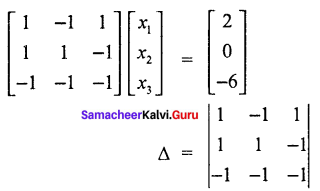
Solve the following linear equations by using Cramer’s rule.
x1 – x2 + x3 = 2
– x1 – x2 – x3 = 0
– x1 – x2 – x3 = – 6
Solution:
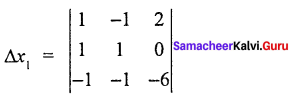
Samacheer Kalvi 11th Economics Solutions Chapter 12 Mathematical Methods for Economics
= 1 (- 1 – 1) + 1 (- 1 – 1) + 1 (- 1 + 1)
= 1(- 2) + 1 (0)
∆ = – 2 – 2
∆ = – 2 – 2
∆ = – 4

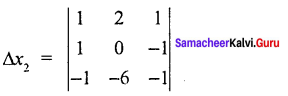
Samacheer Kalvi 11th Economics Solutions Chapter 12 Mathematical Methods for Economics
= 2 (- 1 – 1) + 1 (0 + 6) + 1 (0 – 6)
= 2 (- 2) + 1(6) + 1 (- 6)
= – 4 + 6 – 6
∆ = – 4

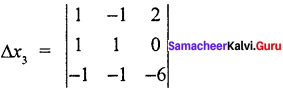
Samacheer Kalvi 11th Economics Solutions Chapter 12 Mathematical Methods for Economics
= 1 (0 – 6) – 2 (- 1 – 1)+1(- 6 + 0)
= 1 (- 6) – 2 (- 2) + 1 (- 6)
= – 6 + 4 – 6
= – 12 + 4
∆x3 = -8

Samacheer Kalvi 11th Economics Solutions Chapter 12 Mathematical Methods for Economics
1 (- 6 + 0) + 1 (- 6 + 0) + 2 (- 1 + 1)
= 1 (- 6) + 1 (- 6) + 2 (0)
= – 6 – 6
∆x3 = – 12
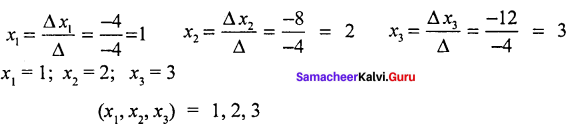
Samacheer Kalvi 11th Economics Solutions Chapter 12 Mathematical Methods for Economics

Question 32.
If a firm faces the total cost function TC = 5+ x2 where x is output, what is TC when x is 10?
Solution:
Given:
TC = 5 + x2
If x = 10
TC = 5 + 102
= 5 + 100
TC = 105

Question 33.
If TC = 2.5q3 – 13q2 + 50q + 12 derive the MC function and AC function.
solution:
Given:
TC= 2.5q3 – 13q2 + 50q + 12
Marginal cost function
MC = \(\frac { d(TC) }{ dQ }\)
= \(\frac { d }{ dq }\) [2.5q3 – 13q2 + 50q + 12]
= 2.5 (3q2) – 13 (2q) + 50 (1) + 0
MC = 7.5q – 26q + 50
Average cost AC =\(\frac { TC }{ q }\)
= \(\frac{2.5 q^{3}-13 q^{2}+50 q+12}{q}\)
= \(\frac{2.5 q^{3}}{q}\) – \(\frac{13 q^{2}}{q}\) + \(\frac { 50q }{ q }\) + \(\frac { 12 }{ q }\)
AC = 2.5q – 13q + 50 + \(\frac { 12 }{ q }\)

Question 34.
What are the steps involved in executing a MS Excel Sheet?
Answer:
MS excel is used in data analysis by using formula. A spread sheet is a large sheet of paper which contains rows and columns.
To start a excel there are various options.
Click Start → Program → Microsoft Excel
Double click the MS Excel Icon from the Desktop.

Part – D
Answer the following questions in about a page

Question 35.
A Research scholar researching the market for fresh cow milk assumes that Qt = f (Pt, Y, A, N, Pc) where Qt is the quantity of milk demanded, Pt is the price of fresh cow milk, Y is average household income, A is advertising expenditure on processed pocket milk, N is population and Pc is the price of processed pocket milk.

  1. What does Qt= f (Pt, Y,A,N, Pc) mean in words?
  2. Identify the independent variables.
  3. Make up a specific form for this function. (Use your knowledge of Economics to deduce whether the coefficients of the different independent variables should be positive or negative.)

Solution:
1. Qt is the function of Pt, Y, A, N, Pc
The determinants of demand are
Pt = Price of fresh cow milk.
Y = Average household income
A = Advertising expenditure on processed pocket milk
N = Population
Pc = Price of processed pocket milk.

2. Y and N are independent variables

3. Average household income and population are directly proportional to quantity demanded of cow’s milk (ie if Y and N increases Qt also increase)
Price of fresh cow milk, advertising expenditure on pocket milk and price of processed pocket milk are inversely proportional to Qt.
There
Qt = – aPt + by – CA + dN – ePc

Question 36.
Calculate the elasticity of demand for the demand schedule by using differential calculus method P = 60 – 0.2 Q where price is

  1. zero
  2. Rs.20
  3. Rs.40

Solution:
P = 60 – 0.2 Q
0.2 Q = 60 – P
(0.2 Q) 10 = (60 – p) 10
2 Q = 600 – 10p
Q = 300 – 5p
Given demand function Q = 300 – 5p
1. If P = 0 then Q = 300 – 5 (0)
= 300
\(\frac { dq }{ dp }\) = 300 – 5p
= 0 – 5
\(\frac { dq }{ dp }\) = – 5
ed = \(\frac { p }{ p }\)(\(\frac { dq }{ dp }\))
= \(\frac { 0 }{ 300 }\)(-5)
ed = 0

2. If p = 20 then Q = 300 = 5 (20)
= 200
ed = \(\frac { 20 }{ 200 }\) (-5)
= – \(\frac { 100 }{ 200 }\)
ed = – 0.5

3. If = 40 then Q = 300 – 5 (40)
= 300 – 200
Q = 100
ed = \(\frac { p }{ q }\)(\(\frac { dq }{ dp }\))
= \(\frac { 40 }{ 100 }\) (-5)
ed = – \(\frac { 200 }{ 100 }\)
ed = -2

Question 37.
The demand and supply functions are pd=1600 – x2 and ps = 2x2 + 400 respectively. Find the consumer’s surplus and producer’s surplus at equilibrium point.
Answer:
At equilibrium pd = ps
1600 – x2 = 2x2 + 400
– x2 – 2x2 = 400 – 1600
– 3x2 = – 1200
x2 = \(\frac { 1200 }{ 3 }\)
x2 = 400
x = 20
If x = 20 po = 1600 – (20)2
= 1600 – 400
po = 1200
po xo = 1200 × 20
= 24000

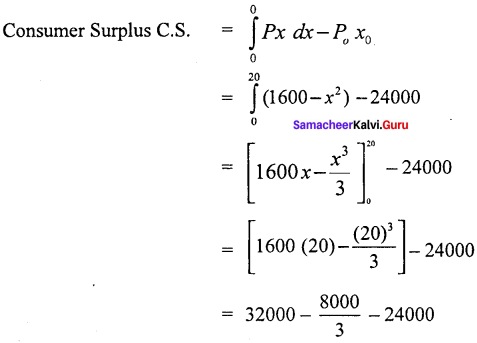
Samacheer Kalvi 11th Economics Solutions Chapter 12 Mathematical Methods for Economics
= 8000 – \(\frac { 8000 }{ 3 }\)
= \(\frac { 24000 – 8000 }{ 3 }\)
= \(\frac { 16000 }{ 3 }\)
C.S = 5333.3
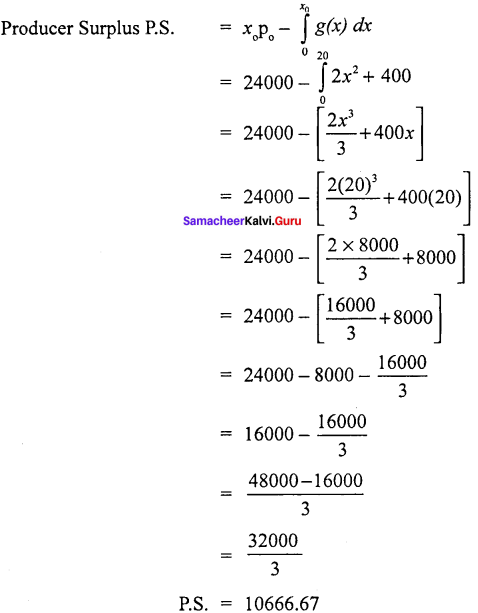
Samacheer Kalvi 11th Economics Solutions Chapter 12 Mathematical Methods for Economics

Question 4.
What are the ideas of information and communication technology used in economics?
Answer:
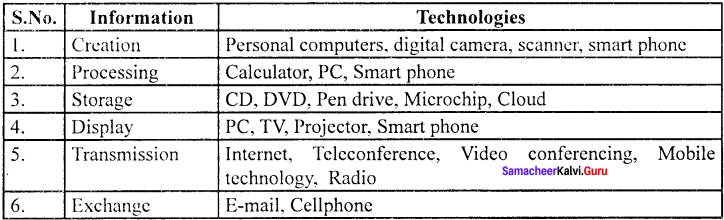
Information and Communication Technology (ICT) is the infrastructure that enables computing faster and accurate
Samacheer Kalvi 11th Economics Solutions Chapter 12 Mathematical Methods for Economics
In economics the uses of mathematical and statistical tools need the support of ICT for data compiling, editing, manipulating and presenting the results.

Samacheer Kalvi 11th Economics Introduction To Micro-Economics Additional Questions and Answers

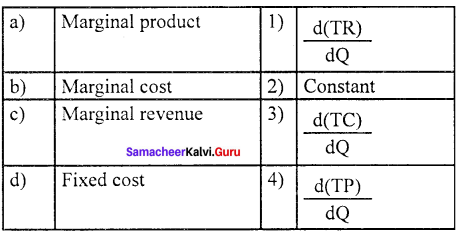
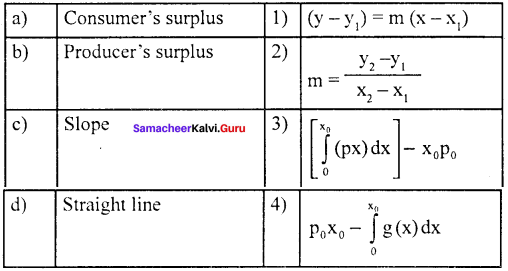
Match the following and choose the answer using the codes given below

Question 1.
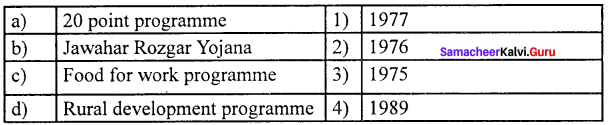
Samacheer Kalvi 11th Economics Solutions Chapter 12 Mathematical Methods for Economics
(a) 1 2 3 4
(b) 2 3 4 1
(c) 3 4 2 1
(d) 4 3 1 2
Answer:
(c) 3 4 2 1

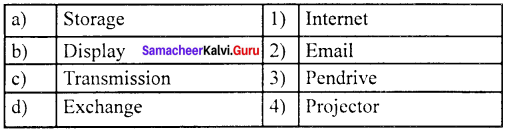
Question 2.
Samacheer Kalvi 11th Economics Solutions Chapter 12 Mathematical Methods for Economics
(a) 4 3 1 2
(b) 2 3 4 1
(c) 1 2 3 4
(d) 3 2 1 4
Answer:
(a) 4 3 1 2

Question 3.
Samacheer Kalvi 11th Economics Solutions Chapter 12 Mathematical Methods for Economics
(a) 1 2 3 4
(b) 3 4 1 2
(c) 4 3 1 2
(d) 2 3 4 1
Answer:
(b) 3 4 1 2

Choose the incorrect statement

Question 4.
(a) Differentiation of constant is zero
(b) Differentiation of xn is x
(c) Constant value is known as fixed cost
(d) x° = 1 when x = 0
Answer:
(d) x° = 1 when x = 0

Question 5.
(a) The population density of T.N is 480 as per 2011 census.
(b) There are 30 national highways in Tamil Nadu.
(c) Tamil Nadu has the highest installed wind energy capacity in India.
(d) The headquarters of southern railway is at Trichy
Answer:
(b) There are 30 national highways in Tamil Nadu.

Pick the odd one out

Question 6.
(a) Arithmetic
(b) Comparison
(c) Text concatenation
(d) Foot note
Answer:
(d) Foot note

Question 7.
(a) X = independent variable
(b) Y = dependent variable
(c) X = f (y)
(d) M – slope
Answer:
(c) X = f (y)

Choose the correct statement

Question 8.
(a) X + Y = 6 and X – Y = 2 then X = 4
(b) If D = 60 – 6P when D is 0 then P is 20
(c) In the equation 0.1 X2 + 1 OX + 100 constant = 10
(d) If Y = 6X3 then slope is 9X:
Answer:
(a) X + Y = 6 and X – Y = 2 then X = 4

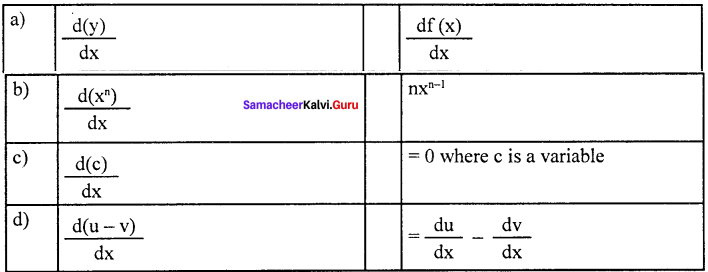
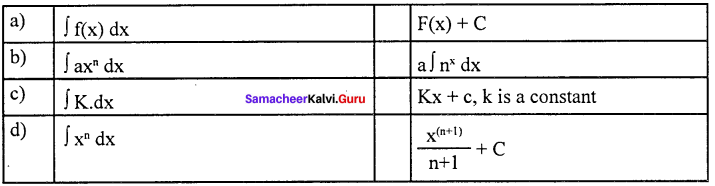
Choose the incorrect pair

Question 9.
Samacheer Kalvi 11th Economics Solutions Chapter 12 Mathematical Methods for Economics
Answer:
(c) \(\frac { d(c) }{ dx }\) = 0 where c is a variable

Question 10.
Samacheer Kalvi 11th Economics Solutions Chapter 12 Mathematical Methods for Economics
Answer:
(a) ∫f(x) dx – (i) F (x) + C

Fill in the blanks with suitable option given below

Question 11.
__________ is the first to use mathematics in economics.
(a) Giovanni Ceva
(b) William petty
(c) J.M.Keynes
(d) None
Answer:
(b) William petty

Question 12.
The formula for constructing a straight line is __________
(a) \(\mathrm{m}=\frac{\mathrm{y}_{2}-\mathrm{y}_{1}}{\mathrm{x}_{2}-\mathrm{x}_{1}}\)
(b) y = mx
(c) \(\frac { Change in x }{ Change in y }\)
(d) (y -y1) = m (x – x1)
Answer:
(d) (y -y1) = m (x – x1)

Question 13.
If the determinant ∆ = ?, then solution does not exist
(a) 1
(b) 0
(c) 2
(d) -1
Answer:
(b) 0

Question 14.
Power rule ∫xdx ______
(a) \(\frac{x^{2}}{n+1}\) + C
(b) \(\frac { pq }{ n + 1 }\) + C
(c) \(\frac{\mathrm{x}^{(\mathrm{n}+1)}}{\mathrm{n}+1}\) + C
(d) None
Answer:
(c) \(\frac{\mathrm{x}^{(\mathrm{n}+1)}}{\mathrm{n}+1}\) + C

Question 15.
______ is a rectangular array of numbers systematically arranged in rows and columns within brackets.
(a) Matrix
(b) Determinants
(c) Function
(d) None
Answer:
(a) Matrix

Choose the best option

Question 16.
__________ provides the solution of a system of linear equations with ‘n’ variables and ‘n’ equations
(a) Demand function
(b) Consumer’s surplus
(c) Equilibrium
(d) Cramer’s rule
Answer:
(d) Cramer’s rule

Question 17.
The first known writer to apply mathematical method to economic problems was __________
(a) Giovanni ceva
(b) William petty
(c) Keynes
(d) None
Answer:
(a) Giovanni ceva

Question 18.
In y = f (x) which is the independent variable
(a) f
(b) y
(c) x
(d) None
Answer:
(c) x

Question 19.
Formula for marginal cost is
(a) MC = \(\frac { d(TC) }{ dQ }\)
(b) MC = \(\frac { d(TC) }{ dP }\)
(c) MC = \(\frac { d(TC) }{ dQ }\)
(d) None
Answer:
(a) MC = \(\frac { d(TC) }{ dQ }\)

Question 20.
Function with a single independent variable are called _____
(a) Multivariate function
(b) Consumption function
(c) Simple univariate function
(d) None
Answer:
(c) Simple univariate function

Part – B
Answer the following questions in one or two sentences

Question 1.
What is economic analysis?
Answer:
Economic analysis is a systematic approach to determine the optimum use of scare resources and choose available alternatives and select the best alternative to achieve a particular objective.

Question 2.
What is the slope of a straight line ?
Answer:
Slope or gradient of the line represents the ratio of the changes in vertical and horizontal lines

Question 3.
State the phases of evolution of ICT?
Answer:

  1. Computer
  2. PC
  3. Micro Processor
  4. Internet and
  5. Wireless links.

Question 4.
What are determinants ?
Answer:
The determinant is an arrangement of same elements of the corresponding matrix into rows and columns by enclosing vertical lines.

Question 5.
State the application of differential calculus.
Answer:

  1. To find the rate of change in demand with respect to price.
  2. To find the rate of change in income with respect to the investment.

Question 6.
What is ICT?
Answer:
Information and Communication Technology (ICT) is the infrastructure that enables computing faster and accurate.

Question 7.
What is a work sheet?
Answer:
A worksheet is a table like document containing rows and columns with data and formula

Part – C
Answer the following questions in one Paragraph

Question 1.
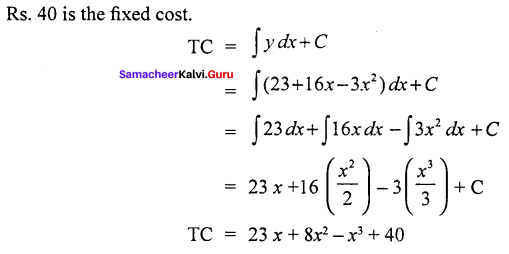
The marginal cost function for producing x units is y = 23 + 16.x – 3.x2 and the total cost for producing zero unit is Rs. 40. Obtain the total cost function and the average cost function.
Solution:
Given Marginal cost functions
y = 23 + 16x – 3x2
C = 40
Samacheer Kalvi 11th Economics Solutions Chapter 12 Mathematical Methods for Economics
Average cost function = \(\frac { TC }{ x }\)
= \(\frac{23 x+8 x^{2}-x^{3}+40}{x}\)
AC = 23 + 8x – x + \(\frac { 40 }{ x }\)

Question 2.
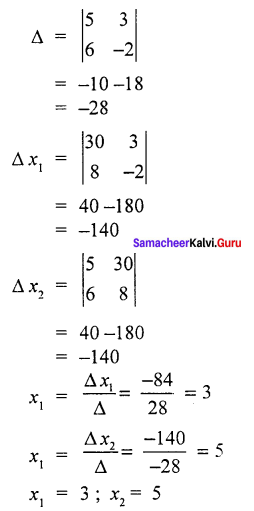
Find the solution of the system of equations
5x1 + 3x2 = 30
6x1 – 2X2 = 8
Solution :
Samacheer Kalvi 11th Economics Solutions Chapter 12 Mathematical Methods for Economics

Question 3.
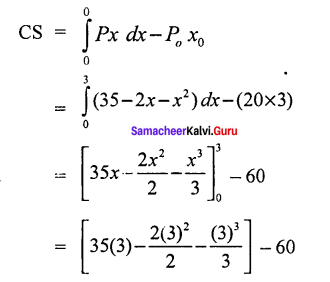
If the demand function is p = 35 – 2x – x2 and the demand xo is 3, what will be the consmer’s surplus
Solution:
Given:
p = 35 – 2x – x2
If x = 3 then
p = 35-2 (3) – 32
= 35 – 6 – 9
p = 20
Samacheer Kalvi 11th Economics Solutions Chapter 12 Mathematical Methods for Economics
= 35 (3) – 9 – 9 – 60
= 105 – 9 – 9 – 60
CS = 27 units

Question 4.
Given the total cost function TC = 15 + 3Q2 + 7Q3 drive the marginal cost function.
Solution:
Given:
TC = 15 + 3Q2 + 7Q2
MC = \(\frac { d(15) }{ dQ }\) + \(\frac{\mathrm{d}\left(3 \mathrm{Q}^{2}\right)}{\mathrm{d} \mathrm{Q}}\) + \(\frac{\mathrm{d}\left(7 \mathrm{Q}^{3}\right)}{\mathrm{d} \mathrm{Q}}\)
= 0+ 3 (2) Q + 7 (3) Q + (3) Q2
MC = 6Q + 21 Q2

Question 5.
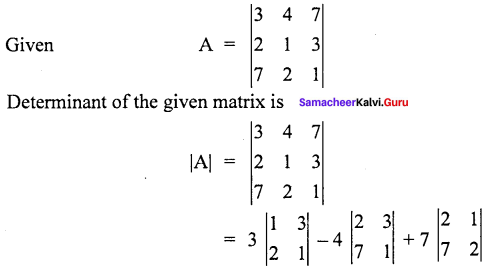
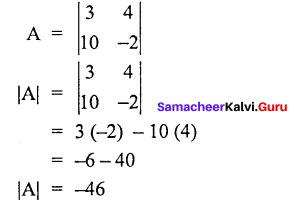
Find the value of the determinant of the matrix
Solution:
Given:
Samacheer Kalvi 11th Economics Solutions Chapter 12 Mathematical Methods for Economics
= 3 (-5) -4 (-19) +7 (-3)
= -15 + 76 – 21
A = 40

Question 6.
Find the value of the determinant of the matrix A =.
Solution:
Given:
Samacheer Kalvi 11th Economics Solutions Chapter 12 Mathematical Methods for Economics

Part – D
Answer the following questions in about a page

Question 1.
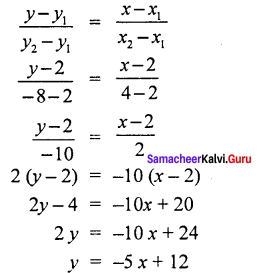
Find the equation of a straight line which passes through two points (2,2) and (4, -8) which are (x1, y1) and (x2, y2) respectively.
Note : For drawing a straight line, at least two points are required. Many straight lines can pass through a single point.
Solution:
Here x1 = 2 y1- = 2 and x2 = 4 y2 = – 8
Formula for constructing a straight line.
Samacheer Kalvi 11th Economics Solutions Chapter 12 Mathematical Methods for Economics
Slope (m) = – 5
y intercept = 12
Constant = C
This is of this from y = mx + C
y = 12 – 5x
When x = 0
y = 12
When y = 0
x = \(\frac { 12 }{ 5 }\) = 2.4

Question 2.
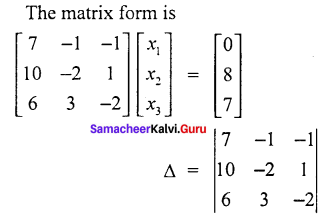
Find the solution of the equation system
Solution:
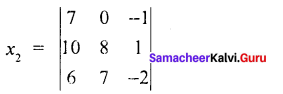
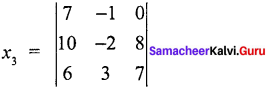
7x1 – x2 – x3 = 0
10x1 – 2x2 + x3 = 8
6x1 + 3x2 – 2x3 = 7

Samacheer Kalvi 11th Economics Solutions Chapter 12 Mathematical Methods for Economics

= 7 (4 – 3) + 1 (-20 -6) -1 (30 + 12)
= 7 (1) + 1 (-26) -1 (42)
+ 7 -26 – 42
∆ = – 61
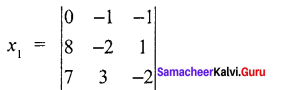
Samacheer Kalvi 11th Economics Solutions Chapter 12 Mathematical Methods for Economics
= 0 (4 -3) + 1 (-16 -7) – 1 (24+14)
= 0 + 1 (-23) – 1 (38)
= -23 – 38
= -61
Samacheer Kalvi 11th Economics Solutions Chapter 12 Mathematical Methods for Economics
= 7 (-16 – 7) – 0 (- 20 – 6) – 1 (70 – 48)
= 7 ( -23) + 0 (-20 – 6) – 1(70 – 48)
= – 161 – 22
= – 183
Samacheer Kalvi 11th Economics Solutions Chapter 12 Mathematical Methods for Economics
= 7(-14 -24) + 1 (70 – 48) + 1 (30 + 12)
= 7 (-38) + 1 (22) + 0
= – 266 + 22
= – 244
Samacheer Kalvi 11th Economics Solutions Chapter 12 Mathematical Methods for Economics

If you need some more information about Tamilnadu State Board Solutions for 12th Economics Chapter 12 Mathematical Methods for Economics Questions and Answers then visit our site frequently and get all the resources that you look for. Also, share this page with your friends and make them learn all the concepts thoroughly before the exams.

Samacheer Kalvi 11th Economics Solutions Chapter 11 Tamil Nadu Economy

Immediately get Chapter Wise Tamilnadu State Board Solutions for 11th Economics to gain more marks and start Quick Revision of all Chapters. All Chapters Pdf is provided along with the Questions and Answers. You Can Dowload Samacheer Kalvi 11th Economics Book Solutions Questions and Answers for Chapter wise are given with a clear explanation. Tamilnadu State Board Solutions for 11th Economics Chapter 11 Tamil Nadu Economy Questions and Answers is for free of cost.

Tamilnadu Samacheer Kalvi 11th Economics Solutions Chapter 11 Tamil Nadu Economy

Tamilnadu State Board Solutions for 11th Economics Chapter 11 Tamil Nadu Economy Questions and Answers PDF has all given in Chapter Wise Section. Check Out daily basis with Tamilnadu State Board Solutions 11th Economics PDF will help to improve your score. Improve your level of accuracy to answer a question by reading with Samacheer Kalvi 11th Economics Book Solutions Questions and Answers PDF.

Samacheer Kalvi 11th Economics Tamil Nadu Economy Text Book Back Questions and Answers

Part – A
Multiple Choice Questions

Question 1.
In health index, Tamil Nadu is ahead of
(a) Kerala
(b) Punjab
(c) Gujarat
(d) all the above
Answer:
(c) Gujarat

Question 2.
In sex ratio, Tamil Nadu ranks
(a) first
(b) second
(c) third
(d) fourth
Answer:
(c) third

Question 3.
Tamil Nadu is rich in
(a) Forest resource
(b) human resource
(c) mineral resource
(d) all the above
Answer:
(b) human resource

Question 4.
The main source of irrigation in Tamil Nadu is
(a) river
(b) tank
(c) well
(d) canals
Answer:
(c) well

Question 5.
Knitted garment production is concentrated in
(a) Coimbatore
(b) Tiruppur
(c) Erode
(d) Karur
Answer:
(b) Tiruppur

Question 6.
Which of the following is wrongly matched?
(a) Gateway of Tamil Nadu – Thoothukudi
(b) Home textile city – Erode
(c) Steel city – Salem
(d) Pump city – Coimbatore
Answer:
(b) Home textile city – Erode

Question 7.
Which of the following cities does not have international airport?
(a) Madurai
(b) Tiruchirappalli
(c) Paramakudi
(d) Coimbatore
Answer:
(c) Paramakudi

Question 8.
TN tops in the production of the following crops except
(a) Banana
(b) Coconut
(c) plantation crops
(d) cardamom
Answer:
(d) cardamom

Question 9.
Largest area of land is used in the cultivation of
(a) Paddy
(b) sugarcane
(c) Groundnut
(d) Coconut
Answer:
(a) Paddy

Question 10.
In literacy rate, TN ranks
(a) second
(b) fourth
(c) sixth
(d) eighth
Answer:
(d) eighth

Question 11.
In investment proposals filed by MSMEs, TN ranks
(a) I
(b) II
(c) III
(d) IV
Answer:
(a) I

Question 12.
Which district in TN has the highest sex ratio?
(a) Nagapattinam
(b) Nilgiris
(c) Tiruchirapalli
(d) Thanjavur
Answer:
(b) Nilgiris

Question 13.
Which district has the lowest child sex ratio?
(a) Madurai
(b) Theni
(c) Ariyalur
(d) Cuddalore
Answer:
(c) Ariyalur

Question 14.
Which Union Territory has the highest sex ratio?
(a) Chandigarh
(b) Pondicherry
(c) Lakshadeep
(d) Andaman Nicobar
Answer:
(b) Pondicherry

Question 15.
The largest contribution to GSDP in Tamil Nadu comes from
(a) agriculture
(b) industry
(c) mining
(d) services
Answer:
(d) services

Question 16.
In human development index, TN is ranked
(a) Second
(b) fourth
(c) sixth
(d) third
Answer:
(d) third

Question 17.
SPIC is located in
(a) Chennai
(b) Madurai
(c) Tuticorin
(d) Pudukottai
Answer:
(c) Tuticorin

Question 18.
The TICEL park is
(a) Rubber Park
(b) Textile park
(c) Food park
(d) Bio
Answer:
(d) Bio

Question 19.
In India’s total cement production, Tamil Nadu ranks
(a) third
(b) fourth
(c) first
(d) second
Answer:
(a) third

Question 20.
The Headquarters of Southern Railway is at
(a) Tiruchirappalli
(b) Chennai
(c) Madurai
(d) Coimbatore
Answer:
(b) Chennai

Part – B
Answer the following questions in one or two sentences

Question 21.
State any two districts with favourable sex ratio. Indicate the ratios.
Answer:

  1. The Nilgiris (1041 females)
  2. Thanjavur (1031 females)

Question 22.
Define GSDP.
Answer:
The Gross State Domestic Product refers to the total money value of all the goods and services produced annually in the state.

Question 23.
Mention any four food crops which are favourable to Tamil Nadu.
Answer:

  1. Rice
  2. Maize
  3. Groundnut
  4. Oil seeds

Question 24.
What are major ports in Tamil Nadu?
Answer:
Major ports at Chennai, Ennore and Tuticorin Intermediate port in Nagapattinam.

Question 25.
What is heritage tourism?
Answer:
Heritage tourism is travelling to experience the places and activities that authentically represent the stories and people of the past.

Question 26.
What are the nuclear power plants in Tamil Nadu?
Answer:
The Kalpakkam Nuclear power plant and the Koodankulam Nuclear power plant.

Question 27.
Define Micro industry.
Answer:
The enterprises with a capital investment not exceeding 25 lakhs.

Part – C
Answer the following questions in one Paragraph

Question 28.
Write a note on mineral resources in Tamil Nadu.
Answer:
Mineral resources in Tamil Nadu:

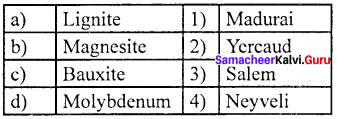
  1. Tamil Nadu has a few mining projects based on Titanium, Lignite, Magnesite, Graphite, Limestone, Granite and Bauxite.
  2. The first one is the Neyveli Lignite Corporation that has led development of large industrial complex around Neyveli in Cuddalore district with Thermal Power Plants, Fertilizer and carbonisation plants.
  3. Magnesite mining is at Salem from which mining of Bauxite ores are carried out at Yercaud and this region is also rich in Iron ore at Kanjamalai.
  4. Molybdenum is found in Karadikuttam in Madurai district.

Question 29.
Explain GSDP in Tamil Nadu.
Answer:
GSDP in Tamil Nadu:

  1. GSDP refers to the total money value of all the goods and services produced annually in the state.
  2. According to Tamil Nadu’s directorate of Economics and Statistics, Tamil Nadu is the second largest economy in India with a GSDP of $207.8 billion in 2016 -17
  3. The GSDP of Tamil Nadu is equal to the GDP of Kuwait on nominal terms and GDP of UAE on PPP terms.
  4. Sectoral contribution of GSDP of Tamil Nadu
    • Tertiary sector – 63. 70%
    • Secondary sector – 28.5%
    • Primary sector – 7.76%

Question 30.
Describe development of textile industry in Tamil Nadu.
Answer:
Development of textile industry in Tamil Nadu:

  1. Tamil Nadu is the largest textile hub of India. Tamil Nadu is known as the “Yam Bowl” of the country.
  2. Tamil Nadu accounts for 41% of India’s cotton yam production.
  3. It produce direct employment to 35 million people.
  4. It contributes 4% of GDP and 35% of gross export earnings.
  5. The textile sector contributes to 14% of the manufacturing sector.

Question 31.
Compare productivity of any two food crops between Tamil Nadu and India.
Answer:

  1. Asia result of Government’s efforts Tamil Nadu tops in productivity, in food crops as well as non-food crops, among the states in India.
  2. Among Indian states Tamil Nadu ranks first in maize, Kambu, Groundnut, Oil seeds and Cotton.
  3. Second in rice and coconut.
  4. Third in Sugarcane, Sunflower and Jowar.

Question 32.
Explain the prospect for development of tourism.
Answer:
Prospect for development of tourism:

  1. Tamil Nadu has emerged as one of the leading tourist destinations for both domestic and foreign tourists.
  2. Tourism in Tamil Nadu is promoted by Tamil Nadu Tourism Development Corporation (TTDC), a Government of Tamil Nadu undertaking.
  3. The state currently ranks the highest among Indian states with about 25 crore arrivals.
  4. The annual growth rate of this industry stood at 16 percent.
  5. Approximately 28 lakh foreign and 11 crore domestic tourists visit the state.

Question 33.
What are the renewable sources of power in Tamil Nadu?
Answer:
Renewable sources of power in Tamil Nadu:

  1. Tamil Nadu is the fore front of all other Indian States in installed capacity.
  2. Muppandal wind farm is a renewable energy source, supplying the villagers with electricity for work.
  3. Wind farms were built in Nagercoil and Tuticorin apart from already existing ones around Coimbatore, Pollachi, Dharapuram and Udumalaipettai.
  4. Wind energy contributes 2% of the total power output of India.
  5. Tamil Nadu tops in solar power generation in India.
  6. There are about 20 hydro electric units in Tamil Nadu.

Question 34.
Describe the performance of Tamil Nadu economy in health.
Answer:
Performance of Tamil Nadu economy in health:

  1. Tamil Nadu has a three – tier health infrastructure comprising hospitals, primary health centres, health units, community health centres and sub-centres.
  2. Tamil Nadu has placed third in health index as per the NITIAAYOG report.
  3. The neo natal mortality rate is 14 which is lower than many other states.
  4. The under 5 mortality has dropped from 21 in 2014 to 20 in 2015.

Part – D
Answer the following questions in about a page

Question 35.
Describe the qualitative aspects of population.
Answer:

  1. Population : Tamil Nadu stands sixth in population with 7.21 crore.
  2. Density : Tamil Nadu ranks 12th in density with 555 people per sq.km.
  3. Urban population : Tamil Nadu is one of the most urbanized state with 48.4% of urban population.
  4. Sex ratio : Balanced sex ratio implies improvement in quality of life of female population. The sex ratio of Tamil Nadu is nearing balance with 995 which stands third next to Kerala and Puducherry.
  5. Infant mortality rate : According to NITI AAYOG, the IMR is 17 for Tamil Nadu which is just half of national average of 34 as on 2016.
  6. Maternal mortality rate : Tamil Nadu has a good record of controlling MMR, ranking third with 79 against national average of 159.
  7. Literacy :
    • The literacy rate of Tamil Nadu is higher than in many states.
    • Tamil Nadu has a highest Gross Enrollment Ratio in higher education.

Question 36
Explain the various sources of energy in Tamil Nadu.
Answer:
Tamil Nadu tops in power generation among the southern states. Tamil Nadu is in the forefront of all other Indian states in installed capacity.
Muppandal wind farm is a renewable energy source, Supplying the villagers with electricity for work.

1. Nuclear energy : The Kalpakkam and the Koddankulam Nuclear Power Plants are the major nuclear energy plants for the energy grid.

2. Thermal power: In Tamil Nadu the share of thermal power in total energy sources is very high and the thermal power plants are at Athippattu, Ennore, Mettur, Neyveli and Thoothukudi.

3. Hydel energy : There are about 20 hydro electric units in Tamil Nadu. The prominent units are Hundah, Mettur, Periyar, Maravakandy, Parson valley etc.

4. Solar energy : Tamil Nadu tops in solar power generation in India. Southern Tamil Nadu is considered as one of the most suitable regions the country for developing solar power projects.

5. Wind energy : Tamil Nadu has the highest installed wind energy capacity in India.
The state has very high quality of off shore wind energy potential off the Tirunelveli coast and Southern Thoothukudi and Rameswaram coast.

Question 37.
Explain the public transport system in Tamil Nadu.
Answer:
Tamil Nadu has a well established transportation system that connects all parts of the state. This is partly responsible for the investment in the state.

Road transport :

  • There are 28 national highways in the state, covering a total distance of 5,036 km.
  • The state has a total road length of 1,67,000 km.
  • It ranks second in India with a share of over 20% in total road projects.

Rail transport :

  • Tamil Nadu has a well – developed rail network as part of Southern Railway, Head quartered at Chennai.
  • Tamil Nadu has a total railway track length of 6,693 KM and there are 690 railway stations in the state.
  • The system connects it with most major cities in India.
  • Chennai developed a metro system, which came into operation since May 2017.

Air transport :

  • Tamil Nadu has four major international airports.
  • Chennai, Coimbatore, Tiruchirapalli and Madurai International airports.
  • It also has domestic airports at Tuticorin, Salem and Madurai.

Samacheer Kalvi 11th Economics Tamil Nadu Economy Additional Questions and Answers

Part-A
Choose the best options

Question 1.
Molybdenum is found in _____ district of Tamil Nadu.
(a) Chennai
(b) Madurai
(c) Tirunelveli
(d) Vellore
Answer:
(b) Madurai

Question 2.
Tamil Nadu has _____ Population as against 121 crore of India.
(a) 7.12 crore
(b) 1.72 crore
(c) 7.21 crore
(d) 1.27 crore
Answer:
(c) 7.21 crore

Question 3.
Tamil Nadu’s per capital income is _____
(a) 1100 dollar
(b) 2200 dollar
(c) 3360 dollar
(d) 4400 dollar
Answer:
(d) 4400 dollar

Question 4.
Gross state domestic product is
(a) GSDP
(b) MMR
(c) GDP
(d) IMF
Answer:
(a) GSDP

Question 5.
The detroit of Asia is _____
(a) Bengaluru
(b) Madurai
(c) Coimbatore
(d) Chennai
Answer:
(d) Chennai

Question 6.
_____ is Tamil Nadu’s steel city
(a) Chennai
(b) Karur
(c) Salem
(d) Namakkal
Answer:
(c) Salem

Question 7.
_____ is famous for bus body building.
(a) Karur
(b) Trichy
(c) Vellore
(d) Chennai
Answer:
(a) Karur

Question 8.
_____ is the yarn bowl of India.
(a) Orissa
(b) Kerala
(c) Andhra
(d) Tamil Nadu
Answer:
(d) Tamil Nadu

Question 9.
Gateway of Tamil Nadu is _____
(a) Thoothukudi
(b) Chennai
(c) Coimbatore
(d) Ranipet
Answer:
(a) Thoothukudi

Question 10.
_____ is the knitting city.
(a) Erode
(b) Karur
(c) Namakkal
(d) Tirupur
Answer:
(d) Tirupur

Question 11.
Which of the following is wrongly matched ?
(a) SAIL – Salem
(b) The Pumpcity – Coimbatore
(c) BHEL – Trichy
(d) Knitting City – Karur
Answer:
(d) Knitting City – Karur

Match the following and choose the answer using the codes given below

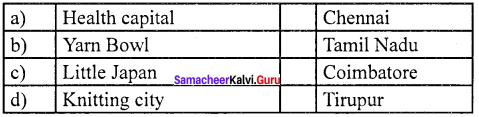
Question 1.
Samacheer Kalvi 11th Economics Solutions Chapter 11 Tamil Nadu Economy
(a) 4 3 2 1
(b) 1 2 3 4
(c) 4 1 2 3
(d) 3 4 2 1
Answer:
(a) 4 3 2 1

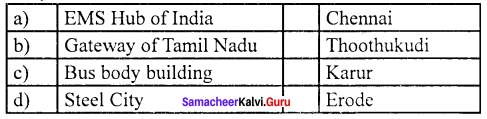
Question 2.
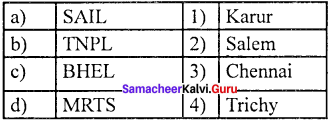
Samacheer Kalvi 11th Economics Solutions Chapter 11 Tamil Nadu Economy
(a) 4 3 2 1
(b) 2 1 4 3
(c) 1 2 3 4
(d) 2 1 3 4
Answer:
(b) 2 1 4 3

Choose the incorrect pair

Question 3.
Samacheer Kalvi 11th Economics Solutions Chapter 11 Tamil Nadu Economy
Answer:
(c) Little japan (iii) Coimbatore

Question 4.
Samacheer Kalvi 11th Economics Solutions Chapter 11 Tamil Nadu Economy
Answer:
(d) Steel City (iv) Erode

Choose the correct statement

Question 5.
(a) Tamil Nadu is the third largest contributor to India’s GDP
(b) Tamil Nadu ranks second in coconut production.
(c) Tamil Nadu ranks first in cement production
(d) Chennai is called as Detroit of Asia.
Answer:
(d) Chennai is called as Detroit of Asia.

Question 6.
(a) The population density of T.N is 480 as per 2011 census,
(b) There are 30 national highways in Tamil Nadu.
(c) Tamil Nadu has the highest installed wind energy capacity in India
(d) The headquarters of southern railway is at Trichy.
Answer:
(c) Tamil Nadu has the highest installed wind energy capacity in India

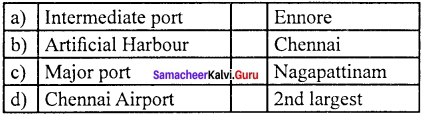
Choose the incorrect pair

Question 7.
Samacheer Kalvi 11th Economics Solutions Chapter 11 Tamil Nadu
Answer:
(b) Artificial Harbour (ii) Chennai

Question 8.
Samacheer Kalvi 11th Economics Solutions Chapter 11 Tamil Nadu Economy
Answer:
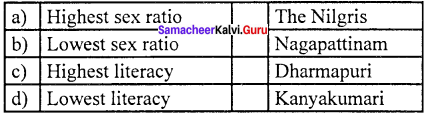
(a) Highest sex ratio (i) The Nilgris

Question 9.
Samacheer Kalvi 11th Economics Solutions Chapter 11 Tamil Nadu Economy
Answer:
(a) Rajapalayam (i) Surgical cotton product

Pick the odd one out

Question 10.
(a) Coimbatore
(b) Erode
(c) Madurai
(d) Trichy
Answer:
(b) Erode

Question 11.
(a) Coconut
(b) Groundnut
(c) Rice
(d) Sugarcane
Answer:
(c) Rice

Choose the incorrect statement

Question 12.
(a) Chennai is referred as banking capital of India.
(b) Tamil Nadu ranks first in maize production.
(c) Tamil Nadu ranks 3rd in human development Index.
(d) Tamil Nadu is the third largest contributor to India’s GDP
Answer:
(d) Tamil Nadu is the third largest contributor to India’s GDP

Question 13.
(a) Tamil Nadu has eight agro climatic zones
(b) There are 17 river basins in Tamil Nadu.
(c) The tertiary sector is the major contributor to Tamil Nadu’s GSDP.
(d) Tamil Nadu is the second largest economy in India.
Answer:
(d) Tamil Nadu is the second largest economy in India.

Fill in the blanks with suitable option given below

Question 14.
Tamilnadu has _______ population as against 121 crore of India
(a) 7.12 crore
(b) 1.72 crore
(c) 7.21 crore
(d) 1.27 crore
Answer:
(c) 7.21 crore

Question 15.
Tamil Nadu’s per capita income is ______
(a) 1100 dollar
(b) 2200 dollar
(c) 3360 dollar
(d) 4400 dollar
Answer:
(b) 2200 dollar

Question 16.
Gross state domestic product is ______
(a) GSDP
(b) MMR
(c) GDP
(d) IMF
Answer:
(a) GSDP

Question 17.
IMR is the number of mortality before completing
(a) 1 year of age
(b) 5 years of age
(c) 3 years of age
(d) 10 years of age
Answer:
(a) 1 year of age

Question 18.
The world’s biggest bagasse based paper mill is at ______
(a) Trichy
(b) Karur
(c) Coimbatore
(d) Erode
Answer:
(b) Karur

Question 19.
Every year India international leather fair is hosted at ______
(a) Coimbatore
(b) Madurai
(c) Chennai
(d) Mumbai
Answer:
(c) Chennai

Question 20.
______ wind farm is a renewable energy source
(a) Nagapattinam
(b) Valapandal
(c) Nagercoil
(d) Muppandal
Answer:
(d) Muppandal

Part – B
Answer the following questions in one or two sentences

Question 1.
How can you calculate per capita income?
Answer:
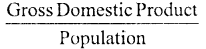
Percapita income = Samacheer Kalvi 11th Economics Solutions Chapter 11 Tamil Nadu Economy

Question 2.
Define infant mortality rate
Answer:
IMR is the number of mortality before completing 1 year of age.

Question 3.
What is cash – deposit ratio?
Answer:
C-D ratio is the ratio of bank advances to deposits.

Question 4.
What is the position of Tamil Nadu in automotives ?
Answer:
Tamil Nadu has 28% share each in automotive and auto components industries, 19% in the trucks segment and 18% each in passenger cars and two wheelers.

Question 5.
Why is Sivakasi called as Little Japan ?
Answer:
Sivakasi is a leader in the areas of printing, fireworks, and safety matches. It contributes 80% of India’s fireworks production and 60% of India’s total offset printing solution. As there are too many industries in Sivakasi it is called as Little Japan.

Question 6.
Name the cement manufacturing places of Tamil Nadu?
Answer:
Ariyalur, Virudhunagar, Coimbatore and Tirunelveli.

Question 7.
What is the measure of unemployment in Tamil Nadu?
Answer:
Tamil Nadu ranks 22nd with unemployment rate of 42 per 1000.

Part – C
Answer the following questions in one Paragraph

Question 1.
Explain about unemployment and poverty in Tamil Nadu?
Answer:
Unemployment: Tamil Nadu ranks 22nd with unemployment rate of 42 per 1000 as against national average of 50.

Poverty :

  1. Tamil Nadu is one of the India’s richest states.
  2. Since 1994, the state has seen a steady decline in poverty.
  3. Tamil Nadu has lower levels of poverty than most other states in the country.

Question 2.
Explain about water resources of Tamil Nadu.
Answer:
Water resources of Tamil Nadu:

  1. Tamil Nadu is not endowed with rich natural resources compared to other states.
  2. It accounts for three percent of water sources, four percent of land area against six percent of population.
  3. North east monsoon is the major source of rainfall followed by south west monsoon.
  4. There are 17 river basins in Tamil Nadu. The main rivers are Palar, Cheyyar, Ponnaiyar, Cauvery, Bhavani, Vaigai, Chittar, Tamiraparani, Vellar, Noyyal, Siruvani, Gundar, Vaipar etc.
  5. Wells are the largest source of irrigation in Tamil Nadu.

Question 3.
Name the water resources of Tamil Nadu.
Answer:
Water resources of Tamil Nadu:

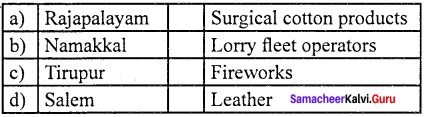
  1. Ranipet, Ambur, Vaniyambadi – Leather
  2. Salem . – Powerlooms, Home textiles, Steel, Sago
  3. Sankagiri – Lorry fleet operators
  4. Tiruchengode – Borewell drilling services
  5. Naakkal – Transportation Poultry
  6. Karur – Coach-building, Powerlooms
  7. Erode – Powerlooms, Turmeric
  8. Coimbatore – Spinning mills, Engineering industries
  9. Tirupur – Knitwear, Readymade garments
  10. Rajapalayam – Surgical cotton products
  11. Sivakasi – Safety matches, Fireworks, Printing

Part – D
Answer the following questions in about a page

Question 1.
Elaborate the highlights of Tamil Nadu economy.
Answer:
Highlights of Tamil Nadu economy:

  1. Growth of GSDP in Tamil Nadu has been among the fastest in India since 2005.
  2. Poverty reduction is faster than that in many other states.
  3. It contains a smaller proportion of India’s poor population.
  4. Second largest contributor to India’s GDP.
  5. 3rd in Human Development Index.
  6. Ranks 3rd in terms of invested capital and value of total industrial output.
  7. Ranks first among the states in terms of invested capital and value of total industrial output.
  8. Third in health index
  9. Has highest Gross Enrollment Ratio in higher education.
  10. Has the largest number of engineering colleges.
  11. Has emerged as a major hub for renewable energy.
  12. Has highest credit deposit ratio in commercial and cooperative banks.
  13. Ranks first on investment proposals filled by MSMES.

Question 2.
Compare the percapital income of Tamil Nadu with other countries.
Answer:

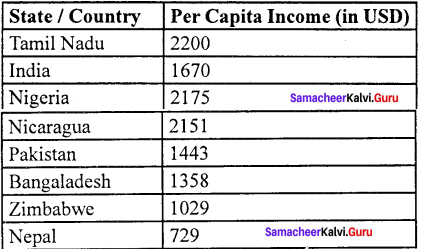
  1. The percapital GSDP of Tamil Nadu is $ 2200 which is higher than that of many other states in India.
  2. Per capital GSDP of Tamil Nadu is nearly 1.75 times higher than the national average, as per 2018 data.
  3. In term of the per capital income in Tamil Nadu was Rs. 1,03,600 in 2010-11 and it has increased to Rs. 1,88,492 in 2017-18 as per the budget figures 2018.

Samacheer Kalvi 11th Economics Solutions Chapter 11 Tamil Nadu Economy

Question 3.
Explain the role of MSMEs in Tamil Nadu.
Answer:
Role of MSMEs in Tamil Nadu:

  1. The MSME enterprises are classified as manufacturing and service enterprises based on the investment in plant, machinery and equipment MSMED act 2006.
  2. Tamil Nadu accounts of 15,07% micro, small and medium enterpriser which is highest in the country.
  3. There are 6.89 lakhs registered MSMEs producing over 8000 varieties of product for investment more than Rs. 32,008 crore.
  4. The prominent products of MSMEs are the engineering, electrical, chemicals, plastics, steel paper, matches, textiles, hosiery and garments sector.
  5. Around 15.61 lakh entrepreneurs have registered, providing employment opportunities to about 99.7 lakhs persons with total investment of Rs. 1,68,331 crore.

Question 4.
Explain about banks in Tamil Nadu.
Answer:
1. In Tamil Nadu, Nationalised banks account for 52% with 5,337 branches, private commercial banks 30% (3060) branches, state bank of India and its associates 13% (1,364) RRBs 5% (537) branches and the remaining 22 foreign bank branches.

Deposits of the banks :

  1. Total deposits of the banks in Tamil Nadu increased by 14.32% by March 2017 and touched Rs. 6,65,068.59 crores.
  2. Total credits of the banks increased by 13.50% by March 2017 and touched
    Rs. 6,95,500.31 crores.

Advances of the banks :

  1. The share of priority sector advances stands at 45.54% as against the national average of 40%
  2. Primary sector advances stands at 45.54%
  3. Agricultural advances stands at 19.81% on March 2017.
  4. Banks in Tamil Nadu has the highest credit deposit ratio of 119.15% in the country.

If you need some more information about Tamilnadu State Board Solutions for 11th Economics Chapter 11 Tamil Nadu Economy Questions and Answers then visit our site frequently and get all the resources that you look for. Also, share this page with your friends and make them learn all the concepts thoroughly before the exams.

Samacheer Kalvi 11th Bio Botany Solutions Chapter 6 Cell: The Unit of Life

Students who are in search of 11th Bio Botany exam can download this Tamilnadu State Board Solutions for 11th Bio Botany Chapter 6 Cell: The Unit of Life from here for free of cost. These cover all Chapter 6 Cell: The Unit of Life Questions and Answers, PDF, Notes, Summary. Download the Samacheer Kalvi 11th Biology Book Solutions Questions and Answers by accessing the links provided here and ace up your preparation.

Tamilnadu Samacheer Kalvi 11th Bio Botany Solutions Chapter 6 Cell: The Unit of Life

Kickstart your preparation by using this Tamilnadu State Board Solutions for 11th Bio Botany Chapter 6 Cell: The Unit of Life Questions and Answers get the max score in the exams. You can cover all the topics of Chapter 6 Cell: The Unit of Life Questions and Answers easily after studying the Tamilnadu State Board 11th Bio Botany Textbook solutions pdf.

Samacheer Kalvi 11th Bio Botany Cell: The Unit of Life Text Book Back Questions and Answers

I. Multiple Choice Questions
Choose the correct answer
Question 1.
The two subunits of ribosomes remain united at critical ion level of …………… .
(a) Magnesium
(b) Calcium
(c) Sodium
(d) Ferrous
Answer:
(a) Magnesium

Question 2.
Sequences of which of the following is used to know the phylogeny?
(a) mRNA
(b) rRNA
(c) tRNA
(d) Hn RNA
Answer:
(b) rRNA

Question 3.
Many cells function properly and divide mitotically even though they do not have …………… .
(a) Plasma membrane
(b) Cytoskeleton
(c) Mitochondria
(d) Plastids
Answer:
(d) Plastids

Question 4.
Keeping in view the fluid mosaic model for the structure of cell membrane, which one of the following statements is correct with respect to the movement of lipids and proteins from one lipid monolayer to the other…………… .
(a) Neither lipid nor proteins can flip – flop
(b) Both lipid and proteins can flip – flop
(c) While lipids can rarely flip – flop proteins cannot
(d) While proteins can flip – flop lipids cannot
Answer:
(c) While lipids can rarely flip – flop proteins cannot

Question 5.
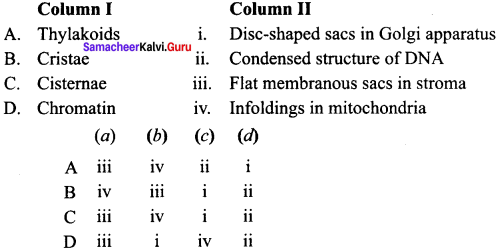
Match the columns and identify the correct option:
Samacheer Kalvi 11th Bio Botany Solutions Chapter 6 Cell The Unit of Life 1
Answer:
(c) iii, iv, i, ii.

Question 6.
Bring out the significance of phase contrast microscopy.
Answer:
Phase contrast microscope is used to observe living cells, tissues and the cells cultured invitro during mitosis.

Question 7.
State the protoplasm theory.
Answer:
Protoplasm theory was proposed by Max Schultze which states that the protoplasm is the living content of cell and is a complex colloidal system.

Question 8.
Distinguish between prokaryotes and eukaryotes.
Answer:
Between prokaryotes and eukaryotes:
Samacheer Kalvi 11th Bio Botany Solutions Chapter 6 Cell The Unit of Life 2

Question 9.
Difference between plant and animal ceil.
Answer:

Plant Cell

Animal Cell

1. Usually they are larger than animal cells1. Usually smaller than plant cells
2. Cell wall present in addition to plasma membrane and consists of middle lamellae, primary and secondary walls2. Cell wall absent
3. Plasmodesmata present3. Plasmodesmata absent
4. Chloroplast present4. Chloroplast absent
5. Vacuole large and permanent5. Vacuole small and temporary
6. Tonoplast present around vacuole6. Tonoplast absent
7. Centrioles absent except motile cells of lower plants7. Centrioles present
8. Nucleus present along the periphery of the cell8. Nucleus at the centre of the cell
9. Lysosomes are rare9. Lysosomes present
10. Synthesizes amino acids, coenzymes and vitamins required by them10. Cannot synthesize aminoacids, coenzymes and vitamins required by them
11. Storage material is starch grains11. Storage material is a glycogen granules

Question 10.
Draw the ultra structure of Plant Cell.
Answer:
The ultra structure of Plant Cell:
Samacheer Kalvi 11th Bio Botany Solutions Chapter 6 Cell The Unit of Life 3

Samacheer Kalvi 11th Bio Botany Cell: The Unit of Life Additional Questions and Answers

I. Multiple Choice Questions
Choose the correct answer:
Question 1.
Scientist who named the unicellular particles as ‘animalcules’ …………… .
(a) Aristotle
(b) Robert Brown
(c) Antonie von Leeuwenhoek
(d) Robert Hooke
Answer:
(c) Antonie van Leeuwenhoek

Question 2.
Cell theory was modified by …………… .
(a) Schwann
(b) Schleiden
(c) Virchow
(d) Dutrochet
Answer:
(c) Virchow

Question 3.
Which of the following microscope produce 3D – image?
(a) Phase contrast
(b) TEM
(c) SEM
(d) Dark field
Answer:
(c) SEM

Question 4.
Which of the following electron opaque chemical is used in Electron microscope?
(a) Strontium
(b) Deuterium
(c) Palladium
(d) Uranium
Answer:
(c) Palladium

Question 5.
Medium for electron movement in TEM is …………… .
(a) Air
(b) Oil
(c) Water
(d) Vacuum
Answer:
(d) Vacuum

Question 6.
Resolving power of SEM is …………… .
(a) 5 – 10 Å
(b) 2 – 10 Å
(c) 5 – 20 nm
(d) 5 – 20 m
Answer:
(c) 5 – 20 nm

Question 7.
Which among the following is NOT an exception to cell theory?
(a) Viruses
(b) Viroids
(c) Prions
(d) Fungi
Answer:
(d) Fungi

Question 8.
Scientist who named the cytoplasm as “Sarcode” is …………… .
(a) Dujardin
(b) Corti
(c) Purkinje
(d) Hugo Van Mohl
Answer:
(a) Dujardin

Question 9.
The pH of protoplasm is around …………… .
(a) 6.6
(b) 6.7
(c) 6.8
(d) 6.9
Answer:
(c) 6.8

Question 10.
The refractive index of protoplasm is …………… .
(a) 1.4
(b) 2.4
(c) 3.4
(d) 0.4
Answer:
(a) 1.4

Question 11.
Histone proteins are seen in the DNA of …………… .
(a) Pseudokaryotes
(b) Prokaryotes
(c) Mesokaryotes
(d) Eukaryotes
Answer:
(d) Eukaryotes

Question 12.
Which of the following organelle is believed to be an endosymbiont?
(a) Ribosomes
(b) Mitochondrion
(c) Golgi bodies
(d) Nucleus
Answer:
(b) Mitochondrion

Question 13.
is the living content of the cell …………… .
(a) Cytoplasm
(b) Protoplasm
(c) Nucleoplasm
(d) Nucleus
Answer:
(b) Protoplasm

Question 14.
Fungal cell wall is made of …………… .
(a) Cutin
(b) Chitin
(c) Hemicellulose
(d) Pectin
Answer:
(b) Chitin

Question 15.
…………… acts as a channel between the protoplasm of adjacent cells.
(a) Middle lamellae
(b) Pits
(c) Plasmodesmata
(d) Primary cell wall
Answer:
(c) Plasmodesmata

Question 16.
Fluid mosaic model was proposed by …………… .
(a) Schleiden and Schwann
(b) Singer and Nicolson
(c) Binning and Roher
(d) G. Palade
Answer:
(b) Singer and Nicolson

Question 17.
Which is the largest of the internal membranes?
(a) Golgi bodies
(b) Endoplasmic reticulum
(c) Tonoplast
(d) Nuclear membrane
Answer:
(b) Endoplasmic reticulum

Question 18.
In plant cells, golgi bodies are found as small vesicles called …………… .
(a) Polysomes
(b) Cytosomes
(c) Cytosol
(d) Dictyosomes
Answer:
(d) Dictyosomes

Question 19.
organelle plays a major role in post translation process of protein …………… .
(a) Golgi bodies
(b) Nucleolus
(c) Ribosomes
(d) ER
Answer:
(a) Golgi bodies

Question 20.
Zymogen granules are synthesized in …………… .
(a) Lysosomes
(b) Golgi bodies
(c) Mitochondria
(d) Chloroplast
Answer:
(b) Golgi bodies

Question 21.
Altmann named mitochondrion as …………… .
(a) Apoplast
(b) Elaioplast
(c) Symplast
(d) Bioplast
Answer:
(d) Bioplast

Question 22.
DNA of mitochondrion is …………… .
(a) Helical
(b) Dumb – bell
(c) Circular
(d) Spiral
Answer:
(c) Circular

Question 23.
Mitochondria are inherited from parent …………… .
(a) Male
(b) Female
(c) Both
(d) None
Answer:
(b) Female

Question 24.
F1 particles are also called as …………… .
(a) Polysomes
(b) Glyoxysomes
(c) Peroxisomes
(d) Oxysomes
Answer:
(d) Oxysomes

Question 25.
Elaioplasts store …………… .
(a) Starch
(b) Lipid
(c) Protein
(d) Chlorophyll
Answer:
(b) Lipid

Question 26.
The photosynthetic units are called as …………… .
(a) Oxysomes
(b) Quantosomes
(c) Thylakoids
(d) Chloroplasts
Answer:
(b) Quantosomes

Question 27.
Which organelle is not membrane bound?
(a) Mitochondrion
(b) Golgi bodies
(c) Chloroplast
(d) Ribosomes
Answer:
(d) Ribosomes

Question 28.
Ribosomes of mitochondrion are …………… .
(a) 16 S
(b) 80 S
(c) 70 S
(d) 50 S
Answer:
(c) 70 S

Question 29.
…………… mineral is required for structural cohesion of ribosomes.
(a) Ca2+
(b) H+
(c) Mg2+
(d) Cl
Answer:
(c) Mg2+

Question 30.
Lysosomes originate from …………… .
(a) Mitochondrion
(b) Nucleus
(c) ER
(d) Golgi bodies
Answer:
(d) Golgi bodies

Question 31.
In mammals, peroxisomes are seen in …………… cells.
(a) Brain
(b) Lung
(c) Liver
(d) Heart
Answer:
(c) Liver

Question 32.
Which organelle has a single unit membrane?
(a) Ribosomes
(b) Glyoxysomes
(c) Polysomes
(d) Nucleus
Answer:
(b) Glyoxysomes

Question 33.
The single unit membrane of vacuoles is called as …………… .
(a) Tonoplast
(b) Symplast
(c) Apoplast
(d) Amyloplast
Answer:
(a) Tonoplast

Question 34.
Vacuoles of Apple cells store …………… .
(a) Sucrose
(b) Malic acid
(c) Citrate
(d) Flavanoid
Answer:
(b) Malic acid

Question 35.
Ribosomal biogenesis occur at …………… .
(a) Mitochondrion
(b) Polysomes
(c) Nucleolus
(d) Chromosomes
Answer:
(c) Nucleolus

Question 36.
The term chromosome was introduced by …………… .
(a) Bridges
(b) Strasburger
(c) Waldeyer
(d) Poster
Answer:
(c) Waldeyer

Question 37.
Stability to chromosome is offered by …………… .
(a) Satellite
(b) Telomere
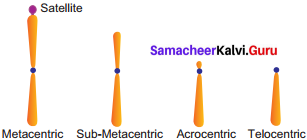
(c) Kinetochore
(d) Nucleolus
Answer:
(b) Telomere

Question 38.
Life span of the cells is determined by …………… .
(a) Kinetochore
(b) Satellite
(c) Chromatin
(d) Telomere
Answer:
(d) Telomere

Question 39.
The metacentric chromosomes are …………… shaped.
(a) L
(b) V
(c) J
(d) I
Answer:
(b) V

Question 40.
Polytene chromosomes are observed in …………… of Drosophila.
(a) Endocrine gland
(b) Gall bladder
(c) Salivary gland
(d) Exocrine gland
Answer:
(c) Salivary gland

Question 41.
Lampbrush chromosomes occur at …………… stage of meiotic Prophase I.
(a) Leptotene
(b) Diplotene
(c) Zygotene
(d) Pachytene
Answer:
(b) Diplotene

Question 42.
Number of basal rings in gram positive bacteria …………… .
(a) 2
(b) 4
(c) 6
(d) 8
Answer:
(a) 2

Question 43.
Microtubules are made of …………… .
(a) Dyenin
(b) Tubin
(c) Tubulin
(d) Nexin
Answer:
(c) Tubulin

Question 44.
Cytoplasm is stained …………… by eosin.
(a) Pink
(b) Blue
(c) Greenish blue
(d) Green
Answer:
(a) Pink

Question 45.
Key difference between plant cell & animal cell is …………… .
(a) Ribosomes
(b) Vacuoles
(c) Cell wall
(d) Centrioles
Answer:
(c) Cell wall

II. Very Short Answer Type Questions (2 Marks)

Question 1.
Name the scientist who proposed the cell theory.
Answer:
Matthias Schleiden and Theodor Schwann.

Question 2.
Define resolving power of a microscope.
Answer:
Resolving power or resolution refers to the ability of the lenses to show the details of object lying between two points. It is the finest detail available from an object. It can be calculated using the following formula.
⇒ Resolution = \(\frac {0.61λ}{NA}\),
where λ, = wavelength of the light and
NA is the numerical aperture.

Question 3.
Define magnification. How will you calculate it?
Answer:
The optical increase in the size of an image is called magnification. It is calculated by the following formula
Samacheer Kalvi 11th Bio Botany Solutions Chapter 6 Cell The Unit of Life 4

Question 4.
List out the types of objective lenses used in Bright field microscope.
Answer:
The types of objective lenses used in Bright field microscope:

  1. 5x
  2. 10x
  3. 45x
  4. 100x

Question 5.
In Bright field microscope, where does the primary & secondary magnification occurs?
Answer:
Primary magnification is obtained through, objective lens and secondary magnification is obtained through eye piece lens.

Question 6.
List out the components of Electron microscope.
Answer:
The components of the microscope are as follows:

  1. Electron Generating System
  2. Electron Condensor
  3. Specimen Objective
  4. Tube Lens
  5. Projector

Question 7.
Name the organisms that are exceptions to cell theory.
Answer:
Viruses, Virions and Prions.

Question 8.
Name the types of cells based on nuclear characteristics.
Answer:
The types of cells based on nuclear characteristics:

  1. Prokaryotes
  2. Mesokaryotes and
  3. Eukaryotes.

Question 9.
Define nucleoid.
Answer:
Nucleoid refers to the primitive nucleus which is not bound by nuclear membrane and the DNA is without histone protein.

Question 10.
Name the organelles which are believed to be endosymbiont in Eukaryote cell.
Answer:
Chloroplast and Mitochondrion.

Question 11.
Write a note on endosymbiont theory.
Answer:
Two eukaryotic organelles believed to be the descendants of the endosymbiotic prokaryotes. The ancestors of the eukaryotic cell engulfed a bacterium and the bacteria continued to function inside the host cell.

Question 12.
Point out any four prokaryotes.
Answer:Four prokaryotes:

  1. Bacteria
  2. Blue Green algae
  3. Mycoplasma and
  4. Rickettsiae.

Question 13.
Why spirochaetae is said to be a prokaryote?
Answer:
Spirochaetae is a prokaryote since its DNA lies in nucleoid and not bound by nuclear membrane and also devoid of histone protein.

Question 14.
Name any two unique structures / organelles of a plant cell.
Answer:
Cell wall and Chloroplast.

Question 15.
What are the components of protoplasm?
Answer:
Protoplasm is composed of a mixture of small particles, such as ions, amino acids, monosaccharides, water, macro-molecules like nucleic acids, proteins, lipids and polysaccharides.

Question 16.
What is the cell wall composition of the following organism?
(a) Fungi
(b) Bacteria
(c) Algae
Answer:
(a) Fungi – Chitin and fungal cellulose.
(b) Bacteria – Peptidoglycan
(c) Algae – Cellulose, mannan and galactan.

Question 17.
Which cell wall layer of plant cell is laid during maturation? Mention its role.
Answer:
Secondary wall is laid during maturation. It plays a key role in determining the shape of a cell.

Question 18.
How pits are formed?
Answer:
In plant cell, at few regions the secondary wall layer is laid unevenly, whereas the primary wall and middle lamellae are laid continuously such regions are called pits.

Question 19.
What is the role of plasmodesmata in a plant cell?
Answer:
Plasmodesmata act as a channel between the protoplasm of adjacent cells through which many substances pass through.

Question 20.
Name the two types of Pits.
Answer:
The two types of Pits:

  1. Simple pit and
  2. Bordered pit.

Question 21.
Define flip – flop movement.
Answer:
The movement of membrane lipids from one side of the membrane to the other side by vertical movement is called flip – flopping or flip – flop movement.

Question 22.
Name the two types of protein seen in cell membrane.
Answer:
Two types of protein seen in cell membrane:

  1. Integral proteins and
  2. peripheral proteins.

Question 23.
Define cytoplasmic streaming.
Answer:
Cytoplasmic streaming refers to the movement of the cytoplasm along with the cellular materials inside the cell.

Question 24.
Name any four endomembrane structures.
Answer:
Four endomembrane structures:

  1. Nuclear membrane
  2. endoplasmic reticulum
  3. vascular membrane
  4. golgi bodies.

Question 25.
What are dictyosomes?
Answer:
In plant cells, the golgi bodies are found as small vesicles which are called as dictyosomes.

Question 26.
What are porins?
Answer:
Porins are the proteins in the outer membrane of mitochondrion which forms the channel that allows the free diffusion of molecules smaller than about 1000 daltons.

Question 27.
What are oxysomes?
Answer:
The inner membrane of mitochondrion consists of stalked particles called elementary particles or Fernandez Moran particles. F1 particles or oxysomes.

Question 28.
How mitochondria helps in evolutionary studies?
Answer:
Mitochondrial DNA is used to track and date recent evolutionary time because it mutates 5 to 10 time faster than DNA in the nucleus.

Question 29.
Why mitochondrion is called as semi – autonomous organelle?
Answer:
Since mitochondria has it own DNA, it is called as Organelle.

Question 30.
Why mitochondria are called “Power houses of cell?
Answer:
Mitochondria are called Power house of a cell, as they produce energy rich (Adenosine Triphosphate) ATP.

Question 31.
Classify plastids based on colour.
Answer:
Chloroplast, Phaeoplast and Rhodoplast.

Question 32.
Classify plastids based on storage & mention their storage component.
Answer:

Plastids

Storage Content

1. Amyloplast1. Starch
2. Elaioplast2. Lipids / Oils
3. Aleuroplast or Proteoplast3. Protein

Question 33.
What are Quantosomes?
Answer:
Quantosomes are small, rounded photosynthetic units present in thylakoids.

Question 34.
List out the functions of chloroplast.
Answer:
Photosynthesis, photo respiration.

Question 35.
What is Svedberg unit?
Answer:
Svedberg unit is a measure of a particle size dependent on the speed with which particle sediment in the ultracentrifuge.

Question 36.
Where the biogenesis of ribosomes occur?
Answer:
Biogenesis of ribosome are denova formation, auto replication and nucleolar origin.

Question 37.
What are Polysomes? State its function.
Answer:
During protein synthesis many ribosomes are attached to the single mRNA called polysomes or polyribosomes. The function of polysomes is the formation of several copies of a particular polypeptide during protein synthesis.

Question 38.
Define Autolysis.
Answer:
Autolysis is the process, where the lysosome causes self destruction of cell on insight of disease they destroy the cells.

Question 39.
List out the enzymes of lysosomes.
Answer:
Acid Hydrolases, Nuclease, Proteases, Glycosidases, Lipases, Phosphatases, Sulphatases and Phospholipidases.

Question 40.
Name any two organelles involved in photorespiration.
Answer:
Peroxisomes and Chloroplast.

Question 41.
Name few single unit membrane bound organelles.
Answer:
Peroxisomes, Glyoxysomes and Sphaerosomes.

Question 42.
What are Tonoplast?
Answer:
In plant cells vacuoles are large, bounded by a single unit membrane called Tonoplast.

Question 43.
How vacuoles helps to maintain the structure of a plant cell?
Answer:
The major function of plant vacuole is to maintain water pressure known as turgor pressure, which maintains the plant structure.

Question 44.
What are metachromatic granules?
Answer:
Inorganic inclusions in bacteria are polyphosphate granules (volutin granules) and sulphur granules. These granules are also known as metachromatic granules.

Question 45.
Which is the largest organelle in a cell? State its function.
Answer:
Nucleus. It controls all the cellular activities.

Question 46.
What is a pore complex?
Answer:
The pores are enclosed by circular structures called annuli. The pore and annuli forms the pore complex.

Question 47.
What are nucleolar organizers region?
Answer:
Secondary constrictions contains the genes for ribosomal RNA which induce the formation of nucleoli and are called nucleolar organizer regions.

Question 48.
Draw the types of chromosomes based on centromere position.
Answer:
The types of chromosomes based on centromere position:
Samacheer Kalvi 11th Bio Botany Solutions Chapter 6 Cell The Unit of Life 5

Question 49.
What is a telomere?
Answer:
Telomere is the terminal part of chromosome. It offers stability to the chromosome. DNA of the telomere has specific sequence of nucleotides.

Question 50.
Classify chromosomes based on function.
Answer:
Autosomes and sex chromosomes.

Question 51.
Name any two giant chromosomes.
Answer:
Polytene chromosomes and lamp brush chromosomes.

Question 52.
Define proton motive force.
Answer:
The proton motive force is the force derived from the electrical potential and the hydrogen ion gradient across the cytoplasmic membrane.

Question 53.
Name the basal rings found in flagella of gram negative bacteria.
Answer:
The basal rings found in flagella of gram negative bacteria:

  • L – Lipopolysacchride ring
  • P – Peptidoglycan ring
  • S – Super membrane ring and
  • M – membrane ring.

Question 54.
(a) Define histochemistry.
(b) What is Somatic pairing?
Answer:
(a) The technique of staining the cells and tissue is called histochemical staining or histo chemistry.
(b) Maternal and paternal homologues remain associated side by side is called somatic pairing.

III. Short Answer Type Questions (3 Marks)

Question 1.
Explain the principle involved in Scanning Electron Microscope (SEM).
Answer:
In Scanning Electron Microscope (SEM) electrons are focused by means of lenses into a very fine point. The interaction of electrons with the specimen results in the release of different forms of radiation (such as auger electrons, secondary electrons, back scattered electrons) from the surface of the specimen. These radiations are then captured by an appropriate detector, amplified and then imaged on fluorescent screen.

Question 2.
Write a note on solation gelation property of protoplasm.
Answer:
The protoplasm exist either in semisolid (jelly – like) state called ‘gel’ due to suspended particles and various chemical bonds or may be liquid state called ‘sol’. The colloidal protoplasm which is in gel form can change into sol form by solation and the sol can change into gel by gelation. These gel – sol conditions of colloidal system are prime basis for mechanical behaviour of cytoplasm.

Question 3.
Explain the nuclear characters of Mesokaryotes.
Answer:
Mesokaryotes contains well organized nucleus with nuclear membrane and the DNA is organized into chromosomes but without histone protein components divides through amitosis similar with prokaryotes.

Question 4.
List out the unique characters of a Eukaryotic cell.
Answer:
Eukaryotes have true nucleus. The DNA is associated with protein bound histones forming the chromosomes. Membrane bound organelles are present.

Question 5.
Name the chemicals seen in the cell wall of plant cells.
Answer:
Cellulose, hemicellulose, pectin, lignin, cutin, suberin and silica.

Question 6.
Name the 3 distinct regions of plant cell wall.
Answer:
In plant, cell wall shows three distinct regions

  1. Primary wall
  2. Secondary wall and
  3. Middle lamellae.

Question 7.
Explain the role of hemicellulose, pectin & glycoprotein in primary cell wall.
Answer:
Hemicellulose binds the microfibrils with matrix and glycoproteins control the orientation of microfibrils while pectin serves as filling material of the matrix.

Question 8.
In cell membrane, phospholipids undergo flip – flop movement but not the protein. Why?
Answer:
The phospholipids can have flip – flop movement because the phospholipids have smaller polar regions, whereas the proteins cannot flip – flop because the polar region is extensive.

Question 9.
Define signal transduction.
Answer:
The process by which the cells receive information from outside and respond is called signal transduction.

Question 10.
Distinguish between rough endoplasmic reticulum and smooth endoplasmic reticulum.
Answer:
Between rough endoplasmic reticulum and smooth endoplasmic reticulum:

RER

SER

1. Ribosomes are present in the outer surface of membrane1. Ribosomes are absent on the membrane
2. It is involved in protein synthesis2. It is involved in lipid synthesis

Question 11.
Write the major roles of Golgi bodies.
Answer:
Golgi complex plays a major role in post translational modification of proteins and glycosidation of lipids.

Question 12.
Which is the most abundant protein on Earth? Where it is encoded?
Answer:
Rubisco is the abundant protein on Earth. It is encoded by the chloroplast DNA.

Question 13.
Classify ribosomes with an example.
Answer:
Types of Ribosomes
1. 70S Ribosomes (subunit 30S and 50S): 3 RNA molecule

  • 16SrRNA in 30S subunit
  • 23S and 5S in 50S large subunit
    (Prokaryotic cells of Blue green algae, Bacteria, Mitochondria and Chloroplast of many Algae and higher plants)

2. 80S Ribosomes (subunits 40S and 60S): 4 RNA molecule

  • 18Sr RNA in 40S small sub unit
  • 28S, 5.8S and 5S in larger 60S subunit.
    (Eukaryotic cells of plants and animals).

Question 14.
Write a note on Glyoxysomes.
Answer:
Glyoxysome is a single membrane bound organelle. It is a sub cellular organelle and contains enzymes of glyoxylate pathway – oxidation of fatty acid occurs in glyoxysomes of germinating seeds.

Question 15.
What are cell inclusions? Give example.
Answer:
The cell inclusions are the non – living materials present in the cytoplasm. They are organic and inorganic compounds.  Example: Phosphate granules.

Question 16.
Draw and label the structure of Nucleus.
Answer:
The structure of Nucleus:
Samacheer Kalvi 11th Bio Botany Solutions Chapter 6 Cell The Unit of Life 6Samacheer Kalvi 11th Bio Botany Solutions Chapter 6 Cell The Unit of Life 7

Question 17.
Distinguish between Euchromatin & Heterochromatin.
Answer:
The portion of Eukaryotic chromosome which is transcribed into mRNA contains active genes that are not tightly condensed during interphase is called Euchromatin. The portion of a Eukaryotic chromosome that is not transcribed into mRNA which remains condensed during interphase and stains intensely is called Heterochromatin.

Question 18.
Define Kinetochore.
Answer:
The centromere contains a complex system of protein fibres called kinetochore. Kinetochore is the region of chromosome which is attached to the spindle fibre during mitosis.

Question 19.
Write a note on SAT – chromosome.
Answer:
A satellite or SAT – chromosome are short chromosomal segment or rounded body separated from main chromosome by a relatively elongated secondary constriction. It is a morphological entity in certain chromosomes.

Question 20.
How telomeres helps in cancer studies?
Answer:
Maintenance of telomeres appears to be an important factor in determining the life span and reproductive capacity of cells so studies of telomeres and telomerase have the promise of providing new insights into conditions such as ageing and cancer.

Question 21.
Name the three types of centromere in eukaryotes.
Answer:
The three types of centromere in eukaryotes:

  1. Point centromere
  2. Regional centromere and
  3. Holocentromere.

Question 22.
What are giant chromosomes?
Answer:
These chromosomes are larger in size and are called giant chromosomes. In certain plants they are found in the suspensors of the embryo. The polytene chromosome and lamp brush chromosome occur in animals and are also called as giant chromosomes.

Question 23.
How polyteny condition is achieved?
Answer:
Polyteny is achieved by repeated replication of chromosomal DNA several times without nuclear division and the daughter chromatids aligned side by side and do not separate (endomitosis).

Question 24.
What is Microphotography?
Answer:
Images of structures observed through microscopes can be further magnified, projected and saved by attaching a camera to the microscope by a microscope coupler or eyepiece adaptor. Picture taken using a inbuilt camera in a microscope is called microphotography or microphotograph.

Question 25.
Draw the Structure of Peroxisomes.
Answer:
The Structure of Peroxisomes:
Samacheer Kalvi 11th Bio Botany Solutions Chapter 6 Cell The Unit of Life 7

IV. Long Answer Type Questions (5 Marks)

Question 1.
Write a detailed account on Dark field microscope.
Answer:
The dark field microscope was discovered by Z. Sigmondy (1905). Here the field will be dark but object will be glistening so the appearance will be bright. A special effect in an ordinary microscope is brought about by means of a special component called “Patch Stop Carrier”. It is fixed in metal ring of the condenser component.
Samacheer Kalvi 11th Bio Botany Solutions Chapter 6 Cell The Unit of Life 8
Patch stop is a small glass device which has a dark patch at centre of the disc leaving a small area along the margin through which the light passes. The light passing through the margin will travel oblique like a hollow cone and strikes the object in the periphery, therefore the specimen appears glistening in a dark background.

Question 2.
Compare Transmission Electron Microscope with Scanning Electron Microscope.
Answer:
Transmission Electron Microscope with Scanning Electron Microscope:
Samacheer Kalvi 11th Bio Botany Solutions Chapter 6 Cell The Unit of Life 9

Question 3.
List out the features of Cell Doctrine.
Answer:
The features of cell doctrine are as follows:

  1. All organisms are made up of cells.
  2. New cells are produced from the pre – existing cells.
  3. Cell is a structural and functional unit of all living organisms.
  4. A cell contains hereditary information which is passed on from cell to cell during cell division.
  5. All the cells are basically the same in chemical composition and metabolic activities.
  6. The structure and function of cell is controlled by DNA.
  7. Sometimes the dead cells may remain functional as tracheids and vessels in plants and horny cells in animals.

Question 4.
Enumerate the properties of protoplasm.
Answer:
The properties of protoplasm:

  1. Protoplasm is translucent, odourless and polyphasic fluid.
  2. It is a crystal colloid solution which is a mixture of chemical substances forming crystalloid and colloidal solution.
  3. Protoplasm exhibits three Brownian movement, amoeboid movement and cytoplasmic streaming or cyclosis. Viscosity of protoplasm is 2 – 20 centipoises. The Refractive index of the protoplasm is 1.4.
  4. The pH of the protoplasm is around 6.8, contain 90% water (10% in dormant seeds).
  5. Approximately 34 elements are present in protoplasm but only 13 elements are main or universal elements i.e. C, H, O, N, Cl, Ca, P, Na, K, S, Mg, I and Fe. Carbon, Hydrogen, Oxygen and Nitrogen form the 96% of protoplasm.
  6. Protoplasm is neither a good nor a bad conductor of electricity.
  7. Cohesiveness: Particles or molecules of protoplasm are adhered with each other by forces, such as Van der Waal’s bonds, that hold long chains of molecules together. This property varies with the strength of these forces.
  8. Contractility: The contractility of protoplasm is important for the absorption and removal of water especially stomatal operations.
  9. Surface Tension: The proteins and lipids of the protoplasm have less surface tension, hence they are found at the surface forming the membrane. On the other hand the chemical substances (NaCl) have high surface tension, so they occur in deeper parts of the cell protoplasm.

Question 5.
List out the functions of the Cell Wall.
Answer:
The cell wall plays a vital role in holding several important functions given below.

  1. Offers definite shape and rigidity to the cell.
  2. Serves as barrier for several molecules to enter the cells.
  3. Provides protection to the internal protoplasm against mechanical injury.
  4. Prevents the bursting of cells by maintaining the osmotic pressure.
  5. Plays a major role by acting as a mechanism of defense for the cells.

Question 6.
Explain in detail about Fluid mosaic model.
Answer:
Jonathan Singer and Garth Nicolson (1972) proposed fluid model: It is made up of lipids and proteins together with a little amount of carbohydrate. The lipid membrane is made up of phospholipid. The phospholipid molecule has a hydrophobic tail and hydrophilic head. The hydrophobic tail repels water and water loving polar molecule are called hydrophilic molecule. They have polar phosphate group responsible for attracting water. Water hating non – polar molecule are called as hydrophobic molecule. They have fatty acid which is non – polar which cannot attract water.

Hydrophilic head attracts water. The proteins of the membrane are globular proteins which are found intermingled between the lipid bilayer most of which are projecting beyond the lipid bilayer. These proteins are called as integral proteins. Few are superficially attached on either surface of the lipid bilayer which are called as peripheral proteins. The proteins are involved in transport of molecules across the membranes and also act as enzymes, receptors or antigens.

Question 7.
Describe Endocytosis and Exocytosis.
Answer:
Cell surface membrane are able to transport individual molecules and ions. There are processes in which a cell can transport a large quantity of solids and liquids into cell endocytosis or out of cell exocytosis.

1. Endocytosis: During endocytosis the cell wraps the cell surface membrane around the material and brings it into cytoplasm inside a vesicle. There are two types of endocytosis:

  • Phagocytosis – Particle is engulfed by membrane, which folds around it and forms a vesicle. The enzymes digest the material and products are absorbed by cytoplasm.
  • Pinocytosis – Fluid droplets are engulfed by membrane, which forms vesicles around them.

2. Exocytosis: Vesicles fuse with plasma membrane and eject contents. This passage of material out the cell is known as exocytosis. This material may be a secretion in the case of digestive enzymes, hormones or mucus.

Question 8.
List out the functions of Golgi bodies.
Answer:
Functions of Golgi bodies:

  1. Glycoproteins and glycolipids are produced.
  2. Transporting and storing lipids.
  3. Formation of lysosomes.
  4. Production of digestive enzymes.
  5. Cell plate and cell wall formation
  6. Secretion of carbohydrates for the formation of plant cell walls and insect cuticles.
  7. Zymogen granules (proenzyme / pre – cursor of all enzyme) are synthesized.

Question 9.
Draw & describe the structure of mitochondrion.
Answer:
Mitochondria are ovoid, rounded, rod shape and pleomorphic structures. Mitochondrion consists of double membrane, the outer and inner membrane. The outer membrane is smooth, highly permeable to small molecules and it contains proteins called Porins, which form channels that allows free diffusion of molecules smaller than about 1000 daltons and the inner membrane divides the mitochondrion into two compartments, outer chamber between two membranes and the inner chamber filled with matrix.
Samacheer Kalvi 11th Bio Botany Solutions Chapter 6 Cell The Unit of Life 10
The inner membrane is convoluted (infoldings), called crista (plural: cristae). Cristae contain most of the enzymes for electron transport system. Inner chamber of the mitochondrion is filled with proteinaceous material called mitochondrial matrix. The inner membrane consists of stalked particles called elementary particles or Fernandez Moran particles. F1 particles or Oxysomes. Each particle consists of a base, stem and a round head. In the head ATP synthase is present for oxidative phosphorylation. Inner membrane is impermeable to most ions, small molecules and maintains the proton gradient that drives oxidative phosphorylation.

Question 10.
Draw & describe the structure of Nucleus.
Answer:
Nucleus is an important unit of cell which control all activities of the cell. Nucleus holds the hereditary information. It is the largest among all cell organelles. It may be spherical, cuboidal, ellipsoidal or discoidal. It is surrounded by a double membrane structure called nuclear envelope, which has the inner and outer membrane. The inner membrane is smooth without ribosomes and the outer membrane is rough by the presence of ribosomes and is continues with irregular and infrequent intervals with the endoplasmic reticulum.
Samacheer Kalvi 11th Bio Botany Solutions Chapter 6 Cell The Unit of Life 6
The membrane is perforated by pores known as nuclear pores which allows materials such as mRNA, ribosomal units, proteins and other macromolecules to pass in and out of the nucleus. The pores enclosed by circular structures called annuli. The pore and annuli forms the pore complex. The space between two membranes is called perinuclear space. Nuclear space is filled with nucleoplasm, a gelatinous matrix has uncondensed chromatin network and a conspicuous nucleoli. The chromatin network is the uncoiled, indistinct and remain thread like during the interphase. It has little amount of RNA and DNA bound to histone proteins in eukaryotic cells.

Question 11.
Write in detail about the 3 types of centromere in eukaryotes.
Answer:
There are three types of centromere in Eukaryotes. They are as follows:

  1. Point Centromere: The type of centromere in which the kinetochore is assembled as a result of protein recognition of specific DNA sequences. Kinetochores assembled on point centromere bind a single microtubule. It is also called as localized centromere. It occurs in budding yeasts.
  2. Regional Centromere: In regional centromere where the kinetochore is assembled on a variable array of repeated DNA sequences. Kinetochore assembled on regional centromeres bind multiple microtubules. It occurs in fission yeast cell, humans and so on.
  3. Holocentromere: The microtubules bind all the along the mitotic chromosome. Example: Caenorbabditis elegans (transparent nematode) and many insects.

Question 12.
List the functions of Nucleus.
Answer:
Functions of the Nucleus:

  1. Controlling all the cellular activities
  2. Storing the genetic or hereditary information
  3. Coding the information in the DNA for the production of enzymes and proteins.
  4. DNA duplication and transcription takes place in the nucleus.
  5. In nucleolus ribosomal biogenesis takes place.

Question 13.
Explain the structure and movement of Eukaryotic flagella.
Answer:
Structure: Eukaryotic Flagella are enclosed by unit membrane and it arises from a basal body. Flagella is composed of outer nine pairs of microtubules with two microtubules in its centre (9 + 2 arrangement). Flagella are microtubule projection of the plasma membrane. Flagellum is longer than cilium (as long as 200 m). The structure of flagellum has an axoneme made up microtubules and protein tubulin.
Samacheer Kalvi 11th Bio Botany Solutions Chapter 6 Cell The Unit of Life 11
Movement: Outer microtubule doublet is associated with axonemal dynein which generates force for movement. The movement is ATP driven. The interaction between tubulin and dynein is the mechanism for the contraction of cilia and flagella. Dynein molecules uses energy from ATP to shift the adjacent microtubules. This movement bends the cilium or flagellum.

Question 14.
Describe the steps involved in cytologieal techniques.
Answer:
There are different types of mounting based on the portion of a specimen to be observed.

  1. Whole mount: The whole organism or smaller structure is mounted over a slide and observed.
  2. Squash: Is a preparation where the material to be observed is crushed/squashed onto a slide so as to reveal their contents. Example: Pollen grains, mitosis and meiosis in root tips and flower buds to observe chromosomes.
  3. Smears: Here the specimen is in the fluid (blood and microbial cultures etc) are scraped, brushed or aspirated from surface of organ. Example: Epithelial cells.
  4. Sections: Free hand sections from a specimen and thin sections are selected, stained and mounted on a slide. Example: Leaf and stem of plants.

Question 15.
Name any 5 common stains their colour & their affinity used in cytologieal studies.
Answer:
Common Stains used in Histochemistry
Samacheer Kalvi 11th Bio Botany Solutions Chapter 6 Cell The Unit of Life 12

V. Higher Order Thinking Skills (HOTs)

Question 1.
What makes the plant cell more rigid than animal cells?
Answer:
Plants cells posses cell wall which provides sufficient rigidity and proper shape to them whereas in case of animal cells, cell wall is totally absent.

Question 2.
Cleaning organelle in the cell – Explain.
Answer:
Lysosomes contains a variety of hydrolytic enzymes, which can digest the materials within the cell. Thus lysosomes act as cleaning organelle of the cell.

Question 3.
Ribosomes are single membrane organelles present in both prokaryotes & eukaryotes. List out the sites where ribosomes are present in plant cell.
Answer:
The sites where ribosomes are present in plant cell:

  1. Cytoplasm
  2. On rough endoplasmic reticulum
  3. Inside mitochondira & chloroplast.

Question 4.
What does ‘S’ refer in a 70 S and an 80 S ribosomes?
Answer:
‘S’ refers to Svedberg units named after Theoder Svedberg. The size of ribosome and their subunits are represented by Svedberg unit.

Question 5.
Briefly give the contributions of the following scientists in the field of cytology.
(a) Schleiden and Schwann
(b) Singer and Nicolson
Answer:
(a) Schleiden and Schwann proposed the cell theory.
(b) Singer & Nicolson proposed the fluid mosaic model of plasmomembrane.

Question 6.
Is extra genomic DNA is present in prokaryotes & Eukaryotes? If yes, locate them in both the types of organisms.
Answer:
Locate them in both the types of organisms:

  1. In prokaryotes like bacteria, plasmids are the extra genomic DNA present in cytoplasm.
  2. In Eukaryotes, the circular DNA present in matrix of mitochondria & chloroplast are extragenomic DNA.

Question 7.
Give possible reasons to call mitochondria & chloroplast as semi – autonomous organelles.
Answer:
Mitochondria & chloroplasts are considered as semi – autonomoius organelle due to following
facts.

  1. Both mitochondria & chloroplasts have their own DNA, which can replicate independently.
  2. They have their own ribosomes by which they self-synthesize same of their proteins without depending on cellular DNA.

Believing that the Samacheer Kalvi 11th Biology Book Solutions Questions and Answers learning resource will definitely guide you at the time of preparation. For more details about Tamilnadu State 11th Bio Botany Chapter 6 Cell: The Unit of Life textbook solutions, ask us in the below comments and we’ll revert back to you asap.

Samacheer Kalvi 11th Economics Solutions Chapter 10 Rural Economy

Immediately get Chapter Wise Tamilnadu State Board Solutions for 11th Economics to gain more marks and start Quick Revision of all Chapters. All Chapters Pdf is provided along with the Questions and Answers. You Can Dowload Samacheer Kalvi 11th Economics Book Solutions Questions and Answers for Chapter wise are given with a clear explanation. Tamilnadu State Board Solutions for 11th Economics Chapter 10 Rural Economy Questions and Answers is for free of cost.

Tamilnadu Samacheer Kalvi 11th Economics Solutions Chapter 10 Rural Economy

Tamilnadu State Board Solutions for 11th Economics Chapter 10 Rural Economy Questions and Answers PDF has all given in Chapter Wise Section. Check Out daily basis with Tamilnadu State Board Solutions 11th Economics PDF will help to improve your score. Improve your level of accuracy to answer a question by reading with Samacheer Kalvi 11th Economics Book Solutions Questions and Answers PDF.

Samacheer Kalvi 11th Economics Rural Economy Text Book Back Questions and Answers

Part – A
Multiple Choice Questions

Question 1.
Which is considered as the basic unit for rural areas?
(a) Panchayat
(b) Village
(c) Town
(d) Municipality
Answer:
(b) Village

Question 2.
Which feature is identified with rural areas?
(a) Low population density
(b) High population density
(c) Low natural resources
(d) Low human resources
Answer:
(a) Low population density

Question 3.
Identify the feature of rural economy.
(a) Dependence on agriculture
(b) High population density
(c) Low level of population
(d) Low level of inequality
Answer:
(a) Dependence on agriculture

Question 4.
What percentage of the total population live in rural area, as per 2011 censes?
(a) 40
(b) 50
(c) 68.84
(d) 70
Answer:
(c) 68.84

Question 5.
How do you term people employed in excess over and above the requirements?
(a) Unemployment
(b) Underemployment or Disguised Unemployment
(c) Full employment
(d) Self-employment
Answer:
(b) Underemployment or Disguised Unemployment

Question 6.
What is the term used to denote the coexistence of two different features in an economy?
(a) Technology
(b) Dependency
(c) Dualism
(d) Inequality
Answer:
(c) Dualism

Question 7.
The process of improving the rural areas, rural people and rural living is defined as
(a) Rural economy
(b) Rural economics
(c) Rural employment
(d) Rural development
Answer:
(d) Rural development

Question 8.
Identify the agriculture related problem of rural economy.
(a) Poor communication
(b) Small size of landholding
(c) Rural poverty
(d) Poor banking network
Answer:
(b) Small size of landholding

Question 9.
The recommended nutritional intake per person in rural areas.
(a) 2100 calories
(b) 2100 calories
(c) 2300 calories
(d) 2400 calories
Answer:
(d) 2400 calories

Question 10.
Indicate the cause for rural poverty.
(a) Lack of non-farm employment
(b) High employment
(c) Low inflation rate
(d) High investment.
Answer:
(a) Lack of non-farm employment

Question 11.
What is the other name for concealed unemployment?
(a) Open
(b) Disguised
(c) Seasonal
(d) Rural
Answer:
(b) Disguised

Question 12.
How do you term the employment occurring only on a particular season?
(a) Open
(b) Disguised
(c) Seasonal
(d) Rural
Answer:
(c) Seasonal

Question 13.
Identify an example for rural industries?
(a) Sugar factory
(b) Mat making industry
(c) Cement industry
(d) Paper industry
Answer:
(b) Mat making industry

Question 14.
How much share of rural families in India is in debt?
(a) Half
(b) One fourth
(c) Two third
(d) Three fourth
Answer:
(d) Three fourth

Question 15.
Identify the cause for rural indebtedness in India.
(a) Poverty
(b) High population
(c) High productivity
(d) Full employment
Answer:
(a) Poverty

Question 16.
In which year, Regional Rural Banks came into existence?
(a) 1965
(b) 1970
(c) 1975
(d) 1980
Answer:
(c) 1975

Question 17.
Identify the year of launch of MUDRA Bank?
(a) 1995
(b) 2000
(c) 2010
(d) 2015
Answer:
(d) 2015

Question 18.
Identify the year in which National Rural Health Mission was launched.
(a) 2000
(b) 2005
(c) 2010
(d) 2015
Answer:
(b) 2005

Question 19.
Identify the advantages of rural roads.
(a) Rural marketing
(b) Rural employment
(c) Rural development
(d) All the above
Answer:
(d) All the above

Question 20.
“An Indian farmer is born in debt, lives in debt, dies in debt and bequeaths debt”- who said this?
(a) Adam Smith
(b) Gandhi
(c) Amartya Sen
(d) Sir Malcolm Darling
Answer:
(d) Sir Malcolm Darling

Part – B
Answer the following questions in one or two sentences

Question 21.
Define Rural Economy.
Answer:
Rural economy refers to villages. Rural economics deals with the application of economic principles in understanding and developing rural areas.

Question 22.
What do you mean by Rural Development?
Answer:
According to the world bank, “Rural development is a strategy designed to improve the economic and social life of a specific group of people rural poor”

Question 23.
Rural Poverty – Define.
Answer:
Rural poverty refers to the existence of poverty in rural areas. Poverty in India is the situation in which an individual fails to earn sufficient income to buy the basic minimum of subsistence.

Question 24.
Define Open Unemployment.
Answer:
In open unemployment, unemployed persons are identified as they remain without work. This type of unemployment is found among agricultural labourers, rural artisans and literate persons.

Question 25.
What is meant by Disguised Unemployment?
Answer:
Disguised unemployment is a situation where many are employed below their productive capacity and even if they are withdrawn from work the output will not diminish.

Question 26.
Define Cottage Industry.
Answer:
Cottage industries are generally associated with agriculture and provide both part time and full time jobs in rural areas.

Question 27.
What do you mean by Micro Finance?
Answer:
Micro finance is a financial service that offers loans, savings and insurance to entrepreneurs and small business owners.

Question 28.
State any two causes of housing problem in rural areas.
Answer:

  1. Rapid adaptation of nuclear families.
  2. Problems in provision of proper water supply, good sanitation, proper disposal of sewage.

Question 29.
Define Rural Electrification.
Answer:
Rural electrification refers to providing electrical power to rural areas.

Question 30.
State any two factors hindering Rural Electrification in India.
Answer:

  1. Lack of funds
  2. Inter – state disputes
  3. Uneven terrain

Part – C
Answer the following questions in one Paragraph

Question 31.
State the importance of Rural Development.
Answer:
Importance of Rural Development:

  1. India cannot be developed by retaining rural as backward
  2. As the rural economy supports the urban sector, the backwardness of the rural sector would be a major impediment to the overall progress of the economy.
  3. Improvements in education, health and sanitation in villages can help avoid many urban problems.
  4. To provide gainful employment and improve food production.
  5. The evils of brain drain and rural urban migration can be reduced.
  6. For the better utilization of resources.
  7. To minimize the gap between rural and urban areas.

Question 32.
Explain the causes for Rural Backwardness.
Answer:

  1. Skewed distribution of land.
  2. Lack of non-farm employment.
  3. Lack of public sector investment.
  4. Inflation.
  5. Low productivity.
  6. Unequal benefit of growth.
  7. Low rate of economic growth.
  8. More emphasis on large industries.
  9. Social evils.

Question 33.
Enumerate the remedial measures to Rural Poverty.
Answer:
Creation of employment opportunities would support elimination of poverty. The poverty eradication schemes implemented in India are

  1. 20 point programme.
  2. Integrated Rural Development Programme (IRDP)
  3. Training Rural Youths for Self Employment (TRYSEM)
  4. Food for Work Programme (FWP)
  5. National Rural Employment Programme (NREP)
  6. RLEGP, JRY and MGN REGS

Question 34.
What are the remedial measures for Rural Unemployment?
Answer:

  1. Subsidiary occupation : To reduce the seasonal unemployment rural people should be encouraged to adopt subsidiary occupation.
  2. Rural works programme : Rural works programme should be planned during off season to provide gainful employment.
  3. Irrigation facilities : Irrigation facilities should be expanded to enable the farmers to adopt multiple cropping.
  4. Rural industrialization : New industries should be set up in rural areas.
  5. Technical education : Employment oriented courses should be introduced to literate the youth to start their own units.

Question 35.
Write a note on Regional Rural Banks.
Answer:
Regional rural banks came into existence in 1975. RRBs are recommended with a view to develop rural economy by providing credit and other facilities to the small and marginal farmers, agricultural labourers, artisans and small entrepreneurs.

RRBs are set up by the joint efforts of the centre and state governments and commercial banks. At present there are 64 RRBs in India. RRBs confine their lending’s only to the weaker sections and their lending rates are at par with the prevailing rate of cooperative societies.

Question 36.
Mention the features of SHGs.
Answer:

  1. SHG is an economically homogeneous group formed through a process of self selection based upon the affinity of its members.
  2. Most SHGs are women’s groups with membership ranging between 10 and 20.
  3. SHGs have well-defined rules and by laws, hold regular, meetings and maintain records and savings and credit discipline.
  4. SHGs are self-managed institutions characterized by participatory and collective decision making.

Question 37.
List out the objectives of MUDRA Bank.
Answer:

  1. Regulate the lender and the borrower of micro finance and bring stability to the micro finance system.
  2. Extend finance and credit support to micro finance institutions.
  3. Register all MFIs and introduce a system of performance rating and accreditation for the past time.
  4. Offer a credit guarantee scheme for providing guarantees to loans being offered to micro businesses.
  5. Introduce appropriate technologies to assist in the process of efficient lending, borrowing and monitoring of distributed capital.

Part – D
Answer the following questions in about a page

Question 38.
‘The features of Rural Economy are peculiar’- Argue.
Answer:
The Rural economy has very peculiar features which are :

  1. Village is an institution : The village is a primary institution and it satisfies almost all the needs of the rural community.
  2. Dependence on agriculture : Agriculture and allied activities are the main occupation in rural areas.
  3. Life of rural people: Life styles in villages are very simple. Public services like education, housing,health and sanitation, transport and communication, banking, roads and markets are limited and unavailable.
  4. Population density : Density of population is very low and houses are scattered in the entire villages.
  5. Employment: There exists unemployment, seasonal unemployment and underemployment in rural areas.
  6. Poverty : According to the 2011 – 12 estimates about 22 crores of people in rural areas live below the poverty line.
  7. Indebtedness : Sir Malcolm Darling stated that an Indian farmer is born in debt, lives in debt, dies in debt and bequeaths debt.
  8. Rural income : As the rural economy is not sufficiently vibrant to provide them with jobs or self employment opportunities the income of the rural people is constrained.
  9. Dependency : Rural households are dependent on social grants and remittances from family members working in urban areas and cities.
  10. Dualism : Dualism means the co-existence of two extremely different features which is the common characteristics in rural area.
  11. Inequality : The distribution of income, wealth and assets are highly skewed among rural people.
  12. Migration : Rural people are forced to migrate to urban areas to seek employment which gives rise to the formation of cities. Enmity and lack of basic amenities in rural areas also push the people to migrate. This is called double poisoning by Schumacher.

Question 39.
Discuss the problems of Rural Economy.
Answer:
The problems of rural economy are.
1. People related problems : The problem consists of illiteracy, lack of technical know how, low level of confidence, dependence on sentiments and beliefs etc.

2. Agriculture related problems : This include lack of awareness, knowledge, skill and attitude, unavailability of inputs, poor marketing facility, insufficient extension of staff and services, small size of land holding, absence of infrastructure, primitive technology, reduced public investment and absence of role for farmers in fixing the prices for their own products.

3. Infrastructural related problems : Poor infrastructure facilities like water, electricity, transport, educational institutions communication, health, employment are found in rural areas.

4. Economics related problems : Inability to adopt high cost technology, high cost of inputs, under privileged rural industries, low income, indebtedness and existence of inequality in land holdings and assets.

5. Leadership related problems : Leadership among the hands of inactive and incompetent people, self-interest of leaders, biased political will, less bargaining power and negotiation skills and dominance of political leaders.

6. Administrative problems : Political interference, lack of motivation and interest, low wages in villages, improper utilization of budget and absence of monitoring and implementation of rural development programme.

Question 40.
Analyse the causes for Rural Indebtedness.
Answer:

1. Poverty of farmers : The vicious circle of poverty fore es the farmers to borrow for consumption, cultivation and celebrations. Thus, poverty’ debt and high rates of interest hold the farmer in the grip of money lenders.

2. Failure of monsoon : Frequent failure of monsoon is a curse to the farmers and they have to suffer due to the failure of nature. Therefore, farmers find it difficult to identify good years to repay their debts.

3. Litigation : Due to land disputes litigation in the court compels them to borrow heavily. Being uneducated and ignorant they are caught in the litigation process and dry away their savings and resources.

4. Money lenders and high rate of interest: The rate of interest charged by the local money lenders is very high and the compounding of interest leads to perpetuate indebtedness of the farmer.

Samacheer Kalvi 11th Economics Rural Economy Additional Questions and Answers

Part-A
Choose the best options

Question 1.
According to the 2011 population census, there are ___________ villages in India.
(a) 6,40,867
(b) 3,40,867
(c) 4,40,867
(d) 5,40,867
Answer:
(a) 6,40,867

Question 2.
Of 121 crore total population ___________ percent lives in rural areas.
(a) 64.88
(b) 68.84
(c) 68.48
(d) 88.64
Answer:
(b) 68.84

Question 3.
___________ are geographical areas located outside towns and cities.
(a) Townships
(b) Corporations
(c) Rural areas
(d) None
Answer:
(c) Rural areas

Question 4.
Total percentage of poverty in 2009-2010
(a) 33.80
(b) 38.30
(c) 33.08
(d) 80.33
Answer:
(a) 33.80

Question 5.
In 2009, the total number of micro finance institutions in India was around ___________
(a) 140
(b) 150
(c) 160
(d) 170
Answer:
(b) 150

Question 6.
SHG Bank Linked Programme (SBLP) was started in ___________
(a) 1991
(b) 1990
(c) 1992
(d) 1993
Answer:
(c) 1992

Question 7.
Micro Units Development and Refinance Agency is ___________
(a) IRDB
(b) MUDRA
(c) BUNDAN
(d) ICICI
Answer:
(b) MUDRA

Question 8.
MUDRA Bank was started in the year ___________
(a) 2011
(b) 2012
(c) 2015
(d) 2013
Answer:
(c) 2015

Question 9.
___________ was the first professor of economics at Madras University
(a) Gilbert Slater
(b) Samuelson
(c) Marshall
(d) Manmohan Singh
Answer:
(a) Gilbert Slater

Question 10.
National Rural Health Mission was launched on ___________
(a) 2001
(b) 1991
(c) 2005
(d) 2000
Answer:
(c) 2005

Question 11.
___________ are setup with a view to develop rural economy by providing credit and other facilities to small and marginal farmers.
(a) MUDRA Bank
(b) RRB
(c) SHG
(d) NABARD
Answer:
(b) RRB

Match the following and choose the answer using the codes given below

Question 1.
Samacheer Kalvi 11th Economics Solutions Chapter 10 Rural Economy
(a) 1 2 3 4
(b) 2 1 3 4
(c) 4 3 2 1
(d) 3 4 1 2
Answer:
(b) 2 1 3 4

Question 2.
Samacheer Kalvi 11th Economics Solutions Chapter 10 Rural Economy
(a) 4 3 2 1
(b) 2 1 4 3
(c) 3 4 1 2
(d) 1 2 3 4
Answer:
(c) 3 4 1 2

Choose the correct option

Question 3.
National rural health mission was established in
(a) March 12, 2005
(b) June 12, 2005
(c) April 12, 2005
(d) June 13, 2005
Answer:
(c) April 12, 2005

Question 4.
Gross national happiness index is
(a) GDP
(b) HDF
(c) WEI
(d) GNHI
Answer:
(d) GNHI

Question 5.
Poverty line is calculated on the basis of
(a) Based on inflation
(b) Based on poverty
(c) Based on income or consumption
(d) Based on unemployment
Answer:
(c) Based on income or consumption

Fill in the blanks with suitable option given below

Question 6.
Micro credit is also known as
(a) Micro finance
(b) Small finance
(c) Large finance
(d) None
Answer:
(a) Micro finance

Question 7.
The co-existence of two extremely different features is called as
(a) Unity
(b) Dualism
(c) Trism
(d) None
Answer:
(b) Dualism

Question 8.
The first economics professor of madras university was
(a) A.K. Sen
(b) Charan Singh
(c) Manmohan Singh
(d) Gilbert Slater
Answer:
(d) Gilbert Slater

Choose the incorrect statement

Question 9.
(a) Physical quality of life index is PQLI
(b) The existence of poverty in rural areas is called rural poverty
(c) SSI s are also known as micro, small and medium enterprises (MSMEs)
(d) Petter diamond was the first economics professor of madras university
Answer:
(d) Petter diamond was the first economics professor of madras university

Question 10.
(a) MUDRA is micro units development and Refinance Agency Bank
(b) NRHM is National Rural Health Mission.
(c) The length of roads in India as per 2018 is 24 lakh kms.
(d) PURA is provision of urban facilities for rural areas.
Answer:
(c) The length of roads in India as per 2018 is 24 lakh kms.

Choose the incorrect pair

Question 11.
Samacheer Kalvi 11th Economics Solutions Chapter 10 Rural Economy
Answer:
(c) NHRM (iii) Rural health

Question 12.
Samacheer Kalvi 11th Economics Solutions Chapter 10 Rural Economy
Answer:
(d) All Indian Debt and investment Survey (iv) AIDS

Question 13.
Samacheer Kalvi 11th Economics Solutions Chapter 10 Rural Economy
Answer:
(d) National Food Security (iv) 2013

Question 14.
Samacheer Kalvi 11th Economics Solutions Chapter 10 Rural Economy
Answer:
(a) Adarsh Gram Sadak Yojana (i) 2010

Choose the correct statement

Question 15.
(a) Unemployment is a situation in which a person who is unwilling to work employed,
(b) According to 2011 12 estimates 42 crore village population list below the poverty line.
(c) In 2015, 60 crore people lived in villages.
(d) Sir Malcolm Darling stated that ‘An Indian farmer is bom in debt, lives in debt, dies in debt and bequeaths debt’
Answer:
(d) Sir Malcolm Darling stated that ‘An Indian farmer is bom in debt, lives in debt, dies in debt and bequeaths debt’

Question 16.
(a) Number of people living per sq.km is called population scarcity.
(b) There are 5,40,867 villages in India.
(c) The concept of ‘Double poisoning’ was coined by Schumacher.
(d) In 2009-10, the total percentage of poverty in India is 54.10
Answer:
(c) The concept of ‘Double poisoning’ was coined by Schumacher.

Pick the odd one out

Question 17.
(a) Petter Diamond
(b) A.K.Sen
(c) Dale Mortensen
(d) Christopher Pissarides
Answer:
(b) A.K.Sen

Question 18.
(a) NCC
(b) IRDP
(c) TRYSEM
(d) MGNREGS
Answer:
(a) NCC

Analyse the reason for the following

Question 19.
Assertion (A) : Creation of employment opportunities eliminate poverty’in rural areas.
Reason (R) : Rural unemployment and rural poverty are interrelated.
(a) (A) is true; but (R) is false
(b) Both (A) and (R) are false
(c) Both (A) and (R) are true but (R) is not the correct explanation of (A)
(d) Both (A) and (R) are true (R) is the correct explanation of (A)
Answer:
(d) Both (A) and (R) are true (R) is the correct explanation of (A)

Question 20.
Assertion (A) : Agricultural operations are seasonal in nature.
Reason (R) : To reduce the seasonal unemployment rural people should be encouraged to adopt subsidiary occupations.
(a) Both (A) and (R) are true, (R) is the correct explanation of (A)
(b) Both (A) and (R) are true, (R) is not the correct explanation of (A)
(c) Both (A) and (R) are false.
(d) (A) is false but (R) is true.
Answer:
(b) Both (A) and (R) are true, (R) is not the correct explanation of (A)

Part – B
Answer the following questions in one or two sentences

Question 1.
Name some of the economic indicators?
Answer:
Human Development Index (HDI),Women Empowerment Index (WEI), Gender Disparity Index (GDI), Physical Quality of Life Index (PQLI) and Gross National Happiness Index (GNHI).

Question 2.
How can you measure poverty by nutritional index?
Answer:
On the basis of recommended nutritional intake, persons consuming less than 2400 calories per day is rural areas are considered as rural poor.

Question 3.
What is unemployment?
Answer:
Unemployment is a situation in which a person actively searching for employment but unable to find work at the prevailing wage rate.

Question 4.
Write a note on seasonal unemployment ?
Answer:
In seasonal unemployment, employment occurs only in a particular season and workers remain unemployed in the remaining period of a year.

Question 5.
Write a note on NRHM.
Answer:
The National Rural Health Mission (NRHM) was launched on 12th April 2005, to provide accessible, affordable and quality health care to the vulnerable groups in rural areas.

Question 6.
What is population density?
Answer:
Population density is the number of persons living in per square kilometre.

Part – C
Answer the following questions in one Paragraph

Question 1.
What are the types of rural unemployment ?
Answer:

  1. Open unemployment: Unemployed persons are identified as they remain without work.
  2. Concealed unemployment: Many are employed below their productive capacity and even if they are withdrawn from work the output will not diminish. It is also called as disguised unemployment or under employment.
  3. Seasonal unemployment: Employment occurs only on a particular season and the remaining period of a year the rural people are unemployed or partially employed.

Question 2.
Explain about village industries.
Answer:
Village industries are traditional in nature and depend on local raw material. They cater to the needs of local population.
(Eg.) Gur and Khandsari, Cane and Bamboo basket, Shoe making, Pottery and Leather tanning.

Question 3.
Write a note on rural indebtedness.
Answer:
Rural indebtedness refers to the situation of the rural people who are unable to repay the loan accumulated over a period. Existence of the rural indebtedness indicates the weak financial infrastructure of our country in reaching the needy farmers landless people and the agricultural labourers.

Question 4.
Write a note on rural roads.
Answer:
Rural roads constitute the very life line of rural economy. A well-constructed road network in rural area would bring several benefits including the linking of remote villages with urban centres, reduction in cost of transportation of agricultural inputs and promotion of marketing for rural produces.

Part – D
Answer the following questions in about a page

Question 1.
Explain the causes for rural unemployment.
Answer:
1. Absence of skill development and employment generation : Lack of Government initiatives to give required training and then to generate employment opportunities.

2. Seasonal nature of agriculture : Agricultural operations are seasonal in nature, so non-farm employment opportunities must be created to reduce seasonal unemployment.

3. Lack of subsidiary occupation : Rural people are not able to start subsidiary occupations due to shortages of funds for investment and lack of proper marketing arrangements.

4. Mechanization of agriculture : Mechanization of agricultural operations reduces employment opportunities for the farm labour.

5. Capital – Intensive technology : The expanding private industrial sector in urban areas do not create additional employment opportunities due to the application of capital intensive technologies.

6. Defective system of education : The present System of education has also aggravated the rural unemployment problem. Students want to get degrees only, not any skill. Degrees should be awarded only on the basis of skills acquired.

If you need some more information about Tamilnadu State Board Solutions for 11th Economics Chapter 10 Rural Economy Questions and Answers then visit our site frequently and get all the resources that you look for. Also, share this page with your friends and make them learn all the concepts thoroughly before the exams.

Samacheer Kalvi 11th Economics Solutions Chapter 9 Development Experiences in India

Immediately get Chapter Wise Tamilnadu State Board Solutions for 11th Economics to gain more marks and start Quick Revision of all Chapters. All Chapters Pdf is provided along with the Questions and Answers. You Can Dowload Samacheer Kalvi 11th Economics Book Solutions Questions and Answers for Chapter wise are given with a clear explanation. Tamilnadu State Board Solutions for 11th Economics Chapter 9 Development Experiences in India Questions and Answers is for free of cost.

Tamilnadu Samacheer Kalvi 11th Economics Solutions Chapter 9 Development Experiences in India

Tamilnadu State Board Solutions for 11th Economics Chapter 9 Development Experiences in India Questions and Answers PDF has all given in Chapter Wise Section. Check Out daily basis with Tamilnadu State Board Solutions 11th Economics PDF will help to improve your score. Improve your level of accuracy to answer a question by reading with Samacheer Kalvi 11th Economics Book Solutions Questions and Answers PDF.

Samacheer Kalvi 11th Economics Development Experiences in India Text Book Back Questions and Answers

Part – A
Multiple Choice Questions

Question 1.
Which of the following is the way of Privatisation?
(a) Disinvestment
(b) Denationalization
(c) Franchising
(d) All the above
Answer:
(d) All the above

Question 2.
Countries today are to be ______ for their growth.
(a) Dependent
(b) Interdependent
(c) Free trade
(d) Capitalist
Answer:
(b) Interdependent

Question 3.
The Arguments against LPG is ______
(a) Economic growth
(b) More investment
(c) Disparities among people and regions
(d) Modernization
Answer:
(c) Disparities among people and regions

Question 4.
Expansion of FDI ______
(a) Foreign Private Investment
(b) Foreign Portfolio
(c) Foreign Direct Investment
(d) Forex Private Investment
Answer:
(c) Foreign Direct Investment

Question 5.
India is the largest producer of ______ in the world.
(a) fruits
(b) gold
(c) petrol
(d) diesel
Answer:
(a) fruits

Question 6.
Foreign investment includes ______
(a) FDI only
(b) FPI and FFI
(c) FDI and FPI
(d) FDI and FFI
Answer:
(a) FDI only

Question 7.
The Special Economic Zones policy was announced in ______
(a) April 2000
(b) July 1990
(c) April 1980
(d) July 1970
Answer:
(a) April 2000

Question 8.
Agricultural Produce Market Committee is a ______
(a) Advisory body
(b) Statutory body
(c) Both a and b
(d) none of these above
Answer:
(b) Statutory body

Question 9.
Goods and Services Tax is ______
(a) a multi point tax
(b) having cascading effects
(c) like Value Added Tax
(d) a single point tax with no cascading effects.
Answer:
(d) a single point tax with no cascading effects.

Question 10.
The New Foreign Trade Policy was announced in the year ______
(a) 2000
(b) 2002
(c) 2010
(d) 2015
Answer:
(d) 2015

Question 11.
Financial Sector reforms mainly related to ______
(a) Insurance Sector
(b) Banking Sector
(c) Both a and b
(d) Transport Sector
Answer:
(c) Both a and b

Question 12.
The Goods and Services Tax Act came in to effect on ______
(a) 1st July 2017
(b) 1st July 2016
(c) 1st January 2017
(d) 1st January 2016
Answer:
(a) 1st July 2017

Question 13.
The new economic policy is concerned with the following ______
(a) foreign investment
(b) foreign technology
(c) foreign trade
(d) all the above
Answer:
(d) all the above

Question 14.
The recommendation of Narashimham Committee Report was submitted in the year ______
(a) 1990
(b) 1991
(c) 1995
(d) 2000
Answer:
(b) 1991

Question 15.
The farmers have access to credit under Kisan credit card scheme through the following except ______
(a) co-operative banks
(b) RRBs
(c) Public sector banks
(d) private banks
Answer:
(a) co-operative banks

Question 16.
The Raja Chelliah Committee on Trade Policy Reforms suggested the peak rate on import duties at ______
(a) 25%
(b) 50%
(c) 60%
(d) 100%
Answer:
(b) 50%

Question 17.
The first ever SEZ in India was set up at
(a) Mumbai
(b) Chennai
(c) Kandla
(d) Cochin
Answer:
(c) Kandla

Question 18.
‘The Hindu Rate of Growth’ coined by Raj Krishna refers to ______
(a) low rate of economic growth
(b) high proportion of Hindu population
(c) Stable GDP
(d) none
Answer:
(a) low rate of economic growth

Question 19.
The highest rate of tax under GST ______ is (as on July, 2017)
(a) 18%
(b) 24%
(c) 28%
(d) 32%
Answer:
(c) 28%

Question 20.
The transfer of ownership from public sector to private sector is known as ______
(a) Globalization
(b) Liberalization
(c) Privatization
(d) Nationalization
Answer:
(c) Privatization

Part – B
Answer the following questions in one or two sentences

Question 21.
Why was structural reform implemented in Indian Economy?
Answer:
Indian economy introduced structural reforms to face the economic crisis in the form of balance of payments problem in 1991.

Question 22.
State the reasons for implementing LPG.
Answer:
To correct the weaknesses and rigidities in the various sectors of the economy India implemented LPG which is the triple pillars of New Economic Policy.

Question 23.
State the meaning of Privatization.
Answer:
Privatization means transfer of ownership and management of enterprises from public sector to private sector.

Question 24.
Define disinvestment.
Answer:
Disinvestment means selling of government securities of public sector undertakings to other PSUs or private sector or banks.

Question 25.
Write three policy initiative introduced in 1991 – 1992 to correct the fiscal imbalance.
Answer:

  1. Reduction in fertilizer subsidy.
  2. Abolition of subsidy on sugar.
  3. Disinvestment of a part of the government’s equity holdings in select public sector undertakings.
  4. Expenditures on welfare measures were reduced.

Question 26.
State the meaning of Special Economic Zones.
Answer:
SEZs is an area in which business and trade laws are different from rest of the country mainly aiming at increasing trade, investment and job creation.

Question 27.
State the various components of Central government schemes under post – harvest measures.
Answer:

  1.  Mega food parks, Integrated cold chain, value addition preservation infrastructure, modernization of slaughter house.
  2. Scheme for quality-assurance, codex standards, research and development and other promotional activities.

Part – C
Answer the following questions in one Paragraph

Question 28.
How do you justify the merits of Privatisation?
Answer:
Privatisation was necessitated because of the belief that the private sector was not given enough opportunities to earn more money.

Question 29.
What are the measures taken towards Globalization?
Answer:
Globalization refers to the integration of the domestic economy with the rest of the world. Import liberalization through reduction of tariff and non-tariff barriers, opening the doors to foreign direct investment and foreign portfolio investment are some of the measures towards globalization.

Question 30.
Write a note on Foreign investment policy?
Answer:
The major feature of the economic reform opened gate to foreign investment and foreign technology. Foreign investment including FDI and FPI were allowed.

In 1991, the government announced a specified list of industries where in automatic permission was granted for FDI. Foreign Investment Promotion Board (FIPB) has been set up to negotiate with international firms and approve foreign direct investment in select areas.

Question 31.
Give short note on Cold storage.
Answer:
Problems relating to the marketing of fruits and vegetables is related with their perishability. Perishability is responsible for high marketing costs, market gluts, price fluctuations and other similar problems.

In order to overcome this constraint, the Government of India and the ministry of agriculture promulgated “Cold Storage Order 1964” under section 3 of the Essential Commodities Act, 1955.

However, the cold storage facility is still very poor and highly inadequate.

Question 32.
Mention the functions of APMC.
Answer:

  1. To promote public private partnership in the ambit of agricultural markets.
  2. To provide market led extension services to farmer.
  3. To promote agricultural activities.
  4. To bring transparency in pricing system and market transactions.
  5. To ensure payments to the farmer for the sale on the same day.
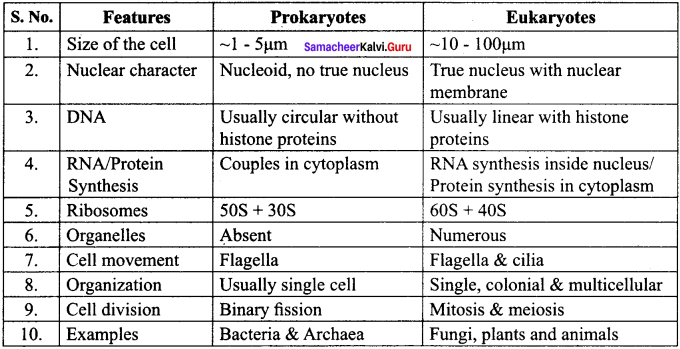
  6. To display data on arrivals and rates from time to time in the market.

Question 33.
List out the features of new trade policy.
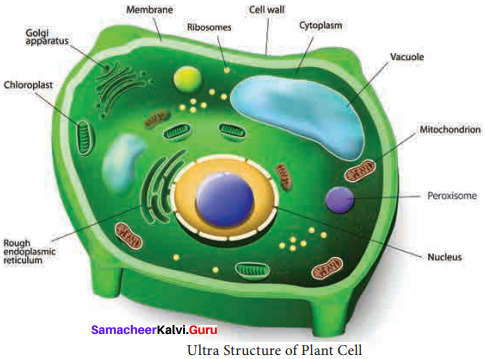
Answer:
The trade policy of 1 April 1992 freed imports of almost all intermediate and capital goods. Only 71 items remained restricted. This would affect the domestic industries. Rationalization of tariff structure and removal of quantitative restrictions.

The Chelliah Committee’s report had suggested drastic reduction in import duties. As a first step towards a gradual reduction in the tariffs, the 1991 -92 budget had reduced the peak rate of import duty.

Question 34.
What is GST? Write its advantages.
Answer:
GST is a comprehensive indirect tax levied on manufacture, sale and consumption of goods as well as services.

Advantages of GST :

  1. Removing cascading tax effect.
  2. Single point tax.
  3. Higher threshold for registration
  4. Composition scheme for small business.
  5. Online simpler procedure under GST.
  6. Defined treatment for e-commerce.
  7. Increased efficiency in logistics

Question 35.
Explain the objectives and characteristics of SEZs.
Answer:
The Special Economic Zones (SEZs) policy was announced in April 2000.
The major objectives of SEZs are :

  1. To enhance foreign investment especially to attract foreign direct investment (FDI) and thereby increasing GDP.
  2. To increase shares in global export.
  3. To generate additional economic activity.
  4. To create employment opportunities.
  5. To develop infrastructure facilities.
  6. To exchange technology in the global market.

Main characteristics of SEZs :
Geographically demarked area with physical security.

  1. Administrated by single body / authority.
  2. Streamlined procedures.
  3. Having separate custom area
  4. Governed by more liberal economic laws.
  5. Greater freedom to the firms located in SEZS.

Question 37.
Describe the salient features of EXIM policy (2015 – 2020)
Answer:
The new EXIM policy has been formulated focusing on increasing in exports scenario, boosting production and supporting the concepts like Make in India and Digital India.

  1. Reduce export obligations by 25% and give boost to domestic manufacturing supporting the “Make in India” concept.
  2. As a step to Digital India concept, online procedure to upload digitally signed document, and mobile app for filing tax, stamp duty has been developed.
  3. Repated submission of physical copies of documents are not required.
  4. Export obligation period for export items related to defence, military store, aerospace and nuclear energy to be 24 months.
  5. EXIM policy 2015 – 2020 is expected to double the share of India in World Trade from present level of 3% by the year 2020.This appears to the too ambitious.

Samacheer Kalvi 11th Economics Development Experiences in India Additional Questions and Answers

Part-A
Choose the best options

Question 1.
The expansion of FDI is
(a) Foreign comprehensive investment ______
(b) Foreign direct investment
(c) Foreign indirect investment
(d) Foreign private investment
Answer:
(b) Foreign direct investment

Question 2.
India ranked ______ position in Asia’s GDP.
(a) 4
(b) 3
(c) 1
(d) 2
Answer:
(b) 3

Question 3.
The monopoly and Restrictive Trade Practices Act was abolished in ______
(a) 1919
(b) 1971
(c) 1991
(d) 1791
Answer:
(c) 1991

Question 4.
Crop Insurance scheme was launched on
(a) 2009
(b) 2014
(c) 2016
(d) 2012
Answer:
(c) 2016

Question 5.
The expansion of KCC ______
(a) Kisan Crop Card
(b) Kisan Cash Card
(c) Kisan Credit Card
(d) None of the above
Answer:
(c) Kisan Credit Card

Question 6.
EPZ means ______
(a) Export Pay Zone
(b) Export Policy Zone
(c) Export Processing Zone
(d) Special Economic Zone
Answer:
(c) Export Processing Zone

Question 7.
Goods and Services Tax came into effect on ______
(a) 30,h June 2017
(b) 1st July 2016
(c) 1st July 2017
(d) 1st April 2017
Answer:
(c) 1st July 2017

Question 8.
Fiscal deficit should not exceed ______ percent of GDP
(a) 2
(b) 4
(c) 3
(d) 5
Answer:
(c) 3

Match the following and choose the answer using the codes given below

Question 1.
Samacheer Kalvi 11th Economics Solutions Chapter 9 Development Experiences in India
(a) 1 2 3 4
(b) 2 1 4 3
(c) 3 4 2 1
(d) 1 2 4 3
Answer:
(b) 2 1 4 3

Question 2.

(a) 4 3 2 1
(b) 3 2 4 1
(c) 1 2 3 4
(d) 3 1 4 2
Answer:
(d) 3 1 4 2

Choose the correct option

Question 3.
New economic policy was introduced in
(a) 2010
(b) 1991
(c) 1884
(d) 1894
Answer:
(b) 1991

Question 4.
Kisan card was introduced in
(a) 2000
(b) 2015
(c) 1998
(d) 2017
Answer:
(c) 1998

Question 5.
was one of the first in Asia to recognize the effectiveness of the export processing zone
(a) India
(b) China
(c) America
(d) Soviet Union
Answer:
(a) India

Fill in the blanks with suitable option given below

Question 6.
Disinvestment means
(a) Selling of government securities
(b) Selling of public sectors
(c) Selling of private securities
(d) None
Answer:
(a) Selling of government securities

Question 7.
was set up to encourage FDI
(a) Domestic investment promotion board
(b) Foreign investment promotion board
(c) Both
(d) None
Answer:
(b) Foreign investment promotion board

Question 8.
The share of India to Asia’s GDP is
(a) 7.50%
(b) 6.50%
(c) 8.50%
(d) 9.50%
Answer:
(c) 8.50%

Choose the incorrect statement

Question 9.
(a) Prime minister’s crop insurance scheme was launched on 2016
(b) New industrial policy was established on 1991
(c) Kisan credit card was introduced by RBI and NABARD
(d) Goods and Services Tax was introduced in 2015
Answer:
(d) Goods and Services Tax was introduced in 2015

Question 10.
(a) New foreign trade policy was introduced on 2015
(b) First ever export processing zone was set up by China
(c) Cold storage order was introduced on 1964.
(d) India’s GDP crossed 2 trillion dollars in 2015-16
Answer:
(b) First ever export processing zone was set up by China

Choose the incorrect pair

Question 11.
Samacheer Kalvi 11th Economics Solutions Chapter 9 Development Experiences in India
(a) 1 2 3 4
(b) 2 1 4 3
(c) 3 4 2 1
(d) 1 2 4 3
Answer:
(b) 2 1 4 3

Question 12.
Samacheer Kalvi 11th Economics Solutions Chapter 9 Development Experiences in India
(a) 4 3 2 1
(b) 3 2 4 1
(c) 1 2 3 4
(d) 3 1 4 2
Answer:
(c) Chelliah committee (iii) GST

Choose the correct pair

Question 13.
Samacheer Kalvi 11th Economics Solutions Chapter 9 Development Experiences in India
Answer:
(d) Cash reserve ratio (iv) 1991

Question 14.
Samacheer Kalvi 11th Economics Solutions Chapter 9 Development Experiences in India
Answer:
(a) Dr.Raj Krishna (i) Low rate of economic growth

Pick the odd one out

Question 15.
(a) Liberalization
(b) Industrialization
(c) Privatization
(d) Globalization
Answer:
(b) Industrialization

Question 16.
(a) Crop insurance
(b) Cold storage
(c) Agriculture subsidy reduction
(d) Kisan credit card
Answer:
(c) Agriculture subsidy reduction

Choose the correct statement

Question 17.
(a) China is the largest producer of fruits.
(b) India is the largest producer of vegetables.
(c) Agricultural produce market committee (ADMC) promote agricultural activities.
(d) Tobacco is a plantation crop
Answer:
(c) Agricultural produce market committee (ADMC) promote agricultural activities.

Question 18.
(a) Privatization measures discourages the continuance of monopoly.
(b) Disinvestment process was fully implemented
(c) New industrial policy abolished MRTP act.
(d) Foreign investment includes FDI and FII
Answer:
(c) New industrial policy abolished MRTP act.

Analyse the reason for the following

Question 19.
Assertion (A) : Agriculture in India is highly prone to risks like droughts and floods.
Reason (R) : Agriculture is a seasonal activity.
(a) (A) and (R) are true; (R) is the correct explanation of (A)
(b) (A) and (R) are true. (R) is not the correct explanation of (A)
(c) Both (A) and (R) are false.
(d) (A) is true (R) is false.
Answer:
(a) (A) and (R) are true; (R) is the correct explanation of (A)

Question 20.
Assertion (A) : GST is a comprehensive indirect tax.
Reason (R) : GST is a multi point tax
(a) (A) is true (R) is false.
(b) (A) is false (R) is true
(c) Both (A) and (R) are true.
(d) Both (A) and (R) are false.
Answer:
(a) (A) is true (R) is false.

Part -B
Answer the following questions in one or two sentences

Question 1.
What is industrial delicensing policy or Red Tapism?
Answer:
The new industrial policy of 1991 abolished the procedure of securing licenses (Red Tapism) to start an industry which is called as industrial delicensing policy.

Question 2.
What is liberalization?
Answer:
Liberalization refers to removal of relaxation of governmental restrictions in all stages in industry.

Question 3.
What is Statutory Liquidity Ratio (SLR) ?
Answer:
SLR refers to the amount that the commercial banks require to maintain in the form of cash or gold or government approved securities before providing credit to the customers. Agricultural Produce Market Committee (APMC) is a statutory body constituted by state government in order to trade in agricultural or horticultural or livestock produce.

Question 5.
Write a note on Kisan Credit Card.
Answer:
A Kisan Credit Card (KCC) is a credit delivery mechanism that is aimed at enabling farmers to have quick and timely access to affordable credit. It was launched in 1998 by RBI and NABARD.

Question 6.
What is globalization ?
Answer:
Globalization stand for the consolidation of the various economies of the world.

Question 7.
Explain agrarian crisis after the economic reforms of 1991.
Answer:

  1. High input costs
  2. Cutback in agricultural subsidies
  3. Reduction of import duties
  4. Paucity of credit facilities.

Part – C
Answer the following questions in one Paragraph

Question 1.
What is crop insurance scheme ?
Answer:
To protect the farmers from natural calamities and ensure their credit eligibility for the next season, the Government of India introduced many agricultural schemes throughout the country.

One of the scheme is the Pradhan Mantri Fasal Bima Yojana which was launched on 18 February 2016. It envisages a uniform premium of 2% for Kharif and 1.5% for Rabi and 5% for commercial and horticultural crops.

Question 2.
State the arguments against LPG.
Answer:

  1. Liberalization measures favor the unrestricted entry of foreign companies which prevents the growth of the local manufactures.
  2. Privatization measures favor the continuance of the monopoly power.
  3. Only the developed countries are favored under globalization but the welfare of (he less developed countries will be neglected.

Question 3.
Explain the major changes in India after 1991.
Answer:

  1. Foreign exchange reserves started rising.
  2. There was a rapid industrialization.
  3. The pattern of consumption started improving.
  4. Infrastructure facilities such as express highways, metro rails, flyovers and airports started expanding (but the local people were thrown away).

Part -D
Answer the following questions in about a page

Question 1.
Explain the measures taken in Ranking system under new economic policy 1991.
Answer:

  1. Reduction in statutory liquidity ratio (SLR) and the Cash Reserve Ratio (CRR) were recommended by the Narasimham Committee Report 1991.
  2. Interest rate liberalization.
  3. Greater competition among public, private and foreign banks and elimination of administrative constraints.
  4. Liberalization of bank branch licensing policy.
  5. Banks were given freedom to relocate branches and open specialised branches.
  6. Guidelines for opening new private sector banks.
  7. New accounting norms regarding classification of assets and provisions of bad debt were introduced.

If you need some more information about Tamilnadu State Board Solutions for 11th Economics Chapter 9 Development Experiences in India Questions and Answers then visit our site frequently and get all the resources that you look for. Also, share this page with your friends and make them learn all the concepts thoroughly before the exams.

Samacheer Kalvi 11th Economics Solutions Chapter 8 Indian Economy Before and After Independence

Immediately get Chapter Wise Tamilnadu State Board Solutions for 11th Economics to gain more marks and start Quick Revision of all Chapters. All Chapters Pdf is provided along with the Questions and Answers. You Can Dowload Samacheer Kalvi 11th Economics Book Solutions Questions and Answers for Chapter wise are given with a clear explanation. Tamilnadu State Board Solutions for 11th Economics Chapter 8 Indian Economy Before and After Independence Questions and Answers is for free of cost.

Tamilnadu Samacheer Kalvi 11th Economics Solutions Chapter 8 Indian Economy Before and After Independence

Tamilnadu State Board Solutions for 11th Economics Chapter 8 Indian Economy Before and After Independence Questions and Answers PDF has all given in Chapter Wise Section. Check Out daily basis with Tamilnadu State Board Solutions 11th Economics PDF will help to improve your score. Improve your level of accuracy to answer a question by reading with Samacheer Kalvi 11th Economics Book Solutions Questions and Answers PDF.

Samacheer Kalvi 11th Economics Indian Economy Before and After Independence Text Book Back Questions and Answers

Part – A
Multiple Choice Questions

Question 1.
The arrival of Vasco da Gama in Calicut, India
(a) 1498
(b) 1948
(c) 1689
(d) 1849
Answer:
(a) 1498

Question 2.
In 1614 Sir Thomas Roe was successful in getting permission from
(a) Akbar
(b) Shajakan
(c) Jahangir
(d) Noorjakhan
Answer:
(c) Jahangir

Question 3.
The power for governance of India was transferred from the East India Company (EIC) to the British crown in
(a) 1758
(b) 1858
(c) 1958
(d) 1658
Answer:
(b) 1858

Question 4.
Ryotwari system was initially introduced in _______
(a) Kerala
(b) Bengal
(c) Tamil Nadu
(d) Maharastra
Answer:
(c) Tamil Nadu

Question 5.
First World War started in the year _______
(a) 1914
(b) 1814
(c) 1941
(d) 1841
Answer:
(a) 1914

Question 6.
When did the Government of India declared its first Industrial Policy ?
(a) 1956
(b) 1991
(c) 1948
(d) 2000
Answer:
(c) 1948

Question 7.
The objective of the Industrial Policy 1956 was
(a) Develop heavy industries
(b) Develop agricultural sector only
(c) Develop private sector only
(d) Develop cottage industries only
Answer:
(a) Develop heavy industries

Question 8.
The industry which was de-reserved in 1993 ?
(a) Railways
(b) Mining of copper and zinc
(c) Atomic energy
(d) Atomic minerals
Answer:
(b) Mining of copper and zinc

Question 9.
The father of Green Revolution in India was _______
(a) M.S. Swaminathan
(b) Gandhi
(c) Visweswaraiah
(d) N.R. Viswanathan
Answer:
(a) M.S. Swaminathan

Question 10.
How many commercial banks were nationalised in 1969 ?
(a) 10
(b) 12
(c) 14
(d) 16
Answer:
(c) 14

Question 11.
The main objective of nationalisation of banks was _______
(a) Private social welfare
(b) Social welfare
(c) To earn
(d) Industries monopoly
Answer:
(b) Social welfare

Question 12.
The Planning Commission was setup in the year _______
(a) 1950
(b) 1955
(c) 1960
(d) 1952
Answer:
(a) 1950

Question 13.
In the first five year plan, the top priority was given to _______ Sector.
(a) Service
(b) Industrial
(c) Agriculture
(d) Bank
Answer:
(c) Agriculture

Question 14.
Tenth Five year plan period was _______
(a) 1992-1997
(b) 2002-2007
(c) 2007-2012
(d) 1997-2002
Answer:
(b) 2002-2007

Question 15.
According to HDR (2016), India ranked _______ out of 188 countries.
(a) 130
(b) 131
(c) 135
(d) 145
Answer:
(b) 131

Question 16.
Annual Plans formed in the year _______
(a) 1989-1991
(b) 1990-1992
(c) 2000-2001
(d) 1981-1983
Answer:
(b) 1990-1992

Question 17.
The Oldest large scale industry in India ________
(a) cotton
(b) jute
(c) steel
(d) cement
Answer:
(a) cotton

Question 18.
Human development index (HDI) was developed _________
(a) Jawaharlal Nehru
(b) M.K.Gandhi
(c) Amartiya Sen
(d) Tagore
Answer:
(c) Amartiya Sen

Question 19.
The main theme of the Twelth Five Year Plan __________
(a) faster and more inclusive growth
(b) growth with social Justice
(c) socialistic pattern of society
(d) faster, more inclusive and sustainable growth
Answer:
(d) faster, more inclusive and sustainable growth

Question 20.
The PQLI was developed by _______
(a) Planning Commission
(b) Nehru
(c) Morris
(d) Morris
Answer:
(c) Morris

Part – B
Answer the following questions in one or two sentences

Question 21.
What are the Phases of colonial exploitation of India?
Answer:
The period of merchant capital, the period of industrial capital, the period of finance capital.

Question 22.
Name out the different types of land tenure existed in India before Independence.
Answer:

  1. Zamindari system
  2. Mahalwari system
  3. Ryotwari system

Question 23.
State the features that distinguish a land tenure system from other system.
Answer:
The land tenure system differs as

  1. Who owns the land ?
  2. Who cultivates the land ?
  3. Who is responsible for paying the land revenue to the government ?

Question 24.
List out the weaknesses on Green Revolution.
Answer:

  1. Indian agriculture was still a gamble of the monsoons.
  2. This strategy needed heavy investment.
  3. The income gap has increased
  4. Increased unemployment among agricultural labourers.
  5. Reduced the soil fertility and spoiled human wealth.

Question 25.
What are the objectives of Tenth five year plan ?
Answer:

  1. Double the per capita income in the next 10 years.
  2. Aimed to reduce the poverty ratio to 15% by 2012.
  3. Growth target was 8.0% but it achieved only 7.2%

Question 26.
What is the difference between HDI and PQLI ?
Answer:

  1. Human Development Index : It is constructed based on life expectancy index, Education index and GDP per capita.
  2. Physical quality of life index : The PQLI is a measure to calculate the quality of life.

Question 27.
Mention the indicators which are used to calculate HDI.
Answer:

  1. Life expectancy index.
  2. Educational index.
  3. GDP per capita.

Part – C
Answer the following questions in one Paragraph

Question 28.
Explain about the Period of Merchant Capital.
Answer:

  1. The period of merchant capital was from 1757 to 1813.
  2. The only aim of the East India company was to earn profit by establishing monopoly trade.
  3. During this period, India had been considered as the best hunting ground for capital
  4. The objective of monopoly trade was fulfilled by achieving political control.
  5. The company administration succeeded in generating huge surpluses which were repatriated to England.

Question 29.
The Handicrafts declined in India in British Period. Why?
Answer:

  1. Through discriminatory tariff policy, the British Government purposefully destroyed the handicrafts.
  2. With the disappearance of Nawabs and Kings, there was no one to protect Indian handicrafts.
  3. Indian products could not compete with machine made products.
  4. Introduction of railways in India increased the domestic market for the British goods.

Question 30.
Elucidate the different types of land tenure system in colonial India.
Answer:
The three types of land tenure system are Zamindari, Mahalwari and Ryotwari system.

1. Zamindari system or the land – lords : This system was created in 1793,after the introduction of permanent settlement act. Under this system the landlords were declared as the owners of the land. They were responsible to pay the land revenue. The share of the rent to government is fixed at 10/11th and the balance as zamindar’s remuneration.

2. Mahalwari system or communal farming : The ownership of the land was maintained by the collective body of villagers which served as a unit of management. They distribute the land and collect revenue and pay it to the state.

3. Ryotwari or the owner – cultivator system : The ownership rights of use and control of land were held by the tiller himself.

Question 31.
State the reasons for nationalization of commercial banks.
Answer:

  1. The main objective of the economic planning aimed at social welfare.
  2. Before independence commercial banks were in the private sector.
  3. These commercial banks failed in helping the government to achieve social objectives of planning.
  4. Therefore, the government decided to nationalize 14 major commercial banks on 1969

Question 32.
Write any three objectives of Industrial Policy 1991.
Answer:

  1. Ensuring rapid industrial development in a competitive environment.
  2. Enchancing support to the small scale sector.
  3. Providing more incentives for industrialisation of the backward areas.

Question 33.
Give a note on Twelfth Five Year Plan.
Answer:

  1. Twelfth five year plan (2012 – 17).
  2. Its main theme is “Faster more inclusive and sustainable growth”
  3. Its growth rate target is 8%

Question 34.
What is PQLI ?
Answer:
Morris D Morris developed the physical quality of life index (PQLI). The PQLI is a measure to calculate the quality of life.
PQLI includes three indicators life expectancy, infant mortality rate and literacy rate. A scale of each indicator ranges from the number 1 to 100. Represents the worst performance and 100 is the best performance.
HDI includes income while PQLI do not. PQLI has only the physical aspects of like.

Part – D
Answer the following questions in about a page

Question 35.
Discuss about the Indian economy during British Period.
Answer:
Britain had exploited India over a period of two centuries of its colonial rule. On the basis of the form of colonial exploitation, economic historians have divided the whole period into three phases namely the period of merchant capital, period of industrial capital and the period of finance capital.

1. Period of merchant capital (1757 to 1813):
The only aim of the East India company was to earn profit by establishing monopoly trade. India was considered as the best hunting ground for capital. By attaining political power the objective of monopoly trade was fulfilled. The company administration succeeded in generating huge surpluses which were repatriated to England.

2. Period of industrial capital (1813 to 1858):
India had become a market for British textiles. Indians were exploited by fixing low price for exports and high price for imports. India’s traditional handicrafts were thrown out of gear.

3. Period of financial capital (Late 19th century – 1947) : Finance imperialism began to entrench. Britain decided to make massive investments in various fields by plundering Indian capital.

4. The land tenure system in India : Land tenure refers to the system of land ownership and managements.
The Zamindari system, the Mahalwari system and the Ryotwari system were the systems of land tenure introduced by British.

5. Problems of British rule : Their profit motives led to drain of resources from India. The handicraft industries were collapsed.
The British rule stunted the growth of Indian enterprise. Capital formation in India were retarded.

Question 36.
Explain the role of SSIs in economic development?
Answer:

1. SSIs provide employment:

  • SSIs use labour intensive techniques thus reduce the problem of unemployment to a great extent.
  • They provide employment to people in villages and unorganized sectors.
  • The employment – capital ratio is high for the SSIs.

2. SSIs bring balanced regional development: SSIs remove regional disparities by industrializing rural and backward areas and bring balanced regional development.

3. Help in mobilization of local resources : SSIs help to mobilize and utilize local resources like small savings, entrepreneurial talent etc.,

4. Pave for optimization of capital: SSIs require less capital per unit of output. They function as a stabilizing force by providing output-capital ratio as well as high employment capital ratio.

5. Promote exports : SSIs earn valuable foreign exchange through exports from India.

6. Complement large scale industries : SSIs serve as ancillaries to large scale units.

7. Meet consumer demands : SSIs serves as an anti-inflationary force by providing goods of daily use.

8. Develop entrepreneurship : They promote self-employment and spirit of self-reliance in the society. They help to increase the per capita income. They help in distributing national income in more efficient and equitable manner.

Question 37.
Explain the objectives of nationalization of commercial banks.
Answer:

  1. The main objective of nationalization was to attain social welfare. Sectors such as agriculture, small and village industries were in need of funds for their expansion and further economic development.
  2. It helped to curb private monopolies in order to ensure a smooth supply of credit to socially desirable sections.
  3. To encourage the banking habit among the rural population.
  4. To reduce the regional imbalances where the banking facilities were not available.
  5. After nationalization, new bank branches were opened in both rural and urban areas, and they created credit facilities mainly to the agriculture sector and its allied activities.

Question 38.
Describe the performance of 12th five year plan in India.
Answer:
Economic planning is the process in which the limited natural resources are used skillfully so as to achieve the desired goals.

1. First five year plan (1951 – 56) : Main focus was on the agricultural development it achieved the growth rate of 3.6%.

2. Second five year plan (1956 – 61) : Focus was on the industrial development of the country and achieved the growth rate of 4.1%.

3. Third five year plan (1961 – 66): To make the economy independent and to reach take off.

4. Plan holiday (1966 – 69): Equal priority was given to agriculture, its allied sectors and the industrial sectors during annual plans.

5. Fourth five year plan (1969 – 74): Growth with stability and progressive achievement of self reliance was the goal but the plan failed.

6. Fifth five year plan (1975 – 79): A successful plan prioritized agriculture and then industry and mines.

7. Rolling plan : This plan was started with an annual plan for 1978-79.

8. Sixth five year plan (1980 – 85): Based on investment yojana, its objective was poverty eradication and technological self reliance.

9. Seventh five year plan (1985 – 90): Establishment of the self sufficient economy and opportunities for productive employment. Private sector got the priority over public sector.

10. Annual plans : Two annual plans were formed in 1990 – 91 & 1991 -92.

11. Eighth five year plan (1992 – 97): Priority was given to development of the human resources. New economic policy was introduced.

12. Ninth five year plan (1997 – 02):

  • Aimed to double the percapita income in the next 10 years.
  • Aimed to reduce the poverty ratio to 15% by 2012.

13. Tenth five year plan (2002 – 07): Growth with justice and equity was the focus but the plan failed with growth rate of 5.6%. Aimed to double the percapita income in the next 10 years. Aimed to reduce the poverty ratio to 15% by 2012.

14. Eleventh five year plan (2007 – 12): Main theme was faster and more inclusive growth.

15. Twelfth five year plan (2012 – 17): Main theme was faster more inclusive and sustainable growth. The five year plans played a’very prominent role in the economic development of the country. These plans had guided the government as to how it should utilise scarce resources so that maximum benefits can be gained.

Samacheer Kalvi 11th Economics Indian Economy Before and After Independence Additional Questions and Answers

Part – A
Choose the best options

Question 1.
Lord Cornwallis introduced “Permanent Settlement Act in” _______
(a) 1793
(b) 1794
(c) 1795
(d) 1796
Answer:
(a) 1793

Question 2.
In the year _______ green revolution started in India.
(a) 1950
(b) 1951
(c) 1948
(d) 1960
Answer:
(d) 1960

Question 3.
KGN. Daber established Mumbai’s spinning and weaving co. in _______
(a) 1810
(b) 1854
(c) 1845
(d) 1948
Answer:
(b) 1854

Question 4.
The oil well of Digboi, Assam was dug in.
(a) 1889
(b) 1898
(c) 1988
(d) 1810
Answer:
(a) 1889

Question 5.
The period of twelfth five year plan _______
(a) 2010 – 15
(b) 2011 – 16
(c) 2012 – 17
(d) 2013 – 18
Answer:
(c) 2012 – 17

Question 6.
NITI Aayog replaced the planning commission in _______
(a) 2013
(b) 2015
(c) 2014
(d) 2016
Answer:
(b) 2015

Question 7.
Human development index is _______
(a) HDI
(b) UNDP
(c) PQLI
(d) HID
Answer:
(a) HDI

Question 8.
Physical Quality of Life Index (PQLI) was developed by _______
(a) HDI
(b) PQLI
(c) UNDP
(d) HID
Answer:
(c) UNDP

Question 9.
In _______ system the ownership rights of use and control of land were held by the tiller himself.
(a) Zamindari
(b) Mahalwari
(c) Ryotwari
(d) Green revolution
Answer:
(c) Ryotwari

Question 10.
The period of industrial capital is _______
(a) 1757 – 1813
(b) 1813 – 1858
(c) 1757 – 1858
(d) 19 th century
Answer:
(b) 1813 – 1858

Match the following and choose the answer using the codes given below

Question 1.
Samacheer Kalvi 11th Economics Solutions Chapter 8 Indian Economy Before and After Independence
(a) 12 3 4
(b) 2 4 3 1
(c) 2 3 1 4
(d) 4 3 2 1
Answer:
(c) 2 3 1 4

Question 2.
Samacheer Kalvi 11th Economics Solutions Chapter 8 Indian Economy Before and After Independence
(a) 12 3 4
(b) 2 1 4 3
(c) 4 3 2 1
(d) 2 3 1 4
Answer:
(b) 2 1 4 3

Choose the correct option

Question 3.
The period of merchant capital is _______
(a) 1842 – 1857
(b) 1918 – 1920
(c) 1757 – 181
(d) 1721 – 1838
Answer:
(c) 1757 – 181

Question 4.
How many types of land tenure system were there before independence ?
(a) 2
(b) 3
(c) 1
(d) 5
Answer:
(b) 3

Question 5.
The first Indian modernized cotton cloth mill was established _______
(a) Chennai
(b) Calcutta
(c) Mumbai
(d) Bengaluru
Answer:
(b) Calcutta

Fill in the blanks with suitable option given below

Question 6.
The plan holiday was _______
(a) 1951-53
(b) 1966-69
(c) 2001 -02
(d) 1976-79
Answer:
(b) 1966-69

Question 7.
The planning commission was replaced by _______
(a) NITI Aayog
(b) Planning group
(c) Finance commission
(d) None of the above
Answer:
(a) NITI Aayog

Question 8.
NITI Aayog was formed in _______
(a) 2001
(b) 2014
(c) 2015
(d) 2016
Answer:
(c) 2015

Choose the incorrect statement

Question 9.
(a) Ryotwari system was first established in Tamilnadu.
(b) Zamindari system was established by British East India Company
(c) Mahalwari system was also called as the owner – cultivator system
(d) Zamindari system was created in 1793
Answer:
(c) Mahalwari system was also called as the owner – cultivator system

Question 10.
(a) The investment of small service enterprises should be more than ? 10 lakhs.
(b) The investment of micro service enterprises should not exceed ?10 lakhs.
(c) The investment of medium service enterprises should be more than ?2 crores,
(d) The investment of medium service enterprises should not exceed ?10 crores.
Answer:
(d) The investment of medium service enterprises should not exceed ?10 crores.

Choose the incorrect pair

Question 11.
Samacheer Kalvi 11th Economics Solutions Chapter 8 Indian Economy Before and After Independence
Answer:
(c) Vijaya nagar (iii) England

Question 12.
Samacheer Kalvi 11th Economics Solutions Chapter 8 Indian Economy Before and After Independence
Answer:
(c) Serampur (iii) Iron and steel

Chooose the correct pair

Question 13.
Samacheer Kalvi 11th Economics Solutions Chapter 8 Indian Economy Before and After Independence
Answer:
(a) Industrial policy (i) 1948

Question 14.
Samacheer Kalvi 11th Economics Solutions Chapter 8 Indian Economy Before and After Independence
Answer:
(d) White revolution (iv) Milk

Analyse the reason for the following

Question 15.
Assertion (A) : Before the advent of the British, Indian economy was self sufficient.
Reason (R) : Before the advent of the British, India lived in village.
(a) Both (A) and (R) are true
(b) (A) is true (R) is false
(c) Both (A) and (R) are false.
(d) (A) is false (R) is true.
Answer:
(a) Both (A) and (R) are true

Choose the incorrect statement

Question 16.
(a) The industrial policy resolutions in India ushered a socialistic economy
(b) The high yielding varieties programme was called as pilot project of green revolution
(c) The aim of seventh five year plan is ‘Garibi Hatao’
(d) Finance commission replaced the planning commission.
Answer:
(b) The high yielding varieties programme was called as pilot project of green revolution

Question 17.
(a) Switzerland ranks first in HDI.
(b) PQLI includes income whereas HDI excludes income
(c) The process of transforming private assets to government ownership is called privatization
(d) The third plan was called as ‘Gadgil plan’.
Answer:
(d) The third plan was called as ‘Gadgil plan’.

Pick the odd one out

Question 18.
(a) The period of revenue capital
(b) The period of industrial capital
(c) The period of merchant capital
(d) The period of financial capital
Answer:
(c) The period of merchant capital

Question 19.
(a) Investment system
(b) Zamindari system
(c) Mahalwari system
(d) Ryotwari system
Answer:
(a) Investment system

Question 20.
(a) Black revolution
(b) Red revolution
(c) White revolution
(d) Violet revolution
Answer:
(d) Violet revolution

Part – B
Answer the following questions in one or two sentences

Question 1.
Name the classification of industries in India?
Answer:

  1. Public sector
  2. Public-cum-private sector
  3. Controlled private sector
  4. Private and co-operative sectors.

Question 2.
What is the resolution of industrial policy 1948 ?
Answer:
The first industrial policy was declared on 6th April 1948. Its main importance was introducing the system of mixed economy in India.

Question 3.
What is the resolution of industrial policy 1956 ?
Answer:
The policy was shaped by the mahalanobis model of growth with emphasis on heavy industries which would lead to higher growth path.

Question 4.
Write a note on micro manufacturing enterprises.
Answer:
In micro enterprises, the investment in plant and machinery does not exceed Rs. 25 lakhs.

Question 5.
Write a note on small manufacturing enterprises
Answer:
The investment in plant and machinery is more than twenty five lakh rupees but does not exceed Rs. 5 crores.

Question 6.
Write a note on medium manufacturing enterprises.
Answer:
The investment in plant and machinery is more than Rs. 5 crores but not exceeding Rs. 10 crores.

Question 7.
Name the classification of public sector banks.
Answer:

  1. Nationalised Banks.
  2. State Bank and its associates

Part – C
Answer the following questions in one Paragraph

Question 1.
Describe the problems of British rule in Indian economy ?
Answer:

  1. The British rule stunted the growth of Indian enterprise. It retarded the capital formation in India.
  2. The drain of wealth financed capital development in Britain.
  3. Indian agricultural sector became stagnant and deteriorated.
  4. Indian handicraft industries were collapsed.
  5. The system of capitalist firms with profit motives led to drain of resources from India.

Question 2.
Mention the achievements of green revolution.
Answer:

  1. The production of major cereals wheat and rice were boosted. India became food surplus exporting food grains to European countries.
  2. It was confined to high yielding variety cereals.
  3. Production of commercial crops were increased.
  4. Per hectare productivity of all crops had increased due to better seeds.
  5. The revolution had positive effect on development of industries manufacturing agricultural tools.
  6. It brought prosperity to rural people.
  7. Demand for labour increased.
  8. Financial resources were provided by banks and co-operative societies.

Question 3.
Examine the requirements of second green revolution.
Answer:

  1. Introduction of genetically modified (GM) seeds which double the per average production.
  2. Contribution of private sector to market the usage of GM foods.
  3. Government can play a key role in expediting irrigation schemes and managing water resources.
  4. Linking of rivers to transfer surplus water to deficient areas.

Question 4.
Write a note on iron and steel industry.
Answer:

  1. First steel industry at Kulti, near Jharia, West Bengal – Bengal iron works company in 1870.
  2. First large scale steel plant TISCO at Jamshedpur in 1907.
  3. Steel authority of India Ltd. (SAIL) was established in 1974 and was made responsible for the development of the steel industry.
  4. India is the eighth largest steel producing country in the world.

Question 5.
Write a note on petrol and natural gas.
Answer:

  1. First successful oil well was dug in India in 1889 at Digboi, Assam.
  2. At present a number of regions with oil reserves have been identified and oil is being extracted in these regions.
  3. For exploration purpose, Oil and Natural Gas Commission (ONGC) was established in 1956 at Dehradun, Uttarakhand.

If you need some more information about Tamilnadu State Board Solutions for 11th Economics Chapter 8 Indian Economy Before and After Independence Questions and Answers then visit our site frequently and get all the resources that you look for. Also, share this page with your friends and make them learn all the concepts thoroughly before the exams.

Samacheer Kalvi 11th Economics Solutions Chapter 7 Indian Economy

Immediately get Chapter Wise Tamilnadu State Board Solutions for 11th Economics to gain more marks and start Quick Revision of all Chapters. All Chapters Pdf is provided along with the Questions and Answers. You Can Dowload Samacheer Kalvi 11th Economics Book Solutions Questions and Answers for Chapter wise are given with a clear explanation. Tamilnadu State Board Solutions for 11th Economics Chapter 7 Indian Economy Questions and Answers is for free of cost.

Tamilnadu Samacheer Kalvi 11th Economics Solutions Chapter 7 Indian Economy

Tamilnadu State Board Solutions for 11th Economics Chapter 7 Indian Economy Questions and Answers PDF has all given in Chapter Wise Section. Check Out daily basis with Tamilnadu State Board Solutions 11th Economics PDF will help to improve your score. Improve your level of accuracy to answer a question by reading with Samacheer Kalvi 11th Economics Book Solutions Questions and Answers PDF.

Samacheer Kalvi 11th Economics Indian Economy Text Book Back Questions and Answers

Part – A
Multiple Choice Questions

Question 1.
The main gold mine region in Karnataka is _________
(a) Kolar
(b) Ramgiri
(c) Anantpur
(d) Cochin
Answer:
(a) Kolar

Question 2.
Economic growth of a country is measured by national income indicated by _________
(a) GNP
(b) GDP
(c) NNP
(d) Per capital income
Answer:
(b) GDP

Question 3.
Which one of the following is a developed nations ?
(a) Mexico
(b) Ghana
(c) France
(d) SriLanka
Answer:
(c) France

Question 4.
The position of Indian Economy among the other strongest economies in the world is _______
(a) Fourth
(b) Seventh
(c) Fifth
(d) Tenth
Answer:
(b) Seventh

Question 5.
Mixed economy means _________
(a) Private sectors and banks
(b) Co-existence of Public and Private sectors
(c) Public sectors and banks
(d) Public sectors only
Answer:
(b) Co-existence of Public and Private sectors

Question 6.
The weakness of Indian Economy is _________
(a) Economic disparities
(b) Mixed economy
(c) Urbanisation
(d) Adequate employment opportunities
Answer:
(a) Economic disparities

Question 7.
A scientific study of the characteristics of population is _________
(a) Topography
(b) Demography
(c) Geography
(d) Philosophy
Answer:
(b) Demography

Question 8.
The year 1961 is known as _________
(a) Year of small divide
(b) Year of Population Explosion
(c) Year of Urbanisation
(d) Year of Great Divide
Answer:
(b) Year of Population Explosion

Question 9.
In which year the population of India crossed one billion mark ?
(a) 2000
(b) 2001
(c) 2005
(d) 1991
Answer:
(b) 2001

Question 10.
The number of deaths per thousand population is called as ________
(a) Crude Death Rate
(b) Crude Birth Rate
(c) Crude Infant Rate
(d) Maternal Mortality Rate
Answer:
(a) Crude Death Rate

Question 11.
The number of births per thousand population is called as _________
(a) Crude death rate
(b) Mortality rate
(c) Morbidity rate
(d) Crude Birth Rate
Answer:
(d) Crude Birth Rate

Question 12.
Density of population = _________
(a) Land area / Total Population
(b) Land area / Employment
(c) Total Population / Land area of the region
(d) Total Population
Answer:
(c) Total Population / Land area of the region

Question 13.
Who introduced the National Development Council in India?
(a) Ambedkar
(b) Jawaharlal Nehru
(c) Radhakrishanan
(d) V.K.R.V. Rao
Answer:
(b) Jawaharlal Nehru

Question 14.
Who among the following propagated Gandhian Ecomomic thinkings.
(a) Jawaharlar Nehru
(b) VKRV Rao
(c) JC Kumarappa
(d) A.K.Sen
Answer:
(c) JC Kumarappa

Question 15.
The advocate of democratic socialism was
(a) Jawaharlal Nehru
(b) P.C. Mahalanobis
(c) Dr. Rajendra Prasad
(d) Indira Gandhi
Answer:
(a) Jawaharlal Nehru

Question 16.
Ambedkar the problem studied by in the context of Indian Economy is ________
(a) Small land holdings and their remedies
(b) Problem of Indian Currency
(c) Economics of socialism
(d) All of them
Answer:
(b) Problem of Indian Currency

Question 17.
Gandhian Economics is based on the Principle _________
(a) Socialistic idea
(b) Ethical foundation
(c) Gopala Krishna Gokhale
(d) Dadabhai Naoroji
Answer:
(b) Ethical foundation

Question 18.
V.K.R.V Rao was a student of _________
(a) J.M. Keynes
(b) Colin Clark
(c) Adam smith
(d) Alfred Marshal
Answer:
(a) J.M. Keynes

Question 19.
Amartya Kumara Sen received the Nobel prize in Economics in the year.
(a) 1998
(b) 2000
(c) 2008
(d) 2010
Answer:
(a) 1998

Question 20.
Thiruvalluvar economic ideas mainly dealt with _________
(a) Wealth
(b) Poverty is the curse in the society
(c) Agriculture
(d) All of them
Answer:
(d) All of them

Part – B
Answer the following questions in one or two sentences

Question 21.
Write the meaning of Economic Growth.
Answer:
A country’s economic growth is usually indicated by Gross Domestic Product (GDP). The GDP is the total monetary value of the goods and services produced by that country over a specific period of time, usually one year.

Question 22.
State any two features of developed economy.
Answer:

  1. High National Income
  2. High per capital Income

Question 23.
Write the short note on natural resources
Answer:
Natural resources are stock or reserve that can be drawn from nature. The major natural resources are land, forest, water, mineral and energy.

Question 24.
Point out any one feature of Indian Economy
Answer:
Indian economy is a mixed economy. In India both the private and public sectors coexist.

Question 25.
Give the meaning of non-renewable energy
Answer:
The sources of energy which cannot be renewed or re-used are called non-renewable energy.
(Eg.) Coal, Oil, Gas etc.

Question 26.
Give a short note on Sen’s ‘Choice of Technique’.
Answer:
In a labour surplus economy, generation of employment cannot be increased at the initial stage by the adaptation of capital intensive technique whatsen called as choice of technique.

Question 27.
List out the reasons for low per capital income as given by V.K.R.V. Rao.
Answer:

  1. Uneconomic holdings.
  2. Low levels of water availability for crops.
  3. Excess population pressure on agriculture due to the absence of a large industrial sector.
  4. Absence of capital.
  5. Absence of autonomy in currency policy.

Part – C
Answer the following questions in one Paragraph

Question 28.
Define Economic Development.
Answer:
The level economic development is indicated not just by GDP, but by an increase in citizen’s quality of life or well-being. The quality of life is being assessed by several indices such as Human Development Index (HDI), Physical Quality of Life Index (PQLI) and Gross National Happiness Index (GNHI)

Question 29.
State Ambedkar’s Economic ideas on agricultural economics.
Answer:
Dr. B.R.Ambedkar was a versatile personality. In 1918, he published a paper “Small holding in India and their remedies” citing Adam Smith’s “Wealth of Nations”, he made a fine distinction between “Consolidation of holdings” and “Enlargement of holdings”.

Question 30.
Write on short note on village sarvodhaya.
Answer:
Village sarvodhaya is the concept of Gandhiji on the development of villages. To Gandhi India lives in villages. He was interested in developing the villages as self – sufficient units.

According to him, “Real India was to be found in villages and not in towns or cities”.
So he suggested the development of self-suffficient, self dependent villages.

Question 31.
Write the strategy of Jawahar lal Nehru in India’s planning.
Answer:

  1. Jawahar lal Nehru was responsible for the introduction of planning in our country.
  2. To Nehru, the plan was essentially an integrated approach for development.
  3. He said the essence of planning is to find the best way to utilize all resources of manpower, of money and so on.
  4. Planning for Nehru was essentially linked up with industrialization and eventual self reliance for the country’s economic growth on a self-accelerating growth.
  5. Nehru carried through this basic strategy of planned development.

Question 32.
Write the V.K.R.V.Rao’s contribution on multiplier concept.
Answer:

  1. Rao’s examination of the “interrelation between investment, income and multiplier in an under developed economy (1952)” was his major contribution to macroeconomic theory.
  2. In it he asserts that keynesian multiplier principle remains inoperative in underdeveloped countries.
  3. V.K.R.V. Rao was the best equipped of all keynes’ pupils.

Question 33.
Write a short note on Welfare Economics given by Amartya Sen.
Answer:

  1. Amartya Sen was awarded the nobel prize for his contributions to welfare economics.
  2. Sen’s major point has been that the distribution of income / consumption among the persons below the poverty line is to be taken into account.
  3. Sen has focused on the poor, viewing them not as objects of pity requiring charitable hand-outs, but as disempowered folk needing empowerment in all aspects.

Question 34.
Explain Social infrastructure.
Answer:

  1. Social infrastructure refers to those structures which are improving the quality of man power and contribute indirectly towards the growth of an economy.
  2. These structures are outside the system of production and distribution.
  3. The development of these social structures help in increasing the efficiency and productivity of man power.
    (Eg.) Schools, Colleges, Hospitals

Part – D
Answer the following questions in about a page

Question 35.
Explain strong features Indian economy
Answer:

  1. India has a mixed economy : In India both private and public sectors coexist.
  2. Agriculture plays the key role : Around 60% of the people in India depend upon agriculture for their livelihood.
  3. An emerging market: India has a high potential for prospective growth which attracts FDI and FII.
  4. Emerging economy : As a result of rapid economic growth Indian economy has a place among the G20 countries.
  5. Fast growing economy : India has emerged as the world’s fastest growing economy in 2016-17 with 7.1% GDP next to China.
  6. Fast growing service sector : The service sector, contributes a lion’s share of the GDP in India.
  7. Large domestic consumption : Due to large domestic consumption the standard of living has considerably improved and life style has changed.
  8. paid growth of urban areas : Improved connectivity in transport and communication, education and health have speeded up the pace of urbanization.
  9. Stable macro economy : The current year’s economic survey represents the Indian economy to be a heaven of macroeconomic stability, resilence and optimism.
  10. Demographic dividend : India is a pride owner of the maximum percentage of youth. This has invited foreign investments to the country and outsourcing opportunities.

Question 36.
Write the importance of mineral resources in India.
Answer:

  1. Iron-ore : Hematite iron is mainly found in Chattisgarh, Jharkhand, Odisha, Goa and Karnataka. Magnetite is found in Western Coast of Karnataka. Some deposits of iron ore are also found in Kerala, Tamil Nadu and Andhra Pradesh.
  2. Coal and Lignite : India ranks third in the coal production. The main centres are West-Bengal, Bihar, Madhya Pradesh, Maharashtra, Odisha and Andhra Pradesh. Bulk production comes from Bengal-Jharkhand coal fields. Lignite is found in Neyveli in Tamil Nadu.
  3. Bauxite : Bauxite is a main source of aluminium. Major reserves are found in Odisha and Andhra Pradesh.
  4. Mica : India stand first in sheet mica production. Andhra Pradesh, Jharkhand, Bihar and Rajasthan are major reserves.
  5. Crude Oil : Oil is being explored in India at many places of Assam and Gujarat.
  6. Gold : India possesses only a limited gold reserve.
  7. Diamond : The total reserves of diamond is estimated at around 4582 carats.

Question 37.
Bring out Jawharlal Nehru’s contribution to the idea of economic development.
Answer:
Jawahar Lal Nehru was one of the Chief builders of modem India. He was a great patriot, thinker and statesman. His ideas of economic development are :

1. Democracy : He was a firm believer in democracy. He believed in free speech, civil liberty, adult franchise and the rule of law and parliamentary democracy.

2. Secularism : Secularism is another signal contribution of Nehru to India. There are so many religions in India but there is no domination by religious majority.

3. Planning : Nehru was responsible for the introduction of planning in our country. The plan was essentially an integrated approach for development. Planning for Nehru was essentially linked up with industrialization and eventual self-reliance for the country’s economic growth on a self-accelerating growth.

4. Advancement of Science : Nehru made a great contribution to the advancement of Science, research, technology and industrial development. In his period, many IITs and research institutions were established. He always insisted on scientific temper.

5. Democratic socialism : Nehru put the country on the road towards a socialistic pattern of society. Nehru’s socialism is democratic socialism.

Question 38.
Write a brief note on the Gandhian economic ideas.
Answer:
Gandhian economics is based on ethical foundations.
Salient features of Gandhian economic thought:

  1. Village republics : Gandhi was interested in developing the villages as self-sufficient units.
  2. On machinery : Gandhi described machinery as ‘Great Sin’.
  3. Industrialism : Gandhi considered industrialism as a curse on mankind.
  4. Decentralization : He advocated a decentralized economy.
  5. Village sarvodaya : Gandhi suggested the development of self-sufficient, self-dependent villages.
  6. Bread labour: Gandhi realized the dignity of human labour. Bread labour or body labour was the expression that Gandhi used to mean manual labour.
  7. The doctrine of trusteeship : Trusteeship provides a means of transforming the present capitalist society into an egalitarian one.
  8. On the food problem : Gandhi was against any sort of food controls. Food controls only create artificial scarcity.
  9. On population : Gandhi was in favour of birth control through brahmacharya or self-control.
  10. On prohibition : Gandhi advocated cent per cent prohibition.

Samacheer Kalvi 11th Economics Indian Economy Additional Questions and Answers

Part -A
Choose the best options

Question 1.
Third world country __________
(a) India
(b) China
(c) Bangladesh
(d) Srilanka
Answer:
(c) Bangladesh

Question 2.
__________ is the year of great divide.
(a) 1921
(b) 1918
(c) 1943
(d) 1969
Answer:
(a) 1921

Question 3.
__________ are BIMARU States.
(a) Tamil Nadu, Kerala, Karnataka, Madhya Pradesh
(b) Bihar, Madhya Pradesh, Rajasthan, Uttarpradesh
(c) West Bengal, Himalchalpradesh, Punjab, Delhi
(d) Andhra Pradesh, Odisa, Gujarat, Chattisgarh
Answer:
(b) Bihar, Madhya Pradesh, Rajasthan, Uttarpradesh

Question 4.
In India, Lignite is found in.
(a) New Delhi
(b) Kolkatta
(c) Ranji
(d) Neyveli
Answer:
(d) Neyveli

Question 5.
Indian educational system comprises of __________ stages.
(a) 6
(b) 12
(c) 3
(d) 4
Answer:
(a) 6

Question 6.
__________ is considered as the best pupil of J.M. Keynes
(a) A.K. Sen
(b) J.C.Kumarappa
(c) V.K.R.V. Rao
(d) Manmohan Singh
Answer:
(c) V.K.R.V. Rao

Question 7.
Indian Railways introduced first wifi facility in __________
(a) Chennai
(b) Calcutta
(c) Bengaluru
(d) Hyderabad
Answer:
(c) Bengaluru

Question 8.
National Harbour board was set up in __________
(a) 1947
(b) 1950
(c) 1948
(d) 1951
Answer:
(b) 1950

Question 9.
A study on poverty and famines and concept of entitlements and capability development was done by __________
(a) Adamsmith
(b) A.K.Sen
(c) Marshall
(d) V.K.R.V. Rao
Answer:
(b) A.K.Sen

Question 10.
Percapital income is __________
(a) National income / output
(b) National income / population
(c) National income / percapital output
(d) National income / male population
Answer:
(b) National income / population

Question 11.
‘India lives in villages’ said by __________
(a) V.K.R.V. Rao
(b) J.C. Kumarappa
(c) Mahatma Gandhi
(d) Jawaharlal Nehru
Answer:
(c) Mahatma Gandhi

Match the following and choose the answer using the codes given below

Question 1.
Samacheer Kalvi 11th Economics Solutions Chapter 7 Indian Economy
(a) 1 2 3 4
(b) 3 4 2 1
(c) 1 3 4 2
(d) 2 4 3 1
Answer:
(b) 3 4 2 1

Question 2.
Samacheer Kalvi 11th Economics Solutions Chapter 7 Indian Economy
(a) 4 1 2 3
(b) 3 4 2 1
(c) 2 4 3 1
(d) 1 2 4 3
Answer:
(a) 4 1 2 3

Question 3.
Samacheer Kalvi 11th Economics Solutions Chapter 7 Indian Economy
(a) 4 1 2 3
(b) 1 2 3 4
(c) 4 3 2 1
(d) 2 4 1 3
Answer:
(d) 2 4 1 3

Choose the odd one out

Question 4.
(a) Poverty and famine
(b) Choice of technique
(c) Economics of caste
(d) Concept of capability
Answer:
(c) Economics of caste

Question 5.
(a) Budget by assignment
(b) Budget by assigned revenue
(c) Budget by shared revenues
(d) Budget by fiscal revenues
Answer:
(d) Budget by fiscal revenues

Question 6.
(a) Net Domestic Product (NDP)
(b) Human Development Index (HDI)
(c) Physical Quality of Life Index (PQLI)
(d) Gross National Happiness Index (GNHI)
Answer:
(a) Net Domestic Product (NDP)

Choose the correct statement

Question 7.
(a) Indian economy is the seventh largest in the world
(b) Indian economy is a mixed economy
(c) India ranks third in terms of purchasing power parity
(d) The human capital of India is old
Answer:
(d) The human capital of India is old

Question 8.
(a) The annual addition of population in India equals the total population of Australia.
(b) There exists a huge economic disparity in the Indian economy
(c) Kerala has the highest birth rate
(d) Every 6th person in the world is an Indian
Answer:
(c) Kerala has the highest birth rate

Choose the incorrect statement

Question 9.
Samacheer Kalvi 11th Economics Solutions Chapter 7 Indian Economy
Answer:
(b) Demographic transition – (ii) 2001

Question 10.
Samacheer Kalvi 11th Economics Solutions Chapter 7 Indian Economy
Answer:
(c) 1971 – (iii) 1040

Choose the correct statement

Question 11.
(a) Nehru always insisted on scientific temper
(b) Gandhi advocated a centralized economy
(c) Valluvar has recommended an unbalanced budget
(d) V.K.R.V. Rao’s economic thought is coined as Gandhian Economics.
Answer:
(a) Nehru always insisted on scientific temper

Question 12.
(a) Until 1979, Education in India was in state list
(b) Education in India follows the 10+3 pattern
(c) Sex ratio refers to the number of females per 1000 males.
(d) India ranks fourth in coal production of the world.
Answer:
(c) Sex ratio refers to the number of females per 1000 males.

Analyse the reason for the following 

Question 13.
Assertion (A) : There exist a huge economic disparity in the Indian economy.
Reason (R) : The proportion of income and assets owned by top 10% of Indians goes on increasing.
(a) Both (A) and (R) are true, (R) is the correct explanation of (A)
(b) Both (A) and (R) are true, (R) is the not correct explanation of (A)
(c) (A) is true and (R) are false.
(d) (A) is false, but (R) is true.
Answer:
(a) Both (A) and (R) are true, (R) is the correct explanation of (A)

Question 14.
Assertion (A) : In Kerala the adult sex ratio is 1084 as on 2011.
Reason (R) : Kerala provides better status to women as compared to other states.
(a) Both (A) and (R) are true, (R) is not the correct explanation of (A)
(b) Both (A) and (R) are true, (R) is the correct explanation of (A)
(c) Both (A) and (R) are false.
(d) None of the above
Answer:
(b) Both (A) and (R) are true, (R) is the correct explanation of (A)

Fill in the blanks with suitable option given below

Question 15.
In India, Lignite is found in _____
(a) New Delhi
(b) kolkata
(c) Ranji
(d) Neyveli
Answer:
(d) Neyveli

Question 16.
Indian educational system comprises of _____ stages
(a) 12
(b) 3
(c) 6
(d) 4
Answer:
(c) 6

Question 17.
Indian railways introduced first wifi facility in _____
(a) Chennai
(b) Bengaluru
(c) Calcutta
(d) Hyderabad
Answer:
(b) Bengaluru

Choose the best option 

Question 18.
_____ is considered as the best pupil of J.M. Keynes
(a) A.K. Sen
(b) J.C.Kumarappa
(c) V.K.R.V.Rao
(d) Nehru
Answer:
(c) V.K.R.V.Rao

Question 19.
Third world country is _____
(a) India
(b) China
(c) Srilanka
(d) Bangladesh
Answer:
(d) Bangladesh

Question 20.
Per capital income is _____
(a) National income / output
(b) National income / population
(c) National income / per capital output
(d) National income / male population
Answer:
(b) National income / population

Part – B
Answer the following questions in one or two sentences 

Question 1.
What is Gross National Happiness Index?
Answer:
GNHI is an indicator of progress, which measures sustainable development, environmental conservation, promotion of culture and good governance.

Question 2.
State any two weakness of Indian Economy.
Answer:

  1. Large population.
  2. Inequality and poverty.

Question 3.
What is sex ratio ?
Answer:
Sex ratio refers to the number of females per 1,000 males.

Question 4.
Explain economic infrastructure.
Answer:
Economic infrastructure is the support system which helps in facilitating production

Question 5.
What is Gandhian Economics ?
Answer:
J.C. Kumarappa developed economic theories based on Gandhism. He developed a school of economic thought coined as Gandhian Economics.

Question 6.
Which are “BIMARU” states ?
Answer:

  1. Bihar
  2. Madhya Pradesh
  3. Rajasthan
  4. Uttarpradesh

Question 7.
What is year of small divide ?
Answer:
In 1951, population growth rate has come down from 1.33% to 1.25%. Hence it is known as year of small divide.

Part – C
Answer the following questions in one Paragraph

Question 1.
What are the aspects of demographic trends in India ?
Answer:

  1. Size of population
  2. Rate of growth.
  3. Birth and death rates
  4. Density of population
  5. Sex – ratio
  6. Life – expectancy at birth
  7. Literacy ratio.

Question 2.
Explain Thiruvalluvar’s ideas on agriculture.
Answer:
According to Thiruvalluvar, agriculture is the most fundamental economic activity. They are the axle-pin of the world, for on their prosperity revolves prosperity of other sectors of other sectors of the economy. He says, ploughmen alone is the freemen of the soil. He believes that agriculture is superior to all other occupation.

Question 3.
Write short note on Birth rate and Death rate.
Answer:
Short Note On Birth Rate And Death Rate:

  1. Birth Rate : It refers to the number of births per thousand of population.
  2. Death Rate : It refers to the number of deaths per thousand of population.

Kerala has the lowest birth rate and Uttarpradesh has the highest birth rate. West Bengal has the lowest and Orissa has the highest death rates.

Part – D
Answer the following questions in about a page

Question 1.
Explain about health in India.
Answer:
Health in India is a state government responsibility. The central council of health and welfare formulates the various health care projects and health department reform policies. The administration of health industry is the responsibility of the ministry of health and welfare.

Health care in India has many forms. But, all medical systems are under one ministry AYUSH.
Health status is better in Kerala as compared to other states. India’s health status is poor compared to Sri Lanka.

Question 2.
Explain Thiruvalluvar’s economic ideas.
Answer:
The economic ideas of Thiruvalluvar are found in his immortal work, Thirukkural in its second part porutpal.

  1. Factors of production : Thiruvalluvar has made many passing references about the factors of production, land, labour, capital, organisation.
  2. Agriculture : Agriculture is the most fundamental economic activity. The prosperity of other sectors depends on the prosperity of agriculture. Valluvar believes that agriculture is superior to all other occupation.
  3. Public finance : He elaborately explained public finance under the headings public revenue, financial administration and public expenditure.
  4. Public expenditure : Valluvar has recommended a balanced budget. He advocates
    1. Defence
    2.  Public works
    3. Social Services
  5. External assistance : Valluvar was against seeking external assistance. He advocated a self-sufficient economy.
  6. Poverty and begging : According to him ‘poverty is the root cause of all other evils which would lead to ever-lasting sufferings.
  7. Wealth: Valluvar has regarded wealth as only a means and not an end.
  8. Welfare state : The important elements of a welfare state are
    1. Perfect health of the people without disease
    2. Abundant wealth
    3. Good crop
    4. Prosperity and happiness
    5. Full security for the people.

If you need some more information about Tamilnadu State Board Solutions for 11th Economics Chapter 7 Indian Economy Questions and Answers then visit our site frequently and get all the resources that you look for. Also, share this page with your friends and make them learn all the concepts thoroughly before the exams.

Samacheer Kalvi 11th Economics Solutions Chapter 6 Distribution Analysis

Immediately get Chapter Wise Tamilnadu State Board Solutions for 11th Economics to gain more marks and start Quick Revision of all Chapters. All Chapters Pdf is provided along with the Questions and Answers. You Can Dowload Samacheer Kalvi 11th Economics Book Solutions Questions and Answers for Chapter wise are given with a clear explanation. Tamilnadu State Board Solutions for 11th Economics Chapter 6 Distribution Analysis Questions and Answers is for free of cost.

Tamilnadu Samacheer Kalvi 11th Economics Solutions Chapter 6 Distribution Analysis

Tamilnadu State Board Solutions for 11th Economics Chapter 6 Distribution Analysis Questions and Answers PDF has all given in Chapter Wise Section. Check Out daily basis with Tamilnadu State Board Solutions 11th Economics PDF will help to improve your score. Improve your level of accuracy to answer a question by reading with Samacheer Kalvi 11th Economics Book Solutions Questions and Answers PDF.

Samacheer Kalvi 11th Economics Distribution Analysis Text Book Back Questions and Answers

Part – A
Multiple Choice Questions

Question 1.
In Economics, distribution of income is among the
(a) factors of production
(b) individual
(c) firms
(d) traders
Answer:
(a) factors of production

Question 2.
Theory of distribution is popularly known as ………………………..
(a) Theory of product – pricing
(b) Theory of factor – pricing
(c) Theory of wages
(d) Theory of Interest
Answer:
(b) Theory of factor-pricing

Question 3.
Rent is the reward for the use of
(a) capital
(b) labour
(c) land
(d) organization
Answer:
(c) land

Question 4.
The concept of ‘Quasi – Rent’ is associated with ………………………
(a) Ricardo
(b) Keynes
(c) Walker
(d) Marshall
Answer:
(d) Marshall

Question 5.
The Classical Theory of Rent was propounded by
(a) Ricardo
(b) Keynes
(c) Marshall
(d) Walker
Answer:
(a) Ricardo

Question 6.
‘Original and indestructible powers of the soil’ is the term used by ……………………….
(a) J.S.Mill
(b) Walker
(c) Clark
(d) Ricardo
Answer:
(d) Ricardo

Question 7.
The reward for labour is
(a) rent
(b) wage
(c) profit
(d) interest
Answer:
(b) wage

Question 8.
Money wages are also known as ……………………….
(a) Real wages
(b) Nominal wages
(c) Original wages
(d) Transfer wages
Answer:
(b) Nominal wages

Question 9.
Residual Claimant Theory is propounded by
(a) Keynes
(b) Walker
(c) Hawley
(d) Knight
Answer:
(b) Walker

Question 10.
The reward is given for the use of capital ………………………
(a) Rent
(b) Wage
(c) Interest
(d) Profit
Answer:
(c) Interest

Question 11.
Keynesian Theory of interest is popularly known as
(a) Abstinence Theory
(b) Liquidity Preference Theory
(c) Loanable Funds Theory
(d) Agio Theory
Answer:
(b) Liquidity Preference Theory

Question 12.
According to the Loanable Funds Theory, supply of loanable funds is equal to …………………………
(a) S + BC + DH + DI
(b) I + DS + DH + BM
(c) S+ DS + BM+ DI
(d) S + BM + DH + DS
Answer:
(a) S + BC + DH + DI

Question 13.
The concept of meeting unexpected expenditure according to Keynes is
(a) Transaction motive
(b) Precautionary motive
(c) Speculative motive
(d) Personal motive
Answer:
(b) Precautionary motive

Question 14.
The distribution of income or wealth of a country among the individuals are ………………………….
(a) Functional distribution
(b) Personal distribution
(c) Goods distribution
(d) Services distribution
Answer:
(b) Personal distribution

Question 15.
Profit is the reward for
(a) land
(b) organization
(c) capital
(d) labour
Answer:
(b) organization

Question 16.
Innovation Theory of profit was given by …………………………..
(a) Hawley
(b) Schumpeter
(c) Keynes
(d) Knight
Answer:
(b) Schumpeter

Question 17.
Quasi-rent arises in
(a) Man-made appliances
(b) Homemade items
(c) Imported items
(d) None of these
Answer:
(a) Man-made appliances

Question 18.
“Wages as a sum of money are paid under contract by an employer to a worker for service rendered”- Who said this?
(a) Benham
(b) Marshall
(c) Walker
(d) J.S.Mill
Answer:
(a) Benham

Question 19.
Abstinence Theory of Interest was propounded by
(a) Alfred Marshall
(b) N.W Senior
(c) Bohm-Bawerk
(d) Knut Wicksell
Answer:
(b) N.W Senior

Question 20.
Loanable Funds Theory of Interest is called as …………………………
(a) Classical Theory
(b) Modem Theory
(c) Traditional Theory
(d) Neo-Classical Theory
Answer:
(d) Neo-Classical Theory

Part – B
Answer the following questions in one or two sentences

Question 21.
What is meant by distribution?
Answer:
Distribution means division of income among the four factors of production as rent, wage, interest and profit.

Question 22.
Mention the types of distribution?
Answer:
Personal Distribution: Personal Distribution is the distribution of national income among the individuals.
Functional Distribution: Functional Distribution means the distribution of income among the four factors of production namely land, labour, capital and organization for their services in production process.

Question 23.
Define ‘Rent’.
Answer:
Rent is that part of payment made by a tenant to his landlords for the use of land only.

Question 24.
Distinguish between real and money wages.
Answer:
Real wages :
Wages paid in terms of goods and services. It refers to the purchasing power of money wages.

Money wages :
Nominal wages are referred to as wages paid in terms of money.

Question 25.
What do you mean by interest?
Answer:

  1. Interest is the reward paid by the borrower to the lender for the use of capital.
  2. Interest is the price paid for the use of capital in any market.
  3. Generally speaking, interest is a payment made by a borrower to the lender for the money borrowed.

Question 26.
What is profit?
Answer:
Profit is the amount left with the entrepreneur after he has made payments for all the other factors of production.

Question 27.
State the meaning of liquidity preference?
Answer:

  1. Liquidity preference means the preference of the people to hold wealth in the form of liquid cash rather than in other non – liquid assets like bonds, securities, bills of exchange, land, building, gold etc.
  2. “ Liquidity Preference is the preference to have an amount of cash rather than of claims against others”.

Part – C
Answer the following questions in One Paragraph

Question 28.
What are the motives of demand for money?
Answer:
1. Transaction motive :
It relates to the desire of the people to hold cash for the current transactions.
Mt=f (y)

2. Precautionary motive :
It relates to the desire of the people to hold cash to meet unexpected or unforeseen expenditures.
Mp = f (y)

3. Speculative motive :
It relates to the desire of the people to hold cash in order to take advantage of market movements regarding future changes in the price of bonds and securities in the capital market.
Ms = f (i)

Question 29.
List out the kinds of wages:
Answer:
Wages are divided into four types.

  1. Nominal Wages or Money Wages: Nominal wages are referred to the wages paid in terms of money.
  2. Real Wages: Real wages are the wages paid in terms of goods and services. Hence, real wages are the purchasing power of money wages.
  3. Piece Wages: Wages that are paid on the basis of quantum of work done.
  4. Time Wages: Wages that are paid on the basis of the amount of time that the worker works.

Question 30.
Distinguish between rent and quasi-rent
Answer:
Rent:

  1. Rent accrues to land
  2. The supply of land is fixed forever
  3. It enters into price

Quasi – rent:

  1. Quasi-rent accrues to man-made appliances
  2. The supply of man made appliances is fixed for a short period only
  3. It does not enter into price.

Question 31.
Briefly explain the Subsistence Theory of Wages?
Answer:
The subsistence theory of wages:

  1. Subsistence theory of wages is one of the oldest theories of wages.
  2. According to this theory, wage must be equal to the subsistence level of the labourer and his family.
  3. Subsistence means the minimum amount of food, clothing and shelter which workers and their family require for existence.
  4. If workers are paid higher wages than the subsistence level, the workers would be better off and they will have large families.
  5. Hence, the population would increase.
  6. When the population increases, the supply of labourer would increase and therefore, wages will come down.
  7. If wages are lower than the subsistence level, there would be a reduction in population and thereby the supply of labour falls and wages increase to the subsistence level.

Question 32.
State the Dynamic Theory of Profit.
Answer:

  • J.B. Clark propounded this theory in 1900. To him, profit is the difference between price and cost of production of the commodity.
  • Profit is the reward for dynamic changes in society. He points out that, profit cannot arise in a static society. In static society everything remains stationary.
  • The following changes take place in a dynamic society.
    1. Population is increasing.
    2. Volume of capital is increasing.
    3. Methods of production are improving.
    4. Forms of industrial organization are changing.
    5. The wants of consumer are multiplying.

Question 33.
Describe briefly the Innovation Theory of Profit?
Answer:
Innovation Theory of Profit:

  1. The innovation theory of profit was propounded by Joesph. A.Schumpeter.
  2. Schumpeter says an entrepreneur is not only an undertaker of a business but also an innovator in the process of production.
  3. Profit is the reward for “innovation”.
  4. According to Schumpeter, an innovation may consist of the following:
    • Introduction of a new product.
    • Introduction of a new method of production.
    • Opening up of a new market.
    • Discovery of new raw materials
    • Reorganization of an industry / firm.

When any one of these innovations is introduced by an entrepreneur, it leads to reduction in the cost of production and thereby brings profit to an entrepreneur. To obtain profit continuously, the innovator needs to innovate continuously. The real innovators do so. Imitative entrepreneurs cannot innovate.

Question 34.
Write a note on the Risk-bearing Theory of Profit.
Answer:

  • Risk – the bearing theory was propounded by F.B.Hawley in 1907.
  • Profit is the reward for “risk-taking” in business.
  • Every business involves some risks. So risk-taking is an essential function of the entrepreneur and is the basis of profit.
  • Higher the risks, the greater are the profit.
  • Profit induces entrepreneurs to undertake risks.

Part – D
Answer the following questions in about a page

Question 35.
Explain the Marginal Productivity Theory of Distribution.
Answer:
Marginal productivity theory of distribution was developed by Clark, Wickseed and Walras. This theory explains how the prices of various factors of production are determined. This theory is also known as “General theory of distribution” or “National dividend theory of distribution”.
Assumptions:

  1. All the factors of production are homogenous and can be substituted for each other.
  2. There is perfect competition in both factor and product market.
  3. There is perfect mobility and full employment of factors of production.
  4. This theory is applicable only in the long-run.
  5. The entrepreneurs aim at profit maximization.
  6. There is no government intervention and no technological change.

Explanation of the theory :
Each factor is rewarded according to its marginal productivity.

Marginal product:
The marginal product of a factor of production means the addition made to the total product by employment of an additional unit of that factor.

Marginal physical product (MPP) :
The MPP of a factor is the increment in the total product obtained by the employment of an additional unit of that factor.

Value of marginal product (VMP):
VMP = MPP x price

Statement of the theory:

  1. The price of a factor of production depends upon its productivity.
  2. The price of a factor is determined by and will be equal to marginal revenue product of that factor.
  3. Under certain conditions, the price of a factor will be equal to both average and marginal products of that factor.

Marginal productivity under perfect competition:
Samacheer Kalvi 11th Economics Solutions Chapter 6 Distribution Analysis 1
X- axis represents factor units and Y-axis represents the factor price and revenue product.
MRP – Marginal Revenue Product Curve
ARP – Average Revenue Product Curve
AFC – Average Factor cost Curve
MFC – Marginal Factor cost Curve
AFC – is horizontal under perfect competition and MFC coincides with it.
When there is perfect competition in the factor market, the firm is in equilibrium only when MFC = MRP
At the point Q by employing ON units of factors and paying OP price (NQ) where MFC = MRP
At Q, MRP = ARP
Price of the factor (NQ) = Marginal revenue
Product (NQ) = Average revenue product (NQ)
There is no exploitation of factors under perfect competition.
Beyond the point Q the price paid to the factor is more than marginal revenue product and average revenue product, so employer do not employ the factors.

Question 36.
Illustrate the Ricardian Theory of Rent.
Answer:
The classical theory of rent is called “Ricardian theory of rent”.
Definition :
Rent is that portion of the produce of the earth which is paid to the landlord for the use of the original and indestructible powers of the soil.

Assumptions :

  1. Land differs in fertility.
  2. The law of diminishing returns operates in agriculture.
  3. Rent depends upon fertility and location of land.
  4. Theory assumes perfect competition and long period.
  5. There is existence of marginal land or no-rent land.
  6. Land has certain “Original and indestructible powers”.
  7. Land, is used for cultivation only.
  8. Most fertile lands are cultivated first.

Statement of the theory with illustration :
Assume that some people settle in newly discovered island. People will first cultivate the most fertile ‘A’ grade land. They produce 40 bags of paddy.

Suppose after some time if another group of people settle down in the same island. They cultivate ‘B’ grade land which produce 30 bags of paddy. Suppose yet another group of people settle down there they cultivate ‘C’ grade land. It produce 20 bags of paddy.

This surplus of ‘A’ grade land is now raised to 20 bags (40 – 20) and it is the ‘Economic Rent’ of ‘A’ grade land. The surplus of ‘B’ grade land is 10 bags (30 – 20). In ‘C’ grade land cost of production is equal to the price of its produce and it does not yield any rent (20 – 20). Hence ‘C’ grade land is called ‘no-rent land’ or marginal land.

The land which yields rent is called “intra-marginal land”.
Rent indicates the differential advantage of the superior land over the marginal land.
Ricardian Theory’ of Rent :

Samacheer Kalvi 11th Economics Solutions Chapter 6 Distribution Analysis 2
Diagrammatic illustration :
X – axis represents various grades of land and Y axis yield per acre (in bags). OA, AB and BC are the ‘A’, ‘B’, ‘C’ grade lands respectively.

The ‘C’ grade land is the no-rent land. A and B grade lands are “intra-marginal lands. The economic rent yielded by ‘A’ and ‘B’ grade lands is equal to the shaded area of their respective rectangles.

Criticisms :

  1. The order of cultivation from most fertile to least fertile lands is historically wrong.
  2. This theory assumes that rent does not enter into price. But in reality, rent enters into price.

Question 37.
Elucidate the Loanable Funds Theory of Interest.
Answer:

  1. The loanable funds theory, also known as the “Neoclassical theory”. This theory was developed by Swedish economists like Wicksell, Bertilohlin, Viner, Gunnarmyrdal and others.
  2. Interest is the price paid for the use of loanable funds.
  3. The rate of interest is determined by the equilibrium between demand for and supply of loanable funds in the credit market.

Demand for loanable funds :

  1. Demand for Investment (I)
  2. Demand for Consumption (C)
  3. Demand for Hoarding (H)

Supply of loanable funds :
1. Savings (S) :
Savings may be of two types, namely.

  1. Savings planned by individuals are “ex-ante savings”. (Eg.) LIC premium
  2. Unplanned savings are called “ex-post savings”

2. Bank credit:
Commercial banks create credit and supply loan able funds to the investors.

3. Dishoarding (DH) :
Dishoarding means bringing out the hoarded money into use and thus it constitutes a source of supply of loanable funds.

4. Disinvestment (DI):
Disinvestment is the opposite of investment. It means not providing sufficient funds for depreciation of equipment.

Equilibrium :
The rate of interest is determined by the equilibrium between the total demand for and the total supply of loanable funds.
Supply of loanable funds = S + BC + DH + DI
Demand for loanable funds = I + C + H
Samacheer Kalvi 11th Economics Solutions Chapter 6 Distribution Analysis 3

Explanation :
X-axis represents the demand for and supply of loanable funds, Y axis represents the rate of interest. The LS curve represents the total supply curve ofloanable funds. The LD curve represents the total demand for loanable funds. The LD and LS curves, intersect each other at the point “E” the equilibrium point. At this point OR rate of interest and OM is the amount ofloanable funds.

Criticisms :

  1. Many factors have been included in this theory’. Still there are many more factors like
    • Asymmetric information
    • Moral Hazard.
  2. It is very difficult to combine real factors with monetary factors.

Question 38.
Explain the Keynesian Theory of Interest.
Answer:
According to Keynes, interest is the reward for parting with liquidity’ for a specified period of time.
Meaning of liquidity preference:
Liquidity preference means the preference of the people to hold wealth in the form of liquid cash rather than in other non-liquid assets.
Motives of demand for money:
The three motives of liquidity preference are.

  1. The transaction motive Mt = f (y)
  2. The precautionary motive Mp = f (y)
  3. The speculative motive Ms = f (i)

Determination of Rate of Interest:
According to Keynes, the rate of interest is determined by the demand for and the supply of money. The demand for money is liquidity preference. The supply of money is determined by the policies of the government and the central bank.

Equilibrium between demand and supply of money:
The equilibrium between liquidity preference and demand for money determine the rate of interest. In short-run, the supply of money is assumed to be constant.
Samacheer Kalvi 11th Economics Solutions Chapter 6 Distribution Analysis 4

LP is the liquidity preference curve. M2 shows the supply curve of money to satisfy speculative motive. Both curves intersect at the point E which is the equilibrium. Here, rate of interest is I.

If liquidity preference increases from LP to L1 P1 the supply of money remains constant, the rate of interest increase from OI to OI1
Samacheer Kalvi 11th Economics Solutions Chapter 6 Distribution Analysis 5

Suppose LP remains constant. If the supply of money is OM2, the interest is OI2 and if the supply of money is reduced from OM2 to OM2, the interest would increase from OM2 to OM4. If the supply of money is increased from OM2 to OM4 the interest would decrease from OI2 to Ol4

Criticisms :
1. This theory does not explain the existence of different interest rates prevailing in the market at the same time.
2. It explains interest rate only in the short – run.

Samacheer Kalvi 11th Economics Distribution Analysis Additional Questions and Answers

Part -A
Choose the best options

Question 1.
Marginal Productivity theory is the …………………….. theory of distribution.
(a) Average
(b) Marginal
(c) Liquidity preference theory
(d) General
Answer:
(d) General

Question 2.
“Interest is the price paid for the use of capital in any market” is said by_______
(a) Adam Smith
(b) Torrance
(c) Walker
(d) Marshall
Answer:
(d) Marshall

Question 3.
The standard of living of workers in a country depends upon the ……………………… wages.
(a) Real
(b) Effective
(c) Direct
(d) Elastic
Answer:
(a) Real

Question 4.
The author of agio-theory of interest.
(a) N.W. Senior
(b) Bohm Bawerk
(c) Walker
(d) Marshall
Answer:
(b) Bohm Bawerk

Question 5.
Who propounded the risk bearing theory of profit?
(a) Bohm – Bawerk
(b) F.B Hawley
(c) Marshall
(d) Walker
Answer:
(b) F.B Hawley

Question 6.
Dynamic theory of profit was propounded by_______
(a) Marshall
(b) J.B.Clark
(c) J.M. Keynes
(d) Walker
Answer:
(b) J.B.Clark

Question 7.
What is meant by MPS?
(a) Marginal production supply
(b) Marginal production sale
(c) Marginal production service
(d) Marginal propensity to save
Answer:
(d) Marginal propensity to save

Question 8.
Time preference theory was given by_______
(a) John Ray
(b) Bohm Bawerk
(c) F.B. Hawley
(d) Irving Fisher
Answer:
(d) Irving Fisher

Question 9.
The demand for labour is ………………………
(a) Effective demand
(b) Direct demand
(c) Derived demand
(d) Elastic demand
Answer:
(c) Derived demand

Question 10.
_______ is the author of modern theory of rent
(a) Joan Robinson
(b) Boulding
(c) Both
(d) None
Answer:
(c) Both

Match the following and choose the answer using the codes given below

Question 1.
Samacheer Kalvi 11th Economics Solutions Chapter 6 Distribution Analysis 6
(a) 3 4 2 1
(b) 4 3 1 2
(c) 1 2 3 4
(d) 2 3 4 1
Answer:
(c) 1 2 3 4

Question 2.
Samacheer Kalvi 11th Economics Solutions Chapter 6 Distribution Analysis 7
(a) 2 1 4 3
(b) 1 4 2 3
(c) 1 2 3 4
(d) 4 1 3 2
Answer:
(a) 2 1 4 3

Choose the incorrect pair

Question 3.
Samacheer Kalvi 11th Economics Solutions Chapter 6 Distribution Analysis 8
Answer:
(d) Total demand for money (iv) Mt + Mp

Question 4.
Samacheer Kalvi 11th Economics Solutions Chapter 6 Distribution Analysis 9
Answer:
(b) Wage is the residual portion (ii) J.S. Mill

Choose the correct statement

Question 5.
(a) The supply of land is fixed forever
(b) Quasi-rent accrues to land
(c) The supply of man-made appliances are fixed
(d) Quasi-rent enters price
Answer:
(a) The supply of land is fixed forever

Question 6.
(a) Rent is the reward for labour
(b) Profit is the reward for labour
(c) Wages are the reward for labour
(d) Interest is the reward for organisation
Answer:
(b) Profit is the reward for labour

Choose the odd one out

Question 7.
(a) Bank credit
(b) Hoarding
(c) Dishoarding
(d) Disinvestment
Answer:
(b) Hoarding

Question 8.
(a) Monopoly profit
(b) Wind fall profit
(c) Functional reward
(d) Reward for labourer
Answer:
(d) Reward for labourer

Question 9.
(a) Nominal wages
(b) Real wages
(c) Direct wages
(d) Piece wages
Answer:
(c) Direct wages

Question 10.
(a) Abstinence theory
(b) Loanable funds theory
(c) Liquidity preference theory
(d) Risk bearing theory
Answer:
(b) Loanable funds theory

Analyse the reason for the following

Question 11.
Assertion (A) : Demand for loanable funds depends on investment, consumption and hoarding.
Reason (R) : Supply of loanable funds depends on hoarding and investment.
(a) (A) and (R) are true, (R) is not the correct explanation of (A)
(b) (A) and (R) are true, (R) is the correct explanation of (A)
(c) (A) is true (R) are false.
(d) (A) is false (R) is true.
Answer:
(c) (A) is true (R) are false.

Question 12.
Assertion (A) : The rate of interest is determined by the demand for money and the supply of money.
Reason (R) : The demand for money is liquidity preference.
(a) Both (A) and (R) are true, (R) is not the correct explanation of (A)
(b) Both (A) and (R) are correct, (R) is the correct explanation of (A)
(c) Both (A) and (R) are false.
(d) (A) is false and (R) is true.
Answer:
(a) Both (A) and (R) are true, (R) is not the correct explanation of (A)

Question 13.
Assertion (A) : Only superior land get rent
Reason (R) : Rent arose on account of differences in the fertility of land.
(a) Both (A) and (R) are true
(b) Both (A) and (R) are false correct explanation of (A)
(c) (A) is true and (R) are false.
(d) (A) is false and (R) is true.
Answer:
(a) Both (A) and (R) are true

Choose the incorrect pair

Question 14.
Samacheer Kalvi 11th Economics Solutions Chapter 6 Distribution Analysis 10
Answer:
(d) Wage fund theory (iv) J.S. Mill

Question 15.
Samacheer Kalvi 11th Economics Solutions Chapter 6 Distribution Analysis 11
Answer:
(b) Wages (ii) Labour

Fill in the blanks with suitable option given below

Question 16.
F.A. Walker wrote a book ______ in 1875.
(a) Political economy
(b) Social economy
(c) Principles of economics
(d) Wealth of nations
Answer:
(a) Political economy

Question 17.
The author of Agio theory of interest______
(a) N.W. Seniors
(b) Bohm-Bawerk
(c) Walker
(d) Marshall
Answer:
(b) Bohm-Bawerk

Question 18.
______ is the produced means of production.
(a) Land
(b) Labour
(c) Capital
(d) Organisation
Answer:
(c) Capital

Choose the best option

Question 19.
The theory of factor prices is popularly known as the theory of
(a) Distribution
(b) Exchange
(c) Wages
(d) Profit
Answer:
(a) Distribution

Question 20.
______ is the author of the modern theory of rent
(a) Joan Robinson
(b) Boulding
(c) Both
(d) None
Answer:
(c) Both

Part – B
Answer the following questions in one or two sentences

Question 1.
What is the theory of distribution?
Answer:
The theory of factor prices is popularly known as the theory of distribution.

Question 2.
Define VMP?
Answer:

  1. VMP – means Value of Marginal Product.
  2. The Value of Marginal Product is obtained by multiplying the Marginal Physical Product of the factor by the price of product. Symbolically, VMP = MPP x Price.

Question 3.
Define : Marginal productivity theory of distribution.
Answer:
The theory states that price or the reward for any factor of production is equal to the marginal productivity of that factor.

Question 4.
What is marginal product ? Define marginal physical product ?
Answer:
The addition made to the total product by employment of an additional unit of that factor.

Question 5.
Define modern theory of rent.
Answer:
Rent is the difference between the actual earnings of a factor of production and its transfer earning.
Rent = Actual earning – Transfer earning

Question 6.
What is “Wage Fund“.
Answer:
According to Mill, “Every employer will keep a given amount of capital for payment to the workers”. It is known as “Wage Fund”.

Question 7.
Define Quasi Rent.
Answer:
“Quasi rent is the income derived from machines and other appliances made by man
QR = Total revenue – Total variable cost

Part – C
Answer the following questions in one Paragraph

Question 1.
Explain the types of distribution.
Answer:
1. Personal distribution :
It is the distribution of national income among individuals.

2. Functional distribution :
It means the distribution of income among the four factors of production for their services in the production process.

Question 2.
Explain the standard of living theory of wages.
Answer:
This theory of wages was developed by Torrance is an improved version of the subsistence theory of wage. According to this theory, the wage is equal to the standard of living of the workers. If the standard of living is high, wages will be high and vice versa. The standard of a living wage means the amount necessary to maintain the labourer in the standard of life to which he is accustomed.

Question 3.
Briefly explain the Abstinence theory or waiting theory?
Answer:

  1. This theory was propounded by N.W.Senior.
  2. According to Senior, capital is the result of saving.
  3. Saving involves “ abstinence ” or “ Sacrifice
  4. It is possible to save only if one abstains from present consumption.
  5. Interest is the reward or compensation paid to the saver (capitalist) for his “ abstinence ” or “ sacrifice”.
  6. Marshall accepted the Abstinence theory of interest.
  7. According to him, interest is a reward for waiting.
  8. Saving involves waiting.
  9. Therefore, interest is the reward paid to the saver for his “ waiting ”.

Question 4.
State the theories of interest.
Answer:

  1. Abstinence theory or waiting theory.
  2. Agio theory or the psychological theory.
  3. Loanable funds theory or the neoclassical theory.
  4. Liquidity preference theory or the monetary theory.

Question 5.
What are the four sources of loanable funds.
Answer:
The supply of loanable funds depends upon the following four sources.

  1. Savings (S)
  2. Bank Credit (BC)
  3. Dishoarding (DH)
  4. Disinvestment (DI)

Question 6.
What are the kinds of profit.
Answer:
1. Monopoly profit:
Profit earned by the firm because of its monopoly control.

2. Windfall profit:
Some times, profit arises due to changes in price level. Profit is due to unforeseen factors.

3. Profit as functional reward :
Just like rent, wage and interest, profit is earned by the entrepreneur for his entrepreneurial function.

Question 7.
State the residual claimant theory of wage.
Answer:
This theory was propounded by the American economist F.A. Walkar in 1875, in his book political economy. According to this theory, wage is the residual portion after paying the remuneration of all the other three factors namely land capital and organization.

Criticisms :

  1. This theory does not explain the role of trade unions can secure higher wage for workers.
  2. Demand side of labour in the determination of wages needs to be considered.

If you need some more information about Tamilnadu State Board Solutions for 11th Economics Chapter 6 Distribution Analysis Questions and Answers then visit our site frequently and get all the resources that you look for. Also, share this page with your friends and make them learn all the concepts thoroughly before the exams.