Samacheer Kalvi 11th English Solutions Poem Chapter 5 Everest is not the Only Peak

Students who are interested in learning of 11th English Poem Chapter 5 Everest is not the Only Peak Questions and Answers can use Tamilnadu State Board Solutions of 11th English Chapter Wise Pdf. First check in which chapter you are lagging and then Download Samacheer Kalvi 11th English Book Solutions Questions and Answers Summary, Activity, Notes Chapter Wise. Students can build self confidence by solving the solutions with the help of Tamilnadu State Board English Solutions. English is the scoring subject if you improve your grammar skills. Because most of the students will lose marks by writing grammar mistakes. So, we suggest you to Download Tamilnadu State Board 11th English Solutions according to the chapters.

Tamilnadu Samacheer Kalvi 11th English Solutions Poem Chapter 5 Everest is not the Only Peak

Check out the topics covered in Poem Chapter 5 Everest is not the Only Peak Questions and Answers before you start your preparation. Improve your grammar skills with the help of Samacheer Kalvi 11th English Book Solutions Questions and Answers pdf links. The solutions for Tamilnadu State Board 11th English Textbook are prepared by the English experts. So, if you follow Tamilnadu State Board Solutions 11th English Textbook Solutions you can cover all the topics in Poem Chapter 5 Everest is not the Only Peak Questons and Answers. This helps to improve your communication skills.

Warm up

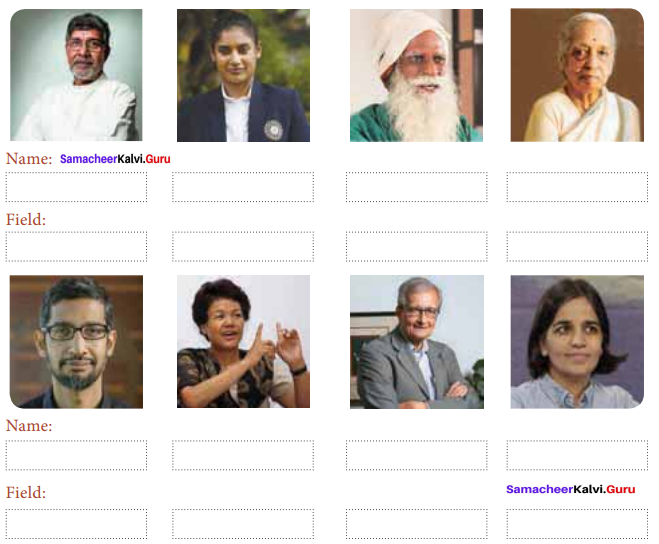
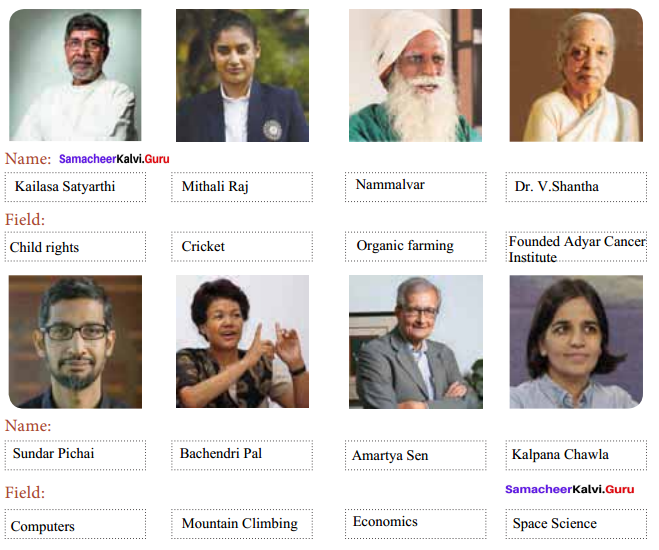
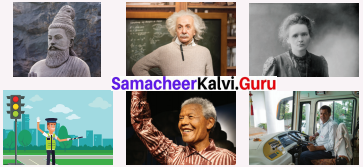
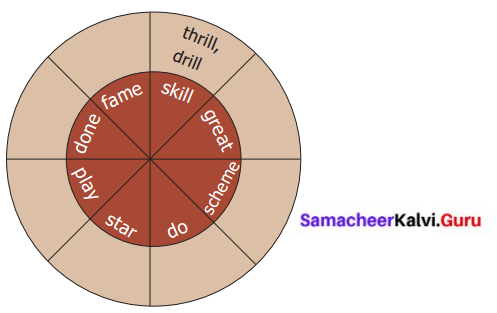
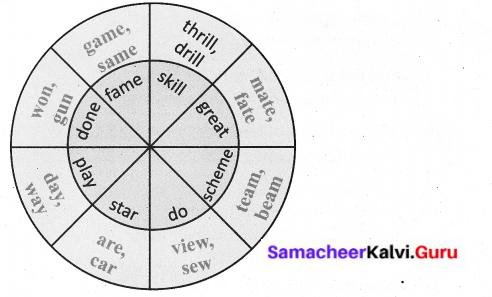
Identify the following personalities and their fields of achievement.

Everest Is Not The Only Peak Poem Summary Samacheer Kalvi 11th English Solutions Poem Chapter 5

Answer:

Everest Is Not The Only Peak Summary Samacheer Kalvi 11th English Solutions Poem Chapter 5

Everest Is Not The Only Peak Question 1.
Mention a remarkable achievement of any of these personalities
Answer:
Kailash Satyarthi has rescued thousands of child labourers and gave them new life.

Everest Is Not The Only Peak Poem Summary Question 2.
What quality do you admire the most in each of these achievers?
Answer:
They were persistent and never accepted failure.

Everest Is Not The Only Peak Summary Question 3.
What are the qualities that you may share with them?
Answer:
Each one has concern for the country.

Everest Is Not The Only Peak Poem Line By Line Explanation Question 4.
Name a few more popular personalities who have made our nation proud.
Answer:
(a) Rabindranath Tagore
(b) Mother Teresa
(c) Sarojini Naidu
(d) Sania Mirza
(e) Mary Kom
(f) Virat Kohli
(g) Saina Nehwal
(h) Abhinav Bindra
(i) MS Dhoni
(j) AR Rahman

Samacheer Kalvi 11th English Everest is not the Only Peak Textual Questions

A. Based on your understanding of the poem, answer the following questions in a sentence or two each.

We are proud and feel so tall,
Our virtues though be few and small
Our nature it is that whatever we try
We do with devotion deep and true.

Defeat we repel, courage our fort;
Cringing from others we haven’t done,
To seek a gain we adore none:
We are proud and feel so tall.

We deem it our duty and mission in life,
To bless and praise the deserving ones;
Never shall we fail in what we commit,
Shall nourish the ones that nourish the world.

Everest Is Not The Only Peak Samacheer Kalvi 11th English Solutions Poem Chapter 5

We are proud of the position we
Hold; humble as we are,
Our pride springs from the way we live.
Ours is a path of dignity and honour,
A life that knows no kneeling and bending.
We are proud and feel so tall.

Everest is not the only peak,
Every hillock has a summit to boast!
The height you reach is not that we care;
He, who does not stoop, is a king we adore.
We bow before competence and merit;
The ones that are true and stand on their own
Are really the ladder for the rise of Man.
Honour is a property, common to all:
In dignity and pride no one need to be poor.
We are proud and feel so tall.

Everest Is Not The Only Peak Poem Figures Of Speech Question 1.
Which line is repeated in the poem? What is the effect created by this repetition?
Answer:
The line, “We are proud and feel so tall” is repeated often in the poem. This establishes beyond a doubt the poet’s pride in dignity of iabour and pride of hardwork experienced by ordinary folks in life.

Everest Is Not The Only Peak Poem Summary In English Question 2.
Who are the ‘deserving ones’?
Answer:
Those who have merit and competence are the deserving ones.

Summary Of The Poem Everest Is Not The Only Peak Question 3.
Which quality does the speaker wish to nourish? What is his mission?
Answer:
The speaker wishes to nourish love to the mankind. The poet loves to nourish the ones who nourish the world. His mission is to bless and praise the deserving ones.

Everest Is Not The Only Peak Poem Question 4.
Which path should we follow in life?
Answer:
We should follow the path of dignity and honour. We should never stoop before others for any ‘gains’.

Everest Is Not The Only Peak Poem Warm Up Answers Question 5.
What does ‘Everest’ in the title stand for?
Answer:
‘Everest’ means the greatest achievement in life or the highest point one can reach in life.

Everest Is Not The Only Peak Poem Theme Question 6.
What does ‘hillock’ refer to in the line ‘Every hillock has a summit to boast!’?
Answer:
Hillock is a small hill. Everyone need not become Tenzing. Each one can achieve some ordinary pursuit and be proud of his achievements.

Everest Is Not The Only Peak Poem Explanation Question 7.
Why does the speaker say ‘Everest is not the only peak’?
Answer:
Everyone is not made to be a mountain climber or a captain. Each one has an important role in this life however small it may appear to be. The poet respects every small achievement in every walk of life. So, he says, “Everest is not the only peak”.
Everest Is Not The Only Peak Poem Paragraph Question 8.
What does the ladder symbolize?
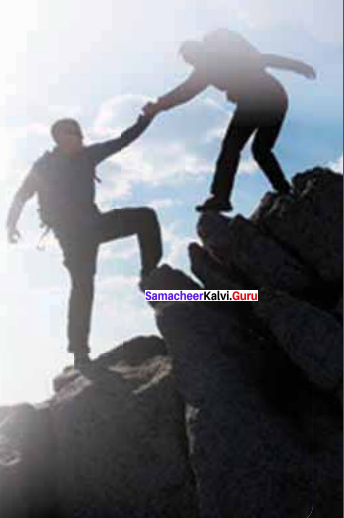
Ladder symbolizes help given to enable others to climb up to a higher position in life.

B. Read the given lines and answer the questions that follow.

1. Our nature it is that whatever we try
We do with devotion deep and true.

Everest Is Not The Only Peak Meaning In Tamil Question (a)
Who does ‘we’ refer to?
Answer:
‘We’refers to ordinary people.

Everest Is Not The Only Peak Meaning Question (b)
How should we carry out our duties?
Answer:
We must do our duty with sincerity and deep devotion.

2. Defeat we repel, courage our fort;

Everest Is Not The Only Peak Meaning In English Question (a)
How do we react to defeat?
Answer:
We defy defeat.

(b) Which is considered as our stronghold?
Answer:
Courage is our stronghold.

3. We are proud of the position we hold;
humble as we are,

Everest Is Not The Only Peak Poem Analysis Question (a)
What is the speaker proud of?
Answer:
The speaker is proud of the position people hold on to.

Everest Is Not The Only Peak Theme Question (b)
How is the speaker both humble and proud?
Answer:
The ordinary position they hold keeps them humble. But the path of self-dignity and honour they tread, makes them feel proud.

Question (c)
Pick out the alliteration in these lines.
Answer:
proud, position, hold, humble are the words which alliterate.

4. He, who does not stoop, is a king we adore.
We bow before competence and merit;

Question (a)
Who is adored as a king?
Answer:
An upright or straight forward person is adored as a king.

Question (b)
What is the figure of speech used in the first line?
Answer:
Metaphor

5. Honour is a property, common to all:
In dignity and pride no one need to be poor.

Question (a)
Who are considered rich?
Answer:
Those who possess dignity and pride are considered rich.

Question (b)
What is their asset?
Answer:
Honour is their asset.

C. Answer the following questions in a paragraph of 100-150 words each.

Question 1.
In what way is every hillock similar to Everest?
Answer:
The poet does not compare rare feats of athletes, mountaineers or horsemen. He does not attach great value to positions or possessions. He scoffs at those who pull strings to achieve their ends. The means must justify the ends. One should not stoop to underhand dealings to achieve their desired goals in life. Those who reach great heights in life like Everest due to their hardwork, perseverance and competence are adorable. At the same time those who trek any small hillocks can’t be underestimated. The efforts made in reaching even the smallest positions in life, if done with sincerity of purpose and deep devotion, is worthy of hearty appreciation.

One who holds a humble position, but upright and serves as a ladder for fellow humans to reach great heights deserve our respect. The poet admits that he is proud of people’s humble positions because their pride springs not from positions or possessions but the way they live. Their life knows no bending. The poet just doesn’t bother the height of the peak one reaches. It could even be a hillock. What matters is how one reaches that spot. If merit and competence have paved the way for their success and positions, however humble they are, the poet admires them.

“Take on risks and ride the journey called life with no regrets. ”


Question 2.
The poem does not focus on the destination but the journey towards it. Discuss.
Answer:
The poet discusses the merits of efforts, duty and devotion and values of honesty, uprightness and service-mindedness. He does not have any special appreciation to those who reach great peaks like Himalayas. He appreciates the process, the journey and not the destination. When the whole world has a perspective of seeking glory using any foul method or underhand dealing, the poet differs from it. For him the means is more important than the end. However modest may be one’s position is, it is adorable if attained by competence and merit. Pride is not in heights one reaches but in a life that knows no bending or kneeling. The poet respects one who does not stoop as a king. Thus the poet pays importance to the journey of life not the destination.

“The journey of life is not meant to be feared and planned;It is meant to be travelled and enjoyed. ”

Creative Activity

D. Write eight words you associate with success.

  • Use the words to write eight lines that mean success to you or how success makes you feel.
  • Arrange your lines into a poem.
  • Share your poem with the class and post a copy on the notice board.
    1. strive
    2. flaunt
    3. determination
    4. destination
    5. wise
    6. want
    7. success
    8. kind

Succes
Poem:

Real success is when you strive
for what you want
when you have that guts to flaunt
Not thinking about the world and wise
when you can alone suffice
With upright will and determination
where finally you reach your destination.
Real success is hard to find. But its one of a kind.
(OR)

  1. brave
  2. hunt
  3. learn
  4. mistakes
  5. encounter
  6. failure
  7. never
  8. If

Poem

You’ll never be brave.
If you don’t get hurt
you’ll never learn.

If you don’t make mistakes
you’ll never be successful.
If you don’t enounter failure.

Speaking Activity

E. Discuss the following topics in groups of five and choose a representative to sum up the views and share them with the class.

Question (a)
To succeed in life, one must have a single-minded devotion to duty.
Answer:
Singleminded determination is necessary to achieve success in life. Legend says Dronacharya was training Pandavas to shoot arrows in the jungle. Once guru saw a bird at the top branch of a tall tree. He assigned the task of shooting the bird on its right eye.
Bhim, Nakulan, Sakadevan and Dharman were denied the chance to aim at it because they all told Dronacharya that they saw the whole jungle, tree, sky and the bird respectively. But it was Arjun who said that he saw only the right eye of the bird and nothing else. Indo-Pak war was in progress. Four bombers were prowling into Indian airspace.

Indian fighter bomber pilot realized all the bombs were exhausted. He had singleminded determination to prevent the four bombers from bombing India harm and force them to surrender. He tried a trick. He called them and spoke to them. He informed them that he was thousand feet above them with his finger on a missile. If they just surrender, their lives would be spared. He radioed to his chief that they should welcome four prisoners of war along with their fighter bombers.

Napoleon Boneparte was once watching a battle from a hillock. One of his soldiers came with an urgent message. Napoleon looking at the badly wounded soldier thought that the war was lost. He called one of his aides and gave instructions for pullout. But the soldier said, “Sire, we‘ve won”. Then he gave a slip from another pocket. Being a practical leader, he had alternate plans always at hand. Such leaders never accept failure as permanent. People who pursue their goals in life with single minded determination always win.
 

Question (b)
‘Success is not final, failure is not fatal.’ It is the courage and perseverance that Counts.
Answer:
India’s cricket team was beaten in Test series in Africa. Infact, it was routed. The team’s morale was a little down. The team captain Virat Kohli told his team to focus on what they were good at (i.e) sterling performance in One Day Internationals. He believed in the youngest bowlers and told them to play the game, the way they loved to play. He still believed in them. They would have to prove who are the masters of the game. Gathering their broken hopes and courage, the Indian team players, snatched the ODI series from the overconfident South Africans. They went on to win the T20 series too against the hosts. Thus they proved that success is not final and failure never fatal. One may bounce back from failure if one persists long enough.

A king had lost a battle. All his soldiers had been scattered across the country. Heart broken king Bruce was hiding in a cave. He saw a spider failing a number of times to spin a web. But it made it after about 20 attempts. This bolstered the confidence of the king. He refused to be controlled by failure. He defied defeat. He gathered his soldiers again and won the battle. These incidents throw much light on the truth that perseverance and courage counts for success in fife.

Question (c)
Successful people neither brood over the past nor worry about the future.
Answer:
Mahatma Gandhi and his followers were arrested and jailed many times. Gandhi’s followers were brutally lathi charged. Gandhi had decided to silence the guns of the British with Ahimsha passive non-violent resistance. The brutal suppression of the struggle for freedom did not dishearten Gandhi. He did not brood about the strength of British army and weaknesses of unarmed peasants who believed in his leadership. He was a Karmayogi. What ever the duty to be done it must be done with steadfast devotion and sincerity. Other leaders got worried. Some angry young men resorted to violence.

They burnt down a police station at Chauri chaura too. But Gandhi declared a fast unto death. He plunged into action. If he had worried about the unpleasant developments, he wouldn’t have launched Quit India Movement or Salt Satyagraha effectively.

Thomas Alva Edison was not able to find the element that would glow if electricity was passed. He had failed 1000 times to invent the bulb. But he said, “The light bulb was an invention with 1000 steps”. Each step taught him what did not work. He lost his hearing capacity. He had many failures. His teachers believed him to be mad and unteachable.

His entire schooling was only a few years. His mom taught him and made him believe in himself. This man who had been ill-treated in school and faced many challenges had no time to brood. He went on to make 1093 inventions and got them patented. Those who are busy building facilities for transforming the world have neither the time nor the inclination to brood about failures or about possibilities of success in future.

Everest is not the Only Peak About the poet:

Everest Is Not The Only Peak Poem Line By Line Explanation Samacheer Kalvi 11th English Solutions Chapter 5

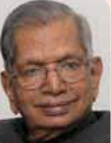
Prof. V.C. Kulandtiisamy ( 14th July 1929 10th Dec 2016) is known as Kulotliimgan. He i is a prolific Tamil writer with six volumes of poems and seven of prose essays. He has 1 been conferred Thiruvalluvar Award by Government of Tamil Nadu (1999) and Sahitva j Academy’s Award in 1988 for his outstanding masterpiece “Vaazhum Valluvam”. Ills i poems, as evident in the poem “Everest is not the only Peak” deal with the gamut of human [ progress and all pervasive human effort to better the world.


Everest is not the Only Peak Summary

This poem discusses in depth the virtues that make people greater than those who scale Himalayas. We have a few virtues which make us feel proud and tall. By nature we do every assigned duty with deep and true devotion.

We repel defeats because courage is our fort. We have never cringed from others. We don’t lick others’ shoes to achieve personal gains. We are proud and tall.

We deem it a duty and a mission to appreciate those who deserve appreciation. We shall carry on doing unfailingly what we are committed to do. We shall nourish those who nourish the world (i.e) those who better the world with their services, inventions and discoveries.

Despite living a simple and humble life, we have pride over our path of dignity and honour. We feel proud and tall for we never bend before the mighty.

We value individual differences. Every small effort to succeed in life matters. Peaks alone don’t matter. Even a hillock is a symbol of human achievement. We respect those who don’t stoop to conquer. We are proud to be rich in honour, dignity and pride. Those who stand on their own merit and serve as ladder for progress of fellowmen are worthy of our appreciation. We are proud and feel so tall.

Not the worldly riches, power and positions impress us. We derive our happiness in serving those who serve the nation. We respect all who are upright in their dealings. So, as honest citizens, we are proud.

Everest is not the Only Peak Glossary

Textual:
adore – worship someone
competence – the ability to do something efficiently
cringing – behaving in an excessively humble or servile way
devotion – loyal commitment towards a particular activity
merit -the quality of being particularly good or worthy
nourish – to help the growth and development of someone
repel – hate or detest
stoop – yield or submit, to descend from dignity
summit – the highest point of a hill or mountain peak
virtues – good qualities


Additional:
dignity – deserves respect
fort – huge building for protection
hillock – small hill
humble -modest
mission – vocation
praise – appreciate
property – possession
proud – feeling important
springs – arises

The main aim is to share the knowledge and help the students of 11th English to secure the best score in their final exams. Use the concepts of Samacheer Kalvi 11th English Book Solutions Poem Chapter 5 Everest is not the Only Peak Questions and Answers in Real time to enhance your skills. If you have any doubts you can post your comments in the comment section, We will clarify your doubts as soon as possible without any delay.

Samacheer Kalvi 6th Social Science Geography Solutions Term 2 Chapter 1 Resources

You can Download Samacheer Kalvi 6th Social Science Book Solutions Guide Pdf, Tamilnadu State Board help you to revise the complete Syllabus and score more marks in your examinations.

Tamilnadu Samacheer Kalvi 6th Social Science Geography Solutions Term 2 Chapter 1 Resources

Samacheer Kalvi 6th Social Science Resources Textual Evaluation


A. Match the following.

Samacheer Kalvi Guru 6th Social Science Question 1.

AB
Natural resourceMinerals
International resourceSustainable development
Reduce, Reuse, RecycleAir
Non-renewableManufacturing
Universal resourceAmbergris
Secondary activitiesForest

Answer:

AB
Natural resourceForest
International resourceAmbergris
Reduce, Reuse, RecycleSustainable development
Non-renewableMinerals
Universal resourceAir
Secondary activitiesManufacturing

B. Fill in the blanks :

  1. Sugarcane is processed to make ___________
  2. Conservation of resources is ___________ use of resources.
  3. Resources which are confined to certain regions are called ___________
  4.  ___________ resources are being used in the present.
  5.  ___________ resources are the most valuable resources.
  6. Collection of resources directly from nature is called ___________

Answer:

  1. Sugar
  2. careful
  3. Localise d resources
  4. Actual
  5. Human
  6. Primary Activities

C. Write short notes on the following :

Samacheer Kalvi 6th Social Science Book Back Answers Question 1.
Renewable resources.
Answer:

  1. Resources once consumed can be renewed with the passage of time are called renewable resources.
  2. (e.g.) Air, Water, Sunlight.

Samacheer Kalvi 6th Social Guide Question 2.
Human resources.
Answer:

  1. Human resources are group of individuals who use nature to create more resources.
  2. Example: Doctors, Teachers, Scientists.

Samacheer Kalvi 6th Social Term 2 Question 3.
Individual resources.

  1. Based on ownership, resources can be classified into Individual resources, Community-owned resources, National resources and International resources.
  2. Individual resources are resources privately owned by individuals? (e.g.) Apartments.

Samacheer Kalvi Guru 6th Social Science Term 2 Question 4.
Tertiary activities.
Answer:

  1. Tertiary activities are those which render services to production and distribution of goods.
  2. Example: Banking, Trade, Communications.

D. Give brief answers for the following:

Samacheer Kalvi 6th Social Guide Term 2 Question 1.
What are resources?

  1. Resource is anything that fulfills human needs. When anything is of some use it becomes valuable. All resources have value.
  2. The value can be either commercial or non-commercial.

Social Science Term 2 Question 2.
What are actual resources?
Answer:

  1. Actual resources are resources that are being used and the quantity available is known.
  2. Example: Coal at Neyveli.

Samacheer Kalvi Social Science Question 3.
Define abiotic resources.
Answer:
Abiotic resources are non-living things. Land, Water, Air and Minerals are abiotic resources.

Samacheer Kalvi Guru 6th Social Science Book Back Answers Question 4.
What is sustainable development?
Answer:

  1. The present needs for resources are met.
  2. The conserving of resources for the future are balanced. It is sustainable development.

E. Give short answers to the following questions.

Samacheer Kalvi 6th Social Science Term 2 Question 1.
Differentiate universal and localized resources.
Answer:
Universal Resources

  1. Universal resources are present everywhere.
  2. Eg. Sunlight and air

Localized Resources

  1. Localized resources are present in specific regions.
  2. Eg. Minerals

Samacheer Kalvi 6th Geography Book Question 2.
Though human beings are natural resources, why are they classified separately?
Answer:

  1. Education, Health, Knowledge and Skill have made human beings a valuable resource.
  2. So Human beings are classified separately. Example: Doctors, Teachers, Scientists.

6th Class Social Guide Question 3.
Compare national and International
Answer:
National resources

  1. National resources are resources within the political boundaries and oceanic area of a country.
  2. Eg. Tropical Forest Region of india

International resources

  1. International resources are all oceanic resources found in the open ocean. Resources found in the region can be utilised only after an international agreement.
  2. Eg. Ambergris.

Samacheer Kalvi 6th Social Science Guide Question 4.
What is the difference between Man-made resources and Human resources?
Answer:
Man-made resources:

  1. Natural resources are modified or processed by technology.
  2. All structures built by man

Human Resources:

  1. Groups of individuals use nature to create more resources
  2. Education, Health, Knowledge and Skill have made this.

6th Social Guide Question 5.
Write the Gandhian thought on conservation of resources.
Answer:
Mahatma Gandhi blamed “human beings” for depletion of resources because of
(a) over exploitation of resources
(b) Unlimited needs of human beings. So, conservation is very important.

F. Give detailed answers for the following questions. (100-120 words).

Samacheer Kalvi 6 Social Guide Question 1.
How are natural resources classified? Explain an three with examples.
Answer:
Natural resources can be classified into different groups depending on origin, development, renewability, distribution, ownership etc.

(a) On the basis of orgin:
On the basis of origin, resources can be classified into biotic and abiotic resources.

  1. All living resources are biotic resources. Plants, animals and other micro organisms are biotic resources.
  2. Abiotic resources are non-living things. Land, water, air and minerals are abiotic resources.

(b) On the basis of development:
Based on the level of development, resources can be divided into actual and potential resources.

  1. Actual resources are resources that are being used and the quantity available is known, (e.g.) Coal mining at Neyveli.
  2. Potential resources are resources that are not being used in the present and its quantity and location are not known, (e.g.) Wind Energy.

(c) On the basis of distribution:
On the basis of distribution resources can be classified into localised resources and universal resources.

  1. When resources are present in specific regions, they are called localised resources (eg.) Minerals.
  2. Some resources are present everywhere. Such resources are called universal

Samacheer Kalvi Guru Social Question 2.
How can resources be conserved?
Answer:
Conservation of Resources:

  1. Careful use of resources is conservation of resources.
  2. Due to the rapid increase in population the resources are being utilized at a very fast rate.
  3. To avoid this we need sustainable development. The sustainable development can take place when
      • Wastage and excess consumption is prevented
      • Reusable resources are recycled
      • Pollution is prevented
      • Environment is protected
      • Natural vegetation and wild life are preserved.
  4. The easiest way to conserve resources is to follow the “3R”s : Reduce, Reuse and Recycle.

Question 3.
What is resource planning and why is it necessary?
Answer:
Resource planning is a technique or skill of proper utilization of resources. Resource planning is necessary because,

  1. Resources are limited, their planning is quite necessary so that we can use them properly and at the same time we can save them for our future generation.
  2. Resources are not only limited, but also they are unevenly distributed over the different parts of the World.
  3. It is essential for the production of resource to protect them from overexploitation.

Question 4.
Explain the primary, secondary and tertiary activities.
Answer:
Primary Activities:

  1. According to the human needs the substances (biotic resources) were collected by the ancient men and preserved for use.
  2. For his basic needs (food, clothing and shelter) he collected things through activities.
  3. The activities like hunting, food gathering, fishing and forestry are called “Primary Activities”.
  4. Later when food became scarce they had to cultivate and that became agriculture.
  5. Mining became one of the leading primary activities.

Secondary Activities:

  1. Natural resources are modified or processed by technology. Ex : sugarcane 2 sugar
  2. This transforming of raw materials into finished goods is called “Secondary Activities”.
  3. Man’s skills and ideas are the basic requirement for secondary activities.

Tertiary Activities:

  1. Tertiary activities are those which render services to production and distribution of goods.
  2. These are concerned with the distribution of primary and secondary products through a system of transport and trade.
  3. Example: Banking, Trade and Communications

G. Statements and inferences:

Question 1.
Statement : Solar energy is the best substitute for thermal energy in tropical regions.
Inference 1 : Coal and petroleum resources are receding.
Inference 2 : Solar energy will never deplete.
Now choose the right answer.
a) Only conclusion 1 follows.
b) Only conclusion 2 follows,
c) Neither 1 nor 2 follows.
d) Both 1 and 2 follow.
Answer:
(d) Both 1 and 2 follow

Question 2.
Statement : If you don’t conserve resources, human race may become extinct.
Inference 1 : You need not conserve resources.
Inference 2 : You need to conserve resources.
Now choose the right answer
(a) Only conclusion 1 follows
(b) Only conclusion 2 follows
(c) Neither 1 nor 2 follows
(d) Both 1 and 2 follow
Answer:
(b) Only conclusion 2 follows

Question 3.
Statement : Man switched over to agriculture.
Inference 1 ; Food gatherers experienced scarcity of food.
Inference 2 : Food gathered was not nutritious.
Now choose the right answer.
a) Only conclusion 1 follows.
b) Only conclusion 2 follows,
c) Neither 1 nor 2 follows.
d) Both 1 and 2 follow.
Answer:
(a) Only conclusion 1 follows

H. Given are three suggestions to conserve resources: Write the 3Rs in suitable places:

  1. Giving your childhood cycle to your neighbour
  2. Using a flush that consumes less water
  3. Melting used plastic to lay roads

Answer:
Reuse
Reduce
Recycle

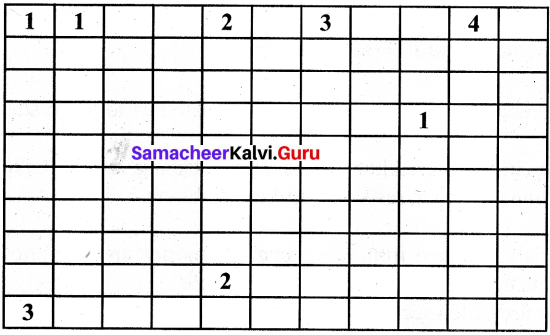
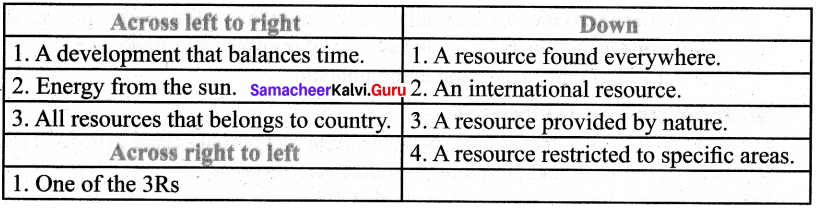
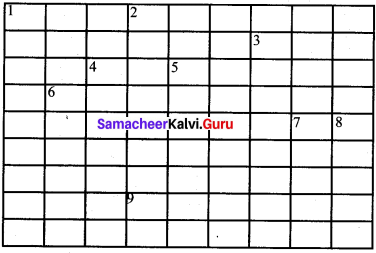
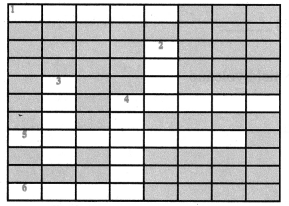
I. Cross word puzzle

Samacheer Kalvi Guru 6th Social Science Geography Solutions Term 2 Chapter 1 Resources

Samacheer Kalvi 6th Social Science Book Back Answers Geography Solutions Term 2 Chapter 1 Resources

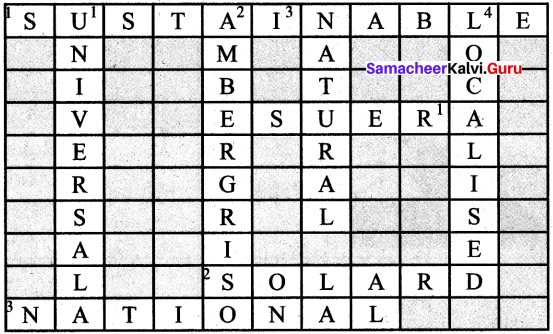
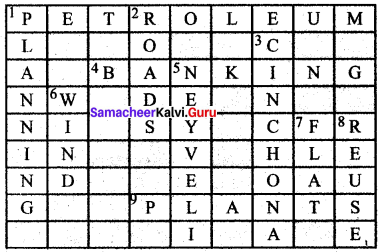
Answer:

Samacheer Kalvi 6th Social Guide Science Geography Solutions Term 2 Chapter 1 Resources

Across left to right

  1. A development that balances time
  2. Energy from the sun
  3. All resources that belongs to country

Answer:

  1. SUSTAINABLE
  2. SOLAR
  3. NATIONAL

Across right to left

  1. One of the 3Rs

Answer:

  1. REUSE

Down

  1. A resource found everywhere
  2. An international resource
  3. A resource provided by nature
  4. A resource restricted to specific areas

Answer:

  1. UNIVERSAL
  2. AMBERGRIS
  3. NATURAL
  4. LOCALISED

J. Mark the following in the outline map of India

Question 1.

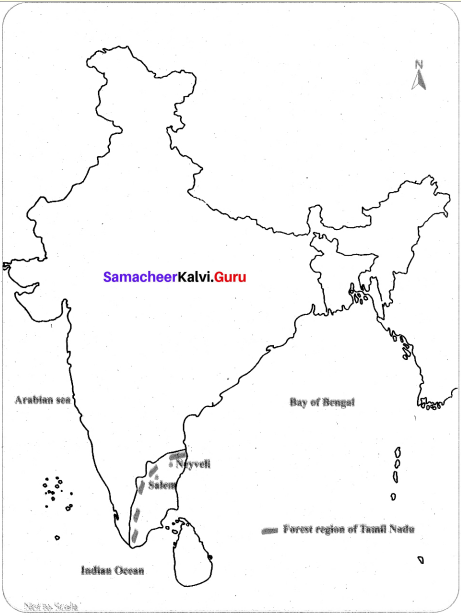
  1. Neyveli
  2. Bay of Bengal
  3. Arabian Sea
  4. Forest region of Tamil Nadu
  5. Indian Ocean
  6. Iron mining in Kanjamalai (Salem)

Answer:

Samacheer Kalvi 6th Social Term 2 Chapter 1 Resources

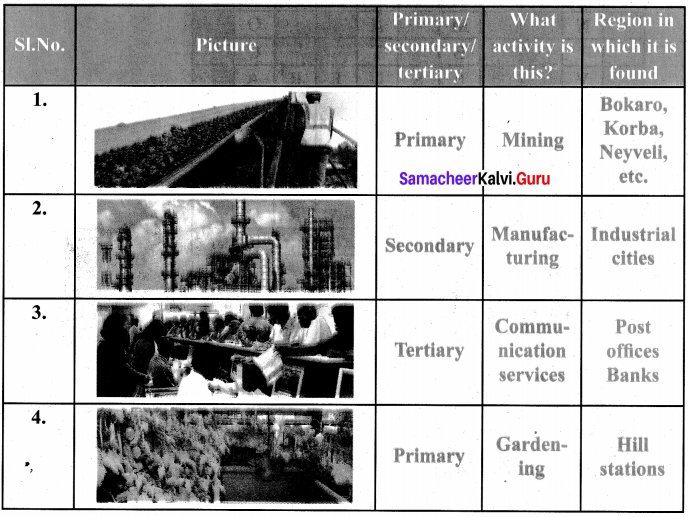
K. Identify the different economic activities and fill the table given below

Samacheer Kalvi Guru 6th Social Science Term 2 Chapter 1 Resources

Activity – 1
Circle the resources that are not necessary for gardening. Soil, Seeds, A piece of Land, Computers, Saplings, Flower Pots, Manure, Textbook
Answer:

Activity- 2
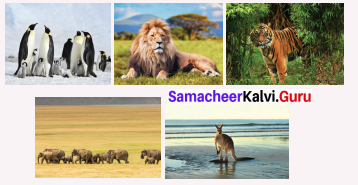
Which region/continent does each of these animals belong to?

Samacheer Kalvi 6th Social Guide Term 2 Chapter 1 Resources

Answer:

  1. Penguins: They are found in Antarctica, South Africa, Australia. Penguins are not generally fans of hot weather.
  2. A Lion Asiatic Lions live in India’s Gir Forest. African lions live in Central and Southern Africa.
  3. Tigers originate from the Asian continent especially in Thailand, Indonesia, Laos, China, Malaysia, Russia, Nepal, Myanmar. There are Chinese and Bengal tigers.
  4. Elephants are found in Africa as well as Asia. African elephants have the ears shaped like the African continent, where Asian elephants have smaller ears.
  5. Most Kangaroos have their habitat in Australia. Gray Kangaroos, Antilopine Kangaroo, Tree Kangaroos are some types of Kangaroo family.

Activity – 3

Question 1.
What natural resources are necessary to lay a road?
Answer:
For paving roads we need asphalt and concrete. Asphalt uses an oil based substance called bitumen to make sand and curshed rock stick together like glue.

Activity :
Identify the personalities and professionals.

Social Science Term 2 Samacheer Kalvi 6th Geography Solutions Chapter 1 Resources

Samacheer Kalvi 6th Social Science Resources Additional Question

A. Match the following.

Question 1.

a)Plants(i)Marine yeast
b)Hunting(ii)Houses
c)Potential Resources(iii)Biotic
d)Tropical rain forest(iv)Primary activity
e)Man made(v)Cinchona

Answer:

  1. – iii
  2. – iv
  3. – i
  4. – v
  5. – ii

B. Fill in the blanks:

  1. All living things are_______ resources.
  2. Collection of resources directly from nature is called _______
  3. Natural resources when processed to meet man’s needs are called _______
  4. Solar Panels generate _______
  5. Silicon , extracted from _______ is used in making pv cells
  6. All resource have _______
  7. Wind energy is a _______ resource
  8. Man’s skills and ideas are the basic requirements for _____ activities.
  9. A plate that can absorb solar energy is known as______
  10. Areas of ocean that does not belong to any country is called ______

Answer:

  1. biotic
  2. Primary Activities
  3. Man made
  4. electricity
  5. sand
  6. value
  7. potential
  8. secondary
  9. solar penal
  10. open ocean

C. Write short notes on the following :

Question 1.
Non – Renewable resources.
Answer:

  1. Natural resources which are limited can be called non-renewable resources.
  2. They become exhausted after use and the time they take to replaces does not
    match the life cycle.

Question 2.
Community – Owned resources.
Answer:

  1. Resources which can be utilized by all the members of the community are called community – owned
  2. resources. Example: Public parks

Question 3.
Secondary Activities.
Answer:

  1. The transforming of raw materials into finished goods is called Secondary Activities.
  2. Man’s skills and ideas are the basic requirements for these activities.

D. Give brief answers for the following:

Question 1.
How are Natural resources classified?
Answer:
Natural resources can be classified into different groups depending on origin, development, renewability, distribution, ownership etc.

Question 2.
What are the basic needs man had in the beginning?
Answer:

  1. Food
  2. Clothing
  3. Shelter

Question 3.
What are the primary activities?
Answer:
Hunting, food gathering, fishing and forestry are some of the primary activities.

Question 4.
What are the Potential resources?
Answer:

  1. Potential resources are resources that are not being used in the present.
  2. Its quantity and location are not known.
  3. The technology to extract such resources is also yet to be developed.

E. Give short answers for the following questions

Question 1.
How is ambergris useful?
Answer:

  1. Ambergris belongs to international resources.
  2. It is an extract from the sperm whale.
  3. A pound (0.454 kg) of sweet-smelling ambergris is worth US$ 63,000. It is used in perfume industries.

Question 2.
Explain the term Resource planning.
Answer:

  1. Resource planning is a technique or skill of proper utilisation of resources.
  2. Resource planning in necessary became

(a) Resources are limited, their planning is necessary to use them properly and saving them for the future generation.
(b) Resources are unevenly distributed over different parts of the world.
(c) Resources should be protected from over-exploitation.

Question 3.
When can sustainable development take place?
Answer:
Sustainable development can take place when,

  1. The reasons of depletion are identified.
  2. Wastage and excess consumption is prevented.
  3. Reusable resources are recycled.
  4. Pollution is prevented.
  5. Environment is protected.
  6. Natural vegetation and wild life are preserved.
  7. Alternative resources are used.
  8. The easiest way to conserve resources is to follow the ‘3R’s, Reduce, Reuse, Recycle.

F. Statements and inferences:

Question 1.
Statement : All resources have value.
Inference 1 : Petroleum has great economic value.
Inference 2 : Air is a non – commercial resource.
Now choose the right answer.
a) Only conclusion 1 follows.
b) Only conclusion 2 follows
c) Neither 1 nor 2 follows.
d) Both 1 and 2 follow.
Answer:
d) Both 1 and 2 follow.

Question 2.
Statement : Development is necessary without affecting the needs of the future generation.
Inference 1 : Environment should be protected.
Inference 2 : Excess consumption should be prevented.
Now choose the right answer.
a) Only conclusion 1 follows.
b) Only conclusion 2 follows,
c) Neither 1 nor 2 follows.
d) Both 1 and 2 follow.
Answer:
(d) Both 1 and 2 follow.

Question 3.
Statement : Mining became one of the leading primary activities of early man.
Inference 1 : Early man was in need of better tools other than stone.
Inference 2 : Early man mined precious metals for making ornaments.
Now choose the right answer.
a) Only conclusion 1 follows.
b) Only conclusion 2 follows,
c) Neither 1 nor 2 follows.
d) Both 1 and 2 follow.
Answer:
d) Both 1 and 2 follow.

G. The easiest way to conserve resources is to follow the 3Rs, Reduce, Reuse, Recycle. Give example.
Answer:

a) Reduce

  1. Print on both sides of the paper to reduce paper wastage.
  2. Avoid giving presents with excess packing.
  3. Use cloth Napkins instead of paper napkins.

b) Reuse

  1. Buy reusable products instead of disposable ones like rechargeable batteries, plastic picnic tableware instead of paper ones.
  2. Old newspapers can be used to pack items.
  3. Old jars and pots can be used to store items in the kitchen.

c)Recycle

  1. If you can, compost your garden waste and vegetable peelings or take your garden waste to a recycling centre.
  2. Reuse carrier bags as bin liness or take your reusable bags with you to the shops.
  3. Pack your lunch in reusable box.
  4. Green waste is processed at recycling centres to produce a compost soil conditioner.

H. Cross word puzzle.

Samacheer Kalvi Social Science 6th Geography Solutions Term 2 Chapter 1 Resources

Across (Left to right)
1. A non-renewable resource
4. A tertiary activity
9. A Biotic Resource

Down :

  1. A technique used for proper utilization of resources
  2. A man made Resource
  3. Tropical forests known for this medicine
  4. Well known for Coal Mining
  5. A potential Resource
  6. An Individual Resource
  7. One of the 3Rs.

Answer:

Samacheer Kalvi Guru 6th Social Science Book Back Answers Geography Solutions Term 2 Chapter 1 Resources

Across (Left to right)

1. PETROLEUM
4. BANKING
9. PLANTS
Down

1. PLANNING
2. ROADS
3. CINCHONA
5. NEYVELI
6. WIND
7. FLAT
8. REUSE
9. PLANTS

Samacheer Kalvi 11th Computer Science Solutions Chapter 2 Number Systems

Students can Download Computer Science Chapter 2 Number Systems Questions and Answers, Notes Pdf, Samacheer Kalvi 11th Computer Science Book Solutions Guide Pdf helps you to revise the complete Tamilnadu State Board New Syllabus and score more marks in your examinations.

Tamilnadu Samacheer Kalvi 11th Computer Science Solutions Chapter 2 Number Systems

Samacheer Kalvi 11th Computer Science Number Systems Text Book Back Questions and Answers

PART – 1
I. Choose The Correct Answer

11th Computer Science Chapter 2 Book Back Answers Question 1.
Which refers to the number of bits processed by a computer’s CPU?
(a) Byte
(b) Nibble
(c) Word length
(d) Bit
Answer:
(c) Word length

11th Computer Science Chapter 2 Question 2.
How many bytes does 1 KiloByte contain?
(a) 1000
(b) 8
(c) 4
(d) 1024
Answer:
(d) 1024

11th Computer Science Chapter 2 Workshop Answers Question 3.
Expansion for ASCII ………………..
(а) American School Code for Information Interchange
(b) American Standard Code for Information Interchange
(c) All Standard Code for Information Interchange
(d) American Society Code for Information Interchange
Answer:
(b) American Standard Code for Information Interchange

11th Computer Science 2nd Lesson Book Back Answers Question 4.
2^50 is referred as
(a) Kilo
(b) Tera
(c) Peta
(d) Zetta
Answer:
(c) Peta

Class 11 Computer Science Chapter 2 Solutions Question 5.
How many characters can be handled in Binary Coded Decimal System?
(a) 64
(b) 255
(c) 256
(d) 128
Answer:
(a) 64

11th Computer Science 2nd Lesson Question 6.
For 11012 what is the Hexadecimal equivalent?
(a) F
(b) E
(c) D
(d) B
Answer:
(c) D

Computer Science Chapter 2 Question 7.
What is the 1’s complement of 00100110?
(a) 00100110
(b) 11011001
(c) 11010001
(d) 00101001
Answer:
(b) 11011001

Number System Class 11 Pdf Question 8.
Which amongst this is not an Octal number?
(a) 645
(b) 234
(c) 876
(d) 123
Answer:
(c) 876

II. Short Answers

Number System Class 11 Computer Science Pdf Question 1.
What is data?
Answer:
The term data comes from the word datum which means a raw fact. The data is a fact about people, places or some objects.
Example: Rajesh, 16, XI

Samacheer Kalvi Guru 11th Computer Science Question 2.
Write the 1’s complement procedure.
Answer:
Step 1 : convert given decimal number into Binary
Step 2 : if the binary bit contains 8 bits if less add 0 at the left most bit, to make it as 8 bits.
Step 3 : Invert all the bits, (i.e.) change 1 as 0 and 0 as 1.

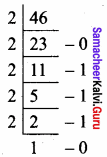
Class 11 Computer Science Chapter 2 Question Answer Question 3.
Convert (46)10 into Binary number
Answer:
(46)10 into binary = 1011102
11th Computer Science Chapter 2 Book Back Answers Samacheer Kalvi Number Systems

Question 4.
We cannot find 1’s complement for (28)10. State reason.
Answer:
Since it is a positive number. 1 ’s complement will come only for negative number.

Question 5.
List the encoding systems for characters in memory.
Answer:

  1. BCD – Binary Coded Decimal
  2. EBCDIC – Extended Binary Coded Decimal Interchange Code
  3. ASCII – American Standard Code for Information Interchange
  4. Unicode
  5. ISCII – Indian standard code for Information interchange

III. Explain in Brief

Question 1.
What is radix of a number system? Give example.
Answer:
The radix refers to the base of a number system: the total number of possible digits. The decimal number system that we all use is base ten, as it has ten distinct digits (0, 1, 2, 3, 4, 5, 6, 7, 8, 9).
Example : Binary system – Radix 2

Question 2.
Write note on binary number system.
Answer:
In Binary Number System, there are only two digits namely 0 and 1. The numbers in the binary system are represented to the base 2. In the Binary Number, the left most bit is the Most Significant Bit (MSB) and the right most bit is the Least Significant Bit (LSB). MSB has largest positional weight and LSB has smallest positional weight.
Example : 1100102

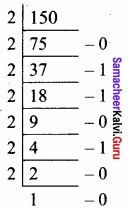
Question 3.
Convert (150)10 into Binary, then convert that Binary number to Octal.
Step 1:
Change it to Binary.
11th Computer Science Chapter 2 Samacheer Kalvi Number Systems
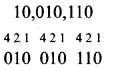
(150)10 = 10010110

Step – 2:
Change it to Octal.
11th Computer Science Chapter 2 Workshop Answers Number Systems Samacheer Kalvi
Answer:
Binary 100101102
Octal 226g

Question 4.
Write short note on ISCII.
Answer:
ISCII – Indian Standard Code for Information Interchange (ISCII) is the system of handling the character of Indian local languages. This is a 8 – bit coding system. Therefore it can handle 256 (28) characters. It is recognized by Bureau of Indian Standards (BIS). It is integrated with Unicode.

The supported scripts are:
Assamese, Bengali (Bangla), Devanagari, Gujarati, Gurmukhi, Kannada, Malayalam, Oriya, Tamil, and Telugu. ISCII does not encode the writing systems of India based on Arabic, but its writing system switching codes none the less provide for Kashmiri, Sindhi, Urdu, Persian, Pashto and Arabic. The Arabic – based writing systems were subsequently encoded in the PASCII encoding.

ISCII is an 8 – bit encoding. The lower 128 code points are plain ASCII, the upper 128 code points are ISCII – specific. In addition to the code points representing characters, ISCII makes use of a code point with mnemonic ATR that indicates that the following byte contains one of two kinds of information. One set of values changes the writing system until the next writing system indicator or end – of – line.

Question 5.
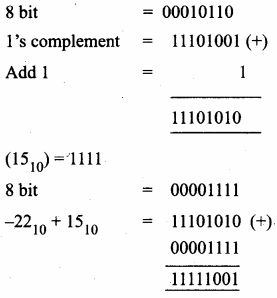
Add (a) – 2210 + 1510
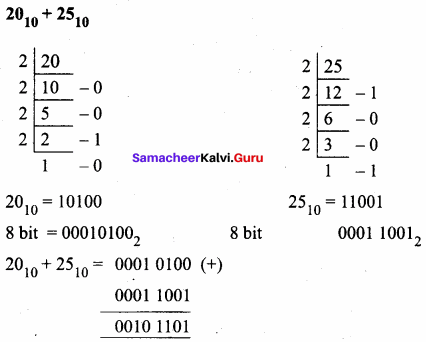
(b) 2010 + 2510
11th Computer Science 2nd Lesson Book Back Answers Samacheer Kalvi Number Systems
Answer:
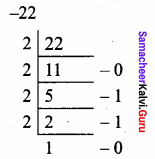
(a) – 2210 = 101102
Binary Equivalent = 101102
Class 11 Computer Science Chapter 2 Solutions Samacheer Kalvi Number Systems
Answer:
111110012

(b) 2010 + 2510
Answer:
11th Computer Science 2nd Lesson Samacheer Kalvi Number Systems
Answer:
001011012

IV. Detail Answers

Question 1.
(a) Write the procedure to convert fractional Decimal to Binary.
(b) Convert (98.46)10 to Binary
Answer:
(а) Procedure to convert fractional Decimal to Binary.
Step 1 : Multiply the decimal fraction by 2 and note the integer part. The integer part is either Oor 1.
Step 2 : Discard the integer part of the previous product. Multiply the fractional part of the previous product by 2. Repeat step 1 until the same fraction repeats or terminates (0).
Step 3 : The resulting integer part forms a sequence of 0’s and 1 ’s that becomes the binary equivalent of decimal fraction.
Step 4 : The final answer is to be written from first integer part obtained till the last integer part obtained.

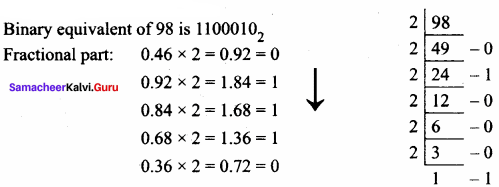
(b) Convert (98.46)10 to Binary
Computer Science Chapter 2 Samacheer Kalvi 11th Number Systems
Answer:
1100010.01110 … 2

Question 2.
Find 1’s Complement and 2’s Complement for the following Decimal number (a) – 98 (b) – 135
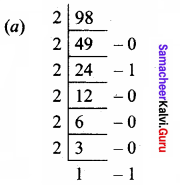
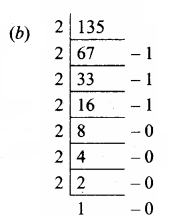
Answer:
Number System Class 11 Pdf Samacheer Kalvi Chapter 2 Number Systems
9810 = 01100010
8 bit format = 01100010
1’s complement = 10011101
Add 1 bit = + 1
= 10011110
Number System Class 11 Computer Science Pdf Samacheer Kalvi Chapter 2 Number Systems

13510 = 10000111
1’st complement = 01111000
Add 1 bit = + 1
= 01111001

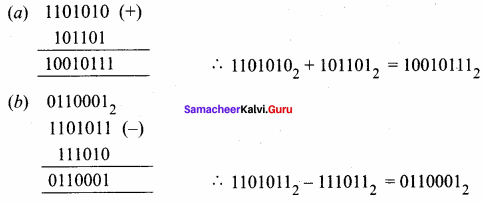
Question 3.
(a) Add 11010102 + 1011012
(b) Subtract 11010112 – 1110102
Answer:
Samacheer Kalvi Guru 11th Computer Science Solutions Chapter 2 Number Systems

PART – 1
I. Choose the correct answer

Question 1.
Which is a basic electronic circuit which operates on one or more signals?
(a) Boolean algebra
(b) Gate
(c) Fundamental gates
(d) Derived gates
Answer:
(b) Gate

Question 2.
Which gate is called as the logical inverter?
(a) AND
(b) OR
(c) NOT
(d) XNOR
Answer:
(c) NOT

Question 3.
A + A = ?
(a) A
(b) O
(c) 1
(d) A
Answer:
(a) A

Question 4.
NOR is a combination of?
(a) NOT(OR)
(b) NOT(AND)
(c) NOT(NOT)
(d) NOT(NOR)
Answer:
(a) NOT(OR)

Question 5.
NAND is called as ……………… Gate.
(a) Fundamental Gate
(b) Derived Gate
(c) Logical Gate
(d) Electronic gate
Answer:
(b) Derived Gate

PART – 2
II. Short Answers

Question 1.
What is Boolean Algebra?
Answer:
Boolean algebra is a mathematical discipline that is used for designing digital circuits in a digital computer. It describes the relation between inputs and outputs of a digital circuit.

Question 2.
Write a short note on NAND Gate.
Answer:
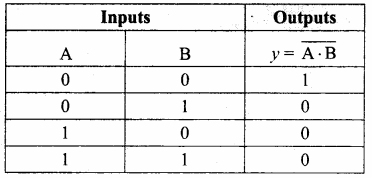
The NAND gate is the combination of NOT and AND gates. The NAND gate is generated by inverting the output of a AND gate. The algebraic expression of the NAND is Y = \(\overline{\mathrm{A} . \mathrm{B}}\)

Question 3.
Draw the truth table for XOR gate.
Answer:
The truth table for XOR gate is
Class 11 Computer Science Chapter 2 Question Answer Samacheer Kalvi Number Systems

Question 4.
Write the associative laws?
Answer:
A + (B + C) = (A + B) + C
A.(B.C) = (A.B).C

Question 5.
What are derived gates?
Answer:
Derived Gates are the gates which are derived from the fundamental gates.
Example : NAND, NOR, XOR, XNOR

PART – 3
III. Explain in Brief

Question 1.
Write the truth table of fundamental gates.
Answer:
(a) AND gate – Truth Table
Samacheer Kalvi 11th Computer Science Solutions Chapter 2 Number Systems 11

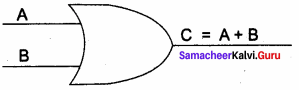
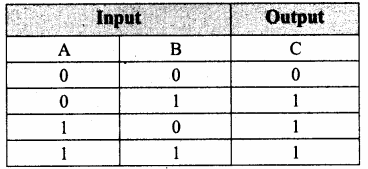
(b) OR gate – Truth Table
Samacheer Kalvi 11th Computer Science Solutions Chapter 2 Number Systems 12

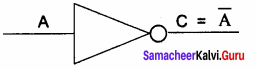
(c) NOT Gate – Truth Table
Samacheer Kalvi 11th Computer Science Solutions Chapter 2 Number Systems 13

Question 2.
Write a short note on XNOR gate.
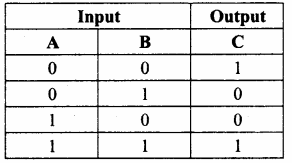
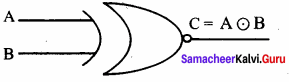
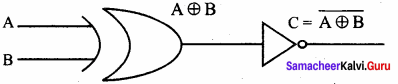
The XNOR (exclusive – NOR) gate is a combination of XOR gate followed by an inverter. Its output is “true” if the inputs are same and false if the inputs are different.
The output of XNOR is C = AB + \(\overline{\mathrm{A}}\) \(\overline{\mathrm{B}}\)
= A \(\odot\) B
Where \(\odot\) indicates included dot.
Truth Table:
Samacheer Kalvi 11th Computer Science Solutions Chapter 2 Number Systems 14
Logic symbol:
Samacheer Kalvi 11th Computer Science Solutions Chapter 2 Number Systems 15
Logic circuit:
Samacheer Kalvi 11th Computer Science Solutions Chapter 2 Number Systems 16

Question 3.
Reason out why the NAND an NOR are called universal gates?
Answer:
NAND and NOR gates are called as Universal gates because the fundamental logic gates can be realized through them.

Question 4.
Give the truth table of XOR gate.
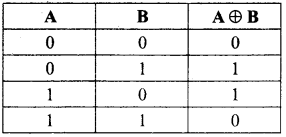
Answer:
XOR – Truth Table
Samacheer Kalvi 11th Computer Science Solutions Chapter 2 Number Systems 17

Question 5.
Write the De Morgan’s law.
Answer:
De Morgan’s \(\overline{\mathrm{A}+\mathrm{B}}\) = \(\overline{\mathrm{A}}\) . \(\overline{\mathrm{B}}\)
(\(\overline{\mathrm{A}+\mathrm{B}}\)) = \(\overline{\mathrm{A}}\) + \(\overline{\mathrm{B}}\)

PART – 4
IV. Explain in Detail

Question 1.
Explain the fundamental gates with expression and truth table.
Answer:
A gate is a basic electronic circuit which operates on one or more signals to produce an output signal.
The three fundamental gates are AND, OR and NOT gates.

AND Gate:
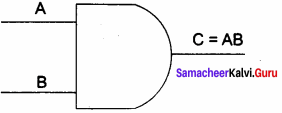
The AND gate can have two or more input signals and produce an output signal. The output is “true” only when both inputs are “true”, otherwise, the output is “false”. In other words the output will be 1 if and only if both inputs are 1; otherwise the output is 0. The output of the AND gate is represented by a variable say C, where A and B are two and if input boolean variables. In boolean algebra, a variable can take either of the values ‘0’ or ‘1’. The logical symbol of the AND gate is
Samacheer Kalvi 11th Computer Science Solutions Chapter 2 Number Systems 18
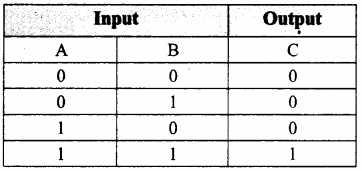
The truth table for AND gate is
Samacheer Kalvi 11th Computer Science Solutions Chapter 2 Number Systems 19

OR Gate:
The OR gate gets its name from its behaviour like the logical inclusive “OR”. The output is “true” if either or both of the inputs are “true”. If both inputs are “false” then the output is “false”. In other words the output will be 1 if and only if one or both inputs are 1; otherwise, the output is 0. The logical symbol of the OR gate is
Samacheer Kalvi 11th Computer Science Solutions Chapter 2 Number Systems 20
The truth table for OR gate is
Samacheer Kalvi 11th Computer Science Solutions Chapter 2 Number Systems 21

NOT Gate:
The NOT gate, called a logical inverter, has only one input. It reverses the logical state. In other words the output C is always the complement of the input. The logical symbol of the NOT gate is
Samacheer Kalvi 11th Computer Science Solutions Chapter 2 Number Systems 22
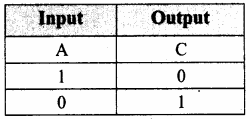
The truth table for NOT gate is
Samacheer Kalvi 11th Computer Science Solutions Chapter 2 Number Systems 23

Question 2.
How AND and OR can be realized using NAND and NOR gate.
Bubbled AND Gate
(i) Realized of and using only AND gate:
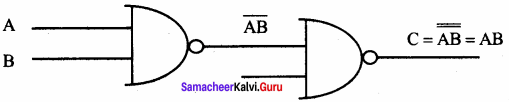
The Boolean function for AND is C = AB. The same can be realized using only NAND gates.
Samacheer Kalvi 11th Computer Science Solutions Chapter 2 Number Systems 24
(ii) Realization of or using only NAND’s:
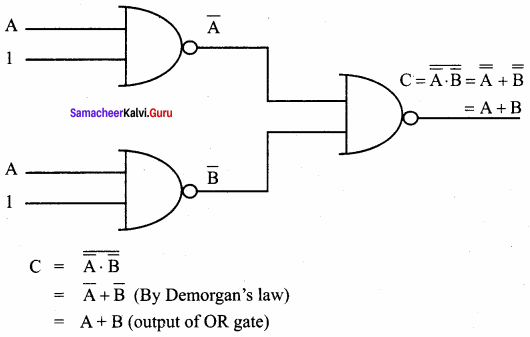
The Boolean function of OR is C = A + B. The same can be realized using only NAND gates.
Samacheer Kalvi 11th Computer Science Solutions Chapter 2 Number Systems 25
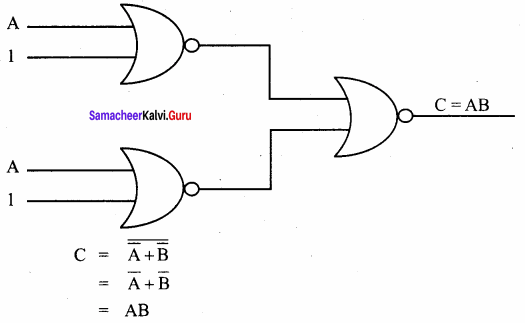
(iii) Realization of AND using NOR:
By using only the NOR gates, we can get the output equivalent to the output of AND gate.
C = A.B
Samacheer Kalvi 11th Computer Science Solutions Chapter 2 Number Systems
(iv) Realization of OR using NOR’s:
By using only NOR gates we are getting the output equivalent to OR gate.
Samacheer Kalvi 11th Computer Science Solutions Chapter 2 Number Systems 27

Question 3.
Explain the Derived gates with expression and truth table.
Answer:
The logic gates like NAND, NOR, XOR and XNOR are derived gates which are derived from the fundamental gates AND, OR NOT.
(i) NAND gate:
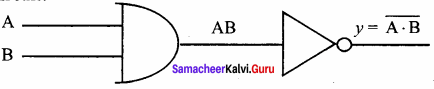
The NAND is the combination of NOT and AND. The NAND is generated by inverting the output of an AND operation.
Output: y = \(\overline{\mathrm{A}\mathrm{B}}\)
Logic circuit
Samacheer Kalvi 11th Computer Science Solutions Chapter 2 Number Systems 28
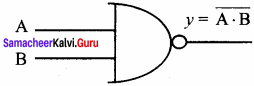
Logic symbol:
Samacheer Kalvi 11th Computer Science Solutions Chapter 2 Number Systems 29
Truth table:
Samacheer Kalvi 11th Computer Science Solutions Chapter 2 Number Systems 30
Inputs Outputs
(ii) NOR gate:
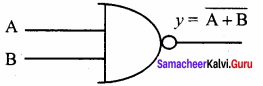
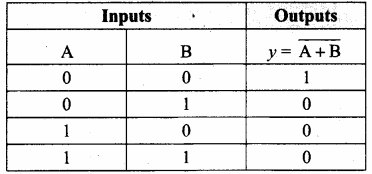
The NOR is the combination of NOT and OR. The NOR is generated by inverting the output of an OR operation.
Logic function: y = \(\overline{\mathrm{A}\mathrm{B}}\)
Logic circuit:
Samacheer Kalvi 11th Computer Science Solutions Chapter 2 Number Systems 31

logic symbol:
Samacheer Kalvi 11th Computer Science Solutions Chapter 2 Number Systems 32
Truth table:
Samacheer Kalvi 11th Computer Science Solutions Chapter 2 Number Systems 33

(iii) XOR gate:
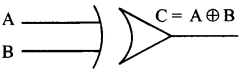
The XOR (exclusive – OR) gate acts in the same way as the logical either /or.
Logic symbol:
Samacheer Kalvi 11th Computer Science Solutions Chapter 2 Number Systems 34
Logic circuit:
Samacheer Kalvi 11th Computer Science Solutions Chapter 2 Number Systems 35
Truth table:
Samacheer Kalvi 11th Computer Science Solutions Chapter 2 Number Systems 36

(iv) XNOR gate:
XNOR gate (exclusive – NOR) gate is a combination of XOR gate followed by an inverter.
Logic function: y = \(\overline{\mathrm{A}\mathrm{B}}\)
Samacheer Kalvi 11th Computer Science Solutions Chapter 2 Number Systems 37
logic symbol:
Samacheer Kalvi 11th Computer Science Solutions Chapter 2 Number Systems 38
Truth table:
Samacheer Kalvi 11th Computer Science Solutions Chapter 2 Number Systems 39
Boolean function:
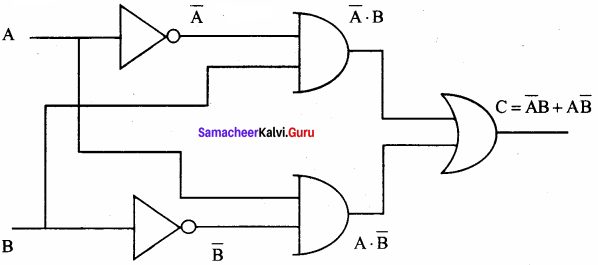
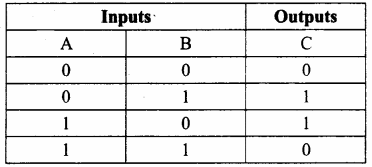
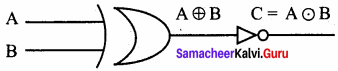
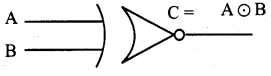
Samacheer Kalvi 11th Computer Science Solutions Chapter 2 Number Systems 40

Samacheer kalvi 11th Computer Science Number Systems Additional Questions and Answers

PART – 1
I. Choose the correct answer

Question 1.
The simplest method to represent negative binary number is called ………………..
(a) signed magnitude
(b) sign bit or parity bit
(c) binary
(d) decimal
Answer:
(a) signed magnitude

Question 2.
The term data comes from the word ………………..?
(a) number
(b) datum
(c) nibble
(d) bit
Answer:
(b) datum

Question 3.
Expansion for BCD ………………..
(a) Binary coded decimal
(b) binary complement decimal
(c) binary computer decimal
(d) binary convert decimal
Answer:
(a) Binary coded decimal

Question 4.
……………….. scheme is denoted by hexadecimal numbers.
(a) binary
(b) Unicode
(c) word length
(d) data
Answer:
(b) Unicode

Question 5.
The ……………….. operator is defined in boolean algebra by the use of the dot (.) operator.
(a) AND
(b) OR
(c) NOT
(d) NAND
Answer:
(a) AND

Question 6.
A ……………….. number is represented using base 16.
(a) Hexadecimal
(b) octal
(c) binary
(d) decimal
Answer:
(a) Hexadecimal

Question 7.
The convert (65)10 into its equivalent octal number ………………..
(a) (101)8
(b) (101)10
(c) (101)12
(d) (101)4
Answer:
(a) (101)8

Question 8.
Octal number system uses digits ………………..
(a) 7
(b) 5
(c) 8
(d) 10
Answer:
(c) 8

Question 9.
……………….. is the general idea behind positional numbering system.
(a) Radix
(b) Computer memory
(c) Binary number
(d) Decimal number
Answer:
(a) Radix

Question 10.
The NAND gate operates an AND gate followed by a ……………….. gate.
(a) AND
(b) OR
(c) NOT
(d) XOR
Answer:
(c) NOT

Question 11.
Bit means ………………..
(a) nibble
(b) byte
(c) word length
(d) binary digit
Answer:
(d) binary digit

Question 12.
Expand BIT.
(a) Basic Input Term
(b) Binary Input Term
(c) Binary Digit
(d) Binary Inverse Digit
Answer:
(c) Binary Digit

Question 13.
The computer can understand ……………….. languages.
(a) computer
(b) machine
(c) post
(d) pre
Answer:
(b) machine

Question 14.
Identify the wrong pair.
1. 1 YB = 2^80
2. 1 BM = 2^70
3. 1 MB = 2^20
4. 1 TM = 2^40
(a) 2
(b) 3
(c) 4
(d) 1
Answer:
(a) 2

Question 15.
How many bytes does 1 zetta byte contains?
(a) 290
(b) 280
(c) 270
(d) 260
Answer:
(c) 270

Question 16.
The collection of 4 bits is ………………..
(a) bit
(b) byte
(c) nibble
(d) KB
Answer:
(c) nibble

Question 17.
Match the following.
Samacheer Kalvi 11th Computer Science Solutions Chapter 2 Number Systems 59
(a) 4 12 3
(b) 12 3 4
(c) 4 3 2 1
(d) 4 2 1 3
Answer:
(a) 4 12 3

Question 18.
1 kilo byte represents ……………….. bytes.
(a) 512
(b) 256
(c) 1024
(d) 64
Answer:
(c) 1024

Question 19.
How many mega bytes does 1 GB contains?
(a) 220
(b) 210
(c) 230
(d) 240
Answer:
(b) 210

Question 20.
What is the decimal value of 11112?
(a) 10
(b) 11
(c) 14
(d) 15
Answer:
(d) 15

Question 21.
What is the 1’ s complement of 11001.
(a) 11100110
(b) 01010101
(c) 11110000
(d) 100100111
Answer:
(a) 11100110

Question 22.
The decimal value of Binary number 10 is ………………..
(a) 101010
(b) 2
(c) 100
(d) A
Answer:
(b) 2

Question 23.
The hexadecimal equivalent of 15 is ………………..
(a) A
(b) B
(c) E
(d) F
Answer:
(d) F

Question 24.
Which of the following are data?
(a) Alphabet
(b) Special character
(c) Number
(d) All of these
Answer:
(d) All of these

Question 25.
The radix of hexadecimal number is ………………..
(a) 2
(b) 8
(c) 16
(d) 10
Answer:
(c) 16

Question 26.
Pick the odd one.
(a) BCD
(b) ENIAC
(c) ASCII
(d) EBCDIC
Answer:
(b) ENIAC

Question 27.
The most commonly used number system is ………………..
(a) binary
(b) decimal
(c) octal
(d) hexadecimal
Answer:
(b) decimal

Question 28.
Unicode can handles how many characters?
(a) 64
(b) 128
(c) 256
(d) 65536
Answer:
(d) 65536

Question 29.
What does MSB means?
(a) Major sign bit
(b) Most sign bit
(c) Minor sign bit
(d) Most significant bit
Answer:
(d) Most significant bit

Question 30.
Which one is the right most bit?
(a) MSB
(b) LSB
(c) USB
(d) USRB
Answer:
(b) LSB

Question 31.
The binary equivalent of hexadecimal number B is ………………..
(a) 1011
(b) 1100
(c) 1001
(d) 1010
Answer:
(a) 1011

Question 32.
The left most bit of a positive binary number in signed notation is ………………..
(a) 0
(b) 1
(c) 2
(d) A
Answer:
(a) 0

Question 33.
What is the range of ASCII values for lower case alphabets?
(a) 65 to 90
(b) 65 to 122
(c) 97 to 122
(d) 98 to 122
Answer:
(c) 97 to 122

Question 34.
The radix for octal number system is ………………..
(a) 2
(b) 8
(c) 1
(d) 16
Answer:
(b) 8

Question 35.
What is the ASCII value for blank space?
(a) 8
(b) 2
(c) 18
(d) 32
Answer:
(d) 32

Question 36.
Which one of the following company have formulated EBCDIC?
(a) Microsoft
(b) 1 BM
(c) Sun
(d) Apple
Answer:
(b) 1 BM

Question 37.
Which one of the following bit has smallest positional weight?
(a) MSB
(b) LSB
(c) UPS
(d) USB
Answer:
(b) LSB

Question 38.
The base value of hexadecimal number is ………………..
(a) 2
(b) 8
(c) 16
(d) 18
Answer:
(c) 16

Question 39.
Name the person who proposed the basic principles of Boolean Algebra?
(a) Wiliam Boole
(b) George Boole
(c) James Boole
(d) Boolean George
Answer:
(b) George Boole

Question 40.
How many truth values are there?
(a) 2
(b) 3
(c) 4
(d) 5
Answer:
(a) 2

Question 41.
What is the other name for logical statement?
(a) Truth values
(b) Truth functions
(c) Truth table
(d) Truth variables
Answer:
(b) Truth functions

Question 42.
The variables which can store the truth values are called as ………………..
(a) logical variable
(b) binary valued variable
(c) boolean variables
(d) all of these
Answer:
(d) all of these

Question 43.
The NOT operator is represented by the symbol.
(a) over bar
(b) single apostrophe
(c) a and b
(d) plus
Answer:
(c) a and b

Question 44.
Which is not a logical operator?
(a) dot
(b) plus
(c) over bar
(d) command
Answer:
(d) command

Question 45.
The output for the AND operator is ………………..
(a) A + B
(b) –
(c) A.B
(d) AB + C
Answer:
(c) A.B

Question 46.
Which symbol is used to in OR operator?
(a) –
(b) •
(c) *
(d) +
Answer:
(d) +

Question 47.
Which gate takes only one input?
(a) OR
(b) AND
(c) NOT
(d) XOR
Answer:
(c) NOT

Question 48.
Which among the following can be replaced by a bubbled AND gate?
(a) AND
(b) NAND
(c) OR
(d) not
Answer:
(b) NAND

Question 49.
Which is not a derived date?
(a) AND
(b) NAND
(c) NOR
(d) XOR
Answer:
(a) AND

Question 50.
Find the universal gates from the following.
(a) XOR
(b) XNOR
(c) a and b
(d) NOR
Answer:
(d) NOR

Question 51.
The statement “C equal the complement of A or B” means
(a) C = A + B
(b) C = \(\overline{\mathrm{A}}+\overline{\mathrm{B}}\)
(c) C = \(\overline{\mathrm{A}}\) + \(\overline{\mathrm{B}}\)
(d) C = \(\overline{\mathrm{A}\mathrm{B}}\)
Answer:
(a) C = A + B

Question 52.
Which symbol is used in XOR gate?
(a) \(\odot\)
(b) \(\otimes\)
(c) \(\oplus\)
(d) –
Answer:
(c) \(\oplus\)

Question 53.
Included dot means ………………..
(a) \(\odot\)
(b) [•]
Samacheer Kalvi 11th Computer Science Solutions Chapter 2 Number Systems 60
Samacheer Kalvi 11th Computer Science Solutions Chapter 2 Number Systems 61
Answer:
(a) \(\odot\)

Question 54.
What is the output of XOR gate?
(a) C = A% B
(b) C = A \(\otimes\) A
(c) C = A \(\odot\) B
(d) C = A \(\oplus\) B
Answer:
(d) C = A \(\oplus\) B

Question 55.
Identify the statement which is wrong.
(a) A . 1 = A
(b) A . A = A
(c) A + O = A
(d) A . 1 = 0
Answer:
(b) A . A = A

Question 56.
Find A + \(\overline{\mathrm{A}}\) .B = ………………..
(a) A + B
(b) A.B
(c) \(\overline{\mathrm{A}}\).B
(d) A.\(\overline{\mathrm{B}}\)
Answer:
(d) A.\(\overline{\mathrm{B}}\)

Question 57.
Identify the statements which are true.
(i) A + 0 = A
(ii) A.A = A
(iii) A + \(\overline{\mathrm{A}}\) = 1
(iv) A. O = O

(a) (iii) (iv) are true
(b) (i) (ii) are true
(c) (i) (ii) (iii) are true.
(d) all are true
Answer:
(d) all are true

Question 58.
Find the wrong pair from the following:
(a) Null element : A + 1 = 1
(b) Involution : \(\overset { = }{ A }\) = A
(c) Demorgan’s : \(\overline{\mathrm{A+B}}\) =\(\overline{\mathrm{A}}\) . \(\overline{\mathrm{A}}\)
(d) Commutative : A + B = B . A
Answer:
(d) Commutative : A + B = B . A

Question 59.
Match the following
Samacheer Kalvi 11th Computer Science Solutions Chapter 2 Number Systems 44
(a) 3 4 2 1
(b) 1 2 3 4
(c) 4 3 2 1
(d) 3 4 1 2
Answer:
(a) 3 4 2 1

Question 60.
With 2 inputs in the truth table, how many set of values will be obtained.
(a) 4
(b) 8
(c) 2
(d) 1
Answer:
(a) 4

PART – 2
II. Short Answers

Question 1.
What is nibble?
Answer:
Nibble is a collection of 4 bits. A nibble is a half a byte.

Question 2.
Expand ASCII.
Answer:
American Standard Code for Information Interchange

Question 3.
What is radix?
Answer:
The base value of a number is also known as the radix.

Question 4.
What is MSB and LSB?
Answer:
MSB means Most Significant Bit; LSB-Least Significant Bit

Question 5.
Expand: BCD, EBCDIC, ASCII
Answer:
BCD – Binary Coded Decimal; EBCDIC – Extended Binary Coded Decimal Interchange Code; ASCII – American Standard Code for Information Interchange.

Question 6.
Define word length?
Answer:
Word length refers to the number of bits processed by a computers CPU.

Question 7.
What are the methods of converting a number from decimal to binary.
Answer:

  1. Repeated division by two.
  2. Sum of powers of 2.

Question 8.
How will you convert a number from octal to Binary.
Answer:
For each octal digit in the given number write its 3 digits binary equivalent using positional notation.

Question 9.
What are the various ways for Binary representation of signed numbers?
Answer:

  1. Signed magnitude representation
  2. 1’s complement
  3. 2’s complement

Question 10.
Write a short note on BCD.
Answer:

  1. BCD stands for Binary Coded Decimal system.
  2. BCD is 26 bit encoding system.
  3. IT can handle 64 characters.

PART – 3
III. Explain in Brief

Question 1.
What is binary number system?
Answer:
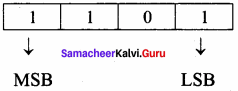
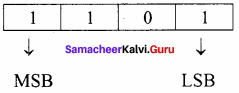
There are only two digits in the Binary system, namely, 0 and 1. The numbers in the binary system are represented to the base 2 and the positional multipliers are the powers of 2. The left most bit in the binary number is called as the Most Significant Bit (MSB) and it has the largest positional weight. The right most bit is the Least Significant Bit (LSB) and has the smallest positional weight.
Samacheer Kalvi 11th Computer Science Solutions Chapter 2 Number Systems 45
Example:
The binary sequence (11101)2 has the decimal equivalent:
(1101)2 = 1 x 23 + 1 x 22 + 0 x 21 + 1 x 20
= 8 + 4 + 0 + 1
= (13)10

Question 2.
What is octal number system?
Answer:
Octal number system uses digits 0, 1, 2, 3, 4, 5, 6 and 7 (8 digits): Each octal digit has its own positional value or weight as a power of 8.
Example:
The Octal sequence (547)8 has the decimal equivalent:

Question 3.
What is decimal number system?
Answer:
It consists of 0, 1, 2, 3, 4, 5, 6, 7, 8, 9(10 digits). It is the oldest and most popular number system used in our day to day life. In the positional number system, each decimal digit is weighted relative to its position in the number. This means that each digit in the number is multiplied by 10 raised to a power corresponding to that digit’s position.
Example:
(123)10 = (1 x 10²) + (2 x 101) + (3 x 100)
= 100 + 20 + 3
= (123)10

Question 4.
Write the distributive law.
Answer:
A . (B + C) = A . B + A . C
A + (B . C) = (A + B) . (A + C)

Question 5.
What is truth table?
Answer:
A truth table represents all the possible values of logical variable or statements along with ail the possible results of given combination of truth values.

PART – 4
IV. Explain in Detail

Question 1.
Explain the different types of number systems?
Answer:
Different Types of Number Systems
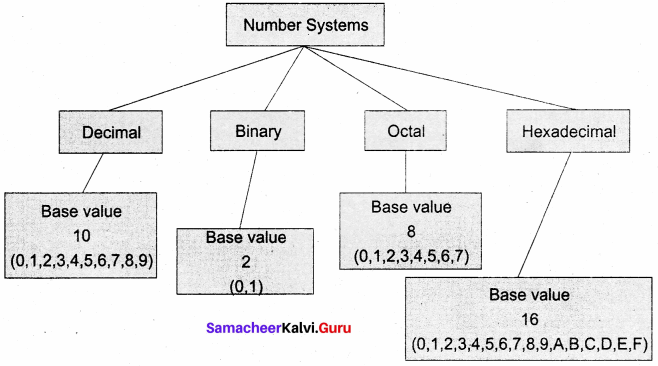
Samacheer Kalvi 11th Computer Science Solutions Chapter 2 Number Systems 46
A numbering system is a way of representing numbers. The most commonly used numbering system in real life is Decimal number system. Other number systems are Binary, Octal, Hexadecimal number system. Each number system is uniquely identified by its base value or radix. Radix or base is the count of number of digits in each number system. Radix or base is the general idea behind positional numbering system.

Decimal Number System:
It consists of 0, 1, 2, 3, 4, 5, 6, 7, 8, 9(10 digits). It is the oldest and most popular number system used in our day to day life. In the positional number system, each decimal digit is weighted relative to its position in the number. This means that each digit in the number is multiplied by 10 raised to a power corresponding to that digit’s position.
Example:
(123)10 = 1 x 10² + 2 x 101 + 3 x 100
= 100 + 20 + 3
= (123)10

Binary Number System:
There are only two digits in the Binary system, namely, 0 and 1. The numbers in the binary system are represented to the base 2 and the positional multipliers are the powers of 2. The left most bit in the binary number is called as the Most Significant Bit (MSB) and it has the largest positional weight. The right most bit is the Least Significant Bit (LSB) and has the smallest positional weight.
Samacheer Kalvi 11th Computer Science Solutions Chapter 2 Number Systems 47
Example:
The binary sequence (1101)2 has the decimal equivalent:
(1101)2 = 1 x 23 + 1 x 22 + 0 x 21 + 1 x 20
= 8 + 4 + 0 + 1
= (13)10

Octal Number System:
Octal number system uses digits 0,1,2,3,4,5,6 and 7 (8 digits). Each octal digit has its own positional value or weight as a power of 8.
Example:
The Octal sequence (547)8 has the decimal equivalent:
(547)8 = 5 x 82 + 4 x 82 + 7 x 80
= 5 x 64 + 4 x 8 + 7 x 1
= 320 + 32 + 7
= (359)10

Hexadecimal Number System:
A hexadecimal number is represented using base 16. Hexadecimal or Hex numbers are used as a shorthand form of binary sequence. This system is used to represent data in a more compact manner. Since 16 symbols are used, 0 to F, the notation is called hexadecimal. The first 10 symbols are the same as in the decimal system, 0 to 9 and the remaining 6 symbols are taken from the first 6 letters of the alphabet sequence, A to F, where A represents 10, B is 11, C is 12, D is 13, E is 14 and F is 15.

Question 2.
Explain the octal to decimal conversion and hexadecimal to decimal conversion.
Answer:
Octal to Decimal Conversion:
To convert Octal to Decimal, we can use positional notation method.

  1. Write down the Octal digits and list the powers of 8 from right to left(Positional Notation).
  2. For each positional notation of the digit write the equivalent weight.
  3. Multiply each digit with its corresponding weight.
  4. Add all the values.

Example:
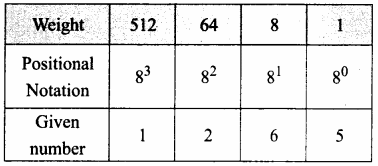
Convert (1265)8 to equivalent Decimal number
Samacheer Kalvi 11th Computer Science Solutions Chapter 2 Number Systems 48
(1265)8 = 512 x 1 + 64 x 2 + 8 x 6 + 1 x 5
= 512 + 128 + 48 + 5
(1265)8 = (693)10

Hexadecimal to Decimal Conversion:
To convert Hexadecimal to Decimal we can use positional notation method.

  1. Write down the Hexadecimal digits and list the powers of 16 from right to left (Positional Notation).
  2. For each positional notation written for the digit, now write the equivalent weight.
  3. Multiply each digit with its corresponding weight.
  4. Add all the values to get one final value.

Example:
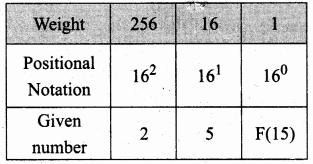
Convert (25F)16 into its equivalent Decimal number.
Samacheer Kalvi 11th Computer Science Solutions Chapter 2 Number Systems 49

Question 3.
Explain the binary addition and binary subtraction
Answer:
Binary Addition:
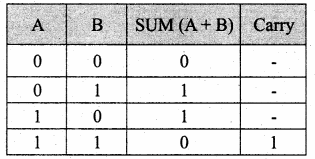
The following table is useful when adding two binary numbers.
Samacheer Kalvi 11th Computer Science Solutions Chapter 2 Number Systems 50
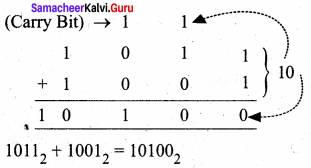
Example Add: 10112 + 10012
Samacheer Kalvi 11th Computer Science Solutions Chapter 2 Number Systems 51
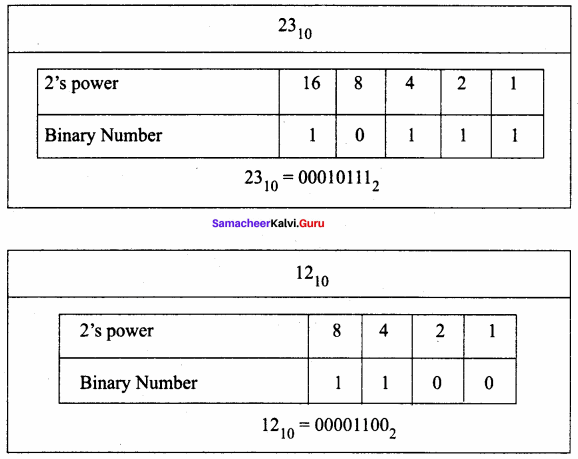
Example : Perform Binary addition for the
following : 2310 + 1210
Step 1 : Convert 23 and 12 into binary form
Samacheer Kalvi 11th Computer Science Solutions Chapter 2 Number Systems 52
Step 2 : Binary addition of 23 and 12:
Samacheer Kalvi 11th Computer Science Solutions Chapter 2 Number Systems 53

Binary Subtraction:
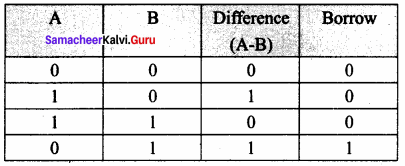
The table for Binary Subtraction is as follows:
Samacheer Kalvi 11th Computer Science Solutions Chapter 2 Number Systems 54
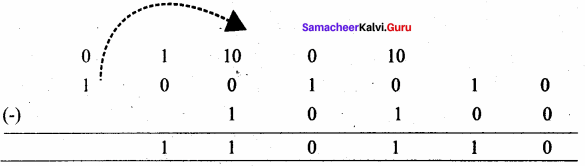
When subtracting 1 from 0, borrow 1 from the next Most Significant Bit, when borrowing from the next Most Significant Bit, if it is 1, replace it with 0. If the next Most Significant Bit is 0, you must borrow from a more significant bit that contains 1 and replace it with 0 and Os upto that point become Is.
Example : Subtract 10010102 – 101002
Samacheer Kalvi 11th Computer Science Solutions Chapter 2 Number Systems 55
Example Perform binary addition for the following: (-21)10 + (5)10
Step 1 : Change – 21 and 5 into binary form
Samacheer Kalvi 11th Computer Science Solutions Chapter 2 Number Systems 56

Step 2:
Samacheer Kalvi 11th Computer Science Solutions Chapter 2 Number Systems 57

Step 3.
Binary Addition of – 21 and 5:
Samacheer Kalvi 11th Computer Science Solutions Chapter 2 Number Systems 58

Question 4.
Explain the theorems of boolean algebra.
Answer:
Theorems of Boolean Algebra:
Identity:
A + 0 = A
A. 1 = A

Complement:
A + \(\overline{\mathrm{A}}\) = 1
A. \(\overline{\mathrm{A}}\) = 0

Commutative:
A + B = B + A
A. B = B .A

Associative:
A + (B + C) = (A + B) + C
A. (B . C) = (A. B). C

Distributive
A. (B + C) = A B + A. C
A + (B . C) = (A + B). (A + C)

Null Element:
A + 1 = 1
A. 0 = 0

Involution
(\(\overset { = }{ A }\)) = A

Indempotence:
A +A = A
A.A = A

Absorption:
A + (A . B) = A
A . (A + B) = A

3rd Distributive:
A + \(\overline{\mathrm{A}}\). B = A + B

De Morgan’s:
\(\overline{\mathrm{A+B}}\) = \(\overline{\mathrm{A}}\).\(\overline{\mathrm{B}}\)
(\(\overline{\mathrm{A.B}}\)) = \(\overline{\mathrm{A}}\) + \(\overline{\mathrm{B}}\)

Samacheer Kalvi 6th English Solutions Term 2 Poem Chapter 1 Team Work

Students can Download English Poem 1 From a Team Work Questions and Answers, Summary, Activity, Notes, Samacheer Kalvi 6th English Book Solutions Guide Pdf  helps you to revise the complete Tamilnadu State Board New Syllabus and score more marks in your examinations.

Tamilnadu Samacheer Kalvi 6th English Solutions Term 2 Poem Chapter 1 Team Work

Teamwork Poem Class 6 Poem Overview

No.

Poem Line

Explanation

1-2It’s all very well to have courage and skill And it s fine to be counted a star,It’s good to have courage and talent to achieve something.
It’s also fine to be counted as a star.
3-4But the single deed with its touch of thrill
Doesn’t tell the man you are;
But the thrilling single act doesn’t tell anyone your abilities.
5-6For there’s no lone hand in the game we play,
We must work to a bigger scheme,
There is no single hand in the game we play. All of us, as a team, should
work to a bigger plan or aim.
7-8And the thing that counts in the world to-day
Is, How do you pull with the team?
The thing that matters in the world today is how do you get along with your teammates.
9-10They may sound your praise and call you great,
They may single you out for fame,
Sometimes people may praise you, call you great and they may give you special attention from others for fame.
11-12But you must work with your running mate
Or you ‘ll never win the game;
But you must work earnestly with your teammate or you will never win the game.
13-14Oh, never the work of life is done By the man with a selfish dream,Your work of life is never done with your selfish dream. It is a fact that is known to everyone.
15-16For the battle is lost or the battle is won
By the spirit of the team.
A battle can be won or lost by the spirit of the team. If they all work together.
17-18You may think it fine to he praised for skill,
But a greater thing to do
You may think it is fine to be praised by others for your talent. But a greater thing you should do than this.
19-20Is to set your mind and set your will On the goal that’s just in view;You should set your mind and will on the goal that is in front of you. The aim that is in your view.
21-22It’s helping your fellowman to score When his chances hopeless seem;This goal is helping your fellow men to score more, when his chances
seem to be hopeless. Giving him a helping hand,
23-24Its forgetting self till the game is o ’re And fighting for the team.It’s also forgetting about your selfishness and fighting for the team, till the game is over.

A. Read the poem aloud and fill in the wheel with its rhyming pair. Also try giving your own rhyming word. One is done for you.

Teamwork Poem Class 6 Samacheer Kalvi Term 2 Poem Chapter 1
Answer:
Teamwork Poem Summary Samacheer Kalvi 6th English Solutions Term 2 Poem Chapter 1

B. Fill in the table.

Contraction is a shortened form of a word or group of words, with the omitted letters often replaced in written English by an apostrophe (‘).

It’sIt is
Doesn’tDoes not
There’sThere is
You’llYou will
That’sThat is
I’veI have
He’dHe would / He had
Aren’tAre not
He’sHe has
Won’tWill not
Can’tCan not

C. Answer the following questions.

Teamwork Poem Summary Question 1.
What qualities are needed to play a game?
Answer:
Planning, co-ordination with your teammates, true spirit of the team, setting your mind and will on the goal in front of you, fighting for the team and helping them to score are the qualities needed to play a game.

6th Standard English Poem Teamwork Question 2.
What helps one win the game?
Answer:
Working with your running mate, the team spirit, setting your mind and will on the game played, helping your fellowmen to score and forgetting self till the game is over, helps one to win the game.

Teamwork 6th Poem Question 3.
How is team spirit created?
Answer:
Team spirit can be created by recognising the team players, who drive success within any team, treating all of them fairly, trusting them at all tiems and creating a right environment for them.

D. Read the lines and answer the questions given below.

1. It’s helping your fellowman to score
When his chances hopeless seem;
Its forgetting self till the game is o’re
And fighting for the team.

Team Work Poem Question a.
What does’it’stand for here?
Answer:
It stands for the Team work.

Teamwork Poem Class 6 Summary Question b.
Write the rhyme scheme for the above lines.
Answer:
The rhyming scheme for the above line is ‘aba b’.

2. They may sound your praise and call you great.
They may single you out for fame,
But you must work with your running mate
Or you ’ll never win the game;

Teamwork Poem 6th Standard Question a.
Whom does’they’refer to?
Answer:
‘They’refers to the people around you.

Teamwork Poem Question b.
Which line talks about team Spirit?
Answer:
The 3rd line ‘But you must work with your running mate’ talks about the team spirit.

Samacheer Kalvi Guru 6th English Question c.
Pick out the rhyming words from the given lines.
Answer:
The rhyming words are ‘great – mate ; fame – game’.

E. Pair wort. Discuss with your partner and list out any five team games.

  1. Football
  2. Hockey
  3. Cricket
  4. Kho-Kho
  5. Volley ball

Team Work Additional Questions

I. Poem Comprehension And Poetic Devices.

1. It’s all very well to have courage and skill
And it’s fine to be counted a star,
But the single deed with its touch of thrill
Doesn’t tell the man you are;

Teamwork Poem Explanation Question a.
What is fine to be counted?
Answer:
It is fine to be counted as a star.

Team Work Summary Question b.
Does your single act tell who you are?
Answer:
No, your single act doesn’t tell the man you are. ‘

Teamwork Summary Question c.
What do you mean by the word’deed’?
Answer:
‘Deed’means‘Act’or‘achievement’.

6th Standard Teamwork Poem Question d.
Pick out rhyming words from these lines?
Answer:
The rhyming words are skill – thrill; star – are.

2. For there s no lone hand in the game we play,
We must work to a bigger scheme,
And the thing that counts in the world to-day
Is, How do you pull with the team?

Teamwork 6th Std Poem Question a.
Is there a lone hand in the game we play?
Answer:
No, there is no lone hand in the game we play.

Teamwork Poem Explanation In English Question b.
What is the thing that counts in the world today?
Answer:
It is the co-ordination with the teammates.

6th English Book Poem Question c.
How must we work according to the poet?
Answer:
We must work to a bigger scheme.

6th Standard English Poem 2nd Term Question d.
Pick out the alliterated words.
Answer:
The alliterated words are : the – thing; the – team.

3. Oh, never the work of life is done
By the man with a selfish dream,
For the battle is lost or the battle is won
By the spirit of the team.

Question a.
What is responsible for a battle to win or lose?
Answer:
The spirit of team is responsible to win or lose a battle.

Question b.
What happens to a man of selfish dream?
Answer:
His work of life is never done.

Question c.
What is the rhyming scheme of the above lines?
Answer:
The rhyming scheme is‘a b a b’.

Question d.
Pick out the rhyming words from the given lines.
Answer:
‘done – won’; dream – team’ are the rhyming words in the given lines.

II. Very Short Answer Questions.

Question 1.
What is very well to have for a player?
Answer:
Courage and skill are good qualities of a player.

Question 2.
Is it easy to become famous with your single deed?
Answer:
No, it is not easy to become famous without your teammates.

Question 3.
Who will call you great and praise you?
Answer:
The spectators will call you great and praise you.

Question 4.
With whom must you work to win the game?
Answer:
You must work with your running mate to win the game.

Question 5.
Why do the people single you out?
Answer:
The people single you out for fame.

III. Short Answer Questions.

Question 1.
What should you do to win the game?
Answer:
We should work and co-ordinate with our teammates to win the game. You should work with a team spirit.

Question 2.
How is the life of work done according to the poet?
Answer:
The work of life is never done by the man of selfish dream. He should forget his self till the game is over. Only then, the life of work is done.

IV. Paragraph Questions.

Question 1.
What are the most essential qualities to win the game?
Answer:
The most essential quality to win the game is team work. When we work together as a team, we become strong and then it is easy to achieve the common goal. Your work of life is never done by a man’s selfish dream. A battle should be won or lost by the team spirit. You should set your mind and will on the goal that is in front of you. You should help your teammates to score, when their chances seemed to be hopeless. You should forget your self and fight for the team till the game is over.

Question 2.
Why Is team work important?
Answer:
The poet insists on the team work in this poem as it is very important. When we work together as a team, we become more strong and have more confidence. It is good to have courage and talent to achieve something. It is also fine to be counted as a star. But that thrilling single act doesn’t tell anyone your abilities. There is no single hand in a game, we play. We must work with a team, helping and co¬ordinating with others in the team to achieve something in our life. Only then, we will win and achieve great success.

Team Work Summary

The poet Edger Albert Guest in his poem ‘Team Work’ insists on the importance of Team work. Team work is very important. When we work together as a team, we become strong and then it is easy to achieve the common goal. It is good to have courage and talent to achieve something. It is also fine to be counted as a star. But that thrilling single act doesn’t tell anyone your abilities. In a game we play, there is no single hand. We must work with a team, helping and coordinating with others in the team to achieve something. Sometimes people praise you, call you great and single you out for fame. But you must work with your team mate or you’ll never win the game. Your work of life is never done with your selfish dream. A battle should be won or lost by the spirit of the team.

You may be praised for your skill. But a greater thing to do is to set your mind and will on the goal that’s in front of you (the game). It is helping your teammate to score, when his changes are hopeless. It is also forgetting about self and fighting for the team till the game is over.

Samacheer Kalvi 7th Science Solutions Term 1 Chapter 6 Health and Hygiene

Students can Download Science Chapter 6 Health and Hygiene Questions and Answers, Notes Pdf, Samacheer Kalvi 7th Science Book Solutions Guide Pdf helps you to revise the complete Tamilnadu State Board New Syllabus and score more marks in your examinations.

Tamilnadu Samacheer Kalvi 7th Science Solutions Term 1 Chapter 6 Health and Hygiene

Samacheer Kalvi 7th Science Health and Hygiene Textual Evaluation

I. Choose the appropriate answer :

Health And Hygiene 7th Standard Question 1.
Ravi has sound mind and physically fit body. Which refers to
(a) Hygiene
(b) Health
(c) Cleanliness
(d) Wealth
Answer:
(b) Health

Health And Hygiene Class 7 Question 2.
Sleep is not only good for body, but it is also good for
(a) Enjoyment
(b) Relaxation
(c) Mind
(d) Environment
Answer:
(c) Mind

7th Science Health And Hygiene Question 3.
Our living place should be
(a) Open
(b) Closed
(c) Clean
(d) Unclean / Untidy
Answer:
(c) Clean

7th Standard Science Health And Hygiene Question 4.
The tobacco chewing causes
(a) Anamia
(b) Periodontitis
(c) Tuberculosis
(d) Pneumonia
Answer:
(b) Periodontitis

Samacheer Kalvi Guru 7th Science Question 5.
The first aid is to
(a) To save money
(b) To prevent scars
(c) To prevent the medical care
(d) To relieve the pain
Answer:
(d) To relieve the pain

II. Fill in the blanks :

Health And Hygiene Questions And Answers Pdf Question 1.
A group of people living together in a particular area is called ______
Answer:
Community

Samacheer Kalvi Guru Science 7th Question 2.
Iam green colour box with garbage. Who am I ?
Answer:
Bio degradable waste

Health And Hygiene Class 7 Questions And Answers Question 3.
Eyes are considered as to the world.
Answer:
windows

Samacheer Kalvi Guru 7th Standard Science Question 4.
The hair follicles produce which keeps the hair smooth.
Answer:
oil

Health And Hygiene Chapter Question 5.
Tuberculosis is caused by the bacterium .
Answer:
Mycobacterium tuberculae

III. True (or) False, If false give the correct statement.

Health And Hygiene Questions And Answers Question 1.
All food should be covered.
Answer:
True

Samacheer Kalvi Guru 7th Science Guide Question 2.
Chicken pox also known as Leucoderma.
Answer:
(False) Correct statement: Chicken pox is also known as vanicella.

Question 3.
Stomach ulcer is a non-commnicable disease.
Answer:
True.

Question 4.
Rabies is a fatal disease.
Answer:
True

Question 5.
First- degree bums damage the whole skin.
Answer:
False. Correct statement: First -degree bums affects the outer layer (epidermis) of the skin only

IV. Match the following:

1.Rabie(a)Salmonella
2.Cholera(b)Yellow urine
3.Tuberculosis(c)Cramps in legs
4.Hepatitis(d)Hydrophobia
5.Typhoid(e)Mycobacterium

Answer:

  1. d
  2. c
  3. e
  4. b
  5. a

V. Analogy.

Question 1.
First degree bum: epidermis :: second degree bum : _________
Answer:
Dermis.

Question 2.
Typhoid: Bacteria:: Hepatitis: _________
Answer:
Vims.

Question 3.
Tuberculosis : air:: Cholera: _________
Answer:
Water.

VI. Choose the correct alternative from the following:

Question 1.
Assertion (A) : Oral hygiene is good.
Reason (R) : Sound teeth and healthy gums with healthy surrounding tissues,
(a) Both A and R are true
(b) Both A and R are false
(c) A is true but R is false
(d) A is false but R is true
Answer:
(a) Both A and R are true

Question 2.
Assertion (A): Chicken pox is a viral communicable disease.
Reason (R) : Characterized by rashes on the whole body, fever, head ache and tiredness.
(a) Both A and R are true
(b) Both A and R are false
(c) A is true but R is false
(d) A is false but R is true
Answer:
(a) Both A and R are true

VII. Very short Answer.

Question 1.
What is hygiene?
Answer:
Hygiene refers to the good habits and their practices which is followed to prevent disease, maintain good health, especially through cleanliness, consumption of safe drinking water and proper disposal of sewage. It refers to all those activities that are done for improving and maintaining good health and sound mind.

Question 2.
Write about the right way of protect the eyes?
Answer:
Practices to be followed for eye care.

  1. Do not rub the eyes
  2. Do not watch TV / Computer for a long time.
  3. Use cold water for cleaning the eyes.
  4. Eat lot of carrots which is rich in vitamin A needed for good vision.
  5. Eat fruits like oranges, sweet lemon etc., regularly.

Question 3.
How to keep your hair clean and health?
To keep the hair clean and healthy:
Answer:

  1. The regular hair wash and massage of the scalp will remove the dead skin cells, excess oil and dust.
  2. Rinsing the hair well with clear water and using good toothed comb for hair dressing is highly essential for their maintenance.

Question 4.
Sobi frequently playing with her mobile, suggest your ideas to protect his eye from irritation?
Answer:

  1. Stop playing with the mobile for a long time
  2. Keep the mobile at a distance from the eyes while playing.
  3. Wash eyes with cold water at intervals.

Question 5.
Give any two communicable disease, which spreads in your locality during monsoon?
Answer:

  1. Cholera
  2. Diarrhoea

Question 6.
What first aid will you provide in the case of bruises?
Answer:

  1. Bruises refer to scratches. It is a surface damage that does not penetrate the lower tissues.
  2. The affected area should be washed with cold running water and cleaned with an antiseptic cram on the wound.

Question 7.
Ravi said “Ganga had minor burn, so I washed with water” Do you agree with his statement or not? Explain Why?
Answer:

  1. Yes, In case of minor bums, the affected area should be washed with cold water.
  2. In case of severe bums, deeper layers of tissues get destroyed and blisters appear.

VIII. Short answer.

Question 1.
Why the first aid is essential?
Answer:
Safety and First Aid
First aid is the immediate treatment given to the victim of trauma or sudden illness before medical help is made available. The first aid is

  1. To save the life
  2. To prevent further bleeding and determine the condition of the patient.
  3. To relive the pain
  4. To provide a medical care available at the earliest

Question 2.
What is this picture? Explain.
Health And Hygiene 7th Standard Samacheer Kalvi Term 1 Chapter 6
Answer:
It says that “Waste should not be thrown there”.

Question 3.
Distinguish between the following pairs Communicable diseases and Non communicable diseases.
Answer:

S.no
1.These diseases spread from one person to another person.These diseases do not spread from one person to another person.
2.They are spread through contaminated air, water, food or vectors, e.g Tuberculosis, Cholera.They are caused due to wearing out of body parts or malnutrition etc., eg. Goiter, Night blindness.

Question 4.
What steps you will follow to keep the teeth healthy?
Answer:

  1. Good oral hygiene implies sound teeth and healthy gums with healthy surrounding tissues.
  2. When you brush two times a day, it will prevent the formation of tartar and plaque on, your teeth and gums.
  3. When you floss, it will remove food particles, plaque, and bacteria which build up between your teeth. When you start flossing, your gums may bleed a little bit, but after few days that will be stopped.
  4. It should be started only with proper medical guidance.
  5. Eat a well balanced diet and avoid habits like chewing tobacco.

Question 5.
Name the mode of transmission of communicable disease.
Answer:
Communicable diseases spread from one person to another person through various modes as given below.
Mode of Transmission:

  1. Food and water borne diseases – e.g Cholera, Typhoid
  2. Air borne diseases – e.g Tuberculosis, cold
  3. Insect other animals borne diseases – e.g Malaria, Rabies.
  4. Contaminated food and water, air and Insects are the modes for transmission of communicable disease.

Question 6.
The hair is thin, spares and lost very often. Suggested your ideas to reduce this problem?
Answer:
The condition of the hair reflects the nutritional status and general health of the body. Thin, sparse and lots of hair indicates poor nutritional status.
The following measures will help to maintain hair growth and avoid hair loss.

  1. The regular hair wash and massage of the scalp will remove the dead skin cells, excess oil and dust.
  2. Rinsing the hair well with clear water and using good toothed comb for hair dressing is highly essential for their maintenance.
  3. Eating a balanced diet which provides all nutrients needed for the body will promote hair growth.
  4. Applying oil to the skin and massaging the scalp will promote hair growth.
  5. Use of chemicals (dyes, shampoos) must be used to avoid hair loss.

IX. Answer in Details.

Question 1.
Write about any three communicable diseases in details.
Answer:
Communicable diseases are those that spread from one person to another. Diseases spread through contaminated air, water, food or vectors (insects and ohter animals) are palled as communicable diseases.

Tuberculosis:

  1. Tuberculosis is caused by Mycobacterium tuberculae.
  2. It spreads from one person to another person through air by spitting and prolonged contact with sharing materials of the patient.

Symptoms:
Fever, weight loss, Chronic cough, blood spitting and difficulty in breathing.

Prevention and treatment:

  1. Getting BCG vaccination
  2. Giving special attention to the patient,
  3. Regular medication like DOT

Cholera:

  1. Cholera is caused by Vibrio cholera.
  2. It spreads through the consumption contaminated food or water.

Symptoms:
The symptoms of Cholera is vomiting, severe diarrhoea and cramps in legs.

Hepatitis:

  1. Hepatitis is one of the most dangerous and fatal diseases caused by Hepatitis Virus A, B, C, D, E.
  2. Its mode of transmission are contaminated water, sharing of needles and blood transfusion.

Symptoms:
Loss of appetite, (Anorexia), vomiting, eyes and urine in yellow color.

Prevention and treatment:

  1. Drink boiled water.
  2. Proper cleaning of hands.

Question 2.
List the situations in which first aid is given. What would you do if a person suffers from skin burns?
Answer:
The tissue damage caused by heat, chemical, electricity, sunlight or nuclear radiation is known as Bums. Mostly bums are caused by scalds, building fires, flammable liquid and gases. According to burning. There are three types of bums.

  1. First-degree bums affect only the outer layer (called the epidermis) of the skin.
  2. Second-degree bums damage the epidermis and the layer beneath it called ther dermis.
  3. Third -degree bums involve damage or complete destruction of the skin to its full depth and damage to underlying tissues also. People who experience such bums often require skin grafting.

First Aid for Burning
In case of minor bums, the affected area should be washed with cold water and an antiseptic cream should be applied. In case of severe bums, where deeper layers of tissues get destroyed and blisters appear, use of water should be avoided. The burnt area should be covered with a clean non-sticking cloth or bandages. Larger bums need immediate medical attention.
It is very important to keep a fire extinguisher readily available.

Question 3.
How the disease are transmitted from one person to the other person?
Answer:
Communicable Diseases are those that spread from one person to another. Diseases spread through contaminated air, water, food or vectors (insects and ohter animals) are called as Communicable diseases.

  1. The communicable diseases are caused by disease causing microbes such as Bacteria, viruses etc.
  2. These microbes are found in contaminated food, water, air etc.
  3. Some of them like the malarial parasite complete their life cycle in the body of a mosquito.
  4. Thus air food and water, sweat act as modes of transmitting these microbes from an infected person to a healthy person.
  5. E.g. The cycle given below shows how food and water borne diseases are transmitted.
    Health And Hygiene Class 7 Samacheer Kalvi Term 1 Chapter 6
S.noMode of TransmissionExamples
1Contaminated food and waterCholera, Typhoid
2Contaminated airTuberculosis
3Insect / Animal borne diseasesMalaria, Rabies

X. Higher Order thinking question

Question 1.
A person is sleeping during day time. Why does this happen with some people that they feel sleepy during day time in office or in the classroom. Have you ever come across such situation? Explain.
7th Science Health And Hygiene Samacheer Kalvi Term 1 Chapter 6
Answer:

  1. Many people are tired and do not have the energy to perform day to day activities. They tired and tend to sleep in the classroom or work place. Though sleep can be due to various reasons, the common reason for this condition is Anaemia.
  2. People who are Anaemic have less number of Red blood cells in their blood.
  3. The Red blood cells have haemoglobin which caries oxygen to all the cells of the body.
  4. People who are Anaemic will have less slow oxygen supply to all the cells of the body.
  5. Energy production in the cells is less and they feel tired and sleepy always. This is due to in the diet. Prevention : Eat food rich in Iron.

Samacheer Kalvi 7th Science Health and Hygiene Additional Questions

I. Choose the appropriate answer.

Question 1.
Anorexia means _______
(a) Excess thirst
(b) Excess sweating
(c) Loss of hair
(d) Loss of appetite
Answer:
(d) Loss of appetite

Question 2.
Drinking boiled water can prevent _______
(a) Tuberculosis
(b) Rabies
(c) Cholera
(d) Chicken pox
Answer:
(c) Cholera

Question 3.
High fever is a symptom of _______
(a) Rabies
(b) Typhoid
(c) Scurvy
(d) Hepatits
Answer:
(b) Typhoid

Question 4.
_______ is a non communicable disease.
(a) small pox
(b) Varicella
(c) Rheumatism
(d) Flu
Answer:
(c) Rheumatism

Question 5.
Intake of _____ can help to prevent Anaemia.
(a) cod liver oil tablet
(b) oranges
(c) whole egg
(d) eggs
Answer:
(a) cod liver oil tablet

II. Fill in the Blanks.

  1. Dengue causes decrease in number of _______ in blood
  2. _____ is a non communicable disease caused by loss of pigmentation in the skin.
  3. The pigment present in our skin is _______
  4. Extreme fear for water is called _______
  5.  _______ vaccine prevents Tuberculosis.

Answer:

  1. Platelets
  2. Leucoderma
  3. Melanin
  4. hydrophobia
  5. BCG

III. True or False – if false give the correct statement.

Question 1.
Rabies can be caused by the bite of monkeys.
True.

Question 2.
We must eat lot of carrots to prevent eye diseases.
Answer:
True.

Question 3.
Chronic cough is a symptom of Typhoid.
Answer:
(False) Correct Statement: Chronic cough is a symptom of Tuberculosis.

Question 4.
Raju drank water in a fair and was affected by Dengue. Is this statement True or False.
Answer:
(False) Correct Statement: Dengue is not a water borne disease.

Question 5.
Bum injuries can be fatal.
Answer:
True

Question 6.
Alcoholism is a communicable disease.
Answer:
(False) Correct Statement: Alcoholism is a Non-communicable disease.

IV. Match the following :

Question 1.

Pellagra(a)Water
Allergies(b)Folic acid
Rabies(c)Pollen
Anaemia(d)skin

Answer:

  1. d
  2. c
  3. a
  4. b

Question 2.

Hepatitis(a)Citrus fruits
Nightblindness(b)Vomiting
Bleeding gums(c)smoking
Heart attack(d)Poor light

Answer:

  1. b
  2. d
  3. a
  4. c

V. Analogy.

Question 1.
Leucoderma: Melanin
Anaemia: ______.
Answer:
Iron.

Question 2.
Tuberculosis : Lungs
Rabies : _____.
Answer:
Nervous system.

VI. Assertion and Reason.

(a) Both A and R are true
(b) Both A and R are false
(c) A is true but R is false
(d) A is false but R is true

Question 1.
Assertion (A) : We must offer first aid to a bleeding person.
Reason (R) : We must not use gloves while helping them.
(a) Both A and R are true
(b) Both A and R are false
(c) A is true but R is false
(d) A is false but R is true
Answer:
(c) A is true but R is false

Question 2.
Assertion (A) : Antibiotics do not help to cure communicable diseases.
Reason (R) : They are caused by microbes.
(a) Both A and R are true
(c) A is due but R is false
(d) A is false but R is true
(b) Both A and R are false
Answer:
(d) A is false but R is true

VII. Complete the table.

Question 1.
Tuberculosis _______
________ Virus
Answer:
Bacteria,Hepatitis

Question 2.
Night Blindness ________
_________ Iron
Answer:
Vitamin A, Anaemia

Question 3.
BCG __________
________ Chicken pox
Answer:
Tubeculosis, Varicella Vaccine

Question 4.
Dog ________
________ Dengue
Answer:
Rabies,Mosquito

Question 5.
Tuberculosis ________
__________ Rashes
Answer:
Chronic cough, Chicken pox

VIII. Very short Answers:

Question 1.
Name some diseases which affect the teeth.
Answer:
Bleeding gums, Tooth decay, periodontis.

Question 2.
List two measures to maintain community hygiene.
Answer:

  1. The surroundings should be kept clean.
  2. Drains should be covered properly.

Question 3.
Name two disease which can be prevented by vaccination.
Answer:
Polio, Tuberculosis.

Question 4.
Name some diseases caused by lack of trace elements in the body.
Answer:
Anemia, pellagra, night blindness and xerophthalmia, goiter and hypothyroidism.

Question 5.
What is a Vaccine?
Answer:

  1. A vaccine is a biological preparation that provides active acquired immunity to a particular disease.
  2. Vaccine (BCG, Polio, MMR) are given at early childhood to protect from other diseases.

Question 6.
How can we prevent fatality in the case of Rabies?
Answer:
Timely vaccination before the onset of symptoms can prevent fatality in the case of Rabies.

IX. Short Answer.

Question 1.
Write a note on non-communicable diseases.
Answer:

  1. Communicable diseases do not spread from person to person. They are caused by other factors.
  2. Antibiotics, or medicines that fight against germs, do not help to cure non- communicable diseases.
  3. Problems caused by wearing out of body parts:
    Rheumatism, heart attack, epileptic seizures, stroke, migraine headaches, Cataract and cancer.
  4. Problems caused by external harmful agents entering the body:
    Allergies, asthma, poisons, snakebite, cough from smoking, stomach ulcer, alcoholism.
  5. Problems caused by a lack of trace elements in the body:
    Anaemia, pellagra, night blindness and xerophthalmia, goiter and hypothyroidism.

Question 2.
Write a note on Chicken pox.
Answer:

  1. Causal agent :Chickenpox (chicken pox), also known as varicella, is a highly contagious infection caused by the varicella zoster virus.
  2. This disease spreads through air and contact with an infected person.
  3. Symptoms: A appearance of rashes on the whole body, fever, headache and tiredness.
  4. Prevention and treatment: The chickenpox (Varicella) vaccine is the best way to prevent chickenpox. Special attention should be given to the infected persons.

Question 3.
Write a note an Rabies.
Answer:

  1. Rabies is a fatal disease, which is transmitted by the bite of the infected dog, rabbit, monkey, cat etc.
  2. Causal agent: The virus present in the saliva of dog enters the brain via neurons.
  3. Symptoms: The symptoms of rabies is hydrophobia (extreme fear for water), fever for 2-12 weeks and exaggerations in behavior.

Prevention and treatment

  1. In early stages rabies is very difficult to detect.
  2. After an animal is bitten it usually takes two to twelve weeks to shows any symptoms and it may take as long as two years also.
  3. Fatality can be prevented by timely vaccination before the onset of symptoms.

Question 4.
We should use a handkarchief when we sneeze, Justify.
Answer:
When we are suffering from cold etc, the virus comes out with the droplets and spreads in air. This can infect a healthy individual. Thus we should use a handkerchief while sneezing.

Question 5.
What can we do to maintain personal hygiene?
Answer:

  1. We must brush our teeth at least twice a day.
  2. We must have a shower daily.
  3. We must wash our hair regularly.
  4. We must wash our face and hands regularly.
  5. We should keep food covered with a lid.
  6. We should wear washed and clean clothes.
  7. We must wear slippers while we go out of the house. Drinking water must be stored in a clean and safe place.

X. Long Answer

Question 1.
List the diseases affecting the eye, their causative agents, impact and Remedial measures.
Answer:

S. NoName of the DiseaseCausative

Agents

Impacts / ConsequencesRemedial

measures.

1.Night

Blindness

Lack of vitamin A, a disorder of the cells in your retinaMakes it hard to see well at night or in poor light.Eat foods rich in antioxidant, vitamins and minerals.
2.Conjuncitvitis (Pink eye)Caused by a virus and bacteriaOne or both eyes can be affected. Highly contagious; can be spread by coughing and sneezingAntibiotic eye drops or

ointments, home remedy

3.Color

blindness

genetic condition1.  Difficulty distinguishing between colors.

2.   Inability to see shades or tones of the same color

There is no known cure for color blindness. Contact lenses and glasses are available with filters to help color deficiencies

XI. Hots

Question 1.
Richa had a pet dog. She vaccinated him regularly. He suddenly bit a stranger. Do you think that the person could have got Rabies.
Answer:
No, since the dog was vaccinated regularly, there is no chance of the person suffering from Rabies. But still the person should seek medical advise for the treatment.

Samacheer Kalvi 7th Social Science Geography Solutions Term 1 Chapter 1 Interior Of The Earth

Students can Download Social Science Geography Chapter 1 Interior Of The Earth Questions and Answers, Notes Pdf, Samacheer Kalvi 7th Social Science Book Solutions Guide Pdf helps you to revise the complete Tamilnadu State Board New Syllabus and score more marks in your examinations.

Tamilnadu Samacheer Kalvi 7th Social Science Geography Solutions Term 1 Chapter 1 Interior Of The Earth

Samacheer Kalvi 7th Social Science Interior Of The Earth Textual Evaluation

I. Choose the correct answer:

Samacheer Kalvi Guru 7th Social Science Question 1.
Nife is made up of _______
(a) Nickel and ferrous
(b) Silica and aluminum
(c) Silica and magnesium
(d) Iron and magnesium
Answer:
(a) Nickel and ferrous

Samacheer Kalvi 7th Social Science Books Answers Question 2.
Earthquake and volcanic eruption occur near the edges of _______
(a) Mountain
(b) Plains
(c) Plates
(d) Plateaus
Answer:
(a) Mountain

Samacheer Kalvi 7th Social Science Book Back Answers Question 3.
The magnitude of an earthquake is measured by _______
(a) Seismograph
(b) Richter scale
(c) Ammeter
(d) Rotameter
Answer:
(b) Richter scale

Social Samacheer Kalvi 7th Question 4.
The narrow pipe through which magma flow out is called a _______
(a) Vent
(b) Crater
(c) Focus
(d) Caldera
Answer:
(a) Vent

Samacheer Kalvi Guru 7th Social Science Guide Question 5.
Lava cones are _______
(a) mountains of accumulation
(b) mountains of deformation
(c) relicit mountains
(d) fold mountains
Answer:
(a) mountains of accumulation

Samacheer Kalvi 7th Standard Social Question 6.
The top of the cone of a volcanic mountain has a depression known as the _______
(a) crater
(b) lopith
(c) caldera
(d) sill
Answer:
(a) crater

Interior Of The Earth Question Answer Question 7.
_______ belt is known as the “Ring of Fire”.
(a) Pacific
(b) Atlantic
(c) Arctic
(d) Antarctic
Answer:
(a) Pacific

II. Fill in the Blanks

7th Standard Samacheer Kalvi Social Question 1.
The core is separated from the mantle by a boundary called _______
Answer:
Weichart – Gutenberg discontinuity

Interior Of The Earth Book Back Answers Question 2.
The earthquake waves are recorded by an instrument known as _______
Answer:
seismograph

7th Standard Geography Guide Question 3.
Magma rises to the surface and spreads over a vast area is known as _______
Answer:
fissure eruption

Samacheer Kalvi Guru 7th Social Question 4.
An example for active volcano _______
Answer:
St. Helens USA

Samacheer Kalvi 7th Social Question 5.
Seismology is the study of _______
Answer:
earthquake

III. Circle the odd one

Samacheer Kalvi 7th Social Guide Question 1.
crust, magma, core, mantle
Answer:
magma

Samacheer Kalvi 7th Social Answers Question 2.
focus, epicenter, vent, seismic waves
Answer:
vent

Samacheer Kalvi 7th Social Science Guide Question 3.
Uttar Kashi, Chamoli, Koyna, Krakatoa
Answer:
Krakatoa

Samacheer Kalvi 7th Social Book Answers Question 4.
lava, caldera, silica, crater
Answer:
silica

Samacheer Kalvi 7th Social Science Question 5.
Stromboli, Helens, Hawaii, Fujiyama
Answer:
Fujiyama

IV. Match the following

Earth quake(i)Japanese term
Sima(ii)Africa
Pacific Ring of Fire(iii)Sudden movement
Tsunami(iv)Silica and magnesium
Mt. Kenya(v)World volcanoes

Answer:

  1. iii
  2. iv
  3. v
  4. i
  5. ii

V. Consider the following statement and (✓) Tick the appropriate answer.

Samacheer Kalvi.Guru 7th Social Question 1.
Assertion (A): There structure of the earth may be compared to that of an Apple.
Reason (R) : The interior of the earth consists of crust, mantle and core.
(a) A and R are correct and A explains R
(b) A and R are correct but A does not explain R
(c) A is incorrect but R is correct
(d) Both A and R are incorrect
Answer:
(a) A and R are correct and A explatns R

Question 2.
Assertion (A): The Pacific Ocean includes two thirds of the world’s volcanoes.
Reason (R) : The boundary along the Eastern and Western coast areas of the Pacific
Ocean is known as the Pacific Ring of Fire.
(a) A and R are correct and A explains R
(b) A and R are correct but A does not explain R
(c) A is incorrect but R is correct
(d) Both A and R are incorrect
Answer:
(a) A and R are correct and A explains

VI. Answer in a word

Question 1.
Name the outer most layer of the earth.
Answer:
Crust

Question 2.
What is SIAL?
Answer:
Silica and Alumina.

Question 3.
Name the movement of the Earth’s lithospheric plates.
Answer:
Tectonic movements

Question 4.
Give an example of extinct volcano.
Answer:
Mt. Popa of Myanmar

VII. Answer the following briefly:

Question 1.
What is mantle?
Answer:
The layer of the earth beneath the crust is called the mantle. It is separated from the crust by a boundary called Mohorovicic discontinuity.

Question 2.
Write note on the core of the earth.
Answer:
The innermost layer of the earth is called the core. It is also known as barysphere. It is separated from the mantle by a boundary called Weichart-Gutenberg discontinuity. The core is also divided into two parts.

  1. The outer core, which is rich in iron, is in liquid state.
  2. The inner core, composed of Nickel and Ferrous (Nife), is solid in state.

Question 3.
Define Earthquake.
Answer:
A sudden movement of a portion of the earth’s crust which produces a shaking or trembling is known as an earthquake.

Question 4.
What is a Seismograph?
Answer:
The earthquake waves are recorded by an instrument known as seismograph.

Question 5.
What is a volcano?
Answer:
A volcano is a vent or an opening in the earth’s crust through which hot magma erupts from deep below the surface. The opening is usually circular in form.

Question 6.
Name the three types of volcanoes based on shape.
Answer:
On the basis of shape, there are three types of volcanoes. They are:

  1. Shield volcano
  2. Cinder-cone volcano
  3. Composite volcano

VIII. Give reason

Question 1.
No one has been able to take samples from the interior of the earth
Answer:
The innermost layer of the earth is called the core. The central core has very high temperature and pressure. So no one has been able to take samples from the interior of the earth.

Question 2.
The Continent crust is less dense than the oceanic crust
Answer:
Despite greater thickness, the continental crust is less dense than the oceanic crust because it is made of both light and dense rock typps.

IX. Distinguish between

Question 1.
SIAL and SIMA
Answer:

S.NoSIALSIMA
1.The upper part of the earth’s crust.The lower part of the crust.
2.Has granite rocks and forms continents.Continuous zone of denser basaltic rocks forming ocean floor.
3.Has silica and Alumina referred to as SIALHas silica and Magnesium called SIMA

Question 2.
Shield volcano and composite volcano
Answer:

S.NoShield volcanoComposite volcano
1.A shield volcano is formed by quiet eruption of lava with a low silica content.Composite volcanoes are made of alternate layers of lava, cinder and ash.
2.Eg. Volcanoes of the Hawaii islandsEg. St. Helens in USA

Question 3.
Active volcano and dormant volcano
Answer:

S.NoActive volcanoDormant volcano
1.Active Volcanoes erupt frequently.Dormant Volcanoes have shown no sign of activity for many years but may become active at any time.
2.Eg. St.Helens in USA, Pinatubo in Philippines.Eg. Mt Fujiyama in Japan, Mt. Krakatoa of Indonesia

X. Answer the following questions in detail

Question 1.
Write about the effects of an earthquake.
Answer:

  1. Earthquakes may cause changes in the earth’s surface. Vibrations often set landslides in mountainous regions.
  2. A greater danger in an earthquake is the falling of buildings.
  3. Fire is another great danger. Underground water system is naturally disturbed by such movements.
  4. An earthquake which originates below or near the sea causes great disturbance in the water.
  5. Tsunami, a Japanese term, is the name given to the huge wave caused in the sea by an earthquake.

Question 2.
Describe the classification of volcanoes based on the eruptions.
Answer:

  1. Volcanoes are also grouped according to their periodicity of eruptions such as active, dormant and extinct.
  2. These names refer to the state of activity rather than the types of volcanoes
  3. Active Valcanoes that erupt frequently are called active volcanoes. Most of the active volcanoes lie in the Pacific Ring of Fire belt which lies along the Pacific coast.
  4. Mt. Stromboli in Mediterranean Sea, St.Helens in USA, Pinatubo in Philippines.
  5. Dormant volcanoes have shown no sign of activity for many years but they may become active at any time. It is also called Sleeping Volcano
  6. Vesuvius mountain of Italy, Mt Fujiyama in Japan, Mt. Krakatoa of Indonesia are famous examples of this types.
  7. Extinct The top of extinct volcanic mountains have been eroded. Mt Popa of Myanmar and Mt. Kilimanjaro and Mt. Kenya of Africa are examples of extinct volcanoes.

Question 3.
Name the major zones of volcanic activity and explain any one.
Answer:
There are three major zones of volcanic activities in the world. They are:

  1. The Circum – Pacific belt
  2. The Mid continental belt
  3. The Mid Atlantic belt

Circum Beit
This is the volcanic zone of the convergent oceanic plate boundary. It includes the volcanoes of the eastern and western coastal areas of Pacific Ocean. This zone is popularly termed as the Pacific Ring of Fire which has been estimated to include two-thirds of the world’s volcanoes

XI. HOTs

Question 1.
The earth’s interior is very hot. Why?
Answer:

  1. The inner most layer of the earth, called the core has two parts, the outer core and the inner core.
  2. The outer core is rich in iron and is in liquid state.
  3. The inner core is made of Nickel and Ferrous which is in solid state.
  4. The central core has very high temperature and pressure

Question 2.
Are Volcanoes Destructive (or) Constructive?
Answer:
Volcanoes are constructive and Destructive.
Constructive effects:

  1. Volcanoes provide nutrients to the surrounding soil as volcanic ash contains minerals beneficial to plants.
  2. Some plateaus and plains are formed due to volcanic eruption.
  3. They cool off the earth removing heat from the interior.

Destructive effects:

  1. They cause earth quakes, fast floods, mud slides and rock falls.
  2. Dust and Ash that come out of volcanoes are very harmful to living things.

Question 3.
How does volcaone make on Island?
Answer:
Some volcanoes are found under oceans . If an underwater volcano keeps erupting, it can rise above the ocean’s surface and thus as Island is formed.

XII. Activity

Question 1.
On an outline map of the world, mark the Pacific Ring of Fire
Answer:

Samacheer Kalvi Guru 7th Social Science Geography Solutions Term 1 Chapter 1 Interior Of The Earth

Question 2.
Lable the parts of volcano.
Answer:

Samacheer Kalvi 7th Social Science Books Answers Geography Solutions Term 1 Chapter 1 Interior Of The Earth

Question 3.
Prepare an album on earthquake and volcanoes
Answer:
Activity to be done by the students themselves

Puzzle

Samacheer Kalvi 7th Social Science Book Back Answers Geography Solutions Term 1 Chapter 1 Interior Of The Earth
Answer:

Across
1. Point of origin of Earthquake
4. Molten rock under the surface
5. Waves triggered by deep ocean earthquake
6. Inner layer of the Earth

Down
2. Extinct volcano in Europe
3. Top layer of the Earth
4. Middle layer of Earth

Social Samacheer Kalvi 7th Science Geography Solutions Term 1 Chapter 1 Interior Of The Earth

Samacheer Kalvi 7th Social Science Interior Of The Earth Additional Questions

I. Choose the correct answer:

Question 1.
An earth quake of magnitude ________ scale can cause damage from things falling.
(a) 3.0
(b) 4.0
(c) 5.0
(d) 2.0
Answer:
(c) 5.0

Question 2.
In India, the Himalayan region and the ________ valley are prone to earthquakes.
(a) Ganga – Brahmaputra
(b) Yamuna
(c) Sind
(d) Sutle
Answer:
(a) Ganga-Brahmaputra

Question 3.
If the crater of a volcano is of great size and is shaped like a basin, it is called a ________
(a) Vent
(b) Crater
(c) Caldera
(d) Magma
Answer:
(c) Caldera

Question 4.
Volcanoes made of cinder and ash and which have sleep slopes are ________ volcanoes.
(a) Shield
(b) Cinder-cone
(c) Composite
(d) Dormant
Answer:
(c) Composite

II. Fill in the Blanks

  1. The scientific study of volcanoes is called ________
  2. People who study volcanoes are called ________
  3. Lava flow is affected by ________
  4. Barren island is situated in the ________
  5. ________ is known as the light house of Mediterranean sea.
  6. Iceland, the most active volcanic area is located on the ________

Answer:

  1. Volcanology
  2. Volcanologists
  3. Andaman sea
  4. Stramboli
  5. Mid-Atlantic ridge

III. Circle the odd one

  1. Active volcano, Dormant volcano, Extinct volcano, Shield volcano
  2. Mt. Popa, Mt. Fujiyama, Mt. Kilimanjaro, Mt. Kenya.
  3. Vesuvius, Stromboli, St.Helena, Etna.

Answer:

  1. Shield volcano
  2. Mt. Fujiyama
  3. St.Helena

IV. Match the following

EarthiTrembling
CoreiiAndaman
EarthquakeiiiLight house
Barren islandivBarysphere
StrambolivBlue planet

Answer:

  1. v
  2. iv
  3. i
  4. ii
  5. iii

V. Consider the following statement and Tick the appropriate answer:

Question 1.
Statement 1: When magma rises slowly to the surface and spreads over a vast area. It is known as fissure eruption
Statement 2 : The viscosity of lava is determined by the amount of silica and water in magma.
(a) 1 is true, 2 is wrong.
(b) 1 is wrong, 2 is true.
(c) Both the Statements are true.
(d) Both the Statements are wrong.
Answer:
(c) Both the Statements are true.

Question 2.
Statement 1: Many volcanoes of Mexico and Central America are cinder-cone volcanoes.
Statement 2 : Shield volcano is also called strato volcano.
(a) 1 is true, 2 is wrong.
(b) 1 is wrong, 2 is true.
(c) Both the Statements are true.
(d) Both the Statements are wrong.
Answer:
(a) 1 is true, 2 is wrong
Hints: composite volcano is also called strato volcano.

VI. Answer in a word

Question 1.
What is the raduis of the earth?
Answer:
6371

Question 2.
Name the point where the vibrations originate in an earthquake.
Answer:
Focus.

Question 3.
What is the point of the earth’s surface directly above the focus called?
Answer:
Epicentre.

Question 4.
Tsunami when did Indian ocean attack coastal area of Indonesia, India Srilanka and Thailand.
Answer:
26th December 2004.

VII. Answer the following in Brief.

Question 1.
What are endogenic and exogenic forces?
Answer:
The forces which act in the interior of the earth are called as Endogenic forces and the forces that work on the surface of the earth are called as Exogenic forces.

Question 2.
What is explosive eruption?
Answer:
If the magma rises quickly to the surface, lava is thrown high into the atmosphere. Besides lava, ash, steam, gases and pieces of rocks are also thrown out. This type of eruption is known as explosive eruption.

Question 3.
Mention any 2 causes of earthquake.
Answer:

  1. The chief cause of earthquake is the sudden slipping of the portion of the earth’s crust along fractures or faults.
  2. Another cause of earthquake is volcanic activity.

Question 4.
What is asthenosphere?
Answer:
The asthenosphere is the part of the mantle that flows and moves the plates of the earth.

VIII. Answer the following questions in detail.

Question 1.
Explain three major zones of volcanic activities in the world.
Answer:
There are three major zones of volcanic activities in the world. They are:

  1. The Circum – Pacific belt
  2. The Mid continental belt
  3. The Mid Atlantic belt

1. Circu m Belt: This is the volcanic zone of the convergent oceanic plate boundary. It includes the volcanoes of the eastern and western coastal areas of Pacific Ocean.

2. Mid continental belt:

  1. This is the volcanic zone of convergent continental plate boundaries that includes the volcanoes of Alpine mountain chains, the Mediterranean Sea and the fault zone of eastern Africa.
  2. The important volcanoes are Vesuvius, Stromboli, Etna, Kilimanjaro and Kenya.

3. Mid Atlantic Belt:

  1. This belt represents the divergent boundary of plates located along the mid- Atlantic ridges. Volcanoes of this area are mainly of fissure eruption type.
  2. St. Helena and Azores Island are other examples.

Question 2.
What are the causes of volcanic activity?
Answer:
Causes of Volcanic Activity

  1. The temperature increases as the depth increases at the rate of l°c for every 35 metres.
  2. There is also great pressure. At a depth of about 15 km the pressure is about 5 tonnes per cm of rock.
  3. Under these circumstances, the interior of the earth is in a semi-molten state called magma.
  4. The magma, under great pressure has the capacity to dissolve great volume of gas; some gases are also combustible.
  5. This makes volcanic material burst forth through the weak spots in the earth’s crust.

Samacheer Kalvi 7th English Solutions Term 3 Poem Chapter 1 Sea Fever

Students can Download English Poem 1 Sea Fever Questions and Answers, Summary, Notes Pdf, Activity, Samacheer Kalvi 7th English Book Solutions Guide Pdf helps you to revise the complete Tamilnadu State Board New Syllabus and score more marks in your examinations.

Tamilnadu Samacheer Kalvi 7th English Solutions Term 3 Poem Chapter 1 Sea Fever

Sea Fever Poem Line By Line Explanation By John Masefield, Sea Fever Exercise Question Answer.

Read And Understand

B. Choose the best answer

Sea Fever Poem 7th Standard Question 1.
The title of the poem ‘Sea Fever means _________
(a) flu fever
(b) the poet’s deep wish to be at sea
(c) the poet s fear of the sea
Answer:
(b) the poet’s deep wish to be at sea

Sea Fever Poem Questions And Answers Question 2.
The poet asks for _________
(a) a fishing net
(b) a big boat
(c) a tall ship
Answer:
(c) a tall ship

Sea Fever Questions Answers Question 3.
The poet wants to lead a life at sea like _________
(a) the gulls and whales
(b) the penguins and sharks
(c) the pelicans and dolphins
Answer:
(a) the gulls and whales

C. Read the lines and answer the questions.

Sea Fever Poem Questions And Answers Class 7 Question 1.
I must go down to the sea again, to the lonely sea and the sky
Where does the poet want to go?
Answer:
The poet wants to go to the sea again.

Sea Fever Poem Summary Question 2.
And the wheel’s kick and the winds song and the white sail’s shaking
What according to the poet are the pleasures of sailing?
Answer:
Will Watching from the shore, the wind’s song, the ship’s steering wheel and the shaking of the sail in the breeze are the pleasures of sailing.

Sea Fever Book Back Answers Question 3.
And all I ask is a windy day with the white clouds flying
Why does the poet ask for a windy day?
Answer:
The poet asks for a windy day, as it would blow away the thick white clouds from the sky and take the sail forward throughout the day.

Sea Fever Question Answer For Class 7 Question 4.
And all I ask is a merry yarn from a laughing fellow rover.
What kind of human company does the poet want?
Answer:
The poet wants the company of a fellow sailor or wanderer like him.

7th Standard English Sea Fever Question 5.
And quiet sleep and a sweet dream when the long trick’s over What does the poet want to do after his voyage is over?
Answer:
The poet wants to sleep soundly with pleasant dreams at the end of his long shift on watch.

D. Poem Appreciation

Sea Fever 7th Poem Question 1.
Fill in the blanks with correct rhyming words from the poem.
Answer:
sky – by, knife – life. rover – over.

Sea Fever Poem Question 2.
Quote the line that has been repeated in the poem.
Answer:
“I must go down to the seas again”.

Sea Fever Question And Answer Question 3.
Write the poetic device which is used in the line below.
And a grey mist on the sea’s face _________
Answer:
Imagery and personification.

7th English Poem Sea Fever Question 4.
What poetic device is used for the comparison in the below line?
Where the wind’s like a whetted life _________
Answer:
Simile

E. The poem has many visual and sound images. Complete the table with examples from the poem. The first one has been done for you.
Answer:

Visual imagesSound images
Wheels kickWind s song
white sail’s shakingwild call
grey dawnclear call
running tidewindy day
white clouds flying
blown spume
sea – gulls crying

Sea Fever Additional Questions

I. Poem Comprehension:

Sea Fever Poem Meaning In Tamil Question 1.
And all I ask is a tall ship and a star to steer her by;
What does the word ‘her’ refer to?
Answer:
‘Her’ refers to the tall ship.

Sea Fever Poem Summary 7th Standard Question 2.
To the gulls way and the whales way where the wind’s like a whetted knife;
What is like a whetted knife?
Answer:
The wind is strong like a whetted knife.

II. Poetic Devices:

Sea Fever Questions And Answers Question 1.
I must go down to the seas again, to the lonely sea and the sky,
Pick out the alliterated words.
Answer:
sea –sky are the alliterated words.

Sea Fever Summary In English Question 2.
And the wheel’s kick and the wind’s song and the white sail’s shaking,
What poetic device is used here?
Answer:
Personification: The wind, the wheel and the white sail are given the human qualities.

Sea Fever Question Answer Question 3.
And quiet sleep and a sweet dream when the long trick’s over.
Name the literary device used in this line.
Answer:
Metaphor : “when the long trick’s over’. This is comparing the end of a long voyage to the end of a long life.

III. Sea Fever Short Questions and Answers.

Question 1.
Why does the poet ask for a star?
Answer:
The poet asks for a star to guide the tall ship.

Question 2.
According to the poet, how is the call of the running tide?
Answer:
The call of the running tide is wild and clear.

Question 3.
What does the word ‘vagrant’ mean?
Answer:
‘Vagrant’ means wandering.

Question 4.
What does he want from a fellow-wanderer?
Answer:
He wants to share a happy tale and laughter with a fellow-wanderer.

Question 5.
What does the word ‘trick’ in sailing terms refer to?
Answer:
It refers to ‘a watch at sea’.

IV. Paragraph Question with Answer.

Question 1.
What message does the poet convey through the poem?
Answer:
John Masefield’s poem ‘Sea Fever’ is a work of art that brings beauty to the English language through its use of rhythm, imagery and many complex figures of speech. The imagery in ‘Sea Fever’ suggests an adventurous ocean that appeals to all five senses. Along with an adventurous ocean, ‘Sea Fever’ also sets a mood of freedom through the imagery of travelling gypsies. ‘Sea Fever’ not only depicts a strong longing for the sea through its theme, but also through the use of complex figures of speech.

Warm Up

Rescue the sinking words!

Sea Fever Poem 7th Standard Samacheer Kalvi Term 3 Chapter 1
Answer:

  1. Voyage
  2. Vaves
  3. Island
  4. Navigate
  5. Sailor
  6. Explore
  7. Harbour
  8. Shore

Sea Fever Summary

In the poem ‘Sea Fever’, the poet, John Masefield expresses his desire for sailing once again in the quiet sea, under the quiet sky. He expresses his desire for the need of a well-built ship to sail and a star in the dark sky to act as a guide. Soon the adventures would begin and as each day dawns, he wakes up to see the early grey mist rise from the sea. He wishes that there would be strong winds that would blow away the thick white clouds in the sky and take sail forward throughout the day. Watching from the shore, fills his heart with the adventure and spirit. The poet finally wishes to be a wandering gypsy.

He loves to share the tales and laughter with a fellow sailor. He wanted to sleep soundly with pleasant dreams at the end of his long shift on watch.

Samacheer Kalvi 7th Science Solutions Term 1 Chapter 5 Reproductive and Modification In Plants

Students can Download Science Chapter 5 Reproductive and Modification In Plants Questions and Answers, Notes Pdf, Samacheer Kalvi 7th Science Book Solutions Guide Pdf helps you to revise the complete Tamilnadu State Board New Syllabus and score more marks in your examinations.

Tamilnadu Samacheer Kalvi 7th Science Solutions Term 1 Chapter 5 Reproductive and Modification In Plants

Samacheer Kalvi 7th Science Reproductive and Modification In Plants Textual Evaluation

I. Choose the appropriate answer :

Reproduction And Modification In Plants Question 1.
Vegetative propagation by leaves takes place in
(a) Bryophyllum
(b) Fungi
(c) Virus
(d) Bacteria
Answer:
(a) Bryophyllum

Reproduction And Modification In Plants 7th Standard Question 2.
Asexual reproduction in yeast is
(a) Spore formation
(b) Fragmentation
(c) Pollination
(d) Budding
Answer:
(d) Budding

Reproduction And Modification In Plants 7th Standard Book Back Answers Question 3.
Reproductive part of a plant is
(a) Root
(b) Stem
(c) Leaf
(d) Flower
Answer:
(d) Flower

Samacheer Kalvi Guru 7th Science Question 4.
Pollinators are
(a) Wind
(b) Water
(c) Insect
(d) All the above
Answer:
d) All the above

Climbing Roots Are Seen In Black Pepper Question 5.
Climbing roots are seen in
(a) Betel
(b) Black pepper
(c) Both of them
(d) None of them
Answer:
(c) Both of them

II. Fill in the blanks :

  1. The male reproductive part of a flower is __________
  2. __________ is the basal swollen part of the Gynoecium.
  3. After fertilization the ovule becomes __________
  4. Breathing roots are seen in __________ plants.
  5. Onion and Garlic are example of __________

Answer:

  1. Androecium
  2. Ovary
  3. seed
  4. mangrove
  5. Bulb

III. True (or) False, unrite the correct answer for the false statement.

Climbing Roots Are Seen In Betel Question 1.
A complete flower has four whorls.
Answer:
True

Question 2.
The transfer of pollen to the stigma is known as pollination.
Answer:
True

Question 3.
Conical shaped root is carrot.
Answer:
True

Question 4.
Ginger is an underground root.
Answer:
(False) Correct Statement: Ginger is an underground stem.

Question 5.
Leaves of Aloe vera are fleshy and store water.
Answer:
True

IV. Match the following :

1.Petal(a)Opuntia
2.Fern(b)Chrysanthemum
3.Phylloclade(c)Attracts insect
4.Hooks(d)Spore
5.Sucker(e)Bignonia

Answer:

  1. c
  2. d
  3. a
  4. e
  5. b

V. Very short answers.

Question 1.
Write two types of reproduction in plants.
Answer:
Sexual and Asexual Reproduction.

Question 2.
What are the two important parts of a flower?
Answer:
Androecium and Gynoecium.

Question 3.
Define – pollination.
Answer:
Transfer of pollen grains from the anther to stigma is called pollination.

Question 4.
What are the agents of pollination?
Answer:
Insects, wind, water, animals.

Question 5.
Give example for
(a) Corm
(b) Tuber
Answer:

  1. Corm-e.g Colocasia
  2. Tuber – e.g Potato.

Question 6.
What is tendril?
Answer:

  1. It is an elongated structure produced by the plant to help the plants to climb efficiently.
  2. e.g In pea, the terminal leaflets are modified into a tendril.

Question 7.
What are thorns?
Answer:

  1. Thoms are pointed and sharp structures formed in a plant.
  2. Leaves other parts may be modified into thorns.
  3. It helps the plant to safeguard itself from animals. Thoms may also help in climbing.

VI. Short answer.

Question 1.
Differentiate bisexual flower from unisexual flower.
Answer:

S. No.Bisexual flowerUnisexual flower
(a)It has Androecium and GynoeciumIt has only Androecium or Gynoecium
(b)It can undergo self pollination and cross pollination e.g : HibiscusThey can be pollinated only by cross pollination eg : papaya.

Question 2.
What is cross pollination?
Answer:

  1. Pollen grains are transferred from the anther of one flower to the stigma of another flower of the same kind or different plant.
  2. Plants need to produce pollen grains in larger quantities to increase the chance of pollination.
  3. Cross pollination does introduce variations in characteristics of new plants.
  4. Cross pollination is brought about by agencies like wind, water, animals and Insects of plums, apples.

Question 3.
Write notes on phyllode.
Answer:
In Acacia auriculiformis, petioles expand to form leaf like structure. They carry out the function of leaf (Photosynthesis).

VII. Answer in Details.

Question 1.
Write a brief account on pollination.
Answer:
Transfer of pollen grains from the anther to the stigma is called pollination. There are two types of Pollination.
(a) Self Pollination
(b) Cross Pollination

(a) Self pollination

  1. Pollen grains are transferred from the anther to the stigma of the same flower or to another flower of the same plant.
  2. Plants do not need to produce pollen grains in a large quantity for self pollination.
  3. It does not produce changes in the characteristics of new plants

(b) Cross Pollination

  1. Pollen grains are transferee! for the anther of one flower to the stigma of anoter flower of the same kind or different plant.
  2. Plants need to produce pollen grains in larger quantities to increase the chance of pollination.
  3. Cross pollination does introduce variations in characteristics of new plants, e.g (apples, plums)
  4. Agents like wind, water, insects and animals are helpful for pollination and are known as pollinators.
  5. Wind pollinated plants produce pollen which are light. Insect pollinated flowers are brightly coloured and produce lot of pollen which sticks to the body of insects and are caused to other plants.
  6. Pollination that occurs in nature is called Natural pollination.
  7. Pollination between desired plants can be brought about by artificial methods.

Question 2.
Explain the underground stems.
Answer:
There are some stems that grow under the ground to store food. These underground stems swell and become thick.
There are four types of underground stems:

  1. Rhizome.
  2. Corm
  3. Tuber
  4. Bulb

(i) Rhizome : It is an underground thick stem with nodes and intemodes with scale , leaves at the node. It grows horizontally and has an irregular shape. Rhizome have buds. It gives rise to new stem and leaves. E.g. Ginger and Turmeric.

(ii) Corm: This underground stem is round in shape and flat at the top and bottom. It
is a condensed form of rhizome and bears one or more buds in the axils of scale leaves. Daughter plants arise from their buds. E.g. Colocasia.

(iii) Tuber: It is an enlarged, spherical underground stem that stores food. It has many dormant buds on its surface known as “Eyes”. If we plant a part of tuber with the bud, it grows into a new plant. E.g. Potato.

(iv) Bulb: It is condensed stem which is disc like and stores food in the fleshy leaves. The bulb has two types of leaves.

  1. Fleshy Leaves
  2. Scaly Leaves

The upper part of the stem has a terminal bud and it is covered by many scaly leaves, the inner fleshy leaves store food as seen in Garlic and Onion

VIII. Higher Order Questions :

Question 1.
Ginger is considered to be a stem, not a root. Why?
Answer:
Ginger has the following characteristics of a stem.

  1. It has scale leaves
  2. It has nodes and Intemodes
  3. It has axillary buds and a terminal bud.
    Therefore Ginger is considered to be a stem but is is a modified underground stem which stores food.

Question 2.
What will happen if pollen grain of rose gets deposited on stigma of lily flower? Will pollen germination takes place? Why?
Answer:
No pollen of rose will get wasted and will not germinate on the stigma of lily flower. This is because pollen of a flower is compatible (match) only with stigma of a flower of the same species.

IX. Assertion and Reasoning types of Question :

Question 1.
Assertion : Pollination and fertilization in flowers, produces fruits and seeds. Reasoning :After fertilization the ovary becomes fruit and ovule becomes seed.
(a) Assertion is correct, Reasoning is incorrect
(b) Assertion is incorrect, Reasoning is correct
(c) Assertion is correct, Reasoning is correct
(d) Assertion is incorrect, Reasoning is incorrect
Answer:
(c) Assertion is correct, Reasoning is correct.

Question 2.
Assertion : The example of conical root is carrot.
Reasoning : It is an adventitious root modification.
(a) Assertion is incorrect, Reasoning is correct.
(b) Assertion is incorrect, Reasoning is incorrect
(c) Assertion is correct, Reasoning is correct
(d) Assertion is correct, Reasoning is incorrect
Answer:
(a) Assertion is incorrect, Reasoning is correct.

X. Picture Based question.

Question 1.
Observe the picture and draw the labels.
Parts of a Flower
Label the parts below :

Reproduction And Modification In Plants Samacheer Kalvi 7th Science Solutions Term 1 Chapter 5
Answer:
Reproduction And Modification In Plants 7th Standard Samacheer Kalvi Term 1 Chapter 5

  1. Stigma
  2. Pistil
  3. Filament
  4. Ovule
  5. Sepal
  6. Stamen

Question 2.
Identify the four plants shown in the following Name the different modification in each of them.

NameModification
1.Garlic
2.Turnip
3.Rose plant

Answer:

NameModification
1.GarlicUnderground stem modification
2.TurnipTop Root modified for storage (Top shaped)
3.Rose plantStem used for vegetative propagation / Asexual Reproduction by cutting
4.MaizeStilt Roots (Adventitious roots produced from the node for mechanical support).

Samacheer Kalvi 7th Science Reproductive and Modification In Plants Intext Activities

Activity 1

Using the information from the above complete the following table:

SI.No.Name of the flowerComplete / incompleteUnisexual / bisexualIf unisexual male or female
1.HibiscusCompleteBisexualBoth male & female present is same flower
PumpkinIncompleteUnisexualMale in separate single flower & female in separate single flower
3.RoseCompleteBisexualBoth male & female present is same flower
4.CoconutIncompleteUnisexualMale in separate single flower & female in separate single flower
5.JasmineCompleteBisexualBoth male & female present is same flower

Samacheer Kalvi 7th Science Reproductive And Modification Additional Questions

I. Choose the appropriate answer.

Question 1.
___________ do not produce spores.
(a) Algae
(b) Fungi
(c) Datura
(d) Ferns
Answer:
(c) Datura

Question 2.
___________ have the smallest seeds in the plant kingdom.
(a) Coconut
(b) Orchids
(c) Onion
(d) Pumpkin
Answer:
(b) Orchids

Question 3.
Breathing Roots are seen in ___________
(a) Tarpa
(b) Avicennia
(c) Eicchomia
(d) pisum
Answer:
(b) Avicennia

Question 4.
___________ is a parasite.
(a) Cuscuta
(b) Hibiscus
(c) yeast
(d) Spirogyra
Answer:
(a) Cuscuta

Question 5.
In ___________ sepal is seen on the fruit after fertilization
(a) Brinjal
(b) Pumpkin
(c) Onion
(d) Garlic
Answer:
(a) Brinjal

II. Fill in the Blanks.

  1. The tissue seen in epiphytic roots is called _________
  2. Cactus is a example for _________
  3. Ginger and _________ are examples of Rhizome.
  4. In Gloriosa _________ is modified into a tendil leaf tip.
  5. Spirogyra reproduces by _________

Answer:

  1. Velamen
  2. Phylloclade
  3. Turmeric
  4. leaf tip
  5. fragmentation

III. True or False – if false give the correct statement.

Question 1.
In cactus stem is modified into spines.
Answer:
(False) In cactus, leaf is modified into spines

Question 2.
Ovules fall off after fertilization.
Answer:
(False) Style and stigma fall off after fertilization.

Question 3.
In Nepenthes, leaf is modified into a flask shaped structure.
Answer:
True

Question 4.
Tuber is an enlarged underground root.
Answer:
(False) Tuber is an enlarged underground stem.

Question 5.
Scaly leaves are seen in onion.
Answer:
True

IV. Match the following :

Question 1.

Vanda(a)Climber
Pea(b)epiphyte
Eicchomia(c)offset
wild strawberry(d)Runner stolon

Answer:

  1. b
  2. a
  3. c
  4. d

Question 2.

Pollen(a)anther
Ovule(b)protection
stamen(c)Powdery
Sepal(d)Seed

Answer:

  1. c
  2. d
  3. a
  4. b

V. Assertion and Reason types of Question.

(a) Assertion is correct, Reason is incorrect
(b) Assertion is incorrect, Reason is correct
(c) Assertion is correct, Reason is correct
(d) Assertion is incorrect, Reason is incorrect

Assertion : In potato shoot arises from eyes.
Reason : Eyes represent the buds.
(c) Assertion is correct, Reasoning is correct.

Assertion : In Banyan prop roots grow horizontally from the tree.
Reason : They give additional support to the tree.
(b) Assertion is incorrect, Reasoning is correct.

Assertion : Corm is a condensed form of Bulb.
Reason : It has dry and fleshy scale leaves.
(d) Assertion is incorrect, Reasoning is incorrect.

VI. Find the odd one out.

Question 1.
Pollen, anther, ovule, filament Ovule
Reason : It is a part of Gynoecium whereas others are parts of Androecium.

Question 2.
Corm, Bulb, Rhizome, sucker
Answer:
Sucker
Reason : It is a sub aerial stem modification whereas others are underground stem modification.

Question 3.
Haustoria, Velamen, Prop Roots, Phylloda.
Answer:
Phylloda
Reason : It is a leaf modification whereas others are root modifications.

VII. Complete the table

Question 1.

Underground stem_____(1)_____Ginger
_____(2)_____Runner_____(3)_____
Leaf modification_____(4)_____Acacia
Root modificationsucking Roots_____(5)_____

Answer:

  1. Rhizome
  2. Sub aerial stem
  3. Centella
  4. phylloda
  5. Cuscuta.

Question 2.

Caly x_____(1)__________(2)_____
_____(3)_____petalattract insects
Androecium_____(4)_____Male reproductive part
_____(5)__________(6)_____Female reproductive part.

Answer:

  1. sepal
  2. protection
  3. corolla
  4. stamen
  5. Gynoecium
  6. Ovary, style, stigma.

VIII.Very short answers:

Question 1.
Name the whorls of a flower
Answer:
Calyx, corolla, Androecium and Gynoecium.

Question 2.
What is an inflorescence?
Answer:
A group of flowers is called an inflorescence, e.g sunflower.

Question 3.
What is fertilization.
Answer:
Male gamete fuses with the female gamete to form zygote. This process is known as fertilization.

Question 4.
Name the sub aerial modifications of stem.
Answer:
Runner, stolum, sucker, offset.

Question 5.
Name the underground stem modifications.
Answer:
Rhizome, Corm, Tuber, Bulb.

Question 6.
What are sucking Roots?
Answer:

  1. Sucking roots (or) Haustoria are found in parasite plants.
  2. These roots penetrate the tissues of host plant and suck nutrients from then, e.g cuscuta.

Question 7.
Differentiate Phyllode and Phylloclade.
Answer:

PhyllodePhylloclade
Petioles are modified to form leaf like structure, e.g. Acacia.stem is modified to form leaf like structure, e.g. Cactus.

Question 8.
What are breathing Roots or Pneumatophores?
Answer:

  1. Mangrove plants roots which are seen above the ground for the purpose of gaseous exchange.
  2. These roots are erect, peg like structures with numerous pores through which air circulates.
  3. These roots are called breathing roots, or pneumatophores. e.g Avicennia.

IX. Short answers.

Question 1.
List the post fertilization changes in a flower.
Answer:

  1. Calyx sometimes persist with fruit
  2. Petals wither / fall off
  3. Androecium fall off
  4. Pistil remain and develops into a fruit
  5. Style and stigma fall off
  6. Ovary enlarges to store food materials and develops into a fruit.
  7. Ovules present inside the ovary develops into seeds.

Question 2.
Write a note an roots modified for mechanical support.
Answer:
Many Plants require additional support. Such plants develop roots on their aerial parts to provide mechanical support. These roots grow downward and act as supportive organs. There are three types of modified roots for support.

  1. Prop roots : Roots are modified to provide mechanical support as seen in Banyan tree. These roots grow vertically from horizontal branches of a tree.
  2. Stilt roots : In sugarcane, and maize adventitious roots arise from the nodes in cluster at the base of the stem. These roots are called stilt roots which gives additional support.
  3. Climbing roots : In betel and black pepper, nodes or intermodes bear roots which help in climbing.

Question 3.
How do Epiphytic roots differ from Sucking roots?
Answer:

Epiphytic rootsSucking roots
Vanda is an epiphytic plant, which grows on trees. The velamen tissue present in the epiphytic root, absorbs moisture, to perform photosynthesis.Cuscuta a parasite plant, climb the trees and other vegetation and use the haustorial roots Sucking roots to penetrate the tissue of the host plant and suck nutrients from them. They are usually found in parasitic plants that depend on the host plants for nutrients.

Question 4.
Write a note on phylloclade.
Answer:

  1. Plants growing in deserts try to store water. If the surface area is large, more water is lost by evaporation.
  2. In plants like cactus, the stem is thick and becomes flat like leaves to do photosynthesis.
  3. The leaves are reduced to small spines with less surface area. This kind of modification is called phylloclade. e.g. cactus.

Question 5.
What are traps or Insectivorous plants?
Answer:

  1. These plants grow in nitrogen deficient places. In Nepenthes, the leaves are modified into a flask like structure, which is used to attract insects and other tiny animals.
  2. The inner wall of the leaf secretes digestive enzymes that help to digest the insects and extract the nitrogen needed for the plant. E.g: Nepenthes.

Question 6.
Differentiate self pollination and cross pollination.
Answer:

S.noSelf pollinationCross pollination
1.Pollen grains are transferred from the anther to the stigma of the same flower or to another flower of the same plant.Pollen grains are transferred from the anther of one flower to the stigma of another flower of the same kind or different plant.
2.Plants do not need to produce pollen grains in a large quantity for self pollinationPlants need to produce pollen grains in larger quantities to increase the chance of pollination.
3.It does not produce changes in the characteristics of new plants.Cross pollination does introduce variations in characteristics of new plants.

Question 7.
Identify the plant and the modification seen in it
.Reproduction And Modification In Plants 7th Standard Book Back Answers Samacheer Kalvi Term 1 Chapter 5
Answer:
Chrysanthemum
Modification : Sucker (sub aerial stem modification).

X. Answer in detail

Question 1.
Write a note an sub aerial modifications of the stem.
Answer:
Sub- aerial Modifications : Stem of some plants remains sub- aerial which grow horizontally on the surface of the soil for the purpose of reproduction. There are four types.

  1. Runner: The stem grows laterally on the surface of the soil, breaks up to produce roots where it touches the ground to give rise to new plants. Eg: Centelk (Vallarai).
  2. Stolon: Stolon is a slender branch of the stem that grows upwards to some distance and then bends towards the ground. Upon touching the ground, it gives rise to a new plant. Eg. Wild strawberry.
  3. Sucker Sucker is a short and weak lateral branch that grows diagonally upwards and directly gives rise to a new shoot. Eg. Chrysanthemum.
  4. Offset: An offset is a short and thick branch that arises from the axial part of a leaf. It has thick intemodes. It produces a tuft of leaves and cluster of small roots below. Eg: Eichhornia.

Question 2.
Draw a diagram to show the life cycle of a plant.
Answer:

Samacheer Kalvi Guru 7th Science Solutions Term 1 Chapter 5 Reproductive And Modification In Plants

XI. Higher Order Questions : (HOTS)

Question 1.
Parasitic plants lack leaves.
Answer:
Parasites are plants which live on other living plants and derive nutrients from them. They are non-green and do not photosynthesize. They have sucking roots to absorb the nutrients directly from the host tissue. Thus they lack leaves.

Samacheer Kalvi 9th English Solutions Prose Chapter 5 Water – The Elixir of Life

You can Download Water – The Elixir of Life Questions and Answers, Summary, Activity, Notes, Samacheer Kalvi 9th English Book Solutions Guide Pdf Prose Chapter 5 help you to revise complete Tamilnadu State Board New Syllabus and score more marks in your examinations.

Tamilnadu Samacheer Kalvi 9th English Solutions Prose Chapter 5 Water – The Elixir of Life

Water – The Elixir of Life Warm Up:

Water The Elixir Of Life Questions And Answers Question 1.
Do you think the living organisms in this planet can survive without water? Why?
Answer:
No, because water is required by all living organisms in various processes for their survival.
Water The Elixir Of Life Questions And Answers Samacheer Kalvi 9th English Solutions Prose Chapter 5

Water The Elixir Of Life Question 2.
Where do you get your drinking water from?
Answer:
I get drinking water from borewell and corporation pumps.

Water The Elixir Of Life Summary Question 3.
Is the drinking water you use in your home treated?
Answer:
No, the drinking water we use is not treated.

Water The Elixir Of Life Book Back Answers Question 4.
If not, how do you purify it?
Answer:
Water is purified by filtration.

Water – The Elixir of Life Intext Questions

Water The Elixir Of Life 9th Std Question 1.
What is the imaginary elixir of life?
Answer:
The divine Amrita is the imaginary elixir of life.

Water The Elixir Of Life Reading Answers Question 2.
What according to the writer is the real elixir of life?
Answer:
According to the writer, water is the real elixir of life.

9th English Water The Elixir Of Life Question 3.
What is the ‘wonderful difference’ the writer talks about in the passage?
Answer:
On one side, was the visible sea of billowing sand without a speck of green or a single living thing anywhere on it. On the other side lay one of the greatest, most fertile and densely populated areas to be found anywhere on the earth, teeming with life and vegetation. This is the ‘wonderful difference’ that the writer talks about in the passage.

Water The Elixir Of Life Summary Pdf Question 4.
What is the ‘cheering sight’ mentioned in the paragraph?
Answer:
The rain fed tanks that are so common in South India are a cheering sight when they are full.

Water – The Elixir Of Life Question 5.
What does the writer compare water in a landscape to?
Answer:
The writer compares the water in a landscape to the eyes in a human face.

Water-The Elixir Of Life Question 6.
How does the water in rainfed tanks get its colour?
Answer:
The water in the rain fed tank carry slit or finely divided soil in suspension. This is the origin of the characteristic colour of the water in the rain fed tanks.

Water Elixir Of Life Summary Question 7.
What is the main cause of soil erosion?
Answer:
The sudden burst of excessively heavy rain resulting in a large run of surplus water is the main cause of soil erosion.

Water The Elixir Of Life Pdf Question 8.
What other factors add to the erosion of precious soil?
Answer:
The slope of land, removal of natural protective coat of vegetation, the existence of ruts along which the water can flow with rapidly gathering momentum and the absence of any checks of such flow are the other factors that add to the erosion of precious soil.

Water, The Elixir Of Life Notes Of Lesson Question 9.
How can soil erosion be prevented?
Answer:
The terracing of land, construction of bunds to check the flow of water, the practice of contour cultivation and the planting of appropriate types of vegetation are the measures that can prevent soil erosion.

The Elixir Of Life Question And Answers Pdf Question 10.
How does prevention of soil erosion serve a double purpose?
Answer:
The prevention of soil erosion would help to conserve and keep the water where it is wanted, in other words, on and in the soil. Thus it serves a double purpose.

The Elixir Of Life Question And Answer Question 11.
What are the two sources of water?
Answer:
The two sources of water are rain and snowfall.

Question 12.
What happens to the rain water?
Answer:
The rain water flows down into the streams and rivers and ultimately finds its way to the sea.

Question 13.
What is the idea of civilized forest?
Answer:
The civilized forests would directly and indirectly prove a source of untold wealth to the country. They would check soil erosion and conserve the rainfall of the country from flowing away to waste and would provide the necessary supplies of cheap fuel, and thus render unnecessary the wasteful conversion of farmyard manure into a form of fuel.

Question 14.
How can you check soil erosion?
Answer:
The terracing of the land, the construction of bunds, the practice of contour cultivation and the planting of some types of vegetation are the measures that can be used to check soil erosion.

Question 15.
What is the cheapest means of transport?
Answer:
The cheapest means of transport is by boats and barges through canals and rivers.

Question 16.
How can you make a difference in the countryside?
Answer:
The availability of electric power would make a tremendous difference to the life of the countryside and enable rural economy to be improved in various directions.

Water – The Elixir of Life Textual Questions

A. Answer the following questions briefly in one or two sentences.

Question 1.
What makes water one of the most powerful and wonderful things on earth?
Answer:
Water played a role of vast significance in shaping the course of the earth’s history and continues to play the leading role in the drama of life on the surface of our planet.

Question 2.
How does water help in the formation of fertile lands?
Answer:
The water has its power to carry slit or finely divided soil in suspension. The great tracts of land formed by slit thus deposited is evident on an examination of the soil in alluvial areas. Thus, water helps in the formation of fertile lands.

Question 3.
How does soil erosion happen and what are its main causes?
Answer:
The flow of water under certain conditions causes soil erosion. Sudden bursts of excessively heavy rain resulting in large run of surplus water are the principal factors in causing soil erosion.

Question 4.
What are some measures that are used to prevent soil erosion?
Answer:
The terracing of land and construction of bunds to check the flow of water, the practice of contour cultivation and the planting of appropriate types of vegetation are few measures to check erosion.

Question 5.
How, according to Sir C. V. Raman, can rainwater as well as the water of rivers be, prevented from going to waste?
Answer:
The systematic planting of suitable trees can prevent rainwater going to waste.

Additional Questions

Question 1.
How will development of hydro-electric power be a resource?
Answer:
Development of hydro-electric power will enable tapping of underground water which requires electricity and thus overcome the inadequacies of other sources of water.

Question 2.
What is far from an exhausted field of research?
Answer:
The investigation of nature and properties of water is considered the highest scientific interest and is far from an exhausted field of research.

Question 3.
When and where did the author notice not a single living being?
Answer:
The author noticed not a single living being while standing on the line which separated the Libyan Desert from the Valley of the Nile in Egypt. The desert was without a speck of green.

Question 4.
How is the Nile valley soil created?
Answer:
Nile valley soil is created by the river itself. It is brought down as the finest silt in its flood waters, from the highlands of Abyssinia and from remote Central Africa. It is laid down through the ages in the trough through which the Nile flows into the sea.

Question 5.
How is the great tracts of land formed by deposition of silt evident on an examination of the soil in alluvial areas?
Answer:
Great tracts of land formed by silt deposition is evident on an examination of the soil in alluvial areas. When silt-laden water mixes with the salt water of the sea, there is rapid precipitation of the suspended matter. The colour of the water changes successively from red or brown shades of silt through varying shades of yellow and green before it becomes blue of the deep sea.

Question 6.
Why is physiological activity impossible where fluid does not play an important role?
Answer:
Water is the elixir of all life. Even fauna and flora contains a considerable proportion of free or combined water in its body. Hence, physiological activity is impossible where the fluid does not play an important role.

Question 7.
State the national problem which must be considered and dealt with on national lines.
Answer:
Water conservation is the national problem which must be considered and dealt with on national lines. Unbelievably, large quantities of the precious fluid are not conserved. Our rivers, mostly run to waste and harnessing it is vital.

B. Answer the following in about 80-100 words.

Question 1.
How does C.V. Raman show that water Is the real elixir of life?
Answer:
Raman tries to bring about the importance of water, which has a unique power of maintaining animal and plant life. Water, the elixir of life, is the commonest of all liquids. Without water the land will be barren like the deserts in Egypt. On one side it is a sea of sand. On the other side laid one of the greatest, most fertile, densely populated areas the valley of Nile.

It is separated by the river Nile flowing down thousands of miles away. The entire soil is the creation of river Nile. Egypt, in fact was made by its river. Water is the basis of all life. Every animal and plant contains water in its body. Water is essential for the body, moisture in the soil is equally important for the life and growth of plants and trees. The conservation and utilization of water is fundamental for human welfare.

Question 2.
Water exists in all plant and animal forms – Explain.
Answer:
If there is plenty of water and abundant rainfall, there will be good growth of plants. The population of animals depending on these plants will increase. On the other hand, if there is a drought, there will be a smaller supply of plants. The animals depending on these plants will decrease in population as a result of the decrease in the plant population. Water is the fundamental necessity for both animal and plant forms.

Question 3.
Life cannot exist on earth without water – Explain.
Answer:
Water is the basis of all life. Every animal and plant contains water in its body. Water is essential for the body, moisture in the soil is equally important for the life and growth of plants and trees. The conservation and utilization of water is fundamental for human welfare. Much of Indian agriculture depends on monsoon.

It is clear that the adoption of techniques preventing soil erosion would help to conserve and keep the water where it is wanted. Without water, nothing is possible on earth. The collection of rain water and utilizing them is very important. Vast areas of land which at present are scrub jungle could be turned into fertile and prosperous country by courageous and well-planned action.

Additional:

Question 1.
How is Artesian Water Created?
Answer:
Springs become artesian when the water flows to the surface under natural pressure without pumping. Water flows down a decline into a porous substance such as rock, sand or gravel. The hard rock surrounding the porous substance prevents water to escape through it. In some places the overlying impermeable rocks are broken by joints or faults. A pressure starts building up between two impermeable surfaces. The water underneath is forced out by this pressure and it may escape through the faults to rise to the surface. Most of the times the escape is a well, which becomes the source of the artesian water.

C. Given below are some idioms related to water. Match the idioms with its meaning.

Water The Elixir Of Life Samacheer Kalvi 9th English Solutions Prose Chapter 5
Answers:
1. (d), 2. (i), 3. (f), 4. (b), 5. (j), 6. (h), 7. (a), 8. (c), 9. (g), 10. (e).

D. Water is a scarce resource. Discuss the causes, problems and solutions to water scarcity and write them below.

Water The Elixir Of Life Summary Samacheer Kalvi 9th English Solutions Prose Chapter 5
Causes :
Conflict: A conflict over an area of land may make it difficult to access the water located there.
Distance: Many areas face water scarcity because they aren’t close to any source of water.
Drought: Some areas do not get enough rainfall to be able to sustain life.
Overuse of Water: The overuse of water on people, animals, land, or recreational activities can cause water scarcity.
Pollution: Water might get polluted by anything from oil, to carcasses, to chemicals, and to fecal matter.

Problems:
Diseases: If we don’t have clean water access, we will be more likely to get diseases.
Hunger: Due to shortage of water, agricultural lands will not be watered properly. This may cause crop deficiency and people and animals will have to go hungry.
Lack of Drinking Water: The worst outcome of water scarcity is non-availability of clean drinking water.
Lack of Education: Children might be too sick to even go to school.
Sanitation Issues: Absence of clean water makes it difficult to clean food, dishes, or even to take a bath.

Solutions:
Technology: New and modem methods of water conservation can be applied.
Education: By educating people about water scarcity, we can prevent the problem from becoming worse in the future.
Improved Farming: We must think of farming and irrigation techniques that don’t use much water.
Recycle Water: We can recycle rainwater and use it in factories and homes.
Support Clean Water Initiatives: We can fund such organizations which bring clean water to areas that don’t have it.

Listening:

E. On the basis of the listening passage, choose the correct answer from the given options.

Question 1.
Severn Suzuki represents an organization called ECO which stands for _________.
(a) Ecological Cooperation.
(b) Environmental Coordinating Organization.
(c) Environmental Children’s Organization.
(d) Ecological Children’s Organization.
Answer:
(c) Environmental Children’s Organization

Question 2.
“I am fighting for my future.” The ‘fight’ refers to her ________.
(a) fight to win an election.
(b) fight to gain a few points in share market.
(c) fight against corruption.
(d) fight against environmental pollution.
Answer:
(d) fight against environmental pollution

Question 3.
Animals and fish are becoming extinct because ___________.
(a) they have no place to go.
(b) they die of diseases.
(c) their food and habitat are polluted.
(d) all the above.
Answer:
(d) all the above.

Question 4.
It is evident that Severn Suzuki is concerned about all other species too as,____________.
(a) she considers them all belonging to one world.
(b) they have nobody except her to speak for.
(c) they belong to her.
(d) they are all children.
Answer:
(a) she considers them all belonging to one world

Question 5.
Severn Suzuki condemns the people of her country for ____________.
(a) contributing large amounts of waste and not sharing the excess with the needy.
(b) being afraid of the poor.
(c) being angry with the poor belonging to other countries.
(d) being wealthy.
Answer:
(a) contributing large amounts of waste and not sharing the excess with the needy

Question 6.
Which of the following statements is not true? __________________.
(a) Canada is a rich country and people have in plenty.
(b) Canadian children are privileged.
(c) A Brazilian child was willing to share because she was rich.
(d) Northern countries will not share with the needy
Answer:
(c) Canada is a rich country and people have in plenty

F. Answer the following questions briefly.

Question 1.
What is the humb

le request of the twelve- year -old to the elders?
Answer:
She requests adults to change their ways and save nature for the future.

Question 2.
The dream of Severn Suzuki is
Answer:
She has dreamt of seeing the great herds of wild animals, jungles and rain forests, full of birds and butterflies.

Question 3.
The fear and agony of Severn Suzuki is
Answer:
We make so much waste.

Question 4.
How does she proclaim that she represents the future generation?
Answer:
She calls herself as one of the children starving in Somalia or a victim of war in the Middle East or a beggar in India.

Question 5.
The duties and responsibilities of the parents are
(a) to comfort their children saying that everything will be all right.
(b) _____________.
(c) _____________.
Answer:
(b) To teach children to respect others.
(c) To clean up their mess and not to hurt other creatures.

Speaking:

G. You are the President of CO GREEN, the Environment Club of your school. On the occasion of World Environment Day, you have been asked to address the school on the topic, ‘The Nature of Our Future Depends on the Future of Our Nature’
Answer:

Good morning, esteemed Chief Guest, the Head Master, teachers, dear friends and invitees. I am Shobha, Secretary of GO GREEN, the Environment Club of our school. Today, I stand before you to share my views on the topic “Stopping pollution is the best solution”. We humans have always deceived ourselves by thinking that someone else will save our planet.

Can you imagine… for the past 200 years we have been conquering nature, and now we are beating it to death by constantly polluting it. The Earth is not dying, it is being killed and the people who are killing it have names and addresses. All the human actions in this modem world directly impact the whole ecosystem. Industrial emissions, poor disposal of wastes, mining, deforestation, use of fossil fuels and agricultural activities, ultimately harm the nature which is the sole provider of pure oxygen, food and other requirements of man and animal.

Animals are becoming extinct. There are newer diseases evolving for which diagnosis has become impossible and so takes longer time to find a cure. Due to pollution, the number of various chemical elements is increasing in the atmosphere which ultimately causes irregular rainfall and global warming. Who is responsible? It is time we start thinking and doing our bit to be conservative and eco-friendly.

Let us walk or cycle to our work places/school. Let us not use plastic bags. Let us all keep our surroundings clean and plant at least one tree. As quoted by Lady Bird Johnson, “The Environment is Where we all meet; Where we all have a Mutual Interest; It is the one thing we all Share”. So, let’s be eco-friendly and go green. Thank you. Have a good day.

H. A class of super heroes:

‘CHANGE IS NEEDED, AND IT IS NEEDED NOW’. Let’s meet a class of superheroes who have taken simple sustainability projects upon themsleves to trackles the envirionmental problems in their campus.

Grammar:
Simple present tense

A. Choose the correct form of the present tense verb from the options given.

  1. All children something new every day. (learn / learns / learned)
  2. A good student always hard, (work / works / worked)
  3. Engineers bridges, (build / builds / built)
  4. My sister is an architect. She skyscrapers. (design / designs / designed)
  5. The Himalayas India from the cold winds. (protect / protects / protected)
  6. It always here in the afternoon, (drizzle / drizzles / drizzled)
  7. My mother in a factory, (work / works / worked)
  8. Chella English very well, but she doesn’t understand Hindi. (speak / speaks / spoke)
  9. Cows us milk, (give / gives/ gave)
  10. The trains to Chennai always on time, (run / runs / ran)

Answer:

  1. learn
  2. works
  3. build
  4. designs
  5. protect
  6. drizzles
  7. works
  8. speaks
  9. give
  10. run

Present Continuous Tense:

B. Make sentences in the present continuous tense using the verb given in brackets.

  1. Who is that boy _________ on the table? (stand)
  2. What are you _______? (do) I ________ (listen) to music.
  3. My brother _________ (work) in London now.
  4. I ________ (wait) for my mother.
  5. It is better not to disturb her, she ___________ (work).

Answer:

  1. standing
  2. doing, am listening
  3. is working
  4. am waiting
  5. is working

C. What are they doing? Use the verbs below and write sentences.
eat, cry, play, read, sing, watch.
Answer:

  1. Anu is singing.
  2. Peter is watching.
  3. Sudhan is playing.
  4. Velu is reading.
  5. Kalai is crying.

D. Look at the picture again and answer the questions.

  1. Is Tom reading? __________.
  2. Is Velu eating? _____________.
  3. Is Kalai dancing? _____________.
  4. Is Peter watching TV? _____________.
  5. Is Anu crying? _____________.

Answer:

  1. No, Tom is eating
  2. No, Velu is reading
  3. No, Kalai is crying
  4. No, Peter is watching through a telescope
  5. No, Anu is singing

E. Write the -ing form of the verbs.

  1. Come _____________.
  2. Take _____________.
  3. Fly _____________.
  4. Swim _____________.
  5. Study _____________.
  6. Read _____________.

Answer:

  1. Coming
  2. Taking
  3. Flying
  4. Swimming
  5. Studying
  6. Reading

F. Write negative sentences.

  1. He is learning to read.
  2. I am having a bath.
  3. I’m reading a fantastic book.
  4. Raja is driving a new car.
  5. I’m looking for my bag.

Answer:

  1. No, he isn’t learning to read.
  2. No, I am not having a bath.
  3. No, I am not reading a fantastic book.
  4. No, Raju isn’t driving a new car.
  5. No, I am not looking for my bag.

G. Write questions for the answers.

1. _________________?
No, they aren’t singing.
Answer:
Are they singing?

2. _________________?
Yes, She is writing a new book.
Answer:
Is she writing a new book?

3. _________________?
Yes, It is working.
Answer:
Is it working?

4. _________________?
No, he isn’t doing the project.
Answer:
Is he doing the project?

5. _________________?
Yes, We are planning to go.
Answer:
Are we planning to go?

H. Fill in the blanks with verbs in the present continuous.

  1. You (listen) to the music.
  2. He (cry).
  3. I (swim) in the pool.
  4. Latha (wait) for her daughter.
  5. she (watch) TV?
  6. Who he (help)?
  7. Her father (not / cook) dinner.
  8. Akila Y, (not /sing) a song.
  9. My brother (not / do) his homework.
  10. your mother (work) today?
  11. Amutha and Praba (play) tennis.
  12. Amith and Ravi (not / swim) in the lake.

Answer:

  1. are listening
  2. is crying
  3. am swimming
  4. is waiting
  5. is, watching
  6. is, helping
  7. is not cooking the
  8. is not singing
  9. is not doing
  10. is, working
  11. are playing
  12. are not swimming

Present Perfect Tense:

I. Make sentences in the present perfect tense using the verbs in brackets.

1. She to _______________ anybody, (never apologized, has never apologized, have never apologized)
Answer:
has never apologized

2. My mother to _______________ London, (has been, being in, have been)
Answer:
has been

3. I _______________ all the plays of Shakespeare, (read, had read, have read)
Answer:
have read

4. Have you _______________ your lunch? (finish, finished, had finished)
Answer:
finished

5. _______________ he brought his bike? (Had, Has, Have)
Answer:
has

Present perfect with “ever and never”

J. Have you ever…?
Question:
Have you ever eaten a kiwi fruit?
Answer:
Yes, I have eaten a kiwi fruit.
Or No, I have never eaten a kiwi fruit.

Water The Elixir Of Life Book Back Answers Samacheer Kalvi 9th English Solutions Prose Chapter 5
Answer:
Water The Elixir Of Life 9th Std Samacheer Kalvi English Solutions Prose Chapter 5

Present perfect continuous tense:

K. Make sentences in the present perfect continuous tense using the verbs in brackets.

1. How long _______________ ? (are you waiting, have you been waiting, have you waited)
Answer:
have you been waiting

2. She _______________ in the garden since morning, (is working, has been working, work)
Answer:
has been working

3. I _______________ this mobile for three years, (am using, has used, have been using)
Answer:
have been using

4. The children _______________ in the park, (has been playing, have been playing, had been playing)
Answer:
have been playing

5. The workers _______________ higher wages for a long time, (has been demanding, have been demanding, demand)
Answer:
have been demanding

Simple Past Tense:

L. Complete the story using the past tense of the verbs.
Water The Elixir Of Life Reading Answers Samacheer Kalvi 9th English Solutions Prose Chapter 5
Answer:

  1. Knew
  2. could
  3. was
  4. said
  5. had
  6. found
  7. told
  8. hid
  9. began
  10. ran
  11. was
  12. thought
  13. decided
  14. fell
  15. woke up
  16. saw
  17. was
  18. was
  19. ran
  20. couldn’t
  21. sat
  22. got up
  23. turned
  24. won

M. Finish each clue by changing the verb within brackets to an irregular past-tense verb.Then complete the crossword puzzle.
9th English Water The Elixir Of Life Samacheer Kalvi Prose Chapter 5

Across:

  1. The lake (freeze) ………. overnight.
  2. Hema (buy) ………. a new bicycle.
  3. Aravind (give) ………. me a slice of pizza.
  4. We (drink) ……….. milk.
  5. The dog (sleep) ………… on the sofa.
  6. He (write) …………… a letter to his cousin in America.

Down:

  1. I (find) ………… a coin on the ground.
  2. Tony (teach) …………. his cat to use the litter box.
  3. Selvi (blow) ……….. out the candle.

Answers:
Water The Elixir Of Life Summary Pdf Samacheer Kalvi 9th English Solutions Prose Chapter 5

Past Continuous Tense:

N. Make sentences in the past continuous tense using the verb in brackets.

1. The children _________ (wait) for the bus.
Answer:
were waiting

2. The girls __________ (leam) their lessons.
Answer:
were learning

3. I ____________ (play) in the rain all evening.
Answer:
was playing

4. Vijay ____________. (repair) his car.
Answer:
was repairing

5. Hari ____________ (work) hard to pass the entrance
Answer:
was working

Past Perfect Tense:

O. Complete the sentences using the past perfect tense.

  1. Kalai didn’t complete his homework because ……………… .
  2. By the time Sundar got up ………….. .
  3. When we reached the park,…………. .
  4. Saralah didn’t want to see her …………. .
  5. Manohar was laughing because ………….. .

Answers:

  1. he had slept
  2. his brother had gone for work
  3. our friend had already reached
  4. brother, though her brother had hoped the same
  5. he had smelt the laughing gas

Past Perfect Continuous Tense:

P. Circle the correct verb form in each of the following sentences.

  1. Ezhil baked / had been baking a cake when they came.
  2. Veeran cleaned/ had been cleaning the room since morning.
  3. We worked / had been working in the city for ten years before we moved to the village.
  4. The cat had been waiting/was waiting for the mice to come out of its hole.
  5. Kannan had been looking/ have been looking for a job for a long time.

Answers:

  1. had been baking
  2. had been cleaning
  3. had been working
  4. had been waiting
  5. had been looking

Simple Future Tense:

Q. Complete the sentences using the correct form of the verbs in brackets.

  1. We hope you …………. (have) a great time in Ooty.
  2. I think Manju ……………. (visit) her grandparents during the vacation.
  3. Be careful, that mirror ……………. (fall) on the floor.
  4. As soon as my father arrives, we …………….(go) to watch the film.
  5. When your train arrives, I …………….. (wait) for you at the station.

Answers:

  1. will have
  2. will visit
  3. will fall
  4. will go
  5. will wait

Future Continuous Tense:

R. Make sentences in the future continuous tense using the verb in brackets.

  1. Ashwin …………. (complete) M.B.A.in another two years.
  2. I …………….. (go) to Thanjavur by this time tomorrow.
  3. Prabha ……………(receive) the best student award in six months’ time.
  4. The plane ……………… (leave) at 3 o’clock.
  5. He …………… (attend) the conference.

Answers:

  1. will be completing
  2. will be going
  3. will be receiving
  4. will be leaving
  5. will be attending

S. What is Amala going to do? Given below is Amala’s schedule for next week. Read it and answer the questions using the future continuous tense.

Amala’s Schedule
Water - The Elixir Of Life Samacheer Kalvi 9th English Solutions Prose Chapter 5

Question 1.
What will Amala do on Sunday morning?
Answer:
She will be visiting her grand mother.

Question 2.
What is Amala planning to do on Saturday afternoon?
Answer:
She will be preparing sweets.

Question 3.
Where is Amala going on Wednesday morning?
Answer:
Amala will be going to the library to return the books.

Question 4.
Who is Amala meeting on Tuesday morning?
Answer:
Amala will be meeting her friends.

Question 5.
What will she buy on Monday afternoon?
Answer:
Amala will be buying groceries for the week.

Future Perfect Tense:

T. Match words from the different columns to make reasonable predictions. Then write them down in the space below. One has been done as an example.

Water-The Elixir Of Life Samacheer Kalvi 9th English Solutions Prose Chapter 5

Write the sentences:

  1. In 50 years the ice cap will have melted.
  2. …………………………………………………………
  3. …………………………………………………………
  4. …………………………………………………………
  5. …………………………………………………………
  6. …………………………………………………………
  7. …………………………………………………………

Answers:

  1.  In 50 years the ice cap will have melted.
  2. In 10 years, the world’s population will have reached 10 billion
  3. In 50 years, India will have become the world’s richest country.
  4. In 10 years, women will have obtained equal rights with men.
  5. In 10 years, Scientists will have discovered a complete cure for cancer.
  6. In 50 years, India will have launched a space centre in moon.
  7. In 50 years, U.K. will have become one country.

Water – The Elixir of Life About The Author:

Sir Chandrasekhara Venkata Raman (1888-1970) was an Indian physicist bom in Tiruchirappalli. In 1904, he stood first and won the gold medal in physics in the Bachelor of Arts examination of University of Madras. He carried out ground-breaking work in the field of light scattering, which earned him the 1930 Nobel Prize for Physics. He discovered changes in wavelength of some of the deflected light when light traverses a transparent material. This phenomenon, subsequently known as Raman Scattering, results from the Raman effect. To commemorate it, February 28th is celebrated as the National Science Day. In 1954, India honoured him with its highest civilian award, the Bharat Ratna.

Water – The Elixir of Life Summary:

Water Elixir Of Life Summary Samacheer Kalvi 9th English Solutions Prose Chapter 5

Since ages man has sought in vain for an imaginery elixir of life – the divine Amrita which confers immortality. But in reality the true elixir is the water that is freely available. The author remembers once standing on the line that separates Libyan Desert from the valley of the Nile. He could observe a wonderful difference between the desert where there was no life to be seen. On the other side, due to the presence of river Nile the valley has become the most fertile and densely populated land on earth. Geologists explain that this fertility is totally attributed to the river Nile, which flows from the highlands and from remote Central Africa. The Egyptian civilization is sustained by the waters that flow from Nile river.

Water, which we take for granted in our everyday lives, has played a vital role in shaping the course of Earth’s history and continues to do so. Moreover, it adds so much to the beauty of the countryside, such as the streams or ponds and so on. The rainfed tanks are so common in South India and its sad to see its neglected maintenance, though it is a cheering site when they are full. South Indian agriculture is completely dependent on these tanks. Some of these tanks are large enough so that the sun rise or set can be seen over one of them. Water in a landscape may be compared to the eyes in a human face, which reflects the mood of the hour, being bright and gay during the day and turns dark and gloomy when the sky is overcast.

Water has the remarkable feature of carrying silt or finely divided soil in suspension which contributes to the characteristic colour of the water in rainfed tanks. Swiftly flowing water can carry fairly large and heavy particles. These particles are deposited on the areas they flow and settle. The variation in the different layers of soil can be seen in alluvial areas. Such lands are usually very fertile. The flow of water thus has played an important role in shaping the earth. On the contrary it has led to soil erosion which led to heavy loss in agriculture especially in many parts of India.

Soil erosion occurs in successive steps being unnoticed in,the early stages and later forming deep gullies and ravines which make all agriculture impossible. Heavy rains are the prime reason for soil erosion, others include; slope of the land, removal of the natural protective coat of vegetation, the existence of ruts. It calls for urgent prevention measures which includes; terracing of land, construction of bunds, practice of contour cultivation and the planting of appropriate types of vegetation.

In a country like India, such measures has to be taken as they completely depend on seasonal rainfall. Water forms the basis of all life. Every animal or plant requires water for all kinds of physiological activities. In India, afforestation has to be checked and planting of suitable trees in every possible area, and the development of what one can call civilized forests, as distinguished from wild and untamed jungle should be carried out. Such plantation would directly and indirectly prove a source of untold wealth to the country.

Water – The Elixir of Life Glossary:

Water The Elixir Of Life Pdf Samacheer Kalvi 9th English Solutions Prose Chapter 5

Samacheer Kalvi 8th English Solutions Term 3 Prose Chapter 2 Cyber Safety

Students can Download English Lesson 2 Cyber Safety Questions and Answers, Summary, Activity, Notes, Samacheer Kalvi 8th English Book Solutions Guide Pdf helps you to revise the complete Tamilnadu State Board New Syllabus and score more marks in your examinations.

Tamilnadu Samacheer Kalvi 8th English Solutions Term 3 Prose Chapter 2 Cyber Safety

Read And Understand

A. Say true or false.

  1. Gladin’s mom knew how screw guage works.
  2. We use internet to gather information and gain knowledge.
  3. Rani was frightened of an online predator.
  4. Strangers don’t misuse your information.
  5. Do not give your name, address, telephone number to the strangers.
  6. Too much of anything is good.

Answer:

  1. False
  2. True
  3. True
  4. False
  5. True
  6. False

B. Answer the following questions in a sentence or two.

Cyber Safety 8th Standard Question 1.
Why did Gladin’s mom ask him to browse?
Answer:
Gladin’s mom asked Gladin to browse to know about the working of a screw gauge.

Cyber Safety 8th Standard Summary Question 2.
Why do we use internet?
Answer:
We use internet to gather information and gain knowledge.

8th Standard English Cyber Safety Question 3.
What was Rani afraid of?
Answer:
Rani was afraid of a stranger chatting with her everyday, using bad words.

Cyber Safety Questions And Answers Class 8 Question 4.
What was father’s advice to Rani?
Answer:
Her father advised Rani not to respond to the stranger’s message.

Cyber Safety Book Back Answers Question 5.
Who is an online predator?
Answer:
An online predator is a person who sexually exploits a child over the internet.

Cyber Safety Class 8 Question 6.
What was father’s instruction to Gladin and Rani?
Answer:
He instructed them never to chat with any unknown person. Never to share their personal details with any stranger.

Cyber Safety Summary Question 7.
What do strangers do with our personal information?
Answer:
The strangers may use our profile and misuse our information, without our knowledge.

8th English Cyber Safety Question 8.
What are the benefits of computer?
Answer:
The computer connects us to the internet, helps us to learn and keeps us informed. It saves time, improves our ability and keeps us entertained.

C. Answer the following in about 100 words.

Cyber Safety Questions And Answers Question 1.
How should one use the technology of the present world?
Answer:
One should use the technology of the present world carefully and wisely It is beneficial to all of us. But we face some negative effects, while using it Online facilities are for sharing information or knowledge among known members. We should never chat with anybody, until we know them. They could be our classmates, friends and family members, we should keep our personal details very private. Strangers may use our profile and misuse our information without our knowledge. Internet or mobile helps us to connect with people around the world. They allow us to watch various.activities. But too much of anything is not good for us.

Cyber Safety Samacheer Kalvi Question 2.
What happens if someone is addicted to mobile phone?
Answer:
Mobile phones help us to get connected with the people around us. They allow us to watch movies, listen to music, play games and enjoy various other activities. But there is a chance to get addicted to this power house of entertainment. Mobile addiction causes several serious problems such as headache, weekend eyesight and sleep disorders. We also get depressed and have a stressed life. Problems like social isolation, aggressive behavior, financial problems and ruined relationship are also . caused. Our profession is also affected by the addiction of mobiles.

Cyber Safety Prose Summary Question 3.
“We can’t ignore the benefits of internet and mobile phone” Justify.
Answer:
We can’t ignore the benefits of internet and mobile phones to our life, educationally and socially. They help us to connect with people around the world. They allow us to watch movies, listen to music, play games and enjoy various other activities.

Internet helps us to gather information and gain knowledge, Online facilities are for sharing knowledge and information among known members. We should never chat with anybody until we know them like classmates, friends and family members. We should also limit the usage of internet and mobile phone to take charge of our lives.

Vocabulary

British And American English

British WordAmerican Word
TorchFlashlight
Mobile phoneCell phone
Bintrash can
LorryTruck

D. Find the suitable British or American English word and fill in the following.
Answer:

Cyber Safety 8th Standard Samacheer Kalvi Term 3 Prose Chapter 2

Spelling Differences

British WordAmerican Word
SkilfulSkillful
ChequeCheck
ProgrammeProgram
DialogueDialog

E. Find the suitable British or American English spelling and fill in the following.
Answer:

Cyber Safety 8th Standard Summary Samacheer Kalvi Term 3 Prose Chapter 2

Listening

F. Complete the following statements appropriately:

Mobile Phones: Uses and Abuses

The invention of mobiles phones is a great achievement and plays an important part in our daily life. Most of us nowadays carry the world in our pocket! It is amazing but true. A mobile phone can make us connected to the rest of the world within a second. Today, mothers do not have to tension if then sons ox daughters axe fate, businessmen do not have to queue up before a telephone booth to make an important call. Apart from making calls and sending SMS, the mobile phone is used as a multipurpose gadget. It is a calculator, timepiece, calendar, voice recorder, media player, camera, gaming device, net browser and what not. Its development brought convenience and advantages to the world. Communication between people has become quite easy and very fast. We can keep in contact with others from any place on the bus, in a street or in a meeting by sending a message for less than the price of a call. The Internet can be accessed through it and it is also used to click photos and shoot videos.

Though the mobile phone is a giant step of technological advancement, its abuses cannot at all be overlooked. Talking or texting while driving may lead to accidents. Students misuse this . tool in various ways and give way to social pollution. Its many aspects are beneficial but some are negative effects as well. The radiations of mobile may be dangerous to health and may cause a headache, ear ache and blurring vision. These invisible radiations destroy the cells located in ear and head which cause damage to the brain and nephrons in the head region. Its use in certain places causes disturbance sometimes, such as in a classroom etc. Mobile phones with camera are causing – privacy problems such as using it as a hidden camera to take pictures and making videos.

  1. A mobile phone is like a world in our pockets as it is amazing.
  2. Parents do not have to remain in tension if their sons and daughters are late because mobile phones can make us connected to the rest of the world within a second.
  3. Some of the negative effects of a mobile phone are:
    • headache
    • ear ache
    • blurring vision
    • radiations destroy cells in ear and head
  4. Excessive use of mobile phones can be hazardous to ones health as it has negative effects.
  5. A mobile phone is a threat to ones privacy as using it as a hidden camera to take picture and making videos.

Speaking

G. Imagine a world with no books, but only e-books. How would you find such a world? Deliver a two-minute talk.
Answer:
Good Morning Friends,

Let us think of a world without books. If we live in a world of e-books, how will we find such a world? There’s no need to come to school, have teachers to teach us and there will be no punishment from our teachers. It’s wonderful! Isn’t it? E-books take up less space. You can store hundreds and thousands of E-books on your computer or reading device. They are portable. With today’s technology, you can read E-books everywhere, without worrying about their weight. They can show links, for easy access to more information and related websites.

E-books can be interactive. They contain audio, video and animations. These can enhance the message that the author is trying to convey. They also serve an important purpose in the online world from different perspectives. Smart phones, tablets, e-readers, as well as laptops and desktops can access an e-book. So let’s together opt for the wonderful world of e-books and enjoy our life. Thank you.

Writing

H. Write a character sketch of any character from fiction that has made an impact on you.
Answer:
Character sketch of Sherlock Holmes :
The best character that had made an impact on me from fiction was “Sherlock Holmes”.
He is an extraordinary personality and a modern hero. The dressing gown, loose coat,
hips and his investigation skills are the things that come to my mind, when I think about him. His high intelligence and his creative imagination are his best traits. His workaholic nature is one of his best qualities. Sherlock Holmes character was created by the Scottish writer “Arthur Conan Doyle”. He is a detective who tries to find out who committed crimes. In the story “The Adventure of the Speckled Band”, Helen Stoners twin sister, Julia dies from an unknown cause, shortly before being married. Helen takes this case to Sherlock Holmes. Using his powers of observation, intelligence and perseverance, Holmes races to find the murderer. So this character had an immense impact on me.

Grammar

Sentences : Simple, Compound, And Complex

A. State which of the following sentences are Compound,

  1. Man proposes, but God disposes.
  2. I went because I was invited.
  3. Jancy returned home because she was tired.
  4. Whatever you do, do well.
  5. Listen carefully and take notes.
  6. I called him, but he gave me no answer.
  7. The town in which I live is very large.
  8. They always talk who never think.
  9. We must eat to live, but we should not live to eat.
  10. Govern your passions or they will govern you.

Answer:

  1. Compound sentence
  2. Compound sentence
  3. Compound sentence
  4. Complex sentence.
  5. Compound sentence
  6. Compound sentence
  7. Complex sentence.
  8. Complex sentence.
  9. Compound sentence
  10. Compound sentence

Tense – Time

B. Fill in the blanks with appropriate form of the verbs given in the brackets.

  1. When the burglars broke into the house, everybody _________ sound sleep, (have)
  2. The milk _________ over as she went to see the crowd passing by with loud slogans, (spill)
  3. If Karthik _________ any mistake, he will be rewarded, (not + make)
  4. They were watching TV when they _________ a loud bang at the door, (hear)
  5. The _________ bus the stop before we could catch it. (leave)
  6. Ashok _________ the same song for last three days. It has become boring now. (play)
  7. Manju _________ after we reach home, (call)
  8. The show _________ its one thousand episodes by next month, (complete)
  9. Don’t worry, we will be _________ the airport in time, (reach).
  10. Danial has _________ sick after eating some snacks at the street side shop, (fall)

Answer:

  1. was having a
  2. was spitting
  3. did not make
  4. heard
  5. left
  6. had been playing
  7. called
  8. will have been completed
  9. reaching
  10. fallen

C. Tick the correct option to complete the sentences.

8th Cyber Safety Question 1.
The climate of the city _________ mild and pleasant most of the time.
(a) is remaining
(b) remains
(c) was remaining
(d) is remained
Answer:
(b) remains

Cyber Safety Question Answer Question 2.
One day he _________ into a hotel in Ooty, a beautiful city in Tamilnadu.
(a) booking
(b) was booking
(c) booked
(d) had booked
Answer:
(c) booked

Cyber Safety Summary 8th Standard Question 3.
You will certainly _________ rewards for what you are doing.
(a) getting
(b) had got
(c) was getting
(d) be-getting
Answer:
(d) be getting

Samacheer Kalvi 8th English Book Solutions Question 4.
Do you _________ the day we moved the piano upstairs?
(a) remember
(b) remembered
(c) are remembering
(d) had remembered
Answer:
(a) remember

8th English Guide Cyber Safety Question 5.
The rain completely _________ our day.
(a) spoilt
(b) is spoiling
(c) is spoilt
(d) was spoilt
Answer:
(a) spoilt

Question 6.
Akbar _________ the king at the age of fifteen after the sudden death of his father.
(a) was becoming
(b) had become
(c) became
(d) become
Answer:
(c) became

Question 7.
The criminal _________ the place before the police could reach.
(a) was escaping
(b) had escaped
(c) is escaping
(d) will escape
Answer:
(b) had escaped

Question 8.
They _________ all the arrangements before the guest’s is arrival.
(a) will have made
(b) will be made
(c) had been making
(d) were making
Answer:
(a) will have made

Question 9.
Sabithra _________ her job by tomorrow evening.
(a) will be completing
(b) will complete
(c) will have completed
(d) will have been completing
Answer:
(d) will have been completing

Question 10.
Harshini _________ her mother in making rangoli in the yard for last one hour.
(a) is helping
(b) has helped
(c) has been helping
(d) helps
Answer:
(c) has been helping

D. Identify the errors in the sentences given below and rewrite them.

Question 1.
These grapes are tasting sour.
Answer:
These grapes taste sour.

Question 2.
I am thinking you are wrong.
Answer:
I think you are wrong.

Question 3.
She is seeming sad.
Answer:
She seems sad.

Question 4.
He is having a cellular phone.
Answer:
He has a cellular phone.

Question 5.
She watched TV when her husband came.
Answer:
She was watching TV, when her husband came.

Cyber Safety Additional Questions

I. Choose the correct synonyms for the italicized words.

Question 1.
Let us browse about it
(a) download
(b) scan
(c) upload
(d) type
Answer:
(b) scan

Question 2.
Rani seems like she is frightened of something.
(a) scared
(b) worried
(c) bold
(d) happy
Answer:
(a) scared

Question 3.
Still if he bothers you, I will take care of him.
(a) continues
(b) entertains
(c) disturbs
(d) avoids
Answer:
(c) disturbs

Question 4.
Keep your personal details very private.
(a) public
(b) general
(c) common
(d) private
Answer:
(d) private

Question 5.
Strangers may misuse your information.
(a) use wrongly
(b) misapply
(c) utilize
(d) use
Answer:
(b) misapply

Question 6.
There is a chance to get addicted to this power house of entertainment.
(a) indifferent
(b) dependent
(c) disliked
(d) disgusted
Answer:
(b) dependent

Question 7.
We can’t ignore the beneficial of internet.
(a) acknowledge
(b) remember
(c) watch
(d) neglect
Answer:
(d) neglect

Question 8.
Are you suspecting any Online predator?
(a) trusting
(b) believing
(c) doubting
(d) unsuspecting
Answer:
(c) doubting

II. Choose the correct antonyms for the italicized words.

Question 1.
Too much of anything is goood for nothing.
(a) nobody
(b) everything
(c) none
(d) nothingness
Answer:
(b) everything

Question 2.
But we must limit their usage to take charge of our lives.
(a) maximum
(b) broader
(c) increase
(d) contract
Answer:
(b) broader

Question 3.
Mobile addiction causes several serious problems.
(a) many
(b) few
(c) more
(d) a lot
Answer:
(b) few

Question 4.
Please advise Our children how to
(a) reasonably
(b) foolishly use internet wisely.
(c) gently
(d) mildly
Answer:
(b) foolishly

Question 5.
Never chat with anybody.
(a) not at all
(b) not ever
(c) always
(d) without
Answer:
(c) always

Question 6.
Internet or mobile helps us to connect with people around the world.
(a) bond
(b) disconnect
(c) attach
(d) join
Answer:
(b) disconnect

Question 7.
Enjoy various other activities,
(a) different
(b) numerous
(c) same
(d) assorted
Answer:
(c) same

Question 8.
What happend? you seem dull.
(a) bright
(b) boring
(c) colourless
(d) heavy
Answer:
(a) bright

Question 9.
I am really scared.
(a) frightened
(b) nervous
(c) confident
(d) feared
Answer:
(c) confident

Question 10.
Don’t respond to his message
(a) answer
(b) ignore
(c) reply
(d) address
Answer:
(b) ignore

III. Give very short answers :

Question 1.
What did Gladin want to know?
Answer:
Gladin wanted to know the working of a screw gange.

Question 2.
What was the name of Gladin’s sister?
Answer:
Her name was Rani.

Question 3.
Why was Gladin gathering information in the internet?
Answer:
He was gathering information for his science project.

Question 4.
Does the stranger know Rani’s name?
Answer:
Yes, The stranger knows Rani’s name.

Question 5.
Who advises the children?
Answer:
The father advises the children.

Question 6.
What did he advise?
Answer:
He advises them never to chat with strangers.

Question 7.
What does the mother request her husband?
Answer:
She requested him to advise their children how to use internet wisely.

Question 8.
What are the power houses of entertainment?
Answer:
Internet and the mobile are the power houses of entertainment.

Question 9.
Is too much of anything is good?
Answer:
No, too much of anything is not good.

Question 10.
Can we ignore the beneficial of internet and mobile phones?
Answer:
No, we can’t ignore the beneficial of internet and mobile phones.

IV. Give short answers :

Question 1.
What is an Internet?
Answer:
An Internet is a great tool where we can gather information to gain knowledge.

Question 2.
What does the stranger do?
Answer:
The stranger chats with Rani everyday. He uses bad words and tells Rani not to disclose about him to anyone. Otherwise, he will cause harm to her family members.

Question 3.
How does the internet or mobile entertain us?
Answer:
The internet or mobile allow us to watch movies, listen to music, play games and enjoy various other activities.

Question 4.
Why should we limit the usage of internet or mobile phone?
Answer:
We should limit the usage of internet or mobile phone to take charge of our lives.

Question 5.
What personal details should be very private?
Answer:
Our photos, phone number, aadhar number and our interests should be very private.

V. Answer in detail:

Rani got scared of a stranger, who used to chat with her everyday. Rani said that he knew her name, address, age and everything. He also used bad words, while chatting with her. So her father advised her not to respond to stranger’s message, even if he continuously disturbed her. After some days, he might not chat. Still if he tried to disturb her, her father would take care of him. Her father would talk to his parents. So her father told Rani not to worry about the stranger anymore.

Cyber Safety Grammar – Additional

Simple, Compound, And Complex

I. State which of the following sentences are simple, compound, complex :

1. The baby cried for food.
2. They spoke to him in Spanish, but he responded in English.
3. Hearing their cries, we came out.
4. They ate too much yesterday.
5. As we won the match, we were appreciated by the committee.
6. He was poor but helped everyone.
7. After reaching home, he rang to his friend.
8. Open the door and close the windows.
9. He was the man who- met us yesterday.
10.You must hurry or you will be late to school.

Tense-Time

II. Fill in the blanks with correct form of the verbs in the brackets

  1. He played football and then ______ home, (go)
  2. He ______ five matches by then, (won)
  3. They were ______ for you(look)
  4. Shell’ll be ______ tonight.(come)
  5. By this time she leaves, Jane ______ here for 3 years, (live)
  6. He is ______ a book, (read)
  7. He ______ , before 1 came back from the market, (sleep)
  8. He ______ to London yesterday, (fly)
  9. The light went out, while they ______ .(read)
  10. He ______ when I called, (exercise)

Answer:

  1. went
  2. will have won
  3. looking
  4. coming
  5. will have been living
  6. reading
  7. had slept
  8. flew
  9. were reading
  10. had been exercising

Warm Up

What are the sacrifices made by your father for your family.

8th Standard English Cyber Safety Samacheer Kalvi Term 3 Prose Chapter 2

Cyber Safety Summary

This lesson is about the technology of the present world – its benefits and negative aspects. One day Gladin asked his mother about the working of a screw gauge. She advised him to browse about it in the internet.

He could gather information from it and gain knowledge. Rani, Gladin’s sister was frightened of something. When enquired by her father, she informed him that someone chatted with her and used bad words. The person had warned her not to discuss about the chat to anyone. Otherwise, he would cause harm to her family members.

Her father advised her not to respond to any of his messages. After some days, he would not chat. If the person bothered further, her father would report to the cyber police. Her father also advised the children not to chat with the strangers. They should keep all their personal details very private. They should not get addicted to the power house of entertainment. Mobile addiction causes several serious health problems. Yet, we cannot ignore the benefits of internet and mobile phone.

They are very useful to gain knowledge and gather information. But too much of anything is good for nothing. So we must limit their usage to take charge of our lives.