Samacheer Kalvi 7th Science Solutions Term 1 Chapter 5 Reproductive and Modification In Plants

Students can Download Science Chapter 5 Reproductive and Modification In Plants Questions and Answers, Notes Pdf, Samacheer Kalvi 7th Science Book Solutions Guide Pdf helps you to revise the complete Tamilnadu State Board New Syllabus and score more marks in your examinations.

Tamilnadu Samacheer Kalvi 7th Science Solutions Term 1 Chapter 5 Reproductive and Modification In Plants

Samacheer Kalvi 7th Science Reproductive and Modification In Plants Textual Evaluation

I. Choose the appropriate answer :

Reproduction And Modification In Plants Question 1.
Vegetative propagation by leaves takes place in
(a) Bryophyllum
(b) Fungi
(c) Virus
(d) Bacteria
Answer:
(a) Bryophyllum

Reproduction And Modification In Plants 7th Standard Question 2.
Asexual reproduction in yeast is
(a) Spore formation
(b) Fragmentation
(c) Pollination
(d) Budding
Answer:
(d) Budding

Reproduction And Modification In Plants 7th Standard Book Back Answers Question 3.
Reproductive part of a plant is
(a) Root
(b) Stem
(c) Leaf
(d) Flower
Answer:
(d) Flower

Samacheer Kalvi Guru 7th Science Question 4.
Pollinators are
(a) Wind
(b) Water
(c) Insect
(d) All the above
Answer:
d) All the above

Climbing Roots Are Seen In Black Pepper Question 5.
Climbing roots are seen in
(a) Betel
(b) Black pepper
(c) Both of them
(d) None of them
Answer:
(c) Both of them

II. Fill in the blanks :

  1. The male reproductive part of a flower is __________
  2. __________ is the basal swollen part of the Gynoecium.
  3. After fertilization the ovule becomes __________
  4. Breathing roots are seen in __________ plants.
  5. Onion and Garlic are example of __________

Answer:

  1. Androecium
  2. Ovary
  3. seed
  4. mangrove
  5. Bulb

III. True (or) False, unrite the correct answer for the false statement.

Climbing Roots Are Seen In Betel Question 1.
A complete flower has four whorls.
Answer:
True

Question 2.
The transfer of pollen to the stigma is known as pollination.
Answer:
True

Question 3.
Conical shaped root is carrot.
Answer:
True

Question 4.
Ginger is an underground root.
Answer:
(False) Correct Statement: Ginger is an underground stem.

Question 5.
Leaves of Aloe vera are fleshy and store water.
Answer:
True

IV. Match the following :

1.Petal(a)Opuntia
2.Fern(b)Chrysanthemum
3.Phylloclade(c)Attracts insect
4.Hooks(d)Spore
5.Sucker(e)Bignonia

Answer:

  1. c
  2. d
  3. a
  4. e
  5. b

V. Very short answers.

Question 1.
Write two types of reproduction in plants.
Answer:
Sexual and Asexual Reproduction.

Question 2.
What are the two important parts of a flower?
Answer:
Androecium and Gynoecium.

Question 3.
Define – pollination.
Answer:
Transfer of pollen grains from the anther to stigma is called pollination.

Question 4.
What are the agents of pollination?
Answer:
Insects, wind, water, animals.

Question 5.
Give example for
(a) Corm
(b) Tuber
Answer:

  1. Corm-e.g Colocasia
  2. Tuber – e.g Potato.

Question 6.
What is tendril?
Answer:

  1. It is an elongated structure produced by the plant to help the plants to climb efficiently.
  2. e.g In pea, the terminal leaflets are modified into a tendril.

Question 7.
What are thorns?
Answer:

  1. Thoms are pointed and sharp structures formed in a plant.
  2. Leaves other parts may be modified into thorns.
  3. It helps the plant to safeguard itself from animals. Thoms may also help in climbing.

VI. Short answer.

Question 1.
Differentiate bisexual flower from unisexual flower.
Answer:

S. No.Bisexual flowerUnisexual flower
(a)It has Androecium and GynoeciumIt has only Androecium or Gynoecium
(b)It can undergo self pollination and cross pollination e.g : HibiscusThey can be pollinated only by cross pollination eg : papaya.

Question 2.
What is cross pollination?
Answer:

  1. Pollen grains are transferred from the anther of one flower to the stigma of another flower of the same kind or different plant.
  2. Plants need to produce pollen grains in larger quantities to increase the chance of pollination.
  3. Cross pollination does introduce variations in characteristics of new plants.
  4. Cross pollination is brought about by agencies like wind, water, animals and Insects of plums, apples.

Question 3.
Write notes on phyllode.
Answer:
In Acacia auriculiformis, petioles expand to form leaf like structure. They carry out the function of leaf (Photosynthesis).

VII. Answer in Details.

Question 1.
Write a brief account on pollination.
Answer:
Transfer of pollen grains from the anther to the stigma is called pollination. There are two types of Pollination.
(a) Self Pollination
(b) Cross Pollination

(a) Self pollination

  1. Pollen grains are transferred from the anther to the stigma of the same flower or to another flower of the same plant.
  2. Plants do not need to produce pollen grains in a large quantity for self pollination.
  3. It does not produce changes in the characteristics of new plants

(b) Cross Pollination

  1. Pollen grains are transferee! for the anther of one flower to the stigma of anoter flower of the same kind or different plant.
  2. Plants need to produce pollen grains in larger quantities to increase the chance of pollination.
  3. Cross pollination does introduce variations in characteristics of new plants, e.g (apples, plums)
  4. Agents like wind, water, insects and animals are helpful for pollination and are known as pollinators.
  5. Wind pollinated plants produce pollen which are light. Insect pollinated flowers are brightly coloured and produce lot of pollen which sticks to the body of insects and are caused to other plants.
  6. Pollination that occurs in nature is called Natural pollination.
  7. Pollination between desired plants can be brought about by artificial methods.

Question 2.
Explain the underground stems.
Answer:
There are some stems that grow under the ground to store food. These underground stems swell and become thick.
There are four types of underground stems:

  1. Rhizome.
  2. Corm
  3. Tuber
  4. Bulb

(i) Rhizome : It is an underground thick stem with nodes and intemodes with scale , leaves at the node. It grows horizontally and has an irregular shape. Rhizome have buds. It gives rise to new stem and leaves. E.g. Ginger and Turmeric.

(ii) Corm: This underground stem is round in shape and flat at the top and bottom. It
is a condensed form of rhizome and bears one or more buds in the axils of scale leaves. Daughter plants arise from their buds. E.g. Colocasia.

(iii) Tuber: It is an enlarged, spherical underground stem that stores food. It has many dormant buds on its surface known as “Eyes”. If we plant a part of tuber with the bud, it grows into a new plant. E.g. Potato.

(iv) Bulb: It is condensed stem which is disc like and stores food in the fleshy leaves. The bulb has two types of leaves.

  1. Fleshy Leaves
  2. Scaly Leaves

The upper part of the stem has a terminal bud and it is covered by many scaly leaves, the inner fleshy leaves store food as seen in Garlic and Onion

VIII. Higher Order Questions :

Question 1.
Ginger is considered to be a stem, not a root. Why?
Answer:
Ginger has the following characteristics of a stem.

  1. It has scale leaves
  2. It has nodes and Intemodes
  3. It has axillary buds and a terminal bud.
    Therefore Ginger is considered to be a stem but is is a modified underground stem which stores food.

Question 2.
What will happen if pollen grain of rose gets deposited on stigma of lily flower? Will pollen germination takes place? Why?
Answer:
No pollen of rose will get wasted and will not germinate on the stigma of lily flower. This is because pollen of a flower is compatible (match) only with stigma of a flower of the same species.

IX. Assertion and Reasoning types of Question :

Question 1.
Assertion : Pollination and fertilization in flowers, produces fruits and seeds. Reasoning :After fertilization the ovary becomes fruit and ovule becomes seed.
(a) Assertion is correct, Reasoning is incorrect
(b) Assertion is incorrect, Reasoning is correct
(c) Assertion is correct, Reasoning is correct
(d) Assertion is incorrect, Reasoning is incorrect
Answer:
(c) Assertion is correct, Reasoning is correct.

Question 2.
Assertion : The example of conical root is carrot.
Reasoning : It is an adventitious root modification.
(a) Assertion is incorrect, Reasoning is correct.
(b) Assertion is incorrect, Reasoning is incorrect
(c) Assertion is correct, Reasoning is correct
(d) Assertion is correct, Reasoning is incorrect
Answer:
(a) Assertion is incorrect, Reasoning is correct.

X. Picture Based question.

Question 1.
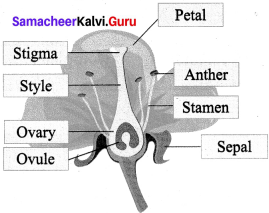
Observe the picture and draw the labels.
Parts of a Flower
Label the parts below :
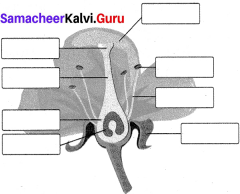
Reproduction And Modification In Plants Samacheer Kalvi 7th Science Solutions Term 1 Chapter 5
Answer:
Reproduction And Modification In Plants 7th Standard Samacheer Kalvi Term 1 Chapter 5

  1. Stigma
  2. Pistil
  3. Filament
  4. Ovule
  5. Sepal
  6. Stamen

Question 2.
Identify the four plants shown in the following Name the different modification in each of them.

NameModification
1.Garlic
2.Turnip
3.Rose plant

Answer:

NameModification
1.GarlicUnderground stem modification
2.TurnipTop Root modified for storage (Top shaped)
3.Rose plantStem used for vegetative propagation / Asexual Reproduction by cutting
4.MaizeStilt Roots (Adventitious roots produced from the node for mechanical support).

Samacheer Kalvi 7th Science Reproductive and Modification In Plants Intext Activities

Activity 1

Using the information from the above complete the following table:

SI.No.Name of the flowerComplete / incompleteUnisexual / bisexualIf unisexual male or female
1.HibiscusCompleteBisexualBoth male & female present is same flower
PumpkinIncompleteUnisexualMale in separate single flower & female in separate single flower
3.RoseCompleteBisexualBoth male & female present is same flower
4.CoconutIncompleteUnisexualMale in separate single flower & female in separate single flower
5.JasmineCompleteBisexualBoth male & female present is same flower

Samacheer Kalvi 7th Science Reproductive And Modification Additional Questions

I. Choose the appropriate answer.

Question 1.
___________ do not produce spores.
(a) Algae
(b) Fungi
(c) Datura
(d) Ferns
Answer:
(c) Datura

Question 2.
___________ have the smallest seeds in the plant kingdom.
(a) Coconut
(b) Orchids
(c) Onion
(d) Pumpkin
Answer:
(b) Orchids

Question 3.
Breathing Roots are seen in ___________
(a) Tarpa
(b) Avicennia
(c) Eicchomia
(d) pisum
Answer:
(b) Avicennia

Question 4.
___________ is a parasite.
(a) Cuscuta
(b) Hibiscus
(c) yeast
(d) Spirogyra
Answer:
(a) Cuscuta

Question 5.
In ___________ sepal is seen on the fruit after fertilization
(a) Brinjal
(b) Pumpkin
(c) Onion
(d) Garlic
Answer:
(a) Brinjal

II. Fill in the Blanks.

  1. The tissue seen in epiphytic roots is called _________
  2. Cactus is a example for _________
  3. Ginger and _________ are examples of Rhizome.
  4. In Gloriosa _________ is modified into a tendil leaf tip.
  5. Spirogyra reproduces by _________

Answer:

  1. Velamen
  2. Phylloclade
  3. Turmeric
  4. leaf tip
  5. fragmentation

III. True or False – if false give the correct statement.

Question 1.
In cactus stem is modified into spines.
Answer:
(False) In cactus, leaf is modified into spines

Question 2.
Ovules fall off after fertilization.
Answer:
(False) Style and stigma fall off after fertilization.

Question 3.
In Nepenthes, leaf is modified into a flask shaped structure.
Answer:
True

Question 4.
Tuber is an enlarged underground root.
Answer:
(False) Tuber is an enlarged underground stem.

Question 5.
Scaly leaves are seen in onion.
Answer:
True

IV. Match the following :

Question 1.

Vanda(a)Climber
Pea(b)epiphyte
Eicchomia(c)offset
wild strawberry(d)Runner stolon

Answer:

  1. b
  2. a
  3. c
  4. d

Question 2.

Pollen(a)anther
Ovule(b)protection
stamen(c)Powdery
Sepal(d)Seed

Answer:

  1. c
  2. d
  3. a
  4. b

V. Assertion and Reason types of Question.

(a) Assertion is correct, Reason is incorrect
(b) Assertion is incorrect, Reason is correct
(c) Assertion is correct, Reason is correct
(d) Assertion is incorrect, Reason is incorrect

Assertion : In potato shoot arises from eyes.
Reason : Eyes represent the buds.
(c) Assertion is correct, Reasoning is correct.

Assertion : In Banyan prop roots grow horizontally from the tree.
Reason : They give additional support to the tree.
(b) Assertion is incorrect, Reasoning is correct.

Assertion : Corm is a condensed form of Bulb.
Reason : It has dry and fleshy scale leaves.
(d) Assertion is incorrect, Reasoning is incorrect.

VI. Find the odd one out.

Question 1.
Pollen, anther, ovule, filament Ovule
Reason : It is a part of Gynoecium whereas others are parts of Androecium.

Question 2.
Corm, Bulb, Rhizome, sucker
Answer:
Sucker
Reason : It is a sub aerial stem modification whereas others are underground stem modification.

Question 3.
Haustoria, Velamen, Prop Roots, Phylloda.
Answer:
Phylloda
Reason : It is a leaf modification whereas others are root modifications.

VII. Complete the table

Question 1.

Underground stem_____(1)_____Ginger
_____(2)_____Runner_____(3)_____
Leaf modification_____(4)_____Acacia
Root modificationsucking Roots_____(5)_____

Answer:

  1. Rhizome
  2. Sub aerial stem
  3. Centella
  4. phylloda
  5. Cuscuta.

Question 2.

Caly x_____(1)__________(2)_____
_____(3)_____petalattract insects
Androecium_____(4)_____Male reproductive part
_____(5)__________(6)_____Female reproductive part.

Answer:

  1. sepal
  2. protection
  3. corolla
  4. stamen
  5. Gynoecium
  6. Ovary, style, stigma.

VIII.Very short answers:

Question 1.
Name the whorls of a flower
Answer:
Calyx, corolla, Androecium and Gynoecium.

Question 2.
What is an inflorescence?
Answer:
A group of flowers is called an inflorescence, e.g sunflower.

Question 3.
What is fertilization.
Answer:
Male gamete fuses with the female gamete to form zygote. This process is known as fertilization.

Question 4.
Name the sub aerial modifications of stem.
Answer:
Runner, stolum, sucker, offset.

Question 5.
Name the underground stem modifications.
Answer:
Rhizome, Corm, Tuber, Bulb.

Question 6.
What are sucking Roots?
Answer:

  1. Sucking roots (or) Haustoria are found in parasite plants.
  2. These roots penetrate the tissues of host plant and suck nutrients from then, e.g cuscuta.

Question 7.
Differentiate Phyllode and Phylloclade.
Answer:

PhyllodePhylloclade
Petioles are modified to form leaf like structure, e.g. Acacia.stem is modified to form leaf like structure, e.g. Cactus.

Question 8.
What are breathing Roots or Pneumatophores?
Answer:

  1. Mangrove plants roots which are seen above the ground for the purpose of gaseous exchange.
  2. These roots are erect, peg like structures with numerous pores through which air circulates.
  3. These roots are called breathing roots, or pneumatophores. e.g Avicennia.

IX. Short answers.

Question 1.
List the post fertilization changes in a flower.
Answer:

  1. Calyx sometimes persist with fruit
  2. Petals wither / fall off
  3. Androecium fall off
  4. Pistil remain and develops into a fruit
  5. Style and stigma fall off
  6. Ovary enlarges to store food materials and develops into a fruit.
  7. Ovules present inside the ovary develops into seeds.

Question 2.
Write a note an roots modified for mechanical support.
Answer:
Many Plants require additional support. Such plants develop roots on their aerial parts to provide mechanical support. These roots grow downward and act as supportive organs. There are three types of modified roots for support.

  1. Prop roots : Roots are modified to provide mechanical support as seen in Banyan tree. These roots grow vertically from horizontal branches of a tree.
  2. Stilt roots : In sugarcane, and maize adventitious roots arise from the nodes in cluster at the base of the stem. These roots are called stilt roots which gives additional support.
  3. Climbing roots : In betel and black pepper, nodes or intermodes bear roots which help in climbing.

Question 3.
How do Epiphytic roots differ from Sucking roots?
Answer:

Epiphytic rootsSucking roots
Vanda is an epiphytic plant, which grows on trees. The velamen tissue present in the epiphytic root, absorbs moisture, to perform photosynthesis.Cuscuta a parasite plant, climb the trees and other vegetation and use the haustorial roots Sucking roots to penetrate the tissue of the host plant and suck nutrients from them. They are usually found in parasitic plants that depend on the host plants for nutrients.

Question 4.
Write a note on phylloclade.
Answer:

  1. Plants growing in deserts try to store water. If the surface area is large, more water is lost by evaporation.
  2. In plants like cactus, the stem is thick and becomes flat like leaves to do photosynthesis.
  3. The leaves are reduced to small spines with less surface area. This kind of modification is called phylloclade. e.g. cactus.

Question 5.
What are traps or Insectivorous plants?
Answer:

  1. These plants grow in nitrogen deficient places. In Nepenthes, the leaves are modified into a flask like structure, which is used to attract insects and other tiny animals.
  2. The inner wall of the leaf secretes digestive enzymes that help to digest the insects and extract the nitrogen needed for the plant. E.g: Nepenthes.

Question 6.
Differentiate self pollination and cross pollination.
Answer:

S.noSelf pollinationCross pollination
1.Pollen grains are transferred from the anther to the stigma of the same flower or to another flower of the same plant.Pollen grains are transferred from the anther of one flower to the stigma of another flower of the same kind or different plant.
2.Plants do not need to produce pollen grains in a large quantity for self pollinationPlants need to produce pollen grains in larger quantities to increase the chance of pollination.
3.It does not produce changes in the characteristics of new plants.Cross pollination does introduce variations in characteristics of new plants.

Question 7.
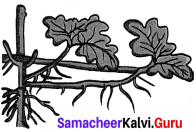
Identify the plant and the modification seen in it
.Reproduction And Modification In Plants 7th Standard Book Back Answers Samacheer Kalvi Term 1 Chapter 5
Answer:
Chrysanthemum
Modification : Sucker (sub aerial stem modification).

X. Answer in detail

Question 1.
Write a note an sub aerial modifications of the stem.
Answer:
Sub- aerial Modifications : Stem of some plants remains sub- aerial which grow horizontally on the surface of the soil for the purpose of reproduction. There are four types.

  1. Runner: The stem grows laterally on the surface of the soil, breaks up to produce roots where it touches the ground to give rise to new plants. Eg: Centelk (Vallarai).
  2. Stolon: Stolon is a slender branch of the stem that grows upwards to some distance and then bends towards the ground. Upon touching the ground, it gives rise to a new plant. Eg. Wild strawberry.
  3. Sucker Sucker is a short and weak lateral branch that grows diagonally upwards and directly gives rise to a new shoot. Eg. Chrysanthemum.
  4. Offset: An offset is a short and thick branch that arises from the axial part of a leaf. It has thick intemodes. It produces a tuft of leaves and cluster of small roots below. Eg: Eichhornia.

Question 2.
Draw a diagram to show the life cycle of a plant.
Answer:
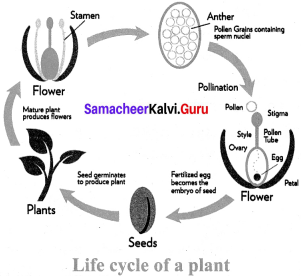
Samacheer Kalvi Guru 7th Science Solutions Term 1 Chapter 5 Reproductive And Modification In Plants

XI. Higher Order Questions : (HOTS)

Question 1.
Parasitic plants lack leaves.
Answer:
Parasites are plants which live on other living plants and derive nutrients from them. They are non-green and do not photosynthesize. They have sucking roots to absorb the nutrients directly from the host tissue. Thus they lack leaves.
Samacheer Kalvi 9th English Solutions Prose Chapter 5 Water – The Elixir of Life

You can Download Water – The Elixir of Life Questions and Answers, Summary, Activity, Notes, Samacheer Kalvi 9th English Book Solutions Guide Pdf Prose Chapter 5 help you to revise complete Tamilnadu State Board New Syllabus and score more marks in your examinations.

Tamilnadu Samacheer Kalvi 9th English Solutions Prose Chapter 5 Water – The Elixir of Life

Water – The Elixir of Life Warm Up:

Water The Elixir Of Life Questions And Answers Question 1.
Do you think the living organisms in this planet can survive without water? Why?
Answer:
No, because water is required by all living organisms in various processes for their survival.
Water The Elixir Of Life Questions And Answers Samacheer Kalvi 9th English Solutions Prose Chapter 5

Water The Elixir Of Life Question 2.
Where do you get your drinking water from?
Answer:
I get drinking water from borewell and corporation pumps.

Water The Elixir Of Life Summary Question 3.
Is the drinking water you use in your home treated?
Answer:
No, the drinking water we use is not treated.

Water The Elixir Of Life Book Back Answers Question 4.
If not, how do you purify it?
Answer:
Water is purified by filtration.

Water – The Elixir of Life Intext Questions

Water The Elixir Of Life 9th Std Question 1.
What is the imaginary elixir of life?
Answer:
The divine Amrita is the imaginary elixir of life.

Water The Elixir Of Life Reading Answers Question 2.
What according to the writer is the real elixir of life?
Answer:
According to the writer, water is the real elixir of life.

9th English Water The Elixir Of Life Question 3.
What is the ‘wonderful difference’ the writer talks about in the passage?
Answer:
On one side, was the visible sea of billowing sand without a speck of green or a single living thing anywhere on it. On the other side lay one of the greatest, most fertile and densely populated areas to be found anywhere on the earth, teeming with life and vegetation. This is the ‘wonderful difference’ that the writer talks about in the passage.

Water The Elixir Of Life Summary Pdf Question 4.
What is the ‘cheering sight’ mentioned in the paragraph?
Answer:
The rain fed tanks that are so common in South India are a cheering sight when they are full.

Water – The Elixir Of Life Question 5.
What does the writer compare water in a landscape to?
Answer:
The writer compares the water in a landscape to the eyes in a human face.

Water-The Elixir Of Life Question 6.
How does the water in rainfed tanks get its colour?
Answer:
The water in the rain fed tank carry slit or finely divided soil in suspension. This is the origin of the characteristic colour of the water in the rain fed tanks.

Water Elixir Of Life Summary Question 7.
What is the main cause of soil erosion?
Answer:
The sudden burst of excessively heavy rain resulting in a large run of surplus water is the main cause of soil erosion.

Water The Elixir Of Life Pdf Question 8.
What other factors add to the erosion of precious soil?
Answer:
The slope of land, removal of natural protective coat of vegetation, the existence of ruts along which the water can flow with rapidly gathering momentum and the absence of any checks of such flow are the other factors that add to the erosion of precious soil.

Water, The Elixir Of Life Notes Of Lesson Question 9.
How can soil erosion be prevented?
Answer:
The terracing of land, construction of bunds to check the flow of water, the practice of contour cultivation and the planting of appropriate types of vegetation are the measures that can prevent soil erosion.

The Elixir Of Life Question And Answers Pdf Question 10.
How does prevention of soil erosion serve a double purpose?
Answer:
The prevention of soil erosion would help to conserve and keep the water where it is wanted, in other words, on and in the soil. Thus it serves a double purpose.

The Elixir Of Life Question And Answer Question 11.
What are the two sources of water?
Answer:
The two sources of water are rain and snowfall.

Question 12.
What happens to the rain water?
Answer:
The rain water flows down into the streams and rivers and ultimately finds its way to the sea.

Question 13.
What is the idea of civilized forest?
Answer:
The civilized forests would directly and indirectly prove a source of untold wealth to the country. They would check soil erosion and conserve the rainfall of the country from flowing away to waste and would provide the necessary supplies of cheap fuel, and thus render unnecessary the wasteful conversion of farmyard manure into a form of fuel.

Question 14.
How can you check soil erosion?
Answer:
The terracing of the land, the construction of bunds, the practice of contour cultivation and the planting of some types of vegetation are the measures that can be used to check soil erosion.

Question 15.
What is the cheapest means of transport?
Answer:
The cheapest means of transport is by boats and barges through canals and rivers.

Question 16.
How can you make a difference in the countryside?
Answer:
The availability of electric power would make a tremendous difference to the life of the countryside and enable rural economy to be improved in various directions.

Water – The Elixir of Life Textual Questions

A. Answer the following questions briefly in one or two sentences.

Question 1.
What makes water one of the most powerful and wonderful things on earth?
Answer:
Water played a role of vast significance in shaping the course of the earth’s history and continues to play the leading role in the drama of life on the surface of our planet.

Question 2.
How does water help in the formation of fertile lands?
Answer:
The water has its power to carry slit or finely divided soil in suspension. The great tracts of land formed by slit thus deposited is evident on an examination of the soil in alluvial areas. Thus, water helps in the formation of fertile lands.

Question 3.
How does soil erosion happen and what are its main causes?
Answer:
The flow of water under certain conditions causes soil erosion. Sudden bursts of excessively heavy rain resulting in large run of surplus water are the principal factors in causing soil erosion.

Question 4.
What are some measures that are used to prevent soil erosion?
Answer:
The terracing of land and construction of bunds to check the flow of water, the practice of contour cultivation and the planting of appropriate types of vegetation are few measures to check erosion.

Question 5.
How, according to Sir C. V. Raman, can rainwater as well as the water of rivers be, prevented from going to waste?
Answer:
The systematic planting of suitable trees can prevent rainwater going to waste.

Additional Questions

Question 1.
How will development of hydro-electric power be a resource?
Answer:
Development of hydro-electric power will enable tapping of underground water which requires electricity and thus overcome the inadequacies of other sources of water.

Question 2.
What is far from an exhausted field of research?
Answer:
The investigation of nature and properties of water is considered the highest scientific interest and is far from an exhausted field of research.

Question 3.
When and where did the author notice not a single living being?
Answer:
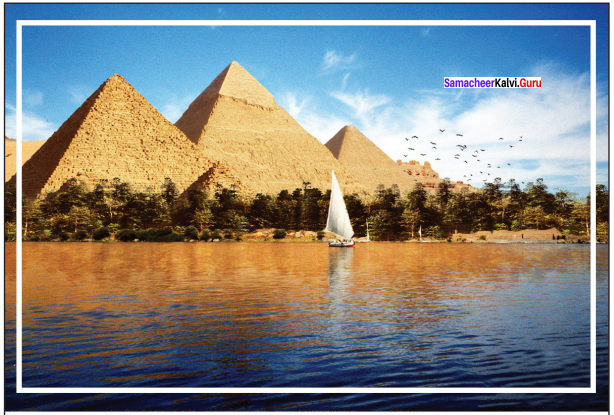
The author noticed not a single living being while standing on the line which separated the Libyan Desert from the Valley of the Nile in Egypt. The desert was without a speck of green.

Question 4.
How is the Nile valley soil created?
Answer:
Nile valley soil is created by the river itself. It is brought down as the finest silt in its flood waters, from the highlands of Abyssinia and from remote Central Africa. It is laid down through the ages in the trough through which the Nile flows into the sea.

Question 5.
How is the great tracts of land formed by deposition of silt evident on an examination of the soil in alluvial areas?
Answer:
Great tracts of land formed by silt deposition is evident on an examination of the soil in alluvial areas. When silt-laden water mixes with the salt water of the sea, there is rapid precipitation of the suspended matter. The colour of the water changes successively from red or brown shades of silt through varying shades of yellow and green before it becomes blue of the deep sea.

Question 6.
Why is physiological activity impossible where fluid does not play an important role?
Answer:
Water is the elixir of all life. Even fauna and flora contains a considerable proportion of free or combined water in its body. Hence, physiological activity is impossible where the fluid does not play an important role.

Question 7.
State the national problem which must be considered and dealt with on national lines.
Answer:
Water conservation is the national problem which must be considered and dealt with on national lines. Unbelievably, large quantities of the precious fluid are not conserved. Our rivers, mostly run to waste and harnessing it is vital.

B. Answer the following in about 80-100 words.

Question 1.
How does C.V. Raman show that water Is the real elixir of life?
Answer:
Raman tries to bring about the importance of water, which has a unique power of maintaining animal and plant life. Water, the elixir of life, is the commonest of all liquids. Without water the land will be barren like the deserts in Egypt. On one side it is a sea of sand. On the other side laid one of the greatest, most fertile, densely populated areas the valley of Nile.

It is separated by the river Nile flowing down thousands of miles away. The entire soil is the creation of river Nile. Egypt, in fact was made by its river. Water is the basis of all life. Every animal and plant contains water in its body. Water is essential for the body, moisture in the soil is equally important for the life and growth of plants and trees. The conservation and utilization of water is fundamental for human welfare.

Question 2.
Water exists in all plant and animal forms – Explain.
Answer:
If there is plenty of water and abundant rainfall, there will be good growth of plants. The population of animals depending on these plants will increase. On the other hand, if there is a drought, there will be a smaller supply of plants. The animals depending on these plants will decrease in population as a result of the decrease in the plant population. Water is the fundamental necessity for both animal and plant forms.

Question 3.
Life cannot exist on earth without water – Explain.
Answer:
Water is the basis of all life. Every animal and plant contains water in its body. Water is essential for the body, moisture in the soil is equally important for the life and growth of plants and trees. The conservation and utilization of water is fundamental for human welfare. Much of Indian agriculture depends on monsoon.

It is clear that the adoption of techniques preventing soil erosion would help to conserve and keep the water where it is wanted. Without water, nothing is possible on earth. The collection of rain water and utilizing them is very important. Vast areas of land which at present are scrub jungle could be turned into fertile and prosperous country by courageous and well-planned action.

Additional:

Question 1.
How is Artesian Water Created?
Answer:
Springs become artesian when the water flows to the surface under natural pressure without pumping. Water flows down a decline into a porous substance such as rock, sand or gravel. The hard rock surrounding the porous substance prevents water to escape through it. In some places the overlying impermeable rocks are broken by joints or faults. A pressure starts building up between two impermeable surfaces. The water underneath is forced out by this pressure and it may escape through the faults to rise to the surface. Most of the times the escape is a well, which becomes the source of the artesian water.

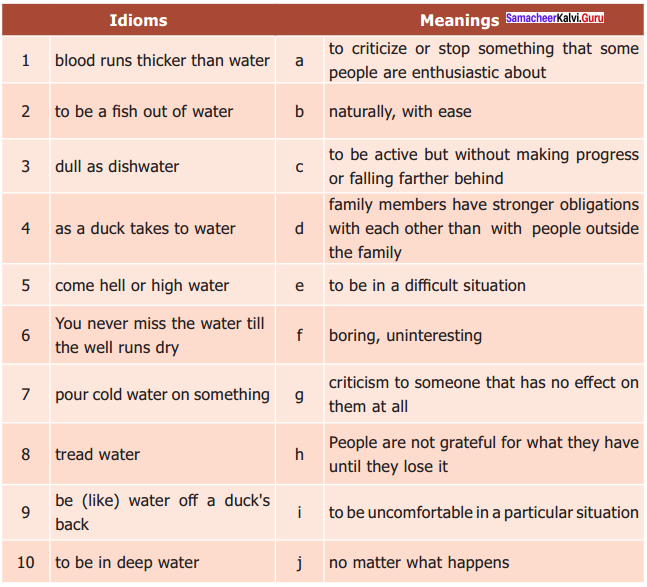
C. Given below are some idioms related to water. Match the idioms with its meaning.

Water The Elixir Of Life Samacheer Kalvi 9th English Solutions Prose Chapter 5
Answers:
1. (d), 2. (i), 3. (f), 4. (b), 5. (j), 6. (h), 7. (a), 8. (c), 9. (g), 10. (e).

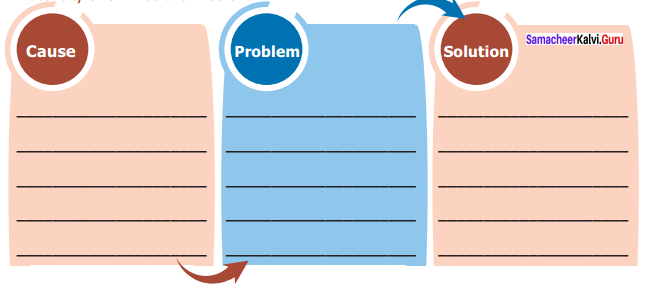
D. Water is a scarce resource. Discuss the causes, problems and solutions to water scarcity and write them below.

Water The Elixir Of Life Summary Samacheer Kalvi 9th English Solutions Prose Chapter 5
Causes :
Conflict: A conflict over an area of land may make it difficult to access the water located there.
Distance: Many areas face water scarcity because they aren’t close to any source of water.
Drought: Some areas do not get enough rainfall to be able to sustain life.
Overuse of Water: The overuse of water on people, animals, land, or recreational activities can cause water scarcity.
Pollution: Water might get polluted by anything from oil, to carcasses, to chemicals, and to fecal matter.

Problems:
Diseases: If we don’t have clean water access, we will be more likely to get diseases.
Hunger: Due to shortage of water, agricultural lands will not be watered properly. This may cause crop deficiency and people and animals will have to go hungry.
Lack of Drinking Water: The worst outcome of water scarcity is non-availability of clean drinking water.
Lack of Education: Children might be too sick to even go to school.
Sanitation Issues: Absence of clean water makes it difficult to clean food, dishes, or even to take a bath.

Solutions:
Technology: New and modem methods of water conservation can be applied.
Education: By educating people about water scarcity, we can prevent the problem from becoming worse in the future.
Improved Farming: We must think of farming and irrigation techniques that don’t use much water.
Recycle Water: We can recycle rainwater and use it in factories and homes.
Support Clean Water Initiatives: We can fund such organizations which bring clean water to areas that don’t have it.

Listening:

E. On the basis of the listening passage, choose the correct answer from the given options.

Question 1.
Severn Suzuki represents an organization called ECO which stands for _________.
(a) Ecological Cooperation.
(b) Environmental Coordinating Organization.
(c) Environmental Children’s Organization.
(d) Ecological Children’s Organization.
Answer:
(c) Environmental Children’s Organization

Question 2.
“I am fighting for my future.” The ‘fight’ refers to her ________.
(a) fight to win an election.
(b) fight to gain a few points in share market.
(c) fight against corruption.
(d) fight against environmental pollution.
Answer:
(d) fight against environmental pollution

Question 3.
Animals and fish are becoming extinct because ___________.
(a) they have no place to go.
(b) they die of diseases.
(c) their food and habitat are polluted.
(d) all the above.
Answer:
(d) all the above.

Question 4.
It is evident that Severn Suzuki is concerned about all other species too as,____________.
(a) she considers them all belonging to one world.
(b) they have nobody except her to speak for.
(c) they belong to her.
(d) they are all children.
Answer:
(a) she considers them all belonging to one world

Question 5.
Severn Suzuki condemns the people of her country for ____________.
(a) contributing large amounts of waste and not sharing the excess with the needy.
(b) being afraid of the poor.
(c) being angry with the poor belonging to other countries.
(d) being wealthy.
Answer:
(a) contributing large amounts of waste and not sharing the excess with the needy

Question 6.
Which of the following statements is not true? __________________.
(a) Canada is a rich country and people have in plenty.
(b) Canadian children are privileged.
(c) A Brazilian child was willing to share because she was rich.
(d) Northern countries will not share with the needy
Answer:
(c) Canada is a rich country and people have in plenty

F. Answer the following questions briefly.

Question 1.
What is the humb

le request of the twelve- year -old to the elders?
Answer:
She requests adults to change their ways and save nature for the future.

Question 2.
The dream of Severn Suzuki is
Answer:
She has dreamt of seeing the great herds of wild animals, jungles and rain forests, full of birds and butterflies.

Question 3.
The fear and agony of Severn Suzuki is
Answer:
We make so much waste.

Question 4.
How does she proclaim that she represents the future generation?
Answer:
She calls herself as one of the children starving in Somalia or a victim of war in the Middle East or a beggar in India.

Question 5.
The duties and responsibilities of the parents are
(a) to comfort their children saying that everything will be all right.
(b) _____________.
(c) _____________.
Answer:
(b) To teach children to respect others.
(c) To clean up their mess and not to hurt other creatures.

Speaking:

G. You are the President of CO GREEN, the Environment Club of your school. On the occasion of World Environment Day, you have been asked to address the school on the topic, ‘The Nature of Our Future Depends on the Future of Our Nature’
Answer:

Good morning, esteemed Chief Guest, the Head Master, teachers, dear friends and invitees. I am Shobha, Secretary of GO GREEN, the Environment Club of our school. Today, I stand before you to share my views on the topic “Stopping pollution is the best solution”. We humans have always deceived ourselves by thinking that someone else will save our planet.

Can you imagine… for the past 200 years we have been conquering nature, and now we are beating it to death by constantly polluting it. The Earth is not dying, it is being killed and the people who are killing it have names and addresses. All the human actions in this modem world directly impact the whole ecosystem. Industrial emissions, poor disposal of wastes, mining, deforestation, use of fossil fuels and agricultural activities, ultimately harm the nature which is the sole provider of pure oxygen, food and other requirements of man and animal.

Animals are becoming extinct. There are newer diseases evolving for which diagnosis has become impossible and so takes longer time to find a cure. Due to pollution, the number of various chemical elements is increasing in the atmosphere which ultimately causes irregular rainfall and global warming. Who is responsible? It is time we start thinking and doing our bit to be conservative and eco-friendly.

Let us walk or cycle to our work places/school. Let us not use plastic bags. Let us all keep our surroundings clean and plant at least one tree. As quoted by Lady Bird Johnson, “The Environment is Where we all meet; Where we all have a Mutual Interest; It is the one thing we all Share”. So, let’s be eco-friendly and go green. Thank you. Have a good day.

H. A class of super heroes:

‘CHANGE IS NEEDED, AND IT IS NEEDED NOW’. Let’s meet a class of superheroes who have taken simple sustainability projects upon themsleves to trackles the envirionmental problems in their campus.

Grammar:
Simple present tense

A. Choose the correct form of the present tense verb from the options given.

  1. All children something new every day. (learn / learns / learned)
  2. A good student always hard, (work / works / worked)
  3. Engineers bridges, (build / builds / built)
  4. My sister is an architect. She skyscrapers. (design / designs / designed)
  5. The Himalayas India from the cold winds. (protect / protects / protected)
  6. It always here in the afternoon, (drizzle / drizzles / drizzled)
  7. My mother in a factory, (work / works / worked)
  8. Chella English very well, but she doesn’t understand Hindi. (speak / speaks / spoke)
  9. Cows us milk, (give / gives/ gave)
  10. The trains to Chennai always on time, (run / runs / ran)

Answer:

  1. learn
  2. works
  3. build
  4. designs
  5. protect
  6. drizzles
  7. works
  8. speaks
  9. give
  10. run

Present Continuous Tense:

B. Make sentences in the present continuous tense using the verb given in brackets.

  1. Who is that boy _________ on the table? (stand)
  2. What are you _______? (do) I ________ (listen) to music.
  3. My brother _________ (work) in London now.
  4. I ________ (wait) for my mother.
  5. It is better not to disturb her, she ___________ (work).

Answer:

  1. standing
  2. doing, am listening
  3. is working
  4. am waiting
  5. is working

C. What are they doing? Use the verbs below and write sentences.
eat, cry, play, read, sing, watch.
Answer:

  1. Anu is singing.
  2. Peter is watching.
  3. Sudhan is playing.
  4. Velu is reading.
  5. Kalai is crying.

D. Look at the picture again and answer the questions.

  1. Is Tom reading? __________.
  2. Is Velu eating? _____________.
  3. Is Kalai dancing? _____________.
  4. Is Peter watching TV? _____________.
  5. Is Anu crying? _____________.

Answer:

  1. No, Tom is eating
  2. No, Velu is reading
  3. No, Kalai is crying
  4. No, Peter is watching through a telescope
  5. No, Anu is singing

E. Write the -ing form of the verbs.

  1. Come _____________.
  2. Take _____________.
  3. Fly _____________.
  4. Swim _____________.
  5. Study _____________.
  6. Read _____________.

Answer:

  1. Coming
  2. Taking
  3. Flying
  4. Swimming
  5. Studying
  6. Reading

F. Write negative sentences.

  1. He is learning to read.
  2. I am having a bath.
  3. I’m reading a fantastic book.
  4. Raja is driving a new car.
  5. I’m looking for my bag.

Answer:

  1. No, he isn’t learning to read.
  2. No, I am not having a bath.
  3. No, I am not reading a fantastic book.
  4. No, Raju isn’t driving a new car.
  5. No, I am not looking for my bag.

G. Write questions for the answers.

1. _________________?
No, they aren’t singing.
Answer:
Are they singing?

2. _________________?
Yes, She is writing a new book.
Answer:
Is she writing a new book?

3. _________________?
Yes, It is working.
Answer:
Is it working?

4. _________________?
No, he isn’t doing the project.
Answer:
Is he doing the project?

5. _________________?
Yes, We are planning to go.
Answer:
Are we planning to go?

H. Fill in the blanks with verbs in the present continuous.

  1. You (listen) to the music.
  2. He (cry).
  3. I (swim) in the pool.
  4. Latha (wait) for her daughter.
  5. she (watch) TV?
  6. Who he (help)?
  7. Her father (not / cook) dinner.
  8. Akila Y, (not /sing) a song.
  9. My brother (not / do) his homework.
  10. your mother (work) today?
  11. Amutha and Praba (play) tennis.
  12. Amith and Ravi (not / swim) in the lake.

Answer:

  1. are listening
  2. is crying
  3. am swimming
  4. is waiting
  5. is, watching
  6. is, helping
  7. is not cooking the
  8. is not singing
  9. is not doing
  10. is, working
  11. are playing
  12. are not swimming

Present Perfect Tense:

I. Make sentences in the present perfect tense using the verbs in brackets.

1. She to _______________ anybody, (never apologized, has never apologized, have never apologized)
Answer:
has never apologized

2. My mother to _______________ London, (has been, being in, have been)
Answer:
has been

3. I _______________ all the plays of Shakespeare, (read, had read, have read)
Answer:
have read

4. Have you _______________ your lunch? (finish, finished, had finished)
Answer:
finished

5. _______________ he brought his bike? (Had, Has, Have)
Answer:
has

Present perfect with “ever and never”

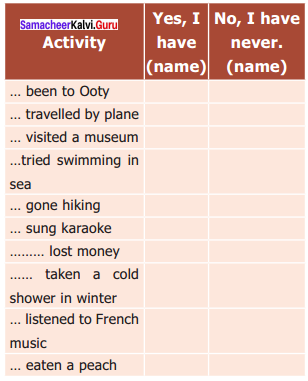
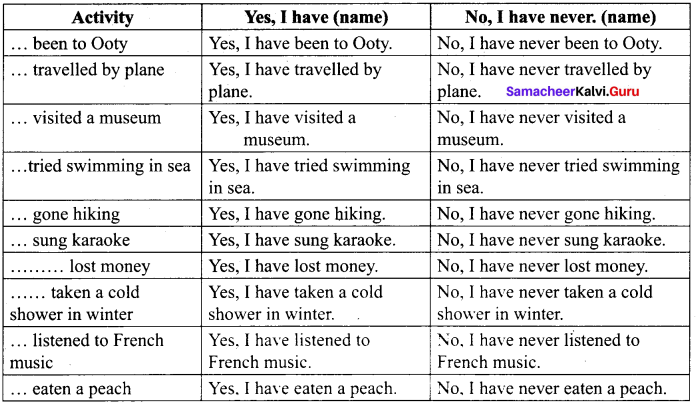
J. Have you ever…?
Question:
Have you ever eaten a kiwi fruit?
Answer:
Yes, I have eaten a kiwi fruit.
Or No, I have never eaten a kiwi fruit.

Water The Elixir Of Life Book Back Answers Samacheer Kalvi 9th English Solutions Prose Chapter 5
Answer:
Water The Elixir Of Life 9th Std Samacheer Kalvi English Solutions Prose Chapter 5

Present perfect continuous tense:

K. Make sentences in the present perfect continuous tense using the verbs in brackets.

1. How long _______________ ? (are you waiting, have you been waiting, have you waited)
Answer:
have you been waiting

2. She _______________ in the garden since morning, (is working, has been working, work)
Answer:
has been working

3. I _______________ this mobile for three years, (am using, has used, have been using)
Answer:
have been using

4. The children _______________ in the park, (has been playing, have been playing, had been playing)
Answer:
have been playing

5. The workers _______________ higher wages for a long time, (has been demanding, have been demanding, demand)
Answer:
have been demanding

Simple Past Tense:

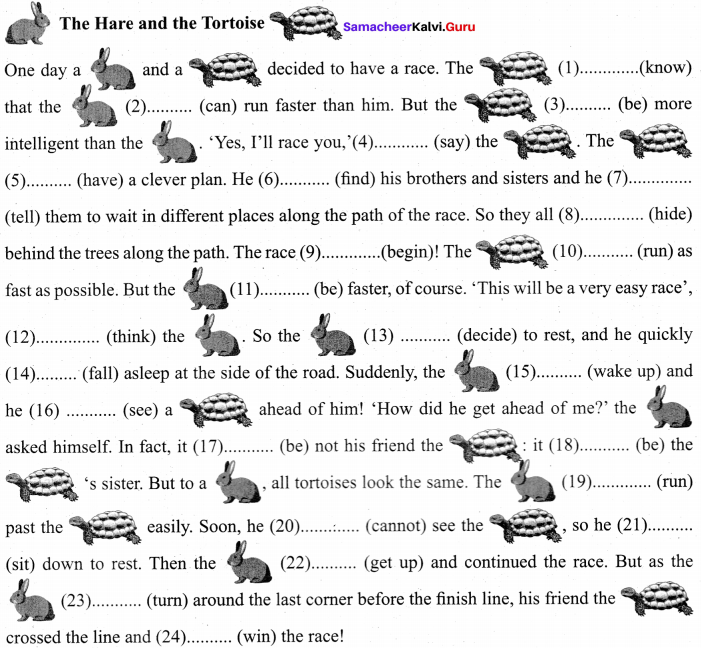
L. Complete the story using the past tense of the verbs.
Water The Elixir Of Life Reading Answers Samacheer Kalvi 9th English Solutions Prose Chapter 5
Answer:

  1. Knew
  2. could
  3. was
  4. said
  5. had
  6. found
  7. told
  8. hid
  9. began
  10. ran
  11. was
  12. thought
  13. decided
  14. fell
  15. woke up
  16. saw
  17. was
  18. was
  19. ran
  20. couldn’t
  21. sat
  22. got up
  23. turned
  24. won

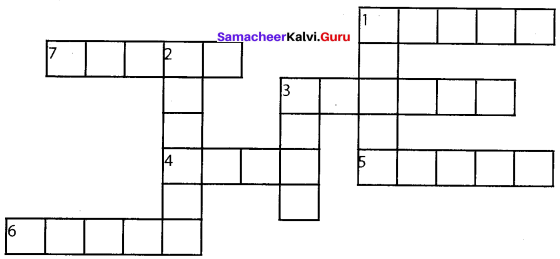
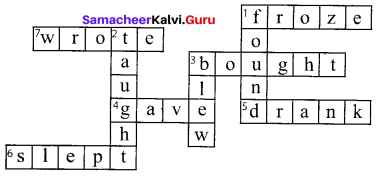
M. Finish each clue by changing the verb within brackets to an irregular past-tense verb.Then complete the crossword puzzle.
9th English Water The Elixir Of Life Samacheer Kalvi Prose Chapter 5

Across:

  1. The lake (freeze) ………. overnight.
  2. Hema (buy) ………. a new bicycle.
  3. Aravind (give) ………. me a slice of pizza.
  4. We (drink) ……….. milk.
  5. The dog (sleep) ………… on the sofa.
  6. He (write) …………… a letter to his cousin in America.

Down:

  1. I (find) ………… a coin on the ground.
  2. Tony (teach) …………. his cat to use the litter box.
  3. Selvi (blow) ……….. out the candle.

Answers:
Water The Elixir Of Life Summary Pdf Samacheer Kalvi 9th English Solutions Prose Chapter 5

Past Continuous Tense:

N. Make sentences in the past continuous tense using the verb in brackets.

1. The children _________ (wait) for the bus.
Answer:
were waiting

2. The girls __________ (leam) their lessons.
Answer:
were learning

3. I ____________ (play) in the rain all evening.
Answer:
was playing

4. Vijay ____________. (repair) his car.
Answer:
was repairing

5. Hari ____________ (work) hard to pass the entrance
Answer:
was working

Past Perfect Tense:

O. Complete the sentences using the past perfect tense.

  1. Kalai didn’t complete his homework because ……………… .
  2. By the time Sundar got up ………….. .
  3. When we reached the park,…………. .
  4. Saralah didn’t want to see her …………. .
  5. Manohar was laughing because ………….. .

Answers:

  1. he had slept
  2. his brother had gone for work
  3. our friend had already reached
  4. brother, though her brother had hoped the same
  5. he had smelt the laughing gas

Past Perfect Continuous Tense:

P. Circle the correct verb form in each of the following sentences.

  1. Ezhil baked / had been baking a cake when they came.
  2. Veeran cleaned/ had been cleaning the room since morning.
  3. We worked / had been working in the city for ten years before we moved to the village.
  4. The cat had been waiting/was waiting for the mice to come out of its hole.
  5. Kannan had been looking/ have been looking for a job for a long time.

Answers:

  1. had been baking
  2. had been cleaning
  3. had been working
  4. had been waiting
  5. had been looking

Simple Future Tense:

Q. Complete the sentences using the correct form of the verbs in brackets.

  1. We hope you …………. (have) a great time in Ooty.
  2. I think Manju ……………. (visit) her grandparents during the vacation.
  3. Be careful, that mirror ……………. (fall) on the floor.
  4. As soon as my father arrives, we …………….(go) to watch the film.
  5. When your train arrives, I …………….. (wait) for you at the station.

Answers:

  1. will have
  2. will visit
  3. will fall
  4. will go
  5. will wait

Future Continuous Tense:

R. Make sentences in the future continuous tense using the verb in brackets.

  1. Ashwin …………. (complete) M.B.A.in another two years.
  2. I …………….. (go) to Thanjavur by this time tomorrow.
  3. Prabha ……………(receive) the best student award in six months’ time.
  4. The plane ……………… (leave) at 3 o’clock.
  5. He …………… (attend) the conference.

Answers:

  1. will be completing
  2. will be going
  3. will be receiving
  4. will be leaving
  5. will be attending

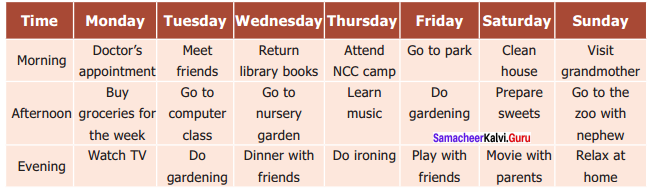
S. What is Amala going to do? Given below is Amala’s schedule for next week. Read it and answer the questions using the future continuous tense.

Amala’s Schedule
Water - The Elixir Of Life Samacheer Kalvi 9th English Solutions Prose Chapter 5

Question 1.
What will Amala do on Sunday morning?
Answer:
She will be visiting her grand mother.

Question 2.
What is Amala planning to do on Saturday afternoon?
Answer:
She will be preparing sweets.

Question 3.
Where is Amala going on Wednesday morning?
Answer:
Amala will be going to the library to return the books.

Question 4.
Who is Amala meeting on Tuesday morning?
Answer:
Amala will be meeting her friends.

Question 5.
What will she buy on Monday afternoon?
Answer:
Amala will be buying groceries for the week.

Future Perfect Tense:

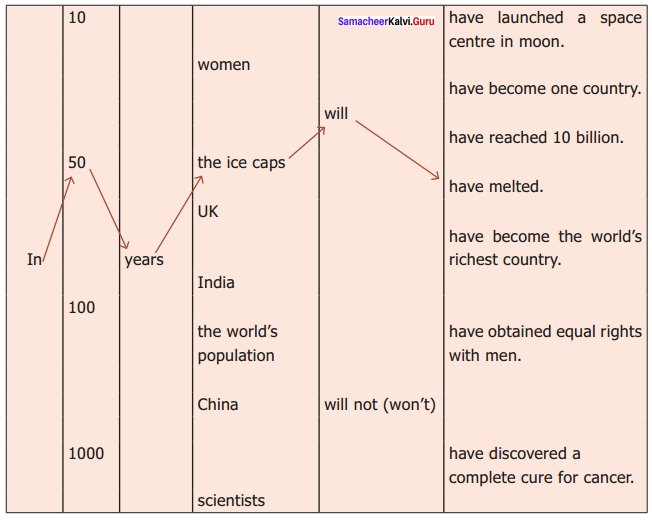
T. Match words from the different columns to make reasonable predictions. Then write them down in the space below. One has been done as an example.

Water-The Elixir Of Life Samacheer Kalvi 9th English Solutions Prose Chapter 5

Write the sentences:

  1. In 50 years the ice cap will have melted.
  2. …………………………………………………………
  3. …………………………………………………………
  4. …………………………………………………………
  5. …………………………………………………………
  6. …………………………………………………………
  7. …………………………………………………………

Answers:

  1.  In 50 years the ice cap will have melted.
  2. In 10 years, the world’s population will have reached 10 billion
  3. In 50 years, India will have become the world’s richest country.
  4. In 10 years, women will have obtained equal rights with men.
  5. In 10 years, Scientists will have discovered a complete cure for cancer.
  6. In 50 years, India will have launched a space centre in moon.
  7. In 50 years, U.K. will have become one country.

Water – The Elixir of Life About The Author:

Sir Chandrasekhara Venkata Raman (1888-1970) was an Indian physicist bom in Tiruchirappalli. In 1904, he stood first and won the gold medal in physics in the Bachelor of Arts examination of University of Madras. He carried out ground-breaking work in the field of light scattering, which earned him the 1930 Nobel Prize for Physics. He discovered changes in wavelength of some of the deflected light when light traverses a transparent material. This phenomenon, subsequently known as Raman Scattering, results from the Raman effect. To commemorate it, February 28th is celebrated as the National Science Day. In 1954, India honoured him with its highest civilian award, the Bharat Ratna.

Water – The Elixir of Life Summary:

Water Elixir Of Life Summary Samacheer Kalvi 9th English Solutions Prose Chapter 5

Since ages man has sought in vain for an imaginery elixir of life – the divine Amrita which confers immortality. But in reality the true elixir is the water that is freely available. The author remembers once standing on the line that separates Libyan Desert from the valley of the Nile. He could observe a wonderful difference between the desert where there was no life to be seen. On the other side, due to the presence of river Nile the valley has become the most fertile and densely populated land on earth. Geologists explain that this fertility is totally attributed to the river Nile, which flows from the highlands and from remote Central Africa. The Egyptian civilization is sustained by the waters that flow from Nile river.

Water, which we take for granted in our everyday lives, has played a vital role in shaping the course of Earth’s history and continues to do so. Moreover, it adds so much to the beauty of the countryside, such as the streams or ponds and so on. The rainfed tanks are so common in South India and its sad to see its neglected maintenance, though it is a cheering site when they are full. South Indian agriculture is completely dependent on these tanks. Some of these tanks are large enough so that the sun rise or set can be seen over one of them. Water in a landscape may be compared to the eyes in a human face, which reflects the mood of the hour, being bright and gay during the day and turns dark and gloomy when the sky is overcast.

Water has the remarkable feature of carrying silt or finely divided soil in suspension which contributes to the characteristic colour of the water in rainfed tanks. Swiftly flowing water can carry fairly large and heavy particles. These particles are deposited on the areas they flow and settle. The variation in the different layers of soil can be seen in alluvial areas. Such lands are usually very fertile. The flow of water thus has played an important role in shaping the earth. On the contrary it has led to soil erosion which led to heavy loss in agriculture especially in many parts of India.

Soil erosion occurs in successive steps being unnoticed in,the early stages and later forming deep gullies and ravines which make all agriculture impossible. Heavy rains are the prime reason for soil erosion, others include; slope of the land, removal of the natural protective coat of vegetation, the existence of ruts. It calls for urgent prevention measures which includes; terracing of land, construction of bunds, practice of contour cultivation and the planting of appropriate types of vegetation.

In a country like India, such measures has to be taken as they completely depend on seasonal rainfall. Water forms the basis of all life. Every animal or plant requires water for all kinds of physiological activities. In India, afforestation has to be checked and planting of suitable trees in every possible area, and the development of what one can call civilized forests, as distinguished from wild and untamed jungle should be carried out. Such plantation would directly and indirectly prove a source of untold wealth to the country.

Water – The Elixir of Life Glossary:

Water The Elixir Of Life Pdf Samacheer Kalvi 9th English Solutions Prose Chapter 5

Samacheer Kalvi 8th English Solutions Term 3 Prose Chapter 2 Cyber Safety

Students can Download English Lesson 2 Cyber Safety Questions and Answers, Summary, Activity, Notes, Samacheer Kalvi 8th English Book Solutions Guide Pdf helps you to revise the complete Tamilnadu State Board New Syllabus and score more marks in your examinations.

Tamilnadu Samacheer Kalvi 8th English Solutions Term 3 Prose Chapter 2 Cyber Safety

Read And Understand

A. Say true or false.

  1. Gladin’s mom knew how screw guage works.
  2. We use internet to gather information and gain knowledge.
  3. Rani was frightened of an online predator.
  4. Strangers don’t misuse your information.
  5. Do not give your name, address, telephone number to the strangers.
  6. Too much of anything is good.

Answer:

  1. False
  2. True
  3. True
  4. False
  5. True
  6. False

B. Answer the following questions in a sentence or two.

Cyber Safety 8th Standard Question 1.
Why did Gladin’s mom ask him to browse?
Answer:
Gladin’s mom asked Gladin to browse to know about the working of a screw gauge.

Cyber Safety 8th Standard Summary Question 2.
Why do we use internet?
Answer:
We use internet to gather information and gain knowledge.

8th Standard English Cyber Safety Question 3.
What was Rani afraid of?
Answer:
Rani was afraid of a stranger chatting with her everyday, using bad words.

Cyber Safety Questions And Answers Class 8 Question 4.
What was father’s advice to Rani?
Answer:
Her father advised Rani not to respond to the stranger’s message.

Cyber Safety Book Back Answers Question 5.
Who is an online predator?
Answer:
An online predator is a person who sexually exploits a child over the internet.

Cyber Safety Class 8 Question 6.
What was father’s instruction to Gladin and Rani?
Answer:
He instructed them never to chat with any unknown person. Never to share their personal details with any stranger.

Cyber Safety Summary Question 7.
What do strangers do with our personal information?
Answer:
The strangers may use our profile and misuse our information, without our knowledge.

8th English Cyber Safety Question 8.
What are the benefits of computer?
Answer:
The computer connects us to the internet, helps us to learn and keeps us informed. It saves time, improves our ability and keeps us entertained.

C. Answer the following in about 100 words.

Cyber Safety Questions And Answers Question 1.
How should one use the technology of the present world?
Answer:
One should use the technology of the present world carefully and wisely It is beneficial to all of us. But we face some negative effects, while using it Online facilities are for sharing information or knowledge among known members. We should never chat with anybody, until we know them. They could be our classmates, friends and family members, we should keep our personal details very private. Strangers may use our profile and misuse our information without our knowledge. Internet or mobile helps us to connect with people around the world. They allow us to watch various.activities. But too much of anything is not good for us.

Cyber Safety Samacheer Kalvi Question 2.
What happens if someone is addicted to mobile phone?
Answer:
Mobile phones help us to get connected with the people around us. They allow us to watch movies, listen to music, play games and enjoy various other activities. But there is a chance to get addicted to this power house of entertainment. Mobile addiction causes several serious problems such as headache, weekend eyesight and sleep disorders. We also get depressed and have a stressed life. Problems like social isolation, aggressive behavior, financial problems and ruined relationship are also . caused. Our profession is also affected by the addiction of mobiles.

Cyber Safety Prose Summary Question 3.
“We can’t ignore the benefits of internet and mobile phone” Justify.
Answer:
We can’t ignore the benefits of internet and mobile phones to our life, educationally and socially. They help us to connect with people around the world. They allow us to watch movies, listen to music, play games and enjoy various other activities.

Internet helps us to gather information and gain knowledge, Online facilities are for sharing knowledge and information among known members. We should never chat with anybody until we know them like classmates, friends and family members. We should also limit the usage of internet and mobile phone to take charge of our lives.

Vocabulary

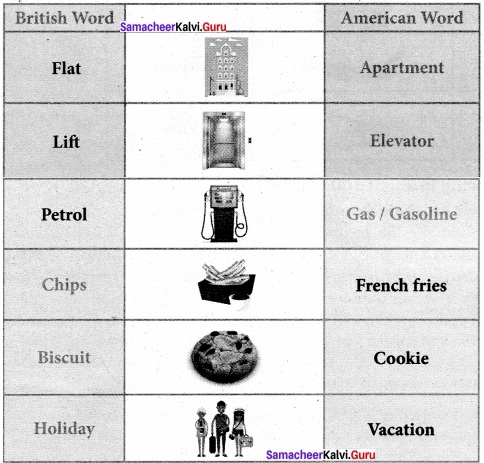
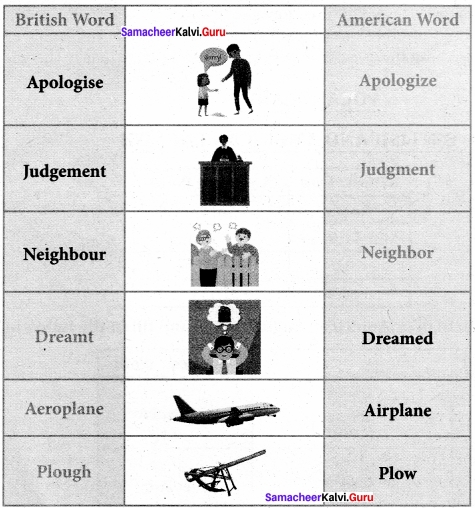
British And American English

British WordAmerican Word
TorchFlashlight
Mobile phoneCell phone
Bintrash can
LorryTruck

D. Find the suitable British or American English word and fill in the following.
Answer:

Cyber Safety 8th Standard Samacheer Kalvi Term 3 Prose Chapter 2

Spelling Differences

British WordAmerican Word
SkilfulSkillful
ChequeCheck
ProgrammeProgram
DialogueDialog

E. Find the suitable British or American English spelling and fill in the following.
Answer:

Cyber Safety 8th Standard Summary Samacheer Kalvi Term 3 Prose Chapter 2

Listening

F. Complete the following statements appropriately:

Mobile Phones: Uses and Abuses

The invention of mobiles phones is a great achievement and plays an important part in our daily life. Most of us nowadays carry the world in our pocket! It is amazing but true. A mobile phone can make us connected to the rest of the world within a second. Today, mothers do not have to tension if then sons ox daughters axe fate, businessmen do not have to queue up before a telephone booth to make an important call. Apart from making calls and sending SMS, the mobile phone is used as a multipurpose gadget. It is a calculator, timepiece, calendar, voice recorder, media player, camera, gaming device, net browser and what not. Its development brought convenience and advantages to the world. Communication between people has become quite easy and very fast. We can keep in contact with others from any place on the bus, in a street or in a meeting by sending a message for less than the price of a call. The Internet can be accessed through it and it is also used to click photos and shoot videos.

Though the mobile phone is a giant step of technological advancement, its abuses cannot at all be overlooked. Talking or texting while driving may lead to accidents. Students misuse this . tool in various ways and give way to social pollution. Its many aspects are beneficial but some are negative effects as well. The radiations of mobile may be dangerous to health and may cause a headache, ear ache and blurring vision. These invisible radiations destroy the cells located in ear and head which cause damage to the brain and nephrons in the head region. Its use in certain places causes disturbance sometimes, such as in a classroom etc. Mobile phones with camera are causing – privacy problems such as using it as a hidden camera to take pictures and making videos.

  1. A mobile phone is like a world in our pockets as it is amazing.
  2. Parents do not have to remain in tension if their sons and daughters are late because mobile phones can make us connected to the rest of the world within a second.
  3. Some of the negative effects of a mobile phone are:
    • headache
    • ear ache
    • blurring vision
    • radiations destroy cells in ear and head
  4. Excessive use of mobile phones can be hazardous to ones health as it has negative effects.
  5. A mobile phone is a threat to ones privacy as using it as a hidden camera to take picture and making videos.

Speaking

G. Imagine a world with no books, but only e-books. How would you find such a world? Deliver a two-minute talk.
Answer:
Good Morning Friends,

Let us think of a world without books. If we live in a world of e-books, how will we find such a world? There’s no need to come to school, have teachers to teach us and there will be no punishment from our teachers. It’s wonderful! Isn’t it? E-books take up less space. You can store hundreds and thousands of E-books on your computer or reading device. They are portable. With today’s technology, you can read E-books everywhere, without worrying about their weight. They can show links, for easy access to more information and related websites.

E-books can be interactive. They contain audio, video and animations. These can enhance the message that the author is trying to convey. They also serve an important purpose in the online world from different perspectives. Smart phones, tablets, e-readers, as well as laptops and desktops can access an e-book. So let’s together opt for the wonderful world of e-books and enjoy our life. Thank you.

Writing

H. Write a character sketch of any character from fiction that has made an impact on you.
Answer:
Character sketch of Sherlock Holmes :
The best character that had made an impact on me from fiction was “Sherlock Holmes”.
He is an extraordinary personality and a modern hero. The dressing gown, loose coat,
hips and his investigation skills are the things that come to my mind, when I think about him. His high intelligence and his creative imagination are his best traits. His workaholic nature is one of his best qualities. Sherlock Holmes character was created by the Scottish writer “Arthur Conan Doyle”. He is a detective who tries to find out who committed crimes. In the story “The Adventure of the Speckled Band”, Helen Stoners twin sister, Julia dies from an unknown cause, shortly before being married. Helen takes this case to Sherlock Holmes. Using his powers of observation, intelligence and perseverance, Holmes races to find the murderer. So this character had an immense impact on me.

Grammar

Sentences : Simple, Compound, And Complex

A. State which of the following sentences are Compound,

  1. Man proposes, but God disposes.
  2. I went because I was invited.
  3. Jancy returned home because she was tired.
  4. Whatever you do, do well.
  5. Listen carefully and take notes.
  6. I called him, but he gave me no answer.
  7. The town in which I live is very large.
  8. They always talk who never think.
  9. We must eat to live, but we should not live to eat.
  10. Govern your passions or they will govern you.

Answer:

  1. Compound sentence
  2. Compound sentence
  3. Compound sentence
  4. Complex sentence.
  5. Compound sentence
  6. Compound sentence
  7. Complex sentence.
  8. Complex sentence.
  9. Compound sentence
  10. Compound sentence

Tense – Time

B. Fill in the blanks with appropriate form of the verbs given in the brackets.

  1. When the burglars broke into the house, everybody _________ sound sleep, (have)
  2. The milk _________ over as she went to see the crowd passing by with loud slogans, (spill)
  3. If Karthik _________ any mistake, he will be rewarded, (not + make)
  4. They were watching TV when they _________ a loud bang at the door, (hear)
  5. The _________ bus the stop before we could catch it. (leave)
  6. Ashok _________ the same song for last three days. It has become boring now. (play)
  7. Manju _________ after we reach home, (call)
  8. The show _________ its one thousand episodes by next month, (complete)
  9. Don’t worry, we will be _________ the airport in time, (reach).
  10. Danial has _________ sick after eating some snacks at the street side shop, (fall)

Answer:

  1. was having a
  2. was spitting
  3. did not make
  4. heard
  5. left
  6. had been playing
  7. called
  8. will have been completed
  9. reaching
  10. fallen

C. Tick the correct option to complete the sentences.

8th Cyber Safety Question 1.
The climate of the city _________ mild and pleasant most of the time.
(a) is remaining
(b) remains
(c) was remaining
(d) is remained
Answer:
(b) remains

Cyber Safety Question Answer Question 2.
One day he _________ into a hotel in Ooty, a beautiful city in Tamilnadu.
(a) booking
(b) was booking
(c) booked
(d) had booked
Answer:
(c) booked

Cyber Safety Summary 8th Standard Question 3.
You will certainly _________ rewards for what you are doing.
(a) getting
(b) had got
(c) was getting
(d) be-getting
Answer:
(d) be getting

Samacheer Kalvi 8th English Book Solutions Question 4.
Do you _________ the day we moved the piano upstairs?
(a) remember
(b) remembered
(c) are remembering
(d) had remembered
Answer:
(a) remember

8th English Guide Cyber Safety Question 5.
The rain completely _________ our day.
(a) spoilt
(b) is spoiling
(c) is spoilt
(d) was spoilt
Answer:
(a) spoilt

Question 6.
Akbar _________ the king at the age of fifteen after the sudden death of his father.
(a) was becoming
(b) had become
(c) became
(d) become
Answer:
(c) became

Question 7.
The criminal _________ the place before the police could reach.
(a) was escaping
(b) had escaped
(c) is escaping
(d) will escape
Answer:
(b) had escaped

Question 8.
They _________ all the arrangements before the guest’s is arrival.
(a) will have made
(b) will be made
(c) had been making
(d) were making
Answer:
(a) will have made

Question 9.
Sabithra _________ her job by tomorrow evening.
(a) will be completing
(b) will complete
(c) will have completed
(d) will have been completing
Answer:
(d) will have been completing

Question 10.
Harshini _________ her mother in making rangoli in the yard for last one hour.
(a) is helping
(b) has helped
(c) has been helping
(d) helps
Answer:
(c) has been helping

D. Identify the errors in the sentences given below and rewrite them.

Question 1.
These grapes are tasting sour.
Answer:
These grapes taste sour.

Question 2.
I am thinking you are wrong.
Answer:
I think you are wrong.

Question 3.
She is seeming sad.
Answer:
She seems sad.

Question 4.
He is having a cellular phone.
Answer:
He has a cellular phone.

Question 5.
She watched TV when her husband came.
Answer:
She was watching TV, when her husband came.

Cyber Safety Additional Questions

I. Choose the correct synonyms for the italicized words.

Question 1.
Let us browse about it
(a) download
(b) scan
(c) upload
(d) type
Answer:
(b) scan

Question 2.
Rani seems like she is frightened of something.
(a) scared
(b) worried
(c) bold
(d) happy
Answer:
(a) scared

Question 3.
Still if he bothers you, I will take care of him.
(a) continues
(b) entertains
(c) disturbs
(d) avoids
Answer:
(c) disturbs

Question 4.
Keep your personal details very private.
(a) public
(b) general
(c) common
(d) private
Answer:
(d) private

Question 5.
Strangers may misuse your information.
(a) use wrongly
(b) misapply
(c) utilize
(d) use
Answer:
(b) misapply

Question 6.
There is a chance to get addicted to this power house of entertainment.
(a) indifferent
(b) dependent
(c) disliked
(d) disgusted
Answer:
(b) dependent

Question 7.
We can’t ignore the beneficial of internet.
(a) acknowledge
(b) remember
(c) watch
(d) neglect
Answer:
(d) neglect

Question 8.
Are you suspecting any Online predator?
(a) trusting
(b) believing
(c) doubting
(d) unsuspecting
Answer:
(c) doubting

II. Choose the correct antonyms for the italicized words.

Question 1.
Too much of anything is goood for nothing.
(a) nobody
(b) everything
(c) none
(d) nothingness
Answer:
(b) everything

Question 2.
But we must limit their usage to take charge of our lives.
(a) maximum
(b) broader
(c) increase
(d) contract
Answer:
(b) broader

Question 3.
Mobile addiction causes several serious problems.
(a) many
(b) few
(c) more
(d) a lot
Answer:
(b) few

Question 4.
Please advise Our children how to
(a) reasonably
(b) foolishly use internet wisely.
(c) gently
(d) mildly
Answer:
(b) foolishly

Question 5.
Never chat with anybody.
(a) not at all
(b) not ever
(c) always
(d) without
Answer:
(c) always

Question 6.
Internet or mobile helps us to connect with people around the world.
(a) bond
(b) disconnect
(c) attach
(d) join
Answer:
(b) disconnect

Question 7.
Enjoy various other activities,
(a) different
(b) numerous
(c) same
(d) assorted
Answer:
(c) same

Question 8.
What happend? you seem dull.
(a) bright
(b) boring
(c) colourless
(d) heavy
Answer:
(a) bright

Question 9.
I am really scared.
(a) frightened
(b) nervous
(c) confident
(d) feared
Answer:
(c) confident

Question 10.
Don’t respond to his message
(a) answer
(b) ignore
(c) reply
(d) address
Answer:
(b) ignore

III. Give very short answers :

Question 1.
What did Gladin want to know?
Answer:
Gladin wanted to know the working of a screw gange.

Question 2.
What was the name of Gladin’s sister?
Answer:
Her name was Rani.

Question 3.
Why was Gladin gathering information in the internet?
Answer:
He was gathering information for his science project.

Question 4.
Does the stranger know Rani’s name?
Answer:
Yes, The stranger knows Rani’s name.

Question 5.
Who advises the children?
Answer:
The father advises the children.

Question 6.
What did he advise?
Answer:
He advises them never to chat with strangers.

Question 7.
What does the mother request her husband?
Answer:
She requested him to advise their children how to use internet wisely.

Question 8.
What are the power houses of entertainment?
Answer:
Internet and the mobile are the power houses of entertainment.

Question 9.
Is too much of anything is good?
Answer:
No, too much of anything is not good.

Question 10.
Can we ignore the beneficial of internet and mobile phones?
Answer:
No, we can’t ignore the beneficial of internet and mobile phones.

IV. Give short answers :

Question 1.
What is an Internet?
Answer:
An Internet is a great tool where we can gather information to gain knowledge.

Question 2.
What does the stranger do?
Answer:
The stranger chats with Rani everyday. He uses bad words and tells Rani not to disclose about him to anyone. Otherwise, he will cause harm to her family members.

Question 3.
How does the internet or mobile entertain us?
Answer:
The internet or mobile allow us to watch movies, listen to music, play games and enjoy various other activities.

Question 4.
Why should we limit the usage of internet or mobile phone?
Answer:
We should limit the usage of internet or mobile phone to take charge of our lives.

Question 5.
What personal details should be very private?
Answer:
Our photos, phone number, aadhar number and our interests should be very private.

V. Answer in detail:

Rani got scared of a stranger, who used to chat with her everyday. Rani said that he knew her name, address, age and everything. He also used bad words, while chatting with her. So her father advised her not to respond to stranger’s message, even if he continuously disturbed her. After some days, he might not chat. Still if he tried to disturb her, her father would take care of him. Her father would talk to his parents. So her father told Rani not to worry about the stranger anymore.

Cyber Safety Grammar – Additional

Simple, Compound, And Complex

I. State which of the following sentences are simple, compound, complex :

1. The baby cried for food.
2. They spoke to him in Spanish, but he responded in English.
3. Hearing their cries, we came out.
4. They ate too much yesterday.
5. As we won the match, we were appreciated by the committee.
6. He was poor but helped everyone.
7. After reaching home, he rang to his friend.
8. Open the door and close the windows.
9. He was the man who- met us yesterday.
10.You must hurry or you will be late to school.

Tense-Time

II. Fill in the blanks with correct form of the verbs in the brackets

  1. He played football and then ______ home, (go)
  2. He ______ five matches by then, (won)
  3. They were ______ for you(look)
  4. Shell’ll be ______ tonight.(come)
  5. By this time she leaves, Jane ______ here for 3 years, (live)
  6. He is ______ a book, (read)
  7. He ______ , before 1 came back from the market, (sleep)
  8. He ______ to London yesterday, (fly)
  9. The light went out, while they ______ .(read)
  10. He ______ when I called, (exercise)

Answer:

  1. went
  2. will have won
  3. looking
  4. coming
  5. will have been living
  6. reading
  7. had slept
  8. flew
  9. were reading
  10. had been exercising

Warm Up

What are the sacrifices made by your father for your family.

8th Standard English Cyber Safety Samacheer Kalvi Term 3 Prose Chapter 2

Cyber Safety Summary

This lesson is about the technology of the present world – its benefits and negative aspects. One day Gladin asked his mother about the working of a screw gauge. She advised him to browse about it in the internet.

He could gather information from it and gain knowledge. Rani, Gladin’s sister was frightened of something. When enquired by her father, she informed him that someone chatted with her and used bad words. The person had warned her not to discuss about the chat to anyone. Otherwise, he would cause harm to her family members.

Her father advised her not to respond to any of his messages. After some days, he would not chat. If the person bothered further, her father would report to the cyber police. Her father also advised the children not to chat with the strangers. They should keep all their personal details very private. They should not get addicted to the power house of entertainment. Mobile addiction causes several serious health problems. Yet, we cannot ignore the benefits of internet and mobile phone.

They are very useful to gain knowledge and gather information. But too much of anything is good for nothing. So we must limit their usage to take charge of our lives.

Samacheer Kalvi 8th Science Solutions Term 2 Chapter 2 Electricity

You can Download Samacheer Kalvi 8th Science Book Solutions Guide Pdf, Tamilnadu State Board help you to revise the complete Syllabus and score more marks in your examinations.

Tamilnadu Samacheer Kalvi 8th Science Solutions Term 2 Chapter 2 Electricity

Samacheer Kalvi 8th Science Electricity Text Book Exercises

I. Chosse the best answer

8th Science Electricity Book Back Answers Question 1.
When an ebonite rod is rubbed with fur, the charge acquired by the fur is –
(a) negative
(b) positive
(c) partly positive and partly negative
(d) None of these
Answer:
(b) positive

Samacheer Kalvi 8th Science Book Solutions Term 2 Question 2.
The electrification of two different bodies on rubbing is because of the transfer of –
(a) neutrons
(b) protons
(c) electrons
(d) protons and neutrons
Answer:
(c) electrons

Samacheer Kalvi 8th Science Book Solutions Question 3.
Which of the following a simple circuit must have?
(a) Energy Source, Battery, Load
(b) Energy Source, Wire, Load
(c) Energy Source, Wire, Switch
(d) Battery, Wire, Switch
Answer:
(d) Battery, Wire, Switch

Samacheer Kalvi 8th Standard Science Question 4.
An electroscope has been charged by induction with the help of charged glassrod. The charge on the electroscope is –
(a) negative
(b) positive
(c) both positive and negative
(d) None of the above
Answer:
(b) positive

Samacheer Kalvi 8th Science Question 5.
Fuse is –
(a) a switch
(b) a wire with low resistanceFuse is
(c) a wire with high resistance
(d) a protective device for breaking an electric circuit
Answer:
(d) a protective device for breaking an electric circuit

II. Fill in the blanks

  1. ……………. takes place by rubbing objects together.
  2. The body which has not lost electrons becomes …………….
  3. ……………. is a device that protects building from lightning strike.
  4. ……………. has a thin metallic filament that melts and breaks the connection when the circuit is overheated.
  5. Three bulbs are connected end to end from the battery. This connection is called …………….

Answer:

  1. Transfer of electron
  2. positive
  3. Lightning arrestor
  4. Electric fuse
  5. series circuit

III. State True or False. If false, correct the statement

Question 1.
The charge acquired by an ebonite rod rubbed with a piece of flannel is negative.
Answer:
True

Question 2.
A charged body induces an opposite charge on an uncharged body when they are brought near.
Answer:
True

Question 3.
Electroscope is a device used to charge a body by induction.
Answer:
True

Question 4.
Water can conduct electricity.
Answer:
True

Question 5.
In parallel circuit, current remains the same in all components.
Answer:
False
Correct statement:
In parallel circuit, voltage remains the same in all components.

IV. Match the following

Question 1.

  1. Two similar charges – acquires a positive charge
  2. Two dissimilar charges – prevents a circuit from overheating
  3. When glass rod is rubbed with silk – repel each other
  4. When ebonite rod is rubbed with fur – attract each other
  5. Fuse – acquires a negative charge

Answer:

  1. Two similar charges – repel each other
  2. Two dissimilar charges – attract each other
  3. When glass rod is rubbed with silk – acquires a positive charge
  4. When ebonite rod is rubbed with fur – acquires a negative charge
  5. Fuse – prevents a circuit from overheating

V. Give reason for tile following.

Question 1.
When a glass rod is rubbed with silk cloth, both get charged.
Answer:
Reason:
When a glass rod is rubbed with a silk cloth the free electrons in the glass rod are transferred to silk cloth. It is because the free electrons in the glass rod are less tightly bound as compared to that in silk cloth. Since the glass rod looses electrons, it has a deficiency of electrons and hence acquires positive charge. But, the silk cloth has excess of electrons. So, it becomes negatively charged.

Question 2.
When a comb is rubbed with dry hair, it attracts small bits of paper.
Answer:
Reason:
Comb rubbed with hair gains electrons from the hair and becomes negatively charged. These electrons are accumulated on the surface of the comb. When a piece of paper is teared into bits, positive and negative charges are present at the edges of the bits. Negative charges in the comb attract positive charges in the bits. So, the paper bits are moving towards the comb.

Question 3.
When you touch the metal disc of an electroscope with a charged glass rod the metal leaves get diverged.
Answer:
Reason:
The leaves of an electroscope diverge because when a glass rod is touched on the metal disc, the charge travels through the metal rod to the leaves. Since, like charge repel, the charge travels till the leaves and then open up as both the leaves have like charges.
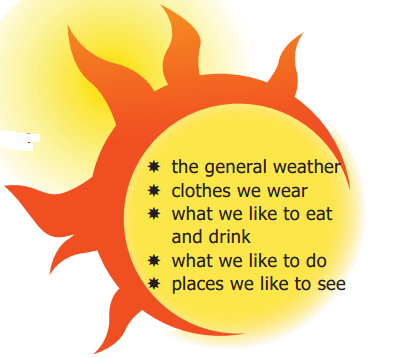
Question 4.
In an electroscope the connecting rod and the leaves are all metals.
Answer:
Reason:
These are made of metals so that the electrons become free to move.

Question 5.
One should not use an umbrella while crossing an open field during thunderstorm.
Answer:
Reason:

  1. Carrying an umbrella is not advisable during thunderstorm.
  2. As the rod of umbrella and its supporting wires are made up of metals.
  3. Thus during thunderstorm, the conducting object should be avoided.

VI. Choose the correct answer from the following directions.

Question 1.
(a) If both assertion and reason are true and reason is the correct explanation of the assertion.
(b) If both assertion and reason are true and reason is not the correct explanation of assertion.
(c) If the assertion is true, but reason is false.
(d) If the assertion is false but reason is true.

Question 1.
Assertion : People struck by lightning receive a severe electrical shock.
Reason : Lightning carries very high voltage.
Answer:
(a) Both assertion and reason are true and reason is the correct explanation of assertion.

Question 2.
Assertion : It is safer to stand under a tall tree during lightning.
Reason : It will make you the target for lightning.
Answer:
(d) The assertion is false but reason is true

VII. Answer briefly

Question 1.
How charges are produced by friction?
Answer:
Rubbing certain materials with one another can cause the built-up of electrical charges on the surfaces. So charges are produced by friction.
Example:
Combing hair charges are transferred from the hair to comb due to friction.

Question 2.
What is Earthing?
Answer:
Earthing is the process of connecting the exposed metal parts of an electrical circuit to the ground.

Question 3.
What is electric circuit?
Answer:
The path through which electrons flow from one terminal to another terminal of the source, is called electric circuit.

Question 4.
What is electroplating?
Answer:
The process of depositing a layer of one metal over the surface of another metal by passing electric current is called electroplating.

Question 5.
Give some uses of electroplating.
Answer:
Electro plating is applied in many fields:

  1. We use iron in bridges and automobiles to provide strength.
  2. A coating of zinc is deposited on iron to protect it from corrosion and formation of rust.
  3. Chromium has a shiny appearance. It does not corrode.
  4. It resists scratches.

VIII. Answer is detail

Question 1.
Explain three ways of charge transfer.
Answer:
Transfer of charges takes place in the following three ways:

  1. Transfer by Friction
  2. Transfer by Conduction
  3. Transfer by Induction

1. Transfer by Friction:
This method of charging an uncharged body by rubbing it ; against another body is called charging by friction.
Example:
While combing hair charges are transferred from the hair to comb due to friction.

2. Transfer by conduction:
Charges can be transferred to on object by bringing it in contact with a charged body. This method of transferring charges from one body to other body is calledtransfer by conduction.
Example:
When the ebonite rod is rubbed with woollen cloth, electrons from the woollen cloth are transferred to the ebonite rod. Now ebonite rod will be negatively charged.

(i) When it is brought near the paper cylinder, negative charges in the rod are attracted by the positive charges in the cylinder.

(ii) When the cylinder is touched by the rod, some negative charges are transferred to the paper. Hence, the negative charges in the rod are repelled by the negative charges in the cylinder.

3. Transfer by Induction:
The process of charging an uncharged body by bringing a charged body near to it but without touching it is called induction.
Example:
we can charge an uncharged object when we touch it by a charged object. But, it is also possible to obtain charges in a body without any contact with other charges.

Question 2.
What is electroscope? Explain how it works?
Answer:
1. An electroscope is a scientific instrument used to detect the presence of electric charge on a body.

2. An electroscope is made out of conducting materials, generally metal.

3. It works on the principle that like charges repel each other.

4. In a simple electroscope two metal sheets are hung in contact with each other.

5. They are connected to a metal rod that extends upwards, and ends in a knob at the end.

8th Science Electricity Book Back Answers Samacheer Kalvi Term 2 Chapter 2

6. If you bring a charged object near the knob, electrons will either move out of it or into it.

7. This will result in charges on the metal leaves inside the electroscope.

8. If a negatively charged object is brought near the top knob of the electroscope, it causes free electrons in the electroscope to move down into the leaves, leaving the top positive..

9. Since both the leaves have negative charge, they repel each other and move apart.

10. If a positive object is brought near the top knob of the electroscope, the free electrons in the electroscope start to move up towards the knob.

11. This means that the bottom has a net positive charge. The leaves will spread apart again. Explain series and parallel circuit.

Question 3.
Explain series and parallel circuit.
Answer:
Series Circuit:
Samacheer Kalvi 8th Science Book Solutions Term 2 Samacheer Kalvi Chapter 2 Electricity

  1. A series circuit is one that has more than one resistor (bulb) but only one path through which the electrons can travel.
  2. From one end of the battery the electrons move along one pathwith no branches through the resistors (bulbs) to the other end of the cell.
  3. All the components in a series circuit are connected end to end.
  4. So, current through the circuit remains same throughout the circuit.
  5. But, the voltage gets divided across the bulbs in the circuit.
  6. In the following series circuit two bulbs are used as resistors.
  7. Let I be the current through the circuit and V1 V2, V3 be the voltage across each bulb.
  8. The supply voltage V is the total of the individual voltage drops across the resistances. V = V1 + V2 + V3

Parallel Circuit:
Samacheer Kalvi 8th Science Book Solutions Term 2 Chapter 2 Electricity

  1. In a parallel circuit, there is more than one resistor (bulb) and they are arranged on many paths.
  2. This means charges (electrons) can travel from one end of the cell through many branches to the other end of the cell.
  3. Here, voltage across the resistors (bulbs) remains the same but the current flowing through the circuit gets divided across each resistor.
  4. Let us consider three bulbs connected in series.
  5. Let V be the voltage across the bulbs and I1, I2, I3 be the current across each bulb.
  6. The current I from the battery is the total of the individual current flowing through the resistances. I = I1 + I2 + I3

Question 4.
How lightning takes place?
Answer:
1. Lightning is produced by discharge of electricity from cloud to cloud or from cloud to ground.

2. During thunderstorm air is moving upward rapidly.

3. This air which moves rapidly, carries small ice crystals upward.

4. At the same time, small water drops move downward.

5. When they collide, ice crystals become positively charged and move upward and the water drops become negatively charged and move downward.
Samacheer Kalvi 8th Standard Science Term 2 Chapter 2 Electricity
6. So the upper part of the cloud is positively charged and the lower part of the cloud is negatively charged.

7. When they come into contact, electrons in the water drops are attracted by the positive charges in the ice crystals. Thus, electricity is generated and lightning is seen.

8. Sometimes the lower part of the cloud which is negatively charged comes into contact with the positive charges accumulated near the mountains, trees and even people on the earth. This discharge produces lot of heat and sparks that results in what we see as lightning.

Question 5.
What is electroplating? Explain how it is done.
Answer:
Electroplating:
Samacheer Kalvi 8th Science Solutions Term 2 Chapter 2 Electricity

  1. Electroplating is one of the most common applications of chemical effects of electric current.
  2. The process of depositing a layer of one metal over the surface of another metal by passing electric current is called electroplating.
  3. Take a glass jar and fill it with copper sulphate solution.
  4. Take a copper metal plate and connect it to the positive terminal of battery.
  5. Connect an iron spoon to the negative terminal of the battery.
  6. Now, dip them in the copper sulphate solution.
  7. When electric current is passed through the copper sulphate solution, you will find that a thin layer of copper metal is deposited on the iron spoon and an equivalent amount of copper is lost by the copper plate.

Samacheer Kalvi 8th Science Electricity Intex Activities

Activity – 1

Question 1.
Take a comb and place it near some pieces of paper. Are they attracted by the comb? No. Now comb your dry hair and place it near them. What do you see? You can see that the paper pieces are attracted by the comb now. How is it possible?
Answer:
Reason:
Comb rubbed with hair gains electrons from the hair and becomes negatively charged. These electrons are accumulated on the surface of the comb. When a piece of paper is teared into bits, positive and negative charges are present at the edges of the bits. Negative charges in the comb attract positive charges in the bits. So, the paper bits are moving towards the comb.

Activity – 2

Question 1.
Take a sheet of paper. Turn it into a hollow cylinder. Tie one end of the cylinder with a silk thread and hang it from a stand. Now take an ebonite rod and charge it by rubbing it with a woollen cloth. Bring this charged ebonite rod near the paper cylinder. The cylinder will be attracted by the rod. If you touch the paper cylinder by the charged rod, you will see the paper cylinder repelling the rod. Can you give the reason?
Answer:
When the cylinder is touched by the rod, some negative charges are transferred to the paper. Hence, the negative charges in the rod are repelled by the negative charges in the cylinder.

Activity – 4

Question 1.
Rub your foot on a carpet floor and touch a door knob. What do you feel? Do you feel the shock in your hand? Why does this happen?
Answer:
Samacheer Kalvi 8th Science Solutions Term 2 Chapter 2 Electricity 6
Getting a shock from a doorknob after rubbing your foot on a carpet floor, results from discharge. Discharge occurs when electrons on the hand are quickly pulled to the positively charged doorknob. This movement of electrons, which is felt as a shock, causes the body to lose negative charge.

Activity – 5

Question 1.
Take two pieces of wire, an LED light and a battery, and make a simple electric circuit. Take some water in a glass and put the wires in the water as shown in the figure. Does the LED bulb glow? What do you understand from this?
Samacheer Kalvi 8th Science Solutions Term 2 Chapter 2 Electricity 7
Answer:
Yes, the LED bulb glows. From this Activity we understood that liquids also conduct electricity.

Activity – 7

Question 1.
Take a battery, a bulb, a switch and few connecting wires. Make an electric circuit as shown in the figure. Keep the switch in the ‘OFF’ position. Does the bulb glow?
Answer:
No, the bulb does not glow.
Samacheer Kalvi 8th Science Solutions Term 2 Chapter 2 Electricity 8

Question 2.
Now move the electric switch to the ‘ON’ position and let the bulb glow for a minute or so. Touch the bulb now. Do you feel the heat?
Answer:
Yes, the bulb is hot because electrical energy is transformed to heat energy. This is known as heating effect of electric current.

Samacheer Kalvi 8th Science Electricity Additional Questions

I. Choose the correct answer

Question 1.
Electroplating is based on ……………… effect of electricity.
(a) magnetic
(b) chemical
(c) heating
(d) physical
Answer:
(b) chemical

Question 2.
A positively charged object will attract ……………… charged object.
(a) positively
(b) negatively
(c) both a and b
(d) none
Answer:
(b) negatively

Question 3.
The method of charging an object by touching is called ………………
(a) induction
(b) diffusion
(c) current
(d) conduction
Answer:
(d) conduction

Question 4.
Lighting occurs due to ……………….
(a) rain
(b) humidity
(c) wind
(d) electric discharge
Answer:
(d) electric discharge

Question 5.
Electric charge can be transferred from a charged object to another through ……………….
(a) vacuum
(b) conductor
(c) air
(d) insulator
Answer:
(b) conductor

Question 6.
Electric charge is measured in ……………….
(a) volt
(b) coulomb
(c) ampere
(d) watt
Answer:
(b) coulomb

Question 7.
The value of charge of an electron is equal to ……………….
(a) 6.04 x 10⁻¹⁹ C
(b) 1.602 x 10⁻¹⁸ C
(c) 1.602 x 10⁻¹⁹ C
(d) 6.10 x 10⁻¹⁸ C
Answer:
(c) 1.602 x 10⁻¹⁹ C

Question 8.
Before using electroscope, it should be ………………..
(a) charged
(b) closed
(c) discharged
(d) cleaned
Answer:
(c) discharged

Question 9.
Lighting rods are made of ………………..
(a) copper
(b) plastic
(c) sand paper
(d) wood
Answer:
(a) Copper

Question 10.
Electricity produced on rubbing is ……………….
(a) static electricity
(b) current electricity
(c) electromagnet
(d) none
Answer:
(a) static electricity

Question 11.
The materials which allows electric current to pass through it, is called ……………….
(a) conductor
(b) insulator
(c) both a and b
(d) none of these
Answer:
(a) conductor

Question 12.
The material which does not allow electric current is called ………………..
(a) solution
(b) metal
(c) insulator
(d) electrolyte
Answer:
(c) insulator

Question 13.
All metals are ………………..
(a) conductors
(b) insulators
(c) electrolytes
(d) none
Answer:
(a) conductors

Question 14.
An electrolyte ……………….
(a) has positive charge
(b) has negative charge
(c) should be able to conduct charge without dissociating.
(d) should be able to form positive and negative ions.
Answer:
(d) should be able to form positive and negative ions

Question 15.
Most common industrial application of chemical effects of electric current is ………………..
(a) Anodizing
(b) electroplating
(c) electrolysis
(d) none
Answer:
(b) electroplating

Question 16.
The terminal which is connected to a positive terminal of a battery is called ……………….
(a) anode
(b) cathode
(c) neutral
(d) none
Answer:
(a) anode

Question 17.
Flow of per unit time is called current ………………..
(a) charge
(b) proton
(c) neutron
(d) all of these
Answer:
(a) charge

Question 18.
Liquids that conduct electricity are the solutions of ………………..
(a) acids
(b) bases
(c) salts
(d) all of these
Answer:
(d) all of these

Question 19.
A tiny particle which rotates around the nucleus of an atom is ………………..
(a) proton
(b) electron
(c) neutron
(d) both a and b
Answer:
(b) electron

Question 20.
……………….. wire is used in the filament of the bulbs.
(a) Nichrome
(b) Copper
(c) Tungsten
(d) None
Answer:
(c) Tungsten

II. Fill in the blanks

  1. Comb rubbed with hair ……………. electrons from the hair and becomes negatively charged.
  2. Electric charge is measured in ……………..
  3. Since, protons and electrons are equal in number, an atom is electrically ………………
  4. When an ebonite rod is rubbed with fur, the fur transfers …………….. to the ebonite rod.
  5. Before the discovery of electrons, it was considered that electric current is due to the flow of …………….. charges.
  6. The gold – leaf electroscope was developed by ………………
  7. …………….. is an example of discharge that takes place in clouds.
  8. During thunderstorm air is moving …………….. rapidly.
  9. Huge quantities of electricity are discharged in light flashes and temperatures of over ……………..°C or more can be reached.
  10. …………….. extreme heat will vaporize the water inside a tree, creating steam that may bum out the tree.
  11. …………….. is a device used to protect buildings from the effects of lightning .
  12. …………….. is a species offish which can give electric shocks.
  13. In series circuit, the current remains …………….. throughout the circuit.
  14. …………….. is used in extraction and purification of metals.
  15. Copper wire offers very little …………….. and does not get heated up quickly.
  16. A fuse is a strip of alloy wire which is made of lead and tin with a very low ………………
  17. The flow of ……………… per unit time is called current.

Answer:

  1. gains
  2. coulomb
  3. neutral
  4. electrons
  5. positive
  6. Abraham Bennet
  7. Lightning
  8. upward
  9. 30,000
  10. Lightning’s
  11. Lightning arrestor
  12. Electric eel
  13. same
  14. Electrolysis
  15. resistance
  16. melting point
  17. charge

III. True or False – if false give the correct statement

Question 1.
Materials which do not allow electric charges to pass through them easily are called insulator.
Answer:
True

Question 2.
Silk cloth has excess of electrons, so it becomes positively charged.
Answer:
False
Correct statement:
Silk cloth has excess of electrons, so it becomes negatively charged.

Question 3.
Electric charge is measured in coulomb.
Answer:
True.

Question 4.
Protons carry negative charge and the electrons carry positive charge.
Answer:
False.
Correct statement:
Protons carry positive charge and the electrons carry negative charge.

Question 5.
The gold – leaf electroscope was developed by Abraham Bennet.
Answer:
True

IV. Match the following

Question 1.

1.

Bulb

(a)Conductor
2.Electroplating(b)

Insulator

3.

Pure water(c)Heating effect of current
4.Salt solution(d)

Chemical effect of current

Answer:

  1. c
  2. d
  3. b
  4. a

Question 2.

1.

Insulator(a)Coulomb
2.Conductor(b)

Electric circuit

3.

Closed path(c)Copper
4.Electric charge(d)

Rubber

Answer:

  1. b
  2. c
  3. d
  4. a

Question 3.

1.

Anode(a)Conducting solution
2.Cathode(b)

Positive terminal

3.

Ions(c)Negative terminal
4.Electrolyte(d)

Positively or negatively charged

Answer:

  1. d
  2. c
  3. a
  4. b

V. Read the directions given below and answer the questions.

Question 1.
(a) If both assertion and reason are true and the reason is the correct explanation of the assertion.
(b) If both assertion and reason are true, but the reason is not the correct explanation of the assertion.
(c) If the assertion is true, but the reason is false.
(d) If the assertion is false, but the reason is true.

Question 1.
Assertion : Charges flow from higher potential to the lower potential.
Reason : Current flows mainly due to flow of electrons.
Answer:
(b) Both assertion and reason are true, but the reason is not the correct explanation of the assertion

Question 2.
Assertion : Parts of car and bicycle are made iron with chromium coating.
Reason : Chromium does not corrode and resist scratches.
Answer:
(a) Both assertion and reason are true and the reason is the correct explanation of the assertion

Question 3.
Assertion : Insulators do not allow flow of current through them.
Reason : Insulators have no free charge carrier
Answer:
(a) Both assertion and reason are true and the reason is the correct explanation of the assertion

Question 4.
Assertion : A current carrying wire should be charged.
Reason : The current in a wire is due to flow of free electrons in a definite direction.
Answer:
(d) The assertion is false, but the reason is true

Question 5.
Assertion : When both the strips of electroscope is charged with similar charge, they repel each other and become wide open.
Reason : Like charges always repel each other.
Answer:
(a) Both assertion and reason are true and the reason is the correct explanation of the assertion

VI. Answer briefly

Question 1.
Name the process which show the chemical effect of electric current?
Answer:
Electroplating.

Question 2.
What are electrodes?
Answer:
The metal rods dipped in liquids to which cells are attached are called electrodes.

Question 3.
Who discovered static electricity or lightning in clouds?
Answer:
Benjamin Franklin in 1752.

Question 4.
What are charged objects?
Answer:
The objects which acquire a small charge on rubbing are called charged objects.

Question 5.
What do you mean by earthing?
Answer:
The process of transferring of charge from a charged object to the earth is called earthing.

Question 6.
A layer of zinc coated over iron. Why?
Answer:
Layer of zinc coated over iron because zinc prevents it from rust and corrosion.

Question 7.
Name the effect of current responsible for the glow of the bulb in an electrical circuit.
Answer:
Heating effect of electric current.

Question 8.
Name a few appliances which work on the basis of heating effect of current.
Answer:
Bulb, iron, heater, electric kettles, electric cookers, electric fuse.

Question 9.
What are the essential components of an electric circuit?
Answer:
Electric cell, bulb, switch, battery and connecting wires.

Question 10.
How can you save yourselves from lightning?
Answer:

  1. We should remain in the covered area.
  2. we should not use wired telephones during lightning.

Question 11.
State some advantages electroplating.
Answer:

  1. It protects the metal from corrosion and rusting.
  2. It is used to coat desired metal on other objects.
  3. It can make more reactive metal like iron.
  4. Coating of chromium on the metal gives luster to the objects.

Question 12.
Write the differences between conductors and insulators.
Answer:
Conductors:
Materials which allow the electric current to pass through them are called conductors.
Example:
All metals, Salt water

Insulators:
Materials do not allow the current to pass through them are called insulators.
Example:
Dry wood, plastics, rubber, glass

Question 13.
What are anodes and cathodes?
Answer:

  1. In the process of electrolysis, the electrode which is connected to the positive terminal of the battery is called anode.
  2. The electrode which is connected to the negative terminal of the battery is called cathode.

Question 14.
What will be the charges on silk and glass rod when they are rubbed against each other?
Answer:

  1. When a glass rod is rubbed with silk piece, the free electrons in the glass rod are transferred to silk piece.
  2. It is because the free electrons in the glass rod are tightly bound as compared to that in silk piece.
  3. Since the glass rod looses electrons, it has a deficiency of electrons and hence acquires positive charge.
  4. But, silk piece has excess of electrons.
  5. So, it becomes negatively charged.

Question 15.
When a negatively charged glass rod is brought near another glass rod, the rod will move apart. Give reason.
Answer:
It is because both the glass rods are negatively charged. So they repel each other.

Question 16.
When an ebonite rod is rubbed with fur, the fur transfers electrons to the ebonite rod. Why?
Answer:

  1. It is because the electrons in the outermost orbit of the atoms in fur are loosely bound as compared to the ebonite rod.
  2. Ebonite rod has excess electrons which becomes negatively charged and the fur which has deficiency of electrons is positively charged.

Question 17.
List the ways in which you can charge an object.
Answer:

  1. Charging by friction
  2. Charging by induction
  3. Charging by conduction.

Question 18.
How thunder takes place?
Answer:

  1. Huge, quantities of electricity are discharged in lightning flashes and temperatures of over 30,000°C or more.
  2. This extreme heat causes the air to expand explosively fast and then they contract.
  3. This expansion and contraction create a shock wave that turns into a booming sound wave known as thunder.

Question 19.
Sometimes lighting may be seen before the thunder is heard. Why?
Answer:
It is because the distance between the clouds and the surface is very long and the speed of light is much faster than the speed of sound.

Question 20.
What do you mean by electrical Earthing?
Answer:
Electrical Earthing is defined as the process of transferring the discharge of electrical energy directly to the Earth With the help of low-resistance wire.

VII. Answer in detail

Question 1.
Explain the structure and working of gold-leaf electroscope with a diagram.
Answer:
Samacheer Kalvi 8th Science Solutions Term 2 Chapter 2 Electricity 9
Structure of I metroscope :

  1. It is made up of a glass jar.
  2. A vertical brass rod is inserted into the jar through a cork.
  3. The top of the brass rod has a horizontal brass rod or a brass disc.
  4. Two gold leaves are suspended from the brass rod inside the jar.

Working of Electroscope:

  1. When the brass disc of the electroscope is touched by a charged object, electric charge
  2. gets transferred to the gold leaf through the rod.
  3. This results in the gold leaves moving away from each other.
  4. This happens because both the leaves have similar charges.

Question 2.
Write a note on –

  1. Charging
  2. Electrical discharge.

Answer:
1. Charging:
Transfer of charge from one object to another is called charging. In case of the gold leaves charge is transferred through the brass rods.

2. Electrical Discharge:
The gold leaves resume their normal position after some time. This happens because they lose their charge. This process is called electrical discharge. The gold leaves would also be discharged when someone touches the brass rod with bare hands. In that case, the charge is transferred to the earth through the human body.

Question 3.
Explain the function of lightning arrestor with a diagram.
Answer:
Samacheer Kalvi 8th Science Solutions Term 2 Chapter 2 Electricity 10

  1. Lightning arrestor is a device used to protect buildings from the effects of lightning.
  2. Lightning conductor consists of a metallic lightning rod that remains in air at the top of the building.
  3. Major portion of the metal rod and copper cable are installed in the walls during its construction.
  4. The other end of the rod is placed deep into the soil.
  5. When lightning falls, it is attracted by the metallic rods at the top of the building.
  6. The rod provides easy route for the transfer of electric charge to the ground.
  7. In the absence of lightning arrestors, lightning will fall on the building and the building will be damaged.

Question 4.
Write a note on.

  1. Fuse
  2. Electric irons.

Answer:
1. Fuse:

  1. Fuse is a strip of alloy wire which is made up of lead and tin with a very low melting point.
  2. This can be connected to the circuit.
  3. The fuse is usually designed to take specific amount of current.
  4. When current passing through the wire exceeds the maximum limit, it gets heated up.
  5. Due to low melting point, it melts quickly disconnecting the circuit. This prevents damage to the appliances.

2. Electric irons :

  1. When current flows through the heating element, the heat energy developed is conducted to the heavy metal base, raising its temperature.
  2. This energy is then used to press clothes.

Question 5.
Distinguish between series and parallel circuit.
Answer:
Series circuit:

  1. Same amount of current flows through all the components.
  2. Voltage is different across different components.
  3. Components are arranged in a line.
  4. If one component breaks down, the whole circuit will bum out.

Parallel circuit:

  1. The current flowing through each component combines to form the current flow.
  2. Sum of the voltage through each component will be the voltage drawn from the source.
  3. Components are arranged parallel to each other.
  4. Other components will function even if one component breaks down.

VIII. Picture based Questions

Question 1.
Will the bulb glow if the end B is dipped in pure water?
Samacheer Kalvi 8th Science Solutions Term 2 Chapter 2 Electricity 11
Answer:
No, the bulb will not glow as pure water is an insulator.

Question 2.
Identify the charge on the body with a question mark.
Samacheer Kalvi 8th Science Solutions Term 2 Chapter 2 Electricity 12
Answer:
Samacheer Kalvi 8th Science Solutions Term 2 Chapter 2 Electricity 13

Question 3.
The bulb does not glow in the set up show in figure. List the possible reasons.
Samacheer Kalvi 8th Science Solutions Term 2 Chapter 2 Electricity 14
Answer:
The possible reasons are:

  1. Bulb may be fused.
  2. Cells may be used up.
  3. The liquid may be poor conductor of electricity.
  4. The connection of the circuits may be loose.

IX. Higher Order thinking skills (HOTS):

Question 1.
During the construction of a building, the lightning conductor was left hanging in the air by mistake will it be effective? Explain.
Answer:
Lighting conductor will not work. It left hanging in the air because in order to work, it must be installed properly and grounded using copper plate.

Question 2.
During lightning and thunder we should avoid standing in ground and open spaces Why?
Answer:
During lightning and thunder, we should avoid standing in ground and open spaces. You should make yourself as small as possible by squating. It is however safe to stay inside a car because the car acts as a shield and protects us from the electric field generated by the storm.

Question 3.
You might have observed on a dry day that when you touch the screen of a television you get a slight shock. Why does it happen?
Answer:
It happens because the television screen is charged and have static charges and when we touch with our hands which are uncharged, the charges attract our hands and transfer through our hands and we get a small shock.

X. Solve the following crossword with the help of the given clues.

Clue:
Across :
1. Ions having a positive charge formed by the loss of electrons.
2. Chemical compound which conducts electricity when in aqueous state.
5. Atoms that have an electric charge.
7. A piece of metal through which an electric current enters or leaves in a liquid or gas.

Down :
3. A process in which a thin film of metal is deposited on another metal with the help of electricity.
4. A process in which a chemical change especially decomposition of a chemical compound is brought about by passing an electric current through a solution.
6. Ions having a negative charge formed by the gain of electrons.
8. The negative electrode is an electrolytic cell, toward which positively charged particles are attracted.
Answer:
Samacheer Kalvi 8th Science Solutions Term 2 Chapter 2 Electricity 15

Samacheer Kalvi 6th English Solutions Term 3 Prose Chapter 1 Who Owns the Water?

Students can Download English Lesson 1 Who Owns the Water?Questions and Answers, Summary, Activity, Notes, Samacheer Kalvi 6th English Book Solutions Guide Pdf  helps you to revise the complete Tamilnadu State Board New Syllabus and score more marks in your examinations.

Tamilnadu Samacheer Kalvi 6th English Solutions Term 3 Prose Chapter 1 Who Owns the Water?

Read and Understand

A. Choose the correct answer and write it in the blank.

Who Owns The Water Question 1.
The little bird broadened the hole with her ________
(a) beak
(b) claws
Ans:
(b) claws

Who Owns The Water Prose Summary Question 2.
The wild boar settled down scraping the hole into a _______ to have a good sleep.
(a) pit
(b) hollow
Answer:
(b) hollow

Who Owns The Water Paragraph Question 3.
The poor farmer’s crop was _______
(a) meagre
(b) surplus
Answer:
(a) meagre

B. Tick the correct answer.

Who Owns The Water Question Answer Question 1.
The boar slept until the fading sun told him it was time to get up. What does the phrase until the fading sun mean? ‘
(a) until evening [✓]
(b) until sun fades in colour

Who Owns The Water Summary Question 2.
The farmer was thankful at the sight of the verdant bowl because .
(a) it was a pond of water [ ✓]
(b) he wanted green grass

Who Owns The Water 6th English Question 3.
They all stood arpund the little jewel of blue means .
(a) They stood around the pond. [✓]
(b) They stood around the jewel which was blue.

Who Owns The Water Book Back Answers Question 4.
The dry earth soaked up the moisture as a hungry puppy laps up milk. It means _______
(a) The puppy was very hungry.
(b) The dry earth absorbed the water very quickly. [✓]

C. Answer the following questions.

Who Owns The Water 6th Standard Summary Question 1.
Pick out the line which tells you about seasons (in Sec II). Which seasons are mentioned?
Answer:
The line “It rained without stopping for three days and three nights and the dry earth soaked up the moisture, as the hungry puppy laps up milk” tells about seasons. The summer and the rainy seasons are mentioned here.

Who Owns The Water 6th Standard Question 2.
What happened to the hole in the ground after the rain?
Answer:
The hole in the ground collected the water that fell and the grass grew into a brighter green around its edges.

Who Owns The Water 6th Std Question 3.
Identify a sentence and a phrase which tells us that the story took place in summer.
Answer:
‘In summer months, he had to travel far to get water for his thirsty crops’. This . sentence tells us that the story took place in summer. The phrase is ‘thirsty crops’.

Vocabulary

D. Fill in the blanks with words given in the box to make compound words.
rain, Coconut, Coat, sail, fire

  1. We use [rain] on a rainy day.
  2. The toy [boat] danced on the pond
  3. We must drink [tender] water in summer
  4. We can see a [bow] after summer showers
  5. Clean the ashes out of the [place]

Answers:

  1. rain coat
  2. sail boat
  3. tender coconut
  4. rain bow
  5. fire place

E. Complete the following using their group names.

  1. A _______ of wolves went hunting in the forest.
  2. She bought a new ________ of shoes for her birthday.
  3. A _______ of fish swam past our boat.
  4. A ________ of bees had settled on a mango tree.
  5. late a _______ of grapes.

Answers:

  1. pack
  2. pair
  3. shoal
  4. swarm
  5. bunch

Listening

F. listen to the weather report. Read the questions given below, then listen to the weather report again and fill in the blanks.

  1. Which season does the weather report show?
  2. What kind of a day is it?
  3. What is the temperature stated in the report?
  4. Tomorrow it may probably _______
  5. The weather report suggests to use _______

Answers:

  1. spring
  2. clear warmy day
  3. 15 degrees
  4. rain
  5. umbrella

Speaking

G. Imagine that you and your friend have decided to spend a day together in your house. You have planned your schedule from morning till night. Discuss in pairs and speak about it in the class. You can start like this:

Who Owns The Water Story In Tamil Question 1.
I like to go for a walk but my friend wants to work out In the gym.
Answer:
I like to go for a walk, but my friend wants to work out in the gym. After spending an hour in the gym, we planned to go to my house, take a bath and have breakfast. Next, we planned to discuss some points about our projects. Then we can relax for some time by watching TV or playing video games. After lunch, we planned to watch a new movie in the home theatre. In the evening, we decided to play cricket with our friends in our backyard. Then we planned to spend some time with my family members. Finally, my friend would go to his house, after having his dinner.

Grammar

H. Fill in the blanks with suitable linking words or conjunctions.

  1. Our team played well _______ won the game. (but, because, and)
  2. She slipped badly _______ she did not hurt herself. (but, and, or)
  3. The box was heavy _______ he could not lift it. (so, because, and)
  4. Rani was late to school _______ she missed the bus. (because, so, and)
  5. You can use a pen _______ a pencil for writing. (but, and, or)

Answers:

  1. and
  2. but
  3. so
  4. because
  5. or

I. Join the sentence of Column A with B using the words given in the box.
Who Owns The Water Samacheer Kalvi 6th English Solutions Term 3 Prose Chapter 1
Answers:

  1. The clouds moved away and the sun came out.
  2. Velu thanked his friend because he helped Velu in time.
  3. It rained heavily but the match continued.
  4. Eat slowly or you will get choked.

Writing

J. Write a short paragraph on ‘summer’ using the hints given.

you can begin like this

I live in Chennai. The weather is…
Answer:
Who Owns The Water Prose Summary Samacheer Kalvi 6th English Solutions Term 3 Prose Chapter 1
Summer
I live in Chennai. The weather is too hot here. The summer season begins in the month of March and continues till May or June. The temperature goes up to 40°C. We prefer to wear cotton clothes as they keep us cool. We stay hydrated during summer and we drink a lot of fruit juices and eat fruits like water melon, oranges, cucumbers and also consume more vegetables. We avoid going out frequently. We stay indoors at home or at workspot. During summer, we go to the beach quite often and hilly places to keep ourselves cool and pleasant.

Creative Writing

K. Trees can help you recognise seasons. How do the frees look different in each season? Write a short paragraph with the dues given below.

  • Summer – Trees stretch their leafy branches towards the sun.
  • Spring – Branches are full of new green leaves.
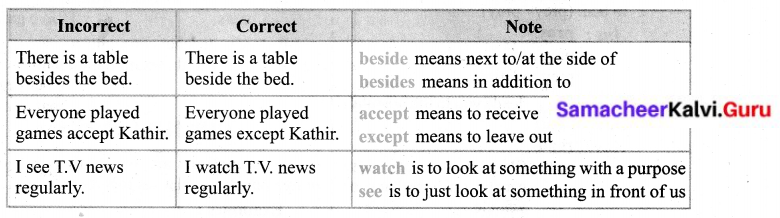
  • Rain – Trees absorb water and look green.
  • Autumn – Trees shed their leaves.
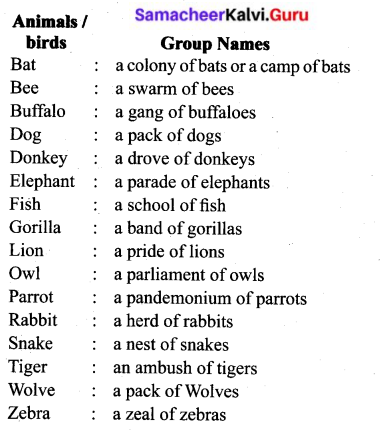
Answer:
Trees play an important role in the world. They help to purify the air, water and soil. Trees help us to recognise seasons. We can identify seasonal changes by watching trees. During summer, trees stretch their leafy branches towards the sun, as the temperature is ideal for trees. They produce their buds at the end of summer. During spring, they bloom and flower. Their branches are full of new green leaves. During rainy season, they absorb water and look green, whereas in the autumn season, the trees shed their leaves. Their leaves turn into pretty colours of maroon, red and slightly purple. The leaves get hardened and shed. Thus, the trees can help us to recognise the seasons.
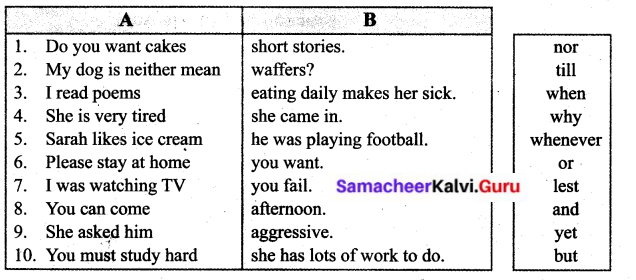
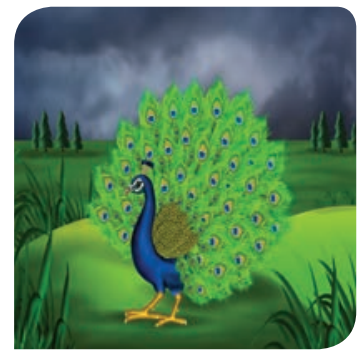
Who Owns the Water? Additional Questions

I. Select the Suitable Synonyms.

Who Owns The Water Question And Answer Question 1.
outskirts
(a) interior of a town
(b) the outer areas of a city
(c) the centre of a place
Answer:
(b) the outer areas of a city

Who Owns The Water 6th Standard English Question 2.
parched
(a) rough
(b) cracked
(c) very dry
Answer:
(c) very dry

Who Owns The Water Book Back Answer Question 3.
shallow
(a) deep
(b) not deep
(c) profound
Answers:
(b) not deep

Who Owns The Water Lesson Question 4.
scrabbled
(a) moved hands and feet around
(b) screamed loudly
(c) made a noise
Answer:
(a) moved hands and feet around

Question 5.
sniffed
(a) to breathe in slightly
(b) to breathe quickly
(c) to breathe in air in a noisy way
Answer:
(c) to breathe in air in a noisy way

Question 6.
soaked up
(a) increased
(b) dried
(c) absorbed
Answer:
(c) absorbed

Question 7.
glee
(a) sorrow
(b) joy
(c) hatred
Answer:
(b) joy

Question 8.
gratitude
(a) thankfulness
(b) ungratefulness
(c) thanklessness
Answer:
(a) thankfulness

Question 9.
summoned
(a) sent
(b) called
(c) brought
Answer:
(b) called

Question 10.
suspiciously
(a) doubtfully
(b) innocently
(c) confidently
Answer:
(a) doubtfully

Question 11.
contentment
(a) dissatisfaction
(b) displeasure
(c) satisfaction
Answer:
(c) satisfaction

Question 12.
wallowed
(a) rolled in the mud
(b) played happily
(c) took a bath
Answer:
(a) rolled in the mud

Question 13.
meagre
(a) large quantity
(b) surplus
(c) small quantity
Answer:
(c) small quantity

Question 14.
untenanted
(a) occupied
(b) not occupied
(c) inhabited
Answer:
(b) not occupied

Question 15.
glance
(a) quick look
(b) turn
(c) start
Answer:
(a) quick look

Question 16.
stuttered
(a) spoke fluently
(b) spoke with difficulty
(c) spoke harshly
Answer:
Answer:
(b) spoke with difficulty

Question 17.
beloved
(a) dear
(b) close
(c) happy
Answer:
(a) dear

Question 18.
horizon
(a) The line where the earth and the sky seems to meet
(b) The interior
(c) The centre of the sky
Answer:
(a) The line where the earth and the sky seems to meet

Question 19.
elusive
(a) easily available
(b) difficult to find
(c) convenient to trace out
Answer:
(b) difficult to find

Question 20.
whined
(a) made a terrible noise
(b) screamed
(c) made a high pitched cry
Answer:
(c) made a high pitched cry

II. Select the Suitable Antonyms.

Question 1.
protected
(a) attacked
(b) sheltered
(c) safeguarded
Answer:
(a) attacked

Question 2.
comfortable
(a) uncomfortable
(b) convenient
(c) good
Answer:
(a) uncomfortable

Question 3.
dusty
(a) refined
(b) clean
(c) smooth
Answer:
(b) clean

Question 4.
discovered
(a) found
(b) detected
(c) lost
Answer:
(c) lost

Question 5.
broadened
(a) widened
(b) narrowed
(c) flattened
Answer:
(b) narrowed

Question 6.
realising
(a) imagining
(b) harmonising
(c) disbelieving
Answer:
(c) disbelieving

Question 7.
collected
(a) scattered
(b) accumulated
(c) gathered
Answer:
(a) scattered

Question 8.
brighter
(a) duller
(b) glimmer
(c) cleaner
Answer:
(a) duller

Question 9.
rarely
(a) hardly
(b) barely
(c) frequently
Answer:
(c) frequently

Question 10.
cruel
(a) kind
(b) inhuman
(c) harsh
Answer:
(a) kind

Question 11.
straightened
(a) neatened
(b) curved
(c) untwisted
Answer:
(b) curved

Question 12.
pitiful
(a) sorrowful
(b) hopeful
(c) hateful
Answer:
(b) hopeful

Question 13.
tiredness
(a) liveliness
(b) weakness
(c) weariness
Answer:
(a) liveliness

Question 14.
decent
(a) good
(b) proper
(c) bad
Answer:
(c) bad

Question 15.
serious
(a) funny
(b) earnest
(c) sincere
Answer:
(a) funny

Question 16.
upset
(a) disturbed
(b) pleased
(c) bothered
Answer:
(b) pleased

Question 17.
smoothly
(a) gently
(b) placidly
(c) roughly
Answer:
(c) roughly

Question 18.
moral
(a) noble
(b) immoral
(c) honest
Answer:
(b) immoral

Question 19.
searched
(a) hunted
(b) ignored
(c) looked ?
(b) ignored

Question 20.
enquire
(a) ask
(b) question
(c) reply
Answer:
(c) reply

III. Choose the Correct Answers (MCQ)

Question 1.
The tiny bird used her _______ to remove the stones and loosen up the packed earth.
(a) beak
(b) claws
(c) feet
(d) hooves
Answer:
(b) claws

Question 2.
The mother bird fed her _______ until they were big enough to fly away.
(a) children
(b) kids
(c) babies
(d) little ones
Answer:
(c) babies

Question 3.
One day, a passing wild boar settled his rump into the _______
(a) hole
(b) depression
(c) hollow
(d) pit
Answer:
(b) depression

Question 4.
Not by a long shot. Our story has just .
(a) started
(b) finished
(c) ended
(d) begun
Answer:
(d) begun

Question 5.
A pack of _______ dogs caught the scent of boar in the wind and came to that spot.
(a) wild
(b) domestic
(c) street
(d) varied
Answer:
(a) wild

Question 6.
They left the hole a little bigger and _______ than they had found it.
(a) wider
(b) larger
(c) broader
(d) greater
Answer:
(a) wider

Question 7.
It poured and poured and only those of us who have seen the _______ will know what that means.
(a) rains
(b) showers
(c) monsoons
(d) cyclones
Answer:
(c) monsoons

Question 8.
The dry earth soaked up the moisture, as a hungry _______ laps up milk.
(a) cat
(b) lion
(c) puppy
(d) monkey
Answer:
(c) puppy

Question 9.
Here was water to be had, and so close to his .
(a) field
(b) land
(c) holding
(d) crop
Answer:
(c) holding

Question 10.
Just then, the richest farmer in the village pushed his way to the _______ of the group.
(a) back
(b) middle
(c) side
(d) front
Answer:
(d) front

IV. Very short Answer Questions.

Question 1.
What did tht tiny bird search for?
Answer:
The tiny bird searched for a place to lay her eggs.

Question 2.
How was the land In the little village?
Answer:
It was very dry and there wasn’t a bush or tree in sight.

Question 3.
How did the tiny bird rtmovo the stones in the depression?
Answer:
The tiny bird used its claws to remove the stones in the depression.

Question 4.
Was the pit comfortable for the wild boar?
Answer:
No, the pit was not comfortable enough for the wild boar.

Question 5.
What did the boar do in Its sleep?
Answer:
The boar turned and scrabbled in his sleep.

Question 6.
Who came to the spot, where the boar had lain?
Answer:
A pack of wild dogs came to the spot, where the boar had lain.

Question 7.
What did they do?
Answer:
They sniffed the circle that was rich with the smell of the animal.

Question 8.
How many days did it rain?
Answer:
It rained without stopping for three days and three nights.

Question 9.
Where did the poor former till the land?
Answer:
The poor farmer tilled the land near the small depression.

Question 10.
What did he see one day?
Answer:
One day he saw a patch of green, close to his land.

V. Short answer Questions.

Question 1.
How did the little bird manage to lay its eggs?
Answer:
The little bird discovered a shallow depression in the ground. Using her claws to remove the stones and loosen up the packed earth, she broadened the hole and there she laid her eggs.

Question 2.
What signified the boar that it was time to get up?
Answer:
The fading sun and a rumble in his stomach signified the boar that it was time to get up.

Question 3.
Why did the wild dogs come to the spot of the depression?
Answer:
A pack of wild dogs came to the spot of the depression because they caught the scent of the boar in the wind.

Question 4.
What did they do, after realising that there was no dinner to be found there?
Answer:
After realising that there was no dinner to be found there, the wild dogs departed with their noses and tails high in the air.

Question 5.
How did the people in the village react, after it rained for three days?
Answer:
Even the normally serious-looking people in the village went around with smiles on their faces.
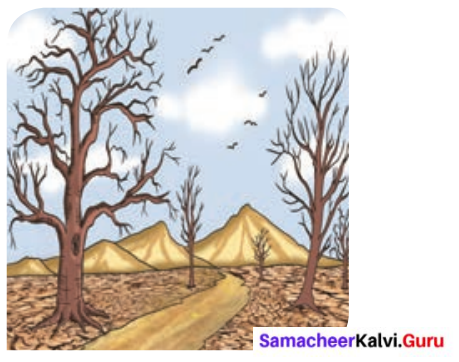
Question 6.
How did the hole look after the rain?
Answer:
The hole in the ground collected the water that fell and the grass grew into a brighter green around its edges.
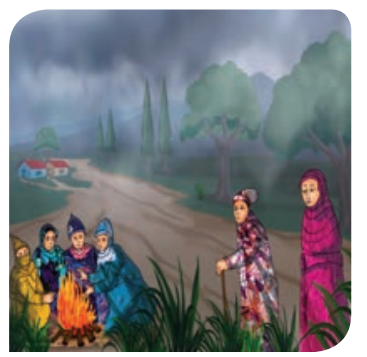
Question 7.
What did the buffaloes do In the pit?
Answer:
The buffaloes rolled in the puddly water, turning the hole into a muddy pit.

Question 8.
What did the poor former do, at the sight of the verdant bowl?
Answer:
The farmer fell to the ground with gratitude at the sight of the verdant bowl. The water was so close to his holding.

Question 9.
What did the former do, after spotting the water near his field?
Answer:
He raced home and brought out his pickaxe and spade and cleaned the pond into a perfectly decent one.

VI. Paragraph Questions and Answers.

Question 1.
What happened oft the outskirts of a dusty little village?
Answer:
On the outskirts of a dusty little village, a tiny bird searched for a place to lay her eggs. The land was very dry over there. There wasn’t a bush or a tree in sight. The bird was on the verge of losing hope. Suddenly, it discovered a shallow depression in the ground. Using her claws to remove the stones and loosen up the packed earth, she broadened the hole and there, underneath the hot sun, she laid her eggs. After some days, the eggs hatched. The mother bird protected the babies and fed them, until they were big enough to fly away.

Question 2.
How did the wild boar settled himself in the pit? When did he depart from that place?
Answer:
The pit remained dusty and unoccupied for some days, until one day, a passing wild boar settled himself into the depression. As the pit was not comfortable enough, the wild boar scraped and dug, carving a pit of more hospitable proportions. He tried to sit into this hollow, by turning around a few times and then with a satisfied grunt settled down to a long sleep. In his sleep, the boar turned and moved his hands and feet around, thereby loosening the earth. In the evening, the fading sun and a low sound in his stomach told him that it was time to get up. With a mighty stretch and a final kick, the hungry boar departed his daybed without a backward glance.

Question 3.
How did the wild dogs react, after they searched for the wild boar?
Answer:
A pack of wild dogs caught the scent of the wild boar in the wind and came to the spot, where he had slept. They sniffed the circle that was rich with the smell of the animal. They cried in a high pitch and made an angry noise, searching aggressively for the wild boar all over the place. Finally, when they realised that there was no dinner to be found there, they left the place with their noses and tails high in the air. And in doing so, they left the hole a little bigger and wider, than they had found it.

Question 4.
What was ‘the little Jewel of blue’ and who owns it?
Answer:
The little Jewel of blue refers to the small pond full of water.

A poor farmer’s life was hard, as there were no rains. During the summer months, he had to travel far to get water for his thirsty crops and even then, his harvest was of small quantity. One day, after the season’s rain, he happened to see a patch of green grass. Going closer to it, he was grateful at the sight of water over there with the green grass around it. He cleaned the pond and called the village priest to bless their fortune. When the richest farmer in the village said that the land with the pond belonged to him, the poor farmer insisted that the land with the pond belonged to – him. But the question is ‘who owns the water?’ The little bird, the boar, the wild dogs and the buffaloes – all stood around ‘the little jewel of blue’, which is the water. In every one’s mind, whether it was a small or a big deed, came a similar thought – ‘Surely, I had something to do with this!’ It was just a thought – germ of an idea to dig and make bigger.

Who Owns the Water? Grammar – Additional

Compound Words

A compound word is a combination of two or more words that function as a single unit of meaning.
sun + rise → sunrise
after + noon → afternoon
post + card → postcard
time + limit → timelimit
rain + fall → rainfall

Fill in the blanks with words given in the box to make compound words.

sea, cow, bag, pine, any, shelf, pop, book, fast, ball.

  1. We put the books on the big yellow [book]
  2. Jess picks up [shells] on the beach.
  3. The [corn] is popping and smells good.
  4. I write about school in my [note]
  5. My Dad loves to watch soccer and [base]
  6. The [boy] was riding a horse.
  7. It is very important to always eat [break]
  8. We have meat and [apple] on our pizza.
  9. Is there [thing] I can help you with?
  10. My little sister lost her [lunch]

Answers:

  1. book shelf
  2. sea shells
  3. pop corn
  4. note book
  5. base ball
  6. cow boy
  7. break fast
  8. pine apple
  9. any thing
  10. lunch bag

Incorrect / Correct Words
Who Owns The Water Paragraph Samacheer Kalvi 6th English Solutions Term 3 Prose Chapter 1
Choose the correct words.

Question 1.
_______ makes a man perfect. (Practise / Practice)
Answer:
Practice
Practice (noun) : Doing a thing repeatedly for skill.
Practise (verb) : To do a thing again and again.

Question 2.
The country side has vast _______ where people could go for a quiet walk, (plane / plains)
Answer:
plains
plane: aeroplane.
pains : a piece of level ground.

Question 3.
India has been working for international _______ (peace / piece)
Ans:
peace
peace : a state of quiet, calm,
piece: a portion or part of anything.

Question 4.
She fetched a _____ of water, (pale / pail)
Answer:
pail
pale: not bright,
pail : a bucket.

Question 5.
Ramesh wanted to buy a _____ book. (knew/new)
Answer:
new
knew : (Past tense of ‘know’) understood,
new: not old.

Question 6.
There was a sports _____ yesterday in my school, (meet / meat)
Answer:
meet
meet: a gathering of people,
meat: flesh of animals.

Question 7.
Valuable were given for winners on the college day. (price / prize)
Answer:
prize
price : the value or cost of a thing,
prize: a reward.

Question 8.
Always _____ to God before you go to bed. (prey / pray)
Answer:
pray
pray: offer worship prey: victim

Question 9.
This _____ leads you to the hospital. (rode / road)
Answer:
road
rode: (Past tense of ride) carried on horseback or vehicle.
road: Highway.

Question 10.
The _____ told by the old woman kept the children spell-bound, (tale / tail)
Answer:
tale
tale: story
tail: the projecting end of an animal behind.

Group Names
Who Owns The Water Question Answer Samacheer Kalvi 6th English Solutions Term 3 Prose Chapter 1

I. Complete the following using their group names.
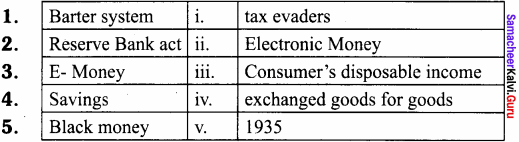
  1. A _____ of lions roamed in the jungle.
  2. A _____ of sailors arrived at the harbour.
  3. A _____ of musicians enlightened the day with their wonderful music.
  4. I saw a _____ of bees on my way to school.
  5. The sky is clear with a _____ of stars.
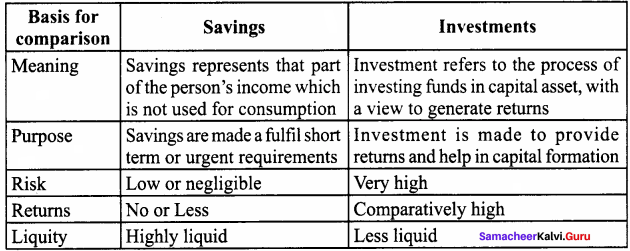
  6. My teacher brought a _____ of paper to the examination hall.
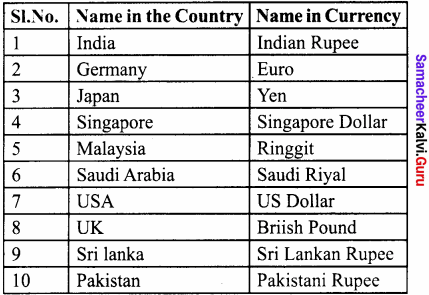
Answers:

  1. pride
  2. crew
  3. band
  4. hive
  5. galaxy
  6. ream

Conjunctions

Conjunctions are words that link other words, phrases or clauses together,

Examples:
1. I like cooking and eating, but I don’t like washing dishes.
2. I can stay out until the clock strikes twelve.
3. You cannot succeed, unless you work sincerely.

List of Conjunctions :

  1. Co-ordinating conjunctions : for, and, nor, but, or, yet, so.
  2. Correlative conjunctions : both / and, either / or, neither / nor, not only / but also, whether / or.
  3. Sub ordinating conjunctions : because, since, as, although, though, while, whereas, as long as, as soon as, unless, until, whenever, wherever, whereas, whether, while.

I. Fill in the blanks with suitable conjunctions.

  1. She bought a,shirt a book, (but, and, so)
  2. You can write your paper with a pen a pencil, (but, or, so)
  3. I sent him a letter he didn’t respond, (nor, or, but)
  4. She laughed entered into the room, (and, but, or)
  5. He sings songs he wants to become a singer, (yet, because, but)
  6. I saw him I was driving my car. (unless, while, as)
  7. I went to a market, I saw a joker, (whereas, where, whenever)
  8. He bought a laptop a bag for it. (but, because, as well as)
  9. He came here you can meet him. (so that, until, while)
  10. He hurried to the station missed the train, (for, but, or)

Answers:

  1. and
  2. or
  3. but
  4. and
  5. because
  6. while
  7. where
  8. as well as
  9. so that
  10. but

II. Join the sentence of Column A with Column B using the words given in the box.
Who Owns The Water Summary Samacheer Kalvi 6th English Solutions Term 3 Prose Chapter 1
Answers:

  1. Do you want cakes or waffers?
  2. My dog is neither mean nor aggressive.
  3. I read poems and short stories.
  4. She is very tired yet she has lots of work to do.
  5. Sarah likes ice cream but eating daily makes her sick.
  6. Please stay at home till afternoon.
  7. I was watching TV when she came in.
  8. You can come whenever you want.
  9. She asked him why he was playing football.
  10. You must study hard lest you fail.

Textual Activities

Warm Up

Look at the pictures, discuss in pairs, share your answers with the class.

Question 1.
During which season do you see a peacock dance?
Who Owns The Water 6th English Samacheer Kalvi Term 3 Prose Chapter 1
Answer:
Rainy Season.

Question 2.
In which season can you see trees without leaves? Name the country where your can find this season.
Who Owns The Water Book Back Answers Samacheer Kalvi 6th English Solutions Term 3 Prose Chapter 1
Answer:
Autumn
Canada.

Question 3.
Which season is shown in this picture? What are the people doing?
Who Owns The Water 6th Standard Summary Samacheer Kalvi Term 3 Prose Chapter 1
Answer:
Winter Season.
The people are warming themselves by lighting a fire.

Question 4.
Which season is shown in this picture? How do you know?
Who Owns The Water 6th Standard Samacheer Kalvi Term 3 Prose Chapter 1
Answer:
Summer Season.
People are buying ice-cream.
They are quenching their thirst by drinking tender coconut water.

SamacheerKalvi.Guru

Who Owns the Water? Summary

Section I

This lesson insists on ‘the importance of water’, as water is a resource that is shared by all the people of the world. Who owns the water in rivers, sea, lakes and in the ground? Like the air in the atmosphere, it belongs to all of us.
Who Owns The Water 6th Std Samacheer Kalvi Term 3 Prose Chapter 1
In this section -1, the story begins with a tiny bird searching for a place to lay her eggs. The land was very dry and there wasn’t a bush or a tree in sight. Losing hope, the bird finally discovered a shallow depression in the ground. She broadened the hole and loosened the earth. She laid her eggs there. The eggs hatched after some days and the mother protected the babies, until they were big enough to fly.

The hole, where the eggs were laid, remained dusty and not occupied by anyone for some time. One day, a passing wild boar settled into the pit. As the pit was not comfortable enough, he scraped and dug into a more hospitable proportion and settled down to a long sleep. After some time, he got up, moving his hands and feet around, thus loosening the earth in the pit. With a mighty stretch and a final kick, the hungry boar departed from his day bed.

Put a (✓) for the correct and a (×) for the incorrect statements.

  1. A tiny bird looked for a place to lay her eggs. [✓]
  2. The land was wet and green. [×]
  3. The little bird found a shallow hollow in the ground. [✓]
  4. The eggs hatched and the babies flew away. [✓]
  5. The pit was comfortable for the wild bear to sleep in. [×]
  6. The wild boar got up from its day bed because it was disturbed by another boar. [×]

Section II

A pack of wild dogs catching the scent of boar in the wind, came to the place where he slept for a while. They sniffed that place, made a high pitch cry and an angry noise, searching for the boar. Finally, they left the place, realising that there was no dinner to be found there. The hole was made a little bigger and wider by these wild dogs. After a few days, it rained for three days and nights and the dry earth soaked up the moisture.

Who Owns The Water Story In Tamil Samacheer Kalvi 6th English Solutions Term 3 Prose Chapter 1

The whole earth smelled wet and fresh. The hole collected the water that fell and grass grew around its edges. Soon buffaloes spotted the place and rolled in the water, making it muddy. The pit widened and became a little watering hole.

Complete the sentences given below with words/phrases.

  1. The wild dogs came to the spot to catch _______
  2. The rains came and poured _______
  3. The whole earth smelled _______ and _______
  4. The hole in the ground was filled _______
  5. The buffalo _______ in the hole.
  6. The.hole became _______ and _______

Answers:

  1. the wild boar
  2. without stopping for three days and three nights
  3. wet; fresh
  4. with rain water
  5. rolled in the muddy water which was
  6. widened; became a little watering hole

Section III

There was a poor farmer, who tilled the land near the once small depression. During summer months, he travelled far to get water for his crops. His harvest was not good, as there were no rains. One day, his eyes fell on a patch of green grass, closer to his field. He investigated it and was grateful at the sight of the green grass and water, so close to his field.

Who Owns The Water Question And Answer Samacheer Kalvi 6th English Solutions Term 3 Prose Chapter 1

With his pickaxe and spade, he made the pit into a perfectly decent pond. He told his wife about this and called the village priest to bless their fortune. When a rich farmer tried to own this pond, the poor farmer brushed him aside saying that it belonged to him. The buffaloes, the dogs, the boar and the little bird all stopped by and stood around the little jewel of blue and in every mind whether it is a small deed or a big one, came similar thought “Surely, I had something to do with this”.

The teacher ends the story shooting a question ‘who owns the water?’ It is not a moral, but just a thought – a germ of an idea to dig and make bigger.

Answer the following questions in one or two sentences.

Question 1.
Why did the farmer have to travel far?
Answer:
The farmer had to travel far to get water for his thirsty crops.

Question 2.
What sight made the farmer thankful?
Answer:
The sight of water with green grass, near his land made the farmer thankful.

Question 3.
Name the tools the farmer brought out. What did he do with them?
Answer:
The farmer brought out his pickaxe and spade. He cleaned the buffaloes’ picnic spot into a perfectly decent little pond.

Question 4.
Why did the crowd gather by the side of the pond?
Answer:
The crowd gathered by the side of the pond to see the priest wrinkle his eyebrows and chant something serious, which nobody understands.

Question 5.
When did the richest farmer get upset? Why?
Answer:
The richest farmer got upset, when the poor farmer called the village priest to bless their fortune. He was upset because he was not invited for it.

Samacheer Kalvi 9th Science Solutions Chapter 22 World of Microbes

You can Download Samacheer Kalvi 9th Science Book Solutions Guide Pdf, Tamilnadu State Board help you to revise the complete Syllabus and score more marks in your examinations.

Tamilnadu Samacheer Kalvi 9th Science Solutions Chapter 22 World of Microbes

Samacheer Kalvi 9th Science World of Microbes Textbook Exercises

I. Choose the correct answer.

World Of Microbes Class 9 Question 1.
Which of the following is transmitted through air?
(a) Tuberculosis
(b) Meningitis
(c) Typhoid
(d) Cholera
Answer:
(a) Tuberculosis

Chapter 22 World Of Microbes Question 2.
One of the means of indirect transmission of disease is ………………….
(a) sneezing
(b) coughing
(c) vectors
(d) droplet infection
Answer:
(c) vectors

9th Science World Of Microbes Question 3.
Diptheria affects the ………………………
(a) Lungs
(b) Throat
(c) Blood
(d) Liver
Answer:
(b) Throat

World Of Microbes Class 9 Pdf Question 4.
The primary organ infected during tuberculosis is …………………..
(a) bone marrow
(b) intestine
(c) spleen
(d) lungs
Answer:
(d) lungs

Science Solution Class 9 Samacheer Kalvi Question 5.
Microbes that generally enter the body through nose are likely to affect …………………….
(a) gut
(b) lungs
(c) liver
(d) lymph nodes
Answer:
(b) lungs

9 Samacheer Kalvi Science Question 6.
The organ affected by jaundice is …………………
(a) liver
(b) lungs
(c) kidney
(d) brain
Answer:
(a) liver

Samacheer Kalvi Guru 9th Science Question 7.
Poliomyelitis virus enters the body through ……………………..
(a) skin
(b) mouth and nose
(c) ears
(d) eye
Answer:
(b) mouth and nose

II. Fill in the blanks.

  1. ………….. break down organic matter and animal waste into ammonia.
  2. Typhoid fever is caused by ………………
  3. H1N1 virus causes ……………..
  4. ……………… is a vector of viral disease dengue.
  5. ……………. vaccine gives considerable protection against tuberculosis.
  6. Cholera is caused by …………… and malaria is caused by ……………..

Answer:

  1. Nitrification
  2. Salmonella typhi
  3. Swine Flu
  4. Aedes aegypti mosquito
  5. BCG (Bacillus Calmette Guerin)
  6. Vibrio cholerae, Plasmodium

III. Expand the following

  1. ORS – Oral Rehydration Solution.
  2. HIV – Human Immunodeficiency Virus
  3. DPT – Dipetheria, Pertussis (whooping cough) and Tetanus.
  4. WHO – World Health Organization.
  5. BCG – Bacillus Calmette Guerin

IV. Pick out the odd one.

  1. AIDS, Retrovirus, Lymphocytes, BCG,
  2. Bacterial disease, Rabies, Cholera, Common cold and Influenza

Answer:

  1. BCG
  2. Rabies

V. State whether True or False. If false write the correct statement.

  1. Rhizobium, associated with root nodules of leguminous plants fixes atmospheric nitrogen – True.
  2. Non- infectious diseases remain confined to the person who develops the disease and do not spread to others – True.
  3. The process of vaccination was developed by Jenner – True.
  4. Hepatitis B is more dangerous than Hepatitis A – True.

VI. Match column A with column B.

Column AColumn B
1.Swine flu(a) Human Papilloma virus
2.Genital warts(b) Human Immunodeficiency Virus
3.AIDS(c) Mycobacterium
4.Tuberculosis(d) Influeuza virus HIN 1

Answer:

  1. (d) Influenza virus H1N1
  2. (a) Human Papillomavirus
  3. (b) Human Immunodeficiency Virus
  4. (c) Mycobacterium

VII. Define the following.

Samacheer Kalvi 9th Science Question 1.
Pathogen
Answer:
A pathogen is a biological agent that causes disease to its host. e.g. bacteria, virus, etc.

Samacheer Kalvi Guru 9th Question 2.
Bacteriophages
Answer:
Bacteriophages are virus that infect bacterial cells, e.g. T4 bacteriophage.

Samacheer Kalvi Class 9 Science Solutions Question 3.
Vaccines
Answer:
Preparation of antigenic proteins of pathogens (weakened or killed) which on inoculation into a healthy person provides temporary/permanent immunity against a particular disease.

Samacheerkalvi.Guru 9th Science Question 4.
Prions
Answer:
Viral particles which contain only protein. They do not contain nucleic acid.

VIII. Answer the following in brief.

9th Samacheer Kalvi Science Question 1.
Distinguish between Virion and Viroid.
Answer:

VirionViroid
Virion is a simple virus particle and can grow and multiply in living cells onlyViroid is a free pathogenic RNA of virus.
They are the smallest infecting agents and can live on plants, animals, human beings and bacteriaThey are found in plant cells and causes diseases only in plants.

9th Science Samacheer Kalvi Question 2.
Name the vector of the malarial parasite. Mention the species of malarial parasite which cause malignant and fatal malaria.
Answer:
The vector of the malarial parasite is the female Anopheles mosquito. Malaria caused by Plasmodium falciparum is malignant and fatal.

Samacheer Kalvi 9th Standard Science Question 3.
What is triple antigen? Mention the disease which can be prevented by using the antigen.
Answer:
DPT is called triple antigen vaccine as it is a combined vaccine for protection against Diptheria, Pertusis and Tetanus.

Samacheer Kalvi 9th Science Guide Question 4.
Name the chronic diseases associated with respiratory system.
Answer:
Chronic diseases associated with respiratory system are; Diptheria, Whooping Cough, Tuberculosis.

Samacheer Kalvi 9th Science Solutions Question 5.
Name the organism causing diarrhoel disease and give one precaution against it.
Answer:
Cholera (Acute diarrhoeal disease) is caused by Vibrio cholerae through contaminated food, water, oral route and through houseflies. It can be prevented by hygienic sanitary condition, intake of Oral Rehydration Solution (ORS).

Science 9th Samacheer Kalvi Question 6.
Name two common mosquitoes and the diseases they transmit.
Answer:
Anopheles mosquito and Aedes aegypti mosquito are common mosquitoes that transmit malaria, Chikungunya and Dengue.

IX. Answer in detail.

Science Class 9 Samacheer Kalvi Question 1.
Give an account of classification of bacteria based on the shape.
Answer:
Bacteria are microscopic, single celled prokaryotic organisms without nucleus and other cell organelles. Although majority of bacterial species exist as single celled forms, some appear to be filaments of loosely joined cells. The size varies from less than 1 to 10 µm in length and 0.2 to 1 µm micrometer in width.
Based on the shapes, bacteria are grouped as:

  1. Spherical shaped bacteria called as cocci (or coccus for a single cell).
  2. Rod-shaped bacteria called as bacilli (or bacillus for a single cell).
  3. Spiral shaped bacteria called as spirilla (or spirillum for single cell)

Samacheer Kalvi.Guru 9th Question 2.
Describe the role of microbes in agriculture and industries.
Answer:
Microbes play an important role in agriculture as biocontrol agents and biofertilizers. Microbes play a vital role in the cycling of elements like carbon, nitrogen, oxygen, sulphur and phosphorus.

  1. Microbes as biocontrol agents
    Microorganisms used for controlling harmful or pathogenic organisms and pests of plants are called as biocontrol agents (Biopesticides). Bacillus thuringiensis (Bt) is a species of bacteria that produces a protein called as ‘cry’ protein. This protein is toxic to the insect larva and kills them.
  2. Microbes as biofertilizers
    Microorganisms which enrich the soil with nutrients are called as biofertilizers. Bacteria, cyanobacteria and fungi are the main sources of biofertilizers. This is done by microbes either in free living conditions or by having symbiotic relationship with the plants, e.g. Nitrosomonas, Nostoc (free living), symbiotic microbes like Rhizobium, Frankia, mycorrhizae.

Microbes in Industries
Microorganisms play an important role in the production of wide variety of valuable products for the welfare of human beings.

  1. Production of fermented beverages:
    Beverages like wine are produced by fermentation of malted cereals and fruits by Saccharomyces cerevisiae.
  2. Curing of coffee beans, tea leaves and tobacco leaves: Beans of coffee and cocoa, leaves of tea and tobacco are fermented by the bacteria Bacillus megaterium. This gives the special aroma.
  3. Production of curd: Lactobacillus sp. converts milk to curd. .
  4. Production of organic acids, enzymes and vitamins: Oxalic acid, acetic acid and citric acid are produced by fungus Aspergillus niger. Enzymes like lipases, invertase, proteases, and glucose oxidase are derived from microbes. Yeasts are rich source of vitamin-B complex.

Samacheer Kalvi 9th Science Solution Question 3.
Explain the various types of viruses with examples.
Answer:
Viruses are categorized as:
i. Plant virus: Virus that infect plants, e.g. Tobacco mosaic virus, Cauliflower mosaic virus, Potato virus.
World Of Microbes Class 9 Samacheer Kalvi Science Solutions Chapter 22

ii. Animal virus: Virus that infect animals, e.g. Adenovirus, Retrovirus(HIV), Influenza virus, Poliovirus.
Chapter 22 World Of Microbes Samacheer Kalvi 9th Science Solutions

iii. Bacteriophages: Virus that infect bacterial cells, e.g. T4 bacteriophage.
9th Science World Of Microbes Samacheer Kalvi Chapter 22

Science Samacheer Kalvi 9th Question 4.
Suggest the immunization schedule for a newborn baby till 12 months of age. Why it is necessary to follow the schedule?
Answer:

AgeVaccineDosage
New bomBCG1st dose
15 daysOral Polio1st dose
6th weekDPT and Polio1st dose
10th weekDPT and Polio1st dose
14th weekDPT and Polio1st dose
9-12 monthsMeasles1st dose

The immunization schedule must be followed so that the vaccines administered will protect the children in future from infectious and life-threatening diseases.

X. Assertion and Reason.

Mark the correct statement as.
(a) If both A and R are true and R is correct explanation of A.
(b) If both A and R are true but R is not the correct explanation of A.
(c) If A is true but R is false.
(d) If both A and R are false.
Samacheer Kalvi.Guru 9th Science Question 1.
Assertion: Chickenpox is a disease indicated by scars and marks in the body.
Reason: Chickenpox causes rashes on face and further spreads throughout the body.
Answer:
(a) If both A and R are true and R is a correct explanation of A.

9th Science Solutions Samacheer Kalvi Question 2.
Assertion: Dengue can be treated by intake of antibiotics.
Reason: Antibiotics blocks the multiplication of viruses.
Answer:
(d) If both A and R are false.

XI. Questions based on thinking skills.

Samacheer Kalvi Science 9th Question 1.
Suggest precautionary measures you can take in your school to reduce the incidence of infectious disease.
Answer:
Precautionary measures that can be taken are;

  1. The sick student or staff can be asked to stay at home.
  2. Clean and disinfect classroom materials and surfaces.
  3. Adopt healthy practices such as safe handling of food and usage of toilets.
  4. Provide awareness in daily announcements about preventing spread of germs and illnesses.

Question 2.
Tejas suffered from typhoid while, Sachin suffered from tuberculosis. Which disease could have caused more damage and why?
Answer:
Typhoid is a food and water-borne disease which affects the intestines. There are good drugs available for its treatment. If the patient reports to the doctor on time, it can be treated safely. Typhoid vaccine is also available that can protect against further attacks.

Whereas, Tuberculosis is a very tricky disease. Though it basically infects the lungs, it can spread to other parts of the body such as bones, intestines, etc. Another complication of TB is that, once infected, the Mycobacterium remains dormant in the body even after adequate treatment. Whenever the immunity of the patient goes down, TB can resurface again. Therefore, Tuberculosis causes more damage when compared to Typhoid.

Activity

Question 1.
Observe the mosquitoes that are active during the day time. Catch them using an insect net and observe their bodies and legs. What do you observe? Why are cases of Dengue reported in large numbers during the post-monsoon season?
Answer:
Mosquitoes of Aedes sp. are active during day time. The special features that can be observed in this mosquito is white bands on its legs and a silver-white pattern of scales on its body.

The female mosquitoes lay their eggs above the water line inside containers that hold water. These containers include tires, buckets, birdbaths, water storage jars, and flower pots which are filled with water due to rains. After the mosquitoes lay their eggs, the mosquito larvae hatch which are aquatic and feed on the microorganisms that is found in water necessary for its growth. Hence, Dengue is reported largely during the post-monsoon season.

Question 2.
Recently in 2018, Nipah virus was in the headlines of the daily newspaper. Collect the following information.

  1. What is Nipah virus?
  2. How it gets transmitted?
  3. Mention the preventive measures taken by the government to check the disease.

Answer:

  1. Nipah virus is a zoonotic virus.
  2. It is transmitted from animals to humans when humans are exposed to secretions from the pigs, or unprotected contact with the tissue of a sick animal.
  3. Nipah virus infection can be prevented by avoiding exposure to sick pigs and bats in endemic areas and not drinking raw date palm sap.
    Routine and thorough cleaning and disinfection of pig farms with appropriate detergents. The infected animals should be slaughtered – with close supervision of burial or incineration of carcasses – may be necessary to reduce the risk of transmission to people.

Samacheer Kalvi 9th Science World of Microbes Additional Questions

I. Choose the correct answer.

Question 1.
…………… can multiply only inside the living cells.
(a) Bacteria
(b) fungi
(c) worm
(d) Virus
Answer:
(d) Virus

Question 2.
Bacterial cell membranes covered by strong rigid cell wall are made up of ……………….
(a) peptidoglycan
(b) glycogen
(c) polysaccharides
(d) lipopolysaccharides
Answer:
(a) peptidoglycan

Question 3.
…………….. depend on other organisms or dead organic matter for food.
(a) Parasites
(b) Saprophytes
(c) Heterotrophic bacteria
(d) Symbionts
Answer:
(c) Heterotrophic bacteria

Question 4.
……………. are the site of protein synthesis
(a) Plasmid
(b) Mitochondria
(c) Cell
(d) Ribosome
Answer:
(d) Ribosome

Question 5.
Bacteria are ………………… single-celled prokaryotic organisms without a nucleus and other cell organelles.
(a) motile
(b) non-motile
(c) microscopic
(d) anaerobic
Answer:
(c) microscopic

Question 6.
……………… are either a single or cluster of flagella at both the cell poles.
(a) Lophotrichous
(b) Amphitrichous
(c) Monotrichous
(d) Peritrichous
Answer:
(b) Amphitrichous

Question 7.
The body of the fungus is called ………………………
(a) thallus
(b) hyphae
(c) mycelium
(d) filament
Answer:
(a) thallus

Question 8.
…………….. is a complex of several thin filaments called hyphae.
(a) Thallus
(b) Mycelium
(c) Cellulose
(d) Hemicellulose
Answer:
(b) Mycelium

Question 9.
Typhoid disease is common in children of age group ……………….. years
(a) 2-16
(b) 3-17
(c) 1-15
(d) 4-18
Answer:
(c) 1-15

Question 10.
Measles is caused by …………………..
(a) Varicella virus
(b) Rhinovirus
(c) Myxovirus parotitis
(d) Rubeola virus
Answer:
(d) Rubeola virus

II. Fill in the blanks.

  1. ………………. rely on chemical compounds for their energy.
  2. ……………… means proteinaceous infective particle.
  3. ………………. are metabolic products of microorganisms, which in very low concentration are inhibitory or detrimental to other microbes.
  4. Tuberculosis is caused by …………………
  5. ……………….. affects the respiratory tract and causes mild fever, severe cough ending in whoop.
  6. Cholera and typhoid are examples of …………….. disease.

Answer:

  1. Chemotrophs
  2. Prion
  3. Antibiotics
  4. Mycobacterium tuberculosis
  5. Bordetella pertussis
  6. waterborne

III. Expand the following

  1. AIDS – Acquired Immuno Deficiency Syndrome
  2. TT – Tetanus Toxoid.
  3. DT – Diphtheria and Tetanus

IV. State whether true or false

  1. Microorganisms that are killed by heat or chemicals are live vaccines – False
    Correct Statement: Microorganisms that are killed by heat or chemicals are killed vaccines.
  2. DT is a dual or combined antigen – True
  3. Poliovirus is also called enterovirus – True
  4. Malaria is caused by bacteria – False
    Correct Statement: Malaria is vector-borne disease caused by Plasmodium sp. a protozoan.
  5. Dengue is also known as break-bone fever – True

V. Match column A with column B.

Question 1.

S.No.Column AColumn C
1.Genital Herpesa.Neisseria gonorrhoea
2.GonorrhoeabTreponema pallidum
3.SyphiliscPlasmodium sp.
4MalariadHerpes Simplex Virus

Answer:

S.No.Column AColumn C
1.Genital Herpesa.Herpes Simplex Virus
2.GonorrhoeabNeisseria gonorrhoea
3.SyphiliscTreponema pallidum
4MalariadPlasmodium sp.

VI. Analyze the table and select the option given below that correctly fills the blank

DiseaseCausative organismSymptoms
Swine fluFever, cough, headache
FilariaNematode
ChikungunyaRNA virus
Choleravomiting, nausea, and dehydration

(Joint pain, body rashes, headache, Vibrio cholerae, Fever, Inilueuza virus H1N1)

DiseaseCausative organismSymptoms
Swine fluInfluenza virus H1N1Fever, cough, headache
FilariaNematodeFever
ChikungunyaRNA virusJoint pain, body rashes, headache
CholeraVibrio choleraevomiting, nausea and dehydration

VII. Define the following.

Question 1.
Vector
Answer:
Pathogens of certain diseases reach the human body through intermediate agents which act as carrier or vector, (eg) Housefly, Mosquito.

Question 2.
Sporozoites
Answer:
Infective stage of Plasmodium (Malarial parasite) which infect man and transmitted from salivary gland of mosquito.

Question 3.
Peptidoglycan
Answer:
Peptidoglycan is a combination of sugars and amino acids that forms the cell wall of most bacteria.

VIII. Answer in brief.

Question 1.
Write a short note on Fungi.
Answer:
Fungi are larger than bacteria. They lack chlorophyll, hence depend on living or dead host for their nutritional needs. They are spherical in shape.

Question 2.
What is Creutzfeldt-Jakob disease?
Answer:
Creutzfeldt-Jakob disease is a neurodegenerative disease. As a result of this disease cerebral cortex is affected and it is characterised by progressive dementia, memory loss, behavioral changes, poor coordination and visual disturbances.

Question 3.
What are the disease categories based on microbes?
Answer:
Microbial Disease can be categorized based on:

  1. The extent of occurrence (endemic, epidemic, pandemic or sporadic).
  2. Whether infectious or non-infectious.
  3. Types of pathogen – whether caused by bacterial, viral, fungal or protozoan infections.
  4. Transmitting agent – whether airborne, waterborne or vector-borne.

Question 4.
Define the incubation period.
Answer:
The interval between infection and the first appearance of a disease is called incubation period. It may vary from few hours to several days.

Question 5.
What is Diptheria?
Answer:
Diptheria is caused by Corynebacterium diphtheriae. It generally affects the upper respiratory tract (nose and throat) and causes fever, sore throat and choking of air passage.

Question 6.
Write about Dengue.
Answer:
Dengue is known as break-bone fever. The name break bone fever was given because of the contortions caused due to the intense joint and muscle pain. Dengue haemorrhagic fever is a more severe form and can be life threatening or fatal.

Question 7.
What is immunization?
Answer:
Immunization is a process of developing resistance to infections by the administration of antigens or antibodies. It is an effective way of controlling the spread of infection by strengthening the host defenses.

IX. Answer in detail.

Question 1.
Explain vector borne diseases.
Answer:
Vector is an agent that acts as an intermediate carrier of the pathogen. Many insects and animals acts as vectors. Diseases transmitted by vectors are called vector borne diseases. These vectors can transfer infecting agents from an infected person to another healthy person. Some of the insect vector borne diseases are Malaria, Filaria, Chikungunya, Dengue, and the diseases which are transmitted through animals are Bird flu and Swine flu.

  • Malaria continues to be one of the major health problems of developing countries. Malaria is caused by protozoan parasite Plasmodium. Four different species of Plasmodium namely, P. vivax, P. malariae, P. falciparum and P. ovale cause malaria. Malaria caused by Plasmodium falciparum is malignant and fatal.
  • Chikungunya, which is caused by single stranded RNA vims, is transmitted in humans by the bite of infected Aedes aegypti mosquito during the day time. It causes severe and persistent joint pain, body rashes, headache and fever. Joint pains can last for a very long time.
  • Dengue is known as break bone fever. The name break bone fever was given because of the contortions caused due to the intense joint and muscle pain. It is transmitted by Aedes aegypti mosquito that has previously bitten an infected person.

Question 2.
Write in detail about the diseases transmitted by animals.
Answer:
Diseases Transmitted by Animals:
Swine Flu is so termed because the virus that first caused the disease had originated from pigs. People with weak immune system are at high risk of contracting swine flu. It is an acute respiratory virus which is contagious and spreads through air. Swine flu is caused by virus that affects pigs and has started infecting humans as well. Influeuza virus FI1N1 has been identified as the cause of this disease.

Avian influenza is a contagious bird disease caused by a number of viruses. Birds that can carry and spread an avian influenza virus include poultry (like chickens, turkeys or ducks), wild birds and even pet birds.

Question 3.
Explain about the waterborne diseases.
Answer:
Microbes present in the contaminated water cause various infectious diseases. Some of the water borne diseases are cholera, typhoid, infectious hepatitis, poliomyelitis, diarrhoea, etc.

  • Cholera is an epidemic disease and in the earlier days many people died due to this. It is caused by Vibrio cholerae mostly due to contaminated food and water. Acute diarrhoea with watery stool, vomiting, nausea and dehydration are the symptoms of this disease.
  • Typhoid is common in children of age group 1-15 years. Nearly 2.5 million people suffer from typhoid disease every year. This is caused by the bacteria Salmonella typhi. Food and water contaminated by the faeces of infected person causes this disease. Infected persons show symptoms of fever, weakness and vomiting.
  • Poliomyelitis is caused by polio virus and spreads from person to person. This virus gets into the blood and enters into the brain or spinal cord and affects the central nervous system. Muscles get paralysed and result in difficulty in walking.
  • Hepatitis A or Infectious Hepatitis is caused by Hepatitis A virus (HAV). It is transmitted through contaminated water and food and through oral route. It causes inflammation of liver resulting in jaundice (Yellow fever).
  • Acute diarrhea is commonly caused by infection of intestine. It is caused by Rotavirus and results in sudden onset of frequent stools, three or more in a day. It is transmitted through contaminated water and food. Increased fluidity and the volume of bowel movements result in excessive loss of fluid and electrolytes from the intestine.

Question 4.
Write short notes on antibiotics and vaccines.
Answer:
Antibiotics are metabolic products of microorganisms, which in very low concentration are inhibitory or detrimental to other microbes. In 1929, Alexander Fleming produced the first antibiotic pencillin. In human beings antibiotics are used to control infectious diseases like cholera, diptheria, pneumonia, typhoid, etc.

Class of MicroorganismsType of MicroorganismAntibiotic produced
Streptomyces griseusStreptomycin
BacteriaStreptomyces erythreusErythromycin
Bacillus subtilisBacitracin
FungiPenicillium notatumPenicillin
Cephalosporium acremoniumCephalosporin

Vaccines are prepared by killing or making the microbes inactive (attenuated). These inactive microbes are unable to cause the disease, but stimulate the body to produce antibodies against the antigen in the microbes.

Type of VaccineName of the vaccineDisease
Live attenuatedMMRMeasles, Mumps and Rubella
BCG (Bacillus Calmette Guerin)Tuberculosis
Inactivated (Killed antigen)Inactivated polio virus (IPV)Polio
Subunit vaccines (Purified antigens)Hepatitis B vaccineHepatitis B
Toxoid

(Inactivated antigen)

Tetanus toxoid (TT)Tetanus
Ditpheria toxoidDiptheria

Samacheer Kalvi 7th Science Solutions Term 1 Chapter 2 Force and Motion

Students can Download Science Chapter 2 Force and Motion Questions and Answers, Notes Pdf, Samacheer Kalvi 7th Science Book Solutions Guide Pdf helps you to revise the complete Tamilnadu State Board New Syllabus and score more marks in your examinations.

Tamilnadu Samacheer Kalvi 7th Science Solutions Term 1 Chapter 2 Force and Motion

Samacheer Kalvi 7th Science Force and Motion Textual Evaluation

I. Choose the appropriate answer :

Force And Motion Class 7 Question 1.
A particle is moving in a circular path of radius r. The displacement after half a circle would be
(a) Zero
(b) R
(c) 2r
(d) r/2
Answer:
(c) 2r

Force And Motion Class 7 Book Back Questions And Answers Question 2.
From the given v-t graph it can be inferred that the object is
Force And Motion Class 7 Samacheer Kalvi Science Solutions Term 1 Chapter 2
(a) in uniform motion Time
(b) at rest
(c) in non uniform motion
(d) moving with uniform acceleration
Answer:
(d) moving with uniform acceleration

Force And Motion Class 7 Questions And Answers Question 3.
Which of the following figures represent uniform motion of a moving object correctly?
Force And Motion Class 7 Book Back Questions And Answers Samacheer Kalvi Science Solutions Term 1 Chapter 2
Answer:
Force And Motion Class 7 Questions And Answers Samacheer Kalvi Science Solutions Term 1 Chapter 2

Force And Motion 7th Standard Question 4.
Suppose a boy is enjoying a ride on a merry go round which is moving with a constant speed of 10 m/s. It implies that the boy is.
(a) at rest
(b) moving with no acceleration
(c) in accelerated motion
(d) moving with uniform velocity
Answer:
(c) in accelerated motion

7th Standard Science Force And Motion Question Answer Question 5.
What is one way you might increase the stability of an object?
(a) lower the centre of gravity
(b) raise the centre of gravity
(c) increase the height of the object
(d) shorten the base of the object
Answer:
(a) lower the centre of gravity

II. Fill in the blanks :

  1. The shortest distance between the two places is _______
  2. The rate of change of velocity is _______
  3. If the velocity of an object increases with respect to time, then the object is said to be in _______ acceleration.
  4. The slope of the speed-time graph gives _______
  5. In _______ equilibrium its centre of gravity remains at the same height when it is displacement

Answer:

  1. displacement
  2. acceleration
  3. positive
  4. velocity
  5. neutral

III. Match the following :

1.Displacement(a)Knot
2.Light travels through vacuum(b)Geometric centre
3.Speed of ship(c)Metre
4.Centre of gravity of the geometrical shaped object(d)Larger base area
5.Stability(e)Uniform velocity

Answer:

  1. c
  2. e
  3. a
  4. d
  5. b

IV. Analogy :

7th Science Force And Motion Question 1.
velocity : metre/ second :: acceleration : _______
Answer:
metre/second2

7th Standard Science Force And Motion Question 2.
length of scale : metre : : speed of aeroplane : _______
Answer:
knot

Samacheer Kalvi Guru 7th Science Question 3.
displacement / time : velocity : : speed / time : _______
Answer:
acceleration

V. Give very short answer :

Samacheer Kalvi 7th Science Books Answers Question 1.
All objects having uniform speed need not have uniform velocity. Describe with the help of examples.
Answer:
An object moving in uniform circular motion is moving around the perimeter of the circle with a constant speed. While the speed of object is constant, its velocity is changing, Ex: Merry-go-round, roller coaster, planets orbiting the sun.

Samacheer Kalvi 7th Books Science Question 2.
“She moves at a constant speed in a constant direction”. Rephrase the same sentence in fewer words using concepts related to motion.
Answer:
She moves in a straight line with constant velocity.

Samacheer Kalvi 7th Science Book Question 3.
Correct your friend who says “The acceleration gives the idea of how fast the position changes”.
Answer:
There are two possible answers:
Velocity gives an idea of how fast the position changes, or Acceleration gives an idea of how fast the velocity changes.

VI. Give Short Answer :

Samacheer Kalvi 7th Science Question 1.
Show the shape of the distance – time graph for the motion in the following cases.
a. A bus moving with a constant speed
b. A car parked on a road side.
Answer:
(a) A bus moving with constant speed.

Force And Motion 7th Standard Samacheer Kalvi Science Solutions Term 1 Chapter 2 Force And Motion

(b) A car parked on road side

7th Standard Science Force And Motion Question Answer Samacheer Kalvi Term 1 Chapter 2

Science Samacheer Kalvi 7th Books Question 2.
Distinguish between speed and velocity.
Answer:

7th Science Force And Motion Samacheer Kalvi Term 1 Chapter 2

Samacheer Kalvi 7th Standard Science Question 3.
What do you mean by constant acceleration?
Answer:
A body is said to have constant acceleration, if it travels is a straight line and its velocity increases or decreases by equal magnitude in equal intervals of time.
Ex: the motion of a freely falling body.

Samacheer Kalvi 7th Science Book Answers Question 4.
What is centre of gravity ?
Answer:
The centre of gravity of an object is the point through which the entire weight of the object appears to act.

VII. Answer in detail.

Samacheer Kalvi 7th Science Book Back Answers Question 1.
Explain the types of stability with suitable examples.
Answer:
Stability is a measure of the body’s ability to maintain its original position.
The three types of stability are

  1. Stable equilibrium
  2. Unstable equilibrium
  3. Neutral equilibrium

Stable Equilibrium:
The frustum can be tilted through quite a big angle without toppling.

7th Standard Science Force And Motion Samacheer Kalvi Term 1 Chapter 2

Its centre of gravity is raised when it is displaced. The vertical line through its centre of gravity still falls within its base. So it can return to its originalposition.

Unstable Equilibrium:
The frustum will topple with the slightest tilting. Its centre of gravity is lowered when it is displaced.

Samacheer Kalvi Guru 7th Science Solutions Term 1 Chapter 2 Force And Motion

The vertical line through its centre of gravity falls outside its base.

Samacheer Kalvi 7th Science Books Answers Term 1 Chapter 2 Force And Motion

Neutral Equilibrium:

  1. It causes frustum to topple.
  2. The frustum will roll about but does not topple.
  3. Its centre of gravity remains at the same height when it is displaced.
  4. The body will stay in any position to which it has been displaced.

Samacheer Kalvi 7th Standard Science Book Question 2.
Write about the experiment to find the centre of gravity of the irregularly shaped plate.
Answer:

  1. Make three holes in the lamina.
  2. Suspend the lamina from the optical pin through one of the holes
    Samacheer Kalvi 7th Books Science Solutions Term 1 Chapter 2 Force And Motion
  3. Suspend the plumb line from the pin and mark the position of the plumb line on the lamina’
  4. Draw lines on the lamina representing the positions of the plumb line.
  5. Repeat the above steps for the holes.
  6. Label the intersection of the three lines as X, the position of the center of gravity of the lamina.

VIII. Numerical problems:

Samacheer Kalvi Science 7th Standard Question 1.
Geetha takes 15 minutes from her house to reach her school on a bicycle. If the bicycle lias a speed of 2 m/s, calculate the distance between her house and the school.
Answer:
Given : time taken = 15 minutes [1 min = 60 sec]
= 15 x 60 = 900 sec
Speed – 2 m/s
Distance = ?
Formula : Distance = Speed x time = 2 x 900
Distance between her house and the school = 1,800 m

Samacheer Kalvi 7th Science Books Question 2.
A car started from rest and travelling with velocity of 20 m /s in 10 s. What is its acceleration?
Answer:
Given :
Initial velocity of the car (u) = 0 m/s
Final velocity of the car (v) = 20 m/s
time taken = 10s
Acceleration = ?
Formula: Acceleration = \(\frac { 20 – 0 }{ 10 }\) = \(\frac { 20 }{ 10 }\)
Acceleration of the car = 2 m/s2

Samacheer Kalvi 7th Science Solution Question 3.
A bus can accelerate with an acceleration 1 m/s2. Find the minimum time for the bus to reach the speed of 100 km/s from 50 km/s.
Given :
Acceleration of the bus (a) = 1 m/s2
Initial velocity (u) = 50 km/s = 50 x 103 m/s
Final velocity (v) = 100 km/s = 100 x 103 m/s
time (t) = ?
Samacheer Kalvi 7th Science Book Solutions Term 1 Chapter 2 Force And Motion

IX. Fill in the boxes:

S.No.First MoveSecond MoveDistance (m)Displacement
1.Move 4 meters eastMove 2 meters west62 m east
2.Move 4 meters northMove 2 meters south
3.Move 2 meters eastMove 4 meters west
4.Move 5 meters eastMove 5 meters west
5..Move 5 meters southMove 2 meters north
6.Move 10 meters westMove 3 meters east

Answer:

S.No.First MoveSecond MoveDistance (m)Displacement
1.Move 4 meters eastMove 2 meters west6 m2 m east
2.Move 4 meters northMove 2 meters south6 m2 m north
3.Move 2 meters eastMove 4 meters west6 m2 m west
4.Move 5 meters eastMove 5 meters west10 m0 (same place)
5..Move 5 meters southMove 2 meters north7 m3 m south
6.Move 10 meters westMove 3 meters east13 m7 m west

Samacheer Kalvi 7th Science Force and Motion Intext Activities

Activity

7th Samacheer Kalvi Science Question 1.
As shown in the above picture, Kavitha can reach her school in two ways. Can you tell, by choosing which path she could reach the school early.

Samacheer Kalvi 7th Science Solutions Term 1 Chapter 2 Force And Motion

Road A
Road B
Answer:
By choosing road A kavitha could reach the school early as the distance is less compared to road B.

Samacheer Kalvi 7th Science Answers Question 2.
Look at the nearby picture

Science Samacheer Kalvi 7th Books Solutions Term 1 Chapter 2 Force And Motion
In which path the leaf will reach the ground first?
Answer:
The leaf will reach the ground first by path – A, as it reaches the ground in straight line.

Question 3.
Uma and Priya are friends studying in the same school. After school hours, they go to the nearby playground, play games and return back home. One day Uma told that she would reach the playground after visiting her grandmother’s house. The path in which they took reached the playground is shown here.

Samacheer Kalvi 7th Standard Science Solutions Term 1 Chapter 2 Force And Motion
Take a twine and measure the length of the two paths (A & B). Which is the longest path among the two?
Answer:
Path A is the longest among the two. as it is not a straight line.

Question 4.
The path in which a rabbit ran is shown in figure. Find the distance and displacement of it in the two figures. Let us consider that each square is in an unit of one square meter. The rabbit starts from point A and reaches the point B.

Samacheer Kalvi 7th Science Book Answers Term 1 Chapter 2 Force And Motion

When will the distance and displacement be equal. Explain. But the starting and finishing points should be different. _______
Answer:
Distance : 17
Distance: 24
Displacement: 3
Displacement: 1
When the rabbit moves in a straight line from A to B, the distance and displacement will be equal.

Question 5.
Here we can consider the starting point as A and while the object moves from A to B the displacement is considered to be positive and from B to A it is negative.
Answer the following questions:
Subha goes to the nearby playground from her home.

Samacheer Kalvi 7th Science Book Back Answers Term 1 Chapter 2 Force And Motion
Question 1.
What is the distance she travelled?
Answer:
400 m

Question 2.
What is her displacement?
Answer:
100 m

Question 3.
The distance travelled by an object is 15 km and its displacement is 15 km. What do you infer from this?
Answer:
The object moves in a straight line in one direction without turning back.

Question 4.
The distance of a person is 30 km and his displacement is 0 km. What do you infer from this?
Answer:
The distance of a person = 30 km Displacement = 0 km.

Question 5.
The person returns to the same position where he has started.
Answer:
(i.e.) The initial and the final position is same.

Question 6.
Answer the following questions:
(i) Calculate the velocity of a car travelling with a uniform velocity covering 100 m distance in 4 seconds.
Answer:
Samacheer Kalvi 7th Standard Science Book Term 1 Chapter 2 Force And Motion

(ii) Usain Bolt covers 100 m distance in 9.58 seconds. Calculate his speed. Who will be the winner if Usain Bolt comepetes with a Cheetah running at a speed of 30 m/s
Samacheer Kalvi Science 7th Standard Term 1 Chapter 2 Force And Motion

(iii) You are walking along east covering a distance of 4 m, then 2 m towards south, then 4 m towards west and at last 2 m towards north. You cover the total distance in 21 seconds, what is your average speed and average velocity?
Total distance covered = 12 m
Total time taken =21 seconds

Samacheer Kalvi 7th Science Books Term 1 Chapter 2 Force And Motion
\(\frac { 12m }{ 21 }\) = 0.571 m/s
Average velocity = 0 m/s
Average velocity is zero because the starting point and the finishing point is same
∴Displacement is zero so, average velocity is also

Samacheer Kalvi 7th Science Solution Term 1 Chapter 2 Force And Motion

Question 7.
(a) Change in speed
(b) Change in direction
(c) Change in both speed and direction

The distance travelled by trainInitial velocity (u) m/sFinal

velocity (v) m/s

Change in velocity (v – u) m/sTime taken (t) sAcceleration = change in velocity / time a = (v – u) /1 m/s2
A-B066100.6
B-C
C-D
D-E
E-F

The velocity at different times of a train departing direction is given in the figure. Analyse this and complete the table .

7th Samacheer Kalvi Science Solutions Term 1 Chapter 2 Force And Motion
Answer:

The distance travelled by trainInitial velocity (u) m/sFinal velocity (v) m/sChange in velocity (v – u) m/sTime taken (t) sAcceleration = change in velocity / time

a = (v – u) /t m/s2

A-B066100.6
B-C61414-6 = 8100.8
C-D141414-14 = 0100
D-E1466- 14 =-810-0.8
E-F622 – 6 = -410-0.4

Analysis:
When the train covers the distance A to B and B to C, it is accelerated motion.
When it covers the distance C-D, there is no acceleration (i.e) uniform velocity.
When it covers the distance D to E and E to F it has negative acceleration or deceleration or retardation, (i.e.) Its velocity decreases with respect to time.

Question 8.
My name is cheetah. I can run at a great speed. Do you know what my speed is? 25 m/s to 30 m/s. My speed changes from 0 to 20 m/s in 2 second. See how good my acceleration is !
From the above information, can you calculate the acceleration of the cheetah?
Answer:

Samacheer Kalvi 7th Science Answers Solutions Term 1 Chapter 2 Force And Motion

Question 9.

Samacheer Kalvi 7th Science Solutions Term 1 Chapter 1 Force And Motion
When the velocity of the object is increasing by 20 m/s the acceleration is 20 m/s2
When the velocity of the object is decreasing by 20 m/s the deceleration is 20 m/s2.
Answer:
When the velocity of the object is decreasing by 20m/s the deceleration is 20 m/s2.

Samacheer Kalvi 7th Science Solutions Term 1 Chapter 1 Force And Motion

The velocity of the object is decreasing by 20m/s in one second.

Question 10.
Imagine and write a story on your own for the given graph?

Samacheer Kalvi 7th Science Solutions Term 1 Chapter 1 Force And Motion
Answer:
Raghul and his father starting from home to the school by car. At the school gate, he stopped the car to drop Raghul. After 2 minutes he went back to home to pick up his mother. Then they both started to go to their work. On the way, they are waiting for the signal.

Samacheer Kalvi 7th Science Force and Motion Additional Questions

I. Choose the correct answer.

Question 1.
Distance travelled by a body in a given time
(a) is always positive
(b) can be zero or positive
(c) is always negative
(d) either (a) or (c)
Answer:
(b) can be zero or positive

Question 2.
Which of the following is correct
(a) magnitude of displacement may be greater than distance.
(b) Distance is always greater than or equal to the magnitude of displacement.
(c) Distance is always greater than the magnitude of displacement.
(d) Both are scalar quantities.
Answer:
(b) Distance is always greater than or equal to the magnitude of displacement

Question 3.
Average speed of a moving object is equal to the magnitude of its average velocity when it travels.
(a) in a straight line without turning back
(b) in a circle
(c) back and forth
(d) in a zig-zag path
Answer:
(a) in a straight line without turning back

Question 4.
A car is moving along a straight road with uniform velocity which is the correct representation

Samacheer Kalvi 7th Science Solutions Term 1 Chapter 1 Force And Motion
Answer:

Samacheer Kalvi 7th Science Solutions Term 1 Chapter 1 Force And Motion

Question 5.
The slope of a velocity-time graph gives
(a) velocity
(b) distance
(c) displacement
(d) acceleration
Answer:
(d) acceleration

Question 6.
Velocity-time graph of an object is given below the object has
(a) uniform velocity
(b) uniform retardation
(c) uniform speed
(d) variable retardation
Answer:

Samacheer Kalvi 7th Science Solutions Term 1 Chapter 1 Force And Motion
(b) uniform retardation

Question 7.
Which one of the following graphs is showing an object is stationary?

Samacheer Kalvi 7th Science Solutions Term 1 Chapter 1 Force And Motion
Answer:

Samacheer Kalvi 7th Science Solutions Term 1 Chapter 1 Force And Motion

Question 8.
If the velocity of a body does not a changes , then its acceleration is ________
(a) Infinity
(b) unity
(c) Zero
(d) between zero and unity
Answer:
(c) Zero

II. Fill in the Blanks.

  1. The SI unit of displacement is _______
  2. The SI unit of speed is _______
  3. _______ is the length of actual path covered by a body.
  4. _______ is the distance trtavelled by a body per unit time
  5. Distance is a _______quantity.
  6. The displacement is zero when the initial and final positions are _______
  7. Speed is always positive or zero but never be _______
  8. When the velocity of a body increases with time, its acceleration is _______
  9. The acceleration of a body moving with uniform velocity is _______
  10. A car increases its speed from 20 km/h to 50km/h in 10 seconds. Its acceleration is _______

Answer:

  1. metre (m)
  2. m/s
  3. Distance
  4. speed
  5. scalar
  6. same
  7. negative
  8. positive
  9. zero
  10. 0.83 m/s2

III. Match the following :

Column IColumn II
a.Uniform motion.(i)Body having uniform acceleration
b.Non-uniform motion.(ii)Body at rest.
c.The velocity-time graph is a circle.(iii)Unequal distance covered in equal interval of time.
d.Straight line parallel to time axis in position-time graph.(iv)Equal distances covered in equal intervals of time.
e.Straight line inclined to 45° with time axis is velocity-time graph.(v)Not possible.

Answer:

  1. iv
  2. iii
  3. v
  4. i
  5. ii

Very short Answers:

Question 1.
Give one example where the displacement is zero but the distance travelled is not zero.
Answer:
When an object travels is a circular path (ie. the initial and positions are same).

Question 2.
Is displacement a scalar quantity?
Answer:
No, displacement is a vector quantity as it depends on direction.

Question 3.
Give some examples for vector quantity.
Answer:
Displacement, velocity, force.

Question 4.
Give some examples for scalar quantity.
Answer:
Mass, distance, speed, temperature.

Question 5.
Give one example for uniform acceleration.
Answer:
The motion of a freely falling object.

Question 6.
Give one example for non-uniform acceleration.
Answer:
The motion of a car on a crowded road.

Question 7.
Give an example for retardation or declaration.
Answer:
When a person applies brake on a moving car, its velocity decreases with time.

Question 8.
What are three types of stability of an object?
Answer:

  1. Stable equilibrium
  2. Unstable equilibrium
  3. Neutral equilibrium

Question 9.
Mention any two conditions for stability of a body?
Answer:

  1. Increase the area of its base.
  2. Lower its centre of gravity.

V. Give Short Answer.

Question 1.
A body moves is a circle of radius ‘2R’ what is the distance covered and displacement of the body after 2 complete rounds?
Answer:
Distance covered after 2 complete rounds
= 2 x circumference of a circle
Distance =2 × 2 π(2R) = 4π(2R)

After 2 complete rounds, the body comes back to its initial position,
so, displacement = 0

Question 2.
What are the uses of graphical study of motion?
Answer:

  1. By simply looking at the graph, one can tell whether motion is uniform or not.
  2. It is useful for comparing the motions of two moving bodies.

Question 3.
Draw distance-time graphs for the following

  1. a stationary body
  2. a body moving with variable velocity

Answer:
Samacheer Kalvi 7th Science Solutions Term 1 Chapter 1 Force And Motion

Question 4.
Draw centre of gravity of the following regular shaped objects.

Samacheer Kalvi 7th Science Solutions Term 1 Chapter 1 Force And Motion

Answer:

Samacheer Kalvi 7th Science Solutions Term 1 Chapter 1 Force And Motion

Question 5.
Mention the real life applications of centre of gravity.
Answer:

  1. Luggage compartment of a tour bus is located at the bottom and not on the roof.
  2. Racing cars are built low and broad for stability.
  3. Table lamps and fans are designed with large heavy bases to make them stable

Question 6.
Explain the concept which is used in the continuous movement of Thanjavur doll?
Answer:
The centre of gravity and the total weight of the doll is concentrated at its bottom most point, generating a dance-like continuous movement with slow oscillations.

Question 7.
Write note on the following :

  1. Nautical mile
  2. knot.

Answer:

  1. Nautical mile is the unit for measuring the distance in the field of aviation and sea transportation. One nautical mile is 1.852 km.
  2. The unit for measuring the speed of aeroplanes and ships is knot. One knot is the speed taken to travel one nautical mile in hour.

Question 8.
Saranya jogs from one end A to the other end B of a straight road of length 320m in 2min 40 seconds. Then she turns back and jogs 100m to point C in 1 min. what is her average velocity in jogging.
Answer:
Total displacement = 320m
From A to C displacement = 320 -100 = 220m
Time taken = 3 min 40 sec
= 180+40=220
Samacheer Kalvi 7th Science Solutions Term 1 Chapter 1 Force And Motion

Question 9.
A train starting from a railway station and moving with uniform acceleration attains a speed of 40 km/h in 10 minutes. Find its acceleration?
Answer:
Initial velocity (u) = Okm/h
Final velocity (v) = 40 km/h
Time (t) = 10 min = \(\frac { 10 }{ 60h }\) = \(\frac { 1 }{ 6h }\)
Acceleration (a) = \(\frac { v – u }{ t }\)
\(\frac { 40 – 0 }{ 1 }\) = 40 × 6
= 240 km/h

Question 10.
Define speed Mention its formula and unit.
Answer:
Speed is the rate of change of distance .
Formula : Speed = distance /time
Unit is meter/second (m/s)

Question 11.
Define velocity Mention its formula and unit.
Answer:
Velocity is the rate of change in displacement.
Formula : Velocity (v) = displacement / time
SI unit of velocity is meter / second (m/s).

Question 12.
What is uniform velocity? Give one example.
Answer:
A body has uniform velocity, if it covers equal displacement in the same direction in equal intervals of time. Eg. light travels through vacuum.

Question 13.
What is non-uniform velocity? Give example.
Answer:
If either speed or direction changes, then the velocity is non uniform. Eg. a train starting and moving out of the station.

Question 14.
Define acceleration. Mention its formula and unit.
Answer:
Acceleration is the rate of change in velocity.
Formula : Acceleration = change in velocity / time SI unit of acceleration is m/s2

Question 15.
Define the following:

  1. positive acceleration
  2. negative acceleration.

Answer:

(i) Positive acceleration:
If the velocity of an object increases with respect to time, then the object is said to be in positive acceleration or just acceleration.

(ii) Negative acceleration or deceleration or retardation:
If the velocity of an object decreases with respect to time, then the object is said to be in negative acceleration or deceleration or retardation.

VI. Long Answer
Question 1.
Write the differences between distance and displacement
Answer:

DistanceDisplacement
1.The total length of a path taken by an object to reach one place from the other is called distance.The shortest distance from the initial to the final position of an object.
2.Distance between two gives points may be same or different paths chosen.Displacement between two given points is always same
3.It is a scalar quantityIt is a vector quantity
4.Distance covered is always positive or zero.Displacement covered may be positive, negative or zero

Question 2.
Draw velocity-time graph for the following data:

Samacheer Kalvi 7th Science Solutions Term 1 Chapter 1 Force And Motion
Answer:

Samacheer Kalvi 7th Science Solutions Term 1 Chapter 1 Force And Motion

Question 3.
Bus travelling at uniform speed of m/s
Samacheer Kalvi 7th Science Solutions Term 1 Chapter 1 Force And Motion
Answer:

Samacheer Kalvi 7th Science Solutions Term 1 Chapter 1 Force And Motion

Question 4.
Bus travelling at uniform acceleration
Samacheer Kalvi 7th Science Solutions Term 1 Chapter 1 Force And Motion
Answer:

Samacheer Kalvi 7th Science Solutions Term 1 Chapter 1 Force And Motion

Question 5.
Bus travelling at uniform deceleration
Samacheer Kalvi 7th Science Solutions Term 1 Chapter 1 Force And Motion
Answer:

Samacheer Kalvi 7th Science Solutions Term 1 Chapter 1 Force And Motion

Question 6.
Bus travelling with increasing acceleration (non – uniform acceleration)
Samacheer Kalvi 7th Science Solutions Term 1 Chapter 1 Force And Motion
Answer:
Samacheer Kalvi 7th Science Solutions Term 1 Chapter 1 Force And Motion

Samacheer Kalvi 9th English Solutions Supplementary Chapter 3 Earthquake

You can Download Earthquake Questions and Answers, Summary, Activity, Notes, Samacheer Kalvi 9th English Book Solutions Guide Pdf Supplementary Chapter 3 help you to revise complete Tamilnadu State Board New Syllabus and score more marks in your examinations.

Tamilnadu Samacheer Kalvi 9th English Solutions Supplementary Chapter 3 Earthquake

Earthquake Warm Up:

When was the last time you helped someone? Write a few instances of your act of kindness.
Answer:
I had helped a blind person cross the road few months ago. I have helped my friends who had been absent in class due to illness to complete the notes. I had given money to people who asked they needed it to buy bus tickets.

Earthquake Textual Questions

A. Fill in the blanks with words from the text.

  1. The name of the narrator is _________________ .
  2. There were _________________ villages in the valley.
  3. Brij went to Pauri to buy his _________________ .
  4. The soldiers had set up a _________________
  5. Bhuli had been buried under the debris for _________________  hours.

Answers:

  1. Brij
  2. six hundred and seventy
  3. school books
  4. makeshift hospital
  5. hundred and sixteen

Additional Questions

Fill in the blanks with words from the text.

  1. Are you waiting for the bus to …………………. ?
  2. In ……………… minutes, Brij will have the fire going in his tea shop.
  3. Brij is a young boy aged ……………………. .
  4. Brij’s ancestral home was in ………………. village.
  5. The earthquake occured in the month of ………………. four years ago.
  6. The earthquake was felt as far as ……………. and ……………… .
  7. ………………… days were gonne by before the help arrived.
  8. Brij had a brother named ……………… and a baby sister named
  9. A ………………. camp was set up by the soldiers.
  10. ……………….. survived a hundred and sixteen hours under the debris after the earthquake.

Answers:

  1. Badrinath
  2. ten
  3. seventeen
  4. Molthi
  5. October
  6. Delhi, Lucknow
  7. Four
  8. Nilu, Bhuli
  9. makeshift
  10. Bhuli

B. Based on your understanding of the story, choose the right answers from the options.

Earthquake 9th Standard Supplementary Question 1.
Brij started a tea shop because he wanted to _________________ .
(a) start a company.
(b) serve the people.
(c) go on a pilgrimage.
(d) become a tour guide.
Answer:
(b) serve the people

Earthquake Lesson For 9th Class In English Question 2.
Molthi was completely devastated because of _________________ .
(a) a high intensity earthquake.
(b) thunder and hail storm!
(c) drought and famine.
(d) flash floods
Answer:
a high intensity earthquake.

Earthquake Supplementary Theme Question 3.
The brother searched everywhere and looked dejected because _________________ .
(a) he couldn’t find his house.
(b) he couldn’t locate his sister.
(c) he was hungry and didn’t eat for a few days.
(d) he lost his school books.
Answer:
he couldn’t locate his sister.

Earthquake 9th Standard Supplementary Summary Question 4.
The boy had great reverence and respect for Army officers as they _________________ .
(a) were brave and courageous,
(b) worked day and night
(c) saved his sister from death.
(d) all the above.
Answer:
saved his sister from death

Earthquake 9th Standard Supplementary Ppt Question 5.
Brij finally offered the traveller a _________________ .
(a) cup of milk
(b) cup of tea
(c) glass of water
(d) cup of coffee
Answer:
cup of tea

C. Identify the character or speaker of the following lines.

  1. Greetings, traveller. You looked tired and cold.
  2. Tomorrow, we will go back to Pauri.
  3. Whom are you looking for?
  4. My men have been on their feet for days.
  5. May God be with you!

Answers:

  1. Brij
  2. Uncle
  3. Army officer
  4. Army officer
  5. Brij

Additional Questions

  1. Perhaps, you are a pilgrim or a visitor to the Valley of Flowers?
  2. It was sheer chance that I was away that night.
  3. We feared the worst.
  4. When they began to clear the debris.
  5. Come, you must perform the last rites before sunset.
  6. They stood at the doorway and waved.
  7. They have not found her.
  8. But we must find her.
  9. Boy, it is no use.
  10. Whom are you looking for?
  11. All I want is to give her a proper cremation.
  12. I could see that he was bonetired.
  13. My men have been on their feet for days
  14. A terrible despair engulfed me.
  15. They laboured doggedly.
  16. He stood in the middle of a small hollow.
  17. Then, they lifted the door.
  18. She is alive!
  19. My sister and I went on to live with my uncle.
  20. And one day, I did find him.

Answers:
1. Brij, 2. Brij, 3. Brij and uncle, 4. Soldier, 5. Uncle, 6. Ma, grandma, Nilu and Bhuli, 7. Soldiers, 8. Brij, 9. Uncle, 10. Army officer, 11. Brij, 12. Brij, 13. Army officer, 14. Brij, 15. The soldiers, 16. The soldiers, 17. The soldier, 18. The soldiers, 19. Brij and Bhuli, 20. Brij, the army officer.

D. Answer the following questions in a paragraph of about 80 to 100 words.

Earthquake Supplementary Summary In English Question 1.
Explain the efforts taken by the Army Officer to save the baby.
Answer:
The officer came with three soldiers armed with spades and crowbars. Without a word, the men began to remove the debris. They laboured doggedly. When it was completely dark, some one brought a few lit petromax lamps. Two hours r later, a soldier called out, “ Sir”. He stood in the middle of a small hollow. The wall had caved in at that spot. Brij recognised a part of the door. Beneath it, was a little foot. Feverishly, the soldiers began to clear the hollow. Then they lifted the door. It was a miracle. They rescued the baby alive after a hundred and sixteen hours. A ragged cheer went up and she was carried to a make-shift hospital.

Earthquake Chapter For Class 9 English Question 2.
Brij has become a symbol of love and humanity. Explain.
Answer:
Brij was happy to have Bhuli after a tough rescue operation. The officer who helped him was never seen again. He wanted to thank that Army officer. He hoped that one day he would run into him again. So Bhuj offered special tea with love and care to all tired travellers, army officers and soon every person who went that way. He felt a surge of sheer joy. He considered it as a humble service. Brij has become an epitome of love and a symbol of humanity.

E. Answer the following questions based on the reading of the story. Do not forget to go back to the passage whenever necessary to find and confirm the answers.

Earthquake 9th Standard Supplementary Samacheer Kalvi English Solutions Chapter 3
Answer:
Earthquake Lesson For 9th Class In English Samacheer Kalvi Chapter 3

Additional Questions:

Earthquake Supplementary Summary Question 1.
Where did Brij work first?
Answer:
Brij worked in a roadside shop outside Panipat.

9th English Earthquake Summary Question 2.
Where was the Molthi village loacted?
Answer:
Molthi village was located near a valley that consisted of the epicentre.

Earthquake Supplementary Reader Question 3.
Where did Brij go on the night the earthquake occured?
Answer:
Brij had gone to Pauri to buy his school books.

Earthquake Lesson Summary Question 4.
When Brij was going to perform the last rites, who was missing?
Answer:
When Brij was going to perform the last rites his two-year old sister Bhuli was missing.

9th English Earthquake Question 5.
Did Brij find the officer who had saved his sister?
Answer:
No, Brij did not find the officer who saved his sister.

Earthquake 9th Supplementary Lesson Plan Question 6.
Who built the house Brij was living in before the earthquake?
Answer:
Brij was living in the house his great grandfather had built in Molthi.

Earthquake Summary:

Bnj is a young boy having his own tea shop by the roadside. He meets a traveler and invites him to his shop and starts telling the incidences that took place in his life. He used to stay in Molthi village with his grandmother, mother, brother and a baby sister. Their village was not far from the epicenter and hence used to experience frequent tremors. One day he happened to go to the village Pauri, to buy his school books.

As it had become late he stayed in his uncle’s house. That night they were experiencing frequent tremors because of which they could not sleep that night. This resulted in numerous landslides and it took four days for the army officers to arrive at . Molthi. Brij and his uncle were the first to arrive after the army officers. They weren’t prepared for what they had seen that day, every single house had been brought down to the ground.

The soldiers began to clear the debris and not until that evening did they find the bodies. His uncle asked him to perform the last rite, that’s when he saw that his baby sister was missing. Hoping to find her, he ran to the place where his house stood once and started clearing the debris and searching for his sister.

One officer, seeing this said that there is no point in searching anymore since they have done their maximum and that there is no hope to find anyone alive. Brij did not pay heed to him and continued his search, but the officer left. He came after ten minutes along with three more officers and started to clear the debris. On clearing the debris, after two hours they realized to be standing in the middle of a hollow and Brij could instantly see the foot of his sister.

The soldier exclaimed, saying the little girl-was alive. He immediately wrapped her and carried her to the nearby makeshift hospital. The next day, when he had gone to thank the army officer, he had already left. He was very disappointed at this and whenever he used to see an army officer or a tired traveler, he remembered the officer who saved his sister’s life and would serve him tea for free as this made him very happy. In the same way, he offers this traveler also with a cup of tea and when his bus arrives wishes him a safe journey.

Earthquake Glossary:

Earthquake Supplementary Theme Samacheer Kalvi 9th English Chapter 3
Samacheer Kalvi 9th English Solutions Supplementary Chapter 3 Earthquake 4

Samacheer Kalvi 8th Science Solutions Term 1 Chapter 8 Organisation of Life

You can Download Samacheer Kalvi 8th Science Book Solutions Guide Pdf, Tamilnadu State Board help you to revise the complete Syllabus and score more marks in your examinations.

Tamilnadu Samacheer Kalvi 8th Science Solutions Term 1 Chapter 8 Organisation of Life

Samacheer Kalvi 8th Science Solutions Organisation of Life Text Book Exercises

I. Choose the correct answers

Organisation Of Life 8th Standard Question 1.
……………… is tough and thick white sheath that protect the inner parts of the eye.
(a) Sclera
(b) Conjunctiva
(c) Cornea
(d) Iris
Answer:
(a) Sclera

8th Science Organisation Of Life Question 2.
Maintenance of constant internal environment of the body is known as ………………
(a) Homeostasis
(b) Homeophytes
(c) Homeokinesis
(d) Homeophilics
Answer:
(a) Homeostasis

Organisation Of Life Question 3.
In the absence of oxygen, glucose is broken down into ………………
(a) Lactic acid
(b) Citric acid
(c) Acetic acid
(d) Nitric acid
Answer:
(a) Lactic acid

Samacheer Kalvi 8th Biology Book Solutions Question 4.
……………… cells are specialised cells that can be transformed into any kind of cells.
(a) Nerve
(b) Stem
(c) Heart
(d) Bone
Answer:
(b) Stem

Samacheer Kalvi Guru 8th Science Question 5.
The process of air passing in and out the lungs is called ………………
(a) Inhalation
(b) Exhalation
(c) Breathing
(d) None of these
Answer:
(c) Breathing

Samacheer Kalvi.Guru 8th Science Question 6.
Osmosis is the movement of water molecules from a ………………
(a) Higher concentration to a region of lower concentration.
(b) Lower concentration to a region of higher concentration.
(c) Both of these
(d) None of these
Answer:
(a) Higher concentration to a region of lower concentration

Samacheer Kalvi Guru 8 Science Question 7.
The erythrocyte is placed in ……………… solution which has lesser concentration of solutes and greater concentration of water than in the cytoplasm.
(a) Hypotonic
(b) Hypertonic
(c) Neutral
(d) Acidic
Answer:
(a) Hypotonic

II. Fill in the blanks

  1. ……………… is the structural and functional unit of living organisms.
  2. The largest cell is egg of an ………………
  3. ……………… is a good example for anaerobic respiration.
  4. ……………… nerve is located at the end of the eyes behind the retina.
  5. The size of the cells are measured in units of ………………

Answer:

  1. Cell
  2. Ostrich
  3. Fermentation
  4. Optic
  5. Microns

III. Write true or False. If false, give the correct answer

Samacheer Kalvi Guru 8th Standard Science Question 1.
In hypotonic condition, concentration of the external and the internal solution of the organism are same.
Answer:
False.
Correct statement:
The concentration of external solution is less compared to concentration of internal solution of the organism.

Organization Of Life Question 2.
Diffusion is the movement of particles from an area of lower concentration to higher concentration.
Answer:
False.
Correct statement:
Diffusion is the movement of particles from an area of higher concentration to lower concentration.

Samacheer Kalvi Guru 8th Question 3.
Human beings are warm blooded in nature.
Answer:
True.

Organization Of Life Definition Question 4.
The larynx has fold of tissue which vibrate with the passage of air to produce.
Answer:
True.

Organization Of Life Worksheet Question 5.
Aqueous humour plays an important role in maintaining the shape of the eye.
Answer:
True.

V. Arrange the following words in correct sequence

Question 1.
Tissues, organ system, organism, cell, organ
Answer:
Cell, tissues, organ, organ system, organism.

VI. Answer in brief

Question 1.
What is cell differentiation?
Answer:
Our body develops from a single cell called zygote. The zygote undergoes mitotic division to form many cells of different shape, size and content. These cells attain change in structure and function which is called differentiation. This form the foetus.

Question 2.
State different types of tissues.
Answer:
Depending on the basis of their structure and function, tissues can be classified into four types.

  1. Epithelial (covering) tissue for protection.
  2. Muscular (contractile) tissue for movements and locomotion.
  3. Connective (supporting) tissue for binding different structures of body.
  4. Nervous tissue for conduction of nerve impulses.

Question 3.
Mention the function of ‘Alveoli’?
Answer:

  1. Alveoli are tiny air sacs in the lungs.
  2. They are the workhouses of the respiratory system.
  3. The exchange of oxygen and carbon dioxide take place in alveoli of the lungs.

Question 4.
Name the processes by which air enters and comes out of our lungs?
Answer:

  1. The process of taxing air into the lungs is called inspiration or inhalation.
  2. The process of expelling air from the lungs is called expiration or exhalation.

Question 5.
Differentiate between Osmoconformers and Osmoregulators?
Answer:
There are two major types of Osmoregulation:
Osmoconformers:
These organisms try to maintain the osmolality of their body matching with their surroundings. Most of the invertebrates, marine organisms are osmoconformers.

Osmoregulators:
These organisms maintain their internal osmolality, which can be extremely different from that of the surrounding environment, through physiological processes.

Question 6.
Define Metabolism?
Answer:

  1. Metabolism is the sum of chemical reactions by which living organisms sustain their life.
  2. Metabolism consists of anabolism (the buildup of substances) and catabolism (the breakdown of substances).

VII. Answer in few words

Question 1.
Define Prokaryotic cell?
Answer:
Organisms in which no true nucleus is seen are called prokaryotic. Ex : Bacteria.

Question 2.
Define Eukaryotic cell?
Answer:
Organisms in which true nucleus is seen (presence of nuclear membrane) are called eukaryotic. Ex : Higher plants.

Question 3.
Tabulate the difference between aerobic and an anaerobic respiration.
Answer:

S. NoAerobicAnaerobic
1.Aerobic respiration takes place in the presence of oxygenAnaerobic respiration takes place in the absence of oxygen
2.The end products of aerobic respiration are carbon dioxide and waterThe end products of anaerobic respiration are CO2 and ethanol or lactic acid
3Common in all higher plants and animalsCommon in certain micro organisms and human muscle cell

Question 4.
State different types of epithelial cells?
Answer:
The epithelial tissue is a tissue which acts as a covering and protects the underlying tissues. It is classified into the following types.

  1. Squamous epithelium.
  2. Cuboidal epithelium.
  3. Columnar epithelium.
  4. Ciliated epithelium.
  5. Glandular epithelium.

Question 5.
Why the human eye is compared with camera?
Answer:
The human eye can be compared to a camera as both functions by gathering, focusing, and transmitting the light through the lens for creating an image of an object.

  1. The iris of the eye controls the size of the pupil depending on the amount of light entering it.
  2. The pupil is like the eyehole of a camera which allows light to come in.
  3. Lens : It is a transparent, biconvex, and an adjustable part of an eye, made up of protein. The lens with the help of the cornea refracts light focused on the retina, therefore creating images on it.
  4. The retina consists of photoreceptors and converts light rays into impulses to be sent to the brain. It is light sensitive.
    The retina is compared to the film in a camera.

Question 6.
Which organ and organ system help to maintain homeostasis?
Answer:

  1. Homeostasis is a property of a human biological system where the self – regulating process tends to maintain the balance for the survival.
  2. Behavioural and physiological responses are two important regulating mechanisms that maintain the stability of homeostasis.
  3. All the processes of integration and co – ordination of function are mediated by nervous and hormonal system. The liver, kidneys, and brain (hypothalamus), autonomic nervous system and the endocrine system help to maintain homeostasis.

VIII. Answer in detail

Question 1.
Draw the V.S of human eye and label its parts.
Answer:
Samacheer Kalvi 8th Science Solutions Term 1 Chapter 8 Organisation of Life 1

Question 2.
Explain Osmosis with an example.
Answer:
Osmosis is the movement of solvent particles across a semipermeable membrane from a dilute solution into a concentrated solution. The solvent moves to dilute the concentrated solution and equalize the concentration on both sides of the membrane. The movement of liquids in and out cells is dependent on the concentration of the solution surrounding it. There are 3 types of situations in which this could vary:

1. Isotonic:
Here the concentration of external and internal solution of the organism are the same.

2. Hypotonic:
Here the external solution concentration is less compared to the concentration of the inner solution of an organism. In this case water will rush into the organism.

3. Hypertonic:
Here the external solution concentration is greater than the concentration of the inner solution of an organism. In this case the water will rush out of the organism.
Example:
Red blood cells.

  1. When red blood cells are placed in hypertonic solution, water flows out of the cell faster than it comes in. This results in shrivelling of RBC.
  2. On the other hand if RBC is hypotonic, more water will flow into the cell than out. This results in swelling of the cell and followed by bursting.
  3. If the RBC is placed in an isotonic solutions, the flow of water in and out of the cell will happen at the same rate.

Question 3.
Differentiate between inhalation and exhalation.
Answer:
Inhalation:

  • The muscles of the diaphragm contract.
  • The diaphragm goes downward.
  • The ribs move upwards and outwards.
  • The volume of thoracic (chest) cavity increases.
  • Air enters the lungs through the nose.

Exhalation:

  • The muscles of the diaphragm relax.
  • The diaphragm goes upward.
  • The ribs move downwards.
  • The volume of thoracic (chest) cavity decreases.
  • Air goes out of the lungs through the nose.

Question 4.
Explain about the types of metabolism with an example.
Answer:

  1. Metabolism is the sum of chemical reactions by which living organisms sustain their life.
  2. Metabolism consists of anabolism (the buildup of substances) and catabolism (the breakdown of substances).

Anabolism:
Anabolism or constructive metabolism, is all about building and storing. It supports the growth of new cells, the maintenance of body tissues, and the storage of energy for use in the future. During anabolism, small molecules are changed into larger, more complex molecules of carbohydrate, protein and fat.

For example,
Glucose → Glycogen and other sugars
Amino acids → Enzymes, hormones and proteins

Catabolism:
Catabolism or destructive metabolism, is the process that produces the energy required for all activity in the cells. In this process, cells break down large molecules (mostly carbohydrates and fats) to release energy. This energy release provides fuel for anabolism, heats the body, and enables the muscles to contract and the body to move.
Carbohydrates → Glucose
Glucose → CO2, Water and heat

Question 5.
Explain the mechanism of breathing.
Answer:

  1. The process of taking air into the lungs is called inspiration or inhalation.
  2. During inspiration, the sternum is pushed up and outward and the diaphragm is pulled down.
  3. This increases the volume of the thoracic cavity and the pressure decreases.
  4. The air outside the body flows into the lungs. Here exchange of gases takes place between the air and the blood.
  5. The process of expelling air from the lungs is called expiration or exhalation. Upon exhalation, the lungs recoil to force the air out of the lungs.
  6. The intercostal muscles relax, returning the chest wall to its original position. During exhalation, the diaphragm also relaxes, moving higher into the thoracic cavity.
  7. This increases the pressure within the thoracic cavity relative to the environment.
  8. Air rushes out of the lungs due to the pressure gradient. This movement of air out of the lungs is a passive event.

Question 6.
Read the given paragraph about human eye carefully and correct the mistakes. Our eye is cylindrical shaped. The wall of the eyeball is composed of five layers. The outermost layer is cornea. The innermost layer is called sclera. The eyeball consists of elastic nerves and biconcave lens. The pupil attaches lens to iris. Iris has rod and cone shaped cells. Aqueous humour is present between lens and retina. The vitreous humour is present between cornea and lens. The brain changes the light into nerve impulses and sends them to retina.
Answer:
Our eye is cylindrical shaped. The wall of the eyeball is composed of three layers. The outermost layer is sclera. The innermost layer is called retina. The eyeball consists of elastic nerves and biconvex lens. The pupil attaches lens to ciliarybody. Retina has rod and cone shaped cells. Vitreous humour is present between lens and retina. The aqueous humour is present between cornea and lens. The retina changes the light into nerve impulses and sends them to brain.

IX. HOT Questions

Question 1.
Why do we need instant energy? Does glucose give that energy? Explain.
Answer:

  1. Energy is needed for performing day to day activities of the body which is got through intake of food. This provides energy for all organ systems.
  2. Instant energy may be required in cases of extended physical activities like running or physical ailments like tiredness or giddiness.
  3. Glucose is the simplest form of carbohydrate. Intake of glucose help it to solubilise in the blood immediately, and is carried to organs of the body thus helping to provide instant energy digestion of carbohydrates also converts it to glucose finally.

Question 2.
How are they preparing pickles? What are the causes involved in that?
Answer:

  1. Pickles are prepared usually by addition of excess salt. The salty solution creates a high concentration (hypertonic) in the external medium of the vegetable / fruit which is used for making pickles.
  2. Therefore water comes out of the vegatable and it undergoes plasmolysis and begins to shrink.
  3. Thus when water content is lost the pickle is able to retain its shelf life for a longer period.

X. Value Based Questions

Question 1.
Dr. Usha is a pulmonologist (Doctor for respiratory diseases). One day, a school student named Arjun, met her with respiratory problems. After diagnosis, the doctor advised him to go playground daily and play football or basketball. She also advised to do pranayamam in the morning.
(a) Why did the doctor advised him to go to the playground?
(b) What is the use of pranayamam?
Answer:
(a) Playing is a good physical activity which helps to improve breathing and blood circulation in the body. It also helps to relieve anxiety.

(b)

  1. Pranayamam teaches us the proper way of breathing, slowly and deeply.
  2. It increases the capacity of the lungs and brings more oxygen into the body.
  3. It is especially very useful when one has respiratory problems and the breathing is irregular and unsteady.
  4. It improves blood circulation.

Question 2.
Explain why are you not able to breathe normally when you are in closed and crowded places?
Answer:
In a closed and crowded place, the number of people are more. All of them breathe out carbon dioxide. Therefore the amount of CO2 in the air is much more than the amount of oxygen available for inhalation. Therefore we find it difficult to breathe in a closed and crowded place.

Question 3.
Shylesh is a school going kid studying standard VIII. He is crazy about playing video games in mobile phones. After couple of months, his eyes turned red and he felt severe pain in his eyes. His science teacher enquired about this and advised his parents to take him to consult an eye doctor.
(i) How does excessive usage of mobile phone affect our eyes?
(ii) What are the values shown by the teacher?
Answer:
Impact of excessive usage of mobile phones:

(i)

  1. Cell phone radiation can damage eyes and cause early cataract.
  2. It can also lead to cataract in lens apart from affecting retina, cornea etc.
  3. It strains the eye muscles.
  4. It also caused temporary problems like dry and itchy eyes, blurry vision, pain in eyes etc.

(ii) The teacher has shown values of:

  1. Empathy
  2. Responsibility
  3. Personal care.

Samacheer Kalvi 8th Science Solutions Organisation of Life Additional Questions

I. Choose the correct answer

Question 1.
………………. is a type of connective tissue.
(a) Bone
(b) Cardiac muscle
(c) Neuron
(d) Ciliated epithelium
Answer:
(a) Bone

Question 2.
………………. is a transparent layer.
(a) Sclera
(b) Cornea
(c) Choroid
(d) Retina
Answer:
(b) Cornea

Question 3.
is not an example of diffusion.
(a) Tea bags in hot water
(b) Incense sticks
(c) Exchange of respiratory gases
(d) Pickling
Answer:
(d) Pickling

Question 4.
Each glucose molecule produces ATP.
(a) 38
(b) 40
(c) 36
(d) 34
Answer:
(c) 36

Question 5.
…………….. of the eye is comparable to film of a camera.
(a) Retina
(b) Sclera
(c) Lens
(d) Cornea
Answer:
(a) Retina

II. Fill in the Blanks

  1. The smallest cell in human body is ………………
  2. The coloured portion of the eye is the ………………
  3. The transparent membrane that keeps the eye moist is ……………..
  4. The lungs are covered by a membrane called …………….
  5. The voice box is called ……………..

Answer:

  1. Red blood cell
  2. Iris
  3. Conjunctiva
  4. Pleura
  5. Larynx

III. True or False – if false give the correct statement

Question 1.
Blood is a fluid connective tissue.
Answer:
True.

Question 2.
Stem cells can serve as inbuilt repair system for our body.
Answer:
True.

Question 3.
Ribosome is an organelle seen in prokaryotes and eukaryotes.
Answer:
True.

Question 4.
The wind pipe is called larynx.
Answer:
False.
Correct statement:
The wind pipe is called trachea.

Question 5.
No energy is produced in anaerobic respiration.
Answer:
False.
Correct statement:
Less energy is produced in anaerobic respiration.

IV. Match the following

Question 1.

iAlveoli(a)Yeast
iiEthanol(b)Gaseous exchange
iiiDiffusion(c)Amino acids
ivProtein(d)Perfume

Answer:

i. b
ii. a
iii. d
iv. c

Question 2.

iConjunctiva(a)Coloured part of eye
iiCornea(b)Photosensitive layer
iiiIris(c)Refraction
ivRetina(d)Protection

Answer:

i. d
ii. c
iii. a
iv. b

V. Assertion and Reason

Direction:
In each of the following questions, a statement of Assertion is given and a corresponding statement of Reason is given just below it. Of the four statements, given below, mark one as the correct answer.
(a) If both Assertion and Reason are true and Reason is the correct explanation of Assertion.
(b) If both Assertion and Reason are true and Reason is not the correct explanation of Assertion.
(c) If Assertion is true but Reason is false.
(d) If both Assertion and Reason are false.

Question 1.
Assertion : During inhalation, the diaphragm goes downward.
Reason : The volume of thoracic cavity decreases.
Answer:
(c) Assertion is true but Reason is false

Question 2.
Assertion : Diffusion of molecules occurs through a semipermeable membrane.
Reason : Molecules of gases are only involved in diffusion.
Answer:
(d) Both Assertion and Reason are false

VI. Very short Answers

Question 1.
What is a complex tissue?
Answer:
Complex tissue is made up of different types of cells but all the cells perform the same function.

Question 2.
What is a stem cell?
Answer:
It is a cell which is capable of becoming another more differentiated type of cell such as skin cell, nerve cell etc., in the body.

Question 3.
What is ‘white of the eye’?
Answer:
Sclera is called as white of the eye. It is a tough and thick white sheath that protects the inner parts of the eye.

Question 4.
Define diffusion.
Answer:
Diffusion is the movement of particles from an area of higher concentration to lower concentration. The overall effect is to equalize concentration throughout the medium.
Example: Perfume filling a whole room.

Question 5.
Write the equation for aerobic respiration.
Answer:
Glucose + Oxygen → Carbon dioxide + Water + Energy.

VII. Short Answer

Question 1.
What is osmoregulation?
Answer:

  1. Osmoregulation is the process by which an organism regulates the water balance in its body and maintains the homeostasis of the body.
  2. It includes controlling excess water loss or gain and maintaining the fluid balance and the osmotic concentration, that is, the concentration of electrolytes.
  3. It ensures that the fluids in the body do not get too diluted or concentrated

Question 2.
Differentiate aqueous humour and vitreous humour.

Aqueous humour:

  • It is a watering fluid.
  • It is found between cornea and lens of the eye.

Vitreous humour:

  • It is semi – solid, transparent and jelly like.
  • It is found between lens and retina of the eye.

Question 3.
What is the signification of ciliated epithelium present in the nostrils?
Answer:

  1. The inner surface of nasal cavity is lined with cilia and mucus producing cells, which make it sticky and moist.
  2. The cilia and mucus trap dust and germs and prevent them from going deeper into the respiratory tract.

Question 4.
How is connective tissue classified?
Answer:
Connective:

(i) Areolar:

  • Tendon
  • Ligament

(ii) Adipose:

(iii) Skeletal:

  • Bone
  • Artilage

(iv) Fluid:

  • Blood
  • Lymph

VI. Long Answer

Question 1.
Describe the parts in the external structure of the eye.
Answer:
The external Structure of an Eye:
The parts of the eye that are visible externally comprise of the external structure of
the eye.

1. Sclera:
It is a tough and thick white sheath that protects the inner parts of the eye. It is the ‘White of the eye’.

2. Conjunctiva:
It is a thin transparent membrane that is spread across the sclera. It keeps the eyes moist and clear by secreting small amounts of mucus and tears.

3. Cornea:
It is the transparent layer of membrane that is spread over the pupil and the iris. The main role of the cornea is to refract the light that enters the eyes.

4. Iris:
It is a pigmented layer of tissues that make up the colored portion of the eye. Its primary function is to control the size of the pupil, depending on the amount of light entering it.

5. Pupil:
It is the small opening located at the middle of the Iris. It allows light to come in

Question 2.
Draw a neat labelled diagram of human respiratory system.
Answer:
Samacheer Kalvi 8th Science Solutions Term 1 Chapter 8 Organisation of Life 2

Question 3.
Answer:

  1. The lungs are organs in the chest cavity that allow our body to take in oxygen from the air. They also help to remove carbondioxide from the body.
  2. The lungs lie on either side of the breast bone and fill the inside of the chest cavity. The left lung is slightly smaller than the right lung to allow room for the heart.
  3. Within the lungs, each bronchiole leads to a bunch of air sacs called alveoli (singular : alveolus).
  4. The lungs are two spongy elastic bags, on each side of the thoracic cavity.

Alveoli:

  • Alveoli are tiny air sacs in the lungs.
  • Alveoli are the workhorses of your respiratory system.
  • About 480 million alveoli, are located at the end of bronchial tubes.
  • Alveoli, is meant for the exchange of oxygen and carbon dioxide takes place.

VII. Creative questions : Hots

Question 1.
Is breathing similar to respiration? Justify.
Answer:
Breathing refers to the physical process of inhalation and exhalation. Respiration is the process by which organisms breakdown glucose into a form that the cells can use as energy

Samacheer Kalvi 8th Social Science Economics Solutions Term 1 Chapter 1 Money, Savings and Investments

You can Download Samacheer Kalvi 8th Social Science Book Solutions Guide Pdf, Tamilnadu State Board help you to revise the complete Syllabus and score more marks in your examinations.

Tamilnadu Samacheer Kalvi 8th Social Science Economics Solutions Term 1 Solutions Chapter 1 Money, Savings and Investments

Samacheer Kalvi 8th Social Science Money, Savings and Investments

I. Choose the correct answer

Money And Banking 8th Class Social Notes Question 1.
Which metals were used for metallic money?
(a) Gold
(b) Silver
(c) Bronze
(d) All the above
Answer:
(d) All the above

8th Standard Economics Question 2.
Who introduced the paper money?
(a) British
(b) Turkish
(c) The Mugual Empire
(d) Mauryas
Answer:
(a) British

Social Money Solutions Question 3.
The value of money is
(a) Internal value of money
(b) External value of money
(c) Both a & b
(d) None of these
Answer:
(c) Both a & b

Money And Credit Class 10 Intext Solutions Question 4.
Which is the Bank Money?
(a) Cheque
(b) Draft
(c) Credit and Debit cards
(d) All the above
Answer:
(a) Cheque

Primary Secondary And Contingent Functions Of Money Question 5.
Pick out the incorrect one:
Investment can be made in different vehicle.
(a) Stock
(b) Bonds
(c) Mutual fund
(d) Pay tax
Answer:
(d) Pay tax

Question 6.
Who is responsible for the collection and publication of monetary and financial information?
(a) Finance commission
(b) Finance Ministry
(c) Reserve Bank of India
(d) Auditor and Comptroller General of India
Answer:
(c) Reserve Bank of India

Fill in the Blanks

  1. Online Banking is also known as ……………
  2. ……………. is what money does.
  3. The term of bank is derived from ……………. word.
  4. Value of money is meant …………….. of money.
  5. The Indian banking regulation act of ……………..

Answer:

  1. Net Banking
  2. Money
  3. German
  4. The purchasing power
  5. 1949

III. Match the following

Money And Banking 8th Class Social Notes Samacheer Kalvi Term 1 Chapter 1
Answer:

  1. iv
  2. v
  3. ii
  4. iii
  5. i

IV. Write the one word answer

Question 1.
The word Money is derived from?
Answer:
The word Money is derived from Roman word “Moneta Juno”

Question 2.
Which bank gives to both short term and long term loans?
Answer:
Rural cooperative credit institutions.

V. Choose the correct statement

Question 1.
Barter system had many deficiency like –
I. Lack of double coincidence of wants
II. No difficulties of storing wealth
III. Common measure of value
IV. Indivisibility of commodities

(a) I and II is correct
(b) I and IV is correct
(c) I, III and IV is correct
(d) All are correct
Answer:
(c) I, III and IV is correct

VI. Find out the odd one

Question 1.
Recent forms of money transactions are
(a) Credit card
(b) Barter system
(c) Debit card
(d) Online banking
Answer:
(b) Barter system

Question 2.
Effects of black money on economy is
(a) Dual economy
(b) Undermining equity
(c) No effects on production
(d) Lavish consumption spending
Answer:
(c) No effects on production

VII. Write short answer

Question 1.
What is the Barter System?
Answer:
A barter system is an old method of exchange. Barter system is exchanging goods for goods without the use of money in the primitive stage.

Question 2.
What are the recent forms of money?
Answer:
Plastic Money and E – Money

Question 3.
Short note on E – Banking and E – Money.
Answer:
1. E – Money:
Electronic Money is money which exists in banking computer systems and is available for transactions through electronic system.

2. E – Banking:
Electronic banking, also known as National Electronic Funds Transfer (NEFT), is simply the use of electronic means to transfer funds directly from one account to another rather than by cheque or cash.

Question 4.
What are the essential of Money in your life?
Answer:
Money is used as the source to fulfill basics needs as well as comforts in life. It gets people accommodation, clothes, food and other things which add to luxury in life. It is an important source to live a healthy life too.

Question 5.
What is the Value of Money?
Answer:
Value of money is the purchasing power of money over goods and services in a country.

Question 6.
What is the Commercial Bank and its types of Deposits?
Answer:
A bank that offers services to the General public and companies is a commercial banks. The types of deposits in a commercial bank are

  1. Time deposits. Example Fixed deposit
  2. Recurring deposit and Demand deposit Example Current Account and Savings Account.

Question 7.
What is Savings and Investment?
Answer:

  1. Savings represents that part of the person’s income which is not used for consumption
  2. Investment refers to the process of investing funds in capital asset, with a view to generate returns

Question 8.
What is meant by Black Money?
Answer:
Black Money is money earned through any illegal activity controlled by country regulations.

Question 9.
What are the effects of black money on economy?
Answer:

  1. Dual economy
  2. Tax evasion, thereby loss of revenue to government.
  3. Undermining equity
  4. Widening gap between the rich and poor

VIII. Write Brief answer

Question 1.
What are the disadvantages of barter system?
Answer:

  1. Lack of double coincidence of wants,
  2. Common measure of value
  3. Indivisibility of commodities
  4. Difficulties of storing wealth

Question 2.
Write about the evolution of Money.
Answer:
Money has evolved through different stages according to the time, place and circumstances.

1. Commodity Money:
In the earliest period of human civilization, any commodity that was generally demanded and chosen by common consent was used as money. Example Goods like furs, skins, salt, rice, wheat, utensils, weapons etc. Such exchange of goods for goods was known as ‘Barter Exchange’.

2. Metallic Money:
With progress of human civilization, commodity money changed into metallic money. Metals like gold, silver, copper, etc. were used as they could be easily handled. It was the main form of money throughout the major portion of recorded history.

3. Paper Money:
(a) It was found inconvenient as well as dangerous to carry gold and silver coins from place to place. So, invention of paper money marked a very important stage in the development of money.

(b) Paper money is regulated and controlled by Central bank of the country (Reserve Bank of India). At present, a very large part of money consists mainly of currency notes or paper money issued by the central bank.

4. Credit Money or Bank Money:
(a) Emergence of credit money took place almost side by side with that of paper money. Example Cheque.

(b) The cheque (known as credit money or bank money), itself, is not money, but it performs the same as functions of money.

5. Near Money:
The final stage in the evolution of money has been the use of bills of exchange, treasury bills, bonds, debentures, savings certificate etc.

Question 3.
What are the functions of Money? and explain it.
Answer:
Functions of money are classified into Primary or Main function, Secondary function and Contingent function.

Primary or main functions:
The important functions of money performed in very economy are classified under main functions:

1. Medium of exchange or means of payment – Money is used to buy the goods and services.

2. Measure of value – All the values are expressed in terms of money it is easier to determine the rate of exchange between various type of goods and services.

Secondary functions:
The three important of secondary functions are
1. Standard of deferred payment – Money helps the future payments too. A borrower borrowing today places himself under an obligation to pay a specified sum of money on some specified future date.

2. Store of value or store of purchasing power – Savings were discouraged under barter system as some commodities are perishable. The introduction of money has helped to save it for future as it is not perishable.

3. Transfer of value or transfer of purchasing power – Money makes the exchange of goods to distant places as well as abroad possible. It was therefore felt necessary to transfer purchasing power from one place to another.

Contingent functions:

  • Basis of credit
  • Increase productivity of capital
  • Measurement and Distribution of National Income

Question 4.
Explain the types of bank Deposits.
Answer:
1. Student Savings Account:
There are savings accounts some banks offer specifically for young people enrolled in high school or college, and they main feature more flexible terms such as lower minimum balance requirements.

2. Savings Deposits:
Savings deposits are opened by customers to save the part of their current income. The customers can withdraw their money from their accounts when they require it. The bank also gives a small amount of interest to the money in the saving deposits.

3. Current Account Deposit:
Current accounts are generally opened by business firms, traders and public authorities. The current accounts help in frequent banking transactions as they are repayable on demand.

4. Fixed Deposits:
Fixed deposits accounts are meant for investors who want their principle to be safe and yield them fixed yields. The fixed deposits are also called as Term deposit as, normally, they are fixed for specified period.

Question 5.
What are the difference between savings and investment?
Answer:
8th Standard Economics Samacheer Kalvi Solutions Term 1 Chapter 1 Money, Savings And Investments

Question 6.
What are the effects of black money on economy?
Answer:|
Effects of Black Money on economy

  1. Dual economy
  2. Tax evasion, thereby loss of revenue to government.
  3. Undermining equity
  4. Widening gap between the rich and poor
  5. Lavish consumption spending
  6. Distortion of production pattern
  7. Distribution of scarce resource
  8. Effects on production.

Intext Hots

Question 1.
If there is no invention of money – Imagine.
Answer:
Money is one of the most fundamental inventions of mankind. “Every branch of knowledge has its fundamental discover”. In mechanics, it is the wheel, in science fire, in politics the vote. Similarly in economics, in the whole commercial side of Man’s social existence, money is the essential invention on which all the rest is based.

Intext Activity

Question 1.
Fill up the following Table:
Answer:
Social Money Solutions Samacheer Kalvi 8th Economics Solutions Term 1 Chapter 1 Money, Savings And Investments

Samacheer Kalvi 8th Social Science Economics Money, Savings and Investments Additional Questions

I. Choose the correct answer

Question 1.
‘Rupya’ in Sanskrit mean ……………. coin.
(a) Gold
(b) Silver
(c) Bronze
(d) Copper
Answer:
(b) silver

Question 2.
……………. doesn’t involve money.
(a) Bartering
(b) Net banking
(c) E – banking
(d) Credit card
Answer:
(a) Bartering

Question 3.
The ……………… came up with the Punch Marked Coins minting of silver, gold copper or lead.
(a) Mughals
(b) Kushans
(c) Mauryas
(d) Greeks
Answer:
(c) Mauryas

Question 4.
The …………… Empire from 1526 AD consolidated the monetary system for the entire empire.
(a) Greeks
(b) Turks
(c) Mauryas
(d) Mughals
Answer:
(d) Mughals

Question 5.
The receipts of ………….. were a substitute for money and became paper money.
(a) Bankers
(b) Gold smiths
(c) Carpenters
(d) Zamindars
Answer:
(b) Gold smiths

Question 6.
The symbol of Rupee was approved by the Government of India on ……………..
(a) 15 July 2010
(b) 15 June 2010
(c) 10 July 2011
(d) 12 July 2011
Answer:
(a) 15 July 2010

II. Fill in the blanks

  1. …………… of Lydia innovated mental coin the 8th Century BC.
  2. …………… kings introduced the Greek custom of engraving portraits on the coins.
  3. …………… Sultans of Delhi replaced the royal designs of Indian king with Islamic Calligraph.
  4. In the 12th Century AD, the currency made up of gold, silver and copper was known as ……………. and lower valued coin as ……………
  5. Silver coin of 178gms issued by Sher Shah Suri was called ……………….
  6. ……………. the Mughal Emperor gave permission to the Britishes to coin Mughal money at the Bombay mint.
  7. The relation between the value of money and price level is an ……………. one.
  8. The Indian Rupee symbol was designed by ……………. of Villupuram district.
  9. …………….. has the legal power to discharge debts.
  10. The Government of India announced demonitization on ……………..

Answer:

  1. Kind Midas
  2. Indo – Greek Kushan
  3. Turkish
  4. Tanka, Jittal
  5. Rupiya
  6. Farrukhsiyar
  7. Inverse
  8. Udayakumar
  9. Money
  10. 8 November 2016

III. Match the following

Primary Secondary And Contingent Functions Of Money Samacheer Kalvi 8th Social Science Economics Solutions Term 1 Chapter 1
Answer:

  1. iii
  2. iv
  3. i
  4. ii

IV. Choose the correct statement

Question 1.
(i) In November 2016, Government of India announced demonetization of all 100 rupee bank notes
(ii) Demonetization is a step against Black money.
(iii) Prevention of corruption Act was passed in 1988.
(iv) Benami transactions prohibition act 1988 was amended in 2011.

(a) i and ii are correct
(b) ii and iii are correct
(c) iii and iv are correct
(d) i, ii and iii are correct.
Answer:
(b) ii and iii are correct

V. Find the odd one

Question 1.
Investment can be made in
(a) Stock
(b) Bonds
(c) Insurance
(d) Credit card
Answer:
(d) Credit card

VI. Give Short Answers

Question 1.
What is Robertson’s definition of money?
Answer:
Robertson is defined as, “Money is anything which is widely accepted in payment for goods or in discharge of other business obligations”.

Question 2.
Name the stages through which money has evolved.
Answer:
Commodity Money, Metallic Money, Paper Money, Credit Money, Near Money and recent forms of Money.

Question 3.
How were the British coins termed?
Answer:
The British gold coins were termed as Carolina, the silver coins as Angelina, the copper coins as cupperoon and the tin coins as tinny.

Question 4.
What is plastic money?
Answer:
The latest type of money is plastic money in the form of Credit cards and Debit cards. They aim for cashless transactions.

Question 5.
Write a short note on Online banking.
Answer:

  1. Online Banking, also known as internet banking is an electronic payment system.
  2. It enables customers of a bank or other financial institutions to conduct a range of financial transactions through website.

Question 6.
Mention the types of value of money and describe them.
Answer:
The value of money is of two types

  1. Internal value of money
  2. External value of money

The Internal value of money refers to the purchasing power of money over domestic goods and services. The External value of money refers to the purchasing power of money over foreign goods and services.

Question 7.
Answer:
Define Inflation and Deflation.

  1. Inflation refers to the prices are rising, the value of money will fall.
  2. Deflation refers to the prices are falling, the value of money will rise.

Question 8.
State some ways in which investments are made.
Answer:
Investment can be made in different investment vehicles like,

  1. Stock
  2. Bonds
  3. Mutual funds
  4. Commodity futures
  5. Insurance
  6. Annuities
  7. Deposit account or any other securities or assets

Question 9.
What is the root cause for the increasing rate of black money in a country?
Answer:
The root cause for the increasing rate of black money in the country is the lack of strict punishments for the offenders.

Question 10.
Brief the recent steps of the Government of India against black money.
Answer:

  1. Under pressure from India and other countries, Switzerland has made key changes in its local laws governing assist foreign allegedly stashed in Swiss Banks.
  2. Special Investigation Team appointed by government on the directions of Supreme Court on black money.
  3. Demonetization

VII. Answer the following

Question 1.
What are the benefits of saving?
Answer:
Benefits of Savings

  1. You will be financially independent sooner.
  2. You would not have to worry any unforeseen expenses.
  3. In future, you will have financial backup in place if you lose your job.
  4. You will be prepared if your circumstances change.
  5. You will be more comfortable in retirement.
  6. Save today for better tomorrow.