Samacheer Kalvi 8th English Solutions Term 1 Poem Chapter 1 My Hobby: Reading

Students can Download English Poem 1 My Hobby: Reading Questions and Answers, Summary, Activity, Notes, Samacheer Kalvi 8th English Book Solutions Guide Pdf helps you to revise the complete Tamilnadu State Board New Syllabus and score more marks in your examinations.

Tamilnadu Samacheer Kalvi 8th English Solutions Term 1 Poem Chapter 1 My Hobby: Reading

My Hobby Reading Poem Explanation of poetic lines

Line No.

Poem Lines

Explanation

1

My hobby is readingThe poet declares in the first line itself that reading is his hobby.

2-3

It helps me In thought breeding.He says his reading hobby helps him to grow and cultivate many good thoughts.

4-5

It takes me to places Near and far,Those thoughts take the poet not only to the nearby places but also to the remote and far areas.

6-7

It keeps my rational Doors ajar.The poet compares his mind to a room and expresses that reading habit enables him to keep the doors of his mind unlocked and half open to permit intelligent and logical reasoning. At the same time, it prevents the unwanted entry of bad and wrong things.

8-9

It teaches me To cackle and cryReading practises the poet to take in both happiness and sorrow in the same spirit. It teaches him to laugh loudly during happy times and to cry and let out sorrow during painful times.

10-11

Without wings It lets me fly.Reading does not restrict or control the thoughts of the poet. Without wings it allows his thoughts to soar high and fly.

12-13

I wish If all the children could read,The poet aspires that all the children should go to school and study, there should be no illiterates.

14

In constructing a vigorous society,He believes that if all the children are well educated, then they can build a dynamic, strong and powerful society.

15

Then we shall succeed.If such a society is created, we shall succeed and reach the pinnacle in our lives.

My Hobby Reading Poem Summary GLOSSARY

ajar – slightly open
breeding – procreation
cackle – informal laugh
constructing – establish / create
hobby – leisure time activity
rational – intelligence
read – educated
vigorous – powerful
without wings – without limits

1. Comprehension Questions.

My Hobby Reading Question 1.
What is the hobby of the poet?
Answer:
Reading is the hobby of the poet.

My Hobby Reading Question Answer Question 2.
What does ‘ajar’ mean ?
Answer:
‘Ajar’ means slightly open door.

My Hobby Reading Poem Question Answer Question 3.
Can the poet fly without wings ?
Answer:
No, the poet cannot fly without wings, but- his thoughts and imaginations can fly everywhere without wings.

My Hobby Poem 8th Standard Question 4.
What can children do to society if they read ?
Answer:

If all the children could read, they could construct a dynamic society.

My Hobby 8th Class Question 5.
What is theme of the poem?
Answer:
The theme of the poem is, ‘Reading hobby’.

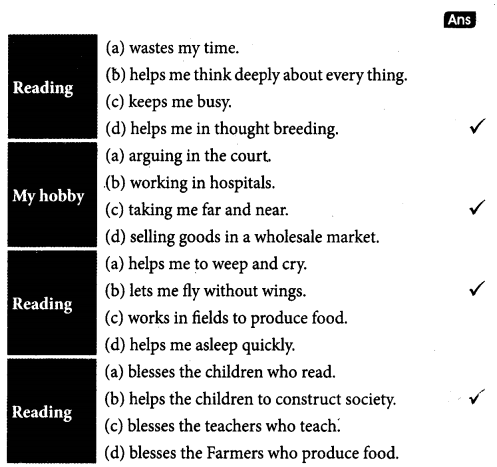
2. On the basis of your understanding of the poem, tick the most suitable option to complete the statements.

My Hobby Reading Poem Samacheer Kalvi 8th English Solutions Term 1 Chapter 1

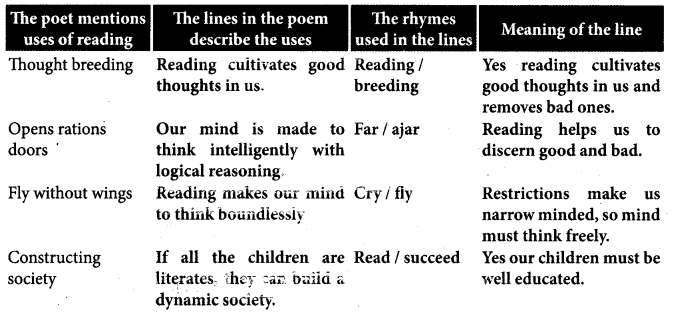
3.Complete the table given below in order to understand the poem better.
Answer:
My Hobby Reading Poem Summary Samacheer Kalvi 8th English Term 1 Chapter 1

Figure Of Speech

a. Rhyming words :

A Tiny Little Plant
Deep in the heart of a little seed,
Lay buried so, so deep,
A tiny little plant fast asleep.
Out came the bright Sunshine,
Down crept its light,
Into the seed, too bright.
A little plant woke up to see,
How bright the world might be.

Answer the following:

My Hobby Poem Questions And Answers Question 1.
List the rhyming words in the first three lines.
Answer:
The rhyming words – deep – asleep.

My Hobby Poem Question 2.
Which line in the poem rhymes with ‘Down crept its light’?
Answer:
Into the seed, too bright.

b. Rhyme Scheme:
Answer the following:

a. Identify the rhyme scheme of the given short poem.
My dog likes bones,
He eats them up,
He’s very sweet,
He’s just a pup.
Answer:
a b c b.

b. Complete this rhyme on your own with a abab rhyme scheme.
Peas porridge hot,
Peas porridge cold,
Answer:
Peas porridge in the pot Nine days old.

My Hobby: Reading Additional Questions

I. Poem Comprehension – Additional

My Hobby Reading Summary Question 1.
My hobby is reading
It helps me
In thought breeding.
It takes me to places
Near and far,
It keeps my rational
Doors ajar.

(a) What does the word ‘rational’ mean?
Answer:
‘Rational’ means intelligence.

(b) Pick out the rhyming words in these lines.
Answer:
The rhyming words : Reading – breeding; far – ajar.

(c) How does reading help the poet?
Answer:
Reading helps the poet to grow and cultivate good thoughts.

(d) Whose hobby was reading in the poem ‘My Hobby’ ?
Answer:
Reading was the hobby of the poet Arunachalam Chandrashekaran.

(e) What does the term ‘thought breeding1 mean?
Answer:
The term ‘thought breeding’ means cultivating many good thoughts in a person whose hobby is reading.

(f) How does reading take the poet near and far?
Answer:
When the poet reads about a content related to something near him and when he reads a content of something far, it takes him near and far.

(g) What are ‘rational doors’?
Answer:
The poet compares his mind to a room and reading habit are the doors of his mind.

2. It teaches me
To cackle and cry
Without wings
It lets me fly.

(a) Why should reading teach us both to laugh and cry?
Answer:
Life is made of both joy and sorrow. Reading helps us to take both equally.

b. How does the poet fly?
Answer:
The poet does not fly physically in the air. His thoughts expand and fly in all directions.

3. I wish
If all the children could read,
In constructing a vigorous society,
Then we shall succeed.

(a) Who can build a vigorous society?
Answer:
The children can build a vigorous society.

(b) How can we succeed?
Answer:
We can succeed, if we can build a dynamic, strong and powerful society.

(c) Pick out the alliterated words.
Answer:
‘shall – succeed’ are the alliterated words.

II. Short Questions and Answers.

My Hobby Question Answer Question 1.
How does his hobby help him ?
Answer:
His hobby helps him to cultivate many good thoughts.

My Hobby Reading Poem Book Back Answers Question 2.
Where does the reading take him ?
Answer:
Reading takes him to the nearby as well as to the far and remote places.

Poem On My Hobby In English Question 3.
What does reading teach him ?
Answer:
Reading teaches him to laugh loudly and at the same time even to cry.

III. Paragraph Questions with Answers.

Poem On My Hobby Question 1.
What are the five ways in which reading helps us?
Answer:
Reading hobby helps us to grow and cultivate many good thoughts. The content we read not only takes to nearby places but also to the remote and far areas according to what we read.
Reading habit enables to keep the doors of our mind unlocked and half open to permit intelligent and logical reasoning at the same time to prevent unwanted entry of bad and wrong things. Reading practices us to take in both happiness and sorrow in the same spirit. It teaches us to laugh loudly during happy times and to cry and let out sorrow during painful times.
Reading does not restrict or control our thoughts. Without wings it allows our thoughts to soar high and fly.

Question 2.
How can we form a ‘vigorous society’ according to the poet Arunachalam?
Answer:
According to the poet Arunachalam we can form a vigorous – active, strong, healthy and a dynamic society if all the children cultivate a reading habit, go to school, study and are educated. In such a society the people will be successful, prosper and flourish.

Poetic Devices in this poem.

The poet uses the following poetic devices in his poem, ‘My Hobby: Reading

1. Imagery: The poet weaves the advantages of reading hobby in his imagination.
a) The poet does not physically travel ‘near and far’, only his thoughts travel.
b) There is no literal door, the poet imagines his mind’s entrance as ‘door’,
c) The poet does not fly in the air. His thoughts, imaginations and ideas only made to ‘fly’ by his ‘ reading hobby.

2. Rhyme : This short poem has rhyming ending at every alternate line.
Reading and breeding; far and ajar; cry and fly; read and succeed.

3. Couplet: It is a fifteen-line poem. Each couplet .after the first line presents a different thought concept.
Example: Line 2, 3 tells about thought breeding, line 4,5 speaks of ‘rational door’.
Line 6, 7 about joy and sorrow, lines 8,9 flying without wings.

Pick out the rhyming words from the poem and write them in the table.
My Hobby Reading Samacheer Kalvi 8th English Solutions Term 1 Poem Chapter 1

Warm up

Question 1.
What are your leisure time activities? Why do you do them?
Answer:
My leisure activities are watching television and singing. I do them because they relax my soul and body.

Question 2.
Do you read books? What types of books do you read?
Answer:
Yes, I read books. I read books of Enid Blyton, Ruskin Bond and Comic books.

My Hobby: Reading Summary

The poem is written in 2010 by Arunachalam Chandrashekharan, a professional in library and information sciences. His long term deep association with the books in his library has made him to script this poem on reading as a great hobby.

The poet declares in the first line itself that reading is his hobby. He says his reading hobby helps him to grow and cultivate many good thoughts. Those thoughts take the poet not only to the nearby places but also to the remote and far areas.

The poet compares his mind to a room and expresses that reading habit enables him to keep the doors of his mind unlocked and half open to permit intelligent and logical reasoning. At the same time, it prevents the unwanted entry of bad and wrong things. Reading practises the poet to take in both happiness and sorrow in the same spirit. It teaches him to laugh loudly during happy times and to cry and let out sorrow during painful times.

Reading does not restrict or control the thoughts of the poet. Without wings it allows his thoughts to soar high and fly.

The poet aspires that all the children should go to school and study, there should be no illiterates. He believes that if all the children are well educated, then they can build a dynamic, strong and powerful society. If such a society is created, we shall succeed and reach the pinnacle in our lives.

Samacheer Kalvi 10th English Solutions Prose Chapter 5 Tech Bloomers

Looking to improve English skills and gain more subject knowledge then the best resources that you can use here is Samacheer Kalvi 10th English Solutions for Prose Chapter 5 Tech Bloomers Questions and Answers.

In the Samacheer Kalvi 10th English Guide for Chapter 5 Tech Bloomers textbook solutions, subject experts covered all types of questions and answers related to the topics, quick notes, summary, solved & unsolved exercises, etc. If you are planning to prepare Chapter 5 Tech Bloomers via textbook, then you’re suggested to go with this Samacheer Kalvi 10th English Book Solutions Questions and Answers PDF for better understanding and preparation.

Tamilnadu Samacheer Kalvi 10th English Solutions Prose Chapter 5 Tech Bloomers

English Subject experts who are having max years of experience prepared this Tamilnadu State Board Solutions for 10th English Prose Chapter 5 Tech Bloomers Questions and Answers. They have explained all the topics covered in the board prescribed latest syllabus in a simple way to understand easily. So, students can prepare Chapter 5 English from this Samacheer Kalvi 10th English Book Questions and Answers PDF. Download the Tamilnadu State Board 10th English Chapter 5 Tech Bloomers Workbook Solutions PDF by accessing the below links and learn properly for the final exams to score well.

Tech Bloomers Warm up:

Tech Bloomers Questions And Answers Samacheer Kalvi 10th English Solutions Prose Chapter 5

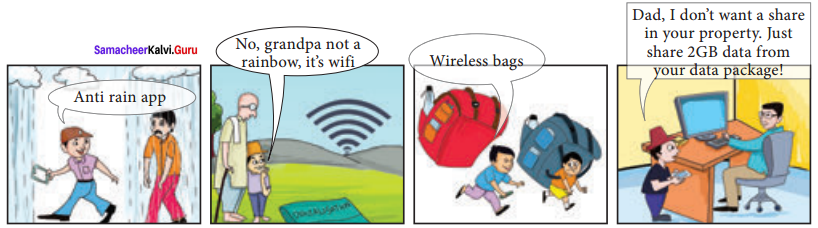
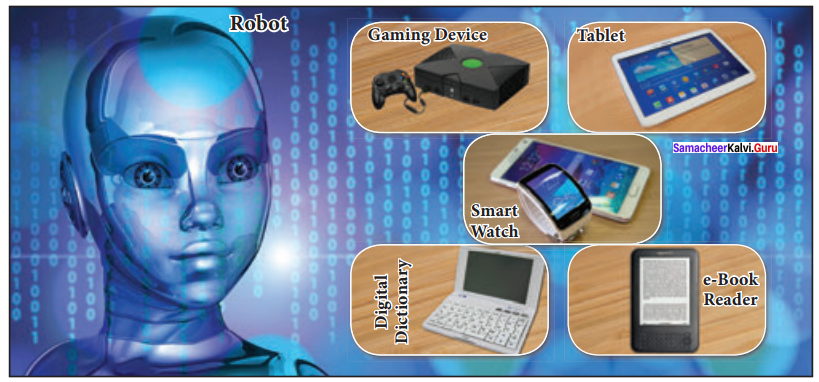
1. What do you infer from the above pictures?
Answer:
Technology is dominating our lives.

Tech Bloomers Summary Samacheer Kalvi 10th English Solutions Prose Chapter 5

2. Look at the above electronic gadgets. If you were given a chance to remodel a device, in which device you would bring in changes and what would be those changes?
Answer:
I will redesign the smartwatch. The look of the watch would be conventional orb. Only on pressing a button, a screen will appear and offer valuable services.

Tech Bloomers InText Questions

Tech Bloomers Questions And Answers Question a.
What is the future of technology?
Answer:
The future of technology is beyond our imagination but certainly possible with modern gadgets.

Tech Bloomers Summary Question b.
How many people in India suffer with disability?
Answer:
2.7 Crore people in India suffer with disability.

Tech Bloomers Question c.
Who is Kim?
Answer:
Kim is the Assistive Technologist at Alisha’s School.

10th English Tech Bloomers Question d.
How does Kim help Alisha?
Answer:
Kim introduced Alisha to Dragon Dictate, which had opened up the world to Alisha. It has made her more independent and she is able to study on her own.

Tech Bloomers Paragraph Question e.
Why is technology important according to David?
Answer:
Technology is important to David because it enables him to communicate and be independent.

Tech Bloomers Summary Pdf Question f.
Which instrument does David control with his eye movements?
Answer:
David uses a Liberator Communication Device, which he controls with his eye movements for his verbal communication.

Tech Bloomers Author Question g.
What devices help David to move from one place to other?
Answer:
David moves from one place to another in his electric chair with head switches. He uses ECO point Eye Gaze system to communicate and access the computer. He also checks Chelsea football team’s performance.

Tech Bloomers Textual Questions

A. Answer the following questions in two or three sentences.

Tech Bloomers Author Name Question 1.
What are the benefits of the internet to the common man?
Answer:
Technology impacts the environment, people and society as a whole. The Internet benefits a common man to travel, to communicate, to learn, to do business and to live in comfort.

Tech Bloomers Pdf Question 2.
Do you think technology has improved communication? How?
Answer:
Yes, technology has improved communication. Through a piece of technology called Dragon Dictate, Alisha who suffers from Cerebral palsy can speak now and the words appear on her screen. Then she can print them out. It made her achieve things which she had dream it.

Tech Bloomers 10th Lesson Question 3.
How does David operate computers with the Liberator Communication Device?
Answer:
David operates computers with the Liberator Communication Device by controlling it with his eye movements. It has a Bluetooth adapter. So it lets him use any PC or Mac by sending commands.

Tech Bloomers Short Summary Question 4.
Which devices are controlled using ACTIV controller?
Answer:
TV, Blu-ray and music players are controlled using ACTIV controller.

Tech Bloomers Theme Question 5.
Who says these words: “I want everyone to know the difference technology has made in my life”?
Answer:
Alisha says these words to make the world know the difference that technology has made in her life.

Tech Bloomers Meaning In Tamil Question 6.
Which software helps Alisha to overcome her difficulty in typing?
Answer:
Dragon Dictate is a software which helped Alisha to overcome her difficulty in typing.

Tech Bloomers Meaning In English Question 7.
Name a few Indian innovations which are helpful to the disabled and make their day to day life
easier.
Answer:
Lechal Shoes by Krispian Lawrence, Blee watch by Industrial designers Nupura Kirloskar and Janhavi Joshi of Mumbai and IGEST by Anil Prabhakar.

Tech Bloomers Meaning Question 8.
Is it possible to control the computer screen with eye gaze?
Answer:
Yes, it is possible to control the computer screen with Eye Gaze. That means, when we are reading, we can move from page to page using the pupils of our eyes.

Tech Bloomers Summary In Tamil Question 9.
Suggest ways of making our society inclusive.
Answer:
Keeping in touch with our family, talking to them, seeing relatives, who live far away, making , friends, communicating and controlling our environment, finding opportunities, getting qualified and being independent are the ways of making our society inclusive.

Tech Bloomers Moral Question 10.
How would you help the people with disabilities in your neighborhood?
Answer:
I would introduce them to the Latest and modern Technology, so that it can make them more confident and independent. This technology allows the differently abled learners to learn with their peers as well as contribute fruitfully.

B. Answer in a paragraph of about 100-150 words.

Question 1.
How do we use technology in our day to day lives?
Answer:
Technology is growing day after day and we all depend on technology. Today we have various developing technologies that impact our lives in different ways. As the world keeps on developing, technology will change. Keeping oneself updated is very important in this modem world.

It has totally transformed the life of an individual. A Refrigerator is programmed to replenish food when the vegetables or milk or eggs are over. Ink cartridges too self-order replacements when it is empty. Technology helps one to manage entertainment and home appliances by voice commands or swapping the finger.

When you are bored watching a programme on TV, you can just inform your smart TV your desire to view your social feed. Technology helps you to watch programmes understanding your mood swings. When caught‘ in traffic, technology permits your kettle to prepare tea for you to sip it hot the moment you reach home. Technology also automates all water and energy management systems. Therefore, accepting it and learning how to use technology in whatever we do is highly important and recommended.
‘We are changing the world with Technology’

Question 2.
“Technology is a boon to the disabled”. Justify.
Answer:
The differently abled, Alisha and David’s life has been transformed because of Technology. It is a boon to the disabled. Assistive technology is designed to help people with disabilities. Typing was impossible, but now Dragon Dictate helps the disabled to speak for words to be printed on screen. Technology can control a computer screen even with Eye Gaze. Technology is vital to be free and independent.

For verbal communication, Liberator Communication Device, with eye movements to communicate verbally is used. It has a Bluetooth adaptor and took a couple of weeks to learn using it. Communicating with people was very difficult before.

An ACTIV controller also in the headrest of a mobility chair is used to control TV, Blu-Ray and music players. Augmentative and Alternative Communication is also the product of technological advancements and a boon to the disabled.

ECO2 linked to an interactive whiteboard is used to teach PE lessons. Technology also helps control the Play Station, MP3, electric wheelchair and ECO point Eye Gaze to communicate and access the computer. Thus, Technology is a boon to the disabled.
‘Technology is not just a tool. It can give learners a voice that they may not have had before.’

Additional Questions

Question 1.
What are the various innovations made in India to help the differently abled lead a normal life?
Answer:
There are various innovations made in India to help the differently abled lead a normal life. Lechal Shoes by Krispian Lawrence is an innovation for the disabled to use GPS & Bluetooth. This enabled shoes to help the disabled navigate streets, based on instructions from map software on a smartphone. The App also records the route and also counts steps.

Blee Watch by industrial designers Nupura Kirloskar and Janhavi Joshi of Mumbai invented the Smartwatch for the hearing impaired. It converts sound waves into vibrations and colour codes to alert users to emergency sounds and ringing doorbells. It even helps them feel the rhythm of music.

iGEST by Anil Prabhakar, IIT-M professor and cofounder of enability technologies innovated a wearable device which tracks gestures of speech-impaired people and speaks for them. I guess technology makes a differently abled person’s life easier.
‘Exploration is the engine that drives Innovation,’

Question 2.
“Technology is a boon to the disabled”. Justify.
Answer:
Technology plays a vital role in transforming the lives of a disabled. Kim made them realise life isn’t tough because you are differently abled. Kim made them realise that you can keep in touch with your family, you can talk to and even see relatives who live far away. Well, Kim has shown them that technology can do even more for young disabled people. It can make friends communicate and control the environment.

It can help them study, get qualifications and find opportunities for work. It can make them confident and independent. World-renowned physicist Stephen Hawking is probably the best example of how Assistive Technology has helped a talented mind overcome physical impairments and contribute productively to the world.

So we can now look forward to a more inclusive way of learning, instead of the cloistered existence that most differently- abled learners had to face in the past. Newer technology allows differently- abled learners to learn with their peers as well as contribute fruitfully to the collaborative process of learning. This is indeed the new era of learning – truly a learning for all.
‘The Science of today is the Technology! of tomorrow.’

Vocabulary:

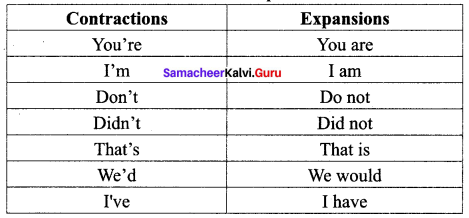
C. Pick out the contractions from the lesson and expand them.
Tech Bloomers Samacheer Kalvi 10th English Solutions Prose Chapter 5Answer:
10th English Tech Bloomers Samacheer Kalvi Prose Chapter 5

D. Expand the following abbreviations or acronyms
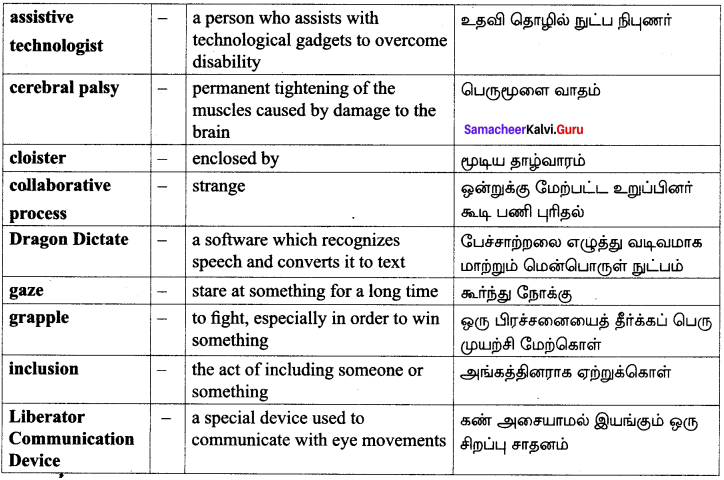
Tech Bloomers Paragraph Samacheer Kalvi 10th English Solutions Prose Chapter 5
SIM: Subscriber Identity Module
ISRO: Indian Space Research Organisation
WHO: World Health Organisation
CCTV: Closed Circuit Television
HDMI: High-Definition Multimedia Interface
LASER: Light Amplification by Stimulated Emission of Radiation
MRI: Magnetic Resonance Imaging
CRY: Child Relief and You
RAM: Random Access Memory
ROM: Read Only Memory
CPU: Central Processing Unit
ALU: Arithmetic-Logic Unit

E. Given below are some idiomatic phrases. Find the meaning of it using the dictionary:
Tech Bloomers Summary Pdf Samacheer Kalvi 10th English Solutions Prose Chapter 5

  1. My dad wakes up very early in the morning because he has to be at work at 6.00 ……………………… .
  2. Socrates, the famous Classical Greek Athenian philosopher, died in 399 ……………………… .
  3. Leonardo Da Vinci was a famous Italian polymath, a painter, a sculptor, an architect, a musician, a scientist ……………. .
  4. I usually return home from work at 10.30 ……………………. .
  5. John downloaded a clip from YouTube in ………………… quality.
  6. There are many irregular verbs in the English language, …………………. break, do, make.
  7. I’m watching a great football match, Barcelona ………………………. Real Madrid.
  8. Humans who dive without protection can survive 300 ……………………….. under water.
  9. A 11-year-old girl just beat Einstein on an …………………………… test.
  10. We used the ……………………… facility to track the location.

Listening Activity:

F. Listen to the passage and state whether the statements are true (T), false (F) or no information (N)?

Hello! I’m Santhiya. I want to write about my mobile phone. I got it from my parents for my birthday two years back. I like it very much and I think it’s sometimes good to have it in my bag.

I always keep it in my bag or in my pocket so my parents and my friends can always call me. It’s got a calculator in it so I use it frequently to calculate. It’s also a kind of information file. I can use my mobile phone to connect to the Internet and look through the news or read emails. Isn’t it fantastic?

Last year I was cycling with my friend on a holiday with my friend. We went cycling but the weather wasn’t good. It was cold and windy. It started to rain and it got dark. Suddenly my friend fell off her bike and broke her leg. At first I didn’t know what to do but then I thought about my phone.

It was in my backpack so I telephoned for help. After fifteen minutes a doctor arrived. Sometimes people are not keen on mobile phones. They are a real problem because they always ring at the wrong moment. I’m not crazy about my mobile phone but I feel safe when I have it with me.

  1. Santhiya can’t live without her mobile phone. (False)
  2. She got her mobile in January. (False)
  3. Her parents bought her the mobile phone one year ago. (False)
  4. There’s a calculator in her mobile. (True)
  5. She can connect to the Internet on her mobile. (True)
  6. She usually listens to music on her mobile. (False)
  7. She can’t read emails on her mobile. (True)
  8. There are often a lot of problems with mobile phones. (False)
  9. Santhiya always talks on her mobile to her friends. (False)
  10. She doesn’t like mobile phones. (False)

G. Listen to the passage again and answer the questions.

Question 1.
Where does Santhiya keep her mobile?
Answer:
Santhiya keeps her mobile in her bag or in her pocket.

Question 2.
What can she use it for?
Answer:
She can use it for Internet connections and emails.

Question 3.
When was she cycling?
Answer:
She was cycling last year.

Question 4.
What happened there?
Answer:
Santhiya’s friend fell off her bike and broke her leg.

Question 5.
How did Santhiya solve the problem?
Answer:
Santhiya called a doctor through her mobile phone. He came to the spot in 15 minutes and helped the girl out.

H. Complete the sentences after reading the passage.

  1. Santhiya’s parents and friends can always …………. her.
  2. Her mobile phone is also a kind of …………………
  3. On the cycling holiday after the accident Santhiya phoned for ………………
  4. Mobile phones often ………………. at the wrong moment.
  5. Children can feel ……………… when they have their mobile phones with them.

Answers:

  1. contact
  2. an information file
  3. a doctor
  4. ring
  5. safe

Speaking Activity:

I. Prepare on any one of the topics given below and present before your English teacher.

→ Prepare a welcome address on the occasion of Republic day celebration.
A festival is an occasion of enjoyment and celebration. It brings joy and laughter thereby strengthening our bond of relationship and friendship. Every nation celebrates January 26th with pomp and grandeur. The significance of this day is that a pledge was taken on 26th January 1930 on the bank of river Ravi to attain ‘Swaraj’ was fulfilled on this day in the year 1950. India thus became sovereign, democratic and republic. Warm Greetings to everyone present here with special mention to our Honorable principal, vice principal and teachers.

I, Apurva Calvin, the School Pupil Leader, would like to extend my regards and express my gratitude towards my teachers, for giving me the opportunity to felicitate the Chief Guest Capt. Clement David on this auspicious occasion of Republic Day. Who else can be the best choice to be the chief guest on this auspicious occasion than a man who has served the military? Yes, I am proud to stand before our chief guest to welcome a stalwart, a dynamite who helped us to enjoy the freedom we are experiencing.

A man who fought against the British and got us freedom. It is indeed our honour to have you sir with us and we wholeheartedly thank you for gracing this occasion with your august presence. We have gathered today, as you all know, to celebrate the 73rd Republic Day which is celebrated nationwide.

Any Indian festival attracts the world due to their harmony, variety, colour and excitement. Being a multi-lingual and multi-racial country, we bring to you a colourful programme on this day. Sit back and enjoy a patriotic Friday.

→ Prepare a Vote of thanks on the occasion of Independence day celebration.
The honorable chief guest, Capt. Clement David, Principal Mrs. Lydia Devasagayaam, my dear teachers, non-teaching staff, parents and my dear fellow-mates – a very good morning to you all. I feel honoured and privileged to stand before you to propose the vote of thanks on this year’s Independence day celebration of our beloved country, India.

Our Principal Mrs. Devasahayam has always been the backbone to our success. Thank you, ma’am, for being our motivation and inspiration. Thank you dear students for your beautiful performances highlighting the need to be patriotic to our country. I thank the teachers who have guided and tutored young children to perform and showcase their innate talents.

Thank you teachers, this day would have never been successful without you. I take a moment to thank the annans and akkas who laboured behind all the arrangements for this event. I am proud to be a citizen of India and feel responsible to celebrate such glorious days.

I thank every one of you for making this celebration a success. Thank you dear parents for your presence to make our school ground sparkle in bright vibrant colours. Last but not the least I would like to extend my gratitude to our Chief Guest, Capt. Clement David for being here.

To hear those words of your personal experiences fighting against the British was nerve-racking. We are truly honoured by your presence. On behalf of the management staff and students I thank you from the bottom of my heart for your valuable presence that we would cherish forever. Thank you. Jai Hind!

→ Mock anchoring for annual day celebration
(Instrumental Music is played)
This is the day that the Lord has made, let us rejoice and be glad in it, for these children who will be on stage are indeed the gifts God bestowed on you dear Parents’. One of the most anxiously awaited occasions in any school is the Annual Day dedicated to the Parents of the institution. Great preparations and busy activities are visible all around.
A very Good evening Ladies and Gentlemen. A warm welcome to each one of you.
On behalf of the management, staff and students, we are very happy to welcome our chief guest, Dr. Gopinath – the regional director Angel Group of institutions, dear parents and other distinguished guest for this great occasion.
Today our students, the shining stars, are here to bring out their hidden talents by their spectacular performance and on this day dear parents you’re here to witness the bountiful talents exhibited by your children.
The theme for today’s Programme is Make A Choice To Take A Chance And Bring A Change.
The magic of the 3c’s of life The Choice, The Chance and The Change Our School Pupil Leader Karuna Vijayakumar will formally welcome the gathering. Welcome Address Thank you Karuna.
Dear Friends, kindly switch off all the gadgets that would connect you to the busy world outside.
We will now have the Lighting of the Lamp.
I request our Chief Guest Dr. Gopinath, Our correspondent Mr. Azariah, PTA President Mr. Jerald Benjamin, Staff representative Mrs. Latha Ram, and Student representative Parimala Mahesh of Std. XIIB, to kindly Light the Lamp.
Thank you Dignitaries.
We shall now have the Invocation Dance to invoke God’s blessing.
Thank you Children for the blissful prayer dance.
We will now have the Annual Report in the form of a Presentation highlighting on academics, social, emotional and cultural events to develop individuality of each child and make them well balanced to face the better tomorrow.
Cellphones, cellphones everywhere, isn’t it time to reduce the usage? The overuse of it is shrinking our minds and misusing it is ruining our lives.
Now we have our students of Std.VI to VIII who are going to perform a serious issue.
The Evil Effects of Cell Phone in a comical way through a mime.
Thank you Students for the fabulous performance. Let us make a choice To use the cell phones in a right way and bring a change in our lives.
We will now have a Dance Drama brought alive to our eyes by the students of Std. IX and X. This dance drama portrays the life of a young boy who is entangled by the evil forces of the society.
Thank you Dear Students for bringing a change in your attitude to face the future.
I now request our Chief Guest Dr.Gopinath, Our correspondent Mrs. Marian, Principal Mrs. Leela Raja, to kindly come up to the Dias.
I now request Miss. Luveena to welcome and Felicitate Our Chief Guest.
Thank you Miss. Luveena.
I request our Chief Guest Dr. Gopinath to Address the gathering.
Thank you Sir, for your inspiring and thought provoking message.
Every exam or test in our life makes us better or bitter. This is apt for our students who have achieved great success in the public exam by making the right choice.
We shall now have the Prize Distribution for the meritorious performance of our students in the Board examination. I request our Chief Guest to distribute the prizes.
Mrs.Tinavet Joy will now read the list of prize winners.
Thank you Sir, for honouring our students.
Students of Std IX-XII are here to perform the Bengali Folk Dance depicting the celebration of the fish culture harvest. Sit back relax and enjoy the dance.
Thank you students for the wonderful performance.
Both light and shadow combine to bring life to this dance. Yes! we are going to watch Shadow Dance portraying the importance of mother’s love and how a mother’s choice brings out a difference in the lives of children.
Actions speak louder than words are very well proved in this. Thank you Students for the awesome performance.
If music be the language of the soul, then play on. So, we have Std. XII students who will entertain us with their Choral singing in different languages.
Thank you Students.
I now call upon S. Aruna Dorai ASPL to propose the Vote of Thanks.
Let us carry this thought today. Take a chance by making a difference in the lives of others. Henceforth, we will notice that a great change will take place within us and around us
Kindly stand for the School Song followed by the National Anthem.

→ Collect images of some electronic gadgets and play a JAM (just a minute) game by picking one image and talking for a minute about it in your classroom.
Tech Bloomers Author Samacheer Kalvi 10th English Solutions Prose Chapter 5

I very well remember the time when this gadget – cell phone that became the most important companion for human beings, came into existence. I have seen situations to be so absurd with a person talking all alone on the road. With hands free options, I remember them to be found crazy. They weren’t so sleek like the ones we see today. Cameras too weren’t there. That was just the beginning.Very soon they were all over the place.

They shrunk in size and became pocket sized wonders! The mobiles of today do multiple functions. They are used to text messages, send and receive video messages, talk on face time, do conferencing calls and so on. With time passing by, the cost reduced and reached the market wherein it became the friend of the rich and the poor.

Now, almost every one, everywhere, seems to have one. The vegetable vendor, the bus conductor, a ragged wanderer, students, office goers, home maker or a business magnet, irrespective of economic status possess a cell phone. Hasn’t this little midget taken the world by storm? I am sure you will unanimously agree to my opinion.

Reading:

J. Read the comic strip and ans’ e following questions.

Question 1.
What do you mean by cyber safety?
Answer:
Cyber safety is the safe and responsible use of information and communication technologies.

Question 2.
How do you behave in a virtual platform?
Answer:
In a virtual platform, one has to respect the values, sentiments, tradition and history of people expressed in the global network.

Question 3.
Can we read and access the information free of cost?
Answer:
Yes, we can.

Question 4.
Do you think that all the information online can be used without any permission?
Answer:
No, there are some information which are owned by someone. One has to take necessary permissions in order to use their content.

Question 5.
Which website do you often access? Why?
Answer:
I mostly access www.google.co.in for browsing information related to my projects and home assignments. I use it often because it saves my time.

Writing:

e-mail

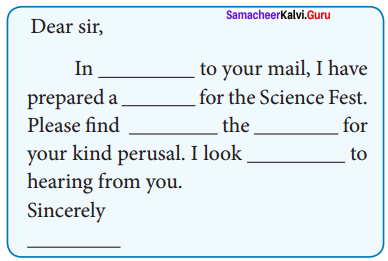
K. Fill in the missing words in this email.

Tech Bloomers Author Name Samacheer Kalvi 10th English Solutions Prose Chapter 5
Answers:

  1. response
  2. model
  3. attached.
  4. same
  5. forward
  6. K. Sankar

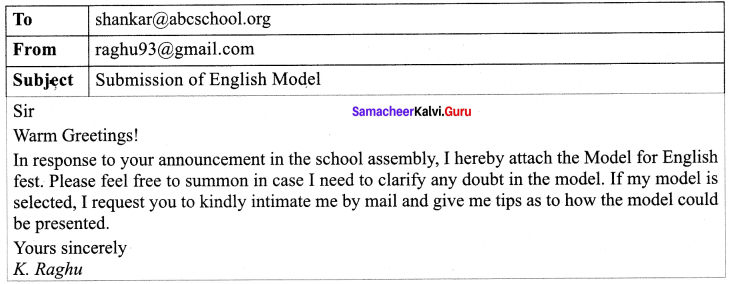
L. Write an email to your teacher about the interesting English model that you have prepared for the literary fest.

Tech Bloomers Pdf Samacheer Kalvi 10th English Solutions Prose Chapter 5

M. Practice Exercise

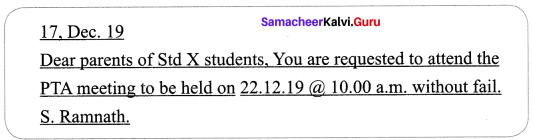
You are the receptionist of your school. Your Head master instructs you to send a message to all the parents of class ten to attend a PTA (Parent Teacher Association) meet which is to be held on 22.12.2019.
Tech Bloomers 10th Lesson Samacheer Kalvi 10th English Solutions Prose Chapter 5
Answer:
Tech Bloomers Short Summary Samacheer Kalvi 10th English Solutions Prose Chapter 5

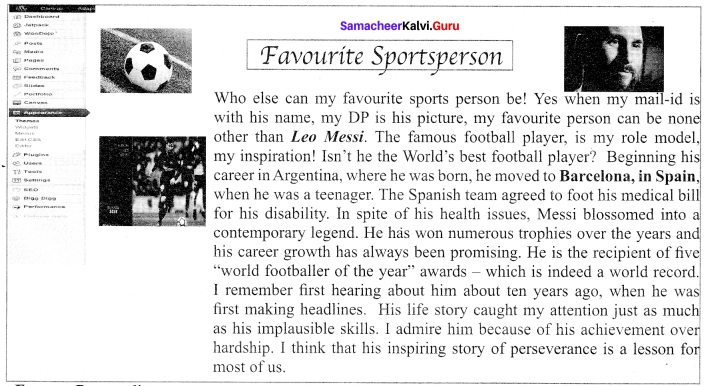
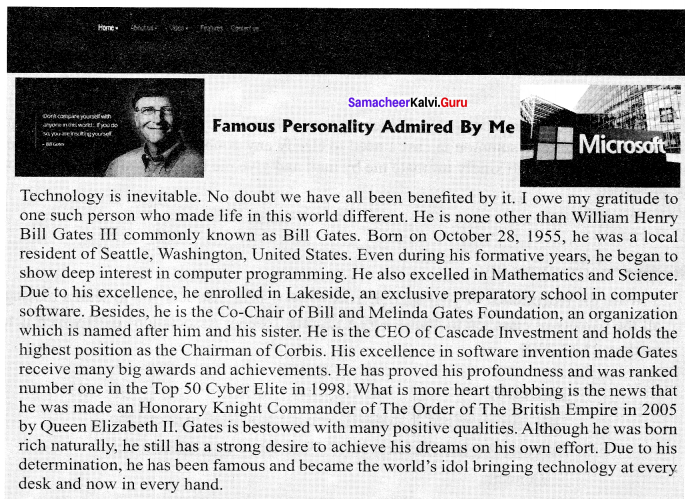
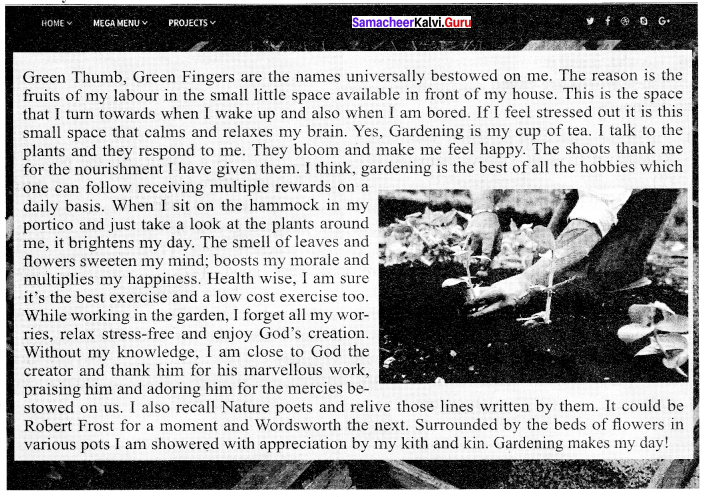
N. Write about Your Favourite Sports person/ Famous personality/Hobby/ Recipe by starting your own blog.

Favourite Sportsman:
Tech Bloomers Theme Samacheer Kalvi 10th English Solutions Prose Chapter 5

Famous personality
Tech Bloomers Meaning In Tamil Samacheer Kalvi 10th English Solutions Prose Chapter 5

Hobby
Tech Bloomers Meaning In English Samacheer Kalvi 10th Solutions Prose Chapter 5

Grammar:
Tech Bloomers Meaning Samacheer Kalvi 10th English Solutions Prose Chapter 5
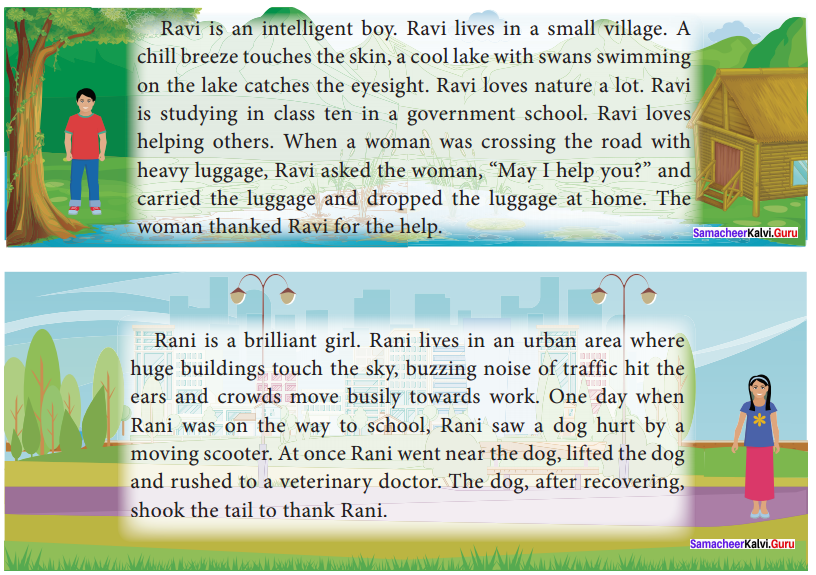
A. Write the words that can replace Ravi, Rani, woman, luggage and the dog when we use them for the second and subsequent times in the passage ……………….., ………………., and ………………. .
Answer:
He, she, it and it.
These words are called ?
Answer:
Pronouns

B. Fill in the gaps with personal pronouns.

Kumaravel lives in Thiruvannamalai. (1) ………………… is a doctor. All the people like (2) ………………… because of (3) …………….. helping nature. (4) ……………. hospital is located at Car street and most of (5) ………………. patients are poor so (6) ………………………. does not charge much money. (7) ………………… daughter goes to school. (8) ………………….. studies in 5th Standard. (9) …………………… teachers love (10) …………………… very much. (11) ………………………. friends are also very good. (12) ……………… always encourage (13) ………………… (14) ……………… have given (15) ………… good advice. (16) ………….. mother is also a teacher. (17) …………… always encourages (18) ……………… to keep studying. I also like her as (19) ……………….. often comes to (20) ………………… house. One day (21) …………………… told my mother that (22) …………….wants to learn cooking. (23) …………… mother taught (24) ……………… cooking. Now, (25) ……………. cooks well.
Answers:
1. He, 2. him, 3. his, 4. His, 5. us, 6. he, 7. His, 8. She, 9. Her, 10. her, 11. Her, 12. They, 13. her, 14. They, 15. her, 16. Her, 17. She, 18. her, 19. she, 20. my, 21. she, 22.she, 23. My, 24. her, 25. She.

C. Fill in the gaps with appropriate Pronouns.

  1. ……………….. is an excellent opportunity.
  2. ………………. of these two students can solve this question.
  3. ………………… books have been written by a great Indian writer.
  4. …………………. have come to know the truth.
  5. ………………….. of the students have passed the exam.
  6. ………………….. of your friends can guide you.
  7. …………………. is your story based on your real life.
  8. All your friends will guide ……………………… .
  9. …………………….. of his family members would come to visit you.
  10. ……………………. of those books will be helpful to you.
  11. …………………….. is your bag, you can take it anytime.
  12. He ………………….. is responsible for the downfall of his life.

Answers:

  1. It
  2. One
  3. These
  4. They
  5. Some
  6. Few
  7. This
  8. you
  9. Many
  10. Some
  11. It
  12. himself

D. Join the sentences using ‘Relative Pronouns’.

1. I have book. It is written by Rabindranath Tagore.
I have a book which is written by Rabindranath Tagore.

2. Kavita is my teacher. She teaches us English.
Kavita is my teacher who teaches us English.

3. This is Varun. His father is an architect.
This is Varun whose father is an architect.

4. She invited most of her friends. They attended the party.
Most of her friends whom she invited attended the party.

5. Give me a pen to write a letter. It was gifted to you on your birthday.
Give me a pen which was gifted to you on your birthday to write a letter.

6. I have sold the house. It was located at the bank of a river.
I have sold the house which was located at the bank of a river.

7. Here is your watch. It has been found in the garden.
Here is your watch which has been found in the garden.

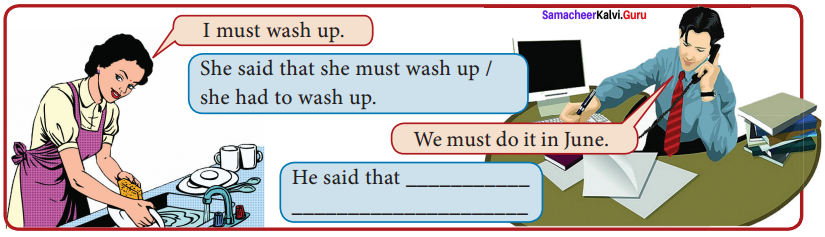
E. Read the different verb forms where they remain the same in the direct and indirect speech in the following cases. Fill in the blanks with missing indirect speech.

1. If the reporting verb is in the present tense.
Tech Bloomers Summary In Tamil Samacheer Kalvi 10th English Solutions Prose Chapter 5

2. When we report a universal truth (something that is always true)
Tech Bloomers Moral Samacheer Kalvi 10th English Solutions Prose Chapter 5

3. With modal verbs would, might, could, should, ought to, used to.
Samacheer Kalvi 10th English Solutions Prose Chapter 5 Tech Bloomers 18

4. With would rather, had better I would rather fly.
Samacheer Kalvi 10th English Solutions Prose Chapter 5 Tech Bloomers 19

5. In if-clauses and time-clauses.
Samacheer Kalvi 10th English Solutions Prose Chapter 5 Tech Bloomers 20

6. We do not usually change the modal verbs must and needn’t. But must can become had to or would have to and needn’t can become didn’t have to or wouldn’t have to if we want to express an obligation. Would/wouldn’t have to are used to talk about future obligations.
Samacheer Kalvi 10th English Solutions Prose Chapter 5 Tech Bloomers 21
Answers:

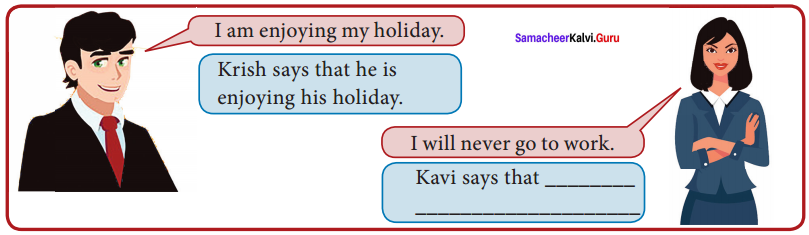
  1. (a) she will never go to work.
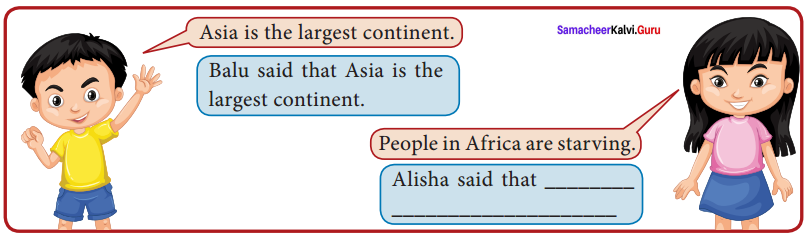
  2. (a) people in Africa are starving.
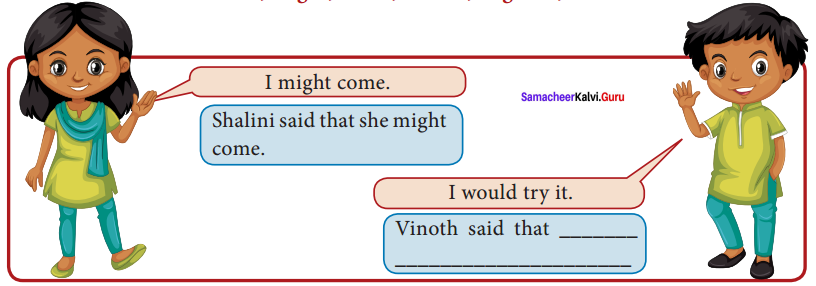
  3. (a) he would try to come.
  4. (a) they had better go.
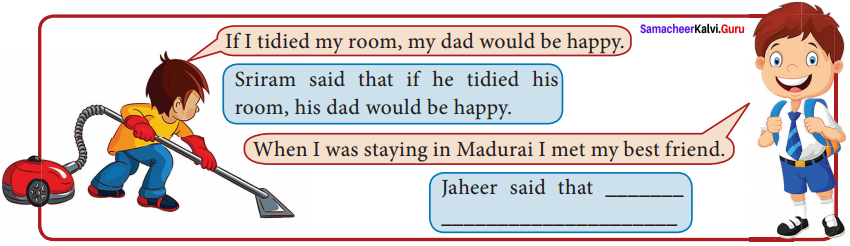
  5. (a) when he was staying in Madurai he had met his best friend.
  6. (a) they must do that in June.

F. Read the following dialogue and report it.

Johnson : “What are you doing here, Suganthi? I haven’t seen you since June.”
Suganthi : “I’ve just come back from my holiday in Ooty.”
Johnson : “Did you enjoy it?”
Suganthi : “I love Ooty. And the people were so friendly.”
Johnson : “Did you go to Coakers Walk?”
Suganthi : “It was my first trip. I can show you some pictures. Are you doing anything tomorrow?”
Johnson : “I must arrange a couple of things. But I am free tonight.”
Suganthi : “You might come to my place. At what time shall we meet?”
Johnson : “I’ll be there at eight. Is it all right?”

Johnson asked Suganthi (1) ……………….. And he said (2) ………………… since June. Suganthi explained that (3) ……………………. back from her holiday in Ooty. Johnson wondered if (4) …………………….. it. Suganthi told him that she (5) Ooty and that the people (6) so friendly. Johnson wanted to know (7) ………………. to the Coakers Walk. Suganthi said that it (8) ………………….. first trip and that she (9) ………………………. some pictures. And then she asked him if he (10) …………………………. Johnson explained that he (11) …………………… a couple of things. But he added that he (12) …………………. free at night. Suganthi suggested that he (13) ………………….. place and asked him at what time . Johnson said he (14) ……………….. there at eight. And finally he asked (15) …………………….. all right.
Answers:

  1. what she was doing there
  2. that he hadn’t seen her since June
  3. she had just come
  4. she had enjoyed
  5. loved
  6. were
  7. if she had been
  8. was her
  9. could show him
  10. was doing anything the next day
  11. must arrange
  12. would be
  13. might come to her place
  14. would be
  15. if it was

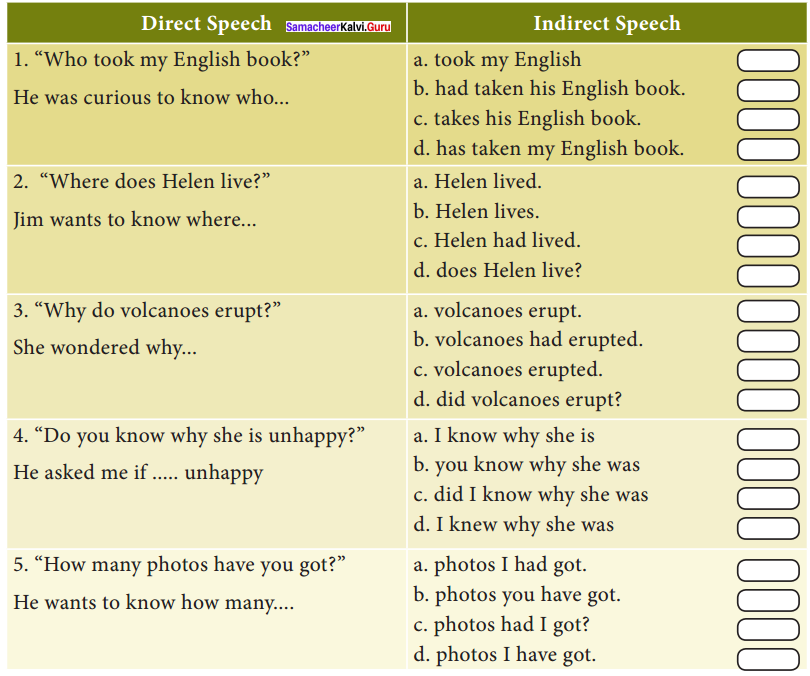
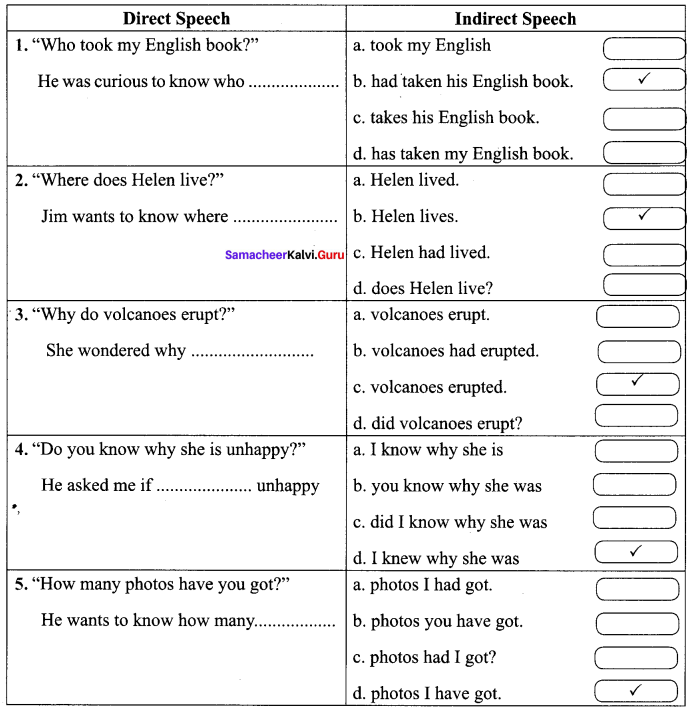
G. Tick the right choice (Indirect Speech).

Samacheer Kalvi 10th English Solutions Prose Chapter 5 Tech Bloomers 22Answer:
Samacheer Kalvi 10th English Solutions Prose Chapter 5 Tech Bloomers 23

Tech Bloomers Summary:

Samacheer Kalvi 10th English Solutions Prose Chapter 5 Tech Bloomers 24

Introduction:
The lesson elaborates on the advance technology and its benefits to the differently abled. It is interesting to read how technology has made life comfortable and easy for the differently abled people.
Samacheer Kalvi 10th English Solutions Prose Chapter 5 Tech Bloomers 25

Uses of technology
Refrigerator replenishes food directly linking to the e-commerce site. Ink cartridges self-order replacements. Managing entertainment and home appliances by voice commands or swapping the finger is a reality. Inform smart TV your desire to view your social feed when you are bored. When caught in traffic, permit your kettle to prepare tea for you to sip it hot the moment you reach home. All water and energy management can be automated.
Samacheer Kalvi 10th English Solutions Prose Chapter 5 Tech Bloomers 26

A boon to differently abled Technology makes a normal person’s life easier, but it’s a boon to citizens with special needs. According to the 2011 Census, 2.21 percent of lndians are disabled. Unlike the developed world, disabled are deprived by attitudinal barriers as they face challenges of inclusion.
Samacheer Kalvi 10th English Solutions Prose Chapter 5 Tech Bloomers 27

Kim transformed Alisha’s life Alisha, cerebral palsied wanted everyone to know the difference technology has made in her life. Typing was impossible, but now Dragon Dictate helps her to speak for words on the screen for printing. She had a teacher, now no more who wanted her to do GCSE maths. It sounded silly because she needed help to type, but now it’s possible. Kim, Assistive Technologist, introduced Dragon Dictate to her. Now, she’s doing Maths GCSE. Kim gives them the motivation needed for them to aspire the impossible. One can control a computer screen even with Eye Gaze. Kim works with all 42 students and helps them use technology in different ways. Kim has opened up the world to many.
Samacheer Kalvi 10th English Solutions Prose Chapter 5 Tech Bloomers 28

Kim transformed David’s life To David bom with Athetoid Cerebral Palsy,1 Technology was vital to be free and independent. For verbal communication, David used a Liberator Communication Device, with eye movements to communicate verbally. It had a Bluetooth adaptor and took a couple of weeks to learn using it. Communicating with people was very difficult before. He has an ACTIV controller also in the headrest of his chair in his bedroom to control his TV, Blu-Ray and music players. He has been interested in Augmentative and Alternative Communication. David is also a keen sportsman playing football, boccia, hockey and baseball. He is a sports leader and uses his EC02 linked to an interactive whiteboard to teach PE lessons.
Samacheer Kalvi 10th English Solutions Prose Chapter 5 Tech Bloomers 29

David has 144 icons on the screen and uses them with Eye Gaze. Now David accesses the curriculum, studies for his GCSE, orders food and has become a confident and competent communicator. David is an advocate for those who wish to communicate. He controls his Play Station, plays MP3, drives his electric wheelchair and uses the ECO point Eye Gaze to communicate, access the computer to check on the progress of Chelsea football team. David will travel to Brazil to work with the Olympic opening ceremony team as part of the Remix Drama Group.
Samacheer Kalvi 10th English Solutions Prose Chapter 5 Tech Bloomers 30

Indian Innovations

  • Lechal Shoes by Krispian Lawrence is a GPS and Bluetooth which enables the challenged to navigate streets with instructions from map software on smartphones.
  • Blee Watch by industrial designers Nupura Kirloskar and Janhavi Joshi of Mumbai is useful for the hearing impaired converting sound waves into vibrations and colour codes.
  • iGest by Anil Prabhakar, IIT-M professor and co-founder of enability technologies created a wearable device tracks for speech-impaired who speak now.

Samacheer Kalvi 10th English Solutions Prose Chapter 5 Tech Bloomers 31

Conclusion:
Technology makes life easier. Kim has shown a new world for the differently abled. World-renowned physicist Stephen Hawking is probably the best example of how Assistive Technology can transform lives. So inclusion is possible. Newer technology allows differently-abled learners to learn collaborative learning. This is indeed the new era of learning – truly learning for all.
Samacheer Kalvi 10th English Solutions Prose Chapter 5 Tech Bloomers 32

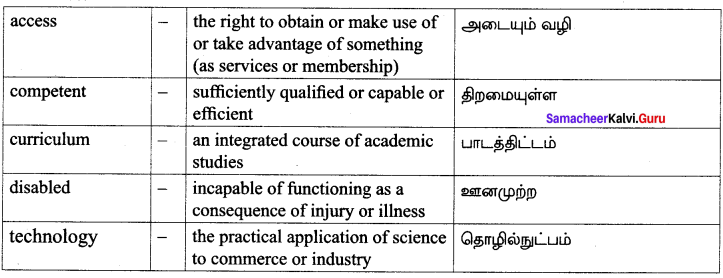
Tech Bloomers Glossary:

Textual:
Samacheer Kalvi 10th English Solutions Prose Chapter 5 Tech Bloomers 33

Additional:
Samacheer Kalvi 10th English Solutions Prose Chapter 5 Tech Bloomers 34

Synonyms:

Choose the most appropriate synonym of the underlined word.

1. Technology empowers the disabled to do their day to day chores.
(a) errands
(b) chaffs
(c) studies
(d) chances
Answer:
(a) errands

2. Technology has empowered the disabled.
(a) brightened
(b) endowed
(c) triggered
(d) emancipates
Answer:
(b) endowed

3. David’s life has changed with the use of technology.
(a) taxology
(b) devastation
(c) environment
(d) machinery
Answer:
(d) machinery

4. Technology impacts the environment.
(a) influences
(b) imparts
(c) impedes
(d) participates
Answer:
(a) influences

5. Technology determines its impacts to the society.
(a) begins
(b) differs
(c) consumes
(d) controls
Answer:
(d) controls

6. Anything which is below a certain threshold can be self-ordered.
(a) floor
(b) edge
(c) thrift
(d) beam
Answer:
(b) edge

7. Energy management can be taken care by automating all the activities.
(a) mechanizing
(b) automobile
(c) channelling
(d) managing
Answer:
(a) mechanizing

8. The disabled continue to grapple with the challenges of access.
(a) adhere
(b) gaze
(c) grope
(d) cope
Answer:
(d) cope

9. It would have been frustrating and difficult.
(a) happy
(b) feeble
(c) infuriating
(d) easy
Answer:
(c) infuriating

10. I have cerebral palsy.
(a) language
(b) intellectual
(c) callous
(d) callous
Answer:
(b) intellectual

11. Studying was difficult because I had to rely on someone to type.
(a) hope
(b) relieve
(c) change
(d) depend
Answer:
(d) depend

12. He accessed his AAC device which took lots of navigation.
(a) scope
(b) naval
(c) neutral
(d) steering
Answer:
(d) steering

13. He has fixed his gaze on the icon that is required.
(a) stare
(b) geek
(c) eyes
(d) face
Answer:
(a) stare

14. It has been mounted on his walker.
(a) riding
(b) fixed
(c) managed
(d) designed
Answer:
(b) fixed

15. Dqyid is also a keen sportsman.
(a) strong
(b) feeble
(c) creative
(d) ghastly
Answer:
(a) strong

16. ECO2 is linked to an interactive white board to teach PE lessons.
(a) connected
(b) loosened
(c) chained
(d) levitate
Answer:
(a) connected

17. David uses ECO2 to speak in complete sentences with correct syntax.
(a) symmetry
(b) centrifugal
(c) synecdoche
(d) grammar
Answer:
(d) grammar

18. He now comments socially using the language of his peers.
(a) formally
(b) informally
(c) scientifically
(d) historically
Answer:
(b) informally

19. He has now become a confident and competent communicator.
(a) capable
(b) poised
(c) callous
(d) daring
Answer:
(a) capable

20. David advocates to other students.
(a) administrates
(b) opposes
(c) comforts
(d) supports
Answer:
(d) supports

21. He controls his PlayStation with a bespoke switch system.
(a) spoken
(b) personalized
(c) metered
(d) monitored
Answer:
(b) personalized

22. Consumable products can be self-ordered.
(a) disposable
(b) durable
(c) challenged
(d) controlled
Answer:
(a) disposable

23. Managing entertainment by voice commands is a reality now.
(a) actuality
(b) brutality
(c) clarity
(d) daring
Answer:
(a) actuality

24. Technology is also a boon to citizens with special needs.
(a) art
(b) blessing
(c) comfort
(d) danger
Answer:
(b) blessing

25. India’s disabled are deprived by attitudinal barriers.
(a) deviated
(b) decomposed
(c) rundown
(d) ransacked
Answer:
(c) rundown

Antonyms:

Choose the most appropriate antonym of the underlined word.

1. Technology helps one to live in comfort.
(a) comfy
(b) discomfort
(c) misuse
(d) easiness
Answer:
(b) discomfort

2. Technology impacts the environment, people and the society as a whole.
(a) partial
(b) entire
(c) unabridged
(d) hollow
Answer:
(a) partial

3. Technology determines if its impacts are positive.
(a) confident
(b) affirmative
(c) negative
(d) promotioi
Answer:
(c) negative

4. Well, anything which is a certain threshold, can be self-ordered.
(a) unsure
(b) sure
(c) convinced
(d) ascertain
Answer:
(a) unsure

5. Your refrigerator can directly link to the ecommerce site.
(a) unswervingly
(b) openly
(c) indirectly
(d) straightly
Answer:
(c) indirectly

6. Consumable products self-order replacements.
(a) throwaway
(b) durable
(c) expendable
(d) perishable
Answer:
(b) durable

7. Your entire energy management can be taken care by automating.
(a) complete
(b) perfect
(c) partial
(d) whole
Answer:
(c) partial

8. Unlike the developed world, India’s disabled are deprived by attitudinal barriers.
(a) developing
(b) industrialized
(c) established
(d) settled
Answer:
(a) developing

9. They continue to grapple with the challenges of inclusion.
(a) seclusion
(b) enclosure
(c) addition
(d) exclusion
Answer:
(d) exclusion

10. It would have been frustrating and difficult.
(a) easy
(b) challenging
(c) intimidating
(d) changeable
Answer:
(a) easy

We hope the data given here will benefit you to the fullest extent at the time of preparation. For better understanding of English subject this Samacheer Kalvi 10th English Solutions for Class 10th English Prose Chapter 5 Tech Bloomers PDF is the best resource. Download & ace up your preparation. Keep in touch with us and get the latest information on Tamilnadu State board Textbook Solutions PDF.

Samacheer Kalvi 9th English Solutions Supplementary Chapter 4 The Cat and the Pain-killer

You can Download The Cat and the Pain-killer Questions and Answers, Summary, Activity, Notes, Samacheer Kalvi 9th English Book Solutions Guide Pdf Supplementary Chapter 4 help you to revise complete Tamilnadu State Board New Syllabus and score more marks in your examinations.

Tamilnadu Samacheer Kalvi 9th English Solutions Supplementary Chapter 4 The Cat and the Pain-killer

The Cat and the Pain-killer Warm Up:

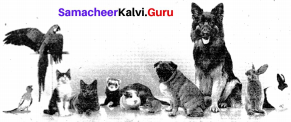
There has always been a close bonding between children and animals. Studies have revealed that living with pet animals increases empathy, compassion and self-esteem among children.
The Cat And The Painkiller Summary Samacheer Kalvi 9th English Solutions Supplementary Chapter 4
The Cat And The Painkiller Summary Question 1.
Do you have a pet at home?
Answer:
Yes.

The Cat And The Painkiller Question 2.
If yes, what animal is it and what is its name?
Answer:
I have a puppy, and its name is Tommy.

The Cat And The Painkiller Book Back Answers Question 3.
Did you have any humourous moments with it? If yes, what was it?
Answer:
After work, my mum bought our dad a kebab for his tea-time. Hungry, dad just put the fork to his mouth when the doorbell went. The plate went down. By the time, my dad answered the doorbell and came back through the hall, Tommy had wiped off the plate and looked innocent. It was even funnier because of the way Tommy’s legs were moving faster than ever but they just slipped on the carpet in cartoon fashion.

The Cat And The Painkiller Pdf Question 4.
How do you care for your pets?
Answer:
I take my pet for a walk, give it food on time, play with it, and give it bath every weekend.

The Cat and the Pain-killer Textual Questions

A. Choose the most suitable option.

The Cat And The Painkiller Questions And Answers Question 1.
Tom was disturbed because __________________.
(a) he didn’t sleep well
(b) his scores were low at school
(c) his friend Becky Thatcher stopped coming to school
(d) he had picked up a fight with Becky Thatcher
Answer:
(c) his friend Becky Thatcher stopped coming to school

The Cat And The Painkiller 9th Standard Question 2.
Aunt was an experimenter in __________________.
(a) trying new recipes
(b) designing fashionable frocks
(c) modem gardening techniques
(d) trying out new medicines
Answer:
(d) trying out new medicines

The Cat And The Painkiller Paragraph Question 3.
Tom used the pain-killer to __________________.
(a)take care of his health
(b) mend the crack on the sitting room floor
(c) cure Becky Thatcher
(d) help his aunt
Answer:
(b) mend the crack on the sitting room floor

9th English Unit 4 Supplementary Question 4.
Peter sprang a couple of yards in the air as __________________.
(a) he had a teaspoon of the pain-killer
(b) his tail was caught in the mouse trap
(c) Tom threw him out of the window
(d) Aunt gave him a push
Answer:
(a) he had a teaspoon of the pain-killer

The Cat And The Painkiller Summary In English Question 5.
Finally Aunt Polly said to Tom that he__________________  .
(a) need not take any more medicine
(b) has to go to school regularly
(c) should not meet any of his friends
(d) must take medicines every day
Answer:
(a) need not take any more medicine

Cat And The Painkiller Summary Additional Questions

1. Tom put his hoop away, ………………………… .
(a) and his belt
(b) and his scarf
(c) and his shoes
(d) and his bat
Answer:
(d) and his bat

2. Tom became fed up and …………………….. .
(a) planned various relief ideas
(b) became a nuisance
(c) started bothering his aunt
(d) pretended to be fond of pain-killer
Answer:
(d) pretended to be fond of pain-killer

3. One day Tom was ………………………….. .
(a) dreaming of Becky
(b) dosing the crack
(c) begging for a pain killer
(d) caressing Peter
Answer:
(b) dosing the crack

4. So Tom opened his mouth and poured ………………………… .
(a) a war-whoop
(b) the pain killer
(c) water all over
(d) out his frenzied enjoyment
Answer:
(b) the pain killer

5. Tom’s tone was ……………………. .
(a) apprehensive
(b) stand for his rights
(c) feel positive
(d) excited
Answer:
(a) apprehensive

B. Identify the character or speaker of the following lines.

  1. He banged against furniture
  2. She stood petrified with astonishment peering over her glasses.
  3. ‘That is, I believe they do.’
  4. ‘What has that got to do that with it?’
  5. ‘I done it out of pity for him.’

Answers:

  1. Peter, the cat
  2. Aunt Polly Arts
  3. Tom Sawyer
  4. Aunt Polly
  5. Tom Sawyer

The Cat And The Pain Killer Additional Questions:

  1. Aunt Polly entered in time to see him throw summersets.
  2. Next he rose on his hind feet and danced around.
  3. He lay on the floor expiring with laughter.
  4. She began to try all manners of remedies on Tom.
  5. He banged against furniture, upsetting flower-pots.
  6. ‘Don’t ask for it unless you want it, Peter.’
  7. She added hot baths, sitz baths, shower baths, and plunges.
  8. He looked up with just a twinkle peeping through his gravity.
  9. He put his hoop away, and his bat.
  10. He sprang a couple of yards in the air.
  11. ‘Hadn’t any aunt! – you numbskull.’
  12. ‘Cats always act so when they’re having good time.’

Answers:

  1. Aunt Polly
  2. Peter
  3. Tom
  4. Aunt Polly
  5. Peter
  6. Tom
  7. Aunt Polly
  8. Tom
  9. Tom
  10. Peter
  11. Aunt Polly
  12. Tom

C. Based on your reading, rearrange the following sentences in the correct sequence.

1. Since all her methods failed, finally she gave him a pain-killer.
2. He told his aunt that Peter had no aunt, so he gave him the medicine.
3. The pain-killer triggered adverse reactions on Peter.
4. It jumped out of the open window.
5. Tom was dull and depressed.
6. This incident upset Aunt Polly and she questioned him.
7. But, Tom gave that pain-killer to the cat Peter.
8. So, Aunt Polly tried different types of remedies on him.
Answers:
3, 8, 5, 6,1, 7, 4, 2

3. The pain-killer triggered adverse reactions on Peter.
8. So, Aunt Polly tried different types of remedies on him.
5. Tom was dull and depressed.
6. This incident upset Aunt Polly and she questioned him.
1. Since all her methods failed, finally she gave him a pain-killer.
7. But, Tom gave that pain-killer to the cat Peter.
4. It jumped out of the open window.
2. He told his aunt that Peter had no aunt, so he gave him the medicine.

D. Based on your understanding of the story, write the answers for the following questions in a sentence or two.

The Cat And The Painkiller Short Summary Question 1.
Why did Tom lose the charm of his life?
Answer:
Tom’s friend Becky Thatcher stopped coming to school. So he lost the charm of his life.

The Cat And The Painkiller Characters Question 2.
Why did Aunt Polly try different remedies on Tom?
Answer:
Tom’s aunt wanted to try new medicines of producing health. She was infatuated with patent medicines and an incurable experimenter. So, she tried different remedies on Tom.

The Cat And The Painkiller Moral Of The Story Question 3.
How did the medicine diminish
Answer:
Tom professed to be fond of pain-killer. So he asked for it often. He used to pour it into a crack in the sitting room floor. Thus the medicine diminished

The Cat And The Painkiller Moral Question 4.
Did Tom compel Peter to have the pain-killer?
Answer:
No. Tom did not compel Peter to have the pain-killer.

The Cat And The Painkiller Story Question 5.
Why did Peter wish to taste the pain-killer?
Answer:
Peter wished to taste the pain-killer because he wanted it.

The Cat And The Painkiller Mind Map Question 6.
How did Aunt Polly discover the reason for Peter’s absurd behaviour?
Answer:
Aunt found the teaspoon and held it out. Thus she discovered the reason for Peter’s absurd behaviour.

Question 7.
What was the reason given by Tom for giving the pain-killer to the cat?
Answer:
Tom said that the cat had no aunt. So he gave it the medicine.

Question 8.
Why did Aunt Polly’s eyes water?
Answer:
Aunt realized that the cruelty to the cat is cruelty to the little boy too. So her eyes watered.

E. Answer the following questions in about 80-100 words.

Question 1.
Describe the different types of remedies tried by Aunt Polly on Tom.
Answer:
Tom’s aunt was the type of person who was infatuated with patent medicines and new ways of producing health or mending it. The first remedy aunt Polly tried on Tom was the water treatment. She stood him up in the woodshed and drowned him with a deluge of cold water; then she scrubbed him down with a towel like a file; then she rolled him up in a wet sheet and put him under blankets till he sweated his soul clean.

The boy remained as dismal as a hearse. Aunt Polly began to assist the water with a slim oatmeal diet and blister plasters. When she heard of Pain-killer, she ordered a lot at once. She tasted it and it was simply fire in a liquid form. She gave Tom a teaspoonful pain-killer and watched with anxiety for the result.

Question 2.
Narrate the funny sequence between Tom Sawyer and Peter, the cat.
Answer:
The “Pain-killer” became a regular treatment, and to Tom Sawyer, it tasted like liquid fire. Tired of the daily doses, one day Tom feeds a spoonful to the cat Peter, which upon receiving the medicine begins to do somersaults in the air while “spreading chaos and destruction in his path.” When Aunt Polly leams that Tom has fed the cat the pain-killer, Tom explains for his actions by saying that he “done it out of pity for the cat because he (the cat) hadn’t any aunt” to “bum him out” and “roast his bowels.”

Additional Question:

Question 1.
Describe Peter’s reaction after having the medicine.
Answer:
Peter sprang a couple of yards in the air, and then delivered a war-whoop and set off round and round the room, banging against furniture, upsetting flower-pots, and making general confusion. Next he rose on his hind feet and danced around, in a frenzy of enjoyment, with his head over his shoulder and his voice proclaiming his happiness. Then he went tearing around the house again spreading chaos and destruction in his path.

F. Complete the summary of the extract using the appropriate words from the box below.

The Cat And The Painkiller Samacheer Kalvi 9th English Solutions Supplementary Chapter 4

Tom Sawyer felt (1) ……………… as Becky Thatcher had stopped coming to (2) ……………… His Aunt Polly was very concerned about his (3) …………….. condition. So, she began to try various (4) …………….. on him. Tom became fed up with his Aunt’s brand of remedies and (5) to like the pain-killer. He started to ask for it very often. But, Tom used the medicine to mend the (6) ……………….. on the floor. One day, Tom gave the pain-killer to his Aunt’s cat, (7) …………… The (8) …………………. had an adverse effect on the cat and it started to jump around the room. Aunt Polly entered the room in time to see the cat throw a few (9) …………….. and sail through the open window. She found the (10) ……………… with a little pain-killer sticking to it and knew that Tom had treated the cat with it. She realised that, what was (11) ……………. to the cat should be the same to the boy too and (12) ………….. giving medicines to him.
Answers:

  1. dejected
  2. school
  3. health
  4. remedies
  5. pretended
  6. crack
  7. Peter
  8. pain-killer
  9. summersets
  10. teaspoon
  11. cruelty
  12. stopped.

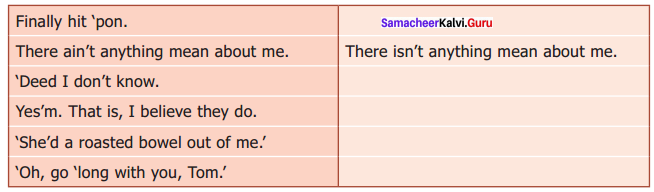
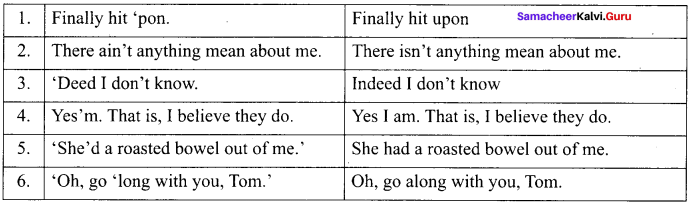
G. In the story we find a lot of American slang usage of English. Complete the tabular column with standard English. One has been done for you.

The Cat And The Painkiller Book Back Answers Samacheer Kalvi 9th English Solutions Supplementary Chapter 4
Answer:
The Cat And The Painkiller Pdf Samacheer Kalvi 9th English Solutions Supplementary Chapter 4

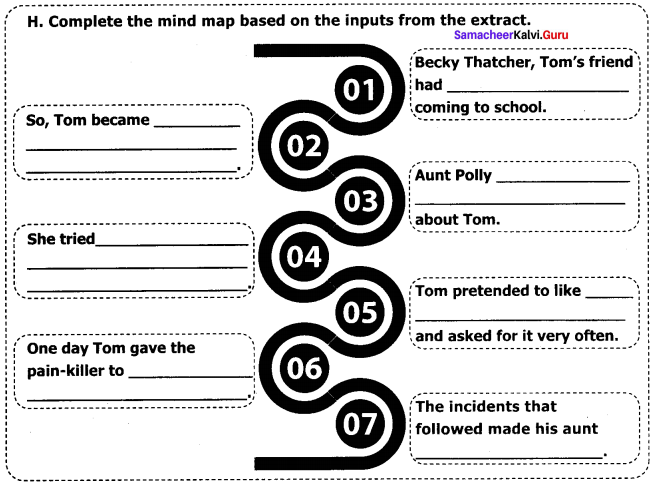
H. Complete the mind map based on the inputs from the extract.

The Cat And The Painkiller Questions And Answers Samacheer Kalvi 9th English Solutions Supplementary Chapter 4

Answer:

  1. stopped
  2. unhappy
  3. was concerned
  4. all manners of remedies on Tom
  5. the pain-killer
  6. Peter
  7. petrified

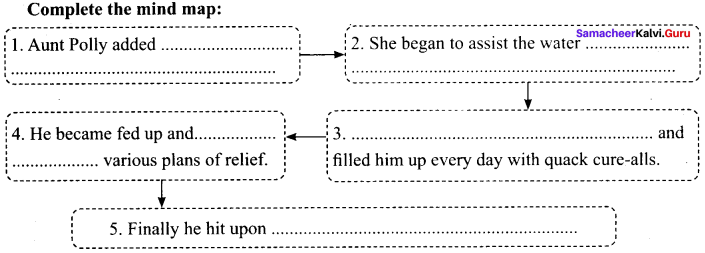
Additional Question:

The Cat And The Painkiller 9th Standard Samacheer Kalvi English Solutions Supplementary Chapter 4

Answers:

  1. hot baths, sitz baths, shower baths and plunges.
  2. with a slim oatmeal diet and blister-plasters
  3. She calculated his capacity
  4. so he thought over
  5. the idea of liking pain-killer

The Cat and the Pain-killer by Samuel Langhome Clemens About The Author:

Samuel Langhome Clemens (1835-1910), better known by his pen name Mark Twain, was an American writer, humourist, entrepreneur, publisher and lecturer. Twain grew up in Hannibal, Missouri, the influence of which can be seen in his novels. His wit and satire, in prose and in speech, earned praise from critics and peers, and he was a friend to presidents, artists, industrialists, and European royalty. His first success as a writer came when his humourous tall tale The Celebrated Jumping Frog of Calaveras County was published on November 18, 1865, in the New York weekly The Saturday Press, bringing him national attention. His famous works were The Adventures of Tom Sawyer and The Adventures of Huckleberry Finn.

The Cat and the Pain-killer Summary:

The Cat And The Painkiller Paragraph Samacheer Kalvi 9th English Solutions Supplementary Chapter 4

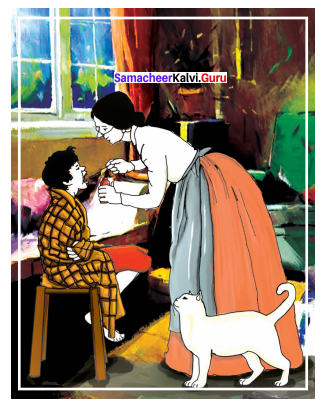
“The Cat and the Pain-killer” is one of the episodes from the novel “The Adventures of Tom Sawyer”. Tom Sawyer is a mischievous young boy growing up along the Mississippi river with his aunt Polly and brother Sid. He is up to all sorts of mischief, but somehow manages to escape from the punishments. Though he finds the school life miserable, the arrival of Becky Thatcher makes him happy. That happiness does not last long as Becky falls ill and stops coming to school.

At home, his Aunt notices that Tom is disturbed and uninterested in doing anything. So Aunt Polly, who is infatuated with patent medicines, tries them on Tom. She tries all kinds of treatments on Tom to make him cheerful again, but to no avail. Tom being fed up with Aunt Polly’s treatment says that he wants pain-killers. Aunt Polly notices that the medicines are diminishing, though she is not aware that Tom is using them to mend the crack in the sitting room floor.

One day while Tom is mending the crack with the pain-killer, the cat Peter arrives and almost begs to taste the medicine. Tom feeling pity towards the cat gives him a spoonful to taste, on which Peter springs up in the air and keeps jumping and dancing, disturbing the furniture and flower pots. Aunt Polly hearing weird noises enters just in time to see the cat perform summersets and carry some flower pots out the window. The old lady is petrified seeing all the mess and Tom’s uncontrollable laughter. Aunt Polly questions Tom regarding the cat’s behaviour. Tom replies that the cats act like this when they’re having a good time.

Aunt Polly finds the teaspoon and understands that Tom has fed the cat with the medicine. She scolds him for being so cruel to the cat, for which he answers that the cat doesn’t have an aunt like her to take care of it and that he has given the cat the medicine out of pity. Aunt Polly suddenly realizes that if the cat would feel so miserable after taking a small sip of the medicine, how the boy must be feeling. Then she puts her hand on Tom’s head saying that she was only trying to do the best for him. Tom replies that he too was only trying to do the best for the cat. Aunt Polly finally says that she wouldn’t try any more medicines on him.

The Cat and the Pain-killer Glossary:

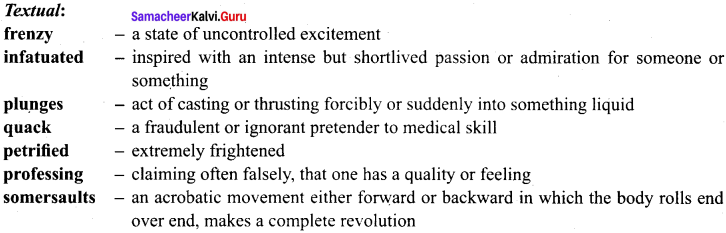
9th English Unit 4 Supplementary Samacheer Kalvi The Cat And The Pain-Killer

Samacheer Kalvi 6th Science Solutions Term 1 Chapter 3 Matter Around Us

You can Download Samacheer Kalvi 6th Science Book Solutions Guide Pdf, Tamilnadu State Board help you to revise the complete Syllabus and score more marks in your examinations.

Tamilnadu Samacheer Kalvi 6th Science Solutions Term 1 Chapter 3 Matter Around Us

Samacheer Kalvi 6th Science Matter Around Us Textual Evaluation

I. Choose the appropriate answer.

Matter Around Us Class 6 Question 1.
_____ is not made of matter.
(a) gold ring
(b) iron nail
(c) light ray
(d) oil drop
Answer:
(c) light ray

Matter Around Us Class 6 Samacheer Kalvi Question 2.
200 ml of water is poured into a bowl of 400 ml capacity. The volume of water now will be
(a) 400 ml
(b) 600 ml
(c) 200 ml
(d) 800 ml
Answer:
(c) 200 ml

6th Standard Science Matter Around Us Question Answer Question 3.
Seeds from water-melon can be removed by _____ method.
(a) hand-picking
(b) filtration
(c) magnetic separation
(d) decantation
Answer:
(a) hand-picking

6th Standard Science Matter Around Us Question 4.
Lighter impurities like dust when mixed with rice or pulses can be removed by
(a) filtration
(b) sedimentation
(c) decantation
(d) winnowing
Answer:
(d) winnowing

Matter Around Us Class 9 Samacheer Kalvi Question 5.
_____ is essential to perform winnowing activity.
(a) Rain
(b) Soil
(c) Water
(d) Air
Answer:
(d) Air

Matter Around Us Tamil Meaning Question 6.
Filtration method is effective in separating mixture
(a) Solid-solid
(b) Solid-liquid
(c) liquid-liquid
(d) liquid-gas
Answer:
(b) Solid-Liquid

6th Science Matter Around Us Question 7.
From the following _____ is not a mixture.
(a) coffee with milk
(b) lemon juice
(c) water
(d) ice cream embedded with nuts
Answer:
(c) water

II. True or False. If False, give the correct statement.

For 6th Standard Question 1.
Air is not compressible.
Answer:
False. Air is highly compressible.

Samacheer Kalvi Guru 6th Science Question 2.
Liquids have no fixed volume but have fixed shape.
Answer:
False. Liquids have fixed volume but have no fixed shape.

Samacheer Kalvi 6th Science Question 3.
Particles in solids are free to move.
Answer:
False. Particles of solid can not move freely (or) Particles of liquid are free to move.

Question 4.
When pulses are washed with water before cooking, the water is separated from them by the process of filtration.
Answer:
False. When pulses are washed with water before cooking the water is separated from them by the process of decantation.

Question 5.
Strainer is a kind of sieve which is used to separate a liquid from solid.
Answer:
True.

Question 6.
Grain and husk can be separated by winnowing.
Answer:
True.

Question 7.
Air is a pure substance.
Answer:
False. Air is a mixture of gases.

Question 8.
Butter from curds is separated by sedimentation.
Answer:
False. Butter from curd is separated by Churning.

III. Match the following.

(a)
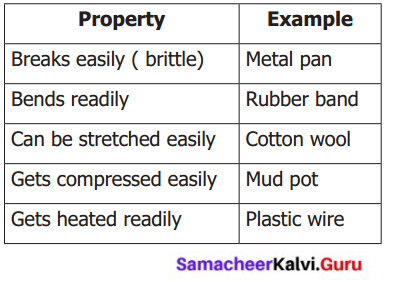
Matter Around Us Class 6 Samacheer Kalvi Science Solutions Term 1 Chapter 3
Answer:
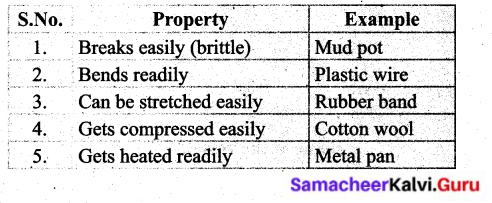
Matter Around Us Class 6 Samacheer Kalvi Term 1 Chapter 3

(b)
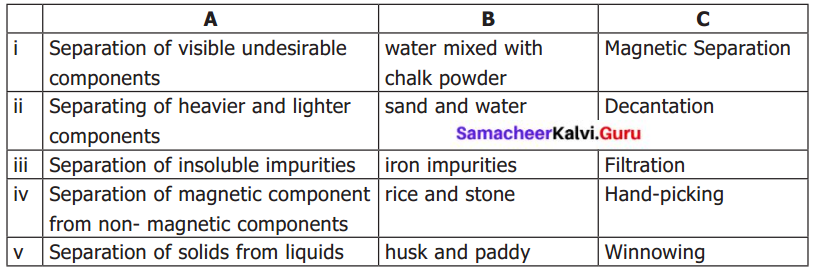
6th Standard Science Matter Around Us Question Answer Samacheer Kalvi Term 1 Chapter 3
Answer:
6th Standard Science Matter Around Us Samacheer Kalvi Term 1 Chapter 3

IV. Fill In the blanks.

  1. Matter is made up of ______
  2. In solids, the space between the particles is less than in ______
  3. Grains can be separated from their stalks by ______
  4. Chillies are removed from ‘upma’ by ______ method.
  5. The method employed to separate clay particles from water is ______
  6. Among the following items: safety pins, pencil and rubber band, ______ will get attracted to a magnet.
  7. Water obtained from tube wells is usually ______ water.

Answers:

  1. atoms
  2. liquids and gases
  3. Threshing
  4. handpicking
  5. Filtration
  6. Safety pins
  7. Impure

V. Complete the given analogy.

  1. Solid: rigidit :: gas: ______
  2. Large Inter-particle space: gas:: ______ :solid
  3. Solid: definite shape :: ______ : shape of the vessel.
  4. Husk-grains: winnowing:: Sawdust-Chalk piece : ______
  5. Murukku from hot oil: ______ : coffee powder residue from decoction: ______
  6. Iron – sulphur mixture : ______ :: Mustard seeds from Urad-dhal: rolling

Answers:

  1. Flexibility.
  2. Little inter-particle space.
  3. Liquid.
  4. Filtration
  5. Filtration
  6. Magnetic separation.

VI. Give a very short answer.

Question 1.
Define the term matter?
Answer:
Matter is defined as anything that has mass and takes up space. Matter is found in solid, liquid and gas.

Question 2.
How can husk or fine dust particles be separated from rice before cooking?

  1. The husk or fine dust particles can be separated from rice by washing the rice with water before cooking.
  2. The lighter impurities float while heavier rice grains sink to the bottom. (It is sedimentation).
  3. Then the water with the impurities is carefully poured away by decantation, leaving clean rice at the bottom.

Question 3.
Why do we separate mixtures?
Answer:
A mixture is an impure substance and contains more than one kind of particles. So, we have to separate mixtures.

Question 4.
Give an example for mixture and justify your answer with reason.
Answer:
Milk is an example for mixture.
It contains water, fat, protein etc. Since two or more compounds are mixed in a physical combination, milk is a mixture.

Question 5.
Define sedimentation?
Answer:
Sedimentation is the deposition process of setting down of heavy solids in a mixture of liquid and an insoluble solid.

Question 6.
Give the main difference between a pure substance and an impure substance.
Answer:
Pure substance:

  1. It is made up of only one kind of particles
  2. Unadulterated

Impure substance:

  1. It is made up of two or more toxic particles
  2. Adulterated

VII. Give a short answer :

Question 1.
A rubber ball changes its shape on pressing. Can it be called a solid?
Answer:
Yes. A solid has a certain shape and size. The shape of a rubber ball changes only if we squeeze it.

Question 2.
Why do gases not have fixed shape?
Answer:

  1. Gases possess more intermolecular space and less forces of attraction.
  2. They can move freely at any direction.
  3. They have the property of filling the entire part of a container by taking the shape of the container.

So, gases do not have fixed shape.

Question 3.
What method will you employ to separate cheese (Paneer) from milk? Explain.
Answer:
“Churning followed by Coagulation” is employed to separate cheese (Paneer) from milk. There are six important steps in making cheese (Paneer) from milk:

  1. Acidification
  2. coagulation
  3. separating curds and whey
  4. Salting
  5. shaping
  6. ripening

Question 4.
Look at the picture given below and explain the method of separation illustrated.
Matter Around Us Tamil Meaning Samacheer Kalvi 6th Science Solutions Term 1 Chapter 3
Answer:
The method is called as Sieving. It is used to separate solid particles of different sizes. Ex. bran from flour.

Question 5.
How can you separate a mixture of a large quantity of tiny bits of paper mixed with pulses/dal?
Answer:
We can separate the mixture of a large quantity of tiny bits of paper and pulses/dal by “Winnowing”. The lighter papers will be carried by wind and heavier pulses/dais will fall closer and form a separate heap.

Question 6.
What is meant by food adulteration?
Answer:
Food adulteration is the process in which the quality of food is lowered either by the addition of inferior quality material or by extraction of valuable ingredient.

Question 7.
Mr. Raghu returns home on a hot summer day and wants to have buttermilk. Mrs. Raghu has only curds. What can she do to get buttermilk? Explain
Answer:
Mrs. Raghu has to take half a cup of curd, add half a cup of water to it and mix well. Now, she can serve buttermilk.

VIII. Question based on Higher Order Thinking Skills.

Question 1.
Distinguish between properties of Solid, liquid, gas. Draw suitable diagram.
Answer:
6th Science Matter Around Us Samacheer Kalvi Solutions Term 1 Chapter 3
For 6th Standard Samacheer Kalvi Science Solutions Term 1 Chapter 3 Matter Around Us

Question 2.
Using suitable apparatus from your laboratory separate the mixture of chalk powder, mustard oil, water and coins. Draw a flow chart to show the separation process.
Answer:
Samacheer Kalvi Guru 6th Science Solutions Term 1 Chapter 3 Matter Around Us

Question 1.
Malar’s mother was preparing to cook dinner. She accidentally mixed ground nuts with urad-dhal. Suggest a suitable method to separate the two substances so that Malar can have ground nuts to eat.
Answer:
The groundnuts shall be separated by hand picking method, because they are in different size, When compared with urad-dhal.

Question 2.
In a glass containing some water, tamarind juice and sugar is added and stirred well. Is this a mixture can you tell why? Will this solution be sweet? or sour? or both sweet and sour?
Answer:
Yes. It is a mixture. It has more than one kind of particle, i.e. Tamarind, Water and Sugar are mixed together. This solution will be sweet and sour.

Question 3.
Justify your answer.
Samacheer Kalvi 6th Science Solutions Term 1 Chapter 3 Matter Around Us
Arrangement of particles in three different phases of matter is shown above.
(a) Which state is represented by fig. 1?
(b) In which will be the inter particle attraction maximum?
(c) Which one of them cannot be contained in an open vessel?
(d) Which one can take the shape of its container?
Answer:
(a) Liquid state, is represented by Fig 1.
(b) In Fig. 3 the inter particle attraction will be maximum, because it is in solid state.
(c) Fig. 2 cannot be contained in an open vessel, as it is in gaseous state.
(d) Fig. 1 can take the shape of its container, as it is in liquid state.

IX. Life Skills-Debate

Question 1.
Debate on “Food adulteration and detection”.
Answer:
Food is the basic requirement for life. It should be pure, nutritious and free from any type of adulteration.

Adulteration :
Sometimes, things that we buy in the market are mixed with harmful and unwanted substances. Food can also get adulterated due to carelessness or lack of proper handling. It will not possible to check for adulteration on visual examination. Following tests will help even a layman or non-technical person to detect adulterants in the some of the products.

Detection:
Milk: Adulterants used can be water, starch, urea, sucrose, detergents, neutralizer, formalin etc. These adulterants are used to increase thickness, viscosity and shelf life of milk.

Test: Put a drop of milk on polished vertical surface. The drop of pure milk either stops or flows slowly leaving a white trail behind it. Whereas milk adulterated with water will flow immediately without leaving a mark. We can also use Lactometer for measuring specific density of milk.

Sugar: Adulterant: Chalk

Test: Dissolve sugar in a glass of water,chalk will settle down at the bottom

Ice Cream: Adulterant: washing Powder

Test: Put some lemon juice on ice-cream, bubbles come out in the presence of washing powder

Test: Take one teaspoonful of melted ghee or butter with equal quantity of cone. Hydrochloric acid in a test tube and add to it a pinch of cane sugar. Shake well for one minute and let it stand for five minutes. Appearance of crimson colour in lower layer shows the presence of vanaspathi.

We must be careful about the common adulterants in our food. We might be eating a dangerous dye, sawdust, industrial starch or other contaminated foods which are a major source of diseases. And thus, we invite diseases rather than good health. Food adulteration is basically lowering the quality of food. So, we must be aware of such adulteration.

XI. Sequence Type

Question 1.
Write the sequence of steps you would use for making tea.
Use the words : mixture, dissolve, filtrate and residue.
Answer:

  1. Take Tea powder and Milk
  2. Heat the milk, then add tea powder.
  3. Add sugar to taste and, Stirr well.
  4. The sugar will be dissolved in the mixture.
  5. Filter the mixture. Tea (filtrate) flows down through filter paper.
  6. Tea leaves settle as residue on the filter paper.

XII. Topic enrichment – Project.

Question 1.
Make a fruit or vegetable salad. Give reasons why you think it is a mixture.
Answer:
Fruit Salad:
Discard the skin of banana, papaya, orange, apple, pine apple, guava and make small slices. Add pomegranate and grapes. Then mix with cream milk and honey. Now the fruit salad is ready. As this Fruit Salad is a physical combination of two or more substances, it is a mixture.

Vegetable Salad:
It is prepared with the primary ingredients of tomato, cucumber, onion, carrot, mint, lemon juice and dried chili peppers. As this Vegetable Salad is a physical combination of two or more substances, it is a mixture.

Question 2.
Connect with sports
Air is not a pure substance. It helps us in many ways from breathing to playing. Balloon sports are a very popular sport. The basis of how the balloon works is that, hot air is lighter than cool air. which makes balloon rise up Find out more about Hot Air balloons.
Samacheer Kalvi 6th Science Solutions Term 1 Chapter 3 Matter Around Us 10
Answer:
The hot air balloon consists of three parts: an envelope- which contains heated air, basket, and burner system which creates an open flame by burning a mix of liquid propane and air.

The basic principle behind hot air balloon is the use of hot air to create buoyancy, which generates lift.

Hot air weighs less than the same volume of cold air, because it is less dense. It means that hot air will rise up and float when there is cold air around it.

Nowadays, most hot air balloons are made of nylon. The melting point of this material is approximately 230° C. The temperature inside a hot air balloon is usually kept below 120° C.

Hot air balloon festivals are held annually in many places throughout the year, allowing hot air balloons operators to gather- as well as for the general public to participate in various activities.

Hot air balloon flights are not possible in the rain. This is because the heat inside of the balloon can bring rain to boiling temperatures on top of the balloon, thereby destroying hot air balloon fabric.

Samacheer Kalvi 6th Science Matter Around Us Intext Activities

Activity 1

Take a few crystals of sugar. Observe them carefully with the help of a magnifying lens.
Samacheer Kalvi 6th Science Solutions Term 1 Chapter 3 Matter Around Us 11
Which of the shapes given above resembles a sugar crystal?
A B C D E F
Answer:
D
Now place a few sugar crystals in a teaspoon full of water. What happens to the sugar crystals?
Samacheer Kalvi 6th Science Solutions Term 1 Chapter 3 Matter Around Us 12
A sugar crystal is also made up of molecules. When sugar dissolves in water, the sugar crystals break down and the molecules of sugar get distributed in water. This makes water sweet to taste. The sugar molecules are extremely small, that is why we are not able to see them. Small amount of matter has nfany millions of molecules in it. (1 million =10 lakhs).

Activity 2
Sit together in groups of three. Look at objects given below. Are they familiar to you? Are they same or different? On what basis did you group them? Is there only one way of doing it or more ways? Discuss with your group members and note it down.
Samacheer Kalvi 6th Science Solutions Term 1 Chapter 3 Matter Around Us 13
Answer:
There are various objects. There are many ways to group them. For example,
Pencil & books – Used for Studying
Bucket and comb – Made of Plastic
Table and ladle – Made of Wood
Glass of water and spectacles – Light can pass through
Apple and iron box – Light cannot pass through
Cow and bird – Living things
Feathers and paper cup – Will float in water
Apple or piece of stone – Will sink in water
Scrub brush and broom – Rough

Try to fill in the following table.
Answer:
Things that float:

  1. Feathers
  2. Plastic Comb
  3. Paper cups

Things that sink:

  1. Glass
  2. Piece of stone
  3. Apple

Activity 3

Work in a group of two. Malar was asked to group some items based on their physical states. This was the table she made. Do you agree with her? Correct the table if you do not agree and submit it to your teacher.
Samacheer Kalvi 6th Science Solutions Term 1 Chapter 3 Matter Around Us 14
Answer:
Samacheer Kalvi 6th Science Solutions Term 1 Chapter 3 Matter Around Us 15

Activity 4

Question 1.
Lift an uninflated cycle tube. Inflate it and lift it again. Is there a change in the weight? Can we see that air has mass?
Answer:
The weight of the inflated cycle tube is more than the weight of the uninflated cycle tube. So we can say that air is also matter though we cannot see, it occupies and also has mass.

Test Yourself

  1. Name an object which is brittle and transparent ______
  2. Name an object which can be stretched ______
  3. Name two objects which can be bent ______

Answer:

  1. Glass
  2. Rubber band
  3. Feather, Paper cup

Activity 5

Let us take two sachets of juice. In both the sachets, it is written 100ml. Let us empty two sachets and pour the juice into the following glasses.

Question 1.
Does its shape also change? Yes / No
Samacheer Kalvi 6th Science Solutions Term 1 Chapter 3 Matter Around Us 16
Answer:
Yes.

Question 2.
Does its volume change? when it is poured into a big glass or a small one? Yes / No.
Answer:
No.

Question 3.
How will you find out whether the volume has changed or not?
Answer:
With the help of graduated beaker, we can find put whether the volume has changed or not.

A liquid needs a container and takes the shape of a container because the particles slide past one another and keep moving. The amount of juice is the same in both glasses. The volume of a liquid remains the same whether it is kept in a large container or a small one but its shape changes.

Try it yourself.

Identify the mixture the table given below. Write “yes” for mixture and no if it is not a mixture. You may also write “I do not know” and later discuss with your teacher.
Samacheer Kalvi 6th Science Solutions Term 1 Chapter 3 Matter Around Us 17
Answer:
Samacheer Kalvi 6th Science Solutions Term 1 Chapter 3 Matter Around Us 18

Activity 6

Think and find out, is it a good idea to separate bran from flour?
Answer:
No. It is not a good idea to separate bran from flour. Because, Bran is rich in dietary fiber, and essential fatty acids. It contains significant quantities of starch, protein, vitamins. It is also source of phytic acid. In foreign countries it is used as a nutrients and production of oils.

Activity 7

Group Activity – Students are divided into 4 groups

Each group should suggest a method to separate mixtures and also give reasons why they used a particular method and what property of the components forms the basis for separation. Examples should be drawn from day-to-day life. After the group presents its method to the rest of the class, the whole class will discuss and analyse if the suggested method will work and then make a note of it in the form given below:
Samacheer Kalvi 6th Science Solutions Term 1 Chapter 3 Matter Around Us 19
Answer:
Samacheer Kalvi 6th Science Solutions Term 1 Chapter 3 Matter Around Us 20

Activity 8
Collect and share information on common adulterants and their detection in food stuff in the class. Watch the youtube video: 10 simple tricks to find adulterated food, https://www.youtube.com/watch? v=_XLi WunnudY
Answer:
(i) Argemone seed in mustard seed.
Argemone seed is crushed with hammer its cotyledon is white in colour.
Mustard seed is crushed with hammer its cotyledon is yellow in colour.

Samacheer Kalvi 6th Science Solutions Term 1 Chapter 3 Matter Around Us 21

(iv) Tea Powder
Adultered tea powder – add water : The water is changed in red colour
Original tea powder – add water : The water colour will be yellow

(v) Chill Powder
Adultered Chilli povder – add water : The colour of water is changed to red colour
Good quality chilli powder – add water : The colour of water will be yellow.

(vi) Adulterated Turmeric powder is added with HCl. The mixture is red in colour then add water. No change.

Original Turmeric power is added with HCl. The mixture is red in colour then add water. The red colour is changed into colourless.

Samacheer Kalvi 6th Science Matter Around Us Additional Questions

I. Choose the correct answer.

Question 1.
All the matter made of ______
(a) Particles
(b) Atoms
(c) Elements
(d) Mixture
Answer:
(b) Atoms

Question 2.
Intermolecular forces of attractions is maximum in
(a) liquids
(b) plasma particles
(c) solids
(d) gases
Answer:
(c) solids

Question 3.
A drop of water contains about ______ water particles.
(a) 1021
(b) 1012
(c) 1022
(d) 1020
Answer:
(a) 1021

Question 4.
The method of separating substances based on size, color and shape is called
(a) Hand-picking
(b) Winnowing
(c) Threshing
(d) sieving.
Answer:
(a) Hand-picking

Question 5.
has definite shape and volume.
(a) Solid
(b) Liquid
(c) Gas
(d) None
Answer:
(a) Solid

Question 6.
The space between _______ particles is the greatest one.
(a) solid
(b) liquid
(c) gas
(d) cold
Answer:
(c) gas

Question 7.
For removing grains from stalks, _______ method is used.
(a) Winnowing
(b) Sieving
(c) Churning
(d) Threshing
Answer:
(d) Threshing

Question 8.
Very tiny insoluble solid separated from a liquid is _______
(a) Winnowing
(b) Churning
(c) Sieving
(d) Filtration
Answer:
(b) Churning

Question 9.
_______ is a smallest particle.
(a) Molecule
(b) Element
(c) Atom
(d) Substance
Answer:
(c) Atom

Question 10.
We mix rice, dal, salt, chillies, pepper, ghee and other ingredients to make pongal. So pongal is also a _____
(a) Mixture
(b) Compound
(c) Element
(d) Matter
Answer:
(a) Mixture

II. State whether the following statements are True or False. If false give the correct statement.

Question 1.
Gas like state of Matter that exists at extremely cold temperatures used in the field of cryogenics.
Answer:
True.

Question 2.
The particles in matter are extremely small and can be seen even with a powerful microscope.
Answer:
False. The particles in matter are extremely small and cannot be seen even with a powerful microscope.

Question 3.
The Cow and Birds are nonliving things.
Answer:
False. The Cow and Birds are living things.

Question 4.
The feather and paper cup can float on the water.
Answer:
True

Question 5.
The force of attraction between liquid particles is more than solid particles.
Answer:
False. The force of attraction between liquid particles is less than solid particles.

Question 6.
Gases have neither a definite shape nor a definite volume.
Answer:
True.

Question 7.
Water particles have no space between them.
Answer:
False. Water particles have space between them.

Question 8.
Liquid is affected by gravity less than anything.
Answer:
False. Liquid is effected by gravity more than anything.

III. Fill in the blanks.

  1. Stars including Sun are covered in _______
  2. Tiny particles present in all matter are called as _______
  3. A _______ substance is made up of only one kind of particles.
  4. Purity of gold is expressed in terms of _______
  5. _______ is used to separate gravel from sand at a construction site.
  6. _______ process is done after sedimentation.
  7. RO is a process for removing impurities from _______ to make it potable.
  8. Turmeric powder is adulterated with a _______ chemical.
  9. In most houses people use commercial water filter to remove impurities and also kill the harmful germ in water using _______
  10. The principle used in washing machines to squeeze out dirt from cloth is called _______
  11. _______ is not affected by gravity.
  12. An example for a substance to be obtained in highly pure form is _______

Answers:

  1. Plasma
  2. atoms and molecules
  3. pure
  4. Carat
  5. Wire mesh
  6. Decantation
  7. Water
  8. bright yellow
  9. UV-rays
  10. centrifugation
  11. Gas
  12. Gold from gold mines

IV. Complete the Analogy.

  1. Bucket: Plastic :: Table : _______
  2. Water : Liquid :: Apple : _______
  3. Made up of one kind of particles : Pure substance :: Chemical combination of two or more element: _______
  4. Mixture containing iron: Magnetic separation:: Muddy water: _______
  5. Removal of Harmful germs : UV rays :: Removal of Impurities from water : _______

Answers:

  1. Wood
  2. Solid
  3. Compound
  4. Filtration
  5. RO process

V. Short Answers.

Question 1.
Mention any two characteristics of the particles of matter.
Answer:

  1. Particles of matter have a lot of space in between them.
  2. Particles of matter attract each other.

Question 2.
How matter is grouped on the basis of physical states?
Answer:
Matter can be grouped into three states : 1. Solid, 2. Liquid, 3. Gas.

Question 3.
What is meant by compound?
Answer:
Compound is the substance formed by the chemical combination of two or more elements.

Question 4.
Define the term ‘Diffusion’.
Answer:
Diffusion is the tendency of particles to spread out in order to occupy the available space.

Question 5.
What is Decantation?
Answer:
After sedimentation, the supernatant liquid is slowly poured out from the container without disturbing the sediment.

Question 6.
How the substance of gaseous particles change to liquid state?
Answer:
When Pressure on a gas is increased, its molecules comes closer together, and its temperature is reduced, which removes enough energy to make it change from the gaseous to the liquid state.

Question 7.
Give any two characters of a pure substance.
Answer:

  1. A pure substance is made up of only one kind of particles.
  2. It may be elements or compounds.

Question 8.
Air is a mixture. Justify.
Answer:
Air contains Oxygen, Nitrogen, Carbon di oxide, Water vapour, Noble gases etc. So it is a Mixture.

Question 9.
Give the characters of a mixture.
Answer:

  1. Mixture is an impure substance and contains more than one kind of particles.
  2. In the mixture, the components are mixed in any proportion.

Question 10.
What is meant by separation?
Answer:
The process by which the components of mixture are isolated and removed from each other to get pure substance is called separation.

Question 11.
What are the steps involved in separation of sand, salt and water?
Answer:
Sedimentation, decantation, filtration, evaporation, and condensation.

Question 12.
Give any two examples of adulterated food.
Answer:

  1. Used tea leaves are used as adulterants in tea.
  2. Small stones are mixed with rice.

VI. Long Answer.

Question 1.
Classify the following based on their physical states.
Stone, Air, Kerosene, LPG, Book, Eraser, Smoke, Coconut oil, Petrol, Cool drinks.
Answer:
Samacheer Kalvi 6th Science Solutions Term 1 Chapter 3 Matter Around Us 22

Question 2.
Fill up the column B with the correct term, given in the options below: (Sedimentation, Churning, Sieving, Threshing, Filtration)
Samacheer Kalvi 6th Science Solutions Term 1 Chapter 3 Matter Around Us 23
Answer:

  1. Threshing
  2. Sieving
  3. Filtration
  4. Churning
  5. Sedimentation

Question 3.
What is Decantation? Explain with Diagram.
Answer:
The water with the impurities is carefully poured away leaving clean rice at the bottom. This is called decantation.
Samacheer Kalvi 6th Science Solutions Term 1 Chapter 3 Matter Around Us 24

  1. This process is done after sedimentation.
  2. The supernatant liquid is slowly poured out from the container without disturbing the sediment.
  3. The part that has settled down is called sediment.
  4. The water that is obtained after decantation is called the decantate.
  5. The process of removal of water above the sediment is called decantation.
  6. But even after decantation the water is not completely free from fine soil particles.
  7. By the process of filtration, we can remove soil particles.

Samacheer Kalvi 8th Social Science Geography Solutions Term 1 Chapter 2 Weather and Climate

You can Download Samacheer Kalvi 8th Social Science Book Solutions Guide Pdf, Tamilnadu State Board help you to revise the complete Syllabus and score more marks in your examinations.

Tamilnadu Samacheer Kalvi 8th Social Science Geography Solutions Term 1 Chapter 2 Weather and Climate

Samacheer Kalvi 8th Social Science Weather and Climate Textbook Evaluation

I. Choose the correct answer

Weather And Climate Class 8 Question 1.
Earth’s atmosphere contains about …………… percentage of nitrogen and oxygen.
(a) 78% and 21%
(b) 22% and 1%
(c) 21% and 0.97%
(d) 10% and 20%
Answer:
(a) 78% and 2l%]

Define Weather Class 8 Question 2.
…………… is generally defined as the average conditions of the weather of a place or a region.
(a) Earth
(b) Atmosphere
(c) Climate
(d) sun
Answer:
(c) climate

8th Social Weather And Climate Question 3.
The earth receives energy from …………….
(a) Current
(b) Electro magnetic radiation
(c) Waves
(d) Heat
Answer:
(b) Electro magnetic radiation

Samacheer Kalvi Guru 8th Social Science Question 4.
Which one the following represents places with equal amount of rainfall
(a) Isotherm
(b) Isohel
(c) Isobar
(d) Isohyets
Answer:
(d) Isohyets

Climate Match The Following Question 5.
………….. is used to measure the humidity.
(a) Anemometer
(b) Barometer
(c) Hygrometer
(d) Thermometer
Answer:
(c) hygrometer

II. Fill in the Blanks

  1. ……………… refers to the condition of atmosphere for a short period of time.
  2. The scientific study of weather is called ………………
  3. The highest temperature ever recorded on the earth is …………….
  4. ……………. is a ratio between the actual amount of water vapour and the maximum amount of water vapour the air can hold.
  5. …………….. and ……………. are measured by anemometer and wind vane respectively.
  6. ………………. are imaginary lines which connect the same temperatures of different places.

Answer:

  1. Weather
  2. Meterology
  3. 56.7°C
  4. Relative humidity
  5. Wind speed, Wind direction
  6. Isotherms

III. Match the following

Weather And Climate Class 8 Samacheer Kalvi Social Science Geography Solutions Term 1 Chapter 2

Answer:

  1. iv
  2. iii
  3. v
  4. i
  5. ii

IV. State whether the following statements are True or False

Weather And Climate Answer Question 1.
The atmosphere is a layer of gases surrounding the planet.
Answer:
True

Weather And Climate Question Answer Question 2.
The Scientific study of weather is called Climatology.
Answer:
False
Correct statement:
The Scientific study of weather is called meterology.

Define Climate Class 8 Question 3.
Isohel refers equal sunshine.
Answer:
True

Weather Definition Geography Question 4.
Humidity is calculated by Aneroid Barometer.
Answer:
False
Correct statement:
Air pressure is calculated by Aneroid Barometer.

V. Answer in brief

Match The Following Climate Question 1.
Define‘weather’.
Answer:
Weather is the day today conditions(state) of the atmosphere at any place as regards sunshine, temperature, cloud cover. Wind fog condition, air pressure, humidity, precipitation and such other elements.

Samacheer Kalvi Guru 8 Social Science Question 2.
What is insolation?
Answer:
Insolation is the solar radiation that reaches the earth’s surface. The earth and its atmosphere get heated from the sun through insolation.

Question 3.
What is meant by atmospheric pressure?
Answer:
The weight of air above a given area on the earth’s surface is called atmospheric pressure or air pressure.

Question 4.
Write a short note on “Planetary winds”
Answer:

  1. Planetary Winds are the ones which blow almost in the same direction throughout the year. So, they are called as Permanent or planetary winds.
  2. Trade winds, Westerlies and polar easterlies are the types of prevailing winds.

Question 5.
What are “Isolines”?
Answer:
Distribution of weather elements are shown by means of Isolines on maps. Isolines are lines which join the places of equal values of weather elements.

VI. Distinguish the following

Question 1.
Weather and climate.
Answer:
Weather:

  • Weather is the day to day condition of the atmosphere at any place
  • Refers to short periods like a day, a week, a month etc.,
  • Sunshine, temperature, cloud cover, wind, fog condition, air pressure, humidity precipitation are some weather elements.

Climate:

  • Average condition of the weather of a place or a region.
  • Determined by measuring weather elements for a long period of time usually for 35 years
  • Latitude, Altitude, direction of winds, distance from the sun, Ocean currents are some of the factors determining climate.

Question 2.
Absolute and relative humidity.
Answer:
Absolute humidity:

  • Mass or weight of water vapour present per unit volume of air.
  • Expressed usually in grams per cubic metre of air.

Relative humidity:

  • Ratio between the actual amount of water vapour present in the air and the maximum amount of water vapour it can hold at a given temperature.
  • Expressed as a percentage.

Question 3.
Permanent and seasonal winds.
Answer:
Permanent winds:

  • The ones which blow almost in the same direction throughout the year.
  • Also called Planetary winds. Example Trade wings, Weather winds

Seasonal winds:

  • Winds which change their direction according to season in a year. Blow from sea to land in summer and land to sea in winter.
  • Also called Monsoon winds. Example North east monsoon winds, South west monsoon winds

VII. Give reasons.

Question 1.
The Weather and climate in different regions vary.
Answer:
Angle of the sun’s rays, the length of daytime, altitude, distribution of land and water bodies, location and direction of mountain ranges, air pressure, winds and ocean currents are the major factors which affect the weather and climate of a region.

Question 2.
Temperature decreases with increase in altitude.
Answer:
Temperature varies both horizontally and vertically. Temperature always decreases with increasing height is known as Lapse rate which is 6.5 degree Celsius per 1000 meters in troposphere.

Question 3.
Mountain climbers carry oxygen cylinders while ascending peaks.
Answer:
With decreasing air pressure,the availability of oxygen to breath also decreases. At very high altitudes, atmospheric pressure and available oxygen get so low that people can become sick and even die. Mountain climbers use bottled oxygen when they ascend very high peaks.

VIII. Answer in a paragraph.

Question 1.
How is temperature measured?
Answer:
Measuring Temperature:
1. The temperature of a unit volume of air at a given time is measured in scales like Celsius, Fahrenheit, and Kelvin. Meteorologist measures the temperature by the Thermometer, Stevenson screen and minimum and maximum Thermometer.

2. The energy received by the earth through insolation is lost by outgoing radiation.

3. Atmosphere is mainly heated by outgoing radiation from 2 to 4pm .So the maximum temperature is recorded between 2 and 4 pm regularly and minimum temperature is recorded around 4 am before sunrise.

Mean Temperature:
1. The average of maximum and minimum temperatures within 24 hours is called mean daily temperature [(87°F + 73°F)/2=80°F].

2. Diurnal range of temperature is the difference between the maximum and minimum temperatures of a day. Annual range of temperature is the difference between the highest and lowest mean monthly temperatures of a year.

Question 2.
Write about the wind and its types.
Answer:
The horizontal movement of air is called wind.
The wind systems are broadly categorized into three as follows.

  • Planetary winds
  • Seasonal winds
  • Local winds

1. Planetary Winds are the ones which blow almost in the same direction throughout the year. So, they are called as Permanent or planetary winds. Trade winds, Westerlies and polar easterlies are the types of prevailing winds.

2. Seasonal winds are those which change their direction according to season in a year. They are called as monsoon winds. These winds blow from sea to land during summer and land to sea during winter.

3. Local winds are the winds blow over a small area only during a particular time of a day or a short period of a year. Land and sea breezes are example of these winds.

Question 3.
List out the weather elements and associated measuring instruments.
Answer:
Temperature, rainfall, pressure, humidity and wind are the major elements of weather and climate.
1. Temperature:
Measured in scales like Celsius, Fahrenheit and Kelvin. Meterorologists Measure the temperature by the Thermometer. Stevenson screen and minimum and maximum thermometer.

2. Rain:
Is a major component of the water cycle and is the source of most of the fresh water on the earth. Rainfall is measured by raingauge.

3. Air Pressure:
Meteorologist uses barometer/aneroid barometer to measure the air pressure. Barograms are used for recording continuous variation in atmospheric pressure.

4. Humidity:
Hygrometer is used to measure the humidity, (which comprises wet and dry bulbplate side by side in the Stevenson screen)

V. Wind

1. Meteorologist measures wind direction using wind vane or weather cock. Wind speed is measured by anemometer. Wind need rose is a diagram used to depict the direction and periods (No. of days) of prevailing winds on map.

2. Meteorograph or triple register is an instrument which records wind speed and direction, sunshine and precipitation. It also provides graphic representation.

IX. Give any three suggestions to reduce global warming.

  1. …………………………..
  2. ………………………….
  3. ………………………….

Answer:

  1. Switching over to renewable energy sources.
  2. Reduce water wastage
  3. Shrinking carbon profile.

Samacheer Kalvi 8th Social Science Geography Weather and Climate Additional Questions

I. Choose the correct answer

Question 1.
The ……………. receive slanting sun’s rays.
(a) Polar regions
(b) Equator
(c) Torrid zone
(d) Indian Ocean
Answer:
(a) Polar regions

Question 2.
The degree of heat present in the air is termed as ……………..
(a) Pressure
(b) Humidity
(c) Temperature
(d) Rainfall
Answer:
(c) temperature

Question 3.
Which of the following represents places of equal sunshine ……………..
(a) Iosotherm
(b) Isohel
(c) Isobar
(d) Isohyet
Answer:
(b) Isohel

Question 4.
The distribution of temperature is shown by means of ……………..
(a) Isocryme
(b) Isohel
(c) Isobar
(d) Isotherm
Answer:
(d) Isotherm

Question 5.
Based on the heat received from the sun, the earth is divided into ………………. zones.
(a) 3
(b) 4
(c) 2
(d) 5
Answer:
(a) 3

Question 6.
The standard air pressure at sea level is ………………
(a) 1014.25 mb
(b) 1016.25 mb
(c) 1013.25 mb
(d) 1020.25 mb
Answer:
(c) 1013.25 mb

Question 7.
The scale is a sacle for measuring wind speeds.
(a) Richter
(b) Vernier
(c) Ratio
(d) Beaufort
Answer:
(d) Beaufort

Question 8.
…………….. has a large area where the average wind speed is low.
(a) France
(b) India
(c) Brazil
(d) Australia
Answer:
(c) Brazil

II. Fill in the blanks

  1. The word climate is derived from the word …………… which means inclination.
  2. The lowest temperature ever recorded on the earth was at …………… station in Antartica.
  3. There is a close relationship between …………… and rainfall distribution.
  4. Generally, rainfall is high in …………… region.
  5. Rainfall is high in the equatorial region and …………… gradually towards poles.
  6. Low pressure system are also called …………… and ……………
  7. High pressure is called …………….
  8. …………… is used to show the distribution of air pressure. [Ans : ]
  9. The highest air pressure at sea level was recorded at …………… Russia.
  10. The small variations in pressure that exist largely determine the …………… and …………… patterns of the earth.
  11. The level of humidity …………… towards poles form equator.
  12. ……………. air holds more water vapour.

Answer:

  1. Klimo
  2. Soviet Vostok
  3. Temperature
  4. Equatorial
  5. Decreases
  6. Depression, cyclones
  7. Anti cyclones
  8. Iso bar
  9. Agata
  10. wind, storm
  11. Decreases
  12. Warm

III. Match the following

Define Weather Class 8 Samacheer Kalvi Social Science Geography Solutions Term 1 Chapter 2
Answer:

  1. iii
  2. i
  3. iv
  4. ii

IV. State whether the following statements are True or False

Question 1.
The climate does not often change like weather.
Answer:
True

Question 2.
Soil does not affect the distribution of temperature.
Answer:
False
Correct statement:
Soil affect the distribution of temperature.

Question 3.
The lowest temperature ever recorded on the earth is – 89.2°C.
Answer:
True

Question 4.
Humans are sensitive even to small variation in pressure.
Answer:
False
Correct statement:
Humans are not sensitive even to small variation in pressure.

V. Answer in brief

Question 1.
State the composition of gases in atmosphere.
Answer:
Earth’s atmosphere contains about 78% nitrogen, 21% oxygen, 0.97% argon, 0.03% carbon dioxide and 0.04% trace amounts of other gases and water vapour.

Question 2.
Define temperature.
answer:
Temperature is one of the key elements of weather and climate. The degree of heat present in the air is termed as temperature.

Question 3.
What does temperature influence?
Answer:
The temperature influences the level of humidity, the process of evaporation, condensation and precipitation.

Question 4.
Name the three mechanisms through which the earth received heat from solar radiation.
Answer:
Radiation, Conduction and Convection.

Question 5.
Define Low pressure.
Answer:
Low pressure area is an area in the atmosphere where the pressure is lower than its surrounding areas. In this situation, the wind
from the surroundings blow towards the centre of low pressure.

Question 6.
Define High pressure.
Answer:
High pressure is an area of atmosphere where the barometric pressure is higher than its surrounding areas. In this case, the wind from the centre of high pressure blows towards the surrounding low pressure areas.

Question 7.
What do low pressure and high pressure lead to?
Answer:
Low pressure leads to cloudiness, wind, and precipitation. High pressure leads to fair and calm weather.

Question 8.
Define Humidity.
Answer:
Humidity refers to the degree of water vapour present in the atmosphere in gaseous form in particular time and place.

Question 9.
Mention the effects of relative humidity.
Answer:
Relative humidity affects human health and comfortness. Very high and very low humidity are injurious to health. It also affects the stability of different objects, buildings and electrical applications.

Question 10.
How do the passengers in aircraft remain comfortable while flying?
Answer:
Aircraft take time to get used to the altitude as the quick move from high pressure to low pressure can cause decompression sickness. Aircraft create artificial pressure in the cabin which makes the passengers remain comfortable while flying.

Question 11.
Mention a few least windy places on earth.
Answer:
Gabon, Congo and DR Congo in Africa, Sumatra, Indonesia and Malaysia are the least windy places on earth.

Question 12.
Write a note on Al – Balakhi.
Answer:
Al – Balakhi, an Arab Geographer collected climatic data from the Arab travellers and prepared the First climatic Atlas of the world

VI. Distinguish the following

Question 1.
Seasonal and Local winds.
Answer:
Seasonal winds:

  • Winds which change their direction according to season in a year. Also called monsoon winds.
  • Example North East and South west monsoon winds.

Local winds:

  • Winds which blow over a small area only during a particular time of a day or short period of a year.
  • Example Land and Sea breezes.

VII. Give Reason for the following

Question 1.
The polar regions are extremely cold in winters.
Answer:
The earth is spherical in shape. So, the sun’s rays fall unevenly on the earth’s surface. The Polar regions receive slanting sun’s rays. Hence there is little or no sunlight, thus there is an extreme cold winters.

Question 2.
Temperature varies with time due to changes.
Answer:
Temperature varies with time due to changes in the level of radiation which reach the earth surface. This is due to motions of the earth (The rotation and revolution) and inclination of the earth’s axis.

Question 3.
Our ears pop in Airplanes.
Answer:
As you go up in an airplane, the atmospheric pressure becomes lower than the pressure of the air inside your ears. Your ears pop because they are trying to equalize or match the pressure.

VIII. Answer in a Paragraph

Question 1.
Explain the Heat Zones of the earth.
Answer:
Heat zones of the earth:
The fact that the earth is spherical in shape results in different parts of the earth getting heated differently. Based on the heat received from the sun, Earth is divided into three heat zones. They are

1. Torrid Zone:
It is a region between the tropic of cancer and the tropic of Capricorn. This region receives the direct rays of the sun and gets the maximum heat from the sun. This zone known as the torrid or the tropical zone

2. Temperate zone:
This zone lies between the Tropic of cancer and the Arctic circle in the Northern Hemisphere and between the Tropic of Capricorn and the Antartic circle in the southern Hemisphere. This zone gets the slanting rays of the sun and the angle of the sun’s rays goes on decreasing towards as the poles. Thus this zone experiences moderate temperature.

3. Frigid Zone:
The frigid zone lies between the Arctic circle and the North Pole and between the Antartic circle and the South Pole. This region also known as Polar region. Since it receives the extremely low temperature throughout the year,these regions are covered with snow.

Question 2.
Explain the ways in which humidity is expressed.
Answer:
1. Specific humidity is a ratio of the water vapor content of the mixture to the total air content on a mass basis. It is expressed in grams of vapour per kilogram of air.

2. Absolute Humidity is the mass or weight of water vapour present per unit volume of air. It is expressed usually in grams per cubic meter of air.

3. Relative humidity is a ratio between the actual amount of water vapour present in the air and the maximum amount of water vapour it can hold at a given temperature. It is expressed as a percentage.

Samacheer Kalvi 6th Science Solutions Term 1 Chapter 2 Force and Motion

You can Download Samacheer Kalvi 6th Science Book Solutions Guide Pdf, Tamilnadu State Board help you to revise the complete Syllabus and score more marks in your examinations.

Tamilnadu Samacheer Kalvi 6th Science Solutions Term 1 Chapter 2 Force and Motion

Samacheer Kalvi 6th Science Force and Motion Textual Evaluation

I. Choose the correct answer.

Force And Motion Class 6 Book Back Questions And Answers Question 1.
Unit of speed is
(a) m
(b) s
(c) kg
(d) m/s
Answer:
(d) m/s

Unit 2 Force And Motion Question 2.
Oscillatory motion among the following is
a. Rotation of the earth about its axis
b. Revolution of the moon about the earth
c. To and fro movement of a vibrating string
d. All of these.
Answer:
c. To and fro movement of a vibrating string

Force And Motion Class 6 Question 3.
The correct relation among the following is
(a) Speed = distance × time
(b) speed = distance / time
(c) Speed = time / distance
(d) speed = 1/ (distance × time)
Answer:
(b) speed = distance / time

Samacheer Kalvi Guru 6th Science Question 4.
Gita rides with her father’s bike to her uncle’s house which is 40 km away from her home. She takes 40 minutes to reach there.
Statement 1 : She travels with a speed of 1 km/minute
Statement 2: She travels with a speed of 1 km/hour
a. Statement 1 alone is correct.
b. Statement 2 alone is correct
c. Both statement 1 and 2 are correct.
d. Neither statement 1 nor statement 2 is correct.
Answer:
a. Statement 1 alone is correct.

II. Find whether the following statements are true or false. – if false give the correct answer.

Samacheerkalvi.Guru 6th Science Question 1.
To and fro motion is called oscillatory motion.
Answer:
True.

Samacheer Kalvi.Guru 6th Science Question 2.
Vibratory motion and rotatory motion are periodic motions.
Answer:
False. Vibratory motion and oscillatory motion are periodic motions.

Samacheer Kalvi Guru 6 Science Question 3.
Vehicles moving with varying speeds are said to be in uniform motion.
Answer:
False. Vehicles moving with varying speeds are said to be in ton-uniform motion.
(OR)
Vehicles moving with uniform speeds are said to be in uniform motion.

Samacheer Kalvi Guru 6th Standard Science Question 4.
Robots will replace human in future.
Answer:
False. Robots wili not replace human in future.

III. Fill in the blanks.

  1. A bike moving on a straight road is an example of _______ motion.
  2. Gravitational force is a _______ force.
  3. Motion of a potter’s wheel is an example of _______ motion.
  4. When an object covers equal distances in equal interval of time, it is said to be in _______ motion.

Answers:

  1. Linear
  2. Non Contact Force
  3. rotatory
  4. uniform

IV. Match the following
Force And Motion Class 6 Book Back Questions And Answers Samacheer Kalvi Term 1 Chapter 2
Unit 2 Force And Motion Samacheer Kalvi 6th Science Solutions Term 1
Answers:

  1. c
  2. d
  3. b
  4. a
  5. e

V. Analogy

Samacheer Kalvi Guru 6th Science Guide Question 1.
kicking a ball: contact force :: falling of leaf: ________?
Answer:
Non contact force.

Samacheer Kalvi Guru 6th Science Book Back Answers Question 2.
Distance : metre :: speed : _______ ?
Answer:
metre/second.

6th Standard Choose The Correct Answer Question 3.
circulatory motion :: a spinning top :: oscillatory motion : _______ ?
Answer:
Swinging of a pendulum.

VI. Given below Is the distance-travelled by an elephant across a forest with uniform speed. Complete the data of the table given below with the idea of uniform speed.
Force And Motion Class 6 Samacheer Kalvi Science Solutions Term 1 Chapter 2
Answer:
Samacheer Kalvi Guru 6th Science Solutions Term 1 Chapter 2 Force And Motion
(i) Distance/Time = \(\frac { 4 }{ 2 } \) × 4 = \(\frac { 16 }{ 22 } \) = 8
(ii) Distance / Time = \(\frac { 4 }{ 2 } \) × 8 = \(\frac { 32 }{ 2 } \) = 16
(iii) Time/Distance = \(\frac{1 \emptyset}{2 \emptyset}\) × 12 = \(\frac { 12 }{ 2 } \) = 6

VII. Complete the web chart.
Samacheerkalvi.Guru 6th Science Solutions Term 1 Chapter 2 Force And Motion
Answer:
Samacheer Kalvi.Guru 6th Science Solutions Term 1 Chapter 2 Force And Motion

VIII. Give one word for the following statements.

Question 1.
The force which acts on an object without physical contact with it.
Answer:
non-contact forces.

Question 2.
A change in the position of an object with time.
Answer:
Motion.

Question 3.
The motion which repeats itself after a fixed interval of time.
Answer:
Oscillatory motion.

Question 4.
The motion of an object travels equal distances in equal intervals of time.
Answer:
Uniform motion.

Question 5.
A machine capable of carrying out a complex series of actions automatically.
Answer:
Artificial intelligence.

IX. Answer the following in a sentence or two.

Question 1.
Define force.
Answer:
Forces are push or pull by an animate or inanimate agency.

Question 2.
Name different types of motion based on the path.
Answer:

  1. Linear motion;
  2. Curvilinear;
  3. Circular motion;
  4. Rotatory motion;
  5. Oscillatory motion
  6. Irregular motion.

Question 3.
If you are sitting in a moving car, will you be at rest or motion with respect your friend sitting next to you?
Answer:
I am in rest with respect to my friend, sitting inside the car.

Question 4.
Rotation of the earth is a periodic motion. Justify
Answer:
Rotation of the earth is a periodic motion because it takes equal interval of time for all rotations.

Question 5.
Differentiate between rotational and curvilinear motion.
Answer:
Rotational motion:

  1. A body moves along a circular path.
  2. Without changing its position, about its own (fixed) axis.
  3. Eg. Rotation of a spinning top.

Curvilinear motion:

  1. A body moves along a curved path.
  2. Changes its position with motion.
  3. Eg. Throwing paper airplanes or paper darts.

X. Calculate

Question 1.
A vehicle covers a distance of 400 km in 5 hour. Calculate its average speed.
Answer:
Distance covered by the vehicle = 400 km
Time taken = 5 hour
Samacheer Kalvi Guru 6 Science Solutions Term 1 Chapter 2 Force And Motion

XI. Answer in detail.

Question 1.
What is motion? Classify different types of motion with examples.
Answer:
Motion :
Change of position of an object with respect to time is known as motion.

1. Based on Path :

  1. Linear motion. – Ex.: Parade of the soldiers.
  2. Curvilinear motion. – Ex.: Paper flight moving.
  3. Circular motion. – Ex.: Swirling stone tied to the rope.
  4. Rotatory motion. – Ex.: Rotating top.
  5. Oscillatory motion. – Ex.: Clock pendulum.
  6. Zigzag (irregular) motion. – Ex.: Motion of a bee.

2. Based on Duration :

  1. Periodic motion. – Ex.: Motion of a bob of simple Pendulum.
  2. Non periodic motion. – Ex.: Swaying of the branches of a tree.

3. Based on Speed:

  1. Uniform motion. – Ex.: Elour hand of a clock.
  2. Non – uniform motion. – Ex.: Motion of a train, as it leaves a station.

XII. Fill with examples.
Samacheer Kalvi Guru 6th Standard Science Solutions Term 1 Chapter 2 Force And Motion
Answer:
Samacheer Kalvi Guru 6th Science Guide Solutions Term 1 Chapter 2 Force And Motion

Samacheer Kalvi 6th Science Force and Motion Intext Activities

Activity – 1

Can you identify whether it is push or pull that results in motion in the following cases?
Samacheer Kalvi Guru 6th Science Book Back Answers Term 1 Chapter 2 Force And Motion
Event 2:
The girl on the swing is moving with respect to the seat of the swing.
She is at rest with respect to the garden.

Event 3:
Nisha is going to her grandmother’s house by bicycle The girl on the bicycle is moving with respect to the road.
She is at rest with respect to the bicycle.

Activity – 2

Moon or Cloud?
Observe the moon on a windy night with a fair bit of cloud cover in the sky. As a cloud passes in front of the moon you sometimes think it is the moon which is moving behind the cloud. What would you think if you were to observe a tree at the same time?
6th Standard Choose The Correct Answer Samacheer Kalvi Science Solutions Term 1 Chapter 2 Force And Motion
Answer:
Activity to be done by the students themselves

Activity – 3

Fill in the empty spaces.
Samacheer Kalvi 6th Science Solutions Term 1 Chapter 2 Force and Motion 11
Answer:
Samacheer Kalvi 6th Science Solutions Term 1 Chapter 2 Force and Motion 12

Can you give example for contact and non-contact forces?
Samacheer Kalvi 6th Science Solutions Term 1 Chapter 2 Force and Motion 13
Answer:
Samacheer Kalvi 6th Science Solutions Term 1 Chapter 2 Force and Motion 14

Activity – 4
Play with pencil
Please do what Shanthi did…

  1. Shanthi took a pencil and sharpened it with a sharpener.
  2. Then she drew a circle using the pencil and a compass.
  3. Later she took her ruler (scale) and drew a straight line in another paper.
  4. Then she kept the pencil between her finger and moved it back and forth.

Samacheer Kalvi 6th Science Solutions Term 1 Chapter 2 Force and Motion 15

Now, look at the motion of the pencil in all these four cases. How was it?

  1. In the first case, the pencil rotated in its axis.
  2. In the second case, it went in a circle.
  3. In the third case, the pencil travelled in a straight line.
  4. Fourth case, the pencil tip moved back and forth, that is it oscillated like a swing.

Activity – 5
Samacheer Kalvi 6th Science Solutions Term 1 Chapter 2 Force and Motion 16

Activity – 6
Classify the following according to the path it takes.

Linear, Curvilinear, Circular, Rotatory, Oscillatory, Zigzag (irregular)

  • A sprinter running a 100 m race – Linear Motion
  • A coconut falling from a tree – Linear Motion
  • striking a coin in a carom board game – Zigzag Motion
  • Motion of flies and mosquitoes – Zigzag Motion
  • Beating of heart – Oscillatory Motion
  • Children playing in a swing – Oscillatory Motion
  • The tip of hands of a clock – Rotatory Motion
  • Flapping of elephant’s ears – Oscillatory Motion
  • A stone thrown into the air at an angle – Curvilinear Motion
  • Movement of people in a bazaar – Zigzag Motion
  • Athlete running around a track – Circular Motion
  • Revolution of the moon around the earth – Circular Motion
  • The movement of a ball kicked in a football match – Curvilinear Motion
  • Motion of a spinning top – Rotatory Motion
  • Revolution of the earth around the sun – Circular Motion
  • Swinging of a pendulum – Oscillatory Motion
  • Children skidding on a sliding board – Linear Motion
  • Skidding down a playground slide – Zigzag Motion
  • Wagging tail of a dog – Oscillatory Motion
  • Flapping of a flag in wind – Oscillatory Motion
  • A car driving around a curve – Circular Motion
  • Woodcutter cutting with a saw – Linear Motion
  • Motion of water wave – Oscillatory Motion
  • Motion of piston inside a syringe – Linear Motion
  • Bouncing ball – Oscillatory Motion

add five motions you observe to this list :

  • Falling fruits from the tree – Linear Motion
  • Ceiling fan running – Rotatory Motion
  • Car running on the straight road – Linear Motion
  • Swirling stone tied to the rope – Circular Motion
  • Motion of sewing machine needle – Oscillatory Motion

Activity
Samacheer Kalvi 6th Science Solutions Term 1 Chapter 2 Force and Motion 17
Answer:
The Taxi driver travelled with highest speed.

How do we say? Let us calculate how long they travelled in One Hour?
Distance travelled by the Car in One Hour = 80 km (160 ÷ 2)
Distance travelled by the Bus in One Hour = 50 km (200 ÷ 4)
Distance travelled by the Truck in One Hour = 60 km (300 ÷ 5)

Have you found out? say now.
Fastest Taxi, Slowest Bus.

Our speed…

Let us play a small game. Go to the playground with your friends. Mark 100 metre distance for a race. Conduct a friendly running race and calculate the time they taken to complete the distance by stopwatch. Now fill up the following table.
Samacheer Kalvi 6th Science Solutions Term 1 Chapter 2 Force and Motion 20

Compute the following Numerical Problems.

  1. If you travel 10 kilometres in 2 hours, your speed is 5 km per hour. (10 km/2 hours)
  2. If you travel 15 kilometres in 1/2 hour, you would travel 30 km in one hour, and your speed is 30 km per hour. (15 km × 2/1 hours)
  3. If you run fast at 20 kilometres per hour for 2 hours, you will cover 40 km. (20 km × 2 hours)

Activity

Multiple Motion to a Sewing Machine
Samacheer Kalvi 6th Science Solutions Term 1 Chapter 2 Force and Motion 21

Motion of the needle
Periodic (or) Oscillatory motion

Motion of the wheel
Rotatory motion

Motion of footrest
Oscillatory motion

Activity – 7

Simple Spinner

Let us enjoy by making a simple spinner. Make it by the following instruction.

Cut a 2cm long piece from an old ball-pen refill and make a hole in its center with a divider point (Fig 1).
Samacheer Kalvi 6th Science Solutions Term 1 Chapter 2 Force and Motion 22
Take a thin wire of length 9cm and fold it into a U-shape (Fig 2).

Weave the refill spinner in the U-shaped wire (Fig 3).

Wrap the two ends of the wire on the plastic refill, leaving enough clearance for the spinner to rotate (Fig 4).

On blowing through the refill, the spinner rotates (Fig 5).

For obtaining maximum speed – adjust the wires so that air is directed towards the ends of the spinner.

Have you enjoyed with simple spinner. Do you observe the motions in the toy. Can you answer the following question?

  1. Motion of the air in tube is _____________ motion.
  2. Motion of the refill stick _____________ motion.
  3. The toy converts _____________ motion into _____________ motion.

Answers:

  1. Linear
  2. Rotatory
  3. Linear, Rotatory

Samacheer Kalvi 6th Science Force and Motion Additional Questions

I. Choose the correct answer:

Question 1.
_______ is an ancient Indian astronomer.
(a) C.V. Raman
(b) Aryabhata
(c) Usain Bolt
(d) Edison
Answer:
(b) Aryabhata

Question 2.
What is the path of the housefly buzzing around the room?
(a) Periodic motion
(b) Non- Periodic motion
(c) circular motion
(d) None of the above
Answer:
(b) Non- Periodic motion

Question 3.
Identify the Periodic motion among the following :
(a) a horse running in a race
(b) revolution of the moon around the earth
(c) a coconut falling from a tree
(d) paper flight moving
Answer:
(b) revolution of the moon around the earth

Question 4.
The cheetah the fastest animal among terrestrial animals run with the average speed of
(a) 100 km /hr
(b) 200 km/hr
(c) 112 km/hr
(d) 10 km /hr.
Answer:
(c) 112 km/hr

Question 5.
_______ are robots scaled down to microscopic size in order to put them into very small spaces to perform a function.
(a) Car robots
(b) Home robots
(c) Game robots
(d) Nanobots
Answer:
(d) Nanobots

Question 6.
A _______ is the fastest land animal.
(a) Horse
(b) Lion
(c) Cheetah
(d) Tiger
Answer:
(c) Cheetah

Question 7.
A cheetah can run with an average speed of _______
(a) 112 km/h
(b) 121 km/h
(c) 211 km/h
(d) 122 km/h
Answer:
(a) 112 km/h

II. Find whether the following sentences are true or false. If false Correct the statement.

Question 1.
Motion occurs when the object is pulled or pushed by an agency.
Answer:
True.

Question 2.
Force executed by touching the body is called non – contact force.
Answer:
False. Force executed by touching the body is called contact force.

Question 3.
Gravity pushes the ripen coconut from the tree to the ground.
Answer:
False. Gravity pulls the ripen coconut from the tree to the ground.

Question 4.
Throwing paper aeroplane is the best example of linear motion.
Answer:
False. Throwing paper aeroplane is the best example ofcurvilinear motion.

Question 5.
The movement of a body about its own axis like a rotating top is liner motion.
Answer:
False. The movement of a body about its own axis like a rotating top is Rotatory

Question 6.
Motion repeated in equal intervals of time is called as periodic motion.
Answer:
True.

III. Fill in the blanks.

  1. _________ are push or pull by an animate or inanimate agency.
  2. Application of force in an object results in motion from a state of _________
  3. Fast oscillations are referred to as _________
  4. Motion repeated in equal intervals of time is called _________
  5. _________ are automatic machines.
  6. The term Robots comes from a czech word _________
  7. _________ is die study of robots in science.

Answers:

  1. Forces
  2. rest
  3. vibrations
  4. periodic motion
  5. Robots
  6. robota
  7. Robotics

IV. Complete the web chart.
Samacheer Kalvi 6th Science Solutions Term 1 Chapter 2 Force and Motion 23
Answer:

  • A – In animate factors,
  • B – Contact forces.

V. Answer the following in one or two sentences.

Question 1.
What is meant by the State of Rest?
Answer:
When there is no change of position of an object with respect to time and if it remains stationary it is called rest.

Question 2.
What is a non-contact force?
Answer:
The force applied without touching the object is known as non-contact force.

Question 3.
What is the contact force?
Answer:
When the force is in contact with the object then it is known as contact force.

Question 4.
Give the properties of force.
Answer:

  1. Forces can change the state of a body from rest to motion or motion to rest.
  2. Forces can change the shape of the body.

Question 5.
A bus moves with a speed of 40 km and crosses 200 km and then how many hours has that bus taken to travel?
Answer:
Time (t) = \(\frac{distence}{AverageSpeed}\)
Time (t) = \(\frac{200 km}{400 km/h}\) = 5 hours

Question 6.
Define Average speed.
Answer:
The distance travelled by an object in unit time is called average speed.
Samacheer Kalvi 6th Science Solutions Term 1 Chapter 2 Force and Motion 24

Question 7.
List out the types of motion on the basis of speed.
Answer:
There are two types:

  1. Uniform motion,
  2. Non-uniform motion.

Question 8.
Define uniform motion.
Answer:
If an object covers uniform distances in uniform intervals, then the motion of the object is called uniform motion.

Question 9.
Why robots are used in many places?
Answer:
Robots can perform mechanical and repetitive jobs faster, more accurately than human beings. It can also handle dangerous materials and explore distant planets.

Question 10.
What are the important parts of a robot?
Answer:
Electronic sensors are a robot’s eyes and ears. These are the important parts.

Question 11.
What is nanobots?
Answer:
Nanobots are robots scaled down to microscopic size in order to put them into very small places to perform a function.

Question 12.
What are the uses of future robots?
Answer:

  1. It could be placed in the bloodstream to perform surgical procedures.
  2. It could target cancer cells and destroy them without touching healthy cells nearby.

VI. Answer in Detail.

Question 1.
Classify the following motions according to the path it takes.
(a) A coconut falling from a tree
(b) Heart beat
(c) A stone thrown into the air at an angle
(d) Movement of people in a bazzar
(e) Motion of a spinning top
Answers:
(a) A coconut falling from a tree – Linear Motion
(b) Heart beat – Oscillatory Motion
(c) A stone thrown into the air at an angle – Curvilinear Motion
(d) Movement of people in a bazar – Zigzag Motion
(e) Motion of a spinning top – Rotatory Motion

Question 2.
Classify the following motions based on duration and speed.
(a) Coconut falls to the ground
(b) A cart pulled by a bullock
(c) Train journey
(d) A bouncing ball
(e) Revolution of Moon around the earth
Answers:
(a) Non-periodic Motion
(b) Non-periodic Motion
(c) Non-uniform Motion
(d) Periodic Motion
(e) Uniform Motion

Samacheer Kalvi 8th Science Solutions Term 1 Chapter 3 Light

You can Download Samacheer Kalvi 8th Science Book Solutions Guide Pdf, Tamilnadu State Board help you to revise the complete Syllabus and score more marks in your examinations.

Tamilnadu Samacheer Kalvi 8th Science Solutions Term 1 Chapter 3 Light

Samacheer Kalvi 8th Science Light Text Book Exercises

I. Choose the best answer

8th Science Light Question And Answer Question 1.

Mirrors having a curved reflecting surface are called as –
(a) Plane mirrors
(b) Spherical mirrors
(c) Simple mirrors
(d) None of the above
Answer:
(b) Spherical mirrors

Light Book Back Answers Question 2.
The spherical mirror with a reflecting surface curved inward is called –
(a) Convex mirror
(b) Concave mirror
(c) Curved mirror
(d) None of the above
Answer:
(b) Concave mirror

8th Std Science Light Lesson Question 3.
The centre of a sphere of which the reflecting surface of a spherical mirror is a part is called –
(a) Pole
(b) Centre of curvature
(c) Cradius of curvature
(d) Aperture
Answer:
(b) Centre of curvature

8th Standard Science Light Lesson Question 4.
The spherical mirror used as a rear view mirror in the vehicle is –
(a) Concave mirror
(b) Convex mirror
(c) Plane mirror
(d) None of the above
Answer:
(b) Convex mirror

8th Standard Light Lesson Question Answer Question 5.
The imaginary line passing through the centre of curvature and pole of a spherical mirror is called –
(a) Centre of curvature
(b) Pole
(c) principal axis
(d) Radius curvature
Answer:
(c) principal axis

Light Samacheer Kalvi Question 6.
The distance from the pole to the focus is called –
(a) Pole length
(b) Focal length
(c) principal axis
(d) None of the above
Answer:
(b) Focal length

8th Standard Science Light Lesson Question Answer Question 7.
Focal length is equal to half of the –
(a) Centre of curvature
(b) Axis
(c) Radius of curvature
(d) None of the above
Answer:
(c) Radius of curvature

8th Science Light Lesson Question 8.
If the focal length of a spherical mirror is 10 cm, what is the value of its radius of curvature?
(a) 10 cm
(b) 5 cm
(c) 20 cm
(d) 15 cm
Answer:
(c) 20 cm

Samacheer Kalvi Guru 8th Science Question 9.
If the image and object distance is same, then the object is placed at –
(a) Infinity
(b) At F
(c) Between f and P
(d) At C
Answer:
(d) At C

Light 8th Standard Question 10.
The refractive index of water is –
(a) 1.0
(b) 1.33
(c) 1.44
(d) 1.52
Answer:
(b) 1.33

II. Fill in the blanks

  1. The spherical mirror used in a beauty parlour as make – up mirror is ………………
  2. Geometric centre of the spherical mirror is ………………
  3. Nature of the images formed by a convex mirror is ………………
  4. The mirror used by the ophthalmologist to examine the eye is ………………
  5. It the angle of incidence is 45°, then the angle of reflection is ………………..
  6. Two mirrors are parallel to each other, then the number of images formed is ………………

Answer:

  1. Concave mirror
  2. pole
  3. Smaller, virtual and erect
  4. Concave mirror
  5. 45°
  6. Infinite

III. Match the following

Samacheerkalvi.Guru 8th Science Question A.
8th Science Light Question And Answer Samacheer Kalvi Solutions Term 1 Chapter 3
Answer:

  1. c
  2. a
  3. d
  4. b

Samcheer Kalvi.Guru 8th Question B.
Light Book Back Answers Samacheer Kalvi 8th Science Solutions Term 1 Chapter 3
Answer:

  1. b
  2. c
  3. d
  4. a

IV. Answer in brief

Samacheer Kalvi Guru 8th Standard Science Question 1.
What is called a spherical mirror?
Answer:
Spherical mirrors are one form of curved mirrors. If the curved mirror is a part of a sphere, then it is called a ‘spherical mirror’.

Samacheer Kalvi 8th Science Question 2.
Define focal length.
Answer:
The distance between the pole and the principal focus is called focal length (f) of a spherical mirror.

Samacheer Kalvi 8th Science Book Solutions Question 3.
The radius of curvature of a spherical mirror is 25 cm. Find its focal length.
Answer:
Given : Radius of curvature = 25 cm
To find: f = ?
Solution:
f = \(\frac { R }{ 2}\) = \(\frac { 25 }{ 2 }\)
f = 12.5 cm

Samacheer Kalvi.Guru 8th Science Question 4.
Give two applications of a concave and convex mirror.
Answer:
Concave mirrors:

  1. Concave mirrors are used while applying make – up or shaving, as they provide a magnified image.
  2. They are used in torches, search lights and head lights as they direct the light to a long distance.

Convex mirrors:

  1. Convex mirrors are used in vehicles as rear view mirrors because they give an upright image and provide a wider field of view as they are curved outwards.
  2. They are found in the hallways of various buildings including hospitals, hotels, schools and stores. They are usually mounted on a wall or ceiling where hallways make sharp turns.

Samacheer Guru 8th Science Question 5.
State the laws of reflection.
Answer:

  1. The incident ray, the reflected ray and the normal at the point of incidence, all lie in the same plane.
  2. The angle of incidence and the angle of reflection are always equal.

8th Standard Light Lesson Question 6.
If two plane mirrors are inclined to each other at an angle of 45°, find the number of images formed.
Answer:
Given :
Angle of inclination = 45°
To find : Number of images formed = \(\frac { 360° }{ angle }\) – 1
Solution:
= \(\frac { 360° }{ 45% }\) – 1
= 8 – 1
= 7 images

Question 7.
Define the refractive index of a medium.
Answer:
The amount of refraction of light in a medium is denoted by a term known as refractive index of the medium, which is the ratio of the speed of light in the air to the speed of light in that particular medium.

Question 8.
State the Snell’s law of refraction.
Answer:
Refraction of light rays, as they travel from one medium to another medium, obeys two laws, which are known as Snell’s laws of refraction. They are:

1. The incident ray, the refracted ray and the normal at the point of intersection, all lie in the same plane.

2. The ratio of the sine of the angle of incidence (i) to the sine of the angle of refraction (r) is equal to the refractive index of the medium, which is a constant.
\(\frac { sin i }{ sin r}\) = µ

V. Answer in detail

Question 1.
Explain the images formed by a concave mirror?
Answer:
Light Book Back Answers Samacheer Kalvi 8th Science Solutions Term 1 Chapter 3

Question 2.
What is reflection? Write short notes on regular and irregular reflection?
Answer:
A ray of light, falling on a body having a shiny polished and smooth surface alone is bounced back. This bouncing back of the light rays as they fall on the smooth, shiny and polished surface is called reflection.
Regular reflection:

  1. When a beam of light (collection of parallel rays) falls on a smooth surface, it gets reflected.
  2. After reflection, the reflected rays will be parallel to each other. Here, the angle of incidence and the angle of reflection of each ray will be equal.
  3. Hence, the law of reflection is obeyed in this case and thus a clear image is formed. This reflection is called ‘regular reflection’ or ‘specular reflection’.

Irregular reflection:

  1. In the case of a body having a rough or irregular surface, each region of the surface is inclined at different angles.
  2. When light falls on such a surface, the light rays are reflected at different angles.
  3. In this case, the angle of incidence and the angle of reflection of each ray are not equal.
  4. Hence, the law of reflection is not obeyed in this case and thus the image is not clear. Such a reflection is called ‘irregular reflection’ or ‘diffused reflection’.

Question 3.
Explain the working of a periscope.
Answer:
Periscope:

  1. It is an instrument used for viewing bodies or ships, which are over and around another body or a submarine.
  2. It is based on the principle of the law of reflection of light.
  3. It consists of a long outer case and inside this case mirrors or prisms are kept at each end, inclined at an angle of 45°.
  4. Light coming from the distant body, falls on the mirror at the top end of the periscope and gets reflected vertically downward.
  5. This light is reflected again by the second mirror kept at the bottom, so as to travel horizontally and reach the eye of the observer.
  6. In some complex periscopes, optic fibre is used instead of mirrors for obtaining a higher resolution.
  7. The distance between the mirrors also varies depending on the purpose of using

Question 4.
What is dispersion? Explain in detail.
Answer:

  1. Splitting of white light into its seven constituent colours (wavelength), on passing through a transparent medium is known as dispersion of light.
  2. Dispersion occurs because, light of different colours present in white light have different wavelength and they travel at different speeds in a medium.
  3. Refraction of a light ray in a medium depends on its speed.

Question 5.
Speed of light in air is 3 x 10⁸ m s-1 and the refractive index of a medium is 1.5. Find the speed of light in the medium.
Answer:
Given :
Speed of light in air c = 3 x 10⁸ ms-1
Refractive index of a medium µ = 1.5
To find : Speed of light in medium v = ?
Formula :
µ = \(\frac { c }{ v}\)
Solution:
1.5 = \(\frac{3×10^{8}}{v}\)
v =\(\frac{3×10^{8}}{1.5}\)
v = 2 x 10⁸ ms-1
Speed of light in medium v = 2 x 10⁸ ms-1

Samacheer Kalvi 8th Science Solutions Light Additional Questions

I. Choose the correct answer

Question 1.
Which object use the reflection of light?
(a) Kaleidoscope
(b) Plane mirror
(c) Convex mirror
(d) All of these
Answer:
(d) All of these

Question 2.
Which surface will not reflect most of the light falling on them?
(a) Rough surface
(b) Smooth surface
(c) Shining surface
(d) Opaque surface
Answer:
(a) Rough surface

Question 3.
Which of the following demonstrates the law of reflection?
8th Std Science Light Lesson Samacheer Kalvi Term 1 Chapter 3
Answer:
8th Standard Science Light Lesson Samacheer Kalvi Term 1 Chapter 3

Question 4.
The ENT doctor uses a …………….
(a) Plane mirror
(b) Concave mirror
(c) Convex mirror
(d) Convex lens
Answer:
(b) Concave mirror

Question 5.
In dispersion, the colour of light that will bend more is ……………..
(a) Red
(b) yellow
(c) Green
(d) Violet
Answer:
(d) violet

Question 6.
Reflection by a looking mirror is called …………….
(a) Regular reflection
(b) Irregular reflection
(c) Regular and irregular reflection
(d) None of these
Answer:
(a) Regular reflection

Question 7.
The velocity of light in vacuum is 3 x 10⁸ ms-1 and in glass is 2 x 10⁸ ms-1. The refractive index of glass is .
(a) 2
(b) 1.5
(c) 1.8
(d) 1.33
Answer:
(b) 1.5

Question 8.
Incident angle of a ray of light is 30°. The angle between the incidend ray and the reflected ray is …………….
(a) 50°
(b) 90°
(c) 60°
(d) 15°
Answer:
(c) 60°

Question 9.
In the head lights of motor vehicles, ……………… mirrors are used as reflectors.
(a) Plane mirrors
(b) Concave lenses
(c) Convex mirrors
(d) Concave mirrors
Answer:
(d) Concave mirrors

Question 10.
The phenomenon of light passing through the object is called ……………..
(a) Reflection
(b) Refraction
(c) Dispersion
(d) Total internal reflection
Answer:
(b) Refraction

II. Fill in the Blanks

  1. The bouncing back of light from a surface is called …………….
  2. ……………. mirrors make things look larger when objects are placed close to it
  3. Convex mirror always forms ……………. and ……………. image.
  4. The incident ray, ……………. ray and the ……………. at the point of incidence, all lie on the same plane.
  5. A ray of light incident along normal to the mirror ……………. its path.
  6. When light passes from one medium to another the ray gets bent. This property of light is called ……………..
  7. Spherical mirrors are one form of …………… mirrors.
  8. ……………… mirrors magnify the object placed close to them.
  9. The image formed by convex mirrors is ……………… than the object
  10. …………….. mirrors form the perfect image of an object.
  11. The …………….. of a mirror determines the type of image it forms.
  12. The ……………. is an optical device with a polished surface that reflects the light falling on it.

Answer:

  1. Reflection
  2. Concave
  3. Virtual and erect
  4. Reflected, normal
  5. Retraces
  6. Refraction
  7. Curved
  8. Concave
  9. Smaller
  10. Plane
  11. Shape
  12. Mirror

III. True or False – if false give the correct statement

Question 1.
We can see things around us only when the light reflected by them reaches our eyes.
Answer:
True.

Question 2.
Light is a form of energy and it travels in a straight line.
Answer:
True.

Question 3.
The periscope is an optical device with a polished surface that reflects the light falling on it.
Answer:
False.
Correct statement:
The mirror is an optical device with a polished surface that reflects the light falling on it.

Question 4.
Curved mirrors have surfaces that are spherical, cylindrical, parabolic and ellipsoid.
Answer:
True.

Question 5.
Curved mirrors form the perfect image of an object.
Answer:
False. Correct statement: Plane mirrors form the perfect image of an object.

Question 6.
Curved mirrors produce images that are either enlarged or diminished.
Answer:
True.

Question 7.
A thin layer of molten aluminium or silver is used for coating glass plates that will then become mirrors.
Answer:
True.

Question 8.
The most common example of a convex mirror is the make – up mirror.
Answer:
False.
Correct statement:
The most common example of a concave mirror is the make – up mirror.

IV. Match the following

Question 1.
8th Standard Light Lesson Question Answer Samacheer Kalvi Term 1 Chapter 3
Answer:

i. e
ii. d
iii. a
iv. c
v. b

Question 2.
Light Samacheer Kalvi 8th Science Solutions Term 1 Chapter 3
Answer:

i. e
ii. d
iii. a
iv. c
v. b

Question 3.
8th Standard Science Light Lesson Question Answer Samacheer Kalvi Term 1 Chapter 3
Answer:

i. d
ii. c
iii. b
iv. e
v. a

V. Assertion and Reason

Mark the correct choice as:
(a) If both assertion and reason are true and the reason is the correct explanation of the assertion.
(b) If both assertion and reason are true, but the reason is not the correct explanation of the assertion.
(c) If the assertion is true, but the reason is false.
(d) If the assertion is false, but the reason is true.

Question 1.
Assertion : A ray incident along normal to the mirror retraces its path
Reason : In reflection, angle of incidence is always equal to angle of reflection.
Answer:
(a) Both assertion and reason are true and the reason is the correct explanation of the assertion

Question 2.
Assertion : Convex mirrors are used as rear view mirror in vehicles for observing traffic at our back.
Reason : A convex mirror has a much larger field of view.
Answer:
(a) Both assertion and reason are true and the reason is the correct explanation of the assertion

Question 3.
Assertion : The mirrors used in search lights are parabolic and not concave spherical.
Reason : In concave spherical mirror the image formed is always virtual.
Answer:
(c) The assertion is true, but the reason is false
Correct explanation:
In search lights, we need an intense parallel beam of light. If a source is placed at the focus of a concave spherical mirror only paraxial rays are rendered parallel. Due to large aperture of mirror, marginal rays give a divergent beam. But in case of parabolic mirror, when source is at the focus, beam of light produced over the entire cross – section of the mirror is a parallel beam.

Question 4.
Assertion : We can see the rainbow in the sky when the rain starts falling after a spell of bright sunlight.
Reason : The rainbow is formed due to the dispersion of light.
Answer:
(d) The assertion is false, but the reason is true
Correct explanation:
The rainbow is formed when the light passes through the water droplets in air after it rains and gets dispersed into seven colours.

VI. Very short Answers

Question 1.
How does the light travel?
Answer:
The light travels along straight lines.

Question 2.
What is reflection of light?
Answer:
The bouncing back of light when it falls on smooth surface is called reflection.

Question 3.
What is mirror?
Answer:
The mirror is an optical device with a polished surface that reflects the light falling on it.

Question 4.
What type of image is formed by a concave mirror?
Answer:
Real and inverted image. If the object is placed very close to the mirror then the image is virtual and erect.

Question 5.
What is rainbow?
Answer:
The rainbow is seen as a large area in the sky with many colours.

Question 6.
Name the triangular piece of glass that splits white light into different colours.
Answer:
Prism.

Question 7.
What is the composition of sunlight?
Answer:
Sunlight is a mixture of seven colours.

Question 8.
Light bends as it passes from one medium to another. What is this phenomenon called?
Answer:
Refraction of light.

Question 9.
Name the two types of spherical mirrors.
Answer:

  1. Concave mirror
  2. Convex mirror.

Question 10.
The angle between incident ray and reflected ray is 60°. What is the value of angle of incidence?
Answer:
8th Science Light Lesson Samacheer Kalvi Solutions Term 1 Chapter 3
since angle of incidence = angle of reflection.
So, angle of incidence = 30°.

VII. Short Answer

Question 1.
Light travels fastest in vacuum. Why?
Answer:
Light travels fastest in vacuum than any other medium because there is no obstruction to the passage of light in vacuum.

Question 2.
Distinguish between real and virtual images.
Answer:
Real image:
Type of image which can be obtained on a screen is called a real image

Virtual image:
An image which cannot be obtained on a screen is called a virtual image.

Question 3.
State any two uses of concave mirrors.
Answer:

  1. It is used as a reflector in torches, light houses, head lights of vehicles, etc., as it diverges the rays of light.
  2. A dentist uses a concave mirror to obtain a magnified image of the teeth of the patient.

Question 4.
A convex rear view mirror is preferred over a plane mirror in a car. Why?
Answer:
Since convex mirror forms a smaller and virtual image, it can be used to see a much larger area than the area visible by a plane mirror.

Question 5.
What type of image is formed by a concave mirror?
Answer:
The image formed by a concave mirror is real and inverted. If the object is placed very rear to the mirror then the image formed is virtual and erect.

Question 6.
Why do we need a shiny surface for reflection?
Answer:
The extent of reflection depends upon the shine and smoothness of the surface. More is the shine and smoothness of the surface more will be the reflection.

Question 7.
The radius of curvature of a spherical mirror is 18 cm. What is the focal length of this mirror?
Answer:
f = \(\frac { R}{ 2 }\)
R = 18 cm
f = \(\frac { 18}{ 2 }\) = 9 cm.

Question 8.
What happens to light when it gets dispersed? Give an example.
Answer:
Light is splitted into its constituent colours, when it gets dispersed.
Example:
Rainbow formation is due to the dispersion of white light after passing through water droplets.

Question 9.
If two mirrors are placed at an inclination of 30° then how many images can be seen?
Answer:
Formula : Number of images N = \(\frac { 360°}{ 30° }\) – 1
Given: θ = 30°
Solution:
N = \(\frac { 360°}{ 30° }\) – 1
= 12 – 1 = 11 images.

Question 10.
What is the speed of light in diamond if its refractive index is 2.41?
Formula :
Refractive index µ =\(\frac {Speed of light in air (c) }{ Speed of light in the medium (v) }\)
Given : µ = 2.41
Solution:
c = 3 x 10⁸ms-1
µ = \(\frac { c }{ v }\)
v =\(\frac{3×10^{8}}{2.41}\)
Speed of light in diamond v = 1.24 x 10⁸ ms-1

Question 11.
A light ray moves from glass (Vglass = 2.0 x 10⁸ms-1) to diamond (Vdiamond = 1.25 x 10⁸ ms-1). What is the refractive index of diamond with respect to glass?
Answer:
Refractive index of diamond with respect to glass
Samacheer Kalvi 8th Science Solutions Term 1 Chapter 3 Light 10
Solution:
Samacheer Kalvi 8th Science Solutions Term 1 Chapter 3 Light 11
= \(\frac { 200 }{ 125 }\)
= 1.60 (No unit).

Question 12.
Find the refractive index of water with respect to glass if the refractive index of water is \(\frac { 4 }{ 3 }\) and the reiractive index of glass is \(\frac { 3 }{ 2 }\)
Answer:
Samacheer Kalvi 8th Science Solutions Term 1 Chapter 3 Light 12
Solution:
= \(\frac { 4 }{ 3 }\) x \(\frac { 2}{ 3 }\)
= \(\frac { 8 }{ 9}\)
Thus, refractive index
of water with respect to glass = \(\frac { 8 }{ 9}\) (No unit).

VIII. Long Answer

Question 1.
Differentiate between regular and irregular reflection.
Answer:
Regular reflection:

  1. When a beam of light (collection of parallel rays) falls on a smooth surface, it gets reflected. After reflection, the reflected rays will be parallel to each other.
  2. Here, the angle of incidence and the angle of reflection of each ray will be equal.
  3. Hence, the law of reflection is obeyed in this case and thus a clear image is formed.
  4. This reflection is called ‘regular reflection’ or ‘specular reflection’.

Samacheer Kalvi Guru 8th Science Solutions Term 1 Chapter 3 Light

Light 8th Standard Samacheer Kalvi Science Solutions Term 1 Chapter 3 Light

Example : Reflection of light by a plane mirror and reflection of light from the surface of still water.

Irregular reflection:

  1. In the case of a body having a rough or irregular surface, each region of the surface is inclined at different angles.
  2. When light falls on such a surface, the light rays are reflected at different angles. In this case, the angle of incidence and the angle of reflection of each ray are not equal.
  3. Hence, the law of reflection is not obeyed in this case and thus the image is not clear. Such a reflection is called ‘irregular reflection’ or ‘diffused reflection’.

Samacheerkalvi.Guru 8th Science Solutions Term 1 Chapter 3 Light

Samcheer Kalvi.Guru 8th Science Solutions Term 1 Chapter 3 Light
Example : Reflection of light from a wall.

Question 2.
Explain the construction and working of kaleidoscope.
Answer:
Construction:

  1. Take three equal sized plane mirror strips and arrange them in such a way that they form an equilateral triangle.
  2. Cover the sides of the mirrors with a chart paper. With the help of a chart paper cover the bottom of the mirrors also.
  3. Put some coloured things such as pieces of bangles and beads inside it.
  4. Now, cover the top portion with the chart paper and make a hole in it to see.
  5. You can wrap the entire piece with coloured papers to make it attractive.
  6. Now, rotate it and see through its opening. You can see the beautiful patterns.

Question 3.
Explain the construction, working of periscope with a neat labelled diagram.
Answer:

  1. It is an instrument used for viewing bodies or ships, which are over and around another body or a submarine.
  2. It is based on the principle of the law of reflection of light. It consists of a long outer case and inside this case mirrors or prisms are kept at each end, inclined L’9ht at an angle of 45°.
  3. Light coming from the distant body, falls on the mirror at the top end of the periscope and gets reflected 450 vertically downward.
  4. This light is reflected again by the second mirror kept at the bottom, so as to travel horizontally and reach the eye of the observer.
  5. In some complex periscopes, optic fibre is used instead of mirrors for obtaining a higher resolution.
  6. The distance between the mirrors also varies depending on the purpose of using the periscope.

Samacheer Kalvi Guru 8th Standard Science Solutions Term 1 Chapter 3 Light

Question 4.
Explain the uses of periscope.
Answer:

  1. It is used in warfare and navigation of the submarine.
  2. In military it is used for pointing and firing guns from a ‘bunker’.
  3. Photographs of important places can be taken through periscopes without trespassing restricted military regions.
  4. Fibre optic periscopes are used by doctors as endoscopes to view internal organs of the body.

Question 5.
Explain the images formed by a convex mirror for different position of the object.
Answer:
Samacheer Kalvi 8th Science Solutions Term 1 Chapter 3 Light

Question 6.
Answer:
1. A pencil placed in water in a glass appear to be bent at the surface of separation.

2. The base of a swimming pool appears to be raised due to refraction of light.

3. We should look straight down into the river while catching fish. If observed obliquely, the fish appears to be closer to the surface of the water than it actually is.

4. Stars look like tiny dots when viewed from earth, because they are far away from us. The light from the stars has to travel a long distance through the atmosphere before it reaches us. The atmosphere has various layers of different refractive indices. Light is refracted through each of them. These layers are turbulent. Every time one of the layers shifts, the thickness and refractive indices of air change and the light is refracted differently, creating a twinkling effect.

IX. Complete the given table

Question 1.
Samacheer Kalvi 8th Science Book Solutions Term 1 Chapter 3 Light
Answer:

  1. At F
  2. Diminished
  3. At C
  4. Magnified
  5. Virtual and erect

X. Draw the following

Question 1.
Concave mirror.
Answer:
Samacheer Kalvi.Guru 8th Science Solutions Term 1 Chapter 3 Light

Question 2.
Convex mirror.
Answer:
Samacheer Guru 8th Science Solutions Term 1 Chapter 3 Light

Question 3.
Draw the ray diagram and write the characteristics of the image formed when an object is placed

  1. At infinity in front of a concave mirror.
  2. At infinity in front of a convex mirror.

Answer:
8th Standard Light Lesson Samacheer Kalvi Term 1 Chapter 3
Position of the image : At F
Image size : Highly diminished
Nature of the image : Real and inverted

Samacheer Kalvi 8th Science Solutions Term 1 Chapter 3 Light 23
Position of the image : At F
Image size : Highly diminished , point sized
Nature of the image : Virtual and erect

Question 4.
Draw a neat labelled diagram of a periscope.
Answer:
Samacheer Kalvi 8th Science Solutions Term 1 Chapter 3 Light 17

Question 5.
Draw a ray diagram to show a light ray travels from denser medium (glass) to rarer medium (air).
Answer:
Samacheer Kalvi 8th Science Solutions Term 1 Chapter 3 Light 24
When a light ray travels from denser medium to rarer medium, it speeds up and refracts away from the normal.

Question 6.
Draw a ray diagram to show a light ray travels from rarer medium (air) to denser medium (water).
Answer:
Samacheer Kalvi 8th Science Solutions Term 1 Chapter 3 Light 25
When a light ray travels from rarer to denser medium, it bends towards the normal.

XI. Cross word puzzle

Across:
3. The geometrical centre of a spherical mirror.
6. Centre of the sphere from which the mirror is made.
7. An optical device with a polished surface that reflects the light falling on it.
8. Image which can be formed on a screen.
9. Image which cannot be formed on a screen.
10. The bending of a light ray when it passes from one medium to another medium of different density.

Down:
1. Mirror which converges a parallel beam of light passing through it.
2. Imaginary line passing through the centre of curvature of the mirror.
4. Mirror which diverges a parallel beam of light passing through it.
5. The formation of rainbow is an example of ______.
Answer:
Samacheer Kalvi 8th Science Solutions Term 1 Chapter 3 Light 26
Across:
3. Pole
6. Centre Of Curvature
7. Mirror
8. Real
9. Virtual
10. Refraction

Down:
1. Concave
2. Principal Axis
4. Convex
5. Dispersion

XI. Creative questions : HOTS

Question 1.
Imagine that parallel rays are incident on an irregular surface. Are the rays reflected from the surface parallel to each other?
Answer:
No, the reflected rays from irregular surface are in different direction.

Question 2.
A safety vest helps to keep the workers who are working by the roadside safe. This especially so during the nights. Why?
Answer:
The reflectors on the safety vest reflect light into the motorists eyes.
This help to alert the motorists of the wearer’s presence on the road.

Question 3.
What is the difference between virtual images of an object formed by a concave mirror and a convex mirror?
Answer:
The virtual image of an object formed by a concave mirror is always magnified one but the image formed by a convex mirror is always diminished one.

Question 4.
What is a virtual image? Give one situation where a virtual image is formed.
Answer:
The image formed by the plane mirror appears behind it. We cannot however touch it. Also, the image of the object cannot be obtained on a screen, whether it is held in front of the mirror or behind it. Such type of images are not real. They are virtual images.

Question 5.
If all objects around us were to reflect light in a regular way, what problem might we face?
Answer:

  1. Irregular reflection is what makes us see all the objects and everything around us.
  2. If light were to get regularly reflected then every object would act like a mirror and our surroundings would be illuminated.
  3. This would have a blinding effect on eyes making it harder for us to see.

Question 6.
Car rear view mirrors carry a warning message that “objects in the rear view mirror are closer than they appear”. Why do you think this is so?
Answer:

  1. Convex mirrors used in vehicles as rear – view mirrors are labeled with the safety warning: ‘Objects in the mirror are closer than they appear’ to warn the drivers. This is because inside the mirrors, vehicles will appear to be coming at a long distance.
  2. Convex mirrors form erect and smaller images of the objects.
  3. This does not give us the exact idea how far the vehicle is from us.
  4. Thus, to avoid accidents, car view mirrors carry a warning message.

Samacheer Kalvi 8th English Solutions Term 1 Supplementary Chapter 1 Jim Corbett, A Hunter Turned Naturalist

Students can Download English Lesson 1 Jim Corbett, A Hunter Turned Naturalist Questions and Answers, Summary, Activity, Notes, Samacheer Kalvi 8th English Book Solutions Guide Pdf helps you to revise the complete Tamilnadu State Board New Syllabus and score more marks in your examinations.

Tamilnadu Samacheer Kalvi 8th English Solutions Term 1 Supplementary Chapter 1 Jim Corbett, A Hunter Turned Naturalist

A. Fill in the blanks.

  1. Jim Corbett was born on _________
  2. Corbett shot wild animals in his _________
  3.  _________ was the first man-eater shot by Corbett.
  4. Corbett shot the tigress dead, near the _________

Answer:

  1. 25th July 1875
  2. cine film camera
  3. The Champawat Tiger
  4. Chataar Bridge

B. Read the following passage and answer the questions given below.

Jim Corbett played a key role in establishing, India’s first national park in the Kumaon Hills, the Hailey National Park, in Uttarakhand, India. It was initially named after, Lord Malcolm Hailey. Jim Corbett died on 19 April 1955. The park was renamed in 1957 as, The Jim Corbett National Park. It was named after him to honour his role in establishing this protected area in 1930s.

Jim Corbett A Hunter Turned Naturalist Question 1.
Who played a key role in establishing the national park?
Answer:
Corbett played a key role in establishing the India’s first National Park in the Kumaon Hills.

Jim Corbett A Hunter Turned Naturalist Question And Answer Question 2.
Why was the park named Hailey National Park?
Answer:
The park was named ‘Hailey National Park’ to honour the Governor of United Provinces ‘Lord Malcolm Hailey’.

Jim Corbett A Hunter Turned Naturalist Summary Question 3.
When was it renamed as Jim Corbett National Park?
Answer:
The park was renamed in 1957 as the Jim Corbett National Park to honour his role in establishing the protected area in 1930s.

C. Answer the following in one or two words.

Jim Corbett Hunter Turned Naturalist Question 1.
What was the birth name of Jim Corbett?
Answer:
The birth name of Jim Corbett was Edward James Corbett.

Jim Corbett A Hunter Turned Naturalist 8th Std In Tamil Question 2.
What was the name of Corbett’s dog?
Answer:
The name of Jim Corbett’s dog was Robin.

Corbett Shot Wild Animals In His Answer Question 3.
How many kills did the Champawat Tiger recorded?
Answer:
The Champawat Tiger recorded 436 deaths in Nepal and the Kumaon area of India. Her attacks have been listed in the Guinness Book of World Records as the highest number of death from a tiger.

Jim Corbett Shot Wild Animals In His Question 4.
Who was the last kill of the Champawat Tiger?
Answer:
The last person to be killed by the Champawat Tiger was a 16 year old girl in a village near Champawat.

Jim Corbett A Hunter Turned Naturalist Book Back Answers Question 5.
When did Jim Corbett died?
Answer:
Jim Corbett died on 19th April 1955.

D. Answer the following in 100 words.

Jim Corbett Question Answer Question 1.
According to Corbett, why a tiger turns into a man eater?
Answer:
According to Corbett’s theory, a tiger starts eating humans, when they grow old or got hurt. As they cannot run fast, they start killing humans. People cannot run as fast . as animals. So they become easy prey. After eating human flesh once, a tiger will not
eat any other flesh. These tigers are called man-eaters. Join Corbett’s first man eating tiger hunt was the Champawat Tiger. It was a Bengal tigress. It was responsible for nearly 436 deaths in Nepal and the Kumaon area of India.

8th English Jim Corbett A Hunter Turned Naturalist Question 2.
How was the Champawat Tiger killed?
Answer:
Jim Corbett camped in the Kumaon District and started tracking the tigress. He moved around the villages and limited the activities of the man-eater. After several unsuccessful attempts, Corbett managed to kill the tiger. When a 16 year old girl was killed by the tigress, it left a trail of blood, which was followed by Jim. After a whole day of search, Jim, decided to organise a bait, the next day. With the help of the Thasildar of Champawat, the bait was organised with about 300 villagers. The next day, Corbett shot the tigress dead, near the Chataar Bridge in Champawat.

Question 3.
What were the findings of the postmortem ?
Answer:
A postmortem was done on the Bengal Tigress. It showed that the upper and lower ’ canine teeth on the right side of her mouth were broken. The upper one was broken in half and the lower one broke right down to the bone. This injury was a result of an old gunshot from the game hunter who failed to track and kill it. According to Jim Corbett this injury prevented her from hunting her natural prey and so she started to hunt humans.

Step To Success

Analogy – verbal reasoning questions.
There is certain relation between two given words, find the relation to find the missing word.

Question 1.
Reading : Knowledge, Work: ?
(a) Experience
(b) Engagement
(c) Experiment
(d) Employment
Answer:
(a) Experience

Question 2.
Cricket: Bat, Hokey: ?
(a) Field
(b) Stick
(c) Player
(d) Ball
Answer:
(b) Stick

Question 3.
Dog : Rabies, Mosquito : ?
(a) Plague
(b) Death
(c) Malaria
(d) Sting
Answer:
(c) Malaria

Question 4.
Man : Biography, Nation : ?
(a) Leader
(b) People
(c) Geography
(d) History
Answer:
(d) History

Question 5.
Bread: Bakery, Brick: ?
(a) Mint
(b) Kiln
(c) Furnace
(d) Mine
Answer:
(b) Kiln

Question 6.
Doctor: Diagnosis, Judge : ?
(a) Court
(b) Punishment
(c) Lawyer
(d) Judgement
Answer:
(d) Judgement

Connecting To Self

Try to know whether your hobby makes things easy.
Answer:
Jim Corbett A Hunter Turned Naturalist Samacheer Kalvi 8th English Solutions Term 1 Supplementary Chapter 1

Jim Corbett, A Hunter Turned Naturalist Additional Questions

I. Choose the Correct Answers (MCQ).

Question 1.
Jim Corbett was a wildlife photographer
(a) American
(b) British
(c) German
(d) French
Answer:

Question 2.
Though he was an expert hunter, he admired
(a) game hunt
(b) birds
(c) wildlife
(d) travel
Answer:

Question 3.
He took no joy from the .
(a) kill
(b) chase
(c) deaths
(d) survival
Answer:
(d) kill

Question 4.
There she continued her killings in the district.
(a) Kumaon
(b) Wayanad
(c) Vadodara
(d) Kolar
Answer:
(a) Kumaon

Question 5.
The British government Jim Corbett to help the villagers.
(a) advised
(b) ordered
(c) commanded
(d) requested
Answer:
(d) requested

II. Identify the Character / Speaker.

  1. “He had a lot of experience with tigers and other wild animals”.
  2. “She was shot in 1907 by Jim Corbett”.
  3. “He camped in the Kumaon district”.
  4. “He took no joy from the kill”.
  5. “All her kills happened during the daylight”.

Answer:

  1. Jim Corbett
  2. Bengal tigress
  3. Jim Corbett
  4. Jim Corbett
  5. Bengal tigress

III. Write True or False against each statement.

  1. Jim often hunted with his horse Robin.
  2. The Bengal tigress was responsible for nearly 336 deaths in Nepal and Kumoan area.
  3. The British government requested Jim Corbett to help the villagers.
  4. Jim Corbett was always against game hunting.
  5. People were not terrified to go out into the forest.

Answer:

  1. False
  2. False
  3. True
  4. True
  5. False

IV. Very Short Questions with Answers.

Question 1.
What did Jim Corbett hunt?
Answer:
Jim Corbett hunted a number of man-eating tigers and leopards in India.

Question 2.
What did Jim admire?
Answer:
Corbett admired wildlife.

Question 3.
Did he kill wildlife for pleasure or sport?
Answer:
No, he did not kill wildlife for pleasure or sport.

Question 4.
When was the tiger shot?
Answer:
The tiger was shot in 1907 by Jim Corbett.

Question 5.
How old was the girl killed by the tiger?
Answer:
She was 16 years old.

V. Short Questions with Answers.

Question 1.
Where did the tiger begin her attacks?
Answer:
The tiger began her attacks in a Rupal village in western Nepal, Himalayas.

Question 2.
What did the Nepalese army do?
Answer:
The Nepalese army, after failing to kill the tiger, drove her across the border into India.

Question 3.
How were the people to go out and refused to leave?
Answer:
The people were terrified to go out and refused to leave their hunts for work after hearing the tigress’ roar from the forest.

Question 4.
According to Jim, what were the main cause of the mischief of wild animals?
Answer:
Deforestation and human encroachment were the main cause of the mischief of wild animals.

Question 5.
What did Jim educate the people?
Answer:
Jim went on lecturing tours to educate the people about their natural heritage and the need to conserve forests and their wildlife

VI. Paragraph Questions with Answers.

Question 1.
Describe the attacks of the Bengal tigress?
Answer:
The tigress began her attacks in a Rupal village in Western Nepal, Himalayas. Hunters were sent to kill the tiger, but she managed to escape from them. The Nepalese army failed to capture or kill the tigress. It drove the tigress across the border into India. There the tigress continued her killings in the Kumaon District. She killed the people mostly during the day time. After several incidents, people stopped going into the forest to collect firewood, fruits, roots and other things. They were terrified to go out, after hearing her roar from the forest.

VII. mind map

Question 1.
Jim Corbett A Hunter Turned Naturalist Question And Answer Samacheer Kalvi 8th English Solutions Term 1 Supplementary Chapter 1
Answer:

  1. killing humans
  2. as animals
  3. easy prey
  4. a tiger
  5. man-eaters

Question 2.
Jim Corbett A Hunter Turned Naturalist Summary Samacheer Kalvi 8th English Solutions Term 1 Supplementary Chapter 1
Answer:

  1. The Champawat Tiger
  2. Bengal Tigress
  3. Guinness Book of World Records
  4. fatalities
  5. 1907

VIII. Rearrange the Jumbled Sentences.

A.

1. Jim Corbett died on 19th April 1955.
2. Jim played a key role in establishing India’s first national park in the Kumaon Hills.
3. It was named after him to honour his role in establishing this protected area in 1930s.
4. It was initially named after Lord Malcolm Hailey.
5. The park was renamed in 1957 as ‘The Jim Corbett National Park’.
Answer:
2,4,1, 5, 3
2. Jim played a key role in establishing India’s first national park in the Kumaon Hills.
4. It was initially named after Lord Malcolm Hailey.
1. Jim Corbett died on 19th April 1955.
5. The park was renamed in 1957 as ‘The Jim Corbett National Park’.
3. It was named after him to honour his role in establishing this protected area in 1930s.

IX. Read the passage and answer the questions.

A. Edward James Corbett, popularly known as Jim Corbett was a British wildlife photographer, hunter, tracker, naturalist, and writer. He has hunted a number of man-eating tigers and leopards in India. He had a lot of experience with tigers and other wild animals to shoot with his cine film ‘ camera.

Question 1.
Who was Jim Corbett?
Answer:
Jim Corbett was a wildlife photographer, hunter, tracker, naturalist and writer.

Question 2.
How did he shoot tigers and other wild animals?
Answer:
He shot the tigers and other wild animals with his cine film camera.

Question 3.
What was the name given to Jim by his parents?
Answer:
Jim was given the name ‘Edward James Corbett’ by his parents.

B. Jim Corbett was always against game hunting. He strongly advocated that deforestation and human encroachment were the main cause of the mischief of wild animals. He went on lecturing tours to educate the people about their natural heritage and the need to conserve forests and their wildlife.

Question 1.
Who was against game hunting?
Answer:
Jim Corbett was against game hunting.

Question 2.
According to Jim, what were the main cause of the mischief of wild animals?
Answer:
Deforestation and human encroachment were the main causes of mischief of wild animals.

Question 3.
What did Jim educate the people?
Answer:
Jim went on lecturing tours to educate the people about their natural heritage and the need to conserve wildlife.

Jim Corbett, A Hunter Turned Naturalist Additional Questions:

Jim Corbett was a British wildlife photographer, hunter, tracker, naturalist and writer. His birth name was Edward James Corbett. He had hunted a lot of man-eating tigers and leopards in India. He used to shoot the tigers and the wild animals with his cine film camera. His dog, Robin accompanied him for the hunt. Jim Corbett hunted these animals only to help the people and at the request of the government.

His first man-eating tiger hunt was ‘The Champawat Tiger’. It was a Bengal tigress which was responsible for nearly 436 deaths in Nepal and the Kumaon area of India. Her attacks have been listed in the Guinness Book of World Records as the highest number of deaths from a tiger. The tigress began her attacks in a Rupal village in Western Nepal, Himalayas. She continued her killings even in the Kumaon District. Hunters were sent to kill the tigress, but she managed to escape. People were frightened to go to the forest to collect firewood, fruits, roots and other things. Then the British government requested Jim Corbett to help the villagers.

He camped in the Kumaon District and started tracking the tigress. After several unsuccessful attempts, Corbett managed to kill the tigress. When it left a trail of blood, after killing a 16 year old girl, Corbett followed it. He organised a bait with about 300 villagers. The next day, he shot the tigress dead near the Chataar Bridge in Champawat in the year 1907.

Jim Corbett was always against game hunting. He promoted ‘The Association for the Preservation of Game” and the “All India conference for the Preservation of Wildlife”. He played a key role in establishing India’s first national park – ‘the Hailey National Park’. After Jim Corbett’s death on 19th April 1955, the park was renamed in 1957 as “The Jim Corbett National Park”.

Samacheer Kalvi 6th English Solutions Term 1 Poem Chapter 1 The Crocodile

Students can Download English Poem 1 The Crocodile Questions and Answers, Summary, Activity, Notes, Samacheer Kalvi 6th English Book Solutions Guide Pdf helps you to revise the complete Tamilnadu State Board New Syllabus and score more marks in your examinations.

Tamilnadu Samacheer Kalvi 6th English Solutions Term 1 Poem Chapter 1 The Crocodile

The Crocodile Poem Questions And Answers Poem Overview

No.Poem LineExplanation
1-2Ham doth the little crocodile improve Ms shining tailThe poet questions how the little crocodile uses water from its tears to improve the shining of its tail. The tail is already shining because of the water poured on its scales.
3-4Ami pour dm water of ike Nile On emeny golden scaleThe poet jokes that the crocodile secretes enough teardrops for them to seem like they equal all the water in the River Nile.
5-6How cheerful he seems to grin, How neatly spreads his claws ,The crocodile seems to start grinning, as if it were welcoming its fellow creatures of the sea onto land along with itself .The crocodile also spreads his claws out on the sand, as if to create space for the fish to move in.
7-8And welcomes little fishes in, With gently smiling jawsIn fact, all these actions on the crocodile’s part are designed to trick them and to trap them. When it opens its shining mouth, it in fact gobbles up all the fish that come swimming up towards its body.

The Crocodile Poem Summary Glossary

doth – an expression of old English for ‘does’
Improve – to become better than before
cheerful – happy
gently – softly, mildly
scale – thin horny things on the skin of crocodile
grin – smile meaninglessly showing the teeth

A. Read the poem aloud in pairs.
To be done by the students

B. Choose the rhyming words from the box and write thehn in the correct blanks.
file, din, caws, nail, while, paws, mail, thin

  1. claws, jaws, _______ , _______
  2. grin, in, _______ , _______
  3. crocodile, Nile, _______ , _______
  4. tail, scale, _______ , _______

Answers:

  1. caws, paws
  2. din, thin
  3. file,while
  4. nail, mail

C. Read these lines and answer the questions given below.

The Crocodile Poem 6th Standard Question 1.
How cheerful he seems to grin
Who does ‘he’ refer to?
Answer:
He refers to the crocodile.

Crocodile Poem Summary Question 2.
And pour the water of the Nile
What does the Nile refer to? Where is it?
Answer:
The Nile is the longest river in the world. It flows in Northeastern Africa, covering eleven countries, including Egypt.

The Crocodile – Poem Summary Question 3.
And welcomes little fishes in
With gently smiling jaws!

a. Who welcomes the fish? Why?
Answer:
The Crocodile welcomes the fish. It welcomes the fish as they would become its food.

b. Which line tells you that the crocodile is hungry?
Answer:
The line ‘when you can smell the grass from your garden seat’ tells us The second line “with gently smiling jaws”

D. Work in pairs. Share your answers with your partner.

Crocodile Poem Question 1.
What is the poem about?
Answer:
The poem is about a crocodile.

Crocodile Poem In English Question 2.
How does the crocodile’s tail look?
Answer:
The tail looks shining.

The Crocodile Poem Question 3.
What does ‘improve his tail’ mean?
Answer:
To become better than before.

Crocodile Questions And Answers Question 4.
How does he spread his claws?
Answer:
He spreads his claws neatly.

6th Standard English Poem The Crocodile Question 5.
Why does he welcome little fishes?
Answer:
He is hungry and he feeds on them. So he welcomes them.

Question 6.
Which line talks about the crocodile’s mouth and his shape?
Answer:
The last line with gently smiling jaws.

Writing

E. What does the poet say about the crocodile? Write in your own words, (in about fifty words).
Answer:
“How doth the little crocodile” is a children’s poem by Lewis Carroll. It discusses the looks of a crocodile. It uses rhyming words. In the first stanza, the poet talks about the tail of the crocodile and the scales of it. The scales are so, shiny like the waters of the river Nile. The second stanza speaks of the crocodile’s smile (grin) and claws. The crocodile is cheerful to welcome the little fishes to consume them.

The Crocodile Additional Questions

I. Poem Comprehension.

1. And Pour the water of the Nile
On every golden scale !

(a) What Is rafarrad as water of tha Nile ?
Answer:
The tears of the crocodile is referred as water of the Nile.

(b) Why Is the scale golden ?
Answer:
The scale in the tail is shining like gold due to water poured on it.

2. How cheerful he seems to grip
How neatly spreads its claws

(a) Who is’he’referred here?
Answer:
The crocodile.

(b) Why is he cheerful ?
Answer:
He is cheerful because he is onto the land and going to eat the fishes.

II. Poetic Devices.

1. How cheerful he seems to grin
How neatly spreads his claws
What Is the poetic device used In this line ? Explain your answer.
Answer:
Personification. He refers to the crocodile with the word “he” rather than the word “it”. He acknowledges that the crocodile’s tears are not the result of emotional distress, but also shows how the crocodile generates them with the intention of capturing his prey.

2. And pour the water of the Nile
On every golden scale !
What is the poetic device used in this line ? Explain your answer
Answer:
Metaphor: This poetic device is used when a covert comparison is made between two different things or ideas. Here the poet compares the tears of the crocodile with the waters of the River Nile.

III. Very Short Answer Questions.

Question 1.
What does the crocodile uses to improve the shining of Its tall?
Answer:
It uses its tears to spread over its back, so that it can improve the shining of its tail.

Question 2.
How does the poet comment on the crocodile’s tear drops?
Answer:
He says that the crocodile secrets enough tear drops, so that they seem to equal all the water in the river Nile‘

Question 3.
What does the poet say in the second stanza?
Answer:
The poet describes what the crocodile does, when it spots the fish in the water, tries to swim near the shore.

Question 4.
How does the crocodile create space for the fish to move in?
Answer:
It spreads his claws out on the sand, as if to create space for the fish to move in.

Question 5.
What actions are being designed by the crocodile to trick and trap the fish?
Answer:
It welcomes the fish by grinning at it and also spreads his claws out on the sand, as if to create space for the fish to move in.

IV. Paragraph Questions.

Question 1.
The crocodile seems to have cruet intentions. Justify.
Answer:
The crocodile does have cruel intentions of using deception (cheating) and tricking its prey. It fakes the tears as if the killing of the prey is causing it emotional distress. However it isn’t so. The crocodile is a crafty creature that tricks its prey into surrendering itself. The shedding of tears is not related to emotional status in any way as the poet shows us in the poem. Rather it is aimed at enhancing the physical appearance of the crocodile so that it can attract its prey and deceive the prey into offering itself up for the crocodile’s consumption. Thus crocodile has cruel intentions to cheating and tricking its prey.

The Crocodile Summary

Stanza 1

In this stanza, the poet describes how a crocodile may enhance the physical appearance of its tail. The crocodile has come up out of the water and is sitting on the shore. It is evident on a sunny day, for the light of the sun to fall on the scales of the crocodile’s body is making them shine. However, the poet does not seem to be content with just the sunlight brightening up its appearance. He concludes that a certain amount of water poured on its scales would further beautify its appearance. As we know, the eyes of the crocodile are placed in a horizontal relation with its back. Therefore, when it secretes tears, the water from the tears can easily spread over its back.

This is exactly what the crocodile does. The crocodile’s tears are not only caused by emotional distress, as they are in the case of human beings. Hence, it is easy for the crocodile to secrete a large amount of teardrops and have them roll down the scales of its body, making them shine to a larger extent than they naturally would in the sunlight. The poet jokes that the crocodile secretes enough teardrops for them to seem like they equal all the water in the River Nile.

Stanza 2

In this stanza, Alice describes what the crocodile does when it spots the fish in the water trying to swim near the shore. The crocodile seems to start grinning, as if it was welcoming its fellow creatures of the sea oftto land along with itself. The crocodile also spreads his claws out on the sand, as if to create space for the fish to move in. The last thing the crocodile does is to open its mouth wide, as if to utter a kindly word. However, the fish are sorely mistaken if they interpret the crocodile’s actions in this way. In fact, all these actions on the crocodile’s part are designed to trick them and to trap them. When it opens its shining mouth, it infact gobbles up all the fish that come swimming up towards its body

Message: The poem also draws our attention to the various people in the world, who outwardly seem friendly but wait for an opportunity to strike at innocent people who may be unaware of their real malicious intentions.

So the poet is warning us to be very careful while dealing with others and not get carried away by their sweet smile or attractive looks.

Samacheer Kalvi 7th English Solutions Term 1 Poem Chapter 1 The Computer Swallowed Grandma

Students can Download English Poem 1 The Computer Swallowed Grandma Questions and Answers, Summary, Notes Pdf, Activity, Samacheer Kalvi 7th English Book Solutions Guide Pdf helps you to revise the complete Tamilnadu State Board New Syllabus and score more marks in your examinations.

Tamilnadu Samacheer Kalvi 7th English Solutions Term 1 Poem Chapter 1 The Computer Swallowed Grandma

B. Read these lines and answer the questions given below.

The Computer Swallowed Grandma Poem Questions And Answers Question 1.
The computer swallowed grandma.
Answer:
Who swallowed Whom?
The computer swallowed grandma.

The Computer Swallowed Grandma Poem Question 2.
She pressed ‘Control’ and ‘Enter’
And disappeared from view.
How did Grandma disappear from view?
Answer:
Grandma disappeared from the view on the computer screen when she pressed the control’ and enter’ keys.

The Computer Swallowed Grandma Question 3.
It devoured her completely.
Who does ’if refer to?
Answer:
‘It’ refers to the computer.

The Computer Swallowed Grandma Poem Summary Question 4.
She must have caught a virus Or been eaten by a worm.
What happened to Grandma?
Answer:
Grandma was affected by computer ‘virus’.

The Computer Swallowed Grandma Poem Answers Question 5.
I’ve searched through the recycle bin And files of every kind;
I’ve even used the Internet,
But nothing did I find.
Where did the author search for grandma?
Answer:
The author searched Grandma in the recycle bin, files and on the internet.

C. Work in pairs. Read the last two stanzas of the poem and answer the following questions.

The Computer Swallowed Grandma Poem Paragraph Question 1.
Who did the author ask for grandma?
Answer:
The author asked Jeeves.

Computer Swallowed Grandma Poem Question 2.
Did the author get a positive reply?
Answer:
No, the author did not get a positive reply.

The Computer Swallowed Grandma Poem Book Back Answers Question 3.
What is the author’s plea?
Answer:
The author pleads to send grandma back to him by an email, if anyone sees her in their Inbox

D. Pick out the rhyming pairs and write them in the blanks given.
Answer:
The Computer Swallowed Grandma Poem Questions And Answers Samacheer Kalvi 7th English Solutions Term 1 Chapter 1

The Computer Swallowed Grandma Additional Questions

Poem Comprehension – Additional
7th English Poem The Computer Swallowed Grandma Question 1.
In desperation, I asked Jeeves
My searches to refine.
The reply from him was negative,
Not a thing was found Online’.

(a) Why was the poet desperate?
Answer:
The poet was desperate as her old Grandmother had disappeared.

(b) Who was Jeeves?
Answer:
Jeeves was a software engineer called to repair the computer to bring back Grandma.

(c) Did Jeeves spot Grandma?
Answer:
No, he could not find Grandma.

(d) What do you understand from the last line?
Answer:
Not only Grandma, nothing was found ‘online’. That means the computer was not connected to the internet.

I. One Word Two Meanings.

The Computer Swallowed Grandma Poem Samacheer Kalvi 7th English Solutions Term 1 Chapter 1

II. Short Questions and Answers.

7th Standard English The Computer Swallowed Grandma Question 1.
List the computer terms used in the poem.
Answer:
Control, enter, virus, recycle bin, files, internet, online, inbox, copy, scan, paste.

The Computer Swallowed Grandma Poem Summary In Tamil Question 2.
Did Grandma really got swallowed by the computer?
Answer:
No, Grandma did not get swallowed by the computer. Only her image on the computer screen disappeared.

III. Paragraph Questions with Answers.

The Computer Swallowed Grandma Poem Explanation Questions 1.
Why was Jeeves called ? Was his visit successful ? Give reasons.
Answer:
Jeeves was called to find out ‘Why grandma was swallowed and consumed by the computer or if she had been caught by a virus or eaten by a worm?’ The computer repairer Jeeves refined the search for grandma everywhere in the computer and in the end, he gave only a negative reply. He said that not only grandma but nothing was found ‘online’. This means that the computer’s internet connection has been snapped for reasons unknown.

The Computer Swallowed Grandma Summary Question 2.
When and how did grandma disappear? Explain the different efforts put by the poet to get back her grandma.
Answer:
The poet’s grandma was an old tech savvy modern lady who lived far away from the poet. They loved each other and often had ‘online’ video chatting. On one such day, grandma mistakenly pressed ‘control’ and ‘enter’ and completely disappeared from the view of the poet on the other end.
The poet took many measures to get back grandma. She searched for grandma in the recycle bin and all the files. She also used the internet to find her. Then the poet called a computer mechanic Jeeves to identify the cause and bringing back grandma, but even that was a failure. Finally the poet desperately requests all the readers of her poem to send grandma back to her if they find her in their ‘inbox’, by email, after copying’, ‘scanning’ and ‘pasting’.

Figures of speech in this poem

1. Personification: the poet personifies the computer to a human being and says it had swallowed/ consumed Grandma.
Line 1 : The computer swallowed grandma.
Line 5 : It devoured her completely.

2. Hyperbole is extravagant exaggeration of an incident. Here the poet exaggerates and says the computer had swallowed and consumed grandma.
Line 1 : The computer swallowed grandma.
Line 5 : It devoured her completely.

3. Pun : It’s a play of words. In the poem the poet writes that her grandma was caught by a virus. Virus means medically a bacteria that causes disease. But in computer it denotes to a defect which erases and destroys the data in it.

Warm up

Look at the picture, discuss in pairs and present it before the class.

If your grandmother is …
The Computer Swallowed Grandma Poem Meaning In Tamil Question 1.
ready for a bicycle race, ______
Answer:
I will go for a race with her.

The Computer Swallowed Grandma Poem Lesson Plan Question 2.
willing to play hide and seek, _______
Answer:
I will play with her.

Question 3.
grabbing a lollipop from you, _______
Answer:
I will give mine to her.

The Computer Swallowed Grandma Samacheer Kalvi 7th English Solutions Term 1 Poem Chapter 1

Question 4.
How will you react to these situations?
Answer:
Grandma’s are always a blessing for us. So I would try to fulfill her wishes and make her happy.

The Computer Swallowed Grandma Summary

This childrens poem ‘The Computer Swallowed Grandma, was written by an Anonymous. Ever since it was published in ‘The Daily Mail’ national newspaper in July 2004, it was welcomed the world over for its humour, imagination and language.

The poet was chatting with her grandma online. Suddenly by mistake when grandma presses ‘Control’ and ‘Enter’, her image vanishes from the screen. The upset poet thinks that a virus must have attacked her computer and searches for her in the recycle bin, all files and on the internet. But she couldn’t find grandma, so she calls software engineer Jeeves to search grandma and he too couldn’t find. In the end, the poet requests all the readers of her poem to send grandma by email by copying, scanning and pasting her, if they happen to find grandma in their ‘in-box’.