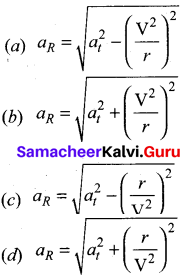
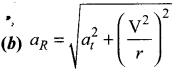
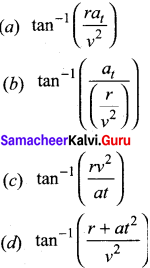
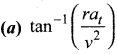
Samacheer Kalvi 11th Physics Solutions Chapter 3 Laws of Motion

For those looking for help on 11th Physics can use the Tamilnadu State Board Solutions for 11th Physics Chapter 3 Laws of Motion prevailing for free of cost.

Download the Samacheer Kalvi 11th Physics Book Solutions Questions and Answers Notes Pdf, for all Chapter Wise through the direct links available and take your preparation to the next level. The Tamilnadu State Board Solutions for 11th Physics Chapter 3 Laws of Motion Questions and Answers covers all the topics and subtopics within it. Practice using these Samacheer Kalvi 11th Physics Book Solutions Questions and Answers for Chapter 3 Laws of Motion PDF and test your preparation level and bridge the knowledge gap accordingly.

Tamilnadu Samacheer Kalvi 11th Physics Solutions Chapter 3 Laws of Motion

If you have any queries take the help of the Tamilnadu State Board Solutions for 11th Physics Chapter 3 Laws of Motion Questions and Answers learn all the topics in it effectively. We have everything covered and you can Practice them often to score better grades in your exam. By going through the Samacheer Kalvi 11th Physics Book Solutions Questions and Answers you can attempt the actual exam with utmost confidence.

Samacheer Kalvi 11th Physics Chapter 3 Laws of Motion Textual Questions Solved

Samacheer Kalvi 11th Physics Laws of Motion Multiple Choice Questions

11th Physics Chapter 3 Book Back Answers Question 1.
When a car takes a sudden left turn in the curved road, passengers are pushed towards the right due to
(a) inertia of direction
(b) inertia of motion
(c) inertia of rest
(d) absence of inertia
Answer:
(a) inertia of direction

Samacheer Kalvi 11th Physics Solution Chapter 3 Question 2.
An object of mass m held against a vertical wall by applying horizontal force F as shown in the figure. The minimum value of the force F is [IIT JEE 1994]
(a) Less than mg
(b) Equal to mg
(c) Greater than mg
(d) Cannot determine
Answer:
(c) Greater than mg

11th Physics Lesson 3 Book Back Answers Question 3.
A vehicle is moving along the positive x direction, if sudden brake is applied, then
(a) frictional force acting on the vehicle is along negative x direction
(b) frictional force acting on the vehicle is along positive x direction
(c) no frictional force acts on the vehicle
(d) frictional force acts in downward direction
Answer:
(a) frictional force acting on the vehicle is along negative x direction

11th Physics 3rd Chapter Book Back Answers Question 4.
A book is at rest on the table which exerts a normal force on the book. If this force is considered as reaction force, what is the action force according to Newton’s third law?
(a) Gravitational force exerted by Earth on the book
(b) Gravitational force exerted by the book on Earth
(c) Normal force exerted by the book on the table
(d) None of the above
Answer:
(c) Normal force exerted by the book on the table

Laws Of Motion Class 11 State Board Question 5.
Two masses m1 and m2 are experiencing the same force where m1 < m2 The ratio of their acceleration \(\frac{a_{1}}{a_{2}}\) is –
(a) 1
(b) less than 1
(c) greater than 1
(d) all the three cases
Answer:
(c) greater than 1

Samacheer Kalvi Guru 11th Physics Question 6.
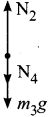
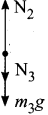
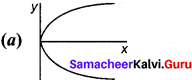
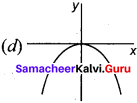
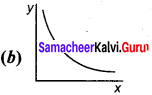
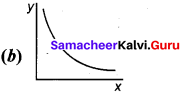
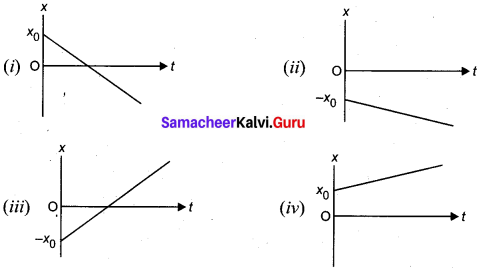
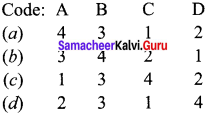
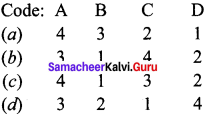
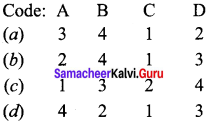
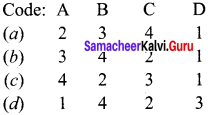
Choose appropriate free body diagram for the particle experiencing net acceleration along negative y direction. (Each arrow mark represents the force acting on the system).

11th Physics Chapter 3 Book Back Answers Samacheer Kalvi Laws Of Motion
Answer:
Samacheer Kalvi 11th Physics Solution Chapter 3 Laws Of Motion

Class 11 Physics Solutions Samacheer Kalvi Question 7.
A particle of mass m sliding on the smooth double inclined plane (shown in figure) will experience –
(a) greater acceleration along the path AB
(b) greater acceleration along the path AC
(c) same acceleration in both the paths
(d) no acceleration in both the paths
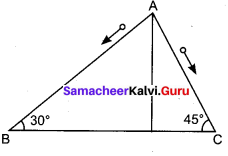
11th Physics Lesson 3 Book Back Answers Samacheer Kalvi Laws Of Motion
Answer:
(a) greater acceleration along the path AC

Samacheer Kalvi 11th Physics Question 8.
Two blocks of masses m and 2m are placed on a smooth horizontal surface as shown. In the first case only a force F1  is applied from the left. Later only a force F2  is applied from the right. If the force acting at the interface of the two blocks in the two cases is same, then F1 : F2 is [Physics Olympiad 2016]
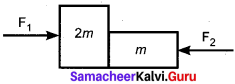
11th Physics 3rd Chapter Book Back Answers Samacheer Kalvi Laws Of Motion
(a) 1 : 1
(b) 1 : 2
(c) 2 : 1
(d) 1 : 3
Answer:
(c) 2 : 1

11th Physics 3rd Lesson Book Back Answers Question 9.
Force acting on the particle moving with constant speed is –
(a) always zero
(b) need not be zero
(c) always non zero
(d) cannot be concluded
Answer:
(b) need not be zero

11th Physics 3rd Chapter Exercise Question 10.
An object of mass m begins to move on the plane inclined at an angle 0. The coefficient of static friction of inclined surface is lay. The maximum static friction experienced by the mass is –
(a) mg
(b) µs mg
(c) µs mg sin θ
(d) µs mg cos θ
Answer:
(d) µs mg cos θ

Class 11 Samacheer Physics Solutions Question 11.
When the object is moving at constant velocity on the rough surface –
(a) net force on the object is zero
(b) no force acts on the object
(c) only external force acts on the object
(d) only kinetic friction acts on the object
Answer:
(a) net force on the object is zero

Samacheer Kalvi 11th Physics Book Back Answers Question 12.
When an object is at rest on the inclined rough surface –
(a) static and kinetic frictions acting on the object is zero
(b) static friction is zero but kinetic friction is not zero
(c) static friction is not zero and kinetic friction is zero
(d) static and kinetic frictions are not zero
Answer:
(c) static friction is not zero and kinetic friction is zero

Class 11 Physics Samacheer Kalvi Question 13.
The centrifugal force appears to exist –
(a) only in inertial frames
(b) only in rotating frames
(c) in any accelerated frame
(d) both in inertial and non-inertial frames
Answer:
(b) only in rotating frames

11th Physics Unit 3 Book Back Answers Question 14.
Choose the correct statement from the following –
(a) Centrifugal and centripetal forces are action reaction pairs
(b) Centripetal forces is a natural force
(c) Centrifugal force arises from gravitational force
(d) Centripetal force acts towards the center and centrifugal force appears to act away from the center in a circular motion
Answer:
(d) Centripetal force acts towards the center and centrifugal force appears to act away from the center in a circular motion

Laws Of Motion Class 11 Numericals With Solutions Pdf Question 15.
If a person moving from pole to equator, the centrifugal force acting on him –
(a) increases
(b) decreases
(c) remains the same
(d) increases and then decreases
Answer:
(a) increases

Samacheer Kalvi 11th Physics Laws of Motion Short Answer Questions

Question 1.
Explain the concept of inertia. Write two examples each for inertia of motion, inertia of rest and inertia of direction.
Answer:
The inability of objects to move on its own or change its state of motion is called inertia. Inertia means resistance to change its state. There are three types of inertia:
1. Inertia of rest:
The inability of an object to change its state of rest is called inertia of rest.
Example:

  • When a stationary bus starts to move, the passengers experience a sudden backward push.
  • A book lying on the table will remain at rest until it is moved by some external agencies.

2. Inertia of motion:
The inability of an object to change its state of uniform speed (constant speed) on its own is called inertia of motion.
Example:

  • When the bus is in motion, and if the brake is applied suddenly, passengers move forward and hit against the front seat.
  • An athlete running is a race will continue to run even after reaching the finishing point.

3. Inertia of direction:
The inability of an object to change its direction of motion on its own is called inertia of direction.
Example:

  • When a stone attached to a string is in whirling motion, and if the string is cut suddenly, the stone will not continue to move in circular motion but moves tangential to the circle.
  • When a bus moving along a straight line takes a turn to the right. The passengers are thrown towards left.

Question 2.
State Newton’s second law.
Answer:
The force acting on an object is equal to the rate of change of its momentum –
\(\overline{\mathrm{F}}\) = \(\frac{d \bar{p}}{d t}\)

Question 3.
Define one newton.
Answer:
One newton is defined as the force which acts on 1 kg of mass to give an acceleration 1 ms-2 in the direction of the force.

Question 4.
Show that impulse is the change of momentum.
Answer:
According to Newton’s Second Law
F = \(\frac {dp}{dt}\) i.e. dp = Fdt
Integrate it over a time interval from ti  to tf
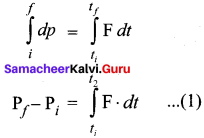
Laws Of Motion Class 11 State Board Samacheer Kalvi Chapter 3 Laws Of Motion
Pi → initial momentum of the object at ti
Pf → Final momentum of the object at tf
Pf – Pi = ∆p = change in momentum during the time interval ∆t.
\(\int_{t_{i}}^{t_{f}} \mathrm{F} \cdot d t=\mathrm{J}\) is called the impulse.
If the force is constant over the time interval ∆t, then
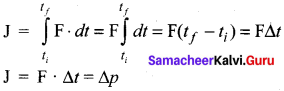
Samacheer Kalvi 11th Physics Solutions Chapter 3 Laws of Motion
Hence the proof.

Question 5.
Using free body diagram, show that it is easy to pull an object than to push it.
Answer:
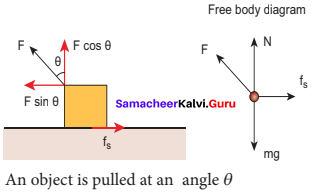
When a body is pushed at an arbitrary angle θ [0 to \(\frac {π}{2}\)], the applied force F can be resolved into two components as F sin 0 parallel to the surface and F cos 0 perpendicular to the surface as shown in figure. The total downward force acting on the body is mg + F cos θ. It implies that the normal force acting on the body increases. Since there is no acceleration along the vertical direction the normal force N is equal to
Npush = mg + F cos θ …………(1)
As a result the maximal static friction also increases and is equal to
\(f_{S}^{\max }\) = \(\mu_{r} \mathrm{N}_{\mathrm{push}}\) = µs(mg + F cos θ) ……(2)
Equation (2) shows that a greater force needs to be applied to push the object into motion.
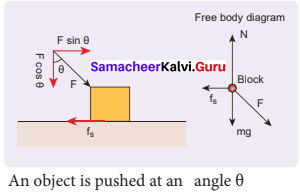
Samacheer Kalvi Guru 11th Physics Solutions Chapter 3 Laws Of Motion

When an object is pulled at an angle θ, the applied force is resolved into two components as shown in figure. The total downward force acting on the object is –
Npull = mg – F cos θ ………….(3)
Class 11 Physics Solutions Samacheer Kalvi Chapter 3 Laws Of Motion

Equation (3) shows that the normal force is less than – Npush. From equations (1) and (3), it is easier to pull an object than to push to make it move.

Question 6.
Explain various types of friction. Suggest a few methods to reduce friction.
Answer:
There are two types of Friction:
(1) Static Friction:
Static friction is the force which opposes the initiation of motion of an object on the surface. The magnitude of static frictional force fs lies between
\(0 \leq f_{s} \leq \mu_{s} \mathrm{N}\)
where, µs – coefficient of static friction
N – Normal force

(2) Kinetic friction:
The frictional force exerted by the surface when an object slides is called as kinetic friction. Also called as sliding friction or dynamic friction,
fk – µkN
where µk – the coefficient of kinetic friction
N – Normal force exerted by the surface on the object

Methods to reduce friction:
Friction can be reduced

  • By using lubricants
  • By using Ball bearings
  • By polishing
  • By streamlining

Question 7.
What is the meaning by ‘pseudo force’?
Answer:
Pseudo force is an apparent force which has no origin. It arises due to the non-inertial nature of the frame considered.

Question 8.
State the empirical laws of static and kinetic friction.
Answer:
The empirical laws of friction are:

  • Friction is independent of surface of contact.
  • Coefficient of kinetic friction is less than coefficient of static friction.
  • The direction of frictional force is always opposite to the motion of one body over the other.
  • Frictional force always acts on the object parallel to the surface on which the objet is placed,
  • The magnitude of frictional force between any two bodies in contact is directly proportional to the normal reaction between them.

Question 9.
State Newton’s third law.
Answer:
Newton’s third law states that for every action there is an equal and opposite reaction.

Question 10.
What are inertial frames?
Answer:
Inertial frame is the one in which if there is no force on the object, the object moves at constant velocity.

Question 11.
Under what condition will a car skid on a leveled circular road?
Answer:
On a leveled circular road, if the static friction is not able to provide enough centripetal ’force to turn, the vehicle will start to skid
\(\mu_{s}<\frac{v^{2}}{r g}\)

Samacheer Kalvi 11th Physics Laws of Motion Long Answer Questions

Question 1.
Prove the law of conservation of linear momentum. Use it to find the recoil velocity of a gun when a bullet is fired from it.
Answer:
In nature, conservation laws play a very important role. The dynamics of motion of bodies can be analysed very effectively using conservation laws. There are three conservation laws in mechanics. Conservation of total energy, conservation of total linear momentum, and conservation of angular momentum. By combining Newton’s second and third laws, we can derive the law of conservation of total linear momentum. When two particles interact with each other, they exert equal and opposite forces on each other.

The particle 1 exerts force \(\overrightarrow{\mathrm{F}}_{12}\) on particle 2 and particle 2 exerts an exactly equal and opposite force \(\overrightarrow{\mathrm{F}}_{12}\) on particle 1 according to Newton’s third law.
\(\overrightarrow{\mathrm{F}}_{12}\) = –\(\overrightarrow{\mathrm{F}}_{12}\) ……..(1)
In terms of momentum of particles, the force on each particle (Newton’s second law) can be written as –
\(\overrightarrow{\mathrm{F}}_{12}\) = \(\frac{d \vec{p}_{1}}{d t}\) and \(\overrightarrow{\mathrm{F}}_{21}\) = \(\frac{d \vec{p}_{2}}{d t}\) ………(2)
Here \(\vec{p}_{1}\) is the momentum of particle 1 which changes due to the force \(\overrightarrow{\mathrm{F}}_{12}\) exerted by particle 2. Further Po is the momentum of particle \(\vec{p}_{2}\) This changes due to \(\overrightarrow{\mathrm{F}}_{21}\) exerted by particle 1.
Substitute equation (2) in equation (1)
\(\frac{d \vec{p}_{1}}{d t}\) = – \(\frac{d \vec{p}_{2}}{d t}\) …………(3)
\(\frac{d \vec{p}_{1}}{d t}\) + \(\frac{d \vec{p}_{2}}{d t}\) = 0 ………(4)
\(\frac {d}{dt}\)(\(\vec{p}_{1}\) + \(\vec{p}_{2}\)) = 0
It implies that \(\vec{p}_{1}\) + \(\vec{p}_{2}\) = constant vector (always).
\(\vec{p}_{1}\) + \(\vec{p}_{2}\) is the total linear momentum of the two particles (\(\vec{p}_{tot}\) = \(\vec{p}_{1}\) + \(\vec{p}_{2}\)).It is also called as total linear momentum of the system. Here, the two particles constitute the system. From this result, the law of conservation of linear momentum can be stated as follows.

If there are no external forces acting on the system, then the total linear momentum of the system (\(\vec{p}_{tot}\)) is always a constant vector. In other words, the total linear momentum of the system is conserved in time. Here the word ‘conserve’ means that \(\vec{p}_{1}\) and \(\vec{p}_{2}\) can vary, in such a way that \(\vec{p}_{1}\) + \(\vec{p}_{2}\) is a constant vector.

The forces \(\overrightarrow{\mathrm{F}}_{12}\) and \(\overrightarrow{\mathrm{F}}_{21}\) are called the internal forces of the system, because they act only between the two particles. There is no external force acting on the two particles from outside. In such a case the total linear momentum of the system is a constant vector or is conserved.

Meaning of law of conservation of momentum:
1. The Law of conservation of linear momentum is a vector law. It implies that both the magnitude and direction of total linear momentum are constant. In some cases, this total momentum can also be zero.

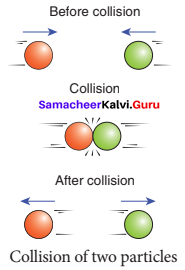
2. To analyse the motion of a particle, we can either use Newton’s second law or the law of conservation of linear momentum. Newton’s second law requires us to specify the forces involved in the process. This is difficult to specify in real situations. But conservation of linear momentum does not require any force involved in the process. It is convenient and hence important.
Samacheer Kalvi 11th Physics Solutions Chapter 3 Laws Of Motion

For example, when two particles collide, the forces exerted by these two particles on each other is difficult to specify. But it is easier to apply conservation of linear momentum during the collision process.

Examples:
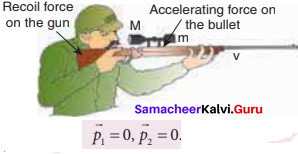
Consider the firing of a gun. Here the system is Gun+bullet. Initially the gun and bullet are at rest, hence the total linear momentum of the system is zero. Let \(\vec{p}_{1}\) be the momentum of the bullet and \(\vec{p}_{2}\) the momentum of the gun before firing. Since initially both are at rest,
11th Physics 3rd Lesson Book Back Answers Laws Of Motion Samacheer Kalvi
Total momentum before firing the gun is zero, \(\vec{p}_{1}\) + \(\vec{p}_{2}\) = 0.
According to the law of conservation of linear momentum, total linear momentum has to be zero after the firing also.

When the gun is fired, a force is exerted by the gun on the bullet in forward direction. Now the momentum of the bullet changes from \(\vec{p}_{1}\) to \(\vec{p}_{1}\) To conserve the total linear momentum of the system, the momentum of the gun must also change from \(\vec{p}_{2}\) to \(\vec{p}_{2}^{\prime}\). Due to the conservation of linear momentum, \(\vec{p}_{1}\) + \(\vec{p}_{2}^{\prime}\) = 0.

It implies that \(\vec{p}_{1}^{\prime}\)= \(\vec{p}_{2}^{\prime}\), the momentum of the gun is exactly equal, but in the opposite direction to the momentum of the bullet. This is the reason after firing, the gun suddenly moves backward with the momentum (-\(\vec{p}_{2}^{\prime}\)). It is called ‘recoil momentum’. Th is is an example of conservation of total linear momentum.
11th Physics 3rd Chapter Exercise Samacheer Kalvi Laws Of Motion

Question 2.
What are concurrent forces? State Lami’s theorem.
Answer:
Concurrent force:
A collection of forces is said to be concurrent, if the lines of forces act at a common point.

Lami’s Theorem:
If a system of three concurrent and coplanar forces is in equilibrium, then Lami’s theorem states that the magnitude of each force of the system is proportional to sine of the angle between the other two forces.
i.e. |\(\overrightarrow{\mathrm{F}}_{1}\)|∝ sin α, |\(\overrightarrow{\mathrm{F}}_{2}\)| ∝ sin β, |\(\overrightarrow{\mathrm{F}}_{2}\)| ∝ sin γ,

Question 3.
Explain the motion of blocks connected by a string in

  1. Vertical motion
  2. Horizontal motion.

Answer:
When objects are connected by strings and When objects are connected by strings and a force F is applied either vertically or horizontally or along an inclined plane, it produces a tension T in the string, which affects the acceleration to an extent. Let us discuss various cases for the same.

Case 1:
Vertical motion:
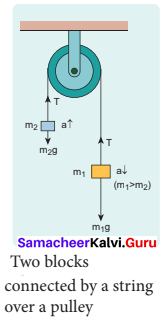
Consider two blocks of masses m1 and m2 (m1> m2) connected by a light and in-extensible string that passes over a pulley as shown in Figure.
Class 11 Samacheer Physics Solutions Chapter 3 Laws Of Motion

Let the tension in the string be T and acceleration a. When the system is released, both the blocks start moving, m2 vertically upward and mk, downward with same acceleration a. The gravitational force m1g on mass m1 is used in lifting the mass m2. The upward direction is chosen as y direction. The free body diagrams of both masses are shown in Figure.
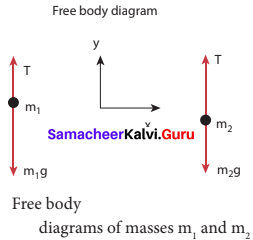
Samacheer Kalvi 11th Physics Book Back Answers Chapter 3 Laws Of Motion

Applying Newton’s second law for mass m2 T \(\hat{j}\) – m2 g \(\hat{j}\) = m2 a \(\hat{j}\) The left hand side of the above equation is the total force that acts on m2 and the right hand side is the product of mass and acceleration of m2 in y direction.
By comparing the components on both sides, we get
T = m2 g = m2 a ……….(1)
Similarly, applying Newton’s second law for mass m2
T \(\hat{j}\) – m1 g\(\hat{j}\) = m1a\(\hat{j}\)
As mass m1 moves downward (-\(\hat{j}\)), its acceleration is along (-\(\hat{j}\))
By comparing the components on both sides, we get
T = m1g = -m1a
m1g – T = m1a ………..(2)
Adding equations (1) and (2), we get
m1g – m2g = m1a + m2a
(m1 – m2)g = (m1 + m2)a …………(3)
From equation (3), the acceleration of both the masses is –
a = (\(\frac{m_{1}-m_{2}}{m_{1}+m_{2}}\))g ………..(4)
If both the masses are equal (m1 = m2), from equation (4)
a = 0
This shows that if the masses are equal, there is no acceleration and the system as a whole will be at rest.
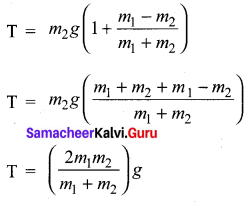
To find the tension acting on the string, substitute the acceleration from the equation (4) into the equation (1).
T = m2g = m2(\(\frac{m_{1}-m_{2}}{m_{1}+m_{2}}\))
T = m2g + m2 (\(\frac{m_{1}-m_{2}}{m_{1}+m_{2}}\))g ……….(5)
By taking m2g common in the RHS of equation (5)
Class 11 Physics Samacheer Kalvi Solutions Chapter 3 Laws Of Motion
Equation (4) gives only magnitude of acceleration.
For mass m1, the acceleration vector is given by \(\vec{a}\) = –\(\frac{m_{1}-m_{2}}{m_{1}+m_{2}}\)\(\hat{j}\)
For mass m2, the acceleration vector is given by \(\vec{a}\) = \(\frac{m_{1}-m_{2}}{m_{1}+m_{2}}\) \(\hat{j}\)

Case 2:
Horizontal motion:
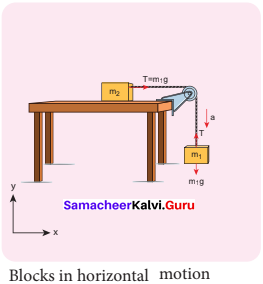
In this case, mass m2 is kept on a horizontal table and mass m1, is hanging through a small pulley as shown in figure. Assume that there is no friction on the surface
11th Physics Unit 3 Book Back Answers Samacheer Kalvi Laws Of Motion
As both the blocks are connected to the un stretchable string, if m1 moves with an acceleration a downward then m2 also moves with the same acceleration a horizontally.
The forces acting on mass m2 are

  • Downward gravitational force (m2g)
  • Upward normal force (N) exerted by the surface
  • Horizontal tension (T) exerted by the string

The forces acting on mass m1 are

  • Downward gravitational force (m1g)
  • Tension (T) acting upwards

The free body diagrams for both the masses is shown in figure.
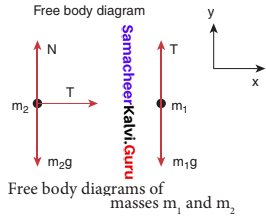
Laws Of Motion Class 11 Numericals With Solutions Pdf Samacheer Kalvi
Applying Newton’s second law for m1
T\(\hat{i}\) – m1g\(\hat{j}\) = -m1a\(\hat{j}\) (alongy direction)
By comparing the components on both sides of the above equation,
T – m1g = -m1a …………(1)
Applying Newton’s second law for m2
Ti = m1ai (along x direction)
By comparing the components on both sides of above equation,
T = m2a ………….(2)
There is no acceleration along y direction for m2.
N\(\hat{j}\) – m2g\(\hat{j}\) = 0
By comparing the components on both sides of the above equation
N – m2g = 0
N = m2g ……….(3)
By substituting equation (2) in equation (1), we can find the tension T
m2a – m1g = -m1a
m2a + m1a = m1g
a = \(\frac{m_{1}}{m_{1}+m_{2}}\)g …………(4)
Tension in the string can be obtained by substituting equation (4) in equation (2)
T = \(\frac{m_{1} m_{2}}{m_{1}+m_{2}}\)g ………..(5)

Comparing motion in both cases, it is clear that the tension in the string for horizontal motion is half of the tension for vertical motion for same set of masses and strings. This result has an important application in industries. The ropes used in conveyor belts (horizontal motion) work for longer duration than those of cranes and lifts (vertical motion).

Question 4.
Briefly explain the origin of friction. Show that in an inclined plane, angle of friction is pqual to angle of repose.
Answer:
If a very gentle force in the horizontal direction is given to an object at rest on the table it does not move. It is because of the opposing force exerted by the surface on the object which resists its motion. This force is called the frictional force. During the time of Newton and Galileo, frictional force was considered as one of the natural forces like gravitational force. But in the twentieth century, the understanding on atoms, electron and protons has changed the perspective.

The frictional force is actually the electromagnetic force between the atoms on the two surfaces. Even well polished surfaces have irregularities on the surface at the microscopic level. The component of force parallel to the inclined plane (mg sin θ) tries to move the object down. The component of force perpendicular to the inclined plane (mg cos θ) is balanced by the Normal force (N).
N = mg cos θ ………(1)

When the object just begins to move, the static friction attains its maximum value
fs = \(f_{s}^{\max }\) = µs N
This friction also satisfies the relation
\(f_{s}^{\max }\) = µs mg sin θ ……….(2)
Equating the right hand side of equations (1) and (2),
(\(f_{s}^{\max }\))/N = sin θ / cos θ
From the definition of angle of friction, we also know that
tan θ = µs ………..(3)
in which θ is the angle of friction.
Thus the angle of repose is the same as angle of friction. But the difference is that the angle of repose refers to inclined surfaces and the angle of friction is applicable to any type of surface.

Question 5.
State Newton’s three laws and discuss their significance.
Answer:
First Law:
Every object continues to be in the state of rest or of uniform motion (constant velocity) unless there is external force acting on it.

Second Law:
The force acting on an object is equal to the rate of change of its momentum

Third Law:
For every action there is an equal and opposite reaction.

Significance of Newton’s Laws:
1. Newton’s laws are vector laws. The equation \(\overline{\mathrm{F}}\) = m\(\overline{\mathrm{a}}\) is a vector equation and essentially it is equal to three scalar equations. In Cartesian coordinates, this equation can be written as Fx\(\hat{i}\) + Fy\(\hat{j}\) + Fz\(\hat{j}\) = max\(\hat{i}\) + may\(\hat{j}\) + maz\(\hat{j}\)
By comparing both sides, the three scalar equations are

Fx = max The acceleration along the x-direction depends only on the component of force acting along the x – direction.
Fy = may The acceleration along the y direction depends only on the component of force acting along the y – direction.
Fz = maz The acceleration along the z direction depends only on the component of force acting along the z – direction.
From the above equations, we can infer that the force acting along y direction cannot alter the acceleration along x direction. In the same way, Fz cannot affect ay and ax. This understanding is essential for solving problems.

2. The acceleration experienced by the body at time t depends on the force which acts on the body at that instant of time. It does not depend on the force which acted on the body before the time t. This can be expressed as
\(\overline{\mathrm{F}}\)(t) = m\(\overline{\mathrm{a}}\)(t)
Acceleration of the object does not depend on the previous history of the force. For example, when a spin bowler or a fast bowler throws the ball to the batsman, once the ball leaves the hand of the bowler, it experiences only gravitational force and air frictional force. The acceleration of the ball is independent of how the ball was bowled (with a lower or a higher speed).

3. In general, the direction of a force may be different from the direction of motion. Though in some cases, the object may move in the same direction as the direction of the force, it is not always true. A few examples are given below.

Case 1:
Force and motion in the same direction:
When an apple falls towards the Earth, the direction of motion (direction of velocity) of the apple and that of force are in the same downward direction as shown in the Figure.
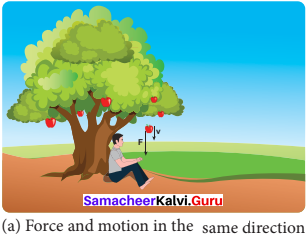
Samacheer Kalvi 11th Physics Solutions Chapter 3 Laws of Motion

Case 2:
Force and motion not in the same direction:
The Moon experiences a force towards the Earth. But it actually moves in elliptical orbit. In this case, the direction of the force is different from the direction of motion as shown in Figure.
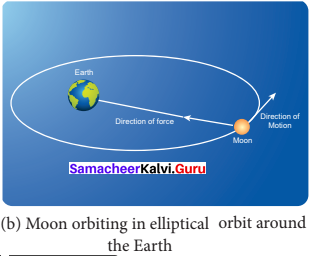
Samacheer Kalvi 11th Physics Solutions Chapter 3 Laws of Motion

Case 3:
Force and motion in opposite direction:
If an object is thrown vertically upward, the direction of motion is upward, but gravitational force is downward as shown in the Figure.
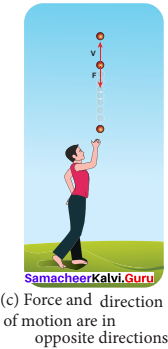
Samacheer Kalvi 11th Physics Solutions Chapter 3 Laws of Motion

Case 4:
Zero net force, but there is motion:
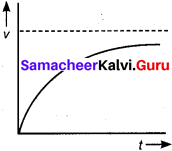
When a raindrop gets detached from the cloud it experiences both downward gravitational force and upward air drag force. As it descends towards the Earth, the upward air drag force increases and after a certain time, the upward air drag force cancels the downward gravity. From then on the raindrop moves at constant velocity till it touches the surface of the Earth. Hence the raindrop comes with zero net force, therefore with zero acceleration but with non-zero terminal velocity. It is shown in the Figure
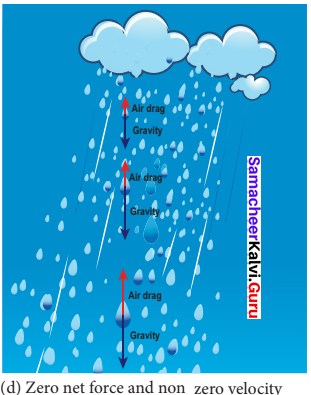
Samacheer Kalvi 11th Physics Solutions Chapter 3 Laws of Motion

4. If multiple forces \(\overrightarrow{\mathrm{F}}_{1}\), \(\overrightarrow{\mathrm{F}}_{2}\), \(\overrightarrow{\mathrm{F}}_{3}\),……. \(\overrightarrow{\mathrm{F}}_{n}\) act on the same body, then the total force (\(\overrightarrow{\mathrm{F}}_{net}\)) is equivalent to the vectorial sum of the individual forces. Their net force provides the acceleration.
\(\overrightarrow{\mathrm{F}}_{net}\) = \(\overrightarrow{\mathrm{F}}_{1}\) + \(\overrightarrow{\mathrm{F}}_{2}\) + \(\overrightarrow{\mathrm{F}}_{3}\) + ……… + \(\overrightarrow{\mathrm{F}}_{n}\)
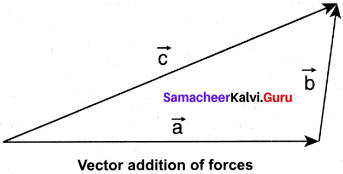
Samacheer Kalvi 11th Physics Solutions Chapter 3 Laws of Motion
Newton’s second law for this case is –
\(\overrightarrow{\mathrm{F}}_{net}\) = m\(\overline{\mathrm{a}}\)
In this case the direction of acceleration is in the direction of net force.
Example:
Bow and arrow
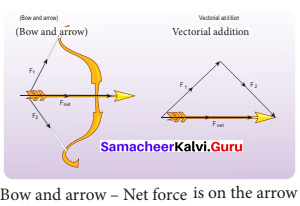
Samacheer Kalvi 11th Physics Solutions Chapter 3 Laws of Motion

5. Newton’s second law can also be written in the following form.
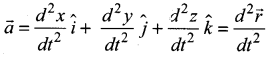
Since the acceleration is the second derivative of position vector of the body \(\left(\vec{a}=\frac{d^{2} \vec{r}}{d t^{2}}\right)\)
the force on the body is –
\(\overline{\mathrm{F}}\) = m\(\frac{d^{2} \vec{r}}{d t^{2}}\)
From this expression, we can infer that Newton’s second law is basically a second order ordinary differential equation and whenever the second derivative of position vector is not zero, there must be a force acting on the body.

6. If no force acts on the body then Newton’s second law, m = \(\frac{d \vec{v}}{d t}\) = 0
It implies that \(\overline{\mathrm{v}}\) = constant. It is essentially Newton’s first law. It implies that the second law is consistent with the first law. However, it should not be thought of as the reduction of second law to the first when no force acts on the object. Newton’s first and second laws are independent laws. They can internally be consistent with each other but cannot be derived from each other.

7. Newton’s second law is cause and effect relation. Force is the cause and acceleration is the effect. Conventionally, the effect should be written on the left and cause on the right hand side of the equation. So the correct way of writing Newton’s second law is –
m\(\overline{\mathrm{a}}\) = \(\overline{\mathrm{F}}\) or \(\frac{d \vec{p}}{d t}\) = \(\overline{\mathrm{F}}\)

Question 6.
Explain the similarities and differences of centripetal and centrifugal forces.
Answer:
Salient features of centripetal and centrifugal forces.
Centripetal Force:

  • It is a real force which is exerted on the body by the external agencies like gravitational force, tension in the string, normal force etc.
  • Acts in both inertial and non-inertial frames
  • It acts towards the axis of rotation or center of the circle in circular motion
    \(\left|\overrightarrow{\mathrm{F}}_{\mathrm{C}_{\mathrm{P}}}\right|\) = mω2r = \(\frac{m v^{2}}{r}\)
  • Real force and has real effects
  • Origin of centripetal force is interaction between two objects.
  • In inertial frames centripetal force has to be included when free body diagrams are drawn.

Centrifugal Force:

  • It is a pseudo force or fictitious force which cannot arise from gravitational force, tension force, normal force etc.
  • Acts only in rotating frames (non-inertial frame)
  • It acts outwards from the axis of rotation or radially outwards from the center of the circular motion
    \(\left|\overrightarrow{\mathrm{I}}_{\mathrm{C}_{\mathrm{f}}}\right|\) = mω2r = \(\frac{m v^{2}}{r}\)
  • Pseudo force but has real effects
  • Origin of centrifugal force is inertia. It does not arise from interaction. In an inertial frame the object’s inertial motion appears as centrifugal force in the rotating frame.
  • In inertial frames there is no centrifugal force. In rotating frames, both centripetal and centrifugal force have to be included when free body diagrams are drawn.

Question 7.
Briefly explain ‘centrifugal force’ with suitable examples.
Answer:
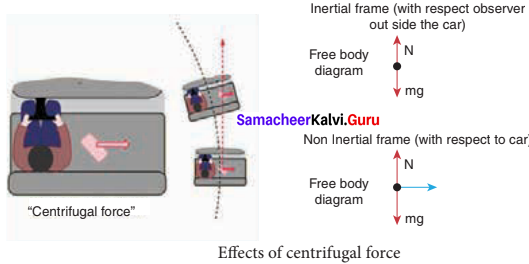
To use Newton’s first and second laws in the rotational frame of reference, we need to include a Pseudo force called centrifugal force. This centrifugal force appears to act on the object with respect to rotating frames.

Circular motion can be analysed from two different frames of reference. One is the inertial frame (which is either at rest or in uniform motion) where Newton’s laws are obeyed. The other is the rotating frame of reference which is a non – inertial frame of reference as it is accelerating.

When we examine the circular motion from these frames of reference the situations are entirely different. To use Newton’s first and second laws in the rotational frame of reference, we need to include a pseudo force called ‘centrifugal force’. This ‘centrifugal force’ appears to act on the object with respect to rotating frames. To understand the concept of centrifugal force, we can take a specific case and discuss as done below.
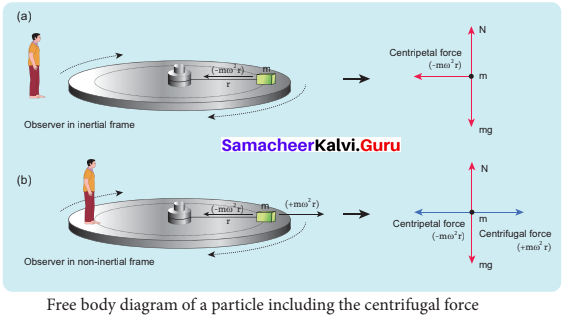
Samacheer Kalvi 11th Physics Solutions Chapter 3 Laws of Motion

Free body diagram of a particle including the centrifugal force Consider the case of a whirling motion of a stone tied to a string. Assume that the stone has angular velocity ω in the inertial frame (at rest). If the motion of the stone is observed from a frame which is also rotating along with the stone with same angular velocity ω then, the stone appears to be at rest.

This implies that in addition to the inward centripetal force – mω2r there must be an equal and opposite force that acts on the stone outward with value +mω2r . So the total force acting on the stone in a rotating frame is equal to zero (-mω2r + mω2 r = 0). This outward force +mω2r is called the centrifugal force. The word ‘centrifugal’ means ‘flee from center’.

Note that the ‘centrifugal force’ appears to act on the particle, only when we analyse the motion from a rotating frame. With respect to an inertial frame there is only centripetal force which is given by the tension in the rstring. For this reason centrifugal force is called as a ‘pseudo force’. A pseudo force has no origin. It arises due to the non inertial nature of the frame considered. When circular motion problems are solved from a rotating frame of reference, while drawing free body diagram of a particle, the centrifugal force should necessarily be included as shown in the figure.

Question 8.
Briefly explain ‘rolling friction’.
Answer:
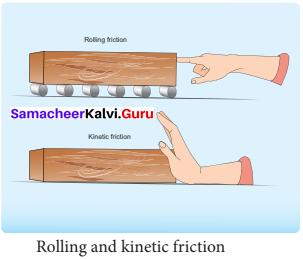
The invention of the wheel plays a crucial role in human civilization. One of the important applications is suitcases with rolling on coasters. Rolling wheels makes it easier than carrying luggage. When an object moves on a surface, essentially it is sliding on it. But wheels move on the surface through rolling motion. In rolling motion when a wheel moves on a surface, the point of contact with surface is always at rest. Since Rolling and kinetic friction the point of contact is at rest, there is no relative motion between the wheel and surface.
Samacheer Kalvi 11th Physics Solutions Chapter 3 Laws of Motion

Hence the frictional fore is very less. At the same time if an object moves without a wheel, there is a relative motion between the object and the surface. As a result frictional force is larger. This makes it difficult to move the object. The figure shows the difference between rolling and kinetic friction. Ideally in pure rolling, motion of the point of contact with the surface should be at rest, but in practice it is not so.

Due to the elastic nature of the surface at the point of contact there will be some deformation on the object at this point on the wheel or surface as shown in figure. Due to this deformation, there will be minimal friction between wheel and surface. It is called ‘rolling friction. In fact, rolling friction’ is much smaller than kinetic friction.

Question 9.
Describe the method of measuring angle of repose.
Answer:
When objects are connected by strings and When objects are connected by strings and a force F is applied either vertically or horizontally or along an inclined plane, it produces a tension T in the string, which affects the acceleration to an extent. Let us discuss various cases for the same.
Samacheer Kalvi 11th Physics Solutions Chapter 3 Laws of Motion

Case 1:
Vertical motion:
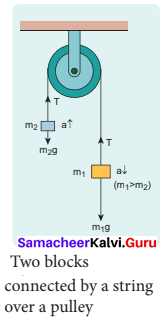
Consider two blocks of masses m1 and m2 (m1> m2) connected by a light and in extensible string that passes over a pulley as shown in Figure.

Let the tension in the string be T and acceleration a. When the system is released, both the blocks start moving, m2 vertically upward and mk, downward with same acceleration a. The gravitational force m1g on mass m1 is used in lifting the mass m2. The upward direction is chosen as y direction. The free body diagrams of both masses are shown in Figure.
Samacheer Kalvi 11th Physics Solutions Chapter 3 Laws of Motion

Applying Newton’s second law for mass m2
T \(\hat{j}\) – m2g\(\hat{j}\) = m2a\(\hat{j}\) The left hand side of the above equation is the total force that acts on m2 and the right hand side is the product of mass and acceleration of m2 in y direction.
By comparing the components on both sides, we get
T = m2g = m2a ……….(1)

Similarly, applying Newton’s second law for mass m2
T \(\hat{j}\) – m1g\(\hat{j}\) = m1a\(\hat{j}\)
As mass mj moves downward (-\(\hat{j}\)), its acceleration is along (-\(\hat{j}\))
By comparing the components on both sides, we get
T = m1g = -m1a
m1g – T = m1a ………..(2)

Adding equations (1) and (2), we get
m1g – m2g = m1a + m2a
(m1 – m2)g = (m1 + m2)a …………(3)
From equation (3), the acceleration of both the masses is –
a = (\(\frac{m_{1}-m_{2}}{m_{1}+m_{2}}\))g ………..(4)
If both the masses are equal (m1 = m2), from equation (4)
a = 0
This shows that if the masses are equal, there is no acceleration and the system as a whole will be at rest.
To find the tension acting on the string, substitute the acceleration from the equation (4) into the equation (1).
T = m2g = m2(\(\frac{m_{1}-m_{2}}{m_{1}+m_{2}}\))
T = m2g + m2 (\(\frac{m_{1}-m_{2}}{m_{1}+m_{2}}\))g ……….(5)
By taking m2g common in the RHS of equation (5)
Samacheer Kalvi 11th Physics Solutions Chapter 3 Laws of Motion
Equation (4) gives only magnitude of acceleration
For mass m1, the acceleration vector is given by \(\vec{a}\) = –\(\frac{m_{1}-m_{2}}{m_{1}+m_{2}}\)\(\hat{j}\)
For mass m2, the acceleration vector is given by \(\vec{a}\) = \(\frac{m_{1}-m_{2}}{m_{1}+m_{2}}\) \(\hat{j}\)

Case 2:
Horizontal motion:
In this case, mass m2 is kept on a horizontal table and mass m1, is hanging through a small pulley as shown in figure. Assume that there is no friction on the surface
Samacheer Kalvi 11th Physics Solutions Chapter 3 Laws of Motion
As both the blocks are connected to the un stretchable string, if m1 moves with an acceleration a downward then m2 also moves with the same acceleration a horizontally.
The forces acting on mass m2 are

  1. Downward gravitational force (m2g)
  2. Upward normal force (N) exerted by the surface
  3. Horizontal tension (T) exerted by the string

The forces acting on mass m1 are

  1. Downward gravitational force (m1g)
  2. Tension (T) acting upwards

The free body diagrams for both the masses is shown in figure 2.
Samacheer Kalvi 11th Physics Solutions Chapter 3 Laws of Motion
Applying Newton’s second law for m1
T\(\hat{i}\) – m1g\(\hat{j}\) = -m1a\(\hat{j}\) (alongy direction)
By comparing the components on both sides of the above equation,
T – m1g = -m1a …………(1)
Applying Newton’s second law for m2
T\(\hat{i}\) = m1a\(\hat{i}\) (along x direction)
By comparing the components on both sides of above equation,
T = m2a ………….(2)
There is no acceleration along y direction for m2.
N\(\hat{j}\) – m2g\(\hat{j}\) = 0
By comparing the components on both sides of the above equation
N – m2g = 0
N = m2g ……….(3)
By substituting equation (2) in equation (1), we can find the tension T
m2a – m1g = -m1a
m2a + m1a = m1g
a = \(\frac{m_{1}}{m_{1}+m_{2}}\)g …………(4)
Tension in the string can be obtained by substituting equation (4) in equation (2)
T = \(\frac{m_{1} m_{2}}{m_{1}+m_{2}}\)g ………..(5)

Comparing motion in both cases, it is clear that the tension in the string for horizontal motion is half of the tension for vertical motion for same set of masses and strings. This result has an important application in industries. The ropes used in conveyor belts (horizontal motion) work for longer duration than those of cranes and lifts (vertical motion).

Question 10.
Explain the need for banking of tracks.
Answer:
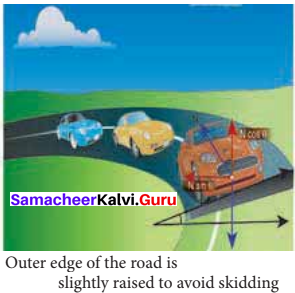
In a leveled circular road, skidding mainly depends on the coefficient of static friction py. The coefficient of static friction depends on the nature of the surface which has a maximum limiting value. To avoid this problem, usually the outer edge of the road is slightly raised compared to inner edge. This is called banking of roads or tracks. This introduces an inclination, and the angle is called banking angle. “Let the surface of the road make angle 9 with horizontal surface. Then the normal force makes the same angle 9 with the vertical. When the car takes a turn.Samacheer Kalvi 11th Physics Solutions Chapter 3 Laws of Motion

there are two forces acting on the car:
(a) Gravitational force mg (downwards)
(b) Normal force N (perpendicular to surface)
We can resolve the normal force into two components N cos θ and N sin θ. The component balances the downward gravitational force ‘mg’ and component will provide the necessary centripetal acceleration. By using Newton second law.
Samacheer Kalvi 11th Physics Solutions Chapter 3 Laws of Motion

The banking angle 0 and radius of curvature of the road or track determines the safe speed of the car at the turning. If the speed of car exceeds this safe speed, then it starts to skid outward but frictional force comes into effect and provides an additional centripetal force to prevent the outward skidding.

At the same time, if the speed of the car is little lesser than safe speed, it starts to skid inward and frictional force comes into effect, which reduces centripetal force to prevent inward skidding. However if the speed of the vehicle is sufficiently greater than the correct speed, then frictional force cannot stop the car from skidding.

Question 11.
Calculate the centripetal acceleration of Moon towards the Earth.
Answer:
The centripetal acceleration is given by a = \(\frac{v^{2}}{r}\) This expression explicitly depends on Moon’s speed which is nontrivial. We can work with the formula
ω2Rm = am
am is centripetal acceleration of the Moon due to Earth’s gravity, ω is angular velocity
Rm is the distance between Earth and the Moon, which is 60 times the radius of the Earth.
Rm = 60R = 60 x 6.4 x 106 = 384 x 106 m
As we know the angular velocity ω = \(\frac { 2π}{ T }\) and T = 27.3 days = 27.3 x 24 x 60 x 60 second = 2.358 x 10⁶ sec.
By substituting these values in the formula for acceleration
a6 = \(\frac{\left(4 \pi^{2}\right)\left(384 \times 10^{6}\right)}{\left(2.358 \times 10^{8}\right)^{2}}\) = 0.00272 ms-2

Samacheer Kalvi 11th Physics Laws of Motion Conceptual Questions

Question 1.
Why it is not possible to push a car from inside?
Answer:
While trying to push a car from outside, he pushes the ground backwards at an angle. The ground offers an equal reaction in the opposite direction, so car can be moved. But the person sits inside means car and the person becomes a single system, and the force given will be a internal force. According to Newton’s third law, total internal force acting on the system is zero and it cannot accelerate the system.

Question 2.
There is a limit beyond which the polishing of a surface increases frictional resistance rather than decreasing it why?
Answer:
Friction is a contact force. Friction is directly proportional to area of contact. In the normal surfaces there are bumps to interlock the surfaces in contact. But the surfaces are polished beyond certain limit. The area of contact will be increased and the molecules come closer to each other. It increases electrostatic force between the molecules. As a result it increases friction.

Question 3.
Can a single isolated force exist in nature? Explain your answer.
Answer:
No. According to Newton’s third law, for every action, there is an equal and opposite reaction. So, whatever case we consider, if there is an action there is always a reaction. So it is impossible.

Question 4.
Why does a parachute descend slowly?
Answer:
A parachute descends slowly because the surface area of parachute is large so that air gives more resistance when it descends down.

Question 5.
When walking on ice one should take short steps. Why?
Answer:
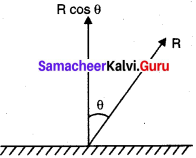
Let R represent the reaction offered by the ground. The vertical component R cos θ will balance the weight of the person and the horizontal component R sin θ will help the person to walk forward.
Now, normal reaction = R cos θ
Friction force = R sin θ
Coefficient of friction, µ = \(\frac {R sin θ}{R cos θ }\) = tan θ
In a long step, θ is more. So tan θ is more. But p has a fixed value. So, there is danger of slipping in a long step.
Samacheer Kalvi 11th Physics Solutions Chapter 3 Laws of Motion

Question 6.
When a person walks on a surface, the frictional force exerted by the surface on the person is opposite to the direction of motion. True or false?
Answer:
False. In frictional force exerted by the surface on the person is in the direction of his motion. Frictional force acts as an external force to move the person. When the person trying to move, he gives a push to ground on the backward direction and by Newton’s third law he is pushed by the ground in the forward direction. Hence frictional force acts along the direction of motion.

Question 7.
Can the coefficient of friction be more than one?
Answer:
Yes. The coefficient of friction can be more than one in some cases such as silicone rubber. Coefficient of friction is the ratio of frictional force to normal force, i.e. F = μR. If p is greater than one means frictional force is greater than normal force. But in general case the value is usually between 0 and 1.

Question 8.
Can we predict the direction of motion of a body from the direction of force on it?
Answer:
Yes. The direction of motion is always opposite to the force of kinetic friction. By using the principle of equilibrium, the direction of force of static friction can be determined. When the object is in equilibrium, the frictional force must point in the direction which results as a net force is zero.

Question 9.
The momentum of a system of particles is always conserved. True or false?
Answer:
True. The total momentum of a system of particles is always constant i.e. conserved. When no external force acts on it.

Samacheer Kalvi 11th Physics Laws of Motion Numerical Problems

Question 1.
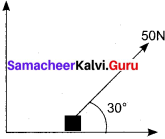
A force of 50 N act on the object of mass 20 kg. shown in the figure. Calculate the acceleration of the object in x and y directions.
Answer:
Given F = 50 N and m = 20 kg
(1) component of force along x – direction
Fx = F cos θ
= 50 x cos 30° = 43.30 N
ax = \(\frac{F_{x}}{m}\) = \(\frac {43.30}{20}\) =2.165 ms-2

(2) Component of force along y – direction
Fy = F sin θ = 50 sin 30° = 25 N
ay = \(\frac{F_{y}}{m}\) = \(\frac {25}{20}\) = 1.25 ms-2
Samacheer Kalvi 11th Physics Solutions Chapter 3 Laws of Motion

Question 2.
A spider of mass 50 g is hanging on a string of a cob web as shown in the figure. What is the tension in the string?
Answer:
Given m = 50 g, T = ?
Tension in the string T = mg
= 50 x 10-2 x 9.8 = 0.49 N

Question 3.
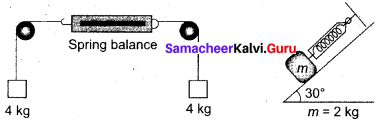
What is the reading shown in spring balance?
Samacheer Kalvi 11th Physics Solutions Chapter 3 Laws of Motion
Answer:
When a spring balance hung on a rigid support and load is attached at its other end, the weight of the load exerts a force on the rigid support in turn support exerts equal and opposite force on that load, so that balance will be stretched. This is the principle of spring balance. Flence the answer is 4 kg.
Given: m = 2 kg, 0 = 30°.
Resolve the weight into its component as mg sin θ and mg cos θ.
Here mg sin θ acts parallel to the surface
∴ W = mg sin θ
= 2 x 9.8 x sin 30° = 2 x 9.8 x \(\frac {1}{2}\) = 9.8 N

Question 4.
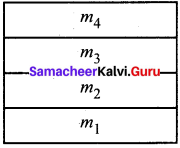
The physics books are stacked on each other in the sequence: +1 volumes 1 and 2; +2 volumes 1 and 2 on a table
(a) Identify the forces acting on each book and draw the free body diagram.
(b) Identify the forces exerted by each book on the other.
Answer:
Let m1, m2, m3, m4, are the masses of +1 volume I and II and +2 volumes I & II
Samacheer Kalvi 11th Physics Solutions Chapter 3 Laws of Motion

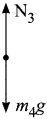
(a) Force on book m4

  • Downward gravitational force acting downward (m3g)
  • Upward normal force (N3) exerted by book of mass m3
    Samacheer Kalvi 11th Physics Solutions Chapter 3 Laws of Motion |

(b) Force on book m3

  • Downward gravitational force (m3g)
  • Downward force exerted by m4 (N4)
  • Upward force exerted by m2 (N2)
    Samacheer Kalvi 11th Physics Solutions Chapter 3 Laws of Motion

(c) Force on book m2

  • Downward gravitational force (m2g)
  • Downward force exerted by m3 (N3)
  • Upward force exerted by m1 (CN1)
    Samacheer Kalvi 11th Physics Solutions Chapter 3 Laws of Motion

(d) Force on book m1

  • Downward gravitational force exerted by earth (m1g)
  • Downward force exerted by m2 (N2)
  • Upward force exerted by the table (Ntable)
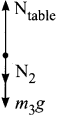
    Samacheer Kalvi 11th Physics Solutions Chapter 3 Laws of Motion

Question 5.
A bob attached to the string oscillates back and forth. Resolve the forces acting on the bob in to components. What is the acceleration experienced by the bob at an angle θ.
Answer:
The gravitational force (mg) acting downward can be resolved into two components as mg cos θ and mg sin θ
T – tension exerted by the string.
Tangential force FT = maT = mg sin θ
∴ Tangential acceleration aT = g sin θ
Centripetal force Fc = mac = T – mg cos θ
ac = \(\frac { T – mg cos θ }{ m }\)
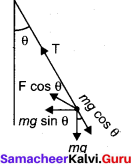
Samacheer Kalvi 11th Physics Solutions Chapter 3 Laws of Motion

Question 6.
Two masses m1 and m2 are connected with a string passing over a friction-less pulley fixed at the comer of the table as shown in the figure. The coefficient of static friction of mass m1 with the table is µs Calculate the minimum mass m3 that may be placed on m1to prevent it from sliding. Check if m1 = 15 kg, m2 = 10 kg, m3 = 25 and µs = 0.2.
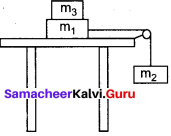
Samacheer Kalvi 11th Physics Solutions Chapter 3 Laws of Motion
Solution:
Let m3 is the mass added on m1
Maximal static friction
\(f_{s}^{\max }\) = µsN = µs (m1 + m3 )g
Here
N = (m1 + m3 )g
Tension acting on string = T = m2 g
Equate (1) and (2)
µs(m1 + m3) = m2g
µsm1 + µsm3 = m2
m3 = \(f_{s}^{\max }\) – m1

(ii) Given,
m1 = 15 kg, m2 = 10 kg : m3 = 25 kg and µs = 0.2
m3 = \(f_{s}^{\max }\) – m1
m3 = \(\frac {10}{ 0.2 }\) – 15 = 50 – 15 = 35 kg
The minimum mass m3 = 35 kg has to be placed on ml to prevent it from sliding. But here m3 = 25 kg only.
The combined masses (m1 + m3) will slide.

Question 7.
Calculate the acceleration of the bicycle of mass 25 kg as shown in Figures 1 and 2.
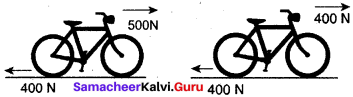
Samacheer Kalvi 11th Physics Solutions Chapter 3 Laws of Motion
Answer:
Given:
Mass of bicycle m = 25 kg
Fig. I:
Net force acting in the forward direction, F = 500 – 400 = 100 N
acceleration a = \(\frac { F}{ m }\) = \(\frac { 100 }{25}\) = 4 ms-2

Fig. II:
Net force acting on bicycle F = 400 – 400 = 0
∴ acceleration a = \(\frac { F}{ m }\) = \(\frac { 0}{25}\) = 0

Question 8.
Apply Lami’s theorem on sling shot and calculate the tension in each string?
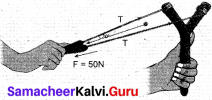
Samacheer Kalvi 11th Physics Solutions Chapter 3 Laws of Motion
Answer:
Given F = 50 N, θ = 30°
Here T is resolved into its components as T sin θ and T cos θ as shown.
According to Lami’s theorem,
\(\frac { F}{sin θ}\) = \(\frac { T}{sin (180 – θ)}\) = \(\frac { T}{sin (180 – θ)}\)
\(\frac { F}{sin θ}\) = \(\frac { T}{sin θ}\)
\(\frac { F}{2 sin θ cos θ}\) = \(\frac { T}{sin θ}\) [T = \(\frac { T}{2 cos θ}\) ]
T = \(\frac {T}{2 cos θ}\) = \(\frac { 50}{ 2 cos 30}\) = 28.868 N

Question 9.
A football player kicks a 0.8 kg ball and imparts it a velocity 12 ms-1. The contact between the foot and ball is only for one – sixtieth of a second. Find the average kicking force.
Answer:
Given,
Mass of the ball = 0.8 kg
Final velocity (V) =12 ms-1 and time t =\(\frac {1}{60}\) s
Initial velocity = 0
We know the average kicking force
F = ma = \(\frac {m(v – u)}{t}\) = \(\frac{0.8(12-0)}{\left(\frac{1}{60}\right)}\)
F = 576 N

Question 10.
A stone of mass 2 kg is attached to a string of length 1 meter. The string can withstand maximum tension 200 N. What is the maximum speed that stone can have during the whirling motion?
Solution:
Given,
Mass of a stone = 2 kg,
length of a string = 1 m
Maximum tension = 200 N
The force acting on a stone in the whirling motion is centripetal force. Which is provided by tension of the string.
Tmax = Fmax = \(\frac{m \mathrm{V}_{\mathrm{max}}^{2}}{r}\)
200 = \(v_{\max }^{2}\) = 100
\(v_{\max }^{2}\) = 10 ms-1

Question 11.
Imagine that the gravitational force between Earth and Moon is provided by an invisible string that exists between the Moon and Earth. What is the tension that exists in this invisible string due’ to Earth’s centripetal force? (Mass of the Moon = 7.34 x 10²² kg, Distance between Moon and Earth = 3.84 x 10⁸ m).
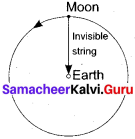
Samacheer Kalvi 11th Physics Solutions Chapter 3 Laws of Motion
Solution:
Given,
Mass of the moon = 7.34 x 10²² kg
Distance between moon and earth = 3.84 x 10⁸ m
Centripetal force = F = \(\frac{m \mathrm{V}^{2}}{r}\) = \(\frac{7.34 \times 10^{22} \times\left(1.023 \times 10^{3}\right)^{2}}{3.84 \times 10^{8}}\) = 2 x 10²⁰

Question 12.
Two bodies of masses 15 kg and 10 kg are connected with light string kept on a smooth surface. A horizontal force F = 500 N is applied to a 15 kg as shown in the figure. Calculate the tension acting in the string.
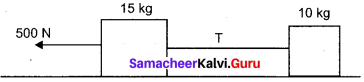
Samacheer Kalvi 11th Physics Solutions Chapter 3 Laws of Motion
Answer:
Given,
m1  = 15 kg, m2  = 10 kg, F = 500 N
Tension acting in the string T = \(\frac{m_{2}}{m_{1}+m_{2}}\) F
T = \(\frac {10}{25}\) x 500 = 200 N

Question 13.
People often say “For every action there is an equivalent opposite reaction”. Here they meant ‘action of a human’. Is it correct to apply Newton’s third law to human actions? What is meant by ‘action’ in Newton third law? Give your arguments based on Newton’s laws.
Answer:
Newton’s third law is applicable to only human’s physical actions which involves physical force. Third law is not applicable to human’s psychological actions or thoughts.

Question 14.
A car takes a turn with velocity 50 ms-1 on the circular road of radius of curvature To m. Calculate the centrifugal force experienced by a person of mass 60 kg inside the car?
Answer:
Given,
Mass of a person = 60 kg
Velocity of the car = 50 ms-1
Radius of curvature = 10 m
Centrifugal force F = \(\frac{m \mathrm{V}^{2}}{r}\) = \(\frac{60 \times(50)^{2}}{10}\) = 15,000 N

Question 15.
A long stick rests on the surface. A person standing 10 m away from the stick. With what minimum speed an object of mass 0.5 kg should he thrown so that it hits the stick. (Assume the coefficient of kinetic friction is 0.7).
Answer:
Given,
Distance (s) = 10 m
Mass of the object (m) = 0.5 kg
Coefficient of kinetic friction (µ) = 0.7
Work done in moving a body in horizontal surface ω = µR x s = µmg x s
This work done is equal to initial kinetic energy of the object
\(\frac{1}{2} m v^{2}\) = µ mg s
\(\left|v^{2}\right|\) = 2 µgs = 2 x 0.7 x 9.8 x 10
v2 = 14 x 9.8 = 137. 2
v = 11. 71 ms-1

Samacheer Kalvi 11th Physics Laws of Motion Additional Questions Solved

Samacheer Kalvi 11th Physics Laws of Motion Multiple Choice Questions

Question 1.
The concept “force causes motion” was given by –
(a) Galileo
(b) Aristotle
(c) Newton
(d) Joule
Answer:
(b) Aristotle

Question 2.
Who decoupled the motion and force?
(a) Galileo
(b) Aristotle
(c) Newton
(d) Joule
Answer:
(a) Galileo

Question 3.
The inability of objects to move on its own or change its state of motion is called as –
(a) force
(b) momentum
(c) inertia
(d) impulse
Answer:
(c) inertia

Question 4.
Inertia means –
(a) inability
(b) resistance to change its state
(c) movement
(d) inertial frame
Answer:
(b) resistance to change its state

Question 5.
When a bus starts to move from rest, the passengers experience a sudden backward push is an example for –
(a) Inertia of motion
(b) Inertia of direction
(c) Inertia of rest
(d) back pull
Answer:
(c) Inertia of rest

Question 6.
If the brake is applied in the moving bus suddenly, passengers move forward is an example for –
(a) Inertia of motion
(b) Inertia of direction
(c) Inertia of rest
(d) back pull
Answer:
(a) Inertia of motion

Question 7.
In whirling motion, if the string is cut suddenly, the stone moves tangential to circle is an –
(a) Inertia of motion
(b) Inertia of direction
(c) Inertia of rest
(d) back pull
Answer:
(b) Inertia of direction

Question 8.
Newtons laws are applicable in –
(a) Inertial frame
(b) non inertial frame
(c) in any frame
(d) none
Answer:
(a) Inertial frame

Question 9.
The accelerated train is an example for –
(a) inertial frame
(b) non-inertial frame
(c) both (a) and (b)
(d) none of the above
Answer:
(b) non-inertial frame

Question 10.
Rate of change of momentum of an object is equal to –
(a) acceleration
(b) work done
(c) force
(d) impulse
Answer:
(c) force

Question 11.
The product of mass and velocity is –
(a) force
(b) impulse
(c) momentum
(d) acceleration
Answer:
(c) momentum

Question 12.
Unit of momentum –
(a) kg ms-2
(b) kg ms-1
(c) MLT-2
(d) MLT-1
Answer:
(b) kg ms-1

Question 13.
According to Newton’s third law –
(a) F12 = F21
(*) F12 = -F21
(c) F12 + F21 = 0
(d) F12 x F21 = 0
Answer:
(a) F12 = F21

Question 14.
According to Newton’s third law –
(a) \(\overrightarrow{\mathrm{F}_{12}}=\overrightarrow{\mathrm{F}_{21}}\)
(b) \(\overrightarrow{\mathrm{F}_{12}}=-\overrightarrow{\mathrm{F}_{21}}\)
(c) \(\mathrm{F}_{12}+\mathrm{F}_{21}\) = 0
(d) \(\mathrm{F}_{12}x\mathrm{F}_{21}\) = 0
Answer:
(b) \(\overrightarrow{\mathrm{F}_{12}}=-\overrightarrow{\mathrm{F}_{21}}\)

Question 15.
The law which is valid in both inertial and non-inertial frame is –
(a) Newton’s first law
(b) Newton’s second law
(c) Newton’s third law
(d) none
Answer:
(c) Newton’s third law

Question 16.
When a force is applied on a body, it can change –
(a) velocity
(b) momentum
(c) direction of motion
(d) all the above
Answer:
(d) all the above

Question 17.
The rate of change of velocity is 1 ms-2 when a force is applied on the body of mass 75 gm the force is –
(a) 75 N
(b) 0.75 N
(c) 0.075 N
(d) 0.75 x 10⁻³ N
Answer:
(c) Force is given by
F = m a
= 75 gm x 1 cm s-2 = 75 x 10-3 x 1 = 75 x 10-3 = 0.075 N

Question 18.
The action and reaction forces acting on –
(a) same body
(b) different bodies
(c) either same or different bodies
(d) none of the above
Answer:
(b) different bodies

Question 19.
Newton’s first law of motion gives the concept of –
(a) velocity
(b) energy
(c) momentum
(d) Inertia
Answer:
(d) Inertia

Question 20.
Inertia of a body has direct dependence on –
(a) velocity
(b) area
(c) mass
(d) volume
Answer:
(c) mass

Question 21.
If a car and a scooter have the same momentum, then which one is having greater speed?
(a) scooter
(b) car
(c) both have same velocity
(d) data insufficient
Answer:
(a) scooter

Question 22.
Newton’s second law gives –
(a) \(\overrightarrow{\mathrm{F}} \propto \frac{d \overrightarrow{\mathrm{P}}}{\mathrm{dt}}\)
(b) \(\overrightarrow{\mathrm{F}}=\frac{d \overrightarrow{\mathrm{P}}}{\mathrm{dt}}\)
(c) \(\overrightarrow{\mathrm{F}}=m \vec{a}\)
(d) all the above
Answer:
(d) all the above

Question 23.
1 dyne is –
(a) 105N
(b) 10-5N
(c) 1N
(d) 10-3N
Answer:
(b) 10-5N

Question 24.
If same force is acting on two masses m1 and m2, and the accelerations of two bodies are a1 and a2 respectively, then –
(a) \(\frac{a_{2}}{a_{1}}=\frac{m_{2}}{m_{1}}\)
(b) \(\frac{a_{1}}{a_{2}}=\frac{m_{1}}{m_{2}}\)
(c) \(\frac{a_{1}}{a_{2}}=\frac{m_{2}}{m_{1}}\)
(d) m1 a1 + m2a2 = 0
Answer:
(c) \(\frac{a_{1}}{a_{2}}=\frac{m_{2}}{m_{1}}\)

Question 25.
If a force \(\overline{\mathrm{F}}\) = 3\(\hat{i}\) – 4\(\hat{j}\) N produces an acceleration of 10 ms-2 on a body, then the mass of a body is –
(a) 10 kg
(b) 9 kg
(c) 0.9 kg
(d) 0.5 kg
Answer:
\(\overline{\mathrm{F}}\) = 3\(\hat{i}\) – 4\(\hat{j}\)
Magnitude:
|\(\overline{\mathrm{F}}\)| = \(\sqrt{9+16}\) = \(\sqrt{25}\) = 5N
F = ma
⇒ m = \(\frac{|\mathrm{F}|}{a}\) = \(\frac{5}{10}\) = \(\frac{1}{2}\) = 0.5 kg

Question 26.
A constant retarding force of 50 N is applied to a body of mass 20 kg moving initially with a speed of 15 ms-1. How long does the body take to stop?
(a) 0.75 s
(b) 1.33 s
(c) 6 s
(d) 35 s
Answer:
Acceleration a = \(\frac{-F}{m}\) = \(\frac{50}{20}\) = – 2.5 ms-2
u = l5 ms-1
v = 0
t = ?
v = u + at
0 = 15 – 2.5t
t = \(\frac{15}{2.5}\) = 6s

Question 27.
Rain drops come down with –
(a) zero acceleration and non zero velocity
(b) zero velocity with non zero acceleration
(c) zero acceleration and non zero net force
(d) none
Answer:
(a) zero acceleration and non zero velocity

Question 28.
If force is the cause then the effect is –
(a) mass
(b) potential energy
(c) acceleration
(d) Inertia
Answer:
(c) acceleration

Question 29.
In free body diagram, the object is represented by a –
(a) line
(b) arrow
(c) circle
(d) point
Answer:
(d) point

Question 30.
When an object of mass m slides on a friction less surface inclined at an angle 0, then normal force exerted by the surface is –
(a) g cos θ
(b) mg cos θ
(c) g sin θ
(d) mg tan θ
Answer:
(b) mg cos θ

Question 31.
The acceleration of the sliding object in an inclined plane –
(a) g cos θ
(b) mg cos θ
(c) g sin θ
(d) mg sin θ
Answer:
(c) g sin θ

Question 32.
The speed of an object sliding in an inclined plane at the bottom is –
(a) mg cos θ
(b) \(\sqrt{2 s g sin θ}\)
(c) \(\sqrt{2 s g cos θ}\)
(d) \(\sqrt{2 s g tan θ}\)
Answer:
(b) \(\sqrt{2 s g sin θ}\)

Question 33.
The acceleration of two bodies of mass m1 and m2 in contact on a horizontal surface is –
(a) \(a=\frac{\mathbf{F}}{m_{1}}\)
(b) \(a=\frac{F}{m_{2}}\)
(c)  \(a=\frac{\mathrm{F}}{m_{1}+m_{2}}\)
(d) \(a=\frac{\mathrm{F}}{m_{1} m_{2}}\)
Answer:
(c)  \(a=\frac{\mathrm{F}}{m_{1}+m_{2}}\)

Question 34.
Two blocks of masses m1 and m2 (m1 > m2) in contact with each other on frictionless, horizontal surface. If a horizontal force F is given on m1, set into motion with acceleration a, then reaction force on mass m1 by m2, is –
(a) \(\frac{\mathrm{F} m_{1}}{m_{1}+m_{2}}\)
(b) \(\frac{m_{1} m_{2}}{\mathrm{F} m_{1}}\)
(c) \(\frac{m_{1} m_{2}}{\mathrm{F} m_{2}}\)
(d) \(\frac{\mathrm{F} m_{2}}{m_{1}+m_{2}}\)
Answer:
(d) \(\frac{\mathrm{F} m_{2}}{m_{1}+m_{2}}\)

Question 35.
If two masses m1 and m2 (m1 > m2) tied to string moving over a frictionless pulley, then acceleration of masses –
(a) \(\frac{\left(m_{1}-m_{2}\right)}{m_{1}+m_{2}}\) g
(b) \(\frac{m_{1}+m_{2}}{\left(m_{1}-m_{2}\right)}\) g
(c) \(\frac{2 m_{1} m_{2}}{m_{1}+m_{2}}\) g
(d) \(\frac{m_{1} m_{2}}{2 m_{1} m_{2}}\) g
Answer:
(a) \(\frac{\left(m_{1}-m_{2}\right)}{m_{1}+m_{2}}\) g

Question 36.
if two masses m1 and m2 (m1 > m2)tied to string moving over a frictionless pulley, then acceleration of masses –
(a) \(\frac{\left(m_{1}-m_{2}\right)}{m_{1}+m_{2}}\) g
(b) \(\frac{m_{1}+m_{2}}{\left(m_{1}-m_{2}\right)}\) g
(c) \(\frac{2 m_{1} m_{2}}{m_{1}+m_{2}}\) g
(d) \(\frac{m_{1} m_{2}}{2 m_{1} m_{2}}\) g
Answer:
(a) \(\frac{\left(m_{1}-m_{2}\right)}{m_{1}+m_{2}}\) g

Question 37.
Three massses is in contact as shown. If force F is applied to mass m1, the acceleration of three masses is –
(a) \(\frac{\mathrm{F}}{m_{1}+m_{2}+m_{3}}\)
(b) \(\frac{m_{1} F}{\left(m_{1}+m_{2}+m_{3}\right)}\)
(c) \(\frac{\left(m_{2}+m_{3}\right) F}{\left(m_{1}+m_{2}+m_{3}\right)}\)
(d) \(\frac{m_{3} \mathrm{F}}{m_{1}+m_{2}+m_{3}}\)
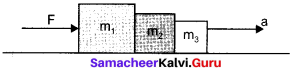
Samacheer Kalvi 11th Physics Solutions Chapter 3 Laws of Motion q37
Answer:
(a) \(\frac{\mathrm{F}}{m_{1}+m_{2}+m_{3}}\)

Question 38.
Three masses in contact is as shown above. If force F is applied to mass m1 then the contact force acting on mass m2 is –
(a) \(\frac{\mathrm{F}}{m_{1}+m_{2}+m_{3}}\)
(b) \(\frac{m_{1} F}{\left(m_{1}+m_{2}+m_{3}\right)}\)
(c) \(\frac{\left(m_{2}+m_{3}\right) F}{\left(m_{1}+m_{2}+m_{3}\right)}\)
(d) \(\frac{m_{3} \mathrm{F}}{m_{1}+m_{2}+m_{3}}\)
Answer:
(c) \(\frac{\left(m_{2}+m_{3}\right) F}{\left(m_{1}+m_{2}+m_{3}\right)}\)

Question 39.
Three masses is contact as shown. It force F is applied to mass m1, then the contact force acting on mass m3 is –
(a) \(\frac{\mathrm{F}}{m_{1}+m_{2}+m_{3}}\)
(b) \(\frac{m_{1} F}{\left(m_{1}+m_{2}+m_{3}\right)}\)
(c) \(\frac{\left(m_{2}+m_{3}\right) F}{\left(m_{1}+m_{2}+m_{3}\right)}\)
(d) \(\frac{m_{3} \mathrm{F}}{m_{1}+m_{2}+m_{3}}\)
Answer:
(d) \(\frac{m_{3} \mathrm{F}}{m_{1}+m_{2}+m_{3}}\)

Question 40.
Two masses connected with a string. When a force F is applied on mass m2. The acceleration produced is –
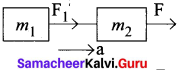
Samacheer Kalvi 11th Physics Solutions Chapter 3 Laws of Motion q40
(a) \(\frac{\mathrm{F}}{m_{1}+m_{2}}\)
(b) \(\frac{\mathbf{F}}{m_{1}-m_{2}}\)
(c) \(\frac{m_{1}+m_{2}}{\mathrm{F}}\)
(d) \(\frac{m_{3} \mathrm{F}}{m_{1}+m_{2}+m_{3}}\)
Answer:
(a) \(\frac{\mathrm{F}}{m_{1}+m_{2}}\)

Question 41.
Two masses connected with a string. When a force F is applied on mass m2. The force acting on m1 is –
(a) \(\frac{m_{1} \mathrm{F}}{m_{1}+m_{2}}\)
(b) \(\frac{m_{2} \mathrm{F}}{m_{1}+m_{2}}\)
(c) \(\frac{m_{1}+m_{2}}{m_{1}} \mathbf{F}\)
(d) \(\frac{m_{1}+m_{2}}{m_{2}} \mathbf{F}\)
Answer:
(b) \(\frac{m_{2} \mathrm{F}}{m_{1}+m_{2}}\)

Question 42.
If a block of mass m lying on a frictionless inclined plane of length L height h and angle of inclination θ, then the velocity at its bottom is –
(a) g sin θ
(b) g cos θ
(c) \(\sqrt{2 g h}\)
(d) \(\sqrt{2 a sin θ}\)
Answer:
(c) \(\sqrt{2 g h}\)

Question 43.
If a block of mass m lying on a frictionless inclined plane of length L, height h and angle of inclination θ, then the time take taken to reach the bottom is –
(a) g sing θ
(b) sin θ \(\sqrt{\frac{2 h}{g}}\)
(c) sin θ \(\sqrt{\frac{g}{h}}\)
(d) \(\frac{1}{\sin \theta} \sqrt{\frac{2 h}{g}}\)
Answer:
(d) \(\frac{1}{\sin \theta} \sqrt{\frac{2 h}{g}}\)

Question 44.
A rocket works on the principle of conservation of –
(a) energy
(b) mass
(c) angular momentum
(d) linear momentum
Answer:
(b) mass

Question 45.
A bomb at rest explodes. The total momentum of all its fragments is –
(a) zero
(b) infinity
(c) always 1
(d) always greater then 1
Answer:
(a) zero

Question 46.
A block of mass m1 is pulled along a horizontal friction-less surface by a rope of mass m2 If a force F is given at its free end. The net force acting on the block is –
(a) \(\frac{m_{1} \mathrm{F}}{m_{1}-m_{2}}\)
(b) F
(c) \(\frac{m_{2} \mathrm{F}}{\left(m_{1}+m_{2}\right)}\)
(d) \(\frac{m_{1} \mathrm{F}}{\left(m_{1}+m_{2}\right)}\)
Answer:
(b) F

Question 47.
A block of mass m is pulled along a horizontal surface by a rope. The tension in the rope will be same at all the points –
(a) if the rope is accelerated
(b) if the rope is mass less
(c) always
(d) none of the above
Answer:
(b) if the rope is mass less

Question 48.
The lines of forces act at a common point is called as –
(a) concurrent forces
(b) co-planar forces
(c) equilibrium
(d) resultant
Answer:
(a) concurrent forces

Question 49.
If the lines of forces act in the same plane, they can be –
(a) concurrent forces
(b) coplanar forces
(c) either concurrent force or coplanar forces
(d) Lami’s force
Answer:
(d) concurrent forces

Question 50.
Lami’s theorem is applicable only when the system of forces are is –
(a) same plane
(b) different plane
(c) equilibrium
(d) none of the above
Answer:
(c) equilibrium

Question 51.
Due to the action of internal forces of the system, the total linear momentum of the system is –
(a) a variable
(b) a constant
(c) always zero
(d) always infinity
Answer:
(c) always zero

Question 52.
The velocity with which a gun suddenly moves backward after firing is –
(a) linear velocity
(b) positive velocity
(c) recoil velocity
(d) v1 + v2
Answer:
(c) recoil velocity

Question 53.
If a very large force acts on an object for a very short duration, then the force is called as –
(a) Newtonian force
(b) impulsive force
(c) concurrent force
(d) coplanar force
Answer:
(A) impulsive force

Question 54.
The unit of impulse is –
(a) Nm
(b) Ns
(c) Nm2
(d) Ns-2
Answer:
(b) Ns

Question 55.
The force which always opposes the relative motion between an object and the surface where it is placed is –
(a) concurrent force
(b) frictional force
(c) impulsive force
(d) coplanar force
Answer:
(b) frictional force

Question 56.
The force which opposes the initiation of motion of an object on the surface is –
(a) static friction
(b) kinetic friction
(c) friction
(d) zero
Answer:
(d) static friction

Question 57.
When the object is at rest, the resultant of gravitational force and upward normal force is –
(a) Static force
(b) zero
(c) one
(d) infinity
Answer:
(b) zero

Question 58.
The magnitude of static frictional force d lies between –
(a) 0 ≤ f ≤ µsN
(b) 0 ≥f ≥ µsN
(c) 0 and 1
(d) 0 and minimal static frictional force.
Answer:
(a) 0 ≤ f ≤ µsN

Question 59.
The unit of co-efficient of static friction is –
(a) N
(b) N m
(c) N s
(d) no unit
Answer:
(d) no unit

Question 60.
If the object is at rest and no external force is applied on the object, the static friction acting on the object is –
(a) µsN
(b) zero
(c) one
(d) infinity
Answer:
(d) no unit

Question 61.
When object begins to slide, the static friction acting on the object attains –
(a) zero
(b) minimum
(c) maximum
(d) infinity
Answer:
(c) maximum

Question 62.
The static friction does not depend upon –
(a) the area of contact
(b) normal force
(c) the magnitude of applied force
(d) none of the above
Answer:
(a) the area of contact

Question 63.
Which of the following pairs of materials has minimum amount of coefficient of static friction is –
(a) Glass and glass
(b) wood and wood
(c) ice and ice
(d) steel and steel
Answer:
(c) ice and ice

Question 64.
Kinetic friction is also called as –
(a) sliding friction
(b) dynamic friction
(c) both (a) and (b)
(d) static friction
Answer:
(c) both (a) and (b)

Question 65.
The unit of coefficient of kinetic friction is/has –
(a) Nm
(b) Ns
(c) Nm2
(d) no unit
Answer:
(d) no unit

Question 66.
The nature of materials in mutual contact decides –
(a) µs
(b) µk
(c) µs or µk
(d) none
Answer:
(c) µs or µk

Question 67.
Coefficient of kinetic friction is less than –
(a) O
(b) one
(c) µs
(d) µsN
Answer:
(c) µs

Question 68.
The static friction –
(a) increases linearly
(b) is constant
(c) zero
(d) varies parabolically
Answer:
(a) increases linearly

Question 69.
The kinetic friction –
(a) increases linearly
(b) is constant
(c) zero
(d) varies parabolically
Answer:
(b) is constant

Question 70.
Kinetic friction is independent of –
(a) nature of materials
(b) temperature of the surface
(c) applied force
(d) none of the above
Answer:
(c) applied force

Question 71.
The angle between the normal force and the resultant force of normal force and maximum frictional force is –
(a) angle of friction
(b) angle of repose
(c) angle of inclination
(d) none of the above
Answer:
(a) angle of friction

Question 72.
The angle friction θ is given by –
(a) tan µs
(b) tan-1 µs
(c) \(\frac{f S^{\mathrm{max}}}{N}\)
(d) sin-1 µs
Answer:
(b) tan-1 µs

Question 73.
The angle of inclined plane with the horizontal such that an object placed on it begins to slide is –
(a) angle of friction
(b) angle of repose
(c) angle of response
(d) angle of retardation
Answer:
(b) angle of repose

Question 74.
Comparatively, which of the following has lesser value than others?
(a) static friction
(b) kinetic friction
(c) Rolling friction
(d) skiping friction
Answer:
(c) Rolling friction

Question 75.
The origin of friction is –
(a) electrostatic interaction
(b) electromagnetic interaction magnetic
(c) photon interaction
(d) interaction
Answer:
(b) electromagnetic interaction

Question 76.
Friction can be reduced by –
(a) polishing
(b) lubricating
(c) using ball bearings
(d) all the above
Answer:
(c) using ball bearings

Question 77.
For a particle revolving in a circular path, the acceleration of the particle is –
(a) along the tangent
(b) along the radius
(c) along the circumference of the circle
(d) zero
Answer:
(b) along the radius

Question 78.
A particle moves along a circular path under the action of a force. The work done by the force is –
(a) Positive and non zero
(b) zero
(c) Negative and non zero
(d) none of the above
Answer:
(b) zero

Question 79.
A bullet hits and gets embedded in a solid block resting on a horizontal frictionless table. Which of the following is conserved?
(a) Momentum and kinetic energy
(b) kinetic energy alone
(c) Momentum alone
(d) potential energy alone
Answer:
(c) Momentum alone

Question 80.
The origin of the centripetal force can be –
(a) gravitational force
(b) frictional force
(c) coulomb force
(d) all the above
Answer:
(d) all the above

Question 81.
Centripetal acceleration is –
(a) \(\frac{m v^{2}}{r}\)
(b) \(\frac{v^{2}}{r}\)
(c) r v2
(d) rω
Answer:
(b) \(\frac{v^{2}}{r}\)

Question 82.
Centripetal acceleration is –
(a) \(\frac{m v^{2}}{r}\)
(b) r ω2
(c) rv2
(d) rω
Answer:
(c) rω2

Question 83.
The centripetal force is –
(a) \(\frac{m v^{2}}{r}\)
(b) rω2
(c) both (a) and (b)
(d) none
Answer:
(c) both (a) and (b)

Question 84.
When a car is moving on a circular track the centripetal force is due to –
(a) gravitational force
(b) frictional force
(c) magnetic force
(d) elastic force
Answer:
(b) frictional force

Question 85.
If the road is horizontal then the normal force and gravitational force are –
(a) equal and along the same direction
(b) equal and opposite
(c) unequal and along the same direction
(d) unequal and opposite
Answer:
(b) equal and opposite

Question 86.
The velocity of a car for safe turn on leveled circular road –
(a) \(v \leq \sqrt{\mu_{s} r g}\)
(b) \(v \geq \sqrt{\mu_{s} r g}\)
(c) \(v=\sqrt{\mu_{s} rg}\)
(d) \(v \leq \mu_{s} rg\)
Answer:
(a) \(v \leq \sqrt{\mu_{s} r g}\)

Question 87.
In a leveled circular road, skidding mainly depends on –
(a) µs
(b) µk
(c) acceleration
(d) none
Answer:
(a) µs

Question 88.
The speed of a car to move on the banked road so that it will have safe turn is –
(a) µsrg
(b) \(\sqrt{r g \tan \theta}\)
(c) rg tan θ
(d) r2g tan θ
Answer:
(b) \(\sqrt{r g \tan \theta}\)

Question 89.
Centrifugal force is a –
(a) pseudo force
(b) real force
(c) forced acting towards center
(d) none of the above
Answer:
(a) pseudo force

Question 90.
Origin of centrifugal force is due to –
(a) interaction between two
(b) inertia
(c) electromagnetic interaction
(d) inertial frame
Answer:
(b) inertia

Question 91.
Centripetal force acts in –
(a) inertial frame
(b) non inertial frame
(c) both (a) and (h)
(d) linear motion
Answer:
(c) both (a) and (b)

Question 92.
Centrifugal force acts in –
(a) inertial frame
(b) non inertial frame
(c) both (a) and (b)
(d) linear motion
Answer:
(b) non inertial frame

Question 93.
A cricket ball of mass loo g moving with a velocity of 20 ms-1 is brought to rest by a player in 0.05s the impulse of the ball is –
(a) 5 Ns
(b) – 2 Ns
(c) – 2.5 Ns
(d) zero
Answer:
(b) – 2 Ns
mass = 0.1 kg
Initial velocity t = 20 ms-1
Final velocity y = 0
Change in momentum in impulse = m(v – u) = 0.1(0 – 20) = – 2 Ns

Question 94.
If a stone tied at the one end of a string of length 0.5 m is whirled in a horizontal circle with a constant speed 6 ms-1  then the acceleration of the shone is –
(a) 12 ms-2
(b) 36 ms-2
(c) 2π2 ms-2
(d) 72 ms-2
Answer:
(d) Centripetal acceleration = \(\frac{v^{2}}{r}\) = \(\frac{6^{2}}{0.5}\) = \(\frac{36}{0.5}\) = 72 ms-2

Question 95.
A block of mass 3 kg is at rest on a rough inclined plane with angle of inclination 30° with horizontal. If .is 0.7, then the frictional force is –
(a) 17.82 N
(b) 1.81 N
(c) 3.63 N
(d) 2.1 N
Answer:
(a) Frictional force = µmg cos θ = 0.7 x 3 x 9.8 cos 30° = 17.82 N

Question 96.
Two masses 2 kg and 4 kg are tied at the ends of a mass less string and which is passing over a friction-less pulley. The tension in the string is –
(a) 3.68 N
(b) 78.4 N
(c) 26 N
(d) 13.26 N
Answer:
(c) Tension in the string T = \(\frac{2 m_{1} m_{2}}{\left(m_{1}+m_{2}\right)}\)g
T = \(\frac{2 x 2 x 4}{2 + 4}\) x 9.8 = \(\frac{16}{6}\) x 9.8 = 26.13 N

Question 97.
A bomb of 10 kg at rest explodes into two pieces of mass 4 kg and 6 kg. if the velocity of 4 kg mass is 6 ms-1 then the velocity of 6 kg is –
(a) – 4 ms-1
(b) – 6 ms-1
(c) – 24 ms-1
(d) – 2.2 ms-1
Answer:
(a) According to law of conservation of momentum
m1v1 + m2v2 = 0
v2 = –\(\frac{m_{1} v_{1}}{m_{2}}\) = \(\frac{4 x 6}{6}\) = -4ms-1

Question 98.
A body is subjected under three concurrent forces and it is in equilibrium. The resultant of any two forces is –
(a) coplanar with the third force
(b) is equal and opposite to third force
(c) both (a) and (b)
(d) none of the above
Answer:
(c) both (a) and (b)

Question 99.
An impulse is applied to a moving object with the force at an angle of 20° with respect to velocity vector. The angle between the impulse vector and the change in momentum vector is –
(a) 0°
(b) 30°
(c) 60°
(d) 120°
Answer:
(a) Impulse and change in momentum are in same direction. So the angle is zero.

Question 100.
A bullet of mass m and velocity v1 is fired into a large block of wood of mass M. The final velocity of the system is-
(a) \(\frac{v_{1}}{m+\mathrm{M}}\)
(b) \(\frac{m v_{1}}{m+\mathrm{M}}\)
(c) \(\frac{m+m}{m} v_{1}\)
(d) \(\frac{m+m}{m-M} v_{1}\)
Answer:
(b) \(\frac{m v_{1}}{m+\mathrm{M}}\)

Question 101.
A block of mass 2 kg is placed on the floor. The co – efficient of static friction is 0.4. The force of friction between the block and floor is –
(a) 2.8 N
(b) 7.8 N
(c) 2 N
(d) zero
Answer:
(b) The force required to move = = µR = µmg = 0.4 x 2 x 9.8 = 7.84 N

Question 102.
A truck weighing 1000 kg is moving with velocity of 50 km/h on smooth horizontal roads. A mass of 250 kg is dropped into it. The velocity with which it moves now is –
(a) 12.5 km/h
(b) 20 km/h
(c) 40 km/h
(d) 50 km/h
Answer:
(c) According to law of conservation of linear momentum
m2 v2 = (m1 + m2)v2
v2 = \(\frac{m_{1} v_{1}}{m_{1}+m_{2}}\) = \(\frac{1000 \times 50}{1250}\) = 40 km/h

Question 103.
A body of mass loo g is sliding from an inclined plane of inclination 30°. if u = 1.7, then the frictional force experienced is –
(a) \(\frac{3.4}{\sqrt{3}}\)N
(b) 1.47 N
(c) \(\frac{\sqrt{3}}{3.4}\)N
(d) 1.38 N
Answer:
(b) Frictional force F = µ mg cos θ = 1.7 x 0.1 x 10 cos 30°= \(\frac{1.7}{2}\) x \(\sqrt{3}\) = 1.47 N

Samacheer Kalvi 11th Physics Laws of Motion Short Answer Questions (1 Mark)

Question 1.
A passenger sitting in a car at rest, pushes the car from within. The car doesn’t move, why?
Answer:
For motion, there should be external force.

Question 2.
Give the magnitude and directions of the net force acting on a rain drop falling with a constant speed.
Answer:
as \(\overline{\mathrm{a}}\) = 0 so \(\overline{\mathrm{F}}\) = 0.

Question 3.
Why the passengers in a moving car are thrown outwards when it suddenly takes a turn?
Answer:
Due to inertia of direction.

Question 4.
You accelerate your car forward. What is the direction of the frictional force on a package resting on the floor of the car?
Answer:
The package in the accelerated car (a non inertial frame) experiences a Pseudo force in a direction opposite to that of the motion of the car. The frictional force on the package which acts opposite to this pseudo force is thus in the same direction (forward) as that of the car.

Question 5.
What is the purpose of using shockers in a car?
Answer:
To decrease the impact of force by increasing the time for which force acts.

Question 6.
Why are types made of rubber not of steel?
Answer:
Since coefficient of friction between rubber and road is less than the coefficient of friction between steel and road.

Question 7.
Wheels are made circular. Why?
Answer:
Rolling friction is less than sliding friction.

Question 8.
If a ball is thrown up in a moving train, it comes back to the thrower’s hands. Why?
Answer:
Both during its upward and downward motion, the ball continues to move inertia of motion with the same horizontal velocity as the train. In this period, the ball covers the same horizontal distance as the train and so it comes back to the thrower’s hand.

Question 9.
Calculate the force acting on a body which changes the momentum of the body at the rate of 1 kg-m/s2 .
Answer:
As F = rate change of momentum
F = 1 kg-m/s2 = 1N

Question 10.
On a rainy day skidding takes place along a curved path. Why?
Answer:
As the friction between the types and road reduces on a rainy day.

Question 11.
Why does a gun recoils when a bullet is being fired?
Answer:
To conserve momentum.

Question 12.
Why is it difficult to catch a cricket ball than a tennis ball even when both are moving with the same velocity?
Answer:
Being heavier, cricket ball has higher rate of change of momentum during motion so more force sumed.

Question 13.
The distance travelled by a moving body is directly proportional to time. Is any external force acting on it?
Answer:
As s ∝ t, so acceleration a = 0, therefore, no external force is acting on the body.

Question 14.
Calculate the impulse necessary to stop a 1500 kg car moving at a speed of 25 ms-1.
Answer:
Use formula I = change in momentum = m(v – u) (Impulse – 37500 Ns)

Question 15.
Lubricants are used between the two parts of a machine. Why?
Answer:
To reduce friction and so to reduce wear and tear.

Question 16.
What provides the centripetal force to a car taking a turn on a level road?
Answer:
Force of friction between the type and road provides centripetal force.

Question 17.
A body is acted upon by a number of external forces. Can it remain at rest?
Answer:
Yes, if the external forces acting on the body can be represented in magnitude and direction by the sides of a closed polygon taken in the same order.

Question 18.
Bodies of larger mass need greater initial effort to put them in motion. Why?
Answer:
As F = ma so for given a, more force will be required to put a large mass in motion.

Question 19.
An athlete runs a certain distance before taking a long jump Why?
Answer:
So that inertia of motion may help him in his muscular efforts to take a longer jump.

Question 20.
Action and reaction forces do not balance each other. Why?
Answer:
As they acts on different bodies.

Question 21.
The wheels of vehicles are provided with mudguards. Why?
Answer:
When the wheel rotates at a high speed, the mud sticking to the wheel flies off tangentially, this is due to inertia of direction. If order that the flying mud does not spoil the clothes of passer by the wheels are provided with mudguards.

Question 22.
China wares are wrapped in straw paper before packing. Why?
Answer:
The straw paper between the China ware increases the Time of experiencing the jerk during transportation. Hence impact of force reduces on China wares.

Question 23.
Why is it difficult to walk on a sand?
Answer:
Less reaction force.

Question 24.
The outer edge of a curved road is generally raised over the inner edge Why?
Answer:
In addition to the frictional force, a component of reaction force also provides centripetal force.

Question 25.
Explain why the water doesn’t fall even at the top of the circle when the bucket full of water is upside down rotating in a vertical circle?
Answer:
Weight of the water and bucket is used up in providing the necessary centripetal force at the top of the circle.

Question 26.
Why does a speedy motor cyclist bends towards the center of a circular path while taking a turn on it?
Answer:
So that in addition of the frictional force, the horizontal component of the normal reaction also provides the necessary centripetal forces.

Question 27.
An impulse is applied to a moving object with a force at an angle of 20° wr.t. velocity vector, what is the angle between the impulse vector and change in momentum vector ?
Answer:
Impulse and change in momentum are along the same direction. Therefore angle between these two vectors is zero.

Samacheer Kalvi 11th Physics Laws of Motion Short Answer Questions (2 Marks)

Question 28.
A man getting out of a moving bus runs in the same direction for a certain distance. Comment.
Answer:
Due to inertia of motion.

Question 29.
If the net force acting upon the particle is zero, show that its linear momentum remains constant.
Answer:
As F x \(\frac {dp}{dt}\)
when F = 0, \(\frac {dp}{dt}\) = 0 so P = constant

Question 30.
A force of 36 dynes is inclined to the horizontal at an angle of 60°. Find the acceleration in a mass of 18 g that moves in a horizontal direction.
Answer:
F = 36 dyne at an angle of 60°
Fx = F cos 60° = 18 dyne
Fx = max
So ax = \(\frac{F_{x}}{m}\) = 1 cm /s2

Question 31.
The motion of a particle of mass m is described by h = ut + \(\frac {1}{2}\) gt2. Find the force acting on particle.
Answer:
a = ut + \(\frac {1}{2}\) gt2
find a by differentiating h twice w.r.t.
a = g
As F = ma so F = mg (answer)

Question 32.
A particle of mass 0.3 kg is subjected to a force of F = -kx with k= 15 Nmr-1. What will be its initial acceleration if it is released from a point 20 cm away from the origin?
Answer:
As F = ma so F = -kx = ma
a = \(\frac {-kx}{m}\)
for x = 20 cm, ⇒ a = -10 m/s2.

Question 33.
A 50 g bullet is fired from a 10 kg gun with a speed of 500 ms-1. What is the speed of the recoil of the gun?
Answer:
Initial momentum = 0
Using conservation of linear momentum mv + MV = 0
V = \(\frac {-mv}{M}\) ⇒ V = 2.5 m/s

Question 34.
Smooth block is released at rest on a 45° incline and then slides a distance d. If the time taken of slide on rough incline is n times as large as that to slide than on a smooth incline. Show that coefficient of friction, µ = \(\left(1-\frac{1}{n^{2}}\right)\)
Answer:
When there is no friction, the block slides down the inclined plane with acceleration. a = g sin θ
when there is friction, the downward acceleration of the block is a’ = g (sin θ – µ cos θ)
As the block Slides a distance d in each case so
d = \(\frac {1}{2}\) at2 = \(\frac {1}{2}\) a’t’2
\(\frac{a}{a^{\prime}}=\frac{t^{\prime 2}}{t^{2}}=\frac{(n t)^{2}}{t^{2}}\) = n2
or \(\frac {g sin θ}{g(sin θ – µ cos θ)}\) = n2
Solving, we get (Using θ = 45°)
µ = 1 – \(\frac{1}{n^{2}}\)

Question 35.
A spring balance is attached to the ceiling of a lift. When the lift is at rest spring balance reads 49 N of a body hang on it. If the lift moves:

  1. Downward
  2. upward, with an acceleration of 5 ms2
  3. with a constant velocity.

What will be the reading of the balance in each case?
Answer:
1.  R = m(g – a) = 49 N
so = m = \(\frac {49}{9.8}\) = 5 kg
R = 5 (9.8 – 5)
R = 24 N

2. R = m(g + a)
R = 5 (9.8 + 5)
R = 74 N

3.  as a = 0 so R = mg = 49 N

Question 36.
A bob of mass 0.1 kg hung from the ceiling of room by a string 2 m long is oscillating. At its mean position the speed of a bob is 1 ms-1. What is the trajectory of the ‘oscillating bob if the string is cut when the bob is –

  1. At the mean position
  2. At its extreme position.

Answer:

  1. Parabolic
  2. vertically downwards

Question 37.
A block placed on a rough horizontal surface is pulled by a horizontal force F. Let f be the force applied by the rough surface on the block. Plot a graph of f versus F.
Answer:
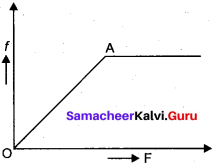
Samacheer Kalvi 11th Physics Solutions Chapter 3 Laws of Motion
Unto point A, f = F (50 Long as block is stationary) beyond A, when F increases, block starts moving f remains constant.

Question 38.
A mass of 2 kg is suspended with thread AB. Thread CD of the same type is attached to the other end of 2 kg mass.

  • Lower end of the lower thread is pulled gradually, hander and hander is the downward direction so as to apply force on AB Which of the thread will break & why?
  • If the lower thread is pulled with a jerk, what happens?

Answer:

  • Thread AB breaks down
  • CD will break.

Question 39.
A block of mass M is held against a rough vertical wall by pressing it with a finger. If the coefficient of friction between the block and the wall is p and the acceleration due to gravity is g, calculate the minimum force required to be applied by the finger to held the block against the wall?
Answer:
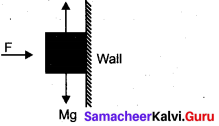
Samacheer Kalvi 11th Physics Solutions Chapter 3 Laws of Motion
For the block not to fall f = Mg
But f = µR = µF so
µF = Mg
F = \(\frac {Mg}{µ}\)

Samacheer Kalvi 11th Physics Laws of Motion Short Answer Questions (3 Marks) & Numericals

Question 40.
A block of mass 500 g is at rest on a horizontal table. What steady force is required to give the block a velocity of 200 cm s-2 in 4 s?
Answer:
Use F – ma
a = \(\frac {v – u}{ t }\) = \(\frac {200- 0}{ 4 }\) = 50 cm/s2
F = 500 x 50 = 25,000 dyne.

Question 41.
A force of 98 N is just required to move a mass of 45 kg on a rough horizontal surface. Find the coefficient of friction and angle of friction?
Answer:
F = 48 N,R = 45 x 9.8 = 441 N
µ = \(\frac {F’}{ R}\) = 0.22
Angle of friction θ = tan-1 0.22 = 12°24′

Question 42.
Calculate the force required to move a train of 2000 quintal up on an incline plane of 1 in 50 with an acceleration of 2 ms-2. The force of friction per quintal is 0.5 N.
Answer:
Force of friction = 0.5 N per quintal
f = 0.5 x 2000 = 1000 N
m = 2000 quintals = 2000 x 100 kg
sin θ = \(\frac {1}{50}\), a – 2 m/s2
In moving up an inclined plane, force required against gravity
mg sin θ = 39200 N
And force required to produce acceleration = ma
= 2000 x 100 x 2 = 40,0000 N
Total force required = 1000 + 39,200 + 40,0000 = 440200 N.

Question 43.
A force of 100 N gives a mass m1, an acceleration of 10 ms-2 and of 20 ms-2 to a mass m2.
What acceleration must be given to it if both the masses are tied together?
Answer:
Suppose, a = acceleration produced if m1 and m2 are tied together,
F = 100 N
Let a1 and a2 be the acceleration produced in m1 and m2 respectively.
∴ a1 and a2 = 20ms-2 (given)
Again m1 = \(\frac{\mathrm{F}}{a_{1}}\) and m2 = \(\frac{\mathrm{F}}{a_{2}}\)
⇒ m1 = \(\frac {100}{10}\) = 10kg
and m2 = \(\frac {100}{20}\) = 5kg
∴ m1 + m2 = 10 + 5 = 15
so, a = \(\frac{\mathbf{F}}{m_{1}+m_{2}}\) = \(\frac {100}{15}\) = \(\frac {20}{3}\) = 6.67 ms2

Question 44.
The pulley arrangement of figure are identical. The mass of the rope is negligible. In (a) mass m is lifted up by attaching a mass (2m) to the other end of the rope. In (b), m is lifted up by pulling the other end of the rope with a constant downward force F = 2 mg. In which case, the acceleration of m is more?
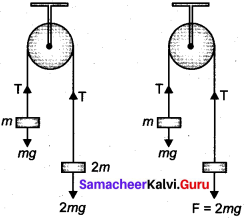
Samacheer Kalvi 11th Physics Solutions Chapter 3 Laws of Motion
Answer:
Case (a):
a = \(\frac {2m – m}{2m + m}\) g = a = \(\frac {g}{3}\)
Case (b):
FBD of mass m
ma’ = T – mg
ma’ = 2 mg – mg
⇒ ma’ = mg
a’ = g
So in case (b) acceleration of m is more.

Question 45.
Figure shows the position-time graph of a particle of mass 4 kg. What is the
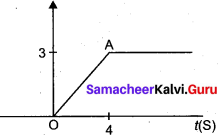
Samacheer Kalvi 11th Physics Solutions Chapter 3 Laws of Motion
(a) Force on the particle for t < 0, t > 4s, 0 < t < 4s?
(b) Impulse at t = 0 and t = 4s?
(Consider one dimensional motion only)
Answer:
(a) For t < 0. No force as Particles is at rest. For t > 4s, No force again particle comes at rest.
For 0 < t < 4s, as slope of OA is constant so velocity constant i.e., a = 0, so force must be zero.

(b) Impulse at t = 0
Impulse = change in momentum
I = m(v – w) = 4(0 – 0.75) = 3 kg ms-1
Impulse at t = 4s
1 = m(v – u) = 4 (0 – 0.75) = -3 kg ms-1

Question 46.
What is the acceleration of the block and trolley system as the figure, if the coefficient of kinetic friction between the trolley and the surface is 0.04? Also Calculate friction in the string: Take g = 10 m/s2, mass of the string is negligible.
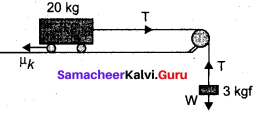
Samacheer Kalvi 11th Physics Solutions Chapter 3 Laws of Motion
Answer:
Free body diagram of the block
30 – T = 3a
Free body diagram of the trolley
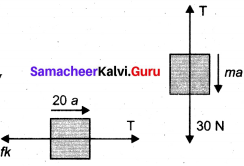
Samacheer Kalvi 11th Physics Solutions Chapter 3 Laws of Motion
T – fk = 20 a ………….(2)
where fk = µk= 0.04 x 20 x 10 = 8 N
Solving (i) & (ii), a = 0.96 m/s2 and T = 27.2 N

Question 47.
Three blocks of masses ml = 10 kg, m2 = 20 kg are connected by strings on smooth horizontal surface and pulled by a force of 60 N. Find the acceleration of the system and frictions in the string.

Samacheer Kalvi 11th Physics Solutions Chapter 3 Laws of Motion
Solution:
All the blocks more with common acceleration a under the force F = 60 N.
F = (m1 + m2 + m3)a
a = \(\frac{\mathrm{F}}{\left(m_{1}+m_{2}+m_{3}\right)}\) = 1 m/s2
to determine, T1 →Free body diagram of m1.
Samacheer Kalvi 11th Physics Solutions Chapter 3 Laws of Motion
T1 = m1a = 10 x 1 = 10 N
to determine, T2 →Free body diagram of m3
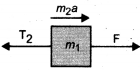
Samacheer Kalvi 11th Physics Solutions Chapter 3 Laws of Motion
F – T2 = m3a
Solving, we get T2 = 30 N

Question 48.
The rear side of a truck is open and a box of 40 kg mass is placed 5m away from the open end. The coefficient of friction between the box and the surface below it is 0.15 on a straight road, the truck starts from rest and accelerates with 2 m/s2. At what distance from the starting point does the box fall off the truck ? (ignore the size of the box)
Answer:
Force on the box due to accelerated motion of the truck
F = ma = 40 x 2 = 80 N (in forward direction)
Reaction on the box, F’ = F = 80 N (in backward direction)
Force of limiting friction, f = µR = 0 .15 x 40 x 10 = 60 N
Net force on the box in backward direction is P = F’ f = 80 – 60 = 20 N
Backward acceleration in the box = a= \(\frac {p}{m}\) = \(\frac {20}{40}\) = 0.5 ms-2
t = time taken by the box to travel s = 5 m and falls off the truck, then from
s = ut + \(\frac {1}{2}\) at2
5 = 0 x t + \(\frac {1}{2}\) x 0.5 x t2
t = 4.47
If the truck travels a distance x during this time
then x = 0 x 4.34 +\(\frac {1}{2}\) x 2 x (4.471)2
x = 19.98 m

Question 49.
A block slides down as incline of 30° with the horizontal. Starting from rest, it covers 8 m in the first 2 seconds. Find the coefficient of static friction.
Use s = ut + \(\frac {1}{2}\) at2
a = \(\frac{2 s}{t^{2}}\) at2 as u = 0
µ = \(\frac{g sin θ – a}{g Cos θ }\)
Putting the value and solving, µ = 0.11

Question 50.
A helicopter of mass 2000 kg rises with a vertical acceleration of 15 m/s2 . The total mass of the crew and passengers is 500 kg. Give the magnitude and direction of the:
(a) Force on the floor of the helicopter by the crew and passenger.
(b) Action of the rotor of the helicopter on the surrounding air
(c) Force on the helicopter due to the surrounding air (g = 10 m/s2 )
Answer:
(a) Force on the floor of the helicopter by the crew and passengers
= apparent weight of crew and passengers
= 500(10+ 15)
=12500 N

(b) Action of rotor of helicopter on surrounding air is Obviously vertically downwards, because helicopter rises on account of reaction of this force. Thus force of action
= (2000 + 500) (10 + 15)
= 2500 x 25
= 62,500 N

(c) Force on the helicopter due to surrounding air is obviously a reaction. As action and reaction are equal and opposite, therefore
Force of reaction F’ = 62,500 vertically upwards.

Question 51.
A rectangular box lies on a rough inclined surface. The coefficient of friction between the surface and the box is (µ). Let the mass of the box be m.

  1.  At what angle of inclination θ of the plane to the horizontal will the box just start to slide down the plane ?
  2. What is the force acting on the box down the plane, if the angle of inclination of the plane is increased to a > θ.
  3. What is the force needed to be applied upwards along the plane to make the box either remain stationary or just move up with uniform speed ?
  4. What is the force needed to be applied upwards along the plane to pk kg f make the box move up the plane with acceleration a ?

Answer:
1. When the box just starts sliding
µ = tanθ
or 0 = tan-1 µ

2. Force acting on the box down the plane
= mg (sin a – µ cos a)

3. Force needed mg (sin a + µ cos a)

4. Force needed = mg (sin a + µ cos a) + ma.
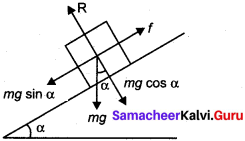
Samacheer Kalvi 11th Physics Solutions Chapter 3 Laws of Motion

Question 52.
Two masses of 5 kg and 3 kg are suspended with help of mass less in extensible string as shown. Calculate T1 and T2 when system is going upwards with acceleration m/s2. (Use g 9.8 m/s2)
Answer:
According Newton’s second law of motion
(1) T1 – (m1 + m2)g = (m1 + m2)a
T1 = (m1 + m2)(a + g) = (5 + 3) (2 + 9.8)
T1 = 94.4 N

(2) T2 – m2g = m2a
T2 = m2 (a + g)
T2 = 3(2 + 9.8)
T2 = 35.4 N
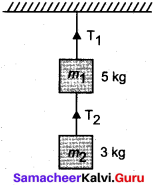
Samacheer Kalvi 11th Physics Solutions Chapter 3 Laws of Motion

Question 53.
There are few forces acting at a Point P produced by strings as shown, which is at rest. Find the forces F1 & F1
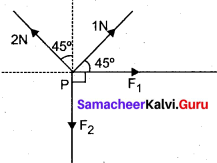
Samacheer Kalvi 11th Physics Solutions Chapter 3 Laws of Motion
Answer:
Using Resolution of forces IN and 2N and then applying laws of vector addition. Calculate for F1 & F1.
F1 = \(\frac{1}{\sqrt{2}}\) N, F2 = \(\frac{3}{\sqrt{2}}\)N

Question 54.
A hunter has a machine gun that can fire 50g bullets with a velocity of 150 ms A 60 kg tiger springs at him with a velocity of 10 ms-1. How many bullets must the hunter fire into the target so as to stop him in his track?
Answer:
Given m = mass of bullet = 50 gm = 0.50 kg
M = mass of tiger = 60 kg
v = Velocity of bullet – 150 m/s
V = Velocity of tiger = – 10 m/s
(v It is coming from opposite direction n = no. of bullets fired per second at the tiger so as to stop it.)
Pi = 0, before firing ……..(i)
Pf = n (mv) + MV …………(ii)
∴ From the law of conservation of momentum,
Pi = Pf
⇒ 0 = n (mv) + MV
n = \(\frac{MV}{mv}\) = \(\frac{-60 \times(-10)}{0.05 \times 150}\) = 80

Question 55.
Two blocks of mass 2 kg and 5 kg are connected by an ideal string passing over a pulley. The block of mass 2 kg is free to slide on a surface inclined at an angle of 30° with the horizontal whereas 5 kg block hangs freely. Find the acceleration of the system and the tension in the string.
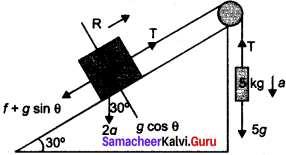
Samacheer Kalvi 11th Physics Solutions Chapter 3 Laws of Motion
Let a be the acceleration of the system and T be the Tension in the string. Equations of motions for 5 kg and 2 kg blocks are
5g – T = 5a
T – 2g sin θ – f = 2a
where f = force of limiting friction
= µR = µ mg cos θ = 0.3 x 2 g x cos 30°
Solving (1) & (2)
a = 4.87 m/s2

We as a team believe the knowledge shared on our page regarding the Samacheer Kalvi 11th Physics Book Solutions Questions and Answers for Chapter 3 Laws of Motion has cleared all your queries. For any other help don’t hesitate and leave us a comment so that we will get back to you at the soonest. Stay connected to our page to avail the latest updates regarding the Tamilnadu State Board Solutions for various subjects in a matter of seconds.
Samacheer Kalvi 11th English Solutions Poem Chapter 5 Everest is not the Only Peak

Students who are interested in learning of 11th English Poem Chapter 5 Everest is not the Only Peak Questions and Answers can use Tamilnadu State Board Solutions of 11th English Chapter Wise Pdf. First check in which chapter you are lagging and then Download Samacheer Kalvi 11th English Book Solutions Questions and Answers Summary, Activity, Notes Chapter Wise. Students can build self confidence by solving the solutions with the help of Tamilnadu State Board English Solutions. English is the scoring subject if you improve your grammar skills. Because most of the students will lose marks by writing grammar mistakes. So, we suggest you to Download Tamilnadu State Board 11th English Solutions according to the chapters.

Tamilnadu Samacheer Kalvi 11th English Solutions Poem Chapter 5 Everest is not the Only Peak

Check out the topics covered in Poem Chapter 5 Everest is not the Only Peak Questions and Answers before you start your preparation. Improve your grammar skills with the help of Samacheer Kalvi 11th English Book Solutions Questions and Answers pdf links. The solutions for Tamilnadu State Board 11th English Textbook are prepared by the English experts. So, if you follow Tamilnadu State Board Solutions 11th English Textbook Solutions you can cover all the topics in Poem Chapter 5 Everest is not the Only Peak Questons and Answers. This helps to improve your communication skills.

Warm up

Identify the following personalities and their fields of achievement.

Everest Is Not The Only Peak Poem Summary Samacheer Kalvi 11th English Solutions Poem Chapter 5

Answer:

Everest Is Not The Only Peak Summary Samacheer Kalvi 11th English Solutions Poem Chapter 5

Everest Is Not The Only Peak Question 1.
Mention a remarkable achievement of any of these personalities
Answer:
Kailash Satyarthi has rescued thousands of child labourers and gave them new life.

Everest Is Not The Only Peak Poem Summary Question 2.
What quality do you admire the most in each of these achievers?
Answer:
They were persistent and never accepted failure.

Everest Is Not The Only Peak Summary Question 3.
What are the qualities that you may share with them?
Answer:
Each one has concern for the country.

Everest Is Not The Only Peak Poem Line By Line Explanation Question 4.
Name a few more popular personalities who have made our nation proud.
Answer:
(a) Rabindranath Tagore
(b) Mother Teresa
(c) Sarojini Naidu
(d) Sania Mirza
(e) Mary Kom
(f) Virat Kohli
(g) Saina Nehwal
(h) Abhinav Bindra
(i) MS Dhoni
(j) AR Rahman

Samacheer Kalvi 11th English Everest is not the Only Peak Textual Questions

A. Based on your understanding of the poem, answer the following questions in a sentence or two each.

We are proud and feel so tall,
Our virtues though be few and small
Our nature it is that whatever we try
We do with devotion deep and true.

Defeat we repel, courage our fort;
Cringing from others we haven’t done,
To seek a gain we adore none:
We are proud and feel so tall.

We deem it our duty and mission in life,
To bless and praise the deserving ones;
Never shall we fail in what we commit,
Shall nourish the ones that nourish the world.

Everest Is Not The Only Peak Samacheer Kalvi 11th English Solutions Poem Chapter 5

We are proud of the position we
Hold; humble as we are,
Our pride springs from the way we live.
Ours is a path of dignity and honour,
A life that knows no kneeling and bending.
We are proud and feel so tall.

Everest is not the only peak,
Every hillock has a summit to boast!
The height you reach is not that we care;
He, who does not stoop, is a king we adore.
We bow before competence and merit;
The ones that are true and stand on their own
Are really the ladder for the rise of Man.
Honour is a property, common to all:
In dignity and pride no one need to be poor.
We are proud and feel so tall.

Everest Is Not The Only Peak Poem Figures Of Speech Question 1.
Which line is repeated in the poem? What is the effect created by this repetition?
Answer:
The line, “We are proud and feel so tall” is repeated often in the poem. This establishes beyond a doubt the poet’s pride in dignity of iabour and pride of hardwork experienced by ordinary folks in life.

Everest Is Not The Only Peak Poem Summary In English Question 2.
Who are the ‘deserving ones’?
Answer:
Those who have merit and competence are the deserving ones.

Summary Of The Poem Everest Is Not The Only Peak Question 3.
Which quality does the speaker wish to nourish? What is his mission?
Answer:
The speaker wishes to nourish love to the mankind. The poet loves to nourish the ones who nourish the world. His mission is to bless and praise the deserving ones.

Everest Is Not The Only Peak Poem Question 4.
Which path should we follow in life?
Answer:
We should follow the path of dignity and honour. We should never stoop before others for any ‘gains’.

Everest Is Not The Only Peak Poem Warm Up Answers Question 5.
What does ‘Everest’ in the title stand for?
Answer:
‘Everest’ means the greatest achievement in life or the highest point one can reach in life.

Everest Is Not The Only Peak Poem Theme Question 6.
What does ‘hillock’ refer to in the line ‘Every hillock has a summit to boast!’?
Answer:
Hillock is a small hill. Everyone need not become Tenzing. Each one can achieve some ordinary pursuit and be proud of his achievements.

Everest Is Not The Only Peak Poem Explanation Question 7.
Why does the speaker say ‘Everest is not the only peak’?
Answer:
Everyone is not made to be a mountain climber or a captain. Each one has an important role in this life however small it may appear to be. The poet respects every small achievement in every walk of life. So, he says, “Everest is not the only peak”.

Everest Is Not The Only Peak Poem Paragraph Question 8.
What does the ladder symbolize?
Ladder symbolizes help given to enable others to climb up to a higher position in life.

B. Read the given lines and answer the questions that follow.

1. Our nature it is that whatever we try
We do with devotion deep and true.

Everest Is Not The Only Peak Meaning In Tamil Question (a)
Who does ‘we’ refer to?
Answer:
‘We’refers to ordinary people.

Everest Is Not The Only Peak Meaning Question (b)
How should we carry out our duties?
Answer:
We must do our duty with sincerity and deep devotion.

2. Defeat we repel, courage our fort;

Everest Is Not The Only Peak Meaning In English Question (a)
How do we react to defeat?
Answer:
We defy defeat.

(b) Which is considered as our stronghold?
Answer:
Courage is our stronghold.

3. We are proud of the position we hold;
humble as we are,

Everest Is Not The Only Peak Poem Analysis Question (a)
What is the speaker proud of?
Answer:
The speaker is proud of the position people hold on to.

Everest Is Not The Only Peak Theme Question (b)
How is the speaker both humble and proud?
Answer:
The ordinary position they hold keeps them humble. But the path of self-dignity and honour they tread, makes them feel proud.

Question (c)
Pick out the alliteration in these lines.
Answer:
proud, position, hold, humble are the words which alliterate.

4. He, who does not stoop, is a king we adore.
We bow before competence and merit;

Question (a)
Who is adored as a king?
Answer:
An upright or straight forward person is adored as a king.

Question (b)
What is the figure of speech used in the first line?
Answer:
Metaphor

5. Honour is a property, common to all:
In dignity and pride no one need to be poor.

Question (a)
Who are considered rich?
Answer:
Those who possess dignity and pride are considered rich.

Question (b)
What is their asset?
Answer:
Honour is their asset.

C. Answer the following questions in a paragraph of 100-150 words each.

Question 1.
In what way is every hillock similar to Everest?
Answer:
The poet does not compare rare feats of athletes, mountaineers or horsemen. He does not attach great value to positions or possessions. He scoffs at those who pull strings to achieve their ends. The means must justify the ends. One should not stoop to underhand dealings to achieve their desired goals in life. Those who reach great heights in life like Everest due to their hardwork, perseverance and competence are adorable. At the same time those who trek any small hillocks can’t be underestimated. The efforts made in reaching even the smallest positions in life, if done with sincerity of purpose and deep devotion, is worthy of hearty appreciation.

One who holds a humble position, but upright and serves as a ladder for fellow humans to reach great heights deserve our respect. The poet admits that he is proud of people’s humble positions because their pride springs not from positions or possessions but the way they live. Their life knows no bending. The poet just doesn’t bother the height of the peak one reaches. It could even be a hillock. What matters is how one reaches that spot. If merit and competence have paved the way for their success and positions, however humble they are, the poet admires them.

“Take on risks and ride the journey called life with no regrets. ”


Question 2.
The poem does not focus on the destination but the journey towards it. Discuss.
Answer:
The poet discusses the merits of efforts, duty and devotion and values of honesty, uprightness and service-mindedness. He does not have any special appreciation to those who reach great peaks like Himalayas. He appreciates the process, the journey and not the destination. When the whole world has a perspective of seeking glory using any foul method or underhand dealing, the poet differs from it. For him the means is more important than the end. However modest may be one’s position is, it is adorable if attained by competence and merit. Pride is not in heights one reaches but in a life that knows no bending or kneeling. The poet respects one who does not stoop as a king. Thus the poet pays importance to the journey of life not the destination.

“The journey of life is not meant to be feared and planned;It is meant to be travelled and enjoyed. ”

Creative Activity

D. Write eight words you associate with success.

  • Use the words to write eight lines that mean success to you or how success makes you feel.
  • Arrange your lines into a poem.
  • Share your poem with the class and post a copy on the notice board.
    1. strive
    2. flaunt
    3. determination
    4. destination
    5. wise
    6. want
    7. success
    8. kind

Succes
Poem:

Real success is when you strive
for what you want
when you have that guts to flaunt
Not thinking about the world and wise
when you can alone suffice
With upright will and determination
where finally you reach your destination.
Real success is hard to find. But its one of a kind.
(OR)

  1. brave
  2. hunt
  3. learn
  4. mistakes
  5. encounter
  6. failure
  7. never
  8. If

Poem

You’ll never be brave.
If you don’t get hurt
you’ll never learn.

If you don’t make mistakes
you’ll never be successful.
If you don’t enounter failure.

Speaking Activity

E. Discuss the following topics in groups of five and choose a representative to sum up the views and share them with the class.

Question (a)
To succeed in life, one must have a single-minded devotion to duty.
Answer:
Singleminded determination is necessary to achieve success in life. Legend says Dronacharya was training Pandavas to shoot arrows in the jungle. Once guru saw a bird at the top branch of a tall tree. He assigned the task of shooting the bird on its right eye.
Bhim, Nakulan, Sakadevan and Dharman were denied the chance to aim at it because they all told Dronacharya that they saw the whole jungle, tree, sky and the bird respectively. But it was Arjun who said that he saw only the right eye of the bird and nothing else. Indo-Pak war was in progress. Four bombers were prowling into Indian airspace.

Indian fighter bomber pilot realized all the bombs were exhausted. He had singleminded determination to prevent the four bombers from bombing India harm and force them to surrender. He tried a trick. He called them and spoke to them. He informed them that he was thousand feet above them with his finger on a missile. If they just surrender, their lives would be spared. He radioed to his chief that they should welcome four prisoners of war along with their fighter bombers.

Napoleon Boneparte was once watching a battle from a hillock. One of his soldiers came with an urgent message. Napoleon looking at the badly wounded soldier thought that the war was lost. He called one of his aides and gave instructions for pullout. But the soldier said, “Sire, we‘ve won”. Then he gave a slip from another pocket. Being a practical leader, he had alternate plans always at hand. Such leaders never accept failure as permanent. People who pursue their goals in life with single minded determination always win.


Question (b)
‘Success is not final, failure is not fatal.’ It is the courage and perseverance that Counts.
Answer:
India’s cricket team was beaten in Test series in Africa. Infact, it was routed. The team’s morale was a little down. The team captain Virat Kohli told his team to focus on what they were good at (i.e) sterling performance in One Day Internationals. He believed in the youngest bowlers and told them to play the game, the way they loved to play. He still believed in them. They would have to prove who are the masters of the game. Gathering their broken hopes and courage, the Indian team players, snatched the ODI series from the overconfident South Africans. They went on to win the T20 series too against the hosts. Thus they proved that success is not final and failure never fatal. One may bounce back from failure if one persists long enough.

A king had lost a battle. All his soldiers had been scattered across the country. Heart broken king Bruce was hiding in a cave. He saw a spider failing a number of times to spin a web. But it made it after about 20 attempts. This bolstered the confidence of the king. He refused to be controlled by failure. He defied defeat. He gathered his soldiers again and won the battle. These incidents throw much light on the truth that perseverance and courage counts for success in fife.

Question (c)
Successful people neither brood over the past nor worry about the future.
Answer:
Mahatma Gandhi and his followers were arrested and jailed many times. Gandhi’s followers were brutally lathi charged. Gandhi had decided to silence the guns of the British with Ahimsha passive non-violent resistance. The brutal suppression of the struggle for freedom did not dishearten Gandhi. He did not brood about the strength of British army and weaknesses of unarmed peasants who believed in his leadership. He was a Karmayogi. What ever the duty to be done it must be done with steadfast devotion and sincerity. Other leaders got worried. Some angry young men resorted to violence.

They burnt down a police station at Chauri chaura too. But Gandhi declared a fast unto death. He plunged into action. If he had worried about the unpleasant developments, he wouldn’t have launched Quit India Movement or Salt Satyagraha effectively.

Thomas Alva Edison was not able to find the element that would glow if electricity was passed. He had failed 1000 times to invent the bulb. But he said, “The light bulb was an invention with 1000 steps”. Each step taught him what did not work. He lost his hearing capacity. He had many failures. His teachers believed him to be mad and unteachable.

His entire schooling was only a few years. His mom taught him and made him believe in himself. This man who had been ill-treated in school and faced many challenges had no time to brood. He went on to make 1093 inventions and got them patented. Those who are busy building facilities for transforming the world have neither the time nor the inclination to brood about failures or about possibilities of success in future.

Everest is not the Only Peak About the poet:

Everest Is Not The Only Peak Poem Line By Line Explanation Samacheer Kalvi 11th English Solutions Chapter 5

Prof. V.C. Kulandtiisamy ( 14th July 1929 10th Dec 2016) is known as Kulotliimgan. He i is a prolific Tamil writer with six volumes of poems and seven of prose essays. He has 1 been conferred Thiruvalluvar Award by Government of Tamil Nadu (1999) and Sahitva j Academy’s Award in 1988 for his outstanding masterpiece “Vaazhum Valluvam”. Ills i poems, as evident in the poem “Everest is not the only Peak” deal with the gamut of human [ progress and all pervasive human effort to better the world.


Everest is not the Only Peak Summary

This poem discusses in depth the virtues that make people greater than those who scale Himalayas. We have a few virtues which make us feel proud and tall. By nature we do every assigned duty with deep and true devotion.

We repel defeats because courage is our fort. We have never cringed from others. We don’t lick others’ shoes to achieve personal gains. We are proud and tall.

We deem it a duty and a mission to appreciate those who deserve appreciation. We shall carry on doing unfailingly what we are committed to do. We shall nourish those who nourish the world (i.e) those who better the world with their services, inventions and discoveries.

Despite living a simple and humble life, we have pride over our path of dignity and honour. We feel proud and tall for we never bend before the mighty.

We value individual differences. Every small effort to succeed in life matters. Peaks alone don’t matter. Even a hillock is a symbol of human achievement. We respect those who don’t stoop to conquer. We are proud to be rich in honour, dignity and pride. Those who stand on their own merit and serve as ladder for progress of fellowmen are worthy of our appreciation. We are proud and feel so tall.

Not the worldly riches, power and positions impress us. We derive our happiness in serving those who serve the nation. We respect all who are upright in their dealings. So, as honest citizens, we are proud.

Everest is not the Only Peak Glossary

Textual:
adore – worship someone
competence – the ability to do something efficiently
cringing – behaving in an excessively humble or servile way
devotion – loyal commitment towards a particular activity
merit -the quality of being particularly good or worthy
nourish – to help the growth and development of someone
repel – hate or detest
stoop – yield or submit, to descend from dignity
summit – the highest point of a hill or mountain peak
virtues – good qualities


Additional:
dignity – deserves respect
fort – huge building for protection
hillock – small hill
humble -modest
mission – vocation
praise – appreciate
property – possession
proud – feeling important
springs – arises

The main aim is to share the knowledge and help the students of 11th English to secure the best score in their final exams. Use the concepts of Samacheer Kalvi 11th English Book Solutions Poem Chapter 5 Everest is not the Only Peak Questions and Answers in Real time to enhance your skills. If you have any doubts you can post your comments in the comment section, We will clarify your doubts as soon as possible without any delay.

Samacheer Kalvi 11th Physics Solutions Chapter 2 Kinematics

For those looking for help on 11th Physics can use the Tamilnadu State Board Solutions for 11th Physics Chapter 2 Kinematics prevailing for free of cost.

Download the Samacheer Kalvi 11th Physics Book Solutions Questions and Answers Notes Pdf, for all Chapter Wise through the direct links available and take your preparation to the next level. The Tamilnadu State Board Solutions for 11th Physics Chapter 2 Kinematics Questions and Answers covers all the topics and subtopics within it. Practice using these Samacheer Kalvi 11th Physics Book Solutions Questions and Answers for Chapter 2 Kinematics PDF and test your preparation level and bridge the knowledge gap accordingly.

Tamilnadu Samacheer Kalvi 11th Physics Solutions Chapter 2 Kinematics

If you have any queries take the help of the Tamilnadu State Board Solutions for 11th Physics Chapter 2 Kinematics Questions and Answers learn all the topics in it effectively. We have everything covered and you can Practice them often to score better grades in your exam. By going through the Samacheer Kalvi 11th Physics Book Solutions Questions and Answers you can attempt the actual exam with utmost confidence.

Samacheer Kalvi 11th Physics Kinematics Textual Questions Solved

Samacheer Kalvi 11th Physics Kinematics Multiple Choice Questions

Samacheer Kalvi 11th Physics Solution Chapter 2 Question 1.
Which one of the following Cartesian coordinate systems is not followed in physics?
Samacheer Kalvi 11th Physics Solution Chapter 2 Kinematics
Answer:
11th Physics Chapter 2 Book Back Answers Samacheer Kalvi Kinematics

11th Physics Chapter 2 Book Back Answers Question 2.
Identify the unit vector in the following:
(a) \(\hat{i}+\hat{j}\)
(b) \(\frac{\hat{i}}{\sqrt{2}}\)
(c) \(\hat{k}-\frac{\hat{j}}{\sqrt{2}}\)
(d) \(\frac{\hat{i}+\hat{j}}{\sqrt{2}}\)
Answer:
(d) \(\frac{\hat{i}+\hat{j}}{\sqrt{2}}\)

11th Physics Kinematics Book Back Answers Question 3.
Which one of the following physical quantities cannot be represented by a scalar?
(a) Mass
(b) length
(c) momentum
(d) magnitude of acceleration
Answer:
(c) momentum

11th Physics Lesson 2 Book Back Answers Question 4.
Two objects of masses m1 and m2, fall from the heights h1 and h2 respectively. The ratio of the magnitude of their momenta when they hit the ground is [AIPMT 20121]
(a) \(\sqrt{\frac{h_{1}}{h_{2}}}\)
(b) \(\sqrt{\frac{m_{1} h_{1}}{m_{2} h_{2}}}\)
(c) \(\frac{m_{1}}{m_{2}} \sqrt{\frac{h_{1}}{h_{2}}}\)
(d) \(\frac{m_{1}}{m_{2}}\)
Answer:
(c) \(\frac{m_{1}}{m_{2}} \sqrt{\frac{h_{1}}{h_{2}}}\)

11th Physics 2nd Chapter Book Back Answers Question 5.
If a particle has negative velocity and negative acceleration, its speed
(a) increases
(b) decreases
(c) remains same
(d) zero
Answer:
(a) increases

Physics Class 11 Unit 2 Kinematics Question 6.
If the velocity is\(\overrightarrow{\mathrm{v}}\) – 2\(\hat{i}\) +t2\(\hat{j}\) – 9\(\overrightarrow{\mathrm{k}}\) , then the magnitude of acceleration at t = 0.5 s is
(a) 1 m s-2
(b) 1 m
(c) zero
(d) -1 m s s-2
Answer:
(a) 1 m s-2

11th Physics 2nd Lesson Book Back Answers Question 7.
If an object is dropped from the top of a building and it reaches the ground at t = 4 s, then the height of the building is (ignoring air resistance) (g = 9.8 m s-2).
(a) 77.3 m
(b) 78.4 m
(c) 80.5 m
(d) 79.2 m
Answer:
(b) 78.4 m

Samacheer Kalvi 11th Physics Solution Chapter 1 Question 8.
A ball is projected vertically upwards with a velocity v. It comes back to ground in time t. Which v -1 graph shows the motion correctly?[NSEP 00 – 01]
11th Physics Kinematics Book Back Answers Chapter 2 Samacheer Kalvi
Answer:
11th Physics Lesson 2 Book Back Answers Samacheer Kalvi Kinematics

Physics Chapter 2 Kinematics Question 9.
If one object is dropped vertically downward and another object is thrown horizontally from the same height, then the ratio of vertical distance covered by both objects at any instant is
(a) 1
(b) 2
(c) 4
(d) 0.5
Answer:
(a) 1

11th Physics Unit 2 Question 10.
A ball is dropped from some height towards the ground. Which one of the following represents the correct motion of the ball?
Tamilnadu Samacheer Kalvi 11th Physics Solutions Chapter 2 Kinematics
Answer:
Tamilnadu Samacheer Kalvi 11th Physics Solutions Chapter 2 Kinematics

Samacheer Kalvi Guru 11th Physics Question 11.
If a particle executes uniform circular motion in the xy plane in clockwise direction, then the angular velocity is in
(a) +y direction
(b) +z direction
(c) -z direction
(d) -x direction
Answer:
(c) -z direction

Samacheer Kalvi 11th Physics Question 12.
If a particle executes uniform circular motion, choose the correct statement [NEET 2016]
(a) The velocity and speed are constant.
(b) The acceleration and speed are constant.
(c) The velocity and acceleration are constant.
(d) The speed and magnitude of acceleration are constant.
Answer:
(d) The speed and magnitude of acceleration are constant.

Samacheer Kalvi 11th Physics Solution Book Question 13.
If an object is thrown vertically up with the initial speed u from the ground, then the time taken by the object to return back to ground is
(a) \(\frac{u^{2}}{2 g}\)
(b) \(\frac{u^{2}}{g}\)
(c) \(\frac{u}{2 g}\)
(d) \(\frac{2 u}{g}\)
Answer:
(d) \(\frac{2 u}{g}\)

Samacheer Kalvi Physics 11th Question 14.
Two objects are projected at angles 30° and 60° respectively with respect to the horizontal direction. The range of two objects are denoted as R30° and R60°– Choose the correct relation from the following:
(a) R30° = R60°
(b) R30° = 4R60°
(c) \(\mathrm{R}_{30^{\circ}}=\frac{\mathrm{R}_{60^{\circ}}}{2}\)
(d) R30° = 2R60°
Answer:
(a) R30° = R60°

11th Physics Samacheer Kalvi Question 15.
An object is dropped in an unknown planet from height 50 m, it reaches the ground in 2 s. The acceleration due to gravity in this unknown planet is
(a) g = 20 m s-2
(b) g = 25 m s-2
(c) g = 15 m s-2
(d) g = 30 m s -2
Answer:
(a) g = 25 m s-2

Samacheer Kalvi 11th Physics Kinematics Short Answer Questions

11th Physics Samacheer Kalvi Question 1.
Explain what is meant by Cartesian coordinate system?
Answer:
At any given instant of time, the frame of reference with respect to which the position of the object is described in terms of position coordinates (x, y, z) is called Cartesian coordinate system.

Physics Class 11 Samacheer Kalvi Question 2.
Define a vector. Give examples.
Answer:
Vector is a quantity which is described by the both magnitude and direction. Geometrically a vector is directed line segment.
Example – force, velocity, displacement.

Class 11 Physics Samacheer Kalvi Question 3.
Define a scalar. Give examples.
Answer:
Scalar is a property which can be described only by magnitude.
Example – mass, distance, speed.

Samacheer Kalvi 11th Physics Solution Chapter 3 Question 4.
Write a short note on the scalar product between two vectors.
Answer:
The scalar product (or dot product) of two vectors is defined as the product of the magnitudes of both the vectors and the cosine of the angle between them. Thus if there are two vectors \(\overrightarrow{\mathrm{A}}\) and \(\overrightarrow{\mathrm{B}}\) having an angle 0 between them, then their scalar product is defined as \(\overrightarrow{\mathrm{A}}\) • \(\overrightarrow{\mathrm{B}}\) = AB cos 0. Here, AB and are magnitudes of \(\overrightarrow{\mathrm{A}}\) and \(\overrightarrow{\mathrm{B}}\).

11th Samacheer Kalvi Physics Book Back Answers Question 5.
Write a short note on vector product between two vectors.
Answer:
The vector product or cross product of two vectors is defined as another vector having a magnitude equal to the product of the magnitudes of two vectors and the sine of the angle between them. The direction of the product vector is perpendicular to the plane containing the two vectors, in accordance with the right hand screw rule or right hand thumb rule. Thus, if\(\overrightarrow{\mathrm{A}}\) and \(\overrightarrow{\mathrm{B}}\) are two vectors, then their vector product is written as \(\overrightarrow{\mathrm{A}}\) × \(\overrightarrow{\mathrm{B}}\) which is a vector C defined by \(\overrightarrow{\mathrm{c}}\) = \(\overrightarrow{\mathrm{A}}\) x \(\overrightarrow{\mathrm{B}}\) = (AB sin 0) \(\hat{n}\)
The direction \(\hat{n}\) of \(\overrightarrow{\mathrm{A}}\) x \(\overrightarrow{\mathrm{B}}\) , i.e., \(\overrightarrow{\mathrm{c}}\) is perpendicular to the plane containing the vectors \(\overrightarrow{\mathrm{A}}\) and \(\overrightarrow{\mathrm{B}}\).

Samacheer Kalvi 11 Physics Solutions Question 6.
How do you deduce that two vectors are perpendicular?
Answer:
If two vectors \(\overrightarrow{\mathrm{A}}\) and \(\overrightarrow{\mathrm{B}}\) are perpendicular to each other than their scalar product \(\overrightarrow{\mathrm{A}}\) \(\overrightarrow{\mathrm{B}}\) = 0 because cos 90° = 0. Then he vectors \(\overrightarrow{\mathrm{A}}\) and \(\overrightarrow{\mathrm{B}}\) are said to be mutually orthogonal.

Samacheer Kalvi 11th Physics Book Back Answers Question 7.
Define displacement and distance.
Answer:
Distance is the actual path length traveled by an object in the given interval of time during the motion. It is a positive scalar quantity. Displacement is the difference between the final and initial positions of the object in a given interval of time. It can also be defined as the shortest distance between these two positions of the object. It is a vector quantity.

Samacheer Kalvi 11th Physics Guide Pdf Question 8.
Define velocity and speed.
Answer:
Speed is defined as the ratio of total distance covered to the total time taken, it is a scalar quantity and always it is positive. Velocity is defined as the ratio of the displacement vector to the corresponding time interval. It is a vector quantity or it can also be defined as rate of change of displacement.

Question 9.
Define acceleration.
Answer:
Acceleration of a particle is defined as the rate of change of velocity or it can also be defined as the ratio of change in velocity to the given interval of time.

Question 10.
What is the difference between velocity and average velocity.
Answer:
11th Physics 2nd Chapter Book Back Answers Samacheer Kalvi Kinematics

Question 11.
Define a radian?
One radian is the angle subtended at the center of a circle by an arc that is equal in length to the radius of the circle.
1 rad = 57.295°

Question 12.
Define angular displacement and angular velocity.
Answer:
1. Angular displacement:
The angle described by the particle about the axis of rotation in a given time is called angular displacement.

2. Angular velocity:
The rate of change of angular displacement is called angular velocity.

Question 13.
What is non uniform circular motion?
If the speed of the object in circular motion is not constant, then we have non-uniform circular motion. For example, when the bob attached to a string moves in vertical circle, the speed of the bob is not the same at all time Whenever the speed is not same in circular motion, the particle will have both centripetal and tangential acceleration.

Question 14.
Write down the kinematic equations for angular motion.
Answer:
Kinematic equations for circular motion are –

  1. \(\omega=\omega_{0}+\alpha t\)
  2. \(\theta=\omega_{0} t+\frac{1}{2} \alpha t^{2}\)
  3. \(\omega^{2}=\omega_{o}^{2}+2 \alpha \theta\)
  4. \(\theta=\frac{\left(\omega_{0}+\omega\right)}{2} t\)

Here,
ω0  = initial angular velocity
ω = final angular velocity
θ = angular displacement
α = angular acceleration
t = time.

Question 15.
Write down the expression for angle made by resultant acceleration and radius vector in the non uniform circular motion.
Answer:
The angle made by resultant acceleration and radius vector in the non uniform circular motion is –
\(\tan \theta=\frac{a_{t}}{\left(\frac{V^{2}}{r}\right)}\) or \(\theta=\tan ^{-1}\left(\frac{a_{t}}{\left(\frac{V^{2}}{r}\right)}\right)\)

Samacheer Kalvi 11th Physics Kinematics Long Answer Questions

Question 1.
Explain in detail the triangle law of addition.
Answer:
Let us consider two vectors \(\overrightarrow{\mathrm{A}}\) and \(\overrightarrow{\mathrm{B}}\) as shown in figure. To find the resultant of the two vectors we apply the triangular.

Law of addition as follows:
present the vectors A and by the two adjacent sides of a triangle taken in the same order. Then the resultant is given by the third side of the triangle as shown in figure.
Physics Class 11 Unit 2 Kinematics Samacheer Kalvi
11th Physics 2nd Lesson Book Back Answers Samacheer Kalvi
To explain further, the head of the first vector \(\overrightarrow{\mathrm{A}}\) is connected to the tail of the second vect \(\overrightarrow{\mathrm{B}}\) Let O he the angle between\(\overrightarrow{\mathrm{A}}\) and \(\overrightarrow{\mathrm{B}}\). Then \(\overrightarrow{\mathrm{R}}\) is the resultant vector connecting the tail of the first vector \(\overrightarrow{\mathrm{A}}\) to the head of the second vector \(\overrightarrow{\mathrm{B}}\) The magnitude of \(\overrightarrow{\mathrm{R}}\). (resultant) given geometrically by the length of (OQ) and the direction of the resultant vector is the angle between \(\overrightarrow{\mathrm{R}}\). and \(\overrightarrow{\mathrm{A}}\). Thus we write
\(\overrightarrow{\mathrm{R}}\) = \(\overrightarrow{\mathrm{A}}\) +\(\overrightarrow{\mathrm{B}}\) \(\overrightarrow{\mathrm{OQ}}\) = \(\overrightarrow{\mathrm{OP}}\) + \(\overrightarrow{\mathrm{PQ}}\)

1. Magnitude of resultant vector:
The magnitude and angle of the resultant vector ar determined by using triangle law of vectors as follows.From figure, consider the triangle ABN, which is obtained by extending the side OA to ON. ABN is a right angled triangle.
Samacheer Kalvi 11th Physics Solution Chapter 1 Kinematics
From figure, let R is the magnitude of the resultant of \(\overrightarrow{\mathrm{A}}\) and \(\overrightarrow{\mathrm{B}}\).
cos θ = \(\frac { AN}{ B }\) ∴ AN = B cos θ and sinθ = \(\frac { BN}{ B }\) ∴BN = B sinθ
For ∆ OBN, we have OB2 = ON2 + BN2
⇒ R2 = (A + B cos θ)2 + (B sinθ)2
⇒ R2 = A2 + B2 cos2θ + 2ABcosθ B2 sin2θ
⇒ R2 = A2 + B2(cos2θ + sin2θ) + 2AB cos θ
⇒ R2 = \(\sqrt{A^{2}+B^{2}+2 A B \cos \theta}\)

2. Direction of resultant vectors:
If 0 is the angle between \(\overrightarrow{\mathrm{A}}\) and \(\overrightarrow{\mathrm{B}}\) then,
\(|\overrightarrow{\mathrm{A}}+\overrightarrow{\mathrm{B}}|=\sqrt{\mathrm{A}^{2}+\mathrm{B}^{2}+2 \mathrm{AB} \cos \theta}\)
If R makes an angle α with \(\overrightarrow{\mathrm{A}}\) , then in AOBN,
tan α = \(\frac { BN}{ ON }\) = \(\frac { BN}{ OA + AN }\)
tan α = \(\frac { B sinθ }{ A + B cosθ}\) ⇒ α = \(\tan ^{-1}\left(\frac{B \sin \theta}{A+B \cos \theta}\right)\)

Question 2.
Discuss the properties of scalar and vector products.
Answer:
Properties of scalar product of two vectors are:
(1) The product quantity \(\overrightarrow{\mathrm{A}}\) . \(\overrightarrow{\mathrm{B}}\) is always a scalar. It is positive if the angle between the vectors is acute (i.e., < 90°) and negative if the angle between them is obtuse (i.e. 90°<0< 180°).

(2) The scalar product is commutative, i.e. \(\overrightarrow{\mathrm{A}}\) \(\overrightarrow{\mathrm{B}}\) ≠ \(\overrightarrow{\mathrm{B}}\). \(\overrightarrow{\mathrm{A}}\)

(3) The vectors obey distributive law i.e. \(\overrightarrow{\mathrm{A}}\)(\(\overrightarrow{\mathrm{B}}\) + \(\overrightarrow{\mathrm{C}}\)) = \(\overrightarrow{\mathrm{A}}\) . \(\overrightarrow{\mathrm{B}}\) + \(\overrightarrow{\mathrm{A}}\) .\(\overrightarrow{\mathrm{C}}\)
(4) The angle between the vectors θ = \(\cos ^{-1}\left[\frac{\overrightarrow{\mathrm{A}} \cdot \overrightarrow{\mathrm{B}}}{\mathrm{AB}}\right]\)

(5) The scalar product of two vectors will be maximum when cos θ = 1, i.e. θ = 0°, i.e., when the vectors are parallel;
\((\overrightarrow{\mathrm{A}} \cdot \overrightarrow{\mathrm{B}})_{\max }=\mathrm{AB}\)

(6) The scalar product of two vectors will be minimum, when cos θ = -1, i.e. θ = 180°.
\((\overrightarrow{\mathrm{A}} \cdot \overrightarrow{\mathrm{B}})_{\min }=-\mathrm{AB}\) when the vectors are anti-parallel.

(7) If two vectors \(\overrightarrow{\mathrm{A}}\) and \(\overrightarrow{\mathrm{B}}\) are perpendicular to each other than their scalar product \(\overrightarrow{\mathrm{A}}\) .\(\overrightarrow{\mathrm{B}}\) = 0, because cos 90° 0. Then the vectors \(\overrightarrow{\mathrm{A}}\) and \(\overrightarrow{\mathrm{B}}\) are said to be mutually orthogonal.

(8) The scalar product of a vector with itself is termed as self-dot product and is given by (\(\overrightarrow{\mathrm{A}}\))2 = \(\overrightarrow{\mathrm{A}}\) . \(\overrightarrow{\mathrm{A}}\) = AA cos 0 = A2. Here angle 0 = 0°.
The magnitude or norm of the vector \(\overrightarrow{\mathrm{A}}\) is |\(\overrightarrow{\mathrm{A}}\)| = A = \(\sqrt{\overrightarrow{\mathrm{A}} \cdot \overrightarrow{\mathrm{A}}}\).

(9) In case of a unit vector \(\hat{n}\)
\(\hat{n}\) . \(\hat{n}\) = 1 x 1 x cos 0 = 1. For example, \(\hat{i}\) – \(\hat{i}\) = \(\hat{j}\) . \(\hat{j}\) = \(\hat{k}\) . \(\hat{k}\) = 1.

(10) In the case of orthogonal unit vectors, \(\hat{i}\),\(\hat{j}\) and \(\hat{k}\),
\(\hat{i}\) . \(\hat{j}\) = \(\hat{j}\).\(\hat{k}\) = \(\hat{k}\) . \(\hat{i}\)= 1.1 cos 90° = 0

(11) In terms of components the scalar product of \(\overrightarrow{\mathrm{A}}\) and \(\overrightarrow{\mathrm{B}}\) can be written as
\(\overrightarrow{\mathrm{A}}\).\(\overrightarrow{\mathrm{B}}\) = (Ax\(\hat{i}\) + Ay\(\hat{j}\) + Az\(\hat{k}\)).(Bx\(\hat{i}\) + By\(\hat{j}\) + Bz\(\hat{k}\))
= A xBx + AyBy+ AzBz, with all other terms zero.
The magnitude of vector | \(\overrightarrow{\mathrm{A}}\) | is given by
| \(\overrightarrow{\mathrm{A}}\) | = A = \(\sqrt{\mathrm{A}_{x}^{2}+\mathrm{A}_{y}^{2}+\mathrm{A}_{z}^{2}}\)

Properties of vector product of two vectors are:
(1) The vector product of any two vectors is always another vector whose direction is perpendicular to the plane containing these two vectors, i.e., orthogonal to both the vectors \(\overrightarrow{\mathrm{A}}\) and \(\overrightarrow{\mathrm{B}}\), even though the vectors \(\overrightarrow{\mathrm{A}}\) and \(\overrightarrow{\mathrm{B}}\) may or may not be mutually orthogonal.

(2) The vector product of two vectors is not commutative, i.e., \(\overrightarrow{\mathrm{A}}\) x \(\overrightarrow{\mathrm{B}}\) ≠ \(\overrightarrow{\mathrm{B}}\) x \(\overrightarrow{\mathrm{A}}\). But,
\(\overrightarrow{\mathrm{A}}\) x \(\overrightarrow{\mathrm{B}}\)=-\(\overrightarrow{\mathrm{B}}\) x \(\overrightarrow{\mathrm{A}}\).
Here it is worthwhile to note that |\(\overrightarrow{\mathrm{A}}\) x \(\overrightarrow{\mathrm{B}}\)| =
|\(\overrightarrow{\mathrm{B}}\) x \(\overrightarrow{\mathrm{A}}\)| = AB sin 0 i.e., in the case of the product vectors \(\overrightarrow{\mathrm{B}}\)=-\(\overrightarrow{\mathrm{B}}\) and \(\overrightarrow{\mathrm{B}}\) x \(\overrightarrow{\mathrm{A}}\), the magnitudes are equal but directions are opposite to each other.

(3) The vector product of two vectors will have maximum magnitude when sin 0 = 1, i.e., 0 = 90° i.e., when the vectors \(\overrightarrow{\mathrm{A}}\) and \(\overrightarrow{\mathrm{B}}\) are orthogonal to each other.
\((\overrightarrow{\mathrm{A}} \times \overrightarrow{\mathrm{B}})_{\mathrm{max}}=\mathrm{AB} \hat{n}\) = AB \(\hat{n}\)

(4) The vector product of two non-zero vectors will be minimum when sin θ = 0, i.e θ = 0° or 180°
\((\overrightarrow{\mathrm{A}} \times \overrightarrow{\mathrm{B}})_{\min }=0\)
i. e., the vector product of two non – zero vectors vanishes, if the vectors are either parallel or anti parallel.

(5) The self – cross product, i.e., product of a vector with itself is the null vector
\(\overrightarrow{\mathrm{A}}\) x \(\overrightarrow{\mathrm{A}}\) = AA sin 0° \(\hat{n}\) = \(\overrightarrow{\mathrm{0}}\) In physics the null vector 0 is simply denoted as zero.

(6) The self – vector products of unit vectors are thus zero.
\(\hat{i}\) x \(\hat{i}\) = \(\hat{ j}\) x \(\hat{j}\) = \(\hat{k}\) x \(\hat{k}\) = 0

(7) In the case of orthogonal unit vectors, \(\hat{i}\), \(\hat{j}\). \(\hat{k}\) , in accordance with the right hand screw rule:
\(\hat{i}\) x \(\hat{j}\) = \(\hat{k}\), \(\hat{j}\) x \(\hat{k}\) = \(\hat{i}\) and \(\hat{k}\) x \(\hat{i}\) = \(\hat{j}\)
Physics Chapter 2 Kinematics Samacheer Kalvi 11th
Also, since the cross product is not commutative,
\(\hat{j}\) x \(\hat{i}\) = –\(\hat{k}\), \(\hat{k}\) x \(\hat{j}\) = –\(\hat{i}\) and \(\hat{i}\) x \(\hat{k}\) = \(\hat{j}\)

(8) In terms of components, the vector product of two vectors \(\overrightarrow{\mathrm{A}}\) and \(\overrightarrow{\mathrm{B}}\) is –
11th Physics Unit 2 Samacheer Kalvi Kinematics
Note that in the \(\hat{j}^{\mathrm{th}}\) component the order of multiplication is different than \(\hat{i}^{\mathrm{th}}\) and \(\hat{k}^{\mathrm{th}}\) components.

(9) If two vectors \(\overrightarrow{\mathrm{A}}\) and \(\overrightarrow{\mathrm{B}}\) form adjacent sides in a parallelogram, then the magnitude of |\(\overrightarrow{\mathrm{A}}\) x \(\overrightarrow{\mathrm{B}}\)| will give the area of the parallelogram as represented graphically in figure.
Samacheer Kalvi Guru 11th Physics Solutions Chapter 2 Kinematics

(10) Since we can divide a parallelogram into two equal triangles as shown in the figure, the area of a triangle with \(\overrightarrow{\mathrm{A}}\) and \(\overrightarrow{\mathrm{B}}\) as sides is \(\frac { 1 }{ 2 }\) |\(\overrightarrow{\mathrm{A}}\) x \(\overrightarrow{\mathrm{B}}\)| . This is shown in the Figure. A number of quantities used in Physics are defined through vector products. Particularly physical quantities representing rotational effects like torque, angular momentum, are defined through vector products.
Samacheer Kalvi 11th Physics Solutions Chapter 2 Kinematics

Question 3.
Derive the kinematic equations of motion for constant acceleration.
Answer:
Consider an object moving in a straight line with uniform or constant acceleration ‘a’. Let u be the velocity of the object at time t = 0, and v be velocity of the body at a later time t.

Velocity – time relation:
(1) The acceleration of the body at any instant is given by the first derivative of the velocity with respect to time,
a = \(\frac {dv}{dt}\) or dv = a dt
Integrating both sides with the condition that as time changes from 0 to t, the velocity changes from u to v. For the constant acceleration,
Samacheer Kalvi 11th Physics Solution Book Chapter 2 Kinematics

(2) The velocity of the body is given by the first derivative of the displacement with respect to time.
v = \(\frac {ds}{dt}\) or ds = vdt
and since v = u + at,
we get ds = (u+ at ) dt
Assume that initially at time t = 0, the particle started from the origin. At a later time t, the particle displacement is s. Further assuming that acceleration is time-independent, we have
Samacheer Kalvi Physics 11th Physics Solutions Chapter 2 Kinematics
Velocity – displacement relation:

(3) The acceleration is given by the first derivative of velocity with respect to time.
a = \(\frac {dv}{dt}\) = \(\frac {dv}{ds}\) = \(\frac {ds}{dt}\) = \(\frac {dv}{ds}\) v [since ds/dt = v] where s is displacement traverse
This is rewritten as a = \(\frac{1}{2} \frac{d v^{2}}{d s}\) or ds = \(\frac{1}{2 a} d\left(v^{2}\right)\) Integrating the above equation, using the fact when the velocity changes from u2 to v2, displacement changes from 0 to s, we get
11th Physics Samacheer Kalvi Solutions Chapter 2 Kinematics
We can also derive the displacement 5 in terms of initial velocity u and final velocity v. From equation we can
write,
at = v – u
Substitute this in equation, we get
Physics Class 11 Samacheer Kalvi Solutions Chapter 2 Kinematics

Question 4.
Derive the equations of motion for a particle (a) falling vertically (b) projected vertically.
Answer:
’Equations of motion for a particle falling vertically downward from certain height. Consider an object of mass m falling from a height h. Assume there is no air resistance. For convenience, let us choose the downward direction as positive y – axis as shown in the figure. The object experiences acceleration ‘g’ due to gravity which is constant near the surface of the Earth. We can use kinematic equations to explain its motion. We have The acceleration \(\overrightarrow{\mathrm{a}}\) = g \(\hat{i}\)
By comparing the components, we get,
Equations of motion for a particle thrown vertically upwards,
ax = 0, ax = 0, ay = g Let us take for simplicity, ay = a = g

Class 11 Physics Samacheer Kalvi Solutions Chapter 2 Kinematics
If the particle is thrown with initial velocity ‘u’ downward which is in negative y – axis, then velocity and position at of the particle any time t is given by
v = u + gt
v = ut + \(\frac {1}{2}\) – gt2
The square of the speed of the particle when it is at a distance y from the hill – top, is v2 = u2 + 2 gy
Suppose the particle starts from rest.
Then u = 0
Then the velocity v, the position of the particle and v2 at any time t are given by (for a point y from the hill – top)
v = gt …………(i)
y = \(\frac {1}{2}\) – gt2 …………(ii)
v2 = 2gy …………(iii)
The time (t = T) taken by the particle to reach the ground (for which y = h), is given by using equation (ii),
h = \(\frac {1}{2}\) – gT2 …………(iv)
T = \(\sqrt{\frac{2 h}{g}}\) …………(v)
The equation (iv) implies that greater the height (h), particle takes more time (T) to reach the ground. For lesser height (h), it takes lesser time to reach the ground. The speed of the particle when it reaches the ground (y = h) can be found using equation (iii), we get,
\(v_{\text {ground }}=\sqrt{2 g h}\) …………(vi)
The above equation implies that the body falling from greater height (h) will have higher velocity when it reaches the ground. The motion of a body falling towards the Earth from a small altitude (h<<R), purely under the force of gravity is called free fall. (Here R is radius of the Earth).

case (ii):
A body thrown vertically upwards:
Consider an object of mass m thrown vertically upwards with an initial velocity u. Let us neglect the air friction. In this case we choose the vertical direction as positive y axis as shown in the figure, then the acceleration a = -g (neglect air friction) and g points towards the negative y axis. The kinematic equations for this motion are,
The velocity and position of the object at any time t are,
11th Samacheer Kalvi Physics Book Back Answers Chapter 2 Kinematics
v = u – gt ……………(vii)
s = ut – \(\frac {1}{2}\) – gt2 …………..(viii)
The velocity of the object at any position y (from the point where the object is thrown) is
v2 = u2 – 2gy …………..(ix)

Question 5.
Derive the equation of motion, range and maximum height reached by the particle thrown at an oblique angle 9 with respect to the horizontal direction.
Answer:
This projectile motion takes place when the initial velocity is not horizontal, but at some angle with the vertical, as shown in Figure.
(Oblique projectile)
Examples:

  • Water ejected out of a hose pipe held obliquely.
  • Cannon fired in a battle ground.

Samacheer Kalvi 11 Physics Solutions Chapter 2 Kinematics
Consider an object thrown with initial velocity at an angle θ with the horizontal.
Then,
\(\overrightarrow{\mathrm{u}}\) = ux î + uy\(\hat{j}\) .
where ux = u cos θ is the horizontal component and uy = u sin θ the vertical component of velocity. Since the acceleration due to gravity is in the direction opposite to the direction of vertical component uy , this component will gradually reduce to zero at the maximum height of the projectile. At this maximum height, the same gravitational force will push the projectile to move downward and fall to the ground. There is no acceleration along the x direction throughout the motion. So, the horizontal component of the velocity (ux = u cos θ) remains the same till the object reaches the ground. Hence after the time t, the velocity along horizontal motion vx = ux + axt = ux = u cos θ. The horizontal distance travelled by projectile m time t is sx = \(u_{x} t+\frac{1}{2} a_{x} t^{2}\)
Here, sx = x, ux = u cos θ, ax = 0
Samacheer Kalvi 11th Physics Book Back Answers Chapter 2 Kinematics
Thus, x = u cos θ or t = \(\frac {x}{u cos θ}\) ……..(i)
Next, for the vertical motion vy= uy + ayt
Here uy = u sin θ, ay = -g (acceleration due to gravity acts opposite to the motion).
Thus, vy= u sin θ – gt
The vertical distance traveled by the projectile in the same time t is
Here, sy = y, uy = u sin θ, ax = -g. Then
y = u sinθ t – \(\frac {1}{2}\) – gt2 ………..(ii)
Substitute the value of t from equation (i) in equation (ii), we have .
Samacheer Kalvi 11th Physics Guide Pdf Chapter 2 Kinematics
Thus the path followed by the projectile is an inverted parabola Maximum height (hmax): The maximum vertical distance travelled by the projectile during the journey is called maximum height. This is determined as follows:
For the vertical part of the motion.
\(v_{y}^{2}=u_{y}^{2}+2 a_{y} s\)
Here, uy = u sin θ, a = -g, s = hmax, and at the maximum height vy = 0
Hence, (0)2 = u2 sin2 θ = 2 ghmax or \(h_{\max }=\frac{u^{2} \sin ^{2} \theta}{2 g}\)

Time of flight (Tf):
The total time taken by the projectile from the point of projection till it hits the horizontal plane is called time of flight. This time of flight is the time taken by the projectile to go from point O to B via point A as shown
we know that sy = y = 0 (net displacement in y-direction is zero),
uy = u sin θ, ay = -g , t = Tf Then
Tamilnadu Samacheer Kalvi 11th Physics Solutions Chapter 2 Kinematics
Horizontal range (R):
The maximum horizontal distance between the point of projection and the point on the horizontal plane where the projectile hits the ground is called horizontal range (R). This is found easily since the horizontal component of initial velocity remains the same. We can write Range R = Horizontal component of velocity x time of flight = u cos θ x \(\mathrm{T}_{f}=\frac{u^{2} \sin 2 \theta}{g}\) The horizontal range directly depends on the initial speed (u) and the sine of angle of projection (θ). It inversely depends on acceleration due to gravity ‘g’.
For a given initial speed u, the maximum possible range is reached when sin 2θ is maximum, sin 2θ = 1. This implies 2θ = π/2 or θ = \(\frac {π}{4}\) This means that if the particle is projected at 45 degrees with respect to horizontal, it attains maximum range, given by.
\(\mathrm{R}_{\max }=\frac{u^{2}}{g}\) ………..(vi)

Question 6.
Derive the expression for centripetal acceleration.
Answer:
In uniform circular motion the velocity vector turns continuously without changing its magnitude (speed), as shown in figure.
Tamilnadu Samacheer Kalvi 11th Physics Solutions Chapter 2 Kinematics
Note that the length of the velocity vector is not changed during the motion, implying that the speed remains constant. Even though the velocity is tangential at every point in the circle, the acceleration is acting towards the center of the circle. This is called centripetal acceleration. It always points towards the center of the circle. This is shown in the figure.
Tamilnadu Samacheer Kalvi 11th Physics Solutions Chapter 2 Kinematics
The centripetal acceleration is derived from a simple geometrical relationship between position and velocity vectors.
Tamilnadu Samacheer Kalvi 11th Physics Solutions Chapter 2 Kinematics

Let the directions of position and velocity vectors shift through the same angle θ in a small interval of time ∆t, as shown in figure. For uniform circular motion, r = \(\left|\vec{r}_{1}\right|\) = \(\left|\vec{r}_{2}\right|\) and v = \(\left|\vec{v}_{1}\right|\) = \(\left|\vec{v}_{2}\right|\). If the particle moves from position vector \(\vec{r}_{1}\) to \(\vec{r}_{2}\), the displacement is given by ∆\(\overrightarrow{\mathrm{r}}\) = \(\vec{r}_{2}\) – \(\vec{r}_{1}\) and the change in velocity from \(\vec{v}_{1}\) to\(\vec{v}_{2}\) is given by ∆\(\overrightarrow{\mathrm{v}}\) = \(\vec{v}_{2}\) – \(\vec{v}_{1}\),. The magnitudes of the displacement ∆r and of ∆v satisfy the following relation. \(\frac {∆r}{r}\) = \(\frac {-∆v}{v}\) = θ Here the negative sign implies that ∆v points radially inward, towards the center of the circle.
Tamilnadu Samacheer Kalvi 11th Physics Solutions Chapter 2 Kinematics
For uniform circular motion v = cor, where co is the angular velocity of the particle about center. Then the centripetal acceleration can be written as.
a = -ω2r

Question 7.
Derive the expression for total acceleration in the non uniform circular motion.
Answer:
If the speed of the object in circular motion is not constant, then we have non-uniform circular motion. For example, when the bob attached to a string moves in vertical circle, the speed of the bob is not the same at all time. Whenever the speed is not same in circular motion, the particle will have both centripetal and tangential acceleration as shown in the figure.
Tamilnadu Samacheer Kalvi 11th Physics Solutions Chapter 2 Kinematics
The resultant acceleration is obtained by vector sum of centripetal and tangential acceleration Since centripetal acceleration is \(\frac{v^{2}}{r}\), the magnitude of this resultant acceleration is given by –\(\dot{a}_{\mathrm{R}}=\sqrt{a_{t}^{2}+\left(\frac{v^{2}}{r}\right)^{2}}\)
This resultant acceleration makes an angle 0 with the radius vector as shown in figure.
This angle is given by tan θ = \(\frac{a_{t}}{\left(v^{2} / r\right)}\)

Samacheer Kalvi 11th Physics Kinematics Numerical Questions

Question 1.
The position vector of the particle has length 1 m and makes 30° with the x-axis. What are the lengths of the x and y – components of the position vector?
Answer:
Given,
Length of position vector = 1 m
Angle made with x axis = 30
Solution:
Length of X component (OB) = OA cos θ
= 1 x cos 30°
= \(\frac{\sqrt{3}}{2}\) (or) 0.87 m
Length of Y component (AB) = OA sin θ = 1 x sin 30° = \(\frac { 1 }{ 2 }\) = 0.5 m.
Tamilnadu Samacheer Kalvi 11th Physics Solutions Chapter 2 Kinematics

Question 2.
A particle has its position moved from \(\vec{r}_{1}\) = 3\(\hat{i}\) + 4\(\hat{j}\) to r2 = \(\hat{i}\) + 2\(\hat{i}\). Calculate the displacement vector (∆\(\overrightarrow{\mathrm{r}}\) ) and draw the \(\vec{r}_{1}\), \(\vec{r}_{2}\) and ∆\(\overrightarrow{\mathrm{r}}\) vector in a two dimensional Cartesian coordinate system.
Answer:
Given,
Position vectors \(\vec{r}_{1}\) = 3\(\hat{i}\) + 4\(\hat{j}\)
\(\vec{r}_{1}\) = \(\hat{i}\) + 2\(\hat{j}\)
Solution:
Displacement vector:
∆r= \(\vec{r}_{2}\) – \(\vec{r}_{1}\) = (1 – 3)\(\hat{i}\) + (2 – 4) \(\hat{j}\)
∆r = -2\(\hat{i}\) -2\(\hat{j}\) = -2(\(\hat{i}\) + \(\hat{j}\))
Tamilnadu Samacheer Kalvi 11th Physics Solutions Chapter 2 Kinematics

Question 3.
Calculate the average velocity of the particle whose position vector changes from \(\vec{r}_{1}\) = 5\(\hat{i}\) + 6\(\hat{j}\) to \(\vec{r}_{2}\) = 2\(\hat{i}\) + 3 \(\hat{j}\) in a time 5 seconds.
Answer:
Given,
Position vectors of a particle
\(\vec{r}_{1}\) = 5\(\hat{i}\) + 6\(\hat{j}\),
\(\vec{r}_{2}\) = 2\(\hat{i}\) + 35\(\hat{j}\)
time(t) = 5s
Solution:
Tamilnadu Samacheer Kalvi 11th Physics Solutions Chapter 2 Kinematics

Question 4.
Convert the vector \(\overrightarrow{\mathrm{r}}\) = 3\(\hat{i}\) + 2\(\hat{j}\) into a unit vector.
Answer:
Given:
Position vector\(\hat{r}\) = 3\(\hat{i}\) + 2\(\hat{j}\)
Solution:
Tamilnadu Samacheer Kalvi 11th Physics Solutions Chapter 2 Kinematics

Question 5.
What are the resultants of the vector product of two given vectors given by \(\overrightarrow{\mathrm{A}}\) = 4\(\hat{i}\) – 2\(\hat{j}\) + \(\hat{k}\) and \(\overrightarrow{\mathrm{B}}\) = 5\(\hat{i}\) + 3\(\hat{j}\) – 4\(\hat{k}\) ?
Answer:
Given,
Vectors \(\overrightarrow{\mathrm{A}}\) = 4\(\hat{i}\) – 2\(\hat{j}\) + \(\hat{k}\)
\(\overrightarrow{\mathrm{B}}\) = 5\(\hat{i}\) + 3\(\hat{j}\) – 4\(\hat{k}\)
Solution:
Tamilnadu Samacheer Kalvi 11th Physics Solutions Chapter 2 Kinematics

Question 6.
object at an angle such that the horizontal range is 4 times of the maximum height. What is the angle of projection of the object?
Answer:
Give,
Horizontal range = 4Hmax
Solution:
Tamilnadu Samacheer Kalvi 11th Physics Solutions Chapter 2 Kinematics

Question 7.
The following graphs represent velocity – time graph. Identity what kind of motion a particle undergoes in each graph.
Tamilnadu Samacheer Kalvi 11th Physics Solutions Chapter 2 Kinematics
Answer:
(a) At all the points, slope of the graph is constant.
∴ \(\overrightarrow{\mathrm{a}}\) = constant

(b) No change in magnitude of velocity with respect to time
∴ \(\overrightarrow{\mathrm{v}}\) = constant

(c) Slope of this graph is greater than graph (a) but constant
∴ \(\overrightarrow{\mathrm{a}}\) = constant but greater than the graph (a)

(d) At each point slope of the curve increases.
∴ \(\overrightarrow{\mathrm{a}}\) is a variable and object is in accelerated motion.

Question 8.
The following velocity – time graph represents a particle moving in the positive x-direction. Analyse its motion from 0 to 7 s. Calculate the displacement covered and distance travelled by the particle from 0 to 2 s.
Tamilnadu Samacheer Kalvi 11th Physics Solutions Chapter 2 Kinematics
Answer:
As per graph,
(a) From 0 to 1.5 s the particle moving in a opposite direction.

  • From 1.5 s to 2 s the particle is moving with increasing velocity.
  • From 2 s to 5 s velocity of the particle is constant of magnitude 1 ms -1
  • From 5 s to 6 s velocity of the particle is decreasing.
  • From 6 s to 7 s the particle is at rest.

(b) Distance covered by the particle – Area covered under (v -t) graph
Tamilnadu Samacheer Kalvi 11th Physics Solutions Chapter 2 Kinematics
Displacement of the particle
Tamilnadu Samacheer Kalvi 11th Physics Solutions Chapter 2 Kinematics

Question 9.
A particle is projected at an angle of θ with respect to the horizontal direction. Match the following for the above motion.
(a) vx – decreases and increases
(b) vy  – remains constant
(c) Acceleration – varies
(d) Position vector – remains downward
Answer:
(a) vx = remains constant
(b) vy = decreases and increases
(c) a = remains downward
(d) r = varies

Question 10.
A water fountain on the ground sprinkles water all around it. If the speed of the water coming out of the fountain is v, calculate the total area around the fountain that gets wet.
Answer:
Given,
Speed of water = v
Solution:
Water comes from a fountain can be taken as projectile and the distance covered is maximum range of projectile i.e. θ = 45°.
Range of the particle (Rmax) = \(\frac{v^{2}}{g}\) sin 2θ = \(\frac{v^{2}}{g}\)
here, Rmax is radius of the area covered.
Tamilnadu Samacheer Kalvi 11th Physics Solutions Chapter 2 Kinematics

Question 11.
The following table gives the range of a particle when thrown on different planets. All the particles are thrown at the same angle with the horizontal and with the same initial speed. Arrange the planets in ascending order according to their acceleration due to gravity, (g value).
Tamilnadu Samacheer Kalvi 11th Physics Solutions Chapter 2 Kinematics
Answer:
Range = \(\frac{v^{2}}{g}\) sin 2θ ∴ g α \(\frac { 1 }{ range }\)
Ascending order of the planet with respect to their “g” is Mercury, Mars, Earth, Jupiter.

Question 12.
The resultant of two vectors A and B is perpendicular to vector A and its magnitude is equal to half of the magnitude of vector B. Then the angle between A and B is
(a) 30°
(b) 45°
(c) 150°
(d) 120°
Answer:
Given:
Resultant of \(\overrightarrow{\mathrm{A}}\) & \(\overrightarrow{\mathrm{B}}\) is perpendicular to \(\overrightarrow{\mathrm{A}}\) and magnitude of resultant (C) = \(\frac { 1 }{ 2 }\) \(\overrightarrow{\mathrm{B}}\) and α = 90°
Solution:
(i) Magnitude of resultant:
Tamilnadu Samacheer Kalvi 11th Physics Solutions Chapter 2 Kinematics

(ii) direction of resultant:
Tamilnadu Samacheer Kalvi 11th Physics Solutions Chapter 2 Kinematics

Question 13.
Compare the components for the following vector equations
(a) T\(\hat{j}\) -mg\(\hat{j}\) = ma\(\hat{j}\)
(b) \(\overrightarrow{\mathrm{T}}\) + \(\overrightarrow{\mathrm{F}}\) = \(\overrightarrow{\mathrm{A}}\) + \(\overrightarrow{\mathrm{B}}\)
(c) \(\overrightarrow{\mathrm{T}}\) – \(\overrightarrow{\mathrm{F}}\) = \(\overrightarrow{\mathrm{A}}\) – \(\overrightarrow{\mathrm{B}}\)
(d) T\(\hat{j}\) + mg\(\hat{j}\)= ma\(\hat{j}\)
Answer:
Components of the vectors
(a) T – mg = ma
(b) \(\overline{\mathrm{T}}_{x}+\overline{\mathrm{F}}_{x}\) = \(\overline{\mathrm{A}}_{x}+\overline{\mathrm{B}}_{x}\) (or) \(\overline{\mathrm{T}}_{y}+\overline{\mathrm{F}}_{y}=\overline{\mathrm{A}}_{y}+\overline{\mathrm{B}}_{y}\)
(c) \(\overline{\mathrm{T}}_{x}-\overline{\mathrm{F}}_{x}=\overline{\mathrm{A}}_{x}+\overline{\mathrm{B}}_{x}\)  (or) \(\overline{\mathrm{T}}_{y}-\overline{\mathrm{F}}_{y}=\overline{\mathrm{A}}_{y}+\overline{\mathrm{B}}_{y}\)
(d) T + mg = ma

Question 14.
Calculate the area of the triangle for which two of its sides are given by the vectors A = 5\(\hat{i}\) – 3\(\hat{j}\), B = 4\(\hat{i}\) + 6\(\hat{j}\) .
Answer:
Solution:
Area of the triangle = \(\frac { 1 }{ 2 }\) |\(\overrightarrow{\mathrm{A}}\) x \(\overrightarrow{\mathrm{A}}\)|
Tamilnadu Samacheer Kalvi 11th Physics Solutions Chapter 2 Kinematics

Question 15.
If Earth completes one revolution in 24 hours, what is the angular displacement made by Earth in one hour? Express your answer in both radian and degree.
Answer:
Given,
time period of earth = 24 hours
Solution:
Earth covers 360° in 24 hours
∴Angular displacement m 1 hour = \(\frac { 360° }{ 24 }\) = 15° (or) \(\frac { π }{ 12 }\)
Angular displacement in radian = \(\frac { 15° }{ 57.295° }\) = 0.262 rad

Question 16.
An object is thrown with initial speed 5 ms -1 with an angle of projection 30°. What is the height and range reached by the particle?
Answer:
Given,
Initial speed (u) = 5 ms-1
Angle of projection θ = 30°
Solution:
Tamilnadu Samacheer Kalvi 11th Physics Solutions Chapter 2 Kinematics

Question 17.
A foot – ball player hits the ball with speed 20 ms-1 with angle 30° with respect to horizontal direction as shown in the figure. The goal post is at a distance of 40 m from him. Find out whether ball reaches the goal post.
Tamilnadu Samacheer Kalvi 11th Physics Solutions Chapter 2 Kinematics
Answer:
Given:
Initial speed (u) = 20 ms-1
Angle of projection (θ) = 30°
The distance of the goal post = 40 m
Solution:
Range of the projectile
Tamilnadu Samacheer Kalvi 11th Physics Solutions Chapter 2 Kinematics
The distance of goal post is 40 m. But the range of the ball is 35.35 m only. So ball will not reach the goal post.

Question 18.
If an object is thrown horizontally with an initial speed 10 ms -1 from the top of a building of height 100 m. What is the horizontal distance covered by the particle?
Answer:
Given,
Initial speed =10 ms-1
Height of the building (h) = 100 m
Range = ?
Solution:
Range of the object = R = \(u \sqrt{\frac{2 h}{g}}\) = 10\(\sqrt{\frac{200}{9.8}}\) = 45.1 m
R = 45 m.

Question 19.
An object is executing uniform circular motion with an angular speed of \(\frac { π }{ 12 }\) radian per second. At t = 0 the object starts at angle θ = 0. What is the angular displacement of the particle after 4 s?
Answer:
Given:
Angular speed = \(\frac { π }{ 12 }\) rad/ sec
Solution:
Angular speed = \(\frac { Angular displacement}{ time taken }\)
Angular displacement = \(\frac { π }{ 12 }\) x 4 = \(\frac { π }{ 12 }\) = 60°

Question 20.
Consider the x-axis as representing east, the v – axis as north and z – axis as vertically upwards. Give the vector representing each of the following points.
(a) 5 m north east and 2 m up
(b) 4 m south east and 3 m up
(c) 2 m north west and 4 m up
Answer:
Given,
Solution:
(a) Length along X – axis = 5 cos 45° = \(\frac{5}{\sqrt{2}}\)m
Length along Y- axis = 5 sin 45° = \(\frac{5}{\sqrt{2}}\)m
Length along Z – Axis = 2 m
In vector rotation = \(\frac{5}{\sqrt{2}}\)\(\hat{i}\) + \(\frac{5}{\sqrt{2}}\)\(\hat{j}\) + 2\(\hat{k}\) = \(\frac{5(\hat{i}+\hat{j})}{\sqrt{2}}\) + 2\(\hat{k}\)

Tamilnadu Samacheer Kalvi 11th Physics Solutions Chapter 2 Kinematics

(b) Length along X = 4 cos 45° = \(\frac{4}{\sqrt{2}}\)m
Length along Y = 4 sin 45° = \(\frac{4}{\sqrt{2}}\)m
Length along Z-axis = 3 m
In vector rotation = \(\frac{4}{\sqrt{2}}\)\(\hat{i}\) – \(\frac{4}{\sqrt{2}}\)\(\hat{i}\) + 3k = 4(\(\hat{i}\) – \(\hat{j}\)) \(\sqrt{2}+3 \hat{k}\)

(c) Length along X = – 2 cos 45° = \(\sqrt{2}+3 \hat{k}\) = \(\frac{2}{\sqrt{2}} m=\sqrt{2} m\)
Length along Y = 2 sin 45° = \(\frac{2}{\sqrt{2}} m=\sqrt{2} m\)
length along Z = 4 m
∴ In vector rotation = \(-\sqrt{2} \hat{i}+\sqrt{2} \hat{j}+4 \hat{k}\)

Question 21.
The Moon is orbiting the Earth approximately once in 27 days, what is the angle transformed by the Moon per day?
Answer:
Given,
period of moon = 27 days
Solution:
i.e. in 27 days moon covers 360°
In one day angle traversed by moon = \(\frac { 360° }{ 2H }\) = 13.3°

Question 22.
An object of mass m has angular acceleration a = 0.2 rad s2. What is the angular displacement covered by the object after 3 second? (Assume that the object started with angle zero with zero angular velocity).
Answer:
Given,
Angular acceleration = α = 0.2 rad s-2
Time = 3s
Initial velocity = 0
Solution:
Tamilnadu Samacheer Kalvi 11th Physics Solutions Chapter 2 Kinematics

Samacheer Kalvi 11th Physics Kinematics Additional Questions Solved

Samacheer Kalvi 11th Physics Kinematics Multiple Choice Questions 

Question 1.
The radius of the earth was measured by –
(a) Newton
(b) Eratosthenes
(c) Galileo
(d) Ptolemy
Answer:
(b) Eratosthenes

Question 2
The branch of mechanics which deals with the motion of objects without taking force into account is –
(a) kinetics
(b) dynamics
(c) kinematics
(d) statics
Answer:
(c) kinematics

Question 3.
If the coordinate axes (x, y, z) are drawn in anticlockwise direction then the co-ordinate system is known as –
(a) Cartesian coordinate system
(b) right handed coordinate system
(c) left handed coordinate system
(d) cylindrical coordinate system
Answer:
(b) right handed coordinate system

Question 4.
The dimension of point mass is –
(a) 0
(b) 1
(c) 2
(d) kg
Answer:
(a) 0

Question 5.
If an object is moving in a straight line then the motion is known as –
(a) linear motion
(b) circular motion
(c) curvilinear motion
(d) rotational motion
Answer:
(a) linear motion

Question 6.
An athlete running on a straight track is an example for the whirling motion of a stone attached to’a string is a –
(a) linear motion
(b) circular motion
(c) curvilinear motion
(d) rotational motion
Answer:
(a) linear motion

Question 7.
The whirling motion of a stone attached to a string is a –
(a) linear motion
(b) circular motion
(c) curvilinear motion
(d) rotational motion
Answer:
(b) circular motion

Question 8.
Spinning of the earth about its own axis is known as –
(a) linear motion
(b) circular motion
(c) curvilinear motion
(d) rotational motion
Answer:
(d) rotational motion

Question 9.
If an object executes a to and fro motion about a fixed point, is an example for –
(a) rotational motion
(b) vibratory motion
(c) circular motion
(d) curvilinear motion
Answer:
(b) vibratory motion

Question 10.
Vibratory motion is also known as –
(a) circular motion
(b) rotational motion
(c) oscillatory motion
(d) spinning
Answer:
(c) oscillatory motion

Question 11.
The motion of satellite around the earth is an example for –
(a) circular motion
(b) rotational motion
(c) elliptical motion
(d) spinning
Answer:
(a) circular motion

Question 12.
An object falling freely under gravity close to earth is –
(a) one dimensional
(b) circular motion
(c) rotational motion
(d) spinning motion
Answer:
(a) one dimensional

Question 13.
Motion of a coin on a carrom board is an example of –
(a) one dimensional motion
(b) two dimensional motion
(c) three dimensional motion
(d) none
Answer:
(b) two dimensional motion

Question 15.
A bird flying in the sky is an example of –
(a) one dimensional motion
(b) two dimensional motion
(c) three dimensional motion
(d) none
Answer:
(c) three dimensional motion

Question 16.
Example for scalar is –
(a) distance
(b) displacement
(c) velocity
(d) angular momentum
Answer:
(a) distance

Question 17.
Which of the following is not a scalar?
(a) Volume
(b) angular momentum
(c) Relative density
(d) time
Answer:
(b) angular momentum

Question 18.
Vector is having –
(a) only magnitude
(b) only direction
(c) bot magnitude and direction
(d) either magnitude or direction
Answer:
(c) both magnitude and direction

Question 19.
“norm” of the vector represents –
(a) only magnitude
(b) only direction
(c) both magnitude and direction
(d) either magnitude or direction
Answer:
(a) only magnitude

Question 20.
If two vectors are having equal magnitude and same direction is known as –
(a) equal vectors
(b) col-linear vectors
(c) parallel vectors
(d) on it vector
Answer:
(a) equal vectors

Question 21.
The angle between two collinear vectors is / are –
(a) 0°
(b) 90°
(c) 180°
(d) 0° (or) 180°
Answer:
(d) 0° (or) 180°

Question 22.
The angle between parallel vectors is –
(a) 0°
(b) 90°
(c) 180°
(d) 0° (or) 180°
Answer:
(a) 0°

Question 23.
The angle between anti parallel vectors is –
(a) 0°
(b) 90°
(c) 180°
(d) 0° (or) 180°
Answer:
(c) 180°

Question 24.
Unit vector is –
(a) having magnitude one but no direction
(b) \(A \widehat{A}\)
(c) \(\frac{\widehat{A}}{A}\)
(d) |A|
Answer:
(c) \(\frac{\widehat{A}}{A}\)

Question 25.
A unit vector is used to specify –
(a) only magnitude
(b) only direction
(c) either magnitude (or) direction
(d) absolute value
Answer:
(b) only direction

Question 26.
The angle between any two orthogonal unit vectors is –
(a) 0°
(b) 90°
(c) 180°
(d) 360°
Answer:
(b) 90°

Question 27.
If \(\hat{n}\) is a unit vector along the direction of \(\overrightarrow{\mathrm{A}}\), the \(\hat{n}\) is-
(a) \(\overrightarrow{\mathrm{A}}\) A
(b) n x A
(c) \(\overrightarrow{\mathrm{A}} / \mathrm{A}\)
(d \(\overrightarrow{\mathrm{A}}\) |A|
Answer:
(c) \(\overrightarrow{\mathrm{A}} / \mathrm{A}\)

Question 28.
The magnitude of a vector can not be-
(a) positive
(b) negative
(e) zero
(cl) 90
Answer:
(b) negative

Question 29.
If R = P + Q, then which of the following is true?
(a) P > Q
(b) Q >P
(c) P = Q
(d) R > P, Q
Answer:
(d) R > P, Q

Question 30.
A force of 3 N and 4 N are acting perpendicular to an object, the resultant force is-
(a) 9 N
(b) 16 N
(c) 5 N
(d) 7 N
Answer:
(c) 5 N

Question 31.
Torque is a-
(a) scalar
(b) vector
(c) either scalar (or) vector
(d) none
Answer:
(6) vector

Question 32.
The resultant of \(\overrightarrow{\mathrm{A}}\) + \(\overrightarrow{\mathrm{B}}\) acts along x – axis. If A = 2\(\hat{i}\) – 3 \(\hat{j}\) + 2\(\hat{k}\) then B is-
(a) -2\(\hat{i}\) + \(\hat{j}\) + \(\hat{k}\)
(b) 3\(\hat{j}\) – 2\(\hat{k}\)
(c) -2\(\hat{i}\) -3 \(\hat{j}\)
(d) -2\(\hat{i}\) – 2\(\hat{k}\)
Answer:
(b) 3\(\hat{j}\) – 2\(\hat{k}\)

Question 33.
The angle between (\(\overrightarrow{\mathrm{A}}\) + \(\overrightarrow{\mathrm{B}}\)) and (\(\overrightarrow{\mathrm{A}}\) – \(\overrightarrow{\mathrm{B}}\)) can be –
(a) only 0°
(b) only 90°
(c) between 0° and 90°
(d) between 0° and 180°
Answer:
(d) between 0° and 180°

Question 34.
If a vector \(\overrightarrow{\mathrm{A}}\) = 3\(\hat{i}\) + 2\(\hat{j}\) then what is 4 A-
(a) 12\(\hat{i}\) + 8\(\hat{j}\)
(b) 0.75\(\hat{i}\) + 0.5\(\hat{j}\)
(c) 3\(\hat{i}\) + 2\(\hat{j}\)
(d) 7\(\hat{i}\) + 6\(\hat{j}\)
Answer:
(a) 12\(\hat{i}\) + 8\(\hat{j}\)

Question 35.
If P = mV then the direction of P along-
(a) m
(b) v
(c) both (a) and (b)
(d) neither m nor v
Answer:
(b) v

Question 36.
The scalar product \(\overrightarrow{\mathrm{A}}\). \(\overrightarrow{\mathrm{B}}\) is equal to-
(a) \(\overrightarrow{\mathrm{A}}\) + \(\overrightarrow{\mathrm{B}}\)
(b) AB sin θ
(c) AB cos θ
(d) \(\overrightarrow{\mathrm{A}}\) + \(\overrightarrow{\mathrm{B}}\)
Answer:
(c) AB cos θ

Question 37.
The scalar product \(\overrightarrow{\mathrm{A}}\).\(\overrightarrow{\mathrm{B}}\)is equal to-
(a) \(\overrightarrow{\mathrm{A}}\) +\(\overrightarrow{\mathrm{B}}\)
(b) \(\overrightarrow{\mathrm{A}}\). \(\overrightarrow{\mathrm{B}}\)
(c) AB sin θ
(d) (\(\overrightarrow{\mathrm{A}}\) x \(\overrightarrow{\mathrm{B}}\)
Answer:
(b) \(\overrightarrow{\mathrm{A}}\). \(\overrightarrow{\mathrm{B}}\)

Question 38.
The scalar product of two vectors will be maximum when θ is equal to –
(a) 0°
(b) 90°
(c) 180°
(d) 270°
Answer:
(a) 0°

Question 39.
The scalar product of two vectors will be minimum. When θ is equal to –
(a) 0°
(b) 45°
(c) 180°
(d) 60°
Answer:
(c) 180°

Question 40.
The vectors A and B to be mutually orthogonal when –
(a) \(\overrightarrow{\mathrm{A}}\) + \(\overrightarrow{\mathrm{B}}\) = 0
(b) \(\overrightarrow{\mathrm{A}}\) –\(\overrightarrow{\mathrm{B}}\) = 0
(c) \(\overrightarrow{\mathrm{A}}\).\(\overrightarrow{\mathrm{B}}\) = 0
(d) \(\overrightarrow{\mathrm{A}}\) x \(\overrightarrow{\mathrm{B}}\) = 0
Answer:
(c) \(\overrightarrow{\mathrm{A}}\).\(\overrightarrow{\mathrm{B}}\) = 0

Question 41.
The magnitude of the vector is –
(a) A2
(b) \(\sqrt{\mathrm{A}^{2}}\)
(c) \(\sqrt{\mathrm{A}}\)
(d) \(\sqrt[3]{\mathrm{A}}\)
Answer:
(b) \(\sqrt{\mathrm{A}^{2}}\)

Question 42.
\(\hat{i}\) .\(\hat{j}\) is –
(a) 0
(b) I
(c) ∞
(d) none
Answer:
(a) 0

Question 43.
If \(\overrightarrow{\mathrm{A}}\) and \(\overrightarrow{\mathrm{B}}\) are two vectors, which are acting along x, y respectively, then \(\overrightarrow{\mathrm{A}}\) and \(\overrightarrow{\mathrm{B}}\) lies along –
(a) x
(b) y
(c) z
(d) none
Answer:
(c) z

Question 44.
The direction of \(\overrightarrow{\mathrm{A}}\) x \(\overrightarrow{\mathrm{B}}\) is given by-
(a) right hand screw rule
(b) right hand thumb rule
(c) both (a) and (b)
(d) neither (a) and (b)
Answer:
(c) both (a) and (b)

Question 45.
\(\overrightarrow{\mathrm{A}}\) x \(\overrightarrow{\mathrm{B}}\) is –
(a) AB cos θ
(b) AB sin θ
(c) AB tan θ
(d) AB sec θ
Answer:
(b) AB sin θ

Question 46.
\(\overrightarrow{\mathrm{A}}\) x \(\overrightarrow{\mathrm{B}}\) isequal to –
(a) \(\overrightarrow{\mathrm{B}}\) x \(\overrightarrow{\mathrm{A}}\)
(b) \(\overrightarrow{\mathrm{A}}\) + \(\overrightarrow{\mathrm{B}}\)
(c) –\(\overrightarrow{\mathrm{B}}\) x \(\overrightarrow{\mathrm{A}}\)
(d) \(\overrightarrow{\mathrm{A}}\) – \(\overrightarrow{\mathrm{B}}\)
Answer:
(c) –\(\overrightarrow{\mathrm{B}}\) x \(\overrightarrow{\mathrm{A}}\)

Question 47.
The vector product of any two vectors gives a –
(a) vector
(b) scalar
(e) tensor
(d) col-linear
Answer:
(a) vector

Question 48.
|\(\overrightarrow{\mathrm{A}}\) x \(\overrightarrow{\mathrm{B}}\)| is equal to –
(a) -|\(\overrightarrow{\mathrm{A}}\) x \(\overrightarrow{\mathrm{B}}\)|
(b) |\(\overrightarrow{\mathrm{B}}\) x \(\overrightarrow{\mathrm{A}}\)|
(c) -|\(\overrightarrow{\mathrm{B}}\) x \(\overrightarrow{\mathrm{A}}\)|
(d) \( \frac{\overline{\mathrm{A}} \times \overline{\mathrm{B}}}{|\overline{\mathrm{A}} \times \overline{\mathrm{B}}|}\)
Answer:
(b) |\(\overrightarrow{\mathrm{B}}\) x \(\overrightarrow{\mathrm{A}}\)|

Question 49.
The vector product of two vectors will have maximum magnitude when θ is equal to –
(a) 0°
(b) 90°
(c) 180°
(d) 360°
Answer:
(b) 90°

Question 50.
The vector product of two non-zero vectors will be minimum when O is equal to –
(a) 0°
(b) 180°
(e) both (a) and (b)
(d) neither (a) nor (b)
Answer:
(e) both (a) and (b)

Question 51.
The product of a vector with itself is equal to –
(a) 0
(b) 1
(c) ∞
(d) A2
Answer:
(a) 0

Question 52.
\(\hat{i}\) x \(\hat{i}\) is –
(a) 0
(b) 1
(c) ∞
(d) \(\hat{j}\)
Answer:
(a) 0

Question 53.
\(\hat{i}\) x \(\hat{j}\) is –
(a) \(\hat{i}\)
(b) \(\hat{j}\)
(c) \(\hat{k}\)
(d) \(\overrightarrow{\mathrm{z}}\)
Answer:
(c) \(\hat{k}\)

Question 54.
\(\hat{j}\) x \(\hat{i}\) is –
(a) –\(\hat{i}\)
(b) –\(\hat{j}\)
(c) –\(\hat{k}\)
(d) \(\overrightarrow{\mathrm{z}}\)
Answer:
(c) –\(\hat{k}\)

Question 55.
If two vectors \(\overrightarrow{\mathrm{A}}\) and \(\overrightarrow{\mathrm{B}}\) form adjacent sides of parallelogram, then the magnitude of |\(\overrightarrow{\mathrm{A}}\) x \(\overrightarrow{\mathrm{B}}\)| will give of parallelogram –
(a) length
(b) area
(c) volume
(d) diagonal
Answer:
(b) area

Question 56.
If \(\overrightarrow{\mathrm{P}}\) – \(\overrightarrow{\mathrm{Q}}\) then which of the following is incorrect. –
(a) \(\hat{P}\) = \(\hat{Q}\)
(b) |\(\hat{P}\)| = |\(\hat{Q}\)|
(c) P\(\hat{Q}\) = Q\(\hat{A}\)
(d) \(\hat{P}\) \(\hat{Q}\) = PQ
Answer:
(d) \(\hat{P}\) \(\hat{Q}\) = PQ

Question 57.
The momentum of a particle is \(\overrightarrow{\mathrm{P}}\) = cos θ \(\hat{i}\) + sin θ \(\hat{j}\) . The angle between momentum and the force acting on a body is –
(a) 0°
(b) 45°
(c) 90°
(d) 180°
Answer:
(c) 90°

Question 58.
A and B are two vectors, if A and B are perpendicular to each other then –
(a) \(\overrightarrow{\mathrm{A}}\) x \(\overrightarrow{\mathrm{B}}\) = 0
(b) \(\overrightarrow{\mathrm{A}}\) x \(\overrightarrow{\mathrm{B}}\) = l
(c) \(\overrightarrow{\mathrm{A}}\) \(\overrightarrow{\mathrm{B}}\) = 0
(d) \(\overrightarrow{\mathrm{A}}\) \(\overrightarrow{\mathrm{B}}\) = \(\overrightarrow{\mathrm{A}}\)\(\overrightarrow{\mathrm{B}}\)
Answer:
(c) \(\overrightarrow{\mathrm{A}}\) \(\overrightarrow{\mathrm{B}}\) = 0

Question 59.
The angle between two vectors -3\(\hat{i}\) + 6\(\hat{k}\) and 2\(\hat{i}\) + 3\(\hat{j}\) + \(\hat{k}\) is –
(a) 0°
(b) 45°
(c) 60°
(d) 90°
Answer:
(d) 90°

Question 60.
The radius vector is 2\(\hat{i}\) + \(\hat{j}\) + \(\hat{k}\) while linear momentum is 2\(\hat{i}\) + 3\(\hat{j}\) + \(\hat{k}\) Then the angular momentum is
(a) -2\(\hat{i}\) + 4\(\hat{k}\)
(b) 4\(\hat{i}\) – 8\(\hat{k}\)
(c) 2\(\hat{k}\) – 4\(\hat{j}\) + 2\(\hat{k}\)
(d) 4\(\hat{i}\) – 8\(\hat{j}\)
Answer:
(a) -2\(\hat{i}\) + 4\(\hat{k}\)

Question 61.
Which of the following cannot be a resultant of two vectors of magnitude 3 and 6?
(a) 3
(b) 6
(c) 10
(d) 7
Answer:
(c) 10

Question 62.
Twelve forces each of magnitude 10 N acting on a body at an angle of 30° with other forces then their resultant is-
(a) 10 N
(b)120 N
(c) \(\frac{10}{\sqrt{3}}\)
(d) zero

Question 63.
Two forces are in the ratio of 3 : 4. The maximum and minimum of their resultants are in the ratio is –
(a) 4 : 3
(b) 3 : 4
(c) 7 : 1
(d) 1 : 7
Answer:
(c) 7 : 1

Question 64.
If | \(\overrightarrow{\mathrm{P}}\) + \(\overrightarrow{\mathrm{Q}}\) | = |\(\overrightarrow{\mathrm{P}}\) | + |\(\overrightarrow{\mathrm{Q}}\)|. The angle between the vectors \(\overrightarrow{\mathrm{P}}\) and \(\overrightarrow{\mathrm{Q}}\) is –
(a) 0°
(b) 180°
(c) 60°
(d) 90°
Answer:
(a) 0°
|\(\overrightarrow{\mathrm{P}}\) + \(\overrightarrow{\mathrm{Q}}\) | = |\(\overrightarrow{\mathrm{P}}\) | + |\(\overrightarrow{\mathrm{Q}}\)|
Square on both sides and the resultant becomes
P2 + Q2 + 2PQ cos θ = P2 + Q2 + 2PQ cos θ = 1
θ = 0

Question 65.
If |\(\overrightarrow{\mathrm{P}}\) + \(\overrightarrow{\mathrm{Q}}\) = |\(\overrightarrow{\mathrm{P}}\) | — |\(\overrightarrow{\mathrm{P}}\)|, then the angle between the vectors \(\overrightarrow{\mathrm{P}}\) and \(\overrightarrow{\mathrm{Q}}\)
(a) 0°
(b) 90°
(c) 180°
(d) 360°
Answer:
(c) |\(\overrightarrow{\mathrm{P}}\) + \(\overrightarrow{\mathrm{Q}}\)| = |\(\overrightarrow{\mathrm{P}}\) | |\(\overrightarrow{\mathrm{P}}\)| ‘
Square on both side, and the resultant becomes
P2 + Q2 + 2PQ cos θ = P2 + Q2 – 2PQ .
cos θ = -1
θ = 180°

Question 66.
If |\(\overrightarrow{\mathrm{P}}\) x \(\overrightarrow{\mathrm{Q}}\)| = |\(\overrightarrow{\mathrm{P}}\) . \(\overrightarrow{\mathrm{Q}}\)| then angle between \(\overrightarrow{\mathrm{P}}\) and \(\overrightarrow{\mathrm{Q}}\) then angle between P and Q will be –
(a) 0°
(b) 30°
(c) 45°
(d) 60°
Answer:
(c) |\(\overrightarrow{\mathrm{P}}\) x \(\overrightarrow{\mathrm{Q}}\)| = |\(\overrightarrow{\mathrm{P}}\) . \(\overrightarrow{\mathrm{Q}}\)| Expand the terms
PQ sinθ = PQ cos θ
tan θ = 1
θ = 45°

Question 67.
If | \(\overrightarrow{\mathrm{P}}\) + \(\overrightarrow{\mathrm{Q}}\) | = |\(\overrightarrow{\mathrm{P}}\) | |\(\overrightarrow{\mathrm{Q}}\)|, then angle between \(\overrightarrow{\mathrm{P}}\) and \(\overrightarrow{\mathrm{Q}}\) will be –
(a) 0°
(b) 45°
(c) 90°
(d) 180°
Answer:
(c) | \(\overrightarrow{\mathrm{P}}\) + \(\overrightarrow{\mathrm{Q}}\) | = |\(\overrightarrow{\mathrm{P}}\)| |\(\overrightarrow{\mathrm{Q}}\) |
Square on both side, and the resultants become,
P2 + Q2 + 2PQ cos 0 = P2 + Q2 – 2PQ cos θ 4PQ cos θ = 0
θ = 90°

Question 68.
If A and B are the sides of triangle, then area of triangle –
(a) \(\frac{1}{2}|\overrightarrow{\mathrm{A}} \cdot \overrightarrow{\mathrm{B}}|\)
(b) \(\frac{1}{2}|\overrightarrow{\mathrm{A}} \times \overrightarrow{\mathrm{B}}|\)
(c) AB sin θ
(d) AB cos θ
Answer:
(b) \(\frac{1}{2}|\overrightarrow{\mathrm{A}} \times \overrightarrow{\mathrm{B}}|\)

Question 69.
A particle moves in a circular path of radius 2 cm. If a particle completes 3 rounds, then the distance and displacement of the particle are –
(a) 0 and 37.7
(b) 37.7 and 0
(c) 0 and 0
(d) 37.7 and 37.7
Answer:
(b) Radius = 2 cm
Circumference of the circle = 2nr = 4n cm
Distance covered in 3 rounds = 127r cm = 37.7 cm
Initial and final positions are same
∴ Displacement = 0

Question 70.
If rx and r2 are position vectors, then the displacement vector is –
(a) \(\vec{r}_{1} \times \vec{r}_{2}\)
(b) \(\vec{r}_{1} \cdot \vec{r}_{2} \)
(c) \(\vec{r}_{1}+\vec{r}_{2}\)
(d) \(\vec{r}_{2}+\vec{r}_{1} \)
Answer:
(d) \(\vec{r}_{2}+\vec{r}_{1} \)

Question 71.
The ratio of the displacement vector to the corresponding time interval is –
(a) average speed
(b) average velocity
(c) instantaneous speed
(d) instantaneous velocity
Answer:
(b) average velocity

Question 72.
The ratio of total path length travelled by the particle in a time interval –
(a) average speed
(b) average velocity
(c) instantaneous speed
(d) instantaneous velocity
Answer:
(a) average speed

Question 73.
The product of mass and velocity of a particle is –
(a) acceleration
(b) force
(c) torque
(d) momentum
Answer:
(d) momentum

Question 74.
The area under the force, displacement curve is –
(a) potential energy
(b) work done.
(c) impulse
(d) acceleration
Answer:
(b) work done

Question 75.
The area under the force, time graph is –
(a) momentum
(b) force
(c) work done
(d) impulse
Answer:
(d) impulse

Question 76.
The unit of momentum is –
(a) kg ms-1
(b) kg ms-2
(c) kg m2s-1
(d) kg-1 m2 s-1
Answer:
(b) kg ms-2

Question 77.
The slope of the position – time graph will give –
(a) displacement
(b) velocity
(c) acceleration
(d) force
Answer:
(d) force

Question 78.
The area under velocity-time graph gives-
(a) positive
(b) negative
(c) either positive (or) negative
(d) zero
Answer:
(c) either positive (or) negative

Question 79.
The magnitude of distance is always-
(a) positive
(b) negative
(c) either positive (or) negative
(d) zero
Answer:
(a) positive

Question 80.
If two objects A and B are moving along a straight line in the same direction with the velocities vA and vB respectively, then the relative velocity is-
(a) vA + vB
(b) vA – vB
(c) vA vB
(d) vA / vB
Answer:
(b) VA – VB

Question 81.
If two objects A and B are moving along a straight line in the opposite direction with the velocities VA and VB respectively, then relative velocity is-
(a) VA + VB
(b) VA – VB
(c) VA . VB
(d) VA / VB
Answer:
(a) VA + VB

Question 82.
If two objects moving with a velocities of VA and VB at an angle of 0 between them, the relative velocity is –
Tamilnadu Samacheer Kalvi 11th Physics Solutions Chapter 2 Kinematics
Answer:
Tamilnadu Samacheer Kalvi 11th Physics Solutions Chapter 2 Kinematics

Question 83.
A person moving horizontally with velocity \(\overrightarrow{\mathrm{V}_{m}}\) The relative velocity of rain with respect to the person is –
(a) \(\mathrm{V}_{\mathrm{R}}+\mathrm{V}_{\mathrm{m}}\)
(b) \(\sqrt{\mathrm{V}_{\mathrm{R}}+\mathrm{V}_{m}}\)
(c) \(\mathrm{V}_{\mathrm{R}}-\mathrm{V}_{m}\)
(d) \(\sqrt{\mathrm{v}_{\mathrm{R}}^{2}+\mathrm{V}_{m}^{2}}\)
Answer:
(d) \(\sqrt{\mathrm{v}_{\mathrm{R}}^{2}+\mathrm{V}_{m}^{2}}\)

Question 84.
A person moving horizontally with velocity \(\overrightarrow{\mathrm{V}_{m}}\) . Rain falls vertically with velocity \(\overrightarrow{\mathrm{V}_{R}}\) To save himself from the rain, he should hold an umbrella with vertical at an angle of –
(a) \(\tan ^{-1}\left(\frac{V_{R}}{V_{m}}\right)\)
(b) \(\tan ^{-1}\left(\frac{V_{m}}{V_{R}}\right)\)
(c) \(\tan \theta=\mathrm{V}_{m}+\mathrm{V}_{\mathrm{R}}\)
(d) \(\tan ^{-1}\left(\mathrm{V}_{\mathrm{R}}+\mathrm{V}_{m} / \mathrm{V}_{\mathrm{R}}-\mathrm{V}_{m}\right)\)
Answer:
(b) \(\tan ^{-1}\left(\frac{V_{m}}{V_{R}}\right)\)

Question 85.
A car starting from rest, accelerates at a constant rate x for sometime after which it decelerates at a constant rate v to come to rest. If the total time elapsed is t, the maximum velocity attained by the car is given by –
Tamilnadu Samacheer Kalvi 11th Physics Solutions Chapter 2 Kinematics
Answer:
Tamilnadu Samacheer Kalvi 11th Physics Solutions Chapter 2 Kinematics

Question 86.
A car covers half of its journey with a speed of 10 ms-1 and the other half by 20 ms-1. The average speed of car during the total journey is –
(a) 70 ms-1
(b) 15 ms-1
(c) 13.33 ms-1
(d) 7.5 ms-1
Answer:
(c) Let x is the total distance
Time to cover 1st half = \(\frac{x / 2}{10}\)
Time to cover 2nd half = \(\frac{x / 2}{20}\)
Average speed =
Tamilnadu Samacheer Kalvi 11th Physics Solutions Chapter 2 Kinematics

Question 87.
A swimmer can swim in still water at of 10 ms-1 While crossing a river his average speed is 6 ms-1. If he crosses the river in the shortest possible time, what is the speed of flow of water?
(a) 16 ms-1
(b) 4 ms-1
(c) 60 ms-1
(d) 8 ms-1
Answer:
(d) The resultant velocity of swimmer must be perpendicular to speed of water to cross the river in a shortest time
∴ \(v_{s}^{2}=v^{2}+v_{w}^{2}\)
\(v_{w}^{2}=v_{s}^{2}-v^{2}\) = 100 – 36 = 64
∴ V = 8 m/s-1

Question 88.
A 100 m long train is traveling from North to South at a speed of 30 ms-1. A bird is flying from South to North at a speed of 10-1. How long will the bird take to, cross the train?
(a) 3 s
(b) 2.5 s
(c) 10 s
(d) 5 s
Answer:
(b) Length of train = 100 m
Relative velocity = 30 + 10 = 40 ms-1
Time taken to cross the train (t) = \(\frac {distance}{ R.velocity }\) = \(\frac { 100 }{ 40 }\) = 2.5 s

Question 89.
The first derivative of position vector with respect to time is –
(a) velocity
(b) acceleration
(c) force
(d) displacement
Answer:
(a) velocity

Question 90.
The second derivative of position vector with respect to time is –
(a) velocity
(b) acceleration
(c) force
(d) displacement
Answer:
(b) acceleration

Question 91.
The slope of displacement-time graph gives –
(a) velocity
(b) acceleration
(c) force
(d) displacement
Answer:
(a) velocity

Question 92.
The slope of velocity-time graph gives –
(a) velocity
(b) acceleration
(c) force
(d) displacement
Answer:
(b) acceleration

Question 93.
The position vector of a particle is \(\vec{r}\) = 4t2\(\hat{i}\) + 2t\(\hat{j}\) + 3t\(\hat{k}\) The acceleration of a particle is having only –
(a) X – component
(b) Y – component
(c) Z – component
(d) X – Y component
Answer:
(a) X – component
4t2\(\hat{i}\) + 2t\(\hat{j}\) + 3t\(\hat{k}\)
\(\vec{v}\) = \(\frac{d \vec{r}}{dt}\) = 8t\(\hat{i}\) + 2\(\hat{j}\)
a = \(\frac{d^{2} r}{d t^{2}}\) = 8\(\hat{i}\) a is having only X-component.

Question 94.
The position vector of a particle is \(\vec{r}\) = 4t2\(\hat{i}\) + 2t\(\hat{j}\) + 3t\(\hat{k}\). The speed of the particle at t = 5 s is –
(a) 42 ms-1
(b) 3s
(c) 3 ms-1
(d) 40 ms-1
Answer:
(a) 42 ms-1
\(\vec{r}\) = 4t2\(\hat{i}\) + 2t\(\hat{j}\) + 3t\(\hat{k}\)
Speed v = — = \(\frac{d \vec{r}}{dt}\) = 8t\(\hat{i}\) + 2\(\hat{j}\)
at t = 5 s v = 40 + 2 = 42

Question 95.
An object is moving in a straight line with uniform acceleration a, the velocity-time relation is –
(a) u = v + at
(b) v = u + at
(c) v2 = u2 + a2t2
(d) v2 – u2 = at
Answer:
(b) v = u + at

Question 96.
An object is moving in a straight line with uniform acceleration, the displacement-time relation is –
(a) S = \(u t^{2}+\frac{1}{2} a t^{2}\)
(b) S = \(u t-\frac{1}{2} a t^{2}\)
(c) S = \(u t+\frac{1}{2} a t^{2}\)
(d) S = \(u t-a t^{2}\)
Answer:
(c) S = \(u t+\frac{1}{2} a t^{2}\)

Question 97.
An object is moving in a straight line with uniform acceleration, the velocity-displacement reflation is –
(a) V = u + 2as
(b) S = ut + -at
(c) V2 = u2 – 2as
(d) V2 = u2 + 2as
Answer:
(d) V2 = u2 + 2as

Question 98.
For free-falling body, its initial velocity is –
(a) 0
(b) 1
(c) ∞
(d) none
Answer:
(a) 0

Question 99.
An object falls from a height h (h<<R), the speed of the object when it reaches the ground is –
(a) \(\frac{1}{2} g t^{2}\)
(b) \(\sqrt{g t}\)
(c) gh
(d) \(\sqrt{2 g h}\)
Answer:
(d) \(\sqrt{2 g h}\)

Question 100.
An object falls from a height h (h<< R) the time taken by an object to reaches the ground is –
(a) \(\frac{1}{2} g t^{2}\)
(b) \(\sqrt{2 g h}\)
(c) \(\sqrt{\frac{2 h}{g}}\)
(d) \(\sqrt{\frac{2 g}{h}}\)
Answer:
(d) \(\sqrt{\frac{2 g}{h}}\)

Question 101.
In the absence of air resistance, horizontal velocity of the projectile is –
(a) always negative
(b) equal to ‘g’
(c) directly proportional to g
(d) a constant
Answer:
(d) a constant

Question 102.
In the horizontal projection, the range of the projectile is –
(a) \(\sqrt{\frac{2 h}{g}}\)
(b) \(u \sqrt{\frac{h}{g}}\)
(c) \(u \sqrt{\frac{2 h}{g}}\)
(d) \(u \sqrt{\frac{g}{2 h}}\)
Answer:
(c) \(u \sqrt{\frac{2 h}{g}}\)

Question 103.
In oblique projection, maximum height attained by the projectile is –
(a) \(\frac { t }{ u cos θ }\)
(b) \(\frac { u cos θ }{ 2g }\)
(c) \(\frac { 2g }{ u cos θ }\)
(d) \(\frac{u^{2} \sin ^{2} \theta}{2 g}\)
Answer:
(d) \(\frac{u^{2} \sin ^{2} \theta}{2 g}\)

Question 104.
In oblique projection time of flight of a projectile is –
(a) \(\frac{u^{2} \sin ^{2} \theta}{2 g}\)
(b) \(\frac { 2u cos θ }{ g }\)
(c) \(\frac{u^{2} \sin 2 \theta}{g}\)
(d) \(\frac{u^{2}}{g}\)
Answer:
(b) \(\frac { 2u cos θ }{ g }\)

Question 105.
In oblique projection horizontal range of the projectile is –
(a) \(\frac{u^{2} \sin ^{2} \theta}{2 g}\)
(b) \(\frac { 2u cos θ }{ g }\)
(c) \(\frac{u^{2} \sin 2 \theta}{g}\)
(d) \(\frac{u^{2}}{g}\)
Answer:
(a) \(\frac{u^{2} \sin ^{2} \theta}{2 g}\)

Question 106.
In oblique projection, maximum horizontal range of the projectile is –
(a) \(\frac{u^{2} \sin ^{2} \theta}{2 g}\)
(b) \(\frac { 2u cos θ }{ g }\)
(c) \(\frac{u^{2} \sin 2 \theta}{g}\)
(d) \(\frac{u^{2}}{g}\)
Answer:
(d) \(\frac{u^{2}}{g}\)

Question 107.
One radian is equal to –
(a) \(\frac {π}{ 180 }\) degree
(b) 60°
(c) 57.295°
(d) 53.925°
Answer:
(c) 57.295°

Question 108.
In relation between linear and angular velocity is –
(a) ω = vr
(b) ω = \(\frac {v }{ r }\)
(c) ω = \(\frac { r}{ v }\)
(d) ω = \(\frac { r }{ ω }\)
Answer:
(b) ω = \(\frac {v }{ r }\)

Question 109.
Centripetal acceleration is given by –
(a) \(\frac{v^{2}}{r}\)
(b) \(-\frac{v^{2}}{r}\)
(c) \(\frac{r}{v^{2}}\)
(d) \(-\frac{r}{v^{2}}\)
Answer:
(b) \(-\frac{v^{2}}{r}\)

Question 110.
In uniform circular motion –
(a) Speed changes but velocity constant
(b) Velocity changes but speed constant
(c) both speed and velocity are constant
(d) both speed and velocity are variable
Answer:
(b) Velocity changes but speed constant

Question 111.
In non – uniform circular motion, the resultant acceleration is given by –
Tamilnadu Samacheer Kalvi 11th Physics Solutions Chapter 2 Kinematics
Answer:
Tamilnadu Samacheer Kalvi 11th Physics Solutions Chapter 2 Kinematics

Question 112.
In non – uniform circular motion, the resultant acceleration makes an angle with the radius vector is –
Samacheer Kalvi 11th Physics Solutions Chapter 2 Kinematics Q112
Answer:
Tamilnadu Samacheer Kalvi 11th Physics Solutions Chapter 2 Kinematics

Question 113.
A compartment of an uniformly moving train is suddenly detached from the train and stops after covering some distance. The distance covered by the compartment and distance covered by the train in the given time –
(a) both will be equal
(b) second will be half of first
(c) first will be half of second
(d) none
Answer:
(c) first will be half of second

Question 114.
An object is dropped from rest. Its v – t graph is –
Tamilnadu Samacheer Kalvi 11th Physics Solutions Chapter 2 Kinematics
Answer:
Tamilnadu Samacheer Kalvi 11th Physics Solutions Chapter 2 Kinematics

Question 115.
When a ball hits the ground as free fall and renounces but less than its original height? Which is represented by –
Tamilnadu Samacheer Kalvi 11th Physics Solutions Chapter 2 Kinematics
Answer:
Tamilnadu Samacheer Kalvi 11th Physics Solutions Chapter 2 Kinematics

Question 116.
Which of the following graph represents the equation y = mx – C?
Tamilnadu Samacheer Kalvi 11th Physics Solutions Chapter 2 Kinematics
Answer:
Tamilnadu Samacheer Kalvi 11th Physics Solutions Chapter 2 Kinematics

Question 117.
Which of the following graph represents the equation y = mx + C?
Tamilnadu Samacheer Kalvi 11th Physics Solutions Chapter 2 Kinematics
Answer:
Tamilnadu Samacheer Kalvi 11th Physics Solutions Chapter 2 Kinematics

Question 118.
Which of the following graph represents the equation y = mx?
Tamilnadu Samacheer Kalvi 11th Physics Solutions Chapter 2 Kinematics
Answer:
Tamilnadu Samacheer Kalvi 11th Physics Solutions Chapter 2 Kinematics

Question 119.
Which of the following graph represents the equation y = -mx + C?
Tamilnadu Samacheer Kalvi 11th Physics Solutions Chapter 2 Kinematics
Answer:
Tamilnadu Samacheer Kalvi 11th Physics Solutions Chapter 2 Kinematics

Question 120.
Which of the following graph represents the equation y = kx2?
Tamilnadu Samacheer Kalvi 11th Physics Solutions Chapter 2 Kinematics
Answer:
Tamilnadu Samacheer Kalvi 11th Physics Solutions Chapter 2 Kinematics

Question 121.
X = -ky2 is represented by –
Tamilnadu Samacheer Kalvi 11th Physics Solutions Chapter 2 Kinematics
Answer:
Tamilnadu Samacheer Kalvi 11th Physics Solutions Chapter 2 Kinematics

Question 122.
X = ky2 is represented by –
Tamilnadu Samacheer Kalvi 11th Physics Solutions Chapter 2 Kinematics
Answer:
Tamilnadu Samacheer Kalvi 11th Physics Solutions Chapter 2 Kinematics

Question 123.
y = kx2 is represented by –
Tamilnadu Samacheer Kalvi 11th Physics Solutions Chapter 2 Kinematics
Answer:
Tamilnadu Samacheer Kalvi 11th Physics Solutions Chapter 2 Kinematics

Question 124.
X °∝\(\frac { 1 }{ Y }\) (or) XY = constant is represented by –
Tamilnadu Samacheer Kalvi 11th Physics Solutions Chapter 2 Kinematics
Answer:
Tamilnadu Samacheer Kalvi 11th Physics Solutions Chapter 2 Kinematics

Question 125.
y = e-kx is represented by –
Tamilnadu Samacheer Kalvi 11th Physics Solutions Chapter 2 Kinematics
Answer:
Tamilnadu Samacheer Kalvi 11th Physics Solutions Chapter 2 Kinematics

Question 126.
Y = 1 – e-kx is represented by –
Tamilnadu Samacheer Kalvi 11th Physics Solutions Chapter 2 Kinematics
Answer:
Tamilnadu Samacheer Kalvi 11th Physics Solutions Chapter 2 Kinematics

Question 127.
\(\frac{x^{2}}{a^{2}}+\frac{y^{2}}{b^{2}}\) = 1 is represented by –
Tamilnadu Samacheer Kalvi 11th Physics Solutions Chapter 2 Kinematics
Answer:
Tamilnadu Samacheer Kalvi 11th Physics Solutions Chapter 2 Kinematics

Question 128.
Let y =f(x) is a function. Its maxima (or) minima can be obtained by –
(a) y = 0
(b) f(x) = 0
(c) \(\frac {dy}{dx}\) = 0
(d) \(\frac{d^{2} y}{d x^{2}}\) = 0
Answer:
(c) \(\frac {dy}{dx}\) = 0

Question 129.
A particle at rest starts moving in a horizontal straight line with uniform acceleration. The ratio of the distance covered during the fourth and the third second is –
(a) \(\frac {4}{ 3 }\)
(b) \(\frac { 26 }{ 9 }\)
(e) \(\frac { 7}{ 5 }\)
(d) 2
Answer:
(c) The distance travelled during nth second –
Sn  = u + \(\frac { 1 }{ 2 }\) a (2n -1)
Distance travelled during 4th second S1 = \(\frac { 1 }{ 2 }\) (8 – 1)
Distance travelled during 3rd second S2 = \(\frac { 1 }{ 2 }\) a(6 – 1)
\(\frac{\mathrm{S}_{1}}{\mathrm{S}_{2}}\) = \(\frac { 7 }{ 5 }\)

Question 130.
The distance travelled by a body, falling freely from rest in t = 1s, t = 2s and t = 3s are in the ratio of –
(a) 1 : 2 : 3
(h) 1 : 3 : 5
(c) 1 : 4 : 9
(d) 9 : 4 : 1
Answer:
(c) The distance travelled by a free falling body S = \(\frac { 1 }{ 2 }\) gt2
∴ S α t2
∴ S1 : S2  : S3 : 12 : 22 : 32 = 1 : 4 : 9.

Question 131.
The displacement of the particle along a straight line at time ¡ is given by X = a + ht + ct2 where a, b, c are constants. The acceleration of the particle is-
(a) a
(b) b
(c) c
(d) 2c
Answer:
(d) X = a + bt + ct2
\(\frac { dX }{ dt }\) = v = b + 2ct
Acceleration = \(\frac{d^{2} X}{d t^{2}}\) = 2c.

Question 132.
Two bullets are fired at an angle of θ and (90 – θ) to the horizontal with same speed. The ratio of their times of flight is –
(a) 1 : 1
(b) 1: tan θ
(c) tan θ : 1
(d) tan2 θ : 1
Answer:
(c) Time of flight tf =  \(\frac { 2x sinθ}{ 9 }\)
tf α sinθ
∴ \(\frac{t_{f_{1}}}{t_{f_{2}}}\) = \(\frac { sinθ }{sin (90 – θ) }\) = \(\frac { sinθ }{cos θ }\) = tanθ
\(t_{f_{1}}: t_{f_{2}}\) = tan θ : 1

Question 133.
A particle moves along a circular path under the action of a force. The work done by the force is –
(a) positive and non zero
(b) zero
(c) negative and non-zero
(d) none
Answer:
(b) zero

Question 134.
For a particle, revolving in a circle with speed, the acceleration of the particle is –
(a) along the tangent
(b) along the radius
(c) along its circumference
(d) zero
Answer:
(b) along the radius

Question 135.
A gun fires two bullets with same velocity at 60° and 30° with horizontal. The bullets strike at the same horizontal distance. The ratio of maximum height for the two bullets is in the ratio of –
(a) 1 : 2
(b) 3 : 1
(c) 2 : 1
(d) 1 : 3
Answer:
(b) 3 : 1
Max height attained hmax = \(\frac{u^{2} \sin ^{2} \theta}{2 g}\)
∴ hmax α sin2 θ i.e hmax α \(\frac { 1-cos2θ}{ 2 }\)
\(\frac{h_{\max 1}}{h_{\max } 2}\) = \(\frac{3 / 2}{1 / 2}\) = 3

Question 136.
A ball is thrown vertically upward. it is a speed of lo m/s. When it has reached one half of its maximum height. I-low high does the ball rise? (g = 10 ms-2)
(a) 5 m
(b) 7 m
(c) 10 m
(d) 12 m
Answer:
(c) 10 m

Question 137.
A car moves from X to Y with a uniform speed Vn  and returns to Y with a uniform speed Vd The average speed for this round trip is –
Tamilnadu Samacheer Kalvi 11th Physics Solutions Chapter 2 Kinematics
Answer:
Tamilnadu Samacheer Kalvi 11th Physics Solutions Chapter 2 Kinematics

Question 138.
Two projectiles of same mass and with same velocity are thrown at an angle of 60° and 30° with the horizontal then which of the following will remain same?
(a) time of flight
(b) range of projectile
(c) maximum height reached
(d) all the above
Answer:
(b) range of projectile

Question 139.
A n object of mass 3 kg is at rest. Now a force of \(\overrightarrow{\mathrm{F}}\) = 6 t2\(\hat{i}\) + 4t\(\hat{j}\) is applied on the object, then the velocity of object at t = 3 second is –
(a) 18\(\hat{i}\) + 3 \(\hat{j}\)
(b) 18\(\hat{i}\) + 6\(\hat{j}\)
(c) 3 \(\hat{i}\) + 18\(\hat{j}\)
(d) 18 \(\hat{i}\) + 4\(\hat{j}\)
Answer:
(b) F = 6 t2\(\hat{i}\) + 4t\(\hat{j}\)
Tamilnadu Samacheer Kalvi 11th Physics Solutions Chapter 2 Kinematics

Question 140.
The angle for which maximum height and horizontal range are same for a projectile is –
(a) 32°
(b) 48°
(c) 76°
(d) 84°
Answer:
(c) 76°
Hmax = horizontal range
\(\frac{u^{2} \sin ^{2} \theta}{2 g}\) = \(\frac{u^{2} \sin 2 \theta}{g}\)
\(\frac{\sin ^{2} \theta}{2}\) = 2 sin θ cos θ = sin θ = 4 cos θ tan θ = 4 θ = 76°

Question 141.
A bullet is dropped from some height, when another bullet is fired horizontally from the same height. They will hit the ground –
Tamilnadu Samacheer Kalvi 11th Physics Solutions Chapter 2 Kinematics
(a) depends upon mass of bullet
(b) depends upon the observer
(c) one after another
(d) simultaneously
Answer:
(d) simultaneously

Question 142.
From this velocity – time graph, which of the following is correct?
(a) Constant acceleration
(b) Variable acceleration
(c) Constant velocity
(d) Variable acceleration
Answer:
(b) Variable acceleration

Question 143.
When a projectile is at its maximum height, the direction of its velocity and acceleration are –
(a) parallel to each other
(b) perpendicular to each other
(c) anti – parallel to each other
(d) depends on its speed
Answer:
(b) perpendicular to each other

Question 144.
At the highest point of oblique projection, which of the following is correct?
(a) velocity of the projectile is zero
(b) acceleration of the projectile is zero
(c) acceleration of the projectile is vertically downwards
(d) velocity of the projectile is vertically downwards
Answer:
(c) acceleration of the projectile Is vertically downwards

Question 145.
The range of the projectile depends –
(a) The angle of projection
(b) Velocity of projection
(c) g
(d) all the above
Answer:
(d) all the above

Question 146.
A constant force is acting on a particle and also acting perpendicular to the velocity of the particle. The particle describes the motion in a plane. Then –
(a) angular displacement is zero
(b) its velocity is zero
(c) it velocity is constant
(d) it moves in a circular path
Answer:
(d) it moves in a circular path

Question 147.
If a body moving in a circular path with uniform speed, then –
(a) the acceleration is directed towards its center
(b) velocity and acceleration are perpendicular to each other
(c) speed of the body is constant but its velocity is varying
(d) all the above
Answer:
(d) all the above

Question 148.
A body is projected vertically upward with the velocity y = 3\(\hat{i}\) + 4\(\hat{j}\) ms-1. The maximum height attained by the body is (g 10 ms-2).
(a) 7 m
(b) 1.25 m
(c) 8 m
(d) 0.08 m
Answer:
(b) v = 3\(\hat{i}\) + 4\(\hat{j}\)
Hmax = \(\frac{v^{2} \sin ^{2} \theta}{2 g}\) = \(\frac{v^{2}}{2 g}\) [ θ = 90 ]
v = \(\sqrt{9+16}\)  = \(\sqrt{25}\)
v2 = 25
Hmax = \(\frac{25}{20}\)  = \(\frac { 5 }{ 4 }\) = 1.25 m

Samacheer Kalvi 11th Physics Kinematics Short Answer Questions – I (1 Mark)

Question 1.
What is frame of reference?
Answer:
In a coordinate system, the position of an object is described relative to it, then such a coordinate system is called as frame of reference.

Question 2.
What are the types of motion?
Answer:

  • Linear motion
  • Circular motion
  • Rotational motion
  • Vibratory motion.

Question 3.
What is linear motion? Give example.
Answer:
An object is said to be in linear motion if it moves in a straight line.
Example – an athlete running on a straight track.

Question 4.
What is circular motion? Give example.
Answer:
Circular motion is defined as a motion described by an object traversing a circular path.
Example – The whirling motion of a stone attached to a string.

Question 5.
What is rotational motion? Give example.
Answer:
During a motion every point in the object traverses a circular path about an axis except the points located on the axis, is called as rotational motion.
Example – Spinning of the earth about its own axis.

Question 6.
What is vibratory motion? Give example.
Answer:
If an object or particle executes a to and fro motion about a fixed point, it is said to be in vibratory motion.
Example – Vibration of a string on a guitar.

Question 7.
What is one dimensional motion? Give example.
Answer:
One dimensional motion is the motion of a particle moving along a straight line.
Example –  Motion of a train along a straight railway track.

Question 8.
What is two dimensional motion? Give example.
Answer:
If a particle moving along a curved path in a plane, then it is said to be in two dimensional motion.
Example – Motion of a coin on a carrom board.

Question 9.
What is three dimensional motion? Give example.
Answer:
If a particle moving in used three dimensional space, then the particle is said to be in three dimensional motion.
E.g. A bird flying in the sky.

Question 10.
Write about the properties of components of vectors.
Answer:
If two vectors \(\overline{\mathrm{A}}\) and \(\overline{\mathrm{B}}\) are equal, then their individual components are also equal. then their individual components are also equal.
Let\(\overline{\mathrm{A}}\) = \(\overline{\mathrm{B}}\)
then Ax  \(\hat{i}\) + Ay \(\hat{j}\) + Az \(\hat{k}\) = Bx \(\hat{i}\) + By \(\hat{j}\) + Bz \(\hat{k}\)
i.e. Ax = Bx, Ay =  By  = Az = Bz

Question 11.
Give an example for scalar product of two vectors.
Answer:
The work done by a force \(\overrightarrow{\mathrm{F}}\) to move an object through a small displacement \(\overrightarrow{\mathrm{dr}}\) then
Work done W = \(\overrightarrow{\mathrm{F}}\) .\(\overrightarrow{\mathrm{dr}}\) (or) W = F dr cos θ

Question 12.
Give any three example for vector product of two vectors.
Answer:

  1. Torque \(\overrightarrow{\mathrm{t}}\) = \(\overrightarrow{\mathrm{r}}\) x \(\overrightarrow{\mathrm{F}}\). Where i is force and \(\overrightarrow{\mathrm{F}}\) is force and \(\overrightarrow{\mathrm{r}}\) position vector of a particle.
  2. Angular momentum \(\overrightarrow{\mathrm{L}}\) = \(\overrightarrow{\mathrm{r}}\) x \(\overrightarrow{\mathrm{P}}\) where \(\overrightarrow{\mathrm{P}}\) is the linear momentum.
  3. Linear velocity \(\overrightarrow{\mathrm{v}}\) = \(\overrightarrow{\mathrm{ω}}\) x \(\overrightarrow{\mathrm{r}}\) where \(\overrightarrow{\mathrm{ω}}\) is angular velocity.

SamacheerKalvi.Guru

Question 13.
What is position vector?
Answer:
It is vector which denotes the position of a particle at any instant of time, with respect to some reference frame or coordinate system.
The position \(\overrightarrow{\mathrm{r}}\) vector of the particle at a point P is given by
\(\overrightarrow{\mathrm{r}}\) = x\(\hat{i}\) + y\(\hat{j}\) + z\(\hat{k}\)
where x, y and z are components of \(\overrightarrow{\mathrm{r}}\).

Question 14.
Write a note an momentum.
Answer:
Momentum of a particle is defined as product of mass with velocity. It is denoted as \(\overrightarrow{\mathrm{p}}\) Momentum is also a vector quantity
\(\overrightarrow{\mathrm{r}}\) = m\(\overrightarrow{\mathrm{v}}\)
The direction of momentum is also in the direction of velocity, and the magnitude of momentum is equal to product of mass and speed of the particle.
p = mv
In component form the momentum can be written as
px\(\hat{i}\) + py\(\hat{j}\)+ pz\(\hat{k}\) = mvx\(\hat{i}\) + mvy\(\hat{j}\) + mvz\(\hat{k}\)
Here,
px = x component of momentum and is equal to mvx
Px = y component of momentum and is equal to mvy
Px = z component of momentum and is equal to mvz

Question 15.
“Displacement vector is basically a position vector”. Comment on it.
Answer:
This statement is almost correct only. Because the displacement vector also gives the position of a point just like a position vector. The difference between these two vectors is p. The displacement vector gives the position of a point with respect to a point other than origin but position vector gives the position of a point with respect to origin.

Question 16.
Will two dimensional motion with an acceleration only in one dimension?
Answer:
Yes. In oblique projection, the acceleration is acting vertically downward but the object follows a parabolic path.

Question 17.
A foot ball is kicked by a player with certain angle to the horizontal. Is there any point at which velocity is perpendicular to its acceleration.
Answer:
Yes. At its maximum height in the parabolic path vertical velocity is zero but due to horizontal component, velocity acts along horizontally, but acceleration of the

Question 18.
Give any two examples for parallelogram law of vectors.
Answer:

  • the flight of a bird
  • working of a sling.

Question 19.
Why does rubber ball bounce greater heights on hills than in plains?
Answer:
The maximum height attained by the projectile is inversely proportional to acceleration due to gravity. At greater height, acceleration due to gravity will be lesser than plains. So ball can bounce higher in hills than in plains.

Question 20.
Is it possible for body to have variable velocity but constant speed? Give example.
Answer:
Yes, it is possible. In horizontal circular motion the speed of a particle is always constant but due to the variation in direction continuously, the velocity of a particle varies.

Question 21.
What is relative velocity?
Answer:
When two objects are moving with different velocities, then the velocity of one object with respect to another object is called relative velocity of an object with respect to another.

Question 22.
What is average acceleration?
Answer:
The average acceleration is defined as the ratio of change in velocity over the time interval
aavg = \(\frac{\Delta \overrightarrow{\mathrm{v}}}{\Delta t}\) It is a vector quantity.

Question 23.
Write a note an instantaneous acceleration.
Answer:
Instantaneous acceleration or acceleration of a particle at time ‘t’ is given by the ratio of change in velocity over ∆t, as ∆t approaches zero.
Acceleration Tamilnadu Samacheer Kalvi 11th Physics Solutions Chapter 2 Kinematics
In other words, the acceleration of the particle at an instant t is equal to rate of change of velocity

(1) Acceleration is a vector quantity. Its SI unit is ms-2 and its dimensional formula is [M°L1 T-2]

(2) Acceleration is positive if its velocity is increasing, and is negative if the velocity is decreasing. The negative acceleration is called retardation or deceleration.

Question 24.
Write an acceleration in terms of its component?
(Or)
Show that the acceleration is the second derivative of position vector with respect to time.
Answer:
in terms of components, we can write,
Tamilnadu Samacheer Kalvi 11th Physics Solutions Chapter 2 Kinematics
are the components of instantaneous acceleration. Since each component of velocity is the derivative of the corresponding coordinate, we can express the components ax, ay, and az as
Tamilnadu Samacheer Kalvi 11th Physics Solutions Chapter 2 Kinematics
Then the acceleration vector \(\overrightarrow{\mathrm{a}}\) it self is
Tamilnadu Samacheer Kalvi 11th Physics Solutions Chapter 2 Kinematics
Thus acceleration is the second derivative of position vector with respect to time.

Question 25.
What are the examples of projectile motion?
Answer:

  1. An object dropped from window of a moving train.
  2. A bullet fired from a rifle.
  3. A ball thrown in any direction.
  4. A javelin or shot put thrown by an athlete.
  5. A jet of water issuing from a hole near the bottom of a water tank.

Question 26.
Explain projectile motion.
Answer:
A projectile moves under the combined effect of two velocities.

  • A uniform velocity in the horizontal direction, which will not change provided there is no air resistance.
  • A uniformly changing velocity (i.e., increasing or decreasing) in the vertical direction.

There are two types of projectile motion:

  • Projectile given an initial velocity in the horizontal direction (horizontal projection)
  • Projectile given an initial velocity at an angle to the horizontal (angular projection)

To study the motion of a projectile, let us assume that,

  • Air resistance is neglected.
  • The effect due to rotation of Earth and curvature of Earth is negligible.
  • The acceleration due to gravity is constant in magnitude and direction at all points of the motion of the projectile.

Question 27.
What is time of flight?
Answer:
The time taken for the projectile to complete its trajectory or time taken by the projectile to hit the ground is called time of flight.

Question 28.
Under what condition is the average velocity equal the instantaneous velocity?
Answer:
When the body is moving with uniform velocity.

Question 29.
Draw Position time graph of two objects, A & B moving along a straight line, when their relative velocity is zero.
Tamilnadu Samacheer Kalvi 11th Physics Solutions Chapter 2 Kinematics

Question 30.
Suggest a situation in which an object is accelerated and have constant speed.
Answer:
Uniform Circular Motion.

Question 31.
Two balls of different masses are thrown vertically upward with same initial velocity. Maximum heights attained by them are h1 and h2 respectively what is h1/h2?
Answer:
Same height,
∴  h1/h2 = 1

Question 32.
A car moving with velocity of 50 kmh-1 on a straight road is ahead of a jeep moving with velocity 75 kmh-1 would the relative velocity be altered if jeep is ahead of car?
Answer:
No change.

Question 33.
Which of the two – linear velocity or the linear acceleration gives the direction of motion of a body?
Answer:
Linear velocity.

Question 34.
Will the displacement of a particle change on changing the position of origin of the coordinate system?
Answer:
Will not change.

Question 35.
If the instantaneous velocity of a particle is zero, will its instantaneous acceleration be necessarily zero?
Answer:
No. (highest point of vertical upward motion under gravity).

Question 36.
A projectile is fired with Kinetic energy 1 KJ. If the range is maximum, what is its Kinetic energy, at the highest point?
Answer:
Here \(\frac { 1 }{ 2 }\) mv2 =1kJ=1000 J, θ = 45°
At the highest point, K.E. = \(\frac { 1 }{ 2 }\) m(v cos 0)2 = \(\frac { 1 }{ 2 }\)\(\frac{m v^{2}}{2}\) = \(\frac {1000}{ 2 }\) = 500 J.

Question 37.
Write an example of zero vector.
Answer:
The velocity vectors of a stationary object is a zero vectors.

Question 38.
State the essential condition for the addition of vectors.
Answer:
They must represent the physical quantities of same native.

Question 39.
When is the magnitude of (\(\overline{\mathrm{A}}\) + \(\overline{\mathrm{B}}\)) equal to the magnitude of (\(\overline{\mathrm{A}}\) – \(\overline{\mathrm{B}}\))?
Answer:
When \(\overline{\mathrm{A}}\) is perpendicular to \(\overline{\mathrm{B}}\).

Question 40.
What is the maximum number of component into which a vector can be resolved?
Answer:
Infinite.

Question 41.
A body projected horizontally moves with the same horizontal velocity although it moves under gravity Why?
Answer:
Because horizontal component of gravity is zero along horizontal direction.

Question 42.
What is the angle between velocity and acceleration at the highest point of a projectile motion?
Answer:
90°.

Question 43.
When does

  • height attained by a projectile maximum?
  • horizontal range is maximum?

Answer:

  • Height is maximum at θ = 90
  • Range is maximum at θ = 45.

Question 44.
What is the angle between velocity vector and acceleration vector in uniform circular motion?
Answer:
90°.

Question 45.
A particle is in clockwise uniform circular motion the direction of its acceleration is radially inward. If sense of rotation or particle is anticlockwise then what is the direction of its acceleration?
Answer:
Radial in ward.

Question 46.
A train is moving on a straight track with acceleration a. A passenger drops a stone. What is the acceleration of stone with respect to passenger?
Answer:
\(\sqrt{a^{2}+g^{2}}\) where g = acceleration due to gravity.

Question 47.
What is the average value of acceleration vector in uniform circular motion over one cycle?
Answer:
Null vector.

Question 48.
Does a vector quantity depends upon frame of reference chosen?
Answer:
No.

Question 49.
What is the angular velocity of the hour hand of a clock?
Answer:
ω = \(\frac {2π}{ 12 }\) = \(\frac { π }{6}\) rad h-1

Question 50.
What is the source of centripetal acceleration for earth to go round the sun?
Answer:
Gravitation force of sun.

Question 51.
What is the angle between (\(\overrightarrow{\mathrm{A}}\) + \(\overrightarrow{\mathrm{A}}\) ) and (\(\overrightarrow{\mathrm{A}}\) – \(\overrightarrow{\mathrm{A}}\)) ?
Answer:
90°

Samacheer Kalvi 11th Physics Kinematics Short Answer Questions – II (2 Marks)

Question 1.
What are positive and negative acceleration in straight line motion?
Solution:
If speed of an object increases with time, its acceleration is positive. (Acceleration is in the direction of motion) and if speed of an object decreases with time its acceleration is negative (Acceleration is opposite to the direction of motion).

Question 2.
Can a body have zero velocity and still be accelerating? If yes gives any situation.
Solution:
Yes, at the highest point of vertical upward motion under gravity.

Question 3.
The displacement of a body is proportional to t3, where t is time elapsed. What is the nature of acceleration –  time graph of the body?
Solution:
As a α t3 ⇒ s = kt3
Velocity, V = \(\frac { ds }{ dt }\) = 3 kt3
Acceleration, a = \(\frac { dv }{ dt }\) = 3 kt3
i.e., a α t
⇒ motion is uniform, acceleration motion, a – t graph is straight-line.

Question 4.
Suggest a suitable physical situation for the following graph.
Tamilnadu Samacheer Kalvi 11th Physics Solutions Chapter 2 Kinematics
Solution:
A ball thrown up with some initial velocity rebounding from the floor with reduced speed after each hit.

Question 5.
An object is in uniform motion along a straight line, what will be position time graph for the motion of object, if (i) x0 = positive, v = negative is constant.
(i) x0 = positive, v = negative is |\(\vec{v}\) | constant.
(ii) both x0 and v are negative |\(\vec{v}\) | is constant.
(iii) x0 = negative, v = positive |\(\vec{v}\) | is constant.
(iv) both x0 and v are positive |\(\vec{v}\) | is constant where x0 is position at t = 0.
Solution:
Tamilnadu Samacheer Kalvi 11th Physics Solutions Chapter 2 Kinematics

Question 6.
A cyclist starts from centre O of a circular park of radius 1 km and moves along the path OPRQO as shown. If he maintains constant speed of 10 ms-1. What is his acceleration at point R in magnitude & direction?
Tamilnadu Samacheer Kalvi 11th Physics Solutions Chapter 2 Kinematics
Solution:
Centripetal acceleration, ac = \(\frac{v^{2}}{r}\) = \(\frac{10^{2}}{1000}\) = 0.1 m/s2 along RO.

Question 7.
What will be the effect on horizontal range of a projectile when its initial velocity is doubled keeping angle of projection same?
Solution:
\(\frac{u^{2} \sin 2 \theta}{g}\) ⇒ R α u2
Range comes four times.

Question 8.
The greatest height to which a man can throw a stone is h. What will be the greatest distance upto which he can throw the stone?
Solution:
Maximum height:
H = \(\frac{u^{2} \sin ^{2} \theta}{g}\) ⇒ Hmax = \(\frac{u^{2}}{2g}\) = h (at θ = 90)
Maximum range Rmax = \(\frac{u^{2}}{g}\) = 2h

Question 9.
A person sitting in a train moving at constant velocity throws a ball vertically upwards. How will the ball appear to move to an observer.

  • Sitting inside the train
  • Standing outside the train

Solution:

  • Vertical straight line motion
  • Parabolic path.

Question 10.
A gunman always keep his gun slightly tilted above the line of sight while shooting. Why?
Solution:
Because bullet follow Parabolic trajectory under constant downward acceleration.

Question 11.
Is the acceleration of a particle in circular motion not always towards the center. Explain.
Solution:
No acceleration is towards the center only in case of uniform circular motion.

Samacheer Kalvi 11th Physics Kinematics Short Answer Questions – III (3 Marks)

Question 1.
Draw
(a) acceleration – time
(b) velocity – time
(c) Position – time graphs representing motion of an object under free fall. Neglect air resistance.
Solution:
The object falls with uniform acceleration equal to ‘g’
Tamilnadu Samacheer Kalvi 11th Physics Solutions Chapter 2 Kinematics

Question 2.
The velocity time graph for a particle is shown in figure. Draw acceleration time graph from it.
Tamilnadu Samacheer Kalvi 11th Physics Solutions Chapter 2 Kinematics
Solution:
Tamilnadu Samacheer Kalvi 11th Physics Solutions Chapter 2 Kinematics

Question 3.
For an object projected upward with a velocity v0, which comes back to the same point after some time, draw
(i) Acceleration – time graph
(ii) Position – time graph
(iii) Velocity time graph
Solution:
Tamilnadu Samacheer Kalvi 11th Physics Solutions Chapter 2 Kinematics

Question 4.
The acceleration of a particle in ms2 is given by a = 3t2 + 2t + 2, where time t is in second. If the particle starts with a velocity v = 2 ms-1 at t = 0, then find the velocity at the end of 2s.
Solution:
Samacheer Kalvi 11th Physics Solutions Chapter 2 Kinematics Q4

Question 5.
At what angle do the two forces (P + Q) and (P – Q) act so that the resultant is \(\sqrt{3 P^{2}+Q^{2}}\)?
Solution:
Use
R = \(\sqrt{3 P^{2}+Q^{2}}\)
R = \(\sqrt{3 \mathrm{P}^{2}+\mathrm{Q}^{2}}\)
A = P + Q
B = P – Q
solve, θ = 60°

Question 6.
A car moving along a straight highway with speed of 126 km h 1 is brought to a stop within a distance of 200 m. What is the retardation of the car (assumed uniform) and how long does it take for the car to stop?
Solution:
Initial velocity of car,
u = 126 kmh-1 = 126 x \(\frac {5}{18}\) ms-1 = 35 ms-1 ………(i)
Since, the car finally comes to rest, v = 0
Distance covered, s = 200 m, a = ?, t = ?
v2 = u2 – 2as
or a = \(\frac{v^{2}-u^{2}}{2 s}\) ………..(ii)
substituting the values from eq. (i) in eq . (ii), we get
a = \(\frac{0-(35)^{2}}{2 \times 200}\) = \(\frac{0-(35)^{2}}{2 \times 200}\)
= \(-\frac{46}{16}\) ms-2 = -3.06 ms-2
Negative sign shows that acceleration in negative which is called retardation, i.e., car is uniformly retarded at – a = 3.06 ms-2.
To find t, let us use the relation
v = u + at
t = \(\frac {v-u}{ a }\)
use a = -3.06 ms-2, v = 0, u = 35 ms-1
∴ t = \(\frac {v-u}{ a }\) = \(\frac {0-35}{ -3.06 }\) = 11.44 s
∴ t = 11.44 sec

Samacheer Kalvi 11th Physics Kinematics Long Answer Questions
Question 1.
Explain the types of motion with example.
Answer:
(a) Linear motion:
An object is said to be in linear motion if it moves in a straight line.
Examples:

  • An athlete running on a straight track
  • AA particle falling vertically downwards to the Earth.

(b) Circular motion:
Circular motion is defined as a motion described by an object traversing a circular path.
Examples:

  • The whirling motion of a stone attached to a string.
  • The motion of a satellite around the Earth.
  • These two circular motions are shown in figure.

Tamilnadu Samacheer Kalvi 11th Physics Solutions Chapter 2 Kinematics

(c) Rotational motion:
If any object moves in a rotational motion about an axis, the motion is called ‘rotation’. During rotation every point in the object transverses a circular path about an axis, (except the points located on the axis).
Examples:

  • Rotation of a disc about an axis through its center
  • Spinning of the Earth about its own axis.
  • These two rotational motions are shown in figure

Tamilnadu Samacheer Kalvi 11th Physics Solutions Chapter 2 Kinematics

(d) Vibratory motion:
If an object or particle executes a to-and-fro motion about a fixed point, it is said to be in vibratory motion. This is sometimes also called oscillatory motion.
Examples:

  • Vibration of a string on a guitar
  • Movement of a swing
  • These motions are shown in figure

Tamilnadu Samacheer Kalvi 11th Physics Solutions Chapter 2 Kinematics
Other types of motion like elliptical motion and helical motion are also possible.

Question 2.
What are the different types of vectors? ,
Answer:
1. Equal vectors:
Two vectors A and B are said to be equal when they have equal magnitude and same direction and represent the same physical quantity
Tamilnadu Samacheer Kalvi 11th Physics Solutions Chapter 2 Kinematics
(a) Collinear vectors:
Col-linear vectors are those which act along the same line. The angle between them can be 0° or 180°.

(i) Parallel vectors:
If two vectors A and B act in the same direction along the same line or on parallel lines, then the angle between them is 0°. Geometrical representation of parallel vectors.
Tamilnadu Samacheer Kalvi 11th Physics Solutions Chapter 2 Kinematics

(ii) Anti-parallel vectors:
Two vectors A and B are said to be anti – parallel when they are in opposite directions along the same line or on parallel lines. Then the angle between them is 180°.
Tamilnadu Samacheer Kalvi 11th Physics Solutions Chapter 2 Kinematics
2. Unit vector:
A vector divided by its magnitude is a unit vector. The unit vector for \(\overrightarrow{\mathrm{A}}\) is denoted by \(\widehat{A}\) . It has a magnitude equal to unity or one.
Since, \(\widehat{A}\) = \(\frac{\bar{A}}{A}\) we can write \(\overrightarrow{\mathrm{A}}\) = A\(\widehat{A}\)
Thus, we can say that the unit vector specifies only the direction of the vector quantity.

3. Orthogonal unit vectors:
Let \(\hat{i}\), \(\hat{j}\) and \(\hat{k}\) be three unit vectors which specify the directions along positive x-axis, positive y-axis and positive z-axis respectively. These three unit vectors are directed perpendicular to each other, the angle between any two of them is 90°.\(\hat{i}\), \(\hat{j}\) and \(\hat{k}\) and are examples of orthogonal vectors. Two vectors which are perpendicular to each other are called orthogonal vectors as shown in the figure.
Tamilnadu Samacheer Kalvi 11th Physics Solutions Chapter 2 Kinematics

Question 3.
Explain the concept of relative velocity in one and two dimensional motion.
Answer:
When two objects A and B are moving with different velocities, then the velocity of one object A with respect to another object B is called relative velocity of object A with respect to B.

Case I:
Consider two objects A and B moving with uniform velocities VA and VB, as shown, along straight tracks in the same direction \(\overrightarrow{\mathrm{V}}_{\mathrm{A}}\), \(\overrightarrow{\mathrm{V}}_{\mathrm{B}}\) with respect to ground.
The relative velocity of object A with respect to object B is \(\overrightarrow{\mathrm{V}}_{\mathrm{AB}}\) = \(\overrightarrow{\mathrm{V}}_{\mathrm{A}}\) – \(\overrightarrow{\mathrm{V}}_{\mathrm{B}}\).
The relative velocity of object B with respect to object A is \(\overrightarrow{\mathrm{V}}_{\mathrm{BA}}\) = \(\overrightarrow{\mathrm{V}}_{\mathrm{B}}\) – \(\overrightarrow{\mathrm{V}}_{\mathrm{A}}\) Thus, if two objects are moving in the same direction, the magnitude of relative velocity of one object with respect to another is equal to the difference in magnitude of two velocities.

Case II.
Consider two objects A and B moving with uniform velocities \(\overrightarrow{\mathrm{V}}_{\mathrm{A}}\) and \(\overrightarrow{\mathrm{V}}_{\mathrm{B}}\) along the same straight tracks but opposite in direction.
Tamilnadu Samacheer Kalvi 11th Physics Solutions Chapter 2 Kinematics
The relative velocity of an object A with respect to object B is –
\(\overrightarrow{\mathrm{V}}_{\mathrm{AB}}\) = \(\overrightarrow{\mathrm{V}}_{\mathrm{A}}\) – (-\(\overrightarrow{\mathrm{V}}_{\mathrm{B}}\)) = \(\overrightarrow{\mathrm{V}}_{\mathrm{A}}\) + \(\overrightarrow{\mathrm{V}}_{\mathrm{B}}\)

The relative velocity of an object B with respect to object A is
\(\overrightarrow{\mathrm{V}}_{\mathrm{AB}}\) = –\(\overrightarrow{\mathrm{V}}_{\mathrm{A}}\) – \(\overrightarrow{\mathrm{V}}_{\mathrm{A}}\) = – (\(\overrightarrow{\mathrm{V}}_{\mathrm{A}}\) + \(\overrightarrow{\mathrm{V}}_{\mathrm{B}}\))
Thus, if two objects are moving in opposite directions, the magnitude of relative velocity of one object with respect to other is equal to the sum of magnitude of their velocities.

Case III.
Consider the velocities \(\overrightarrow{\mathrm{v}}_{\mathrm{A}}\) and \(\overrightarrow{\mathrm{v}}_{\mathrm{B}}\) at an angle θ between their directions. The relative velocity of A with respect to B, \(\overrightarrow{\mathrm{v}}_{\mathrm{AB}}\) = \(\overrightarrow{\mathrm{v}}_{\mathrm{A}}\) – \(\overrightarrow{\mathrm{v}}_{\mathrm{B}}\)
Then, the magnitude and direction of \(\overrightarrow{\mathrm{v}}_{\mathrm{AB}}\) is given by \(\overrightarrow{\mathrm{v}}_{\mathrm{AB}}\) = \(\sqrt{\vec{v}_{\mathrm{A}}^{2}+\vec{v}_{\mathrm{B}}^{2}-2 v_{\mathrm{A}} v_{\mathrm{B}} \cos \theta}\) and tan β = \(\frac{v_{\mathrm{B}} \sin \theta}{v_{\mathrm{A}}-v_{\mathrm{B}} \cos \theta}\) (Here β is angle between (\(\overrightarrow{\mathrm{v}}_{\mathrm{B}}\) and \(\overrightarrow{\mathrm{v}}_{\mathrm{A}}\))
\(\overrightarrow{\mathrm{v}}_{\mathrm{A}}\) – \(\overrightarrow{\mathrm{v}}_{\mathrm{B}}\) cos θ .

(i) When θ = 0, the bodies move along parallel straight lines in the same direction, We have \(\overrightarrow{\mathrm{v}}_{\mathrm{AB}}\) = (\(\overrightarrow{\mathrm{v}}_{\mathrm{A}}\) – \(\overrightarrow{\mathrm{v}}_{\mathrm{B}}\)) in the direction of \(\overrightarrow{\mathrm{v}}_{\mathrm{A}}\) . Obviously \(\overrightarrow{\mathrm{v}}_{\mathrm{BA}}\) = (\(\overrightarrow{\mathrm{v}}_{\mathrm{B}}\) + \(\overrightarrow{\mathrm{v}}_{\mathrm{A}}\)) in the direction of \(\overrightarrow{\mathrm{v}}_{\mathrm{B}}\).

(ii) When θ = 180°, the bodies move along parallel straight lines in opposite directions,
We have \(\overrightarrow{\mathrm{v}}_{\mathrm{AB}}\) = (\(\overrightarrow{\mathrm{v}}_{\mathrm{A}}\)+ \(\overrightarrow{\mathrm{v}}_{\mathrm{B}}\)) in the direction of \(\overrightarrow{\mathrm{v}}_{\mathrm{A}}\) . Similarly, vBA = (vB + vA) in the direction of \(\overrightarrow{\mathrm{v}}_{\mathrm{B}}\) .

(iii) If the two bodies are moving at right angles to each other, then 0 = 90°. The magnitude of the relative velocity of A with respect to B = \(\overrightarrow{\mathrm{v}}_{\mathrm{AB}}\) = \(\sqrt{v_{\mathrm{A}}^{2}+v_{\mathrm{B}}^{2}}\).

(iv) Consider a person moving horizontally with velocity \(\overrightarrow{\mathrm{V}}_{\mathrm{M}}\) . Let rain fall vertically with velocity \(\overrightarrow{\mathrm{V}}_{\mathrm{R}}\) . An umbrella is held to avoid the rain. Then the relative velocity of the rain with respect to the person is,
Tamilnadu Samacheer Kalvi 11th Physics Solutions Chapter 2 Kinematics
which has magnitude
\(\overrightarrow{\mathrm{V}}_{\mathrm{RM}}\) = \(\overrightarrow{\mathrm{V}}_{\mathrm{R}}\) – \(\overrightarrow{\mathrm{V}}_{\mathrm{M}}\)
And direction 0 = tan-1\(\left(\frac{V_{\mathrm{M}}}{\mathrm{V}_{\mathrm{R}}}\right)\) with the vertical as shown in figure.

Question 4.
Shows that the path of horizontal projectile is a parabola and derive an expression for
1. Time of flight
2. Horizontal range
3. resultant relative and any instant
4. speed of the projectile when it hits the ground?
Answer:
Consider a projectile, say a ball, thrown horizontally with an initial velocity \(\vec{u}\) from the top of a tower of height h. As the ball moves, it covers a horizontal distance due to its uniform horizontal velocity u, and a vertical downward distance because of constant acceleration due to gravity g. Thus, under the combined effect the ball moves along the path OPA. The motion is in a 2 – dimensional plane. Let the ball take time t to reach the ground at point A, Then the horizontal distance travelled by the ball is x(t) = x, and the vertical distance travelled is y(t) = y.
Tamilnadu Samacheer Kalvi 11th Physics Solutions Chapter 2 Kinematics
We can apply the kinematic equations along the x direction and y direction separately. Since this is two-dimensional motion, the velocity will have both horizontal component ux and vertical component uy.

Motion along horizontal direction:
The particle has zero acceleration along x direction. So, the initial velocity ux remains constant throughout the motion. The distance traveled by the projectile at a time t is given by the equation x = uxt +\(\frac { 1 }{ 2 }\) at2 . Since a = 0 along x direction, we have x = uxt ……….(1)

Motion along downward direction:
Here uy = 0 (initial velocity has no downward component), a = g (we choose the + ve y – axis in downward direction), and distance y at time t.
From equation, y = uxt +\(\frac { 1 }{ 2 }\) at2 we get
y = \(\frac { 1 }{ 2 }\) at2 …………..(2)

Substituting the value oft from equation (i) in equation (ii) we have
Tamilnadu Samacheer Kalvi 11th Physics Solutions Chapter 2 Kinematics
y = Kx2
where K = \(\frac{g}{2 u_{x}^{2}}\) is constant
Equation (iii) is the equation of a parabola. Thus, the path followed by the projectile is a parabola.

1. Time of Flight:
The time taken for the projectile to complete its trajectory or time taken by the projectile to hit the ground is called time of flight. Consider the example of a tower and projectile. Let h be the height of a tower. Let T be the time taken by the projectile to hit the ground, after being thrown horizontally from the tower.

Tamilnadu Samacheer Kalvi 11th Physics Solutions Chapter 2 Kinematics
We know that sy = uyt + \(\frac { 1 }{ 2 }\) at2 for vertical motion. Here .sy = h, t = T, uy = 0 (i.e., no initial vertical velocity). Then h = \(\frac { 1 }{ 2 }\) gt2 or T = \(\sqrt{\frac{2 h}{g}}\) Thus, the time of flight for projectile motion depends on the height of the tower, but is independent of the horizontal velocity of projection. If one ball falls vertically and another ball is projected horizontally with some velocity, both the balls will reach the bottom at the same time. This is illustrated in the Figure

2. Horizontal range:
The horizontal distance covered by the projectile from the foot of the tower to the point where the projectile hits the ground is called horizontal range.
For horizontal motion, we have
sx = uxt + \(\frac { 1 }{ 2 }\) at2
Here,sx = R (range), ux = u, a = 0 (no horizontal acceleration) T is time of flight. Then horizontal range = uT
Since the time of flight T = \(\sqrt{\frac{2 h}{g}}\) we substitute this and we get the horizontal range of the particle as R = u \(\sqrt{\frac{2 h}{g}}\)
The above equation implies that the range R is directly proportional to the initial velocity u and inversely proportional to acceleration due to gravity g.

3. Resultant Velocity (Velocity of projectile at any time):
At any instant t, the projectile has velocity components along both x-axis and y-axis. The resultant of these two components gives the velocity of the projectile at that instant t, as shown in figure. The velocity component at any t along horizontal (x-axis)
is Vx = Ux + axt
Since, ux = u, ax = 0 , we get
ux = u ax = 0 we get
vx = u
The component of velocity along vertical direction (y – axis) is vy = uy + ayt
Since, uy= 0, ay = g, we get
Vy = gt
Hence the velocity of the particle at any instant is –
v = u\(\hat{i}\) + g\(\hat{j}\)
The speed of the particle at any instant t is given by
v = \(\sqrt{v_{x}^{2}+v_{y}^{2}}\)
v= \(\sqrt{u^{2}+g^{2} t^{2}}\)

Tamilnadu Samacheer Kalvi 11th Physics Solutions Chapter 2 Kinematics

4. Speed of the projectile when it hits the ground:
When the projectile hits the ground after initially thrown horizontally from the top of tower of height h, the time of flight is –
t = \(\sqrt{\frac{2 h}{g}}\)
The horizontal component velocity of the projectile remains the same i.e vx = u.
The vertical component velocity of the projectile at time T is
v = gT = g \(\sqrt{\frac{2 h}{g}}\) = \(\sqrt{\frac{2gh}\)
The speed of the particle when it reaches the ground is
v = \(\sqrt{u^{2}+2 g h}\).

Question 5.
Derive the relation between Tangential acceleration and angular acceleration.
Answer:
Consider an object moving along a circle of radius r. In a time ∆t, the object travels in an arc distance As as shown in figure. The corresponding angle subtended is ∆θ
The ∆s can be written in terms of ∆θ
∆s = r∆θ ………(i)
in a time ∆t, we have
\(\frac { ∆s }{ ∆t}\) = t \(\frac { ∆θ }{ ∆t}\) …………(ii)
¡n the limit ∆t – 0, the above equation becomes
\(\frac { ds }{ dt}\) = rω …………….(iii)
Here \(\frac { ds }{ dt}\) is linear speed (y) which is tangential to the circle and co is angular speed.
So equation (iii) becomes.
v r = rω …….(iv)
Tamilnadu Samacheer Kalvi 11th Physics Solutions Chapter 2 Kinematics
which gives the relation between linear speed and angular speed.
Eq. (iv) is true only for circular motion. In general the relation between linear and angular velocity is given by
\(\vec{v}\) = \(\vec{\omega} \times \vec{r}\) ………..(v)
For circular motion eq. (y) reduces to eq. (iv) since \(\overrightarrow{\mathrm{ω}}\) and \(\overrightarrow{\mathrm{r}}\)are perpendicular to each other.
Differentiating the eq. (iv) with respect to time, we get (since r is constant)
\(\frac { dv }{ dt}\) = \(\frac { rdv }{ dt}\) = rα
Here \(\frac { dv }{ dt}\) Is the tangential acceleration and is denoted as at = \(\frac {dω}{ dt}\)is the angular acceleration
α. Then eq. (v) becomes
at = rα ………..(vii)

Samacheer Kalvi 11th Physics Kinematics Numerical Questions

Question 1.
The V – t graphs of two objects make angle 30° and 60° with the time axis. Find the ratio of their accelerations.
Solution:
\(\frac{a_{1}}{a_{2}}\) = \(\frac{tan 30}{tan 60}\) = \(\frac{1 / \sqrt{3}}{\sqrt{3}}\) = \(\frac{1}{3}\) = 1 : 3.

Question 2.
When the angle between two vectors of equal magnitudes is 2n/?>, prove that the magnitude of the resultant is equal to either.
Solution:
R = \(\left(\mathrm{P}^{2}+\mathrm{Q}^{2}+2 \mathrm{PQ} \cos \theta\right)^{1 / 2}\) = \(\left(p^{2}+p^{2}+2 p \cdot p \cos \frac{2 \pi}{3}\right)\) = \(\left[2 p^{2}+2 p^{2}\left(\frac{-1}{2}\right)\right]^{1 / 2}\) = p.

Question 3.
If \(\overline{\mathrm{A}}\) = 3\(\hat{i}\) + 4\(\hat{j}\) and \(\overline{\mathrm{B}}\) = 7\(\hat{i}\) + 24 \(\hat{j}\), find a vector having the same magnitude as \(\overline{\mathrm{B}}\) and parallel to \(\overline{\mathrm{A}}\).
Solution:
\(|\overrightarrow{\mathrm{A}}|=\sqrt{3^{2}+4^{2}}=5\)
also \(|\overrightarrow{\mathrm{B}}|=\sqrt{7^{2}+24^{2}}=25\)
desired vector = \(|\overrightarrow{\mathrm{B}}|\) \(\widehat{A}\) = 25 x \(\frac{3 \hat{i}+4 \hat{j}}{5}\) = 5(3\(\hat{j}\) + 4\(\hat{j}\)) = 15 \(\hat{i}\) + 20\(\hat{j}\).

Question 4.
What is the vector sum of n coplanar forces, each of magnitude F, if each force makes an angle of \(\frac {2 π}{ n }\) with the preceding force?
Solution:
Resultant force is zero.

Question 5.
A car is moving along X- axis. As shown in figure it moves from O to P in 18 seconds and return from P to Q in 6 second. What are the average velocity and average speed of the car in going from

  • O to P
  • From O to P and hack to Q

Tamilnadu Samacheer Kalvi 11th Physics Solutions Chapter 2 Kinematics

Solution:

  • O to P, Average velocity =20 ms-1
  • O to P and back to Q

Average velocity = 10 ms-1
Average speed = 20 ms-1

Question 6.
On a 60 km straight road, a bus travels the first 30 km with a uniform speed of 30 kmh-1 . How fast must the bus travel the next 30 km so as to have average speed of 40 kmh-1 for the entire trip?
Solution:
Tamilnadu Samacheer Kalvi 11th Physics Solutions Chapter 2 Kinematics

Question 7.
The displacement x of a particle varies with time as x = 4t2 – 15t + 25. Find the position, velocity and acceleration of the particle at t = O.
Solution:
Position, x = 25 m
Velocity = \(\frac { dx}{dt}\)8t – 15
t = 0, v = 0 – 15 = -15 m/s
acceleration, a = \(\frac { dx}{dt}\) = 8 ms-2

Question 8.
A driver takes 0.20 second to apply the breaks (reaction time). If he is driving car at a speed of 54 kmh-1 and the breaks cause a deceleration of 6.0 ms-2. Find the distance travelled by car after he sees the need to put the breaks.
Solution:
(distance covered during 0.20 s) + (distance covered until rest)
= (15 x 0.25) + [18.75] = 21.75 m.

Question 9.
From the top of a tower 100 m in height a ball is dropped and at the same time another ball is projected vertically upwards from the ground with a velocity of 25 m/s. Find when and where the two balls will meet? (g = 9.8 m/s)
Solution:
For the ball dropped from the top
x = 4.9 t2…….(i)
For the ball thrown upwards
100 – x =25t – 4.9 t2 …….(ii)
From eq. (i) and (ii)
t = 4s  x = 78.4 m.

Question 10.
A ball thrown vertically upwards with a speed of 19.6 ms-1 from the top of a tower returns to the earth in 6s. Find the height of the tower, (g = 9.8 m/s)
Solution:
s = ut + \(\frac { 1 }{ 2 }\) at2
-h = 19. 6 x 6 + \(\frac { 1 }{ 2 }\) x (-9.8) x (6)2
h = 58.8 m.

Question 11.
Two town A and B are connected by a regular bus service with a bus leaving in either direction every T min. A man cycling with a speed of 20 kmh-1 in the direction A to B notices that a bus goes past him every 18 min in the direction of his motion, and every 6 min in the opposite direction. What is the period T of the bus service and with what speed do the buses ply of the road?
Solution:
V =40 krnh-1 and T = 9 min.

Question 12.
A motorboat is racing towards north at 25 kmh-1 and the water current in that region is 10 kmh-1 in the direction of 60° east of south. Find the resultant velocity of the boat.
Solution:
V= 21.8 kmh-1
angle with north, θ = 23.4°.

Question 13.
An aircraft is flying at a height of 3400 m above the ground. If the angle subtended at a ground observation point by the aircraft position 10 second apart is 30°, what is the speed of the aircraft?
Solution:
Speed = 182.2 ms-1

Question 14.
A boat is moving with a velocity (3\(\hat{i}\) -4\(\hat{j}\)) with respect to ground. The water in river is flowing with a velocity (-3\(\hat{i}\) – 4\(\hat{j}\)) with respect to ground. What is the relative velocity of boat with respect to river?
Solution:
\(\overrightarrow{\mathrm{V}}_{\mathrm{BW}}\)= \(\overrightarrow{\mathrm{V}}_{\mathrm{B}}\).

Question 15.
A hiker stands on the edge of a clift 490 m above the ground and throws a stone horizontally with an initial speed of 15 ms-1. Neglecting air resistance, find the time taken by the stone to reach the ground and the speed with which it hits the ground. (g 9.8 ms-2)
Solution:
time = 10 seconds
V = \(\sqrt{\mathrm{V}_{s}^{2}+\mathrm{V}_{Y}^{2}}\) = \(\sqrt{15^{2}+98^{2}}\) = 99.1 m/s-1

Question 16.
A bullet fired at an angle of 30° with the horizontal hits the ground 3 km away. By adjusting the angle of projection, can one hope to hit the target 5 km away ? Assume that the muzzle speed to be fixed and neglect air resistance.
Solution:
Maximum Range = 3.46 km
So it is not possible.

Question 17.
A stone tied to the end of a string 80 cm long is whirled in a horizontal circle with a constant speed. If the stone makes 14 revolutions in 25 seconds, what is the magnitude and direction of acceleration of the stone?
Solution:
\(\frac { 88 }{ 25 }\) rad s-1, \(\frac { 2π}{ T}\) = \(\frac { 2πN}{t}\)
a = 991.2 cm s-2

Question 18.
A cyclist is riding with a speed of 27 kmh-1 . As he approaches a circular turn on the road of radius 30 m-2, he applies brakes and reduces his
speed at the constant rate 0.5 ms-2. What is the magnitude and direction of the net acceleration of the cyclist on the circular turn?
Solution:
ac = \(\frac{v^{2}}{r}\) = 0.7ms-2
at = 0.5 ms-2
a = \(\sqrt{a^{2}-a^{2}}\) = 0.86 ms-2
If O is the angle between the net acceleration and the velocity of the cyclist, then
0= tan-1 \(\left(\frac{a_{c}}{a_{\mathrm{T}}}\right)\) = tan-1 = 54°28′

Question 19.
If the magnitude of two vectors are 3 and 4 and their scalar product is 6, find angle between them and also find \(\overrightarrow{\mathrm{A}} \times \overrightarrow{\mathrm{B}}\)|
Solution:
\(\overrightarrow{\mathrm{A}}\).\(\overrightarrow{\mathrm{B}}\) = AB cos θ
|\(\overrightarrow{\mathrm{A}} \times \overrightarrow{\mathrm{B}}\)| = AB sin θ
or 6 = (3 x 4) cos θ = 3 x 4 x 60°
or θ = 60°
= 3 x 4 x \(\frac{\sqrt{3}}{2}\) = \(6 \sqrt{3}\)

Question 20.
Find the value ofA so that the vector \(\overrightarrow{\mathrm{A}}\) = 2 \(\hat{i}\) + \(\hat{j}\) + \(\hat{k}\) and \(\overrightarrow{\mathrm{B}}\) = 4\(\hat{i}\) -2 \(\hat{j}\) +2\(\hat{k}\) are perpendicular to each other.
Solution:
\(\overrightarrow{\mathrm{A}} \perp \overrightarrow{\mathrm{B}}\)
⇒ \(\overrightarrow{\mathrm{A}} \cdot \overrightarrow{\mathrm{B}}\)
⇒ t = 3

Question 21.
The velocity time graph of a particle is given by –
Tamilnadu Samacheer Kalvi 11th Physics Solutions Chapter 2 Kinematics

  •  Calculate distance and displacement of particle from given v – t graph.
  • Specify the time for which particle undergone acceleration, retardation and moves with constant velocity.
  • Calculate acceleration, retardation from given v – t graph.
  • Draw acceleration-time graph of given v – t graph.

Solution:
(i) distance = area of ∆OAB + area of trapezium BCDE = 12 + 28 = 40 m
(ii) displacement area of ∆OAB – area of trapezium BCDE = 12 – 28 = – 16 m

  • times acc. \((0 \leq t \leq 4) \) and \((12\leq t \leq 16) \)
  • retardation \((4\leq t \leq 8) \)
  • constant velocity \((8\leq t \leq 12) \)
    Tamilnadu Samacheer Kalvi 11th Physics Solutions Chapter 2 Kinematics

We as a team believe the knowledge shared on our page regarding the Samacheer Kalvi 11th Physics Book Solutions Questions and Answers for Chapter 2 Kinematics has cleared all your queries. For any other help don’t hesitate and leave us a comment so that we will get back to you at the soonest. Stay connected to our page to avail the latest updates regarding the Tamilnadu State Board Solutions for various subjects in a matter of seconds.

Samacheer Kalvi 11th Computer Science Solutions Chapter 2 Number Systems

Students can Download Computer Science Chapter 2 Number Systems Questions and Answers, Notes Pdf, Samacheer Kalvi 11th Computer Science Book Solutions Guide Pdf helps you to revise the complete Tamilnadu State Board New Syllabus and score more marks in your examinations.

Tamilnadu Samacheer Kalvi 11th Computer Science Solutions Chapter 2 Number Systems

Samacheer Kalvi 11th Computer Science Number Systems Text Book Back Questions and Answers

PART – 1
I. Choose The Correct Answer

11th Computer Science Chapter 2 Book Back Answers Question 1.
Which refers to the number of bits processed by a computer’s CPU?
(a) Byte
(b) Nibble
(c) Word length
(d) Bit
Answer:
(c) Word length

11th Computer Science Chapter 2 Question 2.
How many bytes does 1 KiloByte contain?
(a) 1000
(b) 8
(c) 4
(d) 1024
Answer:
(d) 1024

11th Computer Science Chapter 2 Workshop Answers Question 3.
Expansion for ASCII ………………..
(а) American School Code for Information Interchange
(b) American Standard Code for Information Interchange
(c) All Standard Code for Information Interchange
(d) American Society Code for Information Interchange
Answer:
(b) American Standard Code for Information Interchange

11th Computer Science 2nd Lesson Book Back Answers Question 4.
2^50 is referred as
(a) Kilo
(b) Tera
(c) Peta
(d) Zetta
Answer:
(c) Peta

Class 11 Computer Science Chapter 2 Solutions Question 5.
How many characters can be handled in Binary Coded Decimal System?
(a) 64
(b) 255
(c) 256
(d) 128
Answer:
(a) 64

11th Computer Science 2nd Lesson Question 6.
For 11012 what is the Hexadecimal equivalent?
(a) F
(b) E
(c) D
(d) B
Answer:
(c) D

Computer Science Chapter 2 Question 7.
What is the 1’s complement of 00100110?
(a) 00100110
(b) 11011001
(c) 11010001
(d) 00101001
Answer:
(b) 11011001

Number System Class 11 Pdf Question 8.
Which amongst this is not an Octal number?
(a) 645
(b) 234
(c) 876
(d) 123
Answer:
(c) 876

II. Short Answers

Number System Class 11 Computer Science Pdf Question 1.
What is data?
Answer:
The term data comes from the word datum which means a raw fact. The data is a fact about people, places or some objects.
Example: Rajesh, 16, XI

Samacheer Kalvi Guru 11th Computer Science Question 2.
Write the 1’s complement procedure.
Answer:
Step 1 : convert given decimal number into Binary
Step 2 : if the binary bit contains 8 bits if less add 0 at the left most bit, to make it as 8 bits.
Step 3 : Invert all the bits, (i.e.) change 1 as 0 and 0 as 1.

Class 11 Computer Science Chapter 2 Question Answer Question 3.
Convert (46)10 into Binary number
Answer:
(46)10 into binary = 1011102
11th Computer Science Chapter 2 Book Back Answers Samacheer Kalvi Number Systems

Question 4.
We cannot find 1’s complement for (28)10. State reason.
Answer:
Since it is a positive number. 1 ’s complement will come only for negative number.

Question 5.
List the encoding systems for characters in memory.
Answer:

  1. BCD – Binary Coded Decimal
  2. EBCDIC – Extended Binary Coded Decimal Interchange Code
  3. ASCII – American Standard Code for Information Interchange
  4. Unicode
  5. ISCII – Indian standard code for Information interchange

III. Explain in Brief

Question 1.
What is radix of a number system? Give example.
Answer:
The radix refers to the base of a number system: the total number of possible digits. The decimal number system that we all use is base ten, as it has ten distinct digits (0, 1, 2, 3, 4, 5, 6, 7, 8, 9).
Example : Binary system – Radix 2

Question 2.
Write note on binary number system.
Answer:
In Binary Number System, there are only two digits namely 0 and 1. The numbers in the binary system are represented to the base 2. In the Binary Number, the left most bit is the Most Significant Bit (MSB) and the right most bit is the Least Significant Bit (LSB). MSB has largest positional weight and LSB has smallest positional weight.
Example : 1100102

Question 3.
Convert (150)10 into Binary, then convert that Binary number to Octal.
Step 1:
Change it to Binary.
11th Computer Science Chapter 2 Samacheer Kalvi Number Systems
(150)10 = 10010110

Step – 2:
Change it to Octal.
11th Computer Science Chapter 2 Workshop Answers Number Systems Samacheer Kalvi
Answer:
Binary 100101102
Octal 226g

Question 4.
Write short note on ISCII.
Answer:
ISCII – Indian Standard Code for Information Interchange (ISCII) is the system of handling the character of Indian local languages. This is a 8 – bit coding system. Therefore it can handle 256 (28) characters. It is recognized by Bureau of Indian Standards (BIS). It is integrated with Unicode.

The supported scripts are:
Assamese, Bengali (Bangla), Devanagari, Gujarati, Gurmukhi, Kannada, Malayalam, Oriya, Tamil, and Telugu. ISCII does not encode the writing systems of India based on Arabic, but its writing system switching codes none the less provide for Kashmiri, Sindhi, Urdu, Persian, Pashto and Arabic. The Arabic – based writing systems were subsequently encoded in the PASCII encoding.

ISCII is an 8 – bit encoding. The lower 128 code points are plain ASCII, the upper 128 code points are ISCII – specific. In addition to the code points representing characters, ISCII makes use of a code point with mnemonic ATR that indicates that the following byte contains one of two kinds of information. One set of values changes the writing system until the next writing system indicator or end – of – line.

Question 5.
Add (a) – 2210 + 1510
(b) 2010 + 2510
11th Computer Science 2nd Lesson Book Back Answers Samacheer Kalvi Number Systems
Answer:
(a) – 2210 = 101102
Binary Equivalent = 101102
Class 11 Computer Science Chapter 2 Solutions Samacheer Kalvi Number Systems
Answer:
111110012

(b) 2010 + 2510
Answer:
11th Computer Science 2nd Lesson Samacheer Kalvi Number Systems
Answer:
001011012

IV. Detail Answers

Question 1.
(a) Write the procedure to convert fractional Decimal to Binary.
(b) Convert (98.46)10 to Binary
Answer:
(а) Procedure to convert fractional Decimal to Binary.
Step 1 : Multiply the decimal fraction by 2 and note the integer part. The integer part is either Oor 1.
Step 2 : Discard the integer part of the previous product. Multiply the fractional part of the previous product by 2. Repeat step 1 until the same fraction repeats or terminates (0).
Step 3 : The resulting integer part forms a sequence of 0’s and 1 ’s that becomes the binary equivalent of decimal fraction.
Step 4 : The final answer is to be written from first integer part obtained till the last integer part obtained.

(b) Convert (98.46)10 to Binary
Computer Science Chapter 2 Samacheer Kalvi 11th Number Systems
Answer:
1100010.01110 … 2

Question 2.
Find 1’s Complement and 2’s Complement for the following Decimal number (a) – 98 (b) – 135
Answer:
Number System Class 11 Pdf Samacheer Kalvi Chapter 2 Number Systems
9810 = 01100010
8 bit format = 01100010
1’s complement = 10011101
Add 1 bit = + 1
= 10011110
Number System Class 11 Computer Science Pdf Samacheer Kalvi Chapter 2 Number Systems

13510 = 10000111
1’st complement = 01111000
Add 1 bit = + 1
= 01111001

Question 3.
(a) Add 11010102 + 1011012
(b) Subtract 11010112 – 1110102
Answer:
Samacheer Kalvi Guru 11th Computer Science Solutions Chapter 2 Number Systems

PART – 1
I. Choose the correct answer

Question 1.
Which is a basic electronic circuit which operates on one or more signals?
(a) Boolean algebra
(b) Gate
(c) Fundamental gates
(d) Derived gates
Answer:
(b) Gate

Question 2.
Which gate is called as the logical inverter?
(a) AND
(b) OR
(c) NOT
(d) XNOR
Answer:
(c) NOT

Question 3.
A + A = ?
(a) A
(b) O
(c) 1
(d) A
Answer:
(a) A

Question 4.
NOR is a combination of?
(a) NOT(OR)
(b) NOT(AND)
(c) NOT(NOT)
(d) NOT(NOR)
Answer:
(a) NOT(OR)

Question 5.
NAND is called as ……………… Gate.
(a) Fundamental Gate
(b) Derived Gate
(c) Logical Gate
(d) Electronic gate
Answer:
(b) Derived Gate

PART – 2
II. Short Answers

Question 1.
What is Boolean Algebra?
Answer:
Boolean algebra is a mathematical discipline that is used for designing digital circuits in a digital computer. It describes the relation between inputs and outputs of a digital circuit.

Question 2.
Write a short note on NAND Gate.
Answer:
The NAND gate is the combination of NOT and AND gates. The NAND gate is generated by inverting the output of a AND gate. The algebraic expression of the NAND is Y = \(\overline{\mathrm{A} . \mathrm{B}}\)

Question 3.
Draw the truth table for XOR gate.
Answer:
The truth table for XOR gate is
Class 11 Computer Science Chapter 2 Question Answer Samacheer Kalvi Number Systems

Question 4.
Write the associative laws?
Answer:
A + (B + C) = (A + B) + C
A.(B.C) = (A.B).C

Question 5.
What are derived gates?
Answer:
Derived Gates are the gates which are derived from the fundamental gates.
Example : NAND, NOR, XOR, XNOR

PART – 3
III. Explain in Brief

Question 1.
Write the truth table of fundamental gates.
Answer:
(a) AND gate – Truth Table
Samacheer Kalvi 11th Computer Science Solutions Chapter 2 Number Systems 11

(b) OR gate – Truth Table
Samacheer Kalvi 11th Computer Science Solutions Chapter 2 Number Systems 12

(c) NOT Gate – Truth Table
Samacheer Kalvi 11th Computer Science Solutions Chapter 2 Number Systems 13

Question 2.
Write a short note on XNOR gate.
The XNOR (exclusive – NOR) gate is a combination of XOR gate followed by an inverter. Its output is “true” if the inputs are same and false if the inputs are different.
The output of XNOR is C = AB + \(\overline{\mathrm{A}}\) \(\overline{\mathrm{B}}\)
= A \(\odot\) B
Where \(\odot\) indicates included dot.
Truth Table:
Samacheer Kalvi 11th Computer Science Solutions Chapter 2 Number Systems 14
Logic symbol:
Samacheer Kalvi 11th Computer Science Solutions Chapter 2 Number Systems 15
Logic circuit:
Samacheer Kalvi 11th Computer Science Solutions Chapter 2 Number Systems 16

Question 3.
Reason out why the NAND an NOR are called universal gates?
Answer:
NAND and NOR gates are called as Universal gates because the fundamental logic gates can be realized through them.

Question 4.
Give the truth table of XOR gate.
Answer:
XOR – Truth Table
Samacheer Kalvi 11th Computer Science Solutions Chapter 2 Number Systems 17

Question 5.
Write the De Morgan’s law.
Answer:
De Morgan’s \(\overline{\mathrm{A}+\mathrm{B}}\) = \(\overline{\mathrm{A}}\) . \(\overline{\mathrm{B}}\)
(\(\overline{\mathrm{A}+\mathrm{B}}\)) = \(\overline{\mathrm{A}}\) + \(\overline{\mathrm{B}}\)

PART – 4
IV. Explain in Detail

Question 1.
Explain the fundamental gates with expression and truth table.
Answer:
A gate is a basic electronic circuit which operates on one or more signals to produce an output signal.
The three fundamental gates are AND, OR and NOT gates.

AND Gate:
The AND gate can have two or more input signals and produce an output signal. The output is “true” only when both inputs are “true”, otherwise, the output is “false”. In other words the output will be 1 if and only if both inputs are 1; otherwise the output is 0. The output of the AND gate is represented by a variable say C, where A and B are two and if input boolean variables. In boolean algebra, a variable can take either of the values ‘0’ or ‘1’. The logical symbol of the AND gate is
Samacheer Kalvi 11th Computer Science Solutions Chapter 2 Number Systems 18
The truth table for AND gate is
Samacheer Kalvi 11th Computer Science Solutions Chapter 2 Number Systems 19

OR Gate:
The OR gate gets its name from its behaviour like the logical inclusive “OR”. The output is “true” if either or both of the inputs are “true”. If both inputs are “false” then the output is “false”. In other words the output will be 1 if and only if one or both inputs are 1; otherwise, the output is 0. The logical symbol of the OR gate is
Samacheer Kalvi 11th Computer Science Solutions Chapter 2 Number Systems 20
The truth table for OR gate is
Samacheer Kalvi 11th Computer Science Solutions Chapter 2 Number Systems 21

NOT Gate:
The NOT gate, called a logical inverter, has only one input. It reverses the logical state. In other words the output C is always the complement of the input. The logical symbol of the NOT gate is
Samacheer Kalvi 11th Computer Science Solutions Chapter 2 Number Systems 22
The truth table for NOT gate is
Samacheer Kalvi 11th Computer Science Solutions Chapter 2 Number Systems 23

Question 2.
How AND and OR can be realized using NAND and NOR gate.
Bubbled AND Gate
(i) Realized of and using only AND gate:
The Boolean function for AND is C = AB. The same can be realized using only NAND gates.
Samacheer Kalvi 11th Computer Science Solutions Chapter 2 Number Systems 24
(ii) Realization of or using only NAND’s:
The Boolean function of OR is C = A + B. The same can be realized using only NAND gates.
Samacheer Kalvi 11th Computer Science Solutions Chapter 2 Number Systems 25
(iii) Realization of AND using NOR:
By using only the NOR gates, we can get the output equivalent to the output of AND gate.
C = A.B
Samacheer Kalvi 11th Computer Science Solutions Chapter 2 Number Systems
(iv) Realization of OR using NOR’s:
By using only NOR gates we are getting the output equivalent to OR gate.
Samacheer Kalvi 11th Computer Science Solutions Chapter 2 Number Systems 27

Question 3.
Explain the Derived gates with expression and truth table.
Answer:
The logic gates like NAND, NOR, XOR and XNOR are derived gates which are derived from the fundamental gates AND, OR NOT.
(i) NAND gate:
The NAND is the combination of NOT and AND. The NAND is generated by inverting the output of an AND operation.
Output: y = \(\overline{\mathrm{A}\mathrm{B}}\)
Logic circuit
Samacheer Kalvi 11th Computer Science Solutions Chapter 2 Number Systems 28
Logic symbol:
Samacheer Kalvi 11th Computer Science Solutions Chapter 2 Number Systems 29
Truth table:
Samacheer Kalvi 11th Computer Science Solutions Chapter 2 Number Systems 30
Inputs Outputs
(ii) NOR gate:
The NOR is the combination of NOT and OR. The NOR is generated by inverting the output of an OR operation.
Logic function: y = \(\overline{\mathrm{A}\mathrm{B}}\)
Logic circuit:
Samacheer Kalvi 11th Computer Science Solutions Chapter 2 Number Systems 31

logic symbol:
Samacheer Kalvi 11th Computer Science Solutions Chapter 2 Number Systems 32
Truth table:
Samacheer Kalvi 11th Computer Science Solutions Chapter 2 Number Systems 33

(iii) XOR gate:
The XOR (exclusive – OR) gate acts in the same way as the logical either /or.
Logic symbol:
Samacheer Kalvi 11th Computer Science Solutions Chapter 2 Number Systems 34
Logic circuit:
Samacheer Kalvi 11th Computer Science Solutions Chapter 2 Number Systems 35
Truth table:
Samacheer Kalvi 11th Computer Science Solutions Chapter 2 Number Systems 36

(iv) XNOR gate:
XNOR gate (exclusive – NOR) gate is a combination of XOR gate followed by an inverter.
Logic function: y = \(\overline{\mathrm{A}\mathrm{B}}\)
Samacheer Kalvi 11th Computer Science Solutions Chapter 2 Number Systems 37
logic symbol:
Samacheer Kalvi 11th Computer Science Solutions Chapter 2 Number Systems 38
Truth table:
Samacheer Kalvi 11th Computer Science Solutions Chapter 2 Number Systems 39
Boolean function:
Samacheer Kalvi 11th Computer Science Solutions Chapter 2 Number Systems 40

Samacheer kalvi 11th Computer Science Number Systems Additional Questions and Answers

PART – 1
I. Choose the correct answer

Question 1.
The simplest method to represent negative binary number is called ………………..
(a) signed magnitude
(b) sign bit or parity bit
(c) binary
(d) decimal
Answer:
(a) signed magnitude

Question 2.
The term data comes from the word ………………..?
(a) number
(b) datum
(c) nibble
(d) bit
Answer:
(b) datum

Question 3.
Expansion for BCD ………………..
(a) Binary coded decimal
(b) binary complement decimal
(c) binary computer decimal
(d) binary convert decimal
Answer:
(a) Binary coded decimal

Question 4.
……………….. scheme is denoted by hexadecimal numbers.
(a) binary
(b) Unicode
(c) word length
(d) data
Answer:
(b) Unicode

Question 5.
The ……………….. operator is defined in boolean algebra by the use of the dot (.) operator.
(a) AND
(b) OR
(c) NOT
(d) NAND
Answer:
(a) AND

Question 6.
A ……………….. number is represented using base 16.
(a) Hexadecimal
(b) octal
(c) binary
(d) decimal
Answer:
(a) Hexadecimal

Question 7.
The convert (65)10 into its equivalent octal number ………………..
(a) (101)8
(b) (101)10
(c) (101)12
(d) (101)4
Answer:
(a) (101)8

Question 8.
Octal number system uses digits ………………..
(a) 7
(b) 5
(c) 8
(d) 10
Answer:
(c) 8

Question 9.
……………….. is the general idea behind positional numbering system.
(a) Radix
(b) Computer memory
(c) Binary number
(d) Decimal number
Answer:
(a) Radix

Question 10.
The NAND gate operates an AND gate followed by a ……………….. gate.
(a) AND
(b) OR
(c) NOT
(d) XOR
Answer:
(c) NOT

Question 11.
Bit means ………………..
(a) nibble
(b) byte
(c) word length
(d) binary digit
Answer:
(d) binary digit

Question 12.
Expand BIT.
(a) Basic Input Term
(b) Binary Input Term
(c) Binary Digit
(d) Binary Inverse Digit
Answer:
(c) Binary Digit

Question 13.
The computer can understand ……………….. languages.
(a) computer
(b) machine
(c) post
(d) pre
Answer:
(b) machine

Question 14.
Identify the wrong pair.
1. 1 YB = 2^80
2. 1 BM = 2^70
3. 1 MB = 2^20
4. 1 TM = 2^40
(a) 2
(b) 3
(c) 4
(d) 1
Answer:
(a) 2

Question 15.
How many bytes does 1 zetta byte contains?
(a) 290
(b) 280
(c) 270
(d) 260
Answer:
(c) 270

Question 16.
The collection of 4 bits is ………………..
(a) bit
(b) byte
(c) nibble
(d) KB
Answer:
(c) nibble

Question 17.
Match the following.
Samacheer Kalvi 11th Computer Science Solutions Chapter 2 Number Systems 59
(a) 4 12 3
(b) 12 3 4
(c) 4 3 2 1
(d) 4 2 1 3
Answer:
(a) 4 12 3

Question 18.
1 kilo byte represents ……………….. bytes.
(a) 512
(b) 256
(c) 1024
(d) 64
Answer:
(c) 1024

Question 19.
How many mega bytes does 1 GB contains?
(a) 220
(b) 210
(c) 230
(d) 240
Answer:
(b) 210

Question 20.
What is the decimal value of 11112?
(a) 10
(b) 11
(c) 14
(d) 15
Answer:
(d) 15

Question 21.
What is the 1’ s complement of 11001.
(a) 11100110
(b) 01010101
(c) 11110000
(d) 100100111
Answer:
(a) 11100110

Question 22.
The decimal value of Binary number 10 is ………………..
(a) 101010
(b) 2
(c) 100
(d) A
Answer:
(b) 2

Question 23.
The hexadecimal equivalent of 15 is ………………..
(a) A
(b) B
(c) E
(d) F
Answer:
(d) F

Question 24.
Which of the following are data?
(a) Alphabet
(b) Special character
(c) Number
(d) All of these
Answer:
(d) All of these

Question 25.
The radix of hexadecimal number is ………………..
(a) 2
(b) 8
(c) 16
(d) 10
Answer:
(c) 16

Question 26.
Pick the odd one.
(a) BCD
(b) ENIAC
(c) ASCII
(d) EBCDIC
Answer:
(b) ENIAC

Question 27.
The most commonly used number system is ………………..
(a) binary
(b) decimal
(c) octal
(d) hexadecimal
Answer:
(b) decimal

Question 28.
Unicode can handles how many characters?
(a) 64
(b) 128
(c) 256
(d) 65536
Answer:
(d) 65536

Question 29.
What does MSB means?
(a) Major sign bit
(b) Most sign bit
(c) Minor sign bit
(d) Most significant bit
Answer:
(d) Most significant bit

Question 30.
Which one is the right most bit?
(a) MSB
(b) LSB
(c) USB
(d) USRB
Answer:
(b) LSB

Question 31.
The binary equivalent of hexadecimal number B is ………………..
(a) 1011
(b) 1100
(c) 1001
(d) 1010
Answer:
(a) 1011

Question 32.
The left most bit of a positive binary number in signed notation is ………………..
(a) 0
(b) 1
(c) 2
(d) A
Answer:
(a) 0

Question 33.
What is the range of ASCII values for lower case alphabets?
(a) 65 to 90
(b) 65 to 122
(c) 97 to 122
(d) 98 to 122
Answer:
(c) 97 to 122

Question 34.
The radix for octal number system is ………………..
(a) 2
(b) 8
(c) 1
(d) 16
Answer:
(b) 8

Question 35.
What is the ASCII value for blank space?
(a) 8
(b) 2
(c) 18
(d) 32
Answer:
(d) 32

Question 36.
Which one of the following company have formulated EBCDIC?
(a) Microsoft
(b) 1 BM
(c) Sun
(d) Apple
Answer:
(b) 1 BM

Question 37.
Which one of the following bit has smallest positional weight?
(a) MSB
(b) LSB
(c) UPS
(d) USB
Answer:
(b) LSB

Question 38.
The base value of hexadecimal number is ………………..
(a) 2
(b) 8
(c) 16
(d) 18
Answer:
(c) 16

Question 39.
Name the person who proposed the basic principles of Boolean Algebra?
(a) Wiliam Boole
(b) George Boole
(c) James Boole
(d) Boolean George
Answer:
(b) George Boole

Question 40.
How many truth values are there?
(a) 2
(b) 3
(c) 4
(d) 5
Answer:
(a) 2

Question 41.
What is the other name for logical statement?
(a) Truth values
(b) Truth functions
(c) Truth table
(d) Truth variables
Answer:
(b) Truth functions

Question 42.
The variables which can store the truth values are called as ………………..
(a) logical variable
(b) binary valued variable
(c) boolean variables
(d) all of these
Answer:
(d) all of these

Question 43.
The NOT operator is represented by the symbol.
(a) over bar
(b) single apostrophe
(c) a and b
(d) plus
Answer:
(c) a and b

Question 44.
Which is not a logical operator?
(a) dot
(b) plus
(c) over bar
(d) command
Answer:
(d) command

Question 45.
The output for the AND operator is ………………..
(a) A + B
(b) –
(c) A.B
(d) AB + C
Answer:
(c) A.B

Question 46.
Which symbol is used to in OR operator?
(a) –
(b) •
(c) *
(d) +
Answer:
(d) +

Question 47.
Which gate takes only one input?
(a) OR
(b) AND
(c) NOT
(d) XOR
Answer:
(c) NOT

Question 48.
Which among the following can be replaced by a bubbled AND gate?
(a) AND
(b) NAND
(c) OR
(d) not
Answer:
(b) NAND

Question 49.
Which is not a derived date?
(a) AND
(b) NAND
(c) NOR
(d) XOR
Answer:
(a) AND

Question 50.
Find the universal gates from the following.
(a) XOR
(b) XNOR
(c) a and b
(d) NOR
Answer:
(d) NOR

Question 51.
The statement “C equal the complement of A or B” means
(a) C = A + B
(b) C = \(\overline{\mathrm{A}}+\overline{\mathrm{B}}\)
(c) C = \(\overline{\mathrm{A}}\) + \(\overline{\mathrm{B}}\)
(d) C = \(\overline{\mathrm{A}\mathrm{B}}\)
Answer:
(a) C = A + B

Question 52.
Which symbol is used in XOR gate?
(a) \(\odot\)
(b) \(\otimes\)
(c) \(\oplus\)
(d) –
Answer:
(c) \(\oplus\)

Question 53.
Included dot means ………………..
(a) \(\odot\)
(b) [•]
Samacheer Kalvi 11th Computer Science Solutions Chapter 2 Number Systems 60
Samacheer Kalvi 11th Computer Science Solutions Chapter 2 Number Systems 61
Answer:
(a) \(\odot\)

Question 54.
What is the output of XOR gate?
(a) C = A% B
(b) C = A \(\otimes\) A
(c) C = A \(\odot\) B
(d) C = A \(\oplus\) B
Answer:
(d) C = A \(\oplus\) B

Question 55.
Identify the statement which is wrong.
(a) A . 1 = A
(b) A . A = A
(c) A + O = A
(d) A . 1 = 0
Answer:
(b) A . A = A

Question 56.
Find A + \(\overline{\mathrm{A}}\) .B = ………………..
(a) A + B
(b) A.B
(c) \(\overline{\mathrm{A}}\).B
(d) A.\(\overline{\mathrm{B}}\)
Answer:
(d) A.\(\overline{\mathrm{B}}\)

Question 57.
Identify the statements which are true.
(i) A + 0 = A
(ii) A.A = A
(iii) A + \(\overline{\mathrm{A}}\) = 1
(iv) A. O = O

(a) (iii) (iv) are true
(b) (i) (ii) are true
(c) (i) (ii) (iii) are true.
(d) all are true
Answer:
(d) all are true

Question 58.
Find the wrong pair from the following:
(a) Null element : A + 1 = 1
(b) Involution : \(\overset { = }{ A }\) = A
(c) Demorgan’s : \(\overline{\mathrm{A+B}}\) =\(\overline{\mathrm{A}}\) . \(\overline{\mathrm{A}}\)
(d) Commutative : A + B = B . A
Answer:
(d) Commutative : A + B = B . A

Question 59.
Match the following
Samacheer Kalvi 11th Computer Science Solutions Chapter 2 Number Systems 44
(a) 3 4 2 1
(b) 1 2 3 4
(c) 4 3 2 1
(d) 3 4 1 2
Answer:
(a) 3 4 2 1

Question 60.
With 2 inputs in the truth table, how many set of values will be obtained.
(a) 4
(b) 8
(c) 2
(d) 1
Answer:
(a) 4

PART – 2
II. Short Answers

Question 1.
What is nibble?
Answer:
Nibble is a collection of 4 bits. A nibble is a half a byte.

Question 2.
Expand ASCII.
Answer:
American Standard Code for Information Interchange

Question 3.
What is radix?
Answer:
The base value of a number is also known as the radix.

Question 4.
What is MSB and LSB?
Answer:
MSB means Most Significant Bit; LSB-Least Significant Bit

Question 5.
Expand: BCD, EBCDIC, ASCII
Answer:
BCD – Binary Coded Decimal; EBCDIC – Extended Binary Coded Decimal Interchange Code; ASCII – American Standard Code for Information Interchange.

Question 6.
Define word length?
Answer:
Word length refers to the number of bits processed by a computers CPU.

Question 7.
What are the methods of converting a number from decimal to binary.
Answer:

  1. Repeated division by two.
  2. Sum of powers of 2.

Question 8.
How will you convert a number from octal to Binary.
Answer:
For each octal digit in the given number write its 3 digits binary equivalent using positional notation.

Question 9.
What are the various ways for Binary representation of signed numbers?
Answer:

  1. Signed magnitude representation
  2. 1’s complement
  3. 2’s complement

Question 10.
Write a short note on BCD.
Answer:

  1. BCD stands for Binary Coded Decimal system.
  2. BCD is 26 bit encoding system.
  3. IT can handle 64 characters.

PART – 3
III. Explain in Brief

Question 1.
What is binary number system?
Answer:
There are only two digits in the Binary system, namely, 0 and 1. The numbers in the binary system are represented to the base 2 and the positional multipliers are the powers of 2. The left most bit in the binary number is called as the Most Significant Bit (MSB) and it has the largest positional weight. The right most bit is the Least Significant Bit (LSB) and has the smallest positional weight.
Samacheer Kalvi 11th Computer Science Solutions Chapter 2 Number Systems 45
Example:
The binary sequence (11101)2 has the decimal equivalent:
(1101)2 = 1 x 23 + 1 x 22 + 0 x 21 + 1 x 20
= 8 + 4 + 0 + 1
= (13)10

Question 2.
What is octal number system?
Answer:
Octal number system uses digits 0, 1, 2, 3, 4, 5, 6 and 7 (8 digits): Each octal digit has its own positional value or weight as a power of 8.
Example:
The Octal sequence (547)8 has the decimal equivalent:

Question 3.
What is decimal number system?
Answer:
It consists of 0, 1, 2, 3, 4, 5, 6, 7, 8, 9(10 digits). It is the oldest and most popular number system used in our day to day life. In the positional number system, each decimal digit is weighted relative to its position in the number. This means that each digit in the number is multiplied by 10 raised to a power corresponding to that digit’s position.
Example:
(123)10 = (1 x 10²) + (2 x 101) + (3 x 100)
= 100 + 20 + 3
= (123)10

Question 4.
Write the distributive law.
Answer:
A . (B + C) = A . B + A . C
A + (B . C) = (A + B) . (A + C)

Question 5.
What is truth table?
Answer:
A truth table represents all the possible values of logical variable or statements along with ail the possible results of given combination of truth values.

PART – 4
IV. Explain in Detail

Question 1.
Explain the different types of number systems?
Answer:
Different Types of Number Systems
Samacheer Kalvi 11th Computer Science Solutions Chapter 2 Number Systems 46
A numbering system is a way of representing numbers. The most commonly used numbering system in real life is Decimal number system. Other number systems are Binary, Octal, Hexadecimal number system. Each number system is uniquely identified by its base value or radix. Radix or base is the count of number of digits in each number system. Radix or base is the general idea behind positional numbering system.

Decimal Number System:
It consists of 0, 1, 2, 3, 4, 5, 6, 7, 8, 9(10 digits). It is the oldest and most popular number system used in our day to day life. In the positional number system, each decimal digit is weighted relative to its position in the number. This means that each digit in the number is multiplied by 10 raised to a power corresponding to that digit’s position.
Example:
(123)10 = 1 x 10² + 2 x 101 + 3 x 100
= 100 + 20 + 3
= (123)10

Binary Number System:
There are only two digits in the Binary system, namely, 0 and 1. The numbers in the binary system are represented to the base 2 and the positional multipliers are the powers of 2. The left most bit in the binary number is called as the Most Significant Bit (MSB) and it has the largest positional weight. The right most bit is the Least Significant Bit (LSB) and has the smallest positional weight.
Samacheer Kalvi 11th Computer Science Solutions Chapter 2 Number Systems 47
Example:
The binary sequence (1101)2 has the decimal equivalent:
(1101)2 = 1 x 23 + 1 x 22 + 0 x 21 + 1 x 20
= 8 + 4 + 0 + 1
= (13)10

Octal Number System:
Octal number system uses digits 0,1,2,3,4,5,6 and 7 (8 digits). Each octal digit has its own positional value or weight as a power of 8.
Example:
The Octal sequence (547)8 has the decimal equivalent:
(547)8 = 5 x 82 + 4 x 82 + 7 x 80
= 5 x 64 + 4 x 8 + 7 x 1
= 320 + 32 + 7
= (359)10

Hexadecimal Number System:
A hexadecimal number is represented using base 16. Hexadecimal or Hex numbers are used as a shorthand form of binary sequence. This system is used to represent data in a more compact manner. Since 16 symbols are used, 0 to F, the notation is called hexadecimal. The first 10 symbols are the same as in the decimal system, 0 to 9 and the remaining 6 symbols are taken from the first 6 letters of the alphabet sequence, A to F, where A represents 10, B is 11, C is 12, D is 13, E is 14 and F is 15.

Question 2.
Explain the octal to decimal conversion and hexadecimal to decimal conversion.
Answer:
Octal to Decimal Conversion:
To convert Octal to Decimal, we can use positional notation method.

  1. Write down the Octal digits and list the powers of 8 from right to left(Positional Notation).
  2. For each positional notation of the digit write the equivalent weight.
  3. Multiply each digit with its corresponding weight.
  4. Add all the values.

Example:
Convert (1265)8 to equivalent Decimal number
Samacheer Kalvi 11th Computer Science Solutions Chapter 2 Number Systems 48
(1265)8 = 512 x 1 + 64 x 2 + 8 x 6 + 1 x 5
= 512 + 128 + 48 + 5
(1265)8 = (693)10

Hexadecimal to Decimal Conversion:
To convert Hexadecimal to Decimal we can use positional notation method.

  1. Write down the Hexadecimal digits and list the powers of 16 from right to left (Positional Notation).
  2. For each positional notation written for the digit, now write the equivalent weight.
  3. Multiply each digit with its corresponding weight.
  4. Add all the values to get one final value.

Example:
Convert (25F)16 into its equivalent Decimal number.
Samacheer Kalvi 11th Computer Science Solutions Chapter 2 Number Systems 49

Question 3.
Explain the binary addition and binary subtraction
Answer:
Binary Addition:
The following table is useful when adding two binary numbers.
Samacheer Kalvi 11th Computer Science Solutions Chapter 2 Number Systems 50
Example Add: 10112 + 10012
Samacheer Kalvi 11th Computer Science Solutions Chapter 2 Number Systems 51
Example : Perform Binary addition for the
following : 2310 + 1210
Step 1 : Convert 23 and 12 into binary form
Samacheer Kalvi 11th Computer Science Solutions Chapter 2 Number Systems 52
Step 2 : Binary addition of 23 and 12:
Samacheer Kalvi 11th Computer Science Solutions Chapter 2 Number Systems 53

Binary Subtraction:
The table for Binary Subtraction is as follows:
Samacheer Kalvi 11th Computer Science Solutions Chapter 2 Number Systems 54
When subtracting 1 from 0, borrow 1 from the next Most Significant Bit, when borrowing from the next Most Significant Bit, if it is 1, replace it with 0. If the next Most Significant Bit is 0, you must borrow from a more significant bit that contains 1 and replace it with 0 and Os upto that point become Is.
Example : Subtract 10010102 – 101002
Samacheer Kalvi 11th Computer Science Solutions Chapter 2 Number Systems 55
Example Perform binary addition for the following: (-21)10 + (5)10
Step 1 : Change – 21 and 5 into binary form
Samacheer Kalvi 11th Computer Science Solutions Chapter 2 Number Systems 56

Step 2:
Samacheer Kalvi 11th Computer Science Solutions Chapter 2 Number Systems 57

Step 3.
Binary Addition of – 21 and 5:
Samacheer Kalvi 11th Computer Science Solutions Chapter 2 Number Systems 58

Question 4.
Explain the theorems of boolean algebra.
Answer:
Theorems of Boolean Algebra:
Identity:
A + 0 = A
A. 1 = A

Complement:
A + \(\overline{\mathrm{A}}\) = 1
A. \(\overline{\mathrm{A}}\) = 0

Commutative:
A + B = B + A
A. B = B .A

Associative:
A + (B + C) = (A + B) + C
A. (B . C) = (A. B). C

Distributive
A. (B + C) = A B + A. C
A + (B . C) = (A + B). (A + C)

Null Element:
A + 1 = 1
A. 0 = 0

Involution
(\(\overset { = }{ A }\)) = A

Indempotence:
A +A = A
A.A = A

Absorption:
A + (A . B) = A
A . (A + B) = A

3rd Distributive:
A + \(\overline{\mathrm{A}}\). B = A + B

De Morgan’s:
\(\overline{\mathrm{A+B}}\) = \(\overline{\mathrm{A}}\).\(\overline{\mathrm{B}}\)
(\(\overline{\mathrm{A.B}}\)) = \(\overline{\mathrm{A}}\) + \(\overline{\mathrm{B}}\)

Samacheer Kalvi 11th Chemistry Solutions Chapter 3 Periodic Classification of Elements

Enhance your subject knowledge with Tamilnadu State Board for Chapter 3 Periodic Classification of Elements and learn all the underlying concepts easily. Make sure to Download Samacheer Kalvi 11th Chemistry Book Solutions, Notes Pdf Chapter 3 Periodic Classification of Elements Questions and Answers PDF on a day to day basis and score well in your exams. Are given after enormous research by people having high subject knowledge. You can rely on them and prepare any topic of Chemistry as per your convenience easily.

Tamilnadu Samacheer Kalvi 11th Chemistry Solutions Chapter 3 Periodic Classification of Elements

Students looking for Chapter 3 Periodic Classification of Elements Concepts can find them all in one place from our Tamilnadu State Board Solutions. Simply click on the links available to prepare the corresponding topics of Chemistry easily. Samacheer Kalvi 11th Chemistry Chapter wise Questions and Answers are given to you after sample research and as per the latest edition textbooks. Clarify all your queries and solve different questions to be familiar with the kind of questions appearing in the exam. Thus, you can increase your speed and accuracy in the final exam.

Samacheer Kalvi 11th Chemistry Chapter 3 Periodic Classification of Elements Textual Evaluation Solved

Choose The Correct Answer from The Following

11th Chemistry Chapter 3 Book Back Answers Question 1.
What would be the IUPAC name for an element with atomic number 222?
(a) bibibiium
(b) bididium
(c) didibium
(d) bibibium
Answer:
(d) bibibium

11th Chemistry Lesson 3 Book Back Answers Question 2.
The electronic configuration of the elements A and B are 1s2, 2s2, 2p6, 3s2 and 1s2, 2s2, 2p5, respectively. The formula of the ionic compound that can be formed between these elements is ……….
(a) AB
(b) AB2
(c) A2B
(d) none of the above.
Answer:
(a) AB2

11th Chemistry Unit 3 Book Back Answers Question 3.
The group of elements in which the differentiating electron enters the anti-penultimate shell of atoms are called –
(a) p-block elements
(b) d-block elements
(c) s-block elements
(d) f-block elements
Answer:
(d) f-block elements

11th Chemistry 3rd Lesson Answers Question 4.
In which of the following options the order of arrangement does not agree with the variation of property indicated against it? (NEET 2016 Phase 1)
(a) I < Br < Cl < F (increasing electron gain enthalpy)
(b) Li < Na < K < Rb (increasing metallic radius)
(c) Al3+< Mg2+< Na+ < F(increasing ionic size)
(d)  B < C < O < N (increasing first ionization enthalpy)
Answer:
(a) I < Br < Cl < F (increasing electron gain enthalpy)

11th Chemistry 3rd Lesson Book Back Answers Question 5.
Which of the following elements will have the highest electro negativity?
(a) Chlorine
(b) Nitrogen
(c) Cesium
(d) Fluorine
Answer:
(d) Fluorine

Question 6.
Various successive ionization enthalpies (in kJ mol-1) of an element are given below. The element is ………….
11th Chemistry Chapter 3 Book Back Answers Samacheer Kalvi Periodic Classification Of Elements
(a) phosphorus
(b) sodium
(c) aluminium
(d) silicon table
Answer:
(c) aluminium

11th Chemistry 3rd Lesson Question 7.
In the third period, the first ionization potential is of the order …………..
(a) Na > Al > Mg > Si > P
(b) Na < Al < Mg < Si < P
(c) Mg > Na > Si > P > Al
(d) Na< Al < Mg < Si < P
Answer:
(b) Na < Al < Mg < Si < P

11th Chemistry Chapter 3 Question 8.
Identify the wrong statement ……………..
(a) Among st the iso electronic species, smaller the positive charge on cation, smaller is the ionic radius
(b) Among-st iso electric species greater the negative charge on the anion, larger is the ionic radius
(c) Atomic radius of the elements increases as one moves down the first group of the periodic table
(d) Atomic radius of the elements decreases as one moves across from left to right in the 2nd period of the periodic table.
Answer:
(a) Among-st the iso electronic species, smaller the positive charge on cation, smaller is the ionic radius

Samacheer Kalvi Guru 11th Chemistry Question 9.
Which one of the following arrangements represent the correct order of least negative to most negative electron gain enthalpy?
(a) Al< O<C< Ca< F
(b) Al < Ca<O< C< F
(c) C < F < O < Al < Ca
(d) Ca < Al < C < O < F
Answer:
(d) Ca < Al < C < O < F

Samacheer Kalvi Class 11 Chemistry Solutions Question 10.
The correct order of electron gain enthalpy with negative sign of F, Cl, Br and I having atomic number 9, 17, 35 and 53, respectively is ………..
(a) J > Br > Cl >F
(b) F > Cl > Br >I
(c) Cl > F > Br >I
(d) Br > I > Cl > F
Answer:
(c) Cl > F > Br > I

Samacheer Kalvi 11 Chemistry Solutions Question 11.
Which one of the following is the least electro negative element?
(a) Bromine
(b) Chlorine
(c) Iodine
(d) Hydrogen
Answer:
(d) Hydrogen.
Solution:
Hydrogen is the least electro negative element. Since electro negativity increases across the period from left to right. Hydrogen is the first element and it has less electro negativity and down the group electro negativity decreases.

Samacheer Kalvi 11th Chemistry Chapter 1 Solutions Question 12.
The element with positive electron gain enthalpy is ……….
(a) hydrogen
(b) sodium
(c) argon
(d) fluorine
Answer:
(c) argon
Solution:
Argon has completely filled configuration. So addition of the electron is not possible and has positive electron gain enthalpy.

11th Chemistry 3rd Chapter Question 13.
The correct order of decreasing electro negativity values among the elements X, Y, Z and A with atomic numbers 4, 8, 7 and 12 respectively –
(a) Y > Z > X > A
(b) Z > A > Y > X
(c) X > Y > Z > A
(d) X > Y >A >Z
Answer:
(a) Y > Z > X > A

Periodic Classification Of Elements Class 11 Question 14.
Assertion : Helium has the highest value of ionization energy among all the elements known Reason: Helium has the highest value of electron affinity among all the elements known –
(a) Both assertion and reason are true and reason is correct explanation for the assertion
(b) Both assertion and reason are true but the reason is not the correct explanation for the assertion
(c) Assertion is true and the reason is false
(d) Both assertion and the reason are false
Answer:
(c) Assertion is true and the reason is false

Periodic Classification Of Elements Class 11 Notes Pdf Question 15.
The electronic configuration of the atom having maximum difference in first and second ionization energies is ……….
(a) 1s2, 2s2, 2p6, 3s1
(b) 1s2, 2s2, 2p6, 3s2
(c) 1s2, 2s2, 2p6, 3s2, 3s2, 3p6, 4s1
(d) 1s2, 2s2, 2p6, 3s2, 3p1
Answer:
(a) 1s2, 2s2, 2p6, 3s1

Chemistry Chapter 3 Answers Question 16.
Which of the following is second most electro negative element?
(a) Chlorine
(b) Fluorine
(c) Oxygen
(d) Sulphur
Answer:
(a) Chlorine

Periodic Classification Of Elements Class 11 Questions And Answers Question 17.
IE1  and IE2 of Mg are 179 and 348 k cal mol-1 respectively. The energy required for the reaction
Mg → Mg2+ + 2e is ……..
(a) +169 kcal mol-1
(b) -169 kcal mol-1
(c) +527 kcal mol-1
(d) -527 kcal mol-1
Answer:
(c) +527 kcal mol-1

Class 11 Chemistry Chapter 3 Important Questions With Answers Question 18.
In a given shell the order of screening effect is …………..
(a) s > p > d > f
(b) s > p > f > d
(c) f > d > p > s
(d) f > p > s > d
Answer:
(a) s > p > d > f

Samacheerkalvi.Guru 11th Chemistry Question 19.
Which of the following orders of ionic radii is correct?
(a) H > H+ > H
(b) Na+ > F“ > O
(c) F > O2- > Na+
(d) None of these
Answer:
(d) None of these

Samacheer Kalvi.Guru 11th Chemistry Question 20.
The first ionization potential of Na, Mg and Si are 496, 737 and 786 kJ mol-1 respectively. The ionization potential of Al will be closer to
(a) 760 kJ mol-1
(b) 575 kJ mol-1
(c) 801 kJ mol-1
(d) 419 kJ mol-1
Answer:
(b) 575 kJ mol-1

Class 11 Chemistry Samacheer Solutions Question 21.
Which one of the following is true about metallic character when we move from left to right in a period and top to bottom in a group?
(a) Decreases in a period and increases along the group
(b) Increases in a period and decreases in a group
(c) Increases both in the period and the group
(d) Decreases both in the period and in the group
Answer:
(a) Decreases in a period and increases along the group

11th Chemistry Solutions Samacheer Kalvi Question 22.
How does electron affinity change when we move from left to right in a period in the periodic table?
(a) Generally increases
(b) Generally decreases
(c) Remains unchanged
(d) First increases and then decreases
Answer:
(a) Generally increases.

Samacheer Kalvi Guru 11 Chemistry Question 23.
Which of the following pairs of elements exhibit diagonal relationship?
(a) Be and Mg
(b) Li and Mg
(c) Be and B
(d) Be and Al
Answer:
(d) Be and Al

II. Write brief answer to the following questions

Samacheer Kalvi 11th Chemistry Solution Question 24.
Define modern periodic law.
Answer:
The modem periodic law states that, “The physical and chemical properties of the elements are periodic function of their atomic numbers.”

Question 25.
What are isoelectronic ions? Give examples.
Answer:
There are some ions of different elements having the same number of electrons are called isoelectronic ions.
Example:
Na+, Mg2+, Al3+, F , O2- and N3-

Question 26.
What is effective nuclear charge?
Answer:
The net nuclear charge experienced by valence electrons in the outermost shell is called the effective nuclear charge.
Zeff = Z – S
Where,
Z = Atomic number
S = Screening constant calculated by using Slater’s rules.

Question 27.
Is the definition given below for ionization enthalpy is correct?
“Ionization enthalpy is defined as the energy required to remove the most loosely bound electron from the valence shell of an atom”
Answer:
No. It is not correct. The accurate and absolute definition is as follows:
Ionization energy is defined as the minimum amount of energy required to remove the most loosely bound electron from the valence shell of the isolated neutral gaseous atom in its ground state.

Question 28.
Magnesium loses electrons successively to form Mg+, Mg2+ and Mg3+ ions. Which step will have the highest ionization energy and why?
Answer:
11th Chemistry Lesson 3 Book Back Answers Samacheer Kalvi Periodic Classification Of Elements

  • The third step will have the highest ionization energy. I.E3>I.E2>I.E1
  • Because from a neutral gaseous atom, the electron removal is easy and less amount of energy is required. But from a di positive cation, there will be more number of protons than the electrons and there is more forces of attraction between the nucleus and electron. So the removal of electron in a di positive cation, becomes highly difficult and more energy is required.

Question 29.
Define electro negativity.
Answer:
Electro negativity is the relative tendency of an element present in a covalently bonded molecule, to attract the shared pair of electrons towards itself.

Question 30.
How would you explain the fact that the second ionization potential is always higher than first ionization potential?
Answer:

  • Second ionization potential is always higher than first ionization potential.
  • Removal of one electron from the valence orbit of a neutral gaseous atom is easy so first ionization energy is less. But from a uni positive ion, removal of one more electron becomes difficult due to the more forces of attraction between the excess of protons and less number of electrons.
  • Due to greater nuclear attraction, second ionization energy is higher than first ionization energy.

Question 31.
Energy of an electron in the ground state of the hydrogen atom is -2.18 x 10⁻¹⁸ J. Calculate the ionization enthalpy of atomic hydrogen in terms of kJ mol-1.
Answer:
Energy of an electron in the ground state of the hydrogen atom = -2.18 x 10⁻¹⁸ J
H → H+ + e
Energy required to ionize 1 mole of hydrogen atoms, we multiply by the Avogadro constant.
E = 2.18 x 10-18 x 6.023 x 1023
= 13.123 x 10⁵ J mol-1
I.E = +1312 K J mol-1

Question 32.
The electronic configuration of an atom is one of the important factor which affects the value of ionization potential and electron gain enthalpy. Explain.
Answer:

  • Electronic configuration of an atom affects the value of ionization potential and electron gain enthalpy.
  • Half filled valence shell electronic configuration and completely filled valence shell electronic configuration are more stable than partially filled electronic configuration.
  • For e.g. Beryllium (Z = 4) 1s2 2s2 (completely filled electronic configuration)
    Nitrogen (Z = 7) 1s2  2s2  2px1  2py1 2pz1 (half filled electronic configuration) Both beryllium and nitrogen have high ionization energy due to more stable nature.
  • In the case of beryllium (1s2 2s2), nitrogen (1s2 2s2 2p3) the addition of extra electron will disturb their stable electronic configuration and they have almost zero electron affinity.
  • Noble gases have stable ns2 np6 configuration and the addition of further electron is unfavorable and they have zero electron affinity.

Question 33.
In what period and group will an element with Z = 118 will be present?
Answer:
The element with atomic number Z = 118 is present in 7th period and 18th group.

Question 34.
Justify that the fifth period of the periodic table should have 18 elements on the basis of quantum numbers.
Answer:
Fifth period of the periodic table have 18 elements. 5th period starts from Rb to Xe (18 elements). 5th period starts with principal quantum number n = 5 and 1 = 0, 1,2,3 and 4. When n = 5, the number of orbitals = 9.
1 for 5s
5 for 4d
3 for 5p
Total number of orbitals = 9.
Total number of electrons that can be accommodated in 9
orbitals = 9 x 2 = 18. Hence the number of elements in 5th period is 18.

Question 35.
Elements a, b, c and d have the following electronic configurations:
a : 1s2, 2s2, 2p6
b : 1s2, 2s2, 2p6, 3s2, 3p1
c : 1s2, 2s2, 2p6 3s2,3p6
d : 1s2, 2s2, 2p1
Which elements among these will belong to the same group of periodic table?
Answer:

  1. 11th Chemistry Unit 3 Book Back Answers Samacheer Kalvi Periodic Classification Of Elements
  2. In the above elements, Ne and Ar belong to same group (Noble gases – 18th group).
  3. Al and B belong to the same group (13th group).

Question 36.
Give the general electronic configuration of lanthanides and actinides?
Answer:

  • The electronic configuration of lanthanides is 4f1-14 5d0-16s2.
  • The electronic configuration of actinides is 5f1-14 6d0-1 7s2.

Question 37.
Why halogens act as oxidizing agents?
Answer:
Halogens act as oxidizing agents. Their electronic configuration is ns2 np5. So all the halogens are ready to gain one electron to attain the nearest inert gas configuration. An oxidizing agent is the one which is ready to gain an electron. So all the halogens act as oxidizing agents. Also halogens are highly electro negative with low dissociation energy and high negative electron gain enthalpies. Therefore, the halogens have a high tendency to gain an electron. Hence they act as oxidizing agents.

Question 38.
Mention any two anomalous properties of second period elements.
Answer:

  • In the 1st group, lithium forms compounds with more covalent character while the other elements of this group form only ionic compounds.
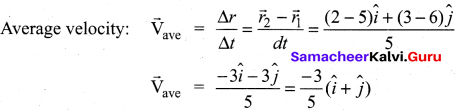
  • In the 2nd group, beryllium forms compounds with more covalent character while the other elements of this family form only ionic compounds.
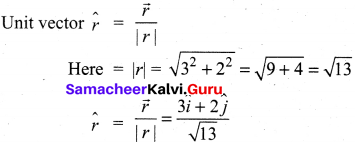
Question 39.
Explain the Pauling’s method for the determination of ionic radius.
Answer:
1. Ionic radius is defined as the distance from the center of the nucleus of the ion up-to which it exerts its influence on the electron cloud of the ion.
2. Ionic radius of uni-univalent crystal can be calculated from the inter-ionic distance between the nuclei of the cation and anion.
3. Pauling assumed that ions present in a crystal lattice are perfect spheres and they are in contact with each other, therefore
d = rC+ + rA ………(1)
Where, d = distance between the center of the nucleus of cation C+ and the anion A-
rC+ = radius of cation
rA = radius of anion.
4. Pauling assumed that the radius of the ion having noble gas configuration (Na+ and F having 1s2, 252, 2p6 configuration) is inversely proportional to the effective nuclear charge felt at the periphery of the ion.
11th Chemistry 3rd Lesson Answers Samacheer Kalvi Periodic Classification Of Elements
Where Zeff is the effective nuclear charge
Zeff = Z – S
5. Dividing the equation (2) by (3)
11th Chemistry 3rd Lesson Book Back Answers Samacheer Kalvi Periodic Classification Of Elements
On solving equation (1) and (4), the values of rC+ and rA can be obtained.

Question 40.
Explain the periodic trend of ionization potential.
Answer:
(a) The energy required to remove the most loosely held electron from an isolated gaseous atom is called as ionization energy.
(b) Variation in a period:
Ionization energy is a periodic property. On moving across a period from left to right, the ionization enthalpy value increases. This is due to the following reasons.

  • Increase of nuclear charge in a period
  • Decrease of atomic size in a period

Because of these reasons, the valence electrons are held more tightly by the nucleus. Therefore, ionization enthalpy increases.

(c) Variation in a group:
As we move from top to bottom along a group, the ionization enthalpy decreases. This is due to the following reasons.

  • A gradual increase in atomic size
  • Increase of screening effect on the outermost electrons due to the increase of number of inner electrons.

Hence, ionization enthalpy is a periodic property.

Question 41.
Explain the diagonal relationship.
Answer:

  • On moving diagonally across the periodic table, the second and the third period elements show certain similarities.
  • Even though the similarity is not same as we see in a group, it is quite pronounced in the following pair of elements.
  • 11th Chemistry 3rd Lesson Samacheer Kalvi Periodic Classification Of Elements
  • The similarity in properties existing between the diagonally placed elements is called “diagonal relationship”.

Question 42.
Why the first ionization enthalpy of sodium is lower than that of magnesium while its second ionization enthalpy is higher than that of magnesium?
Answer:
The 1st ionization enthalpy of magnesium is higher than that of Na due to higher nuclear charge and slightly smaller atomic radius of Mg than Na. After the loss of first electron, Na+ formed has the electronic configuration of neon (2,8). The higher stability of the completely filled noble gas configuration leads to very high second ionization enthalpy for sodium. On the other hand, Mg+ formed after losing first electron still has one more electron in its outermost (3 s) orbital. As a result, the second ionization enthalpy of magnesium is much smaller than that of sodium.

Question 43.
By using Pauling’s method calculate the ionic radii of K+ and Cl ions in the potassium chloride crystal. Given that \(\mathrm{d}_{\mathrm{K}}+_{-} \mathrm{cl}^{-}\) = 3.14 Å
Answer:
Given
11th Chemistry Chapter 3 Samacheer Kalvi Periodic Classification Of Elements
We know that,
Samacheer Kalvi Guru 11th Chemistry Solutions Chapter 3 Periodic Classification Of Elements
(Zeff)Cl = Z – S
= 17 – [(0.35 x 7) + (0.85 x 8) + (1 x 2)]
= 17 – 11.25 = 5.75
(Zeff)K+ = Z – S
= 19 – [(0.35 x 7) + (0.85 x 8) + (1 x 2)]
= 19 – 11.25 = 7.75
Samacheer Kalvi Class 11 Chemistry Solutions Chapter 3 Periodic Classification Of Elements
r(K+) = 0.74 r(Cl)
Substitute the value of r(K+) in equation (1)
0.74 r(Cl) + r(Cl) = 3.14 Å
1.74 r(Cl) = \(\frac {3.14 Å}{1.74}\) = 1.81 Å.

Question 44.
Explain the following, give appropriate reasons.

  1. Ionization potential of N is greater than that of O
  2. First ionization potential of C-atom is greater than that of B-atom, where as the reverse is true for second ionization potential.
  3. The electron affinity values of Be, Mg and noble gases are zero and those of N (0.02 eV) and P (0.80 eV) are very low
  4. The formation of F (g) from F(g) is exothermic while that of O2-(g) from O (g) is endothermic.

Answer:
1. N (Z = 7) 1s2 2s2 2px1 12py1 2pz1. It has exactly half filled electronic configuration and it is more stable. Due to stability, ionization energy of nitrogen is high.
O (Z = 8) 1s2 2s2 2px1 2py1 2pz1. It has incomplete electronic configuration and it requires less ionization energy.
I.E1 N > I.E1O

2. C (Z = 6) 1s2 2s2 2px1 2py1. The electron removal from p orbital is very difficult. So carbon has highest first ionization potential. B (Z = 5) 1s2 2s2 2p1. In boron nuclear charge is less than that of carbon, so boron has lowest first ionization potential.
I.E1 C > I.E1 B
But it is reverse in the case of second ionization energy. Because in case of B+ the electronic configuration is 1s2 2s2, which is completely filled and it has high ionization energy. But in C+ the electronic configuration is 1s2 2s2 2p1, one electron removal is easy so it has low ionization energy.
I.E2 B > I.E2 C

3. Be (Z = 4) 1s2 2s2
Mg (Z = 12) 1s2 2s2 2p6 3s2
Noble gases has the electronic configuration of ns2 np6. All these are completely filled and are more stable. For all these elements Be, Mg and noble gases, addition of electron is unfavorable and so they have zero electron affinity.

Nitrogen (Z = 7) 1s2 2s2 2px1 2py1 2pz1. It has half filled electronic configuration. So addition of electron is unfavorable and it has very low electron affinity value of 0.02 eV. Phosphorus (Z = 15) 1s2 2s2 2p6 3s2 3px1 3py1 3pz1. It also has half filled electronic configuration. Due to the symmetry and more stability, it has very low electron affinity value of 0.80 eV.

4. F(g) + e → F(g) exothermic
F (Z = 9) 1s2 2s2 2p5. It is ready to gain one electron to attain the nearest inert gas configuration. By gaining one electron, energy is released, so it is an exothermic reaction.
O(g) + 2e → O2-(g) endothermic
O (Z = 8) 1s2 2s2 2px1 2py1 2pz1. It is the small atom with high electron density. The first electron affinity is negative because energy is released in the process of adding one electron to the neutral oxygen atom. Second electron affinity is always endothermic (positive) because the electron is added to an ion which is already negative, therefore it must overcome the repulsion.

Question 45.
What is screening effect? Briefly give the basis for Pauling’s scale of electro negativity. Screening effect:
Answer:
The repulsive force between inner shell electrons and the valence electrons leads to a decrease in the electrostatic attractive forces acting on the valence electrons by the nucleus. Thus the inner shell electrons act as a shield between the nucleus and the valence electrons. This effect . is called shielding effect (or) screening effect.

Pauling’s scale:

  • Electro negativity is the relative tendency of an element present in a covalently bonded molecule to attract the shared pair of electrons towards itself.
  • Pauling assigned arbitrary value of electronegativities for hydrogen and fluorine as 2.2 and 4, respectively.
    • Based on this the electronegativity values for other elements can be calculated using the following expression.
      (XA-XB) = 0.182 √EAB – (EAA EBB)
      Where EAB , EAA and EBB are the bond dissociation energies of AB, A2 and B2 molecules respectively.
      XA and XB are electronegativity values of A and B.

Question 46.
State the trends in the variation of electro negativity in period and group.
Answer:
Variation of electron negativity in a period:
The electro negativity increases across a period from left to right. Since the atomic radius decreases in a period, the attraction between the valence electron and the nucleus increases. Hence the tendency to attract shared pair of electrons increases. Therefore, electro negativity increases in a period.
Samacheer Kalvi 11 Chemistry Solutions Chapter 3 Periodic Classification Of Elements

Variation of electro negativity in a group:
The electro negativity decreases down a group. As we move down a group, the atomic radius increases and the nuclear attractive force on the valence electron decreases. Hence electro negativity decreases in a group.
11th Chemistry 3rd Chapter Samacheer Kalvi Periodic Classification Of Elements

Samacheer Kalvi 11th Chemistry Periodic Classification of Elements  In-Text Question – Evaluate your self

Question 1.
What is the basic difference in approach between Mendeleev’s periodic table and modern periodic table?
Answer:
The main basic difference between Mendeleev’s periodic table and modem periodic table is that first one is constructed on the basis of atomic weight and the later is constructed on the basis of atomic number.

Question 2.
The element with atomic number 120 has not been discovered so far. What would be the IUPAC name and the symbol for this element? Predict the possible electronic configuration of this element.
Answer:
Atomic number : 120
IUPAC temporary symbol : Unbinilium
IUPAC temporary symbol : Ubn
Possible electronic configuration : [Og] 8s2

Question 3.
Predict the position of the element in periodic table satisfying the electronic configuration (n – 1 )d2 ns2 where n = 5?
Answer:
Electronic Configuration : (n – 1 )d2 ns2
for n = 5, the electronic configuration is,
1s2 2s2 2p6 3s2 3p6 4s2 3d10 4p6 4d2 5s2
Atomic number : 40
4th group 5th period (d block element) = Zirconium

Question 4.
Using Slater’s rule calculate the effective nuclear charge on a 3p electron in aluminium and chlorine. Explain how these results relate to the atomic radii of the two atoms.
Answer:
Electronic Configuration of Aluminium
Periodic Classification Of Elements Class 11 Samacheer Kalvi Chemistry Solutions Chapter 3
Effective nuclear charge = Z – S = 13 – 9.5
(Zeff)Al = 3.5
Electronic Configuration of chlorine
Periodic Classification Of Elements Class 11 Notes Pdf Samacheer Kalvi Chapter 3
Effective nuclear charge = Z- S = 17 – 10.9
(Zeff)Cl = 6.1
(Zeff)Cl > (Zeff)Cl and hence rCl< rAl

Question 5.
A student reported the ionic radii of iso electronic species X3+ , Y2+ and Z as 136 pm, 64 pm and 49 pm respectively. Is that order correct? Comment.
Answer:
X3+, Y2+, Z are iso electronic.
∴ Effective nuclear charge is in the order
(Zeff)Cl < (Zeff)YY2+ < (Zeff)X3+ and hcnce, ionic radii should be in the order rZ > rY2+ > rX3+
∴ The correct values are:
Chemistry Chapter 3 Answers Samacheer Kalvi 11th Periodic Classification Of Elements

Question 6.
The first ionisation energy (IE1) and second ionisation energy (IE2) of elements X, Y and Z are given below.
Periodic Classification Of Elements Class 11 Questions And Answers Samacheer Kalvi Chapter 3
Which one of the above elements is the most reactive metal, the least reactive metal and a noble gas?
Answer:
Noble gases:
Ioniation energy ranging from 2372 KJmol-1 to 1037 kJ mol-1. For element X, the IE1 value is in the range of noble gas, moreover for this element both IE1 and IE2 are higher and hence X is the noble gas. For Y, the first ionisation energy is low and second ionisation energy is very high and hence Y is most reactive metal.
For Z, both IE1 and IE2 are higher and hence it is least reactive.

Question 7.
The electron gain enthalpy of chlorine is 348 kJ mol-1. How much energy in kJ is released when 17.5 g of chlorine is completely converted into Cl ions in the gaseous state?
Cl(g)+ e → Cl(g)
∆H = 348 kJ mol-1
For one mole (35.5g) 348 kJ is released.
∴ For 17.5g chlorine, Class 11 Chemistry Chapter 3 Important Questions With Answers Periodic Classification Of Elements Samacheer Kalvi energy leased.
∴ The amount of energy released = \(\frac {348}{2}\) = 174 kJ.

Samacheer Kalvi 11th Chemistry Periodic Classification of Elements  Additional Questions

Question 1.
The chemical symbol of carbon and cobalt are
(a) Ca and CO
(b) Ca and Cl
(c) C and CO
(d) Cr and Cb
Answer:
(c) C and CO

Question 2.
Consider the following statements.
(i) The chemical symbol of nickel is N.
(ii) An element is a material made up of different kind of atoms.
(iii) The physical state of bromine is liquid.
Which of the above statement is/are not correct?
(a) (i) and (iiii)
(b) (iii) only
(c) (ii) and (iii)
(d) (i) and (ii)
Answer:
(d) (i) and (ii)

Question 3.
Match the list-I and list-II using the correct code given below the list.
List – I
A. Jewels
B. Bolts and cot
C. Table salt
D. Utensils

List – II
1. Sodium chloride
2. Copper
3. Gold
4. Iron
Samacheerkalvi.Guru 11th Chemistry Solutions Chapter 3 Periodic Classification Of Elements
Answer:
Samacheer Kalvi.Guru 11th Chemistry Solutions Chapter 3 Periodic Classification Of Elements

Question 4.
The law of triads is not obeyed by
(a) Ca, Sr, Ba
(b) Cl, Br, I
(c) Li, Na, K
(d) Be, B, C
Answer:
(d) Be, B, C

Question 5.
The law of triads is obeyed by
(a) Fe, CO, Ni
(b) C, N, O
(c) He, Ne, Ar
(d) Al, Si, P
Answer:
(a) Fe, CO, Ni

Question 6.
Match the list-I and list-II using the code given below the list.
List-I
A. Law of triads
B. Law of octaves
C. First periodic law
D. Modem periodic law

List-II
1. Chancourtois
2. Henry Moseley
3. Newland
4. Johann Dobereiner
Class 11 Chemistry Samacheer Solutions Chapter 3 Periodic Classification Of Elements
Answer:
11th Chemistry Solutions Samacheer Kalvi Chapter 3 Periodic Classification Of Elements

Question 7.
Consider the following statements.
(i) In Chancourtois classification, elements differed from each other in atomic weight by 16 or multiples of 16 fell very nearly on the same vertical line.
(ii) Mendeleev’s periodic law is based on atomic weight.
(iii) Mendeleev listed the 117 elements known at that time and are arranged in the order of atomic numbers.
Which of the following statement is/are not correct?
(a) (i) only
(b) (ii) and (iii)
(c) (iii) only
(d) (i),(ii), (iii)
Answer:
(c) (iii) only

Question 8.
Which of the following elements were unknown at that time of Mendeleev?
(a) Na, Mg
(b) Fe, CO
(c) K, Cu
(d) Ga, Ge
Answer:
(d) Ga, Ge

Question 9.
Consider the following statements.
(i) Position of hydrogen could not be made clear.
(ii) Isotopes find correct place in Mendeleev’s periodic table.
(iii) Mendeleev’s periodic table could not explain the variable valencies of elements.
Which of the above statement is/are not correct?
(a) (i) only
(b) (i) and (iii)
(c) (ii) only
(d) (i), (ii), (iii)
Answer:
(c) (ii) only

Question 10.
According to modem periodic law, the physical and chemical properties of the elements are periodic functions of their
(a) atomic volume
(b) atomic numbers
(c) atomic weights
(d) valency
Answer:
(B) atomic numbers

Question 11.
Which period contain 32 elements?
(a) Period 1
(b) Period 4
(c) Period 5
(d) Period 6
Answer:
(d) Period 6

Question 12.
There are horizontal rows of the periodic table known as
(a) groups
(b) periods
(c) families
(d) chalcogens
Answer:
(b) periods

Question 13.
The shortest period contains elements.
(a) H, He
(b) Li, Be
(c) B, C
Answer:
(a) H, He

Question 14.
The longest form of periodic table was constructed by
(a) Dmitri Mendeleev
(b) Henry Moseley
(c) Lothar Meyer
(d) New lands
Answer:
(b) Henry Moseley

Question 15.
Match the list-I and list-II using the correct code given below the list.
List – I
Z = 100
Z = 101
Z = 102
Z = 103

List – II
1. Mendelevium
2. Lawrencium
3. Fermium
4. Nobelium
Samacheer Kalvi Guru 11 Chemistry Solutions Chapter 3 Periodic Classification Of Elements
Answer:
Samacheer Kalvi 11th Chemistry Solution Chapter 3 Periodic Classification Of Elements

Question 16.
Which one of the following is the first transition series?
(a) Sc
(b) Zn
(c) Ti
(d) Cu
Answer:
(a) Sc

Question 17.
Which period mostly include man made radioactive elements?
(a) 4th period
(b) 7th period
(c) 6th period
(d) 31 period
Answer:
(b) 7th period

Question 18.
Which one of the following is called halogen family?
(a) Group 17
(b) Group 16
(c) Group 1
(d) Group 2
Answer:
(a) Group 17

Question 19.
Group 16 constitutes family.
(a) halogen
(b) nobel gas
(c) chalcogen
(d) alkali metals
Answer:
(c) chalcogen

Question 20.
Consider the following statements.
(i) The valency of the elements increases from left to right in a period.
(ii) Valency decreases from 7 to I with respect to oxygen.
(iii) The metallic character of the elements decreases across a period.
Which of the above statement is/are not correct?
(a) (i) only
(b) (ii) only
(c) (i) and (iii)
(d) (i) (ii) and (iii)
Answer:
(b) (ii) only

Question 21
Match the list – I and list -II using the correct code given below the list.
List – I
A. Li
B. Na
C. K
D. Cs

List – II
1. 2,8,8,1
2. 2,1
3. 2,8, 18, 18, 8, 1
4. 2,8, 1
Samacheer Kalvi 11th Chemistry Solutions Chapter 3 Periodic Classification of Elements
Answer:
Samacheer Kalvi 11th Chemistry Solutions Chapter 3 Periodic Classification of Elements

Question 22.
What will be the change in valency down the group in the periodic table?
(a) increases
(b) decreases
(c) remains same
(d) zero
Answer:
(c) remains same

Question 23.
Which one of the following is a metalloid?
(a) N
(b) P
(c) Bi
(d) Sb
Answer:
(d) Sb

Question 24.
Which one of the following is a metal?
(a) N
(b) Br
(c) Bi
(d) As
Answer:
(c) Bi

Question 25.
Match the list – I and list – II using the correct code given below the list.
List – I
A. Alkali metal
B. Alkaline earth metals
C. d-block elements
D. p-block elements

List – II
1. ns2 np1-6
2. ns1
3. ns2
4. (n – 1)d1-10 ns0-2
Samacheer Kalvi 11th Chemistry Solutions Chapter 3 Periodic Classification of Elements
Answer:
Samacheer Kalvi 11th Chemistry Solutions Chapter 3 Periodic Classification of Elements

Question 26.
Consider the following statements.
(i) Oxidation character increases from left to right in a period.
(ii) Reducing character increases from left to right in a period.
(iii) Metallic character increases from left to right in a period.
Which of the above statement is/are not correct?
(a) (i) only
(b) (i) and (iii)
(c) (ii) and (iii)
(d) (i), (ii), (iii)
Answer:
(c) (ii) and (iii)

Question 27.
The general electronic configuration of d-block elements is
(a) ns2 nd1-10 10
(b) (n-1)d1-10 ns0-2
(c) (n-2)d1-10 (n – 1)0-2
(d) ns2nd5
Answer:
(b) (n-1)d1-10 ns0-2

Question 28.
Consider the flowing statements.
(i) d-block elements show variable oxidate states.
(ii) Mostly d-block elements form colourless compounds.
(iii) Mostly d-block elements are diamagnetic due to paired electrons.
Which of the above statement is/are not correct?
(a) (i) only
(b) (ii) only
(c) (i) and (ii)
(d) (ii) and (iii)
Answer:
(d) (ii) and (iii)

Question 29.
All the s – block and p-block elements excluding l8 group are called elements.
(a) representative
(b) transition
(c) inner – transition
(d) trans uranium
Answer:
(a) representative

Question 30.
Which of the following is the correct electronic configuration of noble gases?
(a) ns2 np6 nd10
(b) ns2 np5
(c) ns2 np6
(d) ns2 np3
Answer:
(c) ns2 np6

Question 31.
Group numbers 13 to 12 in the periodic table are called …………..
(a) inner transition elements
(b) Representative elements
(c) synthetic elements
(d) transition elements
Answer:
(d) transition elements

Question 32.
Which one of the following is in solid state at room temperature?
(a) Bromine
(b) Mercury
(c) Bismuth
(d) Gallium
Answer:
(c) Bismuth

Question 33.
Which of the following is not a metalloid (or) semi-metal?
(a) Silicon
(b) Arsenic
(c) Germanium
(d) Sodium
Answer:
(d) Sodium

Question 34.
Which of the following metal is not in liquid state?
(a) Gallium
(b) Aluminium
(c) Mercury
(d) Calsium
Answer:
(b) Aluminium

Question 35.
Which of the following is not a periodic property?
(a) Atomic radius
(b) Ionization enthaphy
(c) Electron affinity
(d) Oxidation number
Answer:
(d)Oxidation number

Question 36.
Which of the following property increases as we go down the group in the periodic property?
(a) ionization energy
(b) Electro negativity
(c) Atomic radius
(d) Electron affinity
Answer:
(c) Atomic radius

Question 37.
The metallic radius of copper is ………………
(a) 0.99 Å
(b) 1.28 Å
(c) 1.98 Å
(d) 2.56 Å
Answer:
(5) 1.28 Å

Question 38.
Consider the following statements………………
(i) Atomic radius of elements increases with increase in atomic number as we go down the group.
(ii) Atomic radius of elements increases with increase in atomic number as we go across the period.
(iii) Atomic radius of elements decreases as we go from left to right in a period.
Which of the above statement is/are not correct?
(a) (i) only
(b) (i) and (ii)
(c) (ii) only
(d) (i) and (iii)
Answer:
(c) (ii) only

Question 39.
Which one of the following is not an iso electronic ion?
(a) Na+
(b) Mg2+
(c) Cl
(d) O2-
Answer:
(c) Cl

Question 40.
Which one of the following is not an isoelectronic ion?
(a) Al3+
(b) N3-
(c) Mg2+
(d) K+
Answer:
(d) K+

Question 41.
Which of the following possess almost same properties due to lanthanide contraction?
(a) Zr, HF
(b) Na, K
(c) Zn, Cd
(d) Ag. Au
Answer:
(a) Zr, HF

Question 42.
Consider the following statements.
(i) Ionization is always an exothermic process.
(ii) Ionization energies always increase in the order I.E1> IE2>I.E3.
(iii) Ionization energy measurements are carried out with atoms in the solid state.
Which of the above statement is/are not correct?
(a) (i) only
(b) (i) and (ii)
(c) (iii) only
(d) (i), (ii) and (iii)
Answer:
(d) (i), (ii) and (iii)

Question 43.
Statement-I : Ionization enthalpy of Be is greater than that of 13.
Statement-II : The nuclear charge of B is greater than that of Be.
(a) Statement-I and II are correct and statement-II is the correct explanation of statement-I.
(b) Statement-I and II are correct but statement-II is not the correct explanation of statement-I.
(c) Statement-I is correct but statement-II is wrong.
(d) Statement-I is wrong but statement-II is correct.
Answer:
(b) Statement-I and II are correct but statement-II is not the correct explanation of statement-I.

Question 44.
Statement-I: Ionization enthalpy of nitrogen is greater than that of oxygen.
Statement-lI: Nitrogen has exactly half filled electronic configuration which is more stable than electronic configuration of oxygen.
(a) Statement-I is wrong but statement-II is correct.
(b) Statement-I is correct but statement-II is wrong.
(c) Statement-I and II are correct and statement-TI is the correct explanation of statement-I.
(d) Statement-I and II are correct but statement-II is not the correct explanation of statement-I.
Answer:
(c) Statement-I and II are correct and statement-II is the correct explanation of statement-I.

Question 45.
Which of the following does not have zero electron gain enthalpy?
(a) Be
(b) Cl
(c) Mg
(d) N
Answer:
(b) Cl

Question 46.
Which of the following have zero electron gain enthalpy?
(a) Halogens
(b) Noble gases
(c) Chalcogens
(d) Gold
Answer:
(b) Noble gases

Question 47.
Which of the following have the highest value of electronegativity?
(a) Halogens
(b) Alkali metals
(c) Alkaline earth metals
(d) Transition metals
Answer:
(a) Halogens

Question 48.
Among all the elements which one has the highest value of electronegativity?
(a) Chlorine
(b) Bromine
(c) Fluorine
(d) Iodine
Answer:
(c) Fluorine

Question 49.
Among the alkali metals which one form compounds with more covalent character?
(a) Sodium
(b) Potassium
(c) Rubidium
(d) Lithium
Answer:
(d) Lithium

Question 50.
Which of the following pair is not diagonally related?
(a) Li, Mg
(b) Li, Na
(c) Be, Al
(d) B, Si
Answer:
(b) Li, Na

Question 51.
In the modern periodic table, the period indicates the value of
(a) atomic number
(b) mass number
(c) principal quantum number
(d) azimuthal quantum number
Answer:
(c) principal quantum number
Hint:
In the modern periodic table, each period begins with the filling of a new shell. Therefore, the period indicates the value of principal quantum number. Thus, option (c) is correct.

Question 52.
Which of the following statements related to the modern periodic table is incorrect?
(a) The p-block has 6 columns, because a maximum of 6 electrons can occupy all the orbitais in a p-subshell.
(b) The d-block has 8 columns, because a maximum of 8 electrons can occupy all the orbitais in a d-subsheli.
(c) Each block contains a number of columns equal to the number of electrons that can occupy that subshell.
(d) The block indicates value of azimuthal quantum number (1) for the last subshell that received electrons in building up the electronic configuration.
Answer:
(b)The d-block has 8 columns, because a maximum of 8 electrons can occupy all the orbitais in a d-subshell.

Question 53.
The size of isoelectronic species- F, Ne and Na+ is affected by
(a) nuclear charge (Z)
(b) valence principal quantum number (n)
(c) electron-electron interaction in the outer orbitais
(d) none of the factors because their size is the same
Answer:
(a) nuclear charge (Z).

Question 54.
Which of the following statements is incorrect in relation to ionization enthalpy?
(a) Ionization enthalpy increases for each successive electron.
(b) The greatest increase in ionization enthalpy is experienced on removal of electrons from core noble gas configuration.
(c) End of valence electrons is marked by a big jump in ionization enthalpy.
(d) Removal of electron from orbitais bearing lower n value is easier than from orbital having high n value.
Answer:
(d)Removal of electron from orbitais bearing lower n value Is easier than from orbital having high n value.

Question 55.
Considering the elements B, Al, Mg and K, the correct order of their metallic character is:
(a) B > Al >Mg > K
(b) Al > Mg > B > K
(c) Mg > Al > K > B
(d) K > Mg > Al > B
Answer:
(d) K > Mg > Al> B
Hint:
In a period, metallic character decreases as we move from left to right. Therefore, metallic character of I< Mg and Al decreases in the order: K> Mg > Al. However, within a group, the metallic character, increases from top to bottom. Thus, Al is more metallic than B.Therefore, the correct sequence of decreasing metallic character is K> Mg >Al > B, i.e,
option (d) is correct.

Question 56.
Considering the elements B, C, N, F and Si, the correct order of their non-metallic character is
(a) B>C>Si>N>F
(b) Si>C>B>N>F
(c) F>N>C>B>Si
(d) F>N>C>Si>B
Answer:
(c) F>N>C>B> Si
Hint:
In a period, the non-metallic character increases from left to right. Thus, among B, C, N and F, non-metallic character decreases in the order: F > N > C> B. However, within a group, non-metallic character decreases from top to bottom. Thus, C is more non-metallic than Si. Therefore, the correct sequence of decreasing non-metallic character is: F> N > C > B > Si, i.e., option (c) is correct.

Question 57.
Considering the elements F, Cl, O and N, the correct order of their chemical reactivity in terms of oxidizing property is
(a) F>Cl>O>N
(b) F>O>Cl>N
(c) Cl>F>O>N
(d) O>F>N>Cl
Answer:
(b) F>O>Cl>N.
Hint:
Within a period, the oxidizing character increases from left to right. Therefore, among F, O and N,oxidizing power decreases in the order: F> O> N. However, within a group, oxidizing power decreases from top to bottom. Thus, F is a stronger oxidizing agent than Cl. Further because O is more electronegative than Cl, therefore, O is a stronger oxidizing agent than Cl. Thus, overall decreasing order of oxidizing power is: F > O > Cl > N, i.e.,
option (b) is correct.

Question 58.
The highest ionization energy is exhibited by ………………
(a) halogens
(b) alkaline earth metals
(c) transition metals
(d) noble gases
Answer:
(b) alkaline earth metals

Question 59.
Which of the following is arranged in order of increasing radius?
(a) K+(aq) < Na+(aq) <Li+(aq)
(b) K+(aq)> Na+(aq)> Zn2+(aq)
(c) K+(aq)> Li+(aq) > Na+(aq)
(d) Li+(aq)< Na+(aq) < K+(aq)
Answer:
(d) Li+(aq)< Na+(aq) < K+(aq)

Question 60.
Among the following elements, which has the least electron affinity?
(a) Phosphorous
(b) Oxygen
(c) Sulphur
(d) Nitrogen
Answer:
(d) Nitrogen

Question 61.
Which one of the following is isoelectronic with Ne?
(a) N3-
(b) Mg2+
(c) Al3+
(d) All the above
Answer:
(d) All the above

Question 62.
Which clement has smallest size?
(a) B
(b) N
(c) Al
(d) P
Answer:
(b) N

Question 63.
In halogens, which of the following decreases from iodine to fluorine?
(a) Bond length
(b) Electronegativity
(c) ionization energy
(d) Oxidizing power
Answer:
(a) Bond length

Question 64.
What is the electronic configuration of the elements of group 14?
(a) ns2 np4
(b) ns2 np6
(c) ns2 np2
(d) ns2
Answer:
(c) ns2 np2

Samacheer Kalvi 11th Chemistry Periodic Classification of Elements  2-Mark Questions

Write brief answer to the following questions:

Question 1.
State Johann Dobereiner’s law of triads.
Answer:
Johann Dobereiner noted that elements with similar properties occur in groups of three which he called triads. It was seen that invariably, the atomic weight of the middle number of the triad was nearly equal to the arithmetic mean of the weights of the other two numbers of the triad.
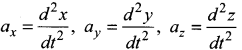
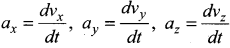
For e.g.,
Samacheer Kalvi 11th Chemistry Solutions Chapter 3 Periodic Classification of Elements

Question 2.
Write a note about Chancourtois classification.
Answer:
in this system, elements that differed from each other in atomic weight by 16 or multiples of 16 fell very nearly on the same vertical line. Elements lying directly under each other showed a definite similarity. This was the first periodic law.

Question 3.
State the New land’s law of octaves.
The Law of octaves states that, “when elements are arranged in the order of increasing atomic weights, the properties of the eighth element are a repetition of the properties of the first element.

Question 4.
State Mendeleev’s periodic law.
Answer:
This law states that “The physical and chemical properties of elements are a periodic function of their atomic weights.”

Question 5.
Explain about the relationship between the atomic number of an element and frequency of the X-ray emitted from the elements.
Answer:
Henry Moseley studied the X-ray spectra of several elements and determined their atomic numbers (Z). He noticed that the frequencies of X-ray emitted from the elements concerned could be correlated by the equation
\(\sqrt{υ}\) = a(Z – b)
Where, υ Frequency of the X-ray emitted by the element.
a and b = Constants and have same values for all the elements.
Z = Atomic number of the element.

Question 6.
State modern periodic law.
Answer:
The modem periodic law states that, “The physical and chemical properties of the elements are periodic function of their atomic numbers.”

Question 7.
What are the anomalies of the long form of periodic table?
Answer:
The long form of periodic table need clarification about the following:

  • Position of hydrogen is not defined till now.
  • Lanthanides and actinides still find place in the bottom of the table.

Question 8.
Mention the names of the elements with atomic number 101, 102, 109 and 110.
Z = 101  IUPAC  name : Mendelevium
Z = 102  IUPAC  name : Nobelium
Z = 109  IUPAC  name : Meitnerium
Z = 110  IUPAC  name : Darmstadtium

Question 9.
Write a note about the electronic configuration of elements in groups.
Answer:
A vertical column of the periodic table is called a group. A group consists of a series of elements having similar configuration of the outermost shell. There are 18 groups in the periodic table. it may be noted that the elements belonging to the same group are said to constitute a family. For example, elements of group 17 are called halogen family.

Question 10.
Give the name and electronic configuration of elements of group and 2 group.
Answer:

  • Elements of 1st group are called alkali metals. Their electronic configuration is ns1.
  • Elements of 2nd group are called alkaline earth metals. Their electronic configuration is ns2.

Question 11.
Write any two characteristic properties of alkali metals.
Answer:

  • Alkali metals readily lose their outermost electron to form +1 ion.
  • Alkali metals are soft metals with low melting and boiling points.

Question 12.
Write any two characteristic properties of alkaline earth metals.
Answer:

  • Alkaline earth metals readily lose their outermost electrons to form +2 ion.
  • As we go down the group. their metallic character and reactivity are increased.

Question 13.
Groups from 13 to 1 in the periodic table are called p-block elements. Give reason.
Answer:

  • The elements whose last electron enters into the p-orbital of the outermost shell are having similar properties and thus form a group. The ‘np’ orbital of these elements is being progressively tilled. Hence, these elements are named as p-block elements.
  • The groups of 3th to 18th in the periodic table belongs to p-block.

Question 14.
Why noble gases do not show much of chemical reactivity?
Answer:
Noble gases having closed valence shell configuration as ns2 np6. The valence shell orbitais of noble gases are completely filled by electrons and it is very difficult to alter this stable arrangement by the addition or removal of electrons. Because of these reasons noble gases do not show much of chemical reactivity.

Question 15.
Halogens and chalcogens have highly negative electron gain enthalpies. Why?
Answer:

  • Group 16 (chaicogens) and Group 17 (halogens) are interested to add two or one electrons respectively to attain stable noble gas configuration.
  • Because of this interest these elements have highly negative electron gain enthalpies.

Question 16.
What are d-biock elements? Why are they called so?
Answer:

  • The elements whose last electron enters into the d-orbitalof the penultimate shell (n-1) are having similar properties and called as d-block elements.
  • The groups of 3 to 12 in the center of the periodic table belongs to d-block.

Question 17.
Elements Zn, Cd and Hg with electronic configuration (n-1)d10 ns2 do not show most of transition elements properties. Give reason.
Answer:

  • Zn, Cd and Hg are having completely filled d-orbitais (d10 electronic configuration).
  • They do not have partially filled d-orbitais Like other transition elements. So they do not show much of the transition elements properties.

Question 18.
Why Zn, Cd and Hg are considered as soft metals?
Answer:

  • Zinc, cadmium and mercury are metals with low melting points. This is because they have an especially stable electronic configuration.
  • Mercury is so poor at forming metallic bonds that it is liquid at room temperature.
  • Zinc and cadmium arc soft metals that oxidize to the +2 oxidation states.

Question 19.
Why d-block elements are called as transition elements?
Answer:
d-block elements form a bridge between the chemically active metals of s-block elements and the less active elements of groups of 13th and 14th and thus take their familiar name transition elements.

Question 20.
What are f-block elements? how many series are there? Why they are called f-block elements?
Answer:

  • The elements, whose last electron enters into the f-orbital of the ante-penultimate shell (n-2) are having similar properties are called f-block elements. In these elernents (n-2)f orbitais are being filled progressively.
  • The two rows of elements placed at the bottom of the periodic table. They are lanthanides and actinides.

Question 21.
Write the electronic configuration of lanthanides and actinides?
Answer:

  • The electronic configuration of lanthanides is 4f1-144 5d0-11 6s2.
  • The electronic configuration of actinides is 5f1-14 6d0-17s2.

Question 22.
What are lanthanides and actinides? ,
Answer:

  • In 4f senes, 4f’orbitals arc being progressively filled with electrons, 4f1-14 5d0-1 6s2. These elements lie in 6th period and are called rare earths or lanthanides or lanthanones.
  • In 5f series, 5f orbitais are being progressively filled with electrons, 5f16d0-1 7s2. These elements lie in 7th period and are called actinides or actonones.

Question 23.
What are semi-metals? Give example.
Answer:

  • Some elements in the periodic table show properties that are characteristic of both metals and non-metals. These elements are called semi-metals or metalloids.
  • Example: Silicon. germanium, arsenic, antimony and tellurium.

Question 24.
What are periodic properties? Give example.
Answer:
The term periodicity of properties indicates that the elements with similar properties reappear at certain regular intervals of atomic number in the periodic table.
Example:

  • Atomic radii
  • Ionisation energy
  • Electron affinity
  • Electronegativity.

Question 25.
Define ionic radius.
Answer:
The ionic radius of an ion is the distance between the center of the ion and the outermost point of its electron cloud.


Question 26.
Cationic radius is smaller than its corresponding neutral atom. Justify this statement.
Answer:

  • When an neutral atom lose one or more electrons it forms cation.
    Na → Na+ + e
  • The radius of this cation (rNa+)is decreased than its parent atom (rNa).
  • When an atom is charged to cation, the number of nuclear charge becomes greater than the number of orbital electrons. Hence the remaining electrons are more strongly attracted by the nucleus. Hence the cationic radius is smaller than its corresponding neutral atom.

Question 27.
Anionic radius is higher than the corresponding neutral atom. Give reason.
Answer:
When an atom gain one or more electrons it forms anion. During the formation of anion, the number of orbital electrons become greater than the nuclear charge. Hence, the electrons are not strongly attracted by the lesser number of nuclear charges. Hence anionic radius is higher than the corresponding neutral atom.

Question 28.
What are iso electronic ions? Give example.
Answer:
There are some ions of different elements having the same number of electrons are called isoelectronic ions.
Example: Na+ Mg2+, Al3+, F, O2-, N3-

Question 29.
Define ionization energy. Give its unit.
Answer:
The energy required to remove the most loosely held electron from an isolated gaseous atom is called ioniiation energy.
M(g) + energy M+(g) + electron
The unit of ionization energy is KJ mole-1.

Question 30.
Ionization energy of beryllium is greater than the ionization energy of boron. Why?
Answer:
Be (Z= 4) 1s2 2s2. it has completely filled valence electrons, which requires high IE1.
B (Z =5) 1s2 2s2 2p1. It has incompletely filled valence electrons, which requires comparatively
less IE1 Hence I.E1 Be > I.E1 B.

Question 31.
Ionization energy of nitrogen is greater than the ionization energy of oxygen. Give reason.
Answer:
7N 1s2 2s1 2p3 (or) Samacheer Kalvi 11th Chemistry Solutions Chapter 3 Periodic Classification of Elements . Nitrogen has exactly half filled valence electrons, which requires high I.E1.
8O 1s2 2s2 2p4 (or)Samacheer Kalvi 11th Chemistry Solutions Chapter 3 Periodic Classification of Elements . Oxygen has incomplete valence shell electrons, which requires comparatively less I.E1.
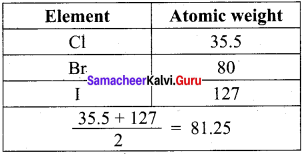
I.E1N>I.E1O

Question 32.
Define electron gain enthalpy or electron affinity. Give its unit.
Answer:
The electron gain enthalpy of an element is the amount of energy released when an electron is added to the neutral gaseous atom.
A + electron → A + energy (E.A)
Unit of electron affinity is KJ mole.


Question 33.
Electron gain enthalpy of F ¡s less negative than Cl. Why?
Answer:
When an electron is added to F, the added electron goes to the L shell (n = 2). As the ‘L’ shell possess smaller region of space, the added electron feels significant repulsion from the other electrons present in this level.
E.A of F = -328 KJ mole-1
E.A of Cl = -349 KJ mole-1

Question 34.
Electron affinity of oxygen is less negative than sulphur. Justify this statement.
Answer:
When an electron is added to oxygen, the added electron goes to the ‘L’ shell (n 2). As the ‘L’ shell possess smaller region of space, the added electron feels significant repulsion from the other electrons present in this level.
E.A of O = – 141 KJ mole.
E.A of S = – 200 KJ mole.

Question 35.
Explain about the factors that affect electro negativity.
Answer:

  • Effective nuclear charge:
    As the nuclear charge increases, electro negativity also increases along the periods.
  • Atomic radius:
    The atoms in smaller size will have larger electronegativity.

Question 36.
Explain about periodic variation of electro negativity across a period.
Answer:
As we move from left to right in a period, electro negativity increases. This is due to the following reasons:

  • Nuclear charge increases in a period
  • Atomic size decrease in a period

Halogens have the highest value of electro negativity in their respective periods.

Question 37.
Explain about the period variation of electro negativity along a group.
Answer:
As we move down from top to bottom in a group, electro negativity decreases due to increased atomic radius. Fluorine has the highest value of clectro negativity among all the elements.

Question 38.
Define valency. How is it determined?
Answer:
The valency of an element may be defined as the combining capacities of elements. The electrons present in the outermost shell are called valence electrons and these electrons determine the valency of the atom.

Question 39.
What is the basic difference in approach between Mendeleev’s periodic law and the modern periodic law?
Answer:
The basic difference in approach between Mendeleev’s periodic law and modern periodic law is the change in basis of classification of elements from atomic weight to atomic number.

Question 40.
On the basis of quantum numbers, justify that the sixth period of the periodic table should have 32 elements.
Answer:
The sixth period corresponds to sixth shell. The orbitais present in this shell are 6s, 4f. 5p and 6d. The maximum number of electrons which can be present in these sub-shell is 2 + 14 + 6 + 10 = 32. Since the number of elements in a period corresponds to the number of electrons in the shells, the sixth period should have a maximum of 32 elements.


Question 41.
Why do elements in the same group have similar physical and chemical properties?
Answer:
The elements in a group have same valence shell electronic configuration and hence have similar physical and chemical properties.
Question 42.
How do atomic radius vary in a period and in a group? How do you explain the variation.
Answer:
Within a group atomic radius increases down the group Reason :
This is due to continuous increases in the number of electronic shells or orbit numbers in the structure of atoms of the elements down a group.

Variation across period:
Atomic radii:
From left to right across a period atomic radii generally decreases due to increase in effective nuclear charge from left to right across a period.

Question 43.
Explain why cation are smaller and anions are larger ¡n radii than their parent atoms?
Answer:
A cation is smaller than the parent atom because it has fewer electrons while its nuclear charge remains the same. The size of anion will be larger than that of parent atom because the addition of one or more electrons would result in increased repulsion among the electrons and a decrease in effective nuclear charge.

Question 44.
What is basic difference between the terms electron gain enthalpy and electronegativity?
Answer:
Electron gain enthalpy refers to tendency of an isolated gaseous atom to accept an additional electron to form a negative ion. Whereas electronegativity refers to tendency of the atom of an clement to attract shared pair of electrons towards it in a covalent bond.

Question 45.
Would you expect the first ionization enthalpies of two isotopes of the same element to be the same or different? Justify your answer.
Answer:
Ionization enthalpy, among other things, depends upon the electronic configuration (number of electrons) and nuclear charge (number of protons). Since isotopes of an element have the same electronic configuration and same nuclear charge, they have same ionization enthalpy.


Question 46.
Write the general electronic configuration of s-, p-, d-, and f-block elements?
Answer:

  • s-block elements : ns1-2 where n 2 – 7.
  • p-block elements : ns2 np1-6 where n = 2 – 6.
  • d-block elements : (n – 1) d1-0 ns0-2 where n = 4 – 7.
  • f-block elements : (n – 2) f0-14 (n – 1) d0-1 ns2 where n = 6 – 7.

Samacheer Kalvi 11th Chemistry Periodic Classification of Elements 3-Mark Questions

Question 1.
Why there is a need for classification of elements?
Answer:

  • Classification is a fundamental and essential process in our day-to-day life for the effective utilization of resources, daily events and materials.
  • In such a way, for the effective utilization of discovered elements becomes fundamentally essential process.
  • The periodic classification of the elements is one of the outstanding contributions to the progress of chemistry.

Question 2.
Prove that the halogens, chlorine, bromine and iodine follow the law of triads.
Answer:
When the halogens, chlorine, bromine and iodine are placed on below the others, they had similar properties. The atomic weight of bromine was close to the average of the atomic weights of chlorine and iodine.
Samacheer Kalvi 11th Chemistry Solutions Chapter 3 Periodic Classification of Elements

Question 3.
What are the salient features of New land’s law of octaves?
Answer:

  1. This law is quite well for lighter elements but not supported to heavier elements.
  2. Elements were arranged in increasing atomic masses without taking an account on the properties of elements.
  3. This law was seemed to be applicable only for elements upto calcium.

Question 4.
How the properties of Eka – silicon was related to germanium?
Answer:
Samacheer Kalvi 11th Chemistry Solutions Chapter 3 Periodic Classification of Elements

Question 5.
Compare the properties of Eka – aluminium and gallium.
Answer:
Samacheer Kalvi 11th Chemistry Solutions Chapter 3 Periodic Classification of Elements

Question 6.
How Moseley determined the atomic number of an element using X-rays?
Answer:

  • Henry Moseley studied the X-ray spectra of several elements and determined their atomic numbers (Z).
  • He discovered a correlation between atomic number and the frequency of X-rays generated by bombarding an clement with high energy of electrons.
  • Moseley correlated the frequency of the X-ray emitted by an equation as,
    \(\sqrt{v}\) = a (Z – b)
    Where υ = Frequency of the X-rays emitted by the elements.
    a and b = Constants.
  • From the square root of the measured frequency of the X-rays emitted, he determined the atomic number of the element.


Question 7.
What are the reasons behind the Moseley’s attempt in finding atomic number?
Answer:

  • The number of electrons increases by the same number as the increase in the atomic number.
  • As the number of electrons increases, the electronic structure of the atom changes.
  • Electrons in the out cannost shell of an atom (valence shell electrons) determine the chemical properties of the elements.

Question 8.
Draw a simplified form of periods and elements present in modern period table.
Answer:
Samacheer Kalvi 11th Chemistry Solutions Chapter 3 Periodic Classification of Elements

Question 9.
Write the electronic configuration of alkali metals 2Li,11Na, 19K, 37Rb, 55Cs and 87Fr.
Answer:
Samacheer Kalvi 11th Chemistry Solutions Chapter 3 Periodic Classification of Elements

Question 10.
Explain about the classification of elements based on electronic configuration.
Answer:

  • The distribution of electrons into orbitais, s, p, d and f of an atom is called its electronic configuration. The electronic configuration of an atom is characterized by a set of four quantum numbers, n, l, m and s. of these the principal quantum number (n) defines the main energy level known as shells.
  • The position of an element in the periodic table is related to the configuration of that element and thus reflects the quantum numbers of the last orbital filled.
  • The electronic configuration of elements in the periodic table can be studied along the periods and groups separately for the best classification of elements.
  • Elements placed in a horizontal row of a periodic table is called a period. There are seven periods.
  • A vertical column of the periodic table is called a group. A group consists of a series of elements having similar configuration of the outermost shell. There are 18 groups in periodic table.


Question 11.
Write about the electronic configuration of 1st and 2nd period.
Answer:
Electronic configuration of t period:
In 1 period only two elements are present. This period starts with the filling of electrons in first energy level, n1. This level has only one orbital as is. Therefore it can accommodate two electrons maximum.

Electronic configuration of 2nd period:
In the 2’ period 8 elements are present. This period starts with filling of electrons in the second energy level, n = 2. In this level four orbitais (one 2s and three 2p) are present. Hence the second energy level can accommodate 8 electrons. Thus, second period has eight elements.

Question 12.
How many elements are there in 4th period? Prove it.
Answer:
In fourth period, 18 elements are present. In this period electrons are entering into fourth energy level, i.e., n = 4. it starts with the filling of 4s-orbitals. However, after the 4s, but before the 4p orbitais, there are five 3d-orbitais also to be filled. Thus, nine orbitais (one 4s, five 3d and three 4p) have to be filled. These nine orbitais can accommodate (9 x 2 = 18)18 electrons. Hence, period contain 18 elements in it.

Question 13.
How many elements are there in 6th period? Prove it.
Answer:
In sixth period, 32 elements are present. This period starts with the filling of 6th energy shell, n = 6. There are sixteen orbitais (one 6s, seven 4f, five 4d and three 6p) to be filled. These sixteen orbitais can accommodate 32 (16 × 2 = 32) electrons. Hence, 32 elements are present in sixth period.

Question 14.
What are the two exceptions of block division in the periodic table?
Answer:
1. Helium has two electrons. Its electronic configuration is 1s2. As per the configuration, it is supposed to be placed in ‘s’ block, but actually placed in s group which belongs to ‘p’ block. Because it has a completely filled valence shell as the other elements present in 18th group. It also resembles with 18th group elements in other properties. Hence helium is placed with other noble gases.

2. The other exception is hydrogen. it has only one s-electron and hence can be placed in group 1. It can also gain an electron to achieve a noble gas arrangement and hence it can behave as halogens (17th group elements). Because of these assumptions, position of hydrogen becomes a special case. Finally, it is placed separately at the top of the periodic table.


Question 15.
Explain about the salient features of metals.
Answer:

  • Metals comprise more than 78% of all known elements. They are present on the left side of the periodic table.
  • They are usually solids at room temperature. [Mercury is an exception (Hg-liquid), gallium (303 K) and cesium (302 K) also have very low melting points].
  • Metals usually have high melting and boiling points.
  • They are good conductors of heat and electricity.
  • They are malleable and ductile, and also can be flattened into thin sheets by hammering and drawn into thin wires.

Question 16.
Explain about the characteristics of non-metals.
Answer:

  • Non-metals are located at the top right hand side of the periodic table.
  • In a period, as we move from left to right the non-metallic character increases while the metallic character increases as we go down a group.
  • Non-metals are usually solids or liquids or gases at room temperature with low melting and low boiling points (Exceptions : boron and carbon).
  • They are poor conductors of heat and electricity.
  • Most of the non-metallic solids are brittle and are neither malleable nor ductile.

Question 17.
Periodic change in electronic configuration is responsible for the physical and chemical properties of element. Justify this statement.
Answer:

  • The electronic configuration of the elements changes periodically in a period and group as well.
  • We could find a pattern in the physical and chemical properties as we go down in a group or move across a period.
  • For example : The chemical reactivity is high at the beginning, lower at the middle and increases to a maximum at group 17 in a period.
  • The reactivity increases on moving down the group of alkali metals. But the reactivity decreases on moving down the group of halogens.
  • Atomic radii increases down the group and decreases across the period.

Question 18.
What is covalent radius? How would you determine the covalent radius of chlorine atom?
Answer:
The distance between the nuclei of two covalent bonded atoms is known as covaLent distance or inter-nuclear distance. The one – half of this inter-nuclear distance is called covalent radius. The covalent distance (Cl – Cl) of Cl2 molecule is experimentally found as 198 pm (1.98 A). Its covalent radius is 99 pm (0.99 Å).
Cl – Cl Inter nuclear distance = 1.98 Å
∴ rCl = 1.98 / 2=0.99 Å.


Question 19.
Write a note about metallic radius.
Answer:

  • It is defined as one half of the distance between the centers of nuclei of the two adjacent atoms in the metallic crystal.
  • The metallic radius is always larger than its covalent radius.
  • The distance between two adjacent copper atoms in solid copper is 2.56 A. Hence, the metallic radius of copper is 1.28 A.

Question 20.
Arrange Na+, Mg2+ and Al3+ in the increasing order of ionic radii. Give reason.
Answer:
Na+, Mg2+ and Al3+ are iso electronic cations.
Samacheer Kalvi 11th Chemistry Solutions Chapter 3 Periodic Classification of Elements
The cation with the greater positive charge will have a smaller radius because of the greater attraction of the electrons to the nucleus. Hence the increasing order of ionic radii is,
rNa+ > rMg2+ > rAl3+

Question 21.
Arrange the ions F, O2- and N3- ¡n the increasing order of their ionic radii. Give reason.
Answer:
F, O2- and N3- are isoelectronic species.
Samacheer Kalvi 11th Chemistry Solutions Chapter 3 Periodic Classification of Elements
The anion with the greater negative charge will have a larger radius because of the lesser attraction of the electrons to the nucleus. Hence the increasing order of ionic radii is,
rNa3 > rO2 > rF

Question 22.
Mention some characteristics of ionization energy.
Answer:

  • Ionization is always an endothermic process. It absorbs energy.
  • Ionization energies always increase in the order, I.E1< I.E2<IE3.
  • Ionization energy measurements are carried out with atoms in the gaseous state.

Question 23.
Why ionization energy and electron affinity are calculated in gaseous state?
Answer:

  • Inter molecular force can affect the value of ionization energy and electron affinity.
  • In gaseous state, there is little inter molecular force in a substance and it can be considered negligible In some cases. So the value of I.E and E.A are almost unaffected if they are calculated for gaseous atoms.
  • When we arc talking about ionization energy and electron affinity, we need to consider
    atoms and we can find free atoms only when the substance is in gaseous state.

Question 24.
How is screening effect of inner electrons affect ionization energy?
Answer:

  • The electrons of inner shells form a cloud of negative charge. This cloud shields the outer electron from the nucleus and also acts as a screen between the nucleus and the outer electrons.
  • This screen reduces the coulombic attraction between the positive nucleus and the negative outer electrons. Therefore, the outer electrons do not feel the full effect of the positive charge of the nucleus.
  • If screening effect increases, ionization energy decreases.


Question 24.
How is screening effect of inner electrons affect ionization energy?
Answer:

  • The electrons of inner shells form a cloud of negative charge. This cloud shields the outer electron from the nucleus and also acts as a screen between the nucleus and the outer electrons.
  • This screen reduces the coulombic attraction between the positive nucleus and the negative outer electrons. Therefore, the outer electrons do not feel the full effect of the positive charge of the nucleus.
  • If screening effect increases, ionization energy decreases.

Question 25.
Ionization energy of Mg is greater than that of Al. Why?
Answer:
Mg (Z = 12) 1s2 2s2 2p6 3s2.
Al (Z = 13) 1s2 2s2 2p6 3s2 3p1.
Although the nuclear charge of aluminium is greater than that of magnesium, I.E of Mg is greater than that of Al. It is because Mg atom has more stable configuration than Al atom. IE1 of Mg > IE1 of Al.

Question 26.
What are all the factors that influences electron gain enthalpy?
Answer:
1. Size of the atom:
The new electron which was added experiences stronger attraction to its nucleus if the atoms are smaller in size.
Atomic size α \(\frac {1}{ Electron gain enthalpy }\)

2. Nuclear charge:
The new electron which was added experiences stronger attraction to its nucleus if the atom possess greater nuclear charge. Nuclear charge α Electron gain enthalpy

3. Electronic configuration:
An atom with stable electronic configuration has no tendency to gain an electron. Such atoms have zero or almost zero electron gain enthalpy.

Question 27.
Explain about the periodic variation of electron gain enthalpy in a period and in a group.
Answer:
1. The electron gain enthalpy increases as we move from left to right in a period due to the increase of nuclear charge. However, Be, Mg, N and noble gases have almost zero value of electron gain enthalpy due to extra stability of completely and half filled orbitais.

2. When we move in a group of periodic table, the size and nuclear charge increase. But the effect of increase in atomic size is much more pronounced than that of nuclear charge and thus the additional electron feels less attraction by the large atom. Consequently, electron gain enthalpy decreases.


Question 28.
Explain about the electro negativity and non-metallic character across the period and down the group.
Answer:
Eletro negativity α Non-metallic character:

  • As the electro negativity is directly proportional to the non-metallic character, thus across the period, with an increase in electro negativity. the non-metallic character also increases.
  • As we move down the group. decrease in electro negativity is accompanied by a decrease in non-metallic character.

Question 29.
Prove that valency is a periodic property.
Answer:
Variation in period:
The number of valence electrons increases from I to 8 on moving across a period. The valency of the elements with respect to hydrogen and chlorine increases from 1 to 4 and then decreases from 4 to zero.

Variation in group:
On moving down a group, the number of valence electrons remains same. All the elements in a group exhibit same valency. For example, all the elements of group I have valency equal to 1. Hence. valency is a periodic property.

Question 30.
Write a note about periodic trends and chemical reactivity.
Answer:

  • The group 1 elements are extremely reactive because these elements can lose one electron to form cation. Their ionization enthalpy is also least.
  • The high reactivity of halogens is due to the ease with which these elements can gain an electron to form anion. Their electron gain enthalpy is most negative.
  • The elements at the extreme left (alkali) exhibit strong reducing behavior, whereas the elements at the extreme right (halogens) exhibit strong oxidizing behaviour.
  • The reactivity of elements at the center of the periodic table becomes low when compared with extreme right and left.

Question 31.
How would you explain the fact that the first ionization enthalpy of sodium ¡s lower than that of magnesium but its second ionization enthalpy is higher than that of magnesium?
Answer:
Electronic configuration of Na and Mg are
Na = 1s2 2s2 2p6 3s1
Mg = 1s2 2s2 2p6 3s2
First electron in both cases has to be removed from 3s-orbital but the nuclear charge of Na (+11) is lower than that of Mg (+12) therefore first ionization energy of sodium is lower than that of magnesium.

After the loss of first electron, the electronic configuration of
Na = 1s2 2s2 2p6
Mg = 1s22s22p63s1
Here electron is to be removed from inert (neon) gas configuration which is very stable and hence removal of second electron requires more energy when compared to Mg. Therefore, second ionization enthalpy of sodium is higher than that of magnesium.


Question 32.
What are the various factors due to which the ionization enthalpy of the main group elements tends to decrease down the group?
Answer:
Atomic size:
With the increase in atomic size, the number of electron shells increase. Therefore, the force that binds the electrons with the nucleus decreases. The ionization enthalpy thus decreases with the increase in atomic size.

Screening or shielding effect of inner shell electron:
With the addition of new shells, the number of inner electron shells which shield the valence electrons increases. As a result, the force of attraction of the nucleus for the valence electrons further decreases and hence the ionization enthalpy decreases.

Question 33.
Which of the following pairs of elements would have more negative electron gain enthalpy?

  1. O or F
  2. F or Cl.

Answer:
1. O or F. Both O and F lie in 2e” period. As we move from O to F the atomic size decreases. Due to smaller size off nuclear charge increases. Further, gain of one electron by
F → F
F ion has inert gas configuration, While the gain of one electron by
O → O
gives O ion which does not have stable inert gas configuration. Consequently, the energy released is much higher in going from
F → F
than going from O → O. In other words electron gain enthalpy off is much more negative than that of oxygen. –

2. The negative electron gain enthalpy of Cl (e.g. ∆H = – 349 mol-1) is more than that of F (e.g. ∆H = -328 U mol-1).

The reason for the deviation is due to the smaller size off. Due to its small size, the electron repulsion in the relatively compact 2p-subshell are comparatively large and hence the attraction for incoming electron is less as in the case of Cl.

Question 34.
Would you expect the second electron gain enthalpy of O as positive, more negative or less negative than the first? Justify your answer.
For oxygen atom:
O(g) + e → O-1(g) (e.g. ∆H = -141 Id mor-1)
O-1(g) + e → O2-(g) (e.g. ∆H = + 780 kJ mol-1)
The first electron gain enthalpy of oxygen is negative because energy is released when a gaseous atom accepts an electron to form monovalent anion. The second electron gain enthalpy is positive because energy is needed to overcome the force of repulsion between monovalent anion and second incoming electron.

Question 35.
What are major differences between metals and non-metals?
Metals:

  • Have a strong tendency to lose electrons to form cations.
  • Metals are strong reducing agents.
  • Metals have low ionization enthalpies.
  • Metals form basic oxides and ionic compounds.

Non-Metals:

  • Non-metals have a strong tendency to accept electrons to form anions.
  • Non-metals are strong oxidizing agents.
  • Non-metals have high ionization enthalpies.
  • Non-metals form acidic oxides and covalent compounds.

Question 36.
The increasing order of reactivity among group 1 elements is Li < Na < K < Rb Cl> Br>. Explain.
Answer:
The elements of group 1 have only one electron in their respective valence shells and thus have a strong tendency to lose this electron. The tendency to lose electrons in turn, depends upon the ionization enthalpy. Since the ionization enthalpy decreases down the group therefore, the reactivity of group 1 elements increases in the same order Li


Question 37.
Arrange the following as stated:

  1. N2 O2, F2, Cl2 (Increasing order of bond dissociation energy)
  2. F, Cl, Br, I (Increasing order of electron gain enthalpy)
  3. F2, N2, Cl2, O2 (Ipcreasing order of bond length).

Answer:

  1. F2, N2, Cl2, O2
  2. I< Br < F < Cl
  3. N2 O2, F2, Cl2

Question 38.
The first ionization enthalpy of magnesium is higher than that of sodium. On the other hand, the second ionization enthalpy of sodium is very much higher than that of magnesium. Explain.
Answer:
The 1st ionization enthalpy of magnesium is higher than that of Na+ due to higher nuclear charge and slightly smaller atomic radius of Mg than Na. After the loss of first electron, N& formed has the electronic configuration of neon (2, 8). The higher stability of the completely filled noble gas configuration leads to very high second ionization enthalpy for sodium. On the other hand. Mg+ formed after losing first electron still has one more electron in its outermost (3s) orbital. As a result, the second ionization enthalpy of magnesium is much smaller than that of sodium.

Question 39.
Give reasons:

  1. lE1 of sodium is lower than that of magnesium whereas IE2 of sodium is higher than that of magnesium.
  2. Noble gases have positive value of electron gain enthalpy.

Answer:
1. The effective nuclear charge of magnesium is higher than that of sodium. For these reasons, the energy required to remove an electron from magnesium is more than the energy required in sodium. Hence, the first ionization enthalpy of sodium is lower than that of magnesium.

2. Noble gases have completely filled electronic configuration and they are more stable. So in Noble gases addition of electron is not possible. Electron gain enthalpy is always the amount of energy released (-ve sign) when an electron is added to an atom. – Butin noble gases, if an electron is added, they have positive value of electron gain enthalpy.

Samacheer Kalvi 11th Chemistry Periodic Classification of Elements 5-Mark Questions

Question 1.
(a) State Mendeleev’s periodic law.
(b) Describe about the merits of Mendeleev’s periodic table.
Answer:
(a) Mendeleev’s periodic law:
Mendeleev’s periodic law states that the physical and chemical properties of elements are a periodic function of their atomic weights.

(b) Merits of Mendeleev’s periodic table:

  • The comparative studies of elements were made easier.
  • The table shóws the relationship in properties of elements in a group.
  • The table helped to correct the atomic masses of some elements later on, At the time of Mendeleev, the atomic weight of Au and Pt were known as 196.2 and 196.7 respectively. However, Mendeleev placed Au (196.2) after Pt (196.7) saying that atomic weight of Au is incorrect, which was later on found to be 197.
  • At the time of MendeLeev, about 70 elements were known and thus blank spaces were left for unknown elements which helped further discoveries.
  • Both Gallium (Ga) in III group and Germanium (Ge) in IV group, were unknown at that time by Mendeleev predicted their existence and properties. He referred the predicted elements as eka-aluminium and eka-silicon. After discovery of the actual elements, their properties were found to match closely to those predicted by Mendeleev.

Question 2.
Explain about the anomalies of Mendeleev’s periodic table. Anomalies of Mendeleev’s periodic table
Answer:

  1. Some elements with similar properties were placed in different groups whereas some elements having dissimilar properties were placed in same group, but iodine (127) was placed in VII group.
    Example: Tellurium (127.6) was placed in VI group.
  2. Some elements with higher atomic weights were placed before lower atomic masses in order to maintain the similar chemical nature of elements. This concept was called inverted pair of elements concept.
    Example : 5927CO and 58.728Ni
  3. Isotopes did not find any place in Mendeleev’s periodic table.
  4. Position of hydrogen could not be made clear.
  5. He did not leave any space for lanthanides and actinides which were discovered later on.
  6. Elements with different nature were placed in one group,
    Example: Alkali metals and coinage metals were placed together.
  7. Diagonal and horizontal relationships were not explained.

Question 3.
Explain about the structural features of Moseley’s long form of periodic table.
Answer:

  • The long form of periodic table of the elements is constructed on the basis of modem periodic law. The arrangement resulted in repeating electronic configurations of atoms at regular intervals.
  • The elements placed in horizontal rows are called periods and in vertical columns are called groups.
  • According to IUPAC, the groups are numbered from I to 18.
  • There are 18 vertical columns which constitute 18 groups or families. All the members of a particular group have similar outer shell electronic configuration.
  • There are 7 horizontal rows called periods.
    Samacheer Kalvi 11th Chemistry Solutions Chapter 3 Periodic Classification of Elements
    The elements are shown in the above table along with its atomic numbe.
  • The atomic number also indicates the number of electrons in the atoms of an element.
  • This periodic table is important and useful because we can predict the properties of any element using periodic trend, even though that element may be unfamiliar to us.

Question 4.
Explain the merits of Moseley’s long form of periodic table.
Answer:
Merits of Moseley’s long form of periodic table:

  •  As this classification is based on atomic number, it relates the position of an element to its electronic configuration.
  • The elements having similar electronic configuration fall in a group. They also have similar physical and chemical properties.
  • The completion of each periõd is more logical. In a period as the atomic number increases, the energy shells are gradually filled up until an inert gas configuration is reached.
  • The position of zero group is also justified in the table as group 18.
  • The table completely separates metals and non-metals.
  • The table separates two sub groups. lanthanides and actinides, dissimilar elements do not fall together.
  • The greatest advantage of this periodic table is that this can be divided into four blocks namely s, p. d and f-block elements.
  • This arrangement of elements is easier to remember, understand and reproduce.


Question 5.
Explain about the general characteristics of periods.
Answer:
1. Number of electrons in outermost shell:
The number of electrons present in the outermost shell increases from 1 to 8 as we proceed in a period.

2. Number of shells:
As we move from left to right in a period the shells remains the same. The number of shells present in the elements corresponds to the period number. For example : all the elements of 2 period have on 2 shells (K, L)

3. Valency:
The valency of the elements increases from left to right in a period. With respect to hydrogen. the valency of period elements increases from 1 to 4 and then falls to one. With respect to oxygen, the valency increases from1 to 7.

4. Metallic character:
The metallic character of the elements decreases across a period.
For example:
Samacheer Kalvi 11th Chemistry Solutions Chapter 3 Periodic Classification of Elements

Question 6.
Explain about the salient features of groups.
Answer:
1. Number of electrons in outermost shell:
The number of electrons present in the outermost shells does not change on moving down in a group, i.e remains the same. Hence, the valency also remains same within a group.

2. Number of shells:
In going down a group the number of shells increases by one at each step and ultimately becomes equal to the period number to which the element belongs.

3. Valency:
The valencies of all the elements of the same group are the same. The valency of an element with respect to oxygen is same in a group.

4. Metallic character:
The metallic character of the elements increases in moving from top to bottom in a group.

Question 7.
Explain the classification of elements based on chemical behaviour and on physical properties.
Answer:
Samacheer Kalvi 11th Chemistry Solutions Chapter 3 Periodic Classification of Elements

Based of chemical behavior:

  1. Main group elements:
    All s-block and p-block elements excluding group elements are called representative elements.
  2. Noble gases:
    The 18th group elements are exclusively called noble gases. They have completely filled electronic configuration as ns2 np6. These elements are highly stable.
  3. Transition elements:
    The elements of d-block are called transition elements. These include elements of groups from 3 to 12 lying between s-block and p-block elements.
  4. Inner transition elements.
    The elements of f-block are called inner-transition elements. These consist of lanthanides and actinides, with 14 elements in each.

Based of physical properties:

  1. Metals:
    Metals comprise more than 78% of all known elements. They are usually solids at room temperature (except Hg, Ga and Cs). They have high melting and boiling points. They are good conductors of heat and electricity.
  2. Non-metals:
    Non-metals are usually solids or liquids or gases at room temperature with low melting and low boiling points (except boron and carbon). They are poor conductors of heat and electricity. Most of the non-metallic solids are brittle and are neither malleable nor ductile.
  3.  Metalloids or Semi-metals:
    Some elements in the periodic tables show properties that are characteristic of both metals and non-metals. They are called metalloids. Example : Silicon, germanium, arsenic, antimony and tellurium.


Question 8.
(a) Define atomic radius.
(b) What are the difficulties in determining atomic radius?
Answer:
(a) Atomic radius is the distance between the center of its nucleus and the outermost shell
containing the electron.
(b) Difficulties in determining atomic radius

  • The size of an atom is very small (∼ 1.2Å i.e 1.2 × 10¹⁰)
  • The atom is not a rigid sphere; it is more like a spherical cotton ball rather than like a cricket ball.
  •  It is not possible to isolate an atom and measure its radius.
  • The size of an atom depends upon the type of atoms in its neighborhood and also the nature of bonding between them.

Question 9.
Prove that the atomic radii is a periodic property.
Answer:
Atomic radius is the distance between the center of its nucleus and the outermost shell containing the electron.

Atomic radius is a periodic property.
1. Variation in periods:
The atomic radius decreases while going from left to right in a period. As we move from left to right in a period, the nuclear charge increases by one unit in each succeeding element. But the number of the shell remains same. Hence, the electrons are attracted strongly by the nucleus. Hence the atomic radius decreases along the period. In 2nd period rLi>rBe>rB>rC>rN>rO>rF

2. Variation in a group:
The atomic radius of elements increases with increase in atomic number as we move from top to bottom in a group. The attraction of the nucleus for the electrons decreases as shell number increases. Hence atomic radius increases along the group. In 1 group rLi < rNa < rK <rRb < rCs
Hence, atomic radii is a periodic property.

Question 10.
Explain about the factors that influence the ionization enthalpy. Factors influencing ionization enthalpy:
Answer:
1. Size of the atom:
If the size of an atom is larger, the outermost electron shell from the nucleus is also larger and hence the outermost electrons experience lesser force of attraction. Hence it would be more easy to remove an electron from the outermost shell. Thus, ionization energy decreases with increasing atomic sizes.
Samacheer Kalvi 11th Chemistry Solutions Chapter 3 Periodic Classification of Elements

2. Magnitude of nuclear charge:
As the nuclear charge increases, the force of attraction between the nucleus and valence electrons also increases. So, more energy is required to remove a valence electron. Hence I.E increases with increase in nuclear charge.
Ionization enthalpy α nuclear charge

3. Screening or shielding effect of the inner electrons:
The electrons of inner shells form a cloud of negative charge and this shields the outer electron from the nucleus. This screen reduces the coulombic attraction between the positive nucleus and the negative outer electrons. 1f screening effect increases, ionization energy decreases.
Samacheer Kalvi 11th Chemistry Solutions Chapter 3 Periodic Classification of Elements

4. Penetrating power of sub shells s, p, d and f:
The s-orbital penetrate more closely to the nucleus as compared to p-orbitais. Thus, electrons in s-orbitals are more tightly held by the nucleus than electrons in p-orbitais. Due to this, more energy is required to remove a electron from an s-orbital as compared to a p-orbital. For the same value of ‘n’, the penetration power decreases in a given shell in the order.
s > p > d > f.

5. Electronic configuration:
If the atoms of elements have either completely filled or exactly half filled electronic configuration, then the ionization energy increases.


Question 11.
Define ionization energy.
Prove that ionization energy is a periodic property.
Answer:
(a) The energy required to remove the most loosely held electron from an isolated gaseous atom is called as ionization energy.
(b) (i) Variation in a period:
On moving across a period from left to right, the ionization enthalpy value increases. This is due to the following reasons:

  • Increase of nuclear charge in a period
  • Decrease of atomic size in a period

Because of these reasons, the valence electrons are held more tightly by the nucleus, thus ionization enthalpy increases. Hence, ionization energy is a periodic property.

(ii) Variation in a group:
As we move from top to bottom along a group, the ionization enthalpy decreases. This is due to the following reasons:

  • A gradual increase in atomic size
  • Increase of screening effect on the outermost electrons due to the increase of number of inner electrons.
    Hence, ionization enthalpy is a periodic property.

Question 12.
Distinguish between electron affinity and electron negativity.
Answer:
Electron affinity:

  • It is the tendency of an isolated gaseous atom to gain an electron.
  • Ills the property of an isolated atom.
  • It does not change regularly in a period or a group.
  • It is measured in electron volts/atom or kcal/mole or kJ/mole.

Electron negativity:

  • It is the tendency of an atom in a molecule to attract the shared pair of electrons.
  • It is the property of bonded atom.
  • It changes regularly in a period or a group.
  • It is a number and has no units.

Question 13.
What are the anomalous properties of second period elements?
Answer:

  1. In the Pt group, lithium differs in many aspects from its own family elements. Similarly, in the 2rd group, beryllium differs in many aspects from its own family.
  2. For example. lithium forms compounds with more covalent character. But other alkali metals of this group form only ionic compounds.
  3. Similarly, beryllium forms compounds with more covalent character while the other elements of this family form only ionic compounds.
  4. Lithium and beryllium resemble more with the elements lying at their right hand side in the 3t1 period than with the other members of their own family.
  5. These kinds of anomalies are also observed from 13th to 17th groups.
  6. This sort of similarity is commonly referred to as diagonal relationship in the periodic properties.
  7. The anomalous behaviors are attributed to the following factors:
    • Smaller atomic size
    • Higher ionization enthalpy
    • High electronegativity

Activity 3.1

Covalent radii (in Å) for sonic elements of different groups and periods are listed below. Plot these values against atomic number. From the plot, explain the variation along a period and a group.
2nd group elements : Be (0.89), Mg (1.36), Ca (1.74), Sr (1.91) Ba( 1.98)
17th group elements : F (0.72), Cl (0.99), Br (l.14),I (1.33)
3nd Period elements : Na (1.57), Mg(1.36),AI (1.25), Si (1.17), P(1.10), S (1.04), Cl (0.99)
4thperiod elements : K (2.03), Ca (1.74), Sc (l.44), Ti(1.32), V (1.22), Cr (1.17), Mn (1.17), Fe( 1.17), CO (1.16), Ni (1.15), Cu (1.17), Zn(1.25), Ga(1.25), Ge(1.22), As(1.21), Se(1.14), Br( 1. 14)
Solution:
2nd group elements:
Samacheer Kalvi 11th Chemistry Solutions Chapter 3 Periodic Classification of Elements
17th group elements:
Samacheer Kalvi 11th Chemistry Solutions Chapter 3 Periodic Classification of Elements

As we move down the group, atomic radii increases with the increase in atomic number . As we move down the group, the number energy levels increases, as the number of electrons Periodic.


17th group elements: F (4.i), Cl (3.0), Br (2.8), I (2.5)
3rd Period elements : Na(0.9), Mg(l.2), Al (1.5), Si(l.8), P(2.1), S(2.5), Cl(3.0)
4th period elements : K(O.8), Ca (1.0), Sc (1.3), Ti (l.5), V(1.6), Cr(1.6), Mn(1.5), Fe(l.8), CO(1.9), Ni(1.9), Cu(1.9), Zn(1.6), Ga(1.6), Ge(1.8), As(2.0), Se(2.4), Br(2.8)
Solution:
2nd group elements:
Samacheer Kalvi 11th Chemistry Solutions Chapter 3 Periodic Classification of Elements
17th group elements:
Samacheer Kalvi 11th Chemistry Solutions Chapter 3 Periodic Classification of Elements
As we go down the group, the electro negativity value decreases. Moving down the group, the electro negativity decreases due to the longer distance between the nucleus and the valence electron shell thereby decreasing the attraction making the atom have less attraction for electrons or protons.
3rd period:
Samacheer Kalvi 11th Chemistry Solutions Chapter 3 Periodic Classification of Elements
4th period:
Samacheer Kalvi 11th Chemistry Solutions Chapter 3 Periodic Classification of Elements
The positively charged protons in the nucleus attract the negatively charged electrons. As the number of protons in the nucleus increases, the electro negativity or attraction will increase. Therefore electro negativity increases from left to right across the period. This occurs due to the greater charge on the nucleus, causing the electron bonding pairs to be very attracted to atoms placed further right on the periodic table.

We as a team believe the information prevailing regarding the Samacheer Kalvi Solutions for 11th Chemistry Chapter 3 Periodic Classification of Elements has been helpful in clearing your doubts to the fullest. For any other help do leave us your suggestions and we will look into them. Stay in touch to get the latest updates on Tamilnadu State Board Solutions for different subjects in the blink of an eye.

Samacheer Kalvi 11th English Solutions Poem Chapter 3 Lines Written in Early Spring

Students who are interested in learning of 11th English Poem Chapter 3 Lines Written in Early Spring Questions and Answers can use Tamilnadu State Board Solutions of 11th English Chapter Wise Pdf. First check in which chapter you are lagging and then Download Samacheer Kalvi 11th English Book Solutions Questions and Answers Summary, Activity, Notes Chapter Wise. Students can build self confidence by solving the solutions with the help of Tamilnadu State Board English Solutions. English is the scoring subject if you improve your grammar skills. Because most of the students will lose marks by writing grammar mistakes. So, we suggest you to Download Tamilnadu State Board 11th English Solutions according to the chapters.

Tamilnadu Samacheer Kalvi 11th English Solutions Poem Chapter 3 Lines Written in Early Spring

Check out the topics covered in Poem Chapter 3 Lines Written in Early Spring Questions and Answers before you start your preparation. Improve your grammar skills with the help of Samacheer Kalvi 11th English Book Solutions Questions and Answers pdf links. The solutions for Tamilnadu State Board 11th English Textbook are prepared by the English experts. So, if you follow Tamilnadu State Board Solutions 11th English Textbook Solutions you can cover all the topics in Poem Chapter 3 Lines Written in Early Spring Questons and Answers. This helps to improve your communication skills.

Warm Up

Lines Written In Early Spring Questions And Answers Question 1.
Do you go for leisurely walks? If you are a city-dweller, what or who would you expect to see on your way?
Answer:
Yes, I do go for morning walks with my classmate Ragu. I live in Chennai. We go to the beach for the walk. We come across policemen, doctors, aged people and some small children too briskly engaged in long walks. They enjoy the morning sun at the back drop of the golden sea. Also I find a host of vendors selling vegetable soups, bittergourd soup and nourishing drinks on the seashore. There are points where pure water is sold in glasses. The spring dug out a few hundred metres near the sea is really sweet. I find one ‘Green volunteer group’ collecting all plastic garbage and cleaning the beach.

Lines Written In Early Spring Questions And Answers Pdf Question 2.
If you go to a village, what scenes would you observe?
Answer:
If I go to a village, I will find Water-thirsty lands and their owners longing for rains. I will also . find some farmers trying to coax their borewell owners to provide necessaiy water for their little vegetable garden to help them eke out a living. I will also find young children getting ready to go to school. There would be hens busy searching for their breakfast or chanticleers announcing their supremacy on the roof-tops.

Samacheer Kalvi 11th English Lines Written in Early Spring Textual Questions

1. Find words from the poem that convey the following ideas.

I heard a thousand blended notes
While in a grove I sate reclined,
In that sweet mood when pleasant thoughts
Bring sad thoughts to the mind.

To her fair works did Nature link
The human soul that through me ran;
And much it grieved my heart to think
What Man has made of Man.


Through primrose tufts, in that sweet bower,
The periwinkle trail’d its wreaths;
And ‘tis my faith that every flower
Enjoys the air it breathes.

The birds around me hopp’d and play’d
Their thoughts I cannot measure,
But the least motion which they made
It seem’d a thrill of pleasure.

The budding twigs spread out their fan
To catch the breezy air;
And I must think, do all I can,
That there was pleasure there.

If this belief from heaven be sent,
If such be Nature’s holy plan,
Have I not reason to lament
What Man has made of Man?

(a) connected together
(b) spread over the surface of the ground in a straggling manner
(c) make out or understand
(d) slender woody shoots growing from branches or stems of trees
Answer:
(a) blended
(b) tailed
(c) reason
(d) twigs

2. Complete the summary of the poem by filling in the blanks with the words given below

bowergrovedistressed
pleasantbreezypeace
sorrownaturecalm

The speaker says that while sitting in a (1) _____ , his mind is filled with both (2) _____ and sad thoughts. He could associate himself with (3) _____ . But he feels (4) _____ at the fact that human beings are exploiting nature. The atmosphere around is (5) _____ and pleasant with flowers in the sweet (6) _____ The air is (7) _____ and everything seems to be happy. When Nature desires such (8) _____ , it is only the irresponsible act of human beings that brings (9) _____ to other human beings and to nature.
Answer:

  1. grove
  2. pleasant
  3. nature
  4. distressed
  5. calm
  6. bower
  7. breezy
  8. peace
  9. sorrow

3. Read the lines given below and answer the questions that follow.

(i) And ‘tis my faith that every flower
Enjoys the air it breathes…

Lines Written In Early Spring Poem Questions And Answers Question (a)
What is the poet’s faith?
Answer:
The poet has faith that nature lives, breathes and enjoys its own presence. Twigs, birds, creepers all live in harmony with each other in absolute bliss and contentment.

Lines Written In Early Spring Question (b)
What trait of Nature do we see here?
Harmonious relationship of birds, brook, plants and creepers and willingness to co-exist with one another is the trait evident in nature.

(ii) And I must think, do all I can,
That there was pleasure there…

11th English Unit 3 Poem Question (a)
What did the poet notice about the twigs?
Answer:
The budding twigs spread out their fan to catch the breezy air.

Lines Written In Early Spring Question Answers Question (b)
What was the poet’s thought about then?
Answer:
The poet thought the twigs were experiencing the joy of their contact with the breezy air.

Lines Written In Early Spring Summary Question (iii)
If this belief from heaven be sent,
If such be Nature’s holy plan.

Lines Written In Early Spring Reference To Context Question (a)
What does ‘heaven’ refer to?
Answer:
Heaven refers to the natural source, the heaven, (i.e) God that created life on the earth.

Question (b)
Why does the poet call it ‘holy’?
Answer:
The poet believes that the harmonious, peaceful and happy co-existence of birds, plants, trees and brooks soothes the troubled mind of man. So, the poet feels as if he were inside a sacred place when he is in the woods. So, he calls the plan ‘holy’.

4. Explain the following lines with reference to the context in about four to five sentences each.

Question (i)
In that sweet mood when pleasant thoughts
Bring sad thoughts to the mind.
Answer:
Reference: These lines are from the poem “Lines Written in Early Spring” written by William Wordsworth.
Context: William Wordsworth was inspired in a small woodland grove, a landscape of beauty. He came upon this spot when walking near Alford village. While sensing the blissful mood and happiness of birds, plants, creepers and the murmuring brook, he juxtaposed what humans did to their kind in Napoleonic wars and amidst happy nature couldn’t help feeling sad. At that occasion, he said these words.

Explanation: The poet was captivated by the celestial beauty of the woodland near Alford village. The chirping of birds, the blooming flowers and the brooks expressed their ecstasy of being alive. But their charm, peace and contentment made Wordsworth compare the lives of war-mongers. Suddenly he became sad.
Comment: The poet beautifully portrays his mixed feelings.


Question (ii)
The birds around me hopp’d and play’d,
Their thoughts I cannot measure. .
Answer:
Reference: These lines are from the poem “Lines Written in Early Spring” written by William Wordsworth.
Context: The poet was quite impressed with the beauty and peace that prevailed in the woodland. The birds were oblivious to the presence of the poet. They hopped and chirped around him in absolute bliss. The poet said these words while trying to fathom their thoughts. Explanation: The poet was overwhelmed with delight in the company of birds, plant kingdom and the brook. He tried hard to understand the thoughts of the birds through the bird’s language. But he couldn’t succeed. He simply inferred that they were thrilled and enjoying the jocund company.
Comment: The. lines bring out the nature of the ‘Nature Poet’. .

Question (iii)
Have I not reason to lament
What Man has made of Man?
Answer:
Reference: These lines are from the poem “Lines Written in Early Spring” written by William Wordsworth.
Context: William Wordsworth was inspired by a small woodland grove, a landscape of beauty. He came upon this spot when walking near Alford village. While sensing the blissful mood and happiness of birds, plants, creepers and the murmuring brook, he juxtaposed what humans did to their kind in Napoleonic wars and amidst happy nature couldn’t help feeling sad. At that occasion, he said these words.

Explanation: William Wordsworth derived extreme pleasure listening to the songs of birds and voiceless communication of joy between plants, twigs and flowers. Though he could not fathom the meaning, he realized the blissful state of nature. But he remembered the depravity of man which was evident in Napoleonic wars. He was fed up with man’s capacity to destroy innocent lives and property. So, he lamented “what man has made of man”.
Comment: The mixed feelings of happiness and sadness is well brought out.

5. A. Read the following sets of lines and identify the figures of speech used in each extract.

Question (i)
To her works did Nature link
Answer:
Personification

Question (ii)
The human soul that through me ran…
Answer:
Metaphor

Question (iii)
And ‘tis my faith that every flower…
Answer:
Personification


Question (iv)
What Man has made of Man?
Answer:
Alliteration man, made, man

B. Read the poem once again. Identify the rhyme scheme and pick out the rhyming pairs of words.

ab, ab is the rhyming scheme of the poem
link – think, wreaths -breathes, measure – pleasure, fan – can, air – there, plan – man, ran – man . are some of the rhyming words found in the poem.

6. Based on your reading of the poem,answer the following questions in a sentence or two each.

Question (a)
How does the poet feel while enjoying the beauty of Nature?
Answer:
The poet was in a sweet mood reclining in a grove. Hearing a thousand blended notes, his mind was filled with pleasant thoughts. He was very happy.


Question (b)
Does Nature affect a person’s thoughts and feelings? Explain.
Answer:
Yes, the beauty, harmony, peace and nature’s pure joy enlivened the poet’s spirits. He couldn’t help comparing the happiness of nature with self-destructive wars of human beings. He was sad remembering humans.

Question (c)
How do people bring grief and sorrow to one another?
Answer:
People are jealous of one another’s wealth and possessions. One tries to harm the other by waging or provoking wars. Thus people bring grief and sorrow to one another.

Question (d)
Why does the poet think that the birds were happy?
Answer:
The poet thinks that the birds were happy because they hopped and played around him. Their least motion displayed their most joy.

Question (e)
The poet finds joy in various objects of Nature. Explain.
Answer:
The poet found joy in the primrose tufts, the sweet bower, the periwinkle and the singing ; birds.

Question (f)
Bring out the poet’s thoughts, while comparing Nature with human behaviour.
Answer:
The poet’s joy of witnessing the soul refreshing joy of plants, flowers and birds did not last long. He remembered the cruelty with which dictators were throwing bombs and taking away the lives of innocent people. He couldn’t bear the destruction of life and property. He lamented, “What man has made of man?”.

7. Complete the following sentences by choosing the best options.

Question (a)
The poet experiences sadness because _________
(i) the blended notes are jarring
(ii) Nature is filled with negativity
(iii) he is worried about the destruction caused to Nature
(iv) natural calamities occur frequently
Answer:
(iii) he is worried about the destruction caused to Nature

Question (b)
The poem is set in a _________
(i) city
(ii) village
(iii) grove
(iv) park
Answer:
(iii) grove

Question (c)
The poem speaks of _________ .
(i) Man’s plan to shape destiny
(ii) Man seeking pleasure and riches
(iii) Man indulging in wars and acts of destruction
(iv) Man’s fear of Nature
Answer:
(iii) Man indulging in wars and acts of destruction

8. Answer in a paragraph of about 100-150 words.

Question 1.
Do you think the poet wants to say that man is unhappy because he has lost his link with nature and forgotten how to enjoy nature or because man is cruel to other men?
Answer:
The poet William Wordsworth wants to convey the readiness of nature to teach the art of ‘living together in harmony, peace and bliss. But man has lost his sensitivity to listen to the joyful lessons of nature. His greed and love for possession of territories and abject cruelty to [ fellow humans and nature has disillusioned the poet. He has almost lost faith in the capacity of humans to love and live in harmony with nature, Man has gone to the extent of denuding

the forest which really sustain life on earth. Rare species in the forests are on the brink of; destruction. Animals and birds in the red list are growing in number to the great distress of nature lovers. So, I believe Wordsworth is unhappy for both (i.e) man’s losing the link with nature and his infinite capacity to be cruel to other men.

Listening Activity

9. Some phrases have been left out in the poem below. First, read the poem. Then, fill in the missing words on listening to the reading or the recording of it in full. You may listen ’ again, if required.

(For listening to the poem refer to our website wwwfullcircleeducation. in)
“To Autumn” by William Blake (1783)

O Autumn, laden with fruit, and stain’d
’With the blood of the grape, pass not, but sit
,Beneath my shady roof; there thou may’st rest,
And tune thy jolly voice to my fresh pipe,
And all the daughters of the year shall dance!
Sing now the lusty song of fruits and flowers.’
“The narrow bud opens her beauties to
The sun, and love runs in her thrilling veins;

Blossoms hang round the brows of Morning,
and Flourish down the bright cheek of modest Eve, .
Till clust’ring Summer breaks forth into singing,
And feather’d clouds strew flowers round her head.
The spirits of the air live in the smells
Of fruit; and joy, with pinions light, roves round
The gardens, or sits singing in the frees.”
Thus sang the jolly Autumn as he sat,
Then rose, girded himself, and o’er the bleak .
Hills fled from our sight; but left his golden load. .

To Autumn:
O Autumn, laden with fruit, and stained
With the blood of the grape, pass not, but sit
Beneath my (1) _____ , there thou may’st rest,
And tune thy jolly voice to my (2) _____ ;
And all the daughters of the year shall dance !
Sing now the (3) _____ of fruits and flowers. “
The (4) _____ opens her beauties to
The sun, and love runs in her (5) _____ v.;

Blossoms hang round the brows of morning, and
Flourish down the . (6) _____ of modest eve,
Till clust’ring Summer breaks forth into singing,
And (7) _____ strew flowers round her head.
The spirits of the air live on the smells
Of fruit; and joy, with (8) _____ , roves round
The gardens, or sits singing in the trees.”
Thus sang the (9) _____ as he sat,
Then rose, girded himself, and o’er the bleak Hills fled from our sight; but left his (10) _____
Answer:

  1. shady roof
  2. fresh pipe
  3. lusty song
  4. narrow bud
  5. thrilling veins
  6. bright cheek
  7. feathered clouds
  8. pinions of light
  9. jolly autumn
  10. golden load

Speaking Activity

10. Answer the following Questions

Question (a)
What scene in nature gives you pleasure? Talk for a minute describing a natural scene that gave you a lot of joy. What did you see, hear, smell or feel that gave you joy?
Answer:
Every morning I take a walk in the Municipality’s park. The landscaping has been done with an aesthetic mind by gardener Kali. During daybreak, the yellow sun embraces the flowers in the park. They face the sun with coyness befitting a bride. They blush and spread their fragrance. I watch the beauty of the roses and some yellow flowers. I feel refreshed. The morning breeze, the pearl – like mist beads crowning the grass, the swallows which chirp and look for grains or crumbs, all the aged couple walking with empathy for one another fills my heart with joy. These everyday scenes makes my day all through the year.

Question (b)
Work in groups of 4-6. Discuss how you would preserve the environment and protect Nature. One or two representatives may share their ideas with the class.
Answer:
Janani : I represent “Green warriors” group. My group is of the strong opinion that . National Green Corps must wage a war against ignorance of people. People do not know that’ by cutting woods, they are perpetuating their own poverty. We believe sustainable lumbering is the only way to help poor people and at the same time turn them into guardian angels of the forest.
Karthick : I represent “Green Earth” group. Could you please throw more light on “Sustainable lumbering”? Do you mean to say that people would use the woods and yet protect them too.

Janani : Thank you for asking a very intelligent question. Poor people who live in forest village do not have money to buy gas cylinders. We don’t have enough forest officers to neither protect the trees nor the poor animals which are kept even inside the most protected National forest in Kazirenga. Haven’t you heard of Jamuna Tudu, the Lady Tarzan of Jharkhand? In Maturkhan village, Jamuna the newly wedded bride, was deeply disturbed by the illegal felling of long tall trees. To her shock, Timber mafias had brow beaten the villagers.

Since 2000, Jamuna spoke to the village women to use dry sticks and twigs for firewood but she made them understand that only if trees survived, there would be rains and villagers will be able to cultivate their lands. She has created 300 forest protection women committees. They protect the forest. About 50 hectares of forests have been reclaimed. Niti Ayog has conferred “Women transforming India award of 2017”. Seeing Women’s determination to conserve the environment, forest officials and State Government have provided water facilities and schooling facilities, to this remote village.

Karthick : We place on records the valuable information provided by Janani. We would like . to supplement her ideas.
We, the student community can go on a campaign against the rising carbon footprint, pollution, global warming and all man-made evils due to the failure of man to protect the environment.

Because of man’s failure to live in harmony with nature the possibility of perpetuation of human race is at stake. Let us love nature and protect the environment for making the earth a safer place to live for future generation. Thank you

11. Answer the following in a paragraph of 100-150 words each.

Question (a)
‘Nature can nurture’. Describe how this process happens.
Answer:
Human beings are able to live on earth simply because earth offers them enough food to live on. The plants, trees, flowers, crops, cereals and greens that grow on earth gives all the nutrients necessary for man to survive inclement weather and other challenges. Where there is still heavy rains, we have forest coverage which supports ‘water cycle’ and periodic rainfall. If forests are well-guarded from timber mafia and stupid people who fell them indiscriminately for fire wood, forests would pay back thousand times by pumping out oxygen and taking in carbon-di-oxide.

All of us know that they are free washermen of the air. Earth tries to grow drought-resistent plants and trees where rainfall is poor. With efficient water management. Nature would grow more food for us and nurture us and ensure the continuity of human race on this planet.


Question (b)
When humanity fails to live in harmony with Nature, its effects are felt around the world. Why and how?
Answer:
Man, the worst predator, kills for no reason. Man has to protect forests and live in harmony with nature. Instead man is callous. He kills elephants for their tusks, Rhinoceros for their hom, and polar bears for their fur. Huge trees, in Rainforests, which have been protecting lives of many

species and insects, are being felled for timber and industrialization. Due to the increase in the denudation of forests, global warming has increased. Water levels in the ocean is increasing. Heat waves are threatening the lives of people. Polar ice is melting. Scientists fear that if this, persists, there will be hostility caused by water-sharing. Like Karnataka and Tamil Nadu, there will be political unrest and community conflicts demanding share in drinking water and water for irrigation purposes. In South Africa, zero waterday is fast approaching.

The scarcity of pottable water is going to be a huge humanitarian crisis. As we have failed to protect the national resources, carbon foot print is expanding to alarming levels. Delhi experiences difficulty as planes struggle to land or take off due to thick smog in and around Delhi. As toxic waste is released by Sterlyte and other industries people in Thoothukudi are becoming victim of cancer and other lung related disorders. Atomic power plants also retain potential hazards like radio-activity. Thus humanity’s failure to live in harmony with nature is threatening to wipe out human race.

Question (c)
Write a letter to the Councillor of your Ward, explaining why a park is necessary in your locality.

XYZ
18.10.2018
From
ABC
18, Mukilan Street,
Nehru Colony,

To
Thiru Mayavan,
Councillor, Ward 1,
Dharmapuri
Sir,
Sub: Request for establishing a Children’s park in Nehru colony in XYZ – reg.
I am living at the above address with my parents. Nehru colony is now fast developing. I am told that the land ear-marked for children’s park is going to be sold for construction of shopping mall. Since all the plots have been sold, we children and the aged, need the park for some morning exercises and evening relaxation. I request you to intervene and advise municipality not to sell the park space for commercial purposes. PleaSe take steps to establish a park for us.
Thanking you in advance for immediate action.
Yours sincerely,
ABC

To
Thiru Mayavan
Councillor, Ward 1
Dharmapuri

Lines Written in Early Spring About the Poet

Lines Written In Early Spring Questions And Answers Samacheer Kalvi 11th English Solutions Poem Chapter 3

William Wordsworth and Samuel Taylor Coleridge published together Lyrical Ballads in 1798. It was Wordworth who broke the myth of writing poetry lor an elite audience. It is nothing but ‘a man speaking to man’. He defined poetry as “spontaneous overflow of powerful feelings” and “emotions recollected in tranquility”. Wordsworth, the nature poet wrote poems easy to be read and enjoyed by common people. His Lucy poems, Michael. Daffodils, The Solitary Reaper, To the cuckoo. Lines composed a few miles above Tintern Abbey have established his reputation as a poet.

Lines Written in Early Spring Summary

Introduction: Wordsworth presents the natural world of birds and flowers as one of calm agreement and pleasure, contrasted with the implied failure of mankind to live up to such a model. What precisely “Man has made of what man” is unstated and that’s probably for the best to explicit about how Wordsworth feels man has failed his fellow men – whether through allowing his fellow humans to starve from poverty and exploitation or through reverting to savage violence. The poem was written against Napoleonic wrars, which followed on the hot heels of the reign of terror.

This poem signals the start of Romantic era and is included in “preface to lyrical ballads”. It also signals the beginning of a platonic relationship between S.T. Coleridge and William Wordsworth. The poem is in a form of a ballad consisting of six quartains. The rhyming scheme is ab ab.

Lines Written In Early Spring Questions And Answers Pdf Samacheer Kalvi 11th English Solutions Poem Chapter 3

In the first quartain, the divinity of nature is revealed in the phrase “a thousand blended notes” implying almost a pervasive presence of nature akin to omnipresence of God.

The second quartain moves briefly away from nature to reminisce on the misery that other humans have caused each other since time immemorial. The poet says man’s state by nature is close to nature “Through primrose tufts, in that green bower. The periwinkle trailed its wreaths; And’tis my faith that every flower enjoys the air it breaths”. The presence of nature as living things strikes. Through out the poem, Wordsworth builds up the idea of a living, breathing world that is only a fraction removed from humanity. “The hopping birds”, “the budding twigs” enjoy their being there. The plants, creepers and birds fulfil nature’s holy plan of living in harmony with one another. But the poet is quick to add “Have I no reason to lament. What man has made of man!”

Through out the poem, there was an attempt made by nature to heal the injured soul of the poet. The world of nature untouched by the miseries of humanity, continues on while human soul, bound in its rigid case of mortality and reason, is left behind to experience the misery of the human world.

Lines Written in Early Spring Glossary

Textual:

bower – a pleasant shady place under trees
grieve – mourn or to feel intense sorrow
grove – a small area of land with a group of trees
lament – to express sorrow or unhappiness about something
periwinkle – a trailing plant with large blue flowers
primrose – a wild plant with yellow flowers
recline – lean back in a position of rest
sate – old fashioned spelling for sat
tufts – bunches

Additional:
attempt – effort
celestial – heavenly
chirping – singing
faith – trust
harmony – everywhere
peaceful co-existence
heal – cure
misery – difficulty
pervasive – prevalent

The main aim is to share the knowledge and help the students of 11th English to secure the best score in their final exams. Use the concepts of Samacheer Kalvi 11th English Book Solutions Poem Chapter 3 Lines Written in Early Spring Questions and Answers in Real time to enhance your skills. If you have any doubts you can post your comments in the comment section, We will clarify your doubts as soon as possible without any delay.

Samacheer Kalvi 11th Computer Science Solutions Chapter 1 Introduction to Computers

Students can Download Computer Science Chapter 1 Introduction to Computers Questions and Answers, Notes Pdf, Samacheer Kalvi 11th Computer Science Book Solutions Guide Pdf helps you to revise the complete Tamilnadu State Board New Syllabus and score more marks in your examinations.

Tamilnadu Samacheer Kalvi 11th Computer Science Solutions Chapter 1 Introduction to Computers

Samacheer Kalvi 11th Computer Science Introduction to Computers Text Book Back Questions and Answers

PART – 1
I. Choose The Correct Answer

11th Computer Science Chapter 1 Book Back Answers Question 1.
First-generation computers used ………………
(a) Vacuum tubes
(b) Transistors
(c) Integrated circuits
(d) Microprocessors
Answer:
(a) Vacuum tubes

Samacheer Kalvi Guru 11th Computer Science Question 2.
Name the volatile memory.
(a) ROM
(b) PROM
(c) RAM
(d) EPROM
Answer:
(c) RAM

11th Computer Science 1st Lesson Question 3.
Identify the output device ………………
(a) Keyboard
(b) Memory
(c) Monitor
(d) Mouse
Answer:
(c) Monitor

11th Computer Science Question Answer Question 4.
Identify the input device ………………
(a) Printer
(b) Mouse
(c) Plotter
(d) Projector
Answer:
(b) Mouse

11th Computer Science Chapter 1 Question 5.
……………… Output device is used for printing building plan, flex board, etc.
(a) Thermal printer
(b) Plotter
(c) Dot matrix
(d) inkjet printer
Answer:
(b) Plotter

Samacheer Kalvi 11th Computer Science Guide Question 6.
Which one of the following is used in ATM machine?
(a) Touch Screen
(b) speaker
(c) Monitor
(d) Printer
Answer:
(a) Touch Screen

Samacheer Kalvi 11th Computer Science Question 7.
When a system restarts, which type of booting is used.
(a) Warm booting
(b) Cold booting
(c) Touch boot
(d) Real boot
Answer:
(a) Warm booting

Class 11 Computer Science Chapter 1 Question Answer Question 8.
Expand POST ……………….
(a) Post on self Test
(b) Power on Software Test
(c) Power on Self Test
(d) Power on Self Text
Answer:
(c) Power on Self Test

11th Computer Science 1st Lesson Answer Key Question 9.
Which one of the following is the main memory?
(a) ROM
(b) RAM
(c) Flash drive
(d) Hard disk
Answer:
(b) RAM

Samacheer Kalvi 11th Computer Science Book Back Answers Question 10.
Which generation of computer used IC’s?
(a) First
(b) Second
(c) Third
(d) Fourth
Answer:
(c) Third

PART – 2
II. Short Answers

11th Computer Science Answers Question 1.
What is a computer?
Answer:
Computer is an Electronic Machine, capable of performing basic operations like addition, multiplication, division etc. Computer accepts data as input, process it, produce output and stores it for future.

11th Computer Science Answer Question 2.
Distinguish between data and information.
Answer:
Data:

  • Data is a collection of facts from which the information may be derived. It is an unprocessed collection of facts in a manner suitable for communication, interpretation or processing.
  • Example: 134, 16, Kavitha Does not give meaning.

Information:

  • Information is a collection of facts from the conclusions can be drawn. Information is a processed facts, active, Business based and transformed from data.
  • Example: Kavitha is 16 years old. Conveys meaning.

11th Computer Science Book Back Answers Question 3.
What are the components of a CPU?
Answer:
The Components of CPU are:

  1. Control Unit
  2. Arithmetic and Logic Unit (ALU)
  3. Memory Unit.

11th Computer Science Solutions Question 4.
What is the function of an ALU?
Answer:
The ALU is a part of CPU where various computing functions are performed on data. ALU performs arithmetic operations such as addition, subtraction, multiplication, division and logical operations.

11th Computer Science Answer Key Question 5.
Write the functions of control unit.
Answer:
The control unit controls the flow of data between the CPU, memory I/O devices. It also controls the entire operations of a computer.

Class 11 Computer Science Chapter 1 Question 6.
What is the function of memory?
Answer:
Memory enables the computer to store the program. The memory unit is of two types:

  1. Primary memory
  2. Secondary memory

The primary memory is used to store data temporarily and secondary memory stores the data permanently.

Computer Science Samacheer Kalvi Question 7.
Differentiate Input and output unit.
Answer:
Input unit:

  • An input device feeds information to a computer system for processing.
  • Input devices only allow for input of data to a computer.
  • It is a peripheral device used to provide data and control signals to an information processing system such as computer.
  • Example: keyboard, mouse.

Output unit:

  • Output device reproduces or displays the results of that processing.
  • Output devices only receive the output of data from another device.
  • It is a unit which sends data from the computer to another device.
  • Example: printer, monitor.

Samacheer Kalvi 11 Computer Science Guide Question 8.
Distinguish Primary and Secondary memory.
Answer:
Primary Memory:

  • It is directly accessed by CPU.
  • The access of memory is done by making use of addresses or data buses.
  • The Primary memory is embedded with 2 types of technologies. They are RAM and ROM.
  • Volatile in nature.
  • Much faster than the secondary Memory.
  • Costlier than secondary memory.
  • It is temporary memory.

Secondary Memory:

  • It is not directly accessed by CPU.
  • Here the Memory access is done through the input and output channels.
  • The secondary memory are stored in mass storage units like CD ROM, CD, DVD, Floppy disk storage.
  • Non – Volatile in nature.
  • Slower than the Primary Memory.
  • Cheaper than the Primary Memory.
  • Secondary memory is permanent.

PART – 3
III. Explain in Brief

11th Computer Science Record Note Question 1.
What are the characteristics of a computer?
Answer:
The Basic characteristics of the computers are:

  1. High speed
  2. Stores Huge Data
  3. They do millions of different tasks
  4. Very versatile
  5. Accurate
  6. Diligence

11th Computer Science Samacheer Kalvi Question 2.
Write the applications of computer.
Answer:
Applications of Computer: Banking, Insurance, Education, Marketing, Health care, Engineering design, Communication, Government, Weather forecasting.

Computer Science Book For Class 11 Samacheer Kalvi Question 3.
What is an input device? Give two examples.
Answer:
Input Device: It is a peripheral device used to provide data and control signals to an information processing system.
Example: Keyboard, Mouse, Scanners, Digital cameras, Joysticks.

11th Samacheer Kalvi Computer Science Question 4.
Name any three output devices.
Answer:
The three output devices are (a) Plotter (b) Speakers (c) Multimedia Projector.

Question 5.
Differentiate optical and Laser mouse
Answer:
Optical Mouse:

  • It is less sensitive towards the surface
  • Tracking power is less
  • Old technology
  • This uses the light source instead of ball to judge the motion of the pointer
  • Optical mouse has 3 buttons

Laser Mouse:

  • Highly sensitive
  • Tracking power is more
  • Latest technology
  • This uses Laser light
  • No. of buttons will vary from 3 to many

Question 6.
Write short note on impact printer.
Answer:

  1. Impact printer refers to the class of printers that work by banging a head or needle against an ink ribbon to make a mark on the paper.
  2. Impact printers are very noisy.
  3. These printers can print on multi-part.
  4. Example: Dot Matrix, Line printers.

Question 7.
Write the characteristics of sixth generation.
Answer:

  1. Natural Language Processing
  2. Development of Robotics
  3. Parallel and Distributed computing
  4. Artificial Intelligence
  5. Development of Robotics

Question 8.
Write the significant features of monitor.
Answer:

  1. A computer monitor is an output device which displays information in pictorial form.
  2. Monitors can be of monochrome which displays text or images in Black and white (or) in color.
  3. Different types of monitors are CRT, LCD and LED.

PART – IV

Question 1.
Explain the basic components of a computer with a neat diagram.
Answer:
(i) Basic components of Computer:
Samacheer Kalvi 11th Computer Science Solutions Chapter 1 Introduction to Computers
The Basic components are I/O Unit, CPU, ALU, Control Unit, Storage Unit.

Input unit:
Input unit is used to feed any form of data to the computer. It can be stored in the memory unit for further processing.
Ex. Keyboard, Mouse, Scanner, Retinal scanner, Track ball.

Central processing unit:
CPU is the major component and it controls the operation of all other components such as memory, input and output units. The CPU has three components namely control unit, Arithmetic and logic unit (ALU) and memory unit.

Arithmetic and logic unit:
The ALU is a part of the CPU where arithmetic operations like addition, subtraction, multiplication, divisions and logical operations will takes place.

Control unit:
The control unit controls the flow of data between the CPU, memory and I/O devices. It also f controls the entire operation of a computer.

Output unit:
An output device is a hardware component that conveys information to the user in an understandable form.
Example: Monitor, printer, plotter

Memory unit:
The memory stores everything that computer works with. The memory unit is of two types namely primary memory and secondary memory. The primary memory stores the data and instructions temporarily. Whereas the secondary memory stores the data permanently. The primary memory is volatile and secondary memory is non – volatile.

Question 2.
Discuss the various generations of computers.
Answer:
11th Computer Science Chapter 1 Book Back Answers Samacheer Kalvi Introduction To Computers

Question 3.
Explain the following
(a) Inkjet Printer
(b) Multimedia projector
(c) Bar code / QR code Reader
Answer:
(a) Inkjet Printer:

  1. Inkjet printer use colour cartridges which combined magenta, yellow and cyan inks to create colour tones.
  2. A black cartridge is used for monochrome output. Inkjet printer works by spraying ionised ink at a sheet of paper.
  3. The speed of inkjet printers generally range from 1 – 20 ppm (page per minute).
  4. An inkjet printer can spread millions of dots of ink at the paper every single second.
  5. They use the technology of firing ink by heating it so that it explodes towards the paper in bubbles or by using piezo electricity in which tiny electric currents are controlled by electronic circuits.

(b) Multimedia Projector:

  1. Multimedia projectors are used to produce computer output on a big screen.
  2. These are used to display presentations in meeting halls or in class rooms.

(c) Barcode/ QR code Reader:

  1. A Bar code is a pattern printed in lines of different thickness.
  2. The Bar code reader scans the information on the bar codes transmits to the computer for further processing.
  3. The system gives fast and error free entry of information into the computer.

Quick response (QR) code: The QR code is the two dimension bar code which can be read by a camera and processed to interpret the image.

Samacheer kalvi 11th Computer Science Introduction to Computers Additional Questions and Answers

PART – 1
I. Choose the correct answer

Question 1.
Natural language processing is a component of ………………
(a) ULSI
(b) AI
(c) ENIAC
(d) OCR
Answer:
(b) AI

Question 2.
Computer is an ……………… device.
(a) Electrical
(b) Electronic
(c) Digital
(d) Memory
Answer:
(b) Electronic

Question 3.
Main component of second generation ………………
(a) vacuum tubes
(b) microprocessor
(c) integrated circuits
(d) transistor
Answer:
(d) transistor

Question 4.
Microprocessor is the component of ……………… generation.
(a) first
(b) fourth
(c) third
(d) all the above
Answer:
(b) fourth

Question 5.
Period of fourth generation ………………
(a) 1975 – 1980
(b) 1964 – 1975
(c) 1955 – 1964
(d) 1942 – 1955
Answer:
(a) 1975 – 1980

Question 6.
Hardware is the ……………… component of a computer.
(a) physical
(b) electrical
(c) electronic
(d) user
Answer:
(a) physical

Question 7.
Which word can be related to the inkjet printer ………………
(a) Airlines
(b) Piezo – electricity
(c) matrix
(d) plotter
Answer:
(b) Piezo – electricity

Question 8.
The printing speed of Impact printers varies from ………………
(a) 40 to 1540 CPS
(b) 50 to 150 CPS
(c) 90 to 1500 CPS
(d) 30 to 1550 CPS
Answer:
(d) 30 to 1550 CPS

Question 9.
Which printer using the carbon papers ………………
(a) laser printer
(b) non – impact printers
(c) Impact printer
(d) all the above
Answer:
(c) Impact printer

Question 10.
The speed of inkjet printers generally range from ………………
(a) 1 – 20 PPM
(b) 1 – 22 PPM
(c) 10 – 20 PPM
(d) 11 – 20 PPM
Answer:
(a) 1 – 20 PPM

Question 11.
Retinal scanner uses the technique of ………………
(a) GUI
(b) UI
(c) Biometric
(d) None of these
Answer:
(c) Biometric

Question 12.
Biometric technique followed by ………………
(a) printer
(b) plotter
(c) finger print scanner
(d) OCR
Answer:
(c) finger print scanner

Question 13.
The components of CPU ………………
(a) control unit
(b) ALU
(c) Memory unit
(d) all the above
Answer:
(d) all the above

Question 14.
The primary memory is embedded with ……………… types of technologies.
(a) 2
(b) 3
(c) 5
(d) 7
Answer:
(a) 2

Question 15.
Computer monitor displays the information in the form of ……………….
(a) vertical
(b) pictorial
(c) horizontal
(d) numeric
Answer:
(b) pictorial

Question 16.
Processed data is ………………
(a) information
(b) primary data
(c) data
(d) message
Answer:
(a) information

Question 17.
Who invented analytical engine?
(a) Charles Babbage
(b) John von Newman
(c) Blaise pascal
(d) Dennis Richard
Answer:
(a) Charles Babbage

Question 18.
Assembly language was introduced in which computer generation?
(a) First
(b) Second
(c) Third
(d) Fourth
Answer:
(b) Second

Question 19.
In which generation UNIVACI was used?
(a) First
(b) Second
(c) Third
(d) Fourth
Answer:
(a) First

Question 20.
1 BM 1401 belongs to which computer generation?
(a) First
(b) Second
(c) Third
(d) Fourth
Answer:
(b) Second

Question 21.
IBM 1620 belongs to which computer generation of computers?
(a) I
(b) II
(c) III
(d) IV
Answer:
(b) II

Question 22.
UNIVAC 1108 belongs to which generation?
(a) First
(b) Third
(c) Second
(d) Fourth
Answer:
(c) Second

Question 23.
Honeywell 6000 series belongs to ……………… generation.
(a) First
(b) Second
(c) Third
(d) Fourth
Answer:
(c) Third

Question 24.
Which is the first fully functional electronic computer?
(a) EBSAC
(b) ENIAC
(c) EDSAC
(d) EDIAC
Answer:
(b) ENIAC

Question 25.
NLP is a component of ………………
(a) AI
(b) Hardware
(c) Circuit
(d) Electronics
Answer:
(a) AI

Question 26.
Which is a raw fact about an entity?
(a) Information
(b) Processed data
(c) data
(d) record
Answer:
(c) data

Question 27.
Which input device is a pointing device?
(a) Keyboard
(b) Monitor
(c) Mouse
(d) Scanner
Answer:
(c) Mouse

Question 28.
Which controls the entire operation of a computer?
(a) ALU
(b) CU
(c) BUS
(d) I/O unit
Answer:
(b) CU

Question 29.
Arithmetic and logical computation are done by ………………
(a) CU
(b) ALU
(c) BUS
(d) memory
Answer:
(b) ALU

Question 30.
Which of the following stores the instructions and data?
(a) ALU
(b) CU
(c) BUS
(d) memory
Answer:
(d) memory

Question 31.
Which conveys information to the user in an understandable form?
(a) Input unit
(b) CU
(c) Output unit
(d) Bus
Answer:
(c) Output unit

Question 32.
Which is a volatile memory?
(a) Primary memory
(b) Secondary memory
(c) ROM
(d) EPROM
Answer:
(a) Primary memory

Question 33.
CD – ROM, DVD – ROM, DVD – ROM are examples of which of the following memory.
(a) read / write
(b) volatile
(c) primary
(d) non – volatile
Answer:
(d) non – volatile

Question 34.
Hard disk. CD – ROM, DVD – ROM are examples of which of the following memory.
(a) read only
(b) primary
(c) secondary
(d) volatile
Answer:
(c) secondary

Question 35.
Which one of the following is true?
(a) The no. of keys in any keyboard is always the same.
(b) All keyboard have strictly has the same layout.
(c) All keyboards are wired keyboards.
(d) All keyboards have alphabet and numeric keys.
Answer:
(d) All keyboards have alphabet and numeric keys.

Question 36.
Caps lock key, Num lock key are ………………
(a) Functional keys
(b) Lock keys
(c) GUI keys
(d) Direction keys
Answer:
(b) Lock keys

Question 37.
Mechanical, optical and laser are types of which input device.
(a) Keyboard
(b) Mouse
(c) Scanner
(d) Printer
Answer:
(b) Mouse

Question 38.
Who invented mouse?
(a) Douglas Engelbart
(b) Blaise paseal
(c) Bill gates
(d) Eckert
Answer:
(a) Douglas Engelbart

Question 39.
Which one of the following mouse type has more than 3 bottons and can be programmed?
(a) Mechanical
(b) Optical
(c) Laser
(d) 3D
Answer:
(c) Laser

Question 40.
The non – impact printer using similar technology used by photo copier is ……………… printer.
(a) Inkjet
(b) dot matrix
(c) laser
(d) line matrix
Answer:
(c) laser

Question 41.
The device that reads the information directly into the computer’s memory and works like a Xerox machine is ………………
(a) plotter
(b) scanner
(c) touch screen
(d) track ball
Answer:
(b) scanner

Question 42.
The oinput device used to display computer output on big screen is ………………
(a) line matrix printer
(b) dot matrix printer
(c) multimedia projector
(d) monitor
Answer:
(c) multimedia projector

Question 43.
The output device similar to upside-down design of a mouse ………………
(a) laser mouse
(b) optical mouse
(c) mechanical mouse
(d) track ball
Answer:
(d) track ball

Question 44.
Which is false?
(a) Light pen is very easy to use and very accurate input device
(b) Mouse and light pen are pointing devices.
(c) Monochrome monitors do not display multiple colours.
(d) Retinal scanner and finger print scanner are used for security.
Answer:
(a) Light pen is very easy to use and very accurate input device

Question 45.
Which of the following uses biometrics and unique pattern of retinal blood vessels?
(a) Retinal track
(b) Finger print scanner
(c) Optical scanner
(d) Retinal scanner
Answer:
(d) Retinal scanner

Question 46.
Which input device is a pointing device?
(a) Keyboard
(b) Monitor
(c) light pen
(d) Scanner
Answer:
(c) light pen

Question 47.
The input device that detects characters printed or written on paper is ………………
(a) Voice input system
(b) Track ball
(c) Optical character reader
(d) 3D mouse
Answer:
(c) Optical character reader

Question 48.
……………… converts spoken words to machine-readable form.
(a) Voice input system
(b) Speaker
(c) Optical character reader
(d) Scanner
Answer:
(a) Voice input system

Question 49.
CCD stands for ………………
(a) Code Converting Device
(b) Code Change Device
(c) Change Code Device
(d) Charge Coupled Device
Answer:
(d) Charge Coupled Device

Question 50.
The input device in which 4 to 50 keys are arranged in the cluster.
(a) Keyboard
(b) Mouse keys
(c) Keyer
(d) Scanner
Answer:
(c) Keyer

Question 51.
……………… are picture elements.
(a) Picture Point
(b) Monitor
(c) Routers
(d) Pixels
Answer:
(d) Pixels

Question 52.
Match the following
Samacheer Kalvi Guru 11th Computer Science Chapter 1 Introduction To Computers
(a) (4) (3) (1) (2)
(b) (1) (2) (3) (4)
(c) (2) (3) (1) (2)
(d) (1) (2) (4) (3)
Answer:
(a) (4) (3) (1) (2)

Question 53.
The ……………… printer use the same technology used by photo copier.
(a) Inkjet
(b) dot matrix
(c) line
(d) laser
Answer:
(d) laser

Question 54.
Which is the first step when you on the computer?
(a) Default application is executed
(b) BIOS starts
(c) Printer drivers are loaded
(d) Checks FAT
Answer:
(b) BIOS starts

Question 55.
Printer are of types.
(a) 2
(b) 3
(c) 4
(d) 5
Answer:
(a) 2

Question 56.
The two types of booting are ………………
(a) soft and hard
(b) warm and cold
(c) heavy and light
(d) standard and default
Answer:
(b) warm and cold

Question 57.
Who is considered to be the father of computers?
(a) Charles Babbage
(b) John Von Nuemann
(c) John Napier
(d) Dennis Ritchie
Answer:
(a) Charles Babbage

Question 58.
Analytify engine was developed in the year.
(a) 1827
(b) 1837
(c) 1847
(d) 1857
Answer:
(b) 1837

Question 59.
Who invented ENIAC?
(a) J. Presper Eckert
(b) J. Napier
(c) J. Van Nueman
(d) J. Mauchaley
Answer:
(a) J. Presper Eckert

Question 60.
Identify the computer which belongs to third generation?
(a) EDVAC
(b) ENIAC
(c) IBM 1620
(d) IBM 360
Answer:
(d) IBM 360

Question 61.
Which is used as a component of second generation computers?
(a) Vacuum Tubes
(b) Transistor
(c) IC
(d) VLSI
Answer:
(b) Transistor

Question 62.
Expand BIOS?
(a) Basic Input Output System
(b) Biased Input Output System
(c) Battery Input Output System
(d) Booting Input Output System
Answer:
(a) Basic Input Output System

Question 63.
Expand CPS.
(a) Correction Per Second
(b) Characters Per Second
(c) Calculations Per Second
(d) Cording Per Second
Answer:
(b) Characters Per Second

Question 64.
Expand ENIAC.
(a) Electronic Number Integrated Algebra Calculation
(b) Electronic Numerical Integrator and Calculator
(c) Electronic Null Interpreter and Compiler
(d) Electronic Null Interpreter and Compiler
Answer:
(b) Electronic Numerical Integrator and Calculator

Question 65.
Which is the first known calculating device?
(a) Slide rule
(b) Rotating wheel calculator
(c) Abacus
(d) Daisywheel
Answer:
(c) Abacus

Question 66.
Which component is used in second generation computers?
(a) Vacuum tubes
(b) Transistor
(c) IC
(d) VLT
Answer:
(b) Transistor

Question 67.
Artificial Intelligence was introduced in which generation of computers?
(a) V
(b) II
(c) III
(d) IV
Answer:
(a) V

Question 68.
Match the following.
11th Computer Science 1st Lesson Samacheer Kalvi Introduction To Computers
(a) (4) (3) (2) (1)
(b) (1) (2) (3) (4)
(c) (2) (3) (1) (2)
(d) (1) (2) (4) (3)
Answer:
(a) (4) (3) (2) (1)

Question 69.
In which generation of computers, NLP was developed?
(a) First
(b) Second
(c) Fifth
(d) Sixth
Answer:
(d) Sixth

Question 70.
Identify which is true?
(a) Portable computers were introduced in fourth generation.
(b) ULSI was used in the fifth generation.
(c) High level languages were used in HI generation.
(d) All the above statements are true.
Answer:
(d) All the above statements are true.

Question 71.
Expand NLP?
(a) Natural Language Processing
(b) Netural Language Processing
(c) New Laptop Processor
(d) New Language Processor
Answer:
(a) Natural Language Processing

Question 72.
OCR stands for ………………
(a) Optimal Compiler Recorder
(b) Optimal Character Recorder
(c) Optimum Charge Recorder
(d) Optimal Character Resolution
Answer:
(b) Optimal Character Recorder

Question 73.
Which is the meaning for the term computer?
(a) To estimate
(b) To calculate
(c) To connect
(d) To think
Answer:
(b) To calculate

Question 74.
Which is not a hardware component?
(a) Information
(b) Monitor
(c) Motherboard
(d) Keyboard
Answer:
(a) Information

Question 75.
What is the expansion of IPO?
(a) Input Process Output
(b) Internal Process Outsourcing
(c) Integrated program Output
(d) Integral project Output
Answer:
(a) Input Process Output

Question 76.
Identify the statement which is wrong?
(a) ALU performs addition, subtraction
(b) ALU controls flow of data between the CPU, memory and I/O devices
(c) Control unit controls the entire operation of computer
(d) The logical operation of ALU promotes the decision making
Answer:
(b) ALU controls flow of data between the CPU, memory and I/O devices

Question 77.
How many major classifications of memory are there?
(a) 2
(b) 3
(c) 4
(d) 5
Answer:
(a) 2

Question 78.
Which of the following input device scan the book?
(a) OMR
(b) OCR
(c) ECR
(d) OVR
Answer:
(b) OCR

Question 79.
Which of the folliwng is the two dimensional bar code?
(a) QR
(b) OCR
(c) OMR
(d) MICR
Answer:
(a) QR

Question 80.
Match the following.
11th Computer Science Question Answer Samacheer Kalvi Chapter 1 Introduction To Computers
(a) (4) (3) (1) (2)
(b) (1) (2) (3) (4)
(c) (1) (2) (4) (3)
(d) (4) (3) (2) (1)
Answer:
(a) (4) (3) (1) (2)

Question 81.
Which of the following input devices are classified as tactile, ergonomic, gaming?
(a) Keyboard
(b) Printer
(c) Monitor
(d) Mouse
Answer:
(d) Mouse

Question 82.
The main advantage of using the light pen is ……………….
(a) easy to use
(b) accurate
(c) easy to detect the characters
(d) drawing directly onto the screen
Answer:
(d) drawing directly onto the screen

Question 83.
When was the first computer monitor released?
(a) March 1, 1973
(b) March 1, 1972
(c) March 1, 1974
(d) March 1, 1970
Answer:
(a) March 1, 1973

Question 84.
The individual keys for letters, numbers and special characters are collectively called ………………. keys.
(a) character
(b) functional
(c) lock
(d) special
Answer:
(a) character

Question 85.
Which of the following device converts photographs into digital format?
(a) Digital camera
(b) Mouse
(c) Scanner
(d) Light pen
Answer:
(c) Scanner

Question 86.
Wired, wireless and virtual are the categories of ……………….
(a) mouse
(b) keyboard
(c) printer
(d) monitor
Answer:
(b) keyboard

Question 87.
Line printers can print how many lines per minute?
(a) 1500
(b) 1520
(c) 1000
(d) 1020
Answer:
(c) 1000

Question 88.
Which one of the following is the main characteristics of laser printer?
(a) Speed
(b) Resolution
(c) Reliability
(d) Durability
Answer:
(b) Resolution

Question 89.
Each dot in dot matrix printers produced by a tiny metal rod is called ……………….
(a) binary
(b) pixel
(c) resolution
(d) wire or pin
Answer:
(d) wire or pin

Question 90.
Expand DPI ……………….
(a) Dots Per Inch
(b) Dark Pen Ink
(c) Dark Page Ink
(d) Double Part ink
Answer:
(a) Dots Per Inch

PART – 2
II. Short Answers

Question 1.
Expand ANN, OCR
Answer:
ANN – Artificial Neural networks; OCR – Optical Character Recognition.

Question 2.
Name the different types of mouse available.
Answer:
Mechanical mouse, Optical mouse,-Laser mouse, Air mouse, 3D mouse, Tactile mouse, Ergonomic mouse and gaming mouse.

Question 3.
What are the advantages and disadvantages of light pen?
Answer:

  1. Advantage: Drawing directly on to the screen.
  2. Disadvantage: Hard to use and not accurate.

Question 4.
What is CCD?
Answer:
CCD is charge coupled device. Digital camera uses CCD electric chip. When light falls on the chip through the lens, it converts light rays into digital format.

Question 5.
Name some mouse actions.
Answer:
Move, click, double click, right click, drag and drop are some of the mouse actions.

Question 6.
Name the different types of keys available in the keyboard.
Answer:
Character keys, modifier keys, system and GUI keys, enter and editing keys, function keys, navigation keys, numeric keypad and lock keys.

Question 7.
What is NLP?
Answer:
NLP stands for Natural Language Processing which is a component of Artificial Intelligence (AI). It provides the ability to develop the computer program to understand human language.

Question 8.
Name the different types of monitors available.
Answer:
CRT (Cathode Ray Tube), LCD(Liquid Crystal Display), LED (Light Emitting Diode).

PART -2
III. Explain in Brief

Question 1.
Differentiate warm booting and cold booting?
Answer:
Cold Booting:
When the system starts from initial state i.e. it is switched on, we call it cold booting or Hard Booting. When the user presses the Power button, the instructions are read from the ROM to initiate the booting process.

Warm Booting:
When the system restarts or when Reset button is pressed, we call it Warm Booting or Soft Booting. The system does not start from initial state and so all diagnostic tests need not be carried out in this case. There are chances of data loss and system damage as the data might not have been stored properly.

Question 2.
Define non – impact printer.
Answer:
These printers do not use striking mechanism for printing. They use electrostatic or laser technology. Quality and speed of these printers are better than Impact printers. For example, Laser printers and Inkjet printers are non – impact printers.

Question 3.
Define Keyer?
Answer:
A Keyer is a device for signaling by hand, by way of pressing one or more switches. Modem keyers have a large number of switches but not as many as a full size keyboard. Typically, this number is between 4 and 50. A keyer differs from a keyboard, which has “no board”, but the keys are arranged in a cluster.

Question 4.
Write notes on Analytical Engine.
Answer:

  1. Analytical engine was developed by Charles Babbage in 1837.
  2. It has (a) Arithmetic Logic Unit (b) Basic Flow Control (c) Integrated memory.
  3. The concept of Analytical engine led to the development of modem computers.

Question 5.
List out the input and output devices of a computer?
Answer:
Input Devices:

  1. Keyboard
  2. Mouse
  3. Scanner
  4. Fingerprint Scanner
  5. Track Ball
  6. Retinal Scanner
  7. Light Pen
  8. Optical Character Reader
  9. Bar Code / QR Code Reader
  10. Voice Input Systems
  11. Digital Camera
  12. Touch Screen
  13. Keyer

Output Devices:

  1. Monitor
  2. Plotter
  3. Printers

Question 6.
Explain the mechanism of laser mouse?
Answer:

  1. Measures the motion and acceleration of pointer.
  2. Laser Mouse uses Laser Light
  3. Laser Mouse is highly sensitive and able to work on any hard surface.

Question 7.
Explain fingerprint scanner and retinal scanner?
Answer:
Fingerprint Scanner:
Finger print Scanner is a fingerprint recognition device used for computer security, equipped with the fingerprint recognition feature that uses biometric technology. Fingerprint Reader / Scanner is a very safe and convenient device for security instead of using passwords, which is vulnerable to fraud and is hard to remember.

Retinal Scanner:
This performs a retinal scan which is a biometric technique that uses unique patterns on a person’s retinal blood vessels.

Question 8.
Define touch screen?
Answer:
Touch Screen:
A touch screen is a display device that allows the user to interact with a computer by using the finger. It can be quite useful as an alternative to a mouse or keyboard for navigating a Graphical User Interface (GUI). Touch screens are used on a wide variety of devices such as computers, laptops, monitors, smart phones, tablets, cash registers and information kiosks. Some touch screens use a grid of infrared beams to sense the presence of a finger instead of utilizing touch-sensitive input.

PART – 4
IV. Explain in Detail

Question 1.
What is mouse? And explain its types?
Answer:
Mouse:
Mouse (wired/wireless) is a pointing device used to control the movement of the cursor on the display screen.
11th Computer Science Chapter 1 Samacheer Kalvi Introduction To Computers

Question 2.
Explain input devices of a computer?
Input Devices:
Keyboard : Keyboard (wired / wireless, virtual) is the most common input device used today. The individual keys for letters, numbers and special characters are collectively known as character keys. This keyboard layout is derived from the keyboard of original typewriter.

Mouse:
Mouse (wired/wireless) is a pointing device used to control the movement of the cursor on the display screen.

Types of Mouses:

  1. Mechanical Mouse
  2. Optical Mouse.
  3. Laser Mouse

Scanner : Scanners are used to enter the information directly into the computer’s memory. This device works like a Xerox machine. The scanner converts any type of printed or written information including photographs into a digital format, which can be manipulated by the computer.

Track Ball : Track ball is similar to the upside – down design of the mouse. The user moves the ball directly, while the device itself remains stationary. The user spins the ball in various directions to navigate the screen movements.

Retinal Scanner : This performs a retinal scan which is a biometric technique that uses unique patterns on a person’s retinal blood vessels.

Light Pen : A light pen is a pointing device shaped like a pen and is connected to a monitor. The tip of the light pen contains a light-sensitive element which detects the light from the screen enabling the computer to identify the location of the pen on the screen. Light pens have the advantage of ‘drawing’ directly onto the screen, but this becomes hard to use, and is also not accurate.

Optical Character Reader : It is a device which detects characters printed or written on a paper with OCR, a user can scan a page from a book. The Computer will recognize the characters in the page as letters and punctuation marks and stores. The Scanned document can be edited using a word processor.

Bar Code / QR Code Reader : A Bar code is a pattern printed in lines of different thickness. The Bar code reader scans the information on the bar codes transmits to the Computer for further processing. The system gives fast and error free entry of information into the computer.

QR (Quick response) Code : The QR code is the two dimension bar code which can be read by a camera and processed to interpert the image

Voice Input Systems : Microphone serves as a voice Input device. It captures the voice data and send it to the Computer. Using the microphone along with speech recognition software can offer a completely new approach to input information into the Computer.

Digital Camera : It captures images / videos directly in the digital form. It uses a CCD (Charge Coupled Device) electronic chip. When light falls on the chip through the lens, it converts light rays into digital format.

Touch Screen : A touch screen is a display device that allows the user to interact with a computer by using the finger. It can be quite useful as an alternative to a mouse or keyboard for navigating a Graphical User Interface (GUI). Touch screens are used on a wide variety of devices such as computers, laptops, monitors, smart phones, tablets, cash registers and information kiosks. Some touch screens use a grid of infrared beams to sense the presence of a finger instead of utilizing touch – sensitive input.

Keyer : A Keyer is a device for signaling by hand, by way of pressing one or more switches. Modem keyers have a large number of switches but not as many as a full size keyboard. Typically, this number is between 4 and 50.

Samacheer Kalvi 11th English Solutions Prose Chapter 3 Forgetting

Students who are interested in learning of 11th English Prose Chapter 3 Forgetting Questions and Answers can use Tamilnadu State Board Solutions of 11th English Chapter Wise Pdf. First check in which chapter you are lagging and then Download Samacheer Kalvi 11th English Book Solutions Questions and Answers Summary, Activity, Notes Chapter Wise. Students can build self confidence by solving the solutions with the help of Tamilnadu State Board English Solutions. English is the scoring subject if you improve your grammar skills. Because most of the students will lose marks by writing grammar mistakes. So, we suggest you to Download Tamilnadu State Board 11th English Solutions according to the chapters.

Tamilnadu Samacheer Kalvi 11th English Solutions Prose Chapter 3 Forgetting

Check out the topics covered in Prose Chapter 3 Forgetting Questions and Answers before you start your preparation. Improve your grammar skills with the help of Samacheer Kalvi 11th English Book Solutions Questions and Answers pdf links. The solutions for Tamilnadu State Board 11th English Textbook are prepared by the English experts. So, if you follow Tamilnadu State Board Solutions 11th English Textbook Solutions you can cover all the topics in Prose Chapter 3 Forgetting Questons and Answers. This helps to improve your communication skills.

Check out the topics covered in Chapter 3 Forgetting Questions and Answers before you start your preparation. Improve your grammar skills with the help of Samacheer Kalvi 11th English Book Solutions Questions and Answers pdf links. The solutions for Tamilnadu State Board 11th English Textbook are prepared by the English experts. So, if you follow Tamilnadu State Board Solutions 11th English Textbook Solutions you can cover all the topics in Chapter 3 Forgetting Questons and Answers. This helps to improve your communication skills.

Warm up

11th English Forgetting Lesson Summary Question 1.
How forgetful are you?
Answer:
We are all forgetful at times and would like to find ways of improving our memories.

A. How sharp is your memory?

Take this five-minute memory test. The teacher will read out a series of 30 words, one by one. Some of them will be repeated. Whenever you hear a word for the first time, write ‘N’ (for New) in the corresponding box and when you hear a repeated word write ‘R’ After completing this task, check your results. Compare it with your friends and see where you stand.

A set of 30 words is provided here. You can ask your teacher or a friend to read out the words. Hear carefully and do this activity yourself.

11121
21222
31323
41424
51525
61626
71727
81828
91929
102030

Answer:

1astonished11safety21giants
2available12approach22reluctant
3doubt13chemist23devotee
4statistical14methodical24perambulator
5ordinary15doubt25memory
6fortune16perfection26audacious
7devotee17memory27eccentric
8seldom18scarcely28common
9reluctant19thousand29statistical
10important20visitor30efficient

B. Have you ever lost or misplaced anything of value due to forget fulness?

Yes, I have misplaced my hall ticket. I was tensed. My Headmaster asked me not to panic. He identified me to the hall supervisor and allowed me to write my examination in Std X.

At times, instances of forgetfulness may land us in a tight spot or in a difficult situation. Therefore, we need to find ways to remember what we have to do or carry with us. One way is to make a mental check-list that we can verify before starting any activity.

Now discuss with your partner and think of some practical ideas to overcome forgetfulness, in your day-to-day activities.

e.g. setting an alarm

Answer:

e.g. setting an alarmKeeping a diary
ChecklistWrite on calendar
Sticky notesPDA – Personal Digital Assistant

C. Discuss and share your views with the class on the following. Is forgetfulness a result of carelessness or preoccupation?

Team A : We think it is a result of carelessness. If we really attach great importance to details, we will never forget.
Team B : Perhaps, things you are interested in, you don’t tend to forget.
Team C : We think forgetting is mostly by preoccupation with something. Brain can do , multi-tasking but not always. If your mind is focussed on a serious problem and ways of solving it, the brain shuts down all other memory files for a while. It is purely a temporary issue.
Team A&B : Yes, we agree;with team‘C’.

Samacheer Kalvi 11th English Forgetting Textual Questions

1. Based on your understanding of the essay, answer the following questions in one or two sentences each.

Forgetting By Robert Lynd Questions And Answers Question (a)
What does lynd actually wonder at?
Answer:
Robert Lynd wonders at the efficiency of human memory. He is amazed at the ordinary man’s capacity to remember phone numbers, addresses of friends, appointments for lunch and dinner and many names of actors, actresses and leading players in popular games.

11th English Forgetting Lesson Paragraph Question (b)
Name a few things that a person remembers easily.
Answer:
A man easily remembers all the items of clothing, shutting the door before leaving the home, turning off lights before going upstairs, etc,

11th English Unit 3 Prose Question (c)
How do psychologists interpret forgetfulness?
Answer:
Psychologists believe that humans forget what they don’t want to remember, like taking pills.

11th English Unit 3 Question (d)
What is the commonest type of forgetfulness, according to Lynd?
Answer:
Commonest type of forgetfulness occurs in the matters of posting letters. The author himself has forgotten to post his own letters many times.

Forgetting Lesson Question (e)
What does the author mean when he says the letter in his pocket leads an unadventurous life?
Answer:
The poet forgets the letters kept in his pocket. Whenever the friend enquires about the unposted letters, it embarrasses him. Then he is forced to produce the evidence of his guilt (i.e.,) the unposted letters. This awkward humiliation is said to be unadventurous.

Forgetting Prose Summary Question (f)
What are the articles the writer forgets most often?
Answer:
The poet often forgets his books and walking sticks.

Forgetting Lesson Summary Question (g)
Who are the citizens of ‘dreamland’? Why?
Answer:
Boys who return from cricket and football matches tend to forget bats and balls. Their minds are filled with a vision of the playing field. Their heads are among the stars. They are said to be the citizens of dreamland.

Question (h)
What is common about the ‘angler’ and the ‘poet’?
Answer:
The angler enjoys his sport of fishing so intensely that he forgets his fishing rod. Likewise, the poet, who often roams in his own world of imagination, may forget to post a letter. Both the angler’s and the poet’s loss of memory is a tribute to the intensity of their enjoyment.

2. Based on your reading, answer the following questions in two to four sentences each,

Question (a)
What made people wonder about the absentmindedness of their fellow-beings?
Answer:
The publication of articles lost by train travellers astonished many readers. Old people did not forget much. In fact, young men have forgotten bats and balls on their return from matches.


Question (b)
What are our memories filled with?
Answer:
Our memories are filled with names of cricketers, footballers, murderers,. actors and actresses. Our memories are filled with many routine activities.

Question (c)
When does human memory work with less than its usual capacity?
Answer:
Human memory works with less than its usual capacity in matters like taking medicine. The author explains that human memory represents the
willingness to remember certain things. It forgets what it does not wish to remember. Humans are blessed with “selective amnesia”

Question (d)
Why, according to Lynd, should taking medicines be one of the easiest actions to remember?
Answer:
Taking medicines should be one of the easiest actions to remember because doctor has prescribed the medicine to recover from illness. Besides, there is a need to take it either before or after meals. Everytime one takes meals, one should easily remember medicine.

Question (e)
How,do the chemists make fortunes out of the medicines people forget to take? Similar to the author, many remember to forget medicine as soon as the appointed time arrives.
Answer:
The forgotten medicines tend to aggravate the illness. As a vicious cycle, again they are forced to buy costlier medicines. Thus people who forget to take medicines contribute to the fortunes of chemists.

Question (f)
The list of articles lost in trains suggest that sportsmen have worse memories than their ordinary serious-minded fellows. Why does Lynd say this?
Answer:
Considerable number of footballs and cricket bats were forgotten by young sportsmen. Serious – minded ordinary citizens forget less. The author Lynd infers that the sportsmen’s forgetfulness is justified as their minds are full of vision of the playing field. Their heads are in the stars and among the clouds. Keeping their hearts in boots, young sportsmen rush home to talk about their exploits and are naturally more absent-minded than serious- minded ordinary folks.

Question (g)
What kind of absent-mindedness is regarded as a virtue by Lynd?
Answer:
Scientists, poets, anglers and philosophers forget prosaic things. Their minds are absorbed in lofty thoughts and glorious imaginations that they forget ordinary things. Socrates, Tagore and Einstein had the virtue of absent – mindedness. Einstein usually forgot to change his rocks. Once he even forgot his own house address. The absent – mindedness of such great personalities is a virtue. As they make best of life, they have no time to remember the mediocre.


Question (h)
Narrate the plight of the baby on its day out.
Answer:
A father offered to take the baby out in a perambulator. On a sunny morning, he was tempted to have a glass of beer. He entered a pub leaving the perambulator in the street opposite to the pub. A little later, his wife found the baby asleep in the perambulator. Her husband was not found anywhere. She took the perambulator home anticipating her husband’s remorse over the stolen baby. But to her obvious dismay, he walked in cheerfully and asked her what was the lunch. He had completely forgotten the baby on its day out.

3. Answer the following in a paragraph of about 100-150 words each.

Question (a)
You have borrowed a branded cricket bat from your reluctant friend for an outstation match. After returning home you realize you have absent-mindedly left it in the hotel room. Write a letter of apology and regret to your friend.

12, Dhandapani Street,
T. Nagar
13.07.2018.

Dear Madhan / Seema,

I’m. fine. I hope this letter finds you in the best of your health. I’m penning this letter to express my profound sorrow for forgetting to bring your branded cricket bat. I have left it behind in the hotel room in Mumbai. I’m terribly sorry. I was late for the train to Chennai. As I rushed to the station, I just forgot the packed bat. I rang up the hotel. I am told that the bat is safe. Next week, my cousin is coming home. I have asked him to bring it from the hotel. Kindly bear with me. Please do forgive my mistake. I shall certainly return your bat in a fortnight.
With deep regrets

Yours loving friend
Arun / Vanitha

To
K. Madhan
S/0 Krishna
17, Valluvar St,
Urappakam

Question (b)
Kahlil Gibran states ‘Forgetfulness is a form of freedom.’ Write an article for your school magazine, linking your ideas logically and giving appropriate examples.
Answer:
Forgetting is deemed by many people leading prosaic lives as a mistake or an inefficiency of mind. But in reality, forgetfulness is freedom. Osho is right in his opinion of forgetfulness. In fact, it liberates painful memories and unpleasant things. We need to “let go” painful memories of the past and be free to aspire for better things in life. Robert Frost in his poem, “Let go” talks about mediocre person’s inability to let go things that hurt them. The capacity to forget hurtful memories is a real blessing.

If human mind does not have the capacity to forget, life would be miserable for every one of us. Human mind is such a wonderful machine that it retains what is most important for personal or professional growth and allows the other things to slip away from the bank of memory. But young ones should remember to remember important assignments, deadlines for submission of homework, examination time-tables and hall tickets before leaving for examination.

To assist memory we can have a checklist before leaving for the school. It is often said, “If you fail to plan, you plan to fail.” So, my dear friends, I appeal to you to love whatever work you do. The brain retains in memory whatever you do with great passion, love and involvement. For a successful life, a strong memory is indispensable. So, cultivate a strong memory. However, I appeal to you to forget failures, betrayals and hurts to grow into a happy and healthy person.

“Sometimes we survive by forgetting.”

Question (c)
Will you sympathise or ridicule someone who is intensely forgetful? Write an essay justifying your point of view.
Answer:
Forgetfulness, if deemed a form of freedom, must be welcome. But what one forgets matters. Similar to the father who forgot the baby in the perambulator if one forgets main duties, he would become an anathema to even family members. I wouldn’t be hasty to ridicule a person who “suffers” from acute or intense forgetfulness. I would observe, in the first place, what are the items he forgets routinely. Are they trifles or serious things? If a married man forgets his wife and children and forgets his filial duties, then he deserves chastisement and not ridicule.

If forgetting leads to comic situations like wearing chappals in the wrong foot, or wearing the tie in a funny manner, sometimes a person of extraordinary intelligence may forget his residential address similar to Einstein. Scientists and great philosophers like Socrates and Rabindranath Tagore suddenly went into spells of deep contemplation totally forgetting where they were heading to. Once it so happened that socrates went into a trance on a road. His disciples and friends stood around him the whole day. Night came. Friends bought mats and pillows and slept around him hoping to listen to his words of wisdom as soon as the spell breaks and remembers what he saw in his world of imagination.

Towards dawn, the spell broke. Socrates saw the people sleeping around him. He just carefully walked back home. I have my heart-felt sympathies for my friends who study just before examination and forget what they learnt in the examination hall. I’ve my conviction that those who forget naturally need to be treated with a sympathetic understanding because they really don’t know that they forget. Those who suffer from selective amnesia, I mean politicians who give tall promises before elections but remember to forget them soon after winning the elections need to be ridiculed by funny cartoons and in public places because they have done a breach of trust.

“There is some pleasure even in words, when they bring forgetfulness of present miseries.”

Additional Questions

A Give answers to the following question in 100-150 word each.

Question (a)
Why is Robert Lynd amazed at the efficiency of humans to remember things?
Answer:
Robert Lynd is amazed by the efficiency of human memory. Modem man remembers telephone numbers, names of film stars, cricketers, football champions and even notorious murderers. He remarks with jest that man does not forget a single item of his clothing. No one forgets to shut the door when leaving the house. The institution of family survives in modem cities because ordinary people have efficient memory power. In the ordinary life, man remembers almost everything he is expected to remember like birthdays and Valentine’s day. He remembers appointments for dinner and lunch. He remembers what the weather was in a . long-part August. Not even one in thousand forgets, simple things like switching off lights before going upstairs or a single item of dressing. Almost everybody remembers to do the right things of the right moment till it is time to go to bed.


Question (b)
What according to Robert Lynd are the causes for forgetting?
Answer:
In some matters, the memory is less than perfect, causes could be psychological. We tend to forget things we don’t wish to remember. For example, many people forget to take medicines. Medicine needs to be taken before / after meals. Robert Lynd remarks that chemists make a lot of money because people tend to forget to take medicines. It aggravates the disease and people are forced to buy more and more medicines. It may be due to their antipathy to pills and poisons that many people fail to remember them at the appointed hours. The author is quizzed at the fact as to how a life-long devotee of medicines like himself is forgetful of them as those who take them up unwillingly. He admits that even if he has the pills in his pockets as soon as the time of consumption arrives, he forgets it.

Question (c)
Describe the circumstances leading to the vexation of the mother on the baby’s day out.
Answer:
Once a father took his baby out in a perambulator in the morning. He walked into a pub to have a glass of beer. The child was sitting in the perambulator outside in the street. After sometime his wife came that way for shopping. She was shocked to find her baby sleeping in the perambulator. She decided to teach him a lesson. She took the’baby home. She expected her husband to come and apologize for losing the child. But he just walked in and casually asked his wife cheerfully what was there for lunch. Very few people like Einstein or Socrates would be capable of such absent-mindedness.

Question (d)
What are the observations of Robert Lynd on the capacity of humans to remember and forget things?
Answer:
Robert Lynd is amazed by the efficiency of human memory. Modem man remembers telephone numbers, names of film stars, cricketers, football champions and even notorious murderers. He remarks wittily that man does not forget a single item of his clothing. No one forgets to shut the door when leaving the house. The institution of family survives in modem cities because ordinary people have extraordinary memory power. In some matters, the memory is less than perfect, causes could be psychological. We tend to forget things we don’t wish to remember. For example, many people forget to take medicines.

Medicine needs to be taken before / after meals. Robert Lynd remarks that chemists make a lot of money because people tend to forget to take medicines. It aggravates ithe disease and people are forced to buy more and more medicines. Most people forget to post letters. The author himself would not trust his letters to be posted by others. The author himself never remembered to post letters entrusted to him. He had to apologise for the unposted letters kept with him for long. Likewise, the author forgets his walking sticks often.

Question (e)
How does the author prove that absent-mindedness is a boon as well as a bane?
Answer:
Absent – mindedness of people shocked the author when the Railway department published the list of lost articles. It was startling to note that young people forget bats, balls etc. The author attributes it to the abundant imagination and dreams. They are citizens of dreamland. Anglers also forget their fishing rods. Absent – mindedness is often a blessing in disguise. People can forget their unhappiness and live in a world of Utopia. Great thinkers, poets and philosophers are absent – minded because their minds are full of lofty ideas and imagination. Socrates the philosopher and S.T. Coleridge the poet were absent – minded people. Similarly, Politicians have bad memories. States are yet to produce ideal statesmen. Great writers, composers of music have amazingly great memories.

Memory is half the substance of their art. Once a father took his baby out in a perambulator in the morning. He walked into a pub to have a glass of beer. The child was sitting in the perambulator outside in the street. After sometime, his wife came that way for shopping. She was shocked to find her baby sleeping in the perambulator. She decided to teach her husband a lesson. She took the baby home. She expected her husband to come and apologize for losing the child. But he just walked in and casually asked his wife cheerfully what was there for lunch. Very few people like Einstein or Socrates would be capable of such absent-mindedness. Men should forget unpleasant things and remember pleasant things. Thus Absent – mindedness is both a boon and a bane.

Vocabulary

A. Homonyms and Heteronyms.

Complete the sentences by choosing a suitable word from those given in the brackets.

  1. Nobody can say (1) _______ there will be an improvement in the (2) _______ (whether / weather)
  2. Your ring is (1) _______ Do not (2) _______ it.(loose / lose) .
  3. We found a (1) _______ of biscuits in the old man’s shirt (2) _______ (pocket /packet)
  4. When the pole vaulter cleared 28. (1) _______ it was declared a record (2) _______ (feet/feat)
  5. Explain the (1) _______ ‘Cut your (2) _______ according to your cloth.’ (coat / quote)
  6. The’stranger (1) _______ for a few minutes before he (2) _______ . my house.(paused /passed)
  7. The (1) _______ dancer turned (2) _______ after the final performance, (weary /wiry)
  8. The chain that I presented to my sister was not made of gold; it was just (1) _______ Iam suffering from a sense of (2) _______ (guilt / gilt)

Answers:

  1. whether, weather
  2. loose, lose
  3. packet, pocket
  4. feet, feat
  5. quote, coat
  6. paused, passed
  7. wiry, weary
  8. gilt, guilt

Form meaningful sentences using the given words to bring out at least two different meanings.

  1. train – You must train yourself to catch the train in time.
  2. tear – The tear in the uniform brought tears in the eyes of the student.
  3. wind – It is time to wind up the programme because it is very windy and it might rain soon.
  4. light – As the bag was very light, the boy was able carry it though there was no light in his street.
  5. file – She filed all the documents carefully in a file.
  6. bear – The bear couldn’t bear the mischief of the visitor; he took him into the cage and mauled him very badly.

B. Clipped Words
Now, write the clipped and unclipped form of the given words and complete the table.

UNCLIPPEDCLIPPED
chimpanzee___________
___________photo
___________mike
cafeteria___________
___________gas
helicopter___________
telephone___________
___________varsity
___________memo
influenza___________
___________hippo
bridegroom___________
___________fan
demonstration___________
refrigerator___________

Answer:

UNCLIPPEDCLIPPED
chimpanzeechimp
photographphoto
microphonemike
cafeteriacafe
gasolinegas
helicoptercopter
telephonephone
universityvarsity
memorandummemo
influenzaflu
hippopotamushippo
bridegroomgroom
ceiling fan or fanaticfan
demonstrationdemo
refrigeratorfridge

C. Refer to a dictionary and match the professions with their relevant job descriptions

AB
1.pathologiststudies languages and their structure
2.ornithologiststudies atmosphere, weather and climate
3.entomologiststudies the matter that constitutes the Earth
4.archaeologiststudies earthquakes
5.sociologiststudies reptiles and amphibians
6.geologiststudies functioning of human society
7.linguiststudies artefacts and. physical remains
8.seismologiststudies birds
9.herpetologiststudies insects
10.meteorologiststudies diseases

Answer:

  1. studies diseases
  2. studies birds
  3. studies insects
  4. studies artefacts and physical remains
  5. studies functioning of human society
  6. studies the matter that constitutes the Earth
  7. studies languages and their structure
  8. studies earthquakes
  9. studies reptiles and amphibians
  10. studies atmosphere, weather and climate

D. Fill in the blanks choosing the words from the box. Refer to a dictionary if required. One has been done for you.

(thespian, sadist, polyglot, ambidextrous, philanthropist, misanthrope, bibliophile, nonagenarian, teetotaller, globetrotter, optimist)

(i) Peter always refuses alcohol, when it is offered to him at parties and takes a soft drink instead. He says he always has and always will abstain from alcohol and it is a matter of principle for him. We can call Peter a ________
(ii) Aruna always looks at the bright side of things. Even in the face of misfortune, she firmly believes that everything will workout for the best in the end. What can we call Aruna? ________
(iii) The rich industrialist donated a huge sum of money to set up a public library in his native village. He is a ________ and a social reformer.
(iv) The Chair person of our company keeps travelling all over the world to attend conferences and we call her a ________
(v) Antony has the amazing ability to use both his hands, equally well. He can write, draw and perform various other tasks with equal speed and efficiency with his left as well as his right hand. Antony is ________
(vi) Due to some disturbing incidents in her childhood, Neetu grew into a reclusive adult. She tends to keep aloof and avoids all kinds of social activities. Neetu is a ________
(vii) Tharini serves as an interpreter at meetings between statesmen from different countries. She is also a much sought-after tour guide, as she is well-versed and fluent in multiple languages. Tharini is a ________
(viii) My grandparents are in their nineties. I am glad that this ________ couple are active, cheerful and in good health.
(ix) Richard Burton was a gifted theatre artist. He donned several roles with ease and is especially famous for the Shakespearean parts he played on stage. Mr. Burton is a born ________
(x) The Chairman of this concern seems to derive pleasure from inflicting pain on others. He humiliates and hurts his subordinates for no reason. He is a real ________

Answers:

(i) tee totaller
(ii) optimist
(iii) philanthropist
(iv) globetrotter
(v) ambidextrous
(vi) misanthrope
(vii) polyglot
(viii) nonagenarian
(ix) thespian
(x) sadist

E. Find the antonyms of the following words in the puzzle and shade them with a pencil. The first one has been done for you.

  1. seldom,
  2. admitted,
  3. methodical,
  4. reality,
  5. virtue,
  6. vile,
  7. indignant,
  8. relish,
  9. fact Spot the word

11th English Forgetting Lesson Summary Samacheer Kalvi Prose Chapter 3

Answers:

  1. often
  2. denied
  3. haphazard
  4. fantasy
  5. vice
  6. good
  7. delighted
  8. hate
  9. fiction

Forgetting By Robert Lynd Questions And Answers Samacheer Kalvi 11th English Solutions Prose Chapter 3

Listening Activity

A. First, read the incomplete sentences given below. Listen to two interesting anecdotes about two scientists that your teacher will read aloud or play on the recorder. Then, based on your understanding, complete the sentences suitably.

(For listening to the passage refer to our website www.fullcircleeducation.in) Thomas Alva Edison stepped from a train in Orange, New Jersey and walked down the platform. The station master knew how forgetful the famous inventor was. Therefore, he would always ask him a customary question. He asked Edison if he had left anything behind. Edison confidently replied that he had not left anything and everything was safe with him. Then, he began taking a count of his suitcases. As he was doing so, he happened to look up at the train. With a start, he dropped his bags and raced back to the car in which he had been travelling. What prompted that burst of activity was the face of his bride, with whom he had just married and returned from a honeymoon trip, staring from a window.

Albert Einstein was working at the Princeton University. One day when he was going back home he forgot his home address. The driver of the cab aid not recognize him. Einstein asked the driver if he knew Einstein’s home. The driver exclaimed that there could be no one who did not know Einstein’s address. He added that everyone in Princeton knew where Einstein lived and asked him if he wanted to meet Einstein. Einstein with a sheepish grin replied that he was Einstein and he had forgotten his residential address. He requested the cabbie if he could take him there. The astonished driver drove him home and dropped him safely. The cabbie considered driving Einstein a great honour and refused to charge him for the service.

  1. Edison travelled to New Jersey by ______
  2. The station master enquired if Edison ______
  3. Edison raced back to the car, when he saw ______
  4. Albert Einstein was working in ______
  5. One day, when he was going back home, he ______
  6. Einstein asked the cab driver if he knew ______
  7. The driver was so good that he ______

Answers:

  1. a train
  2. had left anything behind
  3. the face of his bride
  4. Princeton university
  5. forgot his residential address
  6. Einstein’s residence
  7. refused to charge him for his

Speaking Activity

Work with a partner and take turns to share your views and suggestions with the class.

Question (i)
You are travelling in a train. When the Train Ticket Examiner enters your compartment, much to your shock, you realize you have forgotten to bring your train ticket. How will you handle the situation?
Answer:
TTE : Please show me your ticket.
Ragu : Oh! sorry! I left my printed ticket on my table.
TTE : Well, this is a reserved compartment, Don’t you know?
Ragu : Sir, I have reserved my ticket. It is 28 UB, S7 in Pandiyan Express.
TTE : Well, what you say might be true. But I want the ticket.
Ragu : Sir, could you please give me five minutes.
TTE : Why? .
Ragu : I will ask my sister to scan the ticket and send it to my phone by WhatsApp.
TTE : Okay. But get it in five minutes.
Ragu : Thank you so much sir.


Question (ii)
You forget to wish your best friend on his/her birthday. He gets very angry. How will you try to pacify him/her? Construct a dialogue of about 4 to 5 exchanges and enact a role play.
Answer:
Ramesh : Ravi, aren’t you my best friend?
Ravi : Why do you doubt it?
Ramesh : You didn’t even wish me. Yesterday evening I was waiting for you till 9 pm. Ravi : I’m terribly sorry! I was at the Chepauk stadium watching CSK batting under trying conditions.
Ramesh : Oh! when it comes to cricket, you forget even your weekly tests.
Ravi : Friend, forgive me. Accept my belated wishes.
Ramesh : Okay. Let us forget it and talk about the match.

Question (iii)
‘Forgetfulness is the beginning of happiness’ Do you agree or disagree? Discuss in class.
Answer:
In “Ode to skylark,” Shelly beautifully portrays the human beings’ boundless capacity to worry about dead yesterday, unborn tomorrow and spoil the happiness of a perfectly beautiful present. He says, “We look before and after and pine for what is not. Our sincerest laughter with some pain is fraught”. Human mind has a soft comer for harbouring hurts and pain. It replays them like a broken record often and sustains hostility between individuals. It requires a mature mind to forgive and forget. The road to recovery of any invisible hurt starts the moment one forgives the person and casually forgets all unpleasant memories connected to it. Human mind, according to Robert Lynd, forgets what it chooses to forget. We are in a civilized society because everyone remembers to dress properly and remember the names of friends and relatives. If one develops the attitude to remember only pleasant things, the mind will train itself to forget insignificant bad memories. Thus forgetting is the beginning of real happiness.

Question (iv)
Is there a link between intelligence and absent-mindedness? Share your views on this subject.
Answer:
Of course yes, the person who is smart and extremely intelligent focusses his entire being on an issue or an invention. Thus all other things are abstracted. Great genius like Einstein and philosophers like Tagore tend to forget mundane affairs. Their minds are always preoccupied with lofty ideas and the ills of the society. So, it is believed that eccentricity like absent mindedness is common among very intelligent people. The best example is Einstiein. He sat in the railway coach leaving behind his newly married bride in the car. Only on seeing her furious face, he realized the fact that he forgot to take her along into the railway coach.

Reading Activity

Now, read the following biographical extract on Sujatha Rangarajan, a Science-fiction writer, and answer the questions that follow.

1. Sujatha is the allonym of the Tamil author S. Rangarajan and it is this name that is recognised at Once by the Tamil Sci-Fi reading community. You might have heard of Chitti and his extraordinary exhibition of different qualities in an incredible manner. The robot could excel a human being in any act beyond one’s imagination. Jeeno, a robotic dog which appeared in Sujatha’s science fiction novel “En Iniya Iyandhira” (My Dear Robot) formed the basis of Chitti’s character. Like Chitti, Jeeno was an all-rounder who could cook, clean and fight.

Very high tech computer technology terms are used in the story. Jeeno, a pet robot, plays an important role throughout the story. As the story proceeds, it behaves and starts to think on its own like-a human and instructs Nila, a human being, on how to carry on further.


2. In the preface of ‘En Iniya Iyandhira’,the writer states the reason for his attraction to the genre: “Science gives us the wonderful freedom to analyse thousands and thousands of alternative possibilities. While using it, and while playing with its new games, a writer needs to be cautious only about one thing. The story should draw some parallels or association from the emotions and desires of the present humankind. Only then it becomes interesting. Jeeno, the robot dog, was intelligent.

But the character became popular only because of the robot’s frequently displayed human tendencies. It is no wonder that his works echo these words about him and will reflect in the minds of the readers who enjoy reading his novels to have a lifetime experience.

3. It was Sujatha, who set the trend in sci-fi stories. He had tracked the origin from Mary Shelly’s Frankenstein to his short stories. He has written 50 sci-fi short stories published in various Tamil magazines.

His stories have inspired many readers to extend their reading to English sci-fi writers like Isaac Asimov. The themes were bold even if there was a dependence on very well – established characterisation of English fiction. Sujatha opened up a new world to us with his writings on holograms, computers and works like ‘En Iniya Iyanthira’, inspire many to study computer science.

4. He has been a great writer for more than four decades. He combined reasoning and science in his writings. Being a multifaceted hi-fi and sci-fi humanistic author, he expressed his views distinctively. He was the one who took Tamil novels to the next level. As an MIT alumnus and an engineer at BHEL, he was very good at technology. So, he narrated sci-fi stories, impressively. His readers always enjoyed reading all his detective and sci-fi novels which featured the most famous duo Ganesh and Vasanth.

5. Sujatha has played a crucial role as a playwright for various Tamil movies which have fascinated movie lovers. Hence, it is fathomable that the writer’s perspective of future India enthuses every reader and paves a new way to reading sci-fi stories in English.

A. Answer the following questions in a sentence or two.

Question (i)
How was Jeeno different from other robots?
Answer:
Other robots did tasks only as per the commands issued. But Jeeno frequently displayed human tendencies. It behaved and thought like a human being.

Question (ii)
What precaution should one take while writing Science fiction stories?
Answer
The writer should ensure that the story draws some parallel or association from emotions and desires of the present humankind. Only then the science-fiction would be interesting.

Question (iii)
What inspired Sujatha’s themes?
Answer:
Sujatha had bold trend in sci-fi stories. He had tracked the origin from Mary Shelley’s Frankenstein to his short stories. He opened up a new world to the readers with his writings on holograms, computers, robots who feel and behave like humans, (e.g) “En Iniya Iyanthira”. In short, Sujatha’s themes were inspired by reasoning, science, technology, computers and humanoids.


Question (iv)
Why were Sujatha’s sci-fi stories impressive?
Answer:
Sujatha’s sci-fi stories have really inspired Tamil readers to move on to read Isaac Asimov. He combined reasoning with science in his writings. Being a multi-faceted hi-fi and sci-fi humanistic author, he expressed his views distinctly. Being an alumni of MIT, he was good at technology. Thus his sci-fi stories were always impressive with interesting characters like Chitti, the robot; Jeeno the robot-dog and detective duo Ganesh and Vasanth.

B. Find words from the passage which mean the same as the following.

  1. difficult to believe (para 1) incredible
  2. a style or category of art, music or literature (para 2) genre
  3. having many sides (para 4) multifaceted
  4. capable of being understood (para 5) fathomable

Grammar

A. Identify the changes in these pairs of active and passive constructions.

11th English Forgetting Lesson Paragraph Samacheer Kalvi Prose Chapter 3

Question 1.
The pilot flew the airplane to Bengaluru.
Answer:
The airplane was flown to Bengaluru by the pilot. In the second sentence, the object has been shifted to the place of subject. It remains passive and allows the work to be done by the noun.

Question 2.
The bananas were eaten by the monkey.
Answer:
The monkey ate the bananas. Here the subject is shifted to the place of object.

B. Change the voice of the following sentences.

Question 1.
Mohammed follows the rules.
Answer:
The rules are followed by Mohammed.

Question 2.
Mohan has completed the course.
Answer:
The course has been completed by Mohan.

Question 3.
Magdalene is singing the prayer.
Answer:
The prayer is being sung by Magdelene.

Question 4.
Who wrote this complaint?
Answer:
By whom was this complaint written?

Question 5.
May God bless you with happiness!
Answer:
May you be blessed with happiness by God.


Question 6.
A house is being constructed by them.
Answer:
They are constructing a house.

Question 7.
Let the door not be slammed.
Answer:
Don’t slam the door.

Question 8.
The team was trained by the coach.
Answer:
The coach trained the team.

C. Make sentences using the passive forms of the verbs.

Question 1.
Tagore/award/Nobel prize/
Tagore was awarded Nobel prize.

Question 2.
IIM Ahmedabad / establish /1961
Answer:
IIM Ahmedabad was established in 1961.

Question 3.
Chhattisgarh/ form / 2000
Answer:
Chhattisgarh was formed in 2000.

Question 4.
First passenger train /inaugurated /India /1853
Answer:
The first passenger train was inaugurated in 1853.

Question 5.
Indian Airlines /set up /1953 ! Indian Airlines was set up in 1953.

D. Look at the newspaper items given below. Use the information in the headlines to complete the sentence.

Question 1.
HEAVY RAINS LASH CHENNAI
______ threw normal life out of gear.
Answer:
Heavy rains threw normal life out of gear.

Question 2.
NEET CLASSES TO BEGIN ON SEPT. 20th
The Centre co-ordinator informed the candidates ______ Sept. 20th
Answer:
The centre coordinator informed the candidates about the commencement of NEET classes on September 20th.


Question 3.
12 INJURED AS BUSES COLLIDE
About at the Dindigul bus terminus here today.
Answer:
About 12 passengers were injured as buses collided at Dindigul.

E. Expand the following news headlines in a sentence.

Question 1.
MUNICIPAL ELECTIONS IN DECEMBER
Answer:
Municipal Elections will be held in December.

Question 2.
TELEPHONE CUSTOMERS TO GET VIDEO PHONE BSNL
Answer:
proposes to give video phone to its customers at a low cost.

Question 3.
CARD LICENSE TO REPLACE PAPER DRIVING LICENSE
Answer:
Transport Minister announced that paper licenses will be replaced with card licenses.

Question 4.
ATM WITHOUT SECURITY GUARD TO CLOSE RBI
Answer:
announced that all ATMS which have no security guard will be closed.

F. Describing a process

1. Complete the passage by filling the blanks with the passive forms of the verbs.

11th English Unit 3 Prose Samacheer Kalvi Chapter 3 Forgetting

The water should be boiled in a vessel. Then tea leaves and milk (1) _____ to the water. The vessel (2) _____ with a lid. The tea (3) _____ and (4) _____ into the tups. Sugar (5) _____ . and (6) _____ The tea (7) _____ hot.
Answers:

  1. should be added
  2. must be covered
  3. should be filtered
  4. poured
  5. should be added
  6. stirred
  7. should be served

2. Here is a recipe to make chocolate cake in a pressure cooker. Rewrite the instructions in passive voice. The first one has been done for you.

Question (i)
First sift the flour, cocoa powder and baking powder in a mixing bowl.
Answer:
The flour, cocoa powder and baking powder are first sifted in a mixing bowl.


Question (ii)
Add butter, sugar, salt, water and vanilla and beat the ingredients using a whisk.
Answer:
Butter, sugar, salt, water and vannila should be added and the ingredients must be beaten using a whisk. .

Question (iii)
Add the eggs and beat the batter until it is smooth.
Answer:
The eggs must be added and the batter must be beaten until it is smooth.

Question (iv)
Transfer the batter into the baking tin.
Answer:
The batter must be transferred into the baking tin.

Question (v)
Heat the pressure cooker, covered with the lid but without the pressure, for 3-4 minutes on high heat. Then place the cake tin in the empty cooker (Do not add water in the cooker).
Answer:
The pressure cooker must be heated. It should be covered with the lid but without the pressure. It must be left for 3-4 minutes on high heat. The cake tin must be kept in the empty cooker. (Let not water be added in the cooker)

Question (vi)
Close the lid (without the pressure), lower the flame and let it cook for about 30 minutes.
Answer:
Let the lid be closed without the pressure. The flame must be lowered and it must be let to cook for about thirty minutes.

3. Write the process of wrapping a Christmas gift in a paragraph in passive form, with the help of the pictures given below.

11th English Unit 3 Samacheer Kalvi Forgetting

Answers:

  1. The gift must be placed in a rectangular box.
  2. The required paper must be measured. The gift paper must be placed on the box. It must be wrapped loose end up and over and a cut must be made.
  3. The gift paper must be placed face down and centred on the box. The first edge must be brought up and taped in place on to box. Then it must be brought other side up and taped in place.
  4. The sides should be folded in against the edges of the box. The diagonal flaps you have created must be creased.
  5. The top edge should be folded down. Then bottom edge should be folded up and taped.
  6. A gift tag must be added with a bow and ribbon to really class up your Christmas gift and impress recipients of your gift.

Subject and Verb Agreement (Concord)
A. Underline the correct verb in these sentences.

  1. The girl and her sisters _______ (watch,watches) television everyday.
  2. Ravi _______ (doesn’t, don’t) like sports.
  3. My classmates _______ (study, studies) before a test.
  4. One of the cookies _______ (is, are) missing.
  5. A lady with ten cats _______ (live, lives) in that big house.
  6. Measles _______ (is, are) very serious.
  7. The committee _______ (decide, decides) when to adjourn.
  8. Our team _______ (is, are) the best.
  9. Everybody _______ (enjoy, enjoys) a good song.
  10. Either of these _______ (is, are) suitable.

Answers:

  1. watch
  2. doesn’t
  3. study
  4. is
  5. lives
  6. is
  7. decides
  8. is
  9. enjoys
  10. is

B. Correct the following passage.

Where does the deer and the antelope play? One place is Yellowstone National Park. It were created in 1872. Parts of the park is in Wyoming, Montana and Idaho. The park are a safe place for many animals. Bears, moose, buffalo, deer and antelope lives there. Beavers, otters, fish and eagles also enjoys the park. For them, Yellowstone be ‘home sweet home.’
Answer
Where do the deer and the antelope play? One place is Yellowstone National Park. It was created in 1872. Parts of the park are in Wyoming, Montana and Idaho. The park is a safe place for many animals. Bears, moose, buffalo, deer and antelope live there. Beavers, otters, fish and eagles also enjoy the park. For them, Yellowstone is ‘Home, sweet home.’

Writing

Biographical sketch:

A biographical sketch is a brief summary of a person’s life and his achievements. It should include a description of the person’s physical appearance, education, work, achievements and other salient personal traits. The main focus of a biographical sketch is to portray the person in an admirable way.

(a) Given below are hints about a renowned British science fiction writer Arthur C. Clarke. Write a biographical sketch on the author in not more than 80-100 words based on the information given below.

NameArthur C. Clarke
Pen namesCharles Willis, E.G.O’Brien
Birth16 Dec 1917, England
CareerNovelist, Television host, inventor and film screen writer.
GenreScience Fiction, Television series, film screen play
Awards and Honours1961, Kalinga Prize – an award given by UNESCO for

popularising science

Hugo and Nebula Awards

Chairman of the Interplanetary Society

Highest Civil Honour of Sri Lanka – ‘Sri Lankabhimanya 2005’

TitlesClarke, Robert Heinlein and Isaac Asimov – ‘Big Three’ of Science Fiction

‘The Prophet of the Space Age’

Famous WorksChildhood’s End 2001: A Space Odyssey Rendezvous with Rana

Arthur C. Clark was bom on 16th December, 1917 in England. He was a novelist, television host, inventor and film screen writer all bundled into one. He gained popularity in science fiction, sensational T.V serials and screen play writing. In recognition of his exceptional skills, he was awarded Kalinga prize for popularising science. This award was given to him by UNESCO in 1961..He was made the chairman of Interplanetary Society and also conferred Hugo and Nebula awards, He was given the highest civilian (award) honour of Sri Lanka ‘Sir Lankabhimanya in 2005’. Clarke is often regarded as one of the triumvirs of sci-fi writers, (i.e) Robert Heinlein, Asimov and himself. He is hailed as “The Prophet of Space Age”. He is widely remembered world over for his famous work “Childhood End”, “2001: A space Odysey”: and “Rendezvous with Rana”.

Report Writing:

Question (a)
You have recently attended a seminar on ‘Science and Literature’ in which writers presented papers on Science Fiction and literature and focused on the creativity of young writers. Write a short report about it for a leading newspaper in about 100-120 words.
Answer:
The seminar on “Science and Literature” was held at American college, Madurai. It was organized in memory of Prof. Vasanth. Students from various colleges, Government Higher Secondary Schools and Matriculation schools were present. Dr. Paul Luv inaugurated the seminar. Students from Manjakkuppam Higher Secondary School talked about novels of Jules Verne-(i.e) Journey to the center of the earth, Twenty thousand leagues under the sea, From earth to the moon, Around the world in eighty days, Five weeks in a balloon, Off on a comet, An Antartic mystery has prophesied man’s potential ability to carryout space travel, explore

Antartica, do deep water Research, mission to moon and other celestial bodies. It is mind boggling to realize that he wrote about these latest developments before 1905. Students were ‘ much impressed by the prolific sci-fi writings of the French novelist more than a century ago.

Prof. Sangeetha spoke on Aldous Huxley’s brave new world which predicted Human genome project and how science can help produce babies with special attributes, size, colour and ’ character traits. All of us, know the cloning of ‘Dolly’. Student from Government Hr. Sec. School D. Kala spoke about Alvin Toffler and how he had predicted revolution due to technological break through in his most famous books. “Future shock”, “The third wave” r and “power shift”. He discusses modem technologies including the digital revolution, and the communication revolution.Malathy talked about Sujatha, Tamil Sci-fi writer who influenced large number of children and adults to fall in love with computers and robotics. His imaginary characters Chitti and Jeeno I have endeared him to the masses.

Asimov has written large number of Sci-fi stories in collaboration with Robert A. Heinlein and Arthur C. Clarke. Asimov’s most famous work is the “Foundation series” and Galactic empire”. Asimov has written Lucky start series of Juvenile science-fiction using the pen name Paul French.The seminar ended with the note that many sci-fi writers have greatly contributed to the giant strides science and Technology has made in recent times. Students must read and write sci-fi fiction to influence the development of love for science.


Question (b)
You are the School Pupil Leader. Your school organised an Inter-School Sports event at Nehru Stadium. Write a report on the special events conducted in 100-120 words for the school souvenir.
Answer:
Hon Balakrishna Reddy, the minister for sports inaugurated the sports meet in the presence of state project officer RMSA Dr. V.C. Rameswara Murugan. Mr. Peter the physical director from Salem coordinated all the events. In the track and field events, Meena and Tamilselvi from Ashok Nagar Girl’s School bagged gold and silver medals. In the men’s event, Kandan

Subbu from Government Boys High School, Nungambakkam bagged Gold and Silver medals. Third position was bagged by Presidency School girl Suba. In boy’s event, Ambedkar School Sukumar bagged a silver medal.

Maheswari of Girl’s School, Guduvancherry won the gold in weightlifting. It was heartening to note many Government School students playing tough against even private schools which give special coaching in sports and games. Chandran, the Chief Inspector of Physical Education gave away the prizes to all the winners of various sports and games events.

Forgetting About the Author

Forgetting Lesson Samacheer Kalvi 11th English Solutions Prose Chapter 3

Robert Lynd is an Anglo-Irish writer, essayist and a poet. He is respected as one of the greatest essayists of the 20th century. He wrote many articles for leading journals and newspapers like Daily News, the New Statesman and Nation. He wrote under the pseudonym name “Y.Y His essays dealt with interesting and simple topics. His essays arc humourous delightful, ironical and satirical. I le was awarded with an honorary literary Doctorate by Queen’s university. He was confessed silver medal by the Royal Society of Literature.

Forgetting Summary

Robert Lynd is a humorous and delightful essayist. His essays are simple, playful and satirical. His style of writing is elegant and charming. In his essay “Forgetting”, he writes about the root causes of forgetting and also explains what items are usually forgotten by people.

Forgetting Prose Summary Samacheer Kalvi 11th English Solutions Chapter 3

Robert Lynd is amazed by the efficiency of human memory. Modem man remembers telephone numbers, names of film stars, cricketers, football champions and even notorious murderers. He remarks wittily that man does not forget a single item of his clothing; No one forgets to shut the door when leaving the house. The institution of family survives in modem cities because ordinary people have extraordinary memory power. In some matters the memory is less than perfect, causes could be psychological. We tend to forget things we don’t wish to remember.

For example, many people forget to take medicines. Medicine needs to be taken before / after meals. Robert Lynd remarks that chemists make a lot of money because people tend to forget to take medicines. It aggravates the disease and people are forced to buy more and more medicines. Most people forget to post letters. The author himself would not trust his letters to be posted by others. The author himself never remembered to post letters entrusted to him. He had to apologise for the unposted letters kept with him for long. Likewise, the author forgets his walking sticks often.

Absent – mindedness of people shocked the author when the Railway department published the list of lost articles. It was startling to note that young people forget bats, balls etc. The author attributes it to the abundant imagination and dreams. They are citizens of dreamland. Anglers also forget their fishing rods. Absent – mindedness is often a blessing in disguise. People can forget their unhappiness and live in a world of Utopia. Great thinkers, poets and philosophers are absent – minded because their minds are full of lofty ideas and imagination.

Socrates the philosopher and S.T. Coleridge the poet were absent – minded people. Similarly, Politicians have bad memories. States are yet to produce ideal Statesmen. Great writers, composers of music have amazingly great memories . Memory is half the substance of their art. Once a father took his baby out in a perambulator in the morning. He walked into a pub to have a glass of beer. The child was sitting in the perambulator outside in the street. After sometime, his wife came that way for shopping. She was shocked to find her baby sleeping in the perambulator.

She decided to teach her husband a lesson. She took the baby home. She expected her husband to come and apologize for losing the child. but he just walked in and casually asked his wife cheerfully what was there for the lunch. Very few people like Einstein or Socrates would be capable of such absent-mindedness. Men should forget unpleasant things and remember pleasant things.

Textual:

abstracted – lacking concentration on what is
happening around
antipathy – strong dislike
audacious – bold and daring
delinquent – a young person who is regularly
involved in wrongdoing
eccentric – tending to act strangely
exploits – daring or heroic acts or actions, feats
fallible – capable of making mistakes
fortunes – huge sums of money
indignant – being very angry.
mediocre – not very good, ordinary
prosaic – dull
quivering – trembling, shivering
reluctant -unwilling
sieve – strainer or filter
vexation – irritation, annoyance
vintage – wine of high quality produced in a particular year

Additional:

Antipathy – dislike
Magnificent – spectacular
Prosaic – dull

Forgetting Synonyms

Choose the most appropriate synonym for the underlined word. (Exam model)

Question 1.
The ordinary man seldom forgets things. .
(a) frequently
(b) rarely
(c) never
(d) often
Answer:
(b) rarely


Question 2.
A very methodical man remembers to take medicine.
(a) chaotic
(d) organized
(c) disarrayed
(d) inefficient
Answer:
(d) organized

Question 3.
I am always reluctant to trust a visitor to post my letters.
(a) willing
(b) unwilling
(c) like
(d) hatred
Answer:
(b) unwilling

Question 4.
It is because of their antinathv to pills.
(a) love
(b) affinity
(c) like
(d) aversion
Answer:
(d) aversion

Question 5.
Chemists makes their fortunes out of medicines people forget to take.
(a) riches/wealth
(b) poverty
(c) paucity
(d) luck
Answer:
(a) riches/wealth

Question 6.
A long chain of circumstances leads to a number of embarrassing questions.
(a) comfortable
(b) interesting.
(c) anxious
(d) awkward
Answer:
(d) awkward

Question 7.
I am no delinquent in such matters.
(a) activist
(b) wrongdoer
(c) volunteer
(d) strategist
Answer:
(b) wrongdoer

Question 8.
I dare not carry an umbrella because I forget it often.
(a) believe
(b) refuse
(c) accept
(d) fear
Answer:
(d) fear


Question 9.
He did not even have the grimmest jawed umbrella.
(a) pleasant
(b) charming
(c) beautiful
(d) unpleasnt
Answer:
(d) unpleasnt

Question 10.
An absent – minded angler is good at inventing magnificent lies.
(a) dull
(b) drab
(c) cluster
(d) spectacular
Answer:
(d) spectacular

Question 11.
One has no time to remember the mediocre.
(a) great
(b) exceptional
(c) ordinary
(d) excellent
Answer:
(c) ordinary

Question 12.
He has a memory like sieve.
(a) glass
(b) filter
(c) fitter
(d) sleeve
Answer:
(d) sleeve

Question 13.
He is an audacious perverter of the truth.
(a) daring / bold
(b) timid
(c) frightened
(d) alarmed
Answer:
(a) daring / bold

Question 14.
We regard a person who does not possess a good memory as eccentric.
(a) usual
(b) conventional
(c) controversial
(d) strange / queer
Answer:
(d) strange / queer

Question 15.
Being indignant at her husband’s behaviour, she decided to teach him a lesson.
(a) cool
(b) calm
(c) anxious
(d) angry
Answer:
(d) angry

Question 16.
She anticipated her husband’s white face with quivering lips confessing the theft of the child.
(a) solid
(b) daring
(c) trembling
(d) cold.
Answer:
(c) trembling

Question 17.
Her husband’s cheerful entry and enquiry about lunch and forgetting the baby was her vexation.
(a) joy
(b) bliss
(c) ecstasy
(d) annoyance / irritation
Answer:
(d) annoyance / irritation

Question 18.
Most of us are bom with prosaically efficient memories.
(a) elated
(b) cheerfully
(c) normally
(d) dull
Answer:
(d) dull

Question 19.
They are abstracted from the world outside them.
(a) actual
(b) distracted
(c) stupid
(d) concrete
Answer:
(b) distracted

Question 20.
Men with fallible memories try to make out a case for their superiority.
(a) infallible
(b) valuable
(c) error-prone
(d) mailcious
Answer:
(c) error-prone

Forgetting Antonyms

Choose the most appropriate antonym for the underlined word. (Exam model)

Question 1.
Many people who read the list of lost articles in the trains would be astonished.
(a) unexpected
(b) unpredictable
(c) surprised
(d) expected
Answer:
(d) expected

Question 2.
Modem man remembers even telephone numbers.
(a) recalls
(b) retrieves
(c) recollects
(d) forgets
Answer:
(d) forgets

Question 3.
The ordinary man seldom forgets to turn off lights.
(a) rarely
(b) almost never
(c) scarcely
(d) frequently
Answer:
(d) frequently

Question 4.
Moral giants remember to take medicines regularly.
(a) periodically
(b) intermittently
(c) irregularly
(d) continuously
Answer:
(c) irregularly

Question 5.
The fact remains.
(a) truth
(b) verity
(c) veracity’
(d) lie / fiction
Answer:
(d) lie / fiction

Question 6.
Some forget pills due to their antipathy.
(a) strong dislike
(b) aversion
(c) hostility
(d) affinity
Answer:
(d) affinity


Question 7.
Chemists make their fortunes out of the medicines forgotten to take.
(a) luck
(b) wealth
(c) bounty
(d) misfortunes
Answer:
(d) misfortunes

Question 8.
I am always reluctant to trust a visitor to post my letters.
(a) unwilling
(b) indisposed
(c) ill-disposed
(d) willing
Answer:
(d) willing

Question 9.
I put it for safety into one of my pockets.
(a) protection
(b) danger
(c) defence
(d) asylum
Answer:
(b) danger

Question 10.
I get weary of holding it in my hands.
(a) exhausted
(b) tired
(c) depleted
(d) energetic / fresh
Answer:
(d) energetic / fresh

Question 11.
A methodical man always remembers everything.
(a) organized
(b) disciplined
(c) chaotic / unorganized
(d) regular
Answer:
(c) chaotic / unorganized

Question 12.
A long chain of circumstances leads to a number of embarrassing questions’.
(a) awkward
(b) uneasy
(c) comforting
(d) discomforting
Answer:
(c) comforting

Question 13.
I am no great delinquent in such matters.
(a) irresponsible
(b) careless
(c) responsible
(d) negligent
Answer:
(c) responsible

Question 14.
I dare not carry an umbrella.
(a) defy
(b) fear
(c) avoid / dodge
(d) encounter
Answer:
(c) avoid / dodge

Question 15.
Memories prevent them from doing prosaic things.
(a) dull
(b) drab
(c) interesting
(d) boring
Answer:
(c) interesting

Question 16.
The angler who invents magnificent lies after a day’s fishing is bound to be absent-minded.
(a) spectacular
(b) fabulous
(c) weak / feeble
(d) strong
Answer:
(c) weak / feeble

Question 17.
Absent’ – minded great people have no time to remember the mediocre.
(a) average
(b) drab
(c) common
(d) exceptional / excellent
Answer:
(d) exceptional / excellent

Question 18.
People with fallible memories occasionally assert their superiority.
(a) likely to do mistakes
(b) infallible
(c) insatiable
(d) inscrutable
Answer:
(b) infallible

Question 19.
Memory is half the substance of their art.
(a) remembrance
(b) forgetfulness
(c) recollection
(d) retrieval
Answer:
(b) forgetfulness

Question 20.
He is an audacious perverter of truth.
(a) bold
(b) daring
(c) diligent
(d) timid
Answer:
(d) timid


Question 21.
A man who does not possess a good memory is often regarded eccentric.
(a) strange
(b) queer
(c) unconventional
(d) ordinary / conventional
Answer:
(d) ordinary / conventional

Question 22.
What was her vexation?
(a) worry
(b) annoyance
(c) regret
(d) pleasure
Answer:
(d) pleasure

Question 23.
Great Statesmen have the genius of memoiy and intellect combined.
(a) mental ability
(b) dunce
(c) sharp witted
(d) brilliance
Answer:
(b) dunce

Question 24.
She was indignant at her husband’s behaviour.
(a) furious
(b) ruffled
(c) angry
(d) contented / composed
Answer:
(d) contented / composed

Question 25.
She arrived home anticipating with angry relish the white face and quivering lips.
(a) enjoyment
(b) like
(c) dislike
(d) pleasure
Answer:
(c) dislike

The main aim is to share the knowledge and help the students of 11th English to secure the best score in their final exams. Use the concepts of Samacheer Kalvi 11th English Book Solutions Prose Chapter 3 Forgetting Questions and Answers in Real time to enhance your skills. If you have any doubts you can post your comments in the comment section, We will clarify your doubts as soon as possible without any delay.

Samacheer Kalvi 11th Accountancy Solutions Chapter 6 Subsidiary Books – I

Students can Download Accountancy Chapter 6 Subsidiary Books – I Questions and Answers, Notes Pdf, Samacheer Kalvi 11th Accountancy Book Solutions Guide Pdf helps you to revise the complete Tamilnadu State Board New Syllabus and score more marks in your examinations.

Tamilnadu Samacheer Kalvi 11th Accountancy Solutions Chapter 6 Subsidiary Books – I

Samacheer Kalvi 11th Accountancy Subsidiary Books – I Text Book Back Questions and Answers

I. Multiple Choice Questions
Choose the Correct Answer

Subsidiary Books Questions And Answers Pdf Question 1.
Purchases book is used to record ……………..
(a) all purchases of goods
(b) all credit purchases of assets
(c) all credit purchases of goods
(d) all purchases of assets
Answer:
(c) all credit purchases of goods

11th Accountancy Chapter 6 Book Back Answers Question 2.
A periodic total of the purchases book is posted to the ……………..
(a) debit side of the purchases account
(b) debit side of the sales account
(c) credit side of the purchases account
(d) credit side of the sales account
Answer:
(a) debit side of the purchases account

Samacheer Kalvi 11th Accountancy Chapter 6 Question 3.
Sales book is used to record ……………..
(a) all sales of goods
(b) all credit sales of assets
(c) all credit sales of goods
(d) all sales of assets and goods
Answer:
(c) all credit sales of goods

11th Accountancy 6th Chapter Solutions Question 4.
The total of the sales book is posted periodically to the credit of ……………..
(a) Sales account
(b) Cash account
(c) Purchases account
(d) Journal proper
Answer:
(a) Sales account

Class 11 Accountancy Chapter 6 Solutions Question 5.
Purchase returns book is used to record ……………..
(a) returns of goods to the supplier for which cash is not received immediately
(b) returns of assets to the supplier for which cash is not received immediately
(c) returns of assets to the supplier for which cash is received immediately
(d) None of the above
Answer:
(a) returns of goods to the supplier for which cash is not received immediately

Subsidiary Books Problems And Solutions Pdf Question 6.
Sales return book is used to record ……………..
(a) Returns of goods by the customer for which cash is paid immediately
(b) Returns of goods by the customer for which cash is not paid immediately
(c) Returns of assets by the customer for which cash is not paid immediately
(d) Returns of assets by the customer for which cash is paid immediately
Answer:
(b) Returns of goods by the customer for which cash is not paid immediately

Subsidiary Books 11th Question 7.
Purchases of fixed assets on credit basis is recorded in ……………..
(a) Purchases book
(b) Sales book
(c) Purchases returns book
(d) Journal proper
Answer:
(d) Journal proper

Accountancy Class 11 Chapter 6 Solutions Question 8.
The source document or voucher used for recording entries in sales book is ……………..
(a) Debit note
(b) Credit note
(c) Invoice
(d) Cash receipt
Answer:
(c) Invoice

11th Accountancy Chapter 6 Question 9.
Which of the following statements is not true?
(a) Cash discount is recorded in the books of accounts
(b) Assets purchased on credit are recorded in journal proper
(c) Trade discount is recorded in the books of accounts
(d) 3 grace days are added while determining the due date of the bill
Answer:
(c) Trade discount is recorded in the books of accounts

Subsidiary Books Questions And Answers Question 10.
Closing entries are recorded in ……………..
(a) Cash book
(b) Ledger
(c) Journal proper
(d) Purchases book
Answer:
(c) Journal proper

II. Very Short Answer Questions

Accounting 11 Chapter 6 Answers Question 1.
Mention four types of subsidiary books.
Answer:

  1. Purchase Book
  2. Sales Book
  3. Purchase Return Book
  4. Sales Return Book

Subsidiary Books Of Accounts Class 11 Pdf Question 2.
What is purchases book?
Answer:
Purchases book is a subsidiary book in which only credit purchases of goods are recorded. When business wants to know the information about the credit purchases of goods at a glance, the information can be made available if purchases of goods on credit are separately recorded.

Class 11 Accounts Subsidiary Books Solutions Question 3.
What is purchases returns book?
Answer:
Purchases returns book is a subsidiary book in which transactions relating to return of previously purchased goods to the suppliers, for which cash is not immediately received are recorded. Since goods are going out to the suppliers, they are also known as returns outward and the book is called as ‘returns outward book or returns outward journal’.

Subsidiary Books Problems And Solutions Class 11 Question 4.
What is sales book?
Answer:
Sales book is a subsidiary book maintained to record credit sale of goods. Goods mean the items in which the business is dealing. These are meant for regular sale. Cash sale of goods and sale of property and assets whether for cash or on credit are not recorded in the sales book. This book is also named as sales day book, sold day book, sales journal or sale register.

Samacheer Kalvi Guru 11th Accountancy Question 5.
What is sales returns book?
Answer:
Sales returns book is a subsidiary book, in which, details of return of goods sold for which cash is not immediately paid are recorded. Just as goods may be returned to suppliers, goods may be returned by customers.

Subsidiary Books Sums Question 6.
What is debit note?
Answer:
A ‘debit note’ is a document, bill or statement sent to the person to whom goods are returned. This statement informs that the supplier’s account is debited to the extent of the value of goods returned. It contains the description and details of goods returned, name of the party to whom goods are returned and net value of the goods so returned with reason for return.

11th Accountancy Book Back Answers Question 7.
What is credit note?
Answer:
A credit note is prepared by the seller and sent to the buyer when goods are returned indicating that the buyer’s account is credited in respect of goods returned. Credit note is a statement prepared by a trader who receives back the goods sold from his customer. It contains details such as the description of goods returned by the buyer, quantity returned and also their value.

Class 11 Accounts Chapter 6 Solutions Question 8.
What is journal proper?
Answer:
Journal proper is a residuary book which contains record of transactions, which do not find a place in the subsidiary books such as cash book, purchases book, sales book, purchases returns book, sales returns book, bills receivable book and bills payable book. Thus, journal proper or general journal is a book in which the residual transactions which cannot be entered in any of the sub divisions of journal are entered.

Subsidiary Books Class 11 Solutions Question 9.
Define bill of exchange.
Answer:
According to the Negotiable Instruments Act, 1881, “Bill of exchange is an instrument in writing containing an unconditional order, signed by the maker, directing a certain person to pay a certain sum of money only to, or to the order of a certain person or to the bearer of the instrument”.

Subsidiary Books Class 11 Pdf Question 10.
What is an opening entry?
Answer:
Journal entry made in the beginning of the current year with the balances of assets and liabilities of the previous year is opening journal entry. In this entry, asset accounts are debited, liabilities and capital accounts are credited.

11th Accountancy – Book Back Answers Question 11.
What is an invoice?
Answer:
Entries in the purchases day book are made from invoices which are popularly known as bills. Invoice is a business document or bill or statement, prepared and sent by the seller to the buyer giving the details of goods sold, such as quantity, quality, price, total value, etc. Thus, the invoice is a source document of prime entry both for the buyer and the seller.

III. Short Answer Questions

Subsidiary Books Questions Question 1.
Give the format of purchases book.
Answer:
Format of Purchases book / Purchases Journal
Subsidiary Books Questions And Answers Pdf Samacheer Kalvi 11th Accountancy Solutions Chapter 6

Subsidiary Books Class 11 Question 2.
Mention the subsidiary books in which the following transactions are recorded

  1. Sale of goods for cash
  2. Sale of goods on credit
  3. Purchases of goods on credit
  4. When the proprietor takes goods for personal use
  5. Goods returned to suppliers for which cash is not received immediately
  6. Asset purchased as credit.

Answer:

  1. Cash book
  2. Sales book
  3. Purchase book
  4. Journal proper
  5. Purchase return book
  6. Journal proper

Question 3.
What are the advantages of subsidiary books?
Answer:
The advantages of maintaining subsidiary books are:
1. Proper and systematic record of business transactions: All the business transactions are classified and grouped conveniently as cash and non cash transactions, which are further classified as credit purchases, credit sales, returns, etc. As separate books are used for each type of transactions, individual transactions are properly and systematically recorded in the subsidiary books.

2. Convenient posting: All the transactions of a particular nature are recorded at one place, i.e., in one of the subsidiary books. For example, all credit purchases of goods are recorded in the purchases book and all credit sales of goods are recorded in the sales book. It facilitates posting to purchases account, sales account and concerned personal accounts.

3. Division of work: As journal is sub-divided, the work will be sub – divided and different persons can work on different books at the same time and the work can be speedily completed.

4. Efficiency: The sub – division of work gives the advantage of specialisation. When the same work is done by a person repeatedly the person becomes efficient in handling it. Thus, specialisation leads to efficiency in accounting work.

5. Helpful in decision making: Subsidiary books provide complete details about every type of transactions separately. Hence, the management can use the information as the basis for deciding its future actions. For example, information regarding sales returns from the sales returns book will enable the management to analyse the causes for sales returns and to adopt effective measures to remove deficiencies.

6. Prevents errors and frauds: Internal check becomes more effective as the work can be divided in such a manner that the work of one person is automatically checked by another person. With the use of internal check, the possibility of occurrence of errors or fraud may be avoided or minimised.

7. Availability of requisite information at a glance: When all transactions are entered in one journal, it is difficult to locate information about a particular item. When subsidiary books are maintained, details about a particular type of transaction can be obtained from subsidiary books. The maintenance of subsidiary books helps in obtaining the necessary information at a glance.

8. Detailed information available: As all transactions relating to a particular item are entered in a subsidiary book, it gives detailed information. It is easy to arrive at monthly or quarterly totals.

9. Saving in time: As there are many subsidiary books, work of entering can be done simultaneously by many persons. Thus, it saves time and accounting work can be completed quickly.

10. Labour of posting is reduced: Labour of posting is reduced as posting is made in periodical totals to the impersonal account, for example, Purchases account.

Question 4.
Write short notes on:

  1. Endorsement of a bill and
  2. Discounting of a bill

Answer:
1. Endorsement means signing on the face or back of a bill for the purpose of transferring the title of the bill to another person. The person who endorses is called the “Endorser”. The person to whom a bill is endorsed is called the “Endorsee”. The endorsee is entitled to collect the money.

2. When the holder of a bill is in need of money before the due date of a bill, cash can be received by discounting the bill with the banker. This process is referred to as the discounting of bill. The banker deducts a small amount of the bill which is called discount and pays the balance in cash immediately to the holder of the bill.

IV. Exercises

Question 1.
Enter the following transactions in the Purchases book of M/s. Subhashree Electric Co., which deals in electric goods. (3 Marks)
2017:
April 5 – Purchased from Karthik Electric Co., on credit
10 Electric iron box @ ₹ 2,500 each
5 electric stoves @ ₹ 2,000 each
April 19 – Purchased on credit from Khaitan Electric Co.,
3 electric heaters @ ₹ 6,000 each
April 25 – Purchased from Polar Electric Co., on credit.
10 Fans @ ₹ 2,000 each
April 29 – Purchased from M & Co. for cash
10 electric stoves @ ₹ 3,000 each
Solution:
In the books of M/s Subhashree Electric Co.
Purchases book
11th Accountancy Chapter 6 Book Back Answers Samacheer Kalvi Subsidiary

Question 2.
Enter the following credit transactions in the purchases book of Manoharan, a Provisions Merchant. (5 Marks)
2017:

  1. May 2 – Bought from Vasu 100 bags of rice @ ₹ 800 per bag
  2. May 8 – Bought from Cheyyar Sugar Mills Ltd., 20 bags of sugar @ ₹ 2,600 per bag
  3. May 10 – Bought from Ram Flour Mill, Coimbatore, 10 bags of wheat flour @ ₹ 750 per bag
  4. May 15 – Bought from Nilgiri Tea Co., Nilgiris, 15 cases of tea @ ₹ 900 per case
  5. May 25 – Bought from Sairam Coffee Works Ltd., 100 kgs of Coffee @ ₹ 190 per kg.
  6. May 29 – Bought from X & Co. furniture worth ₹ 2,000

Solution:
In the books of Manoharan, a Provisions Merchant
Purchase book
Samacheer Kalvi 11th Accountancy Chapter 6 Subsidiary Books – I

Question 3.
From the following transactions write up the Sales day book of M/s. Ram & Co., a stationery merchant. (3 Marks)
2017:

  1. Jan. 1 – Sold to Anbu & Co., on credit 20 reams of white paper @ ₹ 150 per ream
  2. Jan. 2 – Sold to Jagadish & Sons on credit 6 dozen pens @ ₹ 360 per dozen
  3. Jan. 10 Sold old newspapers for cash @ ₹ 620
  4. Jan. 15 – Sold on credit M/s. Elango & Co., 10 drawing boards @ ₹ 170 per piece
  5. Jan. 20 – Sold to Kani & Co., 4 writing tables at ₹ 1,520 per table for cash

Solution:
In the books of M/s Ram & Co., Stationery Merchant
Sales book
11th Accountancy 6th Chapter Solutions Samacheer Kalvi Subsidiary Books – I

Question 4.
Enter the following transactions in the Sales book of Kamala Stores, a furniture shop. (3 Marks)
2017:

  1. May 2 – Sold to Naveen Stores, Trichy on credit 5 computer tables @ ₹ 1,750 per table
  2. May 9 – Sold to Deepa & Co., Madurai on credit 6 dining tables @ ₹ 1,900 per dining table
  3. May 15 – Sold to Rajesh 10 dressing tables @ ₹ 2,750 each on credit
  4. May 24 – Sold to Anil 5 wooden tables @ ₹ 1,250 per table on credit
  5. May 27 – Sold to Gopi 3 old computers @ ₹ 3,500 each
  6. May 29 – Sold 50 chairs to Anil @ ₹ 275 each for cash

Solution:
In the books of Kamala Stores, a furniture shop
Sales book
Class 11 Accountancy Chapter 6 Solutions Samacheer Kalvi Subsidiary Books – I

Question 5.
Enter the following transactions in the purchases and sales books of Kannan, an automobile dealer, for the month of December, 2017.
Subsidiary Books Problems And Solutions Pdf Samacheer Kalvi 11th Accountancy
Solution:
In the books of Kannan, an automobile dealer
Purchases book
Subsidiary Books 11th Samacheer Kalvi Chapter 6 Subsidiary Books – I
Sales Book
Accountancy Class 11 Chapter 6 Solutions Samacheer Kalvi Subsidiary Books – I

Question 6.
Prepare Purchases book and Sales book in the books of Santhosh Textiles Ltd., from the following transactions given for April, 2017. (5 Marks)
2017:
April 1 Purchased goods from Prasad, Kancheepuram on credit
100 meters Silk @ ₹ 450 per meter
75 meters Velvet @ ₹ 180 per meter
April 10 Sold goods to Rathinam, Chennai on credit
60 meters Silk @ ₹ 490 per meter
50 meters Velvet @ ₹ 210 per meter
April 18 Nathan & Sons purchased from us on credit
100 meters Silk @ ₹ 510 per meter
April 20 Purchased goods from Hari Ram & Sons, Madurai on credit
50 rolls kada cloth @ ₹ 730 per roll
80 rolls cotton cloth @ ₹ 650 per roll
April 24 Purchased from Mohan, Karur for cash
Shirting cloth @ ₹ 7,000
Sarees @ ₹ 25,000
Solution:
In the books of Santhosh Textiles Ltd.,
Purchase book
 11th Accountancy Chapter 6 Samacheer Kalvi Subsidiary Books – I
Sales book
Samacheer Kalvi 11th Accountancy Solutions Chapter 6 Subsidiary Books – I

Question 7.
From the following information, prepare purchase day book and purchases returns book for the month of June, 2017 and post them into ledger accounts in the books of Robert Furniture Mart. (5 Marks)
2017:

June 1 – Purchased from Balu Traders 20 chairs @ ₹ 150 each on credit

June 13 – Bought from Subash & Co., on credit
2 Almirah @ ₹ 3,100 each
10 tables @ ₹ 1,500 each
15 chairs @ ₹ 200 each
Less: 10 % Trade discount on all items
Add: Freight charges ₹ 220

June 21 – Returned 2 damaged chairs to Balu Traders and cash not received

June 24 – Purchased from Sunrise Furniture Mart on credit
25 Almirahs @ ₹ 1,300 each

June 27 – Purchased from Mouli Traders on credit
10 executive tables @ ₹ 3,275 each

June 29 – Returned 3 Almirahs to Sunrise Furniture Mart and cash not received
Solution:
In the books of Robert Furniture Mart
Purchases book
 Subsidiary Books Questions And Answers Samacheer Kalvi 11th Accountancy Solutions Chapter 6
In the books of Robert Furniture Mart
Purchases Return book
Accounting 11 Chapter 6 Answers Samacheer Kalvi Subsidiary Books – I
Ledger Acconts
Purchase A/c
 Subsidiary Books Of Accounts Class 11 Pdf Samacheer Kalvi Chapter 6
Balu Traders A/c
Class 11 Accounts Subsidiary Books Solutions Samacheer Kalvi Chapter 6
Sunrise Furniture Mart A/c
Subsidiary Books Problems And Solutions Class 11 Samacheer Kalvi Chapter 6 Subsidiary Books – I
Subash & Co.A/c
Samacheer Kalvi 11th Accountancy Solutions Chapter 6 Subsidiary Books – I
Mouli Traders A/c
 Samacheer Kalvi Guru 11th Accountancy Chapter 6 Subsidiary Books – I
Ledger Accounts
Purchase Return A/c
Subsidiary Books Sums Samacheer Kalvi 11th Accountancy Solutions Chapter 6

Question 8.
Enter the following transactions in the proper subsidiary books of Suman who is dealing in electronic goods for the month of January, 2017. (5 Marks)
2017
Jan. 2 – Purchased from M/s. Raj Electronics on credit
20 cell phones @ ₹ 5,500 per piece
10 colour TVs @ ₹ 14,500 per piece

Jan. 5 Purchased from M/s. Ruby Electronics on credit
10 radios @ ₹ 1,650 per piece
8 Tape recorders @ ₹ 2,500 per piece
Trade discount on all items @ 10%

Jan. 10 Returned to M/s. Raj Electronics 4 cell phones damaged and cash not received

Jan. 20 Purchased from M/s. Suganthi Electronics on credit
10 radios @ ₹ 3,700 per piece
2 Sony colour TVs @ ₹ 27,000 per piece
Trade discount @ 5% on all items
Solution:
In the books of Suman
Purchase book
11th Accountancy Book Back Answers Samacheer Kalvi Chapter 6 Subsidiary
In the Books of Suman
Purchase returns book
 Class 11 Accounts Chapter 6 Solutions Samacheer Kalvi Subsidiary Books – I

Question 9.
Enter the following transactions in the sales book and sales returns book of M/s. Guhan & Sons, who is a textile dealer. (5 Marks)
2017
May 2 – Sold to M/s. Karan & Co., on credit
100 pieces towels @ ₹ 280 per piece
200 metres shirtings @ ₹ 270 per metre

May 5 – Sold to M/s. Veeran & Sons on credit
10 pieces ready – made dress @ ₹ 1,500 per piece

May 16 – Sold to M/s. Jain & Sons on credit
50 blankets @ ₹ 240 each

May 20 Damaged 10 pieces towels returned by Karan & Co. and cash not paid

May 25 Sold old furniture to M/s. Saran & Co., on credit ₹ 18,000

May 27 Returned 2 pieces ready-made dresses by M/’s. Veeran&Sons due to inferior qualityand cash not paid
Solution:
In the books of M/s Guhan & Sons, a textile dealer
Sales book
Subsidiary Books Class 11 Solutions Samacheer Kalvi Chapter 6
Sales return book
Subsidiary Books Class 11 Pdf Samacheer Kalvi Chapter 6 Subsidiary Books – I

Question 10.
Record the following transactions in the sales book and sales returns book of M/s. Ponni & Co., and post them to ledger. (5 Marks)
2017:

  1. Aug. 1 – Sold goods to Senthil as per Invoice No. 68 for ₹ 20,500 on credit
  2. Aug. 4 – Sold goods to Madhavan as per Invoice No. 74 for ₹ 12,800 on credit
  3. Aug. 7 – Sold goods to Kanagasabai as per Invoice No. 78 for ₹ 7,500 on credit
  4. Aug. 15 – Returns inward by Senthil as per Credit Note no. 7 for ₹ 1,500 for which cash is not paid
  5. Aug. 20 – Sold goods to Selvam for ₹ 13,300 for cash
  6. Aug. 25 – Sales returns of ₹ 1,800 by Madhavan as per Credit Note No. 11 for which cash is , not paid

Solution:
In the books of M/s Ponni & Co.,
Sales book
Accountancy Class 11 Subsidiary Books Solutions Samacheer Kalvi Chapter 6
Sales returns book
11th Accountancy - Book Back Answers Samacheer Kalvi Chapter 6 Subsidiary Books – I
Ledger Accounts in the books of M/s Ponni & Co.
Sales A/c
Subsidiary Books Questions Samacheer Kalvi 11th Accountancy Solutions Chapter 6
Sales Return A/c
Subsidiary Books Class 11 Samacheer Kalvi Chapter 6 Subsidiary Books – I
Senthil A/c
Samacheer Kalvi 11th Accountancy Solutions Chapter 6 Subsidiary Books – I
Madhavan A/c
Samacheer Kalvi 11th Accountancy Solutions Chapter 6 Subsidiary Books – I
Kanagasabai A/c
Samacheer Kalvi 11th Accountancy Solutions Chapter 6 Subsidiary Books – I

Question 11.
Prepare necessary subsidiary books in the books of Niranjan and also Sachin account and Mukil account from the following transactions for the month of February, 2017.
Samacheer Kalvi 11th Accountancy Solutions Chapter 6 Subsidiary Books – I
In the books of Niranjan
Purchase book
Samacheer Kalvi 11th Accountancy Solutions Chapter 6 Subsidiary Books – I
Sales book
Samacheer Kalvi 11th Accountancy Solutions Chapter 6 Subsidiary Books – I
Purchase return book
Samacheer Kalvi 11th Accountancy Solutions Chapter 6 Subsidiary Books – I
Sales return book
Samacheer Kalvi 11th Accountancy Solutions Chapter 6 Subsidiary Books – I
Sachin A/c
Samacheer Kalvi 11th Accountancy Solutions Chapter 6 Subsidiary Books – I
Mukil A/c
Samacheer Kalvi 11th Accountancy Solutions Chapter 6 Subsidiary Books – I

Question 12.
From the following information, prepare the necessary subsidiary books for Nalanda Book Stores.
2017:
Dec. 1 – Bought from M/s. Umadevi on credit
100 copies of Business Statistics Book @ ₹ 80 each
100 copies of Accountancy Book @ ₹ 150 each

Dec.7 – Sold to Sridevi & Co., on credit
240 copies of Business Statistics @ ₹ 90 each
250 copies of Accountancy books @ ₹ 170 each

Dec. 10 – Bought from Subha & Co.,
40 copies of Economics Books @ ₹ 80 each
Less: 15% Trade Discount

Dec. 15 Returned to M/s. Uma Devi 10 copies of damaged Accountancy book for which cash is not received

Dec. 18 Sold to Gupta Bros., on credit
200 copies of Economics book @ ₹ 95 each

Dec. 26 Returned 6 copies of Economics books to Subha & Co.,
Solution:
In the books of Nalanda Book Store
Purchase book
Samacheer Kalvi 11th Accountancy Solutions Chapter 6 Subsidiary Books – I
Sales book
Samacheer Kalvi 11th Accountancy Solutions Chapter 6 Subsidiary Books – I
Purchase Return book
Samacheer Kalvi 11th Accountancy Solutions Chapter 6 Subsidiary Books – I

Textbook Case Study Solved

Mr. Joseph started a trading business of selling readymade clothes. In the earlier period, he dealt only with cash, because he felt that would be risk-free. But, later on, he had to give credit period for his regular customers in order to retain them. For some customers, when they made bulk purchase, he offered them some discount. That brought him even more customers. But, some of his customers are not prompt in making the payment.

He expanded his business and employed few staff. As the credit transactions were numerous, he found it difficult to maintain properly. One of his friends, who is a Chartered Accountant advised him to maintain subsidiary books.
Discuss on the following points.

Question 1.
What could be the reason for Joseph’s feeling that dealing in cash is risk free?
Answer:
When we sell the goods, immediately we can get cash at once. So no debts had occurred in the business.

Question 2.
What type of discount is offered by Joseph?
Answer:
He offered trade discount.

Question 3.
Suggest some ways to Joseph for making his customers to pay on time.
Answer:
The cash discount may be offered by Joseph to his customers to pay on time.

Question 4.
Do you think that maintaining the subsidiary books will be useful to Joseph?
Answer:
Yes. it is useful.

  1. Sales book
  2. Sales returns book
  3. Purchases book
  4. Purchase returns book

Question 5.
What business documents are needed to maintain the subsidiary books?
Answer:

  1. Invoice
  2. Debit note
  3. Credit note


Samacheer Kalvi 11th English Solutions Prose Chapter 2 The Queen of Boxing

Students who are interested in learning of 11th English Prose Chapter 2 The Queen of Boxing Questions and Answers can use Tamilnadu State Board Solutions of 11th English Chapter Wise Pdf. First check in which chapter you are lagging and then Download Samacheer Kalvi 11th English Book Solutions Questions and Answers Summary, Activity, Notes Chapter Wise. Students can build self confidence by solving the solutions with the help of Tamilnadu State Board English Solutions. English is the scoring subject if you improve your grammar skills. Because most of the students will lose marks by writing grammar mistakes. So, we suggest you to Download Tamilnadu State Board 11th English Solutions according to the chapters.

Tamilnadu Samacheer Kalvi 11th English Solutions Prose Chapter 2 The Queen of Boxing

Check out the topics covered in Prose Chapter 2 The Queen of Boxing Questions and Answers before you start your preparation. Improve your grammar skills with the help of Samacheer Kalvi 11th English Book Solutions Questions and Answers pdf links. The solutions for Tamilnadu State Board 11th English Textbook are prepared by the English experts. So, if you follow Tamilnadu State Board Solutions 11th English Textbook Solutions you can cover all the topics in Prose Chapter 2 The Queen of Boxing Questons and Answers. This helps to improve your communication skills.

Check out the topics covered in Chapter 2 The Queen of Boxing Questions and Answers before you start your preparation. Improve your grammar skills with the help of Samacheer Kalvi 11th English Book Solutions Questions and Answers pdf links. The solutions for Tamilnadu State Board 11th English Textbook are prepared by the English experts. So, if you follow Tamilnadu State Board Solutions 11th English Textbook Solutions you can cover all the topics in Chapter 2 The Queen of Boxing Questons and Answers. This helps to improve your communication skills.

Warm up
We use various sports equipment to play different indoor and outdoor games. Now, associate the following sports equipment with their corresponding sports or games.

spearracketpawnspuckstumpbow & arrow
JavelinTennis/ Squash’BadmintonChessIce hockeyCricketArchery
cluboarstrikersabredicebaton
GolfBoatingCarromFencingCrapsAthletics

11th English The Queen Of Boxing Paragraph Question 1.
Have you won any medals? What are the levels to be accomplished to become an international sports person?
Answer:
Yes, I have won three medals. To become an international sportsperson, one has to clear district, regional and national level sports contests.

The Queen Of Boxing Lesson Summary Question 2.
What is your favourite sport? Do you play any sport?
Answer:
My favourite sport is cricket. I play cricket.


The Queen Of Boxing Question 3.
In India, the number of women pursuing careers in sports is considerably less, when compared to men. What do you think are the reasons? Discuss with a partner and share the ideas with the class.
Answer:
In India, the community looks at marriage as a culmination of a woman’s goal in life. The society is yet to recognize the potential of women players to compete with international players.

The Queen Of Boxing Questions And Answers Question 4.
Here is a list of Indian women celebrities who are accomplished in the field of sports and games. Match their names with the sports or games they are associated with, by drawing lines. One has been done for you as an example.

11th English The Queen Of Boxing Paragraph Samacheer Kalvi Chapter 2

Answer:

  1. (d) badminton
  2. (i) wrestling
  3. (j) chess
  4. (b) weight lifting
  5. (k) shooting
  6. (n) tennis
  7. (i) squash
  8. (c) swimming
  9. (h) athletics
  10. (J) hockey
  11. (k) basketball
  12. (e) cricket
  13. (a) golf
  14. (g) archery

Samacheer Kalvi 11th English The Queen of Boxing Textual Questions

1. Antonym:

A

(a) amateur
(b) compulsory
(c) traditional
(d) expensive
(e) hopeful
(f) accepted

B

professionalleadereccentric
respectiveelusivecheap
unnecessarysupportiveancillary
hatefuldesperatetrivial
modemfancifulrepulsive
fulfilledrefusedshowered
invaluablenoviceoptional
complexantiquedetennined

Answer:
(a) Professional
(b) Optional
(c) Modern
(d) Cheap
(e) Desperate
(f) Refused

2. Based on your reading of the text, answer the following questions in two to three sentences each:

Queen Of Boxing Summary Question (a)
How did Mary Kom manage to get financial support for her trip to the USA?
Answer:
Mary Koms dad gave her Rs. 2,000/-. She spoke to her friend Onler about her problem. He took some elders and friends to meet the two Members of Parliament and seek their support. Two MPs donated Rs, 5,000/- and 3,000/- respectively. Thus Mary Kom managed to raise a princely sum of Rs. 10,000/- for her trip to USA.

The Queen Of Boxing Lesson Paragraph Question (b)
Why did Mary Kom think that she should not return empty-handed?
Answer:
Mary Korn’s dad had given all he had for her trip to USA. Besides, her friends had raised funds through MPs. They had pinned their hopes on her. So, she thought she should not return empty- handed.

11th English Prose 2 Paragraph Question (c)
What was her first impression of America?
Answer:
America was cold and beautiful. What little she saw was very pleasing to her eyes. Americans were enormously nice too.

11th English Unit 2 Prose Question (d)
Why did she call herself lucky’?
Answer:
Mary Kom was tired and suffering from jet lag. After weighing in, she found out that she did not have a match that day. Unlike her team mates, she could take rest well enough to face her opponent in the ring. So, she called herself lucky.

Queen Of Boxing Question (e)
According to Mary Kom, what was the reason for her losing in the finals?
Answer:
Mary Kom was not accustomed to American food. The greatest disadvantage was her loss of appetite. She could not eat food however hard she tried. She started losing weight. She was just 46 kg before the finals. This probably cost her the dream of winning the gold in the finals. What made her feel confident about the competitive players? Explain.
She was heartbroken because she lost the gold. The coaches were kind and appreciated her for winning silver to medal-hungry India. She was the only person in the team to get a medal. The biggest thing she took away from World Women’s boxing championship in Pennsylvania, USA was the conviction that she could take on any boxer in the world.

The Queen Of Boxing Summary Question (g)
What difficulty did she experience while eating Chinese food?
Answer:
Once Mary Kom and her team mates were given chopsticks to eat their food in China. Other friends, asked for spoons and managed. But Mary Kom ended up using both her hands to hold the chopsticks to pick up the food and push it into her mouth. She managed the complex work and satisfied her hunger.

The Queen Of Boxing Paragraph Question (h)
How was she felicitated on her return to India?
Answer:
On her return, Mary Kom was given a warm welcome at the airport. Back at Imphal, she was greeted with garlands, drumbeats and dancing. There was a victory procession across the town. A felicitation programme was held at Langol. People showered her with rich encomiums. She was presented with a traditional shawl.

11th English The Queen Of Boxing Question (i)
What did she consider her greatest achievement? Why?
Answer:
Mary Kom won a medal in each of the six World Boxing Championships she attended. There were a number of other international level Boxing Championships in Taiwan, Vietnam Denmark and so on. But it was retaining her world title in 2006 by defeating Steluta Duta of Romania 22-7 at the fourth World Championship in New Delhi that she considered her greatest achievement in life because she was able to win at home.

Additional Questions

Queen Of Boxing Book Back Answers Question 1.
What did the first ‘silver’ mean to Mary Kom? Why?
Answer:
The first international silver medal in Boxing meant a lot to Mary Kom. The boxing contest and all that followed got clearly etched in her memory. Besides, it gave her the confidence that she could take on anyone in the ring in a boxing contest.

Question 2.
Why was Mary Kom dissatisfied with her first silver?
Answer:
Mary Kom was not satisfied with her .first silver medal because she knew she was good enough to win gold. So, she vowed to herself that the next time she would win gold in future tournaments.

Question 3.
Why did Mary Kom want a Government job?
Answer:
A Government job alone can bring long-term security and a steady income. After her first win, she was getting married. She had no savings. So, she wanted a Government job, both to support herself and to pursue her dreams.

Question 4.
How did the Sub-Inspector job give Mary Kom the required flexibility to follow her dreams? [OR] How does a Government job on sports quota support sportsmen?
Answer:
She got sub-Inspeetor job on sports quota from Manipur Government. Persons appointed under sports quota need not attend office regularly. They tend to be away either at practice camps or at the tournaments most of the year. They went to the office only when necessary. Thus Government job on sports quota helped Mary Kom (sports person) pursue her dream. with the most required financial security.

Question 5.
What was the speculation of Mary Korn’s friends and family members? How did Mary Kom explode it?
Answer:
Mary Kom’s friends and family members speculated that she may not continue to win medals in boxing after marriage. She retained the world title in the third World Women’s Championship at Podolsk in Russia in 2005 and fourth in 2006. Thus, she exploded the speculation and myth that women may not achieve stardom in sports after marriage.

3. Answer the following questions in a paragraph of about 100-150 words each:

Question (i)
Describe Mary Kom’s personal experiences during her first International Championship match from the time of selection to winning the medal.
Answer:
Mary Kom flew to Pennsylvania, USA to compete under 48 kg World Womens’s Boxing Championship in 2001. On landing, she rushed to the sports arena and weighed. She was lucky as she could rest enough to face her opponent the following day. As soon as she won her opponent in the first match, she gained enormous confidence. Her fear of facing new opponents in the ring vanished completely. While her team-mates went on losing one after another, she went on to reach the finals. She was even hopeful of winning gold. She had defeated Nadia Hokmi of Poland by RSC.

She also defeated Jamie Behai of Canada by 219. The greatest disadvantage just before finals was that she lost her appetite. She was not accustomed to American food. However hard she tried, she could not eat. She lost her weight. She was just 46 kg before the finals. This cost her, her long cherished dream of gold medal and she lost to Hula Sahin of Turkey 13-5. She won her silver but was very sad. But the biggest thing she took home from Pennsylvania was not the medal but the conviction that she could take on any boxer in the world.
“Some people want it to happen, some wish it would happen, others make it happen.”

Question (ii)
Lack of adequate financial resource and sponsorships often affect sports persons. Hpw is this evident from Mary Kom’s life?
Answer:
Sports is all about Money. Mary Kom was selected to represent India in Pennsylvania, USA to contest under 48 kg World Women’s Boxing championship. Her father managed to collect only Rs. 2,000/- for her trip. Having heard of the cost of living.in USA, her heart sank. Things were very expensive in America. Her parents could do nothing more. She spoke to Onler and some of her friends. They met two local MPs and sought their help. Two MPs donated Rs. 5,000 and 3,000 respectively. It was only with the princely sum of Rs 10,000/- she was able to leave for USA.

Even after winning the first silver for India her financial worries did not end. Prize money offered respite to her immediate financial worries. She had no savings on her except a few insurance policies. She was getting married. She longed for a Government job under sports quota. With a government job she could follow her dreams with a steady income and flexible work schedule. It was only after she won her second World Women’s Boxing Championship gold, the Manipur state government offered her the job of a Sub-Inspector. Her ‘ first salary of Rs 15,000/- gave her a sense of relief.

“There is an old saying that money can’t buy happiness. If it could, I would buy my self four hits every game.”


Question (iii)
Why was Mary Kom named the “Queen of Boxing” and “Magnificent Mary”?
Answer:
After Mary Kom’s first silver medal in Pennsylvania in 2001, there was no looking back. Her medal haul continued even after her marriage putting an end to the speculation of family and friends that her marriage may slow down her career progression. She retained the world title in the third World Women’s Boxing Championship at Podolsk in Russia in 2005. She won her fourth gold also in 2006. She had won several golds for India from 2001 to 2004. She had won all the Senior Women’s Boxing Championships, Second Women’s Championship (2002), Second Asian Women’s Boxing Championship at Hisar (2003) and the Witch Cup Boxing Championship at Paes, Hungary. There, were a number of other International World Championships in Taiwan, Vietnam, Denmark and so on. But it was retaining her World title in 2006 by defeating Steluta Duta of Romania which was considered as Mary Kom’s greatest achievement in life. With this hat-trick of World Championship wins, the media christened her, “Queen of Boxing” and “Magnificent Mary”.
“Don’t quit; suffer now; so that you can live the rest of your life like a Queen.”

Additional Questions

Question 1.
Mary Kom had an intention that her first championship contest would be a turning point in her life. How did this self fulfilling prophecy turn out to be true?
Answer:
On landing at Pennsylvania, Mary Kom didn’t have time to stand and stare. The weather was ’ chill but the people were enormously warm in the American soil. She kept telling herself that she could beat anyone in the ring. Her fear of facing opponents vanished. As her team-mates had to take in opponents soon after reaching USA, they started losing in a succession. But her first win against Nadia Hokmi of Poland (RSC) and at the semi-finals against Jamie Behai of Canada by 21-9 gave her a feeling that the championship contest in Pennsylvania would be a turning point in her life. She lost her gold but she was lauded for her silver medal by the kind coaches. The match gave her an invaluable conviction that she could take on any boxer in the world. On return, Delhi gave her a warm welcome.

Back in Imphal, there was a victory procession. At Langol, there was a felicitation programme. People were liberal with their praise. She was presented with the traditional shawl. Her hero, Oja Ibomcha was also present. She spoke at Langol of her hope of winning gold for India. From 2001 – 2004 she won many International and National titles. She was recognized by the Government of Manipur which gave her a Sub-Inspector job. This addressed all her financial worries and she could focus on her dream alone. She is the only woman boxer to have won a medal in earth one-of six World Championship. She was honoured with Padma Shri in 2010 and Padma Bhushan in 2013 for her achievements in Sports. She lived up to her-self fulfilling prophecy in Sports Career.

“If you are persistent, you will get it. If you are consistent, you will keep it. ”

Vocabulary

A. Write the expanded forms of the following abbreviations, we commonly come across in our daily life:

1.IELTS
2.GST
3.TNPSC
4.STD
5.ISD
6.MBA
7.MHRD
8.GPS
9.ns’s
10.PTA
11.NGO
12.ICU
13.IIM
14.MRI
15.EGG
16.NCC
17.LED
18.CPU
19.CBSE
20.GDP
21.LCD
22.NRI
23.IIT
24.ITI

Answers:

1.IELTSInternational English Language Testing Service
2.GSTGoods and Service Tax
3.TNPSCTamil Nadu Public Service Commission
4.STDSubscribers’ Trunk Dialling
5.ISDInternational Subscribers’ Dialling
6.MBAMaster of Business Administration
7.MHRDMinistry of Human Resource Development
8.GPSGlobal Positioning System
9.NASNational Social Service
10.PTAParent Teachers’ Association
11.NGONon Governmental Organization
12.ICUIntensive Care unit
13.IIMIndian Institute of Management
14.MRIMagnetic Resonance Imaging
15.EGGElectro Cardio Gram
16.NCCNational Cadet Corps
17.LEDLight Emitting Diode
18.CPUCentral Processing Unit
19.CBSECentral Board of Secondary Education
20.GDPGross Domestic Product
21.LCDLiquid Crystal Display
22.NRINon Residential Indian
23.IITIndian Institute of Technology
24.ITIIndustrial Training Institute

B. Note the underlined words in the sentences below. They are antonyms formed by adding prefixes ‘un’ and ‘dis’ to the base words, for example.

The boxers were not unbeatable as I had earlier thought.
The greatest disadvantage for me was my loss of appetite.
Now form the opposites of the words given below by prefixing ‘un’, ‘in’, ‘dis’, ‘ir’, ‘il’ appropriately.

– fortunate– regular– continue– comfortable
– respect– active– decent– aware
– rational– agree– legitimate– necessary
– direct– obedient– regular– finite

Answer:

unfortunateirregulardiscontinueuncomfortable
disrespectinactiveindecentunaware
irrationaldisagreeillegitimateunnecessary
indirectdisobedientirregularinfinite

C. Idioms related to Sports:

Question 1.
Match the idioms with their meanings:

  1. throw in the towel – (a) state of near collapse or defeat
  2. in our comer – (b) unfair or unsporting behaviour
  3. on the ropes – (c) prepare for a conflict
  4. below the belt – (d) on your side in an argument or dispute
  5. square off – (e) to give up

Answer:

  1. (e)
  2. (d)
  3. (a)
  4. (b)
  5. (c)

Listening Activity

Read the questions based on the running commentary of a cricket match. Then, listen to the running commentary of the match read out by your teacher or played on the recorder and tick the right answers.

(For listening to the passage refer to our website www.fullcircleeducation.iri)

49th over, first ball, Kulasekara to Yuvraj, 1 run, yorker outside off, dug out to point, Yuvraj and Dhoni scamper through for a single. Perfect time for Dhoni to hit the winning runs. He deserves to hit the runs. Second ball, Kulasekara to Dhoni, SIX!! India are World Champions! A nation of a billion will sleep well tonight. What a shot to end the game! Yuvraj can’t control his emotions. He is in tears. Sachin runs in from the dressing room and is mobbed. What marvellous scenes in Mumbai! Dhoni got under the length ball and absolutely hammered that out of sight and out of the park. The White Kookaburra soared over the fence. Bhajji too is in tears. 28 years in waiting and the helicopter shot has brought an end to the game.

The finishers of old times Dhoni and Yuvraj, who were popularly called ‘ The Finishers ’ against Pakistan and Sri Lanka a few years ago, took the game closer and a thrilling finish was on the cards. They needed 30 off 30 deliveries when the batting power play became mandatory. Could they do it? They were up against a lethal bowler in Malinga. Just three runs of the Malinga over meant the Indians needed 27 off the next four overs. There were nerves all around, but the two batsmen in the middle looked to be in a different world altogether. Pressure was just a distant relative and they kept their cool to help India romp home with 10 deliveries to spare.

Question 1.
Who faced the first ball in the 49th over?
(a) Kulasekara
(b) Yuvraj
(c) Dhoni
(d) Sachin
Answer:
(b) Yuvraj


Question 2.
Which batsman hit a sixer?
(a) Kulasekara
(b) Bajji
(c) Dhoni
(d) Yuvraj
Answer:
(c) Dhoni

Question 3.
Where was the match held?
(a) Chennai
(b) Delhi
(c) Calcutta
(d) Mumbai
Answer:
(d) Mumbai

Question 4.
Who were popularly called ‘The Finishers’?
(a) Dhoni and Yuvaraj
(b) Bajji and Malinga
(c) Gambhir and Yuvaraj
(d) Perara and Malinga
Answer:
(a) Dhoni and Yuvaraj

Question 5.
How many runs did India need to win the match in the last four overs?
(a) 30
(b) 21
(c) 37
(d) 27
Answers
(d) 27

Speaking Activity

In a group of five, discuss the following topic taking examples from Mary Kom’s life. Athletes cannot run with money in their pockets. They must run hope in their heart and dreams in their head.

Mr.A : In my opinion, every sportsman is not bom with a silver spoon in his mouth. Many sportsmen have come from very poor backgrounds.

Mr.B : I whole heartedly support your view, even Milka Singh, the flying Sikh had his humble beginnings.

Miss.C : At the outset, let me tell you, it is the burning desire in one’s heart that propels one to success in sports.

Mr.A : I should like to draw your attention to the fact that even former skipper Kapil Dev even did not have enough food when he began his career in cricket. The mess boy even refused to give him a few chapattis more during practice sessions. He commanded respect of every one with his batting and bowling skills.

Mr.B : New sports stars like Bhuvaneswar Kumar who took five wickets in the latest T-20 cricket in South Africa is also from a humble home.

Miss C : Similar to Mary Kom, I wish to share with you about the rising star of Indian women Hockey team. She is Rani Rampal, who was bom in a very poor family. Her dad was a driver of a horse-drawn cart in a small village called Shahabad in Haryana. She was impressed with many hockey players landing in jobs in Indian Railways as a result of their performance in Hockey games. At the age of six, she walked to the Hockey academy coach Mr. Baldev Singh. She disclosed her dream of becoming a Hockey Champion and replacing the leaky hut with a good house.

Baldev Singh considered her too young to start practice and asked her to come after some time. She met him again after a few days and begged him to take her in. Impressed, he admitted her. People protested that a young girl was practising a boy’s game. Her parents ignored the protest. They had no money to buy her even the uniform or the hockey stick. One day, she came late for her practice. Baldev Singh being a dedicated coach got angry and imposed a penalty of Rs 200/-.

Miss E : Dear friends, I would also like to highlight a girl rising as a volleyball champion . from Tamil Nadu. She has become a star player giving hopes to Tamil Nadu.She is Michael Nandhini (16). She hails from Tharuvaikulam, Thoothukudi district. She is studying in Std XI, like us, in the Government Higher Secondary School in her own village. She has represented Tamil Nadu Sub-Junior Volley Ball team and helped Tamil Nadu bag Silver medal in Rajasthan. Her father and brother are coolies.

But she cherishes the dream of playing for India in the lntemationalgames.Thechallengeforheristoscaleoverthethreateningpoverty at home and touch stardom in sports. Nandhini wants to break the vicious cycle of poverty by training herself in volley ball. She is also making her mark in athletic events such as long jump, triple jump, 100 meter and 200 meter races. The balls she hits over the net may help her scale over poverty line.

Mr. A : MS Dhoni is also from a small tribal village. Today he is rich and famous but it was his hardwork and dream for India that made him great.

Miss E : Well, Shikhar Dhawan who has hit 72 runs out of 39 balls is a legend who guides India to success during critical situations.

Mr. B : Why have you left Virat Kohli? He leads by example. He has proved to the world that if you believe in your dreams you can beat any team in the world:

Mr. A : Yes, with persistence and hard work one can grow from rags to riches.

Reading

The passage given is on Kabbadi. Read the passage and complete the activities that follow.

Kabbadi (கபடி – in Tamil) is a contact team sport that originated in Tamil Nadu, India. It is the national Sport of Bangladesh. It is also popular in South Asia and is the state game of the Indian states of Tamil Nadu, Kerala, Andhra Pradesh, Bihar, Haryana, Karnataka, Maharashtra, Punjab and Telangana,

The Queen Of Boxing Lesson Summary Samacheer Kalvi 11th English Solutions Prose Chapter 2

Kabbadi is played between two teams of seven players: the objective of the game is for a . single player on offence referred as a “raider” to run in to the opposing teams half of a court, tag out as many of their defenders as possible, and return to their own half of the court-all without being tackled by the defenders. Points are scored for each player tagged by the raider, while the opposing team earns a point for stopping the raider. Players are taken out of the game if they are tagged or tackled, but can be “revived” for each point scored by their team from a tag or tackle. The raider should hold his breath and utter the words like “Kabbadi, Kabbadi; hututu, hututufchadu, kudu;” etc. while the opponents try to catch him. If he stops uttering these words, he is considered out.

The game is known by its regional names in different parts of the subcontinent, such as Kabbadi or Chedugudu in Andhra Pradesh, Kabbadi in Kerala and Telangana, Hadudu in Bangladesh, Bhavatik in Maldives, Kauddi or Kabbadi in the Punjab Region, Hu-Tu-Tu in Western India and Hu-Do-Do in Eastern India and Chadakudu in South India. The highest governing body of Kabbadi is the International Kabbadi Federation.
Given below is the visual presentation of the first paragraph.

Given below is the visual presentation of the first paragraph.

The Queen Of Boxing Samacheer Kalvi 11th English Solutions Prose Chapter 2

I. Represent the other paragraphs in a visual form of your choice.(flow chart, mind-map, pie-chart, etc.)

The Queen Of Boxing Questions And Answers Samacheer Kalvi 11th English Solutions Prose Chapter 2

II. Choose the correct option.

Question 1.
A contact sport usually involves a .
(a) violent
(b) gentle
(c) Physical
Answer:
(c) Physical

Question 2.
Kabbadi is a game played between
(a) seven teams of two players
(b) two teams of seven players
(c) four teams of seven players
Answer:
(b) two teams of seven players

Question 3.
A single
(a) player on offence is reffered to as a raider.
(b) offence is reffered to as a raider.
(c) raider is an offence by the player. .
Answers:
3. (a) player on offence is referred to as a raider

III. Answer the following.

Question 1.
How does a raider score points for his team?
Answer:
A raider runs into the area of opponents (i.e.) defenders who are secure in half part of the Kabbadi court. He tries to tag out as many as possible. If he. tags two defenders, the offence team wins two points.

Question 2.
When does a raider concede a point to the opponent team?
Answer:
A raider concedes a point to the opponent team when he is tackled successfully by the defenders. .

Question 3.
Can a player be revived when he/she is out of the game? Explain your answer.
Answer:
If a defender is tagged by a raider, one member from the raider’s team can be revived. Similarly, a defender can be revived if his team tackles a raider.


Question 4.
Kabbadi is called by different names in different parts of India. Do you know how Pallankuzhi is called in Karnataka, Andhra Pradesh and Kerala?
Pallanguzhi/Pallankuzhi is called Ali gulimare in Karnataka; Vamana guntalu in Andhra Pradesh and Kuzhipara in Kerala.

Grammar

Modal Verbs

Queen Of Boxing Summary Samacheer Kalvi 11th English Solutions Prose Chapter 2

A. Choose the correct word to complete the following sentences. (Modal Verbs)

Question 1.
We are not completely sure but Kishore come _____ back tomorrow.
(a) needn’t
(b) may
(c) ought
Answer:
(b) may

Question 2.
When Koushik was a child, he _____ play in the street.
(a) won’t
(b) must
(c) used to
Answer:
(c) used to

Question 3.
_____ I have some more juice, please?
(a) Could
(b) Needn’t
(c) Would
Answer:
(a) Could

Question 4.
I _____ believe my eyes. Is Santhosh the one who is standing over there?
(a) couldn’t
(b) mustn’t
(c) can’t
Answer:
(c) can’t

Question 5.
Dinesh _____ be the richest person in the village. He’s just bought two luxury cars.
(a) may not
(b) ought
(c) must
Answer:
(c) must

Question 6.
Imran _____ have studied more for the final exam than playing.
(a)would
(b) should
(c) can
Answer:
(b) should


Question 7.
My house _____ decorating as I’m tired of the old furniture.
(a) could
(b) may
(c) needs
Answer:
(c) needs

Question 8.
I _____ rather request you to check my exercise before giving it to the teacher.
(a) would
(b) should
(c) ought to
Answer:
(a) would

Question 9
_____ I use your mobile phone? It’s an emergency.
(a) Must
(b) May
(c) Won’t’
Answer:
(b) May

Question 10.
In schools, students _____ wear uniforms. It is compulsory.
(a) should
(b) must
(c) may
Answer:
(a) should

Question 11.
Nirmala’s daughter _____ write perfectly when she was seven.
(a) might
(b) could
(c) mustn’t
Answer:
(b) could

Question 12.
I _____ let you know when I have more information about the matter.
(a) would
(b) shall
(c) can’t
Answer:
(b) shall

B. Practice your modal verbs. Look at these signs and write down the rules, regulations or advice they convey using the modal verbs given below.
(can – could – may – might – must – ought to – shall – should – will – would)

The Queen Of Boxing Lesson Paragraph Samacheer Kalvi 11th English Solutions Prose Chapter 2

  1. Nobody should trespass in this area
  2. Those who enter this area must wear chemical goggles for safety.
  3. Danger zone-materials may fall on visitors.
  4. Visitors may contact officer for information pertaining to this factory.
  5. Loitering must be avoided. This gate should be used only for exit.
  6. You should walk carefully, the floor is slippery.
  7. Unauthorised persons should not enter.
  8. You should bend your knees while lifting heavy materials

C. Read the following passage adapted from ‘Three Men in a Boat’ and fill in the blanks with appropriate modals and read the paragraph aloud.

I thought I will go to British Museum today to read the treatment for some slight ailment of which I had a touch. I (1) _____ read all I wanted to read and then felt I (2) _____ begin to study diseases. I started to generally turn the leaves idly.(I came to typhoid fever, read the symptoms and discovered I (3) _____ (be) having it for months without knowing it. Cholera, I had severe complications. Diphtheria, I (4) _____ have been born with. I was relieved to find that Bright’s disease, I had only in a modified form as so far as that was concerned, I (5) _____ live for years. The only diseaset I (6) _____ conclude I had not got was a housemaid’s knee. I sat and pondered. I tried to feel my heart. I (7) _____ (not feel) my heart. I walked into the reading room as a happy healthy man but crawled out as a decrepit wreck.
Answer:

  1. could
  2. must
  3. was
  4. must
  5. would
  6. could
  7. could not feel

Prepositions And Prepositional Phrases:

11th English Prose 2 Paragraph Samacheer Kalvi Prose Chapter 2 The Queen Of Boxing

(on, off. up, in, out. above, below, over, under, to, from, with, without, before, aller. at. f during, according to, a head of, a part of. from, as far as, in spite of, owing to. in addition to, in case of, in front of, but for, on account of, on behalf of, with reference to etc.)

Sometimes, a sentence can end with a preposition. Read the sentences given below.

  1. This seat is not very comfortable to sit ________
  2. My father gave me some pictures to look ________
  3. Was it worth waiting ________ ?

Answers:

  1. in
  2. at
  3. for

(A) Fill in the blanks in the following sentences with appropriate prepositions.

Question (i)
In case (1) ______ difficulty, you should refer (2) ______ a dictionary and then respond (3) ______ the question.
Answer:

  1. of
  2. to
  3. to

Question (ii)
The clothes that he has put (1) ______ . are very impressive. He is going (2) ______ his hometown to pay homage (3) ______ the village head.;
Answer:

  1. on
  2. to
  3. to

Question (iii)
The nearest hospital (1) ______ this place is (2) ______ a distance of twenty. kilometers. You can reach it either (3) ______ car or (4) ______ a bicycle.
Answer:

  1. in
  2. at
  3. by
  4. by

(B) Complete the following paragraph by filling in the blanks with suitable prepositions and read the paragraph aloud for better understanding of the use of prepositions.

Mr. Beek of New Jersey has invented a floating life-preserver, which gives complete protection (1) _____ people who have been shipwrecked. The upper section is large enough for the wearer to be able to move his head and arms (2) _____ , and a month’s supply (3) _____ food and drinking water can also be stored (4) _____ it. The cover can be closed in rough weather, and the wearer can see (5) _____ the window in the front, and breathe (6) _____ a curved pipe. The life preserver is made (7) _____ water proof cloth attached (8) _____ circular metal tubes, which protect the wearer (9) _____ sharp rocks and hungry fish.
Answers:

  1. for
  2. out
  3. of
  4. in
  5. through
  6. through
  7. of
  8. to
  9. from

(C) Fill in the blanks in the following sentences, using prepositions if necessary.

Question (i)
The new machines are quite different (1) _______ the old ones. They are able to work (2) _______ a much faster pace, a substantially reduced risk (3) _______ .the environment.
Answer:

  1. from
  2. at
  3. to

Question (ii)
The students discussed the problem (1) _______ themselves. However, they did not arrive
(2) _______ any conclusion. They went (3) _______ their class teacher and discussed (4) _______ her. She gave a solution (5) _______ it and they were happy.
Answer:

  1. among
  2. at
  3. to
  4. with
  5. for

(D) Do you know what happened to the Titanic, the largest ship to sail then? She hit an iceberg and sank into the Atlantic Ocean. Now choose the right word and complete the paragraph. Read the paragraph aloud.

The wreck (1) _____ (up/of) the RMS Titanic lies (2) _____ ( in/at)a depth of (3) _____ (about/ above) 12,500 feet, about 370 miles south east (4) _____ (of/off) the coast of Newfoundland. It lies (5) _____ (in/on) two main pieces about a third (6) _____ (of/off) a mile apart. The bow is still largely recognizable (7) _____ (with/ within) many preserved interiors, despite the damage it sustained hitting the sea floor. A debris field (8) _____ (of/around) the wreck contains thousands (9) _____ (on/ of) items spilled (10) _____ (from/of) the ship as it sank. She sank (11) _____ (in/at) the year 1912.
Answer:

  1. of
  2. at
  3. about
  4. off
  5. in
  6. of
  7. with
  8. around
  9. of
  10. from
  11. in


(E) Solve the crossword using the clues given

11th English Unit 2 Prose  Samacheer Kalvi Prose Chapter 2 The Queen Of Boxing

Across

2. We fought _____ the measure.(7)
9. The cat climbed _____ the tree.(2)
11. Cats are _____ dogs.(6)
14. Let’s walk _____ the park.(7)
16. The vegetables were planted _____ the apple tree(6)
17. Banu sings _____ a bird.(4)
19. Subash is the president _____ our class.(2)
20. We live _____ the river.(2)
22. The bank is _____ the park.(8)
25. I saw John waving _____ the crowd.(5)
29. I have a present _____ you.(3)
32. He ran _____ us.(7)
7. The cat jumped _____ the table.(4)
10. My story is shorter _____ yours.(4)
13. Put the cookie _____ the jar.(2)
18. My story is _____ my pets.(5)
21. Let’s walk _____ class together.(4)
23. We live _____ the city limits.(6)
28. I am more cautious _____ the fall.(5)
31. We strolled _____ the river.(5)
33. The leaves had collected _____ the trees.(7)

Answer:

2. against
7. onto
9. up
10. than
11. unlike
13. in
14. through
16. Beside
17. like
18. about
19. of
20. by
21. into
22. opposite
23. within
25. above
28. since
29. for
31. along
32. between
33. beneath

Down

1. put the book _____ the table.(4)
3. Desert will be served _____ dinner.(5)
2. Please treat us _____ equals.(2)
4. My house is _____ the school.(4)
5. We walked _____ the store.(2)
6. No eating _____ class.(6)
8. The book fell _____ my desk.(3)
11.I will not leave _____ the speech is finished.(5)
12. The store is open everyday _____ Sunday.(3)
15. The dog is____ the house.(7)
16. The cat is hiding _____ my bed.
19. The cat jumped _____ the dog.(4)
20. He is hiding _____ the bookcase.
22. Dinner is _____ the table (2)
24. I put my hands _____ my Pockets.(6)
26. We will eat _____ the play.(6)
27. The cat is sleeping the bed.(5)
29. This letter is ______ my aunty.(4)
30. We ran ______ the other kids.(4)

Answer:

1. upon
2. as
3. after
4. near
5. to
6. during
8. off
11. until
12. but
15. outside
16. below
19. over
20. behind
22. on
24. inside
26. before
27. under
29. from
30. past

Writing

A. Note-making:
Decline of Traditional Games

I. Modern child Vs child of prev. gen.:

Question (a)
Games modern children play
Answer:
Cricket – Tennis – Football – West origin – unidimensional – just hit & run in nature – hand eye co-ordination only ^

Questions (b)

Question (i)
Games played in 1970’s
Answer:
Variety of outdoor games – Kabbadi, Goli, Ghilli, Pandi, Adupuliyattam

Question (ii)
Indoor Games
Answer:
Dhayakkattam, Paramapadham, Pallanguzhi


Question (iii)
Advantages
Answer:

  • Retain rich culture & value pass on ancestral knowledge
  • sharpen our observn
  • dvp. math skills

II. Potential of Traditional games:
(a) can dvp. a lot of skills like logical thinking, bldg, strategy, concentration, basic math, aiming etc.

III. Traditional Games – learning Aids:
(a) Teach How to treat success & failure
(b) dvp. sensory skills
(c) count add
(d) Improve motor skills
(e) Hand – eye coordination

IV. Values Gained:
(a) Envt. – friendly values
(b) Chance to learn abt. our cultural history.
(c) Suitable for all ages
(d) Interaction between generations
Conclusion:
(e) Modem games – origin in our traditional games-pride

B. Summarising:

Task: On the basis of your understanding of the given sample, make notes of the following text and write a summary in about 75 words.

Paralympic Games

Summarising is to briefly sum up the various points given in the notes made from the original passage. It is a retrieval of information from the notes made. Hence, while writing it, one need not go back to the original passage but refer only to the notes made. A first draft will help us to write a fair summary.

Rough Draft
Worrisome decline of Traditional games
I Most-efLthemodem children play cricket, Tennis, football originated in west that are uni-
dimensiond and-develpp only hand and eye coordination, Traditional indoor games like Dayakkattam, Parama PadKaSirPallanguzhi, Pandi or Adupuliyattam and out door games, like Kabbadi, Gobi and Ghilli are legacy oflirSemLJcnow 1 edge. They develop logical thanking, basic math, sensory skills and improve motor skillsTGne~vanJiaye great fun either playing or watching traditional games. By playing traditional games we leam about ourjculture and enhance interaction between generation. It is a matter of pride that many moderir-garaes originated from traditional Indian games.

Fair draft
Modern Games Vs Traditional Games
Modem games like Tennis, Cricket and football develop only hand-eye coordination and are unidimensional in nature, whereas traditional indoor and outdoor games are inherited legacy of our ancestral knowledge. Each traditional game is a learning aid helping us develop, sensory skills and improve motor skills and enhance inter-generational bondage too. It is a pride that traditional games influenced modem games.

C. Debate is an essential skill and your class room is the best place to practice this skill. Your teacher will now divide the class into two groups and organize a debate on the topic “Fast food tastes better than nutritious food.” The following points may help you to participate and speak in a debate. One group will speak FOR the motion and the other group will speak AGAINST the motion. Now prepare a speech for the debate.

Debate
Fast Food Tastes Better Than Nutritious Food
Preethi : Respected principal, teachers and my dear friends, good morning to you all. I am Preethi from XI ‘B’ section. I am before you to talk in favour of the topic, “Fast food tastes better than nutritious food”. At the outset, I would like to tell you all that change is inevitable. Nowadays we have the world in our palm and we can order any food that we like online or just by a phone call. Pizza, Noodles and Crispy KFC chicken are delivered to us at our door step. People who are jealous of the variety of foods we have, accuse us of wasting money and eating junk food.

But if they are so, would the central Government and sanitary Inspectors permit the proliferation of fast food chains and open the doors for foreign fast food joints like Domino’s, PizzaHut, KFC and MC Donald’s restaurants in all big and small cities of India. Quick service restaurants hope to expand further. The parents, also wish to take children out for eating in Quick Service Restaurants. Friends do you know that the United Nation’s Economic situation and prospects 2018 estimated that India will grow 7.2% in 2018 and accelerate to 7.47 in 2019.

Judge : Now I invite Sangeetha to present her case against fast food Sangeetha Respected Principal/Headmaster, teacher and my dear friends whenever a nation moves away from its cultural moorings and natural food habits it is doomed for a health disaster. My heart-felt sympathies are for my friends in the fast food team because they don’t know what they are doing. Friends please try to understand the scientific truth that Burger, fried crispy item, pizza and the like are important food items not designed to suit our physical needs.

Besides, taste is not the only thing. Nutrition is more important. Sprouts, greens, pulses, fruits and vegetables, nourish our health. All the traditional food items our ancestors have left us have excellent nutritional value. Even the simple rasam made of Tamarind water has its rich nutritional value as it has ingreditents of pepper, garlic etc. Young ones are now becoming victims of obesity because of their addition to eating fast food and spending long hours before T.V. Our team is really worried about blind shifting over to fast food. Health is more important than pleasing your palate.

If you don’t change and return to nutritious traditional food consumption, we will be producing large number of well-fed sick younger generation. Do you want India to be populated by people who can’t play and have fun but just eat junk food, become fat and die early. No, I appeal to my friends in the opponent team to concede defeat and mend their ways before it is too late. We come across juvenile diabetics, digestion- related problems and cholesterol increase among young children.
Even the beverages children take like Pepsi, Coke and the likes are harmful to health. School canteens are offering foods, high in fat and sugar. Such food increases body weight among children and cause infection, food poisoning and dental diseases. As a

concluding remark, I would like to say, the practice of high consumption of junk foods, like noodles, burgers, pao-bhaji, sandwiches, hot dogs, patties, pastries, popcorn, potato chips, carbonated drinks, kulcha channa, pani puri, samosa have become common food items of adolescent children in India. As per WHO report, let me repeat, claims more than 3% of children in India are obese. It is time to get over your addiction to junk food. Instead, you can take healthy food such as fermented foods, wheat noodles by adding a lot of vegetables, sprouted pulses, vegetable cutlets and multi-grain bread, etc. Should you pay health for your taste? Don’t dig your own grave with your teeth. There are enough undertakers and cremation facilities. Don’t rush to death, live a healthy life. Thank you one and all.

Judge : Based on the arguments, I am glad to announce that the person who spoke against fast food has won. Please avoid junk food and stay healthy.

D. Writing an article:

Task: Read and understand the data presented in the pie-chart below on factors affecting health, and write an article for your school magazine highlighting the fact that it’s our lifestyle that determines how healthy we remain. Write your article in about 150 words. Give a suitable title too.

Queen Of Boxing  Samacheer Kalvi Prose Chapter 2 The Queen Of Boxing

Cause For Diseases

For a billion plus population in India, the medical facilities are restricted to only 10% of the population. As the poorest of the poor ‘ can’t afford to buy health services, their health gets affected and they die early. The pollution levels in all the metropolitan cities are growing to alarming levels. Lung-related diseases are caused by the toxic fumes released by two wheelers and four wheelers. The study’reveals 19% of diseases are caused due to pollution. Of course there are 20% of diseases genetically inherited from parents. TB and diabetics are said to be some of the inherited diseases.

Now doctors are trying to isolate the gene that causes terminal illness and correct it during pregnancy itself. Such advanced health care and preventive support may not be available for poor countries. 51% of the causes of illness is jointly shared by lifestyle, smoking, obesity, stress, diet, nutrition and blood pressure. Lifestyle and stress are inter-related.

Hectic work schedules, lack of sleep, eating disorders contribute to stress and high level of blood pressure. Due to addiction to android games and TV shows, young ones neglect playing in open grounds. They are glued to small or big screens and keep eating chips, fries and heavily advertised junk food. Poor people don ’t give nutritious food to children. The malnourishment leads to various diseases. Some children lose their eyesight due to vitamin deficiency. Politicians should focus on investing money in sports and games and health care delivery systems that give good health care to all freely.

The Queen of Boxing About the Author

The Queen Of Boxing Summary Samacheer Kalvi Prose Chapter 2 The Queen Of Boxing
Mary Kom is a boxer and the winner of five world boxing championships and an Olympic Bronze medal in 2012. Influenced by the media attention and recognition bestowed on Dingko Singh, a Manipuri boxer, Mary Kom made up her mind to become a boxer. Despite all odds, how she achieved glory, forms this brief excerpt from Mary Korn’s autobiography “Unbreakable”.


The Queen of Boxing Summary

Mary Kom was selected in the 48 kg category for the International Boxing Association, World Women’s Boxing championships in Pennsylvania, USA, in November-December 2001.

Mary Kom wanted to become a world boxing champion but her dad could manage only Rs 2000 for her expenses in USA. Mary Kom was deeply disturbed as she had heard that things were very expensive in America. She realized that her parents can’t do much about her predicament. So, she talked to her friend Only. A few well wishers met two Members of Parliament and they gave her Rs 8000. With the princely sum of Rs 10000 in her hands, she went to USA. She made up her mind to bring laurels back home.

Unlike fellow players, who had to rush to sporting arena straight from the airport, she could take rest. Her match was scheduled the following day. She won in the first round comfortably. This eliminated her fear of facing opponents quickly. She went on to reach the finals while her friends lost. She even harboured the idea of bagging gold.

Mary Kom had an intuition that the event in Pennsylvania would change the rest of her life. In the quarter final, she defeated Nadia Hokmi of Poland by RSC. In the semi-final, she defeated Jamie Behai of Canada by 21-9. She reached the finals but lost to Hula Sahin ofo Turkey by 13-5.

Mary Kom wasn’t accustomed to the kind of food available in USA. As she skipped food, she began losing her weight. Just before the finals, she weighed only 46kg. This cost her the dream of winning Gold. She cried her heart out. But her kind coaches consoled her and cheered her up. The silver medal gave her the confidence that she could take on any boxer in the ring.

The career of boxing took Mary Kom to different countries of the world. Incidentally, she learnt about the different cultures and lifestyles of people. In China, they were given chopsticks to eat their meal. Just then she was trying to master the art of handling a knife and fork. Others asked for spoons whereas Mary Kom managed to satisfy her hunger using chopsticks.

Medal-hungry India, gave her a warm welcome at the airport. Back at Imphal, she was greeted with garlands and victory ride across the tours. The whole community shared its joy. She was felicitated at Langol. She was presented with a traditional shawl. Her boxing model Oja Ibomcha was also felicitated. Mary Kom shared her hope of gold in future boxing tournaments.

The first international silver medal meant a lot to Mary Kom though she was not content with it. She vowed to bring gold in future for India. The prize money from the Government helped her overcome financial worries. In order to ensure long-term security and a steady income she needed a Government job. Her dream of getting a Government job under sports quota was fulfilled when she got her Second World championship gold. The Manipur Government offered her the post of a Sub-Inspector. She earned a salary of Rs 15000 per month. Sports quota job allows persons to invest time in practice and apply for leave while going for tournament.

Mary Kom’s medal haul continued breaking the speculation about her ability to win after her marriage. She retained the world title in the Third World Women’s Championship at Podolsk in Russia. Her winning streak continued in Fourth World Women’s Championship in 2006.

Retaining her world title for the fourth time in 2006 by defeating Steluta Duta of Romania 22-7 at New Delhi was one of her greatest achievements in life. Winning at home turned out to be the most memorable thing for her.

Mary Kom inspired fellow boxers to excel. In 2006, India hauled four golds, one silver and three bronzes. Her team went on to win the overall title. With this hat-trick of World Championship wins, the media christened her “Queen of boxing” and “Magnificent Mary”.

Mary Kom became the “Queen of Boxing” breaking free from poverty with her perseverance. She exploded the myth about women’s participation in boxing. She is a living legend to all women who wish to reach stardom in sports.

The Queen of Boxing Glossary

Textual:

appetite – hunger
adulation – appreciation
conviction – firm faith or belief
etched – imprinted
felicitation – congratulatory address
haul – taking a collection
jet lag – a tired and unpleasant feeling, a person experiences, following a long flight through different timezones
lauded – appreciated
myth – a legendary tale (imaginary)
princely – very large
palate – sense of taste
sate – satisfy
speculation – guess

Additional:

accustomed to – habituated to
auto – biography – life story written by oneself
disappointed – upset over failure
enough – sufficient
unbeatable – unconquerable / invincible
vanished – disappeared
vowed – pledged / promised
security – protection
steady – constant

The Queen of Boxing Synonyms

I. Choose the correct synonyms of the word underlined below:

Question 1.
My father managed to collect only Rs 2000 for my trip.
(a) tip
(b) dance
(c) journey
(d) jogging
Answer:
(c) journey

Question 2.
I was both unset and worried.
(a) disappointed
(b) disliked
(c) destined
(d) distracted
Answer:
(a) disappointed


Question 3.
Onler and few of my friends went to seek help from MPs.
(a) give
(b) obtain
(c) reject
(d) denounce
Answer:
(b) obtain

Question 4.
With the princely sum of Rs 10000 Mary Kom left for USA.
(a) very small
(b) meagre
(c) insignificant
(d) huge
Answer:
(d) huge

Question 5.
Players need to weight in which is compulsory for all players.
(a) optional
(b) objectionable
(c) mandatory
(d) discretionary
Answer:
(c) mandatory

Question 6.
I was fortunate.
(a) unlucky
(b) lucky
(c) optional
(d) descretionary
Answer:
(b) lucky

Question 7.
I was able to rest enough to face my opponent.
(a) Friend
(b) Villain
(c) anto:hero
(d) enemy
Answer:
(d) enemy

Question 8.
The fight and all that followed are clearly etched in my memory.
(a) erased
(b) melted
(c) stayed
(d) imprinted
Answer:
(d) imprinted


Question 9.
My fear of facing the opponents quickly vanished.
(a) vanquished
(b) disappeared
(c) appeared
(d) soared
Answer:
(b) disappeared

Question 10.
The boxers were not unbeatable.
(a) conquerable
(b) invincible
(c) invisible
(d) visible
Answer:
(b) invincible

Question 11.
The greatest disadvantage for me was my loss of appetite.
(a) thirst
(b) hunger
(c) anger
(d) passion
Answer:
(b) hunger

Question 12.
I was very disappointed.
(a) happy
(b) pleased
(c) sad
(d) envious
Answer:
(c) sad

Question 13.
The coaches lauded me on the silver.
(a) reproached
(b) rebuked
(c) rescinded
(d) appreciated
Answer:
(d) appreciated

Question 14.
The biggest thing I took away from this championship was the conviction that I could take on any boxer.
(a) infirmity
(b) assurance
(c) acquittal
(d) despair
Answer:
(b) assurance

Question 15.
I was not accustomed to the food there.
(a) unfamiliar
(b) adapted
(c) unused
(d) accursed
Answer:
(b) adapted


Question 16.
T managed the complex work required.
(a) easy
(b) delicate
(c) intricate
(d) intimate
Answer:
(c) intricate

Question 17.
I ate enough to sate my appetite.
(a) saturate
(b) satisfy
(c) stratify
(d) sanctify
Answer:
(b) satisfy

Question 18.
A felicitation programme was Held in Langol.
(a) congratulatory
(b) evaluation
(c) assessment
(d) acknowledge
Answer:
(a) congratulatory

Question 19.
Words of praise and adulation were showered on me.
(a) censure
(b) reproach
(c) criticism
(d) appetite
Answer:
(d) appetite

Question 20.
My medal haul continued after my marriage.
(a) dispersal
(b) collection
(c) separation
(d) dispersal
Answer:
(b) collection

Question 21.
It put an end to the speculation among my friends and family.
(a) truth
(b) calculation
(c) guess
(d) guess
Answer:
(c) guess

Question 22.
A grand reception was organized.
(a) mean
(b) frugal
(c) simple
(d) magnificent
Answer:
(d) magnificent

Question 23.
Indian boxers also performed exceptionally well.
(a) usually
(b) abnormally
(c) unusually
(d) commonly
Answer:
(c) unusually

Question 24.
They christened her, ‘Queen of Boxing’.
(a) Christ-like
(b) named
(c) incognito
(d) named
Answer:
(b) named


Question 25.
The new flavour pleased his palate.
(a) disgust
(b) taste
(c) plate
(d) tasteless
Answer:
(b) tasteless

The Queen of Boxing Antonyms

II. Choose the correct antonyms of the word underlined below: (Exam model)

Question 1.
I left for TISA with this princely sum.
(a) meagre
(b) substantial
(c) enormous
(d) large
Answer:
(a) meagre

Question 2.
T spoke to Onler and some of mv friends about my problem.
(a) issue
(b) conflict
(c) confrontation
(d) solution
Answer:
(d) solution

Question 3.
I was relieved to have money in my pocket.
(a) happy
(b) free
(c) tensed
(d) bonded
Answer:
(c) tensed

Question 4.
The people were enormously nice.
(a) radically
(b) drastically
(c) largely
(d) insignificantly
Answer:
(d) insignificantly

Question 5.
It is compulsory for each player to wear uniform.
(a) obligatory
(b) mandatory
(c) indispensable
(d) optional
Answer:
(d) optional

Question 6.
I was fortunate.
(a) lucky
(b) unlucky
(c) lovely
(d) unlikely
Answer:
(b) unlucky


Question 7.
I was able to rest well to face my opponent
(a) fiend
(b) foe
(c) villain
(d) friend
Answer:
(d) friend

Question 8.
My fear vanished.
(a) disappeared
(b) appeared
(c) concluded
(d) ended
Answer:
(b) appeared

Question 9.
The biggest thing I took away from this championship that I could take on any boxer was conviction
(a) faith
(b) hope
(c) trust
(d) disbelief
Answer:
(d) disbelief

Question 10.
She came across different cultural practices across the world.
(a) dissimilar
(b) unlike
(c) same,/similar
(d) likely
Answer:
(c) same,/similar

Question 11.
They consoled and lauded
(a) appreciated
(b) praised
(c) condemned
(d) confided
Answer:
(c) condemned

Question 13.
I was presented with a traditional shawl.
(a) ancient
(b) inherited
(c) cultural
(d) modern
Answer:
(d) modern

Question 14.
Everybody was doubtful.
(a) convinced
(b) suspicious
(c) relaxed
(d) consulted
Answer:
(a) convinced

Question 15.
Retaining my world cup was one Of my greatest achievements.
(a) holding
(b) losing
(c) rescuing
(d) reviving
Answer:
(b) losing

Question 16.
Things were expensive in America.
(a) costly
(b) extravagant
(c) highly priced
(d) cheap
Answer:
(d) cheap

Question 17.
It was the most memorable even
(a) worth-remembering
(b) forgettable
(c) unforgatable
(d) facination
Answer:
(b) forgettable

Question 18.
She was hopefull of winning gold.
(a) optimistic
(b) pessimistic
(c) firm
(d) desperate
Answer:
(b) pessimistic

Question 19.
She accepted donations.
(a) took
(b) approved
(c) agreed
(d) refused
Answer:
(d) refused

Question 20.
They were not amateur players.
(a) novice
(b) inexperienced
(c) fresher
(d) professional
Answer:
(d) professional

Question 21.
Media christened her magnificent Mary.
(a) significant
(b) accomplished
(c) rescuing
(d) insignificant
Answer:
(d) insignificant

Question 22.
I was selected by the Boxing association.
(a) adopted
(b) stipulated
(c) excluded
(d) sophisticated
Answer:
(c) excluded

Question 23.
My father managed to collect Rs. 2000/-
(a) distribute
(b) gather
(c) compose
(d) restrain
Answer:
(a) distribute


Question 24.
We were the last team to arrive.
(a) reach
(b) articulate
(c) great
(d) depart
Answer:
(d) depart

Question 25.
One should never feel inferior.
(a) lesser
(b) minor
(c) superior
(d) menial
Answer:
(c) superior

The main aim is to share the knowledge and help the students of 11th English to secure the best score in their final exams. Use the concepts of Samacheer Kalvi 11th English Book Solutions Prose Chapter 2 The Queen of Boxing Questions and Answers in Real time to enhance your skills. If you have any doubts you can post your comments in the comment section, We will clarify your doubts as soon as possible without any delay.