Samacheer Kalvi 11th Accountancy Solutions Chapter 14 Computerised Accounting

Students can Download Accountancy Chapter 14 Computerised Accounting Questions and Answers, Notes Pdf, Samacheer Kalvi 11th Accountancy Book Solutions Guide Pdf helps you to revise the complete Tamilnadu State Board New Syllabus and score more marks in your examinations.

Tamilnadu Samacheer Kalvi 11th Accountancy Solutions Chapter 14 Computerised Accounting

Samacheer Kalvi 11th Accountancy Computerised Accounting Text Book Back Questions and Answers

I. Multiple Choice Questions
Choose the Correct Answer

Question 1.
In accounting, computer is commonly used in the following areas:
(a) Recording of business transactions
(b) Payroll accounting
(c) Stores accounting
(d) All the above
Answer:
(d) All the above

Question 2.
Customised accounting software is suitable for ………………
(a) Small, conventional business
(b) Large, medium business
(c) Large, typical business
(d) None of the above
Answer:
(b) Large, medium business

Samacheer Kalvi 11th Accountancy Solutions Chapter 14 Computerised Accounting

Question 3.
Which one is not a component of computer system?
(a) Input unit
(b) Output unit
(c) Data
(d) Central Processing Unit
Answer:
(c) Data

Question 4.
An example of output device is ………………
(a) Mouse
(b) Printer
(c) Scanner
(d) Keyboard
Answer:
(b) Printer

Question 5.
One of the limitations of computerised accounting system is ………………
(a) System failure
(b) Accuracy
(c) Versatility
(d) Storage
Answer:
(a) System failure

Question 6.
Expand CAS ………………
(a) Common Application Software
(b) Computerised Accounting System
(c) Centralised Accounting System
(d) Certified Accounting System
Answer:
(b) Computerised Accounting System

Question 7.
Which one of the following is not a method of codification of accounts?
(a) Access codes
(b) Sequential codes
(c) Block codes
(d) Mnemonic codes
Answer:
(a) Access codes

Samacheer Kalvi 11th Accountancy Solutions Chapter 14 Computerised Accounting

Question 8.
TALLY is an example of ………………
(a) Tailor – made accounting software
(b) Ready – made accounting software
(c) In – built accounting software
(d) Customised accounting software
Answer:
(b) Ready – made accounting software

Question 9.
People who write codes and programs are called as ………………
(a) System analysts
(b) System designers
(c) System operators
(d) System programmers
Answer:
(d) System programmers

Question 10.
Accounting software is an example of ………………
(a) System software
(b) Application software
(c) Utility software
(d) Operating software
Answer:
(b) Application software

II. Very Short Answer Questions

Question 1.
What is a computer?
Answer:
A computer can be described as an electronic device designed to accept raw data as input, processes them and produces meaningful information as output. It has the ability to perform arithmetic and logical operations as per given set of instructions called program. Today, computers are used all over the world in several areas for different purposes.

Question 2.
What is CAS?
Answer:
Computerised accounting system (CAS) refers to the system of maintaining accounts using computers. It involves the processing of accounting transactions through the use of hardware and software in order to keep and produce accounting records and reports.

Question 3.
What is hardware?
Answer:
The physical components of a computer constitute its hardware. Hardware consists of input devices and output devices that make a complete computer system.

Samacheer Kalvi 11th Accountancy Solutions Chapter 14 Computerised Accounting

Question 4.
What is meant by software?
Answer:
A set of programs that form an interface between the hardware and the user of a computer system are referred to as software.

Question 5.
What is accounting software?
Answer:
The main function of CAS is to perform the accounting activities in an organisation and generate reports as per the requirements of the users. To obtain the desired results optimally, need based software or packages are to be installed in the organisation.

Question 6.
Name any two accounting packages.
Answer:

  1. Readymade software
  2. Customised software

Question 7.
Give any two examples of readymade software.
Answer:

  1. Tally
  2. Busy

Samacheer Kalvi 11th Accountancy Solutions Chapter 14 Computerised Accounting

Question 8.
What is coding?
Answer:
Code is an identification mark, generally, computerised accounting involves codification of accounts.

Question 9.
What is grouping of accounts?
Answer:
In any organisation, the main unit of classification is the major head which is further divided, into minor heads. Each minor head may have number of sub – heads. After classification of accounts into various groups.

Question 10.
What are mnemonic codes?
Answer:
A mnemonic code consists of alphabets or abbreviations as symbols to codify a piece of information.

III. Short Answer Questions

Question 1.
What are the various types of accounting software?
Answer:

  1. Readymade software
  2. Customised software and
  3. Tailormade software

Question 2.
Mention any three limitations of computerised accounting system.
Answer:
Heavy cost of installation, Cost of training and fear of unemployment

Samacheer Kalvi 11th Accountancy Solutions Chapter 14 Computerised Accounting

Question 3.
State the various types of coding methods.
Answer:
Sequential codes, block codes and mnemonic codes.

Question 4.
List out the various reports generated by computerised accounting system.
Answer:

  1. Liabilities and capital
  2. Assets
  3. Revenues and
  4. Expenses.

Under Liabilities and Capital:
Capital, Non – current liabilities and current liabilities.

Under Assets:
Non – current assets and Current assets.

Question 5.
State the input and output devices of a computer system.
Answer:
Input devices: keyboard, optical scanner, mouse, joystick, touch screen and stylus.
Output devices: Monitor and printer.

Textbook Case Study Solved

Question 1.
The manager of a medium – sized business is considering the introduction of computerised accounting system. Some staff feels that it is an opportunity to learn new skill. The manager has promised free framing for their staff, So, the staff realise that their own skill can be enhanced. Also, there is a demand for highly skilled staff. But, some staff feels threatened by these changes. They feel that they may not be able to leam new skill. Moreover, some of them are nearing their retiring age. So they think that it is not needed for them. But the manager expects the cooperation from all the staff.
Now, discuss on the following points:

Question 1.
Will it be expensive for the business to introduce computerised accounting system?
Answer:
No, it will not be expensive. It may be integrated with enhanced MIS, multi – lingual and data organisation capabilities to simplify all the business processes easily and cost – effectively.

Samacheer Kalvi 11th Accountancy Solutions Chapter 14 Computerised Accounting

Question 2.
Will everyone get the access to use the computers? In such a case, how to protect data?
Answer:
It is an opportunity to leam new skill at free of cost. Retrieval of data is easier as the records are kept in soft copy in data base. By giving instructions, data can be retrieved quickly.

Question 3.
“People at the retirement age are not required to leam new skill” – Do you think so?
Answer:
No, the computerised accounting system is easy to leam by everyone. It is not a difficult one to retiring people also.

Question 4.
What are the factors to be considered by the managers before introducing CAS?
Answer:
The manager has to give an opportunity to leam new skill to his employees. It will take time but he has to face the employees problems:

  1. Heavy cost of installation.
  2. Cost of training.
  3. Fear of unemployment.
  4. Disruption of work and so on.

Samacheer Kalvi 11th Accountancy Computerised Accounting Additional Questions and Answers

I. Multiple Choice Questions
Choose the correct answer

Question 1.
Which one is output device?
(a) Monitor
(b) Keyboard
(c) Mouse
(d) Optical scanner
Answer:
(a) Monitor

Question 2.
Components of CAS can be classified into …………….. categories.
(a) Six
(b) Seven
(c) Five
(d) Three
Answer:
(a) Six

Samacheer Kalvi 11th Accountancy Solutions Chapter 14 Computerised Accounting

Question 3.
Which one is operating system?
(a) File manager
(b) COBOL
(c) Windows
(d) PASCAL
Answer:
(c) Windows

Question 4.
Which one is matched correctly?
(a) Land & building – current assets
(b) Goodwill – non – current liabilities
(c) Patents – intangible assets
(d) Sales – expenses
Answer:
(c) Patents – intangible assets

Question 5.
There are …………….. methods of codification.
(a) Two
(b) Three
(c) Four
(d) Five
Answer:
(b) Three

II. Very Short Answer Questions

Question 1.
Expands of MIS and CPU.
Answer:

  1. MIS – Management Information System
  2. CPU – Central Processing Unit

Question 2.
Mention any two features of CAS.
Answer:

  1. Simple and integrated
  2. Speed

Question 3.
What is utility software?
Answer:
These are designed specifically for managing the computer device and its resources.

Samacheer Kalvi 11th Accountancy Solutions Chapter 14 Computerised Accounting

Question 4.
What is system operators?
Answer:
People who operate the systems and use it for different purposes. They are also called as end users.

Question 5.
What do you mean by DATA?
Answer:
The facts and figures that are fed into a computer for further processing are called data.

III. Short Answer Questions

Question 1.
What are the types of people interacting with a computer system?
Answer:

  1. System analysts
  2. System programmers
  3. System operators

Question 2.
What is opearating system? Give two examples.
Answer:
A set of tools and programs to manage the overall working of a computer using a defined set of hardware components is called an operating system.
Example:

  1. DOS
  2. Windows.

Question 3.
Mention any three advantages of CAS.
Answer:

  1. Faster processing
  2. Accurate information and
  3. Reliability

Samacheer Kalvi 11th Accountancy Solutions Chapter 14 Computerised Accounting

Question 4.
What are the three types of procedures in a computer system?
Answer:

  1. Hardware oriented procedure
  2. Software oriented procedure and
  3. Internal procedure

Question 5.
Can you explain data?
Answer:
The facts and figures that are fed into a computer for further processing are called data. Data are raw input until the computer system interprets them using machine language, stores them in memory, classifies them for processing and produces results in conformance with the instructions given to it. Processed and useful data are called information which is used for decision making.

Samacheer Kalvi 11th Accountancy Solutions Chapter 13 Final Accounts of Sole Proprietors – II

Students can Download Accountancy Chapter 13 Final Accounts of Sole Proprietors – II Questions and Answers, Notes Pdf, Samacheer Kalvi 11th Accountancy Book Solutions Guide Pdf helps you to revise the complete Tamilnadu State Board New Syllabus and score more marks in your examinations.

Tamilnadu Samacheer Kalvi 11th Accountancy Solutions Chapter 13 Final Accounts of Sole Proprietors – II

Samacheer Kalvi 11th Accountancy Final Accounts of Sole Proprietors – II Text Book Back Questions and Answers

I. Multiple Choice Questions
Choose the Correct Answer

Question 1.
A prepayment of insurance premium will appear in ………………
(a) The trading account on the debit side
(b) The profit and loss account on the credit side
(c) The balance sheet on the assets side
(d) The balance sheet on the liabilities side
Answer:
(c) The balance sheet on the assets side

Question 2.
Net profit is ………………
(a) Debited to capital account
(b) Credited to capital account
(c) Debited to drawings account
(d) Credited to drawings account
Answer:
(b) Credited to capital account

Samacheer Kalvi 11th Accountancy Solutions Chapter 13 Final Accounts of Sole Proprietors – II

Question 3.
Closing stock is valued at ………………
(a) Cost price
(b) Market price
(c) Cost price or market price whichever is higher
(d) Cost price or net realisable value whichever is lower
Answer:
(d) Cost price or net realisable value whichever is lower

Question 4.
Accrued interest on investment will be shown ………………
(a) On the credit side of profit and loss account
(b) On the assets side of balance sheet
(c) Both (a) and (b)
(d) None of these
Answer:
(c) Both (a) and (b)

Question 5.
If there is no existing provision for doubtful debts, provision created for doubtful debts is ………………
(a) Debited to bad debts account
(b) Debited to sundry debtors account
(c) Credited to bad debts account
(d) Debited to profit and loss account
Answer:
(d) Debited to profit and loss account

II. Very Short Answer Questions

Question 1.
What are adjusting entries?
Answer:
Adjustment entries are the journal entries made at the end of the accounting period to account for items which are omitted in trial balance and to make adjustments for outstanding and prepaid expenses and revenues accrued and received in advance.

Question 2.
What is outstanding expense?
Answer:
Expenses which have been incurred in the accounting period but not paid till the end of the accounting period are called outstanding expenses.

Question 3.
What is prepaid expense?
Answer:
Prepaid expenses refer to any expense or portion of expense paid in the current accounting year but the benefit or services of which will be received in the next accounting period. They are also called as unexpired expenses.

Samacheer Kalvi 11th Accountancy Solutions Chapter 13 Final Accounts of Sole Proprietors – II

Question 4.
What are accrued incomes?
Answer:
Accrued income is an income or portion of income which has been earned during the current accounting year but not received till the end of that accounting year.

Question 5.
What is provision for discount on debtors?
Answer:
Cash discount is allowed by the suppliers to customers for prompt payment of amount due either on or before the due date. A provision created on sundry debtors for allowing such discount is called provision for discount on debtors.

III. Short Answer Questions

Question 1.
What is the need for preparing final accounts?
Answer:

  1. To record omissions in trial balance such as closing stock, interest on captial, interest on drawings, etc.
  2. To bring into account outstanding and prepaid expenses.
  3. To bring into account income accrued and received in advance.
  4. To create reserves and provisions.

Question 2.
What is meant by provision for doubtful debts? Why is it created?
Answer:
Provision for bad and doubtful debts refers to amount set aside as a charge against profit to meet any loss arising due to bad debt in future. The amount of doubtful debts is calculated on the basis of some percentage on debtors at the end of the accounting period after deducting further bad debts (if any). A provision for doubtful debts is created and is charged to profit and loss account.

Samacheer Kalvi 11th Accountancy Solutions Chapter 13 Final Accounts of Sole Proprietors – II

Question 3.
Explain how closing stock is treated in final accounts?
Answer:
The unsold goods in the business at the end of the accounting period are termed as closing stock. As per As-2 (Revised), the stock is valued at cost price or net realisable value, whichever is lower.

Presentation in final accounts:

  1. In the trading account: Shown on the credit side.
  2. In the balance sheet: Shown on the assets side under current assets.

Question 4.
Give the adjusting entries for interest on capital and interest on drawings.
Answer:
Adjusting Entry: Interest on Capital
Samacheer Kalvi 11th Accountancy Solutions Chapter 13 Final Accounts of Sole Proprietors – II
Adjusting Entry: Interest on Drawings
Samacheer Kalvi 11th Accountancy Solutions Chapter 13 Final Accounts of Sole Proprietors – II

Question 5.
Explain the accounting treatment of bad debts, provision for doubtful debts and provision for discount on debtors.
Answer:

  1. Bad Debts: When it is definitely known that amount due from a customer (debtor) to whom goods were sold on credit, cannot be realised at all, it is treated as bad debts.
  2. Provision for bad and doubtful debts refers to amount set aside as a charge against profit to meet any loss arising due to bad debt in future.
  3. Cash discount is allowed by the suppliers to customers for prompt payment of amount due either on or before the due date.

IV. Exercises

Question 1.
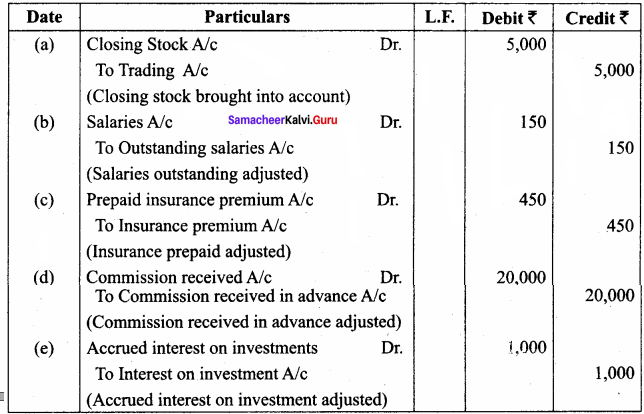
Pass adjusting entries for the following:
(a) The closing stock was valued at ₹ 5,000
(b) Outstanding salaries ₹ 150
(c) Insurance prepaid ₹ 450
(d) ₹ 20,000 was received in advance for commission.
(e) Accrued interest on investments is ₹ 1,000.
Answer:
Adjusting Entries
Samacheer Kalvi 11th Accountancy Solutions Chapter 13 Final Accounts of Sole Proprietors – II

Question 2.
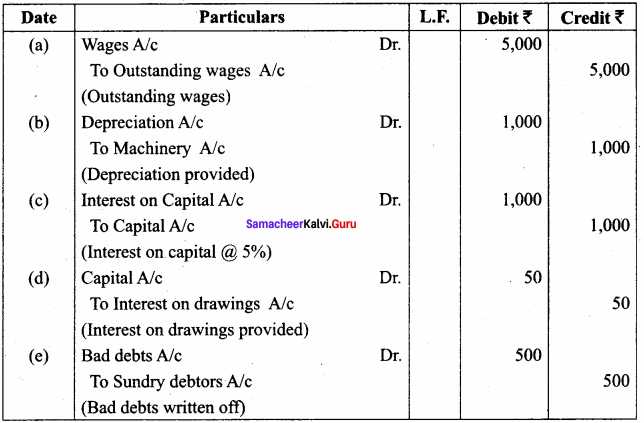
For the fol owing adjustments, pass adjusting entries:
(a) Outstanding wages ₹ 5,000.
(b) Depreciate machinery by ₹ 1,000.
(c) Interest on capital @ 5% (Capital: ₹ 20,000)
(d) Interest on drawings ₹ 50
(e) Write off bad debts ₹ 500
Answer:
Adjusting Entries
Samacheer Kalvi 11th Accountancy Solutions Chapter 13 Final Accounts of Sole Proprietors – II

Question 3.
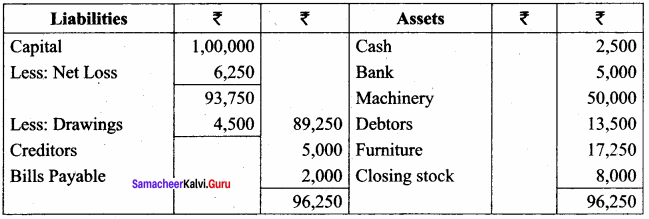
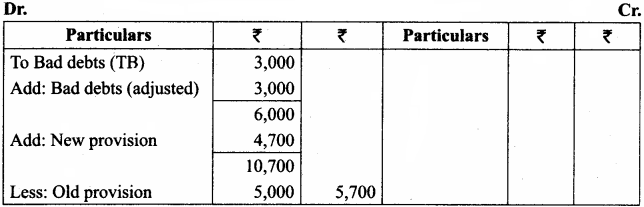
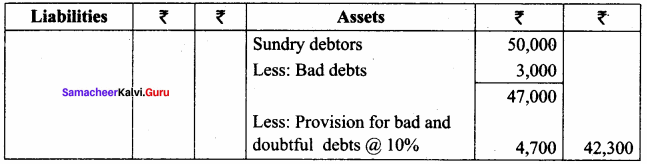
On preparing final accounts of Suresh, bad debt account has a balance of ₹ 800 and sundry debtors account has a balance of ₹ 16,000 of which ₹ 1,200 is to be written off as further bad debts. Pass adjusting entry for bad debts. And also show how it would appear in profit and loss account and balance sheet.
Answer:
Adjusting Entry
Samacheer Kalvi 11th Accountancy Solutions Chapter 13 Final Accounts of Sole Proprietors – II
Profit and Loss Account
Samacheer Kalvi 11th Accountancy Solutions Chapter 13 Final Accounts of Sole Proprietors – II
Balance Sheet
Samacheer Kalvi 11th Accountancy Solutions Chapter 13 Final Accounts of Sole Proprietors – II

Question 4.
The trial balance on March 31, 2016 shows the following:
Sundry debtors ₹ 30,000; Bad debts ₹ 1,200
It is found that 3% of sundry debtors is doubtful of recovery and is to be provided for. Pass journal entry for the amount of provision and also show how it would appear in the profit and loss account and balance sheet.
Answer:
Samacheer Kalvi 11th Accountancy Solutions Chapter 13 Final Accounts of Sole Proprietors – II
Profit and Loss Account for the year ended 31.03.2016
Samacheer Kalvi 11th Accountancy Solutions Chapter 13 Final Accounts of Sole Proprietors – II
Balance Sheet as on 31.03.2016
Samacheer Kalvi 11th Accountancy Solutions Chapter 13 Final Accounts of Sole Proprietors – II

Question 5.
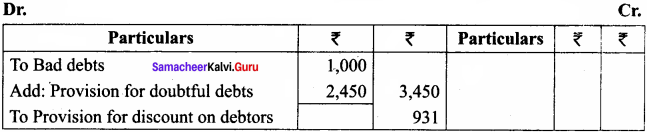
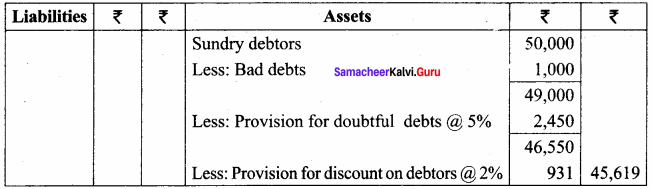
The trial balance of a trader on 31st December, 2016 shows debtors as ₹ 50,000.
Adjustments:
(a) Write off ₹ 1,000 as bad debts
(b) Provide 5% for doubtful debts
(c) Provide 2% for discount on debtors
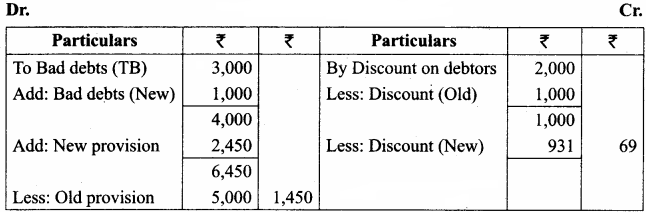
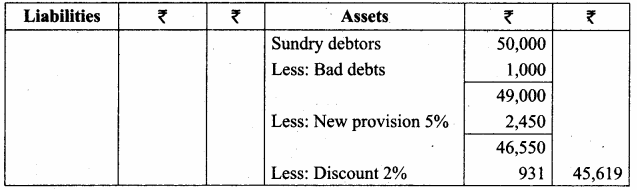
Show how these items will appear in the profit and loss A/c and balance sheet of the trader.
Answer:
Profit and Loss Account for the year ended 31st December, 2016
Samacheer Kalvi 11th Accountancy Solutions Chapter 13 Final Accounts of Sole Proprietors – II
Balance Sheet as on 31st December, 2016
Samacheer Kalvi 11th Accountancy Solutions Chapter 13 Final Accounts of Sole Proprietors – II

Question 6.
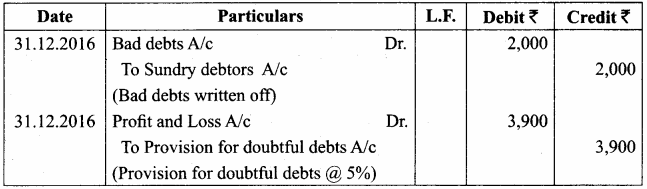
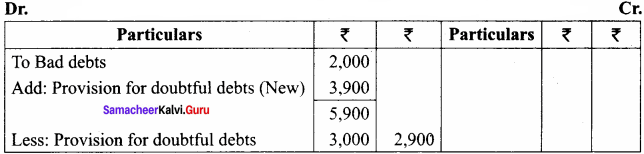
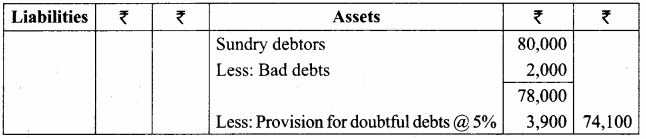
On 1st January, 2016, provision for doubtful debts account had a balance of ₹ 3,000. On December 31, 2016, sundry debtors amounted to ₹ 80,000. During the year, bad debts to be written off were ₹ 2,000. A provision for 5% was required for next year. Pass journal entries and show how these items would appear in the final accounts.
Answer:
Adjusting Entries
Samacheer Kalvi 11th Accountancy Solutions Chapter 13 Final Accounts of Sole Proprietors – II
Profit and Loss Account for the year ended 31st December, 2016
Samacheer Kalvi 11th Accountancy Solutions Chapter 13 Final Accounts of Sole Proprietors – II
Balance Sheet as on 31.12.2016
Samacheer Kalvi 11th Accountancy Solutions Chapter 13 Final Accounts of Sole Proprietors – II

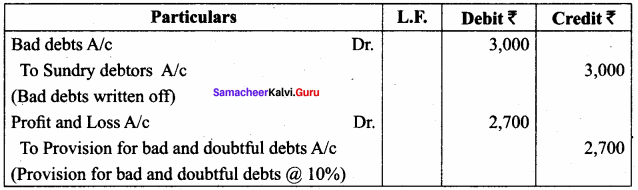
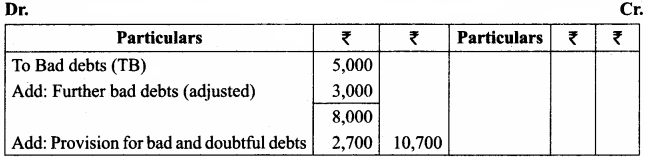
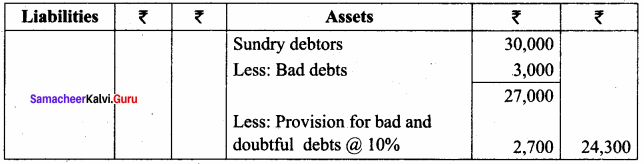
Question 7.
The following are the extracts from the trial balance.
Sundry debtors ₹ 30,000; Bad debts ₹ 5,000 Additional information:
(a) Write off further bad debts ₹ 3,000.
(b) Create 10% provision for bad and doubtful debts.
You are required to pass necessary adjusting entries and show how these items will appear in profit and loss account and balance sheet.
Answer:
Adjusting Entries
Samacheer Kalvi 11th Accountancy Solutions Chapter 13 Final Accounts of Sole Proprietors – II
Profit and Loss Account
Samacheer Kalvi 11th Accountancy Solutions Chapter 13 Final Accounts of Sole Proprietors – II
Balance Sheet
Samacheer Kalvi 11th Accountancy Solutions Chapter 13 Final Accounts of Sole Proprietors – II

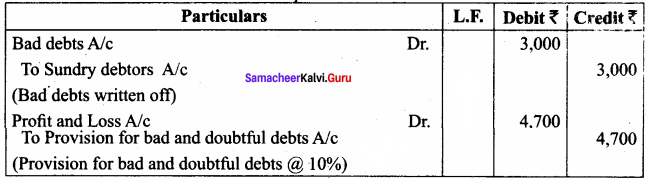
Question 8.
The following are the extracts from the trial balance.
Samacheer Kalvi 11th Accountancy Solutions Chapter 13 Final Accounts of Sole Proprietors – II
Additional information:
(a) Additional bad debts ₹ 3,000.
(b) Keep a provision for bad and doubtful debts @ 10% on sundry debtors.
You are required to pass necessary adjusting entries and show how these items will appear in profit and loss account and balance sheet.
Answer:
Adjusting Entries
Samacheer Kalvi 11th Accountancy Solutions Chapter 13 Final Accounts of Sole Proprietors – II
Profit and Loss Account
Samacheer Kalvi 11th Accountancy Solutions Chapter 13 Final Accounts of Sole Proprietors – II
Balance Sheet
Samacheer Kalvi 11th Accountancy Solutions Chapter 13 Final Accounts of Sole Proprietors – II

Question 9.
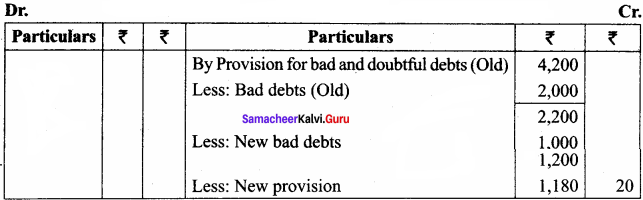
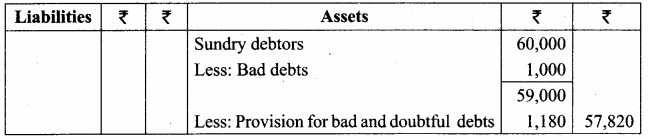
The accounts of Lakshmi traders showed the following balance on 31st March, 2016.
Sundry debtors ₹ 60,000; Bad debts ₹ 2,000
Provision for doubtful debts ₹ 4,200
At the time of preparation of final accounts on 31st March, it was found that out of sundry debtors, ₹ 1,000 will be irrecoverable. It was decided to create a provision of 2% on debtors to meet any future possible bad debts.
Pass necessary journal entries and show how these items would appear in the final accounts.
Answer:
Adjusting Entries
Samacheer Kalvi 11th Accountancy Solutions Chapter 13 Final Accounts of Sole Proprietors – II
Profit and Loss Account for the year ended 31.03.2016
Samacheer Kalvi 11th Accountancy Solutions Chapter 13 Final Accounts of Sole Proprietors – II
Balance Sheet as on 31.03.2016
Samacheer Kalvi 11th Accountancy Solutions Chapter 13 Final Accounts of Sole Proprietors – II

Question 10.
Samacheer Kalvi 11th Accountancy Solutions Chapter 13 Final Accounts of Sole Proprietors – II
The following are the extracts from the trial balance.
Additional information:
(a) Create a provision for doubtful debts @ 10% on sundry debtors.
(b) Create a provision for discount on debtors @ 5% on sundry debtors.
You are required to pass necessary adjusting entries and show how these items will appear in the final accounts.
Answer:
Adjusting Entries
Samacheer Kalvi 11th Accountancy Solutions Chapter 13 Final Accounts of Sole Proprietors – II
Profit and Loss Account
Samacheer Kalvi 11th Accountancy Solutions Chapter 13 Final Accounts of Sole Proprietors – II
Balance Sheet
Samacheer Kalvi 11th Accountancy Solutions Chapter 13 Final Accounts of Sole Proprietors – II

Question 11.
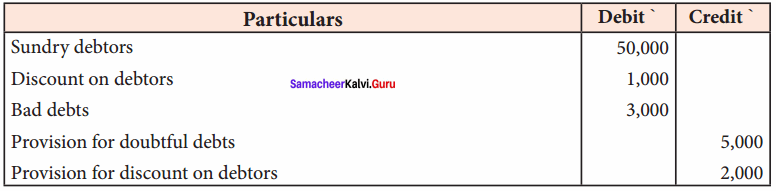
Following are the extracts from the trial balance.
Samacheer Kalvi 11th Accountancy Solutions Chapter 13 Final Accounts of Sole Proprietors – II
Additional information:
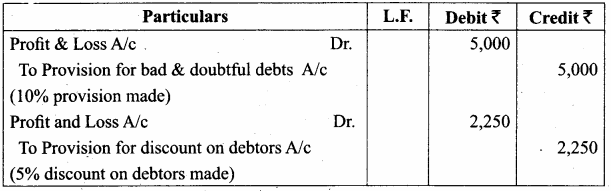
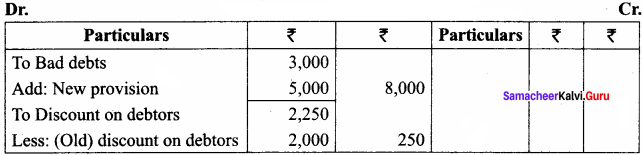
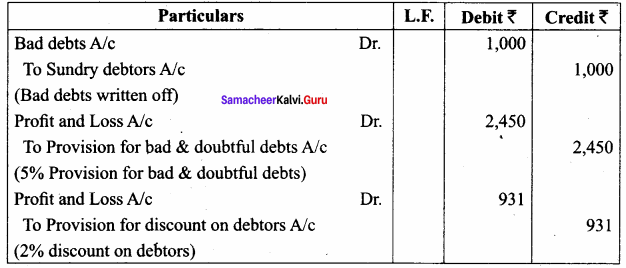
(a) Additional bad debts 1,000
(b) Create a provision for doubtful debts @ 5% on sundry debtors.
(c) Create a provision for discount on debtors @ 2% on sundry debtors.
You are required to pass necessary journal entries and show how these items will appear in the final accounts.
Answer:
Adjusting Entries
Samacheer Kalvi 11th Accountancy Solutions Chapter 13 Final Accounts of Sole Proprietors – II
Profit and Loss Account
Samacheer Kalvi 11th Accountancy Solutions Chapter 13 Final Accounts of Sole Proprietors – II
Balance Sheet
Samacheer Kalvi 11th Accountancy Solutions Chapter 13 Final Accounts of Sole Proprietors – II

Question 12.
The following are the extracts from the trial balance.
Samacheer Kalvi 11th Accountancy Solutions Chapter 13 Final Accounts of Sole Proprietors – II
Answer:
Profit and Loss Account
Samacheer Kalvi 11th Accountancy Solutions Chapter 13 Final Accounts of Sole Proprietors – II
Balance Sheet
Samacheer Kalvi 11th Accountancy Solutions Chapter 13 Final Accounts of Sole Proprietors – II

Question 13.
Prepare trading account of Archana for the year ending 31st December, 2106 from the following information.
Samacheer Kalvi 11th Accountancy Solutions Chapter 13 Final Accounts of Sole Proprietors – II
Adjustments:
(a) Closing stock ₹ 1,00,000
(b) Wages outstanding ₹ 12,000
(c) Freight inwards paid in advance ₹ 5,000
Answer:
Trading A/c of Archana for the year ended 31.12.2016
Samacheer Kalvi 11th Accountancy Solutions Chapter 13 Final Accounts of Sole Proprietors – II

Question 14.
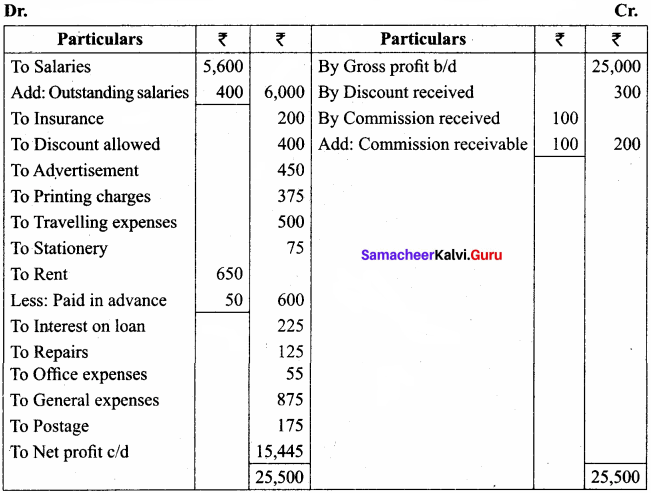
Prepare profit and loss account of Manoj for the year ending on 31st March, 2016
Samacheer Kalvi 11th Accountancy Solutions Chapter 13 Final Accounts of Sole Proprietors – II
Adjustments:
(a) Salary outstanding ₹ 400
(b) Rent paid in advance ₹ 50
(c) Commission receivable ₹ 100
Answer:
Profit and Loss A/c of Manoj for the year ended 31.03.2016
Samacheer Kalvi 11th Accountancy Solutions Chapter 13 Final Accounts of Sole Proprietors – II

Question 15.
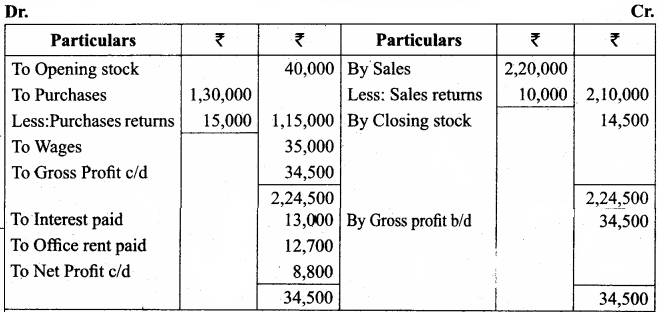
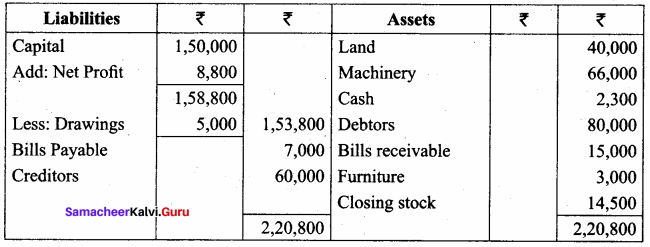
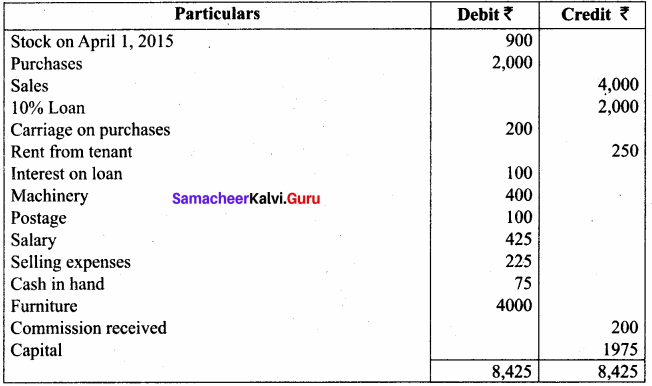
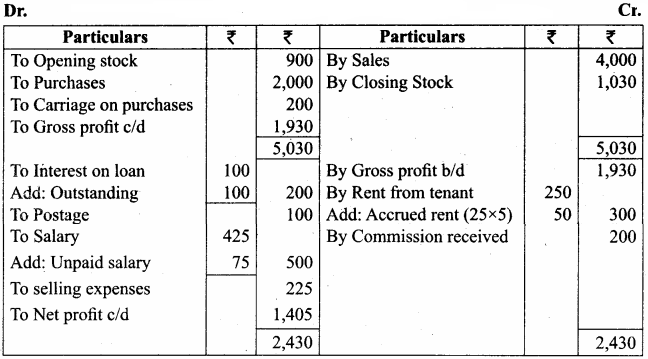
From the trial balance of Sumathi and the adjustments prepare the trading and profit and loss account for the year ended 31st March, 2016, and a balance sheet as on that date.
Samacheer Kalvi 11th Accountancy Solutions Chapter 13 Final Accounts of Sole Proprietors – II
Adjustments
(a) Six months interest on loan is outstanding.
(b) Two months rent is due from tenant, the monthly rent being ₹ 25.
(c) Salary for the month of March 2016, ₹ 75 is unpaid.
(d) Stock in hand on March 31, 2016 was valued at ₹ 1,030.
Answer:
Trading and Profit & Loss A/c of Sumathi
for the year ended 31st March, 2016
Samacheer Kalvi 11th Accountancy Solutions Chapter 13 Final Accounts of Sole Proprietors – II
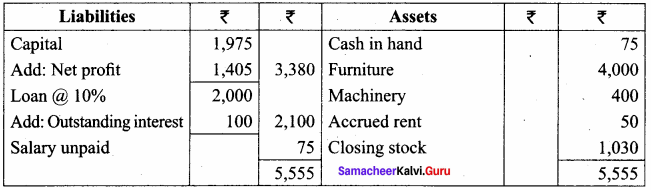
Balance Sheet of Sumathi as on 31.03.2016
Samacheer Kalvi 11th Accountancy Solutions Chapter 13 Final Accounts of Sole Proprietors – II

Question 16.
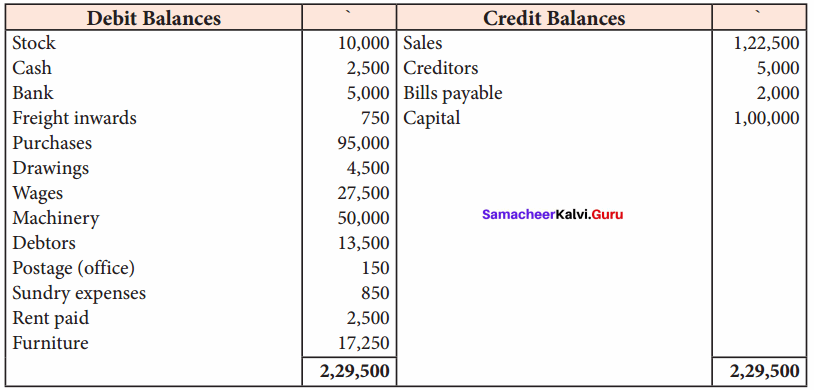
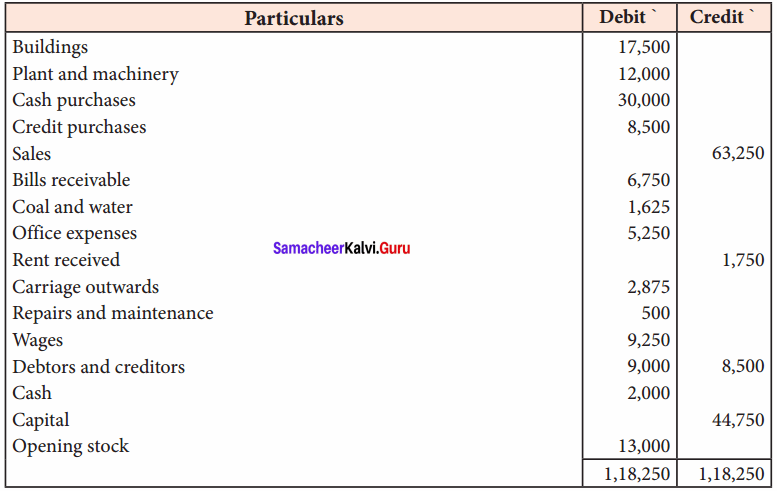
The following trial balance was extracted from the books of Arun Traders as on 31st March, 2018.
Samacheer Kalvi 11th Accountancy Solutions Chapter 13 Final Accounts of Sole Proprietors – II
Answer:
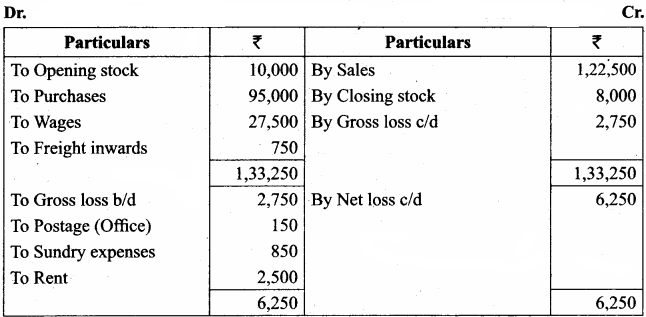
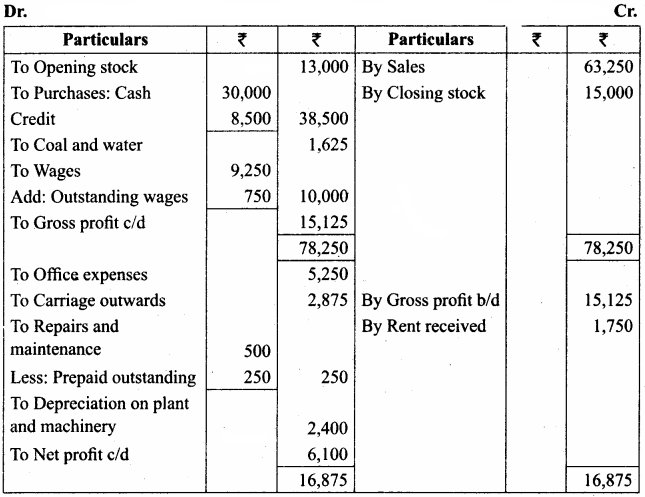
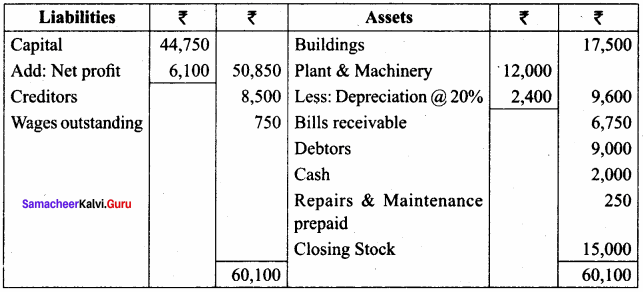
Prepare trading and profit and loss account for the year ending 31st March, 2018 and balance sheet as on that date after considering the following:
(a) Depreciate Plant and machinery @ 20%
(b) Wages outstanding amounts to ₹ 750.
(c) Half of repairs and maintenance paid is for the next year.
(d) Closing stock was valued at ₹ 15,000.
Answer:
Trading and Profit & Loss A/c of Arun Traders for the year ended 31.03.2018
Samacheer Kalvi 11th Accountancy Solutions Chapter 13 Final Accounts of Sole Proprietors – II
Balance Sheet of Arun Traders as on 31.03.2018
Samacheer Kalvi 11th Accountancy Solutions Chapter 13 Final Accounts of Sole Proprietors – II

Question 17.
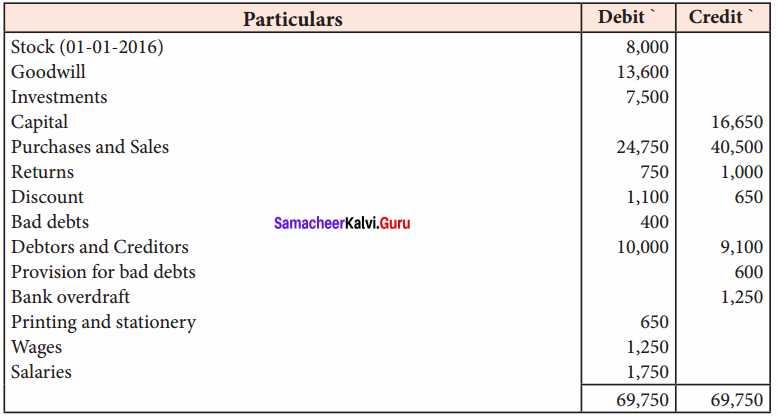
The following is the trial balance of Babu as on 31st December, 2016.
Samacheer Kalvi 11th Accountancy Solutions Chapter 13 Final Accounts of Sole Proprietors – II
Prepare trading and profit and loss account for the year ended 31st December, 2016 and a balance sheet as on that date after the following adjustments.
(a) Salaries outstanding ₹ 500
(b) Interest on investments receivable at 10%.
(c) Provision required for bad debts is 5%.
(d) Closing stock is valued at ₹ 9,900.
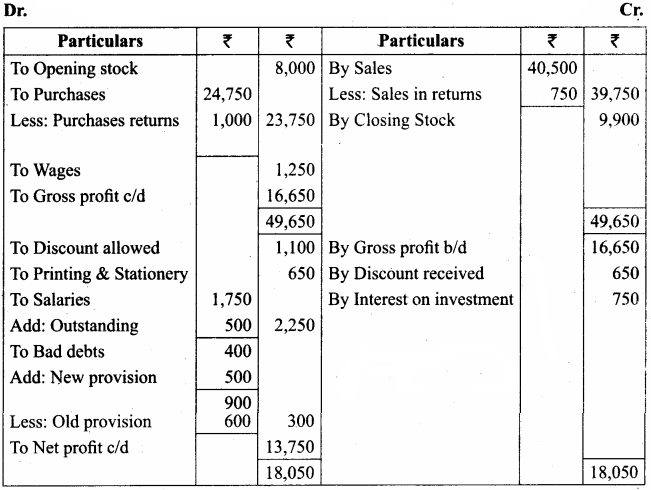
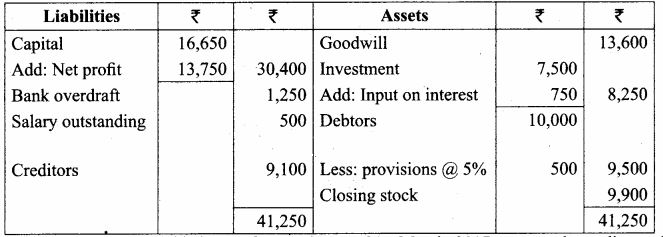
Answer:
Trading and Profit & Loss A/c for the year ended 31.12.2016
Samacheer Kalvi 11th Accountancy Solutions Chapter 13 Final Accounts of Sole Proprietors – II
Balance Sheet as on 31.12.2016
Samacheer Kalvi 11th Accountancy Solutions Chapter 13 Final Accounts of Sole Proprietors – II

Question 18.
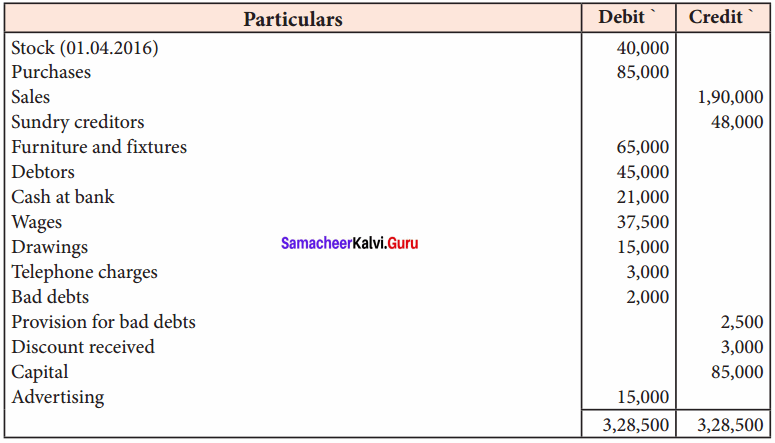
From the following trial balance of Ramesh as on 31st March, 2017, prepare the trading and profit and loss account and the balance sheet as on that date.
Samacheer Kalvi 11th Accountancy Solutions Chapter 13 Final Accounts of Sole Proprietors – II
Answer:
Adjustments:
Closing stock was valued at ₹ 35,000
(b) Unexpired advertising ₹ 250
(c) Provision for bad and doubtful debts is to be increased to ₹ 3,000
(d) Provide 2% for discount on debtors.
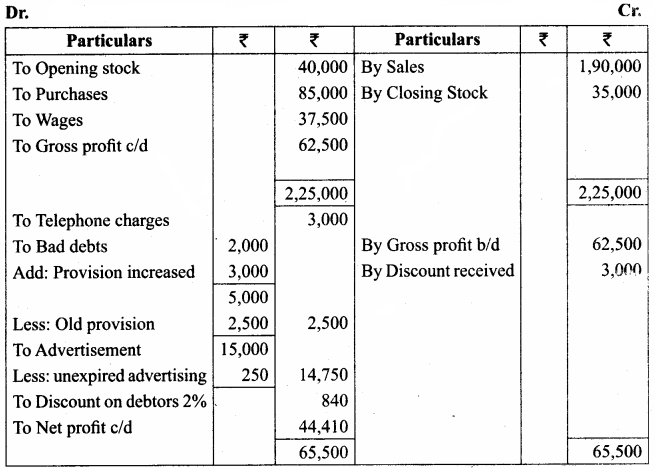
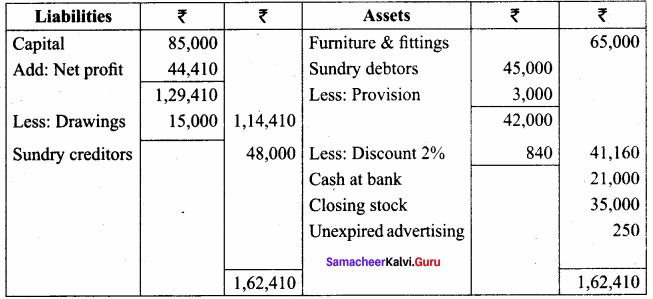
Answer:
Trading and Profit & Loss A/c of Ramesh for the year ended 31.03.2017
Samacheer Kalvi 11th Accountancy Solutions Chapter 13 Final Accounts of Sole Proprietors – II
Balance Sheet of Ramesh as on 31.03.2017
Samacheer Kalvi 11th Accountancy Solutions Chapter 13 Final Accounts of Sole Proprietors – II

Question 19.
Following are the ledger balances of Devi as on 31st December, 2016.
Samacheer Kalvi 11th Accountancy Solutions Chapter 13 Final Accounts of Sole Proprietors – II
Prepare trading and profit and loss account for the year ended 31st December, 2016 and balance sheet as on that date.
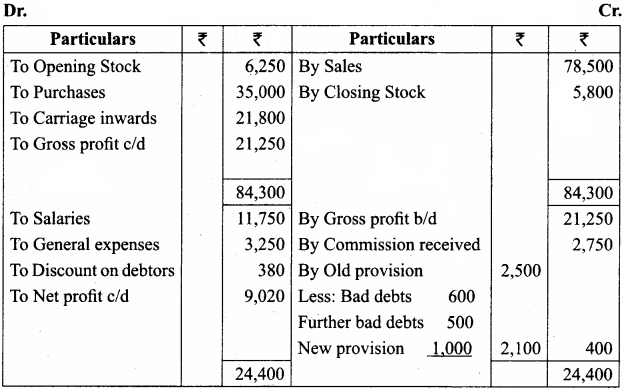
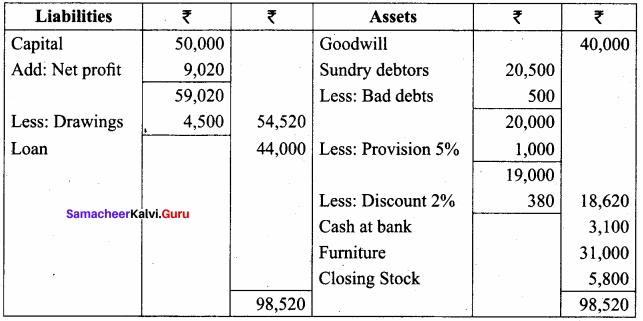
(a) Stock on 31st December, 2016 ₹ 5,800.
(b) Write off bad debts ₹ 500.
(c) Make a provision for bad debts @ 5%.
(d) Provide for discount on debtors @ 2%.
Answer:
Trading and Profit & Loss A/c of Devi for the year ended 31.12.2016
Samacheer Kalvi 11th Accountancy Solutions Chapter 13 Final Accounts of Sole Proprietors – II
Balance Sheet of Devi as on 31.12.2016
Samacheer Kalvi 11th Accountancy Solutions Chapter 13 Final Accounts of Sole Proprietors – II

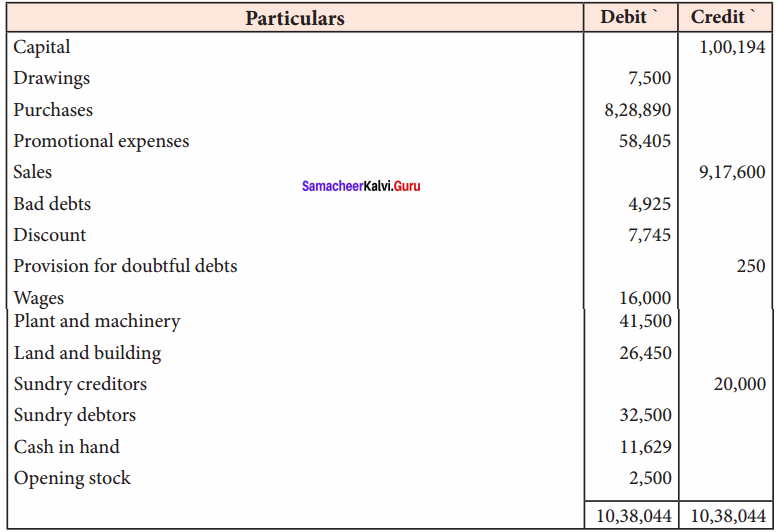
Question 20.
From the following trial balance of Mohan for the year ended 31st March, 2017 and additional information, prepare trading and profit and loss account and balance sheet.
Samacheer Kalvi 11th Accountancy Solutions Chapter 13 Final Accounts of Sole Proprietors – II
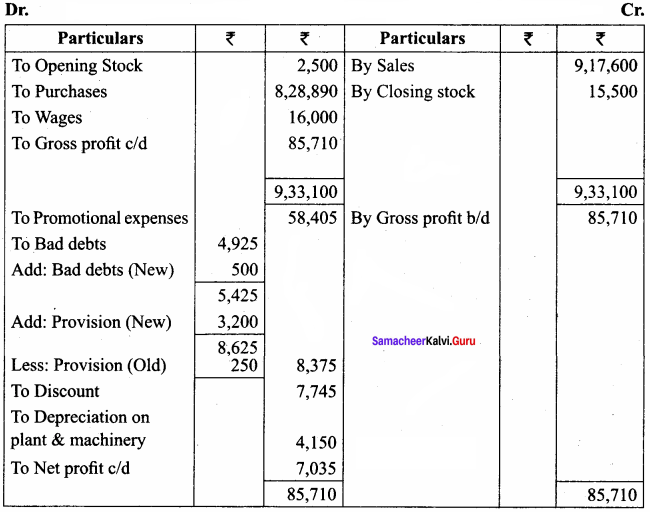
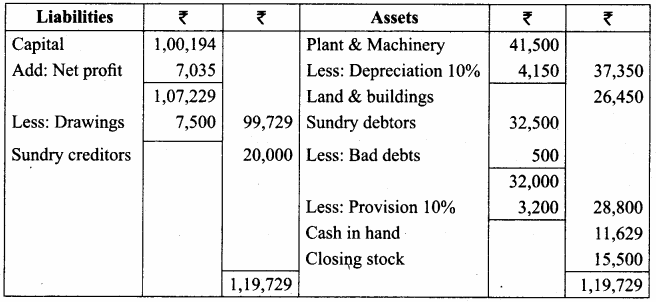
Additional information:
(a) Closing stock is valued at ₹ 15,500
(b) Write off ₹ 500 as bad debts and create a provision for bad debts @ 10% on debtors.
(c) Depreciation @ 10% required
Answer:
Trading and Profit and Loss A/c of Mohan for the year ended 31.03.2017
Samacheer Kalvi 11th Accountancy Solutions Chapter 13 Final Accounts of Sole Proprietors – II
Balance Sheet of Mohan as on 31.03.2017
Samacheer Kalvi 11th Accountancy Solutions Chapter 13 Final Accounts of Sole Proprietors – II

Question 21.
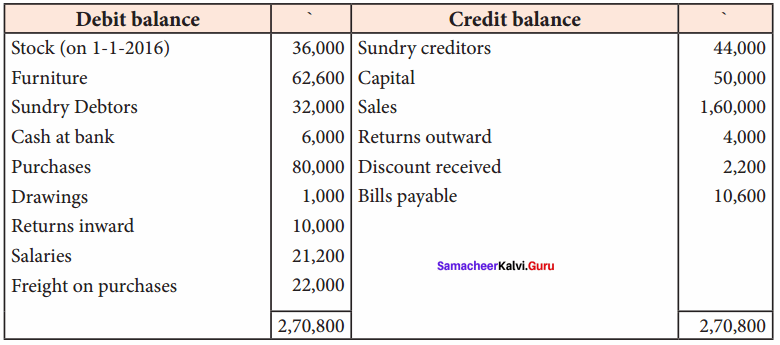
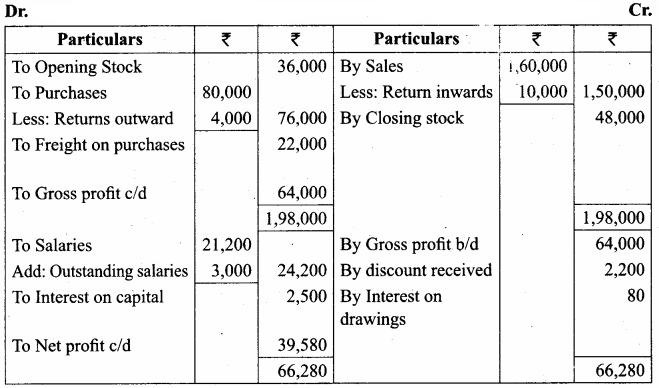
From the following trial balance of Subramaniam, prepare his trading and profit and loss account and balance sheet as on 31st December, 2016.
Samacheer Kalvi 11th Accountancy Solutions Chapter 13 Final Accounts of Sole Proprietors – II
Take into account the following adjustments:
(a) Charge interest on drawings at 8%.
(b) Outstanding salaries ₹ 3,000
(c) Closing stock was valued at ₹ 48,000
(d) Provide for 5% interest on capital.
Answer:
Trading and Profit & Loss A/c of Subramaniam for the year ended 31.12.2016
Samacheer Kalvi 11th Accountancy Solutions Chapter 13 Final Accounts of Sole Proprietors – II
Balance Sheet of Subramaniam as on 31.12.2016
Samacheer Kalvi 11th Accountancy Solutions Chapter 13 Final Accounts of Sole Proprietors – II

Question 22.
Prepare trading and profit and loss account and balance sheet from the following trial balance of Madan as on 31st March, 2018.
Samacheer Kalvi 11th Accountancy Solutions Chapter 13 Final Accounts of Sole Proprietors – II
Adjustments:
(a) The closing stock was ₹ 80,000
(b) Provide depreciation on plant and machinery @ 20%
(c) Write off ₹ 800 as further bad debts
(d) Provide the doubtful debts @ 5% on sundry debtors
Answer:
Trading and Profit & Loss A/c for the year ended 31.03.2018
Samacheer Kalvi 11th Accountancy Solutions Chapter 13 Final Accounts of Sole Proprietors – II
Balance Sheet as on 31.03.2018
Samacheer Kalvi 11th Accountancy Solutions Chapter 13 Final Accounts of Sole Proprietors – II

Question 23.
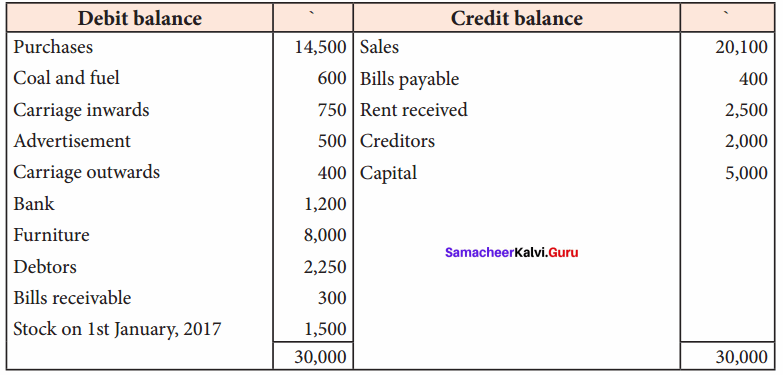
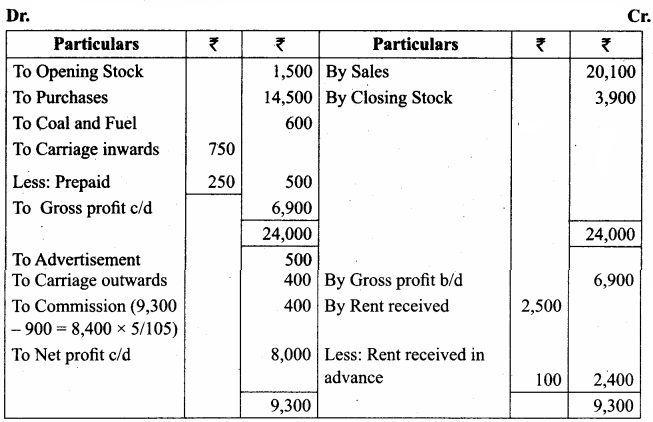
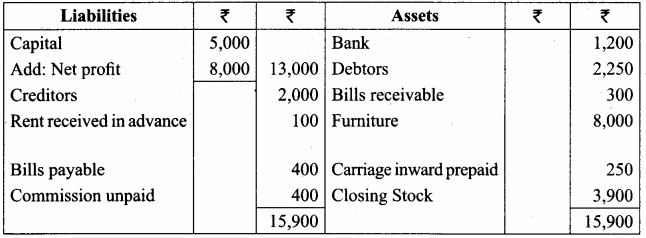
From the following information prepare trading and profit and loss account and balance sheet of Kumar for the year ending 31st December, 2017.
Samacheer Kalvi 11th Accountancy Solutions Chapter 13 Final Accounts of Sole Proprietors – II
Adjustments:
(a) The closing stock on 31st December, 2017 was valued at ₹ 3,900.
(b) Carriage inwards prepaid ₹ 250
(c) Rent received in advance ₹ 100
(d) Manager is entitled to receive commission @ 5% of net profit after providing such commission.
Answer:
Trading and Profit & Loss Account of Kumar for the year ended 31.12.2017
Samacheer Kalvi 11th Accountancy Solutions Chapter 13 Final Accounts of Sole Proprietors – II
Balance Sheet of Kumar as on 31.12.2017
Samacheer Kalvi 11th Accountancy Solutions Chapter 13 Final Accounts of Sole Proprietors – II

Question 24.
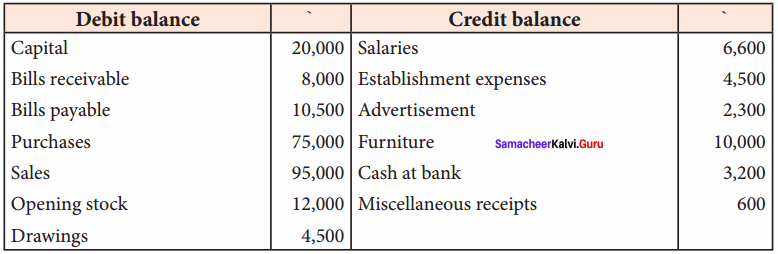
From the following information, prepare trading and profit and loss account and balance sheet in the books of Sangeetha for the year ending 31st March, 2018.
Samacheer Kalvi 11th Accountancy Solutions Chapter 13 Final Accounts of Sole Proprietors – II
Adjustments:
(a) Stock on 31st March, 2018 ₹ 14,200
(b) Income tax of Sangeetha paid ₹ 800
(c) Charge interest on drawings @ 12% p.a.
(d) Provide managerial remuneration @ 10% of net profit before charging such commission.
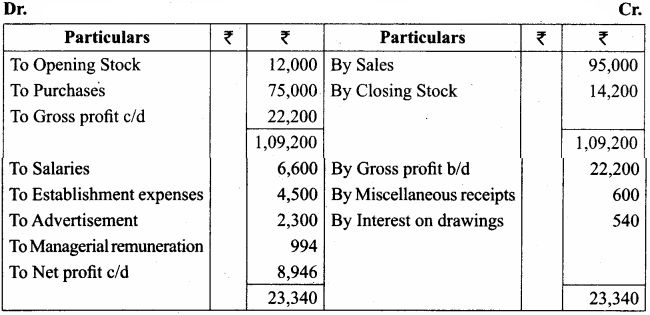
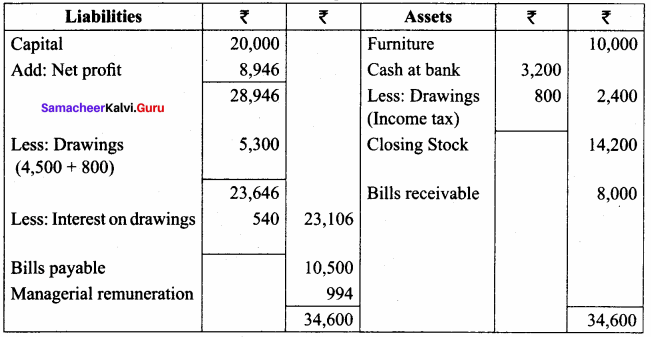
Answer:
Trading and Profit & Loss Account of Sangeetha for the year ended 31.03.2018
Samacheer Kalvi 11th Accountancy Solutions Chapter 13 Final Accounts of Sole Proprietors – II
Balance Sheet of Sangeetha as on 31.03.2018
Samacheer Kalvi 11th Accountancy Solutions Chapter 13 Final Accounts of Sole Proprietors – II

Textbook Case Study Solved

Question 1.
James is a trader who sells washing machines on credit. But, he does not remember the due date to collect the money from his debtors. Some of his customers do not pay on time. His cash inflow is becoming worse. As a result, he could not pay his telephone bill and rent at the end of the accounting period. Hence, he showed only the amount paid as expense. He has many washing machines unsold at the year end. He is worried about the performance of his business. So, he is planning to appoint a manager to take care of his business. The new manager insists James to apply the accounting principle of prudence and matching and also to allow cash discount.
Now, discuss on the following points:

Question 1.
Why does James sell on credit?
Answer:
James sells goods on credit to increase the sales volume and reduce the stock.

Samacheer Kalvi 11th Accountancy Solutions Chapter 13 Final Accounts of Sole Proprietors – II

Question 2.
Are there any ways to encourage his debtors to make the payment on time?
Answer:
Yes, there are many ways to encourage his debtors to make the payment on time by way of cash discount and trade discount.

Question 3.
What might happen if the debtors do not pay?
Answer:
If the debtors do not pay, the bad debts will be increased in the business.

Question 4.
In what ways prudence and matching principles can be applied for the business of James?
Answer:
Prudence principle can be applied for the business here closing stock was valued on cost price or market price whichever is lower under the prudence principle. Matching principle can be applied here for revenue and expense.

Question 5.
What will be the impact on income statement and the balance sheet, if the outstanding expenses are not adjusted?
Answer:
Outstanding expenses to be added with the concerned expenditure in the income Statement and the outstanding expenses will be recorded in liabilities side.

Samacheer Kalvi 11th Accountancy Solutions Chapter 13 Final Accounts of Sole Proprietors – II

Question 6.
On what basis the unsold washing machines should be valued?
Answer:
The unsold washing machine should be valued at cost price or market price, whichever is lower under prudence principle. Managerial commission can be given to motivate the new manager to retain him in the business of James.

Samacheer Kalvi 11th Accountancy Final Accounts of Sole Proprietors – II Additional Questions and Answers

I. Multiple Choice Questions (Other important questions)
Choose the correct answer

Question 1.
If closing stock is already adjusted, adjusted purchase account and ………………. stock will appear in trial balance.
(a) Opening
(b) Closing
(c) Average
(d) None of these
Answer:
(b) Closing

Question 2.
Outstanding expense account is a ………………. account.
(a) Nominal
(b) Real
(c) Representative personal
(d) Personal
Answer:
(c) Representative personal

Samacheer Kalvi 11th Accountancy Solutions Chapter 13 Final Accounts of Sole Proprietors – II

Question 3.
When bad debts already appears in the trial balance, it is taken only to debit side of ………………. account.
(a) Profit and Loss
(b) Balance sheet
(c) Asset side
(d) None of these
Answer:
(a) Profit and Loss

Question 4.
Income tax paid by the business for the proprietor is treated as ……………….
(a) Expense
(b) Profit and Loss A/c
(c) Drawings
(d) None of these
Answer:
(c) Drawings

Question 5.
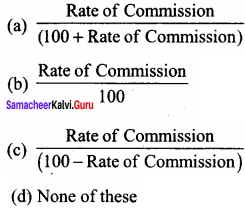
Commission on net profit after charging such commission:
Samacheer Kalvi 11th Accountancy Solutions Chapter 13 Final Accounts of Sole Proprietors – II
Answer:
Samacheer Kalvi 11th Accountancy Solutions Chapter 13 Final Accounts of Sole Proprietors – II

Samacheer Kalvi 11th Accountancy Solutions Chapter 11 Capital and Revenue Transactions

Students can Download Accountancy Chapter 11 Capital and Revenue Transactions Questions and Answers, Notes Pdf, Samacheer Kalvi 11th Accountancy Book Solutions Guide Pdf helps you to revise the complete Tamilnadu State Board New Syllabus and score more marks in your examinations.

Tamilnadu Samacheer Kalvi 11th Accountancy Solutions Chapter 11 Capital and Revenue Transactions

Samacheer Kalvi 11th Accountancy Capital and Revenue Transactions Text Book Back Questions and Answers

I. Multiple Choice Questions
Choose the Correct Answer

Question 1.
Amount spent on increasing the seating capacity in a cinema hall is ……………….
(a) Capital expenditure
(b) Revenue expenditure
(c) Deferred revenue expenditure
(d) None of the above
Answer:
(a) Capital expenditure

Question 2.
Expenditure incurred ₹ 20,000 for trial run of a newly installed machinery will be ……………….
(a) Preliminary expense
(b) Revenue expenditure
(c) Capital expenditure
(d) Deferred revenue expenditure
Answer:
(c) Capital expenditure

Samacheer Kalvi 11th Accountancy Solutions Chapter 11 Capital and Revenue Transactions

Question 5.
Revenue expenditure is intended to benefit ……………….
(a) Past period
(b) Future period
(c) Current period
(d) Any period
Answer:
(c) Current period

Question 6.
Pre – operative expenses are ……………….
(a) Revenue expenditure
(b) Prepaid revenue expenditure
(c) Deferred revenue expenditure
(d) Capital expenditure
Answer:
(d) Capital expenditure

II. Very Short Answer Questions

Question 1.
What is meant by revenue expenditure?
Answer:
The expenditure incurred for day to day running of the business or for maintaining the earning capacity of the business is known as revenue expenditure. It is recurring in nature. It is incurred to generate revenue for a particular accounting period. The revenue expenditure may be incurred in relation with revenue or in relation with a particular accounting period.

Question 2.
What is capital expenditure?
Answer:
It is an expenditure incurred during an accounting period, the benefits of which will be available for more than one accounting period. It includes any expenditure resulting in the acquisition of any fixed asset or contributes to the revenue earning capacity of the business. It is non-recurring in nature.

Question 3.
What is capital profit?
Answer:
Capital profit is the profit which arises not from the normal course of the business. Profit on sale of fixed asset is an example for capital profit.

Samacheer Kalvi 11th Accountancy Solutions Chapter 11 Capital and Revenue Transactions

Question 4.
Write a short note on revenue receipt.
Answer:
Receipts which are obtained in the normal course of business are called revenue receipts. It is recurring in nature. The amount received is generally small.

Question 5.
What is meant by deferred revenue expenditure?
Answer:
An expenditure which is revenue expenditure in nature, the benefits of which is to be derived over a subsequent period or periods is known as deferred
revenue expenditure.

III. Short Answer Questions

Question 1.
Distinguish between capital expenditure and revenue expenditure.
Answer:

S. No.Capital ExpenditureRevenue Expenditure
1Purchase cost of fixed assets.Maintenance expenses of fixed assets.
2Purchase cost of long term investments.Insurance premium.
3Expenses to increase the earning capacity of fixed assets.Postage and stationery.

Question 2.
Distinguish between capital receipt and revenue receipt.
Answer:

S. No.CharacteristicsCapital ReceiptRevenue Receipt
1NatureNon-recurring in nature.Recurring in nature.
2SizeAmount is generally substantial.Amount is generally smaller.
3DistributionThese amounts are not available for distribution as profits.The excess’of revenue receipts over the revenue expenses can be used for distribution as profits.

Question 3.
What is deferred revenue expenditure? Give two examples.
Answer:
An expenditure, which is revenue expenditure in nature, the benefits of which is to be derived over a subsequent period or periods is known as deferred revenue expenditure. The benefit usually accrues for a period of two or more years. It is for the time being, deferred from being charged against income. It is charged against income over a period of certain years. Examples: Considerable amount spent on advertising and major repairs to plant and machinery.

IV. Exercises

Question 1.
State whether the following expenditures are capital, revenue or deferred revenue.
(a) Advertising expenditure, the benefits of which will last for three years.
(b) Registration fees paid at the time of registration of a building.
(c) Expenditure incurred on repairs and whitewashing at the time of purchase of an old building in order to make it usable.
Answer:
(a) Deferred revenue expenditure
(b) Capital expenditure
(c) Capital expenditure

Samacheer Kalvi 11th Accountancy Solutions Chapter 11 Capital and Revenue Transactions

Question 2.
Classify the following items into capital and revenue.
(a) Registration expenses incurred for the purchase of land.
(b) Repairing charges paid for remodelling the old building purchased.
(c) Carriage paid on goods purchased.
(d) Legal expenses paid for raising of loans.
Answer:
(a) Capital expenditure
(b) Capital expenditure
(c) Revenue expenditure
(d) Capital expenditure

Question 3.
State whether they are capital and revenue.
(a) Construction of building ₹ 10,00,000.
(b) Repairs to furniture ₹ 50,000.
(c) White-washing the building ₹ 80,000.
(d) Pulling down the old building and rebuilding ₹ 4,00,000.
Answer:
(a) Capital expenditure
(b) Revenue expenditure
(c) Revenue expenditure
(d) Capital expenditure

Question 4.
Classify the following items into capital and revenue.
(a) ₹ 50,000 spent for railway siding.
(b) Loss on sale of old furniture.
(c) Carriage paid on goods sold.
Answer:
(a) Capital expenditure
(b) Capital loss
(c) Revenue expenditure

Question 5.
State whether the following are capital, revenue and deferred revenue.
(a) Legal fees paid to the lawyer for acquiring a land ₹ 20,000.
(b) Heavy advertising cost of ₹ 12,00,000 spent on introducing a new product.
(c) Renewal of factory licence ₹ 12,000.
(d) A sum of ₹ 4,000 was spent on painting the factory.
Answer:
(a) Capital expenditure
(b) Deferred revenue expenditure
(c) Revenue expenditure
(d) Revenue expenditure

Question 6.
Classify the following receipts into capital and revenue.
(a) Sale proceeds of goods ₹ 75,000.
(b) Loan borrowed from bank ₹ 2,50,000.
(c) Sale of investment ₹ 1,20,000.
(d) Commission received ₹ 30,000.
(e) ₹ 1,400 wages paid in connection with the erection of new machinery.
Answer:
(a) Revenue receipts
(b) Capital receipts
(c) Capital receipts
(d) Revenue receipts
(e) Capital expenditure

Samacheer Kalvi 11th Accountancy Solutions Chapter 11 Capital and Revenue Transactions

Question 7.
Identify the following items into capital or revenue.
(a) Audit fees paid ₹ 10,000.
(b) Labour welfare expenses ₹ 5,000.
(c) ₹ 2,000 paid for servicing the company vehicle.
(d) Repair to furniture purchased second hand ₹ 3,000.
(e) Rent paid for the factory ₹ 12,000.
Answer:
(a) Revenue expenditure
(b) Revenue expenditure
(c) Revenue expenditure
(d) Capital expenditure
(e) Revenue expenditure

Textbook Case Study Solved

Question 1.
Sadhana decides to start a business of selling air – conditioners. She buys different brands of air – conditioners. She also buys a delivery van, some furniture and some tools to fix air- conditioners. She buys some stationery items and cleaning liquid. She spends some amount on advertising her shop. She records the entire amount spent in the trading account.
Now, discuss on the following points:

Question 1.
Is it correct to record the entire amount spent in the first year of trading in the trading account? What impact will it have on the profit for the year?
Answer:
It is not correct to record the entire amount spent in the first year of trading in the trading account. It will be shown as a capital expenditure. For example: furniture and delivery van.

Question 2.
What are her fixed assets?
Answer:

  1. A delivery van.
  2. Some furniture.
  3. Some tools.

Samacheer Kalvi 11th Accountancy Solutions Chapter 11 Capital and Revenue Transactions

Question 3.
Does she apply accounting concepts? If not which is the concept she does not apply?
Answer:
No, she does not apply accounting concepts. She does not apply business entity concepts.

Question 4.
Can you help Sadhana to classify the expenditure?
Answer:
Yes, I can help Sadhana to classify the expenditure:

Capital expenditureRevenue expenditureDeferred Revenue Expenditure
Non-recurringRecurringNon-recurring
1.  Delivery Van

2.   Furniture

3.  Tools

1. Air-conditioners

2.   Stationery items

3.  Cleaning liquid

She spends some amount on advertising her shop.

Question 5.
What other capital, revenue and deferred revenue expenditure her business may incur in the future?
Answer:
In the future:

Capital expenditureRevenue expenditureDeferred Revenue Expenditure
1.  Building extension

2.  Computer for office use

3.  Other furniture

1. Air-conditioners

2.  Other home appliances

A huge advertising.

Samacheer Kalvi 11th Accountancy Capital and Revenue Transactions Additional Questions and Answers

I. Multiple Choice Questions
Choose the correct answer

Question 1.
Cost of acquisition of land and building is an example of ………………
(a) Capital expenditure
(b) Revenue expenditure
(c) Capital receipts
(d) Revenue receipts
Answer:
(a) Capital expenditure

Question 2.
There are types of expenditure ………………
(a) One
(b) Two
(c) Three
(d) Four
Answer:
(c) Three

Samacheer Kalvi 11th Accountancy Solutions Chapter 11 Capital and Revenue Transactions

Question 3.
……………… expenditure is recurring in nature.
(a) Capital expenditure
(b) Revenue expenditure
(c) Capital loss
(d) Capital profit
Answer:
(b) Revenue expenditure

Question 4.
Considerable amount spent on advertising is an example of ……………… expenditure.
(a) capital
(b) revenue
(c) deferred
(d) none of these
Answer:
(c) deferred

II. Very Short Answer Questions

Question 1.
What is capital receipt?
Answer:
Receipt which is not revenue in nature is called capital receipt. It is non-recurring in nature. The amount received is normally substantial. It is shown on the liabilities side of the balance sheet.

Question 2.
Write any two features of revenue expenditure.
Answer:

  1. It is recurring in nature.
  2. It is incurred for maintaining the earning capacity of the business.

III. Short Answer Questions

Question 1.
Write three features of deferred revenue expenditure.
Answer:

  1. It is a revenue expenditure, the benefits of which is to be derived over a subsequent period or periods.
  2. It is not fully written off in the year of actual expenditure. It is written off over a period of certain years.
  3. The balance available after writing off (i.e., Actual expenditure – Amount written off) is shown on the assets side balance sheet.

Samacheer Kalvi 11th Accountancy Solutions Chapter 11 Capital and Revenue Transactions

Question 2.
What are the classifications of expenditures?
Answer:

  1. Capital expenditure
  2. Revenue expenditure
  3. Deferred revenue expenditure

Question 3.
Write any three examples of revenue expenditure.
Answer:

  1. Purchase of goods for sale
  2. Administrative, selling and distribution expenses
  3. Manufacturing expenses

Samacheer Kalvi 7th Maths Solutions Term 3 Chapter 3 Algebra Intext Questions

Students can Download Maths Chapter 3 Algebra Intext Questions and Answers, Notes Pdf, Samacheer Kalvi 7th Maths Book Solutions Guide Pdf helps you to revise the complete Tamilnadu State Board New Syllabus and score more marks in your examinations.

Tamilnadu Samacheer Kalvi 7th Maths Solutions Term 3 Chapter 3 Algebra Intext Questions

Exercise 3.1
Think (Text book Page No. 50)

Question 1.
Is it the only way to decompose the numbers representing length and breadth? Discuss.
Solution:
No, for example 15 can be decompose into 1 × 15, 3 × 5, 5 × 3, 15 × 1

Samacheer Kalvi 7th Maths Solutions Term 3 Chapter 3 Algebra Intext Questions

Try These (Text book Page No. 52)

Question 1.
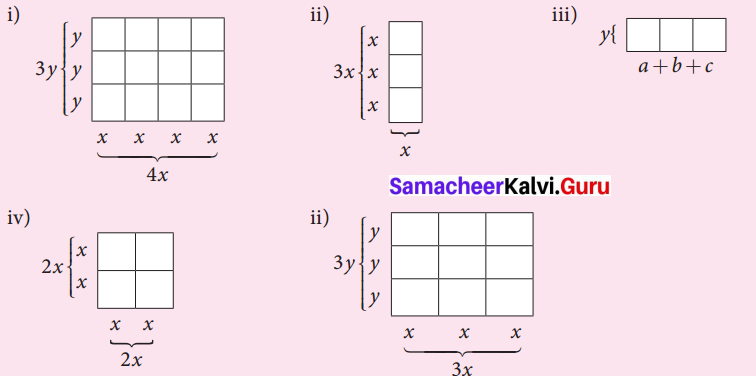
Observe the following figures and try to find its area, geometrically. Also verify the same by multiplication of monomial.
Samacheer Kalvi 7th Maths Solutions Term 3 Chapter 3 Algebra Intext Questions 1
Solution:
Area of each box = xy
Totally 12 boxes
∴ Total area = 12 × xy = 12xy
Also multiplying the length 4x and breadth 3y
We have area of the rectangle = 4x × 3y = 12xy

(ii) Area of each small box = x2
Total number of boxes = 3
∴ Total area = 3x2
Also length of the rectangle = 3x
breadth of the rectangle = x
Area of the rectangle = length × breadth
= 3x × x
= 3x2

(iii) Area of each small box is ay, by, cy
∴ Total area = ay + by + cy = y (a + b + c)
Area of the rectangle = length × breadth
= (a + b + c) y

(iv) Area of each small square = x2
There are 4 small squares
∴ Total area of the given square = 4x2
Also side of the big square = 2x
∴ Area of the square = (2x)2 = 4x2

(v) Area of each small rectangle = xy
There are 9 such rectangles
∴ Total area = 9xy
Area of big rectangle = lenght × breath
= 3x × 3y = 9xy

Samacheer Kalvi 7th Maths Solutions Term 3 Chapter 3 Algebra Intext Questions

Question 2.
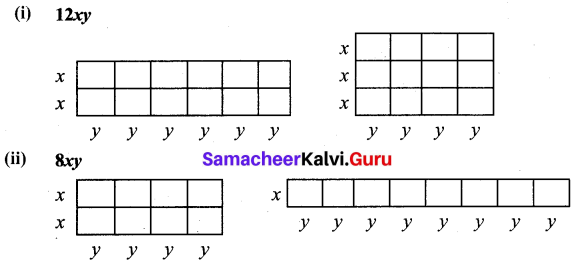
Let the length and breadth of a tile be x and y respectively. Using such tiles construct as many rectangles as you can and find out the length and breadth of the rectangles so formed such that its area is
(i) 12 xy
(ii) 8xy
(iii) 9xy
Solution:
Samacheer Kalvi 7th Maths Solutions Term 3 Chapter 3 Algebra Intext Questions 2
Samacheer Kalvi 7th Maths Solutions Term 3 Chapter 3 Algebra Intext Questions 3

Samacheer Kalvi 7th Maths Solutions Term 3 Chapter 3 Algebra Intext Questions

Try These (Text book Page No. 58)

Question 1.
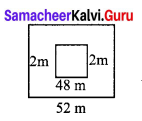
Consider a square shaped paddy field with side of 48 m. A pathway with uniform breadth is surrounded the square field and the length of the outer side is 52 m. Can you find the area of the pathway by using identities?
Solution:
Let a = 52
b = 4
Samacheer Kalvi 7th Maths Solutions Term 3 Chapter 3 Algebra Intext Questions 4
(a – b)2 = a2 – 2ab + b2 = 522 – 2 (52) (4) + 42
= 2704 – 416 + 16 = 2304

Think (Text book Page No. 60)

Question 1.
Can we factorize the following expressions using any basic identities? Justify your answer.
(i) x2 + 5x + 4
(ii) x2 – 5x + 4
Solution:
(i) x2 + 5x + 4 = x2 + (1 + 4)x + (1 × 4)
Which is of the form x2 + (a + b) x + ab
= (x + a) (x + b)
x2 + (1 + 4)x + (1 × 4) = (x + 1) (x + 4)
∴ x2 + 5x + 4 = (x + 1) (x + 4)

(ii) x2 – 5x + 4 = x2 + ((-1) + (- 4))x + (-1) (- 4)
Which is of the form x2 + (a + b) x + ab
= (x + a) (x + b)
x2 + ((-1) + 4))x + ((-1)(-4)) = (x + (-4)) = (x – 1) (x – 4)
x2 – 5x + 4 = (x – 1) (x – 4))

Samacheer Kalvi 7th Maths Solutions Term 3 Chapter 3 Algebra Intext Questions

Exercise 3.2
Try These (Text book Page No. 63)

Question 1.
Construct inequations for the following statements:
1. Ramesh’s salary is more than ₹ 25,000 per month.
2. This lift can carry maximum of 5 persons.
3. The exhibition will be there in town for at least 100 days.
Solution:
1. x > 25,000, where x is Ramesh’s Salary per month.
2. y < 5, where y is the maximum number of persons the left can carry.
3. z > 100, where z is the number of days when the exhibition is there.

Samacheer Kalvi 7th Maths Solutions Term 3 Chapter 3 Algebra Intext Questions

Think (Text book Page No. 65)

Question 1.
Hameed saw a stranger in the street. He told his parent, “The stranger’s age is between 40 to 45 years, and his height is between 160 to 170 cm”
Convert the above verbal statement into algebraic inequations by using x and y as variables of age and height.
Solution:
Let x be the age and y be the height then
40 < x < 45 and 160 < y < 170

Samacheer Kalvi 12th English Story Writing

Students can Download Samacheer Kalvi 12th English Story Writing, Notes, Samacheer Kalvi 12th English Book Solutions Guide Pdf helps you to revise the complete Tamilnadu State Board New Syllabus and score more marks in your examinations.

Tamilnadu Samacheer Kalvi 12th English Story Writing

Samacheer Kalvi 12th English Story Writing

1. A young student–Keerti–rainy season–enjoying the evening tea–hears some noise–opens the door–a small cat–drenched in rain–looks at Keerti–meows as if pleading–Keerti confused–cat continues meowing–Keerti stays silent–cat runs inside–Keerti searches–cat not found–forgets about the cat–goes to bed–Keerti hears a noise from the garden–sees the cat fighting with a snake–gets frightened–thank God for saving life through the cat–Keerti’s generosity’ paid off.

A young student, Keerti was having her evening tea enjoying the rains. Suddenly she hears some noise and goes out to check. When she opens the door, she finds a small cat meowing as if pleading to be let inside. Keerti didn’t know what to do as she felt pity for the cat. The cat kept on meowing and finding Keerti silent, it ran inside to a safe and warm comer of the house. Keerti couldn’t find where the cat had hidden. She forgot about it and after finishing dinner with her parents went to her bedroom.

While she was rethinking about the! cat’s incident and was asking herself if she had done the right thing by being generous to the cat. Suddenly she heard a noise from the garden. When she opened the windows, she found the cat tearing at a snake’s head with it’s fingernails. Keerti realised the value of being generous and thanked God for having rewarded her for the generosity she showed towards the cat.

Samacheer Kalvi 12th English Story Writing

2. Raghavan reading newspaper–his wife mentioned her lottery ticket–Raghavan–no interest–asked for ticket number–wife gave him the number–series number found–started imagining–planning to spend–ticket number not found–disappointed–dreams came to an end.

Raghavan, a middle class man basically did not have faith in lottery luck. His wife Shobha a house wife once bought a lottery. On her request Raghavan saw results. He realized the series 1045 had won a prize. Shobha insisted on verifying the last two digits. Brushing aside her concern, he started daydreaming. He started his plan of buying an estate with twenty five lakhs in Ooty or Munnar. He wished to pay ten thousand on immediate expenses like new house, furniture, travel and paying small debts.

The thought of travel w ith his wife repulsed him. He even planned to go abroad. He started hating his wife’s poor relatives. Shobha also got annoyed seeing her husband’s plan of spending her money. When the hostility became unbearable, he disclosed the results with spite, the last tw o digits were 56 and not 36. His i wife Shobha got upset. She pitied her husband. Raghavan went out in helpless fury.

Samacheer Kalvi 12th English Story Writing

3. Old fisherman–as usual cast his net–caught a gold–fish–fish cried, “take pity and put me back in water”–promised to compensate handsomely–fisherman returned home empty handed–wife angry–asked for a new tub–went to fish–wish granted–next the wife asked for a new home–wish granted–again the wife demanded for a marble palace, v silk dresses and servants–wife not satisfied–w ished to be queen and rule–fisherman went to fish–fish disappeared without granting any wish–fisherman returned home; saw wife washing clothes in old leaking tub in the old wooden hut.

Once there was a poor fisherman who lived with his w ife in a hut. One day as usual he left for fishing and cast his net into the sea. He caught a small gold–fish. He was taken aback when he heard the fish pleading for it’s life. She promised to compensate him handsomely. He returned home empty–handed which made his wife angry. So he narrated the whole story’ to his wife. The wife couldn’t believe what he said. To test the truth, firstly she asked him to ask the fish for a new tub. The fisherman went and asked the fish for a new tub, the fish replied, “go back home, your wish will be granted’’.

When he went back home, he found ’ the new tub. This made his wife greedy. The wife again asked him to and ask the fish for a new’ house, he did so. The fish granted that wish also. Fisherman’s wife didn’t stop with this, she again asked for a marble palace, new dresses and servants. The fish granted them also, This made her w’onder if she could become a queen and rule over the whole earth. When the fisherman w ent and told the fish about this wish, it didn’t speak anything, but disappeared.

The fisherman came back to see that all they wished for were gone and his wife was washing clothes again in the old leaking tub.

Samacheer Kalvi 12th English Story Writing

4. Doorbell rang–Kumar opened the door–tall and well–dressed man stood before him–could not recognise–tall man spoke–Kumar recognised the voice–could not believe–Aravind returned–Aravind–elder brother–when young–scored poor marks–school teachers called parents–bad student–father furious–bet him–father angry–Aravind sad–runs away–father and mother search for Aravind–not found–police complaint–still not found–parents sad for long–forgot Aravind–Aravind returned–parents happy–arrangement for marriage.

Sunil, a youngster, was watching movie at his home. Doorbell rang and he went to look who it was. When he opened the door, he saw a well–dressed tall man standing in front of him. He could not recognise at first. When the man started talking, he suddenly recognised his voice and understood that his elder brother Aravind was standing in front of him. Aravind had run away when he was in school. He had scored poor marks in the examination and the teachers complained this to his parents. His dad was furious and when he returned home showed his anger on Aravind.

Aravind was so afraid and ran away from home. Parents were so worried and looked for him everywhere. He could be found nowhere. So, they made a police complaint. But they too couldn’t find him out. After so many years, Aravind has returned and he shared all his experiences. Mom and dad were so happy and proud that he has become a successful gentleman and was eager to get him married. All the relatives and neighbours gathered to celebrate the lost son’s homecoming.

Samacheer Kalvi 12th English Story Writing

5. Develop the hints given into a story of about 200 words.

A boy associates with bad company–father upset–makes a plan–brings apples–puts them in cup–board–places a rotten apple among them–all apples rots in a few days–boy realises–gives up bad company.

There was a good boy. Unfortunately he got associated with bad company. His behaviour changed drastically. He began to disobey his parents, roamed all day long in the company of bad boys and did not study. This upset his father. He tried his best to bring his son on the right path, but of no use.

One day, the father came up with a plan. He brought some fresh apples from the market. He also brought one rotten apple and mixed it with good ones. He said to his son to put all the apples in the cupboard and leave them for a few days. The son did so.

After a few days, the father asked his son to bring the apples. The son was shocked to find all the apples had got rotten. At this the father said to his son how one rotten apple spoiled all the good ones. Bad friends were just like bad apples. They would lead you into trouble. The father’s words had great impact on the son. He gave up bad company and became a good son once again.

Samacheer Kalvi 12th English Story Writing

6. A missionary–sitting in cottage near the sea–a woman came with a handful of sand dripping–woman says “my sins are countless as the sands of the sea”–woman unable to get over her guilt–missionary replies, “pile the sand and keep near the sea shore”–“tide will slowly wash it away”–God’s forgiveness works like this.

There was a missionary who stayed in a hut close to the sea. One day a woman from the village came carrying a handful of dripping sand which she picked from the beach. She looked very troubled. She asked the missionary, “Do you know what this is?” “It looks like sand”, replied the missionary calmly. “Do you know why I brought it here”, she asked. “No”, replied the missionary. “The sand grains indicate the number of sins that I have committed in my life”, said she. “Is it ever possible for me to receive forgiveness and live happily”, asked she. The missionary replied, “take the sand and place it near the sea shore, wait and watch how the tide comes in slowly wash it away. It can be seen no more. That is how God’s forgiveness works.

The Bible says: Even if your are stained red with sin, I will wash you as clean as snow.

Samacheer Kalvi 12th English Story Writing

7. Old couple–staying together–son abroad–one day got message from son–excitedly opened and read the letter–man becomes sad–wife asks why have you become sad–gives letter to wife–wife reads and become sad too–neighbour visits–sees the old couple sad–asks what happened–couple gives the letter to the neighbour–the neighbour reads–feels disappointed–son going to sell the house–asking parents to go to old–age home–neighbour sees photo and another letter–new villa–son asking mom and dad to come and live with him.

There lived an old couple and their son and his wife were settled abroad. One day they received a letter from his son. After reading the letter the old man became depressed. His wife observed this and enquired of what was written in the letter that has made him so sad. He gave the letter to his wife and asked her to read it for herself. When she read, she too became sad and both were worried of what would happen to them. The message was that, the son was asking the parents to vacate the house as he had made a deal to sell the house.

After a while their neighbour, Mr. Hari arrives asking them what had happened as their son had called him and seemed worried as they had not picked up his call. They gave him the letter and he too read the letter and was dismayed. Later he checked the envelope and found a photo of a villa with their parents name engraved in the name plate and a small note, asking their parents to move in with them in that big villa. The old couple were so delighted and thanked the neighbor.

Samacheer Kalvi 12th English Story Writing

8. A 5th standard child–got poor marks–classmates and teachers disregards him–boy shows report card to mom–mom worried–boy careless and taking sufficient efforts–mom schedules a time–table–boy disinterested to follow–mom strictly orders–boy accepts–follows mom’s instruction–becomes topper in class–classmates and teachers astonished–boy also overwhelmed–understands and follows mom’s good advice–now grown up and a neurosurgeon, author and politician–Benjamin Carson.

A child studying in 5th standard performed poorly, scored less and the teachers and classmates disregarded him. He takes his report card and shows it to his mom. Mom was worried and thought for herself that her son is talented enough but wasn’t taking enough efforts. She makes a time table for him to follow, asking him to do his daily homeworks and read extra books to improve knowledge.

The boy hesitates and tries to convince his mom to back up from this plan. Mother gives him strict orders to follow this time table and that there will be no change. Within few weeks he scores well and eventually becomes the topper. Everybody in his class were surprised and he himself was overwhelmed with his progress. He followed his mother’s advice and now that boy has grown into a well known neurosurgeon, author and a politician. He is none other than Benjamin Carson.

Samacheer Kalvi 12th English Story Writing

9. In the beginning of the world–all animals worked for man–except camel–animals complained to man–man asked him to work double time–animals angry–complained to Djinn–Djinn talked to the camel–camel merely said “Humph”–Djinn created the humph for the camel–camel could never get rid of that humph.

It was the beginning of the world. All animals worked for man except the camel. When the dog and horse asked the camel, he simply said ‘humph’. They took the matter to man. Man carefully listened to the complaint and decided not to waste his energy on the idle camel. Man made the other animals work double the time. The animals were infuriated by man’s unjust action.

They met the Djinn of the desert and complained. He met the camel and asked him why he did not join the other animals in the work. The camel said “Humph”. Djinn warned the camel of his rude behaviour and advised him to mend his ways. Despite the Djinn’s warning, he repeated “Humph”. Angered by the indifference of camel, the Djinn chanted some magic words and suddenly the camel grew a huge hump on its back. Now the camel is working but the hump stayed.

Samacheer Kalvi 12th English Story Writing

10. In England–an orphan Pip–one afternoon seized by the neck–fearful man–fetters in legs–was a convict–Pip pleaded not to cut his throat–convict asked for food and file–Pip ran to get them–convict freed himself–had food–boarded a ship to Australia–Pip grew up–dreamt of becoming a prosperous gentleman–highly educated–one day a man brought message–the convict died–made Pip the inheritor of his property–Pip realised–man with fetters–file and food years ago.

In England there was an orphan named Pip. One day as he was walking down the street, a man from back seized him by throat. Pip was frightened and pleaded the man not to cut his throat and kill him. Pip turned to see the man who seemed to be a convict with fetters in his legs. The man accepted Pip’s request if he would bring him a file and some food. Pip immediately ran to the market and bought what was demanded by the convict and gave it to him. The convict freed himself and had the food.

He boarded the ship to Australia and Pip never saw him again. Years passed by and Pip grew and he always dreamt of becoming a well educated and rich gentleman. One day as Pip was walking by, a man came and gave him a small piece of paper in which it was written that Pip was to come to Australia and inherit the property a convict had left. The convict was none other than the one whom he had given food and file years ago. Pip was overjoyed and immediately left to Australia.

Samacheer Kalvi 12th English Story Writing

Samacheer Kalvi 12th English Construction of Dialogues

Students can Download Samacheer Kalvi 12th English Construction of Dialogues, Notes, Samacheer Kalvi 12th English Book Solutions Guide Pdf helps you to revise the complete Tamilnadu State Board New Syllabus and score more marks in your examinations.

Tamilnadu Samacheer Kalvi 12th English Construction of Dialogues

Samacheer Kalvi 12th English Construction of Dialogues

1. Frame a dialogue with a minimum of ten exchanges for the given situation: Between a man and his wife discussing the arrangements to be made to celebrate their child’s third birthday.

Naina : Maya’s third birthday falls on 15th December.
Poomi : I do know.
Naina : We must celebrate it differently this year.
Poomi : How?
Naina : We must prepare food for 20 persons.
Poomi : No, we will order it from a mess.
Naina : No, we will assist our cook to prepare the food.
Poomi : Are we going to invite 20 persons here?
Naina : No, we will take the food to the nearest orphanage.
Poorni : We can let Maya see us serv ing the food.
Naina : She will also leam to be kind to fellow humans.
Poomi : Yes. It is a good idea.

Samacheer Kalvi 12th English Construction of Dialogues

2. Frame a dialogue with a minimum of ten exchanges for the given situation: Between two cricket players after their team lost a match very narrowly
Arjun : You should have hit the last ball for six,
Han : 1 did try but it got deflected.
Arjun : The first fifteen overs were very rewarding. We had even thought we’d win.
Han : Truc, but after the fall of Shikar’s wicket, things changed.
Arjun : Yes. I saw how wickets started falling in quick succession.
Han : The new bowler from Australia is doing wonders with the ball.
Arjun : Yes, even ¡ found some of the balls very tricky.
Han : He changes the length and combines spin bowling with medium pace bowling.
Han : His bowling only turned the game on Australia’s favour.
Arjun : 0k! We will beat them in the next match.
Han : Yes, we must.

Samacheer Kalvi 12th English Construction of Dialogues

3. Frame a dialogue with a minimum of ten exchanges for the given situation: You have joined a new school. You meet a student. Introduce yourself and make friends with that student, requesting him/her to accompany you to school and back.
Myself : Hai, I am Swetha, a new student in your school.
Student : Oh, I see. In which class?
Myself : XIA section. May I know your sweet name?
Student : I am Radhika. I am a standard-X student. But my sister Anitha is there in
your class. I drop in to see her sometimes. When I don’t have special classes, we go home together.
Myself : When do you leave for school daily?
Student : 8.20 am.
Myself : Will you please allow me to join you?
Student : Certainly, I will.
Myself : Thank you, Radhika. It’s so kind of you.
Student : You are most welcome.

Samacheer Kalvi 12th English Construction of Dialogues

4. Frame a dialogue with a minimum of ten exchanges for the given situation: Between house owner and a tenant about hike of rent.
House owner : Mr. Ramesh, I wish to remind you that from this month you have to give 1000 rupees more rent.
Ram : Why Sir?
House owner : That’s what the rent agreement says.
Ram : Sir, there’s mosquito menace.
House owner : You need to protect yourself from it.
Ram : You need to cover the windows with netlon.
House owner : It will cost about Rs. 2000/
Ram : Can’t you do it as the owner of the house?
House owner : I can do it if you share 50% of the cost.
Ram : O.K. In that case, you postpone the rent hike to next year.
House owner : No, that’s not possible. You better find a new home then.
Ram : What?

Samacheer Kalvi 12th English Construction of Dialogues

5. Frame a dialogue with a minimum of ten exchanges for the given situation: Between a bank manager and a student who wants to open a bank account
Keerthi : Sir. 1 want to open a Savings account in your bank.
Manager : What for?
Keerthi : It is for my loan purpose, Sir.
Manager : Is it an educational Loan?
Keerthi : Yes, Sir.
Manager : GoodS Do you have a Ration Card?
Keerthi : Yes, Sir.
Manager : You should have some money for initial deposit say Rs 500 or Rs 1000/-.
Keerthi : Sure, Sir.
Manager : 0K. Take this application. Fill it in and bring 2 photographs.
Keerthi : Certainly. Thank you very much, Sir.

Samacheer Kalvi 12th English Construction of Dialogues

6. Frame a dialogue with a minimum of ten exchanges for the given situation: Between a book seller and a student.
Bookseller : Which book do you want?
Ravi : I want you to replace this dictionary.
Bookseller : Why?
Ravi : Few pages are tom, Sir.
Bookseller : Why didn’t you check it before leaving?
Ravi : I did check.
Bookseller : Then?
Ravi : At that time, I could not locate the problem.
Bookseller : Flave you brought the bill?
Ravi : Yes, Sir. Flere is it.
Bookseller : OK, take this new dictionary’.

Samacheer Kalvi 12th English Construction of Dialogues

7. Frame a dialogue with a minimum of ten exchanges for the given situation: Sheela enters a Jewel shop. Build a dialogue between her and the salesman.

Salesman : Welcome. What do you want?
Sheethal : I want a bracelet, Sir.
Salesman : Okay. Do you want bracelet with stones?
Sheethal : Yes, with latest design.
Salesman : No problem. Please tell me if you want to use it for everyday use or for social functions.
Sheethal : I want one for social occasions.
Salesman : Then, please try these. They are the best in Tamil Nadu.
Sheethal : I like this one. How much does it cost?
Salesman : It costs Rs. 39,999 /-
Sheethal : Please pack it up for me, Sir.

Samacheer Kalvi 12th English Construction of Dialogues

8. Frame a dialogue with a minimum of ten exchanges for the given situation: A college student is looking for buying Microbiology books. Build a conversation between the bookseller and the college student.

Droov : ExcusemeSir.
Bookseller : Good morning, welcome, Sir.
Droov : 1 want to buy some engineering books.
Bookseller : Which subject’?
Droov : Medical Microbiology books?
Bookseller : Title of the book?
Droov : Jawetz Melnick&Adelbergs Medical Microbiology.
Bookseller : We have the book with 4 different editions. Tell me the edition.
Droov : 4th edition.
Bookseller : Here il is. Pay Rs. 1096/-. Do you need any other books? We do seel second hand books which arc little cheaper.
Droov : Oh yes 1 need I need Statistics books too.
Bookseller : Here they are. It is only Rs. 500/-.

Samacheer Kalvi 12th English Construction of Dialogues

9. Frame a dialogue with a minimum of ten exchanges for the given situation: Build a dialogue between a mother of two babies and a doctor on the ways to prevent Dengue fever
Mother : Good evening, Doctor.
Doctor : Good evening. Anything wrong with your health?
Mother : No, Doctor; I am as fit as a fiddle.
Doctor : Then what brings you here?
Mother : In my neighbourhood. Dengue fever is spreading very fast.
Doctor : So, you want me to suggest some preventive medicines.
Mother : Yes doctor.
Doctor : If you take your kids to the Government Hospital, it will be free.
Mother : After the death of 60 babies in the Government Hospital in UP
Doctor : Come on. In Tamil Nadu, Government Hospitals are doing a great job.
However, if you want to have vaccination in my clinic, bring 1500 rupees tomorrow evening. We will get your kids the vaccination.
Mother : Thank you, Doctor.
Doctor : You are most welcome.

Samacheer Kalvi 12th English Construction of Dialogues

10. Frame a dialogue with a minimum of ten exchanges for the given situation: A dialogue between two girls after NEET results.
Priya : Why are you crying?
Neetha : I lost my chance to join medicine just by two marks.
Priya : Don’t be upset.
Neetha : Do you know how hard I worked?
Priya : I know’, Priya.
Neetha : I dreamt of joining AIIMS in New Delhi.
Priya : For a brilliant student like you, is medicine the only option?
Neetha : Of course not.
Priya : Then why do you worry?
Neetha : I delayed preparation believing that we will get waiver from NEET.
Priya : Don’t worry, we will talk to J.P. Gandhi Sir and explore other options
suitable to your talents and attitude.
Neetha : OK.

Samacheer Kalvi 12th English Construction of Dialogues

Samacheer Kalvi 12th English Solutions Supplementary Chapter 6 Remember Caesar (Play)

Students can Download English Poem 6 Incident of the French Camp Questions and Answers, Summary, Activity, Notes, Samacheer Kalvi 12th English Book Solutions Guide Pdf helps you to revise the complete Tamilnadu State Board New Syllabus and score more marks in your examinations.

Tamilnadu Samacheer Kalvi 12th English Solutions Supplementary Chapter 6 Remember Caesar (Play)

Warm up

Study the title of the play “Remember Caesar”. Who is Caesar? What is he remembered for? Let us go through the pages of history succinctly to answer the above questions.

Samacheer Kalvi 12th English Solutions Supplementary Chapter 6 Remember Caesar (Play) img-1

  • Julius Caesar was a brilliant military general and great Roman monarch.
  • He was bom on the 13th of July in 100 BC (BCE).
  • He created the Julian calendar which is the basis for todays calendar.
  • He was assassinated by a group of Roman senators in 44 BC(BCE).
  • The day that Julius Caesar was murdered,
  • 15 March, was called the Ides of March in ancient Rome.

1. Complete the summary of the play, choosing the appropriate words from the list given below the passage.

callousunperturbed
well-knowngardener
reminderzealous service
Remember Caesarassassination
shutconvinced

Lord Weston was a(1) _____ judge in England. Being pompous and vain, he told his secretary Roger that he had attained glory by hard work and (2) _____ He expressed his displeasure over Roger’s request for a half-holiday. Suddenly, he discovered a piece of paper with the words (3) _____ in his pocket, and he feared that the message was a warning conveyed by his enemies who had received legal punishments from him. As the message was sent on the 15th of March, (the day Julius Caesar was assassinated), he was (4) _____ that someone affected by his fair judgement was plotting his murder. Sensing the definite attack, Lord Weston ordered his secretary to (5) _____ all the doors and windows. But his wife remained (6) _____ by the threat. So, Lord Weston was angered by her (7) _____ reaction. He ordered Roger to send the cook and the (8) _____ away. Both Weston and Roger took elaborate precautionary measures to thwart the (9) _____ attempt. Finally, Weston was able to recollect that he had written the message “Remember Caesar” himself as a (10) _____ Caesar was actually a gardener who had an appointment to visit Weston’s garden. The play revolves around Weston’s absentmindedness which is the crux of the play.
Answer:

  1. well-known
  2. zealous service
  3. Remember Caesar
  4. convinced
  5. shut
  6. unperturbed
  7. callous
  8. gardener
  9. assassination
  10. reminder

2. Based on your understanding of the text, answer the following questions briefly.

Question (а)
How did Lord Weston describe himself?
Answer:
Lord Weston claimed that he had won his honours by hard work and zealous service. He is acknowledged as the most impartial judge in England.

Question (b)
How did Roger react to Lord Weston’s advice?
Answer:
Roger was jolted from his self-indulgent absent mindedness. He made a calculated guess that Mr. Weston must have recounted his rise to success and advised him to emulate his hard work and zealous service. When Mr. Weston was busy advising, Roger had resumed his work of taking notes.

Question (c)
What made Lord Weston think that his life was in danger?
Answer:
Lord Weston dug out a scrap of paper from his coat pocket. He imagined that it should have been placed by some unknown adversary. The words “Remember Caesar” reminded him of the Ides of March when Caesar was assassinated. Unfortunately, it was also the 15th of March. So, Mr. Weston deduced that he was likely to be assassinated on that day by someone who got punished through him in the court.

Question (d)
Why was the speaker keen to know what day it was?
Answer:
The speaker was keen to connect the scrap of paper with the Ides of March.

Question (e)
Mention the immediate steps taken by Lord Weston to protect himself from his assassin.
Answer:
He had all the doors except the kitchen bolted and locked from within. He wanted to diffuse allegedly a parcel deemed to contain a bomb, by keeping it soaked completely in a pail of water. He ordered the gardener to sit under the Ilex tree so that snipers can’t have access point to shoot at him. He sent all the servants away.

Question (f)
Do you think that Lady Weston did not care about the threat to her husband? State reasons.
Answer:
Lady Weston did not care much about the threat to her husband because she does not believe in the seriousness of the threat. She wanted to remove the portrait of his aunt from gun shot point so that Mr. Weston’s property is saved. She says only big people get assassinated. The assassination, if it happens, will make Mr. Weston great. She wants to let the grocer in. She is cool headed throughout the play.

Question (g)
How did Lord Weston ‘defuse’ the ‘infernal machine’?
Answer:
Lord Weston asked Roger to bring the pail of water, he placed the parcel of infernal machine inside. It floated. To drown it, Mr. Weston used some books.

Question (h)
Whose life was of ‘great value’ to England? In what way?
Answer:
According to Roger, Mr. Weston’s life was of great value. He was the most well-known and most impartial judge in England.

Question (i)
Why did the speaker consider his life less important?
Answer:
The speaker considered his life less important as he was just an assistant of Mr. Weston.

Question (j)
Who reminded Lord Weston about Mr. Caesar?
Answer:
Mr. Roger reminded Mr. Weston of the appointment made between him and Mr. Caesar regarding rose trees. He had come to discuss the deal on planting rose trees in his garden.

Question (k)
What was the truth about the crumpled piece of paper?
Answer:
Judge Weston himself had written “Remember Caesar” to remind himself about the appointment on 15th March with that gardener.

Question (l)
Bring out the irony in the message “Remember Caesar”.
Answer:
The message “Remember Caesar” was written by judge Weston. He himself forgot the context in which he had written it. Being an absent-minded fellow, he thought it was a coded message informing him of a w ell-thought out assassination on the Ides of March.

Additional Questions

Question (a)
Why did Mr. Weston rebuke Mr. Roger for asking half-a-day leave?
Answer:
Roger had availed half a day leave only the previous month. Mr. Weston thought that he was trying to have needless leisure time. So, he rebuked him.

Question (b)
How did Roger convince Mr. Weston of the need to avail half a day leave?
Answer:
Mr. Roger said that he wanted to interview the clerk of Awards Committee and find out why he had not sent the document. Thus he convinced his boss of the need for half a day leave.

Question (c)
Why did the judge link the words “Remember Caesar” to Ides of March?
Answer:
Julius Caesar was assassinated on the Ides of March. “Remember Caesar” took him to the scene of assassination.

Question (d)
What according to Weston is the beginning of greatness?
Answer:
According to Weston, attention to detail is the beginning of greatness.

Question (e)
How does Weston justify the cause for the impending assassination?
Answer:
For an instrument of justice (i.e.) judge over men sooner or later revenge awaits. And the juster ‘ a judge has been, the more fearless, so much greater will be the hate that pursues.

Question (f)
Why does Weston want to thank them for the warning?
Answer:
Mr. Weston wants to thank them for the warning given because it helped him in making sure that even if he may die before his time, he won’t die on 15th March. As there was time to bar doors and take preventive actions.

3. Based on your understanding of the play, complete the Graphic Organiser (GO)

Samacheer Kalvi 12th English Solutions Supplementary Chapter 6 Remember Caesar (Play) img-2

Answer:

Samacheer Kalvi 12th English Solutions Supplementary Chapter 6 Remember Caesar (Play) img-3

4. Answer the following questions in a paragraph about 150 words each.

Question (a)
“Remember Caesar” is a light hearted comedy. Discuss the statement in a group and identify various aspects such as title, plot and characterisation that contribute to the humour in the play.
Answer:
Remember Caesar is a light hearted comedy. The name Caesar is the name of a tragic hero Julius Caesar in one of the plays of William Shakespeare. Weston gives an appointment to Mr. Caesar to discuss rose tree planting work in his garden. Just to remind him of the proffered appointment, he scribbles two words “Remember Caesar” and keeps that scrap of paper in his coat pocket. Roger, the assistant of the judge elevates him to the level of a tragic hero. He flatters the judge that his death could be a great loss to England as he was a great impartial judge whose integrity could not be bargained or bribed. Mrs. Weston’s entry lightens up the whole drama and the tragedy transitions into a dark comedy. Lady Weston keeps hinting about earlier attempts when he was eating a game pie.

She becomes seriously playful when she says, “you’ve ahvays w’anted to be a great man and now you’ve got your wish. They don’t assassinate nobodies.” She cool-headedly tells her husband that he can stay indoors and have drinks. Lady Weston asks her husband if someone was planning to murder him. He says, “obviously”. She gives a curt retort, “I wonder someone hasn’t done it long ago. A great many people must hate judges. And you are a strict judge, they say.” When Weston says he has instructed Roger to barricade all doors, her immediate worry is about the grocery awaited. She asks if he was expecting both French and Dutch together in the attempt to assassinate. When Weston asks if a little pepper was more important to her than her husband’s life, she says that he would be the first person to complain if the bread was short and the gravy thin. The cook disobeys the order. She has never been “behind the bars”. She will handle any one who enters by the kitchen. A judge and his assistant want the door locked but a cook is not afraid. Lady Weston doesn’t want to send away the cook. She is practical. She w’ants her to stay back to cook his pet dishes.

Lady Weston brings a handful of candles to keep the room lit if Mr. Weston has to stay underground for a while. A velvet coat is construed as an infernal machine that could blow up the whole place is smothered with books inside a pail of w ater to the great annoyance of Lady Weston. She casually reminds her husband that doctor disapproves of excitement. It was only on this account, Lady Weston bears the nonsense and whimsical behaviour of Mr. Weston. The arrival of Mr. Caesar only sorts out the knot. The judge remembers to meet Mr. Caesar on 15th March.

Question (b)
Compare the character traits of Lord Weston and his wife.
Answer:
Lord Weston is a well established judge. He is respected for being the most impartial judge in England. He is inflated with pride on his success as a judge. He keeps on advising Roger about diligence, courage and attention to details to climb the ladder of success. He reprimands him for seeking half a day leave. When Roger qualifies his request with the purpose of interviewing the clerk Mr. Clays to get the data required for his case. A scrap of paper upsets him. He reads it out “Remember Caesar”. Mr. Weston interprets those two words as “death warrant”. Mrs. Weston doesn’t take those words as any threat to anybody. But the judge senses something evil. He declares some illiterate must have scribbled those words. He deduces that a pirate he

had punished or the offenders in the treason case could be behind the conspiracy to eliminate him. His undue fear of ‘velvet coat parcel’ is really comic. His wife’s efforts to be normal provokes him. She casually indicates that she was wondering why he was not assassinated earlier as he must have won the hatred of many law breakers. She is a charming woman and an excellent housewife. But one is never sure how much intelligence and sweet malice there lies behind her practical simplicity. She teasingly says were she to shoot him, she would choose the ilex tree as it had thick foliage to hide any sniper and still give him enough room to aim at the judge. Mrs. Weston mocks at Weston’s idea of shutting all the doors leaving large space at the roof. When someone knocks it is she who tells Weston that it could be some perfectly innocent person. She is right. It was an innocent Caesar who he had agreed to meet on that day. Mrs. Weston is more practical and level headed than Mr. Weston.

(c) Group Work

The play revolves around a ‘perceived threat’ and how Lord Weston and Lady Weston react to it. Let’s reverse their roles. Imagine a panic-stricken Lady Weston and a frivolous Lord Weston. Read the following piece of dialogue from the play and rewrite it to suit the changed roles.

LADY WESTON: My dear, your life is in grave danger and you are being so cool. WESTON : Don’t worry. Nothing will happen to me.
LADY WESTON: How can you be so sure? I found this small scrap of paper “Remember Caesar” and it doesn’t look like a joke to me.
WESTON : (Ha! Ha! Ha!) My dear lady, this is also another hoax. Why do you make a fuss asking the servants to bar and bolt the doors.
LADY WESTON: Why do you laugh?
WESTON : What else do I do dear lady? I had fixed an appointment with Mr. Caesar to meet me today to discuss about planting rose trees in our garden as you had wished.
LADY WESTON: Oh! How could I have misunderstood the whole thing! So silly of me.

Remember Caesar (Play) About The Author

Samacheer Kalvi 12th English Solutions Supplementary Chapter 6 Remember Caesar (Play) img-4

Gordon Daviot (1896 – 1952) is the pen name of Miss. Elizabeth McKintosh, a Scottish born novelist and playwright. She served educational institutions in England and Scotland as a physical education instructor and soon took to writing novels under another pseudonym Josephine Tey.

Remember Caesar (Play) Summary in English

Introduction
This one act play is a parody of Julius Caesar sans the tragic element in it. Lord Weston, a well-established judge is vain. He almost always boasts of his diligence and zealous service to the society. His assistant Roger is bored as a result of having been forced to listen to his tale of success often exposing his inflated ego. With his inflated ego, Judge Weston mistakes the scribbled words “Remember Caesar” to be a threat to his life.The comedy unfolds as the man called Caesar makes his appearance in the end to discuss rose trees to be planted. “Remember Caesar” is a Parody on William Shakespeare’s “Julius Caesar”.

Sermon on diligence
In the beginning of the play Roger demands half-day leave and that was enough for the judge to start his sermon 1 on the value of hard work and his standing in the society as an impartial judge. Roger conveniently switches off; his attention and pretends to take notes of  the instructions of the judge. The judge I almost catches in his self-indulgent j absent-mindedness. Roger escapes by the skin of his teeth by just rewinding from his memory the of-repeated j story of his success. He hoodwinks the judge as to the purpose of his demand for half-a-day leave by saying that he wanted to personally interview the award committee as to why they had not forwarded the documents. The judge was quite impressed. The judge asked him to walk to Mr. Clay’s office in the afternoon. He reiterated that diligence, courage and attention to details are required to cultivate an orderly mind. Without an orderly mind no man can hope to excel in any learned profession.

An assassination note
At this juncture, he takes out a crumpled paper from his court pocket. While smoothening the rough paper he insisted j that attention to detail was the beginning ! of greatness. He reads two words “Remember Caesar”. His scholarly mind j connects Caesar to Ides of March and ; the most acted out scene of assassination in Shakespeare’s play “Julius Caesar”.As a coincidence that particular day turns out to be 15th March when Caesar was assassinated by senators. Roger senses the premonition of the boss about a possible assassination. Both discuss the cases in which the strict judgement had angered the affected parties. Roger takes the opportunity to flatter his boss saying that he is always strict. But the judge says the law’s of England are strict.

Mrs. Weston’s sense of humour
When Mrs. Weston hears about it, she tries to play the fool to satisfy the inflated ego of her husband. But she remembers to crack wise jokes all along. She hints that assassins try to hit only famous persons. She allows him to ruin the velvet coat by letting him soak it in a pail of water assuming that parcel would be a bomb to blow him up. When Weston brandishes the gun, she marks it as a poor attempt to foil the assassin by shooting oneself. She obeys the commands of her husband and closes all the doors except the kitchen because the maid is unperturbed by any threat. She is confident of handling any assassin. The ilex tree top gives an ideal location to shoot Mr. Weston according to Mrs. Weston. So, Mrs. Weston orders Joel, the gardener to stay under the ilex tree until further orders.

Comic relief
It was only when one of Weston’s friends called Caesar comes to discuss about rose trees, he recalls that the writing on the paper was his own. He had falsely imagined the short ugly man who dashed against him to have kept it inside his pocket. Lady Weston apologises for having made a statement that an illiterate had made a venomous scribbling in the paper. Roger achieves spending the whole day doing nothing by flattering the boss that his safety was his priority and he could think of other things after he comes out safe.

Conclusion
People who think highly of themselves become butt of ridicule when they stretch their imagination too far.

Remember Caesar (Play) Summary in Tamil

முன்னுரை:
இந்த ஓரங்க நாடகம் உலகப் புகழ் பெற்ற நாடக ஆசிரியர் வில்லியம் ஷேக்ஸ்பியர் எழுதிய “ஜுலியஸ் சீசர்” என்ற வரலாற்றுத் துயர நாடகத்தை நையாண்டி செய்து எழுதப்பட்ட நகைச்சுவை நாடகம் ஆகும். திரு. வெஸ்டன் என்பவர் ஓர் பெருமை மிக்க நீதிபதி ஆவார். எப்போதும் தமது அறிவாற்றல், உழைப்பு மற்றும் சமூ கத்துக்கு தான் ஆற்றிவரும் ஆர்வமுள்ள சேவை பற்றி தம்பட்டம் அடித்துக் கொள்வார். அவரது தற்பெருமைக் கதைகளைத் தினமும் கேட்டு அவரது அலுவலக உதவியாளர் ரோஜர் களைப்படைந்து விட்டார். ரோஜா கன்றுகளை நடுவதற்காக சீசர் விவாதிக்க – முடிவெடுப்பதில் அவருடைய தோற்றத்தில் | நகைச்சுவை வெளிப்படுகிறது. ‘Remember Caesar’என்பது, வில்லியம் சேக்ஸ்பியர் எழுதிய ‘Julius Caesar’ என்பதன் நையாண்டி நாடகம்.

ஊக்கம், சுறுசுறுப்பு, உழைப்பு பற்றிய உபதேசம்
நாடகத்தின் துவக்கத்தில் ரோஜர் வெஸ்டன் அவர்களிடம் அரை நாள் சிறுவிடுப்புக் கேட்கிறார். இந்த ஒரு நிகழ்வே தமது வாழ்க்கைப் பயணத்தைப் பற்றியும், கடின உழைப்பின் தேவை மற்றும் பாரபட்சமில்லாமல் தீர்ப்பு வழங்கும் தமது அளப்பறிய திறன் பற்றியும் சொற்பொழிவு நிகழ்த்தப் போதுமானதாக இருந்தது. ரோஜர் தனது அறிவுத்திறனை புறம் தள்ளிவைத்து விட்டு இயந்திரகதியாக நீதிபதி சொல்வதைக் குறிப்பெடுப்பது போல் பாசாங்கு செய்து கொண்டிருக்கிறார். நீதிபதி ரோஜரின் பாசாங்கைக் கண்டுபிடித்து தான் எதைப் பற்றிப் பேசியதாகக் கேட்கிறார். வழக்கமாக அவர் பாடும் பல்லவியாகத் தான் அது இருக்க வேண்டும் எனச் சரியாக யூகித்த ரோஜர், “அய்யா தாங்கள் வெற்றியை எப்படி அடைந்தீர்கள் என விவரித்துக் கொண்டிருந்தீர்கள்” எனச் சொல்கிறார். அரைநாள் விடுப்பு கேட்ட காரணமாக ஓர் பொய்யை ரோஜர் சொல்லி நீதிபதியை சுலபமாக ஏமாற்றுகிறார். வெகுமதிக் குழுவின் ஆவணங்களை நேரில் பேசி வாங்கத்தான் விடுப்புக் கேட்டதாகச் சொல்லுகிறார். இதனால் அகமகிழ்ந்த நீதிபதி வெஸ்டன் மதிய வேளையில் அவர் திரு. க்ளே அவர்களது அலுவலகத்திற்கு ரோஜர் சென்று வருவதில் தனக்கு எந்த மறுப்பும் இல்லை எனத் தெளிவு படுத்துகிறார். ஓர் சமநிலையான மனதை உருவாக்கிக் கொள்ள தளரா ஊக்கமும், வீரமும் சிறு விவரங்களின் மீது அதீதமான கவனமும் செலுத்த வேண்டும் என வெஸ்டன் அறிவுரை பகன்றார். சீர்நிலையில் உள்ள மனமே எந்த ஓர் தொழிலிலும் கைதேர்ந்தவர்களாக வளர உதவும் எனவும் அவர் கூறினார்.

படுகொலை குறிப்பு
அந்த நேரம் வெஸ்டன் தனது மேற்சட்டைப் பையில் கசங்கிய ஒரு காகிதத்துண்டை எடுக்கிறார். அந்த காகிதத்தை சிரத்தையோடு சீர்படுத்திக் கொண்டிருக்கும் போது ரோஜரிடம் சொல்கிறார், “சிறு விபரங்களிலும் முழுக் கவனம் செலுத்துவது ஓர் தலைசிறந்த மனிதராவதற்கு ஆரம்பம் ஆகும் . அந்தக் காகிதத்தில் “சீசரை மறக்காதே” என்ற இரண்டே வார்த்தைகள் கிறுக்கப்பட்டுள்ளன. யாரோ படிப்பறிவில்லாதவனின் கிறுக்கல் அது எனச் சொன்னாலும் அது சீசர் மார்ச் 15 ஆம் நாள் தனது சகாக்கலாலேயே கொலை செய்யப்பட்டதை நினைவூட்டுகிறது. அன்று என்ன தேதி என ரோஜரிடம் அவர் கேட்கிறார்.) மார்ச் பதினைந்து என்று அவர் சொன்னவுடன் தனது முதலாளிக்கும் சீசருக்கு ஏற்பட்ட துயரம் ஏற்படுவதற்கான ஓர் அபாய எச்சரிக்கையாகவே ரோஜரும் அந்தக் கிறுக்கலை நம்புகிறார். சமீபத்திய தீர்ப்புகளையும் அவற்றால் பாதிப்புள்ளாகி கோபத்தில் இருக்கும் நபர்களைப் பற்றி இருவரும் பேசிக் கொள்கிறார்கள்.

திருமதி வெஸ்டன் அவர்களின் நகைச்சுவை உணர்வு
திருமதி வெஸ்டன் இந்தச் செய்தியைக் கேள்விப் பட்டவுடன் கணவனது தற்பெருமை உணர்வைக் காயப்படுத்த வேண்டாமே என எண்ணி நடக்கும் சம்பவங்களை மனதிற்குள் இரசித்த படியே வலம் வருகிறார். அரசியல் படுகொலைகள் பெரும்பாலும் தலைசிறந்த பெருந்தலைவர்களை நோக்கியே திட்டமிட்டு நிகழ்த்தப்படும். எனவே, வெஸ்டன் பெரும் புள்ளியென்று நிரூபிக்க ஓர் வாய்ப்புள்ளதாக அவருக்கு வாழ்த்துத் தெரிவிக்கிறார். விலையுயர்ந்த வெல்வெட் மேற்சட்டை (coat) வந்த பொட்டலத்தை தம்மைக் கொலை செய்ய அனுப்பப்பட்ட குண்டாக இருக்கலாம் |என அஞ்சி அதை வாளித் தண்ணீரில் புதைக்க முயற்சி செய்து புத்தங்களை வைத்து அமுக்கும் போது அதைத் தடுக்க இயலாமல் மனதுக்குள் வைத்துக் கொண்டு திருமதி, வெஸ்டன் புலம்புகிறார். கணவர் கையில் துப்பாக்கியைப் பார்த்தவுடன், திருமதி. வெஸ்டன் “அரசியல் படுகொலையைத் தடுக்க துப்பாக்கியால் உங்களை நீங்களே சுட்டுக் கொள்ளாதீர்கள்” என விஷமமாக அறிவுரை கூறுகிறார். கணவன் கட்டளையை நிறைவேற்ற அனைத்துக் கதவுகளையும் அடைத்து விடுகிறார். ஆனால் சமையல்காரி சமையல் அறைக் கதவை மூட அனுமதி மறுக்கிறார். யார் வந்தாலும் தன்னால் தனியே சமாளிக்க முடியும் என அவர் கூறி விடுகிறார். திருமதி. வெஸ்டன் அவர்கள் தமது தோட்டத்தில் உள்ள இலெக்ஸ் (அடர்த்தியான இலைகளைக் கொண்டது) மர உச்சியில் இருந்து திரு. வெஸ்டன் அவர்களை சுடுவது எளிது எனக் கிண்டலாகக் கூறுகிறார். உடனே வெஸ்டன் அவர்களது உத்தரவுப்படி தோட்டக்காரரை மரத்தடியில் அமருமாறு திருமதி. வெஸ்டன் கூறுகிறார்

நகைச்சுவையான முடிவு
மூடப்பட்ட கதவை யாரோ ஓங்கித் தட்டுவது கேட்கிறது. ரோஜர் ஓர் நாற்காலி மற்றும் அதன் மேல் ஓர் முக்காலியைக் போட்டு ஏறி யார் எனப் பார்க்கிறார். ரோசா மரம் பதியம் போடுவது பற்றி நீதிபதி வெஸ்டன் ஏற்கனவே சந்திக்க ஒப்புக் கொண்ட அவரது தோழர்களுள் ஒருவரான சீசர் வந்திருக்கிறார். இதைக் கேள்விப்பட்ட பின்பே நீதிபதிக்கு தானே கிறுக்கியத் தாளைப் பார்த்து இவ்வளவு பீதியடைந்திருக்கத் தேவையில்லை என உணருகிறார். கணவரின் குற்றவுணர்வைக் குறைக்க அவரே சொன்ன “யாரோ படிப்பறிவில்லாதவன் விஷமத்தனமாக கிறுக்கியுள்ளான்” என்பதைத் தான் சொன்னதாக மன்னிப்புக் கோருகிறார்.

முடிவுரை
ரோஜர் ஒரு வேலையும் செய்யாமல் | முதலாளியின் பாதுகாப்பே தனக்கு முக்கியம் எனக் கூறி தனது முதலாளியைப் புகழ்ந்து ஒரு நாள் முழுவதையும் வீணடிக்கிறார்.

Remember Caesar (Play) Glossary

Textual:

Samacheer Kalvi 12th English Solutions Supplementary Chapter 6 Remember Caesar (Play) img-5

Additional:

Samacheer Kalvi 12th English Solutions Supplementary Chapter 6 Remember Caesar (Play) img-6

Samacheer Kalvi 12th English Report Writing

Students can Download Samacheer Kalvi 12th English Report Writing, Notes, Samacheer Kalvi 12th English Book Solutions Guide Pdf helps you to revise the complete Tamilnadu State Board New Syllabus and score more marks in your examinations.

Tamilnadu Samacheer Kalvi 12th English Report Writing

Report writing is an attempt to gather information about an event, incident or accident from the persons concerned, the parties involved, the victims and authorities. The third person point of view ensures objectivity in report.

Samacheer Kalvi 12th English Report Writing

Guidelines

Heading is essential. The report may be in one or two paragraphs.

  1. Be objective.
  2. Organise the details properly.
  3. Present the material systematically and logically.

How should a report be written?
Answer:
A report should:

  • be in the form of a narrative
  • be in the past tense
  • include all relevant details
  • focus on one particular event only
  • mention the date and time of occurrence
  • mention the venue
  • mention the facts
  • mention the cause, result, etc.

Samacheer Kalvi 12th English Report Writing

Report For A School Magazine

Format:
(a) Heading
(b) Writer’s name and class.

Heading/Title Of The Happening
[by Dhanwcmth/Aditi]
…………………………………………………………………………………………………
…………………………………………………………………………………………………
……………………………………………………………………………………………….

………………………………………………………………………………………………….
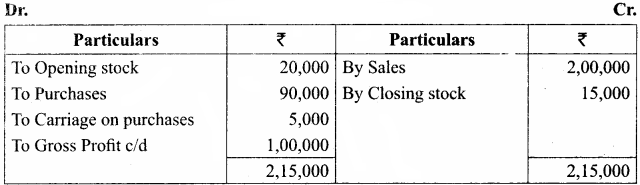
Language: Should be semi-formal. Try to be simple but attractive and appealing. Avoid displaying your linguistic ability.

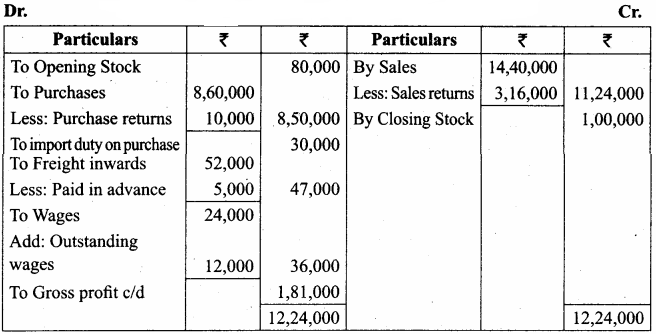
Samacheer Kalvi 12th English Report Writing

Content :

  • factual information about school activity/event
  • date, time, venue of the activity/event
  • sequence of event/programme
  • information about participants/chief guests/judges
  • kind of organisation, people responsible for programme/ arrangements
  • results, if describing a contest

Report For A Newspaper

Usual subjects : Political news, sports news, crimes, accidents, natural disasters, etc.
Format : (a) Headline
(b) ‘Byline’, i.e., by a correspondent-reporter or an agency as its source and
(c) Date-line-date and place of occurrence

Headline
[by Sudhir/Sudha, TOI Correspondent/Staff reporter]

Chennai, 9 March
………………………………………………………………………………………………………..
………………………………………………………………………………………………………..
………………………………………………………………………………………………………..
………………………………………………………………………………………………………..

Samacheer Kalvi 12th English Report Writing

Language and Style :

  • quite formal
  • passive voice is preferred
  • journalistic jargon (vocabulary/expressions), e.g., according to ‘ ministry/party spokesman or according to government sources
  • use of words like ‘alleged’ or ‘suspected’ before ‘murderer’, ‘smuggler’, ‘thief’, etc.

Content: It is most important. The main information is given in the first two or three sentences. Other essential information like date, place, occasion, etc., follow. Presentation should be symmetrical.

Solved Questions
(a) You are Pandian/Ezhilazhasi, the Secretary of the Literary association. Write a report about the Oratorical and Poetry recitation competition held for the Primary and Elementary school children respectively.

The Oratorical and Poetry recitation competition was held on the 20th and 21st of February for students of Primary and Elementary classes respectively. Students from Std IV and V were given the topic, The book I read during winter vacation. Five students from the four sections of both the classes were short listed by the respective teachers handling English for the Oratorical competitions held in the auditorium. The selected finalists spoke in front of the Primary school. Jasmine.

Samacheer Kalvi 12th English Report Writing

A of VB was judged the best, followed by Catherine.V of Std IV B in the second place and Rajeswari.V of Std V A was given the third place. The Judges were from the High School. Students of Std VI-VIII took part in a poetry recitation competition according to their respective houses. With strenuous practice, giving importance to pronunciation, intonation and stress, Nehru House bagged the first prize bringing alive the story of Macavity the Mystery Cat.

The second place was given to Tagore House where Lochinvar was brought before our eyes. Judges from the Junior school appreciated the effort put in by every team and congratulated all the participants and winners. The Principal gave away the prizes to the Winners.

Pandian, Secretary of the Literary Association

(b) Write a Report for your school magazine describing a Cultural Fest held in your school in which various schools of your city took part.

25th Nov. Chennai

Samacheer Kalvi 12th English Report Writing

On 22/ 09/2018, a colorful and memorable Cultural Fest was organized in our school. This event was whole day long and was held in the school auditorium. In this mega event, many schools from Chennai city took part.

The grand show commenced by the arrival of various teams from schools. The Chief Guest was the District Collector. The welcome speech given by the Principal was followed by lighting of the lamp. It was accompanied by a melodious Saraswati Vandana, hailing the goddess of knowledge and wisdom. Then there was bouquet presentation to the invited guests and the grand event began. There were programmes mesmerizing presented by the teams from various schools.

There was singing, dancing, poetry recitation, skits, mimicry, mono act shows, classical and modem combination of several foot-tapping numbers. Everyone sat glued to the show. The Chief Guest was impressed and praised the entire event. He inspired us all asking us to perform better. It was followed by the announcement of the winning team, the Chettinad School of our city. The team from our school bagged the second position and everyone complimented one another. It was followed by a formal vote of thanks and the event concluded.

We really enjoyed a lot and dispersed with a sincere hope that such mega events should be organized every year giving the students a chance to display their talents.

Samacheer Kalvi 12th English Report Writing

Vardhini, Cultural Secretary

(c) You are Varma / Varshini, the Headboy / Headgirl of GHSS, Madurai. Recently your school hosted the Regional Level Science Exibition. Write a report of this event in about 100 words.

18th Sept. Trichy

The Guntur Girls Higher Secondary School, Madurai hosted a Regional Level Science Exhibition on 14th and 15 th of September, 2018. About 750 students from 34 different schools in and around the district participated in the same. It was inaugurated by the District Collector Mrs. Rajalingam, IAS. Her presidential address on the theme, Digital and Technological Solutions was inspiring and motivating the budding scientists. Many initiatives to provide interactive, participatory, hands-on, innovative and creative learning experiences to students were also given due importance. The activity aimed at providing a common platform to schools, teachers and students to give shape to their innovative ideas and learn from each other’s experiences. The exhibition also provided a medium for popularizing Science and increasing awareness among stakeholders about the close relationship between Science, Technology and Society.

Samacheer Kalvi 12th English Report Writing

Varshini. Headgirl
Guntur GHSS, Madurai

(d) Write a report for your school magazine.
Answer:

The Annual Sports Day
[by Shekhar]

12th January, 20XX, was a big occasion for our school. The Annual Sports of our school were held on that day at our school playground. A colourful shamiana was erected for guests and teachers. The stands were also tastefully decorated. The athletes gathered in front of the stage at 8.30 a.m. There was a march – past. The Principal took the oath and declared the sports- meet open. At 9.30 the track events began with 200 metre race for boys and 100 metre race for girls. Field events like long jump, high jump, javelin throw and discus throw were held in between the races. The programme was beautifully planned. In the afternoon the cycle race, sack race and three legged-race provided amusement. The musical chair race for guests provided’ a lot of fun. Sukumar of XIIA was declared the best athlete.

Samacheer Kalvi 12th English Report Writing

(e) The floods in the State of Tamil Nadu, adversely affected the area causing destruction to life, property, cattle and crops. As a news correspondent, you visited this state. Write the details of this disaster in 150-200 words. Also give a suitable title to your write up.
Answer:

Devastation By Floods
[XYZ, News Correspondent, The Express]

A visit to the flood-hit districts of the State of Tamil Nadu fills one with depressing thoughts. How can nature be so cruel? The cyclonic storm has proved a disaster for the state. Coastal areas have been hit hard. The villages and hamlets have been adversely affected. Thousands of acres of land having crops are still submerged in water. Millions of cattle have been washed away or perished in the flood waters.

Samacheer Kalvi 12th English Report Writing

Thousands of the villagers have been rendered homeless. Hundreds of children and the aged have been swept off. Thus there has been an all round destruction of life, property, cattle and crops. Government agencies and voluntary groups have rushed to the help of the flood-affected victims. The situation is grim and calls for more concerted efforts.

Samacheer Kalvi 7th Maths Solutions Term 3 Chapter 4 Geometry Ex 4.1

Students can Download Maths Chapter 4 Geometry Ex 4.1 Questions and Answers, Notes Pdf, Samacheer Kalvi 7th Maths Book Solutions Guide Pdf helps you to revise the complete Tamilnadu State Board New Syllabus and score more marks in your examinations.

Tamilnadu Samacheer Kalvi 7th Maths Solutions Term 3 Chapter 4 Geometry Ex 4.1

Question 1.
Samacheer Kalvi 7th Maths Solutions Term 3 Chapter 4 Geometry Ex 4.1 1
Solution:
Samacheer Kalvi 7th Maths Solutions Term 3 Chapter 4 Geometry Ex 4.1 2

Samacheer Kalvi 7th Maths Solutions Term 3 Chapter 4 Geometry Ex 4.1

Question 2.
How is the pre-image translated to the image?
Samacheer Kalvi 7th Maths Solutions Term 3 Chapter 4 Geometry Ex 4.1 3
Solution:
(i) 3 →, 4↑
(ii) 3 ←, 3↑
(iii) 4 ←, 4↓
(iv) 2 ←, 2↓

Question 3.
Find the image of the given triangle with given translation.
Samacheer Kalvi 7th Maths Solutions Term 3 Chapter 4 Geometry Ex 4.1 4
Solution:
Samacheer Kalvi 7th Maths Solutions Term 3 Chapter 4 Geometry Ex 4.1 5

Samacheer Kalvi 7th Maths Solutions Term 3 Chapter 4 Geometry Ex 4.1

Question 4.
Reflect the shape with given line of reflection
Samacheer Kalvi 7th Maths Solutions Term 3 Chapter 4 Geometry Ex 4.1 6
Solution:
Samacheer Kalvi 7th Maths Solutions Term 3 Chapter 4 Geometry Ex 4.1 7

Samacheer Kalvi 7th Maths Solutions Term 3 Chapter 4 Geometry Ex 4.1

Question 5.
Reflect the shape in each of the following pictures with given line of reflection.
Samacheer Kalvi 7th Maths Solutions Term 3 Chapter 4 Geometry Ex 4.1 8
Solution:
Samacheer Kalvi 7th Maths Solutions Term 3 Chapter 4 Geometry Ex 4.1 9

Samacheer Kalvi 7th Maths Solutions Term 3 Chapter 4 Geometry Ex 4.1

Question 6.
Rotate the preimages in each case as directed about the red point.
Samacheer Kalvi 7th Maths Solutions Term 3 Chapter 4 Geometry Ex 4.1 10
Samacheer Kalvi 7th Maths Solutions Term 3 Chapter 4 Geometry Ex 4.1 11
Solution:
Samacheer Kalvi 7th Maths Solutions Term 3 Chapter 4 Geometry Ex 4.1 12
Samacheer Kalvi 7th Maths Solutions Term 3 Chapter 4 Geometry Ex 4.1 13

Samacheer Kalvi 7th Maths Solutions Term 3 Chapter 4 Geometry Ex 4.1

Identify the transformation:

Question 7.
Samacheer Kalvi 7th Maths Solutions Term 3 Chapter 4 Geometry Ex 4.1 14
Solution:
Reflection
Samacheer Kalvi 7th Maths Solutions Term 3 Chapter 4 Geometry Ex 4.1

Question 8.
Samacheer Kalvi 7th Maths Solutions Term 3 Chapter 4 Geometry Ex 4.1 15
Solution:
Rotation

Samacheer Kalvi 7th Maths Solutions Term 3 Chapter 4 Geometry Ex 4.1

Question 9.
Samacheer Kalvi 7th Maths Solutions Term 3 Chapter 4 Geometry Ex 4.1 16
Solution:
Translation

Question 10.
A pool of fish translates from point F to point D.
a. Describe the translation of the pool of fish.
b. Can the fishing boat make the same translation? Explain.
c. Describe a translation the fishing boat could make to get to point D.
Samacheer Kalvi 7th Maths Solutions Term 3 Chapter 4 Geometry Ex 4.1 17
Solution:
(a) Translation of pool of fish is 7 →, 2↓
(b) No, the fishing boat will be landed on the island if translated.
(c) To get point D, the translation will be 5 →, 3↓

Samacheer Kalvi 7th Maths Solutions Term 3 Chapter 4 Geometry Ex 4.1

Question 11.
Name the transformation that will map footprint A onto the indicated footprint.
Samacheer Kalvi 7th Maths Solutions Term 3 Chapter 4 Geometry Ex 4.1 18
(i) Footprint B
(ii) Footprint
(iii) Footprint D
(iv) Footprint E
Solution:
(i) It is translation
(ii) Reflection about horizontal line.
(iii) Reflection about vertical line.
(iv) Rotation about the heel.
Samacheer Kalvi 7th Maths Solutions Term 3 Chapter 4 Geometry Ex 4.1

Question 12.
In given diagram, the blue figure is an image of the pink figure.
Samacheer Kalvi 7th Maths Solutions Term 3 Chapter 4 Geometry Ex 4.1 19
(i) Choose an angle or a vertex from the preimage and name its image.
(ii) List all pairs of corresponding sides.
Solution:
(i) Image of ∠L is ∠L’, Image of ∠M is ∠M’,
Image of ∠N is ∠N’, Image of ∠O is ∠O’
Image of vertex L is L’, Image of vertex M is ∠M’
Image of vertex N is ∠N’, Image of vertex O is O’

(ii) Corresponding sides are LM and L’M’, MN and M’N’, NO and N’O’ and OL and O’L’

Question 13.
In the diagram at the right, the green figure is a translation image of the pink figure. Write a coordinate rule that describes the translation.
Samacheer Kalvi 7th Maths Solutions Term 3 Chapter 4 Geometry Ex 4.1 20
Solution:
The rule bind here in 3→, 1↓

Objective Type Questions

Question 1.
A _______ is a turn about a point.
(i) Translation
(ii) Rotation
(iii) Reflection
(iv) Glide Reflection
Answer:
(ii) Rotation

Question 2.
A _______ is a flip over a line.
(i) Translation
(ii) Rotation
(iii) Reflection
(iv) Glide Reflection
Answer:
(iii) Reflection
Samacheer Kalvi 7th Maths Solutions Term 3 Chapter 4 Geometry Ex 4.1

Question 3.
A _______ is a slide; move without turning or flipping the shape.
(i) Translation
(ii) Rotation
(iii) Reflection
(iv) Glide Reflection
Answer:
(i) Translation

Question 4.
The transformation used in the picture is
Samacheer Kalvi 7th Maths Solutions Term 3 Chapter 4 Geometry Ex 4.1 21
(i) Translation
(ii) Rotation
(iii) Reflection
(iv) Glide Reflection
Answer:
(ii) Rotation

Question 5.
The transformation used in the picture is
Samacheer Kalvi 7th Maths Solutions Term 3 Chapter 4 Geometry Ex 4.1 22
(i) Translation
(ii) Rotation
(iii) Reflection
(iv) Glide Reflection
Answer:
(i) Translation
Samacheer Kalvi 7th Maths Solutions Term 3 Chapter 4 Geometry Ex 4.1

Question 6.
You must rotate the puzzle piece 270° clockwise about point P to fit it into a puzzle. Which piece fits in the puzzle as shown?
Samacheer Kalvi 7th Maths Solutions Term 3 Chapter 4 Geometry Ex 4.1 23Samacheer Kalvi 7th Maths Solutions Term 3 Chapter 4 Geometry Ex 4.1 24
Solution:
Samacheer Kalvi 7th Maths Solutions Term 3 Chapter 4 Geometry Ex 4.1 25

Samacheer Kalvi 12th English Solutions Poem Chapter 6 Incident of the French Camp

Students can Download English Lesson 6 Incident of the French Camp Questions and Answers, Summary, Activity, Notes, Samacheer Kalvi 12th English Book Solutions Guide Pdf helps you to revise the complete Tamilnadu State Board New Syllabus and score more marks in your examinations.

Tamilnadu Samacheer Kalvi 12th English Solutions Poem Chapter 6 Incident of the French Camp

Warm Up
Have you played chess or watched the game carefully?

Now identify the chess pieces and complete the table below. Discuss the role of each piece in the game.

Samacheer Kalvi 12th English Solutions Poem Chapter 6 Incident of the French Camp img-1

King: The King can move one space in any direction. He can never move into check. He can never be adjacent to opponent king. It is the most important piece on the chess board. If he is checkmated, the game is over. The King can also castie and take the protection of Elephant.

Queen: The queen is often the most powerful piece in chess. She can move any number of spaces in any direction as long as she is not obstructed by any other power. If that obstacle is opponent, she can remove it.

Bishop: There are two bishops for each player situated next to the Queen and the king respectively. They can move along the diagonals of the chess board. It is bound to the colour square it is originally placed. If it is set in black square, throughout the game it can move diagonally in black square. If the opponent comes into contact in the black square, it can remove it.

The Knight: Between Bishop and the Rook, there are two knights. They can leap over other pieces in L shape. On encountering opponent, it can be eliminated in its ‘L’ path.

The Rook: There are two rooks for each player. They are located in each comer of the board next to the Knight. They move up and down the rank and file of the chess board and can move any number of spaces as long as their path is not obstmcted by their own army. If opponent’s pieces cross their way, they can remove them.

The Pawn: Each player has eight pawns. They provide the first line of defence to the King. Pawn has several unique attributes. It can move one or two paces forward. After the Initial move they can move only one step ahead. To capture enemy, Pawn moves only diagonally. Once the pawn reaches the end of enemy’s territory, even the queen lost in the battle can be reclaimed.

Samacheer Kalvi 12th English Incident of the French Camp Textual Questions

1. Fill in the blanks choosing the words from the box given and complete the summary of the poem.

determinationresultdramatic
prideadmirationsoftened
woundedmoundvictory
conqueredsoaredvaliant

The poet Robert Browning narrates an incident at the French Camp in the war of 1809 between France and Austria, in a (a) ______ version. He describes the brave action of a (b) ______ soldier, whose heroic devotion to duty and his (c) ______ in it is inspiring and worthy of(d) ______ During the attack of the French army on Ratisbon, Napoleon was anxious about the (e) ______ .Austrians were defending Ratisbon with great (f) ______ and courage. Napoleon was watching the war standing on a (g) ______ near the battlefield. All of a sudden a rider appeared from the closed smoke and dust. Riding at great speed, jumping and leaping, he approached the mound where Napoleon stood. As he came closer, the narrator noticed that the rider, a young boy, was severely wounded. But the rider showed no sign of pain and smiling in joy, jumped off the horse and gave the happy news of (h) ______ to the emperor. He exclaimed with pride that French had (i) ______ Ratisbon and he himself had hoisted the flag of France. When Napoleon heard the news, his plans (j) ______ up like fire. His eyes (k) ______ when he saw that the soldier was severely wounded. Like a caring mother eagle, the emperor asked if he was wounded. The (l) ______ soldier replied proudly that he was killed and died
Answer:

  1. dramatic
  2. wounded
  3. pride
  4. admiration
  5. result
  6. determination
  7. mound
  8. victory
  9. conquered
  10. soared
  11. softened
  12. valiant

2. Based on your understanding of the poem, answer the following questions in one or two sentences each.

Samacheer Kalvi 12th English Solutions Poem Chapter 6 Incident of the French Camp img-2

You know, we French stormed Ratisbon:
A mile or so away,
On a little mound, Napoleon
Stood on our storming-day;
With neck out-thrust, you fancy how,
Legs wide, arms locked behind,
As if to balance the prone brow
Oppressive with its mind.

SamacheerKalvi.Guru

Just as perhaps he mused, ‘My plans
That soar, to earth may fall,
Let once my army-leader Lannes
Waver at yonder wall’, –
Out ’twixt the battery-smokes there flew
A rider, bound on bound
Full-galloping: nor bridle drew
Until he reached the mound.

Then off there flung in smiling joy,
And held himself erect
By just his horse’s mane, a boy:
You hardly could suspect –
(So tight he kept his lips compressed,
Scarce any blood came through)
You looked twice ere you saw his breast
Was all but shot in two.

You know, we French stormed Ratisbon:
A mile or so away,
On a little mound, Napoleon
Stood on our storming-day;
With neck out-thrust, you fancy how,
Legs wide, arms locked behind,
As if to balance the prone brow
Oppressive with its mind.

Just as perhaps he mused, ‘My plans
That soar, to earth may fall,
Let once my army-leader Lannes
Waver at yonder wall’, –
Out ’twixt the battery-smokes there flew
A rider, bound on bound
Full-galloping: nor bridle drew
Until he reached the mound.

Then off there flung in smiling joy,
And held himself erect
By just his horse’s mane, a boy:
You hardly could suspect –
(So tight he kept his lips compressed,
Scarce any blood came through)
You looked twice ere you saw his breast
Was all but shot in two.

Question (a)
Who do you think is the narrator of the poem?
Answer:
A French soldier is the narrator of the poem.

Question (b)
Where was the narrator when the incident happened?
Answer:
Narrator was standing by Napoleon Bonaparte when the incident happened.

Question (c)
Who took the city of Ratisbon by storm?
Answer:
French soldiers led by Marshall Lannes took the city of Ratisbon by storm.

Question (d)
Where was Napoleon standing on the day of attack on the city of Ratisbon?
Answer:
Napoleon was standing on a mound near the battlefield (i.e.) Ratisbon city.

SamacheerKalvi.Guru

Question (e)
Describe the posture of Napoleon.
Answer:
Napoleon’s neck was out thrust. He kept his legs wide and arms locked behind, as if to balance his body against his brow heavy with oppressive thoughts about the battle.

Question (J)
Who came galloping on a horse to Napoleon?
Answer:
A boy-soldier came galloping on a horse to Napoleon.

Question (g)
What does the phrase ‘full galloping’ suggest?
Answer:
Full galloping suggests full speed.

Question (h)
Why was the rider in a hurry?
Answer:
The rider was carrying first hand information about the victory at Ratisbon. So, he was in a hurry.

Question (i)
What did the rider do when he reached Napoleon?
Answer:
He jumped off his horse when he reached Napoleon.

Question (j)
Why did the rider keep his lips compressed ?
Answer:
The rider was mortally wounded. He kept his lips tight to prevent blood from flowing out.

Question (k)
Where did the rider plant the French flag after Ratisbon was captured?
Answer:
The rider had planted the French flag at the Market place in Ratisbon.

SamacheerKalvi.Guru

Question (l)
What was Napoleon’s reaction on hearing the news of victory?
Answer:
Napoleon’s emotions started soaring up again on hearing the news of victory.

Question (m)
When did the narrator find that the boy was badly wounded?
Answer:
Soon after the boy disclosed the conquest of Ratisbon and his glorious role in perching the French flag, Napoleon found that the boy was wounded.

Question (n)
Why did Napoleon’s eyes become soft as a mother eagle’s eyes?
Answer:
Napoleon’s eyes softened like a mother eagle who has mixed feelings about the bravery of the eaglet and grief on the mortal injuries sustained by it during the fight with a tougher foe. He became sad because the boy-soldier was mortally wounded.

Question (o)
How did the young soldier face his end?
Answer:
The young soldier died with a smile frozen on his lips.

3. Literary Devices

Mark the rhyme scheme of the poem. The rhyme scheme for the first stanza is as follows. “With neck out-thrust, you fancy how, a
Legs wide, arms locked behind, – b
As if to balance the prone brow – a
Oppressive with its mind. – b
Just as perhaps he mused, ‘My plans – c
That soar, to earth may fall, – d
Let once my army-leader Lannes – c
Waver at yonder wall ’, – d
Out ’twixt the battery-smokes there flew – a
A rider, bound on bound – b
Full-galloping: nor bridle drew – a
Until he reached the mound. – b
Then off there flung in smiling joy, – c
And held himself erect – d
By just his horse’s mane, a boy: – c
You hardly could suspect – d
(So tight he kept his lips compressed, – a
Scarce any blood came through) – b
You looked twice ere you saw his breast – a
Was all but shot in two. b
‘Well’, cried he, ‘Emperor, by God’s grace – c
We’ve got you Ratisbon! – d
The Marshal’s in the market-place c
And you ’ll be there anon, – d
To see your flag-bird flap his vans – a
Where I, to heart’s desire, – b
Perched him! ’ The Chief’s eye flashed; his plans – a
Soared up again like fire. – b
The Chief’s eye flashed; but presently – c
Softened itself, as sheathes – d
A film the mother-eagle’s eye – c
When her bruised eaglet breathes: – d
‘You ’re wounded! ’ ‘Nay ’, his soldier’s pride – a
Touched to the quick, he said: – b
‘I’m killed, Sire! ’And, his Chief beside – a
Smiling, the boy fell dead. – b

Appreciate The Poem

4. Read the lines given below and answer the questions that follow.

(a) “Legs wide, arms locked behind,
As if to balance the prone brow Oppressive with its mind.”

Question (i)
Whose action is described here?
Answer:
Napoleon Bonaparte’s action is described here.

SamacheerKalvi.Guru

Question (ii)
What is meant by prone brow?
“Prone brow” means brow accustomed or inclined down to contemplate on serious matters.

Question (iii)
What is his state of mind?
Answer:
His mind is oppressed with anxious thoughts regarding the outcome of the war at Ratisbon.

(b) “You ’re wounded! ’ ‘Nay ’, his soldier’s pride
Touched to the quick, he said: ”

Question (i)
Why did the boy contradict Napoleon’s words?
Answer:
The boy contradicted Napoleon’s words because the word “wounded” hurt his sense of pride and patriotism and his voluntary sacrifice of life for his country.

Question (ii)
Why was his pride touched?
Answer:
The boy was naturally proud to have perched the French flag and got shot by the enemy. He had hurried holding on to his life to disclose the news of conquest of Ratisbon to the French king. When he said, “you’re wounded”, he interpreted it as an insult to his bravery and patriotism. So, his pride was touched.

(c) “A film the mother-eagle’s eye
When her bruised eaglet breathes”

Question (i)
Who is compared to the mother eagle in the above lines?
Answer:
Napoleon Bonaparte is compared to mother eagle.

Question (ii)
Explain the comparison.
Answer:
A mother eagle will be proud when the eaglet takes on a stronger predator. When the eaglet is hurt, the mother eagle will be naturally sad as no mother will want the young one to perish in a combat. The king, like a mother, is sad about the impending death of a valiant boy-soldier.

Additional Questions

(а) “Just as perhaps he mused, ‘My plans
That soar, to earth may fall,”

Question (i)
Who does ‘he’ refer to?
Answer:
‘He’ refers to Napoleon Bonaparte.

Question (ii)
What may hamper the soaring plans of Napoleon?
Answer:
The negative outcome of battle at Ratisbon may hamper his soaring plans.

SamacheerKalvi.Guru

Question (iii)
What is the figure of speech employed in these lines?
Answer:
‘plans that soar’ – Metaphor.

(b) “Full-galloping: nor bridle drew
Until he reached the mound. ”

Question (i)
Why was the rider in a hurry?
Answer:
The rider was carrying an urgent message to Napoleon Bonaparte.

Question (ii)
Where did the soldier stop? Why?
The soldier stopped at the mound. Napoleon Bonaparte was expecting news about the outcome of the battle at Ratisbon.

(c) “The Chief’s eye flashed; his plans
Soared up again like fire.”

Question (i)
Who is described as the chief?
Answer:
Napoleon Bonaparte is described as the chief.

Question (ii)
Identify the figure of speech employed.
Answer:
Simile

(d) Explain the following lines with reference to the context.

Question (i)
“Then off there flung in smiling joy,
And held himself erect”
Answer:
Reference: These words are from the poem ‘Incident of the French Camp” written by Robert Browning.
Context and Explanation: The narrator says these words while describing the arrival of a boy soldier at the mound where Napoleon was anxiously awaiting news about the battle at Ratisbon. Amidst the smoke of cannon fire, a horse sped fast carrying a boy-soldier. He jumped off the horse with a beaming face. It seemed that he had a brought a good news.

Question (ii)
‘I’m killed, Sire! ’And, his Chief beside,
Smiling, the boy fell dead.”
Answer:
Reference: These lines are from the poem ‘Incident of the French Camp” written by Robert Browning.
Context and Explanation: The poet says these words while explaining the hurt reaction of the boy-soldier. The boy-soldier who brought the news of conquest of Ratisbon was all but ‘ split into two. When emperor Napoleon expressed his grief on his wounded status, the boy soldier said, “Nay I’m killed sire.”

SamacheerKalvi.Guru

Question (iii)
“To see your flag-birdflap his vans Where I, to heart’s desire,
Perched him!
Answer:
Reference: These lines are from the poem ‘Incident of the French Camp” written by Robert Browning.
Context and Explanation: The narrator says these through the boy-soldier while explaining his role in the final stages of storming of Ratisbon. He said proudly that he himself hoisted French Flag to his heart’s content at the Market place in Ratisbon.

Additional Question

Question (i)
“As if to balance the prone brow
Oppressive with its mind.”
Answer:
Reference: These words are from the poem ‘Incident of the French Camp” written by Robert Browning.
Context and Explanation: The narrator says these words about the ambitious emperor of France who was anxiously waiting for the news about the outcome of battle at Ratisbon. His inclined brow appeared as if it was trying to balance the heart laden with worry.

Question (ii)
“Let once my army-leader Lannes
Waver at yonder wall’
Answer:
Reference: These lines are from the poem ‘Incident of the French Camp” written by Robert Browning.
Context and Explanation: The poet says these words while Napoleon awaited anxiously the news about the outcome of storming of Ratisbon. As his ambition rested on the outcome, he was restless. He wanted Marshall Lannes to send signal from Ratisbon to allay his fears.

Question (iii)
“Afilm the mother-eagle’s eye When her bruised eaglet breathes:
Answer:
Reference: These lines are from the poem ‘Incident of the French Camp” written by Robert Browning.
Context and Explanation: The narrator witnesses the reaction of Napoleon to the fact that the boy-soldier who had brought news of success was mortally wounded. Like a mother eagle who is proud and sad about the eaglet who has fought a fierce predator and dying, is moved to tears.

Question (iv)
“‘You’re wounded! ’ ‘Nay’, his soldier’spride Touched to the quick,”
Answer:
Reference: These lines are from the poem ‘Incident of the French Camp” written by Robert Browning.
Context and Explanation: The poet says these words describing the interaction between the ‘ mortally wounded soldier and Napoleon Bonaparte. The boy-soldier’s chest was split into two. He had tightly closed his lips to stem the blood about to flow. The emperor said that he was wounded. As his pride was hurt, he disagreed with him.

Question (v)
“Afilm the mother-eagle’s eye When her bruised eaglet breathes:
Answer:
Reference: These lines are from the poem ‘Incident of the French Camp” written by Robert ‘ Browning.
Context and Explanation: The narrator said these words as to what befell the valiant boy- soldier who brought the news to ease the heart of Napoleon. He didn’t accept the sympathy of Napoleon. Being valiant he was at the verge of embracing death.

5. Answer the following questions in about 100-150 words each.

Question (a)
The young soldier matched his emperor in courage and patriotism. Elucidate your answer.
Answer:
Emperor Napoleon was an astute planner planning the moves of the battle observing each step the French army made. Emperor Napoleon being a bold and wise warrior always had two plans, one to advance forward if the battle brings victory and the next as to what to be done in case the battle is lost. He was not resting at a tent during the battle. He was very close to the place of battle planning the strategic steps.

Similarly, the boy-soldier was also equally brave. Unlike the emperor, the boy soldier flung himself in the midst of battle and risked his life. He did not bother about his death. He doggedly carried out the mission of hoisting French national flag. Instead of being carried away for first aid, he hurried on horse back to communicate the news of conquest of Ratisbon despite his chest being split into two. So, it is obvious the boy- soldier’s patriotism and gallantry are equal to that of Napoleon.

Question (b)
What is the role of the young soldier in the victory of the French at Ratisbon?
Answer:
The young soldier was one of the soldiers in the infantry division leading the battle. On storming Ratisbon, unmindful of the cannon fire, he climbed the flag post with French flag and hoisted it. He received the bullets in turn for his service to the emperor and French army. He did not succumb to the bullets immediately, he galloped on horse back to convey the news to emperor Napoleon Bonaparte himself. He held on to life till he reached Napoleon and conveyed the happy news. He waited with abated breath to know the reaction of his great leader. When he expressed his sadness, his pride was hurt. He denied the emperor’s sympathy and said emphatically that he was killed. He fell down beside emperor Napoleon with a smiling face and died.

SamacheerKalvi.Guru

Question (c)
Napoleon was a great source of inspiration to his army. Justify.
Answer:
Napoleon was a powerful orator and was able to muster the support of young soldiers who could gladly throw away their lives for the glory of France and for fulfilling the ambitious plans of territorial expansion of Napoleon Bonaparte. He inspired unprecedented courage among the soldiers. They never worried about the strength of the enemy army or their pile of armaments. They faced the battles with the single minded determination to ‘do or die’ or do and die. They kissed death for the glorification of France and for making Napoleon proud of their heroism, sacrifices and patriotism.

Listening Activity

Some words have been left out in the poem below. First, read the poem. Then, fill in the missing words on listening to the reading or the recording of it in full. You may listen again, if required.

The Drum
I hate that drum’s discordant sound, Parading round, and round, and round: To thoughtless youth it pleasure yields, And lures from cities and from fields, sell their liberty for charms Of tawdry lace, and glittering arms; And when Ambition’s voice commands, To march, and fight, and fall, in foreign lands. I hate that drum’s discordant sound, Parading round, and round, and round; To me it talks of ravag’d plains, And burning towns, and ruin’d swains, And all that Misery’s hand bestows, To fill the catalogue of human woes.

I hate that drum’s (1) ______ sound,
Parading round, and round, and round:
To thoughtless (2) ______ it pleasure yields,
And lures from cities and from fields, sell their (3) ______ for charms
Of tawdry lace, and glittering arms;
And when (4) ______ voice commands,
To march, and fight, and fall, in (5) ______
I hate that drum’s discordant sound, Parading round, and round, and round; To me it talks of
(6) ______ plains, And burning towns, and ruin’d swains, And all that Misery’s hand bestows, To
fill the (7) ______ of human woes.
Answer:

  1. discordant
  2. youth
  3. liberty
  4. ambition’s
  5. foreign lands
  6. ravag’d
  7. catalogue

Incident of the French Camp About The Poet
Samacheer Kalvi 12th English Solutions Poem Chapter 6 Incident of the French Camp img-3

Robert Browning (7 May 1812-12 December 1889) was one of the famous Victorian poets known for his marvellous dramatic monologues like “Last Ride Together”. His poems are known for their irony, characterisation, dark humour, social commentary, historical settings and challenging vocabulary and syntax. He developed a unique form of conversational, unrhythmic verse. The collection ‘Dramatis Personae’ and the book-length epic poem “The Ring and the Book” made him a leading British poet. By 1881 in recognition of his outstanding contribution to literature, a literary society called Browning Society was established.

Incident of the French Camp Summary in English

Introduction
The poem “Incident of the French camp describes an act of chivalry, gallantry, patriotism and sacrifice on the part of a young French soldier. The poem narrates an actual event in the war between France and Austria led by Napoleon in 1809.

Napoleon was standing on a little mound, eagerly looking towards Ratisbon. His mind was oppressed with anxious thoughts. He was apprehensive that all his ambitious plans would come to nothing if Lannes failed to storm Ratisbon. His neck was out thrust. Napoleon was deep in thought. He awaited a signal from his army chief Lannes. At that moment, a rider came almost flying on horseback. The horse was on full gallop understanding the significance of the rider’s mission. The rider did not draw the bridle (i.e.) check the speed of the horse until he reached the mound where Napoleon Bonaparte was standing.

A slip of a youth, a boy soldier jumped off the horse with a beaming face. The boy was not even tall enough to touch the mane of the horse. He kept his lips tight lest blood could pour forth. He stood erect. His chest was blown into half in the battle.

The boy-soldier conveyed the news that they had got him Ratisbon. Marshal Lannes was in the market place waiting for him. He should hurry up. The boy- soldier added that to his heart’s desire perched French bird-flag himself.

The chief’s eyes flashed with fresh ambition. But suddenly it softened seeing the mortal wound of the soldier. Like a mother eagle who is pained by the prowess of the eaglet who challenged a stronger foe but got hurt in the fight. The emperor’s eyes got misty with tears. He caringly said, “you are wounded.” The soldier’s pride was hurt. He replied in an ego-hurt voice, “Nay, I’m killed sire.” With a smile, characteristic of valiant heroes, the boy-soldier fell down dead.

Conclusion
Wars are fought and won. But those who sacrifice their lives are ordinary mortals who never get an iota of share in the glory of success.

SamacheerKalvi.Guru

Incident of the French Camp Summary in Tamil

முன்னுரை:
இக்கவிதை ஓர் இளம் பிரென்சுப் படைவீரனின் வீரதீர சாகசத்தையும், உயிர்த் தியாகத்தையும் சித்தரிப்பதாக அமைந்துள்ளது. ஆஸ்திரியா நாட்டுக்கும், பிரான்சுக்கும் இடையே 1809ஆம் ஆண்டு போர் நடைபெற்ற போது நிகழ்ந்த ஓர் உண்மை நிகழ்ச்சியை இக் கவிதை சொல்கிறது.
நெப்போலியன் ஒரு குன்றின் மீது நின்று கொண்டு ரேடிஸ்பனை நோக்கிப் பார்த்துக் கொண்டிருந்தார். அவர் மனம் பயம் கலந்த பல சிந்தனைகளால் அலைக்கழிக்கப்பட்டுக் கொண்டிருந்தது. ராட்டிஸ்பன் நகரத்தைச் சூறையாடும் முயற்சியில் அவரது தளபதி லான்ஸ் வெற்றி பெறவில்லை என்றால் அவரது கனவுத் திட்டங்கள் அனைத்து தவிடு பொடியாகிவிடும். கழுத்தை நீட்டி ஆவலோடு நெப்போலியன் பார்த்துக்கொண்டிருந்தான். ஆழ்ந்த சிந்தனையில் அவர் மூழ்கியிருந்தார். அப்போது ஓர் இளம் சிப்பாய் குதிரை மீது அமர்ந்து கடிவாளத்தைக் கூடப் பிடிக்காமல் காற்றாய் பறந்து வந்தான். குதிரை தனது முதலாளியின் பயண நோக்கத்தை உணர்ந்ததாலோ என்னவோ, முழு வேகத்தில் ஓடியது. நெப்போலியன் இருக்குமிடம் வரும் வரை குதிரையின் வேகம் குறையவேயில்லை.

மீசை முளைக்காத சிறு பாலகன் குதிரையில் இருந்து கீழே குதித்தான். குதிரை பிடறி முடியளவு கூட அவன் உயரமாக வளர்ந்திருக்கவில்லை . அவன் முகம் பிரகாசித்தது, தனது உதடுகளை இறுக்க மூடியிருந்தான். அவற்றைத் திறந்தால் இரத்தம் கொட்டியிருக்கும். நிமிர்ந்து கம்பீரமாக அவன் நின்றான். அவனது நெஞ்சை குண்டுகள் இரண்டாகப் பிளந்திருந்தன. “மன்னா, தங்களுக்காக ராட்டிஸ்பன் நகரைக் கைப்பற்றிவிட்டோம். மார்ஷல் லேன்ஸ் உங்களுக்காக சந்தைத் திடலில் காத்துக் கொண்டிருக்கிறார். நானே என் உள்ளம் குளிர நமது நாட்டுக் கொடியை கம்பத்தில் ஏற்றினேன்” என்றான். இப்போது மன்னன் நெப்போலியனின் கண்கள் பனித்தன. தாய்க் கழுகு, தனது குஞ்சு வலுவான எதிரியோடு போராடி எவ்வாறு பெருமைப் பட்டாலும் கண் கலங்குமோ அதைப் போன்ற மனநிலையில் நெப்போலியன் சொன்னார். “நீ காயமடைந்து விட்டாய்”. இதைக் கேட்ட சிப்பாய் பாலகன் அவமானத்தால் குறுகிப் போய்ச் சொன்னான், “இல்லை மன்னா! நான் கொல்லப்பட்டேன்”. அடுத்த நொடி புன்னகைத் தவளும் முகத்தோடு அவன் நெப்போலியன் அருகிலேயே விழுந்து மடிந்தான்.

முடிவுரை:
போர்கள் நடக்கின்றன. வெற்றியும், தோல்வியும் சகஜம். ஆனால், போர்க்களத்தில் மரணமடையும் சாதாரண சிப்பாய்களின் புகழ் வெளிச்சத்துக்கு வருவதே இல்லை

Incident of the French Camp Glossary

Textual:

Samacheer Kalvi 12th English Solutions Poem Chapter 6 Incident of the French Camp img-4

Additional:

Samacheer Kalvi 12th English Solutions Poem Chapter 6 Incident of the French Camp img-5