Samacheer Kalvi 6th Science Solutions Term 3 Chapter 6 Hardware and Software

You can Download Samacheer Kalvi 6th Science Book Solutions Guide Pdf, Tamilnadu State Board help you to revise the complete Syllabus and score more marks in your examinations.

Tamilnadu Samacheer Kalvi 6th Science Solutions Term 3 Chapter 6 Hardware and Software

Samacheer Kalvi 6th Science Hardware and Software Textual Evaluation

I Choose the correct answer :

Question 1.
Find out the part that is not found in CPU?
(a) Mother Board
(b) SMPS
(c) RAM
(d) Mouse
Answer:
(d) Mouse

Question 2.
Which of the following is correct?
a. Free and Open source
b. Free and Traditional software
c. Passive and Open source
d. Passive and Traditional source
Answer:
a. Free and Open source

Question 3.
LINUX is a
(a) Paid Software
(b) Licensed Software
(c) Free and Proprietary software
(d) Free and Open-source software
Answer:
(d) Free and Open-source software

Question 4.
Find out Paid and Proprietary software from the given list
a.- Windows
b. MAC OS
c. Adobe Photoshop
d. All the above
Answer:
d. All the above

Question 5.
_______ is a Operating System
(a) Android
(b) Chrome
(c) Internet
(d) Pendrive

Samacheer Kalvi 6th Science Solutions Term 3 Chapter 6 Hardware and Software

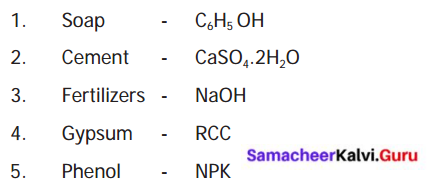
IV. Match the following :

1. MAC OS

Free and Open source Software

2. Software

Paid and Proprietary Software

3. Hardware

Input Device

4. Keyboard

RAM

5. LINUX

Geogebra

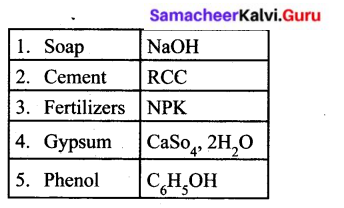
Answer:

1. MAC OSPaid and Proprietary Software
2. SoftwareGeogebra
3. HardwareRAM
4. KeyboardInput device
5. LINUXFree and open source software

Samacheer Kalvi 6th Science Solutions Term 3 Chapter 6 Hardware and Software

III. Short Answer:

Question 1.
What are Hardware and Software?
Answer:
Hardware:

  1. Hardware is the parts of the computer which we can touch and feel.
  2. Hardware includes input and output devices, Cabinet, Hard disk, Mother Board, SMPS, CPU, RAM, CD Drive and Graphics card.

Software :

  1. Software are programmed and coded application to process the input information.
  2. The software processes the data by converting the input information into coding or programmed language.
  3. Touching and feeling is not possible. But, we can see the functions of the software in the form of output.

Question 2.
What do you mean by Operating System? How does it work?
Answer:

  1. System Software (Operating System) is software that makes the hardware devices process the data inputted by the user and to display the result on the output devices like Monitor.
  2. Without the operating system, computer cannot function on its own.
  3. Some of the popular operating system are Linux, Windows, Mac, Android etc.

Question 3.
What is Free and Open Source Software? Give any two examples?
Answer:

  1. Free and open software is available at free of cost and can be shared to many end-users.
  2. Free software is editable and customizable by the user and this leads to update or development of new software.
  3. Examples: 1. Linux, 2. Geogebra.

Samacheer Kalvi 6th Science Solutions Term 3 Chapter 6 Hardware and Software

Samacheer Kalvi 6th Science Hardware and Software Additional Questions

I. Choose the appropriate answer:

Question 1.
_____ is a device comprising both hardware and software.
(a) Microwave Oven
(b) Car
(c) Bike
(d) Computer
Answer:
(d) Computer

Question 2.
Which of the following is correct
(a) Free and Open source software
(b) Free and Licensed software
(c) Free and Traditional software
(d) Passive and Traditional source software
Answer:
(a) Free and Open source software

Question 3.
_____ existed before the World Wide Web.
(a) Whatsapp
(b) Email
(c) Facebook
(d) Google
Answer:
(b) Email

Question 4.
Windows is a
(a) Paid software
(b) Licensed software
(c) Free and Open-source software
(d) Free and Proprietary software
Answer:
(a) Paid software

Question 5.
_____ is one of the example of application program.
(a) Drawing tools
(b) Language
(c) Linker
(d) Device driver
Answer:
(a) Drawing tools

Question 6.
The license of the software would not be provided unless it is _____
(a) Collected
(b) Purchased
(c) dismantled
(d) sold
Answer:
(b) Purchased

Samacheer Kalvi 6th Science Solutions Term 3 Chapter 6 Hardware and Software

II. Fill up the blanks:

  1. _______ is lifeless without software in a computer.
  2. _______ are programmed and coded applications to process the input information.
  3. Software is divided into _______ types based on the process.
  4. _______ is a developing software to control the internal computer operation.
  5. _______ software is available at free of cost and can be shared to many end users.
  6. _______ is the Paid and Proprietary Software.

Answer:

  1. Hardware
  2. Software
  3. two
  4. Linker
  5. Free and Open
  6. Adobe Photoshop

Samacheer Kalvi 6th Science Solutions Term 3 Chapter 6 Hardware and Software

III. Give Short Answer:

Question 1.
How can we classify the software?
Answer:
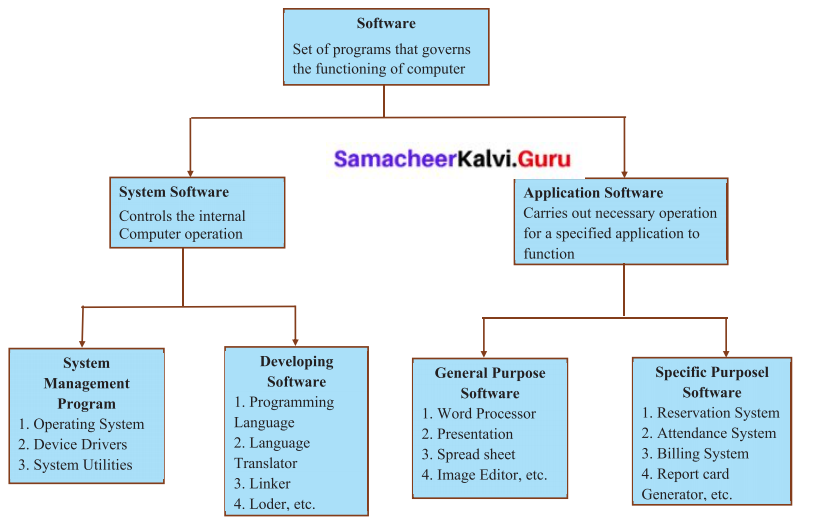
The software is divided into two types based on the process. They are

  1. System software
  2. Application software

Question 2.
Give some examples of System Softwares.
Answer:
Some of the Popular Operating system are LINUX, Windows, Mac, Android etc.

Question 3.
What is open source initiative?
Answer:
The open source initiative is an organization dedicated to promote open source software.

Question 4.
Define – Application Software.
Answer:

  1. Application software is a program (or) a group of programs designed for the benefit of end user to work on computer.
  2. The application programs can be installed in the hard disk for the usuage on a particular computer.

Question 5.
What is the classification of System Software?
Answer:
System software is divided into two types :

  1. System Management Program.
  2. Developing Software.

Question 6.
Give the classification of Application Software?
Answer:

  1. General Purpose Software.
  2. Specific Purpose Software.

Question 7.
Give some examples of Specific Purpose Software?
Answer:

  1. Reservation System.
  2. Attendance System.
  3. Billing System.
  4. Report card Generator.

Question 8.
What are the two forms of System and Application Software?
Answer:
The Operating System and application Software are available in two forms. They are:

  1. Free and Open Source.
  2. Paid and Proprietary Software.

Samacheer Kalvi 6th Science Solutions Term 3 Chapter 6 Hardware and Software

IV. Answer in detail :

Question 1.
Draw the flow chart of software classification.
Answer:
Samacheer Kalvi 6th Science Solutions Term 3 Chapter 6 Hardware and Software 1

Samacheer Kalvi 6th Social Science Economics Solutions Term 2 Chapter 1 Economics An Introduction

You can Download Samacheer Kalvi 6th Social Science Book Solutions Guide Pdf, Tamilnadu State Board help you to revise the complete Syllabus and score more marks in your examinations.

Tamilnadu Samacheer Kalvi 6th Social Science Economics Solutions Term 2 Chapter 1 Economics An Introduction

Samacheer Kalvi 6th Social Science Economics An Introduction Textual Evaluation


I. Fill in the blanks:

  1. The producers of food grains are ______
  2. Collection of honey is a ______ occupation.
  3. The conversion of raw materials into finished goods is called ______
  4. According to Gandhiji the villages are ______ of the nation.
  5. The percentage of population in the cities of Tamil Nadu is ______

Answer:

  1. farmers
  2. Primary
  3. manufacturing
  4. backbone
  5. 47 Percent

II. Match the following:

  1. Cattle rearing – Secondary occupation
  2. Food processing – Services
  3. Iron & Steel Industry – Primary occupation
  4. Telephone – Agro based industry
  5. Cotton Industry – Tertiary occupation

Answer:

  1. Cattle rearing – Primary occupation
  2. Food processing – Agro based industry
  3. Iron & Steel Industry – Secondary occupation
  4. Telephone – Services (or) Tertiary occupation
  5. Cotton Industry – Agro based industry (or) Secondary occupation

III. Match and find the odd pair:

  1. Small scale Industry – Transaction of Money
  2. Forest based Industries – Information Technology
  3. Services – Paper Industries
  4. Banking – Cattle rearing

Answer:

  1. Small scale Industry – Cattle rearing
  2. Forest based Industries – Paper Industries
  3. Services – Information Technology
  4. Banking – Transaction of Money

IV. Choose the correct answer:

  1. Agriculture is a (Primary / Secondary) occupation
  2. Economic activities are divided on the basis of (ownership / use)
  3. Sugar Industries are (Primary / Secondary) activity
  4. Agro based industry (Cotton / Furniture)
  5. Dairy farming is a (Public sector / Co-operative sector)

Answer:

  1. Primary
  2. use
  3. Secondary
  4. Cotton
  5. Co-operative sector

V. Answer the following questions:

Question 1.
Sandhai – Define
Answer:
In villages once in a week or month, all things are sold in a particular place at a specific time to meet the needs of the people. That is called Sandai.
What is called barter system?

  1. The system of exchanging goods for other goods is called barter system.
  2. This was followed in olden days.
  3. For example, exchange a bag of rice for enough clothes.

SamacheerKalvi.Guru

Question 2.
What is trade?
Answer:
The action of buying and selling goods and services is called trade.

Question 3.
What is Savings?
Answer:
The amount from the income which is left for future needs after consumption is called sayings.

Question 4.
What was the necessity for the invention of money?
Answer:

  1. When people exchanged commodities, they might have faced, certain problems when comparing the differences in the value of commodity.
  2. To solve this problem, people invented a tool called money.

Question 5.
What was the reason for the development of settlements near water bodies?
Answer:

  1. Rivers acts as the main source for cultivation of crops.
  2. So early man settled permanently near the rivers.

SamacheerKalvi.Guru

Question 7.
What are called secondary occupation?
Answer:

  1. The raw materials obtained from the primary activities are converted into finished products through machinery on a large scale.
  2. These activities involve secondary occupation.

Question 8.
Name the city centred industries.
Answer:
Cement, iron, and Aluminium industries, sea food processing are some of the city centered industries.

VI. Answer the following in detail:

Question 1.
List out the important primary occupations of your district.
Answer:
Some of the primary occupation are agriculture, crop production, animals husbandry, fisheries, foresting and mining. It also includes gazing, hunting, gathering.

Question 2.
Mention the manufacturing industries found in your district.
Answer:

  1. Cotton textiles
  2. Spinning and weaving
  3. Food processing industries
  4. Beedi production
  5. Wind power generations

SamacheerKalvi.Guru

Question 3.
How are the industries classified on the basis of raw materials?
Answer:
On the basic of raw materials industries are classified as

  1. Agro Based Industries – Cotton textiles, Sugar mills and Food processing.
  2. Forest Based Industries – Paper mills, Furniture making, Building materials.
  3. Mineral Based Industries – Cement, Iron, Aluminium Industries. .
  4. Marine Based Industries – Sea food processing.

Question 4.
Write down the occupations in the service sector.
Answer:

  1. Transport – Roadways, railways waterways, airways
  2. Communication – Post, Telephone, information Technology etc.
  3. Trade – Procurment of goods, selling
  4. Banking – Money transactions, banking services

SamacheerKalvi.Guru

Question 5.
What do you know about the features of cities?
Answer:

  1. A city is a large human settlement.
  2. High density of population.
  3. Four way roads, flyovers, sky scrapers, parks.
  4. Educational institution, hospital, Government offices.
  5. Private and public industries and technological institutions.
  6. Employment opportunities permanent monthly income, basic requirements are

VII. Fill in the tabular column given below:

S.No.Occupations in VillagesOccupations in citiesOccupations in Villages and cities
1.FarmingEngineerCarpenter
2.Grazing of HerdingScientistsTeacher
3.BlacksmithMusiciansWeaver
4.PotteryJournalistsSelf employed
5.Water BearersDoctorsMarketing

Samacheer Kalvi 6th Social Science Economics An Introduction Intext Questions

HOTS

Question 1.
Imagine if money disappears one day?
Answer:

  1. In our daily life we utilize many things. These things are sold in shops. To buy and sell commodities we use money. If we save money it is good for us and the country.
  2. Money is the lubrication for the movement of goods. If these contracts symbolized by money disappeared, there would be instant chaos. All activity would grind to a halt.

Samacheer Kalvi 6th Social Science Economics An Introduction Intext Activities

Activity – 3

Fill up the given table.
Answer:

S.No.CountriesCurrencySymbol
1.GermanyEurb
2.BrazilBrazilian realR$
3.IndiaRupee
4.ArgentinaPeso$
5.ChinaRenminbi¥

Activity – 4
Put ✓ mark in appropriate box
Answer:

S.No.OccupationPrimary

activity

Secondary

activity

Tertiary activity
1.Farmer
2.Teacher
3.Tailor
4.Engineer
5.Bank Manager

Samacheer Kalvi 6th Social Science Economics An Introduction Additional Questions

I. Fill In the blanks:

  1. Things which are produced in villages are brought to
  2. The permanent settlements of early man were called
  3. The root of our economy is
  4. The raw material for sugar is
  5. Banks help in of money.

Answer:

  1. Sandhai
  2. Villages
  3. Agriculture
  4. Sugare cane
  5. Circulation

SamacheerKalvi.Guru

II. Match the following:

1.Exchange of goodsa.Primary Activity
2.Lumberingb.Trade
3.Cementc.Post
4.Buying and sellingd.Barter
5.Communicatione.Mineral based

Answer:

  1. d
  2. a
  3. e
  4. b
  5. c

III. Find the odd pair:

1.

Harvesting products             ‘a.

Primary

2.

Goods and servicesb.

Tertiary

3.

Manufacturingc.

Primary

4.

Teachingd.

Tertiary

IV. Choose the correct answer and fill in the appropriate column:

  1. Coal miner
  2. Automobile assembling plant
  3. Grocery store
  4. Helicopter pilot
  5. Fisherman
  6. Firefighters
  7. Cashier
  8. Delivery man
  9. Oil well
  10. Furniture maker
  11. Timber cutters
  12. Cotton farmer
  13. Oil refinery.

Answer:

S.No.PrimarySecondaryTertiary
1.Coal minerAutomobile assembling plantGrocery store
2.FishermanFurniture makerHelicopter pilot
3.Oil wellOil refineryFire fighters
4.Timber cuttersCashier
5.Cotton farmerDelivery man .

V. Answer the following questions :

Question 1.
What art consumer goods?

  1. The finished goods which are bought from the market to fulfill the daily needs of the consumers is called consumer goods.
  2. Example: Rice, Cloth, Bicycle etc.

SamacheerKalvi.Guru

Question 2.
Mention a few primary activities.
Answer:
Agriculture, Cattle rearing, fishing, mining, collection of fruits, nuts, honey, rubber, resin and medicinal herbs, lumbering etc are primary activities.

VI. Give a detailed answer :
Question 1.
What is economics? Why is if so important?
Answer:

  1. Economics is the study of how societies, governments, business establishments, households and individuals allocate their scarce resources.
  2. The study of economics can also provide valuable knowledge for making decisions
    in everyday life.
  3. Economics is about the study of scarcity and choice.
  4. By studying how markets work, our young people also learn how to make efficient choices in managing their own scarce resources, such as time and money.


Samacheer Kalvi 6th Science Solutions Term 1 Chapter 1 Measurements

You can Download Samacheer Kalvi 6th Science Book Solutions Guide Pdf, Tamilnadu State Board help you to revise the complete Syllabus and score more marks in your examinations.

Tamilnadu Samacheer Kalvi 6th Science Solutions Term 1 Chapter 1 Measurements

Samacheer Kalvi 6th Science Measurements Textual Evaluation

I. Choose the correct answer.

Question 1.
The girth of a tree can be measured by
(a) metre scale
(b) metre rod
(e) plastic ruler
(d) measuring tape
Answer:
(d) measuring tape

Question 2.
The conversion of 7 m into cm gives
(a) 70 cm
(b) 7 cm
(c) 700 cm
(d) 7000 cm
Answer:
(c) 700 cm

Question 3.
Quantity that can be measured Is called
(a) Physical quantity
(b) Measurement
(c) unit
(d) motion
Answer:
(a) Physical quantity

Question 4.
Choose the correct one
(a) km > mm > cm > m
(b) km > mm > m > cm
c) km > m > cm > mm
(d) km > cm > m > mm
Answer:
(c) km > m > cm > mm

Question 5.
While measuring length of an object using a ruler, the position of your eye should be
(a) Left side of the point.
(b) Vertically above the point where the measurement is to be taken.
(c) Right side of the point
(d) Any where according to one’s convenience.
Answer:
(b) Vertically above the

Samacheer Kalvi 6th Science Solutions Term 1 Chapter 1 Measurements

II. True or False.

  1. We can say that mass of an object is 126 kg.
  2. Length of one’s chest can be measured by using metre scale.
  3. Ten millimetres makes one centimetre.
  4. A hand span is a reliable measure of length.
  5. The SI system of units is accepted everywhere in the world.

Answers:

  1. True
  2. False
  3. True
  4. False
  5. True

Samacheer Kalvi 6th Science Solutions Term 1 Chapter 1 Measurements

III. Fill in the blanks.

  1. SI Unit of length is symbolically represented as _____
  2. 500 gm = _____ kilogram
  3. Distance between Delhi and Chennai can be measured in _____
  4. 1 m = _____ cm.
  5. km = _____ m.

Answers:

  1. m
  2. 0.5
  3. Kilometre
  4. 100
  5. 5000

Samacheer Kalvi 6th Science Solutions Term 1 Chapter 1 Measurements

IV. Analogy

Question 1.
Sugar: Beam balance; Lime juice?
Answer:
Measuring Jar.

Question 2.
Height of a person : cm; length of your sharpened pencil lead?
Answer:
mm (mull metre)

Question 3.
Milk: volume; vegetables?
Answer:
mass

Samacheer Kalvi 6th Science Solutions Term 1 Chapter 1 Measurements

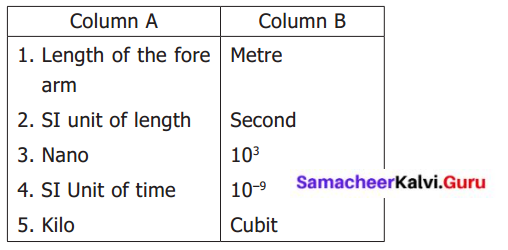
V. Match the following :

Samacheer Kalvi 6th Science Solutions Term 1 Chapter 1 Measurements 1
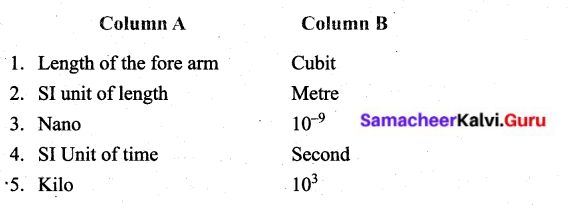
Answer:
Samacheer Kalvi 6th Science Solutions Term 1 Chapter 1 Measurements 2

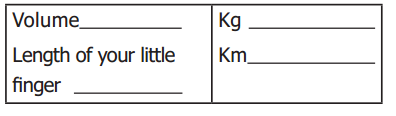
VI. Complete the given table
Samacheer Kalvi 6th Science Solutions Term 1 Chapter 1 Measurements 3
Answer:
Samacheer Kalvi 6th Science Solutions Term 1 Chapter 1 Measurements 4

VII. Arrange in increasing order of unit.

Question 1.
1 Metre, 1 centimetre, 1 kilometre, and 1 millimetre.
Answer:
1 millimetre < 1 centimetre < 1 Metre < 1 kilometre.

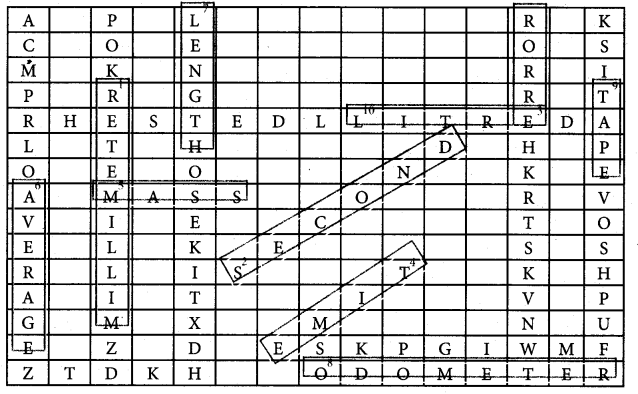
VIII. Find the answer for the following questions within the grid.
Samacheer Kalvi 6th Science Solutions Term 1 Chapter 1 Measurements 5

  1. 10-3 is one _____
  2. SI Unit of time _____
  3. Cross view of reading for a measurement leads to _____
  4. _____ is the one what a clock reads.
  5. _____ is the amount of substance present in an object
  6. _____ can be taken to get the final reading of the recordings of different of students for a single measurement.
  7. _____ is a fundamental quantity.
  8. _____ shows the distance covered by an automobile.
  9. A tailor use _____ to take measurements to stitch a cloth.
  10. Liquids are measured with this physical quantity.

Answers:

  1. Millimetre
  2. second
  3. error
  4. Time
  5. Mass
  6. Average
  7. Length
  8. Odometer
  9. Tape
  10. Litre

Samacheer Kalvi 6th Science Solutions Term 1 Chapter 1 Measurements

IX. Answer in a word or two.

Question 1.
What is the full form of SI system?
Answer:
An international system of unit

Question 2.
Name any one instrument used for measuring mass.
Answer:
Beam balance.

Question 3.
Find the odd one out: Kilogram, millimetre, centimetre, nanometre.
Answer:
Kilogram

Question 4.
What is the SI Unit of mass?
Answer:
Kilogram.

Question 5.
What are the two parts present in a measurement?
Answer:

  1. multiple
  2. sub

Samacheer Kalvi 6th Science Solutions Term 1 Chapter 1 Measurements

X. Answer in a sentence or two.

Question 1.
Define measurement.
Answer:
The comparison of an unknown quantity with some known quantity is known as measurement.

Question 2,
Define mass?
Answer:
Mass is the measure of the amount of matter in an object.

Question 3.
The distance between two places is 43.65 km. Convert it into metre and cm. 0
Answer:
(a) Convert km into metre
1 km = 1000m
∴ 43.65 km = 43.65 × 1000 = 43650.00 = 43650
= 43650 m.

(b) Convert km into cm.
1 km = 1000 m
1 m = 100 cm
1 km = 1000 × 100 cm
1 km = 100000 cm
∴ 43.65 km = 43.65 × 100000 = 4365000.00
= 4365000 cm.

Question 4.
What are the rules to be followed to make an accurate measurement with scale?
Answer:

  1. To avoid the parallax error.
  2. Your eye must be exactly in front of vertically above the point where the measurement has to be taken.

Samacheer Kalvi 6th Science Solutions Term 1 Chapter 1 Measurements

XI. Solve the following.

Question 1.
The distance between your school and your house is 2250 m. Express this distance in kilometre.
Answer:
Distance between school and house is 2250 m.
1000 m = 1 km
∴ 2250 m = 2250 ÷ 1000 = 2.25 km.

Question 2.
While measuring the length of a sharpened pencil, reading of the scale at one end is 2.0 cm and at the other end is 12.1 cm. What is the length of the pencil?
Answer:
The difference between the two readings is the length of the pencil.
= 12.1 cm – 2.0 cm
= 10.1 cm or 10 cm and 1 mm.

Samacheer Kalvi 6th Science Solutions Term 1 Chapter 1 Measurements

XII. Write in detail.

Question 1.
Explain two methods those you can use to measure the length of a curved line.
Answer:
Measuring the length of a curved line, by two methods.
First method – using a string.

  1. Draw a curved line AB on the paper.
  2. Place a string along the curved line.
  3. Make sure that the string covers e very bit of the curved line.
  4. Mark the points where the curved line begins and ends on the string.
  5. Now stretch the string along the length of a meter scale.
  6. Measure the distance between two markings of the string.
  7. This will give the length of a curved line.

Second method – using a divider.

  1. Draw a curved line AB on a paper.
  2. Separate the legs of the divider by 0.5 cm or 1 cm using a ruler.
  3. Place it on the curved line starting from one end. Mark the position of the other end.
  4. Move it along the line again and again cutting the line into number of segments of equal lengths.
  5. The remaining parts of the line can be measured using a scale.
  6. Count the number of segments.
  7. Length of the line = (No. of segments × length of each segment) + length of the left over part.

Question 2.
Fill in the following chart.
Samacheer Kalvi 6th Science Solutions Term 1 Chapter 1 Measurements 6
Answer:
Samacheer Kalvi 6th Science Solutions Term 1 Chapter 1 Measurements 7

Samacheer Kalvi 6th Science Solutions Term 1 Chapter 1 Measurements

Samacheer Kalvi 6th Science Measurements Additional Questions

I. Choose the correct answer:

Question 1.
In which SI unit, you can measure you height?
(a) Kilogram
(b) Litre
(c) Metre
(d) Second
Answer:
(c) Metre

Question 2.
What is the unit of electric current in SI system?
(a) Kelvin
(b) Ampere
(c) seconds
(d) Volt.
Answer:
(b) Ampere

Question 3.
_____ is used to measure the accurate time of the activity.
(a) Clock
(b) Watch
(c) Stop clock
(d) Sundial
Answer:
(c) Stop dock

Question 4.
These are the measurements used in measuring the volume of liquid.
(a) cylinder
(b) pipettes
(c) burettes
(d) All.
Answer:
(d) All

Question 5.
S.I unit for Volume is _____
(a) m2
(b) m
(c) m3
(d) none
Answer:
(c) m3

Question 6.
Twenty decimetre is equal to _____
(a) 2 km
(b) 20 cm
(c) 2 metre
(d) 200 mm
Answer:
(c) 2 metre

Question 7.
_____ is used to measure mass.
(a) Stop clock
(b) Beam balance
(c) Sundial
(d) Graduated cylinder
Answer:
(b) Beam balance

Question 8.
The metric system of units was created by the _____ in 1790.
(a) Greek
(b) Australians
(c) Russians
(d) French
Answer:
(d) French

Question 9.
The moon’s gravitational pull is one _____ of the earth’s pull.
(a) seventh
(b) sixth
(c) fifth
(d) fourth
Answer:
(b) Sixth

Samacheer Kalvi 6th Science Solutions Term 1 Chapter 1 Measurements

II. Find whether the following sentences are true or false. If false Correct the statement.

Question 1.
Kerosene is measured with the help of the graduated cylinder.
Answer:
True.

Question 2.
Length is a fundamental quantity.
Answer:
True.

Question 3.
On moon, the gravitational force is greater than earth.
Answer:
False. On moon the gravitational force is lesser than earth.

Question 4.
An electronic balance is a device used to find accurate mass.
Answer:
True.

Question 5.
Speedometer is a device used for indicating distance travelled by an automobile.
Answer:
False. Odometer js a device used for indicating distance travelled by an automobile.

Question 6.
A ruler or scale used now a days to measure length was invented by William Bedwell.
Answer:
True.

Question 7.
Length, mass and time are some of the derived quantities.
Answer:
False. Length, mass, and time are some of the fundamental quantities.

Question 8.
Leaves and piece of paper are heavier things.
Answer:
False. Leaves and piece of paper are lighter things.

Question 9.
National physical laboratory is located in Delhi.
Answer:
True.

Samacheer Kalvi 6th Science Solutions Term 1 Chapter 1 Measurements

III. Analogy.

Question 1.
Potatoes : Kilogram; Water?
Answer:
Litre.

Question 2.
Stop clock : accurate time; _______ : accurate weight
Answer:
Electronic balance.

Question 3.
Mass : Balance; Length?
Answer:
measuring tape.

Question 4
Amount of matter: mass; Gravitational Pull?
Answer:
Weight.

Samacheer Kalvi 6th Science Solutions Term 1 Chapter 1 Measurements

IV. Answer the following questions in one or two words.

Question 1
What are the materials needed to find the length of a banana?
Answer:
A meter scale, a string or thread, sketch pen..

Question 2.
What formula is used to measure area of your class room?
Answer:
My class room area = Length × Breadth

Question 3.
Give an example of a device used to find the accurate measurement of weight.
Answer:
Electronic balance.

Question 4.
In earlier days, which instruments are used to measure time?
Answer:
Sand clock and Sun dial.

Question 5.
What are the clocks used to measure a smaller duration of time?
Answer:
Electronic clock, Stop watch.

Question 6.
Who invented a ruler or scale?
Answer:
William Bedwell.

Question 7.
Which alloy is used to make the standard metre rod?
Answer:
An alloy of Platinum and iridium.

Samacheer Kalvi 6th Science Solutions Term 1 Chapter 1 Measurements

V. Match the following
Samacheer Kalvi 6th Science Solutions Term 1 Chapter 1 Measurements 8
Answers:
a. ii
b. iii
c. iv
d. i

VI. Answer the following In one or two sentences:

Question 1.
What is the international system of units or SI units?
Answer:
For the sake of uniformity all over the world, we have adopted a common set of units to express measurements that are called as an International system of units or SI units.

Question 2.
Give some examples of larger length measures.

  1. Height of the building,
  2. Length of a banner,
  3. Height of lamp post.

Question 3.
What are the unit of measurements of very small length?
Answer:

  1. Millimetre
  2. centimetre.

Question 4.
What is meant by parallax?
Answer:
Parallax is a displacement or difference in the apparent position of an object viewed along two different lines of sight.

Question 5.
What are the clock used by ancient people to measure day time?
Answer:

  1. sand clock
  2. sun clock.

Question 6.
Where are the electronic balances used?
Answer:
Electronic balances are used in grocery shops and jeweleries.

Question 7.
What is odometer?
Answer:
It is a device used for indicating distance travelled by automobile.

Samacheer Kalvi 6th Social Science Geography Solutions Term 3 Chapter 2 Globe

You can Download Samacheer Kalvi 6th Social Science Book Solutions Guide Pdf, Tamilnadu State Board help you to revise the complete Syllabus and score more marks in your examinations.

Tamilnadu Samacheer Kalvi 6th Social Science Geography Solutions Term 3 Chapter 2 Globe

Samacheer Kalvi 6th Social Science Globe Textual Evaluation

I. Fill in the blanks:

  1. The line of latitude which is known as the Great Circle is __________
  2. The imaginary lines drawn horizontally on Earth from the West to East are called __________
  3. The 90° lines of latitude on the Earth are called __________
  4. The Prime Meridian is also called __________
  5. The world is divided into time zones __________ time zone

Answer:

  1. Equator
  2. Parallels of latitude
  3. North Pole and South Pole
  4. Greenwich Meridian
  5. 24

II. Choose the best answer :

1. The shape of the Earth is _______.
(a) Square
(b) Rectangle
(c) Geoid
(d) Circle
Answer:
(c) Geoid

SamacheerKalvi.Guru

Question 2.
The North Pole is ……………..
(a) 90° N Latitude
(b) 90° S latitude
(c) 90° W Longitude
(d) 90° E longitude
Answer:
(a) 90° N Latitude

Question 3.
The area found between 0° and 180° E lines of longitude is called _______.
(a) Southern Hemisphere
(b) Western Hemisphere
(c) Northern Hemisphere
(d) Eastern Hemisphere
Answer:
(d) Eastern Hemisphere

Question 4.
The 23 1/2° N line of latitude is called ……………..
(a) Tropic of Capricorn
(b) Tropic of Cancer
(c) Arctic Circle
(d) Antarctic Circle
Answer:
(b) Tropic of Cancer

SamacheerKalvi.Guru

Question 5.
180° line of longitude is _______.
(a) Equator
(b) International Date Line
(c) Prime Meridian
(d) North Pole
Answer:
(b) International Date Line

Question 6.
The Sun is found overhead the Greenwich Meridian at ……………..
(a) 12 midnight
(b) 12 noon
(c) 1 p.m.
(d) 11 a.m.
Answer:
(b) 12 noon

Question 7.
A day has _____.
(a) 1240 minutes
(b) 1340 minutes
(c) 1440 minutes
(d) 1140 minutes
Answer:
(c) 1440 minutes

Question 8.
Which of the following lines of longitude is considered for the Indian Standard Time?
(a) 82 1/2° E
(b) 82 1/2° W
(c) 81 1/2° WE
(d) 81 1/2° W
Answer:
(a) 82 1/2° E

Question 9.
The total number of lines of latitude are ________
(a) 171
(b) 161
(c) 181
(d) 191
Answer:
(c) 181

Question 10.
The total number of lines of longitude are ……………
(a) 370
(b) 380
(c) 360
(d) 390
Answer:
(c) 360

III. Circle the odd one
Samacheer Kalvi 6th Social Science Geography Solutions Term 3 Chapter 2 Globe image - 1
IV. Match the following.

AB
0° line of latitudePole
0° line of longitudeInternational Date Line
180° line of longitudeGreenwich
90° line of latitudeEquator

Answer:

AB
0° line of latitudeEquator
0° line of longitudeGreenwich
180° line of longitudeInternational Date Line
90° line of latitudePole

V. Examine the following statements :

  1. The Earth is spherical in shape.
  2. The shape of the Earth is called a geoid.
  3. The Earth is flat.

Look at the options given below and choose the correct answer.
(a) 1 and 3 are correct
(b) 2 and 3 are correct
(c) 1 and 2 are correct
(d) 1,2 and 3 are correct
Answer:
(c) 1 and 2 are correct

SamacheerKalvi.Guru

VI. Examine the following statements :

Statement I : The lines of latitude on Earth are used to find the location of a place and define the heat zones on Earth.
Statement II: The lines of longitudes on Earth are used to find the location of a place and to calculate time.
Choose the correct option :
(a) Statement I is correct; II is wrong
(b) Statement I is wrong; II is correct
(c) Both the statements are correct
(d) Both the statements are wrong
Answer:
(c) Both the statements are correct

VII. Name the following :

  1. The imaginary lines drawn horizontally on Earth.
  2. The imaginary lines drawn vertically on Earth.
  3. The three dimensional model of the Earth.
  4. India is located in this hemisphere based on lines of longitude.
  5. The network of lines of latitude and longitude.

Answer:

  1. Latitudes
  2. Longitudes
  3. globe
  4. Eastern hemisphere
  5. Earth grid

VIII. Answer Briefly :

Question 1.
What is a geoid?
Answer:

  1. The Earth cannot be compared with any other geometrical shape as it has a very unique shape.
  2. Hence, its shape is called a geoid (earth shaped).

SamacheerKalvi.Guru

Question 2.
What is local time?
Answer:

  1. The time in a particular region or area expressed, with reference to the meridian passing through it. (or)
  2. When the sun is overhead on a particular line of longitude, it is 12 noon at all the places located on that line of longitude. This is called local time.

Question 3.
How many times would the sun pass overhead a line of longitude?
Answer:
The sun is overhead on a line of longitude only once a day.

Question 4.
What are lines of latitude and longitude?
Answer:

  1. The imaginary lines that run east and west direction on the Earth are called lines or parallels of latitude
  2. The imaginary lines drawn vertically connecting the North pole and the south pole are called lines or meridians of longitude.

Question 5.
Name the four hemispheres of the Earth.
Answer:

  1. Northern Hemisphere,
  2. Southern Hemisphere,
  3. Eastern Hemisphere and
  4. Western Hemisphere.

IX. Give Reasons :

Question 1.
The 0° line of longitude is called the Greenwich Meridian.
Answer:

  1. All nations of the world agreed to have the Greenwich Meridian as the international Standard Meridian (0°).
  2. This line of longitude is called the Prime Meridian and it is also known as the Greenwich Meridian because it passes through Greenwich.

Question 2.
The regions on Earth between North & South lines of latitude (66 V20) and poles (90°) is called Frigid Zone
Answer:
This region receives very slanting rays of the sun. The temperature is very low. Hence, this region is known as Frigid Zone.

Question 3.
The International Date Line runs zigzag.
Answer:

  1. The International Date line is not straight.
  2. If the line is drawn straight, two places in the same country world have different dates.
  3. So the International Date line is found zigzag in certain places to avoid confusion.

IX. Give reason:

Question 1.
The 0° line of longitude is called the Greenwich Meridian.
Answer:

  1. All nations of the world agreed to have the Greenwich Meridian as the international Standard Meridian (0°).
  2. This line of longitude is called the Prime Meridian and it is also known as the Greenwich Meridian because it passes through Greenwich.

Question 2.
The regions on Earth between North & South lines of latitude (66 Vi°) and poles (90°) is called Frigid Zone.
Answer:

  1. From the Arctic circle (66 ‘A° N) to the North Pole (90° N) and from the Antarctic circle (66 Vi0 S) to the South Pole (90° S) the sun’s rays full further inclined, through „ out the year.
  2. The temperature is very low.
  3. Hence this region is known as Frigid Zone.

SamacheerKalvi.Guru

Question 3.
The International Date Line runs zigzag.
Answer:

  1. The International Date line is not straight.
  2. If the line is drawn straight, two places in the same country world have different dates.
  3. So the International Date line is found zigzag in certain places to avoid confusion.

X. Answer in detail :

Question 1
What are the uses of globe?
Answer:

  1. Since the Earth is huge and we live on a very area, we are not able to see the Earth as a whole.
  2. But when we travel to space, we can see the Earth as a whole.
  3. So, in order to see the shape of the Earth as a whole and to know its unique features, a three dimensional model of the Earth was created with a specific scale in the name of globe.

Question 2.
How are the hemispheres divided on the basis of lines of latitude and longitude?
Explain with diagrams.
Answer:
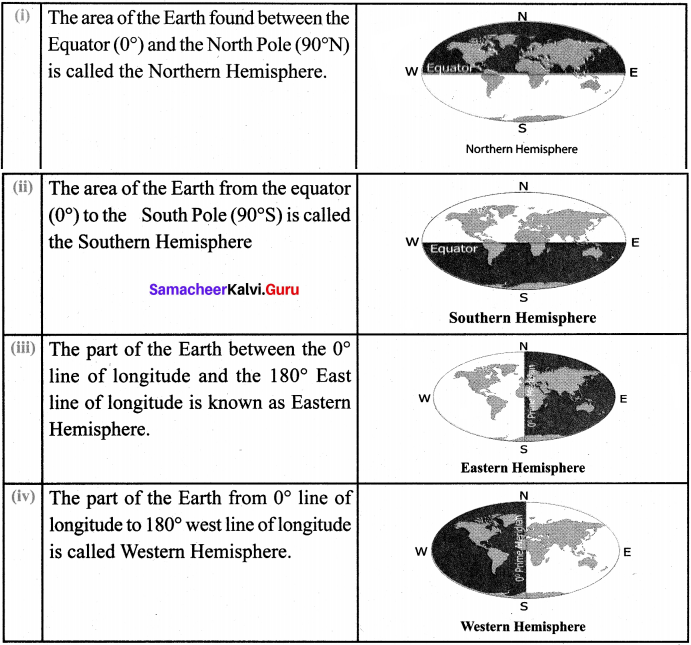
Samacheer Kalvi 6th Social Science Geography Solutions Term 3 Chapter 2 Globe image - 2

Question 3.
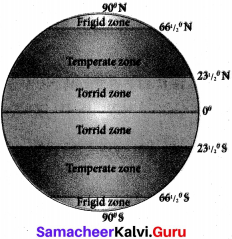
What are the significant lines of latitude? Explain the zones found between them,
Answer:
The significant lines of latitude are
(a) Equator – 0°
(b) Tropic of Cancer – 23 1/2°N
(c) Tropic of Capricorn – 23 1/2°S
(d) Antarctic Circle – 66 1/2°S
(e) Arctic Circle – 66 1/2°N
(f) North Pole – 90°N
(g) South Pole – 90°S.

Samacheer Kalvi 6th Social Science Geography Solutions Term 3 Chapter 2 Globe image - 4

(i) Torrid zone:
The region from the Equator towards the Tropic of Cancer (231A°N) and the Tropic of Capricorn (23 1/2 40S) is called the Torrid Zone.

(ii) Temperate zone:
From the Tropic of Cancer (23!/2°N) to the Arctic Circle (661/2°N) and from the Tropic of Capricorn (23 1/2 0S) to the Antarctic Circle (661/2°S), the Sun’s rays fall slantingly. Moderate temperature prevails in this region. Hence, this region is called Temperate Zone.

(iii) Frigid zone:
From the Arctic Circle (66 1/2°N) to the North Pole (90°N) and from the Antarctic Circle (66 1/2 0S) to the South Pole (90°S), the Sun’s rays fall further inclined, throughout the year. Hence, this region is called Frigid Zone.

Question 4.
Explain; Indian Standard Time.
Answer:

  1.  The longitudinal extend of India is from 68° 7’E to 97° 25’E
  2. As many as twenty nine lines of longitude pass through India.
  3. Having 29 standard time is not logical.
  4. Hence 821/2° E line of longitude is observed as the prime meridian to calculate the Indian standard Time.

XI. Activity :

Question 1.
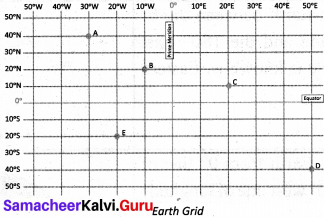
There are five positions marked on the grid given below. Look at them carefully and fill the blanks with reference to the lines of latitude and longitude. The first one is done for you.

  1. The latitudinal and longitudinal reference of point A 40° N 30° W
    Samacheer Kalvi 6th Social Science Geography Solutions Term 3 Chapter 2 Globe image - 5
  2. The latitudinal and longitudinal reference of point B 2Q°N 1Q° W.
  3. The latitudinal and longitudinal reference of point C 10° N 20° E.
  4. The latitudinal and longitudinal reference of point D 40° S 50° E,
  5. The latitudinal and longitudinal reference of point E 20° S 20°. W.

Samacheer Kalvi 6th Social Science Globe IntextActivities

Question 1.
What is the difference in time between the GMT and 1ST?
Answer:
Indian Standard Time is 5 hours and 30 minutes ahead of Greenwich Mean Time.
Eg: 7:15 a.m. GMT is 12:45 p.m. 1ST (that is GMT + 5 hrs and 30 min.

Question 2.
If it is 5 a.m. at New York City, USA. what would be the time at New Delhi, the capital of India?
Answer:
If it is 5 a.m. at New York City, USA., then the time at New Delhi would be 3:30 p.m. (India time is 10 hours and 30 minutes ahead New York, United States).

Question 3.
If it is 12 Midnight at London, what would be the time in India?
Answer:
If it is 12 Midnight at London, then the time in India would be 5:30 a.m.

SamacheerKalvi.Guru

Question 4.
The standard time of Sydney city in Australia is found to be at a difference of _____ hours from that of the GMT.
Answer:
10 Hours. It is according to Australian Eastern Standard Time, (GMT+10). But during Summer, it will be 11 Hours. (GMT+11).

Question 5.
Mr. Senthamizh travels by flight from Chennai to London. He boarded the aeroplane at 9a.m After 12 hours of travel, at what time (GMT) would he have reach London?
Answer:
He would reach London at 3.30 p.m. GMT.

Question 6.
Based on the longitudinal extent, in which hemisphere is our country located? Look at the globe and answer.
Answer:
Based on the longitudinal extent, our country is located in Eastern hemisphere

HOTS

Question 1.
Based on the latitudinal extent, in which hemisphere is India located?
Answer:
Based on the latitudinal extent, our country is located in Northern hemisphere

Samacheer Kalvi 6th Social Science Globe Additional Questions:

I. Fill In the blanks:

  1. When we travel to space, we can see the ______ as Whole
  2. The Earth is ______ at the poles.
  3. The Earth bulges at the ______
  4. The Earth moves around the ______
  5. The Earth rotates from the ______
  6. The Earth is inclined on its axis at an inclination of ______
  7. The first globe was created by the ______
  8. Aryabhatta wrote ______
  9. The first person to draw the lines of latitude and longitude was ______
  10. Geographia’ was written by ______
  11. The latitudinal extent between 1° line of latitude on Earth is ______
  12. The sun’s rays ______ equally on all parts of the earth.
  13. The lines of longitude converge at the ______
  14. Two opposite meridians form a ______
  15. Based on the longitudinal extent, India is located in the ______
  16. The Royal Astronomical observatory is located in ______
  17. The sun is overhead on a line of longitude a day ______
  18. The word meridian is derived from the Latin word ______
  19. Local time is calculated when the sun is ______
  20. Russia has time zones ______

Answer:

  1. Earth
  2. Flat
  3. Equator
  4. Sun
  5. West to East
  6. 23 1/2°
  7. Greeks
  8. Aryabhatta Siddhanta
  9. Ptolemy
  10. 111 km
  11. do not fall
  12. Poles
  13. Great-circle
  14. hemisphere.
  15. Eastern
  16. England
  17. only once
  18. Meridianus
  19. Overhead at noon
  20. 7

II. Choose the best answer :

Question 1.
The Earth is ____
(a) Oval shaped
(b) Flat
(c) Spherical shaped
(d) Rectangular
Answer:
(c) Spherical shaped

SamacheerKalvi.Guru

Question 2.
The latitude which divides the Earth into two halves
(a) Tropic of Cancer
(b) Tropic of Capricorn
(c) Arctic Circle
(d) Equator
Answer:
(d) Equator

Question 3.
Tropic of Cancer is Otherwise called as ……………..
(a) Kadagavari
(b) Nilanaduvarai
(c) Magaravarai
Answer:
(a) Kadagavari

Question 4.
The region from the Equator towards the Tropic of Cancer, is known as .
(a) Torrid Zone
(b) Temperate Zone
(c) Frigid Zone
(d) Heat Zone
Answer:
(a) Torrid Zone

Question 5.
The International Meridian Conference (1884) was held in ……………..
(a) Canada
(b) Mexico
(c) Washington DC
Answer:
(c) Washington DC

III. Circle the odd one :
Samacheer Kalvi 6th Social Science Geography Solutions Term 3 Chapter 2 Globe image - 6

IV. Match the following.

a)

Geographia(i)Horizontal

b)

Aryabhatta(ii)

Vertical

c)Latitudes(iii)

Centre

d)

Longitudes(iv)

Ptolemy

e)

Equator(v)

Astronomer

Answer:

  1. iv
  2. v
  3. i
  4. ii
  5. iii

V. Examine the following statements :

a.When you move towards the East from any meridian the time increases.
b.When you move towards the West from any meridian the line decreases.
c.The earth rotates from West to East on its own axis.

Look at the options given below and ehoose the correct answer,

  1. a and c are correct
  2. b and c are correct
  3. a and b are correct
  4. a, b, c are correct

Answer:
(4) a, b, c are correct

VI. Examine the following statements :
Statement I : The 180° line of longitude has been fixed as the International Date of Line, drawn on the Pacific Ocean between Alaska and Russia through Bering Strait.
Statement II : The part of the Earth between the 0° line of longitude and the 180° East line of longitude is known as Western Hemisphere.
Choose the correct option :
(a) Statement I is correct; II is wrong
(b) Statement I is wrong; II is correct
(c) Both the statements are wrong
(d) Both the statements are correct
Answer:
(a) Statement I is correct; II is wrong

VII. Name the following :

  1. 0° latitude.
  2. 23 1/2°S latitude.
  3. 23 1/2°N latitude.
  4. 66 1/2°S latitude.
  5. 66 1/2°N latitude.

Answer:

  1. Equator
  2. Tropic of Capricorn
  3. Tropic of Cancer
  4. Antarctic Circle
  5. Arctic Circle

VIII. Answer Briefly:

Question 1.
What was mentioned by Aryabhatta in his book?
Answer:
In his ‘Aryabhatta Sidhanta’ Aryabhatta mentioned that the stars in the sky seems to move towards the West because of the Earth’s rotation on its axis.

SamacheerKalvi.Guru

Question 2.
Who was Ptolemy?
Answer:

  1. Ptolemy was a Greco – Roman mathematician, astronomer and geographer.
  2. He was the first person to draw the lines of latitude and longitude on a map.

Question 3.
Mention about ‘Geographia’.
Answer:

  1. Geographia was authored by Ptolemy.
  2. He gave a detailed description about the Earth’s surface to size and circumference.
  3. He also mentioned about many locations based on the lines of latitude and longitude

Question 4.
How many parallels are found on the Earth?
Answer:

  1. The lines of latitude consist of 89 parallels in the Northern Hemisphere.
  2. There are 89 parallels in the Southern Hemisphere.
  3. One at the Equal and the two poles are found as points.
  4. Totally there are 181 parallels found on earth.

SamacheerKalvi.Guru

Question 5.
What are called meridians of longitude?
Answer:
The imaginary lines drawn vertically connecting the North Pole and the South Pole are called lines or meridians of longitude.

Question 6.
What is a Prime Meridian?
Answer:
The 0° line of longitude is called the Prime Meridian.

Question 7.
What are Western Longitudes?
Answer:
The lines of longitude that are found between the Prime Meridian (0°) and 180° West line of longitude are called Western longitude.

Question 8.
What is known as Eastern Hemisphere?
Answer:
The part of the Earth between the 0° line of longtitude and the 180° East line of longtitude is known as the Eastern Hemisphere.

Question 9.
What is GMT?
Answer:
Greenwich Mean Time : GMT is the mean solar time at the Royal observatory in Greenwich, London, reckoned from midnight.

Question 10.
How many time zones are there in the USA?
Answer:
The United States is spread across six time zones. From west to east, they are Hawaii, Alaska, Pacific, Mountain, Central and Eastern.

Question 11.
How many time zones in Europe, Africa, Australia and Asia.
Answer:

  1. Europe – 11 time zones
  2. Africa – 6 times zones
  3. Australia – 3 time zones
  4. Asia – 11 time zones

Question 12.
What is the time difference between

  1. India and Greenwich Mean Time
  2. India and U.S.A
  3. India and Dubai
  4. India and Australia.

Answer:

  1. India is 5 hours 30 minutes ahead of Greenwich Mean Time.
  2. India is 10 hours and 30 minutes ahead of Washington, DC, U.S.A.
  3. India is 1 hour and 30 minutes a head of Dubai.
  4. Australia is 5 hours and 30 minutes ahead of India. (Canberra Act)

IX. Give Reasons:

Question 1.
The length of the lines of latitude decreases from the equator.
Answer:

  1. Since the Earth is geoid shaped, the length of the lines of latitude decreases from the Equator towards the South and North Poles.
  2. The 90° North and South Poles are not found as lines but as points.

SamacheerKalvi.Guru

Question 2.
All the places on earth do not have the same amount of temperature.
Answer:

  1. The Sun’s rays do not fall equally on all parts of the earth.
  2. They fall vertically over the equator and slanting towards the poles.
  3. Thus all the places on earth do not have the same amount of temperature

Question 3.
The region from the Equator towards the Tropic of Cancer (23‘/2°N) and the Tropic of Capricorn (23!4°S) is called Torrid Zone.
Answer:

  1. The Sun’s rays fall vertically over this region and the average temperature is very high.
  2. Hence this region is known as the Torrid Zone.

X. Answer in detail:

Question 1.
Write a note an Latitudes.
Answer:

  1. The imaginary lines which are drawn horizontally on East – West direction on the Earth are called the lines or parallels of latitudes.
  2. The 0° line of latitude which divides the Earth into two halves is known as the Equator.
  3. From the equator, parallel lines are drawn towards the North and South Poles at equal intervals.
  4. The latitudinal extent between 1° line of latitude on Earth is 111 km.
  5. Since the Earth is geoid shaped, the length of the lines of latitude decreases from the equator towards the south and North poles.
  6. The lines of latitude that are drawn horizontally between the equator and the North Pole are called Northern latitudes.
  7. Those which are found between the equator and the South Pole are called Southern Latitudes.
  8. The area of the Earth found between the Equator (0°) and the North Pole (90°N) is called the Northern Hemisphere.
  9. The area of the Earth from the equator (0°) to the South Pole (90°S) is called the Southern Hemisphere.

SamacheerKalvi.Guru

Question 2.
Write a note on Longitudes.
Answer:

  1. The imaginary lines drawn vertically connecting the North Pole and the South Pole are called lines or meridians of longitude.
  2. These lines of longitude are seen as semi circles.
  3. The 09 line of longitude is called the Prime Meridian.
  4. There are 180 lines of longitude towards the East and West from the Prime Meridian.
  5. So there are totally 360 lines of longitude.
  6. These lines converge at the poles. The 180°W and 180°E line of longitude are the same line.
  7. The lines of longitude that are found between the Prime Meridian and the 180° East line of longitude are called Eastern Longitudes.
  8. The lines of longitude that are found between the Prime Meridian (0°) and the 180° West line of longitude are called Western Longitudes.
  9. The part of the Earth between the 0° line of longitude and the 180° East line of longitude is known as the Eastern Hemisphere.
  10. The part of the Earth from 09 line of longitude to 180° West line of longitude is called Western Hemisphere.

Samacheer Kalvi 6th Social Science History Solutions Term 3 Chapter 2 The Post-Mauryan India

You can Download Samacheer Kalvi 6th Social Science Book Solutions Guide Pdf, Tamilnadu State Board help you to revise the complete Syllabus and score more marks in your examinations.

Tamilnadu Samacheer Kalvi 6th Social Science History Solutions Term 3 Chapter 2 The Post-Mauryan India

Samacheer Kalvi 6th Social Science The Post-Mauryan India Textual Evaluation

I. Choose the correct answer:

Question 1.
The last Mauryan emperor was killed by
(a) Pushyamitra
(b) Agnimitra
(c) Vasudeva
(d) Narayana
Answer:
(a) Pushyamitra

Question 2.
…………… was the founder of Satavahana dynasty.
(a) Simuka
(b) Satakarani
(c) Kanha
(d) Sivasvati
Answer:
(a) Simuka

Question 3.
was the greatest of all the Kushana emperors.
(a) Kanishka
(c) Kadphises II
(b) Kadphises I
(d) Pan-Chiang
Answer:
(a) Kanishka

SamacheerKalvi.Guru

Question 4.
The Kantara School of Sanskrit flourished in the …………… during 2nd century BC.
(a) Deccan
(b) north-west India
(c) Punjab
(d) Gangetic Valley
Answer:
(b) north-west India

Question 5.
Sakas ruled over Gandhara region
(a) Sirkap
(b) Taxila
(c) Mathura
(d) Purushpura
Answer:
(a) Sirkap

II. Match the statement with the reason and tick the appropriate answer:

Question 1.
Assertion (A) : Colonies of Indo-Greeks and Indo-Parthians were established along the north-western part of India.
Reason (R) : The Bactrian and Parthian settlers gradually intermarried anti intermixed with the indigenous population.
a. Both A and R are correct and R is the correct explanation of A.
b. Both A and R are correct but R is not the correct explanation of A.
c. A is correct but R is not correct.
d. A is not correct but R is correct.
Answer:
(a) Both A and R are correct and R is the correct explanation of A

Question 2.
Statement I : Indo-Greek rulers introduced die system and produced coins with
inscription and symbols, engraving figures on them.
Statement II : Indo-Greek rule was ended by the Kushanas.
a. Statement I is wrong, but statement II is correct.
b.Statement II is wrong, but statement I is correct.
c. Both statements are correct.
d. Both statements are wrong.
Answer:
(b) Statement II is wrong, but a statement I is correct

SamacheerKalvi.Guru

Question 3.
Circle the odd one
Pushyamitra, Vasudeva, Simuka, Kanishka
Reason:

  1. All of the three generals assassinated their kings.
  2. Kanishka followed Buddhism, whereas the other three rulers were not followers of Buddhism.

Question 4.
Answer the following in a word

  1. Who was the last Sunga ruler?
  2. Who was the most important and famous king of Sakas?
  3. Who established Kanva dynasty in Magadha?
  4. Who converted Gondophemes into Christianity?

Answer:

  1. Devabhtu
  2. Vasudeva
  3. Vasudeva
  4. St.Thomas

III. Fill in the blanks :

  1. was the founder of Indo-Parthian Kingdom.
  2. In the South, Satavahanas became independent after death.
  3. Hala is famous as the author of
  4. was the last ruler of Kanva dynasty
  5. Kushana’s later capital was

Answer:

  1. Gonduphres
  2. Asokas
  3. Sattasai
  4. Susarma
  5. Peshavar or Purushpura

SamacheerKalvi.Guru

IV. State whether True or False

  1. Magadha continued to be a great centre of Buddhist culture even after the fall of the Mauryan Empire.
  2. We get much information about Kharavela from Hathigumba inscription.
  3. Simuka waged a successful war against Magadha.
  4. Buddhacharita was written by Asvaghosha.

Answer:

  1. True
  2. True
  3. False
  4. True

V. Match the following :

  1. Patanjali -1.Kalinga
  2. Agnimitra – 2. Indo-Greek
  3. King Kharavela – 3.Indo-Parthians
  4. Demetrius – 4. Second grammarian
  5. Gondophemes – 5. Malavikagnimitra

Answer:

  1. 4
  2. 5
  3. 1
  4. 2
  5. 3

VI. Find out the wrong statement from the following

  1. The Kushanas formed a section of the yueh-chi tribes who inhabited north-western China.
  2. Kanishka made Jainism the state religion and built many monasteries.
  3. The Great Stupa of Sanchi and the railings which enclose it belong to the Sunga period.
  4. Pan-Chiang was the Chinese general defeated by Kanishka.

Answer:

2. Kanishka made Jainism the state religion and built many monasteries.

VII. Answer in one or two sentences.

Question 1.
What happened to the last Mauryan emperor?
Answer:

  1. The last Mauryan emperor, Brihadratha, was assassinated by his own general, Pushyamitra Sunga.
  2. He established his Sunga dynasty in Magadha.

SamacheerKalvi.Guru

Question 2.
Write a note on Kalidasa’s Malavikagnimitra.
Answer:
Agnimitra is said to be the hero of Kalidasa’s Malavikagnimitra (Agnimitra was the son of Pushyamitra)

Question 3.
Name the ruler of Kanva dynasty.
Answer:

  1. The Kanva dynasty produced four kings and their rule lasted only for 45 years.
  2. The Kanvas rulers were
    • Vasudeva
    • Bhumi Mitra
    • Narayana
    • Susarman

Question 4.
Highlight the literary achievements of Satavahanas.
Answer:

  1. The Satavahana king Hala was himself a great scholar of Sanskrit.
  2. Hala is famous as the author of Sattasai (Saptasati) 700 stanzas in Prakrit.

SamacheerKalvi.Guru

Question 5.
Name the places where Satavahana’s monuments are situated.
Answer:

  1. Gandhara, Mathura, Amaravati, Bodha Gaya, Sanchi and Bharhut were known for splendid monuments and art.
  2. The Mathura School of Sculpture produced images and life-size statues of the Buddhist, Brahmanical and Jain deities.

Question 6.
Give an account of the achievements of Kadphises I.
Answer:

  1. Kadphises I was the first military and political leader of the Kushanas.
  2. He overthrew the Indo-Greek and Indo-Parthian rulers.
  3. He established himself as a sovereign ruler of Bactria.
  4. He extended his power in Kabul, Gandhara and upto Indus.

Question 7.
Name the Buddhist saints and scholars who adorned the court of Kanishka.
Answer:

  1. Kanishka was an ardent Buddhist.
  2. His court was adorned with a number of Buddhist saints and scholars, like Asvaghosha, Vasumitra and Nagarjuna.

VIII. Answer the following :

Question 1.
Who invaded India after the decline of the Mauryan empire?
Answer:

  1. The break-up of Mauiyan empire resulted in the invasions of Sakas, Scythians, Parthians, Indo-Greeks or Bactria Greeks and Kushanas from the north-west.
  2. In the South, Satavahanas became independent after Asoka’s death.
  3. There were Sunga and Kanvas in the north before the emergence of Gupta dynasty.
  4. Chedis (Kalinga) declared t heir independence.
  5. Though Magadha ceased to be the premier state of India, it continued to be a great centre of Buddhist culture.

Question 2.
Give an account of the conquests of Pushyamitra Sunga.
Answer:

  1. Pushyamitra Sunga established his Sunga dynasty in Magadha.
  2. He extended his kingdom westward to include Ujjain and Vidisha.
  3. He successfully repulsed the invasion of Bactria king.
  4. He thwarted an attack from the Kalinga king, Kharavela.
  5. He also conquered Vidarbha.

Question 3.
Write a note on GautamiputraSatakarni.
Answer:

  1. GautamiputraSatakarni was the greatest ruler of the family .
  2. In the Nasik prashasti, published by his mother GautamiBalasri, Gautamiputra Satakami is described as the destroyer of Sakas, Yavanas (Greeks) and Pahlavas (Parthians).
  3. The extent of the empire is also mentioned in the record.
  4. Their domain included Maharashtra, north Konkan, Berar, Gujarat, Kathiawar and Malwa.
  5. His ship coins are suggestive of Andhras’ skill in seafaring and their naval power.
  6. The Bogor inscriptions suggest that South India played an important role in the process of early state formation in Southeast Asia.

Question 4.
What do you know of Gondopharid dynasty?
Answer:

  1. Indo – Parthian kingdom or Gondopharid dynasty was founded by Gondophernes.
  2. The domain of Indo-Parthians comprised Kabul and Gandhara.
  3. The name of Gondophernes is associated with the Christian apostle St. Thomas.
  4. According to Christian tradition, St.Thomas visited the court of Gondophernes
  5. St. Thomas converted Gondophernes to Christianity.

SamacheerKalvi.Guru

Question 5.
Who was considered the best known Indo-Greek King. Why?
Answer:

  1. Menander was one of the best known Indo-Greek kings.
  2. He is said to have ruled a large kingdom in the north-west of the country.
  3. His coins were found over an extensive area ranging from Kabul valley and Indus river to western Uttar Pradesh.
  4. MilindaPanha, a Buddhist text, is a discourse between Bactrian king Milinda and the learned Buddhist scholar Nagasena.
  5. This Milinda is identifed with Menander.
  6. Menander is believed to have become a Buddhist and promoted Buddhism.

Question 6.
Who was Sakas?
Answer:

  1. Sakas as nomads came in huge number and spread all over northern and western India.
  2. They were against the tribe of Turki normads.
  3. They were Scthians, nomadic ancient Iranians.
  4. They were known as Sakas in Sanskrit.
  5. The Indo – Greek rule in India was ended by them.

Question 7.
Give an account of the religious policy of Kanishka.
Answer:

  1. Kanishka was an ardent Buddhist.
  2. His empire was a Buddhist empire.
  3. He adopted Buddhism under the influence of Asvaghosha, a celebrated monk from Pataliputra.
  4. He was as equal as the exponent and champion of Mahayanism.
  5. He made Buddhism as the state religion.
  6. He built many stupas and monasteries in Mathura, Taxila and many other parts of his kingdom.
  7. He sent Buddhist missionaries to Tibet, China and many countries of Central Asia for the propagation of Buddha’s gospel.
  8. He organised the fourth Buddhist Council at Kundalavana near Srinagar to sort out the differences between the various schools of Buddhism. It was only in this council that Buddhism was split into Hinayanism and Mahayanism.

IX. HOTS :

Question 1.
The importance of Gandhara School of Art.
Answer:

  1. The Gandhara School of Art had developed in the first century A.D along with Mathura School during the reign of Kushana emperor Kanishka.
  2. Both Sakas and Kushanas were patrons of Gandhara school which is known for the first sculpture representations of the Buddha in human form.
  3. The art of the Gandhara school was primarily Mahayana.
  4. The Gandhara school of Indian Art is heavily indebted to Greek influence.
  5. The Greeks were good cave builders. The Mahayana Buddhist learnt the art of carving out caves from them and became skilled in rock cut architecture.

SamacheerKalvi.Guru

Question 2.
Provide an account of trade and commerce during the post – Mauryan period in South India..
Answer:

  1. Kadphises II maintained a friendly relationship with the emperors of China and Rome.
  2. He encouraged trade and commerce with foreign countries.
  3. His coins contained the inscribed figures of Lord Siva and his imperial titles.
  4. The inscriptions in the coins were in the Kharosthi language.

X. Activity :

Question 1.
Prepare an album with centres of archaeological monuments of Satavahanas and Kushanas.
Answer:
Satavahanas :

  1. Several metal figurines and unique bronze objects were found from Bramhapuri.
  2. A bronze statue of the standing Buddha discovered in Oc-Eo (an archaeological site in Vietnam) resembles the Amaravati
  3. The later Satavahana kings issued lead or bronze coins depicting ships with two masts.
  4. A stone seal discovered in NakhonPattom in Thailand has the same design.
  5. Gandhara, Madhura, Amaravati, Bodh Gaya, Sanchi and Bharhut were known for splendid monuments and art.
  6. The Mathura School of Sculputre produced images and life-size statues of the Buddhist, Brahmanical and Jain deities.

Kushanas :

  1. Kanishka’s coins portray images of Indian, Greek, Iranians divinities.
  2. He encouraged Gandhara school of art as well as Mathura school of art.
  3. His greatest contribution to Buddhist architecture was the Kanishka stupa at Peshawar, Pakistan.
  4. Several Buddhist statues are directly connected to the reign of Kanishka like Bodhisattra statues.

Question 2.
Arrange a debate in the classroom on the cultural contribution of Indo-Greeks Sakas and Kushanas
Answer:
Indo-Greeks:

  1. Indo-Greek rulers introduced a die system and produced properly shaped coins with inscription, symbols and engraved figures on Indo-greeks.
  2. Indians learnt this art from Indo-greeks.
  3. The Gandhara school of Indian art is heavily indebted to Greek influence.
  4. The Greeks were good cave builders. The Mahayana Buddhist learnt the art of carving out caves from them and became skilled in rock-cut architecture.

Sakas:

  1. Rudradaman’s Junagadh/Gimar inscription was the first inscription in chaste Sanskrit.
  2. In India, the Sakas were assimilated into Indian society.
  3. They began to adopt Indian names and practice Indian religious beliefs.

Kushanas :

  1. Kanishka was a great patron of art and literature. His court was adorned with a number of Buddhist saints and scholars, like Asvaghosha, Vasumitra and Nagarajuna.
  2. He founded the town of Kanishkapura in Kashmir and furnished the capital of Puiushapura with magnificent public buildings.
  3. The Gandhara school of the art flourished during this time.
  4. The most favourable subject of the Gandhara artists was the carving of sculptures of Buddha.
  5. Buddhist learning and culture was taken to China and Mongolia from Takshashila.
  6. The great Asiatic culture mingled with Indian Buddhist culture during the Kushana time.

XI. Answer Grid

Who wrote Brihastkatha?
Ans: Gunadhya

Name the Satavahana ruler who performed two Asvamedha sacrifices.
Ans: Satakami

How many years did the Satavahanas rule the Deccan?
Ans: About 450 years.

Who laid the foundation of Saka era?
Ans:Kanishka

What was the favourite subject of the Gandhara artists?
Ans: Carving of Sculptures of Buddha

Where did Kanishka organise the fourth Buddhist Council?
Ans: Kundalavana near Srinagar

Samacheer Kalvi 6th Social Science Mauryan India Additional Questions

I. Choose the correct answer:

Question 1.
In the of India Satavahanas became independent after Asoka’s death.
(a) North
(b) South
(c) East
(d) West
Answer:
(b) South

SamacheerKalvi.Guru

Question 2.
Pushyamitra made ……………. as his capital.
(a) Pataliputra
(b) Peshavar
(c) Kundalavana
(d) Bharhut
Answer:
(a) Pataliputra

Question 3.
Simuka, the founder of the Satavahana dynasty ruled for
(a) 20 yrs
(c) 22 yrs
(b) 21 yrs
(d) 23 yrs
Answer:
(d) 23 yrs

Question 4.
The world-famous life-size statue of Buddha was at ……………. Valley.
(a) Bamyan
(b) Gangetic
(c) Kashmir
(d) Kenyan
Answer:
(a) Bamyan

Question 5.
Hala belonged to dynasty.
(a) Indogreek
(b) Kushana
(c) Sunga
(d) Satavahana
Answer:
(d) Satavahana

II. Match the statement with reason and tick the appropriate answer :

Question 1.
Assertion (A) :Gautamiputra Satakarni was the greatest ruler of the family.
Reason (R) :He is described as the destroyer of the Sakas, Yavanas and Pahlavas.
a. A is correct but R is not correct.
b. A is not correct but R is correct.
c. Both A and R are correct but R is not the correct explanation of A.
d. Both A and R are correct and R is the correct explanation of A.
Answer:
(d) Both A and R are correct and R is the correct explanation of A

SamacheerKalvi.Guru

Question 2.
Statement I :Hiuen Tsang, the Chinese Buddhist monk and traveller is one of the sources of the Post Mauryan period.
Statement II :Saka rule was founded by Maos or Mogain in the Gandhara region.
a. Both the statements are correct.
b. Both the statements are wrong.
c. Statement I is wrong but statement II is correct.
d. Statement II is wrong but statement I is correct.
Answer:
(a) Both the statements are correct

Question 3.
Circle the odd one.
Bhumi Mitra, Nagaijuna, Susarman, Krishna.
Answer:
Krishna
Reason : Krishna was a ruler from Satavahana dynasty. Other three were from Kanva  dynasty.

Question 4.

  1. Answer the following in one word.
  2. Mention the other term of Satavahanas.
  3. Name the second grammarian in Sanskrit.
  4. Name the Sunga ruler who performed two AsvamedhaYagnas.
  5. Whose work was Sattasai?

Answer:

  1. Andhras
  2. Patanjali
  3. Pushyamitra
  4. Hala

III. Fill in the blanks:

  1. The author of Harshacharita was _______
  2. Patanjali wrote _______
  3. Nagarjuna’s work was _______
  4. Agnimitra’s son was _______
  5. Pushyamitra’s capital was _______
  6. Under the Sungas _______ became the court language.
  7. The great stupa of sanchi and railings belong to the _______ period.
  8. The Sakas appointed _______ as provicial governor
  9. Initially the Kushana capital was _______
  10. Kanishka defeated the Chinese general _______

Answer:

  1. Banabhatte
  2. Mahabhasya
  3. Madhyamikasutra
  4. Vasumitra
  5. Pataiiputra
  6. Sanskrit
  7. Sunga
  8. Kshatrapas / Satraps
  9. Kabul
  10. Pan-Chiang

IV. True or False :

  1. Agminitra is said to be the hero of Kalidasa’s Malavikagnimitra.
  2. The Satavahanas played an important role in defending the Gangetic valley.
  3. The last Kanva ruler was Satakami.
  4. Bactria became independent under Diodotus I.
  5. Menander promoted Jainism.

Answer:

  1. True
  2. False
  3. False
  4. True
  5. False

V. Match

  1. Sungas – i. Narayana
  2. Kanvas – ii. Sirkap
  3. Satavahanas – iii. Pahlavas
  4. Sakas – iv. Vasumitra
  5. Indo Parthians – v. Simuka

Answer:

  1. – iv
  2. – i
  3. – v
  4. – ii
  5. – iii

VI. Find out the wrong statement from the following :

  1. The Sunga dynasty lasted for about one hundred years.
  2.  The Sungas promoted Shaivism.
  3. The Kanva dynasty produced four Kings.
  4. Yavanas were Greeks.

Answer:
2. The Sungas promoted Shaivism

VII. Answer in one or two sentences

Question 1.
Mention the importance of the Sunga period.
Answer:

  1. The Sungas played an important role in defending the Gangetic Valley from the encroachments of the Bactrian Greeks.
  2. Pushyamitra, and then his successors, revived Vedic religious practices and promoted Vaishnavism.
  3. Sanskrit gradually gained ascendancy and became the court language.

SamacheerKalvi.Guru

Question 2.
Name the domain of Satavahanas.
Answer:

  1. Maharashtra
  2. North Konkan
  3. Berar
  4. Gujarat
  5. Kathiawar
  6. Malda.

Question 3.
Who published Nasik Prashasti?
Answer:
Nasik Prashasti was published by Gautami Balasri, mother of Gautamiputra Satakami.

Question 4.
Where was Buddhist learning and culture taken to?
Answer:
Buddhist learning and culture was taken to China and Mongolia from Takshashila.

Question 5.
What facilitated the establishment oflndo-Greek and Indo-Parthian colonies along the north western part of India?
Answer:

  1. The Bactrian and Parthian settlers gradually inter-married and inter-mixed with the indigenous population.
  2. This facilitated the establishment oflndo-Greek and Indo-Parthian colonies along the north western part of India.

Question 6.
What was the change brought in by the Sunga period in the railings and gateways of the Buddhist Stupas?
Answer:
During the Sunga period, stone was replaced by wood in the railings and the gateways of the Buddhist stupas as seen in Bharhut and Sanchi.

Question 7.
Who was Kaharavela?
Answer:

  1. King Kharavela of Kalinga was a contemporary of the Sungas.
  2. We get information about Kharavela from the Hathigumba inscription.

Question 8.
Write about the Buddhist Statue at Bamyan Valley.
Answer:

  1. The world famous life-size statue of Buddha at Bamyan valley on the mountains is located in the northwestern frontiers of ancient India.
  2. They were carved out of the solid rocks by the dedicated artists of the Gandhara School of Art during the Post-Mauryan period.

Question 9.
Write a note on Kadphises
Answer:

  1. Kadphises II maintained friendly relationship with the emperors of China and Rome.
  2. He encouraged trade and commerce with the foreign countries.
  3. Some of his coins contained the inscribed figures of Lord Siva and his imperial titles were inscribed in the Kharosthi language.

VIII. Answer the following :

Question 1.
Mention about the archaeological sources and literary source of the Post-Mauryan Period.
Archaeological Sources of the Post-Mauryan period :
Answer:

  1. Ayodhya Inscription of Dana Deva
  2. Persepolis, Nakshi Rustam Inscriptions
  3. Moga (Taxila copper plate)
  4. Junagadh/Gimar Inscription
  5. Nasik Prasasti
  6. Inscription of Darius I
  7. Coins of Satavahanas
  8. Coins of Kadphises II
  9. Roman Coins

Literary Sources:

  1. Puranas
  2. Gargi Samhita
  3. Harshacharita of Banabhatta
  4. Mahabhasyaof Patanjali
  5. Brihastkatha of Gunadhya
  6. Madhyamika Sutra of Nagaijuna
  7. Buddhacharita of Asvaghosha
  8. Malavikagnimitra of Kalidasa

SamacheerKalvi.Guru

Question 2.
Write a note on Demetrius
Answer:

  1. Demetrius was the son of Greco-Bactrian ruler Euthydemus.
  2. He was king of Macedonia from 294 to 288 BC.
  3. Numismatic evidence proves that Demetrius issued bi-lingual square coins with Greek on the obverse and Kharosthi on the reverse.
  4. Scholars are not able to decide which of the three, named Demetrius, was the initiator of the Yavana era, commencing for second century BC in India..

Question 3.
Who were Kushanas?
Answer:

  1. The Kushanas formed a section of the Yueh-chi tribes, who inhabited north western China in the remote past.
  2. In the first century BC, the Yueh-chi tribes were composed of five major sections of which the Kushanas attained political ascendancy over others.
  3. By the beginning of Christian era, all the yueh-chi tribes had acknowledged the supremacy of the Kushanas.
  4. They settled down in the Bactrian and Parthian lands.
  5. The Kushanas gradually overran Bactria and Parthia and established themselves in northern India.
  6. Their concentration was mostly in the Punjab, Rajaputana and Kathiawar.
  7. Kushana rulers were Buddhists.
  8. Takshashila and Mathura continued to be great centres of Buddhist learning, attracting students from China and western Asia.

SamacheerKalvi.Guru

Question 4.
Write about the Conquests of Kanishka.
Answer:

  1. Kanishka conquered and annexed Kashmir
  2. He waged a successful war against Magadha.
  3. He also waged a war against a ruler of Parthia to maintain safety and integrity in his vast empire on the western and south-western border.
  4. After the conquest of Kashmir and Gandhara, he turned his attention towards China.
  5. He defeated the Chinese general Pan-Chiang and safeguarded the northern borders of India from Chinese intrusion.
  6. His empire extended form Kashmir down to Benaras, and the Vindhya mountain in the south. It included Kashgar, Yarkhand touching the borders of Persia and Parthia.

Samacheer Kalvi 6th Social Science Civics Solutions Term 3 Chapter 1 Democracy

You can Download Samacheer Kalvi 6th Social Science Book Solutions Guide Pdf, Tamilnadu State Board help you to revise the complete Syllabus and score more marks in your examinations.

Tamilnadu Samacheer Kalvi 6th Social Science Civics Solutions Term 3 Chapter 1 Democracy

Samacheer Kalvi 6th Social Science Democracy Textual Evaluation

I. Choose the correct answer:

Question 1.
Early man settled near________and practiced agriculture.
(a) plains
(b) bank of rivers
(c) mountains
(d) hills
Answer:
(b) bank of rivers

Question 2.
The birth place of democracy is ………………..
(a) China
(b) America
(c) Greece
(d) Rome
Answer:
(c) Greece

Question 3.
________ is celebrated as the International Democracy Day.
(a) September 15
(b) October 15
(c) November 15
(d) December 15
Answer:
(a) September 15

Question 4.
Who has the right to work in a direct Democracy?
(a) Men
(b) Women
(c) Representatives
d) All eligible voters
Answer:
(d) All eligible voters

II. Fill in the blanks :

  1. Direct Democracy is practiced in ________
  2. The definition of democracy is defined by________
  3. People choose their representatives by giving their________
  4. In our country________democracy is in practice.

Answer:

  1. Switzerland
  2. Abraham Lincoln
  3. Votes
  4. Representative

III. Answer the following :

Question 1.
What is Democracy?
Answer:

  1. The citizens of a country select their representatives through elections.
  2. Thus they take part in the direct governance of a country. This is termed democracy.

Question 2.
What are the types of democracy?
Answer:
Direct democracy and Representative democracy

SamacheerKalvi.Guru

Question 3.
Define Direct Democracy.
Answer:

  1. In a direct democracy, only the citizens can make laws.
  2. All changes have to be approved by the citizens.
  3. The politicians only rule over parliamentary procedure. Eg. Switzerland.

Question 4.
Define: Representative Democracy
Answer:
Representative democracy is a type of democracy founded on the principle of elected officials representing a group of people.

Question 5.
What are the salient features of our constitution that you have understood?
Answer:

  1. Constitution of India guides the Indians in all aspects and maintains law and order.
  2. It ensures freedom, equality and justice to everyone.
  3. It defines the political principles, the structure of government, the powers and responsibilities.
  4. It fixes the Rights and Duties and Directive Principles of the Citizens.
  5. It is the longest written constitution in the world.

IV. HOTS:

Question 1.
Compare and contrast direct democracy and representative democracy.
a. Direct Democracy Vs Representative Democracy :
Answer:

(i) A direct democracy or pure democracy is a form of government wherein the citizens have a direct say in the formation of laws and issues that affect them. In a representative democracy form of government, the citizens vote for or elect a representative to represent them in Congress or Senate.

(ii) In a direct democracy the decisions are always upheld. In a representative democracy, the representative may or may not consider their decisions and act on his own.

(iii) Direct democracy in suitable for small communities or countries while most countries with large population opt for a representative government.

(iv) In a direct democracy, citizens are more actively involved in their government. The citizens of a representative democracy often let their representatives decide on issues for them.

VI. Activity:

Question 1.
Discuss about the merits and demerits of democracy.
Answer:
The merits of democracy are :

  1. A democratic government is better form of government because it is more accountable form of government.
  2. Democracy improves the quality of decision making,
  3. Democracy enhances the dignity of citizens.
  4. Poor and least educated has the same status as the rich and educated.
  5. Democracy allows us to correct own mistake.

Demerits:

  1. Leaders keep on changing leading to instability.
  2. Democracy in all about political competition and power play and there is no scope for mortality.
  3. So many people have to be consulted in a democracy that it lead to delays.
  4. Democracy leads to corruption for it is based on electoral competition.
  5. Ordinary people do not know what is good for them, they should not decide anything

HOTS

Question 1.
Is it possible to practise Direct Democracy in India?
Answer:

  1. Direct democracy is not possible in India, because of its large population. It is not possible to sit together and make decisions.
  2. All Indians are not literate. So India has representative democracy.
  3. India cannot practice direct democracy. Some people might lack interest in decision making process. Unavailability of proper resources, heavy work load might cause the whole system to slow down.

Samacheer Kalvi 6th Social Science Democracy Additional Questions

I. Choose the correct answer:

Question 1.
In a direct democracy the politicians only rule over ______
(a) Parliamentary procedure
(b) Group decision
(c) Single man’s ideas
(d) None of the above
Answer:
(a) Parliamentary procedure

SamacheerKalvi.Guru

Question 2.
The Earliest written constitution still in effect is ………………
(a) Greek Democracy
(b) Sanmerinos Democracy
(c) Roman Democracy
Answer:
(b)Sanmerinos Democracy

Question 3.
In India we follow representative democracy because
(a) People like it
(b) Vast population
(c) Financially weak
(d) Do not have enough resources
Answer:
(b) Vast Population

Question 4.
In a Direct Democracy, only the ……………… can make laws
(a) President
(b) Prime minister
(c) Citizens
Answer:
(c) Citizens

SamacheerKalvi.Guru

Question 5.
A Law and order is maintained in India by the
(a) Parliament
(b) Ministers
(c) Constitution
(d) Assembly
Answer:
(c) Constitution

Question 6.
Chief architect of Indian Constitution is
(a) Mahatma Gandhi
(b) Rajaji
(c) Dr. B.R. Ambedkar
(d) Patel
Answer:
(c) Dr. B.R. Ambekar

Question 7.
Indian constitution defines
(a) Political Principles
(b) Rules and Regulations
(c) Directive Principles
(d) All of these
Answer:
(d) All of these

SamacheerKalvi.Guru

Question 8
In a democracy the power is vested in the hands of the .
(a) Ministers
(b) Parliament
(d) Supreme Court
(c) People
Answer:
(c) People

II. Fill in the blanks:

  1. In the beginning, the early men were ________
  2. India adopted democracy after it achieved its ________
  3. Representative democracy is also known as ________
  4. In India we follow parliamentary________
  5. Indian constitution ensures freedom, equality and to everyone ________
  6. Indian constitution was drafted by the ________ committee
  7. The first among the democratic countries of the world is ________
  8. The first country to allow women to vote is ________
  9. In India all the people above ________ years of age enjoy Universal Adult Franchise.
  10. One of our leaders who insisted on voting rights was ________

Answer:

  1. hunters
  2. Independence
  3. Indirect democracy
  4. Democracy
  5. Justice
  6. Drafting
  7. India
  8. New Zealand
  9. 18
  10. Mahatma Gandhi

III. Answer the following questions :

Question 1.
How were the empires formed?
Answer:

  1. When man lived in groups, tribes were formed.
  2. The victorious tribes formed kingdoms by uniting the other tribal groups.
  3. These kingdoms later integrated to form empires.

Question 2.
What is an Election?
Answer:
A process by which a representative is chosen is called election.

SamacheerKalvi.Guru

Question 3.
Mention the two types of representative democracy,
Answer:
Representative democracy can be either Parliamentary democracy as followed in India and England or Presidential democracy as followed in the USA and Canada.

Question 4.
What is meant by democratic decision making?
Answer:

  1. In the system of democracy, the power to take decisions does not lie with the head.
  2. In the contrary, a group holds the power but adheres of the rules and regulations.
  3. All the members of the group hold open discussions and take final decisions only when everyone is convinced. .
  4. This is called democratic way of decision making.

Question 5
Mention about the drafting committee of the Indian Constitution,
Answer:

  1. Indian Constitution was drafted by the Drafting Committee of the Constitution Assembly.
  2. It was headed by Dr. B.R. Ambadkar.
  3. That is why we call him the Chief architect of our constitution.

Question 6.
Explain the aims of democracy.
Answer:

  1. In a democracy the power is vested in the hands of the people.
  2. For that the people should have rights to take decisions.
  3. So the representative government elected by the people to form a democratic system, all those above the age of 18 are given voting rights to elect representatives.
  4. At the same time the representatives have the responsibility to protect the welfare

Questions 7.
When did the women get voting rights in the world?
Answer:

  1. New Zealand was the first country to allow women to vote in 1893.
  2. Voting rights to women were given in 1918 and 1920 in the UK and USA respectively.

Samacheer Kalvi 6th Science Solutions Term 3 Chapter 5 Plants in Daily Life

You can Download Samacheer Kalvi 6th Science Book Solutions Guide Pdf, Tamilnadu State Board help you to revise the complete Syllabus and score more marks in your examinations.

Tamilnadu Samacheer Kalvi 6th Science Solutions Term 3 Chapter 5 Plants in Daily Life

Samacheer Kalvi 6th Science Plants in Daily Life Textual Evaluation

I. Choose the correct answer :

Question 1.
One of the following birds is an example of plant pollinator
(a) Duck
(b) Parrot
(c) Humming bird
(d) Dove
Answer:
(c) Humming bird

Question 2.
Natural Mosquito repellant is
a. Nutmag
b. Bamboo
c. Ginger
d. Neem
Answer:
d. Neem

Question 3.
Which of the following is not a root?
(a) Potato
(b) Carrot
(c) Radish
(d) Turnip
Answer:
(a) Potato

Question 4.
Which of the following medicinal plants has anticancer properties?
a. Amla
b. Tulasi
c. Turmeric
d. Aloe
Answer:
a. Amla

Question 5.
Which is the national tree of India?
(a) Neem tree
(b) Jack tree
(c) Banyan tree
(d) Mango tree
Answer:
(c) Banyan tree

Samacheer Kalvi 6th Science Solutions Term 3 Chapter 5 Plants in Daily Life

II. Fill in the blanks :

  1. In every year October _______ is celebrated as world food day.
  2. _______ is an example of textile fibre.
  3. I am the state tree of Tamilnadu. Who am I _______ ?
  4. The juice of the leaves of _______ plant relieves cough and bronchitis.
  5. The edible seeds of leguminous plants are called _______

Answers:

  1. Sixteenth
  2. Cotton
  3. Palm tree
  4. Tulasi
  5. Pulses

Samacheer Kalvi 6th Science Solutions Term 3 Chapter 5 Plants in Daily Life

III. True or False – If False, give the correct answer :

Question 1.
Plants grown for decorative purposes are called as softwood.
Answer:
False. Plants grown for decorative purposes are called Ornamental plants.

Question 2.
Silkworm eats mulberry leaves.
Answer:
True.

Question 3.
Cauliflower is used for ornamental purpose.
Answer:
False. Jasmine is used for ornamental purpose.

Question 4.
Cotton cloth is not suitable for summer season.
Answer:
False. Cotton cloth is suitable for summer season.

Question 5.
Sugarcane is used as bio fuel.
Answer:
True.

Samacheer Kalvi 6th Science Solutions Term 3 Chapter 5 Plants in Daily Life

IV. Match the following :

Question 1.

  1. Fibre yielding plant – Chloramine
  2. Hardwood – Spice
  3. Neem – Hemp
  4. Clove – Cereals
  5. Millet – Teakwood

Answer:

  1. Fibre yielding plant – Hemp
  2. Hardwood – Teakwood
  3. Neem – Chloramine
  4. Clove – Spice
  5. Millet – Cereals

Samacheer Kalvi 6th Science Solutions Term 3 Chapter 5 Plants in Daily Life

V. Analogy :

Question 1.
mango : fruit:: maize : _______
Answer:
cereals.

Question 2.
coconut: fibre :: rose : _______
Answer:
ornamental.

Question 3.
Bees: Polinate insect:: earthworms : _______
Answer:
Natural manure

Samacheer Kalvi 6th Science Solutions Term 3 Chapter 5 Plants in Daily Life

VI. Give Very Short Answer:

Question 1.
What is food?
Answer:
Any nutritious substance that people or animals eat or drink or that plants absorb in order to maintain life and growth is called Food.

Question 2.
What are the medicinal plants?
Answer:
Plants that have ingredients which can be used in drug preparation are known as medicinal plants. (Eg.) Tulsi, Neem etc.

Question 3.
How hardwoods differ from softwoods?
Answer:
Hardwoods:

  1. Present in angiosperms (flowering plants)
  2. It is used to prepare furniture, decks, flooring and wooden construction.
  3. Example: Teak, Jackfruit.

Softwoods:

  1. Present in gymnosperm (non-flowering plants)
  2. It is used to produce plywood, wooden boxes, medium-density fibreboard (MDF) and paper making.
  3. Example: Katampu, Pine

Question 4.
What is spice?
Answer:
Spices are the aromatic parts of tropical plant traditionally used to flavour food. Bark, roots, leaves, flowers or stems of certain plants primarily used for flavouring colouring or preserving food.
(Eg.) roots – vetiver,
leaves – curry leaves
seeds – fenugreek
flower bud – clove

Question 5.
Name any three medicinal plants, which are available in your area?
Answer:
Neem tree, Tulsi tree, Amla tree are the medicinal plants.

Question 6.
What are the uses of timber?
Answer:

  1. A timer is used in the construction of buildings, making of furniture
  2. It is used in making fibreboard, paper making.

Samacheer Kalvi 6th Science Solutions Term 3 Chapter 5 Plants in Daily Life

VII. Give Short Answer:

Question 1.
What is a symbiotic relationship?
Answer:

  1. The relationship between animals and plants, benefiting both of them is known as a symbiotic relationship.
  2. (Eg.) Silkworms – feeding on Mulberry leaves – produce silk fibres.
  3. Honey bee – feed on pollen and honey of plants – Agents of cross-pollination and form vegetables and fruits along with honey.

Question 2.
Write the uses of neem?
Answer:

  1. Neem leaf is used for leprosy, eye disorders, intestinal worms, stomach upset, skin ulcer, diseases of heart and blood vessels, fever, diabetes and liver problem.
  2. Neem flowers can be used to treat intestinal worm.
  3. Neem oil is rich in vitamin E and fatty acid. It helps to improve skin elasticity.

Question 3.
Name any five plants and their parts that we eat.
Answer:

  1. Carrot, Beetroot and radish – Taproots
  2. Potato, Ginger, Turmeric – Underground stem
  3. Curry leaves, Coriander leaves – Leaves
  4. Drum stick – Leaves, Unripe fruit and bark.
  5. Paddy, Wheat, Maize and Ragi – Seeds

Samacheer Kalvi 6th Science Solutions Term 3 Chapter 5 Plants in Daily Life

VIII. Answer in detail :

Question 1.
Write short notes on – Timber yielding plants.
Answer:

  1. The wood needed for the construction of buildings and making of furniture are obtained from certain plants.
  2. We use wood for these purposes due to their features like durability, stylish finishing and resistance to temperature changes.
  3. All commercial timbers are classified into two classes as Hardwoods and softwoods based essentially on their structure.

i. Hardwoods:
Hardwoods are angiosperms (flowering plants), the largest group of land plants. High-quality furniture, decks, flooring and wooden construction are being made only using hardwood. Example: Teak, Jackffuit.

ii. Softwoods:
Softwoods come from gymnosperm (non-flowering plants) trees. Certain angiosperms also yield softwood.
Softwoods have a wide range of applications such as making plywood, wooden boxes, medium-density Fibreboard (MDF) and paper making.
Example: Katampu, Pine.

Question 2.
Comment on the importance of plant-animal interaction.
Answer:
Animal – Plant interactions :

  1. Animals and birds play an important role in spreading seeds of various plants.
  2. The digestive enzymes in the digestive system of the birds soften the protective layer of the seeds and make it easier to germinate.
  3. If this natural relationship between animals and plants are affected, it shows its impact on the economy too.

Samacheer Kalvi 6th Science Solutions Term 3 Chapter 5 Plants in Daily Life

IX. Questions based on Higher Order Thinking Skills :

Question 1.
Desert does not have water. Why? Give the reason?
Answer:

  1. Most deserts get less than 10 inches of rainfall each year.
  2. The evaporation rate is higher than the rainfall.
  3. In the desert, there is little water available for plants (cactus-like) and other organisms.
  4. Cactus like plants and animals living in such areas are adapted to save water and to endure drought.
    (Eg.) Cactus Camel etc.

Question 2.
Kavitha said, “Palm tree is a tall tree, so it gives hardwood”! Do you agree with her statement (or) not? Explain Why?
Answer:
No. I don’t agree with her statement.

  1. Palm tree is technically neither hardwood nor softwood.
  2. It comes from a separate family known as Arecaceae.
  3. It has significantly different cellular structure from either soft or hardwoods

Question 3.
Look at the diagram given below and answer the following questions,
a. Soil fertility is increased by bacteria. How?
Samacheer Kalvi 6th Science Solutions Term 3 Chapter 5 Plants in Daily Life 1
Answer:
Bacteria like Pseudomonas are used to fix atmospheric nitrogen in the soil for agriculture. So they increase the soil fertility.

b. Honey bees are essential for the reproduction of the plants. Why?
Samacheer Kalvi 6th Science Solutions Term 3 Chapter 5 Plants in Daily Life 2
Answer:

  1. Bees are the best pollinators. Bright colour of flower, smell and honey attract honey bees.
  2. The bees go from one flower to another they leave the pollen grains from their legs.
  3. It results in cross pollination takes place and the formation of vegetable and fruit. So honey bees are essential for the reproduction of the plants.

Samacheer Kalvi 6th Science Solutions Term 3 Chapter 5 Plants in Daily Life

Samacheer Kalvi 6th Science Plants in Daily Life Intext Activities

Activity 1

Question 1.
Tabulate the names of vegetables, Cereals and pulses you know.

S.No.VegetablesCerealsPulses
1.
2.
3.
4.
5.

Answer:
Activity to be done by the students themselves

Samacheer Kalvi 6th Science Solutions Term 3 Chapter 5 Plants in Daily Life

Activity 2

Question 1.
How do Rava, Maida, Sago and Vermicelli are made? Discuss with your friends.
Samacheer Kalvi 6th Science Solutions Term 3 Chapter 5 Plants in Daily Life 3
Answer:
Activity to be done by the students themselves

Activity 3

Question 1.
Ask your parents about the medicinal uses of plants such as Phylanthus, Vallarai, Black nightshade, Tippili, Vettiver, Thuthuvalai and make a write up. What are the other plants used for medicinal purpose in your area?
Answer:
Activity to be done by the students themselves

Samacheer Kalvi 6th Science Solutions Term 3 Chapter 5 Plants in Daily Life

Activity 4

Question 1.
Take a small quantity of cotton swap. Hold in between your thumb and fore finger. Now, gently Start pulling out the cotton, while continuously twisting the Fibres.
Are you able to make a yam?
Samacheer Kalvi 6th Science Solutions Term 3 Chapter 5 Plants in Daily Life 4
The process of making yam from Fibres is called Spinning.
Answer:
Activity to be done by the students themselves

Samacheer Kalvi 6th Science Solutions Term 3 Chapter 5 Plants in Daily Life

Samacheer Kalvi 6th Science Plants in Daily Life Additional Questions

I. Choose the appropriate answer:

Question 1.
From the earliest time ______ have been the staple food of India.
i. Rice
ii. Millet
iii. Oats
iv. Pulses.
(a) i and ii
(c) i and iv
(b) ii and iii
(d) i and iii
Answer:
(a) i and ii

Question 2.
Rava uppuma is made of
(a) Paddy
(b) Wheat
(c) Millet
(d) Sorghum
Answer:
(b) Wheat

Question 3.
For making rope, fibres are obtained from _______ free.
(a) Neem
(b) Mango
(c) Coconut
(d) Jack fruit
Answer:
(c) Coconut

Question 4.
The wealth of any country largely depends upon its
(a) Educational development
(b) Agricultural development
(c) Industrial development
(d) Political development
Answer:
(b) Agricultural development

Question 5.
________ are the best for pollinations.
(a) Housefly
(b) Mosquito
(c) Birds
(d) Honeybees
Answer:
(d) Honeybees

Question 6.
Carpentry works depend on
(a) Medicinal plants
(b) Fibre plants
c) Ornamental plants
(d) Timber plants
Answer:
(d) Timber plants

Question 7.
We obtain _______ from plants for making tyre, seats etc.
(a) Plastic
(b) Rubber
(c) Pencil
(d) Wood
Answer:
(b) Rubber

Question 8.
Neem coated urea releases _______ gradually and helps the plants.
(a) Oxygen
(b) Carbon
(c) Nitrogen
(d) Sulphur
Answer:
(c) Nitrogen

Samacheer Kalvi 6th Science Solutions Term 3 Chapter 5 Plants in Daily Life

II. Fill up the blanks:

  1. Plants, based on their economic values and uses, may be broadly classified into _______ categories.
  2. The heartbeat of an Indian kitchen is _______
  3. We get food from roots is _______
  4. _______ are secured in Pods.
  5. India is the _______ largest producer of fruits and vegetables.
  6. Some medicinal plants like _______ are used to produce medicines.
  7. For making mattresses _______ is used.
  8. _______ alone accounts for over 50% of raw jute production.
  9. Hardwoods are _______ the largest group of land plants.
  10. To decorate houses we are planting climber plant like _______
  11. _______ are economically useful for us in silk production.
  12. _______ are used to fix nitrogen in the soil for agriculture.
  13. Indian scientists have made a _______ formulation from the Palak to cure Osteoarthritis.

Answers:

  1. six
  2. Spices
  3. Carrot
  4. Pulses
  5. Second
  6. Fungi
  7. Silk cotton
  8. West Bengal
  9. Angiosperms
  10. Mullai
  11. Silkworms
  12. Blue gree algae
  13. Nano

Samacheer Kalvi 6th Science Solutions Term 3 Chapter 5 Plants in Daily Life

III. True or False. If False, give the correct statement:

Question 1.
The useful Hardwoods and Softwoods are given by fibre plants.
Answer:
False. The useful hardwoods and softwoods are given by timber plants.

Question 2.
In the cabbage the edible part is leaves.
Answer:
True.

Question 3.
Spices are aromatic parts of tropical plants traditionally used to flavour the food.
Answer:
True.

Question 4.
Cardamom and black pepper are pulses.
Answer:
False. Cardamom and black pepper are spices.

Question 5.
In turmeric, the Rhizome part is used to help body to fight foreign invaders.
Answer:
True.

Question 6.
The process of making yam from fibres is called yam production.
Answer:
False. The process of making yam from fibres is called spinning.

Question 7.
Hibiscus trees are used to decorate houses.
Answer:
False. Hibiscus shrubs are used to decorate houses.

Question 8.
Plants and algae living in coral reefs are the food for variety of fishes.
Answer:
True.

Samacheer Kalvi 6th Science Solutions Term 3 Chapter 5 Plants in Daily Life

IV. Analogy:

Question 1.
Tomato : Vegetable :: Wheat: _______
Answer:
Pulses

Question 2.
Roots as food : Beetroot:: Stem as food : _______
Answer:
Potato

Question 3.
Spices : Cardamom :: Medicinal plant: _______
Answer:
Amla

Question 4.
Protect from scurvy : Amla :: Bronchitis, expectorant: _______
Answer:
Tulsi

Question 5.
Leaf fibres : Agave :: Husk fibres : _______
Answer:
Coconut.

Question 6.
Hardwoods: angiosperm
Soft woods : _______
Answer:
Gymnosperm.

Question 7.
Shrubs : Crape Jasmine :: Climbers : _______
Answer:
Allamanda.

Question 8.
Fix nitrogen in the soil: Pseudomonas :: Produce bio-fuel: _______
Answer:
Jatropha.

Samacheer Kalvi 6th Science Solutions Term 3 Chapter 5 Plants in Daily Life

V. Match the following :

A.

i.Plants as food(a)Curry leaves
ii.Spice yielding plant(b)Phylanthus
iii.Medicinal plant(c)Paddy
iv.Fibre yeilding plant(d)Carnation
v.Ornamental plant(e)Coconut

Answer:
i – c
ii – a
iii – b
iv – e
v – d.

B.

i.Root as food(a)Yam
ii.Leaves as food(b)Banana flower
iii.Stems as food(c)Apple
iv.Flowers as food(d)Beetroot
v.Fruits as food(e)Cabbage

Answer:
i – d
ii – e
iii – a
iv – b
v – c.

Samacheer Kalvi 6th Science Solutions Term 3 Chapter 5 Plants in Daily Life

VI. Give Short Answer:

Question 1.
Define – Economic botany.
Answer:
Economic botany is the study of the relationship between people and plants and the uses of plants in the economy.

Question 2.
Name the plant from which we get cordage or rope?
Answer:
Fibres got from coconut stem, stalk of the compound leaf and husk fibres of the coconut are the sources from which cordage or rope is processed.

Question 3.
Define – Cereals.
Answer:
Cereals are edible components of grain of cultivated grass.
Example : Rice, Wheat, Bajra, Millet.

Question 4.
Why do we consider cotton as cash crop?
Answer:

  1. Cotton give textile fibres used for making garments or dress materials or fabric.
  2. 80% cotton is used in making fabrics or cotton mixed fabrics.
  3. Because of its large scale cultivation, manufacture and industry if is a commercially very important plant. So known as cash crop.

Question 5.
Name some medicinal plants.
Answer:
The medicinal plants are Phyllanthus, Vallarai, Black nightshade, Tippili, Vetiver, Thuthuvalai, Neem and Tulsi.

Question 6.
What are the specialities of Teak Wood?
Answer:

  1. Teak is a hardwood, durable and strong.
  2. Teak central wood is deposited with gum, resin oil etc and so strong that it can’t be destroyed by termites and other insects.
  3. Doors, windows, roof and railway sleeper wood and cots are made out of it.

Question 7.
Classify the Fibre yielding parts based on the plant parts.
Answer:

  1. Plant Fibres include seed hairs – Cotton.
  2. Stem Fibres – Flax, jute.
  3. Leaf Fibres – Agave.
  4. Husk Fibres – Coconut.

Question 8.
Name some states in which jute crop is grown.
Answer:
Jute crop is grown in seven states – West Bengal, Assam, Odisha, Bihar, UttarPradesh, Tripura and Meghalaya.

Question 9.
Classify the Ornamental plants.
Answer:

  1. Shrubs – Hibiscus, Crape Jasmine and Crotons
  2. Climbers – Mullai, Allamanda and Bougainvilleam
  3. Trees – Golden shower tree, Mandarai, Delonix tree

Question 10.
How pollination takes place by insects?
Answer:
Bright colured flowers, smell and honey attract insects. As the insects go from one flower to another they leave the pollen grains from their body. This results in cross pollination.

Question 11.
Define – Osteoarthritis.
Answer:
Osteoarthritis is a joint disease affecting joints and knee in old age and any age people. Pala spinach is used to cure the disease.

Samacheer Kalvi 6th Science Solutions Term 3 Chapter 5 Plants in Daily Life

VII. Answer in detail :

Question 1.
Classify the plants as food with example.
1. Vegetables
2. Cereals
3. Pulses
Plants also give us coffee, tea, sugar and raw materials for oil.

1. Vegetables: We get vegetables from different parts of the plants.
Roots : eg : Beetroot, Carrot.
Leaves : eg : Curry Leaves, Cabbage.
Stems : eg : Potato, Yam.
Flowers : eg : Banana flower, Cauliflower.
Fruits : eg : Amla, Guava.

2. Cereals : Cereals are edible components of grain of cultivated grass.
Example : Rice, Wheat, Bajra, Millet.

3. Pulses : (i) Pulses are edible seeds of plants legume family. Pulses are secured in pods.
(ii) Example : Bengal gram, Green mung bean.

4. Spices : Spices are aromatic parts of tropical plants traditionally used to flavour the food. Spices come from the bark1 or roots of certain plants, leaves, flowers, or stems of plants primarily used for flavoring, coloring or preserving food.

Spices used in India : Following spices are included in a variety of Indian dishes Cardamom, black pepper, curry leaves, fenugreek, fennel, ajwain, bay leaves, cumin, coriander seeds, turmeric, cloves, ginger, nutmeg, and cinnamon.

Question 2.
Give any five medicinal plants and their medicinal use.
Answer:
Here is a list of plants that have the highest medicinal value.

Plant NameParts usedMedicinal use
AmlaFruitCure Vitamin “C” deficiency diseases like Scurvy. Improve immunity.
TulsiLeaves, SeedCough, cold, bronchitis, expectorant.
AloeLeavesLaxative, wound healing, skin bums and ulcer.
NeemBark, leaf and seedSkin diseases
TurmericRhizomeHelps body to fight foreign invaders

Samacheer Kalvi 6th Science Solutions Term 3 Chapter 5 Plants in Daily Life

Question 3.
Give other uses of plants.
Answer:

  1. Maintain soil fertility – Plants maintain soil fertility. Plants like blue green algae and bacteria like Pseudomonas are also extensively used to fix nitrogen in the soil for agriculture.
  2. Prevent soil erosion – Plants when grown in dense will prevent soil erosion. This is prevented by plants if grown around.
  3. Bio-fuels – Some plants are also grown for the sake of bio-fules. Plant fuel is less toxic as it does not emit harmful gases and also less expensive. Ex : Jatropha. Even the plant waste is used to generate electricity. Ex : Sugar mills.
  4. Rubber and Natural Plastic – Natural plastics and rubber are also produced from plants.
  5. Neem oil coated Urea – Neem coated urea releases nitrogen gradually and helps the plants to absorb maximum nitrogen. It reduces the impact of urea on the environment.

Samacheer Kalvi 6th Social Science History Solutions Term 3 Chapter 4 South Indian Kingdoms

You can Download Samacheer Kalvi 6th Social Science Book Solutions Guide Pdf, Tamilnadu State Board help you to revise the complete Syllabus and score more marks in your examinations.

Tamilnadu Samacheer Kalvi 6th Social Science History Solutions Term 3 Chapter 4 South Indian Kingdoms

Samacheer Kalvi 6th Social Science South Indian Kingdoms Textual Evaluation

I. Choose the correct answer:

Question 1.
Who among the following built the VaikundaPerumai temple?
(a) Narasimhavarma II
(b) Nandivarma II
(c) Dantivarman
(d) Parameshvaravarma
Answer:
(b) Nandivarma II

Question 2.
Which of the following titles were the titles of Mahendra Varma I?
(a) Mattavilasa
(b) Vichitra Chitta
(c) Gunabara
(d) all the three

SamacheerKalvi.Guru

Question 3.
Which of the following inscriptions describes the victories of Pulakesin II ?
(a) Aihole
(b) Saranath
(c) Sanchi
(d) Junagath
Answer:
(a) Aihole

II. Read the statement and tick the appropriate answer :

Question 1.
Statement I : Pallava art shows transition from rock-cut monolithic structure to stone built temple.
Statement II : Kailasanatha temple at Kanchipuram is an example of Pallava art and architecture.
a. Statement I is wrong.
b. Statement II is wrong,
c. Both the statements are correct
d. Both the statements are wrong.
Answer:
(c) Both the statements are correct

Question 2.
Consider Hie following statement! about Pallava Kingdom.
Statement I : Tamil literature flourished under Pallava rule, with the rise in popularity of Thevaram composed by Appar.
Statement II : Pallava King Mahendi avarman was the author of the play MattavilasaPrahasana.
a. I only
b. II only
c. Both I and II
d. Neither I nor II
Answer:
b. II only

Question 3.

Consider the following statements about the Rashtrakuta dynasty and find out which of the following statements are correct.

  1. It was founded by Dantidurga.
  2. Amogavarsha wrote Kavirajmarga.
  3. Krishna I built the Kailasanatha temple at Ellora.

a. 1 only
b. 2 and 3
c. 1 and 3
d. all the three
Answer:
(d) all the three

Question 4.
Which of the following is not a correct pair?
a. Ellore caves – Rashtrakutas
b. Mamallapuram – Narasimhavarma I
c. Elephanta caves – Ashoka
d. Pattadakal – Chalukyas
Answer:
(c) Elephanta caves – Ashoka

Question 5.
Find out the wrong pair
a. Dandin – Dasakumara Charitam
b. Vatsyaya – Bharathavenba
c. Bharavi – Kirataijuneeyam
d. Amogavarsha – Kavirajamarga
Answer:
b. Vatsyaya – Bharathavenba

III. Fill in the blanks :

  1. _______ defeated Harsha Vardhana on the banks of the river Narmada.
  2. _______ destroyed Vatapi and assumed the title Vatapikondan
  3. _______ was the author of Aihole Inscription.
  4. _______ was the army general of Narasimhavarma I.
  5. The music inscriptions in _______ and _______ show Pallavas’ interest in music.

Answer:

  1. Pulakesin II
  2. Narasimhavarma
  3. Ravikirti
  4. Paranjothi
  5. Kudumianmalai, Thirumayam temples

IV. Match the following:

  1. Pallavas – a. Kalyani
  2. Eastern Chalukyas – b. Manyakheta
  3. Western Chalukyas – c. Kanchi
  4. Rashtrakutas – d. Vengi

Answer:

  1. c
  2. d
  3. a
  4. b

V. State True or False :

  1. The famous musician Rudracharya lived during Mahendravarma I.
  2. The greatest king of the Rashtrakuta dynasty was Pulakesin II.
  3. Mamallapuram is one of the UNESCO World Heritage Sites.
  4. Thevaram was composed by Azhwars.
  5. The Virupaksha temple was built on the model of Kanchi Kailasanatha Temple.

Answer:

  1. True
  2. False
  3. True
  4. False
  5. True

VI. Answer in one or two sentences.

Question 1.
Name the three gems of Kannada literature.
Answer:
The three gems of Kannada literature were Pampa, Sri Ponna and Raima.

SamacheerKalvi.Guru

Question 2.
How can we classify the Pallava architecture?
Answer:

  1. Rock – cut temples
  2. Mahendravarman style
  3. Monolithic Rathas and sculptural Mandapas – Mamallan Style
  4. Structural Temples – Rajasimhan style and Nandivarman style

Question 3.
What do you know of Gatika?
Answer:

  1. Gatika means monastery or Centre of learning.
  2. It was popular during the Pallava times at Kanchi.
  3. It attracted students from all parts of India and abroad.
  4. Vatsyaya who wrote Nyaya Bhashya was a teacher at kanchi (Gatika). Panchapandavar rathas are monolithic rathas. Explain.

Question 4.
Panchapandavar rathas are monolithic rathas. Explain
Answer:

  1. The five rathas (chorits), Popularly called panchapandavar rathes, signify five different style of temple architecture.
  2. Each rather has been carved out of a single rock.
  3. So they are called monolithic.

SamacheerKalvi.Guru

Question 5.
Make a note on Battle of Takkolam.
Answer:

  1. Krishna III was the last able ruler of Rashtrakuta dynasty,
  2. He defeated the Cholas in the battle of Takkolam (presently in Vellore Dt) and captured Thanjavur.

VII. Answer the following :

Question 1.
Examine Pallavas’ contributions to architecture.
Answer:

    1. Pallava period is known for architectural splendour.
    2. Pallava’s architecture can be classified as
  1. Rock-cut temples – Mahendravarman style.
  2. Monlithic Rathas and Sculptural Mandapas – Mamallan style.
  3. Structural Temples – Rajasimhan style and Nandivarman style.

1. Mahendravarman Style:

The best example of MahendraVarma style monuments are cave temples at Mandagapattu, Mahendravadi, Mamandur, Dalavanur, Tiruchirapalli, Vallam, Tirukazhukkundram and Siyamangalam.

2. Mamalla Style:

  1. The five rathas (chariots), popularly called Panchapandavar rathas, signify five different style of temple architecture.
  2. Each ratha has been carved out of a single rock.
  3. So they are called monolithic.
  4. The popular mandapams they built are Mahishasuramardhini mandapam, Thirumoorthi mandapam and Varaha mandapam.
  5. The most important among the Mamalla style of architecture is the open art gallery.

3. Rajasimha Style and Nandivarma Style :

  1. Narasimhavarma II, also known as Rajasimha, constructed structural temples using stone blocks.
  2. The best example of the structural temple is Kailasanatha temple at Kanchipuram.
  3. This temple was built by using sand stones.
  4. Kailasanatha temple is called Rajasimheswaram.
  5. The last stage of the Pallava architecture is also represented by structural temples built by the later Pallavas.
  6. The best example is Vaikunda Perumal temple at Kanchipuram.

SamacheerKalvi.Guru

Question 2.
Write a note on Elephanta island and Kailasanatha temple at Ellora.
Answer:
Elephanta island:

  1. Elephanta is an island near Mumbai. It is originally known as Sripuri and the local people called Gharapuri.
  2. The Portuguese named it as Elephanta after seeing the image.
  3. The Trimurthi Siva icon and the images of dwarapalakas are seen in the cave temple.

Kailasanatha temple at Ellora:

  1. Krishna I built Kailasanatha temple. It was one of the 30 temples carved out at Ellora.
  2. The temple covers an area of over 60,000 sq.feet and vimanam rises to a height of 90 feet.
  3. It portrays typical Dravidian features and has a resemblance of the shore temple at Mamllapuram.

SamacheerKalvi.Guru

VIII. HOTS :

Question 1.
Give an account on Western Chalukyas of Kalyani.
Answer:
Western Chalukyas of Kalyani:

  1. They were the descendants of Badami Chalukyas ruled from Kalyani (modem day Basavakalyan).
  2. In 973, Tailapa II, a feudatory of the Rashtrakuta mling from Bijapur region, defeated Parmara of Malwa.
  3. Tailapa II occupied Kalyani and his dynasty quickly grew into an empire under Someswara I.
  4. Someswara I moved the capital from Manyakheta to Kalyani.
  5. For over a century, both the Chalukyas and the Cholas fought many fierce battles to control the fertile region of Vengi.
  6. In the late 11th century, under Vikramaditya VI, vast areas between the Narmada river in the north and Kaveri river in the South came under Chalukya control.
  7. The Kasi Vishwesvara Temple at Lakkundi, the Mallikaijuna temple at Kuruvatti, the Kalleshwara temple at Bagali and the Mahadeva temple at Itagi represent well known examples of the architecture of Western Chalukyas of Kalyani.

X. Activity:

Question 1.
a. Sketch the biography of Mahendravarma 1 and Pulakesin 11.
Answer:
Mahendravarma I :

  1. Mahendravarma I (600-630 CE) was a Pallava king.
  2. He was the son of Simhavishnu.
  3. During his reign the Chalukya king Pulakesin II attacked the Pallava kingdom. He was succeeded by his son Narasimavarma I.
  4. He was a great patron of art and literature amongst the Pallavas.
  5. In the inscription at the Mandagapattu rock cut temple hails him as Vichitrachitta.
  6. It is claimed that the temple was built without wood, brick, mortar or metal
  7. He authorsed the play Mattavilasa Prahasana
  8. He was initially a patron of Jain faith but converted to Saiva faith under the influence of Saiva Saint Appar.

Pulakesin – II:

  1. Pulakesin II (610-642 CE) was the most famous ruler of the Chalukya dynasty of Vatapi (present day Badami in Karnataka).
  2. During his reign, the Chalukya kingdom expanded to cover most of the Deccan region in Peninsular India.
  3. He was the son of the Chalukya king Kirttivarman-I.
  4. The most notable military achievement of Pulakesin was his victory over Harshavardhana.
  5. He got defeated by Narasimha varma I, who attained the title “Vatapikondan’.
  6. Pulakesin was a Vaishnavite, but was tolerant to other faiths including Shaivism, Buddhism and Jainism.
  7. He patronised several scholars including Ravikirtti, who composed his Aihole inscription.

b. See the picture and write a few sentences on it.
Samacheer Kalvi 6th Social Science History Solutions Term 3 Chapter 4 South Indian Kingdoms image - 1
Arjunas’ Penance :

  1. This magnificent relief, carved in the mid-seventh century, measures approximately 30m long and 15m high.
  2. Its huge size and scale is difficult to imagine from photographs.
  3. A person, standing on the ground in front of it, could barely touch the elephants’ feet.
  4. The subject is either Arjuna’s penance or the Descent of the Ganges.
  5. The composition of the relief includes the main elements of the story and the scenes of the natural and celestial worlds.
  6. Arjuna stands on one leg, his arms upraised in a Yoga posture.

XI. Answer Grid :

Samacheer Kalvi 6th Social Science History Solutions Term 3 Chapter 4 South Indian Kingdoms image - 2

Samacheer Kalvi 6th Social Science South Indian Kingdoms Additional Questions

I. Choose the correct answer:

Question 1.
Kalabhras were defeated by ________
(a) Simhavarman-II
(b) Simhavishnu
(c) Narasimhal
(d) Mahendravarman
Answer:
(b) Simhavishnuj

Question 2.
The central part of the Pallava kingdom.
(a) Thondaimandalam
(b) Kongumandalam
(c) Pandya mandalam
(d) Kumarimandalam
Answer:
(a) Thondaimandalam

Question 3.
The Konkan coast was brought under the Chalukyas by
(a) Kirtivarman I
(b) Kirtivarman II
(c) Vikramaditya I
(d) Vikramaditya III
Answer:
(a) Kirtivarman I

SamacheerKalvi.Guru

Question 4.
The new capital of Rashtrakutas
(a) Manyakheta
(b) Aurangabad
(c) Broach
(d) Pattadakl
Answer:
(a) Manyakheta

Question 5.
Vakataka style was used in ______.
(a) painting
(b) Dance
(c) Music
(d) Cave Temple
Answer:
(a) painting

II. Match the statement with reason and tick the appropriate answer :

Question 1.
Statement I :The cave temples at Badami contain fine sculptures of Vishnu.
Statement II :The Mallikarjuna temple at Kuruvatti was built by the Rashtrakutas.
a. Statement I is wrong.
b. Statement II is wrong.
c. Both the statements are correct
d. Both the statements are wrong
Answer:
(b) Statement II is wrong!

Question 2.
Consider the following statements about Pattadakal and find out the – correct statements.
Statement I :Pattadakal is a small village in Bagalkot district of Karnataka.
Statement II :It has ten temples.
a. I only
b. II only
c. Both I and II
d. Neither I nor II
Answer:
c. Both I and II

Question 3.
Consider the following statement about the Mamalla style and find out which of the following statements are correct.

  1. The five rathas are called monolithic.
  2. The most important Mamalla style of architecture is the open art gallery.
  3. Several miniature sculptures are found on the wall,

a. I only b.
b. 2 and 3
c. 1 and 3
d. all the three
Answer:
d. all the three

Question 4.
Which of the following is not a correct pair?
a. Thondai mandalam – Pallavas
b. Mahendra style – Dravidian
c. Simhavishnu – Vatapikondan
d. Paranjothi – Siruthondar
Answer:
c. Simhavishnu – Vatapikondan

Question 5.
Find out the wrong pair
a. Parantaka – Cholas
b. Amoga varsha – Manyakheta
c. Rashtrakutas – Ellora
d. Kasi Vishwesvara – Pallavas
Answer:
d. Kasi Vishwesvara – Pallavas

III. Fill in the blanks:

  1. The Jain Narayana temple was built by the _______
  2. There are impressive images of at the entrance of _______ the cave temple of Elephanta.
  3. Kailasanatha temple portrays typical _______ features
  4. Adipurana depicts the life of _______
  5. Vikramaijuna Vijaya was written by _______
  6. Krishna III built the Krishneswara temple at _______
  7. Dahtidurga was an official of high rank under the _______
  8. The Vishnu temple at Badami was built by _______
  9. The Persian _______ King sent an embassy to the court of Pulakesin II
  10. Nalayira divyaprabandam was composed by _______

Answer:

  1. Rastrakutas
  2. Dwarapalakas
  3. Drvidian
  4. Rishabadeva
  5. Adikavi Pampa
  6. Rameshwaram
  7. Chalukya
  8. Mangalesa
  9. Khusru II
  10. Azhwars

IV. Match :

  1. Vatapi – i. Kirtivarman II
  2. Shore Temple – ii. Kalyani
  3. Dakshin Chitram – iii. Chalukyas
  4. Dantidurga – iv. Mahendravarman I
  5. omeswara I – v. Mamallpuram

Answer:

  1. – iii
  2. – v
  3. – iv
  4. – i
  5. – ii

V. True or False

  1. Narasimhavarman I was also known as Rajasimha.
  2. Kailasanatha temple at Kanchi is known as Rajasimheswaram.
  3. Bharathavenba was written in Tamil.
  4. The first Eastern Chalukya ruler was Vishnuvaradhana.
  5. Rashtrakutas adopted the Vakataka style in paintings.

Answer:

  1. False
  2. True
  3. True
  4. True
  5. False

VI. Answer in one or two sentences

Question 1.
What formed Thondaimandalam?
Answer:

  1. The central part of the Pallava kingdom was Thonadimandalam.
  2. It covered a large political region comprising the northern parts of Tamil Nadu and the adjoining Andhra district.

SamacheerKalvi.Guru

Question 2.
What do you know about the literary work of Mahendravarma?
Answer:

  1. Mahendravarman wrote plays including Mattavilasa Prahasana.
  2. The play wrote in Sanskrit denigrates Buddhism.

Question 3.
Write about Siruthondar.
Answer:

  1. Narsimhavarman-I’s army general was Paranjothi.
  2. He was popularly known as Siruthondar (one of the 63 Nayanmars).
  3. Paranjothi led the Pallava army during the invasion of Vatapi.
  4. After the victory he had a change of heart and devoted himself to Lord Siva.

Question 4.
‘Vesara style’ – Explain.
Answer:

  1. During the Chalukya period a new style of architecture known as ‘Vesera’ was developed.
  2. Versa is a combination of south Indian (Dravida) and north Indian (Nagara) building styles.

Question 5.
What is the significance of the Aihole inscription?
Answer:

  1. Aihole inscription is found at Meguti temple in Aihole (Bagalkot district, Karnataka).
  2. It is written in Sanskrit by Ravikirti, a court poet of Chalukya king Pulakesin II.
  3. It makes a mention of the defeat of Harsha by Pulakesin II.

VII. Answer the following :

Question 1.
Write a note on Pattadakal.
Answer:

  1. Pattdakal is a UNESCO World Heritage Site.
  2. It is a small village in Bagalkot district of Karnataka.
  3. It has ten temples.
  4. Out of them, four were built in northern style (Nagara), while the rest six are in the southern (Dravida) style.
  5. Virupaksha Temple and Sangameshwara Temple are in Dravida style and Papanatha temple is in Nagara style.
  6. The Virupaksha temple is built on the model of Kanchi Kailasanatha temple.
  7. Sculptors brought from Kanchi were employed in its construction

SamacheerKalvi.Guru

Question 4.
Mention the contribution of Rashtrakutas to literature.
Answer:

  1. Kannada language became more prominent.
  2. Kavirajamarga composed by Amogavarsha was the first poetic work in Kannada language.
  3. Court poets produced eminent works in Kannada.
  4. The three gems of Kannada literature during the period were Pampa, Sri Ponna and Raima.
  5. Adikavi Pampa was famous for his creative works Adipuranaand Vikramaijunavijaya.
  6. The life of Rishabadeva, the first Jain Tirthankara is depicted in Adipurana.
  7. In Vikramarjunavijaya Pampa’s patron, Chalukya Arikesari, is identified with Arjuna, epic hero of Mahabharatha.

Question 3.
Write about education and literature under the Pallavas.
Answer:

  1. Gatika (monastery or centre of learning) at Kanchi was popular during the Pallava times and it attracted students from all parts of India and abroad.
  2. Vatsyaya who wrote Nyaya Bhashya was a teacher at Kanchi.
  3. The treatise on Dakshin Chitram was compiled during the reign of Mahendravarma I.
  4. The greatest Sanskrit Scholar, Dandin, lived in the court of Narasimhavarma I. Dandin composed Dashakumara Charita.
  5. Bharavi, the author of the epic Kiratarjuniya, lived in the time of Simhavishnu.
  6. Tamil literature has also flourished during the Pallava rule. Thevaram was composed by Nayanmars and Nalayiradivyaprabantham by Azhwars.
  7. Perundevanar, patronized by Narasimhavarman II, translated the Mahabharata into Tamil as Bharathavenba.

Samacheer Kalvi 6th Social Science Geography Solutions Term 3 Chapter 3 Understanding Disaster

You can Download Samacheer Kalvi 6th Social Science Book Solutions Guide Pdf, Tamilnadu State Board help you to revise the complete Syllabus and score more marks in your examinations.

Tamilnadu Samacheer Kalvi 6th Social Science Geography Solutions Term 3 Chapter 3 Understanding Disaster

Samacheer Kalvi 6th Social Science Understanding Disaster Textual Evaluation

I. Answer in brief :

Question 1.
Define Disaster.
Answer:

  1. A disaster is a serious disruption of the functioning of a society involving human and material loss.
  2. Disaster is broadly classified into natural and man-made disasters.

Question 2.
What were the subjects taught at Nalanda University?
Answer:

  1. Buddhism
  2. Yoga
  3. Vedic literature
  4. Medicine

SamacheerKalvi.Guru

Question 3.
Write a short note on ‘Thunder and lightning’.
Answer:

  1. Thunder is a series of sudden electrical discharge resulting from atmospheric conditions.
  2. This discharge results in sudden flashes of light and trembling sound waves which are commonly known as thunder and lightning.

Question 4.
Highlight the achievement of Guptas in metallurgy.
Answer:

  1. The achievement of Guptas in metallurgy was the Mehrauli Iron pillar. King Chandragupta installed it in Delhi.
  2. This pillar has lasted through the centuries without rusting.

Question 5.
Name the three kinds of tax collected during the Harsha’s reign.
Answer:

  1. Bhaga
  2. Hiranya
  3. Bali

II. Answer in a paragraph:
Question 1.
What is flood? Explains the do’s and don’ts during floods.
Answer:
(i) An overflow of a large amount of water, beyond its normal limits, especially on the rainfed areas is called a flood.
(ii) During floods – Do’s.

(a) To find out the settlement area whether it is to be affected by flood or not.
(b) Keeping radio, torch and additional batteries, storing drinking water, dry foods items, salt and sugar. Safeguarding materials like kerosene, candle, match box, clothes and valuable things.
(c) Keeping umbrella and bamboo poles.
(d) Keeping first aid box and strong ropes to bind things.
(e) To dig canals from the farm land, to drain the excessive water, keeping sand bags etc.

(iii) During floods – Don’ts.
(a) Try to connect electricity once it is cut.
(b) Operate vehicles.
(c) Swim against floods.
(d) Avoid going on excursions.
(e) Neglect flood warning messages.

III. Activity

Make a flood plan:
On a piece of paper, draw your village/town map roughly. Locate your home, school and playground on the map. Then draw the rivers/stream/lake and road, located nearest to your village/town. Answer the questions listed below.

Question 1.
Which areas and roads would be mostly affected by flood?
Answer:

  1. Floods can happen on flat or low-lying areas when water is supplied by rainfall or snowmelt more rapidly than it can either infiltrate or run off.
  2. The excess accumulates in place, sometimes to hazardous depths.
  3. Surface soil can become saturated, which effectively stops infiltration, where the water table is shallow, such as a floodplain, or from intense rain from one or a series of storms.
  4. Infiltration also is slow to negligible through frozen ground, rock, concrete.
  5. Areas near water bodies such as lake, river, etc. are also affected by flood.

SamacheerKalvi.Guru

Question 2.
Can you find out evacuation route?
Answer:

  1. In order to avoid great losses and fatality affected by flooding, an evacuation route is to be found out.
  2. A study of non physical mitigation, i.e. to establish some alternatives of evacuation routes to some temporary shelters is to be conducted well in advance.
  3. A research on the selected several evacuation routes, with the help of Geographic Information System (GIS) can be done.
  4. The research can be conducted by analyzing the flood magnitude, inundation area, population density, settlement concentration, temporary shelter locations, topographic condition and existing road system.

Question 3.
If you live in a flood-prone area, what are the precautionary measures you hav e to take during heavy rains?
Answer:
Precaution measures:

  1. Listen to the weather reports from Radio, TV, etc.
  2. Do not wait until you see rising water.
  3. Get out of low areas subject to flooding.
  4. If driving, do not drive through flooded roadways!

Be prepared to evacuate:

  1. Identify places to go. .
  2. Identify alternative travel routes that are not prone to flooding.

Protect your property:

  1. Move valuables and furniture to higher levels.
  2. Disconnect electrical appliances. Do not touch them if you are wet or standing in water.
  3. Bring outside possessions indoors or tie them down securely.
  4. Seal vents to basements to prevent flooding.

Question 4.
What are things that you should have in your ‘Go- Kit’ / ‘Drive -away kit’?
‘Go-Kit’ – emergency kit should include some of the following items:
Answer:

  1. Drinking water containers.
  2. Food that does not require cooking.
  3. Cash.
  4. Medications and first aid supplies.
  5. Clothing, Blanket, toiletries.
  6. Battery-powered radio.
  7. Flashlights.
  8. Extra batteries.
  9. Important documents: insurance papers, medical records, bank account numbers.

Question 5.
Make a Hst of emergency numbers. (‘Go-kit’-A kit prepared by and for an Individual
or group who expects to develop It in alternative locations during emergency)
Answer:
The following are the list of Emergency help line telephone numbers:

  1. Police – 100
  2. Police SMS – 9500099100
  3. Fire Service / Rescue Service – 101
  4. Traffic Police – 103
  5. Accidents – 100,103
  6. Traffic Police SMS – 9840000103
  7. Ambulance Service – 102, 108
  8. Women Help line – 1091
  9. Child Help line – 1098
  10. Emergency & Accidents – 1099
  11. Senior Citizen Help line – 1253
  12. Emergency Help line in National Highways – 1033
  13. Coastal Emergency Help line – 1093
  14. Blood Bank Emergency Help line – 1910
  15. Eye Bank Emergency Help line – 1919.

Samacheer Kalvi 6th Social Science Understanding Disaster Additional Questions

I. Fill in the blanks:

  1. Stampede is a _________ disaster
  2. Avalanches are_________ disaster.
  3. The point where an earthquake originate is called its_________
  4. Volcanoes are_________where lava erupts.
  5. The waves generated by earthquake and volcanic eruptions are called _________
  6. A low pressure area which encircled by high-pressure wind is called _________
  7. Tsunami Early Warning System was established at Hyderabad in _________
  8. Floods that occur within six hours during heavy rainfall are known as _________
  9. The lessening of the adverse impacts of hazards and related disasters is _________
  10. Rain fed area is primarily supported with _________

Answer:

  1. Manmade
  2. Natural
  3. focus
  4. openings/vents
  5. Tsunami
  6. Cyclones
  7. 2007
  8. flash floods
  9. Mitigation
  10. rain water

II. Match the following.

a)Social media(i)Reducing disaster
b)DRR(ii)Massive waves
c)Floods(iii)Disaster prone
d)Tsunami(iv)Updated information
e)India(v)Sandbags

Answer:

  1. – iv
  2.  – i
  3. – v
  4. – ii
  5. – iii

III. Choose the correct pair:

a. Floods – (i) Massive waves up to 30 m.
b. Cyclone – (ii) Lava
c. Avalanches – (iii) ice, snow and rock fall
d. Landslide – (iv) Low pressure
Answer:
(c) Avalanches – iii) ice, snow and rock fall.

Question 2.
Statement I : Do not go to the Coast to watch Tsunami.
Statement II : During floods drink cold water.
Find out the correct option.
a) I & II are correct
b) I & II are wrong
c) I is correct
d) II is correct
Answer:
(c) I is correct.

SamacheerKalvi.Guru

Question 3.
Assertion (A) : Man made disasters involve human and material loss.
Reason (R) : The stampede is a sudden rush of a crowd of people, causing
suffocation and trampling.
a) Both (A) and (R) are correct, (R) is gives the correct explanation.
b) Both (A) and (R) are correct, but (R) is not giving the correct explanation of (A)
c) Both (A) and (R) are correct
d) Both (A) and (R) are wrong.
Answer:
(a) Both (A) and (R) are correct, (R) is gives the correct explanation

IV. Give short answers to the following questions.

Question 1.
What does the World Disaster Report say?
Answer:

  1. The latest development which has been discovered in the World Disaster Reports recently is that the disasters have increased in frequency and intensity.
  2. India is one of the most disaster-prone countries of the world.

Question 2.
Explain the terms focus and epicentre.
Answer:

  1. The point where an earthquake originate is called its focus.
  2. The vertical point at the surface from the focus is called epicentre.

Question 3.
What are Volcanoes?
Answer:
Volcanoes are openings or vents where lava, small rocks and steam erupt on to the Earth’s surface.

Question 4.
Define Tsunami.
Answer:
Tsunami are waves generated by earthquake, volcanic eruptions and underwater landslides.

Question 5.
Explain the term cyclones.
Answer:
A low pressure area which encircled by high-pressure wind is called a cyclone.

Question 6.
Mention the types of floods.
Answer:
a) Flash floods : Such floods that occur within six hours during heavy rainfall.
b) River floods : Such floods are caused by Precipitation over large catchment areas or by melting of snow.
c) Coastal floods : Sometimes floods are associated with cyclone high tides and tsunami.

Question 7.
What are the causes of floods?
Answer:
Causes of floods are :

  1. Torrential Rainfall
  2. Encroachment of the rivers bank
  3. Excessive rainfalls in rivers catchment.
  4. Inefficient engineering design in the construction of embankments, dams, and canals.

Question 8.
Mention the effects of floods.
Answer:
The effects of the floods are :

  1. Destruction of drainage system
  2. Water pollution
  3. Soil erosion
  4. Stagnation of water
  5. Loss of agricultural land and cattle
  6. Loss of life and spread of contagious diseases.

Question 9.
What is Disaster Risk Reduction (DRR)
Answer:
Disaster Risk Reduction :

  1. The practice of reducing disaster risks through systematic efforts to analyze and manage the causal factors of disasters.
  2. There are four key approaches to public awareness for disaster risk reduction.
  3. Campaigns, participatory learning, informal education, and formal school based interventions.

V. Give brief answers for the following:

Question 1.
Write a paragraph on man made disaster.
Answer:

  1. Fire : Massive forest fires may start in hot and dry weather as a result of lightning and human carelessness or from other causal factors.
  2. Destruction of buildings : Demolition of buildings by human activities.
  3. Accidents in industries : Chemical, biological accidents that occur due to human error, (e.g.) Bhopal gas tragedy.
  4. Accidents in Transport : Violation of road rules, carelessness cause accidents
  5. Terrorism : The social unrest or differences in principles leads to terrorism
  6. Stampede : The term stampede is a sudden rush of a crowd of people, usually resulting in injuries and death from suffocation and trampling.

SamacheerKalvi.Guru

Question 2.
What do you know about the society during the Gupta rule?
Answer:

  1. The society that adhered to four vama system was patriarchal.
  2. ‘Manu’ was in force.
  3. Women should be under the protection of their father, husband or eldest son.
  4. Polygamy was widely prevalent. The kings and feudatory lords often had more than one wife.
  5. Sati was practised during the Gupta rule.

Samacheer Kalvi 6th Science Solutions Term 2 Chapter 7 Parts of Computer

You can Download Samacheer Kalvi 6th Science Book Solutions Guide Pdf, Tamilnadu State Board help you to revise the complete Syllabus and score more marks in your examinations.

Tamilnadu Samacheer Kalvi 6th Science Solutions Term 2 Chapter 7 Parts of Computer

Samacheer Kalvi 6th Science Parts of Computer Textual Evaluation

I. Choose the correct answer:

Question 1.
Which one of the following is an output device?
(a) Mouse
(b) Keyboard
(c) Speaker
(d) Pendrive
Answer:
(c) Speaker

Question 2.
Name the cable that connects CPU to the Monitor
(a) Ethernet
(b) Power cord
(c) HDMI
(d) USB
Answer:
(b) Power cord

Question 3.
Which one of the following is an input device?
(a) Speaker
(b) Keyboard
(c) Monitor
(d) Printer
Answer:
(b) Keyboard

Question 4.
Which one of the following is an example for wireless connections?
(a) Wi-Fi
(b) Electric wires
(c) VGA
(d) USB
Answer:
(a) Wi-Fi

Question 5.
Pen drive is _______ device
(a) Output
(b) Input
(c) Storage
(d) Connecting cable
Answer:
(c) Storage

Samacheer Kalvi 6th Science Solutions Term 2 Chapter 7 Parts of Computer

II. Match the following:

  1. VGA – Input device
  2. Bluetooth – Connecting cable
  3. Printer – LDMI
  4. Keyboard – Wireless connection
  5. HDMI – Output device

Answer:

  1. VGA – Connecting cable
  2. Bluetooth – Wireless connection
  3. Printer – Output device
  4. Keyboard – Input device
  5. HDMI – LDMI

Samacheer Kalvi 6th Science Solutions Term 2 Chapter 7 Parts of Computer

III. Give short answer:

Question 1.
Name the parts of a computer.
Answer:
Input unit (keyboard, mouse, scanner), Central Processing Unit (CPU),
Output unit (monitor, printer, speaker) are the parts of computer.

Question 2.
Bring out any two differences between input and output devices.
Answer:
Input device:

  1. It helps to send the data and commands for the processing.
  2. Example: Keyboard, Mouse, Scanner, Barcode reader, web-camera, Microphone-mic

Output device:

  1. The output unit converts command received by the computer in the form of binary signals into easily understandable characters.
  2. Example : Monitor, Printer, Speaker, Scanner

Samacheer Kalvi 6th Science Solutions Term 2 Chapter 7 Parts of Computer

Samacheer Kalvi 6th Science Parts of Computer Intext Activities

Activity 1

(Look at the magic of connecting cables to desktop computer with 4,3,2,1 formula, start from 4 proceed till 1. Now your computer is ready to use). By connecting the various parts of a computer we can assemble a computer. For the construction activity, students have to use 4-3-2-1 formula. A system consist of mouse, key board, monitor, CPU, power cables, and connecting cables Students has to connect the four parts of a computer in row 4, using the cables in row 3, through the power cables in row 2 to construct a system.

Samacheer Kalvi 6th Science Solutions Term 2 Chapter 7 Parts of Computer 1

Samacheer Kalvi 6th Science Solutions Term 2 Chapter 7 Parts of Computer

Samacheer Kalvi 6th Science Parts of Computer Additional Questions

I. Choose the correct answer:

Question 1.
The _______ is used to move the pointer on a computer screen.
(a) Pendrive
(b) Microphone
(c) Mouse
(d) Scanner
Answer:
(c) Mouse

Question 2.
The page on the monitor can be moved up and down using the .
(a) Scroll ball
(b) Left button
(c) Right button
Answer:
(a) Scroll ball

Question 3.
Memory can be expanded externally with the help of _______
(a) Compact Disc
(b) Mouse
(c) Keyboard
(d) Light pen
Answer:
(a) Compact disc

Question 4.
Micro computer is also known as ………
(a) Desktop computer
(b) Personal computer
(c) Laptop
(d) Tablet
Answer:
(b) Personal computer

Question 5.
To connect the speaker to the computer, is used.
(a) mic cable
(b) Audio jack
(c) power cord
(d) Data cable
Answer:
(b) Audio jack

Samacheer Kalvi 6th Science Solutions Term 2 Chapter 7 Parts of Computer

II. Fill in the blanks.

  1. The data is processed in the _______
  2. The output unit converts, commend received by the computer in the form of _______
  3. The Computer system which has _______ monitor, emits less heat.
  4. _______ computer comes under the micro computer.
  5. As the computer is connected with one another, it is also called as _______
  6. To connect the Mic to the CPU _______ is used.

Answers:

  1. CPU
  2. binary signals
  3. TFT
  4. personal
  5. system
  6. mic wire/cord

Samacheer Kalvi 6th Science Solutions Term 2 Chapter 7 Parts of Computer

III. Give short answer:

Question 1.
Give some examples of input devices.
Answer:
Keyboard, Mouse, Scanner, Barcode Reader, Microphone, Web camera, Light pen are some input devices.

Question 2.
What are the two types of keys in key board?
Answer:
Keyboard has two types of keys namely number keys and alphabet keys.

Question 3.
Give the uses of right and left button of mouse.
Answer:
Right button is used to select files and to open folder. Left button is used to carryout corrections in the file.

Question 4.
What are the parts of CPU?
Answer:
CPU has three parts, namely

  1. Memory unit
  2. Arithmetic logic unit. (ALU)
  3. Control unit.

Question 5.
Define: Memory unit.
Answer:
The memory unit in the computer saves all data and information temporarily.

Question 6.
Give some examples of output device.
Answer:
Monitor, Printer, Speaker, Scanner are some of the output device.

Samacheer Kalvi 6th Science Solutions Term 2 Chapter 7 Parts of Computer

Question 7.
Name of types of monitors.
Answer:
There are two types of monitors, namely

  1. Cathode Ray Tube monitors (CRT)
  2. Thin Film Transistor monitors (TFT)

Question 8.
How is a computer classified?
Answer:
A Computer can be classified as follows:

  1. Main frame Computer
  2. Mini Computer
  3. Micro or personal Computer
  4. Super Computer

Question 9.
What are the types of Personal Computer?
Answer:
Personal Computer can be classified into three types.

  1. Desk top
  2. Laptop
  3. Tablet.

Question 10.
What is the use of Ethernet?
Answer:
Ethernet cable helps to establish internet connectivity.

Question 11.
Give two examples of wireless connection.
Answer:
Blue tooth and WiFi are used to connect internet without using cables.

Question 12.
What is the use of Bluetooth?
Answer:
Mouse, Keyboard can be connected to the computer using the bluetooth. Using the Bluetooth, the data can be shared with nearby devices.

Question 13.
What is the use of Wi-Fi?
Answer:
Net connectivity can be obtained using the WiFi without any connecting cables. Any data from anywhere can be shared using WiFi.

Samacheer Kalvi 6th Science Solutions Term 2 Chapter 7 Parts of Computer

IV. Answer in detail:

Question 1.
What are the types of connecting cables? Describe them.
Answer:
Types of Cables:

  • Video Graphics Array (VGA)
  • High Definition Multimedia Interface (HDMI)
  • Universal Serial Bus (USB)
  • Data cable
  • Power Cord
  • Mic cable
  • Ethernet cable

1. VGA cable It is used to connect the computer monitor with the CPU.
2. USB cable /cord Devices like Printer, Pendrive, Scanner, Mouse, Keyboard, web camera, and Mobile phone devices are connected with the computer using USB cord or cable.
3. HDMI cable HDMI cable transmits high quality and high bandwidth streams of audio and video. It connects monitor, projector with the computer.
4. Data cable Data cable transmits data and it is used to connect tablet, mobile phones to the CPU for data transfer.
5. Audio jack The audio jack is used to connect the speaker to the computer.
6. Power cord Power cord temporarily connects an appliance to the main electricity supply.
7. Mic cable To connect the Mic to the CPU, Mic wire/cord is used.
8. Ethernet Ethernet cable helps to establish internet connectivity.