Samacheer Kalvi 11th Computer Science Solutions Chapter 18 Tamil Computing

Students can Download Computer Science Chapter 18 Tamil Computing Questions and Answers, Notes Pdf, Samacheer Kalvi 11th Computer Science Book Solutions Guide Pdf helps you to revise the complete Tamilnadu State Board New Syllabus and score more marks in your examinations.

Tamilnadu Samacheer Kalvi 11th Computer Science Solutions Chapter 18 Tamil Computing

Samacheer Kalvi 11th Computer Science Computer Tamil Computing Text Book Back Questions and Answers

PART – 1
I. Answer to the following questions

Question 1.
List of the search engines supporting Tamil.
Answer:
Google and Bing provide searching facilities in Tamil, which means you can search everything through Tamil. A Google search engine gives you an inbuilt Tamil virtual keyboard.

Question 2.
What are the keyboard layouts used in Android?
Answer:
Sellinam and Ponmadal – are familiar Tamil keyboard layouts that works on Android operating system in Smart phone using phonetics.

Samacheer Kalvi 11th Computer Science Solutions Chapter 18 Tamil Computing

Question 3.
Write a short note about Tamil Programming Language.
Answer:
Based on Python programming language, the first Tamil programming language “Ezhil” (எழில்) is designed. With the help of this programming language, you can write simple programs in Tamil.

Question 4.
What TSCII?
Answer:
TSCII (Tamil Script Code for Information Interchange) is the first coding system to handle our Tamil language in an analysis of an encoding scheme that is easily handled in electronic devices, including non – English computers. This encoding scheme was registered in IANA (Internet Assigned Numbers Authority) unit of ICANN.

Question 5.
Write a short note on Tamil Virtual Academy.
Answer:
With the objectives of spreading Tamil to the entire world through internet, Tamil Virtual University was established on 17th February 2001 by the Govt, of Tamil Nadu. Now, this organisation is functioning with the name “Tamil Virtual Academy”. This organisation offers different courses regarding Tamil language, Culture, heritage etc., from kindergarten to under graduation level.

Samacheer kalvi 11th Computer Science Tamil Computing Additional Questions and Answers

PART – 1
I. Choose the correct answer

Question 1.
Human civilization developed with the innovation of computer in the ……………
(a) 11th century
(b) 13th century
(c) 16th century
(d) 20th century
Answer:
(d) 20th century

Question 2.
…………… is not just a language, it is our identity, our life and our source.
(a) English
(b) Sanskrit
(c) Tamil
(d) Hindi
Answer:
(c) Tamil

Samacheer Kalvi 11th Computer Science Solutions Chapter 18 Tamil Computing

Question 3.
Getting government services through internet is known as ……………
(a) e – library
(b) e – govemance
(c) Tamil programming language
(d) Tamil translation applications
Answer:
(b) e – govemance

PART – 2
II. Short Answers

Question 1.
What is e – governance?
Answer:
Getting Government services through internet is known as e – Govemance. Govt, of Tamil Nadu has been giving its services through Internet. One can communicate with Govt, of Tamil Nadu from any comer of the state. One can get important announcements, government orders, and government welfare schemes from the web portal of Govt. of. Tamil Nadu.

Samacheer Kalvi 11th Computer Science Solutions Chapter 18 Tamil Computing

Question 2.
Write short notes on e – library.
Answer:
E – Libraries are portal or website of collection of e – books. Tamil e – Library services provide thousands of Tamil Books as ebooks mostly at free of cost. It is the most useful service to Tamil people who live far away from their home land.

Question 3.
Explain Tamil translation applications.
Answer:
Thamizpori (தமிஸ்ப்பூரி) is a Tamil translation application having more than 30000 Tamil words equalent to English words. Using this application, we can translate small English sentences into Tamil. Google also gives an online translation facility, using this online facility we can translate from Tamil to any other language and vice versa.

Question 4.
Define Tamil office automation application.
Answer:
Famous Office automation software like Microsoft Office, Open Office etc., provides complete Tamil interface facility. These softwares are downloadable and installed in your computer. After installation, your office automation software environment will be completely changed to Tamil. Menu bars, names of icons, dialog boxes will be shown in Tamil. Moreover, you can save files with Tamil names and create folders with Tamil names.

Samacheer Kalvi 11th Computer Science Solutions Chapter 18 Tamil Computing

Question 5.
Explain ISCII
Answer:
Indian Script Code for Information Interchange (ISCII ), is one of the encoding schemes specially designed for Indian languages including Tamil. It was unified with Unicode.

PART – 3
III. Short Answers

Question 1.
What is Unicode?
Answer:
Unicode is an encoding system, designed to handle various world languages, including Tamil. Its first version 1.0.0 was introduced on October 1991. While introduction of this scheme, can be able to handle nearly 23 languages including Tamil. Among the various encoding scheme, Unicode is the suitable to handle Tamil.

Question 2.
Define tamil typing and interface software.
Answer:
Tamil is mostly used to type documents in word processors and search information from internet. Typing Tamil using Tamil interface software is the familiar one among the different. methods of typing. This is the simplest method of typing Tamil in both Computer and Smart phones.

Samacheer Kalvi 11th Computer Science Solutions Chapter 18 Tamil Computing

Question 3.
Write a short note on Tamil in internet.
Answer:
Internet is the best information technological device, through which we get know everything from Internet. In 2017 a study conducted by KPMG a Singapore based organization along with google, reported that, Tamil topped the list, among the most widely used languages in India where 42% are using the Internet in Tamil.
Moreover in 2021 onwards, 74% of people in India will access internet using Tamil and it will be in the top usage of Internet in India.

Samacheer Kalvi 11th Computer Science Solutions Chapter 18 Tamil Computing

Question 4.
Explain Tamil operating system?
Answer:
An operating system is needed to access electronic systems such as computer and smart phone. Microsoft Windows is very popular operating system for personal computers. Linux is another popular open source operating system. Operating systems are used to access a computer easily. An operating system should be easy to work and its environment should be in understandable form. Thus, all operating systems used in computers and smart phones offered environment in Tamil.

Samacheer Kalvi 11th Computer Science Solutions Chapter 17 Computer Ethics and Cyber Security

Students can Download Computer Science Chapter 17 Computer Ethics and Cyber Security Questions and Answers, Notes Pdf, Samacheer Kalvi 11th Computer Science Book Solutions Guide Pdf helps you to revise the complete Tamilnadu State Board New Syllabus and score more marks in your examinations.

Tamilnadu Samacheer Kalvi 11th Computer Science Solutions Chapter 17 Computer Ethics and Cyber Security

Samacheer Kalvi 11th Computer Science Computer Ethics and Cyber Security Text Book Back Questions and Answers

PART – 1
I. Choose The Correct Answer

Question 1.
Which of the following deals with procedures, practices and values?
(a) piracy
(b) programs
(c) virus
(d) computer ethics
Answer:
(d) computer ethics

Question 2.
Commercial programs made available to the public illegally are known as ……………….
(a) freeware
(b) warez
(c) free software
(d) software
Answer:
(b) warez

Samacheer Kalvi 11th Computer Science Solutions Chapter 17 Computer Ethics and Cyber Security

Question 3.
Which one of the following are self – repeating and do not require a computer program to attach themselves?
(a) viruses
(b) worms
(c) spyware
(d) Trojans
Answer:
(b) worms

Question 4.
Which one of the following tracks a user visiting a website?
(a) spyware
(b) cookies
(c) worms
(d) Trojans
Answer:
(b) cookies

Question 5.
Which of the following is not a malicious program on computer systems?
(a) worms
(b) Trojans
(c) spyware
(d) cookies
Answer:
(d) cookies

Question 6.
A computer network security that monitors and controls incoming and outgoing traffic is ……………….
(a) cookies
(b) virus
(c) firewall
(d) worms
Answer:
(c) firewall

Question 7.
The process of converting cipher text to plain text is called ……………….
(a) Encryption
(b) Decryption
(c) key
(d) proxy server
Answer:
(b) Decryption

Question 8.
e – commerce means ……………….
(a) electronic commerce
(b) electronic data exchange
(c) electric data exchange
(d) electronic commercialization
Answer:
(a) electronic commerce

Question 9.
Distributing unwanted e-mail to others is called.
(a) scam
(b) spam
(c) fraud
(d) spoofing
Answer:
(b) spam

Samacheer Kalvi 11th Computer Science Solutions Chapter 17 Computer Ethics and Cyber Security

Question 10.
Legal recognition for transactions are carried out by ……………….
(a) Electronic Data Interchange
(b) Electronic Data Exchange
(c) Electronic Data Transfer
(d) Electrical Data Interchange
Answer:
(a) Electronic Data Interchange

PART – 2
II. Answers to all the questions

Question 1.
What is harvesting?
Answer:
A person or program collects login and password information from a legitimate user to illegally gain access to others account(s).

Question 2.
What are Warez?
Answer:
Shareware publishers encourage users to give copies of programs to friends and colleagues but ask everyone who uses that program regularly to pay a registration fee to the program’s author directly. Commercial programs that are made available to the public illegally are often called warez.

Question 3.
Write a short note on cracking.
Answer:
Cracking is where someone edits a program source so that the code can be exploited or modified. “Cracking” means trying to get into computer systems in order to steal, corrupt, or illegitimately view data.

Question 4.
Write two types of cyber attacks.
Answer:
Cyber Attack:

  1. Virus
  2. Worms

Function:

  1. A virus is a small piece of computer code that can repeat itself and spreads from one computer to another by attaching itself to another computer file. One of the most common virus is Trojan.
  2. Worms are self – repeating and do not require a computer program to attach themselves. Worms continually look for vulnerabilities and report back to the author of the worm when weaknesses are discovered.

Question 5.
What is a Cookie?
Answer:
A cookie (also called HTTP cookie, web cookie, Internet cookie, browser cookie, or simply cookie) is a small piece of data sent from a website and stored on the user’s computer memory (Hard drive) by the user’s web browser while the user is browsing internet.

PART – 3
III. Answers to all the questions

Question 1.
What is the role of firewalls?
Answer:
A firewall is a computer network security based system that monitors and controls incoming and outgoing network traffic based on predefined security rules. A firewall commonly establishes a block between a trusted internal computer network and entrusted computer outside the network. They are generally categorized as network – based or host – based. Network based firewalls are positioned on the gateway computers of LANs [local area Network], WANs [Wide Area Network] and intranets.

Samacheer Kalvi 11th Computer Science Solutions Chapter 17 Computer Ethics and Cyber Security

Question 2.
Write about encryption and decryption.
Answer:
Encryption and decryption are processes that ensure confidentiality that only authorized persons can access the information. Encryption is the process of translating the plain text data (plaintext) into random and mangled data (called cipher – text). Decryption is the reverse process of converting the cipher – text back to plaintext. Encryption and decryption are done by cryptography. In cryptography a key is a piece of information (parameter) that determines the functional output of a cryptographic algorithm.

Question 3.
Explain symmetric key encryption.
Answer:
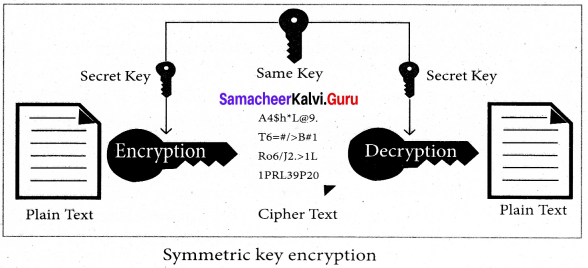
Symmetric encryption is a technique to use the same key for both encryption and decryption. The main disadvantage of the symmetric key encryption is that all authorized persons involved, have to exchange the key used to encrypt the data before they can decrypt it. If anybody intercepts the key information, they may read all messages.

Question 4.
What are the guidelines to be followed by any computer user?
Answer:
Generally, the following guidelines should be observed by computer users:

  1. Honesty : Users should be truthful while using the internet.
  2. Confidentiality : Users should not share any important information with unauthorized people.
  3. Respect : Each user should respect the privacy of other users.
  4. Professionalism : Each user should maintain professional conduct.
  5. Obey The Law : Users should strictly obey the cyber law in computer usage.
  6. Responsibility : Each user should take ownership and responsibility for their actions.

Question 5.
What are ethical issues? Name some.
Answer:
An Ethical issue is a problem or issue that requires a person or organization to choose between alternatives that must be evaluated as right (ethical) or wrong (unethical). These issues must be addressed and resolved to have a positive influence in society.
Some of the common ethical issues are listed below:

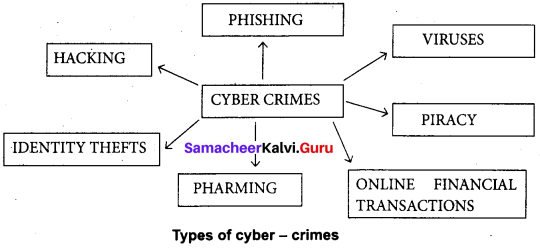
  1. Cyber crime
  2. Software Piracy
  3. Unauthorized Access
  4. Hacking
  5. Use of computers to commit fraud.
  6. Sabotage in the form of viruses.

PART – 4
IV. Answers to all the questions

Question 1.
What are the various crimes happening using computer?
Answer:
Crime:

  1. Crime Function
  2. Cyber stalking
  3. Malware
  4. Harvesting
  5. Identity theft
  6. Intellectual property theft
  7. Salami slicing

Function:

  1. Hacking, threats, and blackmailing towards a business or a person.
  2. Harassing through online.
  3. Malicious programs that can perform a variety of functions including stealing, encrypting or deleting sensitive data, altering or hijacking core computing functions and monitoring user’s computer activity without their permission.
  4. A person or program collects login and password information from a legitimate user to illegally gain access to others’ account(s).
  5. It is a crime where the criminals impersonate individuals, usually for financial gain.
  6. Stealing practical or conceptual information developed by another person or company.
  7. Stealing tiny amounts of money from each transaction.

Samacheer Kalvi 11th Computer Science Solutions Chapter 17 Computer Ethics and Cyber Security

Question 2.
What is piracy? Mention the types of piracy? How can it be prevented?
Answer:
Software Piracy is about the copyright violation of software created originally by an individual or an institution. It includes:
1. stealing of codes / programs and other information illegally and creating duplicate copies by unauthorized means and utilizing this data either for one’s own benefit or for commercial profit.

2. Downloading software from illegal network sources.
An entirely different approach to software piracy is called shareware, acknowledges the futility of trying to stop people from copying software and instead relies on people’s honesty.

Shareware publishers encourage users to give copies of programs to friends and colleagues but ask everyone who uses that program regularly to pay a registration fee to the program’s author directly. To prevent unauthorized access, Firewalls, Intrusion Detection Systems (IDS), Virus and Content Scanners, Patches and Hot fixes are used.

Question 3.
Write the different types of cyber attacks.
Answer:
Cyber Attack:

  1. Virus
  2. Worms
  3. Spyware
  4. Ransomware

Function:

  1. A virus is a small piece of computer code that can repeat itself and spreads from one computer to another by attaching itself to another computer file. One of the most common virus is Trojan.
  2. Worms are self – repeating and do not require a computer program to attach themselves. Worms continually look for vulnerabilities and report back to the author of the worm when weaknesses are discovered.
  3. Spyware can be installed on the computer automatically when the attachments are open, by clicking on links or by downloading infected software.
  4. Ransomware is a type of malicious program that demands payment after launching a cyber – attack on a computer system. This type of malware has become increasingly popular among criminals and costs the organizations millions each year.

Samacheer kalvi 11th Computer Science Computer Ethics and Cyber Security Additional Questions and Answers

PART – 1
I. Choose the correct answer

Question 1.
A moral code that is evaluated as right is ………………..
(a) piracy
(b) viruses
(c) cracking
(d) ethics
Answer:
(d) ethics

Question 2.
……………….. is a crime where the criminals impersonate individuals for financial gain.
(a) intellectual property theft
(b) Identity theft
(c) Salami slicing
(d) Spoofing
Answer:
(b) Identity theft

Question 3.
Stealing data from a computer system without the knowledge or permission is called ………………..
(a) warez
(b) hacking
(c) cracking
(d) phishing
Answer:
(b) hacking

Samacheer Kalvi 11th Computer Science Solutions Chapter 17 Computer Ethics and Cyber Security

Question 4.
One of the most common virus is ………………..
(a) Ransomware
(b) Spyware
(c) worms
(d) Trojan
Answer:
(d) Trojan

Question 5.
……………….. is the intermediary between the end users and a web browser.
(a) Firewall
(b) Proxy server
(c) Cookies
(d) Warez
Answer:
(b) Proxy server

PART – 2
II. Short Answers

Question 1.
What is hacking?
Answer:
Hacking is intruding into a computer system to steal personal data without the owner’s permission or knowledge (like to steal a password). It is also gaining unauthorized access to a computer system, and altering its contents.

Question 2.
What is proxy server? Explain its working.
Answer:
A proxy server acts as an intermediary between the end users and a web server. A client connects to the proxy server, requesting some service, such as a file, connection, web page, or other resources available from a different server. The proxy server examines the request, checks authenticity and grants the request based on that. Proxy servers typically keep the frequently visited site addresses in its cache which leads to improved response time.

Samacheer Kalvi 11th Computer Science Solutions Chapter 17 Computer Ethics and Cyber Security

Question 3.
Mention any 2 reasons as to why the websites use cookies?
Answer:

  1. To collect demographic information about who has visited the Web site.
  2. It helps to personalize the user’s experience on the Website.

Question 4.
What is meant by MITM?
Answer:
Man – in – the – middle attack (MITM; also Janus attack) is an attack where the attacker secretly relays and possibly alters the communication between two parties who believe they are directly communicating with each other.

Question 5.
Define software piracy.
Answer:
Software Piracy is about the copyright violation of software created originally by an individual or an institution. It includes stealing of codes / programs and other information illegally and creating duplicate copies by unauthorized means and utilizing this data either for one’s own benefit or for commercial profit.

PART – 3
III. Short Answers

Question 1.
What is cyber crime?
Answer:
A cyber – crime is a crime which involves computer and network. This is becoming a growing threat to society and is caused by criminals or irresponsible action of individuals who are exploiting the widespread use of Internet. It presents a major challenge to the ethical use. of information technologies. Cyber – crime also poses threats to the integrity, safety and survival of most business systems.
Samacheer Kalvi 11th Computer Science Solutions Chapter 17 Computer Ethics and Cyber Security

Question 2.
Write a short note on ethics.
Answer:
Ethics means “What is wrong and What is Right”. It is a set of moral principles that rule the behavior of individuals who use computers. An individual gains knowledge to follow the right behavior, using morals that are also known as ethics. Morals refer to the generally accepted standards of right and wrong in the society. Similarly, in cyber – world, there are certain standards such as

  1. Do not use pirated software.
  2. Do not use unauthorized user accounts.
  3. Do not steal others’ passwords.
  4. Do not hack.

Samacheer Kalvi 11th Computer Science Solutions Chapter 17 Computer Ethics and Cyber Security

Question 3.
Differentiate Spyware and Ransomware.
Answer:
Spyware:
Spyware can be installed on the computer automatically when the attachments are open, by clicking on links or by downloading infected software.

Ransomware:
Ransomware is a type of malicious program that demands payment after launching a cyber-attack on a computer system. This type of malware has become increasingly popular among criminals and costs the organizations millions each year.

Question 4.
What are the types of encryption?
Answer:
There are two types of encryption schemes as listed below:
1. Symmetric Key encryption : Symmetric encryption is a technique to use the same key for both encryption and decryption.
Samacheer Kalvi 11th Computer Science Solutions Chapter 17 Computer Ethics and Cyber Security
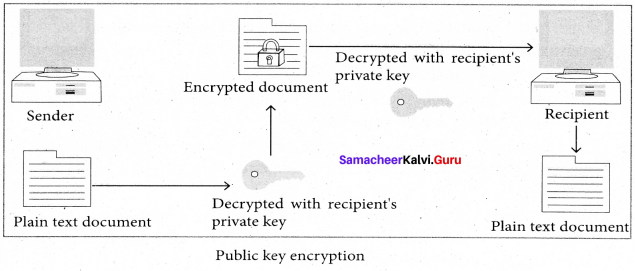
2. Public Key encryption : Public key encryption is also called Asymmetric encryption. It uses the concept of a key value pair, a different key is used for the encryption and decryption
Samacheer Kalvi 11th Computer Science Solutions Chapter 17 Computer Ethics and Cyber Security

Question 5.
Write down the points to be noted to be safe from cyber crime.
Answer:
To protect the information the following points to be noted:

  1. Complex password setting can make your surfing secured.
  2. When the internet is not in use, disconnect it.
  3. Do NOT open spam mail or emails that have an unfamiliar sender.
  4. When using anti – virus software, keep it up – to – date.

PART – 4
IV. Explain in Detail

Question 1.
Explain public key encryption and asymetric encryption in digital certificate.
Answer:
Public key encryption is also called Asymmetric encryption. It uses the concept of a key value pair, a different key is used for the encryption and decryption process. One of the keys is typically known as the private key and the other is known as the public key. The private key is kept secret by the owner and the public key is either shared amongst authorized recipients or made available to the public at large.

The data encrypted with the recipient’s public key can only be decrypted with the corresponding private key. A digital certificate in a client – server model of communication is one of the example of Asymmetric Encryption. A certificate is a package of information that identifies a user and a server.

It contains information such as an organization’s name, the organization that issued the certificate, the users’ email address and country, and user’s public key. When a server and a client require a secure encrypted communication, they send a query over . the network to the other party, which sends back a copy of the certificate. The other party’s public key can be extracted from the certificate. A certificate can also be used to uniquely identify the holder.

Samacheer Kalvi 11th Computer Science Solutions Chapter 17 Computer Ethics and Cyber Security

Question 2.
Write short notes on:

  1. Spam
  2. Fraud
  3. Cyber stalking
  4. Spoofing
  5. Virus
  6. Worms

Answer:

  1. Spam : Distribute unwanted e – mail to a large number of internet users.
  2. Fraud : Manipulating data, for example changing the banking records to transfer money to an unauthorized account.
  3. Cyber stalking : Harassing through online.
  4. Spoofing : It is a malicious practice in which communication is send from unknown source disguised as a source known to the receiver.
  5. Virus : A virus is a small piece of computer code that can repeat itself and spreads from one computer to another by attaching itself to another computer file. One of the most common virus is Trojan.
  6. Worms : Worms are self – repeating and do not require a computer program to attach themselves. Worms continually look for vulnerabilities and report back to the author of the worm when weaknesses are discovered.

Question 3.
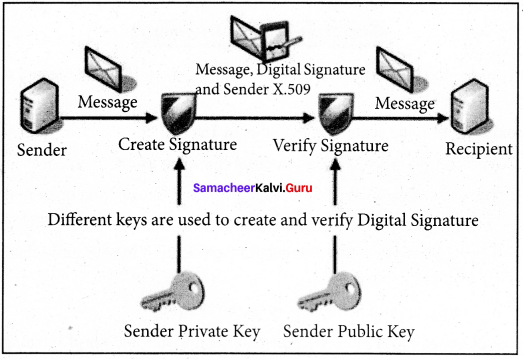
Explain digital signature with a functional diagram.
Answer:
Digital signatures are based on asymmetric cryptography and can provide assurances of evidence to origin, identity and status of an electronic document, transaction or message, as well as acknowledging information given by the signer. To create a digital signature, signing software (email) creates a one – way hash of the electronic data to be signed.

The user’s private key to encrypt the hash, returning a value that is unique to the hashed data. The encrypted hash, along with other information such as the hashing algorithm, forms the digital signature. Any change in the data, even to a single bit, results in a different hash value. This attribute enables others to validate the integrity of the data by using the signer’s public key to decrypt the hash.

If the decrypted hash matches a second computed hash of the same data, it proves that the data hasn’t changed since it was signed. If the two hashes don’t match, the data has either been tampered with in some way (indicating a failure of integrity) or the signature was created with a private key that doesn’t correspond to the public key presented by the signer (indicating a failure of authentication).
Samacheer Kalvi 11th Computer Science Solutions Chapter 17 Computer Ethics and Cyber Security

Samacheer Kalvi 11th Computer Science Solutions Chapter 15 Polymorphism

Students can Download Computer Science Chapter 15 Polymorphism Questions and Answers, Notes Pdf, Samacheer Kalvi 11th Computer Science Book Solutions Guide Pdf helps you to revise the complete Tamilnadu State Board New Syllabus and score more marks in your examinations.

Tamilnadu Samacheer Kalvi 11th Computer Science Solutions Chapter 15 Polymorphism

Samacheer Kalvi 11th Computer Science Polymorphism Text Book Back Questions and Answers

PART – 1
I. Choose The Correct Answer

Question 1.
Which of the following refers to a function having more than one distinct meaning?
(a) Function Overloading
(b) Member overloading
(c) Operator overloading
(d) Operations overloading
Answer:
(a) Function Overloading

Question 2.
Which of the following reduces the number of comparisons in a program?
(a) Operator Overloading
(b) Operations overloading
(c) Function overloading
(d) Member overloading
Answer:
(c) Function overloading

Samacheer Kalvi 11th Computer Science Solutions Chapter 15 Polymorphism

Question 3.
void dispchar(char ch = ‘$\ int size=10)
{

for(int i = 1;i< = size;i ++)
cout << ch;

}
How will you invoke the function dispchar() for the following input?
To print $ for 10 times
(a) dispchar();
(b) dispchar(ch,size);
(c) dispchar($,10);
(d) dispchar(T, 10 times);
Answer:
(c) dispchar($,10);

Question 4.
Which of the following is not true with respect to function overloading?
(a) The overloaded functions must differ in their signature.
(b) The return type is also considered for overloading a function.
(c) The default arguments of overloaded functions are not considered for overloading.
(d) Destructor function cannot be overloaded.
Answer:
(d) Destructor function cannot be overloaded.

Question 5.
Which of the following is invalid prototype for function overloading
(a) void fun (intx);
void fun (char ch);
(b) void fun (intx);
void fun (inty);
(c) void fun (double d);
void fun (char ch);
(d) void fun (double d);
void fun (inty);
Answer:
(a) void fun (intx);
void fun (char ch);

Question 6.
Which of the following function(s) combination cannot be considered as overloaded function(s) in the given snippet?
void print(char A,int B); // F1
void printprint(int A, float B); // F2
void Print(int P=10); // F3
void printQ; // F4
(a) F1, F2, F3, F4
(b) F1, F2, F3
(c) F1, F2, F4
(d) F1, F3, F4
Answer:
(d) F1, F3, F4

Question 7.
Which of the following operator is by default overloaded by the compiler?
(a) *
(b) +
(c) + =
(d) = =
Based on the following program answer the questions (8) to (10)
#include
using namespace std;
class Point {
private:
int x, y; .
public:
Point(int x1,int y1)
{

x=x1;y=y1;

}
void operator+(Point & pt3);
void show() {cout << “x =” << x << “y =” << y; }
};
void Point: :operator + (Point & pt3)
{

x+=pt3.x;
y += pt3.y;

}
int main()
{

Point pt1(3, 2),pt2(5, 4);
pt1+pt2;
pt1.show();
return 0;
}

Answer:
(b) +

Samacheer Kalvi 11th Computer Science Solutions Chapter 12 Arrays and Structures

Question 8.
Which of the following operator is overloaded?
(a) +
(b) Operator
(c) : :
(d) =
Answer:
(a) +

Question 9.
Which of the following statement invoke operator overloading?
(a) pt1 + pt2;
(b) Point pt1(3, 2),pt2(5, 4);
(c) ptl.show();
(d) return 0;
Answer:
(d) return 0;

Question 10.
What is the output for the above program?
(a) x = 8, y = 6
(b) x = 14, y = 14
(c) x = 8, y = 6
(d) x = 5, y = 9
Answer:
(d) x = 5, y = 9

PART – 2
II. Answers to all the questions

Question 1.
What is function overloading?
Answer:
The ability of the function to process the message or data in more than one form is called as function overloading. In other words function overloading means two or more functions in the same scope share the same name but their parameters are different.

Samacheer Kalvi 11th Computer Science Solutions Chapter 12 Arrays and Structures

Question 2.
List the operators that cannot be overloaded.
Answer:
Operator that are not overloaded are follows:

  1. scope operator ::
  2. sizeof
  3. member selector.
  4. member pointer selector *
  5. ternary operator ?:

Question 3.
class add{int x; public: add(int)}; Write an outline definition for the constructor.
Answer:
add (int temp)
{

x = temp;

}

Question 4.
Does the return type of a function help in overloading a function?
Answer:
No. The return type of overloaded functions are not considered for overloading same data type.

Question 5.
What is the use of overloading a function?
Answer:
Function overloading is not only implementing polymorphism but also reduces the number of comparisons in a program and makes the program to execute faster. It also helps the programmer by reducing the number of function names to be remembered.

PART – 3
III. Answers to all the questions

Question 1.
What are the rules for function overloading?
Answer:
Rules for function overloading:

  1. The overloaded function must differ in the number of its arguments or data types.
  2. The return type of overloaded functions are not considered for overloading same data type.
  3. The default arguments of overloaded functions are not considered as part of the parameter list in function overloading.

Question 2.
How does a compiler decide as to which function should be invoked when there are many functions? Give an example.
Answer:
When you call an overloaded function (when there are many functions with same name), the compiler determines the most appropriate definition to use by comparing the argument types used to call the function with the parameter types specified in the definitions. The process of selecting the most appropriate overloaded function or operator is called overload resolution.
Example:
#include using namespace std; void print (int i)
{

cout<< “It is integer” <<i<< endl;

}

void print (string c)

{

cout<< “It is string”<< c << endl;

}
int main ()
{

print (10);
print (“Good”);
return 0;

}
Output:
It is integer 10
It is string Good

Samacheer Kalvi 11th Computer Science Solutions Chapter 12 Arrays and Structures

Question 3.
What is operator overloading? Give some example of operators which can be overloaded.
Answer:
The term operator overloading, refers to giving additional functionality to the normal C++ operators like It is also a type of polymorphism in which an operator is overloaded to give user defined meaning to it.

For example ‘+’ operator can be overloaded to perform addition on various data types, like for Integer, String (concatenation) etc.

Question 4.
Discuss the benefit of constructor overloading?
Answer:
Function overloading can be applied for constructors, as constructors are special functions of classes. A class can have more than one constructor with different signature. Constructor overloading provides flexibility of creating multiple type of objects for a class.

  1. Memory is allocated for the objects.
  2. Initialisation for the objects.

Question 5.
class sale ( int cost, discount ;public: sale(sale &); Write a non inline definition for constructor specified;
Answer:
class sale
{

int cost, discount;
public:
sale (sale&);

};
// non inline constructor
sale: : sale(sale&s)
{

cost = s.cost;
discount = s.discount;

}

PART – 4
IV. Answers to all the questions

Question 1.
What are the rules for operator overloading?
Answer:
Following are some rules to be followed while implementing operator overloading.

  1. Precedence and Associativity of an operator cannot be changed.
  2. No new operators can be created, only existing operators can be overloaded.
  3. Cannot redefine the meaning of an operator’s procedure. You cannot change how integers are added. Only additional functions can be to an operator.
  4. Overloaded operators cannot have default arguments.
  5. When binary operators are overloaded, the left hand object must be an object of the relevant class.

Samacheer Kalvi 11th Computer Science Solutions Chapter 12 Arrays and Structures

Question 2.
Answer the question (i) to (v) after going through the following class.
classBook
{
intBookCode ; char Bookname[20];float fees;
public:
Book() //Function 1
{
fees = 1000;
BookCode = 1;
strcpy (Bookname, “C++”);
}
void display(float C) //Function 2
{
cout << BookCode << “:”<< Bookname << “:”<< fees << endl;
~ Book() //Function 3
{
cout << “End of Book Object”<< endl;
}

Book (intSC, char S[ ], float F); //Function 4

};
1. In the above program, what are Function 1 and Function 4 combined together referred as?
2. Which concept is illustrated by Function3? When is this function called/ invoked?
3. What is the use of Function3?
4. Write the statements in main to invoke functionl and function2
5. Write the definition for Function4.
Answer:

  1. Constructor overloading (function 1 and function 4 are constructors with different signatures in the class book)
  2. Function 3 is destructor of the class. Function 3 is executed when the object of the class book goes out of scope.
  3. Function 3 is destructor of the class.
    • Destructor (function3) will free resources if any that the object may have acquired during its lifetime
    • Destructor function removes the memory of an object which was allocated by the constructor at the time of creating an object. Thus frees the unused memory.
  4. book b;
    b.display (4.5);
  5. Book: :Book (int sc.char.s[], float, F) // Function 4
    {
    Book Code = SC
    strcpy (Book name, S);
    fees = F;
    }

Question 3.
Write the output of the following program.
Answer:
include
using namespace std;
class Seminar
{
int Time;
public:
Seminar()
{

Time = 30; cout << “Seminar starts now” << endl;

}
void Lecture()
{
cout << “Lectures in the seminar on”<< endl;
}
Seminar(int Duration)
{

Time=Duration;cout<< “Welcome to Seminar”<<endl;

}
Seminar(Seminar &D)
{

Time=D.Time;cout<< “Recap of Previous Seminar Content”<<endl;

}
~Seminar()
{
cout<< “Vote of thanks”<<endl;
}
};
int main()
{

Seminar s1, s2(2), s3(s2);
s1.Lecture();
return 0;

}
Output:
Seminar starts now
Welcome to seminar
Recap of previous seminar content
Lectures in the seminar on
Vote of thanks
Vote of thanks
Vote of thanks

Question 4.
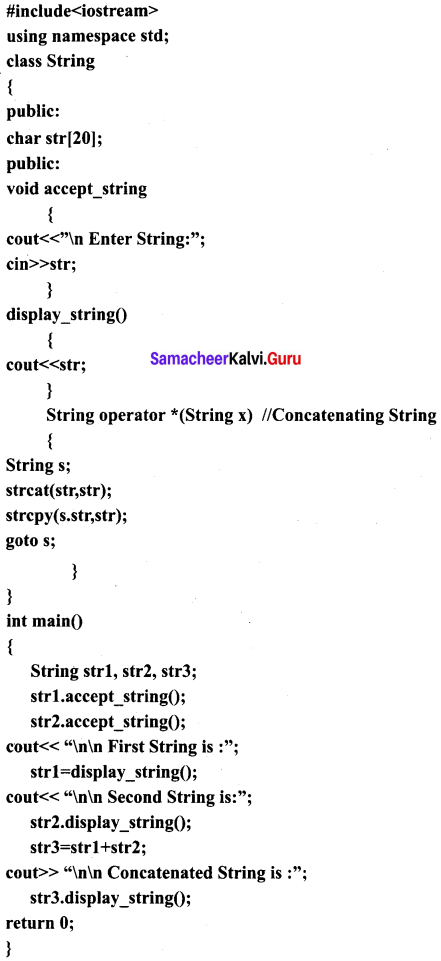
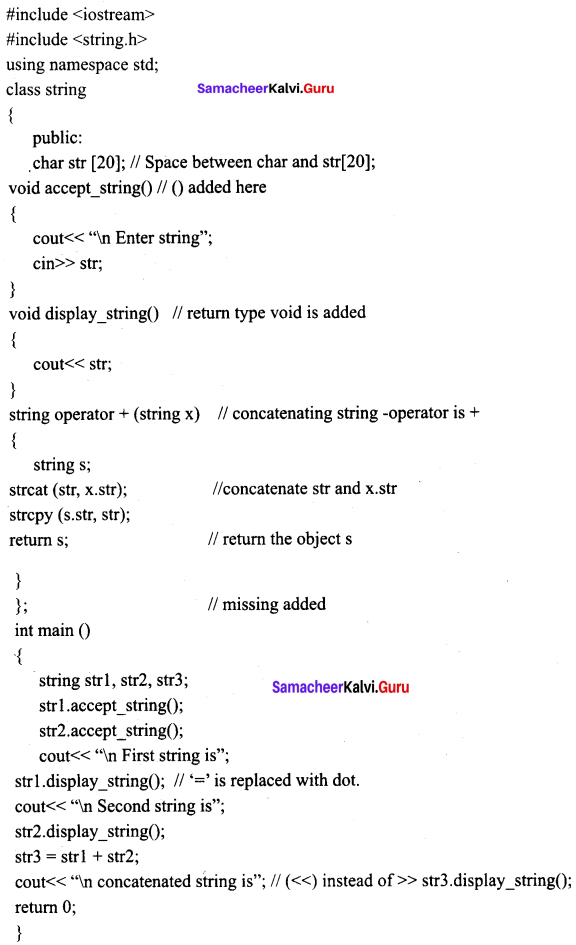
Debug the following program.
Answer:
Samacheer Kalvi 11th Computer Science Solutions Chapter 15 Polymorphism 1
Corrected Program
Samacheer Kalvi 11th Computer Science Solutions Chapter 15 Polymorphism 2
Output
Enter string: God
Enter string: Bless
First string is: God
Second string is: Bless
Concatenated string is: God Bless

Question 5.
Answer the questions based on the following program
#include
#include
using namespace std;
class comp
{
public:
char[10];
void getstring(char str[10])
{
strcpy(s,str);
}
void operator = = (comp);
};
void comp::operator = = (comp ob)
{
if(strcmp(s,ob.s) = = 0)
cout << “\nStrings are Equal”;
else
cout<< “\nStrings are not Equal”;
}
int main()
{
comp ob, ob1;
char stringl[10], string2[10];
cout << “Enter First String:”; cin >> string1;
ob.getstring(string1);
cout<< “\n Enter Second String:”; cin >> string2;
ob1.getstring(string2);
ob = = obi;
return 0;
}
(i) Mention the objects which will have the scope till the end of the program.
(ii) Name the object which gets destroyed in between the program.
(iii) Name the operator which is over loaded and write the statement that invokes it.
(iv) Write out the prototype of the overloaded member function.
(v) What types of operands are used for the overloaded operator?
(vi) Which constructor will get executed? Write the output of the program.
Answer:
(i) Objects: ob and obi of main ()
(ii) object ob of void operator = = (comp ob);
(iii) Overloaded operator: = =
Statement that invokes: ob = = ob1;
(v) void operator = = (comp ob):
(v) Operands used are the objects of the class comp
(vi) The default constructor generated by the compiler will be executed.[comp();]

Output 1
Enter first string: hello Enter second string: hello String are equal

Output 2
Enter first string: hello Enter second string: fine String are not equal.

Samacheer kalvi 11th Computer Science Arrays and Structures Additional Questions and Answers

PART – 1
I. Choose the correct answer

Question 1.
The number and types of a function’s parameters are called the …………………
(a) overload resolution
(b) function’s signature
(c) function overloading
(d) operator overloading
Answer:
(b) function’s signature

Question 2.
The process of selecting the most appropriate overloaded function or operator is called …………………
(a) overload resolution
(b) prototype
(c) polymorphism
(d) operator overload
Answer:
(a) overload resolution

Question 3.
The return type of overloaded functions are not considered for overloading same …………………
(a) polymorphism
(b) prototype
(c) data type
(d) overloading
Answer:
(c) data type

Samacheer Kalvi 11th Computer Science Solutions Chapter 12 Arrays and Structures

Question 4.
………………… cannot have default arguments.
(a) Operator overloading
(b) Overloaded operators
(c) Function overloading
(d) prototype
Answer:
(b) Overloaded operators

Question 5.
The mechanism of giving special meaning to an operator is known as …………………
(a) operator overloading
(b) parameter
(c) function overloading
(d) polymorphism
Answer:
(a) operator overloading

Question 6.
Operator overloading provides new definitions for most of the ………………… operators.
(a) *
(b) + = =
(c) +
(d) C++
Answer:
(d) C++

Question 7.
The overloaded operator is given using the keyword ………………… followed by an operator symbol.
(a) operator
(b) data type
(c) object
(d) function
Answer:
(a) operator

PART – 2
II. Very Short Answers

Question 1.
Give the syntax for operator overloading.
Answer:
RetumType classname :: Operator Operator Symbol (argument list)
{

\\ Function body

}
Example: Deposit Deposit: : operator + (Deposit dl);

Samacheer Kalvi 11th Computer Science Solutions Chapter 12 Arrays and Structures

Question 2.
Write a program for function overloading.
C++ Program to demonstrate function overloading
Answer:
#include
using namespace std;
void print(int i)
{cout << “It is integer” << i <<endl;}
void print(double f)
{ cout << “It is float” << f <<endl;}
void print(string c)
{ cout << “It is string” << c <<endl;}
int main() {

print(10);
print(10.10);
print(“Ten”);
return 0;

}
Output:
It is integer 10
It is float 10.1
It is string Ten

PART – 3
III. Short Answers

Question 1.
What is function signature?
Answer:
The ability of the function to process the message or data in more than one form is called as function overloading. It implies that two or more functions in the same scope share the same name but their parameters are different. In this situation, the functions that share the same name are said to be overloaded and the process is called function overloading. The number and types of a function’s parameters are called the function’s signature.

Samacheer Kalvi 11th Computer Science Solutions Chapter 12 Arrays and Structures

Question 2.
Explain overload resolution.
Answer:
When you call an overloaded function, the compiler determines the most appropriate definition . to use, by comparing the argument types you have used to callthe function with the parameter types specified in the definitions. The process of selecting the most appropriate overloaded function or operator is called overload resolution.

PART – 4
IV. Explain in Detail

Question 1.
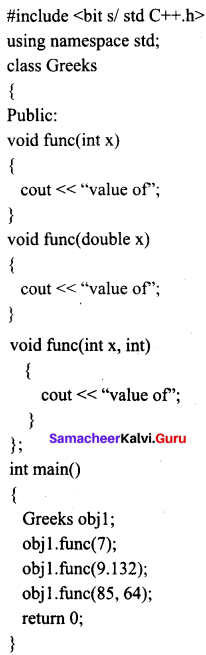
Give the output of the following program.
Answer:
Samacheer Kalvi 11th Computer Science Solutions Chapter 15 Polymorphism 3
Output:
value of x is 7
value of x is 9.132
value of x and y is 85,64

Question 2.
Write the coding for the following output using constructor overloading.
Output:
Constructor without parameters..
Parameterized constructor…
Copy Constructor…
Enter data… 20 30
Object a:
The numbers are..20 30
The sum of the numbers are.. 50
Object b :
The numbers are..10 20
The sum of the numbers are.. 30
Object c..
The numbers are..10 20
The sum of the numbers are.. 30
Answer:
#include
using namespace std;
class add
{
int num1, num2, sum;
public:
add()
{
cout << “\n Constructor without parameters…”;
num1 = 0;
num2 = 0;
sum = 0;
}
add (int s1, int s2 )
{
cout << “\n Parameterized constructor…”;
num1= s1;
num2=s2;
sum=0;
}
add (add &a)
{
cout << “\n Copy Constructor…”; ‘
num1 = a.num1;
num2 = a.num2;
sum = 0;
}
void getdata()
{
cout << “\n Enter data …”; cin>>num 1 >> num2;
}
void addition()
{
sum=num 1 + num2;
}
void putdata()
{
cout << “\n The numbers are..”;
cout < cout << “\n The sum of the numbers are..” << sum; }
};
int main()
{
add a, b (10, 20), c(b);
a. getdata();
a. addition();
b. addition();
c. addition();
cout << “\n Object a : “;
a. putdata();
cout << “\n Object b : “;
b. putdata();
cout << “\n Object c..”;
c. putdata();
return 0;
}

Question 3.
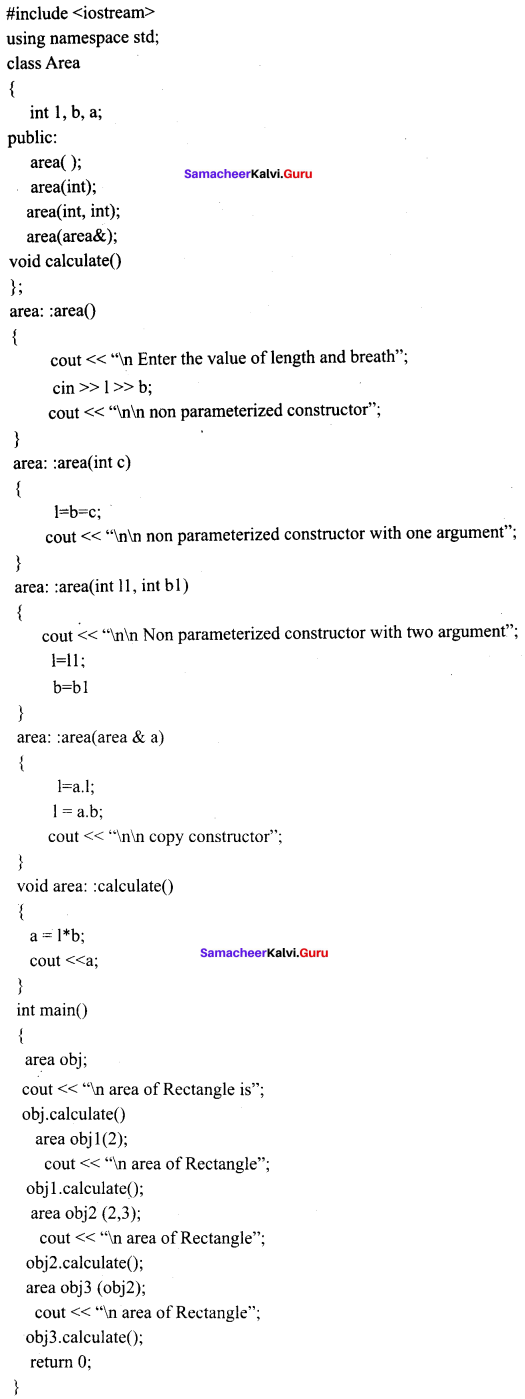
Write a program to find the area of a rectangle using constructor overloading in a class.
Answer:
Samacheer Kalvi 11th Computer Science Solutions Chapter 15 Polymorphism 4Output:
Enter the value of length and breadth 10 20
Non parameterized constructor
area of Rectangle is 60
Parameterized constructor with one argument
area of Rectangle 8
Parameterized constructor with two argument
area of Rectangle 10
copy constructor
area of Rectangle 10

Samacheer Kalvi 11th Computer Science Solutions Chapter 16 Inheritance

Students can Download Computer Science Chapter 16 Inheritance Questions and Answers, Notes Pdf, Samacheer Kalvi 11th Computer Science Book Solutions Guide Pdf helps you to revise the complete Tamilnadu State Board New Syllabus and score more marks in your examinations.

Tamilnadu Samacheer Kalvi 11th Computer Science Solutions Chapter 16 Inheritance

Samacheer Kalvi 11th Computer Science Inheritance Text Book Back Questions and Answers

PART – 1
I. Choose The Correct Answer

Question 1.
Which of the following is the process of creating new classes from an existing class?
(a) Polymorphism
(b) Inheritance
(c) Encapsulation
(d) super class
Answer:
(b) Inheritance

Question 2.
Which of the following derives a class student from the base class Shool?
(a) school: student
(b) class student: public School
(c) student: public school
(d) class school : public student
Answer:
(b) class student: public – School

Question 3.
The type of inheritance that reflects the transitive nature is ………………
(a) Single Inheritance
(b) Multiple Inheritance
(c) Multilevel Inheritance
(d) Hybrid Inheritance
Answer:
(c) Multilevel Inheritance

Samacheer Kalvi 11th Computer Science Solutions Chapter 16 Inheritance

Question 4.
Which visibility mode should be used when you want the features of the base class to be available to the derived class but not to the classes that are derived from the derived class?
(a) Private
(b) Public
(c) Protected
(d) All of these
Answer:
(a) Private

Question 5.
Inheritance is process of creating new class from ………………
(a) Base class
(b) abstract
(c) derived class
(d) Function
Answer:
(a) Base class

Question 6.
A class is derived from a class which is a derived class itself, then this is referred to as ……………….
(a) multiple inheritance
(b) multilevel inheritance
(c) single inheritance
(d) double inheritance
Answer:
(b) multilevel inheritance

Question 7.
Which amongst the following is executed in the order of inheritance?
(a) Destructor
(b) Member function
(c) Constructor
(d) Object
Answer:
(c) Constructor

Samacheer Kalvi 11th Computer Science Solutions Chapter 16 Inheritance

Question 8.
Which of the following is true with respect to inheritance?
(a) Private members of base class are inherited to the derived class with private
(b) Private members of base class are not inherited to the derived class with private accessibility
(c) Public members of base class are inherited but not visible to the derived class
(d) Protected members of base class are inherited but not visible to the outside class
Answer:
(b) Private members of base class are not inherited to the derived class with private accessibility

Question 9.
Based on the following class declaration answer the questions (from 9.1 to 9.4)
class vehicle
{ int wheels;
public:
void input_data(float,float);
void output_data();
protected:
int passenger;
};
class heavyvehicle : protected vehicle {
int diesel_petrol;
protected:
int load;
protected:
int load;
public:
voidread_data(float,float)
voidwrite_data(); };
class bus: private heavy vehicle {
charTicket[20];
public:
voidfetch_data(char); voiddisplay_data(); };
};

Question 9.1.
Which is the base class of the class heavy_vehicle?
(a) Bus
(b) heavy_vehicle
(c) vehicle
(d) both (a) and (c)
Answer:
(c) vehicle

Question 9.2.
The data member that can be accessed from the function displaydata()
(a) passenger
(b) load
(c) Ticket
(d) All of these
Answer:
(d) All of these

Question 9.3.
The member function that can be accessed by an objects of bus Class is
(a) input_data()
(b) read_data(), output_data()write_data()
(c) fetch_data()
(d) All of these display_data()
Answer:
(d) All of these display_data()

Samacheer Kalvi 11th Computer Science Solutions Chapter 16 Inheritance

Question 9.4.
The member function that is inherited as public by Class Bus
(a) input_data()
(b) read_data(), output_data()write_data()
(c) fetch_data()
(d) All of these display_data()
Answer:
(d) All of these display_data()

Question 10.
class x
{int a;
public :
x()
{}
};
class y
{ x x1;
public :
y()
{}
};
class z : public y, x
{ intb;
public:
z(){}
} z1;
What is the order of constructor for object z1 to be invoked?
(a) z, y, x, x
(b) x, y, z, x
(c) y, x, x, z
(d) x, y, z
Answer:
(c) y, x, x, z

PART – 2
II. Answers to all the questions

Question 1.
What is inheritance?
Answer:
Inheritance is one of the most important features of Object Oriented Programming. In object – oriented programming, inheritance enables new class and its objects to take on the properties of the existing classes.

Question 2.
What is a base class?
Answer:
A class that is used as the basis for inheritance is called a superclass or base class.

Question 3.
Why derived class is called power packed class?
Answer:
Multilevel Inheritance:
In multilevel inheritance, the constructors will be executed in the order of inheritance.

Multiple Inheritance:
If there are multiple base classes, then it starts executing from the left most base class.

Samacheer Kalvi 11th Computer Science Solutions Chapter 16 Inheritance

Question 4.
In what multilevel and multiple inheritance differ though both contains many base class?
Answer:
The derived class is a power packed class, as it can add additional attributes and methods and thus enhance its functionality.

Question 5.
What is the difference between public and private visibility mode?
Answer:
Private visibility mode:
When a base class is inherited with private visibility mode the public and protected members of the base class become ‘private’ members of the derived class.

Public visibility mode:
When a base class is inherited with public visibility mode, the protected members of the base class will be inherited as protected members of the derived class and the public members of the base class will be inherited as public members of the derived class.

PART – 3
III. Answers to all the questions

Question 1.
What are the points to be noted while deriving a new class?
Answer:
The following points should be observed for defining the derived class:

  1. The keyword class has to be used.
  2. The name of the derived class is to be given after the keyword class.
  3. A single colon.
  4. The type of derivation (the visibility mode), namely private, public or protected. If no visibility mode is specified, then by default the visibility mode is considered as private.
  5. The names of all base classes (parent classes) separated by comma.

Question 2.
What is difference between the members present in the private visibility mode and the members present in the public visibility mode.
Answer:
Members present in the private visibility mode:

  • Can be accessed only by the class members.
  • By default the members will be in private visibility mode.
  • When classes are inherited, private members are not inherited.

Members present in the public visibility mode:

  • Can be accessed by the outside members also.
  • Members, to be in public visibility mode has to be specified explicitly.
  • When classes are inherited, the public members are inherited as private, protected and public members of the derived class.

Samacheer Kalvi 11th Computer Science Solutions Chapter 16 Inheritance

Question 3.
What is the difference between polymorphism and inheritance though both are used for reusability of code?
Answer:
Polymorphism:

  • Reusability of code is implemented through functions (or) methods.
  • Polymorphism is the ability of a function to respond differently to different message.
  • Polymorphism is achieved through overloading.

Inheritance:

  • Reusability of code is implemented through classes.
  • Inheritance is the process of creating derived classes from the base class or classes.
  • Inheritance is achieved by various types of inheritances namely single, multiple, multilevel, hybrid and hierarchical inheritances.

Question 4.
What do you mean by overriding?
Answer:
When a derived class member function has the same name as that of its base class member function, the derived class member function shadows/hides the base class’s inherited function. This situation is called function overriding.

Question 5.
Write some facts about the execution of constructors and destructors in inheritance. Some Facts About the execution of constructor in inheritance
Answer:

  1. Base class constructors are executed first, before the derived class constructors execution.
  2. Derived class cannot inherit the base class constructor but it can call the base class constructor by using Base_class name: :base_class_constructor() in derived class definition
  3. If there are multiple base classes, then its start executing from the left most base class
  4. In multilevel inheritance, the constructors will be executed in the order of inheritance The destructors are executed in the reverse order of inheritance.

PART – 4
IV. Answers to all the questions

Question 1.
Explain the different types of inheritance.
Answer:
Types of Inheritance:
There are different types of inheritance viz., Single inheritance, Multiple inheritance, Multilevel inheritance, hybrid inheritance and hierarchical inheritance.

  1. Single Inheritance : When a derived class inherits only from one base class, it is known as single inheritance.
  2. Multiple Inheritance : When a derived class inherits from multiple base classes it is known as multiple inheritance.
  3. Hierarchical inheritance : When more than one derived classes are created from a single base class, it is known as Hierarchical inheritance.
  4. Multilevel Inheritance : The transitive nature of inheritance is itself reflected by this form of inheritance. When a class is derived from a class which is a derived class then it is referred to as multilevel inheritance.
  5. Hybrid inheritance : When there is a combination of more than one type of inheritance, it is known as hybrid inheritance.
  6. Hence, it may be a combination of Multilevel and Multiple inheritance or Hierarchical and Multilevel inheritance or Hierarchical, Multilevel and Multiple inheritance.

Samacheer Kalvi 11th Computer Science Solutions Chapter 16 Inheritance

Question 2.
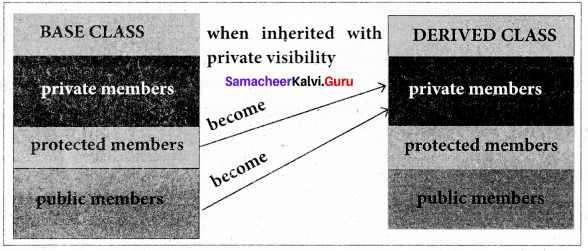
Explain the different visibility mode through pictorial representation.
Answer:
An important feature of Inheritance is to know which member of the base class will be acquired by the derived class. This is done by using visibility modes. The accessibility of base class by the derived class is controlled by visibility modes. The three visibility modes are private, protected and public.

The default visibility mode is private. Though visibility modes and access specifiers look similar, the main difference between them is Access specifiers control the accessibility of the members within the class where as visibility modes control the access of inherited members within the class.

Private visibility mode:
When a base class is inherited with private visibility mode the public and protected members of the base class become ‘private’ members of the derived class
Samacheer Kalvi 11th Computer Science Solutions Chapter 16 Inheritance 1
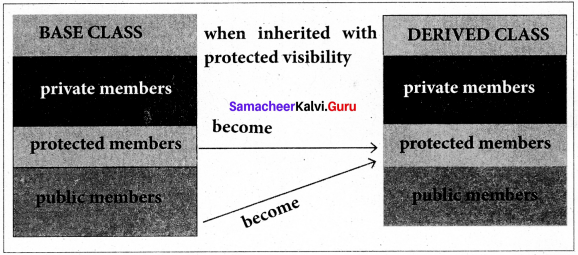
Protected visibility mode:
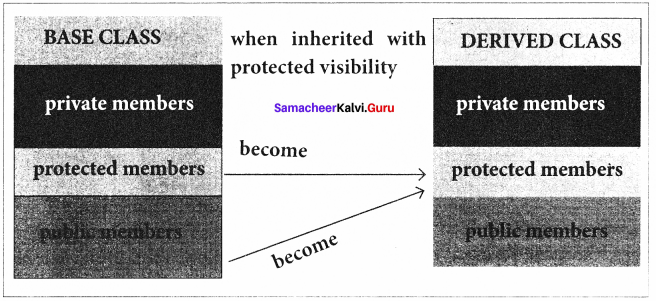
When a base class is inherited with protected visibility mode the protected and public members of the base class become ‘protected members ‘ of the derived class.
Samacheer Kalvi 11th Computer Science Solutions Chapter 16 Inheritance 2
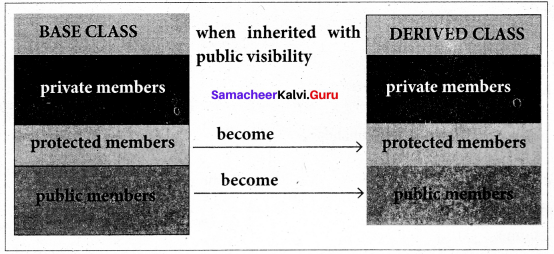
When a base class is inherited with public visibility mode, the protected members of the base class will be inherited as protected members of the derived class and the public members of the base class will be inherited as public members of the derived class.
Samacheer Kalvi 11th Computer Science Solutions Chapter 16 Inheritance 3

Question 3.
#include
#include
#include
using name spacestd;
class publisher
{
char pname[15];
char hoffice[15];
char address[25];
double turnover;
protected:
char phone[3][10];
void register();
public:
publisher();
∼ publisher);
void enter data();
void disp data();
};
class branch
{
charbcity[15];
char baddress[25];
protected:
intnoofemp;
public:
charbphone[2][10];
branch();
∼ branch();
void have data();
void give data();
};
class author: public branch, publisher
{
intaut_code;
charaname[20];
float income;
public:
author();
~author();
voidgetdata();
voidputdata();
};

Answer the following questions based on the above given program:
Question 3.1.
Which type of Inheritance is shown in the program?
Answer:
Multiple inheritance.

Question 3.2.
Specify the visibility mode of base classes.
Answer:
Private for publisher.
Public for branch.

Question 3.3.
Give the sequence of Constructor/Destructor Invocation when object of class author is created.
Answer:
branch(); // constructor of branch class
publisher (); // constructor of publisher class
author (); // constructor of author class
∼author (); // destructor of author class
∼publisher (); // destructor of publisher class
∼branch (); // destructor of branch class

Question 3.4.
Name the base class(/es) and derived class (/es).
Answer:
Base class(/es): branch and publisher
Derived class (/es): author.

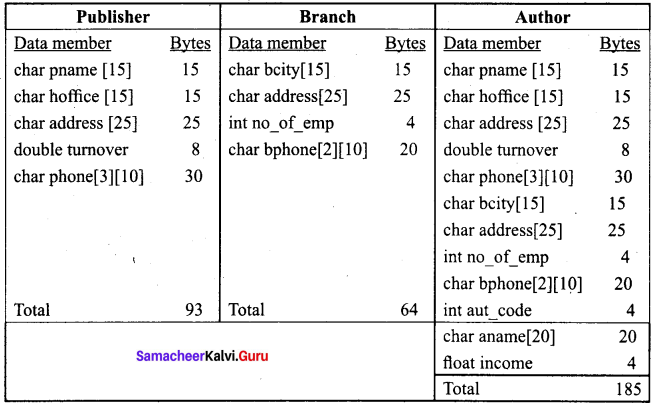
Question 3.5.
Give number of bytes to be occupied by the object of the following class:
(a) publisher
(b) branch
(c) author
Samacheer Kalvi 11th Computer Science Solutions Chapter 16 Inheritance 4

Question 3.6.
Write the names of data members accessible from the object of class author.
Answer:
The data members that can be accessed is bphone[2][10].

Question 3.7.
Write the names of all member functions accessible from the object of class author.
Answer:
Member functions that can be accessed are:
1. public member functions of branch have_data();
give_data();

2. public member functions of author:
getdata();
putdata();

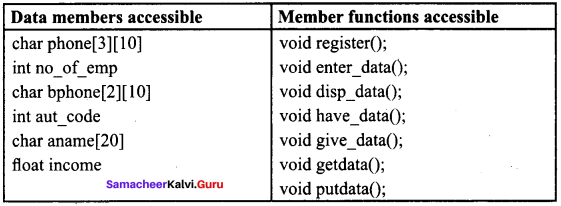
Question 3.8.
Write the names of all members accessible from member functions of class author.
Answer:
Samacheer Kalvi 11th Computer Science Solutions Chapter 16 Inheritance 5

Question 4.
Consider the following C++ code and answer the questions
Answer:
class Personal
{
int Class,Rno;
char Section;
protected:
char Name[20];
public:
personal();
void pentry();
voidPdisplay();
};
class Marks:private Personal
{
float M{5};
protected:
char Grade[5];
public:
Marks();
void M entry();
void M display 0;
};
class Result:public Marks
{
float Total, Agg;
public:
char FinalGrade, Commence[20];
Result();
void R calculate();
void R display();
}:

Question 4.1.
Which type of Inheritance is shown in the program?
Answer:
Multilevel inheritance.

Question 4.2.
Specify the visibility mode of base classes.
Answer:
Private for personal public for marks.

Samacheer Kalvi 11th Computer Science Solutions Chapter 16 Inheritance

Question 4.3.
Give the sequence of Constructor/Destructor Invocation when object of class Result is created.
Answer:
Personal (); // constructor of class personal
Marks (); // constructor of class marks
Result (); // destructor of class Result
Marks (); // destructor of class marks
Personal (); // destructor of class personal

Question 4.4.
Name the base class(/es) and derived class (/es).
Answer:
Base class of marks: → Personal
Base class of Result: → Marks
Derived classes: → Marks and Results

Question 4.5.
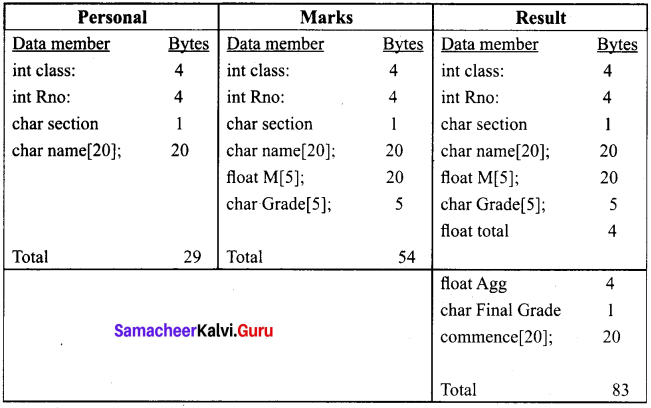
Give number of bytes to be occupied by the object of the following class:
(a) Personal
(b) Marks
(c) Result
Answer:
Samacheer Kalvi 11th Computer Science Solutions Chapter 16 Inheritance 6

Question 4.6.
Write the names of data members accessible from the object of class Result.
Answer:
Data members accessible are:

  1. The private, public and protected data members of personal cannot be accessed.
  2. The public data members of marks: Nil (i/7) Public data members of Result char Final Grade; char commence [20];

Question 4.7.
Write the names of all member functions accessible from the object of class Result. Member functions accessible are:
Answer:
1. The private, public and protected member functions of personal cannot be accessed.

2. The public member functions of marks
void mentry();
void
mdisplay();

3. Public member functions of Result
void Rcalculate();
void RdisplayO;

Question 4.8.
Write the names of all members accessible from member functionsof class Result.
Answer:
Data members accessible
char Grade[5];
float Total;
float Age;
char Final Grade;
char Commence[20];

Member functions accessible
void mentry();
void mdisplay();
void Rcalculate();
void Rdisplay();

Question 5.
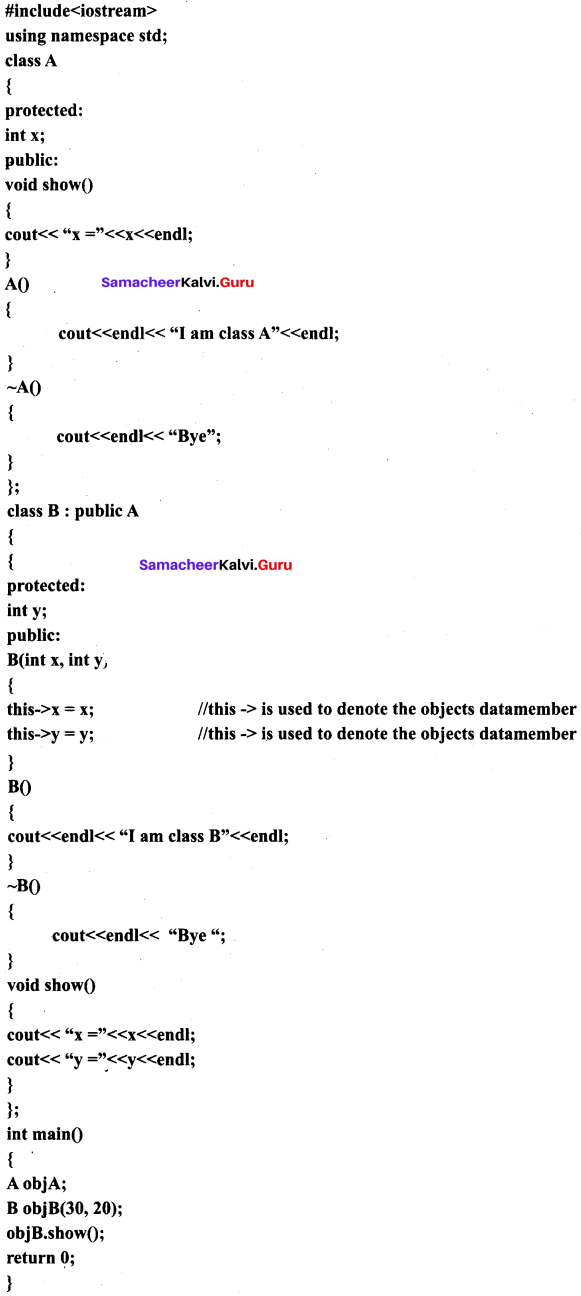
Write the output of the following program
Answer:
Samacheer Kalvi 11th Computer Science Solutions Chapter 16 Inheritance 7
Output:
I am class A
I am class B
X = 30 Y = 20
Bye Bye
Bye

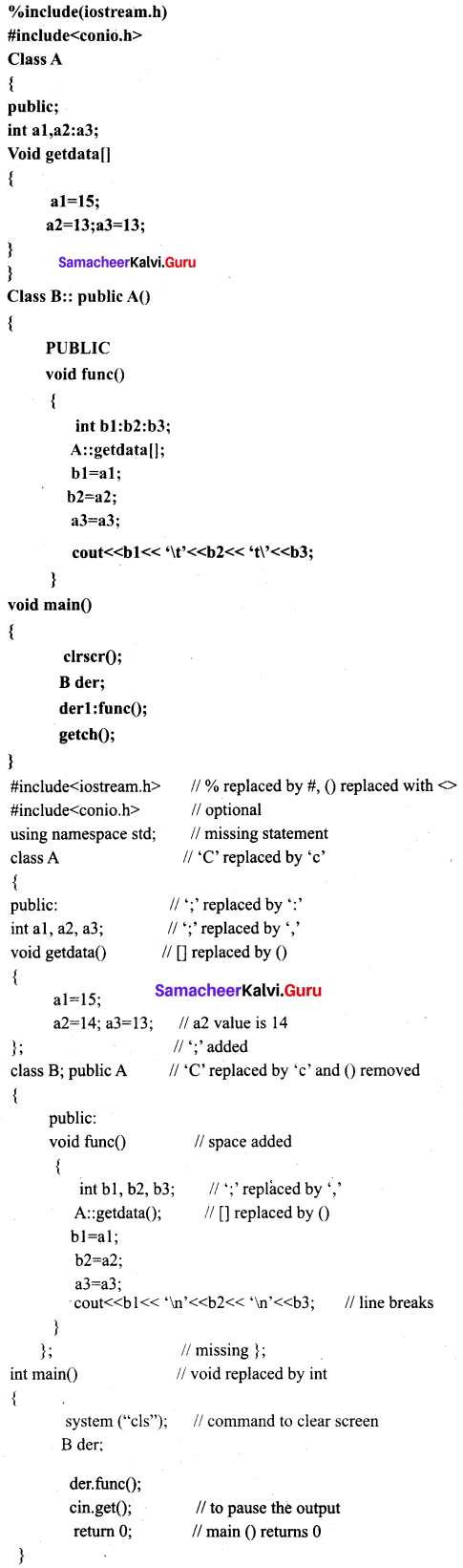
Question 6.
Debug the following program.
Answer:
Output:
…………………
15
14
13
Program:
…………………
Samacheer Kalvi 11th Computer Science Solutions Chapter 16 Inheritance 8

Samacheer kalvi 11th Computer Science Arrays and Structures Additional Questions and Answers

PART – 1
I. Choose the correct answer

Question 1.
When a derived class inherits only from one base class, it is known as ………………
(a) multiple inheritance
(b) multilevel inheritance
(c) hierarchical inheritance
(d) single inheritance
Answer:
(d) single inheritance

Question 2.
A class that inherits from a superclass is called ………………
(a) derived class
(b) super class
(c) base class
(d) parent class
Answer:
(a) derived class

Question 3.
When more than one derived classes are created from a single base class, it is called ………………
(a) inheritance
(b) hybrid inheritance
(c) hierarchical inheritance
(d) multiple inheritance
Answer:
(c) hierarchical inheritance

Question 4.
……………… pointer is a constant pointer that holds the memory address of the current object.
(a) member function
(b) this pointer
(c) comma operator
(d) data member
Answer:
(b) this pointer

Samacheer Kalvi 11th Computer Science Solutions Chapter 16 Inheritance

Question 5.
The ……………… are invoked in reverse order.
(a) constructor
(b) destructor
(c) pointer
(d) operator
Answer:
(b) destructor

PART – 2
II. Very Short Answers

Question 1.
Write a short note on hierarchical inheritance.
Answer:
When more than one derived classes are created from a single base class, it is known as Hierarchical inheritance.

Question 2.
Write the syntax for derived and base class.
Answer:
class derived class name : visibility_mode baseclassname
{

// members of derivedclass

};

Question 3.
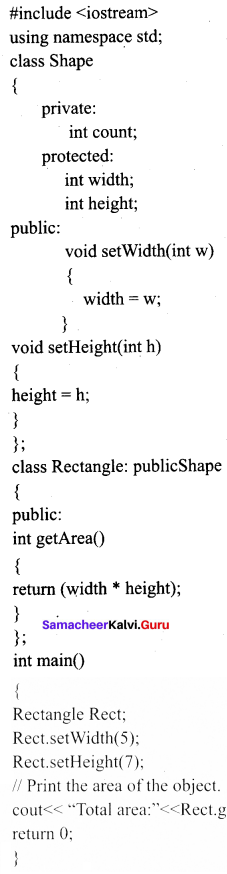
Explain the significance of different visibility modes with a program.
Answer:
Implementation of Single Inheritance using public visibility mode
Samacheer Kalvi 11th Computer Science Solutions Chapter 16 Inheritance 9
Output:
Total area : 35

Question 4.
When a base class is inherited with protected visibility mode the protected and public members of the base class become protected members’ of the derived class.
Answer:
Samacheer Kalvi 11th Computer Science Solutions Chapter 16 Inheritance 10

PART – 3
III. Short Answers

Question 1.
What is inheritance and access control?
Answer:
When you declare a derived class, a visibility mode can precede each base class in the base list of the derived class. This does not alter the access attributes of the individual members of a base class , but allows the derived class to access the members of a base class with restriction. Classes can be derived using any of the three visibility mode:

  1. In a public base class, public and protected members of the base class remain public and protected members of the derived class.
  2. In a protected base class, public and protected members of the base class are protected members of the derived class.
  3. In a private base class, public and protected members of the base class become private members of the derived class.
  4. In all these cases, private members of the base class remain private and cannot be used by the derived class. However it can be indirectly accessed by the derived class using the public or protected member function of the base class since they have the access privilege for the private members of the base class.

Samacheer Kalvi 11th Computer Science Solutions Chapter 16 Inheritance

Question 2.
Write the derived class using any of the three visibility mode.
Answer:
Classes can be derived using any of the three visibility mode:

  1. In a public base class, public and protected members of the base class remain public and protected members of the derived class.
  2. In a protected base class, public and protected members of the base class are protected members of the derived class.
  3. In a private base class, public and protected members of the base class become private members of the derived class.

PART – 4
IV. Explain in Detail

Question 1.
Explain single inheritance with example.
Answer:
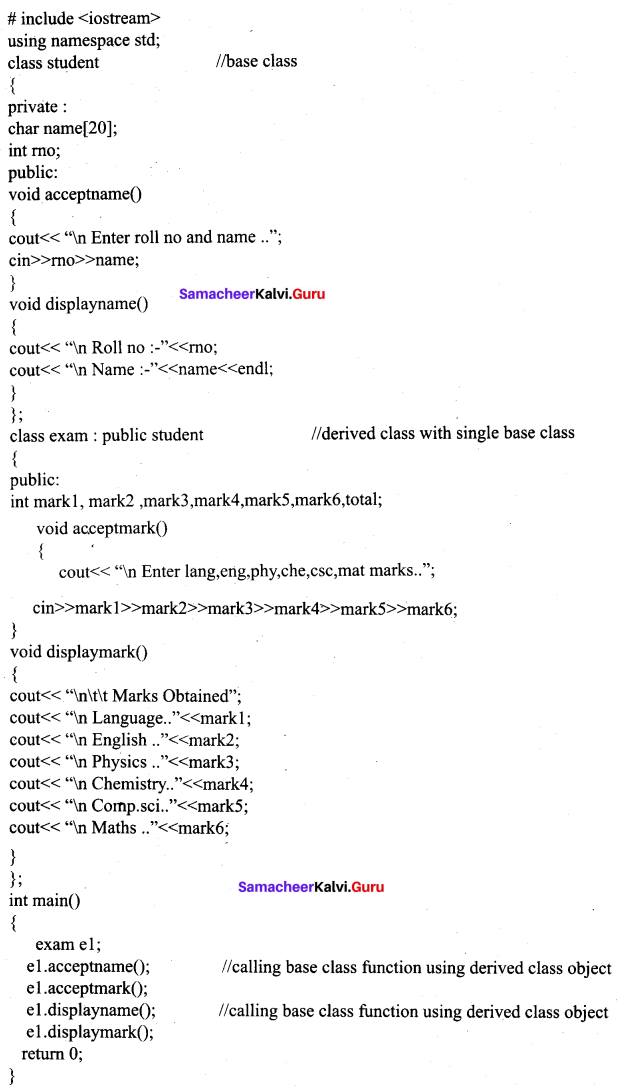
When a derived class inherits only from one base class, it is known as single inheritance.
Samacheer Kalvi 11th Computer Science Solutions Chapter 16 Inheritance 11
Output
Enter roll no and name .. 1201 KANNAN
Enter lang, eng, phy, ehe, esc,mat marks.. 100 100 100 100 100 100
Roll no :- 1201
Name :- KANNAN
Marks Obtained
Language.. 100
English .. 100
Physics .. 100
Chemistry .. 100
Comp.sci .. 100
Maths .. 100

Question 2.
Explain this pointer.
Answer:
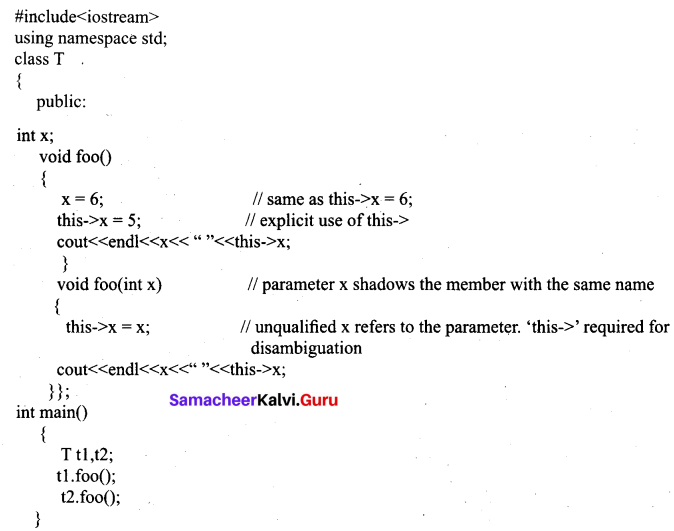
‘this’ pointer is a constant pointer that holds the memory address of the current object. It identifies the currently calling object.lt is useful when the argument variable name in the member function and the data member name are same.
Samacheer Kalvi 11th Computer Science Solutions Chapter 16 Inheritance 12
Output:
5 5
5 5
Process exited after 0.1 seconds with return value 0
Press any key to continue…

Question 3.
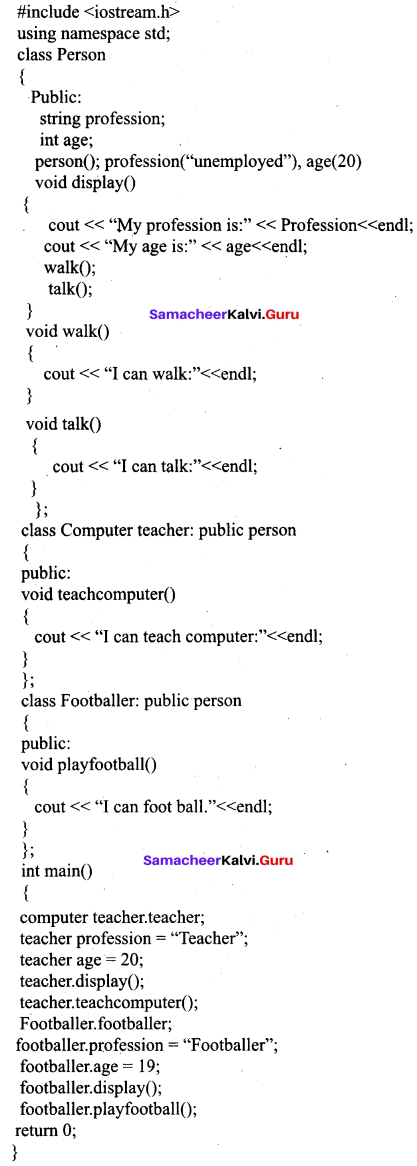
Write the output of the following program.
Samacheer Kalvi 11th Computer Science Solutions Chapter 16 Inheritance 13
Answer:
Output:
My profession is: Teacher
My age is: 20
I can walk
I can talk.
I can teach computer.
My profession is: Footballer
My age is: 19
I can walk
I can talk.
I can play football.

Samacheer Kalvi 12th Chemistry Solutions Chapter 5 Coordination Chemistry

Are you searching for the Samacheer Kalvi 12th Chemistry Chapter Wise Solutions PDF? Then, get your Samacheer Kalvi 12th Chapter Wise Solutions PDF for free on our website. Students can Download Chemistry Chapter 5 Coordination Chemistry Questions and Answers, Notes Pdf, Samacheer Kalvi 12th Chemistry Solutions Guide Pdf helps you to revise the complete Tamilnadu State Board New Syllabus and score more marks in your examinations.

Tamilnadu Samacheer Kalvi 12th Chemistry Solutions Chapter 5 Coordination Chemistry

All concepts are explained in an easy way on our website. So, students can easily learn and practice Tamilnadu State Board 12th Chemistry Chapter 5 Coordination Chemistry Question and Answers. You can enjoy the digitized learning with the help of the Tamilnadu State Board Chemistry Online Material.

Samacheer Kalvi 12th Chemistry Coordination Chemistry TextBook Evalution

I. Choose the correct answer.

12th Chemistry Chapter 5 Book Back Answers Questions 1.
The sum of primary valance and secondary valance of the metal M in the complex [M(en)2(Ox)]Cl is ……………..
(a) 3
(b) 6
(c) -3
(d) 9
Answer:
(d) 9

Coordination Chemistry Questions And Answers Pdf Question 2.
An excess of silver nitrate is added to 100ml of a 0.01M solution of penta aquachlorido chromium (III) chloride. The number of moles of AgCl precipitated would be ……………..
(a) 0.02
(b) 0.002
(c) 0.01
(d) 0.2
Answer:
(b) 0.002

12th Chemistry 5th Lesson Question 3.
A complex has a molecular formula MSO4Cl. 6H2O. The aqueous solution of it gives white precipitate with Barium chloride solution and no precipitate is obtained when it is treated with silver nitrate solution. If the secondary valence of the metal is six, which one of the following correctly represents the complex?
(a) [M(H2O)4Cl] SO2. 2H22O
(b) [M(H2O)6] SO4
(C)[M(H2O)5Cl] SO4. H2O
(d) [M(H2O)3Cl] SO4. 3H2O
Answer:
(c) [M(H2O)5Cl]SO4. H2O

12th Chemistry Evaluate Yourself Answers Chapter 5 Question 4.
Oxidation state of Iron and the charge on the ligand NO in [Fe(H2O)5NO] SO4 are ……………..
(a) +2 and 0 respectively
(b) +3 and 0 respectively
(c) +3 and -1 respectively
(d) +1 and +1 respectively
Answer:
(d) +1 and +1 respectively

Evaluate Yourself 12th Chemistry Question 5.
As per IUPAC guidelines, the name of the complex [CO(en)2(ONO)Cl]Cl is ……………..
(a) chlorobisethylenediaminenitritocobalt (III) chloride
(b chloridobis (ethane-1, 2-diamine) nitro k – Ocobaltate (III) chloride
(c) chloridobis (ethane-1, 2-diammine) nitrito k – Ocobalt (II) chloride
(d) chloridobis (ethane-1, 2-diamine) nitro k – Ocobalt (III) chloride
Answer:
(d) chloridobis (ethane-1, 2-diamine) nitro k – Ocobalt (III) chloride

12 Chemistry Evaluate Yourself Answers Question 6.
IUPAC name of the complex K3[Al(C2O4)3] is ……………..
(a) potassiumtrioxalatoaluminium (III)
(b) potassiumtrioxalatoaluminate (II)
(c) potassiumtrisoxalatoaluminate (III)
(d) potassiumtrioxalatoaluminate (III)
Answer:
(d) potassiumtrioxalatoaluminate (III)

12th Chemistry Evaluate Yourself Answers Question 7.
A magnetic moment of 1.73BM will be shown by one among the following ……………..
(a) TiCl4
(b) [COCl6]4-
(c) [Cu(NH3)4]2+
(d) [Ni(CN)4]2-
Answer:
(c) [Cu(NH3)4]2+

12th Chemistry Lesson 5 Book Back Answers Question 8.
Crystal field stabilization energy for high spin d5 octahedral complex is ……………..
(a) – 0.6∆0
(b) 0
(c) 2 (P – ∆0)
(d) 2 (P + ∆0)
Answer:
(b) 0

12th Chemistry Chapter 5 Question 9.
In which of the following coordination entities the magnitude of ∆0 will be maximum?
(a) [CO(CN)6]3-
(b) [CO(C2O4)3]3-
(c) [CO(H2O)6]3+
(d) [CO(NH3)6]3+
Answer:
(a) [CO(CN)6]3-

12th Chemistry Book Inside Evaluate Yourself Answers Question 10.
Which one of the following will give a pair of enantiomorphs?
(a) [Cr(NH3)6][CO(CN)6]
(b) [CO(en)2Cl2]Cl
(c) [Pt(NH3)4][PtCl4]
(d) [CO(NH3)4Cl2]NO2
Answer:
(b) [CO(en)2Cl2]Cl

Coordination Compounds Notes Pdf Question 11.
Which type of isomerism is exhibited by [Pt(NH3)2Cl2] ?
(a) Coordination isomerism
(b) Linkage isomerism
(c) Optical isomerism
(d) Geometrical isomerism
Answer:
(d) Geometrical isomerism

12th Coordination Chemistry Question 12.
How many geometrical isomers are possible for [ Pt (Py) (NH3) (Br) (Cl) ]?
(a) 3
(6) 4
(c) 0
(d) 15
Answer:
(a) 3

12th Chemistry Evaluate Yourself Answers Samacheer Question 13.
Which one of the following pairs represents linkage isomers?
(a) [Cu(NH3)4] [PtCl4] and [Pt(NH3)4] [CuCl4]
(b) [CO(NH3)5(NO3)]SO4 and [CO(NH3)5(ONO)]
(c) [CO(NH3)4(NCS)2]Cl and [CO(NH3)4(SCN)2]Cl
(d) both (b) and (c)
Answer:
(c) [CO(NH3)4(NCS)2]Cl and [CO(NH3)4(SCN)2]Cl

12th Chemistry Samacheer Kalvi Question 14.
Which kind of isomerism is possible for a complex [CO(NH3)4Br2]Cl ?
(a) geometrical and ionization
(b) geometrical and optical
(c) optical and ionization
(d) geometrical only
Answer:
(a) geometrical and ionization

Samacheer Kalvi 12th Chemistry Question 15.
Which one of the following complexes is not expected to exhibit isomerism?
(a) [Ni(NH3)4(H2O)2]2+
(b) [Pt(NH3)2 Cl2]
(C) [CO(NH3)5SO4]Cl
(d) [Fe(en)3]3+
Answer:
(d) [Fe(en)3]3+

Question 16.
A complex in which the oxidation number of the metal is zero is ……………..
(a) K4[Fe(CN)6]
(b) [Fe(CN)3(NH3)3]
(c) [Fe(CO)5]
(d) both (b) and (c)
Answer:
(c) [Fe(CO)5]

Question 17.
Formula of tris (ethane-1, 2-diamine) iron (II) phosphate ……………..
(a) [Fe(CH3 – CH(NH2)2)3] (PO4)3
(b) [Fe(H2N – CH2 – CH2 – NH2)3] (PO4)
(c) [Fe(H2N – CH2 – CH2 – NH2)3](PO4)2
(d) [Fe(H2N – CH2 – CH2 – NH2)3](PO4)2
Answer:
(d) [Fe(H2N – CH2 – CH2 – NH2)3](PO4)2

Question 18.
Which of the following is paramagnetic in nature?
(a) [Zn(NH3)4]2+
(b) [CO(NH3)6]3+
(c) [Ni(H2O)6]2+
(d) [Ni(CN)4]2-
Answer:
(c) [Ni(H2O)6]2+

Question 19.
Facmer isomerism is shown by ……………..
(a) [CO(en)3]3+
(b) [CO(NH3)4(Cl)2]+
(c) [CO(NH3)3(Cl)3]
(d) [CO(NH3)5Cl]SO4
Answer:
(c) [CO(NH3)3(Cl)3]

Question 20.
Choose the correct statement.
(a) Square planar complexes are more stable than octahedral complexes
(b) The spin only magnetic moment of [Cu(Cl)4]2- is 1.732 BM and it has square planar structure.
(c) Crystal field splitting energy (Δ0) of [FeF6]4- is higher than the (Δ0) of [Fe(CN)6]4-
(d) crystal field stabilization energy of [V(H2O)6]2+ is higher than the crystal field stabilization of [Ti(H2O)6]2+
Answer:
(d) crystal field stabilization energy of [V(H2O)6]2+ is is higher than the crystal field stabilization of [Ti(H2O)6]2+

II. Answer the following questions

Question 1.
Write the IUPAC names for the following complexes.

  1. Na2 [Ni(EDTA)]
  2. [Ag(CN)2]
  3. [CO(en)3]2(SO4)3
  4. [CO(ONO)(NH3)5]2+
  5. [Pt(NH3)2Cl(NO2)]

Answer:
1. Na2[Ni(EDTA)]
= Sodium EthyicncdiaminetctraacetatonickcEate (II)
(or)
Sodium 2, 2′, 2”, 2” – (ethane – 1, 2 – diyldinitrilo)
tetraacetatonickelate (II)

2. [Ag(CN)2]1
= dicyanidoargentate (I) ion

3. [CO(en)3]2(SO4)3
= tris (ethylenediamine) cobait (III) sulphate

4. [CO(ONO)(NH3)5]2+
= Pentaammincnitrito – kOCobalt (III) ion.

5. [Pt(NH3)2Cl(NO2)]
= diamminedichloridonitrito – kN platinum (II)

Question 2.
Write the formula for the following coordination compounds.

  1. potassiumhexacyanidoferrate (II)
  2. petacarbonvliron(O)
  3. pentaammineriitrito – k – N – cobalt(III)ion
  4. hexaamminecobalt (III) sulphate
  5. sodiumtetrafluoridodihydroxidoch romate (III)

Answer:

  1. potassiurnhexacyanidoferrate (ll) = K4[Fe(CN)6]
  2. petacarbonyliron(O) = [Fe(CO)5]
  3. pentaamminenitrito – KN – cobalt (III) ion [CO(NH3)5NO2]2-
  4. hexaamminecobalt (III) sulphate [CO(CN)6]2(SO4)3
  5. sodiumtetrafluoridodihyclroxidochromate (III) = Na3[CrF4(OH)2]

Question 3.
Arrange the following in order of increasing molar conductivity

  1. Mg[Cr(NH3)(Cl)5]
  2. [Cr(NH3)5Cl]3 [COF6]2
  3. [Cr(NH3)3Cl3]

Answer:
These complexes can ionise in solution as:

  1. Mg[Cr(NH3)(Cl)5] = Mg2+ [Cr(NH3) (Cl)5]2-
  2. [Cr(NH3)5Cl]3 [COF6]2 = [Cr(NH3)5Cl]2+ + [COF6]3-
  3. [Cr(NH3)3Cl3] = does not ionize

As the number of ions in solution increases, their molar conductivity also increases.
Therefore, conductivity follows the order:
[Cr(NH3)3Cl3] < [Cr(NH3)5Cl]3 [COF6]2 < Mg[Cr(NH3)(Cl)5]

Question 4.
Ni2+ is identified using alcoholic solution of dimethyl glyoxime. Write the structural formula for the rosy red precipitate of a complex formed in the reaction.
Answer:
1. Ni2+ ions present in Nickel chloride solution is estimated accurately for forming an insoluble complex called [Ni(DMG)2] .

2. Nickel ion reacts with alcoholic solution of DMG in the presence of ammonical medium, to give rosy red precipitate of [Ni(DMG)2] complex.
12th Chemistry Chapter 5 Book Back Answers Samacheer Kalvi Coordination Chemistry

Question 5.
[CuCl4]2- exists while [CuI4]2- does not exist why?
Answer:
1. In [CuI4]2- complex, the size of chloride ion is less hence exist. But in [CuI4]2- the bigger iodide ion makes the compound unstable.

2. When copper cation comes in contact with iodide anion, iodide get oxidised to iodine molecule hence the formation of the above complex ion does not take place. Hence [CuI4]2- exists while [CuI4]2- does not exist.

Question 6.
Calculate the ratio
Coordination Chemistry Questions And Answers Pdf Samacheer Kalvi 12th Chemistry Solutions Chapter 5
in 0.2 M solution of NH3. If the stability constant for the complex [Ag(NH3)2]+ is 1.7 x 10⁷
Answer:
The stability constant for the complex [Ag(NH3)2]+ is 1.7 x 10⁷, overall dissociation constant is the reciprocal of overall stability constant
K = \(\frac { 1 }{ β }\) ⇒ K =\(\frac { 1 }{ 1.7×10⁷ }\) ⇒ K = 0.588 x 10⁷ ⇒ K = 5.88 x 10⁷

Question 7.
Give an example of coordination compound used in medicine and two examples of biologically important coordination compounds.
Answer:
Medical uses of coordination compounds:

  1. Ca-EDTA chelate, is used in the treatment of lead and radioactive poisoning. That is for removing lead and radiactive metal ions from the body.
  2. Cis-platin is used as an antitumor drug in cancer treatment.

Biological important of coordination compounds:

1. A red blood corpuscles (RBC) is composed of heme group, which is Fe2+ Porphyrin complex.it plays an important role in carrying oxygen from lungs to tissues and carbon dioxide from tissues to lungs.

2. Chlorophyll, a green pigment present in green plants and algae, is a coordination complex containing Mg2+ as central metal ion surrounded by a modified Porphyrin ligand called corrin ring. It plays an important role in photosynthesis, by which plants converts CO, and water into carbohydrates and oxygen.

3. Vitamin B12 (cyanocobalamine) is the only vitamin consist of metal ion. it is a coordination complex in which the central metal ion is CO+ surrounded by Porphyrin like ligand.

4. Many enzymes are known to be metal complexes, they regulate biological processes. For example, Carboxypeptidase is a protease enzyme that hydrolytic enzyme important in digestion, contains a zinc ion coordinated to the protein.

Question 8.
Based on VB theory explain why [Cr(NH3)6]3+ is paramagnetic, while [Cr(NH)4]2- is diamagnetic.
Answer:
1. [Cr(NH3)6]3+
In this complex Cr is in the +3 oxidation state. Electronic configuration of Cr atom. Electronic configuration of Cr3+ ion 172 Chemistry 12
12th Chemistry 5th Lesson Samacheer Kalvi Coordination Chemistry
Hybridisation and formation of [Cr(NH3)6]3+ Complex
Due to the presence of three unpaired electrons in
[Cr(NH3)6]3+ it behaves as a paramagnetic substance.
The spin magnetic moment,
µs = \(g\sqrt { 3(3+2) } \) = \(g\sqrt { 15 } \) = 3.87 BM
[Cr(NH3)6]3+ is an inner orbital octahedral complex.
12th Chemistry Evaluate Yourself Answers Chapter 5 Samacheer Kalvi Coordination Chemistry

2. [Ni(CN)4]2-
in this complex Ni is in the +2 oxidation state. Electronic configuration of Ni atom. Electronic configuration of Ni2+ ion. Hybridisation and formation of [Ni(CN)4]2- Complex
Evaluate Yourself 12th Chemistry Samacheer Kalvi Solutions Chapter 5 Coordination Chemistry
Since CN is strong field ligand, hence the electrons in 3d orbitais are forced to pair up and there is no unpaired electron in [Ni(CN)4]2 , hence it should be diamagnetic substance.

Question 9.
Draw all possible geometrical isomers of the complex [CO(en)2CI2]+ and identify the optically active isomer.
Answer:
1. Cis – [CO(en)2CI2]+
12 Chemistry Evaluate Yourself Answers Samacheer Kalvi Coordination Chemistry
12th Chemistry Evaluate Yourself Answers Samacheer Kalvi Chapter 5 Coordination Chemistry

2. Trans [CO(en)2CI2]+
12th Chemistry Lesson 5 Book Back Answers Samacheer Kalvi Coordination Chemistry

The coordination complex [CO(en)2CI2]+ has three isomers two optically active cis forms and the optically inactive trans form.
12th Chemistry Chapter 5 Samacheer Kalvi Coordination Chemistry

Question 10.
[Ti(H2O)6]3+ is coloured, while [Sc(H2O)6]3+ is colourless- explain.
Answer:
Ti in [Ti(H2O)6]3+ is in +3 oxidation state. Sc in [Sc(H2O)6]3+ is in +3 oxidation state. The outer electronic configuration of Sc, Ti and their trivalent ions are,
SC: 3d1 4S2
SC3+: 3d0
Ti: 3d2 4S2
Ti3+: 3d1

Ti3+has one unpaired electron in 3d orbital and they undergoes d-d transition. This electron can be promoted to a higher energy level by light absorption. Therefore [Ti(H2O)6]3+ is coloured. In the case of [Sc(H2O)6]3+ there is no electron in 3d orbital of Sc3+, hence there is no possibility of light absorbance. Therefore [Sc(H2O)6]3+ is colourless.

Question 11.
Give an example for complex of the type [Ma2b2c2] where a,b,c are monodentate ligands and give the possible isomers.
Answer:
The octahedral complexes of [Ma2b2c2] type can exist in five geometrical isomers. The five geometrical isomers for the complex ion [PtCl2(NH3)2(py)2]2+are shown below.
12th Chemistry Book Inside Evaluate Yourself Answers Samacheer Kalvi Coordination Chemistry

Question 12.
Give one test to differentiate [CO(NH3)5Cl] SO4 and [CO(NH3)5SO4] Cl.
Answer:

  • [CO(NH3)5Cl]SO4 → [CO(NH3)5Cl]+2 + SO42-
  • [CO(NH3)5SO4] Cl → [CO(NH3)5Cl] SO4

1. Aqueous solution of (a) gives sulphate ion. When an addition of BaCL, solution (a) gives white precipitate of BaS04. But (b) does not give any precipitate.

2. Aqueous solution of (b) gives chloride ion. When an addition of AgNO3 solution (b) gives curdy white precipitate of AgCl. But (a) does not give any precipitate.

Question 13.
In an octahedral crystal field, draw the figure to show splitting of d orbitals.
Answer:
Step 1:
In an isolated gaseous state, all the five d orbitals of the central metal ion are degenerate. Initially, the ligands form a spherical field of negative charge around the metal. In this filed, the energies of all the five d orbitals will increase due to the repulsion between the electrons of the metal and the ligand.
Coordination Compounds Notes Pdf Samacheer Kalvi 12th Chemistry Solutions Chapter 5

Step 2:
The ligands are approaching the metal atom in actual bond directions. To illustrate this let us consider an octahedral field, in which the central metal ion is located at the origin and the six ligands are coming from the +x, -x, +y, -y, +z and -z directions as shown below. As shown in the figure, the orbitals lying along the axes dx2-y2and dz2 orbitals will experience strong repulsion and raise in energy to a greater extent than the orbitals with lobes directed between the axes (dxy, dyz and dzx). Thus the degenerate d orbitals now split into two sets and the process is called crystal field splitting.

Step 3:
Up to this point the complex formation would not be favoured. However, when the ligands approach further, there will be an attraction between the negatively charged electron and the positively charged metal ion, that results in a net decrease in energy. This decrease in energy is the driving force for the complex formation.
12th Coordination Chemistry Samacheer Kalvi Solutions Chapter 5
During crystal field splitting in octahedral field, in order to maintain the average energy of the orbitals (barycentre) constant, the energy of the orbitals dx2-y2and dz2 (represented as t2g orbitals) will increase by 3/5∆0 while that of the other three orbitals dxy. dyz and dzx (represented as t2g orbitals) decrease by 2/5∆0 . Here, ∆0 represents the crystal field splitting energy in the octahedral field.

Question 14.
What is linkage isomerism? Explain with an example.
Answer:
This type of isomers arises when an ambidentate ligand is bonded to the central metal atom/ ion through either of its two different donor atoms. For examples – [CO(NH3)5ONO]Cl2 – (Pentaammine nitrito cobalt (III) chloride) – O – attached. (Red in colour).[CO(NH3)5NO2]Cl2 – (Pentaammine nitro cobalt (III) chloride) – N – attached (Yellow-brown in colour).

Question 15.
Write briefly about the applications of coordination compounds in volumetric analysis.
Answer:
Hardness of water is due to the presence of Ca2+and Mg2+ ions in water. EDTA forms stable complexes with Ca2+ and Mg2+. So the total hardness of water can be estimated by simple volumetric titration of water with EDTA.

Question 16.
Classify the following ligand based on the number of donor atoms,

  1. NH3
  2. en
  3. ox2-
  4. triaminotriethylamine
  5. pyridine

Answer:

  1. NH3 – Monodentate ligands (N – Donor atom)
  2. en – Bidentate ligand (2N – Donor atom)
  3. ox2- – Bidentate ligand (2O – Donor atom)
  4. triaminotriethylamine – Tridentate ligand (3N – Donor atom)
  5. pyridine – Monodentate ligand (N – Donor atom)

Question 17.
Give the difference between double salts and coordination compounds.
Answer:
Double Salt:

  1. A double salt is’ a compound prepared by the combination of two different salt components.
  2. Completely dissociate into its ions in water.
  3. Give simple ions when added to water.
  4. It can be easily analyzed by determining the ions present in the aqueous solution.
    Example : Potash alum K2SO4 . Al2(SO4)3. 24H2O

Coordination compounds (Complex salt):

  1. A complex salt is a compound composed of a central metal atom having coordination bonds with ligands around it.
  2. Do not completely dissociate into its ions in water.
  3. Do not give simple ions.
  4. It cannot be easily analyzed by determining the ions in the aqueous solution.
    Example: Potassium ferro cyanide K4[Fe(CN)6]

Question 18.
Write the postulates of Werner’s theory.
Answer:
1. The central metal ion in any complex ion/compound exhibits two types of valencies, these are (a) Primary valency (b) Secondary valency.

2. The primary valency is ionisable and corresponds to the oxidation state of the metal joining the central ion.

3. The secondary valency is non – ionisable. Every central ion has a fixed number of secondary valencies. This number is called the coordination number of the central ion.

4. The primary valency of the metal ion is always satisfied by a negative ion. The attachment of the central metal ion to the negative ligand is shown by dotted lines.

5. The secondary valencies are satisfied by either negative ions or neutral molecules. The secondary valencies are shown by their lines. The molecules or ions that satisfy secondary valency are called ligands.

6. The ligands which satisfy the secondary valencies must point out in the definite directions in space. Whereas the primary valencies are non – directional in nature. The spatial arrangement of the secondary valencies around the central metal ion is called coordination polyhedron.

7. The secondary valencies are responsible for isomerism in the coordination compounds,

8. Werner’s representation of [CO(NH3)6]Cl3
12th Chemistry Evaluate Yourself Answers Samacheer Kalvi Chapter 5 Coordination Chemistry

Question 19.
[Ni(CN)4]2- is diamagnetic, while [Ni(CN)4]2- is paramagnetic, explain using crystal field theory.
Answer:
1. [Ni(CN)4]2-
Ni = 3d8 4s2
Ni2+ = 3d8
Samacheer Kalvi 12th Chemistry Solutions Chapter 5 Coordination Chemistry-12
Nature of the complex – Low spin (Spin paired)
Ligand filled elelctronic configuration of central metla ion, t2g6 eg6. Magnetic property – No unpaired electron (CN is strong filled ligand), hence it is diamagnetic Magnetic moment – µs = 0

2. [Ni(CN)4]2-
Ni = 3d8 4S2
Ni2+ = 3d8
12th Chemistry Samacheer Kalvi Solutions Chapter 5 Coordination Chemistry
Nature of the complex – high spin
Ligand filled electronic configuration of central metal ion, t2g6 eg6. Magnetic property – Two unpaired electron (CL is weak field ligand). Hence it is paramagnetic Magnetic moment – it is paramagnetic

Question 20.
Why tetrahedral complexes do not exhibit geometrical isomerism.
Answer:
In tetrahedral geometry

  1. All the four ligands are adjacent or equidistant to one another.
  2. The relative positions of donor atoms of ligands attached to the central metal atom are same with respect to each other.
  3. It has plane of symmetry. Therefore, tetrahedral complexes do not exhibit geometrical isomerism.

Question 21.
Explain optical isomerism in coordination compounds with an example.
Answer:

1. Coordination compounds which possess chairality exhibit optical isomerism similar to organic compounds.

2. The pair of two optically active isomers which are mirror images of each other are called enantiomers.

3. Their solutions rotate the plane of the plane polarised light either clockwise or anticlockwise and the corresponding isomers are called d (dextrorotatory) and 1 (levorotatory) forms respectively.

4. The octahedral complexes of type [M(xx)3], [M(xx)2AB] and [M(xx)2B2] exhibit optical isomerism.

Eamples:
1. The optical isomers of [Co(en)3]3+ are shown below.
Samacheer Kalvi 12th Chemistry Solutions Chapter 5 Coordination Chemistry

Optical isomer
2. The coordination complex [COCl2(en)2]+ has three isomers, two optically active cis forms and one optically inactive trans form. These structures are shown below.
Samacheer Kalvi 12th Chemistry Solutions Chapter 5 Coordination Chemistry-15

3. In a coordination compound of type [Pt Cl2(en)2]2+, two geometrical isomers are possible. They are cis and trans. Among these two isomers, cis isomer shows optically active isomerism because the whole molecule is asymmetric.
Samacheer Kalvi 12th Chemistry Solutions Chapter 5 Coordination Chemistry-16

Question 22.
What are hydrate isomers? Explain with an example.
Answer:
The exchange of free solvent molecules such as water, ammonia, alcohol etc., in the crystal lattice with a ligand in the coordination entity will give different isomers. These type of isomers are called solvate isomers. If the solvent molecule is water, then these isomers are called hydrate isomers. For example, the complex with chemical formula CrCl3. 6H2O has three hydrate isomers as shown below.
Samacheer Kalvi 12th Chemistry Solutions Chapter 5 Coordination Chemistry-50

Question 23.
What is crystal field splitting energy?
Answer:
1. In an octahedral complex, the d – orbitals of the central metal ion divide into two sets of different energies. The separation in energy is the crystal field splitting energy.

2. The d orbitals lying along the axes dx2, dy2 and dz2 orbitals will experience strong repulsion and raise in energy to a greater extent than the orbitals with lobes directed between the axes (dxy, dyz and dzx). Thus the degenerate d – orbitals now split into two sets and the process is called crystal filled splitting.

Question 24.
What is crystal field stabilization energy (CFSE) ?
Answer:
The crystal field stabilisation energy is defined as the energy difference of electronic configurations in the ligand field (ELF) and the isotropic field (Eiso).
CFSE (ΔE0) = {ELF} – {Eiso}
= {nt2g (-0.4) + n6g (0.6) Δ0 – npP} – {n’pP}
Here ntg is the number of electrons in t, orbitals
neg is the number of electrons in e orbitals
np is the number of electrons in the ligand field
n’p is the number of electrons in the isotropic field

Question 25.
A solution of [Ni(H2O)6]2+ is green, whereas a solution of [Ni(CN)4]2- is colorless – Explain.
Answer:
1. In [Ni(H2O)6]2+, Ni is in +2 oxidation state with the configuration 3d8, i.e., it has two unpaired electrons which do not pair up in the presence of weak H2O ligand. Hence, it is coloured. The d – d transtion absorbs red light and the complementary light emitted is green.

2. In the case of [Ni(CN)4]2- Ni is again in +2 oxidation state with the configuration 3d8, but in the presence of strong CN ligand the two impaired electrons in the 3d orbitals pair up. Thus there is no unpaired electron present. Hence it is colourless. Therefore, a solution of [Ni(H2O)6]2+ is green, whereas a solution of [Ni(CN)4]2- is colourless.

Question 26.
Discuss briefly the nature of bonding in metal carbonyls.
Answer:
1. In metal carbonyls, the bond between metal atom and the carbonyl ligand consists of two components.

2. The first component is an electron pair donation from the carbon atom of carbonyl ligand into a vacant d – orbital of central metal atom. This electron pair donation forms Samacheer Kalvi 12th Chemistry Solutions Chapter 5 Coordination Chemistry-17 sigma bond.
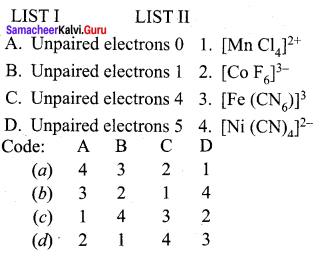
3. This sigma bond formation increases the electron density in metal d- orbitals and makes the metal electron rich.

4. In order to compensate for this increased electron density, a filled metal d-orbital interacts with the empty π* orbital on the carbonyl ligand and transfers the added electron density back to the ligand. This second component is called π – back bonding. Thus in metal carbonyls, electron density moves from ligand to metal through sigma bonding and from metal to ligand through pi bonding, this synergic effect accounts for strong M ← CO bond in metal carbonyls. This phenomenon is shown diagrammatically as follows.
Samacheer Kalvi 12th Chemistry Solutions Chapter 5 Coordination Chemistry-18

Question 27.
What is the coordination entity formed when excess of liquid ammonia is added to an aqueous solution copper sulphate?
Answer:
When excess of liquid ammonia is added to an aqueous solution of copper sulphate to give tetraamminecopper (II) sulphate
Samacheer Kalvi 12th Chemistry Solutions Chapter 5 Coordination Chemistry-19
Therefore, the coordination entity is [Cu(NH3)4]2+

Question 28.
On the basis of VB theory explain the nature of bonding in [CO(C2O4)3]3-.
Answer:
In the complex entity [CO(C2O4)3]3-, the Co is in +3 oxidation state. The outer electronic configuration of CO3+ is 3d6. The oxalato ligand is fairly strong field ligand. So it faces the 3d electrons in CO3+ to pair up and make two of the 3d orbitals available for bonding. As a result, CO3+ shows d2sp2 hybridisation. Electronic configuration of Co atom Electronic configuration of CO3+ ion Hybridisation and formation of [CO(C2O4)3]3-

  • There is no unpaired electron in[CO(C2O4)3]3-
    Thus[CO(C2O4)3]3-
  • During the formtion of [CO(C2O4)3]3-, two of the 3d-orbitals are used in bonding. Therefore it is an inner orbital (low spin) complex.
  • The [CO(C2O4)3]3- has the octahedral geometry

Samacheer Kalvi 12th Chemistry Solutions Chapter 5 Coordination Chemistry-20

Question 29.
What are the limitations of VB theory?
Answer:
Limitations of VB – Theory:
1. It does not explain the colour of the complex

2. It considers only the spin only magnetic moments and does not consider the other components of magnetic moments.

3. It does not provide a quantitative explanation as to why certain complexes are inner orbital complexes and the others are outer orbital complexes for the same metal. For example, [Fe(CN)6]4- is diamagnetic (low spin) whereas [Fe(CN)6]4- is paramagnetic (high spin).

Question 30.
Write the oxidation state, coordination number, nature of ligand, magnetic property and electronic configuration in octahedral crystal field for the complex K4[Mn(CN)6].
Answer:
Samacheer Kalvi 12th Chemistry Solutions Chapter 5 Coordination Chemistry-21

Samacheer Kalvi 12th Chemistry Coordination Chemistry Evaluate Yourself

Question 1.
When a coordination compound CrCl3. 4H2O is mixed with silver nitrate solution, one mole of silver chloride is precipitated per mole of the compound. There are no free solvent molecules in that compound. Assign the secondary valence to the metal and write the structural formula of the compound.
Answer:
1. When a coordination compound CrCl3. 4H2O  is mixed with silver nitrate solution, one mole of silver chloride is precipitated per mole of the compound. This shows CrCl3. 4H2O complex compound contains one Cl® counter ion.

2. There are no free solvent molecules in CrCl3. 4H2O compound, this shows water molecules are coordinated with central metal ion.

3. Therefore, coordination complex is [CrCl3. 4H2O]Cl Secondary value of the central metal ion is 2Cl® and 4 H2O. Hence coordination number is 6.

4. Werner’s structure of [CrCl2. (H2O)4]Cl
Samacheer Kalvi 12th Chemistry Solutions Chapter 5 Coordination Chemistry-22

Question 2.
In the complex, [Pt(NO2)(H2O)(NH3)2]Br, identify the following

  1. Central metal atom/ion
  2. Ligands(s) and their types
  3. Coordination entity
  4. Coordination number
  5. Oxidation number of the central metal ion

Answer:
[Pt(NO2)(H2O)(NH3)2]Br

  1. Central metal ion – Pt2+
  2. Ligands and their types – NO2 – Mono dendata ligand H2O and NH3 – neutral monodendate ligand
  3. Coordination entity – [pt(NO2(H2O(NH3)2]3+
  4. Oxidation number of the central metal ion – x + 1(-1) + 1(0) + 1(0) = + 1 ⇒ x – 1 = + 1 ⇒ x = + 2
  5. Coordination number – 4

Question 3.
Write the IUPAC name for the following compounds.

  1. K2[Fe(CN)3 (Cl)2 (NH3)]
  2. [Cr (CN)2 (H2O)] [CO (ox)2 (en)]
  3. [Cu (NH3)2 Cl2]
  4. [Cr (NH3)3 (NC)2 (H2O)]+
  5. [Fe (CN)6]4-

Answer:

  1. K2[Fe(CN)3 (Cl)2 (NH3)] – Potassium amminedichloridotricyanidoferrate (III)
  2. [Cr (CN)2 (H2O)] [CO (ox)2 (en)] – Tetraaquadicyanidochromium (II) ethenel,2diaminebis (oxalato) cobalate (II)
  3. [Cu (NH3)2 Cl2] – diamminedichloro copper (II)
  4. [Cr (NH3)3 (NC)2 (H2O)]+ – triammineaquodicyanido – KN Chromium (Ill)ion
  5. [Fe (CN)6]4- – Hexacyanidoferrate (II) ion

Question 4.
Give the structure for the following compounds.
Answer:

  1. diamminesilver (I) dicyanidoargentate(I)
  2. Pentaammine nitrito-KNcobalt (III) ion
  3. hexafluorido cobaltate (III) ion
  4. dichloridobis(ethylenediamine) Cobalt (III) sulphate
  5. Tetracarbonylnickel (0)

Answer:

  1. diamminesilver(I) dicyanidoargentate(I) – [Ag(NH3)9] [Ag(CN)2]
  2. Pentaammine nitrito-KNcobalt (III) ion – [CO (NH3)5 NO2]+
  3. hexafluorido cobaltate (III) ion – [COF6]3-
  4. dichloridobis(ethylenediamine) Cobalt (III) sulphate – [CO(en)2Cl2]SO4
  5. Tetracarbonylnickel (0) – [Ni (CO)4]

Question 5.
A solution of [CO(NH3)4I2]Cl when treated with AgNO3 gives a white precipitate. What should be the formula of isomer of the dissolved complex that gives yellow precipitate with AgNO3. What are the above isomers called?
Answer:

  1. A solution of [CO(NH3)4I2]Cl when treated with AgNO3 gives a white precipitate, because Cl-ion is counter ion.
  2. Formula of isomer of the dissolved complex that gives yellow precipitate with AgNO3 is, [CO (NH3)4 Cl I] I because IΘ is counter ion
  3. [CO(NH3)4I2]Cl and [ CO(NH3)4 Cl I ] I both are ionisation isomers.

Question 6.
Three compounds A ,B and C have empirical formula CrCl3. 6H2O. they are kept in a container with a dehydrating agent and they lost water and attaining constant weight as shown below.
Samacheer Kalvi 12th Chemistry Solutions Chapter 5 Coordination Chemistry-23
Answer:

  1. [Cr(H2O)3 Cl3]. 3H2O
  2. [Cr(H2O)4 Cl2]Cl. 2H2O
  3. [Cr(H2O)6]Cl3

Question 7.
Indicate the possible type of isomerism for the following complexes and draw their isomers

  1. [CO(en)3][Cr(CN)6]
  2. [CO(NH3)5(NO2)]2+
  3. [Pt(NH3)3(NO2)]Cl

Answer:
1. [CO(en)3][Cr(CN)6] – Exhibits coordination isomerism
(a) [CO(en)3][Cr(CN)6]
Samacheer Kalvi 12th Chemistry Solutions Chapter 5 Coordination Chemistry-24

(b) [Cr(en)3][CO(CN)6]
Samacheer Kalvi 12th Chemistry Solutions Chapter 5 Coordination Chemistry-2

2. [CO(NH3)5(NO2)]2+ – Exhibits linkage isomerism
(a) [CO(NH3)5(NO2)]2+ – N attached
Samacheer Kalvi 12th Chemistry Solutions Chapter 5 Coordination Chemistry-25

(b) [CO(NH3)5(ONO2)]2+ – O attached
Samacheer Kalvi 12th Chemistry Solutions Chapter 5 Coordination Chemistry-26

3. [Pt(NH3)3(NO2)]Cl – Exhibits ionisation isomerism
(a) [Pt(NH3)3(NO2)]Cl
Samacheer Kalvi 12th Chemistry Solutions Chapter 5 Coordination Chemistry-27

(b) [Pt(NH3)3Cl ] NO2
Samacheer Kalvi 12th Chemistry Solutions Chapter 5 Coordination Chemistry-28

Question 8.
Draw all possible stereo isomers of a complex Ca[CO(NH3)Cl(Ox)2]
Answer:
possible stereo isomers of a complex Ca[CO(NH3)Cl(Ox)2]
Samacheer Kalvi 12th Chemistry Solutions Chapter 5 Coordination Chemistry-29

Question 9.
The spin only magnetic moment of Tetrachloridomanganate(II)ion is 5.9 BM. On the basis of VBT, predict the type of hybridisation and geometry of the compound. [Mn Cl4]2-
Answer:
Electronic configuration of Mn atom Electronic configuration of Mn2+ ion. Hybridisation and formation of [Mn Cl4]2- complex
Samacheer Kalvi 12th Chemistry Solutions Chapter 5 Coordination Chemistry-30

Cl is weak field ligand no electrons pairing occurs. sp3 hybridisation, It has 5 unpaired electrons. Hence paramagnetic Magnetic moment,
µs = \(g\sqrt { n(n+2) } \)
= \(g\sqrt { 5(5+2) } \)
= \(g\sqrt { 5(7) } \)
= \(g\sqrt { (35) } \)
= 5.9 BM
It has tetrahedral geometry.

Question 10.
Predict the number of unpaired electrons in [COCl4]2- ion on the basis of VBT. [COCl4]2-
Answer:
Electronic configuration of CO atom
Electronic configuration of CO2+ ion
Hybridisation and formation of [COCl4]2- complex
Samacheer Kalvi 12th Chemistry Solutions Chapter 5 Coordination Chemistry-31
Cl is weak field ligand, therefore no electrons pairing occurs. sp3 hybridization. It has 3 unpaired electrons, hence it is paramagnetic. Magnetic moment,
µs = \(g\sqrt { n(n+2) }\)
= \(g\sqrt { 3(3+2) } \)
= \(g\sqrt { 15 } \)
= 3.87 BM
It has tetrahedral geometry.

Question 11.
A metal complex having composition CO(en)2Cl2Br has been isolated in two forms A and B. (B) reacted with silver nitrate to give a white precipitate readily soluble in ammonium hydroxide. Whereas A gives a pale yellow precipitate. Write the formula of A and B. state the hybridization of CO in each and calculate their spin only magnetic moment.
Answer:
A metal complex having composition CO(en)2Cl2Br has been isolated in two forms A and B.
1.(B) reacts with silver nitrate to give a white precipitate readily soluble in ammonium hydroxide. This shows (B) has ClΘ counter ion. Hence B is [CO(en)2Cl Br] Cl form.

2. (A) reacts with silver nitrate to give a pale yellow precipitate. This shows (A) has BrΘ counter ion. Hence A is [CO(en)2Cl2] Br.

3. Formula of A and B

  1. [CO(en)2Cl2] Br
  2. [CO(en)2Cl Br] Cl

1. A – [CO(en)2Cl2] Br
Electronic configuration of CO atom Electronic configuration of CO3+ atom
Hybridisation and formation of [CO(en)2Cl2] Br complex
Samacheer Kalvi 12th Chemistry Solutions Chapter 5 Coordination Chemistry-32
d2 sp3 hybridisation en is strong field ligand. No unpaired electrons, hence it is diamagnetic. Magnetic moment
µs = \(g\sqrt { n(n+2) }\)
n = 0
µs = 0

2. A – [CO(en)2Cl Br] Cl
Electronic configuration of CO atom
Electronic configuration of CO3+ atom
Samacheer Kalvi 12th Chemistry Solutions Chapter 5 Coordination Chemistry-33
d2 sp3 hybridisation en is strong field ligand. No unpaired electrons, hence it is diamagnetic. Magnetic moment,
µs = 0
∵n = 0

Question 12.
The mean pairing energy and octahedral field splitting energy of [Mn(CN)6]3- are 28,800 cm-1 and 38500 cm-1 respectively. Whether this complex is stable in low spin or high spin?
Answer:
Mean pairing energy = 28,800 cm-1
Octahedral field splitting energy = 38,500 cm-1
[Mn(CN)6]3-
Mn = 3d5 4s2 Mn3+ = 3d4
Samacheer Kalvi 12th Chemistry Solutions Chapter 5 Coordination Chemistry-34

Question 13.
Draw energy level diagram and indicate the number of electrons in each level for the complex [Cu(H2O)6]2+. Whether the complex is paramangnetic or diamagnetic ?
Answer:
Cu in [Cu(H2O)6]2+ has +2 oxidation state.
Electronic configuration of Cu atom – 3d10 4s1
Electronic configuration of Cu2+ ion – 3d9
Distortions in Octahedral Geometry Observed in [Cu(H2O)6]2+
If the ground electronic configuration of a non-linear complex is orbitally degenerate, the complex will distort so as to remove the degeneracy and achieve a lower energy. This is called the Jahn – Effect.
Samacheer Kalvi 12th Chemistry Solutions Chapter 5 Coordination Chemistry-5
Cu2+ – Two ways of filling the eg orbitals; there is degeneracy and jahn – Teller Distortion is observed
Jahn – Teller Distortion in Cu(III) Complexs [Cu(H2O)6]2+
Samacheer Kalvi 12th Chemistry Solutions Chapter 5 Coordination Chemistry-6

  • t2g6 eg3
  • It contains one unpaired electron in eg(dx2 – y2 orbital)
  • Hence it is paramagnetic

Question 14.
For the [COF6]3- ion the mean pairing energy is found to be 21000 cm-1. The magnitude of ∆0 is 13000 cm-1. Calculate the crystal field stabilization energy for this complex ion corresponding to low spin and high spin states.
Answer:
Mean pairing energy = 21,000cm-10 = 13000 cm-1.
[COF6]3-, CO = 3d7 4s2; CO3+ = 3d6
Samacheer Kalvi 12th Chemistry Solutions Chapter 5 Coordination Chemistry-4

Samacheer Kalvi 12th Chemistry Coordination Chemistry Additional Question

Samacheer Kalvi 12th Chemistry Coordination Chemistry 1 Mark Questions and Answers

I. Choose the correct answer.

Question 1.
Which one of the following is an example of coordination compound?
(a) Common salt
(b) Mohr’s salt
(c) Haemoglobin
(d) Potash alum
Answer:
(c) Haemoglobin

Question 2.
Which one of the following is not an example of complex salt?
(a) Haemoglobin
(b) Chlorophyll
(c) Cobalamine
(d) Ferrous ammonium sulphate
Answer:
(d) Ferrous ammonium sulphate

Question 3.
Which one of the complex salt is acting as a photo sensitiser in photosynthesis process?
(a) Wilkinson’s compound
(b) Cobalamine
(c) Chlorophyll
(d) Haemoglobin
Answer:
(c) Chlorophyll

Question 4.
The complex compound act as oxygen transporter of human is ……………..
(a) Haemoglobin
(b) Chlorophyll
(c) Cyano cobalamine
(d) Wilkinson compound
Answer:
(a) Haemoglobin

5. Which metal is present in vitamin B12?
(a) Iron
(b) Cobalt
(c) Manganese
(d) Copper
Answer:
(b) Cobalt

Question 6.
Which one of the following metal ion is present in Haemoglobin?
(a) Fe2+
(b) CO3+
(c) Mn2+
(d) Cu2+
Answer:
(a) Fe2+

Question 7.
Consider the following statements ……………..
(i) Mohr’s salt answers the presence of Fe2+, NH4+ and SO42- ions.
(ii) Potassium Ferri thio cyanate answers the presence of K+ , Fe3+ , SCN ions
(iii) In coordination compound, the complex ion does not loose its identity and never dissociate to give simple ions.

Which of the above statements is/are correct?
(a) (ii) only
(b) (i) and (iii)
(c) (ii) and (iii)
(d) (iii) only
Answer:
(b) (i) and (iii)

Question 8.
How many moles of AgCl are precipitated on the reaction of one mole of COCl3. 5NH3 with AgNO3?
(a) 3
(b) 1
(c) 2
(d) 5
Answer:
(c) 2

Question 9.
What are primary and secondary valency of cobalt in COCl3.6NH3?
(a) 3, 3
(b) 6, 3
(c) 3, 6
(d) 6, 6
Answer:
(c) 3, 6

Question 10.
Consider the following statements.
(i) The outer sphere in coordination compound is called ionisation sphere.
(ii) The primary valences are non directional while secondary valences are directional.
(iii) The primary valances of a metal ion is negative and it is satisfied by positive ions.

Which of the above statements is/are not correct? .
(a) (i) and (ii)
(b) (ii) and (iii)
(c) (iii) only
(d) (ii) only
Answer:
(c) (iii) only

Question 11.
Which one of the following is the coordination entity in k4[Fe (CN)6]?
(a) 4K+
(b) [Fe (CN)6]4
(c) Fe2+
(d) CN
Answer:
(b) [Fe (CN)6]4-

Question 12.
Which of the following is called Lewis acid in [Ni (CO)4]?
(a) Ni2+
(b) CO
(c) Ni4+
(d) CO
Ans.wer:
(a) Ni2+

Question 13.
Identify the lewis acid in K4[Fe(CN)6]?
(a) Fe3+
(b) Fe2+
(c) K+
(d) CN
Answer:
(b) Fe2+

Question 14.
The coordination polyhedra of K3 [Fe(CN)6] is ……………..
(a) Square planar
(b) Tetrahedral
(c) Linear
(d) Octahedral
Answer:
(d) Octahedral

Question 15.
The coordination polyhedra of [Ni(CO)4] is ……………..
(a) Octahedral
(b) Tetrahedral
(c) Square planar
(d) Pyramidal
Answer:
(b) Tetrahedral

Question 16.
What is the coordination number of Fe2+ in K4[Fe(CN)6]?
(a) 4
(b) 6
(c) 3
(d) 2
Answer:
(b) 6

Question 17.
Identify the coordination number of Ni2+ in [Ni(en)3]Cl2 ……………..
(a) 3
(b) 2
(c) 6
(d) 5
Answer:
(c) 6

Question 18.
The oxidation state of Fe in [Fe(CN)6]4- is ……………..
(a) II
(b) III
(c) VI
(d) IV
Answer:
(a) II

Question 19.
Identify the oxidation state of cobalt in [CO(NH3)5Cl]2+?
(a) +2
(b) +3
(c) +4
(d) +5
Answer:
(b) +3

Question 20.
What is the coordination number of Pt in [Pt(NO2)(H2O)(NH3)2]Br?
(a) 3
(b) 4
(c) 2
(d) 5
Answer:
(b) 4

Question 21.
Which one of the following is an example of cationic complex?
(a) Na [Ag (CN)2]
(b) [Ag (NH3)2]Cl
(c) [Ni(CO)4]
(d) K4[Fe(CN)6]
Answer:
(b) [Ag (NH3)2]Cl

Question 22.
Which of the following is an example of anionic complex?
(a) [Ag(NH3)2]Cl
(b) [CO (NH3)6]Cl3
(c) [Fe (CO)5]
(d) K4[Fe (CN)6]
Answer:
(d) K4[Fe (CN)6]

Question 23.
Which one of the following is a neutral complex?
(a) [CO (NH3)3 (Cl3)]
(b) [Ag(NH3)2]+
(c) K4[Fe(CN)6]
(d) Na [Ag(CN)2]
Answer:
(a) [CO (NH3)3 (Cl3)]

Question 24.
Which one of the following is a homoleptic complex?
(a) [CO(NH3)3](Cl3)]
(b) [Pt (NH3)2 Cl2]
(c) [Pt(NO2)(H2O)(NH3)2]Br
(d) [Co (NH3)6]Cl3
Answer:
(d) [Co (NH3)6]Cl3

Question 25.
Which one of the following is a heteroleptic complex?
(a) [Pt (NO2) (H2O) (NH3)2]Br
(b) [Ni (CO)4]
(c) [Cb(NH3)6]Cl3
(d) K4[Fe (CN)6]
Answer:
(a) [Pt (NO2) (H2O) (NH3)2]Br

Question 26.
Which one of the following is called as Zeise’s salt?
(а) [Pt (NH3)4] [Pt Cl4]
(b) K[PtCl3(C2H4)]
(c) K4[Fe(CN)6]
(d) [Fe (CO)5]
Answer:
(b) K[PtCl3(C2H4)]

Question 27.
[Pt (NH3)4] [Pt Cl4] is called as ……………..
(a) Zeigler Natta Catalyst
(b) Zeises’ salt
(c) Magnus’s green salt
(d) Mohr’s salt
Answer:
(c) Magnus’s green salt

Question 28.
The IUPAC name of K4[Fe (CN)6] is ……………..
(a) Potassium hexacyanido Ferrate (III)
(b) Potassium hexacyanidoferrate (II)
(c) Potassium ferrocyanide
(d) Potassium ferricyanide
Answer:
(b) Potassium hexa cyanido Ferrate (II)

Question 29.
Which of the following is the IUPAC name of [CO(NH3)6] Cl3?
(a) Hexamminecobalt (III) chloride
(b) Hexammine cobalt (II) chloride
(c) Hexamminechloro cobaltate(III)
(d) Trichlorohexammine cobalt (III)
Answer:
(a) Hexamminecobalt (III) chloride

Question 30.
The IUPAC name of [CO(NH3)4Cl2] Cl is ……………..
(a) Tetrammine dichlorido cobalt (III) chloride
(b) Dichlorido tetrammine cobalt (III) chloride
(c) Tetrammine cobalt (III) trichloride
(d) Tetrammine dichlorido cobaltate (III)
Answer:
(a) Tetramminedichloridocobalt (III) chloride

Question 31.
Which one of the following is the IUPAC name of [Cr (en)3] [CrF6] ……………..
(a) Triethylamine chromium (III) hexa fluriod chromium (III).
(b) Tris (ethane -1, 2 – diamine) chromium (III) hexa flurido chromate (III)
(c) Hexa fluoro chromium (III) tris (ethane – 1, 2 – diamined) chromium (III)
(d) Hexa fluoro chromate (III) triethyl amine chromium (III)
Answer:
(b) Tris (ethane – 1, 2 – diamine) chromium (III) hexa fluorido chromate (III)

Question 32.
The IUPAC name of Na2 [Ni (EDTA)] is ……………..
(a) Disodium tetra acetato nickalate (II)
(b) Sodium 2, 2′, 2″, 2″‘ – (ethane 1,2 – diyldinitrilo) tetra acetato nickelate (II)
(c) Ethylene tetra acetato nickalate (II)
(d) Sodium tetraacetato nickel (II)
Answer:
(b) Sodium 2, 2’, 2″, 2′” – (ethane – 1, 2 – diyldinitrilo) tetra acetato nickelate (II)

Question 33.
The formula of Hexafluorido ferrate (II) ion is ……………..
(a) [Fe F6]4-
(b) [Fe F6]3-
(c) [FeF6]2-
(d) [FeF6]3+
Answer:
(a) [Fe F6]4-

Question 34.
What is the IUPAC name of [CO(CO3) (NH3)4]Cl?
(a) Carbonato tetraammine cobalt (III) chloride
(b) Tetraamminecarbanatocobalt(III) chloride
(c) Carbonato tetra ammonium cobaltate (HI) .
(d) Carbonato tetraammine cobaltate (II)
Answer:
(b) Tetraamminecarbanatocobalt(III) chloride

Question 35.
What is the formula of Diaquadiiododinitrito -k O palladium (IV)?
(a) [Pd I2 (ONO)2 (H2O)2]
(b) [Pd I2 (NO2)2(H2O)2]
(c) [PdI2(NO3)2H2O]
(d) [Pd I2 (NO3) (H2O)]
Answer:
(a) [Pd I2 (ONO)2 (H2O)2]

Question 36.
What is the formula of Triammine triaquachromium (III )chloride?
(a) [Cr Cl3] [Cr (H2O)3]Cl3
(b) [Cr(NH3)3(H2O)3] Cl3
(c) [Cr(H2O)6] [CrCl3]
(d) [Cr (NH3)2 (H2O)4] Cl3
Answer:
(b) [Cr (NH3)3 (H2O)3] Cl3

Question 37.
Which type of isomerism is possible in [CO(NH3)5(NO2)]2+?
(a) Ligand isomerism
(b) Coordination isomerism
(c) Ionisation isomerism
(d) Linkage isomerism
Answer:
(d) Linkage isomerism

Question 38.
[Cr (NH3)4Cl Br]NO, and [Cr (NH3)4Cl NO2] Br are examples of ……………..
(a) Linkage isomerism
(b) Ionisation isomerism
(c) Coordination isomerism
(d) Hydrate isomerism
Answer:
(b) Ionisation isomerism

Question 39.
The type of isomerism present in [Pt(NH3)4] [Pd (Cl)4] and [Pd(NH3)4] [Pt(Cl)4] is ……………..
(a) Solvate isomerism
(b) Ionisation isomerism
(c) Coordination isomerism
(d) Linkage isomerism
Answer:
(c) Coordination isomerism

Question 40.
Isomerism present in CrCl36H2O is ……………..
(a) Solvate isomerism
(b) Ligand isomerism
(c) Linkage isomerism
(d) Ionisation isomerism
Answer:
(a) Solvate isomerism

Question 41.
Geometrical isomerism is exhibited by ……………..
(a) Tetrahedral complex
(b) Linear complex
(c) Square planar complex
(d) All the above
Answer:
(c) Square planar complex

Question 42.
The type of isomerism possessed by [CO (en)3]3+is ……………..
(a) Cis-trans isomerism
(b) Optical isomerism
(c) Ionisation isomerism
(d) Linkage isomerism
Answer:
(A) Optical isomerism

Question 43.
VB theory was proposed by ……………..
(a) Alfred Werner
(b) Bethe and Van vleck
(c) Linus Pauling
(d) Louis de Broglie
Answer:
(c) Linus Pauling

Question 44.
Bethe and Van vleck proposed a coordination theory named as ……………..
(a) Werner’s theory
(b) Valence bond theory
(c) Molecular orbital theory
(d) Crystal field theory
Answer:
(d) Crystal field theory

Question 45.
Which one of the following geometry is possessed by [Cu Cl2] and [Ag (CN)2] ?
(a) Trigonal planar
(b) Linear
(c) Tetrahedral
(d) Square planar
Answer:
(b) Linear

Question 46.
The type of hybridisation take place in[HgI3]is ……………..
(a) sp
(b) sp3
(c) sp2
(d) dsp2
Answer:
(c) sp2

Question 47.
Square planar complexes have type of hybridisation ……………..
(a) sp3
(b) dsp2
(c) sp3d
(d) sp3d2
Answer:
(b) dsp2

Question 48.
Which type of hybridisation take place in [Fe(CO)5]?
(a) dsp2
(b) d2sp3
(c) sp3d2
(d) dsp3
Answer:
(d) dsp3

Question 49.
The d orbital involved in dSP3 hybridisation of [Fe (CO)5] is ……………..
(a) dxy
(b) dyz
(c) dxz
(d) dx2 y2
Answer:
(d) dx2 y2

Question 50.
In octahedral geometry, the type of hybridisation involved is ……………..
(a) sp3d2
(b) d2sp3
(c) dsp3
(d) a or b
Answer:
(d) a or b

Question 51.
The d orbitals involved in d2sp3 hybridization are ……………..
(a) dxy, dyz
(b) dx2-y2, dz
(C) dzy, dxz
(d) dxy, dyz
Answer:
(b) dx2-y2, dz

Question 52.
Which type of hybridisation is possible in [Ni(CN)4]2- and [Pt(NH3)4]2+?
(a) dsp2
(b) dsp3
(c) sp3d
(d) sp3d2
Answer:
(a) dsp2

Question 53.
The geometry possible in [Fe F6]4- and [CoF6]4- is ……………..
(a) Trigonal bipyramidal
(b) Square planar
(c) Octahedral
(d) Tetrahedral
Answer:
(c) Octahedral

Question 54.
The geometry of [Fe (CN)6]3- is ……………..
(a) Tetrahedral
(b) Octahedral
(c) Square planar
(d) Trigonamal bipyramidal
Answer:
(b) Octahedral

Question 55.
Which one of the following complex is paramagnetic in nature?
(d) [Ni (CN)4]4-
(b) [Ni(CO)4]
(c) [Fe (CN)6]3-
(d) [Ag(CN)2]
Answer:
(c) [Fe (CN)6]3-

Question 56.
Which one of the following complex has magnetic moment as 4.899 BM?
(a) [Fe (CN)6]3-
(b) [Ni (CN)4]4-
(C) [COF6]3-
(d) [Ni (CO)4]
Answer:
(c) [CO F6]3-

Question 57.
Consider the following statements,.
(i) VB theory does not explain the colour of the complex
(ii) VB theory does not explain the magnetic properties
(iii) VB theory does not provide a quantitative explanation about inner orbital complexes.

Which of the above statements is/are not correct?
(a) (i) only
(b) (i) and (ii)
(c) (iii) only
(d) (ii) only
Answer:
(c) (iii) only

Question 58.
Consider the following statements,.
(i) Complexes of central metal atom such as of Cu+, Zn2+ are coloured
(ii) Most of the transition metal complexes are colourless
(iii) Negative CFSE value indicates that low spin complex is favoured

Which of the above statements is/are correct?
(a) (i) and (ii)
(b) (iii) only
(c) (ii) only
(d) (i), (ii) only (iii)
Answer:
(b) (iii) only

Question 59.
Which is used for the separation of lanthanides, in softening of hard water and also in removing lead poisoning?
(a) [Ni (CO)4]
(b) EDTA
(c) [Ni(DMG)2]
(d) Ti Cl4 + AI (C2H5)3
Ans.
(b) EDTA

Question 60.
Which complex is used as an antitumor drug in cancer treatment?
(a) Ca – EDTA chelate
(b) EDTA
(c) Ti Cl4 + Al(C2H5)3
(d) Cis – Platin
Answer:
(d) Cis – Platin

Question 61.
What is the name of Na3 [Ag (S2O3)2] ……………..
(a) Sodiumargentothiosulphate
(b) Sodium dithio sulphato angentate (I)
(c) HyPO
(d) Sodium thiosulphate
Answer:
(b) Sodiumdithiosulphatoangentate (I)

Question 62.
Which of the following will give a pair of enantiomorphs?
(a) [Cr (NH3)6 [CO(CN)6]
(b) [CO (en)2 Cl2] Cl
(c) [Pt (NH3)4 [Pt (Cl)6]
(d) [CO (NH3)4 Cl2] NO2
Answer:
(b) [CO (en)2 Cl2] Cl

Question 63.
In which of the following coordination entitites, the magnitude of ∆0 (CFSE in octahedral field) will be maximum?
(a) [CO (CN)6]3-
(b) [CO (C2O4)3]3-
(c) [CO (H2O)6]3+
(d) [CO (NH3)6]3+
Answer:
(a) [CO (CN)6]3-

Question 64.
Which of the following complex ion is expected to absorb visible light?
(a) [Zn (NH3)6]2+
(b) [Sc (H2O)3(NH3)3]3+
(c) [Ti(en)2(NH3)2]4+
(d) [Cr (NH3)6]3+
Answer:
(d) [Cr (NH3)6]3+

Question 65.
Which of the following complex ion is not expected to absorb visible light?
(a) [Ni (H2O)6]3+
(b) [Ni (CN)4]2-
(c) [Cr (NH3)6]3+
(d) [Fe(H2O)6]2+
Answer:
(b) [Ni (CN)4]2-

Question 66.
The IUPAC name of Zeise’s salt is ……………..
(a) Tetramminecopper (II) sulphate
(b) FerrousAmmoniumsulphate
(c) Tetracyanocopper (II) Sulphate
(d) Potassiumtrichloro (ethene) platinate (II)
Answer:
(d) Potassiumtrichloro (ethene) platinate(II)

Question 67.
The CFSE is the highest for ……………..
(a) [CO F4]2-
(b) [CO (NCS)4]2-
(c) [CO (NH3)]3+
(d) [CO Cl4]2-
Answer:
(d) [CO Cl4]2-

Question 68.
Zero magnetic moment will be shown by the compound ……………..
(a) [Cr (NH3)6]3+
(b) [Ag (CN)2]-1
(c) [Fe (CN)6]3-
(d) [COF6]3-
Answer:
(b) [Ag (CN)2]-1

Question 69.
The change of Fe in [Fe (CN)6]3- is ……………..
(a) -6
(b) +3
(c) -3
(d) + 6
Answer:
(A) +3

Question 70.
Coordination number of Co in [CO (F)6]3- is ……………..
(a) 3
(b) 6
(c) 8
(d) 9
Answer:
(b) 6

Question 71.
AgCl precipitate dissolves in ammonium hydroxide due to the formation of ……………..
(a) [Ag (NH4)2] OH
(b) [Ag (NH4)2]C1
(c) [Ag (NH3)2] Cl
(d) [Ag (NH3)2]+1
Answer:
(c) [Ag (NH3)2] Cl

Question 72.
The complexes [CO (NH3)6] [Cr (CN)6] and [Cr (NH3)6] [CO (CN)6] are the example of which type of isomerism?
(a) Linkage isomerism
(b) Ionisation isomerism
(c) Optical isomerism
(d) Coordination isomerism
Answer:
(d) Coordination isomerism

Question 73.
A magnetic moment at 1.73 BM will be shown by one among the following?
(a) Ti Cl4
(b) [Co Cl6]4-
(c) [CU(NH3)4]2+
(d) [N(CN)4]2
Answer:
(c) [CU(NH3)4]2+

Question 74.
Among the following complexes which one shows zero CFSE?
(a) [Mn (H2O)6]3+
(b) [Fe (H2O)6]3+
(c) [CO (H2O)6]2+
(d) [CO (H2O)6]3+
Answer:
(b) [Fe (H2O)6]3+

Question 75.
Number of possible isomers for the complex [CO (en)2 Cl2]Cl will be ……………..
(a) 1
(b) 4
(c) 3
(d) 2
Answer:
(c) 3

Question 76.
The hybridization involved in the complex [Ni (CN)4]2- is ……………..
(a) sp3
(b) d2 sp3+
(c) dsp2
(d) sp3d2
Answer:
(c) dsp2

II. Fill in the blanks:

Question 1.
The reaction between Ferric chloride and potassium thio cyanate solution gives a blood red coloured coordination compound as ……………..
Answer:
K3[Fe (SCN)6 ] Potassium ferrithio cyanate

Question 2.
…………….. is a pigment present in plants acting as a photosensitiser in the photosynthesis.
Answer:
Chlorophyll

Question 3.
In a coordination compound, if the metal ion has a secondary valence of six, it has an …………….. geometry.
Answer:
Octahedral

Question 4.
The coordination polyhedral of [Ni (CO)4] is ……………..
Answer:
Tetrahedral

Question 5.
In [Ni (en)3]Cl2, the coordination number of Fe2+ is ……………..
Answer:
6

Question 6.
In the coordination entity [Fe (CN)6]4-, the oxidation state of iron is represented as ……………..
Answer:
II

Question 7.
The oxidation state of cobalt in [CO (NH3)5Cl]2+ is ……………..
Answer:
+3

Question 8.
The coordination number of Pt in [Pt (NO2) (H2O) (NH3)2] Br is ……………..
Answer:
4

Question 9.
Ethylene diamine tetraacetate has the structure as ……………..
Answer:
Samacheer Kalvi 12th Chemistry Solutions Chapter 5 Coordination Chemistry-35

Question 10.
The IUPAC name of k4[Fe (CN)6] is ……………..
Answer:
Potassium hexacyanido – kC ferrate (II)

Question 11.
The complex ion in k4 [Fe (CN)6] is ……………..
Answer:
[Fe (CN)2]4-

Question 12.
The oxidtion state of Fe in k4 [Fe (CN)6] is ……………..
Answer:
II

Question 13.
The coordination number of cobalt in [CO (NH3)4 Cl2]Cl is ……………..
Answer:
6

Question 14.
The IUPAC name of [CO (NH3)4 Cl2]Cl is ……………..
Answer:
Tetra ammine dichlorido cobalt (III) chloride

Question 15.
The IUPAC name of [Cr (en)3] [Cr F6] is ……………..
Answer:
Tris (ethane -1,2- diamine) chromium (III) hexa fluorido chromate (III)

Question 16.
The coordination number of [Cr (en)3] [Cr F6] and oxidation state of Cr are ……………..
Answer:
6, +3

Question 17.
The IUPAC name of [Cr (NH3)3] (H2O)3] Cl3 is ……………..
Answer:
Triamminetriaquachromium(III) chloride

Question 18.
The coordination number of Fe in K3 [Fe (CN)5NO] is ……………..
Answer:
6

Question 19.
The IUPAC name of [Fe F6]4- is ……………..
Answer:
Hexafluriodoferrate(II)ion

Question 20.
The coordination number of cobalt in [CO (NO2)3 (NH3)3] is ……………..
Answer:
6

Question 21.
The IUPAC name of coordination compound [CO (NO2)3 (NH3)3] is ……………..
Answer:
Triamminetrinitrito – K NCobalt (III)

Question 22.
The isomerism possible in [CO (NH3)5 (NO2)]2+ is ……………..
Answer:
Linkage isomerism

Question 23.
The isomerism possible in [Pt(en)2Br2] Cl2 is ……………..
Answer:
Ionisation isomerism

Question 24.
The type of isomerism possible in CrCl3 6H2O is ……………..
Answer:
Solvate isomerism

Question 25.
Geometric isomerism exists in …………….. complexes due to different possible three dimensional spatial arrangement of ligands around the central metal atom.
Answer:
Heteroleptic

Question 26.
…………….. In of the form [MA2B2], cis-trans isomerism exists.
Answer:
Square planar complexes

Question 27.
The square planar complex of the type [M(xy)2] shows …………….. isomerism.
Answer:
Geometrical (or) cis-trans

Question 28.
[Pt (NH3)2 Cl2]2+ shows …………….. isomerism.
Answer:
Cis-trans isomerism

Question 29.
[CO Cl2(en)3]3+exhibits …………….. isomerism.
Answer:
Optical isomerism

Question 30.
The hybridised orbitals are and their orientation in space gives a definite …………….. to the complex ion.
Answer:
Directional, Geometry

Question 31.
The shape of [Fe (CO)5] is ……………..
Answer:
Trigonal bipyramidal

Question 32.
The shape of [Ni (CO)4] is whereas the shape of [Ni (CN)4)]2+ is ……………..
Answer:
Tetrahedral, Square planar

Question 33.
The shape of [Hgl3] is and the type of hybridisation is ……………..
Answer:
Trigonal planar, sp2

Question 34.
The geometry and hybridisation involvedin [CuCl2] are …………….. respectively.
Answer:
Linear, sp

Question 35.
The hybridisation and geometry of [Fe (CN)6]2- and [Fe (CN)6]3- are …………….. and …………….. respectively
Answer:
d2sp3, octahedral

Question 36.
The shape of [Fe(H2O)6]2+ and [COF6]4-is ……………..
Answer:
Octahedral

Question 37.
The hybridisation take place in [Fe F6]4- and [Fe (H2O)6]2+ is ……………..
Answer:
SP3d2

Question 38.
The d orbital involved in the dsp3 hybridisation of [Fe(CO)5] is ……………..
Answer:
dz2

Question 39.
In the octahedral complexes, if the (n-l)d orbitals are involved in hybridisation, they are called …………….. and ……………..
complexes.
Answer:
The inner orbital complexes, low spin complexes (or) Spin paired complexes.

Question 40.
CO, CN, en and NH3 are called …………….. ligands.
Answer:
Strong

Question 41.
The magnetic character of [Ni(CO)4] is ……………..
Answer:
Diamagnetic

Question 42.
The hybridisation and geometry of [Ni (CO)4] are …………….. and …………….. respectively.
Answer:
SP3, tetrahedral

Question 43.
The hybridisation and magnetic nature of [Ni (CN)4]2- are …………….. and …………….. respectively.
Answer;
dsp2, diamagnetic

Question 44.
The hybridisation and magnetic nature of [Fe(CN)6]3- are …………….. and …………….. respectively.
Answer:
d2sp3, paramagnetic

Question 45.
The number of unpaired electrons in [Fe (CN)6]3- is and the magnetic moment value is ……………..
Answer:
1,1.73 BM

Question 46.
The hybridisation and geometry of [Co F6]3- are …………….. and …………….. respectively.
Answer:
sp3d2, octahedral

Question 47.
The number of unpaired electrons and magnetic moment value of [Co F6]3- are …………….. and …………….. respectively.
Answer:
4, 4.899 BM

Question 48.
The spin only magnetic moment of tetrachlorido manganate (II) ion is ……………..
Answer:
5.9 BM

Question 49.
[Co (en)2 Cl2]Br react with silver nitrate to form …………….. coloured precipitate.
Answer:
Pale Yellow

Question 50.
The crystal field splitting energy of Ti3+ ion complexes such as [TiBr6]3-, [TiF6]3-, [Ti (H2O)6]3+ the ligands are in the order ……………..
Answer:
Br < F < H2O

Question 51.
…………….. is defined as the energy difference of electronic configuration in the ligand field and the isotropic field.
Answer:
Crystal Field stabilisation energy

Question 52.
The hydrated copper (II) ion is in colour as it absorbs …………….. light and transmit its complementary colour.
Answer:
Blue, Orange

Question 53.
The colour of [Ti(H2O)6]3+ is ……………..
Answer:
purple

Question 54.
…………….. is a complex of copper (II) ion used in printing ink and in the packaging industry.
Answer:
Phthalo blue – a bright blue pigment

Question 55.
Purification of Nickel by …………….. process involves formation …………….. which. yields 99.5% pure Nickel on decomposition.
Answer:
Mond’s, [Ni (CO)4]

Question 56.
…………….. is used as a chelating ligand for the separation of lanthanides, in softening of hard water and also in removing poisoning.
Answer:
EDTA, Lead

Question 57.
…………….. process is used in the extraction of silver and gold from their ores.
Answer:
Mac – Arthur – Forrest cyanide

Question 58.
Wilkinson’s catalyst …………….. is used for hydrogenation of alkenes.
Answer:
[(P Ph3)3 Rh Cl]

Question 59.
…………….. is used in the polymerisation of ethane as a complex catalyst
Answer:
Ziegler – Natta catalyst (or) [TiCl4] + Al (C2H5)3

Question 60.
…………….. is used as antitumor drug in cancer treatment.
Answer:
Cis – Platin

Question 61.
In photography, undecomposed AgBr forms a soluble complex called ……………..
Answer:
Sodium dithio sulphato argentate(I)

Question 62.
Ared blood corpuscles (RBC) is composed of heme group which …………….. complex play an important role in carrying oxygen from lungs to tissues.
Answer:
Fe2+ Porphyrin

Question 63.
The green pigment chlorophyll contains …………….. ion surrounded by a modified porphyrin ligand called ……………..
Answer:
Mg2+, corrinring

Question 64.
CO3+ is present in vitamin B12 otherwise chemically called ……………..
Answer:
Cyanocobalamine

Question 65.
The enzyme important in digestion is …………….. contains …………….. coordinated to protein
Answer:
Carboxy peptidase, Zinc ion (Zn2+) Match the following

III. Match the following

Match the List I and List II using the code given below the lsit

Question 1.
Samacheer Kalvi 12th Chemistry Solutions Chapter 5 Coordination Chemistry-36
Answer:
(a) 3, 4, 1, 2

Question 2.
Samacheer Kalvi 12th Chemistry Solutions Chapter 5 Coordination Chemistry-37
Answer:
(b) 3, 1, 4, 2

Question 3.
Samacheer Kalvi 12th Chemistry Solutions Chapter 5 Coordination Chemistry-38
Answer:
(a) 2, 1, 4, 3

Question 4.
Samacheer Kalvi 12th Chemistry Solutions Chapter 5 Coordination Chemistry-39
Answer:
(c) 3, 4, 2, 1

Question 5.
Samacheer Kalvi 12th Chemistry Solutions Chapter 5 Coordination Chemistry-40
Answer:
(a) 3, 4, 1, 2

Question 6.
Samacheer Kalvi 12th Chemistry Solutions Chapter 5 Coordination Chemistry-41
Answer:
(b) 2, 3, 4, 1

Question 7.
Samacheer Kalvi 12th Chemistry Solutions Chapter 5 Coordination Chemistry-42
Answer:
(a) 4, 3, 2, 1

Question 8.
Samacheer Kalvi 12th Chemistry Solutions Chapter 5 Coordination Chemistry-43
Answer:
(a) 2, 3, 4, 1

Question 9.
Samacheer Kalvi 12th Chemistry Solutions Chapter 5 Coordination Chemistry-44
Answer:
(c) 3, 1, 4, 2

Question 10.
Samacheer Kalvi 12th Chemistry Solutions Chapter 5 Coordination Chemistry-45
Answer:
(c) 3, 1, 4, 2

IV. Assertion and Reason

Question 1.
ASSertiOfl (A) – Mohr’s Salt answers the presennee of Fe2+, NH42- and SO42- ions.
Reason (R) – The double salt, Mohr’s salt loose their identity and dissociates into their constituent simple ions in solution.
(a) Both A and R arc correct and R is the correct explanation of A.
(b) Both A and R are correct but R is not the correct explanation of A.
(c) Both A and R are wrong.
(d) A is wrong but R is correct.
Answer:
(a) Both A and R are correct and R is the correct explanation of A.

Question 2.
Assertion (A) – Potassium ferro thiocyanate answers the presences of Fe3+, K+ and SCN ions.
Reason (R) – The complex ion in coordination compound does not loose its identity and never dissociate to give simple ions.
(a) Both A and R are correct and R is the correct explanation of A.
(b) Both A and R are correct but R is not the correct explanation of A.
(c) A is wrong but R is correct.
(d) Both A and R are wrong.
Answer:
(c) A is wrong but R is correct.

3. Assertion (A) – The outer sphere in the complex compound is called ionisation sphere.
Reason (R) – The groups prcscnt in outer sphere are loosely bound to the central metal ion and hence can be separated into ions upon dissolving the complex in the suitable solvent.
(a) Both A and R are correct and R is the correct explanation of A.
(b) Both A and R are correct but R is not the correct explanation of A.
(c) A is correct but R is wrong.
(d) A is wrong but R is correct.
Answer:
(a) Both A and R are correct and R is the correct explanation of A.

Question 4.
Assertion (A) – In K4[Fe (CN)6], the coordination number is six.
Reason (R) – The number of a bonds between ligands and the central metal atom is known as coordination number.
(a) Both A and R are correct and R is the correct explanation of A.
(b) Both A and R are correct but R is not the correct explanation of A.
(c) A is correct but R is wrong.
(d) A is wrong but R is correct.
Answer:
(a) Both A and R are correct and R is the correct explanation of A.

Question 5.
Assertion (A) – [CO (NH3)6]3 and [Fe (H2O)6]2 are homoleptic complexes
Reason (R) – The central metal ion I atom is coordinated to only one kind of Ligands is called a homoleptic complex.
(a) Both A and R are wrong
(b) A is correct but R wrong
(c) Both A and R are correct and R is the correct explanation of A.
(d) Both A and R are correct and R is not the correct explanation of A.
Answer:
(a) Both A and R are correct and R is the correct explanation of A.

Question 6.
Assertion (A) – [CO (NH3)6] [Cr(CN)6] can exist in coordination isomerism.
Reason (R) – In a bimetallic complex, the interchange of one or more ligands between the cationic and the anionic coordination entities result in coordination isomerism
(a) Both A and R are correct and R is the correct explanation of A.
(b) Both A and R are correct but R is not the correct explanation of A.
(e) A is correct but R is wrong.
(d) A is wrong but R is correct.
Answer:
(a) Both A and R are correct and R is the correct explanation of A.

Question 7.
Assertion (A) – [CO(NH3)4Br2]CI and [CO(NH3)4Cl Br] Br are examples of ionisation isomers.
Reason (R) – The exchange of counter ions with one or more ligands in the coordination entity will result in ionisation isomers.
(a) Both A and R are correct and R is not the correct explanation of A.
(b) Both A and R are correct but R is the correct explanation of A.
(c) A and R are wrong.
(d) A is wrong but R is correct.
Answer:
(b) Both A and R are correct and R is the correct explanation of A.

Question 8.
Assertion (A) – Geometrical isomerism exists in homoleptic complexes.
Reason (R) – In homoleptic complexes due to different possible three dimensional spatial arrangements of ligands around the central metal atoms.
(a) Both A and R are correct and R is the correct explanation of A.
(b) Both A and R are correct but R is not the correct explanation of A.
(c) A and R are wrong.
(d) A is correct but R is wrong
Answer:
(c) A and R are wrong.

Question 9.
Assertion (A) – Geometrical isomerism exists in heteroleptic complexes.
Reason (R) – In heteroleptic complexes due to different possible three dimensional spatial arrangement of ligands around the central metal atom results in geometrical isomers.
(a) Both A and R are correct and R is the correct explanation of A.
(b) Both A and R are correct but R is not the correct explanation of A.
(c) Both A and R are wrong.
(d) A is correct but R is wrong.
Answer:
(a) Both A and R are correct and R is the correct explanation of A.

Question 10.
Assertion (A) – [Ni (CO)4] is diamagnetic
Reason (R) – In [Ni (CO)4], there is no unpaired electrons and so it is diamagnetic.
(a) Both A and R are wrong.
(b) A is correct but R is wrong
(c) Both A and R are correct and R is the correct explanaiton of A.
(d) Both A and R are correct but not R is the correct explanaiton of A.
Answer:
(c) Both A and R are correct and R is the correct explanaiton of A.

Question 11.
Assertion (A) – [Fe (CN)6]3- is paramagnetic
Reason (R) – In [Fe (CN)6]3-, there is one unpaired electron and so it is paramagnetic
(a) Both A and R are correct and R is the correct explanation of A,
(b) Both A and R are correct but R is not the correct explanation of A.
(e) Both A and R are wrong.
(d) A is correct but R is wrong.
Answer:
(a) Both A and R are correct and R is the correct explanation of A.

Question 12.
Assertion (A) – Most of the transition complexes are coloured.
Reason (R) – Transition complexes absorbs the light of particular wavelength in the visible light. The transmitted light gives the complementary colour.
(a) Both A and R are correct and R is the correct explanation of A.
(b) A is correct but R is wrong.
(e) A and R are wrong.
(d) A is wrong but R is correct.
Answer:
(a) Both A and R are correct and R is the correct explanation of A.

Question 13.
Assertion (A) – Complexes of central metal atom such as of Cu+, Zn2+, SC3+, Ti4+ are colourless.
Reason (R) – Cu+, Zn2+, SC3+, Ti4+ are having d0 or d10 configuration and because of it, d – d transition is not possible and so they are colourless.
(a) Both A and R are correct and R is the correct explanation of A.
(b) Both A and R are correct and R is not correct explanation of A.
(c) Both A and R arc wrong.
(d) A is correct but R is wrong.
Answer:
(a) Both A and R are correct and R Is the correct explanation of A.

V. Find the Odd one out.

Question 1.
(a) Vitamin – B12
(b) Haemoglobin
(c) Chlorophyll
(d) Glycine
Answer:
(d) Glycine ¡s an amino acid whereas others are complex salts.

Question 2.
(a) Mohr’s salt
(b) Potassium Ferrocyanide
(c) Potassium ferrithio cyanate
(d) Wilkinson’s compound
Answer:
(a) Mohr’s salt is a double salt whereas others are complex salts.

Question 3.
(a) [CO (NH3)6]3+
(b) [Fe (H2O)6]2+
(c) [CO (NH3)3 Cl3]
(d) [Fe (CN)6]+3
Answer:
(e) It is heteroleptic complex whereas others are homoleptic complex.

Question 4.
(a) [CO (NH3)5 Cl]2+
(b) [Pt (NH3)2 CI,]2+
(c) [CO (NH3)6]3+
(d) [Co (NH3)3 CI3]
Answer:
(c) It ¡S homoleptic complex whereas others are heteroleptic complexes.

Question 5.
(a) NH3
(b) CN
(c) H2O
(d) PPh3
Answer:
(b) It is a negative ligand whereas others are neutral ligands

Question 6.
(a) CN
(b) CI
(c) SO42-
(d) NH3
Answer:
(d) It is a neutral ligand whereas others are negative ligands.

Question 7.
(a) K4 [Fe (CN)6]
(b) Na [Ag (CN)2]
(c) K2 [Zn (CN)4]
(d [Cu (NH3)4]SO4
Answer:
(d) It is a cationic complex whereas others are anionic complexes.

Question 8.
(a) K3[Fe (CN)6]
(b) [Cu (NH3)4]SO4
(c) [Cr (H2O)] Cl3
(d) [CO(NH3)42]Cl
Answer:
(a) It is an anionic complex whereas others are cationic complexes.

Question 9.
(a) [Ti (H2O)6]3+
(b) [Fe (CO)5]
(c) [FeF6]4-
(d) [COF6]4-
Answer:
(b) Fe (CO)I has trigonalbipyramidal shape whereas others have octahedral shape.

Question 10.
(a) [Ag (CN)2]
(b) [Fe (H2O)6]2+
(c) [Fe F6]4-
(d) [CO F6]4-
Answer:
(a) [Ag (CN)2] is linear in shape whereas others arc in octahedral shape.

VI. Find out the correct pair

Question 1.
(a) [Ni (CO)4], [Ni Cl4]2-
(b) [Cu Cl2], [Fe (CO)5]
(c) [Fe F6]4-, [Fe(CN)6]2-
(d) [Ni (CO)4], [HgI3]
Answer:
(a) It is tetrahedral whereas others have different shapes.

Question 2.
(a) [Fe (CN)6]3-, [CO F6]3-
(b) [Ni (CN)4]2-, [Ni (CO)5]
(c) [Fe F6], [CO F6]3-
(d) [Cu Cl2], [HgI3]
Answer:
(a) It is paramagnetic pair whereas others are different.

Question 3.
(a) [Cr (H2O)6] Cl3 and [Cr(H2O)4 Cl2]. 2H2O
(b) [Cr (H2O)5Cl]Cl2. H2O and [Cr (H2O)6]Cl3
(c) [Cr (H2O)4 Cl2]Cl . 2H2O and [Cr(H2O)5 Cl] Cl2. H2O
(d) [Fe (CO)5] and [Ni (CN)4]2
Answer:
(d) [Fe (CO)5] and [Ni (CN)4]2- Others are solvate isomersim.

VII. Find out the incorrect pair

Question 1.
(a) [Fe (F6)]4-, [CO F6]4-
(b) [Cu CI2], [Ag (CN)2]
(c) [Ni (CN)4]2, [Pt (NH3)4]2
(d) [HgI3], [Fe (CO)5]
Answer:
(d) [HgI3], [Fe (CO)5]

Question 2.
(a) CN and NO2
(b) CO and NO
(c) F and Br
(d) en and (COO)2
Answer:
(a) CN and NO2. Others are weak ligands.

Samacheer Kalvi 12th Chemistry Coordination Chemistry 2 Marks Questions and Answers

Question 1.
What is the limitations of Werner’s theory ?
Answer:
Werner’s theory was able to explain a number of properties of coordination compounds, it does not explain their colour and magnetic properties.

Question 2.
Differentiate primary valency and secondary valency.
Answer:
Primary Valency:

  1. The primary valence of a metal ion positive in most of the cases and zero in certain cases.
  2. The primary valence is always satisfied by negative ions.
  3. The primary valences are non directional
  4. Example: In COCl3.6NH3, the primary valence of cobalt is +3

Secondary Valency:

  1. The secondary valence as the coordination number.
  2. The secondary valence is satisfied by negative ions, neutral molecular or positive ions.
  3. The secondary valences are directional
  4. Example: In COCl3.6NH3, the secondary valence of cobalt is 6

Question 3.
What is coordination entity? Give example.
Answer:
Coordination entity is an ion or a neutral molecule composed of a central action, usually a metal and the array of other groups of atoms (ligands) that are attached to it. For e.g; in potassium ferrocyanide K4[Fe(CN)6] the coordination entity is [Fe(CN)6]4-.

Question 4.
What is meant by central action in complex salt?
Answer:
The central atom / ion is the one that occupies the central position in a coordination entity and binds other atoms or group of atoms (ligands) to itself, through a coordinate covalent bond. For e.g; In K4[Fe(CN)6] the central metal ion is Fe2+.

Question 5.
What are ligands? Give example.
Answer:
The ligands are the atoms or groups of atoms bound to the central metal atom / ion. The atom in a ligand that is bound directly to the central metal atom is known as donor atom. For e.g; In K4[Fe(CN)6] the ligand is CN ion but the donor atom is carbon.

Question 6.
What is meant by coordination sphere? Give example.
Answer:
The complex ion at the coordination compound containing the central metal atom / ion and the ligands attached to it, is collectively called coordination sphere and are usually enclosed in square brackets with the net charge. For e.g; The coordination compound K4[Fe(CN)6] contains the complex ion [Fe (CN)6]4- is referred as coordination sphere.

Question 7.
What is meant by coordination polyhedron?
Answer:
The three dimensional spatial arrangement of ligand molecules / ions that are directly attached to the central metal atom is known as coordination polyhedron (Polygon). For e.g; In K4[Fe(CN)6] the coordination polyhedra is octahedral.

Question 8.
Define coordination number? Give example
Answer:
The number of ligand donor atoms bonded to a central metal ion in a complex is called the coordination number of a metal. In other words, the coordination number is equal to the number of o bonds between ligands and the central metal atom. For e.g; In K4[Fe(CN)6] the coordination number of Fe2+is +6.

Question 9.
What is the coordination number in [Ni (en)3]Cl2? Explain it.
Answer:
In [Ni (en)3]Cl2, the coordination number of Ni2+ is also 6. The ligand “en” represents ethane -1, 2- diamine (H2N – CH2 – CH2 – NH2) and it contains two donor atoms (Nitrogen). Each ligand forms two coordination bonds with nickel. So, totally there are six coordination bonds between them.

Question 10.
Calculate the oxidation number of CO in [CO (NH3)5 Cl]2+.
Answer:
In [CO (NH3)5Cl]2+ let the oxidation number of cobalt is x. The net charge = +2 = x + 5 (0) + 1 (-1)
x – 1 = +2
∴ x = +3

Question 11.
Explain about the types of coordination compound based on kind of ligands?
Answer:
1. A coordination compound in which the central metal ion / atom is coordinated to only one kind of ligands is called homoleptic complex, e.g; [CO (NH3)6 ]3+

2. The central metal ion/atom is coordinated to more than one kind of ligands is called a heteroleptic complex, e.g; [CO (NH3)5 Cl]2+

Question 12.
Write the IUPAC names of the following complex salts.

  1. [CO (NH3)6]Cl3
  2. K4 [Fe (CN)6]

Answer:

  1. [CO (NH3)6]Cl3 – Hexaamminecobalt (III) Chloride
  2. K4 [Fe (CN)6] – Potassiumhexacyanido – K C ferrate (II)

Question 13.
Give the formula and IUPAC name of the following ligands.
(i) OX
(ii) en
Answer:
Samacheer Kalvi 12th Chemistry Solutions Chapter 5 Coordination Chemistry-52

Question 14.
Give the formula of

  1. EDTA
  2. Triphenyl phosphine

Answer:
1. EDTA
Samacheer Kalvi 12th Chemistry Solutions Chapter 5 Coordination Chemistry-53
2, 2′, 2″, 2″‘ – (ethane – 1, 2 – diyldinitrilo ) tetraacetato

2. Triphenyl phosphine – P (Ph)

Question 15.
Give the IUPAC names of the following compounds.

  1. [PdI2(ONO)2 (H2O)2]
  2. [Cr (PPh3) (CO)5]

Answer:

  1. [Pd I2 (ONO)2 (H2O)2] – Diaquadiiododinitrito – kopalladium (iv)
  2. [Cr (PPh3) (CO)5] – Pentacarbonyltriphenylphosphanechromium (O)

Question 16.
Give the IUPAC names of the following compounds.

  1. [CO (NO2)3 (NH3)3]
  2. K3 [Fe (CN)5NO]

Answer:

  1. [CO (NO2)3 (NH3)3] – Triamminetrinitrioto – KN Cobalt (III)
  2. K3 [Fe (CN)5NO] – Potassiumpentacyanidonitrosylferrate (II)

Question 17.
Give the IUPAC names of the following compounds.

  1. Na2[Ni (EDTA) ]
  2. [CO (NH3)5Cl]2+

Answer:

  1. Na2[Ni (EDTA) ] – Sodium 2,2′,2″,2″ – (ethane -1, 2- diyldinitrilo) tetraacetato nickelate (II)
  2. [CO (NH3)5Cl]2+ – Pentaamine chloro cobalt (III) ion

Question 18.
Give the IUPAC names of the following compounds.

  1. [Ag (NH3)2]+
  2. [FeF6]4-

Answer:

  1. [Ag (NH3)2]+ – Diammine silver (I) ion
  2. [FeF6]4- – Hexa fluoro ferrate (II) ion.

Question 19.
Define isomerism in coordination compounds.
Answer:
Isomerism is the phenomenon in which more than one coordination compounds having the same molecular formula have different physical and chemical properties due to different arrangement of ligands around the central metal atom.

Question 20.
What are the different types of isomerism in coordination compounds?
Answer:
Samacheer Kalvi 12th Chemistry Solutions Chapter 5 Coordination Chemistry-54

Question 21.
Define stereo isomerism in coordination compound. Give its type.
Answer:
The phenomenon in which the coordination compounds have the same chemical formula and connectivity between the central metal atom and the ligands is known as stereo isomerism. But they differ in the spatial arrangement of ligands in three dimensional space.They can be further classified as (a) Geometrical isomerism (b) Optical isomerism

Question 22.
Define crystal field stabilisation energy. (CFSE).
Answer:
It is defined as the energy difference of electronic configurations in the ligand field (ELF) and the isotropic field / barycentre (Eiso)
CFSE (ΔE0) = {ELF} – {Eiso}
= {[nt2g – (0.4) + neg (0.6)] ∆0 +npP] – n’pP}
Where,
nt2g = the number of electrons in t,„ orbital.
neg = the number of electrons in n orbital
np = number of electron pairs in the ligand field.
n’p = number of electron pairs in the iso tropic field.

Question 23.
What are metallic carbonyl? Give example.
Answer:
Metal carbonyls are the transition metal complexes of carbon monoxide, containing metal carbon bond. In these complexes CO molecule act as a neutral ligand, e.g – [Ni (CO)4] Nickel tetra carbonyl, a homoleptic complex.

Samacheer Kalvi 12th Chemistry Coordination Chemistry 3 Marks Questions and Answers

Question 1.
Explain Werner’s postulate using CO Cl3. 6NH3.
Answer:
Samacheer Kalvi 12th Chemistry Solutions Chapter 5 Coordination Chemistry-55

Question 2.
What is the oxidation state in coordination compound? Explain with example.
Answer:
The oxidation state of a central metal atom in a coordination entity is defined as the charge it would bear if all the ligands were removed along with the electron pairs that were shared with the central atom. In naming a complex, it is represented by a Roman numeral. For e.g., in coordination entity [Fe (CN)6]4- the oxidation state of iron is represented as (II). In [Fe (CN)6]4- , let the oxidation number of iron is x
The net charge = – 4
x + 6 (-1) = – 4
x – 6 = – 4
x = 6 – 4
= +2
So, iron oxidation state (II).

Question 3.
Explain the types of complexes based on the charge on the complex.
Answer:
The coordination compounds can be classified into the following types based on the net charge of the complex ion. A coordination compound in which the complex ion

  • carries a net positive charge is called a cationic complex.
    Example [Ag (NH3)2]+
  • carries a net negative charge is called an anionic complex.
    Example [Ag (CN)2]
  • bears no net charge is called a neutral complex.
    Example [Ni (CO)4]

Question 4.
What is meant by ligand? Explain their types with examples.
Answer:
The ligands are the atoms of groups of atoms bound to the central metal atom / ion. The atom in a ligand that is bound directly to the central metal atom is known as a donor atom.
Ligands are of 5 types

  1. Cationic ligand – e.g., NH2 – NH3+ Hydrazinium
  2. Anionic ligand – e.g., Br Bromido
  3. Neutral ligand – e.g., H2O Aqua
  4. Mono dendate ligand – A ligand can be connected by one coordinate bond, e.g – F fluorido
  5. Ambidendate ligand – A ligand can be connected by more than one coordinate mode.
    • e.g., – NCS iso thio cyanato (KN)
    • – SCN thio cyanato (KS)

Question 5.
Identify the following terms in the complex [K4Fe (CN)6]
(i) Cation
(ii) Anion
(iii) ligands
(iv) central metal ion
(v) Oxidation state of metal
(vi) IUPAC name
Answer:
Samacheer Kalvi 12th Chemistry Solutions Chapter 5 Coordination Chemistry-56

Question 6.
Identify and write the following in the complex [CO (NH3)4 Cl2]Cl
(i) Cation
(ii) Ligands
(iii) Name of the ligand
(iv) central metal
(v) Oxidation state of central metal
(vi) Anion
(vii) IUPAC name [CO (NH3)4 Cl2]Cl
Answer:
Samacheer Kalvi 12th Chemistry Solutions Chapter 5 Coordination Chemistry-57

Question 7.
Write the following in the complex [Cr (en)3] [Cr F6]

  1. Type of complex
  2. Ligands
  3. central metal
  4. Oxidation state of central metal
  5. IUPAC name

Answer:
Samacheer Kalvi 12th Chemistry Solutions Chapter 5 Coordination Chemistry-58

Question 8.
Write the IUPAC names of the following complexes.

  1. [CO (NH3)5 CN] [CO (NH3) (CN)5]
  2. [Pt (Py)4 ] [Pt Cl4]
  3. [CO (NH3)4 Cl2]3 [Cr(CN)6]

Answer:
1. [CO (NH3)5 CN] [CO (NH3) (CN)5]
Penta ammine cyanido – K C Cobalt (III) ammine penta cyanido – K C Cobaltate (III)

2. [Pt (Py)4 ] [Pt Cl4]
Tetra pyridine platinum (II) tetrachlorido platinate (II)

3. [CO (NH3)4 Cl2]3 [Cr(CN)6]
Tetraammine dichlorido cobalt (III) hexacyanido KC chromate (III)

Question 9.
Explain coordination isomerism with suitable example.
Answer:
1. Coordination isomerism arises in the coordination compounds having both the cation and anion as complex ions. The interchange of one or more ligands between cationic and the anionic coordination entities result in different isomers.

2. Fox e.g., in the coordination compound, [CO (NH3)6] [Cr (CN)6], the ligands ammonia and cyanide were bound respectively to cobalt and chromium while in its coordination isomer [Cr (NH3)6] [CO (CN)6], they are reversed.

Question 10.
Explain ionisation isomerism with suitable example.
Answer:
1. Ionisation isomerism arises when an ionisable counter ion (simple ion) itself can act as a ligand.

2. The exchange of such counter ions with one or more ligands in the coordinatioin entity will result in ionisation isomers. These isomers will give different ions in solution.

3. For example, consider the coordination compound [Pt (en)2 Cl2]Br2. In this compound, both Br and CP have the ability to act as a ligand and the exchange of these two ions result in a different isomer [Pt (en), Br2]Cl,. In solution, the first compound Br ions while the later gives CP ions and hence these compounds are called ionisation isomers.

Question 11.
Explain the type of isomers possible for the formula [Cr (H2O)6]Cl3 with their colour.
Answer:

  1. Cr Cl3 6H2O has three hydrate isomers.
  2. [Cr (H2O)6]Cl3 – A violet colour compound and gives 3 chloride ions in solution.
  3. [Cr (H2O)5]Cl2 H2O – A pale green colour compound and gives 2 chloride ions in solution.
  4. [Cr (H2O)4 Cl2]Cl.2H2O – A dark green colour compound and gives one chloride ion in solution.

Question 12.
Mention the coordination number, hybridisation and geometry of the following compounds.
(i) [Cu Cl2]
(ii) [Hg I3]
(iii) Ni (CO)4
Answer:
Samacheer Kalvi 12th Chemistry Solutions Chapter 5 Coordination Chemistry-59

Question 13.
Metion the coordination number, hybridisation and geometry of the following compounds.
(i) [Ni(CN)4]2-
(ii) [Fe (CO)5]
(iii) [CO(NH3)6]3+

Answer:
Samacheer Kalvi 12th Chemistry Solutions Chapter 5 Coordination Chemistry-60

Question 14.
How is spectrochemical series is used to identify the type of ligands?
Answer:

1. I < Br < SCN < Cl < S2- < F < OH ≈ urea < OH2- < H2O < NCS < EDTA4- < NH3 < en < NO2 < CN < CO The above series is known as spectrochemical series.

2. The ligands present on the right side of the series such as carbonyl causes relatively larger crystal field splitting and are called strong ligands (or) strong field ligands.

3. The ligands on the left side are called weak field ligands and causes relatively smaller crystal field splitting.

Question 15.
Most of the transition metal complexes are coloured. Justify this statement.
Answer:

1. A substance exhibits colour when it absorbs the light of a particular wave length in the visible region and transmit the rest of the visible light.

2. When this transmitted light enters our eye, our brain recognises its colour. The colour of the transmitted light is given by the complementary colour of the absorbed light.

3. For e.g., the hydrate copper (II) ion is blue in colour as it absorbs orange light and transmit its complementary colour, blue.

Question 16.
Using crystal field theory, explain the colour of the coordination compound.
Answer:

  1. The ligand field causes the splitting of d orbitals of the central metal atom into two sets (t2g and eg).
  2. When the white light falls on the complex ion, the central metal ion absorbs visible light corresponding to the crystal field splitting energy and transmits rest of the light which is responsible for the colour of the complex.
  3. This absorption causes excitation of d – electrons of the central metal ion from the lower energy t2g level to the higher energy eg level which is known as d – d transition.

Question 17.
Ti (H2O)6]2+ is purple in colour. Prove this statement.
Answer:

  1. In [Ti (H2O)6]2+, the central metal ion is Ti3+ which has d1 configuration. This single electron occupies one of the t2g orbitals in the octahedral aqua ligand field.
  2. When white light falls on this complex, the d electron absorbs light and promotes itself to eg level.
  3. The spectral data show the absorption maximum is at 20000 mol-1 corresponding to the crystal field splitting energy (∆0) 239.7 kJ mol-1. The transmitted colour associated with this absorption is purple and hence the complex appears in purple in colour.

Question 18.
Cu+, Zn2+, Sc3+, Ti4+ are colourless. Prove this statement.
Answer:

  1. Cu+, Zn2+ have d10 configuration and SC3+, Ti4+ have d1 configuration.
  2. d – d transition is not possible in the above complexes. So they are colourless.

Question 19.
Explain about the bonding in metal carbonyls.
Answer:
1. In metal carbonyls, the bond between metal atom and the carbonyl ligand consists of two components. The first component is an electron pair donation from the carbon atom of the carbonyl ligand into a vacant d – orbital of central metal atom. This electron pair donation forms M \(\underleftarrow { \sigma bond }\) CO and sigma bond.
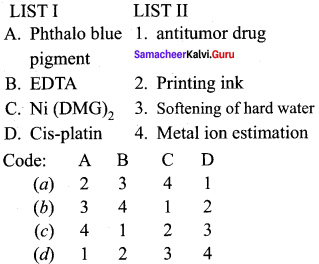
2. This a bond formation increases the electron density in metal d orbitals and makes the metal electron rich.

3. In order to compensate for this increased electron density, a filled metal d – orbital interacts with the empty n orbital on the carbonyl ligand and transfers the added electron density back to the ligand. This second component is called n back bonding.

4. Thus in metal, carbonyl, electron density moves from ligand to metal through o bonding and from metal to ligand through Pi bonding, this synergic effect accounts for strong M ← CO bond in metal carbonyls.

Question 20.
Explain the medicinal applications of coordination compounds?
Answer:

  1. Ca – EDTA chelate is used in the treatment of lead and radioactive poisoning. This is for removing lead and radioactive metal ions from the body.
  2. Cis – platin is used as an anti tumor drug in cancer treatment

Samacheer Kalvi 12th Chemistry Coordination Chemistry 5 Marks Questions and Answers

Question 1.
Write the IUPAC name of the following complexes.

  1. [Ag(NH3)2]Cl
  2. [CO (en)2 Cl2]CI
  3. [Cu (NH3)4]SO4
  4. [CO (CO3) (NH3)4] Cl
  5. [Cr(NH3)3(H2O)3]Cl3

Answer:

  1. [Ag(NH3)2]Cl – Diammine Silver (I) Chloride
  2. [CO (en)2 Cl2]CI – Dichloridobis (ethane -1, 2- diamine) Cobalt (III) chloride.
  3. [Cu (NH3)4]SO4 – Tetraammine copper (II) Sulphate
  4. [CO (CO3) (NH3)4] Cl – Tetrammine carbanato cobalt (III) chloride
  5. [Cr (NH3)3 (H2O)3]Cl3 – Triammine tri aqua chromium (III) chloride

Question 2.
Explain about the geometrical isomerism in complexes having coordination number 4.
Answer:
1. Geometrical isomerism exists in heteroleptic complexes due to different possible three diamensional spatial arrangements of the ligands around the central metal atom. This type of isomerism exist in square planar tetrahedral complexes.

2. In square planar complexes of the form [M A2 B2 ]and [MA2BC]N+ where A, B and C are monodentate ligands and M is the central metal ion / atom.

3. Similar groups (A or B) present either on same side or on the opposite side of the central metal atom (M) give rise to two different geometrial isomers and they are called cis and trans isomers respectively.

4. The square planar complex of the type [M (XY)2] where XY is a bidentate ligand with two different coordinating atom also shows cis-trans isomerism.

5.  Square planar complex of the form [MABCD] also shows cis – trans isomerism. In this case, by considering any one of the ligands [A,B,C,D] as a reference, the rest of the ligands can be arranged in three different ways leading to three geometrical isomers.
Samacheer Kalvi 12th Chemistry Solutions Chapter 5 Coordination Chemistry-61

Question 3.
Explain about the geometrical isomerism of octahedral complexes with suitable example.
Answer:
1. Octahedral complexes of the type [M A2 B2], [M (xx)2 B2] shows cis-trans isomerism. Hence A and B are monodentate ligands and xx is bidentate ligand with two same kind of donor atoms. In the octahedral complex, the position of ligands is indicated by the. following numbering scheme.
Samacheer Kalvi 12th Chemistry Solutions Chapter 5 Coordination Chemistry-62

2. The positions (1,2) (1,3) (1,4) (1,5), (2,3) (2,5) (2,6), (3,4) (3,6) (4,5) (4,6) and (5,6) are identical and if two similar groups are present in any one of these positions, the isomer is referred as a cis-isomer.

3. Similarly positions (1,6), (2,4) and (3,5) are identical and if similar groups (or) ligands are present in these positions it is referred as a trans – isomer.

4. Octahedral complex of the type [MA3B3] also shows geometrical isomerism. If the three similar ligands (A) are present in the comers of one triangular face of the octahedron and the other 3 ligands (B) are present in the opposing triangular face, then the isomer is referred as a facial isomer (fac isomer).

5. If the three similar ligands are present around the meridian which is an imaginary semicircle from one apex of the octahedral to the opposite apex, the isomer is called a meridional isomer (mer is omer). This is called a meridional because each set of ligands can be regarded as lying on a meridian of an octahedran.

Question 4.
Describe about the postulate of VB theory (or) Valence bond theory.
Answer:
1. The ligand → metal bond in a coordination complex is covalent in nature. It is formed by the sharing of electrons between the central metal atom and electron donor ligand.

2. Each ligand should have atleast one filled orbital containing a lone pair of electrons.

3. In order to accommodate the electron pairs donated by the ligands, the central metal ion present in a complex provides required number of vacant orbitals.

4. These vacant orbitals of central metal atoms undergo hybridisation, the process of mixing of atomic orbitals of comparable energy to form equal number of new orbitals called hybridised orbitals with same energy.

5. The vacant hybridised orbitals of the central metal ion, linearly overlap with filled orbitals of the ligands to form coordinate covalent sigma bonds between the metal and the ligand.

6. The hybridised orbitals are directional and their orientation in space gives a definite geometry to the complex ion.
Samacheer Kalvi 12th Chemistry Solutions Chapter 5 Coordination Chemistry-63

7. In the octahedral complexes, if the (n-l)d orbitals are involved in hybridisation they are called inner orbital complexes or low spin complexes (or) spin paired complexes. If the nd orbitals are involved in hybridisation, such complexes are called outer orbital complexes (or) high spin (or) spin free complexes. Here “n” represents the principal quantum number of the outermost shell.

8. The complexes containing a central metal atom with unpaired electron (s) are paramagnetic. If all the electrons are paired, then the complexes will be diamagnetic.

9. Ligands such as CO, CN, en and NH3 present in the complexes cause pairing of electrons present in the central metal atom. Such ligands are called strong field ligands.

10. Greater the overlapping between, the ligand orbitals and the hybridised metal orbital, greater is the bond strength.

Question 5.
Explain the hybridisation, magnetic property, geometry, magnetic moment of [Ni (CO)4] Using valence bond theory
Answer:
Samacheer Kalvi 12th Chemistry Solutions Chapter 5 Coordination Chemistry-71

Question 6.
Explain the hybridisation, geometry, magnetic property and magnetic moment of [Ni (CN)4]2- using valence bond theory.
Answer:
Samacheer Kalvi 12th Chemistry Solutions Chapter 5 Coordination Chemistry-72

Question 7.
Using VB theory, explain the type of hybridisation, geometry, magnetic property and magnetic moment of [Fe (CN)6]3-.
Answer:
Samacheer Kalvi 12th Chemistry Solutions Chapter 5 Coordination Chemistry-65

Question 8.
Explain the hybridisation, geometry, magnetic property and magnetic moment [CO F6]3-
Answer:
Samacheer Kalvi 12th Chemistry Solutions Chapter 5 Coordination Chemistry-66

Question 9.
Explain about crystal field theory.
Answer:

  1. Crystal field theory assumes that the bond between the ligand and the central metal atom is purely ionic, i.e., the bond is framed due to the electrostatic attraction between the electron rich ligand and electron deficient metal.
  2. In the coordination compounds, the central metal atom/ion and the ligands are considered as point charges (or) electric dipoles.
  3. cording to crystal field theory, the complex formation is considered as the following series of hypothetical steps.

Step 2:
The ligands are approaching the metal atom in actual bond directions. Consider an octahedral field, in which the central metal ion is located at the origin and six ligands are coming from the +x, -x, +y, -y , +z and -z directions. The orbitals lying along the axes dx2 – y2 and dz2orbitals will experience strong repulsion and raise in energy to a greater extent than the orbitals with lobes directed between the axes (dxy, dyz and dxz). Thus the degenerate d orbitals now split into two sets and the process is called crystal field splitting.

Step 3:
Upto this point the complex formation would not be favoured. However when the ligands approach further, there will be an attraction between the negatively charged electron and the positively charged metal ion that results in a net decrease in energy. This decrease in energy is the driving force for the complex formation.

Question 10.
Describe about the crystal field splitting in tetrahedral complex.
Answer:
1. Consider a cube in which the central metal atom is placed at its centre (i.e., origin of the coordinate axis). The four ligands approach the central metal atom along the direction of the leading diagonals from the alternate comers of the cube.

2. In this field, the t2g orbitals (dxy, dyz and dzx) are pointing close to the direction in which ligands are approaching than the ‘eg’ orbitals. (dx2 – y2 and dz2). As a result, the energy of t2g orbitals increases by 2/5 ∆t and that of ‘e’ orbitals decreases by 3/5 ∆t as shown in the figure. This splitting is inverted when compared to octahedral field.
Samacheer Kalvi 12th Chemistry Solutions Chapter 5 Coordination Chemistry-67

Question 11.
How would you calculate crystal field stabilization energy (CBSE) for [Fe (H2O)6]3+. Complex: [Fe(H2O)6]3+
Answer:
Samacheer Kalvi 12th Chemistry Solutions Chapter 5 Coordination Chemistry-68

Question 12.
How would you measure CBSE for [Fe (CN)6]3-.
Answer:
Samacheer Kalvi 12th Chemistry Solutions Chapter 5 Coordination Chemistry-69

Question 13.
Explain about the classification of metal carbonyls with suitable examples. Classification:
Answer:
1. based on the number of metal atoms present. Depending upon the number of metal atoms present in a metalic carbonyl, they are classified as follows.
(a) Mono nuclear carbonyls. These compounds contain only one metal atom and have simple structures. For e.g., [Ni (CO)4] Nickel tetra carbonyl is tetrahedral, [Fe (CO)5] Iron pentacarbonyl is trigonalbipyramidal. [Cr (CO)6] Chromium hexacarbonyl is octahedral.

(b) Poly nuclear carbonyls Metallic carbonyls containing two or more metal atoms are called poly nuclear carbonyls. Poly nuclear metal carbonyls may be –
Homonuclear – ([CO2 (CO)6], [Mn2(CO)10], [Fe3(CO)12])
Fletero nuclear – ([MnCO (CO)9], [MnRe (CO)10])
Samacheer Kalvi 12th Chemistry Solutions Chapter 5 Coordination Chemistry-70
2. based on structure. The structures of binuclear metal carbonyls involve either metal – metal bonds or bridging Co groups or both. The carbonyl ligands that are attached to only one metal atom are referred to as terminal carbonyl groups, whereas those attached to two metal atoms simultaneously are called bridging carbonyls. Depending upon the structures of metal metal carbonyls they are classified as follows:
Samacheer Kalvi 12th Chemistry Solutions Chapter 5 Coordination Chemistry-71

(a) Non – bridged metal carbonyls.
Example:- [Ni (CO)4]
These metal carbonyls do not contain any bridging carbonyl lieands. Thev mav be of two tvnes. Non- bridged metal carbonyls which contain terminal carbonyls as well as Metal- Metal bonds. For examples,The structure of Mn2(CO)10 . Contains one metal – metal bond, so the formula is more correctly represented as (CO)5Mn – Mn(CO)5.

(b) Bridged carbonyls:
These metal carbonyl contain one or more bridging carbonyl ligands along with terminal carbonyl ligands and one or more metal – metal bonds For Example: Fe (CO)9 Di-iron ennea carbonyl molecule consists of three CO ligands, six terminal CO groups and single Fe – Fe A bond formed by weak coupling of the unpaired electrons present in two 3d orbitals of 2 Fe atoms. The bond represented by dotted line is called fractional single bond.
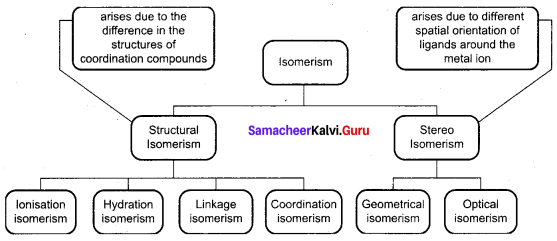
Samacheer Kalvi 12th Chemistry Solutions Chapter 5 Coordination Chemistry-72

Question 14.
Explain about the importance and application of coordination complexes.
Answer:
1. Phthalo blue – a bright blue pigment is a complex of copper (II) ion and it is used in printing ink and packaging industry.

2. Purification of Nickel by Mond’s process involves formation of [Ni (CO)4] which yields 99.5% pure on decomposition.

3. EDTA is used as a chelating ligand for the separation of lanthanides, in softening of hard water and also in removing lead poisoning.

4. Coordination complexes are used in the extraction of silver and gold from their ores by forming soluble cyano complex. These cyano complexes are reduced by zinc to yield metals. This process is called Mac – Arthur Forrest cyanide process.

5. Some metal ions are estimated more accurately by complex formation. For eg., Ni2+ present in Nickel chloride solution is estimated accurately forming an insoluble complex called [Ni (DMG)2],

6. Many of the complexes are used as catalyst in organic and inorganic reactions. For e.g.,

  • Wilkinson’s Catalyst – [(PPh3)3 Rh Cl] is used for hydrogenation of alkenes.
  • Ziegler – Natta Catalyst [TiCl4 + Al (C2H5)3] is used in the polymerisation of ethene.

7. In photography, when the developed film is washed with sodium thio sulphate solution (hypo), the negative film gets fixed. Undecomposed AgBr forms a soluble complex called sodium dithio sulphate argentate (I) which can be removed easily by washing the film with water.
AgBr + 2Na2S2O3 → Na3 [Ag (S2O3)2] + 2NaBr

Question 15.
Write the formulae for the following coordination compounds:
Answer:

  1. Tetraamminediaquacobalt (III) chloride.
  2. Potassium tetracyanonickelate (II).
  3. Tris ( ethane – 1, 2 – diamine ) chromium (III) chloride.
  4. Amminebromidochloridonitrito – N – platinate (II).
  5. Dichlorobis(ethane – 1, 2 – diamine ) platinum (IV) nitrate.
  6. Iron (III) hexacyanoferrate (II)

Answer:

  1. [CO(NH3)4(H2O)2]Cl3
  2. K2[Ni(CN)4]
  3. [Cr(en)3]Cl3
  4. [Pt(NH3)BrCl(NO2)]
  5. [PtCl2(en)2](NO3)2
  6. Fe4[Fe(CN)6]3

Question 16.
Write the IUPAC names of the following:

  1. [CO(NH3)6]Cl3
  2. [CO(NH3)5Cl]Cl2
  3. K3[Fe(CN)6]
  4. K3[Fe(C2O4)3]
  5. K2[PdCl4]
  6. [Pt(NH3)2Cl(NH2CH3)]Cl

Answer:

  1. Hexaamine cobalt (III) chloride
  2. Pentaamine chloridocobalt (III) chloride
  3. Potassium hexacyanoferrate (III)
  4. Potassium trioxalatoferrate (III)
  5. Potassium tetrachlorido palladate (II)
  6. Diamminechlorido (methylamine) platinum (II) chloride

Question 17.
Indicate the types of isomerism exhibited by the following complexes and draw the structures for these isomers:

  1. K[Cr(H2O)2(C2O4)2]
  2. [CO(NH)3Cl]Cl2
  3. K3[Fe(CN)6]
  4. K3[Fe(C2O4)3]
  5. K2[PdCl4]
  6. [Pt(NH3)2Cl(NH2CH3)]Cl

Answer:
1. Both geometrical (cis, trans) and optical isomer for cis – form.
Samacheer Kalvi 12th Chemistry Solutions Chapter 5 Coordination Chemistry-73

2. Two optical isomers can exist.
Samacheer Kalvi 12th Chemistry Solutions Chapter 5 Coordination Chemistry-74

3. Linkage isomers [CO(NH3)5ONO](NO3)2 and [CO(NH3)5NO2](NO3)2

4. Geometrical isomerism.
Samacheer Kalvi 12th Chemistry Solutions Chapter 5 Coordination Chemistry-75

Question 18.
Give evidence that [CO(NH3)5Cl]SO4 and [CO(NH3)5SO4]Cl are ionisation isomers.
Answer:
When they are dissolved in water, they will give different ions in the solution which can be tested by adding AgNO3 solution and BaCl2 solution. When Cl ions are the counter ions, a white precipitate will be obtained with AgNO3 solution. If SO42- ions are the counter ions, a white precipitate will be obtained with BaCl2 solution.
Samacheer Kalvi 12th Chemistry Solutions Chapter 5 Coordination Chemistry-76

Question 19.
Explain on the basis of valence bond theory that [NI(CN)4]2- ion with square planar structure is diamagnetic and the [NI(CN)4]2- ion with tetrahedral geometry is paramagnetic.
Answer:
Nickel in [NI(CN)4]2- is in the +2 oxidation state, i.e. nickel is present as Ni2+ ion. dsp2 – hybrid orbitals
Samacheer Kalvi 12th Chemistry Solutions Chapter 5 Coordination Chemistry-77

CN is a strong ligand as it approaches the metal ion, So the electrons should getd paired up.
Samacheer Kalvi 12th Chemistry Solutions Chapter 5 Coordination Chemistry-78

In [NI(CN)4]2-, Cl provides a weak ligand field. It is therefore unable to pair up the unpaired electrons of the 3d orbital.
Samacheer Kalvi 12th Chemistry Solutions Chapter 5 Coordination Chemistry-79
Hence the hybridisation is sp3, and it is para¬magnetic.

Question 20.
[NI(CN)4]2- is paramagnetic while [Ni(CO)4]3- is diamagnetic though both are tetrahedral. Why?
Answer:
In [NI(CN)4]2-, Ni is in +2 oxidation state with electronic configuration = 3d84s°.
Samacheer Kalvi 12th Chemistry Solutions Chapter 5 Coordination Chemistry-80
Cl is a weak ligand. It cannot pair up the electrons in 3d orbitals. Hence, it is paramagnetic. In [Ni(CO)4], Ni is in zero oxidation state and its configuration is -3d84S2. In the presence of CO ligand the 4s electrons shift to 3d orbital to pair up the 3d electrons. Thus, there is no unpaired electron present. Hence it is diamagnetic.

Question 21.
[Fe(H2O)6]3+ is strongly paramagnetic whereas [Fe(CN)6]3- is weakly paramagnetic. Explain.
Answer:
In both the complexes, Fe is in +3 oxidation state with the configuration 3d5. CN is a strong field ligand. In its presence, 3d electrons pair up leaving only one unpaired electron. The hybridisation is d2sp3 forming inner orbital complex. H2O is a weak ligand. In its presence 3d electrons do not pair up. The hybridisation is sp3d2 forming an outer orbital complex containing five unpaired electrons, hence it is strongly paramagnetic.

Question 22.
Explain [CO(NH3)6]3+ is an inner orbital complex whereas [Ni(NH3)6]2+ is an outer orbital complex.
Answer:
In [CO(NH3)6]3+, oxidation state of CO = +3 Electronic configuration = 3 d6
In presence of NH3, 3d electrons pair up leaving two d-orbitais empty. Hence, the hybridisation is d2p2 forming an inner orbital complex. In [Ni(NH3)6]2+.

Oxidation state = +2, Electronic Configuration = 3d8. In the presence of NH3, 3d electrons do not pair up. The hybridisation involved is , s3d2 and it forms an outer orbital complex.

Question 23.
Predict the number of unpaired electrons in the square planar [Pt(CN)4]2- ion.
Answer:
Electronic Configuration of Pt = 5d96s1
Samacheer Kalvi 12th Chemistry Solutions Chapter 5 Coordination Chemistry-81
For square planar shape, hybridisation = dsp2
Hence, the unpaired electron in 5d – orbital pair up to make one d-orbital empty for dsp2 hybridisation. Thus, there is no unpaired electron.

Question 24.
[Cr(NH3)6]3+ is paramagnetic while [Ni(CN)4]2-is diamagnetic. Explain why?
Answer:
Cr(24): [Ar] 4s13d5
Cr3+(24): [Ar] 4s° 3d3
Samacheer Kalvi 12th Chemistry Solutions Chapter 5 Coordination Chemistry-82

It is paramagnetic due to the presence of unpaired electrons.
Samacheer Kalvi 12th Chemistry Solutions Chapter 5 Coordination Chemistry-83

It has a square planar structure, and it is diamagnetic due to the absence of unpaired electrons.

Question 25.
Write down the IUPAC name for each of the following complexes and indicate the oxidation state, electronic configuration and coordination number. Also give stereo – chemistry and magnetic moment of the complex.

  1. K[Cr(H2O)2 (C2O4)2]. 3H2O
  2. [CO(NH3)5Cl]Cl2
  3.  CrCl3(py)3
  4. Cs[FeCl4]
  5. K4[Min(CN)6]

Answer:
1. Potassium diaquabis (oxalato) chromate (III) trihydrate.
Cordination no. =6
Shape = Octahedral
Oxidation state of Cr = x + 0 + 2 (-2) = -1
(or)
x – 4 = – 1
(or)
x = + 3
Electronic configuration of Cr3+ = 3d3 = t2g 3eg0
No. of unpaired electrons (n) = 3
Magnetic moment (µ) = \(g\sqrt { n(n+2) } \) = \(g\sqrt { 3(5) } \) = \(g\sqrt { 15 } \) BM = 3.87BM

2. Pentaamminechloro cobalt (III) chloride Cordination no. of CO = 6
Shape = Octahedral Oxidation state of CO = x + 0 -1 = +2
(or)
x = +3
Electronic configuration of CO3+ = 3d6 = t2g6 eg0
n = 0
Magnetic moment (p) = 0

3. Trichlorotripyridine chromium (III), Cordination no, of Cr = 6
Shape = Octahedral Oxidation state of Cr =x – 3 + 0 = 0
x = +3
Electronic configuration of Cr3+ = 3d3 = t2g 3eg0
n = 3
Magnetic moment (µ) = \(g\sqrt { n(n+2) } \) = \(g\sqrt { 3(5) } \) = \(g\sqrt { 15 } \) BM = 3.87BM

4. Caesium tetrachloroferrate (III), Cordination no. of Fe =4
Shape = Tetrahedral Oxidation state of Fe = x – 4 = -1
x = + 3
Electronic configuration of Fe3+ = 3d5 = e2 t23
n = 5
(µ) = \(g\sqrt { 5(5+2) } \) = \(g\sqrt { 3(5) } \) = 5.92 BM

5. Potassium hexacyanomanganate (II), Cordination no. of Mn = 6
Shape = Octahedral Oxidation state of Mn = x – 6 = -4
x = +2
Electronic configuration of Mn2+ = 3d5 = t2g 5eg0
n =1
(µ) = \(g\sqrt { 1(1+2) } \) = \(g\sqrt { 3 } \) BM = 1.73 BM

Question 26.
How to find out stability constant by stepwise method?
Answer:
When a free metal ion is in aqueous medium, it is surrounded by (coordinated with) water molecules. It is represented as [MS6]. If ligands which are stronger than water are added to this metal salt solution, coordinated water molecules are replaced by strong ligands. Let us consider the formation of a metal complex ML6 in aqueous medium.(Charge on the metal ion is ignored) complex formation may occur in single step or step by step.
If ligands added to the metal ion in single step, then
[MS6]+6L \(\equiv\) [ML6]+6S
Samacheer Kalvi 12th Chemistry Solutions Chapter 5 Coordination Chemistry-84
βoverall is called as overall stability constant. As solvent is present in large excess, its concentration in the above equation can be ignored.
Samacheer Kalvi 12th Chemistry Solutions Chapter 5 Coordination Chemistry-84

If these six ligands are added to the metal ion one by one, then the formation of complex [ML6] can be supposed to take place through six different steps as shown below. Generally step wise stability constants are represented by the symbol k.
Samacheer Kalvi 12th Chemistry Solutions Chapter 5 Coordination Chemistry-85
Common Errors

  1. Complex salt and double salt- Students get confused
  2. Ligands name get confused
  3. IUPAC names may be difficult.

Rectifications

  1. Complex salt and double salt- Students get confused Complex salt have double brackets and double salt have no brackets.
  2. Ligands name get confused Neutral ligand names are different. Negative ligand names ends with letter ‘O’. Positive ligand names ends with ‘ium’.
  3. IUPAC names may be difficult. Cationic complex name starts with ligands name and Anionic complex names starts with first element whatever present.

Hope you love the Samacheer Kalvi 12th Chemistry Chapter Wise Material. Clearly understand the deep concept of Chemistry learning with the help of Tamilnadu State Board 12th Chemistry Chapter 5 Coordination Chemistry Questions and AnswersPDF. Refer your friends to and bookmark our website for instant updates. Also, keep in touch with us using the comment section.

Samacheer Kalvi 11th Computer Science Solutions Chapter 14 Classes and Objects

Students can Download Computer Science Chapter 14 Classes and Objects Questions and Answers, Notes Pdf, Samacheer Kalvi 11th Computer Science Book Solutions Guide Pdf helps you to revise the complete Tamilnadu State Board New Syllabus and score more marks in your examinations.

Tamilnadu Samacheer Kalvi 11th Computer Science Solutions Chapter 14 Classes and Objects

Samacheer Kalvi 11th Computer Science Classes and Objects Text Book Back Questions and Answers

PART – 1
I. Choose The Correct Answer

Question 1.
The variables declared inside the class are known as data members and the functions are known as ………………..
(a) data functions
(b) inline functions
(c) member functions
(d) attributes
Answer:
(c) member functions

Question 2.
Which of the following statements about member functions are True or False?
(i) A member function can call another member function directly with using the dot operator.
(ii) Member function can access the private data of the class.
(a) (i) – True, (ii) – True
(b) (i) – False, (ii)-True
(c) (i) – True, (ii) – False
(d) (i) – False, (ii) – False
Answer:
(a) (i) – True, (ii) – True

Question 3.
A member function can call another member function directly, without using the dot operator called as ………………..
(a) sub function
(b) sub member
(c) nesting of member function
(d) sibling of member function
Answer:
(c) nesting of member function

Samacheer Kalvi 11th Computer Science Solutions Chapter Classes and Objects

Question 4.
The member function defined within the class behave like ………………..
(a) inline function
(b) Non – inline function
(c) Outline function
(d) Data function
Answer:
(a) inline function

Question 5.
Which of the following access specifier protects data from inadvertent modifications?
(a) Private
(b) Protected
(c) Public
(d) Global
Answer:
(b) Protected

Question 6.
class x
{
int y; public:
x(int z){y=z;}
}x1[4];
int main()
{x x2(10);
return 0;}
How many objects are created for the above program?
(a) 10
(b) 14
(c) 5
(d) 2
Answer:
(c) 5

Question 7.
State whether the following statements about the constructor are True or False.
(i) constructors should be declared in the private section.
(ii) constructors are invoked automatically when the objects are created.
(a) True, True
(b) True, False
(c) False, True
(d) False, False
Answer:
(c) False, True

Samacheer Kalvi 11th Computer Science Solutions Chapter Classes and Objects

Question 8.
Which of the following constructor is executed for the following prototype?
add display( add &);  // add is a class name
(a) Default constructor
(b) Parameterized constructor
(c) Copy constructor
(d) Non Parameterized constructor
Answer:
(d) Non Parameterized constructor

Question 9.
What happens when a class with parameterized constructors and having no default constructor is used in a program and we create an object that needs a zero – argument constructor?
(a) Compile – time error
(b) Domain error
(c) Runtime error
(d) Runtime exception
Answer:
(d) Runtime exception

Question 10.
Which of the following create a temporary instance?
(a) Implicit call to the constructor
(b) Explicit call to the constructor
(c) Implicit call to the destructor
(d) Explicit call to the destructor
Answer:
(b) Explicit call to the constructor

PART – 2
II. Answers to all the questions

Question 1.
What are called members?
Answer:
Class comprises of members. Members are classified as Data Members and Member functions. Data members are the data variables that represent the features or properties of a class. Member functions are the functions that perform specific tasks in a class.

Question 2.
Differentiate structure and class though both are user defined data type.
Answer:
The only difference between structure and class is the members of structure are by default public where as it is private in class.

Samacheer Kalvi 11th Computer Science Solutions Chapter Classes and Objects

Question 3.
What is the difference between the class and object in terms of OOP?
Answer:
Object:

  • Object is an instance of a class.
  • Object is a real world entity such as pen, laptop, mobile, chair etc.
  • Object allocates memory when it is created.

Class:

  • Class is a blueprint or template from which objects are created.
  • Class is a group of similar objects.
  • Class doesn’t allocate memory when it is created.

Question 4.
Why it is considered as a good practice to define a constructor though compiler can automatically generate a constructor?
Answer:
Declaring a constructor with arguments hides the compiler generated constructor. After this we cannot invoke the compiler generated constructor.

Question 5.
Write down the importance of destructor.
The purpose of the destructor is to free the resources that the object may have acquired during its lifetime. A destructor function removes the memory of an object which was allocated by the constructor at the time of creating a object.

PART – 3
III. Answers to all the questions

Question 1.
Rewrite the following program after removing the syntax errors if any and underline the errors:
Answer:
Samacheer Kalvi 11th Computer Science Solutions Chapter 14 Classes and Objects 1

Question 2.
Write with example how will you dynamically initialize objects?
When the initial values are provided during runtime then it is called dynamic initialization.
Example to illustrate dynamic initialization
Answer:
Samacheer Kalvi 11th Computer Science Solutions Chapter 14 Classes and Objects 2
Output:
Enter the Roll Number 1201
Enter the Average 98.6
Roll number:- 1201
Average :- 98.6

Question 3.
What are advantages of declaring constructors and destructor under public accessability?
Answer:
When constructor and destructor are declared under public:

  1. we can initialize the object while declaring it.
  2. we can explicitly call the constructor.
  3. we can overload constructor and therefore use multiple constructors to initialize objects automatically.
  4. we can destroy the objects at the end of class scope automatically (free unused memory).

However, some C++ compiler and Dev C++ do not allow to declare constructor and destructor under private section. So it is better to declare constructor and destructor under public section only.

Question 4.
Given the following C++ code, answer the questions (i) & (ii).
Answer:
class TestMeOut
{

public:
~TestMeOut() //Function 1 {cout << “Leaving the examination hall” << endl;}
TestMeOut() //Function 2
{cout<<“Appearing for examination”<<endl;}
void MyWork() //Function 3
{cout<<“Attempting Questions//<<endl;}

};
1. In Object Oriented Programming, what is Function 1 referred as and when does it get invoked / called?
2. In Object Oriented Programming, what is Function 2 referred as and when does it get invoked / called?
Answer:
1. Function 1 is the ‘destructor’.
It is executed automatically when an object of the class TestMeOut goes out of scope.

2. Function 2 is called default ‘constructor’.
It is executed automatically when instance of the class TestMeOut comes into scope or when objects of the class TestMeOut are created.

Question 5.
Write the output of the following C++ program code :
Answer:
Samacheer Kalvi 11th Computer Science Solutions Chapter 14 Classes and Objects 3
Output:
B#0
I#1
G#1

PART – 4
IV. Answers to all the questions

Question 1.
Explain nested class with example.
Answer:
When one class become the member of another class then it is called Nested class and the relationship is called containership. When a class is declared within another class, the inner class is called as Nested class (i.e. the inner class) and the outer class is known as Enclosing class. Nested class can be defined in private as well as in the public section of the Enclosing class.

Classes can be nested in two ways:

  1. By defining a class within another class
  2. By declaring an object of a class as a member to another class
  3. By defining a class within another class

C++ program to illustrate the nested class
Samacheer Kalvi 11th Computer Science Solutions Chapter 14 Classes and Objects 4
Output:
The product of 3*2 = 6
The product of 4*4 = 16
The product of 2*2=4

By declaring an object of a class as a member to another class Whenever an object of a class is declared as a member of another class, it is known as a container class. In the containership the object of one class is declared in another class.
Samacheer Kalvi 11th Computer Science Solutions Chapter 14 Classes and Objects 5

Question 2.
Mention the differences between constructor and destructor.
Answer:
Constructor:

  • The name of the constructor must be same as that of the class.
  • No return type can be specified for constructor.
  • A constructor can have parameter list.
  • The constructor function can be overloaded.
  • They cannot be inherited but a derived class can call the base class constructor.
  • The compiler generates a constructor, in the absence of a user defined constructor.

Destructor:

  • The destructor has the same name as that of the class prefixed by the tilde character
  • It has no return type.
  • The destructor cannot have arguments
  • Destructors cannot be overloaded i.e., there can be only one destructor in a class.
  • They cannot be inherited.
  • In the absence of user defined destructor, it is generated by the compiler.

Question 3.
Define a class RESORT with the following description in C++ :
Answer:
Private members:

  1. Rno // Data member to store room number.
  2. Name // Data member to store user name.
  3. Charges // Data member to store per day charge.
  4. Days //Data member to store the number of days.
  5. Compute () // A function to calculate total amount as Days * Charges and if the //total amount exceeds 11000 then total amount is 1.02 * Days ’’’Charges.

Public member:
getinfo() // Function to Read the information like name, room no, charges and days dispinfo () // Function to display all entered details and total amount calculated
//using COMPUTE function
//include
//include
//include
Class RESORT
{

Private:
int Rno;
char name [20];
float charges; int days; float compute();
Public:
void getinfoO;
void dispinfo();

}
void RESORT: : getinfo()
{

cout << “Enter Registration number:”; cin >> Rno.;
cout << “\n Enter name:”; gets(name);
cout << “\n Enter per day charges:”; cin >> charges;
cout << “\n Enter number of days:”; cin >> days;

}
void RESORT: : dispinfo()

{

cout << “\n1. Registration number:” << Rno << “\n2. Name:”; puts(name);
cout << “\n3. charges per day:” << charges << “\n4. Number of days:” <<days;
cout<< “\n5. Amount:” << compute();

}
long float;
amount = charges*days;
if (amount> 11000)
amount = 1,02*days*charges;
return amount;
}
RESORT obj;
void main()
{

clrscr();
obj.getinfo();
obj.dispinfoQ;
getch();

}

Question 4.
Write the output of the following.
Answer:
Samacheer Kalvi 11th Computer Science Solutions Chapter 14 Classes and Objects 6
Output:
Constructing Subject
Constructing Student
Constructing Admission
Back to main()
Subject number Days:
Constructing the object
d= 150, Sn= 12
Constructing the object of students
Enter the roll number and the marks secured
mo: 12345 marks: 438
Constructing the object of admission
fees: 20000
Back in main()

Question 5.
Write the output of the following.
Answer:
Samacheer Kalvi 11th Computer Science Solutions Chapter 14 Classes and Objects 7
Output:
Constructor of class P
Constructor of class Q
Constructor of class R
Constructor of class Q
Constructor of class P
Destructor of class P
Destructor of class Q
Destructor of class R
Destructor of class Q
Destructor of class P

Samacheer kalvi 11th Computer Science Arrays and Structures Additional Questions and Answers

PART – 1
I. Choose the correct answer

Question 1.
The most important feature of C++ is ………………..
(a) object
(b) class
(c) public
(d) All the above
Answer:
(b) class

Question 2.
Objects are also called as ………………..
(a) instance of class
(b) class
(c) function
(d) scope
Answer:
(a) instance of class

Question 3.
Calling a member function of an object is also known as ……………….. to object.
(a) call function
(b) call by value
(c) call by reference
(d) sending message
Answer:
(d) sending message

Samacheer Kalvi 11th Computer Science Solutions Chapter Classes and Objects

Question 4.
Objects are passed as arguments to a ………………..
(a) call by value
(b) call by reference
(c) member function
(d) global variable
Answer:
(c) member function

Question 5.
When one class become the member of another class, the relationship is called ………………..
(a) containership
(b) partnership
(c) friendship
(d) all the above
Answer:
(a) containership

Question 6.
When a class is declared within another class, the inner class is called ……………….. and the outer class is called ………………..
(a) enclosing class, nested class
(b) nested class, enclosing class
(c) first class, second class
(d) A class, B class
Answer:
(b) nested class, enclosing class

Question 7.
……………….. can be defined either in private or in public section of a class.
(a) Object
(b) Data type
(c) Memory
(d) constructor
Answer:
(d) constructor

Question 8.
A constructor which can take arguments is called ………………..
(a) parameterised constructor
(b) default constructor
(c) copy constructor
(d) destructor
Answer:
(a) parameterised constructor

Question 9.
There are ……………….. ways to create an object using parameterized constructor.
(a) 3
(b) 2
(c) 1
(d) 4
Answer:
(c) 1

Samacheer Kalvi 11th Computer Science Solutions Chapter Classes and Objects

Question 10.
the name of the symbol is ………………..
(a) hash
(b) arrow
(c) tilde
(d) bracket
Answer:
(c) tilde

PART – 2
II. Very Short Answers

Question 1.
Define methods of a class and write its types.
Answer:
Class comprises of members. Member functions are called as methods. The member functions of a class can be defined in two ways.

  1. Inside the class definition
  2. Outside the class definition

Question 2.
What is global object?
Answer:
If an object is declared outside all the function bodies or by placing their names immediately after the closing brace of the class declaration then it is called as Global object. These objects can be used by any function in the program.

Question 3.
What is called as nesting of member functions?
Answer:
Only the public members of a class can be accessed by the object of that class, using dot operator. However a member function can call another member function of the same class directly without using the dot operator. This is called as nesting of member functions.

Question 4.
In the absence of user defined constructor, what will the constructor do?
Answer:
In the absence of user defined constructor the compiler automatically provides the default constructor. It simply allocates memory for the object.

Samacheer Kalvi 11th Computer Science Solutions Chapter Classes and Objects

Question 5.
What is parameterized constructor?
Answer:
A constructor which can take arguments is called parameterized constructor.This type of constructor helps to create objects with different initial values. This is achieved by passing parameters to the function.

Question 6.
What will be the output of the following program?
Answer:
Samacheer Kalvi 11th Computer Science Solutions Chapter 14 Classes and Objects 8
Out put:
151515

Question 7.
What will be the output for the following program?
Answer:
Samacheer Kalvi 11th Computer Science Solutions Chapter 14 Classes and Objects 9

PART – 3
III. Short Answers

Question 1.
Explain local object with an example.
Answer:
If an object is declared with in a function then it is called local object. It cannot be accessed from outside the function.
# include
# include
using namespace std
class add  //Global class
{
int a,b; public:
int sum; void
getdata()
{
a = 5; b = 10; sum
= a + b;
}
} a1;
add a2;
int main()
{
add a3;
a1.getdata();  //global object
a2.getdata();  //global object
a3.getdata();
cout << a1 .sum;  //Local object for a global class
cout << a2.sum;
cout << a3.sum;
return 0;   //public data member accessed from outside the class
}
Output:
151515

Question 2.
Explain scope resolution operator with an example.
Answer:
If there are multiple variables with the same name defined in separate blocks then :: (scope resolution) operator will reveal the hidden file scope (global) variable.
Samacheer Kalvi 11th Computer Science Solutions Chapter 14 Classes and Objects 10
Output:
120

Question 3.
What is constructor?
Answer:
The definition of a class only creates a new user defined data type. The instances of the class type should be instantiated (created and initialized). Instantiating object is done using constructor. An array or a structure in C++ can be initialized during the time of their declaration.

The initialization of class type object at the time of declaration similar to a structure or an array is not possible because the class members have their associated access specifiers (private or protected or public). Therefore Classes include special member functions called as constructors. The constructor function initializes the class object.

Samacheer Kalvi 11th Computer Science Solutions Chapter Classes and Objects

Question 4.
What are the functions of constructor?
Answer:
As we know now that the constructor is a special initialization member function of a class that is called automatically whenever an instance of a class is declared or created. The main function of the constructor is

  1. To allocate memory space to the object and
  2. To initialize the data member of the class object

Question 5.
Explain default constructor with an example.
Answer:
A constructor that accepts no parameter is called default constructor. For example in the class data program Data ::Data() is the default constructor. Using this constructor objects are created similar to the way the variables of other data types are created.

Example:
int num; //ordinary variable declaration
Data d1; // object declaration

Question 6.
What are the ways to create an object using parameterized constructor?
Answer:
There are two ways to create an object using parameterized constructor:
Implicit call:
In this method, the parameterized constructor is invoked automatically whenever an object is created. For example simple s1(10, 20); in this for creating the object s1 parameterized constructor is automatically invoked.

Explicit call:
In this method, the name of the constructor is explicitly given to invoke the parameterized constructor so that the object can be created and initialized.

Question 7.
When copy constructor is called?
Answer:
A copy constructor is called:

  1. When an object is passed as a parameter to any of the member functions. Example void simple::putdata(simple x);
  2. When a member function returns an object. Example simple getdata() {}
  3. When an object is passed by reference to an instance of its own class For example, simplest, s2(s1); // s2(s1) calls copy constructor.

Question 8.
Write the output of the following program.
Answer:
#include
using namespace std;
class simple
{
private:
int a, b;
public:
simple()
{
a= 0;
b= 0;
cout << “\n Constructor of class – simple”;
}
void getdata()
{
cout << “\n Enter values for a and b (sample data 6 and 7)…”; cin >> a >> b;
}
void putdata()
{
cout << “\nThe two integers are ..” << a << ‘\t’ << b << end1;
cout << “\n The sum of the variables” << a << “+” << b << “=” << a+b; }
~simple()
{ cout << “\n Destructor is executed to destroy the object”;}
};
int main()
{
simple s;
s.getdata();
s.putdata();
return 0;
}
Output:
Constructor of class – simple
Enter values for a and b (sample data 6 and 7)… 6 7
The two integers are .. 6 7
The sum of the variables 6 + 7 = 13
Destructor is executed to destroy the object

PART – 4
IV. Explain in Detail

Question 1.
Create a class called product with the following specifications.
Answer:
Private members:
code quantity – integer data type
price – float data type
get data() – function to accept values for all data members with no return

Public members:
tax – float
dispdata() member function to display code, quantity, price and tax. The tax is calculated as if the quantity is more than 150, tax is 3000, or else 1000.
Samacheer Kalvi 11th Computer Science Solutions Chapter 14 Classes and Objects 13

Question 2.
Explain pass by value with an example.
Answer:
When an object is passed by value the function creates its own copy of the object and works on it. Therefore any changes made to the object inside the function do not affect the original object.
Samacheer Kalvi 11th Computer Science Solutions Chapter 14 Classes and Objects 14
Output:
Example program for Pass by value
Value of object 1 before passing 10
Value of object 2 before passing 20
Changed value of object 1 100
Changed value of object 2 200
Value of object 1 after passing 10
Value of object 2 after passing 20

Question 3.
Explain pass by reference with an example.
Answer:
When an object is passed by reference, its memory address is passed to the function so the called function works directly on the original object used in the function call. So any changes made to the object inside the function definition are reflected in original object.
Samacheer Kalvi 11th Computer Science Solutions Chapter 14 Classes and Objects 15
Output:
Example program for Pass by reference
Value of object 1 before passing 10
Value of object 2 before passing 20
Changed value of object 1 100
Changed value of object 2 200
Value of object 1 after passing 100
Value of object 2 after passing 200

Question 4.
What are the ways to create an object using parameterized constructor with an example?
Answer:
There are two ways to create an object using parameterized constructor:
1. Implicit call : In this method, the parameterized constructor is invoked automatically whenever an object is created. For example simple s1( 10,20); in this for creating the object s1 parameterized constructor is automatically invoked.

2. Explicit call : In this method, the name of the constructor is explicitly given to invoke the parameterized constructor so that the object can be created and initialized.

#include
using namespace std;
class simple
{
private:
int a, b;
public:
simple(int m,int n)
{
a = m;
b = n;
cout << “\n Constructor of class – simple invoked for implicit and explicit call” << endl;
}
void putdata()
{
cout << “\n The two integers are…” << a << ‘\t’ << b << endl;
cout << “\n The sum of the variables” << a << “+” << b << “=” << a + b;
}
};
int main()
{
simple s1(10,20); //implicit call
simple s2 = simple(30,45); //explicit call
cout << “\n\t\tObject 1\n”;
s1.putdata();
s2.putdata();
return 0;
}
Output:
Constructor of class – simple invoked for implicit and explicit call
Constructor of class-simple invoked for implicit and explicit call

Object 1
The two integers are… 10 20
The sum of the variables 10 + 20 = 30

Object 2
The two integers are… 30 45.
The sum of the variables 30 + 45 = 75

Samacheer Kalvi 11th Computer Science Solutions Chapter Classes and Objects

Question 5.
Write the output of the following program.
Answer:
#include
using namespace std;
class simple
{
private:
int a, b;
public:
simple() //default constructor
{
a = 0; b = 0;
cout << “\n default constructor” << endl;
}
int getdata();
};
int simple :: getdata()
{int tot;
cout << “\n Enter two values”; cin >> a >> b;
}
tot = a + b; return tot;
}
int main()
{
int sum=0; simple s1[3];
cout << “\n\t\tObject 1 with both values \n”;
for (int i=0;i<3;i++)
sum+=s 1 [i]. getdata();
cout << “\nsum of all object values is” << sum;
return 0;
}
Output:
default constructor
default constructor
default constructor
Object 1 with both values
Enter two values 10 20
Enter two values 30 40
Enter two values 50 50
sum of all object values is 200
}

Tamil Nadu 11th Chemistry Model Question Paper 5 English Medium

Students can Download Tamil Nadu 11th Chemistry Model Question Paper 5 English Medium Pdf, Tamil Nadu 11th Chemistry Model Question Papers helps you to revise the complete Tamilnadu State Board New Syllabus and score more marks in your examinations.

TN State Board 11th Chemistry Model Question Paper 5 English Medium

Tamil Nadu 11th Chemistry Model Question Paper 5 English Medium

Part – I

Answer all the questions. [15 x 1 = 15]
Choose the most suitable answer from the given four alternatives.

Question 1.
How many equivalents of Sodium sulphate is formed when Sulphuric acid is completely neutralized with a base NaOH?
(a) 0.2
(b) 2
(c) 0.1
(d) 1
Answer:
(d) 1

Tamil Nadu 11th Chemistry Model Question Paper 5 English Medium 1
Question 2.
Consider the orbitals A, B and C, which as following n and l values,
A ⇒ n = 3 and l = 1
B ⇒ n = 4 and l = 2
C ⇒ n = 2 and l = 0
Arrange the orbitals in increasing energy level.
(a) C < B < A
(b) C < A < B
(c) A < B < C
(d) B < A < C
Answer:
(b) C < A < B

Tamil Nadu 11th Chemistry Model Question Paper 5 English Medium

Question 3.
The law of triads is obeyed by
(a) Fe, CO, Ni
(b) C, N, O
(c) He, Ne, Ar
(d) Al, Si, P
Answer:
(a) Fe, CO, Ni

Question 4.
Zeolite used to soften hardness of water is, hydrated
(a) Sodium aluminium silicate
(b) Calcium aluminium silicate
(c) Zinc aluminium borate
(d) Lithium aluminium hydride
Zeolite is sodium aluminium silicate. (NaAlSi2O6 H2O)
Answer:
(a) Sodium aluminium silicate

Question 5.
Assertion : Generally alkali and alkaline earth metals form superoxides.
Reason : There is a single bond between O and O in superoxides.
(a) both assertion and reason are true and reason is the correct explanation of assertion
(b) both assertion and reason are true but reason is not the correct explanation of assertion
(c) assertion is true but reason is false
(d) both assertion and reason are false
Answer:
(d) both assertion and reason are false

Tamil Nadu 11th Chemistry Model Question Paper 5 English Medium

Among alkali and alkaline earth metals, K, Rb and Cs alone forms superoxides. Superoxide O2- has 3 electron bond.
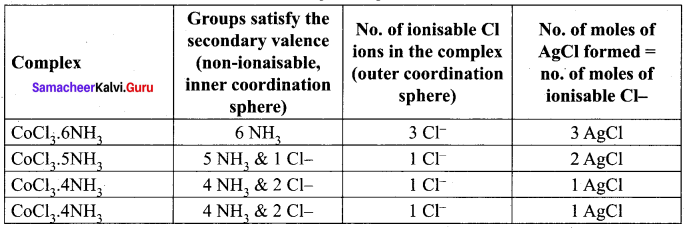
Question 6.
Rate of diffusion of a gas is
(a) directly proportional to its density
(b) directly proportional to its molecular weight
(c) directly proportional to its square root of its molecular weight
(d) inversely proportional to the square root of its molecular weight
Answer:
(d) inversely proportional to the square root of its molecular weight

Question 7.
The values of AH and AS for a reaction are respectively 30 kJ mol-1 and 100 JK 1 mol-1. Then the temperature above which the reaction will become spontaneous is:
(a) 300K
(b) 30K
(c) 100K
(d) 20°C
Answer:
(a) 300K

∆G = ∆H – T∆S
At 300 K, ∆G = 30000 J mol-1 – 300 K x 100 J K-1 mol-1
∆G = 0 above 300 K ; ΔG will be negative and reaction becomes spontaneous.

Question 8.
If x is the fraction of PCl5 dissociated at equilibrium in the reaction, PCl5 PCl3 + Cl2 then starting with 0.5 mole of PC15, the total number of moles of reactants and products at equilibrium is ……………………… .
(a) 0.5 – x
(b) x + 0.5
(c) 2x + 0.5
(d) x + l
Answer:
(b) x + 0.5

Tamil Nadu 11th Chemistry Model Question Paper 5 English Medium

Solution:

PCl5PC13Cl2
Initial no. of moles0.5
No . of moles dissociatedX
No. of moles at equilibrium0.5 – xXx

Total no. of moles at equilibrium = 0.5 – x + x + x = 0.5 + x

Question 9.
Which of the following concentration terms is/are independent of temperature?
(a) molality
(b) molarity
(c) mole fraction
(d) (a) and (c)
Answer:
(d) (a) and (c)

Tamil Nadu 11th Chemistry Model Question Paper 5 English Medium

Solution:
Molality and mole fraction are independent of temperature.

Question 10.
Which one of the following is a correct set?
(a) H2O, sp3, bent
(b) H2O, sp2, linear
(c) NH44+, dsp2, square planar
(d) CH4, dsp2, tetrahedral
Answer:
(a) H2O, sp3, bent

Question 11.
The IUPAC name of the compound is
Tamil Nadu 11th Chemistry Model Quest
(a) 2,3 – Diemethylheptane
(b) 3- Methyl -4- ethyloctane
(c) 5-ethyl -6-methyl octane
(d) 4- Ethyl -3 – methyloctane
Answer:
(d) 4- Ethyl -3 – methyloctane

Question 12.
Which of the following is correct order of the stability of carbocations?
(a) +CH3 > +CH2 CH2 > +CH(CH3)2 > +C(CH3)3
(b) +CH2CH3 > +CH3 > +CH(CH3)2 > +C(CH3)3
(c) +C(CH3)3 > +CH(CH3)2 > +CH2CH3 > +CH3
(d) +CH(CH3)2 > +CH3 > +CH2CH3 > +C(CH3)3
Answer:
(c) +C(CH3)3 > +CH(CH3)2 > +CH2CH3 > +CH3

Tamil Nadu 11th Chemistry Model Question Paper 5 English Medium

Question 13.
where A is,
(a) Zn
(b) Cone. H2SO4
(c) Ale. KOH
(d) Dil. H2SO4
Answer:
(c) Ale. KOH

Question 14.
Match the compounds given in Column I with suitable items given in Column II.

Column I (Compound)Column II (Uses)
A.Iodoform1.Fire extinguisher
B.Carbon tetrachloride2.Insecticide
C.CFC3.Antiseptic
D.DDT4.Refrigerants

Code:
(a) A → 2, B → 4, C → 1, D → 3
(b) A → 3, B → 2, C → M, D → 1
(c) A → 1, B → 2, C → 3, D → 4
(d) A → 3, B → 1, C → 4, D → 2
Answer:
(d) A → 3, B → 1, C → 4, D → 2

Tamil Nadu 11th Chemistry Model Question Paper 5 English Medium

Question 15.
Living in the atmosphere of CO is dangerous because it …………………………… .
(a) Combines with O2 present inside to form CO2
(b) Reduces organic matter of tissues
(c) Combines with haemoglobin and makes it incapable to absorb oxygen
(d) Dries up the blood
Answer:
(c) Combines with haemoglobin and makes it incapable to absorb oxygen

Part-II

Answer any six questions in which question No. 20 is compulsory. [6 x 2 = 12]

Question 16.
What is meant by plasma state? Give an example.
Answer:
The gaseous state of matter at very high temperature containing gaseous ions and free-electron is referred to as the Plasma state, e.g. Lightning.

Question 17.
Give the electronic configuration of Mn2+ and Cr3+.
Answer:
Mn (Z = 25) Mn → Mn2+ + 2e
Mn2+ electronic configuration is Is2 2s2 2p6 3s2 3p6 3d5
Cr (Z = 24) Cr → Cr3+ + 3e
Cr3+ electronic configuration is Is2 2s2 2p6 3s2 3p6 3d3

Tamil Nadu 11th Chemistry Model Question Paper 5 English Medium

Question 18.
Do you think that heavy water can be used for drinking purposes?
Answer:

  1. Heavy water (D2O) contains a proton and a neutron. This makes deuterium about twice as heavy as protium, but it is not radioactive. So heavy water is not radioactive.
  2. If you drink heavy water, you don’t need to worry about radiation poisoning. But it is not completely safe to drink, because the biochemical reaction in our cells are affected by the difference in the mass of hydrogen atoms.
  3. If you drink an appreciable volume of heavy water, you might feel dizzy because of the density difference. It would change the density of the fluid in your inner ear. So it is unlikely to drink heavy water.

Question 19.
Mention the methods used for liquefaction of gases.
Answer:

  1. Linde’s method: Joule-Thomson effect is used to get liquid air or any other gas.
  2. Claude’s process: In addition to Joule-Thomson effect, the gas is allowed to perform mechanical work so that more cooling is produced.
  3. Adiabatic process: This method of cooling is produced by removing the magnetic property of magnetic material e.g. Gadolinium sulphate. By this method, a temperature of 10-4 K i.e. as low as zero Kelvin can be achieved.

Question 20.
Calculate the entropy change of a process, possessing ΔHt = 2090 J mole-1. Sn(α, 13°C) = Sn(β, 13°C).
Answer:
Tamil Nadu 11th Chemistry Model Question Paper 5 English Medium 3

Tamil Nadu 11th Chemistry Model Question Paper 5 English Medium

Question 21.
What is reaction quotient?
Answer:
Consider a.homogeneous reversible reaction
For the above reaction under non-equilibrium conditions, reaction quotient Q is defined as the ratio of the product of active masses of reaction products raised to the respective stoichiometric coefficients in the balanced chemical equation to that of the reactants.

Under non equilibrium conditions,
Tamil Nadu 11th Chemistry Model Question Paper 5 English Medium 4

Question 22.
Write the structural formula for the following compounds,
(a) Cyclohexa-1,4-diene
(b) Ethynyl Cyclohexane
Answer:
Tamil Nadu 11th Chemistry Model Question Paper 5 English Medium 5

Question 23.
What are free radical initiators? Give an example.
Answer:
The types of reagents that promote homolytic cleavage in substrate are called as free radical initiators. They are short lived and are highly reactive.

Tamil Nadu 11th Chemistry Model Question Paper 5 English Medium

Example:

  • Azobisisobutyronitrile (AIBN)
  • Benzoyl peroxide

Question 24.
Complete the reaction and mention name of the reaction.
CH3CH2Br + (CH3)2 LiCu → ?
Answer:
This reaction is known as Corey-House Mechanism.

Part-III

Answer any six questions in which question No. 29 is compulsory. [6 x 3 = 18]

Question 25.
A compound contains 50% of X (atomic mass 10) and 50% Y (atomic mass 20). Give its empirical formula.
Answer:
Tamil Nadu 11th Chemistry Model Question Paper 5 English Medium 6
∴ The Empirical Formula is X2Y
Empirical Formula mass = 20 + 20 = 40
Molecular mass = Sum of atomic mass = 40
n = 1, Molecular formula = (Empirical Formula )n = (X2Y)1 = X2Y.

Question 26.
Explain Davisson and termer experiment.
Answer:

  • The wave nature of electron was experimentally confirmed by Davisson and Germer.
  • They allowed the accelerated beam of electrons to fall on a nickel crystal and recorded the diffraction pattern.
  • The resultant diffraction pattern is similar to the X-ray diffraction pattern.
  • The finding of wave nature of electron leads to the development of various experimental techniques such as electron microscope, low energy electron diffraction etc.

Tamil Nadu 11th Chemistry Model Question Paper 5 English Medium

Question 27.
What are the importance of hydrogen bonding in proteins?
Answer:

  • Hydrogen bonds occur in complex biomolecules such as proteins and in biological systems.
  • For example, hydrogen bonds play an important role in the structure of deoxyribonucleic acid (DNA), since it holds together the two helical nucleic acid chains.
  • In these systems, hydrogen bonds are formed between specific pairs, for example, with a thymine unit in one chain bonding to an adenine unit in another; similarly, a cytosine unit in one chain bonds to a guanine unit in another.
  • Intramolecular hydrogen bonding also plays an important role in the structure of polymers, both synthetic and natural.

Question 28.
What is the reason behind the cause of ear pain while climbing a mountain? How it can be rectified?
Answer:

  • When one ascends a mountain in a plain, the external pressure drops while the pressure within the air cavities remains the same. This creates an imbalance.
  • The greater internal pressure forces the eardrum to bulge outward causing pain.
  • With time and with the help of a yawn or two, the excess air within your ear’s cavities escapes thereby equalizing the internal and external pressure and relieving the pain.

Tamil Nadu 11th Chemistry Model Question Paper 5 English Medium

Question 29.
A mixture of gases contains 4.76 mole of Ne, 0.74 mole of Ar and 2.5 mole of Xe. Calculate the partial pressure of gases, if the total pressure is 2 atm, at a fixed temperature.
Answer:
Tamil Nadu 11th Chemistry Model Question Paper 5 English Medium 7

Question 30.
Write the various definition of first law of thermodynamics.
Answer:
The first law of thermodynamics states that “the total energy of an isolated system remains constant though it may change from one form to another” (or) Energy can neither be created nor destroyed, but may be converted from one form to another.

Tamil Nadu 11th Chemistry Model Question Paper 5 English Medium

Question 31.
How will you detect nitrogen from organic compounds?
Answer:
Detection of Nitrogen: The following reactions are involved in the detection of nitrogen with formation of prussian blue precipitate conforming the presence of nitrogen in an organic compound.
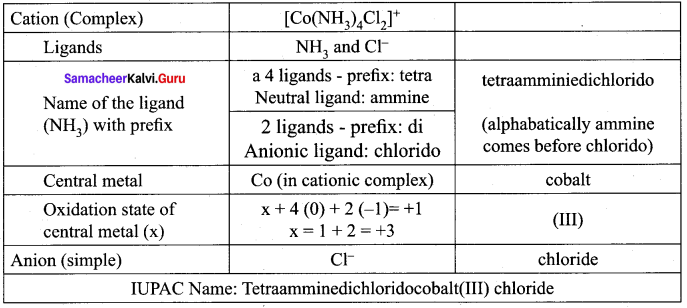
Tamil Nadu 11th Chemistry Model Question Paper 5 English Medium 8

Question 32.
Distinguish between carbocation and carbanion.
Answer:

CarbocationCarbanion
In a carbocation carbon bearing positive charge.In a carbanion carbon bearing negative charge.
Carbon bearing positive charge has sp2 hybridization.Carbon bearing negative charge has sp3 hybridization.
It has a planar structure.It has a pyramidal structure.
E.g.: CH3+, (CH3)2CH, (CH3)3C+etc.E.g.: CH3-CH2, CH3-CHO, (CH3)2CH etc.

Question 33.
What are particulate pollutants? Explain any three.
Answer:

  1. Particulate pollutants are small solid particles, and liquid droplets suspended in air. Examples: dust, pollen, smoke, soot and liquid aerosols.
  2. Types of Particulates: Particulates in the atmosphere may be of two types:
    • viable particulate and
    • non-viable particulate.
  3. The viable particulates are small size living organisms such as bacteria, fungi moulds and algae which are dispersed in air.
  4. The non-viable particulates are small solid particles and liquid droplets suspended in air. There are four types of non-viable particulates in the atmosphere. They are
    (a) Smoke (b) Dust (c) Mist (d) Fumes
  5. Smoke: Smoke particulate consists of solid particles formed by combustion of organic matter. For example, cigarette smoke, oil smoke, smokes from burning of fossil fuels, garbage arid dry leaves.
  6. Dust: ft is composed of fine solid particles produced during crushing and grinding of solid materials. For example, sand from sand blasting, saw dust from wood works and fly ash from power generating units.
  7. Mist: They are formed by particles of sprayed liquids and condensation of vapours in air. For example, sulphuric acid mist, herbicides and insecticides sprays can form mists.
  8. Fumes: They are obtained by condensation of vapours released during sublimation, distillation, boiling arid calcination and by several other chemical reactions. For example, organic solvents, metals and metallic oxides.

Tamil Nadu 11th Chemistry Model Question Paper 5 English Medium

Part – IV

Answer all the questions. [5 x 5 = 25]

Question 34.
(a) (i) The stabilization of a half-filled d-orbital is more pronounced than that of the p-orbital. Why? (3)
(ii) What are degenerate orbitals? (2)
[OR]
(b) (i) Explain the preparation of hydrogen using electrolysis. (3)
(ii) Why hydrogen gas is used as fuel? (2)
Answer:
(a) (i) The exactly half-filled orbitals have greater stability. The reason for their stability are.
1. symmetry
2. exchange energy.

1. Symmetry: The half filled orbitals are more symmetrical than partially filled orbitals and this symmetry leads to greater stability.

2. Exchange energy: The electrons with same spin in the different orbitals of the same subshell can exchange their position. Each such exchange release energy and this is known as exchange energy. Greater the number of exchanges, greater the exchange energy and hence greater the stability.

In d-orbital, 10 exchanges are possible but in p-orbital 6 exchanges are possible. So, d-orbital with 5 unpaired electrons (10 exchanges)n i.e. half filled is more stable than p-orbital with 3 unpaired electrons (6 exchanges).

Tamil Nadu 11th Chemistry Model Question Paper 5 English Medium

(ii)

  • Three different orientations in space that are possible for a p-orbital. All the three p-orbitals, namely px, py and pz have same energies and are called degenerate orbitals.
  • In the presence of magnetic or electric field, the degeneracy is lost.

[OR]

(b) (i) High purity of hydrogen (>99.9%) is obtained by the electrolysis of water containing traces of acid or alkali or electrolysis of aqueous solution of sodium hydroxide or potassium hydroxide using a nickel anode and iron cathode. This process is not economical for large scale production.

At anode: 2OH → H2O + ½ O2 + 2e
At cathode: 2H2O + 2e → 2OH + H2
Overall reaction: H2O → H2 + ½ O2

(ii) Hydrogen bums in air, virtually free from pollution and produces significant amount of energy. This reaction is used in fuel cells to generate electricity.
2H2(g) + O2(g) → 2H2 O(l) + energy

Tamil Nadu 11th Chemistry Model Question Paper 5 English Medium

Question 35.
(a) (i) What is lattice energy? (2)
(ii) Write down the Born-Haber cycle for the formation of CaCl2. (3)
[OR]
(b) (i) What is the effect of added inert gas on the reaction at equilibrium? (2)
(ii) Explain the equilibrium constants for heterogeneous equilibrium. (3)
Answer:
(a) (i) Lattice energy is defined as the amount of energy required to completely separate one mole of a solid ionic compound into gaseous constituent.
(ii) Born-Haber cycle for the formation of CaCl2.
Tamil Nadu 11th Chemistry Model Question Paper 5 English Medium 9

[OR]

(b) (i) When an inert gas (i.e., a gas which does not react with any other species involved in equilibrium) is added to an equilibrium system at constant volume, the total number of moles of gases present in the container increases, that is, the total pressure of gases increases, the partial pressure of the reactants and the products are unchanged. Hence at constant volume, the addition of inert gas has no effect on the equilibrium.
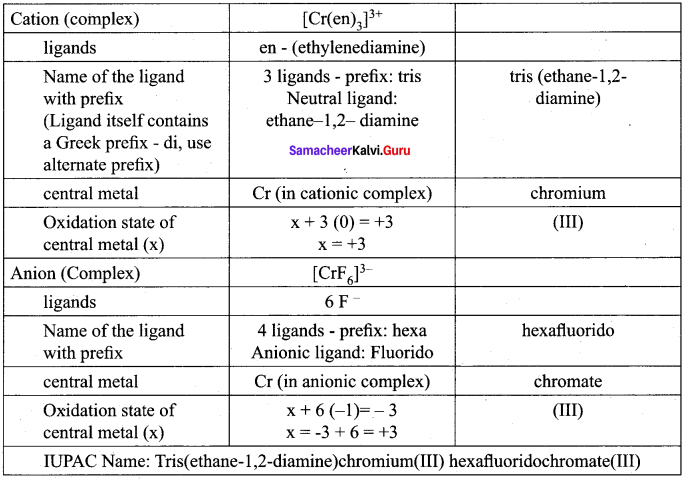
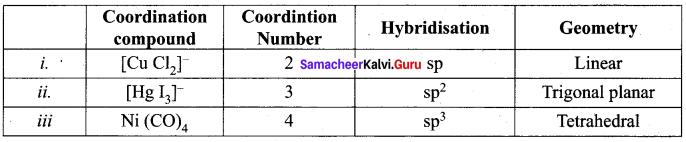
(ii) Equilibrium constants for heterogeneous equilibrium:
Consider the following heterogeneous equilibrium.

Tamil Nadu 11th Chemistry Model Question Paper 5 English Medium
Tamil Nadu 11th Chemistry Model Question Paper 5 English Medium 10

The equilibrium constant for the above reaction can be written as
Tamil Nadu 11th Chemistry Model Question Paper 5 English Medium 11

A pure solid always has the same concentration at a given temperature, as it does not expand to fill its container, i.e. it has same number of moles L-l of its volume. Therefore, the concentration of a pure solid is constant. The above expression can be modified as follows.
Tamil Nadu 11th Chemistry Model Question Paper 5 English Medium 12

The equilibrium constant for the above reaction depends only the concentration of carbon dioxide and pot the calcium carbonate or calcium oxide. Similarly, the active mass (concentration) of the pure liquid does not change at a given temperature. Consequently, the concentration terms of pure liquids can also be excluded from the expression of the equilibrium constant.

For example,
Tamil Nadu 11th Chemistry Model Question Paper 5 English Medium 13

Since, H2O (1) is a pure liquid the K can be expressed as \(\mathrm{K}_{\mathrm{c}}=\frac{\left[\mathrm{H}^{+}(\mathrm{aq})\right]\left[\mathrm{HCO}_{3}^{-}(\mathrm{aq})\right]}{\left[\mathrm{CO}_{2}(\mathrm{g})\right]}\)

Question 36.
(a) (i) Explain why the aquatic species are more comfortable in cold water during winter season rather than warm water during the summer? (3)
(ii) What is osmosis? (2)

Tamil Nadu 11th Chemistry Model Question Paper 5 English Medium
[OR]
(b) (i) Explain the shape of following molecule by using VSEPR theory. (3)
(a) BeCl2 (b) NH3 (c) H2O
(ii) Which bond is stronger or σ or π? Why?
Answer:
(a)
Tamil Nadu 11th Chemistry Model Question Paper 5 English Medium 14

(ii) Osmosis is a spontaneous process by which the solvent molecules pass through a semipermeable membrane from a solution of lower concentration to the solution of higher concentration.
[OR]
(b) (i)
Tamil Nadu 11th Chemistry Model Question Paper 5 English Medium 15

(ii)

  • Sigma bonds (σ) are stronger than Pi bonds (π). Because, sigma bonds are formed from bonding orbitals directly between the nuclei of the bonding atoms, resulting in greater overlap and a strong sigma bond (axial overlapping).
  • Pi bonds results from overlap of atomic orbitals that are in contact through two areas of overlap (lateral overlapping). Pi bonds are more diffused bonds than sigma bonds.

Tamil Nadu 11th Chemistry Model Question Paper 5 English Medium

Question 37.
(a) (i) How inductive effect helps to explain reactivity and acidity of carboxylic acids? (3)
(ii) HCOOH is more acidic than CH3COOH. Why? (2)
[OR]
(b) (i) Suggest a simple chemical test to distinguish propane and propene. (2)
(ii) Write a notes on Wurtz-fitting reaction. (3)
Answer:
(a) (i) Reactivity of carboxylic acid:

  • When a highly electronegative atom such as halogen is attached to a carbon then it makes the C-X bond polar.
  • In such cases the -I effect of halogen facilitates the attack of an incoming nucleophile at the polarized carbon and hence increases the reactivity.
    Tamil Nadu 11th Chemistry Model Question Paper 5 English Medium 16
  • If a -I group is attacher neared to a carbonyl carbon, it decreases the availability of electron density on the carbonyl carbon and hence increases the rate of the nucleophilic addition reaction.

Tamil Nadu 11th Chemistry Model Question Paper 5 English Medium

Acidity of carboxylic acid:
1. When a halogen atom is attached to the carbon which is neared to the carboxylic acid group, its -I effect withdraws the bonded electrons towards itself and makes the ionization of H+ easy.
2. The acidity of various chloro acetic acid is in the following order.
Cl3C –  COOH > Cl2CHCOOH > CICH2COOH. The strength of the acid increases with increase in the -effect of the group attached to the carboxyl group.
3. Similarly the following order of acidity in the carboxylic acids is due to the +1 effect of alkyl group.
(CH3)3CCOOH < (CH3)2 CHCOOH < CH3COOH

Tamil Nadu 11th Chemistry Model Question Paper 5 English Medium 17
Out of Acetic acid and Formic acid, Formic acid is conidered stronger because, CH3 group in Acetic acid contriubutes electron density towards the O – H bond, making it harder to remove the H+ ion and making Acetic acid a weaker acid that Formic acid.

∴ Formic acid is more acidic one.

[OR]

Tamil Nadu 11th Chemistry Model Question Paper 5 English Medium

(b) (i) Chemical test to distinguish between propane and propene
Bromine water test: Propene contains double bond, therefore when we pour the bromine water to propene sample, it decolourises the bromine water whereas propane which is a saturated hydrocarbon does not decolourise the bromine water.
Baeyer’s test: When propene reacts with Bayer’s reagent it gives 1,2 dihydroxy propane. Propane does not react with Baeyer’s reagent.
Tamil Nadu 11th Chemistry Model Question Paper 5 English Medium 18

(ii) When a solution of bromobenzene and iodomethane in dry ether is treated with metallic sodium, toluene is formed.
Tamil Nadu 11th Chemistry Model Question Paper 5 English Medium 19

Question 38.
(a) An organic compound (A) with molecular formula C2H5Cl reacts with KOH gives compound B and with alcoholic KOH gives compound C. Identify A, B and C explain the reactions. (5)
(b) Write an essay on water pollution. (5)
Answer:
Tamil Nadu 11th Chemistry Model Question Paper 5 English Medium 20

Tamil Nadu 11th Chemistry Model Question Paper 5 English Medium

[OR]
I – Water Pollution:

  1. Water is essential for life. The slogan “Save water, water will save you”, tell us the importance of water.
  2. Water pollution is defined as ‘The addition of foreign substances or factors like heat which degrades the quality of water, so that it becomes health hazard or unfit to use.
  3. The source of water pollution is classified as point and non-point source. Easily identified source of place of pollution is called as point source, e.g. Municipal and industrial discharge pipes. Non-point source cannot be identified easily, e.g. Acid rain and mining wastes.

II – Causes of water pollution:

  • Microbiological (Pathogens): Disease-causing micro organisms like bacteria, viruses and protozoa are most serious water pollutants. They come from domestic sewage and animal excreta.
  • Organic wastes: Organic matter such as leaves, grass, trash etc. can also pollute water. Water pollution is caused by excessive phytoplankton growth within water. Micro organisms present in water decompose these organic matter and consume dissolved oxygen in water.
  • Chemical wastes: A whole variety of chemicals from industries, such as metals and solvents are poisonous to fish and other aquatic life. Some toxic pesticides can accumulate in fish and shell fish and poison the people who eat them.

Tamil Nadu 11th Chemistry Model Question Paper 5 English Medium

Harmful effects of chemical water pollutants.

  • Cd and Hg can cause kidney damage.
  • Pb – poisoning can lead to severe damage of kidneys, liver, brain etc. It also affect central nervous system.
  • Poly-chlorinated bipbenol causes skin diseases and are carcinogenic in nature.

III – Quality of drinking water:
Now a days most of us hesitate to use natural water directly for drinking because biological, physical or chemical impurities from different sources mix with surface water or ground water.

Institutes like WHO, BIS and ICMR have prescribed standards for quality of drinking water. Standard characteristics prescribed for deciding the quality of drinking water by BIS, in 1991 are shown in below table.

CharacteristicsDesirable limit
Physico-chemical Characteristics
pH6.5 to 8.5
Total Dissolved Solids (TDS)500 ppm
Total Hardness (as CaC03)300 ppm
Nitrate45 ppm
Chloride250 ppm
Sulphate200 ppm
Fluoride1 ppm
Biological Characteristics
Escherichia Coli (E.Coli)Not at all
ColiformsNot to exceed 10 (In 100 ml water sample)

Tamil Nadu 11th Chemistry Model Question Paper 5 English Medium

Tamil Nadu 11th Chemistry Model Question Paper 4 English Medium

Students can Download Tamil Nadu 11th Chemistry Model Question Paper 4 English Medium Pdf, Tamil Nadu 11th Chemistry Model Question Papers helps you to revise the complete Tamilnadu State Board New Syllabus and score more marks in your examinations.

TN State Board 11th Chemistry Model Question Paper 4 English Medium

Tamil Nadu 11th Chemistry Model Question Paper 4 English Medium

Time: 2½ Hours
Total Score: 70 Marks

General Instructions:

  1. The question paper comprises of four parts.
  2. You are to attempt all the parts. An internal choice of questions is provided wherever applicable.
  3. All questions of Part I. II, III and IV are to be attempted separately.
  4. Question numbers 1 to 15 in Part I are Multiple Choice Questions of one mark each. These are to be answered by choosing the most suitable answer from the given four alternatives and writing the option code and the corresponding answer.
  5. Question numbers 16 to 24 in Part II are two-mark questions. These are to be answered in about one or two sentences.
  6. Question numbers 25 to 33 in Part III are three-mark questions. These are to be answered in about three to five short sentences.
  7. Question numbers 34 to 38 in Part IV are five-mark questions. These are to be answered in detail. Draw diagrams wherever necessary.

Tamil Nadu 11th Chemistry Model Question Paper 4 English Medium

PART -1

Answer all the questions. [15 x 1 = 15]
Choose the most suitable answer from the given four alternatives.

Question 1.
Carbon forms two oxides, namely carbon monoxide and carbon dioxide. The equivalent mass of which element remains constant?
(a) Carbon
(b) Oxygen
(c) Both carbon and oxygen
(d) Neither carbon nor oxygen
Answer:
(b) Oxygen

Reaction 1 : 2 C + O2 → 2 CO
2 x 12 g carbon combines with 32 g ofoxygen.
Hence, Equivalent mass of carbon = \(\frac{2 \times 12}{32}\) x 8 = 6

Reaction 2 : C + O2 → CO2
12 g carbon combines with 32 g of oxygen.
Hence, Equivalent mass of carbon = \(\frac{12}{32}\) x 8 = 3

Tamil Nadu 11th Chemistry Model Question Paper 4 English Medium

Question 2.
Electronic configuration of species M2+ is Is2 2s2 2p6 3s2 3p6 3d6 and its atomic weight is 56.
The number of neutrons in the nucleus of species M is ………………… .
(i) 26
(b) 22
(c) 30
(iv) 24
Answer:
(c) 30

Solution:
M2+ : 1s2 2s2 2p6 3s2 3p6 3d6 ; M : Is2 2s2 2p6 3s2 3p6 3d8
Atomic number = 26
Mass number = 56
No. of neutrons = 56 – 26 = 30

Question 3.
Assertion: Helium has the highest value of ionization energy among all the elements known Reason: Helium has the highest value of electron affinity among all the elements known
(a) Both assertion and reason are true and reason is correct explanation for the assertion
(b) Both assertion and reason are true but the reason is not the correct explanation for the assertion
(c) Assertion is true and the reason is false
(d) Both assertion and the reason are false
Answer:
(c) Assertion is true and the reason is false

Tamil Nadu 11th Chemistry Model Question Paper 4 English Medium

Question 4.
At room temperature normal hydrogen consists of
(a) 25% ortho form + 75% para form
(b) 50% ortho form + 50% para form
(c) 75% ortho form + 25% para form
(d) 60% ortho form + 40% para form
Answer:
(c) 75% ortho form + 25% para form

Question 5.
Match the following.
List-I List-II
A. Beryllium – 1. Sacrificial anode
B. Calcium – 2. X-ray tube radiation window
C. Magnesium – 3. Scavenger to remove oxygen in TV
D. Barium – 4. Getter in vacuum tubes
Code: A B C D
(a) 4 2 3 1
(b) 2 4 1 3
(c) 3 1 4 .2
(d) 1 3 2 4
Answer:
(b) 2 4 1 3

Tamil Nadu 11th Chemistry Model Question Paper 4 English Medium

Question 6.
Which of the following pair will diffuse at the same rate?
(a) CO2 and N2O
(b) CO2 and NO
(c) CO2 and CO
(d) N2O and NO
Answer:
(a) CO2 and N2O

Question 7.
An ideal gas expands from the volume of 1 x 10⁻³ m3 to 1 x 10⁻² m3 at 300K against a constant pressure at 1 x 10³ Nm-2. The work done is ………………… .
(a) -900 J
(b) 900 kJ
(c) 270 kJ
(d) -900 kJ
Answer:
(a) -900 J

w = PΔV
w = – (1 x 10⁵ Nm-2) (1 x 10⁻² m3 – 1 x 10⁻³ m3)
w = 105 (10-2 – 10-3) Nm
w = 105(10 – 1) 10-3) J
w = 105 (9 x 10⁻³) J
w = 9 x 10² J
w = -900 J

Tamil Nadu 11th Chemistry Model Question Paper 4 English Medium

Question 8.
At a given temperature and pressure, the equilibrium constant values for the equilibria
Tamil Nadu 11th Chemistry Model Question Paper 4 English Medium image - 1
The reaction between K1 and K2 is …………………. .
Tamil Nadu 11th Chemistry Model Question Paper 4 English Medium image - 2
Answer:
b

Solution:
Tamil Nadu 11th Chemistry Model Question Paper 4 English Medium image - 3

Tamil Nadu 11th Chemistry Model Question Paper 4 English Medium

Question 9.
Consider the following statements.
(i) Henry’s law is applicable at moderate temperature and pressure only.
(ii) Highly soluble gases obey’s Henry’s law.
(iii) The gases react with the solvent do not obey Henry’s law.
Which of the above statements is/are not correct?
(a) (i) only
(b) (ii) only
(c) (iii) only
(d) (i) and (ii)
Answer:
(b) (ii) only

Question 10.
Which one of the following is the likely bond angles of sulphur tetrafluoride molecule?
(a) 120°, 80°
(b) 109°.28
(c) 90°
(d) 89°, 117°
Answer:
(d) 89°, 117°

Tamil Nadu 11th Chemistry Model Question Paper 4 English Medium

Tamil Nadu 11th Chemistry Model Question Paper 4 English Medium image - 4

Solution:
Normal bond angle in regular trigonal bipyramidal are 90° and 120°. Due to l.p – b.p repulsion, bond angle is reduced to 89°, 117° option (d).

Question 11.
The method used to estimate nitrogen in foods and fertilisers is
(a) Dumas method
(b) Kjeldahl’s method
(c) Carius method
(d) Oxide method
Answer:
(b) Kjeldahl’s method

Question 12.
Which of the following carbocation will be most stable?
Tamil Nadu 11th Chemistry Model Question Paper 4 English Medium image - 5
Answer:
d

Tamil Nadu 11th Chemistry Model Question Paper 4 English Medium

Question 13.
Which one of the following is used as a soil sterilizing agent?
Tamil Nadu 11th Chemistry Model Question Paper 4 English Medium image - 6
Answer:
Tamil Nadu 11th Chemistry Model Question Paper 4 English Medium image - 7

Question 14.
Which of the following pair of oxides is responsible for acid rain?
(a) Chloroform
(b) Chloral
(c) Iodoform
(d) Chloropicrin
Answer:
(d) Chloropicrin

Question 15.
Which of the following pair of oxides is responsible for acid rain?
(a) SO3 + NO2
(b) CO2 + CO
(c) N2O + CH4
(d) O2 + H2
Answer:
(a) SO3 + NO2

Tamil Nadu 11th Chemistry Model Question Paper 4 English Medium

PART- II

Answer any six questions.in which question No. 20 is compulsory.

Question 16.
Calculate the number of moles present in 9g of ethane?
Answer:
Mass of ethane = 9 g
Molar mass of ethane C2H6 = 30 g mol-1.
\(\text { No. of moles }=\frac{\text { Mass }}{\text { Molar mass }}=\frac{9}{30}=0.3 \mathrm{mol}\)

Question 17.
Why did halogens act as oxidizing agents?
Answer:
Halogens act as oxidizing agents. Their electronic configuration is ns2 np5. So all the halogens are ready to gain one electron to attain the nearest inert gas configuration. An oxidizing agent is the one which is ready to gain an electron. So all the halogens act as oxidizing agents. Also halogens are highly electronegative with low dissociation energy and high negative electron gain enthalpies. Therefore, the halogens have a high tendency to gain an electron. Hence they act as oxidizing agents.

Tamil Nadu 11th Chemistry Model Question Paper 4 English Medium

Question 18.
Would it be easier to drink water with a straw on the top of Mount Everest?
Answer:
It is difficult to drink water with a straw on the top of Mount Everest. This is because the reduced atmospheric pressure is less effective in pushing water into the straw at the top of the mountain because gravity falls off gradually with height. The air pressure falls off, there isn’t enough atmospheric pressure to push the water up in the straw all the way to the mouth.

Question 19.
Be(OH)2 is amphoteric in nature. Prove it.
Answer:
Be(OH)2 is amphoteric in nature as it reacts with both acid and alkali.

  • Be(OH)2 + 2NaOH → Na2BeO2 + 2H2O
    (Acidic)
  • Be(OH)2 + 2HC1 → BeCl2 + 2H2O
    (Basic)

Question 20.
An engine operating between 127°C and 47°C takes some specified amount of heat from a high temperature reservoir. Calculate the percentage efficiency of an engine.
Answer:
Given: T1 = 127°C = 127 + 273 = 400K
T2 = 47°C = 47 + 273 = 320 K
% efficiency q?
Tamil Nadu 11th Chemistry Model Question Paper 4 English Medium image - 8

Tamil Nadu 11th Chemistry Model Question Paper 4 English Medium

Question 21.
Calculate the formal charge on each atom of carbonyl chloride (COCl2)?
Answer:
Tamil Nadu 11th Chemistry Model Question Paper 4 English Medium image - 9

Question 22.
Why we need to purify the organic compounds?
Answer:
In order to study the structure, physical properties, chemical properties and biological properties of organic compounds, they must be in the pure state. So organic compounds must be purified.

Tamil Nadu 11th Chemistry Model Question Paper 4 English Medium

Question 23.
What are electrophiles? Give an example.
Answer:
Electrophiles: Electrophiles are reagents that are attracted towards negative charge or electron rich center. They are either positively charged ions or electron deficient neutral molecules.

Example:
CO2, A1Cl3, BF3, FeCl3, NO+, NO2+, etc.

Question 24.
Complete the reaction, C2H5NH2
Tamil Nadu 11th Chemistry Model Question Paper 4 English Medium image - 10
Answer:
Tamil Nadu 11th Chemistry Model Question Paper 4 English Medium image - 11

Part – III

Answer any six questions in which question No. 30 is compulsory. [6 x 3 = 18]

Question 25.
On the formation of SF6 by the direct combination of S and F2, which is the limiting reagent? Prove it.
Answer:
SF6 is formed by burning Sulphur in an atmosphere of Fluorine. Suppose 3 moles of S is allowed to react with 12 moles of Fluorine.
\(\mathrm{S}_{(\mathrm{o}}+3 \mathrm{F}_{2_{(\mathrm{g})}} \rightarrow \mathrm{SF}_{6(\mathrm{g})}\)

Tamil Nadu 11th Chemistry Model Question Paper 4 English Medium

As per the stoichiometric reaction, one mole of S reacts with 3 moles of fluorine to complete the reaction. Similarly, 3 moles of S requires only 9 moles of fluorine.

∴ It is understood that the limiting reagent is Sulphur and the excess reagent is Fluorine.

Question 26.
Explain about the significance of de-Broglie equation.
Answer:

  • \(\lambda=\frac{h}{m v}\) This equation implies that a moving particle can be considered as a wave and a wave
    can exhibit the properties of a particle.
  • For a particle with high linear momentum (mv) the wavelength will be so small and cannot be observed.
  • For a microscopic particle such as an electron, the mass is of the order of 10 31 kg, hence the wavelength is much larger than the size of atom and it becomes significant.
  • For the electron, the de Broglie wavelength is significant and measurable while for the iron ball it is too small to measure, hence it becomes insignificant.

Question 27.
What are all the factors that influences electron affinity?
Answer:
Factors that affects electron affinities are size of the atom, effective nuclear charge, screening effect.

  • \(Electron affinity \propto \frac{1}{\text { Size of the atom }}\)
  • Electron affinity QC Effective nuclear charge
  • \(Electron affinity \propto \frac{1}{\text { Screening effect }}\)

Tamil Nadu 11th Chemistry Model Question Paper 4 English Medium

Question 28.
Describe about the biological importance of sodium and potassium.
Answer:

  • Monovalent sodium and potassium ions are found in large proportions in biological fluids.
  • These ions perform important biological functions such as maintenance of ion balance and nerve impulse conduction.
  • Sodium – Potassium play an important role in transmitting nerve signals.
  • A typical 70 kg man has 90 g of Na and 170 g of K.
  • Sodium ions are found on the outside of cells, being located in blood plasma and in the interstitial fluid which surrounds the cells. These ions participate in the transmission of nerve signals, in regulating the flow of water across cell membranes and in the transport of sugars and amino acids into cells.
  • Potassium ions are the most abundant cations within cell fluids, where they activate many enzymes, participate in the oxidation of glucose to produce ATP and with sodium, are responsible for the transmission of nerve signals.

Question 29.
What are the conventions adopted in writing the thermochemical equation?
Answer:
A thermochemical equation is a balanced stoichiometric chemical equation that includes the enthalpy change (ΔH).

Conventions adopted in thermochemical equations:

  • The coefficients in a balanced thermochemical equation refer to number of moles of reactants and products involved in the reaction.
  • The enthalpy change of the reaction ΔH has unit kJ.
  • When the chemical reaction is reversed, the value of ΔH is reversed in sign with the same magnitude.
  • Physical states (gas, liquid, aqueous and solid) of all species is important and must be specified in a thermochemical reaction since ΔH depends on the phases of reactants and products.
  • If the thermochemical equation is multiplied throughout by a number, the enthalpy change is also be multiplied by the same number value.
  • The negative sign of \(\Delta \mathrm{H}_{r}^{o}\) indicates the reaction to be an exothermic and the positive sign of \(\Delta \mathrm{H}_{r}^{o}\) indicates an endothermic type of reaction.

Tamil Nadu 11th Chemistry Model Question Paper 4 English Medium

Question 30.
Calculate the work done when 2-moles of an ideal gas expands reversibly and isothermally from a volume of 500 mL to a volume 2 L at 25°C and normal pressure.
Answer:
Given
Tamil Nadu 11th Chemistry Model Question Paper 4 English Medium image - 12

Question 31.
For a gaseous homogeneous reaction at equilibrium number of moles of products are greater than the number of moles of reactants. Is K is larger or smaller than Kr.
Answer:
For a homogeneous reaction at equilibrium, number of moles of products (np) are greater than the number of moles of reactants (nR), then Δng = +ve
Tamil Nadu 11th Chemistry Model Question Paper 4 English Medium image - 13

Question 32.
Explain – Resonance.
Answer:
(i) Certain organic compounds can be represented by more than one structure and they differ only in the position of bonding and lone pair of electrons. Such structures are called resonance structure and this phenomenon is called as resonance.

Tamil Nadu 11th Chemistry Model Question Paper 4 English Medium

This phenomenon is also called as mesomerism or mesomeric effect.
(ii) For example, the structure of aromatic compounds such as benzene and conjugated system like 1,3 butadiene cannot be represent by a single structure and their observed properties can be explained on the base of a resonance hybrid.
(iii) Resonance structure of benzene.
Tamil Nadu 11th Chemistry Model Question Paper 4 English Medium image - 14
(I) and (II) are called, as resonance hybrids of benzene.
(iv) For 1,3 butadiene:
Tamil Nadu 11th Chemistry Model Question Paper 4 English Medium image - 15

(I), (II) and (III) are called as resonance hybrids of 1,3 butadiene.

Question 33.
Toluene undergoes nitration easily than benzene. Why?
Answer:

  • Toluene has a methyl group on the benzene ring which is electron releasing group and hence activate the benzene ring by pushing the electrons on the benzene ring.
  • CH3 group is ortho – para director and ring activator. Therefore in toluene, ortho and para positions are the most reactive towards an electrophile, thus promoting electrophilic substitution reaction.
  • The methyl group hence makes it around 25 times more reactive than benzene. Therefore it undergoes nitration easily than benzene.
    Tamil Nadu 11th Chemistry Model Question Paper 4 English Medium image - 18

Tamil Nadu 11th Chemistry Model Question Paper 4 English Medium

Part – IV

Answer all the questions. [5 x 5 = 25]

Question 34.
(a) (i) Explain about the classification of matter. (3)
(ii) What is a combination reaction? Give an example. (2)
[OR]
(b) (i) Define – electronegativity. (2)
(ii) How Moseley determined the atomic number of an element using X-rays. (3)
Answer:
(a) (i) Classification of matter:
Tamil Nadu 11th Chemistry Model Question Paper 4 English Medium image - 19
(ii) When two or more substances combine to form a single substance, the reactions are called combination reactions.
A + B → C
Example: 2 Mg + O2 → 2MgO
[OR]
(b) (i) Electronegativity is the relative tendency of an element present in a covalently bonded molecule, to attract the shared pair of electrons towards itself.

Tamil Nadu 11th Chemistry Model Question Paper 4 English Medium

(ii)

  • Henry Moseley studied the X-ray spectra of several elements and determined their atomic numbers (Z).
  • He discovered a correlation between atomic number and the frequency of X-rays generated by bombarding an element with high energy of electrons.
  • Moseley correlated the frequency of the X-ray emitted by an equation as, \(\sqrt{\mathfrak{v}}=a(\mathrm{Z}-b)\)
    Where u = Frequency of the X-rays emitted by the elements. a and. b = Constants.
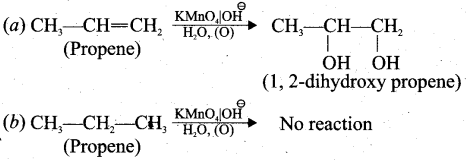
  • From the square root of the measured frequency of the X-rays emitted, he determined the atomic number of the element.

Question 35.
(a) Explain the following observations,
(i) Aerated water bottles are kept under water during summer. (3)
(ii) Liquid ammonia bottle is cooled before opening the seal. (2)
[OR]
(b) Derive the relation between ΔH and ΔU for an ideal gas. (5)
Answer:
(a) (i) In aerated water bottles, CO2 gas is passed through the aqueous solution under pressure because the solubility of the gas in water is not very high. In summer, the solubility of the gas in water is likely to decrease because of the rise in temperature. Thus, in summer, more ’ of gas will be present above the liquid surface in the glass bottle. In case, the pressure of the gas becomes too high, the glass will not be able to withstand the pressure and the bottle may explode. To avoid this, the bottles are kept under water. As a result, the temperature is likely to decrease and the solubility of CO2 is likely to increase in aqueous solution resulting in decreased pressure.

Tamil Nadu 11th Chemistry Model Question Paper 4 English Medium

(ii) Liquid ammonia bottle contains the gas under very high pressure. If the bottle is opened as such, then the sudden decrease in pressure will lead to a large increase in volume of the gas. As a result, the gas will come out of the bottle all of a sudden with force. This will lead to the breakage of the bottle and also causes accident However, if the bottle is cooled under tap water for sometime, there will be a decrease in the volume of a gas to a large extent. If the seal is opened now, the gas will come out of the bottle at a slower rate, reduces the chances of accident.
[OR]
(b) Relation between ΔH and ΔU for an ideal gas.
1. When the system at constant pressure undergoes changes from an initial state with Hp U1, V1 and P parameters to a final state with H2, U2, V2 and P parameters, the change in enthalpy AH, is given by
∆H = U + PV
2. At initial state H1 = U1 + PV1 ……………….. (1)
At final state H2 = U2 + PV2 ……………….. (2)
(2) – (1) ⇒ (H2 – H1) = (U2 – U1) + P (V2 – V1)
∆H = ∆U + P∆V …………………… (3)
Considering ∆U = q + w ; w = – P∆V
∆H = q + w + PAV
∆H = qp – PAV+ PAV
∆H = qp ………………… (4)

Tamil Nadu 11th Chemistry Model Question Paper 4 English Medium

qp is the heat absorbed at constant pressure and is considered as heat content.

3. Consider a closed system of gases which are chemically reacting to produce product gases at constant temperature and pressure with V. and Vf as the total volumes of the reactant and product gases respectively, and n. and nf are the number of moles of gaseous reactants and products. Then,
For reactants: PVi = niRT
For products : P Vf = nf RT

Then considering reactants as initial state and products as final state,
P (Vf – Vi) = (nf – ni) RT
P∆V = ∆ng RT

We know
∆H = ∆U + P∆V
∆H = ∆U + ∆ng RT …………………. (5)

Question 36.
(a) (i) What are heterogenous equilibrium? Give an example. (2)
(ii) The atmospheric oxidation of NO 2NO(g) + O2(g) = 2NO2(g) was studied with initial pressure of 1-atm of NO and 1-atm of O2. At equilibrium partial pressure of oxygen is 0.52 atm. Calculate Kp of the reaction. (3)
[OR]
(b) (i) Explain the factors influencing the solubility of the solutes. (3)
(ii) Why the carbonated drinks are stored in a pressurised container? (2)
Answer:
(a) (i) Heterogeneous equilibrium: If the reactants and products of a reaction in equilibrium are in different phases, then it is called as heterogeneous equilibrium.
Tamil Nadu 11th Chemistry Model Question Paper 4 English Medium image - 20

Tamil Nadu 11th Chemistry Model Question Paper 4 English Medium

(b) (i) Factors influencing solubility:
Nature of solute and solvent: Sodium chloride, an ionic compound readily dissolves in , polar solvent such as water but it does not dissolve in non polar solvent such as benzene. Most of the organic compounds dissolve in organic solvent and do not dissolve in water.

Effect of temperature: Generally, the solubility of a solid solute in a liquid solvent increases with increase in temperature. The dissolution of NaCl does not vary as the maximum solubility is achieved at normal temperature. The dissolution of ammonium nitrate is endothermic, the solubility increases with increase in temperature. The dissolution of ceric sulphate is exothermic and the solubility decreases with increase of temperature. In the case of gaseous solute in liquid solvent the solubility decreases with increase in temperature.

Effect of pressure: Generally the change in pressure does not have any significant effect in the solubility of solids and liquids as they are not compressible. However, the solubility of gases generally increases with increase of pressure.

(ii)

  • The carbonated beverages contain CO2 dissolved in them. To dissolve the CO2 in these drinks, CO2 gas is bubbled through them under high pressure.
  • These containers are sealed to maintain the pressure. When we open these containers at atmospheric pressure, the pressure of the CO2 drops to the atmospheric pressure level and hence bubbles of CO2 rapidly escape from the solution and show effervescence.

Tamil Nadu 11th Chemistry Model Question Paper 4 English Medium

Question 37.
(a) (i) Explain – paper chromatography. (3)
(ii) What are stereo-isomerism? (2)
[OR]
(b) (i) Explain the homolytic fission of a covalent bond? (3)
(ii) Why chloroacetic acid is more acidic than acetic acid? (2)
Answer:
(a) (i) 1. It is an example of partition chromatography. A strip of paper acts as an adsorbent.
This method involves continues differential pardoning of components of a mixture between stationary and mobile phase. In paper chromatography, a special quality paper known as chromatographic paper is used. This paper act as a stationary phase.

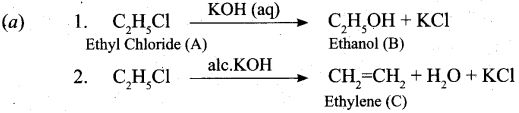
2. A strip of chromatographic paper spotted at the base with the solution of the mixture is suspended in a suitable solvent which acts as the mobile phase. The solvent rises up and flows over the spot. The paper selectivity retains different components according to their different partition in the two phases where a chromatogram is developed.
3. The spots of the separated coloured components are visible at different heights from the position of initial spots on the chromatogram. The spots of the separated colourless compounds may be observed either under ultraviolet light or by the use of an appropriate spray reagent.

(ii) Stereo-isomerism: The isomers which have same bond connectivity but different arrangement of groups or atoms in space are known as stereoisomers. This phenomenon is known as stereoisomerism.

[OR]

Tamil Nadu 11th Chemistry Model Question Paper 4 English Medium

(b) (i)

  • Homolytic cleavage is the process in which a covalent bond breaks symmetrically in such way that fcach of the bonded atoms retains one electron.
  • This type of cleavage occurs under high temperature or in the presence of UV light.
  • In a compound containing non-‘polar covalent bond formed between atoms of similar electronegativity, in such molecules the cleavage of bonds results into free radicals.
  • For example, ethane undergo homolytic fission to produce, two methyl free radicals.
    Tamil Nadu 11th Chemistry Model Question Paper 4 English Medium image - 21

(ii) Chloro acetic acid:
Tamil Nadu 11th Chemistry Model Question Paper 4 English Medium image - 22
Chloro acetic acid has Cl-group and it has high electronegativity and shows -I effect. Therefore Cl-atom to facilitate the dissociation of O-H bond very fastly. Whereas in the – case of acetic acid, has CH3 group and it shows +1 effect, therefore dissociation of O-H bond will be more difficult. Thus chloro acetic acid is stronger acid than acetic acid.

Tamil Nadu 11th Chemistry Model Question Paper 4 English Medium

Question 38.
(a) Tamil Nadu 11th Chemistry Model Question Paper 4 English Medium image - 23
Identify A and B (major products).
(ii) Describe the mechanism of sulphonation of benzene. (3)
[OR]
(b) An organic compounds A of a molecular formula C6H6 which is simple aromatic hydrocarbon. A reacts with Cl2 in presence of FeCl3 to give B. B reacts with NaOH at 350°C and 300 atm pressure to give C. B again reacts with ammonia at 250°C and 50 atm pressure to give D. Identify A, B, C and D explain the reaction. (5)
Answer:
Tamil Nadu 11th Chemistry Model Question Paper 4 English Medium image - 24
(ii) Step 1: Generation of SO3 electrophile: 2H2SO4 → H3O + SO3 + HSO4
Step 2: Attack of the electrophilic on benzene ring to form Armenian ion:
Tamil Nadu 11th Chemistry Model Question Paper 4 English Medium image - 25
Tamil Nadu 11th Chemistry Model Question Paper 4 English Medium image - 26

Tamil Nadu 11th Chemistry Model Question Paper 4 English Medium

AC6H6Benzene
BC6H5ClChlorobenzene
CC6H5OHPhenol
DC6H5NH2Aniline

Samacheer Kalvi 11th Computer Science Solutions Chapter 13 Introduction to Object-Oriented Programming Techniques

Students can Download Computer Science Chapter 13 Introduction to Object-Oriented Programming Techniques Questions and Answers, Notes Pdf, Samacheer Kalvi 11th Computer Science Book Solutions Guide Pdf helps you to revise the complete Tamilnadu State Board New Syllabus and score more marks in your examinations.

Tamilnadu Samacheer Kalvi 11th Computer Science Solutions Chapter 13 Introduction to Object-Oriented Programming Techniques

Samacheer Kalvi 11th Computer Science Introduction to Object-Oriented Programming Techniques Text Book Back Questions and Answers

PART – 1
I. Choose The Correct Answer

Question 1.
The term is used to describe a programming approach based on classes and objects is ……………….
(a) OOP
(b) POP
(c) ADT
(d) SOP
Answer:
(a) OOP

Question 2.
The paradigm which aims more at procedures ……………….
(a) Object Oriented Programming
(b) Procedural programming
(c) Modular programming
(d) Structural programming
Answer:
(b) Procedural programming

Samacheer Kalvi 11th Computer Science Solutions Chapter 13 Introduction to Object-Oriented Programming Techniques

Question 3.
Which of the following is a user defined data type?
(a) class
(b) float
(c) int
(d) object
Answer:
(a) class

Question 4.
The identifiable entity with some characteristics and behaviour is ……………….
(a) class
(b) object
(c) structure
(d) member
Answer:
(b) object

Question 5.
The mechanism by which the data and functions are bound together into a single unit is known as ……………….
(a) Inheritance
(b) Encapsulation
(c) Polymorphism
(d) Abstraction
Answer:
(b) Encapsulation

Question 6.
Insulation of the data from direct access by the program is called as ……………….
(a) Data hiding
(b) Encapsulation
(c) Polymorphism
(d) Abstraction
Answer:
(a) Data hiding

Question 7.
Which of the following concept encapsulate all the essential properties of the object that are to be created?
(a) Class
(b) Encapsulation
(c) Polymorphism
(d) Abstraction
Answer:
(d) Abstraction

Question 8.
Which of the following is the most important advantage of inheritance?
(a) data hiding
(b) code reusability
(c) code modification
(d) accessibility
Answer:
(b) code reusability

Samacheer Kalvi 11th Computer Science Solutions Chapter 13 Introduction to Object-Oriented Programming Techniques

Question 9.
“Write once and use it multiple time” can be achieved by ……………….
(a) redundancy
(b) reusability
(c) modification
(d) composition
Answer:
(b) reusability

Question 10.
Which of the following supports the transitive nature of data?
(a) Inheritance
(b) Encapsulation
(c) Polymorphism
(d) Abstraction
Answer:
(a) Inheritance

PART – 2
II. Answers to all the questions

Question 1.
How is modular programming different from procedural programming paradigm?
Answer:
Modular programming:

  • Emphasis on algorithm rather than data.
  • Programs are divided into individual modules.
  • Each modules are independent of each other and have their own local data.
  • Modules can work with its own data as well as with the data passed to it.

Procedural programming:

  • Programs are organized in the form of subroutines or sub programs.
  • All data items are global.
  • Suitable for small sized software application.
  • Difficult to maintain and enhance the program code as any change in data type needs to be propagated to all subroutines that use the same data type.

Question 2.
Differentiate classes and objects.
Answer:
Class:

  • Class is a blue print or template from which objects are created.
  • Class doesn’t allocate memory when it is created.
  • Class is a logical entity.

Object:

  • Object is an instance of a class.
  • Objects allocate memory when it is created.
  • Object is a physical entity.

Samacheer Kalvi 11th Computer Science Solutions Chapter 13 Introduction to Object-Oriented Programming Techniques

Question 3.
What is polymorphism?
Answer:
Polymorphism is the ability of a message or function to be displayed in more than one form.

Question 4.
How is encapsulation and abstraction are interrelated?
Answer:
Abstraction means giving only essential things and hiding unnecessary details. Encapsulation is the binding of data members and methods together in a capsule to avoid accidental changes to data from external users, i.e., encapsulation is the bundling of related algorithms and data.

Question 5.
Write the disadvantages of OOP.
Answer:

  1. Size: Object Oriented Programs are much larger than other programs.
  2. Effort: Object Oriented Programs require a lot of work to create.
  3. Speed: Object Oriented Programs are slower than other programs, because of their size.

PART – 3
III. Answers to all the questions

Question 1.
What is paradigm? Mention the different types of paradigm.
Answer:
Paradigm means organizing principle of a program. It is an approach to programming. There are different approaches available for problem solving using computer. They are Procedural programming, Modular Programming and Object Oriented Programming.

Question 2.
Write a note on the features of procedural programming.
Answer:
Important features of procedural programming

  1. Programs are organized in the form of subroutines or sub programs
  2. All data items are global
  3. Suitable for small sized software application
  4. Difficult to maintain and enhance the program code as any change in data type needs to be propagated to all subroutines that use the same data type. This is time consuming.
  5. Example: FORTRAN and COBOL.

Samacheer Kalvi 11th Computer Science Solutions Chapter 13 Introduction to Object-Oriented Programming Techniques

Question 3.
List some of the features of modular programming.
Answer:
Important features of Modular programming:

  1. Emphasis on algorithm rather than data
  2. Programs are divided into individual modules
  3. Each modules are independent of each other and have their own local data
  4. Modules can work with its own data as well as with the data passed to it.
  5. Example: Pascal and C.

Question 4.
What do you mean by modularization and software reuse?
Answer:

  1. Modularization : where the program can be decomposed into modules.
  2. Software re – use : where a program can be composed from existing and new modules.

Question 5.
Define information hiding.
Answer:
Encapsulation is the most striking feature of a class. The data is not accessible to the outside world, and only those functions which are wrapped in the class can access it. This encapsulation of data from direct access by the program is called data hiding or information hiding.

PART – 4
IV. Answers to all the questions

Question 1.
Write the differences between Object Oriented Programming and Procedural Programming
Answer:
Object Oriented Programming:

  • Emphasizes on data rather than algorithm.
  • Data abstraction is introduced in addition to procedural abstraction.
  • Data and its associated operations are grouped in to single unit.
  • Programs are designed around the data being operated.
  • Example: C++, Java, VB.Net, Python

Procedural Programming:

  • Programs are organized in the form of subroutines or sub programs.
  • All data items are global.
  • Suitable for small sized software application.
  • Difficult to maintain and enhance the program code as any change in data type needs to be propagated to all subroutines that use the same data type.
  • Example: FORTRAN and COBOL

Question 2.
What are the advantages of OOPs?
Answer:
Re – usability : “Write once and use it multiple times” you can achieve this by using class. Redundancy: Inheritance is the good feature for data redundancy. If you need a same functionality in multiple class you can write a common class for the same functionality and inherit that class to sub class.

Easy Maintenance : It is easy to maintain and modify existing code as new objects can be created with small differences to existing ones.

Security : Using data hiding and abstraction only necessary data will be provided thus maintains the security of data.

Samacheer Kalvi 11th Computer Science Solutions Chapter 13 Introduction to Object-Oriented Programming Techniques

Question 3.
Write a note on the basic concepts that supports OOPs?
Answer:
The Object Oriented Programming has been developed to overcome the drawbacks of procedural and modular programming. It is widely accepted that object – oriented programming is the most important and powerful way of creating software.

The Object – Oriented Programming approach mainly encourages:

  1. Modularization: where the program can be decomposed into modules.
  2. Software re – use: where a program can be composed from existing and new modules.

Main Features of Object Oriented Programming:

  1. Data Abstraction.
  2. Encapsulation.
  3. Modularity.
  4. Inheritance.
  5. Polymorphism.

Encapsulation:
The mechanism by which the data and functions are bound together into a single unit is known as Encapsulation. It implements abstraction. Encapsulation is about binding the data variables and functions together in class. It can also be called data binding. Encapsulation is the most striking feature of a class.

The data is not accessible to the outside world, and only those functions which are wrapped in the class can access it. These functions provide the interface between the object’s data and the program. This encapsulation of data from direct access by the program is called data hiding or information hiding.

Data Abstraction:
Abstraction refers to showing only the essential features without revealing background details. Classes use the concept of abstraction to define a list of abstract attributes and function which operate on these attributes. They encapsulate all the essential properties of the object that are to be created. The attributes are called data members because they hold information. The functions that operate on these data are called methods or member function.

Modularity:
Modularity is designing a system that is divided into a set of functional units (named modules) that can be composed into a larger application.

Inheritance:
Inheritance is the technique of building new classes (derived class) from an existing Class (base class). The most important advantage of inheritance is code reusability.

Polymorphism:
Polymorphism is the ability of a message or function to be displayed in more than one form.

Samacheer kalvi 11th Computer Science Introduction to Object-Oriented Programming Techniques Additional Questions and Answers

PART – 1
I. Choose the correct answer

Question 1.
In procedural programming all data items are ……………….
(a) Cobol
(b) global
(c) fortan
(d) class
Answer:
(b) global

Question 2.
Class represents a group of similar ……………….
(a) objects
(b) modules
(c) arrays
(d) data
Answer:
(a) objects

Samacheer Kalvi 11th Computer Science Solutions Chapter 13 Introduction to Object-Oriented Programming Techniques

Question 3.
………………. is an example of object oriented programming.
(a) Python
(b) Java
(c) VB.Net
(d) All the above
Answer:
(d) All the above

Question 4.
………………. refers to showing only the essential features without revealing background details.
(a) Redundancy
(b) Encapsulation
(c) Abstraction
(d) Inheritance
Answer:
(c) Abstraction

Question 5.
………………. is about binding the data variables and functions together in class.
(a) Data abstraction
(b) Modularization
(c) Redundancy
(d) Encapsulation
Answer:
(d) Encapsulation

PART – 2
II. Very Short Answers

Question 1.
What is procedural programming?
Answer:
Procedural means a list of instructions were given to the computer to do something. Procedural programming aims more at procedures. This emphasis on doing things.

Question 2.
What is a class?
Answer:
A Class is a construct in C++ which is used to bind data and its associated function together into a single unit using the encapsulation concept. Class is a user defined data type. Class represents a group of similar objects.

Samacheer Kalvi 11th Computer Science Solutions Chapter 13 Introduction to Object-Oriented Programming Techniques

Question 3.
What is modularity?
Answer:
Modularity is designing a system that is divided into a set of functional units (named modules) that can be composed into a larger application.

Question 4.
What are the main features of OOP?
Answer:
Main Features of Object Oriented Programming:

  1. Data Abstraction
  2. Encapsulation
  3. Modularity
  4. Inheritance
  5. Polymorphism

Question 5.
What is redundancy?
Answer:
Inheritance is the good feature for data redundancy. If you need a same functionality in multiple class you can write a common class for the same functionality and inherit that class to sub class.

PART – 3
III. Short Answers

Question 1.
Write about objects.
Answer:
Objects: Represents data and its associated function together into a single unit. Objects are the basic unit of OOP. Basically an object is created from a class. They are instances of class also called as class variables. An identifiable entity with some characteristics and behaviour is called object.

Samacheer Kalvi 11th Computer Science Solutions Chapter 13 Introduction to Object-Oriented Programming Techniques

Question 2.
What is Encapsulation and data binding?
Answer:
The mechanism by which the data and functions are bound together into a single unit is known as Encapsulation. Encapsulation is the most striking feature of a class. The data is not accessible to the outside world, and only those functions which are wrapped in the class can access it. These functions provide the interface between the object’s data and the program. This encapsulation of data from direct access by the program is called data hiding or information hiding.

PART – 4
IV. Explain in Detail

Question 1.
Explain about features of object oriented programming.
Answer:
Main Features of Object Oriented Programming

  1. Data Abstraction
  2. Encapsulation
  3. Modularity
  4. Inheritance
  5. Polymorphism

Encapsulation:
1. The mechanism by which the data and functions are bound together into a single unit is known as Encapsulation. It implements abstraction.

2. Encapsulation is about binding the data variables and functions together in class. It can also be called data binding.

3.. Encapsulation is the most striking feature of a class. The data is not accessible to the outside world, and only those functions which are wrapped in the class can access it. These functions provide the interface between the object’s data and the program. This encapsulation of data from direct access by the program is called data hiding or information hiding.

Data Abstraction:
Abstraction refers to showing only the essential features without revealing background details. Classes use the concept of abstraction to define a list of abstract attributes and function which operate on these attributes.

They encapsulate all the essential properties of the object that are to be created. The attributes are called data members because they hold information. The functions that operate on these data are called methods or member function.

Modularity:
Modularity is designing a system that is divided into a set of functional units (named modules) that can be composed into a larger application.

Inheritance:
Inheritance is the technique of building new classes (derived class) from an existing Class (base class). The most important advantage of inheritance is code reusability.

Polymorphism:
Polymorphism is the ability of a message or function to be displayed in more than one form.

Samacheer Kalvi 11th Computer Science Solutions Chapter 12 Arrays and Structures

Students can Download Computer Science Chapter 12 Arrays and Structures Questions and Answers, Notes Pdf, Samacheer Kalvi 11th Computer Science Book Solutions Guide Pdf helps you to revise the complete Tamilnadu State Board New Syllabus and score more marks in your examinations.

Tamilnadu Samacheer Kalvi 11th Computer Science Solutions Chapter 12 Arrays and Structures

Samacheer Kalvi 11th Computer Science Arrays and Structures Text Book Back Questions and Answers

PART – 1
I. Choose The Correct Answer

Question 1.
Which of the following is the collection of variables of the same type that an referenced by a common name?
(a) int
(b) float
(c) Array
(d) class
Answer:
(c) Array

Question 2.
Array subscripts always starts with which number?
(a) – 1
(b) 0
(c) 2
(d) 3
Answer:
(b) 0

Samacheer Kalvi 11th Computer Science Solutions Chapter 12 Arrays and Structures

Question 3.
int age[ ]={6, 90, 20, 18, 2}; How many elements are there in this array?
(a) 2
(b) 5
(c) 6
(d) 4
Answer:
(b) 5

Question 4.
cin >> n[3]; To which element does this statement accepts the value?
(a) 2
(b) 3
(c) 4
(d) 5
Answer:
(c) 4

Question 5.
By default, a string ends with which character?
(a) \o
(b) \t
(c) \n
(d) \b
Answer:
(a) \o

PART – 2
II. Answers to all the questions

Question 1.
What is Traversal in an Array?
Answer:
Accessing each element of an array at least once to perform any operation is known as “Traversal”. Displaying all the elements in an array is an example of “traversal”.

Question 2.
What is Strings?
Answer:
A string is defined as a sequence of characters where each character may be a letter, number or a symbol. Each element occupies one byte of memory. Every string is terminated by a null (‘\0’, ASCII code 0) character which must be appended at the end of the string.

Samacheer Kalvi 11th Computer Science Solutions Chapter 12 Arrays and Structures

Question 3.
What is the syntax to declare two – dimensional array.
Answer:
The declaration of a 2 – D array is
data – type array_name[row – size] [col – size];
In the above declaration, data-type refers to any valid C++ data – type, array _ name refers to the name of the 2 – D array, row – size refers to the number of rows and col-size refers to the number of columns in the 2 – D array.

PART – 3
III. Answers to all the questions

Question 1.
Define an Array. What are the types?
Answer:
“An array is a collection of variables of the same type that are referenced by a common name”. An array is also a derived datatype in C++.
There are different types of arrays used in C++. They are:

  1. One – dimensional arrays
  2. Two – dimensional arrays
  3. Multi – dimensional arrays

Question 2.
Write a note on Array of strings.
Answer:
An array of strings is a two – dimensional character array. The size of the first Index (rows) denotes the number of strings and the size of the second index (columns) denotes the maximum length of each string. Usually, array of strings are declared in such a way to accommodate the null character at the end of each string. For example, the 2 – D array has the declaration:
char name [7][10];
In the above declaration,
No. of rows = 7;
No. of columns =10;
We can store 7 strings each of maximum length 10 characters.

Samacheer Kalvi 11th Computer Science Solutions Chapter 12 Arrays and Structures

Question 3.
Write a C++ program to accept and print your name.
Answer:
#include
using namespace std;
int main()
{
charname[5];
cout<< “Enter your name:”; cin >>name;
cout<< “My name is”<< name;
}
Output:
Enter your name: PRIYA
My name is PRIYA

PART – 4
IV. Answers to all the questions 

Question 1.
Write a C++ program to find the difference between two matrix.
Answer:
Samacheer Kalvi 11th Computer Science Solutions Chapter 12 Arrays and Structures 1

Output
Enter 3*3 Array 1 Elements :
10 11 12
13 14 15
16 17 18

Enter 3*3 Array 2 Elements :
123
456
789

Subtracting array (array1 – array2)
Result of Array 1 – Array2 is :
9 9 9
9 9 9
9 9 9

Question 2.
How will you pass two dimensional array to a function explain with example.
Answer:
Passing 2”D array to a function
Samacheer Kalvi 11th Computer Science Solutions Chapter 12 Arrays and Structures 2

Output:
Displaying Values
3 4
9 5
7 1

PART – 1
I. Choose the correct answer

Question 1.
The data elements in the structure are also known as ………………..
(a) objects
(b) members
(c) data
(d) records
Answer:
(a) objects

Question 2.
Structure definition is terminated by
(a) :
(b) }
(c) ;
(d) ::
Answer:
(c) ;

Samacheer Kalvi 11th Computer Science Solutions Chapter 12 Arrays and Structures

Question 3.
What will happen when the structure is declared?
(a) it will not allocate any memory
(b) it will allocate the memory
(c) it will be declared and initialized
(d) it will be only declared
Answer:
(b) it will allocate the memory

Question 4.
What is the output of this program?
Answer:
#include
#include
using namespace std;
int main()
{

struct student
{
int n;
char name[10];
};
student s;
s.n = 123;
strcpy(s.name, “Balu”);
cout <<s.n;
cout<< s.name << endl;

return 0; }
(a) 123Balu
(b) BaluBalu
(c) Balul23
(d) 123 Balu
Answer:
(d) 123 Balu

Question 5.
A structure declaration is given below,
struct Time
{
int hours;
int minutes;
int seconds;
} t;
Using above declaration which of the following refers to seconds.
(a) Time.seconds
(b) Time::seconds
(c) seconds
(d) t. seconds
Answer:
(d) t. seconds

Question 6.
What will be the output of this program?
#include
using namespace std;
struct Shoe Type
{
string name;
double price;
};
int main()
{
ShoeType shoel, shoe2;
shoe 1.name = “Adidas”;
shoel.price = 9.99;
cout << shoel.name << “#” << shoel.price<<endl;
shoe2 – shoel;
shoe2.price = shoe2.price / 9;
cout << shoe2.name << “#”<< shoe2.price;
return 0;
(a) Adidas # 9.99; Adidas # 1.11
(b) Adidas # 9.99; Adidas # 9.11
(c) Adidas # 9.99; Adidas # 11.11
(d) Adidas # 9.11; Adidas # 11.11
Answer:
(a) Adidas # 9.99; Adidas # 1.11

Samacheer Kalvi 11th Computer Science Solutions Chapter 12 Arrays and Structures

Question 7.
Which of the following is a properly defined structure?
(a) struct {int num;}
(b) struct sum {int num;}
(c) struct sum int sum;
(d) struct sum {int num;};
Answer:
(d) struct sum {int num;};

Question 8.
A structure declaration is given below,
struct employee
{
int empno;
char ename[10];
} e[5];
Using above declaration which of the following statement is correct?
(a) cout << e[0].empno << e[0].ename;
(b) cout << e[0].empno << ename;
(c) cout << e[0]->empno << e[0] → ename;
(d) cout << e.empno << e.ename;
Answer:
(a) cout << e[0].empno << e[0].ename;

Question 9.
Which of the following cannot be a structure member?
(a) Another structure
(b) Function
(c) Array
(d) variable of double datatype
Answer:
(b) Function

Question 10.
When accessing a structure member, the identifier to the left of the dot operator is the name of …………………
(a) structure variable
(b) structure tag
(c) structure member
(d) structure function
Answer:
(c) structure member

PART – 2
II. Answer to all the questions

Question 1.
Define structure. What is its use?
Answer:
Structure is a user – defined which has the combination of data items with different data types. This allows to group of variables of mixed data types together into a single unit. The structure provides a facility to store different data types as a part of the same logical element in one memory chunk adjacent to each other.

Question 2.
To store 100 integer number which of the following is good to use?
Array or Structure. State the reason.
Answer:
Array is good to use.
Reasons:

  1. All 100 numbers are integer type.
  2. Array index helps to access the numbers quickly.

Samacheer Kalvi 11th Computer Science Solutions Chapter 12 Arrays and Structures

Question 3.
What is the error in the following structure definition?
struct employee {inteno ;chamame [20] ;char dept;}
Employee e1,e2;
Answer:
Errors:

  1. ‘i’ is missing.
  2. Spaces are missing at two places
  3. Structure name given wrongly.

Corrected structure:
struct employee {int eno; char ename [20];

char dept;}
employee e, e2;

Question 4.
Write a structure definition for the structure student containing examno, name and an array for storing five subject marks.
Answer:
struct student
{
long examno;
char name [50];
int marks [5];
};

Samacheer Kalvi 11th Computer Science Solutions Chapter 12 Arrays and Structures

Question 5.
Why for pacing a structure to a function call by reference is advisable to us?
Answer:
In this method of passing the structures to functions, the address of a structure variable /object is passed to the function using address of(&) operator. So any change made to the contents of structure variable inside the function are reflected back to the calling function.

PART – 3
III. Answer to all the questions

Question 1.
How will you pass a structure to a function?
Answer:
A structure variable can be passed to a function in a similar way of passing any argument that is of built – in data type.
If the structure itself is an argument, then it is called “call by value”. If the reference of the structure is passed as an argument then it is called, “call by reference”.

Samacheer Kalvi 11th Computer Science Solutions Chapter 12 Arrays and Structures

Question 2.
The following code sums up the total of all students name starting with ‘S’ and display it. Fill in the blanks with required statements.
Answer:
struct student {int exam no, lang, eng, phy, che, mat, csc, total; char name[15];};
int main()
{
student s[20];
for(int i = 0;i<20;i++)
{
………………….. //accept student details
}
for(int i=0;i<20;i++)
{
………………….. //check for name starts with letter “S”
………………….. // display the detail of the checked name
}
return 0;
}
Answer:
Samacheer Kalvi 11th Computer Science Solutions Chapter 12 Arrays and Structures 3

Question 3.
How to access members of a structure? Give example.
Answer:
Once objects of a structure type are declared, their members can be accessed directly. The syntax for that is using a dot(.) between the object name and the member name.
Example: student.name;
if the members are a pointer type, then is used to access the members.
Let name be a character pointer in student like char*name
It can be accessed student → name,
struct
{

long rollno;
int age;
float weight;
student;

}
The student can be referred as reference name to the above structure and the elements can be accessed like student.roll no, student.age, and student.weight.

Question 4.
Write the syntax and an example for structure.
Answer:
Structure is declared using the keyword ‘struct’. The syntax of creating a structure is given below.
struct structure_name {

type member_name 1;
type member_name2;

} reference_name;
An optional field reference_name can be used to declare objects of the structure type directly.
Example:
struct Student
{

long rollno;
int age;
float weight;

};

Samacheer Kalvi 11th Computer Science Solutions Chapter 12 Arrays and Structures

Question 5.
What is called anonymous structure? Give an example.
Answer:
A structure without a name/tag is called anonymous structure.
Example:
struct
{
long rollno;
int age;
float weight;
};
The student can be referred as reference name to the above structure and the elements can be accessed like student.rollno, student.age and student.weight.

PART – 4
IV. Answer to all the questions

Question 1.
Explain array of structures with example.
Answer:
A class may contain many students. So, the definition of structure for one student can also be extended to all the students. If the class has 20 students, then 20 individual structures are required. For this purpose, an array of structures can be used. An array of structures is declared in the same way as declaring an array with built – in data types like int or char.
Program that reads the details of 20 students and prints the same.
Samacheer Kalvi 11th Computer Science Solutions Chapter 12 Arrays and Structures 4

Output:
Enter the details of 20 students
Enter the details for student 1

Enter the age:
18
Enter the height:
160.5
Enter the weight:
46.5
Enter the details for student2
Enter the age:
18

Question 2.
Explain call by value with respect to structure.
Answer:
When a structure is passed as argument to a function using call by value method, any change made to the contents of the structure variable inside the function to which it is passed do not affect the structure variable used as an argument.
#include
using namespace std;
struct Employee
{
char name[50];
int age;
float salary;
};
void printData(Employee); // Function declaration
int main()
{

Employee p;
cout << “Enter Full name:”; cin >> p.name;
cout << “Enter age:”; cin >> p.age;
cout << “Enter salary:”; cin >> p.salary;
// Function call with structure variable as an argument
printData(p);
return 0;

}
void printData(Employee q)
{

cout << “\nDisplaying Information.” << endl;
cout << “Name:” << q.name << endl;
cout <<”Age:” << q.age << endl;
cout << “Salary:” << q.salary;

}

Output:
Enter Full name: Kumar
Enter age : 55
Enter salary : 34233.4
Displaying Information.
Name : Kumar
Age : 55
Salary : 34233.4
In the above example, a structure named Employee is declared and used. The values that are entered into the structure are name, age and salary of a Employee are displayed using a function named printData(). The argument for the above function is the structure Employee. The input can be received through a function named readData().

Samacheer Kalvi 11th Computer Science Solutions Chapter 12 Arrays and Structures

Question 3.
Write a C++ program to add two distances using the following structure definition, struct Distance!
int feet;
float inch;
}d1, d2, sum;
Answer:
int main()
{

cout << “Enter 1st distance:” << end1;
cout << “Enter feet:”; cin >> d1.feet;
cout << “Enter inch:”; cin >> d1.inch;
cout << “\n information for 2nd distance:” << end1;
cout << “Enter feet:”; cin >> d2.feet;
cout << “Enter inch:”; cin >> d2.inch;
sum.feet = d1 . feet + d2.feet;
sum.inch = d1.inch + d2.inch;
if (sum.inch > 12)
{
++ sum.feet;
sum.inch = 12;
}
cout << end1; “Sum of distance =” << sum.feet << “feet” << sum.inch << “inches”;
return 0;

}

Output:
Enter 1 st distance
Enter feet: 6
Enter inch: 3.4
Enter 2nd distance
Enter feet: 5
Enter inch: 10.2
Sum of distances = 12 feet 1.6 inches

Question 4.
Write a C++ program to declare and accept an array of professors. Display the details of the department= “COMP.SCI” and the name of the professors start with ‘A’. The structure “college” should contain the following members.
prof id as integer
name and Department as character array
Answer:
Samacheer Kalvi 11th Computer Science Solutions Chapter 12 Arrays and Structures 5
Output
Professor 1
Enter id of professor: 100
Enter name of the professor: John
Enter name of the department: CS

Professor 2
Enter id of professor: 101
Enter name of the professor: Janardhan
Enter name of the department: ECE

Professor 3
Enter id of professor: 102
Enter name of the professor: Albert
Enter name of the department: CS

Professor 4
Enter id of professor: 103
Enter name of the professor: Asha
Enter name of the department: CS

Professor 5
Enter id of professor: 104
Enter name of the professor: Han
Enter name of the department: EEE

Name of the professor starting with A
Professor 1
Enter id of professor: 102
Enter name of the professor: Albert
Enter name of the department: CS

Professor 2.
Enter id of professor: 103
Enter name of the professor: Asha
Enter name of the department: CS

Samacheer Kalvi 11th Computer Science Solutions Chapter 12 Arrays and Structures

Question 5.
Write the output of the following C++ program
Answer:
#include
#include
#include
#include
using namespace std;
struct books {
char name[20], author[20];
}a[50];
int main()
Samacheer Kalvi 11th Computer Science Solutions Chapter 12 Arrays and Structures 6
Output:
Details of Book No. 1
Book name : Programming
Book author : Dromy
Details of Book No. 2
Book Name : C++ Programming
Book Author : Bjame Stroustrup
1 Iprogrammingl Dromy
2| C++ Programming | Bjame Stroustmp

Question 6.
Write the output of the following C++ program
Answer:
Samacheer Kalvi 11th Computer Science Solutions Chapter 12 Arrays and Structures 7
Output
First student
roll no : 1
name : Brown
Phone no. : 123443
Second Student
roll no : 2
name : Sam
Phone no. : 1234567
Third Student
roll no : 3
name : Addy
Phone no. : 1234597844

Question 7.
Debug the error in the following program
Answer:
Samacheer Kalvi 11th Computer Science Solutions Chapter 12 Arrays and Structures 8
Corrected Program:
Samacheer Kalvi 11th Computer Science Solutions Chapter 12 Arrays and Structures 9

Samacheer kalvi 11th Computer Science Arrays and Structures Additional Questions and Answers

PART – 1
I. Choose the correct answer

Question 1.
The size of the array is referred to as its ………………..
(a) dimension
(b) direction
(c) location
(d) space
Answer:
(a) dimension

Question 2.
The subscript in bracket can be a variable, a constant or an expression to ………………..
(a) character
(b) integer
(c) long double
(d) float
Answer:
(b) integer

Samacheer Kalvi 11th Computer Science Solutions Chapter 12 Arrays and Structures

Question 3.
Displaying all the elements in an array is an example of ………………..
(a) memory allocation
(b) call by reference
(c) traversal
(d) none of these
Answer:
(c) traversal

Question 4.
Syntax of character array declaration is ………………..
(a) int array char name [size];
(b) char array [ ];
(c) char_name[size];
(d) char array – name[size];
Answer:
(d) char array – name[size];

Question 5.
During ……………….. the array of elements cannot be initialized more than its size.
(a) declaration
(b) initialization
(c) assigning
(d) execution
Answer:
(b) initialization

Question 6.
2 – D array memory representation have ……………….. types.
(a) 2
(b) 3
(c) 4
(d) only 1
Answer:
(a) 2

Question 7.
Pass an array to a function in C++, the function needs the array name as ………………..
(a) a function
(b) an argument
(c) global object
(d) string
Answer:
(b) an argument

Samacheer Kalvi 11th Computer Science Solutions Chapter 12 Arrays and Structures

Question 8.
Objects declared along with structure definition are called ………………..
(a) structure
(b) nested structure
(c) global objects
(d) memory
Answer:
(c) global objects

Question 9.
A structure without a name tag is called ………………..
(a) homogenous structure
(b) anonymous structure
(c) array of structure
(d) dynamic memory
Answer:
(b) anonymous structure

Question 10.
Array of structure is declared in the same way as declaring an array with ………………..
(a) built – in data type
(b) data type
(c) undefined
(d) none of these
Answer:
(a) built – in data type

PART – 2
II. Very Short Answers

Question 1.
What is the formula to calculate memory space allocated for an array?
Answer:
Number of bytes allocated for type of array x Number of elements.

Question 2.
Write a C++ program to check palindrome or not using array.
Answer:
Program to check palindrome or not
Samacheer Kalvi 11th Computer Science Solutions Chapter 12 Arrays and Structures 10
Output:
Enter a string : madam The String is palindrome

Question 3.
Write about returning structures from functions.
Answer:
A structure can be passed to a function through its object. Therefore, passing a structure to a function or passing a structure object to a function is the same because structure object represents the structure. Like a normal variable, structure variable(structure object) can be passed by value or by references / addresses. Similar to built-in data types, structures also can be returned from a function.

Question 4.
What is the output of the following program?
Answer:
Samacheer Kalvi 11th Computer Science Solutions Chapter 12 Arrays and Structures 11
Output:
Enter a string: welcome to C++ programming
You entered char array: welcome to C++ programming

Question 5.
What is global object?
Answer:
Objects declared along with structure definition are called global objects.

Samacheer Kalvi 11th Computer Science Solutions Chapter 12 Arrays and Structures

Question 6.
What is the condition of structure assignments?
Answer:
Structure assignment is possible only if both structure variables/objects are same type.

Question 7.
Why structures are usually passed by reference method?
Answer:
Structures are usually passed by reference method because it saves the memory space and executes faster.

Question 8.
What is the size of the following highlighted variable in terms of byte if it is compiled in dev C++?
Answer:
struct A{ float f[3]; char ch[5];long double d;};
struct B{Aa; int arr[2][3];}b[3]
Samacheer Kalvi 11th Computer Science Solutions Chapter 12 Arrays and Structures 12

Question 9.
Is the following snippet is fully correct. If not identify the error.
Answer:
struct suml{ int n1,n2;}s1;
struct sum2{int n1,n2}s2;
cin >> s1.n1 >> s1.n2; s2=s1;
Samacheer Kalvi 11th Computer Science Solutions Chapter 12 Arrays and Structures 13

Question 10.
Differentiate array and structure.
Answer:
Array:

  • An array is a collection of variables of same data type.
  • Array data are accessed using index.
  • Array allocates static memory
  • Array element access takes lesser time.

Structure:

  • A structure is a collection of variables of different data type.
  • Structure elements are accessed using operator.
  • Structures allocate dynamic memory.
  • Structure elements takes more time.

Samacheer Kalvi 11th Computer Science Solutions Chapter 12 Arrays and Structures

Question 11.
What are the different ways to initialize the structure members?
Answer:
Values can be assigned to structure elements similar to assigning values to variables.
Example
balu.rollno= “702016”;
balu.age= 18;
balu.weight= 48.5;
Also, values can be assigned directly as similar to assigning values to Arrays.
balu={702016, 18, 48.5};

Question 12.
What is wrong with the following C++ declarations?
Answer:
A. struct point (double x, y )
B. struct point { double x, double y };
C. struct point { double x; double y }
D. struct point { double x; double y;};
E. struct point { double x; double y;}
Samacheer Kalvi 11th Computer Science Solutions Chapter 12 Arrays and Structures 14

PART – 3
III. Short Answers

Question 1.
Write about initialization of 2 – D array.
Answer:
The array can be initialized in more than one way at the time of 2-D array declaration.
For example
int matrix[4][3] = {
{10,20,30},// Initializes row 0
{40,50,60},// Initializes row 1
{70,80,90},// Initializes row 2
{100,110,120}// Initializes row 3
}; .
int matrix[4][3] = {10, 20, 30, 40, 50, 60, 70, 80, 90, 100, 110, 120};
Array’s row size is optional but column size is compulsory.

Question 2.
What is row major order and column major order?
Answer:
In row – major order, all the elements are stored row by row in continuous memory locations, that is, all the elements in first row, then in the second row and so on. The memory representation of row major order is as shown below;
Row major order:
Samacheer Kalvi 11th Computer Science Solutions Chapter 12 Arrays and Structures 15
Column major order:
Samacheer Kalvi 11th Computer Science Solutions Chapter 12 Arrays and Structures 16

Question 3.
What is array of strings?
Answer:
An array of strings is a two – dimensional character array. The size of the first index (rows) denotes the number of strings and the size of the second index (columns) denotes the maximum length of each string. Usually, array of strings are declared in such a way to accommodate the null character at the end of each string. For example, the 2 – D array has the declaration: char Name[6][10];
In the above declaration, the 2 – D array has two indices which refer to the row size and column size, that is 6 refers to the number of rows and 10 refers to the number of columns.

Samacheer Kalvi 11th Computer Science Solutions Chapter 12 Arrays and Structures

Question 4.
Write a C++ program to access array elements using pointer with sample output.
Answer:
#include
using namespace std;
int main()
{

int data [5];
cout << “Enter elements:”;
for(int i = 0; i <5; ++i) cin >> data [i];
cout << “You entered:”;
for (int i = 0; i < 5;++i)
cout << endl << *(data +i);

}
return 0;
Output:
Enter elements:
1
2
3
5
4
You entered:
1
2
3
5
3

Question 5.
Write a program to assign data to members of a structure variable and display the contents.
Answer:
C++ Program that assigns data to members of a structure variable and displays the contents
Samacheer Kalvi 11th Computer Science Solutions Chapter 12 Arrays and Structures 17
Output:
Enter Full name:
Ezhil Enter age:
27
Enter salary:
40000.00
Displaying Information.
Name: Ezhil
Age: 27
Salary: 40000.00

Samacheer Kalvi 11th Computer Science Solutions Chapter 12 Arrays and Structures

Question 6.
What is called nested structure? Give example.
Answer:
The structure declared within another structure is called a nested structure. Nested structures act as members of another structure and the members of the child structure can be accessed as parent structure name. Child structure name. Member name, struct dob
{
int date;
char month[3];
int year;
} ;
Values can be assigned to this structure as follows.
dob = {25, “DEC”, 2017}

Question 7.
Rewrite the following program after removing the syntactical error(s),if any. Underline each, correction.
Answer:
Samacheer Kalvi 11th Computer Science Solutions Chapter 12 Arrays and Structures 18

Question 8.
What is the difference among the following two programs?
Answer:
(a) #include
struct point { double x; double y;};
int main() {
struct point test;
test.x = .25; testy = .75;
cout << test.x << test.y;
return 0;
}

(b) #include
struct { double x; double y;} Point;
int main(void) {
Point test={.25,.75};
return 0;
}

(a) Output

  1. 0.250.75
  2. Named structure point is created.

(b)

  1. No output: Error
  2. Anonymous structure point is created.

Question 9.
For the following structure definition write the user defined function to accept data through keyboard.
struct date{ int dd,mm,yy};
struct item {int item id;char name[10];float price;date datemanif;}
Answer:
void accept (item & i)
{

cout << “\n Enter the Item id”; cin >> i.id;
cout << “\n Enter the item name:”; cin >> i.name;
cout << “\n Enter the item price:”; cin >> i.price;
cout << “\n Enter the item manufacturing day:”; cin >> i.date.dd;
cout << “\n Enter the item manufacturing month:”; cin >> i.date.mm;
cout << “\n Enter the item manufacturing year:”; cin >> i.date.yy;

}

Samacheer Kalvi 11th Computer Science Solutions Chapter 12 Arrays and Structures

Question 10.
Write a user defined function to return the structure after accepting value through keyboard. The structure definition is as follows: struct Item{int item no;float price;};
Answer:
item accept (item i)
{

cout << “\n Enter the Item No:”; cin >> i.no;
cout << “\n Enter the Item Price:”; cin >> i.price;
return i;

}

PART – 4
IV. Explain in Detail

Question 1.
Write C++ program to find transpose of a matrix.
Answer:
C++ Program to find transpose of a matrix
Samacheer Kalvi 11th Computer Science Solutions Chapter 12 Arrays and Structures 19
Output:
Enter rows and columns of matrix:
2 3
Enter elements of matrix
Enter elements of a1 1 = 1
Enter elements of a1 2 = 2
Enter elements of a1 3 = 9
Enter elements of a2 1 = 0
Enter elements of a2 2 = 4
Enter elements of a2 3 = 7
Entered matrix:
1 2 9 0 4 7
Transpose of matrix:
10 2 4 9 7

Question 2.
Write C++ program to sort words in dictionary order.
C++ Program to find transpose of a matrix
Answer:
Samacheer Kalvi 11th Computer Science Solutions Chapter 12 Arrays and Structures 20
Output:
Enter 10 words:
Kalai
Artqueen
Visalatchi
Jaya
Dhanush
In lexicographical order:
Artqueen
Dhanush
Jaya
Kalai
Visalatchi

Question 3.
Explain memory representation of 2 – D array.
Answer:
Normally, the two – dimensional array can be viewed as a matrix. The conceptual view of a 2 – D array is shown below:
int A[4][3];
Samacheer Kalvi 11th Computer Science Solutions Chapter 12 Arrays and Structures 21
In the above example, the 2 – D array name A has 4 rows and 3 columns.
Like one – dimensional, the 2 – D array elements are stored in continuous memory. There are two types of 2 – D array memory representations. They are:

  1. Row – Major order
  2. Column – Major order

For example
intA[4][3] = {

{8,6,5},
{2,1,9},
{3,6,4},
{4,3,2},

Row major:
Samacheer Kalvi 11th Computer Science Solutions Chapter 12 Arrays and Structures 22
Column major order
Samacheer Kalvi 11th Computer Science Solutions Chapter 12 Arrays and Structures 23
Question 4.
Let an organisation have three employees. If we want to read and print all their details, write a C++program for the following structure definition
struct Employee
{

char name [50];
int age;
float salary;

};
Answer:
Samacheer Kalvi 11th Computer Science Solutions Chapter 12 Arrays and Structures 24

Output:
Enter the details of 3 employees:
Enter the details of Employee 1
Enter name:
Lilly

Enter age:
42

Enter salary:
40000.00

Enter the details of Employee 2
Enter name:
Aster

Enter age:
38

Enter salary:
60000.00

Enter the details of Employee 3
Enter name:
Jasmine

Enter age:
45

Enter salary:
80000.00

Displaying Information:
The details of Employee 1
Name : Lilly
Age : 42
Salary : 40000.00

The details of Employee 2
Name : Aster
Age : 38
Salary : 60000.00

The details of Employee 3
Name : Jasmine
Age : 45
Salary : 80000.00

Question 5.
Explain returning structures from functions with an example.
Answer:
A structure can be passed to a function through its object. Therefore, passing a structure to a function or passing a structure object to a function is the same because structure object represents the structure. Like a normal variable, structure variable (structure object) can be passed by value or by references / addresses. Similar to built – in data types, structures also can be returned from a function.
Samacheer Kalvi 11th Computer Science Solutions Chapter 12 Arrays and Structures 25
Output:
Enter Employee Id : 10
Enter Employee Name : Ajay
Enter Employee Age : 25
Enter Employee Salary : 15000
Employee Id : 10
Employee Name : Ajay
Employee Age : 25
Employee Salary : 15000

Question 6.
Write output of the following program.
Answer:
Samacheer Kalvi 11th Computer Science Solutions Chapter 12 Arrays and Structures 26Output:
Enter the age:
18
Enter the height:
160.5
Enter the weight:
46.5
The Date of birth Enter the day:
25
Enter the month:
NOV
Enter the year:
2017
The values entered for Age, height and weight are
18 160.5 46.5
His date of Birth is:
25 – NOV – 2017