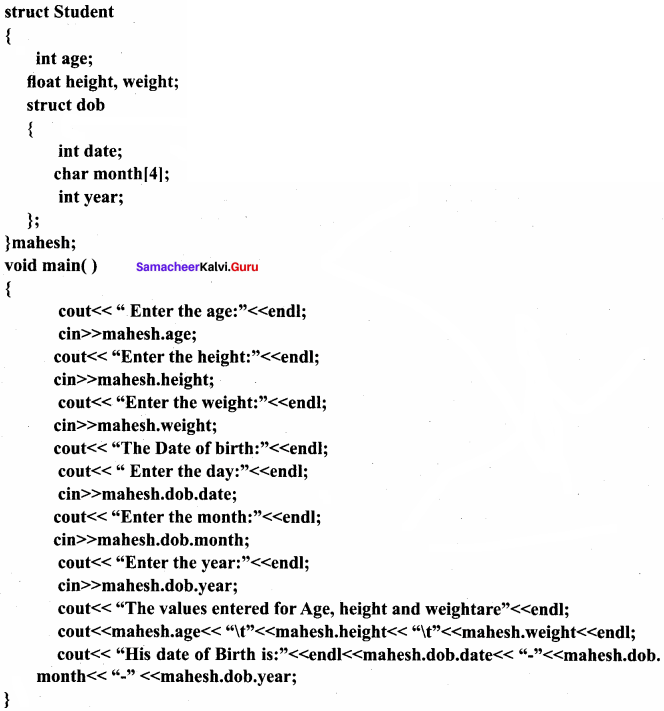
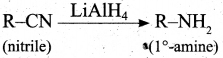
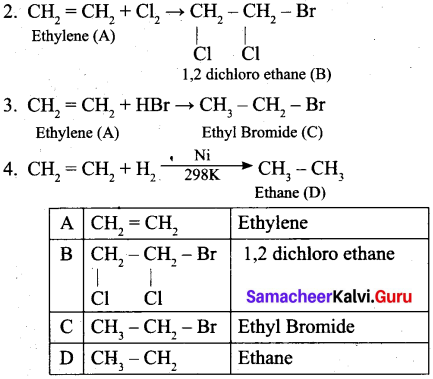
Tamil Nadu 11th Chemistry Previous Year Question Paper March 2019 English Medium

Students can Download Tamil Nadu 11th Chemistry Previous Year Question Paper March 2019 English Medium Pdf, Tamil Nadu 11th Chemistry Model Question Papers helps you to revise the complete Tamilnadu State Board New Syllabus and score more marks in your examinations.

TN State Board 11th Chemistry Previous Year Question Paper March 2019 English Medium

Tamil Nadu 11th Chemistry Previous Year Question Paper March 2019 English Medium

Time: 2½ Hours
Total Score: 90 Marks

General Instructions:

  1. The question paper comprises of four parts.
  2. You are to attempt all the parts. An internal choice of questions is provided wherever applicable.
  3. All questions of Part I. II, III and IV are to be attempted separately.
  4. Question numbers 1 to 15 in Part I are Multiple Choice Questions of one mark each. These are to be answered by choosing the most suitable answer from the given four alternatives and writing the option code and the corresponding answer.
  5. Question numbers 16 to 24 in Part II are two-mark questions. These are to be answered in about one or two sentences.
  6. Question numbers 25 to 33 in Part III are three-mark questions. These are to be answered in about three to five short sentences.
  7. Question numbers 34 to 38 in Part IV are five-mark questions. These are to be answered in detail. Draw diagrams wherever necessary.

Tamil Nadu 11th Chemistry Previous Year Question Paper March 2019 English Medium

Part- I

Answer all the Questions. [Answers are in Bold] [15 x 1 = 15]

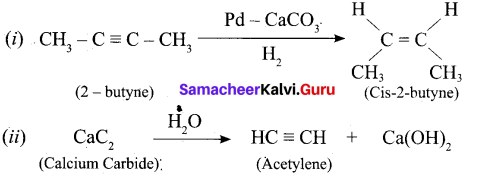
Choose the most appropriate answer from the given four alternatives and write the option code and the corresponding answer.

Question 1.
Many of the organic compounds are inflammable because of its
(a) Vander Waal’s force
(b) Co-ordinate nature
(c) Covalent nature
(d) Ionic nature
Answer:
(c) Covalent nature

Question 2.
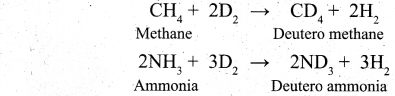
When Ang is negative in chemical equilibrium reaction, then ..
(a) Kp < Kc
(b) Kp = 1 /Kc
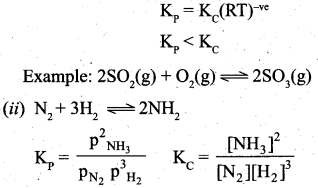
(c) Kp = Kc (RT)-vc
(d) Kp > Kc
Answer:
(c) Kp = Kc (RT)-vc

Tamil Nadu 11th Chemistry Previous Year Question Paper March 2019 English Medium

Question 3.
Find A in the following equation.
\(\mathrm{CaO}+3 \mathrm{C} \stackrel{3273 \mathrm{K}}{\longrightarrow} \mathrm{A}+\mathrm{CO}\)
(a) CaC2
(b) CO2
(c) Ca
(d) Ca2O
Answer:
(d) Ca2O

Question 4.
Splitting of spectral lines in an electric field is called
(a) Compton effect
(b) Stark effect
(c) Zeeman effect
(d) Shielding effect
Answer:
(a) Compton effect

Tamil Nadu 11th Chemistry Previous Year Question Paper March 2019 English Medium

Question 5.
Which of the following species does not exert a resonance effect?
(a) C6H5NH2
(b) C6H5NH3
(c) C6H5OH
(d) C6H5CI
Answer:
(b) C6H5NH3

Question 6.
Match the following:
Compound – Uses
1. Chloro picrin (i) Detection of primary amine
2. Methyl Isocyanide (ii) DDT
3. Chloro benzene (iii) Paint remover
4. Methylene chloride (iv) Soil sterilizer
(a) 1- (iv), 2 – (iii), 3 – (ii), 4 – (i)
(b) 1- (Hi), 2 – (iv), 3 – (ii), 4 – (i)
(c) 1- (i), 2 – (ii), 3 – (iv), 4 – (iii)
(d) 1- (iv), 2 – (i), 3 – (ii), 4 – (iii)
Answer:
(d) 1 – (iv), 2 – (i), 3 – (ii), 4 – (iii)

Question 7.
Use of hot air balloon in the meteorological observatory is an application of
(a) Kelvin’s Law
(b) Brown’s Law
(c) Boyle’s Law
(d) Newton’s Law
Answer:
(b) Brown’s Law

Tamil Nadu 11th Chemistry Previous Year Question Paper March 2019 English Medium

Question 8.
What is the pH of rain water?
(a) 5.6
(b) 4.6
(c) 6.5
(d) 7.5
Answer:
(a) 5.6

Question 9.
Which compound is named as “Blue John” among the following compounds?
(a) Ca3(PO4)2
(b) CaO
(c) CaH2
(d) CaF2
Answer:
(d) CaF2

Question 10.
The element with positive electron gain enthalpy is ………………………… .
(a) Argon
(b) Fluorine
(c) Hydrogen
(d) Sodium
Answer:
(d) Sodium

Tamil Nadu 11th Chemistry Previous Year Question Paper March 2019 English Medium

Question 11.
Which of the following mMecule does not contain n bond?
(a) CO2
(b) H2O
(c) SO2
(d) NO2
Answer:
(c) SO2

Question 12.
Which of the following compound has same percentage of Carbon as that of ethylene (C2H4)?
(a) benzene
(b) ethane
(c) propene
(d) ethyne
Answer:
(a) benzene

Question 13.
The SI unit of Molar heat capacity is
(a) JK-1 mol-1
(b) kJ mol+1
(c) kJ mol-1
(d) cm
Answer:
(c) kJ mol-1

Question 14.
What percentage of solution of H202 is called as “100-Volume” H202?
(a) 15%
(b) 50%
(c) 20%
(d) 30%
Answer:
(a) 15%

Tamil Nadu 11th Chemistry Previous Year Question Paper March 2019 English Medium

Question 15.
Osmotic pressure (n) of a solution is given by the relation
(a) πRT = n
(b) V = πnRT
(c) π = nRT
(d) πV = nRT
Answer:
(b) V = πnRT

Part-II

Answer any six of the following questions. Question no. 24 is compulsory. [6 x 2 = 12]

Question 16.
State and explain Pauli’s Exclusion Principle.
Answer:
Pauli’s exclusion principle states that “No two electrons in an atom can have the same set of values of all four quantum numbers”.
Illustration: H(Z = 1) Is1.

One electron is present in hydrogen atom, the four quantum numbers are n = 1, l = 0, m = 0 and s = + ½. For helium Z = 2. He: Is2. In this one electron has the quantum number same as that of hydrogen, n = 1, l = 0 m = 0 and s = + ½. For other electron, fourth quantum number is different, i.e. n = 1, l = 0, m = 0 and s = – ½.

Question 17.
Define – Valency.
Answer:
The valency of an element may be defined as the combining capacities of elements. The electrons present in the outermost shell are called valence electrons and these electrons determine the valency of the atom.

Tamil Nadu 11th Chemistry Previous Year Question Paper March 2019 English Medium

Question 18.
What are ideal gases?
Answer:

  • A gas that follows Boyle’s law, Charles’ law and Avogadro law strictly is called an ideal gas. It is assumed that intermolecular forces are not present between the molecules of an ideal gas.
  • Ideal gases are the gases that obey gas laws or gas equation PV = nRT.
  • Real gases do not obey gas equation. PV = nRT.
  • The deviation of real gases from ideal behaviour is measure in terms of a ratio of PV to PV nRT. This is termed as compression factor (Z). Z = \(\frac{P V}{n R T}\)

Question 19.
State the third law of Thermodynamics.
Answer:
It states that the entropy of pure crystalline substance at absolute zero is zero, (or)

It can be stated as “it is impossible to lower the temperature of an object to absolute zero in a finite number of steps”. Mathematically \(\lim _{T \rightarrow 0} S=0\)

Tamil Nadu 11th Chemistry Previous Year Question Paper March 2019 English Medium

Question 20.
What is called Bond Length? Name the techniques through which the length of a bond can be determined.
Answer:
The distance between thS nuclei of two covalently bonded atoms is called bond length. For e.g„ in a covalent molecule A – B, the bond length is equal to the sum of the radii of bonded atoms, i.e., γA + γB = bond length.

The length of a bond can be determined by spectroscopic, x-ray diffraction and electron- diffraction techniques.

Question 21.
Describe the reaction involved in the detection of Nitrogen in an organic compound by Lassaigne Method.
Answer:
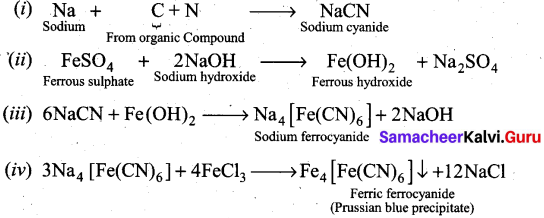
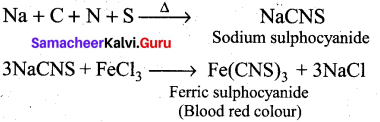
Detection of Nitrogen: The following reactions are involved in the detection of nitrogen with formation of prussian blue precipitate conforming the presence of nitrogen in an organic compound.
Tamil Nadu 11th Chemistry Previous Year Question Paper March 2019 English Medium 1

Tamil Nadu 11th Chemistry Previous Year Question Paper March 2019 English Medium

Question 22.
How is Alkane prepared from Grignard reagent?
Answer:
CH3MgX + HOH → CH4 + Mg(OH)X.
Water would protonate the grignard reagent and destroy the grignard reagent, because the grignard carbon atom is highly nucleophilic. This would form a hydrocarbon. Therefore to make a grignard solution, only ether is the best solvent and water or alcohol are not used for that purpose.

Question 23.
Define – Acid rain.
Answer:
Rain water has a pH of 5.6 due to the dissolution of CO2 into it. Oxides of sulphur and nitrogen in the atmosphere may be absorbed by droplets of water that make up the clouds and get chemically converted into sulphuric acid and nitric acid. Due to this the pH of rain water drops below the level of 5.6. Hence it is called acid rain.

Question 24.
Which is the suitable method for detection of Nitrogen present in food and fertilizers?
Answer:
Kjeldahl’s method is the suitable for detection of nitrogen present in food and fertilizers.

Tamil Nadu 11th Chemistry Previous Year Question Paper March 2019 English Medium

Part-III

Answer any six of the following questions. Question No. 33 is compulsory. [6 x 3 = 18]

Question 25.
Calculate the equivalent mass of H2SO4.
Sulphuric acid = H2SO4
Molar mass of Sulphuric acid = 2 + 32 + 64 = 98
Basicity of Sulphuric acid = 2
Equivalent mass of acid =
\(=\frac{\text { Molar mass of an acid }}{\text { Basicity }}\)
\(=\frac{98}{2}=49 \mathrm{geq}^{-1}\)

Question 26.
Explain diagonal relationship.
Answer:

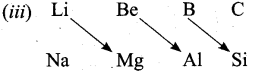
  • On moving diagonally across the periodic table, the second and the third period elements show certain similarities.
  • Even though the similarity is not same as we see in a group, it is quite pronounced in the following pair of elements.
  • Tamil Nadu 11th Chemistry Previous Year Question Paper March 2019 English Medium 2
  • The similarity in properties existing between the diagonally placed elements is called “diagonal relationship”.

Tamil Nadu 11th Chemistry Previous Year Question Paper March 2019 English Medium

Question 27.
How is Tritium prepared?
Answer:
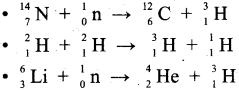
It occurs naturally as a result of nuclear reactions induced by cosmic rays in the upper atmosphere.
Tamil Nadu 11th Chemistry Previous Year Question Paper March 2019 English Medium 3

Question 28.
Define – Le-Chatelier principle.
Answer:
It states that “If a system at equilibrium is disturbed, then the system shifts itself in a direction that nullifies the effect of that disturbance.

Question 29.
State the term “Isotonic solution”.
Answer:

  1. Two solutions having same osmotic pressure at a given temperature are called isotonic solutions.
  2. When such solutions are separated by a semipermeable membrane, solvent flow between one to the other on either direction is same, i.e., the net solvent flow between two isotonic solutions is zero.

Tamil Nadu 11th Chemistry Previous Year Question Paper March 2019 English Medium

Question 30.
Both C2H2 and CO2 have the same structure. Explain why.
Answer:
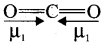
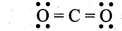
H – C = C – H and O = C = O
Both has,
Linear- Molecular geometry
Zero – Dipole moment
sp – Hybridization of C in C2H2 and CO2. Hence C2H2 and CO2 have the same structure.

Question 31.
Write note on Williamson’s Synthesis.
Answer:
Williamson’s synthesis: Haloalkanes, when boiled with sodium alkoxide, gives the corresponding ether.
Tamil Nadu 11th Chemistry Previous Year Question Paper March 2019 English Medium 4

Question 32.
Explain why Ca(OH)2 is used in white washing.
Answer:
(i) Ca(OH)2 used in white washing, this is due to disinfectant nature.
(if) Calcium hydroxide reacts with CO2 in air to form thin layer of calcium carbonate on the walls. It gives a shiny finish to the walls.

Tamil Nadu 11th Chemistry Previous Year Question Paper March 2019 English Medium

Question 33.
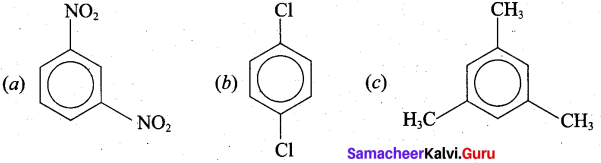
Give the structural formula for the following compounds.
(a) m – dinitrobenzene
(b) p – dichlorobenzene
(c) 1,3, 5, Tri-methyl Benzene
Answer:
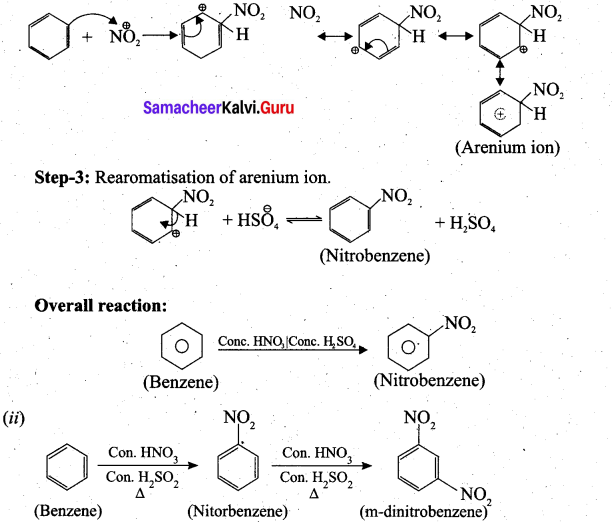
Tamil Nadu 11th Chemistry Previous Year Question Paper March 2019 English Medium 5

Part – IV

Answer all the questions.

Question 34.
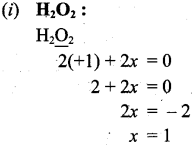
(a) (i) Calculate oxidation number of oxygen in H2O2.
(ii) Write the de-Broglie equation.
[OR]
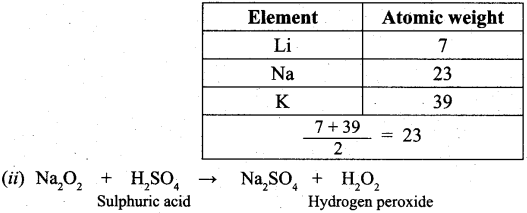
(b) (i) State and explain Dobereiner’s “Triad”.
(ii) Complete the following equation.
(a)
Tamil Nadu 11th Chemistry Previous Year Question Paper March 2019 English Medium 6
Therefore oxidation number of ‘O’ in H2O2 is -1.

Tamil Nadu 11th Chemistry Previous Year Question Paper March 2019 English Medium

(ii) 1. Louis de Broglie extended the concept of dual nature of light to all forms of matter. To quantify this relation, he derived an equation for the wavelength of a matter wave.
2. He combined the following two equations of energy of which one represents wave character (ho) and the other represents the particle nature (mc2).
Planck’s quantum hypothesis:
E = hv …………………………. (1)
Einsteins mass-energy relationship:
E = mc2 ………………………….. (2)
From (1) and (2)
hv = mc2
h/λ = mc2
∴ λ = \(\frac{h}{m c}\) ……………………………….. (3)

The equation (3) represents the wavelength of photons whose momentum is given by. me. (Photons have zero rest mass).

3. For a particle of matter with mass m and moving with a velocity v, the equation (3) can be written as λ = \(\frac{h}{m c}\) ……………………………….. (3)

[OR]

Tamil Nadu 11th Chemistry Previous Year Question Paper March 2019 English Medium

(b) (i) Johann Dobereiner noted that elements with similar properties occur in groups of three which he called triads. It was seen that invariably, the atomic weight of the middle number of the triad was nearly equal to the arithmetic mean of the weights of the other two numbers of the triad. For e.g.,
Tamil Nadu 11th Chemistry Previous Year Question Paper March 2019 English Medium 7

Question 35.
(a) (i) Among the alkaline earth metals BeO is insoluble in water but other oxides are soluble. Why?
(ii) State Diffusion Law.
[OR]
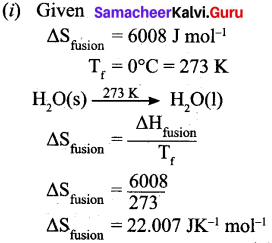
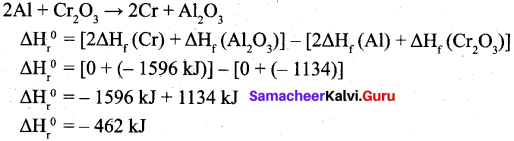
(b) (i) Calculate the entropy change during the melting of one mole of ice into water at 0°C. Enthalpy of fusion of ice is 6008 J mol-1.
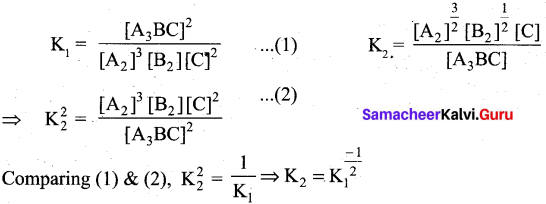
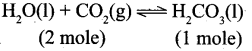
(ii) Write the balanced chemical equation for Kc = \(\frac{\left[\mathbf{C a O}_{(\mathbf{s})}\right]\left[\mathbf{C O}_{2(\mathbf{g})}\right]}{\left[\mathbf{C a C O}_{3(\mathbf{(})}\right]}\)
(a) (i) Lattice energy of BeO is comparatively higher than the hydrogen energy. Therefore it is almost insoluble in water. Whereas other alkaline earth metals oxides have high hydration energy. Hence they are soluble in water.

Tamil Nadu 11th Chemistry Previous Year Question Paper March 2019 English Medium

(ii) Diffusion is the spreading of molecules of a substance throughout a space or a second substance. Diffusion refers to the ability of the gases to mix with each other. E.g., Spreading of something such as brown tea liquid spreading through the water in a tea cup.

[OR]

(b)
Tamil Nadu 11th Chemistry Previous Year Question Paper March 2019 English Medium 8
Tamil Nadu 11th Chemistry Previous Year Question Paper March 2019 English Medium 9

Question 36.
(a) (i) NH3 and HC1 do not obey Henry’s law. Why?
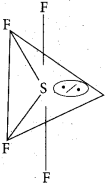
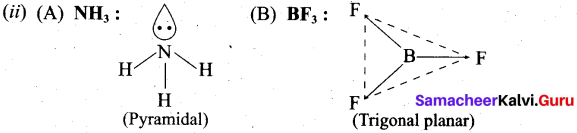
(ii) Write the structure of the following compunds. (A) NH3 (B) BF3

[OR]

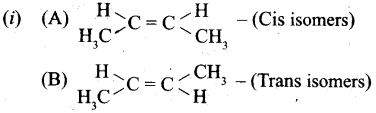
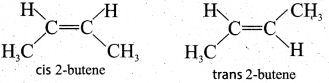
(b) (i) Identify the cis and trans isomers for the following compounds.
Tamil Nadu 11th Chemistry Previous Year Question Paper March 2019 English Medium 10
(ii) Explain with example the Positive Mesomeric Effect.
Answer:
(a) (i) Only the less soluble gases obeys Henry’s law. NH3 and HC1 react with (or soluble) water and hence does not obey Henry’s law.
Tamil Nadu 11th Chemistry Previous Year Question Paper March 2019 English Medium 11

(b)
Tamil Nadu 11th Chemistry Previous Year Question Paper March 2019 English Medium 12

Tamil Nadu 11th Chemistry Previous Year Question Paper March 2019 English Medium

(ii)

  1. Positive mesomeric effect occurs, when the electrons move away from substituent attached to the conjugated system.
  2. It occurs, if the electron releasing substituents are attached to the conjugated system.
  3. The attached group has a tendency to release electrons through resonance, these electron releasing groups are usually denoted as +R or +M groups
  4. Examples: —OH, —SH, —OR, —SR, —NH2 etc.

Question 37.
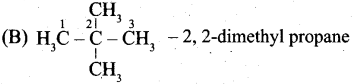
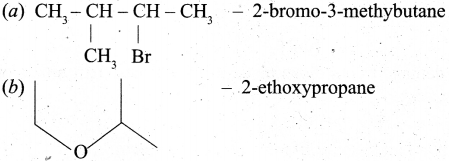
(a) (i) Write the IUPAC name for the following compound.
Tamil Nadu 11th Chemistry Previous Year Question Paper March 2019 English Medium 13
(ii) What are Nucleophiles and Electrophiles? Give one example each.

[OR]

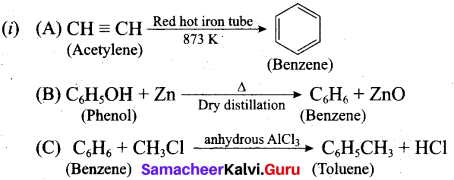
(b) (i) How will you get the following products with the given reactants?
(A) Acetylene → Benzene
(B) Phenol → Benzene
(C) Benzene → Toluene
(ii) Write any two different components you get during fractional distillation of Coal Tar at any two different temperatures.
Answer:
(a)
Tamil Nadu 11th Chemistry Previous Year Question Paper March 2019 English Medium 14
Tamil Nadu 11th Chemistry Previous Year Question Paper March 2019 English Medium 15

Tamil Nadu 11th Chemistry Previous Year Question Paper March 2019 English Medium
(ii) Electrophiles: Electrophiles are reagents that are attracted towards negative charge or electron rich center. They are either positively charged ions or electron deficient neutral molecules.
Example, CO2, AlCl3, BF3, FeCl3, N0+, NO2+, etc.

Nucleophiles: Nucleophiles are reagents that has high affinity for electropositive centers. They possess an atom has a unshared pair of electrons. They are usually negatively charged ions or electron rich neutral molecules.
Example: NH3, R-NH2, R-SH, H2O, R-OH, CN, OH etc.

[OR]

(b)
Tamil Nadu 11th Chemistry Previous Year Question Paper March 2019 English Medium 16
(ii) Coal tar is a viscous liquid obtained by the pyrolysis of coal. During fractional distillation, coal tar is heated and distills away its volatile compounds, namely, benzene, toluene, xylene in the temperature range of 350 K to 443 K. These vapours are. collected at the upper part of the fractionating column.

Name of the fractionTemperature RangeName of the component
Crude light oil350- 443 KBenzene, Toluene, Xylene
Middle oil443 – 503 KPhenol, Naphthalene
Heavy oil503 – 543 KNaphthalene, Cresol
Green oil543 – 633 KAnthracene
Pitch oil633 KResidue

Question 38.
(a) (i) A compound having the empirical formula C6H6O has the vapour density 47. Find its Molecular formula.
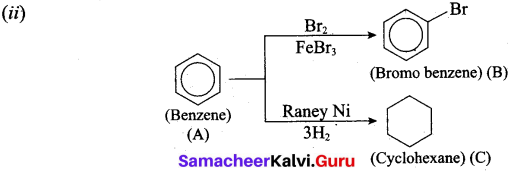
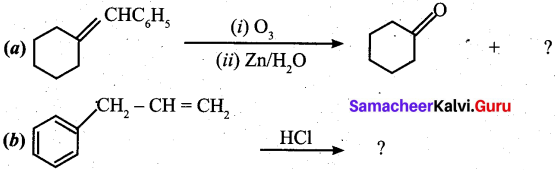
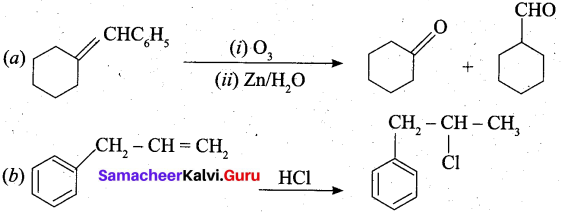
(ii) The Simple Aromatic Hydrocarbon compound (A) reacts with Bromine to give (B). Compound (A) reacts with Raney Ni and gives (C). Identify (A), (B) and (C).

Tamil Nadu 11th Chemistry Previous Year Question Paper March 2019 English Medium

[OR]

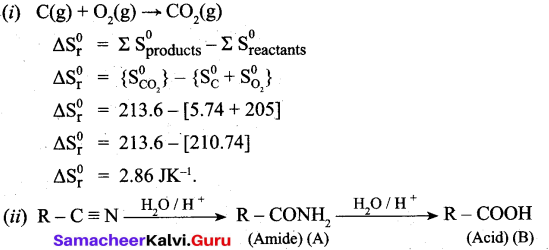
(b) (i) C(s) + O2(g) → CO2(g)
Calculate the standard entropy change for the above reaction. Given the standard entropies of CO(s) + C(s), O2(g) are 213.6, 5.740 and 205 JK-1 respectively.
(ii) Identify the compound (A) and (B).
Tamil Nadu 11th Chemistry Previous Year Question Paper March 2019 English Medium 17

(a) (i) Empirical formula = C6H6O
Empirical formula mass
= (6 x 12) + (6 x 1) + (16 x 1)
= 72 + 6+16
= 94
Vapour density =47
Molecular mass = 2 x Vapour density
= 2 x 47
= 94
Molecular formula = n x Empirical formula
\($\mathrm{n}=\frac{\text { Molecular mass }}{\text { Empirical formula mass }}$\)
n = 94/94 ⇒ n = 1
Molecular formula = 1 x C6H6O
= c6H6O

Tamil Nadu 11th Chemistry Previous Year Question Paper March 2019 English Medium 18
[OR]

Tamil Nadu 11th Chemistry Previous Year Question Paper March 2019 English Medium 19

Tamil Nadu 11th Chemistry Previous Year Question Paper March 2019 English Medium

Tamil Nadu 11th Chemistry Model Question Paper 1 English Medium

Students can Download Tamil Nadu 11th Chemistry Model Question Paper 1 English Medium Pdf, Tamil Nadu 11th Chemistry Model Question Papers helps you to revise the complete Tamilnadu State Board New Syllabus and score more marks in your examinations.

TN State Board 11th Chemistry Model Question Paper 3 English Medium

Tamil Nadu 11th Chemistry Model Question Paper 3 English Medium

Time: 2½ Hours
Total Score: 90 Marks

General Instructions:

  1. The question paper comprises of four parts.
  2. You are to attempt all the parts. An internal choice of questions is provided wherever applicable.
  3. All questions of Part I. II, III and IV are to be attempted separately.
  4. Question numbers 1 to 15 in Part I are Multiple Choice Questions of one mark each. These are to be answered by choosing the most suitable answer from the given four alternatives and writing the option code and the corresponding answer.
  5. Question numbers 16 to 24 in Part II are two-mark questions. These are to be answered in about one or two sentences.
  6. Question numbers 25 to 33 in Part III are three-mark questions. These are to be answered in about three to five short sentences.
  7. Question numbers 34 to 38 in Part IV are five-mark questions. These are to be answered in detail. Draw diagrams wherever necessary.

PART -1

Answer all the Questions.
Choose the most suitable answer from the given four alternatives.

Question 1.
The equivalent mass of a trivalent metal element is 9 g eq-1 the molar mass of its anhydrous oxide is ………………………… .
(a) 102 g
(b) 27 g
(c) 270 g
(d) 78 g
Answer:
(a) 102 g

Let the trivalent metal be M3+
Equivalent mass = mass of the metal / valance factor
9 g eq-1 = mass of the metal/3 eq
Mass of the metal = 27g Oxide formed M2O3;
Mass of the oxide = (2 x 27) + (3 x 16) = 102g

Tamil Nadu 11th Chemistry Model Question Paper 3 English Medium

Question 2.
Based on equation E = – 2,178 x 10-18 J \(\left(\frac{z^{2}}{n^{2}}\right)\) certain conclusions are written.
Which of them is not correct? [NEET]
(а) Equation can be used to calculate the change in energy when the electron changes orbit
(b) For n = 1, the electron has a more negative energy than it does for n = 6 which means that the electron is more loosely bound in the smallest allowed orbit.
(c) The negative sign in equation simply means that the energy of electron bound to the nucleus is lower than it would be if the electrons Were at the infinite distance from the nucleus.
(d) Larger the value of n, the larger is the orbit radius.
Answer:
(b) For n = 1, the electron has a more negative energy than it does for n = 6 which means that the electron is more loosely bound in the smallest allowed orbit.

Correct statement: For n = 1, the electron has more negative energy than it does for n = 6 which means that the electron is strongly bound in the smallest allowed orbit.
Answer:

Question 3.
Match the following.
List-I – List-II
A. Jewels – 1. Sodium chloride
B. Bolts and cot – 2. Copper
C. Table salt – 3. Gold
D. Utensils – 4. Iron
Code: A B C D
(a) 3 4 1 2
(b) 4 1 3 2
(c) 1 4 2 3
(d) 2 3 4 1
Answer:
(a) 3 4 1 2

Tamil Nadu 11th Chemistry Model Question Paper 3 English Medium
Question 4.
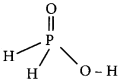
The reaction H3PO2 + D2O → H2DPO2 + HDO indicates that hypo-phosphorus acid is …………… .
(a) tribasic acid
(b) dibasic acid
(c) mono basic acid
(d) none of these
Answer:
(c) mono basic acid

Hypophosphorous acid on reaction with D2O, only one hydrogen is replaced by deuterium and hence it is mono basic.

Question 5.
RbO2 is …………….. .
Tamil Nadu 11th Chemistry Model Question Paper 1 English Medium image - 1
(a) superoxide and paramagnetic
(b) peroxide and diamagnetic
(c) superoxide and diamagnetic
(d) peroxide and paramagnetic
Answer:
(a) superoxide and paramagnetic

Tamil Nadu 11th Chemistry Model Question Paper 3 English Medium
Question 6.
At identical temperature and pressure, the rate of diffusion of hydrogen gas is 3 \(\sqrt{3}\) times that of a hydrocarbon having molecular formula Cn H2n-2. What is the value of n?
(a) 8
(b) 4
(c) n3
(d) 1
Answer:
(b) 4

Tamil Nadu 11th Chemistry Model Question Paper 1 English Medium image - 2
Squaring on both sides and rearranging
27 x 2 = mCnH2n-2
54 = n(12) + (2n-2) (1)
54 = 12n + 2n – 2 = 14n – 2
n = (54 + 2)/14 = 56/14 = 4

Question 7.
Statement-I: All living things are open systems.
Statement-II: Because they continuously exchange matter and energy with the surroundings,
(a) Statement-I and II are correct and Statement-II is the correct explanation of Statement-I.
(b) Statement-I and II are correct but Statement-II is not the correct explanation of Statement-I.
(c) Statement-I is correct and Statement-II is wrong.
(d) Statement-I is wrong but Statement-II is correct.
Answer:
(a) Statement-I and II are correct and Statement-II is the correct explanation of Statement-I.

Tamil Nadu 11th Chemistry Model Question Paper 3 English Medium
Question 8.
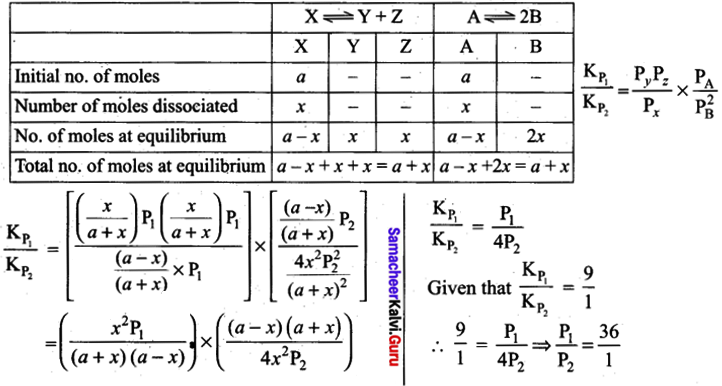
The values of Kp1 and Kp2 for the reactions: \(\mathrm{X} \rightleftharpoons \mathrm{Y}+\mathrm{Z} \text { and } \mathrm{A} \rightleftharpoons 2 \mathrm{B}\) are in the ratio 9 : 1 if degree of dissociation and initial concentration of X and Abe equal then total pressure at equilibrium P1 and P2 are in the ratio ………………………… .
(a) 36: 1
(b) 1: 1
(c) 3: 1
(d) 1: 9
Answer:
(a) 36: 1

Tamil Nadu 11th Chemistry Model Question Paper 1 English Medium image - 3

Question 9.
Which of the following is not an non-ideal solution showing negative deviation?
(a) Phenol and aniline
(b) Ethanol and water
(c) Acetone + Chloroform
(d) n-Heptane and n-Hexane
Answer:
(d) n-Heptane and n-Hexane

Tamil Nadu 11th Chemistry Model Question Paper 3 English Medium
Question 10.
In C1F3, NF3 and BF3 molecules the chlorine, nitrogen and boron atoms are …………………. .
(a) sp3 hybridised
(b) sp3, sp3 and sp2 respectively
(c) sp2 hybridised
(d) sp3d, sp3 and sp2 hybridised respectively
Answer:
(d) sp3d, sp3 and sp2 hybridised respectively

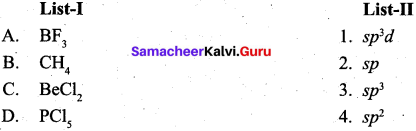
Solution: C1F3 – sp3d hybridisation ; NF3 – sp3 hybridisation ; BF3 – sp2 hybridisation

Question 11.
The number of stereoisomers of 1, 2-dihydroxy cyclopentane is
(a) 1
(b) 2
(c) 3
(d) 4
Answer:
(c) 3

Question 12.
Consider the following statement.
(i) Covalent bonds .are break into two different ways.
(ii) They are Homolytic and Heterolytic cleavage.
(iii) During the fission of a covalent bond, organic compounds form a new organic molecules. Which of the above statement is/are not correct?
(a) (i) only
(b) (i) and (ii)
(c) (iii) only
(d) (ii) and (iii)
Answer:
(c) (iii) only

Tamil Nadu 11th Chemistry Model Question Paper 3 English Medium
Question 13.
Major product of the below mentioned reaction is ………………….. .
\(\left(\mathrm{CH}_{3}\right)_{2} \mathrm{C}=\mathrm{CH}_{2} \stackrel{\mathrm{ICl}}{\longrightarrow}\)
(a) 2-chloro -1- iodo – 2 – methylpropane
(b) l-chloro-2-iodo-2-methylpropane
(c) 1,2 – dichloro – 2 – methylpropane
(d) 1,2- diiodo – 2 – methylpropane
Answer:
(a) 2-chloro -1- iodo – 2 – methylpropane

Question 14.
The formula of Chloropicrin is
(a) CHC13
(b) CCl3CHO
(C) CH2C12
(d) CC13NO2
Answer:
(d) CC13NO2

Question 15.
Which of the following is carcinogenic and causes irritation in eyes and mucous membranes?
(a) PAH
(b) THF
(c) CO
(d) PAN
Answer:
(a) PAH

Tamil Nadu 11th Chemistry Model Question Paper 3 English Medium

Part-II

Answer any six questions in which question No. 17 is compulsory. [6 x 2 = 12]

Question 16.
Which is considered as to be Earth’s protective umbrella? Why?
Answer:

  1. At high altitudes in the atmosphere consists of a layer of ozone (O3) which acts as an umbrella for harmful UV radiations. Ozone is considered to be earth’s protective umbrella.
  2. It protects us from harmful effects of UV-radiations of the sun such as skin cancer.
  3. Ozone layer prevent the UV radiations to reach the earth surface. So it acts as an umbrella for the Earth.

Question 17.
Complete the following:
\(\text { (i) } 2 \text { – butyne } \frac{\mathrm{Pd}-\mathrm{CaCO}_{3}}{\rightarrow} \text { ? (ii) } \mathrm{CaC}_{2} \stackrel{\mathrm{H}_{2} \mathrm{O}}{\longrightarrow} ?\)
Answer:
Tamil Nadu 11th Chemistry Model Question Paper 1 English Medium image - 25

Question 18.
How will you test sulfur present in organic compounds?
Answer:
To a portion of the Lassaigne’s extract, freshly prepared sodium nitroprusside solution is added. If deep violet or purple colour is formed, the presence of sulfur is confirmed.
Tamil Nadu 11th Chemistry Model Question Paper 1 English Medium image - 5

Tamil Nadu 11th Chemistry Model Question Paper 3 English Medium
Question 19.
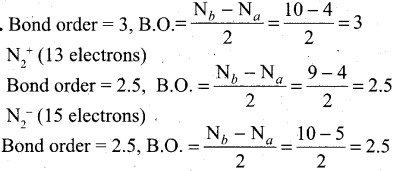
Which one of the following has highest bond order? []\mathbf{N}_{2}, \mathbf{N}_{2}^{+} \text {or } \mathbf{N}_{2}^{-}[/latex]
Answer:
Tamil Nadu 11th Chemistry Model Question Paper 1 English Medium image - 6
So N2 has the highest bond order.

Question 20.
Define the term isotonic solution.
Answer:

  1. Two solutions having same osmotic pressure at a given temperature are called isotonic solutions.
  2. When such solutions are separated by a semipermeable membrane, solvent flow between one to the other on either direction is same, i.e., the net solvent flow between two isotonic solutions is zero.

Tamil Nadu 11th Chemistry Model Question Paper 3 English Medium
Question 21.
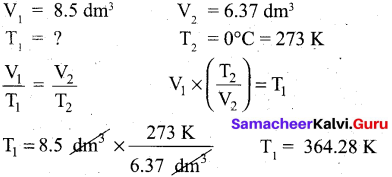
A sample of gas has a volume of 8.5 dm3 at an unknown temperature. When the sample is submerged in ice water at 0°C, its volume gets reduced to 6.37 dm3. What is its initial temperature?
Answer:
Tamil Nadu 11th Chemistry Model Question Paper 1 English Medium image - 7

Question 22.
Mention the uses of washing soda (or) sodium carbonate.
Answer:

  1. Sodium carbonate is highly used in laundering.
  2. It is an important laboratory reagent used in the qualitative analysis and in volumetric analysis.
  3. It is also used in water treatment to convert the hard water to soft water.
  4. It is used in the manufacture of glass, paper and paint.

Question 23.
What is water – gas shift reaction?
Answer:
The carbon monoxide of water gas can be converted to carbon dioxide by mixing the gas mixture with more steam at 400°C and passed over a shift converter containing iron/copper catalysts. This reaction is called water-gas shift reaction.
CO + H2O → CO2 + H2

Question 24.
What are Ψ and Ψ2?
Answer:

  1. Ψ itself has no physical meaning but it represents an atomic orbital.
  2. Ψ2 is related to the probability of finding the electrons within a given volume of space.

Tamil Nadu 11th Chemistry Model Question Paper 3 English Medium

Part-III

Answer any six questions in which question No. 29 is compulsory. [16 x 3 = 18]

Question 25.
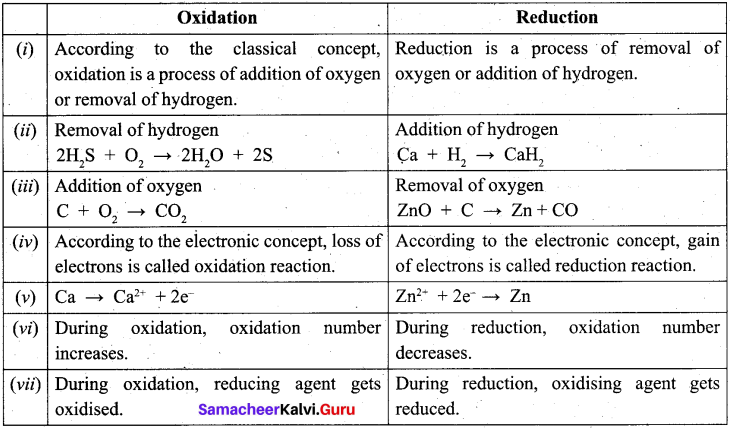
Distinguish between oxidation and reduction.
Answer:
Tamil Nadu 11th Chemistry Model Question Paper 1 English Medium image - 8

Question 26.
Why there is a need for classification of elements?
Answer:

  1. Classification is a fundamental and essential process in our day-to-day life for the effective utilization of resources, daily events and materials.
  2. In such a way, for the effective utilization of discovered elements becomes fundamentally essential process.
  3. The periodic classification of the elements is one of the outstanding contributions to the progress of chemistry.

Tamil Nadu 11th Chemistry Model Question Paper 3 English Medium
Question 27.
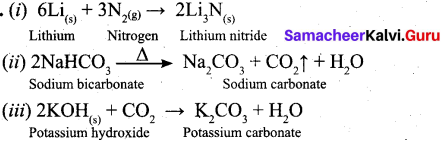
Write the balanced equation for following reaction.
(i) Li metal with N2 gas
(ii) Heating solid sodium bicarbonate
(iii) Solid potassium hydroxide with CO2
Answer:
Tamil Nadu 11th Chemistry Model Question Paper 1 English Medium image - 9

Question 28.
Discuss briefly the similarities between Be and Al.
Answer:

  • Beryllium and aluminium have same electronegativity values.
  • Their changes per unit area is closer.
  • BeCl2 and AlCl3 forms dimeric structure. Both are soluble in organic solvents and are strong Lewis acids.
  • Be(OH)2 and Al(OH)3 dissolves in excess alkali to give beryllate ion [Be(OH)4]3- and aluminate
  • Be and A1 ions have strong tendency to form complexes, e.g. \(\mathrm{BeF}_{4}^{2}\) and \(\mathrm{AlF}_{6}^{3-}\).
  • Both Be(OH)2 and Al(OH)3 are amphoteric in nature.
  • Carbide of Be – beryllium carbide (Be2C) and A1 – aluminium carbide (Al4C3) give methane on hydrolysis.
  • Both beryllium and aluminium are rendered passive by nitric acid.

Tamil Nadu 11th Chemistry Model Question Paper 3 English Medium
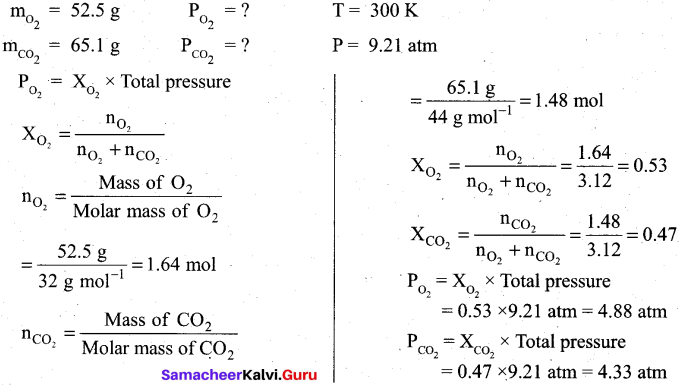
Question 29.
A tank contains a mixture of 52.5 g of oxygen and 65.1 g of CO2 at 300 K the total pressure in the tank is 9.21 atm. Calculate the partial pressure (in atm) of each gas in the mixture?
Answer:
Tamil Nadu 11th Chemistry Model Question Paper 1 English Medium image - 10

Question 30.
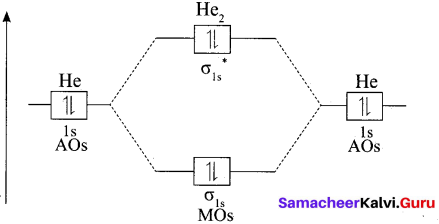
Why He2 molecule does not exist?
Answer:
Diatomic Helium molecule, He2 (Hypothetical). The electron configuration of Helium (Z = 2) in the ground state is Is2. As each Helium atom contains two electrons, there will be 4 electrons in He2 molecule. Keeping in view the Aufbau principle and Pauli’s exclusion principle its electron configuration would be as follows.
He2 : (σls)2ls)2.
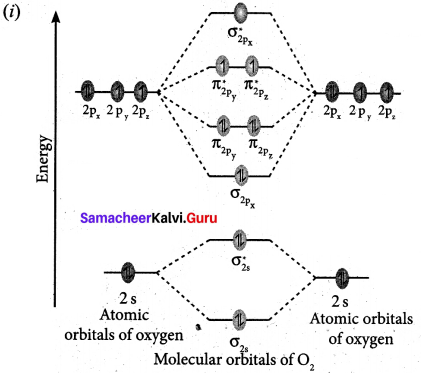
The molecular orbital energy level diagram of He2:
Tamil Nadu 11th Chemistry Model Question Paper 1 English Medium image - 11
Here, Nb = 2 and Na = 2
Bond order = \(\frac{N_{b}-N_{a}}{2}=\frac{2-2}{2}=0\)
As the bond order for He2 comes out to be zero, this molecule does not exist.

Tamil Nadu 11th Chemistry Model Question Paper 3 English Medium
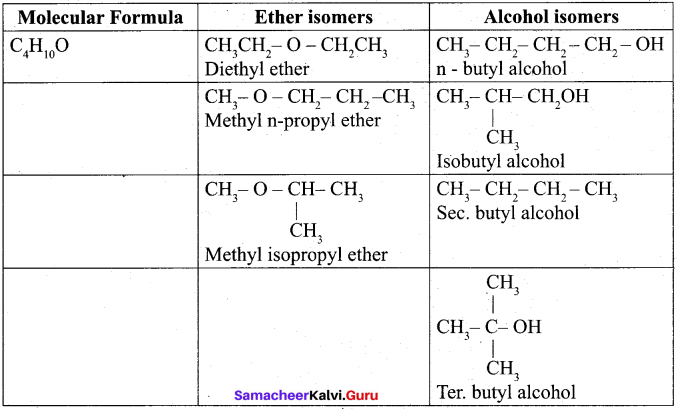
Question 31.
Write all the possible isomers of molecular formula C4H10O and identify the isomerisms found in them.
Answer:
Tamil Nadu 11th Chemistry Model Question Paper 1 English Medium image - 12

Question 32.
Explain how oxygen deficiency is caused by carbon monoxide in our blood? Give its effect.
Answer:

  1. Carbon monoxide binds with haemoglobin and form carboxy the haemoglobin which impairs normal oxygen transport by blood and hence the oxygen carrying capacity of blood is reduced.
  2. This oxygen deficiency results in headache, dizziness, tension, loss of consciousness, blurring of eyesight and cardiac arrest.

Tamil Nadu 11th Chemistry Model Question Paper 3 English Medium
Question 33.
Complete the reaction:
Tamil Nadu 11th Chemistry Model Question Paper 1 English Medium image - 13
Answer:
Tamil Nadu 11th Chemistry Model Question Paper 1 English Medium image - 14

Part – IV

Answer all the questions. [5 x 5 = 25]

Question 34.
(a) (i) How many orbitals are possible for n = 4? (2)
(ii) What are the limitations of Bohr’s model of an atom? (3)

[OR]

(b) (i) LiClO4 is more soluble than NaClO4. Why? (2)
(ii) Explain – IE1 of alkaline earth metals are higher than that of alkali metals. (3)
Answer:
(a) (i) If n = 4, the possible number of orbitals are calculated as follows.
n = 4 – main shell = N
If n = 4 – l values are 0, 1, 2, 3
If l = 0 – 4s orbital = 1 orbital
If l = 1 – m = -l, 0, + 1 = 3 orbitals
If l = 2 – m = -2, -1, 0, + 1, + 2 = 5 orbitals
If l = 3 – m = -3, -2, -1, 0, +1, +2 , +3 = 7 orbit
∴ Total number of orbitals =16 orbitals

Tamil Nadu 11th Chemistry Model Question Paper 3 English Medium
(ii) Limitations of Bohr’s atom model:
1. The Bohr’s atom model is applicable only to species having one electron such as hydrogen, Li2+ etc and not applicable to multi-electron atoms.
2. It was unable to explain the splitting of spectral lines in the presence of magnetic field (Zeeman effect) or an electric field (Stark effect).
3. Bohr’s theory was unable to explain why the electron is restricted to revolve around the nucleus in a fixed orbit in which the angular momentum of the electron is equal to nh/2π.

[OR]

(b) (i) The small size of the Li+ ion means that it has a very high enthalpy of hydration and so lithium salts are much more soluble than the salts of other group 1. E.g. LiClO4 is upto 12 times more soluble than NaCIO4.

(ii)

  • IE1 of alkaline earth metals > IE1 of alkali metals.
  • IE2 of alkaline earth metals < IE2 of alkali metals.
  • This occurs because in alkali metals the second electron is to be removed from a cation, which has already acquired a noble gas configuration.
  • In the case of alkaline earth metals, the second electron is to be removed from a monovalent cation, which still has one electron in the outermost shell.
  • Thus, the second electron can be removed more easily in the case of group 2 elements than in group 1 elements.

Tamil Nadu 11th Chemistry Model Question Paper 3 English Medium
Question 35.
(a)-(i) Can a Vanderwaal’s gas with a = 0 be liquefied? Explain. (2)
(ii) Deep sea divers ascend slowly and breath continuously by time they reach the surface. Give reason. (3)

[OR]

(b) (i) What are spontaneous reactions? (2)
(ii) Prove that for an ideal gas, Cp is greater than Cv (3)
Answer:
(a) (i)

  1. a = 0 for a Van der Waals gas i. e. for a real gas. Van der Waals constant a = 0. It cannot be liquefied.
  2. If a = 0, there is a very less interaction between the molecules of gas.
  3. ‘a’ is the measure of strength of Van der Waals force of attraction between the molecules of the gas. ,
  4. If a is equal to zero, the Van der Waals force of attraction is very less and the gas cannot be liquefied.

(ii)

  1. For every 10 m of depth, a diver experiences an additional 1 atm of pressure due to the weight of water surrounding him.
  2. At 20 m, the diver experiences a total pressure of 3 atm. So the most important rule in diving is never hold breath.
  3. Divers must ascend slowly and breath continuously allowing the regulator to bring the air pressure in their lungs to 1 atm by the time they reach the surface.

Tamil Nadu 11th Chemistry Model Question Paper 3 English Medium
[OR]

(b) (i) A reaction that does occur under the given set of conditions is called a spontaneous reaction. The expansion of a gas into a evacuated bulb is a spontaneous process, the reverse process that is gathering of all molecules into one bulb is not spontaneous. This example shows that processes that occur spontaneously in one direction cannot take place in opposite direction spontaneously.

Increase in randomness favours a spontaneous change. If enthalpy change of a process is negative, then the process is exothermic and occurs spontaneously. Therefore ΔH should be negative. If entropy change of a process is positive, then the process occurs spontaneously, therefore ΔS should be positive. If free energy of a process is negative, then the process occurs spontaneously, therefore AG should be negative.

For a spontaneous, irreversible process, ΔH < 0, ΔS > 0. ΔG < 0. i. e., ΔH = -ve, ΔS = +ve and ΔG = -ve.

(ii)

  • It is clear that two heat capacities are not equal and Cp is greater than Cv by a factor which is related to the work done.
  • At a constant pressure, a part of heat absorbed by the system is used up in increasing the internal energy of the system and the other for doing work by the system.
  • At constant volume, the whole of heat absorbed is utilized in increasing the temperature of the system as there is no work done by the system.
    Thus Cp is greater than Cv.
  • By definition, H= U+ PV for I mole of an ideal gas.
    H = U + RT

Tamil Nadu 11th Chemistry Model Question Paper 3 English Medium
By differentiating this equation with respect to temperature T, we get, \(\frac{d H}{d T}=\frac{d U}{d T}+R\)
Cp = Cv + R; Cp – Cv = R

Thus for an ideal gas, Cp is greater than Cv by the gas constant R.

Question 36.
(a) (i) State law of mass action. (2)
(ii) Deduce the Vant IÌoff equation. (3)

[OR]

(b) (i) What is a π – bond? (2)
(ii) Discuss the formation of N2 molecule using MO theory. (3)
Answer:
(a) (i) The law states that “At any instant, the rate of chemical reaction at a given temperature is directly proportional to the product of the active masses of the reactants at that instant.”
(ii) Vant hoff equation: This equation gives the quantitative temperature dependance of equilibrium constant K.

The relation between standard free energy change G° and equilibrium constant is
ΔG° = -RTlnK ……………………………… (1)
We know that, ΔG° = ΔH° — TΔS° ……………………………… (2)
Substituting (1) in equation (2)
– RTlnK = ΔH° – TΔS°
Rearranging, InK = \(\frac{-\Delta \mathrm{H}^{\circ}}{\mathrm{RT}}+\frac{\Delta \mathrm{S}^{\circ}}{\mathrm{R}}\) ……………………………… (3)
Differentiating equation (3) with respect to temperature
\(\frac{d(\ln \mathrm{K})}{d \mathrm{T}}=\frac{\Delta \mathrm{H}^{\circ}}{\mathrm{RT}^{2}}\) ……………………………… (4)

Tamil Nadu 11th Chemistry Model Question Paper 3 English Medium
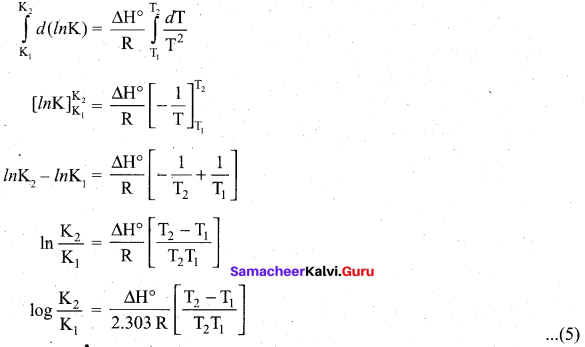
Equation (4) is known as differential form of van’t Hoff equation. On integrating the equation 4, between T1 and T2 with their respective equilibrium constants K1 and K2,
Tamil Nadu 11th Chemistry Model Question Paper 1 English Medium image - 16
Equation (5) is knowi as integrated fónn of van’t Hoff equation.

(b) (i) Pi-bond: When two atomic orbitals overlap sideways, the resultant covalent bond is called a pi (π) bond.
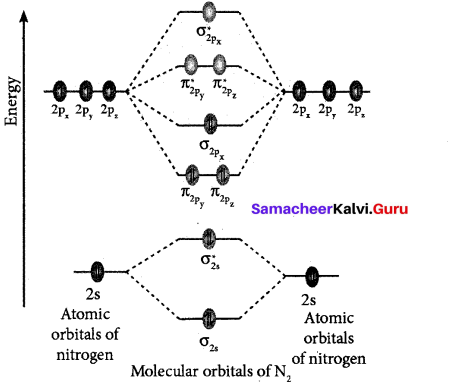
(ii) Formation of N, molecule using MO theory:
Tamil Nadu 11th Chemistry Model Question Paper 1 English Medium image - 17

Tamil Nadu 11th Chemistry Model Question Paper 3 English Medium

  1. Electronic configuration of N atom ls2 2s2 2p3.
  2. Electronic configuration of N2 molecule is: \(\sigma 1 s^{2} \sigma^{*} 1 s^{2} \sigma 2 s^{2} \sigma^{*} 2 s^{2} \pi 2 p_{y}^{2} \pi 2 p_{z}^{2} \sigma 2 p_{x}^{2}\)
  3. Bond order = \(\frac{N_{b}-N_{a}}{2} \frac{10-4}{2}=3\)
  4. Molecule has no unpaired electrons hence, it is diamagnetic’.

Question 37.
(a) (i) Explain – Column chromatography. (3)
(ii) Give the structure for the following compound. (2)
(a) Tertiary butyl iodide
(b) 3 – Chlorobutanol

[OR]

(b)
(i) Explain – electromeric effect. (3)
(ii) Give the examples for β – elimination. (2)
Answer:
(a) (i) Column chromatography:

  1. The principle behind chromatography is selective distribution of mixture of organic substances between two phases a stationary phase and a moving phase. The stationary phase can be a solid or liquid, while the moving phase is a liquid or a gas. When the stationary phase.is a solid, the moving phase is a liquid or gas.
  2. If the stationary phase is solid, the basis is adsorption, and when it is a liquid, the basis is partition.
  3. Chromatography is defined as a technique for the separation of a mixture brought about by differential movement of the individual component through porous medium under the influence of moving solvent.
  4. In column chromatography, the above principle is carried out in a long glass, column.

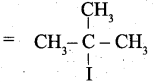
(ii) (a) Tertiary butyl iodide =
Tamil Nadu 11th Chemistry Model Question Paper 1 English Medium image - 18

Tamil Nadu 11th Chemistry Model Question Paper 3 English Medium
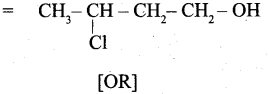
(b) 3 – Chlorobutanol =
Tamil Nadu 11th Chemistry Model Question Paper 1 English Medium image - 19

[OR]

(b) (i) Electromeric effect.
1. The electromeric effect refers to the polarity produced in a multiple bonded compound when it is attacked by a reagent when a double or a triple bond is exposed to an attack by an electrophile the two n electrons which from the n bond are completely transferred to one atom or the other.

2. When a nucleophile approaches the carbonyl compound, the π -electrons between C and O is instantaneously shifted to the more electronegative oxygen. This make the carbon electron deficient and thus facilitating the formation of a new bond between the incoming nucleophile and the carbonyl carbon atom.
Tamil Nadu 11th Chemistry Model Question Paper 1 English Medium image - 20

3. When an electrophile such as H+ approaches an alkene molecule the n electrons are instantaneously shifted to the electrophile and a new bond is formed between carbon and hydrogen. This makes the other carbon electron deficient and hence it acquires a positive charge.
Tamil Nadu 11th Chemistry Model Question Paper 1 English Medium image - 21

4. This effect denotes as E-effect.
(ii) β-elimination: Elimination reactions involve the cleavage of a π bond and formation of a n bond. A nucleophilic pair of electrons heads into a new n bond as a leaving group departs. This process is called β-elimination because the bond P to the nucleophilic pair of electrons breaks.

Tamil Nadu 11th Chemistry Model Question Paper 3 English Medium
Example:
1. n-propyl bromide on reaction with alcoholic KOH give propene. In this reaction hydrogen and Br are eliminated.
Tamil Nadu 11th Chemistry Model Question Paper 1 English Medium image - 22
2. Acid-catalysed dehydration of alcohols
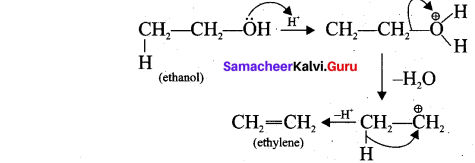
Tamil Nadu 11th Chemistry Model Question Paper 1 English Medium image - 23

Question 38.
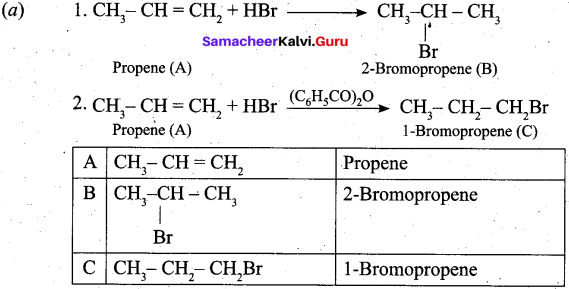
(a) An organic compound A of a molecular formula C3H6, reacts with HBr to give B which is the major product for this reaction. A again reacts with HBr in presence of benzoyl peroxide to give C. Identify A, B and C. Explain the reactions. (5)

[OR]

(b) (i) Explain -The Bhopal Tragedy. (3)
(ii) What are the particulate that cause the pollutions in troposphere? (2)
Answer:
Tamil Nadu 11th Chemistry Model Question Paper 1 English Medium image - 24

Tamil Nadu 11th Chemistry Model Question Paper 3 English Medium
[OR]

(b) (i) On 3rd Decembers, 1984 at Bhopal city in India, by the early morning, an explosion at Union Carbide pesticide plant released a cloud of toxic gas (Methyl isocyanate) CH3NCO into the air. Since the gas is twice as heavy as air, it did not drift away but formed a blanket over the surrounding area. It attacked people’s lungs and affect their breathing staying there or in the nearby areas. Thousands of people died and lives of many were ruined. The lungs, brain, eyes, muscles, as well as the gastrointestinal, neurological and immune systems of those people who survived, were severely affected.

(ii)
1. Viable particulates : The viable particulates are the same size, living organisms such as bacteria, fungi, moles, algae, etc. which are dispersed in air. Some of the fungi cause allergy in human beings and disease in plants.
2. Non-Viable particulates : The Non-viable particulates are small particles and liquid droplets suspended in air. They help in the transporting of particulates in the atmosphere.

They are classified according to

  • smoke
  • dust
  • mists
  • fumes.

Tamil Nadu 11th Chemistry Model Question Paper 3 English Medium

Samacheer Kalvi 11th Computer Science Solutions Chapter 10 Flow of Control

Students can Download Computer Science Chapter 10 Flow of Control Questions and Answers, Notes Pdf, Samacheer Kalvi 11th Computer Science Book Solutions Guide Pdf helps you to revise the complete Tamilnadu State Board New Syllabus and score more marks in your examinations.

Tamilnadu Samacheer Kalvi 11th Computer Science Solutions Chapter 10 Flow of Control

Samacheer Kalvi 11th Computer Science Flow of Control Text Book Back Questions and Answers

PART – 1
I. Choose The Correct Answer

Question 1.
What is the alternate name of null statement?
(a) No statement
(b) Empty statement
(c) Void statement
(d) Zero statement
Answer:
(b) Empty statement

Question 2.
In C++, the group of statements should enclosed within:
(a) { }
(b) []
(c) ()
(d) <>
Answer:
(a) { }

Samacheer Kalvi 11th Computer Science Solutions Chapter 10 Flow of Control

Question 3.
The set of statements that are executed again and again in iteration is called as:
(a) condition
(b) loop
(c) statement
(d) body of loop
Answer:
(d) body of loop

Question 4.
The multi way branching statement:
(a) if
(b) if … else
(c) switch
(d) for
Answer:
(c) switch

Question 5.
How many types of iteration statements exist?
(a) 2
(b) 3
(c) 4
(d) 5
Answer:
(b) 3

Question 6.
How many times the following loop will execute? for (int i = 0; i < 10; i++)
(a) 0
(b) 10
(c) 9
(d) 11
Answer:
(b) 10

Question 7.
Which of the following is the exit control loop?
(a) for
(b) while
(c) do … while
(d) if … else
Answer:
(c) do … while

Samacheer Kalvi 11th Computer Science Solutions Chapter 10 Flow of Control

Question 8.
Identify the odd one from the keywords of jump statements:
(a) break
(b) switch
(c) goto
(d) continue
Answer:
(a) break

Question 9.
A loop that contains another loop inside its body:
(a) Nested loop
(b) Inner loop
(c) Inline loop
(d) Nesting of loop
Answer:
(a) Nested loop

PART – 2
II. Answers to all the questions

Question 1.
What is a null statement and compound statement?
Answer:
Null statement:
The “null or empty statement” is a statement containing only a semi colon. It takes the following form:
;// it is a null statement.
Null statement are commonly used as place holders in iteration statements or as statements on which to place labels at the end of compound statements or functions.

Compound statement:
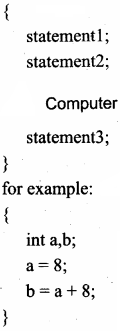
C++ allows a group of statements enclosed by pair of braces { }. This group of statements is called as a compound statement or a block.
The general format of compound statement is:
Samacheer Kalvi 11th Computer Science Solutions Chapter 10 Flow of Control 1

Question 2.
What is selection statement? Write it’s types.
Answer:
The selection statement means the statements are executed depends – upon a condition. If a condition is true, a true block (a set of statements) is executed, otherwise a false block is executed. This statement is also called decision statement or selection statement because it helps in making decision about which set of statements are to be executed.

Types:

  1. Two way branching
  2. Multiway branching

Question 3.
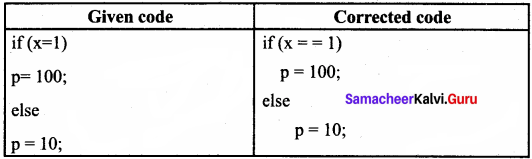
Correct the following code segment:
Answer:
Samacheer Kalvi 11th Computer Science Solutions Chapter 10 Flow of Control 2

Question 4.
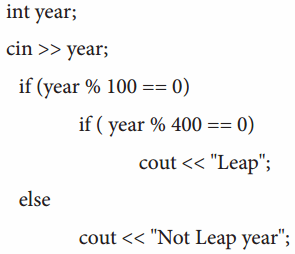
What will be the output of the following code:
Samacheer Kalvi 11th Computer Science Solutions Chapter 10 Flow of Control 3
If the input given is

  1. 2000
  2. 2003
  3. 2010?

Answer:
1. Output
(Input = 2000)
Leap

2. Output
(Input = 2003)
Not leap Year

3. Output (Input = 2010)
Not leap Year

Question 5.
What is the output of the following code?
for (int i = 2; i < = 10 ; i + = 2)
cout<<i;
Answer:
Output:
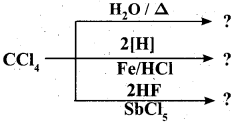
2 4 6 8 10

Samacheer Kalvi 11th Computer Science Solutions Chapter 10 Flow of Control

Question 6.
Write a for loop that displays the number from 21 to 30.
Answer:
# include
using namespace std;
int main()
{

for (int = 21; i < 31; i++)
cout << “value of i:” << i << endl;
return 0;
}
Output:
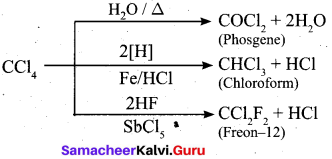
Value of i: 21
Value of i: 22
Value of i: 23
Value of i: 24
Value of i: 25
Value of i: 26
Value of i: 27
Value of i: 28
Value of i: 29
Value of i: 30

Question 7.
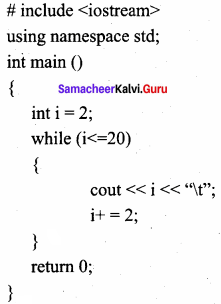
Write a while loop that displays numbers 2,4, 6, 8 ……………… 20.
Answer:
Samacheer Kalvi 11th Computer Science Solutions Chapter 10 Flow of Control 4
Output:
2 4 6 8 10 12 13 14 16 18 20

Question 8.
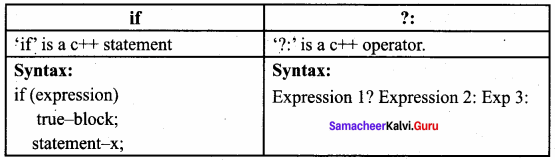
Compare an if and a? : operator.
Answer:
Samacheer Kalvi 11th Computer Science Solutions Chapter 10 Flow of Control 5

PART – 3 III.
III. Answers to all the questions Question

Question 1.
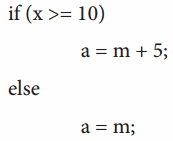
Convert the following if – else to a single conditional statement:
Samacheer Kalvi 11th Computer Science Solutions Chapter 10 Flow of Control 7
Answer:
a = (x> =10)? m + 5:m;

Question 2.
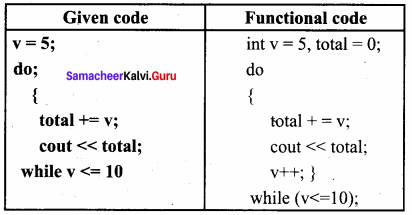
Rewrite the following code so that it is functional:
Answer:
Samacheer Kalvi 11th Computer Science Solutions Chapter 10 Flow of Control 6

Question 3.
Write a C++ program to print multiplication table of a given number.
Answer:
# include
using namespace std;
int main ()
{

int num;
cout << “Enter Number to find its multiplication table”; cin >> num;
for (int a = 1; a < = 10; a++)
{
cout << num << “*” << a << “=” << num*a << endl;
}
return( );

}

Question 4.
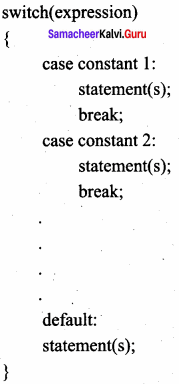
Write the syntax and purpose of switch statement.
Answer:
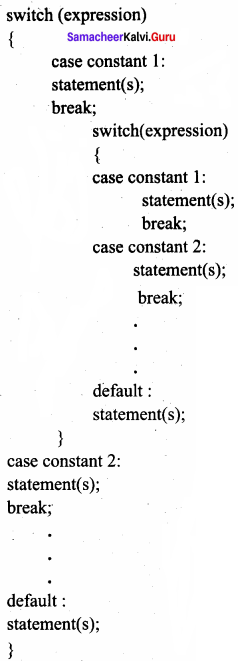
The switch statement is a multi – way branch statement. It provides an easy way to dispatch execution to different parts of code based on the value of the expression. The switch statement replaces multiple if – else sequence.
The syntax of the switch statement is;
Samacheer Kalvi 11th Computer Science Solutions Chapter 10 Flow of Control 8

Question 5.
Write a short program to print following series:
(a) 1 4 7 10 …… 40
Answer:
# include
using namespace std;
int main ()
{

cout << “\n PRINT SERIES” ;
for (int i = 1; i< 40; i = i + 3)
cout << i << “1+”;
cin.get();
return ();
}

PART – 4
IV. Answers to all the questions

Question 1.
Explain control statement with suitable example.
Answer:
Control statements are statements that alter the sequence of flow of instructions.
Types of control statements:
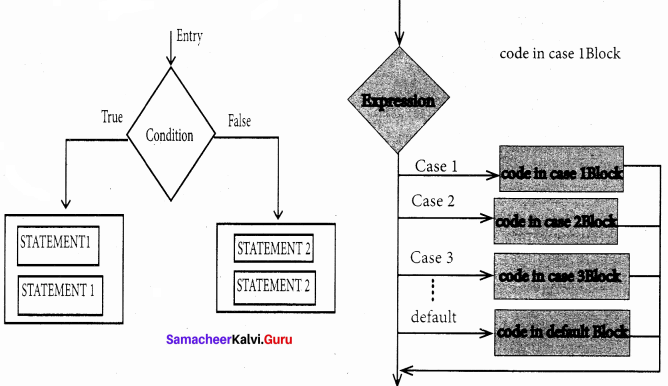
1. Selection statement:
The selection statement means the statement (s) executed, depends upon a condition. If a condition is true, a true block (a set of statements) is executed otherwise a false block is executed. This statement is also called decision statement or selection statement because it helps in making decision about which set of statements are to be executed.
Example:

  1. If
  2. Switch

Samacheer Kalvi 11th Computer Science Solutions Chapter 10 Flow of Control 9

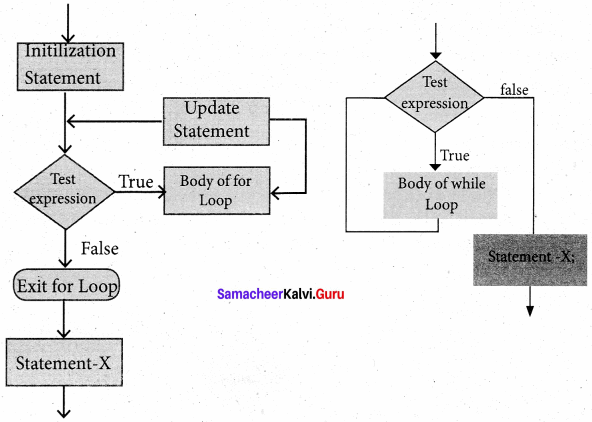
2. Iteration (or looping) statement:
An iteration (or loop) is a sequence of one or more statements that are repeatedly executed until a condition is satisfied. These statements are also called as control flow statements. It is used to reduce the length of code to reduce the time to execute program and takes less memory space.

Example:

  1. While
  2. do ….. while
  3. for

Samacheer Kalvi 11th Computer Science Solutions Chapter 10 Flow of Control 10

Question 2.
What is entry control loop? Explain any one of the entry control loop with suitable example.
Answer:
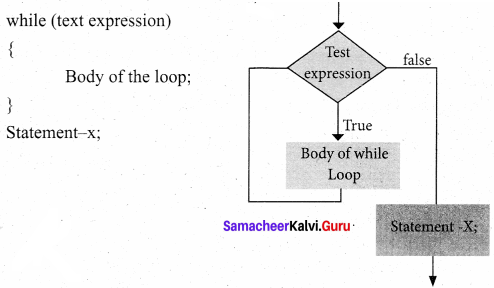
An entry control loop checks the condition at the time of entry and if condition or expression becomes true then control transfers into the body of the loop, for loop and while loop are the examples of Entry Controlled Loop. A while loop is a control flow statement that allows the loop statements to be executed as long as the condition is true.
Type: Entry control loop
Syntax:
Samacheer Kalvi 11th Computer Science Solutions Chapter 10 Flow of Control 11

Control flow:
Step 1 : Test – expression is evaluated to either True or False;
Step 2 : If test – expression is true;
(a) The body of the loop is executed.
(b) Control is transferred to step 1.
Step 3: If test – expression is false, the control exits the while loop.
Example:
int a = 1;
while (a<=10)
{

cout << a << ‘\t+’;
a+=2;

}

Output:
1 3 5 7 9

Question 3.
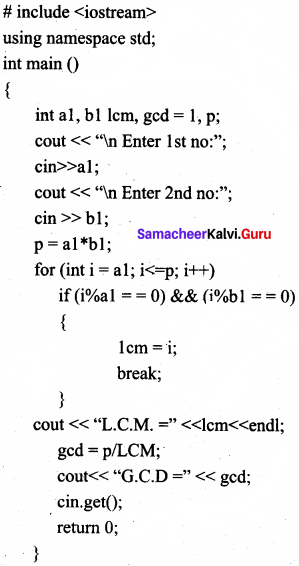
Write a program to find the LCM and GCD of two numbers.
Answer:
Samacheer Kalvi 11th Computer Science Solutions Chapter 10 Flow of Control 12

Question 4.
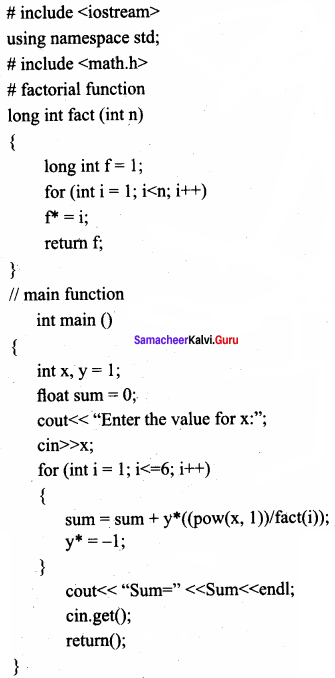
Write programs to find the sum of the following series:
(a) x – \(\frac{x^{2}}{2 !}\) + \(\frac{x^{3}}{3 !}\) + \(\frac{x^{4}}{4 !}\) + \(\frac{x^{5}}{5 !}\) – \(\frac{x^{6}}{6 !}\)
(b) x + \(\frac{x^{2}}{2}\) + \(\frac{x^{3}}{3}\) + ……… + \(\frac{x^{n}}{n}\)
Answer:
(a)
Samacheer Kalvi 11th Computer Science Solutions Chapter 10 Flow of Control 13

(b) # include
using namespace std;
# include int main()
{

int M, L;
float sum = 0;
cout << “Enter the value for M:”; cin >> M;
cout << “Enter the number of terms”; cin >> L;
for (int i = 1; i<=m; i++)
sum = Sum + Pow(m,i)/i;
cout << “Sum=” << Sum << endl;
cin.get();
return 0;

}

Question 5.
Write a program to find sum of the series
S = 1 + x + x2 + ………….. + xn
Answer:
# include
using namespace std;
# include int main()
{

int x, n;
float sum = 0;
cout << “Enter the value for x:”; cin >> x;
cout << “Enter the number of terms”; cin >> n;
for (int i = 0; i<=n; i++)
sum = Sum + Pow(x,i);
cout << “Sum=” << Sum << endl;
cin.get( );
return 0;

}

Samacheer kalvi 11th Computer Science Flow of Control Additional Questions and Answers

PART – 1
I. Choose the correct answer

Question 1.
The empty statement is otherwise called as ………………..
(a) Control statement
(b) Zero statement
(c) Null statement
(d) Block statement
Answer:
(c) Null statement

Question 2.
Selection statement is also called as ………………..
(a) Decision statement
(b) Sequence statement
(c) Null statement
(d) Compound statement
Answer:
(a) Decision statement

Samacheer Kalvi 11th Computer Science Solutions Chapter 10 Flow of Control

Question 3.
Iteration statement is called as ………………..
(a) Null statement
(b) Block statement
(c) Selection statement
(d) Looping statement
Answer:
(d) Looping statement

Question 4.
In C++ any non – zero is iterated as true ……………….. and zero is treated as false.
(a) positive numbers
(b) negative numbers
(c) prime numbers
(d) none of these
Answer:
(b) negative numbers

Question 5.
……………….. is a multi – path decision making statement.
(a) if
(b) if – else
(c) else – if
(d) if – else ladder
Answer:
(d) if – else ladder

Question 6.
Syntax of the conditional operator is ………………..
(a) expression 1? expression 2: expression 3
(b) expression 1: expression 2
(c) expression 1! expression 2: expression 3
(d) expression 1: expression 2: expression 3
Answer:
(a) expression 1? expression 2: expression 3

Question 7.
……………….. is more efficient than if-else statement.
(a) Control statement
(b) Switch statement
(c) Empty statement
(d) Null statement
Answer:
(b) Switch statement

Question 8.
When a switch is a part of the statement sequence of another switch, then it is called as ………………..
(a) if – else ladder
(b) Switch statement
(c) Nested switch statement
(d) Empty statement
Answer:
(c) Nested switch statement

Samacheer Kalvi 11th Computer Science Solutions Chapter 10 Flow of Control

Question 9.
C++ supports types of iteration statements.
(a) 3
(b) 2
(c) 4
(d) 5
Answer:
(a) 3

Question 10.
Every loop has ……………….. elements that are used for different purposes.
(a) 3
(b) 4
(c) 5
(d) 2
Answer:
(b) 4

Question 11.
……………….. is used to transfer the control from one place to another place without any condition in a program.
(a) Break statement
(b) Continue statement
(c) goto statement
(d) All the above
Answer:
(c) goto statement

PART – 2
II. Short Answers

Question 1.
What is if statement? Write it’s syntax.
Answer:
The if statement evaluates a condition, if the condition is true then a true – block (a statement or set of statements) is executed, otherwise the true – block is skipped. The general syntax of the if statement is:
if (expression)
true – block;
statement – x;

Question 2.
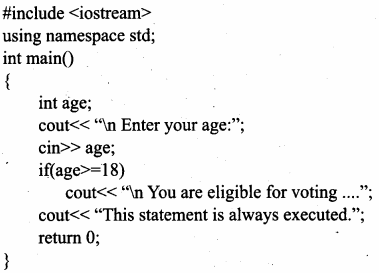
Write a program to check whether a person is eligible to vote using if statement.
C++ program to check whether a person is eligible to vote using if statement
Answer:
Samacheer Kalvi 11th Computer Science Solutions Chapter 10 Flow of Control 14
Output:
Enter your age: 23
You are eligible for voting ….
This statement is always executed.

Question 3.
What is nested if? Mention it’s types.
Answer:
An if statement contains another if statement is called nested if. The nested can have, one of the following three forms.

  1. If nested inside if part
  2. If nested inside else part
  3. If nested inside both if part and else part

Question 4.
Write the syntax for if – else ladder.
Answer:
The syntax of if – else ladder:
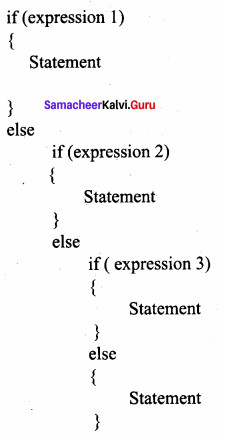
Samacheer Kalvi 11th Computer Science Solutions Chapter 10 Flow of Control 15

Question 5.
What is nested switch statement?
Answer:
When a switch is a part of the statement sequence of another switch, then it is called as nested switch statement. The inner switch and the outer switch constant may or may not be the same.

Question 6.
What are loop elements?
Answer:
Every loop has four elements that are used for different purposes. These elements are

  1. Initialization expression
  2. Test expression
  3. Update expression
  4. The body of the loop

Question 7.
Write C++ program to sum the numbers from 1 to 10.
Answer:
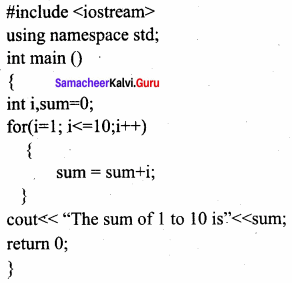
C++ program to sum the numbers from 1 to 10 using for loop
Samacheer Kalvi 11th Computer Science Solutions Chapter 10 Flow of Control 16
Output:
The sum of 1 to 10 is 55

Question 8.
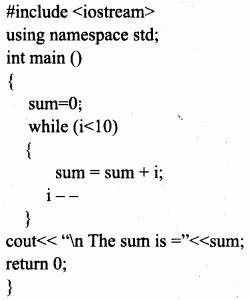
Rewrite the given program.
Answer:
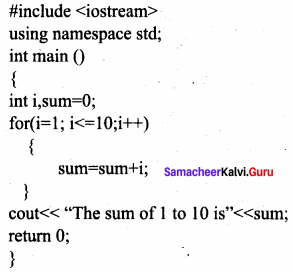
C++ program to sum the numbers from 1 to 10 using for loop
Samacheer Kalvi 11th Computer Science Solutions Chapter 10 Flow of Control 17
C++ program to sum the numbers from 1 to 10 using for loop
Samacheer Kalvi 11th Computer Science Solutions Chapter 10 Flow of Control 18
Output:

The sum of 1 to 10 is 55

Question 9.
Write a program to display numbers from 1 to 10 except 6 using continue statement.
Answer:
C++ program to display numbers from 1 to 10 except 6 using continue statement
#include
using namespace std;
int main()
{
if (i = 6)
continue;
else
cout << i << ” ”
}
return 0;
}
Output:

1 2 3 4 5 7 8 9 10

Samacheer Kalvi 11th Computer Science Solutions Chapter 10 Flow of Control

Question 10.
What will be the output of the following code.
Answer:

int a, b, largest;
cout << “\n Enter any two numbers:”; cin >> a >> b;
largest = (a > b)? a:b;
cout << “\n Largest number:” << largest;
return 0;
Output:
Enter any two numbers:
5 10
Largest number: 10

PART – 3
III. Explain in Brief

Question 1.
What is sequence statements?
Answer:
The sequential statement are the statements that are executed one after another only once from top to bottom. These statements do not alter the flow of execution. These statements are called as sequential flow statements. They always end with a semicolon (;).

Question 2.
Write the syntax of nested switch statement.
Answer:
The syntax of the nested switch statement is; switch (expression)
Samacheer Kalvi 11th Computer Science Solutions Chapter 10 Flow of Control 19

Question 3.
Write short notes on Test expression.
Answer:
The test expression is an expression or condition whose value decides whether the loop – body will be executed or not. If the expression evaluates to true (i.e., 1), the body of the loop is executed, otherwise the loop is terminated. In an entry – controlled loop, the test – expression is evaluated before the entering into a loop whereas in an exit – controlled loop, the test – expression is evaluated before exit from the loop.

Samacheer Kalvi 11th Computer Science Solutions Chapter 10 Flow of Control

Question 4.
What is do – while loop? Write it’s syntax.
Answer:
The do – while loop is an exit-controlled loop. In do-while loop, the condition is evaluated at the bottom of the loop after executing the body of the loop. This means that the body of the loop is executed at least once, even when the condition evaluates false during the first iteration.
The do – while loop syntax is:
do {
Body of the loop;
} while(condition);

Question 5.
What are the differences between break and continue statement.
Answer:
Break:

  • Break is used to terminate the execution of the loop.
  • It breaks the iteration.
  • When this statement is executed, control will come out from the loop and executes the statement immediate after loop.
  • Break is used with loops as well as switch case.

Continue:

  • Continue is not used to terminate the execution of loop.
  • It skips the iteration.
  • When this statement is executed, it will not come out of the loop but moves/jumps to the next iteration of loop.
  • Continue is only used in loops, it is not used in switch case.

Question 6.
What are the important things to know about switch statement?
Answer:
There are some important things to know about switch statement. They are

  1. A switch statement can only work for quality of comparisons.
  2. No two case labels in the same switch can have identical values.
  3. If character constants are used in the switch statement, they are automatically converted to their equivalent ASCII codes.
  4. The switch statement is more efficient choice than if in a situation that supports the nature of the switch operation.

PART – 4
IV. Explain in Detail

Question 1.
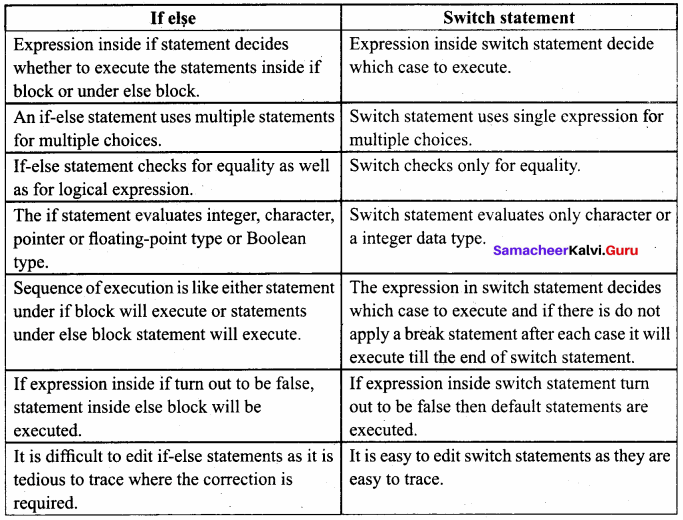
What are the key differences between if else and switch statement?
Answer:
Samacheer Kalvi 11th Computer Science Solutions Chapter 10 Flow of Control 20

Question 2.
Explain about parts of a loop.
Answer:
Every loop has four elements that are used for different purposes. These elements are:

  1. Initialization expression
  2. Test expression
  3. Update expression
  4. The body of the loop

1. Initialization expression(s) : The control variable(s) must be initialized before the control enters into loop. The initialization of the control variable takes place under the initialization expressions. The initialization expression is executed only once in the beginning of the loop.

2. Test Expression : The test expression is an expression or condition whose value decides whether the loop-body will be executed or not. If the expression evaluates to true (i.e., 1), the body of the loop is executed, otherwise the loop is terminated.

In an entry – controlled loop, the test – expression is evaluated before the entering into a loop whereas in an exit-controlled loop, the test – expression is evaluated before exit from the loop.

3. Update expression : It is used to change the value of the loop variable. This statement is executed at the end of the loop after the body of the loop is executed.

4. The body of the loop : A statement or set of statements forms a body of the loop that are executed repetitively. In an entry – controlled loop, first the test-expression is evaluated and if it is nonzero, the body of the loop is executed otherwise the loop is terminated. In an exit – controlled loop, the body of the loop is executed first then the test – expression is evaluated. If the test – expression is true the body of the loop is repeated otherwise loop is terminated.

Samacheer Kalvi 11th Computer Science Solutions Chapter 10 Flow of Control

Question 3.
Explain about jump statements.
Answer:
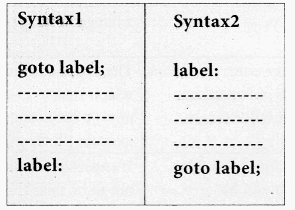
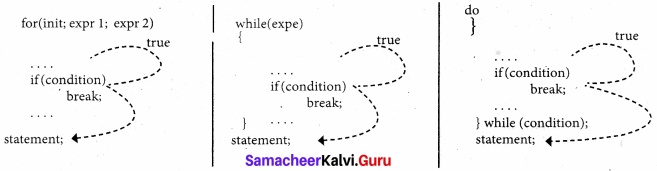
Jump statements are used to interrupt the normal flow of program. Types of Jump Statements are:

  1. goto statement
  2. break statement
  3. continue statement

The goto statement is a control statement which is used to transfer the control from one place to another place without any condition in a program.
Samacheer Kalvi 11th Computer Science Solutions Chapter 10 Flow of Control 21
A break statement is a jump statement which terminates the execution of loop and the control is transferred to resume normal execution after the body of the loop.
Samacheer Kalvi 11th Computer Science Solutions Chapter 10 Flow of Control 22
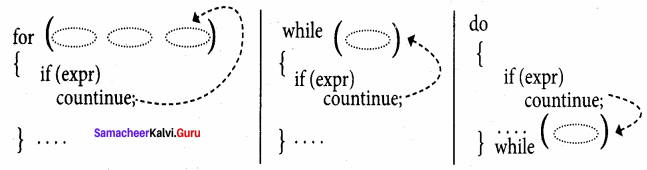
The continue statement works quite similar to the break statement. Instead of terminating the loop (break statement), continue statement forces the loop to continue or execute the next iteration. When the continue statement is executed in the loop, the code inside the loop following the continue statement will be skipped and next iteration of the loop will begin.
Samacheer Kalvi 11th Computer Science Solutions Chapter 10 Flow of Control 23

Question 4.
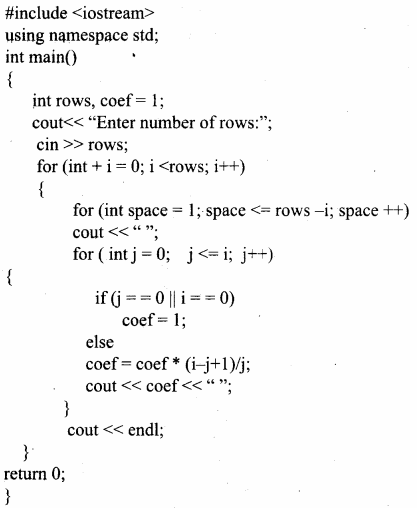
Programs to produce the following design using nested loops.
Answer:
Samacheer Kalvi 11th Computer Science Solutions Chapter 10 Flow of Control 24Output
Enter number of rows: 5
1
1 1
1 2 1
1 3 3 1
1 4 6 4 1

Samacheer Kalvi 11th Computer Science Solutions Chapter 11 Functions

Students can Download Computer Science Chapter 11 Functions Questions and Answers, Notes Pdf, Samacheer Kalvi 11th Computer Science Book Solutions Guide Pdf helps you to revise the complete Tamilnadu State Board New Syllabus and score more marks in your examinations.

Tamilnadu Samacheer Kalvi 11th Computer Science Solutions Chapter 11 Functions

Samacheer Kalvi 11th Computer Science Functions Text Book Back Questions and Answers

PART – 1
I. Choose The Correct Answer

Question 1.
Which of the following header file defines the standard I/O predefined functions?
(a) stdio.h
(b) math.h
(c) string.h
(d) ctype.h
Answer:
(a) stdio.h

Question 2.
Which function is used to check whether a character is alphanumeric or not?
(a) isalpha()
(b) isdigit()
(c) isalnum()
(d) islower()
Answer:
(c) isalnum()

Question 3.
Which function begins the program execution?
(a) isalpha()
(b) isdigit()
(c) main()
(d) islower()
Answer:
(c) main()

Samacheer Kalvi 11th Computer Science Solutions Chapter 11 Functions

Question 4.
Which of the following function is with a return value and without any argument?
(a) x = display(int, int)
(b) x = display()
(c) y = display(float)
(d) display(int)
Answer:
(b) x = display()

Question 5.
Which is return data type of the function prototype of add(int, int);?
(a) int
(b) float
(c) char
(d) double
Answer:
(a) int

Question 6.
Which of the following is the scope operator?
(a) >
(b) &
(c) %
(d) ::
Answer:
(d) ::

PART – 2
II. Answer to all the questions

Question 1.
Define Functions.
Answer:
A large program can typically be split into small sub – programs (blocks) called as functions where each sub-program can perform some specific functionality. Functions reduce the size and complexity of a program, makes it easier to understand, test and check for errors.

Question 2.
Write about strlen() function.
Answer:
The strlen() takes a null terminated byte string source as its argument and returns its length. The length does not include the null(\0) character.

Question 3.
What are importance of void data type? void type has two important purposes:
Answer:

  1. To indicate the function does not return a value.
  2. To declare a generic pointer.

Samacheer Kalvi 11th Computer Science Solutions Chapter 11 Functions

Question 4.
What is Parameter and list its types?
Answer:
Arguments or parameters are the means to pass values from the calling function to the called function. The variables used in the function definition as parameters are known as formal parameters. The constants, variables or expressions used in the function call are known as actual parameters.

Types : Default arguments and Constant Arguments.

Question 5.
Write a note on Local Scope.
Answer:

  1. A local variable is defined within a block. A block of code begins and ends with curly braces { }.
  2. The scope of a local variable is the block in which it is defined.
  3. A local variable cannot be accessed from outside the block of its declaration.
  4. A local variable is created upon entry into its block and destroyed upon exit.

PART – 3
III. Answer to all the questions

Question 1.
What is Built – in functions?
Answer:
C++ provides a rich collection of functions ready to be used for various tasks. The tasks to be performed by each of these are already written, debugged and compiled, their definitions alone are grouped and stored in files called header files. Such ready – to – use sub programs are called pre – defined functions or built – in functions.

Question 2.
What is the difference between isupper() and toupper() functions?
Answer:
isupper():

  • This function is used to check the given character is uppercase.
  • This function will return 1 if true otherwise 0.

toupper():

  • This function is used to convert the given character into its uppercase.
  • This function will return the upper case equivalent of the given character. If the given character itself is in upper case, the output will be the same.

Question 3.
Write about strcmp() function.
Answer:
The strcmp() function takes two arguments: string1 and string2. It compares the contents of string1 and string2 lexicographically.
The strcmp() function returns a:

  1. Positive value if the first differing character in string1 is greater than the corresponding character in string2. (ASCII values are compared)
  2. Negative value if the first differing character in string1 is less than the corresponding character in string2.
  3. 0 if string1 and string2 are equal.

Samacheer Kalvi 11th Computer Science Solutions Chapter 11 Functions

Question 4.
Write short note on pow() function in C++.
Answer:
The pow() function returns base raised to the power of exponent. If any argument passed to pow() is long double, the return type is promoted to long double. If not, the return type is double. The pow() function takes two arguments:

  1. base – the base value
  2. exponent – exponent of the base

Example:
cout << pow(5, 2);

Output:
25

Question 5.
What are the information the prototype provides to the compiler?
Answer:
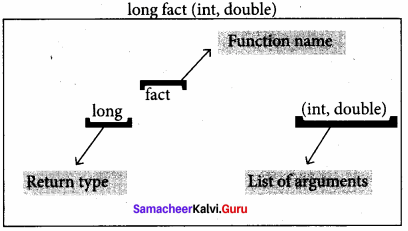
The prototype above provides the following information to the compiler:

  1. The return value of the function is of type long.
  2. Fact is the name of the function.
  3. The function is called with two arguments:
    • The first argument is of int data type.
    • The second argument is of double data type, int display(int, int) // function prototype//.

The above function prototype provides details about the return data type, name of the function and a list of formal parameters or arguments.

Question 6.
What is default arguments? Give example.
Answer:
In C++, one can assign default values to the formal parameters of a function prototype. The Default arguments allows to omit some arguments when calling the function.
1. For any missing arguments, complier uses the values in default arguments for the called function.

2. The default value is given in the form of variable initialization.
Example : void defaultvalue(int n1 = 10, n2 = 100);

3. The default arguments facilitate the function call statement with partial or no arguments.
Example :

  1. defaultvalue (x, y);
  2. defaultvalue (200, 150);
  3. defaultvalue (150);
  4. defaultvalue (x, 150);

4. The default values can be included in the function prototype from right to left, i.e., we cannot have a default value for an argument in between the argument list.
Example:

  1. void defaultvalue (int n1=10, n2);//invalid prototype.
  2. void defaultvalue (int n1, n2 = 10);//valid prototype.

PART – 4
IV. Answers to all the questions

Question 1.
Explain Call by value method with suitable example.
Answer:
This method copies the value of an actual parameter into the formal parameter of the function. In this case, changes made to formal parameter within the function will have no effect on the actual parameter.
Samacheer Kalvi 11th Computer Science Solutions Chapter 11 Functions
Output:
Example : Function call by value
Enter the Value for A : 5
The Value inside display function (a * a) : 25
The Value inside main function 5

Question 2.
What is Recursion? Write a program to find GCD using recursion.
Answer:
A function that calls itself is known as recursive function. And, this technique is known as recursion.
Samacheer Kalvi 11th Computer Science Solutions Chapter 11 Functions
Output:
Enter two numbers: 81 153
gcd : 9

Question 3.
What are the different forms of function return? Explain with example.
Answer:
The return statement:
Returning from the function is done by using the return statement. The return statement stops execution and returns to the calling function. When a return statement is executed, the function is terminated immediately at that point. The return statement is used to return from a function. It is categorized as a jump statement because it terminates the execution of the function and transfer the control to the called statement.
Syntax:
return expression/variable;

Example : retum(a + b); retum(a);
return; // to terminate the function

The Returning values:
The functions that return no value is declared as void. The data type of a function is treated as int, if no data type is explicitly mentioned. For example,
For Example:
int add (int, int);
add (int, int);
In both prototypes, the return value is int, because by default the return value of a function in C++ is of type int.

Returning Non – integer values:
A string can also be returned to a calling statement.
Samacheer Kalvi 11th Computer Science Solutions Chapter 11 Functions
Output:
Example: Function with Non Integer Return Chennai

The Returning by reference:
#include
using namespace std;
int main( )
{

int n 1 = 150;
int &n 1 ref = n1;
cout << “\nThe Value of N1 = “<< n1 << “and n 1 Reference =”<< n 1 ref;
n 1 ref++;
cout << “\n After nl increased the Value of N1 =”<< n1;
cout << “and n 1 Reference = ”<< n 1 ref;
retum(0);

}
Output:
The Value of N1 = 150 and nl Reference =150
After n1 increased the Value of N1 = 151 and n1 Reference =151

Samacheer Kalvi 11th Computer Science Solutions Chapter 11 Functions

Question 4.
Explain scope of variable with example.
Answer:
Scope refers to the accessibility of a variable.
There are four types of scopes in C++

  1. Local Scope
  2. Function Scope
  3. File Scope
  4. Class Scope

1. Local Scope:

  • A local variable is defined within a block. A block of code begins and ends with curly braces {}.
  • The scope of a local variable is the block in which it is defined.
  • A local variable cannot be accessed from outside the block of its declaration.
  • A local variable is created upon entry into its block and destroyed upon exit;
    Example:
    int main( )
    {
    int a,b;   //Local variable
    }

2. Function Scope:

  • The scope of variable within a function is extended to the function block and all sub-blocks therein.
  • The lifetime of a function scope variable is the lifetime of the function block.
    Example:
    int. sum(intx, int y);  //x and y has function scope.

3. File Scope:

  • A variable declared above all blocks and functions (including main()) has the scope of a file.
  • The lifetime of a file scope variable is the lifetime of a program.
  • The file scope variable is also called as global variable.
    Example:
    #include
    using namespace std;
    int x,y; //x and y are global variable
    void main()
    {
    ……..
    }

4. Class Scope:

  • Data members declared in a class has the class scope.
  • Data members declared in a class can be accessed by all member functions of the class.
    Example:
    Class example
    {

int x,y; //x and y can be accessed by print() and void():
void print();
Void total();

  };

Question 5.
Write a program to accept any integer number and reverse it.
Answer:
Samacheer Kalvi 11th Computer Science Solutions Chapter 11 Functions
Output:
Enter number : 1 2 3
Reverse number: 3 2 1

Samacheer kalvi 11th Computer Science Functions Additional Questions and Answers

PART – 1
I. Choose the correct answer

Question 1.
………………. is the name of the function.
(a) Pre – defined
(b) Built – in
(c) Library
(d) All the above
Answer:
(d) All the above

Question 2.
………………. is used to check whether the given character is an alphabet or not.
(a) isalnum()
(b) isalpha()
(c) isalph()
(d) isal()
Answer:
(b) isalpha()

Question 3.
The strcpy() function takes two arguments of ……………….
(a) target and source
(b) upper and lower
(c) base and exponent
(d) none of these
Answer:
(a) target and source

Samacheer Kalvi 11th Computer Science Solutions Chapter 11 Functions

Question 4.
………………. takes a null terminated byte string source as its argument and returns its length.
(a) strcpy()
(b) strlen()
(c) strcmp()
(d) strcat()
Answer:
(b) strlen()

Question 5.
The pow() function takes the two arguments of ……………….
(a) target and source
(b) upper and lower
(c) base and exponent
(d) source and exponent
Answer:
(c) base and exponent

Question 6.
………………. is the name of the function.
(a) fact
(b) task
(c) arguments
(d) none of these
Answer:
(d) none of these

Question 7.
The C++ program always have main() function to begin the program execution.
(a) 1
(b) 2
(c) 3
(d) null
Answer:
(a) 1

Question 8.
Arguments are also called as ……………….
(a) variable
(b) constant
(c) function
(d) parameters
Answer:
(d) parameters

Question 9.
In C++ the arguments can be passed to a function in ………………. ways.
(a) 2
(b) 1
(c) 3
(d) 7
Answer:
(a) 2

Question 10.
Inline functions execute faster but requires more ……………….
(a) variables
(b) pointers
(c) memory
(d) functions
Answer:
(c) memory

PART – 2
II. Very Short Answers

Question 1.
Write about reusability.
Answer:

  1. Few lines of code may be repeatedly used in different contexts. Duplication of the same code can be eliminated by using functions which improves the maintenance and reduce program size.
  2. Some functions can be called multiple times with different inputs.

Question 2.
What is user – defined functions?
Answer:
C++ also provides the facility to create new functions for specific task as per user requirement. The name of the task and data required (arguments) are decided by the user and hence they are known as User-defined functions.

Question 3.
What is constant arguments and write its syntax?
Answer:
The constant variable can be declared using const keyword. The const keyword makes variable , value stable. The constant variable should be initialized while declaring. The const modifier enables to assign an initial value to a variable that cannot be changed later inside the body of the function.
Syntax:
(const )

Samacheer Kalvi 11th Computer Science Solutions Chapter 11 Functions

Question 4.
What are the advantages of inline functions?
Answer:
Advantages of inline functions:

  1. Inline functions execute faster but requires more memory space.
  2. Reduce the complexity of using STACKS.

Question 5.
What is function scope?
Answer:
Function Scope:

  1. The scope of variables declared within a function is extended to the function block, and all sub – blocks therein.
  2. The life time of a function scope variable, is the life time of the function block. The scope of.

PART – 3
III. Short Answers

Question 1.
What is divide and conquer?
Answer:
Divide and Conquer

  1. Complicated programs can be divided into manageable sub programs called functions.
  2. A programmer can focus on developing, debugging and testing individual functions.
  3. Many programmers can work on different functions simultaneously.

Question 2.
Define library functions.
Answer:
C++ provides a rich collection of functions ready to be used for various tasks. The tasks to be performed by each of these are already written, debugged and compiled, their definitions alone are grouped and stored in files called header files. Such ready – to – use sub programs are called pre – defined functions or built – in functions or Library Functions.

Question 3.
What is isdigit()? Give example.
Answer:
This function is used to check whether a given character is a digit or not. This function will return 1 if the given character is a digit, and 0 otherwise.

Example:
using namespace std;
#include
#include int main( )
{

char ch;
cout << “\n Enter a Character:”; cin >> ch;
cout << “\n The Return Value of isdigit(ch) is << isdigit(ch);

}
Output – 1

Enter a Character: 3
The Return Value of isdigit(ch) is : 1

Output – 2

Enter a Character: A
The Return Value of isdigit(ch) is :0

Question 4.
Write a program using pow() and sin() function.
Answer:
The pow() function returns base raised to the power of exponent. The sin() function takes a single argument in radians.
#include
#include using namespace std;
int main ()
{

double base, exponent, result;
base = 5;
exponent = 4;
result = pow(base, exponent);
cout << “pow(“ << base << “A” << exponent <<”) =” << result;
double x = 25;
result = sin(x);
cout << “\nsin(“<< x <<”)=”<<result;
return 0;

}
Output:
pow (5^4) = 625
sin (25) = – 0.132352

Question 5.
What is return statement with example?
Answer:
The return statement stops execution and returns to the calling function. When a return statement is executed, the function is terminated immediately at that point. The return statement is used to return from a function. It is categorized as a jump statement because it terminates the execution of the function and transfer the control to the called statement.

Example:
return(a + b); return(a);
return; // to terminate the function

Samacheer Kalvi 11th Computer Science Solutions Chapter 11 Functions

Question 6.
What is scope resolution operation?
Answer:

  1. The scope operator reveals the hidden scope of a variable. The scope resolution operator (::) is used for the following purposes.
  2. To access a Global variable when there is a Local variable with same name. An example using Scope Resolution Operator.

PART – 4
IV. Explain in Detail

Question 1.
Explain about generating random numbers with suitable program.
Answer:
The srand() function in C++ seeds the pseudo random number generator used by the rand() function. The seed for rand() function is 1 by default. It means that if no srand() is called before rand(), the rand() function behaves as if it was seeded with srand( 1). The srand() function takes an unsigned integer as its parameter which is used as seed by the rand() function. It is defined inor header file.
#include
#include using namespace std; int main()
{

int random = rand(); /* No srand() calls before rand(), so seed = 1*/
cout << “\nSeed = 1, Random number =” << random;
srand(10);
/* Seed= 10 */
random = rand();
cout << “\n\n Seed =10, Random number =” << random;
return 0;

}
Output:
Seed = 1, Random number = 41
Seed =10, Random number 71

Question 2.
Explain about Inline functions with a suitable program.
Answer:
An inline function looks like normal function in the source file but inserts the function’s code directly into the calling program. To make a function inline, one has to insert the keyword inline in the function header.
Samacheer Kalvi 11th Computer Science Solutions Chapter 11 Functions
Output:
Enter the Principle Amount Rs. :60000
Enter the Number of Years : 10
Enter the Rate of Interest :5
The Simple Interest = Rs. 30000

Question 3.
Write about function prototype.
Answer:
C++ program can contain any number of functions. But, it must always have only one main() function to begin the program execution. We can write the definitions of functions in any order as we wish. We can define the main() function first and all other functions after that or we can define all the needed functions prior to main(). Like a variable declaration, a function must be declared before it is used in the program. The declaration statement may be given outside the main() function
Samacheer Kalvi 11th Computer Science Solutions Chapter 11 Functions
The prototype above provides the following information to the compiler:

  1. The return value of the function is of type long.
  2. Fact is the name of the function.
  3. The function is called with two arguments:
    • The first argument is of int data type.
    • The second argument is of double data type, int display(int, int)//function prototype//

The above function prototype provides details about the return data type, name of the function and a list of formal parameters or arguments.

Samacheer Kalvi 11th Computer Science Solutions Chapter 11 Functions

Question 4.
Explain about address method.
Answer:
This method copies the address of the actual argument into the formal parameter. Since the address of the argument is passed, any change made in the formal parameter will be reflected back in the actual parameter.
#include
using namespace std;
void display(int & x) //passing address of a//
{

x = x*x;
cout << “\n\n The Value inside display function (n1 x n1) :”<< x ;

}
int main()
{
intn 1;
cout << “\n Enter the Value for N1 cin >> n1;
cout << “\n The Value of N1 is inside main function Before passing:” << n1;
display(n1);
cout << “\n The Value of N1 is inside main function After passing (n1 x n1):”<< n1; retum(O);
}

Output:
Enter the Value for N1 : 45
The Value of N1 is inside main function Before passing : 45
The Value inside display function (n1 x n1) : 2025
The Value ofNl is inside main function After passing (n1 x n1): 2025

Samacheer Kalvi 11th Computer Science Solutions Chapter 11 Functions

Question 5.
Given data: Principal amount Rs. 50000

Number of years 5
Rate of interest 7

To find the simple interest of the above mentioned given data. Write a C++ program using inline functions.
Answer:
#include
using namespace std;
inline float simple interest(float p1, float n 1, float r 1)
{

float sil=(pl*nl*rl)/100;
retum(sil);

}
int main ()
{

float si,p,n,r;
cout << “\n Enter the Principle Amount Rs. :”; cin >> p;
cout << “\n Enter the Number of Years :”; cin >> n;
cout << “\n Enter the Rate of Interest :”; cin >> r;
si = simple interest(p, n, r);
cout << “\n The Simple Interest = Rs.” << si;
return 0;

}

Output:
Enter the Principle Amount Rs. : 50000
Enter the Number of Years : 5
Enter the Rate of Interest : 7
The Simple Interest = Rs. 17500

Tamil Nadu 11th Chemistry Model Question Paper 3 English Medium

Students can Download Tamil Nadu 11th Chemistry Model Question Paper 3 English Medium Pdf, Tamil Nadu 11th Chemistry Model Question Papers helps you to revise the complete Tamilnadu State Board New Syllabus and score more marks in your examinations.

TN State Board 11th Chemistry Model Question Paper 3 English Medium

Tamil Nadu 11th Chemistry Model Question Paper 1 English Medium English Medium

Time: 2½ Hours
Total Score: 70 Marks

General Instructions:

  1. The question paper comprises of four parts.
  2. You are to attempt all the parts. An internal choice of questions is provided wherever applicable.
  3. All questions of Part I. II, III and IV are to be attempted separately.
  4. Question numbers 1 to 15 in Part I are Multiple Choice Questions of one mark each. These are to be answered by choosing the most suitable answer from the given four alternatives and writing the option code and the corresponding answer.
  5. Question numbers 16 to 24 in Part II are two-mark questions. These are to be answered in about one or two sentences.
  6. Question numbers 25 to 33 in Part III are three-mark questions. These are to be answered in about three to five short sentences.
  7. Question numbers 34 to 38 in Part IV are five-mark questions. These are to be answered in detail. Draw diagrams wherever necessary.

Part – I

Answer all the questions.
Choose the most suitable answer from the given four alternatives.

Question 1.
Choose the disproportionation reaction among the following redox reactions.
Tamil Nadu 11th Chemistry Model Question Paper 3 English Medium image - 1
Answer:
Tamil Nadu 11th Chemistry Model Question Paper 3 English Medium image - 2

Solution:
\(P_{4}(s)+3 N a O H+3 H_{2} \rightarrow P H_{3}(g)+3 N a H_{2} P O_{2}(a q)\)

Question 2.
Consider the following sets of quantum numbers:
Tamil Nadu 11th Chemistry Model Question Paper 3 English Medium image - 3

Which of the following sets of quantum number is not possible?
(a) (i), (ii), (iii) and (iv)
(b) (ii), (iv) and (v)
(c) (i) and (ill) (d) (ii), (iii) and (iv)
Answer:
(b) (ii), (iv) and (v)

Tamil Nadu 11th Chemistry Model Question Paper 1 English Medium English Medium

Solution:
(ii) l can have the values from O to n-1
n = 2; possible ‘l’ values are 0, 1 hence l = 2 is not possible.
(iv) for l = O; m = – 1 not possible
(v) for n = 3 l = 4 and m = 3 not possible

Question 3.
Which of the following is arranged in order of increasing radius?
\((a) \mathrm{K}_{(\mathrm{aq})}^{+}<\mathrm{Na}_{(\mathrm{aq})}^{+}<\mathrm{Li}^{+}_{(\mathrm{eq})}\)
\((b) \mathrm{K}_{(\mathrm{aq})}^{+}>\mathrm{Na}_{(\mathrm{aq})}^{+}>\mathrm{Zn}_{(\mathrm{eq})}^{2+}\)
\((c) \mathrm{K}_{(\mathrm{aq})}^{+}>\mathrm{Li}_{(\mathrm{aq})}^{+}>\mathrm{Na}_{(\mathrm{aq})}^{+}\)
\((d) \mathbf{L}_{(\mathrm{aq})}^{+}<\mathbf{N} \mathbf{a}_{(\mathbf{a} \mathbf{q})}^{+}<\mathbf{K}_{(\mathbf{a} \mathbf{q})}^{+}\)
Answer:
\(\text { (d) } \mathbf{L} \mathbf{i}_{(\mathbf{z} q)}^{+}<\mathbf{N} \mathbf{a}_{(\mathbf{a} \mathbf{q})}^{+}<\mathbf{K}_{(\mathbf{a} \mathbf{q})}^{+}\)

Tamil Nadu 11th Chemistry Model Question Paper 1 English Medium English Medium

Question 4.
Statement – I: The magnetic moment of para-hydrogen is zero.
Statement – II: The spins of two hydrogen atoms in para H2 molecule neutralise each other.
(a) Statements – I and lIare correct and Statement-Il is the correct explanation of statement – I.
(b) Statements – I and H are correct but Statement-Il is not the correct explanation of statement – I.
(e) Statement – I is correct lut Statement-Il is wrong.
(d) Statement – I is wrong but Statement-Il is correct.
Answer:
(a) Statements – I and lIare correct and Statement-Il is the correct explanation of statement – I.

Question 5.
Which of the following has the highest tendency to give the reaction,
\(\mathbf{M}^{+}(\mathrm{g}) \frac{\text { Aqueous }}{\text { Medium }} \rightarrow \mathrm{M}^{+}(\mathrm{aq})\)
(a) Na
(b) Li
(c) Rb
(d) K
Answer:
(b) Li

Tamil Nadu 11th Chemistry Model Question Paper 1 English Medium English Medium

Question 6.
The value of universal gas constant depends upon
(a) Temperature of the gas
(b) Volume of the gas
(c) Number of moles of the gas
(d) units of Pressure and volume
Answer:
(d) units of Pressure and volume

Question 7.
The heat of formation of CO and CO, are —26.4 kcal and —94 kcal, respectively. Heat of combustion of carbon monoxide will be …………………… .
(a) +26.4 keal
(b) -67.6 kcal
(c) -120.6 kcal
(d) +52.8 kcal
Answer:
(b) -67.6 kcal

Tamil Nadu 11th Chemistry Model Question Paper 1 English Medium English Medium

Solution:
Tamil Nadu 11th Chemistry Model Question Paper 3 English Medium image - 4

Question 8.
In a chemical equilibrium, the rate constant for the forward reaction is 2.5 x 10² and the equilibrium constant is 50. The rate constant for the reverse reaction is
(a) 11.5
(b) 5
(c) 2 x 10²
(d) 2 x 10⁻³
Answer:
(b) 5

Solution:
Tamil Nadu 11th Chemistry Model Question Paper 3 English Medium image - 5

Question 9.
The Vant Hoff factor (i) for a dilute aqueous solution of the strong electrolyte barium hydroxide is ………………………………. . [NEET]
(a) O
(b) 1
(c) 2
(d) 3
Answer:
(b) 1

Tamil Nadu 11th Chemistry Model Question Paper 1 English Medium English Medium

Solution: Ba(OH)2 dissociates to form Ba2 and 20H- ion
\(\alpha=\frac{(i-1)}{(n-1)}\)
i = α (n – 1) + 1
∴ n = i = 3 (for Ba (OH)2, α = 1)

Question 10.
Match the list I and list II using the correct code given below in the list:
Tamil Nadu 11th Chemistry Model Question Paper 3 English Medium image - 6
Code: A B C D
(a) 4 3 2 1
(b) 1 2 3 4
(c) 3 1 4 2
(d) 2 4 1 3
Answer:
(a) 4 3 2 1

Question 11.
Nitrogen detection in an organic compound is carried out by Lassaigne’s test. The blue colour formed is due to the formation of
(a) Fe3 [Fe(CN)6]2
(b) Fe4 [Fe(CN)6]3
(c) Fe4 [Fe(CN)6]2
(d) Fe3 [Fe(CN)6]3
Answer:
(b) Fe4 [Fe(CN)6]3

Tamil Nadu 11th Chemistry Model Question Paper 1 English Medium English Medium

Question 12.
What is the hybridisation state of benzyl carbonium ion?
(a) sp2
(b) spd2
(c) sp2
(d) sp2d
Answer:
(a) sp2

Question 13.
Statement – I: Boiling point of methane is lower than that of butane.
Statement – II: The boiling point of continuous chain alkanes increases with increase in length of carbon chain.
(a) Statement -I and II are correct and statement – II is correct explanation of statement – I.
(b) Statement – I and II are correct but statement – II is not correct explanation of statement – I.
(c) Statement – I is correct but statement – II is wrong.
(d) Statement – II is wrong but statement – 1 is correct.
Answer:
(a) Statement -I and II are correct and statement – II is correct explanation of statement – I.

Tamil Nadu 11th Chemistry Model Question Paper 1 English Medium English Medium

Question 14.
In the reaction
Tamil Nadu 11th Chemistry Model Question Paper 3 English Medium image - 7
Tamil Nadu 11th Chemistry Model Question Paper 3 English Medium image - 8
Answer:
Tamil Nadu 11th Chemistry Model Question Paper 3 English Medium image - 9

Question 15.
Which of the following binds with haemoglobin and reduce the oxygen-carrying capacity of blood?
(a) CO2
(b) NO2
(c) SO3
(d) CO
Answer:
(d) CO

Tamil Nadu 11th Chemistry Model Question Paper 1 English Medium English Medium

Part – II
Answer any six questions in which question No. 21 is compulsory. [6 x 2 = 12]

Question 16.
State and explain Pauli’s exclusion principle.
Answer:
Pauli’s exclusion principle states that “No two electrons in an atom can have the same set of values of all four quantum numbers”.
Illustration: H(Z = 1) Is1.

One electron is present in hydrogen atom, the four quantum numbers are n – 1, / = 0, m = 0 and s = + ½. For helium Z = 2. He: Is2. In this one electron has the quantum number same as that of hydrogen. n = l, l = 0m = 0 and s = + ½. For other electron, fourth quantum number is different. i.e. n = 1, l = 0, m = 0 and s = – ½.

Question 17.
Give the general electronic configuration of lanthanides and actinides.
Answer:

  • The electronic configuration of lanthanides is 4f1-14 5d10-1 6s2.
  • The electronic configuration of actinides is 5f1-14 6d10-1 7s2.

Tamil Nadu 11th Chemistry Model Question Paper 1 English Medium English Medium

Question 18.
Why alkaline earth metals are harder than alkali metals?
Answer:

  1. The strength of metallic bond in alkaline earth metals is higher than alkali metals due to the presence of 2 electrons in its outermost shell as compared to alkali metals, which have only 1 electron in valence shell. Therefore, alkaline earth metals are harder than alkali metals.
  2. The alkaline earth metals have greater nuclear charge and more valence electrons, thus metallic bonding is more effective. Due to this they are harder than alkali metals.

Question 19.
What are the limitations of the thermodynamics?
Answer:

  1. Thermodynamics suggests feasibility of reaction but fails to suggest rate of reaction. It is concerned only with the initial and the final states of the system. It is not concerned with the path by which the change occurs.
  2. It does not reveal the mechanism of a process.

Question 20.
Write the application of equilibrium constant?
Answer:

  • predict the direction in which the net reaction will take place
  • predict the extent of the reaction and
  • calculate the equilibrium concentrations of the reactants and products.

Tamil Nadu 11th Chemistry Model Question Paper 1 English Medium English Medium

Question 21.
How much volume of 6 M solution of NaOH is required to prepare 500 ml of 0.250 M NaOH solution?
Answer:
6% \(\frac{v}{v}\) aqueous solution contains 6g of methanol in 100 ml solution.

∴ To prepare 500 ml of 6% v/v solution of methanol 30g methanol is taken in a 500 ml standard flask and required quantity of water is added to make up the solution to 500 ml.

Question 22.
Define – Inductive effect.
Answer:

  • It is defined as the change in the polarization of a covalent bond due to the presence of adjacent . bonded atoms or groups in the molecule. It is denoted as I-effect.
  • Atoms or groups which lose electron towards a carbon atom are said to have a +1 effect.
    Example, CH3 -, (CH3)2 CH (CH3)2 C- etc.
  • Atoms or groups which draw electrons away from a carbon atom are said to have a -I effect.
    Example, -NO2 -I, -Br, -OH, C6H5 etc.

Tamil Nadu 11th Chemistry Model Question Paper 1 English Medium English Medium

Question 23.
How will you convert n-hexane into benzene? ,
Answer:
Alkanes with six to ten carbon atoms are converted into homologous of benzene at higher temperature and in the presence of a catalyst. This process is known as aromatisation.

For example, n -Hexane passed over Cr2O3 supported on alumina at 873 K gives benzene.
Tamil Nadu 11th Chemistry Model Question Paper 3 English Medium image - 10

Question 24.
Why haloalkanes have higher boiling point than parent alkanes having the same number of carbons?
Answer:
Haloalkanes have higher boiling point than the parent alkane having the same number of carbon atoms because the intermolecular forces of attraction and dipole-dipole interactions are comparatively stronger in haloalkanes.

Part-III

Answer any six questions in which question No. 25 is compulsory. [6 x 3 = 18]

Tamil Nadu 11th Chemistry Model Question Paper 1 English Medium English Medium

Question 25.
Balance the following equations by using oxidation number method.
K2Cr2O7 + KI + H2SO4 → K2SO4 + Cr2(SO4)3 + I2 + H2O
Answer:
Tamil Nadu 11th Chemistry Model Question Paper 3 English Medium image - 11
Tamil Nadu 11th Chemistry Model Question Paper 3 English Medium image - 12

Question 26.
Explain the periodic trend of ionization potential.
Answer:
(a) The energy required to remove the most loosely held electron from an isolated gaseous atom is called as ionization energy.
(b) Variation in a period.

Ionization energy is a periodic property.
On moving across a period from left to right, the ionization enthalpy value increases. This is due to the following reasons.

  • Increase of nuclear charge in a period
  • Decrease of atomic size in a period

Tamil Nadu 11th Chemistry Model Question Paper 1 English Medium English Medium

Because of these reasons, the valence electrons are held more tightly by the nucleus. Therefore, ionization enthalpy increases.

(c) Variation in a group
As we move from top to bottom along a group, the ionization enthalpy decreases. This is due to the following reasons.

  • A gradual increase in atomic size
  • Increase of screening effect on the outermost electrons due to the increase of number of inner electrons.

Hence, ionization enthalpy is a periodic property.

Question 27.
Distinguish between hard water and soft water.
Answer:

Hard waterSoft water
Presence of magnesium and calcium in the form of bicarbonate, chloride and sulphate in water makes hard water.Presence of soluble salts of calcium and magnesium in water makes it soft water.
Cleaning capacity of soap is reduced when used in hard water.Cleaning capacity of soap is more when used in soft water.
When hard water is boiled deposits of insoluble carbonates of magnesium and calcium are obtained.When soft water is boiled, there is no deposition of salts.

Question 28.
Explain how the equilibrium constant Kc predict the extent of a reaction.
Answer:
(i) The value of equilibrium constant Kc tells us the extent of the reaction i.e., it indicates how far the reaction has proceeded towards product formation at a given temperature.
(ii) A large value of Kc indicates that the reaction reaches equilibrium with high product yield on the other hand, lower value of Kc indicates that the reaction reaches equilibrium with low product yield.
(iii) If Kc > 103, the reaction proceeds nearly to completion.
(iv) If Kc < 10-3 the reaction rarely proceeds.
(v) It the Kc is in the range 10-3 to 103, a significant amount of both reactants and products are present at equilibrium.

Tamil Nadu 11th Chemistry Model Question Paper 1 English Medium English Medium

Question 29.
How many moles of solute particles are present in one litre of 10-4 M K2SO4?
Answer:
In 10-4 M K2 SC4), solution, there are 10-4 moles of potassium sulphate.
K2SO4 molecule contains 3 ions (2K+ and 1 SO42-)
1 m;ole of I^SO,, contains 3 x 6.023 x 1023 ions
10″4 mole of K2SO4 contains 3 x 6.023 x 1023 x 10-4 ions = 18.069 x 10¹⁹

Question 30.
Draw the Lewis structures for the following.
(i) SO42-
(ii) O3
Answer:
Tamil Nadu 11th Chemistry Model Question Paper 3 English Medium image - 13

Question 31.
Write a short notes on hyperconjugation.
Answer:

  • The delocalization of electrons of a bond is called as hyperconjugation. It is a special stabilizing effect that results due to the interaction of electrons of a cr bond with the adjacent empty non-bonding P-orbitals resulting in an extended molecular orbital.
  • Hyperconjugation is a permanent effect.
  • For example, in propene, the a- electrons of C—H bond of methyl group can be delocalised into the n- orbital of doubly bonded carbon as represented below.
    Tamil Nadu 11th Chemistry Model Question Paper 3 English Medium image - 14

Tamil Nadu 11th Chemistry Model Question Paper 1 English Medium English Medium

Question 32.
How will you prepare propyne using alkyene dihalide?
Answer:
Tamil Nadu 11th Chemistry Model Question Paper 3 English Medium image - 15

Question 33.
Explain how the oxides of sulphur pollute the atomospheric air? Give its harmful effects.
Answer:

  • Sulphur dioxide and sulphur trioxide are produced by burning sulphur-containing fossil fuels and by roasting of sulphide ores.
  • SO2 is a poisonous gas for both animals and plants. SO2 causes eye irritation, coughing and respiratory diseases like asthma, bronchitis.
  • SO2 is oxidised to more harmful SO3 gas in the presence of particulate matter present in the polluted air:
    SO3 combines with atmospheric water vapour to form H2SO4 which comes down along with rain in the form of acid rain:
  • Acid rain causes stone leprosy, affect aquatic ecosystem, corrode water pipes and causes respiratory ailment in humans and animals.

Tamil Nadu 11th Chemistry Model Question Paper 1 English Medium English Medium

Part – IV

Answer all the questions.

Question 34.
(a) Urea is prepared by the reaction between ammonia and arbondioxide.
2NH3(g) + CO2(g) → (NH2)2 CO(aq) + H2O(l)
In one process, 637.2 g of NH3 are allowed to react with 1142 g of CO2.
(i) Which of the two reactants is the limiting reagent? (2)
(ii) Calculate the mass of (NH2)2 CO formed. (2)
(iii) How much Of the excess reagent in grams is left at the end of the reaction? (1)
[OR]
(b) (i) A student reported the ionic radii of isoelectronic species X3+, Y2+ and Z as 136 pm, 64 pm and 49 pm respectively. Is that order correct? Comment. (2)
(ii) Explain any three factors which influence the ionization energy. (3)
Answer:
(a) (i) 2NH3(g) + CO2(g) → (NH4)2 CO(aq) + H2O(l)
2 moles 1 mole 1 mole
No. of moles of ammonia =\(\frac{637.2}{17}\) = 37.45 mole
No. of moles of CO2 = \(\frac{1142}{44}\) = 25.95 mole

As per the balanced equation, one mole of C02 requires 2 moles of ammonia.
∴ No. of moles of NH3 required to react with 25.95 moles of CO2 is
= \(\frac{2}{1}\) x 25.95 = 51.90 moles.
∴ 37.45 moles of NH3 is not enough to completely react with CO2 (25.95 moles).
Hence, NH3 must be the limiting reagent, and CO2 is excess reagent.
(ii) 2 moles of ammonia produce 1 mole of urea.
∴ Limiting reagent 37.45 moles of NH3 can produce \(\frac{1}{2}\) x 37.45 moles of urea.
= 18.725 moles of urea.
∴ The mass of 18.725 moles of urea = No. of moles x Molar mass
= 18.725 x 60
= 1123.5 g of urea.

Tamil Nadu 11th Chemistry Model Question Paper 1 English Medium English Medium

(iii) 2 moles of ammonia requires 1 mole of CO2.
∴ Limiting reagent 37.45 moles of NH3 will require \(\frac{1}{2}\) x 37.45 moles of CO2.
= 18.725 moles of CO2.
∴ No. of moles of the excess reagent (CO2) left = 25.95 – 18.725 = 7.225
The mass of the excess reagent (C02) left = 7.225 x 44
= 317.9 g of CO2.
[OR]

(b) (i) X3+, Y2+, Z are isoelectronic.
∴ Effective nuclear charge is in the order
\(\left(Z_{\text {eff }}\right)_{Z}<\left(Z_{\text {eff }}\right)_{Y^{2+}}<\left(Z_{\text {eff }}\right)_{X^{3+}}\) and hence, ionic radii should be in the order \(r_{z}>r_{y^{2}}>r_{x^{3+}}\)
∴ The correct values are:

SpeciesIonic radii
Z136
Y2+64
X3+49

(ii) 1. Size of the atom: If the size of an atom is larger, the outermost electron shell from the nucleus is also larger and hence the outermost electrons experience lesser force of attraction. Hence it would be more easy to remove an electron from the outermost shell. Thus, ionization energy decreases with increasing atomic sizes.
\(Ionization enthalpy \propto \frac{1}{\text { Atomic size }}\)

2. Magnitude of nuclear charge: As the nuclear charge increases, the force of attraction . between the nucleus and valence electrons also increases. So, more energy is required to remove a valence electron. Hence I.E increases with increase in nuclear charge.
Ionization enthalpy α nuclear charge

Tamil Nadu 11th Chemistry Model Question Paper 1 English Medium English Medium

3. Screening or shielding effect of the inner electrons: The electrons of inner shells form a cloud of negative charge and this shields the outer electron from the nucleus. This screen reduces the coulombic attraction between the positive nucleus and the negative outer electrons. If screening effect increases, ionization energy decreases.
\(Ionization enthalpy \propto \frac{1}{\text { Screening effects }}\)

4. Penetrating power of subshells s, p, d and f: The s-orbital penetrate more closely to the nucleus as compared to p-orbitals. Thus, electrons in s-orbitals are more tightly held by the nucleus than electrons in p-orbitals. Due to this, more energy is required to remove a electron from an s-orbital as compared to a p-orbital. For the same value of ‘n’, the penetration power decreases in a given shell in the order, s > p > d > f.

Tamil Nadu 11th Chemistry Model Question Paper 1 English Medium English Medium

5. Electronic configuration: If the atoms of elements have either completely filled or exactly half filled electronic configuration, then the ionization energy increases.

Question 35.
(a) (i) Write the important common features of group 2 elements? (3)
(ii) What is meant by retrograde solubility? (2)
[OR]
(b) (i) Derive a general expression for the equilibrium constant Kp and Kc for the reaction. (3)
(ii) Write the Kp and Kc for NH3 formation reaction. (2)
Answer:
(a) (i)

  • Group 2 elements except beryllium are commonly known as alkaline earth metals because their oxides and hydroxides are alkaline in nature and these metal oxides are found in the Earth’s crust.
  • Many alkaline earth metals are used in creating colours and used in fireworks.
  • Their general electronic configuration is ns2.
  • Atomic and ionic radii of alkaline earth metals are smaller than alkali metals, on moving down the group, the radii increases.
  • These elements exhibit +2 oxidation state in their compounds.
  • Alkaline earth metals have higher ionizatoin enthalpy values than alkali metals and they are less electropositive than alkali metals.
  • Hydration enthalpies of alkaline earth metals decreases as we go down the group.
  • Electronegativity values of alkaline earth metals decrease down the group.
  • Alkaline earth metal salts moistened with concentrated hydrochloric acid gave a characteristic coloured flame, when heated on a platinum wire in a flame.

Tamil Nadu 11th Chemistry Model Question Paper 1 English Medium English Medium

(ii) Gypsum is a soft mineral and it is less soluble in water as the temperature increases. This is known as retrograde solubility, which is a distinguishing characteristic of gypsum.

[OR]

(b) (i) Consider a general reaction in which all reactants and products are ideal gases.
Tamil Nadu 11th Chemistry Model Question Paper 3 English Medium image - 16

The equilibrium constant kc is
Tamil Nadu 11th Chemistry Model Question Paper 3 English Medium image - 17
The ideal gas equation is PV = nRT or P = \(\frac{n}{V}\) RT Since, Active mass = molar concentration = \(\frac{n}{V}\)
p = Active mass x RT

Based on the above expression, the partial pressure of the reacants and products can be expressed as,
Tamil Nadu 11th Chemistry Model Question Paper 3 English Medium image - 18

By comparing equation (1) and (4), we get Kp = Kc (RT)(Δng) ………………………. (5)

where Δng is the difference between the sum of number of moles of products and the sum of number of moles of reactants in the gas phase.
Tamil Nadu 11th Chemistry Model Question Paper 3 English Medium image - 19
Tamil Nadu 11th Chemistry Model Question Paper 3 English Medium image - 20

Question 36.
(a) (i) 0.24 g of a gas dissolves in 1 L of water at 1.5 atm pressure. Calculate the amount of dissolved gas when the pressure is raised to 6.0 atm at constant temperature. (3) (ii) What is a vapour pressure of liquid? (2)

[OR]

(b) (i) Explain the ionic bond formation in MgO and CaF2. (3)
(ii) What is bond angle?
Answer:
(a) (i) \(P_{\text {solute }}=\mathrm{K}_{\mathrm{H}} x_{\text {solute in solution }}\)
At pressure 1.5 atm, \(p_{1}=\mathbf{K}_{\mathrm{H}} x_{1}\)  ……………. (1)
At pressure 6.0 atm, \(p_{2}=\mathbf{K}_{\mathbf{H}} \boldsymbol{x}_{\mathbf{2}}\) ………………… (2)
Dividing equation (1) by (2)
We get \(\frac{p_{1}}{p_{2}}=\frac{x_{1}}{x_{2}} \Rightarrow \frac{1.5}{6.0}=\frac{0.24}{x_{2}}\)
Therefore \(x_{2}=\frac{0.24 \times 6.0}{1.5}=0.96 \mathrm{g} / \mathrm{L}\)

Tamil Nadu 11th Chemistry Model Question Paper 1 English Medium English Medium

(ii) 1. The pressure of the vapour in equilibrium with its liquid is called vapour pressure of the liquid at the given temperature.
2. The relative lowering of vapour pressure is defined as the ratio of lowering of vapour pressure to vapour pressure of pure solvent.
Relative lowering of vapour pressure = \(\frac{p_{\text {solvent }}^{\circ}-p_{\text {solution }}}{p_{\text {solvent }}^{\circ}}\)

[OR]

(b) (i) Magnesium oxide (MgO) :
Electronic configuration of Mg – ls2 2s2 2p5 3s2
Electronic configuration of O – ls2 2s2 2p6 3s2 3p4

  • Magnesium has two electrons in its valence shell and oxygen has six electrons in its valence shell.
  • By losing two electrons, Mg acquires the inert gas configuration of Neon and becomes a dipositive cation, Mg2+:
    \(\mathrm{Mg} \longrightarrow \mathrm{Mg}^{2+}+2 e^{-}\)
  • Oxygen accepts the two electrons to become a dinegative oxide anion, O2- thereby attaining the inert gas configuration of Neon:
    \(0+2 e^{-} \longrightarrow 0^{2-}\)
  • These two ions, Mg2+ and O2- combine to form an ionic crystal in which they are held together by electrostatic attractive forces.
  • During the formation of magnesium oxide crystal 601.6 kJ mol-1 energy is released. This favours the formation of magnesium oxide (MgO) and its stabilisation.

Tamil Nadu 11th Chemistry Model Question Paper 1 English Medium English Medium

CaF2, Calcium fluoride:

  • Calcium, Ca : [Ar] 4s2 Fluorine, F : [He] 2s2 2p5
  • Calcium has two electrons in its valence shell and fluorine has seven electrons in its valence shell.
  • By losing two electrons, calcium attains the inert gas configuration of Argon and becomes a dipositive cation, Ca2+.
  • Two fluorine atoms, each one accepts one electron to become two uninegative fluoride ions (F-) thereby attaining the stable configuration of Neon.
  • These three ions combine to form an ionic crystal in which they are held together by electrostatic attractive force.
  • During the formation of calcium fluoride crystal 1225.91 kJ mol-1 of energy is released. This favours the formation of calcium fluoride, CaF2 and its stabilisation.

(ii) Covalent bonds are directional in nature and are oriented in specific direction in space. This directional nature creates a fixed angle between two covalent bonds in a molecule and this angle is termed as bond angle.

Question 37.
(a) (i) 0.33 g of an organic compound containing phosphorous gave 0.397 g of Mg2P2O7 by the analysis. Calculate the percentage of P in the compound. (3)
(ii) Give the IUPAC names of the following compounds. (2)
Tamil Nadu 11th Chemistry Model Question Paper 3 English Medium image - 21

[OR]

(b) (i) Describe the mechanism of nitration of benzene. (3)
(ii) How will you prepare m-dinitro benzene. (2)
Answer:
(a) (i) Weight of organic substance (w) = 0.33g
Weight of Mg2P2O7 (x) = 0.397g
Percentage of phosphorous = \(\frac{62}{222} \times \frac{x}{w} \times 100=\frac{62}{222} \times \frac{0.397}{0.33} \times 100=33.59 \%\)
(ii) (a) 4-chloropent-2-ype .
(b) Acetophenone

Tamil Nadu 11th Chemistry Model Question Paper 1 English Medium English Medium

(b) (i) Step-1: Generation of NO2 electrophile.
HNO3 + H2SO4 → NO2 + HSO4 + H2O

Step-2: Attack of the electrophile on benzene ring to form arenium ion.
Tamil Nadu 11th Chemistry Model Question Paper 3 English Medium image - 22

Question 38.
(a) Complete the following reaction, identify the products.
Tamil Nadu 11th Chemistry Model Question Paper 3 English Medium image - 23

Tamil Nadu 11th Chemistry Model Question Paper 1 English Medium English Medium
[OR]
(b) (i) What is green chemistry?
(ii) Differentiate – BOD and COD.
Answer:
Tamil Nadu 11th Chemistry Model Question Paper 3 English Medium image - 24
[OR]
(b) (i)

  • Green chemistry is a chemical philosophy encouraging the design of products and processes that reduces or eliminates the use and generation of hazardous substances.
  • Efforts to control environmental pollution resulted in the development of science for the synthesis of chemicals favourable to the environment.
  • Green chemistry means the science of environmentally favourable chemical synthesis.

Tamil Nadu 11th Chemistry Model Question Paper 1 English Medium English Medium

(ii)

Biochemical oxygen demand (BOD)

Chemical oxygen demand (COD)

The total amount of oxygen (in milligrams) consumed by microorganisms in decomposing the waste in one litre of water at 20°C for a period of 5 days is called biochemical oxygen demand (BOD).Chemical oxygen demand is defined as the amount of oxygen required by the organic matter in a sample of water for its oxidation by a strong oxidising agent like K2Cr2O7 in acidic medium for a period of 2 hours.
Its value is expressed in ppm.Its value is expressed in mg/litre.
BOD is used as a measure of degree of water pollution.COD is a measure of amount of organic compounds in a water sample.
BOD is only a measurement of consumed oxygen by microorganims to decompose the organic matter.COD refers to the requirement of dissolved oxygen for both the oxidation of organic and inorganic constituents.
Clean water would have BOD value less than 5 ppm.Clean water would have COD value greater than 250 mg/litre.

Tamil Nadu 11th Chemistry Model Question Paper 1 English Medium English Medium

Tamil Nadu 11th Chemistry Previous Year Question Paper June 2019 English Medium

Students can Download Tamil Nadu 11th Chemistry Previous Year Question Paper June 2019 English Medium Pdf, Tamil Nadu 11th Chemistry Model Question Papers helps you to revise the complete Tamilnadu State Board New Syllabus and score more marks in your examinations.

TN State Board 11th Chemistry Previous Year Question Paper June 2019 English Medium

Tamil Nadu 11th Chemistry Previous Year Question Paper June 2019 English Medium

Time: 2½ Hours
Total Score: 90 Marks

General Instructions:

  1. The question paper comprises of four parts.
  2. You are to attempt all the parts. An internal choice of questions is provided wherever applicable.
  3. All questions of Part I. II, III and IV are to be attempted separately.
  4. Question numbers 1 to 15 in Part I are Multiple Choice Questions of one mark each. These are to be answered by choosing the most suitable answer from the given four alternatives and writing the option code and the corresponding answer.
  5. Question numbers 16 to 24 in Part II are two-mark questions. These are to be answered in about one or two sentences.
  6. Question numbers 25 to 33 in Part III are three-mark questions. These are to be answered in about three to five short sentences.
  7. Question numbers 34 to 38 in Part IV are five-mark questions. These are to be answered in detail. Draw diagrams wherever necessary.

Part-I

Answer all the Questions. [15 x 1 = 15]
Choose the most appropriate answers from the given alternatives and write the option code and corresponding answer.

Question 1.
The oxidation number of Carbon in CH2F2 is …………………………. .
(a) + 4
(b) – 4
(c) 0
(d) + 2
Answer:
(c) 0

Question 2.
The energy of an electron in the third orbit of hydrogen atom is – E. The energy of an electron in the first orbit will be.
(a) – 3E
(b) \(-\frac{E}{3}\)
(c) \(-\frac{E}{9}\)
(d) – 9E
Answer:
(d) – 9E

Tamil Nadu 11th Chemistry Previous Year Question Paper June 2019 English Medium

Question 3.
The effective nuclear charge experienced by d1 electron in the given electronic configuration, (Is)2 (2s, 2p)8 (3s, 3p)8 (3d)1 (4s)2 is ……………………. .
(a) 4
(b) 3
(c) 2.1
(d) 6.9
Answer:
(b) 3

Question 4.
The type of H-bonding present in orthonitro phenol and p-nitro phenol are respectively.
(a) Inter molecular H-bonding and intra molecular H-bonding
(b) Intra molecular H-bonding and inter molecular H-bonding
(c) Intra molecular H-bonding and no H-bonding
(d) Intra molecular H-bonding and intra molecular H-bonding
Answer:
(b) Intra molecular H-bonding and inter molecular H-bonding

Tamil Nadu 11th Chemistry Previous Year Question Paper June 2019 English Medium

Question 5.
When CaC2 is heated in atmospheric nitrogen in an electric furnace, the compound formed is
(a) Ca(CN)2
(b) CaNCN
(c) CaC2N2
(d) CaNC2
Answer:

Question 6.
When an ideal gas undergoes unrestrained expansion, on cooling occurs because the molecules …………………………. .
(a) are above the inversion temperature
(b) exert on attractive force on each other
(c) do work equal to the loss in kinetic energy
(d) collide with loss of energy
Answer:
(b) exert on attractive force on each other

Tamil Nadu 11th Chemistry Previous Year Question Paper June 2019 English Medium

Question 7.
Among the following statements, which on is/are correct?
(i) During cyclic process the amount of heat absorbed by the surrounding is equal to work done on the surrounding.
(ii) Refractive index is an example for intensive property.
(iii) If the enthalpy change of a process is positive then the process is spontaneous.
(iv) The entropy of an isolated system increases during spontaneous process.
(a) (i), (ii), (iii)
(b) (i), (iv)
(c) (ii), (iv)
(d) (ii) only
Answer:
(d) (ii) only

Question 8.
If Kb and Kf for reversible reaction are 0.8 x 10 5 and 1.6 x 10^ respectively, the value of equilibrium constant is.
(a) 20
(b) 0.2 x 10⁻¹
(c) 0.05
(d) 0.2
Answer:
(a) 20

Tamil Nadu 11th Chemistry Previous Year Question Paper June 2019 English Medium

Question 9.
Assertion: Mixture of carbon tetrachloride and chloroform show positive deviation from Raoult’s law.
Reason: In the mixture, the inter molecular force of attraction between chloroform and carbon tetrachloride is weaker than those between molecules of carbon tetrachloride and chloroform molecules.
(a) Both assertion and reason are correct and reason is the correct explanation of assertion.
(b) Both assertion and reason are correct and reason is not the correct explanation for assertion.
(c) Both assertion and reason are false.
(d) Assertion is true, but reason is false.
Answer:
(a) Both assertion and reason are correct and reason is the correct explanation of assertion.

Question 10.
Shape and hybridisation of IF5 are
(a) Trigonal bipyramidal, sp3d2
(b) Trigonal bipyramidal, sp3d
(c) Square pyramidal, sp3d2
(d) Octahedral, sp3d2
Answer:
(c) Square pyramidal, sp3d2

Tamil Nadu 11th Chemistry Previous Year Question Paper June 2019 English Medium

Question 11.
Which of the following is optically active?
(a) 3-chloro pentane
(b) 2-chloro propane
(c) meso-tartaric acid
(d) glucose
Answer:
(d) glucose

Question 12.
Which of the following species is not electrophile in nature? ‘
(a) Cl+
(b) BH3
(c) H3O+
(d) +NO2
Answer:
(c) H3O+

Tamil Nadu 11th Chemistry Previous Year Question Paper June 2019 English Medium

Question 13.
group is ortho para directing and deactivating group.
(a) amino
(b) methyl
(c) halogen
(d) aldehyde
Answer:
(c) halogen

Question 14.
The raw material for Rasching process is
(a) chloro benzene
(b) phenol
(c) benzene
(d) anisole
Answer:
(c) benzene

Question 15.
cause kidney damage.
(a) Cadmium, Mercury
(b) Lead, Cadmium
(c) Freon, Fluoride
(d) Copper, Cadmium
Answer:
(a) Cadmium, Mercury

Tamil Nadu 11th Chemistry Previous Year Question Paper June 2019 English Medium

Part-II

Answer any six from the following questions. Question No. 24 is compulsory. [6 x 2 = 12]

Question 16.
What is syngas? How it is prepared?
Answer:
The mixture of CO and H2 gases are called syngas.
Preparation: C + H2O → CO + H2

Question 17.
Write any two similarities between beryllium and aluminum.
(i) Beryllium and aluminium have same electronegativity values.
(ii) BeCl2 and A1C13 forms dimeric structure. Both are soluble in organic solvents and are strong Lewis acids.

Question 18.
What is inversion temperature?
Answer:
The temperature below which a gas obey Joule-Thomson effect is called inversion temperature
\(\text { (T) } . \quad \mathrm{Ti}=\frac{2 \mathrm{a}}{\mathrm{Rb}}\)

Question 19.
What is the effect of added inert gas on the reaction of equilibrium?
Answer:
When an inert gas (i.e., a gas which does not react with any 6ther species involved in equilibrium) is added to an equilibrium system at constant volume, the total number of moles of gases present in the container increases, that is, the total pressure of gases increases, the partial pressure of the reactants and the products are unchanged. Hence at constant volume, addition of inert gas has no effect on equilibrium.

Tamil Nadu 11th Chemistry Previous Year Question Paper June 2019 English Medium

Question 20.
Linear form of carbon dioxide molecule has two polar bonds. Yet the molecule has zero dipole moment. Why?
Answer:

  • The linear form of carbon dioxide has zero dipole moment, even though it has two polar bonds.
  • In C02, there are two polar bonds [C = O], which have dipole moments that are equal in magnitude but have opposite direction.
  • Hence the net dipole moment of the CO2 is μ = μ1 + μ2 = μ1 + (- μ1) = 0
    • Tamil Nadu 11th Chemistry Previous Year Question Paper June 2019 English Medium 1
  • In this case, \(\mu=\vec{\mu}_{1}+\vec{\mu}_{2}=\vec{\mu}_{1}+\left(-\vec{\mu}_{1}\right)=0\)

Question 21.
How do you detect the presence of nitrogen and sulphur together in an organic compound?
Answer:
If both N and S are present, a blood-red colour is obtained due to the following reactions
Tamil Nadu 11th Chemistry Previous Year Question Paper June 2019 English Medium 2

Tamil Nadu 11th Chemistry Previous Year Question Paper June 2019 English Medium

Question 22.
What happens when acetylene undergoes ozonolysis?
Answer:
When acetylene undergoes ozonolysis,
Tamil Nadu 11th Chemistry Previous Year Question Paper June 2019 English Medium 3

Question 23.
What is Green chemistry?
Answer:

  • Green chemistry is a chemical philosophy encouraging the design of products and processes that reduces or eliminates the use and generation of hazardous substances.
  • Efforts to control environmental pollution resulted in development of science for the synthesis of chemicals favourable to environment.
  • Green chemistry means science of environmentally favourable chemical synthesis.

Tamil Nadu 11th Chemistry Previous Year Question Paper June 2019 English Medium

Question 24.
Calculate the orbital angular momentum for d and f orbital.
Answer:
Orbital angular momentum = √1(1 (1+1) h/2π.
For d orbital = √(2 x 3) h/2π = √6 h/2π
For f orbital =  √(3(3 + 1)) h/2π = √12 h/2π

Part-III

Answer any six froita the following questions. Q. No. 33 is compulsory. [6 x 3 = 18]

Question 25.
What do you understand by the term mole?
Answer:
The mole is defined as the amount of a substance which contains 6.023 x 10²³ particles such as atoms, molecules or ions. It is represented by the symbol “n”.

Question 26.
Ionisation potential of nitrogen is greater than that of oxygen. Explain by giving appropriate reason.
Answer:
N (Z = 7) Is2 2s2 2px1 2py1 2pz1. It has exactly half filled electronic configuration and it is more stable. Due to stability, ionization energy of nitrogen is high.

Tamil Nadu 11th Chemistry Previous Year Question Paper June 2019 English Medium

O (Z = 8) Is2 2s2 2px1 2py1 2pz1 It has incomplete electronic configuration and it requires less ionization energy. I.E1 N > I.E1 O

Question 27.
Among the alkali metal halides, which is covalent? Explain with reason.
Answer:
All alkali metal halides are ionic crystals. However lithium halides shows covalent character, as it is the smallest cation that exerts high polarising power on the halides.

Question 28.
Derive ideal gas equation.
Answer:
The gaseous state is described completely using the following four variables T, P, V and n. Each gas law relates one variable of a gaseous sample to another while the other two variables are held constant.

Therefore, combining all equations into a single equation will enable to account for the change in any or all of the variables.

  • Boyle’s law: V α \(\frac{1}{P}\)
  • Charles’law: V α T
  • Avogadro’s law: V α n

Tamil Nadu 11th Chemistry Previous Year Question Paper June 2019 English Medium

We can combine these equations into the following general equation that describes the physical behaviour of all gases.
\(\mathrm{V} \propto \frac{\mathrm{nT}}{\mathrm{P}}\)
\(\mathrm{V}=\frac{\mathrm{nRT}}{\mathrm{P}}\), where R = Proportionately constant.

The above equation can be rearranged to give PV = nRT – Ideal gas equation. Where, R is also known as Universal gas constant.

Question 29.
Define molar heat capacity. Give its unit.
Answer:
Molar heat capacity is defined as “the amount of heat absorbed by one mole of a substance in raising the temperature by 1 Kelvin”. It is denoted as Cm.

Unit of Molar heat capacity: SI unit of Cm is JK-1 mol-1.

Tamil Nadu 11th Chemistry Previous Year Question Paper June 2019 English Medium

Question 30.
What is vapour pressure of a liquid? What is relative lowering of vapour pressure?

  1. The pressure of the vapour in equilibrium with its liquid is called vapour pressure of the liquid at the given temperature.
  2. The relative lowering of vapour pressure is defined as the ratio of lowering of vapour pressure to vapour pressure of pure solvent.
  3. Relative lowering of vapour pressure = \(\frac{p_{\text {solvent }}-p_{\text {solution }}}{p_{\text {solvent }}}^{\circ}\)

Question 31.
Explain a suitable method for purifying and separating liquids present in a mixture having very close boiling point.
Answer:
Fractional distillation: This method is used to purify and separate liquids present in the mixture having their boiling-point close to each other. The process of separation of the components in liquid mixture at their respective boiling points in the form of vapours and the subsequent condensation of those vapours is called fractional distillation. This method is applied in distillation of petroleum, coal tar and crude oil.

Tamil Nadu 11th Chemistry Previous Year Question Paper June 2019 English Medium

Question 32.
What is polymerisation? Explain the two types of polymerisation reaction of acetylene.
ANswer:
A polymer is a large molecule formed by the combination of large number of small molecules (monomers). This process is known as polymerisation.

Acetylene undergoes two types of polymerisation reactions, they are:

  • Linear polymerisation
  • Cyclic polymerisation

(i) Linear polymerisation: Acetylene forms linear polymer, when passed into a solution of cuprous chloride and ammonium chloride.
Tamil Nadu 11th Chemistry Previous Year Question Paper June 2019 English Medium 4

(ii) Cyclic polymerisation: Acetylene undergoes cyclic polymerisation on passing through red hot iron tube. Three molecules of acetylene polymerises to form benzene.
Tamil Nadu 11th Chemistry Previous Year Question Paper June 2019 English Medium 5

Tamil Nadu 11th Chemistry Previous Year Question Paper June 2019 English Medium

Question 33.
The bond length between all the four carbon atoms is same in 1,3 – butadine. Explain with reason.
Answer:
Tamil Nadu 11th Chemistry Previous Year Question Paper June 2019 English Medium 6
1,3-butadiene is a conjugated molecule with four overlapping p-orbital on adjacent atoms. And π-electrons are delocalised over four atoms. This shortens the bond length of central C – C bond. Thus, the bond length between all the four C-atoms are same in 1,3-butadiene.

Part – IV

Answer all the following questions. [5 x 5 = 25]

Question 34.
(a) (i) What are auto redox reactions? Give example.
(ii) Define orbital. What are the n and 1 values of 3px and 4dx2-y2 electron?
[OR]
(b) (i) Why hydrogen peroxide is stored in plastic containers, not in glass container?
(ii) Give the general electronic configuration of lanthanides and actinides.
Answer:
(a) (i) Auto redox reactions: It is a redox reaction in which a substance act as both the oxidizing agent and the reducing agent. (Reaction occur in the same substance)
Tamil Nadu 11th Chemistry Previous Year Question Paper June 2019 English Medium 7
(ii) 1. Orbital is a three dimensional space which the probability of finding the electron is maximum.
2. For 3px electron – n value =3, l value =1
3. For 4dx2-y2 electron n value = 4, l value = 2

Tamil Nadu 11th Chemistry Previous Year Question Paper June 2019 English Medium

[OR]

(b) (i) The aqueous solution of hydrogen peroxide is spontaneously disproportionate to give oxygen. The reaction is slow but it is explosive when it is catalyzed by metal or alkali dissolved from glass. For this reason, its solution are stored in plastic bottles.
\(\mathrm{H}_{2} \mathrm{O}_{2(\mathrm{aq})} \rightarrow \mathrm{H}_{2} \mathrm{O}_{(\mathrm{i})}+1 / 2 \mathrm{O}_{2(\mathrm{g})}\)

(ii) 1. The electronic configuration of lanthanides is 4f1-14 5d0-1 6s2.
2. The electronic configuration of actinides is 5f1-14 6d0-1 7s2.

Question 35.
(a) (i) Why blue colour appears during the dissolution of alkali metals in liquid ammonia?
(ii) What is Boyle’s temperature? What happens to real gases above and below the Boyle’s temperature?

[OR]

(b) (i) Derive the relation between KP and Kc for general homogeneous gaseous reaction.
(ii) How do you measure heat changes of a constant pressure?
Answer:
(a) (i) M + (x + y)NH3 → [M(NH3)x]+ + [e(NH3)y]
The blue colour of the solution is due to the ammoniated electron which absorbs energy in the visible region of light and thus imparts blue colour to the solution. The solutions are paramagnetic and on standing slowly liberate hydrogen resulting in the formation of amide. In concentrated solution, the blue colour changes to bronze colour and become diamagnetic.

Tamil Nadu 11th Chemistry Previous Year Question Paper June 2019 English Medium

(ii)

  1. Over a range of low pressures, the real gases can behave ideally at a particular temperature called as Boyle temperature or Boyle point.
  2. The Boyle point varies with the nature of the gas.
  3. Above the Boyle point, the compression point Z > 1 for real gases i.e. real gases show positive deviation.
  4. Below the Boyle point, the real gases first show a-decrease for Z, reaches a minimum and then increase with increase in pressure. So, it is clear that at low pressure and at high temperature, the real gases behave as ideal gases.
  5. Tamil Nadu 11th Chemistry Previous Year Question Paper June 2019 English Medium 8

[OR]

(b) (i) Consider a generaL reaction in which all reactants and products arc ideal gases.
Tamil Nadu 11th Chemistry Previous Year Question Paper June 2019 English Medium 9

Tamil Nadu 11th Chemistry Previous Year Question Paper June 2019 English Medium

P = Active mass x RT
Based on the above expression, the partial pressure of the reactants and products can be expressed as.
\(\begin{array}{ll}
p_{A}^{x}=[\mathrm{A}]^{x} \cdot[\mathrm{RT}]^{x} & p_{\mathrm{B}}^{y}=[\mathrm{B}]^{y} \cdot[\mathrm{RT}]^{y} \\
p_{\mathrm{C}}^{\prime}=[\mathrm{C}]^{\prime} \cdot[\mathrm{RT}]^{\prime} & p_{\mathrm{D}}^{m}=[\mathrm{D}]^{m} \cdot[\mathrm{RT}]^{m}
\end{array}\)

On substitution in equation (2),
Tamil Nadu 11th Chemistry Previous Year Question Paper June 2019 English Medium 10

where Δng is the difference between the sum of number of moles of products and the sum of number of moles of reactants in the gas phase.
Tamil Nadu 11th Chemistry Previous Year Question Paper June 2019 English Medium 11
Tamil Nadu 11th Chemistry Previous Year Question Paper June 2019 English Medium 12

Tamil Nadu 11th Chemistry Previous Year Question Paper June 2019 English Medium

(ii) 1. Measurement of heat change at constant pressure can be done in a coffee cup calorimeter.
2. We know that ΔH = qp (at constant P) and therefore, heat absorbed or evolved, qp at constant pressure is also called the heat of reaction or enthalpy of reaction, ΔHr.
3. In an exothermic reaction, heat is evolved, and system loses heat to the surroundings. Therefore, qp will be negative and Reaction AH. will also be negative. Mixture
4. Similarly in an endothermic reaction, heat is absorbed, qp is positive and ΔHr will also be positive.
Tamil Nadu 11th Chemistry Previous Year Question Paper June 2019 English Medium 13

Question 36.
(a) (i) Draw the M.O. diagram of oxygen molecule. Calculate its bond order and magnetic character.
(ii) Draw and explain the graph obtained by plotting solubility versus temperature for calcium chloride.

[OR]

(b) (i) Write the IUPAC names of the following compunds:
Tamil Nadu 11th Chemistry Previous Year Question Paper June 2019 English Medium 14
(ii) Calculate the formal charge on carbon and oxygen for the following structure
Tamil Nadu 11th Chemistry Previous Year Question Paper June 2019 English Medium 15
(a)
Tamil Nadu 11th Chemistry Previous Year Question Paper June 2019 English Medium 16

Tamil Nadu 11th Chemistry Previous Year Question Paper June 2019 English Medium

1. Electronic configuration of O atom is Is2 2s2 2p4
2. Electronic configuration of O2 molecule is
Tamil Nadu 11th Chemistry Previous Year Question Paper June 2019 English Medium 17
3. Bond order \(\frac{N_{b}-N_{a}}{2}=\frac{10-6}{2}=2\)
4. Molecule has two unpaired electrons, hence it is paramagnetic.

(ii) Even though the dissolution Of calcium chloride is exothermic, the solubility increases moderately with increase in temperature. Here, the entropy factor also plays a significant role in deciding the position of the equilibrium.
Tamil Nadu 11th Chemistry Previous Year Question Paper June 2019 English Medium 18
[OR]

Tamil Nadu 11th Chemistry Previous Year Question Paper June 2019 English Medium

(b) (i) (x) 5-oxohexanoic acid (y) 4-chloropent-2-yne (z) 2-ethoxypropane
(ii)
Tamil Nadu 11th Chemistry Previous Year Question Paper June 2019 English Medium 19

Question 37.
(a) (i) Explain about the inductive effect.
(ii) What do you mean by confirmation? Explain about staggered conformation in ethane.

[OR]

(b) (i) Among the following compounds, o-dichloro benzene and p-dichloro benzene, which has higher melting point? Explain with reason.
(ii) Write notes on the adverse effect caused by ozone depletion.
Answer:
(a) (i) Inductive effect:
1. It is defined as the change in the polarization of a covalent bond due to the presence of adjacent bonded atoms or groups in the molecule. It is denoted as I-effect.
2. Atoms or groups which lose electron towards a carbon atom are said to have a +1 effect.
Example, CH3 —, (CH3)2 CH —, (CH3)2 C— etc.
3. Atoms or groups which draw electrons away from a carbon atom are said to have a -I effect.
Example, —NO2. -I, Br, -OH, C6H5 etc.
4. For example, consider ethane and ethyl chloride. The C—C bond in ethane is non¬polar while the C-C bond in ethyl chloride is polar. We know that chlorine is more electronegative than carbon and hence it attracts the shared pair of electrons between C—Cl in ethyl chloride towards itself.
Tamil Nadu 11th Chemistry Previous Year Question Paper June 2019 English Medium 20

Tamil Nadu 11th Chemistry Previous Year Question Paper June 2019 English Medium

This develops a slight negative charge on chlorine and a slight positive charge on carbon to which chlorine is attached. To compensate it, the C1 draws the shared pair of electron between itself and C2. This polarization effect is called inductive effect.

(ii) The rotation about C—C single bond axis yielding several arrangements of a hydrocarbon called conformers.

Staggered conformation: In this conformation, the hydrogens of both the carbon atoms are far apart from each other. The repulsion between the atoms is minimum and it is the most stable conformer.
Tamil Nadu 11th Chemistry Previous Year Question Paper June 2019 English Medium 21

[OR]

(b) (i) The melting point of p-dichloro benzene is higher than the melting point of the corresponding ortho and meta isomers. The higher melting which leads to more close packing of its moleules in the crystal lattice and consequently strong intermolecular attractive forces which requires more energy for melting.
p-dichlorobenzene > o-dichlorobenzene > m-dichlorobenZene

Tamil Nadu 11th Chemistry Previous Year Question Paper June 2019 English Medium

(ii) 1. The formation and destruction of ozone is a regular natural process, which never disturbs the equilibrium level of ozone in the stratosphere. Any change in the equilibrium level of ozone in the atmosphere will adversely affect the life in biosphere in the following ways.
2. Depletion of ozone layer will allow more UV rays to reach the earth surface and would cause skin cancer and also decreases the immunity level in human beings.
3. UV radiations affects plant proteins which lead to harmful mutation in plant cells.
4. UV radiations affect the growth of phytoplankton and as a result ocean food chain is disturbed and it even damages the fish productivity.

Question 38.
(a) (i) Calculate the uncertainty in the position of an electron, if the uncertainty in its velocity is 5.7 x 10⁵ ms-1.
(ii) What is the mass of glucose (C6 H12 O6) in it one litre solution which is isotonic with 6 gl-1 of urea (NH2 CONH2)?

[OR]

Tamil Nadu 11th Chemistry Previous Year Question Paper June 2019 English Medium

(b) (i) An organic compound (A) of molecular formula C2H6O, on heating with conc.H2SO4 gives compound (B). (B) on treating with cold dilute alkaline KMnO4 gives compound (C). Identify (A), (B) and (C) and explain the reactions.
(ii) A simple aromatic hydrocarbon (A) reacts with chlorine to give compound (B). Compound (B) reacts with ammonia to give compound (C) which undergoes carbylamine reaction. Identify (A), (B) and (C) arid explain the reactions.

(a) (i) Uncertainty in velocity = Δv = 5.7 x 10⁵ ms-1.
Mass of an electron = m = 9.1 x 10⁻³¹ kg.
Uncertainty in position = Δx = ?
Tamil Nadu 11th Chemistry Previous Year Question Paper June 2019 English Medium 22

(ii) Osmotic pressure of urea solution (π1) = CRT
Tamil Nadu 11th Chemistry Previous Year Question Paper June 2019 English Medium 23

Tamil Nadu 11th Chemistry Previous Year Question Paper June 2019 English Medium

(b)
Tamil Nadu 11th Chemistry Previous Year Question Paper June 2019 English Medium 24

Tamil Nadu 11th Chemistry Previous Year Question Paper June 2019 English Medium

Tamil Nadu 11th Chemistry Model Question Paper 2 English Medium

Students can Download Tamil Nadu 11th Chemistry Model Question Paper 2 English Medium Pdf, Tamil Nadu 11th Chemistry Model Question Papers helps you to revise the complete Tamilnadu State Board New Syllabus and score more marks in your examinations.

TN State Board 11th Chemistry Model Question Paper 2 English Medium

Tamil Nadu 11th Chemistry Model Question Paper 2 English Medium English Medium
Time: 2½ Hours
Total Score: 70 Marks

General Instructions:

  1. The question paper comprises of four parts.
  2. You are to attempt all the parts. An internal choice of questions is provided wherever applicable.
  3. All questions of Part I. II, III and IV are to be attempted separately.
  4. Question numbers 1 to 15 in Part I are Multiple Choice Questions of one mark each. These are to be answered by choosing the most suitable answer from the given four alternatives and writing the option code and the corresponding answer.
  5. Question numbers 16 to 24 in Part II are two-mark questions. These are to be answered in about one or two sentences.
  6. Question numbers 25 to 33 in Part III are three-mark questions. These are to be answered in about three to five short sentences.
  7. Question numbers 34 to 38 in Part IV are five-mark questions. These are to be answered in detail. Draw diagrams wherever necessary.

Tamil Nadu 11th Chemistry Model Question Paper 2 English Medium English Medium

PART-I

Answer all the Questions. [15 x 1 = 1]
Choose the most suitable answer from the given four alternatives.

Question 1.
Match the List-I with List-Il using the correct code given below the list.
Tamil Nadu 11th Chemistry Model Question Paper 2 English Medium image - 1
Code :
A B C D
(a) 4 3 1 2
(b) 3 4 1 2
(c) 2 1 4 3
(d) 3 1 2 4
Answer:
(b) 3 4 1 2

Tamil Nadu 11th Chemistry Model Question Paper 2 English Medium English Medium

Question 2.
The energies E1 and E2 of two radiations are 25 eV and 50 eV respectively. The relation between their wavelengths i.e. Xl and X2 will be ……………… .
(a) \(\frac{\lambda_{1}}{\lambda_{2}}=1\)
(b) λ1 = 2λ2
(c) \(\lambda_{1}=\sqrt{25 \times 50} \lambda_{2}\)
(d) 2λ1 = λ2
Answer:
(b) λ1 = 2λ2

Solution:
Tamil Nadu 11th Chemistry Model Question Paper 2 English Medium image - 2

Question 3.
In which of the following options the order of arrangement does not agree with the variation of property indicated against it? (NEET 2016 Phase-l)
(a) 1 < Br < Cl < F (increasing electron gain enthalpy)
(b) Li < Na < K < Rb (increasing metallic radius)
(c) AI3+ < Mg2+ < Na+ < F- (increasing ionic size)
(d) B < C < O < N (increasing first ionization enthalpy)
Answer:
(a) 1 < Br < Cl < F (increasing electron gain enthalpy)

Tamil Nadu 11th Chemistry Model Question Paper 2 English Medium English Medium

Question 4.
For decolourisation of I mole of acidified KMnO4, the moles of H202 required is
(a) 1/2
(b) 3/2
(c) 5/2
(d) 7/2
Answer:
(c) 5/2

Question 5.
The compound (X) on heating gives a colourless gas and a residue that is dissolved in water to obtain (B). Excess of CO2 is bubbled through aqueous solution of B, C is formed. Solid (C) on heating gives back X. (B) is ………………………. .
(a) CaCO3
(b) Ca(OH)2
(c) Na2CO2
(d) NaHCO3
Answer:
(b) Ca(OH)2

Solution:
Tamil Nadu 11th Chemistry Model Question Paper 2 English Medium image - 3

Question 6.
Which law is used in the process of enriching the isotope of U235 from other isotopes?
(a) Boyle’s law
(b) Dalton’s law of partial pressure
(c) Graham’s law of diffusion
(d) Charles’ law
Answer:
(c) Graham’s law of diffusion

Tamil Nadu 11th Chemistry Model Question Paper 2 English Medium English Medium

Question 7.
The enthalpies of formation of Al2O3 and Cr2O3 are -1596 kJ and -1134 kJ, respectively. ΔH for reaction 2A1 + Cr2O3 → 2Cr + Al2O3 is …………………… .
(a) -1365 kJ
(b) 2730 kJ
(c) -2730 kJ
(d) -462 kJ
Answer:
(d) -462 kJ

Solution:
Tamil Nadu 11th Chemistry Model Question Paper 2 English Medium image - 4

Question 8.
Solubility of carbon dioxide gas in cold water can be increased by
(a) increase in pressure
(b) decrease in pressure
(c) increase in volume
(d) none of these
Answer:
(a) increase in pressure

Tamil Nadu 11th Chemistry Model Question Paper 2 English Medium English Medium

Solution:
Tamil Nadu 11th Chemistry Model Question Paper 2 English Medium image - 5

increase in pressure, favours the forward reaction.

Question 9.
Two liquids X and Y on mixing gives a warm solution. The solution is
(a) ideal
(b) non-ideal and shows positive deviation from Raoults law
(c) ideal and shows negative deviation from Raoults Law
(d) non-ideal and shows negative deviation from Raoults Law
Answer:
(d) non-ideal and shows negative deviation from Raoults Law

Solution: ΔHmix is negative and show negative deviation from Raoults law.

Question 10.
Which of the following molecules have bond order equal to 1?
(a) NO, HF, HC1, Li2, CO
(b) H2, Li2, HF, Br2, HC1
(c) Li2, B2, CO, NO, He2+
(d) B2, CO, He2+, NO, HF
Answer:
(b) H2, Li2, HF, Br2, HC1

Tamil Nadu 11th Chemistry Model Question Paper 2 English Medium English Medium

Question 11.
How many cyclic and acyclic isomers are possible for the molecular formula C3H60?
(a) 4
(b) 5
(c) 9
(d) 10
Answer:
(c) 9

Question 12.
Statement-I: Fluoro acetic acid is stronger acid than acetic acid
Statement-II: Fluorine has high electronegativity and it is facilitate to dissociate the O-H bond easily.
(а) Statement-I and II are correct and statement-II is correct explanation of statement-I.
(b) Statement-I and II are correct but statement-II is not correct explanation of statement-I.
(c) Statement-I is correct but statement-II is wrong.
(d) Statement-I is wrong but statement-II is correct
Answer:
(а) Statement-I and II are correct and statement-II is correct explanation of statement-I.

Question 13.
Consider the following statements.
(i) Alkanes are saturated hydrocarbons in which all the bonds between the carbon atoms are single bond.
(ii) Alkenes are saturated hydrocarbons in which atleast one carbon – carbon double bond is present.
(iii) Alkynes are unsaturated hydrocarbons in which atleast one carbon – carbon triple bond is present.
Which of the above statement is/are correct?
(a) (i) and (ii)
(b) (i) and (iii)
(c) (ii) and (iii)
(d) only (ii)
Answer:
(b) (i) and (iii)

Tamil Nadu 11th Chemistry Model Question Paper 2 English Medium English Medium

Question 14.
Tamil Nadu 11th Chemistry Model Question Paper 2 English Medium image - 6 Product X is ……………….. .
(a) CH4
(b) C2H6
(c) HCHO
(d) CH3OH
Answer:
(a) CH4

Question 15.
Eutrophication causes reduction in
(a) dissolved oxygen
(b) dissolved nitrogen
(c) dissolved salts
(d) all of the above
Answer:
(a) dissolved oxygen

Part-II

Answer any six questions in which question No. 22 is compulsory. [6 x 2 = 12]

Tamil Nadu 11th Chemistry Model Question Paper 2 English Medium English Medium

Question 16.
Explain about the factors that affect electronegativity?
Answer:

  • Effective nuclear charge: As the nuclear charge increases, electronegativity also increases along the periods.
  • Atomic radius: The atoms in smaller size will have larger electronegativity.

Question 17.
How do you convert para-hydrogen into ortho-hydrogen?
Answer:
Para hydrogen can be converted into ortho hydrogen by the following ways:

  • By treating with catalysts platinum or iron.
  • By passing an electric discharge.
  • By heating > 800°C.
  • By mixing with paramagnetic molecules such as O2, NO, NO2.
  • By treating with nascent/atomic hydrogen.

Question 18.
Gases don’t settle at the bottom of a container?
Answer:
Gases by definition are the least dense state of matter. They have negligible intermolecular forces of attraction. So they are all free to roam separately. So the least dense gas particles will not sink at the bottom of a container.

Tamil Nadu 11th Chemistry Model Question Paper 2 English Medium English Medium

Question 19.
Define – Normality.
Answer:
Normality (N): It is defined as the number of gram equivalents of solute in 1 litre of the solution.
\(\mathrm{N}=\frac{\text { Number of gram equivalent of solute }}{ \text { Volume of solution (in }\mathrm{L})}\)

Question 20.
If there is no change in concentration why is the equilibrium state considered dynamic?
Answer:
At chemical equilibrium the rate of two opposing reactions are equal and the concentration of reactants and products do not change with time. This condition is not static and is dynamic, because both the forward and reverse reactions are still occurring with the same rate and no macroscopic change is observed. So chemical equilibrium is in a state of dynamic equilibrium.

Question 21.
In CH4, NH3 and H20 the central atom undergoes sp3 hybridization – yet their bond angles are different. Why?
Answer:

  1. In CH4, NH2 and H2O the central atom undergoes sp3 hybridisation. But their bond angles are different due to the presence of lone pair of electrons.
  2. It can be explained by VSEPR theory. According to this theory, even though the hybridisation . is same, the repulsive force between the bond pairs and lone pairs are not same.
  3. Bond pair-Bond pair < Bond pair — Lone pair < Lone pair -Lone pair
    So due to the varying repulsive force the. bond pairs and lone pairs are distorted from regular geometry and organise themselves in such a way that repulsion will be minimum and stability will be maximum.
  4. In case of CH4, there are 4 bond pairs and no lone pair of electrons. So it remains in its regular geometry, i.e., tetrahedral with bond angle = 109° 28’.
  5. H2O has 2 bond pairs and 2 lone pairs. There is large repulsion between Ip-lp. Again repulsion between Ip-bp is more than that of 2 bond pairs. So 2 bonds are more restricted to form inverted V shape (or) bent shape molecule with a bond angle of 104° 35’.
  6. NH3 has 3 bond pairs and 1 lone pair. There is repulsion between Ip-bp. So 3 bonds are more restricted to form pyramidal shape with bond angle equal to 107° 18’.

Tamil Nadu 11th Chemistry Model Question Paper 2 English Medium English Medium

Question 22.
Identify the compound in the following reaction,
Tamil Nadu 11th Chemistry Model Question Paper 2 English Medium image - 7
Answer:
Tamil Nadu 11th Chemistry Model Question Paper 2 English Medium image - 8

Question 23.
ClassIfy the following compounds in the form of alkyl, allylic, vinyl, benzyllc halides,
(a) CH2 = CH – CH2 CI
(b) C6H5CH2I
(c) CH3 – CH – CH3
(d) CH2 = CH – Cl
Answer:
Tamil Nadu 11th Chemistry Model Question Paper 2 English Medium image - 9

Question 24.
Define — Smog.
Answer:

  1. Smog is a combination of’ smoke and fog which form droplets that remains suspended in the air.
  2. Smog is a chemical misture of gases that forms a brownish yellow haze. It mainly consists of ground level ozone, oxideš of nitrogen, volatile organic compounds, SO2, acidic aerosols and some other gases.

Tamil Nadu 11th Chemistry Model Question Paper 2 English Medium English Medium

Part – III

Answer any six questions in which question No. 30 is compulsory. [6 x 3 = 18]

Question 25.
Explain how effective nuclear charge is related with stability of the orbital?
Answer:

  1. In a multi-electron atom, in addition to the electrostatic attractive force between the electron and nucleus, there exists a repulsive force among the electrons.
  2. These two forces are operating in the opposite direction. This results in the decrease in the nuclear force of attraction on electron.
  3. The net charge experienced by the electron is called effective nuclear charge.
  4. The effective nuclear charge depends on the shape of the orbitals and it decreases with increase in azimuthal quantum number.
  5. The order of the effective nuclear charge felt by a electron in an orbital within the given shell is s > p > d > f.
  6. Greater the effective nuclear charge, greater is the stability of the orbital. Hence, within a given energy level, the energy of the orbitals are in the following order s < p < d < f.

Tamil Nadu 11th Chemistry Model Question Paper 2 English Medium English Medium

Question 26.
Write a notes on hydrogen sponge.
Answer:
(i) Hydrogen sponge (or) Metal hydride e.g., palladium-hydrogen system is a binary hydride (Pdll).
(ii) Upon heating, H atoms diffuse through the metal to the surface and recombine to form molecular hydrogen. Since no other gas behaves this way with palladium, this process has been used to separate hydrogen gas from other gases:
\(2 \mathrm{Pd}_{(\mathrm{s})}+\mathrm{H}_{2(\mathrm{g})} \rightleftharpoons 2 \mathrm{PdH}_{(\mathrm{s})}\)
(iii) The hydrogen molecule readily adsorb on the palladium surface, where it dissociates into atomic hydrogen. The dissociated atoms, dissolve into the interstices or voids (octahedral or tetrahedral) of the crystal lattice.
Tamil Nadu 11th Chemistry Model Question Paper 2 English Medium image - 10
(iv) Technically, the formation of metal hydride is by chemical reaction but it behaves like a physical storage method, i. e., it is absorbed and released like a water sponge. Such a reversible uptake of hydrogen in metals and alloys is also attractive for hydrogen storage and for rechargeable metal hydride battery applications.

Tamil Nadu 11th Chemistry Model Question Paper 2 English Medium English Medium

Question 27.
In what way lithium differs from other metals of the same group?
Answer:

LithiumOther elements of the family
Very hard.Very Soft.
High melting and boiling point.Low melting and boiling point.
Least reactive.More reactive.
Reacts with nitrogen to get Li3N.No reaction.
Reacts with bromine slowly.Reacts violently.
Burnt in air gives monoxide only. Tamil Nadu 11th Chemistry Model Question Paper 2 English Medium English MediumBurnt in air gives peroxides also, apart from monoxides. K, Rb and Cs gave superoxides.
Compounds are partially soluble in water.Highly soluble in water.
Lithium nitrate decomposes to form an oxide.Other metals on heating gives nitrite.
Extremely small in size.Comparatively large in size.
Li+ has greater polarizing power.Other M+ ions have comparatively larger polarizing power.

Question 28.
A 0.25 M glucose solution at 370.28 K has approximately the pressure as blood does what is the osmotic pressure of blood?
Sol.
C = 0.25 M
T = 370.28 K
(π)glucose = CRT
(π) = 0.25 mol L-1 x 0.082 L atm K-1 mol-1 x 370.28K
= 7.59 atm

Question 29.
Write the important principles of VSEPR theory to predict the shape of molecules.
Answer:

  1. The shape of a molecule depends upon the no. of electron pairs around the central atom.
  2. There is a repulsive force between the electron pairs, which tend to repel one another.
  3. The electron pairs in space tend to occupy such positions that they are at maximum distance, so that the repulsive force will be minimum.
  4. A multiple bond is treated as if it is a single bond and the remaining electron pairs which constitute the bond may be regarded as single super pair.

Tamil Nadu 11th Chemistry Model Question Paper 2 English Medium English Medium

Question 30.
0.26 g of an organic compound gave 0.039 g of water and 0.245 g of CO2 on combustion. Calculate the percentage of carbon and hydrogen.
Answer:
Weight of organic compound = 0.26 g
Weight of water = 0.039 g
Weight of CO2 = 0.245 g

Percentage of hydrogen
18 g of water contains 2 g of hydrogen
0.039 g of water contains = \(\frac{2}{18} \times \frac{0.039}{0.26} \text { of } \mathrm{H}\)
∴ % of hydrogen = \(\frac{0.039}{0.26} \times \frac{2}{18}\) x 100 = 1.66%

Percentage of carbon
44 g of CO2 contains 12 g of C
0. 245 g of CO2 contains = \(\frac{12}{44} \times \frac{0.245}{0.26}\) g of C
% of Carbon = \(\frac{12}{44} \times \frac{0.245}{0.26}\) x 100 = 25.69%

Question 31.
How will you distinguish l-butyne and 2-butyne?
Tamil Nadu 11th Chemistry Model Question Paper 2 English Medium image - 11
Answer:
In l-butyne, terminal carbon atom contains atom one acidic hydrogen, therefore it will react with silver nitrate in the presence of ammonium hydroxide to give silver butynide. Whereas 2-butyne does not undergo such type of the reaction, because of the absence of acidic hydrogen.
Tamil Nadu 11th Chemistry Model Question Paper 2 English Medium image - 12

Question 32.
Write the structure of the following compounds,
(a) l-Bromo-4 -ethyl cyclohexane
(b) 1, 4-Dichlorobut-2-ene
(c) 2-Chloro-3-methyl pentane
Answer:
(a) l-bromo-4 ethylcyclo hexane
(b) 1,4-dichloro but-2-ene
(c) 2-chloro-3-methyl pentane Br
Tamil Nadu 11th Chemistry Model Question Paper 2 English Medium image - 13

Tamil Nadu 11th Chemistry Model Question Paper 2 English Medium English Medium

Question 33.
Explain how does green house effect cause global warming.
Answer:

  1. The earth’s atmosphere allows most of the visible light from the sun to pass through and reach the earth’s surface. As earth’s surface is heated by sunlight, it radiates a part of this energy back towards the space as longer IR wavelengths.
  2. Some of the heat is trapped by CH4, CO2, CFCs and water vapour present in the atmosphere. They absorb IR radiations and block a large portion of earth’s emitted radiations.
  3. The radiations thus absorbed is partly remitted to the earth’s surface. Therefore the earth’s surface gets heated up by a phenomenon called greenhouse effect.
  4. Thus greenhouse effect is defined as the heating up of the earth surface due to trapping of infrared radiations reflected by earth’s surface by CO2 layer in the atmosphere. The heating up of the earth through the greenhouse effect is called global warming.

Part-IV

Answer all the questions. [5 x 5 = 25]

Question 34.
(a) (i) Write the steps to be followed for writing empirical formula. (3)
(ii) What do you understand by the terms empirical formula and molecular formula? (2)
[OR]
(b) (i) Explain the shape of s and p-orbital. (2)
(ii) The mass of an electron is 9.1 x 10⁻³¹ kg. If its kinetic energy is 3.0 x 10⁻²⁵ J. Calculate its wavelength. (3)
Answer:
(a) (i) Empirical formula shows the ratio of numher of atoms of different elements in one molecule of the compound.

Tamil Nadu 11th Chemistry Model Question Paper 2 English Medium English Medium

Steps for finding the Empirical formula:
The percentage of the elements in the compound is determined by suitable methods and from the data collected; the empirical formula is determined by the following steps.

  1. Divide the percentage of each element by its atomic mass. This will give the relative number of atoms of various elements present in the compound.
  2. Divide the atom value obtained in the above step by the smallest of them so as to get a simple ratio of atoms of various elements.
  3. Multiply the figures so obtained, by a suitable integer if necessary in order to obtain whole number ratio.
  4. Finally write down the symbols of the various elements side by side and put the above numbers as the subscripts to the lower right hand of each symbol. This will represent the empirical formula of the compound.
  5. Percentage of Oxygen = 100 – Sum of the percentage masses of all the given elements.

(ii)

Empirical FormulaMolecular Formula
It is the simplest formula.It is the actual formula.
It shows the ratio of number of atoms of different elements in one molecule of the compound.It shows the actual number of different types of atoms present in one molecule of the compound.

(b) (i) s-orbital: For is orbital, l = 0, m = 0, f(θ) = 1/√2 and g((φ) = 1√2π. Therefore, the angular distribution function is equal to 1/2√π. i.e. it is independent of the angle θ and φ. Hence, the probability of finding the electron is independent of the direction from the nucleus. So, the shape of the s orbital is spherical.

Tamil Nadu 11th Chemistry Model Question Paper 2 English Medium English Medium
Tamil Nadu 11th Chemistry Model Question Paper 2 English Medium image - 14

p-orbital: For p orbitals l = 1 and the corresponding m values are -1, 0 and +1. The three different m values indicates that there are three different orientations possible for p orbitals. These orbitals are designated as px, py and pz. The shape of p orbitals are dumb bell shape.
Tamil Nadu 11th Chemistry Model Question Paper 2 English Medium image - 15

(ii) Step I. Calculation of the velocity of electron
Kinetic energy =1/2 mu2 = 3.0 x 10⁻²⁵ J = 3.0 x 10⁻²⁵ kg m2 s-2

Tamil Nadu 11th Chemistry Model Question Paper 2 English Medium image - 16

Step II. Calculation of wavelength of the electron According to de Broglie’s equation,
Tamil Nadu 11th Chemistry Model Question Paper 2 English Medium image - 17

Tamil Nadu 11th Chemistry Model Question Paper 2 English Medium English Medium

Question 35.
(a) (i) Explain the exchange reactions of deuterium, (2)
(ii) Explain the action of soap with hard water. (3)
[OR]
(b) (i) Derive ideal gas equation. (3)
(ii) CO2 gas cannot be liquified at room temperature. Give the reason. (2)
Answer:
(a) (i) Deuterium can replace reversibly hydrogen in compounds either partially or completely depending upon the reaction conditions. These reactions occur in the presence of deuterium.
Tamil Nadu 11th Chemistry Model Question Paper 2 English Medium image - 18

(ii) Action of soap with hard water:

  • The cleaning capacity of soap is reduced when used in hard water.
  • Soaps are sodium or potassium salts of long chain fatty acids.
  • When soap is added to hard water, the divalent magnesium and calcium cations present in hard water relict with soap.
  • The sodium salts present in soaps are converted to their corresponding magnesium and calcium.salts which are precipitated as scum or precipitate.
    Tamil Nadu 11th Chemistry Model Question Paper 2 English Medium image - 19

Tamil Nadu 11th Chemistry Model Question Paper 2 English Medium English Medium

(b) (i) Ideal gas equation:
The gaseous state is described completely using the following four variables T, P, V and n. Each gas law relates one variable of a gaseous sample to another while the other two variables are held constant.

Therefore, combining all equations into a single equation will enable to account for the change in any or all of the variables.

Boyle’s law: V α \(\frac{1}{P}\)
Charles’ law: V α T
Avogadro’s law: V α n

We can combine these equations into the following general equation that describes the physical behaviour of all gases.
\(\mathrm{V} \propto \frac{\mathrm{nT}}{\mathrm{P}}\)

The above equation can be rearranged to give PV = nRT – Ideal gas equation.

Where, R is also known as Universal gas constant.
(ii) Only below the critical temperature, by the application of pressure, a gas can be liquefied. CO2 has critical temperature as 303.98 K. Room temperature means (30 + 273 K) 303 K. At room temperature, (critical temperature) even by applying large amount of pressure CO2 cannot be liquefied. Only below the critical temperature, it can be liquefied. At room temperature, CO2 remains as gas.

Tamil Nadu 11th Chemistry Model Question Paper 2 English Medium English Medium

Question 36.
(a) (i) Why deep-sea divers use air diluted with helium gas in their air tanks? (3)
(ii) What is molal depression constant? Does it depend on nature of the solute. (2)

[OR]

(b) (i) Write the resonance structures for ozone molecule and N20? (2)
(ii) Draw MO diagram of CO and calculate its bond order. (3)
Answer:
(a) (i) 1. Deep-sea divers carry a compressed air tank for breathing at high pressure under water. This air tank contains nitrogen and oxygen which are not very soluble in blood and other body fluids at normal pressure.
2. As the pressure at the depth is far greater than the surface atmospheric pressure, more nitrogen dissolves in the blood when the diver breathes from tank.
3. When the divers ascends to the surface, the pressure decreases, the dissolved nitrogen comes out of the blood quickly forming bubbles in the blood stream. These bubbles restrict blood flow, affect the transmission of nerve impulses and can even burst the capillaries or block them. This condition is called “the bends” which are painful and dangerous to life.
4. To avoid such dangerous condition they use air diluted with helium gas (11.7 % helium, 56.2% nitrogen and 32.1% oxygen) of lower solubility of helium in the blood than nitrogen.

(ii) Kf = molar freezing point depression constant (or) cryoscdpic constant. ΔTf = Kf. m, where ΔTf = depression in freezing point, m = molality of the solution Kf= cryoscopic constant If m = 1, ΔTf = kf

Tamil Nadu 11th Chemistry Model Question Paper 2 English Medium English Medium

i. e., cryoscopic constant is equal to the depression in freezing point for 1 molal solution cryoscopic constant depends on the molar concentration of the solute particles. Kf is directly proportional to the molal concentration of the solute particles.
\(\Delta \mathrm{T}_{f}=\mathrm{K}_{f} \times \frac{\mathrm{W}_{\mathrm{B}} \times 1000}{\mathrm{M}_{\mathrm{B}} \times \mathrm{W}_{\mathrm{A}}}\)

WB = mass of the solute, WA = mass of solvent, MB = molecular mass of the solute.

[OR]

(b)
Tamil Nadu 11th Chemistry Model Question Paper 2 English Medium image - 20

Tamil Nadu 11th Chemistry Model Question Paper 2 English Medium English Medium

  • Electronic configuration of C atom: Is2, 2s2 2p2
    Electronic configuration of O atom: ls2 2s2 2p4
  • Electronic configuration of CO molecule is: \(\sigma 1 s^{2} \sigma^{*} 1 s^{2} \sigma 2 s^{2} \sigma^{*} 2 s^{2} \pi 2 p_{y}^{2} \pi 2 p_{z}^{2} \sigma 2 p_{x}^{2}\)
  • Bond order = \(\frac{N_{b}-N_{a}}{2}=\frac{10-4}{2}=3\)
  • Molecule has no unpaired electron, hence it is diamagnetic.

Question 37.
(a) (i) What are cis-trans isomerism? Explain with example.
(ii) Give the IUPAC names of the following compounds,
Tamil Nadu 11th Chemistry Model Question Paper 2 English Medium image - 21

[OR]

(b) (i) What is enzymatic browning?
(ii) How will you convert nitrile into primary amine?
Answer:
(a) (i)

  • Geometrical isomers are the stereoisomers which have different arrangement of groups or atoms around a rigid framework of double bonds. This type of isomerism occurs due to restricted rotation of double bonds or about single bonds in cyclic compounds.
  • In 2-butene, the carbon-carbon double bond is sp2 hybridised. The carbon-carbon double bond consists of a a bond and a n bond. The presence of π bond lock the molecule in one position. Hence, rotation around C = C bond is not possible.
  • Tamil Nadu 11th Chemistry Model Question Paper 2 English Medium image - 22
  • These two compounds are termed as geometrical isomers and are termed as cis and trans form.
  • The cis isomer is the one in which two similar groups are on the same side of the double bond. Thetrans isomer is that in which two similar groups are on the opposite side of the double bond. Hence, this type of isomerism is called cis-trans isomerism.

Tamil Nadu 11th Chemistry Model Question Paper 2 English Medium English Medium

(ii)
Tamil Nadu 11th Chemistry Model Question Paper 2 English Medium image - 23

[OR]

(b) (i) 1. Apples contains an enzyme called polyphenol oxidase (PPO) also known as tyrosinase.
2. Cutting an apple exposes its cells to the atmospheric oxygen and oxidizes the phenolic compounds present in apples. This is called the “enzymatic browning” that turns a cut apple brown.
3. In addition to apples, enzymatic browning is also evident in bananas, pears, avocados and even potatoes.

(ii) Converting nitrile into primary amine:
Tamil Nadu 11th Chemistry Model Question Paper 2 English Medium image - 24

Question 38.
(a) An organic compound (A) of a molecular formula C2H4, decolourises bromine water. (A) on reacts with Cl2 gives (B). (A) reacts with HBr to give (C). (A) reacts with hydrogen in the presence of Ni to give D. Identify A, B, C and D. Explain the reactions. (5)

Tamil Nadu 11th Chemistry Model Question Paper 2 English Medium English Medium

[OR]

(b) (i) Explain the harmful effects of acid rain. (3)
(ii) What is Eutrophication? (2)
Answer:
(a) 1. C2H4 (A), decolorises the bromine water. Therefore it contains double bond. Hence (A) is ethylene.
Tamil Nadu 11th Chemistry Model Question Paper 2 English Medium image - 25

[OR]

(b) (i)

  1. Acid rain causes damage to buildings made us of marbles. This attack on marble is termed as stone leprosy.
    CaCO3 + H2SO4 → CaSO4 + H2O + CO2
  2. Acid rain affects plant and animal life in aquatic ecosystem.
  3. It is harmful for agriculture, as it dissolves in the earth and removes the nutrients needed for the growth of plants.
  4. It corrodes water pipes resulting in the leaching of heavy metals such as iron, lead and copper into drinking water which have toxic effects.
  5. It causes respiratory ailment in humans and animals.

Tamil Nadu 11th Chemistry Model Question Paper 2 English Medium English Medium

(ii) Eutrophication: When the growth of algae increases in the surface of water, dissolved oxygen in water is greatly reduced. This phenomenon is known as eutrophication. Due to this growth of fishes gets inhibited.

Tamil Nadu 11th Physics Model Question Paper 1 English Medium

Students can Download Tamil Nadu 11th Physics Model Question Paper 1 English Medium Pdf, Tamil Nadu 11th Physics Model Question Papers helps you to revise the complete Tamilnadu State Board New Syllabus and score more marks in your examinations.

TN State Board 11th Physics Model Question Paper 1 English Medium

Tamil Nadu 11th Physics Model Question Paper 1 English Medium

Instructions:

  1. The question paper comprises of four parts
  2. You are to attempt all the parts. An internal choice of questions is provided wherever: applicable
  3. All questions of Part I, II, III, and IV are to be attempted separately
  4. Question numbers to 15 in Part I are Multiple choice Questions of one mark each. These are to be answered by choosing the most suitable answer from the given four alternatives and writing the option code and the corresponding answer
  5. Question numbers 16 to 24 in Part II are two-mark questions. These are lo be answered in about one or two sentences.
  6. Question numbers 25 to 33 in Part III are three-mark questions. These are lo be answered in about three to five short sentences.
  7. Question numbers 34 to 38 in Part IV are five-mark questions. These are lo be answered in detail. Draw diagrams wherever necessary.

Time: 3 Hours
Max Marks: 70

Tamil Nadu 11th Physics Model Question Paper 1 English Medium

Part-I

Answer all the questions. [15 x 1 = 15]

Question 1.
A dimensionless quantity
(a) never has a unit
(b) always has a unit
(c) may have or have not a unit
(d) none of the above
Answer:
(c) may have or have not a unit

Question 2.
The magnitude of average velocity is equal to average speed when the particle moving with
(a) variable speed
(b) constant velocity
(c) variable velocity
(d) constant acceleration
Answer:
(b) constant velocity

Tamil Nadu 11th Physics Model Question Paper 1 English Medium

Question 3.
Two blocks of masses m and 2 m are placed on a smooth horizontal surface as shown. In the first case only a force F1 is applied from the left. Later only a force F2 is applied from the-right. If the force acting at the interface of the two blocks in the two cases is same, then
Tamil Nadu 11th Physics Model Question Paper 1 1
F1 : F2 is ……………. .
(a) 1 : 1
(b) 1 : 2
(c) 2 : 1
(d) 1 : 3
Answer:
(c) 2 : 1

Question 4.
The instantaneous angular position of a point on a rotating wheel is given by the equation θ(t) = 2t3 – 6t2. The torque on the wheel becomes zero at …………… .
(a) t = 1s
(b) t = 0.5s
(c) t = 0.25 s
(d) t = 2s
Answer:
(a) t = 1s

Tamil Nadu 11th Physics Model Question Paper 1 English Medium

Hint: According to question, torque τ = 0 it means that \(\propto=\frac{d^{2} \theta}{d t^{2}}\)
Tamil Nadu 11th Physics Model Question Paper 1 2

Question 5.
The workdone by the conservative force for a closed path is
(a) always negative
(b) zero
(c) always positive
(d) not defined
Answer:
(b) zero

Question 6.
The rain drops are spherical in shape due to
(a) gravity
(b) due to contraction
(c) surface tension
(d) viscosity
Answer:
(c) surface tension

Tamil Nadu 11th Physics Model Question Paper 1 English Medium

Question 7.
Which of the following diagrams does not represent a streamline flow?
Tamil Nadu 11th Physics Model Question Paper 1 3
Answer:
Tamil Nadu 11th Physics Model Question Paper 1 4

Question 8.
When a spiral spring is stretched by a force, the resultant strain is
(a) volume
(b) shear
(c) tensile
(d) all these
Answer:
(b) shear

Question 9.
In a simple harmonic oscillation, the acceleration against displacement for one complete oscillation will be
(a) an ellipse
(b) a circle
(c) a parabola
(d) a straight line
Answer:
(d) a straight line

Question 10.
Beats are produced by two progressive waves. Maximum loudness at the waxing is x times the loudness of each wave. The value of x is
(a) 1
(b) \(\sqrt{2}\)
(c) 2
(d) 4
Answer:
(d) 4

Tamil Nadu 11th Physics Model Question Paper 1 English Medium

Hint: The maximum amplitude is the sum of two amplitude, i.e. a + a = 2a Hence, maximum intensity is proportional to 4a2 Loudness of one wave is given by \(x=\frac{4 a^{2}}{a^{2}}=4\)

Question 11.
Water does not freeze at the bottom of the lakes in winter because ………… .
(a) ice is a good conductor of heat
(b) ice reflects heat and light
(c) of anomalous expansion of water between 4°C to 0°C
(d) nothing can be said ‘
Answer:
(c) of anomalous expansion of water between 4°C to 0°C

Question 12.
According to Stefan Boltzmann law, the heat radiated by a black body is directly proportional to
(a) T2
(b) T3
(c) T4
(d) T8
Answer:
(c) T4

Tamil Nadu 11th Physics Model Question Paper 1 English Medium

Question 13.
Two springs of spring constant 1500 Nm-1 and 300 Nm-1 respectively are stretched with the same force. They will have potential energy in the ratio
(a) 1 : 2
(b) 2 : 1
(c) 1 : 4
(d) 4 : 1
Answer:
(b) 2 : 1

Hint:

Tamil Nadu 11th Physics Model Question Paper 1 5

Question 14.
When the axis of rotation passes through its centre of gravity, then the moment of inertia of a rigid body is ………………. .
(a) reduced to its minimum value
(b) zero
(c) increased to its maximum value
(d) infinity
Answer:
(a) reduced to its minimum value

Tamil Nadu 11th Physics Model Question Paper 1 English Medium

Question 15.
Power is given by
\((a) \mathrm{P}=\frac{\overrightarrow{\mathrm{F}}}{\overline{\mathrm{V}}}
(b) \frac{\vec{F}^{2}}{\vec{V}}
(c) \frac{\overrightarrow{\mathrm{F}}}{\overrightarrow{\mathrm{V}}^{2}}
(d) \overrightarrow{\mathbf{F}} \cdot \overrightarrow{\mathbf{V}}\)
Answer:
\((d)\overrightarrow{\mathbf{F}} \cdot \overrightarrow{\mathbf{V}}\)

Part-II

Answer any six questions in which Q. No 23 is compulsory. [6 x 2 = 12]

Question 16.
In solids both longitudinal and transverse waves are possible, but transverse waves are not produced in gases. Why?
Answer:
It is because transverse waves travel in the form of crests and troughs which involves the change in shape. For the propagation of transverse waves, medium should posses elasticity of shape. Therefore transverse waves are not produced in gases.

Question 17.
It is possible that the brakes of a bus are so perfect that the bus stops instantaneously? If not, why?
Answer:
No. If the car stops instantaneously, this means that the velocity is reduced to zero is an infinitesimally small interval of time. This would further mean that the car has infinite deceleration. This is not possible. Thus, we cannot have a car which can stop instantaneously.

Tamil Nadu 11th Physics Model Question Paper 1 English Medium

Question 18.
Why does a rubber ball bounce higher on hills than in plains?
Answer:
The maximum height attained by the projectile is inversely proportional to acceleration due to gravity. At greater height, acceleration due to gravity will be lesser than plains. So ball can bounce higher in hills than in plains.

Question 19.
State conservation of angular momentum.
Answer:
The law of conservation of angular momentum states that when no external torque acts on the body the net angular momentum of a rotating rigid body remains constant.

Question 20.
Mountain roads rarely go straight up but wind up gradually. Why?
Answer:
Frictional force f is given by f = μ mg cos θ. If the roads go straight up the angle of slope θ would be large and frictional force will be less and vehicles may slip.

Question 21.
State Newton’s second law.
Answer:
The force acting on an object is equal to the rate of change of its momentum
\(\overrightarrow{\mathrm{F}}=\frac{d \vec{p}}{d t}\)

Question 22.
Why the specific heat capacity of constant pressure is greater than the specific heat capacity at constant volume?
Answer:
It implies that to increase the temperature of the gas at constant volume requires less heat than increasing the temperature of the gas at constant pressure. In other words sp is always greater than sv.

Tamil Nadu 11th Physics Model Question Paper 1 English Medium

Question 23.
Define angle of contact.
Answer:
The angle between tangents drawn at the point of contact to the liquid surface and solid surface inside the liquid is called the angle of contact for a pair of solid and liquid.

Question 24.
Define forced oscillation. Give an example.
Answer:
The body executing vibration initially vibrates with its natural frequency and due to the presence of external periodic force, the body later vibrates with the frequency of the applied periodic force. Such vibrations are known as forced vibrations.
Example: Sound boards of stringed instruments.

Part – III

Answer any six questions in which Q.No. 29 is compulsory. [6 x 3 = 18]

Question 25.
Convert G = 6.67 x 10⁻¹¹ Nm2 kg-2 to cm3 g-1 s-2
Answer:
G = 6.67 x 10⁻¹¹ N m2 kg-2
= 6.67 x 10⁻¹¹ (kg m s-2) (m2 kg-2)
= 6.67 x 10⁻¹¹ kg-1 m3 s-2
= 6.67 x 10⁻¹¹ (1000 g)-1 (100 cm)3 (s-2) .
= 6.67 x 10⁻¹¹ x \(\frac{1}{1000}\) x 100 x 100 x 100 g-1 cm3 s-2
= 6.67 x 10⁻⁸ g-1 cm3 s-2

Tamil Nadu 11th Physics Model Question Paper 1 English Medium

Question 26.
A object is thrown with initial speed 5 ms-1 with an angle of projection 30°. What is the height and range reached by the particle?
Answer:
Data: Initial speed = 5 ms-1.
Angle of projection = 30°
Tamil Nadu 11th Physics Model Question Paper 1 6

Question 27.
Three point masses m1, m2, m3 are located at the vertices of equilateral triangle of side “a”. What is the moment of inertia of system about an axis along the altitude of triangle passing through m1.
Answer:
Tamil Nadu 11th Physics Model Question Paper 1 7

Question 28.
A box is pulled with a force of 25 N to produce a displacement of 15 m. If the angle between the force and displacement is 30°, find the work done by the force?
Answer:
Tamil Nadu 11th Physics Model Question Paper 1 8
Force, F = 25 N
Displacement, dr = 15 m
Angle between F and dr, θ = 30°
Work done, W = F dr cos θ
W = 25 x 15 x cos 30 = 25 x 15 x \(\frac{\sqrt{3}}{2}\)
W = 324.76 J

Tamil Nadu 11th Physics Model Question Paper 1 English Medium

Question 29.
The time period of a mass suspended by a spring (force constant K) is T. If the spring is cut into three equal pieces, what will be the force constant of each part? If the same mass be suspended from one piece what will be the periodic time?
Answer:
Consider the spring be made of a combination of three springs in series each of spring constant k. The effective spring constant K is given by
\(\frac{1}{K}=\frac{1}{k}+\frac{1}{k}+\frac{1}{k}=\frac{3}{k}\)
or K = \(\frac{k}{3}\) or k = 3K

∴ Time period of vibration of a body attached to the end of this spring,
Tamil Nadu 11th Physics Model Question Paper 1 9

When the spring is cut into three pieces, the spring constant k, time period of vibration of a body attached to the end of this spring,

T1 = 2π\(\sqrt{\frac{m}{k}}\) ………………………………. (2)

From eqns. (1) and (2)
\(\frac{T_{1}}{T}=\frac{1}{\sqrt{3}} \text { or } T_{1}=\frac{T}{\sqrt{3}}\)

Question 30.
Give various applications of viscosity.
Answer:

  1. The oil used as a lubricant for heavy machinery parts should have a high viscous coefficient. To select a suitable lubricant, we should know its viscosity and how it varies with temperature. [Note: As temperature increases, the viscosity of the liquid decreases].
  2. Also, it helps to choose oils with low viscosity used in car engines (light machinery).
  3. The highly viscous liquid is used to damp the motion of some instruments and is used as brake oil in hydraulic brakes.
  4. Blood circulation through arteries and veins depends upon the viscosity of fluids.
  5. Millikan conducted the oil drop experiment to determine the charge of an electron. He used the knowledge of viscosity to determine the charge.

Tamil Nadu 11th Physics Model Question Paper 1 English Medium

Question 31.
Write a note on quasi-static process.
Answer:
A quasi-static process is an infinitely slow process in which the system changes its variables (P,V,T) so slowly such that it remains in thermal, mechanical and chemical equilibrium with its surroundings throughout.

Question 32.
A body cools from 60°C to 50°C in 10 min of room after 10 more minute.
Answer:
According to Newton’s law of cooling
Tamil Nadu 11th Physics Model Question Paper 1 10

Question 33.
Consider two springs with force constants 1 Nm-1 and 2 Nm-1 connected in parallel. Calculate the effective spring constant (kp) and comment on kp.
Answer:
k1 = 1 Nm-1, k2 = 2 Nm-1
kp = k1 + k2 Nm-1
kp = 1 + 2 = 3 Nm-1
kp > k1 and kp > k2

Therefore, the effective spring constant is greater than both k1 and k2.

Tamil Nadu 11th Physics Model Question Paper 1 English Medium

Part-IV

Answer all the questions. [5 x 5 = 25]

Question 34.
(a) Describe the construction and working of venturimeter and obtain an equation for the volume of liquid flowing per second through a wider entry of the tube.
Answer:
Tamil Nadu 11th Physics Model Question Paper 1 11
Venturimeter: This device is used to measure the rate of flow (or say flow speed) of the incompressible fluid flowing through a pipe. It works on the principle of Bernoulli’s theorem. It consists of two wider tubes A and A’ (with cross sectional area A) connected by a narrow tube B (with cross sectional area a). A manometer in the form of U-tube is also attached between the wide and narrow tubes. The manometer contains a liquid of density ‘pm’.

Let P1 be the pressure of the fluid at the wider region of the tube A. Let us assume that the fluid of density ‘p’ flows from the pipe with speed ‘v1’ and into the narrow region, its speed increases to ‘v2‘ According to the Bernoulli’s equation, this increase in speed is accompanied by a decrease in the fluid pressure P2 at the narrow region of the tube B. Therefore, the pressure difference between the tubes A and B is noted by measuring the height difference (ΔP = P1 – P2) between the surfaces of the manometer liquid.

From the equation of continuity, we can say that Av1 = av2 which means that
\(v_{2}=\frac{\mathbf{A}}{a} v_{1}\)

Tamil Nadu 11th Physics Model Question Paper 1 English Medium

Using Bernoulli’s equation,
Tamil Nadu 11th Physics Model Question Paper 1 12

From the above equation, the pressure difference
Tamil Nadu 11th Physics Model Question Paper 1 13

Thus, the speed of flow of fluid at the wide end of the tube
Tamil Nadu 11th Physics Model Question Paper 1 14

The volume of the liquid flowing out per second is
Tamil Nadu 11th Physics Model Question Paper 1 15

[OR]

(b) Derive the time period of satellite orbiting the Earth.
Answer:
Time period of the satellite: The distance covered by the satellite during one rotation in its orbit is equal to 2π(RE + h) and time taken for it is the time period T. Then,
Tamil Nadu 11th Physics Model Question Paper 1 16

Squaring both sides of the equation (2) we get,
Tamil Nadu 11th Physics Model Question Paper 1 17

Equation (3) implies that a satellite orbiting the Earth has the same relation between time and distance as that of Kepler’s law of planetary motion. For a satellite orbiting near the surface of the Earth, h is negligible compared to the radius of the Earth RE. Then,
Tamil Nadu 11th Physics Model Question Paper 1 18

By substituting the values of RE = 6.4 x 10⁶ m and g = 9.8 ms-2, the orbital time period is obtained as T = 85 minutes.

Tamil Nadu 11th Physics Model Question Paper 1 English Medium

Question 35.
(a) State and explain work energy principle.
(b) Mention any three examples for it.
Answer:
(a) Work and energy are equivalents. This is true in the case of kinetic energy also. To prove this, let us consider a body of mass m at rest on a ffictionless horizontal surface. The work (W) done by the constant force (F) for a displacement (s) in the same direction is,
W = Fs ………………………….. (1)

The constant force is given by the equation,
F = ma ………………………….. (2)

The third equation of motion can be written as,
v2 = u2 + 2as
\(a=\frac{v^{2}-u^{2}}{2 s}\)

Substituting for a in equation (2),
Tamil Nadu 11th Physics Model Question Paper 1 19

Substituting equation (3) in (1),
Tamil Nadu 11th Physics Model Question Paper 1 20

(b) (i) If the work done by the force on the body is positive then its kinetic energy increases.
(ii) If the work done by the force on the body is negative then its kinetic energy decreases.
(iii) If there is no work done by the force on the body then there is no change in its kinetic energy, which means that the body has moved at constant speed provided its mass remains constant.
(iv) When a particle moves with constant speed in a circle, there is no change in the kinetic energy of the particle. So according to work energy principle, the work done by centripetal force is zero.

Tamil Nadu 11th Physics Model Question Paper 1 English Medium

[OR]

(b) Derive an expression for time taken by the round object to reach the ground on inclined plane.
Answer:
Let us assume a round object of mass m and radius R is rolling down an inclined plane without slipping as shown in figure. There are two forces acting on the object along the inclined plane. One is the component of gravitational force (mg sin θ) and the other is the static frictional force (f). The other component of gravitation force (mg cos θ) is cancelled by the normal force (N) exerted by the plane. As the motion is happening along the incline, we shall write the equation for motion from the free body diagram (FBP) of the object.
Tamil Nadu 11th Physics Model Question Paper 1 21

For translational motion, mg sin0 is the supporting force and f is the opposing force,
mg sinθ f = ma

For rotational motion, let us take the torque with respect to the center of the object. Then mg sin θ cannot cause torque as it passes through it but the frictional force/can set torque of Rf.
Rf = Iα
By using the relation, a = rα, and moment of inertia I = mK2, we get,
Tamil Nadu 11th Physics Model Question Paper 1 22

Tamil Nadu 11th Physics Model Question Paper 1 English Medium

We can also find the expression for final velocity of the rolling object by using third equation of motion for the inclined plane.

v2 = u2 + las. If the body starts rolling from rest, u = 0. When h is the vertical height of the incline, the length of the incline s is, s = \(\frac{h}{\sin \theta}\)
Tamil Nadu 11th Physics Model Question Paper 1 23

The time taken for rolling down the incline could also be written from first equation of motion as, v = u + at. For the object which starts rolling from rest, u = 0. Then,

The equation suggests that for a given incline, the object with the least value of radius of’ gyration K will reach the bottom of the incline first.
Tamil Nadu 11th Physics Model Question Paper 1 24
Tamil Nadu 11th Physics Model Question Paper 1 25

Question 36.
(a) Define heat engine. Derive the expression for carnot engine efficiency.
Answer:
Head engine: Heat engine is a device which takes heat as input and converts this heat in to work by undergoing a cyclic process.

Tamil Nadu 11th Physics Model Question Paper 1 English Medium

Efficiency of a Carnot engine: Efficiency is defined as the ratio of work done by the working substance in one cycle to the amount of heat extracted from the source.
Tamil Nadu 11th Physics Model Question Paper 1 26
From the first law of thermodynamics, W = QH – QLTamil Nadu 11th Physics Model Question Paper 1 27
Applying isothermal conditions, we get,
Tamil Nadu 11th Physics Model Question Paper 1 28

Here we omit the negative sign. Since we are interested in only the amount of heat (QL) ejected into the sink, we have
Tamil Nadu 11th Physics Model Question Paper 1 29

By applying adiabatic conditions, we get,
Tamil Nadu 11th Physics Model Question Paper 1 30

By dividing the above two equations, we get
Tamil Nadu 11th Physics Model Question Paper 1 31

Which implies that \(\frac{V_{2}}{V_{1}}=\frac{V_{3}}{V_{4}}\) ………………………… (5)
Substituting equation (5) in (4), we get
Tamil Nadu 11th Physics Model Question Paper 1 32

Note: TL and TH should be expressed in Kelvin scale.

Important results:

  1. η is always less than 1 because TL is less than TH. This implies the efficiency cannot be 100%.
  2. The efficiency of the Carnot’s engine is independent of the working substance. It depends only on the temperatures of the source and the sink. The greater the difference between the two temperatures, higher the efficiency.
  3. When TH = TL the efficiency η = 0. No engine can work having source and sink at the same temperature.

Tamil Nadu 11th Physics Model Question Paper 1 English Medium

[OR]

(b) Derive the expression for moment of inertia of a rod about its center and perpendicular to the rod.
Answer:
Let us consider a uniform rod of mass (M) and length (1) as shown in figure. Let us find an expression for moment of inertia of this rod about an axis that passes through the center of mass and perpendicular to the rod. First an origin is to be fixed for the coordinate system so that it coincides with the center of mass; which is also the geometric center of the rod. The rod is now along the x axis. We take an infinitesimally small mass (dm) at a distance (x) from the origin. The moment of inertia (dI) of this mass (dm) about the axis is,
Tamil Nadu 11th Physics Model Question Paper 1 33

As the mass is uniformly distributed, the mass per unit length (λ) of the rod is, λ = \(\frac{M}{l}\)

The (dm) mass of the infinitesimally small length as, dm = λdx = \(\frac{M}{l}\) dx
The moment of inertia (I) of the entire rod can be found by integrating dl,
Tamil Nadu 11th Physics Model Question Paper 1 34

As the mass is distributed on either side of the origin, the limits for integration are taken from to – l/2 to l/2.
Tamil Nadu 11th Physics Model Question Paper 1 35

Question 37.
(a) Show that the resultant intensity at any point depends on the phase difference at that point in interference of waves.
Answer:
Consider two harmonic waves having identical frequencies, constant phase difference φ and same wave form (can be treated as coherent source), but having amplitudes A1 and A2, then
y1 = A1 sin (kx – ωt) …………………………. (1)
y2 = A2 sin (kx – ωt + φ) ……………………. (2)

Tamil Nadu 11th Physics Model Question Paper 1 English Medium

Suppose they move simultaneously in a particular direction, then interference occurs (i.e., overlap of these two waves). Mathematically
y = y1 + y2 ………………………………. (3)

Therefore, substituting equation (1) and equation (3) in equation (3), we get
y = A1 sin (kx – ωt) + A2 sin (kx – ωt + φ)

Using trigonometric identity sin (α + β) = (sin α cos β + cos α sin β), we get
y = A1 sin (kx – ωt) +A2 [sin (kx – ωt) cos φ + cos (kx – ωt) sin φ]
y = sin (kx – ωt) (A1 + A2 cos φ) + A2 sin φ cos (kx – ωt) …………………………. (4)

Let us re-define A cos θ = (A1 + A2 cos φ) ……………………………….. (5)
and A sin θ = A2 sin φ …………………………………. (6)

then equation (4) can be rewritten as y = A sin (kx – ωt) cos θ + A cos (kx – ωt) sin θ
y = A (sin (kx – ωt) cos θ + sin θ cos (kx – ωt))
y = A sin (kx – ωt + 9) …………………………….. (7)

By squaring and adding equation (5) and equation (6), we get
A2 = A12 + A22 + 2A1 A2 cos φ …………………………… (8)

Since, intensity is square of the amplitude (I = A2), we have
I = I1 + I2 + 2\(2 \sqrt{\mathrm{I}_{1} \mathrm{I}_{2}}\) cos φ …………………………….. (9)

This means the resultant intensity at any point depends on the phase difference at that point.

(i) For constructive interference: When crests of one wave overlap with crests of another wave, their amplitudes will add up and we get constructive interference. The resultant wave has a larger amplitude than the individual waves as shown in figure (a).

Tamil Nadu 11th Physics Model Question Paper 1 English Medium

The constructive interference at a point occurs if there is maximum intensity at that point, which means that
cos φ = + 1 ⇒ φ = 0, 2π, 4π,… = 2nπ,
where n = 0, 1, 2,…

This is the phase difference in which two waves overlap to give constructive interference. Therefore, for this resultant wave,
\(I_{\text {maximum }}=(\sqrt{I_{1}}+\sqrt{I_{2}})^{2}=\left(A_{1}+A_{2}\right)^{2}\)

Hence, the resultant amplitude A = A1 + A2Tamil Nadu 11th Physics Model Question Paper 1 36

(ii) For destructive interference: When the trough of one wave overlaps with the crest of another wave, their amplitudes “cancel” each other and we get destructive interference as shown in figure (b). The resultant amplitude is nearly zero. The destructive interference occurs if there is minimum intensity at that point, which means cos φ = – 1 ⇒ φ = π, 3π, 5π,… = (2 n-1) π, where n = 0,1,2,…. i.e. This is the phase difference in which two waves overlap to give destructive interference. Therefore,
\(I_{\text {maximum }}=(\sqrt{I_{1}}+\sqrt{I_{2}})^{2}=\left(A_{1}+A_{2}\right)^{2}\)

Hence, the resultant amplitude
A= |A1 – A2|

(b) Define adiabatic process. Derive an expression for work done in an adiabatic process.
Answer:
Adiabatic process: This is a process in which no heat flows into or out of the system (Q = 0). But the gas can expand by spending its internal energy or gas can be compressed through some external work. So the pressure, volume and temperature of the system may change in an adiabatic process.

Tamil Nadu 11th Physics Model Question Paper 1 English Medium

For an adiabatic process, the first law becomes ΔU = W.

This implies that the work is done by the gas at the expense of internal energy or work is done on the system which increases its internal energy.

Work done in an adiabatic process: Consider μ moles of an ideal gas enclosed in a cylinder having perfectly non conducting walls and base. A frictionless and insulating piston of cross sectional area A is fitted in the cylinder.
Tamil Nadu 11th Physics Model Question Paper 1 37

Let W be the work done when the system goes from the initial state (Pi, Vi, Ti) to the final state (Pf, Vf, Tf) adiabatically.
\(\mathrm{W}=\int_{V_{1}}^{V_{f}} \mathrm{P} d \mathrm{V}\)

By assuming that the adiabatic process occurs quasi-statically, at every stage the ideal gas law is valid. Under this condition, the adiabatic equation of state is PVr = Constant (or)

\(P=\frac{\text { Constant }}{\mathrm{V} r}\)
can be substituted in the equation (1), we get
Tamil Nadu 11th Physics Model Question Paper 1 38

From ideal gas law, Pf Vf = μRT and Pi Vi = μRTi
Substituting in equation (2), we get
∴ Wadia = \(\frac{\mu \mathrm{R}}{\gamma-1}\) [Tf – Ti].

Tamil Nadu 11th Physics Model Question Paper 1 English Medium

In adiabatic expansion, work is done by the gas. i.e., Watfoj is positive. As Ti > Tf, the gas cools during adiabatic expansion.

In adiabatic compression, work is done on the gas. i.e., Wadia is negative. As Ti < Tf, the temperature of the gas increases during adiabatic compression.
Tamil Nadu 11th Physics Model Question Paper 1 39
PV diagram -Work done in the adiabatic process

To differentiate between isothermal and adiabatic curves in PV diagram, the adiabatic curve is drawn along with isothennal curve for and Tf and Ti Note that adiabatic curve is steeper than isothermal curve. This is because ϒ > 1 always.

Question 38.
(a) Describe the construction and working of venturimeter and obtain an equation for the volume of liquid flowing per second though a wider entry of the tube.
Answer:
Venturimeter : This device is used to measure the rate of flow (or say flow speed) of the incompressible fluid flowing through a pipe. It works on the principle of Bernoulli’s theorem. It consists of two wider tubes A and A’ (with cross sectional area A) connected by a narrow tube B (with cross sectional area a). A manometer in the form of U-tube is also attached between the wide and narrow tubes. The manometer contains a liquid of density ‘pm
Tamil Nadu 11th Physics Model Question Paper 1 40

Tamil Nadu 11th Physics Model Question Paper 1 English Medium

Let P1 be the pressure of the fluid at the wider region of the tube A. Let us assume that the fluid of density ‘p’ flows from the pipe with speed ‘v1’ and into the narrow region, its speed increases to ‘v2’. According to the Bernoulli’s equation, this increase in speed is accompanied by a decrease in the fluid pressure P2 at the narrow region of the tube B. Therefore, the pressure difference between the tubes A and B is noted by measuring the height difference (ΔP = P1 – P2) between the surfaces of the manometer liquid.

From the equation of continuity, we can say that Av1 = av2 which means that
\(v_{2}=\frac{\mathrm{A}}{a} v_{1}\)

Using Bernoulli’s equation,
Tamil Nadu 11th Physics Model Question Paper 1 41
From the above equation, the pressure difference
Tamil Nadu 11th Physics Model Question Paper 1 42
Thus, the speed of flow of fluid at the wide end of the tube A
Tamil Nadu 11th Physics Model Question Paper 1 43
The volume of the liquid flowing out per second is
Tamil Nadu 11th Physics Model Question Paper 1 44

[OR]

(b) Define gravitational potential energy and derive the expression for it.
Answer:
Gravitational potential energy: Potential energy of a body at a point in a gravitational field is the work done by an external agent in moving the body from infinity to that point.

Tamil Nadu 11th Physics Model Question Paper 1 English Medium

Expression for Gravitational potential energy: The gravitational force is a conservative force and hence we can define a gravitational potential energy associated with this conservative force field.

Two masses m1 and m2 are initially separated by a distance r’. Assuming m1, to be fixed in its position, work must be done on m2 to move the distance from r’ to r.
Tamil Nadu 11th Physics Model Question Paper 1 45

To move the mass m2 through an infinitesimal displacement \(d \vec{r}\) from \(\vec{r}\) to \(\vec{r}\) + \(d \vec{r}\), work has to be done externally. This infinitesimal work is given by
\(d \mathrm{W}=\overrightarrow{\mathrm{F}}_{e x t} \cdot d \vec{r}\) ……………(1)

The work is done against the gravitational force, therefore,
\(\overrightarrow{\mathbf{F}}_{e x t}=\frac{\mathrm{G} m_{1} m_{2}}{r^{2}} \hat{r}\) ………………………. (2)

Substituting equation (2) in (1), we get
Tamil Nadu 11th Physics Model Question Paper 1 46

Thus the total work done for displacing the particle from r’ to r is f’
Tamil Nadu 11th Physics Model Question Paper 1 47

This work done W gives the gravitational potential energy difference of the system of masses m1 and m2 when the separation between them are r and r’ respectively.
Tamil Nadu 11th Physics Model Question Paper 1 48

Case 1: If r < r’ : Since gravitational force is attractive, m2 is attracted by m1. Then m2 can move from r to r’ without any external work. Here work is done by the system spending its internal energy and hence the work done is said to be negative.

Case 2: If r > r’ : Work has to be done against gravity to move the object from r’ to r. Therefore work is done on the body by external force and hence work done is positive.

Tamil Nadu 11th Physics Model Question Paper 1 English Medium

Samacheer Kalvi 11th Computer Science Solutions Chapter 8 Iteration and Recursion

Students can Download Computer Science Chapter 8 Iteration and Recursion Questions and Answers, Notes Pdf, Samacheer Kalvi 11th Computer Science Book Solutions Guide Pdf helps you to revise the complete Tamilnadu State Board New Syllabus and score more marks in your examinations.

Tamilnadu Samacheer Kalvi 11th Computer Science Solutions Chapter 8 Iteration and Recursion

Samacheer Kalvi 11th Computer Science Iteration and Recursion Text Book Back Questions and Answers

PART – 1
I. Choose The Correct Answer

Question 1.
A loop invariant need not be true ………………….
(a) at the start of the loop
(b) at the start of each iteration
(c) at the end of each iteration
(d) at the start of the algorithm
Answer:
(d) at the start of the algorithm

Question 2.
We wish to cover a chessboard with dominoes,Samacheer Kalvi 11th Computer Science Solutions Chapter 8 Iteration and Recursion 1 the number of black squares and the number of white squares covered by dominoes, respectively, placing a domino can be modeled by ………………….
(a) b : = b + 2
(b) w : = w + 2
(c) b, w : = b + 1, w + 1
(d) b : = w
Answer:
(c) b, w : = b + 1, w + 1

Question 3.
If m x a + n x b is an invariant for the assignment a, b : = a + 8, b + 7, the values of m and n are ………………….
(a) m = 8, n = 7
(b) m = 7, n = – 8
(c) m = 7, n = 8
(d) m = 8, n = – 7
Answer:
(b) m = 7, n = – 8

Samacheer Kalvi 11th Computer Science Solutions Chapter 8 Iteration and Recursion

Question 4.
Which of the following is not an invariant of the assignment?
m, n : = m + 2, n + 3
(a) m mod 2
(b) n mod 3
(c) 3 x m – 2 x n
(d) 2 x m – 3 x n
Answer:
(c) 3 x m – 2 x n

Question 5.
If Fibonacci number is defined recursively as
Samacheer Kalvi 11th Computer Science Solutions Chapter 8 Iteration and Recursion 2
to evaluate F(4), how many times F( ) is applied?
(a) 3
(b) 4
(c) 8
(d) 9
Answer:
(d) 9

Question 6.
Using this recursive definition
Samacheer Kalvi 11th Computer Science Solutions Chapter 8 Iteration and Recursion 3
how many multiplications are needed to calculate a10?
(a) 11
(b) 10
(c) 9
(d) 8
Answer:
(b) 10

PART – 2
II. Short Answers

Question 1.
What is an invariant?
Answer:
An expression involving variables, which remains unchanged by an assignment to one of these variables is called as an invariant of the assignment.

Question 2.
Define a loop invariant.
Answer:
In iteration, the loop body is repeatedly executed as long as the loop condition is true. Each time the loop body is executed, the variables are updated. However, there is also a property of the variables which remains unchanged by the execution of the loop body. This unchanging property is called the loop invariant.

Samacheer Kalvi 11th Computer Science Solutions Chapter 8 Iteration and Recursion

Question 3.
Does testing the loop condition affect the loop invariant? Why?
Answer:
No, the loop condition do not affect the loop invariant. Because the loop invariant is true at four points.

  1. At the start of loop.
  2. At the start of each iteration.
  3. At the end of each iteration.
  4. At the end of the loop.

Question 4.
What is the relationship between loop invariant, loop condition and the input – output recursively?
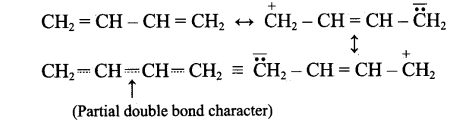
Answer:
A loop invariant is a condition [among program variables] that is necessarily true immediately before and immediately after, each iteration of a loop. A loop invariant is some condition that holds for every iteration of the loop.

Question 5.
What is recursive problem solving?
Answer:
Recursion is a method of solving problems that involves breaking a problem down into smaller and smaller sub problems until user gets in to a small problem that it can be solved trivially. Usually recursion involves a function calling itself. While it may not seem like much on the surface, recursion allows us to write elegant solutions to problems that may otherwise be very difficult to program.

Question 6.
Define factorial of a natural number recursively.
Answer:
Samacheer Kalvi 11th Computer Science Solutions Chapter 8 Iteration and Recursion 4
Recursive Algorithm:
Fact (n)
– – inputs : n
– – outputs : Fact = n!
if (n = 0) – – base case
1
else
n * fact (n – 1) – – recursive step

PART – 3
III. Explain in Brief

Question 1.
There are 7 tumblers on a table, all standing upside down. You are allowed to turn any 2 tumblers simultaneously in one move. Is it possible to reach a situation when all the tumblers are right side up? (Hint: The parity of the number of upside down tumblers is invariant.)
Answer:
Let u – No. of tumblers right side up
v – No. of tumblers up side down
Initial stage : u = 0, v = 7 (All tumblers upside down)
Final stage output: u = 7, v = 0 (All tumblers right side up)

Possible Iterations:
(i) Turning both up side down tumblers to right side up
u = u + 2, v = v – 2 [u is even]

(ii) Turning both right side up tumblers to upside down.
u = u – 2, v = v + 2 [u is even]

(iii) Turning one right side up tumblers to upside down and other tumbler from upside down to right side up.
u = u + 1 – 1 = u, v = v + 1 – 1 = v [u is even]

Initially u = 0 and continuous to be even in all the three cases. Therefore u is always even. Invariant: u is even (i. e. No. of right side up tumblers are always even)
But in the final stage (Goal), u = 7 and v = 0 i. e. u is odd.
Therefore it is not possible to reach a situation where all the tumblers are right side up.

Samacheer Kalvi 11th Computer Science Solutions Chapter 8 Iteration and Recursion

Question 2.
A knockout tournament is a series of games. Two players complete in each game; the loser is knocked out (i.e. does not play any more), the winner carries on. The winner of the tournament is the player that is left after all other players have been knocked out. Suppose there are 1234 players in a tournament. How many games are played before the tournament winner is decided?
Answer:
Samacheer Kalvi 11th Computer Science Solutions Chapter 8 Iteration and Recursion 5
On the other hand let n be the number of games, played and r be the number of players remaining in the tournament.
After every game, r will be reduced by 1.
r → no. of players remaining
n → no. of games played
If r = 2 then n = 1
As n increases, r decreases
n, r : = n + 1, r – 1
n + r = (n + 1) + (r – 1)
= n + 1 + r – 1
= n + r
Therefore n + r is invariant. n + r = 1234 (No. of players initially)
The winner of the tournament is the player that is left after all other players have been knocked out.
After all the games, only one player (winner) is left out.
i. e. n = 1
Put n = 1 in (1)
n + r = 1234 …. (1)
1 + r = 1234
r = 1234 – 1 = 1233
No. of games played = 1233

Question 3.
King Vikramaditya has two magic swords. With one, he can cut off 19 heads of a dragon, but after that the dragon grows 13 heads. With the other sword, he can cut off 7 heads, but 22 new heads grow. If all heads are cut off, the dragon dies. If the dragon has originally 1000 heads, can it ever die? (Hint: The number of heads mod 3 is invariant.)
Answer:
No. of heads of dragon = 1000
sword 1 : cuts 19 heads but 13 heads grow back.
sword 2 : cuts 7 heads but 22 heads grow back.
Let n be the number of heads of the dragon at initial state.

Case 1 : King uses Sword 1
Sword 1 cuts off 19 heads but 13 heads grow back.
n : = n – 19 + 13 = n – 6 No. of heads are reduced by 6.

Case 2 : King uses Sword 2
Sword 2 cuts 7 heads but 22 heads grow back.
n : = n – 7 + 22 = n + 15
No. of heads are increased by 15.

Note:
In the above two cases either 6 heads are removed or 15 heads added. Both 6 and 15 are multiples of 3.
Therefore repeating case 1 and case 2 recursively will either reduce or increase dragon heads in multiples of 3.
That is the invariant is n mod 3.
If n mod 3 = 0 then there is a possibility that the dragon dies.
But 1000 is not a multiple of 3 1000 mod 3 = 1 ≠ 0
It is not possible to kill the dragon. The dragon never dies.

PART – 4
IV. Explain in Detail

Question 1.
Assume an 8 x 8 chessboard with the usual coloring. “Recoloring” operation changes the color of all squares of a row or a column. You can recolor repeatedly. The goal is to attain just one black square. Show that you cannot achieve the goal. (Hint: If a row or column has b black squares, it changes by (|(8 – b) – b|).
Answer:
In a chess board no. of squares in any row or column = 8
Total No. of squares = 8 x 8 = 64
No. of black squares = 32
No. of white squares = 32
Let No. of blacks in a selected recoloring row or column = b
No. of black squares after recoloring operation = 8 – b
Initial state b = 32
Desired final state b = 1
Let us tabulate all the possible outcomes after recoloring a row or column.
Samacheer Kalvi 11th Computer Science Solutions Chapter 8 Iteration and Recursion 6
Difference is the no. of black squares left out in a row or column after recoloring operation. Difference is even. Difference is invariant.
But our goal is one ( 1 is odd) black square, so, it is not possible to attain the goal.

Question 2.
Power can also be defined recursively as
Samacheer Kalvi 11th Computer Science Solutions Chapter 8 Iteration and Recursion 7
Construct a recursive algorithm using this definition. How many multiplications are needed to calculate a10?
Answer:
Power:
power (5, 2) = 5 x 5 = 25
power (x, n) raise x to the power n

Algorithm:
Samacheer Kalvi 11th Computer Science Solutions Chapter 8 Iteration and Recursion 8
To find a10:
Samacheer Kalvi 11th Computer Science Solutions Chapter 8 Iteration and Recursion 9

Question 3.
A single – square – covered board is a board of 2n x 2n squares in which one square is covered with a single square tile. Show that it is possible to cover this board with triominoes without overlap.
Answer:
size of the board is 2nn x 2n
Number of squares = 2n x 2n = 4n
Number of squares covered = 1
Number of squares to be covered = 4n – 1
4n – 1 is a multiple of 3
Samacheer Kalvi 11th Computer Science Solutions Chapter 8 Iteration and Recursion 10
Case 1 : n = 1
The size of the board 2 x 2
one triominoe can cover 3 squares without overlap.
Samacheer Kalvi 11th Computer Science Solutions Chapter 8 Iteration and Recursion 11
We can cover it with one triominoe and solve the problem.
Samacheer Kalvi 11th Computer Science Solutions Chapter 8 Iteration and Recursion 12

Case 2 : n ≥ 2
1. place a triominoe at the center of the entire board so as to not cover the covered sub – board.

2. One square in the board is covered by a tile. The board has 4 sub – boards of size 22n – 1 x 22n – 1.
Samacheer Kalvi 11th Computer Science Solutions Chapter 8 Iteration and Recursion 13
Out of 4 sub – boards one sub – board is a single square covered sub – board.
Samacheer Kalvi 11th Computer Science Solutions Chapter 8 Iteration and Recursion 14
One triominoe can cover remaining three sub – boards into single square covered sub – board. The problem of size n is divided into 4 sub – problems of size (n – 1). Each sub – board has 22n – 1 x 22n – 1 – 1 = 22n – 2 – 1 = 4n – 1 – 1 squares to be covered.
Samacheer Kalvi 11th Computer Science Solutions Chapter 8 Iteration and Recursion 25
4n – 1 – 1 is also a multiple of 3
In this, the 2n x 2n board is reduced to boards of size 2×2 having are square covered. A triominoe can be placed in each of these boards and hence the whole original 2n x 2n . board is covered with triominoe with out overlap.

Samacheer kalvi 11th Computer Science Iteration and Recursion Additional Questions and Answers

PART – 1
I. Choose the correct answer

Question 1.
………………… is an algorithm design technique, closely related to induction.
(a) Iteration
(b) Invariant
(c) Loop invariant
(d) Recursion
Answer:
(d) Recursion

Question 2.
In which year E W Dijkstra was awarded ACM Turing Award?
(a) 1972
(b) 1974
(c) 1970
(d) 1911
Answer:
(a) 1972

Samacheer Kalvi 11th Computer Science Solutions Chapter 8 Iteration and Recursion

Question 3.
In a loop, if L is an invariant of the loop body B, then L is known as a …………………
(a) recursion
(b) variant
(c) loop invariant
(d) algorithm
Answer:
(c) loop invariant

Question 4.
Recursion must have at least ………………… base case.
(a) one
(b) two
(c) three
(d) four
Answer:
(a) one

Question 5.
The unchanged variables of the loop body is …………………
(a) loop invariant
(b) loop variant
(c) condition
(d) loop variable
Answer:
(a) loop invariant

Question 6.
………………… is the algorithm design techniques to execute the same action repeatedly.
(a) Iteration
(b) Recursion
(c) Both a & b
(d) none of these
Answer:
(c) Both a & b

Question 7.
If L is a loop variant, then it should be true at ………………… important points in the algorithm.
(a) 2
(b) 3
(c) 4
(d) 5
Answer:
(c) 4

Question 8.
The loop invariant need not be true at the …………………
(a) Start of the loop
(b) end of the loop
(c) end of each iteration
(d) middle of algorithm
Answer:
(d) middle of algorithm

Question 9.
In an expression if the variables has the same value before and after an assignment, then it is of an assignment.
(a) variant
(b) Invariant
(c) iteration
(d) variable
Answer:
(b) Invariant

Question 10.
The input size to a sub problem is than the input size to the original problem.
(a) equal
(b) smaller
(c) greater
(d) no criteria
Answer:
(b) smaller

Question 11.
When the solver calls a sub solver, then it is called …………………
(a) Iterative call
(b) solver call
(c) recursive call
(d) conditional call
Answer:
(c) recursive call

Question 12.
How many cases are needed for a recursive solvers?
(a) 2
(b) 3
(c) 4
(d) 5
Answer:
(a) 2

Samacheer Kalvi 11th Computer Science Solutions Chapter 8 Iteration and Recursion

Question 13.
Which of the following is updated when each time the loop body is executed?
(a) data type
(b) subprogram
(c) function
(d) variable
Answer:
(d) variable

Question 14.
Which is the key to constract iterative algorithm …………………
(a) loop invariant
(b) Variable
(c) loop
(d) Recursive
Answer:
(a) loop invariant

PART – 3
II. Short Answers

Question 1.
When the loop variant will be true?
Answer:
The loop invariant is true before the loop body and after the loop body, each time.

Question 2.
What is an invariant?
Answer:
An expression involving variables, which remains unchanged by an assignment to one of these variables, is called an invariant of the assignment.

PART – 3
III. Explain in Brief

Question 1.
Write a note on Recursion.
Answer:
Recursion:
Recursion is another algorithm design technique, closely related to iteration, but more powerful. Using recursion, we solve a problem with a given input, by solving the same problem with a part of the input, and constructing a solution to the original problem from the solution to the partial input.

Question 2.
Write down the steps to be taken to construct a loop.
Answer:

  1. Establish the loop invariant at the start of the loop.
  2. The loop body should so update the variables as to progress toward the end, and maintain the loop invariant, at the same time.
  3. When the loop ends, the termination condition and the loop invariant should establish the input – output relation.

Samacheer Kalvi 11th Computer Science Solutions Chapter 8 Iteration and Recursion

Question 3.
Write a note on Iteration.
Answer:
Iteration:
In iteration, the loop body is repeatedly executed as long as the loop condition is true. Each time the loop body is executed, the variables are updated. However, there is also a property of the variables which remains unchanged by the execution of the loop body. This unchanging property is called the loop invariant. Loop invariant is the key to construct and to reason about iterative algorithms.

PART – 4
IV. Explain in Detail

Question 1.
Explain Loop invariant with a near diagram.
Answer:
In a loop, if L is an invariant of the loop body B, then L is known as a loop invariant, while C
– – L
B
– – L
The loop invariant is true before the loop body and after the loop body, each time. Since L is true at the start of the first iteration, L is true at the start of the loop also (just before the loop). Since L is true at the end of the last iteration, L is true when the loop ends also (just after the loop). Thus, if L is a loop variant, then it is true at four important points in the algorithm, as annotated in the algorithm.

  1. At the start of the loop (just before the loop)
  2. at the start of each iteration (before loop body)
  3. at the end of each iteration (after loop body)
  4. at the end of the loop (just after the loop)

Samacheer Kalvi 11th Computer Science Solutions Chapter 8 Iteration and Recursion 23
Samacheer Kalvi 11th Computer Science Solutions Chapter 8 Iteration and Recursion 15

Question 2.
Explain recursive problem solving.
Answer:
To solve a problem recursively, the solver reduces the problem to sub – problems, and calls another instance of the solver, known as sub – solver, to solve the sub – problem. The input size to a sub – problem is smaller than the input size to the original problem. When the solver calls a sub – solver, it is known as recursive call. The magic of recursion allows the solver to assume that the sub – solver (recursive call) outputs the solution to the sub – problem. Then, from the solution to the sub – problem, the solver constructs the solution to the given problem. As the sub – solvers go on reducing the problem into sub – problems of smaller sizes, eventually the sub-problem becomes small enough to be solved directly, without recursion. Therefore, a recursive solver has two cases:
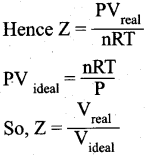
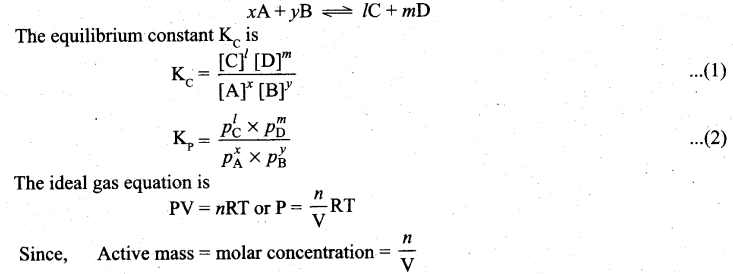
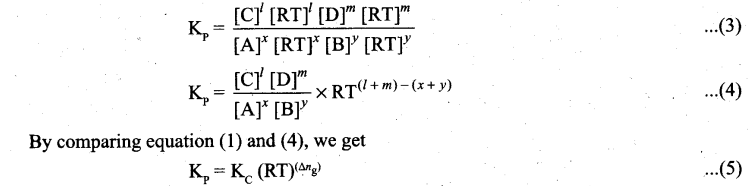
1. Base case:
The problem size is small enough to be solved directly. Output the solution. here must be at least one base case.

2. Recursion step:
The problem size is not small enough. Deconstruct the problem into a sub – problem, strictly smaller in size than the given problem. Call a sub – solver to solve the sub problem. Assume that the sub – solver outputs the solution to the sub problem. Construct the solution to the given problem. This outline of recursive problem solving technique is shown below.
Samacheer Kalvi 11th Computer Science Solutions Chapter 8 Iteration and Recursion 16
Whenever we solve a problem using recursion, we have to ensure these two cases: In the recursion step, the size of the input to the recursive call is strictly smaller than the size of the given input, and there is at least one base case.

Question 3.
Give an example for loop invariant.
Answer:
The loop invariant is true in four crucial points in a loop. Using the loop invariant, we can construct the loop and reason about the properties of the variables at these points.
Example:
Design an iterative algorithm to compute an. Let us name the algorithm power(a, n). For example,
power(10, 4) = 10000
power (5, 3) = 125
power (2, 5) = 32
Algorithm power(a, n) computes an by multiplying a cumulatively n times,
Samacheer Kalvi 11th Computer Science Solutions Chapter 8 Iteration and Recursion 17
The specification and the loop invariant are shown as comments.
power (a, n)
– – inputs: n is a positive integer
– – outputs: p = an
p, i : = 1, 0
while i ≠ n
– – loop invariant: p = ai
p, i : = p x a, i + 1
The step by step execution of power (2, 5) is shown in Table. Each row shows the values of the two variables p and i at the end of an iteration, and how they are calculated. We see that p = ai is true at the start of the loop, and remains true in each row. Therefore, it is a loop invariant.
Samacheer Kalvi 11th Computer Science Solutions Chapter 8 Iteration and Recursion 18
When the loop ends, p = ai is still true, but i = 5. Therefore, p = a5. In general, when the loop ends, p = an . Thus, we have verified that power(a, n) satisfies its specification.

Question 4.
There are 6 equally spaced trees and 6 sparrows sitting on these trees,one sparrow on each tree. If a sparrow flies from one tree to another, then at the same time, another sparrow flies from its tree to some other tree the same distance away, but in the opposite direction. Is it possible for all the sparrows to gather on one tree?
Answer:
Let us index the trees from 1 to 6. The index of a sparrow is the index of the tree it is currently sitting on. A pair of sparrows flying can be modeled as an iterative step of a loop. When a sparrow at tree i flies to tree i + d, another sparrow at tree j flies to tree j – d. Thus, after each iterative step, the sum S of the indices of the sparrows remains invariant. Moreover, a loop invariant is true at the start and at the end of the loop.
At the start of the loop, the value of the invariant is
S = 1 + 2 + 3 + 4 + 5 + 6 = 21
When the loop ends, the loop invariant has the same value. However, when the loop ends, if all the sparrows were on the same tree, say k, then S = 6k
Samacheer Kalvi 11th Computer Science Solutions Chapter 8 Iteration and Recursion 19
It is not possible – 21 is not a multiple of 6. The desired final values of the sparrow indices is not possible with the loop invariant. Therefore, all the sparrows cannot gather on one tree.

Question 5.
Customers are waiting in a line at a counter. The man at the counter wants to know how many customers are waiting in the line.
Answer:
Customers are waiting in a line at a counter. The man at the counter wants to know how many customers are waiting in the line.
Samacheer Kalvi 11th Computer Science Solutions Chapter 8 Iteration and Recursion 20
Instead of counting the length himself, he asks customer A for the length of the line with him at the head, customer A asks customer B for the length of the line with customer B at the head, and so on. When the query reaches the last customer in the line, E, since there is no one behind him, he replies 1 to D who asked him. D replies 1 + 1 = 2 to C, C replies 1 + 2 = 3 to B, B replies 1 + 3 = 4 to A, and A replies 1 + 4 = 5 to the man in the counter.

Question 6.
Design a recursive algorithm to compute an. We constructed an iterative algorithm to compute an in Example 8.5. an can be defined recursively as
Samacheer Kalvi 11th Computer Science Solutions Chapter 8 Iteration and Recursion 24
Answer:
The recursive definition can be expressed as a recursive solver for computing power(a, n).
Samacheer Kalvi 11th Computer Science Solutions Chapter 8 Iteration and Recursion 21
The recursive process resulting from power(2, 5)
Samacheer Kalvi 11th Computer Science Solutions Chapter 8 Iteration and Recursion 22
power (2, 5)
= 2 x power (2, 4)
= 2 x 2 x power (2, 3)
= 2 x 2 x 2 x power (2, 2)
= 2 x 2 x 2 x 2 x power (2, 1)
= 2 x 2 x 2 x 2 x 2 x power (2, 0) = 2 x 2 x 2 x 2 x 2 x 1
= 2 x 2 x 2 x 2 x 2 = 2 x 2 x 2 x 4 = 2 x 2 x 8 = 2 x 16 = 32

Samacheer Kalvi 11th Accountancy Solutions Chapter 12 Final Accounts of Sole Proprietors – I

Students can Download Accountancy Chapter 12 Final Accounts of Sole Proprietors – I Questions and Answers, Notes Pdf, Samacheer Kalvi 11th Accountancy Book Solutions Guide Pdf helps you to revise the complete Tamilnadu State Board New Syllabus and score more marks in your examinations.

Tamilnadu Samacheer Kalvi 11th Accountancy Solutions Chapter 12 Final Accounts of Sole Proprietors – I

Samacheer Kalvi 11th Accountancy Final Accounts of Sole Proprietors – I Text Book Back Questions and Answers

I. Multiple Choice Questions
Choose the Correct Answer

Question 1.
Closing stock is an item of ……………..
(a) Fixed asset
(b) Current asset
(c) Fictitious asset
(d) Intangible asset
Answer:
(b) Current asset

Question 2.
Balance sheet is ……………..
(a) An account
(b) A statement
(c) Neither a statement nor an account
(d) None of the above
Answer:
(b) A statement

Question 3.
Net profit of the business increases the ……………..
(a) Drawings
(b) Receivables
(c) Debts
(d) Capital
Answer:
(d) Capital

Samacheer Kalvi 11th Accountancy Solutions Chapter 12 Final Accounts of Sole Proprietors – I

Question 4.
Carriage inwards will be shown ……………..
(a) In the trading account
(b) In the profit and loss account
(c) On the liabilities side
(d) On the assets side
Answer:
(a) In the trading account

Question 5.
Bank overdraft should be shown ……………..
(a) In the trading account
(b) Profit and loss account
(c) On the liabilities side
(d) On the assets side
Answer:
(c) On the liabilities side

Question 6.
Balance sheet shows the …………….. of the business.
(a) Profitability
(b) Financial position
(c) Sales
(d) Purchases
Answer:
(b) Financial position

Question 7.
Drawings appearing in the trial balance is ……………..
(a) Added to the purchases
(b) Subtracted from the purchases
(c) Added to the capital
(d) Subtracted from the capital
Answer:
(d) Subtracted from the capital

Question 8.
Salaries appearing ill the trial balance is shown on the ……………..
(a) Debit side of trading account
(b) Debit side of profit and loss account
(c) Liabilities side of the balance sheet
(d) Assets side of the balance sheet
Answer:
(b) Debit side of profit and loss account

Samacheer Kalvi 11th Accountancy Solutions Chapter 12 Final Accounts of Sole Proprietors – I

Question 9.
Current assets does not include ……………..
(a) Cash
(b) Stock
(c) Furniture
(d) Prepaid expenses
Answer:
(c) Furniture

Question 10.
Goodwill is classified as ……………..
(a) A current asset
(b) A liquid asset
(c) A tangible asset
(d) An intangible asset
Answer:
(d) An intangible asset

II. Very Short Answer Questions

Question 1.
Write a note on trading account.
Answer:
Trading refers to buying and selling of goods with the intention of making profit. The trading account is a nominal account which shows the result of buying and selling of goods for an accounting period. Trading account is prepared to find out the difference between the revenue from sales and cost of goods sold.

Question 2.
What are wasting assets?
Answer:
These are the assets which get exhausted gradually in the process of excavation. Examples: mines and quarry.

Question 3.
What are fixed assets?
Answer:
Fixed assets are those assets which are acquired or constructed for continued use in the business and last for many years such as land and building, plant and machinery, motor vehicles, furniture, etc.

Samacheer Kalvi 11th Accountancy Solutions Chapter 12 Final Accounts of Sole Proprietors – I

Question 4.
What is meant by purchases returns?
Answer:
Goods purchased which are returned to suppliers are termed as purchases returns or returns outward.

Question 5.
Name any two direct expenses and indirect expenses.
Answer:
Direct expenses:

  • Carriage inwards or freight inwards
  • Wages Indirect expenses:

Indirect expenses:

  • Office and administrative expenses
  • Selling and distribution expenses

Question 6.
Mention any two differences between trial balance and balance sheet.
Answer:

S.No.BasisTrial BalanceBalance Sheet
1.NatureTrial balance is a list of ledger balances on a particular date.Balance sheet is a statement showing the position of assets and liabilities on a particular date.
2.PurposeTrial balance is prepared to check the arithmetical accuracy of the accounting entries made.Balance sheet is prepared to ascertain the financial position of a business.

Question 7.
What are the objectives of preparing trading account?
Answer:

  1. Provides information about gross profit or gross loss.
  2. Provides an opportunity to safeguard against possible losses.

Question 8.
What is the need for preparing profit and loss account?
Answer:

  1. Ascertainment of net profit or net loss
  2. Comparison of profit
  3. Control on expenses
  4. Helpful in the preparation of balance sheet.

III. Short Answer Questions

Question 1.
What are final accounts? What are its constituents?
Answer:
Businessmen want to know the profitability and the financial position of the business. These can be ascertained by preparing the final accounts or financial statements. The final accounts or financial statements include the following:

  1. Income statement or trading and profit and loss account; and
  2. Position statement or Balance sheet.

Samacheer Kalvi 11th Accountancy Solutions Chapter 12 Final Accounts of Sole Proprietors – I

Question 2.
What is meant by closing entries? Why are they passed?
Answer:
Balances of all the nominal accounts are required to be closed on the last day of the accounting year to facilitate the preparation of trading and profit and loss account. It is done by passing necessary closing entries in the journal proper. Purchases has debit balance and purchases returns has credit balance. At the end of the accounting year, the balance in purchases returns account is closed by transferring to purchase account.

Question 3.
What is meant by gross profit and net profit?
Answer:

  1. If the amount of sales exceeds the cost of goods sold, the difference is gross profit.
    Sales – Cost of goods sold = Gross profit.
  2. If the total of the credit side of the profit and loss account exceeds the debit side, the difference is termed as net profit.

Question 4.
“Balance sheet is not an account” – Explain.
Answer:
A balance sheet is a part of the final accounts. However, the balance sheet is a statement and not an account. It has no debit or credit sides and as such the words ‘To’ and ‘By’ are not used before the names of the accounts shown therein.

Question 5.
What are the advantages of preparing a balance sheet?
Answer:
Balance sheet discloses the financial position of a business on a particular date, it gives
the balances only for the date on which it is prepared. It shows the financial position of the business according to the going concern concept.

Samacheer Kalvi 11th Accountancy Solutions Chapter 12 Final Accounts of Sole Proprietors – I

Question 6.
What is meant by grouping and marshalling of assets and liabilities?
Answer:
1. The term ‘grouping’ means showing the items of similar nature under a common heading. For example, the amount due from various customers will be shown under the head‘sundry debtors’.

2. ‘Marshalling’ is the arrangement of various assets and liabilities in a proper order. Marshalling can be made in one of the following two ways:

  • In the order of liquidity
  • In the order of permanence

IV. Exercises

Question 1.
Prepare trading account in the books of Sivashankar from the following figures:
Samacheer Kalvi 11th Accountancy Solutions Chapter 12 Final Accounts of Sole Proprietors – I
Answer:
Trading account of Sivashankar
Samacheer Kalvi 11th Accountancy Solutions Chapter 12 Final Accounts of Sole Proprietors – I

Question 2.
Prepare trading account in the books of Mr. Sanj ay for the year ended 31st December 2017:
Samacheer Kalvi 11th Accountancy Solutions Chapter 12 Final Accounts of Sole Proprietors – I
Answer:
Trading account of Mr. Sanjay for the year ended 31st December, 2017
Samacheer Kalvi 11th Accountancy Solutions Chapter 12 Final Accounts of Sole Proprietors – I

Question 3.
Prepare trading account in the books of Mr. Sanj ay for the year ended 31st December 2017:
Samacheer Kalvi 11th Accountancy Solutions Chapter 12 Final Accounts of Sole Proprietors – I
Answer:
Trading account of Saravanan for the year ended 31st December, 2017
Samacheer Kalvi 11th Accountancy Solutions Chapter 12 Final Accounts of Sole Proprietors – I

Question 4.
From the following details for the year ended 31st March, 2018, prepare trading account
Samacheer Kalvi 11th Accountancy Solutions Chapter 12 Final Accounts of Sole Proprietors – I
Answer:
Trading account for the year ended 31st March, 2018
Samacheer Kalvi 11th Accountancy Solutions Chapter 12 Final Accounts of Sole Proprietors – I

Question 5.
Ascertain gross profit or gross loss from the following:
Samacheer Kalvi 11th Accountancy Solutions Chapter 12 Final Accounts of Sole Proprietors – I
Answer:
Profit and Loss Account
Samacheer Kalvi 11th Accountancy Solutions Chapter 12 Final Accounts of Sole Proprietors – I

Question 6.
From the following balances taken from the books of Victor, prepare trading account for the year ended December 31,2017:
Samacheer Kalvi 11th Accountancy Solutions Chapter 12 Final Accounts of Sole Proprietors – I
Answer:
Trading Account of Victor for the year ended 31st December, 2017
Samacheer Kalvi 11th Accountancy Solutions Chapter 12 Final Accounts of Sole Proprietors – I
Hint : Closing stock will not appear in trading account because of adjusted purchases have been given.

Question 7.
Compute cost of goods sold from the following information:
Samacheer Kalvi 11th Accountancy Solutions Chapter 12 Final Accounts of Sole Proprietors – I
Answer:
Cost of goods sold = Opening stock + Net purchases + Direct expenses – Closing stock
= 10,000 + 80,000 + 7,000 – 15,000
= ₹ 82,000
Note: Indirect expenses do not form part of cost of goods sold.

Question 8.
Find out the amount of sales from the following information:
Samacheer Kalvi 11th Accountancy Solutions Chapter 12 Final Accounts of Sole Proprietors – I
Answer:
Cost of goods sold = Opening stock + Net purchases + Direct expenses – Closing stock
= 30,000 + 2,00,000 + 0 – 20,000
= ₹ 2,10,000
Samacheer Kalvi 11th Accountancy Solutions Chapter 12 Final Accounts of Sole Proprietors – I
Therefore, percentage of gross profit on cost of goods sold is
\(\frac { 30 }{ 70 }\) x 100 = 42.85% (42.857142 ……….)
Gross profit = 42.85% on 2,10,000 i.e., \(\frac { 42.85 }{ 100 }\) x 2,10,000 = ₹ 90,000
Sales = Cost of goods sold + Gross Profit
= 2,10,000 + 90,000 (Fractions to be rounded)
= ₹ 3,00,000

Question 9.
Prepare profit and loss account in the books of Kirubavathi for the year ended 31st December, 2016 from the following information:
Samacheer Kalvi 11th Accountancy Solutions Chapter 12 Final Accounts of Sole Proprietors – I
Answer:
Profit and loss account of Kirubavathi for the year ended 31st Dec, 2016
Samacheer Kalvi 11th Accountancy Solutions Chapter 12 Final Accounts of Sole Proprietors – I

Question 10.
Ascertain net profit or net loss from the following:
Samacheer Kalvi 11th Accountancy Solutions Chapter 12 Final Accounts of Sole Proprietors – I
Answer:
Profit and loss account
Samacheer Kalvi 11th Accountancy Solutions Chapter 12 Final Accounts of Sole Proprietors – I

Question 11.
From the following details, prepare profit and loss account.
Samacheer Kalvi 11th Accountancy Solutions Chapter 12 Final Accounts of Sole Proprietors – I
Answer:
Profit and loss account
Samacheer Kalvi 11th Accountancy Solutions Chapter 12 Final Accounts of Sole Proprietors – I
(Hint: Freight inwards will not appear in profit and loss account as it is a direct expense)

Question 12.
From the following information, prepare profit and loss account for the year ending 31st December, 2016.
Samacheer Kalvi 11th Accountancy Solutions Chapter 12 Final Accounts of Sole Proprietors – I
Answer:
Profit and loss account for the year ended 31st December, 2016
Samacheer Kalvi 11th Accountancy Solutions Chapter 12 Final Accounts of Sole Proprietors – I

Question 13.
From the following balances obtained from the books of Mr. Ganesh, prepare trading and profit and loss account:
Samacheer Kalvi 11th Accountancy Solutions Chapter 12 Final Accounts of Sole Proprietors – I
Answer:
Trading and Profit & loss account of Mr. Ganesh
Samacheer Kalvi 11th Accountancy Solutions Chapter 12 Final Accounts of Sole Proprietors – I

Question 14.
From the following balances extracted from the books of a trader, ascertain gross profit and net profit for the year ended March 31,2017:
Samacheer Kalvi 11th Accountancy Solutions Chapter 12 Final Accounts of Sole Proprietors – I
Answer:
Trading and Profit & Loss account for the year ended 31st March, 2017
Samacheer Kalvi 11th Accountancy Solutions Chapter 12 Final Accounts of Sole Proprietors – I

Question 15.
From the following particulars, prepare balance sheet in the books of Bragathish as on 31st December, 2017:
Samacheer Kalvi 11th Accountancy Solutions Chapter 12 Final Accounts of Sole Proprietors – I
Answer:
Balance Sheet of Bragathish as on 31st December, 2017
Samacheer Kalvi 11th Accountancy Solutions Chapter 12 Final Accounts of Sole Proprietors – I

Question 16.
Prepare trading and profit and loss account in the books of Ramasundari for the year ended 31st December, 2017 and balance sheet as on that date from the following information:
Samacheer Kalvi 11th Accountancy Solutions Chapter 12 Final Accounts of Sole Proprietors – I
Answer:
Trading and Profit & Loss a/c of Ramasundari for the year ended 31 Dec, 2017 Cr.
Samacheer Kalvi 11th Accountancy Solutions Chapter 12 Final Accounts of Sole Proprietors – I
Balance Sheet of Ramasundari as on 31st March, 2018
Samacheer Kalvi 11th Accountancy Solutions Chapter 12 Final Accounts of Sole Proprietors – I

Question 17.
From the Trial balance, given by Saif, prepare final accounts for the year ended 31st March, 2018 in his books:
Samacheer Kalvi 11th Accountancy Solutions Chapter 12 Final Accounts of Sole Proprietors – I
Answer:
Trading and Profit & Loss a/c of Saif for the year ended 31 March, 2018
Samacheer Kalvi 11th Accountancy Solutions Chapter 12 Final Accounts of Sole Proprietors – I
Balance Sheet of Saif as on 31st March, 2018
Samacheer Kalvi 11th Accountancy Solutions Chapter 12 Final Accounts of Sole Proprietors – I

Question 18.
Prepare trading and profit and loss account and balance sheet in the books of Deri, a trader, from the following balances as on March 31, 2018.
Samacheer Kalvi 11th Accountancy Solutions Chapter 12 Final Accounts of Sole Proprietors – I
Answer:
Trading and Profit & Loss a/c of Deri for the year ended 31st March, 2018
Samacheer Kalvi 11th Accountancy Solutions Chapter 12 Final Accounts of Sole Proprietors – I
Balance Sheet of Deri as on 31st March, 2018
Samacheer Kalvi 11th Accountancy Solutions Chapter 12 Final Accounts of Sole Proprietors – I

Textbook Case Study Solved

Question 1.
Mr. Abhinav started a small shop of selling dairy products. He wanted to maintain proper books of accounts. But, he had very little knowledge of accounting. He maintained only three books – purchases, sales and cash book by himself. He bought some dairy products and a refrigerator to store the milk products for which the payment was made by cheque but recorded the same in the purchases book. He also spent for the transportation charges and paid some money to the person who unloaded the stock. He recorded the same in the cash book.

He made both cash and credit sale for the next few weeks. He entered the entire sales in the sales book. In the middle of the month, he was in need of some money for his personal use. So he took some money, but did not record in the books.
Now, discuss on the following points:

Question 1.
Do you think Mr. Abhinav needs an accountant? Why do you think so?
Answer:
Yes, Mr. Abhinav needs an accountant because he records all cash and credit transactions.

Question 2.
Does he maintain enough books of accounts?
Answer:
Yes, he maintains enough books of accounts.

Samacheer Kalvi 11th Accountancy Solutions Chapter 12 Final Accounts of Sole Proprietors – I

Question 3.
What other books do you think that he needs to maintain?
Answer:
He needs to maintain a petty cashbook.

Question 4.
What will be the impact on the profit, if he records the purchase of refrigerator in the purchases book?
Answer:
The purchase book will be overcast because this transaction will be recorded in proper journal.

Question 5.
Is it important to record the money taken for personal use? Will it affect the final accounts?
Answer:
Yes, then only the actual profit or loss can be found out in the business.

Question 6.
Identify some of the accounting principles relevant to this situation.
Answer:
Some of the accounting principles relevant to this situation are: matching principles, business entity concept, money measurement concept, dual output concept, periodicity concept and going concern concept.

Samacheer Kalvi 11th Accountancy Final Accounts of Sole Proprietors – I Additional Questions and Answers

I. Multiple Choice Questions
Choose the correct answer

Question 1.
Income statement is divided into ……………….. parts.
(a) one
(b) two
(c) three
(d) four
Answer:
(b) two

Question 2.
The first part of the income statement is ………………..
(a) Final account
(b) Trading account
(c) Profit and Loss account
(d) Balance Sheet
Answer:
(b) Trading account

Samacheer Kalvi 11th Accountancy Solutions Chapter 12 Final Accounts of Sole Proprietors – I

Question 3.
Balances of all ……………….. accounts are required to be closed on the last day of the accounting year.
(a) Nominal
(b) Personal
(c) Real
(d) Representative personal
Answer:
(a) Nominal

Question 4.
Trading account is a ……………….. account.
(a) Personal
(b) Nominal
(c) Real
(d) Representative personal
Answer:
(b) Nominal

Question 5.
Sales – Gross Profit = ………………..
(a) Sales
(b) Cost of goods sold
(c) Gross profit
(d) Gross loss
Answer:
(b) Cost of goods sold

Question 6.
……………….. account is the second part of income statement.
(a) Trading
(b) Profit and Loss
(c) Balance sheet
(d) Final
Answer:
(b) Profit and Loss

Question 7.
Which one is correctly matched?
(a) Bad debts – Indirect expense
(b) Wages – Asset
(c) Salary – Trading account
(d) Net Profit – Asset
Answer:
(a) Bad debts – Indirect expense

Samacheer Kalvi 11th Accountancy Solutions Chapter 12 Final Accounts of Sole Proprietors – I

Question 8.
Balances of all the personal and real account are shown in ………………..
(a) Trading account
(b) Profit and loss account
(c) Income statement
(d) Balance sheet
Answer:
(d) Balance sheet

Question 9.
A balance sheet is a part of the ……………….. account.
(a) Trading
(b) Profit and Loss
(c) Income statement
(d) Final
Answer:
(d) Final

Question 10.
……………….. is a summary of the personal and real accounts.
(a) Balance sheet
(b) Final account
(c) Trading account
(d) Profit and loss account
Answer:
(a) Balance sheet

Question 11.
The balance sheet of business concern can be presented in the ……………….. forms.
(a) two
(b) three
(c) four
(d) six
Answer:
(a) two

Question 12.
Marshalling can be made in one of the ……………….. ways.
(a) three
(b) two
(c) four
(d) five
Answer:
(b) two

Question 13.
These are the assets which get exhausted gradually in the process of excavation.
(a) Wasting assets
(b) Nominal assets
(c) Liquid assets
(d) Current assets
Answer:
(a) Wasting assets

Question 14.
……………….. liabilities are not shown in the balance sheet.
(a) Contingent
(b) Current
(c) Liquid
(d) Fixed
Answer:
(a) Contingent