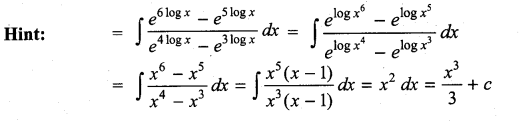
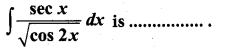
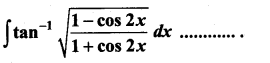
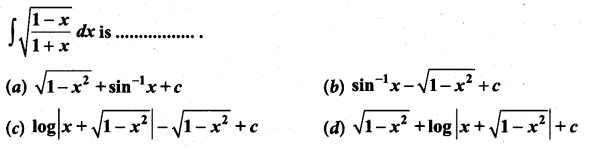
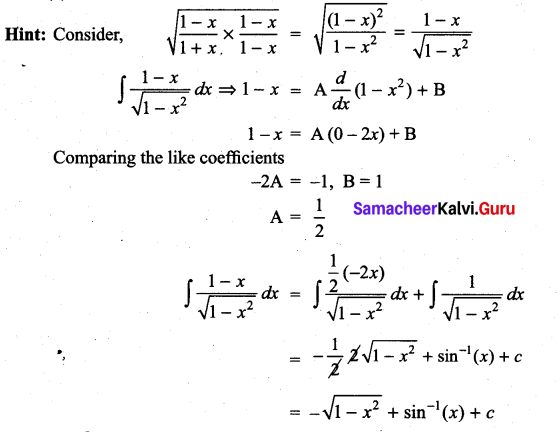
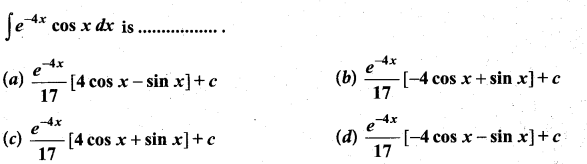
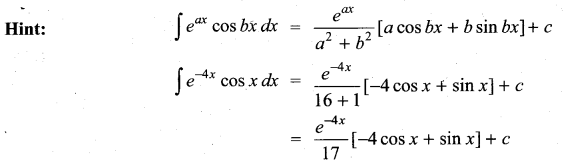
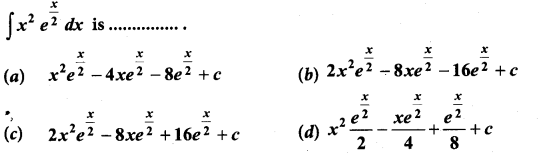
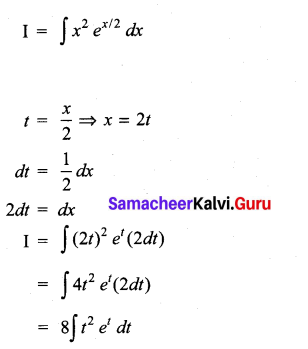
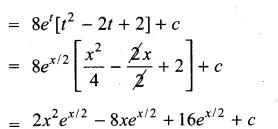
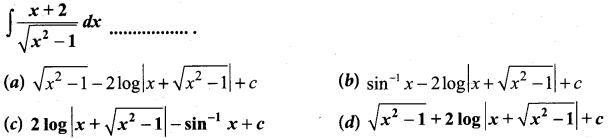
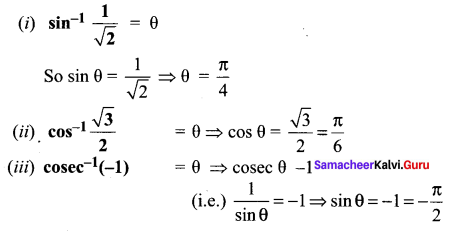
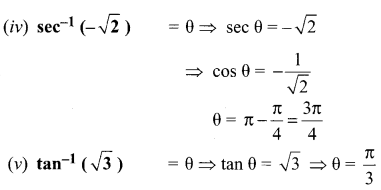
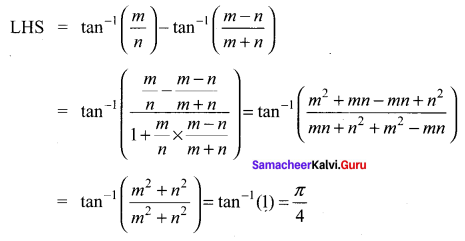
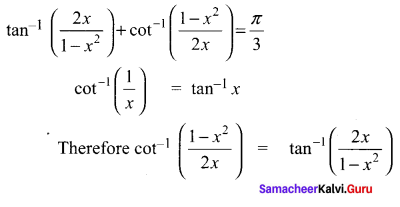
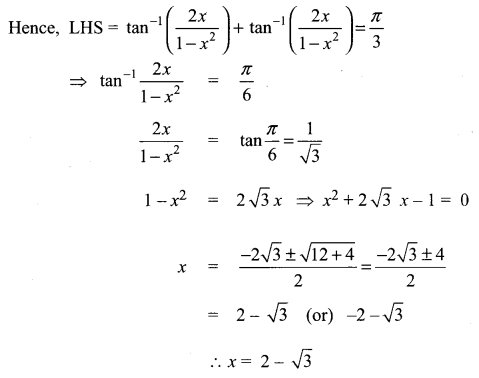
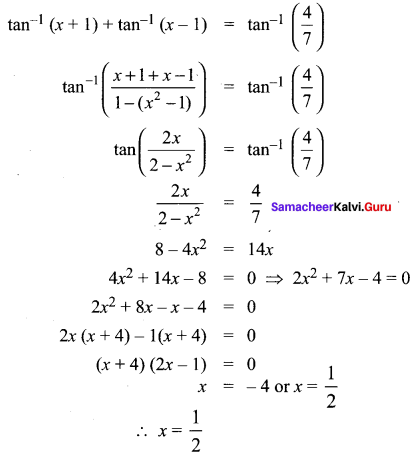
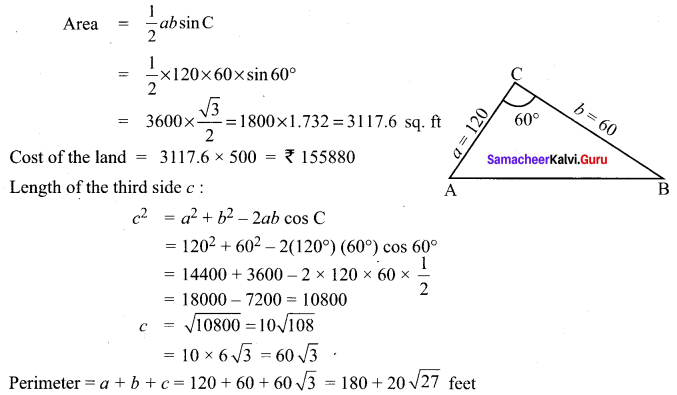
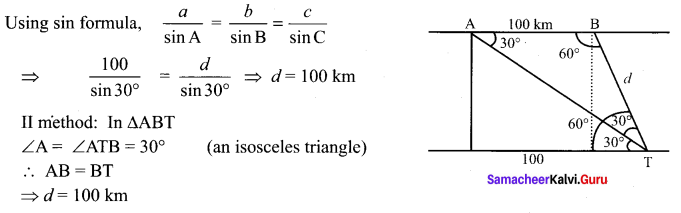
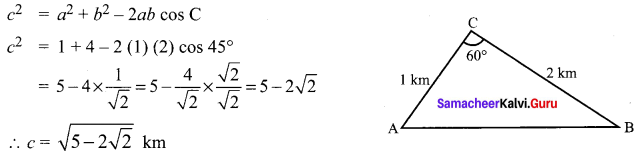
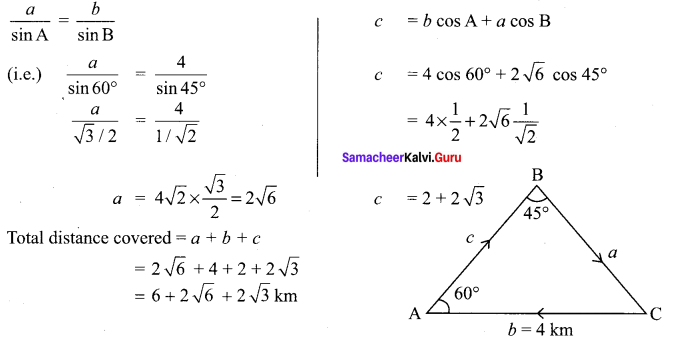
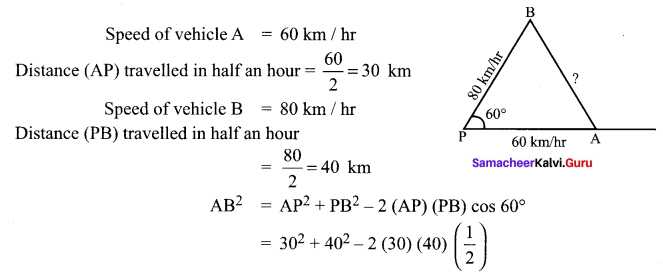
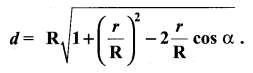
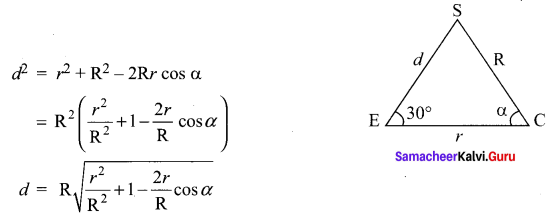
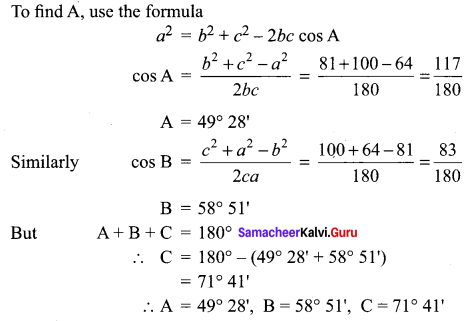
Samacheer Kalvi 11th Maths Solutions Chapter 11 Integral Calculus Ex 11.13

You can Download Samacheer Kalvi 11th Maths Book Solutions Guide Pdf, Tamilnadu State Board help you to revise the complete Syllabus and score more marks in your examinations.

Tamilnadu Samacheer Kalvi 11th Maths Solutions Chapter 11 Integral Calculus Ex 11.13

Choose the correct or most suitable answer from given four alternatives.
Question 1.
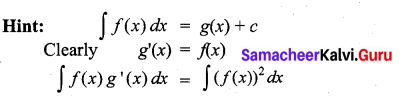
If \(\int f(x) d x\) = g(x) + c, then \(\int f(x) g^{\prime}(x) d x\)

Samacheer Kalvi 11th Maths Solutions Chapter 11 Integral Calculus Ex 11.13 1
Solution:
(a)
Samacheer Kalvi 11th Maths Solutions Chapter 11 Integral Calculus Ex 11.13 2

Question 2.
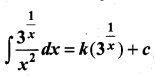
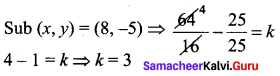
If Samacheer Kalvi 11th Maths Solutions Chapter 11 Integral Calculus Ex 11.13 3, then the value of k is ……………
(a) log 3
(b) -log 3
(c) \(-\frac{1}{\log ^{3}}\)
(d) \(\frac{1}{\log 3}\)
Solution:
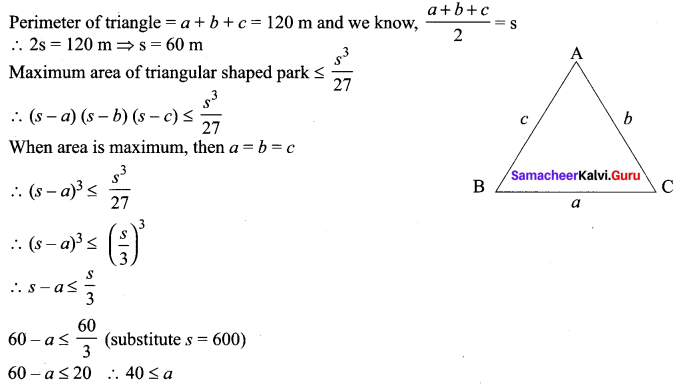
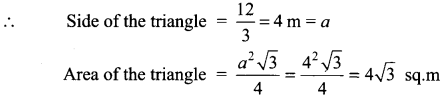
(c)
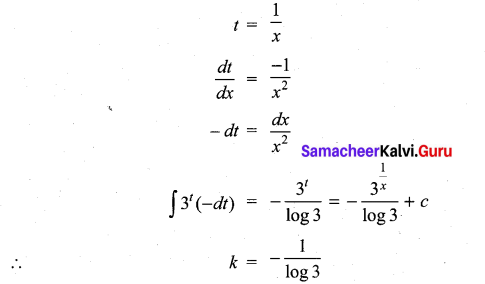
Samacheer Kalvi 11th Maths Solutions Chapter 11 Integral Calculus Ex 11.13 4

Question 3.
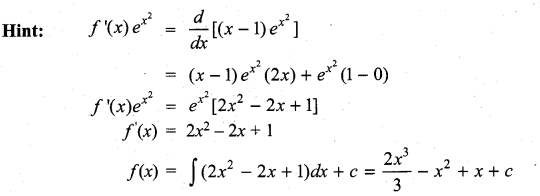
If \(\int f^{\prime}(x) e^{x^{3}} d x\) = (x – 1)ex2, then f(x) is …………………
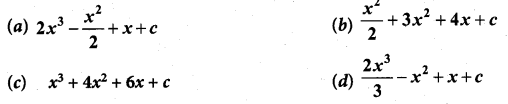
Samacheer Kalvi 11th Maths Solutions Chapter 11 Integral Calculus Ex 11.13 5
Solution:
(d)
Samacheer Kalvi 11th Maths Solutions Chapter 11 Integral Calculus Ex 11.13 6

Question 4.
The gradient (slope) of a curve at any point (x, y) is \(\frac{x^{2}-4}{x^{2}}\). If the curve passes through the point(2, 7), then the equation of the curve is ………….
(a) y = x + \(\frac{4}{x}\) + 3
(b) y = x + \(\frac{4}{x}\) + 4
(c) y = x2 + 3x + 4
(d) y = x2 – 3x + 6
Solution:
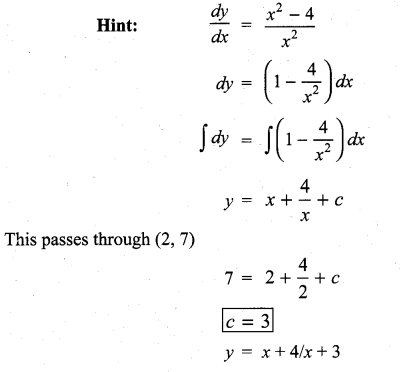
Samacheer Kalvi 11th Maths Solutions Chapter 11 Integral Calculus Ex 11.13 7

Samacheer Kalvi 11th Maths Solutions Chapter 11 Integral Calculus Ex 11.13

Question 5.
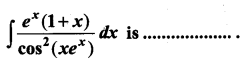
Samacheer Kalvi 11th Maths Solutions Chapter 11 Integral Calculus Ex 11.13 8
(a) cot (xex) + c
(b) sec (xex) + c
(c) tan (xex) + c
(d) cos (xex) + c
Solution:
(c)
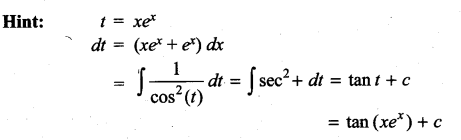
Samacheer Kalvi 11th Maths Solutions Chapter 11 Integral Calculus Ex 11.13 9

Question 6.
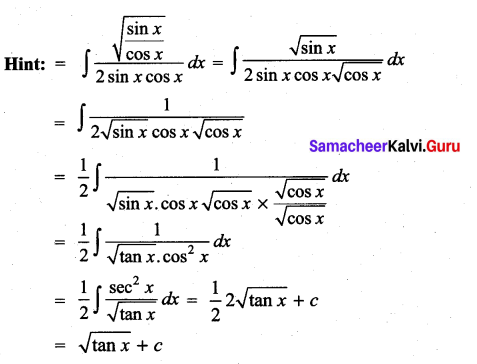
\(\int \frac{\sqrt{\tan x}}{\sin 2 x} d x\) is ……………..

Samacheer Kalvi 11th Maths Solutions Chapter 11 Integral Calculus Ex 11.13 10
Solution:
(a)
Samacheer Kalvi 11th Maths Solutions Chapter 11 Integral Calculus Ex 11.13 11

Question 7.
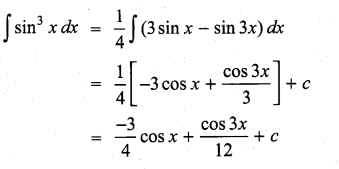
\(\int \sin ^{3} x d x\) is …………….

Samacheer Kalvi 11th Maths Solutions Chapter 11 Integral Calculus Ex 11.13 12
Solution:
(c)
Hint: sin3x = \(\frac{1}{4}\) (3 sin x – sin 3x)
Samacheer Kalvi 11th Maths Solutions Chapter 11 Integral Calculus Ex 11.13 13

Question 8.
Samacheer Kalvi 11th Maths Solutions Chapter 11 Integral Calculus Ex 11.13 14
Solution:
(b)
Samacheer Kalvi 11th Maths Solutions Chapter 11 Integral Calculus Ex 11.13 15

Question 9.
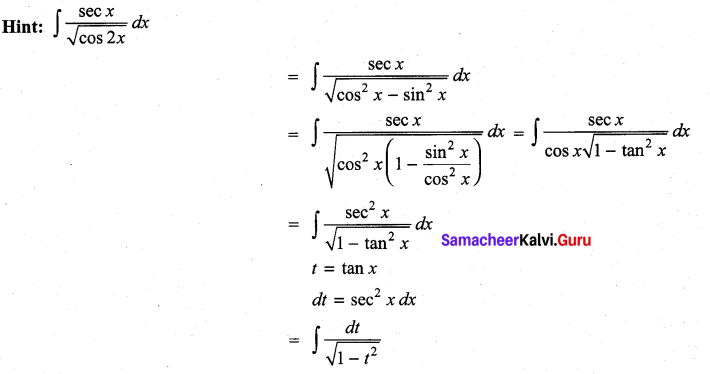
Samacheer Kalvi 11th Maths Solutions Chapter 11 Integral Calculus Ex 11.13 16
(a) tan-1 (sin x) + c
(b) 2 sin-1 (tan x) + c
(c) tan-1 (cos x) + c
(d) sin-1 (tan x) + c
Solution:
(d)
Samacheer Kalvi 11th Maths Solutions Chapter 11 Integral Calculus Ex 11.13 17
= sin-1 (t) + c
= sin-1 (tan x) + c

Samacheer Kalvi 11th Maths Solutions Chapter 11 Integral Calculus Ex 11.13

Question 10.
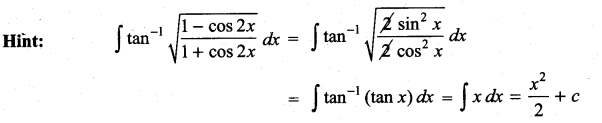
Samacheer Kalvi 11th Maths Solutions Chapter 11 Integral Calculus Ex 11.13 18
(a) x2 + c
(b) 2x2 + c
(c) \(\frac{x^{2}}{2}\) + c
(d) \(-\frac{x^{2}}{2}\) + c
Solution:
(c)
Samacheer Kalvi 11th Maths Solutions Chapter 11 Integral Calculus Ex 11.13 19

Question 11.
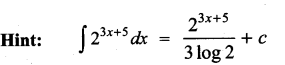
\(\int 2^{3 x+5} d x\) is ……………

Samacheer Kalvi 11th Maths Solutions Chapter 11 Integral Calculus Ex 11.13 20
Solution:
(d)
Samacheer Kalvi 11th Maths Solutions Chapter 11 Integral Calculus Ex 11.13 21

Question 12.
Samacheer Kalvi 11th Maths Solutions Chapter 11 Integral Calculus Ex 11.13 22
Solution:
(b)
Samacheer Kalvi 11th Maths Solutions Chapter 11 Integral Calculus Ex 11.13 23

Question 13.
Samacheer Kalvi 11th Maths Solutions Chapter 11 Integral Calculus Ex 11.13 24
Solution:
(d)
Samacheer Kalvi 11th Maths Solutions Chapter 11 Integral Calculus Ex 11.13 25

Question 14.
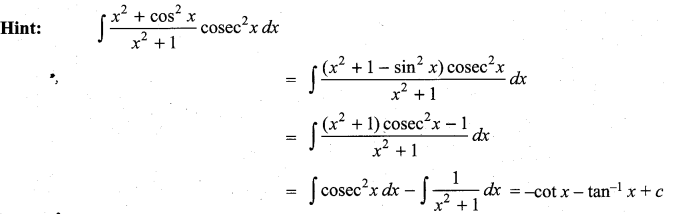
\(\int \frac{x^{2}+\cos ^{2} x}{x^{2}+1}\) cosec2xdx is …………….
(a) cot x + sin-1 x + c
(b) -cot x + tan-1 x + c
(c) -tan x + cot-1 x + c
(d) -cot x – tan-1 x + c
Solution:
(d)
Samacheer Kalvi 11th Maths Solutions Chapter 11 Integral Calculus Ex 11.13 26

Question 15.
\(\int x^{2} \cos x d x\) is ……………
(a) x2 sin x + 2x cos x – 2 sin x + c
(b) x2 sin x – 2x cos x – 2 sin x + c
(c) -x2 sin x + 2x cos x + 2 sin x + c
(d) -x2 sin x – 2x cos x + 2 sin x + c
Solution:
(a)
Hint: \(\int x^{2} \cos x d x\)
By Bernoullis formula dv = cosxdx
u = x2 v = sinx
u’ = 2x v1 = -cos x
u” = 2 v2 = -sinx
= uv – u’v1 + u”v2
= x2sin x + 2x cos x – 2 sin x + c

Samacheer Kalvi 11th Maths Solutions Chapter 11 Integral Calculus Ex 11.13

Question 16.
Samacheer Kalvi 11th Maths Solutions Chapter 11 Integral Calculus Ex 11.13 27
Solution:
(b)
Samacheer Kalvi 11th Maths Solutions Chapter 11 Integral Calculus Ex 11.13 28

Question 17.
\(\int \frac{d x}{e^{x}-1}\) is …………….
(a) log |ex| – log |ex – 1| + c
(b) log |ex| + log |ex – 1| + c
(c) log |ex – 1| – log |ex| + c
(d) log |ex + 1| – log |ex| + c
Solution:
(c)
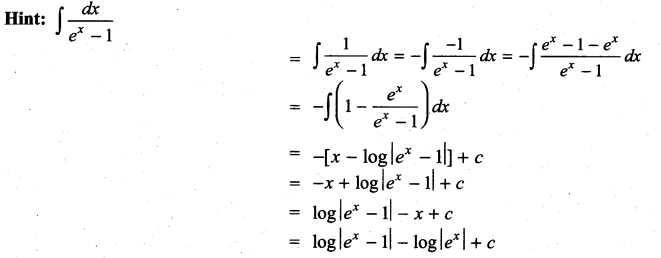
Samacheer Kalvi 11th Maths Solutions Chapter 11 Integral Calculus Ex 11.13 29

Question 18.
Samacheer Kalvi 11th Maths Solutions Chapter 11 Integral Calculus Ex 11.13 30
Solution:
(b)
We know that
Samacheer Kalvi 11th Maths Solutions Chapter 11 Integral Calculus Ex 11.13 31

Question 19.
Samacheer Kalvi 11th Maths Solutions Chapter 11 Integral Calculus Ex 11.13 32
Solution:
(d)
Samacheer Kalvi 11th Maths Solutions Chapter 11 Integral Calculus Ex 11.13 33

Question 20.
Samacheer Kalvi 11th Maths Solutions Chapter 11 Integral Calculus Ex 11.13 34
Solution:
(a)
We know that
Samacheer Kalvi 11th Maths Solutions Chapter 11 Integral Calculus Ex 11.13 35

Samacheer Kalvi 11th Maths Solutions Chapter 11 Integral Calculus Ex 11.13

Question 21.
Samacheer Kalvi 11th Maths Solutions Chapter 11 Integral Calculus Ex 11.13 36
Solution:
(c)
Hint:
Samacheer Kalvi 11th Maths Solutions Chapter 11 Integral Calculus Ex 11.13 37
By Bernoullis formula,
Samacheer Kalvi 11th Maths Solutions Chapter 11 Integral Calculus Ex 11.13 38

Question 22.
Samacheer Kalvi 11th Maths Solutions Chapter 11 Integral Calculus Ex 11.13 39
Solution:
(d)
Samacheer Kalvi 11th Maths Solutions Chapter 11 Integral Calculus Ex 11.13 40

Question 23.
Samacheer Kalvi 11th Maths Solutions Chapter 11 Integral Calculus Ex 11.13 41
Solution:
(c)
Samacheer Kalvi 11th Maths Solutions Chapter 11 Integral Calculus Ex 11.13 42
Samacheer Kalvi 11th Maths Solutions Chapter 11 Integral Calculus Ex 11.13 43

Question 24.
Samacheer Kalvi 11th Maths Solutions Chapter 11 Integral Calculus Ex 11.13 44
Solution:
(a)
Samacheer Kalvi 11th Maths Solutions Chapter 11 Integral Calculus Ex 11.13 45

Question 25.
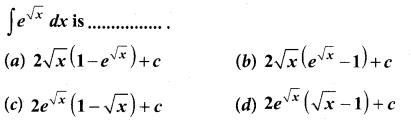
Samacheer Kalvi 11th Maths Solutions Chapter 11 Integral Calculus Ex 11.13 46
Solution:
(d)
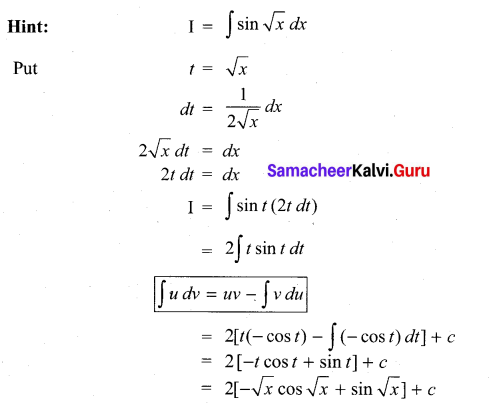
Hint: Let I = \(\int e^{\sqrt{x}} d x\)
t = \(\sqrt{x}\)
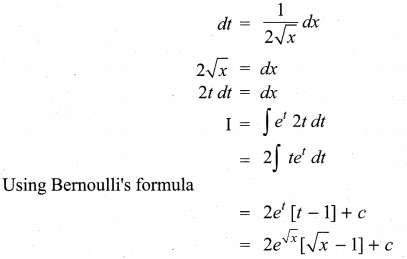
Samacheer Kalvi 11th Maths Solutions Chapter 11 Integral Calculus Ex 11.13 47

Must Follow:
ICICIBANK Pivot Point Calculator

Samacheer Kalvi 11th Maths Solutions Chapter 6 Two Dimensional Analytical Geometry Ex 6.4

You can Download Samacheer Kalvi 11th Maths Book Solutions Guide Pdf, Tamilnadu State Board help you to revise the complete Syllabus and score more marks in your examinations.

Tamilnadu Samacheer Kalvi 11th Maths Solutions Chapter 6 Two Dimensional Analytical Geometry Ex 6.4

Question 1.
Find the combined equation of the straight lines whose separate equations are x – 2y – 3 = 0 and x + y + 5 = 0.
Solution:

Separate equations are x – 2y – 3 = 0; x + y + 5 = 0
So the combined equation is (x – 2y – 3) (x + y + 5) = 0
x2 + xy + 5x – 2y2 – 2xy – 10y – 3x – 3y – 15 = 0
(i.e) x2 – 2y2 – xy + 2x – 13y – 15 = 0

Question 2.
Show that 4x2 + 4xy + y2 – 6x – 3y – 4 = 0 represents a pair of parallel lines.
Solution:

Comparing this equation with ax2 + 2hxy + by2 + 2gx + 2fy + c = 0
we get a = 4, h = \(\frac{4}{2}\) = 2 , b = 1, g = – 3, f = – 3/2, c = – 4
The condition for the lines to be parallel is h2 – ab = 0
Now h2 – ab = 22 – (4) (1) = 4 – 4 = 0
h2 – ab = 0 ⇒ The given equation represents a pair of parallel lines.

Samacheer Kalvi 11th Maths Solutions Chapter 6 Two Dimensional Analytical Geometry Ex 6.4

Question 3.
Show that 2x2 + 3xy – 2y2 + 3x + y + 1 = 0 represents a pair of perpendicular lines.
Solution:
Comparing the given equation with the general form a = 2,h = 3/2, b = -2,g= 3/2, f = 1/2 and c = 1
Condition for two lines to be perpendicular is a + b = 0. Here a + b = 2 – 2 = 0
⇒ The given equation represents a pair of perpendicular lines.

Question 4.
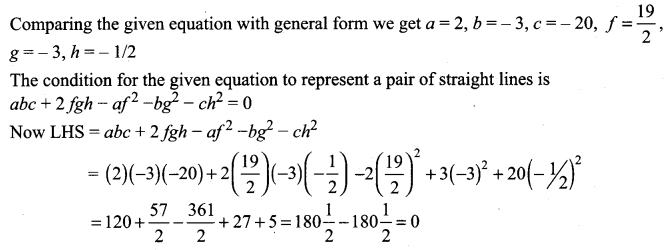
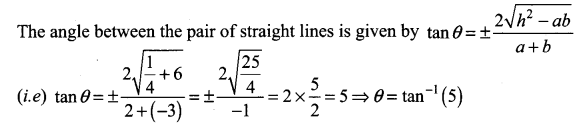
Show that the equation 2x2 – xy – 3y2 – 6x + 19y – 20 = 0 represents a pair of intersecting lines. Show further that the angle between them is tan-1(5).
Solution:
Samacheer Kalvi 11th Maths Solutions Chapter 6 Two Dimensional Analytical Geometry Ex 6.4 50
The given equation represents a pair of straight lines.
Samacheer Kalvi 11th Maths Solutions Chapter 6 Two Dimensional Analytical Geometry Ex 6.4 59

Question 5.
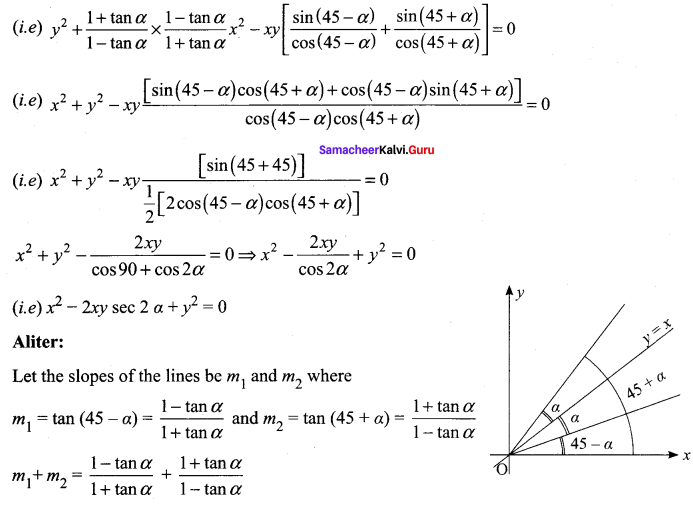
Prove that the equation to the straight lines through the origin, each of which makes an angle α with the straight line y = x is x2 – 2xy sec 2α + y2 = 0
Solution:
Slope of y = x is m = tan θ = 1
⇒ θ = 45°
The new lines slopes will be
m = tan(45 + α) and m = tan (45 – α)
∴ The equations of the lines passing through the origin is given by
y = tan(45 + α)x and y = tan(45 – α)x
(i.e) y = tan(45 + α)x = 0 and y = tan(45 – α)x = 0
The combined equation is [y – tan (45 + α)x] [y – tan (45 – α)x] = 0
y2 + tan(45 + α)tan(45 – α)x2 – xy[tan(45 – α) + tan(45 + α)] = 0
Samacheer Kalvi 11th Maths Solutions Chapter 6 Two Dimensional Analytical Geometry Ex 6.4 52
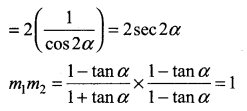
Samacheer Kalvi 11th Maths Solutions Chapter 6 Two Dimensional Analytical Geometry Ex 6.4 53
Let the equation of lines passes through the origin
So the equations are y = m1x = 0 and y = m2x = 0
So the combined equations is (y – m1x) (y – m2x) = 0
(i.e)y2 – xy(m1 + m2) + m1m2x = 0
(i.e) y2 – xy(2sec α) + x2(1) = 0
(i.e) y2 – 2xy sec 2α + x2 = 0

Question 6.
Find the equation of the pair of straight lines passing through the point (1, 3) and perpendicular to the lines 2x – 3y + 1 = 0 and 5x + y – 3 = 0
Solution:
Equation of a line perpendicular to 2x – 3y + 1 = 0 is of the form 3x + 2y + k = 0.
It passes through (1, 3) ⇒ 3 + 6 + k = 0 ⇒ k = – 9
So the line is 3x + 2y – 9 = 0
The equation of a line perpendicular to 5x + y – 3 = 0 will be of the form x – 5y + k = 0.
It passes through (1, 3) ⇒ 1 – 15 + k = 0 ⇒ k = 14
So the line is x – 5y + 14 = 0.
The equation of the lines is 3x + 2y – 9 = 0 and x – 5y + 14 = 0
Their combined equation is (3x + 2y – 9)(x – 5y + 14) = 0
(i.e) 3x2 – 15xy + 42x + 2xy – 10y2 + 28y – 9x + 45y – 126 = 0
(i.e) 3x2 – 13xy – 10y2 + 33x + 73y – 126 = 0

Question 7.
Find the separate equation of the following pair of straight lines
(i) 3x2 + 2xy – y2 = 0
(ii) 6 (x – 1)2 + 5(x – 1)(y – 2) – 4(y – 2)2 = 0
(iii) 2x2 – xy – 3y2 – 6x + 19y – 20 = 0
Solution:
(i) Factorising 3x2 + 2xy – y2 we get
3x2 + 3xy – xy – y2 = 3x (x + y) – y (x + y)
= (3 x – y)(x + y)
So 3x2 + 2xy – y2 = 0 ⇒ (3x – y) (x + y) = 0
⇒ 3x – y = 0 and x + y = 0

Samacheer Kalvi 11th Maths Solutions Chapter 6 Two Dimensional Analytical Geometry Ex 6.4

(ii) 6 (x – 1)2 + 5 (x – 1)(y – 2) – 4(y – 2)2 = 0
⇒ 6(x2 – 2x +1) + 5(xy – 2x – y + 2) – 4( y2 – 4y + 4) = 0
(i.e) 6x2 – 12x + 6 + 5xy – 10x – 5y + 10 – 4y2 + 16y – 16 = 0
(i.e) 6x2 + 5xy – 4y2 – 22x + 11y = 0
Factorising 6x2 + 5xy – 4y2 we get
6x2 – 3xy + 8xy – 4y2 = 3x (2x – y) + 4y (2x – y)
= (3x + 4y)(2x – y)
So, 6x2 + 5xy – 4y2 – 22x + 11y = (3x + 4y + l )(2x – y + m)
Equating coefficient of x ⇒ 3m + 21 = -22 …….. (1)
Equating coefficient of y ⇒ 4m – l = 11 ……. (2)
Solving (1) and (2) we get l = -11, m = 0
So the separate equations are 3x + 4y – 11 = 0 and 2x – y = 0

(iii) 2x2 – xy – 3y2 – 6x + 19y – 20 = 0
Factorising 2x2 – xy – 3y2 we get
2x2 – xy – 3y2 = 2x2 + 2xy – 3xy – 3y2
= 2x(x + y) – 3y(x + y) = (2x – 3y) (x + y)
∴ 2x2 – xy – 3y2 – 6x + 19y – 20 = (2x – 3y + l)(x + y + m)
Equating coefficient of x 2m + l = -6 ……. (1)
Equating coefficient of y -3m + l = 19 …….. (2)
Constant term -20 = lm
Solving (1) and (2) we get l = 4 and m = – 5 where lm = – 20.
So the separate equations are 2x – 3y + 4 = 0 and x + y – 5 = 0

Question 8.
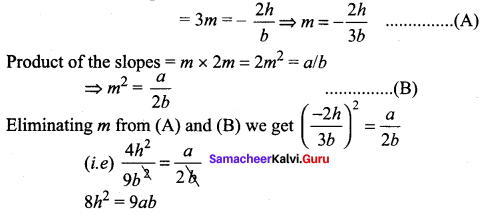
The slope of one of the straight lines ax2 + 2hxy + by2 = 0 is twice that of the other, show that 8h2 = 9ab.
Solution:
ax2 + 2 hxy + by2 = 0
We are given that one slope is twice that of the other.
So let the slopes be m and 2m.
Now sum of the slopes = m + 2m
Samacheer Kalvi 11th Maths Solutions Chapter 6 Two Dimensional Analytical Geometry Ex 6.4 40

Question 9.
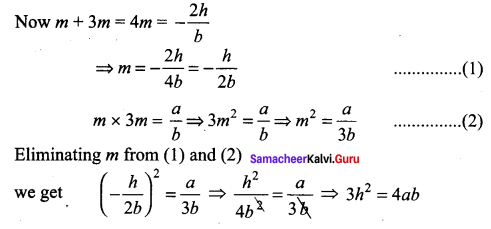
The slope of one of the straight lines ax2 + 2hxy + by2 = 0 is three times the other, show that 3h2 = 4ab.
Solution:
Let the slopes be m and 3m.
Samacheer Kalvi 11th Maths Solutions Chapter 6 Two Dimensional Analytical Geometry Ex 6.4 41

Question 10.
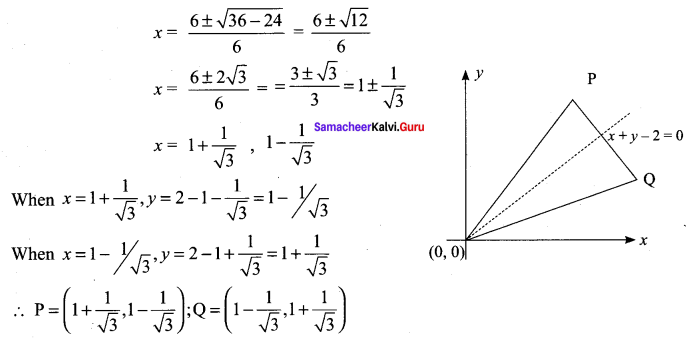
A ∆OPQ is formed by the pair of straight lines x2 – 4xy + y2 = 0 and the line PQ. The equation of PQ is x + y – 2 = 0. Find the equation of the median of the triangle ∆OPQ drawn from the origin O.
Solution:
Equation of pair of straight lines is x2 – 4xy + y2 = 0 ….. (1)
Equation of the given line is x + y – 2 = 0 ⇒ y = 2 – x ……… (2)
On solving (1) and (2) we get x2 – 4x (2 – x) + (2 – x)2 = 0
(i.e) x2 – 8x + 4x2 + 4 + x2 – 4x = 0
(i.e) 6x2 – 12x + 4 = 0
(÷ by 2) 3x2 – 6x + 2 = 0
Samacheer Kalvi 11th Maths Solutions Chapter 6 Two Dimensional Analytical Geometry Ex 6.4 54
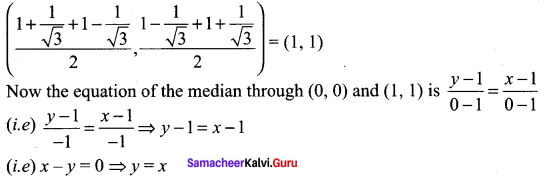
Mid point of PQ is
Samacheer Kalvi 11th Maths Solutions Chapter 6 Two Dimensional Analytical Geometry Ex 6.4 43

Question 11.
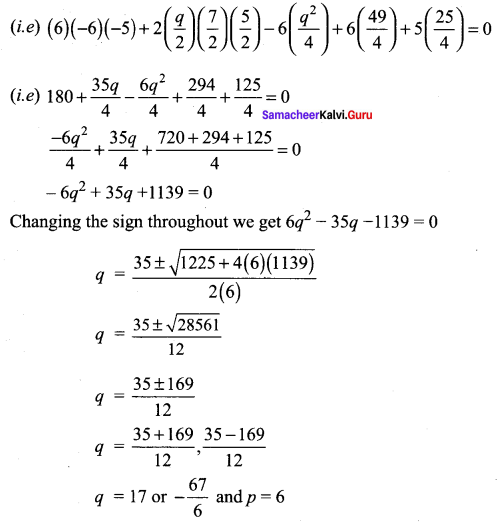
Find p and q, ¡f the following equation represents a pair of perpendicular lines 6x2 + 5xy – py2 + 7x + qy – 50
Solution:
6x2 + 5xy – py2 + 7x + qy – 50
The given equation represents a pair of perpendicular lines
⇒ coefficient of x2 + coefficient of y2 = 0
(i.e) 6 – p = 0 ⇒ p = 6
Now comparing the given equation with the general form
ax2 + 2hxy + by2 + 2gx + 2fy + c = 0
we get a = 6, b = -6 and c = -5, f = q/2, g = 7/2 and h = 5/2
The condition for the general form to represent a pair of straight lines is abc + 2fgh – af2 – bg2 – ch2 = 0
Samacheer Kalvi 11th Maths Solutions Chapter 6 Two Dimensional Analytical Geometry Ex 6.4 44

Question 12.
Find the value of k, if the following equation represents a pair of straight lines. Further, find whether these lines are parallel or intersecting, 12x2 + 7xy – 12y2 – x + 7y + k = 0.
Solution:
Comparing the given equation with the general form ax2 + 2hxy + by2 + 2gx + 2fy + c = 0
we get a = 12, b = -12, c = k, f = 7/2, g = – 1/2, h = 7/2
Here a + b = 0 ⇒ the given equation represents a pair of perpendicular lines
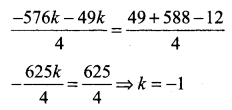
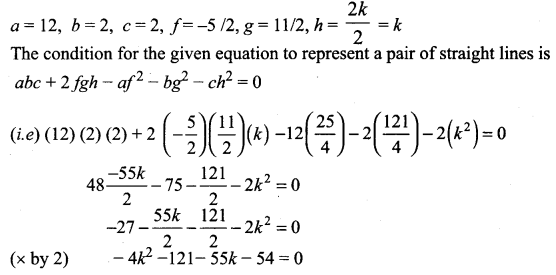
To find k: The condition for the given equation to represent a pair of straight lines is abc + 2fgh – af2 – bg2 – ch2 = 0
Samacheer Kalvi 11th Maths Solutions Chapter 6 Two Dimensional Analytical Geometry Ex 6.4 46
Samacheer Kalvi 11th Maths Solutions Chapter 6 Two Dimensional Analytical Geometry Ex 6.4 47

Samacheer Kalvi 11th Maths Solutions Chapter 6 Two Dimensional Analytical Geometry Ex 6.4

Question 13.
For what value of k does the equation 12x2 + 2kxy + 2y2, + 11x – 5y + 2 = 0 represent two straight lines.
Solution:
12x2 + 2 kxy + 2y2 + 11x – 5y + 2 = 0
Comparing this equation with the general form we get
Samacheer Kalvi 11th Maths Solutions Chapter 6 Two Dimensional Analytical Geometry Ex 6.4 48
4k2 + 55k + 175 = 0
4k2 + 20k + 35k + 175 = 0
4k(k + 5) + 35(k + 5) = 0
(4k + 35) (k + 5) = 0
k = -5 or -35/4

Question 14.
Show that the equation 9x2 – 24xy + 16y2 – 12x + 16y – 12 = 0 represents a pair of parallel lines. Find the distance between them.
Solution:
Comparing the given equation with ax2 + 2kxy + by2 = 0 we get a = 9, h = -12, b = 16.
Now h2 = (-12)2 = 144, ab = (9) (16) = 144
h2 = ab ⇒ The given equation represents a pair of parallel lines.
To find their separate equations:
9x2 – 24xy + 16y2 = (3x – 4y)2
So, 9x2 – 24xy +16y2 – 12x + 16y – 12 = (3x – 4y + l )(3x – 4y + m)
Here coefficient of x ⇒ 3m + 3l = -12 ⇒ m + l = -4
coefficient of y ⇒ -4m – 4l = 16 ⇒ m + l = -4
Constant term l m = -12
Now l + m = -4 and lm = -12 ⇒ l = -6 and m = 2
So the separate equations are 3x – 4y – 6 = 0 and 3x – 4y + 2 = 0
Samacheer Kalvi 11th Maths Solutions Chapter 6 Two Dimensional Analytical Geometry Ex 6.4 49

Question 15.
Show that the equation 4x2 + 4xy + y2 – 6x – 3y – 4 = 0 represents a pair of parallel lines. Find the distance between them.
Solution:
4x2 + 4xy + y2 – 6x – 3y – 4 = 0
a = 4,
b = 1,
h = 4/2 = 2
h2 – ab = 22 – (4) (1) = 4 – 4 = 0
⇒ The given equation represents a pair of parallel lines.
To find the separate equations 4x2 + 4xy + y2 = (2x + y)2
So, 4x2 + 4xy + y2 – 6x – 3y – 4 = (2x + y + l )(2x + y + m)
Coefficient of x ⇒ 2m + 2l = -6 ⇒ l + m = – 3 ……. (1)
Coefficient of y ⇒ l + m = – 3 ……… (2)
Constant term ⇒ l m = – 4 ……… (3)
Now l + m = -3 and lm = -4 ⇒ l = -4, m = 1
So the separate equations are 2x + y + 1 = 0 and 2x + y – 4 = 0
Samacheer Kalvi 11th Maths Solutions Chapter 6 Two Dimensional Analytical Geometry Ex 6.4 55

Question 16.
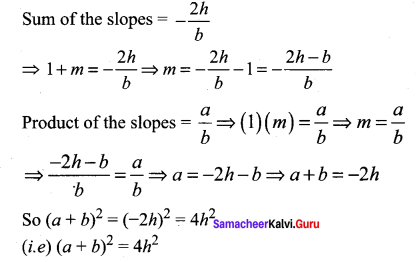
Prove that one of the straight lines given by ax2 + 2hxy + by2 = 0 will bisect the angle between the co-ordinate axes if (a + b)2 = 4h2.
Solution:
Let the slopes be l and m
∵ One line bisects the angle between the coordinate axes ⇒ θ = 45°
So tan θ = 1
The slopes are l and m
Samacheer Kalvi 11th Maths Solutions Chapter 6 Two Dimensional Analytical Geometry Ex 6.4 56

Question 17.
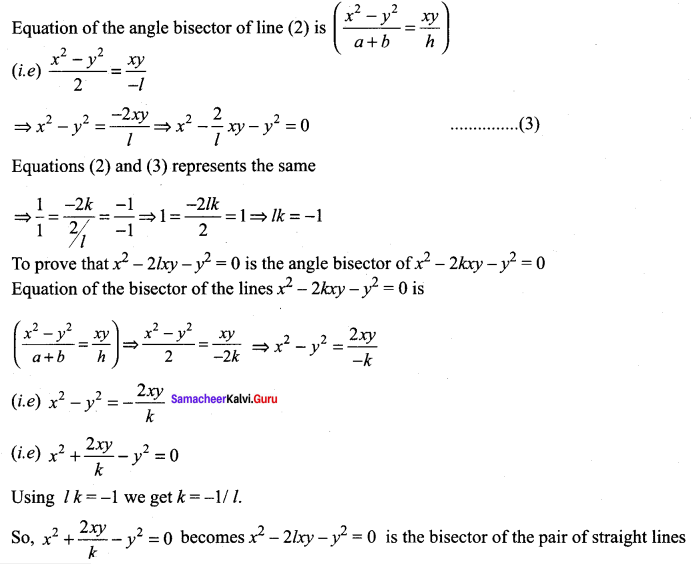
If the pair of straight lines x2 – 2kxy – y2 = 0 bisect the angle between the pair of straight lines x2 – 2lxy – y2 = 0, show that the later pair also bisects the angle between the former.
Solution:
Given that x2 – 2kxy – y2 = 0 …….. (1)
Bisect the angle between the lines x2 – 11xy – y2 = 0 …… (2)
Samacheer Kalvi 11th Maths Solutions Chapter 6 Two Dimensional Analytical Geometry Ex 6.4 57
x2 – 2kxy – y2 = 0

Question 18.
Prove that the straight lines joining the origin to the points of intersection of 3x2 + 5xy – 3y2 + 2x + 3y = 0 and 3x – 2y – 1 = 0 are at right angles.
Solution:
Homogenizing the given equations 3x2 + 5xy – 3y2 + 2x + 3y = 0 and 3x – 2y – 1 = 0
(i.e) 3x – 2y = 1.
We get (3x2 + 5xy – 3y2) + (2x + 3y)( 1) = 0
(i.e) (3x2 + 5xy – 3y2) + (2x + 3y)(3x – 2y) = 0
3x2 + 5xy – 3y2 + bx2 – 4xy + 9xy – 6y2 = 0
9x2 + 10xy – 9y2 = 0
Coefficient of x2 + coefficient of y2 = 9 – 9 = 0
⇒ The pair of straight lines are at right angles.

Samacheer Kalvi 11th Maths Solutions Chapter 6 Two Dimensional Analytical Geometry Ex 6.4 Additional Questions Solved

Question 1.
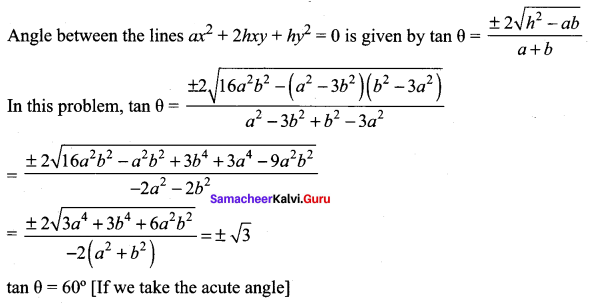
Find the angle between the pair of straight lines given by
(a2 – 3b2 )x2 + 8ab xy + (b2 – 3a2)y2 =0 .
Solution:
Samacheer Kalvi 11th Maths Solutions Chapter 6 Two Dimensional Analytical Geometry Ex 6.4 58

Samacheer Kalvi 11th Maths Solutions Chapter 6 Two Dimensional Analytical Geometry Ex 6.4

Question 2.
Show that 9x2 + 24xy + 16y2 + 21x + 28y + 6 = 0 represents a pair of parallel straight lines and find the distance between them.
Solution:
9x2 + 24xy + 16y2 + 21x + 28y + 6 = 0
Here a = 9.6,
b = 16,
g = \(\frac{21}{2}\),
f = 14,
c = 6,
h = 12
h2 – ab = (12)2 – 9(16) = 144 – 144 = 0
∴ The lines are parallel.
9x2 + 24xy + 16y2 = (3x + 4y)(3x + 4y)
Let 9x2 + 24xy + 16y2 + 21x + 28y + 6 = (3x + 4y + l)(3x + 4y + m)
Equating the coefficients of x and constant term
3l + 3m = 21
lm = 6
Solving we get, l = 1 or 6
m = 6 or 1
∴ The separate equations are 3x + 4y + 1 = 0 and 3x + 4y + 6 = 0
Samacheer Kalvi 11th Maths Solutions Chapter 6 Two Dimensional Analytical Geometry Ex 6.4 7

Question 3.
If the equation 12x2 – 10xy + 2y2 + 14x – 5y + c = 0 represents a pair of straight lines, find the value of c. Find the separate equations of the straight lines and also the angle
between them.
Solution:
12x2 – 10xy – 2y2 + 14x – 5y + c = 0
ax2 + 2hxy + by2 +2gx + 2fy – c = 0
Here a = 12,
b = 2,
g = 7,
f = 5/2,
c = c,
h = -5
af2 + bg2 + ch2 – 2fgh – abc = 0 is the condition
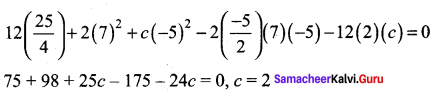
Samacheer Kalvi 11th Maths Solutions Chapter 6 Two Dimensional Analytical Geometry Ex 6.4 8
The equation is 12x2 – 10y + 2y2 + 14x – 5y + 2 = 0
12x2 – 10xy + 2y = (3x – y)(4x – 2y)
Let 12x2 – 10y + 2y2 + 14x – 5y + 2(3x – y + l)(4x – 2y + m)
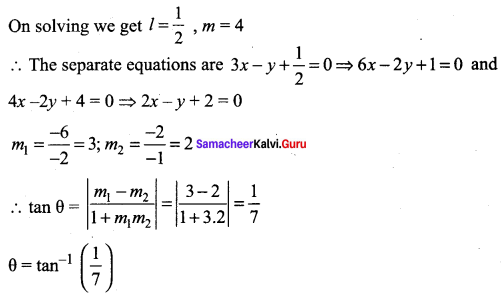
So that 4l + 3m = 14 , -2l – m = -5
Samacheer Kalvi 11th Maths Solutions Chapter 6 Two Dimensional Analytical Geometry Ex 6.4 9

Question 4.
For what value of k does 12x2 + 7xy + ky2 + 13x – y + 3 = 0 represents a pair of straight lines? Also write the separate equations.
Solution:
12x2 + 7xy + ky2 + 13x – y + 3 = 0
a = 12,
h = \(\frac{7}{2}\),
f = \(-\frac{1}{2}\) ,
c = 3
af2 + bg2 + ch2 – abc – 2fgh = 0
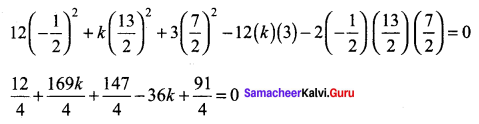
Samacheer Kalvi 11th Maths Solutions Chapter 6 Two Dimensional Analytical Geometry Ex 6.4 11
⇒ 12 + 169k + 147 – 144k + 91 = 0
25k = – 250 ⇒ k = -10
The equation is 12x2 + 7xy – 10y2 + 13x – y + 3 = 0
To find separate equations: 12x2 + 7xy – 10y2 = (3x – 2y)(4x + 5y)
Let 12x2 + 7xy – 10y2 + 13x – y + 3 = 0(3x – 2y + l)(4x + 5y + m)
Equating the coefficient of x ⇒ 4l + 3m = 13 …… (1)
Equating the coefficient of y ⇒ 5l – 2m = -1 …… (2)
(1) × 2 ⇒ 8l + 6m = 26
(2) × 3 ⇒ 15l – 6m = -3
23l = 23 ⇒ l = 1
4 + 3 m = 13
3 m = 9 ⇒ m = 3
The separate equations are 3x – 2y + 1 = 0 and 4x + 5y + 3 = 0

Samacheer Kalvi 11th Maths Solutions Chapter 6 Two Dimensional Analytical Geometry Ex 6.4

Question 5.
Show that 3x2 + 10xy + 8y2 + 14x + 22y + 15 = 0 represents a pair of straight lines and the angle between them is tan-1\(\left(\frac{2}{11}\right)\)
Solution:
3x2 + 10xy + 8y2 + 14x + 22y + 15 = 0
a = 3,
A = 5,
b = 8,
g = 7,
f = 11,
c = 15
The condition is af2 + bg2 + ch2 – abc – 2fgh = 0
3(11)2 + 8(7)2 + 15 (5)2 – (3)(8)(15) – 2(11)(7)(5) = 363 + 392 + 375 – 360 – 770 = 0
The angle between the pair of straight line is given by
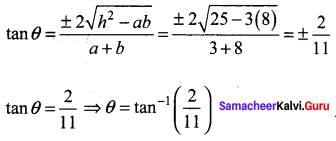
Samacheer Kalvi 11th Maths Solutions Chapter 6 Two Dimensional Analytical Geometry Ex 6.4 12

Samacheer Kalvi 11th Maths Solutions Chapter 5 Binomial Theorem, Sequences and Series Ex 5.2

You can Download Samacheer Kalvi 11th Maths Book Solutions Guide Pdf, Tamilnadu State Board help you to revise the complete Syllabus and score more marks in your examinations.

Tamilnadu Samacheer Kalvi 11th Maths Solutions Chapter 5 Binomial Theorem, Sequences and Series Ex 5.2

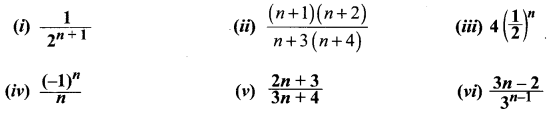
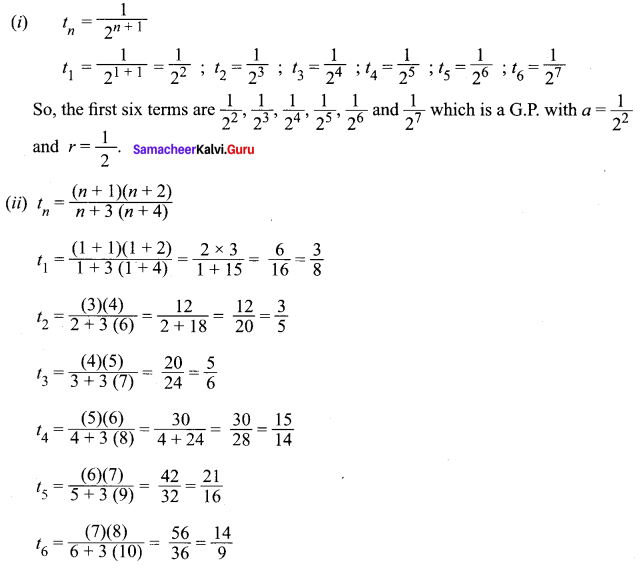
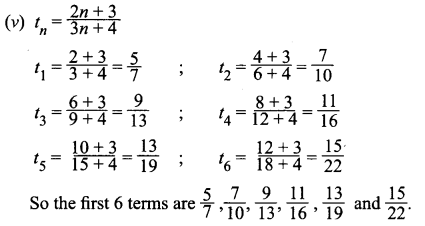
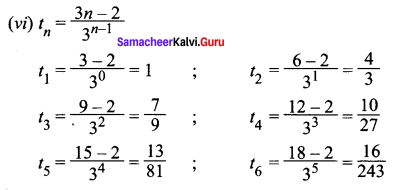
Question 1.
Write the first 6 terms of the sequences whose nth terms are given below and classify them as arithmetic progression, geometric progression, arithmetico-geometric progression, harmonic progression and none of them.
Samacheer Kalvi 11th Maths Solutions Chapter 5 Binomial Theorem, Sequences and Series Ex 5.2 1
Solution:
Samacheer Kalvi 11th Maths Solutions Chapter 5 Binomial Theorem, Sequences and Series Ex 5.2 2
Samacheer Kalvi 11th Maths Solutions Chapter 5 Binomial Theorem, Sequences and Series Ex 5.2 3
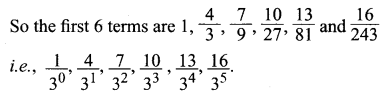
It is not a G.P. or A.P. or H.P. or A.G.P.
Samacheer Kalvi 11th Maths Solutions Chapter 5 Binomial Theorem, Sequences and Series Ex 5.2 4
It is not an A.P. or G.P. or H.P. or A.G.P
Samacheer Kalvi 11th Maths Solutions Chapter 5 Binomial Theorem, Sequences and Series Ex 5.2 6
It is not an A.P. or G.P. or H.P. or A.G.P.
Samacheer Kalvi 11th Maths Solutions Chapter 5 Binomial Theorem, Sequences and Series Ex 5.2 7
Samacheer Kalvi 11th Maths Solutions Chapter 5 Binomial Theorem, Sequences and Series Ex 5.2 8
It is a A.G.P.

Samacheer Kalvi 11th Maths Solutions Chapter 5 Binomial Theorem, Sequences and Series Ex 5.2

Question 2.
Write the first 6 terms of the sequences whose nth term an is given below.
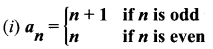
Samacheer Kalvi 11th Maths Solutions Chapter 5 Binomial Theorem, Sequences and Series Ex 5.2 9
Solution:
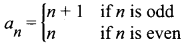
a1 = 1 + 1 = 2 ; a2 = 2
a3 = 3 + 1 = 4 ; a4 = 4
a5 = 5 + 1 = 6 ; a6 = 6
So, the first 6 terms are 2, 2, 4, 4, 6, 6
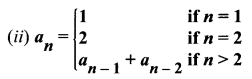
Samacheer Kalvi 11th Maths Solutions Chapter 5 Binomial Theorem, Sequences and Series Ex 5.2 10
Solution:
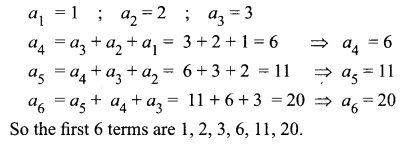
a1 = 1 ; a2 = 2, a3 = 3
a4 = a3 + a2 + a1 = 3 + 2 + 1 = 6 ⇒ a4 = 6
a5 = a4 + a3 + a2 = 6 + 3 + 2 = 11 ⇒ a5 = 11
a6 = a5 + a4 + a3 = 11 + 6 + 3 = 20 ⇒ a6 = 20
So the first 6 terms are 1, 2, 3, 5, 8, 13.
Samacheer Kalvi 11th Maths Solutions Chapter 5 Binomial Theorem, Sequences and Series Ex 5.2 255
Solution:
Samacheer Kalvi 11th Maths Solutions Chapter 5 Binomial Theorem, Sequences and Series Ex 5.2 256

Question 3.
Write the nth term of the following sequences.
Solution:
(i) 2, 2, 4, 4, 6, 6……
Solution:
Samacheer Kalvi 11th Maths Solutions Chapter 5 Binomial Theorem, Sequences and Series Ex 5.2 20

Samacheer Kalvi 11th Maths Solutions Chapter 5 Binomial Theorem, Sequences and Series Ex 5.2 21
Solution:
Nr: 1, 2, 3, ……tn = n
Dr: 2, 3, 4, …..tn = n + 1
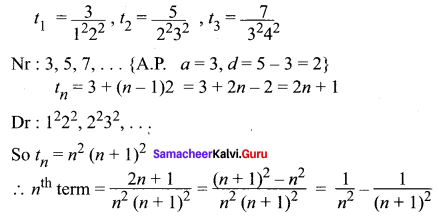
Samacheer Kalvi 11th Maths Solutions Chapter 5 Binomial Theorem, Sequences and Series Ex 5.2 22
Samacheer Kalvi 11th Maths Solutions Chapter 5 Binomial Theorem, Sequences and Series Ex 5.2 23
Solution:
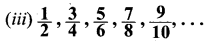
Nr: 1, 3, 5, 7, . . .which is an A.P. a = 1, d = 3 – 1 = 2
tn = a + (n – 1)d
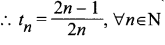
tn = 1 + (n – 1)2 = 1 + 2n – 2 = 2n – 1.
Dr : 2, 4, 6, 8, . . .
So the nth term is 2 + (n – 1)2 = 2 + 2n – 2 = 2n.
Samacheer Kalvi 11th Maths Solutions Chapter 5 Binomial Theorem, Sequences and Series Ex 5.2 24
(iv) 6, 10, 4, 12, 2, 14, 0, 16, -2,….
Solution:
t1 = 6 ; t2 = 10
t3 = 4 ; t4 = 12
t5 = 2 ; t6 = 14
t7 = 0 ; t8 = 16
When n is odd, the sequence is 6, 4, 2, 0,…
(i.e.) a = 6 and d = 4 – 6 = -2.
So, tn = 6 + (n – 1)(-2) = 6 – 2n + 2 = 8 – 2n
When n is even, the sequence is 10, 12, 14, 16,…
Here a = 10 and d = 12 – 10 = 2
tn = 10 + (n – 1)2 = 10 + 2n – 2 = 2n + 8 (i.e.) 8 + 2n
Samacheer Kalvi 11th Maths Solutions Chapter 5 Binomial Theorem, Sequences and Series Ex 5.2 25

Samacheer Kalvi 11th Maths Solutions Chapter 5 Binomial Theorem, Sequences and Series Ex 5.2

Question 4.
The product of three increasing numbers in GP is 5832. If we add 6 to the second number and 9 to the third number, then resulting numbers form an AP. Find the numbers in GP.
Solution:
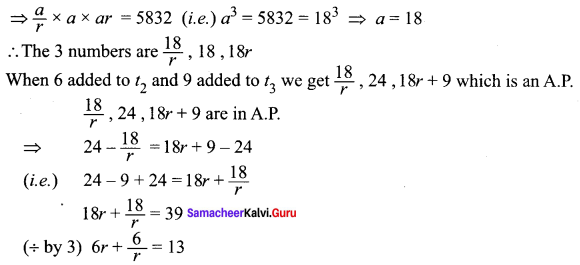
The 3 numbers in a G.P. is taken as \(\frac{a}{r}\), a, ar
Their product is 5832.
Samacheer Kalvi 11th Maths Solutions Chapter 5 Binomial Theorem, Sequences and Series Ex 5.2 26
6r2 + 6 = 13
6r2 – 13r + 6 = 0
(3r – 2)(2r – 3) = 0
r = 2/3 or 3/2
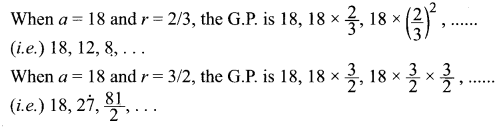
Samacheer Kalvi 11th Maths Solutions Chapter 5 Binomial Theorem, Sequences and Series Ex 5.2 27

Question 5.
Samacheer Kalvi 11th Maths Solutions Chapter 5 Binomial Theorem, Sequences and Series Ex 5.2 28
Solution:
Samacheer Kalvi 11th Maths Solutions Chapter 5 Binomial Theorem, Sequences and Series Ex 5.2 29

Question 6.
If tk is the kth term of a G.P., then show that tn – k, tn, tn + k also form a GP for any positive integer k.
Solution:
Let a be the first term and r be the common ratio.
We are given tk = ark – 1
We have to Prove : tn – k, tn, tn + k form a G.P.
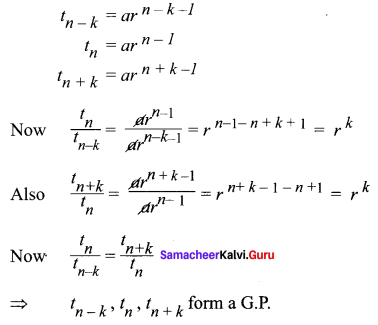
Samacheer Kalvi 11th Maths Solutions Chapter 5 Binomial Theorem, Sequences and Series Ex 5.2 30

Question 7.
If a, b, c are in geometric progression, and if \(a^{\frac{1}{x}}=b^{\frac{1}{y}}=c^{\frac{1}{z}}\), then prove that x, y, z are in arithmetic progression.
Solution:
Given a, b, c are in G.P.
⇒ b2 = ac
⇒ log b2 = log ac
(i.e.) 2log b = log a + log c …(1)
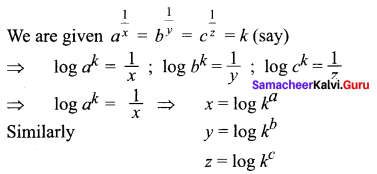
Samacheer Kalvi 11th Maths Solutions Chapter 5 Binomial Theorem, Sequences and Series Ex 5.2 31
Substituting these values in equation (1) we get 2y = x + z ⇒ x, y z are in A.P.

Samacheer Kalvi 11th Maths Solutions Chapter 5 Binomial Theorem, Sequences and Series Ex 5.2

Question 8.
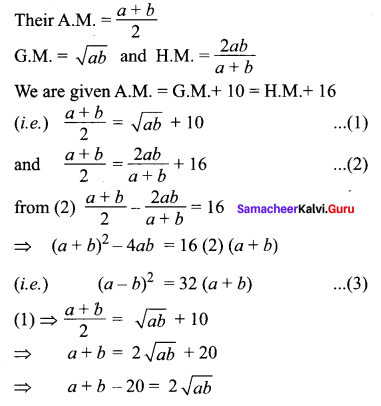
The AM of two numbers exceeds their GM by 10 and HM by 16. Find the numbers.
Solution:
Let the two numbers be a and b.
Samacheer Kalvi 11th Maths Solutions Chapter 5 Binomial Theorem, Sequences and Series Ex 5.2 32
So, (a + b – 20)2 = 4ab
(i.e.) (a + b)2 + 400 – 40(a + b) = 4ab
(a + b)2 – 4ab = 40(a + b) – 400
from(3) (a + b)2 – 4ab = 32(a + b)
⇒ 32(a + b) = 40(a + b) – 400
(÷ by 8) 4(a + b) = 5(a + b) – 50
4a + 4b = 5a + 5b – 50
a + b = 50
a = 50 – b
Substituting a = 50 – b in (3) we get
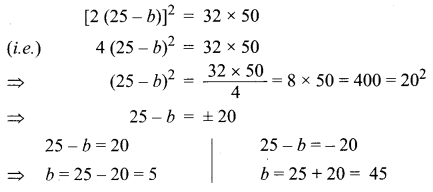
(50 – b – b)2 = 32(50)
(50 – 2b)2 = 32 × 50
Samacheer Kalvi 11th Maths Solutions Chapter 5 Binomial Theorem, Sequences and Series Ex 5.2 33
When b = 5, a = 50 – 5 = 45
When b = 45, a = 50 – 45 = 5
So the two numbers are 5 and 45.

Question 9.
If the roots of the equation (q – r)x2 + (r – p)x + p – q = 0 are equal, then show that p, q and r are in AP.
Solution:
The roots are equal ⇒ ∆ = 0
(i.e.) b2 – 4ac = 0
Hence, a = q – r ; b = r – p ; c = p – q
b2 – 4ac = 0
⇒ (r – p)2 – 4(q – r)(p – q) = 0
r2 + p2 – 2pr – 4[qr – q2 – pr + pq] = 0
r2 + p2 – 2pr – 4qr + 4q2 + 4pr – 4pq = 0
(i.e.) p2 + 4q2 + r2 – 4pq – 4qr + 2pr = 0
(i.e.) (p – 2q + r)2 = 0
⇒ p – 2q + r = 0
⇒ p + r = 2q
⇒ p, q, r are in A.P.

Samacheer Kalvi 11th Maths Solutions Chapter 5 Binomial Theorem, Sequences and Series Ex 5.2

Question 10.
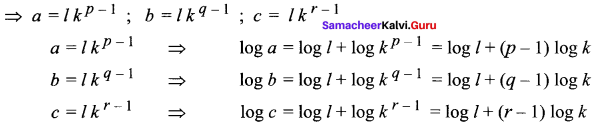
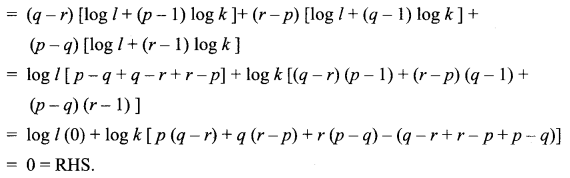
If a, b, c are respectively the pth, qth and rth terms of a G.P., show that (q – r) log a + (r – p) log b + (p – q) log c = 0.
Solution:
Let the G.P. be l, lk, lk2,…
We are given tp = a, tq = b, tr = c
Samacheer Kalvi 11th Maths Solutions Chapter 5 Binomial Theorem, Sequences and Series Ex 5.2 50
LHS = (q – r) log a + (r – p) log b + (p – q) log c
Samacheer Kalvi 11th Maths Solutions Chapter 5 Binomial Theorem, Sequences and Series Ex 5.2 51

Samacheer Kalvi 11th Maths Solutions Chapter 5 Binomial Theorem, Sequences and Series Ex 5.2 Additional Questions Solved

Question 1.
Samacheer Kalvi 11th Maths Solutions Chapter 5 Binomial Theorem, Sequences and Series Ex 5.2 52
Solution:
Here a1 = 1
Substituting n = 2, we obtain a2 = a1 + 2 = 1 + 2 = 3
Substituting n = 3, 4 and 5, we obtain respectively
a3 = a2 + 2 = 3 + 2 = 5, a4 = a3 + 2 = 5 + 2 = 7
a5 = a4 + 2 = 7 + 2 = 9
Thus, the first five terms are 1, 3, 5, 7 and 9.

Question 2.
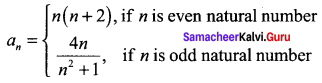
Find the 18th and 25th term of the sequence defined by
Samacheer Kalvi 11th Maths Solutions Chapter 5 Binomial Theorem, Sequences and Series Ex 5.2 53
Solution:
When n = 18 (even)
an = n(n + 2) = 18(18 + 2) = 18(20) = 360
When n = 25(odd)
Samacheer Kalvi 11th Maths Solutions Chapter 5 Binomial Theorem, Sequences and Series Ex 5.2 54

Question 3.
Write the first six terms of the sequences given by
(i) a1 = a2= 1 = an – 1 + an – 2 (n ≥ 3)
(ii) a1 = 4, an + 1 = 2nan
Solution:
(i) Here a1 = a2= 1 = an – 1 + an – 2 (n ≥ 3)
Putting n = 3, a3= a2 + a1 = 1 + 1 = 2
Putting n = 4, a4 = a3 + a2 = 2 + 1 = 3
Putting n = 5, a5 = a4 + a2 = 3 + 2 = 5
Putting n = 6, a6 = a5 + a4 = 5 + 3 = 8
∴ First six terms of the sequence are 1, 1, 2, 3, 5, 8

(ii) Here a1 = 4 and an + 1 = 2nan
Putting n = 1, a2 = 2 × 1 × a1 = 2 × 1 × 4 = 8
Putting n = 2, a3 = 2 × 2 × a2 = 4 × 8 = 32
Putting n = 3, a4 = 8 × 192 = 1536
Putting n = 4, a5 = 2 × 4 × a4 = 8 × 192 = 1536
Putting n = 5, a6 = 2 × 5 × a5 = 10 × 1536 = 15360

Samacheer Kalvi 11th Maths Solutions Chapter 5 Binomial Theorem, Sequences and Series Ex 5.2

Question 4.
An A.P. consists of 21 terms. The sum of the three terms in the middle is 129 and of the last three is 237. Find the series.
Solution:
Let a1 be the first term and d, be the common difference. Here n = 21.
∴ The three middle terms are a10,a11, a12
Now, a10 + a11 + a12 = 129 [Given]
∴ (a1 + 9d) + (a1 + 10d) + (a1 + 11d) = 129
⇒ 3a1 + 30d = 129 ⇒ a1 + 10d = 43 ……(i)
The last three terms are a19, a20, a21
a19, a20, a21 = 237 [Given]
∴ (a1 + 18d)+(a1 + 19d) + (a1 + 20d) = 237
(i.e.,) 3a1 + 57d = 237 ⇒ a1 + 19d = 79 … (2)
Subtracting (i) from (ii), we get 9d = 36, ⇒ d = 4
∴ From (i), a1 + 40 = 43 ⇒ a1 = 3
Hence, the series is 3, 7, 11, 15 …….

Question 5.
Prove that the product of the 2nd and 3rd terms of an arithmetic progression exceeds the product of the first and fourth by twice the square of the difference between the 1st and 2nd.
Solution:
Let ‘a’ be the first term and ‘d’ be the common difference of A.P.
Then, a1 = a, a2 = a + (2 – 1)d = a + d
a3 = a + (3 – 1)d = a + 2d, a4 = a + (4 – 1)d = a + 3d
We have to show that a2.a3 – a1.a4 = 2(a2 – a1)2
LHS = a2.a3 – a1.a4 = (a + d)(a + 2d) – a(a + 3d)
= a2 + 3ad + 2d2 – a2 – 3ad = 2d2
RHS = 2(a2 – a1)2 = 2d2
Since LHS = RHS. Hence proved.

Question 6.
If the pth, qth and rth terms of an A.P. are a, b, c respectively, prove that a(q – r) + b (r – p) + c(p – q) = 0.
Solution:
Let A be the first term and D be the common difference of A.P.
ap = a, ∴ A + (p – 1)D = a ….. (1)
aq = b, ∴ A + (q – 1)D = b ……. (2)
ar = c, ∴ A + (r – 1)D = c …….. (3)
∴ a (q – r) + b (r – p) + c (p – q) = [A + (p – l) D] (q – r) + [A + (q – 1) D]
(r – p) + [A + (r – 1) D] (p – q) [Using (1), (2) and (3)]
= (q – r + r – p + p – q)A + [(p – l)(q – r) + (q – l)(r – p) + (r – l)(p – q)]D
= (0) A + (pq – pr – q + r + qr – pq – r + p + pr – p – qr + q)D
= (0)A + (0)D = 0.

Question 7.
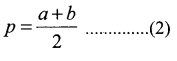
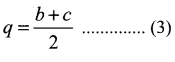
If a, b, c are in A.P. and p is the A.M. between a and b and q is the A.M. between b and c, show that b is the A.M. between p and q.
Solution:
a, b, c are in A.P.
2b = a + c …… (1)
p is the A.M. between a and b
Samacheer Kalvi 11th Maths Solutions Chapter 5 Binomial Theorem, Sequences and Series Ex 5.2 60
q is the A.M. between b and c
Samacheer Kalvi 11th Maths Solutions Chapter 5 Binomial Theorem, Sequences and Series Ex 5.2 61
Samacheer Kalvi 11th Maths Solutions Chapter 5 Binomial Theorem, Sequences and Series Ex 5.2 62
Hence, b is the A.M. between p and q

Samacheer Kalvi 11th Maths Solutions Chapter 5 Binomial Theorem, Sequences and Series Ex 5.2

Question 8.
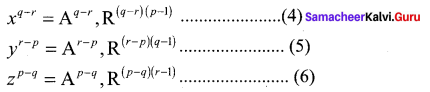
If x, y, z be respectively the pth, qth and rth terms of a G.P. show that xq – r, yr – p ,zp – q = 1
Solution:
Let A be the first term and R be the common ratio of G.P.
ap = x ⇒ x = ARp – 1 ……… (1)
aq = y ⇒ x = ARq – 1 ……… (2)
ar = z ⇒ x = ARr – 1 ……… (3)
Raising (1), (2), (3) to the powers q – r, r – p, p – q respectively, we get
Samacheer Kalvi 11th Maths Solutions Chapter 5 Binomial Theorem, Sequences and Series Ex 5.2 64
Multiplying (4), (5) and (6), we get
Samacheer Kalvi 11th Maths Solutions Chapter 5 Binomial Theorem, Sequences and Series Ex 5.2 65
Hence, xq – r, yr – p, zp – q = 1

Samacheer Kalvi 11th Maths Solutions Chapter 6 Two Dimensional Analytical Geometry Ex 6.5

You can Download Samacheer Kalvi 11th Maths Book Solutions Guide Pdf, Tamilnadu State Board help you to revise the complete Syllabus and score more marks in your examinations.

Tamilnadu Samacheer Kalvi 11th Maths Solutions Chapter 6 Two Dimensional Analytical Geometry Ex 6.5

Choose the correct or more suitable answer

Question 1.
The equation of the locus of the point whose distance from y-axis is half the distance from origin is ……..
(a) x2 + 3y2 = 0
(b) x2 – 3y2 = 0
(c) 3x2 + y2 = 0
(d) 3x2 – y2 = 0
Solution:
(c) 3x2 + y2 = 0
Hint:
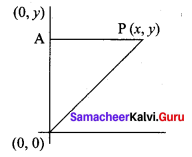
Given that PA = \([\frac{1}{2}/latex]OP
2PA = OP
Samacheer Kalvi 11th Maths Solutions Chapter 6 Two Dimensional Analytical Geometry Ex 6.5 1
4PA2 = OP2
4(x)2 = x2 + y2 ⇒ 3x2 – y2 = 0

Question 2.
Which of the following equation is the locus of (at2, 2at) ……
Samacheer Kalvi 11th Maths Solutions Chapter 6 Two Dimensional Analytical Geometry Ex 6.5 2
Solution:
(d) y2 = 4ax
Hint:
y2 = 4ax ⇒ Equation that satisfies the given point (at2, 2at)

Samacheer Kalvi 11th Maths Solutions Chapter 6 Two Dimensional Analytical Geometry Ex 6.5

Question 3.
Which of the following point lie on the locus of 3x2 + 3y2 – 8x – 12y + 17 = 0?
(a) (0, 0)
(b) (-2, 3)
(c) (1, 2)
(d) (0, -1)
Solution:
(c) (1, 2)
Hint:
The point that satisfies the given equations (0, 0) ⇒ 17 ≠ 0
(-2, 3) ⇒ 3 (4) + 3 (9) + 16 – 36 + 17 ≠ 0
(1, 2) ⇒ 3 + 3 (4) – 8 (1) – 12 (2) + 17
32 – 32 = 0, 0 = 0

Question 4.
Samacheer Kalvi 11th Maths Solutions Chapter 6 Two Dimensional Analytical Geometry Ex 6.5 382
(a) 0
(b) 1
(c) 2
(d) 3
Solution:
(d) 3
Samacheer Kalvi 11th Maths Solutions Chapter 6 Two Dimensional Analytical Geometry Ex 6.5 20

Question 5.
Straight line joining the points (2, 3) and (-1, 4) passes through the point (α, β) if
(a) α + 2β = 7
(b) 3α + β = 9
(c) α + 3β = 11
(d) 3α + 3β = 11
Solution:
(c) α + 3β = 11
Hint:
Equation joining (2, 3), (-1, 4)
Samacheer Kalvi 11th Maths Solutions Chapter 6 Two Dimensional Analytical Geometry Ex 6.5 25
3y – 12 = – x -1 ⇒ x + 3y – 11 = 0, (α, β) lies on it ⇒ α + 3β – 11 = 0.

Question 6.
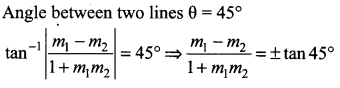
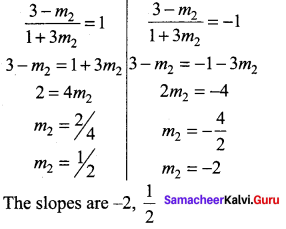
The slope of the line which makes an angle 45° with the line 3x – y = – 5 are
(a) 1, -1
(b) [latex]\frac{1}{2},-2\)
(c) \(1, \frac{1}{2}\)
(d) \(2,-\frac{1}{2}\)
Solution:
(c) \(1, \frac{1}{2}\)
Hint:
Equation of line 3x – y = -5, y = 3x + 5, m1 = 3
Samacheer Kalvi 11th Maths Solutions Chapter 6 Two Dimensional Analytical Geometry Ex 6.5 26
Samacheer Kalvi 11th Maths Solutions Chapter 6 Two Dimensional Analytical Geometry Ex 6.5 27

Samacheer Kalvi 11th Maths Solutions Chapter 6 Two Dimensional Analytical Geometry Ex 6.5

Question 7.
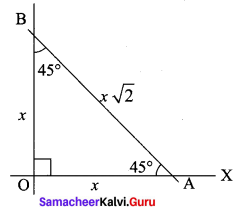
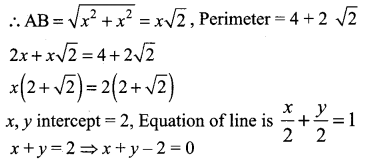
Equation of the straight line that forms an isosceles triangle with coordinate axes in the I-quadrant with perimeter \(4+2 \sqrt{2}\) is
(a)x + y + 2 = 0
(b) x + y – 2 = 0
(c) x + y – \(\sqrt{2}\) = 0
(d) x + y + \(\sqrt{2}\) = 0
Solution:
(b) x + y – 2 = 0
Hint.
Let the sides be x, x
Samacheer Kalvi 11th Maths Solutions Chapter 6 Two Dimensional Analytical Geometry Ex 6.5 28
Samacheer Kalvi 11th Maths Solutions Chapter 6 Two Dimensional Analytical Geometry Ex 6.5 288

Question 8.
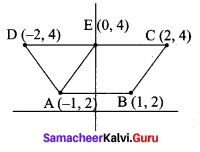
The coordinates of the four vertices of a quadrilateral are (-2, 4), (-1, 2), (1, 2) and (2, 4) taken in order. The equation of the line passing through the vertex (-1, 2) and dividing the quadrilateral in the equal areas is ………
(a) x + 1 = 0
(b) x + y = 1
(c) x + y + 3 = 0
(d) x – y + 3 = 0
Solution:
(b) x + y = 1
Hint:
This equation passes through (-1, 2)
-1 + 2 = 1 ⇒ 1 = 1
Samacheer Kalvi 11th Maths Solutions Chapter 6 Two Dimensional Analytical Geometry Ex 6.5 29

Question 9.
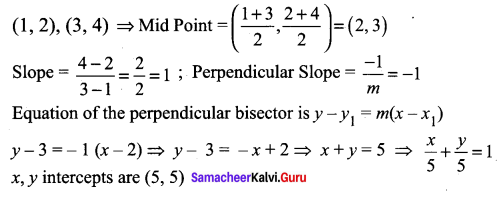
The intercepts of the perpendicular bisector of the line segment joining (1, 2) and (3, 4) with coordinate axes are ……….
(a) 5, -5
(b) 5, 5
(c) 5, 3
(d) 5, -4
Solution:
(b) 5, 5
Samacheer Kalvi 11th Maths Solutions Chapter 6 Two Dimensional Analytical Geometry Ex 6.5 30

Question 10.
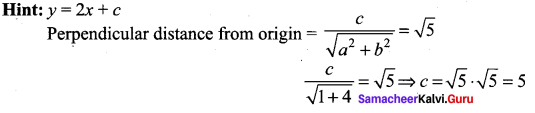
The equation of the line with slope 2 and the length of the perpendicular from the origin equal to \(\sqrt{5}\) is ……
(a) x + 2y = \(\sqrt{5}\)
(b) 2x + y = \(\sqrt{5}\)
(c) 2x + y = 5
(d) x + 2y – 5 = 0
Solution:
(c) 2x + y = 5
Samacheer Kalvi 11th Maths Solutions Chapter 6 Two Dimensional Analytical Geometry Ex 6.5 31
The required line is y = 2x + 5 ⇒ 2x – y + 5 = 0

Question 11.
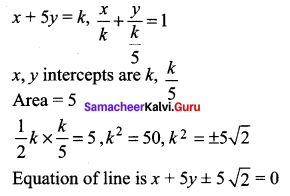
A line perpendicular to the line 5x – y = 0 forms a triangle with the coordinate axes. If the area of the triangle is 5 sq. units, then its equation is …….
Samacheer Kalvi 11th Maths Solutions Chapter 6 Two Dimensional Analytical Geometry Ex 6.5 32
Solution:
(a) x + 5y ± 5\(\sqrt{2}\) = 0
Hint:
Equation of a line perpendicular to 5x – y = 0 is
Samacheer Kalvi 11th Maths Solutions Chapter 6 Two Dimensional Analytical Geometry Ex 6.5 33

Samacheer Kalvi 11th Maths Solutions Chapter 6 Two Dimensional Analytical Geometry Ex 6.5

Question 12.
Equation of the straight line perpendicular to the line x – y + 5 = o, through the point of intersection the y-axis and the given line …….
(a) x – y – 5 = 0
(b) x + y – 5 = 0
(c) x + y + 5 = 0
(d) x + y + 10 = 0
Solution:
(b) x + y – 5 = 0
Hint:
x – y + 5 = 0 ⇒ put x = 0, y = 5
The point is (0, 5)
Equation of a line perpendicular to x – y + 5 = 0 is x + y + k = 0
This passes through (0, 5)
k = -5
x + 7 – 5 = 0

Question 13.
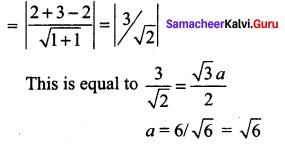
If the equation of the base opposite to the vertex (2, 3) of an equilateral triangle is x + y = 2, then the length of a side is ………
Samacheer Kalvi 11th Maths Solutions Chapter 6 Two Dimensional Analytical Geometry Ex 6.5 289
Solution:
\(\sqrt{6}\)
Hint:
In an equilateral ∆ the perpendicular will bisects the base in to two equal parts. Length of the perpendicular drawn from (2, 3) to the line x + 7 – 2 = 0
Samacheer Kalvi 11th Maths Solutions Chapter 6 Two Dimensional Analytical Geometry Ex 6.5 299

Question 14.
The line (p + 2q) x + (p – 3q)y = p – q for different values of p and q passes through the point ……
Samacheer Kalvi 11th Maths Solutions Chapter 6 Two Dimensional Analytical Geometry Ex 6.5 300
Solution:
(d) \(\left(\frac{2}{5}, \frac{3}{5}\right)\)
Hint:
(p + 2 q)x + (p – 3q)y = p – q
px + 2qx + py – 3qy = p – q
P(x + y) + q (2x – 3y) = p – q
The fourth option x = 2/5, y = 3/5
Samacheer Kalvi 11th Maths Solutions Chapter 6 Two Dimensional Analytical Geometry Ex 6.5 311
= p – q = RHS

Question 15.
The point on the line 2x – 3y = 5 is equidistance from (1, 2) and (3, 4) is …
(a) (7, 3)
(b) (4, 1)
(c) (1, -1)
(d) (-2, 3)
Solution:
(b) (4, 1)
Hint:
Let (a, b) be on 2x – 3y = 5 ⇒ 2a – 3b = 5
It is equidistance from (1, 2) and (3, 4)
Samacheer Kalvi 11th Maths Solutions Chapter 6 Two Dimensional Analytical Geometry Ex 6.5 322
(a – 1)2 + (b – 2)2 = (a – 3)2 + (6 – 4)2
a2 – 2a + 1 + b2 – 4b + 4 = a2 – 6a + 9 + b2 – 8b + 16
4a + 4b = 20
2a+ 2b = 10
2a – 3b = 5
5b = 5
b = 1 ∴ a = 4
∴ The point is (4, 1)

Samacheer Kalvi 11th Maths Solutions Chapter 6 Two Dimensional Analytical Geometry Ex 6.5

Question 16.
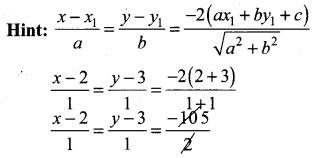
The image of the point (2, 3) in the line y = – x is ………
(a) (-3, -2)
(b) (-3, 2)
(c) (-2, -3)
(d) (3, 2)
Solution:
(a) (-3, -2)
Samacheer Kalvi 11th Maths Solutions Chapter 6 Two Dimensional Analytical Geometry Ex 6.5 333
x – 2 = -5, y – 3 = -5
x = -3, y = -2
(-3,-2)

Question 17.
The length of ⊥ from the origin to the line \(\frac{x}{3}-\frac{y}{4}=1\) is ……
Samacheer Kalvi 11th Maths Solutions Chapter 6 Two Dimensional Analytical Geometry Ex 6.5 34
Solution:
(c) \(\frac{12}{5}\)
Hint:
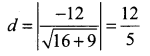
4x – 3y = 12 ⇒ 4x – 3y – 12 = 0
Samacheer Kalvi 11th Maths Solutions Chapter 6 Two Dimensional Analytical Geometry Ex 6.5 35

Question 18.
The y-intercept of the straight line passing through (1, 3) and perpendicular to 2x – 3y + 1 = 0 is ……..
Samacheer Kalvi 11th Maths Solutions Chapter 6 Two Dimensional Analytical Geometry Ex 6.5 355
Solution:
(b) \(\frac{9}{2}\)
Hint:
Equation of a line perpendicular to 2x – 3y + 1 = 0 is 3x + 2y = k. It passes through (1, 3).
3 + 6 = k ⇒ k = 9, 3x + 2y = 9
To find y-intercept x = 0, 2y = 9, y = 9/2

Samacheer Kalvi 11th Maths Solutions Chapter 6 Two Dimensional Analytical Geometry Ex 6.5

Question 19.
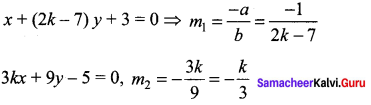
If the two straight lines x + (2k – 7)y + 3 = 0 and 3kx + 9y – 5 = 0 are perpendicular then the value of k is ……
Samacheer Kalvi 11th Maths Solutions Chapter 6 Two Dimensional Analytical Geometry Ex 6.5 356
Solution:
(a) k = 3
Hint.
Samacheer Kalvi 11th Maths Solutions Chapter 6 Two Dimensional Analytical Geometry Ex 6.5 37
Since the lines are perpendicular m1m2 = – 1
Samacheer Kalvi 11th Maths Solutions Chapter 6 Two Dimensional Analytical Geometry Ex 6.5 377

Question 20.
If a vertex of a square is at the origin and its one side lies along the line 4x + 3y – 20 = 0, then the area of the square is ……..
(a) 20 sq. units
(b) 16 sq. units
(c) 25 sq. units
(d) 4 sq.units
Solution:
(b) 16 sq. units
Hint:
One side of a square = Length of the perpendicular from (0, 0) to the line.
Samacheer Kalvi 11th Maths Solutions Chapter 6 Two Dimensional Analytical Geometry Ex 6.5 38

Question 21.
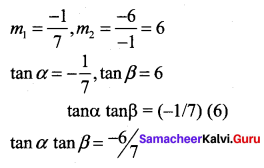
If the lines represented by the equation 6x2 + 41xy – 7y2 = 0 make angles α and β with
x – axis, then tan α tan β =
Samacheer Kalvi 11th Maths Solutions Chapter 6 Two Dimensional Analytical Geometry Ex 6.5 39
Solution:
(a) \(-\frac{6}{7}\)
Hint.
6x2 + 41xy – 7y2 = 0 ⇒ 6x2 – xy + 42xy – 7y2 = 0 ⇒ x (6x – y) + 7y (6x – y) = 0
(x + 7y) (6x – y) = 0 ⇒ x + 7y = 0, 6x – y = 0
Samacheer Kalvi 11th Maths Solutions Chapter 6 Two Dimensional Analytical Geometry Ex 6.5 40

Question 22.
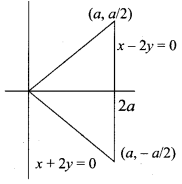
The area of the triangle formed by the lines x2 – 4y2 = 0 and x = a is …….
Samacheer Kalvi 11th Maths Solutions Chapter 6 Two Dimensional Analytical Geometry Ex 6.5 378
Solution:
(c) \(\frac{1}{2} a^{2}\)
Hint:
x2 – 4y2 = 0 , (x – 2y) (x + 2y) = 0 ⇒ x – 2y = 0, x + 2y = 0
Samacheer Kalvi 11th Maths Solutions Chapter 6 Two Dimensional Analytical Geometry Ex 6.5 42
Samacheer Kalvi 11th Maths Solutions Chapter 6 Two Dimensional Analytical Geometry Ex 6.5 379

Question 23.
If one of the lines given by 6x2 – x + 4x2 = 0 is 3x + 4y = 0, then c equals to ……
(a) -3
(b) -1
(c) 3
(d) 1
Solution:
(a) -3
Hint.
6x2 – xy + 4cy2 = 0, 3x + 4y = 0
The other line may be (2x + by)
(3x + 4y) (2x + by) = 6x2 – xy + 4cy2
6x2 + 3xby + 8xy + 4by2 = 6x2 – xy + 4cy2
6x2 + xy (3b + 8) + 4by2 = 6x2 – xy + 4cy2
paring, 3b + 8 = -1
3b = -9 ⇒ b = -3
4b = 4c ⇒ 4(-3) = 4c
-12 = 4c ⇒ c = -3

Samacheer Kalvi 11th Maths Solutions Chapter 6 Two Dimensional Analytical Geometry Ex 6.5

Question 24.
Samacheer Kalvi 11th Maths Solutions Chapter 6 Two Dimensional Analytical Geometry Ex 6.5 43
Samacheer Kalvi 11th Maths Solutions Chapter 6 Two Dimensional Analytical Geometry Ex 6.5 380
Solution:
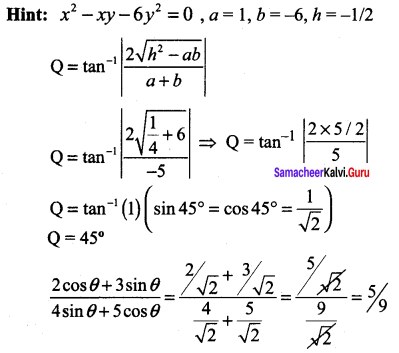
(c) \(\frac{5}{9}\)
Hint:
Samacheer Kalvi 11th Maths Solutions Chapter 6 Two Dimensional Analytical Geometry Ex 6.5 381

Question 25.
The equation of one the line represented by the equation x2 + 2xy cot θ – y2 = 0 is ………
(a) x – y cotθ = 0
(b) x + y tan θ = 0
(e) x cos θ + y(sin θ + 1) = 0
(d) x sin θ + y(cos θ + 1) = 0
Solution:
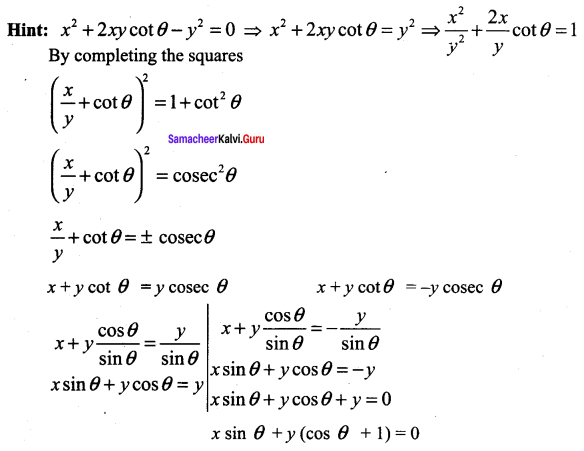
(d) x sin θ + y(cos θ + 1)=0
Samacheer Kalvi 11th Maths Solutions Chapter 6 Two Dimensional Analytical Geometry Ex 6.5 56

Samacheer Kalvi 11th Maths Solutions Chapter 12 Introduction to Probability Theory Ex 12.5

You can Download Samacheer Kalvi 11th Maths Book Solutions Guide Pdf, Tamilnadu State Board help you to revise the complete Syllabus and score more marks in your examinations.

Tamilnadu Samacheer Kalvi 11th Maths Solutions Chapter 12 Introduction to Probability Theory Ex 12.5

Choose the correct or most suitable answer from the given four alternatives:
Question 1.
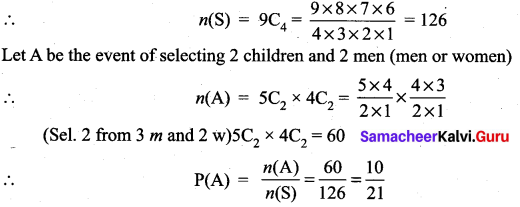
Four persons are selected at random from a group of 3 men, 2 women and 4 children. The probability that exactly two of them are children is
(a) \(\frac{3}{4}\)
(b) \(\frac{10}{23}\)
(c) \(\frac{1}{2}\)
(d) \(\frac{10}{21}\)
Solution:
(d)
Hint:
Total no of person = 3 + 2 + 4 = 9
Selecting 4 from 9 can be done in 9 C4 ways
Samacheer Kalvi 11th Maths Solutions Chapter 12 Introduction to Probability Theory Ex 12.5 1

Question 2.
A number is selected from the set {1, 2, 3, ….., 20}. The probability that the selected number is divisible by 3 or 4 is ……………
(a) \(\frac{2}{5}\)
(b) \(\frac{1}{8}\)
(c) \(\frac{1}{2}\)
(d) \(\frac{2}{3}\)
Solution:
(c)
Hint:
n(S) = 20
A = {3, 6, 9, 12, 15, 18} ⇒ n(A) = 6
B = {4, 8, 12, 16, 20} ⇒ n(B) = 5
A ∩ B = {12} ⇒ n(A ∩ B) = 1
so P(A ∪ B) = P(A) + P(B) – P(A ∩ B)
= \(\frac{6}{20}+\frac{5}{20}-\frac{1}{20}=\frac{10}{20}=\frac{1}{2}\)

Question 3.
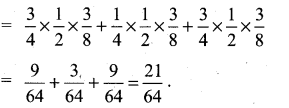
A, B and C try to hit a target simultaneously but independently. Their respective probabilities of hitting the target are \(\frac{3}{4}, \frac{1}{2}, \frac{5}{8}\). The probability that the target is hit by A or B but not by C
Samacheer Kalvi 11th Maths Solutions Chapter 12 Introduction to Probability Theory Ex 12.5 2
Solution:
(a)
Hint:
P(A) = \(\frac{3}{4}\) P(A’) = 1/4
P(B) = 1/2 P(B’) = 1/2
P(C) = 5/8 P(C’) = 3/8
Probability of hitting the target = 1
Samacheer Kalvi 11th Maths Solutions Chapter 12 Introduction to Probability Theory Ex 12.5 3

Samacheer Kalvi 11th Maths Solutions Chapter 12 Introduction to Probability Theory Ex 12.5

Question 4.
If A and B are any two events, then the probability that exactly one of them occur is …………
(a) P(A ∪ \(\overline{B}\)) + P(\(\overline{A}\) ∪ B)
(b) P(A ∩ \(\overline{B}\)) + P(\(\overline{A}\) ∩ B)
(c) P(A) + P(B) – P(A ∩ B)
(d) P(A) + P(B) + 2P(A ∩ B)
Solution:
(b)
Hint:
Samacheer Kalvi 11th Maths Solutions Chapter 12 Introduction to Probability Theory Ex 12.5 4

Question 5.
Let A and B be two events such that P(\(\overline{A \cup B}\)) = \(\frac{1}{6}\), P(A ∩ B) = \(\frac{1}{4}\) and P(\(\overline{A}\)) = \(\frac{1}{4}\).
Then the events A and B are …………………
(a) Equally likely but not independent
(b) Independent but not equally likely
(c) Independent and equally likely
(d) Mutually inclusive and dependent
Solution:
(b)
Hint:
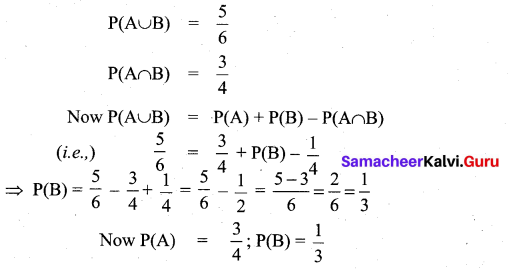
Samacheer Kalvi 11th Maths Solutions Chapter 12 Introduction to Probability Theory Ex 12.5 5
So P(A). P(B) = \(\frac{3}{4} \times \frac{1}{3}=\frac{1}{4}\)
P(A ∩ B) = P(A). P(B)
⇒ A and B are independent and not equally likely

Question 6.
Two items are chosen from a lot containing twelve items of which four are defective, then the probability that at least one of the item is defective
when two items are chosen at random probability of atleast one of them is defective ………….
Samacheer Kalvi 11th Maths Solutions Chapter 12 Introduction to Probability Theory Ex 12.5 6
Solution:
(a)
Hint:
Total number = 12
Defective = 4
∴ good ones = 12 – 4 = 8
when two items are chosen at random probability of atleast one of them is defective
= P(one defective or 2 defectives) = P(GD or DD)
= P(G) P(D) + P(D) P(D)
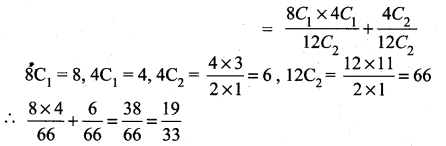
Samacheer Kalvi 11th Maths Solutions Chapter 12 Introduction to Probability Theory Ex 12.5 7

Samacheer Kalvi 11th Maths Solutions Chapter 12 Introduction to Probability Theory Ex 12.5

Question 7.
A man has 3 fifty rupee notes, 4 hundred rupees notes and 6 five hundred rupees notes in his pocket. If 2 notes are taken at random, what are the odds in favour of both notes being of hundred rupee denomination?
(a) 1 : 12
(b) 12 : 1
(c) 13 : 1
(d) 1 : 13
Solution:
(d)
Hint:
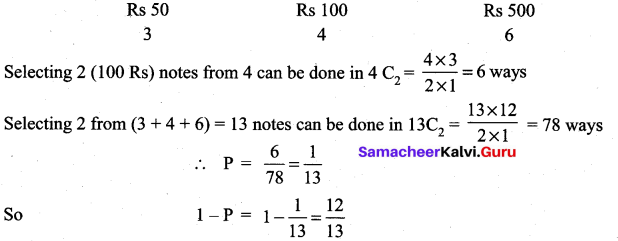
Samacheer Kalvi 11th Maths Solutions Chapter 12 Introduction to Probability Theory Ex 12.5 8
The odds in favour done of P is P : 1 – P
(i.e.,) \(\frac{1}{13}: \frac{12}{13}\) = 1 : 12

Question 8.
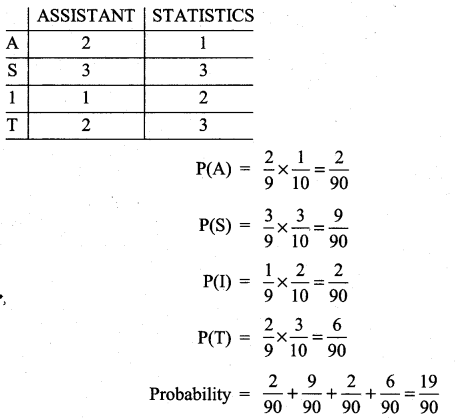
A letter is taken at random from the letters of the word ‘ASSISTANT’ and another letter is taken at random from the letters of the word ‘STATISTICS’. The probability that the selected letters are the same is ………….
Samacheer Kalvi 11th Maths Solutions Chapter 12 Introduction to Probability Theory Ex 12.5 9
Solution:
(d)
Hint:
Samacheer Kalvi 11th Maths Solutions Chapter 12 Introduction to Probability Theory Ex 12.5 10

Question 9.
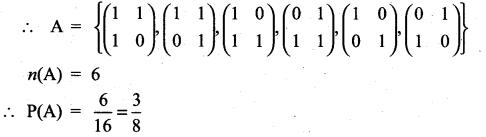
A matrix is chosen at random from a set of all matrices of order 2, with elements 0 or 1 only. The probability that the determinant of the matrix chosen is not zero will be
Samacheer Kalvi 11th Maths Solutions Chapter 12 Introduction to Probability Theory Ex 12.5 11
Solution:
(b)
Hint: Then given elements are 0 and So each term of a matrix can be filled (Using or 1) is 2 ways.
The No. of elements is a 2 × 2 matrix = 2 × 2 = 4. So the possible ways of filling the elements of a 2 × 2 matrix is 24 = 16 (i.e.,) n(S) = 16
Let A be the event of getting a 2 × 2 matrix for which the determinant value is non zero.
Samacheer Kalvi 11th Maths Solutions Chapter 12 Introduction to Probability Theory Ex 12.5 12

Question 10.
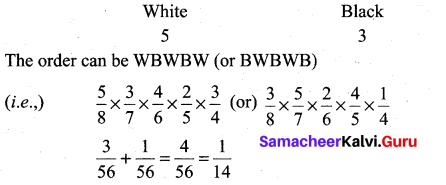
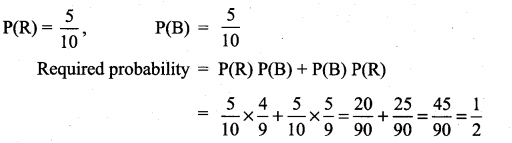
A bag contains 5 white and 3 black balls. Five balls are drawn successively without replacement. The probability that they are alternately of different colours is …………..
Samacheer Kalvi 11th Maths Solutions Chapter 12 Introduction to Probability Theory Ex 12.5 13
Solution:
(c)
Hint:
Samacheer Kalvi 11th Maths Solutions Chapter 12 Introduction to Probability Theory Ex 12.5 14

Question 11.
If A and B are two events such that A ⊂ B and P(B) ≠ 0, then which of the following is correct?
(a) P(A/B) = \(\frac{\mathrm{P}(\mathrm{A})}{\mathrm{P}(\mathrm{B})}\)
(b) P(A/B) < P(A) (c) P(A/B) ≥ P(A) (d) P(A/B) > P(B)
Solution:
(c)
Hint:
Samacheer Kalvi 11th Maths Solutions Chapter 12 Introduction to Probability Theory Ex 12.5 15

Samacheer Kalvi 11th Maths Solutions Chapter 12 Introduction to Probability Theory Ex 12.5

Question 12.
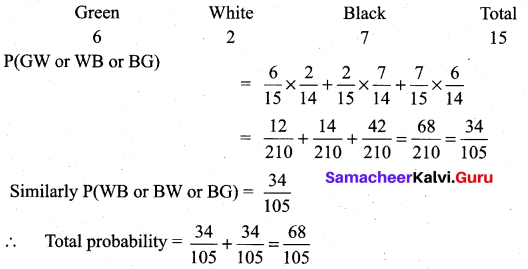
A bag contains 6 green, 2 white, and 7 black balls. If two balls are drawn simultaneously then the probability that both are different colours is ………..
Samacheer Kalvi 11th Maths Solutions Chapter 12 Introduction to Probability Theory Ex 12.5 16
Solution:
(a)
Hint:
Samacheer Kalvi 11th Maths Solutions Chapter 12 Introduction to Probability Theory Ex 12.5 17

Question 13.
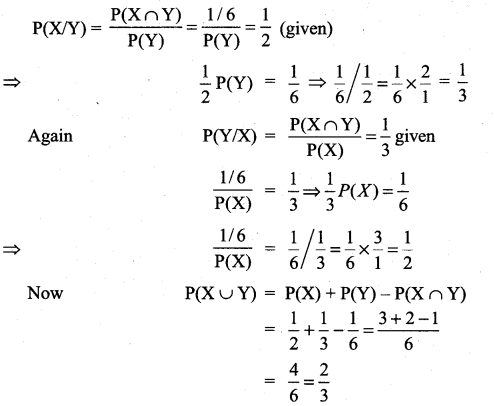
If X and Y be two events such that P(X/Y) = \(\frac{1}{2}\), P(Y/X) = \(\frac{1}{3}\) and P(X ∩ Y) = \(\frac{1}{6}\) then P(X ∪ Y) is …………
(a) \(\frac{1}{3}\)
(b) \(\frac{2}{5}\)
(c) \(\frac{1}{6}\)
(d) \(\frac{2}{3}\)
Solution:
(d)
Hint:
Samacheer Kalvi 11th Maths Solutions Chapter 12 Introduction to Probability Theory Ex 12.5 18

Question 14.
An um contains 5 red and 5 black balls. A balls is drawn at random, its colour is noted and is returned to the um. Moreover, 2 additional balls of the colour drawn are put in the um and then a ball is drawn at random. The probability that the second ball drawn is red will be …………
Samacheer Kalvi 11th Maths Solutions Chapter 12 Introduction to Probability Theory Ex 12.5 19
Solution:
(b)
Hint:
Samacheer Kalvi 11th Maths Solutions Chapter 12 Introduction to Probability Theory Ex 12.5 20

Question 15.
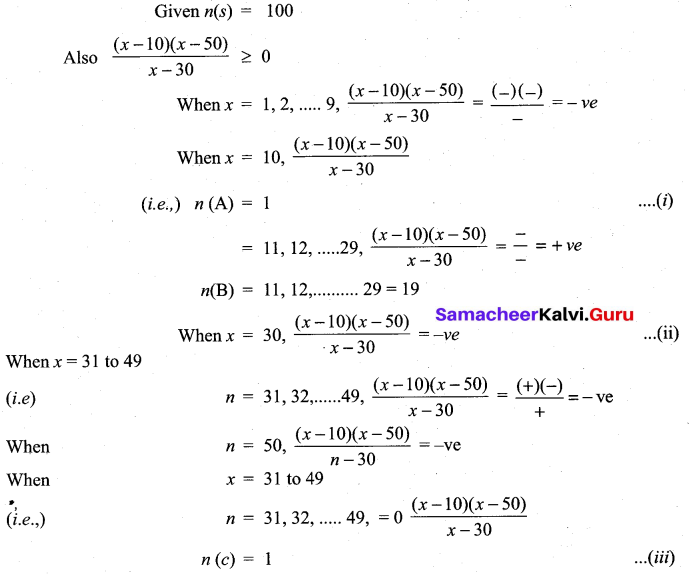
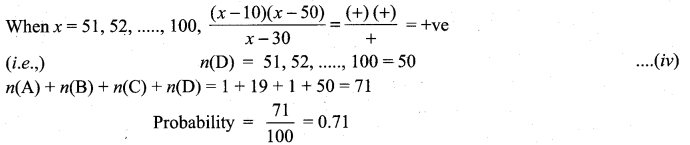
A number x is chosen at random from the first 100 natural numbers. Let A be the event of numbers which satisfies \(\frac{(x-10)(x-50)}{x-30}\) ≥ 0, then P(A) is …………….
(a) 0.20
(b) 0.51
(c) 0.71
(d) 0.70
Solution:
(c)
Hint:
Samacheer Kalvi 11th Maths Solutions Chapter 12 Introduction to Probability Theory Ex 12.5 21
Samacheer Kalvi 11th Maths Solutions Chapter 12 Introduction to Probability Theory Ex 12.5 22

Question 16.
If two events A and B are independent such that P(A) = 0.35 and P(A ∪ B) = 0.6, then P(B) is …………..
Samacheer Kalvi 11th Maths Solutions Chapter 12 Introduction to Probability Theory Ex 12.5 23
Solution:
(a)
Hint:
Given A and B are independent
P(A ∩ B) = P(A) + P(B)
⇒ Now P(A ∪ B) = P(A) + P(B) – P(A ∩ B)
(i.e.,) Now P(A ∪ B) = P(A) + P(B) – P(A).P(B)
0.6 = 0.35 + P(B) – (0.35) P(B)
⇒ P(B) = (1 – 0.35) = 0.6 – 0.35
0.65 P(B) = 0.25
∴ P(B) = \(\frac{0.25}{0.65}=\frac{25}{65}=\frac{5}{13}\)

Samacheer Kalvi 11th Maths Solutions Chapter 12 Introduction to Probability Theory Ex 12.5

Question 17.
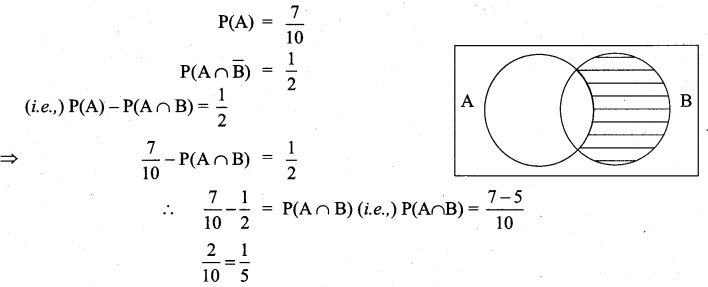
If two event A and B are such that P(\(\overline{A}\)) and P(A ∩ \(\overline{B}\)) = 1/2, then P(A ∩ B) is ………….
Samacheer Kalvi 11th Maths Solutions Chapter 12 Introduction to Probability Theory Ex 12.5 24
Solution:
(d)
Hint:
Samacheer Kalvi 11th Maths Solutions Chapter 12 Introduction to Probability Theory Ex 12.5 25

Question 18.
If A and B are two events such that P(A) = 0.4, P(B) = 0.8 and P(B/A) = 0.6, then P(\(\overline{A}\) ∩ B) is …………..
(a) 0.96
(b) 0.24
(c) 0.56
(d) 0.66
Solution:
(c)
Hint:
P(B/A) = 0.6 ⇒ \(\frac{P(A \cap B)}{P(A)}\) = 0.6
⇒ P(B/A) = 0.6 × P(A) = 0.6 × 0.4 = 0.24
Now P(\(\overline{A}\) ∩ B) = P(B) – P(A ∩ B)
= 0.8 – 0.24 = 0.56

Question 19.
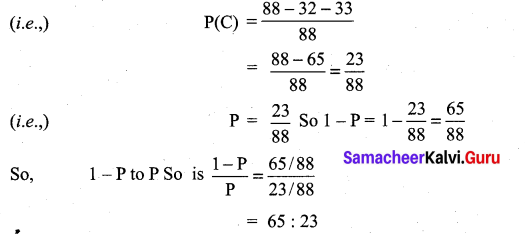
There are three events A, B, and C of which one and only one can happen. If the odds are 7 to 4 against A and 5 to 3 against B, then odds against C is ……………
(a) 23 : 65
(b) 65 : 23
(c) 23 : 88
(d) 88 : 23
Solution:
(b)
Hint: If the probability of an event is P then the odds against its occurrence are 1 – P to P.
Selecting 1 from the 4 number 1, 2, 3,4, can be done in 4 ways
Here for the event A we are given that = \(\frac{1-\mathrm{P}}{\mathrm{P}}=\frac{7}{4}\)
⇒ 4 – 4P = 7P
⇒ 11 P = 4 ⇒ P = \(\frac{4}{11}\) ⇒ P(A) = \(\frac{4}{11}\) for the event B we are given
\(\frac{1-\mathrm{P}}{\mathrm{P}}=\frac{5}{3}\) ⇒ 5P = 3 – 3P
⇒ 8P = 3 ⇒ P = 3/8
P(B) = \(\frac{3}{8}\)
Now we are given P(A) + P(B) + P(C) = 1
P(C) = 1 – P(A) – P(B)
P(C) = 1 – \(\frac{4}{11}-\frac{3}{8}\)
Samacheer Kalvi 11th Maths Solutions Chapter 12 Introduction to Probability Theory Ex 12.5 26

Question 20.
If a and b are chosen randomly from the set {1, 2, 3, 4} with replacement, then the probability of the real roots of the equation x2 + ax + b = 0 is
Samacheer Kalvi 11th Maths Solutions Chapter 12 Introduction to Probability Theory Ex 12.5 27
Solution:
(c)
Hint:
x2 + ax + b = 0 ⇒ x = \(\frac{-a \pm \sqrt{a^{2}-4 b}}{2}\)
Given that the roots are real ⇒ a2 – 4b ≥ 0 or a2 > 4b
When a = 1, b = 1 or 2 or 3 or 4 a2 – 4b < 0
When a = 2, b = 1 a2 – 4b = 0
When a = 3, b = 1 or 2 for which a2 – 4b ≥ 0
When a = 4, b = 1 or 2, 3 or 4 for which a2 – 4b ≥ 0
So, Selecting from the 4 number 42 = 16 ways.
(i.e.,) n(s) = 16
n(A) = (2 or 3 or 4) = 3
n(B) = (1 or 2 or 3 or 4) = 4
P(A) + P(B) = \(\frac{3}{16}+\frac{4}{16}=\frac{7}{16}\)

Question 21.
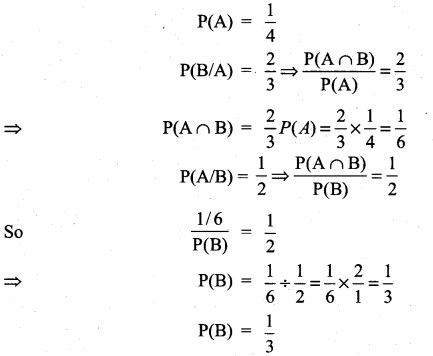
It is given that the events A and B are such that P(A) = \(\frac{1}{4}\), P(A/B) = \(\frac{1}{2}\) and P(B/ A) = \(\frac{2}{3}\) then P(B) is ……………
Samacheer Kalvi 11th Maths Solutions Chapter 12 Introduction to Probability Theory Ex 12.5 28
Solution:
(b)
Hint:
Samacheer Kalvi 11th Maths Solutions Chapter 12 Introduction to Probability Theory Ex 12.5 29

Samacheer Kalvi 11th Maths Solutions Chapter 12 Introduction to Probability Theory Ex 12.5

Question 22.
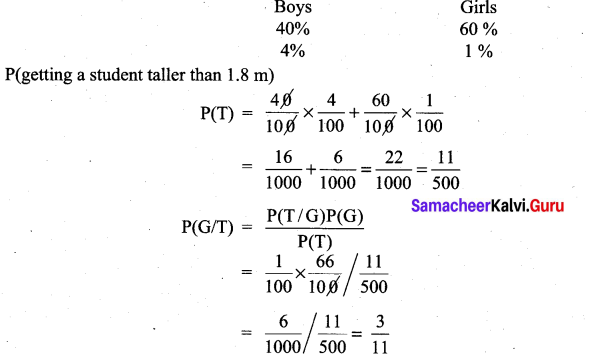
In a certain college 4% of the boys and 1% of the girls are taller than 1.8 meter. Further 60% of the students are girls. If a student is selected at random and is taller than 1.8 meters, then the probability that the students is a girls is ………….
Samacheer Kalvi 11th Maths Solutions Chapter 12 Introduction to Probability Theory Ex 12.5 30
Solution:
(b)
Hint:
Samacheer Kalvi 11th Maths Solutions Chapter 12 Introduction to Probability Theory Ex 12.5 31

Question 23.
Ten coins are tossed. The probability of getting at least 8 heads is …………….
Samacheer Kalvi 11th Maths Solutions Chapter 12 Introduction to Probability Theory Ex 12.5 32
Solution:
(d)
Hint:
When 10 coins are tossed, No. of element in sample space
n(S) = 210 = 1024
Probability of getting atleast 8 heads
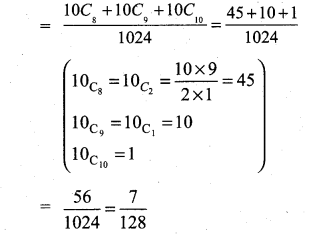
Samacheer Kalvi 11th Maths Solutions Chapter 12 Introduction to Probability Theory Ex 12.5 33

Question 24.
The probability of two events A and B are 0.3 and 0.6 respectively. The probability that both A and B occur simultaneously is 0.18. The probability that neither A nor B occurs is …………….
(a) 0.1
(b) 0.72
(c) 0.42
(d) 0.28
Solution:
(d)
Hint:
P(A) = 0.3, P(B) = 0.6
P(A ∩ B) = 0.18
So P(A ∪ B) = P(A) + P(B) – P(A ∩ B)
= 0.3 + 0.6 – 0.18
= 0.9 – 0.18 = 0.72
P(A’ ∩ B’) = P[(A ∪ B)’] = 1 – P(A ∪B)
= 1 – 0.72 = 0.28

Question 25.
If m is a number such that m≤ 5, then the probability that quadratic equation 2x2 + 2mx + m + 1 = 0 has real roots is ………….
Samacheer Kalvi 11th Maths Solutions Chapter 12 Introduction to Probability Theory Ex 12.5 34
Solution:
(c)
Hint:
2x2 + 2mx + m + 1 = 0
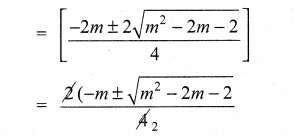
Samacheer Kalvi 11th Maths Solutions Chapter 12 Introduction to Probability Theory Ex 12.5 35
Samacheer Kalvi 11th Maths Solutions Chapter 12 Introduction to Probability Theory Ex 12.5 36
roots are real ⇒ m2 – 2m – 2 ≥ 0
Here m ≤ 5 ⇒ n(S) = 5
When m= 1,m2 – 2m – 2
When m = 2, m2 – 2m- 2
When m = 3, m2 – 2m – 2
When m = 4, m2 – 2n- 2
When m = 5, m2 – 2m – 2
⇒ n{A) = 3 and so P(A) = \(\frac{3}{5}\)

Samacheer Kalvi 11th Maths Solutions Chapter 3 Trigonometry Ex 3.12

You can Download Samacheer Kalvi 11th Maths Book Solutions Guide Pdf, Tamilnadu State Board help you to revise the complete Syllabus and score more marks in your examinations.

Tamilnadu Samacheer Kalvi 11th Maths Solutions Chapter 3 Trigonometry Ex 3.12

Choose the correct answer or most suitable answer:

Question 1.
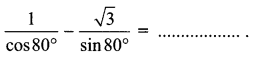
Samacheer Kalvi 11th Maths Solutions Chapter 3 Trigonometry Ex 3.12 1
(a) \(\sqrt{2}\)
(b) \(\sqrt{3}\)
(c) 2
(d) 4
Solution:
(d) 4
Hint:
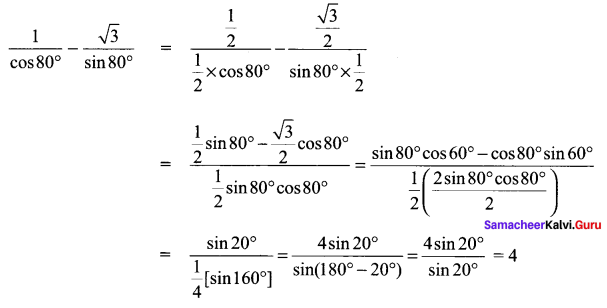
Samacheer Kalvi 11th Maths Solutions Chapter 3 Trigonometry Ex 3.12 20

Samacheer Kalvi 11th Maths Solutions Chapter 3 Trigonometry Ex 3.12

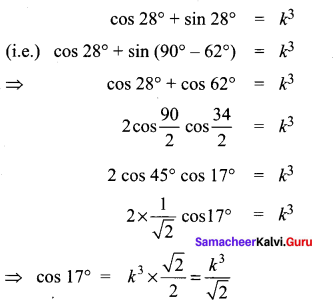
Question 2.
If cos 28° + sin 28° = k3, then cos 17° is equal to …….
Samacheer Kalvi 11th Maths Solutions Chapter 3 Trigonometry Ex 3.12 21
Solution:
(a) \(\frac{k^{3}}{\sqrt{2}}\)
Hint:
Samacheer Kalvi 11th Maths Solutions Chapter 3 Trigonometry Ex 3.12 22

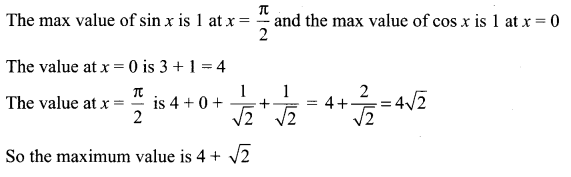
Question 3.
Samacheer Kalvi 11th Maths Solutions Chapter 3 Trigonometry Ex 3.12 23
(a) 4 + \(\sqrt{2}\)
(b) 3 + \(\sqrt{2}\)
(c) 9
(d) 4
Solution:
(a) 4 + \(\sqrt{2}\)
Hint:
Samacheer Kalvi 11th Maths Solutions Chapter 3 Trigonometry Ex 3.12 24

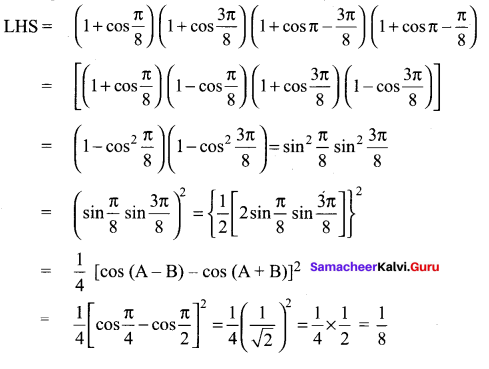
Question 4.
Samacheer Kalvi 11th Maths Solutions Chapter 3 Trigonometry Ex 3.12 25
Solution:
(a) \(\frac{1}{8}\)
Hint:
Samacheer Kalvi 11th Maths Solutions Chapter 3 Trigonometry Ex 3.12 26

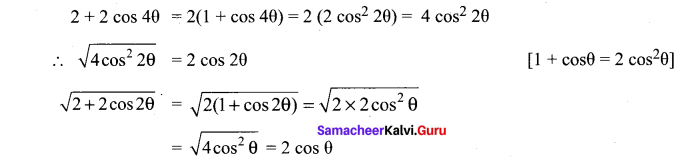
Question 5.
Samacheer Kalvi 11th Maths Solutions Chapter 3 Trigonometry Ex 3.12 27
Solution:
(c) 2 cos θ
Hint:
Samacheer Kalvi 11th Maths Solutions Chapter 3 Trigonometry Ex 3.12 28
Here θ is in II Quadrant

Samacheer Kalvi 11th Maths Solutions Chapter 3 Trigonometry Ex 3.12

Question 6.
Samacheer Kalvi 11th Maths Solutions Chapter 3 Trigonometry Ex 3.12 29
Solution:
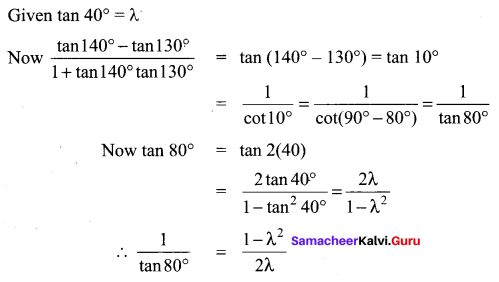
(d) \(\text { (d) } \frac{1-\lambda^{2}}{2 \lambda}\)
Hint:
Samacheer Kalvi 11th Maths Solutions Chapter 3 Trigonometry Ex 3.12 30

Question 7.
cos 1° + cos 2° + cos 3° + …. + cos 179° = …….
(a) 0
(b) 1
(c) -1
(d) 89
Solution:
(a) 0
Hint:
LHS = (cos 10 + cos 179°)+(cos 2° ÷ cos 178°)+ ….. +cos(89° + cos 91°)+cos 90°
cos 179° = cos (180° – 1) = – cos 1°
cos 178° = cos(180° – 2)= – cos 2°
So (cos 1°- cos 1°)+(cos 2° – cos 2°) + (cos 89° – cos 89°) + cos 90°
= 0 + 0 …. + 0 + 0 = 0.

Samacheer Kalvi 11th Maths Solutions Chapter 3 Trigonometry Ex 3.12

Question 8.
Samacheer Kalvi 11th Maths Solutions Chapter 3 Trigonometry Ex 3.12 31
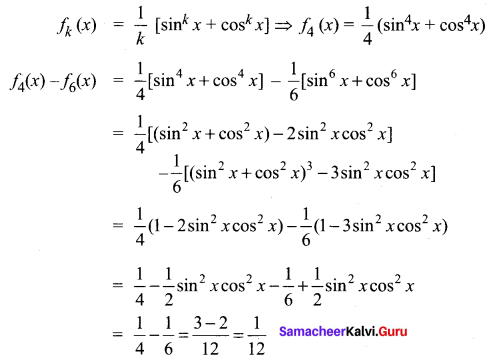
Solution:
(b) \(\frac{1}{12}\)
Hint:
Samacheer Kalvi 11th Maths Solutions Chapter 3 Trigonometry Ex 3.12 32

Question 9.
Which of the following is not true?
Samacheer Kalvi 11th Maths Solutions Chapter 3 Trigonometry Ex 3.12 33
Solution:
(d) sec θ = \(\frac{1}{4}\)
Hint:
sec θ = \(\frac{1}{4}\) ⇒ cos θ = 4, which is not true.

Samacheer Kalvi 11th Maths Solutions Chapter 3 Trigonometry Ex 3.12

Question 10.
cos 2θ cos 2ϕ+ sin2 (θ – ϕ) – sin2 (θ + ϕ) is equal to …….
(a) sin 2(θ + ϕ)
(b) cos 2(θ + ϕ)
(c) sin 2(θ – ϕ)
(d) cos 2(θ – ϕ)
Solution:
(b) cos 2(θ + ϕ)
Hint.
Given cos 2θ . cos 2ϕ + sin2 (θ – ϕ) – sin2 (θ + ϕ)
= cos 2θ cos 2ϕ + sin (θ – ϕ + θ + ϕ) sin (θ – ϕ – θ – ϕ)
= cos 2θ cos 2ϕ + sin 2θ sin(-2ϕ)
= cos 2θ cos 2ϕ – sin 2θ sin(2ϕ)
= cos (2θ + 2ϕ) = cos 2(θ + ϕ)

Question 11.
Samacheer Kalvi 11th Maths Solutions Chapter 3 Trigonometry Ex 3.12 60
(a) sin A + sin B + sin C
(b) 1
(c) 0
(d) cos A + cos B + cos C
Solution:
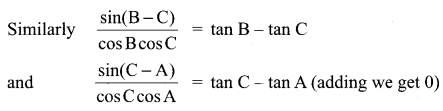
(c) 0
Hint:
Samacheer Kalvi 11th Maths Solutions Chapter 3 Trigonometry Ex 3.12 61
= tan A – tan B
Samacheer Kalvi 11th Maths Solutions Chapter 3 Trigonometry Ex 3.12 62

Samacheer Kalvi 11th Maths Solutions Chapter 3 Trigonometry Ex 3.12

Question 12.
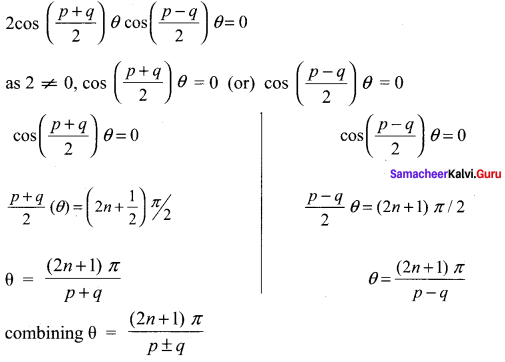
cos pθ + cos qθ = 0 and if p ≠ q, then 0 is equal to (n is any integer) …….
Samacheer Kalvi 11th Maths Solutions Chapter 3 Trigonometry Ex 3.12 63

Solution:
(b) \(\frac{\pi(2 n+1)}{p \pm q}\)
Hint:
cos pθ + cos qθ = 0
Samacheer Kalvi 11th Maths Solutions Chapter 3 Trigonometry Ex 3.12 64

Question 13.
If tan α and tan β are the roots x2 + ax + b = 0, then \(\frac{\sin (\alpha+\beta)}{\sin \alpha \sin \beta}\) is equal to …….
Solution:
(b) \(\frac{a}{b}\)
Hint:
tan2 x + a tan x + b = 0
α and β are the roots of the equation
⇒ tan2 α + a tan α + b = 0 ….. (1)
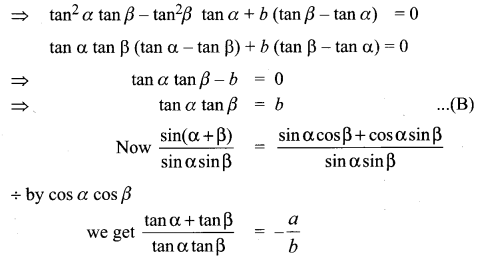
tan2 β + a tan β + b = 0 …… (2)
(1) – (2) => tan2 α – tan2 β + a (tan α – tan β) = 0
(tan α – tan β) (tan α + tan β) + a (tan α – tan β) = 0
⇒ tan α + tan β = – a …. (A)
(1) × tan β – (2) × tan α
Samacheer Kalvi 11th Maths Solutions Chapter 3 Trigonometry Ex 3.12 65

Samacheer Kalvi 11th Maths Solutions Chapter 3 Trigonometry Ex 3.12

Question 14.
In a triangle ABC, sin2 A + sin2 B + sin2 C = 2, then the triangle is …….
(a) equilateral triangle
(b) isosceles triangle
(c) right triangle
(d) scalene triangle
Solution:
(c) right triangle
Hint.
On simplifying we get
sin2 A + sin2 B + sin2 C = 2 + 2 cos A cos B cos C
= 2 (given)
⇒ cos A cos B cos C = 0
cos A (or) cos B (or) cos C = 0
⇒ A (or) B (or) C = π/2
⇒ ABC (is a right angled triangle).

Question 15.
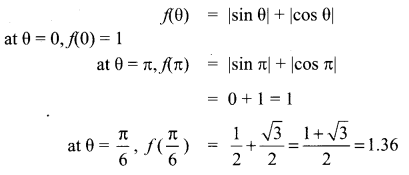
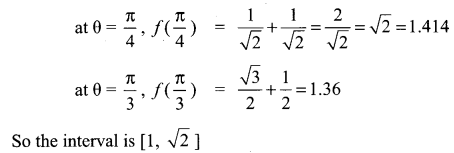
If f(θ) = |sin θ| + |cos θ|, θ ∈ R, then f(θ) is in the interval …….
(a) [0, 2]
(b) [1, \(\sqrt{2}\)]
(c) [1, 2]
(d) [0, 1]
Solution:
(b) [1, \(\sqrt{2}\)]
Hint:
Samacheer Kalvi 11th Maths Solutions Chapter 3 Trigonometry Ex 3.12 70
Samacheer Kalvi 11th Maths Solutions Chapter 3 Trigonometry Ex 3.12 71

Question 16.
Samacheer Kalvi 11th Maths Solutions Chapter 3 Trigonometry Ex 3.12 73
Solution:
Nr: cos 6x + cos 4x + 5 cos 4x + 5 cos 2x + 10 cos 2x + 10
= 2 cos 5x cos x+5(2 cos 3x cos x)+ 10(2 cos2x)
= 2 cos x [cos 5x + 5 cos 3x + 10 cos x]
Samacheer Kalvi 11th Maths Solutions Chapter 3 Trigonometry Ex 3.12 74

Samacheer Kalvi 11th Maths Solutions Chapter 3 Trigonometry Ex 3.12

Question 17.
The triangle of maximum area with constant perimeter 12m
(a) is an equilateral triangle with side 4m
(b) is an isosceles triangle with sides 2m, 5m, 5m
(c) is a triangle with sides 3m, 4m, 5m
(d) does not exists
Solution:
(a) is an equilateral triangle with side 4m
Hint.
A triangle will have a max area (with a given perimeter) when it is an equilateral triangle.

Question 18.
A wheel is spinning at 2 radians/second. How many seconds will it take to make 10 complete rotations?
(a) 10π seconds
(b) 20π seconds
(c) 5π seconds
(d) 15π seconds
Solution:
(a) 10π seconds
Hint.
1 rotation makes 2πc
Distance travelled in 1 second = 2 radians
So time taken to complete 10 rotations = 6 × 2π = 20 πc
\(=\frac{20 \pi}{2}=10 \pi\) seconds

Samacheer Kalvi 11th Maths Solutions Chapter 3 Trigonometry Ex 3.12

Question 19.
If sin α + cos α = b, then sin 2α is equal to ……..
Samacheer Kalvi 11th Maths Solutions Chapter 3 Trigonometry Ex 3.12 80
Solution:
(b) b2 – 1, if b > \(\sqrt{2}\)
Hint:
sin α + cos β = b
(sin α + cos β)2 = b2
sin2 α + cos2 α + 2 sin α cos α = b2
sin2 α = b2 – 1

Samacheer Kalvi 11th Maths Solutions Chapter 3 Trigonometry Ex 3.12

Question 20.
Samacheer Kalvi 11th Maths Solutions Chapter 3 Trigonometry Ex 3.12 81
(a) Both (i) and (ii) are true
(b) Only (i) is true
(c) Only (ii) is true
(d) Neither (i) nor (ii) is true
Solution:
(a) Both (i) and (ii) are true
Hint.
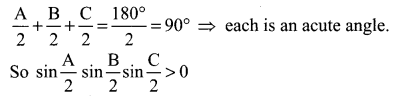
When A + B + C = 180°
Samacheer Kalvi 11th Maths Solutions Chapter 3 Trigonometry Ex 3.12 82
When A + B + C = 180° each angle will be lesser than 180°
So sin A, sin B, sin C > 0
⇒ sin A sin B sin C > 0
So both (i) and (ii) are true

Samacheer Kalvi 11th Maths Solutions Chapter 3 Trigonometry Ex 3.11

You can Download Samacheer Kalvi 11th Maths Book Solutions Guide Pdf, Tamilnadu State Board help you to revise the complete Syllabus and score more marks in your examinations.

Tamilnadu Samacheer Kalvi 11th Maths Solutions Chapter 3 Trigonometry Ex 3.11

Question 1.
Samacheer Kalvi 11th Maths Solutions Chapter 3 Trigonometry Ex 3.11 1
Solution:
Samacheer Kalvi 11th Maths Solutions Chapter 3 Trigonometry Ex 3.11 2
Samacheer Kalvi 11th Maths Solutions Chapter 3 Trigonometry Ex 3.11 3

Samacheer Kalvi 11th Maths Solutions Chapter 3 Trigonometry Ex 3.11

Question 2.
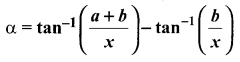
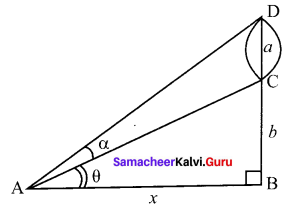
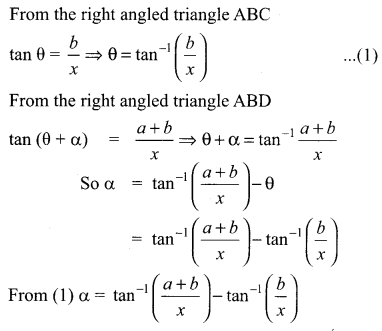
A man standing directly opposite to one side of a road of width x meter views a circular shaped traffic green signal of diameter a meter on the other side of the road. The bottom of the green signal is b meter height from the horizontal level of viewer’s eye. If a denotes the angle subtended by the diameter of the green signal at the viewer’s eye, then prove that
Samacheer Kalvi 11th Maths Solutions Chapter 3 Trigonometry Ex 3.11 4
Solution:
Samacheer Kalvi 11th Maths Solutions Chapter 3 Trigonometry Ex 3.11 5
Samacheer Kalvi 11th Maths Solutions Chapter 3 Trigonometry Ex 3.11 6

Samacheer Kalvi 11th Maths Solutions Chapter 3 Trigonometry Ex 3.11 Additional Questions

Question 1.
Samacheer Kalvi 11th Maths Solutions Chapter 3 Trigonometry Ex 3.11 7
Solution:
Samacheer Kalvi 11th Maths Solutions Chapter 3 Trigonometry Ex 3.11 8
Samacheer Kalvi 11th Maths Solutions Chapter 3 Trigonometry Ex 3.11 9

Question 2.
Samacheer Kalvi 11th Maths Solutions Chapter 3 Trigonometry Ex 3.11 10
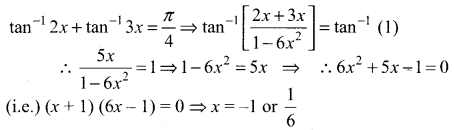
Solution:
Samacheer Kalvi 11th Maths Solutions Chapter 3 Trigonometry Ex 3.11 19
The negative value of x is rejected since it makes RHS negative
∴ x = \(\frac{1}{6}\)

Question 3.
Samacheer Kalvi 11th Maths Solutions Chapter 3 Trigonometry Ex 3.11 12
Solution:
Samacheer Kalvi 11th Maths Solutions Chapter 3 Trigonometry Ex 3.11 13

Samacheer Kalvi 11th Maths Solutions Chapter 3 Trigonometry Ex 3.11

Question 4.
Samacheer Kalvi 11th Maths Solutions Chapter 3 Trigonometry Ex 3.11 14
Solution:
Samacheer Kalvi 11th Maths Solutions Chapter 3 Trigonometry Ex 3.11 15
Samacheer Kalvi 11th Maths Solutions Chapter 3 Trigonometry Ex 3.11 16

Question 5.
Samacheer Kalvi 11th Maths Solutions Chapter 3 Trigonometry Ex 3.11 17
Solution:
Samacheer Kalvi 11th Maths Solutions Chapter 3 Trigonometry Ex 3.11 18

Samacheer Kalvi 11th Maths Solutions Chapter 3 Trigonometry Ex 3.10

You can Download Samacheer Kalvi 11th Maths Book Solutions Guide Pdf, Tamilnadu State Board help you to revise the complete Syllabus and score more marks in your examinations.

Tamilnadu Samacheer Kalvi 11th Maths Solutions Chapter 3 Trigonometry Ex 3.10

Question 1.
Determine whether the following measurements produce one triangle, two triangles or no triangle:
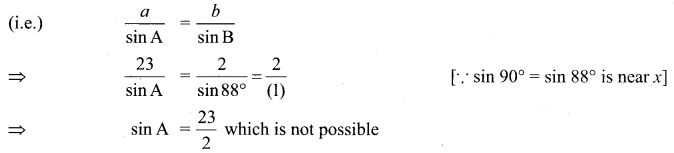
∠B = 88°, a = 23, b = 2. Solve if solution exists.
Solution:
We are given a = 23,
b = 2, and
∠B = 88°.
So we can
Samacheer Kalvi 11th Maths Solutions Chapter 3 Trigonometry Ex 3.10 1

Question 2.
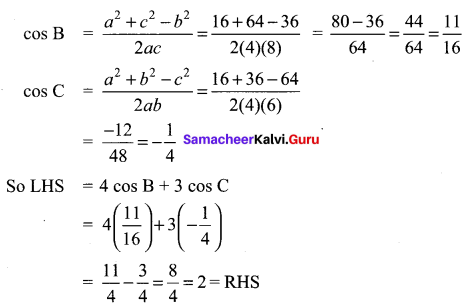
If the sides of a ∆ABC are a = 4, b = 6 and c = 8, then show that 4 cos B + 3 cos C = 2.
Solution:
a = 4,
b = 6,
c = 8
To prove 4 cos B + 3 cos C = 2
Samacheer Kalvi 11th Maths Solutions Chapter 3 Trigonometry Ex 3.10 2

Samacheer Kalvi 11th Maths Solutions Chapter 3 Trigonometry Ex 3.10

Question 3.
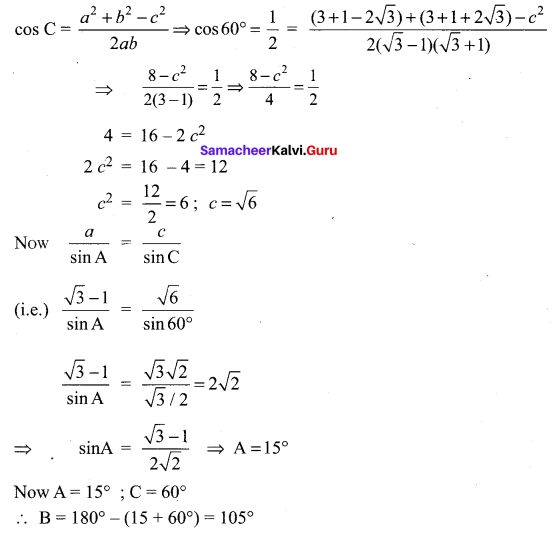
In a ∆ABC, if a = \(\sqrt{3}\) – 1, b = \(\sqrt{3}\) + 1 and C = 60°, find the other side and other two angles.
Solution:
Samacheer Kalvi 11th Maths Solutions Chapter 3 Trigonometry Ex 3.10 3

Question 4.
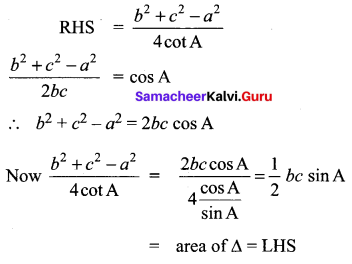
Samacheer Kalvi 11th Maths Solutions Chapter 3 Trigonometry Ex 3.10 4
Solution:
Samacheer Kalvi 11th Maths Solutions Chapter 3 Trigonometry Ex 3.10 5

Question 5.
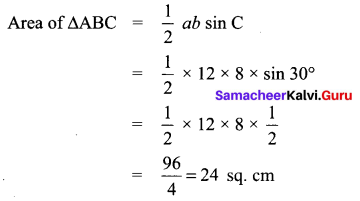
In a ∆ABC, if a = 12 cm, b = 8 cm and C = 30°, then show that its area is 24 sq.cm.
Solution:
a = 12 cm,
b = 8 cm,
C = 30°
Samacheer Kalvi 11th Maths Solutions Chapter 3 Trigonometry Ex 3.10 6

Question 6.
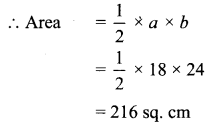
In a ∆ABC, if a = 18 cm, b = 24 cm and c = 30 cm, then show that its area is 216 sq.cm.
Solution:
a = 18 cm,
b = 24 cm,
c = 30 cm
The sides form a right angled triangle
Samacheer Kalvi 11th Maths Solutions Chapter 3 Trigonometry Ex 3.10 7

Samacheer Kalvi 11th Maths Solutions Chapter 3 Trigonometry Ex 3.10

Question 7.
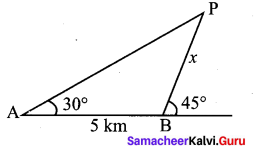
Two soldiers A and B in two different underground bunkers on a straight road, spot an intruder at the top of a hill. The angle of elevation of the intruder from A and B to the ground level in the eastern direction are 30° and 45° respectively. If A and B stand 5 km apart, find the distance of the intruder from B.
Solution:
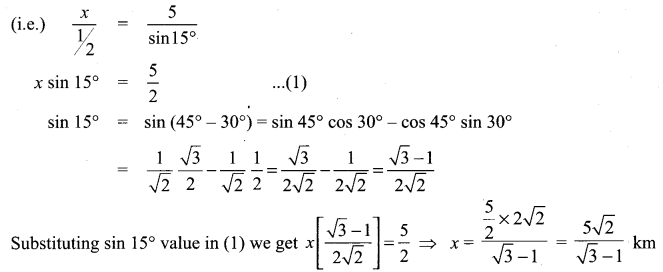
By using sine formula
\(\frac{x}{\sin 30^{\circ}}=\frac{5}{\sin 15^{\circ}}\)
Samacheer Kalvi 11th Maths Solutions Chapter 3 Trigonometry Ex 3.10 8
Samacheer Kalvi 11th Maths Solutions Chapter 3 Trigonometry Ex 3.10 9

Question 8.
A researcher wants to determine the width of a pond from east to west, which cannot be done by actual measurement. From a point P, he finds the distance to the eastern-most point of the pond to be 8 km, while the distance to the western most point from P to be 6 km. If the angle between the two lines of sight is 60°, find the width of the pond.
Solution:
p2 = W2 + E2 – 2WE cos P
P2 = 64 + 36 – 2 × 8 × 6 × Cos 60°
Samacheer Kalvi 11th Maths Solutions Chapter 3 Trigonometry Ex 3.10 10
Samacheer Kalvi 11th Maths Solutions Chapter 3 Trigonometry Ex 3.10 11

Question 9.
Two Navy helicopters A and B are flying over the Bay of Bengal at same altitude from the sea level to search a missing boat. Pilots of both the helicopters sight the boat at the same time while they are apart 10 km from each other. If the distance of the boat from A is 6 km and if the line segment AB subtends 60° at the boat, find the distance of the boat from B.
Solution:
Samacheer Kalvi 11th Maths Solutions Chapter 3 Trigonometry Ex 3.10 12

Question 10.
A straight tunnel is to be made through a mountain. A surveyor observes the two extremities A and B of the tunnel to be built from a point P in front of the mountain. If AP = 3 km, BP = 5 km and ∠APB = 120°, then find the length of the tunnel to be built.
Solution:
p2 = a2 + b2 – 2ab cos P
p2 = 9 + 25 – 30 Cos 120°
p2 = 9 + 25 – 30 (-1/2) = 34 + 15 = 49
Samacheer Kalvi 11th Maths Solutions Chapter 3 Trigonometry Ex 3.10 13
⇒ p = \(\sqrt{49}\) = 7 km

Question 11.
A farmer wants to purchase a triangular shaped land with sides 120 feet and 60 feet and the angle included between these two sides is 60°. If the land costs ? 500 per sq.ft, find the amount he needed to purchase the land. Also find the perimeter of the land.
Solution:
Samacheer Kalvi 11th Maths Solutions Chapter 3 Trigonometry Ex 3.10 14

Samacheer Kalvi 11th Maths Solutions Chapter 3 Trigonometry Ex 3.10

Question 12.
A fighter jet has to hit a small target by flying a horizontal distance. When the target is sighted, the pilot measures the angle of depression to be 30°. If after 100 km, the target has an angle of depression of 60°, how far is the target from the fighter jet at that instant?
Solution:
Samacheer Kalvi 11th Maths Solutions Chapter 3 Trigonometry Ex 3.10 15

Question 13.
A plane is 1 km from one landmark and 2 km from another. From the planes point of view the land between them subtends an angle of 60°. How far apart are the landmarks?
Solution:
Samacheer Kalvi 11th Maths Solutions Chapter 3 Trigonometry Ex 3.10 16

Question 14.
A man starts his morning walk at a point A reaches two points B and C and finally back to A such that ∠A= 60° and ∠B = 45°, AC = 4 km in the ∆ABC. Find the total distance he covered during his morning walk.
Solution:
Samacheer Kalvi 11th Maths Solutions Chapter 3 Trigonometry Ex 3.10 17

Samacheer Kalvi 11th Maths Solutions Chapter 3 Trigonometry Ex 3.10

Question 15.
Two vehicles leave the same place P at the same time moving along two different roads. One vehicle moves at an average speed of 60 km/hr and the other vehicle moves at an average speed of 80 km/hr. After half an hour the vehicle reach the destinations A and B. If AB subtends 60° at the initial point P, then find AB.
Solution:
Samacheer Kalvi 11th Maths Solutions Chapter 3 Trigonometry Ex 3.10 18
= 900+ 1600 – 1200 = 1300
Samacheer Kalvi 11th Maths Solutions Chapter 3 Trigonometry Ex 3.10 19

Question 16.
Suppose that a satellite in space, an earth station and the centre of earth all lie in the same plane. Let r be the radius of earth and R be the distance from the centre of earth to the satellite. Let d be the distance from the earth station to the satellite. Let 30° be the angle of elevation from the earth station to the satellite. If the line segment connecting earth station and satellite subtends angle α at the centre of earth, then prove that
Samacheer Kalvi 11th Maths Solutions Chapter 3 Trigonometry Ex 3.10 200
Solution:
Samacheer Kalvi 11th Maths Solutions Chapter 3 Trigonometry Ex 3.10 20

Samacheer Kalvi 11th Maths Solutions Chapter 3 Trigonometry Ex 3.10 Additional Questions Solved

Question 1.
Given a = 8, b = 9, c = 10, find all the angles.
Solution:
Samacheer Kalvi 11th Maths Solutions Chapter 3 Trigonometry Ex 3.10 21

Samacheer Kalvi 11th Maths Solutions Chapter 3 Trigonometry Ex 3.10

Question 2.
Given a = 31, b = 42, c = 57, find all the angles.
Solution:
Since the sides are larger quantities, use half angles formulae
Samacheer Kalvi 11th Maths Solutions Chapter 3 Trigonometry Ex 3.10 22
Samacheer Kalvi 11th Maths Solutions Chapter 3 Trigonometry Ex 3.10 23

Question 3.
In a triangle ABC, A = 35° 17′ ; C = 45° 13′ ; b = 42.1 Solve the triangle
Solution:
The unknown parts are B, a, c,
B = 180 – (A + C) = 180 – (35° 17′ + 45° 13′)
= 99° 30′
To find sides, use sine formula
Samacheer Kalvi 11th Maths Solutions Chapter 3 Trigonometry Ex 3.10 25
Samacheer Kalvi 11th Maths Solutions Chapter 3 Trigonometry Ex 3.10 26
log c = log 42.1 + log sin 45° 31 – log sin 99° 30′
= 1.6243 + 1.8511 – 1.9940
= 1.4754 – 1.9940
= 1.4754 – [-1 + 0.9940] = 1.4814
⇒ c = 30.3°
Thus B = 99° 30′ ; a = 24.65° ; c = 30.3°

Samacheer Kalvi 11th Maths Solutions Chapter 3 Trigonometry Ex 3.10

Question 4.
Solve the triangle ABC if a = 5, b = 4 and C = 68°.
Solution:
To find c, use c2 = a2 + b2 – 2ab cos C
c2 = 25 + 16 – 2 × 5 × 4 cos 68°
= 41 – 40 × 0.3746 = 26.016
c = 5.1
To find the other two angles, use sine formula.
Samacheer Kalvi 11th Maths Solutions Chapter 3 Trigonometry Ex 3.10 27

Samacheer Kalvi 11th Maths Solutions Chapter 3 Trigonometry Ex 3.9

You can Download Samacheer Kalvi 11th Maths Book Solutions Guide Pdf, Tamilnadu State Board help you to revise the complete Syllabus and score more marks in your examinations.

Tamilnadu Samacheer Kalvi 11th Maths Solutions Chapter 3 Trigonometry Ex 3.9

Question 1.
Samacheer Kalvi 11th Maths Solutions Chapter 3 Trigonometry Ex 3.9 1
Solution:
Samacheer Kalvi 11th Maths Solutions Chapter 3 Trigonometry Ex 3.9 2
Samacheer Kalvi 11th Maths Solutions Chapter 3 Trigonometry Ex 3.9 3
Samacheer Kalvi 11th Maths Solutions Chapter 3 Trigonometry Ex 3.9 4

Question 2.
The angles of a triangle ABC, are in Arithmetic Progression and if b : c = \(\sqrt{3}: \sqrt{2}\), find ∠A.
Solution:
Samacheer Kalvi 11th Maths Solutions Chapter 3 Trigonometry Ex 3.9 5

Question 3.
Samacheer Kalvi 11th Maths Solutions Chapter 3 Trigonometry Ex 3.9 6
Solution:
Samacheer Kalvi 11th Maths Solutions Chapter 3 Trigonometry Ex 3.9 7
⇒ a2 + b2 – c2 = a2 ⇒ b2 – c2 = a2 – a2
⇒ b2 – c2 = 0 ⇒ b = c
∴ ∆ ABC is isosceles

Question 4.
Samacheer Kalvi 11th Maths Solutions Chapter 3 Trigonometry Ex 3.9 8
Solution:
Samacheer Kalvi 11th Maths Solutions Chapter 3 Trigonometry Ex 3.9 9
Samacheer Kalvi 11th Maths Solutions Chapter 3 Trigonometry Ex 3.9 10

Samacheer Kalvi 11th Maths Solutions Chapter 3 Trigonometry Ex 3.9

Question 5.
In a ∆ABC, prove that a cos A + b cos B + c cos C = 2a sin B sin C.
Solution:
LHS = a cos A+ 6 cos B + c cos C
Using sine formula, we get k sin A cos A + k sin B cos B + k sin C cos C k
= \(\frac{k}{2}\) [2 sin A cos A + 2 sin B cos B + 2 sin C cos C]
= \(\frac{k}{2}\) [sin 2A + sin 2B + sin 2C]
= \(\frac{k}{2}\) [2 sin (A + B) . cos (A – B) + 2 sin C . cos C]
= \(\frac{k}{2}\) [2 sin (A – B) . cos (A – B) + 2 sin C . cos C]
= \(\frac{k}{2}\) [2 sin C . cos (A – B) + 2 sin C . cos C]
= k sin C [cos(A – B) + cos C]
Samacheer Kalvi 11th Maths Solutions Chapter 3 Trigonometry Ex 3.9 55
= k sin C [cos (A – B) – cos (A + B)]
= k sin C . 2 sin A sin B
= 2k sin A . sin B sin C
= 2a sin B sin C = RHS

Question 6.
Samacheer Kalvi 11th Maths Solutions Chapter 3 Trigonometry Ex 3.9 66
Solution:
Samacheer Kalvi 11th Maths Solutions Chapter 3 Trigonometry Ex 3.9 77

Question 7.
In a ∆ ABC, prove the following.
Samacheer Kalvi 11th Maths Solutions Chapter 3 Trigonometry Ex 3.9 88
Solution:
Samacheer Kalvi 11th Maths Solutions Chapter 3 Trigonometry Ex 3.9 91
Samacheer Kalvi 11th Maths Solutions Chapter 3 Trigonometry Ex 3.9 92
Samacheer Kalvi 11th Maths Solutions Chapter 3 Trigonometry Ex 3.9 93
Samacheer Kalvi 11th Maths Solutions Chapter 3 Trigonometry Ex 3.9 94
Samacheer Kalvi 11th Maths Solutions Chapter 3 Trigonometry Ex 3.9 95
Samacheer Kalvi 11th Maths Solutions Chapter 3 Trigonometry Ex 3.9 96

Question 8.
In a ∆ABC, prove that (a2 – b2 + c2) tan B = (a2 + b2 – c2)tan C
Solution:
Samacheer Kalvi 11th Maths Solutions Chapter 3 Trigonometry Ex 3.9 14

Question 9.
An Engineer has to develop a triangular shaped park with a perimeter 120 m in a village. The park to be developed must be of maximum area. Find out the dimensions of the park.
Solution:
Given, the perimeter of triangular shaped park = 120 m
Samacheer Kalvi 11th Maths Solutions Chapter 3 Trigonometry Ex 3.9 15
All sides of a triangular part would be 40 m.
i.e., a = 40 m,
b = 40 m,
c = 40 m.

Samacheer Kalvi 11th Maths Solutions Chapter 3 Trigonometry Ex 3.9

Question 10.
A rope of length 12 m is given. Find the largest area of the triangle formed by this rope and find the dimensions of the triangle so formed.
Solution:
The largest triangle will be an equilateral triangle
Samacheer Kalvi 11th Maths Solutions Chapter 3 Trigonometry Ex 3.9 16

Question 11.
Derive Projection formula from
(i) Law of sines,
(ii) Law of cosines.
Solution:
(i) To Prove a = b cos c + c cos B
Using sine formula
RHS = b cos C + c cos B
= 2R sin B cos C + 2R sin C cos B
= 2R [sin B cos C + cos B sin C]
= 2R sin (B + C) = 2R [sin π – A)
= 2R sin A = a = LHS

(ii) To prove a = b cos c + c cos B
Using cosine formula
Samacheer Kalvi 11th Maths Solutions Chapter 3 Trigonometry Ex 3.9 50

Samacheer Kalvi 11th Maths Solutions Chapter 3 Trigonometry Ex 3.9 Additional Questions

Question 1.
Samacheer Kalvi 11th Maths Solutions Chapter 3 Trigonometry Ex 3.9 51
Solution:
Samacheer Kalvi 11th Maths Solutions Chapter 3 Trigonometry Ex 3.9 52

Question 2.
Samacheer Kalvi 11th Maths Solutions Chapter 3 Trigonometry Ex 3.9 53
Solution:
Samacheer Kalvi 11th Maths Solutions Chapter 3 Trigonometry Ex 3.9 54

Question 3.
Samacheer Kalvi 11th Maths Solutions Chapter 3 Trigonometry Ex 3.9 555
Solution:
Samacheer Kalvi 11th Maths Solutions Chapter 3 Trigonometry Ex 3.9 56
Samacheer Kalvi 11th Maths Solutions Chapter 3 Trigonometry Ex 3.9 57

Samacheer Kalvi 11th Maths Solutions Chapter 3 Trigonometry Ex 3.9

Question 4.
Samacheer Kalvi 11th Maths Solutions Chapter 3 Trigonometry Ex 3.9 58
Solution:
Samacheer Kalvi 11th Maths Solutions Chapter 3 Trigonometry Ex 3.9 59

Question 5.
Samacheer Kalvi 11th Maths Solutions Chapter 3 Trigonometry Ex 3.9 60
Solution:
Samacheer Kalvi 11th Maths Solutions Chapter 3 Trigonometry Ex 3.9 61

Samacheer Kalvi 11th Maths Solutions Chapter 3 Trigonometry Ex 3.8

You can Download Samacheer Kalvi 11th Maths Book Solutions Guide Pdf, Tamilnadu State Board help you to revise the complete Syllabus and score more marks in your examinations.

Tamilnadu Samacheer Kalvi 11th Maths Solutions Chapter 3 Trigonometry Ex 3.8

Question 1.
Find the principal solution and general solutions of the following:
Samacheer Kalvi 11th Maths Solutions Chapter 3 Trigonometry Ex 3.8 1
Solution:
Samacheer Kalvi 11th Maths Solutions Chapter 3 Trigonometry Ex 3.8 2
Samacheer Kalvi 11th Maths Solutions Chapter 3 Trigonometry Ex 3.8 3

Question 2.
Solve the following equations for which solutions lies in the interval 0° < θ < 360°
(i) sin4 = sin2x
(ii) 2 cos2 x + 1 = – 3cos x
(iii) 2 sin2 x + 1 = 3 sin x
(iv) cos 2x = 1 – 3 sin x – 3 sin x
Solution:
Samacheer Kalvi 11th Maths Solutions Chapter 3 Trigonometry Ex 3.8 4
Samacheer Kalvi 11th Maths Solutions Chapter 3 Trigonometry Ex 3.8 5
Samacheer Kalvi 11th Maths Solutions Chapter 3 Trigonometry Ex 3.8 6

Samacheer Kalvi 11th Maths Solutions Chapter 3 Trigonometry Ex 3.8

Question 3.
Solve the following equations:
(i) sin 5x – sin x = cos 3x
(ii) 2 cos2 θ + 3 sin θ – 3 = 0
(iii) cos θ + cos 3θ = 2 cos 2θ
(iv) sin θ + sin 3θ + sin 5θ = 0
(v) sin 2θ – cos 2θ – sin θ + cos θ = 0
(vi) sin θ + cos θ = \(\sqrt{3}\)
(vii) sin θ + \(\sqrt{3}\) cos θ = 1
(viii) cot θ + cosec θ = \(\sqrt{3}\)
Samacheer Kalvi 11th Maths Solutions Chapter 3 Trigonometry Ex 3.8 10
Solution:
Samacheer Kalvi 11th Maths Solutions Chapter 3 Trigonometry Ex 3.8 8
Samacheer Kalvi 11th Maths Solutions Chapter 3 Trigonometry Ex 3.8 9
Samacheer Kalvi 11th Maths Solutions Chapter 3 Trigonometry Ex 3.8 100
Samacheer Kalvi 11th Maths Solutions Chapter 3 Trigonometry Ex 3.8 11
Samacheer Kalvi 11th Maths Solutions Chapter 3 Trigonometry Ex 3.8 12
Samacheer Kalvi 11th Maths Solutions Chapter 3 Trigonometry Ex 3.8 13
Samacheer Kalvi 11th Maths Solutions Chapter 3 Trigonometry Ex 3.8 14
Samacheer Kalvi 11th Maths Solutions Chapter 3 Trigonometry Ex 3.8 15
Samacheer Kalvi 11th Maths Solutions Chapter 3 Trigonometry Ex 3.8 16

Samacheer Kalvi 11th Maths Solutions Chapter 3 Trigonometry Ex 3.8 Additional Questions

Question 1.
Solve: 2 cos2 θ + 3 sin θ = 0
Solution:
2 cos2 θ + 3 sin θ = 0
⇒ 2 (1 – sin2 θ) + 3 sin θ = 0
⇒ 2 – 2 sin2 θ + 3 sin θ = 0
⇒ -2 sin2 θ + 3 sin θ + 2 = 0
⇒ 2 sin2 θ – 3 sin θ – 2 = 0
⇒ (2 sin θ + 1)(sin θ – 2) = 0
Samacheer Kalvi 11th Maths Solutions Chapter 3 Trigonometry Ex 3.8 30

Question 2.
Solve: 2 tan θ – cot θ = -1
Solution:
2 tan θ – cot θ = -1
Samacheer Kalvi 11th Maths Solutions Chapter 3 Trigonometry Ex 3.8 31

Question 3.
Solve: tan2 θ + (1 – \(\sqrt{3}\)) = 0
Solution:
Samacheer Kalvi 11th Maths Solutions Chapter 3 Trigonometry Ex 3.8 32
Samacheer Kalvi 11th Maths Solutions Chapter 3 Trigonometry Ex 3.8 33

Question 4.
Solve: \(\sqrt{3}\) x + cos x = 2
Solution:
Samacheer Kalvi 11th Maths Solutions Chapter 3 Trigonometry Ex 3.8 34

Samacheer Kalvi 11th Maths Solutions Chapter 3 Trigonometry Ex 3.8

Question 5.
Samacheer Kalvi 11th Maths Solutions Chapter 3 Trigonometry Ex 3.8 35
Solution:
Samacheer Kalvi 11th Maths Solutions Chapter 3 Trigonometry Ex 3.8 38