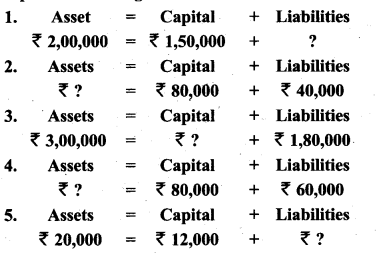
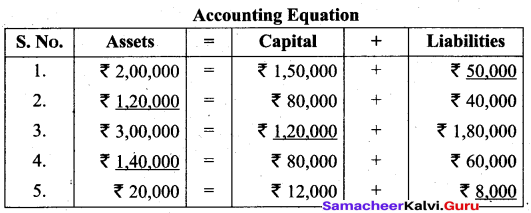
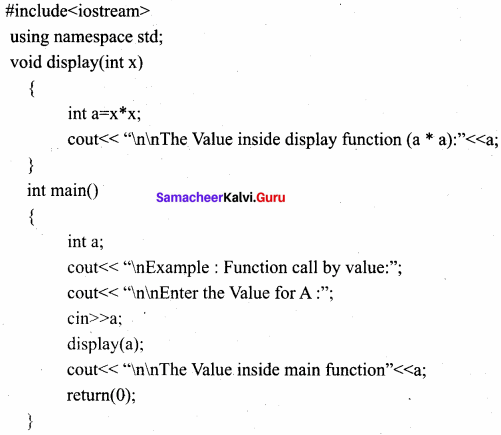
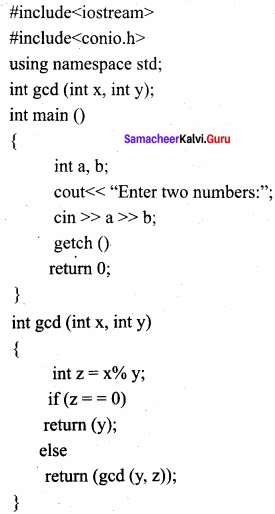
Tamil Nadu 11th Biology Model Question Paper 2 English Medium

Students can Download Tamil Nadu 11th Biology Model Question Paper 2 English Medium Pdf, Tamil Nadu 11th Biology Model Question Papers helps you to revise the complete Tamilnadu State Board New Syllabus and score more marks in your examinations.

TN State Board 11th Biology Model Question Paper 2 English Medium

Instructions:

  1. The question paper comprises of four parts Questions for Botany and Zoology are asked separately.
  2. You are to attempt all the parts. An internal choice of questions is provided wherever applicable.
  3. All questions of Part I, II, III, and IV are to be attempted separately.
  4. Question numbers 1 to 8 in Part I are Multiple Choice Questions of one mark each. These are to be answered by choosing the most suitable answer from the given four alternatives and Writing the option code and the Corresponding answer.
  5. Question numbers 9 to  4 in Part II are two-marks questions. This also is answered in about one or list sentences.
  6. Question numbers 15 to 19 in Part III are three-marks questions These are to be answered in about three to five short sentences.
  7. Question numbers 20 and 21 in Part  IV are five-marks questions. These are to be answered in detail Draw diagrams wherever necessary.

Time: 3 Hours
Maximum Marks: 70

Bio-Botany [Maximum Marks: 35]

Part – I

Answer all the questions. Choose the correct answer.  [8 × 1 = 8]

Question 1.
Which one of the following statement about virus is correct?
(a) Possess their own metabolic system
(b) They are facultative parasites
(c) They contain DNA or RNA
(d) Enzymes are present
Answer:
(c) They contain DNA or RNA

Tamil Nadu 11th Biology Model Question Paper 2 English Medium

Question 2.
An example of colonial algae is…………………….
(a) Chlorella
(b) Volvox
(c) Ulothrix
(d) Spirogyra
Answer:
(b) Volvox

Question 3.
In Artabotrys, ……………………….is modified into hook.
(a) leaflets
(b) inflorescence axis
(c) petiole
(d) axillary buds
Answer:
(b) inflorescence axis

Question 4.
In china rose the flower are……………………….
(a) Actinomorphic. Epigynous with valvate aestivation
(b) Zygomorphic, hypogynous with imbricate aestivation
(c) Zygomorphic, epigynous with twisted aestivation
(d) Actinomorphic, hypogynous with twisted aestivation
Answer:
(d) Actinomorphic, hypogynous with twisted aestivation

Question 5.
Terminalisation of chiasmata occurs at ……………..
(a) Zygotene
(b) Leptotene
(c) Diakinesis
(d) Pachytene
Answer:
(c) Diakinesis

Tamil Nadu 11th Biology Model Question Paper 2 English Medium

Question 6.
The study of tissues is called as………………..
(a) Anatomy
(b) Cytology
(c) Histology
(d) Embryology
Answer:
(c) Histology

Question 7.
Identify the wrong statement(s).
(i) Molybdenum is a micronutrient.
(ii) Carbon, Hydrogen, Nitrogen are skeletal elements.
(iii) Manganese is the activator for RUBP carboxylase.
(iv) Potassium maintains osmotic potential of the cell.
(a) (i) and (iv)
(b) (ii) and (iii)
(c) Only (if)
(d) Only (iv)
Answer:
(b) (ii) and (iii)

Tamil Nadu 11th Biology Model Question Paper 2 English Medium

Question 8.
Foolish seedling disease affects ………………….
(a) Maize
(b) Rice
(c) Sorghum
(d) Wheat
Answer:
(b) Rice

Part – II

Answer any four of the following questions. [4 × 2 = 8]

Question 9.
Deuteromycetes are imperfect fungi – Justify.
Answer:
The fungi belonging to Deuteromycetes lack sexual reproduction and are called imperfect fungi.

Question 10.
Why bryophytes are called as Non-vascular cryptogam?
Answer:
Vascular tissue like xylem and phloem are completely absent in bryophytes, hence called as ‘Non-vascular cryptogams’.

Tamil Nadu 11th Biology Model Question Paper 2 English Medium

Question 11.
What are root stocks? What are its function?
Answer:
Perennial and some biennial herbs have underground stems, which are generally known as root stocks. Root stock functions as a storage and protective organ.

Question 12.
Define Cladogram.
Answer:
The outcome of a cladistic analysis is a cladogram, a tree-shaped diagram that represent the best hypothesis of phylogenetic relationships.

Tamil Nadu 11th Biology Model Question Paper 2 English Medium

Question 13.
Mention the drawbacks of diffusion.
Answer:
In diffusion, there is a lack of control over the transport of selective molecules. There is a possibility of harmful substances entering the cell by a concentration gradient.

Question 14.
What is Phytol tail? Mention its role.
Answer:
a. Phytol tail is the lipophilic tail of chlorophyll molecule.
b. It helps in anchoring the chlorophyll to lamellae.

Part – III

Answer any three questions in which question number 19 is compulsory. [3 × 3 = 9]

Question 15.
State the 3 types of viral symmetry.
Answer:

  1. Cuboid symmetry – Example: Adenovirus and Herpes virus.
  2. Helical symmetry – Example: Influenza virus and TMV.
  3. Complex or Atypical – Example: Bacteriophage and Vaccinia virus.

Question 16.
What is the importance of inflorescence.
Answer:
Function of inflorescence is to display the flowers for effective pollination and facilitate seed dispersal. The grouping of flowers in one place gives a better attraction to the visiting pollinators and maximize the energy of the plant.

Tamil Nadu 11th Biology Model Question Paper 2 English Medium

Question 17.
Write a brief note on Manganese toxicity.
Answer:
Increased Concentration of Manganese will prevent the uptake of Fe and Mg, prevent translocation of Ca to the shoot apex and cause their deficiency. The symptoms of manganese toxicity are appearance of brown spots surrounded by chlorotic veins.

Question 18.
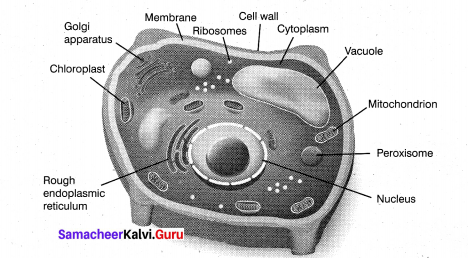
Draw the ultra structure of Plant Cell.
Answer:
Tamil Nadu 11th Biology Model Question Paper 2 English Medium - 1

Question 19.
Mention the role of ethylene in agriculture field.
Answer:

  • Ethylene normally reduces flowering in plants except in Pine apple and Mango.
  • It increases the number of female flowers and decreases the number of male flowers.
  • Ethylene spray in cucumber crop produces female flowers and increases the yield.

Part – IV

Answer all the questions. [2 × 5 = 10]

Question 20.
Explain the various phases in Cell Cycle.
Answer:
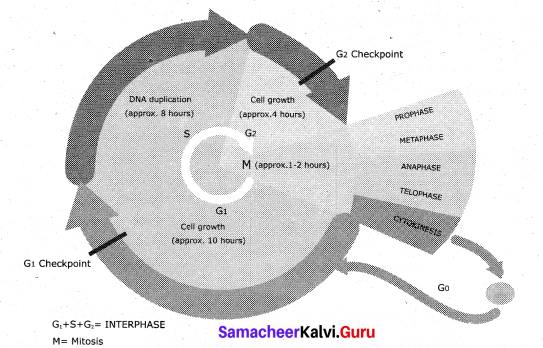
The different phases of cell cycle are as follows:
Interphase: Longest part of the cell cycle, but it is of extremely variable length. At first glance the nucleus appears to be resting but this is not the case at all. The chromosomes previously visible as thread like structure, have dispersed. Now they are actively involved in protein synthesis, at least for most of the interphase.
C-Value is the amount in picograms of DNA contained within a haploid nucleus.

G1 Phase: The first gap phase – 2C amount of DNA in cells of G1 The cells become metabolically active and grows by producing proteins, lipids, carbohydrates and cell organelles including mitochondria and endoplasmic reticulum. Many checkpoints control the cell cycle. The checkpoint called the restriction point at the end of G1 it determines a cells fate whether it will continue in the cell cycle and divide or enter a stage called G0 as a quiescent stage and probably as specified cell or die. Cells are arrested in G1 due to:

Nutrient deprivation: Lack of growth factors or density dependant inhibition.
Undergo metabolic changes and enter into G0 state.

Biochemicals inside cells activates the cell division. The proteins called kinases and cyclins activate genes and their proteins to perform cell division. Cyclins act as major checkpoint which operates in G0 to determine whether or not a cell divides.

G0 Phase: Some cells exit G1 and enters a quiescent stage called G0 , where the cells remain metabolically active without proliferation. Cells can exist for long periods in G0 phase. In G0 cells cease growth with reduced rate of RNA and protein synthesis. The G0 phase is not permanent. Mature neuron and skeletal muscle cell remain permanently in G0. Many cells in animals remains in G0 unless called on to proliferate by appropriate growth factors or other extracellular signals. G0 cells are not dormant.

S phase – Synthesis phase – cells with intermediate amounts of DNA.
Growth of the cell continues as replication of DNA occur, protein molecules called histones are synthesised and attached to the DNA. The centrioles duplicate in the cytoplasm. DNA content increases from 2C to 4C.

G2 – The second Gap phase – 4C amount of DNA in cells of G2 and mitosis Cell growth continues by protein and cell organelle synthesis, mitochondria and chloroplasts divide. DNA content remains as 4C. Tubulin is synthesised and microtubules are formed. Microtubles organise to form spindle fibre. The spindle begins to form and nuclear division follows.

One of the proteins synthesized only in the G2 period is known as Maturation Promoting Factor (MPF). It brings about condensation of interphase chromosomes into the mitotic form.

DNA damage checkpoints operates in G1 S and G2 phases of the cell cycle.
Tamil Nadu 11th Biology Model Question Paper 2 English Medium - 2

Tamil Nadu 11th Biology Model Question Paper 2 English Medium

[OR]

Explain in detail about the various life cycle patterns in plants.
Answer:
Life cycle patterns in plants
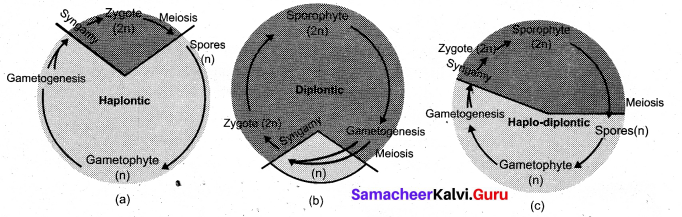
Alternation of Generation: Alternation of generation is common in all plants. Alternation of the haploid gametophytic phase (n) with diploid sporophytic phase (2n) during the life cycle is called alternation of generation. Following type of life cycles are found in plants.

a. Haplontic life cycle:
Gametophytic phase is dominant, photosynthetic and independent, whereas sporophytic phase is represented by the zygote. Zygote undergoes meiosis to restore haploid condition. Example: Volvox and Spirogyra.

b. Diplontic life cycle:
Sporophytic phase (2n) is dominant, photosynthetic and independent. The gametophytic phase is represented by the single to few celled gametophyte. The gametes fuse to form zygote which develops into sporophyte. e.g., Fucus, gymnosperms and angiosperms.

c. Haplodiplontic life cycle:
This type of life cycle is found in Bryophytes and pteridophytes which is intermediate between haplontic and diplontic type. Both the phases are multicellular, but they differ in their dominant phase. In Bryophytes dominant independent phase is gametophyte and it alternates with short-lived multicellular sporophyte totally or partially dependent on the gametophyte.
Tamil Nadu 11th Biology Model Question Paper 2 English Medium - 3

Life cycle patterns in plants (a) Haplontic, (b) Diplontic, (c) Haplo-diplontic
In Pteridophytes sporophyte is the independent phase. It alternates with multicellular saprophytic or autotrophic, independent, short lived gametophyte (n).

Tamil Nadu 11th Biology Model Question Paper 2 English Medium

Question 21.
Describe Lundegardh’s Cytochrome Pump Theory.
Answer:
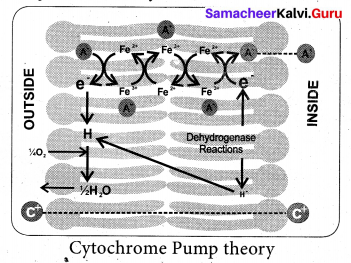
Lundegardh’s Cytochrome Pump Theory:
Lundegardh and Burstrom (1933) observed a correlation between respiration and anion absorption. When a plant is transferred from water to a salt solution the rate of respiration increases which is called as anion respiration or salt respiration. Based on this observation Lundegardh (1950 and 1954) proposed cytochrome pump theory which is based on the following assumptions:

  • The mechanism of anion and cation absorption are different.
  • Anions are absorbed through cytochrome chain by an active process, cations are absorbed passively.
  • An oxygen gradient responsible for oxidation at the outer surface of the membrane and reduction at the inner surface.

According to this theory, the enzyme dehydrogenase on inner surface is responsible for the fonnation of protons (H+) and electrons (e ). As electrons pass outward through electron transport chain there is a corresponding inward passage of anions. Anions are picked up by oxidized cytochrome oxidase and are transferred to other members of chain as they transfer the electron to the next component.

The theory assumes that cations (C+) move passively along the electrical gradient created by the accumulation of anions (A) at the inner surface of the membrane.

Main defects of the above theory are:

  1. Cations also induce respiration.
  2. Fails to explain the selective uptake of ions.
  3. It explains absorption of anions only.
Tamil Nadu 11th Biology Model Question Paper 2 English Medium - 4

[OR]

State the differences between photorespiration and dark respiration.
Answer:

Photorespiration

  1. It takes place in photosynthetic green cells.
  2. It takes place only in the presence of light.
  3. It involves chloroplast, peroxisome and mitochondria.
  4. It does not involve Glycolysis, Kreb’s Cycle, and ETS.
  5. Substrate is glycolic acid.
  6. It is not essential for survival.
  7. No phosphorylation and yield of ATP.
  8. NADH2 is oxidised to NAD+.
  9. Hydrogen peroxide is produced.
  10. End products are CO2 and PGA.

Dark respiration :

  1. It takes place in all living cells.
  2. It takes place all the time.
  3. It involves only mitochondria.
  4. It involves glycolysis, Kreb’s Cycle and ETS.
  5. Substrate is carbohydrates, protein or fats.
  6. Essential for survival.
  7. Phosphorylation produces ATP energy.
  8. NAD+ is reduced to NADH2.
  9. Hydrogen peroxide is not produced.
  10. End products are CO2 and water.

Bio-Zoology[Maximum Marks: 35]

Part – I

Answer all the questions. Choose the correct answer. [Answers are in bold] [8 × 1 = 8]

Question 1.
Turbellarians are free living……………
(a) Flatworms
(b) Trematodes
(c) Nematodes
(d) cesrtodes
Answer:
(a) Flatworms

Tamil Nadu 11th Biology Model Question Paper 2 English Medium

Question 2.
Renal portal system is absent in …………..
(a) Reptiles
(b) Amphibians
(c) Reptiles and amphibians
(d) Birds
Answer:
(d) Birds

Question 3.
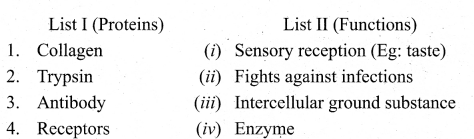
Match the List I and List II:
Tamil Nadu 11th Biology Model Question Paper 2 English Medium - 10
(a) 1 – (in), 2 – (iv), 3 – (ii), 4 – (i)
(b) 1 – (ii), 2 – (i), 3 (iv), 4 – (iii)
(c) 1 – (iii), 2 – (/), 3 – (iv), 4 – (ii)
(d) 1 – (ii), 2 – (iv), 3 – (in), 4 – (i)
Answer:
(a) 1 – (in), 2 – (iv), 3 – (ii), 4 – (i)

Question 4.
PNS stands for …………………..
(a) Peripheral neural system
(b) Primary neural system
(c) Pitutiary nephron system
(d) Peripheral nephron system
Answer:
(a) Peripheral neural system

Tamil Nadu 11th Biology Model Question Paper 2 English Medium

Question 5.
Which of the following is an correct statement?
(a) Large intestine completes digestion and absorbs nutrients.
(b) Anus expels wastes.
(c) Rectum is the openifig for waste elimination.
(d) Esophagus helps in the conduction of the food to stomach.
Answer:
(d) Esophagus helps in the conduction of the food to stomach.

Question 6.
Which of the following is an incorrect statement?
(a) Hind brain comprises of cerebellum, pons varolii and medulla oblongata.
(ft) The mid brain is located between the diencephalon and the pons.
(c) Hypothalamus forms the floor of the diencephalon.
(d) The superficial region of the cerebrum is called gyri.
Answer:
(d) The superficial region of the cerebrum is called gyri.

Question 7.
There is no DNA in ………………….
(a) Mature RBC’s
(b) Mature spermatozoa
(c) Hair root
(d) Ovum
Answer:
(a) Mature RBC’s

Question 8.
Centres for sense of smell are located in ……………………. .
(a) Cerebellum
(b) Mid brain
(c) Olfactory lobes
(d) Cerebrum
Answer:
(c) Olfactory lobes

Part – II

Answer any four of the following questions. [4 × 2 = 8]

Question 9.
What is radial symmetry?
Answer:
When any plane passing through the central axis of the body divides an organism into two identical parts, it is called radial symmetry, e.g., Cnidarian.

Question 10.
Why do you call cockroach a pest?
Answer:
Cockroach destroy food and contaminates it with their offensive odour. They are carriers of a number of bacterial diseases. The cockroach allergen can cause asthma to sensitive people.

Question 11.
Why do plants not require a digestive system?
Answer:
Plants are autotrophs. They prepare their own food using C02, H20 in the pressure of sunlight trapped by the chlorophyll pigment present in the leaves. There is no need of digestive system for plants as they use the starch as such.

Tamil Nadu 11th Biology Model Question Paper 2 English Medium

Question 12.
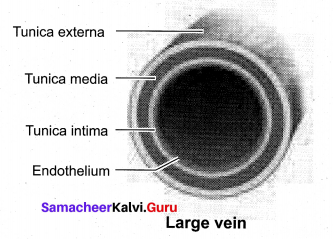
Draw the the structure of Blood Vessel – Large Vein.
Answer:
Tamil Nadu 11th Biology Model Question Paper 2 English Medium - 5

Question 13.
What are Nodes of Rannier?
Answer:
The Schwann cells covering the axen are not Continuous. There are gaps in the myelin sheath
between adjacent schwann cells. These gaps are called Nodes of Ranvier.

Question 14.
Define outbreeding.
Answer:
The breeding between unrelated animals is called outbreeding.

Part – III

Answer any three questions in which question number 19 is compulsory. [3 × 3 = 9]

Question 15.
What is Vermicompost?
Answer:
Vermicompost is the compost produced by the action of earthworms in association with all other organisms in the compost unit.

Question 16.
What is the difference between a zoo and wild life sanctuary?
Answer:

Zoo :

  1. Zoo is a place where animals and birds are in captivity of artificially created habitat.
  2. Public can have easy access to the zoo.
  3. Zoo is based on commercial aspects.
  4. Animals are caged and hence they are not free to roam about.

Wild Life Sanctuary :

  1. Wild life sanctuary is the natural habitat of wild animals and birds.
  2. Public does not have easy access to the wild life sanctuaries.
  3. Sanctuaries are non-commercial.
  4. In a sanctuary, animals can roam about freely.

Question 17.
What is lymph? Write its function.
Answer:
About 90% of fluid that leaks from capillaries eventually seeps back into the capillaries and the remaining 10% is collected and returned to blood system by means of a series of tubules known as lymph vessels or lymphatics. The fluid inside the lymphatics is called lymph.

The lymph nodes successfully prevent the invading microorganisms from reaching the blood stream. Cells found in the lymphatics are the lymphocytes. Lymphocytes collected in the lymphatic fluid are carried via the arterial blood and are recycled back to the lymph. Fats are absorbed through lymph in the lacteals present in the villi of the intestinal wall.

Tamil Nadu 11th Biology Model Question Paper 2 English Medium

Question 18.
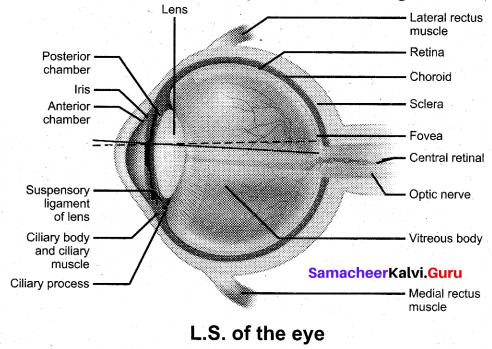
Draw the diagram of LS of the human eye and label the parts.
Answer:
Tamil Nadu 11th Biology Model Question Paper 2 English Medium - 6

Question 19.
What are the main duties of a worker bee?
Each worker has to perform different types of work in her life time. During the first half of her life, she becomes a nurse bee attending to indoor duties such as secretion of royal jelly, prepares beebread to feed the larvae, feeds the queen, takes care of the queen and drones, secretes bees wax, builds combs, cleans and fans the bee hive. Then she becomes a soldier and guards the bee hive. In the second half her life lasting for three weeks, she searches and gathers the pollen, nectar, propolis and water. –

Part – IV

Answer all the questions. [2 × 5 = 10]

Question 20.
Draw the flowchart of classification of phylum chordata.
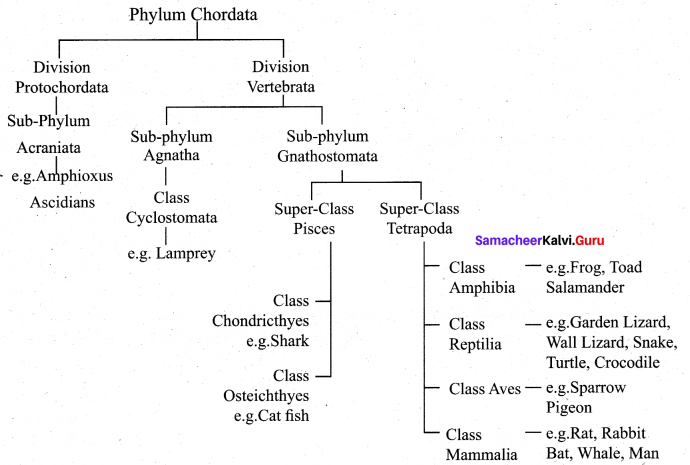
Tamil Nadu 11th Biology Model Question Paper 2 English Medium - 7

Tamil Nadu 11th Biology Model Question Paper 2 English Medium

[OR]

Describe the life cycle of Lampito mauritii.
Answer:
Lampito mauritii begins its life cycle, from the fertilized eggs. The eggs are held in a protective cocoon. These cocoons have an incubation period of about 14-18 days after which they hatch to release juveniles The juveniles undergo changes into non-clitellate forms in Phase -1 after about 15 days, which then cocoon develops a clitellum, called the clitellate at the end of the growth phase – II taking 15¬17 days to complete. During the reproductive stage, earthworms copulate, and later shed their cocoons in the soil after about 10 days.
The life cycle of Lampito mauritii takes about 60 days to complete.
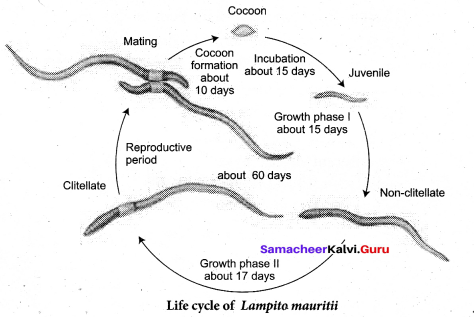
Tamil Nadu 11th Biology Model Question Paper 2 English Medium - 8

Tamil Nadu 11th Biology Model Question Paper 2 English Medium

Question 21.
Explain the structure of Nephron.
Answer:
Each kidney has nearly one million complex tubular structures called nephron. Each nephron consists of a filtering corpuscle called renal corpuscle (malpighian body) and a renal tubule. The renal tubule opens into a longer tubule called the collecting duct. The renal tubule begins with a double walled cup shaped structure called the Bowman’s capsule, which encloses a ball of capillaries that delivers fluid to the tubules, called the glomerulus. The Bowman’s capsule and the glomerulus together constitute the renal corpuscle.

The endothelium of glomerulus has many pores (fenestrae). The external parietal layer of the Bowman’s capsule is made up of simple squamous epithelium and the visceral layer is made of epithelial cells called podocytes. The podocytes end in foot processes which cling to the basement membrane of the glomerulus. The openings between the foot processes are called filtration slits.

The renal tubule continues further to form the proximal convoluted tubule [PCT] followed by a U-shaped loop of Henle (Henle’s loop) that has a thin descending and a thick ascending limb. The ascending limb continues as a highly coiled tubular region called the distal convoluted tubule [DCT], The DCT of many nephrons open into a straight tube called collecting duct.

The collecting duct runs through the medullary pyramids in the region of the pelvis. Several collecting ducts fuse to form papillary duct that delivers urine into the calyces, which opens into the renal pelvis.

In the renal tubules, PCT and DCT of the nephron are situated in the cortical region of the kidney whereas the loop of Henle is in the medullary region. In majority of nephrons, the loop of Henle is too short and extends only very little into the medulla and are called cortical nephrons. Some nephrons have very long loop of Henle that run deep into the medulla and are called juxta medullary nephrons (JMN).

The capillary bed of the nephrons- First capillary bed of the nephron is the glomerulus and the other is the peritubular capillaries. The glomerular capillary bed is different from other capillary beds in that it is supplied by the afferent and drained by the efferent arteriole. The efferent arteriole that comes out of the glomerulus forms a fine capillary network around the renal tubule called the peritubular capillaries.

The efferent arteriole serving the juxta medullary nephron forms bundles of long straight vessel called vasa recta and runs parallel to the loop of Henle. Vasa recta is absent or reduced in cortical nephrons.
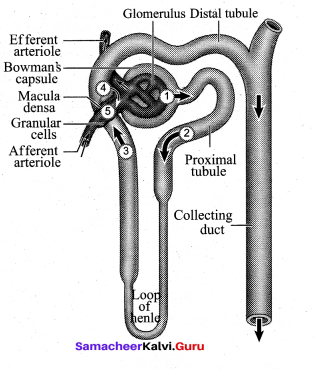
Tamil Nadu 11th Biology Model Question Paper 2 English Medium - 9

Tamil Nadu 11th Biology Model Question Paper 2 English Medium

[OR]

Explain the endoerenal function of gonads.
Answer:
Testis: A pair of testis is present in the scrotal sac of males. The testis functions as a sex organ and also as an endocrine gland. The testis is composed of seminiferous tubules and interstitial cells or Leydig cells. The Leydig cells secrete several male sex hormones, collectively called androgens, mainly testosterone.

Functions of testosterone: Under the influence of FSH and LH, testosterone initiates maturation of male reproductive organs, and the appearance of secondary sexual characters, muscular growth, growth of facial and axillary hair, masculine voice and male sexual behaviour. It enhances the total bone matrix and plays a stimulating role in the process of . spermatogenesis.

Ovary: Females have a pair of ovaries located in the pelvic region of the abdomen. The ovary is composed of ovarian follicles and stromal tissues.lt produces the eggs or ova. The ovaries secrete the steroid hormones oestrogen and progesterone. Oestrogen is responsible for the maturation of reproductive organs and the development of secondary sexual characters at puberty. Along with progesterone, oestrogens promotes breast development and initiate the cyclic changes during menstrual cycle.

Progesterone prepares the uterus for implantation of the fertilized ovum.lt decreases the uterine contraction during pregnancy and stimulates the development of mammary glands and milk secretion. It is responsible for premenstrual changes in the uteris and is essential for the formation of placenta.
Samacheer Kalvi 11th Computer Science Solutions Chapter 10 Flow of Control

Students can Download Computer Science Chapter 10 Flow of Control Questions and Answers, Notes Pdf, Samacheer Kalvi 11th Computer Science Book Solutions Guide Pdf helps you to revise the complete Tamilnadu State Board New Syllabus and score more marks in your examinations.

Tamilnadu Samacheer Kalvi 11th Computer Science Solutions Chapter 10 Flow of Control

Samacheer Kalvi 11th Computer Science Flow of Control Text Book Back Questions and Answers

PART – 1
I. Choose The Correct Answer

Question 1.
What is the alternate name of null statement?
(a) No statement
(b) Empty statement
(c) Void statement
(d) Zero statement
Answer:
(b) Empty statement

Question 2.
In C++, the group of statements should enclosed within:
(a) { }
(b) []
(c) ()
(d) <>
Answer:
(a) { }

Samacheer Kalvi 11th Computer Science Solutions Chapter 10 Flow of Control

Question 3.
The set of statements that are executed again and again in iteration is called as:
(a) condition
(b) loop
(c) statement
(d) body of loop
Answer:
(d) body of loop

Question 4.
The multi way branching statement:
(a) if
(b) if … else
(c) switch
(d) for
Answer:
(c) switch

Question 5.
How many types of iteration statements exist?
(a) 2
(b) 3
(c) 4
(d) 5
Answer:
(b) 3

Question 6.
How many times the following loop will execute? for (int i = 0; i < 10; i++)
(a) 0
(b) 10
(c) 9
(d) 11
Answer:
(b) 10

Question 7.
Which of the following is the exit control loop?
(a) for
(b) while
(c) do … while
(d) if … else
Answer:
(c) do … while

Samacheer Kalvi 11th Computer Science Solutions Chapter 10 Flow of Control

Question 8.
Identify the odd one from the keywords of jump statements:
(a) break
(b) switch
(c) goto
(d) continue
Answer:
(a) break

Question 9.
A loop that contains another loop inside its body:
(a) Nested loop
(b) Inner loop
(c) Inline loop
(d) Nesting of loop
Answer:
(a) Nested loop

PART – 2
II. Answers to all the questions

Question 1.
What is a null statement and compound statement?
Answer:
Null statement:
The “null or empty statement” is a statement containing only a semi colon. It takes the following form:
;// it is a null statement.
Null statement are commonly used as place holders in iteration statements or as statements on which to place labels at the end of compound statements or functions.

Compound statement:
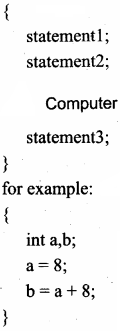
C++ allows a group of statements enclosed by pair of braces { }. This group of statements is called as a compound statement or a block.
The general format of compound statement is:
Samacheer Kalvi 11th Computer Science Solutions Chapter 10 Flow of Control 1

Question 2.
What is selection statement? Write it’s types.
Answer:
The selection statement means the statements are executed depends – upon a condition. If a condition is true, a true block (a set of statements) is executed, otherwise a false block is executed. This statement is also called decision statement or selection statement because it helps in making decision about which set of statements are to be executed.

Types:

  1. Two way branching
  2. Multiway branching

Question 3.
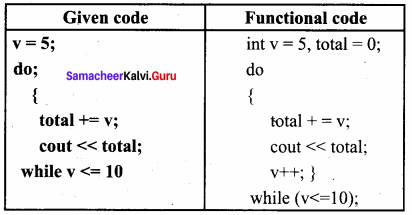
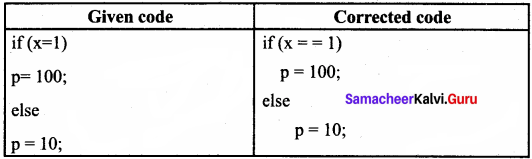
Correct the following code segment:
Answer:
Samacheer Kalvi 11th Computer Science Solutions Chapter 10 Flow of Control 2

Question 4.
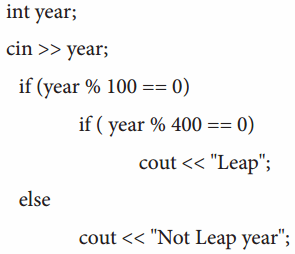
What will be the output of the following code:
Samacheer Kalvi 11th Computer Science Solutions Chapter 10 Flow of Control 3
If the input given is

  1. 2000
  2. 2003
  3. 2010?

Answer:
1. Output
(Input = 2000)
Leap

2. Output
(Input = 2003)
Not leap Year

3. Output (Input = 2010)
Not leap Year

Question 5.
What is the output of the following code?
for (int i = 2; i < = 10 ; i + = 2)
cout<<i;
Answer:
Output:
2 4 6 8 10

Samacheer Kalvi 11th Computer Science Solutions Chapter 10 Flow of Control

Question 6.
Write a for loop that displays the number from 21 to 30.
Answer:
# include
using namespace std;
int main()
{

for (int = 21; i < 31; i++)
cout << “value of i:” << i << endl;
return 0;
}
Output:
Value of i: 21
Value of i: 22
Value of i: 23
Value of i: 24
Value of i: 25
Value of i: 26
Value of i: 27
Value of i: 28
Value of i: 29
Value of i: 30

Question 7.
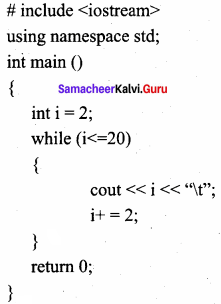
Write a while loop that displays numbers 2,4, 6, 8 ……………… 20.
Answer:
Samacheer Kalvi 11th Computer Science Solutions Chapter 10 Flow of Control 4
Output:
2 4 6 8 10 12 13 14 16 18 20

Question 8.
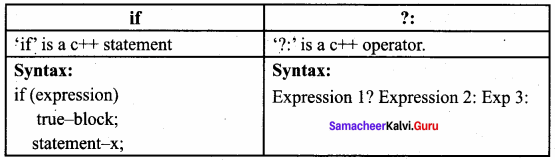
Compare an if and a? : operator.
Answer:
Samacheer Kalvi 11th Computer Science Solutions Chapter 10 Flow of Control 5

PART – 3 III.
III. Answers to all the questions Question

Question 1.
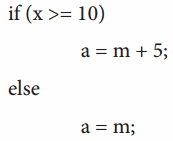
Convert the following if – else to a single conditional statement:
Samacheer Kalvi 11th Computer Science Solutions Chapter 10 Flow of Control 7
Answer:
a = (x> =10)? m + 5:m;

Question 2.
Rewrite the following code so that it is functional:
Answer:
Samacheer Kalvi 11th Computer Science Solutions Chapter 10 Flow of Control 6

Question 3.
Write a C++ program to print multiplication table of a given number.
Answer:
# include
using namespace std;
int main ()
{

int num;
cout << “Enter Number to find its multiplication table”; cin >> num;
for (int a = 1; a < = 10; a++)
{
cout << num << “*” << a << “=” << num*a << endl;
}
return( );

}

Question 4.
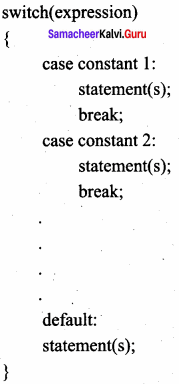
Write the syntax and purpose of switch statement.
Answer:
The switch statement is a multi – way branch statement. It provides an easy way to dispatch execution to different parts of code based on the value of the expression. The switch statement replaces multiple if – else sequence.
The syntax of the switch statement is;
Samacheer Kalvi 11th Computer Science Solutions Chapter 10 Flow of Control 8

Question 5.
Write a short program to print following series:
(a) 1 4 7 10 …… 40
Answer:
# include
using namespace std;
int main ()
{

cout << “\n PRINT SERIES” ;
for (int i = 1; i< 40; i = i + 3)
cout << i << “1+”;
cin.get();
return ();
}

PART – 4
IV. Answers to all the questions

Question 1.
Explain control statement with suitable example.
Answer:
Control statements are statements that alter the sequence of flow of instructions.
Types of control statements:
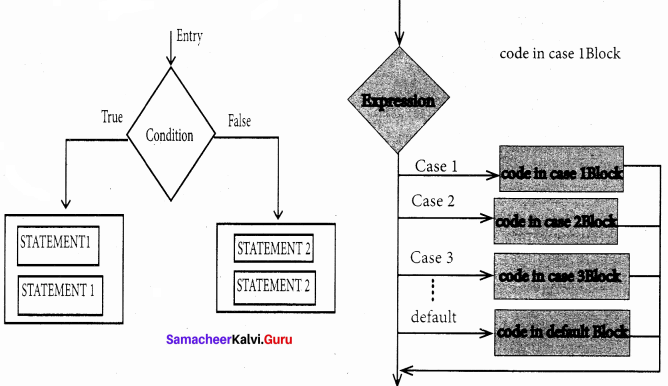
1. Selection statement:
The selection statement means the statement (s) executed, depends upon a condition. If a condition is true, a true block (a set of statements) is executed otherwise a false block is executed. This statement is also called decision statement or selection statement because it helps in making decision about which set of statements are to be executed.
Example:

  1. If
  2. Switch

Samacheer Kalvi 11th Computer Science Solutions Chapter 10 Flow of Control 9

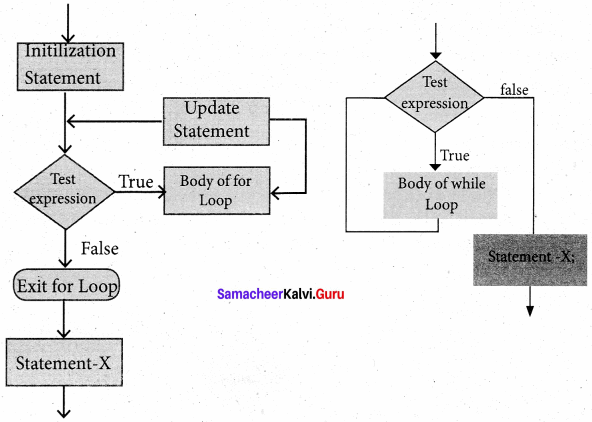
2. Iteration (or looping) statement:
An iteration (or loop) is a sequence of one or more statements that are repeatedly executed until a condition is satisfied. These statements are also called as control flow statements. It is used to reduce the length of code to reduce the time to execute program and takes less memory space.

Example:

  1. While
  2. do ….. while
  3. for

Samacheer Kalvi 11th Computer Science Solutions Chapter 10 Flow of Control 10

Question 2.
What is entry control loop? Explain any one of the entry control loop with suitable example.
Answer:
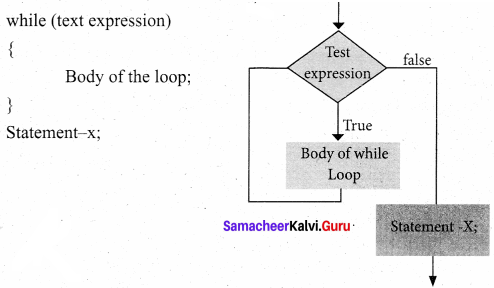
An entry control loop checks the condition at the time of entry and if condition or expression becomes true then control transfers into the body of the loop, for loop and while loop are the examples of Entry Controlled Loop. A while loop is a control flow statement that allows the loop statements to be executed as long as the condition is true.
Type: Entry control loop
Syntax:
Samacheer Kalvi 11th Computer Science Solutions Chapter 10 Flow of Control 11

Control flow:
Step 1 : Test – expression is evaluated to either True or False;
Step 2 : If test – expression is true;
(a) The body of the loop is executed.
(b) Control is transferred to step 1.
Step 3: If test – expression is false, the control exits the while loop.
Example:
int a = 1;
while (a<=10)
{

cout << a << ‘\t+’;
a+=2;

}

Output:
1 3 5 7 9

Question 3.
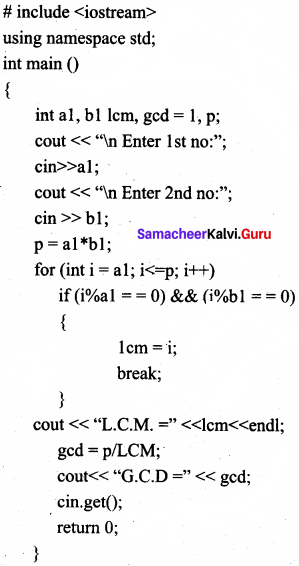
Write a program to find the LCM and GCD of two numbers.
Answer:
Samacheer Kalvi 11th Computer Science Solutions Chapter 10 Flow of Control 12

Question 4.
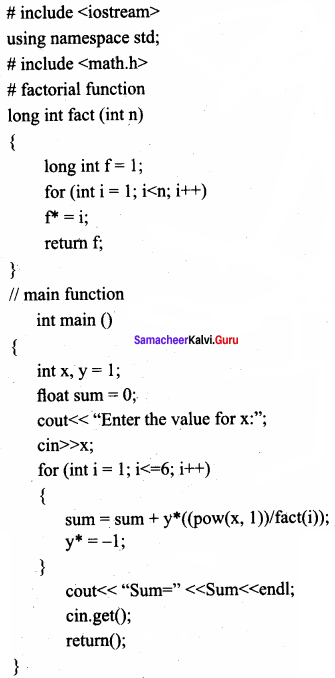
Write programs to find the sum of the following series:
(a) x – \(\frac{x^{2}}{2 !}\) + \(\frac{x^{3}}{3 !}\) + \(\frac{x^{4}}{4 !}\) + \(\frac{x^{5}}{5 !}\) – \(\frac{x^{6}}{6 !}\)
(b) x + \(\frac{x^{2}}{2}\) + \(\frac{x^{3}}{3}\) + ……… + \(\frac{x^{n}}{n}\)
Answer:
(a)
Samacheer Kalvi 11th Computer Science Solutions Chapter 10 Flow of Control 13

(b) # include
using namespace std;
# include int main()
{

int M, L;
float sum = 0;
cout << “Enter the value for M:”; cin >> M;
cout << “Enter the number of terms”; cin >> L;
for (int i = 1; i<=m; i++)
sum = Sum + Pow(m,i)/i;
cout << “Sum=” << Sum << endl;
cin.get();
return 0;

}

Question 5.
Write a program to find sum of the series
S = 1 + x + x2 + ………….. + xn
Answer:
# include
using namespace std;
# include int main()
{

int x, n;
float sum = 0;
cout << “Enter the value for x:”; cin >> x;
cout << “Enter the number of terms”; cin >> n;
for (int i = 0; i<=n; i++)
sum = Sum + Pow(x,i);
cout << “Sum=” << Sum << endl;
cin.get( );
return 0;

}

Samacheer kalvi 11th Computer Science Flow of Control Additional Questions and Answers

PART – 1
I. Choose the correct answer

Question 1.
The empty statement is otherwise called as ………………..
(a) Control statement
(b) Zero statement
(c) Null statement
(d) Block statement
Answer:
(c) Null statement

Question 2.
Selection statement is also called as ………………..
(a) Decision statement
(b) Sequence statement
(c) Null statement
(d) Compound statement
Answer:
(a) Decision statement

Samacheer Kalvi 11th Computer Science Solutions Chapter 10 Flow of Control

Question 3.
Iteration statement is called as ………………..
(a) Null statement
(b) Block statement
(c) Selection statement
(d) Looping statement
Answer:
(d) Looping statement

Question 4.
In C++ any non – zero is iterated as true ……………….. and zero is treated as false.
(a) positive numbers
(b) negative numbers
(c) prime numbers
(d) none of these
Answer:
(b) negative numbers

Question 5.
……………….. is a multi – path decision making statement.
(a) if
(b) if – else
(c) else – if
(d) if – else ladder
Answer:
(d) if – else ladder

Question 6.
Syntax of the conditional operator is ………………..
(a) expression 1? expression 2: expression 3
(b) expression 1: expression 2
(c) expression 1! expression 2: expression 3
(d) expression 1: expression 2: expression 3
Answer:
(a) expression 1? expression 2: expression 3

Question 7.
……………….. is more efficient than if-else statement.
(a) Control statement
(b) Switch statement
(c) Empty statement
(d) Null statement
Answer:
(b) Switch statement

Question 8.
When a switch is a part of the statement sequence of another switch, then it is called as ………………..
(a) if – else ladder
(b) Switch statement
(c) Nested switch statement
(d) Empty statement
Answer:
(c) Nested switch statement

Samacheer Kalvi 11th Computer Science Solutions Chapter 10 Flow of Control

Question 9.
C++ supports types of iteration statements.
(a) 3
(b) 2
(c) 4
(d) 5
Answer:
(a) 3

Question 10.
Every loop has ……………….. elements that are used for different purposes.
(a) 3
(b) 4
(c) 5
(d) 2
Answer:
(b) 4

Question 11.
……………….. is used to transfer the control from one place to another place without any condition in a program.
(a) Break statement
(b) Continue statement
(c) goto statement
(d) All the above
Answer:
(c) goto statement

PART – 2
II. Short Answers

Question 1.
What is if statement? Write it’s syntax.
Answer:
The if statement evaluates a condition, if the condition is true then a true – block (a statement or set of statements) is executed, otherwise the true – block is skipped. The general syntax of the if statement is:
if (expression)
true – block;
statement – x;

Question 2.
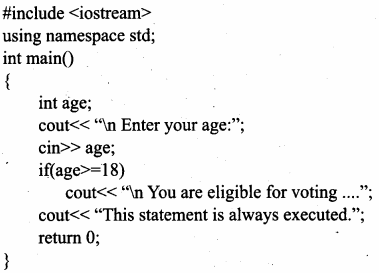
Write a program to check whether a person is eligible to vote using if statement.
C++ program to check whether a person is eligible to vote using if statement
Answer:
Samacheer Kalvi 11th Computer Science Solutions Chapter 10 Flow of Control 14
Output:
Enter your age: 23
You are eligible for voting ….
This statement is always executed.

Question 3.
What is nested if? Mention it’s types.
Answer:
An if statement contains another if statement is called nested if. The nested can have, one of the following three forms.

  1. If nested inside if part
  2. If nested inside else part
  3. If nested inside both if part and else part

Question 4.
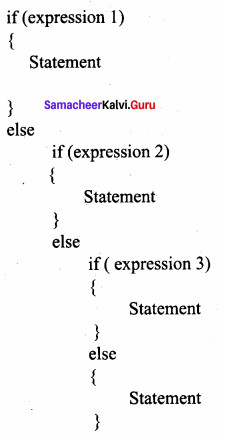
Write the syntax for if – else ladder.
Answer:
The syntax of if – else ladder:
Samacheer Kalvi 11th Computer Science Solutions Chapter 10 Flow of Control 15

Question 5.
What is nested switch statement?
Answer:
When a switch is a part of the statement sequence of another switch, then it is called as nested switch statement. The inner switch and the outer switch constant may or may not be the same.

Question 6.
What are loop elements?
Answer:
Every loop has four elements that are used for different purposes. These elements are

  1. Initialization expression
  2. Test expression
  3. Update expression
  4. The body of the loop

Question 7.
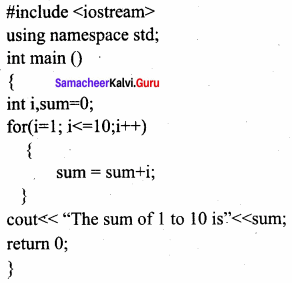
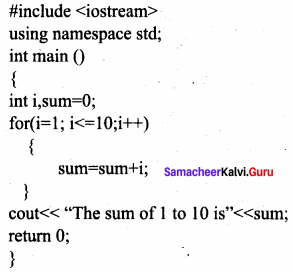
Write C++ program to sum the numbers from 1 to 10.
Answer:
C++ program to sum the numbers from 1 to 10 using for loop
Samacheer Kalvi 11th Computer Science Solutions Chapter 10 Flow of Control 16
Output:
The sum of 1 to 10 is 55

Question 8.
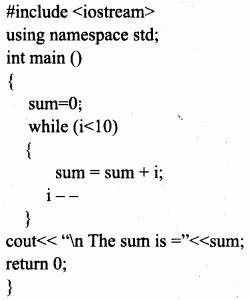
Rewrite the given program.
Answer:
C++ program to sum the numbers from 1 to 10 using for loop
Samacheer Kalvi 11th Computer Science Solutions Chapter 10 Flow of Control 17
C++ program to sum the numbers from 1 to 10 using for loop
Samacheer Kalvi 11th Computer Science Solutions Chapter 10 Flow of Control 18
Output:
The sum of 1 to 10 is 55

Question 9.
Write a program to display numbers from 1 to 10 except 6 using continue statement.
Answer:
C++ program to display numbers from 1 to 10 except 6 using continue statement
#include
using namespace std;
int main()
{
if (i = 6)
continue;
else
cout << i << ” ”
}
return 0;
}
Output:
1 2 3 4 5 7 8 9 10

Samacheer Kalvi 11th Computer Science Solutions Chapter 10 Flow of Control

Question 10.
What will be the output of the following code.
Answer:
int a, b, largest;
cout << “\n Enter any two numbers:”; cin >> a >> b;
largest = (a > b)? a:b;
cout << “\n Largest number:” << largest;
return 0;
Output:
Enter any two numbers:
5 10
Largest number: 10

PART – 3
III. Explain in Brief

Question 1.
What is sequence statements?
Answer:
The sequential statement are the statements that are executed one after another only once from top to bottom. These statements do not alter the flow of execution. These statements are called as sequential flow statements. They always end with a semicolon (;).

Question 2.
Write the syntax of nested switch statement.
Answer:
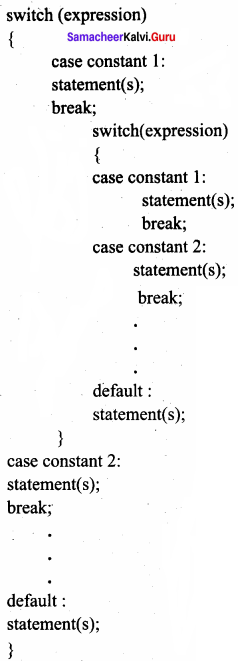
The syntax of the nested switch statement is; switch (expression)
Samacheer Kalvi 11th Computer Science Solutions Chapter 10 Flow of Control 19

Question 3.
Write short notes on Test expression.
Answer:
The test expression is an expression or condition whose value decides whether the loop – body will be executed or not. If the expression evaluates to true (i.e., 1), the body of the loop is executed, otherwise the loop is terminated. In an entry – controlled loop, the test – expression is evaluated before the entering into a loop whereas in an exit – controlled loop, the test – expression is evaluated before exit from the loop.

Samacheer Kalvi 11th Computer Science Solutions Chapter 10 Flow of Control

Question 4.
What is do – while loop? Write it’s syntax.
Answer:
The do – while loop is an exit-controlled loop. In do-while loop, the condition is evaluated at the bottom of the loop after executing the body of the loop. This means that the body of the loop is executed at least once, even when the condition evaluates false during the first iteration.
The do – while loop syntax is:
do {
Body of the loop;
} while(condition);

Question 5.
What are the differences between break and continue statement.
Answer:
Break:

  • Break is used to terminate the execution of the loop.
  • It breaks the iteration.
  • When this statement is executed, control will come out from the loop and executes the statement immediate after loop.
  • Break is used with loops as well as switch case.

Continue:

  • Continue is not used to terminate the execution of loop.
  • It skips the iteration.
  • When this statement is executed, it will not come out of the loop but moves/jumps to the next iteration of loop.
  • Continue is only used in loops, it is not used in switch case.

Question 6.
What are the important things to know about switch statement?
Answer:
There are some important things to know about switch statement. They are

  1. A switch statement can only work for quality of comparisons.
  2. No two case labels in the same switch can have identical values.
  3. If character constants are used in the switch statement, they are automatically converted to their equivalent ASCII codes.
  4. The switch statement is more efficient choice than if in a situation that supports the nature of the switch operation.

PART – 4
IV. Explain in Detail

Question 1.
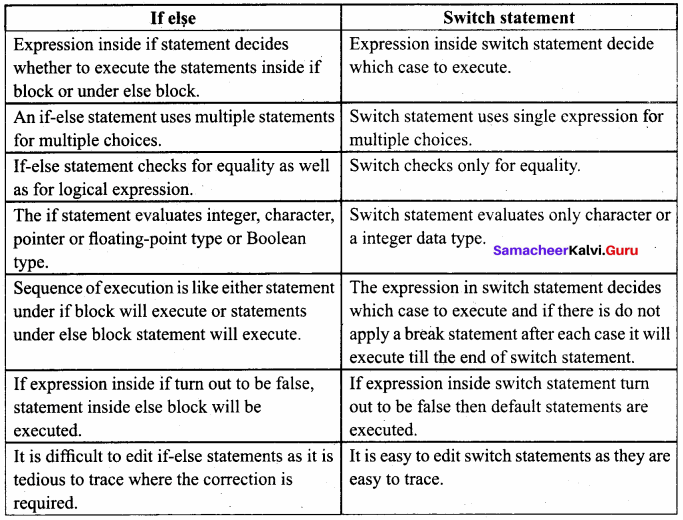
What are the key differences between if else and switch statement?
Answer:
Samacheer Kalvi 11th Computer Science Solutions Chapter 10 Flow of Control 20

Question 2.
Explain about parts of a loop.
Answer:
Every loop has four elements that are used for different purposes. These elements are:

  1. Initialization expression
  2. Test expression
  3. Update expression
  4. The body of the loop

1. Initialization expression(s) : The control variable(s) must be initialized before the control enters into loop. The initialization of the control variable takes place under the initialization expressions. The initialization expression is executed only once in the beginning of the loop.

2. Test Expression : The test expression is an expression or condition whose value decides whether the loop-body will be executed or not. If the expression evaluates to true (i.e., 1), the body of the loop is executed, otherwise the loop is terminated.

In an entry – controlled loop, the test – expression is evaluated before the entering into a loop whereas in an exit-controlled loop, the test – expression is evaluated before exit from the loop.

3. Update expression : It is used to change the value of the loop variable. This statement is executed at the end of the loop after the body of the loop is executed.

4. The body of the loop : A statement or set of statements forms a body of the loop that are executed repetitively. In an entry – controlled loop, first the test-expression is evaluated and if it is nonzero, the body of the loop is executed otherwise the loop is terminated. In an exit – controlled loop, the body of the loop is executed first then the test – expression is evaluated. If the test – expression is true the body of the loop is repeated otherwise loop is terminated.

Samacheer Kalvi 11th Computer Science Solutions Chapter 10 Flow of Control

Question 3.
Explain about jump statements.
Answer:
Jump statements are used to interrupt the normal flow of program. Types of Jump Statements are:

  1. goto statement
  2. break statement
  3. continue statement

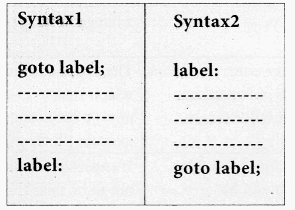
The goto statement is a control statement which is used to transfer the control from one place to another place without any condition in a program.
Samacheer Kalvi 11th Computer Science Solutions Chapter 10 Flow of Control 21
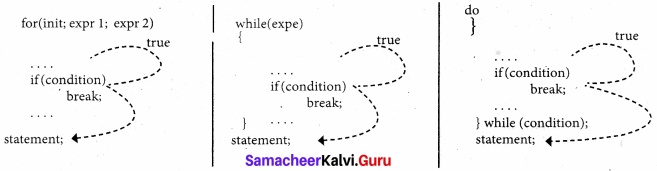
A break statement is a jump statement which terminates the execution of loop and the control is transferred to resume normal execution after the body of the loop.
Samacheer Kalvi 11th Computer Science Solutions Chapter 10 Flow of Control 22
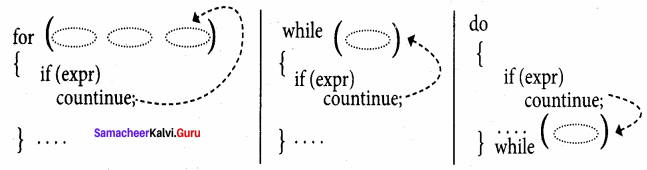
The continue statement works quite similar to the break statement. Instead of terminating the loop (break statement), continue statement forces the loop to continue or execute the next iteration. When the continue statement is executed in the loop, the code inside the loop following the continue statement will be skipped and next iteration of the loop will begin.
Samacheer Kalvi 11th Computer Science Solutions Chapter 10 Flow of Control 23

Question 4.
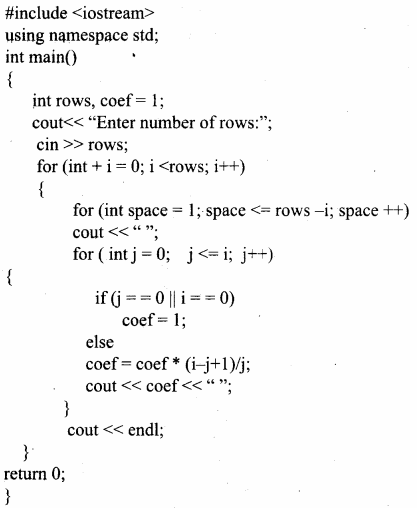
Programs to produce the following design using nested loops.
Answer:
Samacheer Kalvi 11th Computer Science Solutions Chapter 10 Flow of Control 24Output
Enter number of rows: 5
1
1 1
1 2 1
1 3 3 1
1 4 6 4 1

Samacheer Kalvi 11th Computer Applications Solutions Chapter 8 Presentation Basics (OpenOffice Impress)

Students can Download Computer Applications Chapter 8 Presentation Basics (OpenOffice Impress) Questions and Answers, Notes Pdf, Samacheer Kalvi 11th Computer Applications Book Solutions Guide Pdf helps you to revise the complete Tamilnadu State Board New Syllabus and score more marks in your examinations.

Tamilnadu Samacheer Kalvi 11th Computer Applications Solutions Chapter 8 Presentation Basics (OpenOffice Impress)

Samacheer Kalvi 11th Computer Applications Presentation Basics (OpenOffice Impress) Text Book Back Questions and Answers

I. Choose The Correct Answer

Question 1.
Which is used to move quickly from one slide to another?
(a) Compass Navigator
(b) Navigator
(c) Fill color
(d) Page border
Answer:
(b) Navigator

SamacheerKalvi.Guru

Question 2.
Which is the shortcut key to view the slideshow?
(a) F6
(b) F9
(c) F5
(d) F10
Answer:
(c) F5

Question 3.
In Impress, which views shows thumbnail versions of all your slides arranged in horizontal rows?
(a) Notes
(b) Outline
(c) Handout
(d) Slide Sorter
Answer:
(d) Slide Sorter

SamacheerKalvi.Guru

Question 4.
Identify the default view in Irhpress.
(a) normal
(b) slide sorter
(c) handout
(d) notes
Answer:
(a) normal

Question 5.
Which menu contains the Slide Transition option?
(a) Slide Show
(b) View
(c) Tools
(d) Format
Answer:
(b) View

SamacheerKalvi.Guru

Question 6.
Identify the extension of the Impress presentation.
(a) ,odp
(b) .ppt
(c) .odb
(d) ,ood
Answer:
(a) ,odp

Question 7.
In presentation tools, the entry effect as one slide replaces another slide in a slide show. Identify the option that suits after reading the statement.
(a) animation
(b) slide transition
(c) custom animation
(d) rehearse timing
Answer:
(b) slide transition

SamacheerKalvi.Guru

Question 8.
Vanya has made a presentation on “Global Warming”. She wants to progress her slide show automatically while speaks on the topic in the class. Which features of Impress would she use?
(a) Custom Animation
(b) Rehearse Timing
(c) Slide Transition
(d) Either (a) or (b)
Answer:
(d) Either (a) or (b)

II. Short Answers

Question 1.
What is the difference between a slide and a slide show?
Answer:
Slide:
A slide is a single page of a presentation. Collectively, a group of slides may be known as a slide deck.

Slideshow:
A slide show is an exhibition of a series of slides or images in an electronic device or in a projection screen. It is a collection of pages arranged in sequence that contains text and images for presenting to an audience.

SamacheerKalvi.Guru

Question 2.
How many in-built slide layouts does impress consists of?
Answer:
Twelve.

Question 3.
What do you understand by a presentation?
Answer:
A presentation software is a computer software package used to show information, in the form of a slide show.
It includes three major functions:

  1. An editor that allows the text to be inserted and formatted,
  2. A method for inserting and manipulating graphic images and
  3. A slide-show system to display the content.

SamacheerKalvi.Guru

Question 4.
Define a template in Impress?
Answer:
A impress design template is a premade design you can use to lend cohesiveness, visual organization and appeal to your presentation. It you choose the option from template, it uses a template design already created as the basis for a new presentation.

Question 5.
What do you understand by the slide layout?
Answer:
Pre-packaged layouts are shown in impress properties. You can choose the one that you want, use it as it is or modify it to suit your own requirements. At present, it is not possible to create custom layouts.

III. Explain in Brief

Question 1.
How many types of views are provided by Impress to its users?
Answer:
The view is designed to ease the completion of certain tasks.
Normal view:
Is the main view for creating individual slides. Use this view to format and design slides and to add text, graphics, and animation effects.

Outline view:
Shows topic titles, bulleted lists, and numbered lists for each slide in outline format. Use this view to rearrange the order of slides, edit titles and headings, rearrange the order of items in a list, and add new slides.

Notes view:
lets you add notes to each slide that are not seen when the presentation is shown.

Slide Sorter view:
Shows a thumbnail of each slide in order. Use this view to rearrange the order of slides, produce a timed slide show, or add transitions between selected slides.

Handout view:
Lets you print your slides for a handout. You can choose one, two, three, four, or six slides per page from Tasks pane → Layouts. Thumbnails can be re-arranged in this view by dragging and dropping them.

SamacheerKalvi.Guru

Question 2.
Who uses the presentation software and why?
Answer:

  • Presentation software are being used in a variety of different fields. Some fields that are commonly used as education, research, business communication, entertainment etc.,
  • A presentation is used while speaking to a group with a presentation to support and organize your information.
  • The presentation is to communicate an audience that the most powerful and effective ones.

Question 3.
Define the Slide Sorter view and its significance?
Answer:
Slide sorter view is to rearranged the sliders. A thumbnail of each slide in order, use this view to rearrange the order of slides, produce a timed slide show, or add transitions between selected slides. The tasks pane on the right displays four pages that allow you to specify the master slide, layout, transitions, and animation effects for the object on your slides.

SamacheerKalvi.Guru

Question 4.
What is a Normal view? Explain?
Answer:
There are two ways to place a slide in the Slide Design area of the Normal view: clicking the slide thumbnail in the Slides pane or using the Navigator. To open the Navigator, click the Navigator button in the Standard Toolbar or press Ctrl + Shift + F5 and select a slide by scrolling down the Navigator list until you find the one that you want and then double-click it.

Question 5.
How are transition effects helpful in creating an effective presentation in Impress?
Answer:
Slide transitions are the animation like effects that occur when you move from one slide to the next during a presentation, you can control the speed, add sound and customize the properties of transition effects.
Using this transition effects will keep the audience visually interested by using movements.

IV. Explain in detail

Question 1.
Valarmathi’s teacher asks her to create a presentation in OpenOffice Impress. As Valarmathi has never worked in Impress before, help her to perform the following tasks:
(i) She wants that except for the first slide, all the slides should have the same design. For this, what does she need to do?
After completing the presentation with same design for all slides, she needed for.
(a) Select Format → Page from the Menu bar on the page setup, dialog box, choose background tab.

(b) Select the type of fill you want for your background from the fine choices, None, color, gradient, hatching or bitmap. A list of choices for the selected fill type will appear → select it. Select one of the items on the list and click OK. The fill you have choosen is added to slide master then go normal view.

(c) Select the first slide then right click → select slide design then select the design in slide master, then right click, a popup menu will appear, it display ‘back ground settings for
all’ you can choose ‘No’ option. The only first slide would not appear the background design.

(ii) To easily communicate with her audience, she wants to provide them with a hard copy of the slides of the presentation. What should she create for it?
To print the presentation slides the one of the way click – “print file” icon directly in the menu bar, to sent the entire document to default pointer defined for your computer. In the print dialog box include the number of hard copies option, she needed more copies, then type that you want needed and then click ‘ok’ button.

(iii) She wants to insert some pictures and movie files in some slides. How can she do that? She has to select the slide where she want to insert picture. Once the picture has been inserted it can be formatted extensively.
Select from the menu bar: Insert → Picture → file / picture in computer.

(iv) Suggest her the view that would be the most suitable for showing the presentation to the audience.
Normal view.

(v) To make her presentation more attractive, she wants to add some effects in it. How can she do it? Suggest.
Adding special effect meAnswer:custom animation and slide transition.

  • To apply special effects to fonts. Use the font effect page. A sample of the text is displaying in the lower part of dialog box, then you can select designed font effect.
  • She can apply various graphic filters and effects to the pictures by graphic filters.
  • Slide transitions are the effects take place when one slide gives way to the next one in presentation. Click slide transition page on the task pane.
  • She can use slide animation effects.

SamacheerKalvi.Guru

Question 2.
Explain how a presentation can help a salesperson to promote his/her products?
Answer:

  1. Presentation is help a sales person to promote his / her products, explain the short presentation.
  2. Presentation will give visual video, pictures to understand a better of products.
  3. Presentation help sales person to present prospect challenges is easier.
  4. By using presentation, sales person can make audience understand easier and he can get more feedback.
  5. Sales person can explain with physical demonstration by shocking animations. It makes the audience to concentrate.

Question 3.
Sivabalan created a presentation to be shown at his school’s Annual Function. Just 5 minutes before the presentation, he noticed that he has Miss-pelt the name of the school, which is appearing in all the 30 slides of the presentation. How can he rectify this mistake in all the slides in one-shot?
Answer:
Open the presentation,

  1. On the ‘Home’ Tab → Editing → Choose → Replace option.
    Top left of the screen, then click Find → Replace option.
  2. New window pops-out. Find what box.
  3. In the find what box, you can enter the word ‘Miss-pelt school name’.
  4. Then in the replace with box enter the correct ‘school name word’ and then click ‘Replace All’ option.
  5. Now, the correct school Name will be changed in all slides.

SamacheerKalvi.Guru

Question 4.
List some advantages of using templates?
Answer:

  1. The standard templates, it is easily create colour, attractive designs for slides.
  2. Easy to modify the templates are available even we can download from Internet.
  3. Attractive designs of templates are available, it will be the audience to look up of the presentation.
  4. It creates attentive of audience.
  5. Quick customization of templates, text, fonts, pictures were available. –
  6. It have professional computer design.

Samacheer Kalvi 11th Computer Applications Presentation Basics (OpenOffice Impress) Additional Questions and Answers

I. Choose The Correct Answer

Question 1.
Which is the following software package used to show information in the form of a slide show?
(a) Presentation
(b) Spreadsheet
(c) Database
(d) Application
Answer:
(a) Presentation

SamacheerKalvi.Guru

Question 2.
The most commonly known presentation program are OpenOffice.org:
(a) powerpoint
(b) impress
(c) keynote
(d) none
Answer:
(b) impress

Question 3.
Which of the following is one of the way to start Impress?
(a) All programs → Openoffice → Impress
(b) All programs → Staroffice → Impress
(c) All programs → Office → Powerpoint
(d) All programs → Office → Presentation
Answer:
(a) All programs → Openoffice → Impress

SamacheerKalvi.Guru

Question 4.
How many types of presentation backgrounds that you provided by Impress?
(a) 15
(b) 20
(c) 25
(d) 30
Answer:
(c) 25

Question 5.
Which is you can select to start with a blank presentation?
(a) <ORIGINAL>
(b) <NEXT>
(c) <NEW>
(d) <OUTPUT>
Answer:
(a) <ORIGINAL>

SamacheerKalvi.Guru

Question 6.
Generally, presentations are created for computer screen display, that you would select the option:
(a) <ORIGINAL>
(b) <SCREEN>
(c) <NEW>
(d) <OUTPUT>
Answer:
(b) <SCREEN>

Question 7.
Which is good choice for the transition between the different slides speed?
(a) Normal
(b) Medium
(c) Fast
(d) None
Answer:
(b) Medium

Question 8.
How many parts are there main Impress Window?
(a) 1
(b) 2
(c) 3
(d) 4
Answer:
(c) 3

SamacheerKalvi.Guru

Question 9.
How many sections are there tasks pane?
(a) 2
(b) 3
(c) 4
(d) 5
Answer:
(d) 5

Question 10.
The name that you see at the top of your Impress window?
(a) Title bar
(b) Tool Bars
(c) Menu bar
(d) Scroll bar
Answer:
(a) Title bar

Question 11.
Which is used to hides the window from view but it remains as a button on the task bar?
(a) Minimize button
(b) Maximize button
(c) Restore button
(d) Close button
Answer:
(a) Minimize button

SamacheerKalvi.Guru

Question 12.
Which is a measurement tool in the software programs that allow the user to align on a page?
(a) view
(b) ruler
(c) menu
(d) format
Answer:
(b) ruler

Question 13.
The bar which is at the bottom of the window is called:
(a) horizontal toolbar
(b) vertical toolbar
(c) standard toolbar
(d) formatting toolbar
Answer:
(a) horizontal toolbar

Question 14.
The bar which is at the side of the window is called:
(a) horizontal toolbar
(b) vertical toolbar
(c) standard toolbar
(d) formatting toolbar
Answer:
(b) vertical toolbar

SamacheerKalvi.Guru

Question 15.
How many tabs are available in the workspace view buttons?
(a) 2
(b) 3
(c) 4
(d) 5
Answer:
(d) 5

Question 16.
The shortcut keys are used to display the navigator?
(a) Ctrl + Shift + F5
(b) Ctrl + Shift + F2
(c) Ctrl + Shift + F3
(d) Ctrl + Shift + F4
Answer:
(a) Ctrl + Shift + F5

SamacheerKalvi.Guru

Question 17.
Which is the mainview for creating individual slides?
(a) Normal view
(b) Outline view
(c) Notes view
(d) Handout view
Answer:
(a) Normal view

Question 18.
Use this view to rearrange the order of slides and produce a timed slide show:
(a) normal view
(b) slide sorter view
(c) outline view
(d) notes view
Answer:
(b) slide sorter view

SamacheerKalvi.Guru

Question 19.
Which view contains all the slides of the presentation in their numbered sequence?
(a) Normal view
(b) Slide sorter view
(c) Outline view
(d) Notes view
Answer:
(c) Outline view

Question 20.
Which view is used for setting up the layout of your slides?
(a) Normal view
(b) Outline view
(c) Notes view
(d) Handout view
Answer:
(d) Handout view

Question 21.
The normally a title slide is:
(a) first slide
(b) last slide
(c) second slide
(d) none
Answer:
(a) first slide

Question 22.
Which function key is used to adjustments for the formatting of the title?
(a) F9
(b) F10
(c) F11
(d) F12
Answer:
(c) F11

SamacheerKalvi.Guru

Question 23.
Which slide is used as the starting point for other slides?
(a) Master slide
(b) Slide show
(c) Notes master
(d) None
Answer:
(a) Master slide

Question 24.
All of the characteristics of slide masters are controlled by:
(a) Slide master
(b) Styles
(c) Slide show
(d) None
Answer:
(b) Styles

Question 25.
You can create new slide, that inherited from the slide is known as:
(a) Slide master
(b) Slide show
(c) Styles
(d) None
Answer:
(a) Slide master

Question 26.
To start creating a custom animated image, open the Animator dialog box from:
(a) apply
(b) insert
(c) move
(d) create
Answer:
(b) insert

SamacheerKalvi.Guru

Question 27.
During the slide show that allowed displays all frames of animated GIF files:
(a) animation
(b) slide sorter
(c) slide show
(d) none
Answer:
(a) animation

Question 28.
Slide animation are similar to:
(a) transitions
(b) slide sorter
(c) slide show
(d) none
Answer:
(a) transitions

Question 29.
Which view is used that Animation effects need to applied that can you select individual object on a single slide?
(a) Normal view
(b) Outline view
(c) Notes view
(d) Handout view
Answer:
(a) Normal view

SamacheerKalvi.Guru

Question 30.
The Edit points toolbar should be displayed. If not select it from:
(a) Edit → Toolbars → Edit points
(b) View → Toolbars → Edit points
(c) Edit → Toolbars → View points
(d) View → Toolbars
Answer:
(b) View → Toolbars → Edit points

II. Short Answers

Question 1.
Write the uses of presentation?
Answer:

  1. Presentation software is used to create presentations, quizzes, e-leaming packages, and multimedia products.
  2. Most presentation software packages will create your multimedia product using a series of slides.
  3. Text, images, video, animations, links and sound can be combined on each slide to create a final product.

SamacheerKalvi.Guru

Question 2.
Write any three commonly used presentation program?
Answer:
The most commonly known presentation programs are OpenOffice.org Impress, Microsoft PowerPoint and Apple’s Keynote.

Question 3.
What are parts have Main Impress Window?
Answer:
The main Impress window has three parts: the Slides pane, the Workspace, and the Tasks pane.

Question 4.
What is the function of slide pane?
Answer:

  1. The Slides pane contains thumbnail pictures of the slides in your presentation, in the order of our insertion of slides.
  2. Clicking a slide in this pane selects it and places it in the Workspace. While it is there, you can apply any changes that are desired to that particular slide.

Question 5.
What is custom Animation?
Answer:
A variety of animations for selected elements of a slide are listed here. Animation can be added to selected elements of a slide, and it can also be changed or removed later.

SamacheerKalvi.Guru

Question 6.
What is the use of Ruler bar?
Answer:
The ruler is a measurement tool in the software programs that allow the user to align graphics, text, tables, or other elements on a page.

Question 7.
What is the two types of rulers?
Answer:
The horizontal ruler appears at the top of the document, and the vertical ruler is on the left-side of the document. To enable ruler, click on the View tab, then click on the Ruler to show the horizontal and vertical ruler.

Question 8.
What is the scroll bar and its type?
Answer:
Scroll bar is a bar on the bottom or side of the window to scroll through a page. Two scroll bars are present. The bar which is at the bottom of the Window is called Horizontal Tool bar. The bar which is at the side of the Window is Vertical Tool bar.

SamacheerKalvi.Guru

Question 9.
How many view buttons are available in the workspace?
Answer:
The Workspace has five tabs: Normal, Outline, Notes, Handout, and Slide Sorter. These five tabs are called View Buttons.

Question 10.
What is the uses of status bar?
Answer:
Status Bar is present at the bottom of your window, which gives you some statistics about the file that you are viewing. It is a good practice to check the information shown there. In case you do not need the information in the Status Bar, you can hide it by selecting View → Status Bar from the main menu.

SamacheerKalvi.Guru

Question 11.
What is the uses of Master slide?
Answer:
A slide master is a slide that is used as the starting point for other slides. It is similar to a page style in Writer: it controls the basic formatting of all slides based on it. A slide show can have more than one slide master.

Question 12.
Define slide master or master slide?
Answer:
A slide master has a defined set of characteristics, including the background color, graphic, or gradient; objects (such as logos, decorative lines, and other graphics) in the background; headers and footers; placement and size of text frames; and the formatting of text.

Question 13.
How can you create a New Master Slide?
Answer:
A New Master slide can be created either by using the Master View dialog box or by using right click the slides in the Slides pane.

SamacheerKalvi.Guru

Question 14.
What are the drawing free from shapes available in the tool bar?
Answer:
Basic Shapes, Symbol Shapes, Block Arrows, Flowcharts, Call outs, Stars.

Question 15.
What is the use of play button?
Answer:
You can review the animation at any time by clicking the Play buttons well as navigate the various frames using the other controls available.

Question 16.
What is a meant by Interactions?
Answer:
Interactions what happens when you click a button or link Most tasks associated with putting together a show from your slides are best done in Slide Sorter view.

SamacheerKalvi.Guru

Question 17.
Explain the usage of Rehearse Time in option of presentation software?
Answer:
OpenOffice Impress assists you in defining the right rehearse time in for automatic slide changes. Impress records the display time for each slide, so the next time you play the show with automatic slide changes, the timing will be as recorded.

III. Explain in Brief

Question 1.
What are the types for creating a new presentation?
Answer:
You can create a presentation by any one of the following types.

  1. By selecting an Empty presentation.
  2. By selecting From template.
  3. By selecting from Open existing presentation.

SamacheerKalvi.Guru

Question 2.
What are the various ways to start Impress?
Answer:
You can start Impress in several ways:

  1. In order to open Impress using Start button, click Start button and select All Programs → Open Office → OpenOffice Impress.
  2. If it is already pinned in the Start menu, just click and open it.

Question 3.
What are the more efficient method than using the slide pane?
Answer:

  1. Change the slide transition following the selected slide or after each slide in a group of slides.
  2. Change the sequence of slides in the presentation.
  3. Change the slide design. (A window opens allowing you to load your own design.
  4. Change slide layout for a group of slides simultaneously. (This requires using the Layouts section of the Tasks pane.)

SamacheerKalvi.Guru

Question 4.
What is the function of Navigator?
Answer:
The Navigator displays all objects contained in a document. It provides another convenient way to move around a document and find items in it. The Navigator button is located on the Standard toolbar. You can also display the Navigator by choosing Edit → Navigator on the menu bar or pressing Ctrl + Shift + F5.

Question 5.
Write the outline view purposes?
Answer:
Outline view serves two purposes.
Making changes in the text of a slide:

  • Add or delete text in a slide just as in the Normal view.
  • Move the paragraphs of text in the selected slide up or down by using the up and down arrow buttons (Move Up or Move Down) on the Text Formatting toolbar.

Comparing the slides with your outline (if you have prepared one in advance). If you notice from your outline that another slide is needed, you can create it directly in the Outline view or you can return to the Normal view to create it, then return to review all the slides against your outline in the Outline view.

SamacheerKalvi.Guru

Question 6.
How can you add notes to a slide in notes view?
Answer:
Click the Notes tab in the Workspace.
Select the slide to which you will add notes.

  1. Double-click the slide in the Slide pane, or
  2. Double-click the slide’s name in the Navigator.

In the text box below the slide, click on the words Click to add notes and begin typing.

Question 7.
How can you change the number of slides per row in slide sorter view?
Answer:
Change the number of slides per row, if desired:

  1. Check View → Toolbars → Slide View to show the Slide view toolbar.
  2. Adjust the number of slides (up to a maximum of 15).
  3. After you have adjusted the number of slides per row, View → Toolbars → Slide View will remove this toolbar from view.

SamacheerKalvi.Guru

Question 8.
How can you move a slide in a presentation using the slide sorter?
Answer:
Click the slide. A thick black border is drawn around it. Drag and drop it to the location you want.

  1. As you move the slidg, a black vertical line appears to one side of the slide.
  2. Drag the slide until this black vertical line is located where you want the slide to be moved.

Question 9.
How can you select a group of slides?
Answer:
To select a group of slides, use one of these methods:
(i) Use the Control (Ctrl) key:
Click on the first slide and, while pressing Control, select the other desired slides.

(ii) Use the Shift key:
Click on the first slide, and while pressing the Shift key, select the final slide in the group. This selects all of the other slides in between the first and the last.

(iii) Use the cursor:
Click on the first slide to be selected. Hold down the left mouse button.

(iv) Drag the cursor to the last slide thumbnail.

SamacheerKalvi.Guru

Question 10.
How can you create the first slide?
Answer:
The first slide is normally a title slide. Decide the layout as per its purpose of presentation. You can use the pre-packaged layouts available in the Layout section of the Tasks pane. Suitable layouts are Title Slide (which also contains a section for a subtitle) or Title Only, Title and Content, Title and two content and so on.

Question 11.
How can you Insert a new slide?
Answer:
Insert a new slide. This can be done in a variety of ways take your pick.

  1. Insert → Slide.
  2. Right-click on the present slide, and select Slide → New Slide from the pop-up menu.
  3. Click the empty space after the last slide also to create a new slide by right clicking New Slide.
  4. Click the Slide icon in the Presentation toolbar.

SamacheerKalvi.Guru

Question 12.
What is the function of styles in master slides and its types?
Answer:
All of the characteristics of slide masters are controlled by styles. The styles of any new slide you create are inherited from the slide master from which it was created. In other words, the styles of the slide master are available and applied to all slides created from that slide master.

Changing a style in a slide master result in changes to all the slides based on that slide master; it is, however, possible to modify each individual slide without affecting the slide master.

Click View → Master → Slide Master
It is possible to view the Master slides in two styles:

  1. Slide Master
  2. Notes Master

IV. Explain in Detail

Question 1.
Write the steps to change the layout of slide?
Answer:
Steps to change the layout of slide.

  1. Apply slide layout in normal view on view tab → normal.
  2. In Normal view, click Thumbnail Pane on the left. Then click the slide that you want to apply a layout to.
  3. On the ‘home’ Tab, click ‘layout’ and then select the layout that you want to change the slide layout in slide master view.
  4. On view tab click → slide master. In the slide master view, in the Thumbnail pane on the left, click a slide layout that you want be changed.

SamacheerKalvi.Guru

Question 2.
Write the steps to change the background of a presentation?
Answer:
(i) In the ‘Design’ tab, click the arrow of the background icon and choose background in the drop-down list. The background dialog box will appear.

(ii) In the background dialog box click the arrow under the backdrop fill and you will be presented with the following options.

(iii) Choose one of eight colours displayed to select colour outside of the colour scheme, click more colours choose a colour from either the standard tab or the custom tab and click ok.

(iv) To change the gradient, texture, pattern or picture, click fill effects.

(v) To apply gradient to the back drop, go to the ‘gradient’ tab and select colour style, transparency and shading style. Click ok to apply the changes.

(vi) To apply a textures to the backdrop, go to the ‘Texture’ tab and select a texture. Custom textures can be applied by selecting a file with ‘other texture’ button, click OK to apply changes.

(vii) To apply pattern to the backdrop, go to the ‘pattern’ Tab and select pattern, Foreground and background colour. Click ok to apply changes.

(viii) To use a picture for the backdrop, go to the ‘picture’ tab and select the picture button. Click ok to apply changes.

(ix) Then finally, you can click ‘Apply’ or ‘Apply to All’ to either apply the background to the current slide or all the slides.

SamacheerKalvi.Guru

Question 3.
Differentiate between Slide Transition and Slide Animation?
Answer:
Slide Transition:

  1. These are the animation effects that are applied to whole slide.
  2. For a slide can have only one transition effect.
  3. Transition effects appear slide show view, when slides change from one to the next. We can control the speed of each slide transition.
  4. Transition effect provide visual impact.
  5. Transitions are available, including no transition.

Slide Animation:

  1. These are the animation effects that are applied to object on a slide.
  2. Each object on the slide can have multiple animation effects.
  3. Flip, flash, checkboard, push and zoom are transitition effects in animation. These effects can be applied to slides. When one slide moving to other slide is animation.
  4. Animation effect provide grab the audience is attention.
  5. Removing animation effects on the custom animation page of the task pane.

Tamil Nadu 11th Accountancy Model Question Paper 1 English Medium

Students can Download Tamil Nadu 11th Accountancy Model Question Paper 1 English Medium Pdf, Tamil Nadu 11th Accountancy Model Question Papers helps you to revise the complete Tamilnadu State Board New Syllabus and score more marks in your examinations.

TN State Board 11th Accountancy Model Question Paper 1 English Medium

General Instructions:

  1. The question paper comprises of four parts.
  2. You are to attempt all the parts. An internal choice of questions is provided wherever applicable.
  3. All questions of Part I, II, III, and IV are to be attempted separately.
  4. Question numbers 1 to 20 in Part I are Multiple Choice Questions of one mark each.
    These are to be answered by choosing the most suitable answer from the given four alternatives and writing the option code and the corresponding answer.
  5. Question numbers 21 to 30 in Part II are two-mark questions. These are to be answered in about one or two sentences.
  6. Question numbers 31 to 40 in Part III are three-mark questions. These are to be answered in above three to five short sentences.
  7. Question numbers 41 to 47 in Part IV are five-mark questions. These are to be answered in detail Draw diagrams wherever necessary.

Time: 3 Hours
Maximum Marks: 90

Part – I

Answer all the questions. Choose the correct answer. [20 × 1 = 20]

Question 1.
……………is the amount incurred in order to produce and sell the goods and services. ‘
(a) Creditor
(b) Debtor
(c) Stock
(d) Expense
Answer:
(d) Expense

Tamil Nadu 11th Accountancy Model Question Paper 1 English Medium

Question 2.
…………..is the incapability of a person or an enterprises to pay the debts.
(a) Asset
(b) Liability
(c) Insolvency
(d) Sales
Answer:
(c) Insolvency

Question 3
……………….requires analytical skill.
(a) Accounting
(b) Single entry
(c) Book-keeping
(d) Ledger
Answer:
(a) Accounting

Question 4.
The word ‘convention’ refers …………………
(a) Traditions
(b) Trade
(c) Business
(d) Accounting
Answer:
(a) Traditions

Tamil Nadu 11th Accountancy Model Question Paper 1 English Medium

Question 5.
Goodwill is an example of …………….. accounts.
(a) Real
(b) Nominal
(c) Tangible real
(d) Intangible real
Answer:
(d) Intangible real

Question 6.
Journal means…………….
(a) Daily
(b) Monthly
(c) Yearly
(d) Weekly
Answer:
(a) Daily

Question 7.
Net position of an account cannot be ascertained from…………….
(a) Journal
(b) Ledger
(c) Trial balance
(d) Balance sheet
Answer:
(a) Journal

Question 8.
Total of debit > total of credit =…………….
(a) Debit balance
(b) Credit balance
(c) Nil balance
(d) Trial balance
Answer:
(a) Debit balance

Tamil Nadu 11th Accountancy Model Question Paper 1 English Medium

Question 9.
Two methods of preparing a trial balance are…………….
(a) Financial method and total method
(b) Total method and normal method
(c) Balance method and financial method
(d) Balance method and total method
Answer:
(d) Balance method and total method

Question 10.
The accounts you would find in a sales ledger are those of ……………….
(a) Income and expenses
(b) Trade payables
(c) Trade receivables
(d) Assets
Answer:
(c) Trade receivables

Question 11.
The balance in the petty cash book is ……………
(a) An asset
(b) A liability
(c) An income
(d) None of these
Answer:
(a) An asset

Question 12.
The bank statement shows an overdrawn balance of ₹ 2,000. A cheque for ₹ 500 drawn in favour of a creditor has not yet been presented for payment. When the creditor prevents the cheque for payment, the bank balance will be…………….
(a) ₹ 1,500
(b) ₹ 2,500 (overdrawn)
(c) ₹ 2,500
(d) ₹ 3,500
Answer:
(b) ₹ 2,500 (overdrawn)

Question 13.
Suspense account will remain in the books until the location and ……………….
(a) Errors of principle
(b) Errors of omission
(c) Compensating errors
(d) Rectification of errors
Answer:
(d) Rectification of errors

Tamil Nadu 11th Accountancy Model Question Paper 1 English Medium

Question 14.
Two-sided errors are not revealed by ……………..
(a) Debit balance
(b) Credit balance
(c) Balance sheet
(d) Trial balance
Answer:
(d) Trial balance

Question 15.
The amount of depreciation goes on decreasing year after year in proportion to the unexpired ………….
life of the
(a) Time
(b) Assets
(c) Maintenance
(d) Factors
Answer:
(b) Assets

Question 16.
The period for which an asset can be used in the enterprise is known as estimated useful…………….
(a) Life of an asset
(b) Actual cost of asset
(c) Other factors
(d) Scrap value of an asset
Answer:
(a) Life of an asset

Question 17.
The net loss which arises in a business is an example of…………….
(a) Revenue loss
(b) Capital loss
(c) Neither of the two
(d) None
Answer:
(a) Revenue loss

Question 18.
Sales account has credit balance and sales returns has ………………..
(a) Debit balance
(b) Journal
(c) Credit balance
(d) Sales
Answer:
(a) Debit balance

Question 19.
Capital contributed by proprietor is a liability to the ……………..
(a) Expense
(b) Income
(c) Debit
(d) Business
Answer:
(d) Business

Tamil Nadu 11th Accountancy Model Question Paper 1 English Medium

Question 20.
Software are used by those enterprises where ……………. are somewhat peculiar in nature.
(a) Financial transactions
(b) Software
(c) Debit
(d) Business
Answer:
(a) Financial transactions

Part – II

Answer any seven questions in which question No. 21 is compulsory: [7 × 2 = 14]

Question 21.
What are the steps involved in the process of accounting?
Answer:

  1. Identifying
  2. Measuring
  3. Recording
  4. Classifying
  5. Summarising
  6. Interpreting and
  7. Communicating financial information

Question 22.
What is accounting equation?
Answer:
The relationship of assets with that of liabilities to outsiders and to owners in the equation form is.known as accounting equation.

Question 23.
What is meant by Posting?
Answer:
The process of transferring the debit and credit items from the journal to the ledger accounts is called posting.

Question 24.
State whether the balance of the following accounts should be placed in the debit or the credit column of the trial balance:
(i) Carriage outwards (ii) Carriage inwards (iii) Sales (iv) Purchases
Answer:
(i) Carriage outwards – Debit balance
(ii) Carriage inwards – Debit balance
(iii) Sales – Credit balance
(iv) Purchases – Debit balance

Question 25.
Define Bill of exchange.
Answer:
According to the Negotiable Instruments Act 1881, “Bill of exchange is an instrument in writing containing an unconditional order, signed by the maker, directing a certain person to pay a certain sum of money only to, or to the order of a certain person or to the bearer of the instrument”.

Question 26.
What is bank reconciliation statement?
Answer:
The bank reconciliation statement is a statement that reconciles the balance as per the bank column of cash book with the balance as per the bank statement by giving the reasons for such difference along with the amount.

Tamil Nadu 11th Accountancy Model Question Paper 1 English Medium

Question 27.
What is Error of principle?
Answer:
It means the mistake committed in the application of fundamental accounting principles in recording a transaction in the books of accounts.

Question 28.
What is Annuity method?
Answer:
Under this method, not only the original cost of the asset but also the amount of interest on ‘ the investment is taken into account while computing depreciation. The idea of considering interest is that if the investment is made in any other asset instead of the relevant fixed asset, it would have earned certain rate of interest.

Question 29.
What is meant by deferred revenue expenditure?
Answer:
An expenditure, which is revenue expenditure in nature, the benefit of which is to be derived over a subsequent period or periods is known as deferred revenue expenditure.

Question 30.
What is meant by software?
Answer:
A set of programs that form an interface between the hardware and the user of a computer system are referred to as software.

Part – III

Answer any seven questions in which question No. 31 is compulsory: [7 × 3 = 21]

Question 31.
Write any three objectives of Accounting?
Answer:

  1. To keep a systematic record of financial transactions and events.
  2. To ascertain the profit or loss of the business enterprise.
  3. To ascertain the financial position or status of the enterprise.

Question 32.
Write any three principles of double entry system.
Answer:

  1. In every business transaction, there are two aspects.
  2. The two aspects involved are the benefit or value receiving aspect and benefit or value . giving aspect.
  3. These two aspects involve minimum two accounts, atleast one debit and atleast one credit.

Question 33.
Dinesh, a customer is declared insolvent and 40 paise in a rupee is received from the estate for his due ₹ 10,000.
Answer:
Tamil Nadu 11th Accountancy Model Question Paper 1 English Medium - 1

Question 34.
What are the limitations of trial balance? (any three)
Answer:

  1. It is possible to prepare trial balance of an organisation, only if the double entry system . is followed.
  2. Even if some transactions are omitted, the trial balance will tally.
  3. Trial balance may be even though errors arc committed in the books of account.

Question 35.
Enter the following transactions in returns inward book of Magesh a textile dealer:
Tamil Nadu 11th Accountancy Model Question Paper 1 English Medium - 2
Answer:
Tamil Nadu 11th Accountancy Model Question Paper 1 English Medium - 3

Tamil Nadu 11th Accountancy Model Question Paper 1 English Medium

Question 36.
From the following particulars prepare a bank reconciliation statement of Jayakumar as on 31st December, 2016.
a. Balance as per cash book ₹ 7,130.
b. Cheques deposited but not cleared ₹ 1,000.
c. A customer has deposited ₹ 800 into the bank directly.
Answer:
Tamil Nadu 11th Accountancy Model Question Paper 1 English Medium - 4

Question 37.
Rectify the following errors:
1. Sales book is undercast by ₹ 200.
2. Purchases book is overcast by ₹ 300.
3. The total of salary account is carried forward ₹ 2,000 excess.
Answer:
1. Sales account should be credited with ₹ 200.
2. Purchases account shoftld be credited with ₹ 300.
3. Salary account is to be credited with ₹ 2,000.

Question 38.
On 01.01.2017 a firm purchased a machine at a cost of ₹ 1,00,000. Its life was estimated to be 10 years with a scrap value of ₹ 10,000. Compute the amount of depreciation to be charged at the end of each year.
Answer:
Tamil Nadu 11th Accountancy Model Question Paper 1 English Medium - 5

Question 39.
Ascertain gross profit or gross loss from the following:
Tamil Nadu 11th Accountancy Model Question Paper 1 English Medium - 6
Answer:
Tamil Nadu 11th Accountancy Model Question Paper 1 English Medium - 7
Note: Carriage on sales and office rent are indirect expenses, so they should be shown in profit and loss account.

Question 40.
List out the various reports generated by computerised accounting system.
Answer:
Day books/Joumals, Ledgers, Trial balance, Trading account, Profit and loss account, Balance sheet, etc.
In accounting, computer is commonly used in the following areas:

  1. Recording of business transactions.
  2. Payroll accounting.
  3. Stores accounting and
  4. Generation of accounting reports.

Tamil Nadu 11th Accountancy Model Question Paper 1 English Medium

Part – IV

Answer all the questions: [7 × 5 = 35]

Question 41.
(a) From the data given below (concatenate).
(i) Fill the address in B3 using CONCATENATE FUNCTION.
(ii) Change KAMARAJAR SALAI given in C2 as lower case in C3.
(iii) Change Chennai given in D2 as upper case in D3.
Tamil Nadu 11th Accountancy Model Question Paper 1 English Medium - 8
Answer
Procedure:
(i) To fill the address

  • Open a new spread sheet in MS – Excel
  • Enter all given values as given in the question
  • Enter the formula in the cell B3 as = CONCATENATE (“A2”, “B2”, “C2”, “D2”, “H2”)
    Answer: ANAND 123 KAMARAJAR SALAI Chennai 600018

(ii) To change KAMARAJAR SALAI given in C2 as lower case in C3
Enter the formula in the cell C3 as = LOWER (C2)
Answer: Kamarajar Salai

(iii) To change Chennai given in D2 as UPPER case in D3.
Enter the formula in the cell D3 as = UPPER (D2).
Answer: CHENNAI

[OR]

(b) What are the differences between book-keeping and accounting?
Answer:
Tamil Nadu 11th Accountancy Model Question Paper 1 English Medium - 9

Tamil Nadu 11th Accountancy Model Question Paper 1 English Medium

Question 42.
(a) Complete the missing items.
Tamil Nadu 11th Accountancy Model Question Paper 1 English Medium - 10
Answer:
Tamil Nadu 11th Accountancy Model Question Paper 1 English Medium - 11

[OR]

(b) Complete and rewrite the missing.
Tamil Nadu 11th Accountancy Model Question Paper 1 English Medium - 12
Answer:
Tamil Nadu 11th Accountancy Model Question Paper 1 English Medium - 13

Tamil Nadu 11th Accountancy Model Question Paper 1 English Medium

Question 43.
(a) Prepare ledger accounts from the following transactions.

Date

Particulars

2017
June 1
Started business with cash  2,00,000
June 2Opened bank account with  80,000
June 3Bought goods on credit from Ram for  30,000
June 4Goods purchased for cash  15,000
June 5Paid to Ram  30,000 through NEFT

Answer:
Tamil Nadu 11th Accountancy Model Question Paper 1 English Medium - 14
Tamil Nadu 11th Accountancy Model Question Paper 1 English Medium - 15

Tamil Nadu 11th Accountancy Model Question Paper 1 English Medium

[OR]

(b) Rectify the following Journal Entries.
Tamil Nadu 11th Accountancy Model Question Paper 1 English Medium - 16
Tamil Nadu 11th Accountancy Model Question Paper 1 English Medium - 17
Answer:
Tamil Nadu 11th Accountancy Model Question Paper 1 English Medium - 18

Tamil Nadu 11th Accountancy Model Question Paper 1 English Medium

Question 44.
(a) Prepare Trial balance of Chitra as on 31st March, 2017.
Tamil Nadu 11th Accountancy Model Question Paper 1 English Medium - 19
Answer:
Tamil Nadu 11th Accountancy Model Question Paper 1 English Medium - 20

[OR]

(b) A company purchased machinery costing X 90,000 on January 1, 2015 and spent X 10,000 on its erection. On July 1, 2017, the machinery was sold for X 58,000. The company written off depreciation at 20% p.a. under written down value method. Prepare machinery account. The books are closed on 31st December every year.
Answer:
Tamil Nadu 11th Accountancy Model Question Paper 1 English Medium - 21

Question 45.
(a) Record the following transactions of Vijay Electrical & Co., in the purchase book, purchase returns book, sales book and sales return book.
Tamil Nadu 11th Accountancy Model Question Paper 1 English Medium - 22
Answer:
Tamil Nadu 11th Accountancy Model Question Paper 1 English Medium - 23
Tamil Nadu 11th Accountancy Model Question Paper 1 English Medium - 24
Tamil Nadu 11th Accountancy Model Question Paper 1 English Medium - 25

Tamil Nadu 11th Accountancy Model Question Paper 1 English Medium

[OR]

(b) Identify the following items into capital or revenue.
1. Audit fees paid ₹ 10,000
2. Labour welfare expenses ₹ 5,000
3. ₹ 2,000 paid for servicing the company vehicle.
4. Repair to furniture purchased second hand ₹ 3,000.
5. Rent paid for the factory ₹ 12,000.
Answer:
1. Revenue
2. Revenue
3. Revenue
4. Capital
5. Revenue

Question 46.
(a) From the following balances of Niruban, prepare balance sheet as on 31st December, 2017.
Tamil Nadu 11th Accountancy Model Question Paper 1 English Medium - 26
Answer:
Tamil Nadu 11th Accountancy Model Question Paper 1 English Medium - 27

Tamil Nadu 11th Accountancy Model Question Paper 1 English Medium

[OR]

(b) Give necessary entries to adjust the following on 31st December, 2017.

S.No.Particulars

1Outstanding salaries1,200
2Outstanding rent300
3Prepaid insurance premium450
4Interest on investments accrued400
5Bad debts written off200

Answer:
Tamil Nadu 11th Accountancy Model Question Paper 1 English Medium - 28

Question 47.
(a) From the following information, prepare bank reconciliation statement as on 31st December, 2017 to find out the balance as per bank statement.

S.No.Particulars

1Balance as per bank statement6,000
2Cheques deposited on 28th December, 2017 but not yet credited2,000
3Cheques issued for 10,000 on 20th December, 2017 but not yet presented for payment3,000
4Interest on debentures directly collected by the bank not recorded in cash book4,000
5Insurance premium on building directly paid by the bank1,000
6Amount wrongly credited by bank500

Answer:
Tamil Nadu 11th Accountancy Model Question Paper 1 English Medium - 29

[OR]

(b) Prepare three column cash book in the books of Thiru Durairaj.
Tamil Nadu 11th Accountancy Model Question Paper 1 English Medium - 30
Answer:
Tamil Nadu 11th Accountancy Model Question Paper 1 English Medium - 31

Tamil Nadu 11th Accountancy Model Question Paper 5 English Medium

Students can Download Tamil Nadu 11th Accountancy Model Question Paper 5 English Medium Pdf, Tamil Nadu 11th Accountancy Model Question Papers helps you to revise the complete Tamilnadu State Board New Syllabus and score more marks in your examinations.

TN State Board 11th Accountancy Model Question Paper 5 English Medium

General Instructions:

  1. The question paper comprises of four parts.
  2. You are to attempt all the parts. An internal choice of questions is provided wherever applicable.
  3. All questions of Part I, II, III, and IV are to be attempted separately.
  4. Question numbers 1 to 20 in Part I are Multiple Choice Questions of one mark each.
    These are to be answered by choosing the most suitable answer from the given four alternatives and writing the option code and the corresponding answer.
  5. Question numbers 21 to 30 in Part II are two-mark questions. These are to be answered in about one or two sentences.
  6. Question numbers 31 to 40 in Part III are three-mark questions. These are to be answered in the above three to five short sentences.
  7. Question numbers 41 to 47 in Part IV are five-mark questions. These are to be answered in detail Draw diagrams wherever necessary.

Time: 3 Hours
Maximum Marks: 90

Part – I

Answer all the questions. Choose the correct answer. [20 × 1 = 20]

Question 1.
Who is considered to be the internal user of the financial information?
(a) Creditor
(b) Employee
(c) Customer
(d) Government
Answer:
(b) Employee

Tamil Nadu 11th Accountancy Model Question Paper 5 English Medium

Question 2.
GAAPs are:
(a) Generally Accepted Accounting Policies
(b) Generally Accepted Accounting Principles
(c) Generally Accepted Accounting Provisions
(d) None of these .
Answer:
(c) Generally Accepted Accounting Provisions

Question 3.
The rule of stock valuation ‘cost price or realisable value’ whichever is lower is based on the accounting principle of:
(a) Materiality
(b) Money measurement
(c) Conservation
(d) Accrual
Answer:
(c) Conservation

Question 4.
In India, Accounting Standards are issued by …………………..
(a) Reserve Bank of India
(&) The Cost and Management Accountants of India
(c) Supreme Court of India
(d) The Institute of Chartered Accountants of India
Answer:
(d) The Institute of Chartered Accountants of India

Question 5.
Accounting equation is formed based on the accounting principle of ………………..
(a) Dual aspect
(b) Consistency
(c) Going Concern
(d) Accrual
Answer:
(a) Dual aspect

Tamil Nadu 11th Accountancy Model Question Paper 5 English Medium

Question 6.
Real account deals with …………………
(a) Individual persons
(b) Expenses and losses
(c) Assets
(d) Incomes and gains
Answer:
(c) Assets

Question 7.
If the total of the debit side of an account exceeds the total of its credit side, it means:
(a) Credit balance
(b) Debit balance
(c) NIL balance
(d) Debit and credit balance
Answer:
(b) Debit balance

Question 8.
The amount brought into the business by the proprietor should be credited to ……………..
(a) Cash account
(b) Drawings account
(c) Capital account
(d) Suspense account
Answer:
(c) Capital account

Question 9.
While preparing the trial balance, the accountant finds that the total of the credit column is short by ₹ 200. This difference will be…………
(a) Debited to suspense account
(b) Credited to suspense account
(c) Adjusted to any of the debit balance
(d) Adjusted to any of the credit balance
Answer:
(b) Credited to suspense account

Tamil Nadu 11th Accountancy Model Question Paper 5 English Medium

Question 10.
Purchase returns book is used to record …………….
(a) returns of goods to the supplier for which cash is not received immediately
(b) returns of assets to the supplier for which cash is not received immediately
(c) returns of assets to the supplier for which cash is received immediately
(d) None of the above
Answer:
(a) returns of goods to the supplier for which cash is not received immediately

Question 11.
A cash book with discount, cash and bank column is called …………….
(a) Simple cash book
(b) Double column cash book
(c) Three column cash book
(d) Petty cash book
Answer:
(c) Three column cash book

Question 12.
In Triple column cash book, the balance of bank overdraft brought forward will appear in ……………….
(a) Cash column debit side
(b) Cash column credit side
(c) Bank column debit side
(d) Bank column credit side
Answer:
(d) Bank column credit side

Question 13.
A bank statement is a copy of ……………..
(a) Cash column of the cash book
(b) Bank column of the cash book
(c) A customer’s account in the bank’s book
(d) Cheques issued by the business
Answer:
(c) A customer’s account in the bank’s book

Question 14.
A bank reconciliation statement is prepared to know the causes for the difference between:
(a) The balance as per the cash column of the cash book and bank column of the cash book
(b) The balance as per the cash column of the cash book and bank statement
(c) The balance as per the bank column of the cash book and the bank statement
(d) The balance as per petty cash book and the cash book
Answer:
(c) The balance as per the bank column of the cash book and the bank statement

Question 15.
Wages paid for installation of machinery wrongly debited to wages account is an error of ……………..
(a) Partial omission
(b) Principle
(c) Complete omission
(d) Duplication
Answer:
(b) Principle

Tamil Nadu 11th Accountancy Model Question Paper 5 English Medium

Question 16.
Depreciation provided on machinery is debited to ……………..
(a) Depreciation account
(b) Machinery account
(c) Trading account
(d) Provision for depreciation account
Answer:
(a) Depreciation account

Question 17.
Amount received from IDBI as a medium term loan for augmenting working capital:
(a) Capital expenditures
(b) Revenue expenditures
(c) Revenue receipts
(d) Capital receipts
Answer:
(d) Capital receipts

Question 18.
Carriage inwards will be shown ………….
(a) In the trading account
(b) In the profit and loss account
(c) On the liabilities side
(d) On the assets side
Answer:
(a) In the trading account

Question 19.
Accrued interest on investment will be shown
(a) On the credit side of profit and loss account
(b) On the assets side of balance sheet
(c) Both (a) and (b)
(d) None of these
Answer:
(c) Both (a) and (b)

Tamil Nadu 11th Accountancy Model Question Paper 5 English Medium

Question 20.
An example of output device is ………………..
(a) Mouse
(b) Printer
(c) Scanner
(d) Keyboard
Answer:
(b) Printer

Part – II

Answer any seven questions in which question No. 21 is compulsory: [7 × 2 = 14]

Question 21.
What is hardware?
Answer:
The physical components of a computer constitute its hardware. Hardware consists of input devices and output devices that make a complete computer system.

Question 22.
What is outstanding expense?
Answer:
Expenses which have been incurred in the accounting period but not paid till the end of the accounting period are called outstanding expenses.

Question 23.
Write a short note on revenue receipts.
Answer:
Receipts which are obtained in the normal course of business are called revenue receipts. It is recurring in nature. The amount received is generally small.

Tamil Nadu 11th Accountancy Model Question Paper 5 English Medium

Question 24.
Mention any two methods of depreciation.
Answer:

  1. Straight line method
  2. Written down value method.

Question 25.
Give rectifying journals for the following:
1. Goods sold to Anand for Answer: 1,000 on credit was not entered in the sales book.
2. An amount of Answer: 400 paid for repairs to the machinery stands wrongly posted to machinery account.
Answer:
Tamil Nadu 11th Accountancy Model Question Paper 5 English Medium - 1

Question 26.
What is “Full Disclosure Principle” of accounting?
Answer:
Accounts must disclose Ml and fair information. It implies that the accounts must be prepared honestly and all material information should be disclosed in the accounting statement.

Question 27.
Classify the following into personal, real and nominal accounts.
1. Capital 2. Building 3. Outstanding wages 4. Salaries.
Answer:
1. Capital – Personal account.
2. Building – Real account.
3. Outstanding wages – Representation personal account.
4. Salaries – Nominal account.

Question 28.
Mention any two utilities of ledger.
Answer:

  1. Quick information about a particular account.
  2. Control over business transactions.

Question 29.
What is a ‘Debit note’?
Answer:
A ‘debit note’ is a document, bill or statement sent to the person to whom goods are returned. This statement informs that the supplier’s account is debited to the extent of the value of goods returned.

Tamil Nadu 11th Accountancy Model Question Paper 5 English Medium

Question 30.
What is “Imprest Money”?
Answer:
The amount given to the petty cashier in advance is known as “Imprest Money”. The word
imprest means payment in advance.

Part – III

Answer any seven questions in which question No. 31 ¡s compulsory: [7 × 3 = 21]

Question 31.
Fill in the missing information in the following journal entries:
Tamil Nadu 11th Accountancy Model Question Paper 5 English Medium - 2
Answer:
Tamil Nadu 11th Accountancy Model Question Paper 5 English Medium - 3

Question 32.
Give journal entries and post them to cash account.
Tamil Nadu 11th Accountancy Model Question Paper 5 English Medium - 4
Answer:
Tamil Nadu 11th Accountancy Model Question Paper 5 English Medium - 5
Tamil Nadu 11th Accountancy Model Question Paper 5 English Medium - 6

Tamil Nadu 11th Accountancy Model Question Paper 5 English Medium

Question 33.
Prepare a trial balance with the following information:
Tamil Nadu 11th Accountancy Model Question Paper 5 English Medium - 7
Answer:
Tamil Nadu 11th Accountancy Model Question Paper 5 English Medium - 8

Question 34.
From the following transactions of Ram Home Appliances for July, 2017 prepare purchases book.

DateParticular
2017 July 5Purchased on credit from Kannan & Co.,
50 iron boxes @ ₹ 500 each
10 grinders @ ₹ 3,000 each
July 6Purchased for cash from Siva & Brothers
25 fans @ ₹ 1,250 each
July 10Purchased from Balan & Co., on credit
20 grinders @ ₹ 2,500 each
10 mixies @ ₹ 3,000 each
Trade discount 10%
Delivery charges ₹ 1,000
July 20Purchased on credit, one copier machine from Kumar for ₹ 35,000

Answer:
Tamil Nadu 11th Accountancy Model Question Paper 5 English Medium - 9

Tamil Nadu 11th Accountancy Model Question Paper 5 English Medium

Question 35.
From the following particulars of Simon traders, prepare a bank reconciliation statement as on 31st March, 2018.
(a) Debit balance as per bank statement ₹ 2,500.
(b) Cheques deposited amounting to ₹ 10,000, not yet credited by bank.
(c) Payment through net banking for ₹ 2,000, omitted in the cash book.
Answer:
Tamil Nadu 11th Accountancy Model Question Paper 5 English Medium - 10

Question 36.
Rectify the following errors before the preparation of trial balance:
(a) Returns outward book was undercast by ₹ 2,000.
(b) Returns inward book total was taken as ₹ 15,000 instead of ₹ 14,000.
(c) The total of the purchases account was carried forward ₹ 100 less.
Answer:
(a) Returns outward account should be credited with ₹ 2,000.
(b) Returns inward account should be credited with ₹ 1,000.
(c) Purchases account should be debited with ₹ 100.

Question 37.
From the following information, calculate the amount of depreciation and rate of depreciation under straight line method.
Purchase price of machine ₹ 2,00,000.
Expenses to be capitalized ₹ 50,000.
Estimated residual value ₹ 15,000.
Expected useful life 5 years
Answer:
Tamil Nadu 11th Accountancy Model Question Paper 5 English Medium - 11

Tamil Nadu 11th Accountancy Model Question Paper 5 English Medium

Question 38.
Find out the amount of sales from the following information.

Particulars

Opening Stock20,000
Purchase less returns70,000
Direct expenses10,000
Closing Stock30,000
Gross profit margin (on sales)20%

Answer:
Cost of goods sold = Opening stock + Net purchases + Direct expenses – Closing stock ‘ ‘ =20,000 + 70,000 + 10,000 – 30,000 = 70,000
Let the sales be = 100
Less: Gross profit (20% on sales, i:e., 100) = 20
Cost of goods sold = 80
Therefore, percentage of gross profit on cost of goods sold is \(\frac{20}{80} \times 100\) = 25%
Gross profit = 25% on ₹ 70,000 i.e., \(\frac{25}{1000} \times 100\) x 70,000 = ₹ 17,500
Sales = Cost of goods sold + Gross profit
= 70,000+ 17,500 = 87,500 Sales = 87,500

Question 39.
Ascertain net profit or net loss from the following.
Tamil Nadu 11th Accountancy Model Question Paper 5 English Medium - 12
Answer:
Tamil Nadu 11th Accountancy Model Question Paper 5 English Medium - 13`
Question 40.
Enter the following transactions in a single column cash book of Ramalingam for the month of July, 2017.
Tamil Nadu 11th Accountancy Model Question Paper 5 English Medium - 14
Answer:
Tamil Nadu 11th Accountancy Model Question Paper 5 English Medium - 15

Tamil Nadu 11th Accountancy Model Question Paper 5 English Medium

Part – IV

Answer all the questions: [7 × 5 = 35]

Question 41.
(a) A trader received his bank statement on 31st December, 2017 which showed an overdraft balance ₹ 12,000. On the same day, his cash book showed a debit balance of ₹ 2,000. Analyse the following transactions. Choose the possible causes and prepare a bank reconciliation statement to show the causes of differences.
a. Cheque deposited for ₹ 2,000 on 21st December, 2017. Bank credited the same on 26th December, 2017.
b. Cheque issued for payment on 26th December, 2017 amounting to ₹ 2,500, not yet presented until 31st December, 2017.
c. Bank charges amounting to?₹ 200 not yet entered in the cash book.
d. Online payment for ₹ 1,500 entered twice in the cash book.
e. Cheque deposited amounting ₹ 1,000, but omitted in the cash book. The same cheque was dishonoured by bank, but not yet entered in cash book.
f. Cheque deposited, not yet entered by bank amounting ₹ 17,800.
Answer:
Tamil Nadu 11th Accountancy Model Question Paper 5 English Medium - 16
Note: Transactions (a) and (e) have been entered in both cash book and bank statement so it will not be entered.

[OR]

(b) From the following trial balance of Sharan, prepare Trading and Profit and Loss Account for the year ending 31st December, 2017 and Balance sheet as on that date. The Closing stock on 31st December, 2017 was valued at ₹ 2,50,000.
Tamil Nadu 11th Accountancy Model Question Paper 5 English Medium - 17
Tamil Nadu 11th Accountancy Model Question Paper 5 English Medium - 18
Answer:
Tamil Nadu 11th Accountancy Model Question Paper 5 English Medium - 19

Tamil Nadu 11th Accountancy Model Question Paper 5 English Medium

Question 42.
(a) The following errors were located after the preparation of trial balance. The difference in trial balance has been taken to suspense account. Rectify them.
a. The total of purchases book was carried forward ₹ 70 less.
b. The total of sales book was carried forward ₹ 340 more.
c. The total of purchases book was carried forward ₹ 150 more.
d. The total of sales book was carried forward ₹ 200 less.
e. The total of purchases returns book was carried ₹ 350 less.
Answer:
Tamil Nadu 11th Accountancy Model Question Paper 5 English Medium - 20

[OR]

(b) Prepare analytical Petty cash book from the following particulars under imprest system:
Tamil Nadu 11th Accountancy Model Question Paper 5 English Medium - 21
Answer:
Tamil Nadu 11th Accountancy Model Question Paper 5 English Medium - 22

Question 43.
(a) Calculate the amount of depreciation and rate of depreciation from the following by using ‘straight line method’. Also give journal entries for the first two years. The books are closed on 31st December every year.
January 1, 2016 payment to vendor for purchase of machinery ₹ 1,00,000.
January 1, 2016 transport cost ₹ 1,000.
January 1, 2016 installation cost ₹ 9,000.
Estimated scrap value at the end of the life ₹ 5,000.
Estimated life 10 years.
Answer:
Tamil Nadu 11th Accountancy Model Question Paper 5 English Medium - 23
Tamil Nadu 11th Accountancy Model Question Paper 5 English Medium - 24

Tamil Nadu 11th Accountancy Model Question Paper 5 English Medium

[OR]

(b) Write out a cash book with discount, cash and bank columns in the books of Mahendran.
Tamil Nadu 11th Accountancy Model Question Paper 5 English Medium - 25
Answer:
Tamil Nadu 11th Accountancy Model Question Paper 5 English Medium - 26

Question 44.
(a) Enter the following transactions in the proper subsidiary books of Suman who is dealing in electronic goods for the month of January, 2017.

Date

Particulars

2017 Jan 2Purchased from MIs. Raj Electronics on credit

20 cell phones @ ₹ 5,500 per piece

10 colour TV’s @ ₹  14,500 per piece

Jan 5Purchased from M/s. Ruby Electronic on credit

10 radios @ ₹ 1,650 per piece

8 tape recorders @ ₹ 2,500 per piece

Trade discount on all items @ 10%

Jan 10Returned to MIs. Raj Electronics 4 cell phones damaged and cash not received.
Jan 20Purchased from MIs. Suganthi Electronics on credit

10 radios @ ₹ 3,700 per piece

2 sony colour TV’s @  ₹ 27,000 per piece

Trade discount @ 5% on all items.

Answer:
Tamil Nadu 11th Accountancy Model Question Paper 5 English Medium - 27

[OR]

(b) From the following balances obtained from the books of Siva, prepare Trading and Profit and Loss Account.
Tamil Nadu 11th Accountancy Model Question Paper 5 English Medium – 28
Adjustments:
a. Closing stock on 31.12.2016 was ₹ 4,500.
b. Manager is entitled to receive commission @ 5 % net profit after providing such commission.
Answer:
Tamil Nadu 11th Accountancy Model Question Paper 5 English Medium - 29

Tamil Nadu 11th Accountancy Model Question Paper 5 English Medium

Question 45.
(a) From the following balances extracted from the books of Rajeshwari as on 31st March, 2017, prepare the trial balance.
Tamil Nadu 11th Accountancy Model Question Paper 5 English Medium - 30
Answer:
Tamil Nadu 11th Accountancy Model Question Paper 5 English Medium - 31

[OR]

(b) Identify the following items into capital or revenue:
1. Audit fees paid ₹ 10,000.
2. Labour welfare expenses ₹ 5,000.
3. ? 2,000 paid for servicing the company vehicle.
4. Repair to furniture purchased second hand ₹ 3,000.
5. Rent paid for the factory ₹ 12,000.
Answer:
1. Revenue
2. Revenue
3. Revenue
4. Capital
5. Revenue

Tamil Nadu 11th Accountancy Model Question Paper 5 English Medium

Question 46.
(a) Show the direct ledger posting for the following transactions:
Tamil Nadu 11th Accountancy Model Question Paper 5 English Medium - 32
Answer:
Tamil Nadu 11th Accountancy Model Question Paper 5 English Medium - 33
Tamil Nadu 11th Accountancy Model Question Paper 5 English Medium - 34

Tamil Nadu 11th Accountancy Model Question Paper 5 English Medium

[OR]

(b) Complete the missing informations:
Tamil Nadu 11th Accountancy Model Question Paper 5 English Medium - 35
Answer:
Tamil Nadu 11th Accountancy Model Question Paper 5 English Medium - 36

Question 47.
(a) Complete the missing informations:
Tamil Nadu 11th Accountancy Model Question Paper 5 English Medium - 37
Answer:
Tamil Nadu 11th Accountancy Model Question Paper 5 English Medium - 38

Tamil Nadu 11th Accountancy Model Question Paper 5 English Medium

[OR]

(b) Give examples for,the followings:
1. Increase in capital and increase in asset.
2. Decrease in liability and decrease in asset.
3. Increase in one asset and decrease in another asset.
4. Decrease in one liability and increase in another liability.
5. Decrease in one asset and increase in another asset.
Answer:
1. Commenced business with cash ₹ 1,00,000.
2. Paid to creditors ₹ 10,000.
3. Bought furniture for cash ₹ 5,000.
4. Accepted a bill drawn by creditors for ₹ 20,000.
5. Sold goods for cash ₹ 10,000.

Samacheer Kalvi 11th Computer Science Solutions Chapter 11 Functions

Students can Download Computer Science Chapter 11 Functions Questions and Answers, Notes Pdf, Samacheer Kalvi 11th Computer Science Book Solutions Guide Pdf helps you to revise the complete Tamilnadu State Board New Syllabus and score more marks in your examinations.

Tamilnadu Samacheer Kalvi 11th Computer Science Solutions Chapter 11 Functions

Samacheer Kalvi 11th Computer Science Functions Text Book Back Questions and Answers

PART – 1
I. Choose The Correct Answer

Question 1.
Which of the following header file defines the standard I/O predefined functions?
(a) stdio.h
(b) math.h
(c) string.h
(d) ctype.h
Answer:
(a) stdio.h

Question 2.
Which function is used to check whether a character is alphanumeric or not?
(a) isalpha()
(b) isdigit()
(c) isalnum()
(d) islower()
Answer:
(c) isalnum()

Question 3.
Which function begins the program execution?
(a) isalpha()
(b) isdigit()
(c) main()
(d) islower()
Answer:
(c) main()

Samacheer Kalvi 11th Computer Science Solutions Chapter 11 Functions

Question 4.
Which of the following function is with a return value and without any argument?
(a) x = display(int, int)
(b) x = display()
(c) y = display(float)
(d) display(int)
Answer:
(b) x = display()

Question 5.
Which is return data type of the function prototype of add(int, int);?
(a) int
(b) float
(c) char
(d) double
Answer:
(a) int

Question 6.
Which of the following is the scope operator?
(a) >
(b) &
(c) %
(d) ::
Answer:
(d) ::

PART – 2
II. Answer to all the questions

Question 1.
Define Functions.
Answer:
A large program can typically be split into small sub – programs (blocks) called as functions where each sub-program can perform some specific functionality. Functions reduce the size and complexity of a program, makes it easier to understand, test and check for errors.

Question 2.
Write about strlen() function.
Answer:
The strlen() takes a null terminated byte string source as its argument and returns its length. The length does not include the null(\0) character.

Question 3.
What are importance of void data type? void type has two important purposes:
Answer:

  1. To indicate the function does not return a value.
  2. To declare a generic pointer.

Samacheer Kalvi 11th Computer Science Solutions Chapter 11 Functions

Question 4.
What is Parameter and list its types?
Answer:
Arguments or parameters are the means to pass values from the calling function to the called function. The variables used in the function definition as parameters are known as formal parameters. The constants, variables or expressions used in the function call are known as actual parameters.

Types : Default arguments and Constant Arguments.

Question 5.
Write a note on Local Scope.
Answer:

  1. A local variable is defined within a block. A block of code begins and ends with curly braces { }.
  2. The scope of a local variable is the block in which it is defined.
  3. A local variable cannot be accessed from outside the block of its declaration.
  4. A local variable is created upon entry into its block and destroyed upon exit.

PART – 3
III. Answer to all the questions

Question 1.
What is Built – in functions?
Answer:
C++ provides a rich collection of functions ready to be used for various tasks. The tasks to be performed by each of these are already written, debugged and compiled, their definitions alone are grouped and stored in files called header files. Such ready – to – use sub programs are called pre – defined functions or built – in functions.

Question 2.
What is the difference between isupper() and toupper() functions?
Answer:
isupper():

  • This function is used to check the given character is uppercase.
  • This function will return 1 if true otherwise 0.

toupper():

  • This function is used to convert the given character into its uppercase.
  • This function will return the upper case equivalent of the given character. If the given character itself is in upper case, the output will be the same.

Question 3.
Write about strcmp() function.
Answer:
The strcmp() function takes two arguments: string1 and string2. It compares the contents of string1 and string2 lexicographically.
The strcmp() function returns a:

  1. Positive value if the first differing character in string1 is greater than the corresponding character in string2. (ASCII values are compared)
  2. Negative value if the first differing character in string1 is less than the corresponding character in string2.
  3. 0 if string1 and string2 are equal.

Samacheer Kalvi 11th Computer Science Solutions Chapter 11 Functions

Question 4.
Write short note on pow() function in C++.
Answer:
The pow() function returns base raised to the power of exponent. If any argument passed to pow() is long double, the return type is promoted to long double. If not, the return type is double. The pow() function takes two arguments:

  1. base – the base value
  2. exponent – exponent of the base

Example:
cout << pow(5, 2);

Output:
25

Question 5.
What are the information the prototype provides to the compiler?
Answer:
The prototype above provides the following information to the compiler:

  1. The return value of the function is of type long.
  2. Fact is the name of the function.
  3. The function is called with two arguments:
    • The first argument is of int data type.
    • The second argument is of double data type, int display(int, int) // function prototype//.

The above function prototype provides details about the return data type, name of the function and a list of formal parameters or arguments.

Question 6.
What is default arguments? Give example.
Answer:
In C++, one can assign default values to the formal parameters of a function prototype. The Default arguments allows to omit some arguments when calling the function.
1. For any missing arguments, complier uses the values in default arguments for the called function.

2. The default value is given in the form of variable initialization.
Example : void defaultvalue(int n1 = 10, n2 = 100);

3. The default arguments facilitate the function call statement with partial or no arguments.
Example :

  1. defaultvalue (x, y);
  2. defaultvalue (200, 150);
  3. defaultvalue (150);
  4. defaultvalue (x, 150);

4. The default values can be included in the function prototype from right to left, i.e., we cannot have a default value for an argument in between the argument list.
Example:

  1. void defaultvalue (int n1=10, n2);//invalid prototype.
  2. void defaultvalue (int n1, n2 = 10);//valid prototype.

PART – 4
IV. Answers to all the questions

Question 1.
Explain Call by value method with suitable example.
Answer:
This method copies the value of an actual parameter into the formal parameter of the function. In this case, changes made to formal parameter within the function will have no effect on the actual parameter.
Samacheer Kalvi 11th Computer Science Solutions Chapter 11 Functions
Output:
Example : Function call by value
Enter the Value for A : 5
The Value inside display function (a * a) : 25
The Value inside main function 5

Question 2.
What is Recursion? Write a program to find GCD using recursion.
Answer:
A function that calls itself is known as recursive function. And, this technique is known as recursion.
Samacheer Kalvi 11th Computer Science Solutions Chapter 11 Functions
Output:
Enter two numbers: 81 153
gcd : 9

Question 3.
What are the different forms of function return? Explain with example.
Answer:
The return statement:
Returning from the function is done by using the return statement. The return statement stops execution and returns to the calling function. When a return statement is executed, the function is terminated immediately at that point. The return statement is used to return from a function. It is categorized as a jump statement because it terminates the execution of the function and transfer the control to the called statement.
Syntax:
return expression/variable;

Example : retum(a + b); retum(a);
return; // to terminate the function

The Returning values:
The functions that return no value is declared as void. The data type of a function is treated as int, if no data type is explicitly mentioned. For example,
For Example:
int add (int, int);
add (int, int);
In both prototypes, the return value is int, because by default the return value of a function in C++ is of type int.

Returning Non – integer values:
A string can also be returned to a calling statement.
Samacheer Kalvi 11th Computer Science Solutions Chapter 11 Functions
Output:
Example: Function with Non Integer Return Chennai

The Returning by reference:
#include
using namespace std;
int main( )
{

int n 1 = 150;
int &n 1 ref = n1;
cout << “\nThe Value of N1 = “<< n1 << “and n 1 Reference =”<< n 1 ref;
n 1 ref++;
cout << “\n After nl increased the Value of N1 =”<< n1;
cout << “and n 1 Reference = ”<< n 1 ref;
retum(0);

}
Output:
The Value of N1 = 150 and nl Reference =150
After n1 increased the Value of N1 = 151 and n1 Reference =151

Samacheer Kalvi 11th Computer Science Solutions Chapter 11 Functions

Question 4.
Explain scope of variable with example.
Answer:
Scope refers to the accessibility of a variable.
There are four types of scopes in C++

  1. Local Scope
  2. Function Scope
  3. File Scope
  4. Class Scope

1. Local Scope:

  • A local variable is defined within a block. A block of code begins and ends with curly braces {}.
  • The scope of a local variable is the block in which it is defined.
  • A local variable cannot be accessed from outside the block of its declaration.
  • A local variable is created upon entry into its block and destroyed upon exit;
    Example:
    int main( )
    {
    int a,b;   //Local variable
    }

2. Function Scope:

  • The scope of variable within a function is extended to the function block and all sub-blocks therein.
  • The lifetime of a function scope variable is the lifetime of the function block.
    Example:
    int. sum(intx, int y);  //x and y has function scope.

3. File Scope:

  • A variable declared above all blocks and functions (including main()) has the scope of a file.
  • The lifetime of a file scope variable is the lifetime of a program.
  • The file scope variable is also called as global variable.
    Example:
    #include
    using namespace std;
    int x,y; //x and y are global variable
    void main()
    {
    ……..
    }

4. Class Scope:

  • Data members declared in a class has the class scope.
  • Data members declared in a class can be accessed by all member functions of the class.
    Example:
    Class example
    {

int x,y; //x and y can be accessed by print() and void():
void print();
Void total();

  };

Question 5.
Write a program to accept any integer number and reverse it.
Answer:
Samacheer Kalvi 11th Computer Science Solutions Chapter 11 Functions
Output:
Enter number : 1 2 3
Reverse number: 3 2 1

Samacheer kalvi 11th Computer Science Functions Additional Questions and Answers

PART – 1
I. Choose the correct answer

Question 1.
………………. is the name of the function.
(a) Pre – defined
(b) Built – in
(c) Library
(d) All the above
Answer:
(d) All the above

Question 2.
………………. is used to check whether the given character is an alphabet or not.
(a) isalnum()
(b) isalpha()
(c) isalph()
(d) isal()
Answer:
(b) isalpha()

Question 3.
The strcpy() function takes two arguments of ……………….
(a) target and source
(b) upper and lower
(c) base and exponent
(d) none of these
Answer:
(a) target and source

Samacheer Kalvi 11th Computer Science Solutions Chapter 11 Functions

Question 4.
………………. takes a null terminated byte string source as its argument and returns its length.
(a) strcpy()
(b) strlen()
(c) strcmp()
(d) strcat()
Answer:
(b) strlen()

Question 5.
The pow() function takes the two arguments of ……………….
(a) target and source
(b) upper and lower
(c) base and exponent
(d) source and exponent
Answer:
(c) base and exponent

Question 6.
………………. is the name of the function.
(a) fact
(b) task
(c) arguments
(d) none of these
Answer:
(d) none of these

Question 7.
The C++ program always have main() function to begin the program execution.
(a) 1
(b) 2
(c) 3
(d) null
Answer:
(a) 1

Question 8.
Arguments are also called as ……………….
(a) variable
(b) constant
(c) function
(d) parameters
Answer:
(d) parameters

Question 9.
In C++ the arguments can be passed to a function in ………………. ways.
(a) 2
(b) 1
(c) 3
(d) 7
Answer:
(a) 2

Question 10.
Inline functions execute faster but requires more ……………….
(a) variables
(b) pointers
(c) memory
(d) functions
Answer:
(c) memory

PART – 2
II. Very Short Answers

Question 1.
Write about reusability.
Answer:

  1. Few lines of code may be repeatedly used in different contexts. Duplication of the same code can be eliminated by using functions which improves the maintenance and reduce program size.
  2. Some functions can be called multiple times with different inputs.

Question 2.
What is user – defined functions?
Answer:
C++ also provides the facility to create new functions for specific task as per user requirement. The name of the task and data required (arguments) are decided by the user and hence they are known as User-defined functions.

Question 3.
What is constant arguments and write its syntax?
Answer:
The constant variable can be declared using const keyword. The const keyword makes variable , value stable. The constant variable should be initialized while declaring. The const modifier enables to assign an initial value to a variable that cannot be changed later inside the body of the function.
Syntax:
(const )

Samacheer Kalvi 11th Computer Science Solutions Chapter 11 Functions

Question 4.
What are the advantages of inline functions?
Answer:
Advantages of inline functions:

  1. Inline functions execute faster but requires more memory space.
  2. Reduce the complexity of using STACKS.

Question 5.
What is function scope?
Answer:
Function Scope:

  1. The scope of variables declared within a function is extended to the function block, and all sub – blocks therein.
  2. The life time of a function scope variable, is the life time of the function block. The scope of.

PART – 3
III. Short Answers

Question 1.
What is divide and conquer?
Answer:
Divide and Conquer

  1. Complicated programs can be divided into manageable sub programs called functions.
  2. A programmer can focus on developing, debugging and testing individual functions.
  3. Many programmers can work on different functions simultaneously.

Question 2.
Define library functions.
Answer:
C++ provides a rich collection of functions ready to be used for various tasks. The tasks to be performed by each of these are already written, debugged and compiled, their definitions alone are grouped and stored in files called header files. Such ready – to – use sub programs are called pre – defined functions or built – in functions or Library Functions.

Question 3.
What is isdigit()? Give example.
Answer:
This function is used to check whether a given character is a digit or not. This function will return 1 if the given character is a digit, and 0 otherwise.

Example:
using namespace std;
#include
#include int main( )
{

char ch;
cout << “\n Enter a Character:”; cin >> ch;
cout << “\n The Return Value of isdigit(ch) is << isdigit(ch);

}
Output – 1
Enter a Character: 3
The Return Value of isdigit(ch) is : 1

Output – 2
Enter a Character: A
The Return Value of isdigit(ch) is :0

Question 4.
Write a program using pow() and sin() function.
Answer:
The pow() function returns base raised to the power of exponent. The sin() function takes a single argument in radians.
#include
#include using namespace std;
int main ()
{

double base, exponent, result;
base = 5;
exponent = 4;
result = pow(base, exponent);
cout << “pow(“ << base << “A” << exponent <<”) =” << result;
double x = 25;
result = sin(x);
cout << “\nsin(“<< x <<”)=”<<result;
return 0;

}
Output:
pow (5^4) = 625
sin (25) = – 0.132352

Question 5.
What is return statement with example?
Answer:
The return statement stops execution and returns to the calling function. When a return statement is executed, the function is terminated immediately at that point. The return statement is used to return from a function. It is categorized as a jump statement because it terminates the execution of the function and transfer the control to the called statement.

Example:
return(a + b); return(a);
return; // to terminate the function

Samacheer Kalvi 11th Computer Science Solutions Chapter 11 Functions

Question 6.
What is scope resolution operation?
Answer:

  1. The scope operator reveals the hidden scope of a variable. The scope resolution operator (::) is used for the following purposes.
  2. To access a Global variable when there is a Local variable with same name. An example using Scope Resolution Operator.

PART – 4
IV. Explain in Detail

Question 1.
Explain about generating random numbers with suitable program.
Answer:
The srand() function in C++ seeds the pseudo random number generator used by the rand() function. The seed for rand() function is 1 by default. It means that if no srand() is called before rand(), the rand() function behaves as if it was seeded with srand( 1). The srand() function takes an unsigned integer as its parameter which is used as seed by the rand() function. It is defined inor header file.
#include
#include using namespace std; int main()
{

int random = rand(); /* No srand() calls before rand(), so seed = 1*/
cout << “\nSeed = 1, Random number =” << random;
srand(10);
/* Seed= 10 */
random = rand();
cout << “\n\n Seed =10, Random number =” << random;
return 0;

}
Output:
Seed = 1, Random number = 41
Seed =10, Random number 71

Question 2.
Explain about Inline functions with a suitable program.
Answer:
An inline function looks like normal function in the source file but inserts the function’s code directly into the calling program. To make a function inline, one has to insert the keyword inline in the function header.
Samacheer Kalvi 11th Computer Science Solutions Chapter 11 Functions
Output:
Enter the Principle Amount Rs. :60000
Enter the Number of Years : 10
Enter the Rate of Interest :5
The Simple Interest = Rs. 30000

Question 3.
Write about function prototype.
Answer:
C++ program can contain any number of functions. But, it must always have only one main() function to begin the program execution. We can write the definitions of functions in any order as we wish. We can define the main() function first and all other functions after that or we can define all the needed functions prior to main(). Like a variable declaration, a function must be declared before it is used in the program. The declaration statement may be given outside the main() function
Samacheer Kalvi 11th Computer Science Solutions Chapter 11 Functions
The prototype above provides the following information to the compiler:

  1. The return value of the function is of type long.
  2. Fact is the name of the function.
  3. The function is called with two arguments:
    • The first argument is of int data type.
    • The second argument is of double data type, int display(int, int)//function prototype//

The above function prototype provides details about the return data type, name of the function and a list of formal parameters or arguments.

Samacheer Kalvi 11th Computer Science Solutions Chapter 11 Functions

Question 4.
Explain about address method.
Answer:
This method copies the address of the actual argument into the formal parameter. Since the address of the argument is passed, any change made in the formal parameter will be reflected back in the actual parameter.
#include
using namespace std;
void display(int & x) //passing address of a//
{

x = x*x;
cout << “\n\n The Value inside display function (n1 x n1) :”<< x ;

}
int main()
{
intn 1;
cout << “\n Enter the Value for N1 cin >> n1;
cout << “\n The Value of N1 is inside main function Before passing:” << n1;
display(n1);
cout << “\n The Value of N1 is inside main function After passing (n1 x n1):”<< n1; retum(O);
}

Output:
Enter the Value for N1 : 45
The Value of N1 is inside main function Before passing : 45
The Value inside display function (n1 x n1) : 2025
The Value ofNl is inside main function After passing (n1 x n1): 2025

Samacheer Kalvi 11th Computer Science Solutions Chapter 11 Functions

Question 5.
Given data: Principal amount Rs. 50000

Number of years 5
Rate of interest 7

To find the simple interest of the above mentioned given data. Write a C++ program using inline functions.
Answer:
#include
using namespace std;
inline float simple interest(float p1, float n 1, float r 1)
{

float sil=(pl*nl*rl)/100;
retum(sil);

}
int main ()
{

float si,p,n,r;
cout << “\n Enter the Principle Amount Rs. :”; cin >> p;
cout << “\n Enter the Number of Years :”; cin >> n;
cout << “\n Enter the Rate of Interest :”; cin >> r;
si = simple interest(p, n, r);
cout << “\n The Simple Interest = Rs.” << si;
return 0;

}

Output:
Enter the Principle Amount Rs. : 50000
Enter the Number of Years : 5
Enter the Rate of Interest : 7
The Simple Interest = Rs. 17500

Tamil Nadu 11th Accountancy Model Question Paper 4 English Medium

Students can Download Tamil Nadu 11th Accountancy Model Question Paper 4 English Medium Pdf, Tamil Nadu 11th Accountancy Model Question Papers helps you to revise the complete Tamilnadu State Board New Syllabus and score more marks in your examinations.

TN State Board 11th Accountancy Model Question Paper 4 English Medium

General Instructions:

  1. The question paper comprises of four parts.
  2. You are to attempt all the parts. An internal choice of questions is provided wherever applicable.
  3. All questions of Part I, II, III, and IV are to be attempted separately.
  4. Question numbers 1 to 20 in Part I are Multiple Choice Questions of one mark each.
    These are to be answered by choosing the most suitable answer from the given four alternatives and writing the option code and the corresponding answer.
  5. Question numbers 21 to 30 in Part II are two-mark questions. These are to be answered in about one or two sentences.
  6. Question numbers 31 to 40 in Part III are three-mark questions. These are to be answered in the above three to five short sentences.
  7. Question numbers 41 to 47 in Part IV are five-mark questions. These are to be answered in detail Draw diagrams wherever necessary.

Time: 3 Hours
Maximum Marks: 90

Part – I

Answer all the questions. Choose the correct answer. [20 × 1 = 20]

Question 1.
Which one of the following is not a main objective of accounting?
(a) Systematic recording of transactions
(b) Ascertainment of the profitability of the business
(c) Ascertainment of the financial position of the business
(d) Solving tax disputes with tax authorities
Answer:
(d) Solving tax disputes with tax authorities

Tamil Nadu 11th Accountancy Model Question Paper 4 English Medium

Question 2.
The business is liable to the proprietor of the business in respect of capital introduced by the person according to……………..
(a) Money measurement concept
(b) Cost concept
(c) Business entity concept
(d) Dual aspect concept
Answer:
(c) Business entity concept

Question 3.
‘Cash withdrawn by the proprietor from the business for his personal use’ causes……………..
(a) Decrease in assets and decrease in owner’s capital
(b) Increase in one asset and decrease in another asset
(c) Increase in one asset and increase in liabilities
(d) Increase in asset and decrease in capital
Answer:
(a) Decrease in assets and decrease in owner’s capital

Question 4.
The process of transferring the debit and credit items from journal to the ledger accounts is called……………..
(a) Casting
(b) Posting
(c) Journalising
(d) Balancing
Answer:
(b) Posting

Question 5.
After the preparation of ledger, the next step is the preparation of……………..
(a) Trading account
(b) Trial balance
(c) Journal
(d) Profit and Loss account
Answer:
(b) Trial balance

Question 6.
A periodic total of the purchases book is posted to the……………..
(a) Debit side of the purchases account
(b) Debit side of the sales account
(c) Credit side of the purchases account
(d) Credit side of the sales account
Answer:
(a) Debit side of the purchases account

Question 7.
The cash book records……………..
(a) All cash receipts
(b) All cash payments
(c) Both (a) and (b)
(d) All credit transactions
Answer:
(c) Both (a) and (b)

Question 8.
A Bank reconciliation statement is prepared with the help of……………..
(a) Bank statement
(b) Cash book
(c) Bank statement and bank column of the cash book
(d) Petty cash book
Answer:
(c) Bank statement and bank column of the cash book

Question 9.
Small payments are recorded in a book called……………..
(a) Cash book
(b) Purchase book
(c) Bills payable book
(d) Petty cash book
Answer:
(d) Petty cash book

Question 10.
Which one is matched correctly?
(a) Imprest system – Petty cash book
(b) Credit transactions – Cash book
(c) Cash transactions – Sales book
(d) Assets Purchased for cash – Purchase book
Answer:
(a) Imprest system – Petty cash book

Question 11.
Errors not affecting the agreement of trial balance are……………..
(a) Errors of principle
(b) Errors of overcasting
(c) Errors of undercasting
(d) Errors of partial omission
Answer:
(a) Errors of principle

Question 12.
If the total charge of depreciation and maintenance cost are considered, the method that provides a uniform change is……………..
(a) Straight line method
(b) Diminishing balance method
(c) Annuity method
(d) Insurance policy method
Answer:
(b) Diminishing balance method

Question 13.
Expenditure incurred ₹ 20,000 for trial run of a newly installed machinery will be:
(a) Preliminary expense
(b) Revenue expenditure
(c) Capital expenditure
(d) Deferred revenue expenditure
Answer:
(c) Capital expenditure

Question 14.
Balance sheet is……………..
(a) An account
(b) A statement
(c) Neither a statement nor an account
(d) None of the above
Answer:
(b) A statement

Question 15.
Net profit is……………..
(a) Debited to capital account
(b) Credited to captial account
(d) Credited to drawings account
(c) Debited to drawings account
Answer:
(b) Credited to captial account

Question 16.
Customised accounting software is suitable for……………..
(a) Small, conventional business
(b) Large, medium business
(c) Large, typical business
(d) None of the above
Answer:
(b) Large, medium business

Question 17.
The errors can be classified into ……………..types.
(a) Four
(b) Three
(c) Five
(d) Six
Answer:
(a) Four

Question 18.
“Depreciation is the gradual and permanent decrease in the value of an asset from any cause.” – defined by……………..
(a) R.N. Carter
(b) Spicer & Pegler
(c) Wheeler
(d) Walker
Answer:
(a) R.N. Carter

Question 19.
Cost of acquisition of land and building is an example of……………..
(a) Capital expenditure
(b) Capital receipt
(c) Revenue expenditure
(d) Revenue receipts
Answer:
(a) Capital expenditure

Question 20.
……………..expenses do not form part of cost of goods.
(a) Indirect
(b) Direct
(c) Asset
(d) Liabilities
Answer:
(a) Indirect

Part – II

Answer any seven questions in which question No. 21 is compulsory: [7 × 2 = 14]

Question 21.
What is drawings?
Answer:
It is the amount of cash or value of goods, assets, etc., withdrawn from the business by the owner for the personal use of the owner.

Question 22.
Give examples of the followings:
a. Increase in capital and increase in asset.
b. Decrease in liability and decrease in asset.
Answer:
a. Commenced business with cash ₹ 1,00,000.
b. Paid creditors ₹ 10,000.

Question 23.
Give the transactions from the ledger:
Tamil Nadu 11th Accountancy Model Question Paper 4 English Medium - 1
Answer:
Tamil Nadu 11th Accountancy Model Question Paper 4 English Medium - 2

Question 24.
Write any two limitations of trial balance.
Answer:

  1. It is possible to prepare trial balance of an organisation, only if the double entry system is maintained.
  2. Even if some transactions are omitted, the trial balance will tally.

Question 25.
Write any four features of bills of exchange.
Answer:

  1. It is a written document.
  2. It is an unconditional order.
  3. It is an order to pay a certain sum of money.
  4. It is signed by the drawer.

Question 26.
What is three column cash book?
Answer:
A three column cash book includes three amount columns on both sides, i.e., cash, bank and discount. This cash book is prepared in the same way as simple and double column cash books are prepared.

Question 27.
State the account/s affected in each of the following errors:
1. Goods purchased on credit from Saranya for ₹ 150 was posted to the debit side of her account.
2. The total of purchases book ₹ 4,500 was posted twice.
Answer:

  1. Saranya account should be credited with ₹ 150.
  2. Purchases account should be credited with ₹ 4500.

Question 28.
What is deferred revenue expenditure?
Answer:
An expenditure, which is revenue expenditure in nature, the benefits of which is to be derived over a subsequent period or periods is known as deferred revenue expenditure.

Question 29.
What is closing stock?
Answer:
The goods remaining unsold at the end of the accounting period are known as closing stock. They are valued at cost price or net realisable value (market price) whichever is lower as per accounting standard 2 (revised).

Question 30.
What is Mnemonic codes?
Answer:
A mnemonic code consists of alphabets or abbreviations as symbols to codify a piece of informations.

Part – III

Answer any seven questions in which question No. 31 is compulsory: [7 × 3 = 21]

Question 31.
What are the various types of accounting software?
Answer:

  1. Readymade software
  2. Customised software
  3. Tailor-made software.

Question 32.
The trial balance of a trader on 31st December, 2016 shows sundry debtors as ? 50,000:
(a) Write off ₹ 1,000 as bad debts.
(b) Provide 5% for doubtful debts.
(c) Provide 2% for discount on debtors.
Show how these items will appear in the Profit and Loss A/c and Balance Sheet of the trader.
Answer:
Tamil Nadu 11th Accountancy Model Question Paper 4 English Medium - 3

Question 33.
Prepare Trading account in the books of Mr. Sanjay for the year ended 31st December 2017.
Tamil Nadu 11th Accountancy Model Question Paper 4 English Medium - 4
Answer:
Tamil Nadu 11th Accountancy Model Question Paper 4 English Medium - 5

Question 34.
Classify the following expenditures and receipts:
1. Amount received from trade receivable during the year.
2. Amount spent on demolition of buildings to construct a large building on the same site.
3. Insurance claim received on account of a machinery damaged by fire.
Answer:
1. Revenue receipt
2. Capital expenditure
3. Capital receipts

Question 35.
Calculate the rate of depreciation under straight line method.
Purchase price of a machine ₹ 80,000.
Expenses to be capitalised ₹ 20,000.
Estimated realised value ₹ 4,000.
Expected useful life 4 years.
Answer:
Tamil Nadu 11th Accountancy Model Question Paper 4 English Medium - 6

Question 36.
From the following particulars of Veera traders, prepare a bank reconciliation statement as on 31st December, 2017.
(a) Credit balance as per bank statement ₹ 6,000.
(b) Amount received by bank through NEFT for ₹ 3,500, entered twice in the cash book.
(c) Cheque dishonoured amounting to ₹ 2,500, not entered in cash book.
Answer:
Tamil Nadu 11th Accountancy Model Question Paper 4 English Medium - 7

Question 37.
Prepare furniture account from the following transactions.
Tamil Nadu 11th Accountancy Model Question Paper 4 English Medium - 8
Answer:
Tamil Nadu 11th Accountancy Model Question Paper 4 English Medium - 9

Question 38.
Journalise the following transactions:
Tamil Nadu 11th Accountancy Model Question Paper 4 English Medium - 10
Answer:
Tamil Nadu 11th Accountancy Model Question Paper 4 English Medium - 11

Question 39.
Enter the following transactions in a single column cash book of Seshadri for May, 2017
Tamil Nadu 11th Accountancy Model Question Paper 4 English Medium - 12
Answer:
Tamil Nadu 11th Accountancy Model Question Paper 4 English Medium - 13

Question 40.
Prepare the trial balance from the following balance of Mr. Chandramohan as on 31st March, 2017.
Tamil Nadu 11th Accountancy Model Question Paper 4 English Medium - 14
Answer:
Tamil Nadu 11th Accountancy Model Question Paper 4 English Medium - 15

Part – IV

Answer all the questions: [7 × 5 = 35]

Question 41.
(a) What are the need for accounting standards?
Answer:
The need for accounting standards is as follows:

  1. To promote better understanding of financial statements.
  2. To help accountants to follow uniform procedures and practices.
  3. To facilitate meaningful comparison of financial statements of two or more statements.
  4. To enhance reliability of financial statements.
  5. To meet the legal requirements effectively.

[OR]

(b) Valluvar is a sole trader dealing in textiles. From the following transactions, pass journal entries for the month of March, 2018.
Tamil Nadu 11th Accountancy Model Question Paper 4 English Medium - 16
Answer:
Tamil Nadu 11th Accountancy Model Question Paper 4 English Medium - 17
Tamil Nadu 11th Accountancy Model Question Paper 4 English Medium - 18

Question 42.
(a) Journalise the following transactions and prepare ledger accounts:
Tamil Nadu 11th Accountancy Model Question Paper 4 English Medium - 19
Answer:
Tamil Nadu 11th Accountancy Model Question Paper 4 English Medium - 20
Tamil Nadu 11th Accountancy Model Question Paper 4 English Medium - 21
Tamil Nadu 11th Accountancy Model Question Paper 4 English Medium - 22

[OR]

(b) Correct the following trial balance:
Tamil Nadu 11th Accountancy Model Question Paper 4 English Medium - 23
Answer:
Tamil Nadu 11th Accountancy Model Question Paper 4 English Medium - 24

Question 43.
(a) Enter the following transactions in the Purchases book of M/s. Subhashree Electric Co., which deals in electric goods.

Date

Particulars

2017April 5Purchased from Karthik Electric Co., on credit
10 electric iron box @ ₹ 2,500 each
5 electric stoves @ ₹ 2,000 each
April 19Purchased on credit from Khaitan Electric Co.,
3 electric heaters @ ₹ 6,000 each
April 25Purchased from Polar Electric Co., on credit
10 fans @ ₹ 2,000 each
April 29Purchased from M/s Co., on credit
10 electric stoves @ ₹ 3,000 each

Answer:
Tamil Nadu 11th Accountancy Model Question Paper 4 English Medium - 25

[OR]

(b) Enter the following transactions in a cash book with cash, bank and discount column of Sundari.
Tamil Nadu 11th Accountancy Model Question Paper 4 English Medium - 26
Tamil Nadu 11th Accountancy Model Question Paper 4 English Medium - 27
Answer:
Tamil Nadu 11th Accountancy Model Question Paper 4 English Medium - 30

Question 44.
(a) Enter the following transactions in a single column cash book of Pandeeswari for the month of June, 2017.
Tamil Nadu 11th Accountancy Model Question Paper 4 English Medium - 28
Answer:
Tamil Nadu 11th Accountancy Model Question Paper 4 English Medium - 31

[OR]

(b) Enter the following transactions in Iyyappan’s Petty cash book with analytical ‘ columns under imprest system.
Tamil Nadu 11th Accountancy Model Question Paper 4 English Medium - 29
Answer:
Tamil Nadu 11th Accountancy Model Question Paper 4 English Medium - 32

Question 45.
(a) On 31st March, 2017 Anand’s cash book showed a balance of ₹ 1,12,500. Prepare Bank Reconciliation Statement.
a. He had issued cheques amounting to ₹ 23,000 on 28.03.2017, of which cheques amounting to ₹ 9,000 have so far been presented for payment.
b. A cheque for ₹ 6,300 deposited into bank on 27.03.2017, but the bank credited the same only on 5th April 2017.
c. He had also received a cheque for ₹ 12,000 which, although entered by him in the cash book, was not deposited in the bank.
d. Wrong credit given by the bank on 30th March, 2017 for ₹ 2,000.
e. On 30th March, 2017, a bill already discounted with the bank for ₹ 3,000 was dishonoured, but no entry was made in the cash book.
f. Interest on debentures of ₹ 700 was received by the bank directly.
g. Cash sales of ₹ 4,000 wrongly entered in the bank column of the cash book.
Answer:
Tamil Nadu 11th Accountancy Model Question Paper 4 English Medium - 33

[OR]

(b) The following errors were located at the time of preparation of the trial balance. Rectify them.
a. Sale of goods to Akila on credit for ₹ 1,520 posted to her account as ₹ 1,250.
b. Bought goods from Narendran on credit for ₹ 5,500, credited to his account as ? 5,050.
c. Purchase of furniture from Ravivarman for ₹ 404 on credit were debited to furniture account as ₹ 440.
d. Purchased machinery for cash ₹ 2,000 was not posted to machinery account.
e. The total of purchase book ₹ 899 was carried forward as ₹ 989.
Answer:
a. Akila account should be debited with ₹ 270.
b. Narendran account should be credited with ₹ 450.
c. Furniture account should be credited with ₹ 36.
d. Machinery account should be debited with ₹ 2,000.
e. Purchases account should be credited with ₹ 90.

Question 46.
(a) Raj & Co., purchased a machine on 1st January 2014 for 90,000. On 1st July 2014, they purchased another machine for ₹ 60,000. On 1st January 2015, they sold the machine purchased on 1st January 2014 for ₹ 40, 000. It was decided that the machine be depreciated at 10% per annum on diminishing balance method. Accounts are closed on 31st December every year. Show the machinery account for the years 2014 and 2015.
Answer:
Tamil Nadu 11th Accountancy Model Question Paper 4 English Medium - 34

[OR]

(b) Identify the following items into capital or revenue.
i. Audit fees paid ₹ 10,000.
ii. Labour welfare expenses ₹ 5,000.
iii. ₹ 2,000 paid for servicing the company vehicle.
iv. Repair to furniture purchased second hand ₹ 3,000.
v. Rent paid for the factory ₹ 12,000.
Answer:
i.Revenue
ii.Revenue
iii.Revenue
iv. Capital
v. Revenue

Question 47.
(a) From the following information, prepare trading account for the year ending 31st December, 2017.
Tamil Nadu 11th Accountancy Model Question Paper 4 English Medium - 35
Answer:
Tamil Nadu 11th Accountancy Model Question Paper 4 English Medium - 36

[OR]

(b) From the following particulars presented by Thilak for the year ended 31st March,
2017, prepare Profit and Loss account.
Tamil Nadu 11th Accountancy Model Question Paper 4 English Medium - 37
Adjustments:
a. Outstanding salaries amounted to ₹ 4,000.
b. Rent paid for 11 months.
c. Interest due but not received amounted to ₹ 2,000.
d. Prepaid insurance amounted to ₹ 2,000.
e. Depreciate buildings by 10%.
f. Further bad debts amounted to ₹ 3,000 and make a provision for bad debts @ 5% on sundry debtors.
g. Commission received in advance amounted to ₹ 2,000.
Answer:
Working note:
Tamil Nadu 11th Accountancy Model Question Paper 4 English Medium - 38

Tamil Nadu 11th Chemistry Model Question Paper 3 English Medium

Students can Download Tamil Nadu 11th Chemistry Model Question Paper 3 English Medium Pdf, Tamil Nadu 11th Chemistry Model Question Papers helps you to revise the complete Tamilnadu State Board New Syllabus and score more marks in your examinations.

TN State Board 11th Chemistry Model Question Paper 3 English Medium

Tamil Nadu 11th Chemistry Model Question Paper 1 English Medium English Medium

Time: 2½ Hours
Total Score: 70 Marks

General Instructions:

  1. The question paper comprises of four parts.
  2. You are to attempt all the parts. An internal choice of questions is provided wherever applicable.
  3. All questions of Part I. II, III and IV are to be attempted separately.
  4. Question numbers 1 to 15 in Part I are Multiple Choice Questions of one mark each. These are to be answered by choosing the most suitable answer from the given four alternatives and writing the option code and the corresponding answer.
  5. Question numbers 16 to 24 in Part II are two-mark questions. These are to be answered in about one or two sentences.
  6. Question numbers 25 to 33 in Part III are three-mark questions. These are to be answered in about three to five short sentences.
  7. Question numbers 34 to 38 in Part IV are five-mark questions. These are to be answered in detail. Draw diagrams wherever necessary.

Part – I

Answer all the questions.
Choose the most suitable answer from the given four alternatives.

Question 1.
Choose the disproportionation reaction among the following redox reactions.
Tamil Nadu 11th Chemistry Model Question Paper 3 English Medium image - 1
Answer:
Tamil Nadu 11th Chemistry Model Question Paper 3 English Medium image - 2

Solution:
\(P_{4}(s)+3 N a O H+3 H_{2} \rightarrow P H_{3}(g)+3 N a H_{2} P O_{2}(a q)\)

Question 2.
Consider the following sets of quantum numbers:
Tamil Nadu 11th Chemistry Model Question Paper 3 English Medium image - 3

Which of the following sets of quantum number is not possible?
(a) (i), (ii), (iii) and (iv)
(b) (ii), (iv) and (v)
(c) (i) and (ill) (d) (ii), (iii) and (iv)
Answer:
(b) (ii), (iv) and (v)

Tamil Nadu 11th Chemistry Model Question Paper 1 English Medium English Medium

Solution:
(ii) l can have the values from O to n-1
n = 2; possible ‘l’ values are 0, 1 hence l = 2 is not possible.
(iv) for l = O; m = – 1 not possible
(v) for n = 3 l = 4 and m = 3 not possible

Question 3.
Which of the following is arranged in order of increasing radius?
\((a) \mathrm{K}_{(\mathrm{aq})}^{+}<\mathrm{Na}_{(\mathrm{aq})}^{+}<\mathrm{Li}^{+}_{(\mathrm{eq})}\)
\((b) \mathrm{K}_{(\mathrm{aq})}^{+}>\mathrm{Na}_{(\mathrm{aq})}^{+}>\mathrm{Zn}_{(\mathrm{eq})}^{2+}\)
\((c) \mathrm{K}_{(\mathrm{aq})}^{+}>\mathrm{Li}_{(\mathrm{aq})}^{+}>\mathrm{Na}_{(\mathrm{aq})}^{+}\)
\((d) \mathbf{L}_{(\mathrm{aq})}^{+}<\mathbf{N} \mathbf{a}_{(\mathbf{a} \mathbf{q})}^{+}<\mathbf{K}_{(\mathbf{a} \mathbf{q})}^{+}\)
Answer:
\(\text { (d) } \mathbf{L} \mathbf{i}_{(\mathbf{z} q)}^{+}<\mathbf{N} \mathbf{a}_{(\mathbf{a} \mathbf{q})}^{+}<\mathbf{K}_{(\mathbf{a} \mathbf{q})}^{+}\)

Tamil Nadu 11th Chemistry Model Question Paper 1 English Medium English Medium

Question 4.
Statement – I: The magnetic moment of para-hydrogen is zero.
Statement – II: The spins of two hydrogen atoms in para H2 molecule neutralise each other.
(a) Statements – I and lIare correct and Statement-Il is the correct explanation of statement – I.
(b) Statements – I and H are correct but Statement-Il is not the correct explanation of statement – I.
(e) Statement – I is correct lut Statement-Il is wrong.
(d) Statement – I is wrong but Statement-Il is correct.
Answer:
(a) Statements – I and lIare correct and Statement-Il is the correct explanation of statement – I.

Question 5.
Which of the following has the highest tendency to give the reaction,
\(\mathbf{M}^{+}(\mathrm{g}) \frac{\text { Aqueous }}{\text { Medium }} \rightarrow \mathrm{M}^{+}(\mathrm{aq})\)
(a) Na
(b) Li
(c) Rb
(d) K
Answer:
(b) Li

Tamil Nadu 11th Chemistry Model Question Paper 1 English Medium English Medium

Question 6.
The value of universal gas constant depends upon
(a) Temperature of the gas
(b) Volume of the gas
(c) Number of moles of the gas
(d) units of Pressure and volume
Answer:
(d) units of Pressure and volume

Question 7.
The heat of formation of CO and CO, are —26.4 kcal and —94 kcal, respectively. Heat of combustion of carbon monoxide will be …………………… .
(a) +26.4 keal
(b) -67.6 kcal
(c) -120.6 kcal
(d) +52.8 kcal
Answer:
(b) -67.6 kcal

Tamil Nadu 11th Chemistry Model Question Paper 1 English Medium English Medium

Solution:
Tamil Nadu 11th Chemistry Model Question Paper 3 English Medium image - 4

Question 8.
In a chemical equilibrium, the rate constant for the forward reaction is 2.5 x 10² and the equilibrium constant is 50. The rate constant for the reverse reaction is
(a) 11.5
(b) 5
(c) 2 x 10²
(d) 2 x 10⁻³
Answer:
(b) 5

Solution:
Tamil Nadu 11th Chemistry Model Question Paper 3 English Medium image - 5

Question 9.
The Vant Hoff factor (i) for a dilute aqueous solution of the strong electrolyte barium hydroxide is ………………………………. . [NEET]
(a) O
(b) 1
(c) 2
(d) 3
Answer:
(b) 1

Tamil Nadu 11th Chemistry Model Question Paper 1 English Medium English Medium

Solution: Ba(OH)2 dissociates to form Ba2 and 20H- ion
\(\alpha=\frac{(i-1)}{(n-1)}\)
i = α (n – 1) + 1
∴ n = i = 3 (for Ba (OH)2, α = 1)

Question 10.
Match the list I and list II using the correct code given below in the list:
Tamil Nadu 11th Chemistry Model Question Paper 3 English Medium image - 6
Code: A B C D
(a) 4 3 2 1
(b) 1 2 3 4
(c) 3 1 4 2
(d) 2 4 1 3
Answer:
(a) 4 3 2 1

Question 11.
Nitrogen detection in an organic compound is carried out by Lassaigne’s test. The blue colour formed is due to the formation of
(a) Fe3 [Fe(CN)6]2
(b) Fe4 [Fe(CN)6]3
(c) Fe4 [Fe(CN)6]2
(d) Fe3 [Fe(CN)6]3
Answer:
(b) Fe4 [Fe(CN)6]3

Tamil Nadu 11th Chemistry Model Question Paper 1 English Medium English Medium

Question 12.
What is the hybridisation state of benzyl carbonium ion?
(a) sp2
(b) spd2
(c) sp2
(d) sp2d
Answer:
(a) sp2

Question 13.
Statement – I: Boiling point of methane is lower than that of butane.
Statement – II: The boiling point of continuous chain alkanes increases with increase in length of carbon chain.
(a) Statement -I and II are correct and statement – II is correct explanation of statement – I.
(b) Statement – I and II are correct but statement – II is not correct explanation of statement – I.
(c) Statement – I is correct but statement – II is wrong.
(d) Statement – II is wrong but statement – 1 is correct.
Answer:
(a) Statement -I and II are correct and statement – II is correct explanation of statement – I.

Tamil Nadu 11th Chemistry Model Question Paper 1 English Medium English Medium

Question 14.
In the reaction
Tamil Nadu 11th Chemistry Model Question Paper 3 English Medium image - 7
Tamil Nadu 11th Chemistry Model Question Paper 3 English Medium image - 8
Answer:
Tamil Nadu 11th Chemistry Model Question Paper 3 English Medium image - 9

Question 15.
Which of the following binds with haemoglobin and reduce the oxygen-carrying capacity of blood?
(a) CO2
(b) NO2
(c) SO3
(d) CO
Answer:
(d) CO

Tamil Nadu 11th Chemistry Model Question Paper 1 English Medium English Medium

Part – II
Answer any six questions in which question No. 21 is compulsory. [6 x 2 = 12]

Question 16.
State and explain Pauli’s exclusion principle.
Answer:
Pauli’s exclusion principle states that “No two electrons in an atom can have the same set of values of all four quantum numbers”.
Illustration: H(Z = 1) Is1.

One electron is present in hydrogen atom, the four quantum numbers are n – 1, / = 0, m = 0 and s = + ½. For helium Z = 2. He: Is2. In this one electron has the quantum number same as that of hydrogen. n = l, l = 0m = 0 and s = + ½. For other electron, fourth quantum number is different. i.e. n = 1, l = 0, m = 0 and s = – ½.

Question 17.
Give the general electronic configuration of lanthanides and actinides.
Answer:

  • The electronic configuration of lanthanides is 4f1-14 5d10-1 6s2.
  • The electronic configuration of actinides is 5f1-14 6d10-1 7s2.

Tamil Nadu 11th Chemistry Model Question Paper 1 English Medium English Medium

Question 18.
Why alkaline earth metals are harder than alkali metals?
Answer:

  1. The strength of metallic bond in alkaline earth metals is higher than alkali metals due to the presence of 2 electrons in its outermost shell as compared to alkali metals, which have only 1 electron in valence shell. Therefore, alkaline earth metals are harder than alkali metals.
  2. The alkaline earth metals have greater nuclear charge and more valence electrons, thus metallic bonding is more effective. Due to this they are harder than alkali metals.

Question 19.
What are the limitations of the thermodynamics?
Answer:

  1. Thermodynamics suggests feasibility of reaction but fails to suggest rate of reaction. It is concerned only with the initial and the final states of the system. It is not concerned with the path by which the change occurs.
  2. It does not reveal the mechanism of a process.

Question 20.
Write the application of equilibrium constant?
Answer:

  • predict the direction in which the net reaction will take place
  • predict the extent of the reaction and
  • calculate the equilibrium concentrations of the reactants and products.

Tamil Nadu 11th Chemistry Model Question Paper 1 English Medium English Medium

Question 21.
How much volume of 6 M solution of NaOH is required to prepare 500 ml of 0.250 M NaOH solution?
Answer:
6% \(\frac{v}{v}\) aqueous solution contains 6g of methanol in 100 ml solution.

∴ To prepare 500 ml of 6% v/v solution of methanol 30g methanol is taken in a 500 ml standard flask and required quantity of water is added to make up the solution to 500 ml.

Question 22.
Define – Inductive effect.
Answer:

  • It is defined as the change in the polarization of a covalent bond due to the presence of adjacent . bonded atoms or groups in the molecule. It is denoted as I-effect.
  • Atoms or groups which lose electron towards a carbon atom are said to have a +1 effect.
    Example, CH3 -, (CH3)2 CH (CH3)2 C- etc.
  • Atoms or groups which draw electrons away from a carbon atom are said to have a -I effect.
    Example, -NO2 -I, -Br, -OH, C6H5 etc.

Tamil Nadu 11th Chemistry Model Question Paper 1 English Medium English Medium

Question 23.
How will you convert n-hexane into benzene? ,
Answer:
Alkanes with six to ten carbon atoms are converted into homologous of benzene at higher temperature and in the presence of a catalyst. This process is known as aromatisation.

For example, n -Hexane passed over Cr2O3 supported on alumina at 873 K gives benzene.
Tamil Nadu 11th Chemistry Model Question Paper 3 English Medium image - 10

Question 24.
Why haloalkanes have higher boiling point than parent alkanes having the same number of carbons?
Answer:
Haloalkanes have higher boiling point than the parent alkane having the same number of carbon atoms because the intermolecular forces of attraction and dipole-dipole interactions are comparatively stronger in haloalkanes.

Part-III

Answer any six questions in which question No. 25 is compulsory. [6 x 3 = 18]

Tamil Nadu 11th Chemistry Model Question Paper 1 English Medium English Medium

Question 25.
Balance the following equations by using oxidation number method.
K2Cr2O7 + KI + H2SO4 → K2SO4 + Cr2(SO4)3 + I2 + H2O
Answer:
Tamil Nadu 11th Chemistry Model Question Paper 3 English Medium image - 11
Tamil Nadu 11th Chemistry Model Question Paper 3 English Medium image - 12

Question 26.
Explain the periodic trend of ionization potential.
Answer:
(a) The energy required to remove the most loosely held electron from an isolated gaseous atom is called as ionization energy.
(b) Variation in a period.

Ionization energy is a periodic property.
On moving across a period from left to right, the ionization enthalpy value increases. This is due to the following reasons.

  • Increase of nuclear charge in a period
  • Decrease of atomic size in a period

Tamil Nadu 11th Chemistry Model Question Paper 1 English Medium English Medium

Because of these reasons, the valence electrons are held more tightly by the nucleus. Therefore, ionization enthalpy increases.

(c) Variation in a group
As we move from top to bottom along a group, the ionization enthalpy decreases. This is due to the following reasons.

  • A gradual increase in atomic size
  • Increase of screening effect on the outermost electrons due to the increase of number of inner electrons.

Hence, ionization enthalpy is a periodic property.

Question 27.
Distinguish between hard water and soft water.
Answer:

Hard waterSoft water
Presence of magnesium and calcium in the form of bicarbonate, chloride and sulphate in water makes hard water.Presence of soluble salts of calcium and magnesium in water makes it soft water.
Cleaning capacity of soap is reduced when used in hard water.Cleaning capacity of soap is more when used in soft water.
When hard water is boiled deposits of insoluble carbonates of magnesium and calcium are obtained.When soft water is boiled, there is no deposition of salts.

Question 28.
Explain how the equilibrium constant Kc predict the extent of a reaction.
Answer:
(i) The value of equilibrium constant Kc tells us the extent of the reaction i.e., it indicates how far the reaction has proceeded towards product formation at a given temperature.
(ii) A large value of Kc indicates that the reaction reaches equilibrium with high product yield on the other hand, lower value of Kc indicates that the reaction reaches equilibrium with low product yield.
(iii) If Kc > 103, the reaction proceeds nearly to completion.
(iv) If Kc < 10-3 the reaction rarely proceeds.
(v) It the Kc is in the range 10-3 to 103, a significant amount of both reactants and products are present at equilibrium.

Tamil Nadu 11th Chemistry Model Question Paper 1 English Medium English Medium

Question 29.
How many moles of solute particles are present in one litre of 10-4 M K2SO4?
Answer:
In 10-4 M K2 SC4), solution, there are 10-4 moles of potassium sulphate.
K2SO4 molecule contains 3 ions (2K+ and 1 SO42-)
1 m;ole of I^SO,, contains 3 x 6.023 x 1023 ions
10″4 mole of K2SO4 contains 3 x 6.023 x 1023 x 10-4 ions = 18.069 x 10¹⁹

Question 30.
Draw the Lewis structures for the following.
(i) SO42-
(ii) O3
Answer:
Tamil Nadu 11th Chemistry Model Question Paper 3 English Medium image - 13

Question 31.
Write a short notes on hyperconjugation.
Answer:

  • The delocalization of electrons of a bond is called as hyperconjugation. It is a special stabilizing effect that results due to the interaction of electrons of a cr bond with the adjacent empty non-bonding P-orbitals resulting in an extended molecular orbital.
  • Hyperconjugation is a permanent effect.
  • For example, in propene, the a- electrons of C—H bond of methyl group can be delocalised into the n- orbital of doubly bonded carbon as represented below.
    Tamil Nadu 11th Chemistry Model Question Paper 3 English Medium image - 14

Tamil Nadu 11th Chemistry Model Question Paper 1 English Medium English Medium

Question 32.
How will you prepare propyne using alkyene dihalide?
Answer:
Tamil Nadu 11th Chemistry Model Question Paper 3 English Medium image - 15

Question 33.
Explain how the oxides of sulphur pollute the atomospheric air? Give its harmful effects.
Answer:

  • Sulphur dioxide and sulphur trioxide are produced by burning sulphur-containing fossil fuels and by roasting of sulphide ores.
  • SO2 is a poisonous gas for both animals and plants. SO2 causes eye irritation, coughing and respiratory diseases like asthma, bronchitis.
  • SO2 is oxidised to more harmful SO3 gas in the presence of particulate matter present in the polluted air:
    SO3 combines with atmospheric water vapour to form H2SO4 which comes down along with rain in the form of acid rain:
  • Acid rain causes stone leprosy, affect aquatic ecosystem, corrode water pipes and causes respiratory ailment in humans and animals.

Tamil Nadu 11th Chemistry Model Question Paper 1 English Medium English Medium

Part – IV

Answer all the questions.

Question 34.
(a) Urea is prepared by the reaction between ammonia and arbondioxide.
2NH3(g) + CO2(g) → (NH2)2 CO(aq) + H2O(l)
In one process, 637.2 g of NH3 are allowed to react with 1142 g of CO2.
(i) Which of the two reactants is the limiting reagent? (2)
(ii) Calculate the mass of (NH2)2 CO formed. (2)
(iii) How much Of the excess reagent in grams is left at the end of the reaction? (1)
[OR]
(b) (i) A student reported the ionic radii of isoelectronic species X3+, Y2+ and Z as 136 pm, 64 pm and 49 pm respectively. Is that order correct? Comment. (2)
(ii) Explain any three factors which influence the ionization energy. (3)
Answer:
(a) (i) 2NH3(g) + CO2(g) → (NH4)2 CO(aq) + H2O(l)
2 moles 1 mole 1 mole
No. of moles of ammonia =\(\frac{637.2}{17}\) = 37.45 mole
No. of moles of CO2 = \(\frac{1142}{44}\) = 25.95 mole

As per the balanced equation, one mole of C02 requires 2 moles of ammonia.
∴ No. of moles of NH3 required to react with 25.95 moles of CO2 is
= \(\frac{2}{1}\) x 25.95 = 51.90 moles.
∴ 37.45 moles of NH3 is not enough to completely react with CO2 (25.95 moles).
Hence, NH3 must be the limiting reagent, and CO2 is excess reagent.
(ii) 2 moles of ammonia produce 1 mole of urea.
∴ Limiting reagent 37.45 moles of NH3 can produce \(\frac{1}{2}\) x 37.45 moles of urea.
= 18.725 moles of urea.
∴ The mass of 18.725 moles of urea = No. of moles x Molar mass
= 18.725 x 60
= 1123.5 g of urea.

Tamil Nadu 11th Chemistry Model Question Paper 1 English Medium English Medium

(iii) 2 moles of ammonia requires 1 mole of CO2.
∴ Limiting reagent 37.45 moles of NH3 will require \(\frac{1}{2}\) x 37.45 moles of CO2.
= 18.725 moles of CO2.
∴ No. of moles of the excess reagent (CO2) left = 25.95 – 18.725 = 7.225
The mass of the excess reagent (C02) left = 7.225 x 44
= 317.9 g of CO2.
[OR]

(b) (i) X3+, Y2+, Z are isoelectronic.
∴ Effective nuclear charge is in the order
\(\left(Z_{\text {eff }}\right)_{Z}<\left(Z_{\text {eff }}\right)_{Y^{2+}}<\left(Z_{\text {eff }}\right)_{X^{3+}}\) and hence, ionic radii should be in the order \(r_{z}>r_{y^{2}}>r_{x^{3+}}\)
∴ The correct values are:

SpeciesIonic radii
Z136
Y2+64
X3+49

(ii) 1. Size of the atom: If the size of an atom is larger, the outermost electron shell from the nucleus is also larger and hence the outermost electrons experience lesser force of attraction. Hence it would be more easy to remove an electron from the outermost shell. Thus, ionization energy decreases with increasing atomic sizes.
\(Ionization enthalpy \propto \frac{1}{\text { Atomic size }}\)

2. Magnitude of nuclear charge: As the nuclear charge increases, the force of attraction . between the nucleus and valence electrons also increases. So, more energy is required to remove a valence electron. Hence I.E increases with increase in nuclear charge.
Ionization enthalpy α nuclear charge

Tamil Nadu 11th Chemistry Model Question Paper 1 English Medium English Medium

3. Screening or shielding effect of the inner electrons: The electrons of inner shells form a cloud of negative charge and this shields the outer electron from the nucleus. This screen reduces the coulombic attraction between the positive nucleus and the negative outer electrons. If screening effect increases, ionization energy decreases.
\(Ionization enthalpy \propto \frac{1}{\text { Screening effects }}\)

4. Penetrating power of subshells s, p, d and f: The s-orbital penetrate more closely to the nucleus as compared to p-orbitals. Thus, electrons in s-orbitals are more tightly held by the nucleus than electrons in p-orbitals. Due to this, more energy is required to remove a electron from an s-orbital as compared to a p-orbital. For the same value of ‘n’, the penetration power decreases in a given shell in the order, s > p > d > f.

Tamil Nadu 11th Chemistry Model Question Paper 1 English Medium English Medium

5. Electronic configuration: If the atoms of elements have either completely filled or exactly half filled electronic configuration, then the ionization energy increases.

Question 35.
(a) (i) Write the important common features of group 2 elements? (3)
(ii) What is meant by retrograde solubility? (2)
[OR]
(b) (i) Derive a general expression for the equilibrium constant Kp and Kc for the reaction. (3)
(ii) Write the Kp and Kc for NH3 formation reaction. (2)
Answer:
(a) (i)

  • Group 2 elements except beryllium are commonly known as alkaline earth metals because their oxides and hydroxides are alkaline in nature and these metal oxides are found in the Earth’s crust.
  • Many alkaline earth metals are used in creating colours and used in fireworks.
  • Their general electronic configuration is ns2.
  • Atomic and ionic radii of alkaline earth metals are smaller than alkali metals, on moving down the group, the radii increases.
  • These elements exhibit +2 oxidation state in their compounds.
  • Alkaline earth metals have higher ionizatoin enthalpy values than alkali metals and they are less electropositive than alkali metals.
  • Hydration enthalpies of alkaline earth metals decreases as we go down the group.
  • Electronegativity values of alkaline earth metals decrease down the group.
  • Alkaline earth metal salts moistened with concentrated hydrochloric acid gave a characteristic coloured flame, when heated on a platinum wire in a flame.

Tamil Nadu 11th Chemistry Model Question Paper 1 English Medium English Medium

(ii) Gypsum is a soft mineral and it is less soluble in water as the temperature increases. This is known as retrograde solubility, which is a distinguishing characteristic of gypsum.

[OR]

(b) (i) Consider a general reaction in which all reactants and products are ideal gases.
Tamil Nadu 11th Chemistry Model Question Paper 3 English Medium image - 16

The equilibrium constant kc is
Tamil Nadu 11th Chemistry Model Question Paper 3 English Medium image - 17
The ideal gas equation is PV = nRT or P = \(\frac{n}{V}\) RT Since, Active mass = molar concentration = \(\frac{n}{V}\)
p = Active mass x RT

Based on the above expression, the partial pressure of the reacants and products can be expressed as,
Tamil Nadu 11th Chemistry Model Question Paper 3 English Medium image - 18

By comparing equation (1) and (4), we get Kp = Kc (RT)(Δng) ………………………. (5)

where Δng is the difference between the sum of number of moles of products and the sum of number of moles of reactants in the gas phase.
Tamil Nadu 11th Chemistry Model Question Paper 3 English Medium image - 19
Tamil Nadu 11th Chemistry Model Question Paper 3 English Medium image - 20

Question 36.
(a) (i) 0.24 g of a gas dissolves in 1 L of water at 1.5 atm pressure. Calculate the amount of dissolved gas when the pressure is raised to 6.0 atm at constant temperature. (3) (ii) What is a vapour pressure of liquid? (2)

[OR]

(b) (i) Explain the ionic bond formation in MgO and CaF2. (3)
(ii) What is bond angle?
Answer:
(a) (i) \(P_{\text {solute }}=\mathrm{K}_{\mathrm{H}} x_{\text {solute in solution }}\)
At pressure 1.5 atm, \(p_{1}=\mathbf{K}_{\mathrm{H}} x_{1}\)  ……………. (1)
At pressure 6.0 atm, \(p_{2}=\mathbf{K}_{\mathbf{H}} \boldsymbol{x}_{\mathbf{2}}\) ………………… (2)
Dividing equation (1) by (2)
We get \(\frac{p_{1}}{p_{2}}=\frac{x_{1}}{x_{2}} \Rightarrow \frac{1.5}{6.0}=\frac{0.24}{x_{2}}\)
Therefore \(x_{2}=\frac{0.24 \times 6.0}{1.5}=0.96 \mathrm{g} / \mathrm{L}\)

Tamil Nadu 11th Chemistry Model Question Paper 1 English Medium English Medium

(ii) 1. The pressure of the vapour in equilibrium with its liquid is called vapour pressure of the liquid at the given temperature.
2. The relative lowering of vapour pressure is defined as the ratio of lowering of vapour pressure to vapour pressure of pure solvent.
Relative lowering of vapour pressure = \(\frac{p_{\text {solvent }}^{\circ}-p_{\text {solution }}}{p_{\text {solvent }}^{\circ}}\)

[OR]

(b) (i) Magnesium oxide (MgO) :
Electronic configuration of Mg – ls2 2s2 2p5 3s2
Electronic configuration of O – ls2 2s2 2p6 3s2 3p4

  • Magnesium has two electrons in its valence shell and oxygen has six electrons in its valence shell.
  • By losing two electrons, Mg acquires the inert gas configuration of Neon and becomes a dipositive cation, Mg2+:
    \(\mathrm{Mg} \longrightarrow \mathrm{Mg}^{2+}+2 e^{-}\)
  • Oxygen accepts the two electrons to become a dinegative oxide anion, O2- thereby attaining the inert gas configuration of Neon:
    \(0+2 e^{-} \longrightarrow 0^{2-}\)
  • These two ions, Mg2+ and O2- combine to form an ionic crystal in which they are held together by electrostatic attractive forces.
  • During the formation of magnesium oxide crystal 601.6 kJ mol-1 energy is released. This favours the formation of magnesium oxide (MgO) and its stabilisation.

Tamil Nadu 11th Chemistry Model Question Paper 1 English Medium English Medium

CaF2, Calcium fluoride:

  • Calcium, Ca : [Ar] 4s2 Fluorine, F : [He] 2s2 2p5
  • Calcium has two electrons in its valence shell and fluorine has seven electrons in its valence shell.
  • By losing two electrons, calcium attains the inert gas configuration of Argon and becomes a dipositive cation, Ca2+.
  • Two fluorine atoms, each one accepts one electron to become two uninegative fluoride ions (F-) thereby attaining the stable configuration of Neon.
  • These three ions combine to form an ionic crystal in which they are held together by electrostatic attractive force.
  • During the formation of calcium fluoride crystal 1225.91 kJ mol-1 of energy is released. This favours the formation of calcium fluoride, CaF2 and its stabilisation.

(ii) Covalent bonds are directional in nature and are oriented in specific direction in space. This directional nature creates a fixed angle between two covalent bonds in a molecule and this angle is termed as bond angle.

Question 37.
(a) (i) 0.33 g of an organic compound containing phosphorous gave 0.397 g of Mg2P2O7 by the analysis. Calculate the percentage of P in the compound. (3)
(ii) Give the IUPAC names of the following compounds. (2)
Tamil Nadu 11th Chemistry Model Question Paper 3 English Medium image - 21

[OR]

(b) (i) Describe the mechanism of nitration of benzene. (3)
(ii) How will you prepare m-dinitro benzene. (2)
Answer:
(a) (i) Weight of organic substance (w) = 0.33g
Weight of Mg2P2O7 (x) = 0.397g
Percentage of phosphorous = \(\frac{62}{222} \times \frac{x}{w} \times 100=\frac{62}{222} \times \frac{0.397}{0.33} \times 100=33.59 \%\)
(ii) (a) 4-chloropent-2-ype .
(b) Acetophenone

Tamil Nadu 11th Chemistry Model Question Paper 1 English Medium English Medium

(b) (i) Step-1: Generation of NO2 electrophile.
HNO3 + H2SO4 → NO2 + HSO4 + H2O

Step-2: Attack of the electrophile on benzene ring to form arenium ion.
Tamil Nadu 11th Chemistry Model Question Paper 3 English Medium image - 22

Question 38.
(a) Complete the following reaction, identify the products.
Tamil Nadu 11th Chemistry Model Question Paper 3 English Medium image - 23

Tamil Nadu 11th Chemistry Model Question Paper 1 English Medium English Medium
[OR]
(b) (i) What is green chemistry?
(ii) Differentiate – BOD and COD.
Answer:
Tamil Nadu 11th Chemistry Model Question Paper 3 English Medium image - 24
[OR]
(b) (i)

  • Green chemistry is a chemical philosophy encouraging the design of products and processes that reduces or eliminates the use and generation of hazardous substances.
  • Efforts to control environmental pollution resulted in the development of science for the synthesis of chemicals favourable to the environment.
  • Green chemistry means the science of environmentally favourable chemical synthesis.

Tamil Nadu 11th Chemistry Model Question Paper 1 English Medium English Medium

(ii)

Biochemical oxygen demand (BOD)

Chemical oxygen demand (COD)

The total amount of oxygen (in milligrams) consumed by microorganisms in decomposing the waste in one litre of water at 20°C for a period of 5 days is called biochemical oxygen demand (BOD).Chemical oxygen demand is defined as the amount of oxygen required by the organic matter in a sample of water for its oxidation by a strong oxidising agent like K2Cr2O7 in acidic medium for a period of 2 hours.
Its value is expressed in ppm.Its value is expressed in mg/litre.
BOD is used as a measure of degree of water pollution.COD is a measure of amount of organic compounds in a water sample.
BOD is only a measurement of consumed oxygen by microorganims to decompose the organic matter.COD refers to the requirement of dissolved oxygen for both the oxidation of organic and inorganic constituents.
Clean water would have BOD value less than 5 ppm.Clean water would have COD value greater than 250 mg/litre.

Tamil Nadu 11th Chemistry Model Question Paper 1 English Medium English Medium

Tamil Nadu 11th Accountancy Model Question Paper 3 English Medium

Students can Download Tamil Nadu 11th Accountancy Model Question Paper 3 English Medium Pdf, Tamil Nadu 11th Accountancy Model Question Papers helps you to revise the complete Tamilnadu State Board New Syllabus and score more marks in your examinations.

TN State Board 11th Accountancy Model Question Paper 3 English Medium

General Instructions:

  1. The question paper comprises of four parts.
  2. You are to attempt all the parts. An internal choice of questions is provided wherever applicable.
  3. All questions of Part I, II, III, and IV are to be attempted separately.
  4. Question numbers 1 to 20 in Part I are Multiple Choice Questions of one mark each.
    These are to be answered by choosing the most suitable answer from the given four alternatives and writing the option code and the corresponding answer.
  5. Question numbers 21 to 30 in Part II are two-mark questions. These are to be answered in about one or two sentences.
  6. Question numbers 31 to 40 in Part III are three-mark questions. These are to be answered in the above three to five short sentences.
  7. Question numbers 41 to 47 in Part IV are five-mark questions. These are to be answered in detail Draw diagrams wherever necessary.

Time: 3 Hours
Maximum Marks: 90

Part – I

Answer all the questions. Choose the correct answer. [20 × 1 = 20]

Question 1.
The root of financial accounting system is ……………………….
(a) Social accounting
(b) Stewardship accounting
(c) Management accounting
(d) Responsibility accounting
Answer:
(b) Stewardship accounting

Tamil Nadu 11th Accountancy Model Question Paper 3 English Medium

Question 2.
The business is liable to the proprietor of the business in respect of capital introduced by the person according to ……………………….
(a) Money measurement concept
(b) Cost concept
(c) Business entity concept
(d) Dual aspect concept
Answer:
(c) Business entity concept

Question 3.
Accounting equation signifies ……………………….
(a) Capital of a business is equal to assets
(b) Liabilities of a business are equal to assets
(c) Capital of a business is equal to liabilities
(d) Assets of a business are equal to the total of capital and liabilities
Answer:
(d) Assets of a business are equal to the total of capital and liabilities

Tamil Nadu 11th Accountancy Model Question Paper 3 English Medium

Question 4.
Main objective of preparing ledger account is to ……………………….
(a) Ascertain the financial position
(b) Ascertain the profit or loss
(c) Ascertain the profit or loss and the financial position
(d) Know the balance of each ledger account
Answer:
(d) Know the balance of each ledger account

Question 5.
Trial balance is a ……………………….
(a) Statement
(b) Account
(c) Ledger
(d) Journal
Answer:
(a) Statement

Question 6.
Purchases book is used to record ……………………….
(a) All purchases of goods
(b) All credit purchases of assets
(c) All credit purchases of goods
(d) All purchases of assets
Answer:
(c) All credit purchases of goods

Question 7.
Cash book is a ……………………….
(a) Subsidiary book
(b) Principal book
(c) Journal proper
(d) Both subsidiary book and principal book
Answer:
(d) Both subsidiary book and principal book

Question 8.
A bank reconciliation statement is prepared by ……………………….
(a) Bank
(b) Business
(c) Debtor to the business
(d) Creditor to the business
Answer:
(b) Business

Question 9.
Error of principle arises when ……………………….
(a) There is complete omission of a transaction
(b) There is partial omission of a transaction
(c) Distinction is not made between capital and revenue items
(d) There are wrong postings and wrong castings
Answer:
(c) Distinction is not made between capital and revenue items

Tamil Nadu 11th Accountancy Model Question Paper 3 English Medium

Question 10.
Under straight line method, the amount of depreciation is ……………………….
(a) Increasing every year
(b) Decreasing every year
(c) Constant for all the year
(d) Fluctuating every year
Answer:
(c) Constant for all the year

Question 11.
Amount spent on increasing the seating capacity in a cinema hall is………
(a) Capital expenditure
(b) Revenue expenditure
(c) Deferred revenue expenditure
(d) None of the above
Answer:
(a) Capital expenditure

Question 12.
Closing stock is an item of ……………………….
(a) Fixed asset
(b) Current asset
(c) Fictitious asset
(d) Intangible asset
Answer:
(b) Current asset

Question 13.
A prepayment of insurance premium will appear in
(a) The trading account on the debit side
(b) The profit and loss account on the credit side
(c) The balance sheet on the assets side
(d) The balance sheet on the liabilities side
Answer:
(c) The balance sheet on the assets side

Question 14.
In accounting, computer is commonly used in the following areas:
(a) Recording of business transactions
(b) Payroll accounting
(c) Stores accounting
(d) All the above
Answer:
(d) All the above

Tamil Nadu 11th Accountancy Model Question Paper 3 English Medium

Question 15.
Accounting software is an example of ……………………….
(a) System software
(b) Application software
(c) Utility software
(d) Operating software
Answer:
(b) Application software

Question 16.
If there is no existing provision for doubtful debts, provision created for doubtful debts is ……………………….
(a) Debited to bad debts account
(b) Debited to sundry debtors account
(c) Credited to bad debts account
(d) Debited to profit and loss account
Answer:
(d) Debited to profit and loss account

Question 17.
Pre-operative expenses are ……………………….
(a) Revenue expenditure
(b) Prepaid revenue expenditure
(c) Deferred revenue expenditure
(d) Capital expenditure
Answer:
(d) Capital expenditure

Question 18.
Which of the following errors will be rectified using suspense account?
(a) Purchases returns book was undercast by ₹ 100
(b) Goods returned by Narendran was not recorded in the books
(c) Goods returned by Akila ? 900 was recorded in the sales returns book as ₹ 90
(d) A credit sales of goods to Ravivarman was not entered in the sales book
Answer:
(d) A credit sales of goods to Ravivarman was not entered in the sales book
Tamil Nadu 11th Accountancy Model Question Paper 3 English Medium

Question 19.
Which one of the following is not a timing difference?
(a) Cheque deposited but not yet credited .
(b) Cheque issued but not yet presented for payment
(c) Amount directly paid into the bank
(d) Wrong debit in the cash book
Answer:
(d) Wrong debit in the cash book

Question 20.
Small payments are recorded in a book called ……………………….
(a) Cash book
(b) Purchase book
(c) Bills payable book
(d) Petty cash book
Answer:
(d) Petty cash book

Part – II

Answer any seven questions in which question No. 21 is compulsory: [7 × 2 = 14]

Question 21.
Mention any two steps involved in the accounting process?
Answer:

  1. Identifying the transactions and journalising
  2. Posting and balancing

Question 22.
What is opening entry?
Answer:
Through opening entry the balances of assets and liabilities at the end of the previous accounting year are brought forward to the current accounting year.

Tamil Nadu 11th Accountancy Model Question Paper 3 English Medium

Question 23.
Mention any two utilities of ledger.
Answer:

  1. Quick information about a particular account.
  2. Control over business transactions.

Question 24.
Mention any two objectives of preparing trial balance.
Answer:

  1. Test of arithmetical accuracy.
  2. Basis for preparing final accounts.

Question 25.
What is Purchases book?
Answer:
Purchases book is a subsidiary book in which only credit purchases of goods are recorded. When business wants to know the information about the credit purchases of goods at a glance, the information can be made available if purchases of goods on credit are separately recorded.

Question 26.
What is retiring of bill?
Answer:
An acceptor may make the payment of a bill before its due date and may discharge the liability on the bill. It is called as retirement of a bill.

Question 27.
What is suspense account?
Answer:
When the trial balance does not tally, the amount of difference is placed to the debit (when the total of the credit column is higher than the debit column) or credit (when the total of the debit column is higher than the credit column, to a temporary account known as ‘suspense account’.

Question 28.
What is obsolescence?
Answer:
It is a reduction in the value of assets as a result of the availability of updated alternative assets. This happens due to new inventions and innovations. Though the original asset is in a usable condition, it is not preferred by the users and it loses its value.

Tamil Nadu 11th Accountancy Model Question Paper 3 English Medium

Question 29.
What is prepaid expenses?
Answer:
Prepaid expenses refer to any expense or portion of expense paid in the current accounting year but the benefit or services of which will be received in the next accounting period. They are also called as unexpired expense.

Question 30.
What is operating system?
Answer:
A set of tools and programs to manage the overall working of a computer using a defined set of hardware components is called as operating system. It is the interface between the user and the computer system.

Part – III

Answer any seven questions in which question No. 31 is compulsory: [7 × 3 = 21]

Question 31.
What are the three different types of personal accounts?
Answer:

  1. Natural person’s account
  2. Artificial person’s account
  3. Representative personal account

Question 32.
Give journal entries and post them to cash account.
Tamil Nadu 11th Accountancy Model Question Paper 3 English Medium - 1
Answer:
Tamil Nadu 11th Accountancy Model Question Paper 3 English Medium - 2
Tamil Nadu 11th Accountancy Model Question Paper 3 English Medium - 3

Tamil Nadu 11th Accountancy Model Question Paper 3 English Medium

Question 33.
From the following transactions write up the sales day book of M/s; Ram and Co., a stationery merchant.

Date

Particulars

2017 Jan 1Sold to Anbu & Co., on credit 20 reams of white paper @  ₹ 150 per ream.
Jan 2Sold to Jagadish & Sons on credit 6 dozen pens @ ₹ 360 per dozen.
Jan 10Sold old newspapers for cash @ ₹ 620.
Jan 15Sold on credit M/s. Elango & Co., 10 drawing boards @  ₹ 170 per piece.
Jan 20Sold to Kani & Co., 4 writing tables @ ₹ 1,520 per table for cash.

Answer:
Tamil Nadu 11th Accountancy Model Question Paper 3 English Medium - 4

Question 34.
From the following particulars prepare a bank reconciliation statement of Jayakumar as on 31st March, 2016.
1. Balance as per cash book ₹ 7,130.
2. Cheque deposited but not cleared ₹ 1,000.
3. A customer has deposited ₹ 800 into the bank directly.
Answer:
Tamil Nadu 11th Accountancy Model Question Paper 3 English Medium - 5

Question 35.
Rectify the following errors.
1. Sales book was undercast by ₹ 100.
2. Purchases book was undercast by ₹ 600.
3. Sales return book was overcast by ₹ 500.
4. Purchases return book was overcast by ₹ 700.
Answer:
1. Sales account should be credited with ₹ 100.
2. Purchases account should be debited with ₹ 600.
3. Sales returns account should be credited with ₹ 500.
4. Purchases return account should be debited with ₹ 700.

Question 36.
Find out the rate of depreciation under straight line method from the following details:
(a) Original cost of the assets = ₹ 10,000.
(b) Estimated life of the asset = 10 years.
(c) Estimated scrap value at the end = ₹ 2,000.
Answer:
Tamil Nadu 11th Accountancy Model Question Paper 3 English Medium - 6

Question 37.
Classify the following items into capital and revenue.
1. ₹ 50,000 spent for railways siding
2. Loss on sale of old furniture
3. Carriage paid on goods sold .
Answer:
1. Capital
2. Revenue and
3. Revenue

Tamil Nadu 11th Accountancy Model Question Paper 3 English Medium

Question 38.
Prepare Trading account in the books of Siva Shankar from the following figures: Opening Stock ₹ 1,500; Purchases ₹ 3,500; Sales ₹ 4,600; Closing Stock ₹ 1,300.
Answer:
Tamil Nadu 11th Accountancy Model Question Paper 3 English Medium - 7

Question 39.
Mention any three limitations of computerised accounting systems.
Answer:

  1. Heavy cost of installation.
  2. Cost of training.
  3. Fear of unemployment.

Question 40.
For the following adjustments, pass adjusting entries.
(a) Outstanding wages ₹ 5,000.
(b) Depreciation on machinery ₹ 1,000.
(c) Write off bad debts ₹ 500.
Answer:
Tamil Nadu 11th Accountancy Model Question Paper 3 English Medium - 8

Tamil Nadu 11th Accountancy Model Question Paper 3 English Medium

Part – IV

Answer all the questions: [7 × 5 = 35]

Question 41.
(a) Rectify the following errors:
1. Purchases returns book is undercast by ₹ 500.
2. Sales returns book is undercast by ₹ 700.
3. The total of rent received account is carried forward ₹ 900 short.
4. The total of salary account is carried forward ₹ 1,200 short.
5. Purchases book is overcast by ₹ 400.
Answer:
1. Purchases returns account should be credited with ₹ 500.
2. Sales returns account should be debited with ₹ 700.
3. Rent received account is to be credited with ₹ 900.
4. Salary account is to be debited with ₹ 1,200.
5. Purchases account should be credited with ₹ 400.

[OR]

(b) From the following particulars, give journal entries for 2 years and prepare machinery account under straight line method of providing depreciation:
Machinery was purchased on 01.01.2016, Price of machine ₹ 36,000 Freight charges ₹ 2,500, Installation charges ₹ 1,500, Life of the machine 5 years.
Answer:
Tamil Nadu 11th Accountancy Model Question Paper 3 English Medium - 9
Tamil Nadu 11th Accountancy Model Question Paper 3 English Medium - 10

Question 42.
(a) Veena is a dealer in textiles. On January 1, 2018 her business showed the following balances:
Cash in hand ₹ 20,000; Bank balance ₹ 70,000; Stock ₹ 15,000. The following are the transactions made during January 2018. Show the effect of the transactions on accounting equation.
a. Purchased goods (readymade shirts) on credit from Subbu ₹ 20,000.
b. Goods returned to Subbu and no cash is received ₹ 5,000.
c. Goods (shirts) costing ₹ 1,600 was sold to Janani on credit ₹ 2,000.
d. Janani returned 1 shirt of sales value ₹ 500.
e. Janani deposited the money due in cash deposit machine in a bank ₹ 1,500.
f. Insurance on buildings paid through net banking ₹ 1,000.
g. Of the insurance paid, prepaid during the year is ₹ 100.
Answer:
Tamil Nadu 11th Accountancy Model Question Paper 3 English Medium - 11

Tamil Nadu 11th Accountancy Model Question Paper 3 English Medium

[OR]

(b) Complete the missing informations:
Tamil Nadu 11th Accountancy Model Question Paper 3 English Medium - 12
Tamil Nadu 11th Accountancy Model Question Paper 3 English Medium - 13
Answer:
Tamil Nadu 11th Accountancy Model Question Paper 3 English Medium - 14
Tamil Nadu 11th Accountancy Model Question Paper 3 English Medium - 15

Question 43.
(a) Prepare direct ledger from the followings:
Tamil Nadu 11th Accountancy Model Question Paper 3 English Medium - 16
Answer:
Tamil Nadu 11th Accountancy Model Question Paper 3 English Medium - 17
Tamil Nadu 11th Accountancy Model Question Paper 3 English Medium - 18
Tamil Nadu 11th Accountancy Model Question Paper 3 English Medium - 19

[OR]

(b) Prepare Trial balance as on 31st March 2017.
Cash in hand ₹ 5,500; Discount received ₹ 300; Creditors ₹ 15,000; Buildings ₹ 50,000; Opening stock ₹ 6,000; Direct expenses ₹ 5,000; Carriage outwards ₹ 3,500; Capital ₹ 45,000; Purchases ₹ 49,700; Sales ₹ 59,400.
Answer:
Tamil Nadu 11th Accountancy Model Question Paper 3 English Medium - 20

Tamil Nadu 11th Accountancy Model Question Paper 3 English Medium

Question 44.
(a) Enter the following transactions in the sales book and sales returns book of M/s. Guhan & Sons, who is a textile dealer.

Date

Particulars

2017 May 2Sold to M/s. Karan & Co., on credit
100 pieces towels @ ₹ 280 per piece
200 metres shirtings @ ₹ 270 per metre
May 5 SoldSold to M/s. Veeran & Sons on credit
10 pieces ready – made dress @ ₹ 1,500 per piece
May 16Sold to M/s. Jain & Sons on credit
50 blankets @ ₹ 240 each
May 20Damaged 10 pieces towels returned by Karan & Co., and cash not paid
May 25Sold old furniture to M/s. Saran & Co., on credit ₹ 18,000
May 27Returned 1 pieces ready-made dresses by M/s. Veeran and sons due to inferior quality and cash not paid.

Answer:
Tamil Nadu 11th Accountancy Model Question Paper 3 English Medium - 21

[OR]

(b) Record the following transactions in three column cash book of Gunasekaran.


DateParticulars
2017 Jan 1Cash in hand ₹ 50,000
Jan 1Cash at bank ₹ 90,000
Jan 2Goods sold on credit to Rohini ₹ 15,000
Jan 5Cheque received from Rohini in full settlement and deposited into bank ₹ 14,500
Jan 6Cash deposited into bank through cash deposit machine ₹ 18,000
Jan 7Goods sold to Sridhar for ₹ 12,000. He made the payment of? 11,800 by debit card in full settlement by availing a cash discount of ₹ 200
Jan 10Money withdrawn from bank for other use ₹ 2,000
Jan 12Purchased goods from Raja for ₹ 10,000 and paid through credit card in full settlement by availing a cash discount of ₹ 200; 9,800
Jan 14Nathiyq who owed money made the payment through NEFT ₹ 18,000
Jan 27Cheque of Rohini dishonoured

Answer:
Tamil Nadu 11th Accountancy Model Question Paper 3 English Medium - 22

Tamil Nadu 11th Accountancy Model Question Paper 3 English Medium

Question 45.
(a) Enter the following transactions in cash book with discount and cash column of Anand.
Tamil Nadu 11th Accountancy Model Question Paper 3 English Medium - 23
Answer:
Tamil Nadu 11th Accountancy Model Question Paper 3 English Medium - 25

[OR]

(b) Prepare Bank reconciliation statement from the following data:
1. Credit balance as per cash book ₹ 5,000.
2. Cheques issued, but not yet presented for payment ₹ 3,000.
3. Cheques deposited but not yet credited ₹ 4,000.
4. Interest on overdraft charged by the bank, not yet entered in the cash book ₹ 120.
5. Dividend collected by the bank not shown in the cash book ₹ 760.
6. Interest charged by bank recorded twice in the cash book ₹ 300.
7. Bills of exchange discounted with the bank, dishonoured ₹ 520.
8. Bank charges debited by the bank on dishonoured of the bill ₹ 55.
Answer:
Tamil Nadu 11th Accountancy Model Question Paper 3 English Medium - 24

Question 46.
(a) Prepare Trading account for the year ended 31stDecember 2017, from the following balances:
Tamil Nadu 11th Accountancy Model Question Paper 3 English Medium - 26
Answer:
Tamil Nadu 11th Accountancy Model Question Paper 3 English Medium - 27

Note: Selling expenses, Carriage on sales, Advertisement and office rent will not appear in trading account, as they are indirect expenses.

[OR]

(b) Identify the following items into capital or revenue.
1. Audit fees paid ₹ 10,000.
2. Labour welfare expenses ₹ 5,000.
3. ₹ 2,000 paid for servicing the company vehicle.
4. Repair to furniture purchased second hand ₹ 3,000.
5. Rent paid for the factory ₹ 12,000.
Answer:
1. Revenue
2. Revenue
3. Revenue
4. Capital
5. Revenue

Tamil Nadu 11th Accountancy Model Question Paper 3 English Medium

Question 47.
(a) From the following information, prepare Trading and Profit and Loss A/c and Balance Sheet in the books of Sangeetha for the year ended 31st March, 2018.
Tamil Nadu 11th Accountancy Model Question Paper 3 English Medium - 28
Adjustments:
1. Stock on 31st March, 2018 ₹ 14,200.
2. Income tax of Sangeetha paid ₹ 800.
3. Charge interest on drawings @ 12% p.a.
4. Provide managerial remuneration @ 10% of net profit before charging such commission.
Answer:
Tamil Nadu 11th Accountancy Model Question Paper 3 English Medium - 29
Tamil Nadu 11th Accountancy Model Question Paper 3 English Medium - 30

Tamil Nadu 11th Accountancy Model Question Paper 3 English Medium

[OR]

(b) Prepare Petty Cash book on the imprest system.
Tamil Nadu 11th Accountancy Model Question Paper 3 English Medium - 31

Tamil Nadu 11th Accountancy Model Question Paper 2 English Medium

Students can Download Tamil Nadu 11th Accountancy Model Question Paper 2 English Medium Pdf, Tamil Nadu 11th Accountancy Model Question Papers helps you to revise the complete Tamilnadu State Board New Syllabus and score more marks in your examinations.

TN State Board 11th Accountancy Model Question Paper 2 English Medium

General Instructions:

  1. The question paper comprises of four parts.
  2. You are to attempt all the parts. An internal choice of questions is provided wherever applicable.
  3. All questions of Part I, II, III, and IV are to be attempted separately.
  4. Question numbers 1 to 20 in Part I are Multiple Choice Questions of one mark each.
    These are to be answered by choosing the most suitable answer from the given four alternatives and writing the option code and the corresponding answer.
  5. Question numbers 21 to 30 in Part II are two-mark questions. These are to be answered in about one or two sentences.
  6. Question numbers 31 to 40 in Part III are three-mark questions. These are to be answered in the above three to five short sentences.
  7. Question numbers 41 to 47 in Part IV are five-mark questions. These are to be answered in detail Draw diagrams wherever necessary.

Time: 3 Hours
Maximum Marks: 90

Part – I

Answer all the questions. Choose the correct answer. [20 × 1 = 20]

Question 1.
In …………, Luca Pacioli an Italian developed double-entry book-keeping system.
(a) 1494
(b) 1944
(c) 1894
(d) 1794
Answer:
(a) 1494

Tamil Nadu 11th Accountancy Model Question Paper 2 English Medium

Question 2.
Which of the following does not follow dual aspect concept?
(a) Increase in one asset and decrease in other asset
(b) Increase in both asset and liability
(c) Decrease in one asset and decrease in other asset
(d) Increase in one asset and increase in capital
Answer:
(c) Decrease in one asset and decrease in other asset

Question 3.
Which one of the following is representative personal account?
(a) Buildings A/c
(b) Outstanding salary A/c
(c) Mahesh A/c
(d) Balan & Co.
Answer:
(b) Outstanding salary A/c

Question 4.
Prepaid rent is a ……………………….
(a) Nominal A/c
(b) Personal A/c
(c) Real A/c
(d) Representative personal A/c
Answer:
(d) Representative personal A/c

Tamil Nadu 11th Accountancy Model Question Paper 2 English Medium

Question 5.
The amount brought into the business by the proprietor should be credited to ……………..
(a) Cash A/c
(b) Drawings A/c
(d) Representative personal A/c
(d) Suspense A/c
Answer:
(d) Representative personal A/c

Question 6.
A list which contains balances of accounts to know whether the debit and credit balances are
matched is …………
(a) Journal
(b) Day book
(c) Trial balance
(d) Balance sheet
Answer:
(c) Trial balance

Question 7.
Which of the following method(s) can be used for preparing trial balance?
(a) Balance method
(b) Total method
(c) Total and balance method
(d) (a), (b) and (c)
Answer:
(d) (a), (b) and (c)

Question 8.
Sales return book is used to record …………….
(a) Returns of goods by the customer for which cash is paid immediately
(b) Returns of goods by the customer for which cash is not paid immediately
(c) Returns of assets by the customer for which cash is not paid immediately
(d) Returns of assets by the customer for which cash is paid immediately
Answer:
(b) Returns of goods by the customer for which cash is not paid immediately

Question 9.
Purchase of fixed assets on credit basis is recorded in
(a) Purchases book
(b) Sales book
(c) Purchases returns book
(d) Journal proper
Answer:
(d) Journal proper

Tamil Nadu 11th Accountancy Model Question Paper 2 English Medium

Question 10.
The balance in the petty cash book is ……….
(a) An expense
(b) A profit
(c) An asset
(d) A liability
Answer:
(c) An asset

Question 11.
When money is withdrawn from bank, the bank ………………..
(a) Credits customer’s account
(b) Debits customer’s account
(c) Debits and credits customer’s account
(d) None of these
Answer:
(b) Debits customer’s account

Question 12.
Which of the following errors will not affect the trial balance?
(a) Wrong balancing of an account
(b) Posting an amount in the wrong account but on the correct side
(c) Wrong totalling of an account
(d) Carried forward wrong amount in a ledger account
Answer:
(b) Posting an amount in the wrong account but on the correct side

Question 13.
Goods returned by Senguttuvan were taken into stock, but no entry was passed in the books, while rectifying this error, which of the following accounts should be debited?
(a) Senguttuvan account
(b) Sales returns account
(c) Returns outward account
(d) Purchases returns account
Answer:
(b) Sales returns account

Question 14.
Cash received from sale of fixed assets is credited to ………..
(a) Profit and loss account
(b) Fixed asset account
(e) Depreciation account
(d) Bank account
Answer:
(b) Fixed asset account

Question 15.
Depreciation is caused by ……………..
(a) Lapse of time
(b) Usage
(c) Obsolescence
(d) (a), (b) and (c)
Answer:
(d) (a), (b) and (c)

Tamil Nadu 11th Accountancy Model Question Paper 2 English Medium

Question 16.
Revenue expenditure is intended to benefit ………………
(a) Past period
(b) Future period
(c) Current period
(d) Any period
Answer:
(c) Current period

Question 17.
Pre-operative expenses are ………………….
(a) Revenue expenditure
(b) Prepaid revenue expenditure
(c) Deferred revenue expenditure
(d) Capital expenditure
Answer:
(d) Capital expenditure

Question 18.
Bank overdraft should be shown………………….
(a) In the trading account
(b) Profit and loss account
(c) On the liabilities side
(d) On the assets side
Answer:
(c) On the liabilities side

Question 19.
If there is no existing provision for doubtful debts, provision created for doubtful debts is………………….
(a) Debited to bad debts account
(b) Debited to sundry debtors account
(c) Credited to bad debts account
(d) Debited to profit and loss account
Answer:
(d) Debited to profit and loss account

Question 20.
One of the limitations of computerized accounting system is ……………….
(a) System software
(b) Accuracy
(c) Versatility
(d) Storage
Answer:
(a) System software

Part – II

Answer any seven questions in which question No. 21 is compulsory: [7 × 2 = 14]

Question 21.
Who are External users?
Answer:
External users are the persons who are outside the organisation but piake use of accounting information for their purposes.

Question 22.
What is Real account?
Answer:
All accounts relating to tangible and intangible properties and possessions are called real accounts. .

Question 23.
Write any two procedure for balancing an account.
Answer:

  • The debit and credit columns of an account are to be totalled separately.
  • The difference between the two totals is to be ascertained.

Tamil Nadu 11th Accountancy Model Question Paper 2 English Medium

Question 24.
Mention any two features of trial balance.
Answer:

  • Trial balance contains the balances of all ledger accounts.
  • It is prepared on a specific date, that is why, the word, “as on ” is used at the top.

Question 25.
What is Purchases book?
Answer:
Purchases book is a subsidiary book in which only credit purchases of goods are recorded.

Question 26.
What is Contra entry?
Answer:
When the two accounts involved in a transactions are cash account and bank account, then both the aspects are entered in the cash book itself. As both the debit and credit aspects of a transaction are recorded in the cash book, such entries are called contra entries.

Question 27.
What is bank overdraft?
Answer:
It is not possible to have unfavourable cash balance in the cash book. But, it is possible to have unfavourable balance in the bank account. When the business is not having sufficient money in its bank account, it can borrow money from the bank. As a result of this, amount is overdrawn from bank.

Question 28.
What is compensating errors?
Answer:
The errors that make up for each other or neutralise each other are known as compensating errors.

Question 29.
Define Depreciation.
Answer:
According to R.N. Carter, “Depreciation is the gradual and permanent decrease in the value of an asset from any cause”.

Question 30.
What is opening entry?
Answer:
The balances of various accounts which are not closed at the end of the accounting period are carried forward to the next accounting period.

Part – III

Answer any seven questions in which question No. 31 is compulsory: [7 × 3 = 21]

Question 31.
From the following balances taken from the books of Saravanan, calculate gross profit for the year ended December 31, 2017.
Tamil Nadu 11th Accountancy Model Question Paper 2 English Medium - 1
Answer:
Tamil Nadu 11th Accountancy Model Question Paper 2 English Medium - 2

Question 32.
Mention any three limitations of computerised accounting system.
Answer:

  1. Heavy cost of installation
  2. Cost of trading and
  3. Fear of unemployment.

Question 33.
Complete the accounting equation.
Tamil Nadu 11th Accountancy Model Question Paper 2 English Medium - 3
Answer:
Tamil Nadu 11th Accountancy Model Question Paper 2 English Medium - 4

Tamil Nadu 11th Accountancy Model Question Paper 2 English Medium

Question 34.
Give journal entries for the following transactions.
Tamil Nadu 11th Accountancy Model Question Paper 2 English Medium - 5
Answer:
Tamil Nadu 11th Accountancy Model Question Paper 2 English Medium - 6
Tamil Nadu 11th Accountancy Model Question Paper 2 English Medium - 7

Question 35.
Journalise the following transactions and post them to ledger. On May 20, 2018, Ram paid salaries ₹ 15,000; electricity charges ₹ 8,000 and wages ₹ 2,000.
Answer:
Tamil Nadu 11th Accountancy Model Question Paper 2 English Medium - 8

Question 36.
State whether the balance of each of the following accounts should be placed in the debit or the credit column of the trial balance.
1. Sundry debtors 2. Sundry creditors 3. Cash in hand 4. Bank overdraft 5. Salary 6. Discount allowed
Answer:
Tamil Nadu 11th Accountancy Model Question Paper 2 English Medium - 9

Tamil Nadu 11th Accountancy Model Question Paper 2 English Medium

Question 37.
The preparation of the bills receivable and bills payable books is explained through the following examples:
Answer:

Date

Particulars

2017 July 1Acceptance received from Nirmala for ₹ 5,000 payable after 3 months.
July 20Acceptance given to Shailaja’s bill for ₹ 3,000 payable after 3 months.
July 31Acceptance received from Faisal for ₹ 1,000 payable after 60 days.
Aug 5Farid’s bill for ₹ 1,000 payable after 6 months accepted.
Aug 11Mohan’s acceptance for ₹ 700 payable after 90 days received

Answer:
Tamil Nadu 11th Accountancy Model Question Paper 2 English Medium - 10

Question 38.
What are the advantages of petty cash book (any three)?
Answer:

  1. There can be better control over petty payments.
  2. There is saving of time of the main cashier.
  3. Cash book is not loaded with many petty payments.

Question 39.
Prepare bank reconciliation statement as on 31st December, 2017 from the following informations.
(a) Balance as per bank statement (pass book) is ₹ 25,000.
(b) No record has been made in the cash book for a dishonour of a cheque for ₹ 250.
(c) Cheques deposited into bank amounting to ₹ 3,500twere not yet collected.
(d) Bank charges of ₹ 300 have not been entered in the cash books.
(e) Cheques issued amounting for ₹ 9,000 have been presented for payment.
Answer:
Tamil Nadu 11th Accountancy Model Question Paper 2 English Medium - 11

Tamil Nadu 11th Accountancy Model Question Paper 2 English Medium

Question 40.
Prepare an analytical petty cash book from the following information on the imprest systems:
Tamil Nadu 11th Accountancy Model Question Paper 2 English Medium - 12
Answer:
Tamil Nadu 11th Accountancy Model Question Paper 2 English Medium - 13

Part – IV

Answer all the questions: [7 × 5 = 35]

Question 41.
(a) Pass journal entries for the following:

S.No.Particulars

1.Commenced business with cash1,00,000
2.Deposited cash with bank40,000
3.Purchased goods for cash5,000
4.Sold goods to Vignesh10,000
5.Paid salaries by cash5,000

Answer:
Tamil Nadu 11th Accountancy Model Question Paper 2 English Medium - 14

Tamil Nadu 11th Accountancy Model Question Paper 2 English Medium

[OR]

(b) On 1st April 2008, Sudha and Company purchased machinery for ₹ 64,000. To instal the machinery expenses incurred was ₹ 28,000. Depreciate machinery 10% p.a. under straight line method. On 30th June, 2010 the worn out machinery was sold for ₹ 52,000. The books are closed on 31st December every year. Show machinery account.
Answer:
Tamil Nadu 11th Accountancy Model Question Paper 2 English Medium - 15
Tamil Nadu 11th Accountancy Model Question Paper 2 English Medium - 16

Question 42.
(a) Rectify the following errors which were located at the time of preparing the trial balance.
1. The total of the discount column on the debit side of the cash book of ₹ 225 was posted twice.
2. Goods of the value of ₹ 75 returned by Ponnalagu was not posted to her account.
3. Cash received from Herosini ₹ 1,000 was not posted.
4. Interest received ₹ 300 has not been posted.
5. Rent paid ₹ 100 was posted to rent account as ₹ 10.
Answer:
1. Discount account should be debited with ₹ 225.
2. Sales return account should be credited with ₹ 75.
3. Cash account should be debited with ₹ 1,000.
4. Interest account should be debited with ₹ 300.
5. Rent account should be credited with ₹ 90.

[OR]

(b) Show the accounting equation on the basis of the following:

S.No.Particulars

1.Started business with cash60,000
2.Purchased goods for cash20,000
3.Sold goods for cash costing ₹ 10,000 for15,000
4.Paid rent by cash500
5.Purchased furniture for cash6,000

Answer:
Tamil Nadu 11th Accountancy Model Question Paper 2 English Medium - 17

Tamil Nadu 11th Accountancy Model Question Paper 2 English Medium

Question 43.
(a) Show the direct ledger postings for the following transactions.
Tamil Nadu 11th Accountancy Model Question Paper 2 English Medium - 32
Answer:
Tamil Nadu 11th Accountancy Model Question Paper 2 English Medium - 18
Tamil Nadu 11th Accountancy Model Question Paper 2 English Medium - 19
Tamil Nadu 11th Accountancy Model Question Paper 2 English Medium - 20

[OR]

(b) State whether the following are capital or revenue.
1. ₹ 5,000 spent towards additions to buildings.
2. Second-hand motor car purchased for ₹ 30,000 and paid ₹ 2,000 as repairs immediately.
3. ₹ 10,000 was spent on painting the new factory.
4. Freight and cartage on the new machine ₹ 150, erection charges ? 200.
5. ₹ 150 spent on repairs before using a second hand car purchased recently.
Answer:
1. Capital expenditure
2. Capital expenditure
3. Capital expenditure
4. Capital expenditure
5. Capital expenditure

Tamil Nadu 11th Accountancy Model Question Paper 2 English Medium

Question 44.
(a) Prepare trial balance as on 31st March, 2017.

Particulars

Capital60,000
Purchases58,000
Advertising expenses5,000
Lighting8,00
Car expenses1,200
Discount received3,250
Plant and machinery40,000
Sales82,000
Drawings5,250
Motor car35,000

Answer:
Tamil Nadu 11th Accountancy Model Question Paper 2 English Medium - 21

[OR]

(b) From the trial balances given by Saif, prepare final accounts for the year ended 31st March, 2018 in his books.
Tamil Nadu 11th Accountancy Model Question Paper 2 English Medium - 22
Answer:
Tamil Nadu 11th Accountancy Model Question Paper 2 English Medium - 23
Tamil Nadu 11th Accountancy Model Question Paper 2 English Medium - 24

Question 45.
(a) Prepare Sales book and sales returns book of M/s. Ponni and Co.

Date

Particulars

2017 Aug 1Sold goods to Senthil as per Invoice No. 68 for ₹ 20,500 on credit.
Aug 4Sold goods to Madhavan as per Invoice No. 74 for ₹ 12,800 on credit.
Aug 7Sold goods to Kanagasabai as per Invoice No. 78 for ₹ 7,500 on credit.
Aug 15Returns inward by Senthil as per credit note No.7 for ₹ 1,500 for which cash is not paid.
Aug 20Sold goods to Selvam for ₹ 13,300 for cash.
Aug 25Sales returns of? 1,800 by Madhavan as per credit note No. 11 for which cash is not paid.

Answer:
Tamil Nadu 11th Accountancy Model Question Paper 2 English Medium - 25

Tamil Nadu 11th Accountancy Model Question Paper 2 English Medium

[OR]

(b) Enter the following transactions in a single column cash book of Seshadri for May, 2017.
Tamil Nadu 11th Accountancy Model Question Paper 2 English Medium - 26
Answer:
Tamil Nadu 11th Accountancy Model Question Paper 2 English Medium - 27

Question 46.
(a) From the following particulars of Kamakshi traders, prepare a bank reconciliation
statement as on 31st March, 2018.
a. Debit balance as per cash book ₹ 10,500.
b. Cheques deposited into bank amounting to ₹ 5,500 credited by bank, but entered twice in the cash book.
c. Cheques issued and presented for payment amounting to ₹ 7,000 omitted in the cash book.
d. Cheque book charges debited by the bank ₹ 200 not recorded in the cash book.
e. Cash of ₹ 1,000 deposited by a customer of the business in cash deposit machine not recorded in the cash book.
Answer:
Tamil Nadu 11th Accountancy Model Question Paper 2 English Medium - 28

[OR]

(b) Prepare a Triple Column Cash book of Rahim from the following transactions.
Tamil Nadu 11th Accountancy Model Question Paper 2 English Medium - 29
Answer:
Tamil Nadu 11th Accountancy Model Question Paper 2 English Medium - 30

Tamil Nadu 11th Accountancy Model Question Paper 2 English Medium

Question 47.
(a) Sharmili & Co. incurred the following expenses during the year 2018. Classify the following items under capital or revenue.
1. Purchase of furniture of ₹ 1,000,
2. Purchase of second hand machinery ₹ 4,000.
3. ₹ 50 paid for carriage on goods purchased.
4. ₹ 175 paid for repairs on second hand machinery as soon as it was purchased.
5. ₹ 600 wages paid for installation of plant.
Answer:
1. Capital expenditure
2. Capital expenditure
3. Revenue expenditure
4. Capital expenditure
5. Capital expenditure

[OR]

(b) Pass adjusting entries for the following:
a. The closing stock was valued at ₹ 5,000.
b. Outstanding salaries ₹ 150.
c. Insurance prepaid ₹ 450.
d. Interest on drawings ₹ 50.
e. Write off bad debts ₹ 500.
Answer:
Tamil Nadu 11th Accountancy Model Question Paper 2 English Medium - 31