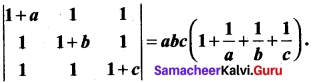
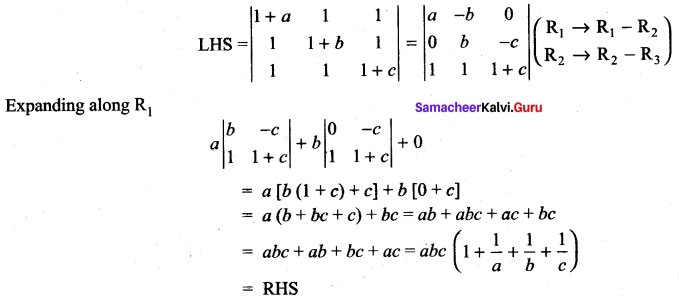
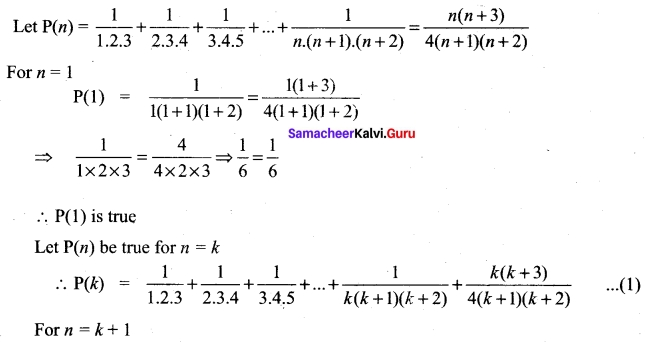
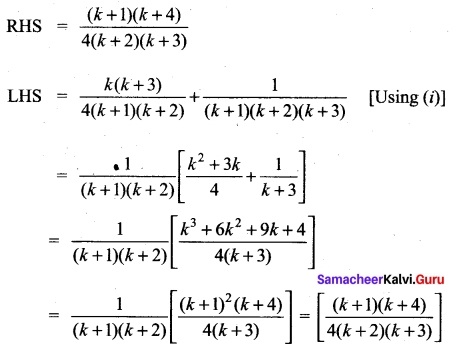
Tamil Nadu 11th Maths Previous Year Question Paper June 2019 English Medium

Students can Download Tamil Nadu 11th Maths Previous Year Question Paper June 2019 English Medium Pdf, Tamil Nadu 11th Maths Model Question Papers helps you to revise the complete Tamilnadu State Board New Syllabus and score more marks in your examinations.

TN State Board 11th Maths Previous Year Question Paper June 2019 English Medium

General Instructions:

  1. The question paper comprises of four parts.
  2. You are to attempt all the parts. An internal choice of questions is provided wherever applicable.
  3. All questions of Part I, II, III and IV are to be attempted separately.
  4. Question numbers 1 to 20 in Part I are Multiple Choice Questions of one mark each.
    These are to be answered by choosing the most suitable answer from the given four alternatives and writing the option code and the corresponding answer
  5. Question numbers 21 to 30 in Part II are two-mark questions. These are to be answered in about one or two sentences.
  6. Question numbers 31 to 40 in Part III are three-mark questions. These are to be answered in above three to five short sentences.
  7. Question numbers 41 to 47 in Part IV are five-mark questions. These are to be answered in detail Draw diagrams wherever necessary.

Time: 2.30 Hours
Maximum Marks: 90

PART – I

I. Choose the correct answer. Answer all the questions. [20 × 1 = 20]

Question 1.
The range of the function \(\frac{1}{1-2sin x}\) is………….
(a) (-∞, -1) ∪(\(\frac{1}{3}\), ∞)
(b) (-1, \(\frac{1}{3}\))
(c) [-1, \(\frac{1}{3}\)]
(d) (-∞, -1] ∪(\(\frac{1}{3}\), ∞)
Answer:
(d) (-∞, -1] ∪(\(\frac{1}{3}\), ∞)

Question 2.
If the function f : [-3, 3] → S defined by f(x) = x² is onto, then S is…………
(a) [-9, 9]
(b) R
(c) [-3, 3]
(d) [0, 9]
Answer:
(d) [0, 9]

Question 3.
The number of solutions of x² + |x – 1| = 1 is ………..
(a) 1
(b) 0
(c) 2
(d) 3
Answer:
(c) 2

Tamil Nadu 11th Maths Previous Year Question Paper June 2019 English Medium

Question 4.
cos 1° + cos 2° + cos 3° + …. + cos 179° =……………..
(a) 0
(b) 1
(c) -1
(d) 89
Answer:
(a) 0

Question 5.
If tan α and tan β are the roots of x² + ax + b = 0, then \(\frac{sin(α+β)}{sin α sin β}\) is equal to…………
(a) \(\frac{b}{a}\)
(b) \(\frac{a}{b}\)
(c) –\(\frac{a}{b}\)
(d) –\(\frac{b}{a}\)
Answer:
(b) \(\frac{a}{b}\)

Question 6.
The number of sides of a polygon having 44 diagonals is…………
(a) 4
(b) 4
(c) 11
(d) 22
Answer:
(d) 22

Question 7.
The H.M. of two positive numbers whose A.M. and G.M. are 16, 8 respectively is………….
(a) 10
(b) 6
(c) 5
(d) 4
Answer:
(d) 4

Question 8.
The nth term of the sequence \(\frac{1}{2}\), \(\frac{3}{4}\), \(\frac{7}{8}\), \(\frac{15}{16}\) is……………
(a) 2n – n – 1
(b) 1 – 2-n
(c) 2-n+ n – 1
(d) 2n-1
Answer:
(b) 1 – 2-n

Question 9.
The intercepts of the perpendicular bisector of the line segment joining (1,2) and (3,4) with coordinate axes are
(a) 5, -5
(b) 5, 5
(c) 5, 3
(d) 5, -4
Answer:
(b) 5, 5

Question 10.
The image of the point (2, 3) in the line y = -x is
(a) (-3, -2)
(b) (-3, 2)
(c) (-2, -3)
(d) (3, 2)
Answer:
(a) (-3, -2)

Tamil Nadu 11th Maths Previous Year Question Paper June 2019 English Medium

Question 11.
If A = \(\left[\begin{array}{cc} \lambda & 1 \\ -1 & -\lambda \end{array}\right]\), then for what value of λ, A² = 0?………
(a) 0
(b) ± 1
(c) -1
(d) 1
Answer:
(b) ± 1

Question 12.
If \(\vec{a}\) and \(\vec{b}\) are having same magnitute and angle between them is 60° and their scalar product is \(\frac{1}{2}\), then |\(\vec {a}\)| is
(a) 2
(b) 3
(c) 7
(d) 1
Answer:
(d) 1

Question 13.
\(\lim _{x \rightarrow \infty} \frac{a^{x}-b^{x}}{x}\) = …………..
(a) log ab
(b) log (\(\frac{a}{b}\))
(c) log (\(\frac{b}{a}\))
(d) \(\frac{a}{b}\)
Answer:
(b) log (\(\frac{a}{b}\))

Question 14.
If f(x) = \(\left\{\begin{array}{ccc}x, & x \text { is irrational } \\ 1-x, & x \text { is rational }\end{array}\right.\) then f is………..
(a) discontinuous at x = \(\frac{1}{2}\)
(b) continuous at x = \(\frac{1}{2}\)
(c) continuous everywhere
(d) discontinuous everywhere
Answer:
(b) continuous at x = \(\frac{1}{2}\)

Question 15.
The derivative of f(x) = x |x| at x = -3 is…………..
(a) 6
(b) -6
(c) does not exist
(d) 0
Answer:
(a) 6

Question 16.
If f(x) = x² – 3x, then the points at which f(x) = f'(x) are…………..
(a) both positive integers
(b) both negative integers
(c) both irrational
(d) one rational and another irrational
Answer:
(c) both irrational

Tamil Nadu 11th Maths Previous Year Question Paper June 2019 English Medium

Question 17.
\(\int \tan ^{-1}(\sqrt{\frac{1-\cos 2 x}{1+\cos 2 x}})\) dx ………….
(a) x² + c
(b) 2x² + c
(c) \(\frac{x²}{2}\) + c
(d) –\(\frac{x²}{2}\) + c
Answer:
(c) \(\frac{x^2}{2}\) + c

Question 18.
e-7x sin 5x dx is…………
(a) \(\frac{e^{-7x}}{74}\) [-7 sin 5x – 5 cos 5x] + c
(b) \(\frac{e^{-7x}}{74}\) [7 sin 5x + 5 cos 5x] + c
(c) \(\frac{e^{-7x}}{74}\) [7 sin 5x – 5 cos 5x] + c
(d) \(\frac{e^{-7x}}{74}\) [-7 sin 5x + 5 cos 5x] + c
Answer:
(a) \(\frac{e^{-7x}}{74}\) [-7 sin 5x – 5 cos 5x] + c

Question 19.
If A and B are any two events then the probability that exactly one of them occur is
(a) P(A ∪\(\bar { B }\)) + P(\(\bar { A }\) ∪B)
(b) P(A ∩\(\bar { B }\)) + P(\(\bar { A }\) ∩B)
(c) P(A) + P(B) – P(A ∩ B)
(d) P(A) + P(B) + 2P(A ∩ B)
Answer:
(a) P(A ∪\(\bar { B }\)) + P(\(\bar { A }\) ∪B)

Question 20.
In a certain college 4% of the boys and 1 % of the girls are taller than 1.8 meter. Further 60% of the students are girls. If a student is selected at random and is taller than 1.8 meters, then the probability that the student is a girl is ………….
(a) \(\frac{2}{11}\)
(b) \(\frac{3}{11}\)
(c) \(\frac{5}{11}\)
(d) \(\frac{7}{11}\)
Answer:
(b) \(\frac{3}{11}\)

PART- II

II. Answer any seven questions. Question No: 30 is compulsory. [7 × 2 = 14]

Question 21.
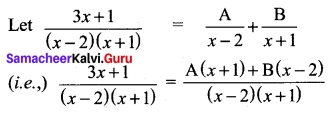
Resolve \(\frac{3x+1}{(x-2)(x+1)}\) into partial fractions.
Answer:
Tamil Nadu 11th Maths Previous Year Question Paper June 2019 English Medium 1
Equating numerator parts
3x + 1 = A (x + 1) + B (x – 2)
This equation is true for any value of x.
To find A and B
Put x = -1
-3 + 1 = A (0) + B (-1 -2)
-3 B = -2 ⇒ B = 2/3
Put x = 2
3(2) + 1 = A(2 + 1) + B (0)
3A = 7 ⇒ A = 7/3
Hence \(\frac{3x+1}{(x-2)(x+1)}\) = \(\frac{7}{3(x-2)}\) + \(\frac{2}{3(x+1)}\)

Tamil Nadu 11th Maths Previous Year Question Paper June 2019 English Medium

Question 22.
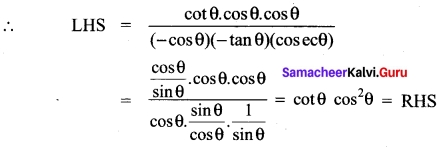
Prove that
Tamil Nadu 11th Maths Previous Year Question Paper June 2019 English Medium 2
Answer:
cot (180° + θ) = cot θ
sin (90° – θ) = cos θ
cos (- θ) = cos θ
sin (270 + θ) = – cos θ
tan (-θ) = – tan θ
cosec (360° + θ) = cosec θ
Tamil Nadu 11th Maths Previous Year Question Paper June 2019 English Medium 3

Question 23.
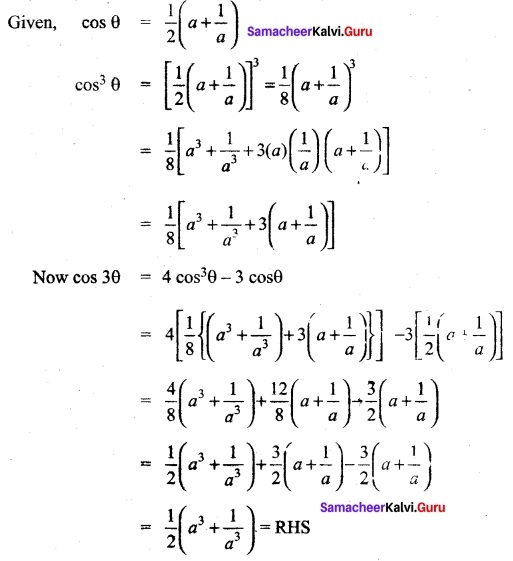
If cos θ = \(\frac{1}{2}\) (a + \(\frac{1}{a}\)), show that cos 3θ = \(\frac{1}{2}\) (a³ + \(\frac{1}{a³}\))
Answer:
Tamil Nadu 11th Maths Previous Year Question Paper June 2019 English Medium 4

Question 24.
If the letters of the word IITJEE are permuted in all possible ways and the strings thus formed are arranged in the lexicographic order, find the rank of the word IITJEE.
Answer:
The lexicographic order of the letters of given word is E, E, I, I, J, T. In the lexicographic order, the strings which begin with E come first. If we fill the first place with E, remaining 5 letters (E, I, I, J, T) can be arranged in \(\frac{5!}{2!}\) ways. On proceeding like this we get,
E – – – – = \(\frac{5!}{2!}\) = 60 ways
IIE – – – = 3! = 6 ways
IIJ – – – = \(\frac{3!}{1!}\) = 3 ways
IITE – – =2! = 2 ways
IITJEE = 1 way
The rank of the word IITJEE = 60 + 6 + 3 + 2 +1 = 72.

Question 25.
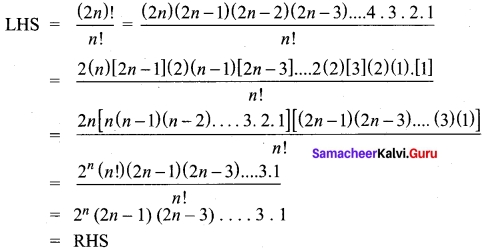
Prove that \(\frac{(2n)!}{n!}\) = 2n (1, 3, 5 ……..(2n – 1)).
Answer:
Tamil Nadu 11th Maths Previous Year Question Paper June 2019 English Medium 5

Question 26.
Write the equation of the line passing through the point (1, -1) and parallel to the line x + 3y – 4 = 0
Answer:
Equation of a line parallel to x + 3y – 4 = 0 will be of the form x + 3y + k = 0
It passes through (1,-1)
⇒ (1) + 3(-1) + k = 0
-2 + k = 0 ⇒ k = 2
So the required equation is x + 3y + 2 = 0

Question 27.
If (k, 2), (2, 4) and (3, 2) are vertices of the triangle of area 4 square units then determine the value of k.
Answer:
Area of Δ with vertices (k, 2) (2, 4) and (3, 2) = \(\frac{1}{2}\) \(\left|\begin{array}{lll} k & 2 & 1 \\ 2 & 4 & 1 \\ 3 & 2 & 1 \end{array}\right|\) = 4 (given)
⇒ \(\left|\begin{array}{lll} k & 2 & 1 \\ 2 & 4 & 1 \\ 3 & 2 & 1 \end{array}\right|\) = 2(4) = 8
(i.e.,) k (4 – 2) -2(2 – 3) + 1 (4 – 12) = ±8
(i.e.,) 2k – 2(-1) + 1(-8) = ± 8
(i.e.,) 2k + 2 – 8 = 8
(i.e.,) 2k = 8 + 8 – 2 = 14
k = 14/2 = 7
∴ k = 7
or
2k + 2 – 8 = -8
⇒ 2k = -8 + 8 – 2
2k = -2
k = -1
So k = 7 (or) k = -1

Tamil Nadu 11th Maths Previous Year Question Paper June 2019 English Medium

Question 28.
Find λ, when the projection of \(\vec {a}\) = λ\(\hat{j}\) + \(\hat{j}\) + 4\(\hat{k}\) on \(\vec {b}\) = 2\(\hat{i}\) + 6\(\hat{j}\) + 2\(\hat{k}\) is 4 units.
Answer:
\(\vec {a}\) = λ\(\hat{j}\) + \(\hat{j}\) + 4\(\hat{k}\) and \(\vec {b}\) = 2\(\hat{i}\) + 6\(\hat{j}\) + 2\(\hat{k}\)
Now \(\vec {a}\) – \(\vec {b}\) = (λ) (2) + (1) (6) + (4) (3)
= 2λ + 6 + 12 = 2λ +18
|\(\vec {a}\)| = \(\sqrt{4+36+9}\) = \(\sqrt{49}\) = 7
Here \(\frac{2λ+18}{7}\) = 4
⇒ 2λ+ 18 = 4 × 7 = 28
2λ = 28 – 18 = 10
λ = 10/2 = 5

Question 29.
Find \(\frac{dy}{dx}\) if y = ex sin x
Answer:
y = ex sin x
⇒ y’ = uv’ + vu’
Now u = ex ⇒ u’ = \(\frac{du}{dx}\) = ex
v = sin x ⇒ v’ = \(\frac{dv}{dx}\) = cos x
y’ = ex (cos x) + sin x (ex)
= ex [sin x + cos x]

Question 30.
Find \(\frac{dy}{dx}\) if x² + y² = 1
Answer:
We differentiate both sides of the equation.
\(\frac{d}{dx}\) (x)² + \(\frac{d}{dx}\) (y)² = \(\frac{d}{dx}\) (1)
2x + 2y \(\frac{dy}{dx}\) = 0
Solving for the derivative yields
\(\frac{dy}{dx}\) = –\(\frac{x}{y}\)

PART – III

III. Answer any seven questions. Question No. 40 is compulsory. [7 × 3 = 21]

Question 31.
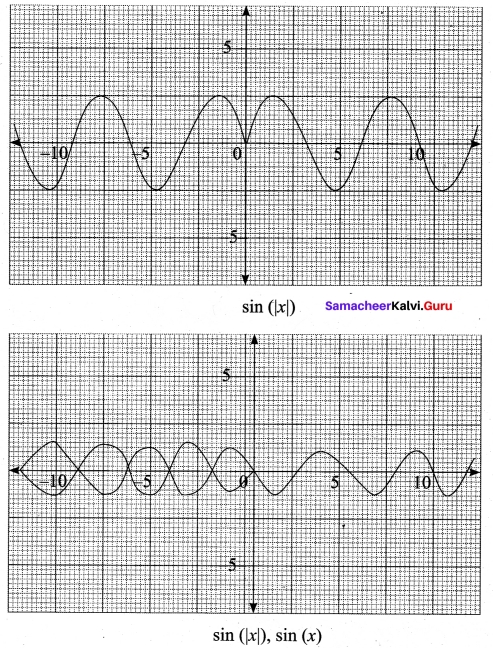
From the curve y = sin x, draw y = sin |x|
Answer:
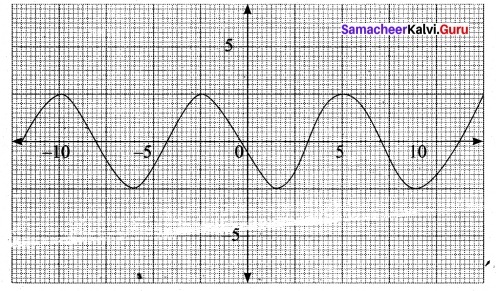
Tamil Nadu 11th Maths Previous Year Question Paper June 2019 English Medium 6
Tamil Nadu 11th Maths Previous Year Question Paper June 2019 English Medium 7

Question 32.
If one root of k (x – 1)² = 5x – 7 is double the other root, show that k = 2 or -25
Answer:
k(x – 1)² = 5x – 7
(i.e.,) k (x² – 2x + 1) – 5x + 7 = 0
x² (k) + x(-2k – 5) + k + 7 = 0
kx² – x(2k + 5) + (k + 7) = 0
Here it is given that one root is double the other.
So let the roots to α and 2α
Sum of the roots = α + 2α = 3α = \(\frac{2k+5}{k}\) α \(\frac{2k+5}{3k}\) ……..(1)
Product of the roots = α(2α) = 2α² = \(\frac{k+7}{k}\)
⇒ α² = \(\frac{k+7}{2k}\) = ……..(2)
Substituting a value from (1) in (2)
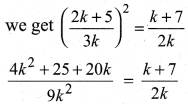
Tamil Nadu 11th Maths Previous Year Question Paper June 2019 English Medium 8
2(4k² + 25 + 20k) = 9k (k + 7)
2(4k² + 25 + 20k) = 9k² + 63k
8k² + 50 + 40k – 9k² – 65k = 0
-k² – 25k + 50 = 0
k² + 23k – 50 = 0
(k + 25) (k – 2) = 0
k = -25 or 2

Tamil Nadu 11th Maths Previous Year Question Paper June 2019 English Medium

Question 33.
If θ + ∅ = α and tan θ = k tan ∅, then prove that sin(θ – ∅) =\(\frac{k-1}{k+1}\)
Answer:
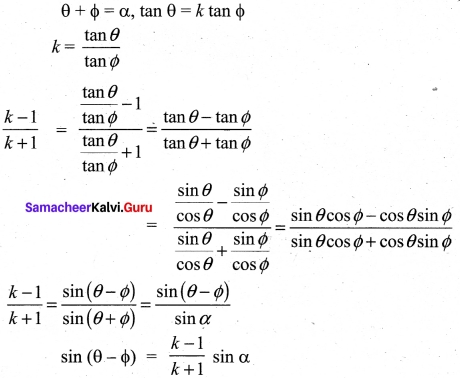
Tamil Nadu 11th Maths Previous Year Question Paper June 2019 English Medium 9

Question 34.
If a, b, c are in geometric progression, and if a\(\frac{1}{x}\) = b\(\frac{1}{y}\) = c\(\frac{1}{z}\) then prove that x, y, z are in arithmetic progression.
Answer:
Given a, b, c are in G.P.
⇒ b² = ac
⇒ log b² = log ac
(i.e.) 2 log b = log a + log c …(1)
We are given a\(\frac{1}{x}\) = b\(\frac{1}{y}\) = c\(\frac{1}{z}\) = k (say)
⇒ log ak = \(\frac{1}{x}\) = bk \(\frac{1}{y}\) = ck \(\frac{1}{z}\)
⇒ ak = \(\frac{1}{x}\) ⇒ x = log ka
Similarly y = log kb
z = log kc
Substituting these values in equation (1) we get 2y = x + z ⇒ x, y, z are in A.P.

Question 35.
Show that the points (1,3), (2,1) and (\(\frac{1}{2}\), 4) are collinear.
Answer:
Let the given points be A (1, 3), B (2, 1), and C (\(\frac{1}{2}\), 4)
Slope of AB = \(\frac{1-3}{2-1}\) = \(\frac{-2}{1}\) = -2 = m1
Slope of BC = \(\frac{4-1}{1/2-1}\) = \(\frac{3}{-3/2}\) = -2 = m2
Slope of AB = Slope of BC ⇒ AB parallel to BC but B is a common point.
⇒ The points A, B, C are collinear.

Question 36.
If A and B are symmetric matrices of same order, prove that AB + BA is a symmetric matrix.
Answer:
Given A and B are symmetric matrices
⇒ AT = A and BT = B
To prove AB + BA is a symmetric matrix.
Proof: Now(AB + BA)T = (AB)T + (BA)T = BTAT + ATBT
= BA + AB = AB + BA
i.e. (AB + BA)T = AB + BA
⇒ (AB + BA) is a symmetric matrix.

Question 37.
Let \(\vec {a}\), \(\vec {b}\), \(\vec {c}\) be three vectors such that |\(\vec {a}\)| = 3, |\(\vec {b}\)| = 4, |\(\vec {c}\)| = 5 and each one of them being perpendicular to the sum of the other two, find |\(\vec {a}\) + \(\vec {b}\) + \(\vec {c}\)|.
Answer:
Given |\(\vec {a}\)| = 3; |\(\vec {b}\)| = 4; |\(\vec {c}\)| = 5
Now, (\(\vec {a}\) + \(\vec {b}\) + \(\vec {c}\))² = a-2 +b -2+c-2 + 2(\(\vec {a}\).\(\vec {b}\) + \(\vec {b}\).\(\vec {c}\) + \(\vec {a}\).\(\vec {c}\))
= 3² + 4² + 5² + 2 \(\vec {a}\).\(\vec {b}\) + 2\(\vec {b}\).\(\vec {c}\) + 2\(\vec {a}\).\(\vec {c}\)
= 9 + 16 + 25 + \(\vec {a}\).\(\vec {b}\) + \(\vec {a}\).\(\vec {b}\) + \(\vec {b}\).\(\vec {c}\) + \(\vec {b}\).\(\vec {c}\) + \(\vec {a}\).\(\vec {c}\) + \(\vec {a}\).\(\vec {c}\)
= 50 + \(\vec {a}\).(\(\vec {b}\) + \(\vec {c}\)) + \(\vec {b}\).(\(\vec {c}\) + \(\vec {a}\)) + \(\vec {c}\).(\(\vec {a}\) + \(\vec {b}\))
= 50 + 0 + 0 + 0 = 50
(one vector is ⊥r to the sum of other two vectors)
|\(\vec {a}\) + \(\vec {b}\) + \(\vec {c}\)| = \(\sqrt {50}\) = \(\sqrt {25×2}\) = 5√2

Tamil Nadu 11th Maths Previous Year Question Paper June 2019 English Medium

Question 38.
Evaluate \(\lim _{x \rightarrow 0} \frac{\sqrt{1+x^{2}}-1}{x}\)
Answer:
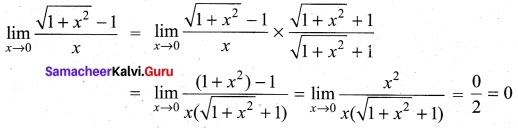
Tamil Nadu 11th Maths Previous Year Question Paper June 2019 English Medium 10

Question 39.
Find the derivatives of the following functions y = xcos x
Answer:
y = xcos x
Taking log on both sides, we get
log y = log xcos x = cos x log x
Differentiating w.r.to x we get
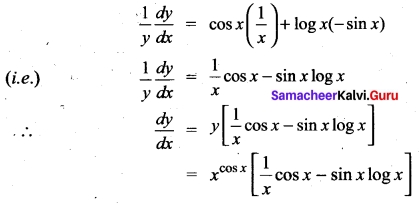
Tamil Nadu 11th Maths Previous Year Question Paper June 2019 English Medium 11

Question 40.
Evaluate
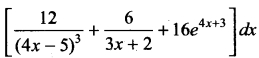
Tamil Nadu 11th Maths Previous Year Question Paper June 2019 English Medium 12
Answer:
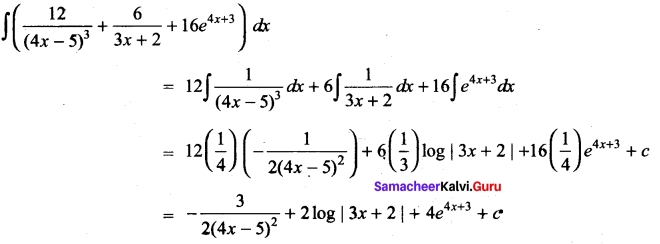
Tamil Nadu 11th Maths Previous Year Question Paper June 2019 English Medium 13

PART – IV

IV. Answer all the questions. [7 x 5 = 35]

Question 41 (a).
Let f, g: R → R be defined as f(x) = 2x – |x| and g(x) = 2x + |x|. Find fog.
Answer:
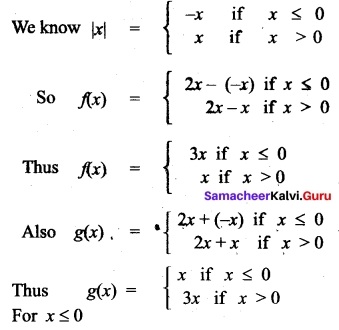
Tamil Nadu 11th Maths Previous Year Question Paper June 2019 English Medium 14
fog (x) = f(g(x))
= f(x) = 3x
For x > 0
fog (x) = f(g(x))
= f(3x) = 3x

[OR]

(b) Prove that \(\lim _{\theta \rightarrow 0} \frac{\sin \theta}{\theta}\) = 1
Answer:
Let θ → 0, thought positive values
∴ Let 0 < θ < \(\frac{π}{2}\)
Draw a circule center O and radius unity and let
∠AOB = θ radiAnswer:
Let the tagent at A meet OB product in the piont P.
Jion AB. From the figure it is clear that
Area of ΔAOB < Area of sector AOB < Area of ΔOAP
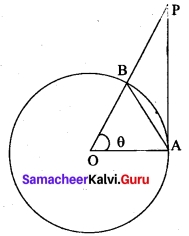
Tamil Nadu 11th Maths Previous Year Question Paper June 2019 English Medium 15
i.e., \(\frac{1}{2}\) OA. OB sin θ < 1 (radius)² θ < \(\frac{1}{2}\) OA. AP
or sin θ < θ < tan θ
[ ∵ \(\frac{AP}{OA}\) = tan θ or AP = tan θ as OA = 1
Dividing by sin θ, which is positive
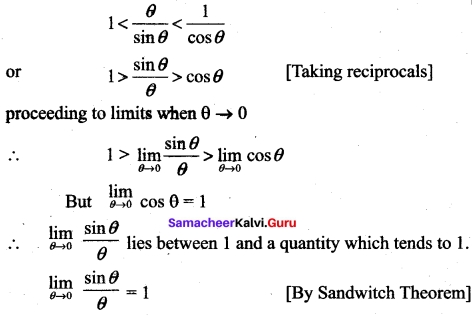
Tamil Nadu 11th Maths Previous Year Question Paper June 2019 English Medium 16

Question 42 (a).
(i) If A × A has 16 elements, S = {(a, b) ∈ A × A: a < b} ; (-1, 2) and (0,1) are two elements of S, then find the remaining elements of S.
(ii) Find the range of the function \(\frac{1}{2 cos x – 1}\)
Answer:
(i) n(A × A) = 16
⇒ n(A) = 4
S = {(-1, 0), (-1, 1), (0, 2), (1, 2)}

(ii) The range of cos x is – 1 to 1
-1 ≤ cos x ≤ 1
(× by 2) -2 ≤ 2 cos x ≤ 2
adding -1 throughout
-2 -1 ≤ 2 cos x – 1 ≤ 2 – 1
(i.e.,) -3 ≤ 2 cos x – 1 ≤ 1
so 1 ≤ \(\frac{1}{2 cos x – 1}\) ≤ \(\frac{-1}{3}\)
The range is outside \(\frac{-1}{3}\) and 1
i.e., range is (-∞,\(\frac{-1}{3}\)] ∪ [1, ∞)

Tamil Nadu 11th Maths Previous Year Question Paper June 2019 English Medium

[OR]

(b) Evaluate: \(\int \frac{3 x+5}{x^{2}+4 x+7}\) dx
Answer:
Let I = \(\int \frac{3 x+5}{x^{2}+4 x+7}\) dx
3x + 5 = A \(\frac{d}{dx}\) (x² + 4x + 7) + B
3x + 5 = A(2x + 4) + B
Comparing the coefficients of like terms we got
2A = 3 ⇒ A = \(\frac{3}{2}\); 4A + B = 5 ⇒ B = -1
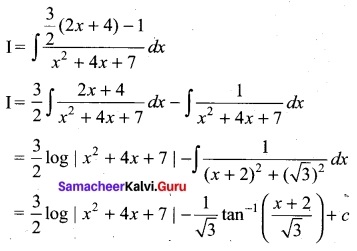
Tamil Nadu 11th Maths Previous Year Question Paper June 2019 English Medium 17

Question 43 (a).
Derive cosine formula using the law of sines in a ΔABC.
Answer:
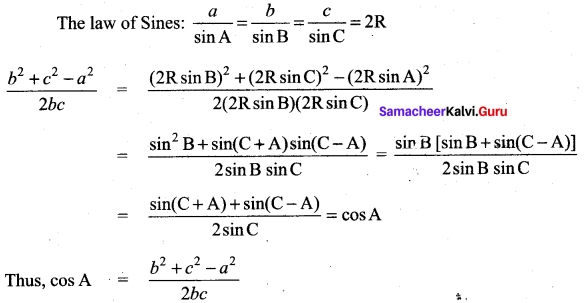
Tamil Nadu 11th Maths Previous Year Question Paper June 2019 English Medium 18

[OR]

(b) Find \(\sqrt[3]{65}\) using binomial expansion upto two decimal places.
Answer:
We know that for |x| < 1,
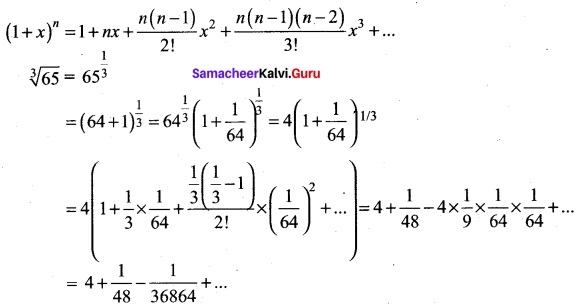
Tamil Nadu 11th Maths Previous Year Question Paper June 2019 English Medium 19
≈ 4 + 0.02 ( Since \(\frac{1}{36864}\) + …….. is very small)
\(\sqrt[3]{65}\) = 4.02 (approximately)

Tamil Nadu 11th Maths Previous Year Question Paper June 2019 English Medium

Question 44 (a).
(i) Do the limit of the function \(\frac{sin |x|}{x}\) Li exist as x → 0? State reason for the answer.
Answer:
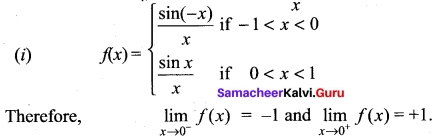
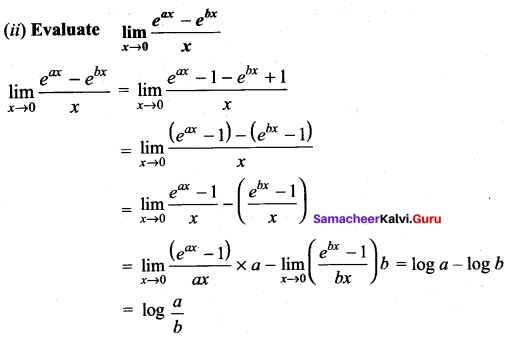
Tamil Nadu 11th Maths Previous Year Question Paper June 2019 English Medium 20
Hence the limit does ndt exist. Since that f(0) ≠ f(0+)
Tamil Nadu 11th Maths Previous Year Question Paper June 2019 English Medium 21

[OR]

(b) Tamil Nadu 11th Maths Previous Year Question Paper June 2019 English Medium 22
Answer:
Tamil Nadu 11th Maths Previous Year Question Paper June 2019 English Medium 23

Question 45.
(i) Evaluate \(\int \frac{x \sin ^{-1} x}{\sqrt{1-x^{2}}}\) dx
Answer:
Let sin-1 x = t
⇒ \(\frac{1}{\sqrt{1-x^{2}}}\) dx = dt
Now sin-1 x = t ⇒ x = sin t
So I = ∫(sin t) (t) dt = ∫ t sin t dt
Now ∫t sin t dt = ∫ t d (-cos t)
= t(- cos t) – ∫(-cos t) dt
= -t cos t + ∫cos t dt
= – t cos t + sin t
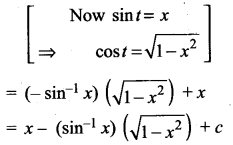
Tamil Nadu 11th Maths Previous Year Question Paper June 2019 English Medium 24

[OR]

(b) Show that the points whose position vectors 4\(\hat{i}\) + 5\(\hat{j}\) + \(\hat{k}\),- \(\hat{j}\) – \(\hat{k}\), 3\(\hat{i}\) +9\(\hat{j}\) + 4\(\hat{k}\) and -4\(\hat{i}\) + 4\(\hat{j}\) + 4\(\hat{k}\) are coplanar.
Answer:
Let the given points be A, B, C and D. To prove that the point A, B, C, D are coplanar, we have to prove that the vectors \(\overrightarrow{\mathrm{AB}}\), \(\overrightarrow{\mathrm{AC}}\) and \(\overrightarrow{\mathrm{AD}}\) are coplanar.
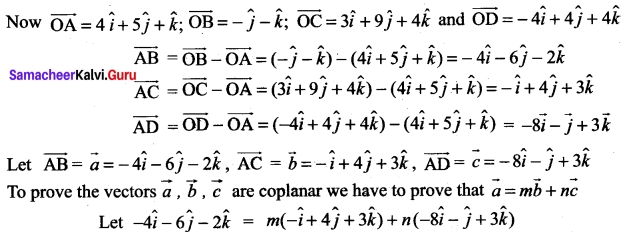
Tamil Nadu 11th Maths Previous Year Question Paper June 2019 English Medium 25
Equating \(\hat{i}\), \(\hat{j}\) and \(\hat{k}\) components we get
-4 = -m – 8n
⇒ m + 8n = 4 ….(i)
-6 = 4m – n
⇒ 4m – n = -6 ……. (ii)
-2 = 3m + 3n
⇒ 3m + 3n = -2 …….. (iii)
Solving (i) and (ii)
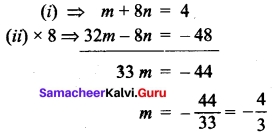
Tamil Nadu 11th Maths Previous Year Question Paper June 2019 English Medium 26
Substituting m = –\(\frac{4}{3}\) in (i) we get,
–\(\frac{4}{3}\) + 8n = 4
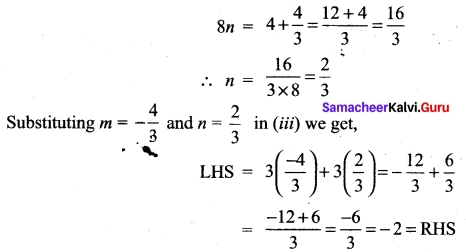
Tamil Nadu 11th Maths Previous Year Question Paper June 2019 English Medium 27
we are able to write one vector as a linear combination of the other two vectors ⇒ the given vectors \(\vec{a}\), \(\vec{b}\), \(\vec{c}\) are coplanar.
(i.e.,) The given points A, B, C, D are coplanar.

Tamil Nadu 11th Maths Previous Year Question Paper June 2019 English Medium

Question 46 (a).
If Q is a point on the locus of x² + y² + 4x – 3x + 7 = 0, then find the equation of locus of P which divides segment OQ externally in the ratio 3 : 4, where O is the origin.
Answer:
Let (h, k) be the moving-point O = (0, 0), Let PQ = (a, b) on x² + y² + 4x – 3y + 7 = 0
P divides OQ externally in the ratio 3 : 4
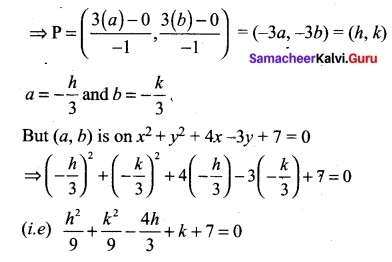
Tamil Nadu 11th Maths Previous Year Question Paper June 2019 English Medium 28
h² + k² – 12h + 9k + 63 = 0, Locus of (h, k) is x² + y² – 12x + 9y + 63 = 0

[OR]

(b) A consulting firm rents car from three agencies such that 50% from agency L, 30% from agency M and 20% from agency N. If 90% of the cars from L, 70% of cars from M and 60% of cars from N are in good conditions (i) what is the probability that the firm will get a car in good condition? (ii) if a car is in good condition, what is probability that it has come from agency N?
Answer:
Let A1, A2 and A3 be the events that the cars are rented from the agencies X, Y and Z respectively.
Let G be the event of getting a car in good condition.
We have to find
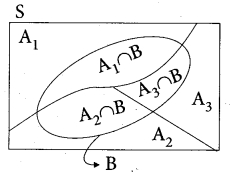
Tamil Nadu 11th Maths Previous Year Question Paper June 2019 English Medium 29
(i) The total probability of event G that is, P(G).
(ii) Find the conditional probability A3, given G that is, P(A3/G) We have
P(A1) = 0.50, P(G/A1) = 0.90
P(A2) = 0.30, P(G/A2) = 0.70
P(A3) = 0.20, P(G/A3) = 0.60.

(i) Since A1, A2 and A3 are mutually exclusive and exhaustive events and G is an event in S, then the total probability of event G is P(G).
P(G) = P(A1) P(G/A1) + P(A2) P(G/A2) + P(A3) P(G/A3)
P(G) = (0.50) (0.90) + (0.30) (0.70) + (0.20) (0.60)
P(G) = 0.78.

(ii) The conditional probability A3 given G is P(A3/G)
By Bayes’ theorem,
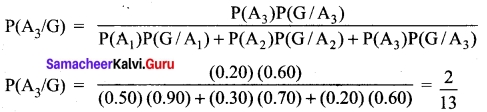
Tamil Nadu 11th Maths Previous Year Question Paper June 2019 English Medium 30

Tamil Nadu 11th Maths Previous Year Question Paper June 2019 English Medium

Question 47 (a).
Using the Mathematical induction, show that for any natural number n,

Tamil Nadu 11th Maths Previous Year Question Paper June 2019 English Medium 31
Answer:
Tamil Nadu 11th Maths Previous Year Question Paper June 2019 English Medium 32
Tamil Nadu 11th Maths Previous Year Question Paper June 2019 English Medium 33
∴ P(k + 1) is true
Thus P(k) is true ⇒ P(k + 1) is true.
Hence by principle of mathematical induction,
P(n) is true for all n ∈ Z.

(b) If 7 = (cos-1 x)², prove that (1 – x²) \(\frac{d²y}{dx²}\) -x\(\frac{dx}{dy}\) -2 = 0. Hence find y2, when x = 0.
Answer:
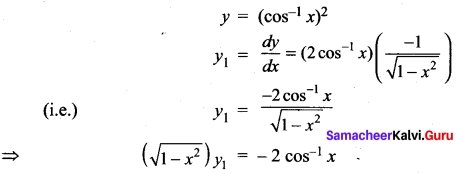
Tamil Nadu 11th Maths Previous Year Question Paper June 2019 English Medium 34
Squaring on both sides (1 – x²) (\(y_{1}^{2}\)) = 4(cos-1 x)² = 4y
⇒ (1 – x²)(\(y_{1}^{2}\)) = 4y
Differentiating again w.r.to x we get
(1 – x²) (2y1, y2) + (\(y_{1}^{2}\)) (-2x) = 4y1
⇒ (1 – x²) (2y1, y2) = 4y1 + 2xy\(y_{1}^{2}\)
(i.e.,) (1 – x²) (2y1, y2) = 2y1 (2 +xy1)
(÷ by 2y1)(1 – x²)y² = 2 + xy1
So (1 – x²)y2 – xy1 – 2 = 0
When x = 0
(1 – 0) y2 – 0y1 – 2 = 0
y2 – 2 = 0
y2 = 2


Tamil Nadu 11th Maths Previous Year Question Paper June 2019 English Medium

Tamil Nadu 11th Maths Previous Year Question Paper March 2019 English Medium

Students can Download Tamil Nadu 11th Maths Previous Year Question Paper March 2019 English Medium Pdf, Tamil Nadu 11th Maths Model Question Papers helps you to revise the complete Tamilnadu State Board New Syllabus and score more marks in your examinations.

TN State Board 11th Maths Previous Year Question Paper March 2019 English Medium

General Instructions:

  1. The question paper comprises of four parts.
  2. You are to attempt all the parts. An internal choice of questions is provided wherever applicable.
  3. All questions of Part I, II, III and IV are to be attempted separately.
  4. Question numbers 1 to 20 in Part I are Multiple Choice Questions of one mark each.
    These are to be answered by choosing the most suitable answer from the given four alternatives and writing the option code and the corresponding answer
  5. Question numbers 21 to 30 in Part II are two-mark questions. These are to be answered in about one or two sentences.
  6. Question numbers 31 to 40 in Part III are three-mark questions. These are to be answered in above three to five short sentences.
  7. Question numbers 41 to 47 in Part IV are five-mark questions. These are to be answered in detail Draw diagrams wherever necessary.

Time: 2.30 Hours
Maximum Marks: 90

PART – I

I. Choose the correct answer. Answer all the questions. [20 × 1 = 20]

Question 1.
The value of x, for which the matrix A = \(\left[\begin{array}{cc} e^{x-2} & e^{7+x} \\ e^{2+x} & e^{2 x+3} \end{array}\right]\) is singular, is…………..
(a) 7
(b) 6
(c) 9
(d) 8
Answer:
(d) 8

Question 2.
The nth term of the sequence 2, 7, 14, 23 …. is …………..
(a) n² + 2n + 1
(b) n² + 2n – 1
(c) n² – 2n – 1
(d) n² – 2n + 1
Answer:
(b) n² + 2n – 1

Question 3.
\(\int \frac{\sec x}{\sqrt{\cos 2 x}} d x=\)
(a) tan-1 (tan x) + c
(b) sin-1 (tan x) + c
(c) tan-1 (sin x) + c
(d) 2 sin-1 (tan x) + c
Answer:
(b) sin-1 (tan x) + c

Tamil Nadu 11th Maths Previous Year Question Paper March 2019 English Medium

Question 4.
The line \(\frac{x}{a}\) – \(\frac{y}{b}\) = 0 has the slope 1, if ………..
(a) a = b
(b) only for a = 1, b = 1
(c) a > b
(d) a < b
Answer:
(a) a = b

Question 5.
The number of five digit numbers in which all digits are even, is
(a) 4 × 54
(b) 4 × 55
(c) 55
(d) 5 × 5
Answer:
(a) 4 × 54

Question 6.
Tamil Nadu 11th Maths Previous Year Question Paper March 2019 English Medium 1
(a) f (x) is continuous for all x in R
(b) f(x) is differentiable for all x > a
(c) f(x) is not differentiable at x = a
(d) f (x) is discontinuous at x = a
Answer:
(c) f(x) is not differentiable at x = a

Question 7.
A number is selected from the set {1, 2, 3, 20}. The probability that the selected number is divisible by 3 or 4 is………..
(a) \(\frac{1}{2}\)
(b) \(\frac{2}{3}\)
(c) \(\frac{2}{5}\)
(d) \(\frac{1}{8}\)
Answer:
(a) \(\frac{1}{2}\)

Question 8.
Which of the following is not a periodic function with period 2π?
(a) tan x
(b) cos x
(c) sin x
(d) cosec x
Answer:
(a) tan x

Question 9.
The straight line joining the points (2, 3) and (-1, 4) passes through (α, β) if………..
(a) α + 3β = 11
(b) 3α + β = 11
(c) α + 2β = 7
(d) 3α + β = 9
Answer:
(a) α + 3β = 11

Question 10.
The minimum and the maximum values of |cos x| -2 are respectively………..
(a) 0 and 2
(b) -2 and 0
(c) -2 and -1
(d) -1 and 1
Answer:
(c) -2 and -1

Tamil Nadu 11th Maths Previous Year Question Paper March 2019 English Medium

Question 11.
If A = {(x, y) / y – ex, x ∈ [0, ∞)} and B = {(x, y) / y = sin x, x ∈ [0, ∞)} then n(A ∩ B) is………..
(a) ∞
(b) 1
(c) φ
(d) 0
Answer:
(d) 0

Question 12.
Tamil Nadu 11th Maths Previous Year Question Paper March 2019 English Medium 2
(a) \(\underset { x\rightarrow { 2 }^{ – } }{ lim } \) f(x) = -1
(b) \(\underset { x\rightarrow { 0 } }{ lim } \) f(x) does not exist
(c) \(\underset { x\rightarrow { 0 }^{ – } }{ lim } \) f(x) = -1
(d) \(\underset { x\rightarrow { 0 }^{ + } }{ lim } \) f(x) = 1
Answer:
(b) \(\underset { x\rightarrow { 0 } }{ lim } \) f(x) does not exist

Question 13.
If f(x) = x² – 3x, then the points at which f(x) =f'(x) are…………
(a) both irrational
(b) one rational and another irrational
(c) both positive integers
(d) both negative integers
Answer:
(a) both irrational

Question 14.
The unit vector parallel to the resultant of the vectors \(\hat { i }\) + \(\hat { j }\) – \(\hat { k }\) and \(\hat { i }\) – 2\(\hat { j }\) + \(\hat { k }\) is …………
(a) \(\frac{2 \hat{i}-\hat{j}+\hat{k}}{\sqrt{5}}\)
(b) \(\frac{2 \hat{i}-\hat{j}}{\sqrt{5}}\)
(c) \(\frac{\hat{i}-\hat{j}+\hat{k}}{\sqrt{5}}\)
(d) \(\frac{2 \hat{i}+\hat{j}}{\sqrt{5}}\)
Answer:
(d) \(\frac{2 \hat{i}+\hat{j}}{\sqrt{5}}\)

Question 15.
It is given that the events A and B are such that P(A) = \(\frac{1}{4}\), P(A/B) = \(\frac{1}{2}\) and P(B/A) = \(\frac{2}{3}\). The P(B) is………..
(a) \(\frac{2}{3}\)
(b) \(\frac{1}{2}\)
(c) \(\frac{1}{6}\)
(d) \(\frac{1}{3}\)
Answer:
(d) \(\frac{1}{3}\)

Question 16.
If \(\vec { a }, \vec { b }\) are the position vectors of A and B, then which one of the following points whose position vector lies on AB?
(a) \(\frac{2 \vec{a}+\vec{b}}{2}\)
(b) \(\frac{\vec{a}-\vec{b}}{3}\)
(c) \(\vec { a } + \vec { b }\)
(d) \(\frac{2 \vec{a}-\vec{b}}{2}\)
Answer:
(a) \(\frac{2 \vec{a}+\vec{b}}{2}\)

Question 17.
If |x + 2| ≤ 8, then x belongs to…………
(a) (6, 10)
(b) (-10, 6)
(c) [6, 10]
(d) [-10, 6]
Answer:
(d) [-10, 6]

Tamil Nadu 11th Maths Previous Year Question Paper March 2019 English Medium

Question 18.
The expansion of (1 – x)-2 is ………..
(a) 1 – x + x² – ……
(b) 1 + x + x² + ……
(c) 1 – 2x + 3x² – ….
(d) 1 + 2x + 3x² + ……
Answer:
(d) 1 + 2x + 3x² + ……

Question 19.
If f : R → R is defined by f(x) = |x| – 5, then the range of f is………..
(a) (-∞, -5)
(b) (-∞, 5)
(c) [-5, ∞)
(d) (-5, ∞)
Answer:
(c) [-5, ∞)

Question 20.
Which one of the following is not true about the matrix Tamil Nadu 11th Maths Previous Year Question Paper March 2019 English Medium 3
(a) an upper triangular matrix
(b) lower triangular matrix
(c) a scalar matrix
(d) a diagonal matrix
Answer:
(c) a scalar matrix

PART-II

II. Answer any seven questions. Question No. 30 is compulsory. [7 × 2 = 14]

Question 21.
Write the use of horizontal line test.
Answer:
Horizontal line test is used to check whether a function is one-one, onto or not.

Question 22.
Write the relationship between Permutation and Combination.
Answer:
Permutation means selection followed by arrangement.
Combination means selection only now selcting Y from ‘n’ things can be done in nCr ways ….(1) (r ≤ n)
Selecting and arranging r from n things can be done in nPr ways ……(2)
‘r’ things can be arranged in r! ways …… (3)
Now (2) = (1) × (3)
(i.e.,) nPr = nCr × r!
nCr = \(\frac{^{n}P_r}{r!}\)

Tamil Nadu 11th Maths Previous Year Question Paper March 2019 English Medium

Question 23.
Count the number of positive integers greater than 6000 and less than 7000 which are divisible by 5, provided that no digits are repeated.
Answer:
The required numbers is = 1 × 8 × 7 × 2
= 112

Question 24.
Find the separate equations from a combined equation of a straight line 2x² + xy- 3y² = 0
Answer:
The combined equation is 2x² +xy – 3y² = 0
Tamil Nadu 11th Maths Previous Year Question Paper March 2019 English Medium 4
Factorizing (2) (-3) = -6
2x² + xy – 3y² = 2x² – 2xy + 3xy – 3y²
= 2x(x – y) + by (x – y) = (2x + by) (x – y)
∴ 2x² + xy – by² = 0 ⇒ (2x + 3y) (x – y) = 0
So the separate equations are 2x + 3y = 0; x – y = 0

Question 25.
Define diagonal and scalar matrices.
Answer:
A square matrix A = [aij]n × n is called a diagonal matrix
If aij = 0 whenever i ≠ j
A square matrix A = [aij]n × n is called a scalar matrix
Tamil Nadu 11th Maths Previous Year Question Paper March 2019 English Medium 5

Question 26.
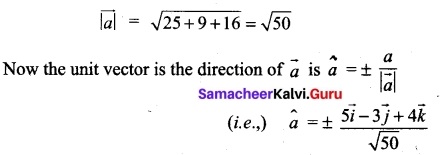
Find a unit vector along the direction of the vector \(5 \hat{i}-3 \hat{j}+4 \hat{k}\)
Answer:
Let \(\hat{a}\) = \(5 \hat{i}-3 \hat{j}+4 \hat{k}\)
Tamil Nadu 11th Maths Previous Year Question Paper March 2019 English Medium 6

Question 27.
Define a continuous function on the closed interval [a, b]
Answer:
A function f : [a, b] → R is said to be continuous on the closed interval [a, b] if it continuous on the open interval (a, b) and
\(\underset { x\rightarrow { a }^{ + } }{ lim } \) f(x) = f(a) and \(\underset { x\rightarrow { b }^{ – } }{ lim } \) f(x) = 1 f(x) = f(b)

Question 28.
Consider the function f(x) = √x, x ≥ 0. Does \(\underset { x\rightarrow { 0 }}{ lim } \) f(x) exist?
Answer:
\(\underset { x\rightarrow { 0 }^{ – } }{ lim } \) √x is does not exist
\(\underset { x\rightarrow { 0 }^{ + } }{ lim } \) √x = 0
\(\underset { x\rightarrow { 0 } }{ lim } \) √x is does not exist

Question 29.
An integer is chosen at random from the first ten positive integers. Find the probability that it is multiple of three.
Answer:
S = {1, 2, 3, 4, 5, 6, 7, 8, 9, 10}
A = {3, 6, 9}
n(S) = 10; n(A) = 3
P(A) = \(\frac{n(A)}{n(S)}\) = \(\frac{3}{10}\)

Question 30.
Is it correct to say A × A = {(a, a): a ∈ A}? Justify your answer.
Answer:
It is not correct
Since A × A = {(a, b); a, b ∈ A} is true

Tamil Nadu 11th Maths Previous Year Question Paper March 2019 English Medium

PART-III

Answer any seven questions. Question no. 40 is compulsory [7 × 3]

Question 31.
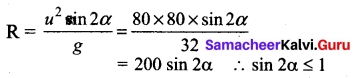
A football player can kick a football from ground level with an initial velocity (u) of 80 ft/second. Find the maximum horizontal distance the football travels and at what angle
Take R = \(\frac{u² sin 2α}{g}\), and g = 32
Answer:
Tamil Nadu 11th Maths Previous Year Question Paper March 2019 English Medium 7
Maximum distance = 200ft
The required angle is \(\frac{π}{4}\)

Question 32.
Find the coefficient of x3 in the expansion of (2 – 3x)7.
Answer:
The general term is (2 – 3x)7 is tr + 1 = 7Cr (2)7 – r (-3x)r
= 7Cr (2)7 – r (-3x)r (x)r
So the co-efficient of xr is 7Cr (2)7 – r (-3)r
To find co-efficient of x³
equate r to 3 (i.e.,) r = 3
∴ co-efficient of x³ is 7Cr (2)7 – 3 (-3)3
= \(\frac{7×6×5}{3×2×1}\) (2)4 (-27)
= 7 × 5 × (16) (-27)
= -15120

Question 33.
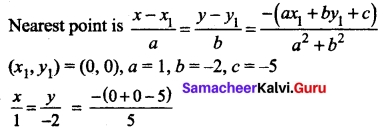
Find the nearest point on the line x – 2y – 5 from the origin.
Answer:
Tamil Nadu 11th Maths Previous Year Question Paper March 2019 English Medium 8
x = 1, y = -2
Nearest point is (x1, y1) = (1, -2)

Question 34.
Prove that square matrix can be expressed as the sum of a symmetric matrix and a skew-symmetric matrix.
Answer:
Let A be a square matrix. Then A = \(\frac{1}{2}\)(A + AT) + \(\frac{1}{2}\)(A – AT)
We know that, (A + AT) is a symmetric, (A – AT) is a skew-symmetric
A can be written as sum of a symmetric skew symmetric matrices.

Tamil Nadu 11th Maths Previous Year Question Paper March 2019 English Medium

Question 35.
If \(\vec { a }\) , \(\vec { b }\), \(\vec { c }\) are three vectors such that \(\vec { a }\) + 2\(\vec { b }\) + \(\vec { c }\) = 0, and |\(\vec { a }\)|=3, |\(\vec { b }\)| =4, |\(\vec { c }\)| =7, find the angle between \(\vec { a }\) and \(\vec { b }\).
Answer:
\(\vec { a }\) + 2\(\vec { b }\) + \(\vec { c }\) = 0
∴ \(\vec { a }\) + 2\(\vec { b }\) = \(\vec { c }\)
squaring on both sides
(\(\vec { a }\) + 2\(\vec { b }\))² = c²
a² + 4b² + 4\(\vec { a }\)\(\vec { b }\) = c²
3² + 4(4²) + 4 \(\vec { a }\) \(\vec { b }\) = 7²
9 + 64 + 4\(\vec { a }\) \(\vec { b }\) = 49
4\(\vec { a }\) \(\vec { b }\) = 49 – 73 = -24
\(\vec { a }\) \(\vec { b }\) = –\(\frac {24}{4}\) = -6
|\(\vec { a }\)| |\(\vec { b }\)| cos θ = -6 ⇒ (3) (4) cos θ = -6
⇒ cos θ = –\(\frac {6}{12}\) = –\(\frac {1}{2}\) ⇒ θ = π – \(\frac {π}{3}\) = \(\frac {2π}{3}\)

Question 36.
Examine the continuity of the function cot x + tan x.
Answer:
Let f (x) = cot x + tan x
cot x is continuous in R – nπ
tan x is continuous in R – (n + 1) \(\frac {π}{2}\)
∴ f(x) is continuous in R – \(\frac {nπ}{2}\), (n∈Z)

Question 37.
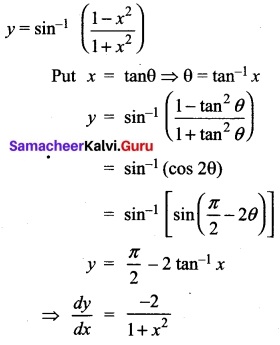
Differentiate y = sin-1 (\(\frac {1-x²}{1+x²}\))
Answer:
Tamil Nadu 11th Maths Previous Year Question Paper March 2019 English Medium 9

Question 38.
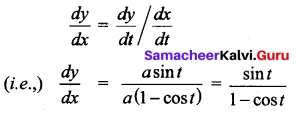
find \(\frac {dy}{dx}\) if x = a (t – sin t), y = a(1 – cos t)
Answer:
x = a (t – sin t) ⇒ \(\frac {dy}{dx}\) = a(1 – cos t)
y = a(1 – cos t) ⇒ \(\frac {dy}{dt}\) = a(sin t)
Tamil Nadu 11th Maths Previous Year Question Paper March 2019 English Medium 10

Question 39.
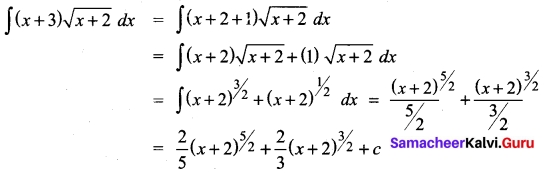
Evaluate \(\int { (x+3) } \sqrt { x+2 }\) dx
Answer:
Tamil Nadu 11th Maths Previous Year Question Paper March 2019 English Medium 11

Tamil Nadu 11th Maths Previous Year Question Paper March 2019 English Medium

Question 40.
Construct a suitable domain X such that f : X → N defined by/(n) = n + 3 to be one to one and onto.
Answer:
f : X → N is defined by f(x) = n + 3
Since f is one-one and onto function
suitable Domain is (-2, 1,0} ∪ N (or) {-2, -1, 0, 1, 2}

PART- IV

IV. Answer all the questions. [7 x 5 = 35]

Question 41 (a).
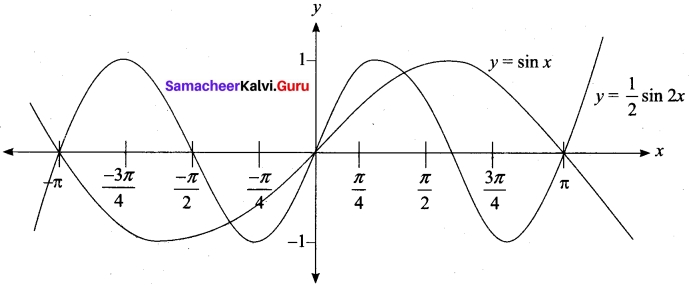
For the given base curve y = sin x, draw y = \(\frac {1}{2}\) sin 2x
Answer:
Tamil Nadu 11th Maths Previous Year Question Paper March 2019 English Medium 12

[OR]

(b) Write any five different forms of an equation of a straight line.
Answer:
(i) Slope intercept form : y = mx + c, c ≠ 0
(ii) Point and slope form : y – y1 = m (x – x1)
(iii) Two Point form : \(\frac {y – y_1}{y_{2}-y_1}\) \(\frac {x – x_1}{x_{2}-x_1}\)
(iv) Intercept form : \(\frac {x}{a}\) + \(\frac {y}{b}\) = 1
(v) Normal form : x cos α + y sin α

Question 42 (a).
Solve the equation \(\sqrt {6-4x-x²}\) = x + 4
Answer:
Squaring both sides
6 – 4x – x² = (x + 4)²
(i.e.,) x² + 6x + 5 = 0 ⇒ (x + 1) (x + 5) = 0
⇒ x = -1, x = -5
But x ≥ – 4
⇒ x = -1

[OR]

(b) Prove that in any ΔABC, Δ = \(\sqrt{s(s-a)(s-b)(s-c)}\), where s is the semi-perimeter of ΔABC.
Answer:
Δ = \(\frac {1}{2}\) ab sin C = \(\frac {1}{2}\) ab (2sin \(\frac {C}{2}\) cos \(\frac {C}{2}\))
Tamil Nadu 11th Maths Previous Year Question Paper March 2019 English Medium 13

Tamil Nadu 11th Maths Previous Year Question Paper March 2019 English Medium

Question 43 (a).
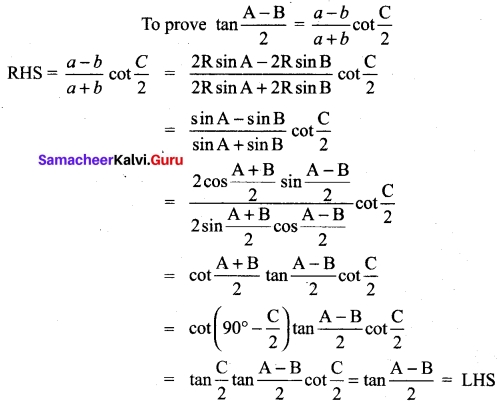
State and prove any one of the Napier’s formulae.
Answer:
Tamil Nadu 11th Maths Previous Year Question Paper March 2019 English Medium 14

[OR]

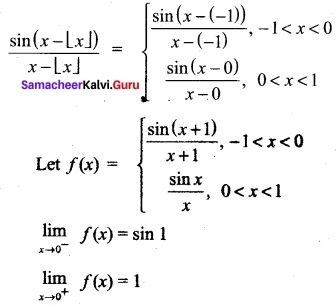
(b) Do the limit of the function \(\frac {sin(x-\left\lfloor x \right\rfloor)}{x – \left\lfloor x \right\rfloor}\) exist as x → 0? State the reasons for your answer.
Answer:
Tamil Nadu 11th Maths Previous Year Question Paper March 2019 English Medium 15
So, the limit does not exist.

Question 44. (a)
Prove that for any natural number n, an – bn is divisible by a – b, where a > b.
Answer:
a = a – b + b
So, an =[a- b + b]n = [(a -b) + b]n
= nC0 (a – b)n + nC1 (a – b)n-1b1 + nC2 (a – b)n-2b² + ……. + nCn-1, (a – b) bn-1+ nCn(bn)
⇒ an – bn = (a – b)n + nC1 (a – b)n-1b + nC2 (a – b)n-2b²) + …….. + nCn-1 (a – b) bn-1
= (a – b) [(a – b)n-1 + nC1 (a – b)n-2b + nC2 (a – b)n-3b² + …….. + nCn-1 bn-1]
= (a – b) [an integer]
⇒ an – bn If is divisible by(a – b).

[OR]

(b) Evaluate: \(\int \frac{2 x+4}{x^{2}+4 x+6}\)
Answer:
Let 2x + 4 = A \(\frac {d}{dx}\) (x² + 4x + 6) + B
(i.e.,) 2x + 4 = A(2x + 4) + B
Equating the coefficient of x and constant term we get
A = 1, B = 0
Tamil Nadu 11th Maths Previous Year Question Paper March 2019 English Medium 16

Tamil Nadu 11th Maths Previous Year Question Paper March 2019 English Medium

Question 45 (a).
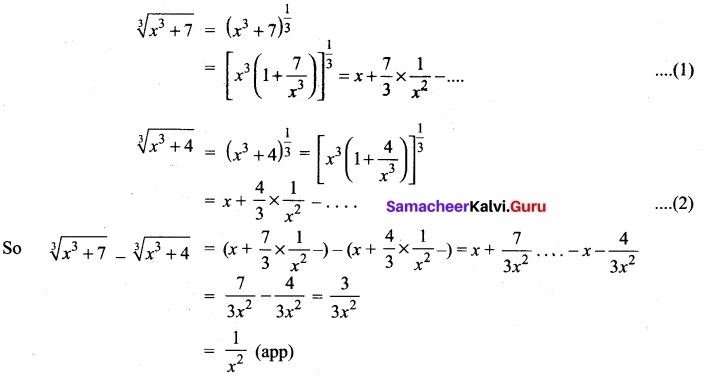
Prove that \(\sqrt[3]{x^{3}+7}-\sqrt[3]{x^{3}+4}\) is approximately equal to \(\frac {1}{x²}\)when x is large.
Answer:
Tamil Nadu 11th Maths Previous Year Question Paper March 2019 English Medium 17

[OR]

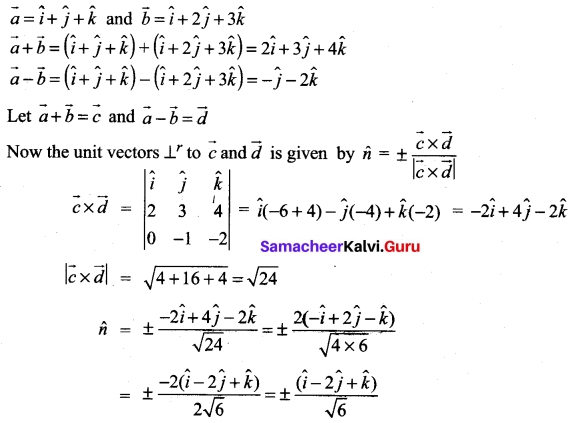
(b) Find the unit vectors perpendicular to each of the vectors \(\vec { a }\) + \(\vec { b }\) and \(\vec { a }\) – \(\vec { b }\) where \(\vec { a }\) = \(\hat { i }\) + \(\hat { j }\) + \(\hat { j }\) and \(\vec { b }\) = \(\hat { i }\) + 2\(\hat { j }\) + 3\(\hat { k }\).
Answer:
Tamil Nadu 11th Maths Previous Year Question Paper March 2019 English Medium 18

Question 46 (a).
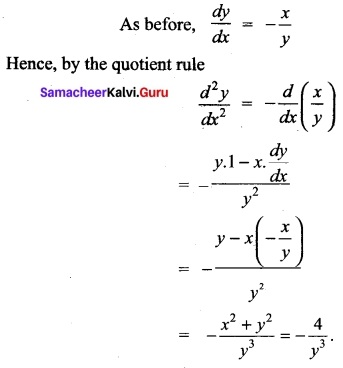
Find \(\frac {d²y}{dx}\) if x² + y² = 4
Answer:
we have x² + y² = 4
Tamil Nadu 11th Maths Previous Year Question Paper March 2019 English Medium 19

[OR]

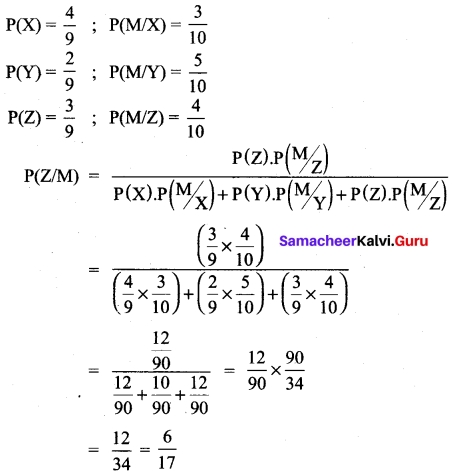
(b) The chances of X, Y and Z becoming managers of a certain company are 4 : 2 : 3. The probabilities that bonus scheme will be introduced if X, Y and Z become managers are 0.3, 0.5 and 0.4 respectively. If the bonus scheme has been introduced, what is the probability that Z was appointed as the manager?
Answer:
Given X : Y : Z = 4 : 2 : 3
Tamil Nadu 11th Maths Previous Year Question Paper March 2019 English Medium 20

Tamil Nadu 11th Maths Previous Year Question Paper March 2019 English Medium

Question 47 (a).
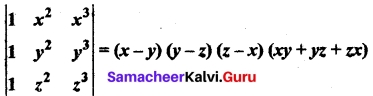
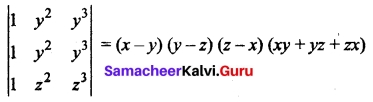
Prove that
Tamil Nadu 11th Maths Previous Year Question Paper March 2019 English Medium 21
Answer:
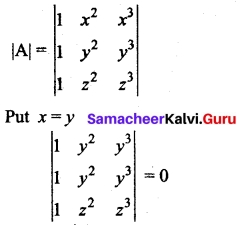
Tamil Nadu 11th Maths Previous Year Question Paper March 2019 English Medium 22
∴ (x – y) is a factor
Similarly (y – z)(z – x) are also factors.
The other factor is k(x² + y² + z²) + l(xy + yz + zx)
Tamil Nadu 11th Maths Previous Year Question Paper March 2019 English Medium 23
Putting x = 0, y = 1, z = 2 ⇒ 5k + 2l = 2 …. (1)
Putting x = 0, y = – 1, z = 1 ⇒ 2k – l = -1 …. (2)
from (1) & (2) k = 0, l = -1
Tamil Nadu 11th Maths Previous Year Question Paper March 2019 English Medium 24

[OR]

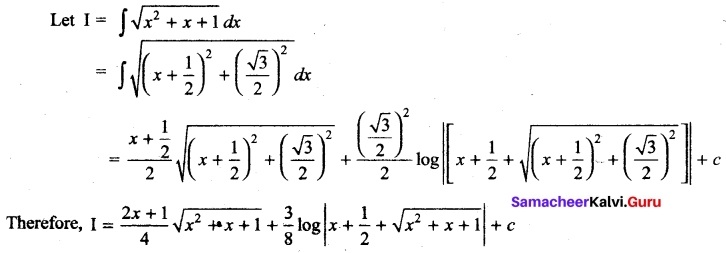
(b) Evaluate \(\int \sqrt{x^{2}+x+1}\) dx
Answer:
Tamil Nadu 11th Maths Previous Year Question Paper March 2019 English Medium 25

Tamil Nadu 11th Maths Previous Year Question Paper March 2019 English Medium

Tamil Nadu 11th Commerce Model Question Papers 2019-2020 English Tamil Medium

Expert Teachers at SamacheerKalvi.Guru has created Samacheer Kalvi Tamil Nadu State Board Syllabus New Paper Pattern 11th Commerce Model Question Papers 2019-2020 with Answers Pdf Free Download in English Medium and Tamil Medium of TN 11th Standard Commerce Public Exam Question Papers Answer Key, New Paper Pattern of HSC 11th Class Commerce Previous Year Question Papers, Plus One +1 Commerce Model Sample Papers are part of Tamil Nadu 11th Model Question Papers.

Here we have given the Government of Tamil Nadu State Board 11th Commerce Model Question Papers Tamil Medium with Answers 2019-20 Pdf. Students can view or download the Class 11th Commerce New Model Question Papers 2020 Tamil Nadu English Medium Pdf for their upcoming Tamil Nadu HSC Board Exams. Students can also read Tamilnadu Samcheer Kalvi 11th Commerce Book Solutions.

TN State Board 11th Commerce Model Question Papers 2019 2020 English Tamil Medium

Tamil Nadu 11th Commerce Model Question Papers English Medium 2019-2020

Tamil Nadu 11th Commerce Model Question Papers Tamil Medium 2019-2020

  • Tamil Nadu 11th Commerce Model Question Paper 1 Tamil Medium
  • Tamil Nadu 11th Commerce Model Question Paper 2 Tamil Medium
  • Tamil Nadu 11th Commerce Model Question Paper 3 Tamil Medium
  • Tamil Nadu 11th Commerce Model Question Paper 4 Tamil Medium
  • Tamil Nadu 11th Commerce Model Question Paper 5 Tamil Medium

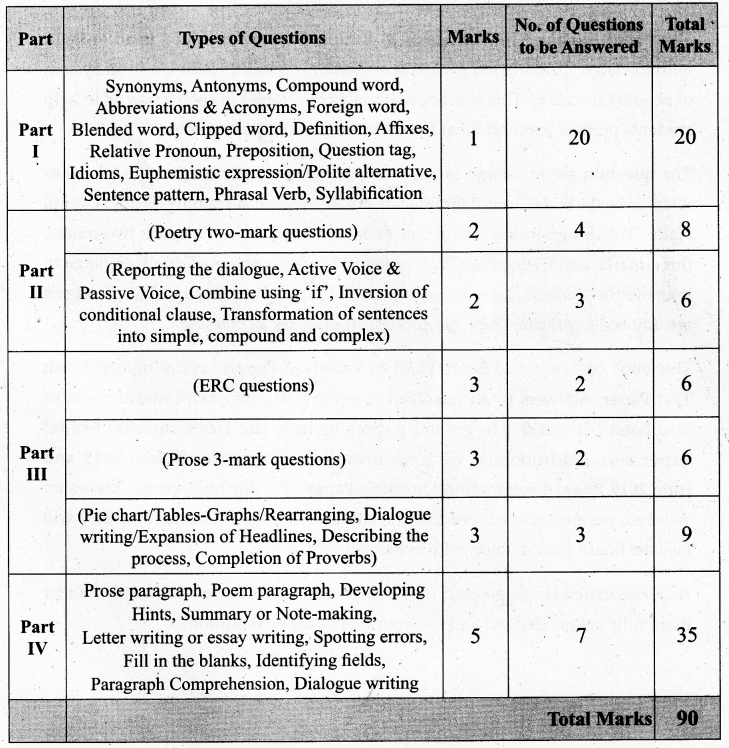
11th Commerce Model Question Paper Design 2019-2020 Tamil Nadu

Types of QuestionsMarksNo. of Questions to be AnsweredTotal Marks
Part-I Objective Type12020
Part-II Very Short Answers
(Totally 10 questions will be given. Answer any Seven. Any one question should be answered compulsorily)
2714
Part-Ill Short Answers
(Totally 10 questions will be given. Answer any Seven. Any one question should be answered compulsorily)
3721
Part-IV Essay Type5735
Total Marks90

Tamil Nadu 11th Commerce Model Question Paper Weightage of Marks

PurposeWeightage
1. Knowledge30%
2. Understanding40%
3. Application20%
4. Skill/Creativity10%

It is necessary that students will understand the new pattern and style of Model Question Papers of 11th Standard Commerce Tamilnadu State Board Syllabus according to the latest exam pattern. These Tamil Nadu Plus One 11th Commerce Model Question Papers State Board Tamil Medium and English Medium are useful to understand the pattern of questions asked in the board exam. Know about the important concepts to be prepared for TN HSLC Board Exams and Score More marks.

We hope the given Samacheer Kalvi Tamil Nadu State Board Syllabus New Paper Pattern Class 11th Commerce Model Question Papers 2019 2020 with Answers Pdf Free Download in English Medium and Tamil Medium will help you.

If you have any queries regarding the Tamil Nadu Government 11th Commerce State Board Model Question Papers with Answers 2019 20, TN 11th Std Commerce Public Exam Question Papers with Answer Key, New Paper Pattern of HSC Class 11th Commerce Previous Year Question Papers, Plus One +1 Commerce Model Sample Papers, drop a comment below and we will get back to you at the earliest.

Tamil Nadu 11th English Model Question Papers 2019-2020

Expert Teachers at SamacheerKalvi.Guru has created Samacheer Kalvi Tamil Nadu State Board Syllabus New Paper Pattern 11th English Model Question Papers 2019-2020 with Answers Pdf Free Download of TN 11th Standard English Public Exam Question Papers Answer Key, New Paper Pattern of HSC 11th Class English Previous Year Question Papers, Plus One +1 English Model Sample Papers are part of Tamil Nadu 11th Model Question Papers.

Here we have given the Government of Tamil Nadu State Board 11th English Model Question Papers with Answers 2019-20 Pdf. Students can view or download the Class 11th English New Model Question Papers 2020 Tamil Nadu for their upcoming Tamil Nadu HSC Board Exams. Students can also read Tamilnadu Samcheer Kalvi 11th English Book Solutions.

TN State Board 11th English Model Question Papers 2019 2020

11th English Model Question Papers 2019-2020 Tamil Nadu 

11th English Model Question Paper Design 2019-2020 Tamil Nadu

Tamil Nadu 11th English Model Question Papers

It is necessary that students will understand the new pattern and style of TN 11th Standard English Model Question Papers 2020 Tamilnadu State Board Syllabus according to the latest exam pattern. These Tamil Nadu Plus One 11th English Model Question Papers are useful to understand the pattern of questions asked in the board exam. Know about the important concepts to be prepared for TN HSLC Board Exams and Score More marks.

We hope the given Samacheer Kalvi Tamil Nadu State Board Syllabus New Paper Pattern Class 11th English Model Question Papers 2019 2020 with Answers Pdf Free Download will help you.

If you have any queries regarding the Government of Tamil Nadu State Board 11th English Model Question Papers with Answers 2019 20, TN 11th Std English Public Exam Question Papers with Answer Key, New Paper Pattern of HSC Class 11th English Previous Year Question Papers, Plus One +1 English Model Sample Papers, drop a comment below and we will get back to you at the earliest.

Samacheer Kalvi 11th Computer Science Solutions Chapter 18 Tamil Computing

Students can Download Computer Science Chapter 18 Tamil Computing Questions and Answers, Notes Pdf, Samacheer Kalvi 11th Computer Science Book Solutions Guide Pdf helps you to revise the complete Tamilnadu State Board New Syllabus and score more marks in your examinations.

Tamilnadu Samacheer Kalvi 11th Computer Science Solutions Chapter 18 Tamil Computing

Samacheer Kalvi 11th Computer Science Computer Tamil Computing Text Book Back Questions and Answers

PART – 1
I. Answer to the following questions

Question 1.
List of the search engines supporting Tamil.
Answer:
Google and Bing provide searching facilities in Tamil, which means you can search everything through Tamil. A Google search engine gives you an inbuilt Tamil virtual keyboard.

Question 2.
What are the keyboard layouts used in Android?
Answer:
Sellinam and Ponmadal – are familiar Tamil keyboard layouts that works on Android operating system in Smart phone using phonetics.

Samacheer Kalvi 11th Computer Science Solutions Chapter 18 Tamil Computing

Question 3.
Write a short note about Tamil Programming Language.
Answer:
Based on Python programming language, the first Tamil programming language “Ezhil” (எழில்) is designed. With the help of this programming language, you can write simple programs in Tamil.

Question 4.
What TSCII?
Answer:
TSCII (Tamil Script Code for Information Interchange) is the first coding system to handle our Tamil language in an analysis of an encoding scheme that is easily handled in electronic devices, including non – English computers. This encoding scheme was registered in IANA (Internet Assigned Numbers Authority) unit of ICANN.

Question 5.
Write a short note on Tamil Virtual Academy.
Answer:
With the objectives of spreading Tamil to the entire world through internet, Tamil Virtual University was established on 17th February 2001 by the Govt, of Tamil Nadu. Now, this organisation is functioning with the name “Tamil Virtual Academy”. This organisation offers different courses regarding Tamil language, Culture, heritage etc., from kindergarten to under graduation level.

Samacheer kalvi 11th Computer Science Tamil Computing Additional Questions and Answers

PART – 1
I. Choose the correct answer

Question 1.
Human civilization developed with the innovation of computer in the ……………
(a) 11th century
(b) 13th century
(c) 16th century
(d) 20th century
Answer:
(d) 20th century

Question 2.
…………… is not just a language, it is our identity, our life and our source.
(a) English
(b) Sanskrit
(c) Tamil
(d) Hindi
Answer:
(c) Tamil

Samacheer Kalvi 11th Computer Science Solutions Chapter 18 Tamil Computing

Question 3.
Getting government services through internet is known as ……………
(a) e – library
(b) e – govemance
(c) Tamil programming language
(d) Tamil translation applications
Answer:
(b) e – govemance

PART – 2
II. Short Answers

Question 1.
What is e – governance?
Answer:
Getting Government services through internet is known as e – Govemance. Govt, of Tamil Nadu has been giving its services through Internet. One can communicate with Govt, of Tamil Nadu from any comer of the state. One can get important announcements, government orders, and government welfare schemes from the web portal of Govt. of. Tamil Nadu.

Samacheer Kalvi 11th Computer Science Solutions Chapter 18 Tamil Computing

Question 2.
Write short notes on e – library.
Answer:
E – Libraries are portal or website of collection of e – books. Tamil e – Library services provide thousands of Tamil Books as ebooks mostly at free of cost. It is the most useful service to Tamil people who live far away from their home land.

Question 3.
Explain Tamil translation applications.
Answer:
Thamizpori (தமிஸ்ப்பூரி) is a Tamil translation application having more than 30000 Tamil words equalent to English words. Using this application, we can translate small English sentences into Tamil. Google also gives an online translation facility, using this online facility we can translate from Tamil to any other language and vice versa.

Question 4.
Define Tamil office automation application.
Answer:
Famous Office automation software like Microsoft Office, Open Office etc., provides complete Tamil interface facility. These softwares are downloadable and installed in your computer. After installation, your office automation software environment will be completely changed to Tamil. Menu bars, names of icons, dialog boxes will be shown in Tamil. Moreover, you can save files with Tamil names and create folders with Tamil names.

Samacheer Kalvi 11th Computer Science Solutions Chapter 18 Tamil Computing

Question 5.
Explain ISCII
Answer:
Indian Script Code for Information Interchange (ISCII ), is one of the encoding schemes specially designed for Indian languages including Tamil. It was unified with Unicode.

PART – 3
III. Short Answers

Question 1.
What is Unicode?
Answer:
Unicode is an encoding system, designed to handle various world languages, including Tamil. Its first version 1.0.0 was introduced on October 1991. While introduction of this scheme, can be able to handle nearly 23 languages including Tamil. Among the various encoding scheme, Unicode is the suitable to handle Tamil.

Question 2.
Define tamil typing and interface software.
Answer:
Tamil is mostly used to type documents in word processors and search information from internet. Typing Tamil using Tamil interface software is the familiar one among the different. methods of typing. This is the simplest method of typing Tamil in both Computer and Smart phones.

Samacheer Kalvi 11th Computer Science Solutions Chapter 18 Tamil Computing

Question 3.
Write a short note on Tamil in internet.
Answer:
Internet is the best information technological device, through which we get know everything from Internet. In 2017 a study conducted by KPMG a Singapore based organization along with google, reported that, Tamil topped the list, among the most widely used languages in India where 42% are using the Internet in Tamil.
Moreover in 2021 onwards, 74% of people in India will access internet using Tamil and it will be in the top usage of Internet in India.

Samacheer Kalvi 11th Computer Science Solutions Chapter 18 Tamil Computing

Question 4.
Explain Tamil operating system?
Answer:
An operating system is needed to access electronic systems such as computer and smart phone. Microsoft Windows is very popular operating system for personal computers. Linux is another popular open source operating system. Operating systems are used to access a computer easily. An operating system should be easy to work and its environment should be in understandable form. Thus, all operating systems used in computers and smart phones offered environment in Tamil.

Samacheer Kalvi 11th Computer Science Solutions Chapter 17 Computer Ethics and Cyber Security

Students can Download Computer Science Chapter 17 Computer Ethics and Cyber Security Questions and Answers, Notes Pdf, Samacheer Kalvi 11th Computer Science Book Solutions Guide Pdf helps you to revise the complete Tamilnadu State Board New Syllabus and score more marks in your examinations.

Tamilnadu Samacheer Kalvi 11th Computer Science Solutions Chapter 17 Computer Ethics and Cyber Security

Samacheer Kalvi 11th Computer Science Computer Ethics and Cyber Security Text Book Back Questions and Answers

PART – 1
I. Choose The Correct Answer

Question 1.
Which of the following deals with procedures, practices and values?
(a) piracy
(b) programs
(c) virus
(d) computer ethics
Answer:
(d) computer ethics

Question 2.
Commercial programs made available to the public illegally are known as ……………….
(a) freeware
(b) warez
(c) free software
(d) software
Answer:
(b) warez

Samacheer Kalvi 11th Computer Science Solutions Chapter 17 Computer Ethics and Cyber Security

Question 3.
Which one of the following are self – repeating and do not require a computer program to attach themselves?
(a) viruses
(b) worms
(c) spyware
(d) Trojans
Answer:
(b) worms

Question 4.
Which one of the following tracks a user visiting a website?
(a) spyware
(b) cookies
(c) worms
(d) Trojans
Answer:
(b) cookies

Question 5.
Which of the following is not a malicious program on computer systems?
(a) worms
(b) Trojans
(c) spyware
(d) cookies
Answer:
(d) cookies

Question 6.
A computer network security that monitors and controls incoming and outgoing traffic is ……………….
(a) cookies
(b) virus
(c) firewall
(d) worms
Answer:
(c) firewall

Question 7.
The process of converting cipher text to plain text is called ……………….
(a) Encryption
(b) Decryption
(c) key
(d) proxy server
Answer:
(b) Decryption

Question 8.
e – commerce means ……………….
(a) electronic commerce
(b) electronic data exchange
(c) electric data exchange
(d) electronic commercialization
Answer:
(a) electronic commerce

Question 9.
Distributing unwanted e-mail to others is called.
(a) scam
(b) spam
(c) fraud
(d) spoofing
Answer:
(b) spam

Samacheer Kalvi 11th Computer Science Solutions Chapter 17 Computer Ethics and Cyber Security

Question 10.
Legal recognition for transactions are carried out by ……………….
(a) Electronic Data Interchange
(b) Electronic Data Exchange
(c) Electronic Data Transfer
(d) Electrical Data Interchange
Answer:
(a) Electronic Data Interchange

PART – 2
II. Answers to all the questions

Question 1.
What is harvesting?
Answer:
A person or program collects login and password information from a legitimate user to illegally gain access to others account(s).

Question 2.
What are Warez?
Answer:
Shareware publishers encourage users to give copies of programs to friends and colleagues but ask everyone who uses that program regularly to pay a registration fee to the program’s author directly. Commercial programs that are made available to the public illegally are often called warez.

Question 3.
Write a short note on cracking.
Answer:
Cracking is where someone edits a program source so that the code can be exploited or modified. “Cracking” means trying to get into computer systems in order to steal, corrupt, or illegitimately view data.

Question 4.
Write two types of cyber attacks.
Answer:
Cyber Attack:

  1. Virus
  2. Worms

Function:

  1. A virus is a small piece of computer code that can repeat itself and spreads from one computer to another by attaching itself to another computer file. One of the most common virus is Trojan.
  2. Worms are self – repeating and do not require a computer program to attach themselves. Worms continually look for vulnerabilities and report back to the author of the worm when weaknesses are discovered.

Question 5.
What is a Cookie?
Answer:
A cookie (also called HTTP cookie, web cookie, Internet cookie, browser cookie, or simply cookie) is a small piece of data sent from a website and stored on the user’s computer memory (Hard drive) by the user’s web browser while the user is browsing internet.

PART – 3
III. Answers to all the questions

Question 1.
What is the role of firewalls?
Answer:
A firewall is a computer network security based system that monitors and controls incoming and outgoing network traffic based on predefined security rules. A firewall commonly establishes a block between a trusted internal computer network and entrusted computer outside the network. They are generally categorized as network – based or host – based. Network based firewalls are positioned on the gateway computers of LANs [local area Network], WANs [Wide Area Network] and intranets.

Samacheer Kalvi 11th Computer Science Solutions Chapter 17 Computer Ethics and Cyber Security

Question 2.
Write about encryption and decryption.
Answer:
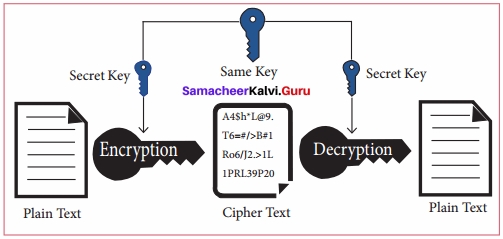
Encryption and decryption are processes that ensure confidentiality that only authorized persons can access the information. Encryption is the process of translating the plain text data (plaintext) into random and mangled data (called cipher – text). Decryption is the reverse process of converting the cipher – text back to plaintext. Encryption and decryption are done by cryptography. In cryptography a key is a piece of information (parameter) that determines the functional output of a cryptographic algorithm.

Question 3.
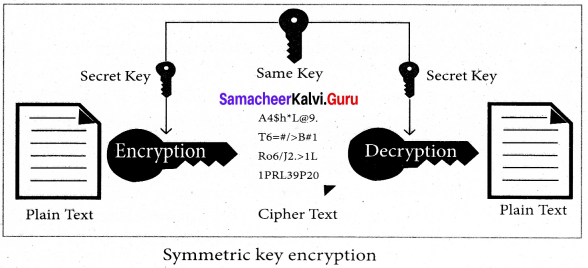
Explain symmetric key encryption.
Answer:
Symmetric encryption is a technique to use the same key for both encryption and decryption. The main disadvantage of the symmetric key encryption is that all authorized persons involved, have to exchange the key used to encrypt the data before they can decrypt it. If anybody intercepts the key information, they may read all messages.

Question 4.
What are the guidelines to be followed by any computer user?
Answer:
Generally, the following guidelines should be observed by computer users:

  1. Honesty : Users should be truthful while using the internet.
  2. Confidentiality : Users should not share any important information with unauthorized people.
  3. Respect : Each user should respect the privacy of other users.
  4. Professionalism : Each user should maintain professional conduct.
  5. Obey The Law : Users should strictly obey the cyber law in computer usage.
  6. Responsibility : Each user should take ownership and responsibility for their actions.

Question 5.
What are ethical issues? Name some.
Answer:
An Ethical issue is a problem or issue that requires a person or organization to choose between alternatives that must be evaluated as right (ethical) or wrong (unethical). These issues must be addressed and resolved to have a positive influence in society.
Some of the common ethical issues are listed below:

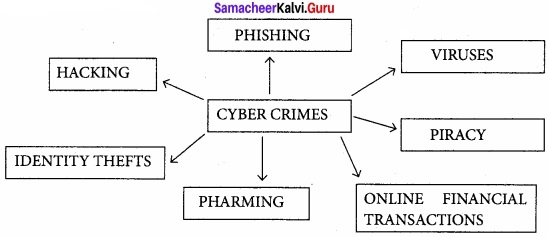
  1. Cyber crime
  2. Software Piracy
  3. Unauthorized Access
  4. Hacking
  5. Use of computers to commit fraud.
  6. Sabotage in the form of viruses.

PART – 4
IV. Answers to all the questions

Question 1.
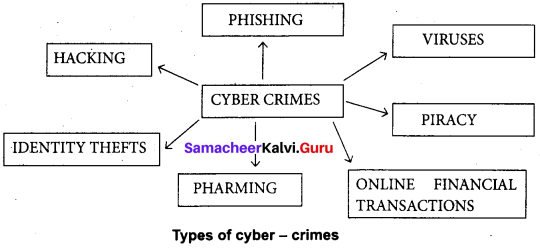
What are the various crimes happening using computer?
Answer:
Crime:

  1. Crime Function
  2. Cyber stalking
  3. Malware
  4. Harvesting
  5. Identity theft
  6. Intellectual property theft
  7. Salami slicing

Function:

  1. Hacking, threats, and blackmailing towards a business or a person.
  2. Harassing through online.
  3. Malicious programs that can perform a variety of functions including stealing, encrypting or deleting sensitive data, altering or hijacking core computing functions and monitoring user’s computer activity without their permission.
  4. A person or program collects login and password information from a legitimate user to illegally gain access to others’ account(s).
  5. It is a crime where the criminals impersonate individuals, usually for financial gain.
  6. Stealing practical or conceptual information developed by another person or company.
  7. Stealing tiny amounts of money from each transaction.

Samacheer Kalvi 11th Computer Science Solutions Chapter 17 Computer Ethics and Cyber Security

Question 2.
What is piracy? Mention the types of piracy? How can it be prevented?
Answer:
Software Piracy is about the copyright violation of software created originally by an individual or an institution. It includes:
1. stealing of codes / programs and other information illegally and creating duplicate copies by unauthorized means and utilizing this data either for one’s own benefit or for commercial profit.

2. Downloading software from illegal network sources.
An entirely different approach to software piracy is called shareware, acknowledges the futility of trying to stop people from copying software and instead relies on people’s honesty.

Shareware publishers encourage users to give copies of programs to friends and colleagues but ask everyone who uses that program regularly to pay a registration fee to the program’s author directly. To prevent unauthorized access, Firewalls, Intrusion Detection Systems (IDS), Virus and Content Scanners, Patches and Hot fixes are used.

Question 3.
Write the different types of cyber attacks.
Answer:
Cyber Attack:

  1. Virus
  2. Worms
  3. Spyware
  4. Ransomware

Function:

  1. A virus is a small piece of computer code that can repeat itself and spreads from one computer to another by attaching itself to another computer file. One of the most common virus is Trojan.
  2. Worms are self – repeating and do not require a computer program to attach themselves. Worms continually look for vulnerabilities and report back to the author of the worm when weaknesses are discovered.
  3. Spyware can be installed on the computer automatically when the attachments are open, by clicking on links or by downloading infected software.
  4. Ransomware is a type of malicious program that demands payment after launching a cyber – attack on a computer system. This type of malware has become increasingly popular among criminals and costs the organizations millions each year.

Samacheer kalvi 11th Computer Science Computer Ethics and Cyber Security Additional Questions and Answers

PART – 1
I. Choose the correct answer

Question 1.
A moral code that is evaluated as right is ………………..
(a) piracy
(b) viruses
(c) cracking
(d) ethics
Answer:
(d) ethics

Question 2.
……………….. is a crime where the criminals impersonate individuals for financial gain.
(a) intellectual property theft
(b) Identity theft
(c) Salami slicing
(d) Spoofing
Answer:
(b) Identity theft

Question 3.
Stealing data from a computer system without the knowledge or permission is called ………………..
(a) warez
(b) hacking
(c) cracking
(d) phishing
Answer:
(b) hacking

Samacheer Kalvi 11th Computer Science Solutions Chapter 17 Computer Ethics and Cyber Security

Question 4.
One of the most common virus is ………………..
(a) Ransomware
(b) Spyware
(c) worms
(d) Trojan
Answer:
(d) Trojan

Question 5.
……………….. is the intermediary between the end users and a web browser.
(a) Firewall
(b) Proxy server
(c) Cookies
(d) Warez
Answer:
(b) Proxy server

PART – 2
II. Short Answers

Question 1.
What is hacking?
Answer:
Hacking is intruding into a computer system to steal personal data without the owner’s permission or knowledge (like to steal a password). It is also gaining unauthorized access to a computer system, and altering its contents.

Question 2.
What is proxy server? Explain its working.
Answer:
A proxy server acts as an intermediary between the end users and a web server. A client connects to the proxy server, requesting some service, such as a file, connection, web page, or other resources available from a different server. The proxy server examines the request, checks authenticity and grants the request based on that. Proxy servers typically keep the frequently visited site addresses in its cache which leads to improved response time.

Samacheer Kalvi 11th Computer Science Solutions Chapter 17 Computer Ethics and Cyber Security

Question 3.
Mention any 2 reasons as to why the websites use cookies?
Answer:

  1. To collect demographic information about who has visited the Web site.
  2. It helps to personalize the user’s experience on the Website.

Question 4.
What is meant by MITM?
Answer:
Man – in – the – middle attack (MITM; also Janus attack) is an attack where the attacker secretly relays and possibly alters the communication between two parties who believe they are directly communicating with each other.

Question 5.
Define software piracy.
Answer:
Software Piracy is about the copyright violation of software created originally by an individual or an institution. It includes stealing of codes / programs and other information illegally and creating duplicate copies by unauthorized means and utilizing this data either for one’s own benefit or for commercial profit.

PART – 3
III. Short Answers

Question 1.
What is cyber crime?
Answer:
A cyber – crime is a crime which involves computer and network. This is becoming a growing threat to society and is caused by criminals or irresponsible action of individuals who are exploiting the widespread use of Internet. It presents a major challenge to the ethical use. of information technologies. Cyber – crime also poses threats to the integrity, safety and survival of most business systems.
Samacheer Kalvi 11th Computer Science Solutions Chapter 17 Computer Ethics and Cyber Security

Question 2.
Write a short note on ethics.
Answer:
Ethics means “What is wrong and What is Right”. It is a set of moral principles that rule the behavior of individuals who use computers. An individual gains knowledge to follow the right behavior, using morals that are also known as ethics. Morals refer to the generally accepted standards of right and wrong in the society. Similarly, in cyber – world, there are certain standards such as

  1. Do not use pirated software.
  2. Do not use unauthorized user accounts.
  3. Do not steal others’ passwords.
  4. Do not hack.

Samacheer Kalvi 11th Computer Science Solutions Chapter 17 Computer Ethics and Cyber Security

Question 3.
Differentiate Spyware and Ransomware.
Answer:
Spyware:
Spyware can be installed on the computer automatically when the attachments are open, by clicking on links or by downloading infected software.

Ransomware:
Ransomware is a type of malicious program that demands payment after launching a cyber-attack on a computer system. This type of malware has become increasingly popular among criminals and costs the organizations millions each year.

Question 4.
What are the types of encryption?
Answer:
There are two types of encryption schemes as listed below:
1. Symmetric Key encryption : Symmetric encryption is a technique to use the same key for both encryption and decryption.
Samacheer Kalvi 11th Computer Science Solutions Chapter 17 Computer Ethics and Cyber Security
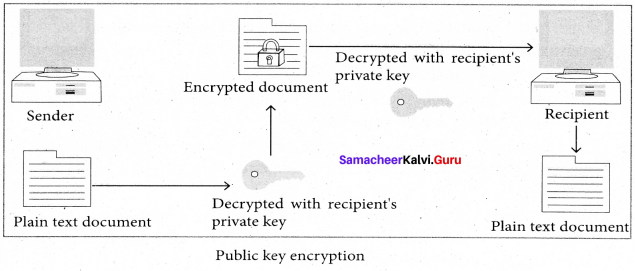
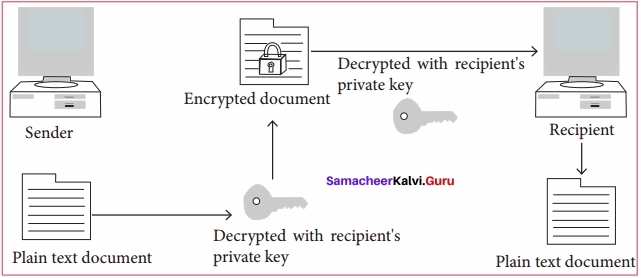
2. Public Key encryption : Public key encryption is also called Asymmetric encryption. It uses the concept of a key value pair, a different key is used for the encryption and decryption
Samacheer Kalvi 11th Computer Science Solutions Chapter 17 Computer Ethics and Cyber Security

Question 5.
Write down the points to be noted to be safe from cyber crime.
Answer:
To protect the information the following points to be noted:

  1. Complex password setting can make your surfing secured.
  2. When the internet is not in use, disconnect it.
  3. Do NOT open spam mail or emails that have an unfamiliar sender.
  4. When using anti – virus software, keep it up – to – date.

PART – 4
IV. Explain in Detail

Question 1.
Explain public key encryption and asymetric encryption in digital certificate.
Answer:
Public key encryption is also called Asymmetric encryption. It uses the concept of a key value pair, a different key is used for the encryption and decryption process. One of the keys is typically known as the private key and the other is known as the public key. The private key is kept secret by the owner and the public key is either shared amongst authorized recipients or made available to the public at large.

The data encrypted with the recipient’s public key can only be decrypted with the corresponding private key. A digital certificate in a client – server model of communication is one of the example of Asymmetric Encryption. A certificate is a package of information that identifies a user and a server.

It contains information such as an organization’s name, the organization that issued the certificate, the users’ email address and country, and user’s public key. When a server and a client require a secure encrypted communication, they send a query over . the network to the other party, which sends back a copy of the certificate. The other party’s public key can be extracted from the certificate. A certificate can also be used to uniquely identify the holder.

Samacheer Kalvi 11th Computer Science Solutions Chapter 17 Computer Ethics and Cyber Security

Question 2.
Write short notes on:

  1. Spam
  2. Fraud
  3. Cyber stalking
  4. Spoofing
  5. Virus
  6. Worms

Answer:

  1. Spam : Distribute unwanted e – mail to a large number of internet users.
  2. Fraud : Manipulating data, for example changing the banking records to transfer money to an unauthorized account.
  3. Cyber stalking : Harassing through online.
  4. Spoofing : It is a malicious practice in which communication is send from unknown source disguised as a source known to the receiver.
  5. Virus : A virus is a small piece of computer code that can repeat itself and spreads from one computer to another by attaching itself to another computer file. One of the most common virus is Trojan.
  6. Worms : Worms are self – repeating and do not require a computer program to attach themselves. Worms continually look for vulnerabilities and report back to the author of the worm when weaknesses are discovered.

Question 3.
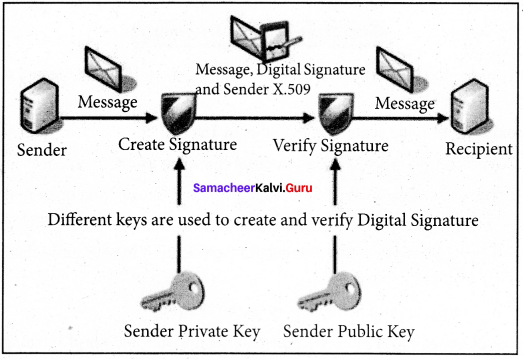
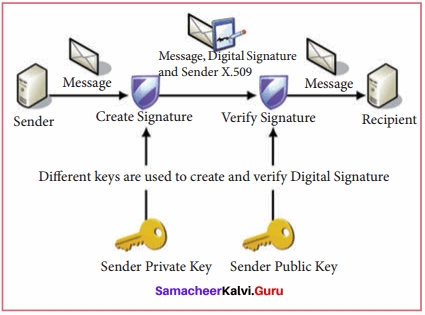
Explain digital signature with a functional diagram.
Answer:
Digital signatures are based on asymmetric cryptography and can provide assurances of evidence to origin, identity and status of an electronic document, transaction or message, as well as acknowledging information given by the signer. To create a digital signature, signing software (email) creates a one – way hash of the electronic data to be signed.

The user’s private key to encrypt the hash, returning a value that is unique to the hashed data. The encrypted hash, along with other information such as the hashing algorithm, forms the digital signature. Any change in the data, even to a single bit, results in a different hash value. This attribute enables others to validate the integrity of the data by using the signer’s public key to decrypt the hash.

If the decrypted hash matches a second computed hash of the same data, it proves that the data hasn’t changed since it was signed. If the two hashes don’t match, the data has either been tampered with in some way (indicating a failure of integrity) or the signature was created with a private key that doesn’t correspond to the public key presented by the signer (indicating a failure of authentication).
Samacheer Kalvi 11th Computer Science Solutions Chapter 17 Computer Ethics and Cyber Security

Samacheer Kalvi 11th Computer Applications Solutions Chapter 18 Tamil Computing

Students can Download Computer Applications Chapter Chapter 18 Tamil Computing Questions and Answers, Notes Pdf, Samacheer Kalvi 11th Computer Applications Book Solutions Guide Pdf helps you to revise the complete Tamilnadu State Board New Syllabus and score more marks in your examinations.

Tamilnadu Samacheer Kalvi 11th Computer Applications Solutions Chapter 18 Tamil Computing

Samacheer Kalvi 11th Computer Applications Tamil Computing Text Book Back Questions and Answers

I. Answer To The Following Questions

Question 1.
List of the search engines supporting Tamil?
Answer:
Google, Bing and Yahoo are takes first three places respectively. Google and Bing provide searching facilities in Tamil, which me you can search everything through Tamil. A Google search engine gives you an inbuilt Tamil virtual keyboard.

Question 2.
What are the keyboard layouts used in Android?
Answer:
Sellinam and Ponmadal are familiar Tamil keyboard layouts that works on android operating system in Smart phone using phonetics.

Samacheer Kalvi 11th Computer Applications Solutions Chapter 18 Tamil Computing

Question 3.
Write a short note about Tamil Programming Language?
Answer:
Programming languages to develop software to computers and smart phones are available only in English. Now, efforts are taken to develop programming languages in Tamil.

Based on Python programming language, the first Tamil programming language “Ezhil” (எழில்) is designed. With the help of this programming language, you can write simple programs in Tamil:

Question 4.
What is TSCII?
Answer:
TSCII (Tamil Script Code for Information Interchange) is the first coding system to handle our Tamil language in an analysis of an encoding scheme that is easily handled in electronic devices, including non- English computers. This encoding scheme was registered in IANA (Internet Assigned Numbers Authority) unit of ICANN.

Samacheer Kalvi 11th Computer Applications Solutions Chapter 18 Tamil Computing

Question 5.
Write a short note on Tamil Virtual Academy?
Answer:
With the objectives of spreading Tamil to the entire world through Internet, Tamil Virtual University was established on 17th February 2001 by the Government of Tamilnadu.

Now, this organisation functioning with the name “Tamil Virtual Academy”. This organisation offers different courses regarding Tamil language, Culture, heritage etc… from kindergarten to under graduation level.

Samacheer Kalvi 11th Computer Applications Tamil Computing Additional Important Questions and Answer

I. Choose The Correct Answer

Question 1.
Human civilization developed with the innovation of computer in the …………………….
(a) 11th century
(b) 13th century
(c) 16th century
(d) 20th century
Answer:
(d) 20th century

Samacheer Kalvi 11th Computer Applications Solutions Chapter 18 Tamil Computing

Question 2.
…………………… is not just a language, it is our identity, our life and our source.
(a) English
(b) Sanskrit
(c) Tamil
(d) Hindi
Answer:
(c) Tamil

Question 3.
Getting government services through internet is known as
(a) e-library
(b) e-govemance
(c) Tamil programming language
(d) Tamil translation applications
Answer:
(b) e-govemance

II. Short Answers

Question 1.
What is e-governance?
Answer:
Getting Government services through internet is known as e-Govemance. Govt, of Tamil Nadu has been giving its services through Internet.

One can communicate with Govt, of Tamil Nadu from any comer of the state. One can get important’announcements, government orders, and government welfare schemes from the web portal of Govt. of. Tamil Nadu.

Samacheer Kalvi 11th Computer Applications Solutions Chapter 18 Tamil Computing

Question 2.
Write short notes on e-library?
Answer:
E-Libraries are portal or website of collection of e-books. Tamil e-Library services provide thousands of Tamil Books as ebooks mostly at free of cost. It is the most useful service to Tamil people who live far away from their home land.

Question 3.
Explain Tamil translation applications?
Answer:
Thamizpori (தமிழ்பொறி) is a Tamil translation application having more than 30000 Tamil words equalent to English words. Using this application, we can translate small English sentences into Tamil. Google also gives an online translation facility, using this online facility we can translate from Tamil to any other language and vice versa.

Samacheer Kalvi 11th Computer Applications Solutions Chapter 18 Tamil Computing

Question 4.
Define Tamil office automation application?
Answer:
Famous Office automation software like Microsoft Office, Open Office etc., provides complete Tamil interface facility. These softwares are downloadable and installed in your computer.

After installation, your office automation software environment will be completely changed to Tamil. Menu bars, names of icons, dialog boxes will be shown in Tamil. Moreover, you can save files with Tamil names and create folders with Tamil names.

Question 5.
Explain ISCII?
Answer:
Indian Script Code for Information Interchange (ISCII ), is one of the encoding schemes specially designed for Indian languages including Tamil. It was unified with Unicode.

III. Short Answers

Question 1.
What is Unicode?
Answer:
Unicode is an encoding system, designed to handle various world languages, including Tamil. Its first version 1.0.0 was introduced on October 1991.

While introduction of this scheme, can be able to handle nearly 23 languages including Tamil. Among the various encoding scheme, – Unicode is the suitable to handle Tamil.

Samacheer Kalvi 11th Computer Applications Solutions Chapter 18 Tamil Computing

Question 2.
Define tamil typing and interface software?
Answer:
Tamil is mostly used to type documents in word processors and search information from internet. Typing Tamil using Tamil interface software is the familiar one among the different methods of typing. This is the simplest method of typing Tamil in both Computer and Smart phones.

Question 3.
Write a short note on Tamil in internet?
Answer:
Internet is the best information technological device, through which we get know everything from Internet. In 2017 a study conducted by KPMG a Singapore based organization along with google, reported that, Tamil topped the list, among the most widely used languages in India where 42% are using the Internet in Tamil. Moreover in 2021 onwards, 74% of people in India will access internet using Tamil and it will be in the top usage of Internet in India.

Samacheer Kalvi 11th Computer Applications Solutions Chapter 18 Tamil Computing

Question 4.
Explain Tamil operating system?
Answer:
An operating system is needed to access electronic systems such as computer and smart phone. Microsoft Windows is very popular operating system for personal computers.

Linux is another popular open source operating system. Operating systems are used to access a computer easily. An operating system should be easy to work and its environment should be in understandable form. Thus, all operating systems used in computers and smart phones offered environment in Tamil.

Samacheer Kalvi 11th Computer Applications Solutions Chapter 16 Javascript Functions

Students can Download Computer Applications Chapter Chapter 16 Javascript Functions Questions and Answers, Notes Pdf, Samacheer Kalvi 11th Computer Applications Book Solutions Guide Pdf helps you to revise the complete Tamilnadu State Board New Syllabus and score more marks in your examinations.

Tamilnadu Samacheer Kalvi 11th Computer Applications Solutions Chapter 16 Javascript Functions

Samacheer Kalvi 11th Computer Applications Javascript Functions Text Book Back Questions and Answers

I. Choose The Correct Answer

Question 1.
The parameters work as:
(a) local variable
(b) global Variable
(c) file variable
(d) block variable
Answer:
(a) local variable

Samacheer Kalvi 11th Computer Applications Solutions Chapter 16 Javascript Functions

Question 2.
Predefined functions are also called as:
(a) library functions
(b) storage functions
(c) instructions
(d) commands
Answer:
(a) library functions

Question 3.
Larger programs are divided into smaller are called:
(a) modules
(b) block
(c) sets
(d) group
Answer:
(a) modules

Samacheer Kalvi 11th Computer Applications Solutions Chapter 16 Javascript Functions

Question 4.
Which of the following is used to enhance re-usability and program clarity?
(a) Functions
(b) Modules
(c) Sets
(d) Instructions
Answer:
(a) Functions

Question 5.
Which of the following allow the programmer to modularize a program?
(a) Library functions
(b) User defined functions
(c) Normal functions
(d) Ordinary functions
Answer:
(b) User defined functions

II. Answer To The Following Questions

Question 1.
What is a function in JavaScript?
Answer:
A function is a block of JavaScript code that is defined once but may be executed or invoked any number of times. Functions are used to encapsulate code that performs a specific task.

Samacheer Kalvi 11th Computer Applications Solutions Chapter 16 Javascript Functions

Question 2.
What is the use of function?
Answer:
Sometimes functions are defined for commonly required tasks to avoid the repetition entailed in typing the same statements over and over. More generally, they are used to keep code that performs a particular job in one place in order to enhance re-usability and program clarity.

Question 3.
Write a note on Library functions?
Answer:
Pre-defined functions are already defined in the JavaScript library which are also called Library functions. For example isNaN( ), toUpperCase( ), toLowerCase( ), length( ), alert( ), prompt( ),write( ) etc… are pre-defined functions.

Question 4.
Write a note on user defined functions?
Answer:
User-defined functions allow the programmer to modularize a program. Most computer programs that solve real-world problems are much large, occupy more space in the computer memory and takes more time to execute. Hence such large programs are divided into small programs are called modules.

Samacheer Kalvi 11th Computer Applications Solutions Chapter 16 Javascript Functions

Question 5.
Write the syntax of functions?
Answer:
The format of a function definition is –
Function function-name(parameters list)
{
Declaration of variable Executable statements;
}

III. Answer To The Following Questions

Question 1.
Write a program in JavaScript to find the cube of a number using function?
Answer:
<html>
<head>
<title> print the cube number
</title>
</head>
<Title>
Function cube</Title>
<Script type = “text/Javascript”>
<!—
var input = window.prompt (“Enter value : ”, “0”);
var v = parselnt (input); var c = cube (v);
document, write In (“<br><h4><u> cube function </u> </h4>”);
document, write In (“Number *V* “<br> The cube =” *C);
function cube (x)
{
var cube = x* x * x; return c;
}
//–>
</script>
</head>
<body>
</body>
</html>
OUTPUT
Enter value : 5
Cube Function Number : 5
The cube : 125

Samacheer Kalvi 11th Computer Applications Solutions Chapter 16 Javascript Functions

Question 2.
Write a program in JavaScript to find the sum of 10 numbers using function?
Answer:
<html>
<head>
<Title> Function sum of 10 Numbers </Title>
<Script type = “text/Javascript”>
<!—
var input 1 = window.prompt (“Enter initial value : ”, “0”);
var input 2 = window.prompt (“Enter final value : ”, “0”);
var v1 = parse Int (input 1);
var v2 = parse Int (input 2);
var r = res (v1 , v2);
document, write In (“<br><h4><u> Function for sum of 10 Numbers </u> </h4>”);
document, write In (“Initial Number : “ +v1+” <br> Final Number : “+v2+”<br>
The result =”+r);
function result (n)
{
var r = n* (n+1)/2
return r;
//–>
</script>
</head>
<body>
</body>
</html>
OUTPUT
Enter initial value : 1
Enterfinal value : 10
Function for sum of 10 numbers
Initial No : 1
FinalNo : 10
The result : 55

Samacheer Kalvi 11th Computer Applications Javascript Functions Additional Questions and Answers

I. Choose The Correct Answer

Question 1.
…………………… often use their argument values to compute a return value that becomes the value of the function invocation expression.
(a) function
(b) parameter
(c) non-parameter
(d) expression
Answer:
(a) function

Samacheer Kalvi 11th Computer Applications Solutions Chapter 16 Javascript Functions

Question 2.
…………………… method returns the element that has the ID attribute with the specified value.
(a) elements [o]
(b) getElementByid( )
(c) Nan ( )
(d) NaN (“A”)
Answer:
(b) getElementByid( )

II. Short Answers

Question 1.
What are the types of function?
Answer:
JavaScript supports two types functions. They are:

  1. Pre-defined or Library Functions
  2. User-defined Functions

Samacheer Kalvi 11th Computer Applications Solutions Chapter 16 Javascript Functions

Question 2.
Define NaN( )?
Answer:
The is NaN( ) function is used to check whether the given value or variable is valid number. This function returns true if the given value is not a number. For example is NaN(“12”), is NaN(“A”).

Question 3.
What are the different types of predefined functions?
Answer:
Samacheer Kalvi 11th Computer Applications Solutions Chapter 16 Java Script Function

III. Explain in Detail

Question 1.
Write a program to find the sum of 2 numbers?
Answer:
<html>
<head>
<title>Function Example</title>
<script type=“text/JavaScript”>
var input1=window.prompt(“Enter Value 1 “0”);
var input2=window.prompt(“Enter Value2 “0”);
var v1=parselnt(input1);
var v2=parselnt(input2);
var s=sum(v1,v2);
document.writeln(“<br><h4><u>Example for Function</u></h4>”);
document.writeln(“First No + v1 + “ <br>Second No + v2 + “<br> The Sum =” + s);
function sum(x, y)
{
var s=x+y;
return s;
}
</script>
</head>
<body>
</body>
</html>

Samacheer Kalvi 11th Computer Applications Solutions Chapter 16 Javascript Functions

Question 2.
Write a program to validate whether the entered value is a number or not?
Answer:
<html>
<head>
<title>Example Program to test isNan( ) Function</title>
</head>
<body>
<h4><u>Example Program to test isNan() Function</u></h4>
<script language=“JavaScript”>
function checknum( )
{
var n=document.form1.text1 .value;
if(isNaN (n)==true)
{
document.form1.text2.value=“Not a Number +n;
}
else
{
document, form 1 ,text2.value=“It is Number : ”+n;
}
}
</script>
<form name=“form1’’>
Enter a Number 1:
<input type=“text” name=“textl” size=3>
<br><br>
<input type= “button” value=“Click to Check” onClick=“checknum( )”>
<input type=“text” name=“text2” size=30>
<br>
</form>
</body>
</html>

Samacheer Kalvi 11th Computer Applications Solutions Chapter 16 Javascript Functions

Question 3.
Write a program using functions to have an online quiz?
Answer:
<html>
<head>
<title>On-line Quiz</title>
<script type= “text/JavaScript”>
function checkAnswer( )
{
//var myQuiz=document.getElementById(“myQuiz”);
if (document.getElementById(“myQuiz”).elements[0],checked)
alert(“Congratulations, Your Answer is correct”);
else
alert(“Your Answer is incorrect, Please try Again”);
}
</script>
</head>
<body>
<form id=“myQuiz” aotion=“JavaScript:checkAnswer( )”>
<p> Which is not a Programming Language: <br>
<input type=“radio” name=“radiobutton” value=“Word” />
<label> MS-Word</label>
<input type=“radio” name=“radiobutton” value=“Cobol” />
<label> COBOL</label>
<input type=“radio” name=“radiobutton” value=“CPP” />
<label> C++</label>
<input type=“radio” name=“radiobutton” value=“VB” />
<label>Visual BASIC</label><br><br>
<input type=“submit” name-“submit” value=“Submit” />
<input type=“reset” name=“reset” value=“Reset” />
</p>
</form>
</body>
</html>

Samacheer Kalvi 11th Computer Applications Solutions Chapter 17 Computer Ethics and Cyber Security

Students can Download Computer Applications Chapter 17 Computer Ethics and Cyber Security Questions and Answers, Notes Pdf, Samacheer Kalvi 11th Computer Applications Book Solutions Guide Pdf helps you to revise the complete Tamilnadu State Board New Syllabus and score more marks in your examinations.

Tamilnadu Samacheer Kalvi 11th Computer Applications Solutions Chapter 17 Computer Ethics and Cyber Security

Samacheer Kalvi 11th Computer Applications Computer Ethics and Cyber Security Text Book Back Questions and Answers

I. Choose The Correct Answer

Question 1.
Which of the following deals with procedures, practices and values?
(a) Piracy
(b) Programs
(c) Virus
(d) Computer ethics
Answer:
(d) Computer ethics

Samacheer Kalvi 11th Computer Applications Solutions Chapter 17 Computer Ethics and Cyber Security

Question 2.
Commercial programs made available to the public illegally are known as:
(a) freeware
(b) warez
(c) free software
(d) software
Answer:
(b) warez

Question 3.
Which one of the following are self-repeating and do not require a computer program to attach themselves?
(a) Cirases
(b) Worms
(c) Spyware
(d) Trojans
Answer:
(b) Worms

Samacheer Kalvi 11th Computer Applications Solutions Chapter 17 Computer Ethics and Cyber Security

Question 4.
Which one of the following tracks a user visits a website?
(a) Spyware
(b) Cookies
(c) Worms
(d) Trojans
Answer:
(b) Cookies

Question 5.
Which of the following is not a malicious program on computer systems?
(a) Worms
(b) Trojans
(c) Spyware
(d) Cookies
Answer:
(d) Cookies

Samacheer Kalvi 11th Computer Applications Solutions Chapter 17 Computer Ethics and Cyber Security

Question 6.
A computer network security that monitors and controls incoming and outgoing traffic is:
(a) Cookies
(b) Virus
(c) firewall
(d) Worms
Answer:
(c) firewall

Question 7.
The process of converting cipher text to plain text is called:
(a) encryption
(b) decryption
(c) key
(d) proxy server
Answer:
(b) decryption

Samacheer Kalvi 11th Computer Applications Solutions Chapter 17 Computer Ethics and Cyber Security

Question 8.
e-commerce means:
(a) electronic commerce
(b) electronic data exchange
(c) electric data exchange
(d) electronic commercialization
Answer:
(a) electronic commerce

Question 9.
Distributing unwanted e-mail to others is called:
(a) scam
(b) spam
(c) fraud
(d) spoofing
Answer:
(b) spam

Samacheer Kalvi 11th Computer Applications Solutions Chapter 17 Computer Ethics and Cyber Security

Question 10.
Legal recognition for transactions are carried out by:
(a) Electronic Data Interchange
(b) Electronic Data Exchange
(c) Electronic Data Transfer
(d) Electrical Data Interchange
Answer:
(a) Electronic Data Interchange

II. Answer To The Following Questions

Question 1.
What is harvesting?
Answer:
A person or program collects login and password information from a legitimate user to illegally gain access to other’s account(s).

Samacheer Kalvi 11th Computer Applications Solutions Chapter 17 Computer Ethics and Cyber Security

Question 2.
What are Warez?
Answer:
Commercial programs that are made available to the public illegally are often called Warez.

Question 3.
Write a short note on cracking?
Answer:
Cracking is where someone edits a program source so that the code can be exploited or modified. A cracker (also called a black hat or dark side hacker) is a malicious or criminal hacker. “Cracking” meAnswer:trying to get into computer systems in order to steal, corrupt, or illegitimately view data.

Samacheer Kalvi 11th Computer Applications Solutions Chapter 17 Computer Ethics and Cyber Security

Question 4.
Write two types of cyber attacks?
Answer:

               Cyber Attack                                                  Function
VirusA virus is a small piece of computer code that can repeat itself and spreads from one computer to another by attaching itself to another computer file. One of the most common virus is Trojan.
WormsWorms are self- repeating and do not require a computer program to attach themselves. Worms continually look for vulnerabilities and report back to the author of the worm when weaknesses are discovered.
SpywareSpyware can be installed on the computer automatically when the attachments are open, by clicking on links or by downloading infected software. ‘
RansomwareRansomware is a type of malicious program that demands payment after launching a cyber-attack on a computer system. This type of malware has become increasingly popular among criminals and costs the organizations millions each year.

Samacheer Kalvi 11th Computer Applications Solutions Chapter 17 Computer Ethics and Cyber Security

Question 5.
What is a Cookie?
Answer:
A cookie is a small piece of data sent from a website and stored on the user’s computer memory (Hard drive) by the user’s web browser while the user is browsing internet.

III. Answer To The Following Questions

Question 1.
What is the role of firewalls?
Answer:
A firewall is a computer network security based system that monitors and controls incoming and outgoing network traffic based on predefined security rules. A firewall commonly establishes a block between a trusted internal computer network and entrusted computer outside, the network.

They are generally categorized as network- based or host-based. Network based firewalls are positioned on the gateway computers of LAN [Local area Network], WAN [Wide Area Network] and intranets.

Samacheer Kalvi 11th Computer Applications Solutions Chapter 17 Computer Ethics and Cyber Security

Question 2.
Write about encryption and decryption?
Answer:
Encryption and decryption are processes that ensure confidentiality that only authorized persons can access the information. Encryption is the process of translating the plain text data (plaintext) into random and mangled data (called cipher-text).

Decryption is the reverse process of converting the cipher-text back to plaintext. Encryption and decryption are done by cryptography. In cryptography a key is a piece of information (parameter) that determines the functional output of a cryptographic algorithm.

Samacheer Kalvi 11th Computer Applications Solutions Chapter 17 Computer Ethics and Cyber Security

Question 3.
Explain symmetric key encryption?
Answer:
Symmetric encryption is a technique to use the same key for both encryption and decryption. The main disadvantage of the symmetric key encryption is that all authorized persons involved, have to exchange the key used to Encrypt the data before they can decrypt it. If anybody intercepts the key information, they may read all message.

Question 4.
What are the guidelines to be followed by any computer user?
Answer:
Generally, the following guidelines should be observed by computer users:

  1. Honesty: Users should be truthful while using the internet.
  2. Confidentiality: Users should not share any important information with unauthorized people.
  3. Respect: Each user should respect the privacy of other users.
  4. Professionalism: Each user should maintain professional conduct.
  5. Obey The Law: Users should strictly obey the cyber law in computer usage.
  6. Responsibility: Each user should take ownership and responsibility for their actions.

Samacheer Kalvi 11th Computer Applications Solutions Chapter 17 Computer Ethics and Cyber Security

Question 5.
What are ethical issues? Name some?
Answer:
An Ethical issue is a problem or issue that requires a person or organization to choose between alternatives that must be evaluated as ethical) or wrong (unethical). These issues must, be addressed and resolved to have a positive influence in society.
Some of the common ethical issues are listed below:

  1. Cyber crime
  2. Software Piracy
  3. Unauthorized Access
  4. Hacking
  5. Use of computers to commit fraud
  6. Sabotage in the form of viruses

IV. Answer To The Following Questions

Question 1.
What are the various crimes happening using computer?
Answer:

                               Crime                           Function
Crime FunctionHacking, threats, and blackmailing towards a business or a person.
Cyber stalkingHarassing through online
MalwareMalicious programs that can perform a variety of functions including stealing, encrypting or deleting sensitive data, altering or hijacking core computing functions and monitoring user’s computer activity without their permission.
HarvestingA person or program collects login and password information from a legitimate user to illegally gain access to others’ account(s).
Identity theftIt is a crime where the criminals impersonate individuals, usually for financial gain.
Intellectual property theftStealing practical or conceptual information developed by another person or company.                                   _
Salami slicingStealing tiny amounts of money from each transaction.

Samacheer Kalvi 11th Computer Applications Solutions Chapter 17 Computer Ethics and Cyber Security

Question 2.
What is piracy? Mention the types of piracy. How can it be prevented?
Answer:
Software Piracy is about the copyright violation of software created originally by an individual or an institution. It includes:

(i) Stealing of codes / programs and other information illegally and creating duplicate copies by unauthorized meAnswer:and utilizing this data either for one’s own benefit or for commercial profit.

(ii) Downloading software from illegal network sources.

  • An entirely different approach to software piracy is called shareware, acknowledges the futility of trying to stop people from copying software and instead relies on people’s honesty. Shareware publishers encourage users to give copies of programs to friends and colleagues but ask everyone who uses that program regularly to pay a registration fee to the program’s author directly.
  • To prevent unauthorized access, Firewalls, Intrusion Detection Systems (IDS), Virus and Cpntent Scanners, Patches and Hot fixes are used.

Samacheer Kalvi 11th Computer Applications Solutions Chapter 17 Computer Ethics and Cyber Security

Question 3.
Write the different types of cyber attacks?
Answer:

                       Cyber Attack                        Function
VirusA virus is a small piece of computer code that can repeat itself and spreads from one computer to another by attaching itself to another computer file. One of the most common virus is Trojan.
WormsWorms are self- repeating and do not require a computer program to attach themselves. Worms continually look for vulnerabilities and report back to the author of the worm when weaknesses are discovered.
SpywareSpyware can be installed on the computer automatically when the attachments are open, by clicking on links or by downloading infected software.
RansomwareRansomware is a type of malicious program that demands payment after launching a cyber-attack on a computer system. This type of malware has become increasingly popular among criminals and costs the organizations millions each year.

Samacheer Kalvi 11th Computer Applications Computer Ethics and Cyber Security Additional Questions and Answers

I. Choose The Correct Answer

Question 1.
A moral code that is evaluated as right is …………………..
(b) viruses
(c) cracking
(d) ethics
Answer:
(d) ethics

Question 2.
………………… is a crime where the criminals impersonate individuals for financial gain.
(a) intellectual property theft
(b) Identity theft
(c) Salami slicing
(d) Spoofing
Answer:
(b) Identity theft

Samacheer Kalvi 11th Computer Applications Solutions Chapter 17 Computer Ethics and Cyber Security

Question 3.
Stealing data from a computer system without the knowledge or permission is called
(a) warez
(b) hacking
(c) cracking
(d) phishing
Answer:
(b) hacking

Question 4.
One of the most common virus is ……………………..
(a) Ransomware
(b) Spyware
(c) worms
(d) Trojan
Answer:
(d) Trojan

Samacheer Kalvi 11th Computer Applications Solutions Chapter 17 Computer Ethics and Cyber Security

Question 5.
…………………….. is the intermediary between the end users and a web browser.
(a) Firewall
(b) Proxy server
(c) Cookies
(d) Warez
Answer:
(b) Proxy serve

II. Short Answers

Question 1.
What is hacking?
Answer:
Hacking is intruding into a computer system to steal personal data without the owner’s permission or knowledge (like to steal a password). It is also gaining unauthorized access to a computer system, and altering its contents.

Question 2.
What is proxy server? Explain its working?
Answer:
A proxy server acts as an intermediary between the end users and a web server. A client connects to the proxy server, requesting some service, such as a file, connection, web page, or other resources available from a different server. The proxy server examines the request, checks authenticity and grants the request based on that. Proxy servers typically keep the frequently visited site addresses in its cache which leads to improved response time.

Samacheer Kalvi 11th Computer Applications Solutions Chapter 17 Computer Ethics and Cyber Security

Question 3.
Mention any 2 reasons as to why the websites use cookies?
Answer:

  1. To collect demographic information about who has visited the Web site.
  2. It helps to personalize the user’s experience on the Website.

Question 4.
What is meant by MITM?
Answer:
Man-in-the-middle attack (MITM; also Janus attack) is an attack where the attacker secretly relays and possibly alters the communication between two parties who believe they are directly communicating with each other.

Samacheer Kalvi 11th Computer Applications Solutions Chapter 17 Computer Ethics and Cyber Security

Question 5.
Define software piracy?
Answer:
Software Piracy is about the copyright violation of software created originally by an individual or an institution. It includes stealing of codes / programs and other information illegally and creating duplicate copies by unauthorized means and utilizing this data either for one’s own benefit or for commercial profit.

III. Short Answers

Question 1.
What is cyber crime?
Answer:
A cyber-crime is a crime which involves computer and network. This is becoming a growing threat to society and is caused by criminals or irresponsible action of individuals who are exploiting the widespread use of Internet. It presents a major challenge to the ethical use of information technologies. Cyber-crime also poses threats to the integrity, safety and survival of most business systems.
Samacheer Kalvi 11th Computer Applications Solutions Chapter 17 Computer Ethics and Cyber Security Q1

Question 2.
Write a short note on ethics?
Answer:
Ethics means “What is wrong and What is Right”. It is a set of moral principles that rule the behavior of individuals who use computers. An individual gains knowledge to follow the right behavior, using morals that are also known as ethics. Morals refer to the generally accepted standards of right and wrong in the society. Similarly, in cyber-world, there are certain standards such as

  1. Do not use pirated software
  2. Do not use unauthorized user accounts
  3. Do not steal others’ passwords
  4. Do not hack

Samacheer Kalvi 11th Computer Applications Solutions Chapter 17 Computer Ethics and Cyber Security

Question 3.
Differentiate Spyware and Ransomware?
Answer:

                                      Spyware                         Ransomware
Spyware can be installed on the computer automatically when the attachments are open, by clicking on links or by downloading infected software.Ransomware is a type of malicious program that demands payment after launching a cyber-attack on a computer system. This type of malware has become increasingly popular among criminals and costs the ‘ organizations millions each year.

Question 4.
What are the types of encryption?
Answer:
There are two types of encryption schemes as listed below:

(i) Symmetric Key encryption:
Symmetric encryption is a technique to use the same key for both encryption and decryption.
Samacheer Kalvi 11th Computer Applications Solutions Chapter 17 Computer Ethics and Cyber Security Q4

(ii) Public key encryption:
Public key encryption is also called Asymmetric function. It uses the concept of a key value pair, a different key is used for the encryption and decryption process.
Samacheer Kalvi 11th Computer Applications Solutions Chapter 17 Computer Ethics and Cyber Security Q4.1

Question 5.
Write down the points to be noted to be safe from cyber crime?
Answer:
To protect the information the following points to be noted:

  1. Complex password setting can make your surfing secured.
  2. When the internet is not in use, disconnect it.
  3. Do NOT open spam mail or emails that have an unfamiliar sender.
  4. When using anti-virus software, keep it up-to-date.

IV. Explain in Detail

Question 1.
Explain public key encryption and asymetric encryption in digital certificate?
Answer:
1. Public key encryption is also called Asymmetric encryption. It uses the concept of a key value pair, a different key is used for the encryption and decryption process. One of the keys is typically known as the private key and the other is known as the public key.

2. The private key is kept secret by the owner and the public key is either shared amongst authorized recipients or made available to the public at large. The data encrypted with the recipient’s public key can only be decrypted with the corresponding private key.

3. A digital certificate in a client-server model of communication is one of the example of Asymmetric Encryption. A certificate is a package of information that identifies a user and a server. It contains information such as an organization’s name, the organization that issued the certificate, the users’ email address and country, and user’s public key.

4. When, a server and a client require a secure encrypted communication, they send a query over the network to the other party, which sends back a copy of the certificate. The other party’s public key can be extracted from the certificate. A certificate can also be used to uniquely identify the holder.

Samacheer Kalvi 11th Computer Applications Solutions Chapter 17 Computer Ethics and Cyber Security

Question 2.
Write short notes on:

  1. Spam
  2. Fraud
  3. Cyber stalking
  4. Spoofing
  5. Virus
  6. Worms

Answer:

  1. Spam: Distribute unwanted e-mail to a large number of internet users.
  2. Fraud: Manipulating data, for example changing the banking records to transfer money to an unauthorized account.
  3. Cyber stalking: Harassing through online.
  4. Spoofing: It is a malicious practice in which communication is send from unknown source disguised as a source known to the receiver.
  5. Virus: A virus is a small piece of computer code that can repeat itself and spreads from one computer to another by attaching itself to another computer file. One of the most common virus is Trojan.
  6. Worms: Worms are self- repeating and do not require a computer program to attach themselves. Worms continually look for vulnerabilities and report back to the author of the worm when weaknesses are discovered.

Samacheer Kalvi 11th Computer Applications Solutions Chapter 17 Computer Ethics and Cyber Security

Question 3.
Explain digital signature with a functional diagram?
Answer:
Digital signatures are based on asymmetric cryptography and can provide assurances of evidence to origin, identity and status of an electronic document, transaction or message, as well as acknowledging information given by the signer. To create a digital signature, signing software (email) creates a one-way hash of the electronic data to be signed. The user’s private key to encrypt the hash, returning a value that is unique to the hashed data.

The encrypted hash, along with other information such as the hashing algorithm, forms the digital signature. Any change in the data, even to a single bit, results in a different hash value. This attribute enables others to validate the integrity of the data by using the signer’s public key to decrypt the hash. If the decrypted hash matches a second computed hash of the same data, it proves that the data hasn’t changed since it was signed.

If the two hashes don’t match, the data has either been tampered with in some way (indicating a failure of integrity) or the signature was ,created with a private key that doesn’t correspond to the public key presented by the signer (indicating a failure of authentication).
Samacheer Kalvi 11th Computer Applications Solutions Chapter 17 Computer Ethics and Cyber Security Q3

Samacheer Kalvi 11th Computer Science Solutions Chapter 15 Polymorphism

Students can Download Computer Science Chapter 15 Polymorphism Questions and Answers, Notes Pdf, Samacheer Kalvi 11th Computer Science Book Solutions Guide Pdf helps you to revise the complete Tamilnadu State Board New Syllabus and score more marks in your examinations.

Tamilnadu Samacheer Kalvi 11th Computer Science Solutions Chapter 15 Polymorphism

Samacheer Kalvi 11th Computer Science Polymorphism Text Book Back Questions and Answers

PART – 1
I. Choose The Correct Answer

Question 1.
Which of the following refers to a function having more than one distinct meaning?
(a) Function Overloading
(b) Member overloading
(c) Operator overloading
(d) Operations overloading
Answer:
(a) Function Overloading

Question 2.
Which of the following reduces the number of comparisons in a program?
(a) Operator Overloading
(b) Operations overloading
(c) Function overloading
(d) Member overloading
Answer:
(c) Function overloading

Samacheer Kalvi 11th Computer Science Solutions Chapter 15 Polymorphism

Question 3.
void dispchar(char ch = ‘$\ int size=10)
{

for(int i = 1;i< = size;i ++)
cout << ch;

}
How will you invoke the function dispchar() for the following input?
To print $ for 10 times
(a) dispchar();
(b) dispchar(ch,size);
(c) dispchar($,10);
(d) dispchar(T, 10 times);
Answer:
(c) dispchar($,10);

Question 4.
Which of the following is not true with respect to function overloading?
(a) The overloaded functions must differ in their signature.
(b) The return type is also considered for overloading a function.
(c) The default arguments of overloaded functions are not considered for overloading.
(d) Destructor function cannot be overloaded.
Answer:
(d) Destructor function cannot be overloaded.

Question 5.
Which of the following is invalid prototype for function overloading
(a) void fun (intx);
void fun (char ch);
(b) void fun (intx);
void fun (inty);
(c) void fun (double d);
void fun (char ch);
(d) void fun (double d);
void fun (inty);
Answer:
(a) void fun (intx);
void fun (char ch);

Question 6.
Which of the following function(s) combination cannot be considered as overloaded function(s) in the given snippet?
void print(char A,int B); // F1
void printprint(int A, float B); // F2
void Print(int P=10); // F3
void printQ; // F4
(a) F1, F2, F3, F4
(b) F1, F2, F3
(c) F1, F2, F4
(d) F1, F3, F4
Answer:
(d) F1, F3, F4

Question 7.
Which of the following operator is by default overloaded by the compiler?
(a) *
(b) +
(c) + =
(d) = =
Based on the following program answer the questions (8) to (10)
#include
using namespace std;
class Point {
private:
int x, y; .
public:
Point(int x1,int y1)
{

x=x1;y=y1;

}
void operator+(Point & pt3);
void show() {cout << “x =” << x << “y =” << y; }
};
void Point: :operator + (Point & pt3)
{

x+=pt3.x;
y += pt3.y;

}
int main()
{

Point pt1(3, 2),pt2(5, 4);
pt1+pt2;
pt1.show();
return 0;
}

Answer:
(b) +

Samacheer Kalvi 11th Computer Science Solutions Chapter 12 Arrays and Structures

Question 8.
Which of the following operator is overloaded?
(a) +
(b) Operator
(c) : :
(d) =
Answer:
(a) +

Question 9.
Which of the following statement invoke operator overloading?
(a) pt1 + pt2;
(b) Point pt1(3, 2),pt2(5, 4);
(c) ptl.show();
(d) return 0;
Answer:
(d) return 0;

Question 10.
What is the output for the above program?
(a) x = 8, y = 6
(b) x = 14, y = 14
(c) x = 8, y = 6
(d) x = 5, y = 9
Answer:
(d) x = 5, y = 9

PART – 2
II. Answers to all the questions

Question 1.
What is function overloading?
Answer:
The ability of the function to process the message or data in more than one form is called as function overloading. In other words function overloading means two or more functions in the same scope share the same name but their parameters are different.

Samacheer Kalvi 11th Computer Science Solutions Chapter 12 Arrays and Structures

Question 2.
List the operators that cannot be overloaded.
Answer:
Operator that are not overloaded are follows:

  1. scope operator ::
  2. sizeof
  3. member selector.
  4. member pointer selector *
  5. ternary operator ?:

Question 3.
class add{int x; public: add(int)}; Write an outline definition for the constructor.
Answer:
add (int temp)
{

x = temp;

}

Question 4.
Does the return type of a function help in overloading a function?
Answer:
No. The return type of overloaded functions are not considered for overloading same data type.

Question 5.
What is the use of overloading a function?
Answer:
Function overloading is not only implementing polymorphism but also reduces the number of comparisons in a program and makes the program to execute faster. It also helps the programmer by reducing the number of function names to be remembered.

PART – 3
III. Answers to all the questions

Question 1.
What are the rules for function overloading?
Answer:
Rules for function overloading:

  1. The overloaded function must differ in the number of its arguments or data types.
  2. The return type of overloaded functions are not considered for overloading same data type.
  3. The default arguments of overloaded functions are not considered as part of the parameter list in function overloading.

Question 2.
How does a compiler decide as to which function should be invoked when there are many functions? Give an example.
Answer:
When you call an overloaded function (when there are many functions with same name), the compiler determines the most appropriate definition to use by comparing the argument types used to call the function with the parameter types specified in the definitions. The process of selecting the most appropriate overloaded function or operator is called overload resolution.
Example:
#include using namespace std; void print (int i)
{

cout<< “It is integer” <<i<< endl;

}

void print (string c)

{

cout<< “It is string”<< c << endl;

}
int main ()
{

print (10);
print (“Good”);
return 0;

}
Output:
It is integer 10
It is string Good

Samacheer Kalvi 11th Computer Science Solutions Chapter 12 Arrays and Structures

Question 3.
What is operator overloading? Give some example of operators which can be overloaded.
Answer:
The term operator overloading, refers to giving additional functionality to the normal C++ operators like It is also a type of polymorphism in which an operator is overloaded to give user defined meaning to it.

For example ‘+’ operator can be overloaded to perform addition on various data types, like for Integer, String (concatenation) etc.

Question 4.
Discuss the benefit of constructor overloading?
Answer:
Function overloading can be applied for constructors, as constructors are special functions of classes. A class can have more than one constructor with different signature. Constructor overloading provides flexibility of creating multiple type of objects for a class.

  1. Memory is allocated for the objects.
  2. Initialisation for the objects.

Question 5.
class sale ( int cost, discount ;public: sale(sale &); Write a non inline definition for constructor specified;
Answer:
class sale
{

int cost, discount;
public:
sale (sale&);

};
// non inline constructor
sale: : sale(sale&s)
{

cost = s.cost;
discount = s.discount;

}

PART – 4
IV. Answers to all the questions

Question 1.
What are the rules for operator overloading?
Answer:
Following are some rules to be followed while implementing operator overloading.

  1. Precedence and Associativity of an operator cannot be changed.
  2. No new operators can be created, only existing operators can be overloaded.
  3. Cannot redefine the meaning of an operator’s procedure. You cannot change how integers are added. Only additional functions can be to an operator.
  4. Overloaded operators cannot have default arguments.
  5. When binary operators are overloaded, the left hand object must be an object of the relevant class.

Samacheer Kalvi 11th Computer Science Solutions Chapter 12 Arrays and Structures

Question 2.
Answer the question (i) to (v) after going through the following class.
classBook
{
intBookCode ; char Bookname[20];float fees;
public:
Book() //Function 1
{
fees = 1000;
BookCode = 1;
strcpy (Bookname, “C++”);
}
void display(float C) //Function 2
{
cout << BookCode << “:”<< Bookname << “:”<< fees << endl;
~ Book() //Function 3
{
cout << “End of Book Object”<< endl;
}

Book (intSC, char S[ ], float F); //Function 4

};
1. In the above program, what are Function 1 and Function 4 combined together referred as?
2. Which concept is illustrated by Function3? When is this function called/ invoked?
3. What is the use of Function3?
4. Write the statements in main to invoke functionl and function2
5. Write the definition for Function4.
Answer:

  1. Constructor overloading (function 1 and function 4 are constructors with different signatures in the class book)
  2. Function 3 is destructor of the class. Function 3 is executed when the object of the class book goes out of scope.
  3. Function 3 is destructor of the class.
    • Destructor (function3) will free resources if any that the object may have acquired during its lifetime
    • Destructor function removes the memory of an object which was allocated by the constructor at the time of creating an object. Thus frees the unused memory.
  4. book b;
    b.display (4.5);
  5. Book: :Book (int sc.char.s[], float, F) // Function 4
    {
    Book Code = SC
    strcpy (Book name, S);
    fees = F;
    }

Question 3.
Write the output of the following program.
Answer:
include
using namespace std;
class Seminar
{
int Time;
public:
Seminar()
{

Time = 30; cout << “Seminar starts now” << endl;

}
void Lecture()
{
cout << “Lectures in the seminar on”<< endl;
}
Seminar(int Duration)
{

Time=Duration;cout<< “Welcome to Seminar”<<endl;

}
Seminar(Seminar &D)
{

Time=D.Time;cout<< “Recap of Previous Seminar Content”<<endl;

}
~Seminar()
{
cout<< “Vote of thanks”<<endl;
}
};
int main()
{

Seminar s1, s2(2), s3(s2);
s1.Lecture();
return 0;

}
Output:
Seminar starts now
Welcome to seminar
Recap of previous seminar content
Lectures in the seminar on
Vote of thanks
Vote of thanks
Vote of thanks

Question 4.
Debug the following program.
Answer:
Samacheer Kalvi 11th Computer Science Solutions Chapter 15 Polymorphism 1
Corrected Program
Samacheer Kalvi 11th Computer Science Solutions Chapter 15 Polymorphism 2
Output
Enter string: God
Enter string: Bless
First string is: God
Second string is: Bless
Concatenated string is: God Bless

Question 5.
Answer the questions based on the following program
#include
#include
using namespace std;
class comp
{
public:
char[10];
void getstring(char str[10])
{
strcpy(s,str);
}
void operator = = (comp);
};
void comp::operator = = (comp ob)
{
if(strcmp(s,ob.s) = = 0)
cout << “\nStrings are Equal”;
else
cout<< “\nStrings are not Equal”;
}
int main()
{
comp ob, ob1;
char stringl[10], string2[10];
cout << “Enter First String:”; cin >> string1;
ob.getstring(string1);
cout<< “\n Enter Second String:”; cin >> string2;
ob1.getstring(string2);
ob = = obi;
return 0;
}
(i) Mention the objects which will have the scope till the end of the program.
(ii) Name the object which gets destroyed in between the program.
(iii) Name the operator which is over loaded and write the statement that invokes it.
(iv) Write out the prototype of the overloaded member function.
(v) What types of operands are used for the overloaded operator?
(vi) Which constructor will get executed? Write the output of the program.
Answer:
(i) Objects: ob and obi of main ()
(ii) object ob of void operator = = (comp ob);
(iii) Overloaded operator: = =
Statement that invokes: ob = = ob1;
(v) void operator = = (comp ob):
(v) Operands used are the objects of the class comp
(vi) The default constructor generated by the compiler will be executed.[comp();]

Output 1
Enter first string: hello Enter second string: hello String are equal

Output 2
Enter first string: hello Enter second string: fine String are not equal.

Samacheer kalvi 11th Computer Science Arrays and Structures Additional Questions and Answers

PART – 1
I. Choose the correct answer

Question 1.
The number and types of a function’s parameters are called the …………………
(a) overload resolution
(b) function’s signature
(c) function overloading
(d) operator overloading
Answer:
(b) function’s signature

Question 2.
The process of selecting the most appropriate overloaded function or operator is called …………………
(a) overload resolution
(b) prototype
(c) polymorphism
(d) operator overload
Answer:
(a) overload resolution

Question 3.
The return type of overloaded functions are not considered for overloading same …………………
(a) polymorphism
(b) prototype
(c) data type
(d) overloading
Answer:
(c) data type

Samacheer Kalvi 11th Computer Science Solutions Chapter 12 Arrays and Structures

Question 4.
………………… cannot have default arguments.
(a) Operator overloading
(b) Overloaded operators
(c) Function overloading
(d) prototype
Answer:
(b) Overloaded operators

Question 5.
The mechanism of giving special meaning to an operator is known as …………………
(a) operator overloading
(b) parameter
(c) function overloading
(d) polymorphism
Answer:
(a) operator overloading

Question 6.
Operator overloading provides new definitions for most of the ………………… operators.
(a) *
(b) + = =
(c) +
(d) C++
Answer:
(d) C++

Question 7.
The overloaded operator is given using the keyword ………………… followed by an operator symbol.
(a) operator
(b) data type
(c) object
(d) function
Answer:
(a) operator

PART – 2
II. Very Short Answers

Question 1.
Give the syntax for operator overloading.
Answer:
RetumType classname :: Operator Operator Symbol (argument list)
{

\\ Function body

}
Example: Deposit Deposit: : operator + (Deposit dl);

Samacheer Kalvi 11th Computer Science Solutions Chapter 12 Arrays and Structures

Question 2.
Write a program for function overloading.
C++ Program to demonstrate function overloading
Answer:
#include
using namespace std;
void print(int i)
{cout << “It is integer” << i <<endl;}
void print(double f)
{ cout << “It is float” << f <<endl;}
void print(string c)
{ cout << “It is string” << c <<endl;}
int main() {

print(10);
print(10.10);
print(“Ten”);
return 0;

}
Output:
It is integer 10
It is float 10.1
It is string Ten

PART – 3
III. Short Answers

Question 1.
What is function signature?
Answer:
The ability of the function to process the message or data in more than one form is called as function overloading. It implies that two or more functions in the same scope share the same name but their parameters are different. In this situation, the functions that share the same name are said to be overloaded and the process is called function overloading. The number and types of a function’s parameters are called the function’s signature.

Samacheer Kalvi 11th Computer Science Solutions Chapter 12 Arrays and Structures

Question 2.
Explain overload resolution.
Answer:
When you call an overloaded function, the compiler determines the most appropriate definition . to use, by comparing the argument types you have used to callthe function with the parameter types specified in the definitions. The process of selecting the most appropriate overloaded function or operator is called overload resolution.

PART – 4
IV. Explain in Detail

Question 1.
Give the output of the following program.
Answer:
Samacheer Kalvi 11th Computer Science Solutions Chapter 15 Polymorphism 3
Output:
value of x is 7
value of x is 9.132
value of x and y is 85,64

Question 2.
Write the coding for the following output using constructor overloading.
Output:
Constructor without parameters..
Parameterized constructor…
Copy Constructor…
Enter data… 20 30
Object a:
The numbers are..20 30
The sum of the numbers are.. 50
Object b :
The numbers are..10 20
The sum of the numbers are.. 30
Object c..
The numbers are..10 20
The sum of the numbers are.. 30
Answer:
#include
using namespace std;
class add
{
int num1, num2, sum;
public:
add()
{
cout << “\n Constructor without parameters…”;
num1 = 0;
num2 = 0;
sum = 0;
}
add (int s1, int s2 )
{
cout << “\n Parameterized constructor…”;
num1= s1;
num2=s2;
sum=0;
}
add (add &a)
{
cout << “\n Copy Constructor…”; ‘
num1 = a.num1;
num2 = a.num2;
sum = 0;
}
void getdata()
{
cout << “\n Enter data …”; cin>>num 1 >> num2;
}
void addition()
{
sum=num 1 + num2;
}
void putdata()
{
cout << “\n The numbers are..”;
cout < cout << “\n The sum of the numbers are..” << sum; }
};
int main()
{
add a, b (10, 20), c(b);
a. getdata();
a. addition();
b. addition();
c. addition();
cout << “\n Object a : “;
a. putdata();
cout << “\n Object b : “;
b. putdata();
cout << “\n Object c..”;
c. putdata();
return 0;
}

Question 3.
Write a program to find the area of a rectangle using constructor overloading in a class.
Answer:
Samacheer Kalvi 11th Computer Science Solutions Chapter 15 Polymorphism 4Output:
Enter the value of length and breadth 10 20
Non parameterized constructor
area of Rectangle is 60
Parameterized constructor with one argument
area of Rectangle 8
Parameterized constructor with two argument
area of Rectangle 10
copy constructor
area of Rectangle 10