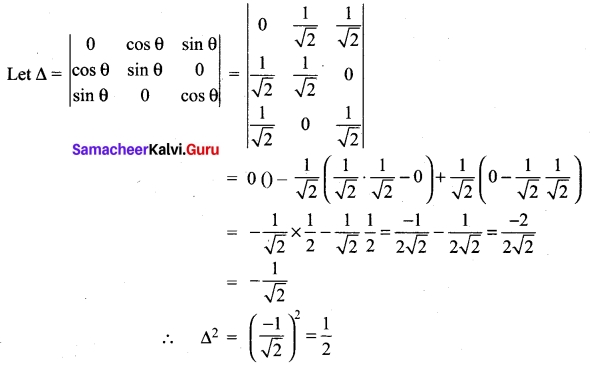
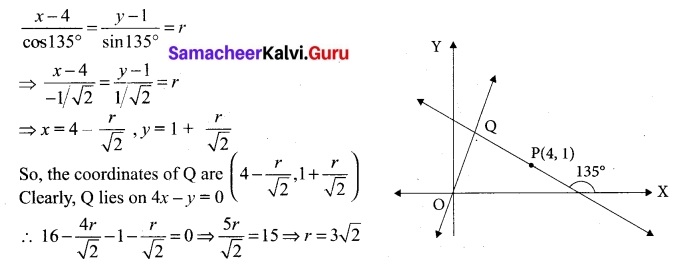
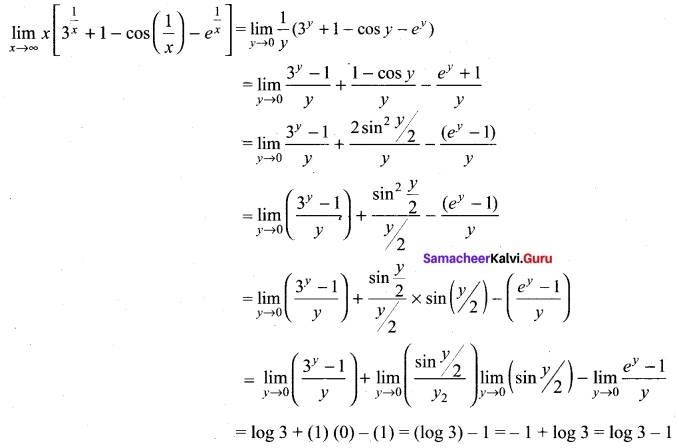
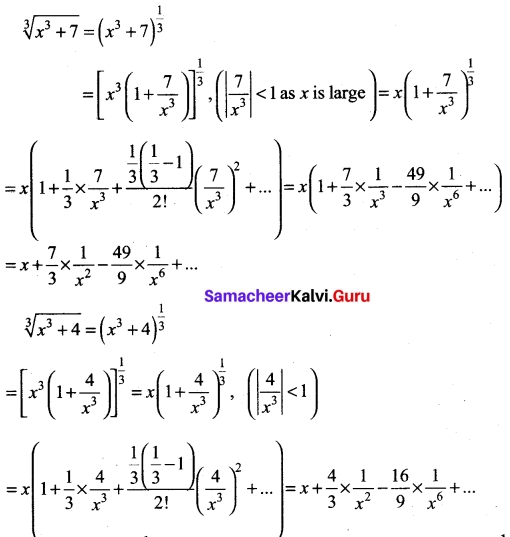
Tamil Nadu 11th English Previous Year Question Paper March 2019

Students can Download Tamil Nadu 11th English Previous Year Question Paper March 2019 Pdf, Tamil Nadu 11th English Model Question Papers helps you to revise the complete Tamilnadu State Board New Syllabus and score more marks in your examinations.

TN State Board 11th English Previous Year Question Paper March 2019

Instructions:

  1.  The question paper comprises of four parts.
  2.  You are to attempt all the parts. An internal choice of questions is provided wherever applicable.
  3. questions of Part I, II. III and IV are to be attempted separately
  4. Question numbers 1 to 20 in Part I are objective type questions of one -mark each. These are to be answered by choosing the most suitable answer from the given four alternatives and writing the option code and the corresponding answer
  5. Question numbers 21 to 30 in Part II are two-marks questions. These are to be answered in about one or two sentences.
  6. Question numbers 31 to 40 in Parr III are three-marks questions, These are to be answered in about three to five short sentences.
  7. Question numbers 41 to 47 in Part IV are five-marks questions. These are to be answered) in detail. Draw diagrams wherever necessary.

Time: 3.00 Hours
Maximum Marks: 90

PART – I

I. Answer all the questions. [20 x 1 = 20]
Choose the correct synonym for the underlined words from the options given.

Question 1.
……….. and I do claim to represent him in all his ruggedness.
(a) toughness
(b) weakness
(c) brightness
(d) seriousness
Answer:
(a) toughness

Question 2.
The greatest disadvantage for me was my loss of appetite.
(a) hope
(b) memory
(c) alertness
(d) hunger
Answer:
(d) hunger

Tamil Nadu 11th English Previous Year Question Paper March 2019

Question 3.
………..that we regard a man who does not possess it as eccentric.
(a) modem
(b) weary
(c) normal
(d) weird
Answer:
(d) weird

Choose the correct antonym for the underlined words from the options given.

Question 4.
Her happiest moments were with her sparrows whom she fed with frivolous rebukes,
(a) serious
(b) harmless
(c) funny
(d) decent
Answer:
(a) serious

Question 5.
“Don’t look so doleful, girls.”
(a) peaceful
(b) joyful
(c) doubtful
(d) powerful
Answer:
(b) joyful

Question 6.
There are, it must be admitted, some matters…………
(a) replied
(b) denied
(c) argued
(d) accepted
Answer:
(b) denied

Question 7.
Select the correct expansion of “HDTV”.
(a) High definition Television
(b) Heavy Dielectric Television
(c) Heavy Distributory Television
(d) Highly Decentralized Television
Answer:
(a) High definition Television

Question 8.
Choose the suitable option to pair it with the word “mantel” to form a compound word,
(a) cover
(b) cloth
(c) picture
(d) piece
Answer:
(d) piece

Question 9.
Form a derivative by adding the right suffix to the word ‘regular’.
(a) -ance
(b) -able
(c) -fill
(d) -ity
Answer:
(d) -ity

Question 10.
Choose the meaning of the foreign word in the sentence.
Nalini is a bonafide student of the Madras University.
(a) confident
(b) punctual
(c) brilliant
(d) genuine
Answer:
(d) genuine

Question 11.
Choose the right definition for the given term “Photophobia”.
(a) Fear of rain
(b) Fear of flight
(c) Fear of light
(d) Fear of pictures
Answer:
(c) Fear of light

Tamil Nadu 11th English Previous Year Question Paper March 2019

Question 12.
Add a suitable question tag to the following sentence.
Many women candidates attended the interview, …………?
(a) haven’t they
(b) shouldn’t they
(c) don’t they
(d) didn’t they
Answer:
(d) didn’t they

Question 13.
Replace the underlined word with a phrasal verb.
I couldn’t understand what you meant.
(a) break out
(b) find out
(c) iron out
(d) figure out
Answer:
(d) figure out

Question 14.
Add a suitable prefix to the root word “Polite”.
(a) im-
(b) non-
(c) un-
(d) anti-
Answer:
(a) im-

Question 15.
One who studies the human mind and behaviour is called a ………..
(a) physicist
(b) psychologist
(c) pathologist
(d) physiologist
Answer:
(b) psychologist

Question 16.
Fill in the blank with the suitable preposition.
The angry champion broke the crystal cup ……….. million pieces.
(a) into
(b) with
(c) against
(d) upon
Answer:
(a) into

Question 17.
Choose the clipped form of the word “dormitory”.
(a) dormy
(b) dory
(c) dorm
(d) dormit
Answer:
(c) dorm

Question 18.
Substitute the underlined word with the appropriate polite alternative.
The gentleman in the black suit is a barber.
(a) hair clipper
(b) hair remover
(c) Mir splitter
(d) hair dresser
Answer:
(d) hair dresser

Question 19.
Substitute the phrasal verb in the sentence with a single word.
Never put off Until tomorrow what you can do today.
(a) continue
(b) finish
(c) halt
(d) postpone
Answer:
(d) postpone

Question 20.
Fill in the blank with a suitable relative pronoun.
The books………….are brought are often not read.
(а) that
(b) what
(c) who
(d) whose
Answer:
(а) that

Tamil Nadu 11th English Previous Year Question Paper March 2019

PART – II

II. Answer any seven of the following: [7 x 2 = 14]
(i) Read the following sets of poetic lines and answer any four of the following. [4 × 2 = 8]

Question 21.
“Feel at home,” “come again.
They say………”
(a) Who are ‘they’?
(b) Do ‘they’ really mean it?
Answer:
(a) They are modem people.
(b) No they don’t mean it.

Question 22.
“And reassure myself anew
That you are not me and I’m not you.”
(a) Who does the poet refer to as “you”?
(b) What does the poet reassure?
Answer:
(a) The athletes who play games and sweat for fun and money are referred as ‘you’.
(b) The poet reassures himself that he is not one of the athletes and the athletes are not in his group either. So, he is safe.

Question 23.
“I heard a thousand blended notes While in a grove I sate reclined,”
(a) What is meant by “a thousand blended notes”?
(b) Where is the poet sitting?
Answer:
(a) The thousand blended notes mean the combined music of birds which cohabit in the grove.
(b) The poet is sitting in a grove.

Question 24.
“He sways his head from side to side,
with movements like a snake;”
(a) Who is ‘he’?
(b) Mention the figure of speech used here.
Answer:
(a) He is Macavity.
(b) Simile

Question 25.
“In dignity and pride no one need to be poor.”
(a) What are the two things mentioned here as our strength?
(b) Is the tone of the line positive or negative?
Answer:
(a) Dignity and pride are the two things mentioned as strength here.
(b) The tone of the line is positive.

Question 26.
“For you have but mistook me all this while…..”
(a) How is the speaker mistaken by the people?
(b) Write the words in alliteration.
Answer:
(a) People mistook the speaker to be a person endowed with divine right to rule them. He was after all like them with similar wants, likes, dislikes and grief. He too needs comfort of friends.
(b) Mistook and me alliterate.

(ii) Do as directed (any three) [3 x 2 = 6]

Question 27.
Report the following dialogue:
Conductor : Where do you want to go?
Passenger : I’m going to Coimbatore. Give me a ticket, please.
Answer:
The conductor asked the passenger where he was going. The passenger replied that he was going to Coimbatore and requested for a ticket.

Question 28.
Tom didn’t know Spanish. He didn’t get the job. (Combine using ‘if’).
Answer:
If Tom had known Spanish, he would have got the job.
(or)
If Tom didn’t know Spanish, he wouldn’t have got the job.

Tamil Nadu 11th English Previous Year Question Paper March 2019

Question 29.
Rewrite the sentence making an inversion in the conditional clause.
If you were a King, you would know the difficulties.
Answer:
Were you a king you would know the difficulties.

Question 30.
The food was cheap. It was very tasty, (form a simple sentence using in spite of)
Answer:
In spite of the food being cheap it was also very tasty.

PART – III

III. Answer any seven of the following: [7 × 3 = 21]
(i) Explain any two of the following with Reference to the Context: [2 × 3 = 6]

Question 31.
“The birds around me hopp’d and play’d;
Their thoughts I cannot measure.”
Answer:
Reference: These lines are from the poem, “Lines Written in Early Spring” written by William Wordsworth.

Context: The poet was quite impressed with the beauty and peace that prevailed in the woodland. The birds were oblivious to the presence of the poet. They hopped and chirped around him in absolute bliss. The poet said these words while trying to fathom their thoughts.

Explanation: The poet was overwhelmed with delight in the company of birds, plant kingdom and the brook. He tried hard to understand the thoughts of the birds through the bird’s language. But he couldn’t succeed. He simply inferred that they were thrilled and enjoying the jocund company.

Question 32.
“How can you say to me, lam a king?”
Answer:
Reference: This lines is from the poem, “The Hollow Crown” by William Shakespeare. The ‘ poem is an excerpt from the play “Richard II”.

Context: King Richard II says these words to his loyal nobles when he talks about the power of death over monarchs.

Explanation: British subjects usually believe that a king is born with a divine right to rule. People respect his crown as a symbol of great power. After he is deposed from power, Henry II realizes the bitter truth that he is no way different from ordinary subjects. He also has wants, need for friends and the compulsion to taste grief. Nobody can escape death.

Question 33.
“I am just glad as glad can be
That I am not them, that they are not me…”
Answer:
Reference: The poet Ogden Nash says these words in the poem “Confession of a Bom Spectator’.

Context and Explanation: While discussing about the athletes he admires, the poet says these words. Right from his boyhood, he had seen boys aspire for sports championships. He had wondered at their ability to specialize in horse riding, to play hockey or basketball. He had seen young ones trying to play center in the football or be a tackle or offender in a game like kabaddi. But he has been absolutely glad that he is not them and they are not him.

(ii) Answer any two of the following questions briefly: [2 × 3 = 6]

Question 34.
How do the chemists make fortunes out of the medicines people forget to take?
Answer:
Similar to the author, many remember to forget medicine as soon as the appointed time arrives. The forgotten medicines tend to aggravate the illness. As a vicious cycle, again they are forced to buy costlier medicines. Thus people who forget to take medicines contribute to the fortunes of chemists.

Question 35.
Why did Mary Kom think that she should not return empty-handed?
Answer:
Mary Kom’s dad had given all he had for her trip to USA. Besides, her friends had raised funds through MPs. They had pinned their hopes on her. So, she thought she should not return empty handed.

Tamil Nadu 11th English Previous Year Question Paper March 2019

Question 36.
What is the difference between a physical and mental tight corner?
Answer:
Physical tight comers are those situations which threaten the life of an individual. Mental tight comers are worries for which no solution is in sight. It upsets the individuals and confounds them.

(ii) Answer any three of the following questions briefly: [3 × 3 = 9]

Question 37.
Study the pie-chart and answer the questions that follow:
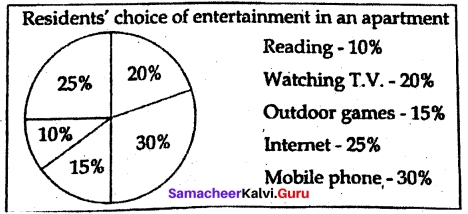
Tamil Nadu 11th English Previous Year Question Paper March 2019 1
Questions:
(A) What is the most sought after entertainment activity in the apartment?
(B) Name the activity preferred by the least number of people.
(C) Which activity is chosen by half the number of people who use mobile phones?
Answer:
(A) Mobile phone is the most sought after entertainment activity in the apartment.
(B) Reading is preferred by the least number of people.
(C) Outdoor games is chosen by half the number of people who use mobile phones.

Question 38.
Build a dialogue of minimum three exchanges between a fruit vendor and a customer.
Answer:
Fruit Vendor : What fruits do you want to buy sir?
Customer : I would like to buy 1 Kg of Pineapple.
Fruit Vendor : Good choice sir. It is the right season. Anything else?
Customer : Yes. The fruits look so fresh. I would also like to buy some Kiwis and a dozen of bananas.
Fruit Vendor : Sure sir. Here is the bill.
Customer : Oh! It’s Rs. 250? No seasonal discount?
Fruit Vendor : This is the discounted price sir.
Customer : Okay. Thank you.

Question 39.
Describe the process of opening a bank account.
Answer:

  • Go to the bank and get an application form from the counter.
  • Fill in the details accurately in the mandatory fields.
  • Affix your passport-size photograph on the form.
  • Attach your address proof and the adhaar card photocopy.
  • Obtain the signature of an introducer.
  • Fill in the chalan and hand it over to the bank employee with initial amount.
  • You will receive the bank passbook with the details of your newly created account details with the bank seal on the first page.

Question 40.
Complete the proverbs using the words given below.
(a) Waste not, ……… not. (fight, want, earn)
(b) ………….. waters run deep, (still, flowing, stagnant)
(c) One ……….. doesn’t make a garland, (pearl, bead, flower)
Answer:
(a) want
(b) Still
(c) flower

PART – IV

IV. Answer the following: [7 × 5 = 35]

Question 41.
What does Robert Lynd try to convey in his essay on ‘Forgetting’.
Answer:
Forgetting is deemed by many people leading prosaic lives as a mistake or an inefficiency of mind. But in reality, forgetfulness is freedom. Osho is right in his opinion of forgetfulness. In fact, it liberates painful memories and unpleasant things. We need to “let go” painful memories of the past and be free to aspire for better things in life. Robert Frost in his poem, “Let go” talks about mediocre person’s inability to let go things that hurt them. The capacity to. forget hurtful memories is a real blessing.

If human mind does not have the capacity to forget, life would be miserable for every one of us. Human mind is such a wonderful machine that it retains what is most important for personal or professional growth and allows the other things to slip away from the bank of memory. But young ones should remember to remember important assignments, deadlines for submission of homework, examination time-tables and hall tickets before leaving for examination. Td assist memory, we can have a checklist before leaving for the school. It is often said, “If you fail to plan, you plan to fail.” So students must love whatever work they do. The brain retains in memory whatever one does with great passion, love and involvement.

For a successful life, a strong memory is indispensable. So, one must cultivate a strong memory. However, one may forget failures, betrayals and hurts to grow into a happy and healthy person.

Tamil Nadu 11th English Previous Year Question Paper March 2019

[OR]

How do Universities mould students apart from imparting academic education to them?
Answer:
Universities mould students by providing various opportunities to develop their soft skills and to develop values which would contribute to the process of nation building. They enable graduates to develop patience and perseverance. They help them develop faith in their own inherent ability to shoulder responsibilities. They are oriented to become citizens of democracy and repay to the society quality services which would reform the lives of the poor people.

They develop true spirit of democracy among young graduates. They enable appreciation of others point of view. The graduates are also provided opportunities to adjust with difference through amicable discussions. The universities, apart from imparting education mould the students’character and personality too.

Question 42.
Write an appreciation of the poem “The Hollow Crown”.
Answer:
Shakespeare portrays the fleeting nature of human glory. King Richard II, on the verge of surrender to his rebellious cousin Boling broke, talks about the nature of temporal power and death. He talks about graves, epitaphs and worms. He explains how even monarchs leave nothing behind as their own except a small patch of land in which they are buried. The dejected king talks on various ways kings get killed. Some are slain in the battle field, some poisoned to death by their own spouses.

The kings who believed their bodies to be impregnable brass are shattered by just a pinprick. In fact, death is in supreme command which waits for the king, and only allows the king to act as if he were ruling and in control of everything. He chides his loyal friends who still believe that he is a monarch and tells them that he is an ordinary mortal just like them. He is humbled as he is powerless before the impending death.

[OR]

How does Gabriel Okara criticise the modern life in his poem “Once Upon a Time”?
Answer:
The poet’s understanding of adult society is extremely negative. The poet distinctly portrays how people in modem times have become hypocrites and fake emotions to be socially accepted. The phrases of hospitality they use “feel at home” and “come again” are so fake that a third visit would be disallowed by the hosts. In modem times, people don’t value real emotions instead they value positions and possessions.

Even while shaking hands, they try to assess the material worth of a person. People don’t laugh with heart. Their ice-cold block eyes search the person they talk to. Most of them have acquired the skill of wearing a standard, deceitful, artificial smile on all occasions, i.e., “portrait smile”. Thus the poem is nothing but a criticism of modem life.

Question 43.
Write a paragraph (150 words) by developing the following hints.
Miss Meadows, a music teacher – gets a letter – feels upset – Fiance not interested,- reflects her gloom on students – changes the happy song to a sad one – Headmistress calls – delivers a telegram – Fiance agrees to wedding – Meadows happy – changes the song again to a cheerful one.
Answer:
Miss Meadow was heart-broken. The letter written by Basil had pierced her heart and she was bleeding. Her hatred and anger became a knife and she carried it with her. Her icy cold response to Science Mistress demonstrates it. She is least bothered about the tender feelings of young children who look at her face all time for a friendly nod or smile of approval.

Her favourite pupil Mary Beazley is baffled at her treatment of the chrysanthemum she had brought with so much love. The choice of the song “A lament” perfectly jells well with her worst mood. She is in fact in her heart lamenting over the loss of love, trust and future hopes. She is unnecessarily severe with young children forcing them to redo the singing which drives them to despair, pain and tears they manage to stifle.

After she receives the telegram from Basil apologizing for his insane letter, her mood changes to joy. She takes the chrysanthemum and keeps it close to her lips to conceal her blush. She goads the children to sing a song of joy congratulating someone for success. She persuades them to show warmth in their voices. Her warm and lively voice dominates the tremulous voices of the young ones. The young ones now realize that Miss Meadow who was in a wax earlier is now in her elements.

Tamil Nadu 11th English Previous Year Question Paper March 2019

[OR]

Leacock goes to a studio – The photographer dislikes Leacock’s face – passes several comments – Leacock gets irritated the photo – taken – wants to see the proof – visits the studio again – The photo is edited – help of technology – Leacock upset over the changes – calls it worthless – leaves in anger.
Answer:
‘With the Photographer’ by Stephen Leacock is narrated in the first person. The narrator while sitting in the photographer’s studio begins to read some magazines and sees how other people look and the narrator begins to feel insecure about his appearance.

It is also noticeable that the photographer takes a dislike to his face judging it to be wrong. What should have been a simple process of taking a photograph becomes something of a nightmare for the narrator. How confident the narrator becomes is noticeable when he returns to the photographer’s studio the following Saturday.

He realises that the photograph that has been taken of him looks nothing like him. This angers the narrator as he was simply looking for a photograph that would show his likeness. He accepts that he may not be to everybody’s liking when it comes to his physical appearance but is angered by the changes made.

The photographer has retouched the photograph so much that the narrator does not recognise himself. The end of the story is also interesting as the reader realises that it is just a worthless bauble when he begins to cry. He has been judged solely by his appearance by the photographer whose job was to simply take a life like photograph.

Question 44.
Write a summary or Make notes of the following passage.
Answer:
The Chinese were the first to make gunpowder, invent the magnetic compass and gave to the world the art of making paper. About 2000 years ago the Chinese made gunpowder by mixing sulphur and saltpetre. The mixture exploded when set on fire. The Chinese were the first to find out the fact that a narrow magnet floating in a bowl of water would always point to the north. The discovery led to the invention of magnetic compass. This device helped the sailors to find out the direction when they were out of sight of land.

The Chinese also invented the art of making paper using vegetable pulp reached Arabia, Spain and Europe. In course of time paper factories came into existence. The fourth invention of the Chinese was the art of printing. Before this invention books were written by hand. The Chinese invented the art of printing with movable types. With this invention reading and learning became open to. ordinary people as they were able to print books in large numbers.

Summary:
No. of words given in the original passage: 171
No. of words to be written in the summary: 171/3 = 57 ± 5

Rough Draft
were the first to make gun powders, to invent the magnetic compass, paper \and printing. TheyTnadeJhegun powder by mixing sulphur with salt. The mixture exploded When set on fire. They foundlEaTa^naiiowmagnet floating in a bowl of water would always p|oint to die North. This led to the inventimToflnagaeticcompass. With this the sailors found tfteir direction. Explorers used this for their discoveries/TESyTeutid^the art of making paper using vegetable pulp. As a result factories came into existence. The inventron-oijnjnting led to tpe printing of books in large numbers.

Fair Draft:
The Great Inventions of China
The Chinese made gun powder mixing sulphur and saltpetre. They invented magnetic compass and paper. They enabled great explorers like Magellan, Vasco da Gama and Columbus discovered new lands by their invention the Mariner’s compass. They made papers from vegetable pulp and soon many factories started producing it. The greatest contribution of China to’he world is her invention of printing press which revolutionized printing of books. No. of words in the summary: 68

Tamil Nadu 11th English Previous Year Question Paper March 2019

[OR]

Notes
Title: The Great Inventions of China
Answer:
1. Chinese Inventions – (a) gun powder, (b) magnetic compass, (c) paper, (d) printing
2. (a) Gun powder from sulphur and saltpeter – explosive.
(b) Magnetic powder – finding direction – great explorers used in discovery of lands.
(c) Paper from vegetable pulp – paper industry.
(d) Art of printing – books available to ordinary people.

Question 45.
Read the following advertisement and prepare a Bio-data considering yourself fulfilling the conditions mentioned.
(Write XXXX for name and YYYY for address.)

WANTED:
Qualified nurses for a multi-speciality hospital, Attractive salary, Flexible working hours, Age below 30
Apply to-
Post Box No : 3210,
The Times of India,
Chennai – 600 002.
Answer:

14th January, 2020

From
XXXX
YYYY

To
Post Box No : 3210
C/o. The Times of India
Chennai – 02.
Respected Sir/Madam,
Sub: Application for the post of a Senior Nurse.
With reference to your advertisement dated 12th December 2018,1 hereby wish to apply for the post of a senior nurse in your multi-speciality hospital. I have rich experience and can communicate well with a pleasing personality.

If given an opportunity, I will do my best in taking care of the patient needs.
Please find enclosed my resume for your kind perusal. Looking forward to a positive reply.

Yours sincerely,
XXXX
Address on the Envelope
To
Post Box No : 3210
C/o. The Times of India
Chennai – 02

Bio-data:

Name : XXXX
Date of Birth : 18th May, 1994
Marital Status : Married
Father’s Name : Mr. Rajan
Address For Communication : YYYY
Contact Number – Mobile : 9998777655
Residence : 22345576
Mother Tongue : Tamil
Language Known : Hindi, English and Tamil

Educational Background:
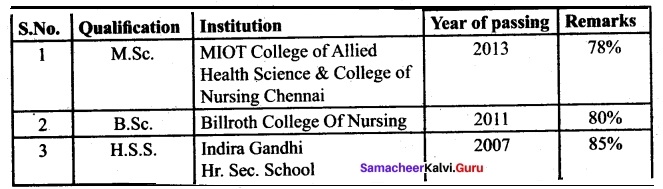
Tamil Nadu 11th English Previous Year Question Paper March 2019 2

Professional Experience:
Tamil Nadu 11th English Previous Year Question Paper March 2019 3

Hobbies : Reading, Music.
Expected Salary : 35,000/ per month
Salary Drawn : 28,000/ per month
Reference : 1. Dr. Ram (Dean, MIOT Hospital 9998887777
2. Dr. Yashodha (ICU in-charge) 9900000222

Declaration
I hereby declare that the above given information is true to my knowledge.
Station : YYY
Date : 14.01.2020

XXXX
Signature of the Applicant

Tamil Nadu 11th English Previous Year Question Paper March 2019

[OR]

Write a paragraph of 150 words on “The Advantages and Disadvantages of Online Shopping”.
Answer:
The Advantages and Disadvantages of Online Shopping:
Due to rapid growth of technology, transformation in buying and selling has taken place. Sellers use internet as a main vehicle to conduct commercial transactions. But, like every coin has two sides, online shopping has got its own advantages and disadvantages.

Advantages:

  • The biggest advantage is convenience. Online shops give us the opportunity to shop 24/7 without being held up in crowd or standing in queue for billing.
  • As we receive products directly from the manufacturers the prices are lower.
  • The choices are unlimited in almost all brands that one looks for.
  • Out of stock products also can be booked which will be sent to us when available.
  • Sending gifts to the persons we desire has become easier.
  • One can analyse the consumer reviews before purchasing the products.

Disadvantages:

  • Online shopping may lead one to spend too much time online. Also, one may end up buying unwanted things.
  • Sometimes the products that you receive may not be the one you ordered or it can be of low quality. There is no guarantee that you are receiving the original product.
  • Returning the product may be problematic.
  • There’s a larger risk of: credit card scams, hacking, phishing, counterfeit products, identity theft, bogus websites, and other scams.
  • Local retailers are affected which brings down the country’s economy.

Question 46.
(i) Read the following sentences, spot the errors and rewrite the sentence correctly.
(a) The colour of the curtains are very bright.
(b) I saw an uniformed soldier behind the wall.
(c) Nobody knows why was he killed.
(d) My older brother is living abroad.
(e) They are discussing about their picnic.
Answer:
(a) The colour of the curtains is very bright.
(b) I saw a uniformed soldier behind the wall.
(c) Nobody knows why he was killed.
id) My older brother lives abroad.
(e) They are discussing their picnic.

[OR]

(ii) Fill in the blanks suitably
(a) Have you ever…………such a beautiful ……… (scene/seen)
(b) How ………. you disobey my words? (use a quasi modal verb)
(c) What is done ………… not be undone, (use a modal verb)
(d) Take an umbrella with you ……….. you will get wet (use a suitable link word)
Answer:
(a) seen, scene
(b) dare
(c) can
(d) or else

Question 47.
Identify each of the following sentences with the given fields given below:
(a) In a democracy, we have the right to criticise anyone.
(ft) The price of the vegetable shot up suddenly.
(c) The passenger sat down to check his e-mails.
(d) It was a thrilling neck and neck finish.
(e) The programme will be telecast next week.
(Commerce, Sports, Literature, Computer, Politics, Media, Agriculture)
Answer:
(a) Politics
(b) Commerce
(c) Computer
(d) Sports
(e) Media

Tamil Nadu 11th English Previous Year Question Paper March 2019

[OR]

Read the following passage and answer the questions that follow:
After the meal, the way we place our eating tools, our knives, forks, spoons or chopsticks is also culturally defined. In Australia, when we have finished eating the main course, we put the knife and fork across the middle of the plate parallel to each other with the handles facing towards us.

When we are resting during the meal, we place the knife and fork across each other in the middle of the plate. In China, the chopsticks go crossways across the top of the plate with the handles facing towards the right. In Indonesia, some people place the fork and spoon like the Australians do but not all. Indonesia is a multi-cultural society, so there may be a number of customs practised within the country.
Questions:
(a) Which table manners reveals one’s culture?
(b) Is table manners important? Why?
(c) What do you know about the table manners observed by the Australians?
(d) How do the Chinese practise their table manners?
(e) Explain the Indonesian culture.
Answer:
(a) After the meal, the way we place our eating tools, our knives, forks, spoons or chopsticks is culturally defined.
(b) Yes, because it ensures comfort of both the guests and hosts at the table.
(c) In Australia, when people have finished eating the main course, they put the knife and fork across the middle of the plate parallel to each other with the handles facing towards them. When they are resting during the meal, they place the knife and fork across each other in the middle of the plate.
(d) In China, the chopsticks go crossways across the top of the plate with the handles facing towards the right.
(e) Indonesia is a multi-cultural society, so there may be a number of customs practised within the country.

Tamil Nadu 11th Physics Model Question Paper 2 English Medium

Students can Download Tamil Nadu 11th Physics Model Question Paper 2 English Medium Pdf, Tamil Nadu 11th Physics Model Question Papers helps you to revise the complete Tamilnadu State Board New Syllabus and score more marks in your examinations.

TN State Board 11th Physics Model Question Paper 2 English Medium

Tamil Nadu 11th Physics Model Question Paper 2 English Medium

Instructions:

  1. The question paper comprises of four parts
  2. You are to attempt all the parts. An internal choice of questions is provided wherever: applicable
  3. All questions of Part I, II, III, and IV are to be attempted separately
  4. Question numbers to 15 in Part I are Multiple choice Questions of one mark each. These are to be answered by choosing the most suitable answer from the given four alternatives and writing the option code and the corresponding answer
  5. Question numbers 16 to 24 in Part II are two-mark questions. These are lo be answered in about one or two sentences.
  6. Question numbers 25 to 33 in Part III are three-mark questions. These are lo be answered in about three to five short sentences.
  7. Question numbers 34 to 38 in Part IV are five-mark questions. These are lo be answered in detail. Draw diagrams wherever necessary.

Time: 3 Hours
Max Marks: 70

PART – I

Answer all the questions. [15 × 1 = 15]

Question 1.
The direction of the angular velocity vector is along…………
(a) the tangent to the circular path
(b) the inward radius
(c) the outward radius
(d) the axis of rotation
Answer:
(d) the axis of rotation

Tamil Nadu 11th Physics Model Question Paper 2 English Medium

Question 2.
The angle between two vectors 2\(\hat{i}\) + 3\(\hat{j}\) + \(\hat{k}\) and -3\(\hat{j}\) + 6\(\hat{k}\) is………..
(a) 0°
(b) 30°
(c) 60°
(d) 90°
Answer:
(d) 90°

Question 3.
The breaking stress of a wire depends on………….
(a) length of a wire
(b) nature of the wire
(c) diameter of the wire
(d) shape of the cross section
Answer:
(b) nature of the wire

Question 4.
The moment of inertia of a rigid body depends upon…………….
(a) distribution of mass from axis of rotation
(b) angular velocity of the body
(c) angular acceleration of the body
(d) mass of the body
Answer:
(a) distribution of mass from axis of rotation

Question 5.
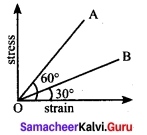
The stress versus strain graphs for wires of two materials A and B are as shown in the graph.If YA and YB are the young’s moduli of the materials then……….
Tamil Nadu 11th Physics Model Question Paper 2 English Medium 1
(a) YB = 2YA
(b) YA = YB
(c) YB = 3YA
(d) YA = 3YB
Answer:
(d) YA = 3YB
Hint:
Slope of stress strain curve gives the young’s modules YA = tan 60° = √3 ; YB = tan 30° \(\frac{1}{√3}\)
\(\frac{Y_A}{Y_B}\) = \(\frac{√3}{\frac{1}{√3}}\) = 3 ⇒ YA = 3YB

Question 6.
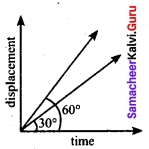
The ratio of the velocities of two particles as shown in figure is…………
Tamil Nadu 11th Physics Model Question Paper 2 English Medium 2
(a) 1 : √3
(b) √3 : 1
(c) 1 : 3
(d) 3 : 1
Answer:
(c) 1 : 3
Hint:
Velocity = Slope of the line formed in displacement v/s time graph = Tan θ
Va : Vb = Tan θA : Tan θB
= Tan 30° : Tan 60°
Va : Vb = 1 : 3

Question 7
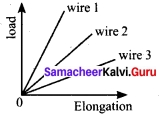
The load-elongation graph of three wires of the same material are shown. Which of the following wire is the thickest?
Tamil Nadu 11th Physics Model Question Paper 2 English Medium 3
(a) wire 1
(b) wire 2
(c) wires
(d) all of them have same thickness
Answer:
(a) wire 1
Hint:
Wire 1 is the thickness compared to other wires. Because the elongation of the wire 1 is minimum.

Question 8.
The waves produced by a motor boat sailing in water.are………
(a) transverse
(b) longitudinal
(c) longitudinal and transverse
(d) stationary
Answer:
(c) longitudinal and transverse

Question 9.
A sound wave whose frequency is 5000 Hz travels in air and then hits the water surface. Theratio of its wavelengths in water surface. The ratio of its wavelengths in water and air is………….
(a) 4.30
(b) 0.23
(c) 5.30
(d) 1.23
Answer:
(a) 4.30
Hint:
f = 5000 Hz ; Va = 343 ms-1; Vb = 1480 ms-1
Ratio of wavelength \(\frac{λ_a}{λ_w}\) = \(\frac{V_w}{f}\) × \(\frac{f}{V_a}\) = \(\frac{1480}{343}\) = 4.31

Question 10.
The wavelength of two sine waves and λ1 = 1 m and λ2 = 6 m, the corresponding wave numbers are respectively…………
(a) 1.05 rad m-1 and 6.28 rad m-1
(b) 6.28 rad m-1 and 1.05 rad m-1
(c) 1 rad m-1 and 0.1666 rad m-1
(d) 0.166 rad m-1 and 1 rad m-1
Answer:
(b) 6.28 rad m-1 and 1.05 rad m-1
Hint:
Standard wave equation, Y = A sin (kx – ωt)
K1 = \(\frac{2π}{λ_1}\) = \(\frac{2π}{1}\) = 6.28 rad m-1
K2 = \(\frac{2π}{λ_2}\) = \(\frac{2π}{6}\) = 1.05 rad m-1

Question 11.
During an adiabatic process, the pressure of a gas is proportional to the cube of its absolute temperature. The value of \(\frac{C_p}{C_r}\) for that gas is ………..
(a) \(\frac{3}{5}\)
(b) \(\frac{4}{3}\)
(c) \(\frac{5}{3}\)
(d) \(\frac{3}{2}\)
Answer:
(b) \(\frac{4}{3}\)
Hint:
PT = \(\frac{γ}{1-γ}\) = constant …….(1)
PT-3 = constant ……….(2)
From equation (1) and (2) \(\frac{γ}{1-γ}\) = (-3)
∴ γ = \(\frac{3}{2}\)

Tamil Nadu 11th Physics Model Question Paper 2 English Medium

Question 12.
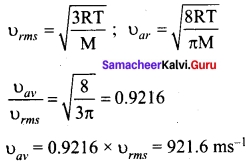
If the rms speed of the molecules of a gas is 1000 ms-1 the average speed of the molecule is………..
(a) 1000 ms-1
(b) 922 ms-1
(c) 780 ms-1
(d) 849 ms-1
Answer:
(b) 922 ms-1
Hint:
Tamil Nadu 11th Physics Model Question Paper 2 English Medium 4

Question 13.
In a cyclic process, work done by the system will be ………….
(a) zero
(b) more than the heat given to the system
(c) equal to heat given to the system
(d) independent of heat given to system
Answer:
(c) equal to heat given to the system

Question 14.
A closed tube partly filled with water lies is a horizontal plane. If the tube is rotated about perpendicular bisector, the moment of inertia of the system…………
(a) increases
(b) decreases
(c) remains constant
(d) depends on sense of rotation
Answer:
(c) remains constant

Question 15.
Force acting on the particle moving with constant speed is…………..
(a) always zero
(b) need not be zero
(c) always non zero
(d) cannot be concluded
Answer:
(a) always zero
Hint:
In a straight line motion, velocity (speed) is constant, a = 0; F = ma = 0

PART – II

Answer any six questions in which Q. No 23 is compulsory. [6 × 2 = 12]

Question 16.
Write limitations of dimensional analysis with examples, (any 2 points only) Limitations of Dimensional analysis.
Answer:

  1. This method gives no information about the dimensionless constants in the formula like 1, 2, …..π, e, etc.
  2. This method is not suitable to derive relations involving trigonometric, exponential and logarithmic functions.
  3. It can only check on whether a physical relation is dimensionally correct but not the correctness of the relation. For example, using dimensional analysis, s = ut + \(\frac{1}{3}\) at² is dimensionally correct whereas the correct relation is s = ut +\(\frac{1}{2}\) at²

Question 17.
A particle of mass 2 kg experiences two forces \(\vec{F_1}\) =5\(\hat{i}\) + 8\(\hat{j}\) + 7\(\hat{k}\) and \(\vec{F_2}\) = 3\(\hat{i}\) – 4\(\hat{j}\) + 3\(\hat{k}\). What is the acceleration of the particle?
Answer:
We use Newton’s second law, \(\vec{F}_{net}\) = m\(\vec{a}\) where \(\vec{F}_{net}\) = \(\vec{F_1}\) + \(\vec{F_2}\). From the equations the acceleration is \(\vec{a}\) = \(\frac{\vec{F}_{net}}{m}\), where
\(\vec{F}_{net}\) = (5 + 3)\(\vec{i}\) + (8 – 4)\(\vec{j}\) + (7 + 3)\(\vec{k}\)
\(\vec{F}_{net}\) = 8\(\vec{i}\) + 4\(\vec{j}\) + 10\(\vec{k}\)
\(\vec{a}\) = (\(\frac{8}{2}\))\(\vec{i}\) + (\(\frac{4}{2}\))\(\vec{j}\) + (\(\frac{10}{2}\))\(\vec{k}\)
\(\vec{a}\) = 4\(\vec{j}\) + 2\(\vec{j}\) + 5\(\vec{k}\)

Question 18.
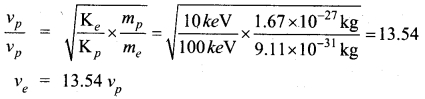
An electron and proton are detected in a cosmic ray experiment, the first with kinetic energy 10 KeV and the second with 100 KeV. Which is faster, the electron or the proton? Obtain the ratio of their speeds.
(electron mass : 9.11 × 10⁻³¹ kg : proton mass : 1.67 × 10⁻²⁷ kg : lev = 1.6 × 10⁻¹⁹ J)
Answer:
Here Ke = 10 keV and Kp = 100 keV
me = 9.11 × 10⁻³¹ kg and mp = 1.67 × 10⁻²⁷ kg
As K = \(\frac{1}{2}\) mv² or v = \(\sqrt {\frac{2K}{m}}\)
Hence
Tamil Nadu 11th Physics Model Question Paper 2 English Medium 5

Question 19.
A bullet of mass 20 g strikes pendulum of mass 5 kg. The centre of mass of pendulum rises a vertical distance of 10 cm. If the bullet gets embedded into the pendulum, calculate its initial speed.
Answer:
Given data: m1 = 20 g = 20 × 10-3kg; m2 = 5 kg; s = 10 × 10-2m
Let the speed of the bullet be v. The common velocity of bullet and pendulum bob is V. According to law of conservation of linear momentum.
V = \(\frac{m_1v}{(m_1+m_2)}\) = \(\frac{20×10^{-3}v}{5+20×10^{-3}}\) = \(\frac{0.02}{5.02}\) v = 0.004 v
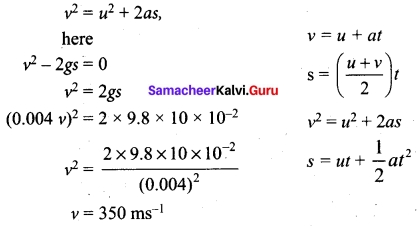
The bob with bullet go up with a deceleration of g= 9.8 ms-2. Bob and bullet come to rest at a height of 10 × 10-2 m.
from IIIrd equation of motion
Tamil Nadu 11th Physics Model Question Paper 2 English Medium 6

Tamil Nadu 11th Physics Model Question Paper 2 English Medium

Question 20.
Get the relation between rotational kinetic energy and angular momentum.
Answer:
Let a rigid body of moment of inertia I rotate with angular velocity ω
The angular momentum of a rigid body is, L = Iω
The rotational kinetic energy of the rigid body is, KE = \(\frac{1}{2}\)Iω²
By multiplying the numerator and denominator of the above equation with I, we get a relation between L and KE as,
KE= \(\frac{1}{2}\) \(\frac{I^2ω^2}{I}\) = \(\frac{1}{2}\) \(\frac{(Iω)^2}{I}\)
KE = \(\frac{L^2}{2I}\)

Question 21.
Why is there no lunar eclipse and solar eclipse every month?
Answer:
If the orbits of the Moon and Earth lie on the same plane, during full Moon of every month, we can observe lunar eclipse. If this is so during new oon we can observe solar eclipse. But Moon’s orbit is tilted 5° with respect to Earth’s orbit. Due to this 5° tilt, only during certain periods of the year, the Sun, Earth and Moon align in straight line leading to either lunar eclipse or solar eclipse depending on the alignment.

Question 22.
Calculate the change in internal energy of a block of copper of mass 200 g when it is heated from 25°C to 75°C. Specific heat of copper = 0.1 cal / g / °C and assume change in volume is negligible.
Answer:
dQ = cmΔT = 0.1 × 200 (75 – 25) = 100 calorie
dw = Pdv = 0
dU = dQ – dW = 100 – 0 = 100 calorie = 4200 J

Question 23.
The shortest distance travelled by a particle executing SHM from mean position in 2 seconds is equal to \(\frac{√3}{2}\) times of its amplitude. Determine its time period.
Answer:
Given data t = 2s ; y = \(\frac{√3}{2}\)A ; T = ?
displacement y = A sin ωt = A sin \(\frac{2π}{T}\) t
\(\frac{√3}{2}\)A = A sin \(\frac{2π×2}{T}\) ; sin \(\frac{4π}{T}\) = \(\frac{√3}{2}\) = sin \(\frac{π}{3}\)
∴ \(\frac{4π}{3}\) = \(\frac{π}{3}\) ; T = 12s

Question 24.
What are the differences from sliding and slipping?
Answer:

SlidingSlipping
(i)Velocity of centre of mass is greater than Rco i.e. VCM > Rco.Velocity of centre of mass is lesser than Rco. i.e. VCM < Rco
(ii)Velocity of translational motion is greater than velocity of rotational motion.Velocity of translation motion is lesser than velocity of rotational motion.
(iii)Resultant velocity acts in the forward direction.Resultant velocity acts in the backward direction.

PART – III

Answer any six questions in which Q.No. 29 is compulsory. [6 × 3 = 18]

Question 25.
You are given a thread and a metre scale. How will you estimate the diameter of the thread?
Answer:
The diameter of a thread is so small. Therefore we cannot measure it using metre scale. We wind a number of turns of the thread on the metre scale so that the turns are closely touching one another.
Measure the length (l) of the windings on the scale which contains number of turns.
∴ Diameter of thread = \(\frac{1}{n}\)

Question 26.
Consider two cylinders with same radius and same mass. Let one of the cylinders be solid and another one be hollow. When subjected to same torque, which one among them gets more angular acceleration than the other?
Answer:
Moment of inertia of a solid cylinder about its axis Is = \(\frac{π}{2}\)MR²
Moment of inertia of a hollow cylinder about its axis lh = MR³
Is = \(\frac{π}{2}\)Ih or Ih = 2Is
torque τ = lα ⇒ α = \(\frac{τ}{I}\)
αs = \(\frac{τ}{I_s}\) and ah = \(\frac{τ}{I_h}\)
αsIs = αhIh ⇒ αs = αh \(\frac{I_h}{I_s}\)
Ih > Ih ⇒ \(\frac{I_h}{I_s}\) > 1
∴ as > ah

Question 27.
The reading of pressure meter attached with a closed pipe is 5 × 10⁵ Nm-2. On opening the valve of the pipe, the reading of the pressure meter is 4.5 × 10⁵ Nm-2. Calculate the speed of the water flowing in the pipe.
Answer:
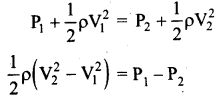
Using Bernoulli’s equation
Tamil Nadu 11th Physics Model Question Paper 2 English Medium 7
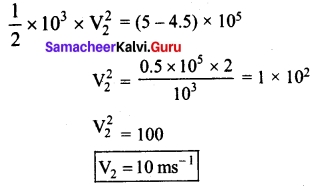
Here initial velocity V1 = 0 and density of water ρ = 1000 kg m 3
Tamil Nadu 11th Physics Model Question Paper 2 English Medium 8

Question 28.
State and prove perpendicular axis theorem.
Answer:
Perpendicular axis theorem: This perpendicular axis theorem holds good only for plane laminar objects.

The theorem states that the moment of inertia of a plane laminar body about an axis perpendicular to its plane is equal to the sum of moments of inertia about two perpendicular axes lying in the plane of the body such that all the three axes are mutually perpendicular and have a common point.

Tamil Nadu 11th Physics Model Question Paper 2 English Medium

Question 29.
State Stoke’s law and give some practical applications of Stoke’s law.
Answer:
The viscous force F acting on a spherical body of radius r depends directly on:
(i) radius (r) of the sphere
(ii) velocity (v) of the sphere and
(iii) coefficient of viscosity q of the liquid
Therefore F ∝ ηxryvz = F = k ηxryvz, where k is a dimensionless constant. Using dimensions, the above equation can be written as
[MLT-2] = k [ML-1T-1]z × [L]y × [LT-1]x
On solving, we get x = 1, y = 1 and z = 1. Therefore, F = kηrv
Experimentally, Stoke found that the value of k = 6π
F = 6πηrv
This relation is known as Stoke’s law.
Practical applications of Stoke’s law Since the raindrops are smaller in size and their terminal velocities are small, remain suspended in air in the form of clouds. As they grow up in size, their terminal velocities increase and they start falling in the form of rain.
This law explains the following:

  1. Floatation of clouds
  2. Larger raindrops hurt us more than the smaller ones
  3. A man coming down with the help of a parachute acquires constant terminal velocity.

Question 30.
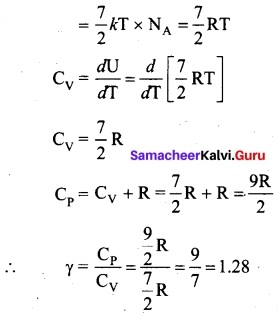
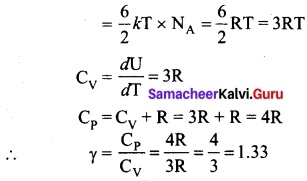
Derive the ratio of two specific heat capacities of triatomic molecules.
(a) Linear molecule:
Answer:
Energy of one mole
Tamil Nadu 11th Physics Model Question Paper 2 English Medium 9

(b) Non – Linear molecule:
Answer:
Energy of one mole
Tamil Nadu 11th Physics Model Question Paper 2 English Medium 10
Note that according to kinetic theory model of gases the specific heat capacity at constant volume and constant pressure are independent of temperature. But in reality it is not sure. The specific heat capacity varies with the temperature.

Question 31.
If 5 L of water at 50°C is mixed with 4 L of of water at 30°C, what will be the final temperature of water? Take the specific heat capacity of water as 4184 J kg-1 k-1.
Answer:
We can use the equation Tf = \(\frac{m_{1} s_{1} \mathrm{T}_{1}+m_{2} s_{2} \mathrm{T}_{2}}{m_{1} s_{1}+m_{2} s_{2}}\)
m1 = 5L = 5 kg ancl m2 = 4 L = 4 kg, s1 = s2 and T1 = 50°C = 323K and T2 = 30°C = 303 K
Tamil Nadu 11th Physics Model Question Paper 2 English Medium 11
Tf = 314.11 K – 273 K ≈ 41°C.
Suppose if we mix equal amount of water (m1 = m2) with 50°C and 30°C, then the final temperature is average of two temperatures.
Tf = \(\frac{T_1+T_2}{2}\) = \(\frac{323+303}{2}\) = 313 K = 40°C
Suppose if both the water are at 30°C then the final temperature will also 30°C. It implies that they are at equilibrium and no heat exchange takes place between each other.

Tamil Nadu 11th Physics Model Question Paper 2 English Medium

Question 32.
Smooth block is released at rest on a 45° incline and then slides a distance d. If the time taken of slide on rough incline is n times as large as that to slide than on a smooth incline. Show that co-efficient of friction µ = (1 – \(\frac{1}{n_2}\))
Answer:
When there is no friction, the block slides down the inclined plane with acceleration.
a – g sin θ
when there is friction, the downward acceleration of the block is
a’ = g (sin θ — µ cos θ)
As the block slides a distance d in each case so
d = \(\frac{1}{2}\) at² = \(\frac{1}{2}\) a’t’²
\(\frac{a}{a’}\) = \(\frac{t’^2}{t^2}\) = \(\frac{(nt)^2}{r^2}\) = n² or \(\frac{g sin θ}{g(sin θ – µ cos θ)}\) = n²
Solving, we get (Using θ = 45°)
µ = 1 – \(\frac{1}{n_2}\)

Question 33.
How do you distinguish between stable and unstable equilibrium?
Answer:

Stable EquilibriumUnstable Equilibrium
(i)The body tries to come back to equilibrium if slightly disturbed and released.The body cannot come back to equilibrium if slightly disturbed and released.
(ii)The center of mass of the body shifts slightly higher if disturbed from equilibrium.The center of mass of the body shifts slightly lower if disturbed from equilibrium.
(iii)Potential energy of the body is minimum and it increases if disturbed.Potential energy of the body is not minimum and it decreases if disturbed.

PART – IV

Answer all the questions. [5 × 5 = 25]

Question 34. (a).
What are the limitation of Dimensional formula? By assuming that the frequency y of a vibrating string may depend upon
(i) Tension
(ii) length (l)
(iii) mass per unit
length (m), prove that γ ∝ \(\frac{1}{l}\) \(\sqrt{\frac{T}{M}}\)
Answer:
(i) Limitations of Dimensional analysis:

  1. This method gives no information about the dimensionless constants in the formula like 1, 2, ……. π, e, etc.
  2. This method cannot decide whether the given quantity is a vector or a scalar.
  3. This method is not suitable to derive relations involving trigonometric, exponential and logarithmic functions.
  4. It cannot be applied to an equation involving more than three physical quantities.
  5. It can only check on whether a physical relation is dimensionally correct but not the correctness of the relation. For example, using dimensional analysis, s = ut + \(\frac{π}{2}\) at² is dimensionally correct whereas the correct relation is s = ut + \(\frac{π}{2}\) at².

(ii) n ∝ Ia Tbmc, [I] = [M0L1 T0]
[T] = [M1L1T-2] (force)
[M] = [M1L-1T0]
[M0L0T-1] = [M0L1T0]a [M1L1T-2]b [M0L-1T0]a
b + c = 0
a + b – c = 0
-2b = -1 ⇒ b = \(\frac{π}{2}\)
c = –\(\frac{π}{2}\)a = 1
γ ∝ \(\frac{1}{l}\) \(\sqrt{\frac{T}{M}}\)

Tamil Nadu 11th Physics Model Question Paper 2 English Medium

[OR]

(b) Prove the law of conservation of linear momentum. Use it to find the recoil velocity of a gun when a bullet is fired from it.
Answer:
In nature, conservation laws play a very important role. The dynamics of motion of bodies can be analysed very effectively using conservation laws. There are three conservation laws in mechanics. Conservation of total energy, conservation of total linear momentum, and conservation of angular momentum. By combining Newton’s second and third laws, we can derive the law of conservation of total linear momentum.

When two particles interact with each other, they exert equal and opposite forces on each other. The particle 1 exerts force \(\frac{\vec{F}_{12}}{m}\) on particle 2 and particle 2 exerts an exactly equal and opposite force \(\frac{\vec{F}_{12}}{m}\) on particle 1 according to Newton’s third law.
\(\frac{\vec{F}_{21}}{m}\) = –\(\frac{\vec{F}_{21}}{m}\) ……….(1)
In terms of momentum of particles, the force on each particle (Newton’s second law) can be written as
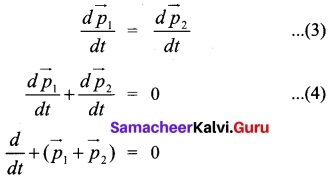
\(\frac{\vec{F}_{12}}{m}\) = \(\frac{\vec{dp_1}}{dt}\) and \(\frac{\vec{F}_{21}}{m}\) = \(\frac{\vec{dp_2}}{dt}\) ………(2)
Here \(\vec{p}_1\) is the momentum of particle 1 which changes due to the force \(\vec{F}_{12}\) exerted by
particle 2. Further \(\vec{p}_2\) is the momentum of particle 2. This changes due to \(\vec{F}_{21}\) exerted by particle 1.
Substitute equation (2) in equation (1)
Tamil Nadu 11th Physics Model Question Paper 2 English Medium 12
It implies that \(\vec{p_1}\) + \(\vec{p_2}\) constant vector (always).
\(\vec{p_1}\) + \(\vec{p_2}\) is the total linear momentum of the two particles (\(\vec{p_{tot}}\) = \(\vec{p_1}\) + \(\vec{p_2}\)).It is also called as total linear momentum of the system. Here, the two particles constitute the system. From this result, the law of conservation of linear momentum can be stated as follows.

If there are no external forces acting on the system, then the total linear momentum of the system (\(\vec{p}_{tot}\)) is always a constant vector. In other words, the total linear momentum of the system is conserved in time. Here the word ‘conserve’ means that \(\vec{p_1}\) and p\(\vec{p_2}\) can vary, in such a way that \(\vec{p_1}\) + \(\vec{p_2}\) is a constant vector.

The forces \(\vec{F_{12}}\) and \(\vec{F_{21}}\) are called the internal forces of the system, because they act only between the two particles. There is no external force acting on the two particles from outside. In such a case the total linear momentum of the system is a constant vector or is conserved.

To find the recoil velocity of a gun when a bullet is fired from it:
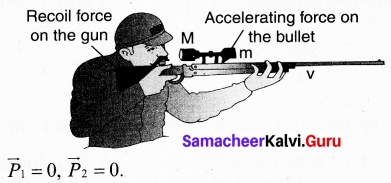
Consider the firing of a gun. Here the system is Gun+bullet. Initially the gun and bullet are at rest, hence the total linear momentum of the system is zero. Let \(\vec{p_1}\) be the momentum of the bullet and \(\vec{p_2}\) the momentum of the gun before firing. Since initially both are at rest,
Tamil Nadu 11th Physics Model Question Paper 2 English Medium 13
Total momentum before firing the gun is zero, \(\vec{p_1}\) + \(\vec{p_2}\) = 0
According to the law of conservation of linear momentum, total linear momemtum has to be zero after the firing also.

When the gun is fired, a force is exerted by the gun on the bullet in forward direction. Now the momentum of the bullet changes from \(\vec{p_1}\) + \(\vec{p_1}\). To conserve the total linear momentum of the system, the momentum of the gun must also change from \(\vec{p_2}\) to \(\vec{p_2}\) Due to the conservation of linear momentum, \(\vec{p_1}\)+ \(\vec{p_2}\)= 0. It implies that \(\vec{p_1}\) = – \(\vec{p_2}\), the momentum of the gun is exactly equal, but in the opposite direction to the momentum of the bullet. This is the reason after firing, the gun suddenly moves backward with the momentum (\(\vec{p_2}\)). It is called ‘recoil momentum’. Th is is an example of conservation of total linear momentum.

Tamil Nadu 11th Physics Model Question Paper 2 English Medium

Question 35 (a).
Explain the variation of g with
(i) latitude
(ii) altitude.
Answer:
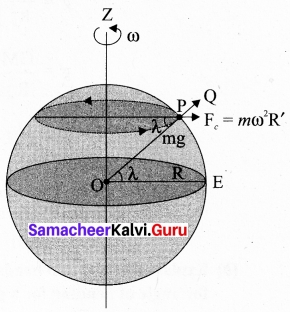
(i) Latitute: When an object is on the surface fo the Earth, it experiences a centrifugal force that depends on the latitude of the object on Earth. If the Earth were not spinning, the force on the object would have been mg. However, the object experiences an additional centrifugal force due to spinning of the Earth.
Tamil Nadu 11th Physics Model Question Paper 2 English Medium 14
This centrifugal force is given by mω²R’.
OPz cos λ = \(\frac{PZ}{OP}\) = \(\frac{R’}{R}\)
R’ = R cos λ
where λ is the latitude. The component of centrifugal acceleration experienced by the object in the direction opposite to g is
NaPQ = ω²R cos λ = ω²R COS² λ
Since R’ = R cos λ
Therefore, g’ = g – ω²R cos² λ
From the above expression, we can infer that at equator, λ = 0, g’ = g ω²R. The acceleration due to gravity is minimum. At poles λ = 90; g’ = g, it is maximum. At the equator, g’ is minimum.

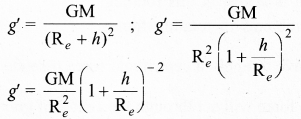
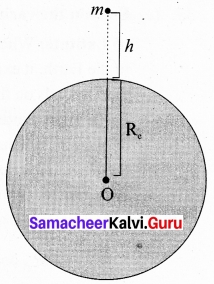
(ii) Altitude: Consider an object of mass m at a height h from the surface of the Earth. Acceleration experienced by the object due to Earth is
Tamil Nadu 11th Physics Model Question Paper 2 English Medium 15
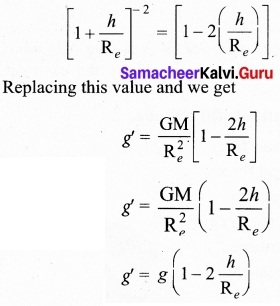
If h << Re: We can use Binomial expansion. Taking the terms up to first order
g’ =\( \frac{\mathrm{GM}}{\mathrm{R}_{e}^{2}}\left[1+\frac{h}{\mathrm{R}_{e}}\right]^{-2}\)
If h << R sub>e: We can use Binomial expansion. Taking the terms up to first order
(1 + x)ⁿ = 1 + nx
Tamil Nadu 11th Physics Model Question Paper 2 English Medium 16
We find that g’ < g. This means that as altitude h increases the acceleration due to gravity g decreases.
Tamil Nadu 11th Physics Model Question Paper 2 English Medium 17

[OR]

(b) Explain why a cyclist bends while negotiating a curve road? Arrive at the expression for angle of bending for a given velocity.
Answer:
Tamil Nadu 11th Physics Model Question Paper 2 English Medium 18
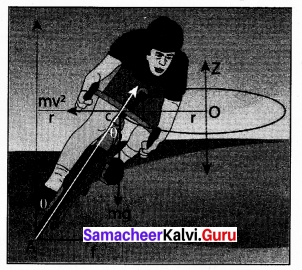
Let us consider a cyclist negotiating a circular level road (not banked) of radius r with a speed v. The cycle and the cyclist are considered as one system with mass m. The center gravity of the system is C and it goes in a circle of radius r with center at O. Let us choose the line OC as X-axis and the vertical line through O as Z-axis as shown in Figure.

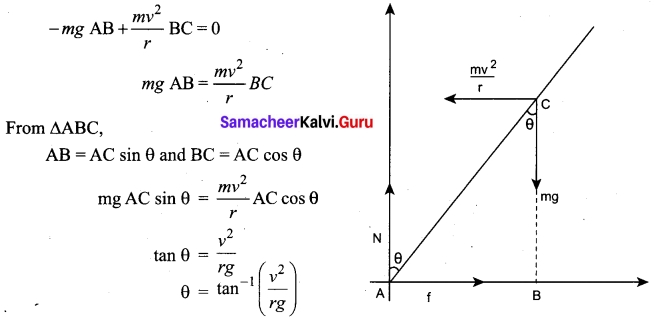
The system as a frame is rotating about Z-axis. The system is at rest in this rotating frame. To solve problems in rotating frame of reference, we have to apply a centrifugal force (pseudo force) on the system which will be \(\frac{mv^2}{r}\). this force will act through the center of gravity. the forces acting on the system are , (i) gravitational force (mg), (ii) Normal force (n), (iii) frictional force (f) and (iv) centrifugal force (\(\frac{mv^2}{r}\)). As the system is in equilibrium in the rotational frame of will be of reference, the net external force and net external torque must be zero. Let us consider all torques about the point A in Figure.
For rotational equilibrium,
\(\vec{τ}_{net}\) = 0
The torque due to the gravitational force about point A is (mg AB) which causes a clockwise turn that is taken as negative. The torque due to the centripetal force is (\(\frac{mv^2}{r}\) BC) which causes an anticlock wise turn that is taken as positive
Tamil Nadu 11th Physics Model Question Paper 2 English Medium 19
While negotiating a circular level road of radius Force diagrams for the cyclist r at velocity v, a cyclist has to bend by an angle in turns
0 from vertical given by the above expression to stay in equilibrium (i.e. to avoid a fall).

Question 36 (a).
Derive an expression for moment of inertia of a uniform ring and uniform disc.
Answer:
Let us consider a uniform ring of mass M and radius R. To find the moment of inertia of the ring about an axis passing through its center and perpendicular to the plane, let us take an infinitesimally small mass {dm) of length (dx) of the ring. This (dm) is located at a distance R, which is the radius of the ring from the axis as shown in figure.
The moment of inertia (dl) of this small mass (dm) is,
dl = (dm) R²
The length of the ring is its circumference (2πR). AS the mass is uniformly distributed, the mass per unit length (λ) is,
mass M
λ = \(\frac{mass}{length}\) = \(\frac{M}{2πR}\)
The mass (dm) of the infinitesimally small length is,
dm = λ dx = \(\frac{M}{2πR}\) dx
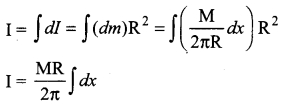
Now, the moment of inertia (I) of the entire ring is,
Tamil Nadu 11th Physics Model Question Paper 2 English Medium 20
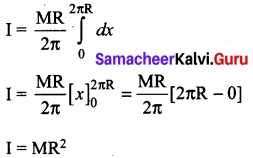
To cover the entire length of the ring, the limits of integration are taken from 0 to 2πR.
Tamil Nadu 11th Physics Model Question Paper 2 English Medium 21

Tamil Nadu 11th Physics Model Question Paper 2 English Medium

[OR]

(b) Explain how overtones are produced in a (i) closed organ pipe
Answer:
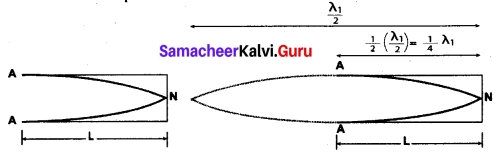
(i) Closed organ pipes: Look at the picture of a clarinet, shown in figure. It is a pipe with one end closed and the other end open. If one end of a pipe is closed, the wave reflected at this closed end is 180° out of phase with the incoming wave. Thus there is no displacement of the particles at the closed end. Therefore, nodes are formed at the closed end and anti¬nodes are formed at open end.
Tamil Nadu 11th Physics Model Question Paper 2 English Medium 22
(a) No motion of particles which leads to nodes at closed end and antinodes at open and (fundamental mode) (N-node, A-antinode)
Let us consider the simplest mode of vibration of the air column called the fundamental mode. Anti-node is formed at the open end and node at closed end. From the figure, let L be the length of the tube and the wavelength of the wave produced. For the fundamental mode of vibration, we have,
L = \(\frac{λ_1}{4}\) or λ1 = 4L …(1)
The frequency of the note emitted is . v v
fp = \(\frac {v}{λ_1}\) = \(\frac{v}{4L}\) …….(2)
which is called the fundamental note.
The frequencies higher than fundamental frequency can be produced by blowing air strongly at open end. Such frequencies are called overtones.
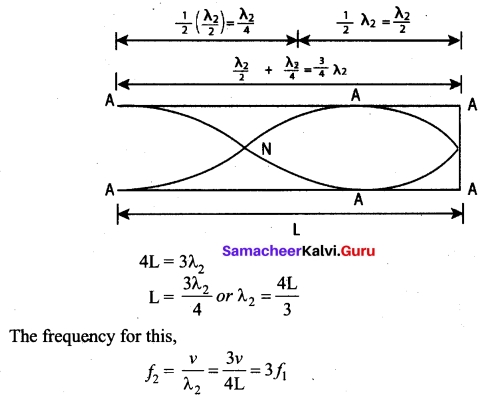
The figure (b) shows the second mode of vibration having two nodes and two antinodes,
Tamil Nadu 11th Physics Model Question Paper 2 English Medium 23
is called first over tone, since here, the frequency is three times the fundamental frequency it is called third harmonic.
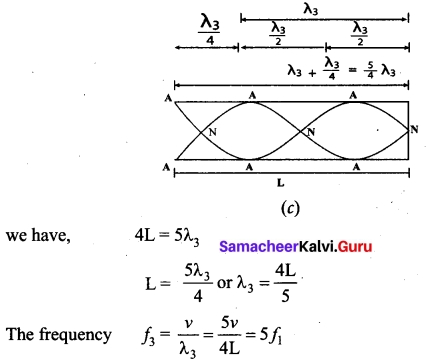
The figure (c) shows third mode of vibration having three nodes and three anti-nodes.
Tamil Nadu 11th Physics Model Question Paper 2 English Medium 24
is called second over tone, and since n = 5 here, this is called fifth harmonic. Hence, the closed organ pipe has only odd harmonics and f1 : f2 : f3 : f4 : …… = 1 : 3 : 5 : 7 : …… ………(3)

Question 37 (a).
What is meant by Doppler effect? Discuss following cases.
(i) source moves towards stationary observer
(ii) source moves away from stationary observer
Answer:
When the source and the observer are in relative motion with respect to each other and to the medium in which sound propagates, the frequency of the sound wave observed is different from the frequency of the source. This phenomenon is called Doppler Effect.

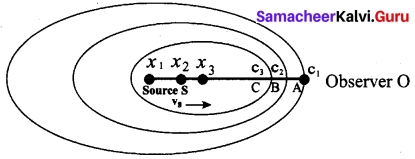
(i) Source moves towards the observer: Suppose a source S moves to the right (as shown in figure) with a velocity vs and let the frequency of the sound waves produced by the source be fs. We assume the velocity of sound in a medium is v. The compression (sound wave front) produced by the source S at three successive instants of time are shown in the figure. When S is at position x1 the compression is at C1. When S is at position x2, the compression is at C2 and similarly for x3 and C3. Assume that if C1 reaches the observer’s position A then at that instant C2reaches the point B and C3 reaches the point C as shown in the figure. It is obvious to see that the distance between compressions C2 and C3 is shorter than distance between C3 and C2. This means the wavelength decreases when the source S moves towards the observer O (since sound travels longitudinally and wavelength is the distance between two consecutive compressions). But frequency is inversely related to wavelength and therefore, frequency increases.
Tamil Nadu 11th Physics Model Question Paper 2 English Medium 25
Let λ be the wavelength of the source S as measured by the observer when S is at position x1 and λ’ be wavelength of the source observed by the observer when S moves to position x2. Then the change in wavelength is Δλ = λ – λ’ = vst, where t is the time taken by the source to travel between x1 and x2. Therefore,
λ’ = λ – vst ………..(1)
But t = \(\frac{λ}{v}\) ………(2)
On substituting equation (2) in equation (3), we get
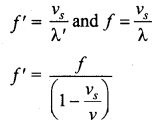
λ’ = λ\(\left(1-\frac{v_{s}}{v}\right)\)
Since frequency is inversely proportional to wavelength, we have
Tamil Nadu 11th Physics Model Question Paper 2 English Medium 26
Since, \(\frac{v_s}{v}\) << 1, we use the binomial expansion and retaining only first order in \(\frac{v_s}{v}\) we get
f’ = f(1 + \(\frac{v_s}{v}\))v ………..(4)

(ii) Source moves away from the observer: Since the velocity here of the source is opposite in direction when compared to case (a), therefore, changing the sign of the velocity of the source in the above case i.e, by substituting (vs → -vs) in equation (1), we get
\(f^{\prime}=\frac{f}{\left(1+\frac{v_{s}}{v}\right)}\) ………(5)
Using binomial expansion again, we get,
\(f^{\prime}=f\left(1-\frac{v_{s}}{v}\right)\) ……….. (6)

Tamil Nadu 11th Physics Model Question Paper 2 English Medium

[OR]

(b) (i) Define specific heat capacity of gas at constant volume
(ii) Define specific heat capacity of gas at constant pressure
(iii) Derive the relationship between Cp and Cv.
Answer:
(i) The amount of heat energy required to raise the temperature of one kg of a substance by 1 K or 1?C by keeping the volume constant is called specific heat capacity at constant volume.
Tamil Nadu 11th Physics Model Question Paper 2 English Medium 27

(ii) The amount of heat required to rise the temperature of one mole of a substance by IK or 1°C at constant volume is called molar specific heat capacity at constant volume.
Tamil Nadu 11th Physics Model Question Paper 2 English Medium 28

(iii) Application of law of equipartition energy in specific heat of a gas Meyer’s relation Cp – Cv = R connects the two specific heats for one mole of an ideal gas.
Tamil Nadu 11th Physics Model Question Paper 2 English Medium 29
Equipartition law of energy is used to calculate the value of Cp – Cv and the ratio between them γ = \(\frac{C_p}{C_v}\) Here y is called adiabatic exponent.

Question 38 (a).
Explain Isobaric process and derive the work done in this process.
Answer:
Isobaric process: This is a thermodynamic process that occurs at constant pressure. Even though pressure is constant in this process, temperature, volume and internal energy are not constant. From the ideal gas equation, we have
V = (\(\frac{µR}{P}\))T ………(1)
Here \(\frac{µR}{P}\) = constant
In an isobaric process the temperature is directly proportional to volume.
V ∝ T (Isobaric process) …(2)
This implies that for a isobaric process, the V-T graph is a straight line passing through the origin.
If a gas goes from a state (Vi ,Ti) to (Vf, Tf) at constant pressure, then the system satisfies the following equation
\(\frac{T_f}{V_f}\) = \(\frac{T_i}{V_i}\) …(3)
Examples for Isobaric process:
(i) When the gas is heated and pushes the piston so that it exerts a force equivalent to atmospheric pressure plus the force due to gravity then this process is isobaric.

(ii) Most of the cooking processes in our kitchen are isobaric processes. When the food is cooked in an open vessel, the pressure above the food is always at atmospheric pressure.

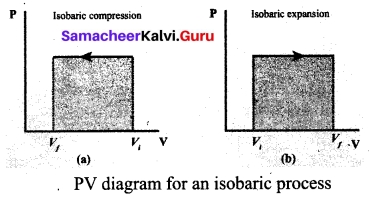
The PV diagram for an isobaric process is a horizontal line parallel to volume axis. Figure (a) represents isobaric process where volume decreases figure (b) represents isobaric process where volume increases.
Tamil Nadu 11th Physics Model Question Paper 2 English Medium 30
The work done in an isobaric process: Work done by the gas
\(\mathbf{W}=\int_{\mathbf{V}_{\mathbf{i}}}^{\mathbf{V}_{f}} \mathbf{P} d \mathbf{V}\) …….(4)
In an isobaric process, the pressure is constant, so P comes out of the integral,
Tamil Nadu 11th Physics Model Question Paper 2 English Medium 31
Where ΔV denotes change in the volume. If ΔV is negative, W is also negative. This implies that the work is done on the gas. If ΔV is positive, W is also positive, implying that work is done by the gas.
The equation (6) can also be rewritten using the ideal gas equation.
From ideal gas equation
PV = µRT and V = \(\frac{µRT}{P}\)
Substituting this in equation (6) we get
W = µRTf (1 – \(\frac{T_i}{T_f}\)) …….(7)
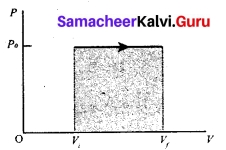
In the PV diagram, area under the isobaric curve is equal to the work done in isobaric process.
Tamil Nadu 11th Physics Model Question Paper 2 English Medium 32
The first law of thermodynamics for isobaric process is given by
ΔU = Q – PΔV ……..(8)
W = PΔY, ΔU = Q – µRTf [1 – \(\frac{T_i}{T_f}\)]

Tamil Nadu 11th Physics Model Question Paper 2 English Medium

[OR]

(b) Explain how the interference of waves is formed.
Answer:
Consider two harmonic waves having identical frequencies, constant phase difference φ and same wave form (can be treated as coherent source), but having amplitudes A1 and A2, then
y1 = A1sin (kx – ωf), ……(1)
y2 = A2 sin (kx – ωt + φ) …..(2)
Suppose they move simultaneously in a particular direction, then interference occurs (i.e., overlap of these two waves). Mathematically
y = y1 + y2 …….(3)
Therefore, substituting equation (1) and equation (3) in equation (3), we get
y = A1 sin (kx – ωt) + A2 sin (kx – ωt + φ)
Using trigonometric identity sin (α + β) = (sin α cos β + cos α sin β ), we get
y= A1 sin (kx – ωt) + A2 [sin (kx – ωt) cos φ + cos (kx – ωt) sin φ]
y= sin (kx – ωt) (A1 + A2 cos φ) + A2 sin φ cos (kx – ωt) ……(4)
Let us re-define A cos θ = (A1 + A2 cos φ) …(5)
and A sin θ = A2 sin φ …(6)
then equation (4) can be rewritten as y = A sin (kx – ωt) cos θ + A cos (kx – ωt) sin θ
y = A (sin (kx – ωt) cos θ + sin θ cos (kx – ωt))
y = A sin (kx – ωt + θ) ……..(7)
By squaring and adding equation (5) and equation (6), we get
A2 =\mathrm{A}_{1}^{2}+\mathrm{A}_{2}^{2} + 2A1 A2 cos φ ……..(8)
Since, intensity is square of the amplitude (I = A2), we have
I = I1 + I2 + 2\(\sqrt{I_1I_2}\) COS φ ……..(9)
This means the resultant intensity at any point depends on the phase difference at that point.

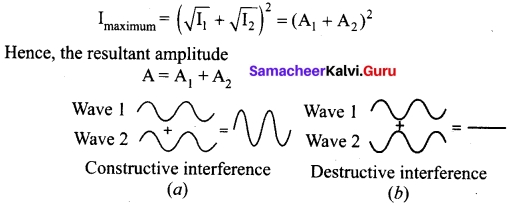
(a) For constructive interference: When crests of one wave overlap with crests of another wave, their amplitudes will add up and we get constructive interference. The resultant wave has a larger amplitude than the individual waves as shown in figure (a). The constructive interference at a point occurs if there is maximum intensity at that point, which means that
cos φ = + 1 ⇒ φ = 0, 2π, 4π,… = 2πn,
where n = 0, 1, 2,…
This is the phase difference in which two waves overlap to give constructive interference. Therefore, for this resultant wave,
Tamil Nadu 11th Physics Model Question Paper 2 English Medium 33

(b) For destructive interference: When the trough of one wave overlaps with the crest of another wave, their amplitudes “cancel” each other and we get destructive interference as shown in figure (b). The resultant amplitude is nearly zero. The destructive interference occurs if there is minimum intensity at that point, which means cos φ = – 1 ⇒ φ = π, 3π, 5π,… = (2 n – 1) π, where n = 0,1,2,…. i.e. This is the phase difference in which two waves overlap to give destructive interference. Therefore,
Tamil Nadu 11th Physics Model Question Paper 2 English Medium 34
Hence, the resultant amplitude
A= |A1 – A2|

Tamil Nadu 11th Physics Model Question Paper 2 English Medium

Tamil Nadu 11th Maths Model Question Paper 5 English Medium

Students can Download Tamil Nadu 11th Maths Model Question Paper 5 English Medium Pdf, Tamil Nadu 11th Maths Model Question Papers helps you to revise the complete Tamilnadu State Board New Syllabus and score more marks in your examinations.

TN State Board 11th Maths Model Question Paper 5 English Medium

General Instructions:

  1. The question paper comprises of four parts.
  2. You are to attempt all the parts. An internal choice of questions is provided wherever applicable.
  3. All questions of Part I, II, III and IV are to be attempted separately.
  4. Question numbers 1 to 20 in Part I are Multiple Choice Questions of one mark each.
    These are to be answered by choosing the most suitable answer from the given four alternatives and writing the option code and the corresponding answer
  5. Question numbers 21 to 30 in Part II are two-mark questions. These are to be answered in about one or two sentences.
  6. Question numbers 31 to 40 in Part III are three-mark questions. These are to be answered in above three to five short sentences.
  7. Question numbers 41 to 47 in Part IV are five-mark questions. These are to be answered in detail Draw diagrams wherever necessary.

Time: 2.30 Hours
Maximum Marks: 90

PART – I

I. Choose the correct answer. Answer all the questions. [20 × 1 = 20]

Question 1.
Let X= {1,2, 3, 4} and R = {(1, 1), (1, 2), (1, 3), (2, 2), (3, 3) (2, 1), (3, 1), (1, 4), (4, 1)} then R is……………
(a) reflexive
(b) symmetric
(c) transitive
(d) equivalence
Solution:
(b) symmetric

Question 2.
Find a so that the sum and product of the roots of the equation 2x² – (a – 3)x + 3a – 5 = 0 are equal is…………
(a) 1
(b) 2
(c) 3
(d) 4
Solution:
(b) 2

Tamil Nadu 11th Maths Model Question Paper 5 English Medium

Question 3.
If π < 2θ < \(\frac{3π}{2}\) then \(\sqrt{2+\sqrt{2+2 \cos 4 \theta}}\) = ………….
(a) -2 cos θ
(b) -2 sin θ
(c) 2 cos θ
(d) 2 sin θ
Solution:
(d) 2 sin θ

Question 4.
If f(θ) = |sin θ| + |cos θ|, θ ∈ R then f(θ) is in the interval……………
(a) [0, 2]
(b) [1, √2]
(c) [ 1, 2]
(d) [0, 1]
Solution:
(b) [1, √2]

Question 5.
Total number of words formed by 2 vowels and 3 consonants taken from 4 vowels and 5 consonants is equal to…………
(a) 60
(b) 600
(c) 720
(d) 7200
Solution:
(d) 7200

Question 6.
The number of parallelograms that can be formed from a set of four parallel lines intersecting another set of three parallel lines is…………
(a) 6
(b) 9
(c) 12
(d) 18
Solution:
(d) 18

Question 7.
The nth term of the sequence \(\frac{1}{3}\), \(\frac{3}{4}\), \(\frac{7}{8}\),\(\frac{15}{16}\)…. is …………..
(a) 2n – n – 1
(b) 1 – 2-n
(c) 2-n + n – 1
(d) 2n-1
Solution:
(b) 1 – 2-n

Question 8.
The remainder when 3815 is divided by 13 is…………
(a) 12
(b) 1
(c) 11
(d) 5
Solution:
(a) 12

Question 9.
If the straight line joining the points (2, 3) and (-1, 4) passes through the point (α, β) then…………
(a) α + 2β = 7
(b) 3α + β = 9
(c) α + 3β = 11
(d) 3α + β = 11
Solution:
(c) α + 3β = 11

Question 10.
If the equation of the base opposite to the vertex (2, 3) of an equilateral triangle is x + y = 2 then the length of a side is………….
(a) \(\sqrt{\frac{3}{2}}\)
(b) 6
(c) √6
(d) 3√2
Solution:
(c) √6

Question 11.
If A and B are symmetric matrices of order n where A ≠ B then…………
(a) A + B is skew symmetric
(b) A + B is symmetric
(c) A + B is a diagonal matrix
(d) A + B is a zero matrix
Solution:
(b) A + B is symmetric

Tamil Nadu 11th Maths Model Question Paper 5 English Medium

Question 12.
If A is a square matrix then which of the following is not symmetric?
(a) A + AT
(b) AAT
(c) ATA
(d) A – AT
Solution:
(d) A – AT

Question 13.
\(\lim _{x \rightarrow \infty}\) \(\frac{a^x-b^x}{x}\) = …………….
(a) log ab
(b) log \(\frac{a}{b}\)
(c) log log \(\frac{b}{a}\)
(d) \(\frac{a}{b}\)
Solution:
(b) log \(\frac{a}{b}\)

Question 14.
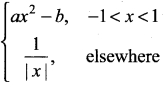
The function f(x) = Tamil Nadu 11th Maths Model Question Paper 5 English Medium 1 is discontinuous at ………..
(a) x = 0
(b) x = 1
(c) x = -2
(d) x = 2
Solution:
(d) x = 2

Question 15.
The function f(x) = \(\left\{\begin{array}{ll} 2 & x \leq 1 \\ x & x>1 \end{array}\right.\) is not differentiable at………..
(a) x = 0
(b) x = 1
(c) x = -1
(d) x = 2
Solution:
(b) x = 1

Question 16.
The number of points in R in which the function f(x) = |x – 1| + |x – 3| + sin x is not differentiable is…………
(a) 3
(a) 2
(c) l
(d) 4
Solution:
(a) 2

Question 17.
If y = 1 + Tamil Nadu 11th Maths Model Question Paper 5 English Medium 2 + …..∞ then \(\frac{dx}{dy}\) =……..

(a) x
(b) x²
(c) y
(d) y²
Solution:
(d) y²

Question 18.
\(\int \frac{\sqrt{\tan x}}{\sin 2 x}\) dx = …………….
(a) \(\sqrt{tan x}\) + c
(b) 2\(\sqrt{tan x}\) + c
(c) \(\frac{1}{2}\) \(\sqrt{tan x}\) + c
(d) \(\frac{1}{4}\) \(\sqrt{tan x}\) + c
Solution:
(a) \(\sqrt{tan x}\) + c

Question 19.
An urn contains 5 red and 5 black balls. A balls is drawn at random, its colour is noted and is returned to the um. Moreover, 2 additional balls of the colour drawn are put in the urn and then a ball is drawn at random. The probability that the second ball drawn is red will be ………….
(a) \(\frac{5}{12}\)
(b) \(\frac{1}{2}\)
(c) \(\frac{7}{12}\)
(d) \(\frac{1}{4}\)
Solution:
(b) \(\frac{1}{2}\)

Question 20.
A bag contains 6 green, 2 white, and 7 black balls. If two balls are drawn simultaneously then the probability that both are different colours is……….
(a) \(\frac{68}{105}\)
(b) \(\frac{71}{105}\)
(c) \(\frac{64}{105}\)
(d) \(\frac{73}{105}\)
Solution:
(a) \(\frac{68}{105}\)

Tamil Nadu 11th Maths Model Question Paper 5 English Medium

PART – II

II. Answer any seven questions. Question No. 30 is compulsory. [7 × 2 = 14]

Question 21.
On the set of natural numbers let R be the relation defined by aRb if 2a + 3b = 30. Write down the relation by listing all the pairs. Check whether it is (i) reflexive, (ii) symmetric, (iii) transitive, (iv) equivalence
Solution:
N = {set of natural numbers};
R ={(3,8), (6, 6), (9, 4), (12, 2)}
(3, 3) ∉ R ⇒ R is not reflexive
(3, 8) ∈ R (8, 3) ∉ R
2a + 3b = 30
3b = 30 – 2a
b = \(\frac{30-2a}{3}\)
⇒ R is not symmetric
(a, b) (b, c) ∉ R ⇒ R is transitive
∴ It is not equivalence relation.

Question 22.
Compute log927 – log279.
Solution:
Let log927 = x ⇒ 27 = 9x ⇒ 3³ = (3²)x = 32x
⇒ 2x = 3 ⇒ x = 3/2
Let log27 9 = x
9 = 27x
3² = (3³)x ⇒ 3² = 33x
3x = 2 ⇒ x = 2/3
∴ log927 – log279 = \(\frac{3}{2}\) – \(\frac{2}{3}\) = \(\frac{9-4}{6}\) = \(\frac{5}{6}\)

Question 23.
Write the first 6 terms of the exponential series e5x
Solution:
Tamil Nadu 11th Maths Model Question Paper 5 English Medium 3

Question 24.
Find the points on the line x + y = 5, that lie at a distance 2 units from the line 4x + 3y – 12 = 0.
Solution:
Any point on the line x + y = 5 is x = t, y = 5 – t
The distance from (t, 5 – t) to the line 4x.+ 3y – 12 = 0 is given by 2 units.
∴ \(\frac{4(t)+3(5-t)-12}{\sqrt {4^2+3^2}}\) = 2 ⇒ \(\frac{|t+3|}{5}\) = 2
⇒ t + 3 = ± 10
t = -13, t = 7
∴ The points (-13, 18) and (7, -2).

Question 25.
Find |\(\vec{a}\) × \(\vec{b}\)| where \(\vec{a}\) = 3\(\vec{i}\) + 4\(\vec{j}\) and \(\vec{b}\) = \(\vec{i}\) +\(\vec{j}\) + \(\vec{k}\)
Solution:
\(\vec{a}\) × \(\vec{b}\) = \(\left|\begin{array}{lll} \hat{i} & \hat{j} & \hat{k} \\ 3 & 4 & 0 \\ 1 & 1 & 1 \end{array}\right|\) = \(\hat{i}\)(4 – 0) – \(\hat{j}\)(3 – 0) + \(\hat{k}\){3 – 4) = 4\(\hat{i}\) – 3\(\hat{j}\) – \(\hat{k}\)
|\(\vec{a}\) × \(\vec{b}\)| = |4\(\hat{i}\) – 3\(\hat{j}\) – \(\hat{k}\)| = \(\sqrt{16+9+1}\) = \(\sqrt{26}\)

Question 26.
Evaluate \(\lim _{x \rightarrow 1} \frac{x^{m}-1}{x^{n}-1}\) m and n are integers.
Solution:
Tamil Nadu 11th Maths Model Question Paper 5 English Medium 4

Question 27.
Find the derivative of sinx² with respect to x²
Solution:
Here u = sinx² and v = x²
Now we have to find
Tamil Nadu 11th Maths Model Question Paper 5 English Medium 5

Question 28.
Evaluate ∫[5x4 + 3(2x + 3)4 – 6(4 – 3x)5]
Solution:
∫[5 x4 + 3(2x + 3)4 – 6(4 – 3x)5] dx.
= 5∫x4dx + 3∫ (2x + 3)4 dx – 6∫ (4 – 3x)5 dx
= 5.\(\frac{x^5}{5}\) + 3.\(\frac{1}{2}\)\(\frac{(2x+3)^5}{5}\) – 6.\(\frac{1}{(-3)}\)\(\frac{(4-3x)^6}{6}\) + c.
= x5 + \(\frac{3}{10}\)(2x + 3)5 + \(\frac{1}{3}\) (4 – 3x)6 + c

Tamil Nadu 11th Maths Model Question Paper 5 English Medium

Question 29.
Given that P(A) = 0.52, P(B) = 0.43, and P(A ∩ B) = 0.24, find P(A ∪ B)
Solution:
P(A ∪ B) = P(A) + P(B) – P(A ∩ B)
= 0.52 + 0.43 – 0.24
P(A ∪ B) = 0.71

Question 30.
For what value of x, the matrix A = \(\left[\begin{array}{rrr} 0 & 1 & -2 \\ -1 & 0 & x^{3} \\ 2 & -3 & 0 \end{array}\right]\) is skew-symmetric.
Solution:
Tamil Nadu 11th Maths Model Question Paper 5 English Medium 6
-x³ = -3 ⇒ x³ = 3 ⇒ x = 31/3

PART- III

III. Answer any seven questions. Question No. 40 is compulsory. [7 × 3 = 21]

Question 31.
Find the largest possible domain for the real valued function given by f(x) =\(\frac{\sqrt{9-x^{2}}}{\sqrt{x^{2}-1}}\)
Solution:
If x < -3 or x > 3, then x² will be greater than 9 and hence 9 – x² will become negative which has no square root in R. So x must lie on the interval [-3, 3].
Also if x ≥ – 1 and x ≤ 1, then x² – 1 will become negative or zero. If it is negative, x² – 1e has no square root in R. If it is zero, f is not defined. So x must lie outside [-1, 1]. That is, x must lie on (- ∞, -1) ∪ (1, ∞). Combining these two conditions, the largest possible domain for/is [-3, 3] ∩ ((-∞, -1) ∪ (i, ∞)). That is, [-3, -1) ∪ (1, 3].

Question 32.
Solve sin x + sin 5x = sin 3x
Solution:
sin x + sin 5x = sin 3x ⇒ 2 sin 3x cos 2x = sin 3x
sin 3x (2 cos 2x – 1) = 0
Thus, either sin 3x = 0 (or) cos 2x = \(\frac{1}{2}\)
If sin 3x = 0, then 3x = nπ ⇒ x = \(\frac{nπ}{3}\) n ∈ Z ………(i)
If cos 2x = \(\frac{1}{2}\) ⇒ cos 2x = cos \(\frac{π}{3}\)
2x = 2nn ± \(\frac{π}{3}\) ⇒ x = nπ ± \(\frac{π}{6}\), n ∈ Z ….(ii)
From (i) and (ii), we have the general solution x = \(\frac{π}{3}\) (or) x = nπ ± \(\frac{π}{6}\), n ∈ Z

Question 33.
How many triangles can be formed by 15 points in which 7 of them lie on one line and the remaining 8 on another parallel line?
Solution:
Tamil Nadu 11th Maths Model Question Paper 5 English Medium 7
7 points lie on one line and the other 8 points parallel on another parallel line.
A triangle is obtained by taking one point from one line and 2 points from the other parallel line which can be done as follows.
7C1 × 8C2 or 7C2 × 8C1
7C1 = 7; 7C2 = \(\frac{7×6}{2×1}\) = 21
8C1 = 8; 8C2= \(\frac{8×7}{2×1}\) = 28
∴ No. of triangles = (7) (28) + (21) (8) = 196 + 168 = 364

Question 34.
Using binomial theorem indicate which of the following two numbers is larger (1.01)1000000 or 10000
Solution:
(1.01)1000000 = (1 + 0.01)1000000
= 1000000C0(1)1000000 + 1000000C1(1)999997(0.01)1
+ 1000000C2(1)999998(0.01)² + 1000000C3(1)999997(0.01)³ +……….
= 1 (1) + 1000000 × \(\frac{1}{10^2}\) + \(\frac{1000000×999999}{2}\) × \(\frac{1}{10000}\) + …………
= 1 + 10000 + 50 × 999999 +…………
which is > 10000
So (1.01)1000000 > 10000 (i.e.) (1.01)1000000 is larger.

Tamil Nadu 11th Maths Model Question Paper 5 English Medium

Question 35.
If a line joining two points (3, 0) and (5, 2) is rotated about the point (3, 0) in counter clockwise direction through an angle 15°, then find the equation of the line in the new position.
Solution:
Tamil Nadu 11th Maths Model Question Paper 5 English Medium 8
Let P (3, 0) and Q (5, 2) be the given points.
Slope of PQ = \(\frac{y_2-y_1}{x_2-x_1}\) = 1
⇒ The angle of inclination of the line PQ = tan-1(1) = \(\frac{π}{4}\) = 45°
∴ The slope of the line in new position is m = tan (45° + 15°)
⇒ Slope = tan (60°) = (√3)
∴ Equation of the straight line passing through (3, 0) and with the slope √3 is y – 0 = √3 (x – 3)
√3 x – y – 3√3 = 0

Question 36.
Find the area of the triangle whose vertices are A(3, -1, 2), B(l, -1, -3) and C(4, -3,1)
Solution:
A = (3, -1, 2), B = (1, -1, -3) and C = (4, -3, 1)
∴ \(\vec{OA}\) = 3\(\hat{i}\) – \(\hat{j}\) + 2\(\hat{k}\); \(\vec{OB}\) = \(\hat{i}\) – \(\hat{j}\) – 3\(\hat{k}\); and \(\vec{OC}\) = 4\(\hat{i}\) – 3\(\hat{j}\) + \(\hat{k}\)
Area of ΔABC = \(\frac{1}{2}\)|\(\vec{AB}\) × \(\vec{AC}\)| = \(\frac{1}{2}\)|\(\vec{BA}\) × \(\vec{BC}\)| = \(\frac{1}{2}\)|\(\vec{CA}\) x \(\vec{CB}\)|
\(\vec{AB}\) = \(\vec{OB}\) – \(\vec{OA}\) = (\(\hat{i}\) – \(\hat{j}\) – 3\(\hat{k}\)) – (3\(\hat{i}\) – \(\hat{j}\) + 2\(\hat{k}\)) = \(\hat{i}\) – \(\hat{j}\) – 3\(\hat{k}\) – 3\(\hat{i}\) + \(\hat{j}\) – 2\(\hat{k}\)
= -2\(\hat{i}\) – 5\(\hat{k}\)
\(\vec{AC}\) = \(\vec{OC}\) – \(\vec{OA}\) = 4\(\hat{i}\) – 3\(\hat{j}\) + \(\hat{k}\) – 3\(\hat{i}\) + \(\hat{j}\) – 2\(\hat{k}\)
= \(\hat{i}\) – 2\(\hat{j}\) – \(\hat{k}\)
Tamil Nadu 11th Maths Model Question Paper 5 English Medium 9

Question 37.
Check if \(\lim _{x \rightarrow-5}\) f(x) exists or not, where f(x) = \(\left\{\begin{array}{l} \frac{|x+5|}{x+5}, \text { for } x \neq-5 \\ 0, \quad \text { for } x=-5 \end{array}\right.\)
Solution:
(i) f(-5)
For x < -5, |x + 5| = -(x + 5)
Thus f(-5) = \(\lim _{x \rightarrow-5^-}\) \(\frac{-(x-5)}{(x+5)}\) = -1

(ii) f(-5+)
For x > -5, |x + 5| = (x + 5)
Thus f(-5+) = \(\lim _{x \rightarrow-5^+}\) \(\frac{(x+5)}{(x+5)}\) = 1
∴ f(-5) ≠ f(-5+). Hence the limit does not exist.

Question 38.
Evaluate \(\frac{\sqrt{x}}{1+\sqrt{x}}\)
Solution:
Tamil Nadu 11th Maths Model Question Paper 5 English Medium 10

Question 39.
The probability that a girl, preparing for competitive examination will get a State Government service is 0.12, the probability that she will get a Central Government job is 0.25, and the probability that she will get both is 0.07. Find the probability that
(i) she will get atleast one of the two jobs
(ii) she will get only one of the two jobs.
Solution:
Let I be the event of getting State Government service and C be the event of getting Central Government job.
Given that P(I) = 0.12, P(C) = 0.25, and P(I ∩ C) = 0.07
(i) P (at least one of the two jobs) = P(I or C) = P(I ∪ C)
= P(I) + P(C) – P(I ∩ C)
= 0.12 + 0.25 – 0.07 = 0.30

(if) P(only one of the two jobs) = P[only I or only C].
= P(I ∩ \(\bar{C}\)) + P(\(\bar{I}\) ∩ C)
= (P(I) – P(I ∩ C)} + (P(C) – P(I ∩ C)}
= {0.12 – 0.07} + {0.25 – 0.07}
= 0.23.
Tamil Nadu 11th Maths Model Question Paper 5 English Medium 11

Question 40.
Find the derivatives of the following function. \(\sqrt{xy}\) = e(x-y)
Solution:
\(\sqrt{xy}\) = ex-y
(i.e.) (xy)1/2 = ex-y
Taking log on both sides we get
log (xy)1/2 = log ex-y
(i.e.) \(\frac{1}{2}\) (log x + log y) = x – y
⇒ log x + log y = 2x – 2y
differentiating w.r. to x we get
Tamil Nadu 11th Maths Model Question Paper 5 English Medium 12

Tamil Nadu 11th Maths Model Question Paper 5 English Medium

PART – IV

IV. Answer all the questions. [7 × 5 = 35]

Question 41 (a).
Find the range of the function \(\frac{1}{2cos x -1}\)
Solution:
The range of cos x is – 1 to 1
-1 < cos x < 1
(× by 2) -2 < 2 cos x < 2
adding -1 throughout
-2 – 1 <2 cos x – 1 < 2 – 1
(i.e.,) -3 < 2 cos x – 1 < 1
so 1 < \(\frac{1}{2cos x -1}\) < \(\frac{-1}{3}\)
The range is outside \(\frac{-1}{3}\) and 1
i.e., range is (-∞, \(\frac{-1}{3}\)] ∪ [1, ∞)

[OR]

(b) Solve \(\frac{(x-2)}{(x+4)}\) ≥ \(\frac{5}{(x+3)}\)
Solution:
Tamil Nadu 11th Maths Model Question Paper 5 English Medium 13
x + 4 = 0 ⇒ x = -4; x + 3 = 0 ⇒ x = -3
Plotting the points -4, -3 on number line and taking limits (-∞, -4), (-4, -3), (-3, ∞)
Tamil Nadu 11th Maths Model Question Paper 5 English Medium 14
The solution for the inequality \(\frac{(x-2)}{(x+4)}\) ≥ \(\frac{5}{(x+3)}\) are the intervals (-∞, -4) and (-4, -3)

Question 42 (a).
Prove that log 2 + 16 log \(\frac{16}{15}\) + 12 log \(\frac{25}{24}\) + 7 log \(\frac{80}{81}\) = 1
Solution:
LHS = log 2 + 16 [log 16 – log 15] + 12 [log 25 – log 24] + 7 [log 81 – log 80]
Tamil Nadu 11th Maths Model Question Paper 5 English Medium 15
= log 2 + 16 [log 24 – log 3 × 5 ] + 12 [log 5² – log 2³ × 3] + 7[log 34 – log 24 × 5]
= log 2 + 16 [41og2 – log3 – log5] + 12 [2 log 5 – 3 log 2 – log 3] + 7 [4 log 3 – 4 log 2 – log 5]
= log 2 + 64 log 2 – 16 log 3 – 16 log 5 + 24 log 5 – 36 log 2 – 12 log 3 + 28 log 3 – 28 log 2 – 7 log 5
= log 2 [1+ 64 – 36 – 28] + log 3 [-16 – 12 + 28] + log 5 [-16 + 24 – 7]
= log 2(1) + log 3(0) +log 5(1)
= log 2 + log 5 = log 2 × 5 = log 10 = 1 = RHS

[OR]

(b) If tan α = \(\frac{1}{3}\) and tan β = \(\frac{1}{7}\) show that 2 α + β = \(\frac{π}{4}\)
Solution:
Tamil Nadu 11th Maths Model Question Paper 5 English Medium 16
∴ 2 α + β = 45° = \(\frac{π}{4}\)

Tamil Nadu 11th Maths Model Question Paper 5 English Medium

Question 43 (a).
Using Binomial theorem, prove that 6n – 5n always leaves remainder 1 when divided by 25 for all positive integer n.
Solution:
To prove this it is enough to prove, 6n – 5n = 25k + 1 for some integer k. We first consider the expansion
(1 + x)n = nC0 + nC1 x + nC2 x² +…+ nCn-1xn-1 + nCn xn, n ∈ N.
Taking x = 5 we get (1 + 5)n = nC0 + nC1 5 + nC2 5² +…+ nCn-1 5n-1 + nCn 5n. The above equality reduces to 6n = 1 + 5n + 25(nC2 + 5 nC3 +…+ nCn 5n-2)
That is,
6n – 5n = 1 + 25(nC2 + 5 nC3 +…+ nCn 5n-2) = 1 + 25k, k ∈ N.
Thus 6n – 5n always, leaves remainder 1 when divided by 25 for all positive integer n.

[OR]

(b) Prove that
Tamil Nadu 11th Maths Model Question Paper 5 English Medium 17
Solution:
Taking p = 0, we get |A| = \(\left|\begin{array}{ccc} (q+r)^{2} & 0 & 0 \\ q^{2} & r^{2} & q^{2} \\ r^{2} & r^{2} & q^{2} \end{array}\right|\) = 0
Therefore, (p- 0) is a factor. That is, p is a factor.
Since |A| is in cyclic symmetric form in p, q, r and hence q and r also factors.
Putting p + q + r = 0 ⇒ q + r = -p; r + p = -q; and p + q = -r.
|A| = \(\left|\begin{array}{lll} p^{2} & p^{2} & p^{2} \\ q^{2} & q^{2} & q^{2} \\ r^{2} & r^{2} & r^{2} \end{array}\right|\) = 0 since 3 columns are identical.
Therefore, (p + q + r)² is a factor of |A|.
The degree of the obtained factor pqr(p + q + r)² is 5. The degree of |A| is 6.
Therefore required factor is k (p + q + r)
Tamil Nadu 11th Maths Model Question Paper 5 English Medium 18
4(16 – 1) -1 (4 – 1) +1 (1 – 4) = 27k
60 – 3 – 3 = 27 k ⇒ k = 2.
|A| = 2pqr (p + q + r)³

Question 44 (a).
The sum of the distance of a moving point from the points (4, 0) and (-4, 0) is always 10 units. Find the equation of the locus of the moving point.
Solution:
Let point (h, k) be a moving point
Here A = (4, 0) and B = (- 4, 0)
Given PA + PB = 10
⇒ \(\sqrt{(h-4)^{2}+k^{2}}+\sqrt{(h+4)^{2}+k^{2}}\) = 10
⇒ \(\sqrt{(h-4)^{2}+k^{2}}\) = 10 – \(\sqrt{(h+4)^{2}+k^{2}}\)
Squaring both sides (h – 4)² + k² = 100 + (h + 4)² + k² – 20\(\sqrt{(h+4)^{2}+k^{2}}\)
(i.e.) h² + l6 – 8h + k² = 100 + h² + 16 + 8h + k² – 20\(\sqrt{(h+4)^{2}+k^{2}}\)
⇒ -16h – 100 = – 20 \(\sqrt{(h+4)^{2}+k^{2}}\)
(÷ by -4) 4h + 25 = 5 \(\sqrt{(h+4)^{2}+k^{2}}\)
Squaring both sides we get,
(4h + 25)² = 25 [(h + 4)² + k²]
(i.e) 16h² + 25 + 200h = 25 [h² + 8h + 16 + k²]
= 16h² + 625 + 200h – 25h² – 200h – 400 – 25k² = 0
= – 9h² – 25k² + 225 = 0
⇒ 9h² + 25 k² = 225
\(\frac{9h^2}{225}\) + \(\frac{25k^2}{225}\) = 1
(i.e) h²/25 + k²/9 = 1, So the locus is \(\frac{x^2}{25 }\) + \(\frac{y^2}{9}\) = 1

Tamil Nadu 11th Maths Model Question Paper 5 English Medium

[OR]

(b) Show that the vectors \(\hat{i}\) – 2\(\hat{j}\) + 3\(\hat{k}\), -2\(\hat{i}\) + 3\(\hat{j}\) – 4\(\hat{k}\) and – \(\hat{j}\) + 2\(\hat{k}\) are coplanar.
Solution:
Let the given three vectors be \(\vec{a}\), \(\vec{b}\) and \(\vec{c}\). When we are able to write one vector as a linear combination of the other two vectors, then the given vectors are called coplanar vectors.
Let \(\vec{a}\) = m\(\vec{b}\) + n\(\vec{c}\) where
(i.e.) \(\vec{a}\) = \(\hat{i}\) – 2\(\hat{j}\) + 3\(\hat{k}\)
\(\vec{b}\) = -2\(\hat{i}\) + 3\(\hat{j}\) – 4\(\hat{k}\) and \(\vec{c}\) = –\(\hat{j}\) + 2\(\hat{k}\)
⇒ \(\hat{i}\) – 2\(\hat{j}\) + 3\(\hat{k}\) = m (-2\(\hat{i}\) + 3\(\hat{j}\) – 4\(\hat{k}\)) + n (-\(\hat{j}\) + 2\(\hat{k}\))
Equating the \(\hat{i}\), \(\hat{j}\) and \(\hat{k}\) components
(i.e.) 1 = -2m ……… (1)
-2 = 3m – n …………(2)
3 = -4m + 2n …………(3)
Now we have to solve (1) and (2) and substitute the value in (3).
Solving (1) and (2)
(1) ⇒ -2m = 1
∴ m = –\(\frac{1}{2}\)
Substituting m = –\(\frac{1}{2}\) in (2) we get,
3(\(\frac{-1}{2}\)) – n = -2
–\(\frac{3}{2}\) – n = -2
∴ -n = -2 + \(\frac{3}{2}\) = \(\frac{-4+3}{2}\) = –\(\frac{1}{2}\)
n = \(\frac{1}{2}\)
∴ m = –\(\frac{1}{2}\); n = \(\frac{1}{2}\)
Substituting the values of m and n in (3).
LHS = 3
RHS = -4 + 2n = -4(\(\frac{-1}{2}\)) + 2(\(\frac{1}{2}\))
= 2 + 1 = 3
⇒ LHS = RHS
∴ we are able to write one vector as a linear combination of the other two
⇒ the given vectors are coplanar.

Question 45 (a).
A committee of 7 peoples has to be formed from 8 men and 4 women. In how many ways can this be done when the committee consists of
(i) exactly 3 women?
(ii) at least 3 women?
(iii) at most 3 women?
Solution:
Tamil Nadu 11th Maths Model Question Paper 5 English Medium 19
We need a committee of 7 people with 3 women and 4 men.
This can be done in (4C3) (8C4) ways
4C1 = 4C1 = 4
8C4 = \(\frac{8×7×6×5}{4×3×2×1}\) = 70
The number of ways = (70) (4) = 280

(ii) Atleast 3 women
Tamil Nadu 11th Maths Model Question Paper 5 English Medium 20
So the possible ways are (3W and 4M) or (4W and 3M)
(i.e) (4C3) (8C4) + (4C4) (8C3)
4C3 = 4C1 = 4; 4C4 = 1
8C4 = \(\frac{8×7×6×5}{4×3×2×1}\) = 70
8C3 = \(\frac{8×7×6}{3×2×1}\) = 56
The number of ways (4) (70) + (1) (56) = 280 + 56 = 336

(iii) Atmost 3 women
Tamil Nadu 11th Maths Model Question Paper 5 English Medium 21
The possible ways are (0W 8M) or (1W 6M) or (2W 5M) or (3W 4M)
Tamil Nadu 11th Maths Model Question Paper 5 English Medium 22
∴ The possible ways are
(1) (8) + (4) (28) + (6) (56) + (4) (70) = 8 + 112 + 336 + 280 = 736 ways

Tamil Nadu 11th Maths Model Question Paper 5 English Medium

[OR]

(b) Evaluate \(\lim _{x \rightarrow 0} \frac{\sqrt{1+\sin x}-\sqrt{1-\sin x}}{\tan x}\)
Solution:
Tamil Nadu 11th Maths Model Question Paper 5 English Medium 23

Question 46 (a).
If y = \(\frac{\sin ^{-1} x}{\sqrt{1-x^{2}}}\) show that (1 – x²)y2 – 3xy1 – y = 0
Solution:
y = \(\frac{\sin ^{-1} x}{\sqrt{1-x^{2}}}\)
⇒ y \(\sqrt{1-x^2}\) = sin-1 x
differentiating w.r.to x we get
Tamil Nadu 11th Maths Model Question Paper 5 English Medium 24
multiplying both sides by \(\sqrt{1-x^2}\) we get
-xy + (1 – x²)y1 = 1
differentiating both sides again w.r.to x.
– [xy-1 +y(1)] + (1 – x²) (y2) + y1(-2x) = 0
(i.e.) -xy1 – y + (1 – x²)y2 – 2xy1 = 0
(1 – x²)y2 – 3xy1 – y = 0

[OR]

(b) If y = cos (m sin-1 x), prove that (1 – x²) y3 – 3xy2 + (m² – 1) y1 = 0
Solution:
We have y = cos (m sin-1 x)
y1 = sin(m sin-1 x) \(\frac{m}{\sqrt{1-x^2}}\)
\(y_{1}^{2}\) = sin² (m sin-1 x) \(\frac{m^2}{(1-x^2)}\)
This implies (1 – x²) \(y_{1}^{2}\) = m² sin² (m sin-1 x) = m² [1 – cos² (m sin-1 x)]
This is, (1 – x²) \(y_{1}^{2}\) = m² (1 – y²).
Again differentiating,
(1 – x²) 2y1 \(\frac{dy_1}{dx}\) + \(y_{1}^{2}\)(-2x) = m² (-2y\(\frac{dy}{dx}\))
(1 – x²) 2y1y2 – 2x\(y_{1}^{2}\) = – 2m²yy1
(1 – x²) y2 – xy1 = m²y
Once again differentiating
(1 – x²) 2y1 \(\frac{dy_2}{dx}\) + \(y_{2}\)(-2x) – [x.\(\frac{dy_1}{dx}\) + y1.1] = -m² (\(\frac{dy}{dx}\))
(1 – x²)y3 – 2xy2 – xy2 – y1 = -m²y1
(1 – x²)y3 – 3xy2 + (m² – 1)y1 = 0

Tamil Nadu 11th Maths Model Question Paper 5 English Medium

Question 47 (a).
Evaluate ∫\(\frac{dx}{\sqrt{9+8x-x^2}}\)
Solution:
Let I = ∫\(\frac{dx}{\sqrt{9+8x-x^2}}\) dx
Consider, 9 + 8x – x²
= -[x² – 8x – 9]
= -[(x – 4)² – 16 – 9]
= -[(x – 4)² – (5)²]
= (5)² – (x – 4)²
Tamil Nadu 11th Maths Model Question Paper 5 English Medium 25.

[OR]

(b) An advertising executive is studying television viewing habits of married men and women during prime time hours. Based on the past viewing records he has determined that during prime time wives are watching television 60% of the time. It has also been determined that when the wife is watching television, 40% of the time the husband is also watching. When the wife is not watching the television, 30% of the time husband is watching the television. Find the probability that
(i) the husband is watching the television during the prime time of television
(ii) if the husband is watching the television, the wife is also watching the television.
Solution:
P(Wife watching TV) = P(W) = \(\frac{60}{100}\)
P(H/W) = \(\frac{40}{100}\); P(H/W’) = 30/100
(i) P(Husband watching TV) = P(H)
= P(H/W) P(W) + P(H/W’) P(W’)
Tamil Nadu 11th Maths Model Question Paper 5 English Medium 26

Tamil Nadu 11th Maths Model Question Paper 5 English Medium

Tamil Nadu 11th Physics Model Question Paper 4 English Medium

Students can Download Tamil Nadu 11th Physics Model Question Paper 4 English Medium Pdf, Tamil Nadu 11th Physics Model Question Papers helps you to revise the complete Tamilnadu State Board New Syllabus and score more marks in your examinations.

TN State Board 11th Physics Model Question Paper 4 English Medium

Tamil Nadu 11th Physics Model Question Paper 2 English Medium

Instructions:

  1. The question paper comprises of four parts
  2. You are to attempt all the parts. An internal choice of questions is provided wherever: applicable
  3. All questions of Part I, II, III, and IV are to be attempted separately
  4. Question numbers to 15 in Part I are Multiple choice Questions of one mark each. These are to be answered by choosing the most suitable answer from the given four alternatives and writing the option code and the corresponding answer
  5. Question numbers 16 to 24 in Part II are two-mark questions. These are lo be answered in about one or two sentences.
  6. Question numbers 25 to 33 in Part III are three-mark questions. These are lo be answered in about three to five short sentences.
  7. Question numbers 34 to 38 in Part IV are five-mark questions. These are lo be answered in detail. Draw diagrams wherever necessary.

Time: 3 Hours
Max Marks: 70

PART – I

Answer all the questions: [15 × 1 = 15]

Question 1.
A parallax of heavenly body measured from two points diametrically opposite on equator of Earth is 1.0 minute. If the radius of Earth is 6400 km the distance of the body is …………
(a) 8.8 × 10¹⁰m
(b) 4.4 × 10¹⁰m
(c) 0.29 × 10⁻¹⁰m
(d) 8.6 × 10⁻¹⁰m
Answer:
(b) 4.4 × 10¹⁰m
Hint:
θ = 1 min = \(\frac{1}{60}\) × \(\frac{π}{1800}\)rad
Diameter of earth, d = 2 × RE = 2 × 6400 × 10³m
Distance of the heavenly body from the centre of the earth, r = \(\frac{d}{θ}\) = \(\frac{2×6400×10^3}{\frac{π}{60×80}}\)
r = 4.4 × 10¹⁰m

Question 2.
A particle is thrown vertically upwards, its velocity at half of the height is 10 m/s then the maximum height attained by it is (g = 10 m/s²)
(a) 8 m
(b) 20 m
(c) 10 m
(d) 16 m
Answer:
(c) 10 m
Hint: From equation of motion, v² = u² – 2as
O = (10)² + 2(-10) s
∴S = 5 m
u = 10 ms-1
v = 0 ms-1
a = -10 ms-2
Total height = 2 × 5 = 10 m

Question 3.
If the velocity is \(\vec{v}\) = 2\(\vec{i}\) + t²\(\vec{j}\) – 9\(\vec{k}\), then the magnitude, of acceleration at t = 0.5 s is……….
(a) 1 ms-2
(b) 2 ms-2
(c) zero
(d) -1 ms-2
Answer:
(a) 1 ms-2
Hint:
a = \(\frac{dy}{dt}\) = \(\frac{d}{dt}\) (2\(\vec{i}\) + t²\(\vec{j}\) – 9\(\vec{k}\)) = 2t\(\vec{j}\)
at, t = 0.5 s ⇒ a = 2 (0.5).= 1 ms-2

Tamil Nadu 11th Physics Model Question Paper 2 English Medium

Question 4.
A uniform force of (2\(\vec{i}\) + \(\vec{j}\))N acts on a particle of mass 1 kg. The particle displaces from position (3\(\vec{j}\) + \(\vec{k}\)) m to (5\(\vec{i}\) + 3\(\vec{j}\)) m. The work done by the force on the particle is……….
(a) 9 J
(b) 6 J
(c) 10 J
(d) 12 J
Answer:
(c) 10 J
Hint:
\(\vec{F}\) = (2\(\vec{i}\)+ \(\vec{j}\))N; Δ\(\vec{r}\) = \(\vec{j}_2\) – \(\vec{r}_2\) = (5\(\vec{i}\) + 3\(\vec{j}\)) – (3\(\vec{i}\) + \(\vec{k}\)); Δr = 5\(\vec{i}\) – \(\vec{k}\)
Workdone, \(\vec{W}\) = \(\vec{F}\). Δ\(\vec{r}\) = (2\(\vec{i}\) + \(\vec{j}\)) . (5\(\vec{i}\) – \(\vec{k}\))
\(\vec{W}\) = 10\(\vec{i}\) \(\vec{W}\) = 10Nm = 10J

Question 5.
A couple produces……….
(a) pure rotation
(b) pure translation
(c) rotation and translation
(d) no motion
Answer:
(a) pure rotation

Question 6.
What is the shape, when a non-wetting liquid is placed in a capillary tube?
(a) convex upwards
(b) concave upwards
(c) concave downwards
(d) convex downwards
Answer:
(a) convex upwards

Question 7.
An ideal gas heat engine operators in a carnot’s cycle between 227°C and 127°C. It absorbs 6 × 10⁴J at high temperature. The amount of heat converted into work is………
(a) 2.4 × 10⁴J
(b) 4.8 × 10⁴J
(c) 1.2 × 10⁴J
(d) 6 × 10⁴J
Answer:
(c) 1.2 × 10⁴J
Hint:
\(\frac{W}{Q}\) = 1 – \(\frac{T_2}{T_1}\)
W = (1 – \(\frac{273+127}{273+227}\)) × 104 = 1.2 × 10⁴J

Question 8.
Four round objects namely a ring, a disc, a hollow sphere and a solid sphere with same radius R start to roll down an incline at the same time. Find out the order of objects reaching the bottom first?
(a) solid sphere, disc, hollow sphere, ring
(b) ring, disc, hollow sphere, solid sphere
(c) disc, ring, solid sphere, hollow sphere
(d) hollow sphere, disc, ring, solid sphere
Answer:
(a) solid sphere, disc, hollow sphere, ring

Question 9.
Two forces of magnitude F having a resultant of the same magnitude of F, the angle between the two forces is…………
(a) 45°
(b) 60°
(c) 120°
(d) 150°
Answer:
(c) 120°
Hint:
Magnitude of each force is F
∴ The resultant force, F = \(\sqrt{F^2+F^2+2F.Fcosθ}\)
F² = 2F² + 2F² cos θ ⇒ cos θ = –\(\frac{1}{2}\) ⇒ θ = 120°

Tamil Nadu 11th Physics Model Question Paper 2 English Medium

Question 10.
If v0 and v denote the sound velocity and the rms velocity of the molecules in a gas, then……..
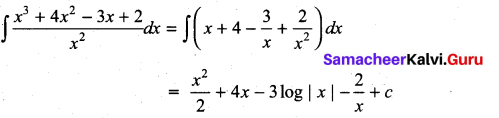
(a) v0 = v(\(\frac{3}{r}\))\(\frac{1}{2}\)
(b) v0 = 0
(c) v0 = v(\(\frac{r}{3}\))\(\frac{1}{2}\)
(d) v0 and v are not related
Answer:
(c) v0 = v(\(\frac{r}{3}\))\(\frac{1}{2}\)

Question 11.
The internal energy of an ideal gas depends on ………..
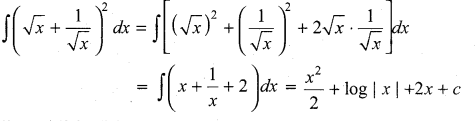
(a) pressure
(b) volume
(c) temperature
(d) size of molecules
Answer:
(c) temperature

Question 12.
The internal energy of an ideal gas increases during an isothermal process, when the gas is ……….
(a) expanded by adding more molecules to it
(b) expanded by adding more heat to it
(c) expanded against zero pressure
(d) compressed by doing work on it
Answer:
(a) expanded by adding more molecules to it

Question 13.
A particle executing simple harmonic motion of amplitude 5 cm has maximum speed of 31.4 cm/s. The frequency of its……….
(a) 3 Hz
(b) 2 Hz
(c) 4 Hz
(d) 1 Hz
Answer:
(d) 1 Hz
Hint:
A = 5 cm = 5 × 10⁻²m ; υmax = 31.4 cm/s = 31.4 × 10⁻² m/s
Maximum speed Vmax = 2πη × A
∴ n = \(\frac{V_{max}}{2πA}\) = \(\frac{31.4×10^{-2}}{2π×5×10^{-2}}\) = \(\frac{31.4}{10×3.14}\); n = 1 Hz

Question 14.
A hollow sphere is filled with water. It is hung by a long thread. As the water flows out of a hole at the bottom, the period of oscillation will………
(a) first increase and then decrease
(b) first decrease and then increase
(c) increase continuously
(d) decrease continuously
Answer:
(a) first increase and then decrease

Question 15.
A wave travels in a medium according to the equation of displacement given by y(x, t) = 0.03 sin {π(2t – 0.01 x)} where y and x are in metres and t in seconds. The wave length of the wave is……….
(a) 200 m
(b) 100 m
(c) 20 m
(d) 10 m
Answer:
(a) 200 m
Hint:
λ = \(\frac{2π}{K}\) = \(\frac{π}{0.01π}\) = 200 m

PART – II

Answer any six questions in which Q. No 23 is compulsory. [6 × 2 = 12]

Question 16.
Distinguish scalar and vector.
Answer:

ScalarVector
(i)Scalar can be described only by magnitudeVector can be described by both magnitude and direction.
(ii)Ex. mass, distance, speedEx. force, velocity, displacement

Tamil Nadu 11th Physics Model Question Paper 2 English Medium

Question 17.
Calculate the total number of degrees of freedom possessed by the molecular in one cm³ of H2 gas at NTP.
Answer:
22400 cm³ of every gas contains 6.02 × 10²³ molecules
∴ Number of molecules in 1 cm² of H2 gas = \(\frac{6.02×10^{23}}{22400}\) = 0.26875 × 10²⁰
Number of degrees of freedom of a H2 gas molecule = 5
∴ Total number of degrees of freedom of 0.26875 × 10²⁰ molecules
= 0.26875 × 1020 × 5 = 1.34375 × 10²⁰

Question 18.
A stone tied to the end of a string 80 cm long is whirled in a horizontal circle with a constant speed. If the stone makes 14 revolution in 25 s, what is the magnitude and direction of acceleration of the stone?
Answer:
The acceleration will be directed towards the centre of the circular loop
angular velocity, ω = 2πf = 2 × 3.14 × \(\frac{14}{25}\); ω = \(\frac{88}{25}\) rad/s
Centripetal acceleration = rω² = \(\frac{0.8×(88)^2}{(25)^2}\); ac = 9.91 m/s²

Question 19.
There are two identical balls of same material, one being solid and the other being hollow. How will you distinguish them without weighting?
Answer:
Solid and hollow balls can be differentiated by different methods
(a) by spinning than using equal torques
(b) by determining their moment of inertia ie Ih > Is
(c) by rolling them down is an inclined plane
ie, when torques are equal angular acceleration of hollow must be smaller than that of solid. Similarly, on rolling, solid ball will reach the bottom before the hollow ball.

Question 20.
In a dark room would you be able to tell whether a given note had been produced by a Piano or a Violin?
Answer:
Yes, in a dark room we can easily identify a sound produced by a Piano or a Violin by using the knowledge of timber or quality of sound. The two sources even though having the same intensity and fundamental frequency will be associated with different number of overtones of different relative intensities. These overtones combine and produce different sounds which enables us to identify them.

Question 21.
Will water at the foot of the waterfall be at a different temperature from that at the top? If yes explain.
Answer:
When water reaches the ground, its gravitational potential energy is converted into kinetic energy which is further converted into heat energy. This raises the temperature of water. So, water at the foot of the water fall is at a higher temperature of water at the top of the waterfall.

Question 22.
Which one among a solid, liquid gas of same mass and at the same temperature has the greatest internal energy. Which one has least and why?
Answer:
A gas has greatest value of internal energy. Being a negative potential energy, potential energy of its molecules is smallest. Internal energy of solid is maximum because negative potential energy of its molecules is maximum.

Question 23.
Is it possible if work is done by the internal force. What will be the change in kinetic energy?
Answer:
Yes. this is possible. If work is done by the internal forces then kinetic energy will be increased. As an example, when a bomb explodes, the combined kinetic energy of all the fragments is greater than the initial energy.

Tamil Nadu 11th Physics Model Question Paper 2 English Medium

Question 24.
What is red shift and blue shift in Doppler effect.
Answer:
If the spectral lines of the star are found to shift towards red end of the spectrum (called as red shift) then the star is receding away from the Earth. Similarly, if the spectral lines of the star are found to shift towards the blue end of the spectrum (called as blue shift) then the star is approaching Earth.

PART – III

Answer any six questions in which Q.No. 29 is compulsory. [6 × 3 = 18]

Question 25.
Give the difference between systematic errors and random errors.
Answer:
Systematic errors: Systematic errors are reproducible inaccuracies that are consistently in the same direction. These occur often due to a problem that persists throughout the experiment.

Random errors: Random errors may arise due to random and unpredictable variations in experimental conditions like pressure, temperature, voltage supply etc. Errors may also be due to personal errors by the observer who performs the experiment. Random errors are sometimes called “chance error”. When different readings are obtained by a person every time he repeats the experiment, personal error occurs.

Question 26.
Write down the kinematics equation for the object moving in a straight line with constant acceleration and also for free falling body.
Answer:
(a) the equation of motion of a moving object with constant acceleration is

  1. v – u + at
  2. s = ut+ \(\frac{1}{2}\) at²
  3. v² – u² = 2 as

(b) for free falling body u = 0 and a = g

  1. V = gt
  2. s = \(\frac{1}{2}\) gt2
  3. v² = 2 gs

Question 27.
A nucleus is at rest in the laboratory frame of reference show that if it disintegrates into two smaller nuclei. The products must be emitted in opposite directions.
Answer:
Let m1, m2 are be the masses of product nuclei and v1, v2 are the velocities of it.
∴ linear momentum after disintegration = m1v1 + m2v2
Before disintegration nucleus is at rest therefore its linear momentum before disintegration is zero. According to the principle of conservation of linear momentum
m1v1 + m2v2 = 0
v2 = –\(\frac{m_1v_1}{m_2}\)

Tamil Nadu 11th Physics Model Question Paper 2 English Medium

Question 28.
How do you classify the physical quantities on the basis of dimension?
Answer:

  1. Dimensional variables: Physical quantities, which possess dimensions and have variable values are called dimensional variables. Examples are length, velocity, and acceleration etc.
  2. Dimensionless variables: Physical quantities which have no dimensions,. but have variable values are called dimensionless variables. Examples are specific gravity, strain, refractive index etc.
  3. Dimensional Constant: Physical quantities which possess dimensions and have constant values are called dimensional constants. Examples are Gravitational constant, Planck’s constant etc.
  4. Dimensionless Constant: Quantities which have constant values and also have no dimensions are called dimensionless constants. Examples are π, e, numbers etc.

Question 29.
Write short notes on the oscillations of liquid column in U-tube.
Answer:
Oscillations of liquid in U-tube.
Tamil Nadu 11th Physics Model Question Paper 4 English Medium 1
Consider a U-shaped glass tube which consists of two open arms with uniform cross sectional area A. Let us pour a non-viscous uniform incompressible liquid of density ρ in the U-shaped tube to a height h as shown in the figure. If the liquid and tube are not disturbed then the liquid surface will be in equilibrium position O. It means the pressure as measured at any point on the liquid is the same and also at the surface on the arm (edge of the tube on either side), which balances with the atmospheric pressure. Due to this the level of liquid in each arm will be the same. By blowing air one can provide sufficient force in one arm, and the liquid gets disturbed from equilibrium position O, which means, the pressure at blown arm is higher than the other arm. This creates difference in pressure which will cause the liquid to oscillate for a very short duration of time about the mean or equilibrium position and finally comes to rest, Time period of the oscillation is
T = 2π\(\sqrt{\frac{l}{2g}}\) second

Question 30.
What are the factors affecting the surface tension of a liquid.
Answer:

  1. The presence of any contamination or impurities.
  2. The presence of dissolved substances.
  3. Electrification
  4. Temperature

Question 31.
Write a note on Brownian motion.
Answer:
Brownian motion is due to the bombardment of suspended particles by molecules of the surrounding fluid. But during 19th century people did not accept that every matter is made up of small atoms or molecules. In the year 1905, Einstein gave systematic theory of Brownian motion based on kinetic theory and he deduced the average size of molecules.

According to kinetic theory, any particle suspended in a liquid or gas is continuously bombarded from all the directions so that the mean free path is almost negligible. This leads to the motion of the particles in a random and zig-zag manner. But when we put our hand in water it causes no random motion because the mass of our hand is so large that the momentum transferred by the molecular collision is not enough to move our hand.
Tamil Nadu 11th Physics Model Question Paper 4 English Medium 2
Factors affecting Brownian Motion:

  1. Brownian motion increases with increasing temperature.
  2. Brownian motion decreases with bigger particle size, high viscosity and density of the liquid (or) gas.

Tamil Nadu 11th Physics Model Question Paper 2 English Medium

Question 32.
What is the acceleration of the block and troller system as the figure. If the Co-efficient of kinetic friction between the trolley and the surface is 0.04? Also calculate friction in the string. Take G = 10 ms-2, mass of the string is negligible.
Answer:
Tamil Nadu 11th Physics Model Question Paper 4 English Medium 3
Free body diagram of the block
30 – T = 3a ……..(1)
Free body diagram of the trolley
T – fk = 20a ……(2)
where fk = = µk N = 0.04 × 20 × 10 = 8 N
Solving (1) & (2), a = 0.96 m/s² and T = 27.2 N

Question 33.
An increase in pressure of 100 kPa causes a certain volume of water to decrease by 0.005% of its original volume.
(a) Calculate the bulk modulus of water?
Answer:
Bulk modulus
B = v|\(\frac{Δp}{Δv}\)| = \(\frac{100×10^3}{0.005×10^{-2}}\)
B = 2000 MPa

(b) Compute the speed of sound (compressional waves) in water?
Answer:
v = \(\sqrt{\frac{B}{ρ}}\) = \(\sqrt{\frac{2000×10_6}{1000}}\)
v = 1414 ms-1

PART – IV

Answer all the questions. [5 × 5 = 25]

Question 34 (a).
Describe the vertical oscillations of a spring?
Answer:
Vertical oscillations of a spring: Let us consider a massless spring with stiffness constant or force constant k attached to a ceiling as shown in figure. Let the length of the spring before loading mass m be L.

If the block of mass m is attached to the other end of spring, then the spring elongates by a length. Let F, be the restoring force due to stretching of spring. Due to mass m, the gravitational force acts vertically downward. We can draw free-body diagram for this system as shown in figure. When the system is under equilibrium,

Tamil Nadu 11th Physics Model Question Paper 4 English Medium 4

F1 + mg = 0 ……………… (1)
But the spring elongates by small displacement 1, therefore,
F1 ∝ l ⇒ F1 = -kl ……………….. (2)
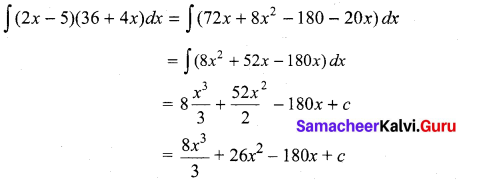
Substituting equation (2) in equation (1) we get
-kl + mg = 0
mg = kl or
\(\frac{m}{k}\) = \(\frac{l}{g}\) ………………….. (3)
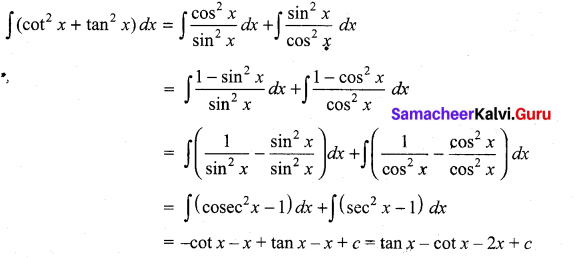
Suppose we apply a very small external force on the mass such that the mass further displaces downward by a displacement y, then it will oscillate up and down. Now, the restoring force due to this stretching of spring (total extension of spring is y + 1) is
F2 ∝ (y + l)
F2 = -k(y + l) = -ky – kl …………………… (4)

Since, the mass moves up and down with acceleration \(\frac{d^{2} y}{d t^{2}}\), by drawing the free body diagram for this case we get
-ky – kl + mg = m \(\frac{d^{2} y}{d t^{2}}\) ……………………. (5)
The net force acting on the mass due to this stretching is
F = F2 + mg
F = -ky – kl + mg …………………… (6)
The gravitational force opposes the restoring force. Substituting equation (3) in equation (6), we get
F = – ky- kl + kl = -ky
Applying Newton’s law we get
m \(\frac{d^{2} y}{d t^{2}}\) = -ky
\(\frac{d^{2} y}{d t^{2}}\) = –\(\frac{k}{m}\)y ………………… (7)
The above equation is in the form of simple harmonic differential equation. Therefore, we get the time period as
T = 2π\(\sqrt{m/k}\) second ……………………. (8)
The time period can be rewritten using equation (3)
T = 2π\(\sqrt{m/k}\) = 2πl\(\frac{1}{g}\) second ……………………. (9)
The accleration due to gravity g can be computed by the formula
g = 4π2\((\frac { 1 }{ T } )^{ 2 }\)ms-2 …………………….. (10)

Tamil Nadu 11th Physics Model Question Paper 2 English Medium

[OR]

(b) Derive poiseuille’s formula for the volume of a liquid flowing per second through a pipe under streamlined flow?
Answer:
Consider a liquid flowing steadily through a horizontal capillary tube. Let v = (\(\frac{1}{g}\)) be the volume of the liquid flowing out per second through a capillary tube. It depends on (1) coefficient of viscosity (η) of the liquid, (2) radius of the tube (r), and (3) the pressure gradient (\(\frac{P}{l}\)) . Then,
v ∝ηarb(\(\frac{P}{l}\))c
v = kηarb(\(\frac{P}{l}\))c …………………….. (1)

where, k is a dimensionless constant.
Therefore, [v] = \(\frac { Volume }{ Time } \) = [L3T-1]; [ \(\frac{dP}{dX}\) ] = \(\frac { Pressure }{ Distance } \) = [ML-2T-2]
[η] = [Ml-1T-1] and [r] = [L]

Substituting in equation (1)
[L3T-1] = [ML-1T-1]a[L]b [ML-2T-2]c
M0L3T-1 = Ma+bL-a+b-2cT-a-2c = -1

So, equating the powers of M, L and T on both sides, we get
a + c = 0, – a + b – 2c = 3, and – a – 2c = – 1

We have three unknowns a, b and c. We have three equations, on solving, we get
a = – 1, b = 4 and c = 1

Therefore, equation (1) becomes,
v = kη-1r4(\(\frac{P}{l}\))1

Experimentally, the value of k is shown to be , we have \(\frac{π}{8}\), we have
v = \(\frac{\pi r^{4} \mathrm{P}}{8 \eta /}\)

The above equation is known as Poiseuille’s equation for the flow of liquid through a narrow tube or a capillary tube. This relation holds good for the fluids whose velocities are lesser than the critical velocity (vc).

Tamil Nadu 11th Physics Model Question Paper 2 English Medium

Question 35 (a).
Describe briefly simple harmonic oscillation as a projection of uniform circular motion?
Answer:
Consider a particle of mass m moving with unifonn speed v along the circumference of a circle whose radius is r in anti-clockwise direction (as shown in figure). Let us assume that the origin of the coordinate system coincides with the center O of the circle.

If ω is the angular velocity of the particle and θ the angular displacement of the particle at any instant of time t, then θ = ωt. By projecting the uniform circular motion on its diameter gives a simple harmonic motion.

This means that we can associate a map (or a relationship) between uniform circular (or revolution) motion to vibratory motion. Conversely, any vibratory motion or revolution can be mapped to unifonn circular motion. In other words, these two motions are similar in nature.

Let us first project the position of a particle moving on a circle, on to its vertical diameter or on to a line parallel to vertical diameter as shown in figure. Similarly, we can do it for horizontal axis or a line parallel to horizontal axis.

Tamil Nadu 11th Physics Model Question Paper 4 English Medium 5

The projection of uniform circular motion on a diameter of SHM:
As a specific example, consider a spring mass system (or oscillation of pendulum). When the spring moves up and down (or pendulum moves to and fro), the motion of the mass or bob is mapped to points on the circular motion.

Thus, if a particle undergoes uniform circular motion then the projection of the particle on the diameter of the circle (or on a line parallel to the diameter) traces straight line motion which is simple harmonic in nature. The circle is known as reference circle of the simple harmonic motion. The simple harmonic motion can also be defined as the motion of the projection of a particle on any diameter of a circle of reference.

[OR]

(b) State and prove Bernoulli’s theorem for a flow of incompressible non viscous and stream lined flow of fluid?
Answer:
Bernoulli’s theorem:
According to Bernoulli’s theorem, the sum of pressure energy, kinetic energy, and potential energy per unit mass of an incompressible, non-viscous fluid in a streamlined flow remains a constant. Mathematically,
\(\frac{P}{ρ}\) + \(\frac{1}{2}\)v2 + gh – constant
This is known as Bernoulli’s equation.
Proof:
Let us consider a flow of liquid through a pipe AB. Let V be the volume of the liquid when it enters A in a time t. Which is equal to the volume of the liquid leaving B in the same time. Let aA, vA and PA be the area of cross section of the tube, velocity of the liquid and pressure exerted by the liquid at A respectively.

Let the force exerted by the liquid at A is
FA = PAaA

Distance travelled by the liquid in time t is d = vAt
Therefore, the work done is W = FAd = PAaAvAt
But aAvAt = aAd = V, volume of the liquid entering at A.

Thus, the work done is the pressure energy (at A), W = FAd = PAV

Pressure energy per unit volume at
A = \($\frac{\text { Pressure energy }}{\text { Volume }}$\) = \(\frac { P_{ A }V }{ V } \) = PA

Pressure energy per unit mass at
A = \($\frac{\text { Pressure energy }}{\text { Mass }}$\) = \(\frac { P_{ A }V }{ m } \) = \(\frac { P_{ A } }{ \frac { m }{ V } } \) = \(\frac { P_{ A } }{ \rho } \)

Since m is the mass of the liquid entering at A in a given time, therefore, pressure energy of the liquid at A is
EPA = PAV = PAV × (\(\frac{m}{m}\)) = m\(\frac { P_{ A } }{ \rho } \)

Potential energy of the liquid at A,
PEA = mghA

Due to the flow of liquid, the kinetic energy of the liquid at A,
KEA = \(\frac{1}{2}\)mv2A

Therefore, the total energy due to the flow of liquid at A,
EA = EPA + KEA + PEA
EA = \(m \frac{P_{A}}{\rho}+\frac{1}{2} m v_{A}^{2}+m g h_{A}\)

Similarly, let aB, VB and PB be the area of cross section of the tube, velocity of the liquid and pressure exerted by the liquid at B. Calculating the total energy at FB, we get .
\(\mathrm{E}_{\mathrm{B}}=m \frac{\mathrm{P}_{\mathrm{B}}}{\rho}+\frac{1}{2} m v_{\mathrm{B}}^{2}+m g h_{\mathrm{B}}\)
From the law of conservation of energy.
EA = EB

Tamil Nadu 11th Physics Model Question Paper 4 English Medium 6

Thus, the above equation can be written as
\(\frac { P }{ \rho g } \) + \(\frac{1}{2}\) \(\frac { v^{ 2 } }{ g } \) + h = Constant

The above equation is the consequence of the conservation of energy which is true until there is no loss of energy due to friction. But in practice, some energy is lost due to friction. This arises due to the fact that in a fluid flow, the layers flowing with different velocities exert frictional forces on each other. This loss of energy is generally converted into heat energy. Therefore, Bernoulli’s relation is strictly valid for fluids with zero viscosity or non-viscous liquids. Notice that when the liquid flows through a horizontal pipe, then
h = 0 ⇒ \(\frac { P }{ \rho g } \) + \(\frac{1}{2}\) \(\frac { v^{ 2 } }{ g } \) = Constant

Tamil Nadu 11th Physics Model Question Paper 2 English Medium

Question 36 (a).
Explain perfect inelastic collision and derive an expression for loss of kinetic energy in perfect inelastic collision?
Answer:
In a perfectly inelastic or completely inelastic collision, the objects stick together permanently after collision such that they move with common velocity. Let the two bodies with masses m1 and m2 move with initial velocities u1 and u2 respectively before collision. Aft er perfect inelastic collision both the objects move together with a common velocity v as shown in figure.
Since, the linear momentum is conserved during collisions,

Tamil Nadu 11th Physics Model Question Paper 4 English Medium 7

m1u1 + m2u2 = (m1 + m2) v

Tamil Nadu 11th Physics Model Question Paper 4 English Medium 8

The common velocity can be computed by
v = \(\frac{m_{1} u_{1}+m_{2} u_{2}}{\left(m_{1}+m_{2}\right)}\) ………………….. (1)

Loss of kinetic energy in perfect inelastic collision;
In perfectly inelastic collision, the loss in kinetic energy during collision is transformed to another form of energy like sound, thermal, heat, light etc. Let KEi be the total kinetic energy before collision and KEf be the total kinetic energy after collision.
Total kinetic energy before collision,
KEe = \(\frac{1}{2} m_{1} u_{1}^{2}+\frac{1}{2} m_{2} u_{2}^{2}\) …………………… (2)
Total kinetic energy after collision,
KEf = \(\frac{1}{2}\left(m_{1}+m_{2}\right) v^{2}\) …………………….. (3)
Then the loss of kinetic energy is Loss of KE, ∆Q = KEf – KEi
= \(\frac{1}{2}\left(m_{1}+m_{2}\right) v^{2}-\frac{1}{2} m_{1} u_{1}^{2}-\frac{1}{2} m_{2} u_{2}^{2}\) ………………….. (4)
Substituting equation (1) in equation (4), and on simplifying (expand v by using the algebra (a + b)2 = a2 + b2 + 2ab), we get
Loss of KE, ∆Q = \(\frac{1}{2}\) \(\left(\frac{m_{1} m_{2}}{m_{1}+m_{2}}\right)\) (u1 – u2)2

[OR]

(b) Derive an expression for maximum height attained, time of flight, horizontal range for a projectile in oblique projection?
Answer:

Tamil Nadu 11th Physics Model Question Paper 4 English Medium 9

Maximum height (hmax):
The maximum vertical distance travelled by the projectile during the journey is called maximum height. This is determined as follows:
For the vertical part of the motion
\(v_{y}^{2}=u_{y}^{2}+2 a_{y} s\)
Here, uy= u sin θ, a = -g, s = hmax, and at the maximum height v = 0

Time of flight (Tf):
The total time taken by the projectile from the point of projection till it hits the horizontal plane is called time of flight. This time of flight is the time taken by the projectile to go from point O to B via point A as shown in figure.
We know that sy = uyt + \(\frac{1}{2}\)ayt2
Here, sy = y = 0 (net displacement in y-direction is zero), uy = u sin θ, ay = -g, t = Tf, Then
0 = u sin θ Tf – \(\frac{1}{2} g \mathrm{T}_{f}^{2}\)
Tf = 2u \(\frac{sin θ}{g}\) …………………….. (2)

Horizontal range (R):
The maximum horizontal distance between the point of projection and the point on the horizontal plane where the projectile hits the ground is called horizontal range (R). This is found easily since the horizontal component of initial velocity remains the same. We can write.

Range R = Horizontal component of velocity % time of flight = u cos θ × Tf = \(\frac{u^{2} \sin 2 \theta}{g}\)
The horizontal range directly depends on the initial speed (u) and the sine of angle of projection (θ). It inversely depends on acceleration due to gravity ‘g’.

For a given initial speed u, the maximum possible range is reached when sin 2θ is
maximum, sin 2θ = 1. This implies 2θ = π/2 or θ = π/4
This means that if the particle is projected at 45 degrees with respect to horizontal, it attains maximum range, given by
Rmax = \(\frac { u^{ 2 } }{ g } \).

Tamil Nadu 11th Physics Model Question Paper 2 English Medium

Question 37 (a).
Explain the work-energy theorem in detail and also give three examples?
Answer:

  1. If the work done by the force on the body is positive then its kinetic energy increases.
  2. If the work done by the force on the body is negative then its kinetic energy decreases.
  3. If there is no work done by the force on the body then there is no change in its kinetic energy, which means that the body has moved at constant speed provided its mass remains constant.
  4. When a particle moves with constant speed in a circle, there is no change in the kinetic energy of the particle. So according to work energy principle, the work done by centripetal force is zero.

[OR]

(b) (i) Define molar specific heat capacity?
Answer:
Molar specific heat capacity is defined as heat energy required to increase the temperature of one mole of substance by IK or 1°C

(ii) Derive Mayer’s relation for an ideal gas?

Mayer’s relation: Consider p mole of an ideal gas in a container with volume V, pressure P and temperature T.

When the gas is heated at constant volume the temperature increases by dT. As no work is done by the gas, the heat that flows into the system will increase only the internal energy. Let the change in internal energy be dU.

If CV is the molar specific heat capacity at constant volume, from equation.
CV = \(\frac { 1 }{ \mu } \) \(\frac{dU}{dT}\) …………………… (1)
dU = µCV dT ………………… (2)

Suppose the gas is heated at constant pressure so that the temperature increases by dT. If ‘Q’ is the heat supplied in this process and ‘dV’ the change in volume of the gas.
Q = pCpdT ……………. (3)

If W is the workdone by the gas in this process, then
W = P dV ………………….. (4)

But from the first law of thermodynamics,
Q = dU + W ………………… (5)

Substituting equations (2), (3) and (4) in (5), we get,
For mole of ideal gas, the equation of state is given by
\(\mu \mathrm{C}_{\mathrm{p}} d \mathrm{T}=\mu \mathrm{C}_{\mathrm{v}} d \mathrm{T}+\mathrm{P} d \mathrm{V}\)

Since the pressure is constant, dP = 0
CpdT = CVdT + PdV
∴ Cp = CV + R (or) Cp – CV = R …………………… (6)
This relation is called Mayer’s relation It implies that the molar specific heat capacity of an ideal gas at constant pressure is greater than molar specific heat capacity at constant volume.
The relation shows that specific heat at constant pressure (sp) is always greater than specific heat at constant volume (sv).

Tamil Nadu 11th Physics Model Question Paper 2 English Medium

Question 38 (a).
Derive an expression of pressure exerted by the gas on the walls of the container?
Answer:
Expression for pressure exerted by a gas : Consider a monoatomic gas of N molecules each having a mass m inside a cubical container of side l.
The molecules of the gas are in random motion. They collide with each other and also with the walls of the container. As the collisions are elastic in nature, there is no loss of energy, but a change in momentum occurs.

Tamil Nadu 11th Physics Model Question Paper 4 English Medium 10

The molecules of the gas exert pressure on the walls of the container due to collision on it. During each collision, the molecules impart certain momentum to the wall. Due to transfer of momentum, the walls experience a continuous force. The force experienced per unit area of the walls of the container determines the pressure exerted by the gas. It is essential to determine the total momentum transferred by the molecules in a short interval of time.

A molecule of mass m moving with a velocity \(\vec { v } \) having components (vx, vy, vz) hits the right side wall. Since we have assumed that the collision is elastic, the particle rebounds with same speed and its x-component is reversed. This is shown in the figure. The components of velocity of the molecule after collision are (-vx, vy, vz).

The x-component of momentum of the molecule before collision = mvx
The x-component of momentum of the molecule after collision = – mvx
The change in momentum of the molecule in x direction
= Final momentum – initial momentum = – mvx – mvx = – 2mvx
According to law of conservation of linear momentum, the change in momentum of the wall = 2 mvx
The number of molecules hitting the right side wall in a small interval of time ∆t.

Tamil Nadu 11th Physics Model Question Paper 4 English Medium 11

The molecules within the distance of vx∆t from the right side wall and moving towards the right will hit the wall in the time interval ∆t. The number of molecules that will hit the right side wall in a time interval ∆t is equal to the product of volume (Avx∆t) and number density of the molecules (n).

Here A is area of the wall and n is number of molecules per \(\frac{N}{V}\) unit volume. We have assumed that the number density is the same throughout the cube.

Not all the n molecules will move to the right, therefore on an average only half of the n molecules move to the right and the other half moves towards left side.

The number of molecules that hit the right side wall in a time interval ∆t
= \(\frac{n}{2}\) Avx∆t
In the same interval of time ∆t, the total momentum transferred by the molecules
\(\Delta \mathrm{P}=\frac{n}{2} \mathrm{A} v_{x} \Delta t \times 2 m v_{x}=\mathrm{A} v_{x}^{2} m n \Delta t\) ………………….. (2)
From Newton’s second law, the change in momentum in a small interval of time gives rise to force.

The force exerted by the molecules on the wall (in magnitude)
F = \(\frac{∆p}{∆t}\) = nmAv2x ……………………. (3)

Pressure, P = force divided by the area of the wall
P = \(\frac{F}{A}\) = nmAv2x ……………………….. (4)
p = \(nm\bar{v}_{x}^{2}\)

Since all the molecules are moving completely in random manner, they do not have same . speed. So we can replace the term vnmAv2x by the average \(\bar { v } \)2x in equation (4).
P = nm\(\bar { v } \)2x ……………………. (5)

Since the gas is assumed to move in random direction, it has no preferred direction of motion (the effect of gravity on the molecules is neglected). It implies that the molecule has same average speed in all the three direction. So, \(\bar{v}_{x}^{2}\) = \(\bar{v}_{y}^{2}\) = \(\bar{v}_{z}^{2}\). The mean square speed is written as
\(\bar{v}^{2}\) = \(\bar{v}_{x}^{2}\) + \(\bar{v}_{y}^{2}\) + \(\bar{v}_{z}^{2}\) = 3\(\bar{v}_{x}^{2}\)
\(\bar{v}_{x}^{2}\) = \(\frac{1}{3}\) \(\bar{v}^{2}\)
Using this in equation (5), we get
P = \(\frac{1}{3} n m \bar{v}^{2} \quad \text { or } P=\frac{1}{3} \frac{N}{V} m \bar{v}^{2}\) ………………….. (6)

[OR]

(b) Discuss the simple pendulum in detail?
Answer:
Simple pendulum

Tamil Nadu 11th Physics Model Question Paper 4 English Medium 12

A pendulum is a mechanical system which exhibits periodic motion. It has a bob with mass m suspended by a long string (assumed to be massless and inextensible string) and the other end is fixed on a stand. At equilibrium, the pendulum does not oscillate and hangs vertically downward.

Such a position is known as mean position or equilibrium position. When a pendulum is displaced through a small displacement from its equilibrium position and released, the bob of the pendulum executes to and fro motion. Let l be the length of the pendulum which is taken as the distance between the point of suspension and the centre of gravity of the bob. Two forces act on the bob of the pendulum at any displaced position.

  • The gravitational force acting on the body (\(\vec { F} \) = m\(\vec { g } \)) which acts vertically downwards.
  • The tension in the string T which acts along the string to the point of suspension.

Tamil Nadu 11th Physics Model Question Paper 2 English Medium

Resolving the gravitational force into its components:

  1. Normal component: The component along the string but in opposition to the direction of tension, Fas = mg cos θ.
  2. Tangential component: The component perpendicular to the string i.e., along tangential direction of arc of swing, Fps = mg sin θ.

Therefore, The normal component of the force is, along the string,
\(\mathrm{T}-\mathrm{W}_{a s}=m \frac{v^{2}}{l}\)

Here v is speed of bob
T -mg cos θ = m \(\frac{v^{2}}{l}\)

From the figure, we can observe that the tangential component Wps of the gravitational force always points towards the equilibrium position i.e., the direction in which it always points opposite to the direction of displacement of the bob from the mean position. Hence, in this case, the tangential force is nothing but the restoring force. Applying Newton’s second law along tangential direction, we have
\(m \frac{d^{2} s}{d t^{2}}+\mathrm{F}_{p s}=0 \Rightarrow m \frac{d^{2} s}{d t^{2}}=-\mathrm{F}_{p s}\)
\(m \frac{d^{2} s}{d t^{2}}=-m g \sin \theta\) …………………. (1)

where, s is the position of bob which is measured along the arc. Expressing arc length in terms of angular displacement i.e.,
s = lθ ………………… (2)
then its acceleration, \(\frac{d^{2} s}{d t^{2}}=l \frac{d^{2} \theta}{d t^{2}}\) …………………. (3)

Substituting equation (3) in equation (1), we get
\(\begin{aligned}
l \frac{d^{2} \theta}{d t^{2}} &=-g \sin \theta \\
\frac{d^{2} \theta}{d t^{2}} &=-\frac{g}{l} \sin \theta
\end{aligned}\) ………………….. (4)

Because of the presence of sin θ in the above differential equation, it is a non-linear differential equation (Here, homogeneous second order). Assume “the small oscillation approximation”, sin θ ~ 0, the above differential equation becomes linear differential equation.
\(\frac{d^{2} \theta}{d t^{2}}=-\frac{g}{l} \theta\) …………………… (5)

This is the well known oscillatory differential equation. Therefore, the angular frequency of this oscillator (natural frequency of this system) is
ω2 = \(\frac{g}{l}\) …………………… (6)
∴ ω = \(\sqrt{g/l}\) in rad s-1 ……………….. (7)

The frequency of oscillation is
f = \(f=\frac{1}{2 \pi} \sqrt{\frac{g}{l}} \text { in } \mathrm{Hz}\) ………………… (8)
and time period of sscillations is
T = 2π\(\sqrt{l/g}\) in second. ……………….. (9)

Samacheer Kalvi 11th Maths Solutions Chapter 11 Integral Calculus Ex 11.5

You can Download Samacheer Kalvi 11th Maths Book Solutions Guide Pdf, Tamilnadu State Board help you to revise the complete Syllabus and score more marks in your examinations.

PNB Pivot Point Calculator

Tamilnadu Samacheer Kalvi 11th Maths Solutions Chapter 11 Integral Calculus Ex 11.5

Integrate the following functions with respect to x
Question 1.
\(\frac{x^{3}+4 x^{2}-3 x+2}{x^{2}}\)
Solution:
Samacheer Kalvi 11th Maths Solutions Chapter 11 Integral Calculus Ex 11.5 1

Question 2.
\(\left(\sqrt{x}+\frac{1}{\sqrt{x}}\right)^{2}\)
Solution:
Samacheer Kalvi 11th Maths Solutions Chapter 11 Integral Calculus Ex 11.5 2

Question 3.
(2x – 5)(36 + 4x)
Solution:
Samacheer Kalvi 11th Maths Solutions Chapter 11 Integral Calculus Ex 11.5 3

Question 4.
cot2 x + tan2 x
Solution:
Samacheer Kalvi 11th Maths Solutions Chapter 11 Integral Calculus Ex 11.5 4

Question 5.
\(\frac{\cos 2 x-\cos 2 \alpha}{\cos x-\cos \alpha}\)
Solution:
Samacheer Kalvi 11th Maths Solutions Chapter 11 Integral Calculus Ex 11.5 5

Question 6.
\(\frac{\cos 2 x}{\sin ^{2} x \cos ^{2} x}\)
Solution:
Samacheer Kalvi 11th Maths Solutions Chapter 11 Integral Calculus Ex 11.5 6

Samacheer Kalvi 11th Maths Solutions Chapter 11 Integral Calculus Ex 11.5

Question 7.
\(\frac{3+4 \cos x}{\sin ^{2} x}\)
Solution:
Samacheer Kalvi 11th Maths Solutions Chapter 11 Integral Calculus Ex 11.5 7

Question 8.
\(\frac{\sin ^{2} x}{1+\cos x}\)
Solution:
Samacheer Kalvi 11th Maths Solutions Chapter 11 Integral Calculus Ex 11.5 8

Question 9.
\(\frac{\sin 4 x}{\sin x}\)
Solution:
Samacheer Kalvi 11th Maths Solutions Chapter 11 Integral Calculus Ex 11.5 9

Question 10.
cos 3x cos 2x
Solution:
Samacheer Kalvi 11th Maths Solutions Chapter 11 Integral Calculus Ex 11.5 10

Samacheer Kalvi 11th Maths Solutions Chapter 11 Integral Calculus Ex 11.5

Question 11.
sin2 5x
Solution:
Samacheer Kalvi 11th Maths Solutions Chapter 11 Integral Calculus Ex 11.5 11

Question 12.
\(\frac{1+\cos 4 x}{\cot x-\tan x}\)
Solution:
Samacheer Kalvi 11th Maths Solutions Chapter 11 Integral Calculus Ex 11.5 12
Question 13.
ex log aex
Solution:
Samacheer Kalvi 11th Maths Solutions Chapter 11 Integral Calculus Ex 11.5 13

Question 14.
(3x + 4) \(\sqrt{3 x+7}\)
Solution:
Samacheer Kalvi 11th Maths Solutions Chapter 11 Integral Calculus Ex 11.5 14
Samacheer Kalvi 11th Maths Solutions Chapter 11 Integral Calculus Ex 11.5 15

Question 15.
\(\frac{8^{1+x}+4^{1-x}}{2^{x}}\)
Solution:
Samacheer Kalvi 11th Maths Solutions Chapter 11 Integral Calculus Ex 11.5 16

Question 16.
\(\frac{1}{\sqrt{x+3}-\sqrt{x-4}}\)
Solution:
Samacheer Kalvi 11th Maths Solutions Chapter 11 Integral Calculus Ex 11.5 17

Question 17.
\(\frac{x+1}{(x+2)(x+3)}\)
Solution:
Samacheer Kalvi 11th Maths Solutions Chapter 11 Integral Calculus Ex 11.5 18
x + 1 = A(x + 3) + B(x + 2) ………….. (i)
Put x = -3 in (i)
-2 = B(-1)
B = 2
Put x = -2 in (i)
-1 = A(1)
A = -1
Samacheer Kalvi 11th Maths Solutions Chapter 11 Integral Calculus Ex 11.5 19

Samacheer Kalvi 11th Maths Solutions Chapter 11 Integral Calculus Ex 11.5

Question 18.
\(\frac{1}{(x-1)(x+2)^{2}}\)
Solution:
Samacheer Kalvi 11th Maths Solutions Chapter 11 Integral Calculus Ex 11.5 20

Question 19.
\(\frac{3 x-9}{(x-1)(x+2)\left(x^{2}+1\right)}\)
Solution:
Samacheer Kalvi 11th Maths Solutions Chapter 11 Integral Calculus Ex 11.5 21
put x = 1 in (i)
3 – 9 = A(3)(2) + 0 + 0
– 6 = 6A
A = -1

put x = -2 in (i)
-6 – 9 = 0 + B(-3) (5) + 0
-15 = – 15B
B = 1

put x = 0 in (i)
0 – 9 = A(2)(1) + B(-1)(1) + D(-1)(2)
-9 = 2A – B – 2D
2D = 2A – B + 9
2D = 2(-1) – 1 + 9
= -2 – 1 + 9
2D = 6
D = 3

Equating x3 coefficients on b/s in (i)
A + B + C = 0
-1 + 1 + C = 0
C = 0
Samacheer Kalvi 11th Maths Solutions Chapter 11 Integral Calculus Ex 11.5 22

Question 20.
\(\frac{x^{3}}{(x-1)(x-2)}\)
Solution:
Samacheer Kalvi 11th Maths Solutions Chapter 11 Integral Calculus Ex 11.5 23
Samacheer Kalvi 11th Maths Solutions Chapter 11 Integral Calculus Ex 11.5 24

Samacheer Kalvi 11th Maths Solutions Chapter 11 Integral Calculus Ex 11.5 Additional Problems

Integrate the following
Question 1.
\(\frac{e^{2 x}+e^{-2 x}+2}{e^{x}}\)
Solution:
Samacheer Kalvi 11th Maths Solutions Chapter 11 Integral Calculus Ex 11.5 25

Question 2.
cos3 2x – sin 6x
Solution:
cos 3x = 4 cos3 x – 3 cos x
∴ 4 cos3 x = cos 3x + 3 cos x
Samacheer Kalvi 11th Maths Solutions Chapter 11 Integral Calculus Ex 11.5 26

Question 3.
\(\sqrt{1-\sin 2 x}\)
Solution:
Samacheer Kalvi 11th Maths Solutions Chapter 11 Integral Calculus Ex 11.5 27

Question 4.
cos 2x sin 4x
Solution:
Samacheer Kalvi 11th Maths Solutions Chapter 11 Integral Calculus Ex 11.5 28
Samacheer Kalvi 11th Maths Solutions Chapter 11 Integral Calculus Ex 11.5 29

Samacheer Kalvi 11th Maths Solutions Chapter 11 Integral Calculus Ex 11.5

Question 5.
(ex – 1)2 e-4x
Solution:
Samacheer Kalvi 11th Maths Solutions Chapter 11 Integral Calculus Ex 11.5 30

Question 6.
(x + 1) \(\sqrt{x+3}\)
Solution:
Samacheer Kalvi 11th Maths Solutions Chapter 11 Integral Calculus Ex 11.5 31

Question 7.
(2x + 1)\(\sqrt{2x+3}\)
Solution:
Samacheer Kalvi 11th Maths Solutions Chapter 11 Integral Calculus Ex 11.5 32
Samacheer Kalvi 11th Maths Solutions Chapter 11 Integral Calculus Ex 11.5 33

Tamil Nadu 11th Physics Model Question Paper 3 English Medium

Students can Download Tamil Nadu 11th Physics Model Question Paper 3 English Medium Pdf, Tamil Nadu 11th Physics Model Question Papers helps you to revise the complete Tamilnadu State Board New Syllabus and score more marks in your examinations.

TN State Board 11th Physics Model Question Paper 3 English Medium

Tamil Nadu 11th Physics Model Question Paper 2 English Medium

Instructions:

  1. The question paper comprises of four parts
  2. You are to attempt all the parts. An internal choice of questions is provided wherever: applicable
  3. All questions of Part I, II, III, and IV are to be attempted separately
  4. Question numbers to 15 in Part I are Multiple choice Questions of one mark each. These are to be answered by choosing the most suitable answer from the given four alternatives and writing the option code and the corresponding answer
  5. Question numbers 16 to 24 in Part II are two-mark questions. These are lo be answered in about one or two sentences.
  6. Question numbers 25 to 33 in Part III are three-mark questions. These are lo be answered in about three to five short sentences.
  7. Question numbers 34 to 38 in Part IV are five-mark questions. These are lo be answered in detail. Draw diagrams wherever necessary.

Time: 3 Hours
Max Marks: 70

Tamil Nadu 11th Physics Model Question Paper 2 English Medium

PART – I

Answer all the questions. [15 x 1 = 15]
Question 1.
A force F is applied on a square plate of side L. If percentage error in determination of L is 2% and that in F is 4%, the permissible error in pressure is ……….. .
(a) 2%
(b) 4%
(c) 6%
(d) 8%
Answer:
(d) 8%
Hint:
Pressure P = \(\frac { F }{ A }\) = \(\frac { F }{ L² }\)
\(\frac { ∆P }{ P }\) × 100 = (\(\frac { ∆F }{ F }\) × 100) + (\(\frac { ∆L }{ L }\) × 100) = 4% + 2(2%)
\(\frac { ∆P }{ P }\) × 100 = 8%

Question 2.
From the displacement – time graph shown below, particle is ……….. .
Tamil Nadu 11th Physics Model Question Paper 3 English Medium 1
(a) continuously going in positive x – direction
(b) at rest
(c) going with increasing velocity upto a time t0 and then becomes constant
(d) moves at a constant velocity upto a time t0, and then stops
Answer:
(d) moves at a constant velocity upto a time t0, and then stops

Question 3.
The potential energy of the system increases if work is done ……….. .
(a) upon the system by a non conservative force
(b) by the system against a conservative force
(c) by the system against a non conservative force
(d) upon the system by a conservative force
Answer:
(b) by the system against a conservative force

Question 4.
If x = at2 + bt + c where x is displacement as a function of time. The dimension of ‘a’ and ‘b’ are respectively ……… .
(a) LT-1 and LT-2
(b) LT-2 and LT-1
(c) L and LT-2
(d) LT-1 and L
Answer:
(b) LT-2 and LT-1
Hint:
According to principle of homogeneity, the displacement, x = at2 + bt + c
Dimensionally, [L] = [LT-2] [T2] + [LT-1] [T]
Where a = LT-2 and b = LT-1

Question 5.
A satellite in its orbit around earth is weightless on account of its ……….. .
(a) momentum
(b) acceleration
(c) speed
(d) none
Answer:
(b) acceleration

Question 6.
The displacement of a particle along x – axis is given by x = 7t2 + 8t + 3. Its acceleration and velocity at t = 2s respectively ……….. .
(a) 36 ms-1, 14 ms-2
(b) 14 ms-2, 36 ms-1
(c) 47 ms-2, 21 ms-1
(d) 2 ms-1, 47 ms-2
Answer:
(b) 14 ms-2, 36 ms-1
Hint:
x = 7t2 + 8t + 3 dx
V = \(\frac { dx }{ dt }\) = 14t + 8;
at t = 2s; V = 36 ms-1
a = \(\frac { dv }{ dt }\) = 14 ms-2

Question 7.
A sphere of radius r cm falls from rest in a viscous liquid. Heat is produced due to viscous force. The rate of production of heat when the sphere attains its terminal velocity is proportional to ……….. .
(a) r2
(b) r3
(c) r4
(d) r5
Answer:
(d) r5
Hint:
Rate of heat production = F.V
= 6πηrv × v = 6πηrv2
[v ∝ r2] Terminal velocity ∝ r5

Question 8.
A body of weight mg is hanging on a string which extends its length l. The workdone in extending the string is ……….. .
(a) mgl
(b) \(\frac { mgl }{ 2 }\)
(c) 2 mgl
(d) none of these
Answer:
(b) \(\frac { mgl }{ 2 }\)
Hint:
The extension length is
Workdone (W) = Force × distance
Workdone in extension string = Weight × Length extension
mg × \(\frac { l }{ 2 }\)
W = \(\frac { mgl }{ 2 }\)

Tamil Nadu 11th Physics Model Question Paper 2 English Medium

Question 9.
If Sp and Sv denote the specific heat of nitrogen gas per unit mass at constant pressure and constant volume respectively, then ……….. .
(a) Sp– Sv = 28R
(b) Sp – Sv = \(\frac { R }{ 28 }\)
(c) Sp – Sv = \(\frac { R }{ 14 }\)
(d) Sp – Sv = R
Answer:
(b) Sp – Sv = \(\frac { R }{ 28 }\)
Hint:
According to Mayer’s relation, Sp – Sv = \(\frac { R }{ m }\)
For Nitrogen, m = 28
Sp – Sv = \(\frac { R }{ 28 }\)

Question 10.
A particle is moving eastwards with velocity of 5 m/s. In 10 sec the velocity changes to 5 m/s northwards. The average acceleration in this time is ……….. .
(a) zero
(b) \(\frac { 1 }{ √2 }\) m/s2 towards north – west
(c) \(\frac { 1 }{ √2 }\) m/s2 towards north – east
(d) \(\frac { 1 }{ 2 }\) m/s2 towards north – west
Answer:
(b) \(\frac { 1 }{ √2 }\) m/s2 towards north – west
Hint:
Tamil Nadu 11th Physics Model Question Paper 3 English Medium 2
\(\vec { a } \) = \(\frac { d\vec { v } }{ dt }\)
= \(\frac { 5 }{ 2 } (\hat { j } -\hat { i) } \)
= \(\frac { 1 }{ 2 } (\hat { j } -\hat { i) } \)
a = \(\frac { 1 }{ √2 }\) m/s-2

Question 11.
In an isochoric process, we have ……….. .
(a) W ≠ 0, U = 0, Q = 0, T = 0
(b) W ≠ 0, U ≠ 0, Q = 0, T = 0
(c) W = 0, U = 0, Q ≠ 0, T ≠ 0
(d) W = 0, U ≠ 0, Q ≠ 0, T ≠ 0
Answer:
(d) W = 0, U ≠ 0, Q ≠ 0, T ≠ 0

Question 12.
The efficiency of a carnot engine operations between boiling and freezing points of water is ……….. .
(a) 0.1
(b) 100
(c) 1
(d) 0.27
Answer:
(d) 0.27
Hint:
η = [1 – (\(\frac { { T }_{ 2 } }{ { T }_{ 1 } } \))] = [1 – \(\frac { 273 }{ 373 }\)]
η = 0.268
∴ η = 0.27

Question 13.
Bernoulli’s equation is consequences of conservation of ……….. .
(a) energy
(b) linear momentum
(c) angular momentum
(d) mass
Answer:
(a) energy

Question 14.
By what velocity a ball be projected vertically upwards so that the distance covered in 5th second is twice of that covered in 6 m second (tale g = 10 ms-2) ……….. .
(a) 19.6 ms-1
(b) 58.8 ms-1
(c) 49 ms-1
(d) 65 ms-1
Answer:
(d) 65 ms-1
Hint:
Distance covered int he 5th second
S5= u + \(\frac { 1 }{ 2 }\)(-10) × (2 × 5 – 1)
S5 = u – 5 × 9 = u – 45
Distance covered in the 6th second
S6= u +\(\frac { 1 }{ 2 }\)(-10) × (2 × 6 – 1) = u – 5 × 11
S6 = u – 55 .
Here S5 = 6S6 and we get solving
u = 65 ms-1

Tamil Nadu 11th Physics Model Question Paper 2 English Medium

Question 15.
Unit of Stefan’s constant is ……….. .
(a) watt m2 k4
(b) watt m2 / k4
(c) watt k4 / m2
(d) watt / m2 k4
Answer:
(d) watt / m2 k4

PART – II

Answer any six questions in which Q. No 23 is compulsory. [6 × 2 = 12]

Question 16.
Get an expression for stopping distance of a vehicle in terms of initial velocity v0 and deceleration ‘a’.
Answer:
Let s be the distance travelled by a vehicle before it stops
Using v² – u² = 2as,
We can get 0² – \(v_{0}^{2}\) = -2as
∴ s = \(\frac{v_{0}^{2}}{2a}\)
The stopping distance is directly proportional to \(v_{0}^{2}\). i.e. By doubling initial velocity it increase stopping distance by 4 times. Provided deceleration is kept as constant.

Question 17.
A carnot engine has the same efficiency, when operated
(i) between 100 K and 500 K
(ii) between TK and 900 K. Find the value of T.
Answer:
(i) Here T1 = 500 K; T2 = 100 K
η = 1 – \(\frac{T_2}{T_1}\) =1 – \(\frac{100}{500}\) = 1 – 0.2 = 0.8

(ii) Now, T1= 900 K; T2 = T and n = 0.8
Again, η = 1 – \(\frac{T_2}{T_1}\)
0.8 = 1 – \(\frac{T}{900}\) = 1 – 0.8 = 0.2
∴ T = 180K

Question 18.
A block at rest explodes into 3 parts are -2p\(\vec{j}\) and p\(\vec{j}\). Calculate the magnitude of the momentum of the third part.
Answer:
Let \(\vec{P}\) be the momentum of third particle after the explosion of bomb. According to law of conservation of momentum
-2p\(\vec{i}\) + p\(\vec{j}\) + \(\vec{P}\) = 0 (or) \(\vec{P}\) = 2p\(\vec{i}\) – p\(\vec{j}\)
P = \(\sqrt{(2p)^2+(-p)^2}\) = p√5

Question 19.
Discuss the possibilities of work done to be zero.
Answer:
Work done is zero in the following cases.
(i) When the force is zero (F = 0). For example, a body moving on a horizontal smooth frictionless surface will continue to do so as no force (not even friction) is acting along the plane. (This is an ideal situation.)

(ii) When the displacement is zero (dr = 0). For example, when force is applied on a rigid wall it does not produce any displacement. Hence, the work done is zero as shown in figure.

(iii) When the force and displacement are perpendicular (θ = 90°) to each other, when a body moves on a horizontal direction, the gravitational force (mg) does not work on the body, since it acts at right angles to the displacement as shown in Figure (b). In circular motion the centripetal force does not do work on the object moving on a circle as it is always perpendicular to the displacement as shown in Figure (c).
Tamil Nadu 11th Physics Model Question Paper 3 English Medium 3

Tamil Nadu 11th Physics Model Question Paper 2 English Medium

Question 20.
Define (a) unit of length (b) unit of electric current in SI system.
Answer:
Given v = at² + \(\frac{b}{c+t}\)
The physical quantities which are having same dimensional formula only can be added.
Dimensional formula for v = LT-1
Dimensional formula for c = T
Dimensional formula for at² = LT-1
a = \(\frac{LT_{-1}}{T^2}\) = LT-3
Dimensional formula for \(\frac{b}{c+t}\) = LT-1
∴ b = L [∵ c + t = T]

Question 21.
A solid cylinder of mass 20 kg rotates about it axis with angular speed 100 s-1 the radius of the cylinder is 0.25 m. Calculate moment of inertia of the solid cylinder.
Answer:
Given Data : R = 0.25 m, M = 20 kg, ω = 100 s-1
We know that
moment of inertia of the solid cylinder = \(\frac{MR^2}{2}\)
\(\frac{20×(0.25)^2}{2}\) = 0.625 kgm²
K.E of rotation = \(\frac{1}{2}\) Iω²
\(\frac{1}{2}\) × 0.625 × (100)² = 3125 J
∴ Angular momentum L = Iω = 0.625 × 100
L = 62.5 Js

Question 22.
Why moon has no atmosphere?
Answer:
The acceleration due to gravity of moon ‘g’ is small. Therefore the escape velocity on the surface of moon is also small. The molecules of in its atmosphere have greater thermal velocities than escape speed. The molecules can easily escaped from the atmosphere of moon. Hence the moon has no atmosphere.

Question 23.
A refrigerator has cop of 3. How much work must be supplied to the refrigerator in order to remove 200 J of heat from its interion?
Answer:
COP = β = \(\frac{Q_L}{W}\)
W = \(\frac{Q_c}{COP}\) = \(\frac{200}{3}\) = 66.67 J

Question 24.
What is the effect of gravitational force of attraction acting on the person be inside the satellite and stand on moon?
Answer:
The gravitational force of attraction of the Earth on the person inside the satellite provides the centripetal force necessary to move in an orbit. A person standing on the moon possesses weight due to the additional gravitational pull of the moon on the person.

Tamil Nadu 11th Physics Model Question Paper 2 English Medium

PART – III

Answer any six questions in which Q.No. 29 is compulsory. [6 × 3 = 18]

Question 25.
State and prove Archimedes principle.
Answer:
Archimedes Principle: It states that when a body is partially or wholly immersed in a fluid, it experiences an upward thrust equal to the weight of the fluid displaced by it and its upthrust acts through the centre of gravity of the liquid displaced.

Proof: Consider a body of height ‘h’ lying inside a liquid of density p, at a depth x below the free surface of the liquid. Area of cross section of the body is V. The forces on the sides of the body cancel out.
Tamil Nadu 11th Physics Model Question Paper 3 English Medium 4
Pressure at the upper face of the body, P1′ = xpg.
Pressure at the lower face of the body, P2′ = (x + h) pg
Thrust acting on the upper face of the body is F1 = P1 a = xρga acting vertically downwards,
Thrust acting on the lower face of the body is F2 = P2a = (x + h) ρga acting vertically upwards.
The resultant force (F2 – F1) is acting on the body in the upward direction and is called upthrust (U).
U = F2 – F1 = (x + h) ρga – xρga = ahρg
But ah = V, Volume of the body = Volume of liquid
U = Vρg = Mg
i. e., Upthrust or buoyant force = Weight of liquid displaced.
This proves the Archimedes principle.

Question 26.
State kepler’s three laws.
Answer:

  1. Law of Orbits: Each planet moves around the Sun in an elliptical orbit with the Sun at one of the foci.
  2. Law of area: The radial vector (line joining the Sun to a planet) sweeps equal areas in equal intervals of time.
  3. Law of period: The square of the time period of revolution of a planet around the Sun in its elliptical orbit is directly proportional to the cube of the semi-major axis of the ellipse.
    T² ∝ a³
    \(\frac{T²}{a³}\) = Constant

Question 27.
Write the properties of vector product of two vectors.
Answer:
Properties of vector product of two vectors are:
(i) The vector product of any two vectors is always another vector whose direction is perpendicular to the plane containing these two vectors, i.e., orthogonal to both the vectors \(\vec{A}\) and \(\vec{B}\), even though the vectors \(\vec{A}\) and \(\vec{B}\) may or may not be mutually orthogonal.

(ii) The vector product of two vectors is not commutative, i.e., \(\vec{A}\) × \(\vec{B}\) ≠ \(\vec{B}\) × \(\vec{A}\). But, \(\vec{A}\) × \(\vec{B}\) = –\(\vec{B}\) × \(\vec{A}\).

Here it is worthwhile to note that |\(\vec{A}\) × \(\vec{B}\)| = |\(\vec{B}\) x \(\vec{A}\)| = AB sin θ i.e., in the case of the product vectors \(\vec{A}\) × \(\vec{A}\) and \(\vec{B}\) × \(\vec{A}\), the magnitudes are equal but directions are opposite to each other.

(iii) The vector product of two vectors will have maximum magnitude when sin θ = 1, i.e., θ = 90° i.e., when the vectors \(\vec{A}\) and \(\vec{B}\) are orthogonal to each other.
(\(\vec{A}\) × \(\vec{B}\))max = AB\(\hat{n}\)

(iv) The vector product of two non-zero vectors will be minimum when sin θ = 0, i.e., θ = 0° or 180°
(\(\vec{A}\) × \(\vec{B}\))min = 0
i.e., the vector product of two non-zero vectors vanishes, if the vectors are either parallel or antiparallel.

(v) The self-cross product, i.e., product of a vector with itself is the null vector
\(\vec{A}\) × \(\vec{A}\) = AA sin 0° \(\hat{n}\) = \(\vec{0}\)
In physics the null vector \(\vec{0}\) is simply denoted as zero.

(vi) The self-vector products of unit vectors are thus zero.
\(\vec{i}\) × \(\vec{i}\) = \(\vec{j}\) × \(\vec{j}\) = \(\vec{k}\) × \(\vec{k}\) = 0

Question 28.
Let the two springs A and B such that KA > KB on which spring will more work has to be done if they are stretched by the same force.
Answer:
F = K.x so x = \(\frac{F}{K}\)
For same F
Tamil Nadu 11th Physics Model Question Paper 3 English Medium 5

Tamil Nadu 11th Physics Model Question Paper 2 English Medium

Question 29.
Differentiate slipping and sliding.
Answer:

                              SlidingSlipping
(i)Velocity of centre of mass is greater than Rω i.e. VCM > Rω.Velocity of centre of mass is lesser than Rω. i.e. VCM < Rω
(ii)Velocity of translational motion is greater than velocity of rotational motion.Velocity of translation motion is lesser than velocity of rotational motion.
(iii)Resultant velocity acts in the forward direction.Resultant velocity acts in the backward direction.

Question 30.
Jupiter is at a distance of 824.7 million km from the earth. Its angular diameter is measured to be 35.72” calculate the diameter of Jupiter.
Answer:
Distance of Jupiter = 824.7 × 10⁶ km = 8.247 × 10¹¹ m
Angular diameter = 35.72 × 4.85 × 10-6 rad = 173.242 × 10⁻⁶ rad
= 1.73 × 10⁻⁴ rad
Diameter of Jupiter D = θ × d= 1.73 × 10-4 rad × 8.247 × 1011 m
= 14.267 × 10⁷m = 1.427 × 10⁸m (or) 1.427 × 10⁵ km

Question 31.
A wire 10 m long has a cross-sectional area 1.25 × 10⁻⁴ m². It is subjected to a load of 5 kg. If young’s modulus of the material is 4 × 10¹⁰ Nm-2. calculate the elongation produced in the wire, [take g = 10 ms-2]
Answer:
We know that
Tamil Nadu 11th Physics Model Question Paper 3 English Medium 6

Question 32.
State and explain the law of equipartition of energy.
Answer:
According to kinetic theory, the average kinetic energy of system of molecules in thermal equilibrium at temperature T is uniformly distributed to all degrees of freedom (x or y or z directions of motion) so that each degree of freedom will get \(\frac{1}{2}\) kT of energy. This is called law of equipartition of energy.
Average kinetic energy of a monatomic molecule (with f = 3) = 3 × \(\frac{1}{2}\) KT = \(\frac{3}{2}\) KT
Average kinetic energy of diatomic molecule at low temperature (with f = 5) = 5 × \(\frac{1}{2}\) KT = \(\frac{5}{2}\) KT
Average kinetic energy of a diatomic molecule at high temperature (with f = 7) = 7 × \(\frac{1}{2}\) KT = \(\frac{7}{2}\) KT
Average kinetic energy of linear triatomic molecule (with f = 7) = 7 × \(\frac{1}{2}\) KT = \(\frac{7}{2}\) KT
Average kinetic energy of non linear triatomic molecule (with f = 6) = 6 × \(\frac{1}{2}\) KT = 3 KT

Question 33.
A cylindrical tank of height 0.4 m is open at the top and has a diameter 0.16 m. Water is filled in it up to height of 0.16 m. Find the time taken to empty the tank through a hole of radius 5 × 10⁻³ m in its bottom.
Answer:
The velocity of efflux through the hole v = \(\sqrt{2gh}\)
Let R, r be the radius of cylindrical tank and hole and ‘dh’ is the decrease in height of water in time ‘dt’ sec use principle of continuity at the top and hole
Tamil Nadu 11th Physics Model Question Paper 3 English Medium 7
integrating it within the condition of problem,
Tamil Nadu 11th Physics Model Question Paper 3 English Medium 8

Tamil Nadu 11th Physics Model Question Paper 2 English Medium

PART – IV

Answer all the questions. [5 × 5 = 25]

Question 34 (a).
Show that the path of oblique projection is parabola.
Answer:
This projectile motion takes place when the initial velocity is not horizontal, but at some angle with the vertical, as shown in Figure.(Oblique projectile)
Examples:

  1. Water ejected out of a hose pipe held obliquely.
  2. Cannon fired in a battle ground.

Consider an object thrown with initial velocity at an angle θ with the horizontal.
Then,
u = u\(\vec{i}\) + u\(\vec{j}\)
where u = u cos θ is the horizontal component and u = u sin θ, the vertical component of velocity.

Since the acceleration due to gravity is in the direction opposite to the direction of vertical component uy, this component will gradually reduce to zero at the maximum height of the projectile. At this maximum height, the same gravitational force will push the projectile to move downward and fall to the ground. There is no acceleration along the x direction throughout the motion. So, the horizontal component of the velocity (ux = u cos θ) remains the same till the object reaches the ground.
Tamil Nadu 11th Physics Model Question Paper 3 English Medium 9
Hence after the time t, the velocity along horizontal motion vx = ux + axt = ux = u cos θ
The horizontal distance travelled by projectile in time t is sx = uxt + \(\frac{1}{2}\) ax
Here, sx = x, ux = u cos θ, ax = 0
Tamil Nadu 11th Physics Model Question Paper 3 English Medium 10
Thus, x = u cos θ.t or t = \(\frac{x}{u cos θ }\) ………..(1)
Next, for the vertical motion vy = uy + ayt
Here uy = u sin θ, ay = -g (acceleration due to gravity acts opposite to the motion).
Thus, vy = u sin θ – gt
The vertical distance travelled by the projectile in the same time t is
Here, sy = y, uy = u sin θ, ax = -g
Then y = u sin θ t – \(\frac{1}{2}\) gt² ……..(2)
Substitute the value of t from equation (1) in equation (2), we have
Tamil Nadu 11th Physics Model Question Paper 3 English Medium 11
Thus the path followed by the projectile is an inverted parabola.

Tamil Nadu 11th Physics Model Question Paper 2 English Medium

[OR]

(b) Explain the motion of block connected by a string in vertical motion.
Answer:
Tamil Nadu 11th Physics Model Question Paper 3 English Medium 12
Case 1: Vertical motion: Consider two blocks of masses m1 and m2 (m1 > m2) connected by a light and inextensible string that passes over a pulley as shown in figure.
Tamil Nadu 11th Physics Model Question Paper 3 English Medium 13
Let the tension in the string be T and acceleration a. When the system is released, both the blocks start moving, m2 vertically upward and m1 downward with same acceleration a. The gravitational force m1g on mass m1 is used in lifting the mass m2.
The upward direction is chosen as y direction. The free body diagrams of both masses are shown in figure.
Applying Newton’s second law for mass m2
T\(\hat{j}\) – m2g\(\hat{j}\) = m2a\(\hat{j}\)
The left hand side of the above equation is the total force that acts on m2 and the right hand side is the product of mass and acceleration of m2 in y direction.
By comparing the components on both sides, we get
T – m2g = m2a …..(1)
Similarly, applying Newton’s second law for mass m1
T\(\hat{j}\) – m1g\(\hat{j}\) = -m1a\(\hat{j}\)
As mass m1 moves downward (-\(\hat{j}\)), its acceleration is along (-\(\hat{j}\))
By comparing the components on both sides, we get
T – m1g = -m1a
m1g – T = m1a ……(2)
Adding equations (1) and (2), we get
m1g – m2g = m1a – m2a
(m1 – m2)g = (m1 + m1)a ……(3)
From equation (3), the acceleration of both the masses is
a = (\(\frac{m_1-m_2}{m_1+m_2}\))g …….(4)
If both the masses are equal (m1 = m2), from equation (4)
a = 0
This shows that if the masses are equal, there is no acceleration and the system as a whole will be at rest.
To find the tension acting on the string, substitute the acceleration from the equation (4) into the equation (1).
Tamil Nadu 11th Physics Model Question Paper 3 English Medium 14
Equation (4) gives only magnitude of acceleration.
For mass m1, the acceleration vector is given by \(\vec{a}\) = –\(\frac{m_1-m_2}{m_1+m_2}\)g\(\hat{j}\)
For mass m2, the acceleration vector is given by \(\vec{a}\) = \(\frac{m_1-m_2}{m_1+m_2}\)g\(\hat{j}\)

Tamil Nadu 11th Physics Model Question Paper 2 English Medium

Question 35 (a).
Derive the expression for Carnot engine efficiency.
Answer:
Efficiency of a Carnot engine: Efficiency is defined as the ratio of work done by the working substance in one cycle to the amount of heat extracted from the source.
η = \(\frac{Workdone}{Heat extracted}\) = \(\frac{W}{Q_H}\) ……..(1)
From the first law of thermodynamics, W = QH – QL
η = \(\frac{Q_H – Q_L}{Q_H}\) = 1 – \(\frac{Q_L}{Q_H}\) ……..(2)
Applying isothermal conditions, we get,
QH = μRTHln \(\frac{V_2}{V_1}\)
QL = μRTLln \(\frac{V_3}{V_4}\) ………(3)
Here we omit the negative sign. Since we are interested in only the amount of heat (QL) ejected into the sink, we have
\(\frac{T_L}{T_H}\) = \(\frac{Q _L ln (\frac{V_3}{V_4})}{Q _H ln (\frac{V_2}{V_1})}\) …….(4)
By applying adiabatic conditions, we get,
\(\mathrm{T}_{\mathrm{H}} \mathrm{V}_{2}^{\gamma-1}=\mathrm{T}_{\mathrm{L}} \mathrm{V}_{3}^{\gamma-1}\)
\(\mathrm{T}_{\mathrm{H}} \mathrm{V}_{1}^{\gamma-1}=\mathrm{T}_{\mathrm{L}} \mathrm{V}_{4}^{\gamma-1}\)
By dividing the above two equations, we get
\(\left(\frac{v_{2}}{V_{1}}\right)^{\gamma-1}=\left(\frac{V_{3}}{V_{4}}\right)^{\gamma-1}\)
Which implies that \(\frac{V_2}{V_1}\) = \(\frac{V_3}{V_4}\) ……(5)
Substituting equation (5) in (4), we get
\(\frac{Q_L}{Q_H}\) = \(\frac{T_L}{T_H}\) ……..(6)
∴ The efficiency η = 1 – \(\frac{T_L}{T_H}\) ………….(7)
Note : TL and TH should be expressed in Kelvin scale.

Important results:

  1. n is always less than 1 because TL is less than TH. This implies the efficiency cannot be 100%.
  2. The efficiency of the Carnot’s engine is independent of the working substance. It depends only on the temperatures of the source and the sink. The greater the difference between the two temperatures, higher the efficiency.
  3. When TH = TL the efficiency n = 0. No engine can work having source and sink at the same temperature.

[OR]

(b). Explain the concepts of fundamental frequency, harmonics and overtones in detail.
Answer:
Fundamental frequency and overtones: Let us now keep the rigid boundaries at x = 0 and x = L and produce a standing waves by wiggling the string (as in plucking strings in a guitar). Standing waves with a specific wavelength are produced. Since, the amplitude must vanish at the boundaries, therefore, the displacement at the boundary must satisfy the following conditions y(x = 0, t) = 0 and y(x = L, t) = 0………….(1)
Since, the nodes formed are at a distance \(\frac{ λ_n}{2}\) apart, we have n \(\frac{ λ_n}{2}\) = L where n is an integer, L is the length between the two boundaries and λ n is the specific wavelength that satisfy the specified boundary conditions. Hence,
λ n = \(\frac{2L}{n}\)…………(2)
Therefore, not all wavelengths are allowed. The (allowed) wavelengths should fit with the specified boundary conditions, i.e., for n = 1, the first mode of vibration has specific wavelength λ n= 2L. Similarly for n = 2, the second mode of vibration has specific wavelength
λ 2 = \(\frac{2L}{2}\) = L
For n = 3, the third mode of vibration has specific wavelength
λ 3 = \(\frac{2L}{3}\)
and so on.
The frequency of each mode of vibration (called natural frequency) can be calculated.
We have, fn = \(\frac{v}{λ_n}\) = n \(\frac{v}{2L}\) ………..(3)
The lowest natural frequency is called the fundamental frequency.
f1 = \(\frac{v}{λ_1}\) = \(\frac{v}{2L}\) …………(4)
The second natural frequency is called the first over tone.
f2 = 2\(\frac{v}{2L}\) = \(\frac{1}{L} \sqrt{\frac{T}{\mu}}\)
The third natural frequency is called the second over tone.
f3 = 3\(\frac{v}{λ_2}\) = \(3\left(\frac{1}{2L} \sqrt{\frac{T}{\mu}}\right)\)
and so on.
Therefore, the nth natural frequency can be computed as integral (or integer) multiple of fundamental frequency, i.e.,
fn = nf1, where n is an integer …….(5)
If natural frequencies are written as integral multiple of fundamental frequencies, then the frequencies are called harmonics. Thus, the first harmonic is f1 = f1(the fundamental frequency is called first harmonic), the second harmonic is f2 = 2f1, the third harmonic is f3 = 3f1 etc.

Tamil Nadu 11th Physics Model Question Paper 2 English Medium

Question 36 (a).
Compare any two salient features of static and kinetic friction.
Answer:
Static Friction: Static friction is the force which opposes the initiation of motion of an object on the surface. The magnitude of static frictional force fs lies between 0 ≤ fs ≤ μsNs
where,
μs – coefficient of static friction
N – Normal force
Kinetic friction: The frictional force exerted by the surface when an object slides is called as kinetic friction. Also called as sliding friction or dynamic friction,
fk = μkN
where:
μk– the coefficient of kinetic friction
N – Normal force exerted by the surface on the object

(ii) To move an object-push or pull? Which is easier? Explain.
Answer:
When a body is pushed at an arbitrary angle θ (0 to \(\frac{π}{2}\)), the applied force F can be
resolved into two components as F sin θ parallel to the surface and F cos θ perpendicular to the surface as shown in figure. The total downward force acting on the body is mg + F cos θ. It implies that the normal force acting on the body increases. Since there is no acceleration along the vertical direction the normal force N is equal to
NPush = mg + F cos θ ….(1)
As a result the maximal static friction also increases and is equal to
\(f_{x}^{\max }\) = μrNPush = μs(mg + F cos θ ) ……(2)
Equation (2) shows that a greater force needs to be applied to push the object into motion.
Tamil Nadu 11th Physics Model Question Paper 3 English Medium 15
When an object is pulled at an angle θ, the applied force is resolved into two components as shown in figure. The total downward force acting on the object is
NPull = mg – F cos θ ……..(3)
Tamil Nadu 11th Physics Model Question Paper 3 English Medium 16
Equation (3)shows that the normal force is less than NPull. From equations (1) and (3), it is easier to pull an object than to push to make it move.

[OR]

(b). Describe the vertical oscillations of a spring.
Answer:
Vertical oscillations of a spring: Let us consider a massless spring with stiff ness constant or force constant k attached to a ceiling as shown in figure. Let the length of the spring before loading mass m be L. If the block of mass m is attached to the other end of spring, then the spring elongates by a length l. Let F1, be the restoring force due to stretching of spring. Due to mass m, the gravitational force acts vertically downward. We can draw free-body diagram for this system as shown in figure. When the system is under equilibrium,
F1+ mg = 0 ……(1)
But the spring elongates by small displacement 1, therefore,
F1 ∝ l ⇒ F1 = -kl …(2)
Substituting equation (2) in equation (1), we get – kl + mg = 0
-kl + mg = 0
mg = l or \(\frac{m}{k}\) = \(\frac{l}{g}\) …….(3)
Tamil Nadu 11th Physics Model Question Paper 3 English Medium 17
Suppose we apply a very small external force on the mass such that the mass further displaces downward by a displacement y, then it will oscillate up and down. Now, the restoring force due to this stretching of spring (total extension of spring is( y + 1) is
F2 ∝ (y + l)
F2 = -k(y + l) = -ky – kl …..(4)
Since, the mass moves up and down with acceleration \(\frac{d^2y}{dt^2}\) diagram for this case, we get
-ky – kl + mg = m\(\frac{d^2y}{dt^2}\) …….(5)
The net force acting on the mass due to this stretching is
F = F2 + mg
F = – ky – kl + mg ……..(6)
The gravitational force opposes the restoring force. Substituting equation (3) in equation (6), we get
F = – ky – kl + kl = -ky
Applying Newton’s law, we get
m\(\frac{d^2y}{dt^2}\) = -ky
m\(\frac{d^2y}{dt^2}\) = –\(\frac{k}{m}\)y ……(7)
The above equation is in the form of simple harmonic differential equation. Therefore, we get the time period as
T = 2π, \(\sqrt{\frac{m}{k}}\) second …….(8)
The time period can be rewritten using equation (3)
T = 2π, \(\sqrt{\frac{m}{k}}\) = 2πl\(\frac{l}{g}\) second ……(9)
The acceleration due to gravity g can be computed from the formula
g = 4π²(\(\frac{1}{T^2}\)) ms-2

Tamil Nadu 11th Physics Model Question Paper 2 English Medium

Question 37 (a).
State and prove Bernoulli’s theorem
Answer:
Bernoulli’s theorem: According to Bernoulli’s theorem, the sum of pressure energy, kinetic energy, and potential energy per unit mass of an incompressible, non-viscous fluid in a streamlined flow remains a constant. Mathematically,
\(\frac{p}{roe}\) + \(\frac{1}{2}\)v² + gh = Constant
This is known as Bernoulli’s equation.
Proof : Let us consider a flow of liquid through a pipe AB. Let V be the volume of the liquid when it enters A in a time t which is equal to the volume of the liquid leaving B in the same time. Let aA, vA and PA be the area of cross section of the tube, velocity of the liquid and pressure exerted by the liquid at A respectively.
Let the force exerted by the liquid at A is
FA = PA aA
Distance travelled by the liquid in time t is d = vAt
Therefore, the work done is W = FAd = PAaAvAt
But aAvAt = aAd = V, volume of the liquid entering at A.
Thus, the work done is the pressure energy (at A), W = FAd = PAV
Pressure energy per unit volume at
A = \(\frac{pressure energy}{volume}\) = \(\frac{P_AV}{V}\) = PA
Pressure energy per unit mass at
A = \(\frac{pressure energy}{volume}\) = \(\frac{P_AV}{m}\) = \(\frac{P_A}{\frac{m}{v}}\) = \(\frac{P_A}{ρ}\)
Since m is the mass of the liquid entering at A in a given time, therefore, pressure energy of the liquid at A is
EPA – PAV = PAV × (\(\frac{m}{m}\)) = m\(\frac{P_A}{ρ}\)
Potential energy of the liquid at A,
PEA = mghA
Due to the flow of liquid, the kinetic energy of the liquid at A,
KEA = \(\frac{π}{2}\)m \(v_{A}^{2}\)
Therefore, the total energy due to the flow of liquid at A,
EA = EPA + KEA + PEA
EA = m\(\frac{P_A}{ρ}\) + \(\frac{1}{2}\) mv\(v_{A}^{2}\) + mg hA
Similarly, let aB, vB and PB be the area of cross section of the tube, velocity of the liquid and pressure exerted by the liquid at B. Calculating the total energy at FB, we get
EB = m\(\frac{P_B}{ρ}\) + \(\frac{1}{2}\) mv\(v_{B}^{2}\) + mg hB
From the law of conservation of energy,
EA = EB
Tamil Nadu 11th Physics Model Question Paper 3 English Medium 18
Thus, the above equation can be written as
\(\frac{P}{ρg}\) + \(\frac{1}{2}\) \(\frac{V_2}{g}\) + h = Constant
Tamil Nadu 11th Physics Model Question Paper 3 English Medium 19
The above equation is the consequence of the conservation of energy which is true until there is no loss of energy due to friction. But iri practice, some energy is lost due to friction. This arises due to the fact that in a fluid flow, the layers flowing with different velocities exert frictional forces on each other. This loss of energy is generally converted into heat energy. Therefore, Bernoulli’s relation is strictly valid for fluids with zero viscosity or non-viscous liquids. Notice that when the liquid flows through a horizontal pipe, then
h = 0 ⇒ \(\frac{P}{ρg}\) +\(\frac{1}{2}\) \(\frac{V_2}{g}\) = Constant

Tamil Nadu 11th Physics Model Question Paper 2 English Medium

[OR]

(b) Write down the postulates of kinetic theory of gases.
Answer:

  1. All the molecules of a gas are identical, elastic spheres.
  2. The molecules of different gases are different.
  3. The number of molecules in a gas is very large and the average separation between them is larger than size of the gas molecules.
  4. The molecules of a gas are in a state of continuous random motion.
  5. The molecules collide with one another and also with the walls of the container.
  6. These collisions are perfectly elastic so that there is no loss of kinetic energy during collisions.
  7. Between two successive collisions, a molecule moves with uniform velocity.
  8. The molecules do not exert any force of attraction or repulsion on each other except during collision. The molecules do not possess any potential energy and the energy is wholly kinetic.
  9. The collisions are instantaneous. The time spent by a molecule in each collision is very small compared to the time elapsed between two consecutive collisions.
  10. These molecules obey Newton’s laws of motion even though they move randomly.

Question 38 (a).
Discuss in detail the energy in simple harmonic motion.
Energy in simple harmonic motion:
Answer:
(a) Expression for Potential Energy
For the simple harmonic motion, the force and the displacement are related by Hooke’s law
\(\vec{F}\) = -k\(\vec{r}\)
Since force is a vector quantity, in three dimensions it has three components. Further, the force in the above equation is a conservative force field; such a force can be derived from a scalar function which has only one component. In one dimensional case
F = -kx ……(1)
We know that the work done by the conservative force field is independent of path. The potential energy U can be calculated from the following expression.
F = –\(\frac{dU}{dx}\)
Comparing (1) and (2), we get
–\(\frac{dU}{dx}\) = -kx
dU = kx dx
This work done by the force F during a small displacement dx stores as potential energy
Tamil Nadu 11th Physics Model Question Paper 3 English Medium 20
From equation to ω = \(\sqrt{\frac{k}{m}}\), we can substitute the value of force constant k = mω² in equation (3),
U(x) = \(\frac{1}{2}\)mω²x² …..(4)
where ω is the natural frequency of the oscillating system. For the particle executing simple harmonic motion from equation y = A sin ωt, we get
x = A sin ωt
U(t) = \(\frac{1}{2}\)mω²A² sin² ωt ……(5)
This variation of U is shown in figure.

Tamil Nadu 11th Physics Model Question Paper 2 English Medium

(b) Expression for Kinetic Energy
Kinetic energy
KE = \(\frac{1}{2}\)m\(v_{x}^{2}\) = \(\frac{1}{2}\)m(\(\frac{dx}{dt}\))² …..(6)
Since the particle is executing simple harmonic motion, from equation
y = A sin ωt
x = A sin ωt
Tamil Nadu 11th Physics Model Question Paper 3 English Medium 21
Therefore, velocity is
vx = \(\frac{dx}{dt}\) = Aω cos ωt ….(7)
Tamil Nadu 11th Physics Model Question Paper 3 English Medium 22
This variation with time is shown in figure.

(c) Expression for Total Energy
Total energy is the sum of kinetic energy and potential energy
E = KE + U ….(11)
E = \(\frac{1}{2}\) mω² (A² – x²) + \(\frac{1}{2}\) mω²x²
Hence, cancelling x² term,
E = \(\frac{1}{2}\) mω²A² = constant ……(12)
Alternatively, from equation (5) and equation (10), we get the total energy as
E = \(\frac{1}{2}\) mω²A² sin² ωt + \(\frac{1}{2}\) mω²A² cos² ωt
= \(\frac{1}{2}\) mω²A² (sin² ωt + cos² ωt)
Tamil Nadu 11th Physics Model Question Paper 3 English Medium 23
From trigonometry identity, (sin² ωt + cos² ωt) = 1
E = \(\frac{1}{2}\) mω²A² = constant
which gives the law of conservation of total energy.
Thus the amplitude of simple harmonic oscillator, can be expressed in terms of total energy.
A = \(\sqrt{\frac{2E}{mω^2}}\) =\(\sqrt{\frac{2E}{k}}\)

Tamil Nadu 11th Physics Model Question Paper 2 English Medium

[OR]

(b) Explain the formation of stationary waves.
Answer:
Consider two harmonic progressive waves (formed by strings) that have the same amplitude and same velocity but move in opposite directions. Then the displacement of the first wave (incident wave) is
y1 = A sin (kx – ωt) (waves move toward right) ……(1)
and the displacement of the second wave (reflected wave) is
y2 = A sin (kx + ωt) (waves move toward left) …….(2)
both will interfere with each other by the principle of superposition, the net displacement is
y = y1 + y2 ……(3)
Substituting equation (1) and equation (2) in equation (3), we get
y = A sin (kx – ωt)+A sin (kx + ωt) …….(4)
Using trigonometric identity, we rewrite equation (4) as
y(x, t) = 2A cos (ωt) sin (kx) ……(5)
This represents a stationary wave or standing wave, which means that this wave does not move either forward or backward, whereas progressive or travelling waves will move forward or backward. Further, the displacement of the particle in equation (5) can be written in more compact form,
y(x, t) = A’ cos (ωt)
where, A’ = 2A sin (kx), implying that the particular element of the string executes simple harmonic motion with amplitude equals to A’. The maximum of this amplitude occurs at positions for which
sin (kx) = 1 ⇒ kx = \(\frac{π}{2}\), \(\frac{3π}{2}\), \(\frac{5π}{2}\), …… = mπ
where m takes half integer or half integral values. The position of maximum amplitude is known as antinode. Expressing wave number in terms of wavelength, we can represent the anti-nodal positions as
xm = (\(\frac{2m+1}{2}\)) \(\frac{λ}{2}\) where> m = 0, 1, 2…. ……(6)
For m = 0we have maximum at x0 = \(\frac{λ}{2}\)
For m = 1 we have maximum at x1 = \(\frac{3λ}{4}\)
For m = 2 we have maximum at x2 = \(\frac{5λ}{4}\) and so on.
The distance between two successive antinodes can be computed by
Tamil Nadu 11th Physics Model Question Paper 3 English Medium 24
Similarly, the minimum of the amplitude A’ also occurs at some points in the space, and these points can be determined by setting
sin (kx) = 0 ⇒ kx = 0, π, 2π, 3π,…. = nπ
where n takes integer or integral values. Note that the elements at these points do not vibrate (not move), and the points are called nodes. The nth nodal positions is given by,
xn = n\(\frac{λ}{2}\) where, n = 0,1,2,… …..(7)
For n = 0we have minimum at x0 = 0
For n = 1 we have minimum at x1 = \(\frac{λ}{2}\)
For n = 2 we have maximum at x2 = λ and so on.
The distance between any two successive nodes can be calculated as
xn – xn-1 = n\(\frac{λ}{2}\) – (n – 1) \(\frac{λ}{2}\) = \(\frac{λ}{2}\)

Tamil Nadu 11th Physics Model Question Paper 2 English Medium

Tamil Nadu 11th Maths Model Question Paper 4 English Medium

Students can Download Tamil Nadu 11th Maths Model Question Paper 4 English Medium Pdf, Tamil Nadu 11th Maths Model Question Papers helps you to revise the complete Tamilnadu State Board New Syllabus and score more marks in your examinations.

TN State Board 11th Maths Model Question Paper 4 English Medium

General Instructions:

  1. The question paper comprises of four parts.
  2. You are to attempt all the parts. An internal choice of questions is provided wherever applicable.
  3. All questions of Part I, II, III and IV are to be attempted separately.
  4. Question numbers 1 to 20 in Part I are Multiple Choice Questions of one mark each.
    These are to be answered by choosing the most suitable answer from the given four alternatives and writing the option code and the corresponding answer
  5. Question numbers 21 to 30 in Part II are two-mark questions. These are to be answered in about one or two sentences.
  6. Question numbers 31 to 40 in Part III are three-mark questions. These are to be answered in above three to five short sentences.
  7. Question numbers 41 to 47 in Part IV are five-mark questions. These are to be answered in detail Draw diagrams wherever necessary.

Time: 2.30 Hours
Maximum Marks: 90

PART – I

I. Choose the correct answer. Answer all the questions. [20 × 1 = 20]

Question 1.
The number of relations on a set containing 3 elements is………..
(a) 9
(b) 81
(c) 512
(d) 1024
Solution:
(c) 512

Question 2.
If n[(A × B) ∩ (A × C)] = 12 and n(B ∩ C) = 2 then n(A) is……….
(a) 2
(b) 3
(c) 4
(d) 6
Solution:
(d) 6

Tamil Nadu 11th Maths Model Question Paper 4 English Medium

Question 3.
If |x – 3| ≤ 5 then x belongs to………
(a) [-2, 8]
(b) (-2, 8)
(c) [-2, ∞]
(d) (-∞, 8)
Solution:
(a) [-2, 8]

Question 4.
The number of solutions of x² + |x – 1| = 1 is
(a) 1
(b) 0
(c) 2
(d) 3
Solution:
(c) 2

Question 5.
If a, 8, b are in A.P. a, 4, b are in G.P. and a, x, b are in H.P then x = ………..
(a) 2
(b) 1
(c) 4
(d) 16
Solution:
(a) 2

Question 6.
If 10 lines are drawn in a plane such that no two of them are parallel and no three are concurrent, then the total number of points of intersection are………..
(a) 45
(b) 40
(c) 10!
(d) 210
Solution:
(a) 45

Question 7.
The value of e2logx………..
(a) 2x
(b) x²
(c) √2
(d) \(\frac{x}{2}\)
Solution:
(b) x²

Question 8.
The nth term of the sequence 1, 2, 4, 7, 11 …. is ………..
(a) n³ + 3n² + 2n
(b) n³ – 3n² + 3n
(c) \(\frac{n(n+1)(n+2)}{3}\)
(d) \(\frac{n²-n+2}{2}\)
Solution:
(d) \(\frac{n²-n+2}{2}\)

Question 9.
The last term in the expansion (2 + √3)8 is
(a) 81
(b) 27
(c) 9
(d) 3
Solution:
(a) 81

Question 10.
A line perpendicular to the line 5x – y = 0 forms a triangle with the coordinate axes. If the area of the triangle is 5 sq.units, then its equation is………….
(a) x + 5y ± 5√2 = 0
(b) x – 5y ± 5√2 = 0
(c) 5x + y ± 5√2 = 0
(d) 5x – y ± 5√2 = 0
Solution:
(a) x + 5y ± 5√2 = 0

Question 11.
A factor of the determinant Tamil Nadu 11th Maths Model Question Paper 4 English Medium 1 is ……….
(a) x + 3
(b) 2x – 1
(c) x – 2
(d) x – 3
Solution:
(a) x + 3

Question 12.
If λ\(\vec {i}\) + 2λ\(\vec {j}\) + 2λ\(\vec {k}\) is a unit vector then the value of λ is…………
(a) \(\frac{1}{3}\)
(b) \(\frac{1}{4}\)
(c) \(\frac{1}{9}\)
(d) \(\frac{1}{2}\)
Solution:
(a) \(\frac{1}{3}\)

Question 13.
One of the diagonals of parallelogram ABCD with \(\vec {a}\) and \(\vec {b}\) are adjacent sides is The other diagonal BD is…………
(a) \(\vec {a}\) + \(\vec {b}\).
(b) \(\vec {a}\) – \(\vec {b}\)
(c) \(\vec {b}\) – \(\vec {a}\)
(d) \(\frac{\vec a+\vec b}{2}\)
Solution:
(b) \(\vec {a}\) – \(\vec {b}\)

Question 14.
If (1, 2, 4) and (2, -3λ, -3) are the initial and terminal points of the vector \(\vec {i}\) + 5\(\vec {j}\) – 7\(\vec {k}\) then the value of λ ………….
(a) \(\frac{7}{3}\)
(b) –\(\frac{7}{3}\)
(c) \(\frac{5}{3}\)
(d) \(\frac{-5}{b}\)
Solution:
(b) –\(\frac{7}{3}\)

Tamil Nadu 11th Maths Model Question Paper 4 English Medium

Question 15.
If y = mx + c and f(0) = f'(0) = 1 then f(2) =…………
(a) 1
(b) 2
(c) 3
(d) 4
Solution:
(c) 3

Question 16.
The derivative of (x + \(\frac{1}{x}\))² w.r.to. x is…………
(a) 2x – \(\frac{2}{x³}\)
(b) 2x + \(\frac{2}{x³}\)
(c) 2(x + \(\frac{1}{x}\))
(d) 0
Solution:
(a) 2x – \(\frac{2}{x³}\)

Question 17.
If f(x) = Tamil Nadu 11th Maths Model Question Paper 4 English Medium 2 is differentiable at x = 1, then………
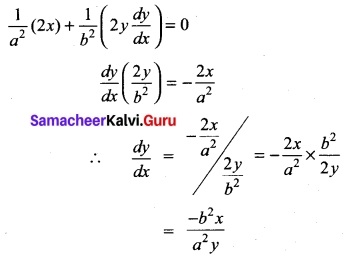
(a) a = \(\frac{1}{2}\), b = \(\frac{-3}{2}\)
(b) a = \(\frac{-1}{2}\), b = \(\frac{3}{2}\)
(c) a = –\(\frac{1}{2}\), b = –\(\frac{3}{2}\)
(d) a = \(\frac{1}{2}\), b = \(\frac{3}{2}\)
Solution:
(c) a = –\(\frac{1}{2}\), b = –\(\frac{3}{2}\)

Question 18.
∫sin 7x cos 5x dx =…………
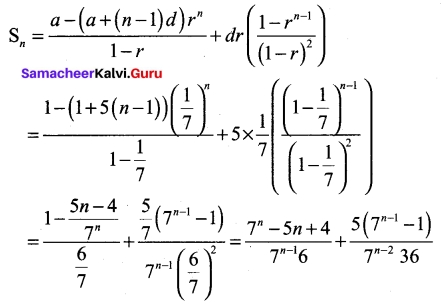
(a) \(\frac{1}{2}\) [\(\frac{cos 12x}{2}\)+\(\frac{cos 2x}{2}\)] + c
(b) –\(\frac{1}{2}\) [\(\frac{cos 12x}{2}\)+\(\frac{cos 2x}{2}\)] + c
(c) –\(\frac{1}{2}\) [\(\frac{cos 6x}{6}\) + cos x] + c
(d) –\(\frac{1}{2}\) [\(\frac{sin 12x}{2}\)+\(\frac{sin 2x}{2}\)] + c
Solution:
(b) –\(\frac{1}{2}\) [\(\frac{cos 12x}{2}\)+\(\frac{cos 2x}{2}\)] + c

Question 19.
∫ \(\frac{1}{e^x}\) dx = ………..
(a) log ex + c
(b) x + c
(c) \(\frac{1}{e^x}\) + c
(d) \(\frac{-1}{e^x}\)
Solution:
(d) \(\frac{-1}{e^x}\)

Question 20.
Two items are chosen from a lot containing twelve items of which four are defective. Then the probability that atleast one of the item is defective is…………
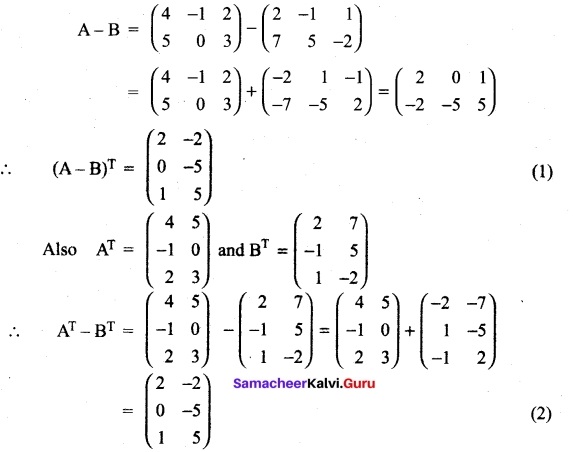
(a) \(\frac{19}{33}\)
(b) \(\frac{17}{33}\)
(c) \(\frac{23}{33}\)
(d) \(\frac{13}{34}\)
Solution:
(a) \(\frac{19}{33}\)

PART – II

II. Answer any seven questions. Question No. 30 is compulsory. [7 × 2 = 14]

Question 21.
Prove that \(\frac{tanθ+secθ-1}{tanθ-secθ+1}\) \(\frac{1+sinθ}{cosθ}\)
Solution:
Tamil Nadu 11th Maths Model Question Paper 4 English Medium 3

Tamil Nadu 11th Maths Model Question Paper 4 English Medium

Question 22.
Prove that the relation ‘friendship’ is not an equivalence relation on the set-of all people in chennai.
Solution:
S = aRa (i.e. ) a person can be a friend to himself or herself.
So it is reflextive.
aRb ⇒ bRa so it is symmetric
aRb, bRc does not ⇒ aRc
so it is not transitive
⇒ it is not an equivalence relation.

Question 23.
How many triangles can be formed by joining 15 points on the plane, in which no line joining any three points?
Solution:
No. of non-collinear points = 15
To draw a Triangle we need 3 points
∴Selecting 3 from 15 points can be done in 15C3 ways.
∴ No. of Triangle formed = 15C3
= \(\frac{15×14×13}{3×2×1}\) = 455

Question 24.
Expand (2x + 3)5
Solution:
By taking a = 2x, b = 3 and n = 5 in the binomial expansion of (a + b)n
we get (2x + 3)5 = (2x)5 + 5(2x)43 + 10(2x)³3² + 10(2x)²3³ + 5(2x)34 + 35
= 32x5 + 240x4 + 720x³ + 1980x² + 810x + 243.

Question 25.
If λ = -2, determine the value of Tamil Nadu 11th Maths Model Question Paper 4 English Medium 4
Solution:
Given λ = -2
2λ = -4; λ² = (-2)² = 4; 3λ² + 1 = 3(4) + 1 = 13
6λ – 1 = 6(-2) – 1 = -13
Tamil Nadu 11th Maths Model Question Paper 4 English Medium 5
expanding along R,
0(0) + 4 (0 + 13) +1 (-52 + 0) = 52 – 52 = 0
Aliter: The determinant value of a skew symmetric matrix is zero.

Question 26.
Compute \(\lim _{x \rightarrow 1} \frac{\sqrt{x}-1}{x-1}\)
Solution:
Here \(\lim _{x \rightarrow 1}\)(x – 1) = 0. In such cases, rationalise the numerator.
Tamil Nadu 11th Maths Model Question Paper 4 English Medium 6

Question 27.
Differentiate the following \(\frac{x²}{a²}\)+ \(\frac{y²}{b²}\) = 1
Solution:
Given \(\frac{x²}{a²}\)+ \(\frac{y²}{b²}\) = 1
Differentiating w.r.to x
Tamil Nadu 11th Maths Model Question Paper 4 English Medium 7

Tamil Nadu 11th Maths Model Question Paper 4 English Medium

Question 28.
Evaluate \(\frac{1}{(x+1)²-25}\)
Solution:
Tamil Nadu 11th Maths Model Question Paper 4 English Medium 8

Question 29.
Given that P(A) = 0.52, P(B) = 0.43, and P(A ∩ B) = 0.24, find p(A ∩ \(\bar { B }\))
Solution:
P(A ∩ \(\bar { B }\)) = P(A) – P(A ∩ B)
= 0.52 – 0.24 = 0.28
P(A ∩ \(\bar { B }\)) = 0.28

Question 30.
Show that 4x² + 4xy + y² – 6x – 3y – 4 = 0 represents a pair of parallel lines
Solution:
4x² + 4xy + y² – 6x – 3y – 4 = 0
a = 4, b = 1, h = 4/2 = 2
h² – ab = 2² – (4) (1) = 4 – 4 = 0
⇒ The given equation represents a pair of parallel lines.

PART-III

III. Answer any seven questions. Question No. 40 is compulsory. [7 × 3 = 21]

Question 31.
If A and B are two sets so that n(B – A) = 2n(A – B) = 4n(A ∩ B) and if n(A ∪ B) = 14 then find n(PA)
Solution:
To find n(P(A)), we need n(A).
Let n( A ∩ B) = t. Then n( A – B) = 2k and n(B – A) = 4k.
Now n(A ∪ B) = n(A – B) + n(B – A) + n(A ∩ B) = 7k.
It is given that n(A ∪ B) = 14. Thus 7k = 14 and hence k = 2.
So n(A – B) = 4 and n(B – A) = 8. As n(A) = n(A – B) + n(A ∩ B), we get n(A) = 6 and hence n(P(A)) = 26 = 64.

Question 32.
Resolve \(\frac{1}{x²-a²}\) into partial fraction.
Solution:
Factorizing the denominator
Dr = x² – a² = (x – a) (x + a)
Tamil Nadu 11th Maths Model Question Paper 4 English Medium 9
Equating the numerator we get
x – a = 0
⇒ x = a
x + a = 0
⇒ x = -a
1 = A (x + a) + B (x – a)
This equation is true for any value of x
Tamil Nadu 11th Maths Model Question Paper 4 English Medium 10

Tamil Nadu 11th Maths Model Question Paper 4 English Medium

Question 33.
Count the number of positive integers greater than 7000 and less than 8000 which are divisible by 5 provided that no digits are repeated.
Solution:
It should be a 4-digit number greater than 7000 and less than 8000. Then the thousand’s place will be the digit 7. Further, as the number must be divisible by 5 the unit place should be either 0 or 5.
Tamil Nadu 11th Maths Model Question Paper 4 English Medium 11
As repetition is not permitted, the 100th place can be filled in 8 ways using remaining numbers and 10th place can be filled in 7 ways. Hence, the required number of numbers is 1 × 8 × 7 × 2 = 112.

Question 34.
Find the \(\sqrt[3]{126}\) approximately to two decimal places.
Solution:
Tamil Nadu 11th Maths Model Question Paper 4 English Medium 12

Question 35.
Find the equation of the line through the intersection of the lines
3x + 2y + 5 = 0 and 3x – 4y + 6 = 0 and the point (1, 1)
Solution:
The family of equations of straight lines through the point of intersection of the lines is of the form (a1x + b1y + c1) + (a2x + b2y + c2) = 0
That is, (3x + 2y + 5) + λ (3x – 4y + 6) = 0
Since the required equation passes through the point (1, 1), the point satisfies the above equation Therefore {3 + 2(1) + 5} + λ(3 (1) – 4(1) + 6} = 0 ⇒ λ = -2
Substituting λ = -2 in the above equation we get the required equation as 3x – 10y + 7 = 0 (verify the above problem by using two points form)

Question 36.
Show that Tamil Nadu 11th Maths Model Question Paper 4 English Medium 13
Solution:
Tamil Nadu 11th Maths Model Question Paper 4 English Medium 14

Question 37.
Complete the following table using calculator and use the result to estimate \(\lim _{x \rightarrow 2}\) \(\frac{x-2}{x²-x-2}\)
Tamil Nadu 11th Maths Model Question Paper 4 English Medium 15
Solution:
Tamil Nadu 11th Maths Model Question Paper 4 English Medium 16
Limit is 0.333…. = 0.\(\bar{3}\)

Tamil Nadu 11th Maths Model Question Paper 4 English Medium

Question 38.
Differentiate \(\frac{e^{3x}}{1+e^x}\) with respect to x
Solution:
Tamil Nadu 11th Maths Model Question Paper 4 English Medium 17

Question 39.
Evaluate: ex (tan x + log sec x)
Solution:
Let I = ∫ex (tan x + log sec x) dx
Take f(x) = log sec x
f(x) = \(\frac{1}{sec x}\) × sec x tan x = tan x
This is of the form ∫ex[f(x) + f'(x)] dx = ex f(x) + c
∴ ∫ex(log sec x + tan x) dx = ex log |sec x| + c

Question 40.
The position vectors of the vertices of a triangle are \(\vec{i}\) + 2\(\vec{j}\) + 3\(\vec{k}\), 3\(\vec{i}\) – 4\(\vec{j}\) + 5\(\vec{k}\) and -2\(\vec{i}\) + 3\(\vec{j}\) – 7\(\vec{k}\) Find the perimeter of a triangle.
Solution:
Let A, B, C be the vertices of triangle ABC,
Tamil Nadu 11th Maths Model Question Paper 4 English Medium 18

PART – IV

IV. Answer all the questions. [7 × 5 = 35]

Question 41 (a).
If f : R → R is defined by f(x) = 3x – 5, prove that f is a bijection and find its inverse.
Solution:
p(x) = 3x – 5
Let g(y) = 3x – 5 ⇒ 3x = y + 5
x = \(\frac{y+5}{3}\)
Let g(y) = \(\frac{y+5}{3}\)
Now g o f(y) = g[(f(x))] = g(3x-5)
Tamil Nadu 11th Maths Model Question Paper 4 English Medium 19
Thus g o f = Ix and f o g = Iy
f and g are bi-jections and inverse to each other. Hence f is a bi-jection and f-1(y) = \(\frac{y+5}{3}\)
Replacing y by x we get f-1(x) = \(\frac{x+5}{3}\)

Tamil Nadu 11th Maths Model Question Paper 4 English Medium

[OR]

(b) Prove that tan-1(\(\frac{m}{n}\)) – tan-1(\(\frac{m-n}{m+n}\)) = \(\frac{π}{4}\)
Solution:
Tamil Nadu 11th Maths Model Question Paper 4 English Medium 20

Question 42 (a).
Find the values of k so that the equation x² = 2x (1 + 3k) + 7(3 + 2k) = 0 has real and equal roots.
Solution:
The equation is x² – x(2) (1 + 3k) – 7 (3 + 2k) = 0
The roots are real and equal
⇒ Δ = 0 (i.e.,) b² – 4ac = 0
Here a = 1, b = -2 (1 + 3k), c = 7(3 + 2k)
So b² – 4ac = 0 ⇒ [-2 (1 + 3k)]² – 4(1) (7) (3 + 2k) = 0
(i.e.,) 4(1+ 3k)² – 28 (3 + 2k) = 0
(÷ by 4) (1 + 3k)² – 7(3 + 2k) = 0
1 + 9k² + 6k – 21 – 14k = 0
9k² – 8k – 20 = 0
(k – 2) (9k + 10) = 0
⇒ k – 2 > 0 or 9k + 10 = 0
⇒ k = 2 or k = \(\frac{-10}{9}\)
To solve the quadratic inequalities ax² + bx + c < 0 (or) ax² + bx + c > 0

[OR]

(b) If the roots of the equation (q – r) x² + (r – p)x + (p – q) = 0 are equal then show that p, q and r are in A.P.
Solution:
The roots are equal ⇒ Δ = 0
(i.e.) b² – 4ac = 0
Hence, a = q – r; b = r – p; c = p – q
b² – 4ac = 0
⇒ (r – p)² – 4(q – r)(p – q) = 0
r² + p² – 2pr – 4[qr – q² – pr + pq] = 0
r² + p² – 2pr – 4qr +4q² + 4pr – 4pq = 0
(i.e.) p² + 4q² + r² – 4pq – 4qr + 2pr = 0
(i.e.) (p – 2q + r)² = 0
⇒ p – 2q + r = 0
⇒ p + r = 2q
⇒ p, q, r are in A.P.

Question 43 (a).
Find the sum of all 4 digit-numbers that can be formed using the digits 1, 2, 3, 4 and 5 repetition not allowed?
Solution:
The given digits are 1, 2, 3, 4, 5
The no. of 4 digit numbers
Tamil Nadu 11th Maths Model Question Paper 4 English Medium 21
= 5 × 4 × 3 × 2 = 120
(i.e) 5P4 = 120
Now we have 120 numbers
So each digit occurs \(\frac{120}{5}\) = 24 times
Sum of the digits =1+2 + 3 + 4 + 5 = 15
Sum of number’s in each place = 24 × 15 = 360
Sum of numbers = 360 × 1 = 360
360 × 10 = 3600
360 × 100 = 36000
360 × 1000 = 360000
Total = 399960

Tamil Nadu 11th Maths Model Question Paper 4 English Medium

[OR]

(b) Three vectors \(\vec{a}\), \(\vec{b}\) and \(\vec{c}\) are such that |\(\vec{a}\)| = 2,|\(\vec{b}\)| = 3, |\(\vec{c}\)| = 4 and \(\vec{a}\) + \(\vec{b}\) + \(\vec{c}\) = 0. Find 4\(\vec{a}\).\(\vec{b}\) + 3\(\vec{b}\).\(\vec{c}\) + 3\(\vec{c}\).\(\vec{a}\).
Solution:
Given \(\vec{a}\) + \(\vec{b}\) + \(\vec{c}\) = 0
⇒ \(\vec{a}\) + \(\vec{a}\) = –\(\vec{a}\)
so (\(\vec{a}\) + \(\vec{a}\))² = \(\vec{c}\)²
(i.e.) a² + b²+ 2\(\vec{a}\).\(\vec{b}\) = \(\vec{c}\)²
⇒ 4 + 9 + 2\(\vec{a}\).\(\vec{b}\) = 16
⇒ 2\(\vec{a}\).\(\vec{b}\) = 16 – 4 – 9 = 3
\(\vec{a}\) \(\vec{b}\) = 3/2
Again \(\vec{a}\) + \(\vec{b}\) + \(\vec{c}\) = 0
⇒ \(\vec{a}\) + \(\vec{c}\) = –\(\vec{b}\)
(\(\vec{a}\) + \(\vec{c}\))² = \(\vec{b}\)²
\(\vec{a}\)² + \(\vec{c}\)² + 2\(\vec{a}\).\(\vec{c}\) = \(\vec{b}\)²
4 + 16 + 2\(\vec{a}\) – \(\vec{a}\) = 9
2\(\vec{a}\) – \(\vec{c}\) = 9 – 4 – 16 = -11
\(\vec{a}\).\(\vec{c}\) = \(\frac{-11}{2}\) (i.e.,) \(\vec{c}\) – \(\vec{a}\) = \(\frac{-11}{2}\) (∵\(\vec{a}\).\(\vec{c}\) = \(\vec{c}\).\(\vec{a}\))
Also \(\vec{a}\) + \(\vec{b}\) + \(\vec{c}\) = 0
\(\vec{b}\) + \(\vec{c}\) = –\(\vec{a}\)
(\(\vec{b}\) + \(\vec{c}\))² = \(\vec{a}\)²
9 + 16 + 2\(\vec{b}\) – \(\vec{c}\) = 4
2\(\vec{b}\) – \(\vec{c}\) = 4 – 9 – 16 = -21
\(\vec{b}\) – \(\vec{c}\) = \(\frac{21}{2}\)
Here \(\vec{a}\).\(\vec{b}\) = 3/2 \(\vec{b}\).\(\vec{c}\) = \(\frac{-21}{2}\) and \(\vec{c}\).\(\vec{a}\) = \(\frac{-11}{2}\)
Tamil Nadu 11th Maths Model Question Paper 4 English Medium 22

Question 44 (a).
If a, b, c are respectively the pth, qth and rth terms of a G.P. show that (q – r) log a+ (r – p) log b + (p – q) log c = 0.
Solution:
Let the G.P. be l, lk, lk²,…
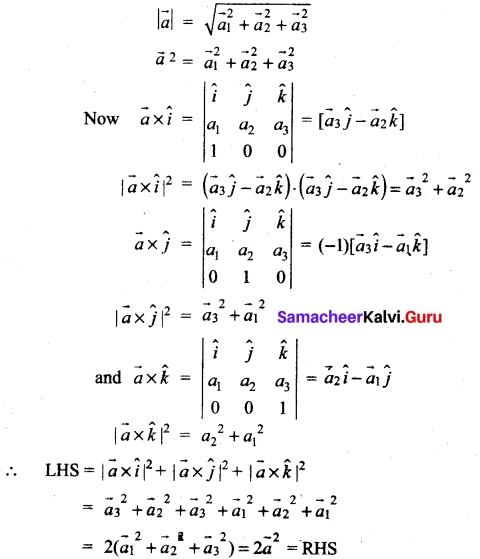
We are given tp = a, tq = b, tr = c
⇒ a = lkp-1; b = l kq-1; c = l kr-1
a = lkp-1 ⇒ log a = log l + log kp-1 = log l + (p – 1) log k
b = lkq-1 ⇒ log b = log l + log kq-1 = log l + (q – 1) log k
c = lkr-1 ⇒ log r = log l + log kr-1 = log l + ( r – 1) log k
LHS = (q – r) log a + (r – p) log b + (p – q) log c
= (q – r) [log l + (p – 1) log k ] + (r – p) [log l + (q – 1) log k]
(p – q) [log l + (r – 1) log k]
= log l[p – q + q – r + r – p] + log k[(q – r)(p – 1) + (r – p) (q – 1) + (p – q)(r – 1)]
= log l (0) + log k[p (q – r) + q (r – p) + r(p – q) – (q – r + r – p + p – q)]
= 0 = RHS.

Tamil Nadu 11th Maths Model Question Paper 4 English Medium

[OR]

(b) If A = \(\left[\begin{array}{ll} \frac{1}{2} & \alpha \\ 0 & \frac{1}{2} \end{array}\right]\), Prove that \(\sum_{k=1}^{n}\) det(Ak) = \(\frac{1}{3}\) (1 – \(\frac{1}{4^n}\))
Solution:
Tamil Nadu 11th Maths Model Question Paper 4 English Medium 23
Which is a G.P with a = \(\frac{1}{4}\) and r = \(\frac{1}{4}\)
Tamil Nadu 11th Maths Model Question Paper 4 English Medium 24

Question 45 (a).
Find the equation of the straight line passing through intersection of the straight lines 5x – 6y = 1 and 3x + 2y + 5 = 0 and perpendicular to the straight line 3x – 5y + 11 = 0.
Solution:
Equation of line through the intersection of straight lines 5x – 6y = 1 and 3x + 2y + 5 = 0 is 5x – 6y – 1 + k (3x + 2y + 5) = 0 x(5 + 3k) + y(-6 + 2k) + (-1 + 5k) = 0
This is perpendicular to 3x – 5y + 11 = 0
That is, the product of their slopes is -1
–\(\frac{5+3k}{-6+2k}\) (-\(\frac{3}{-5}\)) = -1
⇒ \(\frac{15+9k}{-30+10k}\) = 1
⇒ 15 + 9k = -30 + 10k
45 = k
Required equation is 5x – 6y – 1 + 45 (3x + 2y + 5) = 0
140x + 84y + 224 = 0
20x + 12y + 32 = 0
5x + 3y + 8 = 0

[OR]

(b) Integrate the following \(\frac{√x}{1+√x}\) dx
Solution:
Tamil Nadu 11th Maths Model Question Paper 4 English Medium 25

Tamil Nadu 11th Maths Model Question Paper 4 English Medium

Question 46 (a).
If u = tan-1(\(\frac{\sqrt{1+x^{2}}-1}{x}\)) and v = tan-1x, find \(\frac{dx}{dy}\)
Solution:
Tamil Nadu 11th Maths Model Question Paper 4 English Medium 26

[OR]

(b)
If y = Ae6x + Be-x prove that \(\frac{d²y}{dx²}\) – 5\(\frac{dx}{dy}\) – 6y = 0
Solution:
y = Ae6x + Be-x …. (1)
y1 = \(\frac{dx}{dy}\) = Ae6x(6) + Be-x (-1)
= 6Ae6x – Be-x…. (2)
y2 = \(\frac{dx}{dy}\) = 6Ae6x (6) – Be-x (-1)
= 36Ae6x + Be-x ……(3)
eliminating A and B from (1), (2) and (3) we get
Tamil Nadu 11th Maths Model Question Paper 4 English Medium 27
y (6 + 36) – y1 (1 – 36) + y2 (-1 – 6) = 0
42y + 35y1 – 7y2 = 0
(÷ by -7) y2 – 5y1 – 6y = 0
(i.e.,) \(\frac{d²y}{dx²}\) – 5\(\frac{dx}{dy}\) – 6y = 0

Tamil Nadu 11th Maths Model Question Paper 4 English Medium

Question 47 (a).
Evaluate \(\lim _{x \rightarrow 0} \frac{\sqrt{x^{2}+1}-1}{\sqrt{x^{2}+16}-4}\)
Solution:
Tamil Nadu 11th Maths Model Question Paper 4 English Medium 28

[OR]
(b) Urn-I contains 8 red and 4 blue balls and urn-II contains 5 red and 10 blue balls. One urn is chosen at random and two balls are drawn from it. Find the probability that both balls are red.
Solution:
Let A1 be the event of selecting um-I and A2 be the event of selecting um-II.
Let B be the event of selecting 2 red balls.
Tamil Nadu 11th Maths Model Question Paper 4 English Medium 29
We have to find the total probability of event B. That is, P(B).
Clearly A1 and A2A1 are mutually exclusive and exhaustive events.
We have
Tamil Nadu 11th Maths Model Question Paper 4 English Medium 30

Tamil Nadu 11th Maths Model Question Paper 4 English Medium

Tamil Nadu 11th Maths Model Question Paper 2 English Medium

Students can Download Tamil Nadu 11th Maths Model Question Paper 2 English Medium Pdf, Tamil Nadu 11th Maths Model Question Papers helps you to revise the complete Tamilnadu State Board New Syllabus and score more marks in your examinations.

TN State Board 11th Maths Model Question Paper 2 English Medium

General Instructions:

  1. The question paper comprises of four parts.
  2. You are to attempt all the parts. An internal choice of questions is provided wherever applicable.
  3. All questions of Part I, II, III and IV are to be attempted separately.
  4. Question numbers 1 to 20 in Part I are Multiple Choice Questions of one mark each.
    These are to be answered by choosing the most suitable answer from the given four alternatives and writing the option code and the corresponding answer
  5. Question numbers 21 to 30 in Part II are two-mark questions. These are to be answered in about one or two sentences.
  6. Question numbers 31 to 40 in Part III are three-mark questions. These are to be answered in above three to five short sentences.
  7. Question numbers 41 to 47 in Part IV are five-mark questions. These are to be answered in detail Draw diagrams wherever necessary.

Time: 2.30 Hours
Maximum Marks: 90

PART – I

Choose the correct answer. Answer all the questions. [20 × 1 = 20]

Question 1.
The range of the function \(\frac{1}{1-2sin x}\) is………..
(a) (-∞, -1) ∪(\(\frac{1}{3}\), ∞)
(b) (-1, -1)
(c) (-1, \(\frac{1}{3}\))
(d) (-∞, -1] ∪[\(\frac{1}{3}\), ∞)
Solution:
(d) (-∞, -1] ∪[\(\frac{1}{3}\), ∞)

Question 2.
The value of log√2 512 is……….
(a) 16
(b) 18
(c) 9
(d) 12
Solution:
(b) 18

Tamil Nadu 11th Maths Model Question Paper 2 English Medium

Question 3.
If a and b are the roots of the equation x² – kx + 16 = 0 and satisfy a² + b² = 32 then the value of k is………..
(a) 10
(b) -8
(c) -8, 8
(d) 6
Solution:
(c) -8, 8

Question 4.
The value of log9 27 is …………
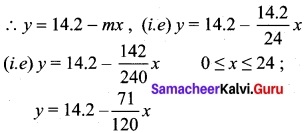
(a) \(\frac{2}{3}\)
(b) \(\frac{3}{2}\)
(c) \(\frac{3}{4}\)
(d) \(\frac{4}{3}\)
Solution:
(b) \(\frac{3}{2}\)

Question 5.
The value of \(\frac{\sin 3 \theta+\sin 5 \theta+\sin 7 \theta+\sin 9 \theta}{\cos 3 \theta+\cos 5 \theta+\cos 7 \theta+\cos 9 \theta}\) = ………….
(a) tan 3θ
(b) tan 6θ
(c) cot 3θ
(d) cot 6θ
Solution:
(b) tan 6θ

Question 6.
In 3 fingers the number of ways 4 rings can be worn in ways.
(a) 4³ – 1
(b) 34
(c) 68
(d) 64
Solution:
(d) 64

Question 7.
Everybody in a room shakes hands with everybody else. The total number of shake hands is 66. The number of persons in the room is……….
(a) 11
(b) 12
(c) 10
(d) 6
Solution:
(b) 12

Question 8.
The H.M of two positive number whose AM and G.M. are 16, 8 respectively is
(a) 10
(b) 6
(c) 5
(d) 4
Solution:
(d) 4

Question 9.
The co-efficient of the term independent of x in the expansion of (2x + \(\frac{1}{3x}\))6 is……….
(a) \(\frac{160}{27}\)
(b) \(\frac{160}{37}\)
(c) \(\frac{80}{3}\)
(d) \(\frac{80}{9}\)
Solution:
(a) \(\frac{160}{27}\)

Question 10.
The value of \(\left|\begin{array}{lll} a & 0 & 0 \\ 0 & b & 0 \\ 0 & 0 & c \end{array}\right|^{2}\) is……….
(a) abc
(b) -abc
(c) 0
(d) a²b²c²
Solution:
(d) a²b²c²

Tamil Nadu 11th Maths Model Question Paper 2 English Medium

Question 11.
Tamil Nadu 11th Maths Model Question Paper 2 English Medium 1
(a) Δ
(b) kΔ
(c) 3kΔ
(d) k³Δ
Solution:
(d) k³Δ

Question 12.
A vector makes equal angle with the positive direction of the co-ordinate axes then each angle is equal to………..
(a) cos-1 (\(\frac{1}{3}\))
(b) cos-1 (\(\frac{2}{3}\))
(c) cos-1 (\(\frac{1}{√3}\))
(d) cos-1 (\(\frac{2}{√3}\))
Solution:
(c) cos-1 (\(\frac{1}{√3}\))

Question 13.
If the centroids of AABC and A’B’C’ are respectively G and G’ then \(\bar{AA’}\) + \(\bar{BB’}\) + \(\bar{CC’}\)…………
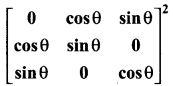
(a) \(\bar{GG’}\)
(b) 3\(\bar{GG’}\)
(c) 2\(\bar{GG’}\)
(d) 0
Solution:
(b) 3\(\bar{GG’}\)

Question 14.
If f(x) = \(\left\{\begin{aligned} k x^{2} & \text { for } \quad x \leq 2 \\ 3 & \text { for } \quad x>2 \end{aligned}\right.\) is continuous at x = 2 then the value of k is ………..
(a) \(\frac{3}{4}\)
(b) 0
(c) 1
(d) \(\frac{4}{3}\)
Solution:
(d) \(\frac{4}{3}\)

Question 15.
If x = \(\frac{1-t²}{1+t²}\) and y = \(\frac{2t}{1+t²}\) then \(\frac{dx}{dy}\) = ……….
(a) \(\frac{y}{x}\)
(b) \(\frac{-y}{x}\)
(c) –\(\frac{x}{y}\)
(d) \(\frac{x}{y}\)
Solution:
(c) –\(\frac{x}{y}\)

Question 16.
\(\lim _{x \rightarrow \infty}\left(\frac{x^{2}+5 x+3}{x^{2}+x+3}\right)^{x}\) is ……….
(a) e4
(b) e²
(c) e³
(d) 1
Solution:
(a) e4

Question 17.
\(\int \frac{e^{x}\left(x^{2} \tan ^{-1} x+\tan ^{-1} x+1\right)}{x^{2}+1}\) dx is ……….
(a) extan-1(x + 1) + c
(b) tan-1(ex) + c
(c) ex \(\frac{tan^{-1}x}{2}\) + c
(d) extan-1x + c
Solution:
(d) extan-1x + c

Question 18.
\(\int \frac{\sec x}{\sqrt{\cos 2 x}}\) dx = ………
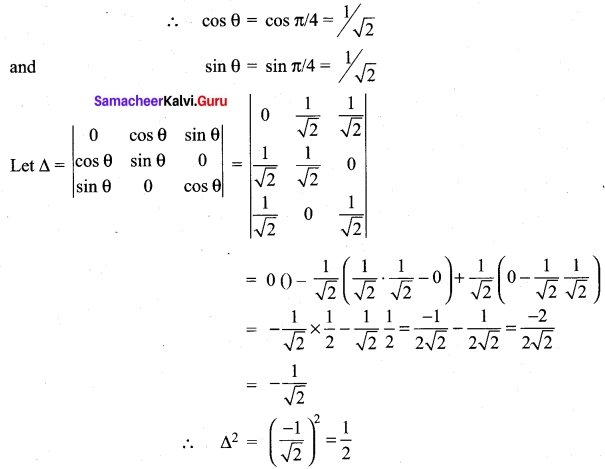
(a) tan-1(sin x) + c
(b) 2 sin-1(tan x) + c
(c) tan-1(cos x) + c
(d) sin-1(tan x) + c
Solution:
(d) sin-1(tan x) + c

Tamil Nadu 11th Maths Model Question Paper 2 English Medium

Question 19.
\(\int \frac{e^{6 \log x}-e^{5 \log x}}{e^{4 \log x}-e^{3 \log x}}\)
(a) x + c
(b) \(\frac{x³}{3}\) + c
(c) \(\frac{3}{x³}\) + c
(d) \(\frac{1}{x²}\) + c
Solution:
(b) \(\frac{x³}{3}\) + c

Question 20.
It is given that the events A and B are such that P(A) = \(\frac{1}{4}\), P(A/B) = \(\frac{1}{2}\) and P(B/A) = \(\frac{2}{3}\) then P(B) = …………
(a) \(\frac{1}{6}\)
(b) \(\frac{1}{3}\)
(c) \(\frac{2}{3}\)
(d) \(\frac{1}{2}\)
Solution:
(b) \(\frac{1}{3}\)

PART- II

II. Answer any seven questions. Question No. 30 is compulsory.

Question 21.
Find x such that -π ≤ x ≤ π and cos 2x = sin x
Solution:
We have cos 2x = sin x which gives
2sin² x + sin x – 1 = 0
The roots of the equation are sin x = \(\frac{-1±3}{4}\) = -1 (or) \(\frac{1}{2}\)
Now, sin x = \(\frac{1}{2}\) ⇒ x = \(\frac{π}{6}\), \(\frac{5π}{6}\)
Also sin x = -1 ⇒ x = \(\frac{π}{2}\)
Thus x = \(\frac{π}{2}\), \(\frac{π}{6}\), \(\frac{5π}{6}\)

Question 22.
If (n-1)P3 : nP4 = 1 : 10 find n.
Solution:
Tamil Nadu 11th Maths Model Question Paper 2 English Medium 2

Question 23.
Find the 18th and 25th terms of the sequence defined by
Tamil Nadu 11th Maths Model Question Paper 2 English Medium 3
Solution:
When n = 18 (even)
an = n(n + 2) = 18(18 + 2) = 18 (20) = 360
When n = 25 (odd)
Tamil Nadu 11th Maths Model Question Paper 2 English Medium 4

Question 24.
Show that the lines are 3x + 2y + 9 = 0 and 12x + 8y – 15 = 0 are parallel lines.
Solution:
Tamil Nadu 11th Maths Model Question Paper 2 English Medium 5
Here m1 = m2 ⇒ the two lines are parallel.

Question 25.
Prove that
Tamil Nadu 11th Maths Model Question Paper 2 English Medium 6
Solution:
Tamil Nadu 11th Maths Model Question Paper 2 English Medium 7
= 0 + 2(0) (∴ R1 = R3)
= 0 = RHS

Question 26.
Find the value of λ for which the vectors \(\vec{a}\) = 2\(\vec{i}\) + λ\(\vec{j}\) + \(\vec{k}\) and \(\vec{b}\) = \(\vec{i}\) – 2\(\vec{j}\) + 3\(\vec{k}\) are perpendicular.
Solution:
When \(\vec{a}\) and \(\vec{b}\) are ⊥r If then \(\vec{a}\).\(\vec{b}\) = 0
\(\vec{a}\) ⊥r \(\vec{b}\) ⇒ \(\vec{a}\).\(\vec{b}\) = 0
(2) (1) + (λ) (-2) + (1) (3) = 0 ⇒ λ = 5/2

Tamil Nadu 11th Maths Model Question Paper 2 English Medium

Question 27.
If y = \(\frac{tan x}{x}\) and \(\frac{dx}{dy}\)
Solution:
now y = \(\frac{u}{v}\) ⇒ y’ =\(\frac{vu’-uv’}{v²}\)
u = tan x ⇒ u’ = sec²x
v = x ⇒ v’ = 1
Tamil Nadu 11th Maths Model Question Paper 2 English Medium 8

Question 28.
Evaluate \(\int \sqrt{25 x^{2}-9}\) dx
Solution:
Tamil Nadu 11th Maths Model Question Paper 2 English Medium 9

Question 29.
If A and B are two independent events such that
P(A) = 0.4 and P(A ∪ B) = 0.9. Find P(B).
Solution:
P(A ∪ B) = P(A) + P(B) – P(A ∩ B)
P(A ∪ B) = P(A) + P(B) – P(A).P(B)(since A and B are independent)
That is, 0.9 = 0.4 + P(B) – (0.4) P(B)
0.9 – 0.4 = (1 – 0.4) P(B)
Therefore, P(B) = \(\frac{5}{6}\)

Question 30.
A rope of length 12 m is given. Find the largest area of the triangle formed by this rope and find the dimensions of the triangle so formed.
Solution:
The largest triangle will be an equilateral triangle
∴ side of the triangle = \(\frac{12}{3}\) = 4 m = a
Area of the triangle = \(\frac{a²√3}{4}\) = \(\frac{4²√3}{4}\) = 4√3 sq.m

PART – III

III. Answer any seven questions. Question No. 40 is compulsory. [7 × 3 = 21]

Question 31.
Let A = {a, b, c} and R = {(a, a), (b, b), (a, c)}. Write down the minimum number of ordered pairs to be included to R to make it

  1. reflexive
  2. symmetric
  3. transitive
  4. equivalence

Solution:

  1. (c, c)
  2. (c, a)
  3. nothing
  4. (c, c) and (c, a)

Question 32.
Solve 2|x + 1| – 6 ≤ 7 and graph the solution set in a number line.
Solution:
2|x + 1| – 6 ≤ 7
⇒ 2|x + 1| ≤ 7 + 6 (= 13)
⇒ |x + 1| ≤ \(\frac{13}{2}\)
⇒ x + 1 > \(\frac{-13}{2}\)
x + 1 > \(\frac{-13}{2}\)
⇒ x > \(\frac{-13}{2}\) -1 (= \(\frac{-15}{2}\)) ……….(1)
(or) x + 1 > \(\frac{13}{2}\)
x + 1 < \(\frac{-13}{2}\)
⇒ x < \(\frac{13}{2}\) -1 (= \(\frac{11}{2}\)) ……….(2)
From (1) and (2) \(\frac{-15}{2}\) ≤ x ≤ \(\frac{11}{2}\)

Question 33.
If the different permutations of all letters of the word BHASKARA are listed as in a dictionary, how many strings are there in this list before the first word starting with B?
Solution:
The required number of strings is the total number of strings starting with A and using the letters A, A, B, H, K, R, S = \(\frac{7!}{2}\) = 2520

Question 34.
Find the sum up to n terms of the series: 1 + \(\frac{6}{7}\) + \(\frac{11}{49}\) + \(\frac{16}{343}\) + ….
Solution:
Here a = 1, d = 5 and r = \(\frac{1}{7}\)
Tamil Nadu 11th Maths Model Question Paper 2 English Medium 10

Tamil Nadu 11th Maths Model Question Paper 2 English Medium

Question 35.
Area of the triangle formed by a line with the coordinate axes, is 36 square units. Find the equation of the line if the perpendicular drawn from the origin to the line makes an angle of 45° with positive the x-axis.
Solution:
Let p be the length of the perpendicular drawn from the origin to the required line.
The perpendicular makes 45° with the x-axis.
The equation of the required line is of the form,
x cos α + y sin α = p
⇒ x cos 45° + y sin 45° = p
⇒ x + y= √2 P
This equation cuts the coordinate axes at A(√2p, 0) and B (o, √2p).
Area of the ΔOAB is \(\frac{1}{2}\) × √2p × √2p = 36 ⇒ p = 6 (∵ p is positive)
Therefore the equation of the required line is x + y = 6 √2

Question 36.
If AT = \(\left(\begin{array}{cc} 4 & 5 \\ -1 & 0 \\ 2 & 3 \end{array}\right)\) and B = \(\left(\begin{array}{ccc} 2 & -1 & 1 \\ 7 & 5 & -2 \end{array}\right)\) verify that (A – B)T = AT – BT
Solution:
(A – B)T = AT – BT
Tamil Nadu 11th Maths Model Question Paper 2 English Medium 11
Here (1) and (2) ⇒ (A – B)T = AT – BT

Question 37.
For any vector \(\vec{a}\) prove that \(|\vec{a} \times \hat{i}|^{2}+|\vec{a} \times \hat{j}|^{2}+|\vec{a} \times \hat{k}|^{2}=2|\vec{a}|^{2}\)
Solution:
Let = \(\vec{a}\) = a1\(\hat{i}\) + a2\(\hat{j}\) + a3\(\hat{k}\)
Tamil Nadu 11th Maths Model Question Paper 2 English Medium 12

Question 38.
Given y = cos-1 \(\left(\frac{1-x^{2}}{1+x^{2}}\right)\) find \(\frac{dx}{dy}\)
Solution:
put x = tan θ
so \(\left(\frac{1-x^{2}}{1+x^{2}}\right)\) = \(\left(\frac{1-tan^{2}θ}{1+tan{2}θ}\right)\) = 2 cos θ
y = cos-1 (cos 2θ) = 2θ
⇒ \(\frac{dy}{dθ}\)
Now x = tan θ
⇒ \(\frac{dx}{dθ}\) = sec²θ
= 1 + tan² θ
= 1 + x²
so \(\frac{dx}{dy}\) = \(\frac{dy}{dθ}\)/\(\frac{dx}{dθ}\) = \(\frac{2}{1+x²}\)

Question 39.
A wound is healing in such a way that t days since Sunday the area of the wound has been decreasing at a rate of –\(\frac{3}{(t+2)²}\) cm² per day. If on Monday the area of the wound was 2 cm²
(i) What was the area of the wound on Sunday?
(ii) What is the anticipated area of the wound on Thursday if it continues to heal at the same rate ?
Solution:
Let A be the area of wound at time ‘ t ‘
Tamil Nadu 11th Maths Model Question Paper 2 English Medium 13
By the given, condition area of the wound on monday is 2 cm²
⇒ A = 2, t = 1
⇒ 2 = \(\frac{3}{1+2}\) + c
c = 1
∴ Area of wound at any day.
⇒ 1 ⇒ A = \(\frac{3}{1+2}\) + 1
(i) The area of the wound on Sunday
t = 0 ⇒ A = \(\frac{3}{2}\) + 1 = \(\frac{5}{2}\) = 2.5 cm²
(ii) The area of the wound on Thursday
t = 4 ⇒ A = \(\frac{3}{6}\) + 1 = \(\frac{1}{2}\) + 1 = 1.5 cm²

Tamil Nadu 11th Maths Model Question Paper 2 English Medium

Question 40.
An integer is chosen at random from the first fifty positive integers. What is probability that the integer chosen is a prime or multiple of 4?
Solution:
S = {1, 2, 3, ……. ,50} ∴ n(S) = 50
Let A be the event of getting prime number.
∴ A = {2, 3, 5, 7, 11, 13, 17, 19, 23, 29, 31, 37, 41, 43, 47}
n(A) = 15, so P(A) = 15/50
Let B be the event of getting number multiple of 4
∴B = {4, 8, 12, 16, 20, 24, 28, 32, 36, 40, 44, 48}
n(B) = 12, so P(B) = 12/50
Here A and B are mutually exclusive. (i.e.,) A ∩ B = Φ
∴ P(A ∪ B) = P(A) + P(B) = 15/50+ 12/50 = 27/50

PART – IV

IV. Answer all the questions. [7 × 5 = 35]

Question 41 (a).
The formula for converting from Fahrenheit to Celsius temperatures is y = \(\frac{5x}{9}\) – \(\frac{160}{9}\) Find the inverse of this function and determine whether the inverse is also a function.
Solution:
Tamil Nadu 11th Maths Model Question Paper 2 English Medium 14

[OR]

(b) If f : R → R is defined by f(x) = 2x – 3 prove that f is a injection and find its inverse.
Solution:
Method 1:
One-to-one: Let f(x) = f(y). Then 2x – 3 = 2y – 3; this implies that x = y. That is, f(x) = f(y) implies that x = y. Thus f is one-to-one.

Onto: Let y ∈ R. Let x =\(\frac{y+3}{2}\) Then f(x) = 2(\(\frac{y+3}{2}\)) -3 = y. Thus f is onto. This also can be proved by saying the following statement. The range of f is R (how?) which is equal to the co-domain and hence f is onto.

Inverse: Inverse: Let y = 2x – 3. Then y + 3 = 2x and hence x = \(\frac{y+3}{2}\) Thus f-1 (y) = \(\frac{y+3}{2}\). By replacing y as x, we get f-1 (x) = \(\frac{y+3}{2}\)

Method 2:
Let y = 2x – 3 then x = \(\frac{y+3}{2}\). Let, g(y) = \(\frac{y+3}{2}\)
Now (g o f) (x) = g(f(x)) = g(2x – 3) = \(\frac{(2x-3)+3}{2}\) = x
(f o g)(y) = f(g(y)) = f(\(\frac{y+3}{2}\)) = 2(\(\frac{y+3}{2}\)) -3 = y
This implies that f and g are bijections and inverses to each other. Hence f is a bijection and f-1(y) = \(\frac{y+3}{2}\). Replacing y by x we get, f-1(x) = \(\frac{x+3}{2}\)

Question 42 (a).
If the equations x² – ax + b = 0 and x² – ex + f = 0 have one root in common and if the second equation has equal roots then prove that ae = 2(b + f).
Solution:
Let a be the common root
then a² – aα + b = 0 . . . .(1)
we are given that
x² – ex + f = 0 has equal roots.
So the roots will be α, β
Now sum of roots = 2α
= -(-e) ⇒ a = e/2
product of the roots
α × α = α²f
substituting a and α², values in (1) we get
f – a (\(\frac{e}{2}\)) + b = 0
f – \(\frac{ae}{2}\) + b = 0
\(\frac{ae}{2}\) = b + f ⇒ ae = 2(b + f)

Tamil Nadu 11th Maths Model Question Paper 2 English Medium

[OR]

(b) Prove that
cos θ + cos(\(\frac{2π}{2}\)– θ) + (cos\(\frac{2π}{3}\) + θ) = 0
Solution:
we have
Tamil Nadu 11th Maths Model Question Paper 2 English Medium 15
cos θ – cos θ = 0 = RHS

Question 43 (a).
Find the number of strings that can be made using all letters of the word THING. If these words are written as in a dictionary, what will be the 85th string?
Solution:
(i) Number of words formed = 5! = 120
(ii) The given word is THING
Taking the letters in alphabetical order G H I N T
To find the 85th word
The No. of words starting with G = 4! = 24
The No. of words starting with H = 4! = 24
The No. of words starting with 1 = 4! = 24
The No. of words starting with NG = 3! = 6
The No. of words starting with NH = 3! = 6
The No. of words starting with NIGH = 1! = 1
Total = 85
So the 85th word is NIGHT

[OR]

(b) A straight line passes through a fixed point (6, 8). Find the locus of the foot of the perpendicular drawn to it from the origin O.
Solution:
Let the point (x1, y1) be (6, 8). and P (h, k) be a point on thr lequired locus.
Family of equations of the straight lines passing through the fixed point (x1, y1) is y – y1 = m (x – x1) ⇒ y – 8 = m(x – 6)
Since OP is perpendicular to the line (6.25)
m × (\(\frac{k-0}{h-0}\)) = -1 ⇒ m = –\(\frac{h}{k}\)
Also P(h, k) lies on (6.25)
⇒ k – 8 = – \(\frac{h}{k}\)(h – 6) ⇒ k (k – 8) = -h(h – 6) ⇒ h² + k² – 6h – 8k = 0
Locus of P (h, k) is x² + y² – 6x – 8y = 0

Question 44 (a).
If p is a real number and if the middle term in the expansion of (\(\frac{π}{2}\) + 2)8 is 1120, find p.
Solution:
In the equation of (\(\frac{π}{2}\) + 2)8, number of terms = 8 + 1 = 9 (odd)
∴ There is only one middle term i.e. (\(\frac{9+1}{2}\))th or 5th term
Tamil Nadu 11th Maths Model Question Paper 2 English Medium 16

Tamil Nadu 11th Maths Model Question Paper 2 English Medium

[OR]

(b) Express the matrix A = \(\left[\begin{array}{rrr} 1 & 3 & 5 \\ -6 & 8 & 3 \\ -4 & 6 & 5 \end{array}\right]\) the sum Of skew-symmetric matrices.
Solution:
Tamil Nadu 11th Maths Model Question Paper 2 English Medium 17
Thus A is expressed as the sum of symmetric and skew-symmetric matrices.

Question 45 (a).
For any vector a prove that \(|\vec{a} \times \hat{i}|^{2}+|\vec{a} \times \hat{j}|^{2}+|\vec{a} \times \hat{k}|^{2}=2|\vec{a}|^{2}\)
Solution:
Tamil Nadu 11th Maths Model Question Paper 2 English Medium 18

Tamil Nadu 11th Maths Model Question Paper 2 English Medium

[OR]

(b) If y = etan-1x show that (1 + x²) y” + (2x – 1) y’ = 0
Solution:
y = etan-1x
y’ = etan-1x (\(\frac{1}{1+x²}\))
y’ = \(\frac{y}{1+x²}\) ⇒ y’ (1 + x²) = y
differentiating w.r.to x
y’ (2x) + (1 + x²)(y”) = y’
(i.e.) (1 + x²) y” + y’(2x) – y’ = 0
(i.e.) (1 + x²)y” + (2x – 1) y’ = 0

Question 46 (a).
Evaluate \(\lim _{x \rightarrow \infty} \frac{(x+1)^{10}+(x+2)^{10}+\ldots+(x+100)^{10}}{x^{10}+10^{10}}\)
Solution:
Tamil Nadu 11th Maths Model Question Paper 2 English Medium 19

[OR]

(b) Evaluate
Tamil Nadu 11th Maths Model Question Paper 2 English Medium 20
Solution:
Tamil Nadu 11th Maths Model Question Paper 2 English Medium 21

Tamil Nadu 11th Maths Model Question Paper 2 English Medium

Question 47 (a).
Evaluate \(\int \sin ^{-1}\)x dx
Solution:
Let 1 = sin-1x dx
u = sin-1x dv = dx
Tamil Nadu 11th Maths Model Question Paper 2 English Medium 22

[OR]

(b) A factory has two machines I and II. Machine I produces 40% of items of the output and Machine II produces 60% of the items. Further 4% of items produced by Machine I are defective and 5% produced by Machine II are defective. An item is drawn at random. If the drawn item is defective, find the probability that it was produced by Machine II.
Solution:
Let A1 be the event that the items are produced by Machine-I, A2 be the event that items are produced by Machine-II, Let B be the event of drawing a defective item. Now we are asked to find the conditional probability P(A2/B). Since A1, A2 are mutually exclusive and exhaustive events, by Bayes theorem,
Tamil Nadu 11th Maths Model Question Paper 2 English Medium 23

Tamil Nadu 11th Maths Model Question Paper 3 English Medium

Students can Download Tamil Nadu 11th Maths Model Question Paper 3 English Medium Pdf, Tamil Nadu 11th Maths Model Question Papers helps you to revise the complete Tamilnadu State Board New Syllabus and score more marks in your examinations.

TN State Board 11th Maths Model Question Paper 3 English Medium

General Instructions:

  1. The question paper comprises of four parts.
  2. You are to attempt all the parts. An internal choice of questions is provided wherever applicable.
  3. All questions of Part I, II, III and IV are to be attempted separately.
  4. Question numbers 1 to 20 in Part I are Multiple Choice Questions of one mark each.
    These are to be answered by choosing the most suitable answer from the given four alternatives and writing the option code and the corresponding answer
  5. Question numbers 21 to 30 in Part II are two-mark questions. These are to be answered in about one or two sentences.
  6. Question numbers 31 to 40 in Part III are three-mark questions. These are to be answered in above three to five short sentences.
  7. Question numbers 41 to 47 in Part IV are five-mark questions. These are to be answered in detail Draw diagrams wherever necessary.

Time: 2.30 Hours
Maximum Marks: 90

PART – I

I. Choose the correct answer. Answer all the questions. [20 × 1 = 20]

Question 1.
Let A and B be subsets of the universal set N, the set of natural numbers. Then A’∪[(A ∩ B) ∪B’] is
(a) A
(b) A’
(c) B
(d) N
Solution:
(d) N

Question 2.
For any two sets A and B if (A – B) ∪ (B – A) = ………..
(a) (A – B) ∪ A
(b) (B – A) ∪ B
(c) (A ∪ B) – (A ∩ B)
(d) (A ∪ B) ∩ (A ∩ B)
Solution:
(c) (A ∪ B) – (A ∩ B)

Tamil Nadu 11th Maths Model Question Paper 3 English Medium

Question 3.
The equations whose roots are numerically equal but opposite in sign to the roots of 3x² – 5x – 7 = 0 is ……….
(a) 3x² – 5x – 7 = 0
(b) 3x² + 5x – 7 = 0
(c) 3x² – 5x + 7 = 0
(d) 3x² + x – 7 = 0
Solution:
(b) 3x² + 5x – 7 = 0

Question 4.
The value of sin(45° + θ) – cos (45° – θ) is
(a) 2 cos θ
(b) 1
(c) 0
(d) 2 sin θ
Solution:
(c) 0

Question 5.
If tan α sin β = 840, are the roots of x² + ax + b = 0 then \(\frac{\sin (\alpha+\beta)}{\sin \alpha \sin \beta}\) is equal to ……..
(a) \(\frac{b}{a}\)
(b) \(\frac{a}{b}\)
(c) –\(\frac{a}{b}\)
(d) –\(\frac{b}{a}\)
Solution:
(c) –\(\frac{a}{b}\)

Question 6.
If a² – aC2 = a² – aC4 then the a value of a is ………
(a) 2
(b) 3
(c) 4
(d) 5
Solution:
(b) 3

Question 7.
If nPr = 840, nCr = 35 then n = …………
(a) 7
(b) 6
(c) 5
(d) 4
Solution:
(a) 7

Question 8.
If 2x² + 3xy – cy² = 0 represents a pair of perpendicular lines then c = ……….
(a) -2
(b) \(\frac{1}{2}\)
(c) –\(\frac{1}{2}\)
(d) 2
Solution:
(d) 2

Question 9.
If the nth term of an A.P is 2n – 1 then sum to n terms of that A.P. is……….
(a) n²
(b) n² + 1
(c) 2n – 1
(d) n² – 1
Solution:
(a) n²

Question 10.
If A = \(\left(\begin{array}{ll} 1 & -1 \\ 2 & -1 \end{array}\right)\), B = \(\left(\begin{array}{cc} a & 1 \\ b & -1 \end{array}\right)\)
(a) a = 4, b = 1
(b) a = 1, b = 4
(c) a = 0, 6 = 4
(d) a = 2, 6 = 4
Solution:
(b) a = 1, b = 4

Question 11.
If the points (x – 2), (5, 2), (8, 8) are collinear then x is equal to………..
(a) -3
(b) \(\frac{1}{3}\)
(c) 1
(d) 3
Solution:
(d) 3

Tamil Nadu 11th Maths Model Question Paper 3 English Medium

Question 12.
In a regular hexagon ABCDEF if \(\vec { AB }\) and \(\vec { BC }\) are represented by \(\vec { a}\) and \(\vec { b }\) respectively then \(\vec { EF }\) =
(a) \(\vec { a }\) – \(\vec { b }\)
(b) \(\vec { a}\)
(c) –\(\vec { b }\)
(d) \(\vec { a }\) + \(\vec { b }\)
Solution:
(c) –\(\vec { b }\)

Question 13.
If |\(\vec { a }\) + \(\vec { b }\)| = 60, |\(\vec { a }\) – \(\vec { b }\)| = 40 and |\(\vec { b }\)| = 46, then |\(\vec { a }\)| is………….
(a) 42
(b) 12
(c) 22
(d) 32
Solution:
(c) 22

Question 14.
For \(\vec { a }\) = \(\vec { i }\) + \(\vec { j }\) – 2\(\vec { k }\), \(\vec { b }\) = –\(\vec { i }\) + 2\(\vec { j }\) + \(\vec { k }\) and \(\vec { c }\) = \(\vec { i }\) – 2\(\vec { j }\) + 2\(\vec { k }\), the unit vector parallal to \(\vec { a }\) + \(\vec { b }\) + \(\vec { c }\) is ………….
(a) \(\frac{\vec{i}+\vec{j}-\vec{k}}{\sqrt{3}}\)
(b) \(\frac{\vec{i}+\vec{j}+\vec{k}}{\sqrt{3}}\)
(c) \(\frac{\vec{i}+\vec{j}+\vec{k}}{3}\)
(d) \(\frac{\vec{i}+\vec{j}+\vec{k}}{\sqrt{6}}\)
Solution:
(b) \(\frac{\vec{i}+\vec{j}+\vec{k}}{\sqrt{3}}\)

Question 15.
The differential co-efficient of log10x with respect to log10 x is……….
(a) 1
(b) -(log10x)²
(c) (logx10)²
(d) \(\frac{x²}{100}\)
Solution:
(b) -(log10x)²

Question 16.
\(\frac{d}{dx}\)(ex+5logx) is………
(a) e10x10(x + 5)
(b) exx(x + 5)
(c) ex + \(\frac{5}{x}\)
(d) ex – \(\frac{5}{x}\)
Solution:
(a) e10x10(x + 5)

Question 17.
If f(x) = x tan-1x then f'(1) = ……………
(a) 1 + \(\frac{π}{4}\)
(b) \(\frac{1}{2}\) + \(\frac{π}{4}\)
(c) \(\frac{1}{2}\) – \(\frac{π}{4}\)
(d) 2
Solution:
(b) \(\frac{1}{2}\) + \(\frac{π}{4}\)

Question 18.
∫ cosec x dx = ………..
(a) log tan \(\frac{π}{2}\) + c
(b) -log (cosec x + cot x) + c
(c) -log (cosec x + cot x) + c
(d) All of them
Solution:
(d) All of them

Question 19.
If A and B are two events such that A⊂B and P(B) ≠ 0, then which of the following is correct?
(a) P(A / B) = \(\frac{p(A)}{p(B)}\)
(b) P(A/B) < P(A)
(c) P(A/B ≥ P(A))
(d) P(A/B) > P(B)
Solution:
(c) P(A/B ≥ P(A))

Tamil Nadu 11th Maths Model Question Paper 3 English Medium

Question 20.
A number x is chosen at random from the first 100 natural numbers. Let A be the event of numbers which satisfies \(\frac{(x-10)(x-50)}{x-30}\) ≥ 0, then P(A) is ………..
(a) 0.20
(b) 0.51
(c) 0.71
(d) 0.70
Solution:
(c) 0.71

PART – II

II. Answer any seven questions. Question No. 30 is compulsory. [7 × 2 = 14]

Question 21.
Write the values of f at -4, 1, -2, 7, 0 if
Tamil Nadu 11th Maths Model Question Paper 3 English Medium 1
Solution:
f (- 4) = 4 + 4 = 8
f(1) = 1 – 1² = 0
f(-2) = 4 + 2 = 6
f(7) = 0
f(0) = 0

Question 22.
Solve 23x < 100 when
(i) x is a natural number
(ii) x is an integer
Solution:
23x < 100
⇒ \(\frac{23x}{23}\) < \(\frac{100}{23}\) (i.e.,) x > 23
(i) x = 1, 2, 3, 4 (x ∈ N)
(ii) x = -3, -2, -1, 0, 1, 2, 3, 4 (x ∈ Z)

Question 23.
Expand \(\frac{1}{5+x}\) in ascending powers of x.
Solution:
Tamil Nadu 11th Maths Model Question Paper 3 English Medium 2

Question 24.
Find the nearest point on the line 2x +.y = 5 from the origin.
Solution:
The required point is the foot of the perpendicular from the origin on the line 2x + y = 5.
The line perpendicular to the given line, through the origin is x – 2y = 0.
Solving the equations 2x + y = 5 and x – 2y = 0, we get x = 2, y = 1.
Hence the nearest point on the line from the origin is (2, 1).
Alternate method: Using the formula
Tamil Nadu 11th Maths Model Question Paper 3 English Medium 3

Question 25.
Determine 3B + 4C – D if B, C and D are given by
Tamil Nadu 11th Maths Model Question Paper 3 English Medium 4
Solution:
Tamil Nadu 11th Maths Model Question Paper 3 English Medium 5

Question 26.
Find the constant b that makes g continuous on (-∞, ∞) g(x) = \(\left\{\begin{array}{l} x^{2}-b^{2}, \text { if } x<4 \\ b x+20, \text { if } x \geq 4 \end{array}\right.\)
Solution: Since g(x) is continuous,
\(lim _{x \rightarrow 4^{-}}\) g(x) =\(lim _{x \rightarrow 4^{+}}\) g(x)
\(lim _{x \rightarrow 4^{-}}\)(x² – b²) = \(lim _{x \rightarrow 4^{+}}\) bx + 20
16 – b² = 4b + 20
b² + 4b + 4 = 0
(b + 2)² = 0
b = -2

Tamil Nadu 11th Maths Model Question Paper 3 English Medium

Question 27.
Find \(\frac{dx}{dy}\) if x² + y² = 1
Solution:
We differentiate both sides of the equation.
Tamil Nadu 11th Maths Model Question Paper 3 English Medium 6
Solving for the derivative yields
\(\frac{dx}{dy}\) = –\(\frac{x}{y}\)

Question 28.
Evaluate ∫ \(\frac{1}{sin²x cos²x}\) dx
Solution:
Tamil Nadu 11th Maths Model Question Paper 3 English Medium 7

Question 29.
If P(A) = 0.5, P(B) = 0.8 and P(B/A) = 0.8 find P(A/B) and P(A ∪ B)
Solution:
Given P(A) = 0.5, P(B) = 0.8 and P(B/A) = 0.8
p(B/A) = \(\frac{p(A ∩ B)}{p(A)}\) = 0.8 (given)
⇒ \(\frac{p(A ∩ B)}{0.5}\) = 0.8
⇒ p(A ∩ B) = 0.8 × 0.5 = 0.4
(i.e.,) p(A ∩ B) = 0.4
(i) P(A/B) = \(\frac{p(A ∩ B)}{p(B)}\) = \(\frac{0.4}{0.8}\) = \(\frac{4}{8}\) = 0.5
(ii) P(A ∪ B) = P(A) + P(B) – P(A ∩ B)
= 0.5 + 0.8 – 0.4 = 0.9
So, P(A/B) = 0.5 and P(A ∩ B) = 0.9.

Question 30.
Find the angle between the vectors 2\(\hat{i}\) + \(\hat{j}\) – \(\hat{k}\) and \(\hat{i}\) + 2 \(\hat{j}\) + \(\hat{i}\) using vector product.
Solution:
The angle between \(\vec{b}\) and \(\vec{b}\) using vector product is given by
Tamil Nadu 11th Maths Model Question Paper 3 English Medium 8

PART – III

Answer any seven questions. Question No. 40 is compulsory.

Question 31.
If (x1/2 + x-1/2)² = \(\frac{9}{2}\) find the value of (x1/2 – x -1/2) for x > 1
Solution:
Tamil Nadu 11th Maths Model Question Paper 3 English Medium 9

Question 32.
If \(\frac{n!}{3!(n-4)!}\) and \(\frac{n!}{5!(n-5)!}\) are in the ratio 5 : 3 find the value of n.
Solution:
Tamil Nadu 11th Maths Model Question Paper 3 English Medium 10

Question 33.
Expand (1 + x)\(\frac{2}{3}\) up to four terms for |x| < 1.
Solution:
Tamil Nadu 11th Maths Model Question Paper 3 English Medium 11

Question 34.
Find the equation of the line if the perpendicular drawn from the origin makes an angle 30° with x axis and its length is 12.
Solution:
The equation of the line is x cos a + y sin a = p
here a = 30°, cos a = cos 30° = \(\frac{√3}{2}\) ; sin a = sin 30° = 1/2; p = 12.
So equation of the line is x\(\frac{√3}{2}\)+ v\(\frac{1}{2}\) = 12
(i.e) √3x + y = 12 × 2 = 24 ⇒ √3x + y – 24 = 0

Tamil Nadu 11th Maths Model Question Paper 3 English Medium

Question 35.
Prove that
Tamil Nadu 11th Maths Model Question Paper 3 English Medium 12
Solution:
Tamil Nadu 11th Maths Model Question Paper 3 English Medium 13

Question 36.
Find \(\lim _{t \rightarrow 0} \frac{\sqrt{t^{2}+9}-3}{t^{2}}\)
Solution:
We can’t apply the quotient theorem immediately. Use the algebra technique of rationalising the numerator.
Tamil Nadu 11th Maths Model Question Paper 3 English Medium 14

Question 37.
Find \(\frac{dy}{dx}\) where x = \(\frac{1-t²}{1+t²}\), y = \(\frac{2t}{1+t²}\)
Solution:
Tamil Nadu 11th Maths Model Question Paper 3 English Medium 15

Question 38.
Evaluate ∫(5x² – 4 + \(\frac{7}{x}\) + \(\frac{2}{√x}\))dx
Solution:
Tamil Nadu 11th Maths Model Question Paper 3 English Medium 16

Question 39.
What is the chance that leap year should have fifty three Sundays?
Solution:
Leap Year: In 52 weeks we have 52 Sundays. We have to find the probability of getting one Sunday form the remaining 2 days the remaining 2 days can be a combination of the following S = {Saturday and Sunday, Sunday and Monday, Monday and Tuesday, Tuesday and Wednesday, Wednesday and Thursday, Thursday and Friday, Friday and Saturday}.
(i.e) n(s) = 7
In this n(A) = {Saturday and Sunday, Sunday and Monday}
(i.e) n(A) = 2
So, P(A) = \(\frac{2}{7}\)

Question 40.
Find x from the equation cosec (90° + A) + x cos A cot (90° + A) = sin (90° + A).
Solution:
cosec (90° + A) = sec A, cot (90° + A) = – tan A
LHS = sec A + x cos A (-tan A)
Tamil Nadu 11th Maths Model Question Paper 3 English Medium 17

PART – IV

IV. Answer all the questions. [7 × 5 = 35]

Question 41 (a).
From the curve y = x, draw
(i) y = -x
(ii) y = 2x
(iii) y = x + 1
(iv) y= \(\frac{1}{2}\)x + 1
(v) 2x + y + 3 = 0
Solution:
Tamil Nadu 11th Maths Model Question Paper 3 English Medium 18

Tamil Nadu 11th Maths Model Question Paper 3 English Medium

[OR]

(b) Solve √3 sin θ – cos θ = √2
Solution:
√3 sin θ – cos θ = √2
Here a = -1; b = √3 ; c = √2 ; r = \(\sqrt{a²+b²}\) = 2
Thus, the given equation can be rewritten as
Tamil Nadu 11th Maths Model Question Paper 3 English Medium 19

Question 42 (a).
Solve \(\frac{x^{2}-4}{x^{2}-2x-15}\) ≤ 0
Solution:
\(\frac{x^{2}-4}{x^{2}-2x-15}\) ≤ 0 ⇒ \(\frac{(x-2)(x+2)}{(x+3)(x-5)}\) ≤ 0
x – 2 ⇒ x = 2; x + 2 = 0 ⇒ x = -2
x + 3 = 0 ⇒ x = -3; x – 5 = 0 ⇒ x = 5
plotting the points -3, -2, 2, 5 in the number line and taking the intervals
Tamil Nadu 11th Maths Model Question Paper 3 English Medium 20
So the solution for the inequality \(\frac{x^{2}-4}{x^{2}-2x-15}\) ≤ 0 are (-3, -2) ∪ (2, 5)

[OR]

(b) Solve \(\frac{x+1}{x-1}\) > 0
Solution:
\(\frac{x+1}{x-1}\) > 0 ⇒ \(\frac{(x+1)(x-1)}{(x-1)²}\) > 0
(x + 1)(x – 1) > 0 (∵(x – 1)² >0 for all x ≠ l)
Tamil Nadu 11th Maths Model Question Paper 3 English Medium 21
(x + 1) (x – 1) > 0
⇒ x ∈ (-∞, -1) ∪ (1, ∞)

Question 43 (a).
Use the principle of mathematical induction to prove that for every natural number n.
Tamil Nadu 11th Maths Model Question Paper 3 English Medium 22
Solution:
Let P(n) be the given statement
Tamil Nadu 11th Maths Model Question Paper 3 English Medium 23
For n = 1, LHS = 1 + \(\frac{3}{1}\) = 4
RHS = (1 + 1)² = 2² = 4
LHS = RHS
∴ ⇒ P(1) is true.
We note than P(n) is true for n = 1.
Assume that P(k) is true.
Tamil Nadu 11th Maths Model Question Paper 3 English Medium 24
= k² +2k+ 1 + 2k + 3 = k² + 4k + 4 = (k + 2)²
= (k + 1 + 1)²
∴ p(k + 1)is also true whenever P(k) is true Hence, by the principle of mathematical induction, P(n) is also true for all n ∈ N.

[OR]

(b) If cos 2θ = 0 determine Tamil Nadu 11th Maths Model Question Paper 3 English Medium 25
Solution:
Given cos 2θ = 0
⇒ 2θ = π/2 ⇒ θ = π/4
∴ cos θ = cos π/4 = 1/√2
and
sin θ = sin π/4 = 1/√2
Tamil Nadu 11th Maths Model Question Paper 3 English Medium 26

Tamil Nadu 11th Maths Model Question Paper 3 English Medium

Question 44 (a).
Find the distance of the line 4x – y = 0 from the point P(4,1) measured along the line making an angle 135° with the positive x axis.
Solution:
The equation in distance form of the line passing through P (4, 1) and making an angle of 135° with the positive x – axis is
\(\frac{x-4}{cos135°}\) = \(\frac{y-1}{sin135°}\)
Suppose it cuts 4x – y – 0 at Q such that PQ = r then the coordinates of Q are given by
Tamil Nadu 11th Maths Model Question Paper 3 English Medium 27
Hence, required distance is 3√2 units.

[OR]

(b) Evaluate \(\lim _{x \rightarrow \infty} x\left[3^{\frac{1}{x}}+1-\cos \left(\frac{1}{x}\right)-e^{\frac{1}{x}}\right]\)
Solution:
Tamil Nadu 11th Maths Model Question Paper 3 English Medium 28

Question 45 (a).
Prove that \(\sqrt[3]{x^{3}+7}-\sqrt[3]{x^{3}+4}\) is approximately equal to \(\frac{1}{x²}\) when x is large.
Solution:
Tamil Nadu 11th Maths Model Question Paper 3 English Medium 29
Since x is large, \(\frac{1}{x}\) is very small and hence higher powers of \(\frac{1}{x}\) are negligible. Thus
Tamil Nadu 11th Maths Model Question Paper 3 English Medium 30

[OR]

(b) Evaluate sec³ 2x
I = ∫sec³ 2x dx = ∫sec 2x sec² 2x dx
Let u = sec 2x; du = 2 sec 2x tan 2x dx
sec²2x dx = dv
Tamil Nadu 11th Maths Model Question Paper 3 English Medium 31

Question 46 (a).
Evaluate y = sin(tan(\(\sqrt{sin x}\)))
Solution:
Tamil Nadu 11th Maths Model Question Paper 3 English Medium 32

Tamil Nadu 11th Maths Model Question Paper 3 English Medium

[OR]

(b) Evaluate y = \(\sqrt{x+\sqrt{x+\sqrt{x}}}\)
Solution:
Tamil Nadu 11th Maths Model Question Paper 3 English Medium 33

Question 47 (a).
Prove that the line segment joining the midpoints of two sides of a triangle is parallel to the third side whose length is half of the length of the third side.
Solution:
In ΔABC,
Tamil Nadu 11th Maths Model Question Paper 3 English Medium 34

[OR]

(b) Given P(A) = 0.4 and P(A ∪ B) = 0.7 Find P(B) if
(i) A and B are mutually exclusive
(ii) A and B are independent events
(iii) P(A / B) = 0.4
(iv) P(B / A) = 0.5
Solution:
P(A) = 0.4, P(A ∪ B) = 0.7
(i) When A and B are mutually exclusive
P(A ∪ B) = P(A) + P(B)
(i.e.,) 0.7 = 0.4 + P(B)
0.7 – 0.4 = P(B)
(i.e.,) P(B) = 0.3

(ii) Given A and B are independent
⇒ P(A ∩ B) = P(A). P(B)
Now, P(A ∪ B) = P(A) + P(B) – P (A ∩ B)
(i.e.,) 0.7 = 0.4 + P(B) – (0.4) (P(B)
(i.e.,) 0.7 – 0.4 = P(B)(1 – 0.4)
0.3 = P (B) 0.6
⇒ P(B) = \(\frac{0.3}{0.6}\) = \(\frac{3}{6}\) = 0.5

(iii) P(A/B) = 0.4
(i.e.,) \(\frac{P(A ∩ B)}{P(B)}\) = 0.4
⇒ P(A ∩ B) = 0.4 P(B) …..(i)
But We know P(A ∪ B) = P(A) + P(B) – P(A ∩ B)
P(A ∩ B) = P(A) + P(B) – P(A ∪ B)
⇒ P(A ∩ B) = 0.4 + P(B) – 0.7
= P(B) – 0.3
from (i) and (it) (equating RHS) we get
0-4 [P(B)] = P(B) – 0.3
0.3 = P(B)(1 – 0.4)
0.6 (P(B)) = 0.3 ⇒ P(B) = \(\frac{0.3}{0.6}\) = \(\frac{3}{6}\) = 0.5

(iv) P(B/A) = 0.5
(i.e.,) \(\frac{P(A ∩ B)}{P(A)}\) = 0.5
(i.e.,) P(A ∩ B) = 0.5 × P(A)
= 0.5 × 0.4 = 0.2
Now P(A ∪ B) = P(A) + P(B) – P(A ∩ B)
⇒ 0.7 = 0.4 + P(B) – 0.2
⇒ 0.7 = P(B) + 0.2
⇒ P(B) =0.7 – 0.2 = 0.5

Tamil Nadu 11th Maths Model Question Paper 3 English Medium

Tamil Nadu 11th Maths Model Question Paper 1 English Medium

Students can Download Tamil Nadu 11th Maths Model Question Paper 1 English Medium Pdf, Tamil Nadu 11th Maths Model Question Papers helps you to revise the complete Tamilnadu State Board New Syllabus and score more marks in your examinations.

TN State Board 11th Maths Model Question Paper 1 English Medium

General Instructions:

  1. The question paper comprises of four parts.
  2. You are to attempt all the parts. An internal choice of questions is provided wherever applicable.
  3. All questions of Part I, II, III and IV are to be attempted separately.
  4. Question numbers 1 to 20 in Part I are Multiple Choice Questions of one mark each.
    These are to be answered by choosing the most suitable answer from the given four alternatives and writing the option code and the corresponding answer
  5. Question numbers 21 to 30 in Part II are two-mark questions. These are to be answered in about one or two sentences.
  6. Question numbers 31 to 40 in Part III are three-mark questions. These are to be answered in above three to five short sentences.
  7. Question numbers 41 to 47 in Part IV are five-mark questions. These are to be answered in detail Draw diagrams wherever necessary.

Time: 2.30 Hours
Maximum Marks: 90

Part – I

Choose the correct answer. Answer all the questions. [20 × 1 = 20]

Question 1.
The number of students who take both the subjects Mathematics and Chemistry is 70. This represents 10% of the enrollment in Mathematics and 14% of the enrollment in Chemistry. The number of students take at least one of these two subjects, is
(a) 1120
(b)1130
(c) 1100
(d) insufficient data
Answer:
(b)1130

Question 2.
If 8 and 2 are the roots of x² + ax + c = 0 and 3, 3 are the roots of x² + dx + b = 0, then the roots of the equation x² + ax + b = 0 are
(a) 1, 2
(b) -1, 1
(c) 9, 1
(d) -1, 2
Answer:
(c) 9, 1

Tamil Nadu 11th Maths Model Question Paper 1 English Medium

Question 3.
If tan 40° = λ then \(\frac{tan 140° – tan 130°}{1+tan 140° tan 130°}\) = ………….
(a) \(\frac{1-λ²}{λ}\)
(b) \(\frac{1+λ²}{λ}\)
(c) \(\frac{1+λ²}{2λ}\)
(d) \(\frac{1-λ²}{2λ}\)
Answer:
(d) \(\frac{1-λ²}{2λ}\)

Question 4.
The value of 2 sin A cos³ A – 2 cos A sin³ A is………..
(a) sin 4A
(b) cos 4A
(c) \(\frac{1}{2}\) sin 4A
(d) \(\frac{1}{2}\) cos 4A
Answer:
(c) \(\frac{1}{2}\) sin 4A

Question 5.
In a triangle ABC, sin²A + sin²B + sin²C = 2 then the triangle is ………. triangle.
(a) equilateral
(b) isosceles
(c) right
(d) scalene
Answer:
(c) right

Question 6.
The number of ways in which a host lady invite 8 people for a party of 8 out of 12 people of whom two do not want to attend the party together is ………….
(a) 2 × 11C7 + 10C8
(b) 11C7+ 10C8
(c) 12C8 – 10C6
(d) 10C6 + 2!
Answer:
(c) 12C8 – 10C6

Question 7.
If a is the arithmetic mean and g is the geometric mean of two numbers then…………
(a) a ≤ g
(b) a ≥ g
(c) a = g
(d) a > g
Answer:
(b) a ≥ g

Question 8.
The number of rectangles that a chessboard has…………
(a) 81
(b) 99
(c) 1296
(d) 6561
Answer:
(c) 1296

Tamil Nadu 11th Maths Model Question Paper 1 English Medium

Question 9.
The intercepts of the perpendicular bisector of the line segment joining (1,2) and (3,4) with coordinate axes are………….
(a) 5, -5
(b) 5, 5
(c) 5, 3
(d) 5, -4
Answer:
(b) 5, 5

Question 10.
The coordinates of the four vertices of a quadrilateral are (-2, 4), (-1, 2), (1, 2) and (2, 4) taken in order.The equation of the line passing through the vertex (-1, 2) and dividing the quadrilateral in the equal areas is…………
(a) x + 1 = 0
(b) x + y= 1
(c) x + y + 3 = 0
(d) x – y + 3 = 0
Answer:
(c) x + y + 3 = 0

Question 11.
The vectors \(\vec{a}\) – \(\vec{b}\), \(\vec{b}\) – \(\vec{c}\), \(\vec{c}\) – \(\vec{a}\) are …………. vectors.
(a) parallel
(b) unit
(c) mutually perpendicular
(d) coplanar
Answer:
(d) coplanar

Question 12.
If |\(\vec{a}\) + \(\vec{b}\)| = 60, |\(\vec{a}\) – \(\vec{b}\)| = 40, |\(\vec{b}\)| = 46 then |\(\vec{a}\)| is ……………
(a) 42
(b) 12
(c) 22
(d) 32
Answer:
(c) 22

Question 13.
Given \(\vec{a}\) = 2\(\vec{i}\) + \(\vec{j}\) – 8\(\vec{k}\) and \(\vec{b}\) = \(\vec{i}\) + 3\(\vec{j}\) – 4\(\vec{k}\) then |\(\vec{a}\) + \(\vec{b}\)|= …………..
(a) 13
(b) \(\frac{13}{3}\)
(c) \(\frac{4}{13}\)
(d) \(\frac{3}{13}\)
Answer:
(a) 13

Question 14.
If \(\vec{r}\) = \(\frac{9\vec{a}+7\vec{b}}{16}\) then the point P whose position vector \(\vec{r}\) divides the line joining the points with position vectors \(\vec{a}\) and \(\vec{b}\) in the ratio……….
Tamil Nadu 11th Maths Model Question Paper 1 English Medium 1
(a) 7 : 9 internally
(b) 9 : 7 internally
(c) 9 : 7 externally
(d) 7 : 9 externally
Answer:
(a) 7 : 9 internally

Question 15.
If f(x) = x + 2 then f’ (f(x)) at x = 4 is…………
(a) 8
(b) 1
(c) 4
(d) 5
Answer:
(b) 1

Question 16.
The derivative of (x + \(\frac{1}{x}\))² w.r.to. x is ……….
(a) 2x – \(\frac{2}{x³}\)
(b) 2x + \(\frac{2}{x³}\)
(c) 2(x + \(\frac{1}{x}\) )
(d) 0
Answer:
(a) 2x – \(\frac{2}{x³}\)

Question 17.
If y = \(\frac{1}{a-z}\) then \(\frac{dz}{dy}\) is………..
(a) (a – z)²
(b) – (z – a)²
(c) (z + a)²
(d) -(z + a)²
Answer:
(a) (a – z)²

Tamil Nadu 11th Maths Model Question Paper 1 English Medium

Question 18.
∫sin7x cos5x dx = ……….
Tamil Nadu 11th Maths Model Question Paper 1 English Medium 2
Answer:
(b) –\(\frac{1}{2}\) [\(\frac{cos 12x}{2}\) + \(\frac{cos 2x}{2}\)] + c

Question 19.
∫\(\frac{1}{e^x}\) dx = …………..
(a) log ex + c
(b) x + c
(c) \(\frac{1}{e^x}\) + c
(d) \(\frac{-1}{e^x}\) + c
Answer:
(d) \(\frac{-1}{e^x}\) + c

Question 20.
A letter is taken at random from the letters of the word ‘ASSISTANT’ and another letter is taken at random from the letters of the word ‘ STATISTICS ’. The probability that the selected letters are the same………..
(a) \(\frac{7}{45}\)
(b) \(\frac{17}{90}\)
(c) \(\frac{29}{90}\)
(d) \(\frac{19}{90}\)
Answer:
(d) \(\frac{19}{90}\)

PART- II

II. Answer any seven questions. Question No. 30 is compulsory. [7 × 2 = 14]

Question 21.
For a set A, A × A contains 16 elements and two of its elements are (1,3) and (0,2). Find the elements of A.
Answer:
A × A = 16 elements = 4 × 4
⇒ A has 4 elements
∴ A = {0, 1, 2, 3}

Question 22.
Find the area of the triangle whose sides are 13 cm, 14 cm and 15 cm.
Answer:
Tamil Nadu 11th Maths Model Question Paper 1 English Medium 3

Question 23.
If \(\frac{1}{7!}\) + \(\frac{1}{9!}\) = \(\frac{x}{10!}\) find x.
Answer:
Here \(\frac{1}{7!}\) + \(\frac{1}{9!}\) = \(\frac{x}{10!}\)
Tamil Nadu 11th Maths Model Question Paper 1 English Medium 4

Question 24.
Find \(\sqrt[3]{1001}\) approximately (two decimal places)
Answer:
Tamil Nadu 11th Maths Model Question Paper 1 English Medium 5

Question 25.
The slope of one of the straight lines ax² + 2hxy + by² = 0 is three times the other, show that 3h² = 4 ab.
Answer:
Let the slopes be m and 3m.
Now m + 3m = 4m = –\(\frac{2h}{b}\)
⇒ m = –\(\frac{2h}{4b}\) = –\(\frac{h}{2b}\) …….. (1)
m × 3m = \(\frac{a}{b}\) ⇒ 3m² = \(\frac{a}{b}\) ⇒ m² = \(\frac{a}{3b}\) ………. (2)
Eliminating m from (1) and (2)
we get
Tamil Nadu 11th Maths Model Question Paper 1 English Medium 6

Tamil Nadu 11th Maths Model Question Paper 1 English Medium

Question 26.
Simplify
Tamil Nadu 11th Maths Model Question Paper 1 English Medium 7
Answer:
If we denote the given expression by A, then using the scalar multiplication rule, we get
Tamil Nadu 11th Maths Model Question Paper 1 English Medium 8

Question 27.
Find a point whose position vector has magnitude 5 and parallel to the vector 4\(\hat{i}\) – 3\(\hat{j}\) + 10\(\hat{k}\).
Answer:
Let \(\vec{a}\) be the vector 4\(\hat{i}\) – 3\(\hat{j}\) + 10\(\hat{k}\)
The unit vector \(\hat{a}\) along the direction of \(\hat{a}\) is \(\frac{\vec{a}}{|\vec{a}|}\) which is equal to \(\frac{4 \hat{i}-3 \hat{j}+10 \hat{k}}{5 \sqrt{5}}\). the vector whose magnitude is 5 and parallel to
Tamil Nadu 11th Maths Model Question Paper 1 English Medium 9

Question 28.
Evaluate \(\lim _{x \rightarrow-1}\left(x^{2}-3\right)^{10}\)
Answer:
Tamil Nadu 11th Maths Model Question Paper 1 English Medium 10

Question 29.
Evaluate \(\int \frac{e^{2 x}+e^{-2 x}+2}{e^{x}}\)
Answer:
Tamil Nadu 11th Maths Model Question Paper 1 English Medium 11

Question 30.
If A and B are mutually exclusive events P(A) = 3/8 and P(B) = 1/8 then find
(i) P(\(\bar{A}\) ∩ B)
(ii) p(\(\bar{A}\) ∪ \(\bar{B}\))
Answer:
(i) P(A ∩ B) = P(A) + P(B) – P(A ∪ B)
= 3/8 + 1/8 – 1/2
P(A ∩ B) = \(\frac{4-4}{8}\) = 0
P(\(\bar{A}\) ∩ B) = P(B) – P (A ∩ B) = 1/8 – 0 = 1/8

(ii) p(\(\bar{A}\) ∪ \(\bar{B}\)) = P[(A ∩B)’] = 1 – P(A ∩ B)
= 1 – 0 = 1

PART- III

III. Answer any seven questions. Question No. 40 is compulsory. [7 × 3 = 21]

Question 31.
Find the range of the function f(x) = \(\frac{1}{1-3cos x}\)
Answer:
Clearly, -1 ≤ cos x ≤ 1
⇒ 3 ≥ -3 cos x ≥ -3
⇒ -3 ≤ -3 cos x ≤ 3
⇒ 1 – 3 ≤ 1 – 3 cos x ≤ 1 + 3
Thus we get -2 ≤ 1 – 3 cos x and 1 – 3 cos x ≤ 4.
By taking reciprocals, we get \(\frac{1}{1-3 cos x}\) ≤ –\(\frac{1}{2}\) and \(\frac{1}{1-3 cos x}\) ≥ \(\frac{1}{4}\).
Hence the range of f is (-∞, –\(\frac{1}{2}\) ] ∪ [\(\frac{1}{4}\), ∞)

Tamil Nadu 11th Maths Model Question Paper 1 English Medium

Question 32.
Solve for x, -x² + 3x – 2 ≥ 0
Answer:
-x² + 3x – 2 ≥ 0 ⇒ x² – 3x + 2 ≤ 0
(x – 1)(x – 2) ≤ 0
[(x – 1) (x – 2) = 0 ⇒ x = 1 or 2. Here α = 1 and β = 2. Note that α < β]
So for the inequality (x – 1) (x – 2) ≤ 2
x lies between 1 and 2
(i.e.) x ≥ 1 and x ≤ 2 or x ∈ [1, 2] or 1 ≤ x ≤ 2

Question 33.
Solve the following equation for which solutions lies in the interval 0° ≤ θ ≤ 360°. sin4x = sin²x
Answer:
sin²x – sin4x = 0
sin² x (1 – sin² x) = 0
sin²x (cos² x) = 0
[\(\frac{1}{2}\) (2 sinx cos x)]² = 0
⇒ (sin2 x)² = 0
⇒ sin 2x = 0 = 0, π, 2π, 3π, 4π
x = 0, \(\frac{π}{2}\), π, \(\frac{π}{2}\), 2π

Question 34.
Find n if n – 1 P3: nP4 = 1 : 9
Answer:
Here n – 1P3 : nP4 = 1 : 9
Tamil Nadu 11th Maths Model Question Paper 1 English Medium 12

Question 35.
A family is using Liquefied petroleum gas (LPG) of weight 14.2 kg for consumption. (Full weight 29.5 kg includes the empty cylinders tare weight of 15.3 kg.). If it is used with constant rate then it lasts for 24 days. Then the new cylinder is replaced (i) Find the equation relating the quantity of gas in the cylinder to the days. (ii) Draw the graph for first 96 days.
Answer:
Since the usage is in constant rate and it is the slope m = \(\frac{14.2}{24}\)
Tamil Nadu 11th Maths Model Question Paper 1 English Medium 13
which is the equation relating the quantity.
y – f(x) is a periodic function with period 24. (i.e.) f(x) = f(x + 24)

Question 36.
If cos 2θ = 0, determine Tamil Nadu 11th Maths Model Question Paper 1 English Medium 14
Answer:
Given cos 2θ = 0
⇒ 2θ = π/2 ⇒ θ = π/4
Tamil Nadu 11th Maths Model Question Paper 1 English Medium 15

Tamil Nadu 11th Maths Model Question Paper 1 English Medium

Question 37.
Show that the points (4, -3, 1), (2, -4, 5) and (1, -1, 0) form a right angled triangle.
Answer:
Trivially they form a triangle. It is enough to prove one angle is \(\frac{π}{2}\) . So find the sides of the triangle.
Let O be the point of reference and A, B, C be (4, -3, 1), (2, -4, 5) and (1, -1, 0) respectively.
\(\vec{OA}\) = 4\(\hat{i}\) -3\(\hat{j}\) + \(\hat{k}\), \(\vec{OB}\) = 2\(\hat{i}\) – 4\(\hat{j}\) + 5\(\hat{k}\), \(\vec{OC}\) = \(\hat{i}\) – \(\hat{j}\)
Now, \(\vec{AB}\) = \(\vec{OB}\) – \(\vec{OA}\) = -2\(\hat{i}\) – \(\hat{j}\) + 4\(\hat{k}\)
Similarly, \(\vec{BC}\) = –\(\hat{i}\) + 3\(\hat{j}\) – 5\(\hat{k}\); \(\vec{CA}\) = 3\(\hat{i}\) – 2\(\hat{j}\) + \(\hat{k}\)
Clearly \(\vec{AB}\) . \(\vec{CA}\) = 0
Thus one angle is \(\frac{π}{2}\). Hence they form a right angled triangle.

Question 38.
Compute
Tamil Nadu 11th Maths Model Question Paper 1 English Medium 16
Answer:
Tamil Nadu 11th Maths Model Question Paper 1 English Medium 17
= (0 + 1) + (0 + 3)
= 4

Question 39.
If for two events A and B, P(A) = \(\frac{3}{4}\), P(B) = \(\frac{2}{5}\) and A∪B conditional probability P(A/B).
Answer:
Given P(A) = \(\frac{3}{4}\), P(B) = \(\frac{2}{5}\) and P(A ∪ B) = l
Now P(A ∪ B) = P(A) + P(B) – P(A ∩ B)
1 = \(\frac{3}{4}\) + \(\frac{2}{5}\) – P(A ∩ B)
P(A ∩ B) = \(\frac{3}{4}\) + \(\frac{2}{5}\) – 1 = \(\frac{15+8-20}{20}\)
P(A ∩ B) = 3/20
so P(A/B) = \(\frac{P(A ∪ B)}{P(B)}\) = \(\frac{3/20}{2/5}\) = \(\frac{3}{20}\) × \(\frac{5}{2}\) = \(\frac{3}{8}\)

Question 40.
Evaluate \(\int \frac{(x-1)^{2}}{x^{3}+x}\) dx
Answer:
Tamil Nadu 11th Maths Model Question Paper 1 English Medium 18

PART – IV

IV. Answer all the questions. [7 × 5 = 35]

Question 41 (a).
Find the range of the function
Answer:
The range of cos x is – 1 to 1
– 1 < cos x < 1
(x by 2) – 2 < 2 cos x < 2
adding -1 throughout
-2 – 1 < 2 cos x – 1 < 2 – 1
(i.e.,) -3 < 2 cos x -1 < 1
so 1 < \(\frac{1}{2cosx – 1}\) < \(\frac{-1}{3}\)
The range is outside \(\frac{-1}{3}\) and 1
i.e., range is (-∞, \(\frac{-1}{3}\)]∪[1, ∞)

[OR]

(b) In any triangle ABC prove that a² = (b + c)² sin² \(\frac{A}{2}\) + (b – c)² cos² \(\frac{A}{2}\) Answer:
RHS = (b + c)² sin² \(\frac{A}{2}\) + (b – c)² cos² \(\frac{A}{2}\)
= (b² + c² + 2bc) sin² \(\frac{A}{2}\) + (b² + c² – 2bc) cos² \(\frac{A}{2}\)
= (b² + c²) [sin² \(\frac{A}{2}\) + cos² \(\frac{A}{2}\)] + 2bc [sin² \(\frac{A}{2}\) – cos² \(\frac{A}{2}\)]
= b² + c² – 2bc cos A = a² = LHS

Tamil Nadu 11th Maths Model Question Paper 1 English Medium

Question 42 (a).
Find all values of x for which \(\frac{x³(x-1)}{x-2}\) > 0
Answer:
\(\frac{x³(x-1)}{x-2}\) > 0
Now we have to find the signs of
x³, x – 1 and x – 2 as follows
x³ = 0 ⇒ x = 0; x – 1 = 0 ⇒ x = 1; x – 2 = 0 ⇒ x = 2.
Plotting the points in a number line and finding intervals
Tamil Nadu 11th Maths Model Question Paper 1 English Medium 19
So the solution set = (0, 1) ∪ (2, ∞)

[OR]

(b) resolve \(\frac{x}{(x²+1)(x-1)(x+2)}\) Into partial fractions.
Answer:
Tamil Nadu 11th Maths Model Question Paper 1 English Medium 20
Equating numerator on both sides
x = A (x + 2) (x² + 1) + B (x – 1) (x² + 1) + (Cx + D) (x – 1) (x + 2)
This equations is true for any value of x to find A, B, C and D.
put x = 1
1 = A (3) (2) + B (0) + (0)
6A = 1 ⇒ A= 1/6
put x = -2
-2 = + 0 + B (-3) (5) + 0
⇒ -15B = -2 ⇒ B = 2/15
put x = 0
⇒ 2A – B – 2D = 0
(i.e.,) \(\frac{2}{6}\) – \(\frac{2}{15}\) – 2D = 0
Tamil Nadu 11th Maths Model Question Paper 1 English Medium 21

Tamil Nadu 11th Maths Model Question Paper 1 English Medium

Question 43 (a).
7 relatives of a man comprises 4 ladies and 3 gentlemen, his wife has also 7 relatives; 3 of them are ladies and 4 gentlemen. In how many ways can they invite a dinner party of 3 ladies and 3 gentlemen so that there are 3 of mens relative and 3 of the wifes relatives?
Answer:
Tamil Nadu 11th Maths Model Question Paper 1 English Medium 22
We need 3 ladies and 3 gentlemen for the party which consist of 3 Husbands relative and 3 wifes relative.
This can be done as follows
Tamil Nadu 11th Maths Model Question Paper 1 English Medium 23
4C0 = 4C4 = 1; 3C0 = 3C3 = 1
4C1 = 4C3 = 4; 3C1 = 3C2 = 3
4C2 = \(\frac{4×3}{2×1}\) = 6
(4) (1) (1) (4) + (6) (3) (3) (6) + (4) (3) (3) (4) + (1) (1) (1) (1)
= 16 + 324 + 144 + 1 = 485 ways.

[OR]

(b) Show that the points (1, 3), (2, 1) and (\(\frac{1}{2}\), 4) are collinear, by using
(i) Concept of slope
(ii) Using a straight line and
(iii) Any other method.
Answer:
Let the given points be A (1, 3), B (2, 1), and C(\(\frac{1}{2}\), 4)
Tamil Nadu 11th Maths Model Question Paper 1 English Medium 24
Slope of AB = Slope of BC ⇒ AB parallel to BC but B is a common point.
⇒ The points A, B, C are collinear.

(ii) Equation of the line passing through A and B is \(\frac{y-1}{3-1}\) = \(\frac{x-2}{1-2}\) ⇒ \(\frac{y-1}{2}\) = \(\frac{x-2}{-1}\)
1 – y = 2x – 4
2x +y = 5 ……….(1)
Substituting C\(\frac{1}{2}\), 4 in (1),
We get LHS = 2(\(\frac{1}{2}\)) + 4 = 1 + 4 = 5 = RHS
C is a point on AB
⇒ The points A, B, C lie on a line.
⇒ The points A, B, C are collinear.

(iii) Area of ΔABC = \(\frac{1}{2}\)(x1) (y2 y3) + x2 (y3 – y1) + x3 (y1 – y2)
= \(\frac{1}{2}\) {1(1, -4) + 2(4 – 3) +\(\frac{1}{2}\)(3 – 1)} = \(\frac{1}{2}\)(-3 + 2 + 1) = 0
⇒ The points A, B, C are collinear.

Tamil Nadu 11th Maths Model Question Paper 1 English Medium

Question 44 (a).
Prove by vector Method’s that the Medians of a triangle are concurrent.
Answer:
Theorem: The medians of a triangle are concurrent.
Proof: Let ABC be a triangle and let D, E, F be the mid points of its sides BC, CA and AB respectively. We have to prove that the medians AD, BE, CF are concurrent.
Let O be the origin and \(\vec{a}\), \(\vec{b}\), \(\vec{c}\) be the position vectors of A, B, and C respectively.
The position vectors of D, E and F are respectively.
\(\frac{\vec{b}}{\vec{c}}\), \(\frac{\vec{c}}{\vec{a}}\), \(\frac{\vec{a}}{\vec{b}}\)
Let G1, be the point on AD dividing it internally in the ratio 2 : 1.
Tamil Nadu 11th Maths Model Question Paper 1 English Medium 25
From (1), (2) and (3) we find that the position vectors of the three points G1, G2, G3 are one and the same. Hence they are not different points. Let the common point be G.
Therefore the three medians are concurrent and the point of concurrence is G.

[OR]

(b) If y = Ae6x + Be-x prove that \(\frac{d²y}{dx²}\) – 5\(\frac{dy}{dx}\) – 6y = 0
Answer:
Tamil Nadu 11th Maths Model Question Paper 1 English Medium 26

Question 45 (a).
If a and b are distinct integers, prove that a – b is a factor of an – bn, whenever n is a positive integer. [Hint: write an = (a-b + b)n and expand]
Answer:
a = a – b + b
So, an = [a – b + b]n =[(a – b) + b]n
= nC0 (a – b)n + nC1 (a -b)n-1b1 + nC2 (a – b)n-2b² + ……… + nCn-1(a – b) bn-1
+ nCn(bn)
⇒ an – bn = (a – b)n + nC1 (a – b)n-1b + nC2 (a – b)n-2b² + ……. + nCn-1 (a – b) bn-1
= (a – b) [(a – b)n-1 + nC1(a – b)n-2b + nC2 (a – b)n-3b² + ……… + nCn-1, bn-1]
= (a – b) [an integer]
⇒ an – 6n is divisible by (a – b)

[OR]

(b) Verify the property A (B + C) = AB + AC when the matrices A, B and C are given by
Tamil Nadu 11th Maths Model Question Paper 1 English Medium 27
Answer:
Tamil Nadu 11th Maths Model Question Paper 1 English Medium 28

Tamil Nadu 11th Maths Model Question Paper 1 English Medium

Question 46 (a).
Evaluate \(\lim _{x \rightarrow \infty} \sqrt{x^{2}+x+1}-\sqrt{x^{2}+1}\)
Answer:
Here the expression assumes the form ∞ to – ∞ as x → ∞. SO, we first reduce it to the rational form \(\frac{f(x)}{g(x)}\)
Tamil Nadu 11th Maths Model Question Paper 1 English Medium 29

[OR]

(b) Evaluate \(\lim _{x \rightarrow \infty} x\left[3^{\frac{1}{x}}+1-\cos \left(\frac{1}{x}\right)-e^{1 / x}\right]\)
Answer:
Let y = \(\frac{1}{x}\) as x → ∞, y → 0
Tamil Nadu 11th Maths Model Question Paper 1 English Medium 30

Question 47 (a).
Evaluate \(\int \tan ^{-1}\left(\frac{2 x}{1-x^{2}}\right)\) dx.
Answer:
Tamil Nadu 11th Maths Model Question Paper 1 English Medium 31

[OR]

(b) Suppose the chances of hitting a target by a person X is 3 times in 4 shots, by Y is 4 times in 5 shots, and by Z is 2 times in 3 shots. They fire simultaneously exactly one time. What is the probability that the target is damaged by exactly 2 hits?
Answer:
Given P(X) = 3/4, P(X’) = 1 – 3/4 = 1/4
P(Y) = 4/5, P(Y’) = 1 – 4/5 = 1/5
P(Z) = \(\frac{2}{3}\) P(Z’) = 1 – \(\frac{2}{3}\) = \(\frac{1}{3}\)
Tamil Nadu 11th Maths Model Question Paper 1 English Medium 32

Tamil Nadu 11th Maths Model Question Paper 1 English Medium