Tamil Nadu 11th Commerce Previous Year Question Paper June 2019 English Medium

Students can Download Tamil Nadu 11th Commerce Previous Year Question Paper June 2019 English Medium Pdf, Tamil Nadu 11th commerce Model Question Papers helps you to revise the complete Tamilnadu State Board New Syllabus and score more marks in your examinations.

TN State Board 11th Commerce Previous Year Question Paper June 2019 English Medium

Instructions:

  1.  The question paper comprises of four parts.
  2.  You are to attempt all the parts. An internal choice of questions is provided wherever applicable.
  3. questions of Part A, B. C and IV are to be attempted separately
  4. Question numbers 1 to 20 in Part A are objective type questions of one -mark each. These are to be answered by choosing the most suitable answer from the given four alternatives and writing the option code and the corresponding answer
  5. Question numbers 21 to 30 in Part B are two-marks questions. These are to be answered in about one or two sentences.
  6. Question numbers 31 to 40 in Parr C are three-marks questions, These are to be answered in about three to five short sentences.
  7. Question numbers 41 to 47 in Part D are five-marks questions. These are to be answered) in detail. Draw diagrams wherever necessary.

Time: 2\(\frac{1}{2}\) Hours
Maximum Marks: 90

Part – A

Choose the correct answer. Answer all the questions: [20 × 1 = 20]

Question 1.
Hindrance of place is removed by …………
(a) Transport
(b) Warehouse
(c) Salesman
(d) Insurance
Answer:
(a) Transport

Question 2.
Which one of the following is not the characteristics of sole trading?
(a) Ownership by one man
(b) Limited Liability
(c) Enjoying entire profit
(d) Maintenance of secrecy.
Answer:
(b) Limited Liability

Tamil Nadu 11th Commerce Previous Year Question Paper June 2019 English Medium

Question 3.
Registration of partnership is …………
(a) Compulsory
(b) Optional
(c) Not necessary
(d) None of the above
Answer:
(b) Optional

Question 4.
Rochdale Society of equitable pioneers was started by …………
(a) Robert Owen
(b) H.C. Calvert
(c) Talmaki
(d) Lambert
Answer:
(a) Robert Owen

Question 5.
Indian Railway is an example of …………
(a) Government Company
(b) Public Corporation
(c) Departmental Undertaking
(d) Board Organisation
Answer:
(c) Departmental Undertaking

Question 6.
NEFT was launched by the RBI in the year …………
(a) 2005
(b) 2013
(c) 2010
(d) 1995
Answer:
(a) 2005

Question 7.
A warehouse holds goods as ………… a center.
(a) Marketing
(b) sorting
(c) distribution
(d) selling
Answer:
(c) distribution

Question 8.
Madras city had tramways till …………
(a) 1932
(b) 1933
(c) 1934
(d) 1935
Answer:
(b) 1933

Question 9.
Which bank has the power to issue bank notes?
(a) Central Bank
(b) Commercial Bank
(c) Co-operative Banks
(d) Foreign Banks
Answer:
(a) Central Bank

Question 10.
The main benefit of logistics is …………
(a) productivity
(b) cost minimisation
(c) profitability
(d) storage
Answer:
(b) cost minimisation

Tamil Nadu 11th Commerce Previous Year Question Paper June 2019 English Medium

Question 11.
Social responsible business provides goods at …………
(a) high price
(b) low price
(c) reasonable price
(d) moderate price
Answer:
(c) reasonable price

Question 12.
American Depository Receipts (ADRs) are issued in:
(a) Canada
(b) China
(c) India
(d) The USA
Answer:
(d) The USA

Question 13.
………… is one of the methods of raising business finance through sale or mortgage of book debts.
(a) Factoring
(b) Mortgage
(c) Clean loan
(d) Hire Purchase Finance
Answer:
(a) Factoring

Question 14.
Investment limit of a micro enterprise under manufacturing sector does not exceed lakhs …………
(a) 10
(6) 20
(c) 25
(d) 50
Answer:
(c) 25

Question 15.
The purchase of goods from a foreign country is called …………
(a) Import
(b) Export
(c) Entrepot
(d) Re-export
Answer:
(a) Import

Question 16.
Wholesalers deal in ………… quantity of goods.
(a) small
(b) large
(c) medium
(d) limited
Answer:
(b) large

Question 17.
Goods are imported for purpose of re-export to another country is termed as ……….. Entrepot trade
(a) Import trade
(b) Export trade
(c) Entrepot trade
(d) International trade
Answer:
(c) Entrepot trade

Tamil Nadu 11th Commerce Previous Year Question Paper June 2019 English Medium

Question 18.
A contract with or by a minor is a …………
(a) valid contract
(b) void contract
(c) voidable contract
(d) voidable at the option of either party
Answer:
(b) void contract

Question 19.
Period of Assessment year is …………
(a) 1st April to 31st March
(b) 1st March to 28th Dec.
(c) 1st July to 30th June
(d) 1st Jan. to 31st Dec.
Answer:
(a) 1st April to 31st March

Question 20.
GST stands for:
(a) Goods and Supply Tax
(b) Government Sales Tax
(c) Goods and Services Tax
(d) General Sales Tax
Answer:
(c) Goods and Services Tax

Part-B

Answer any seven questions in which Question No. 30 is compulsory. [7 x 2 = 14]

Question 21.
What is meant by Barter?
Answer:
Goods were exchanged for goods prior to invention of money.

Question 22.
Who is a sleeping partner?
Answer:
Such a partner contributes capital and shares in the profits or losses of the firm but does not take part in the management of the business.

Question 23.
Define transport.
Answer:
According to KK Saxena, “the transport system acts with reference to the area it serves in the same way as a candle does in a dark room”.

Question 24.
What do you mean by e-commerce?
Answer:
E-commerce or Electronic commerce is the buying and selling of goods and services through electronic networks like internet.

Question 25.
What is ethics?
Answer:
Ethics is derived from the Greek word ‘ethos’ which means a person’s fundamental orientation towards life. It governs the behaviour, derived from the moral standards which help to determine right or wrong, good or evil.

Tamil Nadu 11th Commerce Previous Year Question Paper June 2019 English Medium

Question 26.
What is a Depository Receipt?
Answer:
A depository receipt is a negotiable financial instrument issued by a bank to represent a foreign company’s equity shares or securities. They are issued to attract a greater amount of investment from other countries.

Question 27.
Define Retailer.
Answer:
According to S. Evelyn Thomas “the retailer is the last of the many links in the economic chain whereby the consumer’s wants are satisfied smoothly and efficiently by retailers”.

Question 28.
What is meant by Export trade?
Answer:
When the firm of country sells goods and services to a firm of another country it is called export trade. Export trade indicates selling of goods and services from the home country to a foreign country.

Question 29.
Who can enter into a Contract?
Answer:
The Indian contract Act specifies that every person is competent to contract provided he is of the age of majority according to the Law which he is subject to and who is of sound mind.

Question 30.
Deepak insured his factory for ₹ 5 lakh against fire. Due to fire he suffered a loss of ₹ 2 lakh. How much amount he can recover from the Insurance Company? Why?
Answer:
Factory insured for ₹ 5,00,000
Loss on fire ₹ 2,00,000
Deepak can recover ₹ 2,00,000 because actual loss only can be compensated according to the principle of average clause.

Part-C

Answer any seven questions in which Question No. 40 is compulsory. [7 x 3 = 21]

Question 31.
Write short notes on:
(a) Business
(b) Profession
Answer:
(a) Business refers to any human activity undertaken on a regular basis with the object to earn profit through production, distribution, sale or purchase of goods and services.

(b) Profession are those occupations which involves rendering of personal services of a special and expert nature. A profession is something which is more than a job. It is a career for someone who is competent in their respective areas.

Tamil Nadu 11th Commerce Previous Year Question Paper June 2019 English Medium

Question 32.
Write any three features of Hindu Undivided Family?
Answer:

  • Governed by Hindu Law:
    The business of the Joint Hindu Family is controlled and managed .under the Hindu law.
  • Membership by Birth:
    The membership of the family can be acquired only by birth. As soon as a male child is bom in the family, that child becomes a member.
  • Liability:
    Except the Karta, the liability of all other members is limited to their shares in the business.

Question 33.
What are the objectives involved in Regional Rural Banks?
Answer:
Their objective is to develop rural economy and play supplementary role to cooperative societies. They mobilise deposits from the mral public and provide finance to rural artisans, small entrepreneurs and farmers and try to avoid their dependency on money lenders. As on 31.3.2016, there were 56 RRBs in India with 14,494 branches. They are regulated and supervised by NABARD.

Question 34.
What are the types of franchising?
Answer:

  • Product / trade name franchising: In this type, the franchisee exclusively deals with a manufacture’s product, e.g., Kidzee, French Loaf outlets.
  • Business format franchising: When a franchisor awards rights covering all business aspects as a complete business package to the franchisee it is called as business format franchising. e.g., McDonald’s, Pizza Hut.

Question 35.
Why you do think Social Responsibility of business is needed? (Any three reason)
Answer:

  • Self-Interest:
    A business unit can sustain in the market for a longer period only by assuming some social obligations. Normally businessmen recognise that they can succeed better by fulfilling the demands and aspirations of society.
  • Creation of Society:
    Business is a creation of society and uses the resources of society. Therefore, it should fulfil its obligations to society.
  • Social Power:
    Businessmen collectively determine for the nation such important matters as level of employment, rate of economic progress and distribution of income among various groups.

Question 36.
Explain any three features of Self Help Group.
Answer:

  • The motto of every group members should be “saving first – credit latter”.
  • Self Help Group is homogeneous in terms of economic status.
  • The ideal size of a Self Help Group ranges between 10 and 20 members.

Tamil Nadu 11th Commerce Previous Year Question Paper June 2019 English Medium

Question 37.
What are the contents of Indents?
Answer:
Contents of an Indent:
(a) Quantity of goods sent
(b) Design of goods
(c) Price
(d) Nature of packing shipment
(e) Mode of shipment
(f) Period of delivery
(g) Mode of payment

Question 38.
What do you mean by Agreement?
Answer:
An “agreement” means ‘a promise or a set of promises’ forming consideration for each other. A promise arises when a proposal is accepted. By implication, an agreement is an accepted proposal. In other words, an agreement consists of an ‘offer’ and its ‘acceptance’.
Agreement = offer / Proposal + Acceptance

Question 39.
Write any three differences between Direct tax and Indirect tax.
Answer:
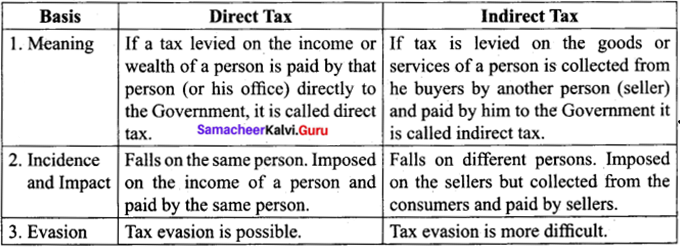
Tamil Nadu 11th Commerce Previous Year Question Paper June 2019 English Medium - 1

Question 40.
Name the partner who has not completed 18 years of age. Can he be admitted into partnership? Why?
Answer:
The partner who has not completed the age of 18 is known as minor partner. He can be admitted into the partnership for. the benefit of the firm. But a minor has no contractual capacity. The consent of all partners is a ‘must’ for such admission.

Part – D

Answer all the questions. [7 x 5 = 35]

Question 41(a).
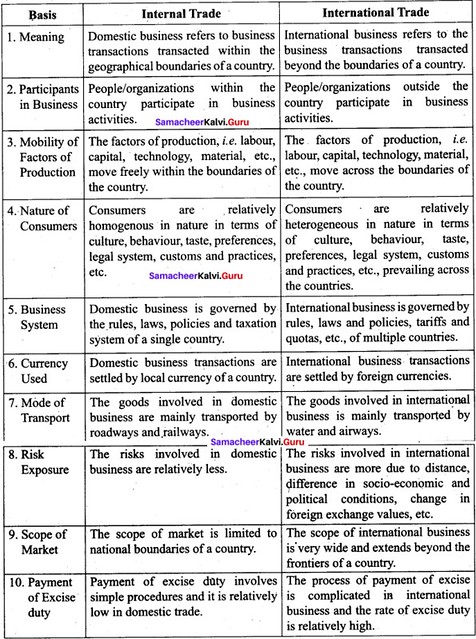
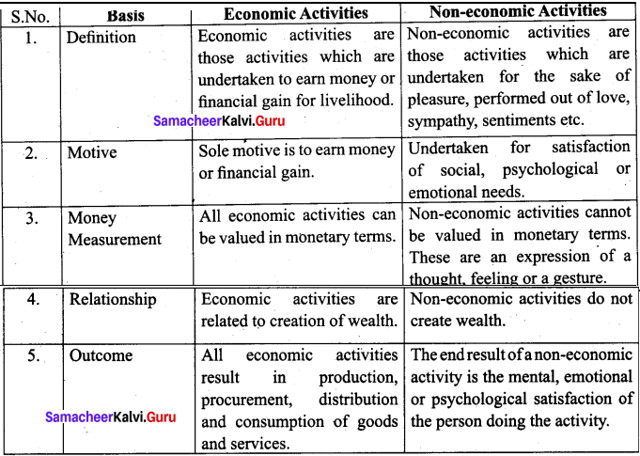
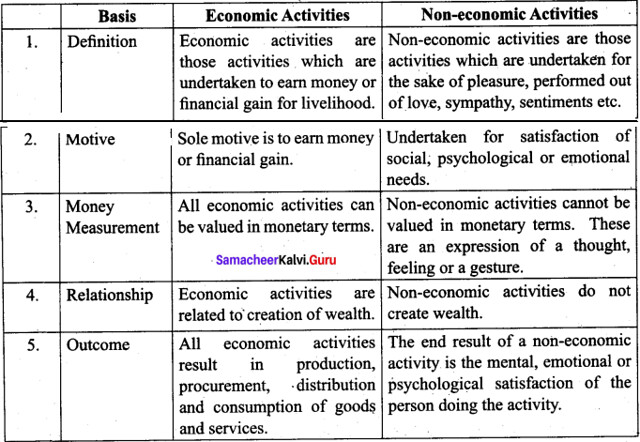
Distinguish between economic and non-economic activity. (Any five)
Answer:
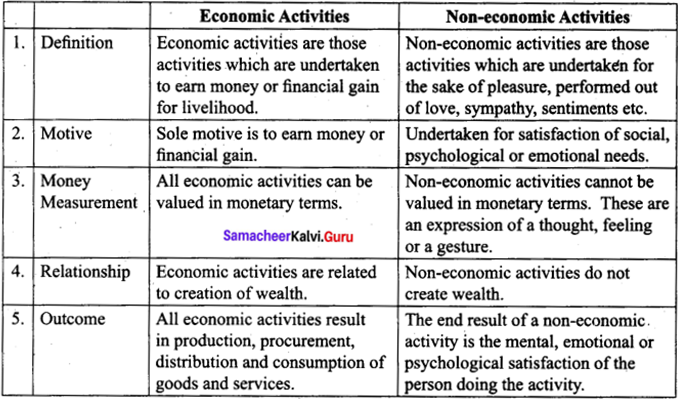
Tamil Nadu 11th Commerce Previous Year Question Paper June 2019 English Medium - 2

[OR]

Question 41 (b).
Enumerate any five disadvantages of International trade.
Answer:
1. Economic Dependence:
International trade is more likely to make the country too much dependent on imports from foreign countries. The former may not take any efforts to produce goods and services indigenously to substitute.imported goods and thus becoming self sufficient.

2. Inhibition of Growth of Home Industries:
International business may discourage the growth of indigenous industry. Unrestricted imports and severe competition from foreign companies may ruin the home industries altogether.

3. Import of Harmful Goods:
International business may lead to import of luxurious goods, spurious goods, dangerous goods, etc. It may harm the well-being of people.

4. Shortage of Essential Goods in Home Country:
The export of essential commodities out of the greed of earning more foreign exchange may result in absolute shortage of these goods at home country and people may have to buy these commodities at exorbitant price in the local market.

5. Misuse of Natural Resources:
Excessive export of scarce natural resources to variotis countries across the world may lead to faster depletion of the resources in the exporting countries.

Tamil Nadu 11th Commerce Previous Year Question Paper June 2019 English Medium

Question 42 (a).
Explain the characteristics of sole trading business.
Answer:

  • Ownership by one man:
    This is owned by single person. The sole trader contributes the required capital. He is not only the owner of the business but also manages the entire affairs.
  • Freedom of work and Quick Decisions:
    Since an individual is himself as a owner, he need not consult anybody else. Hence he can take quick decisions.
  • Unlimited Liability:
    When his business assets are not sufficient to pay off the business debts he has to pay from his personal property.
  • Enjoying Entire Profit:
    He strives tirelessly for the improvement and expansion of his business and enjoys all the benefits of his hard work.
  • Absence of Government Regulation:
    A sole proprietor concern is free from Government regulations. No legal formalities are to be observed in its formation, management or in its closure.
  • No Separate Entity:
    The sole trading concern comes to an end with death, disability, insanity and insolvency of the individual.
  • Maintenance of Secrecy:
    Since he / she manages all the affairs of the business, the secrecy can be maintained easily.

[OR]

Question 42 (b).
Mention any five functions of wholesaler.
Answer:
Following are the functions of wholesalers:

  • Collection of Goods:
    Wholesaler collects the goods from manufacturers or producers in bulk.
  • Storage of Goods:
    Wholesaler collects and stores them safely in warehouses, till they are sold out.
  • Distribution:
    Wholesaler sells goods to different retailers. Thus he performs the function of distribution.
  • Financing:
    Wholesalers provide financial support to producers and manufacturers by providing money in advance to them.
  • Risk Taking:
    Wholesaler buys finished goods from the producer and keeps them in the warehouses till the time they are sold and assumes.the risk arising from price, spoilage of goods, and changes in demand.

Tamil Nadu 11th Commerce Previous Year Question Paper June 2019 English Medium

Question 43(a).
Explain the principles of insurance.
Answer:
1. Utmost Good Faith:
According to this principle, both insurer and insured should enter into contract in good faith. Insured should provide all the information that impacts the subject matter. Insurer should provide all the details regarding insurance contract.

2. Insurable Interest:
The insured must have an insurable interest in the subject matter of insurance. Insurable interest means some pecuniary interest in the subject matter of the insurance contract.

3. Indemnity:
Indemnity means security or compensation against loss or damages. In insurance, the insured would be compensated with the amount equivalent to the actual loss and not the amount exceeding the loss. This principle ensures that the insured does not make any profit out of the insurance. This principle of indemnity is applicable to property insurance alone.

4. Causa Proxima:
The word ‘Causa proxima’ means ‘nearest cause’. According to this principle, when the loss is the result of two or more cause, the proximate cause, i.e. the direct. The direct, the most dominant and most effective cause of loss should be taken into consideration. The insurance company is not liable for the remote cause.

5. Contribution:
The same subject matter may be insured with more than one insurer then it is known as ‘Double Insurance’. In such a case, the insurance claim to be paid to the insured must be shared on contributed by all insurers in proportion to the sum assured by each one of them.

6. Subrogation:
Subrogation means ‘stepping the shoes on others’. According to this principle, once the claim of the insured has been settled, the ownership right of the subject matter of insurance passes on to the insurer.

7. Mitigation:
In case of a mishap, the insured must take off all possible steps to reduce or mitigate the loss or damage to the subject matter of insurance.

[OR]

Question 43 (b).
Difference between Contract and Agreement.
Answer:
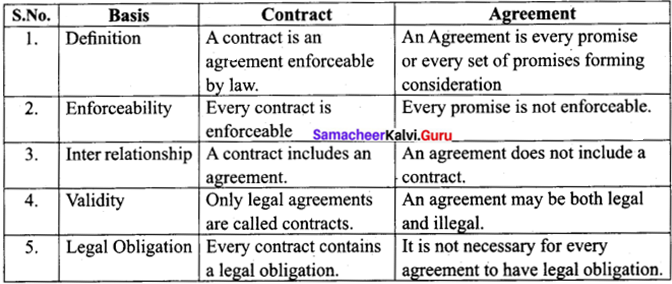
Tamil Nadu 11th Commerce Previous Year Question Paper June 2019 English Medium - 3

Question 44(a).
Explain the different key elements of business ethics.
Answer:
1. Top Management Commitment:
Top management has a very important role to guide the entire organization towards ethical behaviour. The top level personnel in any organisation should work openly and strongly committed towards ethical conducts and guide people working at’ middle and low level to follow ethical behaviour.

2. Establishment of Compliance Mechanism:
To make sure that actual decisions match with a firm’s ethical standards, suitable mechanism should be established.

3. Publication of a “Code”:
Generally organisations formulate their own ethical codes for the conduct of the enterprise; it should followed by the employees of the organisation. The organisation principles are defined in the written document called code.

4. Involving Employees at All Levels:
It is the employees at different levels who implement ethics policies to make ethical business a reality. Therefore, their involvement in ethics programmes becomes a must.

5. Measuring Results: .
The organisations from time to time keep a check on ethical practise followed. Although it is difficult to accurately measure the end results of ethics programmes, the firms can certainly audit to monitor compliance with ethical standards.

[OR]

Question 44(b).
Write any five advantages of Co-operative Society.
Answer:

1. Voluntary organisation:
The membership of a co-operative society is open to all. Any person with common interest can become a member. The membership fee is kept low so that everyone would be able to join and benefit from co-operative societies.

2. Easy formation:
Co-operatives can be formed much easily when compared to a company. Any 10 members who have attained majority can join together for forming a co-operative society by observing simple legal formalities.

3. Democracy :
A co-operative society is run on the principle of ‘ one man one vote ‘. It implies that all members have equal rights in managing the affairs of the enterprises.

4. Equal distribution of surplus:
The surplus generated by the co-operative societies is distributed in an equitable manner among members. Therefore all the members of the co-operative society are benefited.

5. Limited liability:
The liability of the members in a co-operative society is limited to the extent of their capital contribution. They cannot be personally held liable for the debts of the society.

Tamil Nadu 11th Commerce Previous Year Question Paper June 2019 English Medium

Question 45 (a).
Answer any five salient features of Government Company.
Answer

1. Registration Under the Companies Act:
A Government company is formed through registration under the Companies Act, 1956; and is subject to the provisions of this Act, like any other company. However, the Central Government may direct that any of the provisions of the Companies Act shall not apply to a Government company or shall apply with certain modifications.

2. Executive Decision of Government:
A Government company is created by an executive decision of the Government, without seeking the approval of the Parliament or the State Legislature.

3. Separate Legal Entity:
A Government company is a legal entity separate from the Government. It can acquire property; can make contracts and can file suits, in its own name.

4. Whole or Majority Capital Provided by Government:
The whole or majority (at least 51 %) of the capital of a Government company is provided by the Government; but the revenues of the company are not deposited into the treasury.

5. Majority of Government Directors:
Being in possession of a majority of share capital, the Government has authority to appoint majority of directors, on the Board of Directors of a government company.

[OR]

Question 45 (b).
Describe the benefits of outsourcing.
Answer:

1. Focusing on Core Activities:
Companies can focus on their core competence, a few areas where the company has distinct capability. The rest of the activities (non-core) can be outsource to outside agencies.

2. To Fill up Economic Development:
Outsourcing stimulates entrepreneurship, encourages employment opportunities, expands exports, enables tremendous growth of the economy.

3. Encourages Employment Opportunities:
Companies that are outsourcing their non core activities provide chances for other small business units to take up the activities. This paves way for more job opportunities and new employment avenues.

4. Reduction in Investment:
Companies through outsourcing avails the services of outsiders which in turn reduces the investment requirements. The amount so available can be utilized productively and this increases the profits.

5. Quest for Excellence:
Outsourcing enables the firms to pursue excellence in two ways namely excelling themselves in the activities they do and excel outsiders by extending their capabilities through contracting out.

Question 46(a).
Explain any five different kinds of warehouses.
Answer:
Different kinds of warehouses on the basis of ownership:

  • Private Warehouses:
    Private warehouses are built and owned by private business enterprises in order to store the products produced by them.
  • Government Warehouses:
    They are created and operated by the Government to implement the programmes of the Government.
  • Public Warehouse:
    It is open for public at large. Most of the business organisations, especially small and medium scale units cannot afford to have their own warehouses.
  • Co-operative Warehouses:
    There are warehouses owned and managed by the marketing co-operative societies or agricultural co-operative societies. They are setup to provide warehousing facilities to their members.
  • Bonded Warehouses:
    Bonded warehouses are those warehouses, which are licensed by the government to accept storage of imported goods which are not cleared due to non-payment of customs duty by the importer.

[OR]

Question 46 (b).
Distinguish between GDR and ADR.
Answer:
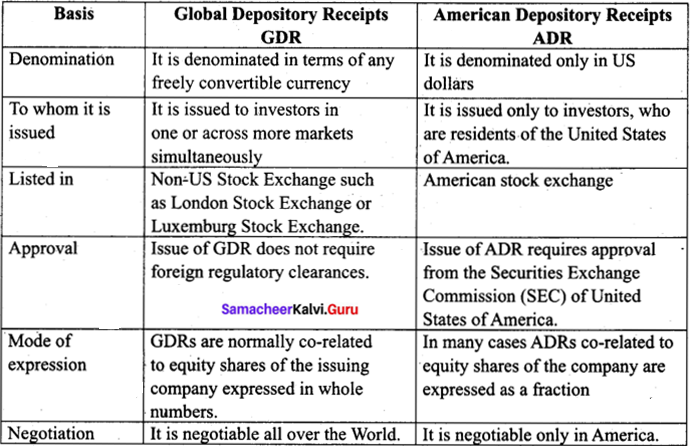
Tamil Nadu 11th Commerce Previous Year Question Paper June 2019 English Medium - 4

Tamil Nadu 11th Commerce Previous Year Question Paper June 2019 English Medium

Question 47 (a).
A number of identical retail shops with similar appearance normally deal in standardised and branded products. Name the shop and explain its features.
Answer:
The name of the shop is Chain Stores or Multiple Shops. A number of same type of retail shops with similar appearance, selling branded products is known as multiple shops.
Features:

  • Location:
    These shops are located in fairly populous localities.
  • Nature of product:
    These shops deal in a particular line of products only. Also they specialise in the same product.
  • Centralised management:
    The goods’ are purchased by the head office and despatched’ to all the shops.
  • Fixed price:
    The price of the goods are fixed and goods are sold on cash basis.
  • Role of Sales personnel:
    The sales persons play an active role in helping the consumers to complete their shopping.

[OR]

Question 47 (b).
Who are the intermediaries involved in Import trade? Explain about them.
Answer:
Intermediaries in Import Trade:
1. Indent Houses / Import Agent:
This intermediary is specialized in a particular trade. He charges fees for his service. Importer has to enter into contract with indent house to avail himself of his service.

Services rendered by Indent Houses/Import Agent:

  • Helping the importer to get orders from foreign countries.
  • Providing information about the availability of goods and arranging the letter of credit facilities to importer.
  • Maintaining regular contact with the exporter to obtain sample.

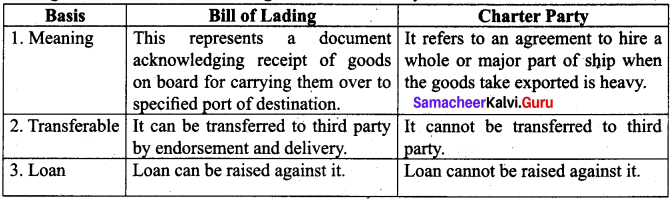
2. Clearing Agent- Clearing Agent is specialised in clearing the goods from the port of discharge destination and transport it over to the importer. They fulfill the various custom formalities on behalf of the importer and get the goods cleared from the port. They charge commission for their service.
Tamil Nadu 11th English Model Question Paper 2

Students can Download Tamil Nadu 11th English Model Question Paper 2 Pdf, Tamil Nadu 11th English Model Question Papers helps you to revise the complete Tamilnadu State Board New Syllabus and score more marks in your examinations.

TN State Board 11th English Model Question Paper 2

Instructions:

  1.  The question paper comprises of four parts.
  2.  You are to attempt all the parts. An internal choice of questions is provided wherever applicable.
  3. questions of Part I, II. III and IV are to be attempted separately
  4. Question numbers 1 to 20 in Part I are objective type questions of one -mark each. These are to be answered by choosing the most suitable answer from the given four alternatives and writing the option code and the corresponding answer
  5. Question numbers 21 to 30 in Part II are two-marks questions. These are to be answered in about one or two sentences.
  6. Question numbers 31 to 40 in Parr III are three-marks questions, These are to be answered in about three to five short sentences.
  7. Question numbers 41 to 47 in Part IV are five-marks questions. These are to be answered) in detail. Draw diagrams wherever necessary.

Time: 3.00 Hours
Maximum Marks: 90

PART – I

I. Answer all the questions. [20 x 1 = 20]
Choose the correct synonym for the underlined words from the options given.

Question 1.
Her rebuke was a sting to her daughter.
(a) scolding
(b) rebuttal
(c) praise
(d) congratulated
Answer:
(a) scolding

Question 2.
It was an effort that involved perseverance.
(a) feebleness
(b) persistence
(c) fragility
(d) shabbiness
Answer:
(b) persistence

Question 3.
I was not accustomed to the erratic climate.
(a) familiar
(b) unusual
(c) adopted
(d) ordained
Answer:
(a) familiar

Tamil Nadu 11th English Model Question Paper 2

Choose the correct antonym for the underlined words from the options given.

Question 4.
Only a few hours before the last chapter of her life she had omitted to pray.
(a) included
(b) rejected
(c) isolated
(d) contracted
Answer:
(a) included

Question 5.
The auctioneer built up the crescendo gradually.
(a) swelling
(b) zenith
(c) base
(d) curvature
Answer:
(c) base

Question 6.
A methodical learning will fetch best results.
(a) systematic
(b) disciplined
(c) chaotic
(d) perfect
Answer:
(c) chaotic

Question 7.
Choose the unclipped form of “movie”.
(a) moviepic
(b) moving picture
(c) movepie
(d) movietrails
Answer:
(b) moving picture

Question 8.
Choose the right definition for the given term “tautology”.
(а) A collection of selected literary passages
(b) Useless repetition
(c) One who adheres to the letter of the Koran, rejecting all traditions
(d) One who relates or collects anecdotes
Answer:
(b) Useless repetition

Question 9.
Choose the meaning of the idiom ‘Make a long story short’.
(a) Someone who lacks intelligence
(b) To understand the situation well
(c) A rare happening
(d) Come to the point – leave out details
Answer:
(d) Come to the point – leave out details

Question 10.
Choose the meaning of the foreign word in the sentence.
I planned to go downtown to meet with Betty, but I ran into a glitch.
(a) gutter
(b) slush
(c) small problem
(d) difference of opinion
Answer:
(c) small problem

Tamil Nadu 11th English Model Question Paper 2

Question 11.
Choose the word from the options given to form a compound word with “quarters”.
(a) neck
(b) school
(c) bottle
(d) head
Answer:
(d) head

Question 12.
Form a new word by adding a suitable suffix to the root word, “associate”.
(a) ly
(b) ness
(c) ion
(d) or
Answer:
(c) ion

Question 13.
Choose the expanded form of “DoT”.
(a) Department of Telecommunications
(b) Department of Tailors
(c) Director Of Tele-evangelists
(d) Department of Televisions
Answer:
(a) Department of Telecommunications

Question 14.
The correct syllabification of the word “adventurous” is
(a) ad-vent-ur-ous
(b) a-d-vent-u-rous
(c) ad-ven-tur-ous
(d) adven-tu-rous
Answer:
(c) ad-ven-tur-ous

Question 15.
Fear of high buildings is known as………..
(a) Batophobia
(b) Buillophobia
(c) Nyctophobia
(d) Topophobia
Answer:
(a) Batophobia

Question 16.
Fill in the blank with the suitable preposition.
He handed over the answer script ………….. the warning bell.
(a) behind
(b) over
(c) before
(d) on
Answer:
(c) before

Question 17.
Add a suitable question tag to the following sentence.
He never met anyone, ……….?
(a) didn’t he
(b) won’t he
(c) did he
(d) hasn’t he
Answer:
(c) did he

Question 18.
Choose the correct sentence pattern.
The children speak courteously.
(a) SVA
(b) SVOC
(c) SVOA
(d) SVC
Answer:
(a) SVA

Question 19.
Substitute the phrasal verb in the sentence with a single word.
It is really difficult to put up with a short-tempered person.
(a) oppose
(b) accept
(c) deny
(d) tolerate
Answer:
(d) tolerate

Tamil Nadu 11th English Model Question Paper 2

Question 20.
Fill in the blank with the suitable relative pronoun.
The dress ……… she bought yesterday are already stained.
(a) which
(b) that
(c) when
(d) whose
Answer:
(b) that

PART – II

II. Answer any seven of the following: [7 × 2 = 14]
(i) Read the following sets of poetic lines and answer any four of the following. [4 x 2 = 8]

Question 21.
“To her fair works did Nature link
The human soul that through me ran;”
(а) How does the nature connect to the soul of the poet?
(b) Identify the figure of speech.
Answer:
(a) The beauty of nature established a connection with the soul of the poet.
(b) Personification.

Question 22.
“ When officialdom demands Is there a doctor in the stands?”
(a) Why are doctors called from stands by the sponsors?
(b) Why does the poet make such an observation?
Answer:
(a) The doctors are called from the stands by the sponsors to attend to a badly hurt and bleeding athlete.
(b) The poet does not wish to swap place with either heroes or victims of brutal sports. So, he makes this remark.

Question 23.
“There was a time indeed
They used to shake hands with their hearts”
(a) Explain “Shake hands with their hearts”.
(b) Discuss the appropriateness of the term “used to” here?
Answer:
(a) The heart is a symbol of genuine emotions. The poet recalls the time when people used to smile and shake hands with their hearts. Now, things have become different.
(b) The word “used to” denotes a past discontinued action. Hence the term is appropriately used in this context.

Question 24.
‘‘And yet not so – for what can we bequeath Save our deposed bodies to the ground?”
(a) Why is the speaker sad?
(b) Identify the figure of speech.
Answer:
(a) The speaker (i.e.) king Richard II knows that he has nothing except his dead body to leave behind. So, he is sad.
(b) Metaphor

Question 25.
“If must have been Macavity! ’but he’s a mile away.”
(a) What is Macavity blamed for?
(b) Where is he?
Answer:
(a) Macavity is blamed for most of the crimes which leave the Scotland police and flying squad fuming and fretting because he just vanishes after every crime is committed. Besides, he leaves no proof or evidence behind.
(b) He is in a by-street or in the square when a crime is discovered. He always has one or two alibi.

Question 26.
“Honour is a property, common to all:
In dignity and pride no one need to be poor.”
(а) Who are considered rich?
(b) What is their asset?
Answer:
(a) Those who possess dignity and pride are considered rich.
(b) Honour is their asset.

Tamil Nadu 11th English Model Question Paper 2

(ii) Do as directed (any three) [3 × 2 = 6]

Question 27.
Report the following dialogue:
Srikanth : Doctor, a bee stung me. The pain is unbearable.
Doctor : Do not worry. I will apply some cream on it.
Answer:
Srikanth told the doctor that a bee had stung him and added that the pain was unbearable. The doctor advised him not to worry and added that he would apply some cream on it.

Question 28.
I drop this doll. It will break. (Combine using ‘If’).
Answer:
If I drop this doll, it will break.

Question 29.
Rewrite the sentence making an inversion in the conditional clause.
If I won the lottery, I would travel the world.
Answer:
Were I to win the lottery, I would travel the world.

Question 30.
He admitted his guilt. (Transform this sentence into a complex sentence)
Answer:
He admitted that he was guilty.

PART – III

III. Answer any seven of the following: [7 × 3 = 21]
(i) Explain any two of the following with Reference to the Context: [2 × 3 = 6]

Question 31.
Never shall we fail in what we commit,
Shall nourish the ones that nourish the world.
Answer:
Reference: These lines are from the poem “Everest is not the Only Peak” written by Kulothungan.

Context: The poet says these words about unsung heroes who are committed to the cause of sustaining those who sustain the world.

Explanation: Farmers nourish the people with food grains. Teachers nourish children’s minds with noble thoughts and inspire them to strive for the progress of the country. The poet claims simple people nourish those who nourish the world.

Question 32.
Athletes, I’ll drink to you,
Or eat with you,
Or anything except compete with you…
Answer:
Reference: These words are from the poem “Confessions of a Bom Spectator” written by Ogden Nash.

Context: The poet says these while contemplating the probability of swapping places with them.

Explanation: The poet has limp and bashful spirit which feeds on other people’s heroic deeds. The zealous players maim one another to win laurels. The thrill and excitement of all kinds of sports and games pleases the poet but he is wise enough to stay out and be a spectator because he has modest of physiques. He admits he would rather share a drink with them in a pub or dine with them in a restaurant. He is even ready to buy the most expensive tickets, as expensive as radium, to see them play the rough games but never compete with them.

Tamil Nadu 11th English Model Question Paper 2

Question 33.
I have learned to wear my faces
Like dresses …
Answer:
Reference: These lines are from the poem “Once Upon a Time” written by Gabriel Okara.

Context: The poet says these words while admitting how he himself started putting oni appearances to conform to the changed attitude of people in modem times.

Explanation: The poet registers his displeasure over the negative changes that have influenced the behaviour of adults. The adults have mastered the art of changing their facial expressions according to the situations merely to ensure social acceptance. The poet also has started wearing faces like dresses, changing them according to fashion and season and almost daily. He regrets his hypocrisy but is helpless.

(ii) Answer any two of the following questions briefly: [2 x 3 = 6]

Question 34.
How was Mary Kom felicitated on her return to India?
Answer:
On her return, Mary Kom was given a warm welcome at the airport. Back at Imphal, she was greeted with garlands, drumbeats and dancing. There was a victory procession across the town. A felicitation programme was held at Langol. People showered her with rich encomiums. She was presented with a traditional shawl..

Question 35.
Who does the speaker claim to represent?
Answer:
The speaker wishes to represent some of the cardinal principles enunciated by those who offered to graduates in the past. He remarks that his speech would bear the layman’s point of view to the findings of experts in various fields of education. He promises to annotate the speeches of great educationists for the benefit of the graduates.

Question 36.
What was the reaction of Bryson’s wife to his antics?
Answer:
Mrs. Bryson saw the quixotic behaviour of her husband. She was neither angry nor exasperated. But she just expressed her deep sense of wonder. She said, ‘I can’t believe you do this for a living”.

Tamil Nadu 11th English Model Question Paper 2

(iii) Answer any three of the following questions briefly: [3 x 3 = 9]

Question 37.
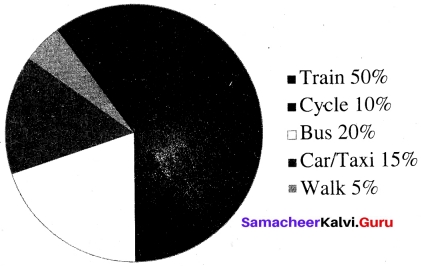
Study the pie-chart and answer the questions that follow:
People taking different modes of transport in Chennai
Tamil Nadu 11th English Model Question Paper 2 1
Questions.

  1. What percent of people travel by Bus?
  2. Which mode of transport is used by the least percentage of people?
  3. Which mode of transport is taken by the maximum number of people?

Answer:

  1. Twenty percent of people travel by Bus.
  2. Walking is used by the least percentage of people.
  3. Train is taken by the maximum number of people.

Question 38.
Build a dialogue of minimum three exchanges between a parent and a School Principal.
Answer:
Parent : Good morning Sir, I was told that you wanted to meet me.
Principal : Good morning. Please sit down. Your son has got excellent drawing skills.
Parent : I am really glad to hear it.
Principal : I have given him the address of a nearby Art school.
Parent : Thanks Sir, 1 shall send him in the week ends.
Principal : This is a cheque for his fees there.
Parent : Thank you so much sir.
Principal : He has earned it. He only painted all the boards. He will become a great artist one day.

Question 39.
Describe the process of editing a video clip.
Answer:

  1. Transfer the video clip to be edited to the computer.
  2. Go to the folder or location and right-click on the video.
  3. Select open with and a drop down menu will appear.
  4. Click photos application. The video will open in the photos app.
  5. Click edit and create. This option will be found in the top-right comer of the window. Click create a movie with text.
  6. Name the video.
  7. Drag the movie clip to the editing area and edit the video. Many options are available to edit in the ‘storyboard section’.
  8. Once the editing is complete save the file.

Question 40.
Complete the proverbs using the words given below.
(a) Don’t judge a book by its (author, cover, colour)
(b) Strike while the iron is (hot, wet, cold)
(c) Too many cooks spoil the (recipe, dish, broth)
Answer:
(a) cover
(b) hot
(c) broth

Tamil Nadu 11th English Model Question Paper 2

PART – IV

IV. Answer the following: [7 × 5 = 35]

Question 41.
How does the author prove that absent-mindedness is a boon as well as a bane?
Answer:
Absent – mindedness of people shocked the author when the Railway department published the list of lost articles. It was startling to note that young people forget bats, balls etc. The author attributes it to the abundant imagination and dreams. They are citizens of dreamland. Anglers also forget their fishing rods. Absent – mindedness is often a blessing in disguise. People can forget their unhappiness and live in a world of Utopia. Great thinkers, poets and philosophers are absent – minded because their minds are full of lofty ideas and imagination.

Socrates the philosopher and S.T. Coleridge the poet were absent – minded people. Similarly, Politicians have bad memories. States are yet to produce ideal statesmen who can remember their promises after winning the elections. Great writers, composers of music have amazingly great memories. Memory is half the substance of their art. Once a father took his baby out in a perambulator in the morning. He walked into a pub to have a glass of beer. The child was sitting in the perambulator outside in the street. After sometime, his wife came that way for shopping. She was shocked to find her baby sleeping in the perambulator.

She decided to teach her husband a lesson. She took the baby home. She expected her husband to come and apologize for losing the child. But he just walked in and casually asked his wife cheerfully what was there for lunch. Very few people like Einstein or Socrates would be capable of such absent-mindedness. Men should forget unpleasant things and remember pleasant things. Thus Absent – mindedness is both a boon and a bane.

[OR]

How does the speaker highlight the importance of giving back to the society?
Answer:
The graduates have drawn largely from the social chest. The largest taken from the society needs to be replenished. If graduates fail to pay back, ordinary people’s coffer will be empty. The supervisor’s education enjoins greater responsibility to society. Apart from their own individual advancement, society has got a right to expect an adequate return from the graduates.

The society does not expect them to payback in cash. But they must pay back in terms of service. They should tone up the society by bringing a light into the dark alleys. They should herald sunshine into dingy places. They must give solace to the affiliated people. They should also give hope unto the despondent and thus ensure a new life unto everyone.

Question 42.
‘Face is the index of the mind.’ Does this adage concur with the views of the poet?
Answer:
Unlike the people of the past, people in modem times “laugh only with their teeth” while their ice-block cold eyes search for something. Now, people shake hands without hearts. There is no human warmth in social relations. While they shake hands, they look for evidences to judge the financial status of a person. People say ‘feel at home’ and ‘come again’. But if a person visits a third time he is not welcomed. They all have cocktail faces ready for all occasions. Their conforming smiles are like fixed portrait smiles.

They wear standard, deceitful, artificial smile for all occasions. They have faces like masks. The poet has learnt from them how to use faces like dresses, home face, office face, street face, host face etc. Their faces, like the teeth of the elephant, show only what is accepted. The ugly side of their personality is cleverly hidden behind their deceitful smiles and polite words. So, the poet’s views do not concur with the adage “Face is the index of the mind”.

Tamil Nadu 11th English Model Question Paper 2

[OR]

In what way is every hillock similar to Everest?
Answer:
The poet does not compare rare feats of athletes, mountaineers or horsemen. He does not attach great value to positions or possessions. He scoffs at those who pull strings to achieve their ends. The means must justify the ends. One should not stoop to underhand dealings to-achieve their desired goals in life.

Those who reach great heights in life like Everest due to their hard work, perseverance and competence are adorable. At the same time those who trek any small hillocks can’t be underestimated. The efforts made in reaching even the smallest positions in life, if done with sincerity of purpose and deep devotion, is worthy of hearty appreciation. One who holds a humble position, but upright and serves as a ladder for fellow humans to reach great heights deserves our respect.

The poet admits that he is proud of people’s humble positions because their pride springs not from positions or possessions but the way they live. Their life knows no bending. The poet just doesn’t bother the height of the peak one reaches. It could even be a hillock. What matters is how one reaches that spot. If merit and competence have paved the way for their success and positions, however humble they are, the poet admires them.

Question 43.
Write a paragraph (150 words) by developing the following hints.
A policeman – dow n the street – checking doors – a man standing – stops to talk – about the childhood friends who agreed to meet – after 20 years – his friend there shows up – how each of them has changed – The criminal – arrested, and the undercover cop says – 20 years – change a good man into a criminal.
Answer:
The short story “After Twenty Years” takes place around 10 p.m. along a dark, windy New York City business avenue, mostly within the darkened doorway of a closed hardware store. This particular location had been a restaurant until five years ago. The plot begins with a policeman “on the beat” who discovers a man standing in the dark doorway.

The man then proceeds to explain why he is there. He and his best friend, Jimmy Wells had parted exactly twenty years ago to make their fortunes and had promised to meet at that spot “After Twenty Years”. He had gone west and gotten rich and was sure his friend, Jimmy would meet him if he were alive. They talked a while and the policeman carried on. The man from the west wonders if his friend will come. The drama increases in anticipation of the rendezvous.

Twenty minutes later, another man, whom we assume is his long lost friend, greets him warmly and they walk arm in arm discussing careers until they come to a well-lit comer near a drug store. The man from the west gets a good look at his companion and discovers that he is not his friend, Jimmy. We are treated to several surprises for the man from the west is under arrest and secondly he is actually ‘Silky Bob’, a gangster from Chicago and finally the stranger is a plainclothes policeman. However, it seems that these three surprises are not enough. We get the “real” surprise when Jimmy Wells, the original policeman didn’t have the heart to arrest Bob, because he was his friend.

[OR]

Narrator – wants – photograph – photographer wait for an hour – comments – angry – called on Saturday – proof – Narrator shocked – photograph – not like him – worthless bauble.
Answer:
‘With the Photographer’ by Stephen Leacock is narrated in the first person. The narrator while sitting in the photographer’s studio begins to read some magazines and sees how other people look and the narrator begins to feel insecure about his appearance. It is also noticeable that the photographer takes a dislike to his face judging it to be wrong. What should have been a simple process of taking a photograph becomes something of a nightmare for the narrator.

How confident the narrator becomes is noticeable when he returns to the photographer’s studio the following Saturday. He realises that the photograph that has been taken of him looks nothing like him. This angers the narrator as he was simply looking for a photograph that would show his likeness. He accepts that he may not be to everybody’s liking when it comes to his physical appearance but is angered by the changes made. The photographer has retouched the photograph so much that the narrator does not recognise himself.

The end of the story is also interesting as the reader realises that it is just a worthless bauble when he begins to cry. He has been judged solely by his appearance by the photographer whose job was to simply take a life like photograph.

Tamil Nadu 11th English Model Question Paper 2

Question 44.
Write a summary or Make notes of the following passage.
Any polished surface which reflects light is a mirror. Most mirrors are made of smooth glass. These glass strips are backed with a very thin layer of aluminium. Not all mirrors are flat. Convex mirrors bulge outwards. They make things look smaller. But they give us a wider view. They are often used as driving mirrors in cars. They are also used as security mirror in shops. Concave mirrors curve in wards. They are used as shaving mirrors, because they magnify things which are close. With distant things, they produce a tiny upside – down image. In large telescopes they are used to collect and focus the light.
Answer:
Summary
No. of words given in the original passage: 108
No. of words to be written in the summary: 108/3 = 36 ± 5

Rough Draft
A polished surface of glass that reflects light is a mirror. Convex mirror provide wider view and used as driving and security mirrors They make things look smaller. Concave mirrors magnify closer objects and hence used as shaving mirrors and in telescope to focus light.

Fair Draft
Mirrors
A polished surface of glass that reflects light is a mirror. Convex mirror provide wider view and used as driving mirrors and security mirrors. Concave mirrors magnify closer objects and hence used as shaving mirrors and in telescope to focus light.
No. of words in the summary: 41

[OR]

Notes
Title: Mirrors
Answer:
Different kinds of mirrors
Polished surface reflecting light-made of smooth glass-glass strips backed with thin layer of Aluminium.

Convex mirrors
Bulge outwards-make things look smaller-wider view-driving mirrors-security mirrors in shops.

Concave mirrors
Curve inwards-used as shaving mirrors-magnify close things-distant images upside down-large telescope used.

Question 45.
Write a letter to the Postmaster of your area informing him of the change of address.
Answer:
3rd Oct, 20xx
From
V. Sriram,
8, South street,
Karuppur Village,
PIN XXXXXX.

To
The Postmaster, .
Post Office,
Karuppur Village,
PIN XXXXXX
Sir,
Sub: Regarding changes of address.

I was earlier living in 15, Car street. We shifted our residence to 8, South street last week. Hence, I request you to redirect all letters, addressed to my former address to this new address.

Thanking you,
Yours Sincerely,
V. Sriram.
Address on the Envelope
To
The Postmaster,
Post Office
Karuppur Village
PIN XXXXXX

Tamil Nadu 11th English Model Question Paper 2

[OR]

Write an essay in about 150 words on ‘Disaster Management in India’.
Answer:
Disaster Management in India
National Institute of Disaster Management is a premier national institute. It trains people for capacity development programmes for managing natural disasters in India. The NIDM works under government’s directives to train and conduct checks to regulate effective earthquake and disaster control policies. Recently, Delhi witnessed One of the biggest mega mock drills conducted by the NIDM in India.

The buildings and infrastructures in India are quite vulnerable to calamities. They can’t withstand the rigours of a natural calamity. The Tsunami disasters in South India expose the unpreparedness and lack of skills in disaster management. The havoc caused by the floods and landslides in Kerdamath only underlines our weakness or inefficiency in tackling natural disaster on such a scale.

The NIDM can take due credit for its efficient work done during the ‘Hudhud’ cyclone. The cyclone struck the coastal areas of Andhra and Odisha. Proper warning and early evacuation in the affected areas limited losses and casualties. But again the NIDM proved quite ineffective when unprecedented floods rocked Srinagar and other parts of Jammu and Kashmir. It was the army and not the NIDM that stole the limelight by evacuating lakhs of marooned people and saving their lives.

The NIDM has a long way to go. It must prepare itself as a body that can cope with natural disasters with professional skills and efficiency.

Question 46.
Read the following sentences, spot the errors and rewrite the sentences correctly.
(a) Divide this apples among Rohith and Dhanush.
(b) I go to school on bus.
(c) Suguna is now free of danger.
(d) One of the boys are missing.
(e) Many students has turned up for the seminar.
Answer:
(a) Divide these apples between Rohith and Dhanush.
(b) I go to school by bus. .
(c) Suguna is now free from danger.
(d) One of the boys is missing.
(e) Many students have turned up for the seminar.

[OR]

Fill in the blanks appropriately.
(a) He had no ………. I gave him a………of advice. (Piece / Peace)
(b) Vanitha…………go to temple on Fridays , when she was young. (Semi-modal)
(c) ………. rain, they continued to play the match. (Linker / phrase)
(d) The milkman ……… (knock) the door at the moment. (Use the verb in the correct form) .
Answer:
(a) peace, piece
(b) used to
(c) In spite of
(d) is knocking

Tamil Nadu 11th English Model Question Paper 2

Question 47.
Identify each of the following sentences with the fields given below.
(a) The hybrid between lemon and pomegranate was unbelievably marvellous.
(b) The State Government has introduced QR code to enhance the quality of learning.
(c) The bird flu virus took a huge toll of lives in Philippines.
(d) Due to virus, the system became slow.
(e) Prakash Javadekar MHRD minister introduced a new scheme for empowerment of women.
(Politics, Computer, Agriculture, Education, Health)
Answer:
(a) Agriculture;
(b) Education;
(c) Health;
(d) Computer;
(e) Politics

[OR]

Read the following passage carefully and answer the questions that follow.
The first flags were probably hoisted in China. People flew flags in China over 4,000 years ago. Each part of the army had its own flag so the soldiers could see their leaders. Early flags were sticks of wood. They had pictures cut into the wood. Iran had metal flags about 3,000 years ago. Old Greek coins show pictures of flags. People in Rome also used flags over 2,000 years ago. People first made flags of cloth about 2,000 years ago. Those flags looked like today’s flags. Flags are important at sea. Most ships fly their own country’s flag and the flag of the country they are visiting. When a ship flies only its own flag, it is ready to fight.

Every country now has a flag. Every U.S. state has a flag. Clubs, teams, and schools have flags. The Olympics has a flag. The Olympics flag has five rings of five colours. Each ring stands for, or represents, a continent. It means that people from five continents – Africa, Asia, Europe, North America and South America – come to play. Railway lines also use flags. Railway flags tell the trains what to do. For example, a red flag tells the train to stop, just like a stop sign. A blue, white, or green flag tells the train that it can go. A blue flag on the side of a train means someone is working on the train. It means nobody can move the train.
Questions.

  1. How many flags do most ships fly?
  2. What were the first flags made of ?
  3. Does every country have a flag?
  4. Mention the role of a railway flag.
  5. Describe the Olympic flag.
  6. Answer:
  7. Most ships fly two flags. One is of their own country and another is that of the country it intends to visit.
  8. The first flags were made of sticks of wood.
  9. Yes, every country has a flag.
  10. A railway flag directs a train to stop or move forward. Red flag tells the train to stop. White, blue and green ones allow the train to pass. However, a blue flag on the side of a train indicates a technical problem with the train.
  11. Olympic flag has five rings of colors explaining the representation of people from five continents (i.e.) Africa, Asia, Europe, North America and South America.

Tamil Nadu 11th English Model Question Paper 2

Tamil Nadu 11th English Model Question Paper 1

Students can Download Tamil Nadu 11th English Model Question Paper 1 Pdf, Tamil Nadu 11th English Model Question Papers helps you to revise the complete Tamilnadu State Board New Syllabus and score more marks in your examinations.

TN State Board 11th English Model Question Paper 1

Instructions:

  1.  The question paper comprises of four parts.
  2.  You are to attempt all the parts. An internal choice of questions is provided wherever applicable.
  3. questions of Part I, II. III and IV are to be attempted separately
  4. Question numbers 1 to 20 in Part I are objective type questions of one -mark each. These are to be answered by choosing the most suitable answer from the given four alternatives and writing the option code and the corresponding answer
  5. Question numbers 21 to 30 in Part II are two-marks questions. These are to be answered in about one or two sentences.
  6. Question numbers 31 to 40 in Parr III are three-marks questions, These are to be answered in about three to five short sentences.
  7. Question numbers 41 to 47 in Part IV are five-marks questions. These are to be answered) in detail. Draw diagrams wherever necessary.

Time: 3.00 Hours
Maximum Marks: 90

PART – I

I. Answer all the questions [20 × 1 = 20]
Choose the correct synonym for the underlined words from the options given.

Question 1.
The house was in a dilapidated condition.
(a) decrepit
(b) vigorous
(c) diluted
(d) designated
Answer:
(a) decrepit

Question 2.
The coaches lauded me on the silver.
(a) reproached
(b) rebuked
(c) rescinded
(d) appreciated
Answer:
(d) appreciated

Question 3.
He had to explain the venerable relationship.
(a) disciplined
(b) disreputable
(c) revered
(d) irrelevant
Answer:
(c) revered

Tamil Nadu 11th English Model Question Paper 1

Choose the correct antonym for the underlined words from the options given.

Question 4.
I was peering at an attractive painting.
(a) gorgeous
(b) smart
(c) ugly
(d) beautiful
Answer:
(c) ugly

Question 5.
The villagers were enormously overwhelming.
(a) extremely
(b) awfully
(c) appallingly
(d) insignificantly
Answer:
(d) insignificantly

Question 6.
Each task involved tremendous work and energy.
(a) marvellous
(b) incredible
(c) terrific
(d) meagre
Answer:
(d) meagre

Question 7.
Choose the clipped form of “promenade”.
(a) men
(b) promen
(c) prom
(d) prod
Answer:
(c) prom

Question 8.
Choose the right definition for the given term “graphomania”.
(a) The humanistic study of language and literature
(b) The belief that all events in life are predetermined and inevitable
(c) A passion for writing
(d) A collection of selected literary passages
Answer:
(c) A passion for writing

Question 9.
Choose the meaning of the idiom ‘Last straw’.
(а) Dislike to choose or make a decision
(b) The final problem in a series of problems
(c) The person you are talking about arrives
(d) Take the credit for something you don’t deserve
Answer:
(b) The final problem in a series of problems

Tamil Nadu 11th English Model Question Paper 1

Question 10.
Choose the meaning of the foreign word in the sentence.
My uncle Thomas during our Thanksgiving dinner, did his whole spiel about how the government is controlled by lizard people!
(a) high flown speech to attract people
(b) narration of cooked up jokes
(c) situation where monarchy is felt
(d) detective stories with criminal act.
Answer:
(a) high flown speech to attract people

Question 11.
Choose the word from the options given to form a compound word with “biscuit”.
(a) box
(b) bin
(c) tin
(d) load
Answer:
(c) tin

Question 12.
Form a new word by adding a suitable suffix to the root word, “announce”.
(a) er
(b) ing
(c) ship
(d) ment
Answer:
(d) ment

Question 13.
Choose the expanded form of “ODS”.
(a) Ozone Dialling Services
(b) Organic Deleting Substances
(c) Ozone Depleting Substances
(d) Ozone Dual Secretion
Answer:
(c) Ozone Depleting Substances

Question 14.
Someone who represents a king or queen and rules for him or her in another country.
(a) Chancellor
(b) Viceroy
(c) Dean
(d) Assassin
Answer:
(b) Viceroy

Question 15.
Obsessive passion for balloons and ballooning is known as……….
(a) Eulogomania
(b) Barbarian
(c) Balloonomania
(d) Dromomania
Answer:
(c) Balloonomania

Question 16.
Fill in the blank with the suitable preposition.
The lady has been missing………….last week.
(a) from
(b) since
(c) on
(d) by
Answer:
(b) since

Tamil Nadu 11th English Model Question Paper 1

Question 17.
Add a suitable question tag to the following statement.
Everybody should be given an opportunity,………?
(a) shouldn’t they
(b) won’t they
(c) wouldn’t they
(d) isn’t it
Answer:
(a) shouldn’t they

Question 18.
Substitute the underlined word with the appropriate polite alternative.
You won’t get the contract unless you give the mayor a bribe.
(a) salt
(b) sweetener
(c) sweet box
(d) money
Answer:
(b) sweetener

Question 19.
Substitute the phrasal verb in the sentence with a single word.
The ancestral jewellery has been handed down from generation to generation.
(a) stored
(b) delivered
(c) hidden
(d) distributed
Answer:
(b) delivered

Question 20.
Fill in the blank with a suitable relative pronoun
……….. subject do you like better, Maths or Chemistry?
(a) Which
(b) What
(c) Whose
(d) That
Answer:
(a) Which

PART – II

II. Answer any seven of the following: [7 × 2 = 14]
(i) Read the following sets of poetic lines and answer any four of the following. [4 x 2 = 8]

Question 21.
“Well, ego it might be pleased enough
But zealous athletes play so rough……”
(a) What pleases the ego?
(b) Why are athletes often rough during play?
Answer:
(a) When players outsmart their opponents and crack their vertebrae and spine, the ego is pleased.
(b) Enthusiastic athletes, in a bid to impress umpires and the spectators play roughly.
Besides, they have no feelings for their opponents in the ring/playground.

Tamil Nadu 11th English Model Question Paper 1

Question 22.
“And I must think, do all I can,
That there was pleasure there……”
(a) What did the poet notice about the twigs?
(b) What was the poet’s thought about then?
Answer:
(a) The budding twigs spread out their fan to catch the breezy air.
(b) The poet thought the twigs were experiencing the joy of their contact with the breezy air.

Question 23.
“Cocktail face, with all their conforming smiles
Like a fixed portrait”
(а) Why does the poet use the term “Cocktail” for the face?
(b) Identify the figure of speech employed in the second line.
Answer:
(a) The face does not show a single emotion. It is no more the index of the mind. It is the combination of various emotions. So, the poet uses the term “cocktail face”.
(b) Simile.

Question 24.
“Defeat we repel, courage our fort;”
(a) How do we react to defeat?
(b) Which is considered as our stronghold?
Answer:
(a) We defy defeat.
(b) Courage is our stronghold.

Question 25.
“That rounds the mortal temples of a king Keeps Death his court, and there the antic sits”
(a) What rounds the mortal temples of a king?
(b) Identify the figure of speech in the second line.
Answer:
(a) The crown rounds the mortal temples of a king.
(b) Personification

Question 26.
“Macavity’s a Mystery Cat: he’s called the Hidden Paw…”
(a) Does the poet talk about a real cat?
(b) Why is he called the Hidden Paw?
Answer:
(a) No, the poet talks about an imaginary character.
(b) He is called a “Hidden paw“ because even Scotland Yard is unable to arrest him after he commits any crime. He does not leave his foot prints in the spot of crime.

(ii) Do as directed (any three) [3 × 2 = 6]

Question 27.
Report the following dialogue:
Kamala : Do you know many students from our school joined the professional courses this year?
Vineetha : According to my knowledge only six students have joined the professional courses.
Answer:
Kamala asked Vineetha whether she knew that many students from their school joined the professional courses that year. Vineetha said that she knew only six students had joined the professional courses.

Question 28.
Change into passive voice of the following sentence.
The labourers are washing and cleaning the hall.
Answer:
The hall is being washed’and cleaned by the labourers.

Question 29.
Rewrite the sentence making an inversion in the conditional clause.
If Ramesh hadn’t squandered all his savings, he wouldn’t be poor now.
Answer:
Had he not squandered all his savings, he wouldn’t be poor now.

Tamil Nadu 11th English Model Question Paper 1

Question 30.
She is sure that Ram has stolen Simon’s wallet. (Transform this sentence into a compound sentence)
Answer:
Ram has stolen Simon’s wallet and she is sure about it.

PART – III

III. Answer any seven of the following: [7 x 3 = 21]
(i) Explain any two of the following with Reference to the Context: [2 x 3 = 6]

Question 31.
Through primrose tufts, in that sweet bower,
The periwinkle trail’d its wreaths;
Answer:
Reference: These lines are from the poem “Lines Written in Early Spring” written by William Wordsworth.

Context: The poet says these words while describing the accommodative nature of wild plants and creepers.

Explanation: Plants, creepers and birds live in harmony with each other. Primrose allows periwinkle to lean, encircle its stem and grow knowing that a creeper needs the support of a fellow plant to grow. This harmonious co-existence in nature makes Wordsworth long for the same among humans.

Question 32.
I’m glad that when my struggle begins
‘Twixtprudence and ego, prudence wins.
Answer:
Reference: These words are from the poem “Confessions of a Bom Spectator” written by Ogden Nash.

Context: The poet, the bom spectator says these words while fascinated by the glory of the game.

Explanation: The poet is tempted to participate in the.game however his ego and prudence come to logger heads. He is very happy as prudence prevails’and he successfully overcomes the desire of satisfying the ego. He stays out of dangerous games and continues to enjoy all games as a spectator.

Question 33.
He, who does not stoop, is a king we adore.
We bow before competence and merit;
Answer:
Reference: These lines are from the poem “Everest is not the Only Peak” written by Kulothungan.

Context: The poet says these words while describing the attributes of simple and honest people.

Explanation: The poet respects one who does not stoop as a king. Pride is not in heights one reaches but in a life that knows no bending or kneeling. Such upright people admire those who never stoop down to conquer. They respect competent and meritorious people in high places.

(ii) Answer any two of the following in 20-30 words. [2 × 3 = 6]

Question 34.
As a friend of the narrator, describe how you would have behaved at the auction.
Answer:
As an author’s friend, I would have dissuaded him from continuing the risk he was taking by bidding. I would have reasoned with him that bidding without even the security deposit of 500 pounds in the bank had the potential threat of facing public-disgrace. If I insisted, he would definitely give up bidding. Friendship is a heavy responsibility. One can’t permit a friend to go toward? a tight comer unthinkingly.

Tamil Nadu 11th English Model Question Paper 1

Question 35.
Give a few instances of Bryson’s confused acts.
Answer:
He would end up standing in an alley on the wrong side of a self-locking door trying to locate a restroom in a cinema theatre. He would often go to the hotel desk, at least two to three times a day asking what his room number was. The author had a serious problem of orientation in any new place.

Question 36.
How do the chemists make fortunes out of the medicines people forget to take?
Answer:
Similar to the author, many remember to forget medicine as soon as the appointed time arrives. The forgotten medicines tend to aggravate the illness. As a vicious cycle, again they are forced to buy costlier medicines. Thus people who forget to take medicines contribute to the fortunes of chemists.

(iii) Answer any three of the following questions briefly: [3 × 3 = 9]

Question 37.
Re-arrange the shuffled words and frame into meaningful sentences, (change to pie chart/graph or table)

  1. work/a/makes/no/boy/Jack/and/paly/all/dull
  2. be/companionship/a/life/good/burden/without/would
  3. family/us/provides/great/a/system/support

Answer:

  1. All work and no play makes Jack a dull boy.
  2. Life would be a burden without good companionship.
  3. Family provides us a great support.

Question 38.
Describe the process of bathing your cat.
Answer:

  1. Make the cat feel comfortable. Talk softly with the cat.
  2. In a tub add some cat shampoo to the water.
  3. Soak your kitty from the neck down and wash the cat in a massaging motion.
  4. Keep the shampoo out of the cat’s eyes, nose, mouth, and ears.
  5. To minimize the risk, of creating an ear infection, put a cotton ball or a small soft material used to stop up a wound or an opening in each ear.
  6. Rinse the cat thoroughly using the water in the tub. Then, drain the tub and rinse two more times with warm water.
  7. Wash your kitty’s face with water and a washcloth.
  8. Pay attention to your cat throughout the bath time. If the cat seems to be too frightened by anything you are doing, stop it immediately.
  9. Use a wet washcloth to wipe the cat in the end.

Question 39.
Expand the following news headlines:

  1. Hima wins Gold for India.
  2. New Scheme for Women announced by the Ministry.
  3. Temperature falls down by 1 degree this summer.

Answer:

  1. Hima Das won the first gold in Athletics for India in the Commonwealth Games.
  2. Prakash Javadekar, the minister for Human Resources Development, announced a new scheme for women.
  3. There is a fall of 1 degree in the average temperature in Chennai this summer.

Question 40.
Complete the proverbs choosing the suitable words given in brackets.

  1. A ……….. of thousand miles begins with a single step, (flight, train, journey)
  2. An ounce of protection is worth a pound of (cure, leopard, medicine)
  3. A ……… stone gathers no moss, (rough, rolling, still)

Answer:

  1. Journey
  2. cure
  3. rolling

Tamil Nadu 11th English Model Question Paper 1

PART – IV

IV. Answer the following: [7 × 5 = 35]

Question 41.
Describe the friendship between Khushwant Singh and grandmother.
Answer:
Khushwant Singh’s grandmother was closely involved in bringing him up when the author lived with her in the village during his early life. She used to wake him up early in the morning. While bathing and dressing him, she sang her prayers. She hoped that the young boy would learn it by heart. She then gave him breakfast – a stale chapatti with butter and sugar.

Then they would go together to the temple school. While the author learnt his lessons, the grandmother would read holy books. They returned home together. She used to verify what the author learnt in school everyday. A turning point came in their friendship when his parents called them to the city. Although they shared a room, she could not help him much. She hated music, Science and Western education. The common link of their friendship was gradually snapped.

[OR]

Why was Mary Kom named the “Queen of Boxing” and “Magnificent Mary”?
Answer:
After Mary Kom’s first silver medal in Pennsylvania in 2001, there was no looking back. Her medal haul continued even after her marriage putting an end to the speculation of family and friends that her marriage may slow down her career progression. She retained the world title in the third World Women’s Boxing Championship at Podolsk in Russia in 2005. She won her fourth gold also in 2006. She had won several golds for India from 2001 to 2004.

She had won all the Senior Women’s Boxing Championships, Second Women’s Championship (2002), Second Asian Women’s Boxing Championship at Hisar (2003) and the Witch Cup Boxing Championship at Paes, Hungary. There were a number of other International World Championships in Taiwan, Vietnam, Denmark and so on. But it was retaining her World title in 2006 by defeating Steluta Duta of Romania which was considered as Mary Kom’s greatest achievement in life. With this hat-trick of World Championship wins, the media christened her, “Queen of Boxing” and “Magnificent Mary”.

Question 42.
How does the poet establish the victory of common sense over ego?
Answer:
The poet is sure of his limitations. He had only modest of physiques. He can’t imagine receiving blows in a boxer’s ring. He has seen zealous athletes playing so rough that they never consider the . feelings of fellow players. They are insensitive to the cracking wrist and snapping knees of fellow players. When his ego and prudence clashed, ego told him to seek glory in sports, but his prudence always ignored it. Thus common sense prevailed. He remained a cheerful life-time fan of successful athletes. He was contented as a spectator of all kinds of games and sports and world famous athletes.

Tamil Nadu 11th English Model Question Paper 1

[OR]

What are the mysterious ways in which Macavity acts?
Answer:
Macavity is an elusive master criminal who leaves no evidence after he commits a crime. He baffles Scotland Yard police and the flying squad as he disappears before their arrival to the scene of crime. He defies law of gravity and his powers of levitation make the fakir stare with wonder. Macavity loots the larder. He ransacks the jewel case. He is an elusive criminal who escapes from the spot of crime before the flying squad or Scotland Yard reach there.

He breaks every human law and laws of gravity. He breaks greenhouse glasses. He steals stealthily into the kitchen and empties milk. When an important treaty in the embassy is missing or when the admiralty loses some plans or drawings, the investigation terms conclude that it is the work of Macavity. But Macavity, as a wonder of wonders, would be miles away relaxing somewhere.

Question 43.
Write an essay of about 150 words by developing the following hints.
Miss Meadows-upset-remains gloomy-in class-taxes the students-sing sad-the girls sense her change-Basil-She thinks of the letter-called by headmistress-telegram- happy and returns to the class with vigour and good cheer.
Answer:
Miss Meadow was heart-broken. The letter written by Basil had pierced her heart and she was bleeding. Her hatred and anger became a knife and she carried it with her. Her icy cold response to Science Mistress demonstrates it. She is least bothered about the tender feelings of young children who look at her face all time for a friendly nod or smile of approval.

Her favourite pupil Mary Beazley is baffled at her treatment of the chrysanthemum she had brought with so much love. The choice of the song “A lament” perfectly jells well with her worst mood. She is in fact in her heart lamenting over the loss of love, trust and future hopes. She is unnecessarily severe with young children forcing them to redo the singing which drives them to despair, pain and tears they manage to stifle. After she receives the telegram from Basil apologizing for his insane letter, her mood changes to joy. She takes the chrysanthemum and keeps it close to her lips to conceal her blush.

She goads’the children to sing a song of joy congratulating someone for success. She persuades them to show warmth in their voices. Her warm and lively voice dominates the tremulous voices of the young ones. The young ones now realize that Miss Meadow who was in a wax earlier is now in her elements.

[OR]

Jack and Jill- believe – things in installments— recently purchased – house – on easy installment – Aunt Jane – visited – preached – ease and comfort of buying – in installments the couple – first baby in installment.
Answer:
The Never Never Nest is a comic one-act play about a young couple who make full use of the buy-now-pay-later system. Jack and Jill were a young married couple who had a small baby. One day Aunt Jane visited them and was surprised to find that even though Jack’s salary was not high, they lived in a beautiful house with all comforts.

She began to wonder whether, as a wedding gift she had given them 2000 pounds instead of 20 pounds. Otherwise how did Jack and Jill buy all these things? Then Jane understood that though they had everything, nothing really belonged to them. They bought everything on instalments. Only a steering wheel of the car, a wheel and two cylinders had been paid for. The total amount to be paid towards instalments was more than their earnings. Aunt Jane was shocked at the way Jack and Jill ran their family.

Before she left, she gave ten pounds to Jill and told them to make at least one article completely theirs, using that money. While Jack went with aunt Jane to the bus stop, Jill sent the money to Dr. Martin. Jack came back and said that he wanted to pay two months instalments on the car using the aunt’s gift. But Jill said that by paying this money to Dr. Martin, their baby would become completely theirs.

Tamil Nadu 11th English Model Question Paper 1

Question 44.
Write a summary or Make notes of the following passage.
Answer:
The tests of life are its plus factors. Overcoming illness and suffering is a plus factor for it moulds character. Steel is iron plus fire, soil is rock plus heat. So lets include the plus factor in our lives.

Sometimes the plus factor is more readily seen by the simple-hearted. Often it takes a third eye or a change in focus, to see the plus factor. Walking along the corridors of a hospital recently where patients were struggling with fear of pain and tests, I was perturbed. What gave me a fresh perspective were the sayings put up everywhere, intended to uplift. One saying made me conscious of the beauty of the universe in the midst of pain, suffering and struggle. The other saying assured me that God was with me when I was in deep water and that no troubles would overwhelm me.

The import of those sayings also made me aware of the nether springs that flow into people’s lives when they touch rock bottom or are lonely or guilt ridden. The nether springs make recovery possible, and they bring peace and patience in the midst of negative forces.

The forces of death and destruction are not so much physical as they are psychic and psychological. When malice, hatred and hard-heartedness prevail, they get channeled as forces of destruction. Where openness, peace and good-heartedness prevail, the forces of life gush forth to regenerate hope and joy. The life force is triumphant when love overcomes fear. Both fear and love are deep mysteries, but the effect of love is to build, whereas fear tends to destroy. Love is generally the plus factor that helps build character. It creates bonds and its reach is infinite.

It is true there is no shortage of destructive elements – forces and people who seek to destroy others and in the process destroy themselves – but at the same time there are signs of love and life everywhere that are constantly enabling us to overcome setbacks. So lets not look at gloom and doom – let us seek positivity and happiness. For it is when you seek that you will find what is waiting to be discovered.

Summary:
No. of words given in the original passage: 360
No. of words to be written in the summary: 360/3 = 120 ± 5

Rough Draft
Tfte-tests-of life like illness, suffering, pain and disability build character. The forces of death and destruction are not so much physical as they are psychic and psychological. The simple- hearted have the ability to view them as science of hope and the presence of God. Even in the midst of suffering there is God. The belief that amongst pain and-suffenrig the universe is still beautiful and God present gives strength to overcome obstacles. One must ralise there is an underlying human strength that emerges during troubles. This brings peace and patience. Malice, hatred and hard heartedness causes destruction. Where openness, peace and good heartedness causes life to gush forth an regenerate hope and joy. Life is triumphant when love overcomes fear. Love builds, whereas fear is destructing. love helps build character, its reach is infinite. The forces of destruction can be overcome by the power of love.

Fair Draft
The tests of life – the plus factors:
The tests of life like illness, suffering, pain and disability build character. The simple-hearted have the ability to view them as signs of hope and the presence of God. Even in the midst of suffering there is God. The belief that amongst pain and suffering the universe is still beautiful and God present gives strength to overcome obstacles. One must realize there is an underlying human strength that emerges during troubles. This brings peace and patience. Malice, hatred and hard-heartedness cause destruction. Whereas openness, peace and good heartedness cause life to gush forth and regenerate hope and joy. Life is triumphant when love overcomes fear. Love builds, whereas fear destructs. Love helps build character, its reach is infinite. The forces of destruction can be overcome by the power of love.

No. of words in the summary: 129

Tamil Nadu 11th English Model Question Paper 1

[OR]

Note-making
Title: The Tests of Life – the Plus Factors
Answer:
The Importance of the Tests of Life
(a) Illness& Suffering build Char.
(b) Simple hearted-View disability + vely eg: boy with hunch-backed companion.

Change of focus required:
(a) Sayings in hospital – awaken one to beauty of universe amidst pain; presence of God

  • Give strength to overcome obstacles
  • Realisation- underlying hum. strength in troubles
  • Bring Peace &Patience

Forces of Destruction
(a) Psychic & psychlgcal
(b) Consist of malice, hatred & hard headedness
(c) Fear destroys

Forces of Life
(a) Openness, peace& good heartedness
(b) Love overcomes fear. Love builds char.& bonds ‘
(c) Discover signs of love, defeat destrctve elmnts.

Abbreviations: char. – character;2. +vely – positively; hum. – human; psychlgcal – psychological; destrctve – destructive; elmnts – elements.

Question 45.
You are Vineeth, Ramakrishna Road, Mylapore, Chennai. Write a letter to prestigious newspaper highlighting the need to save water and raise the water table.
Answer:
From
Vineeth
Ramakrishna Road, Mylapore
Chennai

To
The Editor
Indian Express
Chennai
Respected Sir,
Sub: Need to save and harvest water.
Through the column of your prestigious newspaper, I want to highlight the urgent need to save and harvest water.

Water is the basic amenity for human beings, animals and birds. Globalisation of our economy has given a free rein to the multinationals. Bottling of water is a thriving business in India. The companies are minting money in the name of providing pure and clean water to people. Rivers are being sold: They are eyeing water supply in big cities. They play no role in conserving water. Water resources are facing a serious threat of depletion. Wells, hand- pumps and tube wells are sucked dry. If water table falls, farmers will not be able to cultivate crops. It will create chaotic conditions.

The government and public must understand the urgent need to save water. We should not waste a drop of water. Water harvesting must be done on a large scale in the rainy season. We must store water in lakes, tanks and ponds. Recycling of water is the need of the hour. Let us take urgent steps to meet the urgent situation. Act before it is too late and the situation becomes beyond redemption.

Thanking you
Yours faithfully,
Vineeth
Address on the Envelope
To
The Editor
Indian Express
Chennai

Tamil Nadu 11th English Model Question Paper 1

[OR]

Write an essay in about 150 words on ‘The Defects of Our Education System’.
Answer:
The Defects of Our Education System
The prime objective of our education system is to develop a child’s personality. It should train not only the mind, but also the body and soul. Unfortunately, our present education system fails to achieve these objectives. The present education system does not make a child creative. It makes him a crammer. A child or the pupil has to mug up nearly 200-300 pages a year to pass the examination. Students are not given any practical training. Moreover, the admission system has become the laughing stock of society.

The school authorities have a provision for interviews for the tiny tots who seek admission to pre-nursery. This is the height of absurdity. Our nation requires engineers, scientists, technicians and doctors who have understood the concepts clearly and are able to show their smartness in the work. An educated person should not only have bookish knowledge. He must have practical knowledge too. Unless a person has enough practical knowledge in his field he would be a failure in his profession leading to jeopardising many lives.

Question 46.
Read the following sentences, spot the errors and rewrite the sentences correctly.
(а) She goes to school by feet.
(b) Sun rises in the east.
(c) Gopinath is one of the tallest boy.
(d) I am a teacher, isn’t I?
(e) Neither Ram nor Arun are present today.
Answer:
(a) She goes to school on feet.
(b) The Sun rises in the east.
(c) Gopinath is one of the tallest boys.
(d) I am a teacher, aren’t I?
(e) Neither Ram nor Arun is present today.

[OR]

Fill in the blanks appropriately.
(а) He said “ I shall not ……….. my hair until I ………..” (die / dye )
(b) I ………. speak five languages, (appropriate modal verb)
(c) Rita ……… go to Church on Sundays, when she was a small girl, (appropriate semi-modal verb)
(d) ……… ill health, Radha went to school, (appropriate link word)
Answer:
(a) dye, die
(b) can
(c) used to
(d) In spite of

Tamil Nadu 11th English Model Question Paper 1

Question 47.
Read the following passage carefully and answer the questions that follow.
Answer:
Grounding, or Earthing, is a new-age therapy that is fast gaining ground. Its proponents argue that when the bare skin of our feet connects with the electric charge of the earth, we are ‘grounded’, that is to say, the free radicals creating havoc in our bodies are neutralized.
The result is emotional and physical health.

Modern lifestyle factors such as life in high-rise buildings, sleep on elevated cots (as different from beds spread on the floor) and the wearing of shoes with rubber soles have contributed to our lack of direct skin connection with the earth’s surface. Electrons from the earth may be the best source of antioxidants for our bodies and they have zero negative secondary effects, because our bodies have evolved over eons of physical contact with the ground. Our modern lifestyles have broken this natural connection with the ground and taken our immune system by surprise, depriving it of its primordial source of energy.

Research by Oschman, Chevalier, and Brown studied the effects of grounding on the immune system, inflammation, wound healing and treatment of autoimmune diseases. They concluded that disconnect from earth has an “important, insidious, and overlooked Contribution to physiological dysfunction and to the alarming global rise in non-communicable, inflammatory-related chronic diseases”. Chronic fatigue, injury, inflammation and autoimmune disorders may be the results of this disconnect.

The practice of grounding rests on the fact that we are bioelectrical beings living on an electrical planet. Our bodies operate electrically. Our cells transmit multiple frequencies that run our heart, immune system, muscles, and nervous system. Multiple positive effects can be created by a reconnection to the earth. These include decreased levels of inflammation and pain, reduced stress levels, improved circulation, and mood enhancement.
Questions.

  1. Which new therapy is gaining currency?
  2. How can emotional and physical health be gained naturally?
  3. What has the habit of wearing rubber chappals prevented us from getting?
  4. What would be the best source of anti-oxidants for humans?
  5. What are the obvious harms due to man’s disconnection with earth?

Answer:

  1. Grounding, or Earthing, is a new-age therapy that is fast gaining currency.
  2. The practice of grounding rests on the fact that we are bioelectrical beings living on an electrical planet. When we connect with the earth, cells transmit multiple frequencies that run our heart, immune system, muscles, and nervous system. Multiple positive effects can be created by a reconnection to the earth.
  3. The habit of wearing chappals has prevented from electrons from the earth entering our body.
  4. Electrons from the earth may be the best source of antioxidants for our bodies and they have zero negative secondary effects.
  5. Man’s disconnection from the earth has led to depriving the immune system of its primordial source of energy.

Tamil Nadu 11th English Model Question Paper 1

[OR]

Frame a dialogue between two friends on choosing the right career.
Answer:
Sanju : Hi! How is your exam preparations going on?
Ranjana : Good so far. I’m more worried about the career that I have chosen. I have to work really hard since I want to become a doctor.
Sanju : Oh! That’s a good decision. There are new diseases and ailments on the rise and good doctors are needed to analyse and cure the patients.
Ranjana : Yes that’s true. I have done some research and I’m really interested to pursue in the medical field. What is your choice of career?
Sanju : I would like to become an agriculture scientist.
Ranjana : I thought you preferred engineering.
Sanju : No. Farmers of our country are in desperate situation. I really want to help them.
Ranjana : That’s very thoughtful of you.
Sanju : Yes. After seeing the pitiable state of farmers of our country I have taken this decision. I would like to empower them with new technologies available.
Ranjana : That’s good Sanju!

Tamil Nadu 11th English Model Question Paper 4

Students can Download Tamil Nadu 11th English Model Question Paper 4 Pdf, Tamil Nadu 11th English Model Question Papers helps you to revise the complete Tamilnadu State Board New Syllabus and score more marks in your examinations.

TN State Board 11th English Model Question Paper 4

Instructions:

  1.  The question paper comprises of four parts.
  2.  You are to attempt all the parts. An internal choice of questions is provided wherever applicable.
  3. questions of Part I, II. III and IV are to be attempted separately
  4. Question numbers 1 to 20 in Part I are objective type questions of one -mark each. These are to be answered by choosing the most suitable answer from the given four alternatives and writing the option code and the corresponding answer
  5. Question numbers 21 to 30 in Part II are two-marks questions. These are to be answered in about one or two sentences.
  6. Question numbers 31 to 40 in Parr III are three-marks questions, These are to be answered in about three to five short sentences.
  7. Question numbers 41 to 47 in Part IV are five-marks questions. These are to be answered) in detail. Draw diagrams wherever necessary.

Time: 3.00 Hours
Maximum Marks: 90

PART – I

I. Answer all the questions. [20 x 1 = 20]
Choose the correct synonym for the underlined words from the options given.

Question 1.
A student embarks on a career after graduation.
(a) rupture
(b) completes
(c) begins
(d) summons
Answer:
(c) begins

Tamil Nadu 11th English Model Question Paper 4

Question 2.
I was both upset and worried.
(a) disappointed
(b) disliked
(c) destined
(d) distracted
Answer:
(a) disappointed

Question 3.
It is indelibly branded on letters of fire on my heart.
(a) unforgettable
(b) misunderstood
(c) ineligible
(d) inerasable
Answer:
(d) inerasable

Choose the correct antonym for the underlined words from the options given.

Question 4.
There was no sound but a curious smothered noise from my friend.
(a) suffocated
(b) suppressed
(c) expressed
(d) stifled
Answer:
(c) expressed

Question 5.
My blood congealed.
(a) thickened
(b) thinned
(c) solidified
(d) froze
Answer:
(b) thinned

Question 6.
Turn the despondent into optimistic citizens.
(a) hopeful
(b) hopeless
(c) frustrated
(d) desperate
Answer:
(a) hopeful

Question 7.
Choose the clipped form of “microphone
(a) micro
(b) mice
(c) mike
(d) phone
Answer:
(c) mike

Question 8.
Choose the right definition for the given term “Philology”.
(a) The study of phylogenetic trees
(b) The humanistic study of language and literature
(c) The study of cell and its structure
(d) The study of the physical world
Answer:
(b) The humanistic study of language and literature

Question 9.
Choose the meaning of the idiom “a drop in the ocean”.
(a) extreme
(b) large
(c) plenty
(d) meagre
Answer:
(d) meagre

Question 10.
Choose the meaning of the foreign word in the sentence People of Kashmir wants to maintain the “status quo”.
(a) retain existing condition
(b) law and order
(c) introduce new changes
(d) law and order
Answer:
(a) retain existing condition

Tamil Nadu 11th English Model Question Paper 4

Question 11.
Choose the word from the options given to form a compound word with “duty”.
(a) of-
(b) on-
(c) whole-
(d) in-
Answer:
(b) on-

Question 12.
Form a new word by adding a suitable suffix to the root word “public”.
(a) sy
(b) ment
(c) tion
(d) ize
Answer:
(d) ize

Question 13.
Choose the expanded form of “EU
(a) Electric Unit
(b) European Union
(c) Emergency Unit
(d) European Unity
Answer:
(b) European Union

Question 14.
Choose the correct syllabification of the word ‘crescendo’.
(a) cre-scen-do
(b) cr-e-scen-do
(c) crescen-do
(d) cres-cen-do
Answer:
(a) cre-scen-do

Question 15.
Choose the correct sentence pattern.
Mani answered my question promptly.
(a) SVCA
(b) SVOA
(c) SVIODO
(d) SVIODOA
Answer:
(d) SVIODOA

Question 16.
Fill in the blank with the suitable preposition.
She kept the book ……….. the book shelf.
(a) in
(b) on
(c) to
(d) from
Answer:
(a) in

Question 17.
Add a suitable question tag to the following statement.
Cities are increasingly becoming urbanised,……..?
(a) isn’t it
(b) shouldn’t they
(c) aren’t they
(d) doesn’t it
Answer:
(c) aren’t they

Question 18.
Substitute the underlined word with the appropriate polite alternative.
Sagar’s cat had to be killed because it had cancer.
(a) put in
(b) put down
(c) put up
(d) put out
Answer:
(b) put down

Tamil Nadu 11th English Model Question Paper 4

Question 19.
Substitute the phrasal verb in the sentence with a single word.
Meena pointed out that the shops would be already closed.
(a) foretold
(b) described
(c) mentioned
(d) showed
Answer:
(c) mentioned

Question 20.
Fill in the blank with a suitable relative pronoun
The man …….. suitcase was stolen is over there.
(a) which
(b) whose
(c) who
(d) that
Answer:
(b) whose

PART – II

II. Answer any seven of the following: [7 × 2 = 14]
(i) Read the following sets of poetic lines and answer any four of the following. [4 × 2 = 8]

Question 21.
“The budding things spread out their fan
To catch the breezy air;
And I must think, do all I can,
That there was pleasure there”
(a) Pick out the rhyming words in the given lines.
(b) Describe the activity of the twigs.
Answer:
(a) Fan and can, air and there are the rhyming words in the given Hines.
(b) The budding twigs spread out their fan to catch the breezy air.

Question 22.
“….. -for within the hollow crown
That rounds the mortal temples of a king
Keeps Death his court, and there the antic sits”
(a) Where is the hollow crown placed?
(b) What does it hold within?
Answer:
(a) The hollow crown is placed over the head of the king.
(b) The hollow crown holds death within.

Question 23.
“Cocktail face, with all their conforming smiles Like a fixed portrait”
(a) What is the figure of speech employed in the first line?
(b) What does “a portrait smile” symbolise?
Answer:
(a) Metaphor.
(b) It symbolizes “rigid and fake face lacking human warmth.” In other words, it means the face wears an artificial and deceitful expression all the time conforming to the mould of behaviour set by the changed society.

Question 24.
“ You ’d think my ego it would please To swap positions with one of these.”
(а) Did it please the poet’s ego to swap places with athletes?
(b) Why wasn’t the poet interested to swap places with athletes even to please his ego?
Answer:
(a) No, the poet’s ego was not pleased to swap places with the athletes.
(b) The poet wants his ego to be pleased but not at the cost of mortal risk. He knows how zealous athletes unmindful of cracking of limbs of fellow players move ahead.

Question 25.
“Honour is a property, common to all:
In dignity and pride no one need to be poor”
(a) Who are considered rich?
(b) What is their asset?
Answer:
(a) Those who possess dignity and pride are considered rich.
(b) Honour is their asset.

Tamil Nadu 11th English Model Question Paper 4

Question 26.
“There never was a Cat of such deceitfulness and suavity.”
(a) Which cat is being talked of here?
(b) How is he different from the rest?
Answer:
(a) Macavity is being talked of here.
(b) Other cats are lazy and just stay in the kitchen and take the food offered by their master. But Macavity is agile and defies law of the land and laws of gravity. Despite doing all wicked things, he pretends to be innocent. So, the poet claims one can never come across such a cat of “Deceitfulness and suavity”

(ii) Do as directed (any three) [3 × 2 = 6]

Question 27.
Rewrite the following dialogue in reported form.
Sasha : Return me the laptop if you have finished your work.
Harsha : Here it is, Thank you!
Answer:
Sasha asked Harsha to return her laptop if she had finished her work. Harsha returned it, thanking her.

Question 28.
Rewrite the following sentence in its active form.
This experience Will never be forgotten by me.
Answer:
I will never forget this experience.

Question 29.
Convert the following compound sentence into a simple sentence.
He is not only a good writer but also an outstanding lecturer.
Answer:
Besides being a good writer he is an outstanding lecturer.

Question 30.
The taste of success was sweet but it broke up Victor’s family. (Rewrite using ‘Though’)
Answer:
Though the taste of success was sweet, it broke up Victor’s family.

Tamil Nadu 11th English Model Question Paper 4

PART – III

III. Answer any seven of the following: [7 × 3 = 21]
(i) Explain any two of the following with Reference to the Context: [2 × 3 = 6]

Question 31.
While their ice-block-cold eyes Search behind my shadow
Answer:
Reference : These lines are from the poem, “Once upon a time” written by Gabriel Okara.

Context: The poet says these words while lamenting over the changes in the behaviour of modem people.

Explanation: The poet expresses the behaviour of people. The laugh is purely plastic, (i.e) lifeless. The eyes are devoid of emotions and hence described as “iceblock” (i.e) cold and hostile. They search behind the shadows means that ‘they’ are characterized by predatory or ulterior motives to exploit.

Question 32.
Athletes, I’ll drink to you,
Or eat with you,
Or anything except compete with you…
Answer:
Reference: These words are from the poem “Confessions of a Bom Spectator” written by Ogden Nash.

Context: The poet says these while contemplating the probability of swapping places with them.

Explanation: The poet has limp and bashful spirit which feeds on other people’s heroic deeds. The zealous players maim one another to win laurels. The thrill and excitement of all kinds of sports and games pleases the poet but he is wise enough to stay out and be a spectator because he has modest of physiques. He admits he would rather share a drink with them in a pub or dine with them in a restaurant. He is even ready to buy the most expensive tickets, as expensive as radium, to see them play the rough games but never compete with them.

Question 33.
To seek a gain we adore none:
We are proud and feel so tall.
Answer:
Reference: These lines are from the poem “Everest is not the Only Peak” written by Kulothungan.

Context: The poet uses these words praising ordinary people leading contented life.

Explanation: The simple folks do not stoop to underhand dealings to achieve their desired goals in life. The efforts made in reaching even the smallest positions in life,- if done with sincerity of purpose and deep devotion, is worthy of hearty appreciation. They are straight forward and derive their pride from their own integrity.

Tamil Nadu 11th English Model Question Paper 4

(ii) Answer any two of the following questions briefly: [2 x 3 = 6]

Question 34.
What did the first ‘silver’ mean to Mary Kom? Why?
Answer:
The first international silver medal in Boxing meant a lot to Mary Kom. The boxing contest and all that followed got clearly etched in her memory. Besides, it gave her the confidence that she could take on anyone in the ring in a boxing contest.

Question 35.
Why did the narrator feel he could have welcomed a firing party?
Answer:
The author had made many bids in a low margin and got escaped. But he got trapped by saying “and fifty” when a picture was put up for sale with a starting price of 4000 guineas. No one else raised the stake. The auctioneer rang the bell and the author realized with alarm how on earth he could ever raise that much money. He thought he could find a firing party to shoot him down. Death is better than public disgrace.

Question 36.
According to Dr. S. Radhakrishnan, universities ensure democratic way of life for the future generations. How?
Answer:
It is in the universities that we can develop the true spirit of democracy, we can also facilitate the appreciation of other’s point of view and adjustment of differences through discussions. It can be kept healthy and strong by the exercise of individual responsibility and judgement.

(iii) Answer any three of the following: [3 × 3 = 9]

Question 37.
Re-arrange the shuffled words and frame into meaningful sentences.

  1. everything/ will /sense/ make/ perfect/ someday.
  2. effect/ we/ in/ did/ much/ sales/ last/ not/ year/ improvement.
  3. the/ please/ not/ do/ on/ grass/ step.

Answer:

  1. Someday everything will make perfect sense.
  2. We did not effect much improvement in sales last year.
  3. Please do not step on the grass.

Tamil Nadu 11th English Model Question Paper 4

Question 38.
Describe the process of mowing a lawn.
Answer:

  1. When using a push mower, always push in a forward direction.
  2. Be sure to wear closed-toe shoes, not sandals or flip-flops.
  3. Keep an eye out for pets and children, especially if you have a loud mower.
  4. Wear sunglasses or some other eye-covering to protect your eyes from any debris that might shoot up while you mow.
  5. When mowing on a slope, move side to side instead of up and down the slope to reduce the risk of injury from slipping.
  6. Above all ensure that the blades are sharp.

Question 39.
Expand the following news headlines:

  1. Sports to be made part of CBSE system: Union Minister Kiren Rijiju
  2. State education boards to be regulated by national body: Draft NEP
  3. European leaders leave for Kashmir visit

Answer:
1. Minister of Youth Affairs and Sports (independent-in-charge) Kiren Rijiju on Tuesday said the CBSE was preparing a system to ensure sports becomes a substantial part of education to determine the achievement of a student.

2. The government’s draft National Education Policy (NEP) has proposed a central regulator for all school boards, meaning the state education boards will be regulated by a national body headed by the Union human resources, development minister.

3. The delegation of European Union Members of Parliament (MPs) left for Jammu and Kashmir on Tuesday morning. The EU delegation is expected to meet locals in Srinagar and ask them about their experiences, following the revocation of Article, which granted special status to J&K.

Question 40.
Complete the proverbs choosing the suitable words given in brackets.

  1. Actions ……….. louder than words, (shows, speak, experience)
  2. A drowning man will clutch at a ………. (stick, pole, straw)
  3. Adversity and loss make a man ………… (wise, poor, lost)

Answer:

  1. speak
  2. straw
  3. wise

PART – IV

IV. Answer the following: [7 x 5 = 35]

Question 41.
Bill Bryson “ached to be suave”. Was he successful in his mission? List his “unsuave ways.
Answer:
Bill Bryson expresses his genuine desire to be “suave”. He would love just once in his life time to rise from the dinner table as if he had not experienced an “extremely localized seismic event, get into a car without leaving 14 inch coat outride, wear light-coloured trousers without ever discovering” at the end of the day that he had at various times and places sat on chewing gum, ice-cream cough syrup and motor oil. No, Bill Bryson was not successful in his mission.

Twice he spilled his drinks on a sweet nun who happened to sit next to him. He tried to show off his wisdom to another attractive lady. As usual, he was sucking his pen. His shirt, teeth and gum carried the unscrubbable navy blue stain for many days. He always did “liquid mischief’. His clumsy behaviour in the aeroplane made the saintly nun use abusive language. To avoid unsuave ways, he gave up air-travel with his family members. His wife and children supported him yet failed to refine his manners.

Tamil Nadu 11th English Model Question Paper 4

[OR]

How do Universities mould students apart from imparting academic education to them?
Answer:
Universities mould students by providing various opportunities to develop their soft skills and to develop values which would contribute to the process of nation building. They enable graduates to develop patience and perseverance. They help them develop faith in their own inherent ability to shoulder responsibilities. They are oriented to become citizens of democracy and repay to the society quality services which would reform the lives of the poor people.

They develop true spirit of democracy among young graduates. They enable appreciation of others point of view. The graduates are also provided opportunities to adjust with difference through amicable discussions. The universities, apart from imparting education mould the student’s character and personality too.

Question 42.
The poem does not focus on the destination but the journey towards it. Discuss.
Answer:
The poet discusses the merits of efforts, duty and devotion and values of honesty, uprightness and service-mindedness. He does not have any special appreciation to those who reach great peaks like Himalayas. He appreciates the process, the journey and not the destination. When the whole world has a perspective of seeking glory using any foul method or underhand dealing, the poet differs from it.

For him the means is more important than the end. However modest may be one’s position is, it is adorable if attained by competence and merit. Pride is not in heights one reaches but in a life that knows no bending or kneeling. The poet respects one who does not stoop as a king. Thus the poet pays importance to the journey of life not the destination.

[OR]

According to the poet what contributes most to the injuries sustained by the athletes?
Answer:
According to the poet, zealous athletes play so rough that they do not even consider one another’s feelings in their dealings with other players. The players are mostly goaded by prize money or glory from the media’s light on them. They maim each other as they romp. Cracking vertebrae and spines don’t stop the rough players. Most of the players don’t have sportsmanship.

They don’t treat success and failure equally. In order to get the light of fame on their face, they are ready to permanently disable a rival player too. The crazy desire for championship titles and the light of fame on them leads them to ignore swollen eyes, snapping of knee joints or cracking of wrists. In short, the poet believes the apathy of zealous players and obvious indifference to the pain and debilitating injury contribute most to the injuries sustained by athletes.

Tamil Nadu 11th English Model Question Paper 4

Question 43.
Write an essay of about 150 words by developing the following hints.
Miss Meadows – upset – remains gloomy – in class – taxes the students – sing sad – the girls sense her change – Basil – She thinks of the letter – called by headmistress – telegram – happy and returns to the class with vigour and good cheer.
Answer:
The Singing Lesson, written by Katherine Mansfield, is all about a surprising day of a music teacher’s life. Miss Meadows, a music teacher, receives a letter from her finance which states quite plainly that Basil, her finance, isn’t ready to marry her and feels that the marriage would fill him with disgust. Naturally she’s filled with despair, anger and sadness. Her usrfal calm and cheery demeanor turns gloomy and angry that day and this change doesn’t go unnoticed by her students. During the lesson she’s rather harsh with her students. She tells them that today they would be practising a lament.

Then she tells them that they must feel the despair, the pain and the sorrow in order to perform the piece perfectly. During the lesson she’s informed by another colleague that Basil, her finance, has sent a telegram for her. Her first thought is that Basil has committed suicide! Yes, you read that right. It’s because the school has a rule; telegram can be sent to the workers during working hours only in case of death or emergency situation.

But in the telegram Basil had asked her to ignore the first letter and that he had bought the hat-stand which they had been thinking of lately. In short, the marriage is happening. The content of the telegram definitely lights up her mood. She returns and continues her class, now practicing a cheerful song, singing with expressions, more loudly and cheerfully than any of her students.

[OR]

The title – new trend of young middle – class couple – buying in easy installments – Jack and Jill, serious matter – with six pounds earning – installments were higher than income – playwright feels – couples would make a nest – but never settle or nest happily.
Answer:
The Never Never Nest is a comic one-act play about a young couple who make foil use of the buy-now-pay-later system. Jack and Jill were a young married couple who had a small baby. One day Aunt Jane visited them and was surprised to find that even though Jack’s salary was not high, they lived in a beautiful house with all comforts. She began to wonder whether, as a wedding gift she had given them 2000 pounds instead of 20 pounds.

Otherwise how did Jack and Jill buy all these things? Then Jane understood that though they had everything, nothing really belonged to them. They bought everything on installments. Only a steering wheel of the car, a wheel and two cylinders had been paid for. The total amount to be paid towards installments was more than their earnings. Aunt Jane was shocked at the way Jack and Jill ran their family. Before she left, she gave ten pounds to Jill and told them to make at least one article completely theirs, using that money.

While Jack went with aunt Jane to the bus stop, Jill sent the money to Dr. Martin. Jack came back and said that he wanted to pay two months installments on the car using the aunt’s gift. But Jill said that by paying this money to Dr. Martin, their baby would become completely theirs.

Tamil Nadu 11th English Model Question Paper 4

Question 44.
Write a summary or Make notes of the following passage.
Observe the eating habits of your dog. It does not eat, except when hungry. It does not drink, unless it is thirsty. It does not gorge itself. It stops eating when it has had enough. A dog also sets a perfect example of adaptability. If it is moved to a strange place, it is able to adapt itself to that place and to its thousand peculiarities without a murmur of complaint. It is able to learn and adapt to a new family’s ways and customs. It is quick and ready to please. Man, being accustomed to comfort and wealth will be lost if suddenly stripped of all he is accustomed to.

A dog also teaches us a thing or two about, unselfish love. When a dog knows death is approaching, it tries, with its last vestige of strength, to crawl away elsewhere to die, in order to burden its owners no more. A dog does things with all vigour. However, when there is nothing to do, it lies down and rests. It does not waste its strength and energy needlessly. Many working people are burning the candles at both ends. Many suffer nervous breakdowns due to stress. Perhaps, they should learn to rest like a dog does. A dog above all is truly man’s best friend.
Answer:
Summary
No. of words given in the original passage: 215
No. of words to be written in the summary: 215/3 = 71 ± 5

Rough Draft
A dog does no eat without an appetite and stops when he has had enough. He adapts to new surroundings. A dog quickly learns the ways of his new family and tries to please them. He has unselfish love. It rests peacefiItty. It dies elsewhere to avoid problem to the owner. Unlike the dog, man leads stressful lives. Many suffer nervous breakdowns due to stress. Perhaps, they should learn to rest like a dog does. A dog above all is truly man’s best friend.

Fair Draft
Lessons from Dogs
A dog does not eat without an appetite and stops when he has had enough. He adapts to new surroundings. A dog quickly learns the ways of his new family and tries to please them. He has unselfish love. It rests peacefully. It dies elsewhere to avoid problem to the owner. Unlike the dog, man leads stressful lives. We find difficult to adapt to new situations or surroundings. Thus we need to learn some meaningful lessons from dogs.

No. of words in the summary: 78

[OR]

Note-making
Title: Lesson from Dogs
Answer:
Dog’s appetite

  • eats only when hungry,
  • drinks only when thirsty

Adaptability

  • dog quickly adapts to its new environment and family,
  • loves the family and make them happy

Tasks

  • a dog does its work with full vigour
  • it rests when all is done

Death
dies elsewhere to avoid problem to the owner

Man

  • takes unnecessary stress
  • unable to adapt
  • needs to learn from dogs nature

Tamil Nadu 11th English Model Question Paper 4

Question 45.
Read the following advertisement and prepare a resiime/bio-data/CV considering yourself fulfilling the conditions specified.
[Write XXXX for your name and YYYY for your address]
Wanted
Applications are invited for the post of a Security Officer in a Multinational Company from men with a degree in any subject and a ‘C’ certificate in NCC. Eligible candidates please apply with curriculum vitae to
Box No. 123, C/o. The Hindu, Chennai – 600002
Answer:

2nd Aug 2020

From
XXXX
YYYY
To
Post box No. 123
C/o The Hindu
Chennai – 600 002
Sir,
Sub: Applying for the post of Security Officer – Reg.
With reference to your advertisement in ‘The Hindu” dated 02.08.2020, I wish to apply for the post of ‘Security Officer’ in your company. I have furnished my curriculum vitae below for your kind perusal and favourable consideration.
Curriculum Vitae:
Name : XXXX
Date of Birth : 31.12.1991
Address : YYYY
Qualification : B.Sc., 1st class, ‘C’ certificate in NCC from Loyola college
Experience : Security Officer for 3 years, AKK Foods, T. Nagar, Chennai – 17
Languages known : Tamil, Telugu, Hindi, English
If I am selected, I assure that, I shall do my job to the best of my ability.

Yours faithfully
XXXX

[OR]

Write an essay in about 150 words on ‘How will you protect the Earth from the evil of deforestation’.
Answer:
How will you protect the Earth from the evil of deforestation
Deforestation leaves wild animals and birds homeless. We, humans face a lot of undesirable environmental changes. The most threatening one is Global Warming. Deforestation affects seasonal cycles. We experience droughts or floods, long summer or winter, thus, deforestation affects seasonal cycles. One more harmful effect of deforestation is soil erosion. Thus, the harmful consequences of deforestation are manifold. Tropical rainforests are being felled substantially for the purpose of farming and human habitation.

Afforestation should be done in a large scale. This should be initiated by government and we all should actively participate and involve and most importantly act to protect mother nature. We should permit tribal people to use twigs and dry woods instead of felling trees for firewood. If we incentivize tree plantation in the fringes of the forests, the tribal community will earn some livelihood and at the same time protect the forests from greedy timber smugglers.

Tamil Nadu 11th English Model Question Paper 4

Question 46.
Read the following sentences, spot the errors and rewrite the sentences correctly.
(a) Neither of the boys are guilty.
(b) Balaji is junior than me.
(c) He is a honourable man.
(d) Slow and steady win the race
(e) The news are very good.
Answer:
(a) Neither of the boys is guilty.
(b) Balaji is junior to me.
(c) He is an honourable man.
(d) Slow and steady wins the race.
(e) The news is very good.

[OR]

Fill in the blanks appropriately.
(a) Vani’s ……… daughter ………. to the new situation well, (adopted / adapted)
(b) Dravid ……….. play the piano. (Fill in with a modal verb)
(c) She ………. read many books in school. (Fill in with a semi-modal)
(d) ……….. you have an entry pass, you can get in. (Use a suitable link word)
Answer:
(a) adopted, adapted
(b) can
(c) used to
(d) If

Question 47.
Identify each of the following sentences with the fields given below.
(a) General Elections take place after every five years in India.
(b) The Reserve Bank revised the interest rate.
(c) One thousand interest connections were given in Pollachi.
(d) The new serial will begin on Monday.
(e) Athletics rarely gets coverage in the Media.
(Cpmmerce, Politics, Sports, Maths, Computer)
Answer:
(a) Politics;
(b) Commerce;
(c) Computer;
(d) Media;
(e) Sports

Tamil Nadu 11th English Model Question Paper 4

[OR]

Read the following passage carefully and answer the questions that follow.
Tejaswini Sawant is an Indian shooter from the Maharashtrian city of Kolhapur. Her father Ravinder Sawant was an officer in the Indian Navy. Tejaswini represented India in 2004 at the 9th South Asian Sports Federation Games. She, in the 2006 Commonwealth Games, won one gold medal in Women’s 10m Air Rifle Singles and Women’s 10m Air Rifle pairs. In 2009, in the 50m Rifle 3 positions, she won a bronze and in 2010 she became a world champion in 50m Rifle Prone game held in Germany. In the 2010 Commonwealth Games, she won one bronze and two silver medals in the women’s 50m Rifle Prone Pairs, the Women’s 50m Rifle Prone Singles and the Women’s 50m Rifle 3 positions respectively. Tejaswini was the first Indian shooter to win a Gold medal at the world championship in 50m Rifle Prone Game.
Questions.

  1. Who is Tejaswini Sawant?
  2. In which year did she represent India at the 9th South Asian Sports Federation Games?
  3. In which year did she win gold medal?
  4. Where was the Rifle Prone game held in where she became the world champion?
  5. What did she win in 2010 Commonwealth Games?

Answer:

  1. Tejaswini Sawant is an Indian shooter.
  2. She represented India at the 9th South Asian Sports Federation Games in 2004.
  3. In 2006, she won a Gold medal in the Commonwealth Games.
  4. She became a world champion in the 50m Rifle Prone game held in Germany.
  5. In the 2010 Commonwealth Games, she won one bronze and two silver medals.

Tamil Nadu 11th English Model Question Paper 3

Students can Download Tamil Nadu 11th English Model Question Paper 3 Pdf, Tamil Nadu 11th English Model Question Papers helps you to revise the complete Tamilnadu State Board New Syllabus and score more marks in your examinations.

TN State Board 11th English Model Question Paper 3

Instructions:

  1.  The question paper comprises of four parts.
  2.  You are to attempt all the parts. An internal choice of questions is provided wherever applicable.
  3. questions of Part I, II. III and IV are to be attempted separately
  4. Question numbers 1 to 20 in Part I are objective type questions of one -mark each. These are to be answered by choosing the most suitable answer from the given four alternatives and writing the option code and the corresponding answer
  5. Question numbers 21 to 30 in Part II are two-marks questions. These are to be answered in about one or two sentences.
  6. Question numbers 31 to 40 in Parr III are three-marks questions, These are to be answered in about three to five short sentences.
  7. Question numbers 41 to 47 in Part IV are five-marks questions. These are to be answered) in detail. Draw diagrams wherever necessary.

Time: 3.00 Hours
Maximum Marks: 90

PART – I

I. Answer all the questions. [20 × 1 = 20]
Choose the correct synonym for the underlined words from the options given.

Question 1.
Her silver locks were scattered untidily.
(a) orderly
(b) hygienically
(c) neatly
(d) disorderly
Answer:
(d) disorderly

Question 2.
Men with fallible memories try to make out a case for their superiority.
(a) error-prone
(b) infallible
(c) valuable
(d) malicious
Answer:
(a) error-prone

Tamil Nadu 11th English Model Question Paper 3

Question 3.
Even among the best of us ……….. there is wordly guile.
(a) morality
(b) cunningness
(c) virtue
(d) wisdom
Answer:
(b) cunningness

Choose the correct antonym for the underlined words from the options given.

Question 4.
I was the purchaser of a picture.
(a) consumer
(b) client
(c) seller
(d) bidder
Answer:
(c) seller

Question 5.
It is the immediate concern of every individual.
(a) indifference
(b) worry
(c) anxiety
(d) apprehension
Answer:
(a) indifference

Question 6.
I was shedding blood in a lavish manner.
(a) tough
(b) Extravagant
(c) easy
(d) frugal
Answer:
(d) frugal

Question 7.
Choose the clipped form of “reputation”.
(a) repute
(b) rep
(c) reput
(d) reption
Answer:
(b) rep

Question 8.
Choose the right definition for the given term “Nyctophobia”.
(a) the fear of sleeping in the dark
(b) the fear of falling in love
(c) the fear of being in the dark
(d) the fear of narcotics
Answer:
(c) the fear of being in the dark

Tamil Nadu 11th English Model Question Paper 3

Question 9.
Choose the word from the options given to form a compound word with “blue”.
(a) chair
(b) berry
(c) black
(d) colour
Answer:
(b) berry

Question 10.
Choose the meaning of the foreign word in the sentence.
These were dreams of long standing that had finally come to fruition.
(a) bear fruit
(b) fulfilment of a plan
(c) eat fruits
(d) sell fruits
Answer:
(b) fulfilment of a plan

Question 11.
Choose the phrasal verb from the options given to substitute the underlined word in the given sentence.
Don’t ever mock the condition of poor people.
(a) look into
(b) look down upon
(c) look forward to
(d) look towards
Answer:
(b) look down upon

Question 12.
Form a new word by adding a suitable prefix to the root word “code”.
(a) in
(b) re
(c) un
(d) de
Answer:
(d) de

Question 13.
Choose the expanded form of “FAQ”.
(a) Frequently Answered Question
(b) Frequently Asked Question
(c) Fire Alarming Quiz
(d) Fairly Asked Question
Answer:
(b) Frequently Asked Question

Question 14.
The number of syllables in ‘beautiful’ is
(a) tetra
(b) tri
(c) penta
(d) di
Answer:
(a) tetra

Question 15.
Choose the correct sentence pattern.
He has dedicated his life for their welfare.
(a) SVCA
(b) SVOC
(c) SVIODO
(d) SVOA
Answer:
(d) SVOA

Question 16.
Fill in the blank with the suitable preposition.
I am good ……….. playing pranks.
(a) on
(b) at
(c) to
(d) From
Answer:
(b) at

Question 17.
Add a suitable question tag to the following statement.
She plays basketball on Sundays,………….?
(a) isn’t she
(b) shouldn’t she
(c) doesn’t she
(d) can’t she
Answer:
(c) doesn’t she

Tamil Nadu 11th English Model Question Paper 3

Question 18.
Choose the right combination for the blended word “spork”.
(a) spoon + cork
(b) spoon + fork
(c) spoon + work
(d) spoon + dork
Answer:
(b) spoon + fork

Question 19.
Substitute the phrasal verb in the sentence with a single word.
The ancestral house has been handed down from generation to generation.
(a) stored
(b) distributed
(c) hidden
(d) delivered
Answer:
(d) delivered

Question 20.
Fill in the blank with a suitable relative pronoun.
The criminals, two of ………… managed to escape, were caught yesterday.
(a) which
(b) whom
(c) who
(d) that
Answer:
(b) whom

PART – II

II. Answer any seven of the following: [7 × 2 = 14]
(i) Read the following sets of poetic lines and answer any four of the following. [4 × 2 = 8]

Question 21.
“His brow is deeply lined with thought, his head is highly domed;”
(a) Whose looks are described here?
(b) Identify the figure of speech.
Answer:
(a) Macavity’s looks are described over here.
(b) Personification.

Question 22.
“Make dust our paper, and with rainy eyes
Write sorrow on the bosom of the earth.”
(a) Identify the figure of speech in the first line.
(b) What do you mean by ‘rainy eyes’?
Answer:
(a) Metaphor.
(b) Eyes shedding tears is said to be rainy eyes.

Question 23.
“And reassure myself anew
Thai you are not me and I’m not you.”
(a) Who are ‘they’?
(b) What does the poet reassure?
Answer:
(a) ‘They’ are athletes who play rough unmindful of cracking bones or jaws of the opponent in the field.
(b) The poet reassures himself that he is not one of the athletes and the athletes are not in his group either. So, he is safe.

Question 24.
“And ‘this my faith that every flower Enjoys the air it breathes….”
(a) What is the poet’s faith?
(b) What trait of Nature do we see here?
Answer:
(a) The poet has faith that nature lives, breathes and enjoys its own presence. Twigs, birds, creepers all live in harmony with each other in absolute bliss and contentment.
(b) Harmonious relationship of birds, brook, plants and creepers and willingness to co-exist with one another is the trait evident in nature.

Tamil Nadu 11th English Model Question Paper 3

Question 25.
“Most of all, I want to relearn
How to laugh, for my laugh in the mirror
Shows only my teeth like a snake’s bare fangs!”
(a) Why does the poet want to relearn how to laugh?
(b) Whom does the poet want to relearn to laugh from?
Answer:
(a) The poet has forgotten to laugh naturally. He wants to relearn to laugh because his laugh in front of the mirror shows his teeth like a snake’s bare fangs.
(b) The poet wants to relearn to laugh from his little son.

Question 26.
“The ones that are true and stand on their own
Are really the ladder for the rise of Man.”
(a) Who help in the progress of the society?
(b) Identify the figure of speech in the second line.
Answer:
(a) People who are true to themselves and rely on their own skills help the progress of the society.
(b) Metaphor

(ii) Do as directed (any three) [3 × 2 = 6]

Question 27.
Rewrite the following dialogue in reported form.
Mother : Can we go to the mall this evening?
Bharath : Here it is, Thank you!
Answer:
Bharath’s mom asked Bharath if they could go to the mall that evening. Bharath said that he was afraid he couldn’t as he was preparing for his examination.

Question 28.
Rewrite the following sentence in its passive form.
They/He/She/Someone gifted me a dress. I received it with joy.
Answer:
A dress was gifted to me. It was received with joy.

Question 29.
Convert the following into a simple sentence.
Gold is expensive yet every lady is crazy after it.
Answer:
Though gold is expensive, every lady is crazy after it.

Question 30.
I forgot the answer. I lost marks. (Combine using ‘If’)
Answer:
If I forgot the answer, I would lose marks.

Tamil Nadu 11th English Model Question Paper 3

PART – III

III. Answer any seven of the following: [7 × 3 = 21]
(i) Explain any two of the following with Reference to the Context: [2 × 3 = 6]

Question 31.
Have I not reason to lament
What Man has made of Man?
Answer:
Reference: These lines are from the poem “Lines Written in Early Spring” written by William Wordsworth.

Context: William Wordsworth was inspired by a small woodland grove, a landscape of beauty. He came upon this spot when walking near Alford village. While sensing the blissful mood and happiness of birds, plants, creepers and the murmuring brook, he juxtaposed what humans did to their kind in Napoleonic wars and amidst happy nature couldn’t help feeling sad. At that occasion, he said these words.

Explanation: William Wordsworth derived extreme pleasure listening to the songs of birds and voiceless communication of joy between plants, twigs and flowers. Though he could not fathom the meaning, he realized the blissful state of nature. But he remembered the depravity of man which was evident in Napoleonic wars. He was fed up with man’s capacity to destroy innocent lives and property. So, he lamented “what man has made of man”.

Question 32.
I want to be what I used to be
Answer:
Reference: This line is from the poem “Once upon a time” written by Gabriel Okara.

Context: The poet says these words while contrasting the present hypocrisy with his past genuine relationships.

Explanation: During childhood the poet, like any child, laughed with human warmth. He used to express his love through his eyes. Now, he is changing his faces like dresses to suit the occasions and to ensure social acceptance. So, he wants to be what he used to be in the childhood.

Question 33.
And when you think he’s half asleep, he’s always wide awake
Answer:
Reference: These words are from the poem “Macavity – the mystery cat” written by T.S. Eliot.

Context: The poet says these words about the ability of the mysterious cat to hoodwink everyone.

Explanation: Macavity is a master of deceitfulness and suavity. When he appears to be half- asleep with his half-closed eyes, he would be wide-awake. He is an enigma to everyone.

(ii) Answer any two of the following questions briefly: [2 × 3 = 6]

Question 34.
What was the reaction of Bryson’s wife to his antics?
Answer:
Mrs. Bryson saw the quixotic behaviour of her husband. She was neither angry nor exasperated. But she just expressed her deep sense of wonder. She said, ‘I can’t believe you do this for a living”.

Question 35.
‘Wisdom was meant for the mansion, not for the market place’ What does this statement signify?
Answer:
During the monarchical or feudal days, universities had to train scholars and poets to adorn the chambers of royalty or the gilded mansions of the lords and nobles. Those were the days when eminent scholars were not asked to confront the problems of the masses. They were content to work in secluded places. So, the speaker says that their wisdom was meant for the mansion and not for the market place.

Tamil Nadu 11th English Model Question Paper 3

Question 36.
What was the turning point in the relationship between the boy author and his grandma?
Answer:
The boy author’s parents got settled in the city. They sent for them. That was a turning point in the relationship between the author and his grandmother.

(iii) Answer any three of the following: [3 × 3 = 9]

Question 37.
Re-arrange the shuffled words and frame into meaningful sentences.

  1. enters/millions tons/the/every year/of/ocean/plastic
  2. close/like/others/helping/my/friends
  3. hawkers/there/eatables/so many/were/selling

Answer:

  1. Millions tons of plastic enters the ocean every year.
  2. My close friends like helping others.
  3. There were so many hawkers selling eatables.

Question 38.
Describe the process of withdrawing cash from an ATM.
Answer:

  1. Find an ATM of any bank.
  2. Take your ATM card and put it in the slot.
  3. Select the option – withdrawal.
  4. Enter your secret pin when asked.
  5. Wait until your transaction is complete and collect your currency.
  6. Collect your card and transaction slip and leave the ATM.
  7. Never share your ATM number or secret pin.

Question 39.
Expand the following news headlines:

  1. Mumbai, Hyderabad Join UNESCO’s Network Of Creative Cities
  2. “Jammu And Kashmir, Ladakh Taking Step Towards New Future Today,” Says PM
  3. Delhi Is The Most Polluted City In The World Today, Says Air Quality Report

Answer:
1. Mumbai and Hyderabad are among the 66 urban settlements designated as creative cities by the United Nations Educational, Scientific and Cultural Organisation (UNESCO). The designation came on World Cities’ Day, celebrated on October 31, making the two cities part of the 246-member Organisation’s Network of Creative Cities.

2. Jammu and Kashmir will have political stability and the cycle of governments formed and brought down for vested interests will stop, Prime Minister Narendra Modi said today on his government’s decision to end special status to the state under Article 370 and split it into two union territories that come into existence from today.

3. New Delhi in 2019 topped the list for being the most polluted city in the world, according to a real-time air quality ranking report by IQ Air Visual, a portal that tracks air quality and air pollution across the globe.

Question 40.
Complete the proverbs choosing the suitable words given in brackets.
Answer:

  1. Haste makes ……….. (results, waste, mess)
  2. Look before you ……….. (leap, jump, walk)
  3. ……… loves company. (Wise, Miser, Misery)

Answer:

  1. waste
  2. leap
  3. Misery

Tamil Nadu 11th English Model Question Paper 3

PART – IV

IV. Answer the following: [7 x 5 = 35]

Question 41.
Would you agree that the author’s grandmother was a person strong in character? If yes, give instances that show this.
Answer:
Yes, I agree that the author’s grandmother was a person strong in character. She was a strong woman with strong beliefs. Although she was not formally educated, she was serious about the author’s education. She could not adjust herself to the western way of life, Science and English education. She hated music and disapproved of its teaching in school. She was a deeply religious lady.

Her lips were always saying a silent prayer. She was always telling the beads of her rosary. She went to the temple daily and read the scriptures. She was distressed to know that there was no teaching about God and holy books at Khushwant’s new English school.

She was a kind lady. She used to feed dogs in the village. In the city, she took to feeding the sparrows. Although old in years and weak in body, she had great strength of mind. Knowing her impending death, she played a drum and sang with full-throated ease along with her neighbours. Just before her death, she refused to talk to the members of the family as she did not want to waste her time. She wanted to make up for the time lost when she had not prayed to God. She lay peacefully in bed saying prayers and telling the beads of her rosary till she breathed her last.

[OR]

Why is Robert Lynd amazed at the efficiency of humans to remember things?
Answer:
Robert Lynd is amazed of the efficiency of human memory. Modem man remembers telephone numbers, names of film stars, cricketers, football champions and even notorious murderers. He remarks with jest that man does not forget a single item of his clothing. No one forgets to shut the door when leaving the house. The institution of family survives in modem cities because ordinary people have efficient memory power.

In the ordinary life, man remembers almost everything he is expected to remember like birthdays and Valentine’s day. He remembers appointments for dinner and lunch. He remembers what the weather was in a long-past August. Not even one in thousand forgets, simple things like switching off lights before going upstairs or a single item of dressing. Almost everybody remembers to do the right things of the right moment till it is time to go to bed.

Question 42.
Explain the things the poet has learnt when he grew into an adult.
Answer:
The African poet observes a marked change in the attitude of modem people. Those who were once so genuine, warm and sincere, have now suddenly turned cold and hostile towards him. He realizes that the early values in the society like sincerity, good-naturedness, simplicity, whole-heartedness, hospitality, friendliness, originality and uniqueness have now drastically changed.

The earlier warmth and heartfulness have gone. He finds himself behaving the same way as those around him. He has learnt to wear different faces for different occasions. He wears faces like dresses. He says not what his heart tells him. His smiles are also fake. He smiles only to be socially accepted. He has learnt to say “Good bye”, when he wants to say ‘good riddance’. After being bored, he brings a fake smile and says “It’s been nice talking to you”.

Tamil Nadu 11th English Model Question Paper 3

[OR]

Do you think the poet wants to say that man is unhappy because he has lost his link with nature and forgotten how to enjoy nature or because man is cruel to other men?
Answer:
The poet William Wordsworth wants to convey the readiness of nature to teach the art of living together in harmony, peace and bliss. But man has lost his sensitivity to listen to the joyful lessons of nature. His greed and love for possession of territories and abject cruelty to fellow humans and nature has disillusioned the poet. He has almost lost faith in the capacity of humans to love and live in harmony with nature.

Man has gone to the extent of denuding the forest which really sustains life on earth. Rare species in the forests are on the brink of extinction. Animals and birds in the red list are growing in number to the great distress of nature lovers. So, I believe Wordsworth is unhappy for both (i.e) man’s losing the link with nature and his infinite capacity to be cruel to other men.

Question 43.
Write an essay of about 150 words by developing the following hints.
‘A Shot in the Dark’ – story of Philip Sletherby – befriended Mrs. Saltpen Jago, – Sletherby intends to achieve – using Mrs. Jago’s influence – train journey – Sletherby – gets Bertie, a travelling companion – Bertie claim – Mrs. Jago’s second son – Sletherby doubts – crest on Bertie – does not match – with Mrs. Jago – not able to tell mother’s hair colour – Bertie asks to borrow-Sletherby refuses. Reaches Mrs. Jago’s estate – two crests for Mrs. Jago’s estate – one matches with Bertie – Mrs. Jago of late, changed hair colour.
Answer:
Philip Sletherby is a pleasant looking young man who was well built and served the army. After four years of serving the army he returns and leaves for Chalkshire to meet Mrs. Saltpen Jago as she was an influential woman in Chalkshire and London. It was very important for Philip Sletherby to impress her. Mr. Philip Sletherby was also a politician but not much known to the people of Chalkshire. He wishes to contest for an MP seat in Chalkshire with the recommendation of Mrs. Saltpen-Jago. Fortunately he had been invited to spend the weekend with her at Brill Manor.

He believes that his political pilgrimage would turn out to be a blessing. He encounters an angry young travelling companion. Mr. Philip Sletherby loves things and uses people to advance his career prospects. At the very beginning, he doubts the credentials of Bertie who introduces himself as the younger son of Mrs. Saltpen Jago. He is quick to judge people. Though the young man wanted only three pounds, he quizzes him with many questions about his royal crest and contradicts him with his ice- cold logic. He offers to assist the young man in distress. But when Bertie wants to leave, he refuses to part with money saying that his mom was a pronounced blonde.

He prided himself for his cleverness. But he is shocked to see the double crest on the car’s door panel, demi- lion holding a cross-crosslet in his paw and a greyhound. He is petrified to learn from K.C. that Mrs. Saltpen-Jago had recently dyed her beautiful dark brown hair blonde. Mr. Sletherby realized that his cleverness has, in reality, turned out to be his meanness. He becomes troubled that his political future may be lost due to his three pound de-buckle. He has proved himself penny wise and pound foolish.

[OR]

Many patients wait – dentist’s clinic – tensed – tooth – being extracted – the arrival of the dentist – Joe, the first patient – called in – the nurse goes – with hammer – reaction – other visitors- go away fear. – was to open tool box.
Answer:
C.V. Burgess is a master craftsman who reveals only a few names. The first patient Joe and his wife Emily are the most dominant characters. Joe is inside the surgical room. Emily is anxious about the husband. Among the two children the dramatist uses only the girl’s name Dorothea and the Dentist hospital becomes a play area for Dorothea and the little boy who claim the same magazine for reading.

The snobbish woman who goes on showing her photo album gives us an impression if she came to see the doctor or to show her photos. The whole play revolves around the dramatic irony of patients’ guess as to what happened inside the dentists’ room and what really happened. The pliers, hack saw and the huge hammer were taken inside the dentist’s room only for opening the tool cabinet. But the patients wondered how these would be used in dental surgery.

The groaning noise from inside the dentist’s rooms and the vexation of Emily Joe add to the fear of the patients waiting. A few women patients leave the waiting room scared of subjecting themselves to the torture of having their bad teeth extracted with carpentry tools. The nurse moves about with all feigned seriousness without disclosing the fact of the misplacement of key.

Tamil Nadu 11th English Model Question Paper 3

Question 44.
Write a summary or Make notes of the following passage.
People moan about poverty as a great evil; and it seems to be an accepted belief that if people had plenty of money, they would be happy and useful and get more out of life. But, as a rule, there is more genuine satisfaction in life and more obtained from life in the humble cottages of the poor men than in the palaces of the rich. I always pity the sons and daughters of rich men, who are attended by servants and have governesses at a later stage. At the same time, I am glad to think they do not know what they have missed.

It is because I know how sweet and happy and pure the home of honest poverty is, how free from perplexing care and from social envies and jealousies how loving and united its members are in the common interest of supporting the family – that I sympathise with the rich man’s son and congratulate the poor man’s son. It is indeed for these reasons that from the ranks of the poor, so many strong, eminent, self-reliant men have always sprung and must spring in the future. If you find a list of the immortals who weren’t born to die, you will find that most of them were born poor.
Answer:
Summary
No. of words given in the original passage: 214
No. of words to be written in the summary: 214/3 = 71 ± 5

Rough Draft
Poverty is thought to be a great evil. People believe that only those who are rich will be happy and be abIe to get more out of life. But in reality it is the poor men, who enjoy the life to the fullest. It is only the poor people who are able to explore various opportunities that come their way and use it sensibly to achieve big in life is happiness in their homes as there is no social envies or jealousy. All famous people who live in our memones were born poor.

Fair Draft
Poverty – A Blessing In Disguise:
Poverty is thought to be a great evil. People believe that if they are rich, they will be happy and get more out of life. But in reality it is the poor men, who enjoy the life to the fullest. Only the poor people are able to think freely and explore various opportunities that come their way. There is happiness in their homes as there is no social envies or jealousy. All famous people who live in our memories were born poor.

No. of words in the summary: 82

[OR]

Note-making
Title: Poverty-A Blessing In Disguise
Answer:
Poverty – A great evil Accepted belief – rich r hpy.,
Genuine satisfaction A life in poor cottages
Pity rich m’s kids -hpy., they know not what they miss
Home A the Honest Poor
Hpy., pure, loving, united
free 4m worries, envy
Common Interest – Support family
Strong, eminent, self-reliant m arise
Conclusion: The list A immortals were mostly born poor,
Abbreviations: R – are; A – of; hpy. – happy; 4m – from; m – men

Tamil Nadu 11th English Model Question Paper 3

Question 45.
You are Radhika, studying in ZZZ School, Nilakkottai. There is an irregular supply of electricity in your town almost everyday. Write a letter to the Principal requesting him to arrange for a generator in the school.
Answer:

2nd June 2020

From
Radhika
ZZZ School

To
The Principal
ZZZ School
Nilakkottai

Respected Sir,
Sub: Arrange Generator in the School.
With due respect, I would like to submit the following facts for your kind consideration. As you know, the summer is in full swing. The temperature has already crossed 29°C. The afternoons are very hot. To add to our plight, the electricity department resorts to frequent and unannounced power-cuts. This irregular supply of electricity hinders our studies as it affects our concentration and efficiency. We are preparing hard for the forthcoming examinations. In the welfare of all the students, I request you to arrange for a generator of high power in the school.
Thanking you

Yours faithfully,
Radhika.

[OR]

Write an essay in about 150 words on ‘Cleanliness is next to Godliness’.
Answer:
Cleanliness is next to Godliness
The famous proverb ‘Cleanliness is next to Godliness’ indicates that cleanliness is the one of the most essential parts of a healthy life. As we all know that the habit of cleanliness is in our tradition and culture. Elders stress on the need to be clean always and insinuates us to do pooja and have a meal only after taking a shower. Having food should be preceded by proper hand wash. Even in some houses there are restrictions of entering to the temple and kitchen without taking bath.

Priests tell us to take bath, wash hands and wear clean clothes before involving in the pooja. There was a strict tradition of hand washing before meals among the Jewish elders too. There is a close connection between personal cleanliness and moral health of the person. Personal cleanliness is considered as the symbol of purity of body and soul. People who do not take daily bath or wear dirty clothes generally lose their confidence, self-respect and well being. Regular and proper cleanliness of self and surroundings prevent germs and thus keeps diseases out of our way.

Question 46.
Read the following sentences, spot the errors and rewrite the sentences correctly.
(a) Chitra bought half litre of milk.
(b) It has been raining since five hours.
(c) The cat jumped on the wall.
(d) One of his brother is in Sri Lanka.
(e) Children prefer TV games than story books.
Answer:
(a) Chitra bought half a litre of milk.
(b) It has been raining for five hours.
(c) The cat jumped off the wall.
(d) One of his brothers is in Sri Lanka.
(e) Children prefer TV games to story books.

Tamil Nadu 11th English Model Question Paper 3

[OR]

Fill in the blanks appropriately.
(a) The of cattle……..the roar of a lion and trembled with fear. (heard /herd)
(b) If you worked hard, you ……… pass, (appropriate modal verb)
(c) My grandmother ………… take me to temple on Fridays, (appropriate semi-modal verb)
(d) ………. bad weather, the cricket match was cancelled. (Use a suitable link word)
Answer:
(a) herd, heard
(b) will
(c) used to
(d) Due to

Question 47.
Read the following passage carefully and answer the questions that follow.
Invasions of exotic species into new geographical areas sometimes occur naturally without human agency. However, human actions have increased this trickle to a flood. Human caused introductions may occur either accidently or as a consequence of human transport, or intentionally but illegally to serve some private purpose or legitimately to procure some hoped-for public benefit by bringing a pest under control, producing new agricultural products or providing novel recreational opportunities.

Many introduced species are assimilated into communities without much obvious effect. However some have been responsible for dramatic changes to native species and native communities. For example, the accidental introduction of the brown tree snake, Boiga irregularis into Guam, an island in the pacific, has through nest predation reduced 10 endemic forest bird species to the point of extinction. One of the major reasons for the world’s great biodiversity is the occurrence of centres of endemism so that similar habitats in different parts of the world are occupied by different groups of species that happen to have evolved there. If the species naturally had access to everywhere on the globe, we might expect a relatively small number of successful species to become dominant in each biome.

The extent to which this homogenization can happen naturally is restricted by the limited powers of dispersal of most species in the face of the physical barriers that exist to dispersal. By virtue of the transport opportunities offered by humans, these barriers have been breached by an ever-increasing number of exotic species. The effects of introductions have been to convert a hugely diverse range of local community compositions into something much more homogenous.

It would be wrong, however, to conclude that introducing species to a region will inevitably cause a decline in species richness there. For example, there are numerous species of plants, invertebrates and vertebrates found in continental Europe but absent from the British Isles (many because they have so far failed to recolonize after the last glaciations).Their introduction would be likely to augment British biodiversity. The significant detrimental effect noted above arises where aggressive species provide a novel challenge to endemic biotas ill-equipped to deal with them.
Question.

  1. What has usually triggered the invasions of exotic species in different parts of the world?
  2. What do you mean by “legitimate”?
  3. How were 10 endemic forest bird species made extinct?
  4. What is the major reason for biodiversity?
  5. What is biodiversity?

Answer:

  1. Human actions have triggered the invasion of exotic species either accidentally or as a consequence of transport.
  2. Legitimate means ‘conforming to the law or to rules’.
  3. The 10 bird species were brought to extinction through nest predation.
  4. One of the major reasons for the world’s great biodiversity is the occurrence of centres of endemism so that similar habitats in different parts of the world are occupied by different groups of species that happen to have evolved there.
  5. Biodiversity is a term that describes the variety and variability of life on Earth.

Tamil Nadu 11th English Model Question Paper 3

[OR]

Frame a dialogue between an inspector and a civilian who has lost his bike.
Answer:
Inspector : What brings you here?
Anand : Sir, I lost my Royal Enfield bike.
Inspector : Where had you parked it?
Anand : I had parked it in front of Bank of India in Mahalakshmi Street.
Inspector : Is it not a “No parking zone”?
Anand : Yes, Sir, it was a “No parking Zone”.
Inspector : Then the traffic police might have towed it away.
Anand : How do I verily if my bike has been towed away sir?
Inspector : Go behind the station and see if your bike is there. Pay the fine and take it.
Anand : Okay Sir. Thank you so much.

Tamil Nadu 11th Commerce Model Question Paper 2 English Medium

Students can Download Tamil Nadu 11th Commerce Model Question Paper 2 English Medium Pdf, Tamil Nadu 11th commerce Model Question Papers helps you to revise the complete Tamilnadu State Board New Syllabus and score more marks in your examinations.

TN State Board 11th Commerce Model Question Paper 2 English Medium

Instructions:

  1.  The question paper comprises of four parts.
  2.  You are to attempt all the parts. An internal choice of questions is provided wherever applicable.
  3. questions of Part I, II. III and IV are to be attempted separately
  4. Question numbers 1 to 20 in Part I are objective type questions of one -mark each. These are to be answered by choosing the most suitable answer from the given four alternatives and writing the option code and the corresponding answer
  5. Question numbers 21 to 30 in Part II are two-marks questions. These are to be answered in about one or two sentences.
  6. Question numbers 31 to 40 in Parr III are three-marks questions, These are to be answered in about three to five short sentences.
  7. Question numbers 41 to 47 in Part IV are five-marks questions. These are to be answered) in detail. Draw diagrams wherever necessary.

Time: 2\(\frac{1}{2}\) Hours
Maximum Marks: 90

Part – I

Choose the correct answer. Answer all the questions: [20 × 1 = 20]

Question 1.
Production which involves several stages for manufacturing finished products is known as …………
(a) Analytical industry
(b) Synthetic industry
(c) Processing industry
(d) None of these
Answer:
(c) Processing industry

Question 2.
The classification of companies on the basis of incorporation are …………
(i) Chartered companies
(ii) Public companies
(iii) Statutory companies
(iv) Private companies
(a) (i) and (ii)
(b) (i) and (iii)
(c) (ii) and (iv)
(d) (i) and (iv)
Answer:
(b) (i) and (iii)

Tamil Nadu 11th Commerce Model Question Paper 2 English Medium

Question 3.
Which of the following helps in maximizing sale of goods to society?
(a) Business success
(b) Laws and Regulations
(c) Ethics
(d) Professional Management
Answer:
(c) Ethics

Question 4.
An organisation carrying out activities to move goods from the producer to consumers is …………
(a) Transport
(b) Logistics
(c) Channels
(d) Marketing
Answer:
(a) Transport

Question 5.
A Co-operative fails because of …………
(a) Unlimited Membership
(b) Cash trading
(c) Mismanagement
(d) Loss making
Answer:
(c) Mismanagement

Question 6.
Activities undertaken out of love and affection or with social service motive are termed as:
(a) Economic activities
(b) Monetary activities
(c) Non-economic activities
(d) Financial activities
Answer:
(c) Non-economic activities

Question 7.
The largest commercial bank of India is …………
(a) ICICI Bank
(b) SBI
(c) PNB
(d) RBI
Answer:
(b) SBI

Tamil Nadu 11th Commerce Model Question Paper 2 English Medium

Question 8.
Match List – I with List – II and select the correct answer using the codes given below:
List – I
(i) Bonded warehouses
(ii) Private warehouses
(iii) Refrigerated warehouses
(iv) Special commodity warehouses

List – II
1. Private Business enterprise
2. Tobacco, Cotton
3. Non-payment of customers duty
4. Cold storages

Codes:
(a) (i) 1, (ii) 2, (iii) 3, (iv) 4
(b) (i) 3, (ii) 1, (iii) 4, (iv) 2
(c) (i) 3, (ii) 2, (iii) 4, (iv) 1
(d) (i) 2, (ii) 1, (iii) 3, (iv) 4
Answer:
(b) (i) 3, (ii) 1, (iii) 4, (iv) 2

Question 9.
Small shops which deal in a particular line of products are called as …………
(a) Market traders
(b) Single line stores
(c) Supermarket
(d) Street market
Answer:
(b) Single line stores

Question 10.
Which one of the following is correctly matched?
(а) Income Tax – Indirect tax
(b) Internal trade – Within the boundaries of a nation
(c) SGST – Direct tax
(d) Export trade – Home trade
Answer:
(b) Internal trade – Within the boundaries of a nation

Question 11.
………… banks were nationalised in India, in the year 1969.
(a) 20
(b) 14
(c) 6
(d) 21
Answer:
(b) 14

Question 12.
The Institutional warehouse started with the support of the Government is …………
(a) Bonded warehouse
(b) Public warehouse
(c) Food Corporation of India
(d) Custom Bonded
Answer:
(c) Food Corporation of India

Tamil Nadu 11th Commerce Model Question Paper 2 English Medium

Question 13.
A partner neither contribute capital, nor he is entitled to manage the business is known as …………
(a) Active Partner
(b) Dormant partner
(c) Nominal Partner
(d) Secret Partner
Answer:
(c) Nominal Partner

Question 14.
The primary objective of the state enterprise is to …………
(a) Earn profit
(b) Provide employment
(c) Serve the people
(d) All the above
Answer:
(c) Serve the people

Question 15.
The basic principle of Insurance is …………
(a) Insurable interest
(b) Co-operation
(c) Subrogation
(d) Proximate causa
Answer:
(b) Co-operation

Question 16.
Buying and selling of goods through electronic network is known as …………
(a) E-commerce
(b) Internet
(c) Website
(d) Trade
Answer:
(a) E-commerce

Question 17.
The members in the Joint Hindu family are called …………
(a) Karta
(b) Co-parceners
(c) Generations
(d) Partners
Answer:
(b) Co-parceners

Question 18.
The oldest form of organisation in public sector is …………
(a) Public Sector undertakings
(b) Departmental undertakings
(c) Multinational corporations
(d) Statutory corporation
Answer:
(b) Departmental undertakings

Question 19.
Which one helps in announcing the arrival of new products and their uses to the people?
(a) Advertising
(b) Banking
(c) Trade
(d) Transport
Answer:
(a) Advertising

Tamil Nadu 11th Commerce Model Question Paper 2 English Medium

Question 20.
Which one is internal source of finance?
(a) Retained earnings
(b) Shares
(c) Debentures
(d) Public deposits
Answer:
(a) Retained earnings

Part-II

Answer any seven questions in which Question No. 30 is compulsory. [7 x 2 = 14]

Question 21.
What do you mean by balance of trade?
Answer:
Balance of trade denotes the difference between the value of import and the value of export during a year.

Question 22.
What is meant by statutory company?
Answer:
Companies established by a Special Act passed in a Parliament or Assembly is known as Statutory company. It is also called as Statutory Corporation, (e.g.,) LIC, Food Corporation of India and RBI.

Question 23.
What is income Tax?
Answer:
Income tax is a direct tax under which tax is calculated on the income, gains or profits earned by a person such as individuals and other artificial entities (a partnership firm and company etc.).

Question 24.
What is GATT?
Answer:
The General Agreement on Tariffs and Trade (GATT) was signed at Geneva on 30th October 1947 by 23 countries. It came into effect on 1st January 1948.

Question 25.
Joint Hindu family is created by Hindu law. The membership of this form of business is acquired by birth. Who will look after the business in this kind?
Answer:
‘Karta’ is the head of the family and he looks after the Joint Hindu Family Business. He is also called as the manager. The Karta is entitled to deal with outsiders.

Question 26.
What are the non-corporate enterprises?
Answer:

  • Sole trading concern
  • partnership firm
  • Joint Hindu family business

Question 27.
What is meant by limited liability?
Answer:
The liability of a shareholder is limited. The risk of loss is limited to the unpaid amount on the face value of shares held.

Tamil Nadu 11th Commerce Model Question Paper 2 English Medium

Question 28.
Write any two advantages of water transport.
Answer:

  • It is considered as the cheapest mode of transport among the other modes of transport.
  • It is most suitable for heavy loads.

Question 29.
Define the term Assessee.
Answer:
Assessee means a person by whom any tax or any other sum of money is payable under Income Tax Act. It includes every person in respect of whose income is assessed every year.

Question 30.
What is a Self Help Group?
Answer:
Rural development is one of the main pillars of progress of India. It has lagged behind in many aspects of development even after six decades of the independence of India. Self Help Group has emerged as a new model for combating poverty.

Part-III

Answer any seven questions in which Question No. 40 is compulsory. [7 x 3 = 21]

Question 31.
Write any three characteristics of sole proprietorship.
Answer:

  • Ownership by one man:
    This is owned by single person. The sole trader contributes the required capital. He is not only the owner of the business but also manages the entire affairs.
  • Freedom of work and Quick Decisions:
    Since an individual is himself as a owner, he need not consult anybody else. Hence he can take quick decisions.
  • Unlimited Liability:
    When his business assets are not sufficient to pay off the business debts he has to pay from his personal property.

Question 32.
Explain the features of Self Help Groups.
Answer:
Features of Self Help Groups:

  • The motto of every self help group members should be “Saving first – Credit later”.
  • Self help group is homogeneous in terms of economic status.
  • The ideal size of a self help group ranges between 10 and 20 members.

Question 33.
What is meant by pathways transport?
Answer:
Pathways transport is the oldest form of transport found in hilly areas, forest areas and in remote places. These are used by human beings for transport.

Question 34.
Distinguish between Extractive industries and Genetic industries.
Answer:

Extractive Industries:

  • These industries extract or draw out products from natural sources.
  • Extractive industries supply some basic raw materials that are mostly products of geographical or natural environment.

Genetic Industries:

  • These industries remain engaged in breeding plants and animals for their use in further reproduction.
  • The seeds, nursery companies, poultry, diary, piggery, hatcheries, nursery, fisheries and apiary, etc.

Tamil Nadu 11th Commerce Model Question Paper 2 English Medium

Question 35.
Write a short note about state warehousing corporation.
Answer:
State Warehousing Corporation (SWC):
Every state government is given power to establish its own Warehousing Corporation after getting approval from the Central Warehousing Corporation (CWC). 50% of the capital is contributed by the CWC and the balance 50% contributed by State Government.

Question 36.
What is the need for corporate governance?
Answer:
Corporate Governance is the system by which businesses are directed and controlled in the best interests of all stakeholders. It maintains balance among individual goals, societal goals, economic goals and social goals. Good corporate governance enables corporate success and economic development.

Tamil Nadu 11th Commerce Model Question Paper 1 English Medium

Question 37.
What is bill of lading?
Answer:
Bill of Lading refers to a document signed by ship owner or to his agent mentioning that goods specified have been received and it would be delivered to the importer or his agent at the port of destination, if in good condition subject to terms and conditions mentioned therein.

Question 38.
Write any three demerits of UGST.
Answer:

  • Several Economists says that GST in India would impact negatively on the real estate market. It would add up to 8 percent to the cost of new homes and reduce demand by about 12 percent.
  • Another criticism is that COST, SGST are nothing but new names for Central Excise/ Service Tax, VAT and CST. Hence, there is no major reduction in the number of tax layers.
  • A number of retail products currently have only four percent tax on them. After GST, garments and clothes could become more expensive.

Question 39.
Write a note on housing co-operatives.
Answer:
The co-operative housing societies are meant to provide residential accommodation to their members. People who want to build houses of their own join together and form housing societies.

Services:

  • They advance loans to members to build houses.
  • Instead of granting loan, they construct houses for their members.

Question 40.
Explain the term NEFT.
Answer:
National Electronic Fund Transfer (NEFT) was launched by the RBI in 2005. Under this electronic funds transfer system, bulk transfer of transactions are settled in batches during specific timings across India. Individuals and institutions which maintain accounts with a NEFT enabled bank branch are eligible for using NEFT.

Tamil Nadu 11th Commerce Model Question Paper 2 English Medium

Part – IV

Answer all the questions. [7 x 5 = 35]

Question 41 (a).
Write a note on consumer co-operative society.
Answer:
Consumer co-operatives are organized by consumers that want to achieve better prices or quality in the goods or services they purchase. In contrast to traditional retail stores or service providers, a consumer co-operative exists to deliver goods or services rather than to maximize profits from selling those goods or services.

Nationally, the most, widely used co-operative form is the credit union, with some 90 million members. Credit union assets have grown a hundred-fold in three decades. Credit unions are essentially co-operatives of people that use banking services. Students’ co-operative stores, co-operative provision stores, supermarkets set up on co-operative societies of India are examples of this type.

[OR]

Question 41 (b).
What is meant by prospectus? Explain any six contents of the prospectus.
Answer:
According to Section 2(36) of the Companies Act, any document inviting the public to buy its shares or debentures comes under the definition of prospectus. It also applies to advertisements inviting deposits from the public. A prospectus is “the only window through which a prospective investor can look into the soundness of a company’s venture”.
Contents:

  • The prospectus contains the main objectives of the company.
  • The name and address of the signatories of the Memorandum of Association.
  • The name, address and occupation of directors and managing directors.
  • The number and classes of shares and debentures.
  • Name and address of the auditors, bankers and solicitors of the company.
  • Time and place where copies of balance sheets, profits and loss account and the auditor’s report may be inspected.

Question 42 (a).
Explain services rendered by wholesalers to retailers.
Answer:

  1. Financial Assistance:
    Wholesalers provide financial assistance to retailers by selling goods on credit.
  2. Meeting the Requirements:
    Due to limited capital and lack of space in his facility a retailer cannot hold large variety of products.
  3. Introduction of New Products:
    Wholesalers bring new products and their uses to the notice of retailers.
  4. Price Stability:
    Wholesalers reduce price fluctuations by adjusting supply and demand and save the retailers from loss arising from price fluctuations.
  5. Economy in Transport:
    A wholesaler often delivers goods at the door steps of retailers and save their time and cost of transport.
  6. Regular Supply:
    Wholesalers keep large stock of varieties, of goods and provide a regular supply of goods as per the retailer’s need.

[OR]

Question 42 (b).
Describe the importance of international trade.
Answer:

  1. International finance helps in calculating exchange rates of various currencies of nations and the relative worth of each and every nation in terms thereof.
  2. It helps in comparing the inflation rates and getting an idea about investing in international debt securities.
  3. It helps in ascertaining the economic status of the various countries and in judging the foreign market.
  4. International Financial Reporting System (IFRS) facilitates comparison of financial statements made by various countries.
  5. It helps, in understanding the basics of international organisations and maintaining the balance among them.

Question 43 (a).
Partnership is formed by agreement. It is desirable to have a written agreement. What is the name of the agreement? Explain the contents of it.
Answer:
(1) Name:
Name of the Firm.

(2) Nature of Business:
Nature of the proposed business to be carried on by the partners.

(3) Duration of Partnership:
Duration of the partnership business whether it is to be run for a fixed period of time or whether it is to be dissolved after completing a particular venture.

(4) Capital Contribution:
The capital is to be contributed by the partners. It must be remembered that capital contribution is not necessary to become a partner for, one contribute his organizing power, business acumen, managerial skill, etc., instead of capital.

(5) Withdrawal from the Firm:
The amount that can be withdrawn from the firm by each partner.

(6) Profit / Loss Sharing:
The ratio in which the profits or losses are to be shared, If the profit sharing ratio is not specified in the deed, all the partners must share the profits and bear the losses equally.

(7) Interest on Capital:
Whether any interest is to be allowed on capital and if so, the rate of interest.

(8) Rate of Interest on Drawing:
Rate of interest on drawings, if any.

(9) Loan from Partners:
Whether loans can be accepted from the partners and if so the rate of interest payable thereon.

(10) Account Keeping:
Maintenance of accounts and audit.

(11) Salary and Commission to Partners:
Amount of salary or commission payable to partners for their services. (Unless this is specifically provided, no partner is entitled to any salary).

(12) Retirement:
Matters relating to retirement of a partner. The arrangement to be made for paying out the amount due to a retired or deceased partner must also be stated.

(13) Goodwill Valuation:
Method of valuing goodwill on the admission, death or retirement of a partner.

(14) Distribution of Responsibility:
Distribution of managerial responsibilities. The work that is entrusted to each partner is better stated in the deed itself.

(15) Dissolution Procedure:
Procedure for dissolution of the firm and the mode of settlement of accounts thereafter.

(16) Arbitration of Dispute:
Arbitration in case of disputes among partners. The deed should provide the method for settling disputes or difference of opinion. This clause will avoid costly litigations.

[OR]

Question 43 (b).
Explain any five principles of Co-operatives.
Answer:
(1) Voluntary and Open Membership:
Cooperatives are voluntary organizations, open to all people able to use its services and willing to accept the responsibilities of membership, without gender, social, racial, political or religious discrimination.

(2) Democratic Member Control:
Cooperatives are democratic organizations controlled by their members – those who buy the goods or use the services of the cooperative who actively participate in setting policies and making decisions.

(3) Member’s Economic Participation:
Members contribute equally to, and democratically control, the capital of the cooperative. This benefits members in proportion to the business they conduct with the cooperative rather than on the capital invested.

(4) Autonomy and Independence:
Cooperatives are autonomous, self-help organizations controlled by their members. If the cooperative enters into agreements with other organizations or raises capital from external sources, it is done so based on terms that ensure democratic control by the members and maintains the cooperative’s autonomy.

(5) Education, Training, and Information:
Cooperatives provide education and training for members, elected representatives, managers and employees so they can contribute effectively to the development of their cooperative. Members also inform the general public about the nature and benefits of cooperatives.

Tamil Nadu 11th Commerce Model Question Paper 2 English Medium

Question 44 (a).
State the constraints of barter system.
Answer:
(1) Lack of double coincidence of wants:
Unless two persons who have surplus have the demand for the goods possessed by each other, barter could not materialize. If this “coincidence of wants” does not exist, Barter cannot take place.

(2) Non-existence of common measure of value:
Barter system could not determine the value of commodities to be exchanged as they lacked commonly acceptable measures to evaluate each and every commodity.

(3) Lack of direct contact between producer and consumers:
It was not possible for buyers and sellers to meet face to face in many contexts for exchanging the commodities for commodities.

(4) Lack of surplus stock:
Absence of surplus stock was one of the impediments in barter system. If the buyers and sellers do not have surplus then no barter was possible.

[OR]

Question 44 (b).
RBI is the central bank of our country. It is the apex bank and also controls the other banks. The functions of RBI can be grouped under three heads:
A. Leadership and Supervisory functions
B. Traditional functions
C. Promotional functions
Explain any five traditional functions of RBI:
Traditional Functions of RBI:
Answer:
(1) Banker and Financial Advisor to the Government:
The RBI accepts money into the Central and State Governments’ accounts and makes payments on their behalf. It advises the government on the quantum, timing and terms of new loans.

(2) Monopoly of Note Issue:
The RBI is the sole authority to print and issue all currency notes in India except one rupee note. One rupee note and all coins are issued by the Ministry of Finance.

(3) Banker’s Bank:
The relationship between RBI and other banks in the country is just like the relationship of a commercial bank with its customers. All commercial banks can receive loans from RBI by rediscounting of bills.

(4) Controller of Credit and Liquidity:
Controlling the credit money in circulation and the interest rate in the country is a major function of RBI.

(5) Lender of the Last Resort:
In times of emergency, any bank in India can approach RBI for financial assistance. RBI provides them credit.

Tamil Nadu 11th Commerce Model Question Paper 2 English Medium

Question 45 (a).
Explain the advantages of warehousing.
Answer:

  • It safeguards the stock for the merchants who do not have storage place.
  • Warehouses reduce the distribution cost of the traders by storing the goods in bulk and allow the trader to take the goods in small lots to his shop.
  • It helps in selection of channel of distribution. The producer will prefer whether to a wholesaler or retailer.
  • It assists in maintaining the continuous sale and avoid the possibilities of “Out of Stock”.
  • It creates employment opportunities for both skilled and unskilled workers to improve their standard of living.

[OR]

Question 45 (b).
Explain the principles of insurance.
Answer:
(1) Utmost Good Faith:
According to this principle, both insurer and insured should enter into contract in good faith. Insured should provide all the information that impacts the subject matter. Insurer should provide all the details regarding insurance contract.

(2) Insurable Interest:
The insured must have an insurable interest in the subject matter of insurance. Insurable interest means some pecuniary interest in the subject matter of the insurance contract.

(3) Indemnity:
Indemnity means security or compensation against loss or damages. In insurance, the insured would be compensated with the amount equivalent to the actual loss and not the amount exceeding the loss. This principle ensures that the insured does not make any profit out of the insurance. This principle of indemnity is applicable to property insurance alone.

(4) Causa Proxima:
The word ‘Causa proxima’ means ‘nearest cause’. According to this principle, when the loss is the result of two or more cause, the proximate cause, i.e., the direct. The direct, the most dominant and most effective cause of loss should be taken into consideration. The insurance company is not liable for the remote cause.

(5) Contribution:
The same subject matter may be insured with more than one insurer then it is known as ‘Double Insurance’. In such a case, the insurance claim to be paid to the insured must be shared on contributed by all insurers in proportion to the sum assured by each one of them.

(6) Subrogation:
Subrogation means ‘stepping the shoes on others’. According to this principle, once the claim of the insured has been settled, the ownership right of the subject matter of insurance passes on to the insurer.

(7) Mitigation:
In case of a mishap, the insured must take off all possible steps to reduce or mitigate the loss or damage to the subject matter of insurance.

Tamil Nadu 11th Commerce Model Question Paper 2 English Medium

Question 46(a).
Banks can be classified as follows:
(a) Based on the functions of banks
(b) Based on the status given by RBI
(c) Based on the ownership pattern
What are the banks based on functions? Explain any five kinds of banks.
Answer:
(1) Commercial banks:
Banks which accept deposits from the public and grant loans to traders, individuals, agriculture, industries, transport, etc., in order to earn profit. Their lending is in comparatively small amounts and mostly for short and medium period. e.g., State Bank of India.

(2) Development Banks:
Huge finance required for investment, expansion and modernisation of big industries and others are granted by a separate type of banks called development banks. They are also called industrial banks, e.g., IFCI and SIDBI.

(3) Co-operative Banks:
All cooperative banks in India are owned by its customers or members who are farmers, small traders and others. Co-operative banks in India are either urban based or rural based, e.g., NAFED and Tamil Nadu State Apex Co-operative Bank – Head Office, Chennai.

(4) Foreign Banks:
Banks which have registered office in a foreign country and branches in India are called foreign banks, e.g., Bank of America – USA.

(5) Regional Rural Banks (RRBs):
The RRBs were formed under the Regional Rural Bank Act 1976, jointly by the Central Government, State Government, and a sponsor bank. e.g., Pandian Grama Bank.

Tamil Nadu 11th Commerce Model Question Paper 2 English Medium

[OR]

Question 46 (b).
In India, Joint Hindu Family Business is a distinct form of organisation. A person can become member by birth. What are the features of Joint Hindu Family Business? Explain any five features.
Answer:
Features of Joint Hindu Family Business are:

  1. Governed by Hindu Law
  2. Management
  3. Membership by birth
  4. Liability
  5. Permanent existence
  6. Implied authority of Karta
  7. Minor as a co-parcener;
  8. Dissolution

Explanation:

  1.  Governed by Hindu law:
    The business of the Joint Hindu Family is controlled and managed by the Hindu law.
  2. Membership by birth:
    The membership of the family can be acquired only by birth. As soon as a male child is bom in the family, the child becomes a member.
  3.  Liability:
    Except the Kartha, the liability of all other members is limited to their shares in the business.
  4. Minor also as a co-parcener:
    In a Joint Hindu Family firm, even a new bom baby can be a co-parcener.
  5.  Dissolution:
    It can be dissolved only at the will of the members of the family.

Question 47 (a).
What are the contents of Memorandum of Association?
Answer:
(1) Name Clause:
The name clause requires you to state the legal and recognized name of the company. You are allowed to register a company name only if it does not bear any similarities with the name of an existing company.

(2) Situation Clause:
The registered office clause requires you to show the physical location of the registered office of the company. You are required to keep all the company registers in this office in addition to using in handling all the outgoing and incoming communication correspondence.

(3) Objective Clause:
The objective clause requires you to summarize the main objectives for establishing the company with reference to the requirements for share holding and use of financial resources. You also need to state ancillary objectives; that is, those objectives that are required to facilitate the achievement of the main objectives.

(4) Liability Clause:
The liability clause requires you to state the extent to which shareholders of the company are liable to the debt obligations of the company in the event of the company dissolving. You should show that shareholders are liable only to their shareholding and/or to their commitment to contribute to the dissolution costs upon liquidation of a company limited by guarantee.

(5) Capital Clause:
The capital clause requires you to state the company’s authorized share capital, the different categories of shares and the nominal value (the minimum value per share) of the shares. You are also required to list the company’s assets under this clause.

Tamil Nadu 11th Commerce Model Question Paper 2 English Medium

(6) Association Clause:
The association clause confirms that shareholders bound by the MOA are willingly associating and forming a company. You require seven members to sign an MOA for a public company and not less than two people for a MOA of a private company. You must conduct the signing in the presence of witness who must also append his signature.

[OR]

Question 47 (b).
Explain the various kinds of deposits accepted by commercial banks.
Answer:
Broadly deposit accounts can be classified into demand deposits and time deposits.
(A) Demand Deposits:
These deposits are repayable on demand on any day. This consists of savings deposits and current deposits.

  1. Savings Deposits:
    General public deposit their savings into this account. This account can be opened in one individual’s name or more than one name.
  2. Current Deposits:
    This account is suitable for business institutions. Individuals too can open this account. A higher minimum balance should be kept in this account.

(B) Time Deposits:
These include fixed deposits and recurring deposits which are repayable after a period.

  1. Fixed Deposits (FD):
    Certain amount is deposited for a fixed period for a fixed rate of interest.
  2. Recurring Deposits (RD):
    Certain sum is deposited into the account every month for one year or five years or the agreed period. Interest rate is more than savings deposits and almost equal to fixed deposits.

Must Read:

TATACONSUM Pivot Point Calculator

Tamil Nadu 11th Commerce Previous Year Question Paper March 2019 English Medium

Students can Download Tamil Nadu 11th Commerce Previous Year Question Paper March 2019 English Medium Pdf, Tamil Nadu 11th commerce Model Question Papers helps you to revise the complete Tamilnadu State Board New Syllabus and score more marks in your examinations.

TN State Board 11th Commerce Previous Year Question Paper March 2019 English Medium

Instructions:

  1.  The question paper comprises of four parts.
  2.  You are to attempt all the parts. An internal choice of questions is provided wherever applicable.
  3. questions of Part A, B. C and IV are to be attempted separately
  4. Question numbers 1 to 20 in Part A are objective type questions of one -mark each. These are to be answered by choosing the most suitable answer from the given four alternatives and writing the option code and the corresponding answer
  5. Question numbers 21 to 30 in Part B are two-marks questions. These are to be answered in about one or two sentences.
  6. Question numbers 31 to 40 in Parr C are three-marks questions, These are to be answered in about three to five short sentences.
  7. Question numbers 41 to 47 in Part D are five-marks questions. These are to be answered) in detail. Draw diagrams wherever necessary.

Time: 2\(\frac{1}{2}\) Hours
Maximum Marks: 90

Part – A

Choose the correct answer. Answer all the questions: [20 × 1 = 20]

Question 1.
Which one of the following comes under Non-economic Activities?
(a) Working as a Lawyer
(b) Doctor Charges Consultation Fees
(c) Fruit Seller Selling Fruits
(d) Visit to a Temple
Answer:
(d) Visit to a Temple

Question 2.
Which is the oldest form of business organisation?
(a) Co-operative Society
(b) Company
(c) Sole proprietorship
(d) Partnership
Answer:
(c) Sole proprietorship

Question 3.
…………. is the partner who neither contribute any capital nor manages the affairs of the business.
(a) Sleeping partner
(b) Nominal partner
(c) Partner by estoppel
(d) Secret partner
Answer:
(b) Nominal partner

Question 4.
The Board of Directors of a company is elected by ……………..
(a) Debenture holders
(b) Shareholders
(c) Creditors
(d) Debtors
Answer:
(b) Shareholders

Tamil Nadu 11th Commerce Previous Year Question Paper March 2019 English Medium

Question 5.
A ………… is run on the principle of ‘one man one vote’.
(a) Partnership
(b) Government Company
(c) Joint Stock Company
(d) Co-operative Society
Answer:
(d) Co-operative Society

Question 6.
The largest commercial Bank of India:
(a) PNB
(b) RBI
(c) ICICI
(d) SBI
Answer:
(d) SBI

Question 7.
Commodities like tobacco and cotton are stored in ………………
(a) Automated warehouse
(b) General warehouse
(c) Cold storages
(d) Special commodity warehouses
Answer:
(d) Special commodity warehouses

Question 8.
Which is the fastest means of transport?
(a) Sea
(b) Air
(c) Rail
(d) Road
Answer:
(b) Air

Question 9
………….. is taken up jointly on the lives of two or more persons.
(a) Joint Life Policy
(b) Endowment Life Assurance Policy
(c) Whole Life Policy
(d) Annuity Policy
Answer:
(a) Joint Life Policy

Question 10.
Buying and selling of goods through electronic network is known as ……………….
(a) Website
(b) Trade
(c) E-commerce
(d) Internet
Answer:
(c) E-commerce

Tamil Nadu 11th Commerce Previous Year Question Paper March 2019 English Medium

Question 11.
Ethics is important for:
(a) Non-managerial employees
(b) Top management
(c) Middle level managers
(d) All of them
Answer:
(d) All of them

Question 12.
Debenture holders are entitled to a fixed rate of …………….
(a) Interest
(b) Ratios
(c) Dividend
(d) Profits
Answer:
(a) Interest

Question 13.
MSMEs Act for Micro, Small and Medium Enterprises was enacted in the year:
(a) 2006
(b) 2008
(c) 2004
(d) 2007
Answer:
(a) 2006

Question 14
………….. is a special type of bond issued in the currency other than the home currency.
(a) Corporate Bond
(b) Investment Bond
(c) Government Bond
(d) Foreign Currency Convertible Bond
Answer:
(b) Investment Bond

Question 15.
Internal trade can be classified into ? categories.
(a) Two
(b) Five
(c) Three
Answer:
(a) Two

Question 16.
Retailers deal in quantity of goods.
(a) Medium
(b) Limited
(c) Small
(d) Large
Answer:
(c) Small

Question 17.
WTO meets almost once in every years.
(a) Five
(b) Two
(c) Four
(d) three
Answer:
(d) three

Question 18.
Exception to “stranger to a contract” is ………………
(a) Third party
(b) Promisee
(c) Legal Representative
(d) Agent
Answer:
(a) Third party

Question 19.
Income Tax is ……………..
(a) an indirect tax
(b) service tax
(c) a business tax
(d) a direct tax
Answer:
(d) a direct tax

Tamil Nadu 11th Commerce Previous Year Question Paper March 2019 English Medium

Question 20.
In India Goods and Services Tax (GST) became effective from:
(a) 1st July, 2017
(b) 1st March, 2017
(c) 1st April, 2017
(d) 1st January, 2017
Answer:
(d) 1st January, 2017

Part-B

Answer any seven questions in which Question No. 30 is compulsory. [7 x 2 = 14]

Question 21.
What is meant by Nalangadi?
Answer:
The place where the goods were sold was called ‘Angadi’ in the Pandiya period. Day market was called as Nalangadi.

Question 22.
What are the two schools of Hindu Law? ‘
Answer:

  • Dayabhaga
  • Mitakshara

Question 23.
What are Foreign Banks?
Answer:
Banks which have registered office in a foreign country and branches in India are called foreign banks.

Tamil Nadu 11th Commerce Previous Year Question Paper March 2019 English Medium

Question 24.
Define contract.
Answer:
Contract [section 2(h)] An agreement enforceable by Law is a Contract.

Question 25.
Who is a Franchisee?
Answer:
The individual who acquires the right to operate the business or use the trademark of the seller is known as the franchisee.

Question 26.
What are Multi-national Companies (MNCs)
Answer:
Multinational company is one which is incorporated in one country, but operates in other countries. It is also called as global enterprise, world enterprise, and international enterprise.

Tamil Nadu 11th Commerce Previous Year Question Paper March 2019 English Medium

Question 27.
Give some examples for micro-enterprises.
Answer:
Micro enterprises are engaged in low scale activities such as clay pot making, fruits and vegetable vendors, transport (three wheeler tempos and autos), repair shops, cottage industries, small industries, hand looms, handicraft works etc.

Question 28.
What are specialty stores?
Answer:
Specialty Stores deal in a particular type of product under one product line only. For example, Sweets shop specialised in Tirunelveli Halwa, Bengali Sweets, etc.

Question 29.
What is meant by indent?
Answer:
An indent actually points to an order received from abroad for export of goods, i.e. sale of goods. The indent contains the details in the box.

Tamil Nadu 11th Commerce Previous Year Question Paper March 2019 English Medium

Question 30.
Name any two suitable form of transport found in hilly areas, forest areas and in remote places.
Answer:
Pack animals (horse, donkey, camel and elephant) are used to carry small loads in hilly areas and forest areas.
Bullock cart is also used in rural areas and forest areas.

Part-C

Answer any seven questions in which Question No. 40 is compulsory. [7 x 3 = 21]

Question 31.
Write short notes on:
(a) Extractive Industry
(b) Genetic Industry.
Answer:
(a) Extractive Industry:
The industry which extracts or draws out products from natural resources is known as extractive industry, eg., farming, mining.

(b) Genetic Industry:
The industries which are engaged in breeding plants and animals for their use is called genetic industry, eg.,diary, fishery, poultry.

Tamil Nadu 11th Commerce Previous Year Question Paper March 2019 English Medium

Question 32.
What is unlimited liability?
Answer:
The liability of the proprietor for the debts of the business is unlimited. The creditors have the right to recover their dues even from the personal property of the proprietor in case the business assets are not sufficient to pay their debts.

Question 33.
Give the meaning of crop insurance.
Answer:
This policy is to provide financial support to farmers in case of a crop failure due to drought or flood. It generally covers all risks of loss or damages relating to production of rice, wheat, millets, oil seeds and pulses etc.

Question 34.
What is the impact of E-commerce on buyers?
Answer:

  • Buyers could have a global access to information about variety of products and services available in the market.
  • They could buy the products / services round the clock from anywhere in world.
  • The prices of products bought through e – commerce tend to be relatively lower than those purchased physically in the conventional shops due to offers, discount etc.

Tamil Nadu 11th Commerce Previous Year Question Paper March 2019 English Medium

Question 35.
Write the characteristics of wholesalers, (any six)
Answer:

  • Wholesalers buy goods directly from producers.
  • Wholesalers buy goods in large quantities and sell in small quantities.
  • Wholesalers sell different varieties of a particular product.
  • They need large amount of capital.
  • They provide credit facility to retailers.
  • They also provide financial assistance to producers.

Question 36.
Explain the characteristics of super marker
Answer:

  • Super market are gernally situated at the main shopping centres.
  • the goods kept on rocks with clearly labelled price and quality tags in such stones
  • the customers move into the store to pick up goods of their requirement bring them to the cash counter make and take home delavary

Question 37.
distinguish between Bill of Landing and Charter Party
Answer:
Tamil Nadu 11th Commerce Previous Year Question Paper March 2019 English Medium - 1

Question 38.
Who can demand performance?
Answer:

  • Promisee:
    only a promisee can demand performance and not a stranger demand performance of the contract.
  • Legal Representative:
    legal representative can demand Exception performance. Contrary intention appears from the contract. Contract is of a personal nature.
  • Third party:
    Exception to “stranger to a contract”.

Tamil Nadu 11th Commerce Previous Year Question Paper March 2019 English Medium

Question 39.
List out the five heads of income.
The five heads of income are:
Answer:

  • Income from ‘Salaries’ [Sections 15-17];
  • Income from ‘House Property’ [Sections 22-27];
  • Income from ‘Profits and Gains of Business or Profession’ [Sections 28-44];
  • Income from ‘Capital Gains’ [Sections 45-55]; and
  • Income from ‘Other Sources’ [Sections 56-59],

Question 40.
Govind started a business on his own. His father helped him with the accounts and his brother looked after customers in the evening. He pays monthly salary to his father and brother. Identify the form of business and mention any two disadvantages of it.
Answer:
The form of organisation is partnership. His father and brother are working partners. And they are paid salary.
Disadvantages:

  • Limited resources:
    The number of members is 10 or 20. So the resources available is limited.
  • Risk of implied authority:
    Every partner can find the firm and his other partners by his acts. Therefore all other partners become liable for the fraud done by the other partners.

Part – D

Answer all the questions. [7 x 5 = 35]

Question 41(a).
What are the hindrances of business? (Any five)
Answer:

(1) Hindrance of Person:
Manufacturers do not know the place and face of the consumers. It is the retailer who knows the taste, preference and location of the consumers. The chain of middlemen consisting of wholesalers, agents and retailers establish the link between the producers and consumers.

(2) Hindrance of Place:
Production takes place in one center and consumers are spread throughout the country and world. Rail, air, sea and land transports bring the products
to the place of consumer.

(3) Hindrance of Time:
Consumers want products whenever they have money, time and willingness to buy. Goods are produced in anticipation of such demands.

(4) Hindrance of risk of deterioration in quality:
Proper packaging and modem air conditioned storage houses ensure that there is no deterioration in quality of products.

(5) Hindrance of risk of loss:
Fire, theft, floods and accidents may bring huge loss to the business.

[OR]

Question 41.(b)
Write short notes on:

  1. Retained Earnings
  2. Lease Financing

Answer:
1. Retained Earnings:
Retained earnings refer to the process of retaining a part of net profit year after year and reinvesting them in the business. It is also termed as ploughing back of profit. An individual would like to save a portion of his/her income -for meeting the contingencies and growth needs. Similarly profit making company would retain a portion of the net profit in order to finance its growth and expansion in near future. It is described to be the most convenient and economical method of finance.

2. Lease Financing:
Lease financing denotes procurement of assets through lease. For many small and medium enterprises, acquisition of plant and equipment and other permanent assets will be difficult in the initial stages. In such a situation Leasing is helping them to a greater extent.

Leasing here refers to the owning of an asset by any individual or a corporate body which will be given for use to another needy business enterprise on a rental basis. The firm which owns the asset is called ‘Lessor’ and the business enterprise which hires the asset is called ‘Lessee’.

The contract is called ‘Lease’. The lessee pays a fixed rent on agreed basis to the lessor for the use of the asset. The terms and conditions like lease period, rent fixed, mode of payment and allocation of maintenance, are mentioned in the lease contract.

At the end of the lease period, the asset goes back to the lessor. Alternatively lessee can own the asset taken on lease by paying the balance of price of asset concerned to lessor. Hence lease finance is a popular method of medium term business finance.

Tamil Nadu 11th Commerce Previous Year Question Paper March 2019 English Medium

Question 42(a).
What are the contents of partnership deed?
Answer:
(1) Name:
Name of the Firm.

(2) Nature of Business:
Nature of the proposed business to be carried on by the partners.

(3) Duration of Partnership:
Duration of the partnership business whether it is to be run for a fixed period of time or whether it is to be dissolved after completing a particular venture.

(4) Capital Contribution:
The capital is to be contributed by the partners. It must be remembered that capital contribution is not necessary to

(5) Withdrawal from the Firm:
The amount that can be withdrawn from the firm by each partner.

(6) Profit / Loss Sharing:
The ratio in which the profits or losses are to be shared. If the profit sharing ratio is not specified in the deed, all the partners must share the profits and bear the losses equally.

(7) Interest on Capital:
Whether any interest is to be allowed on capital and if so, the rate of interest.

(8) Rate of Interest on Drawing:
Rate of interest on drawings, if any.

(9) Loan from Partners:
Whether loans can be accepted from the partners and if so the rate of interest payable thereon.

(10) Account Keeping:
Maintenance of accounts and audit.

(11) Salary and Commission to Partners: Amount of salary or commission payable to partners for their services. (Unless this is specifically provided, no partner is entitled to any salary).

(12) Retirement:
Matters relating to retirement of a partner. The arrangement to be made for paying out the amount due to a retired or deceased partner must also be stated.

(13) Goodwill Valuation:
Method of valuing goodwill on the admission, death or retirement of a partner.

(14) Distribution of Responsibility:
Distribution of managerial responsibilities. The work that is entrusted to each partner is better stated in the deed itself.

(15) Dissolution Procedure:
Procedure for dissolution of the firm and the mode of settlement of accounts thereafter.

(16) Arbitration of Dispute:
Arbitration in case of disputes among partners. The deed should provide the method for settling disputes or difference of opinion. This clause will avoid costly litigations.

[OR]

Question 42 (b).
Elucidate the features of Factoring.
Answer:

  • Maintenance of book-debts:
    A factor takes the responsibility of maintaining the accounts of debtors of a business institution.
  • Credit coverage:
    The factor accepts the risk burden of loss of bad debts leaving the seller to concentrate on his core business.
  • Cash advances:
    Around eighty percent of the total amount of accounts receivables is paid as advance cash to the client.
  • Collection service:
    Issuing reminders, receiving part payments, collection of cheques from part of the factoring service.
  • Advice to clients:
    From the past history of debtors, the factor is able to provide advises regarding the credit worthiness of customers, perception of customers about the products of the client, etc.

Tamil Nadu 11th Commerce Previous Year Question Paper March 2019 English Medium

Question 43(a).
State the features of Departmental stores.
Answer:

  • Large Size:
    Adepartment is a large scale retail showroom requiring a large capital investment by forming a joint stock company managed by a board of directors.
  • Wide Choice:
    It acts as a universal provider of a wide range of products from low priced to very expensive goods (Pin to Car) to satisfy all the expected human needs under one roof.
  • Departmentally organised:
    Goods offered for sale are classified into various departments.
  • Facilities provided:
    It provides a number of facilities and services to the customers such as restaurant, rest rooms, recreation, packing, free home delivery, parking, etc.
  • Centralised purchasing:
    All the purchases are made centrally and directly from the manufacturers and operate separate warehouses whereas sales are decentralised in different departments.

Tamil Nadu 11th Commerce Previous Year Question Paper March 2019 English Medium

[OR]

Question 43 (b).
Distinguish between balance of payment and balance of trade.
Answer:
Tamil Nadu 11th Commerce Previous Year Question Paper March 2019 English Medium - 2

Question 44(a).
Explain different types of transport. (Any five)
Answer:
Types of transport:
(a) Land Transport
(b) Water transport
(c) Air Transport

(a) Land Transport:
Transport of people and goods by land vehicles is known as Land transport. It is also called as‘Surface Transport’.

1. Pack Animals : Animals like horse, mule, donkey, camel, elephant etc., are used for carrying small loads in backward areas, hilly tracks, forest regions and deserts known as pack animals.

2. Bullock Carts : It constitutes the predominant form of rural road transport in India for goods traffic and to some extent for passengers’ traffic.

3. Road Transport : Road Transport is one of the most promising and potent means suitable for short and medium distances.

4. Motor lorries and Buses : From the dawn of civilization, people have been endeavoring to form roads and use wheeled vehicles to facilitate transport of men and materials.

5. Tramways : It made their appearance in the 19th century as a form of transport suitable for big cities. Tramways were initially horse drawn later steam-power and now electrically operated.

6. Railway Transport : The invention of steam engine by James Watt, revolutionized the mode of transport all over the world.

7. Recent Trends in Transport : Metro Rail, Monorail, Bullet train, Pipeline Transport, Conveyor Transport, Ropeway transport and Hyper loop transport.

(b). Water Transport:
“Water is a free gift of nature’. Human civilization through gradual application of science and technology, have utilized water resources for economic, political and military activities.

  1. Inland Waterways: Inland Waterways comprise of rivers, canals and lakes. It is also known as internal water transport.
  2. Ocean or Sea Transport: Ocean transport has been playing a significant role in development of economic, social and cultural relations among countries of the world.

(a) Coastal shipping
(b) Overseas shipping

  • Liner
  • Tramps

(c) Air Transport:
Air transport is the fastest and the costliest mode of transport. Commercial air transport is now one of the most prominent modes of overseas transport. Domestic and International flights are the air travels.

Tamil Nadu 11th Commerce Previous Year Question Paper March 2019 English Medium

[OR]

Question 44 (b).
Explain the classification of contract on the basis of performance.
Answer:
(1) Executed Contract:
A contract in which both the parties have fulfilled their obligations under the contract. For example X contracts to buy a car from Y by paying cash, Y instantly delivers his car.

(2) Executory Contract:
A contract in which both the parties are yet to fulfil their obligations, it is said to be an executory contract. For example A agrees to buy B’s cycle by promising to pay cash on 15th June. B agrees to deliver the cycle on 20th June.

(3) Unilateral Contract:
A unilateral contract is a one sided contract in which only one party has performed his promise or obligation, the other party has to perform his promise or obligation. For example X promises to pay Y a sum of Rs. 10,000 for the goods to be delivered by Y. X paid the money and Y is yet to deliver the goods.

(4) Bilateral Contract:
A contract in which both the parties commit to perform their respective promises is called a bilateral contract. For example R offers to sell his fiat car to S for Rs. 10,00,000 on acceptance of R’s offer by S, there is a promise by R to Sell the car and there is a promise by S to purchase the car, there are two promises.

Tamil Nadu 11th Commerce Previous Year Question Paper March 2019 English Medium

Question 45(a).
Discuss the causes of risk.
Answer:
Business risk arises due to a variety of causes which are classified as follows:
(1) Natural Causes:
Human beings have little control over natural calamities like flood, earthquake, lightning, heavy rains, famine, etc. These result in heavy loss of life, property, and income in business.

(2) Human Causes:
Human causes include such unexpected events like dishonesty, carelessness or negligence of employees, stoppage of work due to power failure, strikes, riots, management inefficiency, etc.

(3) Economic Causes:
These include uncertainties relating to demand for goods, competition, price, collection of dues from customers, change of technology or method of production, etc. Financial problems like rise in interest rate for borrowing, levy of higher taxes, etc., also come under this type of causes as they result in higher unexpected cost of operation of business.

(4) Other Causes:
These are unforeseen events like political disturbances, mechanical failures such as the bursting of boiler, fluctuations in exchange rates, etc. which lead to the possibility of business risks.

Tamil Nadu 11th Commerce Previous Year Question Paper March 2019 English Medium

[OR]

Question 45 (b)
How do you classify Social Responsibility?
Answer:
(1) Economic responsibility:
A business enterprise is basically an economic entity and, therefore, its primary social responsibility is economic i.e., produce goods and services that society wants and sell them at a profit.

(2) Legal responsibility:
Every business has a responsibility to operate within the laws of the land. Since these laws are meant for the good of the society, a law abiding enterprise is a socially responsible enterprise as well.

(3) Ethical responsibility:
This includes the behaviour of the firm that is expected by society but not codified in law. For example, respecting the religious sentiments and dignity of people while advertising for a product. There is an element of voluntary action in performing this responsibility.

(4) Discretionary responsibility:
This refers to purely voluntary obligation that an enterprise assumes, for instance, providing charitable contributions to educational institutions or helping the affected people during floods or earthquakes. It is the responsibility of the company management to safeguard the capital investment by avoiding speculative activity and undertaking only healthy business ventures which give good returns on investment.

Question 46(a).
Distinguish between Internal and International trade.
Answer:
Tamil Nadu 11th Commerce Previous Year Question Paper March 2019 English Medium - 4

Question 46(b).
Explain briefly the different types of Foreign trade.
Answer:
A. Import Trade:
Import trade jneans buying goods from a foreign country for domestic use. Example. India imports petroleum products from Gulf Countries. India imports machinery, equipment, materials etc. It is necessary to speed-up industrialization, to meet consumer demands and to improve standard of living.

B. Export Trade:
Export trade means the sale of domestic goods to foreign countries.
Examples:

  1. Export of Iron ore from India to Japan
  2. Selling of Tea from India to England.
  3. Export of jasmine flowers from Madurai to Singapore

Export trade is necessary to sell domestic surplus goods, to make better utilization of resources, to earn foreign exchange, to increase national income, to generate employment and to increase Government revenue

C. Entrepot Trade:
Entrepot trade means importing of goods from one country and exporting the same to foreign countries. It is also known as‘Re-export trade’ E.g. Indian diamond merchants in Surat import uncut raw diamonds from South Africa. They cut and polish die diamonds in their units in India and re-export them to the International Diamond Market in Amsterdam.

Tamil Nadu 11th Commerce Previous Year Question Paper March 2019 English Medium

Question 47(a).
Classify the companies on the basis of incorporation.
Answer:
Companies on the basis of incorporation

(a) Chartered Companies:
Companies which are established by the king or queen of a countries are called as chartered companies. Powers and privileges are given in the charter, e.g., East Indian company, Bank of England. ‘

(b) Statutory Companies:
Companies which are established by a Special Act of Parliament or state Assembly. Constitution of the company is specified in the memorandum of Association. Rules and regulations of the company are given in the Articles of Association.
Examples:
Food Corporation of India, LIC, RBI .

(c) Association Not for profit:
According to Section 25, the Central Government may, by license, grant that an association may be registered, as a company. It should use the words ‘limited’, or ‘private limited’ as part of its name.

Tamil Nadu 11th Commerce Previous Year Question Paper March 2019 English Medium

[OR]

Question 47(b).
Write short notes on:

  1. Bank over draft
  2. Housing loan

Answer:

(1) Bank over draft:
It is a credit facility given mostly to current account holders. It is an arrangement between banker and credit worthy customers. Such customers are allowed to overdraw up to a certain amount usually for 3 months period. The withdrawn amount is charged with interest.

(2) Housing loan:
The banks can grant medium and long term loans to the customers, by accepting the title deeds of the house, is called housing loan. The loan is repaid in equated monthly installments. It is a boon to middle class and salaried employees.

Tamil Nadu 11th Commerce Model Question Paper 5 English Medium

Students can Download Tamil Nadu 11th Commerce Model Question Paper 5 English Medium Pdf, Tamil Nadu 11th commerce Model Question Papers helps you to revise the complete Tamilnadu State Board New Syllabus and score more marks in your examinations.

TN State Board 11th Commerce Model Question Paper 5 English Medium

Instructions:

  1.  The question paper comprises of four parts.
  2.  You are to attempt all the parts. An internal choice of questions is provided wherever applicable.
  3. questions of Part I, II. III and IV are to be attempted separately
  4. Question numbers 1 to 20 in Part I are objective type questions of one -mark each. These are to be answered by choosing the most suitable answer from the given four alternatives and writing the option code and the corresponding answer
  5. Question numbers 21 to 30 in Part II are two-marks questions. These are to be answered in about one or two sentences.
  6. Question numbers 31 to 40 in Parr III are three-marks questions, These are to be answered in about three to five short sentences.
  7. Question numbers 41 to 47 in Part IV are five-marks questions. These are to be answered) in detail. Draw diagrams wherever necessary.

Time: 2\(\frac{1}{2}\) Hours
Maximum Marks: 90

Part – I

Choose the correct answer. Answer all the questions: [20 × 1 = 20]

Question 1.
The Reserve Bank of India commenced its operations from April 1 ………………..
(a) 1936
(b) 1935
(c) 1934
(d)1923
Answer:
(b) 1935

Tamil Nadu 11th Commerce Model Question Paper 5 English Medium

Question 2.
What kind of tax is the GST?
(a) Direct tax
(b) Indirect tax
(c) Debenture on the type of goods and services
(d) All of the above
Answer:
(b) Indirect tax

Question 3.
Who wrote “Arthasasthra”?
(a) Kautilya
(b) Chanakya
(c) Thiruvalluvar
(d) Elangovadigal
Answer:
(a) Kautilya

Question 4.
Which is not a division of activities based on the ownership?
(a) Private enterprise
(b) Foreign enterprise
(c) Public enterprise
(d) Joint enterprise
Answer:
(b) Foreign enterprise

Question 5.
The board of directors of a company is elected by ………………
(a) creditors
(b) debtors
(c) debenture holders
(d) share holders
Answer:
(d) share holders

Tamil Nadu 11th Commerce Model Question Paper 5 English Medium

Question 6.
Enterprises operating in several countries but managed from one country is termed as ………………
(a) Government company
(b) Multinational company
(c) Private company
(d) Joint venture
Answer:
(b) Multinational company

Question 7.
The traditional functions of RBI are ………………
(i) Monopoly of note issue
(ii) Monetary authority
(iii) Regulating Banking System
(iv) Banker’s Bank
(a) (i) and (ii)
(b) (i) and (iii)
(c) (i) and (iv)
(d) (ii) and (iv)
Answer:
(c) (i) and (iv)

Question 8.
Which of the following is not applicable in insurance contract?
(a) Unilateral contract
(b) Conditional contract
(c) Indemnity contract
(d) Inter-personal contract
Answer:
(c) Indemnity contract

Question 9.
The advantages of sole trading are ………………
(i) easy formation
(ii) limited capital
(iii) flexibility
(iv) hasty decision
(a) (i) and (ii)
(b) (i) and (iii)
(c) (ii) and (iv)
(d) (i) and (iv)
Answer:
(b) (i) and (iii)

Tamil Nadu 11th Commerce Model Question Paper 5 English Medium

Question 10.
Air consignment note is prepared in ……………. forms.
(a) One
(b) Two
(c) Three
(d) Four
Answer:
(c) Three

Question 11.
Match List – I with List – II and select the correct answer using the codes given below:
List – I
(i)  Barter system
(ii) Bank official
(iii) Sole trading
(iv) Joint Hindu family

List – II
(1) Employment
(2) Invention of money
(3) Co-parcener
(4) Non-corporate enterprise
code:
(a) (i) 2, (ii) 1, (iii) 4, (iv) 3
(b) (i) 1, (ii) 2, (iii) 3, (iv) 4
(c) (i) 4, (ii) 2, (iii) 3, (iv) 1
(d) (i) 3, (ii) 2, (iii) 1, (iv) 4
Answer:
(a) (i) 2, (ii) 1, (iii) 4, (iv) 3

Question 12.
The role of government in logistics management is through ………………..
(a) Legislations
(b) Governance
(c) Transport
(d) Distribution
Answer:
(d) Distribution

Question 13.
Which of the following holder is given voting right?
(a) Debentures
(b) Preference shares
(c) Equity shares
(d) Bonds
Answer:
(c) Equity shares

Question 14.
Who is the last middleman in the channel of distribution?
(a) Wholesaler
(b) Producer
(c) Retailer
(d) Customer
Answer:
(c) Retailer

Tamil Nadu 11th Commerce Model Question Paper 5 English Medium

Question 15.
……………….. warehouses are licensed by the government and are permitted to accept the goods on bond.
(a) Bonded
(b) Cold storage
(c) Public
(d) All of the above
Answer:
(a) Bonded

Question 16.
Which one of the following is correctly matched?
(a) Life insurance – Nearest cause
(b) Causa proxima – Life assurance
(c) Health insurance – Life Insurance
(d) Motor vehicle insurance – Mediciaim policy
Answer:
(d) Motor vehicle insurance – Mediciaim policy

Question 17.
The features of partnership are ………………
(i) contractual relationship
(ii) limited liability
(iii) mutual agency
(iv) common seal
(a) (i) and (ii)
(b) (i) and (iii)
(c) (ii) and (iv)
(d) (ii) and (iii)
Answer:
(b) (i) and (iii)

Question 18.
Which is not a Regional Rural Bank ?
(a) Pallavan Grama Bank
(b) Valluvar Grama Bank
(c) Pandian Grama Bank
(d) Indian Bank
Answer:
(d) Indian Bank

Question 19.
From the following which one is non-corporate form of business?
(a) Joint stock company
(b) Sole Trading Business
(d) Government Company
(d) Co-operatives
Answer:
(b) Sole Trading Business

Tamil Nadu 11th Commerce Model Question Paper 5 English Medium

Question 20.
Outsource is carried out for the benefit of ………….
(a) global village
(b) transport
(c) factory
(d) time and money
Answer:
(d) time and money

Part-II

Answer any seven questions in which Question No. 30 is compulsory. [7 x 2 = 14]

Question 21.
Mention any four examples of MNC.
Answer:

  1. Coca-cola corporation
  2. Unilever Ltd
  3. Sony corporation
  4. IBM

Question 22.
What is meant by Marine Insurance?
Answer:
Marine insurance is a contract of insurance under which the insurer undertakes to indemnify the insured against marine losses. The insured pays the premium for the insurer’s guarantee to make good the losses arising from marine perils. Marine perils may be damage of ship, fire, etc.

Question 23.
Give some examples of sole trading business.
Answer:
Saravana Stores, Hotel Saravana Bhavan, grocery stores, petty shops, etc.

Tamil Nadu 11th Commerce Model Question Paper 5 English Medium

Question 24.
It is a document involved in export trade. It is issued by the captain of the ship. What does it mean? Write a short note about this.
Answer:
This document is Mate’s Receipt. It is issued by the captain of the ship acknowledging the receipt of goods on board by him to the port of specified destination. This contains details like quantity of goods shipped and number of packages condition for packing, etc.

Question 25.
What is meant by private company?
Answer:
Private limited company is a type of company which is formed with minimum two shareholders and two directors, the minimum requirement with respect to authorised or paid up capital of Rs. 1,00,000 has been omitted by the Companies (Amendment) Act, 2015 w.e.f 29th of May, 2015. Another crucial condition of a private limited company is that it by its articles of association restricts the right to transfer its shares and also prohibits any invitation to the public to subscribe for any securities of the company.

Question 26.
It is a private sector bank. It is also called as non-banking financial companies. What is the name of the bank? Mention any two objectives of the bank.
Answer:
The name of the bank is Small Finance Banks (SFBs). It is a private sector bank. Objectives:

  • Mobilising rural savings (accepting deposits).
  • Providing credit to farmers and small industries.

Question 27.
Give the meaning of trade.
Answer:
The buying and selling of goods and services consists of trade. Trade is conducted in order to earn profit.

Question 28.
Human activity is divided into:

  1. economic activity
  2. non-economic activity.

What is meant by non-economic activity? Mention two examples of this.
Answer:
Activities undertaken to satisfy social and psychological needs are called non-economic activities.
Examples – cooking food for family, celebrating festivals, etc.

Question 29.
What do you mean by Articles of Association?
Answer:
Articles of Association is a secondary document which contains the purpose, duties and responsibilities of the members. It has to be filed with the registrar of companies at the time of forming the company. It contains the details of the internal management of the company.

Tamil Nadu 11th Commerce Model Question Paper 5 English Medium

Question 30.
Who is a franchisee?
Answer:
The individual who acquires the right to operate the business or use the trademark of the seller is known as the franchisee.

Part-III

Answer any seven questions in which Question No. 40 is compulsory. [7 x 3 = 21]

Question 31.
Explain any three objectives of IMF.
Answer:
International Monetary Fund (IMF) is an international organisation, having headquarters in Washington DC.
Objectives:

  • Promoting international monetary co-operation.
  • Ensuring balanced international trade.
  • Ensuring exchange rate stability.

Question 32.
Trade between buyer and seller of different countries is called foreign trade. It is also called international trade. What is the classification of foreign trade?
Answer:
On the basis of sale and purchase of goods and services, international or foreign trade can be divided into three types:
They are –

  • Export trade:
    Selling of goods from one country to another country.
  • Import trade:
    When a country purchases goods from another country is called import trade.
  • Entrepot trade:
    Goods are imported for the purpose of exporting is called entrepot trade.

Question 33.
What are the various kinds of social responsibilities?
Answer:

  • Economic responsibility
  • Legal responsibility
  • Ethical responsibility
  • Discretionary responsibility

Question 34.
For commencing a company, two main documents are needed. They are:

  1. Memorandum of Association,
  2. Articles of Association.

Articles of Association is a document which contains the duties and responsibilities of members. What are the contents of Articles of Association? (Any six points)
Answer:

  • Amount of shares, capital, value and type of shares.
  • Rights of each class of shareholders regarding voting, dividend, return of capital.
  • Rules regarding issue of shares and debentures.
  • Procedures as well as regulations in respect of making calls on shares.
  • Manner of transfer of shares.
  • Declaration of dividends.
  • Borrowing powers of the company.
  • Rules regarding the appointment, remuneration, removal of directors.
  • Procedure for conducting proxy, quorum, meetings, etc.
  • Procedures concerning keeping of books and audits.
  • Seal of the company.
  • Procedures regarding the winding up of the company.

Question 35.
Siva takes a policy for the non-recovery of freight.

  1. What kind of policy is this?
  2. Also write a brief note about this.

Answer:

  1. The policy is freight insurance, coming under marine insurance.
  2. A marine policy is taken to safeguard against non-recovery of freight; it is called as freight insurance. It is useful to the shipping company to collect the freight.

Question 36.
Write any three characteristics of sole trader.
Answer:

  • Ownership by one man:
    This is owned by single person. The sole trader contributes the required capital. He is not only the owner of the business but also manages the entire affairs.
  • Freedom of work and Quick Decisions:
    Since an individual is himself as a owner, he need not consult anybody else. Hence he can take quick decisions.
  • Unlimited Liability:
    When his business assets are not sufficient to pay off the business debts he has to pay from his personal property.

Question 37.
Write down the functions of IMF.
Answer:
IMF is an international organisation having head quarters at Washington DC.
Functions of IMF:

  • It acts as a short term credit institution at the international level. .
  • It provides machinery for ordinary adjustments of exchange rates.
  • It promotes economic stability and global growth by encouraging countries.

Question 38.
Why is balance of payments prepared?
Answer:
Balance of payments help in framing monetary, fiscal and trade policies of country. Government keenly observes balance of payment position of its important trade partners in making policy decisions. It reveals whether a country produces enough economic output to pay for its growth.

Tamil Nadu 11th Commerce Model Question Paper 5 English Medium

Question 39.
What is the necessity of entrepot trade?
Answer:
Meaning of Entrepot Trade:
If a country imports goods for the purpose of exporting the same goods to other country, it is known as entrepot trade. Necessity for Entrepot Trade – A country can re-export the goods for the following reasons:

  • The country may not have any accessible trade routes connecting the importing country.
  • The goods imported may require further processing before exporting. For this, some facilities may not be available in exporting or importing country.
  • There may not have any bilateral trade agreement between both the countries.
  • Importer and exporter may not share good economic relation with each other.

Question 40.
What is pledge?
Answer:
A customer transfers the possession of an article with the creditor (banker) and receives loan. Till the repayment of loan, the article is under the custody of the borrower. If the debtor fails to refund the loan, creditor (banker) will auction the article pawned and adjust the outstanding loan from the sale proceeds.

Part – IV

Answer all the questions. [7 x 5 = 35]

Question 41(a).
What is IRDAI? Explain the objectives of IRDAI.
Answer:
Insurance Regulatory Development and Authority of India is the statutory and apex body that governs, regulates and supervises the insurance in India. It was constituted in the year 2000 by Parliament of India Act called IRDAI Act, 1999.
Objectives of IRDAI:

  • To promote the interest and rights of policy holders.
  • To promote and ensure the growth of Insurance industry.
  • To ensure speedy settlement of genuine claims and to prevent frauds and malpractices.
  • To bring transparency and orderly conduct in financial markets, dealing with insurance.

[OR]

Question 41(b).
Explain the features of factoring.
Answer:

  1. Maintenance of book-debts:
    A factor takes the responsibility of maintaining the accounts of debtors of a business institution.
  2. Credit coverage:
    The factor accepts the risk burden of loss of bad debts leaving the seller to concentrate on his core business.
  3. Cash advances:
    Around eighty percent of the total amount of accounts receivables is paid as advance cash to the client.
  4. Collection service:
    Issuing reminders, receiving part payments, collection of cheques from part of the factoring service.
  5. Advice to clients:
    From the past history of debtors, the factor is able to provide advises Jregarding the credit worthiness of customers, perception of customers about the products of the client, etc.

Question 42 (a).
What are the hindrances of business? Explain any five hindrances.
Answer:
There are so many hindrances of business. They are as follows:
(1) Hindrance of Person:
The manufacturers and consumers do not know each other. It is called as hindrance of a person. It is removed by the trade or trader. The trader is connecting the producer and the consumer.

(2) Hindrance of Place:
The manufacturing place is different from the place of consumption. This difficulty is known as hindrance of place. It is removed by the transport.

(3) Hindrance of Time:
Goods are produced in one season but may be demanded throughout the year. Some goods are produced throughout the year, but may be used in certain season. It is known as hindrance of time. It is removed by the warehouse.

(4) Hindrance of risk:
Fire, theft, floods, etc., may bring huge loss to the business. It is known as hindrance of risk. It is overcome by the insurance companies.

(5) Hindrance of knowledge:
The difficulty of not knowing the place and availability of goods is known as hindrance of knowledge. It is removed by advertising and communication.

[OR]

Tamil Nadu 11th Commerce Model Question Paper 5 English Medium

Question 42 (b).
Every business enterprise has certain objectives which regulate and generate its activities. The objectives may be classified into five types. Explain the objectives of business.
Answer:
(1) Economic Objectives:
Economic objectives of business refer to the objective of earning profit and also other objectives that are necessary to be pursued to achieve the profit objective, which includes creation of customers, regular innovations and best possible use of available resources.

(2) Social Objectives:
Social objective are those objectives of business, which are desired to be achieved for the benefit of the society. Since business operates in a society by utilizing its scarce resources, the society expects something in return for its welfare

(3) Organizational Objectives:
The organizational objectives denote those objectives an organization intends to accomplish during the course of its existence in the economy like expansion and modernization, supply of quality goods to consumers, customers’ satisfaction, etc.

(4) Human Objectives:
Human objectives refer to the objectives aimed at the well-being as well as fulfillment of expectations of employees as also of people who are disabled, handicapped and deprived of proper education and training. The human objectives of business may thus include economic well-being of the employees, social and psychological satisfaction of employees and development of human resources.

(5) National Objectives:
Being an important part of the country, every business must have the objective of fulfilling national goals and aspirations.

Tamil Nadu 11th Commerce Model Question Paper 5 English Medium

Question 43 (a).
The trade takes place between the traders of one country is known as Internal trade. Whereas the trade takes place between two countries is called as International trade. Distinguish between internal trade and international trade.
Answer:
Tamil Nadu 11th Commerce Model Question Paper 5 English Medium

[OR]

Question 43 (b).
Describe the functions of IMF.
Answer:

  • It acts as short term.credit institution at the international level.
  • It provides machinery for ordinary adjustments of exchange rates.
  • It has a reservoir of currencies of the member countries from which a borrower can borrow currencies of other nations.
  • It promotes economic stability and global growth by encouraging countries adopt sound economic and financial policies.
  • It offers technical assistance and training to help member countries strengthen and implement effective policies. Technical assistance is offered in formulating banking, fiscal, monetary and exchange policies.
  • It helps member countries correct their imbalance in balance of payment.

Question 44 (a).
Describe the role of Chamber of Commerce in promotion of internal trade.
Answer:

  1. Transportation or inter-state movement of goods:
    The Chambers facilitate registration of vehicles, surface transport policies, construction of highways and roads in promoting interstate movement of goods.
  2. Harmonisation CGST and SGST structure.
  3. Marketing of agro products and related issues:
    The associations of agriculturists and other federations interact with farming co-operatives to streamline local subsidies and formulate marketing policies for selling agro products.
  4. Weights and measures and prevention of duplication of brands:
    They help the Government in formulation and implementation of uniform policies in weights and measures and prevention of duplication of brands.
  5. Promoting sound infrastructure:
    They interact with Government to construct roads, ports, electricity, railways, etc.
  6. Labour legislation:
    They interact with the Government on regular basis and the issues related to labour laws, retrenchments, compensation, etc., so that the industry can run efficiently, generate employment and achieve maximum productivity.

[OR]

Question 44 (b).
What are the differences between bill of lading and Charter party?
Answer:
Tamil Nadu 11th Commerce Model Question Paper 5 English Medium

Tamil Nadu 11th Commerce Model Question Paper 5 English Medium

Question 45 (a).
Goods were exchanged for goods prior to invention of money. It is known as barter system. There are certain constraints for the barter system. What are the constraints of the barter system?
Answer:
The constraints of barter system are:
(1) Lack of Double Coincidence of Wants:
Unless two persons who have surplus have the demand for the goods possessed by each other, barter could not materialize. If this “coincidence of wants” does not exist, barter cannot take place.

(2) Non-existence of Common Measure of Value:
Barter system could not determine the value of commodities to be exchanged as they lacked commonly acceptable measures to evaluate each and every commodity.

(3) Lack of Direct Contact between Producer and Consumers:
It was not possible for buyers and sellers to meet face to face in many contexts for exchanging the commodities for commodities.

(4) Lack of surplus stock:
Absence of surplus stock was one of the impediments in barter system. If the buyers and sellers do not have surplus then no barter was possible.

Tamil Nadu 11th Commerce Model Question Paper 5 English Medium

[OR]

Question 45 (b).
Distinguish between economic and non-economic activity.
Answer:
Tamil Nadu 11th Commerce Model Question Paper 5 English Medium

Question 46 (a).
What are the five features of income tax?
Answer:
Features of Income Tax in India:
(1) Levied as Per the Constitution:
Income tax is levied in India by virtue of entry No. 82 of list I (Union List) of Seventh Schedule to the Article 246 of the Constitution of India.

(2) Levied by Central Government:
Income tax is charged by the Central Government on all incomes other than agricultural income. However, the power to charge income tax on agricultural income has been vested wife the State Government as per entry 46 of list II, i.e., State List.

(3) Direct Tax:
Income tax is direct tax. It is because the liability to deposit and ultimate burden are on sane person. The person earning income is liable to pay income tax out of his own pocket am cannot pass on the burden of tax to another person.

(4) Annual Tax:
Income tax is an annual tax because it is the income of a particular year which is chargeable to tax.

(5) Taxon Person:
It is a tax on income earned by a person. The term ‘person’ has been defined under the income tax Act. It includes individual, Hindu Undivided Family, Firm, Company, local authority, Association of person or body of Individual or any other artificial juridical persons. The persons who are covered under Income tax Act are called ‘assessees’

Tamil Nadu 11th Commerce Model Question Paper 5 English Medium

[OR]

Question 46 (b).
Describe the features of factoring.
Answer:

  • Maintenance of book-debts:
    A factor takes the responsibility of maintaining the accounts of cebtors of a business institution.
  • Credit coverage:
    The factor accepts the risk burden of loss of bad debts leaving the seller to concentrate on his core business.
  • Cash advances:
    Around eighty percent of the total amount of accounts receivables is paid as advance cash to the client.
  • Collection service:
    Issuing reminders, receiving part payments, collection of cheques from part of the factoring service.
  • Advice to clients:
    From the past history of debtors, the factor is able to provide advices regarding the credit worthiness of customers, perception of customers about tie products of the client, etc.

Question 47 (a).
Compare CGST and SGST
Answer:
Tamil Nadu 11th Commerce Model Question Paper 5 English Medium

Question 47 (b).
Point out the objectives of WTO.
Answer:

  • Improving the standard of living of people in member countries.
  • Making optimum utilization of world’s resources for sustainable development of member countries.
  • Promoting an integrated more viable and durable trading system in the sphere of international business.
  • Expansion of trade in goods and services.
  • Ensuring full employment and large steady growth volume of real income and effective demand. .
  • Protecting the environment.

Tamil Nadu 11th Commerce Model Question Paper 4 English Medium

Students can Download Tamil Nadu 11th Commerce Model Question Paper 4 English Medium Pdf, Tamil Nadu 11th commerce Model Question Papers helps you to revise the complete Tamilnadu State Board New Syllabus and score more marks in your examinations.

TN State Board 11th Commerce Model Question Paper 4 English Medium

Instructions:

  1.  The question paper comprises of four parts.
  2.  You are to attempt all the parts. An internal choice of questions is provided wherever applicable.
  3. questions of Part I, II. III and IV are to be attempted separately
  4. Question numbers 1 to 20 in Part I are objective type questions of one -mark each. These are to be answered by choosing the most suitable answer from the given four alternatives and writing the option code and the corresponding answer
  5. Question numbers 21 to 30 in Part II are two-marks questions. These are to be answered in about one or two sentences.
  6. Question numbers 31 to 40 in Parr III are three-marks questions, These are to be answered in about three to five short sentences.
  7. Question numbers 41 to 47 in Part IV are five-marks questions. These are to be answered) in detail. Draw diagrams wherever necessary.

Time: 2\(\frac{1}{2}\) Hours
Maximum Marks: 90

Part – I

Choose the correct answer. Answer all the questions: [20 × 1 = 20]

Question 1 .
……………. refers to occupation in which people work for others and get remuneration in the form of wages or salaries.
(a) Employment
(b) Profession
(c) Business
(d) Industry
Answer:
(a) Employment

Tamil Nadu 11th Commerce Model Question Paper 4 English Medium

Question 2.
The following are the disadvantages of a sole trader.
(i) Limited capital
(ii) Unlimited liability
(iii) Easy formation
(iv) Small capital
(a) (i) and (iii)
(b) (i) and (ii)
(c) (ii) and (iv)
(d) (i) and (iv)
Answer:
(b) (i) and (ii)

Question 3.
Which of the following is not a function of RBI?
(a) Banker to the Government
(b) Acceptance of deposits
(c) Banker’s Bank
(d) Monopoly of Note issue
Answer:
(b) Acceptance of deposits

Question 4.
Which one of the following is a type of Marine insurance?
(a) Money back
(b) Mediclaim
(c) Health Insurance
(d) Cargo Insurance
Answer:
(d) Cargo Insurance

Question 5.
Registration of partnership is ……………
(a) Compulsory
(b) Optional
(c) Not necessary
(d) None of these
Answer:
(b) Optional

Question 6.
The relationship between the outsiders and the company is defined in …………….
(a) Prospectus
(b) Articles of Association
(c) Memorundum of Association
(d) Certificate of incorporate
Answer:
(a) Prospectus

Tamil Nadu 11th Commerce Model Question Paper 4 English Medium

Question 7.
In 1969 ……………. Banks were nationalised in India.
(a) 20
(b) 14
(c) 6
(d) 26
Answer:
(b) 14

Question 8.
MSMEs are important for the nations economy because they significantaly contributed to
(a) industrial production
(b) exports
(c) employment
(d) all the above
Answer:
(d) all the above

Question 9.
Co-operative fails because of …………….
(a) Unlimited membership
(b) Cash trading
(c) Mismanagement
(d) Loss making
Answer:
(c) Mismanagement

Question 10.
Which is not recent trend in transportation?
(a) Mono rail
(b) Pipeline transport
(c) Bullock cart
(d) Conveyor transport
Answer:
(c) Bullock cart

Tamil Nadu 11th Commerce Model Question Paper 4 English Medium

Question 11.
Which one of the following is a type of Marine insurance?
(a) Money back
(b) Mediclaim
(c) Hull insurance
(d) Cargo insurance
Answer:
(c) Hull insurance

Question 12.
Match List – I with List – II and select the correct answer using the codes given below:
List – I
(i) Limited liability
(ii) Unlimited liability
(iii) Voluntary organization
(iv) Special Statute

List – II
(1) Public corporation
(2) Co-operatives
(3) Joint stock company
(4) Partnership

Codes:
(a) (i) 1, (ii) 2, (iii) 3, (iv) 4
(b) (i) 3, (ii) 4, (iii) 1, (iv) 2
(c) (i) 3, (ii) 4, (iii) 2, (iv) 1
(d) (i) 2, (ii) 1, (iii) 4, (iv) 3
Answer:
(b) (i) 3, (ii) 4, (iii) 1, (iv) 2

Question 13.
Aids to trade is also called as …………….
(a) Trade
(b) Advertisement
(c) Warehousing
(d) Auxiliaries to trade
Answer:
(d) Auxiliaries to trade

Tamil Nadu 11th Commerce Model Question Paper 4 English Medium

Question 14.
Dispersion of decision making power to branches / subsidiaries to head office represents …………….
(a) Centralisation
(b) Decentralisation
(c) Power
(d) Integration
Answer:
(b) Decentralisation

Question 15.
Which one of the following is not correctly matched?
(a) Development Banks – Pallavan Grama Bank
(b) Specialised Banks – Private Sector Bank
(c) Regional Rural Banks – EXIM Bank
(d) Indian Bank – Industrial Bank
Answer:
(d) Indian Bank – Industrial Bank

Question 16.
The main benefit of outsourcing is …………….
(a) Productivity
(b) Cost reduction
(c) Skill
(d) Units
Answer:
(b) Cost reduction

Question 17.
Debenture holders are entitled to a fixed rate of …………….
(a) dividend
(b) profits
(c) interest
(d) ratio
Answer:
(c) interest

Tamil Nadu 11th Commerce Model Question Paper 4 English Medium

Question 18.
An ………………. is a document prepared by the importer and sent to the exporter to buy the goods.
(a) invoice
(b) indent
(c) enquiry
(d) charter party
Answer:
(b) indent

Question 19.
………………. acts as connective link between the producer and the consumer.
(a) Trade
(b) Industry
(c) Commerce
(d) Business
Answer:
(a) Trade

Question 20.
……………….. is the basic principle behind every insurance contract.
(a) Service
(b) Co-operation
(c) Fixed deposit
(d) Social service
Answer:
(b) Co-operation

Part-II

Answer any seven questions in which Question No. 30 is compulsory. [7 x 2 = 14]

Question 21.
What do you mean by business?
Answer:
Business refers to any human activity undertaken on a regular basis with the object to earn profit through production, distribution, sale or purchase of goods and services.

Question 22.
When two or more families agree to live and work together to earn profit – Identify the form of business organization. Also give any two features of it.
Answer:
The form of business organization is Joint Hindu Family Business. They are doing business with family property.
Features:

  • Governed by Hindu Law
  • Membership by birth

Question 23.
What is meant by barter system?
Answer:
In barter system, goods were exchanged for goods prior to invention of money.

Tamil Nadu 11th Commerce Model Question Paper 4 English Medium

Question 24.
Some enterprises operate in more than one country. But it is incorporated in one country. What does the organisation mean? What are the other names of the organisation?
Answer:
The name of the organisation is Multinational Corporation. The other names of MNC is known by:
(a) Global enterprise
(b) International enterprise
(c) World enterprise
(d) Transnational corporation

Question 25.
Are low taxes possible in Co-operative society?
Answer:
Yes, Low taxes are possible in co-operative society because it is a non-profit enterprise, and government provides various exemptions and tax concessions.

Question 26.
What are the services included in the service business?
Answer:
Educational, Medical, Hospitality and banking are the services included in service businesses. Bank service is the nerve center of industry and commerce in a country.

Tamil Nadu 11th Commerce Model Question Paper 4 English Medium

Question 27.
Who is called a partner?
Answer:
The persons who enter into partnership are individually called ‘Partners’.

Question 28.
Who are Rochdale pioneers?
Answer:
At first, the co-operative movement was started by Robert Owen, in the year 1844. He formed a consumer’s co-operative society in England with 28. workers as members, called “Rochdale Society of Equitable Pioneers”.

Question 29.
Give a short note on FCI.
Answer:
Food Corporation of India (FCI) provides storage facilities for food grains. It also hires storage capacity from other sources such as Central Warehousing Corporation, State Warehousing Corporation and Private parties. It was set up under the Food Corporation Act 1964.

Question 30.
Write a short note on debentures.
Answer:
Debentures are an important instrument for raising long term debt capital. A company can raise funds through issue of debentures which bear a fixed rate of interest.

Part-III

Answer any seven questions in which Question No. 40 is compulsory. [7 x 3 = 21]

Question 31.
What is charter party?
Answer:
When goods are to be consigned in large quantity, it is advantageous to hire the whole or substantial part of the ship. The document through which this contract is made is known as ‘Charter Party’ may also be known as ‘Voyage Charter’ or ‘Time Charter’. The person who hires the ship is known as ‘Charter’. The charter becomes responsible to the third parties for the acts of the master and crew of the ship.

Question 32.
What is meant by ‘Mail order retailing’?
Answer:
Mail order business is the retail trade that sells the goods through mail. There is no direct contact between the buyer and seller in this type of trading.
Procedure:

  1. Advertisements provide information about the products to consumers.
  2. Order receiving and processing: On receiving orders, the goods are sent to the customers through the post office by Value Payable Post (VPP).
  3. Receiving Payments: At the time of receiving goods, the customers have to make full payment of goods.

Question 33.
Mention the functions of ‘SAARC’
Answer:

  1. Monitoring and co-ordinating the development programme.
  2. Determining inter-sectoral priorities.
  3. Mobilizing cooperation within and outside the region.
  4. Dealing with modalities of financing!

Question 34.
Write any three characteristics of sole proprietorship.
Answer:

  • Ownership by one man:
    This is owned by single person. The sole trader contributes the required capital. He is not only the owner of the business but also manages the entire affairs.
  • Freedom of work and Quick Decisions:
    Since an individual is himself as a owner, he need not consult anybody else. Hence he can take quick decisions.
  • Unlimited Liability:
    When his business assets are not sufficient to pay off the business debts he has to pay from his personal property.

Question 35.
Distinguish between extractive and genetic industries.
Answer:

  1. Extractive Industries:
    These industries extract or draw out products from natural sources.
    Extractive industries supply some basic raw materials that are mostly products of geographical or natural environment.
  2. Genetic Industries:
    These industries remain engaged in breeding plants and animals for their use in further reproduction.
    The seeds, nursery companies, poultry, diary, piggery, hatcheries, nursery, fisheries and apiary, etc.

Question 36.
What is meant by ATM?
Answer:
ATM means Automated Teller Machine. A customer can withdraw money any time, anywhere in India from the ATM machine using the ATM card given by his / her bank. The machine also shows the balance available in the customers’ account, provides statement print of the few past transactions, etc.

Tamil Nadu 11th Commerce Model Question Paper 4 English Medium

Question 37.
List the kinds of social responsibility.
Answer:

  • Economic responsibility
  • Legal responsibility
  • Ethical responsibility
  • Discretionary responsibility

Question 38.
List the steps in factoring process.
Answer:

  1. The firm enters into a factoring arrangement with a factor, which is generally a financial institution, for invoice purchasing.
  2. Whenever goods are sold on credit basis, an invoice is raised and a copy of the same is sent to the factor.
  3. The debt amount due to the firm is transferred to the factor through assignment and the same is intimated to the customer.

Question 39.
Write a note on agricultural income.
Answer:
Agricultural income is any rent or revenue derived from land which is situated in India and is used for agriculture purposes. It is fully exempted from tax u /s 10(1) and as such does not form part of total income.

Tamil Nadu 11th Commerce Model Question Paper 4 English Medium

Question 40.
There are two schools of Hindu law in Joint Hindu family business organisation. What are the two schools of Hindu law? Explain.
Answer:
In Joint Hindu Family business, there are two schools of Hindu Law: one is Dayabhaga which is prevalent in Bengal and Assam, and the other is Mitakshara prevalent in the rest of the country. In Mitakshara Law, there is a son’s right by birth in the property of joint family.

Part – IV

Answer all the questions. [7 x 5 = 35]

Question 41 (a).
Business consists of many hindrances, while facilitating the production and distribution of goods.
(i) List out any five hindrances.
(ii) Explain any three.
(iii) How they are overcome?
Answer:
(i) For production of goods and services, there are so many hindrances. They are:

  • Hindrance of person
  • Hindrance of place _
  • Hindrance of Time
  • Hindrance of knowledge .
  • Hindrance of Finance

(ii) 1. Hindrance of Person:
The problem of not knowing the place of consumers is called as hindrance of person. Because the manufacturer does not know the consumer, and the consumer does not know the producer. This difficulty is called Hindrance of person.

2. Hindrance of place:
The difficulty of connecting the place of production with the place of consumption is known as hindrance of place. The goods may be produced in one place but it may be used throughout the world, in many places. This problem is known as place hindrance.

Tamil Nadu 11th Commerce Model Question Paper 4 English Medium

3. Hindrance of Time:
Goods may be produced in certain period only. But it may be demanded throughout the year. Some goods may be produced throughout the year, but may be used in certain time only. This difficulty is known as hindrance of time.

(iii) Hindrance of person may be eliminated by the trader; the trader links the producer and consumer.
Hindrance of place can be overcome by the transport. The transport is connecting the place of production and place of consumption. Hindrance of time can be removed by warehouses. Goods can be stored in the warehouses till the time of demand.

[OR]

Question 41 (b).
Explain briefly about Business Process Outsourcing under the following headings:
(i) Meaning
(ii) Core activities
(iii) Any three benefits

(i) Meaning of outsourcing:
Business process outsourcing is a recent type of business in service sector. BPO (Business process sector) refers to outsourcing the work which is routine in nature to an outside agency. This practice was in USA in few companies.

(ii) Core Activities:
Companies can benefit in the long run provided they are keen on their core activities. A core activity involves experience, expertise, efficiency and even investment in the field of specialisation.

(iii) Benefits:

  1. Focusing on the core activities:
    Companies can focus on their core competence, a few areas where the company has distinct capability.
  2. To fill up economic development:
    Outsourcing stimulates entrepreneurship, encouraging employment opportunities, which increases economic development.
  3. Reduction in investment:
    Companies through outsourcing avails the services of outsiders which in turn reduces the investment requirements.

Question 42 (a).
TO manage the government, revenue is needed. For the revenue, the government is collecting income from various methods. That revenue is used to meet the expenses of the government.
(i) How the government is collecting revenue from the public?
(ii) Also explain the methods of collecting tax.
Answer:
(i) The government is levying Tax for getting revenue. Tax is a compulsory payment by the public. It is the basic source of revenue to the government.

Tamil Nadu 11th Commerce Model Question Paper 4 English Medium

(ii) Tax is divided into two types:

  1. Direct Tax:
    If a tax is levied on the income or wealth of a person and paid by that person directly to the government, it is called direct tax. Example: Income Tax, Wealth Tax and Capital Gains Tax.
  2. Indirect Tax:
    If a tax is levied on the goods or services of a person (seller); it is collected from the buyers and is paid by seller to the Government, it is called indirect tax. Example:

[OR]

Question 42 (b).
Explain the functions of wholesalers, (any 5)
Answer:
Meaning of wholesalers:
The traders who are engaged in wholesale trade are called wholesalers. A wholesaler buys goods in bulk directly from manufacturers and sells them in small lots to customers.
Functions of Wholesalers – The following are the functions of wholesalers:

(1) Collection of Goods:
Wholesaler collects the goods from the manufacturers or producers in bulk.

Tamil Nadu 11th Commerce Model Question Paper 4 English Medium

(2) Storage of Goods:
Wholesaler collects and stores them safely in warehouses, till they are sold out.

  1. Distribution:
    Wholesaler sells goods to different retailers. Thus he performs the function of distribution.
  2. Financing:
    Wholesalers provide financial support to producers and manufacturers by providing money in advance to them. He also sells goods to retailer on credit.
  3. Risk Taking:
    Wholesaler buys finished goods from the producer and stores them in the warehouses till they are sold out. The wholesalers bear the risk arising from price, and damage of goods.
  4. Grading and Packing:
    Wholesaler classifies the goods into different categories. He grades the goods on the basis of quality, size and weight, etc.
  5. Providing Information:
    Wholesalers provide valuable information to retailers and producers.

Question 43(a).
Explain the types of Mercantile agents.
Answer:
Mercantile Agents are also called functional middlemen. A businessman appoints a person to buy and sell goods on his behalf. There are many types of Mercantile Agents:
(1) Brokers:
A broker is one who bargains for another and receives commission for his service. He brings the buyer and the seller to negotiate the contract.

(2) Factors:
A factor is a mercantile agent to whom goods are entrusted for sale by a principal. He takes physical possession of the goods, but does not obtain ownership of the goods.

(3) Commission Agent or Consignees:
A commission agent buys and sells goods on behalf of the principal for a fixed rate of commission. All risks connected with his transactions are borne by the principal.

Tamil Nadu 11th Commerce Model Question Paper 4 English Medium

(4) Del-credere Agents:
The agent who guarantees to the principal the collection of cash from credit sales is called ‘del-credere agent’. He is paid an additional commission known as del-credere commission for bearing the risk.

(5) Auctioneers:
They are agents who sell goods by auction on behalf of their principals. They are selling by giving notification to the public. The notice gives details about the date, time, place and details of goods for sales.

[OR]

Question 43 (b).
What are the objectives of GST?
Answer:

  • To create a common market with uniform tax rate in India. (One Nation, One Tax and One
    Market)
  • To eliminate the cascading effect of taxes, GST allows set-off of prior taxes for the same transactions as input tax credit.
  • To boost Indian exports, the GST already collected oh the inputs will be refunded and thus there will be no tax on all exports.
  • To increase the tax base by bringing more number of tax payers and increase tax revenue.
  • To simplify tax return procedures through common forms and avoidance of visiting tax departments.
  • To provide online facilities for payment of taxes and submission of forms.

Question 44 (a).
Explain any five principles of Co-operative society.
Answer:
(1) Voluntary and Open Membership:
Co-operatives are voluntary organisations, open to all people able to use its services and willing to accept the responsibilities of membership, without gender, social, racial, political or religious discrimination.

(2) Democratic Member Control:
Co-operatives are democratic organisations controlled by their members – those who buy the goods or use the services of the co-operative-who actively participate in setting policies and making decisions.

(3) Member’s Economic Participation:
Members contribute equally to, and democratically control, the capital of the co-operative. This benefits members in proportion to the business they conduct with the co-operative rather than on the capital invested.

Tamil Nadu 11th Commerce Model Question Paper 4 English Medium

(4) Autonomy and Independence:
Co-operatives are autonomous, self-help organisations controlled by their members. If the co-operative enters into agreements with other organisations or raises capital from external sources, it is done so based on terms that ensure democratic control by the members and maintains the co-operative’s autonomy.

(5) Education, Training, and Information:
Co-operatives provide education and training for members, elected representatives, managers and employees so they can contribute effectively to the development of their co-operative. Members also inform the general public about the nature and benefits of co-operatives.

[OR]

Question 44 (b).
Explain the advantages of warehousing.
Answer:

  • It safeguards the stock for the merchants who do not have storage place.
  • Warehouses reduce the distribution cost of the traders by storing the goods in bulk and allow the trader to take the goods in small lots to his shop.
  • It helps in selection of channel of distribution. The producer will prefer whether to a wholesaler or retailer.
  • It assists in maintaining the continuous sale and avoid the possibilities of “Out of Stock”.
  • It creates employment opportunities for both skilled and unskilled workers to improve their standard of living.

Question 45 (a).
Distinguish between economic activity and non-economic activity.
Answer:
Tamil Nadu 11th Commerce Model Question Paper 4 English Medium

[OR]

Question 45 (b).
State the constraints of barter system.
Answer:
The constraints of barter system are:
(1) Lack of Double Coincidence of Wants:
Unless two persons who have surplus have the demand for the goods possessed by each other, barter could not materialize. If this “coincidence of wants” does not exist, barter cannot take place.

(2) Non-existence of Common Measure of Value:
Barter system could not determine the value of commodities to be exchanged as they lacked commonly acceptable measures to evaluate each and every commodity.

(3) Lack of Direct Contact between Producer and Consumers:
It was not possible for buyers and sellers to meet face to face in many contexts for exchanging the commodities for commodities.

(4) Lack of surplus stock:
Absence of surplus stock was one of the impediments in barter system. If the buyers and sellers do not have surplus then no barter was possible.

Tamil Nadu 11th Commerce Model Question Paper 4 English Medium

Question 46 (a).
Explain the classification of companies on the basis of nationality.
Answer:
1. Domestic Companies:
A company which cannot be termed as foreign company under the provision of the Companies Act should be regarded as a domestic company.

2. Foreign Companies:
A foreign company means a company which is incorporated in a country outside India under the law of that country. The following documents must be filed with the Registrar of Companies-

  • A certified copy of the charter or statutes under which the company is incorporated.
  • The full address of the registered office of the company.
  • A list of directors and secretary of the company.
  • The name and address of any Indian resident who is authorised to accept legal documents on behalf of the company.
  • The full address of the company’s principal place of business in India.

3. Multi National Companies:
A Multi National Company (MNC) is a huge industrial organisation which-

  • Operates in more than one country.
  • Carries out production, marketing and research activities.
  • Seeks to maximise profits world over. A domestic company or a foreign company can be a MNC.

[OR]

Question 46 (b).
Every nation has one central bank. It controls the entire banking system of the country.

  1. What is the name of our central bank?
  2. Explain the organisational structure of our central bank.

Answer:

  1. In India the Reserve Bank of India (RBI) is the central bank
  2. The head office of the RBI is situated in Mumbai. This central office has 33 departments in 2017. It has four zonal offices in Mumbai, Delhi, Calcutta and Chennai functioning under local boards with deputy governors as their heads. It also has 19 regional offices and 11 sub-offices (2017).

The RBI is governed by a central board of directors. The 21 member board is appointed by the Government of India. It consists of:

  • One Governor and four deputy governors appointed for a period of four years
  • Ten Directors from various fields
  • Two Government officials
  • Four Directors – one each from local boards

Question 47 (a).
What are the advantages of warehousing?
Answer:

  1. It safeguards the stock for the merchants who do not have storage place.
  2. Warehouses reduce the distribution cost of the traders by storing the goods in bulk and allow the trader to take the goods in small lots to his shop.
  3. It helps in selection of channel of distribution. The producer will prefer whether to a wholesaler or retailer.
  4. It assists in maintaining the continuous sale and avoid the possibilities of “Out of Stock”.
  5. It creates employment opportunities for both skilled and unskilled workers to improve their standard of living. .

[OR]

Question 47 (b).
Short term and medium term loans are provided by commercial banks. It is repayable in one lump sum or in installments. Loans may be of various types. Explain the various kinds of loan granted by the commercial banks.
Answer:
Banks can provide various kinds of loan to the customers. They are as follows:

  1.  Housing Loan:
    Accepting the title deeds of the house as security, banks provide medium and long term loans, based on the monthly income of the customer. It is a boon to the middle class salaried employees who cannot afford to pay the full price of a house in a lump sum.
  2. Consumer Loans:
    Loan is granted to the customer to purchase durables like refrigerator, air-conditioner, laptop, washing machine, television, etc.
  3. Vehicle Loans:
    Two wheelers, cars, buses and other vehicles can be purchased by individuals as well as organisations obtaining vehicle loans from the banks.
  4. Educational Loan:
    Loan is provided by banks to students for studying undergraduate, post graduate or professional courses. Loan may be received in instalments to pay the educational fees.
  5. Jewel Loan:
    Customers can pledge their gold jewels and obtain loans from banks. Interest should be paid every month.

Tamil Nadu 11th English Previous Year Question Paper June 2019

Students can Download Tamil Nadu 11th English Previous Year Question Paper June 2019 Pdf, Tamil Nadu 11th English Model Question Papers helps you to revise the complete Tamilnadu State Board New Syllabus and score more marks in your examinations.

TN State Board 11th English Previous Year Question Paper June 2019

Instructions:

  1.  The question paper comprises of four parts.
  2.  You are to attempt all the parts. An internal choice of questions is provided wherever applicable.
  3. questions of Part I, II. III and IV are to be attempted separately
  4. Question numbers 1 to 20 in Part I are objective type questions of one -mark each. These are to be answered by choosing the most suitable answer from the given four alternatives and writing the option code and the corresponding answer
  5. Question numbers 21 to 30 in Part II are two-marks questions. These are to be answered in about one or two sentences.
  6. Question numbers 31 to 40 in Parr III are three-marks questions, These are to be answered in about three to five short sentences.
  7. Question numbers 41 to 47 in Part IV are five-marks questions. These are to be answered) in detail. Draw diagrams wherever necessary.

Time: 3.00 Hours
Maximum Marks: 90

PART – I

I. Answer all the questions. [20 x 1 = 20]
Choose the correct synonym for the underlined words from the options given.

Question 1.
The role of the University today is not Cloistered.
(a) flexible
(b) restricted
(c) determined
(d) challenging
Answer:
(b) restricted

Tamil Nadu 11th English Previous Year Question Paper June 2019

Question 2.
She thumped the sagging skin of the dilapidated drum.
(a) preserved
(b) repaired
(c) damaged
(d) costly
Answer:
(c) damaged

Question 3.
I am always reluctant to trust a departing visitor to post an important letter.
(a) insensitive
(b) interested
(c) unwilling
(d) forgetful
Answer:
(c) unwilling

Choose the correct antonym for the underlined words from the options given.

Question 4.
He has a memory like a sieve or is an audacious perverter of the truth.
(a) clever
(b) timid
(c) rigid
(d) strong
Answer:
(b) timid

Question 5.
It is because of their antipathy to pills and potions………..
(a) faith
(b) loyalty
(c) interest
(d) liking
Answer:
(d) liking

Question 6.
The other teams ………. weight in, which is compulsory for all players.
(a) optional
(b) natural
(c) critical
(d) occasional
Answer:
(a) optional

Question 7.
Choose the correct prefix for the word “Comfort”.
(a) dis
(b) de
(c) un
(d) under
Answer:
(a) dis

Question 8.
My grandfather is very sick, but the doctor has said that he will “recover”.
(a) pull up
(b) pull on
(c) pull out
(d) pull through
Answer:
(d) pull through

Tamil Nadu 11th English Previous Year Question Paper June 2019

Question 9.
Choose the meaning of the idiom in the sentence.
It is raining on and off for the past two days.
(a) normally
(b) violently
(c) continuously
(d) intermittently
Answer:
(d) intermittently

Question 10.
Choose the clipped form of the word “helicopter”.
(a) heli
(b) helicop
(c) copter
(d) helter
Answer:
(c) copter

Question 11.
Choose the right definition for the given term “Dermatologist”.
(a) One who treats stomach disorders
(b) One who treats heart complications
(c) One who specializes in lung diseases
(d) One who specializes in skin problems
Answer:
(d) One who specializes in skin problems

Question 12.
Choose the expanded form of “MHRD”.
(a) Member of Human Resource Department
(b) Ministry of Human Resource Development
(c) Modem Housing Rural Development
(d) Metro Highways and Railways Department
Answer:
(b) Ministry of Human Resource Development

Question 13.
Ability” is a ……….. word.
(a) trisyllabic
(b) tetrasyllable
(c) disyllabic
(d) pentasyllabic
Answer:
(b) tetrasyllable

Question 14.
The protestors were arrest enmasse yesterday.
Choose the meaning of the foreign word underlined in the above sentence.
(a) mercilessly
(b) before sunset
(c) all together
(d) as usual
Answer:
(c) all together

Question 15.
I cannot put up with this nonsense anymore. (Replace the phrasal verb with a single word)
(a) tolerate
(b) handle
(c) witness
(d) rectify
Answer:
(a) tolerate

Tamil Nadu 11th English Previous Year Question Paper June 2019

Question 16.
Choose the word that cannot be used after “Key” to form a compound word.
(a) note
(b) lock
(c) board
(d) hole
Answer:
(b) lock

Question 17.
Choose the correct sentence pattern.
We met a great writer in the library.
(a) SVOA
(b) SVOC
(c) SVIODO
(d) SVC A
Answer:
(a) SVOA

Question 18.
Choose the unclipped form of “memo”.
(a) memorabilia
(b) memorizer
(c) memorandum
(d) memento
Answer:
(c) memorandum

Question 19.
Choose the suitable preposition and fill in the blank.
A cool and moist breeze drifted ………. the open windows.
(a) from
(b) within
(c) against
(d) through
Answer:
(d) through

Question 20.
Add a suitable question tag to the statement given below.
You can never misuse your power and authority,……….?
(a) can’t you
(b) would you
(c) wouldn’t you
(d) can you
Answer:
(d) can you

Tamil Nadu 11th English Previous Year Question Paper June 2019

PART – II

II. Answer any seven of the following: [7 × 2 = 14]
(i) Read the following sets of poetic lines and answer any four of the following. [4 × 2 = 8]

Question 21.
“Most of all, I want to relearn
How to laugh,……..”
(а) What does the poet want to relearn?
(b) Whom does he want to relearn from?
Answer:
(a) The poet wants to relearn to laugh with his eyes.
(b) The poet wants to relearn to laugh from his little son.

Question 22.
“Let’s talk of graves, of worms, and epitaphs,
Make dust our paper………”,
(а) Define the term ‘epitaphs’.
(b) Mention the figure of speech used here.
Answer:
(a) Epitaphs are ‘a phrase written as an inscription on a tombstone in memory of a person who has died.
(b) Metaphor

Question 23.
“He, who does not stoop, is a king we adore.
We bow before competence and merit;”
(а) Pick out the words in alliteration in the second line.
(b) Who is adored as a king?
Answer:
(a) ‘bow and before’ are the words that alliterate.
(b) An upright or straight forward person is adored as a king.

Question 24.
“Athletes, I’ll drink to you,
Or eat with you,
Or anything except compete with you.”
(a) What does the term ‘drink to you’ mean?
(b) Does the poet want to compete with the athletes?
Answer:
(a) The term ‘drink to you’ means to wish for someone’s success.
(b) The poet is ready to drink or eat with the athletes but never wants to compete with them.

Question 25.
“And‘ this my faith that every flower
Enjoys the air it breathes…….”
(a) What is the poet’s faith?
(b) Identify the figure of speech used here.
Answer:
(a) The poet has faith that nature lives, breathes and enjoys its own presence. Twigs, birds, creepers all live in harmony with each other in absolute bliss and contentment.
(b) Personification.

Question 26.
“For he’s a fiend in feline shape,
a monster of depravity.”
(а) How is Macavity described in this line?
(b) Explain the phrase ‘monster of depravity’.
Answer:
(а) Macavity is described as a “demon in the shape of a cat”.
(b) Satan is called the master of depravity. T.S. Eliot calls Macavity, the master of depravity. He means that the cat is an embodiment of evil. He is wicked, all the time involved in doing something evil.

Tamil Nadu 11th English Previous Year Question Paper June 2019

(ii) Do as directed (any three) [3 x 2 = 6]

Question 27.
Report the following dialogue:
Answer:
Leena : “Mom, I burnt my finger.”
Mother : “I have warned you not to play with fire.”
Leena exclaimed with sorrow to her mother that she had burnt her finger. Mother said that she had warned her not to play with fire.

Question 28.
Change the Voice of the following sentences.
My friend was arrested by the police on a charge of theft.
He was released soon for lack of evidence.
Answer:
The police arrested my friend on a charge of theft.
They/The police released him soon for lack of evidence.

Question 29.
Convert the following simple sentence into a compound sentence.
On hearing their teacher’s footsteps, the boys ran away.
Answer:
They heard their teacher’s footsteps and the boys ran away.

Question 30.
If Reema had informed me earlier, I would have returned home. (Begin the sentence with ‘Had’)
Answer:
Had Reema informed me earlier, I would have returned home.

PART – III

III. Answer any seven of the following: [7 x 3 = 21]
(i) Explain any two of the following with Reference to the Context: [2 x 3 = 6]

Question 31.
“Every hillock has a summit to boast!”
Answer:
Reference: These lines are from the poem “Everest is not the Only Peak” written by Kulothungan.

Context and Explanation: The poet says these words while exploding the myth about achievements or world records. He says climbing Everest alone is not a feat. Every hillock has a peak. He means that every effort, however small it may be, must be respected and appreciated. Each one sets a challenge as per his limited capacity and strives to achieve it in life.

Tamil Nadu 11th English Previous Year Question Paper June 2019

Question 32.
“I have also learned to say “Goodbye”
When I mean “Good-riddance”:”
Answer:
Reference: This line is from the poem “Once upon a time” written by Gabriel Okara.

Context: The poet says these while sharing his exasperation over his own deceitful behaviour with fellow humans.

Explanation: Gabriel Okara regrets that the days when people were innocent and expressed their true emotions in their greetings and day to day interactions have changed a lot. The traditional saying “Goodbye” means ‘God be with you’. But, in modem times, in the postcolonial context it means “good riddance”. The poet finds himself behaving the same way others behave. He is also wearing faces like dresses. He has lost his true cultural identity.

Question 33.
“His powers of levitation would make a fakir stare”
Answer:
Reference: These words are from the poem “Macavity – the mystery cat” written by T.S. Eliot. Context: T.S. Eliot says, these words describing the skills of Macavity – The mystery cat. Explanation: Macavity does all kinds of mischiefs, petty thefts. He breaks things also. But before anyone could link the crime to Macavity he makes good his escape, floating in the air, jumping from building to building. His powers of levitatioh baffles even a fakir who has mystical powers.

(ii) Answer any two of the following questions briefly: [2 x 3 = 6]

Question 34.
What made the dogs follow the grandmother after school hours?
Answer:
Grandmother brought a bundle of stale chapattis with her to the temple. The village dogs followed her. On return, she went on throwing the chapattis to the dogs who growled and fought with each other to have a piece of chapatti.

Question 35.
How did Mary Kom manage to get financial support for her trip to the USA?
Answer:
Mary Korn’s dad gave her Rs. 2,000/-. She spoke to her friend Onler about her problem. He took some elders and friends to meet the two Members of Parliament and seek their support. Two MPs donated Rs. 5,000/- and 3,000/- respectively. Thus Mary Kom managed to raise a . princely sum of Rs. 10,000/-for her trip to USA.

Question 36.
What happened to Bryson when he leaned to tie his shoelace?
Answer:
When Bryson leaned to tie a shoe lace inside the air-craft, someone in the seat ahead of him threw his seat back into full recline. The author found himself pinned helplessly in a crash position.

Tamil Nadu 11th English Previous Year Question Paper June 2019

(iii) Answer any three of the following questions briefly: [3 x 3 = 9]

Question 37.
You are Joseph, the sports secretary of XYZ School. Draft a mail to the Director of Rajarathinam Stadium at Egmore, seeking permission to conduct your School Annual Sports Day celebration in the Stadium.
Answer:
From
Joseph
XYZ School
A.K. Puram
Chennai
25th July, 2021

To
The Director
Rajarathinam Stadium
Egmore
Chennai
Dear Sir,
Sub: Reg. Permission to conduct School Annual Sports Day celebration in the Stadium

I am Joseph, the sports secretary of XYZ School, A.K. Puram. We are celebrating the Annual Sports Day on 14th August 2021. As we have invited a special dignitary as the chief guest we would like to conduct this Sports Day celebration in Rajarathinam Stadium at Egmore. Therefore I kindly request you to grant your consent.

Thank you
Yours sincerely
Joseph
Sports Secretary
Address on the envelope
To
The Director
Rajarathinam Stadium
Egmore
Chennai.

Question 38.
Describe the process of cleaning an overhead water tank.
Answer:

  • First empty the tank by draining the water.
  • Then clean the floors and the walls of the tank by manual scrubbing.
  • After scrubbing, a vacuum cleaner can be used to remove the remaining dirt.
  • After the scrubbing, the floors and ceiling of the tank is washed using water and high pressure jet.
  • To ensure that the tank is germ free, it is necessary to disinfect the tank. Usually liquid bleach is used.
  • After this, the tank is again filled with water, and is made to run through the taps to disinfect the water pipes.
  • The water from the tank is now drained and can be left for drying. After the tank is dry, you can refill the tank.

Tamil Nadu 11th English Previous Year Question Paper June 2019

Question 39.
Expand the news headlines in a sentence each.
Answer:
(a) Tension at Sabarimala – Women pilgrims targetted.
(b) Police nabs gang of 6 robbers in Trichy – Seizes jewellery.
(c) Longest cold spell in Delhi in 14 years – Cold wave to continue.
Answer:
(a) Tensions are high in Kerala as Sabarimala temple gates were opened today to all devotees, including women, for the first time since a Supreme Court order overturned a centuries- old ban on women of menstruating age -between 10 and 50 – from visiting the shrine.

(b) The Trichy police busted a gang of robbers involved in breaking into a jewellery shop on June 27 and have recovered valuables worth Rs. 1.60 lakh. The gang comprising six members was arrested on Thursday night.

(c) According to reports from India Meteorological Department (IMD), Delhi is facing the longest cold spell in a December in as long as fourteen years and apparently, it’s going to remain like this for a while.

Question 40.
Complete the proverbs using the words given below.
(a) An idle ………. a devil’s workshop, (soul, body, mind)
(b) ………. is in the eye of the beholder. (Magic, Beauty, Problem)
(c) Don’t judge a ……… by its cover, (book, pillow, letter)
Answer:
(a) mind
(b) Beauty
(c) book

PART – IV

IV. Answer the following: [7 × 5 = 35]

Question 41.
Why was Mary Kom named the “Queen of Boxing” and “Magnificent Mary”?
Answer:
After Mary Kom’s first silver medal in Pennsylvania in 2001, there was no looking back. Her medal haul continued even after her marriage putting an end to the speculation of family and friends that her marriage may slow down her career progression. She retained the world title in the third World Women’s Boxing Championship at Podolsk in Russia in 2005. She won her fourth gold also in 2006. She had won several golds for India from 2001 to 2004.

She had won all the Senior Women’s Boxing Championships, Second Women’s Championship (2002), Second Asian Women’s Boxing Championship at Hisar (2003) and the Witch Cup Boxing Championship at Paes, Hungary. There were a number of other International World Championships in Taiwan, Vietnam, Denmark and so on. But it was retaining her World title in 2006 by defeating Steluta Duta of Romania which was considered as Mary Kom’s greatest achievement in life. With this hat-trick of World Championship wins, the media christened her, “Queen of Boxing” and “Magnificent Mary”.

Tamil Nadu 11th English Previous Year Question Paper June 2019

Question 42.
Explain the things Gabriel Okara has learnt when he grew into an adult.
Answer:
The African poet observes a marked change in the attitude of modem people. Those who were once so genuine, warm and sincere, have now suddenly turned cold and hostile towards him. He realizes that the early values in the society like sincerity, good-naturedness, simplicity, whole-heartedness, hospitality, friendliness, originality and uniqueness have now drastically changed. The earlier warmth and heartfulness have gone.

He finds himself behaving the same way as those around him. He has learnt to wear different faces for different occasions. He wears faces like dresses. He says not what his heart tells him. His smiles are also fake. He smiles only to be socially accepted. He has learnt to say “Good bye”, when he wants to say ‘good riddance’. After being bored, he brings a fake smile and says “It’s been nice talking to you”.

[OR]

The poem ‘Everest is not the only peak’ does not focus on the destination but the journey towards it. Discuss.
Answer:
The poet discusses the merits of efforts, duty and devotion and values of honesty, uprightness and service-mindedness. He does not have any special appreciation to those who reach great peaks like Himalayas. He appreciates the process, the journey and not the destination. When the whole world has a perspective of seeking glory using any foul method Or underhand dealing, the poet differs from it. For him the means is more important than the end.

However modest may be one’s position is, it is adorable if attained by competence and merit. Pride is not in heights one reaches but in a life that knows no bending or kneeling. The poet respects one who does not stoop as a king. Thus the poet pays importance to the journey of life not the destination.

Question 43.
Write a paragraph (150 words) by developing the following hints.
Philip – travels – train – Brill Manor – meets Bertie – second son – left purse – four quids – needs money – requests Philip to lend him – two pounds -did not help – true son – mistaken for a fraud.
Answer:
The young man who entered the coach gave out a smothered curse, he was engaged in searching something elusive angrily and uselessly. From time to time, he dug a six penny bit out of a waist coat pocket and stared.at it sadly, then resumed his search. He voluntarily broke the silence. He exclaimed that Mr. Sletherby was going to Bill Manor. He introduced himself as Bertie, the younger son of Mrs. Saltpen-Jago. He admitted that he was away for about six months and had not seen his own mother.

Making use of the lucky coincidence that he was going to Brill Manor, he asked for a loan of three pounds as he had lost his sovereign purse and was desperately in need of help. He promised to meet him on the subsequent Monday. There is a dramatic irony when the son himself gives a different version of his mom’s appearance. This influences the decision of Mr. Sletherby in refusing to lend Bertie a loan of three pounds and mistaking the true son Bertie to be a fraud.

[OR]

Jack and Jill – things in instalments – house on instalment – Aunt Jane visited – preached – ease and comfort of buying – first baby in instalment.
Answer:
The Never Never Nest is a comic one-act play about a young couple who make full use of the buy-now-pay-later system. Jack and Jill were a young married couple who had a small baby. One day Aunt Jane visited them and was surprised to find that even though Jack’s salary was not high, they lived in a beautiful house with all comforts. She began to wonder whether, as a wedding gift she had given them 2000 pounds instead of 20 pounds. Otherwise how did Jack and Jill buy all these things?

Then Jane understood that though they had everything, nothing really belonged to them. They bought everything on installments. Only a steering wheel of the car, a wheel and two cylinders had been paid for. The total amount to be paid towards instalments was more than their earnings. Aunt Jane was shocked at the way Jack and Jill ran their family. Before she left, she gave ten pounds to Jill and told them to make at least one article completely theirs, using that money. While Jack went with aunt Jane to the bus stop, Jill sent the money to Dr. Martin. Jack came back and said that he wanted to pay two months instalments on the car using the aunt’s gift. But Jill said that by paying this money to Dr. Martin, their baby would become completely theirs.

Tamil Nadu 11th English Previous Year Question Paper June 2019

Question 44.
Write a summary or Make notes of the following passage.
Answer:
Stress is a part of everyday life. There are many instances when stress can be helpful. A fire alarm is intended to cause the stress that alerts you to avoid danger. The stress created by a deadline to finish a paper can motivate you to finish the assignment on time. But when experienced in excess, stress has the opposite effect.

It can harm our emotional and physical health and limit our ability to function at home, in school and within our relationships. The good news is that, since we are responsible for bringing about much of our own stress, we can also do much to manage stress by learning and practicing specific stress reduction strategies.

Practice time management skills to manage your academic schedule, social activities and making time for yourself. Set and implement specific goals for yourself that will improve your mood and help you reduce stress. Avoid procrastination. It can create more mental and physical stress. Exercise regularly, Physical activity can help you bum-off the energy generated by stress. Do meditation, practice good sleep habits to ensure that you are well rested.

Stress and it’s Management:
No. of words given in the original passage: 184
No. of words to be written in the summary: 184/3 = 61 ± 5

Rough Draft:
Stress is a part of everyday life. At times stress can be helpful. It helps you avoid dangers and motivates you to finish an assignment on time. But excessive stress leads to emotional and physical health breakdown. Hence it is good to learn to manage your own stress. Set and implement specific goals. Avoid procrastination. Exercise regularly, do meditation and practice good sleep habits.

Fair Draft
Stress and it’s Management:
Stress is a part of everyday life. At times stress can be helpful. It helps you avoid dangers and motivates you to finish an assignment on time. But excessive stress leads to emotional and physical health breakdown. Hence it is good to learn to manage your own stress. Set and implement specific goals. Avoid procrastination. Exercise regularly, do meditation and practice good sleep habits.

No. of words in the summary: 64

[OR]

Notes:
Answer:
Stress and it’s Management Stress

  • part of everyday life
  • stress can be helpful
  • fire alarm – avoid dangers and
  • Motivation to finish an assignment on time.

Excessive stress

  • emotional and physical health breakdown.
  • distorts our behaviour at home, school

Management of stress

  • set and implement specific goals.
  • avoid procrastination.
  • exercise regularly
  • meditation
  • good sleep habits

Tamil Nadu 11th English Previous Year Question Paper June 2019

Question 45.
Write a letter to the Inspector of Police reporting a theft in your house.
Answer:
12.10.20
From
D. Siddarth
Royapuram
Chennai

To
Inspector of Police
Chennai
Respected Sir,
Sub: Regarding theft in my house.
I, Siddharth, am a resident of Royapuram, North Chennai. On 11th October 2020 when I returned from work I found the almirah of my house opened and gold worth Rs. 5 lakhs and money worth Rs. 1 lakh stolen. These were kept to present for my sister’s wedding which is going to take place on 22nd October 2020. Therefore, I bring the theft to your notice in order to nab the culprits and kindly request you to help me recover my belongings at the earliest. Thanking you.

Yours sincerely
Siddharth
Address on the Envelope
To
Inspector of Police
Chennai

[OR]

Write a paragraph on ‘the various reasons for road accidents in Indian cities’.
Answer:
The Various Reasons for Road Accidents in Indian Cities:
According to a recent data, around one and a half lakh persons die due to road accidents per year in Indian cities among which most of the deaths are avoidable. The first reason for this is traffic rules violation by riders and drivers. These include; over speeding and red light jumping. Other reasons are bad roads, drunken driving, distractions to drivers such as usage of mobile phones, stereo/radio in vehicles, animals or big banners and billboards, avoiding safety measures like seat belt and helmets, and so on.

Certain people lose control when the other vehicles overtake them from the wrong sides. People are riot willing to learn from their own or others mistakes. It is high time for the government to take necessary steps to reduce the number of accidental deaths by; constructing better designed roads that will cater to the requirements of pedestrians, two-wheelers, and other slow-moving traffic, regulating the safety features of vehicles as well as stricter enforcement of the traffic rules and regulations.

Tamil Nadu 11th English Previous Year Question Paper June 2019

Question 46.
(i) Read the following sentences, spot the errors and rewrite the sentence correctly.
(a) Malini told to her cousin that she would donate some money.
(b) Though I had a good sleep, but I feel very tired.
(c) Every tourist has a amazing story to share.
(d) One of the components are already missing.
(e) Mr. Mohan is going through the most worst phase of his life.
Answer:
(a) Malini told her cousin that she would donate some money.
(b) Though I had a good sleep I feel very tired.
(c) Every tourist has an amazing story to share.
(d) One of the components is already missing.
(e) Mr. Mohan is going through the worst phase of his life.

[OR]

(ii) Fill in the blanks with the correct tense forms of the verbs given in brackets.
(a) Helena ……….. (visit) several doctors before she ……….. (find) out what the problem ………… (be) with her knee.
(b) The fire-service ………… endanger their ………… safety, during their operations, (personal, personnel)
Answer:
(a) visited, found, was
(b) personnel, personal

Question 47.
Read the following passage carefully and answer the questions given below:
At the end of his voyage, Sindbad decided to settle down at Baghdad and spend the rest of his life there. But soon he got tired of this kind of life, which was not at all active. He disliked laziness and wished to be doing something always. So he joined with several other friendly merchants and set out to sea a second time.

They set sail in a good ship and soon reached an island and walked for some distance but could see neither men nor animals. While the other merchants, were amusing themselves in various ways, Sindbad sat down under a tree near a small river to take his food. He had a good meal and fell asleep. He did know how long he slept, but when he woke up, the ship was no longer seen.
Questions:
(a) What did Sindbad decide to do at the end of his first voyage?
(A) Why did he embark on a voyage the second time?
(c) Describe the island the merchants reached.
(d) What did the merchants do after landing on the island?
(e) What happened when Sindbad was fast asleep?
Answer:
(a) At the end of his voyage, Sindbad decided to settle down at Baghdad and spend the rest of his life there.
(b) He got tired of that kind of life, which was not at all active. He disliked laziness and wished to be doing something always.
(c) There were neither men nor animals in that island.
(d) The other merchants, were amusing themselves in various ways.
(e) The ship had gone when Sindbad was fast asleep.

Tamil Nadu 11th English Previous Year Question Paper June 2019

[OR]

Frame a dialogue between two friends discussing and analysing a movie they recently watched (minimum five exchanges).
Answer:
Anand : The movie was superb!
Abhay : Yes. I enjoyed the action sequence.
Anand : Oh! Me too. The action choreography was too good and realistic.
Abhay: Even the comedy scenes were amusing.
Anand : Yogi Babu has done a decent job.
Abhay : I like his confidence.
Anand : But the twist in the story should have been more sensible.
Abhay : Yes. There was something missing in the connectivity after the intermission.
Anand : Yes. Overall, it was worth watching.
Abhay : Definitely. It was a good time pass.