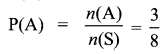
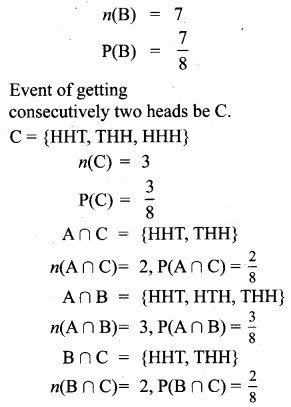
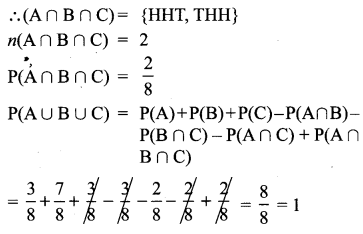
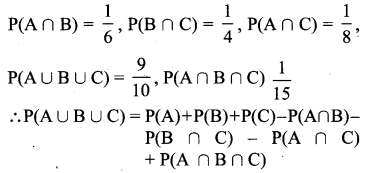
Samacheer Kalvi 10th Maths Solutions Chapter 5 Coordinate Geometry Ex 5.3

You can Download Samacheer Kalvi 10th Maths Book Solutions Guide Pdf, Tamilnadu State Board help you to revise the complete Syllabus and score more marks in your examinations.

Tamilnadu Samacheer Kalvi 10th Maths Solutions Chapter 5 Coordinate Geometry Ex 5.3

10th Maths Exercise 5.3 Samacheer Kalvi Question 1.
Find the equation of a straight line passing through the mid-point of a line segment joining the points(1, -5) (4, 2) and parallel to
(i) X axis
(ii) Y axis
Solution:
10th Maths Exercise 5.3 Samacheer Kalvi Chapter 5 Coordinate Geometry
Exercise 5.3 Class 10 Samacheer Kalvi Chapter 5 Coordinate Geometry

Exercise 5.3 Class 10 Samacheer Kalvi Question 2.
The equation of a straight line is 2(x – y) + 5 = 0. Find its slope, inclination and intercept on the Y axis.
Solution:
2(x – y) + 5 = 0
⇒ 2x – 2y + 5 =
⇒ 2y = 2x + 5
Ex 5.3 Class 10 Samacheer Chapter 5 Coordinate Geometry

Ex 5.3 Class 10 Samacheer Question 3.
Find the equation of a line whose inclination is 30° and making an intercept – 3 on the Y axis.
Solution:
θ = 30°
10th Samacheer Maths Exercise 5.3 Answers Chapter 5 Coordinate Geometry

10th Samacheer Maths Exercise 5.3 Answers Question 4.
Find the slope and y intercept of \(\sqrt{3}\)x + (1 – \(\sqrt{3}\))y = 3.
Solution:
10th Maths Exercise 5.3 Samacheer Kalvi Chapter 5 Coordinate Geometry

10th Maths Exercise 5.3 Question 5.
Find the value of ‘a’, if the line through (-2, 3) and (8, 5) is perpendicular to y = ax = + 2
Solution:
10th Maths Coordinate Geometry Exercise 5.3 Samacheer Kalvi Chapter 5
10th Maths 5.3 Samacheer Kalvi Solutions Chapter 5 Coordinate Geometry

10th Maths Coordinate Geometry Exercise 5.3 Question 6.
The hill in the form of a right triangle has its foot at (19, 3)The inclination of the hill to the ground is 45°. Find the equation of the hill joining the foot and top.
Solution:
θ = 45°
Coordinate of foot of hill = (19, 3) let equation of line be y = mx + c
m = tan θ = tan 45° = 1
⇒ y = x + c
Substituting y = 3 & x = 19, 3 = 19 + c ⇒ c = -16
10th Standard Maths Exercise 5.3 Samacheer Kalvi Chapter 5 Coordinate Geometry

10th Maths 5.3 Question 7.
Find the equation of a line through the given pair of points
10th Exercise 5.3 Samacheer Kalvi Chapter 5 Coordinate Geometry
(ii) (2, 3) and (-7, -1)
Solution:
(i) Equation of the line in two point form is
10th Maths 5.3 Solution Samacheer Kalvi Chapter 5 Coordinate Geometry
10th Samacheer Kalvi Maths Coordinate Geometry Chapter 5 Ex 5.3
⇒ 9y – 27 = 4x – 8
⇒ 4x – 9y – 8 + 27 = 0
⇒ 4x – 9y + 19 = 0

10th Standard Maths Exercise 5.3 Question 8.
A cat is located at the point(-6, -4) in xy plane. A bottle of milk is kept at (5, 11). The cat wish to consume the milk traveling through shortest possible distance. Find the equation of the path it needs to take its milk.
Solution:
A = (x1, y1) = (-6, -4)
B = (x2, y2) = (5, 11)
Shortest path between A and B is a line joining A and B.
10 Maths Exercise 5.3 Samacheer Kalvi Chapter 5 Coordinate Geometry

10th Exercise 5.3 Question 9.
Find the equation of the median and altitude of ∆ABC through A where the vertices are A(6, 2) B(-5, -1) and C(1, 9)
Solution:
Maths Exercise 5.3 Samacheer Kalvi 10th Solutions Chapter 5 Coordinate Geometry
Ex 5.3 Class 10 Maths Solutions Samacheer Kalvi Chapter 5 Coordinate Geometry

10th Maths 5.3 Solution Question 10.
Find the equation of a straight line which -5 has slope \(\frac{-5}{4}\) and passing through the point (-1, 2).
Solution:
10th Maths Chapter 5 Exercise 5.3 Samacheer Kalvi Coordinate Geometry

10th Samacheer Kalvi Maths Coordinate Geometry Question 11.
You are downloading a song. The percent y (in decimal form) of mega bytes remaining to get downloaded in x seconds is given by y = -0.1x + 1.
(i) graph the equation.
(ii) find the total MB of the song.
(iii) after how many seconds will 75% of the song gets downloaded?
(iv) after how many seconds the song will be downloaded completely?
Solution:
(i) y = -0.1x + 1
when x = 0 ⇒ y = 1
when y = 0 ⇒ y = 10
Exercise 5.3 Class 10 Samacheer Kalvi Chapter 5 Coordinate Geometry
(ii) Total MB of song can be obtained when time = 0
∴ x = 0
⇒ y = 1 MB
(iii) time when 75% of song is downloaded
⇒ remaining % = 25% ⇒ y = 0.25
0.25 = -0. 1x + 1
⇒ 0.1x = 0.75
Ex 5.3 Class 10 Samacheer Kalvi Maths Solutions Chapter 5 Coordinate Geometry
(iv) song will downloaded completely when , remaining % = 0 ⇒ y = 0
⇒ 0 = -0.1x + 1
⇒ x = 10
∴ 10 seconds

10 Maths Exercise 5.3 Question 12.
Find the equation of a line whose intercepts on the x and y axes are given below.
(i) 4, -6
(ii) \(-5 \frac{3}{4}\)
Solution:
Samacheer Kalvi 10th Guide Maths Solutions Chapter 5 Coordinate Geometry Ex 5.3

Maths Exercise 5.3 Question 13.
Find the intercepts made by the following lines on the coordinate axes,
(i) 3x – 2y – 6 = 0
(ii) 4x + 3y + 12 = 0
Solution:
(i) The given equation is
3x – 2y – 6 = 0
3x – 2y = 6
Divided by 6
\(\frac { 3x }{ 6 } \) – \(\frac { 2y }{ 6 } \) = \(\frac { 6 }{ 6 } \)
\(\frac { x }{ 2 } \) – \(\frac { y }{ 3 } \) = 1 ⇒ \(\frac { x }{ 2 } \) + \(\frac { y }{ -3 } \) = 1
(Comparing with \(\frac { x }{ a } \) + \(\frac { y }{ b } \) = 1)
∴ x intercept = 2; y intercept = -3

(ii) The given equation is
4x + 3y + 12 = 0
4x + 3y = -12
Divided by -12
\(\frac { 4x }{ -12 } \) + \(\frac { 3y }{ -12 } \) = \(\frac { -12 }{ -12 } \)
\(\frac { x }{ -3 } \) + \(\frac { y }{ -4 } \) = 1
(Comparing with \(\frac { x }{ a } \) + \(\frac { y }{ b } \) = 1)
∴ x intercept = -3; y intercept = -4

Ex 5.3 Class 10 Maths Solutions Question 14.
Find the equation of a straight line
(i) passing through (1, -4) and has intercepts which are in the ratio 2 : 5
(ii) passing through (-8, 4) and making equal intercepts on the coordinate axes
Solution:
(i) ratio of intercept = 2 : 5
Samacher Kalvi.Guru 10th Maths Solutions Chapter 5 Coordinate Geometry Ex 5.3

Samacheer Kalvi 10th Science Solutions Chapter 14 Transportation in Plants and Circulation in Animals

Students who are preparing for the Science exam can download this Tamilnadu State Board Solutions for Class 10th Science Chapter 14 from here for free of cost. These Tamilnadu State Board Textbook Solutions PDF cover all 10th Science Transportation in Plants and Circulation in Animals Book Back Questions and Answers.

All these concepts of Chapter 14 Transportation in Plants and Circulation in Animals are explained very conceptually by the subject teachers in Tamilnadu State Board Solutions PDF as per the prescribed Syllabus & guidelines. You can download Samacheer Kalvi 10th Science Book Solutions Chapter 14 Transportation in Plants and Circulation in Animals State Board Pdf for free from the available links. Go ahead and get Tamilnadu State Board Class 10th Science Solutions of Chapter 1 Transportation in Plants and Circulation in Animals.

Tamilnadu Samacheer Kalvi 10th Science Solutions Chapter 14 Transportation in Plants and Circulation in Animals

Kickstart your preparation by using this Tamilnadu State Board Solutions for Class 14th Science Chapter 14 Transportation in Plants and Circulation in Animals Questions and Answers and get the max score in the exams. You can cover all the topics of Chapter 14 easily after studying the Tamilnadu State Board Class 14th Science Textbook solutions pdf. Download the Tamilnadu State Board Science Chapter 14 Transportation in Plants and Circulation in Animals solutions of Class 14th by accessing the links provided here and ace up your preparation.

Samacheer Kalvi 10th Science Transportation in Plants and Circulation in Animals Textual Evaluation Solved

I. Choose the Correct Answer

Transportation In Plants And Circulation In Animals Question 1.
Active transport involves ______.
(a) movement of molecules from lower to higher concentration.
(b) expenditure of energy.
(c) it is an uphill task.
(d) all of the above.
Answer:
(a) movement of molecules from lower to higher concentration.

Transportation In Plants And Circulation In Animals Class 10 Question 2.
Water which is absorbed by roots is transported to aerial parts of the plant through:
(a) cortex
(b) epidermis
(c) phloem
(d) xylem
Answer:
(d) xylem

You can Download 10th Samacheer Science Guide Pdf, Tamilnadu State Board help you to revise the complete Syllabus and score more marks in your examinations.

Transportation In Plants And Circulation In Animals Book Back Answers Question 3.
During transpiration, there is loss of ______.
(a) carbon dioxide
(b) oxygen
(c) water
(d) none of the above.
Answer:
(c) water

10th Science Samacheer Kalvi Question 4.
Root hairs are:
(a) cortical cell
(b) projection of epidermal cell
(c) unicellular
(d) both (b) and (c)
Answer:
(d) both (b) and (c)

Samacheer Kalvi 10th Science Book Back Answers Question 5.
Which of the following process requires energy?
(a) active transport
(b) diffusion
(c) osmosis
(d) all of them.
Answer:
(a) active transport

Samacheer Kalvi 10th Science Guide Question 6.
The wall of human heart is made of:
(a) Endocardium
(b) Epicardium
(c) Myocardium
(d) All of the above
Answer:
(d) All of the above

Samacheerkalvi.Guru Science Question 7.
Which is the sequence of correct blood flow ______.
(a) ventricle – atrium – vein – arteries
(b) atrium – ventricle – veins – arteries
(c) atrium – ventricle – arteries – vein
(d) ventricles – vein – atrium – arteries.
Answer:
(c) atrium – ventricle – arteries – vein

10th Samacheer Kalvi Science Question 8.
A patient with blood group 0 was injured in an accident and has blood loss. Which blood group the doctor should effectively use for transfusion in this condition?
(a) O group
(b) AB group
(c) A or B group
(d) all blood group
Answer:
(a) O group

Samacheer Kalvi 10th Science Book Solutions Question 9.
‘Heart of heart’ is called ______.
(a) SA node
(b) AV node
(c) Purkinje fibres
(d) Bundle of His.
Answer:
(a) SA node

Samacheer Kalvi 10th Science Question 10.
Which one of the following regarding blood composition is correct?
(a) Plasma – Blood + Lymphocyte
(b) Serum – Blood + Fibrinogen
(c) Lymph – Plasma + RBC + WBC
(d) Blood – Plasma + RBC + WBC + Platelets
Answer:
(d) Blood – Plasma + RBC + WBC + Platelets

II. Fill in the Blanks

Samacheer Kalvi 10th Science Solutions Question 1.
______ involves evaporative loss of water from aerial parts.
Answer:
Transpiration.

Class 10 Science Samacheer Kalvi Question 2.
Water enters the root cell through a ______ plasma membrane.
Answer:
Osmosis.

Science Class 10 Samacheer Kalvi Question 3.
Structures in roots that help to absorb water are ______.
Answer:
Root hairs.

Samacheer Kalvi 10 Science Question 4.
Normal blood pressure is ______.
Answer:
120 mm / 80 mm Hg.

Class 10 Science Solutions Samacheer Kalvi Question 5.
The normal human heartbeat rate is about _______ time per minute.
Answer:
72 – 75.

III. Match the following

Science Samacheer Kalvi Question 1.

1. Symplastic pathway(a) Leaf
2. Transpiration(b) Plasmodesmata
3. Osmosis(c) Pressure in xylem
4. Root Pressure(d) Pressure gradient

Answer:

  1. (b) Plasmodesmata
  2. (a) Leaf
  3. (d) Pressure gradient
  4. (b) Pressure in xylem.

Samacheer Kalvi Class 10 Science Solutions Question 2.

1. Leukaemia(a) Thrombocytes
2. Platelets(b) Phagocyte
3. Monocytes(c) Decrease in leucocytes
4. Leucopenia(d) Blood Cancer
5. AB blood group(e) Allergic condition
6. O blood group(f) Inflammation
7. Eosinophil(g) Absence of antigen
8. Neutrophils(h) Absence of antibody

Answer:

  1. (d) Blood Cancer
  2. (a) Thrombocytes
  3. (b) Phagocyte
  4. (c) Decrease in leucocytes
  5. (h) Absence of antibody
  6. (g) Absence of antigen
  7. (e) Allergic condition
  8. (f) Inflammation.

IV. State whether True or False. If false write the correct statement.

10th Std Science Solutions Samacheer Kalvi Question 1.
The phloem is responsible for the translocation of food.
Answer:
True.

Samacheer Kalvi 10th Standard Science Question 2.
Plants lose water by the process of transpiration.
Answer:
True.

10th Standard Samacheer Kalvi Science Question 3.
The form of sugar transported through the phloem is glucose.
Answer:
False.
Correct Statement: The form of sugar transported through the phloem is Sucrose.

Samacheer Kalvi 10th Science Book Answers Question 4.
In the apoplastic movement, the water travels through the cell membrane and enter the cell.
Answer:
False.
Correct Statement: In the apoplastic movement, the water travels through the intercellular spaces and walls of the cell.

Samacheer Kalvi Guru 10th Science Question 5.
When guard cells lose water the stoma opens.
Answer:
False.
Correct Statement: When guard cells lose water, the stoma closed.

Samacheer Kalvi Science Question 6.
initiation and stimulation of heartbeat take place by nerves.
Answer:
True.

Samacheer Kalvi 10th Science Solution Question 7.
All veins carry deoxygenated blood.
Answer:
False.
Correct Statement: All veins carry deoxygenated blood except the Pulmonary vein.

Science 10th Samacheer Kalvi Question 8.
WBC defend the body from bacterial and viral infections.
Answer:
True.

Question 9.
The closure of the mitral and tricuspid valves at the start of the ventricular systole produces the first sound ‘LUBB’.
Answer:
True.

V. Answer in a word or Sentence.

Question 1.
Name two-layered protective covering of the human heart.
Answer:
Pericardium.

Question 2.
What is the shape of RBC in human blood?
Answer:
RBC’s are bioconcave and disc shaped.

Question 3.
Why is the colour of the blood-red?
Answer:
The colour of the blood is red, due to the presence of respiratory pigment Haemoglobin.

Question 4.
Which kind of cells are found in the lymph?
Answer:
Cells found in the lymphatics are lymphocytes.

Question 5.
Name the heart valve associated with the major arteries leaving the ventricles.
Answer:
Semilunar Valves.

Question 6.
Mention the artery which supplies blood to the heart muscle.
Answer:
Heart muscle receive oxygenated blood from coronary arteries that orginate from the aortic arch.

VI. Short Answer Questions.

Question 1.
What causes the opening and closing of guard cells of stomata during transpiration?
Answer:
During transpiration, the movement of (Potassium) ions, in and out of the guard cells, causes the opening and closing of stomate. When the water moves inside the guard cells, causing them to swell up and become turgid, making the stomata open. When guard cells cause water to move out of the cell, make guard cells shrunk, and the stomata pore closes.

Question 2.
What is cohesion?
Answer:
The force of attraction between the water molecules is called cohesion.

Question 3.
Trace the pathway followed by water molecules from the time it enters a plant root to the time it escapes into the atmosphere from a leaf.
Answer:
Transportation In Plants And Circulation In Animals Samacheer Kalvi 10th Science Solutions Chapter 14

Question 4.
What would happen to the leaves of a plant that transpires more water than its absorption in the roots?
Answer:
If the rate of transpiration exceeds the rate of absorption, the stomata get closed the cells lose their turgidity and the plant wilts.

Question 5.
Describe the structure and working of the human heart.
Answer:
The human heart is four-chambered. The two upper thin-walled chambers, Auricle or Atria and the lower thick-walled chambers ventricles. The chambers are separated by a septum. The two auricles are separated by an interatrial septum and the two ventricles are separated by the interventricular septum.

The right atrium receives deoxygenated blood from different parts of the body through superior vena cava, inferior vena cava and coronary sinus. Pulmonary veins bring oxygenated blood from the lungs to the left atrium. Both the right and the left auricles pump blood into the right and left ventricles respectively.

From the right ventricle, the pulmonary arteries supply deoxygenated blood to the lungs. From the left ventricle, the Aorta carries the Oxygenated blood to the various organs of the body. The coronary arteries supply blood to the heart. This process is repeated again and again.

Question 6.
Why is the circulation in man referred to as double circulation?
Answer:
In human, blood passes twice through the heart to supply once to the body.
Double circulation involves: (i) Systemic circulation, (ii) Pulmonary circulation.
(i) Systemic circulation: In systemic circulation, from the left ventricle blood is pumped into the aorta and to various parts of the body.
(ii) Pulmonary circulation: In pulmonary circulation, from right ventricle deoxygenated blood is pumped into pulmonary artery which carries blood to the lungs for oxygenation.

Question 7.
What are heart sounds? How are they produced?
Answer:
The rhythmic closure and opening of the valves cause the sound of the heart. When the closure of the tricuspid and bicuspid valves after the beginning of ventricular systole, the sound ‘LUBB’ is produced. When the closure of the semilunar valve at the end of ventricular systole, the sound ‘DUPP’ is produced.

Question 8.
What is the importance of valves in the heart?
Answer:
The valves in heart are muscular flap that regulates the flow of blood in a single direction and prevents back flow of blood.

Question 9.
Who discovered the Rh factor? Why was it named so?
Answer:
The Rh factor was discovered by Landsteiner and Wiener in 1940 in Rhesus monkey. So it was named the Rh factor.

Question 10.
How are arteries and veins structurally different from one another?
Answer:

ArteryVein
1. Distributing vessel1. Collecting vessel
2. Pink in colour2. Red in colour
3. Deep location3. Superficial in location
4. Blood flow with high pressure4. Blood flow with low pressure
5. Wall of an artery is strong, thick and elastic5. Wall of a vein is weak, thin and non-elastic
6. All arteries carry oxygenated blood except pulmonary arteries6. All veins carry deoxygenated blood except pulmonary veins
7. Internal valves are absent7. Internal valves are present

Question 11.
Why is the Sinoatrial node called the pacemaker of heart?
Answer:
Although impulse is produced by the entire neuro muscular pathway, the frequency of impulse generation is maximum in case of Sino atrial node in comparison to other parts of pathway. Hence it guides the rhythm of heart beat and is called the pacemaker of the heart.

Question 12.
Differentiate between systemic circulation and pulmonary circulation.
Answer:

Systemic CirculationPulmonary Circulation
1. Circulation of oxygenated blood from the left ventricle of the heart to various organs of the body.1. Circulation starts in the right ventricle of the heart and reaches the lungs with deoxygenated blood.
2. Return of deoxygenated blood to the right atrium.2. Pulmonary Artery collects the oxygenated blood from the lungs.
3. Aorta carries oxygenated blood to all the organs of the body.3. The Oxygenated blood is supplied to the left atrium of the heart by the Pulmonary.

Question 13.
The complete events of the cardiac cycle last for 0.8 sec. What is the timing for each event?
Answer:

  1. Auricular systole – Contraction of auricles = 0.1 sec
  2. Ventricular systole – Contraction of ventricle = 0.3 sec
  3. Ventricular diastole – Relaxation of ventricle = 0.4 sec

VII. Give reasons for the following Statements.

Question 1.
Minerals cannot be passively absorbed by the roots.
Answer:
The minerals cannot be passively absorbed by the roots because

  • The minerals are present in the soil as charged particles (ion) and cannot move across the cell membrane.
  • The concentration of minerals in the soil is lower than the concentration of minerals in the root.

Question 2.
Guard cells are responsible for opening and closing of Stomata.
Answer:
Opening and closing of stomata takes place due to changes in turgor of guard cell. The turgor changes in the guard cells are due to entry and exit of water into and out of the guard cells. During the day, water from the subsidiary cells enter the guard cells making it fully turgid causing the stomata to open. During night time, water from guard cells enters the subsidiary cells makes the guard cells flaccid causing the stomata closes.

Question 3.
The movement of substances in the phloem can be in any direction.
Answer:
The movement of substance in the Phloem can be in any direction because, the food to reach the plant parts like stem, leaves, flower, bud, seeds etc, the movement can be upwards or downwards, that is bidirectional.

Question 4.
Minerals in the plants are not lost when the leaf falls.
Answer:
Minerals are remobilised from older drying leaves to younger leaves. Elements like phosphorous, sulphur, nitrogen, potassium are easily mobilised, while elements like calcium are not remobilised. This can be seen in decidous leaves.

Question 5.
The walls of the right ventricle are thicker than the right auricles.
Answer:
The walls of the right ventricle are thicker than the right auricle because, the right ventricle has to pump out the blood with force to the Pulmonary trunk, which bifurcates to form the right and left Pulmonary Arteries.

Question 6.
Mature RBC in mammals do not have cell organelles.
Answer:
The RBCs are devoid of nucleus, mitochondria ribosome and endoplasmic reticulum. The absence of these organelles accommodates more haemoglobin thereby maximising the oxygen carrying capacity of the cell. Biconcave shape increase the surface area for oxygen binding, loss of mitochondria allow the RBC to transport all the oxygen to tissues and loss of endoplasmic reticulum allows more flexibility for RBC to move through the narrow capillaries.

VIII. Long Answer Questions.

Question 1.
How do plants absorb water? Explain.
Answer:
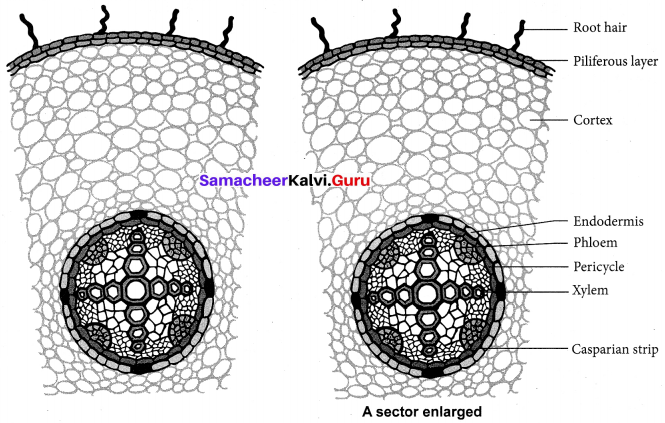
There are millions of root hairs on the tip of the root, which absorb water and minerals by diffusion. Diffusion takes place across cell membranes. Root hairs are a thin-walled, slender, extension of Epidermal cell, that increases the surface area of absorption. Active transport utilises energy to pump molecules against a concentration gradient. Active transport is carried out by membrane – bound proteins. These proteins use energy to carry substances across the cell membrane.

The cell wall of root hair is permeable and allows the water and minerals to enter. The cell membrane is semi – permeable. So it allows movement of water molecules from the region of higher concentration to the region of lower concentration. Once the water enters the root hairs, the concentration of water molecules in the root hair cells become more than that of Cortex. So the water from the root hair moves to the cortical cells by osmosis and then reaches the xylem.

Due to transpiration, the water is lost from the leaves and pressure is created at the top to pull more water from the xylem to the mesophyll cells, by the process of Transpiration pull. This extends up to the roots causing the roots to absorb more water from the soil to ensure the continuous flow of water from the roots to the leaves.

Question 2.
What is transpiration? Give the importance of transpiration.
Answer:
The loss of water from the aerial parts of plant in the form of vapours is called transpiration.
Importance of transpiration:

  1. Creates transpirational pull for transport of water.
  2. Supplies water for photosynthesis.
  3. Transports minerals from soil to all parts of the plant.
  4. Cools the surface of the leaves by evaporation.
  5. Keeps the cells turgid; hence, maintains their shape.

Question 3.
Why are leucocytes classified as granulocytes and agranulocytes? Name each cell and mention its functions.
Answer:
White blood corpuscles are colourless. They are nucleated cells. They are found in the bone marrow, spleen, thymus and lymph nodes. They are grouped into two categories:
1. Granulocytes: They contain granules in their cytoplasm. Their nucleus is irregular or lobed. The granulocytes are of three types:

  • Neutrophils: They are large in size and have a 2 – 7 lobed nucleus. Their numbers are increased during infection and inflammation.
  • Eosinophils: It has a bilobed nucleus. Their numbers increases during conditions of allergy and parasitic infections. It brings about the detoxification of toxins.
  • Basophils: Basophils have a lobed nucleus. They release chemicals during the process of inflammation.

2. Agranulocytes: Granules are not found in the cytoplasm of these cells. Thy is of two types:

  • Lymphocytes: Lymphocytes produce antibodies during bacterial and viral infections.
  • Monocytes: They are the largest of the leucocytes and are amoeboid in shape. They are phagocytic and can engulf bacteria.

Question 4.
Differentiate between systole and diastole. Explain the conduction of heart beat.
Answer:
systole:
The contraction of heart is called systole.
diastole:
The relaxation of heart is called diastole.
Conduction of heart beat : The heart in human is myogenic. The cardiac cells with fastest rhythm are called the pacemaker cells. These cells are located in the right sino-atrial node. The impulse from the sino-atrial node. spreads as a wave of contraction over the right and left atrial wall pushing the blood through the atrio ventricular valves into the ventricle. Two special cardiac muscles fibres originate from the auriculo ventricular node and are called the bundle of his which runs down into the interventricular septum and the fibres spread into the ventricles. These fibres are called the Purkinje.

Question 5.
Enumerate the functions of blood.
Answer:
Functions of blood:

  • Transport of respiratory gases (Oxygen and CO2).
  • Transport of digested food materials to different body cells.
  • Transport of hormones.
  • Transport of nitrogenous excretory products like ammonia, urea and uric acid.
  • It is involved in the protection of the body and defence against diseases.
  • It acts as a buffer and also helps in the regulation of pH and body temperature.
  • It maintains proper water balance in the body.

IX. Assertion and Reasoning Questions.

Direction: In each of the following questions a statement of assertion (A) is given and a corresponding statement of Reason (R) is given just below it. Mark the correct statement as:
(a) If both A and R are true and R is the correct explanation of A.
(b) If both A and R are true but R is not the correct explanation of A.
(c) A is true but R is false.
(d) Both A and R are false.

Question 1.
Assertion: RBC plays an important role in the transport of respiratory gases.
Reason: RBC does not have cell organelles and nucleus.
Answer:
(a) If both A and R are true and R is the correct explanation of A.

Question 2.
Assertion: Persons with AB blood group are called universal recipients because they can receive blood from all groups.
Reason: Antibodies are absent in persons with AB blood group.
Answer:
(a) If both A and R are true and R is the correct explanation of A.

X. Higher Order Thinking Skills (HOTS) Questions

Question 1.
When any dry plant material is kept in water, they swell up. Name and define the phenomenon involved in this change.
Answer:
The swelling up is due to Imbibition. Imbibition is a type of diffusion in which a solid absorbs water and gets swelled up. If Imbibition were not there, seedlings would not have been able to emerge out of the soil.

Question 2.
Why are the wails of the left ventricle thicker than the other chambers of the heart?
Answer:
The left ventricles have thick walls because the ventricle have to pump out blood with force away from the heart.

Question 3.
Doctors use a stethoscope to hear the sound of the heart. Why?
Answer:
The heart sound is heard by placing the stethoscope on the chest. It is a useful diagnostic tool to identify and localize the health problems and diagnose disease.

Question 4.
How does the pulmonary artery and pulmonary vein differ in their function when compared to a normal artery and vein?
Answer:

  1. All arteries carry oxygenated blood except the pulmonary artery which carry deoxygenated blood to the lungs.
  2. All veins carry deoxygenated blood except the pulmonary vein which carry oxygenated blood from the lungs to the heart.

Question 5.
Transpiration is a necessary evil in plants. Explain.
Answer:
Transpiration is a necessary evil in plants because it is inevitable but potentially harmful. Loss of water from the plant results wilting and cause the death of a plant if a condition of drought is experienced.
But transpiration is a great significance for the plant.

  • Water is conducted, in most tall plants due to transpiration pull.
  • Minerals dissolved in water are distributed throughout the plant body by Transpiration Stream.
  • Evaporation of water from the cells of leaves has a cooling effect on plants.
  • The wet surface of leaf cells allows gaseous exchange.

Textbook Activities Solved

Activity 1.
Demonstration of Osmosis: A thistle funnel whose mouth is covered with a semipermeable membrane is filled with sucrose solution. It is kept inverted in a beaker containing water. The water will diffuse across the membrane due to osmosis and raise the level of the solution in the funnel.
Answer:
A thistle funnel, whose mouth is covered with parchment paper, which acts as a semi-permeable membrane, is filled with sucrose solution. The funnel is kept inverted in a beaker, containing water. The water from the beaker enters or diffuse across the membrane from the region of water higher concentration to the water lower concentration (Sucrose Solution) through Semi – Permeable membrane, by osmosis. This causes the rise of the level of a solution in the funnel.
Transportation In Plants And Circulation In Animals Class 10 Samacheer Kalvi Solutions Chapter 14

Activity 2.
Demonstration of Root Pressure: Choose a small soft – stemmed plant. Cut the stem horizontally near the base with a blade in the morning. You will see drops of solution oozing out of the cut stem due to root pressure.
Answer:
We will see drops of solution Oozing out of the cell stem. The Root Pressure, which pushes ^the solution up from the base.

Activity 3.
Determining Heart Rate?
Answer:
Materials:

  1. Stopwatch or Stop clock.

Procedure:

  1. Have your partner to find the pulse in your wrist and count your heartbeats for 15 seconds while you are seated. Calculate your resting heart rate in beats per minute.
  2. Have your partner to count your heart beats for 15 seconds after you jog or run for 5 minutes. Calculate your heart rate in beats per minute.

Analyse:
(i) What causes your pulse?
(ii) What causes the change in your heartbeat rate in each situation? You can write the answer yourself.
Answer:
(i) Pulse, rhythmic dilation of an artery generated by the opening and closing of the aortic valve in the heart. A pulse can be felt by applying firm fingertip pressure to the skin at sites where the arteries travel near the skin’s surface; it is more evident when surrounding muscles are relaxed.
(ii) You can write the answer yourself.

Samacheer Kalvi 10th Science Transportation in Plants and Circulation in Animals Additional Questions Solved

I. Fill in the blanks.

Question 1.
______ is responsible for the movement of water up to the base of the stem.
Answer:
Root pressure.

Question 2.
The other name for Red blood corpuscles (RBC) is called ______.
Answer:
Erythrocytes.

Question 3.
The apices of the flaps of tricuspid valves are held in position by ______.
Answer:
Chordaetendinae.

Question 4.
The supply of blood to the heart muscles is called ______ circulation.
Answer:
Coronary.

Question 5.
Sinuses are the body cavities which are called ______.
Answer:
Haemocoel.

II. Write True or False for the following statements. Write the true statement for the false statement.

Question 1.
Root hairs are a thin-walled, slender extension of Parenchyma cells.
Answer:
False.
Correct Statement: Root hairs are a thin-walled, slender extension of epidermal cell.

Question 2.
The transpiration pull sucks the water column from the xylem tubes so that the water is able to rise up in the tallest plants. Answer:
True.

Question 3.
The force of attraction between the molecules of companion cells is called cohesion.
Answer:
False.
Correct Statement: The force of attraction between the molecules of water is called cohesion,

Question 4.
Blood platelets help in the clotting of blood, form clot at the site of injury and prevent blood loss.
Answer:
True.

III. Match the following.

Question 1.

1. Universal Recipient(a) Left Atrio Ventricular Valve
2. Blood(b) Thin and non-elastic cells
3. Thymocytes(c) Blood group AB
4. Universal Donor(d) Thick and elastic cells
5. Mitral(e) Blood group ‘O’
6. Veins(f) Blood platelets
7. Arteries(g) Connective tissue

Answer:

  1. (c) Blood group AB
  2. (g) Connective tissue
  3. (f) Blood platelets
  4. (e) Blood group ‘O’
  5. (a) Left Atrio Ventricular Valve
  6. (b) Thin and non-elastic cells
  7. (d) Thick and elastic cells

IV. Answer the following in a word or a Sentence.

Question 1.
What is Root Pressure?
Answer:
As ion from the Soil is actively transported into the Vascular tissue of the root, water moves along and increases the pressure inside the Xylem. This pressure is called root pressure.

Question 2.
What is the role of valves in heart?
Answer:
The valves are muscular flap that regulates the flow of blood in a single direction and prevent back flow of blood.

Question 3.
What is capillary action?
Answer:
Water or any liquid rises in a capillary tube because of physical forces. This phenomenon is called capillary action.

Question 4.
What is normal heart beat in man? How does it occur?
Answer:
The normal heart beat in man is about 72 – 75 times per minute. Rhythmic contraction and expansion of heart causes heart beat.

Question 5.
What are capillaries?
Answer:
Capillaries are narrow tubes formed by branching of arterioles which then unite to form the venules and veins. Capillaries are formed of a single layer of endothelial cells.

Question 6.
What is a pulse?
Answer:
The expansion of the artery every time, the blood is forced into it is called pulse. Normal pulse rate ranges from 70 – 90 per minute.

Question 7.
What is Cardiac Cycle?
Answer:
The sequence of events occurring from the beginning to the completion of one heartbeat is called the Cardiac Cycle.

Question 8.
What is hypertension?
Answer:
The condition, where a prolonged or constant elevation of blood pressure exist is called hypertension (High blood pressure)

Question 9.
What is Apoplast pathway?
Answer:
The apoplastic movement of water occurs through the intercellular spaces and the walls of the cells with gradient energy.

Question 10.
Why are membrane – bound proteins called pumps?
Answer:
Active transport is carried out by membrane-bound proteins. These proteins use energy to carry substances across the cell membrane. So they are called pumps.

Question 11.
When does plasmolysis occur?
Answer:
Plasmolysis occur when water moves out of the cell and resulting in the shrinkage of cell membrane away from the cell wall.

Question 12.
What are Lymph nodes?
Answer:
Lymph nodes are small oval or fan-shaped structures, located along the length of lymphatic vessels.

V. Answer the following briefly.

Question 1.
Define the following.

  1. Diffusion
  2. Osmosis
  3. Plasmolysis

Answer:

  1. Diffusion: The movement of molecules in liquid and solids from a region of higher concentration to a region of lower concentration, without the utilization of energy is called Diffusion.
  2. Osmosis: Osmosis is the movement of solvent or water molecules, from the region of higher concentration to the region of lower concentration through a semi – permeable membrane.
  3. Plasmolysis: Plasmolysis is a process, which occurs, when water moves out of the cell and resulting in the shrinkage of the cell membrane, away from the cell wall.

Question 2.
Explain cardiac cycle.
Answer:
The sequence of events occurring from the beginning to the completion of one heart beat is called cardiac cycle. During cardiac cycle blood flows ’ through the chambers of the heart in a specific direction. Each cardiac cycle lasts about 0.8 second. The events during a single cardiac cycle involves

  1. Atrial systole: Contraction of auricles (0.1 sec)
  2. Ventricular systole: Contraction of ventricles (0.3 sec)
  3. Ventricular diastole: Relaxation of ventricles (0.4 sec)

Question 3.
Explain the two types of Circulatory System.
Answer:
The two types of Circulatory System in animals are

  1. Open type: The blood is pumped by the heart into blood vessels, that open into blood spaces called sinuses, which are the body cavities called haemocoel. Capillary System is absent. Eg. Arthropods, Molluscs, Ascidians.
  2. Clsed type: The blood flows in a complete circuit around the body, through specific blood vessels. The blood flows from arteries to veins, through small blood vessels called capillaries. Eg. Vertebrates.

Question 4.
What is Blood Pressure? How is blood pressure expressed?
Answer:
The force exerted during the flow of blood against the lateral walls of arteries is called Blood Pressure. Blood pressure is usually expressed in terms of systolic pressure and diastolic pressure.

  1. Systolic pressure: The pressure, during ventricular systole, the left ventricle contracts and forces the blood into the aorta is called systolic pressure.
  2. Diastolic pressure: The pressure, during diastole, the ventricle relaxes and the pressure falls to the lowest value, is called Diastolic pressure.

In a healthy adult, during the normal resting condition, the systolic and diastolic blood pressure is expressed as 120mm / 80mm Hg.

Question 5.
In a Tabular Column, mention the distribution of Antigen (RBC) and antibody (Plasma) in different blood groups.
Answer:

Blood GroupAntigens on RBCAntibodies in PlasmaCan donate toCan receive from
AAntigen Aanti – bA and ABA and O
BAntigen Banti – aB and ABB and O
ABAntigen A and BNo AntibodyABA, B, AB and O (Universal Recipient)
ONo AntigenBoth anti a and bA, B, AB and O (Universal Donor)O

Question 6.
Write a note on valves of human.
Answer:
Valves : The valves are the muscular flaps that regulate the flow of blood in a single direction and prevent back flow of blood. The heart contains three types of valves. Right atrioventricular valve : It is located between the right auricle and right ventricle.

It has three thin triangular leaf like flaps and therefore called tricuspid valve. The apices of the flaps are held in position by chordae tendinae arising from the muscular projection of the ventricle wall known as papillary muscles.

Left atrioventricular valve : It is located between the left auricle and left ventricle. It has two cusps and therefore called bicuspid or mitral valve.
Semilunar valves : The major arteries (pulmonary artery and aorta) which leave the heart have semilunar valves which prevent backward flow of blood into the ventricles. They are the pulmonary and aortic semilunar valves.

Question 7.
What is Sphygmo Manometer? Name the instruments used to measure Blood pressure.
Answer:
The sphygmomanometer is a clinical instrument used to measure blood pressure when a person is in a relaxed and resting condition. The pressure of the brachial artery is measured. It helps to estimate the state of blood circulation and the working of the heart. It helps to diagnose conditions such as increased or decreased blood pressure. Monometric and modem digital types are used to measure blood pressure.

Question 8.
What are the factors which affect transpiration?
Answer:
Transpiration is affected by several external and internal factors.

  • External factors: Temperature, light, humidity, and wind speed.
  • Internal factors: Number and distribution of Stomata, Percentage of open stomata, Water status of the plant and Canopy Structure.

VI. Draw a labelled diagram for the following.

Question 1.
(a) Root tip with root hairs.
(b) Guard cell in turgid and Flacid condition.
Answer:
(a)
Transportation In Plants And Circulation In Animals Book Back Answers Samacheer Kalvi 10th Science Solutions Chapter 14
(b)
10th Science Samacheer Kalvi Solutions Chapter 14 Transportation In Plants And Circulation In Animals
Samacheer Kalvi 10th Science Book Back Answers Chapter 14 Transportation In Plants And Circulation In Animals

Question 2.
Draw a labelled diagram of the internal structure of Human Heart.
Answer:
Samacheer Kalvi 10th Science Guide Chapter 14 Transportation In Plants And Circulation In Animals

VII. Answer the following in detail.

Question 1.
Explain the types of Blood Circulation.
Answer:
The blood circulates in our body as oxygenated and deoxygenated blood. The types of circulation are:

  1. Systemic Circulation: Circulation of oxygenated blood from the left ventricle of the heart to various organs of the body and return of deoxygenated blood to the right atrium. Aorta carries oxygenated blood to all the organs of the body.
  2. Pulmonary Circulation: The path of pulmonary circulation starts in the right ventricle. Pulmonary artery arises from the right ventricle and reaches the lungs with deoxygenated blood. Pulmonary veins collect the oxygenated blood from the lungs and supplies it to the left atrium of the heart.
  3. Coronary circulation: The supply of blood to the heart muscles (cardiac muscles) is called coronary circulation. Cardiac muscles receive oxygenated blood from coronary arteries, that originate from the aortic arch. Deoxygenated blood from the cardiac muscles, drains into the right atrium by the coronary sinuses.

In human, the blood circulates twice, through the heart in one complete cycle, called double circulation. The oxygenated blood does not mix with the deoxygenated blood.

Question 2.
Explain the Lymphatic System with diagram and mention the function of Lymph.
Answer:
The lymphatic system consists of lymphatic capillaries, lymphatic vessels, lymph nodes and lymphatic ducts.
Lymph is a fluid, that flows through the lymphatic system. The lymphatic capillaries unite to form large lymphatic vessels. Lymph nodes are small, oval or pear-shaped structures located along the lymphatic vessels.
Samacheerkalvi.Guru Science 10th Solutions Chapter 14 Transportation In Plants And Circulation In Animals
Lymph from the intercellular spaces drains into lymphatic capillaries. Lymph is a colourless fluid formed when Plasma, Proteins and blood cells escape into intercellular spaces in the tissues, through the pores present in the walls of the capillaries. It is similar to blood plasma, but is colourless and contains fewer proteins. The lymph contains a very small amount of nutrients, Oxygen, CO2, water and WBC.

Functions of Lymph:

  • Supplies nutrients and oxygen to those parts where blood cannot reach.
  • It drains away excess tissue fluid and metabolites and returns proteins to the blood from tissue spaces.
  • The lymph also carries absorbed fats from small intestine to the blood. The lymphatic capillaries of internal villi (lacteals) absorb digested fats.
  • Lymphocytes in the lymph defend the body from infections.

VIII. Higher Order Thinking Skills (HOTS) Questions

Question 1.
What do you know about the following?

  1. Anaemia
  2. Leucocytosis
  3. Leukopenia
  4. Thrombocytopenia

Answer:

  1. Anaemia → Decrease in the number of Erythrocytes.
  2. Leucocytosis → Increase in the number of Leukocytes.
  3. Leukopenia → Decrease in the number of Leukocytes.
  4. Thrombocytopenia → Decrease in the number of Thrombocytes.

Question 2.
The cardiac pacemaker in a patient fails to function normally. The doctor finds that an artificial pacemaker is to be grafted in him. It is likely that it will be drafted at the site of.
Answer:
Sino-atrial node, which acts as the pacemaker of the heart because it is capable of initiating impulse which can stimulate the heart muscles to contraction.

Question 3.
What do you know about the following important terms, which we come across every day?

  1. Heart attack
  2. Cardiac arrest
  3. Heart Failure.

Answer:

  1. Heart attack: The blood flow to the heart is blocked. A blockage of blood flow to the heart muscle. The heart muscle affected from lack of blood supply.
  2. Cardiac arrest: The heart stops beating and needs to be restarted. Cardiac arrest is an electrical problem, triggered by a disruption of the heart’s rhythm.
  3. Heart Failure: Heart Failure occurs, when the heart muscle fails to pump as much as blood as the body needs. It may come to a person suddenly.

Question 4.
Removal of ring wood of tissue outside the vascular cambium from the tree trunk kills it because:
Answer:
Food does not travel down and root becomes starved (Translocation of food).

Believing that the Tamilnadu State Board Solutions for Class 14th Science Chapter 14 Transportation in Plants and Circulation in Animals Questions and Answers learning resource will definitely guide you at the time of preparation. For more details about Tamilnadu State Board Class 14th Science Chapter 14 textbook solutions, ask us in the below comments and we’ll revert back to you asap.

Samacheer Kalvi 9th Social Science Geography Solutions Chapter 2 Lithosphere – II Exogenetic Processes

You can Download Samacheer Kalvi 9th Social Science Book Solutions Guide Pdf, Tamilnadu State Board help you to revise the complete Syllabus and score more marks in your examinations.

Tamilnadu Samacheer Kalvi 9th Social Science Geography Solutions Chapter 2 Lithosphere – II Exogenetic Processes

Lithosphere – II Exogenetic Processes Textual Exercise

I. Choose the correct answer.

Lithosphere 2 Exogenetic Processes Question 1.
The disintegration or decomposition of rocks is generally called as …………………
(a) weathering
(b) erosion
(c) transportation
(d) deposition
Answer:
(a) weathering

Lithosphere 2 Exogenic Processes Question 2.
The process of the levelling up of land by means of natural agents.
(a) aggradation
(b) degradation
(c) gradation
(d) none
Answer:
(c) gradation

Lithosphere 2 Exogenic Processes Book Back Answers Question 3.
……………. is seen in the lower course of the river.
(a) Rapids
(b) Alluvial fan
(c) Delta
(d) Gorges
Answer:
(c) Delta

9th Social Guide Question 4.
Karst topography is formed due to the action of ………………
(a) Glacier
(b) Wind
(c) Sea waves
(d) Ground water
Answer:
(d) Ground water

9th Std Social Science Guide Pdf English Medium Question 5.
Which one of the following is not a depositional feature of a glacier?
(a) cirque
(b) Moraines
(c) Drurrtlins
(d) Eskers
Answer:
(a) cirque

Chapter 2 Lithosphere – Ii Exogenetic Processes Question 6.
Deposits of fine silt blown by wind is called as …………….
(a) Loess
(b) Barchans
(c) Hamada
(d) Ripples
Answer:
(a) Loess

Samacheer Kalvi 9th Social Book Answers Question 7.
Stacks are formed by …………….
(a) Wave erosion
(b) River erosion
(c) Glacial erosion
(d) Wind deposion
Answer:
(a) Wave erosion

Social Guide For Class 9 Question 8.
……………… erosion is responsible for the formation of cirque.
(a) wind
(b) glacial
(c) river
(d) underground water
Answer:
(b) glacial

9th Std Social Science Guide Pdf Question 9.
Which one of the following is a second order land form?
(a) Asia
(b) Deccan Plateau
(c) Kulu valley
(d) Marina Beach
Answer:
(b) Deccan Plateau

II. Match the following.

Lithosphere 2 Exogenetic Processes Samacheer Kalvi 9th Social Science Geography Solutions Chapter 2
Answer:
1. (c)
2. (d)
3. (a)
4. (e)
5. (b)

III. Answer in brief.

9th Social Science Guide Pdf Download Question 1.
Define weathering.
Answer:
Weathering is the disintegration and decomposition of materials of the earth’s crust by their exposure to the atmosphere.

Samacheer Kalvi 9th Social Book Solutions Question 2.
What do you mean by biological weathering?
Answer:
Biological weathering occurs due to the penetration and expansion of plant roofs, earth worms, burrowing animals (rabbits, rats) and same human activities.

9th Standard Social Book Question 3.
Mention the three courses of a river with any two land forms associated to each course.
Answer:
The course of a river is divided into

  1. The Upper course – V shaped valleys, gorges
  2. The middle course – Alluvial fans, flood plains
  3. The lower course – Delta and Estuary.

Samacheer Kalvi 9th Social Book Question 4.
What are Ox-bow lakes?
Answer:

  1. Meanders in due course of time become almost a complete circle with narrow necks.
  2. This in turn gets abandoned and forms a lake. This is called an Ox-bow lake.

Class 9 Social Science Guide Question 5.
How does a cave differ from a sea arch?
Answer:

Sea cave

Sea Arch

Prolonged wave attack on the base of a cliff erodes rock materials which result in the formation of caves.When two caves approach one another from either side of a headland and Unite, they form an arch, e.g., Neil Island, Andaman & Nicobar.

Samcheer Kalvi.Guru 9th Social Question 6.
List out any four karst topographical areas found in India.
Answer:

  1. Guptadham caves – Western Bihar
  2. Pandav caves Pachmuri – Madhya Pradesh
  3. Kutumsar – Bastar district in Chattisgarh
  4. Borra caves of Visakhapatnam – Andhra Pradesh

9th Geography Guide Question 7.
What do you mean by a hanging valley?
Answer:
These are valleys eroded by tributary glacier and that hangs over the main valley.

9th Standard Social Science Guide Pdf Question 8.
Define: (a) Moraine (b) Drumlin (c) Esker.
Answer:
(a) Moraine:

  • Landforms formed by the glacial deposits of valley (or) continental glaciers are termed as moraines.
  • They are of various shapes and sizes, like ground, terminal and lateral moraines, etc.

(b) Drumlin: Drumlins are deposits of glacial moraines that resemble giant inverted teaspoons (or) half cut eggs.
(c) Esker: Long narrow ridges composed of boulders gravel and sand deposited by streams of melting water which run parallel to a glacier are called eskers.

9th Std Social Science Question 9.
Mention the various features formed by wind erosion.
Answer:

  • The erosional landforms of wind: Mushroom rocks, Inselbergs and Yardangs
  • The Depositional Landforms of wind: Sand dunes, Barchans and loess.

Exogenetic Processes Part 2 9th Std Question 10.
What are wave cuLplatforms?
Answer:
Flat surface found at the foot of the sea cliffs are called as wave cut platforms, wave cut platform is also referred as beach, shelf, terrace and plain.

IV. Distinguish between:

Question 1.
Physical and chemical weathering
Answer:

S.No.Physical weatheringChemical weathering
(i)It is the breakdown of rocks without changing their chemical composition through the action of physical forces.Disintegration and. decomposition of rocks due to chemical reactions is called Chemical weathering.
(ii)Cracks are formed and disintegration occurs eventually.Chemical weathering takes place through the processes of oxidation, carbonation solution and hydration.
(iii)Exfoliation, block disintegration, granular disintegration, etc., are the different types of weathering.The agents of Chemical weathering are oxygen, CO2 and Hydrogen.

Question 2.
Delta and Estuary
Answer:

S.No.DeltaEstuary
(i)A triangular shaped low lying area formed by the river at its mouth is called Delta.Deltas have fine deposits of sediments enriched with minerals.
(ii)Estuary is formed where the rivers meet the sea.Deposition of silt by the river is not possible in the estuaries like Delta as if the waves keep on eroding the deposits e.g. River Narmada, River Tapti.

Question 3.
Stalactite and stalagmite
Answer:

StalactiteStalagmite
When the water containing dissolved calcite gradually drips from the ceiling of the caves, water evaporates and the remaining calcite hangs from the ceiling and thus Stalactites are formed.When the calcite deposits rises upward like a pillar Stalagmites are formed.

Question 4.
Longitudinal and Transverse sand dunes
Answer:

LongitudinalTransverse sand dunes.
Longitudinal dunes are long narrow ridges of sand, which extend in a direction parallel to the prevailing winds. These dunes are called Seifs in Sahara.Transverse dunes are asymmetrical in shape. They are formed by alternate slow and fast winds that blow from the same direction.

Question 5.
Inselbergs and yardangs
Answer:

S.No.InselbergsYardangs
(i)Certain hard rocks like igneous rocks are more resistant to wind action.In arid regions, certain rocks .have hard and soft layers arranged vertically.
(ii)Isolated residual hills rising abruptly from their surroundings are termed as inselbergs. e.g., Uluru (or) Ayers Rock – Australia.When winds blow over these rocks, the soft layers get eroded leaving irregular crests. These are called Yardangs.

Question 6.
Spit and bar
Answer:

Spit

Bar

A spit is a ridge (or) embankment of sediment, attached to the land on one end and terminating in open water on the other end. Spits are common at the mouth of estuaries, e.g., Kakinada Spit.A bar is an elongated deposit of sand, shingle (or) mud found in the sea almost parallel to the shoreline.

V. Give Reasons.

Question 1.
Chemical weathering is predominant in hot and humid zones.
Answer:

  1. Chemical is predominant in hot and humid zones because the warm temperature and rainfall increases the chemical weathering.
  2. It encourages the decomposition of plant matter to produce chemicals such as humic acids and CO2
    These chemicals increases the rate of weathering.

Question 2.
Slit deposits are less at estuaries than deltas.
Answer:
Silt deposits are less at estuaries than deltas because the waves keep on eroding the deposits e.g., River Narmada & Tapti.

Question 3.
The snow line is at the sea level in Polar regions.
Answer:
The snow line is at the sea level in Polar regions because higher the latitude lower the snow line from sea level. –

Question 4.
Wind can possibly erode the rocks from aO sides.
Answer:

  • Wind erosion can occur in any area where the Soil (or) Sand is not compacted (or) if it is finely granulated in nature.
  • Wind can loosen the materials and send it in all directions.

Question 5.
In limestone regions, surface drainage is rarely found.
Answer:

  • The rain water mixes with CO2 and enters into limestone region it dissolves and destroys much of the lime stone.
  • Subterranean drainage may limit surface water with few to no rivers.
  • The ability of water to penetrate the rock lowers. Joints and bedding planes make the rock permeable.
    So surface drainage is rarely found.

VI. Answer in Paragraph.

Question 1.
Write a note on weathering classify and explain.
Answer:
Weathering is the disintegration and decomposition of materials of the earth’s crust by their
exposure to atmosphere. There are three types of weathering,
(a) Physical weathering, (b) Chemical weathering (c) Biological weathering
Physical weathering: It is the breakdown of rocks without changing their chemical composition, through the action of physical forces. The constant freezing and thawing of rocks during the night and day leads to the expansion and contraction of rocks. Cracks are formed and disintegration occurs eventually. Exfoliation, block disintegration, granular disintegration etc., are the different types of weathering.

Chemical weathering: Disintegration and decomposition of rocks due to chemical reactions is called Chemical Weathering. This is predominantly high in the hot and humid regions such as the equatorial, tropical and sub tropical zones. Chemical weathering takes place through the processes of oxidation, carbonation, solution, and hydfation. The agents of Chemical weathering are Oxygen, Carbon-dioxide and Hydrogen.

Biological weathering: Biological weathering occurs due to the penetration and expansion of plant roots, earthworms, burrowing animals (rabbits, rats) and some human activities.

Question 2.
Explain the erosional landformsformed by underground water.
Answer:
Most erosion takes plaice due to the process of solution. When rain water mixes with carbon- di-oxide and enters into a limestone region, it dissolves and destroys much of the limestone. As a result, landforms suph as Terra rossa, Lappies, sinkholes, swallow holes, dolines, uvalas, poljes, caves and caverns are formed.

Terra Rossa (Italian term for Red soil): Deposition of red clay soil on the surface of the Earth is due to the dissolution of limestone content in rocks. The redness of the soil is due to the presence of iron oxide.

Lappies: When the joints of limestone rocks are corrugated by groundwater, long furrows are formed and these are called LAPPIES.

Sinkhole: A funnel shaped depressions formed due to dissolution of limestone rock is called sinkholes. Their average depth ranges between three and nine meters.

Caves and Caverns: Caves and caverns are subterranean features of karst topography. Caves are hollows that are formed by the dissolution of limestone rocks when carbon di oxide in air turns into carbonic acid after its reaction with water. They vary in size and shape. Caverns are the caves with irregular floors, e.g., Guptadham caves in Western Bihar.
All types of deposits in the caves and caverns are collectively called speleothems which includes travertines, tufa, dripstones.
Swallow Holes, Uvalas, Dolines, Poljis are other erossional Features of karst regions predominant in other parts of the world.

Question 3.
What is a glacier? Explain its types.
Answer:
A Glacier is a large mass of ice that moves slowly over the land, from its place of accumulation. It is also known as ‘River of ice’. The place of accumulation is called snowfield. The height above which there is a permanent snow cover in the higher altitude or latitude is called snowline. Higher the latitude, lower the snowline from sea level.

The gradual transformation of snow into granular ice is called ‘firn’ or ‘ neve’ and finally it becomes solid glacial ice.
Movement of Glacier: The large mass of ice creates pressure at its bottom and generates heat. Due to this, the glacier melts a little and starts to move The rate of movement of a glacier varies from a few centimetres to several hundred meters a day. The movement of glaciers depends on slope, volume of the glacier, thickness, roughness at the bottom (friction) etc., and Temperature. Like the rivers, glaciers also carry out erosion, transportation and deposition.

Types of Glacier: Glaciers are broadly divided into two types based on the place of occurrence, such as Continental glacier and valley glacier.

Question 4.
Describe the depositional work of winds.
Deposition occurs when the speed of wind is reduced by the presence of obstacles like bushes, forests and rock structures. The sediments carried by wind get deposited on both the wind ward and leeward sides of these obstacles.
Some of the depositional landforms are sand dunes, barchans and loess.

Sand Dune: In deserts, during sandstorms, wind carries loads of sand. When the speed of wind decreases, huge amount of sand gets deposited. These mounds or hills of sand are called sand dunes. There are different types of sand dunes.

Barchan: Barchans are isolated, crescent shaped sand dunes. They have gentle slopes on the windward side and steep slopes on the leeward side.
Transverse Dunes: Transverse dunes are asymmetrical in shape. They are formed by alternate slow and fast winds that blow from the same direction.

Longitudinal Dunes: Longitudinal dunes are long narrow ridges of sand, which extend in a direction parallel to the prevailing winds. These dunes are called Seifs in Sahara.

Loess: The term loess refers to the deposits of fine silt and porous sand over a vast region. Extensive loess deposits are found in Northern and Western China, the Pampas of Argentina, in Ukraine and in the Mississippi Valley of the United States.

Question 5.
Give a detailed account on the three orders of land forms.
Answer:
Major land forms:
(i) First order landforms : Continents & Oceans
(ii) Second order landforms : Mountains, Plateaus, and plains minor land forests
(iii) Third order landforms : Deltas, Fjords coasts, Sand dimes, Beaches, Valleys, Cirques, Mushroom rocks, Limestone rocks.

First order land forms:

  1. Continents: (i) It is a very large area of land.
    (ii) One of the seven large land masses on the earth’s surface, surrounded by sea.
    Asia, Africa, Europe, North America, South America, Australia and Antarctica.
  2. Oceans: A very large expanse of sea, Atlantic ocean, Arctic ocean, Pacific ocean, Indian ocean and Antarctic ocean.

Second order land forms: Mountains, Plateaus and Plains.

  1. Mountains: A large natural elevation of the earth’s surface, rising abruptly from the surrounding level, e.g., Himalayas.
  2. Plateaus: An area of fairly level high ground, e.g., Tibetean plateau.
  3. Plains: A large area of flat land, e.g., Coastal plains.

Third order land forms: Deltas, Fjords, Sand dunes, Beaches, Valleys, Cirques, Mushroom rocks, Limestone rocks.

  1. Deltas: A triangular shaped low lying area formed by the river at its mouth is called Delta. Fjords: These are glacial valleys that are partly submerged in the sea.
  2. Sand Dunes: In deserts, huge amount of sand gets deposited. These mounds (or) hills of sand are called sand dunes.
  3. Beaches: Sand and gravel are moved and deposited by waves along the shore to form Beaches. Valleys: A low area of land between hills (or) mountains typically with a river (or) stream flowing through it.
  4. Cirques: The glacier erodes the steep side walls of the mountain and farms bowl shaped arm chair. It is termed as cirque.
  5. Mushroom rocks: By the constant wearing down action of wind the bottom of the rock gets eroded away to form a mushroom like structure. ,
    This is called Mushroom rock (or) Pedestal rock.
  6. Limestone rocks: The underground water creates distinct landforms in limestone regions called Karst Topography. It consists of calcite, argonite.

VII. Consider the given statements and choose the right option given below.

Question (i).
1. ‘I’ shaped valley is an erosional feature of the river.
2. ‘U’ shaped valley is an erosional feature of the glacier.
3. ‘V’ shaped valley is an erosional feature of the glacier.
(a) (i), (ii) and (iii) are right
(b) (i) and (ii) are right
(c) (i) and (iii) are right
(d) only (i) is right
Answer:
(d) only (ii) is right

Question (ii).
Statement I: Running water is an important agent of gradation.
Statement II: The work of the river depends on the slope of land on which-it flows.
(a) Statement I is false II is true
(b) Statement I and II are false
(c) Statement I is true II is false
(d) Statement I and II are true
Answer:
(a) Statement I is false II is true

Question (iii).
Statement: Limestone regions have less underground water.
Reason : Water does not percolate through limestone.
(a) The statement is right reason is wrong.
(b) The statement is wrong Reason is right.
(c) The statement and reason are wrong.
(d) The statement and reason are right.
Answer:
(d) The statement and reason are right.

VIII. HOTS

Question 1.
Is wind the only gradational agent in the desert?
Answer:
Yes, wind is the only gradational agent in the desert.
e.g., Erosional activity: Yardung
Depositional activity: Sand Dimes.

Question 2.
Underground water is more common in limestone areas than surface run off. Why?
Answer:
The chief constituent of limestone is calcium carbonate which is soluble in pure water and easily soluble in carbonate water.

Question 3.
The river channels in the lower course are wider than the upper course.
Answer:
The reasons are,

  1. The river splits into a number of channels called distributaries.
  2. The river brings down loads of debris from its upper and middle.
  3. The river deposits and develop typical landforms like Delta and Estuary.

In-text HOTs Questions

Question 1.
Is weathering a pre-requisite in the formation of soil?
Answer:

  1. Yes, weathering a pre-requisite in the formation of soil.
  2. The rock materials in due course of time are weathered further to form soil.
  3. Soil is a mixture of disintegrated rock material.

Question 2.
Snowline of Alps’is 2700 metre where as the snowline of Greenland is just 600 mts. Find out the reason.
Answer:
On tropical mountains the snowline may be as high as 500 mts, but when traced poleward it descends to 2700 mts in the European Alps to 600 meters in Greenland and just to se-a level near the poles. –

IX. Map Skill.

Question 1.
On the given outline map of the world, mark the following.
1. Any two deltas
2. A Karst region
3. Any two hot and cold deserts
Answer:
1. Any two deltas – Euphrates & Tigris Delta and Amazon river Delta
Lithosphere 2 Exogenic Processes Samacheer Kalvi 9th Social Science Geography Solutions Chapter 2

2. A Karst region – China
Lithosphere 2 Exogenic Processes Book Back Answers Samacheer Kalvi 9th Social Science Geography Solutions Chapter 2

3. Any two hot and cold desets
9th Social Guide Samacheer Kalvi Science Geography Solutions Chapter 2 Lithosphere - Ii Exogenetic Processes

X. Give geographical terms for the following:

Question 1.
(a) Chemical alternation of carbonate rocks on lime stone region.
(b) Flat surfaces near cliffs.
(c) Erosion + Transportation + Deposition =
(d) The bottom line of a snow field.
Answers:
(a) Carbonation
(b) Plateau
(c) Gradation
(d) The snowline

Lithosphere – I Endogenetic Processes Additional Questions

I. Choose the correct answer.

Question 1.
The process of dissolution of rock substances in water is …………….
(a) oxidation
(b) solution
(c) gradation
(d) hydration
Answer:
(b) solution

Question 2.
This generally originate from mountains.
(a) lake
(b) sea
(c) river
(d) ocean
Answer:
(c) river

Question 3.
The cylindrical holes drilled vertically in the river bed are …………….
(a) Pot holes
(b) canyons
(c) rapid
(d) Gorge
Answer:
(a) Pot holes

Question 4.
The largest Delta in the world is …………….
(a) The Nile River Delta
(b) The Ganga – Brahmaputra Delta
(c) The Yellow river Delta
(d) The Indus Delta
Answer:
(b) The Ganga – Brahmaputra Delta

Question 5.
The redness of the red clay soil is due to. the presence of ……………
(a) iron oxide
(b) carbon
(c) copper
(d) magnesium
Answer:
(a) iron oxide

Question 6.
The most powerful agents of gradation are ……………
(a) Rivers
(b) Glaciers
(c) Sea waves
(d) Streams
Answer:
(c) Sea waves

II. Match the following.

9th Std Social Science Guide Pdf English Medium Samacheer Kalvi Lithosphere - Ii Exogenetic Processes
Answer:
1. (e)
2. (a)
3. (d)
4. (b)
5. (a)

III. Answer in brief.

Question 1.
Define Granular Disintegration.
Answer:
Granular disintegration takes place in crystalline rocks where the grains of the rocks become loose and fall out. This is due to the action of temperature & frost.

Question 2.
Mention the land features carved by a river in its upper course.
Answer:
‘V’ shaped valleys, Gorges, Canyons, rapids, pot holes, spurs and waterfalls.

Question 3.
What are “Pot Holes”?
Answer:
Due to the river action, cylindrical holes are drilled vertically in the river bed with varying depth and diametre.

Question 4.
State the other erosional features of Karst regions in other parts of the world.
Answer:
Swallow Holes, Uvalas, Dolines, Poljis are the other erosional features.

Question 5.
What are Transverse Dunes?
Answer:

  1. Transverse Dunes are asymmetrical in shape.
  2. They are formed by alternate slow and fast winds that blow from the same direction.

Question 6.
What are wave cut Platforms?
Answer:
Flat surface found at the foot of the sea cliffs are called as wave Cut platform. It is also referred as Beach, shelf, terrace and plain.

IV. Distinguish between.

Question 1.
Oxidation and Carbonation.
Answer:

S.No.OxidationCarbonation
(i)Oxygen in the atmosphere reacts with the Iron found in rocks thus leading to the formation of Iron oxide. This process is known as oxidation.Carbonation is the mixing of water with the atmospheric CO2 forming carbonic acid.
(ii)Oxidation weakens the rocks.It is important in the formation of caves, in limestone region.

Question 2.
Alluvial Plain and Flood Plain.
Answer:

S.No.Alluvial PlainFlood Plain
(i)A fan shaped deposition made by the river at the foothills is called an alluvial plain.Fine sediments are deposited on river banks when a river floods and is called flood plain.
(ii)These deposits are rich and fertile useful for cultivation.These sediments make the region rich and fertile.

Question 3.
Arete and Matterhorn.
Answer:

AreteMatterhorn
Aretes are narrow ridges formed when two cirque walls joined together back to back and forms narrow knife like ridges.The pyramidal peaks formed when three (or) more cirques meet together are referred as matterhoms.

Question 4.
Sea Cave and Sea Arch.
Answer:

Sea Cave

Arch

Prolonged wave attack on the base of a cliff erodes rock materials which result in the formation of caves.When two caves approach one another from either side of a headland and Unite, they form an arch, e.g., Neil Island, Andaman Nicobar.

V. Give reasons.

Question 1.
Why do the Biological weathering occur?
Answer:
Biological weathering occurs due to the penetration and expansion of plant roots, earth worms, burrowing animals (rabbits and rats) and some human activities.

Question 2.
Why is Karst Topography formed?
Answer:
Karst Topography is formed due to the dissolution of soluble rocks such as limestone, dolomite and Gypsum.

Question 3.
Why do the Pedestal rock look like mushroom?
Answer:
By the constant wearing down action of wind, the bottom gets eroded away to form a mushroom like structure. So the Pedestal rock looks like mushroom.

VI. Answer in a Paragraph.

Question 1.
Explain the origin of the river and its course.
Answer:
Rivers generally originate from mountains and end in a sea or lake. The whole path that a river flows through is called its course. The course of a river is divided into:
(i) The upper course
(ii) The middle course and
(iii) The lower course
(i) The Upper Course: Erosion is the most dominant action of river in the upper course. In this course, a river usually tumbles down the steep mountain slopes. The steep gradient increases the velocity and the river channel performs erosion with great force to widen and deepen its valley. The land features carved by a river in its upper course are V-shaped valleys, gorges, canyons, rapids, pot holes, spurs, and waterfalls.

(ii) The Middle Course: The river enters the plain in its middle course. The volume of water increases with the confluence of many tributaries and thus increases the load of the river. Thus, the predominant action of a river is transportation. The deposition also occurs due to the sudden decrease in velocity. The river in the middle course develops some typical landforms like alluvial fans, flood plains, meanders, ox-bow lakes etc.,

(iii) The Lower course: The river, moving downstream across a broad, level plain is loaded with debris, brought down from its upper and middle courses. Large deposits of sediments are found at the level bed and the river, splits into a number of channels called distributaries. The main work of the river here is deposition and it develops typical landforms like delta and estuary.

Question 2.
Describe the Erosional landforms of Sea.
Answer:
Some of the erosional landforms of sea waves are sea cliff, sea cave, arch, stack, beach, bar and spit and wave cut platform.

  • Sea Cave: Prolonged wave attack on the base of a cliff erodes rock materials, which result in the formation of caves.
  • Sea Arch: When two caves approach one another from either side of a headland and unite, they form an arch, e.g., Neil Island, Andaman and Nicobar.
  • Sea Stack: Further erosion by waves ultimately leads to the total collapse of the arch. The seaward portion of the headland will remain as a pillar of rock known as stack. Eg the Old man of Hoy in Scotland.
  • Sea Cliffs: Sea cliffs are steep rock faces formed when sea waves dash against them. The rocks get eroded to form steep vertical walls.
  • Wave Cut Platforms: Flat surface found at the foot of sea cliffs are called as wave cut platforms. Wave cut platform is also referred as beach, shelf, terrace and plain.

VII. Consider the given statements and choose the right option given below.

Question 1.
(i) The nature and magnitude of weathering differs from place to place and region to region.
(ii) Granular disintegration takes place due to the action of volcanoes.
(iii) Weathering is a pre-requisite in the formation of soil.
Which of the above statement is/are the right statement.
(a) (i), (ii) and (iii) are right
(b) (i) & (ii) are right
(c) (i) & (iii) are right
(d) only (i) is right.
Answer:
(c) is right

Question 2.
(i) Small streams that join the main river is tributary.
(ii) River Gangas is a tributary.
Which of the above statement is/are the right statement.
(a) The statement is right reason is wrong
(b) The statement is wrong reason is right
(c) The statement & reason are wrong
(d) The statement & reason are right
Answer:
(a) is right.

VIII. Map Skill.

Question 1.
Indus and Ganga Brahmaputra Delta
Answer:
Chapter 2 Lithosphere – Ii Exogenetic Processes Samacheer Kalvi 9th Social Science Geography Solutions

2. Sri Lanka & Myanmar
Samacheer Kalvi 9th Social Science Geography Solutions Chapter 2 Lithosphere - II Exogenetic Processes 6

Samacheer Kalvi 10th Maths Solutions Chapter 1 Relations and Functions Ex 1.1

You can Download Samacheer Kalvi 10th Maths Book Solutions Guide Pdf, Tamilnadu State Board help you to revise the complete Syllabus and score more marks in your examinations.

Tamilnadu Samacheer Kalvi 10th Maths Solutions Chapter 1 Relations and Functions Ex 1.1

10th Maths Exercise 1.1 Samacheer Kalvi Question 1.
Find A × B, A × A and B × A
(i) A = {2,-2,3} and B = {1,-4}
(ii) A = B = {p,q]
(iii) A= {m,n} ; B = (Φ)
Solution:
(i) A = {2,-2,3}, B = {1,-4}
A × B = {(2, 1), (2, -4), (-2, 1), (-2, -4), (3,1) , (3,-4)}
A × A = {(2, 2), (2,-2), (2, 3), (-2, 2), (-2, -2), (-2, 3), (3, 2), (3, -2), (3,3) }
B × A = {(1, 2), (1, -2), (1, 3), (-4, 2), (-4, -2), (-4,3)}

(ii) A = B = {(p,q)]
A × B = {(p, p), {p, q), (q, p), (q, q)}
A × A = {(p, p), (p, q), (q, p), (q, q)}
B × A = {(p,p), {p, q), (q, p), (q, q)}

(iii) A = {m,n} × Φ
A × B = { }
A × A = {(m, m), (m, n), (n, m), (n, n)}
B × A = { }

10th Maths Exercise 1.1 Question 2.
Let A= {1,2,3} and B = {× | x is a prime number less than 10}. Find A × B and B × A.
Answer:
A = {1,2,3}, B = {2, 3, 5, 7}
A × B = {1,2,3} × {2, 3, 5, 7}
= {(1, 2) (1, 3) (1, 5) (1, 7) (2, 2)
(2, 3) (2, 5) (2, 7)(3, 2) (3, 3) (3, 5) (3, 7)}
B × A = {2, 3, 5, 7} × {1,2,3}
= {(2, 1)(2, 2)(2, 3)(3, 1)(3, 2)(3, 3) (5, 1)(5, 2)(5, 3) (7, 1) (7,2)(7, 3)}

10th Maths Exercise 1.1 In Tamil Question 3.
If B × A = {(-2, 3),(-2, 4),(0, 3),(0, 4),(3, 3), (3, 4)} find A and B.
Solution:
B × A ={(-2, 3), (-2, 4), (0, 3), (0, 4), (3, 3), (3, 4)}
A = {3, 4), B = { -2, 0, 3}

Samacheer Kalvi 10th Maths Exercise 1.1 Question 4.
If A= {5, 6}, B = {4, 5 ,6}, C = {5, 6, 7}, Show that A × A = (B × B) ∩ (C × C)
Answer:
A ={5,6}, B = {4,5,6}, C = {5, 6,7}
A × A = {5, 6} × {5,6}
= {(5, 5) (5, 6) (6, 5) (6, 6)} ….(1)
B × B = {4, 5, 6} × {4, 5, 6}
= {(4, 4)(4, 5)(4, 6)(5, 4)(5, 5) (5, 6) (6, 4)(6, 5) (6, 6)}
C × C = {5,6,7} × {5,6,7}
= {(5, 5)(5, 6)(5, 7)(6, 5)(6, 6) (6, 7)(7, 5)(7, 6) (7, 7)}
(B × B) ∩ (C × C) = {(5, 5)(5, 6)(6, 5)(6, 6)} ….(2)
From (1) and (2) we get
A × A = (B × B) ∩ (C × C)

Ex 1.1 Class 10 Samacheer Question 5.
Given A ={1, 2, 3}, B = {2, 3, 5}, C = {3, 4} and D = {1, 3, 5}, check if (A ∩ C) x (B ∩ D) = (A × B) ∩ (C × D) is true?
Solution:
LHS = {(A∩C) × (B∩D)
A ∩C = {3}
B ∩D = {3, 5}
(A ∩ C) × (B ∩ D) = {(3, 3) (3, 5)} ………….. (1)
RHS = (A × B) ∩ (C × D)
A × B = {(1, 2), (1, 3), (1, 5), (2, 2), (2, 3), (2, 5), (3, 2), (3, 3), (3, 5)}
C × D = {(3, 1), (3, 3), (3, 5), (4, 1), (4, 3), (4, 5)}
(A × B) ∩ (C × D) = {(3, 3), (3, 5)} …(2)
∴ (1) = (2) ∴ It is true.

10th Maths Book Exercise 1.1 Question 6.
Let A = {x ∈ W | x < 2},
B = {x ∈ N | 1 < 1 < × < 4} and
C = {3,5}. Verify that
(i) A × (B ∪ C) = (A × B) ∪ (A × C)
(ii) A × (B ∩ C) = (A × B) ∩ (A × C)
(iii) (A ∪ B) × C = (A × C) ∪ (B × C)
Answer:
(i) A = {0, 1}
B = {2,3,4}
C = {3,5}
(i) A × (B ∪ C) = (A × B) ∪ (A × c)
B ∪ C = {2, 3,4} ∪ {3,5}
= {2, 3, 4, 5}
A × (B ∪ C) = {0, 1} × {2, 3, 4, 5}
= {(0, 2) (0, 3) (0, 4) (0, 5) (1, 2) (1, 3)(1, 4)(1, 5)} ….(1)
A × B = {0, 1} × {2,3,4}
= {(0,2) (0,3) (0,4) (1,2) (1,3) (1,4) }
A × C = {0, 1} × {3, 5}
{(0, 3) (0, 5) (1,3) (1,5)}
(A × B) ∪ (A × C) = {(0, 2) (0, 3) (0, 4) (0, 5) (1, 2)(1, 3)(1, 4)(1, 5)} ….(2)
From (1) and (2) we get
A × (B ∪ C) = (A × B) ∪ (A × C)

(ii) A × (B n C) = (A × B) n (A × C)
B ∩ C = {2,3,4} ∩ {3,5}
= {3}
A × (B ∩ C) = {0, 1} × {3}
= {(0,3) (1,3)} ….(1)
A × B = {0,1} × {2,3,4}
= {(0, 2) (0, 3) (0, 4) (1,2) (1,3) (1,4)}
A × C = {0,1} × {3,5}
{(0, 3) (0, 5) (1,3) (1,5)}
(A × B) n (A × C) = {(0, 3) (1, 3)} ….(2)
From (1) and (2) we get
A × ( B n C) = (A × B) n (A × C)

(iii) (A ∪ B) × C = (A × C) ∪ (B × C)
A ∪ B = {0, 1} ∪ {2,3,4}
= {0,1, 2, 3, 4}
(A ∪ B) × C = {0, 1,2, 3,4} × {3,5}
= {(0, 3) (0, 5) (1, 3) (1, 5)(2, 3) (2, 5) (3, 3)(3, 5) (4, 3)(4, 5)} ….(1)
A × C = {0, 1} × {3,5}
= {(0,3) (0,5) (1,3) (1,5)}
B × C = {2,3,4} × {3,5}
= {(2,3) (2,5) (3,3) (3,5)(4,3)(4,5)}
(A × C) ∪ (B × C) = {(0, 3) (0, 5) (1, 3) (1, 5) (2, 3)(2, 5) (3, 3) (3, 5) (4, 3) (4, 5)} ….(2)
From (1) and (2) we get
(A ∪ B) × C = (A × C) ∪ (B × C)

Maths Exercise 1.1 Class 10 Samacheer Question 7.
Let A = The set of all natural numbers less than 8, B = The set of all prime numbers less than 8, C = The set of even prime number. Verify that
(i) (A ∩ B) × c = (A × C) ∩ (B × C)
(ii) A × (B – C ) = (A × B) – (A × C)
A = {1, 2, 3, 4, 5, 6, 7}
B = {2, 3, 5, 7}
C = {2}
Solution:
(i)(A ∩ B) × C = (A × c) ∩ (B × C)
LHS = (A ∩ B) × C
A ∩ B = {2, 3, 5, 7}
(A ∩ B) × C = {(2, 2), (3, 2), (5, 2), (7, 2)} ………… (1)
RHS = (A × C) ∩ (B × C)
(A × C) = {(1, 2), (2, 2), (3, 2), (4, 2), (5, 2), (6, 2), (7, 2)}
(B × C) = {2, 2), (3, 2), (5, 2), (7, 2)}
(A × C) ∩ (B × C) = {(2, 2), (3, 2), (5, 2), (7, 2)} ……….. (2)
(1) = (2)
∴ LHS = RHS. Hence it is verified.

(ii) A × (B – C) = (A × B) – (A × C)
LHS = A × (B – C)
(B – C) = {3,5,7}
A × (B – C) = {(1, 3), (1, 5), (1, 7), (2, 3), (2, 5), (2, 7) , (3, 3), (3, 5), (3, 7), (4, 3), (4, 5), (4, 7), (5, 3), (5, 5), (5, 7), (6, 3) , (6, 5), (6, 7), (7, 3), (7, 5), (7, 7)} …………. (1)
RHS = (A × B) – (A × C)
(A × B) = {(1,2), (1,3), (1,5), (1,7),
(2, 2), (2, 3), (2, 5), (2, 7),
(3, 2), (3, 3), (3, 5), (3, 7),
(4, 2), (4, 3), (4, 5), (4, 7),
(5, 2), (5, 3), (5, 5), (5, 7),
(6, 2), (6, 3), (6, 5), (6, 7),
(7, 2), (7, 3), (7, 5), (7,7)}
(A × C) = {(1, 2), (2, 2),(3, 2),(4, 2), (5, 2), (6, 2), (7, 2)}
(A × B) – (A × C) = {(1, 3), (1, 5), (1, 7), (2, 3), (2, 5), (2, 7), (3, 3), (3, 5), (3, 7), (4, 3), (4, 5), (4, 7), (5, 3), (5, 5), (5, 7), (6, 3), (6, 5), (6, 7), (7, 3), (7, 5), (7,7) } ………….. (2)
(1) = (2) ⇒ LHS = RHS.
Hence it is verified.

Samacheer Kalvi 9th Maths Solutions Chapter 3 Algebra Ex 3.1

You can Download Samacheer Kalvi 9th Maths Book Solutions Guide Pdf, Tamilnadu State Board help you to revise the complete Syllabus and score more marks in your examinations.

Tamilnadu Samacheer Kalvi 9th Maths Solutions Chapter 3 Algebra Ex 3.1

9th Maths Algebra Exercise 3.1 Question 1.
Which of the following expressions are polynomials. If not give reason:
(i) \(\frac{1}{x^{2}}\) + 3x – 4
(ii) x2 (x – 1)
(iii) \(\frac{1}{x}\) (x + 5)
(iv) \(\frac{1}{x^{-2}}+\frac{1}{x^{-1}}\) + 7
(v) \(\sqrt{5} x^{2}+\sqrt{3} x+\sqrt{2}\)
(vi) \(m^{2}-\sqrt[3]{m}+7 m-10\)
Solution:
9th Maths Algebra Exercise 3.1 Samacheer Kalvi Chapter 3

9th Maths Exercise 3.1 Question 2.
Write the coefficient of x2 and x in each of the following polynomials,
(i) 4 + \(\frac{2}{5} x^{2}\) – 3x
(ii) 6 – 2x2 + 3x3 – \(\sqrt{7} x\)
(iii) πx2 – x + 2
(iv) \(\sqrt{3} x^{2}+\sqrt{2} x\) + 0.5
(v) x2 – \(\frac{7}{2} x\) + 8
Solution:
9th Maths Exercise 3.1 Samacheer Kalvi Chapter 3 Algebra

9th Maths Exercise 3.1 Solutions Question 3.
Find the degree of the following polynomials.
9th Maths Exercise 3.1 Solutions Samacheer Kalvi Chapter 3 Algebra
Solution:
9th Maths 3.1 Samacheer Kalvi Chapter 3 Algebra

9th Maths 3.1 Question 4.
Rewrite the following polynomial in standard form.
9th Maths Algebra Exercise 3.1 Solutions Chapter 3
Solution:
9th Maths Algebra Samacheer Kalvi Solutions Chapter 3 Ex 3.1

9th Maths Algebra Exercise 3.1 Solutions Question 5.
Add the following polynomials and find the degree of the resultant polynomial.
(i) p(x) = 6x2 – 7x+ 2 q(x) = 6x3 – 7x + 15
(ii) h(x) = 7x3 – 6x + 1 f(x) = 7x2 + 17x – 9
(iii) f(x) = 16x4 – 5x2 + 9 g(x) = -6x3 + 7x – 15
Solution:
9th Standard Maths Exercise 3.1 Samacheer Kalvi Chapter 3 Algebra

9th Maths Algebra Question 6.
Subtract the second polynomial from the first polynomial and find the degree of the resultant polynomial.
(i) p(x) = 7x2 + 6x – 1 q(x) = 6x – 9
(ii) f(y) = 6y2 – 7y + 2 g(y) = 7y + y3
(iii) h(z) = z5 – 6z4 + z f(z) = 6z2 + 10z – 7
Solution:
9th Maths Exercise 3.1 Samacheer Kalvi Chapter 3 Algebra

9th Standard Maths Exercise 3.1 Question 7.
What should be added to 2x3 + 6x2 – 5x + 8 to get 3x3 – 2x2 + 6x + 15?
Solution:
(2x3 + 6x2 – 5x + 8) + Q(x) = 3x3 – 2x2 + 6x + 15
∴ Q(x) = (3x3 – 2x2 + 6x + 15) – (2x3 + 6x2 – 5x + 8)
Samacheer Kalvi 9th Maths Chapter 3 Algebra Ex 3.1
The required polynomial is x3 – 8x2 + 11x + 7

9th Maths Exercise 3.1 Samacheer Kalvi Question 8.
What must be subtracted from 2x24 + 4x2 – 3x + 7 to get 3x3 – x2 + 2x + 1 ?
Solution:
(2x4 + 4x2 – 3x + 7) – Q(x) = 3x3 – x2 + 2x + 1
Q(x) = (2x4 + 4x2 – 3x + 7) – 3x3 – x2 + 2x + 1
The required polynomial = 2x4 + 4x2 – 3x + 7 – 3x3 + x2 – 2x – 1
= 2x4 – 3x3 + 5x2 – 5x + 6

Samacheer Kalvi 9th Maths Chapter 3 Question 9.
Multiply the following polynomials and find the degree of the resultant polynomial:
(i) p(x) = x2 – 9 q(x) = 6x2 + 7x – 2
(ii) f(x) = 7x + 2 g(x) = 15x – 9
(iii) h(x) = 6x2 – 7x + 1 f(x) = 5x – 7
Solution:
(i) p(x) = x2 – 9 q(x) = 6x2 + 7x – 2
p(x) × q(x) = (x2 – 9) (6x2 + 7x – 2)
Class 9 Maths Exercise 3.1 Solutions Samacheer Kalvi Chapter 3 Algebra
The required polynomial is 6x4 + 7x3 – 56x2 – 63x + 18, degree 4.

(ii) f(x) = 7x + 2 g(x) = 15x – 9
f(x) × g(x) = (7x + 2) (15x – 9)
Samacheer Kalvi Guru 9th Maths Solutions Chapter 3 Algebra Ex 3.1
The required polynomial is 105x2 – 33x – 18, degree 2.

(iii) h(x) = 6x2 – 7x + 1 f(x) = 5x – 7
h(x) × f(x) = (6x2 – 7x + 1) (5x – 7)
9th Maths Exercise 3.1 In Tamil Samacheer Kalvi Chapter 3 Algebra
The required polynomial is 30x3 – 77x2 + 54x – 7, degree 3.

Class 9 Maths Exercise 3.1 Solutions Question 10.
The cost of chocolate is Rs. (x + y) and Amir bought (x + y) chocolates. Find the total amount paid by him in terms of x andy. If x = 10, y = 5 find the amount paid by him.
Solution:
Amount paid = Number of chocolates × Cost of a chocolate
= (x + y) (x + y) = (x + y)2 = x2 + 2xy + y2
If x = 10, y = 5
The total amount paid by him
= 102 + 2 × 10 × 5 + 52 = 100 + 100 + 25 = Rs. 225

Samacheer Kalvi Guru 9th Maths Question 11.
The length of a rectangle is (3x + 2) units and it’s breadth is (3x – 2) units. Find its area in terms of x. What will be the area if x = 20 units.
Solution:
Area of a rectangle = length × breadth
= (3x + 2) × (3x – 2) = (3x)2 – 22 = [9x2 – 4] Sq. units
If x = 20, Area = 9 × 202 – 4 = 9 × 400 – 4
= 3600 – 4 = 3596 Sq. units

9th Maths Exercise 3.1 In Tamil Question 12.
p(x) is a polynomial of degree 1 and q(x) is a polynomial of degree 2. What kind of the polynomial p(x) × q(x) is ?
Solution:
p(x) is a polynomial of degree 1. q(x) is a polynomial of degree 2.
Then the p(x) × q(x) will be the polynomial of degree (1 + 2) = 3 (or)
Cubic polynomial

Samacheer Kalvi 10th Maths Solutions Chapter 4 Geometry Ex 4.1

You can Download Samacheer Kalvi 10th Maths Book Solutions Guide Pdf, Tamilnadu State Board help you to revise the complete Syllabus and score more marks in your examinations.

Tamilnadu Samacheer Kalvi 10th Maths Solutions Chapter 4 Geometry Ex 4.1

10th Maths Geometry Exercise 4.1 Solutions Question 1.
Check whether the which triangles are similar and find the value of x.
10th Maths Geometry Exercise 4.1 Solutions Samacheer Kalvi
Solution:
10th Maths Exercise 4.1 Samacheer Kalvi Chapter 4 Geometry
x = \(\frac{15}{6}\) = 2.5

10th Maths Exercise 4.1 Question 2.
A girl looks the reflection of the top of the lamp post on the mirror which is 6.6 m away from the foot of the lamppost. The girl whose height is 1.25 m is standing 2.5 m away from the mirror. Assuming the mirror is placed on the ground facing the sky and the girl, mirror and the lamppost are in a same line, find the height of the lamp post?
Solution:
In the picture ∆MLN, ∆MGRare similar triangles.
10th Maths Exercise 4.1 Samacheer Kalvi Chapter 4 Geometry
∴ Height of the lamp post is 3.3 m.

10th Maths Exercise 4.1 Samacheer Kalvi Question 3.
A vertical stick of length 6 m casts a shadow 400 cm long on the ground and at the same time a tower casts a shadow 28 m long. Using similarity, find the height of the tower.
Solution:
In the picture ∆ABC, ∆DEC are similar triangles.
Ex 4.1 Class 10 Samacheer Maths Solutions Chapter 4 Geometry
Height of a tower = 42 m

Ex 4.1 Class 10 Samacheer Question 4.
Two triangles QPR and QSR, right angled at P and S respectively are drawn on the same base QR and on the same side of QR. If PR and SQ intersect at T, prove that PT × TR = ST × TQ.
Solution:
In ∆RPQ,
RP2 + PQ2 = QR2
∴ PQ2 = QR2 – RP2 ………… (1)
In ∆TPQ,
TP2 + PQ2 = QT2
∴ PQ22 = QT2 – TP2 ………….. (2)
Equating (1) and (2) we get,
QR2 – RP2 = QT2 – TP2
RP = RT + TP
∴ QR2 – (RT + TP)2 = QT2 – TP2
∴ QR2 – RT2 – TP2 – 2RT.TP = QT2 – TP2
QR2 = QT2 + RT2 + 2RT.TP …………. (5)
Exercise 4.1 Class 10 Samacheer Kalvi Chapter 4 Geometry
In ∆QSR,
QS2 + SR2 = QR2
SR2 = QR2 – SR2 ………..(3)
In ∆TSR,
ST2 + SR2 = TR2
∴ SR2 = TR2 – TS2 ………… (4)
Equating (3) and (4) we get
QR2 – SQ2 = TR2 – TS2
SQ = QT + TS
∴ QR2 – (2T + TS)2 = TR2 – TS2
QR2 – 2T2 – TS2 – 2QT.TS = TR2 – TS2
∴ 2R2 = TR2 + QT2 + 2QT.TS ………… (6)
Now equating (5) – (6), we get
QT2 +RT2 + 2RT. TP = QT2 + RT2 + 2QT.TS
∴ PT.TR = ST.TQ
Hence proved.

Exercise 4.1 Class 10 Samacheer Kalvi Question 5.
In the adjacent figure, ∆ABC is right angled at C and DE⊥AB. Prove that ∆ABC ~ ∆ADE and hence find the lengths of AE and DE?
10th Geometry Exercise 4.1 Samacheer Kalvi Chapter 4
Solution:
In ∆ABC & ∆ADE
∠A is common & ∠C = ∠E = 90°
∴ by similarity
∆ABC ~ ∆ADE
10th Maths Geometry Exercise 4.1 Samacheer Kalvi Chapter 4
10th Maths Geometry Samacheer Kalvi Chapter 4 Ex 4.1
Substituting the values of DE and AE in (1)
we can prove that
10th Maths Exercise 4.1 10th Sum Samacheer Kalvi Chapter 4

10th Geometry Exercise 4.1 Question 6.
In the adjacent figure, ∆ACB ~ ∆APQ . If BC = 8 cm, PQ = 4 cm, BA = 6.5 cm and AP = 2.8 cm, find CA and AQ.
10th Maths Exercise 4.1 In Tamil Samacheer Kalvi Chapter 4
Solution:
∆ACB ~ ∆APQ
10th Maths 4.1 Samacheer Kalvi Chapter 4 Geometry
10th Maths Geometry Exercise 4.1 10th Sum Samacheer Kalvi

10th Maths Geometry Exercise 4.1 Question 7.
In figure OPRQ is a square and MLN = 90°. Prove that
(i) ∆LOP ~ ∆QMO
(ii) ∆LOP ~ ∆RPN
(iii) ∆QMO ~ ∆RPN
(iv) QR2 = MQ × RN.
10th Maths 4.1 Exercise Samacheer Kalvi Chapter 4
Solution:
(i) In ∆LOP & ∆QMO, we have
∠OLP = ∠MQO (each equal to 90°)
and ∠LOP = ∠OMQ (corresponding angles)
∆LOP ~ ∆QMO (by AA criterion of similarity)

(ii) In ∆LOP & ∆PRN, we have
∠PLO = ∠NRP (each equal to 90°)
∠LPO = ∠PNR (corresponding angles)
∆LOP ~ ∆RPN

(iii) In ∆QMO & ∆RPN .
Since ∆LOP ~ ∆QMO and ∆LOP ~ ∆RPN
∠QMO ~ ∆RPN

(iv) We have
∆QMO ~ ∆RPN (using (iii))
\(\frac{\mathrm{MQ}}{\mathrm{RP}}=\frac{\mathrm{QO}}{\mathrm{RN}}\) (∵ PROQ is a square)
QR2 = MQ × RN. [RP = QO, QO = QR]

10th Maths Geometry Question 8.
If ∆ABC ~ ∆DEF such that area of ∆ABC is 9 cm2 and the area of ∆DEF is 16 cm2 and BC = 2.1 cm. Find the length of EF.
Solution:
Since the area of two similar triangles is equal to the ratio of the squares of any two corresponding sides.
10th Geometry Samacheer Kalvi Maths Solutions Chapter 4 Ex 4.1

10th Maths Exercise 4.1 10th Sum Question 9.
Two vertical poles of heights 6 m and 3 m are erected above a horizontal ground AC. Find the value of y.
10th Maths Exercise 4.1 11th Sum Samacheer Kalvi Chapter 4
Solution:
∆PAC, ∆QBC are similar 6 triangles
Geometry Exercise 4.1 Samacheer Kalvi 10th Maths Solutions Chapter 4
⇒ AC = AB + BC
= 2BC + BC
AC = 3BC
Substituting AC = 3BC in (1), we get
(AC)y = 6BC
3(BC)y = 6(BC)
y = \(\frac{6}{3}\) = 2m

10th Maths Exercise 4.1 In Tamil Question 10.
Construct a triangle similar to a given triangle PQR with its sides equal to \(\frac{2}{3}\) of the corresponding sides of the triangle PQR (scale factor \(\frac{2}{3}\)).
Solution:
Given a triangle PQR, we are required to construct another triangle whose sides are \(\frac{3}{5}\) of the corresponding sides of the triangle PQR.
10th Maths 4.1 In Tamil Samacheer Kalvi Chapter 4 Geometry
Steps of construction:
(1) Draw any ray QX making an acute angle with QR on the side opposite to the vertex P.
(2) Locate 3 (the greater of 2 and 3 in \(\frac{2}{3}\) ) points. Q1 Q2, Q2 on QX so that QQ1 = Q1Q2 = Q2Q3
(3) Join Q3R and draw a line through Q2 (the second point, 2 being smaller of 2 and 3 in \(\frac{2}{3}\)) parallel to Q3R to intersect QR at R’.

(4) Draw line through R’ parallel to the line RP to intersect QP at P’.
The ΔP’QR’ is the required triangle each of the whose sides is \(\frac{2}{3}\) of the corresponding sides of 3 ΔPQR.

10th Maths 4.1 Question 11.
Construct a triangle similar to a given triangle LMN with its sides equal to \(\frac{4}{5}\) of the corresponding sides of the triangle LMN
(scale factor \(\frac{4}{5}\)).
Solution:
Given a triangle LMN, we are required to construct another triangle whose sides are \(\frac{4}{5}\) of the corresponding sides of the ΔLMN.
10th Class Maths Exercise 4.1 Samacheer Kalvi Chapter 4 Geometry
Steps of construction:
(1) Draw any ray making an acute angle to the vertex L.
(2) Locate 5 points (greater of 4 and 5 in \(\frac{4}{5}\) ) M1, M2, M3, M4, and M5 and MX so that MM1 = M1M2 = M2M3 = M3M4 = M4M5
(3) Join M5N and draw a line parallel to M5N through M4 (the fourth point, 4 being the smaller of 4 and 5 in \(\frac{4}{5}\)) to intersect MN atN’.
(4) Draw a line through N1 parallel to the line NL to intersect ML and L’. Then ΔL’MN’ is the required triangle each of the whose sides is \(\frac{4}{5}\) of the corresponding sides of ΔLMN.

10th Maths Geometry Exercise 4.1 10th Sum Question 12.
Construct a triangle similar to a given triangle ABC with its sides equal to \(\frac{6}{5}\) of the corresponding sides of the triangle ABC
(scale factor \(\frac{6}{4}\) ).
Solution:
ΔABC is the given triangle. We are required to construct another triangle whose sides are \(\frac{6}{5}\) of the corresponding sides of the given triangle ABC
Steps of construction:
Samacheer Kalvi 10th Maths Exercise 4.1 Chapter 4 Geometry
(1) Draw any ray BX making an acute angle with BC on the opposite side to the vertex A.
(2) Locate 6 points (the greater of 6 and 5 in \(\frac{6}{5}\) ) B1, B2, B3, B4, B5, B6 so that BB1 = B1B2 = B2B3 = B4B5 = B5B6.
(3) Join B5 (the fifth point, 5 being smaller of 5 and 6 in \(\frac{6}{5}\)) to C and draw a live through B6 parallel to B5C intersecting the extended line segment BC at C1.
(4) Draw a line through C’ parallel to CA intersecting the extended line segment BA at A’.
Then ΔA’BC’ is the required triangle each of whose sides is \(\frac{6}{5}\) of the corresponding sides of the given triangle ABC.

10th Maths 4.1 Exercise Question 13.
Construct a triangle similar to a given triangle PQR with its sides equal to \(\frac{7}{3}\) of the corresponding sides of the triangle PQR (scale factor \(\frac{7}{3}\)).
Solution:
Given a triangle ΔPQR. We have to construct another triangle whose sides are \(\frac{7}{3}\) of the corresponding sides of the given ΔPQR.
Maths Geometry 10th Samacheer Kalvi Solutions Chapter 4 Ex 4.1
Steps of construction:
(1) Draw any ray QX making an acute angle with QR on the opposite side to the vertex P.
(2) Locate 7 points (the greater of 7 and 3 in \(\frac{7}{3}\)) Q1, Q2, Q3, Q4, Q5, Q6, and Q7 so that QQ2 = Q1Q2 = Q2Q3 = Q3Q4 = Q4Q5 = Q5Q6
= Q6Q7
(3) Join Q3 to R and draw a line segment through Q7 parallel to Q3R intersecting the extended line segment QR at R’.
(4) Draw a line segment through R’ parallel to PR intersecting the extended line segment QP at P’.
Then ΔP’QR’ is the required triangle each of whose sides is \(\frac{7}{3}\) of the corresponding sides of the given triangle.

Samacheer Kalvi 7th Tamil Solutions Term 2 Chapter 1.1 கலங்கரை விளக்கம்

Students can Download Tamil Chapter 1.1 கலங்கரை விளக்கம் Questions and Answers, Summary, Notes Pdf, Samacheer Kalvi 7th Tamil Book Solutions Guide Pdf helps you to revise the complete Tamilnadu State Board New Syllabus and score more marks in your examinations.

Tamilnadu Samacheer Kalvi 7th Tamil Solutions Term 2 Chapter 1.1 கலங்கரை விளக்கம்

மதிப்பீடு

சரியான விடையைத் தேர்ந்தெடுத்து எழுதுக.
Question 1.
வேயாமாடம் எனப்படுவது ………..
அ) வைக்கோலால் வேயப்படுவது
ஆ) சாந்தினால் பூசப்படுவது
இ) ஓலையால் வேயப்படுவது
ஈ) துணியால் மூடப்படுவது
Answer:
ஆ) சாந்தினால் பூசப்படுவது

Question 2.
உரவுநீர் அழுவம் – இத்தொடரில் அடிக்கோடிட்ட சொல்லின் பொருள்
அ) காற்று
ஆ) வானம்
இ) கடல்
ஈ) மலை
Answer:
இ) கடல்

Question 3.
கடலில் துறை அறியாமல் கலங்குவன …….
அ) மீன்கள்
ஆ) மரக்கலங்கள்
இ) தூண்க ள்
ஈ) மாடங்கள்
Answer:
ஆ) மரக்கலங்கள்

Question 4.
தூண் என்னும் பொருள் தரும் சொல் …..
அ) ஞெகிழி
ஆ) சென்னி
இ) ஏணி
ஈ) மதலை
Answer:
ஈ) மதலை

குறுவினா

Question 1.
மரக்கலங்களைத் துறை நோக்கி அழைப்பது எது?
Answer:

  • மரக்கலங்களைத் துறை நோக்கி அழைப்பது கலங்கரை விளக்கம்.
  • கடலில் துறை அறியாமல் கலங்கும் மரக்கலங்களைத் தன்னை நோக்கி கலங்கரை விளக்கம் அழைப்பதாகக் கடியலூர் உருத்திரங்கண்ணனார் தம் பாடலில் அழகாக சிறப்பித்துக் கூறுகிறார்.

Question 2.
கலங்கரை விளக்கில் எந்நேரத்தில் விளக்கு ஏற்றப்படும்?
Answer:
கலங்கரை விளக்கில் இரவு நேரத்தில் விளக்கு ஏற்றப்படும்.

சிறுவினா

கலங்கரை விளக்கம் பற்றிப் பெரும்பாணாற்றுப்படை கூறும் கருத்துகளை எழுதுக.
Answer:

  • கலங்கரை விளக்கமானது வானம் கீழே விழாமல் தாங்கிப் பிடிக்கும் தூண் போலத் தோற்றமளிக்கிறது.
  • ஏணி கொண்டு ஏற முடியாத அளவிற்கு உயரமாக உள்ளது.
  • திண்மையான அதாவது திடமான கலவைச் சாந்து கொண்டு பூசப்பட்ட வானத்தை முட்டும் மாடத்தை உடையது.
  • இந்த கலங்கரை விளக்கத்தில் இரவில் ஏற்றப்பட்ட எரியும் விளக்கு , திசை தெரியாமல் தவிக்கும் மரக்கலங்களைத் தன் துறை நோக்கி அழைப்பதாக புலவர்தம் பாடலில் குறிப்பிட்டுள்ளார்.

சிந்தனை வினா

கலங்கரை விளக்கம் கப்பல் ஓட்டிகளைத் தவிர வேறு யாருக்கெல்லாம் பயன்படும் என நீங்கள் கருதுகிறீர்கள்?
Answer:

  • கடலில் சென்று மீன் பிடிக்கும் மீனவர்கள் மீன் பிடித்து திரும்பவும் கரை சேரவும் இக்கலங்கரை விளக்கம் பெரிதும் துணை புரிகின்றது.
  • கடற்பயணம் சென்று கரை திரும்பும் பயணிகளுக்கு இக்கலங்கரை விளக்கம் சிறந்த வழிகாட்டியாக விளங்குகிறது.

கற்பவை கற்றபின்

Question 1.

கடற்கரைக்குச் சென்று அங்குள்ள காட்சிகளைக் கண்டு மகிழ்க.
Answer:

  • நம்முடைய விடுமுறையை மகிழ்ச்சியாக கழிப்பதற்காகத் தேர்ந்தெடுக்கும் ஒரு முக்கிய இடம் கடற்கரை.
  • பல இயற்கைச் சூழல்கள் கலந்த நம்முடைய நாட்டில் பல மாநிலங்கள் கடற்கரையோடு ஒட்டியுள்ளன.

மெரினா கடற்கரை :

  • தமிழ்நாட்டின் தலைநகரான சென்னையில் அமைந்துள்ள மெரினா கடற்கரை உலகின் நீளமான கடற்கரைகளில் ஒன்றாகும். இதன் நீளம் 13 கிலோ மீட்டராகும்.
  • தமிழகக் கடற்கரைகளிலேயே எல்லா நாள்களிலும் அதிக அளவு மக்கள் கூடும் கடற்கரையாக மெரினா கடற்கரை உள்ளது.
  • இதன் அருகில் அண்ணா நினைவிடம், எம்.ஜி.ஆர் நினைவிடம், ஜெயலலிதா நினைவிடம், கலைஞர் கருணாநிதி நினைவிடம் ஆகியவை உள்ளன.

கன்னியாகுமரி கடற்கரை :

  • இந்தியாவின் தென்கோடியில் உள்ள கன்னியாகுமரியில் இந்தக் கடற்கரை அமைந்துள்ளது.
  • உள்ளூர் மட்டுமல்லாது உலகிலுள்ள வெளிநாட்டுப் பயணிகளும் வந்து செல்லும் கடற்கரை இது.
  • இங்கு வங்காள விரிகுடா, அரபிக்கடல், இந்தியப் பெருங்கடல் இணையும் முக்கடல் சங்கமம் உள்ளது.
  • கடலுக்குள் பாறையில் அமைந்திருக்கும் விவேகானந்தர் சிலை மற்றும் 133 அடி 6 உயரத்தில் அமைந்துள்ள திருவள்ளுவர் சிலை ஆகியவை மிகவும் புகழ்பெற்றவை.
  • இங்கு சூரிய உதயத்தையும், சூரிய அஸ்தமனத்தையும் காண தினமும் ஆயிரக்கணக்கானவர்கள் வருகின்றனர்.

Question 2.
‘கலங்கரை விளக்கம்’ – மாதிரி ஒன்று செய்து வருக.
Answer:
மாணவர்கள் தாங்களாகவே செய்ய வேண்டியவை.

Question 3.
கடலும் கலங்கரை விளக்கமும் – ஓவியம் வரைந்து வண்ண ம் தீட்டுக.
Answer:
Samacheer Kalvi 7th Tamil Solutions Term 2 Chapter 1.1 கலங்கரை விளக்கம் - 1

கூடுதல் வினாக்கள்

சொல்லும் பொருளும் :

1. மதலை – தூண்
2. சென்னி – உச்சி
3. ஞெகிழி – தீச்சுடர்
4. உரவுநீர் – பெருநீர்ப் பரப்பு
5. அழுவம் – கடல்
6. கரையும் – அழைக்கும்
7. வேயா மாடம் – வைக்கோல் போன்றவற்றால் வேயப்படாது. திண்மையாகச் சாந்து பூசப்பட்ட மாடம்

சரியான விடையைத் தேர்ந்தெடுத்து எழுதுக.

Question 1.
‘மதலை’ என்னும் சொல்லுக்குப் பொருள் ………….
அ) தூண்
ஆ) உச்சி
இ) தீச்சுடர்
ஈ) கடல்
Answer:
அ) தூண்

Question 2.
‘ஞெகிழி’ என்னும் சொல்லுக்குப் பொருள்.
அ) தீச்சுடர்
ஆ) பெருநீர்ப் பரப்பு
இ) உச்சி
ஈ) அழைக்கும்
Answer:
அ) தீச்சுடர்

Question 3.
‘அழுவம்’ என்னும் சொல்லுக்குப் பொருள் ……..
அ) அழைக்கும்
ஆ) தூண்
இ) கடல்
ஈ) தீச்சுடர்
Answer:
இ) கடல்

Question 4.
‘சென்னி’ என்னும் சொல்லுக்குப் பொருள் …………
அ) உச்சி
ஆ) தீச்சுடர்
இ) அழைக்கும்
ஈ) கடல்
Answer:
அ) உச்சி]

Question 5.
‘உரவுநீர்’ என்னும் சொல்லுக்குப் பொருள்
அ) பெருநீர்ப் பரப்பு
ஆ) தீச்சுடர்
இ) உச்சி
ஈ) தூண்
Answer:
அ) பெருநீர்ப் பரப்பு

Question 6.
‘கரையும்’ என்னும் சொல்லுக்குப் பொருள் ………
அ) அழைக்கும்
ஆ) கடல்
இ) தீச்சுடர்
ஈ) உச்சி
Answer:
அ) அழைக்கும்

விடையளி:

Question 1.
கலங்கரை விளக்கம் என்றால் என்ன?
Answer:

  • தமிழர் தம்முடைய மதிநுட்பத்தால் தொழில்நுட்ப அறிவினைக் கொண்டு கலம் படைத்து அதாவது, முதலில் படகைத் தயாரித்தனர். படிப்படியாக பாய்மரக்கப்பல், கப்பல் ஆகியவற்றை உருவாக்கினர்.
  • படகுகளைக் கொண்டு மீன் பிடித்தும் வணிகம் செய்தும் வாழ்ந்து வந்தனர்.
  • கடற்பயணம் சென்று கரை திரும்புவதற்குத் தமிழர் கண்ட தொழில்நுட்பமே கலங்கரை விளக்கமாகும்.

Question 2.
பத்துப்பாட்டு நூல்களைப் பட்டியலிடுக.
Answer:

  •  திருமுருகாற்றுப்படை
  • பொருநராற்றுப்படை
  • பெரும்பாணாற்றுப்படை
  • சிறுபாணாற்றுப்படை
  • முல்லைப்பாட்டு
  • மதுரைக்காஞ்சி
  • நெடுநல்வாடை
  • குறிஞ்சிப்பாட்டு
  • பட்டினப்பாலை
  • மலைபடுகடாம்

Question 3.
பெரும்பாணாற்றுப்படையின் நூலாசிரியர் பெயர் என்ன?
Answer:
பெரும்பாணாற்றுப்படையின் நூலாசிரியர் கடியலூர் உருத்திரங்கண்ணனார்.

Question 4.
கடியலூர் உருத்திரங்கண்ண னார் சங்கப் புலவரா?
Answer:
ஆம். இவர் சங்கப் புலவர்தான். இவர் கடியலூர் என்ற ஊரில் வாழ்ந்தவர்.

Question 5.
கடியலூர் உருத்திரங்கண்ணனார் இயற்றிய நூல்கள் யாவை?
Answer:

  • பெரும்பாணாற்றுப்படை
  • பட்டினப்பாலை

Question 6.
பெரும்பாணாற்றுப்படையின் பாட்டுடைத் தலைவன் பெயர் என்ன?
Answer:
தொண்டைமான் இளந்திரையன்.

Question 7.
ஆற்றுப்படை என்றால் என்ன?
Answer:
வள்ளல் ஒருவரிடம் பரிசு பெற்றுத் திரும்பும் புலவர், பாணர் போன்றோர் அந்த வள்ளலிடம் சென்று பரிசு பெற, பிறருக்கு வழிகாட்டுவதாகப் பாடப்படுவது ஆற்றுப்படையாகும்.

Question 8.
பத்துப்பாட்டில் இடம் பெறும் ஆற்றுப்படை நூல்களைப் பட்டியலிடுக.
Answer:

  • திருமுருகாற்றுப்படை
  • பொருநராற்றுப்படை
  • பெரும்பாணாற்றுப்படை
  • சிறுபாணாற்றுப்படை

பாடலின் பொருள்

கலங்கரை விளக்கமானது வானம் கீழே விழுந்துவிடாமல் தாங்கிக் கொண்டிருக்கும் தூண் போலத் தோற்றமளிக்கிறது; ஏணி கொண்டு ஏறமுடியாத உயரத்தைக் கொண்டிருக்கிறது; வேயப்படாமல் சாந்து பூசப்பட்ட விண்ணை முட்டும் மாடத்தை உடையது. அம்மாடத்தில் இரவில் ஏற்றப்பட்ட எரியும் விளக்கு, கடலில் துறை அறியாமல் கலங்கும் மரக்கலங்களைத் தன் துறை நோக்கி அழைக்கிறது.

Samacheer Kalvi 9th Social Science History Solutions Chapter 3 Early Tamil Society and Culture

You can Download Samacheer Kalvi 9th Social Science Book Solutions Guide Pdf, Tamilnadu State Board help you to revise the complete Syllabus and score more marks in your examinations.

Tamilnadu Samacheer Kalvi 9th Social Science History Solutions Chapter 3 Early Tamil Society and Culture

Early Tamil Society and Culture Textual Exercise

I. Choose the correct answer.

Early Tamil Society And Culture Question 1.
The name of the script used in the Sangam Age ………….
(a) English
(b) Devanagari
(c) Tamil-Brahmi
(d) Granta
Answer:
(c) Tamil-Brahmi

Early Tamil Society And Culture Class 9 Question 2.
The Sri Lankan chronicle composed in the Pali language mentioning about merchants and horse traders from Tamil Nadu
(a) Deepa vamsa
(b) Arthasastra
(c) Mahavamsa
(d) Indica
Answer:
(c) Mahavamsa

Early Tamil Society And Culture Book Back Answers Question 3.
The notable Chola king credited with bringing forest lands under the plough and developing irrigational facilities.
(a) Karikalan
(b) Rajarajari I
(c) Kulothungan
(d) Rajendran I
Answer:
(a) Karikalan

Early Tamil Society And Culture Pdf Question 4.
Inscription that mentions the Cheras …………..
(a) Pugalur
(b) Gimar
(c) Pulimankombai
(d) Madurai
Answer:
(a) Pugalur

Samacheer Kalvi 9th Social Question 5.
The famous Venetian traveller who described Kayal as a great and noble city.
(a) Vasco da gama
(b) Alberuni
(c) Marco Polo
(d) Megasthenes
Answer:
(c) Marco Polo

Samacheer Kalvi Guru 9th Social Question 6.
(i) Coins as a medium of exchange were introduced for the first time in the Sangam Age.
(ii) Prakrit was the language used by the common people in Northern India during the Mauryan period.
(iii) Vienna Papyrus, a Roman document, mentions trade related to Muziri.
(iv) The concept of Thinai is presented in the Tamil grammar work of Pathupaattu.
(a) (i) is correct
(b) (ii) is correct
(c) (i) and (ii) is correct
(d) (iii) and (iv) is correct
Answer:
(i) is correct
(ii) is correct
(iii) is correct
(iv) incorrect

Samacheer Kalvi 9th Social Solutions Question 7.
(i) Pathitrupathu speaks about the Pandya kings and their territory.
(ii) The Akanaanuru describes the trading activities at Kaveripoompattinum.
(iii) The Chola Emblem was the tiger and they issued square copper coins with images of a tiger.
(iv) Neythal is a sandy desert region.
(a) (i) is correct
(b) (ii) and (iii) is correct
(c) (iii) is correct
(d) (iv) is correct
Answer:
(i) incorrect
(ii) incorrect
(iii) is correct
(iv) incorrect

II. Fill in the blanks.

1. ……………. are documents scripted on stones, copper plates, coins and rings.
2. ………….. refers to systematically digging a site to recover material evidence for exploring societies of the past.
3. ……………. the classic work on economy and statecraft authored by Kautilya during the Mauryan period.
4. …………… is a poetic theme which means a class or category and refers to a habitat or ecozone with specific physiographical characteristics.
5. ………….referred to the Westerners, including the Greeks, Romans and West Asian people.
Answers:
1. Epigraphy
2. Archeological excavations
3. Arthasastra
4. Sangam poems
5. Yavanar

III. Find out the correct statement.

9th Social Early Tamil Society And Culture Question 1.
(a) Evidence of iron smelting has been found in Kodumanal and Guttur.
(b) Periplus of Erythren Sea mentions about the pepper trade with India.
(c) Punch marked coins are the earliest coins used in India mostly made of gold.
(d) The Sangam Age has its roots in the Bronze Age.
Answer:
(a) correct
(b) incorrect
(c) correct
(d) incorrect

Question 2.
(a) The Cheras ruled over Kaveri delta and their capital was Uraiyur.
(b) The Maangulam Tamil-Brahmi inscriptions mention the King Karikalan.
(c) The terms Vanikan and Nigama appear in Tamil-Brahmi inscriptions were different types of merchants.
(d) Salt merchants were called Vanikars and they travelled in bullock carts along with their family.
Answer:
(a) incorrect
(b) incorrect
(c) correct
(d) incorrect

IV. Match the following.

Early Tamil Society And Culture Samacheer Kalvi 9th Social Science History Solutions Chapter 3
Answer:
1. (d)
2. (a)
3. (e)
4. (c)
5. (b)

V. Answer the following questions briefly.

Question 1.
Archaeological sites provide evidence of past history – Discuss.
Answer:

  • Archaeological sites have mounds which are an accumulation of soil, pottery, building and organic remains and objects.
  • Archaeological excavation refers to systematically digging a site to recover material evidence for exploring and interpreting societies of the past.

Question 2.
How important are coins as a source of evidence for the study of Sangam Age?
Answer:

  • Coins as a medium of exchange were introduced for the first time in the Sangam Age.
  • The coins of.the Cheras, the Cholas and the Pandyas, punch-marked coins, and Roman coins form another important source of evidence from the Sangam Age.
  • They were used as bullion for their metal value and as ornaments.

Question 3.
The Tamil rulers were independent of Mauryan authority. What explanation would you offer.
Answer:

  1. The Tamil rulers were independent of Mauryan authority because Ashokan inscriptions found in present day Odisha, Karnataka, Telangana and Andhra Pradesh are not seen in Tamil Nadu and Kerala.
  2. So we can conclude the status of Tamil rulers.

Question 4.
Agriculture was one of the main sources of subsistence in Sangam Age. Give reasons.
Answer:

  1. Crops like paddy, sugarcane, millets were cultivated. Both wet and dry land farming were practiced.
  2. In the riverine and tank irrigated areas paddy was cultivated.
  3. Millets were cultivated in the dry lands.
    So Agriculture was one of the main sources of subsistence in Sangam Age.

Question 5.
Overseas interactions brought glory to ancient Tamilagam. Give examples in support.
Answer:

  • Tamil country had connections with countries overseas both in the east and west.
  • Roman ships used monsoon winds to cross the Western Sea or the Arabian Sea to connect Tamilagam with the Western world.
  • Spices including pepper, ivory, and precious stones were exported. Metal including gold, silver and copper and precious stones were imported.
  • Yavanar referred to the Westerners, including the Greeks, Romans and West Asian people. Yavana derives from the Greek region of Ionia.

VI. Answer all the questions given under each caption.

Question 1.
Hero Stones:
(a) What was the common practice in a pastoral society?
Answer:
As cattle were considered an important source of wealth, raiding cattle owned by adjoining tribes and clans was common practice in a pastoral society.

(b) Who plundered the cattle wealth of enemies?
Answer:
Tribal chieftains plundered the cattle wealth of enemies whose warriors fought to protect their cattle.

(c) How were the dead warriors remembered?
Answer:

  1. Many warriors died in such battles and were remembered as martyrs.
  2. Memorial stones were erected in their honour.

(d) Which Tamil text describes the procedures for erecting hero stones?
Answer:
Tholkappiyam describes the procedures for erecting hero stones.

Question 2.
Non-Tamil Sources (Foreign Accounts):
(a) What does the presence of the non-Tamil sources reveal?
Answer:
The presence of the non-Tamil sources reveals the extensive contacts and interactions of the early Tamil society with the outside world.

(b) Name the classic work of the Mauryan period that makes a mention that the pearl and shells came from Pandya country.
Answer:
Arthasastra the classic work of the Mauryan period makes a mention that the pearl and shells came from the Pandya country.

(c) What is a chronicle?
Answer:
Chronicle is a narrative text presenting the important historical events in chronological order.

(d) Who speaks about the pepper trade between Roman empire and India?
Answer:
Pliny speaks about the pepper trade with India and he states that it took 40 days to reach India.

Question 3.
Industries and Crafts of the Sangam Age:
(a) What were the important aspects of urbanisation?
Answer:
Craft production and craft specialization were important aspects of urbanisation.

(b) What is the Tamil name for a potter?
Answer:
“Kuyavar” is the Tamil name for potter.

(c) What were the different types of pottery used by the peopla?
Answer:
Black ware, russet-coated painted ware, black and red ware potteries were the different types of pottery used.

(d) Identify the Iron implements required for agriculture and warfare.
Answer:
Swords, daggers and spears were the iron implements required for agriculture and warfare.

VII. Answer the following in detail.

Question 1.
To what extent do you think the political powers of Tamilagam influenced Sangam Age polity?
Answer:

  • Sangam Age has its roots in the Iron Age.
  • In the Iron Age people were organised into chiefdoms.
  • From such communities of Iron-Age emerged the Vendhars of the early historic period and the Velirs of the Sangam Age were chieftains.
  • Tamil rulers were independent of the Mauryan authority.
  • Among the political powers of the Sangam Age, the Cheras, the Cholas and the Pandyas occupied pre-eminent positions. They were known as Muvendhar (the three kings).
  • The Muvendhar controlled the major towns and ports of the Sangam period.
  • The Cheras controlled the region of present-day Kerala and also the Western parts of TamilNadu.
  • Vanci was the capital, Muciri and Thondi were their Port towns.
  • The Cholas ruled over the Kaveri delta and Northern parts of TamilNadu. Uraiyur was their capital, Kaveripoompattinam was the Port town.
  • The Pandyas who ruled the Southern part of TamilNadu are referred to the Ashokan inscriptions.
    Madurai was the capital.
    Apart from the Vendhars, there were Velirs and numerous chieftains who occupied territories on the margins of the muvendhar.
  • The Sangam Age society was a society in transition from a tribal community ruled by a chief to a larger kingdom ruled by a king.
    Social stratification had begun to take root in Tamil society by the Sangam times.
    Thus the political powers of Tamilagam influenced Sangam society.

Question 2.
Indicate how the industries and crafts of the Sangam Age contribute to their economy.
Answer:
Craft production and craft specialization were important aspects of urbanization.

  • In the Sangam Age there were professional groups that produced various commodities.
    The system of production of commodities is called industry.
  • Pottery was practised in many settlements.
  • Iron manufacturing was an important artisanal activity. Iron implements were required for agriculture and Warfare.
  • The Sangam Age people had the knowledge of Stone ornaments, Gold jewellery, Glass beads, etc.
  • The Pamban coast is famous for pearl fishery. Sangam literature describes women wearing shell bangles.
  • Textile production was another important occupation. Periplus mentions the fine variety of textiles produced in the Tamil region.
  • Trade and exchange was important for people to have access to different commodities. Specialised groups called Vanikars travelled in groups trading goods and commodities between regions.
  • Akanaanuru poem 149 describes the trading at the port of Muciri as follows: “the well crafted ships of the Yavana came with gold returned with pepper at the wealthy port of Muciri”
  • Barter was the primary mode of exchange. For instance, rice was exchanged for fish.
  • Salt was precious and a handful of it would fetch an equal amount of rice.
    Thus the industries and crafts of Sangam Age contributed to their economy.

Student Activities

Question 1.
Mark on the map of south India, the ancient Tamilagam and the territories of Tamil kingdoms.
Answer:
You can take guidance from your teacher and reference from the internet to mark the ancient Tamilagam and the territories of Tamil Kingdoms on the map of South India.

Question 2.
Visit a museum and collect information about inscriptions, coins and instruments used by the ancient people.
Answer:
The teacher can arrange a visit to the museum for the students. The students can collect information about inscriptions, coins, and instruments used by the ancient people.

Question 3.
Visit the early historic sites of Arikkamedu, Kaveripoompattinam, Keezhadi etc.
Answer:
The teacher can arrange a visit to the early historic sites of Arikkamedu, Kaveripoompattinam, Keezhadi, etc.

Question 4.
Conduct a study on materials excavated from prehistoric sites and on Tamil-Brahmi script.
Answer:
You can do this activity with the help of your teacher.
Assignment with teacher’s guidance
1. A power-point presentation on the origin of human life.
Refer the Books, Internet to collect the points.

Early Tamil Society and Culture Additional Questions

I. Choose the correct answer.

Question 1.
The earliest written work on Tamil Grammar is ………………..
(a) Thirukural
(b) Tholkappiam
(c) Pathinen Melkanakku
(d) Pathinen Kilkanakku
Answer:
(b) Tholkappiam

Question 2.
This is an Epic …………..
(a) Silappathikaaram
(b) Pattinapallai
(c) Mullai pathu
(d) Madurai Kanchi
Answer:
(a) Silappathikaaram

Question 3.
During the Sangam Age …………… landscape followed the pastoral way of life.
(a) Marutham
(b) Neithal
(c) Mullai
(d) Palai
Answer:
(c) Mullai

Question 4.
……………… is an ornament made in precious stone where images are carved on the surface.
(a) Cameo
(b) Intagliol
(c) Chronicle
(d) Papyrus
Answer:
(a) Cameo

Question 5.
The roots of the Sangam Age is in ……………
(a) Bronze Age
(b) Mesolithic Age
(c) Iron Age
(d) None of the above
Answer:
(c) Iron Age

Question 6.
(i) Bullion means precious metal available in the form of ingots, (correct)
(ii) Punch-marked coins are the earliest coins used in India, (correct)
(iii) Non-Tamil literary sources also offer information on early Tamil society, (correct)
(iv) Millets were cultivated in the wet lands, (incorrect)
(a) (i) is correct
(b) (i) & (ii) are correct
(c) (i), (ii) & (iii) are correct
(d) (iv) is correct
Answer:
(c) (i), (ii) & (iii) are correct

Question 7.
(i) Barter was the primary mode of exchange.
(ii) Spices including pepper and precious stones were exported.
(iii) The Sangam Age saw the first urbanization in Tamilagam.
(iv) People in the Sangam Age had no faith in religion.
(a) (i) is correct
(b) (i) is correct (ii) incorrect
(c) (i) is correct (iv) incorrect
(d) (i), (ii), (iii) correct (iv) incorrect
Answer:
(d) (i), (ii), (iii) correct (iv) incorrect

II. Fill in the blanks.

1. ………….. collection includes ten long songs.
2. Act of destruction of heritage property (or) property belonging to others are called ……………..
3. …………… is the study of the past by interpretation of the material cultural remains.
4. ………….. Geography is a gazetteer and atlas of Roman times.
5. ………… table is an illustrated map of the Roman Roads.
6. A paper produced out of the papyrus plant used extensively for writing purposes in ancient …………..
7. The Silappathikaram speaks about ………………. who built a temple for Kannagi.
8. ………….. is a long poem about Kaveripoompattinam.
9. The Pamban coast is famous for ……………..
10. Spices including …………. …………. and ………. were exported.
Answers:
1. Pathupattu
2. Vandalism
3. Archaeology
4. Ptolemy’s
5. Pentingerian
6. Egypt
7. Gheran Senguttuvan
8. Pattinappalai
9. Pearl fishery
10. pepper, ivory, precious stones

III. Match the following.

Early Tamil Society And Culture Class 9 Samacheer Kalvi Social Science History Solutions Chapter 3
Answer:
1. (c)
2. (e)
3. (a)
4. (b)
5. (d)

IV. Answer the following questions briefly.

Question 1.
Discuss about the Tamil Traders and Sailors.
Answer:
As seafaring people, Tamil traders and sailors established commercial and cultural links across the seas and merchants from foreign territories also visited the Tamil region.

Question 2.
What does the third section of the Tholkappiyam describe?
Answer:
The third section of Tholkappiyam describes poetic conventions that provide information on Tamil social life.

Question 3.
What does the development of Script mark?
Answer:

  1. The development of script marks the beginning of the historical period.
  2. The period before the use of written script is called prehistoric period.

Question 4.
What do you know about the Hero stones of the Post-Sangam Age?
Answer:

  1. Hero stones of the Post-Sangam Age and the Pallava period occur in large numbers in pastoral regions especially around the Chengam region near Thiruvannamalai district.
  2. These hero stones have inscriptions and the images of warriors and names of heroes.

Question 5.
What does Erythrean sea refer to?
Answer:

  1. Erythrean sea refers to the waters around the red sea.
  2. It makes references to the Sangam Age, Ports of Muciri, Thondi, Korkai and Kumari as well as the Gheras and the Pandyas.

Question 6.
What is Ptolemy’s Geography?
Answer:
Ptolemy’s Geography is a Gazetteer and atlas of Roman times providing geographical details of the Roman Empire in the Second Century CE.

Question 7.
What do you know about Muvendhar?
Answer:
Among the political powers of the Sangam Age, the Cheras, the Cholas and the Pandyas occupied pre-eminent positions. They were known as Muvendhar (the three kings). The muvendhar controlled the major towns and ports of the Sangam period.

Question 8.
What is the Urban centre?
Answer:
A planned town with brick architecture and a proper layout. Urban centres have a larger population involved in non-agrarian, commercial and political occuptations. Various industrial activities are seen in these towns.

V. Answer all the questions given under each caption.
Question 1.
Tholkappiam.
(i) What is the earliest written work on Tamil grammar?
Answer:
Tholkappiyam.

(ii) To whom did it attribute?
Answer:
Tholkappiyam attributed to Tholkappiyar.

(iii) What does the third section of Tholkappiam describe?
Answer:
The third section describes the poetic conventions that provide information on Tamil social life.

(iv) Mention the oldest among the Tamil Texts.
Answer:
Pathupattu and Ettuthogai.

Question 2.
Pearl fishery and shell bangle.
(i) Which place is famous for pearl fishery?
Answer:
The Parpban coast is famous for pearl fishery.

(ii) What were very common in the Sangam Age?
Answer:
Shell bangles were very common in the Sangam Age.

(iii) Who collected conch shells from the Pamban Island?
Answer:
The Parathavers collected conch shells from the Pamban Island.

(iv) What does Sangam literature describe?
Answer:
Sangam literature describes women wearing shell bangles.

VI. Answer the following in detail.

Question 1.
Explain the “Archaeological sites”.
Answer:
(i) Archaeological excavation refers to systematically digging a site to recover material evidence for exploring and interpreting societies of the past.

(ii) Archaeological excavations at the early historic sites are the source of evidence of the activities of the Sangam Age people.

(iii) Excavations at Arikkamedu, Azhagankulam, Uraiyur, Kanchipuram, Kaveripoom pattinam, Korkai, Vasavasamudram, Keezhadi, Kodumanal in Tamil Nadu, and Pattanam in Kerala provide the evidence we have of this period.

(iv) Arikkamedu, near Puducherry, is a Sangam Age port, excavated by the Archaeological Survey of India (ASI). British archaeologist, Robert Eric Mortimer Wheeler, French Archaeologist, J.M. Casal, and Indian archaeologists, A. Ghosh and Krishna Deva, excavated this site. They found evidence of a planned town, warehouse, streets, tanks and ring wells.

Question 2.
Give an account of “Emergence of towns and ports”.
Answer:

  1. The Sangam Age saw the first urbanization in Tamilagam.
  2. Cities developed and they had brick buildings, roof tiles, ring wells and planned towns, streets, and store houses.
  3. The towns worked as ports and artisanal centres. Arikkamedu, Kaveripoompattinam, , Azhagankulam and Korkai on the east coast and Pattanam in Kerala were port centres. Kanchipuram, Uraiyur, Karur, Madurai and Kodumanal were inland trade centres.
  4. Many goods and commodities were produced in these centres and were exported to various regions.
  5. Though few in number, large towns appeared in the Sangam Age.
  6. Small villages however were found in many areas. Bronze vessels, beads, shell bangles, glass beads, pottery with names of people written in Tamil-Brahmi script were found at these sites.

Samacheer Kalvi 10th Maths Solutions Chapter 4 Geometry Ex 4.2

You can Download Samacheer Kalvi 10th Maths Book Solutions Guide Pdf, Tamilnadu State Board help you to revise the complete Syllabus and score more marks in your examinations.

Tamilnadu Samacheer Kalvi 10th Maths Solutions Chapter 4 Geometry Ex 4.2

10th Maths Exercise 4.2 Samacheer Kalvi Question 1.
In ΔABC, D and E are points on the sides AB and AC respectively such that DE || BC
(i) If \(\frac{\mathbf{A D}}{\mathbf{D B}}=\frac{3}{4}\) and AC = 15 cm find AE.
(ii) If AD = 8x – 7, DB = 5x – 3, AE = 4x – 3 and EC = 3x – 1, find the value of x.
Solution:
Samacheer Kalvi 10th Maths Chapter 4 Geometry Ex 4.2 1
x = 1, \(\frac{-1}{2}\) ⇒ x = 1

Ex 4.2 Class 10 Samacheer Question 2.
ABCD is a trapezium in which AB || DC and P,Q are points on AD and BC respectively, such that PQ || DC if PD = 18 cm, BQ = 35 cm and QC = 15 cm, find AD.
Solution:
Any line parallel to the parallel sides of a trapezium dives the non-parallel sides proportionally.
∴ By thales theorem, In ΔACD, we have
10th Maths Exercise 4.2 Samacheer Kalvi Chapter 4 Geometry

10th Maths Exercise 4.2 Question 3.
In ΔABC, D and E are points on the sides AB and AC respectively. For each of the following cases show that DE || BC
(i) AB = 12 cm, AD = 8 cm, AE = 12 cm and AC = 18 cm.
(ii) AB = 5.6 cm, AD = 1.4 cm, AC = 7.2 cm and AE = 1.8cm.
Solution:
Ex 4.2 Class 10 Samacheer Kalvi Chapter 4 Geometry
∴ It is satisfied
∴ DE||BC

(ii) AB = 5.6 cm,
AD = 1.4 cm,
AC = 7.2 cm,
AE = 1.8 cm.
If \(\frac{\mathrm{AB}}{\mathrm{AD}}=\frac{\mathrm{AC}}{\mathrm{AE}}\) is satisfied then BC || DE
\(\frac{5.6}{1.4}=\frac{7.2}{1.8}\)
5.6 × 1.8 = 1.4 × 7.2
10.08 = 10.08
L.H.S = R.H.S
∴ It is satisfied
∴ DE||BC

Exercise 4.2 Class 10 Samacheer Kalvi Question 4.
In fig. if PQ || BC and PR ||CD prove that
10th Maths Exercise 4.2 Samacheer Kalvi Chapter 4 Geometry
Solution:
In the figure PQ || BC, PR ||CD.
Exercise 4.2 Class 10 Samacheer Kalvi Chapter 4 Geometry

10th Maths Geometry Exercise 4.2 Question 5.
Rhombus PQRB is inscribed in ∆ABC such that ∠B is one of its angle. P, Q and R lie on AB, AC and BC respectively. If AB = 12 cm and BC = 6 cm, find the sides PQ, RB of the rhombus.
Solution:
In ∆CRQ and ∆CBA
∠CRQ = ∠CBA (as RQ || AB)
∠CQR = ∠CAB (as RQ || AB)
10th Maths Geometry Exercise 4.2 Samacheer Kalvi Chapter 4
⇒ 72 – 12a = 6a
⇒ 18a = 72
a = 4
Side of rhombus PQ, RB = 4 cm, 4 cm.

10th Maths Geometry Exercise 4.2 12th Sum Question 6.
In trapezium ABCD, AB || DC, E and F are points on non-parallel sides AD and BC respectively, such that EF || AB . Show that \(\frac{{A E}}{{E D}}=\frac{{B F}}{{F C}}\)
Solution:
 10th Maths Geometry Exercise 4.2 12th Sum Samacheer Kalvi

10th Geometry Exercise 4.2 Question 7.
In figure DE || BC and CD || EF . Prove that AD2 = AB × AF.
10th Geometry Exercise 4.2 Samacheer Kalvi Chapter 4
Solution:
10th Geometry 4.2 Samacheer Kalvi Chapter 4 Ex 4.2

10th Geometry 4.2 Question 8.
In a ∆ABC, AD is the bisector of ∠A meeting side BC at D, if AB = 10 cm, AC = 14 cm and BC = 6 cm, find BD and DC.
Solution:
10th Maths Exercise 4.2 13th Sum Samacheer Kalvi Chapter 4 Geometry
10th Maths Geometry Exercise 4.2 11th Sum Samacheer Kalvi Chapter 4

10th Maths Exercise 4.2 13th Sum Question 9.
Check whether AD is bisector of ∠A of ∆ABC in each of the following
(i) AB = 5 cm, AC = 10 cm, BD = 1.5 cm and CD = 3.5 cm.
(ii) AB = 4 cm, AC = 6 cm, BD = 1.6 cm and CD = 2.4 cm.
Solution:
AB = 5 cm,
AC = 10 cm,
BD = 1.5 cm,
CD = 3.5 cm,
10th Maths Geometry Exercise 4.2 14th Sum Samacheer Kalvi Chapter 4

10th Maths Geometry Exercise 4.2 11th Sum Question 10.
In figure ∠QPC = 90°, PS is its bisector. If ST⊥PR, prove that ST × (PQ + PR) = PQ × PR.
10th Maths Geometry Exercise 4.2 Solutions Samacheer Kalvi Chapter 4
Solution:
Samacheer Kalvi 10th Maths Practical Geometry Chapter 4 Ex 4.2
10th Geometry Samacheer Kalvi Maths Solutions Chapter 4 Ex 4.2

10th Maths Geometry Exercise 4.2 14th Sum Question 11.
ABCD is a quadrilateral in which AB = AD, the bisector of ∠BAC and ∠CAD intersect the sides BC and CD at the points E and F respectively. Prove that EF || BD.
Solution:
By angle bisector theorem in ∆ABC,
10th Maths Ex 4.2 Samacheer Kalvi Chapter 4 Geometry

10th Maths Geometry Exercise 4.2 Solutions Question 12.
Construct a ∆PQR which the base PQ = 4.5 cm, ∠R=35° and the median from R to RG is 6 cm.
Solution:
Construction:
Step (1) Draw a line segment PQ = 4.5 cm
Step (2) At P, draw PE such that ∠QPE = 35°.
Step (3) At P, draw PF such that ∠EPF = 90°.
Step (4) Draw ⊥r bisector to PQ which intersects PF at O.
Step (5) With O centre OP as raidus draw a circle.
Step (6) From G mark arcs of 6 cm on the circle.
Mark them as R and S.
Step (7) Join PR and RQ.
Step (8) PQR is the required triangle.
10th Maths Exercise 4.2 11th Sum Samacheer Kalvi Chapter 4 Geometry

Samacheer Kalvi 10th Maths Practical Geometry Question 13.
Construct a ∆PQR in which QR = 5 cm, P = 40° and the median PG from P to QR is 4.4 cm. Find the length of the altitude from P to QR.
Solution:
Construction:
Step (1) Draw a line segment QR = 5 cm.
Step (2) At Q, draw QE such that ∠RQE = 40°.
Step (3) At Q, draw QF such that ∠EQF = 90°.
Step (4) Draw perpendicular bisector to QR, which intersects QF at O.
Step (5) With O as centre and OQ as raidus, draw a circle.
Step (6) From G mark arcs of radius 4.4 cm on the circle. Mark them as P and P’.
Step (7) Join PQ and PR.
Step (8) PQR is the required triangle.
Step(9) From P draw a line PN which is ⊥r to LR. LR meets PN at M.
Step (10) The length of the altitude is PM = 2.2 cm.
10 Maths Exercise 4.2 Samacheer Kalvi Chapter 4 Geometry

10th Geometry Question 14.
Construct a ∆PQR such that QR = 6.5 cm, ∠P = 60° and the altitude from P to QR is of length 4.5 cm.
Solution:
10th Maths Geometry Exercise 4.2 15th Sum Samacheer Kalvi Chapter 4

Construction:
Steps (1) Draw QR = 6.5 cm.
Steps (2) Draw ∠RQE = 60°.
Steps (3) Draw ∠FQE = 90°.
Steps (4) Draw ⊥r bisector to QR.
Steps (5) The ⊥r bisector meets QF at O.
Steps (6) Draw a circle with O as centre and OQ as raidus.
Steps (7) Mark an arc of 4.5 cm from G on the ⊥r bisector. Such that it meets LM at N.
Steps (8) Draw PP’ || QR through N.
Steps (9) It meets the circle at P, P’.
Steps (10) Join PQ and PR.
Steps (11) ∆PQR is the required triangle.

10th Maths Ex 4.2 Question 15.
Construct a ∆ABC such that AB = 5.5 cm, C = 25° and the altitude from C to AB is 4 cm.
Solution:
10th Maths Exercise 4.2 14th Sum Samacheer Kalvi Chapter 4 Geometry
Construction:
Step (1) Draw \(\overline{\mathrm{AB}}\) = 5.5 cm
Step (2) Draw ∠BAE = 25°
Step (3) Draw ∠FAE = 90°
Step (4) Draw ⊥r bisector to AB.
Step (5) The ⊥r bisector meets AF at O.
Step (6) Draw a circle with O as centre and OA as radius.
Step (7) Mark an arc of length 4 cm from G on the ⊥r bisector and name as N.
Step (8) Draw CC1 || AB through N.
Step (9) Join AC & BC.
Step (10) ∆ABC is the required triangle.

10th Maths Exercise 4.2 11th Sum Question 16.
Draw a triangle ABC of base BC = 5.6 cm, ∠A=40° and the bisector of ∠A meets BC at D such that CD = 4 cm.
Solution:
Construction:
Steps (1) Draw a line segment BC = 5.6 cm.
Steps (2) At B, draw BE such that ∠CBE = 60°.
Steps (3) At B draw BF such that ∠EBF = 90°.
10th Maths 4.2 Samacheer Kalvi Solutions Chapter 4 Geometry
Steps (4) Draw ⊥r bisector to BC, which intersects BF at 0.
Steps (5) With O as centre and OB as radius draw a circle.
Steps (6) From C, mark an arc of 4 cm on BC at D.
Steps (7) The ⊥r bisector intersects the circle at I. Join ID.
Steps (8) ID produced meets the circle at A.
Now join AB and AC. ∆ABC is the required triangle.

10 Maths Exercise 4.2 Question 1 7.
Draw ∆PQR such that PQ = 6.8 cm, vertical angle is 50° and the bisector of the vertical angle meets the base at D where PD = 5.2 cm.
Solution:
10th Class Maths Chapter 4 Exercise 4.2 Geometry Samacheer Kalvi
Steps (1) Draw a line segment PQ = 6.8 cm
Steps (2) At P, draw PE such that ∠QPE = 50°.
Steps (3) At P, draw PF such that ∠FPE = 90°.
Step (4) Draw ⊥r bisector to PQ, which intersects PF at 0.
Step (5) With O as centre and OP as radius draw a circle.
Step (6) From P mark an arc of 5.2 cm on PQ at D.
Step (7) The ⊥r bisector intersects the circle at I. Join ID.
Step (8) ID produced meets the circle at R. Now join PR & QR. ∆PQR is the required triangle.

Samacheer Kalvi 10th Maths Solutions Chapter 7 Mensuration Ex 7.1

You can Download Samacheer Kalvi 10th Maths Book Solutions Guide Pdf, Tamilnadu State Board help you to revise the complete Syllabus and score more marks in your examinations.

Tamilnadu Samacheer Kalvi 10th Maths Solutions Chapter 7 Mensuration Ex 7.1

10th Maths Exercise 7.1 Samacheer Kalvi Question 1.
The radius and height of a cylinder are in the ratio 5:7 and its curved surface area is 5500 sq.cm. Find its radius and height.
Solution:
r = 5x
h = 7x
CSA of a cylinder = 2πrh
10th Maths Exercise 7.1 Samacheer Kalvi Chapter 7 Mensuration
∴ Radius = 5 × 5 = 25 cm
height = 7 × 5 = 35 cm

Ex 7.1 Class 10 Samacheer Question 2.
A solid iron cylinder has total surface area of 1848 sq.m. Its curved surface area is five – sixth of its total surface area. Find the radius and height of the iron cylinder.
The external radius and the length of a hollow
Solution:
Ex 7.1 Class 10 Samacheer Kalvi Chapter 7 Mensuration

Exercise 7.1 Class 10 Samacheer Kalvi Question 3.
The external radius and the length of a hollow wooden log are 16 cm and 13 cm respectively. If its thickness is 4 cm then find its T.S.A.
Solution:
R = 16 cm
r = R – thickness
r = 12 cm
= 16 – 4 = 12 cm
h = 13 cm
Total surface area of hollow cylinder = 2π(R + r) (R – r + h) sq. units.
Exercise 7.1 Class 10 Samacheer Kalvi Chapter 7 Mensuration
∴ T.S.A = 2992 cm2

10th Maths Mensuration Exercise 7.1 Question 4.
A right angled triangle PQR where ∠Q = 90° is rotated about QR and PQ. If QR = 16 cm and PR = 20 cm, compare the curved surface areas of the right circular cones so formed by the triangle.
Solution:
When it is rotated about PQ the C.S.A of the cone formed = πrl.
10th Maths Mensuration Exercise 7.1 Samacheer Kalvi Chapter 7
10th Maths Exercise 7.1 Samacheer Kalvi Chapter 7 Mensuration
1005.71 > 754.28
∴ CSA of the cone rotated about its PQ is larger than the CSA of the cone rotated about QR.

10th Maths Exercise 7.1 Question 5.
4 persons live in a conical tent whose slant height is 19 cm. If each person require 22 cm2 of the floor area, then find the height of the tent.
Solution:
Base area of the cone = πr2 = sq units.
10th Maths Exercise 7.1 In Tamil Samacheer Kalvi Chapter 7 Mensuration

10th Maths Exercise 7.1 In Tamil Question 6.
A girl wishes to prepare birthday caps in the form of right circular cones for her birthday party, using a sheet of paper whose area is 5720 cm2, how many caps can be made with radius 5 cm and height 12 cm.
Solution:
10th Maths 7.1 Samacheer Kalvi Chapter 7 Mensuration Ex 7.1

10th Maths 7.1 Question 7.
The ratio of the radii of two right circular cones of same height is 1 : 3. Find the ratio of their curved surface area when the height of each cone is 3 times the radius of the smaller cone.
Solution:
10th Mensuration Solutions Samacheer Kalvi Chapter 7 Ex 7.1
10th Maths Ex 7.1 Samacheer Kalvi Chapter 7 Mensuration

10th Mensuration Solutions Question 8.
The radius of a sphere increases by 25%. Find the percentage increase in its surface area.
Solution:
Surface area of sphere A = 4πr2
New radius = r’ = 1.25r,
[∵ r + 0.25r] (25% = 0.25)
New surface area = A’ = 4π(r’)2
= 4π(1.25 r)2
10th Maths 7.1 Exercise Samacheer Kalvi Chapter 7 Mensuration
10th Maths Mensuration Samacheer Kalvi Chapter 7 Ex 7.1

10th Maths Ex 7.1 Question 9.
The internal and external diameters of a hollow hemispherical vessel are 20 cm and 28 cm respectively. Find the cost to paint the vessel all over at ₹ 0.14 per cm2.
Solution:
External diameter D = 28 cm
Internal diameter d = 20 cm
Mensuration 10th Samacheer Kalvi Chapter 7 Ex 7.1

10th Maths 7.1 Exercise Question 10.
The frustum shaped outer portion of the table lamp has to be painted including the top part. Find the total cost of painting the lamp if the cost of painting 1 sq.cm is ₹ 2.
Samacheer Kalvi 10th Maths Mensuration Chapter 7 Ex 7.1
Solution:
Here given that R = 12 m
r = 6 m
h = 8 m
Samacheer Kalvi Guru 10th Maths Chapter 7 Mensuration Ex 7.1
Mensuration Exercise 7.1 Samacheer Kalvi 10th Maths Solutions Chapter 7