Samacheer Kalvi 8th Tamil Solutions Chapter 1.5 ஏழுத்துகளின் பிறப்பு

Tamilnadu State Board New Syllabus Samacheer Kalvi 8th Tamil Book Solutions Guide Pdf Chapter 1.5 ஏழுத்துகளின் பிறப்பு Text Book Back Questions and Answers, Summary, Notes.

Tamilnadu Samacheer Kalvi 8th Tamil Solutions Chapter 1.5 ஏழுத்துகளின் பிறப்பு

கற்பவை கற்றபின்

Question 1.
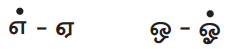
‘ஆய்தம்’ – இச்சொல்லில் உள்ள ஒவ்வோர் எழுத்தின் வகையையும், அது பிறக்கும் இடம் கழுத்து கழுத்து மார்பு, கழுத்து றுக்கு
Answer:
Samacheer Kalvi 8th Tamil Solutions Chapter 1.5 ஏழுத்துகளின் பிறப்பு 1

பாடநூல் வினாக்கள்

சரியான விடையைத் தேர்ந்தெடுத்து எழுதுக.

Question 1.
இதழ்களைக் குவிப்பதால் பிறக்கும் எழுத்துகள் …………………………
அ) இ, ஈ
ஆ) உ, ஊ
இ) எ, ஏ
ஈ) அ, ஆ
Answer:
ஆ) உ, ஊ

Question 2.
ஆய்த எழுத்து பிறக்கும் இடம் ………………………………..
அ) மார்பு
ஆ) கழுத்து
இ) தலை
ஈ) மூக்கு
Answer:
இ) தலை

Question 3.
வல்லின எழுத்துகள் பிறக்கும் இடம் ………………………..
அ) தலை
ஆ) மார்பு
இ) மூக்கு
ஈ) கழுத்து
Answer:
ஆ) மார்பு

Question 4.
நாவின் நுனி அண்ணத்தின் நுனியைப் பொருத்துவதால் பிறக்கும் எழுத்துகள் …………………..
அ) க், ங்
ஆ) ச், ஞ்
இ) ட், ண்
ஈ) ப், ம்
Answer:
இ) ட், ண்

Question 5.
கீழ்இதழும் மேல்வாய்ப்பல்லும் இணைவதால் பிறக்கும் எழுத்து ……………………..
அ) ம்
ஆ) ப்
இ) ய்
ஈ) வ்
Answer:
ஈ) வ்

பொருத்துக.

1. க், ங் – அ) நாவின் இடை, அண்ண த்தின் இடை.
2. ச், ஞ் – ஆ) நாவின் நுனி, மேல்வாய்ப்பல்லின் அடி.
3. ட், ண் – இ) நாவின் முதல், அண்ண த்தின் அடி.
4. த்,ந் – ஈ) நாவின் நுனி, அண்ண த்தின் நுனி.
Answer:
1. இ
2. அ
3. ஈ
4. ஆ

சிறுவினா

Question 1.
எழுத்துகளின் பிறப்பு என்றால் என்ன?
Answer:
உயிரின் முயற்சியால் உடலின் உள்ளிருந்து எழும் காற்றானது மார்பு, தலை, கழுத்து, மூக்கு ஆகிய நான்கு இடங்களுள் ஒன்றில் பொருந்தி, இதழ், நாக்கு, பல், மேல்வாய் ஆகிய உறுப்புகளின் முயற்சியினால் வேறுவேறு ஒலிகளாகத் தோன்றுகின்றன. இதனையே எழுத்துகளின் பிறப்பு என்பர்.

Question 2.
மெய் எழுத்துகள் எவற்றை இடமாகக் கொண்டு பிறக்கின்றன?
Answer:

  • மெய்யெழுத்துகளில், வல்லின மெய் எழுத்துகள் ஆறும் மார்பை இடமாகக் கொண்டு பிறக்கின்றன.
  • மெல்லின மெய் எழுத்துகள் ஆறும் மூக்கை இடமாகக் கொண்டு பிறக்கின்றன.
  • இடையின மெய் எழுத்துகள் ஆறும் கழுத்தை இடமாகக் கொண்டு பிறக்கின்றன.

Question 3.
ழகர, லகர, ளகர மெய்களின் முயற்சிப் பிறப்பு பற்றி எழுதுக.
Answer:

  • ழகர மெய் மேல்வாயை நாக்கின் நுனி வருடுவதால் பிறக்கிறது.
  • லகர மெய் மேல்வாய்ப் பல்லின் அடியை நாக்கின் ஓரங்கள் தடித்து நெருங்குவதால் பிறக்கிறது.
  • ளகர மெய் மேல்வாயை நாக்கின் ஓரங்கள் தடித்துத் தடவுதலால் பிறக்கிறது.

மொழியை ஆள்வோம்

தமிழ்மொழியை வாழ்த்திப் பாடிய வேறு கவிஞர்களின் பாடல்களைக் கேட்டு மகிழ்க.

அருள்நெறி அறிவைத் தரலாகும்
அதுவே தமிழன் குரலாகும்

பொருள்பெற யாரையும் புகழாது
போற்றா தாரையும் இகழாது

கொல்லா விரதம் குறியாகக்
கொள்கை பொய்யா நெறியாக

எல்லா மனிதரும் இன்புறலே.
என்றும் இசைந்திடும் அன்பறமே

அன்பும் அறமும் ஊக்கிவிடும்
அச்சம் என்பதைப் போக்கிவிடும்

இன்பம் பொழிகிற வானொலியாம்
எங்கள் தமிழெனும் தேன்மொழியாம்
– நாமக்கல் கவிஞர்

கீழ்க்காணும் தலைப்பில் இரண்டு நிமிடம் பேசுக.

தமிழ் எழுத்துகளின் தோற்றமும் வளர்ச்சியும்

தொல்காப்பியம் என்னும் தொன்மைத் தமிழ்நூலில் கூறப்படும் எழுத்துகள் வட்டெழுத்துகளைக் குறிப்பனவே ஆகும். இவ்வெழுத்தினைக் கோலெழுத்து, கண்ணெழுத்து எனப் பண்டைத் தமிழ் நூல்கள் குறிப்பிட்டுள்ளன. நாம் இன்று எழுதும் எழுத்துகள் ஆப்பு வடிவ எழுத்துகளிலிருந்தே தோன்றின என்று அறிஞர் சிலர் கருதுகின்றனர். கோடுகள் மிகுதியாக இருக்கக் காரணம் இதுவே என்பர்.

எகர ஒகர எழுத்துகளைக் குறிக்க எழுத்துகளின் மேல் புள்ளி வைக்கும் வழக்கம் தொல்காப்பியர் காலம் முதல் இருந்து வந்துள்ளது. ஓலைச் சுவடிகளிலும் கல்வெட்டுகளிலும் புள்ளி பெறும் எழுத்துகளை எழுதும்போது அவை சிதைந்துவிடும் என்பதால் புள்ளி இடாமல் எழுதினர். மெய்யா? உயிர்மெய்யா? குறிலா? நெடிலா?

என உணர வேண்டிய நிலை இருந்தது. இதனால் படிப்பவர்கள் பெரிதும் இடருற்றனர். இந்நிலையில் தமிழ் எழுத்துகளில் மிகப்பெரும் சீர்திருத்தத்தைச் செய்தவர் வீரமாமுனிவர். அதன் பிறகு தந்தை பெரியாரின் சீர்திருத்தமும் பெற்று தமிழ் இன்று எழுதும் தமிழாக மாறியது. தமிழ்மொழி கணினிப் பயன்பாட்டிற்கு ஏற்ற மொழியாகவும் ஆகியிருக்கிறது. நன்றி!

அகரவரிசைப்படுத்துக.

எழுத்து, ஒலிவடிவம், அழகுணர்ச்சி, ஏழ்கடல், இரண்டல்ல, ஊழி, உரைநடை, ஔகாரம், ஓலைச்சுவடிகள், ஆரம்நீ, ஈசன், ஐயம்.

அகர வரிசைப்படுத்தியன:
அழகுணர்ச்சி, ஆரம் நீ, இரண்டல்ல, ஈசன், உரைநடை, ஊழி, எழுத்து, ஏழ்கடல், ஐயம், ஒலிவடிவம், ஓலைச்சுவடிகள், ஔகாரம்

அறிந்து பயன்படுத்துவோம்.

மரபுத் தொடர்கள்:
தமிழ் மொழிக்கெனச் சில சொல் மரபுகள் உள்ளன. அவை பழங்காலம் முதலே பின்பற்றப்படுகின்றன.

பறவைகளின் ஒலிமரபு

  • ஆந்தை அலறும்
  • காகம் கரையும்
  • சேவல் கூவும்
  • குயில் கூவும்
  • கோழிகொக்கரிக்கும்
  • புறா குனுகும்
  • மயில் அகவும்
  • கிளி பேசும்
  • கூகை குழறும்

தொகை மரபு

  • மக்கள் கூட்டம்
  • ஆநிரை
  • ஆட்டு மந்தை

வரினை மரபு

  • சோறு உண்
  • தண்ணீ ர் குடி
  • பூக் கொய்
  • முறுக்குத் தின்
  • கூடை முடை
  • இலை பறி
  • சுவர் எழுப்பு
  • பால் பருகு
  • பானை வனை

சரியான மரபுச் சொல்லைத் தேர்ந்தெடுத்து எழுதுக.

1. கோழி ………………………. (கூவும் / கொக்கரிக்கும்)
2. பால் …………………….. (குடி / பருகு)
3. சோறு ……………………… (தின்/ உண்)
4. பூ ………………………. (கொய் / பறி)
5. ஆ ……………………. (நிரை / மந்தை )
Answer:
1. கொக்கரிக்கும்
2. பருகு
3. உண்
4. கொய்
5. நிரை

மரபுப் பிழையை நீக்கி எழுதுக.

சேவல் கொக்கரிக்கும் சத்தம் கேட்டுக் கயல் கண் விழித்தாள். பூப்பறிக்க நேரமாகி விட்டதை அறிந்து தோட்டத்திற்குச் சென்றாள். அங்கு மரத்தில் குயில் கரைந்து கொண்டிருந்தது. பூவைப் பறித்ததுடன், தோரணம் கட்ட மாவிலையையும் கொய்து கொண்டு வீடு திரும்பினாள். அம்மா தந்த பாலைக் குடித்துவிட்டுப் பள்ளிக்குப் புறப்பட்டாள்.

Answer:
சேவல் கூவும் சத்தம் கேட்டுக்கயல் கண்விழித்தாள். பூக்கொய்ய நேரமாகிவிட்டதை அறிந்து தோட்டத்திற்குச் சென்றாள். அங்கு மரத்தில் குயில் கூவிக் கொண்டிருந்தது. பூவைக் கொய்ததுடன், தோரணம் கட்ட மாவிலையையும் பறித்துக்கொண்டு வீடு திரும்பினாள். அம்மா தந்த பாலைப் பருகிவிட்டுப் பள்ளிக்குப் புறப்பட்டாள்.

7. கட்டுரை எழுதுக.

நான் விரும்பும் கவிஞர் – பாவேந்தர் பாரதிதாசன்

முன்னுரை :
எங்கும் தமிழ்! எதிலும் தமிழ்!’ என முழங்கும் காலம் இக்காலம். இந்த முழக்கத்திற்கு – மூலமாக இருந்த பெருமக்களுள் பாவேந்தர் பாரதிதாசனார் குறிப்பிடத்தக்கவர். இவரே நான் விரும்பும் கவிஞர் ஆவார்.

பிறப்பும் இளமையும் :
கனகசுப்புரத்தினம் என்னும் இயற்பெயர் கொண்ட பாரதிதாசனார் 29.04.1891-இல் கனகசபை – இலக்குமி அம்மையாருக்கு மகனாய்ப் புதுச்சேரியில் பிறந்தார். இளமையில் தமிழாசிரியராய் அமர்ந்தார். மகாகவி பாரதியாரிடம் கொண்ட அன்பால் தம் பெயரைப் பாரதிதாசன் என வைத்துக் கொண்டார்.

தமிழ்ப்பற்று :
‘தமிழுக்கும் அழுதென்று பேர் – அந்தத்
தமிழ் இன்பத் தமிழ் எங்கள் உயிருக்கு நேர்’
போன்ற கவிதை வரிகள் பாரதிதாசனின் தமிழ்ப்பற்றை வெளிப்படுத்துவன. தமிழரின் மேன்மையை இகழ்ந்தவனை என் தாய் தடுத்தாலும் விடேன்’ என முழங்கினார். தமிழகத்தின் தமிழ்த்தெருவில் தமிழ்தான் இல்லை ‘ என வருந்தினார்.

கவிச்சுவை :
இயற்கையில் ஈடுபாடு மிக்க பாவேந்தரின் கவிதைகள் கருத்தாழமும் கற்பனைச் சுவையும் கொண்டு கற்போரைக் களிப்புறச் செய்பவை. ‘நீலவான் ஆடைக்குள் உடல் மறைந்து நிலாவென்று காட்டுகின்றாய் ஒளிமுகத்தை’ எத்தனை அழகான கற்பனை!. இது இவரின் கவிச்சுவைக்குச் சான்று.

சமுதாயப் பார்வை:
‘சாதி இருக்கின்ற தென்பானும் இருக்கின்றானே’ எனச் சாதி வெறியைச் சாடினார்.

‘எல்லார்க்கும் எல்லாம் என்று இருப்பதான
இடம் நோக்கி நடக்கின்ற திந்த வையம்’
என்ற பொதுவுடைமைக் கருத்துக்குச் சொந்தக்காரர் பாவேந்தர்.

முடிவுரை :
உடல்வளமும் , உளத்திடமும், உண்மை உரைக்கும் பண்பும், நேர்மையும், மொழிப்பற்றும், இனப்பற்றும் கொண்ட பாவேந்தரின் கனவுகளை நனவாக்குவதே நமது கடமை.

மொழியோடு விளையாடு

பொருத்தமான பன்மை விகுதியைச் சேர்த்தெழுதுக.

கல், பூ, மரம், புல், வாழ்த்து , சொல், மாதம், கிழமை, ஈ, பசு, படம், பல், கடல், கை, பக்கம், பா.

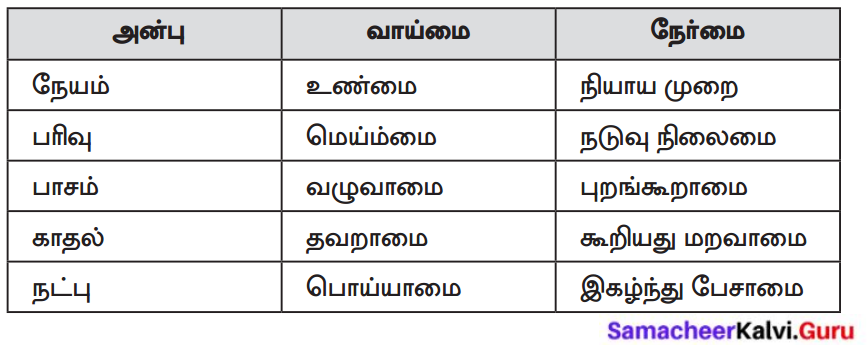
Samacheer Kalvi 8th Tamil Solutions Chapter 1.5 ஏழுத்துகளின் பிறப்பு 2

ஒருசொல் ஒரே தொடரில் பல பொருள் தருமாறு எழுதுக.

எ.கா: அணி – பல அணிகளை அணிந்த வீரர்கள், அணி அணியாய்ச் சென்றனர்.

படி, திங்கள், ஆறு.
படி : படித்துக்கொண்டிருந்த மாலதி, மாடு கறந்த ஒரு படிப்பாலை எடுத்துக் கொண்டு, படியில் ஏறிச் சென்று தாயிடம் கொடுத்தாள்.

திங்கள் : சித்திரைத் திங்களில், முதல் திங்கள் அன்று, இரவில் திங்களைப் பார்ப்பது நல்லது.

ஆறு : ஆறுமுகம், காலையில் துவைப்பதற்காக ஆறு துணிகளை எடுத்துக்கொண்டு காவேரி ஆற்றுக்குச் சென்றான்.

சொற்களை ஒழுங்குபடுத்தி முறையான தொடராக்குக.

1. வட்டெழுத்து எனப்படும் தமிழ் கோடுகளால் வளைந்த அமைந்த எழுத்து.
2. உலகம் தமிழ்மொழி வாழட்டும் உள்ளவரையிலும்.
3. வென்றதை பரணி பகைவரை ஆகும் பாடும் இலக்கியம்.
4. கழுத்து பிறக்கும் இடம் உயிரெழுத்து ஆகும்.
5. ஏகலை கலையை அம்புவிடும் தமிழ் என்றது.

ஒழுங்குபடுத்திய தொடர் :
1. வளைந்த கோடுகளால் அமைந்த தமிழ் எழுத்து வட்டெழுத்து எனப்படும்.
2. உலகம் உள்ளவரையிலும் தமிழ்மொழி வாழட்டும்.
3. பகைவரை வென்றதைப் பாடும் இலக்கியம் பரணி ஆகும்.
4. உயிரெழுத்து பிறக்கும் இடம் கழுத்து ஆகும்.
5. தமிழ் அம்புவிடும் கலையை ஏகலை என்றது.

நிற்க அதற்குத் தக…

கலைச்சொல் அறிவோம்

1. ஒலிபிறப்பியல் – Articulatory phonetics
2. மெய்யொலி – Consonant
3. மூக்கொலி – Nasal consonant sound
4. கல்வெட்டு – Epigraph
5. உயிரொலி – Vowel
6. அகராதியியல் – Lexicography
7. ஒலியன் – Phoneme
8. சித்திர எழுத்து – Pictograph

இணையத்தில் காண்க

தமிழ் வரிவடிவ எழுத்துகளில் காலந்தோறும் ஏற்பட்டுள்ள மாற்றங்களை இணையத்தில் தேடித் தொகுத்து வருக.

1. ஓவிய எழுத்துகள் :
மனிதன் ஓவியங்கள் மூலமாக தங்களுடைய எண்ணங்களை மற்றவர்களுடன் பகிர்ந்து கொண்டான். தமிழகத்தில் மல்லப்பாடி, கீழ்வாலை, கோவை, மதுரை, நீலகிரி, தருமபுரி போன்ற மாவட்டங்களில் ஓவிய எழுத்தைக் கண்டு பிடித்துள்ளனர்.

2. உருவ எழுத்து :
பழந்தமிழகத்தில் உருவ எழுத்து உணர்வு எழுத்து, ஒலியெழுத்து, தன்மை எழுத்து என வரும் எழுத்துகள் ஒவ்வொன்றும் இருபாற்பட்டு எட்டு வகையாக விளங்கிய | பாங்கும் அதில் உருவ எழுத்து ஓவியன் கைவினைத் திறன் போன்றது என்பதும் பெறப்படும். இதனால் குழுக்களாக இருந்த பழங்குடி மக்கள் பலவகைப்பட்ட எழுத்துருக்களைப் பயன்படுத்திய பாங்கும் புலப்படும்.

3. தமிழி எழுத்து :
சங்ககாலக் கல்வெட்டுகளில் காணும் எழுத்துகளை தமிழி என்பர். தமிழுக்கே உரிய. வடிவத்தைத் தமிழி என்று கூறுவதுதான் சரி. இன்றுள்ள பழமையான எழுத்து வடிவம் தமிழியே என்பதும் அதுகாலந்தோறும் மாற்றம் பெற்றதையும் அறிஞர்கள் பட்டியல் இட்டுக் காட்டியுள்ளனர். இன்றுள்ள வடிவங்களுக்கு வித்தாக உள்ளது தமிழியே.

4. கோல் எழுத்து :
ஓவிய எழுத்தில் இருந்து கல்லில் பொறிக்கக் கோடுகளாக வரைந்த குறியீடுகளைக் கோல் எழுத்து என்றும் குறிப்பர்.

5. வட்டெழுத்து :
கல்லில் வெட்டப்பட்ட எழுத்துகளே வட்டெழுத்து எனப்பட்டது என்றும், ஓலைகளில் எழுதும்போது கோடுகள் ஓலைகளைக் கிழிக்கும் என்பதால் வட்டமாக எழுதியதால் இப்பெயர் பெற்றது என்றும் கூறுவர். பாண்டிய நாட்டில் வட்டெழுத்துகள் கி.பி. எட்டாம் நூற்றாண்டு வரை வழக்கில் இருந்ததைக் கல்வெட்டுகள் காட்டும்.

இமயமலை அடிவாரத்தில் உள்ள கோபலேசுவரர் ஆலயத்தில் வட்டெழுத்துக் கல்வெட்டு தமிழில் உள்ளது. இவ்வாறு தமிழ் வட்டெழுத்து இந்தியா முழுவதும் பரவிப் பல்வேறு எழுத்து வடிவங்கள் தோன்றக் காரணமாயின தன்மையும் அறியப்படும்.

6. கிரந்த எழுத்து :
தமிழகத்தில் பல்லவர் ஆட்சி ஏற்பட்டதும் வடமொழி ஆதிக்க மொழியாயிற்று. கிரந்த எழுத்துகள் வழக்கில் வந்தன. இதனைப் பல்லவ கிரந்தம் என்றே அழைப்பர். கிரந்தம் என்ற சொல்லிற்கு நூல் என்பது பொருள். இதுவே பின்னர் எழுத்தையும் குறித்தது. தமிழ்க் கல்வெட்டுகளில் வடமொழிப் பகுதியைக் குறிக்க இந்த எழுத்துகளையே பயன்படுத்தினர். தமிழ்நாட்டில் ஆனைமலை, அழகர்மலை, திருமயம், குடுமியான்மலை, தகடூர், பேரூர் போன்ற இடங்களில் உள்ள சோழர்காலக் கல்வெட்டுகளில் கிரந்த எழுத்துகளைக் காணலாம்.

7. முதல் அச்சு எழுத்து :
தமிழ்மொழியின் முதல் அச்சுப் புத்தகம் தம்பிரான் வணக்கம் என்னும் நூல் 1578 அக்டோபர் 20ஆம் நாள் கொல்லத்தில் அச்சிடப்பட்டது. அதில் கொல்லம் எழுத்து, மலபார் எழுத்து, கோவா எழுத்து என்பன போன்ற வேறு வேறு வகையான தமிழ் எழுத்துகள் அன்று வழக்கில் இருந்ததைக் குறித்துக் காணலாம். இவ்வாறு அச்சில் கூடப் பலவகைப்பட்ட எழுத்துகள் பழக்கத்தில் இருந்ததை நாம் அறிய முடியும்.

8. வீரமாமுனிவர் செய்த மாற்றம் :
‘எகரத்துக்கும், ஒகரத்துக்கும் உட்புள்ளியை நீக்கிக் கால் இட்டார். உயிர்மெய்களில் எகர, ஒகரங்கட்கு ஒற்றைக் கொம்பு, இரட்டைக் கொம்பு அமைத்தார். அவரே சதுர வடிவான எழுத்துகளை அமைத்தார் என்றும் கூறுவர்.

9. பெரியார் செய்த மாற்றம் :
பெரியார் தமிழ் எழுத்துகள் சீர்மை பெற வேண்டும் என்று கருதினார். அதன் விளைவாக உயிர்மெய்க்கு, மெய்யுடன் கால் சேர்த்து வழங்கும் முறையைக் கொண்டார்.

கூடுதல் வினாக்கள்

சரியான விடையைத் தேர்ந்தெடுத்து எழுதுக.

Question 1.
எழுத்துகள் ………………….. இடங்களில் பிறக்கின்றன.
அ) இரண்டு
ஆ) மூன்று
இ) நான்கு
ஈ) ஐந்து
Answer:
இ) நான்கு

Question 2.
உயிரெழுத்துகளின் பிறப்பிடம் …………………….
அ) மூக்கு
ஆ) தலை
இ) மார்பு
ஈ) கழுத்து
Answer:
ஈ) கழுத்து

Question 3.
மெல்லின எழுத்துகள் பிறக்கும் இடம் ………………….
அ) மார்பு
ஆ) தலை
இ) மூக்கு
ஈ) கழுத்து
Answer:
இ) மூக்கு

Question 4.
இடையின எழுத்துகள் பிறக்கும் இடம் ………………….
அ) தலை
ஆ) மூக்கு
இ) கழுத்து
ஈ) மார்பு
Answer:
இ) கழுத்து

Question 5.
எழுத்துகளின் பிறப்பினை ……………………. வகையாகப் பிரிப்பர்.
அ) இரண்டு
ஆ) மூன்று
இ) நான்கு
ஈ) ஐந்து
Answer:
அ) இரண்டு

குறுவினா.

Question 1.
எழுத்துகளின் பிறப்பினை எத்தனை வகையாகப் பிரிப்பர்? அவை யாவை?
Answer:

  • எழுத்துகளின் பிறப்பினை இரண்டு வகையாகப் பிரிப்பர்.
  • அவை, இடப்பிறப்பு, முயற்சிப் பிறப்பு ஆகும்.

Question 2.
உயிரெழுத்துகள் எவற்றை இடமாகக் கொண்டு பிறக்கின்றன?
Answer:
உயிர் எழுத்துகள் பன்னிரண்டும் கழுத்தை இடமாகக் கொண்டு பிறக்கின்றன.

Question 3.
ஆய்த எழுத்து எதை இடமாகக் கொண்டு பிறக்கிறது?
Answer:
ஆய்த எழுத்து தலையை இடமாகக் கொண்டு பிறக்கிறது.

Question 4.
உயிர் எழுத்துகளின் முயற்சிப் பிறப்பு குறித்து எழுதுக.
Answer:
(i) அ, ஆ, ஆகிய இரண்டும் வாய் திறத்தலாகிய முயற்சியால் பிறக்கின்றன. இ, ஈ, எ, ஏ, ஐ ஆகிய ஐந்தும் வாய் திறக்கும் முயற்சியுடன் நாக்கின் அடி ஓரமானது மேல்வாய்ப் பல்லைப் பொருந்தும் முயற்சியால் பிறக்கின்றன.

(ii) உ, ஊ, ஒ, ஓ, ஔ ஆகிய ஐந்தும் வாய் திறக்கும் முயற்சியுடன் இதழ்களைக் குவிப்பதால் பிறக்கின்றன.

Question 5.
க், ங் – மெய்களின் முயற்சிப் பிறப்பு யாது?
Answer:
க், ங் – ஆகிய இருமெய்களும் நாவின் முதற்பகுதி, அண்ணத்தின் அடிப்பகுதியைப் பொருந்துவதால் பிறக்கின்றன.

Question 6.
ச், ஞ் – மெய்களின் முயற்சிப் பிறப்பு யாது?
Answer:
ச், ஞ் – ஆகிய இருமெய்களும் நாவின் இடைப்பகுதி, நடு அண்ணத்தின் இடைப்பகுதியைப் பொருந்துவதால் பிறக்கின்றன.

Question 7.
ட், ண் – ஆகிய மெய்களின் முயற்சிப் பிறப்பு யாது?
Answer:
ட், ண்- ஆகிய இருமெய்களும் நாவின் நுனி, அண்ணத்தின் நுனியைப் பொருந்துவதால் பிறக்கின்றன.

Question 8.
த், ந் – மெய்களின் முயற்சிப் பிறப்பு யாது?
Answer:
த், ந் – ஆகிய இருமெய்களும் மேல்வாய்ப்பல்லின் அடியை நாக்கின் நுனி பொருந்துவதால் பிறக்கின்றன.

Question 9.
ப், ம் – மெய்களின் முயற்சிப் பிறப்பு யாது?
Answer:
ப், ம் – ஆகிய இரு மெய்களும் மேல் இதழும் கீழ் இதழும் பொருந்துவதால் பிறக்கின்றன.

Question 10.
ற், ன் – மெய்களின் முயற்சிப் பிறப்பு யாது?
Answer:
ற்,ன் – ஆகிய இருமெய்களும் மேல்வாயை நாக்கின் நுனி மிகவும் பொருந்துவதால் பிறக்கின்றன.

Question 11.
ய், ர், வ் – மெய்களின் முயற்சிப் பிறப்பு யாது?
Answer:
ய் – இது நாக்கின் அடிப்பகுதி, மேல் வாய் அடிப்பகுதியைப் பொருந்துவதால் பிறக்கிறது.
ர் – இது மேல்வாயை நாக்கின் நுனி வருடுவதால் பிறக்கிறது.
வ் – இது மேல்வாய்ப்பல்லைக் கீழ் உதடு பொருந்துவதால் பிறக்கிறது.

Question 12.
சார்பு எழுத்துகளின் பிறப்பு குறித்து எழுதுக.
Answer:
ஆய்த எழுத்து வாயைத் திறந்து ஒலிக்கும் முயற்சியால் பிறக்கிறது. பிற சார்பெழுத்துகள் யாவும் தத்தம் முதலெழுத்துகள் தோன்றும் இடங்களிலேயே அவை பிறப்பதற்கு உரிய முயற்சிகளைக் கொண்டு தாமும் பிறக்கின்றன.

Samacheer Kalvi 10th Maths Solutions Chapter 3 Algebra Unit Exercise 3

You can Download Samacheer Kalvi 10th Maths Book Solutions Guide Pdf, Tamilnadu State Board help you to revise the complete Syllabus and score more marks in your examinations.

Tamilnadu Samacheer Kalvi 10th Maths Solutions Chapter 3 Algebra Unit Exercise 3

10th Maths Unit Exercise 3 Question 1.
Solve \(\frac{1}{3}\) (x + y – 5) = y – z = 2x – 11 = 9 – (x + 2 z).
Solution:
Given
10th Maths Unit Exercise 3 Solutions Chapter 3 Algebra Samacheer Kalvi
3z = 3 ⇒ z = 1
(3) becomes, 3x + 2 = 20 ⇒ 3x = 20 – 2 = 18
x = \(\frac{18}{3}\) = 6
(1) becomes, 6 – 2y + 3(1) = 5 ⇒ 9 – 2y = 5
⇒ 9 – 5 = 2y ⇒ 2y = 4
∴ y = \(\frac{4}{2}\) = 2
∴ Solution set is {6, 2, 1}

Unit Exercise 3 Question 2.
One hundred and fifty students are admitted to a school. They are distributed over three sections A, B and C. If 6 students are shifted from section A to section C, the sections will have equal number of students. If 4 times of students of section C exceeds the number of students of section A by the number of students in section B, find the number of students in the three sections.
Solution:
Let the students in section A, B, C be a, b, c, respectively.
Unit Exercise 3 Samacheer Kalvi 10th Maths Solutions Chapter 3 Algebra

Samacheer Kalvi 10th Maths Exercise 3.1 Question 3.
In a three-digit number, when the tens and the hundreds digit are interchanged the new number is 54 more than three times the original number. If 198 is added to the number, the digits are reversed. The tens digit exceeds the hundreds digit by twice as that of the tens digit exceeds the unit digit. Find the original number.
Solution:
Let the three digits numbers be 100a +10b + c.
100b + 10a + c = 3(100a + 10b + c) + 54 ………. (1)
100a + 106 + c + 198 = 100c + 106 + a ……… (2)
(b – a) = 2(b – c) ……… (3)
(1) ⇒ 100b + 10a + c = 300a + 30b + 3c + 54
⇒ 290a – 70b + 2c = -54
(2) ⇒ 99a – 99c = -198 ⇒ a – c = -2
⇒ a = c – 2
(3) ⇒ a + b – 2c = 0 ⇒ a + b = 2c
⇒ b = 2c – c + 2
⇒ b = c + 2
Substituting a, b in (1)
290(c – 2) – 70 (c + 2) + 2c = -54
290c – 580 – 70c – 140 + 2c = -54
222c = 666 ⇒ c = 3
a = 1, 6 = 5
∴ The number is 153.

10th Maths Unit Exercise 2 Question 4.
Find the least common multiple of
xy (k2 + 1) + k(x2 + y2) and
xy(k2 – 1) + k (x2 – y2)
Answer:
xy (k2 + 1) + k(x2 + y2) = k2xy + xy + kx2 + ky2
= (k2xy + kx2) + (ky2 + xy)
= kx(ky + x) + y (ky + x)
= (ky + x) (kx + y)
xy (k2 – 1) + k(x2 – y2) = k2xy – xy + kx2 – ky2
= (k2xy + kx2) – xy – ky2
= kx(ky + x) -y (ky + x)
= (ky + x) (kx – y)
L.C.M. = (ky + x) (kx + y) (kx – y)
= (ky + x)(k2x2 – y2)
The least common multiple is
(ky + x) (k2x2 – y2)

Unit Exercise Question 5.
Find the GCD of the following by division algorithm 2x4 + 13.x3 + 21 x2 + 23x + 7, x3 + 3x2 + 3x + 1, x2 + 2x + 1.
Solution:
2x4 + 13x3 + 27x2 + 23x + 7,
x3 + 3x2 + 3x + 1, x2 + 2x + 1.
By division algorithm, first divide
Samacheer Kalvi 10th Maths Exercise 3.1 Solutions Chapter 3 Algebra Unit
∴ (x + 1)2 is G.C.D of x3 + 3x2 + 3x + 1 and x2 + 2x + 1.
Next let us divide
2x4 + 13x3 + 27x2 + 23x + 7 by x2 + 2x + 1
10th Maths Unit Exercise 2 Solutions Chapter 3 Algebra Samacheer Kalvi
∴ G.C.D of 2x4 + 13x3 + 21 x2 + 23x + 7, x3 + 3x2 + 3x + 1, x2 + 2x + 1 is (x + 1)2.

10th Maths Example Sums Question 6.
Reduce the given Rational expressions to its lowest form
Unit Exercise Samacheer Kalvi 10th Maths Solutions Chapter 3 Algebra
Solution:
10th Maths Example Sums Solutions Chapter 3 Algebra Unit Exercise 3 Samacheer Kalvi

Samacheer Kalvi 10th Maths Solution Question 7.
Samacheer Kalvi 10th Maths Solution Chapter 3 Algebra Unit Exercise 3
Solution:
Samacheer Kalvi 10th Maths Answers Solutions Chapter 3 Algebra Unit Exercise 3
Exercise 1.6 Class 10 Maths Samacheer Kalvi Chapter 3 Algebra

Samacheer Kalvi 10th Maths Answers Question 8.
Arul, Ravi and Ram working together can clean a store in 6 hours. Working alone, Ravi takes twice as long to clean the store as Arul does. Ram needs three times as long as Arul does. How long would it take each if they are working alone?
Solution:
Let Aral’s speed of working be x
Let Ravi’s speed of working be y
Let Ram’s speed of working be z
given that they are working together. ,
Let V be the quantum of work, x + y + z = \(\frac{w}{6}\) …………. (1)
Also given that Ravi takes twice the time as Aral for finishing the work.
10th Maths Book Example Sums Samacheer Kalvi Chapter 3 Algebra
Also Ram takes 3 times the time as Aral for finishing the work.
∴ \(\frac{w}{z}\) = 3 × \(\frac{w}{x}\)
∴ x = 3z ∴ z = \(\frac{x}{3}\)
Substitute (2) and (3) in (1),
10th Algebra Solutions Chapter 3 Samacheer Kalvi

Exercise 1.6 Class 10 Maths Samacheer Question 9.
Find the square root of 289x4 – 612x3 + 970x2 – 684x + 361
Solution:
10th Maths Samacheer Kalvi Solutions Chapter 3 Algebra Unit Exercise 3

10th Maths Exercise 1.6 Answers Question 10.
Solve \(\sqrt{y+1}+\sqrt{2 y-5}\) = 3.
Solution:
Squaring both sides
Samacheer Kalvi 10th Solutions Chapter 3 Algebra Unit Exercise 3
9y2 – 78y + 169 = 4 (y + 1)(2y – 5)
9y2 – 78y + 169 = 4 (2y2 + 2y – 5y – 5)
9y2 – 78y + 169 = 8y2 + 8y – 20y – 20
9y2 – 78y + 169 – 8y2 + 12y + 20 = 0
y2 – 66y + 189 = 0
y2 – 63y – 3y + 189 = 0
y(y – 63) – 3(y – 63) = 0
(y – 63)(y – 3) = 0
y = 63, 3

10th Maths Book Example Sums Question 11.
A boat takes 1.6 hours longer to go 36 kms up a river than down the river. If the speed of the water current is 4 km per hr, what is the speed of the boat in still water?
Solution:
Let the speed of boat in still water be ‘v’
3rd Standard Samacheer Maths Book Solutions 10th Maths Solutions Chapter 3 Algebra
⇒ 36(v + 4) – 36(v – 4) = \(\frac{8}{5}\) (v – 4) (v + 4)
⇒ 36v + 144 – 36v + 144 = \(\frac{8}{5}\) (v2 – 4v + 4v – 16)
⇒ 288 = \(\frac{8}{5}\) v2 – \(\frac{128}{5}\) ⇒ 8v2 – 128 = 1440
⇒ 8v2 = 1568 ⇒ v2 = 196 v = ±14
∴ Speed of the boat = 14 km/hr. (∵ speed cannot be -ve)

10th Algebra Solutions Question 12.
Is it possible to design a rectangular park of perimeter 320 m and area 4800 m2? If so find its length and breadth.
Solution:
Let the length and breadth of the rectangle be lm and bm
Given 2(1 + b)
⇒ l + b = 160 ………. (1)
Also l b = 4800
10thmaths Solutions Chapter 3 Algebra Unit Exercise 3 Samacheer Kalvi
∴ Length and breadth of the rectangular park is 120m and 40 m

10th Maths Samacheer Question 13.
At t minutes past 2 pm, the time needed to 3 pm is 3 minutes less than \(\frac{t^{2}}{4}\) Find t.
Solution:
60 – t = \(\frac{t^{2}}{4}\) – 3
⇒ t2 – 12 = 240 – 4t
⇒ t2 + 4t – 252 = 0
⇒ t2 + 18t – 14t – 252 = 0
⇒ t(t + 18) – 14(t + 18) = 0
⇒ (t + 18) (t – 14) = 0
∴ t = 14 or t = -18 is not possible.

Samacheer Kalvi 10th Solutions Question 14.
The number of seats in a row is equal to the total number of rows in a hall. The total number of seats in the hall will increase by 375 if the number of rows is doubled and the number of seats in each row is reduced by 5. Find the number of rows in the hall at the beginning.
Solution:
Let the no of seats in each row be x
Samacheer Kalvi 10th Maths Book Answers Solutions Chapter 3 Algebra Unit Exercise 3
⇒ 2x2 – 10x = x2 + 375
⇒ x2 – 10x – 375 = 0
⇒ x2 – 25x + 15x – 375 = 0
⇒ x (x – 25) + 15 (x – 25) = 0
⇒ (x – 25) (x + 15) = 0
⇒ x = 25, x = -15, x > 0
∴ 25 rows are in the hall.

3rd Standard Samacheer Maths Book Solutions Question 15.
If a and b are the roots of the polynomial f(x) = x2 – 2x + 3, find the polynomial whose roots are
(i) α + 2, β + 2
(ii) \(\frac{\alpha-1}{\alpha+1}, \frac{\beta-1}{\beta+1}\)
Solution:
10th Maths Solutions Chapter 3 Algebra Unit Exercise 3 Samacheer Kalvi
(i) α + 2, β + 2 are the roots (given)
Sum of the roots = α + 2 + β + 2
= α + β + 4
= 2 + 4 = 6
Product of the roots = (α + 2) (β + 2)
= αβ + 2α + 2β + 4
= αβ + 2(α + β) + 4
= 3 + 2 × 2 + 4
= 3 + 4 + 4 = 11
∴ The required equation = x2 – 6x + 11 = 0.
10th Algebra Chapter 3 Samacheer Kalvi Unit Exercise 3 Maths Solutions
⇒ 3x2 – 2x + 1 = 0

Class 3 Samacheer Kalvi Solutions Question 16.
If -4 is a root of the equation
x2 + px – 4 = 0 and if the equation
x2 + px + q = 0 has equal roots, find the values of p and q.
Answer:
Let p(x) = x2 + px – 4
– 4 is the root of the equation
P(-4) = 0
16 – 4p – 4 = 0
-4p + 12 = 0
-4p = -12
p = \(\frac { 12 }{ 4 } \) = 3
The equation x2 + px + q = 0 has equal roots
x2 + 3 x + q = 0
Here a = 1, b = 3, c = q
since the roots are real and equal
b2 – 4 ac = 0
32 – 4(1)(q) = 0
9 – 4q = 0
9 = 4q
q = \(\frac { 9 }{ 4 } \)
The value of p = 3 and q = \(\frac { 9 }{ 4 } \)

10thmaths Question 17.
Two farmers Senthil and Ravi cultivates three varieties of grains namely rice, wheat and ragi. If the sale (in ₹) of three varieties of grains by both the farmers in the month of April is given by the matrix.
10th Samacheer Maths Solutions Chapter 3 Algebra Unit Exercise 3
May month sale (in ₹) is exactly twice as that of the April month sale for each variety.
(i) What is the average sales of the months April and May.
(ii) If the sales continues to increase in the same way in the successive months, what will be sales in the month of August?
Solution:
10th Maths Samacheer Kalvi Solution Chapter 3 Algebra Unit Exercise 3

Samacheer Kalvi 10th Maths Book Answers Question 18.
10th Maths Samacheer Kalvi Guru Chapter 3 Algebra Unit Exercise 3
Solution:
Samacheer Kalvi 10th Maths Chapter 3 Algebra Unit Exercise 3 22
Samacheer Kalvi 10th Maths Chapter 3 Algebra Unit Exercise 3 23

10th Maths Question 19.
Samacheer Kalvi 10th Maths Chapter 3 Algebra Unit Exercise 3 24
Solution:
Samacheer Kalvi 10th Maths Chapter 3 Algebra Unit Exercise 3 25

10th Algebra Chapter 3 Question 20.
Samacheer Kalvi 10th Maths Chapter 3 Algebra Unit Exercise 3 26
Solution:
Samacheer Kalvi 10th Maths Chapter 3 Algebra Unit Exercise 3 27
Samacheer Kalvi 10th Maths Chapter 3 Algebra Unit Exercise 3 28
Samacheer Kalvi 10th Maths Chapter 3 Algebra Unit Exercise 3 29

Samacheer Kalvi 12th Physics Solutions Chapter 2 Current Electricity

Students those who are preparing for the 12th Physics exam can download this Samacheer Kalvi 12th Physics Book Solutions Questions and Answers for Chapter 2 Current Electricity from here free of cost. These Tamilnadu State Board Solutions for Class 12th Physics PDF cover all Chapter 2 Current Electricity Questions and Answers. All these concepts of Samacheer Kalvi 12th Physics Book Solutions Questions and Answers are explained very conceptually as per the board prescribed Syllabus & guidelines.

Tamilnadu Samacheer Kalvi 12th Physics Solutions Chapter 2 Current Electricity

Kickstart your preparation by using this Tamilnadu State Board Solutions for 12th Physics Chapter 2 Current Electricity Questions and Answers and get the max score in the exams. You can cover all the topics of Chapter 2 Current Electricity Questions and Answers pdf. Download the Tamilnadu State Board Solutions by accessing the links provided here and ace up your preparation.

Samacheer Kalvi 12th Physics Current Electricity Textual Evaluation Solved

Samacheer Kalvi 12th Physics Current Electricity Multiple Choice Questions   

Current Electricity Class 12 Problems With Solutions State Board Question 1.
The following graph shows current versus voltage values of some unknown conductor. What is the resistance of this conductor?
Current Electricity Class 12 Problems With Solutions State Board Chapter 2 Samacheer Kalvi
(a) 2 ohm
(b) 4 ohm
(c) 8 ohm
(d) 1 ohm
Answer:
(a) 2 ohm

Current Electricity Class 12 State Board Question 2.
A wire of resistance 2 ohms per meter is bent to form a circle of radius 1 m. The equivalent resistance between its two diametrically opposite points, A and B as shown in the figure is-
Current Electricity Class 12 State Board Solutions Chapter 2 Samacheer Kalvi
(a) π Ω
(b) \(\frac { π }{ 2 }\) Ω
(c) 2π Ω
(d) \(\frac { π }{ 4 }\) Ω
Answer:
(b) \(\frac { π }{ 2 }\) Ω

12th Physics Chapter 2 Book Back Answers Question 3.
A toaster operating at 240 V has a resistance of 120 Ω. The power is
(a) 400 W
(b) 2 W
(c) 480 W
(d) 240 W
Answer:
(c) 480 W

12th Physics Samacheer Kalvi Question 4.
A carbon resistor of (47 ± 4.7) k Ω to be marked with rings of different colours for its identification. The colour code sequence will be
(a) Yellow – Green – Violet – Gold
(b) Yellow – Violet – Orange – Silver
(c) Violet – Yellow – Orange – Silver
(d) Green – Orange – Violet – Gold
Answer:
(b) Yellow – Violet – Orange – Silver

Samacheer Kalvi 12th Physics Question 5.
What is the value of resistance of the following resistor?
12th Physics Chapter 2 Book Back Answers Current Electricity Samacheer Kalvi
(a) 100 k Ω
(b) 10 k Ω M
(c) 1 k Ω
(d) 1000 k Ω
Answer:
(a) 100 k Ω

Class 12 Physics Samacheer Kalvi Question 6.
Two wires of A and B with circular cross section made up of the same material with equal lengths. Suppose RA = 3 RB, then what is the ratio of radius of wire A to that of B?
(a) 3
(b) √3
(c) \(\frac { 1 }{ √3 }\)
(d) \(\frac { 1 }{ 3 }\)
Answer:
(c) \(\frac { 1 }{ √3 }\)

Current Electricity Short Notes Question 7.
A wire connected to a power supply of 230 V has power dissipation P1 Suppose the wire is cut into two equal pieces and connected parallel to the same power supply. In this case power dissipation is P2. The ratio \(\frac {{ p }_{2}}{{ p }_{1}}\) is.
(a) 1
(b) 2
(c) 3
(d) 4
Answer:
(d) 4

Samacheer Kalvi Guru 12th Physics Question 8.
In India electricity is supplied for domestic use at 220 V. It is supplied at 110 V in USA. If the resistance of a 60W bulb for use in India is R, the resistance of a 60W bulb for use in USA will be
(a) R
(b) 2R
(c) \(\frac { R }{ 4 }\)
(d) \(\frac { R }{ 2 }\)
Answer:
(c) \(\frac { R }{ 4 }\)

Samacheer Kalvi 12th Physics Solutions Question 9.
In a large building, there are 15 bulbs of 40 W, 5 bulbs of 100 W, 5 fans of 80 W and 1 heater of 1kW are connected. The voltage of electric mains is 220 V. The minimum capacity of the main fuse of the building will be (IIT-JEE 2014)
(a) 14 A
(b) 8 A
(c) 10 A
(d) 12 A
Answer:
(d) 12 A

Samacheerkalvi.Guru 12th Physics Question 10.
There is a current of 1.0 A in the circuit shown below. What is the resistance of P ?
12th Physics Samacheer Kalvi Solutions Chapter 2 Current Electricity
(a) 1.5 Ω
(b) 2.5 Ω
(c) 3.5 Ω
(d) 4.5 Ω
Answer:
(c) 3.5 Ω

Samacheer Kalvi Physics Question 11.
What is the current out of the battery?
Samacheer Kalvi 12th Physics Solutions Chapter 2 Current Electricity
(а) 1 A
(b) 2 A
(c) 3 A
(d) 4 A
Answer:
(а) 1 A

12th Physics Solutions Samacheer Kalvi Question 12.
The temperature coefficient of resistance of a wire is 0.00125 per °C. At 300 K, its resistance is 1 Ω. The resistance of the wire will be 2 Ω. at
(a) 1154 K
(ft) 1100 K
(c) 1400 K
(d) 1127 K
Answer:
(d) 1127 K

Samacheer Kalvi 12th Physics Solution Book Question 13.
The internal resistance of a 2.1 V cell which gives a current of 0.2 A through a resistance of 10Ω is
(a) 0.2 Ω
(b) 0.5 Ω
(c) 0.8 Ω
(d) 1.0 Ω
Answer:
(b) 0.5 Ω

Samacheer Kalvi Guru Physics Question 14.
A piece of copper and another of germanium are cooled from room temperature to 80 K. The resistance of
(a) each of them increases
(b) each of them decreases
(c) copper increases and germanium decreases
(d) copper decreases and germanium increases
Answer:
(d) copper decreases and germanium increases

Physics Class 12 Samacheer Kalvi Question 15.
In Joule’s heating law, when I and t are constant, if the H is taken along the y axis and I2 along the x axis, the graph is
(a) straight line
(b) parabola
(c) circle
(d) ellipse
Answer:
(a) straight line

Samacheer Kalvi 12th Physics Current Electricity Short Answer Questions

Samacheer Kalvi.Guru 12th Physics Question 1.
Why current is a scalar?
Answer:
The current I is defined as the scalar product of current density and area vector in which the charges cross.
I = \(\vec { j } \) . \(\vec { A } \)
The dot product of two vector quantity is a scalar form. Hence, current is called as a scalar quantity.

12th Samacheer Physics Solutions Question 2.
Distinguish between drift velocity and mobility.
Answer:
Class 12 Physics Samacheer Kalvi Solutions Chapter 2 Current Electricity

Physics Solution Class 12 Samacheer Kalvi Question 3.
State microscopic form of Ohm’s law.
Answer:
Current density J at a point in a conductor is the amount of current flowing per unit area of the conductor around that point provided the area is held in a direction normal to the current.
Current Electricity Short Notes Samacheer Kalvi 12th Physics Solutions Chapter 2

Current Electricity Pdf Question 4.
State macroscopic form of Ohm’s law.
Answer:
The macroscopic form of Ohm’s Law relates voltage, current and resistance. Ohm’s Law states that the current through an object is proportional to the voltage across it and inversely proportional to the object’s resistance.
V = IR.

Current Electricity Class 12 Question 5.
What are ohmic and non-ohmic devices?
Answer:
Materials for which the current against voltage graph is a straight line through the origin, are said to obey Ohm’s law and their behaviour is said to be ohmic. Materials or devices that do not follow Ohm’s law are said to be non-ohmic.

Samacheer Kalvi Class 12 Physics Solutions Question 6.
Define electrical resistivity.
Answer:
Electrical resistivity of a material is defined as the resistance offered to current flow by a conductor of unit length having unit area of cross section.

Question 7.
Define temperature coefficient of resistance.
Answer:
It is defined as the ratio of increase in resistivity per degree rise in temperature to its resistivity at T0
Samacheer Kalvi Guru 12th Physics Solutions Chapter 2 Current Electricity

Question 8.
What is superconductivity?
Answer:
The ability of certain metals, their compounds and alloys to conduct electricity with zero resistance at very low temperatures is called superconductivity.

Question 9.
What is electric power and electric energy?
Answer:
1. Electric power:
It is the rate at which an electric appliance converts electric energy into other forms of energy. Or, it is the rate at which work is done by a source of emf in maintaining an electric current through a circuit.
P = \(\frac { W }{ t }\) = VI = I2R = \(\frac {{ V }_{2}}{ R }\)

2. Electric energy:
It is the total workdone in maintaining an electric current in an electric circuit for a given time.
W = Pt = VIt joule = I2Rt joule.

Question 10.
Define current density.
Answer:
The current density (J) is defined as the current per unit area of cross section of the conductor
J = \(\frac { 1 }{ A }\)
The S.I unit of current density.
\(\frac { A }{{ m }^{2}}\)
Or
Am2

Question 11.
Derive the expression for power P = VI in electrical circuit.
Answer:
The electrical power P is the rate at which the electrical potential energy is delivered,
P = \(\frac { dU }{ dt }\) = \(\frac { d }{ dt }\) (V.dQ) = V\(\frac { dQ }{ dt }\)
Since the electric current I = \(\frac { dQ }{ dt }\)
So the equation can be rewritten as P = VI.

Question 12.
Write down the various forms of expression for power in electrical circuit.
Answer:
The electric power P is the rate at which the electrical potential energy is delivered,
P = \(\frac { dU }{ dt }\) = \(\frac { 1 }{ dt }\) (V.dQ) = V.\(\frac { dQ }{ dt }\)
[dU = V.dQ]
The electric power delivered by the battery to any electrical system.
P = VI
The electric power delivered to the resistance R is expressed in other forms.
P = VI = I(IR) = I2R
P = IV = \((\frac { V }{ R })\) V = \(\frac {{ V }^{2}}{ R }\).

Question 13.
State Kirchhoff’s current rule.
Answer:
It states that the algebraic sum of the currents at any junction of a circuit is zero. It is a statement of conservation of electric charge.

Question 14.
State Kirchhoff’s voltage rule.
Answer:
It states that in a closed circuit the algebraic sum of the products of the current and resistance of each part of the circuit is equal to the total emf included in the circuit. This rule follows from the law of conservation of energy for an isolated system.

Question 15.
State the principle of potentiometer.
Answer:
The basic principle of a potentiometer is that when a constant current flows through a wire of uniform cross-sectional area and composition, the potential drop across any length of the wire is directly proportional to that length.

Question 16.
What do you mean by internal resistance of a cell?
Answer:
The resistance offered by the electrolyte of a cell to the flow of current between its electrodes is called internal resistance of the cell. An ideal battery has zero internal resistance and the potential difference across the battery equals to its emf. But a real battery is made of electrodes and electrolyte, there is resistance to the flow of charges within the battery. A freshly prepared cell has low internal resistance and it increases with ageing.

Question 17.
State Joule’s law of heating.
Answer:
It states that the heat developed in an electrical circuit due to the flow of current varies directly as:

  1. the square of the current
  2. the resistance of the circuit and
  3. the time of flow.
    H = I2R?

Question 18.
What is Seebeck effect?
Answer:
Seebeck discovered that in a closed circuit consisting of two dissimilar metals, when the junctions are maintained at different temperatures, an emf (potential difference) is developed.

Question 19.
What is Thomson effect?
Answer:
Thomson showed that if two points in a conductor are at different temperatures, the density of electrons at these points will differ and as a result the potential difference is created between these points. Thomson effect is also reversible.

Question 20.
What is Peltier effect?
Answer:
When an electric current is passed through a circuit of a thermocouple, heat is evolved at one junction and absorbed at the other junction. This is known as Peltier effect.

Question 21.
State the applications of Seebeck effect.
Answer:
Applications of Seebeck effect:

  1. Seebeck effect is used in thermoelectric generators (Seebeck generators). These thermoelectric generators are used in power plants to convert waste heat into electricity.
  2. This effect is utilised in automobiles as automotive thermoelectric generators for increasing fuel efficiency.
  3. Seebeck effect is used in thermocouples and thermopiles to measure the temperature difference between the two objects.

Samacheer Kalvi 12th Physics Current Electricity Long Answer Questions

Question 1.
Describe the microscopic model of current and obtain genera! form of Ohm’s Law.
Answer:
Microscopic model of current: Consider a conductor with area of cross-section A and an electric field E applied from right to left. Suppose there are n electrons per unit volume in the conductor and assume that all the electrons move with the same drift velocity \(\vec { v } \)d.
The drift velocity of the electrons = vd
The electrons move through a distance dx within a small interval of dt
Samacheer Kalvi 12th Physics Solutions Chapter 2 Current Electricity
vd = \(\frac { dx }{ dt }\); dx = vddt ….. (1)
Since A is the area of cross section of the conductor, the electrons available in the volume or length dx is
= volume x number per unit volume
= A dx × n …… (2)
Substituting for dx from equation (1) in (2)
= (A vd dt)n
Total charge in volume element dQ = (charge) x (number of electrons in the volume element)
dQ= (e)(A vd dt)n
Hence the current, I = \(\frac { dQ }{ dt }\) = \(\frac{n e A v_{d} d t}{d t}\)
I = ne A vd …….. (3)
Current denshy (J):
The current density (J) is defined as the current per unit area of cross section of the conductor
J = \(\frac { I }{ A }\)
The S.I. unit of current density,\(\frac { A }{{ m }^{2}}\) (or) Am-2
J = \(\frac {{ neA v }_{d}}{ A }\) (from equation 3)
J = nevd …….. (4)
The above expression is valid only when the direction of the current is perpendicular to the area A. In general, the current density is a vector quantity and it is given by
\(\vec { J } \) = ne\(\vec { v } \)d
Substituting i from equation \(\vec { v } \)d = \(\frac { -eτ }{ m }\) \(\vec { E } \)
\(\vec { J } \) = –\(\frac{n \cdot e^{2} \tau}{m}\)\(\vec { E } \) …… (5)
\(\vec { J } \) = -σ\(\vec { E } \)
But conventionally, we take the direction of (conventional) current density as the direction of electric field. So the above equation becomes
\(\vec { J } \) = σ\(\vec { E } \) …….. (6)
where σ = \(\frac{n \cdot e^{2} \tau}{m}\) is called conductivity.
The equation 6 is called microscopic form of ohm’s law.

Question 2.
Obtain the macroscopic form of Ohm’s law from its microscopic form and discuss its limitation.
Answer:
Ohm’s law: The Ohm’s law can be derived from the equation J = σE. Consider a segment of wire of length l and cross sectional area A.
Samacheerkalvi.Guru 12th Physics Solutions Chapter 2 Current Electricity
When a potential difference V is applied across the wire, a net electric field is created in the wire which constitutes the current. For simplicity, we assume that the electric field is uniform in the entire length of the wire, the potential difference (voltage V) can be written as V = El
As we know, the magnitude of current density
J = σE = σ\(\frac { V }{ l }\) ……. (1)
But J = \(\frac { I }{ A }\), so we write the equation as
\(\frac { I }{ A }\) σ\(\frac { V }{ l }\)
By rearranging the above equation, we get
V = I \(\left( \frac { l }{ \sigma A } \right) \) ……… (2)
The quantity \(\frac { l }{ \sigma A } \)is called resistance of the conductor and it is denoted as R. Note that the oA resistance is directly proportional to the length of the conductor and inversely proportional to area of cross section.
Therefore, the macroscopic form of Ohm’s law can be stated as
V = IR.

Question 3.
Explain the equivalent resistance of a series and parallel resistor network.
Answer:
1. Resistors in series:
When two or more resistors are connected end to end, they are said to be in series. The resistors could be simple resistors or bulbs or heating elements or other devices. Fig. (a) shows three resistors R1, R2 and R3 connected in series.
Samacheer Kalvi Physics 12th Solutions Chapter 2 Current Electricity
The amount of charge passing through resistor R1 must also pass through resistors R2 and R3 since the charges cannot accumulate anywhere in the circuit. Due to this reason, the current I passing through all the three resistors is the same. According to Ohm’s law, if same current pass through different resistors of different values, then the potential difference across each resistor must be different. Let V1, V2 and V3 be the potential difference (voltage) across each of the resistors R1, R2 and R3 respectively, then we can write V1 = IR1, V2 = IR2 and V3= IR3. But the total voltage V is equal to the sum of voltages across each resistor.
V = V1 + V2 + V3
= IR1 + IR2 + IR3 ….. (1)
V = I(R1 + R2 +R3)
V = I.RS …… (2)
where Rs = R1 + R2 R3 ……. (3)
When several resistances are connected in series, the total or equivalent resistance is the sum of the individual resistances as shown in fig. (b).
12th Physics Solutions Samacheer Kalvi Chapter 2 Current Electricity
Note:
The value of equivalent resistance in series connection will be greater than each individual resistance.

2. Resistors in parallel:
Resistors are in parallel when they are connected across the same potential difference as shown in figer.
Samacheer Kalvi 12th Physics Solution Book Chapter 2 Current Electricity
In this case, the total current I that leaves the battery in split into three separate paths. Let I1, I2 and I3 be the current through the resistors R1, R2 and R3 respectively. Due to the conservation of charge, total current in the circuit I is equal to sum of the currents through each of the three resistors.
I = I1 + I2 + I3 ……. (1)
Since the voltage across each resistor is the same, applying Ohm’s law to each resistor, we have
I1 = \(\frac { V }{{ R }_{1}}\) I2 = \(\frac { V }{{ R }_{2}}\),I1 = \(\frac { V }{{ R }_{3}}\)
Substituting these values in equation (1), we get
I = \(\frac { V }{{ R }_{1}}\) + \(\frac { V }{{ R }_{2}}\) +\(\frac { V }{{ R }_{3}}\) = V\(\left[ \frac { 1 }{ { R }_{ 1 } } +\frac { 1 }{ { R }_{ 2 } } +\frac { 1 }{ { R }_{ 3 } } \right] \)
I = \(\frac { V }{{ R }_{p}}\)
\(\frac { 1 }{{ R }_{p}}\) = \(\frac { 1 }{ { R }_{ 1 } } +\frac { 1 }{ { R }_{ 2 } } +\frac { 1 }{ { R }_{ 3 } } \)
Here RP is the equivalent resistance of the parallel combination of the resistors. Thus, when a number of resistors are connected in parallel, the sum of the reciprocal of the values of resistance of the individual resistor is equal to the reciprocal of the effective resistance of the combination as shown in the fig. (b).
Samacheer Kalvi Guru Physics 12th Solutions Chapter 2 Current Electricity
Note:
The value of equivalent resistance in parallel connection will be lesser than each individual resistance.

Question 4.
Explain the determination of the internal resistance of a cell using voltmeter.
Answer:
Determination of internal resistance:
The emf of cell ξ is measured by connecting a high resistance voltmeter across it without connecting the external resistance R. Since the voltmeter draws very little current for deflection, the circuit may be considered as open. Hence, the voltmeter reading gives the emf of the cell. Then, external resistance R is included in the circuit and current I is established in the circuit. The potential difference across R is equal to the potential difference across the cell (V).
Physics Class 12 Samacheer Kalvi Solutions Chapter 2 Current Electricity
The potential drop across the resistor R is
V= IR …… (1)
Due to internal resistance r of the cell, the voltmeter reads a value V, which is less than the emf of cell ξ. It is because, certain amount of voltage (Ir) has dropped across the internal resistance r.
Samacheer Kalvi.Guru 12th Physics Solutions Chapter 2 Current Electricity
V = ξ – Ir
Ir = ξ – V …… (2)
Dividing equation (2) by equation (1), we get
\(\frac { Ir }{IR}\) = \(\frac { ξ – V }{V}\)
r = |\(\frac { ξ – V }{V}\)| R …… (3)
Since ξ, V and R are known, internal resistance r can be determined.

Question 5.
State and explain Kirchhoff’s rules.
Answer:
Kirchhoff’s first rule (current rule or junction rule):
Statement: It states that the algebraic sum of the currents at any junction of a circuit is zero. It is a statement of conservation of electric charge.
12th Samacheer Physics Solutions Chapter 2 Current Electricity

Explanation:
All charges that enter a given junction in a circuit must leave that junction since charge cannot build up or disappear at a junction. Current entering the junction is taken as positive and current leaving the junction is taken as negative.
Applying this law to the junction A,
I1 + I2 – I3 – I4 – I5 = o
Or
I1 + I2 = + I3 I4 + I5
Kirchhoff’s second rule (voltage rule or loop rule):
Statement: It states that in a closed circuit the algebraic sum of the products of the current and resistance of each part of the circuit is equal to the total emf included in the circuit. This rule follows from the law of conservation of energy for an isolated system. (The energy supplied by the emf sources is equal to the sum of the energy delivered to all resistors).

Explanation:
The product of current and resistance is taken as positive when the direction of the current is followed. Suppose if the direction of current is opposite to the direction of the loop, then product of current and voltage across the resistor is negative. It is shown in Fig. (a) and (b). The emf is considered positive when proceeding from the negative to the positive terminal of the cell. It is shown in Fig. (c) and (d).
Physics Solution Class 12 Samacheer Kalvi Chapter 2 Current Electricity
Kirchhoff voltage rule has to be applied only when all currents in the circuit reach a steady state condition (the current in various branches are constant).

Question 6.
Obtain the condition for bridge balance in Wheatstone’s bridge.
Answer:
An important application of Kirchhoff’s rules is the Wheatstone’s bridge. It is used to compare resistances and also helps in determining the unknown resistance in electrical network. The – bridge consists of four resistances P, Q, R and S connected. A galvanometer G is connected between the points B and D. The battery is connected between the points A and C. The current through the galvanometer is IG and its resistance is G.
Current Electricity Pdf Samacheer Kalvi 12th Physics Solutions Chapter 2
Applying KirchhofFs current rule to junction B,
I1 – IG – I3 = 0 …….. (1)
Applying Kirchhoff’s current rule to junction D,
I2 – IG – I4 = 0 …….. (2)
Applying Kirchhoff’s voltage rule to loop ABDA,
I1P + IGG – I2R = 0 …….. (3)
Applying Kirchhoff’s voltage rule to loop ABCDA,
I1P + I3Q – I4S – I2R = 0 …….. (4)
When the points B and D are at the same potential, the bridge is said to be balanced. As there is no potential difference between B and D, no current flows through galvanometer (IG = 0). Substituting IG = 0 in equation, (1), (2) and (3), we get
I1 = I3 …….. (5)
I2 = I4 …….. (6)
I1P = I2R …….. (7)
Substituting the equation (5) and (6) in equation (4)
I1P + I1Q – I2R = 0
I1(P + Q) = I2 (R + S) …….. (8)
Dividing equation (8) by equation (7), we get
\(\frac { P + Q }{ P }\) = \(\frac { R + S }{ R }\)
1 + \(\frac { Q }{ P }\) = 1 + \(\frac { S }{ R }\)
⇒ \(\frac { Q }{ P }\) = \(\frac { S }{ R }\)
\(\frac { P }{ Q }\) = \(\frac { R }{ S }\) …….. (9)
This is the bridge balance condition. Only under this condition, galvanometer shows null deflection. Suppose we know the values of two adjacent resistances, the other two resistances can be compared. If three of the resistances are known, the value of unknown resistance (fourth one) can be determined.

Question 7.
Explain the determination of unknown resistance using meter bridge.
Answer:
The meter bridge is another form of Wheatstone’s bridge. It consists of a uniform manganin wire AB of one meter length. This wire is stretched along a meter scale on a wooden board between two copper strips C and D. Between these two copper strips another copper strip E is mounted to enclose two gaps G1 and G2 An unknown resistance P is connected in G1 and a standard resistance Q is connected in G2.

A jockey (conducting wire) is connected to the terminal E on the central copper strip through a galvanometer (G) and a high resistance (HR). The exact position of jockey on the wire can be read on the scale. A Lechlanche cell and a key (K) are connected across the ends of the bridge wire.
Current Electricity Class 12 Samacheer Kalvi Physics Solutions Chapter 2
The position of the jockey on the wire is adjusted so that the galvanometer shows zero deflection. Let the point be J. The lengths AJ and JB of the bridge wire now replace the resistance R and S of the Wheatstone’s bridge. Then
\(\frac { P }{ Q }\) = \(\frac { R }{ S }\) = \(\frac { R’.AJ }{ R’.JB }\) …….. (1)
where R’ is the resistance per unit length of wire
\(\frac { P }{ Q }\) = \(\frac { AJ }{ JB }\) = \(\frac {{ l }_{1}}{ { l }_{2} }\) …….. (2)
P = Q \(\frac {{ l }_{1}}{ { l }_{2} }\) ……… (3)
The bridge wire is soldered at the ends of the copper strips. Due to imperfect contact, some resistance might be introduced at the contact. These are called end resistances. This error can be eliminated, if another set of readings are taken with P and Q interchanged and the average value of P is found.
To find the specific resistance of the material of the wire in the coil P, the radius r and length l of the wire is measured. The specific resistance or resistivity r can be calculated using the relation
Resistance = ρ-\(\frac { l }{ A }\)
By rearranging the above equation, we get
ρ = Resistance x \(\frac { A }{ l }\) …….. (4)
If P is the unknown resistance, equation (4) becomes
ρ = P\(\frac {{ πr }^{2}}{ l }\).

Question 8.
How the emf of two cells are compared using potentiometer?
Answer:
Comparison of emf of two cells with a potentiometer:
To compare the emf of two cells, the circuit connections are made as shown in figure. Potentiometer wire CD is connected to a battery Bt and a key K in series. This is the primary circuit. The end C of the wire is connected to the terminal M of a DPDT (Double Pole Double Throw) switch and the other terminal N is connected to a jockey through a galvanometer G and a high resistance HR. The cells whose emf ξ1 and ξ2 to be compared are connected to the terminals M1, N1 and M2, N2 of the DPDT switch.
Samacheer Kalvi Class 12 Physics Solutions Chapter 2 Current Electricity
The positive terminals of Bt, ξ1 and ξ2 should be connected to the same end C. The DPDT switch is pressed towards M1, N1 so that cell ξ1 is included in the secondary circuit and the balancing length l1 is found by adjusting the jockey for zero deflection, Then the second cells ξ2 is included in the circuit and the balancing length l2 is determined. Let r be the resistance per unit length of the potentiometer wire and I be the current flowing through the wire.
we have.
ξ1 = Irl1 …… (1)
ξ2 = Irl2 ……. (2)
By dividing (1) by (2)
\(\frac {{ ξ }^{1}}{ { ξ }^{2} }\) = \(\frac {{ l }^{1}}{ { l }^{2} }\) ……. (3)
By including a rheostat (Rh) in the primary circuit, the experiment can be repeated several times by changing the current flowing through it.

Samacheer Kalvi 12th Physics Current Electricity Numerical Problems

Question 1.
The following graphs represent the current versus voltage and voltage versus current for the six conductors A,B,C,D,E and F. Which conductor has least resistance and which has maximum resistance?
Solution:
Samacheer Kalvi 12th Physics Solutions Chapter 2 Current Electricity-21
According to ohm’s law, V = IR
Resistance of conductor, R = \(\frac { V }{ I }\)

Graph-I:
Conductor A, I = 4 A and V = 2 V
R = \(\frac { V }{ I }\) = \(\frac { 2 }{ 4 }\) = 0.5 Ω
Conductor B, I = 3 A and V = 4 V
R = \(\frac { V }{ I }\) = \(\frac { 4 }{ 3 }\) = 1.33 Ω
Conductor C, I = 2 A and V = 5 V
R= \(\frac { V }{ I }\) = \(\frac { 5 }{ 2 }\) = 2.5 Q Ω.

Graph-II:
Conductor D, I = 2 A and V = 4 V
R = \(\frac { V }{ I }\) = \(\frac { 4 }{ 2 }\) = 2 Ω d
Conductor E, I = 4A and V = 3 V
R = \(\frac { V }{ I }\) = \(\frac { 3 }{ 4 }\) = 1.75 Ω
Conductor F, I = 5A and V = 2 V
R = \(\frac { V }{ I }\) = \(\frac { 2 }{ 5 }\) = 0.4 Ω
Conductor F has least resistance, RF = 0.4 Ω,
Conductor C has maximum resistance, RC = 2.5 G.

Question 2.
Lightning is very good example of natural current. In typical lightning, there is 109 J energy transfer across the potential difference of 5 x 10⁷ V during a time interval of 0.2 s.
Samacheer Kalvi 12th Physics Solutions Chapter 2 Current Electricity-22
Using this information, estimate the following quantities (a) total amount of charge transferred between cloud and ground (b) the current in the lightning bolt (c) the power delivered in 0.2 s.
Solution:
During the lightning energy, E = 109 J
Potential energy, V = 5 x 10⁷ V
Time interval, t = 0.2 s
(a) Amount of charge transferred between cloud and ground,
q = It

(b) Current in the lighting bolt, E = VIt
I = \(\frac { E }{ Vt }\) = \(\frac{10^{9}}{5 \times 10^{7} \times 0.2}\) = 1 × 109 × 1-7
I = 1 × 10²
I = 100 A
∴ q = It = 100 × 0.2
q = 20 C.

(c) Power delivered, E = VIt
P = VI = 5 × 107 × 100 = 500 × 107
I = 5 × 10⁹ W
P = 5 GW.

Question 3.
A copper wire of 106 m2 area of cross section, carries a current of 2 A. If the number of electrons per cubic meter is 8 x 1028, calculate the current density and average drift velocity.
Solution:
Cross-sections area of copper wire, A = 106 m2
I = 2 A
Number of electron, n = 8 x 1028
Current density, J = \(\frac { 1 }{ A }\) = \(\frac { 2 }{{ 10 }^{-6}}\)
J = 2 × 10⁶ Am-2
Average drift velocity, Vd = \(\frac { 1 }{ neA }\)
e is the charge of electron = 1.6 × 10⁻⁹ C
Vd = \(\frac{2}{8 \times 10^{28} \times 1.6 \times 10^{-19} \times 10^{-6}}\) = \(\frac { 1 }{{ 64. × 10 }{3}}\)
Vd = 0.15625 × 10⁻³
Vd = 15.6 × 10⁻⁵ ms-1

Question 4.
The resistance of a nichrome wire at 0 °C is 10 Ω. If its temperature coefficient of resistance is 0.004/°C, find its resistance at boiling point of water. Comment on the result.
Solution:
Resistance of a nichrome wire at 0°C, R0 = 10 Ω
Temperature co-efficient of resistance, α = 0.004/°C
Resistance at boiling point of water, RT = ?
Temperature of boiling point of water, T = 100 °C
RT=R0 ( 1 + αT) = 10[1 + (0.004 x 100)]
RT= 10(1 +0.4) = 10 x 1.4
RT = 14 Ω
As the temperature increases the resistance of the wire also increases.

Question 5.
The rod given in the figure is made up of two different materials.
Samacheer Kalvi 12th Physics Solutions Chapter 2 Current Electricity-23
Both have square cross sections of 3 mm side. The resistivity of the first material is 4 x 10⁻³ Ω.m and it is 25 cm long while second material has resistivity of 5 x 10⁻³ Ω.m and is of 70 cm long. What is the resistivity of rod between its ends?
Solution:
Square cross section of side, a = 3 mm = 3 x 10⁻³ m
Cross section of side, A = a2 = 9 x 10⁶ m
First material:
Resistivity of the material, ρ1 = 4 x 10⁻³ Ωm
length, l1 = 25 cm = 25 x 10-2 m
Resistance of the lord, R1 = \(\frac{\rho_{l} l_{l}}{A}\) = \(\frac{4 \times 10^{-3} \times 25 \times 10^{-2}}{9 \times 10^{-6}}\) = \(\frac{100 \times 10^{-5} \times 10^{6}}{9}\)
R1 = 11.11 x 101

Second material:
Resistivity of the material, ρ2 = 5 x 10⁻³ Ωm
length, l2 = 70 cm = 70 x 10-2 m
Resistance of the rod, R2 = \(\frac{\rho_{2} l_{2}}{A}\) = \(\frac{5 \times 10^{-3} \times 70 \times 10^{-2}}{9 \times 10^{-6}}\) = \(\frac{350 \times 10^{-5} \times 10^{6}}{9}\)
R2 = 38.88 x 101
R2 = 389 Ω
Total resistance between the ends f the rods
R = R1 + R2 = 111 + 389
= 500 Ω

Question 6.
Three identical lamps each having a resistance R are connected to the battery of emf as shown in the figure.
Samacheer Kalvi 12th Physics Solutions Chapter 2 Current Electricity-24
Suddenly the switch S is closed, (a) Calculate the current in the circuit when S is open and closed (b)
What happens to the intensities of the bulbs A,B and C. (c) Calculate the voltage across the three bulbs when S is open and closed (d) Calculate the power delivered to the circuit when S is opened and closed (e) Does the power delivered to the circuit decreases, increases or remain same?
Solution:
Resistance of the identical lamp = R
Emf of the battery = ξ
According to Ohm’s Law, ξ = IR
(a) Current:
When Switch is open— The current in the circuit. Total resistance of the bulb,
Rs = R1 + R2 + R3
R1 = R2 = R3 = R
Rs = R + R + R = 3R
∴ Current, I = \(\frac { ξ }{{ R }_{s}}\)
⇒ I0 = \(\frac { ξ }{ 3R }\)
Switch is closed— The current in the circuit. Total resistance of the bulb,
Rs = R + R = 2R
Current I = \(\frac { ξ }{{ R }_{s}}\)
Ic = \(\frac { ξ }{ 2R }\).

(b) Intensity:
When switch is open — All the bulbs glow with equal intensity.
When switch is closed — The intensities of the bulbs A and B equally increase. Bulb C will not glow since no current pass through it.

(c) Voltage across three bulbs:
When switch is open — Voltage across bulb A, VA = I0 R = \(\frac { ξ }{ 3R }\) x R = \(\frac { ξ }{ 3 }\)
similarly:
Voltage across bulb B, VB = \(\frac { ξ }{ 3 }\)
Voltage across bulb C, VC = \(\frac { ξ }{ 3 }\)
When switch is closed— Voltage across bulb A, VA = IcR = \(\frac { ξ }{ 2R }\) x \(\frac { ξ }{ 2 }\)
similarly:
Voltage across bulb B, VB = IcR \(\frac { ξ }{ 2 }\)
Voltage across bulb C, VC = 0

(d) Power delivered to the circuit,
When switch is opened — Power P, = VI
Samacheer Kalvi 12th Physics Solutions Chapter 2 Current Electricity-25
When switch is closed — Power P, = VI
Samacheer Kalvi 12th Physics Solutions Chapter 2 Current Electricity-26

(e) Total power delivered to circuit increases.

Question 7.
The current through an element is shown in the figure. Determine the total charge that pass through the element at
(a) t = 0 s
(b) t = 2 s
(c) t = 5 s
Samacheer Kalvi 12th Physics Solutions Chapter 2 Current Electricity-27
Solution :
Rate of flow of charge is called current, I = \(\frac { dq }{ dt }\)
Total charge pass through element, dq = Idt
(a) At t= 0 s, I = 10 A
dq = Idt= 10 x 0 = 0 C.

(b) At t = 2 s, I = 5 A
dq = Idt = 5 x 2 = 10 C.

(c) At t = 5 s, I = 0
dq = Idt = 0 x 5 = 0 C.

Question 8.
An electronics hobbyist is building a radio which requires 150 Ω in her circuit, but she has only 220 Ω, 79 Ω and 92 Ω resistors available. How can she connect the available resistors to get desired value of resistance?
Solution:
Required effective resistance = 150 Ω
Given resistors of resistance, R1 = 220 Ω, R2 = 79 Ω, R3 = 92 Ω
Parallel combination R1 and R2
\(\frac { 1 }{{ R }_{p}}\) = \(\frac { 1 }{{ R }_{1}}\) + \(\frac { 1 }{{ R }_{2}}\) = \(\frac { 1 }{ 220 }\) + \(\frac { 1 }{ 79 }\) = \(\frac { 79 + 220 }{ 220 × 79 }\)
Rp = 58 Ω
Samacheer Kalvi 12th Physics Solutions Chapter 2 Current Electricity-28
Parallel combination Rp and R3
Rs = Rp + R3 = 58 + 92
Rs = 150 Ω
Parallel combination of 220 Ω and 79 Ω in series with 92 Ω.

Question 9.
A cell supplies a current of 0.9 A through a 2 Ω resistor and a current of 0.3 A through a 7 Ω resistor. Calculate the internal resistance of the cell.
Solution:
Current from the cell, I1 = 0.9 A
Resistor, R1 = 2 Ω
Current from the cell, I2 = 0.3 A
Resistor, R2 7 Ω
Internal resistance of the cell, r = ?
Current in the circuit I1 = \(\frac { ξ }{{ r + R }_{1}}\)
ξ = I1 (r + R1) …… (1)
Current in the circuit, I2 = \(\frac { ξ }{{ r + R }_{2}}\) …… (2)
Equating equation (1) and (2),
I1r + I1R1 = I2R2 + I2r
(I1 – I2)r = I2R2 – I1R1
Samacheer Kalvi 12th Physics Solutions Chapter 2 Current Electricity-29
r = 0.5 Ω.

Question 10.
Calculate the currents in the following circuit.
Samacheer Kalvi 12th Physics Solutions Chapter 2 Current Electricity-30
Solution:
Applying Kirchoff’s 1st Law at junction B
Samacheer Kalvi 12th Physics Solutions Chapter 2 Current Electricity-31
I1 – I1 – I3 = 0
I3 = I1 – I2 …… (1)
Applying Kirchoff’s IInd Law at junction in ABEFA
100 I3 + 100 I1 = 15
100 (I3 + I1) = 15
100 I1 – 100 I2 + 100 I1 =15
200 I1 – 100 I2 = 15 …… (2)
Applying Kirchoff’s IInd Law at junction in BCDED
-100I2 + 100 I3 = 9
-100 I2+ 100(I1 – I2) = 9
100I1 – 200 I2 = 9
Solving equating (2) and (3)
Samacheer Kalvi 12th Physics Solutions Chapter 2 Current Electricity-32
Substitute I1 values in equ (2)
200(0.07) – 100 I2 = 15
14 – 100 I2 = 15
– 100 I2 = 15 – 14
I2 = \(\frac { -1 }{ 100 }\)
I2 = -0.01A
Substitute I1 and I2 value in equ (1), we get
I3 = I1 – I2 = 0.07 – (-0.01)
I3 = 0.08 A.

Question 11
A potentiometer wire has a length of 4 m and resistance of 20 Ω. It is connected in series with resistance of 2980 Ω and a cell of emf 4 V. Calculate the potential along the wire.
Solution:
Length of the potential wire, l = 4 m
Resistance of the wire, r = 20 Ω
Resistance connected series with potentiometer wire, R = 2980 Ω
Emf of the cell, ξ = 4 V
Effective resistance, Rs = r + R = 20 + 2980 = 3000 Ω
Current flowing through the wire, I = \(\frac { ξ }{{ r + R }_{s}}\) = \(\frac { 4 }{ 3000 }\)
I = 1.33 x 10⁻³ A
Potential drop across the wire, V = Ir
= 1.33 x 10-33 x 20
V = 26.6 x 10⁻³ V
Samacheer Kalvi 12th Physics Solutions Chapter 2 Current Electricity-33
= 6.65 x 10⁻³
Potential garadient = 0.66 x 10⁻² Vm-1

Question 12.
Determine the current flowing through the galvanometer (G) as shown in the figure.
Samacheer Kalvi 12th Physics Solutions Chapter 2 Current Electricity-34
Solution:
Current flowing through the circuit, I = 2A
Applying Kirchoff’s Ist law at junction P, I = I1 + I2
I2 = I – I1 …(1)
Applying Kirchoff’s Ind law at junction PQSP
5 I1 + 10 Ig – 15 I2 = 0
5 I1 + 10 Ig -15(I – I1) = 0
20 I1 + 10 Ig = 15 I
20 I1 + 10 Ig = 15 x 2
÷ by 10 21 I1 + Ig = 3 … (2)
Applying Kirchoff’s IInd law at junction QRSQ
10(I1 – Ig) – 20(I – I1 – Ig) – 10 Ig = 0
10 I1 – 10g – 20(I – I1 – Ig) – 10 Ig = 0
10 I1 – 10g – 20 I + 20 I1 -20Ig – 10 Ig = 0
30 I 1 – 40 Ig = 20 I
÷ by 10 ⇒ 3 I1 – 4 Ig = 20 I
3 I1 – 4 Ig = 2 I
3 I1 – 4 Ig = 2 x 2 = 4
Samacheer Kalvi 12th Physics Solutions Chapter 2 Current Electricity-35

Question 13.
Two cells each of 5 V are connected in series across a 8 Ω resistor and three parallel resistors of 4 Ω, 6 SI and 12 Ω. Draw a circuit diagram for the above arrangement. Calculate (i) the current drawn from the cell (ii) current through each resistor.
Solution:
V1 = 5 V; V2 = 5 V
R1 = 8 Ω; R2 = 4 Ω; R3 = 6 Ω; R4 = 12 Ω
Three resistors R2, R3 and R4 are connected parallel combination
Samacheer Kalvi 12th Physics Solutions Chapter 2 Current Electricity-36
Resistors R1 and Rp are connected in series combination
Rs = R1 +Rp = 8 + 2 = 10
Rs = 10Ω
Total voltage connected series to the circuit
V = V1 + V2
= 5 + 5 = 10
V = 10 V.
(i) Current through the circuit, I = \(\frac { V }{{ R }_{s}}\) = \(\frac { 10 }{ 10 }\)
I = 1 A
Potential drop across the parallel combination,
V’ = IRp = 1 x 2
V’ 2 V

(ii) Current in 4 Ω resistor, I = \(\frac { V’ }{{ R }_{2}}\) = \(\frac { 2 }{ 4 }\) = 0.5 A
Current in 6 Ω resistor, I = \(\frac { V’ }{{ R }_{3}}\) = \(\frac { 2 }{ 6 }\) = 0.33 A
Current in 12 Ω resistor, I = \(\frac { V’ }{{ R }_{4}}\) = \(\frac { 2 }{ 12 }\) = 0.17 A

Question 14.
Four light bulbs P, Q, R, S are connected in a circuit of unknown arrangement. When each bulb is removed one at a time and replaced, the following behavior is observed.
Samacheer Kalvi 12th Physics Solutions Chapter 2 Current Electricity-37
Solution:
Samacheer Kalvi 12th Physics Solutions Chapter 2 Current Electricity-38

Question 15.
In a potentiometer arrangement, a cell of emf 1.25 V gives a balance point at 35 cm length of the wire. If the cell is replaced by another cell and the balance point shifts to 63 cm, what is the emf of the second cell?
Solution:
Emf of the cell1, ξ1 = 1.25 V
Balancing length of the cell, l1 = 35 cm = 35 x 10-2 m
Balancing length after interchanged, l2 = 63 cm = 63 x 10-2 m
Emf of the cell1, ξ2 = ?
The ration of emf’s, \(\frac {{ ξ }_{1}}{{ ξ }_{2}}\) = \(\frac {{ l }_{1}}{{ l }_{2}}\)
The ration of emf’s, ξ2 = ξ1 = \(\left( \frac { { l }_{ 2 } }{ { l }_{ 1 } } \right) \)
= 1. 25 x \(\left( \frac { { 63×10 }^{ -2 } }{ { 35×10 }^{ -2 } } \right) \) = 12.5 x 1.8
ξ2 = 2.25 V.

Samacheer Kalvi 12th Physics Current Electricity Additional Questions Solved

I. Choose the Correct Answer

Question 1.
When current I flows through a wire, the drift velocity of the electrons is v. When current 21 flows through another wire of the same material having double the length and area of cross-section, the drift velocity of the electrons will be-
(a) \(\frac { v }{ 4 }\)
(b) \(\frac { v }{ 2 }\)
(c) v
(d) 2 v
Answer:
(c) v
Hint:
Vd = \(\frac { 1 }{ nAe }\); v’d = \(\frac { 2I }{ (2A)ne }\) = vd

Question 2.
A copper wire of length 2 m and area of cross-section 1.7 x 10⁻⁶ m2 has a resistance of 2 x 10⁻² Ω. The resistivity of copper is
(a) 1.7 x 10⁻⁸ Ωm
(b) 1.9 x -8 Ωm
(c) 2.1 x 10⁻⁷ Ωm
(d) 2.3 x 10⁻⁷ Ωm
Answer:
(a) 1.7 x 10⁻⁸ Ωm
Hint:
Resistivity, ρ = \(\frac { RA }{ l }\) = \(\frac{2 \times 10^{-2} \times 1.7 \times 10^{-6}}{2}\) = 1.7 x 10⁻⁸ Ωm.

Question 3.
If the length of a wire is doubled and its cross-section is also doubled, then its resistance will
(a) become 4 times
(b) become 1 / 4
(c) becomes 2 times
(d) remain unchanged
Answer:
(d) remain unchanged

Question 4.
A 10 m long wire of resistance 20 Ω is connected in series with a battery of emf 3 V and a resistance of 10 Ω. The potential gradient along the wire in volt per meter is
(a) 6.02
(b) 0.1
(c) 0.2
(d) 1.2
Answer:
(c) 0.2
Hint:
Potential difference across the wire = \(\frac { 20 }{ 3 }\) x 3 = 2 V
Potential gradient = \(\frac { v }{ l }\) = \(\frac { 2 }{ 10 }\) = 0.2 V/m

Question 5.
The resistivity of a wire
(a) varies with its length
(b) varies with its mass
(c) varies with its cross-section
(d) does not depend on its length, cross-section and mass.
Answer:
(d) does not depend on its length, cross-section and mass.

Question 6.
The electric intensity E, current density and conductivity a are related as
(a) j = σE
(b) j = \(\frac { E }{ σ }\)
(c) JE = s
(d) j = σ2E
Answer:
(a) j = σE

Question 7.
For which of the following dependences of drift velocity Vd on electric field E, is Ohm’s law obeyed?
(a) vd ∝ E
(b) vd ∝ E2
(c) vd ∝ √E
(d) vd = constant
Answer:
(a) vd ∝ E
Hint:
vd = \(\frac { 1 }{ nAe }\) = \(\frac { j }{ ne }\) = \(\left( \frac { σ }{ ne } \right) \)E ⇒ vd ∝ E.

Question 8.
A cell has an emf of 1.5 V. When short circuited, it gives a current of 3A. The internal resistance of the cell is .
(a) 0.5 Ω
(b) 2.0 Ω
(c) 4.5 Ω
(d) \(\frac { 1 }{ 4.5 }\) Ω
Answer:
(a) 0.5 Ω
Hint:
r = \(\frac { ξ }{ I }\) = \(\frac { 1.5 }{ 3 }\) = 0.5 Ω.

Question 9.
The resistance, each of 1 Ω, are joined in parallel. Three such combinations are put in series. The resultant resistance is
(a) 9 Ω
(b) 3 Ω
(c) 1 Ω
(d) \(\frac { 1 }{ 3 }\) Ω
Answer:
(c) 1 Ω
Hint:
Rp = 1 + 1 + 1 = 3 Ω;
\(\frac { 1 }{{ R }_{s}}\) = \(\frac { 1 }{ 3 }\) + \(\frac { 1 }{ 3 }\) + \(\frac { 1 }{ 3 }\) = \(\frac { 3 }{ 3 }\) = 1
⇒ Rs = 1 Ω.

Question 10.
Constantan is used for making standard resistance because it has
(a) high resistivity
(b) low resistivity
(c) negligible temperature coefficient of resistance
(d) high melting point
Answer:
(c) negligible temperature coefficient of resistance

Question 11.
Kirchhoff’s two laws for electrical circuits are magnifestations of the conservation of
(a) charge only
(b) both energy and momentum
(c) energy only
(d) both charge and energy
Answer:
(d) both charge and energy

Question 12.
The resistance R0 and Rt of a metallic wire at temperature 0° C and t° C are related as (a is the temperature co-efficient of resistance).
(a) Rt = R0(1 + αt)
(b) Rt = R0(1 – αt)
(c) Rt = R0(1 + αt)2
(d) Rt = R0(1 – αt) 2
Answer:
(a) Rt = R0(1 + αt)

Question 13.
A cell of emf 2 V and internal resistance 0.1 Ω is connected with a resistance of 3.9 Ω. The voltage across the cell terminals will be
(a) 0.5 V
(b) 1.9 V
(c) 1.95 V
(d) 2 V
Answer:
(c) 1.95 V
Hint:
V = \(\frac { ER }{ R + r }\) = \(\frac { 2 x 3.9 }{ 3.9 + 0.1 }\) = 1.95 V.

Question 14.
A flow of 107 electrons per second in a conduction wire constitutes a current of
(a) 1.6 x 10⁻²⁶ A
(b) 1.6 x 10¹² A
(c) 1.6 x 10⁻¹² A
(d) 1.6 x 1026 A
Answer:
(c) 1.6 x 10⁻¹² A
Hint:
I = \(\frac { Q }{ t }\) = \(\frac{10^{7} \times 1.6 \times 10^{-19}}{1}\) = 1.6 x 10¹² A.

Question 15.
Sensitivity of a potentiometer can be increased by
(a) increasing the emf of the cell
(b) increasing the length of the wire
(c) decreasing the length of the wire
(d) none of the above
Answer:
(b) increasing the length of the wire

Question 16.
Potential gradient is defined as
(a) fall of potential per unit length of the wire.
(b) fall of potential per unit area of the wire.
(c) fall of potential between two ends of the wire.
(d) none of the above.
Answer:
(a) fall of potential per unit length of the wire.

Question 17.
n equal resistors are first connected in series and then in parallel. The ratio of the equivalent resistance in two cases is
(a) n
(b) \(\frac { 1 }{{ n }^{2}}\)
(c) n2
(d) \(\frac { 1 }{ n }\)
Answer:
(c) n2
Hint:
Required ratio = \(\frac{n \mathrm{R}}{\left(\frac{\mathrm{R}}{n}\right)}\) = n(c) n2

Question 18.
A galvanometer is converted into an ammeter when we connect a
(a) high resistance in series
(b) high resistance in parallel
(c) low resistance in series
(d) low resistance in parallel
Answer:
(d) low resistance in parallel

Question 19.
The reciprocal of resistance is
(a) conductance
(b) resistivity
(c) conductivity
(d) none of the above
Answer:
(a) conductance

Question 20.
A student has 10 resistors, each of resistance r. The minimum resistance that can be obtained by him using these resistors is
(a) 10r
(b) \(\frac { r }{ 10 }\)
(c) \(\frac { r }{ 100 }\)
(d) \(\frac { r }{ 5 }\)
Answer:
(b) \(\frac { r }{ 10 }\)

Question 21.
The drift velocity of electrons in a wire of radius r is proportional to
(a) r
(b) r2
(c) r3
(d) none of the above
Answer:
(d) none of the above

Question 22.
Kirchhoff’s first law, i.e. ∑I = 0 at a junction deals with conservation of
(a) charge
(b) energy
(c) momentum
Answer:
(a) charge

Question 23.
The resistance of a material increases with temperature. It is a
(a) metal
(b) insulator
(c) semiconductor
(d) semi-metal
Answer:
(a) metal

Question 24.
Five cells, each of emf E, are joined in parallel. The total emf of the combination is
(a) 5E
(b) \(\frac { E }{ 5 }\)
(c) E
(d) \(\frac { 5E }{ 2 }\)
Answer:
(c) E

Question 25.
A carbon resistance has colour bands in order yellow, brown, red. Its resistance is
(a) 41 Ω
(b) 41 x 102
(c) 41 x 103
(d) 4.2 Ω
Answer:
(b) 41 x 102

Question 26.
The conductivity of a superconductor is
(a) infinite
(b) very large
(c) very small
(d) zero
Answer:
(a) infinite

Question 27.
The resistance of an ideal voltmeter is
(a) zero
(b) very high
(c) very low
(d) infinite
Answer:
(d) infinite

Question 28.
Carriers of electric current in superconductors are
(a) electrons
(b) photons
(c) holes
Answer:
(c) holes

Question 29.
Potentiometer measures potential more accurately because
(a) It measure potential in the open circuit.
(b) It uses sensitive galvanometer for null detection.
(c) It uses high resistance potentiometer wire.
(d) It measures potential in the closed circuit.
Answer:
(a) It measure potential in the open circuit.

Question 30.
Electromotive force is most closely related to
(a) electric field
(b) magnetic field
(c) potential difference
(d) mechanical force
Answer:
(c) potential difference

Question 31.
The capacitance of a pure capacitor is 1 farad. In DC circuit, the effective resistance will be
(a) zero
(b) infinite
(c) 1 Ω
(d) 0.5 Ω
Answer:
(b) infinite

Question 32.
The resistance of an ideal ammeter is
(a) zero
(b) small
(c) high
(d) infinite
Answer:
(a) zero

Question 33.
A milliammeter of range 10 mA has a coil of resistance 1 Ω. To use it as a voltmeter of range 10 V, the resistance that must be connected in series with it is
(a) 999 Ω
(b) 1000 Ω
(c) 9 Ω
(d) 99 Ω
Answer:
(a) 999 Ω
Hint:
R = \(\frac { V }{{ I }_{g}}\)-Rg = \(\frac { 10 }{{ 10 × 10 }^{-3}}\)-1 = 999 Ω.

Question 34.
A battery of emf 10 V and internal resistance 3 Ω is connected to a resistor. The current in the circuit is. 0.5 A. The terminal voltage of the battery when the circuit is closed is
(a) 10 V
(b) zero
(c) 8.5 V
(d) 1.5 V
Answer:
(c) 8.5 V
Hint:
V = ξ – Ir = 10 – (0.5 x 3) = 8.5 V.

Question 35.
Good resistance coils are made of
(a) copper
(b) manganin
(c) iron
(d) aluminium
Answer:
(b) manganin

Question 36.
A wire of resistance R is stretched to three times its original length. The new resistance is
(a) 3R
(b) 9R
(c) R/3
(d) R/9
Answer:
(b) 9R

Question 37.
n resistances, each of r Ω, when connected in parallel give an equivalent resistance of R Ω. If these resistances were connected in series, the combination would have a resistance in horns equal to
(a) n2R
(b) \(\frac { R }{{n}^{ 2 }}\)
(c) \(\frac { R }{ n }\)
(d) nR
Answer:
(a) n2R
Hint:
Resistance in parallel combination, R = \(\frac { r }{ n }\) ⇒ r = Rn
Resistance in series combination, R’ = nr = n2R

Question 38.
When a wire of uniform cross-section, having resistance R, is bent into a complete circle, the resistance between any two of diametrically opposite points will be
(a) \(\frac { R }{ 8 }\)
(b) \(\frac { R }{ 2 }\)
(c) 4R
(d) \(\frac { R }{ 4 }\)
Answer:
(d) \(\frac { R }{ 4 }\)
Hint:
It becomes two resistors each of (d) \(\frac { R }{ 2 }\), connected in parallel.

Question 39.
A steady current is set up in a metallic wire of non uniform cross-section. How is the rate of flow K of electrons related to the area of cross-section A?
(a) K is independent of A
(b) K ∝ A
(c) K ∝ A-1
(d) K ∝ A2
Answer:
(c) K ∝ A-1

Question 40.
Ohm’s Law is not obeyed by
(a) electrolytes
(b) discharge tubes
(c) vacuum tubes
(d) all of these
Answer:
(d) all of these

Question 41.
Which of the following has negative temperature coefficient of resistance?
(a) Copper
(b) Aluminium
(c) Germanium
(d) Iron
Answer:
(c) Germanium

II. Fill in the blanks

Question 1.
The material through which electric charge can flow easily is ……………….
Answer:
Copper.

Question 2.
A toaster operating at 240 V has a resistance of 120 Ω. The power is ……………….
Answer:
480 W.

Question 3.
In the case of insulators, as the temperature decreases, resistivity ……………….
Answer:
Increases.

Question 4.
When n resistors of equal resistance (R) are connected in series, the effective resistance is ……………….
Answer:
nR.

Question 5.
The net flow of charge at any point in the conductor is ……………….
Answer:
Zero.

Question 6.
The flow of free electrons in a conductor constitutes ……………….
Answer:
Electric current.

Question 7.
The rate of flow of charge through any wire is called ……………….
Answer:
Current.

Question 8.
The drift velocity acquired per unit electric field is the ……………….
Answer:
Mobility.

Question 9.
The reciprocal of resistance is ……………….
Answer:
Conductance.

Question 10.
The unit of specific resistance is ……………….
Answer:
Ohm meter.

Question 11.
The reciprocal of electrical resistivity is called ……………….
Answer:
Electrical conductivity.

Question 12.
With increase in temperature the resistivity of metals ……………….
Answer:
Increases.

Question 13.
The resistivity of insulators is of the order of ……………….
Answer:
108 1014 Ωm.

Question 14.
The resistivity of semiconductors is of the order of ……………….
Answer:
10-2 -102 Ωm.

Question 15.
The materials which conduct electricity at zero resistance are called ……………….
Answer:
Superconductors.

Question 16.
Conductors turn into superconductors at ……………….
Answer:
Low temperatures.

Question 17.
The resistance of superconductors is ……………….
Answer:
Zero.

Question 18.
The phenomenon of superconductivity was discovered by ……………….
Answer:
Kammerlingh onnes.

Question 19.
Mercury becomes a superconductor at ……………….
Answer:
4.2 K.

Question 20.
With increase of temperature, resistance of conductors ……………….
Answer:
increases

Question 21.
In insulators and semiconductors, as temperature increases, resistance ……………….
Answer:
Decreases.

Question 22.
A material with a negative temperature coefficient is called a ……………….
Answer:
Thermistor.

Question 23.
The temperature coefficient for alloys is ……………….
Answer:
Low.

Question 24.
The electric current in an external circuit flows from the ……………….
Answer:
Positive to negative terminal.

Question 25.
In the electrolyte of the cell, current flows from ……………….
Answer:
Negative to positive terminal.

Question 26.
A freshly prepared cell has ………………. internal resistance.
Answer:
Low.

Question 27.
Kirchhoff’s first law is ……………….
Answer:
Current law.

Question 28.
The current law states that the algebraic sum of the currents meeting at any junction in a circuit is ……………….
Answer:
Zero.

Question 29.
Current law is a consequence of conservation of ……………….
Answer:
Charges.

Question 30.
Kirchhoff’s second law is ……………….
Answer:
Voltage law.

Question 31.
Kirchhoff’s second law is a consequence of conservation of ……………….
Answer:
Energy.

Question 32.
Wheatstone bridge is an application of ……………….
Answer:
Kirchhoff’s Law.

Question 33
………………. is a form of Wheatstone’s bridge.
Answer:
Metre bridge.

Question 34.
The temperature coefficient of manganin wire is ……………….
Answer:
Low.

Question 35
………………. is an instrument to measure potential difference.
Answer:
Potentiometer.

Question 36.
Unit of electrical energy is ……………….
Answer:
Joule.

Question 37.
An instrument to measure electrical power consumed is ……………….
Answer:
Watt meter.

Question 38.
………………. first introduced the electrochemical battery
Answer:
Volta.

Question 39.
Charging is a process of reproducing ……………….
Answer:
Active materials.

III. Match the following

Question 1.
Samacheer Kalvi 12th Physics Solutions Chapter 2 Current Electricity-39
Answer:
(i) → (b)
(ii) → (a)
(iii) → (d)
(iv) →(c)

Question 2.
Samacheer Kalvi 12th Physics Solutions Chapter 2 Current Electricity-40
Answer:
(i) → (b)
(ii) → (c)
(iii) → (d)
(iv) → (a)

Question 3.
Samacheer Kalvi 12th Physics Solutions Chapter 2 Current Electricity-41
Answer:
(i) → (d)
(ii) → (c)
(iii) → (b)
(iv) → (a)

Question 4.
Samacheer Kalvi 12th Physics Solutions Chapter 2 Current Electricity-42
Answer:
(i) → (b)
(ii)→ (d)
(iii) → (a)
(iv) → (c)

IV.Assertion and reason type

(a) If both assertion and reason are true and the reason in the correct explanation of the assertion.
(b) If both assertion and reason are true but the reason is not correct explanation of the assertion.
(c) If assertion is true but reason is false.
(d) If the assertion and reason both are false.
(e) If assertion is false but reason is true.

Question 1.
Assertion: Fuse wire must have high resistance and low melting point.
Reason: Fuse is used for small current flow only
Answer:
(c) If assertion is true but reason is false.

Question 2.
Assertion: In practical application, power rating of resistance is not important.
Reason: Property of resistance remains same even at high temperature
Answer:
(d) If the assertion and reason both are false.

Question 3.
Assertion: Electric appliances with metallic body e.g. heaters, presses, etc, have three pin connections, whereas an electric bulb has two pins.
Reason: Three pin connection reduce heating of connecting cables.
Answer:
(c) If assertion is true but reason is false.

Samacheer Kalvi 12th Physics Current Electricity Short Answer Questions

Question 1.
Define current?
Answer:
Current is defined as a net charge Q passes through any cross section of a conductor in time t
then, I = \(\frac { Q }{ t }\).

Question 2.
Define instantaneous current?
Answer:
The instantaneous current I is defined as the limit of the average current, as ∆t → 0.
Samacheer Kalvi 12th Physics Solutions Chapter 2 Current Electricity-43

Question 3.
What is resistance? Give its unit?
Answer:
The resistance is the ratio of potential difference across the given conductor to the current passing through the conductor V.
R = \(\frac { V }{ I }\).

Question 4.
What is meant by transition temperature?
Answer:
The resistance of certain materials become zero below certain temperature Tc. This temperature is known as critical temperature or transition temperature.

Question 5.
What is Joule’s heating effect?
Answer:
When current flows through a resistor, some of the electrical energy delivered to the resistor is converted into heat energy and it is dissipated. This heating effect of current is known as Joule’s heating effect.

Question 6.
What is meant by thermoelectric effect?
Answer:
Conversion of temperature differences into electrical voltage and vice versa is known as thermoelectric effect.

Question 7.
What is a thermopile? On what principle does it work?
Answer:
Thermopile is a device used to detect thermal radiation. It works on the principle of seebeck effect.

Question 8.
What is a thermistor?
Answer:
A material with a negative temperature coefficient is called a thermistor.
Eg:

  1. Insulator
  2. Semiconductor.

Question 9.
State principle of potentiometer?
Answer:
The principle of potentiometer states that the emf of the cell is directly proportional to its balancing length.
ξ ∝ l
ξ = Irl.
Samacheer Kalvi 12th Physics Current Electricity Long Answer Questions

Question 1.
Explain the concept of colour code for carbon resistors.
Answer:
Color code for Carbon resistors:
Carbon resistors consists of a ceramic core, on which a thin layer of crystalline carbon is deposited. These resistors are inexpensive, stable and compact in size. Color rings are used to indicate the value of the resistance according to the rules.

Three coloured rings are used to indicate the values of a resistor: the first two rings are significant figures of resistances, the third ring indicates the decimal multiplier after them. The fourth color, silver or gold, shows the tolerance of the resistor at 10% or 5%. If there is no fourth ring, the tolerance is 20%. For the resistor, the first digit = 5 (green), the second digit = 6 (blue), decimal multiplier = 103 (orange) and tolerance = 5% (gold). The value of resistance = 56 x 103 Q or 56 kΩ with the tolerance value 5%.

Question 2.
Explain in details of temperature dependence of resistivity.
Answer:
Temperature dependence of resistivity:
The resistivity of a material is dependent on temperature. It is experimentally found that for a wide range of temperatures, the resistivity of a conductor increases with increase in temperature according to the expression,
ρT = ρ0 [1 + α(T -T0)] ……. (1)
where ρT is the resistivity of a conductor at T0C, ρ0 is the resistivity of the conductor at some reference temperature To (usually at 20°C) and a is the temperature coefficient of resistivity. It is defined as the ratio of increase in resistivity per degree rise in temperature to its resistivity atT0.
From the equation (1), we can write
ρT – ρ0 = αρ0 (T -T0)
∴ α = \(\frac{\rho_{\mathrm{T}}-\rho_{0}}{\rho_{0}\left(\mathrm{T}-\mathrm{T}_{0}\right)}\) = \(\frac{\Delta p}{\rho_{0} \Delta T}\)
where ∆ρ = ρT – ρ0 is change in resistivity for a change in temperature ∆T = T – T0. Its unit is per °C.

1. α of conductors:
For conductors a is positive. If the temperature of a conductor increases, the average kinetic energy of electrons in the conductor increases. This results in more frequent collisions and hence the resistivity increases. Even though, the resistivity of conductors like metals varies linearly for wide range of temperatures, there also exists a nonlinear region at very low temperatures. The resistivity approaches some finite value as the temperature approaches absolute zero. As the resistance is directly proportional to resistivity of the material, we can also write the resistance of a conductor at temperature T °C as
RT -R0 = [1 + α(T -T0)] ……. (2)
The temperature coefficient can be also be obtained from the equation (2), +
Samacheer Kalvi 12th Physics Solutions Chapter 2 Current Electricity-44
where ∆R = RT -R0 is change in resistance during the change in temperature ∆T = T – T0

2. α of semiconductors:
For semiconductors, the resistivity decreases with increase in temperature. As the temperature increases, more electrons will be liberated from their atoms (Refer unit 9 for conduction in semi conductors). Hence the current increases and therefore the resistivity decreases. A semiconductor with a negative temperature coefficient of resistance is called a thermistor.
We can understand the temperature dependence of resistivity in the following way. The electrical conductivity, σ = \(\frac{n e^{2} \tau}{m}\) \(\frac{m}{n e^{2} \tau}\). As the resistivity is inverse of σ, it can be written as,
σ = \(\frac{n e^{2} \tau}{m}\) \(\frac{m}{n e^{2} \tau}\) …… (4)
The resistivity of materials is

  1. inversely proportional to the number density (n) of the electrons
  2. inversely proportional to the average time between the collisions (τ).

In metals, if the temperature increases, the average time between the collision (τ) decreases and n is independent of temperature. In semiconductors when temperature increases, n increases and τ decreases, but increase in n is dominant than decreasing x, so that overall resistivity decreases.

Question 3.
Explain the effective internal resistance of cells connected in series combination. Compare the results to the external resistance.
Answer:
Cells in series Several cells can be connected to form a battery. In series connection, the negative terminal of one cell is connected to the positive terminal of the second cell, the negative terminal of second cell is connected to the positive terminal of the third cell and so on. The free positive terminal of the first cell and the free negative terminal of the last cell become the terminals of the battery.
Samacheer Kalvi 12th Physics Solutions Chapter 2 Current Electricity-45
Suppose n cells, each of emf ξ volts and internal resistance r ohms are connected in series with an external resistance R.
The total emf of the battery = nξ
The total resistance in the circuit = nr + R
By Ohm’s law, the current in the circuit is
Samacheer Kalvi 12th Physics Solutions Chapter 2 Current Electricity-46
Case (a) If r << R, then,
I = \(\frac { nξ }{ R }\)nI1 ≈ nI1 ……. (2)
where, I, is the current due to a single cell \(\left(\mathrm{I}_{1}=\frac{\xi}{\mathrm{R}}\right)\)
Thus, if r is negligible when compared to R the current supplied by the battery is n times that supplied by a single cell.
Case (b) If r >> R, I = \(\frac { nξ }{ nr }\) ≈ \(\frac { ξ }{ R }\) …….. (3)
It is the current due to a single cell. That is, current due to the whole battery is the same as that due to a single cell and hence there is no advantage in connecting several cells. Thus series connection of cells is advantageous only when the effective internal resistance of the cells is negligibly small compared with R.

Question 4.
Explain the effective internal resistance of cells connected in parallel combination. Compare the results to the external resistance.
Answer:
Cells in parallel: In parallel connection all the positive terminals of the cells are connected to one point and all the negative terminals to a second point. These two points form the positive and negative terminals of the battery.
Let n cells be connected in parallel between the points A and B and a resistance R is connected between the points A and B. Let ξ, be the emf and r the internal resistance of each cell.

The equivalent internal resistance of the battery is \(\frac { 1 }{{ r }_{eq}}\) = \(\frac { 1 }{ r }\) + \(\frac { 1 }{ r }\) + ….. \(\frac { 1 }{ r }\) (n terms) = \(\frac { n }{ r }\).
So reg = \(\frac { r }{ n }\) and the total resistance in the circuit = R + \(\frac { r }{ n }\). The total emf is the potential difference between the points A and B, which is equal to ξ. The current in the circuit is given by
Samacheer Kalvi 12th Physics Solutions Chapter 2 Current Electricity-47
Case (a) If r << R, then,
I = \(\frac { nξ }{ R }\) = nI1 …….. (2)
where II is the current due to a single cell and is equal to \(\frac { ξ }{ R }\) when R is negligible. Thus, the
current through the external resistance due to the whole battery is n times the current due to a single cell.

Case (b) If r << R. I = \(\frac { ξ }{ R }\) …… (3)
The above equation implies that current due to the whole battery is the same as that due to a single cell. Hence it is advantageous to connect cells in parallel when the external resistance is very small compared to the internal resistance of the cells.

Samacheer Kalvi 12th Physics Current Electricity Numerical Problems

Question 1.
Show that one ampere is equivalent to a flow of 6.25 x 10¹⁸ elementary charges per second.
Solution:
Here I = 1 A, t= 1s, e = 1.6 x 10⁻¹⁹ C
As I = \(\frac { q }{ t }\) = \(\frac { ne }{ t }\)
Number of electrons, n = \(\frac { It }{ e }\) = \(\frac { 1 × 1 }{{ 1.6 × 10 }^{19}}\) = 6.25 × 10¹⁸

Question 2.
Calculate the resistivity of a material of a wire 10 m long. 0.4 mm in diameter and having a resistance of 2.0 Ω.
Solution:
Here l = 10 cm, r = 0.2 mm = 0.2 x 10⁻³ m, R = 2 Ω
\(\left[ r\quad =\quad \frac { d }{ 2 } \right] \)
Samacheer Kalvi 12th Physics Solutions Chapter 2 Current Electricity-48
= 2.513 x 10⁻⁸ Ω.

Question 3.
A wire of 10 ohm resistance is stretched to thrice its original length. What will be its (i) new resistivity and (ii) new resistance?
Solution:
(i) Resistivity p remains unchanged because it is the property of the material of the wire.
(ii) In both cases, volume of wire is same, so
Samacheer Kalvi 12th Physics Solutions Chapter 2 Current Electricity-49

Question 4.
A copper wire has a resistance of 10 Ω. and an area of cross-section 1 mm2. A potential difference of 10 V exists across the wire. Calculate the drift speed of electrons if the number of electrons per cubic metre in copper is 8 x 1028 electrons.
Solution:
Here, R = 10 Ω, A = 1 mm2 = 10-6 m2, V = 10 V, n = 8 x 1028 electrons/m3
Now,
I = enAvd
∴ \(\frac { V }{ R }\) = enAvd (or) vd = \(\frac { V }{ enAR }\)
= \(\frac{10}{1.6 \times 10^{-19} \times 8 \times 10^{28} \times 10^{-6} \times 10}\) = 0.078 x 10⁻³ ms-1
= 0.078 x ms-1

Question 5.
(i) At what temperature would the resistance of a copper conductor be double its resistance at 0°C.
(ii) Does this temperature hold for all copper conductors regardless of shape and size? Given a for Cu = 3.9 x 10⁻³ °C-1.
Solution:
Samacheer Kalvi 12th Physics Solutions Chapter 2 Current Electricity-50
Thus the resistance of copper conductor becomes double at 256 °C.
(ii) Since a does not depend on size and shape of the conductor. So the above result holds for all copper conductors.

Question 6.
Find the value of current I in the circuit shown in figure.
Solution:
Samacheer Kalvi 12th Physics Solutions Chapter 2 Current Electricity-51
In the circuit, the resistance of arm ACB (30 + 30 = 60 Ω) is the parallel with the resistance of arm AB (= 30 Ω).
Hence, the effective resistance of the circuit is
R = \(\frac { 30 × 60 }{ 30 + 60 }\) = 20 Ω
Current, I = \(\frac { V }{ R }\) = \(\frac { 2 }{ 20 }\) = 0.1 A.

Common Errors and Its Rectifications:

Common Errors:

  1. Sometimes students think that charge and current are same.
  2. In doing calculation part students can’t give the importance to mention the units.
  3. They may confuse the parallel and series network of the resistance.

Rectifications:

  1. Charge q = ne Current I = q/t
  2. Unit is very importance to the every physical quantities.
  3. If the resistors are series, their resultant is sum of the all the reciprocal of individual resistance. If the resistors are parallel their resultant is sum of the individual resistance.

We believe that the shared knowledge about Tamilnadu State Board Solutions for 12th Physics Chapter 2 Current Electricity Questions and Answers learning resource will definitely guide you at the time of preparation. For more details visit Tamilnadu State Board Solutions for 12th Physics Solutions and for more information ask us in the below comments and we’ll revert back to you asap.

Samacheer Kalvi 10th Maths Solutions Chapter 3 Algebra Ex 3.4

You can Download Samacheer Kalvi 10th Maths Book Solutions Guide Pdf, Tamilnadu State Board help you to revise the complete Syllabus and score more marks in your examinations.

Tamilnadu Samacheer Kalvi 10th Maths Solutions Chapter 3 Algebra Ex 3.4

10th Maths Exercise 3.4 Samacheer Kalvi Question 1.
Reduce each of the following rational expressions to its lowest form.
10th Maths Exercise 3.4 Samacheer Kalvi Chapter 3 Algebra
Ex 3.4 Class 10 Samacheer Kalvi Solutions Chapter 3 Algebra
Solution:
10th Maths Exercise 3.4 Solutions Chapter 3 Algebra Samacheer Kalvi

Ex 3.4 Class 10 Samacheer Question 2.
Find the excluded values, if any of the following expressions.
10th Maths 3.4 Exercise Solutions Chapter 3 Algebra Samacheer Kalvi
Solution:
(i) \(\frac{y}{y^{2}-25}=\frac{y}{(y+5)(y-5)}\) is undefined when (y + 5) (y – 5) = 0 that is y = -5, 5
∴ The excluded values are -5, 5

(ii) \(\frac{t}{t^{2}-5 t+6}\) is undefined when t2 – 5t + 6 = 0 i.e.
(t – 3) (t – 2) = 0 ⇒ t = 3, 2
∴ The excluded values are 3, 2

(iii) \(\frac{x^{2}+6 x+8}{x^{2}+x-2}\) is undefined when x2 + x – 2 = 0 i.e.
(x + 2) (x + 1) = 0
∴ The excluded values are 2, 1

(iv) \(\frac{x^{3}-27}{x^{3}+x^{2}-6 x}\) is undefined when x3 + x2 – 6x = 0, i.e
x(x2 + x – 6) = 0
x(x + 3) (x – 2) = 0
∴ The excluded values are -3, 2

Samacheer Kalvi 10th Social Science Civics Solutions Chapter 2 Central Government

Guys who are planning to learn and understand the topics of 10th Social Science Civics can grab this Tamilnadu State board solutions for Chapter 2 Central Government Questions and Answers from this page for free of cost. Make sure you use them as reference material at the time of preparation & score good grades in the final exams.

Students who feel tough to learn concepts can take help from this Samacheer Kalvi 10th Social Science Book Solutions Guide Pdf, all the Questions and Answers can easily refer in the exams. Go to the below sections and get 10th Social Science Civics Chapter 2 Central Government Tamilnadu State Board Solutions PDF.

Tamilnadu Samacheer Kalvi 10th Social Science Civics Solutions Chapter 2 Central Government

Do you feel scoring more marks in the 10th Social Science Civics Grammar sections and passage sections are so difficult? Then, you have the simplest way to understand the question from each concept & answer it in the examination. This can be only possible by reading the passages and topics involved in the 10th Social Science Civics Board solutions for Chapter 2 Central Government Questions and Answers. All the Solutions are covered as per the latest syllabus guidelines. Check out the links available here and download 10th Social Science Civics Chapter 2 textbook solutions for Tamilnadu State Board.

Central Government Textual Exercise

I. Choose the correct answer.

Samacheer Kalvi Guru 10th Social Question 1.
The Constitutional Head of the Union is …………..
(a) The President
(b) The Chief Justice
(c) The Prime Minister
(d) Council of Ministers
Answer:
(a) The President

Social Solutions For Class 10 Samacheer Kalvi Question 2.
Who is the real executive in a Parliamentary type of-government?
(a) Army
(b) The Prime Minister
(c) The President
(d) Judiciary
Answer:
(b) The Prime Minister

Kalvi Guru 10th Social Question 3.
Who among the following decides whether a Bill is a Money Bill or not?
(a) President
(b) Attorney General
(c) Parliamentary Affairs Minister
(d) Speaker of Lok Sabha
Answer:
(d) Speaker of Lok Sabha

Class 10 Social Science Civics Chapter 2 Question 4.
The Council of Ministers is collectively responsible to the:
(a) The President
(b) Lok Sabha
(c) The Prime Minister
(d) Rajya Sabha
Answer:
(b) Lok Sabha

Samacheerkalvi.Guru Social Science Question 5.
The Joint sittings of Indian Parliament for transacting legislative business are presided over by?
(a) Senior most member of Parliament
(b) Speaker of the Lok Sabha
(c) The President of India
(d) The Chairman of the Rajya Sabha
Answer:
(b) Speaker of the Lok Sabha

Samacheer Kalvi.Guru 10th Social Question 6.
What is minimum age laid down for a candidate to seek election to the Lok Sabha?
(a) 18 years
(b) 21 years
(c) 25 years
(d) 30 years
Answer:
(c) 25 years

Question 7.
The authority to alter the boundaries of state in India rest with?
(a) The President
(b) The Prime Minister
(c) State Government
(d) Parliament
Answer:
(d) Parliament

Question 8.
Under which Article the President is vested with the power to proclaim Financial Emergency
(a) Article 352
(b) Article 360
(c) Article 356
(d) Article 365
Answer:
(b) Article 360

Question 9.
The Chief Justice and other Judges of the Supreme court are appointed by …………….
(a) The President
(b) The Attorney General
(c) The Governor
(d) The Prime Minister
Answer:
(a) The President

Question 10.
Dispute between States of India comes to the Supreme Court under:
(a) Appellate Jurisdiction
(b) Original Jurisdiction
(c) Advisory Jurisdiction
(d) None of these
Answer:
(b) Original Jurisdiction

Question 11.
If you are elected as the President of India, which of the following decision can you take on your own?
(a) Nominate the leaders of your choice to the council of minister
(b) Ask for reconsideration of a bill passed by both the Houses
(c) Select the person you like as Prime Minister
(d) Dismiss a Prime Minister who has a majority in the Lok Sabha
Answer:
(b) Ask for reconsideration of a bill passed by both the Houses

II. Fill in the Blanks.

1. ………….. Bill cannot be introduced in the Parliament without President’s approval.
2. ………….. is the leader of the nation and chief spokesperson of the country.
3. ………….. is the Ex-officio Chairperson of the Rajya Sabha.
4. The President generally nominates two members belonging to the …………. community to the Lok Sabha.
5. ……………. has the right to speak and to take part in the proceedings of both Houses of the Parliament.
6. The Chief Justice and other judges of the Supreme Court hold the office up to the age of ………….. years.
7. ………….. is the Guardian of the Constitution.
8. At present, the Supreme Court consists of ………….. judges including the Chief Justice.
Answers:
1. Money
2. Prime Minister
3. Vice-President
4. Anglo-Indian
5. Attorney General of India
6. 65
7. Supreme Court
8. 28

III. Choose the Correct Statement.

Question 1.
(i) Total members of the Rajya Sabha is 250.
(ii) The 12 nominated members shall be chosen by the President from amongst persons experience in the field of literature, science, art, or social service.
(iii) The Members of the Rajya Sabha should not be less than 30 years of age.
(iv) The members of the Rajya Sabha are directly elected by the peoples.
(a) ii and iv are correct
(b) iii and iv are correct
(c) i and iv are correct
(d) i, ii and iii are correct
Answer:
(d) i, ii and iii are correct

Question 2.
(i) The Chief Justice and other judges of the Supreme Court hold the office up to the age of 62 years.
(ii) Judiciary is the third organ of the government.
(iii) The cases involving fundamental rights come under the Appellate jurisdiction of the Supreme Court.
(iv) The law declared by Supreme Court is binding on all courts within the territory of India.
(a) ii and iv are correct
(b) iii and iv are correct
(c) i and iv are correct
(d) i, and ii are correct
Answer:
(a) ii and iv are correct

Question 3.
Assertion (A): The Rajya Sabha is a permanent house and it cannot be dissolved.
Reason (R): One third of the members of Rajya Sabha retire every two years, and new members are elected to fill the seats thus vacated.
(a) (A) is false but R is true
(b) (A) is false but (R) is true
(c) Both (A) and (R) are true and (R) is the correct reason for( A)
(d) Both (A) and (R) are true and (R) is not the correct reason for (A)
Answer:
(c) Both (A) and (R) are true and (R) is the correct reason for (A)

IV. Match the Following.

Samacheer Kalvi Guru 10th Social Science Civics Solutions Chapter 2 Central Government
Answer:
1. (c)
2. (d)
3. (a)
4. (e)
5. (b)

V. Answer the brief questions.

Question 1.
How is President of India elected?
Answer:
The President is elected by an electoral college with the system of proportional representation by means of single transferable vote.

Question 2.
What are the different categories of Ministers at the Union level?
Answer:
The different categories of Ministers at the Union level are –

  1. Cabinet Ministers
  2. Ministers of States and
  3. Deputy Ministers

Question 3.
What is the qualification of Judges of the Supreme Court?
Answer:

  1. He must be a citizen of India.
  2. He should have worked as a judge of a High court for atleast 5 years.
  3. He should have worked as an advocate of High Court for atleast 10 years.
  4. He is in the opinion of the President a distinguished Jurist.

Question 4.
Write a short note on Speaker of the Lok Sabha?
Answer:
The office of the Speaker occupies an important position in our Parliamentary democracy. He presides over a joint sitting of the two Houses of Parliament. He has the power to decide whether a Bill is Money Bill or an ordinary one. The Speaker continues to be in the office even if the Houses dissolved, till a new speaker is elected by the new’ Lok Sabha.

Question 5.
What is Money Bill?
Answer:

  1. Money Bill in general covers issue of . receipt and spending of money, borrowing by the Government, tax laws and expenditure of the Government and prevention of Black money etc.
  2. Money Bill can be introduced in the Parliament (the Lok Sabha) Lower House only.

Question 6.
List out any two special powers of the Attorney General of India?
Answer:
(i) The Attorney General of India has the right to speak and to take part in the proceedings of both Houses of the Parliament or their joint sitting and any committee of the Parliament of which he may be named as a member, but without a right to vote.

(ii) In the performance of his official duties, Attorney General of India has the right of audience ‘ in all Courts in the territory of India.

VI. Answer in detail.

Question 1.
Describe the powers and functions of the President of India.
Answer:
According to Article 53 of the Constitution the executive power of the Union shall be vested in the President which shall be exercised by him directly or through subordinates to him in accordance with Constitution.

Powers of the President: Executive power.

  1. Article 77 specifies that every executive action of the union shall be taken in the name of the President.
  2. He appoints Prime Minister and the other council of minister on the advice of the Prime Minister, distributing Port folios to them .Wide variety of appointments made by him include appointment of Governors of States, the Chief Justice and the other Judges of the Supreme Court and High courts, the Attorney General, the comptroller and Auditor General, the Chief Election Commissioner, the Chairman and other members of the Union Public Service Commission, Ambassadors and High commissioners to other countries.
  3. He appoints a commission to investigate into the conditions of SCs, STs and other backward classes.
  4. The President appoints the chiefs of defence forces – Army, Navy and Air Force.

Legislative power:

  1. After the General election (Election to the Lok Sabha) and also at the beginning of the first session each year the President inaugurates the session by addressing.
  2. The President has to summon the Parliament.
  3. All bills passed in the Parliament become “Laws of Acts” only after getting the assent of the President.
  4. Money bills cannot be introduced in the Lok Sabha without his approval.
  5. He has the power to dissolve the Lok Sabha before the expiry term of the House.
  6. He nominates 12 persons who are eminent in various fields to Rajya Sabha.
  7. He also nominates 2 persons from Anglo-Indian community to the Lok Sabha.

Financial Power:

  1. Money bill can be introduced in the Parliament only with his approval.
  2. Annual Budget is presented in the Parliament in the name of the President.
  3. Contingency Fund is at his disposal.
  4. He can make advances out of it to meet any unforeseen expenditure.
  5. He constitutes a finance commission after every five years for the distribution of revenue between Centre and the State.

Judicial Power:

  1. President has the power to grant pardon, reprieves, respites or remmission of punishment.
  2. He is not answerable to any court of law.
  3. But subjected to Impeachment.
  4. Military power: President is the Supreme Commander of the Defence Forces.
  5. He can declare war against a country or make peace.

Diplomatic powers:

  1. The President appoints Indian diplomats to other countries and receives foreign diplomats.
  2. All treaties and agreements with foreign states are entered into, in the name of the President.
  3. Emergency powers: President has empowered by the Parliament to proclaim emergency arose out of war or armed rebellion, Constitution failure in the state and a threat to financial stability.
  4. Being the First Citizen of India, he is the Constitutional Head and Nominal head of the country.

Question 2.
Explain the Jurisdiction and powers of the Supreme Court of India.
Answer:
The Supreme Court is the guardian of the constitution. He performs the following functions.
(i) Original Jurisdiction: The cases which are brought directly in the first instance to the Supreme Court come under original jurisdiction. These may be – (a) dispute between the government of India and one or more States, (b) dispute between two or more States and (c) the cases involving fundamental rights come under the jurisdiction of the Supreme Court.

(ii) Appellate Jurisdiction: The Supreme Court is the final appellate Court in the country. It hears appeals against the decisions of High Court in “civil, criminal and constitutional” cases with a certificate from the High Court that it is fit to appeal in the Supreme Court.

(iii) Advisory Jurisdiction The Constitution confers on the President the power to refer to the Supreme Court any question of law or fact which in his opinion is of public importance

(iv) The Law declared by the Supreme Court is binding on all courts within the territory of India.
(v) The Supreme Court also enjoys the power of judicial review.

Question 3.
What are the duties and functions of Prime Minister of India?
Answer:
The leader of the majority party in the Lok Sabha is appointed as the Prime Minister by the President.
The duties and functions of Prime Minister:

  1. The Prime Minister decides the rank of his ministers and distributes various departments.
  2. He decides the dates and the agenda of the meeting of the cabinet he presides.
  3. The Prime Minister is the Head of the Cabinet and the other ministers are his colleagues.
  4. The Prime Minister supervises the work of various ministers.
  5. He consults informally two or three of his senior colleagues when he does not convene a Cabinet meeting.
  6. Prime Minister should inform the affairs of the Union and proposals of legislation, all decisions of the council of ministers connecting to the government.
  7. He act as the link between die President and the Council of ministers.
  8. He is the leader of the nation and chief spokes person of the country.
  9. As the leader of the nation the Prime Minister represents our nation at all International conferences such as SAARC, Common Wealth and Summit of Non-aligned nations.

Question 4.
Critically examine the Powers and Functions of the Parliament.
Answer:

  1. The Parliament is the highest law making body in our country. It makes laws for the entire country.
  2. It provides a platform where public grievances are discussed and their solutions are made
  3. The Parliament is vested with powers to impeach the President and to remove judges of the Supreme Court and High Courts, Chief Election Commissioner and Comptroller and Auditor-General of India in accordance with the procedure laid down in the Constitution.
  4. The Parliament exercises control over the executive by asking questions and supplementary questions, moving motions of adjournment, discussing and passing resolutions, discussing and pushing censure motion or vote of no-confidence.
  5. It has the power to change the boundaries of the States.

Question 5.
List out the functions of the Lok Sabha and the Rajya Sabha.
Answer:
Functions of the Lok Sabha:

  1. Any bill can be introduced and passed in the Lok Sabha (including Money bill)
  2. It has the power in passing any bill for Constitutional Amendment.
  3. Lok Sabha member have the power to elect the President and the Vice President.
  4. It can participate in case of impeachment of the President and the judges of the Supreme Court.
  5. Motion of no confidence can only be introduced in Lok Sabha. If it is passed then the Prime Minister and the other council of ministers need to resign from their post.

Functions of Rajya Sabha:

  1. Any bill (except the money bill) needs to be approved by Rajya Sabha to get passed.
  2. If the bill is not approved for more than six months then President calls for a joint session of both the houses to resolve the dead lock.
  3. It has the same power like Lok Sabha for passing any bills for Constitutional Amendment.
  4. Together with the members of Lok Sabha and all the State Legislative Assemblies they elect the President and Vice President.
  5. It has the power in the impeachment procedure of the President and judges of the Supreme Court and High Court.
  6. Rajya Sabha can also create or abolish an All India service, and has the power to make a state list subject into National importance with two third majority to support it.

Central Government Additional Questions

I. Choose the correct answer.

Question 1.
The Council of Ministers is headed by the ……………….
(a) Prime Minister
(b) Speaker
(c) President
(d) Vice – President
Answer:
(a) Prime Minister

Question 2.
Our country has …………….. system of government.
(a) Aristocratic
(b) Monarchial
(c) Parliamentary
(d) Oligarchy
Answer:
(c) Parliamentary

Question 3.
Which are the two states of India where the President’s rule was imposed for maximum number of times?
(a) Kerala and Maharashtra
(b) Kerala and Punjab
(c) Punjab and Haryana
(d) Goa and Tamil Nadu
Answer:
(b) Kerala and Punjab

Question 4.
The President of India resides at …………….. in New Delhi.
(a) Raj Bhavan
(b) Sastri Bhavan
(c) Rashtrapathi Bhavan
(d) Vignyan Bhavan
Answer:
(c) Rashtrapathi Bhavan

Question 5.
The members of the Rajya Sabha are elected for a term of ……………
(a) Six years
(b) Five Years
(c) Four Years
(d) Seven years
Answer:
(a) Six years

Question 6.
The …………….. occupies the second highest office in the country.
(a) Vice-President
(b) Prime Minister
(c) Chief Minister
(d) Cabinet Minister
Answer:
(a) Vice-President

Question 7.
Oath of the President is administered by ……………
(a) Vice President
(b) Lok Sabha Speaker
(c) Chief Justice of India
Answer:
(c) Chief Justice of India

Question 8.
The leader of the majority party in the …………….. is appointed by the President as the Prime Minister.
(a) Committee
(b) Rajya Sabha
(c) Lok Sabha
(d) Cabinet
Answer:
(c) Lok Sabha

Question 9.
Judges of Supreme Court is appointed by ……………
(a) Lok Sabha Speaker
(b) Vice President
(c) President
Answer:
(c) President

Question 10.
The first Prime Minister of India was ……………..
(a) Pandit Jawaharlal Nehru
(b) Thiru. Lai Bahadur Sastri
(c) Mrs Indira Gandhi
(d) Thiru Narendra Modi
Answer:
(a) Pandit Jawaharlal Nehru

II. Fill in the blanks.

1. The Lok Sabha can be dissolved by the ………….. before the expiry of its term on the advice of the Prime Minister.
2. The Rajya Sabha does not have any power to amend or reject the …………… Bill.
3. The salaries and allowances of the Prime Minister and the Ministers are determined by the ………………
4. The Supreme Court is the final ……………. court in the country.
5. The ………….. of India is the highest law officer in the country.
6. A joint meeting of Lok Sabha and Rajya Sabha is presided by ……………
7. The annual financial statement is caused to be laid before both Houses of Parliament by ……………
8. The Lower House of the Indian Parliament is called ……………….
9. The …………. is a permanent House and it can not be dissolved.
10. Presently the Lok Sabha consists of ………… members.
11. The Lok Sabha is presided over by the …………..
12. …………. is the third organ of the Government.
13. The ………….. is the final appellate court in the country.
14. There are ………….. different levels of court in our country.
15. President of India is elected by elected members of …………., ………….. and ………….
Answer:
1. President
2. Money
3. Parliament
4. Appellate
5. Attorney General
6. Speaker of Lok Sabha
7. President
8. The Lok Sabha
9. Rajya Sabha
10. 545 Members
11. Speaker
12. Judiciary
13. Supreme Court
14. Three
15. Lok Sabha, Rajya Sabha and State Assemblies

III. Choose the correct statement.

Question 1.
(i) The power of the judiciary to declare a law as unconstitutional is known as judicial review.
(ii) Our Constitution provides for a democratic form of Government.
(iii) All Bills passed by the Parliament become “Law of Acts” only after getting the assent of the President.
(iv) The leader of the majority party in the Lok Sabha is appointed by the Chief Justice of the Supreme Court as the Prime Minister
(a) i, ii and iv are correct
(b) ii and iv are correct
(c) i, ii and iii are correct
(d) i, iii and iv are correct
Answer:
(c) i, ii and iii are correct

Question 2.
(i) The Lok Sabha is the popular House of the Indian Parliament and contains elected representatives of the people.
(ii) At present, the Lok Sabha consists of 547 Members.
(iii) The Lok sabha is a permanent House and it cannot be dissolved.
(iv) The Lok Sabha can only introduce Money Bill
(a) i and ii are correct
(b) i, ii and iv are correct
(c) ii, iii and iv are correct
(d) i, and iv are correct
Answer:
(d) i, and iv are correct

IV. Match the following.

A.
Social Solutions For Class 10 Samacheer Kalvi Chapter 2 Central Government
Answer:
1. (c)
2. (d)
3. (e)
4. (b)
5. (a)

B.
Kalvi Guru 10th Social Science Civics Solutions Chapter 2 Central Government
Answer:
1. (b)
2. (d)
3. (e)
4. (a)
5. (c)

C.
Class 10 Social Science Civics Chapter 2 Central Government Samacheer Kalvi
Answer:
1. (c)
2. (e)
3. (a)
4. (b)
5. (d)

V. True or False.

1. The Constitution of Independent India adopted the principle of Universal Adult Franchise.
2. The opposition parties play no role in the functioning of a Government.
3. Not a single seat is reserved in the Parliament for SCs and STs.
4. The total membership of the Lok Sabha is 500.
5. When the Parliament is in session, it begins with a question hour.
6. The Supreme Court is presided over by the Chief Justice of India.
7. Poor people can approach only the lower courts.
8. The judiciary acts as per the wishes of the Government.
9. The public interest litigation plays an important role in facilitating justice to all.
10. The civil cases usually begin with the lodging of a First Information Report (FIR) with
police who investigate the crime after which a case is filed in the court.
Answers:
1. True
2. False
3. False
4. False
5. True
6. True
7. False
8. False
9. True
10. False

VI. Answer in brief.

Question 1.
What does the Electoral College consist of?
Answer:
The Electoral College consists of the elected members of both the houses of the Parliament, the elected members of the states and elected members of National Capital Territory of Delhi and Puducherry.

Question 2.
What do you know about the term of the Rajya Sabha?
Answer:
The Rajya Sabha is a permanent House. It means that it cannot be dissolved. The members of the Rajya Sabha are elected for a term of six years. One third of its members retire every two years and new members are elecied to till the seats. The Vice – President of India is the Ex- officio Chairperson of the Rajya Sabha.

Question 3.
Our Parliament is a “Bicameral Legislature”. How?
Answer:
If any legislature has two Houses the Upper House and the Lower House it is said to be Bicameral Legislature. Since our Parliament has two Houses namely Lok Sabha (House of the elected people) and the Rajya Sabha (House of the States) it is termed as “Bicameral Legislature”

Question 4.
What is the qualification of Attorney General of India?
(OR)
Who can be appointed as the Attorney General of India?
Answer:
One who wants to become the Attorney General of India must

  1. be a citizen of India
  2. have been a judge of some High Court for five years or an advocate of some High Court for 10 years or eminent jurist, in the opinion of the President.

Question 5.
How the members of Lok Sabha are elected?
Answer:

  1. The members of the Lok Sabha are directly elected by the people of the Constituencies on the basis of population.
  2. Universal Adult Franchise is followed while electing the members of the Lok Sabha.
  3. All Indian citizens above 18 years of age who are registered as voters will vote for their representatives.

Question 6.
What is Parliament?
Answer:
The Legislature is known as the Parliament. It consists of two houses, namely Rajya Sabha and the Lok Sabha.

Question 7.
What does the Collegium consist of?
Answer:

  1. Collegium consists of four senior-most judges of the Supreme Court and 3 members of concerned High court with Chief Justice as Head.
  2. The appointment and transfer of the judges in Supreme Court and high courts is taken by Collegium.

Question 8.
How is the Vice-President of India elected?
Answer:
The Vice-President occupies the second highest office in the country. He is not elected directly by the people but by the method of indirect election. He is elected by the members of an electoral college consisting of the member of both Houses of Parliament.

Question 9.
What are the three sessions of the Parliament?
Answer:
Parliament sessions should be held at least twice in a year.
The three sessions of the Parliament

  1. Budget session – From February to May
  2. Monsoon Session – From July to September
  3. Winter session – From November to December.

Question 10.
Name the different Parliament Sessions.
Answer:

  1. Budget Session from February to May
  2. Monsoon Session from July to September
  3. Winter Session from November to December

Question 11.
What do you mean by integrated Judiciary?
Answer:
An integrated Judiciary means a single judicial hierarchy for the whole country.

Question 12.
What do you mean by the executive?
Answer:
An executive is a group of people who work together to implement the laws made by Parliament.

Question 13.
Who is the leader of the ruling party in the Lok Sabha?
Answer:
The Prime Minister is the leader of the ruling party in the Lok Sabha.

Question 14.
Name the ministries which are housed in the North Block.
Answer:
The ministries in the housed in the North Block are The Ministry of Finance and the Ministry of Home Affairs.

Question 15.
Who nominates the 12 members of the Rajya Sabha?
Answer:
The President of India nominates the 12 members of the Rajya Sabha.

VII. Answer in detail.

Question 1.
Describe briefly the different categories of the ministers at the Union level.
Answer:
The ministers at the Union level are classified under three ranks:
(i) Cabinet Ministers:- The Cabinet is an informal body of senior ministers who form the nucleus of administration. All the important decisions of the Government are taken by the Cabinet, such as defence, finance, external affairs and home. The Cabinet recommends to the President to promulgate an ordinance. It is instrumental in moving amendments to the Constitution. These Finance Bills have their origin in the Cabinet and they are introduced in Lok Sabha with the President’s recommendations.

(ii) Ministers of State:- These ministers belong to the second category of ministers in the council. They are also in charge of ministries or departments but they do not participate in the meetings of the Cabinet unless invited to do so.

(iii) Deputy Ministers:- They are the lowest-ranked ministers in the Cabinet. They assist either the ministers of Cabinet or State in the performance of the duties entrusted to them.

Question 2.
How the Vice President elected? What are the qualification needed to elect as Vice President?
Answer:

  1. He should be a citizen of India.
  2. He must have completed the age of thirty five years.
  3. He must not hold any office of profit under the Union, State or Local government.
  4. He should have the other qualifications required to become a member of the Rajya Sabha. Election and term of-the Vice-President is five years. His office may terminate earlier than the fixed term either by resignation, death or by removal.
  5. He is eligible for re-election.
  6. The Constitution does not provide a mechanism of succession to the office of the Vice President.
  7. The Deputy Chairman of the Rajya Sabha can perform the duties of the Chairman of the Rajya Sabha (the vice president).

We think the data given here clarify all your queries of Chapter 2 and make you feel confident to attempt all questions in the examination. So, practice more & more from Tamilnadu State Board solutions for 10th Social Science History Chapter 2 Central Government Questions and Answers & score well. Need any information regarding this then ask us through comments & we’ll give the best possible answers very soon.
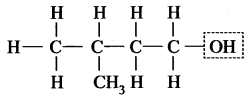
We think the data given here clarify all your queries of Chapter 2 and make you feel confident to attempt all questions in the examination. So, practice more & more from Tamilnadu State Board solutions for 10th Social Science Civics Chapter 2 Central Government Questions and Answers & score well. Need any information regarding this then ask us through comments & we’ll give the best possible answers very soon.
Samacheer Kalvi 10th Social Science Geography Solutions Chapter 7 Human Geography of Tamil Nadu

Guys who are planning to learn and understand the topics of 10th Social Science Geography can grab this Tamilnadu State board solutions for Chapter 7 Human Geography of Tamil Nadu Questions and Answers from this page for free of cost. Make sure you use them as reference material at the time of preparation & score good grades in the final exams.

Students who feel tough to learn concepts can take help from this Samacheer Kalvi 10th Social Science Book Solutions Guide Pdf, all the Questions and Answers can easily refer in the exams. Go to the below sections and get 10th Social Science Geography Chapter 7 Human Geography of Tamil Nadu Tamilnadu State Board Solutions PDF.

Tamilnadu Samacheer Kalvi 10th Social Science Geography Solutions Chapter 7 Human Geography of Tamil Nadu

Do you feel scoring more marks in the 10th Social Science Geography Grammar sections and passage sections are so difficult? Then, you have the simplest way to understand the question from each concept & answer it in the examination. This can be only possible by reading the passages and topics involved in the 10th Social Science Geography Board solutions for Chapter 7 Human Geography of Tamil Nadu Questions and Answers. All the Solutions are covered as per the latest syllabus guidelines. Check out the links available here and download 10th Social Science Geography Chapter 7 textbook solutions for Tamilnadu State Board.

Human Geography of Tamil Nadu Textual Exercise

I. Choose the correct answer.

Human Geography Of Tamil Nadu Question 1.
The delta which is known as Granary of South India is ……………….
(a) Cauvery delta
(b) Mahanadi delta
(c) Godavari delta
(d) Krishna delta
Answer:
(a) Cauvery delta

Samacheer Kalvi 10th Geography Book Question 2.
Second staple food of the people of Tamil Nadu is:
(a) Pulses
(b) Millets
(c) Oilseeds
(d) Rice
Answer:
(b) Millets

Question 3.
Literacy rate of Tamil Nadu as per 2011 census is ……………
(a) 80.32%
(b) 62.33%
(c) 73.45%
(d) 80.33%
Answer:
(d) 80.33%

Question 4.
A major hydro-electric power project of Tamil Nadu is:
(a) Mettur
(b) Papanasam
(c) Sathanur
(d) Tungabhadra
Answer:
(a) Mettur

Question 5.
Number of major and minor ports in Tamil Nadu are
(a) 3 and 15
(b) 4 and 15
(c) 3 and 16
(d) 4 and 16
Answer:
(a) 3 and 15

II. Fill in the blanks.

1. Agriculture of Tamil Nadu constitutes …………….. % of its economy.
2. Sathanur dam is constructed across the river …………..
3. Tamil Nadu ranks …………….. in India with a share of over 20% in total road projects under operation in the Public – Private Partnership (PPP).
4. ………….. is the third largest airport in India after Mumbai and Delhi.
5. The difference between the value of exports and imports is called ………….
Answers:
1. 21
2. Thenpennai
3. Second
4. Chennai International Airport
5. Balance of trade

III. Match the following.

Human Geography Of Tamil Nadu Samacheer Kalvi 10th Social Science Geography Solutions Chapter 7
Answer:
1. (b)
2. (d)
3. (a)
4. (c)

IV. Questions 1-2 are assertion and reasoning type

Question 1.
Assertion (A): Coimbatore, Tiruppur and Erode region is called as The Textile Valley of Tamil Nadu.
Reasoning (R): They contribute a major share to the state’s economy through textiles.
(a) Both (A) and (R) are true and (R) explains (A)
(b) Both (A) and (R) are true but, (R) does not explain (A)
(c) (A) is true but (R) is false
(d) (A) is false but (R) is true
Answer:
(a) Both (A) and (R) are true and (R) explains (A)

Question 2.
Assertion (A): The Nilgiris is the least populated district of Tamil Nadu
Reasoning (R): It is located in the western most part of Tamil Nadu.
(а) Both (A) and (R) are true and (R) explains (A)
(b) Both (A) and (R) are true but, (R) does not explain (A)
(c) (A) is true but (R) is false
(d) (A) is false but (R) is false
Answer:
(b) Both (A) and (R) are true but, (R) does not explain (A)

V. Answer the following in briefly.

Question 1.
Explain the cropping seasons of Tamil Nadu.
Answer:
Samacheer Kalvi 10th Geography Book Solutions Chapter 7 Human Geography Of Tamil Nadu

Question 2.
Why is Coimbatore called the Manchester of Tamil Nadu?
Answer:
Coimbatore has the ideal conditions for cotton cultivation – Humid weather in the early stages and hot weather during the harvest period. Cotton cultivation and the textile industries are the reasons to call Coimbatore as the “Manchester of Tamil Nadu”.

Question 3.
Name the important multipurpose projects of Tamil Nadu.
Answer:
Mettur Dam, Amaravathi Dam, Papanasam Dam, Bhavani Sagar Dam.

Question 4.
What is MRTS?
Answer:

  1. Mass Rapid Transport System (MRTS) a well established suburban railway network. Currently developing a Metro system, with its first underground operation since May 2017.
  2. It is mainly started to manage the crowd during peak hours. The elevated metro system. Connects the heart of the city from North to South.

Question 5.
List out the air ports and sea ports of Tamil Nadu.
Answer:
Airports:

  1. Chennai International Airport
  2. Coimbatore International Airport
  3. Madurai International Airport
  4. Tiruchirapalli International Airport

Domestic Airports:

  1. Tuticorin and Salem

Sea Port: Major Sea Ports are:

  1. Chennai
  2. Ennore and
  3. Tuticorin
    Intermediate port at Nagapattinam and 15 minor ports.

Question 6.
Have you heard about any stampede in your district? write about that incident briefly.
Answer:
During Athivaradhar festival minor stampede that brokeout on Thursday (18th July 2019) the crowd flocked to Kancheepuram as it was an auspicious day after the lunar eclipse. Four people died.

On 21st April 2019 atleast seven people died in stampede in Tamil Nadu during a temple festival at Muthuaiyampalayam Karuppusamy temple in Thuraiyur a village near Trichy (Sunday).

VI. Distinguish between the following.

Question 1.
Marine Fishing and Inland fishing
Answer:

Marine FishingInland Fishing
It is carried out in oceans and seas.Inland fishing is carried out in lakes, rivers, ponds, estuaries, backwaters and swamps.
Large mechanised boats are used for fishing.Catamaran, diesel boats and floating nets are used in fishing.
The fish varieties caught are sharks, flying fish, counch, catfish, silver bellies and crabs.Oysters and prawns are cultured in original nurseries.
Chennai, KanyaKumari, Tirunelveli, Nagapattinam, Thanjavur and Ramanathapuram.Vellore, Cuddalore, Sivagangai and Virudhunagar districts are inland fish production of the state.

Question 2.
Food Crops and Non- Food Crops
Answer:

Food CropsNon- Food Crops
Food crops are mainly grown for consumptionThey are mainly grown for sale purpose
Paddy is the main food crop and cereals, pulses and millets are also the second staple food of the people of Tamil NaduSugarcane, cotton, tree and coffee
Cauvery delta is known as the Granary of South India leading in rice cultivationTiruvallur, Kancheepuram, Vellore, coimbatore, Cuddalore, Erode, Madurai, Ramanatha Puram, Salem, Thoothukudi, Nilgiris and yercaud.

Question 3.
Surface Water and Ground Water
Answer:

Surface Water

Ground Water

The total surface water potential of the state is about 24,864 mem.The utilizable groundwater resource of the state is 22,423 mem.
There are 17 major river basins in the state with 81 reservoirs and about 41,262 tanksThe current level of utilization of water is about 13,558 mem.
Most of the surface water has already been tapped, primarily for irrigation, where water use in the largest.60% of the available recharge, while about (8875 mcm) 40% is the balance available for use.

VII. Give reasons for the following

Question 1.
Farmers switch over from inorganic to organic farming.
Answer:
By continuous usage of chemical fertilizers, pesticides and insecticides the soil became unfit for cultivation after some years. It causes a threat to agriculture. So to bring back the soil to fertility and to make it fit for cultivation farmers switch over from inorganic to organic farming. Organic wastes, biological pest control crop residues and animal manure only used under organic farming.

Question 2.
Cities are densely populated than the villages.
Answer:
Agriculture, job opportunities and industrial development are the main causes of population density in the cities then the villages.

Question 3.
Karur is Called the Textile Capital of Tamil Nadu.
Answer:
Karur is an industry town and is very famous for cottage and hand-loom textile industries. Moreover state’s most of the textile goods exports is from Karur district. That is why Karur is called the textile capital of Tamil Nadu.

Question 4.
Mostly stampede occurs in Temples.
Answer:
Most of the religious festivals are located in areas like banks of rivers hilly terrains or mountain tops. These areas lack proper pathways, posing a geographical risk to the pilgrims. It often disrupts the orderly movement of crowds resulting in irrational and dangerous movement for self-protection, leading to injuries and fatalities. Because of the lack of physical infrastructure, the mob behaviour increases the sense of threat, which results in a stampede.

VIII. Answer the following in a paragraph.

Question 1.
Write about the plantation farming of Tamil Nadu.
Answer:
Plantation Crops: Tea, coffee, cashew, rubber, pepper and cinchona.

The hill slopes with laterite soil and acidic-nature is ideal for the plantation crops.

Tea: Tea plantations are found in the hills of the Nilgins and Coimbatore. Notable region for tea estates Nilgiris.

Coffee: Coffee plants are grown in the hills of Western Ghats as well as Eastern Ghats. It is also found in the hilly slopes of Dindigui, Madurai, Theni and Salem districts.
Notable places: Yercaud, Kolli hills and Kodaikanal,

Rubber: Rubber plantations are significant in Kanyakumari.

Cashew: It is extensively cultivated in Cuddalore district.

Pepper: Confined to the warm and wet slopes of Eastern and Western Ghats of Tamil Nadu.

Cinchona: It is planted at heights varying from 1060 to 1280 metres in Anaimalai hills.

Cardamom: Cardamom estates are located at few places in the hills of Madurai region at an elevation of 915 to 1525 metres.

Position: Tamil Nadu stands second in area and production of tea and coffee next to Assam and Karnataka respectively.

Question 2.
Give an account on water resources of Tamil Nadu.
Answer:

  1. Tamil Nadu constitutes 4% of India’s land area and is inhabited by 6% of India’s population, but has-only 2.5% of India’s water resources.
  2. More than 95% of the surface water and 80% of the ground water have already been put into use.
  3. Major uses of water include human/animal consumption irrigation and industrial use.
  4. The state is heavily dependent on monsoon rains.
  5. The annual average rainfall is around 930 mm (47% during the northeast monsoon, 35% during the south west monsoon, 14% in summer and 4% in winter.
    Samacheer Kalvi 10th Social Science Geography Solutions Chapter 7 Human Geography of Tamil Nadu 3

Question 3.
Bring out the mineral distribution in Tamil Nadu.
Answer:
(i) Tamil Nadu is the leading holder of country’s resources of vermiculite, magnetite, dunite, rutile, garnet, molybdenum and ilmenite.

(ii) The state accounts for the country’s 55.3% of lignite, 75% of vermiculite, 69% of dunite, 59% of garnet, 52% of molybdenum and 30% of titanium mineral resources.
Important minerals are found in the state are as follows:

  1. Neyveli has large lignite resources.
  2. Coal is available in Ramanathapuram
  3. Oil gas are found in the Cauvery basin
  4. Iron deposits are found in Kanjamalai region in Salem district and Kalrayan Malai region of Tiruvannamalai district.
  5. Magnesite ores are available near Salem.
  6. Bauxite is found in Servarayan Hills, Kotagiri, Udagamandalam, Palani and Kollimalai areas.
  7. Gypsum is obtained in Tiruchirappalli, Tirunelveli, Thoothukudi and Virudhunagar districts.
  8. Ilmenite and rutile are found in the sands of Kanyakumari beach.
  9. Limestone is available in Coimbatore, Cuddalore, Dindigul, Kancheepuram, Karur, Madurai, Nagapattinam, Namakkal, Perambalur, Ramanathapuram, Salem and Tiruvallur districts.
  10. Magnesite is obtained in Coimbatore, Dharmapuri, Karur, Namakkal, the Nilgiris, Salem.
  11. Feldspar, quartz, copper and lead are found in some parts of the state.

Question 4.
State the densely populated regions of Tamil Nadu and account for its high density.
Answer:

  1. The number of persons living per square km is referred as population density.
  2. A place is said to have high density of population if number of persons living per sq km is above 800.
  3. As per 2011 census the density of population in Tamil Nadu is 555 per sq.km

Densely populated regions of Tamil Nadu:
Chennai is the densest district – 26,903 persons per sq.km followed by Kanyakumari (1106), Tiruvallur (1049), Kancheepuram (927), Madurai (823), Coimbatore (748), Cuddalore (1702), Thanjavur (691), Nagapattinam (668-), Salem (663), Vellore (646), Tiruchirappalli (602).

Question 5.
Explain the different modes of transport available in Tamil Nadu.
Answer:
Roadways:
The State has a total road length of 167,000 km, In which 60,628km are maintained by state Highways Department. It ranks second in India with a share of over 20% in total road projects under operation in the Public-Private Partnership (PPP) model.

Railways:

  • Tamil Nadu has a well-developed rail network as part of Southern Railway, headquartered at Chennai.
    The present Southern Railway network extends over a large area of India’s southern peninsula, covering Tamil Nadu, Kerala, Puducherry, minor portions of Karnataka and Andhra Pradesh.
  • Tamil Nadu has a total railway track length of 6,693 km with 690 railway stations in the state.
  • The system connects it with most of the major cities in India.
  • Main rail junctions in the state include Chennai, Coimbatore, Erode, Madurai, Salem, Tiruchirappalli and Tirunelveli.
  • Chennai has a well-established suburban railway network, a Mass Rapid Transport System (MRTS) and is currently developing a Metro system, with its first underground stretch in operation since May 2017.

Airways:

  • Tamil Nadu has four major international airports. Chennai International Airport is currently the third largest airport in India after Mumbai and Delhi.

Water ways:

  • Tamil Nadu has 3 major ports. They are Chennai, Ennore and Tuticorin. It has an intermediate port at Nagapattinam and 15 minor ports. Ennore intermediate port was recently converted as a major port and handles the major coal and ore traffics in Tamil Nadu.

Question 6.
Write about Road safety rules.
Answer:
In recent years the number of road accidents in Tamil Nadu has been increasing. It is reported that 15% of the road accidents of the country takes place in Tamil Nadu.

Basic road safety rules:

  1. Aware of the road signals
  2. Stop, look and cross
  3. Listen and ensure whether a vehicle is approaching
  4. Don’t rush on roads
  5. Crossroads in pedestrian crossings
  6. Don’t stretch hands while driving vehicles.
  7. Never crossroad at bends and stay safe in a moving vehicle.
  8. Avoid speeding, Drunk and driving, use helmets and seat belts and follow traffic rules.

“Know – Risk! No – risk!”

IX. Map Study

Question 1.
Mark the areas of major crops, minerals, dams, airport and seaports.
Answer:
Samacheer Kalvi 10th Social Science Geography Solutions Chapter 7 Human Geography of Tamil Nadu 4
Samacheer Kalvi 10th Social Science Geography Solutions Chapter 7 Human Geography of Tamil Nadu 5
Samacheer Kalvi 10th Social Science Geography Solutions Chapter 7 Human Geography of Tamil Nadu 6
Samacheer Kalvi 10th Social Science Geography Solutions Chapter 7 Human Geography of Tamil Nadu 7

Human Geography of Tamil Nadu Additional Questions

I. Choose the correct answer.

Question 1.
Tea, Coffee, rubber, pepper and cashew are …………. crops.
(a) Food
(b) Fiber
(c) Plantation
Answer:
(c) Plantation

Question 2.
The word Agriculture is derived from the ……………….. words “ager and Cultura”.
(a) Latin
(b) Greek
(c) Tamil
(d) Spanish
Answer:
(a) Latin

Question 3.
Rice, Cotton, Sugercane are grown with …………….
(a) Drying farming
(b) Irrigation farming
(c) Cattle reasing
Answer:
(b) Irrigation farming

Question 4.
In Tamil Nadu Rice Research Institute is situated at:
(a) Aduthurai
(b) Madurai
(c) Thiruvallur
(d) Chennai
Answer:
(a) Aduthurai

Question 5.
Millets are ……………… crops.
(a) Wet crops
(b) Dry crops
(c) Plantation
Answer:
(b) Dry crops

Question 6.
To promote ……………….. a central scheme named ‘National Project on Organic Farming’was launched.
(a) mixed farming
(b) organic farming
(c) aquaculture
(d) plantation farming
Answer:
(b) organic farming

Question 7.
Which is known as the Textile capital of Tamil Nadu?
(a) Salem
(b) Karur
(c) Tirunelveli
Answer:
(b) Karur

Question 8.
……………….. is also known as ‘poor man’s cow’.
(a) Goat
(b) Sheep
(c) Buffalo
(d) Horse
Answer:
(a) Goat

Question 9.
The most populated district in Tamil Nadu is …………….
(a) Madurai
(b) Tiruvallur
(c) Chennai
Answer:
(c) Chennai

Question 10.
districts lead in the Inland fish production.
(a) Chennai
(b) Cuddalore
(c) Sivagangai
(d) Vellore
Answer:
(d) Vellore

II. Fill in the blanks:

1. …………. irrigation is most predominant irrigation system in TamilNadu.
2. ……….. Dam is one of the biggest earthen dams in the country.
3. Amaravathi reservoir is notable for the …………….
4. Papanasam dam is also known as ………….. dam.
5. Parappalar project is located near …………….
6. Tamil Nadu occupies ……………… position in the country in silk production.
7. The Vellore district is the top exporter of finished …………. in the country.
8. Tamil Nadu accounts for about ………….. of India’s …………. exports.
9. Tamil Nadu ranks among the Indian states in population density.
10. ………… in considered the ‘fire works capital’ of India.
Answers:
1. Well
2. Bhavani
3. Mugger crocodiles
4. Karaiyar
5. Ottanchatram
6. Fourth
7. leather goods
8. 17%, Software
9. 12th
10. Sivakasi

III. Match the following.

a.

1.Rearing of birds(a)Apiculture
2.Rearing of honeybees(b)Horticulture
3.Rearing of silkworms(c)Poultry farming
4.Growing fruits(d)Sericulture

Answer:
1. (c)
2. (a)
3.(d)
4.(b)

b.

1.Wet fanning(a)Millets
2.Dry farming(b)Rice
3.Plantation farming(c)Sugarcane
4.Market gardening(d)Tea, Coffee
5.Irrigation farming(e)Kancheepuram

Answer:
1. (b)
2. (a)
3. (d)
4. (e)
5. (c)

IV. Answer briefly:

Question 1.
What is Agriculture?
Answer:
Agriculture is a practice of farming that includes cultivation of crops, rearing of animals, birds, forestry, fisheries and other related activities.

Question 2.
What is the Multipurpose River Valley Projects?
Answer:
Multipurpose river valley projects are basically designed for the development of irrigation for agriculture and hydropower generation they are used for many other purposes as well.

Question 3.
List out the major food crops and commercial crops of the state.
Answer:

  1. The principal food crops – paddy, millets and pulses.
  2. The commercial crops – sugarcane, cotton, oilseeds, spices, tea, and coffee and cashew.

Question 4.
Define Trade.
Answer:
Trade-in an exchange of goods and commodities either within the country or between countries.

Question 5.
Write a note on Tamil Nadu Rice Research Institute.
Answer:

  1. Tamil Nadu Rice Research Institute was established in April 1985 under Tamil Nadu Agricultural University.
  2. It is situated at AduthUrai (Thanjavur).
  3. It’s function is to perform lead function for rice and rice based cropping system research with the help of existing agriculture colleges and research centers.

Question 6.
Name any four districts with low density of population.
Answer:
Nilgiris, Perambalur, Dharmapuri and Sivagangai.

Question 7.
What are minor ports?
Answer:
Minor ports are anchorage ports where cargo is transhipped from the vessel to the store.
Ex. Cuddalore, Nagapattinam, Kolachal and Rameshwaram.

Question 8.
What are the uses of Chinchona?
Answer:

  • Chinchona is a forest product.
  • From chinchona quinine a drug is extracted.
  • Malaria is treated with this medicine.

Question 9.
Write the expansion of these abbreviated terms.

  1. TNAU
  2. TANTEA
  3. TNPL
  4. TANCEM
  5. Gl
  6. CLRI
  7. SEZ
  8. TTDC

Answer:

  1. TNAU: Tamil Nadu Agriculture University
  2. TANTEA: Tamil Nadu Tea Plantation Corporation Limited
  3. TNPL: Tamil Nadu Newsprint and Papers Limited
  4. TANCEM: Tamil Nadu Cements Corporation Limited
  5. GI: Geographical Indication
  6. CLRI: Central Leather Research Institute –
  7. SEZ: Special Economic Zone
  8. TTDC: Tamil Nadu Tourism-Development Corporation

Question 10.
Name the factors influencing agriculture.
Answer:
The factors influencing agriculture can be classified as Physical, Social and economic factors.

  • Physical factors includes soil, temperature, rainfall, humidity, climate and slope of land.
  • The social factors includes traditional knowledge belief and myths of farmers, farm size and holdings and fanners acceptance towards innovation.
  • Economic factors are market loan assistance, government subsidy and incentives.

V. Distinguish:

Question 1.
Wet farming and Dry farming
Answer:

Wet farming

Dry farming

Water supply is available through out the year from rain fall and irrigation for farming.Farming is carried out only during rainy season.
Rice and sugarcane are grown.Ragi and millets are grown.

Question 2.
Commercial crops and Plantation crops
Answer:

Commercial cropsPlantation crops
Sugarcane, tobacco, oil seeds, spices, turmeric etc are commercial crops.Tea, coffee, rubber, pepper and cashewnut are the main plantation crops.
Tobacco is yet another commercial crop grown an Dindigul, Teni and Madurai districts.Coffee in grown in the W.Ghats and E. Ghats.

Question 3.
Imports and Exports
Answer:

ImportsExports
Goods and services bought from overseas producers.Goods and services sold to overseas consumers.
A country that imports goods and services loses foreign exchage currency.A country that exports goods and services gains foreign exchange currency.
Tamil Nadu imports machineries, electrical equipments, mineral, fuel and pharmaceutical products.Tamil Nadu exports agricultural products, Leather products, Gems, and jewellery, chemical and related products.

VI. Answer the following in detail.

Question 1.
Tourism is considered as an industry – justify. Give an account on Tourism in Tamil Nadu.
Answer:

  1. Tourism is considered as an industry because of its enormous potential in creating employment for a large number of people.
  2. Approximately 28 lakh foreign and 11 crore domestic tourists visit our state (Tamil Nadu) annually.
  3. Reasons: The presence of ancient temples and monuments, hill stations pilgrim centres, a variety of natural land scapes, long coast line along with rich culture and heritage make Tamil Nadu the best destination for tourists.
  4. Promoter: Tourism in Tamil Nadu is promoted by Tamil Nadu Tourism Development Corporation (TTDC).
  5. The state currently ranks the highest among Indian states with about 25 crore arrivals (in 2013).

Question 2.
Give an account for the distribution of Textile industry in Tamil Nadu.
Answer:
Textile industry is one of the traditionally well-developed industries in Tamil Nadu. Tamil Nadu has a major share in the Indian Textile industry in terms of production and export of yams, fabrics, knitwear and garments. Tamil Nadu contributes 30% of India’s share in export of cotton, yam and fabrics.

Tropical climate availability of raw materials, demand for cotton in market, power supply from numerous power projects and abundant cheap labour are favourable factors for widespread distribution of textile industries in Tamil Nadu. The textile mills are concentrated in Coimbatore, Tirupur, Salem, Palladam, Kamr, Dindigul, Vimdhunagar, Tirunelveli, Thoothukudi, Madurai and Erode. Tamil Nadu has about 3,50,000 power looms manufacturing cotton fabrics.

Maximum units are concentrated in and around Coimbatore region for this region it is known as the “Manchester of South India”. Timpur and Erode contributes much for the state economy, therefore they are referred to as ‘Textile Valley of Tamil Nadu’.

Timpur alone contributes 70% of export of knitwear of Tamil Nadu. Erode specializes in garments and bedspreads. The city of Kamr is known as ‘Textile capital of Tamil Nadu Silk Textiles’. Tamil Nadu occupies fourth place in silk textile production in our country Kancheepuram silk is unique in its quality and is known for its traditional value all over the world. Arani, Rasipuram and Thimbuvanam are other silk centres of Tamil Nadu.

Sericulture Training Institute in Hosur training farmers to adopt agriculture along with farm work to accelerate rural industrialization Mettur, Madurai and Ramanathapuram are specialized areas for manufacturing synthetic clothes.

We think the data given here clarify all your queries of Chapter 7 and make you feel confident to attempt all questions in the examination. So, practice more & more from Tamilnadu State Board solutions for 10th Social Science Geography Chapter 7 Human Geography of Tamil Nadu Questions and Answers & score well. Need any information regarding this then ask us through comments & we’ll give the best possible answers very soon.
Samacheer Kalvi 7th Tamil Solutions Term 3 Chapter 1.5 அணி இலக்கணம்

Students can Download Tamil Chapter 1.5 அணி இலக்கணம் Questions and Answers, Summary, Notes Pdf, Samacheer Kalvi 7th Tamil Book Solutions Guide Pdf helps you to revise the complete Tamilnadu State Board New Syllabus and score more marks in your examinations.

Tamilnadu Samacheer Kalvi 7th Tamil Solutions Term 3 Chapter 1.5 அணி இலக்கணம்

மதிப்பீடு

குறுவினா

Question 1.
உவமை, உவமேயம், உவம உருபு விளக்குக.
Answer:
ஒரு சொல்லை மற்றொரு சொல்லோடு ஒப்பிட்டுக் கூறுவது உவமை அல்லது உவமானம் ஆகும். உவமையால் விளக்கப்படும் பொருள் உவமேயம் ஆகும். உவமை உவமேயம் இரண்டுக்கும் இடையில் வரும் உருபு உவம உருபு ஆகும்.
Samacheer Kalvi 7th Tamil Solutions Term 3 Chapter 1.5 அணி இலக்கணம் - 1

Question 2.
உவமை அணிக்கும் எடுத்துக்காட்டு உவமை அணிக்கும் உள்ள வேறுபாடு யாது?
Answer:
Samacheer Kalvi 7th Tamil Solutions Term 3 Chapter 1.5 அணி இலக்கணம் - 2

கற்பவை கற்றபின்

பின்வரும் தொடர்களில் உள்ள உவமை, உவமேயம், உவம உருபு ஆகியவற்றைக் கண்டறிந்து எழுதுக.
Samacheer Kalvi 7th Tamil Solutions Term 3 Chapter 1.5 அணி இலக்கணம் - 3

கூடுதல் வினாக்கள்

நிரப்புக.

1. அணி என்னும் சொல்லுக்கு அழகு என்பது பொருள்.
2. ஒரு செய்யுளைச் சொல்லாலும், பொருளாலும் அழகு பெறச் செய்தல் அணி எனப்படும்.
3. போல, புரைய , அன்ன, இன்ன, அற்று, இற்று, மான, கடுப்ப, ஒப்ப, உறழ போன்றவை உவம உருபுகள் ஆகும்.
4. ஒரு பாடலில் உவமையும் உவமேயமும் வந்து உவம உருபு வெளிப்படையாக வந்தால் அது உவம அணி எனப்படும்.
5. ஒரு பாடலில் உவமை ஒரு தொடராகவும் உவமேயம் ஒரு தொடராகவும் வந்து உவம உருபு மறைந்து வந்தால் அது எடுத்துக்காட்டு உவமை அணி எனப்படும்.
6. உலகில் இல்லாத ஒன்றை உவமையாகக் கூறுவது இல்பொருள் உவமை அணி ஆகும்.

விடையளி :

Question 1.
வமையணி விளக்குக.
Answer:
அணி விளக்கம்: ஒரு பாடலில் உவமையும், உவமேயமும் வந்து உவம உருபு வெளிப்படையாக வருவது உவமையணி ஆகும்.
அணி அமைந்த பாடல்:
அகழ்வாரைத் தாங்கும் நிலம்போலத் தம்மை
இகழ்வார்ப் பொறுத்தல் தலை.
பாடல் பொருள் : பூமி தன்னைத் தோண்டுபவரைப் பொறுத்துக் கொள்வதுபோல நாம் நம்மை இகழ்ந்து பேசுபவரைப் பொறுத்து கொள்ள வேண்டும்.
அணி பொருத்தம் : பூமி தன்னைத் தோண்டுபவரைப் பொறுத்துக் கொள்ளுதல் என்பது உவமை. நாம் நம்மை இகழ்ந்து பேசுபவரைப் பொறுத்துக் கொள்ள வேண்டும் என்பது உவமேயம். போல’ என்பது உவம உருபு.

Question 2.
எடுத்துக்காட்டு உவமையணி விளக்குக.
Answer:
அணி இலக்கணம் : உவமை ஒரு தொடராகவும் உவமேயம் ஒரு தொடராகவும் வந்து உவம உருபு மறைந்து வருவது எடுத்துக்காட்டு உவமை அணி ஆகும்.
எ.கா. :
தொட்டனைத்து ஊறும் மணற்கேணி மாந்தர்க்குக்
கற்றனைத்து ஊறும் அறிவு.

பாடலின் பொருள் : மணற்கேணியில் தோண்டிய அளவிற்கு நீர் ஊறும். மனிதர்கள் கற்கும் அளவிற்கு ஏற்ப அறிவு பெருகும் என்பதாகும்.

அணி பொருத்தம் :
தொட்டனைத்து ஊறும் மணற்கேணி என்பது உவமை.
மாந்தர்க்குக் கற்றனைத்து ஊறும் அறிவு என்பது உவமேயம்.
இடையில் அதுபோல ன்னும் உவம உருபு மறைந்து வந்துள்ளது.

Question 3.
இல்பொருள் உவமையணி விளக்குக.
Answer:
அணி இலக்கணம் : உலகில் இல்லாத ஒன்றை உவமையாகக் கூறுவது இல்பொருள் உவமை அணி ஆகும்.

எ.கா. :
1. மாலை வெயிலில் மழைத்தூறல் பொன்மழை பொழிந்தது போல் தோன்றியது.
2. காளை கொம்பு முளைத்த குதிரை போலப் பாய்ந்து வந்தது.

அள்ளி பொருத்தம் : உலகில் பொன் மழையாகப் பொழிவது இல்லை, கொம்பு முளைத்த குதிரையும் இல்லை. இவ்வாறு உலகில் இல்லாத ஒன்றை உவமையாகக் கூறப்பட்டதால் இல்பொருள் உவமையணிக்குச் சான்றாயின.

மொழியை ஆள்வோம்

கேட்க.

புகழ்பெற்ற கவிஞர் ஒருவரது உரையின் ஒலிப்பதிவைக் கேட்டு கிழ் . மாணவர்கள் தாங்களாகவே புகழ்பெற்ற கவிஞர் ஒருவரது உரையின் ஒலிப்பதிவை கேட்டு மகிழ வேண்டும்.

கீழ்க்காணும் தலைப்புகளுள் ஒன்று பற்றி இரண்டு நிமிடம் பேசுக

Question 1.
நான் விரும்பும் கவிஞர்.
Answer:
நான் விரும்பும் கவிஞர் – மகாகவி பாரதியார் :
நான் விரும்பும் கவிஞரான பாரதியாரைப் பற்றிப் பேச வந்துள்ளேன். இந்தியத் தாயின் மடியில் ஆனந்தமாய்த் தவழ வேண்டிய நாம் அடிமைகளாய்ச் சுருண்டு கிடந்ததைப் பொறுக்காமல், நம்மை மீட்க நம்மிடையே சுதந்திர உணர்வையும் எழுச்சியையும் வீரம் மிகுந்த தன்னுடைய பாடல்களால் ஏற்படுத்தியவர் பாரதியார். இவர் சாதி, மதம், இனம், மொழி, மத வேறுபாடுகளின்றி அனைவரையும் தம் பாடல்களினால் ஒன்றிணைத்தவர்.

மகாகவி பாரதியார் தூத்துக்குடி மாவட்டம் எட்டையபுரத்தில் 1882 ஆம் ஆண்டு டிசம்பர் கு 11 ஆம் தேதி சின்னசாமி ஐயர் – இலக்குமியம்மாள் தம்பதியருக்கு மகனாகப் பிறந்தார். இவரது இயற்பெயர் சுப்பிரமணியன் ஆகும்.

தன் இளம் வயதிலேயே தமிழில் கவிதைகள் பாடி அனைவரையும் கவர்ந்தவர். இவரது 16ஆவது வயதிலேயே எட்டையபுரம் அரசவையில் கவிதை பாடி பட்டத்தைப் பெற்றார். பாரதி என்றால் கலைமகள் என்பது பொருளாகும். தமிழ், வடமொழி, ஆங்கிலம் என்ற பல மொழிகளில் தன் புலமையினை மேம்படுத்திக் கொண்டவர்.

பாரதியாரின் உள்ளத்தில் விடுதலை வேட்கை எப்போதும் கொழுந்து விட்டு எரிந்து கொண்டே இருக்கும். அதன் வெளிப்பாடே அவருடைய பாடல்கள். அவர் தம் பேச்சாலும் எழுத்தாலும் விடுதலை வேட்கையைத் தூண்டியவர். அதுமட்டுமா? வ.உ.சி. சுப்பிரமணிய சிவா முதலான விடுதலைப் போராட்ட வீரர்களுடன் சேர்ந்து விடுதலை பற்றியே கலந்துரையாடுவார். விடுதலைப் போராட்டத்தில் முழு மூச்சாக ஈடுபட்டார். அவர் பாடிய பாடல்களும் கட்டுரைகளும் விடுதலையைப் பற்றி மட்டுமே எதிரொலித்தன.

பாரதியாருடைய அகன்று விரிந்த விசாலப் பார்வை இந்திய நதிகளை இணைத்தது. மாநிலங்களை இணைத்தது. அதற்குச் சான்று சிந்து நதியின் மிசை நிலவினிலே…. என்ற பாடல் வரிகள் தான். கங்கை நதிப்புறத்துக் கோதுமையைப் பெற்றுக் கொண்டு, காவிரி வெற்றிலையை மாறு கொள்வோம்’ என்று பாடியுள்ளார்.

இந்தியாவின் ஒன்றுபட்ட நிலைக்குத் தமிழ்ச் சமுதாயம் இணைந்து செயல்பட தம் பாடல்களைப் பார் முழுவதும் பரவச் செய்தவர் பாரதியார். இவர் விடுதலைப் போராட்டக் காலத்தில் மக்களை நோக்கி, இந்த நாடு நம் எல்லோருக்கும் சொந்தம், நாம் எல்லோரும் இந்த நாட்டுக்குச் சொந்தம் என்று பாடினார்.

பாரதியார் நம்பிக்கையின் மறு உருவம் என்று சொன்னால் அது மிகையாகாது. ஏனெனில் இந்தியா விடுதலை கிடைப்பதற்கு முன்பாகவே
“ஆடுவோமே பள்ளுப் படுவோமே
ஆனந்த சுதந்திரம் அடைந்துவிட் டோமென்று” – என்று ஆடிப் பாடினார்.

பல மொழிகளைக் கற்றறிந்த பாரதி, “யாமறிந்த மொழிகளிலே தமிழ்மொழி போல் இனிதாவ தெங்கும் காணோம்” என்று தமிழ் மொழியின் சிறப்பை எடுத்துரைத்துள்ளார்.

சாதிக் கொடுமைகள், பெண்ணடிமை, சமூக ஏற்றத்தாழ்வுகள் என்று அனைத்தையுமே இந்நாட்டிலிருந்து நீக்க வேண்டும் என்பதில் உறுதியாக இருந்தவர்.

வளமான, வலிமையான பாரதத்திற்குத் தேவையான சிறந்த வழிகள் யாவும் அவருடைய பாடல்களில் உள்ளன. அதை நாம் பின்பற்றினால் அவர் கனவில் கண்ட பாரதத்தை நாம் நிகழ்காலத்தில் உருவாக்க முடியும் என்பதைக் கூறி வாய்ப்பளித்தமைக்கு நன்றி கூறி விடை பெறுகிறேன்.

Question 2.
எனக்குப் பிடித்த பாடல்.
Answer:
அனைவருக்கும் வணக்கம் ! எனக்குப் பிடித்த நாட்டுப்புறப் பாடல் பற்றி இங்குப் பேச வந்துள்ளேன்.
நாட்டுப்புறப் பாடல்கள் ஏட்டில் எழுதப்படாத ஓர் இலக்கியம். வழி வழியாக முன்னோர்கள் பாடியதைக் கேட்டும், அதனோடு தங்கள் இரசனைக்கேற்றவாறு அவற்றில் வார்த்தைகளைச் சேர்த்தும் நாட்டுப்புறப் பாடல்கள் உருவாயின. நாட்டுப்புறப் பாடல்களில் சொல்லப்படாத கருத்துகள் கிடையாது. மிகக் கடினமான கருத்துகளைக் கூட மிகச் சுலபமாக பாடிவிடுவார்கள். ஆழமான கருத்துகளுடன் ழகர, லகர, ளகர எழுத்துகளின் உச்சரிப்பு மற்றும் றகர, ரகர உச்சரிப்புகள், நாப்பிறழ்ச்சி இல்லாமல் பாடும் பயிற்சி
ஆகியவை நாட்டுப்புறப் பாடல்களினால் கிடைக்கின்றன.

(i) “கடலையிலே ஒரு உரல்
உரளுது பெரளுது
தத்தளிக்குது தாளம் போடுது
கடலை தளர உழுது
கல கடலை விதைச்சேன்
கல கடலையும் கல கடலையாச்சு.”

(ii) “வியாழக்கிழமை ஏழைக்கிழவன்
வாழைப்பழம் வழுக்கி
கீழே விழுந்தான்.”

வெள்ளையர் ஆட்சியை உள்ளே நுழையவிட்டது நம் தவறு. அதை வெகு அழகாகக் ஒரு நாட்டுப்புறப் பாடல் கூறுகிறது :

“ஓரான் ஓரான் தோட்டத்திலே
ஒருவன் போட்டது வெள்ளரிக்காய்
காசுக்கு ரெண்டு விற்கச் சொல்லிக்
காயிதம் போட்டானாம் வெள்ளைக்காரன்
வெள்ளைக்காரன் பணம் வெள்ளிப்பணம்
வேடிக்கைக் காட்டுதாம் சின்ன பணம்.”

இவ்வாறு நாட்டுப்புற இலக்கியங்கள் பல செய்திகளை எடுத்துக் கூறுகின்றன. இவ்விலக்கியம் எளிமையான சொற்களால் அமைக்கப்பட்டுள்ளதால், அனைவராலும் இதனை படித்து உணர முடியும். எனக்கு பேச வாய்ப்பளித்தமைக்கு நன்றி கூறி விடைபெறுகிறேன்.

சொல்லக் கேட்டு எழுதுக

1. மாடுகள் கொண்டு நிலத்தை உழுதனர்.
2. நீர்வளம் மிக்க ஊர் திருநெல்வேலி.
3. நெல்லையில் தமிழ்க் கவிஞர் பலர் வாழ்ந்தனர்.
4. அகத்தியர் வாழ்ந்த மலை பொதிகை மலை.
5. இல்லாத பொருளை உவமையாக்குவது இல்பொருள் உவமை அணி.

பாடலைப் படித்து வினாக்களுக்கு விடையளிக்க

பனை மரமே பனை மரமே
ஏன் வளந்தே இத் தூரம்?
குடிக்கப் பதனியானேன்!
கொண்டு விற்க நுங்கானேன்! தூரத்து மக்களுக்குத்
தூதோலை நானானேன் !
அழுகிற பிள்ளைகட்குக்
கிலுகிலுப்பை நானானேன்!
கைதிரிக்கும் கயிறுமானேன் !
கன்று கட்டத் தும்புமானேன்! ……….(- நாட்டுப்புறப்பாடல் )

வினாக்கள் :

Question 1.
பனை மரம் தரும் உணவுப்பொருள்கள் யாவை?
Answer:
பதனி, நுங்கு ஆகியவை பனை மரம் தரும் உணவுப் பொருள்களாகும்.

Question 2.
பனை மரம் யாருக்குக் கிலுகிலுப்பைத் தரும்?
Answer:
பனை மரமானது, அழுகிற பிள்ளைக்குக் கிலுகிலுப்பையைத் தருகிறது.

Question 3.
தூதோலை’ என்னும் சொல்லைப் பிரித்து எழுதுக.
Answer:
தூதோலை = தூது + ஓலை.

Question 4.
பனைமரம் மூலம் நமக்குக் கிடைக்கும் பொருள்களைப் பட்டியலிடுக.
Answer:
பதனி, நுங்கு, தூதோலை, கிலுகிலுப்பை, கயிறு, தும்பு முதலியன பனைமரம் மூலம்
நமக்குக் கிடைக்கும் பொருள்களாகும்.

Question 5.
பாடலுக்கு ஏற்ற தலைப்பை எழுதுக.
Answer:
பனை தரும் வரம்.

பின்வரும் தலைப்பில் கட்டுரை எழுதுக

என்னைக் கவர்ந்த நூல்

என்னைக் கவர்ந்த நூல் – திருக்குறள் :
கல் தோன்றி மண் தோன்றாக் காலத்தே முன் தோன்றிய மூத்தகுடி தமிழ்குடி’ என்பது முன்னோர் வாக்கு. உலகின் மிகத் தொன்மையான தமிழ்மொழி பண்டைக் காலத்திலிருந்து தற்காலம் வரை நமக்கு பல நூல்களைத் தந்து கொண்டேயிருக்கிறது. ஆனாலும் இன்றளவும் உலக மக்களால் போற்றப்படும் உலகப் பொதுமறையாம் திருக்குறளைப் பற்றி இக்கட்டுரையில் காண்போம்.

உலகப்பொதுமறை :
அறம், பொருள், இன்பம் ஆகியவற்றை செம்மையுற நமக்குக் கூறும் திருக்குறள் குறிப்பிட்ட ஒரு நாட்டினருக்கோ , மொழியினருக்கோ மட்டும் உரித்தன்று. உலகம் முழுவதிற்கும் சொந்தமானது. உலகிலேயே அதிக மொழிகளில் மொழிபெயர்க்கப்பட்ட நூல்களில் திருக்குறள் மூன்றாம் இடத்தில் உள்ளது. இதுவரை 107 மொழிகளில் மொழிபெயர்க்கப்பட்டுள்ளது. வெளிநாட்டினருக்கும் இங்கு வந்து தமிழ் கற்று திருக்குறளைப் படித்து, பின் தங்கள் மொழிகளில் மொழிபெயர்த்துள்ளனர்.

அறங்கள் கூறும் திருக்குறள் :
திருக்குறளில் மனிதனுக்குச் சொல்லாத அறங்களே கிடையாது. சாதாரண மனிதன் முதல் மன்னன் வரை அனைவருக்கும் கூறப்பட்டுள்ள கருத்துகள் பொதுவானவை; எந்தக் காலத்திற்கும் பொருந்தக் கூடியவை. திருவள்ளுவர் சாதாரணக் குடிமகனாக வாழ்ந்தவர்தான். ஆனால் அரசன், துறவி, குடும்பத்தலைவன் என்று அனைவருக்கும் வாழ்வியல் நெறிகளைக் கூறியுள்ளார். திருக்குறளைப் படிக்க படிக்க இன்பமும் பண்பும் வளரும்.

முடிவுரை :

“வள்ளுவன் தன்னை உலகினுக்கே தந்து
வான் புகழ் கொண்ட தமிழ்நாடு’ என்று பாரதி புகழ்ந்துள்ளார். ஏழே சீர்களில் உலக நீதியைச் சொல்லும் திருக்குறளே நான் இன்றும் என்றும் விரும்பும் நூலாகும்.

மொழியோடு விளையாடு

குறுக்கெழுத்துப் புதிர்.

தமிழ்நாட்டில் உள்ள ஊர்ப் பெயர்களையும் அவற்றின் சிறப்பையும் அறிவோம்.
Samacheer Kalvi 7th Tamil Solutions Term 3 Chapter 1.5 அணி இலக்கணம் - 4
Samacheer Kalvi 7th Tamil Solutions Term 3 Chapter 1.5 அணி இலக்கணம் - 5
Answer:

Samacheer Kalvi 7th Tamil Solutions Term 3 Chapter 1.5 அணி இலக்கணம் - 6

தொடருக்குப் பொருத்தமான உவமையை எடுத்து எழுதுக

Question 1.
என் தாயார் என்னை ……………. காத்து வளர்த்தார்.
(கண்ணை இமை காப்பது போல/ தாயைக் கண்ட சேயைப் போல)
Answer:
கண்ணை இமை காப்பது போல

Question 2.
நானும் என் தோழியும் ……………… இணைந்து இருப்போம்.
(இஞ்சி தின்ற குரங்கு 9 போல/ நகமும் சதையும் போல)
Answer:
நகமும் சதையும் போல

Question 3.
திருவள்ளுவரின் புகழை ………….. உலகமே அறிந்துள்ளது.
(எலியும் பூனையும் போல/ உள்ளங்கை நெல்லிக்கனி போல)
Answer:
உள்ளங்கை நெல்லிக்கனி போல

Question 4.
அப்துல் கலாமின் புகழ் ………………… உலகெங்கும் பரவியது.
(குன்றி மேலிட்ட விளக்கு
போல/ குடத்துள் இட்ட விளக்கு போல)
Answer:
குன்றின் மேலிட்ட விளக்கு போல

Question 5.
சிறு வயதில் நான் பார்த்த நிகழ்ச்சிகள். ………….. என் மனத்தில் பதிந்தன.
(கிணற்றுத்தவளை போல/ பசுமரத்தாணி போல)
Answer:
பசுமரத்தாணி போல

கொடுக்கப்பட்டுள்ள ஊரின் பெயர்களில் இருந்து புதிய சொற்களை உருவாக்குக

(எ.கா.) திருநெல்வேலி – திரு, நெல், வேலி, வேல்
1. நாகப்பட்டினம் – நாகம், பட்டினம், படி, பட்டி, கப்பம், நாடி, நா
2. கன்னியாகுமரி – கன்னி, குமரி, கனி, கரி, யா, கயா
3. செங்கல்பட்டு – செங்கல், பட்டு, படு, செல், பல், கல், பகல், பகட்டு
4. உதகமண்டலம் – மண், மண்டலம், மடம், உண், கண், தடம், கமண்ட லம், கடம்
5. பட்டுக்கோட்டை – பட்டு, கோட்டை, கோடை, படை, பட்டை, கோ, கோடு

நிற்க அதற்குத் தக

என் பொறுப்புகள்

1. நகரங்களின் சிறப்புத் தன்மையை அறிந்து போற்றுவேன்.
2. ஒவ்வொரு ஊரிலும் நடைபெறும் தொழில்களின் சிறப்பை அறிந்து தொழில் செய்வோரை மதிப்பேன்.

கலைச்சொல் அறிவோம்
Samacheer Kalvi 7th Tamil Solutions Term 3 Chapter 1.5 அணி இலக்கணம் - 7

Samacheer Kalvi 7th Tamil Solutions Term 1 Chapter 1.5 குற்றியலுகரம், குற்றியலிகரம்

Students can Download Tamil Chapter 1.5 குற்றியலுகரம், குற்றியலிகரம் Questions and Answers, Summary, Notes Pdf, Samacheer Kalvi 7th Tamil Book Solutions Guide Pdf helps you to revise the complete Tamilnadu State Board New Syllabus and score more marks in your examinations.

Tamilnadu Samacheer Kalvi 7th Tamil Solutions Term 1 Chapter 1.5 குற்றியலுகரம், குற்றியலிகரம்

மதிப்பீடு

கீழ்க்காணும் சொற்களைக் குற்றியலுகர வகையின் அடிப்படையில் வகைப்படுத்துக.
Samacheer Kalvi 7th Tamil Solutions Term 1 Chapter 1.5 குற்றியலுகரம், குற்றியலிகரம் - 0
Answer:
ஆறு, எஃகு, கரும்பு, விறகு, உழக்கு, எட்டு, ஏடு, பந்து, காசு, கொய்து.
Samacheer Kalvi 7th Tamil Solutions Term 1 Chapter 1.5 குற்றியலுகரம், குற்றியலிகரம் - 1

பொருந்தாத சொற்களை எடுத்து எழுதுக

Samacheer Kalvi 7th Tamil Solutions Term 1 Chapter 1.5 குற்றியலுகரம், குற்றியலிகரம் - 00
Answer:
1. பசு, விடு, ஆறு, கரு – கரு
2. பாக்கு, பஞ்சு, பாட்டு, பத்து – பஞ்சு
3. ஆறு, மாசு , பாகு , அது – அது
4. அரசு, எய்து, மூழ்கு, மார்பு – அரசு
5. பண்பு, மஞ்சு, கண்டு, எஃகு – எஃகு

குறுவினா

Question 1.
‘குற்றியலுகரம்’ என்னும் சொல்லைப் பிரித்து விளக்கம் தருக.
Answer:
குறுமை + இயல் + உகரம் – குற்றியலுகரம். வல்லின எழுத்துக்கள் ஆறின் மீதும் ஏறி (சேர்ந்து வரும் உகரம் தனக்கு உரிய ஒரு மாத்திரை அளவிலிருந்து அரை மாத்திரையாகக் குறைந்து ஒலிக்கும். இதற்குக் குற்றியலுகரம் என்று பெயர். எடுத்துக்காட்டு: காசு, எஃகு, பயறு, பாட்டு, பந்து, சால்பு.

Question 2.
குற்றியலிகரம் என்றால் என்ன?
Answer:
(i) குறுமை + இயல் + இகரம் = குற்றியலிகரம்.
(ii) வரகு + யாது = வரகியாது.
(iii) குற்றியலுகரச் சொற்களின் முன் யாது என்னும் சொல் வருமொழியாக வந்து சேரும் போது, நிலைமொழியீற்று ‘உ’ கரம் இகரமாகத் திரிந்து தன் ஒரு மாத்திரை அளவிலிருந்து குறைந்து அரை மாத்திரை அளவில் ஒலிக்கும். இது ‘குற்றியலிகரம் எனப்படும்.

கற்பவை கற்றபின்

Question 1.
ஒன்று முதல் பத்து வரையுள்ள எண்ணுப் பெயர்களைப் பட்டியலிட்டு எழுதுங்கள்; அவற்றில் குற்றியலுகரச் சொற்களை எடுத்து எழுதுங்கள்.
1. ஒன்று
2. இரண்டு
3. மூன்று
4. நான்கு
5. ஐந்து
6. ஆறு
7. ஏழு
8. எட்டு
9. ஒன்பது
10. பத்து
Answer:
குற்றியலுகரச் சொற்கள் :

1. ஒன்று – மென்தொடர்க் குற்றியலுகரம்
2. இரண்டு – மென்தொடர்க் குற்றியலுகரம்
3. மூன்று – மென்தொடர்க் குற்றியலுகரம்
4. நான்கு – மென்தொடர்க் குற்றியலுகரம்
5. ஐந்து – மென்தொடர்க் குற்றியலுகரம்
6. ஆறு – நெடில்தொடர்க் குற்றியலுகரம்
8. எட்டு – வன்தொடர்க் குற்றியலுகரம்
9. ஒன்ப து – உயிர்த்தொடர்க் குற்றியலுகரம்
10. பத்து – வன்தொடர்க் குற்றியலுகரம்

Question 2.
குற்றியலுகர எண்ணுப் பெயர்களைக் குற்றியலுகர வகையின் அடிப்படையில் வகைப்படுத்துக.
Answer:
ஒன்று, இரண்டு, மூன்று, நான்கு, ஐந்து, ஆறு, ஏழு, எட்டு, ஒன்பது, பத்து

  1. நெடில் தொடர்க் குற்றியலுகரம் – ஆறு
  2. உயிர் தொடர்க் குற்றியலுகம் – ஒன்பது
  3. வன்தொடர்க் குற்றியலுகரம் – எட்டு, பத்து
  4. மென்தொடர்க் குற்றியலுகரம் – ஒன்று, இரண்டு, மூன்று, நான்கு, ஐந்து

Question 3.
குற்றியலுகர எண்ணுப் பெயர்களின் மாத்திரை அளவைக் கண்டுபிடியுங்கள்.
Answer:
Samacheer Kalvi 7th Tamil Solutions Term 1 Chapter 1.5 குற்றியலுகரம், குற்றியலிகரம் - 2

Question 4.
கு, சு, டு, து, று ஆகிய குற்றியலுகரத்திதை இறுதியாகக் கொண்ட ஈரெழுத்துச் சொற்களைத் திரட்டுக.
Answer:
Samacheer Kalvi 7th Tamil Solutions Term 1 Chapter 1.5 குற்றியலுகரம், குற்றியலிகரம் - 3

கூடுதல் வினாக்கள்

சரியான விடையைத் தேர்ந்தெடுத்து எழுதுக:

Question 1.
குறில் எழுத்துகளைக் குறிக்க …………. என்ற அசைச் சொல்லைப் பயன்படுத்துகிறோம்.
அ) கரம்
ஆ) கான்
இ) கேனம்
ஈ) கோடை
Answer:
அ) கரம்

Question 2.
நெடில் எழுத்துகளைக் குறிக்க ……….. என்ற அசைச் சொல்லைப் பயன்படுத்துகிறோம்.
அ) கேனம்
ஆ) கரம்
இ) கான்
ஈ) கோடை
Answer:
இ) கான்

Question 3.
குற்றியலுகரம் தனக்கு முன் உள்ள எழுத்தைக் கொண்டு ………….. வகையாகப் பிரிக்கப்படும்.
அ) 3
ஆ) 5
இ) 6
ஈ) 1
விடை :
இ) 6

Question 4.
தனி நெடிலைத் தொடர்ந்து வரும் குற்றியலுகரம் …………..
அ) நெடில் தொடர்க் குற்றியலுகரம்
ஆ) உயிர்த்தொடர்க் குற்றியலுகரம்
இ) இடைத்தொடர் குற்றியலுகரம்
ஈ) மென்தொடர்க் குற்றியலுகரம்
Answer:
அ) நெடில் தொடர்க் குற்றியலுகரம்

Question 5.
ஈரெழுத்துச் சொற்களாக மட்டும் அமையும் குற்றியலுகரம் எது?
அ) மென்தொடர்க் குற்றியலுகரம்
ஆ) நெடில் தொடர்க் குற்றியலுகரம்
இ) இடைத்தொடர் குற்றியலுகரம்
ஈ) உயிர்தொடர்க் குற்றியலுகரம்
Answer:
ஆ) நெடில் தொடர்க் குற்றியலுகரம்

Question 6.
தனிநெடில் அல்லாத உயிர்மெய் எழுத்தைத் தொடர்ந்து வரும் குற்றியலுகரம் …………….
அ) உயிர்த்தொடர்க் குற்றியலுகரம்
ஆ) வன்தொடர்க் குற்றியலுகரம்
இ) நெடில்தொடர்க் குற்றியலுகரம்
ஈ) இடைத்தொடர் குற்றியலுகரம்
Answer:
அ) உயிர்த்தொடர்க் குற்றியலுகரம்

Question 7.
தன் ஒரு மாத்திரை அளவில் இருந்து குறுகி ஒலிக்கும் இகரம் ………….. எனப்படும்.
அ) குற்றியலுகரம்
ஆ) குற்றியலிகரம்
இ) முற்றியலுகரம்
ஈ) ஐகாரக்குறுக்கம்
Answer:
ஆ) குற்றியலிகரம்

Question 8.
குற்றியலிகரம் …………… இடங்க ளில் மட்டும் வரும்.
அ) இரண்டு
ஆ) மூன்று
இ) ஐந்து
ஈ) ஆறு
Answer:
அ) இரண்டு

Question 9.
மியா’ என்பது ஓர் அசைச்சொல். இச்சொல்லில் வரும் மி’யில் உள்ள இகரம் …..
அ) குற்றியலிகரம்
ஆ) குற்றியலுகரம்
இ) முற்றியலுகரம்
ஈ) மகரக்குறுக்கம்
Answer:
அ) குற்றியலிகரம்

நிரப்புக :

Question 1.
சால்பு – இது ………….. ஆகும்.
Answer:
இடைத்தொடர்க் குற்றியலுகரம்

Question 2.
கயிறு – இது …………… ஆகும்.
Answer:
உயிர்த்தொடர்க் குற்றியலுகரம்

Question 3.
……… என்னும் எழுத்தைத் தொடர்ந்து வரும் குற்றியலுகரச் சொற்கள் இல்லை .
Answer:
வ்

பொருத்துக :

Samacheer Kalvi 7th Tamil Solutions Term 1 Chapter 1.5 குற்றியலுகரம், குற்றியலிகரம் - 4
Answer:
1 – ஈ),
2 – அ),
3 – ஆ),
4 – இ),
5 – எ),
6 – ஏ),
7 – ஊ),
8 – உ)

விடையளி :

Question 1.
‘மூதல் எழுத்து என்றால் என்ன?
Answer:
உயிர் எழுத்துகள் பன்னிரண்டும் , மெய் எழுத்துகள் பதினெட்டும் ஆக முப்பது எழுத்துகளும் முதல் எழுத்துகள் எனப்படும்.

Question 2.
சார்பெழுத்து எத்தனை வகைப்படும்? அவை யாவை?
Answer:
சார்பெழுத்து பத்து வகைப்படும்.
அவை உயிர்மெய், ஆய்தம், உயிரளபெடை, ஒற்றளபெடை, குற்றியலுகரம், குற்றியலிகரம், ஐகாரக்குறுக்கம், ஒளகாரக்குறுக்கம், மகரக்குறுக்கம், ஆய்தக்குறுக்கம் என்பனவாகும்.

Question 3.
முற்றியலுகரம் என்றால் என்ன?
Answer:

  • தனிக்குறில் எழுத்தை அடுத்து வரும் வல்லின உகரங்கள் ஒரு மாத்திரை அளவுக்கு முழுமையாக ஒலிக்கும்.
  • வல்லினம் அல்லாத உகரங்கள் எப்போதும் முழுமையாகவே ஒலிக்கும்.
  • இவ்வாறு ஓசை குறையாமல் ஒரு மாத்திரை அளவில் முழுமையாக ஒலிப்பதை முற்றியலுகரம் என்பர்.
    எடுத்துக்காட்டு: புகு , பசு , விடு, அது, வறு

Question 4.
குற்றியலுகரத்தின் வகைகளைப் பற்றி கூறுக.
Answer:
குற்றியலுகரம் ஆறு வகைப்படும். அவை,

  • நெடில் தொடர்க் குற்றியலுகரம்
  • ஆய்தத்தொடர்க் குற்றியலுகரம்
  • உயிர்த்தொடர்க் குற்றியலுகரம்
  • வன்தொடர்க் குற்றியலுகரம்
  • மென்தொடர்க் குற்றியலுகரம்
  • இடைத்தொடர்க் குற்றியலுகரம்

Question 5.
நெடில்தொடர்க் குற்றியலுகரம் சான்றுடன் விளக்குக.
Answer:

  • தனி நெடிலைத் தொடர்ந்து வரும் குற்றியலுகரம் ‘நெடில்தொடர்க் குற்றியலுகரம் எனப்படும்.
  • இவை ஈரெழுத்துச் சொற்களாக மட்டும் அமையும்.
    எடுத்துக்காட்டு: பாகு, மாசு, பாடு, காது

Question 6.
ஆய்தத்தொடர்க் குற்றியலுகரம் சான்றுடன் விளக்குக.
Answer:
ஆய்தத் எழுத்தைத் தொடர்ந்து வரும் குற்றியலுகரம் ஆய்தத் தொடர்க் குற்றியலுகரம் எனப்படும்.
எடுத்துக்காட்டு: எஃகு, அஃது.

Question 7.
உயிர்த்தொடர்க் குற்றியலுகரம் சான்றுடன் விளக்குக.
Answer:
தனிநெடில் அல்லாத உயிர்மெய் எழுத்தைத் தொடர்ந்து வரும் குற்றியலுகரம் உயிர்த்தொடர்க் குற்றியலுகரம் எனப்படும்.
எடுத்துக்காட்டு:
அரசு (ர – ர் + அ), கயிறு (J – ய்+இ, ஒன்பது (ப – ப்+அ), வரலாறு (லா – ல் + ஆ)

Question 8.
வன்தொடர்க் குற்றியலுகரம் சான்றுடன் விளக்குக.
Answer:
வல்லின க், ச், ட், த், ப், ற் மெய் எழுத்துகளைத் தொடர்ந்து வரும் குற்றியலுகரம் வன் தொடர்க் குற்றியலுகரம் எனப்படும்.
எடுத்துக்காட்டு: பாக்கு, பேச்சு, பாட்டு, பத்து, உப்பு, பற்று

Question 9.
மென்தொடர்க் குற்றியலுகரம் சான்றுடன் விளக்குக.
Answer:
மெல்லின (ங், ஞ், ண், ந், ம், ன்) மெய் எழுத்துகளைத் தொடர்ந்து வரும் குற்றியலுகரம் மென்தொடர்க் குற்றியலுகரம் எனப்படும்.
எடுத்துக்காட்டு: பங்கு, மஞ்சு, பண்பு, பந்து, அம்பு, கன்று.

Question 10.
இடைத்தொடர்க் குற்றியலுகரம் சான்றுடன் விளக்குக.
Answer:
இடையின ய், ர், ல், வ், ழ், ன்) மெய் எழுத்துகளைத் தொடர்ந்து வரும் குற்றியலுகரம் இடைத்தொடர்க் குற்றியலுகரம் எனப்படும்.
எடுத்துக்காட்டு: எய்து, மார்பு, சால்பு, மூழ்கு.

Question 11.
தனிக்குறில் எழுத்தை அடுத்து வரும் வல்லின உகரங்கள் ஒரு மாத்திரை அளவுக்கு முழுமையாக ஒலிக்குமா?
Answer:
தனிக்குறில் எழுத்தை அடுத்து வரும் வல்லின உகரங்கள் ஒரு மாத்திரை அளவுக்கு முழுமையாக ஒலிக்கும்.

Question 12.
ஓசை குறையாமல் ஒரு மாத்திரை அளவில் முழுமையாக ஒலிப்பது எது?
Answer:
ஓசை குறையாமல் ஒரு மாத்திரை அளவில் முழுமையாக ஒலிப்பது முற்றியலுகரம். எடுத்துக்காட்டு : புகு , பசு , விடு, அது, வறு.

மொழியை ஆள்வோம்

கேட்க :

Question 1.
தமிழின் சிறப்பைப் பற்றிய அறிஞர்களின் சொற்பொழிவுகளைக் கேட்டு மகிழ்க. உயர்திரு. ச.பாலன் அவர்களின் சொற்பொழிவு:
Answer:

  • மிக மிக உயர்ந்த மொழி தமிழ்மொழி.
  • பேரறிஞர்கள் பலர் தங்கள் நூல்கள் வாயிலாக தமிழ்மொழியின் சிறப்பை விரிவாக எடுத்துரைத்துள்ளனர்.
  • ”யாமறிந்த மொழிகளிலே தமிழ்மொழி போல் இனிதாவது எங்கும் காணோம்” என்றார் மகாகவி பாரதியார்.
  • ‘கம்பனை போல் வள்ளுவரைப் போல் இளங்கோவைப் போல் பூமிதனில் யாங்ஙனுமே பிறந்தது இல்லை என்றார் பாரதியார்.
  • பெருமை மிக்க நூல்களும் அறிஞர்களும் சிறப்பித்து பாடிய தமிழ் உலக அளவிலே மிகச் சிறந்த ஒரு மொழியாகப் போற்றப்படுகின்றது.
  • செம்மொழி என்றால் பிறமொழிகளின் தாக்கம் இல்லாமலும் சில மொழிகளுக்கு தாயாகவும் இலக்கண இலக்கிய வளமுடையதாகவும் இருக்க வேண்டும்.
  • கன்னடம், மலையாளம், தெலுங்கு ஆகியவற்றிற்கு தாய்மொழியாக இருக்கிறது நம் தமிழ்மொழி.
  • தமிழின் பெருமையை விளக்கும் வண்ணம் அறிஞர்கள் பலர் நூல்களை எழுதி வெளியிட்டுள்ளார்கள்.

கவிக்கோ அப்துல்ரகுமானின் உரை :

  • தமிழ்மொழி பேசுவதற்கு அதிகம் மூச்சு விடவேண்டியது இல்லை
  • தமிழ் உலகத்திலேயே உயர்ந்தமொழி.
  • ஆதி மொழி தொன்மை மொழி தமிழ் மொழியாகும்.
  • இரண்டு நாடுகளின் அரசாங்கமொழி ஸ்ரீலங்கா, சிங்கப்பூர்.
  • மலேசியாவில் ஒரே கல்விமொழி.
  • செம்மொழிகளில் முழுமையான இலக்கண வடிவம் கொண்டது தமிழ்மொழி தொல்காப்பியம்.

கீழ்க்காணும் தலைப்புகளில் இரண்டு நிமிடம் பேசுக

Question 1.
நான் அறிந்த பழமொழிகள் வணக்கம் :

அன்னைத் தமிழில் வணங்குகிறேன்! நான் அறிந்த பழமொழிகளைப் பற்றி இங்கு பேச வந்துள்ளேன்.

1. முயற்சி திருவினையாக்கும் :
பழமொழி விளக்கம் : முயற்சியைக் கைவிடாமல் தொடர்ந்து எந்தவொரு செயலையும் செய்து வந்தால் வாழ்வில் உயர்வு அடையலாம் என்பதே இப்பழமொழியின் விளக்கம். ‘சித்திரமும் கைப்பழக்கம், செந்தமிழும் நாப்பழக்கம்’ என்பதை உணர்ந்து தொடர்ந்து முயற்சி செய்தால் வாழ்வில் வெற்றி பெறலாம் என்பதே இப்பழமொழி உணர்த்தும் நீதி.

2. இளமையில் கல் :
பழமொழி விளக்கம் :
மனித வாழ்வில் கல்வி இன்றியமையாதது. ஆனால் கற்க வேண்டிய இளம் வயதில் கல்வி கற்க வேண்டும். இளமையில் மட்டுமே கல்வியை கற்க முடியும், கற்க வேண்டும் என்பது இப்பழமொழியின் நீதியாகும்.

3. காற்றுள்ளபோதே தூற்றிக்கொள் :
பழமொழி விளக்கம் :
வாழ்க்கையில் வெற்றி பெற நினைப்பவர்கள் அதற்கான சந்தர்ப்பம் கிடைக்கும்போது அந்த சந்தர்ப்பதை தவறவிடாமல் பயன்படுத்தி வெற்றி பெற வேண்டும்.

4. உப்பிட்டவரை உள்ளளவும் நினை :
பழமொழி விளக்கம் : நாம் பசியால் வாடிய பொழுது நமக்கு உணவளித்தவரை என்றுமே மறக்கக்கூடாது. நம்முடைய உள்ளத்தில் என்றுமே அவர்களை நினைக்க வேண்டும்.

5. கற்றது கைம்மண் அளவு கல்லாதது உலகளவு :
பழமொழி விளக்கம் :
எனக்கு எல்லாம் தெரியும் என்று செருக்கு கொள்ளக்கூடாது. ஏனெனில் நாம் கற்றுக் கொண்டது நமது கையினைப் போன்ற சிறிய அளவே. கல்லாதது உலகளவு உள்ளது என்பதே இப்பழமொழியின் விளக்கம். எல்லாம் தெரியும் என்ற செருக்கு ஒருவனுக்கு இருக்கக்கூடாது என்பதை உணர்த்துவதே இப்பழமொழியின் நீதியாகும்.

சொற்களை எடுத்து எழுதுக

Question 1.
கொடுக்கப்பட்டுள்ள வினாக்களுக்கு ஏற்பத் தொடரில் அழுத்தம் தர வேண்டிய சொற்களை எடுத்து எழுதுக.
Samacheer Kalvi 7th Tamil Solutions Term 1 Chapter 1.5 குற்றியலுகரம், குற்றியலிகரம் - 000
Answer:
Samacheer Kalvi 7th Tamil Solutions Term 1 Chapter 1.5 குற்றியலுகரம், குற்றியலிகரம் - 5

அறிந்து பயன்படுத்துவோம்

திணை இரண்டு வகைப்படும். அவை, 1. உயர்திணை, 2. அஃறிணை ஆறு அறிவுடைய மனிதர்களை உயர்திணை என்பர். பறவைகள், விலங்கினங்கள், தாவரங்கள் மற்றும் உயிரற்ற பொருள்களை அஃறிணை என்பர்.

படத்திற்கு பொருத்தமான திணையை எழுதுகSamacheer Kalvi 7th Tamil Solutions Term 1 Chapter 1.5 குற்றியலுகரம், குற்றியலிகரம் - 0000
Answer:
Samacheer Kalvi 7th Tamil Solutions Term 1 Chapter 1.5 குற்றியலுகரம், குற்றியலிகரம் - 6

கீழ்க்காணும் சொற்களை உயர்திணை, அஃறிணை என வகைப்படுத்துக

வயல், முகிலன், குதிரை, கயல்விழி, தலைவி, கடல், ஆசிரியர், புத்தகம், சுரதா, மரம்
Samacheer Kalvi 7th Tamil Solutions Term 1 Chapter 1.5 குற்றியலுகரம், குற்றியலிகரம் - 00000
Answer:
Samacheer Kalvi 7th Tamil Solutions Term 1 Chapter 1.5 குற்றியலுகரம், குற்றியலிகரம் - 7

கொடுக்கப்பட்டுள்ள குறிப்புகளைக் கொண்டு கட்டுரை எழுதுக

தாய்மொழிப் பற்று

முன்னுரை – மொழி பற்றிய விளக்கம் – தாய்மொழி – தாய்மொழிப் பற்று – தாய்மொழிப் பற்றுக் கொண்ட சான்றோர் – சாதுவன் வரலாறு – நமது கடமை – முடிவுரை)

முன்னுரை:
அன்னைத் தமிழ் ! இன்பத் தமிழ் ! இனிய தமிழ் ! பைந்தமிழ்! செந்தமிழ்! என பலவாறு போற்றிப் பேசும் நம் தாய் மொழியாம் தமிழ் மொழி பற்றி இக்கட்டுரையில் ஆய்வதே நம் சீரிய நோக்கமாகும்.

மொழிபற்றிய விளக்கம்:
மனிதன் தன் எண்ணங்களை மனித உணர்ச்சிகளை பிறருக்கு வெளிப்படுத்துவதற்காக அவனால் உருவாக்கப்பட்டதே மொழியாகும். வாயினால் பேசப்பட்டுப் பிறரால் கேட்டு உணரப்படுவது பேச்சு மொழியாகும். கண்ணால் கண்டு உணருமாறு வரிவடிவமாக எழுதப்பட்டு படிக்கப்படுவது எழுத்துமொழியாகும்.

தாய்மொழி:
அவரவர் தாய்மொழியே அவரவர்க்கு உயர்வாகும். தமிழ்மொழியைத்தாய்மொழியாகக் கொண்ட ஒவ்வொருவரும் தமிழின் பெருமையை, அதன் தொன்மையை கட்டாயமாக அறிந்திருக்க வேண்டும். தாய்மொழி மூலம் கல்வி கற்றால் உணர்ச்சியும் உணர்வும் ஒரு சேர மனித இனத்தினை உயர்ந்த நிலைக்கு இட்டுச் செல்லும் என்பதில் சிறிதும் ஐயமில்லை .

தாய்மொழிப் பற்று:
தன்னிகரில்லாத தமிழ் என்றும் ‘இருந்தமிழே உன்னால் இருந்தேன் இமையோர் விருந்தமிழ்தம் என்றாலும் வேண்டேன்” – (தமிழ்விடு தூது) ‘தமிழுக்கும் அமுதென்று பேர்’ என்றும் பாரதிதாசன் பைந்தமிழ் இனிமையை போற்றிப் பாடுகிறார். எண்ணற்ற வேர்ச் சொற்களால் புதிய புதிய சொற்களை ஆக்கிக் கொள்ளும் திறன் படைத்தது, தமிழ். தமிழின் எழுத்து வகைப்பாடும் வரிசை முறையும் மொழியியலாளரையும் வியக்க வைப்பன.

தாய்மொழிப் பற்றுக் கொண்ட சான்றோர்:

  • சூரிய நாராயண சாஸ்திரி என்ற தன்னுடைய பெயரை பரிதிமாற் கலைஞர் என மாற்றிக் கொண்டவர். தாய்மொழி மீது மிகுந்த பற்றும் அக்கறையும் கொண்டவர்.
  • வேதாச்சலம் என்ற தம் பெயரை மறைமலையடிகள் என மாற்றிக் கொண்டவர். செந்தமிழில் கட்டுரைகள் எழுதி புகழ் பெற்றவர்.

நமது கடமை:

  • தாய்மொழியில் கல்வி கற்க வேண்டும்.
  • தாய்மொழியில் சொற்களஞ்சியம் பெருக வேண்டும்.
  • தாய்மொழியில் சாதனைகள் பல படைக்க வேண்டும்.

முடிவுரை:

ஒண்டமிழ், வான் தமிழ், தேன் தமிழ், பைந்தமிழ் என்ற பலவாறு போற்றிப் புகழ்பாடும் தாய் மொழியாம் தமிழில் எண்ணற்ற கருத்துக் குவியல்கள் பொதிந்துள்ளன. அனைத்தையும் நாம் வாழ்நாளில் பயன்படுத்தி இன்புற வேண்டும்.

மொழியோடு விளையாடு

தொகைச் சொற்களை விரித்து எழுதுக.

(எ.கா.) இருதிணை – உயர்திணை, அஃறிணை
Samacheer Kalvi 7th Tamil Solutions Term 1 Chapter 1.5 குற்றியலுகரம், குற்றியலிகரம் - 000000
Answer:

  1. முக்கனி : மா, பலா, வாழை
  2. முத்தமிழ் : இயல், இசை, நாடகம்
  3. நாற்றிசை : கிழக்கு, மேற்கு, வடக்கு, தெற்கு
  4. ஐவகை நிலம்: குறிஞ்சி, முல்லை , மருதம், நெய்தல், பாலை
  5. அறுசுவை : இனிப்பு, புளிப்பு, கார்ப்பு, துவர்ப்பு, கசப்பு, உவர்ப்பு

ஒரே சொல் வருமாறு கட்டங்களில் எழுதுக

கட்டங்களிலுள்ள எழுத்துகளை மாற்றி, மேலிலிருந்து கீழாகவும் இடமிருந்து வலமாகவும் எழுதினால் ஒரே சொல் வருமாறு கட்டங்களில் எழுதுக.
Samacheer Kalvi 7th Tamil Solutions Term 1 Chapter 1.5 குற்றியலுகரம், குற்றியலிகரம் - 0000000
Answer:
Samacheer Kalvi 7th Tamil Solutions Term 1 Chapter 1.5 குற்றியலுகரம், குற்றியலிகரம் - 8

இரு பொருள் கொண்ட ஒரு சொல்லால் நிரப்புக

(எ.கா.) அரசுக்குத் தவறாமல் வரி செலுத்த வேண்டும்.
ஏட்டில் எழுதுவது வரி வடிவம்.
Samacheer Kalvi 7th Tamil Solutions Term 1 Chapter 1.5 குற்றியலுகரம், குற்றியலிகரம் - 00000000
Answer:

1. மழலை பேசும் மொழி அழகு.
இனிமைத் தமிழ் மொழி எமது

2. அன்னை தந்தையின் கைப் பிடித்துக் குழந்தை நடை பழகும்.
விராக சீனா நம அறிஞர் அண்ணாவின் சிறப்பு அவரது அடுக்குமொழி நடை.

3. நீ அறிந்ததைப் பிறருக்குச் சொல்.
எழுத்துகள் தொடர்ந்து நின்று பொருள் தருவது சொல்.

4. உழவர்கள் நாற்று நட வயலுக்குச் செல்வர்.
குழந்தையை மெதுவாக நட என்போம்.

5. நீதிமன்றத்தில் தொடுப்பது வழக்கு.
நீச்சத் தண்ணி குடி என்பது பேச்சு வழக்கு.

நிற்க அதற்குத் தக

என் பொறுப்புகள்

1. கடிதங்கள், கட்டுரைகள் போன்றவற்றை எழுதும் போது திருத்தமான நடையையே கையாள்வேன்.
2. பொம்மலாட்டம், தெருக்கூத்து போன்ற நாட்டுப்புறக் கலைகளைப் போற்றுவேன்.

கலைச்சொல் அறிவோம்
Samacheer Kalvi 7th Tamil Solutions Term 1 Chapter 1.5 குற்றியலுகரம், குற்றியலிகரம் - 9

Samacheer Kalvi 9th Social Science Geography Solutions Chapter 6 Man and Environment

You can Download Samacheer Kalvi 9th Social Science Book Solutions Guide Pdf, Tamilnadu State Board help you to revise the complete Syllabus and score more marks in your examinations.

Tamilnadu Samacheer Kalvi 9th Social Science Geography Solutions Chapter 6 Man and Environment

Man and Environment Textual Exercise

I. Choose the correct answer.

Man And Environment Class 9 Question 1.
All external influences and factors that affect the growth and development of living organisms is ………
(a) Environment
(b) Ecosystem
(c) Biotic factors
(d) Abiotic factors.
Answer:
(a) Environment

Samacheer Kalvi 9th Social Question 2.
The ‘World Population Day’ is observed on every year.
(a) August 11th
(b) September 11th
(c) July 11th
(d) January 11th
Answer:
(c) July 11th

Samacheer Kalvi Guru 9th Social Science Question 3.
The statistical study of human population is
(a) Demography
(b) Morphology
(c) Etymology
(d) Seismography
Answer:
(a) Demography

Social Science Class 9 Chapter 1 Man And Environment Question 4.
The extraction of valuable minerals and other geological minerals from the mines, is …..
(a) Fishing
(b) Lumbering
(c) Mining
(d) Agriculture
Answer:
(c) Mining

Samacheer Kalvi Social Science 9th Std Question 5.
The Secondary sector of the economy produces …… from raw materials.
(a) Semi finished goods
(b) Finished goods
(c) Economic goods
(d) raw materials
Answer:
(b) Finished goods

Social Solutions For Class 9 Samacheer Kalvi Question 6.
Gradual increase of the earth’s temperature by the Green house gases in the atmosphere is called …….
(a) Acid rain
(b) thermal pollution
(c) Global warming
(d) Deforestation
Answer:
(c) Global warming

II. Consider the given statements and choose the right option given below.

Social Samacheer Kalvi 9th Question 7.
Assertion (A): Ozone layer in the stratosphere is considered as a protective shield.
Reason (R): It prevents the UV radiation from reaching the earth’s surface.
(a) A and R are correct and A explains R
(b) A and R are correct, but A does not explain R
(c) A is incorrect but R is correct
(d) Both A and R are incorrect
Answer:
(a) A and R are correct and A explains R

9th Samacheer Kalvi Social Question 8.
Assertion (A): In tertiary activities, instead of producing goods by themselves, they are in the process of production.
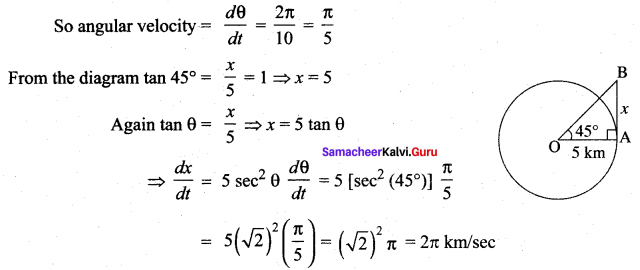
Reason (R): People in Tertiary activities are purely eco friendly.
(a) Both A and R are incorrect
(b) A and R are correct, but A does not explain R
(c) A is correct and R is incorrect.
(d) A and R are correct and A explains R.
Answer:
(c) A is correct and R is incorrect.

III. Match the following:

Man And Environment Class 9 Samacheer Kalvi Social Science Geography Solutions Chapter 6
Answers:
1. (c)
2. (e)
3. (d)
4. (a)
5. (b)

IV. Answer the following in brief:

Samacheer Kalvi 9th Social Science Question 1.
What do you mean by the term ‘density of population’?
Answer:
Density of population refers to the number of people living per square kilometre. An area is said to be sparsely populated when it has a large area with less number of people. Similarly, smaller the area with a large number of people, it is said to be densely populated.

9th Social Samacheer Kalvi Question 2.
What is ‘black death’?
Answer:
The black death is estimated to have killed 30 – 60 percent of Europe’s total population during the 14th century. The dominant explanation for black death is attributed to the outbreak of plague.

Samacheer Kalvi Social 9th Question 3.
Where do we have high and low densities of population?
Answer:
Areas of high density (above 50 people per sq.km) – East Asia, South Asia, North West Europe & Eastern North America.

Areas of low density (less than 10 people per sq.km) – Central Africa, Western Australia, Northern Russia, Canada, etc.

9th Samacheer Kalvi Social Science Question 4.
What is Green House effect?
Answer:
Global warming is caused by the increase of green house gases such as carbondioxide, methane, water vapour and Chloro Fluoro Carbons(CFC), carbon monoxide, photo chemical oxidants and hydrocarbons, which are responsible for the heat retention ability of the atmosphere. Global warming causes climatic change, ozone layer depletion, rise in sea level and drowning of coastal inhabited land, melting of ice, etc., They are posing an even greater threat to human existence and so, man must start thinking of protecting the environment from pollution.
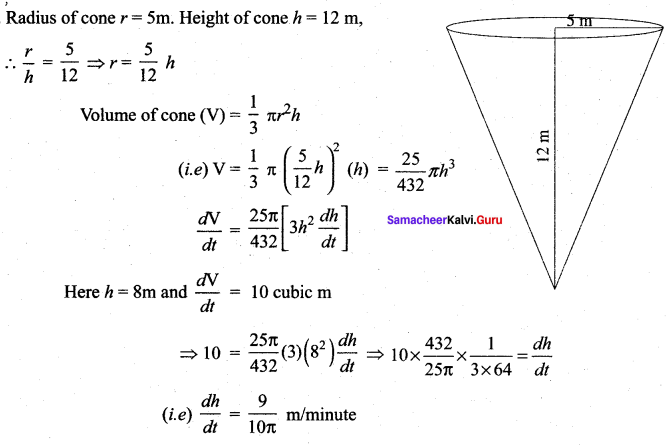
Samacheer Kalvi Guru 9th Social Question 5.
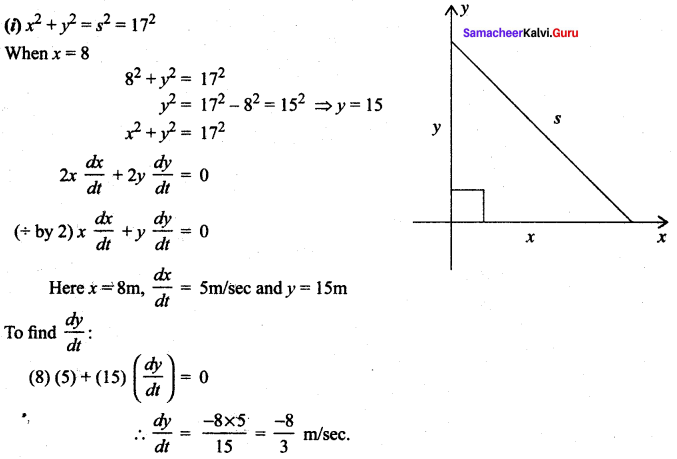
Write any two ways of how the locals and the government restored Palk Bay. Restoration of Palk Bay
Answer:
Local communities, government and civic organisations all came together not just to conserve the remaining mangroves, but also to restore it.

  • Saplings of native species of plants and trees are being grown, planted and cared for.
  • Live colonies of coral from the Gulf of Mannar Biosphere Reserve are being transplanted to Palk Bay. The existing mangroves and the region are being mapped and the way land is used around the mangrove is being studied.
  • The local communities are actively involved in the conservation and restoration of the mangroves. Education and awareness programmes about mangrove ecosystem are being undertaken.

Samacheer Kalvi Guru 9 Social Science Question 6.
Define

  1. Population growth
  2. Infant Mortality Rate
  3. Census
  4. Sustainable Development.

Answer:

  1. Population growth refers to an increase in the number of people who reside in a particular area during a particular period.
  2. The number of deaths under one year of age for every 1000 live births in a year is known as Infant Mortality Rate
  3. Census is an official enumeration of population carried out periodically. It records information about the characteristics of population such as age, sex, literacy and occupation.
  4. “Sustainable development is development that meets the needs of the present without compromising the ability of future generation to meet their own needs”.

V. Distinguish the following:

Samacheer Kalvi 9 Social Question 1.
Birth rate and Death Rate
Answer:

Birth RateDeath Rate
Number of live births per 1000 people in a yearNumber of deaths under one year of age for every 1000 live births in a year

Question 2.
Emigration and Immigration
Answer:

Emigration ImmigrationEmigration Immigration
Emigration means moving out or to leave a place.Immigration means to enter or come into a new country for the purpose of settling there.

Samacheer Kalvi 9th Social Solutions Question 3.
Rural settlement and urban settlement
Answer:

Rural Settlement

Urban Settlement

Any settlement where most of the people are engaged in primary activities like agriculture, forestry, mining and fishery is known as a rural settlement.Urban is the term related to cities and towns where people are primarily engaged in non-agricultural activities, such as secondary, tertiary and quartemary activities.
The most important and unique feature of rural settlements is the vast, open spaces with green, pollution-free environment.The common characteristic feature of an urban unit is that they are compact, congested and liable to a large number of population.

Social Science 9th Samacheer Kalvi Question 4.
Metropolitan and Mega cities
Answer:

Metropolitan

Mega cities

Cities accommodating population between 10 lakhs and 50 lakhs are metropolitan cities. E.g.: MaduraiCities with more than 50 lakh population are called Megacities. E.g.: Greater Chennai

Samacheer Kalvi Guru Social 9th Question 5.
Primary Activities Secondary Activities
Answer:

Primary ActivitiesSecondary Activities
Primary Activities pertain to the extraction of raw materials from the earth’s surface. For example: food gathering, hunting, lumbering, fishing, cattle rearing, mining and agriculture.Secondary Activities transform raw materials into finished goods.
For example: Iron and Steel industries, automobilemanufacturing etc.

VI. Give reasons for the following:

9th Standard Samacheer Kalvi Social Question 1.
Reforestation is encouraged throughout the world.
Answer:
Deforestation results in many effects like floods and droughts, loss of soil fertility, air pollution, extinction of species, global warming, spread of deserts, depletion of water resource, melting of ice caps and glaciers, rise in sea level and depletion of ozone layer. Therefore, reforestation is encouraged throughout the world in order to conserve our mother Earth.

9th Social Solutions Samacheer Kalvi Question 2.
Acid rain destroys the ecosystem.
Answer:
When pollutants combine with water vapour in the presence of sunlight and oxygen, they form dilute sulphuric and nitric acids in the atmosphere. When this mixture precipitates from the atmosphere, it is called acid rain. This would cause lot of damages to life and property. It would affect the health of humans and animals, alter the constituents of water bodies, plants and trees may die as it deteriorates the soil quality and many more damages to nature.

Samacheer Kalvi 9th Social Science Solutions Question 3.
The economy of the quaternary sector is called knowledge economy.
Answer:
Quaternary sector deals with the activities related to Research and Development, as well as knowledge. For e g. Services like consultation, education and banking. Hence, it is called as knowledge economy.

Question 4.
Population growth has to be brought under control.
Answer:
Population growth leads to high competition for all available resources. It leads to poor quality of life, education, food supply, low income and so on. The resources of Earth may exhaust one day and would lead to the end of mankind.

Question 5.
Sustainable development growth has been set to protect the planet.
Answer:
The excessive usage of natural and manmade resources deplete its availability for the future generation. Hence conservation and awareness are the two important terms that can bring sustainability to our living: When we use the word sustainability to mean maintain, it means to maintain it forever. This is because our actions have a lasting effect on the environment and we should protect it for our future generations.

VII. Answer in a paragraph:

Question 1.
Explain the factors affecting the distribution of population.
Answer:
The world population is not uniformly distributed, owing to the following factors.

  • Physical Factors: Physical factors include temperature, rainfall, soil, relief, water, natural vegetation, distribution of minerals and availability of energy resources.
  • Historical Factors: Regions with historical importance (river valley civilizations), war and constant invasions fall under historical factors responsible for population distribution.
  • Economic Factors: Educational institutions, employment opportunities, manufacturing industries, luxurious amenities, trade and commerce and other facilities encourage dense population in an area.

Question 2.
Describe the patterns of rural settlement with neat diagrams.
Answer:
Rectangular pattern:
Rectangular pattern of settlements are found in plain areas or valleys. The roads are rectangular and cut each other at right angles.
Samacheer Kalvi 9th Social Science Geography Solutions Chapter 6 Man And Environment
Linear pattern:
In a linear pattern, the houses are located along a road, railway line and along the edge of the river valley or along a levee.
Samacheer Kalvi Guru 9th Social Science Geography Solutions Chapter 6 Man And Environment
Circular or semicircular pattern:
The pattern of settlement that is found around the lakes, ponds and sea coasts are called circular or semi circular pattern.
Samacheer Kalvi Social Science 9th Std Geography Solutions Chapter 6 Man And Environment
Star like pattern:
Where several metalled or unmetalled roads converge, star shaped settlements develop. In the star shaped settlements, houses are spread out along the sides of roads in all directions.
Social Solutions For Class 9 Samacheer Kalvi Geography Solutions Chapter 6 Man And Environment
Triangular pattern:
Triangular patterns of rural settlement generally develop at the confluence of rivers.
Social Samacheer Kalvi 9th Science Geography Solutions Chapter 6 Man And Environment
T-Shaped, Y-Shaped, Cross-Shaped or
Cruciform settlements:
T-shaped settlements develop at trijunctions of the roads (T), while Y-shaped settlements emerge as the places where two roads converge with the third one. Cruciform settlements develop on the cross-roads which extend in all four directions.
9th Samacheer Kalvi Social Science Geography Solutions Chapter 6 Man And Environment

Nebular pattern:
The arrangement of roads is almost circular which ends at the central location or nucleus of the settlement around the house of the main landlord of the village or around a mosque, temple or church.
Samacheer Kalvi 9th Social Science Geography Solutions Chapter 6 Man And Environment

VIII. HOTS:

Question 1.
Study your area and write down about its settlement pattern.
Answer:

  1. My area is Velachery, Chennai – 42.
  2. It was developed after the late 1990, in the Southern axis radiating out of the city.
  3. It was built over a complex of low-lying wetlands.
  4. In an already sunken Velachery, repeated road repairs had led to the roads increasing in height.
  5. Lifting houses to escape floods.
  6. Though Velachery is still a low lying area and the rainy season will be bad, it wouldn’t be as bad as before.
  7. It is a place where we can get all facilitites like transport, shopping, restaurants, hair parlours etc., within 1 km

IX. Map skill:

A. On the outline map of the world mark the following.
1. An area of high density of population in Europe
2. An area of low density of population in Australia
3. PalkBay
4. A fracking banned country
5. England – A country affected by‘black death’
6. Denmark – First country where the modem census was conducted «
7. River Hwang Ho
9th Social Samacheer Kalvi Science Geography Solutions Chapter 6 Man And Environment

B. On the outline map of Tamil Nadu mark the following.

1. A metropolitan city
2. A district with 7857 people per sq. km.
3. Gulf of Mannar
4. Palk Strait
Samacheer Kalvi Social 9th Science Geography Solutions Chapter 6 Man And Environment

Man and Environment ADDITIONAL QUESTIONS

I. Choose the correct answer.

Question 1.
The interaction between man as an individual with his family, occupation and society is ……..
(a) Natural Environment
(b) Human Environment
(c) Man-made Environment
(d) None of these
Answer:
(b) Human Environment

Question 2.
The physical factor is ………..
(a) temperature
(b) war
(c) trade
(d) commerce
Answer:
(a) temperature

Question 3.
The economical factor is ……..
(a) rainfall
(b) water
(c) soil
(d) luxurious amenities
Answer:
(d) luxurious amenities

Question 4.
To enter (or) come into a new country for the purpose of settling there is known as ………..
(a) internal migration
(b) emigration
(c) immigration
(d) none of these
Answer:
(c) immigration

Question 5.
The rural settlement that is found at the confluence of rivers is ……….
(a) linear pattern
(b) circular pattern
(c) star like pattern
(d) triangular pattern
Answer:
(d) triangular pattern

Question 6.
Transforming raw materials into finished goods is activity.
(a) primary
(b) secondary
(c) tertiary
(d) quinary
Answer:
(b) secondary

Question 7.
…….. is man-made pollution.
(a) Vehicular emission
(b) Wind erosion
(c) Pollen disposal
(d) Evaporation of organic compounds
Answer:
(a) Vehicular emission

Question 8.
Dry recyclable wastes are ……..
(a) food products
(b) packing plastics
(c) diapers
(d) mobiles
Answer:
(b) packing plastics

Question 9.
Van Mahotsav is a weeklong festival celebrated between ………
(a) 1st and 7th July
(b) 1st and 7th June
(c) 1st and 7th August
(d) 1st and 71th September
Answer:
(a) 1st and 7th July

Question 10.
…… disease is caused by water pollution.
(a) Hypertension
(b) Mental illness
(c) Stress
(d) Diarrhoea
Answer:
(d) Diarrhoea

II. Consider the given statements and choose the right option given below:

Question 1.
Assertion (A): Noise pollution is basically a problem of urban areas, industrial areas, transport areas due to bombardment, traffic etc.
Reason (R): It has an impact on the habitat of animals migration and health of inhabitants.
(a) A and R are correct and A explains R
(b) A and R are correct and A does not explain R
(c) A is incorrect and R is correct
(d) Both A and R are incorrect
Answer:
(a) A and R are correct and A explains R

Question 2.
Assertion (A): Things used for domestic purposes can be reused and recycled.
Reason (R): Organic waste matter should be disposed off far away from settlements.
(a) Both A and R are incorrect
(b) Both A and R are correct
(c) A is correct and R is wrong
(d) A and R are correct and A explains R
Answer:
(b) Both A and R are correct

III. Match the following:

9th Samacheer Kalvi Social Science Geography Solutions Chapter 6 Man And Environment
Answers:
1. (e)
2. (a)
3. (b)
4. (c)
5. (d)

IV. Fill in the blanks.
1. …….. is the statistical study of human population.
2. ……. is an official enumeration of population carried out periodically.
3. …… is a condition when a country has more people than its resources to sustain.
4. Cities with more than 50 lakh population are called ……..
5. ……… Activities pertain to the extraction of raw materials from the earth’s surface.
6. …….. is a poisonous gas made up of molecules consisting three oxygen atoms.
7. ……. refers to the process of increase in urban population and urban areas in a country.
8. The economic sustainability is successfully implemented through strong ………
Answers:
1. Demography
2. Census
3. Overpopulation
4. megacities
5. Primary
6. Ozone
7. Urbanisation
8. Public Distribution System

V. Answer the following in brief.

Question 1.
Define Environment.
Answer:
Environment is a set of relationships between man and nature. Man has survived through the ages, dwelling within his surrounding called the environment.

Question 2.
Write a short note on “Human Environment”.
Answer:
Human environment is defined as the interaction between man as an individual, with his family, occupation and society. It is also related to various cultural aspects such as education, religion, economics and politics.

Question 3.
What is Demography?
Answer:
In ancient Greek, ‘demos’ means people and ‘graphis’ means study Of measurement: So, ‘Demography’is the statistical study of human population.

Question 4.
What does population distribution refer to?
Answer:
Population distribution refers to the way in which people are spread out across the earth’s surface.

Question 5.
What do you mean by Nebular pattern of road arrangement?
Answer:
The arrangement of roads is almost circular which ends at the central location or nucleus of the settlement around the house of the main landlord of the village or around a mosque, temple or church.

Question 6.
Mention the patterns of Rural Settlement.
Answer:

  1. Rectangular pattern
  2. Linear pattern
  3. Circular or semicircular pattern
  4. Star like pattern
  5. Triangular pattern
  6. T-Shaped, Y-Shaped, Cross-Shaped or Cruciform settlements
  7. Nebular pattern

Question 7.
What are the control measures of Noise pollution?
Answer:
The control measures of noise pollution are:

  1. Development of green belt vegetation.
  2. Installation of decibel meters along highways and in places of public gatherings.
  3. Planting trees along the compound wall to protect houses.

Question 8.
State the problems of urbanisation.
Answer:
As the town expands, it mounts more pressure on transport system, water supplies, sewage and profuse disposal. The overall development creates problems like air pollution, water pollution, traffic congestion and noise pollution etc., This disturbed environment affects the human beings as mental illness, heart troubles, breathing problems etc.

Question 9.
Classify wastes.
Answer:
Wastes can be classified into five types, which are commonly found around the house. These . include liquid waste, solid rubbish, organic waste, recyclable rubbish and hazardous waste like e-waste.

Question 10.
What do you mean by Environmental Sustainability?
Answer:
Environmental sustainability is the ability of the environment to support a defined level of environmental quality and natural resource extraction rates forever to mankind. Unnecessary disturbances to the environment should be avoided whenever possible.

VI. Distinguish the following

Question 1.
Natural Environment and Human Environment.
Answer:

Natural EnvironmentHuman Environment
The components of natural components of environment are lithosphere, atmosphere, hydrosphere and biosphere.Human environment is defined as the interaction between man as an individual, with his family, occupation and society.
This includes the biotic and abiotic components like ponds, lakes, grasslands, forests, mountains, etc.It is related to various cultural aspects such as education, religion, economics and politics.

Question 2.
Rectangular Pattern and Linear Pattern.
Answer:

Rectangular Pattern

Linear Pattern

Rectangular pattern of settlements are found in plain areas or valleys. The roads are rectangular and cut each other at right angles.In a linear pattern, the houses are located along a road, railway line and along the edge of the river valley or along a levee.

Question 3.
Tertiary Activities and Quarternary Activities.
Answer:

Tertiary ActivitiesQuarternary Activities
Activities which by themselves do not produce goods, but support the process of production are called tertiary activities.The activities related to Research and Development, as well as knowledge are called Quaternary activities.
For example: Transport, communication, banking, storage and trade.For e.g. Services like consultation, education andbanking.

Question 4.
Town and City
Answer:

TownCity
A town is generally larger than a village, but smaller than a city. It has a population of less than 1 lakh.Cities are much larger than towns and have a greater number of economic functions.
The population in cities are estimated to be more than 1 lakh.
E.g.: Arakkonam near ChennaiE.g.: Coimbatore

VII. Give Reasons

Question 1.
“It is easy to add but difficult to maintain.”
Answer:

  1. Population is a dynamic phenomenon where the distribution and composition are constantly changing.
  2. Human population increases as babies are born and decreases as people die. So it is easy to increase the number but difficult to maintain.

Question 2.
“Human settlement can be described as any temporary (or) permanent unit area”.
Answer:

  1. During the early days man preferred tree branches, caves, pits (or) even rock cuts as his shelter.
  2. Slowly settlements came into existence.
  3. Later small settlements developed into villages, towns, cities. So he started living in settled areas.

Question 3.
“We must use forest products properly”.
Answer:
Besides providing habitats for animals and livelihoods for humans, forest products are one of the most essential things in our day to day life. Therefore we must use forest products properly.

Question 4.
“Pollution is an unfavourable modification of the natural world”.
Answer:
Pollute means to degrade or to make dirty. It is caused entirely (or) partly due to direct (or) indirect actions of human beings. So pollution is an unfavourable modification of the natural world.

Question 5.
Why do we get impervious diseases like skin cancer, blindness, loss of plankton?
Answer:
Due to the depletion of ozone layer, UV rays fall on the earth’s surface, and leads to impervious diseases like skin cancer, blindness, loss of plankton etc.

VIII. Answer in a paragraph.

Question 1.
Define Sustainable Development. Explain Social Sustainability and Economic Sustainability.
Answer:
“Sustainable development is development that meets the needs of the present without compromising the ability of future generation to meet their own needs”. For sustainable development to be achieved, it is crucial to harmonize three core elements: economic growth, social aspects and environmental protection. These elements are interconnected and are crucial for the wellbeing of individuals and societies. To achieve true sustainability, we need to balance the economic ,social and environmental factors of sustainability in equal harmony.

Social Sustainability
The ability of a social system such as a country, family or organization to function at a defined level of social well being and harmony is called social sustainability. Problems like war, endemic poverty, widespread injustice and low education rates are symptoms of a system in socially unsustainable. The balancing capacity of a government in maintaining peaceful existence towards other countries and at the same time providing the requirements of its citizens without affecting the environment creates social sustainability.

Economic Sustainability
The people on earth consume far more than what is their fair share.

  • The economic sustainability is successfully implemented through strong Public Distrubution System.
  • Economic sustainability ensures that our economic growth maintains a healthy balance with our ecosystem.

Samacheer Kalvi 10th Social Science Economics Solutions Chapter 5 Industrial Clusters in Tamil Nadu

Guys who are planning to learn and understand the topics of 10th Social ScienceEconomics can grab this Tamilnadu State board solutions for Chapter 5 Industrial Clusters in Tamil Nadu Questions and Answers from this page for free of cost. Make sure you use them as reference material at the time of preparation & score good grades in the final exams.

Students who feel tough to learn concepts can take help from this Samacheer Kalvi 10th Social Science Book Solutions Guide Pdf, all the Questions and Answers can easily refer in the exams. Go to the below sections and get 10th Social ScienceEconomics Chapter 5 Industrial Clusters in Tamil Nadu Tamilnadu State Board Solutions PDF.

Tamilnadu Samacheer Kalvi 10th Social Science Economics Solutions Chapter 5 Industrial Clusters in Tamil Nadu

Do you feel scoring more marks in the 10th Social ScienceEconomics Grammar sections and passage sections are so difficult? Then, you have the simplest way to understand the question from each concept & answer it in the examination. This can be only possible by reading the passages and topics involved in the 10th Social ScienceEconomics Board solutions for Chapter 5 Industrial Clusters in Tamil Nadu Questions and Answers. All the Solutions are covered as per the latest syllabus guidelines. Check out the links available here and download 10th Social ScienceEconomics Chapter 5 textbook solutions for Tamilnadu State Board.

Industrial Clusters in Tamil Nadu Textual Exercise

I. Choose the correct answer.

Successful Industrial Clusters In Tamilnadu Question 1.
‘The Detroit of Asia’ is …………….
(a) Tuticorin
(b) Coimbatore
(c) Chennai
(d) Madurai
Answer:
(c) Chennai

Industrial Clusters Meaning In Tamil Question 2.
Pumpsets and motors are produced mostly in
(a) Salem
(b) Coimbatore
(c) Chennai
(d) Dharampuri
Answer:
(b) Coimbatore

Industrial Clusters Question 3.
Tuticorin is known as …………
(a) Gatew ay of India
(b) Gateway of Tamil Nadu
(c) Pump city
(d) None of these
Answer:
(b) Gateway of Tamil Nadu

Question 4.
…………….. are an essential aspect of a nation’s development.
(a) Agriculture
(b) Industry
(c) Railway
(d) None of these
Answer:
(b) Industry

Question 5.
Tiruppur is knowm for ……………..
(a) Leather tanning
(b) Lock making
(c) Knitwear
(d) Agro-processing
Answer:
(c) Knitwear

Question 6.
Along with Ambur and Vaniyambadi is also a centre for leather goods exports.
(a) Chennai
(b) Sivakasi
(c) Coimbatore
(d) Madurai
Answer:
(a) Chennai

Question 7.
IT means …………….
(a) Indian Technology
(b) Information Technology
(c) Institute Technology
(d) Initiative Technology
Answer:
(b) Information Technology

Question 8.
A successful Industrial cluster entirely created by the Tamil Nadu is:
(a) Hosur
(b) Dindigul
(c) Kovilpatti
(d) Tirunelveli
Answer:
(a) Hosur

Question 9.
SIPCOT was formed in the year …………….
(a) 1972
(b) 1976
(c) 1971
(d) 1978
Answer:
(c) 1971

Question 10.
Which is the Tamil Nadu Industrial Development Agency?
(a) SIPCOT
(b) TANSIDCO
(c) TIDCO
(d) All of these
Answer:
(d) All of these

II. Fill in the blanks.

1. ……………… are very important in the modem economic activities of man.
2. ………….. are groups of firms in a defined geographic area that share common market and technologies.
3. Hundred of leather and tannery facilities are located around ………………. District in Tamil Nadu.
4. ……………… is fondly called as ‘Little Japan’.
5. Special Economic Zones policy was introduced in …………….
6. ……………. is an innovator of new ideas and business processes.
Answers:
1. Industries
2. Industrial clusters
3. Vellore
4. Sivakasi
5. April 2000
6. Entrepreneur

III. Choose the correct statement

Question 1.
I. Entrepreneurship promotes capital formation by mobilising the idle saving of the public.
II. They are not providing large scale employment to artisan, technically qualified persons and professionals.
III. Entrepreneurs help the country to increase the GDP and per capitals income.
IV. Entrepreneurs not promote country’s export trade.
(a) I and IV is correct
(b) I only correct
(c) III and IV is correct
(d) I and III is correct
Answer:
(d) I and III is correct

IV. Pick out odd one.

Question 1.
Which one of the following is not having leather factories?
(a) Ranipet
(b) Dharmapuri
(c) Ambur
(d) Vaniyambadi
Answer:
(b) Dharmapuri

Question 2.
Which one of the following is not a Industrial developing agency?
(a) TIDCO
(b) SIDCO
(c) MEPG
(d) SIPCOT
Answer:
(c) MEPG

V. Match the following.

Successful Industrial Clusters In Tamilnadu Samacheer Kalvi 10th Social Science Economics Solutions Chapter 5
Answers:
1. (c)
2. (a)
3. (d)
4. (e)
5. (b)

VI. Give Short Answers.

Question 1.
Why should a developing economy diversify out of agriculture?
Answer:
The demand for agricultural products remains constant at all levels of income, The agricultural products need to be processed and preserved to exports them, and there are limit for the primary sector to absorb labour. For all these reasons, a developing economy diversify out of agriculture.

Question 2.
Why are wages low in the agricultural sector?
Answer:
There are limits to the ability of agriculture to absorb labour due to the declining marginal productivity of land. As a result, labour productivity in the agricultural sector cannot increase much. Wages cannot increase as a result poverty levels may remain high, especially when more and more people continue to rely on agriculture for their livelihood.

Question 3.
What is meant by an industrial cluster?
Answer:
Industrial clusters are groups of firms in a defined geographic area that share common markets, technologies and skill requirements.

Question 4.
What are the routes for cluster formation?
Answer:
Apart from the Chennai region, industrial growth has been concentrated in several small towns clusters. Throughout the state, with the western region being more dominant these clusters specialise in a range of activities like clothing, home furnishing, textiles, leather, poultry, coir products, transport, equipment servicing, engineering services and auto component making.

Question 5.
Mention the 3 areas of policy-making that helped Tamil Nadu become one of the most industrialised states in the country.
Answer:

  1. Education – The state is known for its vast supply of Technical Human Resources.
  2. Infrastructure – Excellent Infrastructure facilities like transport facilities, electricity, markets, widespread m the state.
  3. Industrial promotion – Efforts taken to promote specific sectors like automobile, auto components. IT etc..

Question 6.
Mention any three industrial development agencies in Tamil Nadu and their role.
Answer:
SIPCOT: (State Industries Promotion Corporation of Tamil Nadu), 1971
It was formed in the year 1971 to promote industrial growth in the state by setting up industrial estates.

TANSIDCO: (Tamil Nadu Small Industries Development corporation), 1970
TANSIDCO is a state-agency of the state of Tamil Nadu established in the year 1970 to promote small-scale industries in the state. It gives subsidies and provide technical assistance for new firms in the small scale sector.

TIDCO (TamilNadu Industrial Development Corporation), 1965:
TIDCO is another government agency to promote industries in the state and to establish industrial estates.

Question 7.
What are the problems of industrialization currently in Tamil Nadu?
Answer:

  1. Some of the Industrial clusters tend to generate a lot of polluting effluents that affects health.
  2. Decrease in the employment potential due to use of capital intensive technology.
  3. Quality of employment suffer a§ workers are employed temporarily.

Question 8.
What is Meant by Entrepreneur?
Answer:
Entrepreneur is an innovator of new ideas and business processes. He possesses management skills, strong team building abilities and essential leadership qualities to manage a business.

Question 9.
What is Entrepreneurship?
Answer:
It is a process of an action of an entrepreneur Who undertakes efforts to establish his enterprise. It is the ability to run the business-facing risk and innovating new ideas.

VII. Brief Answer.

Question 1.
What are the contributions of industrialization to development?
Answer:
As stated earlier, it is essential to produce inputs to other producers in an economy. Even agriculture requires inputs from industry such as fertilizers and tractors to increase productivity.

Second, a market exists for both producers and consumer goods. Even services like banking, transport and trade are dependent on the production of industrial goods.

Third, by using modem methods of production, industries contribute to better productivity’ and hence lower cost of production of all goods produced. It therefore helps people to buy goods at a cheaper rate and help create demand for more products.

Fourth, through such expansion of production, industrialization helps to absorb the labour force coming out of agriculture. Employment generation is therefore an important objective of industrialisation.

Fifth, a related advantage of industrialization is therefore technological change. Through use of modem techniques, industrialisation contributes to learning of such methods and their improvement. As a result labour productivity, ie, output per unit of labour input increases, which can help workers earn higher wages.

Sixth, expanding incomes lead to more demand for goods and services. If an economy is not able to produce enough to meet such demand, it has to rely on imports and therefore spends a lot of foreign exchange. If the economy does not earn enough from exporting, it will be difficult to meet the growing demand. Industrialization therefore helps an economy to save and also generate foreign exchange through exports.

Question 2.
Write a note on history of industrialisaton in Tamil Nadu.
Answer:

  1. Tamil Nadu has a vast coastline therefore the region has been involved in trade with both South – East and West Asia for several centuries.
  2. The introduction of cotton cultivation in Western and Southern Tamil Nadu by the Colonial Government led to the emergence of large – scale textile Industries.
  3. The introduction of Railways also expanded the market for cotton yam and helped to develop this sector.
  4. The Chennai and Tuticorin ports in Tamil Nadu led to the greater Industrial development.
  5. The growth of Jaggery Industry in South Tamil Nadu and match factory in the Sivakasi region, Leather production in Dindigul, Vellore and Ambur region are remarkable development of Industries in Tamil Nadu.
  6. Another major development in the Western region is the introduction of electricity from hydro- electric power in 1930’s.
  7. The emergence of workshops for servicing engines and also for demand for spare parts.
  8. Bharat Heavy Electricals Limited (BHEL) in Tiruchy and Avadi Industrial Estate in 1950’s to supplying to the large firms in the region.
  9. The Salem Steel Plant was set up in 1973 to produce stainless steel.
  10. In 1990’s with the,ideas of Liberalisation phase, many MNC’s has been opened such as Nokia, Foxconn, Samsung etc.,
  11. Tamil Nadu has been halied as a model for successfully using the SEZ route to attract productive Investments also.

Question 3.
What are the important characteristics of successful industrial clusters?
Answer:
The following are the chief characteristics of a successful cluster.

  • geographical proximity of small and medium enterprises (SMEs)
  • sectoral specialisation
  • close inter-firm collaboration
  • inter-firm competition based on innovation
  • a socio-cultural identity, which facilitates trust
  • multi-skilled workforce
  • active self-help organisations, and
  • supportive regional and municipal governments.

Question 4.
Write about the Textile industry cluster in Tamil Nadu.
Answer:

  1. Tamil Nadu is the home to the largest textile sector in the country.
  2. Because of the development of cotton textile industry since the colonial period, Coimbatore is often referred as the Manchester of South India.
  3. Tamil Nadu is the biggest producer of cotton yam in the country.
  4. Palladam, Somanur small towns near Coimbatore region, and Erode and Salem region have large number of powerloom units.
  5. Cotton knitwear firms accounting for nearly 80% of the cotton knitwear exports and generates large employment in Tiruppur region.
  6. Because of the success in the global market, it is seen as one of the most dynamic clusters in the Global South countries in the Southern hemisphere.

Question 5.
Write in detail about the types of policies adopted by the Tamil Nadu government to industrialise?
Answer:
Industrial Policy of Tamil Nadu:
Tamil Nadu enjoys growth and has excellent infrastructure. A straggly established cluster and political stability are the major advantages. The state government has a pro-active industrial policy and is very encouraging when it comes to SEZs.
Important industrial policies:
(a) Tamil Nadu Industrial Policy – 2014
(b) Implementation of Industrial Policy – 2015
(c) Tamilnadu State Environmental Policy – 2014
(d) Tamilnadu SEZs Policy – 2013
(e) Tamilnadu Automobiles and Auto Parts Policy – 2014
(f) Tamilnadu Biotechnology Policies – 2014

Question 6.
Explain the role of Entrepreneur.
Answer:
Entrepreneur is a person one who possesses management skills, strong team building abilities and essential leadership qualities to manage a business.

Role of Entrepreneur:

  1. To promote development of Industries.
  2. To remove regional disparities by Industrialising rural and backward areas.
  3. To help the country to increase the GDP and Pre-capita income.
  4. They contribute towards the development of society by reducing concentration of Income and wealth.
  5. They promote capital formation by mobilising the idle saving of the citizens and country’s exports.
  6. Entrepreneurs provide large – scale employment to artisans, technically qualified persons and work in an environment of changing
  7. technology and try to maximize profits by innovations.
  8. To enable the people to avail better quality goods at lower prices.
  9. This results in the improvement of their standard of living.

VIII. Case studies

Question 1.
Choose a cluster in Tamil Nadu based on online research and write a note on it.
Answer:
Do it yourself.

IX. Activity and project.

Question 1.
Write a note on a cluster or a firm near your school/home based on your observations.
Answer:
Do it yourself.

X. Life Skills

Question 1.
Teacher and Students discuss about the entrepreneurs and their activities and Write an a essay in the topic of “If you are like a Entrepreneur”.
Answer:
Do it yourself.

Industrial Clusters in Tamil Nadu Additional Questions

I. Choose the correct answer.

Question 1.
In the year 1965 …………….. was formed.
(a) TIDCO
(b) TALW
(c) TANSI
Answer:
(a) TIDCO

Question 2.
Countries in the Southern hemisphere are called Global ………………. countries.
(a) Western
(b) South
(c) Eastern
(d) Minor
Answer:
(b) South

Question 3.
……………. gives subsides and provide technical assistance for new firms in the small scale
sector.
(a) TANSIDCO
(b) SIPCOT
(c) TANSI
Answer:
(a) TANSIDCO

Question 4.
………………. is nicknamed as the Detroit of Asia.
(a) Madurai
(b) Coimbatore
(c) Chennai
(d) Tiruppur
Answer:
(c) Chennai

Question 5.
The MEPZ headquarters is located on:
(a) Chennai
(b) Coimbatore
(c) Madurai
(d) Ramnad
Answer:
(a) Chennai

II. Fill in the blanks :

1. Food products are taken over longer distances processed and ……………..
2. Countries in the southern hemisphere are called …………….
3. The ……………. district is the top exporter of finished leather goods in the country.
4. ……………. is famous for cotton knitwear.
5. Chennai is nick named as ………………
Answers:
1. branded
2. Global South countries
3. Vellore
4. Tiruppur
5. The Detroit of Asia

III. Match the following.

a.

1.Sivakasi(a)1970
2.SIPCOT(b)leather Goods
3.Namakkal-Tiruchengode(c)1971.
4.Tiruppur(d)Cotton knit wear
5.Vellore(e)Truck body building industry
6.TANSIDCO(f)fire works

Answer:
1. (f)
2. (c)
3. (e)
4. (d)
5. (b)
6. (a)

b.

1.TANSI(a)Andhra Pradesh
2.TIIC(b)Auto Cluster
3.TIDCO(c)1949
4.Hosur(d)1965
5.Cement Industry(e)1965

Answer:
1. (e)
2. (c)
3. (d)
4. (b)
5. (a)

IV. Answer briefly:

Question 1.
What is meant by the term ‘Industry’?
Answer:
Any human activity which is engaged in the conversion of raw materials into readily usable materials is called an Industry.

Question 2.
What is consumer goods rector?
Answer:
If the output is consumed by the final consumer, it is called as consumer goods sectors.

Question 3.
Name few examples of Industrial clusters.
Answer:
Clothing, home furnishing, textiles, leather, poultry, coir products, engineering services, etc., are few examples of Industrial sector clusters.

Question 4.
How do clusters Originate?
Answer:
Clusters may arise due to many factors. Certain clusters evolve over a long time in history when artisans settle in one locality and evolve over centuries. Hand loom weaving clusters are one example of this development.

Government may decide to encourage manufacturing using raw materials from a region, which may also lead to emergence of clusters.

Question 5.
Why is Coimbatore often referred to as the ‘Manchester of South India”?
Answer:
Most of the cotton textile Industries are located in Coimbatore region since the colonial period, so it is called as Manchester of South India.

V. Answer in detail.

Question 1.
Write about the major Industrial Clusters and their specialisation in Tamil Nadu. Automotive Clusters:
Answer:
Chennai is nicknamed as “ The Detroit of Asia” because of its large auto industry base. Chennai is home to large number of auto assembly and coponents making firms.
While there were a few domestic firms like TVS, TI Cycles, Ashok Leyland and Standard Motors earlier in the post-reform period, several MNC firms like Hyundai, Ford, Daimler- Benz and Renault-Nissan have opened factories in the region.

Textile Cluster:
Tamil Nadu is home to the largest textiles sector in the country. Because of the development of cotton textile industry since the colonial period, Coimbatore often referred as the “Manchester of South India”

At present, most of the spinning mills have moved to the smaller towns and villages at a radius over 100 to 150 km around the Coimbatore city. Tamil Nadu is the biggest producer of cotton yam in the country.

Palladam and Somanur, small towns near Coimbatore and the villages near these towns, are home to a dynamic power loom weaving cluster as well. Power loom is however more widespread with Erode and Salem region too having a large number of power loom units.

Leather and Leather Goods Clusters:
Tamil Nadu accounts for 60% of leather tanning capacity in India and 38 % of all leather Leather footwear, garments and components. Hundreds of leather and tannery facilities are located around Vellore and its nearby towns, such as Ranipet, Ambur and Vaniyambadi. The Vellore district is the top exporter of finished leather goods in the country. The leather products sector too is a major employment generator.

Fireworks, Matches and Printing Cluster:
Sivakasi region, once famous for its match industry has now become a major centre for printing and fireworks in the country. It is believed to contribute to 90% of India’s fireworks production, 80% of safety matches and 60% of offset printing solutions. The offset printing industry has a high degree of specialization among firms with several of them undertaking just one operation required for printing. All these industries have their origin in the colonial period and at present offer employment to a large number of workers.

Question 2.
Write a note a Special Economic Zones.
Answer:

  1. SEZ (or) Special Economic Zones are set up based on the policy that was introduced in april 2000.
  2. This was set up to have hazzle free environment for exports.
  3. The policy provides for setting up of SEZs in the public, private, joint sector (or) by the State Governments.
  4. It also envisaged that some of the existing Export Processing Zone would be converted into Special Economic Zones.
  5. Accordingly, the Government has converted EPZ into SEZ in almost eight places in Tamil Nadu.
  6. The Madras Export Processing Zone (MEPZ) is one of the seven export processing zones in the country set up by the Central Government.
  7. It was established in 1984 to promote foreign direct investment, enhance foreign exchange earnings and create greater employment opportunities in the region.

We think the data given here clarify all your queries of Chapter 5 and make you feel confident to attempt all questions in the examination. So, practice more & more from Tamilnadu State Board solutions for 10th Social ScienceEconomics Chapter 5 Industrial Clusters in Tamil Nadu Questions and Answers & score well. Need any information regarding this then ask us through comments & we’ll give the best possible answers very soon.