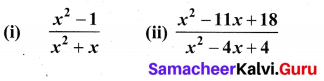
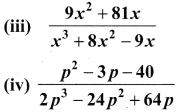
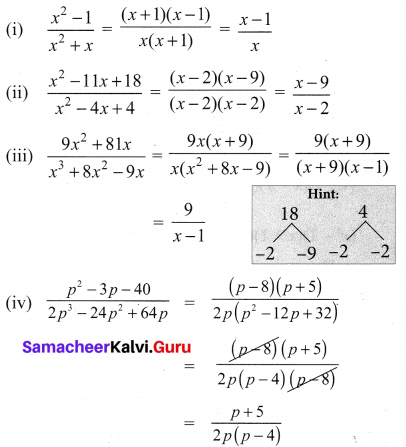
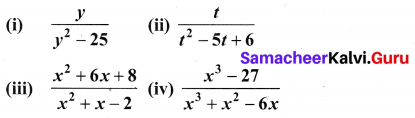
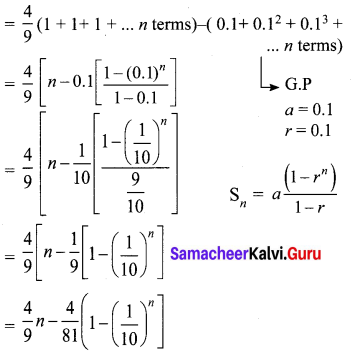
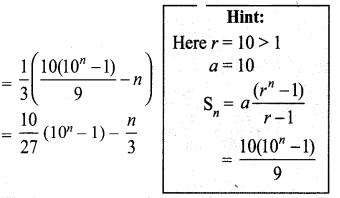
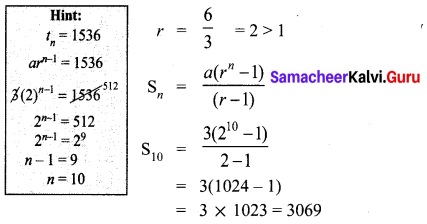
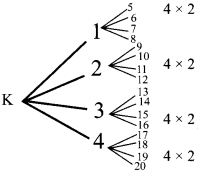
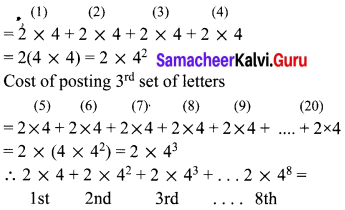
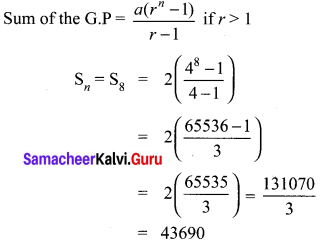
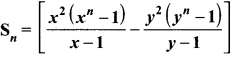
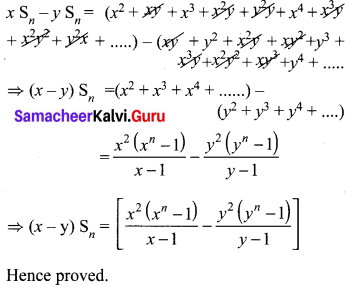
Samacheer Kalvi 10th Maths Solutions Chapter 2 Numbers and Sequences Ex 2.9

You can Download Samacheer Kalvi 10th Maths Book Solutions Guide Pdf, Tamilnadu State Board help you to revise the complete Syllabus and score more marks in your examinations.

Tamilnadu Samacheer Kalvi 10th Maths Solutions Chapter 2 Numbers and Sequences Ex 2.9

10th Maths Exercise 2.9 Samacheer Kalvi Question 1.
Find the sum of the following series
(i) 1 + 2 + 3 + … + 60
(ii) 3 + 6 + 9 + … + 96
(iii) 51 + 52 + 53 + … + 92
(iv) 1 + 4 + 9 + 16 + … + 225
(v) 62 + 72 + 82 + … + 212
(vi) 103 + 113 + 123 + … + 203
(vii) 1 + 3 + 5 + … + 71
Solution:
(i) 1 + 2 + 3 + ……… + 60
10th Maths Exercise 2.9 Samacheer Kalvi Chapter 2 Numbers And Sequences Samacheer Kalvi
= 4278 – 1275 = 3003
(iv) 1 + 4 + 9 + 16 + … + 225
= 12 + 22 + 32 + 42 + ……… + 152
\(\sum_{1}^{n} n^{2}=\frac{n(n+1)(2 n+1)}{6}\)
Ex 2.9 Class 10 Samacheer Kalvi Maths Solutions Chapter 2 Numbers And Sequences
10th Maths Exercise 2.9 Answers Samacheer Kalvi Chapter 2 Numbers And Sequences

Ex 2.9 Class 10 Samacheer Question 2.
If 1 + 2 + 3 + … + k = 325, then find 13 + 23 + 33 + …………. + K3.
Solution:
1 + 2 + 3 + … + K = 325
Exercise 2.9 Class 10 Maths Solutions Chapter 2 Numbers And Sequences Samacheer Kalvi
If 1 + 2 + 3 … + k = 325
13 + 23 + 33 + … + K3 = (325)2 = 105625

10th Maths Exercise 2.9 Answers Question 3.
If 13 + 23 + 33 + … + K3 = 44100 then find 1 + 2 + 3 + … + k.
Solution:
If 13 + 23 + 33 + … + K3 = 44100
1 + 2 + 3 + … + K = \(\sqrt { 44100 }\)
= 210

Exercise 2.9 Class 10 Maths Question 4.
How many terms of the series 13 + 23 + 33 + … should be taken to get the sum 14400?
Solution:
13 + 23 + 33 + ……… + n3 = 14400
\(\left(\frac{n(n+1)}{2}\right)^{2}\) = 14400 = (120)2
\(\frac{n(n+1)}{2}\) = \(\sqrt { 14400 }\) = 120
n(n + 1) = 240
Method 1:
n2 + n – 240 = 0
n2 + 16n – 15n – 240 = 0
n(n + 16) – 15(n + 16) = 0
(n + 16)(n – 15) = 0
n = -16, 15
∴ 15 terms to be taken to get the sum 14400.
Method 2:
n2 + n – 240 = 0
Exercise 2.9 Class 10 Maths Samacheer Kalvi Chapter 2 Numbers And Sequences

Exercise 2.9 Class 10 Maths Samacheer Question 5.
The sum of the squares of the first n natural numbers is 285, while the sum of their cubes is 2025. Find the value of n.
Solution:
12 + 22 + 32 + …… + n2 = 285
13 + 23 + 33 + …… + n3 = 2025
10th Maths Exercise 2.9 Solutions Chapter 2 Numbers And Sequences Samacheer Kalvi

10th Maths Exercise 2.9 Question 6.
Rekha has 15 square colour papers of sizes 10 cm, 11 cm, 12 cm,…, 24 cm. How much area can be decorated with these colour papers?
Solution:
102 + 112 + 122 + … + 242
= (12 + 22 + … + 242) – (12 + 22 + … + 92)
Ex 2.9 Class 10 Maths Solutions Chapter 2 Numbers And Sequences Samacheer Kalvi
∴ Rekha has 4615 cm2 colour papers. She can decorate 4615 cm2 area with these colour papers.

Ex 2.9 Class 10 Question 7.
Find the sum of the series (23 – 1) + (43 – 33) + (63 – 153) +… to (i) n terms (ii) 8 terms.
Solution:
(23 – 1) + (43 – 33) + (63 – 153) + ……… n
Exercise 2.9 Samacheer Kalvi 10th Maths Solutions Chapter 2 Numbers And Sequences
= 4n3 + 3n2 = sum of ‘n’ terms.
When n = 8
Sum = 4 × 83 + 3 × 82
= 2048 + 192 = 2240

Samacheer Kalvi 9th Maths Solutions Chapter 1 Set Language Ex 1.5

You can Download Samacheer Kalvi 9th Maths Book Solutions Guide Pdf, Tamilnadu State Board help you to revise the complete Syllabus and score more marks in your examinations.

Tamilnadu Samacheer Kalvi 9th Maths Solutions Chapter 1 Set Language Ex 1.5

Exercise 1.5 Class 9 Maths Samacheer Question 1.
Using the adjacent venn diagram, find the following sets:
(i) A – B
(ii) B – C
(iii) A’ ∪ B’
(vi) A’ ∩ B’
(v) (B ∪ C)’
(vi) A – (B ∪ C)
(vii) A – (B ∩ C)
Exercise 1.5 Class 9 Maths Samacheer Kalvi Chapter 1 Set Language
Solution:
(i) A – B = {3, 4, 6}
(ii) B – C = {-1, 5, 7}
(iii) A’ ∪ B’
A’ = {1, 2, 0, -3, 5, 7, 8}
B’ = {-3, 0, 1, 2, 3, 4, 6)
A’ ∪ B’ = {-3, 0, 1, 2, 3, 4, 5, 6, 7, 8)

(iv) A’ ∩ B’
A’ ∩ B’ = {-3, 0, 1, 2}

(v) B ∪ C = {-3, -2, -1, 0, 3, 5, 7, 8}
(B ∪ C)’ = U – (B ∪ C)
= {-3, -2, -1, 0, 1,2, 3, 4, 5, 6, 7, 8} – {-3, -2, -1, 0, 3, 5, 7, 8}
(B ∪ C)’ = {1, 2, 4, 6}

(vi) A – (B ∪ C) = {-2, -1, 3, 4,6} – {-3, -2, -1, 0, 3, 5, 7, 8} = {4, 6}
A – (B ∩ C)
B ∩ C = {-2, 8}
A- (B ∩ C) = {-2, -1, 3, 4, 6} – {-2, 8} = {-1, 3, 4, 6}

9th Maths Exercise 1.5 Samacheer Kalvi Question 2.
If K = {a, b, d, e,f}, L = {b, c, d, g} and M {a, b, c, d, h} then find the following:
(i) K ∪ (L ∩ M)
(ii) K ∩ (L ∪ M)
(iii) (K ∪ L) ∩ (K ∪ M)
(iv) (K ∩ L) ∪ (K ∩ M) and verify distributive laws.
Solution:
K = {a, b, d, e, f}, L = {b, c, d, g} and M {a, b, c, d, h}
(i) K ∪ (L ∩ M)
L ∩ M = {b, c, d, g} ∩ {a, b, c, d, h} = {b, c, d}
K ∪ (L ∩ M) = {a, b, d, e, f } ∪ {b, c, d) = {a, b, c, d, e, f}

(ii) K ∩(L ∪ M)
L ∪ M = {a, b, c, d, g, h}
K ∩ (L ∪ M) = {a, b, d, e, f} ∩ {a, b, c, d, g, h} = {a, b, d}

(iii) (K ∪ L) ∩ (K ∪ M)
K ∪ L = {a, b, c, d, e, f, g}
K ∪ M = {a, b, c, d, e, f, h}
(K ∪ L) ∩ (K ∪ M) = {a, b, c, d, e,f}

(iv) (K ∩ L) ∪ (K ∩ M)
(K ∩ L) = {b, d)
(K ∩ M) = {a,b,d}
(K ∩ L) ∪ (K ∩ M) = {b, d} ∪ {a, b, d} = {a, b, d}

Distributive laws
K ∪ (L ∩ M) = (K ∪ L) ∩ (K ∪ M)
{a, b, c, d, e, f) = {a, b, c, d, e, f, g} ∩ {a, b, c, d, e, f, h}
= {a, b, c, d, e, f}
Thus Verified.
K ∩ (L ∪ M) = (K ∩ L) ∪ (K ∩ M)
{a, b, d} = {a, b, c, d, e, f, g} ∪ {a, b, c, d, e, f, h}
= {a, b, d}
Thus Verified.

9th Maths Set Language Exercise 1.5 Question 3.
If A = {x : x ∈ Z, -2 < x ≤ 4}, B = {x : x ∈ W, x ≤ 5}, C ={-4, -1, 0, 2, 3, 4}, then verify A ∪ (B ∩ C) = (A ∪ B) ∩ (A ∪ C).
Solution:
A = {x : x ∈ Z, -2 < x ≤ 4} = {-1, 0, 1, 2, 3, 4}
B = {x : x ∈ W, x ≤ 5} = {0, 1, 2, 3, 4, 5}
C = {-4, -1, 0, 2, 3, 4}
A ∪ (B ∩ C)
B ∩ C = {0, 1, 2, 3, 4, 5} ∩ {-4, -1, 0, 2, 3, 4} = {0, 2, 3, 4}
A ∪ (B ∩ C) = {-1, 0, 1, 2, 3, 4} ∪ (0, 2, 3, 4} ={-1, 0, 1, 2, 3, 4} …………. (1)
(A ∪ B) ∩ (A ∪ C)
A ∩ B = {0, 1, 2, 3, 4}
A ∩ C = {-1, 0, 2, 3, 4}
(A ∩ B) ∪ (A ∩ C) = {0, 1, 2, 3, 4} ∪ {-1, 0, 2, 3, 4}= {-1, 0, 1, 2, 3, 4} …………. (2)
From (1) and (2), it is verified that
A ∪ (B ∩ C) = (A ∪ B) ∩ (A ∪ C)

9th Maths Exercise 1.5 Question 4.
Verify A ∪ (B ∩ C) = (A ∪ B) ∩ (A ∪ C) using Venn diagrams.
Solution:
L.H.S A ∪ (B ∩ C)
9th Maths Exercise 1.5 Samacheer Kalvi Chapter 1 Set Language
From (2) and (5), it is verified that A ∪ (B ∩ C) = (A ∪ B) ∩ (A ∪ C)

Class 9 Maths Chapter 1 Samacheer Kalvi Question 5.
If A = {b, c, e, g, h}, B = {a, c, d, g, i} and C = {a, d, e, g, h}, then show that A – (B ∩ C) = (A – B) ∪ (A – C).
Solution:
A = {b, c, e, g, h}
B = {a, c, d, g, i}
C = {a, d, e, g, h}
B ∩ C = {a, d, g}
A – (B ∩ C) = {b, c, e, g, h} – {a, d, g} = {b, c, e, h} ……..… (1)
A- B = {b, c, e, g, h} – {a, c, d, g, i} = {b, e, h}
A – C = {b, c, e, g, h} – {a, d, e, g, h} = {b, c}
(A – B) ∪ (A – C) = {b, c, e, h} ………..… (2)
From (1) and (2) it is verified that
A – (B ∩ C) = (A – B) ∪ (A – C)

Samacheerkalvi.Guru 9th Maths Question 6.
If A = {x : x = 6 n ∈ W and n < 6}, B = {x : x = 2n, n ∈ N and 2 < n ≤ 9} and C = {x : x = 3n, n ∈ N and 4 ≤ n < 10}, then show that A – (B ∩ C) = (A – B) ∪ (A – C)
Solution:
A = {x : x = 6n, n ∈ W, n < 6}
x = 6n
n = {0, 1, 2, 3, 4, 5}
⇒ x = 6 × 0 = 0
x = 6 × 1= 6
x = 6 × 2 = 12
x = 6 × 3 = 18
x = 6 × 4 = 24
x = 6 × 5 = 30
∴ A = {0, 6, 12, 18, 24, 30}

B = { x : x = 2n, n ∈ N, 2 < n ≤ 9}
n = {3, 4, 5, 6, 7, 8, 9}
x = 2 n
⇒ x = 2 × 3 = 6
2 × 4 = 8
2 × 5 = 10
2 × 6 = 12
2 × 7 = 14
2 × 8 = 16
2 × 9 = 18
∴ B {6, 8, 10, 12, 14, 16, 18}

C = { x : x = 3n, n ∈ N, 4 ≤ n < 10}
N = { 4, 5, 6, 7, 8, 9}
x = 3 × 4 = 12
⇒ x = 3 × 5 = 15
x = 3 × 6 = 18
x = 3 × 7 = 21
x = 3 × 8 = 24
x = 3 × 9 = 27
x = 2 × 9 = 18
∴ C = {12, 15, 18, 21, 24, 27}

A – (B ∩ C) = (A – B) ∪ (A – C)
L.H.S R.H.S
B ∩ C = {12,18}
A – (B ∩ C) = {0, 6, 12, 18, 24, 30} – {12, 18} = {0, 6, 24, 30} ……….…. (1)
(A – B) = {0, 24, 30}
(A – C) = {0, 6, 30}
(A – B) ∪ (A – C) = {0, 6, 24, 30} …………. (2)
From (1) and (2), it is verified that
A – (B ∩ C) = (A – B) ∪ (A – C).

Samacheer Kalvi Guru 9th Maths Question 7.
If A = {-2, 0, 1, 3, 5}, B = {-1, 0, 2, 5, 6} and C = {-1, 2, 5, 6, 7}, then show that A – (B ∪ C) = (A – B) ∩ (A – C).
Solution:
A = {-2, 0, 1, 3, 5},
B = {-1, 0, 2, 5, 6}
C ={-1, 2, 5, 6, 7}
B ∪ C = {-1, 0, 2, 5, 6, 7}
A – (B ∪ C) = {-2, 1, 3} …………. (1)
(A – B) = {-2, 1, 3}
(A – C) = {-2, 0, 1, 3}
(A – B) ∩ (A – C) = {-2, 1, 3} ………..… (2)
From (1) and (2), it is verified that . A – (B ∪ C) = (A – B) ∩ (A – C)

9th Standard Maths Exercise 1.5 Question 8.
if A={y: y = \(\frac{a+1}{2}\), a W and a 5},B = {y: y=\(\frac{2 n-1}{2}\),n W and n < 5} and C={1,\(-\frac{1}{2}\), 1, \(\frac{3}{2}\), 2} then show that A – (B ∪ C) = (A – B) ∩ (A – C).
Solution:
9th Maths Set Language Exercise 1.5 Chapter 1 Set Language Samacheer Kalvi
9th Maths Exercise 1.5 Solutions Chapter 1 Set Language Samacheer Kalvi
(A – B) ∩ (A – C) = {3} …………. (2)
From (1) and (2), it is verified that A – (B ∪ C) = (A – B) ∩ (A – C).

9th Maths Exercise 1.5 In Tamil Question 9.
Verify A – (B ∩ C) = (A – B) ∪ (A – C) using Venn diagrams.
Solution:
Class 9 Maths Chapter 1 Samacheer Kalvi Set Language Ex 1.5
∴ A – (B ∩ C) = (A – B) ∪ (A – C)
Hence it is proved.

Kalvi Guru 9th Maths Question 10.
If U = {4, 7, 8, 10, 11, 12, 15, 16}, A = {7, 8, 11, 12} and B = {4, 8, 12, 15}, then verify De Morgan’s Laws for complementation.
U = {4, 7, 8, 10, 11, 12, 15, 16}
A = {7, 8, 11, 12}, B = {4, 8, 12, 15}
De Morgan’s Laws for complementation.
(A ∪ B)’ = A’ ∩ B’
A ∪ B = {4, 7, 8, 11, 12, 15}
(A ∪ B)’ = {4, 7, 8, 10, 11, 12, 15, 16} – {4, 7, 8, 11, 12, 15}
= {10, 16} ……………. (1)
A’ = {4, 10, 15, 16}
B’ = {7, 10, 11, 16}
A’ ∩ B’ = {10, 16} ………………(2)
From (1) and (2) it is verified that (A ∪ B)’ = A’ ∩ B’.

9th Class Math Exercise 1.5 Solution Question 11.
Verify (A ∩ B)’ = A’ ∪ B’ using Venn diagrams.
Solution:
(A ∩ B)’ = A’ ∪ B’
Samacheerkalvi.Guru 9th Maths Solutions Chapter 1 Set Language Ex 1.5
(2) = (5)
∴ (A ∩ B)’ = A’ ∪ B’

Samacheer Kalvi 12th Maths Solutions Chapter 3 Theory of Equations Ex 3.1

You can Download Samacheer Kalvi 12th Maths Book Solutions Guide Pdf, Tamilnadu State Board help you to revise the complete Syllabus and score more marks in your examinations.

Tamilnadu Samacheer Kalvi 12th Maths Solutions Chapter 3 Theory of Equations Ex 3.1

Exercise 3.1 Class 12 Maths State Board Question 1.
If the sides of a cubic box are increased by 1, 2, 3 units respectively to form a cuboid, then the volume is increased by 52 cubic units. Find the volume of the cuboid.
Solution:
Let the side of the cube be ‘x’
Sides of cuboid are (x + 1) (x + 2) (x + 3)
∴ Volume of cuboid = x3 + 52
⇒ (x + 1) (x + 2) (x + 3) = x3 + 52
⇒ (x2 + 3x + 2)(x + 3) = x3 + 52
⇒ x3 + 3x2 + 3x2 + 9x + 2x + 6 – x3 – 52 = 0
⇒ 6x2 + 11x – 46 = 0 (÷2)
⇒ (x – 2) (6x + 23) = 0
⇒ x – 2 = 0 or 6x + 23 = 0
⇒ x = 2 or x = \(-\frac{23}{6}\) (not possible)
∴ x = 2
Volume of cube = 23 = 8
Volume of cuboid = 52 + 8 = 60 cubic units

12th Maths Exercise 3.1 Question 2.
Construct a cubic equation with roots
(i) 1, 2 and 3
(ii) 1, 1 and -2
(iii) 2, \(\frac { 1 }{ 2 }\) and 1
Solution:
(i) Given roots are α = 1, β = 2, γ = 3
The cubic equation is
x3 – x2 (α + β + γ) + x (αβ + βγ + γα) – αβγ = 0
⇒ x3 – x2 (1 + 2 + 3) + x (2 + 6 + 3) – (1) (2) (3) = 0
⇒ x3 – 6x2 + 11x – 6 = 0
(ii) α = 1, β = 1, γ = -2
The cubic equation is
x3 – x2 (α + β + γ) + x (αβ + βγ + γα) – αβγ = 0
⇒ x3 – x2 (1 + 1 – 2) + x (1 – 2 – 2) – (1) (1) (-2) = 0
⇒ x3 – 0x2 – 3x + 2 = 0
⇒ x3 – 3x + 2 = 0
(iii) α = 2, β = \(\frac { 1 }{ 2 }\), γ = 1
The cubic equation is
x3 – x2 (α + β + γ) + x (αβ + βγ + γα) – αβγ = 0
Exercise 3.1 Class 12 Maths State Board Chapter 3 Theory Of Equations Samacheer Kalvi
2x3 – 7x2 + 7x – 2 = 0

12th Maths Theory Of Equations Question 3.
If α, β and γ are the roots of the cubic equation x3 + 2x2 + 3x + 4 = 0, form a cubic equation whose roots are
(i) 2α, 2β, 2γ
(ii) \(\frac{1}{\alpha}, \frac{1}{\beta}, \frac{1}{\gamma}\)
(iii) -α, -β, -γ
Solution:
(i) Given that α, β, γ are the roots of x3 + 2x2 + 3x + 4 = 0
Compare with x3 + bx2 + cx + d = 0
b = 2, c = 3, d = 4
α + β + γ = -6 = -2
αβ + βγ + γα = c = 3
αβγ = -d = -4
Given roots are 2α, 2β, 2γ
2α + 2β + 2γ = 2 (α + β + γ)
= 2 (-2)
= -4
(2α) (2β) + (2β) (2γ) + (2γ) (2α) = (4αβ + 4βγ + 4γα)
= 4(αβ + βγ + γα)
= 4(3)
= 12
(2α) (2β) (2γ) = 8(αβγ)
= 8(-4)
= -32
The equation is
x3 – x2 (2α + 2β + 2γ) + x (4αβ + 4βγ + 4γα) – 8 (αβγ) = 0
⇒ x3 – x2 (-4) + x (12) – (-32) = 0
⇒ x3 + 4x2 + 12x + 32 = 0
(ii) The given roots are \(\frac{1}{\alpha}, \frac{1}{\beta}, \frac{1}{\gamma}\)
The cubic equation is
12th Maths Exercise 3.1 Solutions Chapter 3 Theory Of Equations Samacheer Kalvi
4x3 + 3x2 + 2x + 1 = 0 (Multiply by 4)
(iii) The given roots are -α, -β, -γ
The cubic equation is
x3 – x2 (-α – β – γ) + x (αβ + βγ + γα) + (αβγ) = 0
⇒ x3 + x2 (α + β + γ) + x (αβ + βγ + γα) + (αβγ) = 0
⇒ x3 + x2 (-2) + x (3) – 4 = 0
⇒ x3 – 2x2 + 3x – 4 = 0

12th Maths Chapter 3 Exercise 3.1 Question 4.
Solve the equation 3x3 – 16x2 + 23x – 6 = 0 if the product of two roots is 1.
Solution:
The given equation is 3x3 – 16x2 + 23x – 6 = 0
⇒ \(x^{3}-\frac{16}{3} x^{2}+\frac{23}{3} x-2=0\) (÷3)
Let the roots be α, β, γ
α + β + γ = -b = \(\frac{16}{3}\) …….. (1)
αβ + βγ + γα = c = \(\frac{23}{3}\) …….. (2)
αβγ = -d = 2 ……. (3)
Given that αβ = 1
from (3), γ = 2
Substitute \(\beta=\frac{1}{\alpha}\), γ = 2 in (1)
⇒ \(\alpha+\frac{1}{\alpha}+2=\frac{16}{3}\)
\(\Rightarrow \frac{\alpha^{2}+1}{\alpha}=\frac{16}{3}-2\)
⇒ \(\frac{\alpha^{2}+1}{\alpha}=\frac{10}{3}\)
⇒ 3α2 + 3 = 10α
⇒ 3α2 – 10α + 3 = 0
⇒ (3α – 1) (α – 3) = 0
⇒ α = \(\frac{1}{3}\), 3
α = \(\frac{1}{3}\), β = 3 (or) when a = 3, β = \(\frac{1}{3}\)
∴ The roots are 3, \(\frac{1}{3}\), 2
(or) when γ = 2, by synthetic division method.
12th Maths Theory Of Equations Chapter 3 Ex 3.1 Samacheer Kalvi
The factors are (x – 2) (x – 3) (3x – 1)
∴ The roots are 2, 3, \(\frac{1}{3}\)

12th Maths 3.1 Question 5.
Find the sum of squares of roots of the equation 2x4 – 8x3 + 6x2 – 3 = 0.
Solution:
The given equation is 2x4 – 8x3 + 6x2 – 3 = 0.
(÷ 2) ⇒ x4 – 4x3 + 3x2 – \(\frac{3}{2}\) = 0
Let the roots be α, β, γ, δ
α + β + γ + δ = -b = 4
(αβ + βγ + γδ + αδ + αγ + βδ) = c = 3
αβγ + βγδ + γδα = -d = 0
αβγδ = \(\frac{-3}{2}\)
To Find α2 + β2 + γ2 + δ2 = (α + β + γ + δ)2 – 2 (αβ + βγ + γδ + αδ + αγ + βδ)
= (4)2 – 2(3)
= 16 – 6
= 10

12 Maths Exercise 3.1 Question 6.
Solve the equation x3 – 9x2 + 14x + 24 = 0 if it is given that two of its roots are in the ratio 3 : 2.
Solution:
The given equation is x3 – 9x2 +14x + 24 = 0.
Since the two roots are in the ratio 3 : 2.
The roots are α, 3λ, 2λ
α + 3λ + 2λ = -b = 9
⇒ α + 5λ = 9 …… (1)
(α) (3λ) (2λ) = -24
2α = -24
⇒ λ2α = -4 …… (2)
(1) ⇒ α = 9 – 5λ
(2) ⇒ λ2 (9 – 5λ) = -4
2 – 5λ3 + 4 = 0
3 – 9λ2 – 4 = 0
12th Maths Chapter 3 Exercise 3.1 Theory Of Equations Samacheer Kalvi
(λ – 2) (5λ2 + λ + 2) = 0
λ = 2, 5λ2 + λ + 2 = 0 has only Imaginary roots Δ < 0
when λ = 2, α = 9 – 5 (2) = 9 – 10 = -1
The roots are α, 3λ, 2λ i.e., -1, 6, 4

Samacheer Kalvi Guru 12th Maths Question 7.
If α, β and γ are the roots of the polynomial equation ax3 + bx2 + cx + d= 0, find the value of \(\Sigma \frac{\alpha}{\beta \gamma}\) in terms of the coefficients.
Solution:
The given equation is ax3 + bx2 + cx + d = 0.
÷a ⇒ \(x^{3}+\frac{b}{a} x^{2}+\frac{c}{a} x+\frac{d}{a}=0\)
Let the roots be α, β, γ
α + β + γ = \(-\frac{b}{a}\)
αβ + βγ + γα = \(\frac{c}{a}\)
αβγ = \(-\frac{d}{a}\)
To find:
12th Maths 3.1 Solutions Chapter 3 Theory Of Equations Samacheer Kalvi

Samacheer Kalvi 12 Maths Solutions Question 8.
If α, β, γ and δ are the roots of the polynomial equation 2x4 + 5x3 – 7x2 + 8 = 0, find a quadratic equation with integer coefficients whose roots are α + β + γ + δ and αβγδ.
Solution:
The given equation is 2x4 + 5x3 – 7x2 + 8 = 0.
÷ 2 ⇒ \(x^{4}+\frac{5}{2} x^{3}-\frac{7}{2} x^{2}+4=0\)
Let the roots be α, β, γ, δ
α + β + γ + δ = \(-\frac{5}{2}\)
αβγδ = -4
To form the quadratic equation with the given roots α + β + γ + δ, αβγδ.
x2 – x(S.O.R) + P.O.R = 0
\(x^{2}-x\left(\frac{-5}{2}-4\right)+\left(\frac{-5}{2}\right)(-4)=0\)
\(\Rightarrow x^{2}-x\left(\frac{-13}{2}\right)+10=0\)
2x2 + 13x + 20 = 0

Samacheer Kalvi 12th Maths Solutions Question 9.
If p and q are the roots of the equation lx2 + nx + n = 0, show that \(\sqrt{\frac{p}{q}}+\sqrt{\frac{q}{p}}+\sqrt{\frac{n}{l}}=0\)
Solution:
The given equation is lx2 + nx + n = 0.
p + q = \(-\frac{n}{l}\), pq = \(\frac{n}{l}\)
12 Maths Exercise 3.1 Solutions Chapter 3 Theory Of Equations Samacheer Kalvi

Samacheer Kalvi.Guru 12th Maths Question 10.
If the equations x2 + px + q = 0 and x2 + p’x + q’ = 0 have a common root, show that it must be equal to \(\frac{p q^{\prime}-p^{\prime} q}{q-q^{\prime}}\) or \(\frac{q-q^{\prime}}{p^{\prime}-p}\)
Solution:
If α is the common root, then.
α2 + pα + q = 0 ……. (1)
α2 + p’α + q’ = 0 ……… (2)
Subtracting α (p – p’) = q’ – q
\(\alpha=\frac{q^{\prime}-q}{p-p^{\prime}}=\frac{q-q^{\prime}}{p^{\prime}-p}\) …….. (3)
Eliminating α from (1) & (2)
Samacheer Kalvi Guru 12th Maths Solutions Chapter 3 Theory Of Equations Ex 3.1
Samacheer Kalvi 12 Maths Solutions Chapter 3 Theory Of Equations Ex 3.1

Samacheer Kalvi Class 12 Maths Solutions Question 11.
Formulate into a mathematical problem to find a number such that when its cube root is added to it, the result is 6.
Solution:
Let the number be x.
Given that \(\sqrt[3]{x}+x=6\)
\(\Rightarrow \sqrt[3]{x}=6-x\)
Cubing on both sides
x = (6 – x)3
⇒ x = 216 – 3 (6)2 (x) + 3(6) (x)2 – x3
⇒ x = 216 – 108x + 18x2 – x3
⇒ x3 – 18x2 + 109x – 216 = 0

Samacheerkalvi.Guru 12th Maths Question 12.
A 12 metre tall tree was broken into two parts. It was found that the height of the part which was left standing was the cube root of the length of the part that was cut away. Formulate this into a mathematical problem to find the height of the part which was cut away.
Solution:
Let the two parts be x and (12 – x)
Given that \(x=\sqrt[3]{12-x}\)
Cubing on both side,
x3 = 12 – x
⇒ x3 + x – 12 = 0

Samacheer Kalvi 12th Maths Solutions Chapter 3 Theory of Equations Ex 3.1 Additional Problems

Samacheer Kalvi 12th Maths Example Sums Question 1.
Construct a cubic equation with roots 2, 3, 4.
Solution:
Given roots are 2, 3, 4
Take α = 1; β = 3; γ = 4
The required cubic polynomial is
x3 – (α + β + γ) x2 + (αβ + βγ + γα) x – αβγ = 0
x3 – (1 + 3 + 4)x2 + (3 + 12 + 4) x – 12 = 0
x3 – 8x2 + 19 x – 12 = 0

Samacheer Kalvi 12th Maths Question 2.
If α, β, γ are the roots of the cubic equation x3 – 6x2 + 11x – 6 = 0. From a cubic equation whose roots are 2α, 2β, 2γ.
Solution:
Given that α, β, γ are the roots of x3 – 6x2 + 11x – 6 = 0 … α, β, γ
α + β + γ = 6 …(1)
αβ + βγ + γα = 11 …(2)
αβγ = 6 …(3)
Form a cubic equation whose roots are 2α, 2β, 2γ.
∴ 2α + 2β + 2γ = 2(α + β + γ) = 2(6) = 12
Samacheer Kalvi 12th Maths Solutions Chapter 3 Theory Of Equations Ex 3.1
The required cubic equation is
x3 – (2α + 2β + 2γ)x2 + (4αβ + 4βγ + 4γα) x – (2α) (2β) (2γ) = 0
x3 – 12x2 + 44x – 48 = 0

Samacheer Kalvi Maths 12th Question 3.
If the roots of x4 + 5x3 – 30x2 – 40x + 64 = 0 are in G.P; then find the roots.
Solution:
Samacheer Kalvi.Guru 12th Maths Solutions Chapter 3 Theory Of Equations Ex 3.1

Samacheer Kalvi 12th Maths Guide Question 4.
Determine the value of k such that the equation (2k – 5)x2 – 4x – 15 = 0 and (3k – 8)x2 – 5x – 21 = 0 may have a common root.
Solution:
If α be the common root, the two equations.
(2k – 5) α2 – 4α – 15 = 0
(3k – 8) α2 – 5α – 21 = 0 These are the linear equation is α2 and α.
By cross multiplication rule
Samacheer Kalvi Class 12 Maths Solutions Chapter 3 Theory Of Equations Ex 3.1

12th Maths Samacheer Kalvi Question 5.
If α, β, γ are the roots of the equation x3 + px2 + qx +1 = 0. Find the value of the following in terms of coefficients.
Samacheerkalvi.Guru 12th Maths Solutions Chapter 3 Theory Of Equations Ex 3.1
Solution:
Samacheer Kalvi 12th Maths Example Sums Solutions Chapter 3 Theory Of Equations Ex 3.1
Samacheer Kalvi 12th Maths Solutions Chapter 3 Theory Of Equations Ex 3.1

Samacheer Kalvi Guru 12 Maths Question 6.
Samacheer Kalvi 12th Maths Solutions Chapter 3 Theory of Equations Ex 3.1 10
Solution:
Samacheer Kalvi Maths 12th Maths Solutions Chapter 3 Theory Of Equations Ex 3.1

Samacheer Kalvi 6th Maths Solutions Term 3 Chapter 1 Fractions Ex 1.1

You can Download Samacheer Kalvi 6th Maths Book Solutions Guide Pdf, Tamilnadu State Board help you to revise the complete Syllabus and score more marks in your examinations.

Tamilnadu Samacheer Kalvi 6th Maths Solutions Term 3 Chapter 1 Fractions Ex 1.1

6th Maths Guide Term 3 Question 1.
Fill in the blanks.
(i) 7\(\frac{3}{4}\) + 6\(\frac{1}{2}\) = _______
(ii) The sum of whole number and a proper fraction is called ______
(iii) 5\(\frac{1}{3}\) – 3\(\frac{1}{2}\) = ______
(iv) 8 ÷ \(\frac{1}{2}\) = ______
(v) The number which has its own reciprocal is _______.
Solution:
(i) 14\(\frac{1}{4}\)
(ii) Mixed Fraction
(iii) 1\(\frac{5}{6}\)
(iv) 16
(v) 1

Samacheer Kalvi 6th Maths Book Solutions Question 2.
Say True or False
(i) 3\(\frac{1}{2}\) can be written as 3 + \(\frac{1}{2}\).
(ii) The sum of any two proper fractions is always an improper fraction.
(iii) The mixed fraction of \(\frac{13}{4}\) is 3\(\frac{1}{4}\).
(iv) The reciprocal of an improper fraction is always a proper fraction.
(v) 3\(\frac{1}{4}\) × 3\(\frac{1}{4}\) = 9\(\frac{1}{16}\)
Solution:
(i) True
(ii) False
(iii) True
(iv) True
(v) False

6th Maths Guide 3rd Term Question 3.
Answer the following :
Solution:
(i) Find the sum of \(\frac{1}{7}\) and \(\frac{3}{9}\)
6th Maths Term 3 Guide Chapter 1 Fractions Ex 1.1 Samacheer Kalvi

(ii) What is the total of 3\(\frac{1}{3}\) and 4\(\frac{1}{6}\).
6th Term 3 Maths Guide Solutions Chapter 1 Fractions Ex 1.1 Samacheer Kalvi

(iii) Simplify : 1\(\frac{3}{5}\) + 5\(\frac{4}{7}\)
6th Maths Guide Term 3 Pdf Chapter 1 Fractions Ex 1.1 Samacheer Kalvi

(iv) Find the difference between \(\frac{8}{9}\) and \(\frac{2}{7}\)
6th Maths Term 3 Chapter 1 Fractions Ex 1.1 Samacheer Kalvi

(v) Subtract 1\(\frac{3}{5}\) and 2\(\frac{1}{3}\)
6th Third Term Maths Guide Chapter 1 Fractions Ex 1.1 Samacheer Kalvi

(vi) Simplify: 7\(\frac{2}{7}\) – 3\(\frac{4}{21}\)

Samacheer Kalvi 6th Maths Book Solutions Term 3 Question 4.
Convert mixed fraction into improper fractions and vice versa:
Samacheer Kalvi 6th Maths Book Term 3 Chapter 1 Fractions Ex 1.1
Solution:
Samacheer Kalvi 6th Maths Solutions Term 3 Chapter 1 Fractions Ex 1.1
6th Maths Term 3 Exercise 1.1 Chapter 1 Fractions Samacheer Kalvi

6th 3rd Term Maths Guide Question 5.
Multiply the following :
6th Standard Maths Guide Term 3 Chapter 1 Fractions Ex 1.1 Samacheer Kalvi
Solution:
Samacheer Kalvi Guru 6th Maths Solutions Term 3 Chapter 1 Fractions Ex 1.1
Samacheer Kalvi Maths 6th Standard Solutions Term 3 Chapter 1 Fractions Ex 1.1

Samacheer Kalvi 6th Maths Guide Term 3 Question 6.
Divide the following:
6th Maths 3rd Term Chapter 1 Fractions Ex 1.1 Samacheer Kalvi
Solution:
6th Maths Guide Term 3 Chapter 1 Fractions Ex 1.1 Samacheer Kalvi
Samacheer Kalvi 6th Maths Guide Solutions Term 3 Chapter 1 Fractions Ex 1.1

6th Maths Term 3 Guide Question 7.
Gowri purchased 3\(\frac{1}{2}\) kg of tomatoes, \(\frac{3}{4}\) kg of brinjal and 1\(\frac{1}{4}\) kg of onion, what is the total weight of the vegetables she bought?
Solution:
Weight of tomatoes Gowri purchased = 3\(\frac{1}{2}\) kg
Weight of Brinjal purchased = \(\frac{3}{4}\) kg
Samacheer Kalvi 6th Maths Solutions Term 3 Chapter 1 Fractions Ex 1.1
Total weight of vegetables that Gowri purchased = 5\(\frac{1}{2}\) kg

6th Term 3 Maths Guide Question 8.
An oil tin contains 3\(\frac{3}{4}\) litres of oil of which 2\(\frac{1}{2}\) litres of oil is used. How much oil is left over?
Solution:
Samacheer Kalvi 6th Standard Third Term Chapter 1 Fractions Ex 1.1
Quantity of oil leftover = 1\(\frac{1}{4}\) litres.

6th Maths Guide Term 3 Pdf Question 9.
Nilavan can walk 4\(\frac{1}{2}\)km in an hour. How much distance will he cover in 3\(\frac{1}{2}\) hours?
Solution:
Distance walked by Nilavan in one hour = 4\(\frac{1}{2}\) km.
Samacheer Kalvi 6th Books Maths 3rd Term Chapter 1 Fractions Ex 1.1
Nilavan walks 15\(\frac{3}{4}\) km in 3\(\frac{1}{2}\) hours

6th Maths Term 3 Question 10.
Ravi bought a curtain of length 15\(\frac{3}{4}\) m. If he cut the curtain into small pieces each of length 2\(\frac{1}{4}\) m, then how many small curtains will he get?
Solution:
6th Standard Samacheer Kalvi Maths 3rd Term Chapter 1 Fractions Ex 1.1

6th Third Term Maths Guide Objective Type Questions

Samacheer Kalvi 6th Maths Book Term 3 Question 11.
Whcih of the following statement is incorrect?
6th Maths Samacheer Kalvi Solutions Term 3 Chapter 1 Fractions Ex 1.1
Solution:
(d)\(\frac{10}{11}<\frac{9}{10}\)
Hint:
Samacheer Kalvi 6th Maths Solutions Term 3 Chapter 1 Fractions Ex 1.1 21

Samacheer Kalvi 6th Maths Question 12.
The difference between \(\frac{3}{7}\) and \(\frac{2}{7}\) is
Samacheer Kalvi 6th Maths Solutions Term 3 Chapter 1 Fractions Ex 1.1 22
Solution:
(a) \(\frac{13}{63}\)
Hint:
Samacheer Kalvi 6th Maths Solutions Term 3 Chapter 1 Fractions Ex 1.1 23

6th Maths Term 3 Exercise 1.1 Question 13.
The reciprocal of \(\frac{53}{17}\) is
Samacheer Kalvi 6th Maths Solutions Term 3 Chapter 1 Fractions Ex 1.1 24
Solution:
(c) \(\frac{17}{53}\)
Hint:
\(\frac{\frac{1}{53}}{\frac{53}{17}}=\frac{17}{53}\)

6th Standard Maths Guide Term 3 Question 14.
If \(\frac{6}{7}\) = \(\frac{A}{49}\), then the value of A is
(a) 42
(b) 36
(c) 25
(d) 48
Solution:
(a) 42

Samacheer Kalvi Guru 6th Maths Question 15.
Pugazh has been given four choices for his pocket money by his father. Which of the choices should he take in order to get the maximum money?
Samacheer Kalvi 6th Maths Solutions Term 3 Chapter 1 Fractions Ex 1.1 25
Solution:
(c) \(\frac{4}{5}\) of ₹150

Samacheer Kalvi 9th Maths Solutions Chapter 4 Geometry Ex 4.6

You can Download Samacheer Kalvi 9th Maths Book Solutions Guide Pdf, Tamilnadu State Board help you to revise the complete Syllabus and score more marks in your examinations.

Tamilnadu Samacheer Kalvi 9th Maths Solutions Chapter 4 Geometry Ex 4.6

9th Maths Geometry Exercise 4.6 Question 1.
Draw a triangle ABC, where AB = 8 cm, BC = 6 cm and ∠B = 70° and locate its circumcentre and draw the circumcircle.
Solution:
∆ABC, where AB = 8 cm,
BC = 6 cm,
B = 70°
9th Maths Geometry Exercise 4.6 Chapter 4 Samacheer Kalvi
Construction:
(i) Draw the ∆ABC with the given measurements.
(ii) Construct the perpendicular bisector at any two sides (AB and BC) and let them meet at S which is the circumcircle.
(iii) S as centre and SA = SB = SC as radius, draw the circumcircle to pass through A, B, and C. Circum radius = 4.3 cm.

9th Maths Exercise 4.6 Question 2.
Construct the right triangle PQR whose perpendicular sides are 4.5 cm and 6 cm. Also locate its circumcentre and draw the circumcircle.
Solution:
Right triangle PQR whose perpendicular sides are 4.5 cm and 6 cm
9th Maths Exercise 4.6 Solutions Chapter 4 Geometry Samacheer Kalvi
Construction :
(i) Draw the right triangle PQR with the given measurements.
(ii) Construct the perpendicular bisector at any two sides (PQ and QR) and let them meet at S which is the circumcentre.
(iii) S as centre and SP = SQ = SR as radius, draw the circumcircle to pass through P, Q and R. Circumradius = 3.7 cm.

9th Maths Geometry Exercise 4.6 In Tamil Question 3.
Construct ∆ABC with AB = 5 cm ∠B = 100° and BC = 6 cm. Also locate its circumcentre draw circumcircle.
Solution:
9th Maths Geometry Exercise 4.6 In Tamil Chapter 4 Samacheer Kalvi
Construction :
(i) Draw the ∆ABC with the given measurements.
(ii) Construct the perpendicular bisector at any two sides (BC and AC) and let them meet at S which is the circumcentre.
(iii) S as centre and SA = SB = SC as radius, draw the circumcircle to pass through A, B, and C. Circumradius = 4.3 cm.

Ex 4.6 Class 9 Maths Question 4.
Construct an isosceles triangle PQR where PQ = PR and ∠Q = 50°, QR = 7cm. Also draw its circumcircle.
Solution:
Isosceles triangle PQR where PQ = PR and Q = 50°, QR = 7 cm.
Ex 4.6 Class 9 Maths Solutions Chapter 4 Geometry Samacheer Kalvi
Construction :
(i) Draw the ∆PQR with the given measurements.
(ii) Construct the perpendicular bisector at any two sides (PQ and QR) and let them meet at S which is the circumcentre.
(iii) S as centre and SP = SQ = SR as radius, draw the circumcircle to pass through P, Q, R. Circumradius = 3.5 cm.

9th Standard Maths Exercise 4.6 Question 5.
Draw an equilateral triangle of sides 6.5 cm and locate its incentre. Also draw the incircle.
Samacheer Kalvi 9th Maths Chapter 4 Geometry Ex 4.6 5
Solution:
Side = 6.5 cm
9th Standard Maths Exercise 4.6 Chapter 4 Geometry Samacheer Kalvi
Construction :
Step 1 : Draw ∆ABC with AB = BC = CA = 6.5 cm
Step 2 : Construct angle bisectors of any two angles (A and B) and let them meet at I.I is the incentre of ∆ABC.
Step 3 : Draw perpendicular from I to any one of the side (AB) to meet AB at D.
Step 4 : With I as centre, ID as radius draw the circle. This circle touches all the sides of triangle internally.
Step 5 : Measure in radius. In radius = 1.9 cm.

Exercise 4.6 Class 9 Maths Question 6.
Draw a right triangle whose hypotenuse is 10 cm and one of the legs is 8 cm. Locate its incentre and also draw the incircle.
Solution:
hypotenuse = 10 cm
One of the legs = 8 cm
Exercise 4.6 Class 9 Maths Solutions Chapter 4 Geometry Samacheer Kalvi
Step 1 : Draw AABC with BC = 8 cm. AC = 10 cm with right angle at B.
Step 2 : Construct angle bisectors of any two angles (B and C) and let them meet at 1.1 is the incentre.
Step 3 : Draw perpendicular from I to any side of the triangle to meet BC at D.
Step 4 : With I as centre, ID as radius draw the incircle, which touches all the three sides of the triangle internally. In radius = 1.9 cm.

9th Maths Geometry Exercise 4.6 Solutions Question 7.
Draw ∆ABC given AB = 9 cm, ∠CAB = 115° and ∆ABC = 40°. Locate its incentre and also draw the incircle. (Note: You can check from the above examples that the incentre of any triangle is always in its interior).
Solution:
9th Maths Geometry Exercise 4.6 Solutions Samacheer Kalvi
Construction :
Step 1 : Draw ∆ABC with AB = 9 cm. ∠A = 115°,∠B = 40°.
Step 2 : Construct angle bisectors of any two angles (B and C). Let them meet at I.I is the incentre of ∆ABC.
Step 3 : Draw perpendicular from I to any side (BC) to meet BC at D.
Step 4 : Draw incircle, with I as centre and ID a radius. Measures the in radius.

9th Geometry 4.6 Question 8.
Construct ∆ABC in which AB = BC = 6 cm and B = 80° . Locate its incentre and draw the incircle.
Solution:
In ∆ABC, AB = BC = 6 cm, ∠B = 80°.
9th Geometry 4.6 Maths Solutions Chapter 4 Samacheer Kalvi
Construction :
Step 1 : Draw AABC with BC = 6 cm. AB = 6 cm, AB = 6 cm, and ∠B = 80°.
Step 2 : Construct the incentre I and ID is the in radius, as in the previous sums.
Step 3 : Draw incircle with I as centre and ID as radius. It touches all the three sides internally.
Step 4 : Measure in radius. In radius = 1.7

Samacheer Kalvi 10th Maths Solutions Chapter 3 Algebra Ex 3.13

You can Download Samacheer Kalvi 10th Maths Book Solutions Guide Pdf, Tamilnadu State Board help you to revise the complete Syllabus and score more marks in your examinations.

Tamilnadu Samacheer Kalvi 10th Maths Solutions Chapter 3 Algebra Ex 3.13

10th Maths Exercise 3.13 Samacheer Kalvi Question 1.
Determine the nature of the roots for the following quadratic equations
(i) 15.x2 + 11.x + 2 = 0
(ii) x2 – x – 1 = 0
(iii) \(\sqrt{2} t^{2}\) – 3t + \(3 \sqrt{2}\) = 0
(iv) 9y2 – \(6 \sqrt{2} y\) + 2 = 0
(v) 9a2b2x2 – 24abcdx + 16c2d2 = 0 a ≠ 0, b ≠ 0
Solution:
(i) 15x2 + 11x + 2 = 0 comparing with ax2 + bx + c = 0.
Here a = 15, 6 = 11, c = 2.
Δ = b2 – 4ac
= 112 -4 × 15 × 2
= 121 – 120
= 1 > 1.
∴ The roots are real and unequal.

(ii) x2 – x – 1 = 0,
Here a = 1, b = -1, c = -1 .
Δ = b2 – 4ac
= (-1)2 – 4 × 1 × -1
= 1 + 4 = 5 > 0.
∴ The roots are real and unequal.

(iii) \(\sqrt{2} t^{2}\) – 3t + \(3 \sqrt{2}\) = 0
Here a = \(\sqrt{2}\), b = -3, c = \(3\sqrt{2}\)
Δ = b2 – 4ac
= (-3)2 – 4 × \(\sqrt{2}\) × \(3\sqrt{2}\)
= 9 – 24 = -15 < 0.
∴ The roots are not real.

(iv) 9y2 – \(6 \sqrt{2} y\) + 2 = 0
a = 9, b = \(6\sqrt{2}\) , c = 2
Δ = b2 – 4ac
= (\(6\sqrt{2}\))2 – 4 × 9 × 2
= 36 × 2 – 72
= 72 – 72 = 0
∴ The roots are real and equal.

(v) 9a2b2x2 – 24abcdx + 16c2d2 = 0
Δ = b2 – 4ac
= (-24abcd)2 – 4 × 9a2b2 × 16c2d2
= 576a2b2c2d2 – 576a2b2c2d2
= 0
∴ The roots are real and equal.

Ex 3.13 Class 10 Samacheer Question 2.
Find the value(s) of ‘A’ for which the roots of the following equations are real and equal.
(i) (5k – 6)x2 + 2kx + 1 = 0
Answer:
Here a = 5k – 6 ; b = 2k and c = 1
Since the equation has real and equal roots ∆ = 0.
10th Maths Exercise 3.13 Samacheer Kalvi Chapter 3 Algebra
∴ b2 – 4ac = 0
(2k)2 – 4(5k – 6) (1) = 0
4k2 – 20k + 24 = 0
(÷ 4) ⇒ k2 – 5k + 6 = 0
(k – 3) (k – 2) = 0
k -3 = 0 or k – 2 = 0
k = 3 or k = 2
The value of k = 3 or 2

(ii) kx2 + (6k + 2)x + 16 = 0
Answer:
Here a = k, b = 6k + 2; c = 16
Since the equation has real and equal roots
Ex 3.13 Class 10 Samacheer Kalvi Maths Solutions Chapter 3 Algebra Ex 3.13
∆ = 0
b2 – 4ac = 0
(6k + 2)2 – 4(k) (16) = 0
36k2 + 4 + 24k – 4(k) (16) = 0
36k2 – 40k + 4 = 0
(÷ by 4) ⇒ 9k2 – 10k + 1 = 0
9k2 – 9k – k + 1 = 0
9k(k – 1) – 1(k – 1) = 0
9k (k – 1) -1 (k – 1) = 0
(k – 1) (9k – 1) = 0
k – 1 or 9k – 1 = 0
k = 1 or k = \(\frac { 1 }{ 9 } \)
The value of k = 1 or \(\frac { 1 }{ 9 } \)

10th Maths Exercise 3.13 Solution Question 3.
If the roots of (a – b)x2 + (b – c)x + (c – a) = 0 are real and equal, then prove that b, a, c are in arithmetic progression.
Solution:
(a – b)x2 + (b – c)x + (c – a) = 0
A = (a – b), B = (b – c), C = (c – a)
Δ = b2 – 4ac = 0
⇒ (b – c)2 – 4(a – b)(c – a)
⇒ b2 – 2bc + c2 -4 (ac – bc – a2 + ab)
⇒ b2 – 2bc + c2 – 4ac + 4bc + 4a2 – 4ab = 0
⇒ 4a2 + b2 + c2 + 2bc – 4ac – 4ab = 0
⇒- (-2a + b + c)2 = 0 [∵ (a + b + c) = a2 + b2 + c2 + 2ab + 2bc + 2ca)]
⇒ 2a + b + c = 0
⇒ 2 a = b + c
∴ a, b, c are in A.P.

10th Maths Exercise 3.13 Question 4.
If a, b are real then show that the roots of the equation
(a – b)x2 – 6(a + b)x – 9(a – b) = 0 are real and unequal.
Answer:
(a – b)x2 – 6(a + b)x – 9(a – b) = 0
Here a = a – b ; b = – 6 (a + b); c = – 9 (a – b)
∆ = b2 – 4ac
= [- 6(a + b)]2 – 4(a – b)[-9(a – b)]
= 36(a + b)2 + 36(a – b)(a – b)
= 36 (a + b)2 + 36 (a – b)2
= 36 [(a + b)2 + (a – b)2]
The value is always greater than 0
∆ = 36 [(a + b)2 + (a – b)2] > 0
∴ The roots are real and unequal.

Exercise 3.13 Question 5.
If the roots of the equation (c2 – ab)x2 – 2(a2 – bc)x + b2 – ac = 0 are real and equal prove that either a = 0 (or) a3 + b3 + c3 = 3abc.
Solution:
(c2 – ab)x2 – 2(a2 – bc)x + (b2 – ac) – 0
Δ = B2 – 4AC = 0 (since the roots are real and equal)
⇒ 4(a2′ – bc)2 – 4 (c2 – ab)(b2 – ac) = 0
⇒ 4(a4 – 2a2bc + b2c2) – 4(c2b2 – ab3 – ac3 + a2bc) = 0
⇒ 4a4 + 4b2c2 – 8a2bc – 4c2b2 + 4ab3 + 4ac3 – 4a2bc = 0
⇒ 4a4+ 4ab3 + 4ac3 – 4a2bc – 8a2bc = 0
⇒ 4a [a3 + b3 + c3] = 0 or a = 0
⇒ a = 0 or [a3 + b3 + c3 – 3abc] = 0
⇒ a3 + b3 + c3 – 3abc = 0
⇒ a3 + b3 + c3 = 3abc or a = 0
Hence proved.

Samacheer Kalvi 7th Tamil Solutions Term 1 Chapter 1.3 பேச்சுமொழியும் எழுத்து மொழியும்

Students can Download Tamil Chapter 1.3 பேச்சுமொழியும் எழுத்து மொழியும் Questions and Answers, Summary, Notes Pdf, Samacheer Kalvi 7th Tamil Book Solutions Guide Pdf helps you to revise the complete Tamilnadu State Board New Syllabus and score more marks in your examinations.

Tamilnadu Samacheer Kalvi 7th Tamil Solutions Term 1 Chapter 1.3 பேச்சுமொழியும் எழுத்து மொழியும்

மதிப்பீடு

சரியான விடையைத் தேர்ந்தெடுத்து எழுதுக.

Question 1.
மொழியின் முதல்நிலை பேசுதல், …………………. ஆகியனவாகும்.
அ) படித்தல்
ஆ) கேட்டல்
இ) எழுதுதல்
ஈ) வரைதல்
Answer:
ஆ) கேட்டல்

Question 2.
ஒலியின் வரிவடிவம் …….. …… ஆகும்.
அ) பேச்சு
ஆ) எழுத்து
இ) குரல்
ஈ) பாட்டு
Answer:
ஆ) எழுத்து

Question 3.
தமிழின் கிளைமொழிகளில் ஒன்று ………….
அ) உருது
ஆ) இந்தி
இ) தெலுங்கு
ஈ) ஆங்கிலம்
Answer:
இ) தெலுங்கு

Question 4.
பேச்சுமொழியை ………………….. வழக்கு என்றும் கூறுவர்.
அ) இலக்கிய
ஆ) உலக
இ) நூல்
ஈ) மொழி
Answer:
ஆ) உலக

சரியா தவறா என எழுதுக

Question 1.
மொழி காலத்திற்கு ஏற்ப மாறுகிறது.
Answer:
சரி

Question 2.
எழுத்துமொழி காலம் கடந்தும் நிலைத்து நிற்கிறது.
Answer:
சரி

Question 3.
பேசுபவரின் கருத்திற்கு ஏற்ப உடனடிச் செயல்பாட்டிற்கு உதவுவது எழுத்துமொழி.
Answer:
தவறு

Question 4.
எழுத்து மொழியில் உடல்மொழிக்கு வாய்ப்பு அதிகம்.
Answer:
தவறு

Question 5.
பேச்சுமொழி சிறப்பாக அமையக் குரல் ஏற்றத்தாழ்வு அவசியம். Answer:
சரி

ஊடகங்களை வகைப்படுத்துக

வானொலி, தொலைக்காட்சி, செய்தித்தாள், நூல்கள், திரைப்படம், மின்னஞ்சல்
Samacheer Kalvi 7th Tamil Solutions Term 1 Chapter 1.3 பேச்சுமொழியும் எழுத்து மொழியும் - 01
Answer:
Samacheer Kalvi 7th Tamil Solutions Term 1 Chapter 1.3 பேச்சுமொழியும் எழுத்து மொழியும் - 1

குறுவினா

Question 1.
மொழியின் இரு வடிவங்கள் யாவை?
Answer:
(i) ஒரு மொழி உயிர்ப்போடு வாழ்வதற்குப் பேச்சுமொழித் தேவைப்படுகிறது.
(ii) காலம் கடந்து வாழ்வதற்கு எழுத்துமொழித் தேவைப்படுகிறது. (iii) எனவே பேச்சுமொழி, எழுத்துமொழி இவ்விரு வடிவங்களும் மொழியின் இரு கண்களாகும்.

Question 2.
பேச்சுமொழி என்றால் என்ன?
Answer:

  • வாயினால் பேசப்பட்டுப் பிறரால் கேட்டு உணரப்படுவது பேச்சுமொழியாகும்.
  • மொழியின் உயிர் நாடியாக விளங்குவது பேச்சுமொழியே என்பர்.

Question 3.
வட்டாரமொழி எனப்படுவது யாது?
Answer:

  • பேச்சுமொழி இடத்திற்கு இடம் மாறுபடும்.
  • மனிதர்களின் வாழ்வியல் சூழலுக்கு ஏற்பவும் மாறுபடும்.
  • இவ்வாறு மாறுபடும் ஒரே மொழியின் வெவ்வேறு வடிவங்களை வட்டார மொழி என்பர்.

சிறுவினா

Question 1.
பேச்சுமொழிக்கும் எழுத்துமொழிக்கும் இடையே உள்ள வேறுபாடுகளுள் நான்கினை விளக்குக.
Answer:
Samacheer Kalvi 7th Tamil Solutions Term 1 Chapter 1.3 பேச்சுமொழியும் எழுத்து மொழியும் - 2

Question 2.
கிளைமொழிகள் எவ்வாறு உருவாகின்றன?
Answer:

  • ஒரே மொழியைப் பேசும் மக்கள் வெவ்வேறு இடங்களில் வாழ்ந்து வருகின்றனர்.
  •  அவர்கள் வாழும் இடத்தின் நில அமைப்பு, இயற்கைத் தடைகள் போன்றவற்றின் காரணமாக பேசும் மொழியில் சிறிது சிறிது மாற்றங்கள் ஏற்படும்.
  • அவர்களுக்கு இடையேயான தொடர்பு குறையும் பொழுது இம்மாற்றங்கள் மிகுதியாகிப் புதிய மொழியாகப் பிரியும். அவ்வாறு உருவாகும் புதிய மொழிகள் கிளைமொழிகள்’ எனப்படும்.
  • கன்னடம், தெலுங்கு, மலையாளம் முதலிய திராவிட மொழிகள் தமிழிலிருந்து பிரிந்து சென்ற கிளைமொழிகள் ஆகும்.

சிந்தனை வினா

Question 1.
இலக்கியங்கள் காலம் கடந்தும் அழியாமல் வாழ்வதற்கு என்ன காரணம் என்று கருதுகிறீர்கள்?
Answer:
இலக்கு + இயம் = இலக்கியம். இலக்கியங்கள் நம் வாழ்வை வளப்படுத்த, வழிகாட்டக்கூடிய ஒளிவிளக்குகளாகத் திகழ்கின்றன. இலக்கியங்கள் நம் வாழ்க்கைக்கு வழிகாட்டுகின்றன. அற இலக்கியங்கள் வழங்கும் அற்புதமான கருத்துகளைக் கடைப்பிடித்தால் நம் வாழ்வு பிறரால் பாராட்டப்படும் தன்மையுடையதாக விளங்கும்.

இலக்கியங்கள் வழங்குகின்ற கருத்துகள் எக்காலமும் நிலைத்து நிற்கின்ற கருவூலமாகத் திகழ்கின்றன. ஒவ்வொரு இலக்கியமும் ஒவ்வொரு உண்மையை பறைசாற்றுகின்றன.

மணிமேகலை பசிப்பிணி அகற்றும் மாண்பை எடுத்துரைக்கிறது. சிலப்பதிகாரம் அரசியல் பிழைத்தோர்க்கு அறம் கூற்றாகும், உரைசால் பத்தினியை உயர்ந்தோர் ஏத்துவர், ஊழ்வினை உருத்து வந்து ஊட்டும் என்ற உண்மைகளை உலகிற்கு எடுத்துரைக்கிறது. இவ்வாறு ஒவ்வொரு இலக்கியமும் தரும் உண்மையான கருத்துகளைக் கடைப்பிடித்து நாம் வாழ்வின் உன்னத நிலையை அடைவோம்.

இயல் தமிழ், இசைத் தமிழ், நாடகத் தமிழ் என்ற நிலை கடந்து அறிவியல் தமிழ், கணினி தமிழ், இணையத் தமிழ், ஊடகத் தமிழ் என்று மொழி வளர்ந்து கொண்டே வருகிறது. இத்தகு வளர்ச்சி தமிழ்மொழியின் உச்சநிலை வளர்ச்சியை நோக்கிச் செல்கிறது என்பதைக் காட்டுகிறது. பலநூறு ஆண்டுகளுக்கு முற்பட்ட இலக்கியங்கள் எழுத்து வடிவில் இருப்பதால்தான் நம்மால் இன்றும் படிக்க முடிகிறது.

கற்பவை கற்றபின்

Question 1.
உங்கள் வீட்டில் பயன்படுத்தும் பேச்சு வழக்குத் தொடர்களுக்கு இணையான எழுத்துவழக்குத் தொடர்களை எழுதி வருக.
Answer:
பேச்சுமொழி : அம்மா பசிக்குது எனக்குச் சோறு வேணும்.
எழுத்துமொழி : அம்மா! பசிக்கிறது. எனக்குச் சோறு வேண்டும். பேச்சுமொழி : நல்லாச் சாப்ட்டான்.
எழுத்துமொழி : நன்றாகச் சாப்பிட்டான்
பேச்சுமொழி : நல்லா படிச்சான்.
எழுத்துமொழி : நன்றாகப் படித்தான்.
பேச்சுமொழி : சந்தியா சாப்ட்டியா.
எழுத்துமொழி : சந்தியா சாப்பிட்டாயா.
பேச்சுமொழி : வீட்டுப் பாடம் எழுதிட்டியா.
எழுத்துமொழி : வீட்டுப்பாடம் எழுதிவிட்டாயா.

Question 2.
பேசும் போது சில நேரங்களில் சொற்களின் இறுதியில் உகரம் சேர்ந்து ஒலிப்பது உண்டு. ‘ஆ’ என்னும் எழுத்து இகரமாக மாறுவதும் உண்டு. அவ்வாறு ஒலிக்கும் சொற்களை எழுதி அவற்றுக்கு இணையான எழுத்து வழக்குச் சொற்களையும் எழுதுக.
Answer:
எடுத்துக்காட்டு :
(i) சொல்லு – சொல்
(ii) வில்லு – வில்
(iii) நில்லு – நில்
(iv) வந்தியா – வந்தாயா?
(v) எழுந்தியா – எழுந்தாயா?
(vi) சாப்ட்டியா – சாப்பிட்டாயா?

கூடுதல் வினாக்கள்

சரியான விடையைத் தேர்ந்தெடுத்து எழுதுக.

Question 1.
வரிவடிவமாக எழுதப்பட்டுப் படிக்கப்படுவது ………………. மொழியாகும்.
அ) பேச்சுமொழி
ஆ) எழுத்துமொழி
இ) இரட்டை வழக்கு மொழி
ஈ) இவை ஏதும் இல்லை
Answer:
ஆ) எழுத்துமொழி

Question 2.
சொல்லை ஒலிப்பதில் ஏற்படும் ஏற்ற இறக்கத்தால் பொருள் வேறுபடும் என்பதை உணர்த்தும் இலக்கண நூல் ..
அ) நன்னூல்
ஆ) தண்டியலங்காரம்
இ) புறப்பொருள் வெண்பா
ஈ) தொல்காப்பியம்
Answer:
அ) நன்னூல்

Question 3.
பேச்சுமொழியில் உணர்ச்சிக் கூறுகள்……………..
அ) அதிகமாக இருக்கும்
ஆ) குறைவாக இருக்கும்
இ) அளவாக இருக்கும்
ஈ) இவை ஏதும் இல்லை
Answer:
அ) அதிகமாக இருக்கும்

நிரப்புக :

Question 1.
பேச்சுமொழியின் சிறப்புக் கூறுகள் ……..
Answer:
உடல்மொழி , ஒலிப்பதில் ஏற்ற இறக்கம்)

Question 2.
பேசப்படும் சூழலைப் பொருத்துப் பேச்சுமொழியின் பொருள் ……….
Answer:
வேறுபடும்

Question 3.
பேச்சுமொழி இடத்திற்கு இடம் ……….
Answer:
மாறுபடும்

Question 4.
சூழலுக்கு ஏற்றவாறு மாறுபடும் ஒரே மொழியின் வெவ்வேறு வடிவங்களை என்பர்.
Answer:
வட்டார மொழி

Question 5.
கன்னடம், தெலுங்கு, மலையாளம் முதலியவை ………. மொழிகளாகும்.
Answer:
கிளை

விடையளி :

Question 1.
இரட்டை வழக்குமொழி என்றால் என்ன?
Answer:
தமிழில் பேச்சுமொழிக்கும் எழுத்து மொழிக்கும் இடையே பெரிய அளவில் வேறுபாடு இருந்தால், தமிழை இரட்டை வழக்கு மொழி என்பர்.

Question 2.
இரட்டை வழக்கு மொழியை தொல்காப்பியர் எவ்வாறு குறிப்பிடுகிறார்?
Answer:
இரட்டை வழக்கு மொழியை தொல்காப்பியர் உலக வழக்கு , செய்யுள் வழக்கு என்று குறிப்பிடுகிறார்.

Question 3.
மொழியின் முதல் நிலை எவை?
Answer:
பேசுவதும் கேட்பதும் மொழியின் முதல் நிலை ஆகும்.

Question 4.
இரண்டாம் நிலை என்று மொழியில் எதனை குறிப்பிடுகின்றோம்? Answer:
படித்தல், எழுதுதல் என்பவை மொழியின் இரண்டாம் நிலை எனக் குறிப்பிடுகின்றோம்.

Question 5.
மொழி இல்லையேல் மனித சமுதாயம் முன்னேற்றம் அடைந்திருக்காது இக்கூற்றை மெய்ப்பிக்க.
Answer:

  • மொழியின் மூலமாக மனிதர்களின் சிந்தனை ஒரு தலைமுறையிலிருந்து அடுத்த தலைமுறைக்குக் கொண்டு செல்லப்படுகிறது.
  • மொழி இல்லையேல் மனித சமுதாயம் இன்று அடைந்திருக்கும் முன்னேற்றத்தை எட்டியிருக்க முடியாது என்பது முற்றிலும் உண்மையே.

Question 6.
மொழிகள் பல தோன்றக் காரணங்கள் யாவை?
Answer:

  • ஆரம்ப காலத்தில் மனிதர்கள் தனித்தனிக் குழுக்களாக வாழ்ந்து வந்தனர்.
  • அவர்கள் தங்களுக்குள் தனித்தனியான ஒலிக்குறியீடுகளை உருவாக்கிக்
    கொண்டனர்.
  • இதன் விளைவாகவே மொழிகள் பல தோன்றின.

Question 7.
மொழியைப் பற்றி மு. வரதராசனார் கூறுவன யாவை?
Answer:

  • பேசப்படுவதும் கேட்கப்படுவதுமே உண்மையான மொழி; எழுதப்படுவதும் படிக்கப்படுவதும் அடுத்த நிலையில் வைத்துக் கருதப்படும் மொழியாகும். இவையே அன்றி வேறுவகை மொழிநிலைகளும் உண்டு.
  • எண்ணப்படுவது, நினைக்கப்படுவது, கனவு காணப்படுவது ஆகியவையும் மொழியே ஆகும் என மு. வரதராசனார் மொழியைப் பற்றி கூறுகிறார்.

Question 8.
மனிதர்களின் சிந்தனைகள் காலம் கடந்து வாழ்வதற்கு காரணமாக இருப்பது ஏன்?
Answer:

  • மனிதர்களின் சிந்தனைகள் காலம் கடந்து வாழ்வதற்கு காரணமாக இருப்பது எழுத்து மொழியே.
  • நேரில் காண இயலாத நிலையில் செய்தியைத் தெரிவிக்க எழுத்துமொழி உதவுகிறது.

Question 9.
மொழியின் உயிர்நாடியாக விளங்குவது எது? ஏன்?
Answer:

  • மொழியின் உயிர்நாடியாக விளங்குவது பேச்சுமொழியே.
  • பேச்சுமொழி உணர்வுகளை எளிதாக வெளிப்படுத்தும்.
  • அது கருத்தை வெளிப்படுத்துவதை மட்டுமே நோக்கமாகக் கொண்டது.
  • பேசுபவரின் உடல்மொழியும் ஒலிப்பதில் ஏற்ற இறக்கம் ஆகியவையும் பேச்சுமொழியின் சிறப்புக்கூறுகள் ஆகும்.

Question 10.
வட்டார மொழிக்குச் சான்று தருக.
Answer:

  • பேச்சுமொழி இடத்திற்கு இடம் மாறுபடும்.
  • மனிதர்களின் வாழ்வியல் சூழலுக்கு ஏற்பவும் மாறுபடும். (iii) இவ்வாறு மாறுபடும் ஒரே மொழியின் வெவ்வேறு வடிவங்களை வட்டார மொழி என்பர்.

எடுத்துக்காட்டு :

‘இருக்கிறது’ என்னும் சொல் இருக்கு’, ‘இருக்குது’ ‘கீது’ என்று தமிழகத்தின் ஒவ்வொரு பகுதியிலும் ஒவ்வொரு வகையாகப் பேசப்படுகிறது.

Samacheer Kalvi 8th Tamil Solutions Chapter 3.5 எச்சம்

Tamilnadu State Board New Syllabus Samacheer Kalvi 8th Tamil Book Solutions Guide Pdf Chapter 3.5 எச்சம் Text Book Back Questions and Answers, Summary, Notes.

Tamilnadu Samacheer Kalvi 8th Tamil Solutions Chapter 3.5 எச்சம்

கற்பவை கற்றபின்

Question 1.
‘வந்த’ – என்னும் சொல்லைப் பயன்படுத்தி வெவ்வேறு தொடர்களை எழுதுக.
எ.கா: வந்த மாணவன்
வந்த மாடு
Answer:

  • வந்த கபிலன்
  • வந்த தண்ணீர்
  • வந்த கோகிலா
  • வந்த கற்கள்
  • வந்த மக்கள்
  • வந்த நான்
  • வந்த கிளி
  • வந்த நீ
  • வந்த குதிரைகள்
  • வந்த அவர்கள்

Question 2.
‘வரைந்து’ – என்னும் சொல்லைப் பயன்படுத்தி வெவ்வேறு தொடர்களை எழுதுக.
எ.கா: வரைந்து வந்தான்
வரைந்து முடித்தான்
Answer:

  • வரைந்து போனாள்
  • வரைந்து விளக்கினேன்
  • வரைந்து நடித்தான்
  • வரைந்து கூறினாய்
  • வரைந்து சென்றனர்
  • வரைந்து போற்றினர்
  • வரைந்து ஓடியது

பாடநூல் வினாக்கள்

சரியான விடையைத் தேர்ந்தெடுத்து எழுதுக…

Question 1.
முற்றுப் பெறாமல் எஞ்சி நிற்கும் சொல் ……………………. எனப்படும்.
அ) முற்று
ஆ) எச்சம்
இ) முற்றெச்சம்
ஈ) வினையெச்சம்
Answer:
ஆ) எச்சம்

Question 2.
கீழ்க்காணும் சொற்களில் பெயரெச்சம் ……………………
அ) படித்து
ஆ) எழுதி
இ) வந்து
ஈ) பார்த்த
Answer:
ஈ) பார்த்த

Question 3.
குறிப்பு வினையெச்சம் …………………… வெளிப்படையாகக் காட்டாது.
அ) காலத்தை
ஆ) வினையை
இ) பண்பினை
ஈ) பெயரை
Answer:
அ) காலத்தை

பொருத்துக.
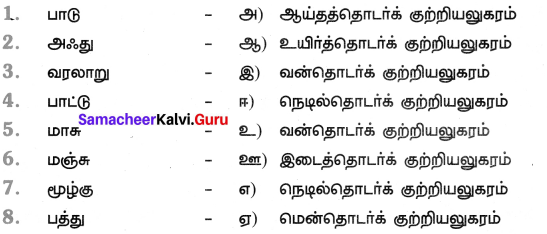
1. நடந்து – அ) முற்றெச்சம்
2. பேசிய – ஆ) குறிப்புப் பெயரெச்சம்
3. எடுத்தனன் உண்டான் – இ) பெயரெச்சம்
4. பெரிய – ஈ) வினையெச்சம்
Answer:
1. ஈ
2. இ
3. அ
4. ஆ

கீழ்க்காணும் சொற்களைப் பெயரெச்சம், வினையெச்சம் என வகைப்படுத்துக.

நல்ல, படுத்து, பாய்ந்து, எறிந்த, கடந்து, வீழ்ந்த, மாட்டிய, பிடித்து, அழைத்த, பார்த்து.

பெயரெச்சம் : நல்ல, எறிந்த, வீழ்ந்த, மாட்டிய, அழைத்த.
வினையெச்சம் : படுத்து, பாய்ந்து, கடந்து, பிடித்து, பார்த்து.

சிறுவினா

Question 1.
எச்சம் என்றால் என்ன? அதன் வகைகள் யாவை?
Answer:

  • பொருள் முற்றுப் பெறாமல் எஞ்சி நிற்கும் சொல் எச்சம் எனப்படும்.
  • இது பெயரெச்சம், வினையெச்சம் என்று இருவகைப்படும்.

Question 2.
‘அழகிய மரம்’ – எச்ச வகையை விளக்குக.
Answer:

  • அழகிய மரம் – இத்தொடரில் உள்ள அழகிய என்னும் சொல்லின் செயலையோ, காலத்தையோ அறிய முடியவில்லை. பண்பினை மட்டும் குறிப்பாக அறிய முடிகிறது.
  • இவ்வாறு செயலையோ காலத்தையோ தெளிவாகக் காட்டாமல் பண்பினை மட்டும் குறிப்பாகக் காட்டும் பெயரெச்சம் குறிப்புப் பெயரெச்சம் எனப்படும்.

Question 3.
முற்றெச்சத்தைச் சான்றுடன் விளக்குக.
Answer:

  • சான்று: வள்ளி படித்தனள் மகிழ்ந்தாள்.
  • இத்தொடரில் படித்தனள் என்னும் சொல் படித்து என்னும் வினையெச்சப் பொருளைத் தருகிறது. இவ்வாறு ஒரு வினைமுற்று எச்சப்பொருள் தந்து மற்றொரு வினைமுற்றைக் கொண்டு முடிவது முற்றெச்சம் எனப்படும்.

Question 4.
வினையெச்சத்தின் வகைகளை விளக்குக.
Answer:

  • வினையெச்சம் இரண்டு வகைப்படும்.
  • அவை: தெரிநிலை வினையெச்சம், குறிப்பு வினையெச்சம் ஆகும்.

தெரிநிலை வினையெச்சம்:
எழுதி வந்தான் – இத்தொடரில் உள்ள எழுதி என்னும் சொல் எழுதுதல் என்னும் செயலையும், இறந்த காலத்தையும் தெளிவாகக் காட்டுகிறது. இவ்வாறு செயலையும் காலத்தையும் தெரியுமாறு காட்டும் வினையெச்சம் தெரிநிலை வினையெச்சம் எனப்படும்.

குறிப்பு வினையெச்சம்:
மெல்ல வந்தான் – இத்தொடரில் உள்ள மெல்ல என்னும் சொல் காலத்தை வெளிப்படையாகக் காட்டவில்லை. மெதுவாக என்னும் பண்பை மட்டும் உணர்த்துகிறது. இவ்வாறு காலத்தை வெளிப்படையாகக் காட்டாமல் பண்பினை மட்டும் குறிப்பாக உணர்த்திவரும் வினையெச்சம் குறிப்பு வினையெச்சம் எனப்படும்.

மொழியை ஆள்வோம்

Question 1.
கீழ்க்காணும் தலைப்பில் இரண்டு நிமிடம் பேசுக.
Answer:
வணக்கம்!
‘உணவே மருந்து’ என்ற தலைப்பில் சில நிமிடம் பேசுகின்றேன்.

உயிர், உடலோடு கூடிய நிலையில் எப்போதும் புறச்சூழலோடு போராடி வருகிறது. அதில் வெற்றியடைவதே உடல் நலமாகும்; தோல்வி அடைந்தால் நோயில் முடியும். அந்நோயைத் தீர்த்து இன்பமளிப்பதே மருந்து.

தமிழகத்து உணவு, தொன்றுதொட்டு மருத்துவமுறையில் சமைக்கப்படுகிறது. வெப்ப நாடான நமது நாட்டுச் சமையலுக்குப் புழுங்கலரிசியே ஏற்றது. அன்றாடச் சமையலில் கூட்டுவனவற்றுள் மஞ்சள், நெஞ்சிலுள்ள சளியை நீக்கும். கொத்துமல்லி, பித்தத்தைப் போக்கும். சீரகம், வயிற்றுச் சூட்டைத் தணிக்கும். மிளகு, தொண்டைக் கட்டைத் தொலைக்கும்.

பூண்டு, வளியகற்றி வயிற்றுப் பொருமலை நீக்கிப் பசியை மிகுக்கும். வெங்காயம் குளிர்ச்சி உண்டாக்கிக் குருதியைத் தூய்மைப்படுத்தும். பெருங்காயம், வளியை வெளியேற்றும். இஞ்சி, பித்தத்தை ஒடுக்கிக் காய்ச்சலைக் கண்டிக்கும். தேங்காய், நீர்க்கோவையை நீக்கும். கறிவேப்பிலை, மணமூட்டி உணவு விருப்பை உண்டாகும். நல்லெண்ணெய் கண் குளிர்ச்சியும் அறிவுத்தெளிவும் உண்டாக்கும்.

சீரகம், பூண்டு கலந்த மிளகு நீர், சூட்டைத் தணித்துச் செரிமான ஆற்றலை அதிகரிக்கும். உடலுக்கு வலுவூட்டவும் கழிவு அகலவும் கீரை நல்லது.

இறுதியாக ஒருவர் உட்கொள்ளும் உணவில் புரதம், கொழுப்பு, மாவுச்சத்து, கனிமங்கள், நுண்ணூட்டச் சத்துகள் சேர்ந்ததே சமச்சீர் உணவு. எனவே அளவறிந்து உண்ண வேண்டும். வயிறு புடைக்க உண்ணுதல் நோய்க்கு இடமளிக்கும். உடல் நலனை விரும்புவோர் முறையான உணவுப் பழக்கத்தை மேற்கொண்டால் நெடுநாள் நலமாக வாழலாம் என்று சொல்லி என் உரையை நிறைவு செய்கிறேன், நன்றி.

பொருத்துக.

1. காக்கை உட்காரப் பனம்பழம் விழுந்தது போல – அ) ஒற்றுமையின்மை
2. கிணறு வெட்டப் பூதம் கிளம்பியது போல – ஆ) பயனற்ற செயல்
3. பசுமரத்து ஆணி போல – இ) தற்செயல் நிகழ்வு
4. விழலுக்கு இறைத்த நீர் போல – ஈ) எதிர்பாரா நிகழ்வு
5. நெல்லிக்காய் மூட்டையைக் கொட்டினாற் போல – உ) எளிதில் மனதில் பதிதல்
Answer:
1. இ
2. ஈ
3. உ
4. ஆ
5. அ

உவமைத் தொடர்களைப் பயன்படுத்தித் தொடர் அமைக்க.

Question 1.
குன்றின் மேலிட்ட விளக்கைப் போல :
Answer:
குன்றின் மேலிட்ட விளக்கைப்போல திருக்குறளின் புகழ் உலகெங்கும் பரவியுள்ளது.

Question 2.
வேலியே பயிரை மேய்ந்தது போல :
Answer:
வேலியே பயிரை மேய்ந்தது போல நாட்டைக் காப்பாற்ற வேண்டிய தலைவர்களே மக்களைத் துன்புறுத்துகின்றனர்.

Question 3.
பழம் நழுவிப் பாலில் விழுந்தது போல :
Answer:
பழம் நழுவிப் பாலில் விழுந்தது போல் நான் எதிர்பார்க்காமலேயே என் பிறந்த நாளுக்கு எனக்குப் புத்தாடை வாங்கித் தந்தார் என் அப்பா, என் மாமா மிதிவண்டி வாங்கித் தந்தார்.

Question 4.
உடலும் உயிரும் போல :
Answer:
உடலும் உயிரும் போல கோப்பெருஞ்சோழனும் பிசிராந்தையாரும் நட்புடன் திகழ்ந்தனர்

Question 5.
திகழ்ந்த னர். கிணற்றுத் தவளை போல :
Answer:
கிணற்றுத் தவளை போல மூடர்கள் தம் பேச்சினாலேயே தம் அறியாமையை வெளிப்படுத்தி விடுவர்.

கொடுக்கப்பட்டுள்ள குறிப்புகளைக் கொண்டு கட்டுரை எழுதுக.

நோயற்ற வாழ்வே குறைவற்ற செல்வம்

முன்னுரை – நோய் வரக் காரணங்கள் – நோய் தீர்க்கும் வழிமுறைகள் – வருமுன் காத்தல் – உணவும் மருந்தும் – உடற்பயிற்சியின் தேவை – முடிவுரை

நோயற்ற வாழ்வே குறைவற்ற செல்வம்

முன்னுரை:
உடல்நலம் போனால் உயிர்ப்பறவை போய்விடும். அதனால் தான் ‘உடம்பார் அழியின் உயிரார் அழிவர்’ என்பார் திருமூலர். இவ்வுலகில் நீண்ட நாள் வாழ உடல் நலம் பேணல் வேண்டும்.

நோய் வரக் காரணங்கள்:
மனிதன் இயற்கையை விட்டு விலகி வந்ததுதான் முதன்மைக் காரணம். மாறிப்போன உணவு முறை, மாசு நிறைந்த சுற்றுச்சூழல், மன அழுத்தம் இவை மூன்றும் குறிப்பிடத்தக்க காரணங்கள். இன்றைய வாழ்க்கைச் சூழலில் ஓய்வின்மை, காலம் தவறிய உணவு, உணவுப் பழக்கவழக்க மாற்றம், உடற்பயிற்சியின்மை உள்ளிட்டவையே பல்வேறு உடல்நலப் பாதிப்புகளுக்கு மூல காரணமாகின்றன.

நோய் தீர்க்கும் வழிமுறைகள் :
நம் உடலில் ஏற்படும் அனைத்து நோய்களுக்கும் நமது தவறான வாழ்க்கை முறைதான் காரணம் என்பதே ஆராய்ச்சியின் முடிவாகும். எனவே நமது வாழ்க்கை முறையில் சில எளிய மாற்றங்களைக் கொண்டு வருவதன் மூலமாகவே இத்தகைய நோய்களை நிரந்தரமாகக் குணப்படுத்த முடியும்.

வருமுன் காத்தல் :
நோய் வந்த பின்பு மருத்துவமனைக்குச் செல்வதைவிட வருமுன் காக்கும் வாழ்க்கையை வாழக் கற்றுக் கொள்ள வேண்டும். சரியான உணவு, சரியான உடற்பயிற்சி, சரியான தூக்கம் ஆகிய மூன்றும் நம்மை நலமாக வாழவைக்கும். எளிமையாகக் கிடைக்கக் கூடிய காய்கறிகள், கீரைகள், பழங்கள், சிறுதானியங்களை உணவில் சேர்த்துக்கொள்ள வேண்டும்.

உணவும் மருந்தும் :
ஒருவர் உட்கொள்ளும் உணவில் புரதம், கொழுப்பு, மாவுச்சத்து, கனிமங்கள் நுண்ணூட்டச் சத்துகள் சேர்ந்ததே சமச்சீர் உணவு. எனவே, அளவறிந்து உண்ண வேண்டும். சோறு காய்கறியும் அரைவயிறு; பால், மோர், நீர் கால் வயிறு; கால் வயிறு வெற்றிடமாக இருத்தல் வேண்டும். உணவை நன்றாக மென்று விழுங்குதல் வேண்டும்.

அப்போது தான் வாயிலுள்ள உமிழ்நீர் வேண்டிய அளவு சுரந்து உணவுடன் கலக்கும். உமிழ்நீர் கலக்காத உணவு உள்ளே சென்றாலும், அது செரிக்காது; குடலும் தன் செரிமான ஆற்றலை இழந்துவிடும். உணவின் சத்துகள் வீணாகாமல் பார்த்துக் கொள்ளுதல் வேண்டும். காய்களை முக்கால் வேக்காட்டில் வேகவைத்து உண்ணல் வேண்டும். இப்படி உண்டால் உணவே மருந்தாகும்.

உடற்பயிற்சியின் தேவை:
‘ஓடி விளையாடு’, ‘மாலை முழுவதும் விளையாட்டு’ என்பன உடலினை உறுதி செய்ய பாரதி கூறும் வழிமுறைகள். உடலின் கழிப்பொருள்கள் வெளியேறும். துணிவும், தெம்பும், சுறுசுறுப்பும் ஏற்படும். அதனால் விளையாட்டு, தண்டால், நீச்சல், உலாவுதல் போன்ற உடற்பயிற்சிகளை மேற்கொள்ளல் வேண்டும்.

முடிவுரை:
இறைவன் வழங்கிய அருட்கொடையே நமது உடல். அதனைக் காப்பதே முதற்கடமை. சுவரை வைத்தே சித்திரம் வரைய வேண்டும். உடலை வைத்துதான் உயிரைப் பேண வேண்டும். உடலைப் பேணுவோம் உயிரைக் காப்போம். நோயற்ற வாழ்வு வாழ்வோம்.

மொழியோடு விளையாடு

கீழ்க்காணும் படம் சார்ந்த சொற்களை எழுதுக.

Samacheer Kalvi 8th Tamil Solutions Chapter 3.5 எச்சம் 1
உரல், உலக்கை , எண்ணெய், சுக்கு, மிளகு, கருஞ்சீரகம், சீரகம், பட்டை, கிராம்பு, அண்ணாச்சி பூ, வத்தல், வெற்றிலை, கடுகு, கொத்துமல்லி, வெந்தையம், ஏலக்காய், கசகசா, புதினா, மல்லி, சோம்பு, பூண்டு.

வட்டத்திலுள்ள பழமொழிகளைக் கண்டுபிடித்து எழுதுக

Samacheer Kalvi 8th Tamil Solutions Chapter 3.5 எச்சம் 2
முயற்சி திருவினை ஆக்கும்.
அளவுக்கு மீறினால் அமுதமும் நஞ்சு.
சுவர் இருந்தால்தானே சித்திரம் வரைய முடியும்.
அறிவே ஆற்றல்.
கூடி வாழ்ந்தால் கோடி நன்மை.
நோயற்ற வாழ்வே குறைவற்ற செல்வம்.
வருமுன் காப்போம்.
சுத்தம் சோறு போடும்.
பருவத்தே பயிர் செய்.
பசித்து புசி.

நிற்க அதற்குத் தக

கலைச்சொல் அறிவோம்

1. நோய் – Disease
2. மூலிகை – Herbs
3. சிறுதானியங்கள் – Millets
4. பட்டயக் கணக்கர் – Auditor
5. பக்கவிளைவு – Side Effect
6. நுண்ணுயிர் முறி – Antibiotic
7. மரபணு – Gene
8. ஒவ்வாமை – Allergy

இணையத்தில் காண்க

Question 1.
நாம் நாள்தோறும் உண்ணும் காய்கறிகளின் மருத்துவப் பயன்கள் பற்றித் தகவல்களைத் தேடித் திரட்டுக.
Answer:
Samacheer Kalvi 8th Tamil Solutions Chapter 3.5 எச்சம் 3
Samacheer Kalvi 8th Tamil Solutions Chapter 3.5 எச்சம் 4
Samacheer Kalvi 8th Tamil Solutions Chapter 3.5 எச்சம் 5
Samacheer Kalvi 8th Tamil Solutions Chapter 3.5 எச்சம் 6

கூடுதல் வினாக்கள்

சரியான விடையைத் தேர்ந்தெடுத்து எழுதுக.

Question 1.
எச்சம் ………………………… வகைப்படும்.
அ) இரண்டு
ஆ) மூன்று
இ) நான்கு
ஈ) ஐந்து
Answer:
அ) இரண்டு

Question 2.
‘படித்த’ என்பது ………………………
அ) முற்றெச்சம்
ஆ) வினையெச்சம்
இ) பெயரெச்சம்
ஈ) வினைமுற்று
Answer:
இ) பெயரெச்சம்

Question 3.
பெயரைக் கொண்டு முடியும் எச்சம் …………………….
அ) வினையெச்சம்
ஆ) பெயரெச்சம்
இ) முற்றெச்சம்
ஈ) குறிப்பு வினையெச்சம்
Answer:
ஆ) பெயரெச்சம்

Question 4.
செயலையும் காலத்தையும் தெரியுமாறு காட்டும் பெயரெச்சம் ……………………. எனப்படும்.
அ) குறிப்புப் பெயரெச்சம்
ஆ) முற்றெச்சம்
இ) தெரிநிலைப் பெயரெச்சம்
ஈ) முற்று
Answer:
இ) தெரிநிலைப் பெயரெச்சம்

Question 5.
செயலையோ காலத்தையோ தெளிவாகக் காட்டாமல் பண்பினை மட்டும் குறிப்பாகக் காட்டும் பெயரெச்சம் ……………………… எனப்படும்.
அ) முற்றெச்சம்
ஆ) குறிப்புப் பெயரெச்சம்
இ) தெரிநிலைப் பெயரெச்சம்
ஈ) வினையெச்சம்
Answer:
ஈ) குறிப்புப் பெயரெச்சம்

Question 6.
வினையைக் கொண்டு முடியும் எச்சம் …………………….. எனப்படும்.
அ) பெயரெச்சம்
ஆ) குறிப்புப் பெயரெச்சம்
இ) தெரிநிலைப் பெயரெச்சம்
ஈ) வினையெச்சம்
Answer:
ஈ) வினையெச்சம்

Question 7.
வினையெச்சம் …………………….. வகைப்படும்.
அ) இரண்டு
ஆ) மூன்று
இ) நான்கு
ஈ) ஐந்து
Answer:
அ) இரண்டு

Question 8.
செயலையும் காலத்தையும் தெரியுமாறு காட்டும் வினையெச்சம் …………………….. எனப்படும்.
அ) முற்றெச்சம்
ஆ) குறிப்புப் பெயரெச்சம்
இ) தெரிநிலை வினையெச்சம்
ஈ) குறிப்பு வினையெச்சம்
Answer:
இ) தெரிநிலை வினையெச்சம்

Question 9.
மெல்ல வந்தான் என்பது …………………………..
அ) பெயரெச்சம்
ஆ) குறிப்பு வினையெச்சம்
இ) தெரிநிலைப் பெயரெச்சம்
ஈ) முற்றெச்சம்
Answer:
ஈ) குறிப்பு வினையெச்சம்

Question 10.
ஒரு வினைமுற்று எச்சப்பொருள் தந்து மற்றொரு வினைமுற்றைக் கொண்டு முடிவது
அ) குறிப்பு
ஆ) முற்றெச்சம்
இ) பெயரெச்சம்
ஈ) தெரிநிலை
Answer:
ஆ) முற்றெச்சம்

சிறுவினா

Question 1.
பெயரெச்சம் என்றால் என்ன?
Answer:

  • பெயரைக் கொண்டு முடியும் எச்சம் பெயரெச்சம் ஆகும்.
  • பெயரெச்சம் மூன்று காலத்திலும் வரும்.
  • குறிப்பு, தெரிநிலை என இருவகைப்படும்.

Question 2.
தெரிநிலைப் பெயரெச்சம் என்றால் என்ன?
Answer:

  • எழுதிய கடிதம் – இத்தொடரில் உள்ள எழுதிய என்னும் சொல் எழுதுதல் என்னும் செயலையும் இறந்தகாலத்தையும் தெளிவாகக் காட்டுகிறது.
  • இவ்வாறு செயலையும் காலத்தையும் தெரியுமாறு காட்டும் பெயரெச்சம் தெரிநிலைப் பெயரெச்சம் எனப்படும்.

Question 3.
வினையெச்சம் என்றால் என்ன?
Answer:

  • வினையைக் கொண்டு முடியும் எச்சம் வினையெச்சம் எனப்படும்.
  • வினையெச்சம் தெரிநிலை, குறிப்பு என இருவகைப்படும்.

Samacheer Kalvi 11th Physics Solutions Chapter 4 Work, Energy and Power

For those looking for help on 11th Physics can use the Tamilnadu State Board Solutions for 11th Physics Chapter 4 Work, Energy and Power prevailing for free of cost.

Download the Samacheer Kalvi 11th Physics Book Solutions Questions and Answers Notes Pdf, for all Chapter Wise through the direct links available and take your preparation to the next level. The Tamilnadu State Board Solutions for 11th Physics Chapter 4 Work, Energy and Power Questions and Answers covers all the topics and subtopics within it. Practice using these Samacheer Kalvi 11th Physics Book Solutions Questions and Answers for Chapter 4 Work, Energy and Power PDF and test your preparation level and bridge the knowledge gap accordingly.

Tamilnadu Samacheer Kalvi 11th Physics Solutions Chapter 4 Work, Energy and Power

If you have any queries take the help of the Tamilnadu State Board Solutions for 11th Physics Chapter 4 Work, Energy and Power Questions and Answers learn all the topics in it effectively. We have everything covered and you can Practice them often to score better grades in your exam. By going through the Samacheer Kalvi 11th Physics Book Solutions Questions and Answers you can attempt the actual exam with utmost confidence.

Samacheer Kalvi 11th Physics Work, Energy and Power Textual Questions Solved

Samacheer Kalvi 11th Physics Work, Energy and Power Multiple Choice Questions
11th Physics Chapter 4 Book Back Answers Question 1.
A uniform force of (\(2 \hat{i}+\hat{j}\)) + N acts on a particle of mass 1 kg. The particle displaces from position \((3 \hat{j}+\hat{k})\) m to \((5 \hat{i}+3 \hat{j})\) m. Th e work done by the force on the particle is
[AIPMT model 2013]
(a) 9 J
(b) 6 J
(c) 10 J
(d) 12 J
Answer:
(c) 10 J

11th Physics Lesson 4 Book Back Answers Question 2.
A ball of mass 1 kg and another of mass 2 kg are dropped from a tall building whose height is 80 m. After, a fall of 40 m each towards Earth, their respective kinetic energies will be in the ratio of [AIPMT model 2004]
(a) \(\sqrt{2}\) : 1
(b) 1 : \(\sqrt{2}\)
(c) 2 : 1
(d) 1 : 23
Answer:
(d) 1 : 23

Samacheer Kalvi 11th Physics Solution Chapter 4 Question 3.
A body of mass 1 kg is thrown upwards with a velocity 20 m s-1. It momentarily comes to rest after attaining a height of 18 m. How much energy is lost due to air friction?
(Take g = 10 ms-2) [AIPMT 2009]
(a) 20 J
(b) 30 J
(c) 40 J
(d) 10 J
Answer:
(a) 20 J

11th Physics 4th Lesson Book Back Answers Question 4.
An engine pumps water continuously through a hose. Water leaves the hose with a velocity v and m is the mass per unit length of the water of the jet. What is the rate at which kinetic energy is imparted to water ? [AIPMT 2009]
11th Physics Chapter 4 Book Back Answers Work, Energy And Power Samacheer Kalvi
Answer:
(a) \(\frac{1}{2} m v^{2}\)

11th Physics 4th Chapter Book Back Answers Question 5.
A body of mass 4 m is lying in xv-plane at rest. It suddenly explodes into three pieces. Two pieces each of mass m move perpendicular to each other with equal speed v the total kinetic energy generated due to explosion is [AIPMT 2014]
11th Physics Lesson 4 Book Back Answers Work, Energy And Power Samacheer Kalvi
Answer:
(b) \(\frac{3}{2} m v^{2}\)

Work, Energy And Power Class 11 Numericals Pdf Question 6.
The potential energy of a system increases, if work is done
(a) by the system against a conservative force
(b) by the system against a non-conservative force
(c) upon the system by a conservative force
(d) upon the system by a non-conservative force
Answer:
(a) by the system against a conservative force

Work Energy And Power Class 11 Numericals Pdf Question 7.
What is the minimum velocity with which a body of mass m must enter a vertical loop of radius R so that it can complete the loop?
Samacheer Kalvi 11th Physics Solution Chapter 4 Work, Energy And Power
Answer:
(c) \(\sqrt{5 g R}\)

Unit 4 Physics Class 11 Work Energy And Power Question 8.
The work done by the conservative force for a closed path is
(a) always negative
(b) zero
(c) always positive
(d) not defined
Answer:
(b) zero

Class 11 Physics Chapter 4 Solutions Question 9.
If the linear momentum of the obj ect is increased by 0.1 %, then the kinetic energy is increased by
(a) 0.1%
(b) 0.2%
(c) 0.4%
(d) 0.01%
Answer:
(b) 0.2%

Work Power And Energy Iit Problems With Solutions Pdf Question 10.
If the potential energy of the particle is 11th Physics 4th Lesson Book Back Answers Samacheer Kalvi Work, Energy And Power, then force experienced by the particle is
11th Physics 4th Chapter Book Back Answers Samacheer Kalvi Work, Energy And Power
Answer:
(c) F = -βx

Samacheer Kalvi Guru 11th Physics Question 11.
A wind-powered generator converts wind energy into electric energy. Assume that the generator converts a fixed fraction of the wind energy intercepted by its blades into electrical energy. For wind speed v, the electrical power output will be proportional to
(a) v
(b) v2
(c) v3
(d) v4
Answer:
(c) v4

11th Physics Solutions Samacheer Kalvi  Question 12.
Two equal masses m1 and m2 are moving along the same straight line with velocities 5 ms-1 and -9 ms-1 respectively. If the collision is elastic, then calculate the velocities after the collision of Wj and m2, respectively
(a) -4 ms-1 and 10 ms-1
(b) 10 ms-1 and 0 ms-1
(c) -9 ms-1 and 5 ms-1
(d) 5 ms-1 and 1 ms-1
Answer:
(c) -9 ms-1 and 5 ms-1

Samacheerkalvi.Guru 11th Physics Question 13.
A particle is placed at the origin and a force F = kx is acting on it (where k is a positive constant). If U(0) = 0, the graph of U(x) versus x will be (where U is the potential energy function) [IIT 2004]
Work, Energy And Power Class 11 Numericals Pdf Samacheer Kalvi
Answer:
Work Energy And Power Class 11 Numericals Pdf Chapter 4 Samacheer Kalvi

Samacheer Kalvi Guru 11 Physics Question 14.
A particle which is constrained to move along x-axis, is subjected to a force in the same direction which varies with the distance x of the particle from the origin as F(x) = -kx + ax3. Here, k and a are positive constants. For x ≥ 0, the functional form of the potential energy U(x) of the particle is [IIT 2002]
Unit 4 Physics Class 11 Work Energy And Power Samacheer Kalvi
Answer:
Class 11 Physics Chapter 4 Solutions Work, Energy And Power Samacheer Kalvi

Class 11 Physics Solutions Samacheer Kalvi Question 15.
A spring of force constant k is cut into two pieces such that one piece is double the length of the other. Then, the long piece will have a force constant of
Work Power And Energy Iit Problems With Solutions Pdf Samacheer Kalvi 11th Physics Solutions Chapter 4
Answer:
(b) \(\frac{3}{2} k\)

Samacheer Kalvi 11th Physics Work, Energy and Power Short Answer Questions

Samacheer Kalvi 11th Physics Question 1.
Explain how the definition of work in physics is different from general perception.
Answer:
The term work is used in diverse contexts in daily life. It refers to both physical as well as mental work. In fact, any activity can generally be called as work. But in Physics, the.term work is treated as a physical quantity with a precise definition. Work is said to be done by the force when the force applied on a body displaces it.

Samacheer Kalvi 11 Physics Solutions Question 2.
Write the various types of potential energy. Explain the formulae.
Answer:
(a) U = mgh
U – Gravitational potential energy
m – Mass of the object,
g – acceleration due to gravity
h – Height from the ground,
Samacheer Kalvi Guru 11th Physics Chapter 4 Work, Energy And Power
u – Elastic potential energy
k – String constant; x-displacement.
Samacheerkalvi.Guru 11th Physics Solutions Chapter 4 Work, Energy And Power
U – electrostatic potential energy
\(\varepsilon_{0}\) = absolute permittivity
q1, q2 – electric charges

Question 3.
Write the differences between conservative and non-conservative forces. Give two examples each.
Answer:
Samacheer Kalvi Guru 11 Physics Solutions Chapter 4 Work, Energy And Power

Question 4.
Explain the characteristics of elastic and inelastic collision.
Answer:
In any collision process, the total linear momentum and total energy are always conserved whereas the total kinetic energy need not be conserved always. Some part of the initial kinetic energy is transformed to other forms of energy. This is because, the impact of collisions and deformation occurring due to collisions may in general, produce heat, sound, light etc. By taking these effects into account, we classify the types of collisions as follows:
(a) Elastic collision
(b) Inelastic collision
(a) Elastic collision: In a collision, the total initial kinetic energy of the bodies (before collision) is equal to the total final kinetic energy of the bodies (after collision) then, it is called as elastic collision, i.e.,
Total kinetic energy before collision = Total kinetic energy after collision
(b) Inelastic collision: In a collision, the total initial kinetic energy of the bodies (before collision) is not equal to the total final kinetic energy of the bodies (after collision) then, it is called as inelastic collision, i.e.,
Total kinetic energy before collision ≠ Total kinetic energy after collision
11th Physics Solutions Samacheer Kalvi Chapter 4 Work, Energy And Power
Even though kinetic energy is not conserved but the total energy is conserved. This is because the total energy contains the kinetic energy term and also a term ∆Q, which includes all the losses that take place during collision. Note that loss in kinetic energy during collision is transformed to another form of energy like sound, thermal, etc. Further, if the two colliding bodies stick together after collision such collisions are known as completely inelastic collision or perfectly inelastic collision. Such a collision is found very often. For example when a clay putty is thrown on a moving vehicle, the clay putty (or Bubblegum) sticks to the moving vehicle and they move together with the same velocity.

Question 5.
Define the following
(a) Coefficient of restitution
(b) Power
(c) Law of conservation of energy
(d) Loss of kinetic energy in inelastic collision.
Answer:
(a) The ratio of velocity of separation after collision to the velocity of approach before collision
Class 11 Physics Solutions Samacheer Kalvi Chapter 4 Work, Energy And Power
(b) Power is defined as the rate of work done or energy delivered
Samacheer Kalvi 11th Physics Solutions Chapter 4 Work, Energy And Power
Its unit is watt.
(c) The law of conservation of energy states that energy can neither be created nor destroyed. It may be transformed from one form to another but the total energy of an isolated system remains constant.
(d) In perfectly inelastic collision, the loss in kinetic energy during collision is transformed to another form of energy like sound, thermal, heat, light etc. Let KEi be the total kinetic energy before collision and KEf be the total kinetic energy after collision.
Total kinetic energy before collision,
Samacheer Kalvi 11 Physics Solutions Chapter 4 Work, Energy And Power
Total kinetic energy after Collision,
Samacheer Kalvi 11th Physics Solutions Chapter 4 Work, Energy and Power 31
Then the loss of kinetic energy is
Samacheer Kalvi 11th Physics Solutions Chapter 4 Work, Energy and Power 32

Samacheer Kalvi 11th Physics Work, Energy and Power Long Answer Questions

Question 1.
Explain with graphs the difference between work done by a constant force and by a variable force.
Answer:
Work done by a constant force: When a constant force F acts on a body, the small work done (dW) by the force in producing a small displacement dr is given by the relation,
dW = (F cos θ) dr ..(1)
The total work done in producing a displacement from initial position ri to final position rf is,
Samacheer Kalvi 11th Physics Solutions Chapter 4 Work, Energy and Power 33
The graphical representation of the work done by a constant force is shown in figure given below. The area under the graph shows the work done by the constant force.
Samacheer Kalvi 11th Physics Solutions Chapter 4 Work, Energy and Power 34
Work done by a variable force: When the component of a variable force F acts on a body, the small work done (dW) by the force in producing a small displacement dr is given by the relation
dW = F cos θ dr [F cos θ is the component of the variable force F]
where, F and θ are variables. The total work done for a displacement from initial position ri to final position rf is given by the relation,
Samacheer Kalvi 11th Physics Solutions Chapter 4 Work, Energy and Power 35
A graphical representation of the work done by a variable force is shown in figure given below. The area under the graph is the work done by the variable force.
Samacheer Kalvi 11th Physics Solutions Chapter 4 Work, Energy and Power 36

Question 2.
State and explain work energy principle. Mention any three examples for it.
Answer:
(i) If the work done by the force on the body is positive then its kinetic energy increases.
(ii) If the work done by the force on the body is negative then its kinetic energy decreases.
(iii) If there is no work done by the force on the body then there is no change in its kinetic energy, which means that the body has moved at constant speed provided its mass remains constant.
(iv) When a particle moves with constant speed in a circle, there is no change in the kinetic energy of the particle. So according to work energy principle, the work done by centripetal force is zero.

Question 3.
Arrive at an expression for power and velocity. Give some examples for the same.
Answer:
The work done by a force \(\overrightarrow{\mathrm{F}}\) for a displacement \(d \vec{r}\) is
Samacheer Kalvi 11th Physics Solutions Chapter 4 Work, Energy and Power 37
Left hand side of the equation (i) can be written as
Samacheer Kalvi 11th Physics Solutions Chapter 4 Work, Energy and Power 38
Since, velocity is Samacheer Kalvi 11th Physics Solutions Chapter 4 Work, Energy and Power 39. Right hand side of the equation (i) can be written as dt
Samacheer Kalvi 11th Physics Solutions Chapter 4 Work, Energy and Power 391
Substituting equation (ii) and equation (iii) in equation (i), we get
Samacheer Kalvi 11th Physics Solutions Chapter 4 Work, Energy and Power 40
This relation is true for any arbitrary value of dt. This implies that the term within the bracket must be equal to zero, i.e.,
Samacheer Kalvi 11th Physics Solutions Chapter 4 Work, Energy and Power 41
Hence power \(\mathrm{P}=\overrightarrow{\mathrm{F}} \cdot \vec{v}\)

Question 4.
Arrive at an expression for elastic collision in one dimension and discuss various cases.
Answer:
Consider two elastic bodies of masses m1 and m2 moving in a straight line (along positive x direction) on a frictionless horizontal surface as shown in figure given below.
Samacheer Kalvi 11th Physics Solutions Chapter 4 Work, Energy and Power 42
In order to have collision, we assume that the mass m] moves faster than mass m2 i.e., u1 > u2. For elastic collision, the total linear momentum and kinetic energies of the two bodies before and after collision must remain the same.
Samacheer Kalvi 11th Physics Solutions Chapter 4 Work, Energy and Power 43
From the law of conservation of linear momentum,
Total momentum before collision (pi) = Total momentum after collision (pf)
m1u1 + m2u2 = m1v1 + m2v2 …(i)
Samacheer Kalvi 11th Physics Solutions Chapter 4 Work, Energy and Power 44
Samacheer Kalvi 11th Physics Solutions Chapter 4 Work, Energy and Power 45
This means that for any elastic head on collision, the relative speed of the two elastic bodies after the collision has the same magnitude as before collision but in opposite direction. Further note that this result is independent of mass.
Rewriting the above equation for v1 and v2,
v1 = v2 + u2 – u2 …(vi)
Or v2 = u1 + v1 – u2 …(vii)
To find the final velocities v1 and v2:
Substituting equation (vii) in equation (ii) gives the velocity of as m1 as
m1 (u1 – v1) = m2(u1 + v1 – u2 – u2)
m1 (u1 – y1) = m2 (u1 + + v1  – 2u2)
m1u1 – m1v1 = m2u1 + m2v1 + 2m2u2
m1u1 – m2u1 + 2m2u2 = m1v1 + m2v1
(m1– m2) u1 + 2m2u2 = (m1 + m2) v1
Samacheer Kalvi 11th Physics Solutions Chapter 4 Work, Energy and Power 46
Similarly, by substituting (vi) in equation (ii) or substituting equation (viii) in equation (vii), we get the final velocity of m2 as
Samacheer Kalvi 11th Physics Solutions Chapter 4 Work, Energy and Power 47
Case 1: When bodies has the same mass i.e., m1 = m2,
Samacheer Kalvi 11th Physics Solutions Chapter 4 Work, Energy and Power 48
The equations (x) and (xi) show that in one dimensional elastic collision, when two bodies of equal mass collide after the collision their velocities are exchanged.
Case 2: When bodies have the same mass i.e., m1 = m2 and second body (usually called target) is at rest (u2 = 0),
By substituting m1 = m2 = and u2 = 0 in equations (viii) and equations (ix) we get,
from equation (viii) ⇒ v1 = 0 …(xii)
from equation (ix) ⇒ v2 = u1 ….. (xiii)
Equations (xii) and (xiii) show that when the first body comes to rest the second body moves with the initial velocity of the first body.
Case 3: The first body is very much lighter than the second body
Samacheer Kalvi 11th Physics Solutions Chapter 4 Work, Energy and Power 49
Dividing numerator and denominator of equation (viii) by m2, we get
Samacheer Kalvi 11th Physics Solutions Chapter 4 Work, Energy and Power 50
Similarly the numerator and denominator of equation (ix) by m2, we get
Samacheer Kalvi 11th Physics Solutions Chapter 4 Work, Energy and Power 501
The equation (xiv) implies that the first body which is lighter returns back (rebounds) in the opposite direction with the same initial velocity as it has a negative sign. The equation (xv) implies that the second body which is heavier in mass continues to remain at rest even after collision. For example, if a ball is thrown at a fixed wall, the ball will bounce back from the wall with the same velocity with which it was thrown but in opposite direction.
Samacheer Kalvi 11th Physics Solutions Chapter 4 Work, Energy and Power 51
Dividing numerator and denominator of equation (xiii) by m1, we get
Samacheer Kalvi 11th Physics Solutions Chapter 4 Work, Energy and Power 52
The equation (xvi) implies that the first body which is heavier continues to move with the same initial velocity. The equation (xvii) suggests that the second body which is lighter will move with twice the initial velocity of the first body. It means that the lighter body is thrown away from the point of collision.

Question 5.
What is inelastic collision? In which way it is different from elastic collision. Mention few examples in day to day life for inelastic collision.
Answer:
Inelastic collision: In a collision, the total initial kinetic energy of the bodies (before collision) is not equal to the total final kinetic energy of the bodies (after collision) then, it is called as inelastic collision, i.e.,
Total kinetic energy before collision ≠ Total kinetic energy after collision
Samacheer Kalvi 11th Physics Solutions Chapter 4 Work, Energy and Power 53
Even though kinetic energy is not conserved but the total energy is conserved. This is because the total energy contains the kinetic energy term and also a term ∆Q, which includes all the losses that take place during collision. Note that loss in kinetic energy during collision is transformed to another form of energy like sound, thermal, etc. Further, if the two colliding bodies stick together after collision such collisions are known as completely inelastic collision or perfectly inelastic collision. Such a collision is found very often. For example when a clay putty is thrown on a moving vehicle, the clay putty (or Bubblegum) sticks to the moving vehicle and they move together with the same velocity.
Difference between Elastic & in elastic collision
Samacheer Kalvi 11th Physics Solutions Chapter 4 Work, Energy and Power 54

Samacheer Kalvi 11th Physics Numerical Problems

Question 1.
Calculate the work done by a force of 30N in lifting a load of 2 Kg to a height of 10m(g = 10 ms-1)
Answer:
Given: F = 30 N, load (m) = 2 kg; height = 10 m, g = 10 ms-2
Gravitational force F = mg = 30 N
The distance moved h = 10 m
Work done on the object W = Fh = 30 × 10 = 300 J.

Question 2.
A ball with a velocity of 5 ms-1 impinges at angle of 60° with the vertical on a smooth horizontal plane. If the coefficient of restitution is 0.5, find the velocity and direction after the impact.
Answer:
Given: Velocity of ball: 5 ms-1
Angle of inclination with vertical: 60°
Coefficient of restitution = 0.5.
Note: Let the angle reflection is θ’ and the speed after collision is v’. The floor exerts a force on the ball along the normal during the collision. There is no force
parallel to the surface. Thus, the parallel component of the velocity of the ball remains unchanged. This gives
v’ sin θ’ = v sin θ …… (i)
Vertical component with respect to floor = v’ cos θ’ (velocity of separation)
Velocity of approach = v cos θ
Samacheer Kalvi 11th Physics Solutions Chapter 4 Work, Energy and Power 60
Samacheer Kalvi 11th Physics Solutions Chapter 4 Work, Energy and Power 601
from (i) and (ii)
Samacheer Kalvi 11th Physics Solutions Chapter 4 Work, Energy and Power 61
Samacheer Kalvi 11th Physics Solutions Chapter 4 Work, Energy and Power 62

Question 3.
A bob of mass m is attached to one end of the rod of negligible mass and length r, the other end of which is pivoted freely at a fixed center O as shown in the figure.
What initial speed must be given to the object to reach the top of the circle?
(Hint: Use law of conservation of energy). Is this speed. less or greater than speed obtained in the section 4.2.9?
Samacheer Kalvi 11th Physics Solutions Chapter 4 Work, Energy and Power 63
Answer:
To get the vertical speed given to the object to reach the top of the circle, law of conservation of energy can be used at a points (1) and (2)
Total energy at 1 = Total energy at 2
∴ Potential energy at point 1 = 0
Samacheer Kalvi 11th Physics Solutions Chapter 4 Work, Energy and Power 64
from eqn (i)
Samacheer Kalvi 11th Physics Solutions Chapter 4 Work, Energy and Power 641
In this case bob of mass m is connected with a rod of negligible mass, so the velocity of bob at highest point can be equal to zero i.e. v2 = 0
Samacheer Kalvi 11th Physics Solutions Chapter 4 Work, Energy and Power 65
The speed of bob obtained here is lesser than the speed obtained in section 4.2.9. It is only because of string is replaced by a massless rod here.

Question 4.
Two different unknown masses A and B collide. A is initially at rest when B has a speed v. After collision B has a speed v/2 and moves at right angles to its original direction of motion. Find the direction in which A moves after collision.
Answer:
Samacheer Kalvi 11th Physics Solutions Chapter 4 Work, Energy and Power 66

Question 5.
A bullet of mass 20 g strikes a pendulum of mass 5 kg. The centre of mass of pendulum rises a vertical distance of 10 cm. If the bullet gets embedded into the pendulum, calculate its initial speed.
Answer:
Given: m1 = 20 g = 20 × 10-3 kg; m2 = 5 kg; s = 10 × 10-2 m.
Let the speed of the bullet be v. The common velocity of bullet and pendulum bob is V. According to law of conservation of linear momentum.
Samacheer Kalvi 11th Physics Solutions Chapter 4 Work, Energy and Power 67
The bob with bullet go up with a deceleration of g = 9.8 ms-2. Bob and bullet come to rest at a height of 10 × 10-2 m.
from III rd equation of motion
Samacheer Kalvi 11th Physics Solutions Chapter 4 Work, Energy and Power 68

Samacheer Kalvi 11th Physics Conceptual Questions

Question 1.
A spring which in initially in un-stretched condition, is first stretched by a length x and again by a further length x. The work done in the first case W1 is one third of the work done in second case W2. True or false?
Answer:
The amount of work done to stretching distance x
Samacheer Kalvi 11th Physics Solutions Chapter 4 Work, Energy and Power 691
Total work done in stretching the spring through a distance 2x is
Samacheer Kalvi 11th Physics Solutions Chapter 4 Work, Energy and Power 701
Extra work required to stretch the additional x distance is
W = W2 – W1 = 4W1 – W1 = 3W1
Samacheer Kalvi 11th Physics Solutions Chapter 4 Work, Energy and Power 712
Hence it is true

Question 2.
Which is conserved in inelastic collision? Total energy (or) Kinetic energy?
Answer:
In inelastic collision total energy is only conserved but kinetic energy is not conserved. A part of kinetic energy is converted into some other form of energy such as sound, heat energy.
Note: The linear momentum is also conserved.

Question 3.
Is there any net work done by external forces on a car moving with a constant speed along a straight road?
Answer:
If the car moves at constant speed, then there is no change in its kinetic energy. It implies that if there is no change in kinetic energy then there is no work done by the force on the body provided its mass remains constant.

Question 4.
A car starts from rest and moves on a surface with uniform acceleration. Draw the graph of kinetic energy versus displacement. What information you can get from that graph?
Answer:
A car starts from rest and moves with uniform acceleration. The graph between kinetic energy and displacement, is a straight line.
The slope of KE and displacement graph gives net force acting on the car to keep the car with uniform acceleration.
Samacheer Kalvi 11th Physics Solutions Chapter 4 Work, Energy and Power 72

Question 5.
A charged particle moves towards another charged particle. Under what conditions the total momentum and the total energy of the system conserved?
Answer:
Coulomb force is acting in between the charged particles Internal force is a conservative force. If no external forces act or the work done by external forces is zero then the mechanical energy of the system and also total linear momentum also remains constant.

Samacheer Kalvi 11th Physics Work, Energy and Power Additional Questions Solved

Samacheer Kalvi 11th Physics Multiple Choice Questions

Question 1.
Thrust and linear momentum
(a) Thrust and linear momentum
(b) Work and energy
(c) Work and power
(d) Power and energy
Answer:
(b) Work and energy

Question 2.
The rate of work done is called as
(a) energy
(b) power
(c) force
(d) mechanical energy
Answer:
(b) power

Question 3.
Unit of work done
(a) Nm
(b) joule
(c) either a or b
(d) none
Answer:
(c) either a or b

Question 4.
Dimensional formula for work done is
(a) MLT-1
(b) ML2T2
(c) M-1L-1T2
(d) ML2T-2
Answer:
(d) ML2T-2

Question 5.
When a body moves on a horizontal direction, the amount of work done by the gravitational force is
(a) positive
(b) negative
(c) zero
(d) infinity
Answer:
(c) zero

Question 6.
The amount of work done by centripetal force on the object moving in a circular path is
(a) zero
(b) infinity
(c) positive
(d) negative
Answer:
(a) zero

Question 7.
The work done by the goal keeper catches the ball coming towards him by applying a force is
(a) positive
(b) negative
(c) zero
(d) infinity
Answer:
(b) negative

Question 8.
If the angle between force and displacement is acute then the work done is
(a) positive
(b) negative
(c) zero
(d) maximum
Answer:
(a) positive

Question 9.
If the force and displacement are perpendicular to each other, then the work done is
(a) positive
(b) negative
(c) zero
(d) maximum
Answer:
(c) zero

Question 10.
If the angle between force and displacement is obtuse, then the work done is
(a) positive
(b) negative
(c) zero
(d) minimum
Answer:
(b) negative

Question 11.
The area covered under force and displacement graph is
(a) work done
(b) acceleration
(c) power
(d) kinetic energy
Answer:
(a) work done

Question 12.
The capacity to do work is
(a) force
(b) energy
(c) work done
(d) power
Answer:
(b) energy

Question 13.
The energy possessed by a body due to its motion is called as
(a) potential energy
(b) kinetic energy
(c) mechanical energy
(d) none
Answer:
(b) kinetic energy

Question 14.
The energy possessed by the body by virtue of its position is called as
(a) potential energy
(b) kinetic energy
(c) mechanical energy
(d) none
Answer:
(a) potential energy

Question 15.
1 erg is equivalent to
(a) 10-7 J
(b) 1.6 × 10⁻¹⁹ J
(c) 4.186 J
(d) 3.6 × 10⁻⁶ J
Answer:
(a) 10-7 J

Question 16.
1 electron volt is equivalent to
(a) 10-7 J
(b) 1.6 × 10⁻¹⁹ J
(c) 4.186 J
(d) 3.6 × 10⁻⁶ J
Answer:
(b) 1.6 × 10⁻¹⁹ J

Question 17.
1 kilowatt hour is equivalent to
(a) 10-7 J
(b) 1.6 × 10⁻¹⁹ J
(c) 4.186 J
(d) 3.6 × 10⁻⁶ J
Answer:
(d) 3.6 × 10⁻⁶ J

Question 18.
1 calorie is equivalent to
(a) 10-7 J
(b) 1.6 × 10⁻¹⁹ J
(c) 4.186 J
(d) 3.6 × 10⁶ J
Answer:
(c) 4.186 J

Question 19.
The amount of work done by a moving body depends on the
(a) mass of the body
(b) velocity
(c) both (a) and (b)
(d) time
Answer:
(c) both (a) and (b)

Question 20.
The kinetic energy of a body is given by
Samacheer Kalvi 11th Physics Solutions Chapter 4 Work, Energy and Power 301
Answer:
(a) \(\frac{1}{2} m v^{2}\)

Question 21.
Kinetic energy of the body is always
(a) zero
(b) infinity
(c) negative
(d) positive
Answer:
(d) positive

Question 22.
If the work done by the force on the body is positive then its kinetic energy
(a) increases
(b) decreases
(c) zero
(d) either increases or decreases
Answer:
(a) increases

Question 23.
If p is the momentum of the particle then its kinetic energy is
Samacheer Kalvi 11th Physics Solutions Chapter 4 Work, Energy and Power 312
Answer:
(c) \(\frac{\mathbf{p}^{2}}{2 \mathbf{m}}\)

Question 24.
If two objects of masses m1 and m2 (m1 > m2) are moving with the same momentum then the kinetic energy will be greater for
(a) m1
(b) m2
(c) m1 or m2
(d) both will have equal kinetic energy
Answer:
(b) m2

Question 25.
For a given momentum, the kinetic energy is proportional to
Samacheer Kalvi 11th Physics Solutions Chapter 4 Work, Energy and Power 321
Answer:
(b) \(\frac{1}{\mathrm{m}}\)

Question 26.
Elastic potential energy possessed by a spring is
Samacheer Kalvi 11th Physics Solutions Chapter 4 Work, Energy and Power 331
Answer:
(c) \(\frac{1}{2}\)kx2

Question 27.
Potential energy stored in the spring depends on
(a) spring constant
(b) mass
(c) gravity
(d) length
Answer:
(b) mass

Question 28.
Two springs of spring constants k1 and k2 (k1 > k2). If they are stretched by the same force then (u1, u2 are potential energy of the springs) is
(a) u1 > u2
(b) u2 > u1
(c) u1 = u2
(d) u1 ≥ u2
Answer:
(b) u2 > u1

Question 29.
Conservative force is
(a) electrostatic force
(b) magnetic force
(c) gravitational force
(d) all the above
Answer:
(d) all the above

Question 30.
Non conservative force is
(a) frictional force
(b) viscous force
(c) air resistance
(d) all the above
Answer:
(d) all the above

Question 31.
If the work done is completely recoverable, then the force is
(a) conservative
(b) non-conservative
(c) both (a) and (b)
(d) frictional in nature
Answer:
(b) non-conservative

Question 32.
The work done by the conservative forces in a cycle is
(a) zero
(b) one
(c) infinity
(d) having negative value
Answer:
(a) zero

Question 33.
Negative gradient of potential energy gives
(a) conservative force
(b) non conservative force
(c) kinetic energy
(d) frictional force
Answer:
(a) conservative force

Question 34.
When a particle moving in a vertical circle, the variable is/are
(a) velocity of the particle
(b) tension of the string
(c) both (a) and (b)
(d) mass of the particle
Answer:
(c) both (a) and (b)

Question 35.
Which of the following is zero at the highest point in vertical circular motion?
(a) velocity of the particle
(b) tension of the spring
(c) potential energy
(d) none
Answer:
(a) velocity of the particle

Question 36.
The body must have a speed at highest point in vertical circular motion to stay in the circular path
Samacheer Kalvi 11th Physics Solutions Chapter 4 Work, Energy and Power 702
Answer:
(a) \(\geq \sqrt{\mathbf{g r}}\)

Question 37.
The body must have a minimum speed of lowermost point in vertical circular motion to complete the circle
Samacheer Kalvi 11th Physics Solutions Chapter 4 Work, Energy and Power 713
Answer:
(c) \(\geq \sqrt{5 \mathrm{gr}}\)

Question 38.
The rate of work done is
(a) energy
(b) force
(c) power
(d) energy flow
Answer:
(c) power

Question 39.
The unit of power is
(a) J
(b) W
(c) J s-1
(d) both (b) and (c)
Answer:
(d) both (b) and (c)

Question 40.
One horse power (1 hp) is
(a) 476 W
(b) 674 W
(c) 746 W
(d) 764 W
Answer:
(c) 746 W

Question 41.
The dimension of power is
(a) ML2T-2
(b) ML2T-3
(c) ML-2T2
(d) ML-2T3
Answer:
(b) ML2T-3

Question 42.
kWh is the practical unit of
(a) energy
(b) power
(c) electrical energy
(d) none
Answer:
(a) energy

Question 43.
If a force F is applied on a body and the body moves with velocity v, the power will be
(a) F.V
(b) F/V
(c) FV2
(d) FW2
Answer:
(a) F.V

Question 44.
A body of mass m is thrown vertically upward with a velocity v. The height at which the kinetic energy of the body is one third of its initial value is given by
Samacheer Kalvi 11th Physics Solutions Chapter 4 Work, Energy and Power 75
Answer:
(c) \(\frac{v^{2}}{6 g}\)
Solution:
Initial Samacheer Kalvi 11th Physics Solutions Chapter 4 Work, Energy and Power 76. The loss in K.E will be the gain in potential energy
Samacheer Kalvi 11th Physics Solutions Chapter 4 Work, Energy and Power 767

Question 45.
A body of mass 5 kg is initially at rest. By applying a force of 20 N at an angle of 60° with horizontal the body is moved to a distance of 4 m. The kinetic energy acquired by the body is
(a) 80 J
(b) 60 J
(c) 40 J
(d) 17.2 J
Answer:
(c) 40 J
Solution:
The work done is equal to its kinetic energy
∴ K.E gained = Fs cos θ = 20 × 4 cos 60° = 40 J.

Question 46.
A bullet is fired normally on an immovable wooden plank of thickness 2 m. It loses 20% of its kinetic energy in penetrating a thickness 0.2 m of the plank. The distance penetrated by the bullet inside the wooden plank is
(a) 0.2 m
(b) 0.8 m
(c) 1 m
(d) 1.5 m
Answer:
(c) 1 m
Solution:
The wood offers a constant retardation. If the bullet loses 20% of its kinetic energy by penetrating 0.2m. it can penetrate further into 4 × 0.2 = 0.8 m with the remaining kinetic energy. So the total distance penetrated by the bullet is 0.2 + 0.8 = 1 m.

Question 47.
Which of the following quantity is conserved in all collision process?
(a) kinetic energy
(b) linear momentum
(c) both (a) and (b)
(d) none.
Answer:
(b) linear momentum

Question 48.
The kinetic energy is conserved in
(a) elastic collision
(b) inelastic collision
(c) both (a) and (b)
(d) none
Answer:
(a) Elastic collision

Question 49.
The kinetic energy is not conserved in
(a) Elastic collision
(b) In elastic collision
(c) both (a) and (b)
(d) none
Answer:
(b) In elastic collision

Question 50.
In inelastic collision, which is conserved
(a) linear momentum
(b) total energy
(c) both (a) and (b)
(d) none
Answer:
(c) both (a) and (b)

Question 51.
If the two colliding bodies stick together after collision such collisions are
(a) elastic collision
(b) inelastic collision
(c) perfectly inelastic collision
(d) head on collision
Answer:
(c) perfectly inelastic collision

Question 52.
When bubblegum is thrown on a moving vehicle, it sticks is an example for
(a) elastic collision
(b) inelastic collision
(c) perfectly inelastic collision
(d) none
Answer:
(c) perfectly inelastic collision

Question 53.
Elastic collision is due to
(a) conservative force
(b) non conservative force
(c) gravitational force
(d) electrostatic force
Answer:
(b) non conservative force

Question 54.
Inelastic collision is due to
(a) conservative force
(b) non conservative force
(c) gravitational force
(d) electrostatic force
Answer:
(b) non conservative force

Question 55.
If the velocity of separation is equal to the velocity of approach, then the collision is
(a) conservative force
(b) non conservative force
(c) gravitational force
(d) electrostatic force
Answer:
(a) conservative force

Question 56.
For elastic collision, coefficient of restitution is
(a) 0
(b) 1
(c) 0 < e < 1
(d) ∞
Answer:
(b) 1

Question 57.
For inelastic collision co-efficient of restitution is
(a) 0
(b) 1
(c) 0 < e < 1
(d) ∞
Answer:
(c) 0 < e < 1

Question 58.
For perfectly inelastic collision, coefficient of restitution is
(a) 0
(b) 1
(c) 0 < e < 1
(d) ∞
Answer:
(a) 0

Question 59.
The ratio of velocities of equal masses in an inelastic collision with one of the masses is stationary is
60. A box is dragged across a surface by a rope which makes an angle 45° with the horizontal. The tension in the rope is 100 N when the box is dragged 10 m. The work done is
Samacheer Kalvi 11th Physics Solutions Chapter 4 Work, Energy and Power 80
Answer:
(a) \(\frac{1-e}{1+e}\)

Question 60.
A box is dragged across a surface by a rope which makes an angle 45° with the horizontal. The
tension in the rope is 100 N when the box is dragged 10 m. The work done is
(a) 707.1 J
(b) 607.1 J
(c) 1414.2 J
(d) 900 J
Answer:
(a) 707.1 J
Solution:
The component of force acting along the surface is T cos θ
Samacheer Kalvi 11th Physics Solutions Chapter 4 Work, Energy and Power 800
∴ Work done = T cos θ × x
= 10o cos 45° × 10
= 707.1 J

Question 61.
A position dependent force F = (7 – 2x + 3x2) N acts on a small body of mass 2 kg and displaces it from x = 0 to x = 5 m. Work done is
(a) 35 J
(b) 70 J
(c) 135 J
(d) 270 J
Answer:
(c) 135 J
Solution:
Samacheer Kalvi 11th Physics Solutions Chapter 4 Work, Energy and Power 81

Question 62.
In gravitational field, the work done in moving a body from one point into another depends on
(a) initial and final positions
(b) distance between them
(c) actual distance covered
(d) velocity of motion
Answer:
(c) initial and final positions

Question 63.
A particle of mass “m” moving with velocity v strikes a particle of mass “2m” at rest and sticks to it. The speed of the combined mass is
Samacheer Kalvi 11th Physics Solutions Chapter 4 Work, Energy and Power 82
Answer:
(c) \(\frac{v}{3}\)
Solution:
According to conservation of linear momentum
Samacheer Kalvi 11th Physics Solutions Chapter 4 Work, Energy and Power 83

Question 64.
A force of (\(10 \hat{i}-3 \hat{j}+6 \hat{k}\)) N acts on a body of 5 kg and displaces it from (\(6 \hat{i}+5 \hat{j}-3 \hat{k}\)) to (\(10 \hat{i}-2 \hat{j}+7 k\)) m. The work done is
(a) 100 J
(b) 0
(c) 121 J
(d) none of these
Answer:
(c) 121 J
Solution:
Samacheer Kalvi 11th Physics Solutions Chapter 4 Work, Energy and Power 84

Question 65.
A 9 kg mass and 4 kg mass are moving with equal kinetic energies. The ratio of their momentum is
(a) 1 : 1
(b) 3 : 2
(c) 2 : 3
(d) 9 : 4.
Answer:
(b) 3 : 2
Solution:
Given that K.E are equal
Samacheer Kalvi 11th Physics Solutions Chapter 4 Work, Energy and Power 85

Question 66.
If momentum of a body increases by 25% its kinetic energy will increase by
(a) 25%
(b) 50%
(c) 125%
(d) 56.25%
Answer:
(d) 56.25%
Solution:
Let momentum of p1 = 100% momentum of p2 = 125%.
Samacheer Kalvi 11th Physics Solutions Chapter 4 Work, Energy and Power 86

Question 67.
A missile fired from a launcher explodes in mid air, its total
(a) kinetic energy increases
(b) momentum increases
(c) kinetic energy decreases
(d) momentum decreases
Answer:
(a) kinetic energy increases

Question 68.
A bullet hits and gets embedded in a wooden block resting on a horizontal friction less surface. Which of the following is conserved?
(a) momentum alone
(b) kinetic energy alone
(c) both momentum and kinetic energy
(d) no quantity is conserved
Answer:
(a) momentum alone

Question 69.
Two balls of equal masses moving with velocities 10 m/s and -7 m/s respectively collide elastically. Their velocities after collision will be
(a) 3 ms-1 and 17 ms-1
(b) -7 ms-1 and 10 ms-1
(c) 10 ms-1 and -7 ms-1
(d) 3 ms-1 and -70 ms-1
Answer:
(b) -7 ms-1 and 10 ms-1

Question 70.
A spring of negligible mass having a force constant of 10 Nm-1 is compressed by a force to a distance of 4 cm. A block of mass 900 g is free to leave the top of the spring. If the spring is released, the speed of the block is
(a) 11.3 ms-1
(b) 13.3 × 101 ms-1
(c) 13.3 × 10⁻² ms-1
(d) 13.3 × 10⁻³ ms-1
Answer:
(c) 13.3 × 10⁻² ms-1
Solution:
We know that, the potential energy of the spring = \(\frac{1}{2}\)kx2. Here the potential energy of the spring is converted into kinetic energy of the block.
Samacheer Kalvi 11th Physics Solutions Chapter 4 Work, Energy and Power 90

Question 71.
A particle falls from a height ftona fixed horizontal plate and rebounds. If e is the coefficient ” of restitution, the total distance travelled by the particle on rebounding when it stops is
Samacheer Kalvi 11th Physics Solutions Chapter 4 Work, Energy and Power 91
Answer:
Samacheer Kalvi 11th Physics Solutions Chapter 4 Work, Energy and Power 912
S = h + 2e2h + 2e4h + 2e6h + …..
S = h + 2h (e2 + e4 + e6 +…)
By using binomixal expansion we can write it as
Samacheer Kalvi 11th Physics Solutions Chapter 4 Work, Energy and Power 92

Question 72.
If the force F acting on a body as a function of x then the work done in moving a body from x = 1 m to x = 3m is
Samacheer Kalvi 11th Physics Solutions Chapter 4 Work, Energy and Power 923
(a) 6 J
(b) 4 J
(c) 2.5 J
(d) 1 J
Answer:
(b) 4 J

Question 73.
A boy “A” of mass 50 kg climbs up a staircase in 10 s. Another boy “B” of mass 60 kg climbs up a Same staircase in 15s. The ratio of the power developed by the boys “A” and “B” is
Samacheer Kalvi 11th Physics Solutions Chapter 4 Work, Energy and Power 93
Answer:
(a) \(\frac{5}{4}\)
Solution:
Samacheer Kalvi 11th Physics Solutions Chapter 4 Work, Energy and Power 94

Samacheer Kalvi 11th Physics Short Answer Questions

Question 1.
Define work, energy, power.
Answer:
Work: Work is said to be done by the force when the force applied on a body displaces it.
Energy: Energy is defined as the ability to do work.
Power: The rate of work done is called power.

Question 2.
Discuss the possibilities of work done to be zero.
Answer:
Work done is zero in the following cases.
(i) When the force is zero (F = 0). For example, ,a body moving on a horizontal smooth frictionless surface will continue to do so as no force (not even friction) is acting along the plane. (This is an ideal situation.)
(ii) When the displacement is zero (dr = 0). For example, when force is applied on a rigid wall it does not produce any displacement. Hence, the work done is zero as shown in figure.
(iii) When the force and displacement are perpendicular (0 = 90°) to each other, when a body moves on a horizontal direction, the gravitational force (mg) does not work on the body, since it acts at right angles to the displacement as shown in Figure (b). In circular motion the centripetal force does not do work on the object moving on a circle as it is always perpendicular to the displacement as shown in Figure (c).
Samacheer Kalvi 11th Physics Solutions Chapter 4 Work, Energy and Power 95

Question 3.
Derive the relation between momentum and kinetic energy.
Answer:
Consider an object of mass m moving with a velocity v. Then its linear momentum is
Samacheer Kalvi 11th Physics Solutions Chapter 4 Work, Energy and Power 96
Samacheer Kalvi 11th Physics Solutions Chapter 4 Work, Energy and Power 97
Multiplying both the numerator and denominator of equation (i) by mass m
Samacheer Kalvi 11th Physics Solutions Chapter 4 Work, Energy and Power 98
where | \(\vec{p}\) | is the magnitude of the momentum. The magnitude of the linear momentum can be obtained by
Samacheer Kalvi 11th Physics Solutions Chapter 4 Work, Energy and Power 99
Note that if kinetic energy and mass are given, only the magnitude of the momentum can be calculated but not the direction of momentum. It is because the kinetic energy and mass are scalars.

Question 4.
How can an object move with zero acceleration (constant velocity) when the external force is acting on the object?
Answer:
It is possible when there is another force which acts exactly opposite to the external applied force. They both cancel each other and the resulting net force becomes zero, hence the object moves with zero acceleration.

Question 5.
Why should the object be moved at constant velocity when we define potential energy?
Answer:
If the object does not move at constant velocity, then it will have different velocities at the initial and final locations. According to work-kinetic energy theorem, the external force will impart some extra kinetic energy. But we associate potential energy to the forces like gravitational force, spring force and coulomb force. So the external agency should not impart any kinetic energy when the object is taken from initial to final location.

Question 6.
Derive an expression for potential energy near the surface of the earth.
Answer:
The gravitational potential energy (U) at some height h is equal to the amount of work required to take the object from ground to that height h with constant velocity. Let us consider a body of mass m being moved from ground to the height h against the gravitational force as shown.
Samacheer Kalvi 11th Physics Solutions Chapter 4 Work, Energy and Power 100
The gravitational force \(\overrightarrow{\mathrm{F}}_{g}\) acting on the body is, \(\overrightarrow{\mathrm{F}}_{g}=-m g \hat{j}\) (as Gravitational potential energy the force is in y direction, unit vector \(\hat{j}\) is used). Here, negative sign implies that the force is acting vertically downwards. In order to move the body without acceleration (or with constant velocity), an external applied force \(\overrightarrow{\mathrm{F}}_{a}\), equal in magnitude but opposite to that of gravitational force \(\overrightarrow{\mathrm{F}}_{g}\) has to be applied on the body i.e., \(\overrightarrow{\mathrm{F}}_{a}=-\overrightarrow{\mathrm{F}}_{g}\).
This implies that \(\overrightarrow{\mathrm{F}}_{a}=+m g \hat{j}\). The positive sign implies that the applied force is in vertically upward direction. Hence, when the body is lifted up its velocity remains unchanged and thus its kinetic energy also remains constant.
The gravitational potential energy (U) at some height h is equal to the amount of work required to take the object from the ground to that height h.
Samacheer Kalvi 11th Physics Solutions Chapter 4 Work, Energy and Power 101
Since the displacement and the applied force are in the same upward direction, the angle between them, θ = 0°. Hence, cos 0° = 1 and | \(\overrightarrow{\mathrm{F}}_{a}\) | = mg and | \(d \vec{r}\) | = dr.
Samacheer Kalvi 11th Physics Solutions Chapter 4 Work, Energy and Power 102

Question 7.
Explain force displacement graph for a spring.
Answer:
Samacheer Kalvi 11th Physics Solutions Chapter 4 Work, Energy and Power 7030
Since the restoring spring force and displacement are linearly related as F = – kx, and are opposite in direction, the graph between F and x is a straight line with dwelling only in the second and fourth quadrant as shown in Figure. The elastic potential energy can be easily calculated by drawing a F – x graph. The shaded area (triangle) is the work done by the spring force.
Samacheer Kalvi 11th Physics Solutions Chapter 4 Work, Energy and Power 103

Question 8.
Explain the potential energy – displacement graph for a spring.
Answer:
A compressed or extended spring will transfer its stored potential energy into kinetic energy of the mass attached to the spring. The potential energy-displacement graph is shown in Figure.
Samacheer Kalvi 11th Physics Solutions Chapter 4 Work, Energy and Power 105
In a frictionless environment, the energy gets transferred from kinetic to potential and potential to kinetic repeatedly such that the total energy of the system remains constant. At the mean position,
∆KE = ∆U

Question 9.
Define unit of power.
Answer:
The unit of power is watt. One watt is defined as the power when one joule of work is done in one second.

Question 10.
Define average power and instantaneous power.
Answer:
The average power is defined as the ratio of the total work done to the total time taken.
Pav = total work done/total time taken The instantaneous power is defined as the power delivered at an instant
pinst = dw/dt

Question 11.
Define elastic and inelastic collision.
Answer:
In any collision, if the total kinetic energy of the bodies before collision is equal to the total final kinetic energy of the bodies after collision then it is called as elastic collision.
In a collision the total initial kinetic energy of the bodies before collision is not equal to the . total final kinetic energy of the bodies after collision. Then it is called as inelastic collision.

Question 12.
What will happen to the potential energy of the system.
If (i) Two same charged particles are brought towards each other
(ii) Two oppositely charged particles are brought towards each other.
Answer:
(i) When the same charged particles are brought towards each other, the potential energy of the system will increase. Because work has to be done against the force of repulsion. This work done only stored as potential energy.
(ii) When two oppositely charged particles are brought towards each other, the potential energy of the system will decrease. Because work is done by the force of attraction between the charged particles.

Question 13.
Define the conservative and non-conservative forces. Give examples of each.
Answer:
Conservative force : e.g., Gravitational force, electrostatic force.
Non-Conservative force : e.g., forces of friction, viscosity.

Question 14.
A light body and a heavy body have same linear momentum. Which one has greater K.E ?
Answer:
Lighter body has more K.E. as K.E. = \(\frac{p^{2}}{2 m}\) and for constant p, K.E. \(\propto \frac{1}{m}\)

Question 15.
The momentum of the body is doubled, what % does its K.E change?
Answer:
Samacheer Kalvi 11th Physics Solutions Chapter 4 Work, Energy and Power 120

Question 16.
A body is moving along a circular path. How much work is done by the centripetal force?
Answer:
W = FS cos 90° = 0.

Question 17.
Which spring has greater value of spring constant – a hard spring or a delicate spring?
Answer:
Hard spring.

Question 18.
Two bodies stick together after collision. What type of collision is in between these two bodies? .
Answer:
Inelastic collision.

Question 19.
State the two conditions under which a force does not work.
Answer:

  1. Displacement is zero or it is perpendicular to force.
  2. Conservative force moves a body over a closed path.

Question 20.
How will the momentum of a body changes if its K.E. is doubled?
Answer:
Momentum becomes \(\sqrt{2}\) times.

Question 21.
K.E. of a body is increased by 300 %. Find the % increase in its momentum.
Answer:
Samacheer Kalvi 11th Physics Solutions Chapter 4 Work, Energy and Power 122

Question 22.
A light and a heavy body have same K.E., which of the two have more momentum and why?
Answer:
Heavier body.

Question 23.
Does the P.E. of a spring decreases or increases when it is compressed or stretched?
Answer:
Increases because W.D. on it when it increases is compressed or stretched.

Question 24.
Name a process in which momentum changes but K.E. does not.
Answer:
Uniform circular motion.

Question 25.
What happens to the P.E. of a bubble when it rises in water?
Answer:
Decreases.

Question 26.
A body is moving at constant speed over a frictionless surface. What is the work done by the weight of the body?
Answer:
W = 0.

Question 27.
Define spring constant of a spring.
Answer:
It is the restoring force set up in a string per unit extension.

Samacheer Kalvi 11th Physics Short Answer Questions 2 Marks

Question 28.
How much work is done by a coolie walking on a horizontal platform with a load on his head? Explain.
Answer:
W = 0 as his displacement is along the horizontal direction and in order to balance the load on his head, he applies a force on it in the upward direction equal to its weight. Thus angle between force and displacement is zero.

Question 29.
Mountain roads rarely go straight up the slope, but wind up gradually. Why?
Answer:
If roads go straight up then angle of slope 0 would be large so frictional force f = µ mg cos θ would be less and the vehicles may slip. Also greater power would be required.

Question 30.
A truck and a car moving with the same K.E. on a straight road. Their engines are simultaneously switched off which one will stop at a lesser distance?
Answer:
By Work – Energy Theorem,
Loss in K.E. = W.D. against the force × distance of friction
Samacheer Kalvi 11th Physics Solutions Chapter 4 Work, Energy and Power 125
∴ Truck will stop in a lesser distance because of greater mass.

Question 31.
Is it necessary that work done in the motion of a body over a closed loop is zero for every force in nature? Why?
Answer:
No. W.D. is zero only in case of a conservative force.

Question 32.
How high must a body be lifted to gain an amount of P.E. equal to the K.E. it has when moving at speed 20 ms-1. (The value of acceleration due to gravity at a place is 9.8 ms-2).
Answer:
Samacheer Kalvi 11th Physics Solutions Chapter 4 Work, Energy and Power 132

Question 33.
Give an example in which a force does work on a body but fails to change its K.E.
Answer:
When a body is pulled on a rough, horizontal surface with constant velocity. Work is done on the body but K.E. remains unchanged.

Question 34.
A bob is pulled sideway so that string becomes parallel to horizontal and released. Length of the pendulum is 2 m. If due to air resistance loss of energy is 10%, what is the speed with which the bob arrived at the lowest point.
Answer:
Samacheer Kalvi 11th Physics Solutions Chapter 4 Work, Energy and Power 133

Question 35.
Two springs A and B are identical except that A is harder than B (KA > KB) if these are stretched by the equal force. In which spring will more work be done?
Answer:
Samacheer Kalvi 11th Physics Solutions Chapter 4 Work, Energy and Power 134
Samacheer Kalvi 11th Physics Solutions Chapter 4 Work, Energy and Power 135

Question 36.
Find the work done if a particle moves from position r1 = to a position \((3 \hat{i}+2 \hat{j}-6 \hat{k})\) to a position \(\vec{r}_{2}=(14 \hat{i}+13 \hat{j}-9 \hat{k})\) under the effect of force \(\overrightarrow{\mathrm{F}}=(4 \hat{i}+\hat{j}+3 \hat{k}) \mathrm{N}\)
Answer:
Samacheer Kalvi 11th Physics Solutions Chapter 4 Work, Energy and Power 138

Question 37.
Spring A and B are identical except that A is stiffer than B, i.e., force constant kA > kB. In which spring is more work expended if they are stretched by the same amount?
Answer:
Samacheer Kalvi 11th Physics Solutions Chapter 4 Work, Energy and Power 139

Question 38.
A ball at rest is dropped from a height of 12 m. It loses 25% of its kinetic energy in striking the ground, find the height to which it bounces. How do you account for the loss in kinetic energy?
Answer:
If ball bounces to height h’, then
mgh’ = 75% of mgh
∴ h’ = 0.75 h = 9 m.

Question 39.
Which of the two kilowatt hour or electron volt is a bigger unit of energy and by what factor?
Answer:
kwh is a bigger unit of energy.
Samacheer Kalvi 11th Physics Solutions Chapter 4 Work, Energy and Power 140

Question 40.
A spring of force constant K is cut into two equal pieces. Calculate force constant of each part.
Answer:
Force constant of each half becomes twice the force constant of the original spring.

Samacheer Kalvi 11th Physics Short Answer Questions 3 Marks

Question 41.
A car of mass 2000 kg is lifted up a distance of 30 m by a crane in 1 min. A second crane does the same job in 2 min. Do the cranes consume the same or different amounts of fuel? What is the power supplied by each crane? Neglect Power dissipation against friction.
Answer:
t1 = 1 min = 60 s, t2 = 2 min = 120 s
W = Fs = mgs = 5.88 × 10⁵ J
As both cranes do same amount of work so both consume same amount of fuel.
Samacheer Kalvi 11th Physics Solutions Chapter 4 Work, Energy and Power 152

Question 42.
20 J work is required to stretch a spring through 0.1m. Find the force constant of the spring. If the spring is further stretched through 0.1 m, calculate work done.
Answer:
P.E. of spring when stretched through a distance 01m,
Samacheer Kalvi 11th Physics Solutions Chapter 4 Work, Energy and Power 153
when spring is further stretched through 01m, then P.E. will be :
Samacheer Kalvi 11th Physics Solutions Chapter 4 Work, Energy and Power 154

Question 43.
A pump on the ground floor of a building can pump up water to fill a tank of volume 30 m3 in 15 min. If the tank is 40 m above the ground, how much electric power is consumed by the pump. The efficiency of the pump is 30%.
Answer:
Samacheer Kalvi 11th Physics Solutions Chapter 4 Work, Energy and Power 155

Question 44.
A ball bounces to 80% of its original height. Calculate the mechanical energy lost in each bounce.
Answer:
Let Initial P.E. = mgh
P.E. after first bounce = mg × 80% of h = 0.80 mgh
P.E. lost in each bounce = 0.20 mgh
Samacheer Kalvi 11th Physics Solutions Chapter 4 Work, Energy and Power 156

Samacheer Kalvi 11th Physics Long Answer Questions

Question 1.
Obtain an expression for the critical vertical of a body revolving in a vertical circle
Answer:
Imagine that a body of mass (m) attached to one end of a massless and inextensible string executes circular motion in a vertical plane with the other end of the string fixed. The length of the string becomes the radius (r) of the circular path (See figure).
Samacheer Kalvi 11th Physics Solutions Chapter 4 Work, Energy and Power 160
Let us discuss the motion of the body by taking the free body diagram (FBD) at a position where the position vector (\(\vec{r}\)) makes an angle θ with the vertically downward direction and the instantaneous velocity is as shown in Figure.
There are two forces acting on the mass.
1. Gravitational force which acts downward
2. Tension along the string.
Applying Newton’s second law on the mass, in the tangential direction,
Samacheer Kalvi 11th Physics Solutions Chapter 4 Work, Energy and Power 161
The circle can be divided into four sections A, B, C, D for better understanding of the motion. The four important facts to be understood from the two equations are as follows:
(i) The mass is having tangential acceleration (g sin θ) for all values of θ (except θ = 0°), it is clear that this vertical circular motion is not a uniform circular motion.
(ii) From the equations (ii) and (i) it is understood that as the magnitude of velocity is not a constant in the course of motion, the tension in the string is also not constant.
Samacheer Kalvi 11th Physics Solutions Chapter 4 Work, Energy and Power 162
Hence velocity cannot vanish, even when the tension vanishes.
These points are to be kept in mind while solving problems related to motion in vertical circle.
To start with let us consider only two positions, say the lowest point 1 and the highest point 2 as shown in Figure for further analysis. Let the velocity of the body at the lowest point 1 be \(\vec{v}_{1}\), at the highest point 2 be \(\vec{v}_{2}\) and \(\vec{v}\) at any other point. The direction of velocity is tangential to the circular path at all points. Let \(\overrightarrow{\mathrm{T}}_{1}\) be the tension in the string at the lowest point and \(\overrightarrow{\mathrm{T}}_{2}\) be , the tension at the highest point and \(\overrightarrow{\mathrm{T}}\) be the tension at any other point. Tension at each point acts towards the center. The tensions and velocities at these two points can be found by applying the law of conservation of energy.
Samacheer Kalvi 11th Physics Solutions Chapter 4 Work, Energy and Power 163
For the lowest point (1)
When the body is at the lowest point 1, the gravitational force \(m \vec{g}\) which acts on the body (vertically downwards) and another one is the tension \(\overrightarrow{\mathrm{T}}_{1}\), acting vertically upwards, i.e. towards the center. From the equation (ii), we get
Samacheer Kalvi 11th Physics Solutions Chapter 4 Work, Energy and Power 164
For the highest point (2)
At the highest point 2, both the gravitational force mg on the body and the tension T2 act downwards, i.e. towards the center again.
Samacheer Kalvi 11th Physics Solutions Chapter 4 Work, Energy and Power 165
From equations (iv) and (ii), it is understood that T1 > T2. The difference in tension T1 – T2 is obtained by subtracting equation (iv) from equation (ii).
Samacheer Kalvi 11th Physics Solutions Chapter 4 Work, Energy and Power 166
The term Samacheer Kalvi 11th Physics Solutions Chapter 4 Work, Energy and Power 7032 can be found easily by applying law of conservation of energy at point 1 and also at point 2.
Note: The tension will not do any work on the mass as the tension and the direction of motion is always perpendicular.
The gravitational force is doing work on the mass, as it is a conservative force the total energy of the mass is conserved throughout the motion.
Total energy at point 1 (E1) is same as the total energy at a point 2 (E2)
E1 = E2
Potential energy at point 1, U1 = 0 (by taking reference as point 1)
Samacheer Kalvi 11th Physics Solutions Chapter 4 Work, Energy and Power 167
Similarly, Potential energy at point 2, U2 = mg (2r) (h is 2r from point 1)
Samacheer Kalvi 11th Physics Solutions Chapter 4 Work, Energy and Power 168
From the law of conservation of energy given in equation (vi), we get
Samacheer Kalvi 11th Physics Solutions Chapter 4 Work, Energy and Power 169
Samacheer Kalvi 11th Physics Solutions Chapter 4 Work, Energy and Power 170
Substituting equation (vii) in equation (iv) we get,
Samacheer Kalvi 11th Physics Solutions Chapter 4 Work, Energy and Power 171
Therefore, the difference in tension is
T1 – T2 = 6 mg …(viii)
Minimum speed at the highest point (2)
The body must have a minimum speed at point 2 otherwise, the string will slack before reaching point 2 and the body will not loop the circle. To find this minimum speed let us take the tension T2 = 0 in equation (iv).
Samacheer Kalvi 11th Physics Solutions Chapter 4 Work, Energy and Power 172
The body must have a speed at point 2, \(v_{2} \geq \sqrt{g r}\) to stay in the circular path.
Maximum speed at the lowest point 1
To have this minimum speed (\(v_{2}=\sqrt{g r}\)) at point 2, the body must have minimum speed also at point 1.
By making use of equation (vii) we can find the minimum speed at point 1.
Samacheer Kalvi 11th Physics Solutions Chapter 4 Work, Energy and Power 173
Substituting equation (ix) in (vii),
Samacheer Kalvi 11th Physics Solutions Chapter 4 Work, Energy and Power 174
The body must have a speed at point 1, \(v_{1} \geq \sqrt{5 g r}\) to stay in the circular path.
From equations (ix) and (x), it is clear that the minimum speed at the lowest point 1 should be v 5 times more than the minimum speed at the highest point 2, so that the body loops without leaving the circle.

Question 2.
Obtain the expressions for the velocities of the two bodies after collision in the case of one dimensional elastic collision and discuss the special cases.
Answer:
Consider two elastic bodies of masses m1 and m2 moving in a straight line (along positive x direction) on a frictionless horizontal surface as shown in figure.
Samacheer Kalvi 11th Physics Solutions Chapter 4 Work, Energy and Power 180
In order to have collision, we assume that the mass m1 moves faster than mass m2 i.e., u1 > u2.
For elastic collision, the total linear momentum and kinetic energies of the two bodies before and after collision must remain the same
Samacheer Kalvi 11th Physics Solutions Chapter 4 Work, Energy and Power 181
From the law of conservation of linear momentum,
Total momentum before collision (pi) = Total momentum after collision (pf)
Samacheer Kalvi 11th Physics Solutions Chapter 4 Work, Energy and Power 182
For elastic collision,
Total kinetic energy before collision KEi = Total kinetic energy after collision KFf
Samacheer Kalvi 11th Physics Solutions Chapter 4 Work, Energy and Power 183
After simplifying and rearranging the terms,
Samacheer Kalvi 11th Physics Solutions Chapter 4 Work, Energy and Power 184
Using the formula a2 – b2 = (a + b) (a – b), we can rewrite the above equation as
m1(u1 + v1)(u1 – v1) = m2 (v2 + u2) (v2 – u2) …(iv)
Dividing equation (iv) by (ii) gives,
Samacheer Kalvi 11th Physics Solutions Chapter 4 Work, Energy and Power 185
This means that for any elastic head on collision, the relative speed of the two elastic bodies after the collision has the same magnitude as before collision but in opposite direction. Further note that this result is independent of mass.
Rewriting the above equation for V1 and v2,
v1 = v2 + u2 – u1
Or v2 = u1 + v1 – u1
To find the final velocities v1 and v2 :
Substituting equation (vii) in equation (ii) gives the velocity of m1 as
m1 (u1 – v1 ) = m2 (u1 + v1 – u2 – u2)
m1u1 – m1v1 = m2(u1 + v1 – 2u2)
m1u1 + 2m2u2 = m1v1 + m2v1
Samacheer Kalvi 11th Physics Solutions Chapter 4 Work, Energy and Power 186
Similarly, by substituting (vi) in equation (ii) or substituting equation (viii) in equation (vii), we get the final velocity of m2 as
Samacheer Kalvi 11th Physics Solutions Chapter 4 Work, Energy and Power 1901
Case 1: When bodies has the same mass i.e., m1 = m2,
Samacheer Kalvi 11th Physics Solutions Chapter 4 Work, Energy and Power 191
The equations (x) and (xi) show that in one dimensional elastic collision, when two bodies of equal mass collide after the collision their velocities are exchanged.
Case 2: When bodies have the same mass i.e., m1 = m2 and second body (usually called target) is at rest (u2 = 0),
By substituting m1m2 = and u2 = 0 in equations (viii) and equations (ix) we get, from equation
(viii) ⇒ V1 = 0 …(xii)
from equation (ix) ⇒ v2 = u1 … (xiii)
Equations (xii) and (xiii) show that when the first body comes to rest the second body moves with the initial velocity of the first body.
Case 3: The first body is very much lighter than the second body
Samacheer Kalvi 11th Physics Solutions Chapter 4 Work, Energy and Power 192
Similarly, Dividing numerator and denominator of equation (ix) by m2, we get
Samacheer Kalvi 11th Physics Solutions Chapter 4 Work, Energy and Power 193
v2 = 0
The equation (xiv) implies that the first body which is lighter returns back (rebounds) in the opposite direction with the same initial velocity as it has a negative sign. The equation (xv) implies that the second body which is heavier in mass continues to remain at rest even after collision. For example, if a ball is thrown at a fixed wall, the ball will bounce back from the wall with the same velocity with which it was thrown but in opposite direction.
Samacheer Kalvi 11th Physics Solutions Chapter 4 Work, Energy and Power 194
Similarly,
Dividing numerator and denominator of equation (xiii) by m1, we get
Samacheer Kalvi 11th Physics Solutions Chapter 4 Work, Energy and Power 195
The equation (xvi) implies that the first body which is heavier continues to move with the same initial velocity. The equation (xvii) suggests that the second body which is lighter will move with twice the initial velocity of the first body. It means that the lighter body is thrown away from the point of collision.

Samacheer Kalvi 11th Physics Numerical Questions

Question 1.
A body is moving along z-axis of a coordinate system under the effect of a constant force F = Find the work done by the force in moving the body a distance of 2 m along z-axis.
Answer:
Samacheer Kalvi 11th Physics Solutions Chapter 4 Work, Energy and Power 196
\(\mathrm{W}=\overrightarrow{\mathrm{F}} \cdot \overrightarrow{\mathrm{S}}=2 \mathrm{J}\)

Question 2.
Water is pumped out of a well 10 m deep by means of a pump rated 10 KW. Find the efficiency of the motor if 4200 kg of water is pumped out every minute. Take g = 10 m/s2.
Answer:
Samacheer Kalvi 11th Physics Solutions Chapter 4 Work, Energy and Power 197

Question 3.
A railway carriage of mass 9000 kg moving with a speed of 36 kmph collides with a stationary carriage of same mass. After the collision, the carriages get coupled and move together. What is their common speed after collision? What type of collision is this?
Answer:
m1 = 9000 kg, u1 = 36 km/h = 10 m/s
m2 = 9000 kg, u2 = 0, v = v1 = v2 = ?
By conservation of momentum:
m1u1 + m2u2 = (m1 + m2)v
∴ v = 5 m/s
Samacheer Kalvi 11th Physics Solutions Chapter 4 Work, Energy and Power 198
As total K.E. after collision < Total K.E. before collision
∴ collision is inelastic

Question 4.
In lifting a 10 kg weight to a height of 2m, 230 J energy is spent. Calculate the acceleration with which it was raised.
Answer:
W = mgh + mah = m(g + a)h
∴ a = 1.5 m/s2.

Question 5.
A bullet of mass 0.02 kg is moving with a speed of 10 ms-1. It can penetrate 10 cm of a wooden block, and comes to rest. If the thickness of the target would be 6 cm only, find the K.E. of the bullet when it comes out.
Samacheer Kalvi 11th Physics Solutions Chapter 4 Work, Energy and Power 199
Samacheer Kalvi 11th Physics Solutions Chapter 4 Work, Energy and Power 200

Question 6.
A man pulls a lawn roller through a distance of 20 m with a force of 20 kg weight. If he applies the force at an angle of 60° with the ground, calculate the power developed if he takes 1 min in doing so.
Answer:
Samacheer Kalvi 11th Physics Solutions Chapter 4 Work, Energy and Power 201

Question 7.
A body of mass 0.3 kg is taken up an inclined plane to length 10 m and height 5 m and then allowed to slide down to the bottom again. The coefficient of friction between the body and the plane is 0.15. What is the
(i) work done by the gravitational force over the round trip?
(ii) work done by the applied force over the upward journey?
(iii) work done by frictional force over the round trip?
(iv) kinetic energy of the body at the end of the trip?
How is the answer to (iv) related to the first three answers?
Answer:
Samacheer Kalvi 11th Physics Solutions Chapter 4 Work, Energy and Power 202
Samacheer Kalvi 11th Physics Solutions Chapter 4 Work, Energy and Power 203
(i) W = FS = – mg sin θ × h = -14.7 J is the W.D. by gravitational force in moving plane.
W’ = FS = + mg sin θ × h = 14.7 J is the W.D. by gravitational force in moving the body down the inclined plane.
∴ Total W.D. round the trip, W1 = W + W’ = 0
(ii) Force needed to move the body up the inclined plane,
F = mg sin θ + fk = mg sin θ + µkR = mg sin θ + µk mg cos θ
∴ W.D. by force over the upward journey is
W2 = F × l = mg (sin θ + µk cos θ)l = 18.5 J
(iii) W.D. by frictional force over the round trip,
W3 = -fk(l + l) = -2fkl = -2µkcos θ l = -7.6 J
(iv) K.E. of the body at the end of round trip
= W.D. by net force in moving the body down the inclined plane
= (mg sin θ – µkcos θ) l
= 10.9 J
⇒ K.E. of body = net W.D. on the body.

Question 8.
Two identical 5 kg blocks are moving with same speed of 2 ms-1 towards each other along a frictionless horizontal surface. The two blocks collide, stick together and come to rest. Consider the two blocks as a system. Calculate work done by
(i) external forces and
(ii) Internal forces.
Answer:
Here no external forces are acting on the system so :
\(\overrightarrow{\mathrm{F}}_{\mathrm{ext}}=0 \Rightarrow \mathrm{W}_{\mathrm{ext}}=0\)
According to work-energy theorem :
Total W.D. = Change in K.E.
or Wext + = Final K.E. – Initial K.E.
Samacheer Kalvi 11th Physics Solutions Chapter 4 Work, Energy and Power 2012

Question 9.
A truck of mass 1000 kg accelerates uniformly from rest to a velocity of 15 ms-1 in 5 seconds. Calculate
(i) its acceleration,
(ii) its gain in K.E.,
(iii) average power of the engine during this period, neglect friction.
Answer:
Samacheer Kalvi 11th Physics Solutions Chapter 4 Work, Energy and Power 2013

Question 10.
An elevator which can carry a maximum load of 1800 kg (elevator + passengers) is moving up with a constant speed of 2 ms-1. The frictional force opposing the motion is 4000 N. Determine the minimum power delivered by the motor to the elevator in watts as well as in horse power.
Answer:
Downward force on the elevator is :
F = mg + f = 22000 N
∴ Power supplied by motor to balance this force is :
Samacheer Kalvi 11th Physics Solutions Chapter 4 Work, Energy and Power 2022

Question 11.
To simulate car accidents, auto manufacturers study the collisions of moving cars with mounted springs of different spring constants. Consider a typical simulation with a car of mass 1000 kg moving with a speed 18.0 kmh-1 on a smooth road and colliding with a horizontally mounted spring of spring constant 6.25 × 10⁻³ Nm-1. What is the maximum compression of the spring?
Answer:
At maximum compression xm, the K.E. of the car is converted entirely into the P.E. of the spring.
Samacheer Kalvi 11th Physics Solutions Chapter 4 Work, Energy and Power 2031

We as a team believe the knowledge shared on our page regarding the Samacheer Kalvi 11th Physics Book Solutions Questions and Answers for Chapter 4 Work, Energy and Power has cleared all your queries. For any other help don’t hesitate and leave us a comment so that we will get back to you at the soonest. Stay connected to our page to avail the latest updates regarding the Tamilnadu State Board Solutions for various subjects in a matter of seconds.

Samacheer Kalvi 10th Science Solutions Chapter 6 Nuclear Physics

Students who are preparing for the Science exam can download this Tamilnadu State Board Solutions for Class 10th Science Chapter 6 from here for free of cost. These Tamilnadu State Board Textbook Solutions PDF cover all 10th Science Nuclear Physics Book Back Questions and Answers.

All these concepts of Chapter 6 Nuclear Physics are explained very conceptually by the subject teachers in Tamilnadu State Board Solutions PDF as per the prescribed Syllabus & guidelines. You can download Samacheer Kalvi 10th Science Book Solutions Chapter 6 Nuclear Physics State Board Pdf for free from the available links. Go ahead and get Tamilnadu State Board Class 10th Science Solutions of Chapter 6 Nuclear Physics.

Tamilnadu Samacheer Kalvi 10th Science Solutions Chapter 6 Nuclear Physics

Kickstart your preparation by using this Tamilnadu State Board Solutions for Class 10th Science Chapter 6 Nuclear Physics Questions and Answers and get the max score in the exams. You can cover all the topics of Chapter 6 easily after studying the Tamilnadu State Board Class 10th Science Textbook solutions pdf. Download the Tamilnadu State Board Science Chapter 6 Nuclear Physics solutions of Class 10th by accessing the links provided here and ace up your preparation.

Samacheer Kalvi 10th Science Nuclear Physics Textual Solved Problems

10th Science Nuclear Physics Question 1.
Identify A, B, C, and D from the following nuclear reactions.
10th Science Nuclear Physics Solutions Chapter 6 Samacheer Kalvi
Solution:
Nuclear Physics 10th Class Solutions Chapter 6 Samacheer Kalvi
A is alpha particle, B is neutron, C is proton and D is electron.

Nuclear Physics 10th Class Question 2.
A radon specimen emits radiation of 3.7 × 10³ GBq per second. Convert this disintegration in terms of a curie, (one curie = 3.7 × 10¹⁰ disintegration per second)
Solution:
1 Bq = one disintegration per second
one curie = 3.7 × 10¹⁰ Bq
Nuclear Physics Class 10 Science Solutions Chapter 6 Samacheer Kalvi

Nuclear Physics Class 10 Question 3.
\(_{92} \mathrm{U}^{235}\) experiences one α – decay and one β – decay. Find the number of neutrons in the final daughter nucleus that is formed.
Solution:
Let X and Y be the resulting nucleus after the emission of the alpha and beta particles respectively.
10th Nuclear Physics Science Solutions Chapter 6 Samacheer Kalvi
Number of neutrons = Mass number – Atomic number = 231 – 91 = 140.

10th Nuclear Physics Question 4.
Calculate, the amount of energy released when a radioactive substance undergoes fusion and results in a mass defect of 2 kg.
Solution:
Mass defect in the reaction (m) = 2 kg
Velocity of light (c) = 3 × 10⁸ ms-1
By Einstein’s equation,
Energy released E = mc2
= 2 × (3 × 108)2
= 1.8 × 10¹⁷ J.

Samacheer Kalvi 10th Science Nuclear Physics Textual Evaluation

I. Choose the correct answer

Activity 6.1 Class 10 Science Question 1.
Man – made radioactivity is also known as _____.
(a) Induced radioactivity
(b) Spontaneous radioactivity
(c) Artificial radioactivity
(d) (a) & (c).
Answer:
(d) (a) & (c).

Class 10 Science Chapter 6 Solutions Question 2.
Unit of radioactivity is:
(a) roentgen
(b) curie
(c) becquerel
(d) all the above
Answer:
(d) all the above

Nuclear Physics Question 3.
Artificial radioactivity was discovered by _____.
(a) Becquerel
(b) Irene Curie
(c) Roentgen
(d) Neils Bohr.
Answer:
(b) Irene Curie

Physics 10th Question 4.
In which of the following, no change in mass number of the daughter nuclei takes place:
(i) a decay;
(ii) P decay
(iii) y decay
(iv) neutron decay
(a) (i) is correct
(b) (ii) and (iii) are correct
(c) (i) and (iv) are correct
(d) (ii) and (iv) are correct
Answer:
(b) (ii) and (iii) are correct

Question 5.
_____ isotope is used for the treatment of cancer.
(a) Radio Iodine
(b) Radio Cobalt
(c) Radio Carbon
(d) Radio Nickel.
Answer:
(b) Radio Cobalt

Question 6.
Gamma radiations are dangerous because:
(a) it affects eyes and bones
(b) it affects tissues
(c) it produces genetic disorder
(d) it produces an enormous amount of heat
Answer:
(c) it produces genetic disorder

Question 7.
_____ aprons are used to protect us from gamma radiations.
(a) Lead oxide
(b) Iron
(c) Lead
(d) Aluminium.
Answer:
(c) Lead

Question 8.
Which of the following statements is / are correct?
(i) α particles are photons
(ii) Penetrating power of γ radiation is very low
(iii) Ionization power is maximum for α rays
(iv) Penetrating power of γ radiation is very high
(a) (i) & (ii) are correct
(b) (ii) & (iii) are correct
(c) (iv) only correct
(d) (iii) & (iv) are correct.
Answer:
(d) (iii) & (iv) are correct.

Question 9.
Proton-Proton chain reaction is an example of:
(a) Nuclear fission
(b) α – decay
(c) Nuclear fusion
(d) β – decay
Answer:
(c) Nuclear fusion

Question 10.
In the nuclear reaction \(_6^{\mathrm{X}^{12}} \stackrel{\alpha \text { decay }}{\longrightarrow} \mathrm{z}^{\mathrm{Y}^{\mathrm{A}}}\), the value of A & Z.
(a) 8, 6
(b) 8, 4
(c) 4, 8
(d) cannot be determined with the given data.
Answer:
(c) 4, 8

Question 11.
Kamini reactor is located at _____.
(a) Kalpakkam
(b) Koodankulam
(c) Mumbai
(d) Rajasthan.
Answer:
(a) Kalpakkam

Question 12.
Which of the following is/are correct?
(i) Chain reaction takes place in a nuclear reactor and an atomic bomb.
(ii) The chain reaction in a nuclear reactor is controlled.
(iii) The chain reaction in a nuclear reactor is not controlled.
(iv) No chain reaction takes place in an atom bomb.
(a) (i) only correct
(b) (i) & (ii) are correct
(c) (iv) only correct
(d) (iii) & (iv) are correct
Answer:
(b) (i) & (ii) are correct

II. Fill in the blanks

Question 1.
One roentgen is equal to ______ disintegrations per second?
Answer:
3.7 × 10¹⁰.

Question 2.
Positron is an _____.
Answer:
antiparticle of electron.

Question 3.
Anaemia can be cured by _____ isotope.
Answer:
Radio iron (Fe59).

Question 4.
Abbreviation of ICRP _____.
Answer:
International Commission on Radiological Protection.

Question 5.
_____ is used to measure the exposure rate of radiation in humans.
Answer:
Roentgen.

Question 6.
_____ has the greatest penetration power.
Answer:
Gamma ray.

Question 7.
\(z^{\mathrm{Y}^{\mathrm{A}}} \rightarrow_{\mathrm{Z}+1} \mathrm{Y}^{\mathrm{A}}+\mathrm{X}\); Then X is _____.
Answer:
\(_{-1} \mathrm{e}^{0}\) (β decay).

Question 8.
\(z^{\mathrm{X}^{\mathrm{A}}} \rightarrow_{\mathrm{Z}}^{\mathrm{Y}^{\mathrm{A}}}\) This reaction is possible in _____ decay.
Answer:
Gamma (γ).

Question 9.
The average energy released in each fusion reaction is about _____ J.
Answer:
3.84 × 10⁻¹².

Question 10.
Nuclear fusion is possible only at an extremely high temperature of the order of _____ K.
Answer:
107 to 109.

Question 11.
The radioisotope of _____ helps to increase the productivity of crops.
Answer:
phosphorous (P – 32).

Question 12.
If radiation exposure is 100 R, it may cause _____.
Answer:
fatal disease.

III. State whether the following statements are true or false: If false, correct the statement

Question 1.
Plutonium -239 is a fissionable material.
Answer:
True.

Question 2.
Elements having an atomic number greater than 83 can undergo nuclear fusion.
Answer:
False.
Correct Statement: Elements having an atomic number greater than 83 can undergo nuclear fusion.

Question 3.
Nuclear fusion is more dangerous than nuclear fission.
Answer:
False.
Correct Statement: Nuclear fission is more dangerous than nuclear fusion. Because the average energy released in fission (3.2 × 10⁻¹¹ J) process is more than the average energy released in fusion (3.84 × 10⁻¹² J).

Question 4.
Natural uranium U-238 is the core fuel used in a nuclear reactor.
Answer:
False.
Correct Statement: U-238 is not a fissile material but are abundant in nature. But in a reactor, this can be converted into a fissile material Pu239 and U233. Only fissile materials are used in the fuel of a nuclear reactor.

Question 5.
If a moderator is not present, then a nuclear reactor will behave like an atom bomb.
Answer:
True.

Question 6.
During one nuclear fission on an average, 2 to 3 neutrons are produced.
Answer:
True.

Question 7.
Einstein’s theory of mass-energy equivalence is used in nuclear fission and fusion.
Answer:
True.

IV. Match the following

Question 1.

1. BARC(a) Kalpakkam
2. India’s first atomic power station(b) Apsara
3. IGCAR(c) Mumbai
4. The first nuclear reactor in India(d) Tarapur

Answer:
1. (c) Mumbai
2. (d) Tarapur
3. (a) Kalpakkam
4. (b) Apsara

Question 2.

1. Fuel(a) lead
2. Moderator(b) heavy water
3. Coolant(c) Graphite
4. Shield(d) Uranium

Answer:
1. (d) uranium
2. (c) Graphite
3. (b) heavy water
4. (a) lead

Question 3.

1. Soddy Fagan(a) Natural radioactivity
2. Irene Curie(b) Displacement law
3. Henry Becquerel(c) Mass energy equivalence
4. Albert Einstein(d) Artificial Radioactivity

Answer:
1. (b) Displacement law
2. (d) Artificial Radioactivity
3. (a) Natural radioactivity
4. (c) Mass energy equivalence

Question 4.

1. Uncontrolled fission Reaction(a) Hydrogen Bomb
2. Fertile material(b) Nuclear Reactor
3. Controlled fission Reaction(c) Breeder reactor
4. Fusion reaction(d) Atom bomb

Answer:
1. (d) Atom bomb
2. (c) Breeder reactor
3. (b) Nuclear Reactor
4. (a) Hydrogen Bomb

Question 5.

1. Co – 60(a) Age of fossil
2. I – 13(b) Function of Heart
3. Na – 24(c) Leukaemia
4. C – 14(d) Thyroid disease

Answer:
1. (c) Leukemia
2. (d) Thyroid disease
3. (b) Function of Heart
4. (a) Age of fossil

V. Arrange the following in the correct sequence

Question 1.
Arrange in descending order, on the basis of their penetration power.

  1. Alpha rays
  2. Beta rays
  3. Gamma rays
  4. Cosmic rays.

Answer:

  1. Gamma rays
  2. Beta rays
  3. Alpha rays
  4. Cosmic rays.

Question 2.
Arrange the following in the chronological order of discovery.

  1. A nuclear reactor
  2. Radioactivity
  3. Artificial radioactivity
  4. Discovery of radium.

Answer:

  1. Radioactivity (1896)
  2. Discovery of radium (1898)
  3. Artificial radioactivity (1934)
  4. Nuclear reactor (1942).

VI. Use the analogy to fill in the blank

Question 1.
Spontaneous process : Natural Radioactivity, Induced process: _____.
Answer:
Artificial radioactivity
(or)
Man – made activity.

Question 2.
Nuclear Fusion : Extreme temperature, Nuclear Fission: _____.
Answer:
Room temperature.

Question 3.
Increasing crops : Radio phosphorous, Effective functioning of heart: _____.
Answer:
Radio sodium (Na24).

Question 4.
Deflected by electric field : α ray, Null Deflection: _____.
Answer:
γ ray (Gamma – ray).

VII. Numerical Problems

Question 1.
\(\mathrm{8} \mathrm{8}^{\mathrm{Ra}^{226}}\) experiences three α-decay. Find the number of neutrons in the daughter element.
Solution:
\(\mathrm{8} \mathrm{8}^{\mathrm{Ra}^{226}}\) consider as a parent element that is \(\mathrm{8} \mathrm{8}^{\mathrm{X}^{226}}\) and their daughter element is \(z^{\mathrm{Y}^{\mathrm{A}}}\)
According to α decay process,
\(88^{\mathrm{X} 26} \stackrel{3 \alpha \text { decay }}{\longrightarrow} 82^{214}+3 \alpha\) decay
During the 3α decay, the atomic number decreases by 6 and mass number decreases by 12.
So the number of neutrons in the daughter element
N = A – Z
N = 214 – 88 = 126
Number of neutrons in the daughter element N = 126.

Question 2.
A cobalt specimen emits induced radiation of 75.6 millicurie per second. Convert this disintegration in to becquerel (one curie = 3.7 × 10¹⁰ Bq).
Solution:
Cobalt specimen emits induced radiation = 75.6 millicurie per second
(1 curie = 3.7 × 10¹⁰ Bq)
So 75.6 millicurie = 75.6 × 103 × 1 curie
= 75.6 × 10-3 × 3.7 × 1010 Bq
= 279.72 × 107
= 2.7972 × 10⁹ Bq
75.6 millicurie per second is equivalent to 2.7972 × 10⁹ Bq.

VIII. Assertion and Reason Type Questions

Mark the correct choice as
(a) If both the assertion and the reason are true and the reason is the correct explanation of the assertion.
(b) If both the assertion and the reason are true, but the reason is not the correct explanation of the assertion.
(c) Assertion is true, but the reason is false.
(d) Assertion is false, but the reason is true.

Question 1.
Assertion: A neutron impinging on U235, splits it to produce Barium and Krypton.
Reason: U-235 is a fissile material.
Answer:
(a) If both the assertion and the reason are true and the reason is the correct explanation of the assertion.

Question 2.
Assertion: In a β – decay, the neutron number decreases by one.
Reason: In β – decay atomic number increases by one.
Answer:
(d) The assertion is false, but the reason is true.
Explanation: In β – decay there is no change in the mass number of the daughter nucleus but the atomic number increases by one.

Question 3.
Assertion: Extreme temperature is necessary to execute nuclear fusion.
Reason: In nuclear fusion, the nuclei of the reactants combine releasing high energy.
Answer:
(a) If both the assertion and the reason are true and the reason is the correct explanation of the assertion.

Question 4.
Assertion: Control rods are known as ‘Neutron seeking rods’
Reason: Control rods are used to perform a sustained nuclear fission reaction.
Answer:
(a) If both the assertion and the reason are true and the reason is the correct explanation of the assertion.
Explanation: Control rods are used to control the number of neutrons in order to have a sustained the chain reaction. They absorb the neutrons, (they seeking the neutrons)

IX. Answer in one or two words (VSA)

Question 1.
Who discovered natural radioactivity?
Answer:
Henri Becquerel was discovered natural radioactivity.

Question 2.
Which radioactive material is present in the ore of pitchblende?
Answer:
Uranium

Question 3.
Write any two elements which are used for inducing radioactivity?
Answer:

  1. Boron and Aluminium.
  2. Alpha particle and neutron.

Question 4.
Write the name of the electromagnetic radiation which is emitted during a natural radioactivity.
Answer:
Gamma rays

Question 5.
If A is a radioactive element which emits an α-particle and produces \({ { _{ 104 }{ Rf } } }^{ 259 }\). Write the atomic number and mass number of the element A.
Answer:
In α decay
\(\begin{array}{l}{_{\mathrm{z}} \mathrm{X}^{\mathrm{A}} \frac{\alpha \text { decay }}{263} \times \mathrm{z}-2 \mathrm{Y}^{\mathrm{A}-4}+_{2} \mathrm{He}^{4}(\alpha \text { decay })} \\ {106^{\mathrm{X}^{263}} \stackrel{\alpha \text { decay }}{\longrightarrow}_{104} \mathrm{Rf}^{259}+_{2} \mathrm{He}^{4}}\end{array}\)
In element A having atomic number is 106 and mass number is 263.

Question 6.
What is the average energy released from a single fission process?
Answer:
The average energy released from a single fission process is about 3.2 × 10⁻¹¹ J.

Question 7.
Which hazardous radiation is the cause for the genetic disorders (or) effect?
Answer:
Radioactive radiations

Question 8.
What is the amount of radiation that may cause the death of a person when exposed to it?
Answer:
When the body is exposed to about 600 R, it leads to death.

Question 9.
When and where was the first nuclear reactor built?
Answer:
The first nuclear reactor was built in 1942 in Chicago, USA.

Question 10.
Give the SI unit of radioactivity.
Answer:
Becquerel

Question 11.
Which material protects us from radiation?
Answer:
Lead coated aprons and lead gloves should be used while working with the hazardous area. These materials are used to protects us from radiation.

X. Answer the following questions in a few sentences.

Question 1.
Write any three features of natural and artificial radioactivity.
Answer:

Natural radioactivityArtificial radioactivity
1. Emission of radiation due to the self-disintegration of a nucleus.1. Emission of radiation due to the disintegration of a nucleus through the induced process.
2. Alpha, Beta and Gamma radiations are emitted.2. Mostly elementary particles such as neutron, positron, etc. are emitted.
3. It is a spontaneous process.3. It is an induced process.

Question 2.
Define critical mass.
Answer:
The minimum mass of fissile material necessary to sustain the chain reaction is called ‘critical mass (mc). It depends on the nature, density and the size of the fissile material.

Question 3.
Define One roentgen.
Answer:
One roentgen is defined as the quantity of radioactive substance which produces a charge of 2.58 × 10⁻⁴ coulomb in 1 kg of air under standard conditions of pressure, temperature and humidity.

Question 4.
State Soddy and Fagan’s displacement law.
Answer:
During a radioactive disintegration, the nucleus which undergoes disintegration is called a parent nucleus and that which remains after the disintegration is called the daughter nucleus.

Question 5.
Give the function of control rods in a nuclear reactor.
Answer:
Control rods are used to control the number of neutrons in order to have sustained chain reaction. Mostly boron or cadmium rods are used as control rods. They absorb the neutrons.

Question 6.
In Japan, some of the newborn children are having congenital diseases. Why?
Answer:
During the Second World War American, a bomber dropped the nuclear weapons over the Japanese cities of Hiroshima and Nagasaki. In the explosion of the atomic bomb to release the high energy dangerous radiation. In the explosion period, Japanese peoples are affected by radiation. This is the reason in Japan, some of the newborn children are having congenital diseases.

Question 7.
Mr Ramu is working as an X – ray technician in a hospital. But, he does not Wear the lead aprons. What suggestion will you give to Mr Ramu?
Answer:
X – rays have a destructive effect on living tissue. When the human body is exposed to X – rays, it causes redness of the skin, sores and serious injuries to the tissues and glands. They destroy the white corpuscles of the blood. If you don’t wear the lead aprons these kinds of diseases formed in your body. In my suggestion, you must wear lead aprons.

Question 8.
What is stellar energy?
Answer:
Fusion reaction that takes place in the cores of the Sun and other stars results in an enormous amount of energy, which is called as stellar energy.

Question 9.
Give any two uses of radioisotopes in the field of agriculture?
Answer:

  • The radioisotope of phosphorus (P – 32) helps to increase the productivity of crops.
  • The radiations from the radioisotopes can be used to kill the insects and parasites and prevent the wastage of agricultural products.

XI. Answer the following questions in detail.

Question 1.
Explain the process of controlled and uncontrolled chain reactions.
Answer:
(a) Controlled chain reaction

  • In the controlled chain reaction, the number of neutrons released is maintained to be one. This is achieved by absorbing the extra neutrons with a neutron absorber leaving only one neutron to produce further fission.
  • Thus, the reaction is sustained in a controlled manner. The energy released due to a controlled chain reaction can be utilized for constructive purposes.
  • The controlled chain reaction is used in a nuclear reactor to produce energy in a sustained and controlled manner.

(b) Uncontrolled chain reaction:

  • In the uncontrolled chain reaction, the number of neutrons multiplies indefinitely and causes fission in a large amount of the fissile material.
  • This results in the release of a huge amount of energy within a fraction of a second.
  • This kind of chain reaction is used in the atom bomb to produce an explosion.
    Activity 6.1 Class 10 Science Solutions Chapter 6 Nuclear Physics Samacheer Kalvi

Question 2.
Compare the properties of Alpha, Beta and Gamma radiations.
Answer:

Propertiesα raysβ raysγ rays
What are they?Helium nucleus \(\left(_{2} \mathrm{He}^{4}\right)\) consisting of two protons and two neutrons.They are electrons \(\left(_{-1} e^{\mathrm{0}}\right)\), basic elementary particle in all atoms.They are electromagnetic waves consisting of photons.
ChargePositively charged particles. Charge of each alpha particle = +2eNegatively charged particles. Charge of each beta particle = -eNeutral particles. Charge of each gamma particle = zero
Ionising Power100 time greater than β rays and 10,000 times greater than γ raysComparatively lowVery less ionization power
Penetrating powerLow penetrating power (even stopped by a thick paper)Penetrating power is greater than that of α rays. They can penetrate through a thin metal foil.They have a very high penetrating power greater than that of β rays. They can penetrate through thick metal blocks.
Effect of an electric and magnetic fieldDeflected by both the fields. (in accordance with Fleming’s left-hand rule)Deflected by both the fields, but the direction of deflection is opposite to that for alpha rays. (in accordance with Fleming’s left-hand rule)They are not deflected by both the fields.
SpeedTheir speed ranges from 1/10 to 1/20 times the speed of light.Their speed can go up to 9/10 times the speed of light.They travel with the speed of light.

Question 3.
What is a nuclear reactor? Explain its essential parts with their functions.
Answer:
Nuclear reactor: A Nuclear reactor is a device in which the nuclear fission reaction takes place in a self – sustained and controlled manner to produce electricity.
Class 10 Science Chapter 6 Solutions Nuclear Physics Samacheer Kalvi
Components of a Nuclear Reactor:
The essential components of a nuclear reactor are

  • Fuel: A fissile material is used as the fuel. The commonly used fuel material is uranium.
  • Moderator: A moderator is used to slow down the high energy neutrons to provide slow neutrons. Graphite and heavy water are commonly used moderators.
  • Control rod: Control rods are used to control the number of neutrons in order to have a sustained a chain reaction. Mostly boron or cadmium rods are used as control rods. They absorb the neutrons.
  • Coolant: A coolant is used to remove the heat produced in the reactor core, to produce steam. This steam is used to run a turbine in order to produce electricity. Water, air and helium are some of the coolants.
  • Protection wall: A thick concrete lead wall is built around the nuclear reactor in order to prevent the harmful radiations from escaping into the environment.

XII. HOT Questions

Question 1.
Mass number of a radioactive element is 232 and its atomic number is 90. When this element undergoes certain nuclear reactions, it transforms into an isotope of lead with a mass number 208 and an atomic number 82. Determine the number of alpha and beta decay that can occur.
Answer:
Mass number A = 232
Atomic number Z = 90
Daughter element:
Mass number A = 208
Atomic number Z = 82
Difference in mass number = 232 – 208 = 24
Difference in atomic number
= 90 – 82 = 8
Atomic number of α = 2
Atomic number of β = -1
Mass number of α = 4
Mass number of β = 0
Difference in mass number in transformations
= 24
Number of a decays = \(\frac{24}{4}\) = 6
Difference in atomic number = 8
ΔZ = 6α + 4β
= 6(2) + 4(-1)
= 12 – 4
= 8
∴ Number of β decays = 4
∴ Number of α decays = 6
∴ Number of β decays = 4

Question 2.
‘X – rays should not be taken often’. Give the reason.
Answer:

  • Radiation does involve in X – rays tests and isotope scans (in nuclear medicine) are too low to cause immediate hazardous effects.
  • If should be taken often, X – ray radiation from medical examinations though slightly increases one’s risk for cancer which can occur year or decades after X-ray exposure.

Question 3.
Cell phone towers should be placed far away from the residential area. why?
Answer:

  1. Living near a cell phone tower is not healthy. There is multiple health risks associated with living near a cell phone tower.
  2. Cell phone towers communicate by use pulsed microwave signals (radiofrequency radiation) with each other.
  3. That is the reason cell phone towers should be placed far away from the residential area.

Samacheer Kalvi 10th Science Nuclear Physics Additional Questions

I. Choose the best Answer.

Question 1.
Radium was discovered by _____.
(a) Marie curie
(b) Irene curie
(c) Henri Becquerel
(d) F. Joliot.
Answer:
(a) Marie Curie

Question 2.
How many radioactive substances discovered so far?
(a) 83
(b) 92
(c) 43
(d) 29
Answer:
(d) 29

Question 3.
The SI unit of Radioactivity is _____.
(a) Curie
(b) Rutherford
(c) Becquerel
(d) Roentgen (R).
Answer:
(c) Becquerel

Question 4.
Radioactivity is _____.
(a) increases with increase in temperature
(b) increases with increase in pressure
(c) depends on the number of electrons
(d) purely a nuclear phenomenon.
Answer:
(d) purely a nuclear phenomenon

Question 5.
Which of the following processes is a spontaneous process?
(a) Artifical radioactivity
(b) Natural radioactivity
(c) Photoelectric effect
(d) Collisions
Answer:
(b) Natural radioactivity

Question 6.
The charge of the β rays _____.
(a) 2e
(b) 0
(c) -e
(d) none of these.
Answer:
(c) -e

Question 7.
The charge of the γ rays _____.
(a) 2e
(b) 0
(c) -e
(d) none of these.
Answer:
(b) 0

Question 8.
The atomic number of the elements that exhibit artifical radioactivity is:
(a) more than 82
(b) more than 83
(c) less than 83
(d) less than 82
Answer:
(c) less than 83

Question 9.
Arrange α, β, γ rays in the increasing order of their ionizing power.
(a) α, β, γ
(b) β, α, γ
(c) γ, β, α
(d) γ, α, β.
Answer:
(c) γ, β, α

Question 10.
Which produces a charge of 2.58 × 10⁻⁴ Coulomb in 1 Kg of air?
(a) Curie
(b) Becquerel
(c) Rutherford
(d) Roentgen
Answer:
(d) Roentgen

Question 11.
Ionising power of the γ rays _____.
(a) Comparatively very high ionization power
(b) 100 times greater than the α rays
(c) 100 times greater than the β rays
(d) Comparatively very less ionization power.
Answer:
(d) Comparatively very less ionization power.

Question 12.
Ionization power maximum for _____.
(a) neutrons
(b) α particles
(c) γ rays
(d) β particles.
Answer:
(b) α particles

Question 13.
Charge of gamma particle is:
(a) +2e
(b) -e
(c) Zero
(d) +1e
Answer:
(c) Zero

Question 14.
Which has low penetrating power?
(a) α rays
(b) γ rays
(c) β rays
(d) X rays.
Answer:
(a) α rays

Question 15.
In β – decay _____.
(a) atomic number decreases by one
(b) the mass number decreases by one
(c) proton number remains the same
(d) neutron number decreases by one.
Answer:
(d) neutron number decreases by one

Question 16.
In which decay the energy level of the nucleus changes:
(a) α – decay
(b) β – decay
(c) γ – decay
(d) neutron decay
Answer:
(c) γ – decay

Question 17.
In γ – decay _____.
(a) atomic number decreases by one
(b) there is no change in atomic and mass number
(c) energy only changes in the decay process
(d) both (b) and (c).
Answer:
(d) both (b) and (c).

Question 18.
The unit of decay constant is _____.
(a) no unit
(b) second
(c) second-1
(d) curie.
Answer:
(c) second-1

Question 19.
The range of temperature required for nuclear fusion is from:
(a) 107 to 109 K
(b) 10-9 to 10-7 K
(c) 105 to 109
(d) 105 to 107 K
Answer:
(a) 107 to 109 K

Question 20.
1 Rd is equal to _____.
(a) 106 decay / second
(b) 1 decay / second
(c) 3.7 × 10¹⁰ becquerel
(d) 1.6 × 10¹² decay / second.
Answer:
(a) 106 decay / second

Question 21.
An element \(Z^{X^{A}}\) successively undergoes three α decays and four β decays and gets converted an element Y are respectively _____.
(a) \({ { _{ Z-6 }{ Y } } }^{ A-12 }\)
(b) \({ { _{ Z+2 }{ Y } } }^{ A-12 }\)
(c) \({ { _{ Z-2 }{ Y } } }^{ A-12 }\)
(d) \({ { _{ Z-10 }{ Y } } }^{ A-12 }\).
Answer:
(c) \({ { _{ Z-2 }{ Y } } }^{ A-12 }\)

Question 22.
In the nuclear reaction 88Ra226 → X + 2He4 X is:
(a) 90Th234
(b) 91Pa234
(c) 86Rn222
(d) 88Rn226
Answer:
(d) 88Rn226

Question 23.
Which one of the following is used in the treatment of skin diseases _____.
(a) Na24
(b) I31
(c) Fe59
(d) P32.
Answer:
(d) P32.

Question 24.
Anaemia can be diagnosed by _____.
(a) \({ { _{ 15 }{ P } } }^{ 31 }\)
(b) \({ { _{ 15 }{ P } } }^{ 32 }\)
(c) \({ { _{ 26 }{ P } } }^{ 59 }\)
(d) \({ { _{ 11 }{ P } } }^{ 24 }\).
Answer:
(c) \({ { _{ 26 }{ P } } }^{ 59 }\)

Question 25.
Which is used as a coolant?
(a) Graphite
(b) Liquid sodium
(c) Boron
(d) Cadmium
Answer:
(b) Liquid sodium

Question 26.
The energy released per fission is _____.
(a) 220 MeV
(b) 300 MeV
(c) 250 MeV
(d) 200 MeV.
Answer:
(d) 200 MeV.

Question 27.
In the reaction 1N14 + 0n1 → X + 1H1 X is:
(a) 15P30
(b) 6C14
(c) 6C12
(d) 11Na23
Answer:
(c) 6C12

Question 28.
Natural uranium consists of _____.
(a) 99.72 % of U-238
(b) 0.28 % of U-238
(c) 0.72 % of U-238
(d) 99.28 % of U-238.
Answer:
(d) 99.28 % of U-238.

Question 29.
The number of power reactors in India is _____.
(a) 14
(b) 12
(c) 7
(d) 2.
Answer:
(a) 14

Question 30.
In the nucleus of 11Na23 the number of protons and neutrons are:
(a) 12, 11
(b) 10, 12
(c) 11, 12
(d) 11, 23
Answer:
(c) 11, 12

Question 31.
The moderator used in nuclear reactor is _____.
(a) cadmium
(b) boron carbide
(c) heavy water
(d) uranium \(\left(_{92} \mathrm{U}^{235}\right)\).
Answer:
(c) heavy water

Question 32.
The first nuclear reactor was built at _____.
(a) Kalpakkam, India
(b) Hiroshima, Japan
(c) Chicago, USA
(d) Trombay, Bombay.
Answer:
(c) Chicago, USA

Question 33.
Which of the following is used in the treatment of skin cancer?
(a) Radio Cobalt
(b) Radio gold
(c) Radio Cobalt and radio gold
(d) none of the above
Answer:
(c) Radio Cobalt and radio gold

Question 34.
The explosion of an atom bomb is based on the principle of _____.
(a) uncontrolled fission reaction
(b) fusion reaction
(c) controlled fission reaction
(d) none of the above.
Answer:
(a) uncontrolled fission reaction

Question 35.
The reactor in which no moderator used is _____.
(a) fast breeder reactor
(b) pressurised water reactor
(c) pressurised heavy water reactor
(d) boiled water reactor.
Answer:
(a) fast breeder reactor

Question 36.
The number of neutrons present in 92U235 is:
(a) 133
(b) 143
(c) 43
(d) 243
Answer:
(b) 143

Question 37.
In fast breeder, the coolant system used is _____.
(a) heavy water
(b) light water
(c) liquid sodium
(d) boiled water.
Answer:
(c) liquid sodium

Question 38.
The only reactor in the world which uses U-233 as fuel is _____.
(a) Zerlina
(b) Purnima
(c) Kamini
(d) Tires.
Answer:
(c) Kamini

Question 39.
The temperature of the interior of Sun is about _____.
(a) 1.4 × 10⁷ K
(b) 108 K
(C) 14 × 107 K
(d) 600 K.
Answer:
(a) 1.4 × 10⁷ K

Question 40.
Total energy radiated by Sun is about _____.
(a) 3.6 × 1028 Js-1
(b) 3.8 × 1028 Js-1
(c) 3.8 × 1026 Js-1
(d) 3.8 × 10²³ Js-1.
Answer:
(c) 3.8 × 1026 Js-1

II. Fill in the blanks

Question 1.
Cathode rays are discovered by _____.
Answer:
J.J. Thomson.

Question 2.
Positive rays discovered by _____.
Answer:
Goldstein.

Question 3.
The chargeless particles are called neutron, it was discovered by _____.
Answer:
James Chadwick.

Question 4.
Ernest Rutherford explained that the mass of an atom is concentrated in its central part called _____.
Answer:
Nucleus.

Question 5.
The radioactive elements emit harmful radiations are ____, ____, ____ rays.
Answer:
alpha, beta, gamma.

Question 6.
_____ is an spontaneous process.
Answer:
Natural radioactivity.

Question 7.
The element whose atomic number is more than 83 undergoes _____.
Answer:
spontaneous process.

Question 8.
______ radioactive material is present in the ore of pitchblende.
Answer:
Uranium.

Question 9.
_____ are the example of artificial (or) man-made radioactive elements.
Answer:
Boron, Aluminium.

Question 10.
The element whose atomic number is less than 83 undergoes _____.
Answer:
induced radioactivity.

Question 11.
______ is an controlled manner.
Answer:
Artificial radioactivity.

Question 12.
Spontaneous radioactivity is also known as _____.
Answer:
Natural radioactivity.

Question 13.
One Curie is equal to _____ disintegrations per second.
Answer:
3.7 × 10¹⁰

Question 14.
One Rutherford (Rd) is equal to ______ disintegrations per second.
Answer:
106

Question 15.
The radioactive displacement law is framed by _____.
Answer:
Soddy and Fajan.

Question 16.
During the α decay process, the atomic number is ______ by 2 and the mass number is decreases by _____.
Answer:
decreases, 4.

Question 17.
In β-decay the atomic number increases by ____ unit and mass number _____.
Answer:
One, remains the same.

Question 18.
In α radiation, the charge of each alpha particle is _____.
Answer:
+2e.

Question 19.
In γ radiation, the charge of each gamma particle is _____.
Answer:
Zero.

Question 20.
In radioactive radiation, which one is travel with the speed of light _____.
Answer:
Gamma radiation.

Question 21.
\(z^{Y^{A}} \rightarrow z_{-2} Y^{A-4}+X\); Then X is _____.
Answer:
\(_{2} \mathrm{He}^{4}\) (α decay).

Question 22.
\(z^{Y^{A}} \rightarrow_{z} Y^{{A}+X}\); Then X is _____.
Answer:
γ decay.

Question 23.
The average energy released in each fission process in about _____.
Answer:
3.2 × 10⁻¹¹ J.

Question 24.
Fissionable material is a radioactive element, which undergoes fission in a sustained manner when it absorbs a _____.
Answer:
Neutron.

Question 25.
_____ isotope is used to detect the presence of block in blood vessels and also used for the effective functioning of the heart.
Answer:
Na24 – Radio sodium.

Question 26.
_____ is used to cure goitre.
Answer:
Radio Iodine – I131

Question 27.
_____ is used to diagnose anaemia and also to provide treatment for the same.
Answer:
Radio – iron (Fe59).

Question 28.
Radio cobalt (Co60) and radio gold (Au198) are used in the treatment of _____.
Answer:
Skin cancer.

Question 29.
_____ are used to sterilize the surgical devices as they can kill the germs and microbes.
Answer:
Radiations.

Question 30.
The age of the earth, fossils, old paintings and monuments can be determined by _____. technique.
Answer:
Radiocarbon dating.

Question 31.
When the body is exposed to about 600 R, it leads to _____.
Answer:
Death.

Question 32.
Radioactive materials should be kept in a thick – walled container of _____.
Answer:
Lead.

Question 33.
_____ is used to remove the heat produced in the reactor core, to produce steam.
Answer:
Coolant.

Question 34.
The abbreviation of BARC is _____.
Answer:
Bhabha Atomic Research Centre.

Question 35.
India’s 1st nuclear power station is _____.
Answer:
Tarapur Atomic Power Station.

Question 36.
The first nuclear reactor built in India was _____.
Answer:
Apsara.

Question 37.
The total nuclear power operating sites in India is _____.
Answer:
7

Question 38.
The energy released in a nuclear fission process is about ______
Answer:
200 Mev.

Question 39.
The number of \({ { _{ 0 }{ n } } }^{ 1 }\) released on an average per fission is _____.
Answer:
2.5.

Question 40.
A hydrogen bomb is based on the principle of _____.
Answer:
Nuclear fusion.

III. Match the following

Question 1.

1. Natural radioactivity(a) 3.7 × 10¹⁰ decay/second
2. Artificial radioactivity(b) spontaneous process
3. 1 curie(c) 106 decay/second
4. 1 Rd (Rutherford)(d) induced process

Answer:
1. (b) spontaneous process
2. (d) induced process
3. (a) 3.7 × 10¹⁰ decay / second
4. (c) 106 decay / second

Question 2.

1. Charge of each α particle(a) γ ray
2. Charge of each β particle(b) +2e
3. Penetration power is maximum(c) α ray
4. Ionisation power is maximum(d) zero

Answer:
1. (b) +2e
2. (d) zero
3. (a) γ ray
4. (e) α ray

Question 3.

1. Deuterium(a) \(-1^{e^{0}}\)
2. Protium(b) \(_{1} \mathrm{H}^{3}\)
3. Tritium(c) \(_{2} \mathrm{H}^{4}\)
4. α – decay(d) \(_{1} \mathrm{H}^{1}\)
5. β – decay(e) \(_{1} \mathrm{H}^{2}\)

Answer:
1. (e) \(_{1} \mathrm{H}^{2}\)
2. (d) \(_{1} \mathrm{H}^{1}\)
3. (b) \(_{1} \mathrm{H}^{3}\)
4. (c) \(_{2} \mathrm{H}^{4}\)
5. (a) \(-1^{e^{0}}\)

Question 4.

1. Uranium core bomb(a) fusion bomb
2. Plutonium core bomb(b) fission bomb
3. Hydrogen bomb(c) Nagasaki
4. Atom bomb(d) Hiroshima

Answer:
1. (d) Hiroshima
2. (c) Nagasaki
3. (a) fusion bomb
4. (b) fission bomb

Question 5.

1. Radio iron (Fe59)(a) treatment of skin diseases
2. Radio phosphorous (P32)(b) smoke detector
3. Radio gold (Au198)(c) diagnose anaemia
4. An isotope of Americium (Am241)(d) treatment of skin cancer

Answer:
1. (c) diagnose anaemia
2. (a) treatment of skin diseases
3. (d) treatment of skin cancer
4. (b) smoke detector

IV. Arrange the following in the correct sequence

Question 1.
Arrange α, β, γ rays in ascending order, on the basis of their penetrating power?
Answer:
Ascending order:

  • Alpha (α)
  • Beta (β)
  • Gamma (γ)

Question 2.
Arrange in ascending and descending order, on the basis of their Ionisation power.
Alpha (α), Beta (β), Gamma (γ)
Answer:

  1. Ascending order: Gamma (γ), Beta (β), Alpha (α)
  2. Descending order: Alpha (α), Beta (β), Gamma (γ)

Question 3.
Arrange in ascending and descending order, on the basis of their biological effect.
Alpha (α), Gamma (γ), Beta (β)
Answer:

  1. Ascending order: Alpha (α), Beta (β), Gamma (γ)
  2. Descending order: Gamma (γ), Beta (β), Alpha (α).

V. Numerical Problems

Question 1.
\(_{92} U^{238}\) emits 8α particles and 6β particles. What is the neutron / proton ratio in the product nucleus?
Solution:
Nuclear Physics Samacheer Kalvi 10th Science Solutions Chapter 6

Question 2.
The element with atomic number 84 and mass number 218 change to another element with atomic number 84 and mass number 214. The number of α and β particles emitted are respectively?
Solution:
Samacheer Kalvi 10th Science Solutions Chapter 6 Nuclear Physics 8
Number of alpha decay, x = 1
Number of beta decay, y = 2.

Question 3.
The number of α and β particles emitted in the nuclear reaction \(_{90} \mathrm{Th}^{228} \longrightarrow_{83} \mathrm{Bi}^{12}\) are respectively.
Solution:
Samacheer Kalvi 10th Science Solutions Chapter 6 Nuclear Physics 9
Number of α decay, x = 4
Number of β decay, y = 1.

VI. Assertion and Reason Type Questions

(a) If both the assertion and the reason are true and the reason is the correct explanation of the assertion.
(b) If both the assertion and the reason are true, but the reason is not the correct explanation of the assertion.
(c) If Assertion is true, but the reason is false.
(d) If Assertion is false, but the reason is true.
(e) If the Assertion and reason both are false.

Question 1.
Assertion: All the radioactive element are ultimately converted in lead.
Reason: All the elements above lead are unstable.
Answer:
(c) If Assertion is true, but the reason is false.
Explanation: When they are converted into a lead, the emission is stopped because the nucleus of lead is stable (or lead is most stable elements in radioactive series)

Question 2.
Assertion: Among the alpha, beta and gamma-ray a particle has maximum penetrating power.
Reason: The alpha particle is heavier than beta and gamma rays.
Answer:
(e) If the Assertion and reason both are false.
Explanation: The penetrating power is maximum in case of gamma rays because gamma rays are electromagnetic radiation of very small wavelength.

Question 3.
Assertion: The ionising power of β – particle is less compared to α – particles but their penetrating power is more.
Reason: The mass of β-particle is less than the mass of α-particle
Answer:
(b) If both the assertion and the reason are true, but the reason is not the correct explanation of the assertion.
Explanation: β – particle being emitted with very high speed compared to α – particle. Due to this reason, their loss of energy is very slow and they can penetrate the medium through a sufficient depth.

Question 4.
Assertion: Neutrons penetrate matter more readily as compared to protons.
Reason: Neutrons are slightly more massive than protons.
Answer:
(b) If both the assertion and the reason are true, but the reason is not the correct explanation of the assertion.
Explanation: Neutron is about 0.1 % more massive than a proton. But the unique thing about the neutron is that while it is heavy, it has no charge (it is neutral). This lack of charge gives it the ability to penetrate matter without interacting as quickly as the beta particles or alpha particles.

Question 5.
Assertion: \(_{z} X^{A}\) undergoes a decays and the daughter product is \({ _{ z-2 } }Y^{ A-4 }\)
Reason: In α – decay, the mass number decreases by 4 and atomic number decreases by.
Answer:
(a) If both the assertion and the reason are true and the reason is the correct explanation of the assertion.
Explanation: \(_{z} \mathrm{X}^{\mathrm{A}} \longrightarrow_{z-2} \mathrm{X}^{\mathrm{A}-4}+_{2} \mathrm{He}^{4}\) (α decay)

Question 6.
Assertion: Moderator is used to slowing down the high energy neutrons to provide slow neutrons.
Reason: Cadmium rods are used as control rods.
Answer:
(b) If both the assertion and the reason are true, but the reason is not the correct explanation of the assertion.
Explanation: Graphites and heavy water are commonly used moderators. This helps in moderator to slow down the fast neutrons.

Question 7.
Assertion: Alpha, beta and gamma radiations are emitted.
Reason: Nuclear fission process can be performed at room temperature.
Answer:
(a) If both the assertion and the reason are true and the reason is the correct explanation of the assertion.
Explanation: At room temperature, the nuclear fission process can perform breaking up of heavier nucleus into two smaller nuclei. In this process to emitted the alpha, beta and gamma radiations.

Question 8.
Assertion: An enormous amount of energy is released which is called stellar energy.
Reason: Fusion reaction that takes place in the cores of the Sun and other stars.
Answer:
(a) If both the assertion and the reason are true and the reason is the correct explanation of the assertion.
Explanation: The stars like our Sun emit a large amount of energy in the form of light and heat. This energy is termed as the stellar energy.

Question 9.
Assertion: Artificial radioactivity is a controlled process.
Reason: It is a spontaneous process – natural radioactivity.
Answer:
(b) If both the assertion and the reason are true, but the reason is not the correct explanation of the assertion.
Explanation: Artificial radioactivity is a controlled process. It is an induced process and man-made radioactivity.

Question 10.
Assertion: Gamma rays, penetrates through materials most effectively.
Reason: Gamma rays, which have the shortest wavelengths of all electromagnetic radiation.
Answer:
(a) If both the assertion and the reason are true and the reason is the correct explanation of the assertion.
Explanation: Gamma rays, which have the shortest wavelengths of all electromagnetic radiation. This is a reason they can penetrate through materials most effectively.

VII. Answer the following questions

Question 1.
Define ‘Radioactivity’.
Answer:
The phenomenon of nuclear decay of certain elements with the emission of radiations like alpha, beta, and gamma rays is called ‘radioactivity’.

Question 2.
By whom radioactivity is detected in pitchblende?
Answer:
Marie curie and Purie curie.

Question 3.
Define ‘Artificial Radioactivity’.
Answer:
The phenomenon by which even light elements are made radioactive, by artificial or induced methods, is called ‘Artificial radioactivity’ or ‘Man – made radioactivity’.

Question 4.
Define ‘One curie’.
Answer:
It is defined as the quantity of a radioactive substance which undergoes 3.7 × 10¹⁰ disintegrations in one second. This is actually close to the activity of 1 g of radium 226.
Curie = 3.7 × 10¹⁰ disintegrations per second.

Question 5.
In which elements artifical radioactivity is induced?
Answer:
Boron and aluminum

Question 6.
What is alpha decay (α decay)? give an example.
Answer:
A nuclear reaction in which an unstable parent nucleus emits an alpha particle and forms a stable daughter nucleus is called ‘alpha decay’.
E.g. Decay of uranium (U238) to thorium (Th234) with the emission of an alpha particle.
\(_{92} \mathrm{U}^{238} \rightarrow_{90} \mathrm{Th}^{234}+_{2} \mathrm{He}^{4}\) (α – decay).

Question 7.
What is beta decay (β decay)? Give an example?
Answer:
A nuclear reaction, in which an unstable parent nucleus emits a beta particle and forms a stable daughter nucleus, is called ‘beta decay’.
E.g. Beta decay of phosphorous.
\(_{15} \mathrm{P}^{32} \rightarrow_{16} \mathrm{S}^{32}+_{-1} \mathrm{e}^{0}\) (β – decay)

Question 8.
What is gamma decay (γ decay)?
Answer:
In a γ – decay, only the energy level of the nucleus changes. The atomic number and mass number of the radioactive nucleus remain the same.

Question 9.
State the value of Roentgen in terms of Coulomb.
Answer:
Roentgen = 2.58 × 10⁻⁴ Coulomb in / kg of air.

Question 10.
Define ‘nuclear fission’ Give an example.
Answer:
The process of breaking (splitting) up of a heavier nucleus into two smaller nuclei with the release of a large amount of energy and a few neutrons are called ‘nuclear fission’.
E.g. Nuclear fission of a uranium nucleus (U235)
\(92^{\mathrm{U}^{235}}+_{0} \mathrm{n}^{1} \rightarrow_{56} \mathrm{Ba}^{141}+_{36} \mathrm{Kr}^{92}+_{30} \mathrm{n}^{1}+\mathrm{Q}(\text { energy })\)

Question 11.
Define ‘Nuclear fusion’ Give an example.
Answer:
The process in which two light nuclei combine to form a heavier nucleus is termed as ‘Nuclear fusion’.
E.g. \(_{1} \mathrm{H}^{2}+_{1} \mathrm{H}^{2} \rightarrow_{2} \mathrm{He}^{4}+\mathrm{Q}(\text { Energy })\)

Question 12.
Write down the types of the nuclear reactor.
Answer:
Breeder reactor, fast breeder reactor, pressurized water reactor, pressurized heavy water reactor, boiling water reactor, water – cooled reactor, gas – cooled reactor, fusion reactor and thermal reactor are some types of nuclear reactors, which are used in different places worldwide.

Question 13.
What is the safe limit of receiving radioactive radiations?
Answer:
100 m R per week

VIII. Answer in the details:

Question 1.
Explain the principle and working of an atom bomb?
Answer:
Atom bomb:
(i) The atom bomb is based on the principle of the uncontrolled chain reaction. In an uncontrolled chain reaction, the number of neutrons and the number of fission reactions multiply almost in a geometrical progression.

(ii) This releases a huge amount of energy in a very small time interval and leads to an explosion.
Samacheer Kalvi 10th Science Solutions Chapter 6 Nuclear Physics 10

Structure:
(i) An atom bomb consists of a piece of fissile material whose mass is subcritical. This piece has a cylindrical void.

(ii) It has a cylindrical fissile material which can fit into this void and its mass is also subcritical. When the bomb has to be exploded, this cylinder is injected into the void using a conventional explosive.

(iii) The two pieces of fissile material join to form the supercritical mass, which leads to an explosion. During this explosion, a tremendous amount of energy in the form of heat, light and radiation is released.

(iv) A region of very high temperature and pressure is formed in a fraction of a second along with the emission of hazardous radiation like y rays, which adversely affect the living creatures. This type of atom bombs was exploded in 1945 at Hiroshima and Nagasaki in Japan during World War II.

Question 2.
State and define the units of radioactivity.
Answer:
Curie : It is the traditional unit of radioactivity. It is defined as the quantity of a radioactive substance which undergoes 3.7 × 10¹⁰ disintegrations in one second. This is actually close to the activity of lg of radium 226. 1 curie = 3.7 × 10¹⁰ disintegrations per second.

Rutherford (Rd) : It is another unit of radioactivity. It is defined as the quantity of a radioactive substance, which produces 106 disintegrations in one second.
1 Rd = 106 disintegrations per second.

Becquerel (Bq) : It is the SI unit of radioactivity is becquerel. It is defined as the quantity of one disintegration per second.

Roentgen (R) : It is the radiation exposure of γ and x-rays is measured by another unit called roentgen. One roentgen is defined as the quantity of radioactive substance which produces a charge of 2.58 × 10⁻⁴ coulomb in 1 kg of air under standard conditions of pressure, temperature and humidity.

Question 3.
Write down the features of nuclear fission and nuclear fusion.
Answer:

Nuclear FissionNuclear Fusion
1. The process of breaking up (splitting) of a heavy nucleus into two smaller nuclei is called ‘nuclear fission’.1. Nuclear fusion is the combination of two lighter nuclei to form a heavier nucleus.
2. Can be performed at room temperature.2. Extremely high temperature and pressure are needed.
3. Alpha, beta and gamma radiations are emitted.3. Alpha rays, positrons, and neutrinos are emitted.
4. Fission leads to emission of gamma radiation. This triggers the mutation in the human gene and causes genetic transform diseases.4. Only light and heat energy are emitted.

Question 4.
Write down the medical and industrial application of radioisotopes?
Answer:

  1. Radio sodium (Na24) is used for the effective functioning of the heart.
  2. Radio – Iodine (I131) is used to cure goitre.
  3. Radio – Iron is (Fe59) is used to diagnose anaemia and also to provide treatment for the same.
  4. Radio Phosphorous (P32) is used in the treatment of skin diseases.
  5. Radio Cobalt (Co60) and radio – gold (Au198) are used in the treatment of skin cancer.
  6. Radiations are used to sterilize the surgical devices as they can kill the germs and microbes.
  7. Radio cobalt (Co60) and radio – gold (Au198) are used in the treatment of skin cancer.
  8. Radiations are used to sterilize the surgical devices as they can kill the germs and microbes.

Question 5.
Write a note about stellar energy.
Answer:
The stars like our Sun emit a large amount of energy in the form of light and heat. This energy is termed as the stellar energy. Where does this high energy come from? All-stars contain a large amount of hydrogen. The surface temperature of the stars is very high which is sufficient to induce fusion of the hydrogen nuclei.

Fusion reaction that takes place in the cores of the Sun and other stars results in an enormous amount of energy, which is called as ‘stellar energy’. Thus, nuclear fusion or thermonuclear reaction is the source of light and heat energy in the Sun and other stars.

IX. Additional HOT Questions

Question 1.
Why is neutron so effective as bombarding particle?
Answer:
A neutron carries no charge. It easily penetrates even a heavy nucleus without being repelled or attracted by nucleus and electrons. So it serves as an ideal projectile for starting a nuclear reaction.

Question 2.
Is there any difference between electron and a beta particle.
Answer:
Basically, there is no difference between an electron and a beta particle. β particle is the name given to an electron emitted from the nucleus.

Question 3.
Why are the control rods made of cadmium?
Answer:
Cadmium has high cross – section for the absorption of neutrons.

Question 4.
Name two radioactive elements that are not found in observable quantities why is it so?
Answer:
Tritium and Plutonium are two radioactive elements that are not found in observable quantities in the universe.
It is because half-life period of each of two elements is very short compared to the age of the universe.

Believing that the Tamilnadu State Board Solutions for Class 10th Science Chapter 6 Nuclear Physics Questions and Answers learning resource will definitely guide you at the time of preparation. For more details about Tamilnadu State Board Class 10th Science Chapter 6 textbook solutions, ask us in the below comments and we’ll revert back to you asap.