Samacheer Kalvi 10th Maths Solutions Chapter 3 Algebra Ex 3.9

You can Download Samacheer Kalvi 10th Maths Book Solutions Guide Pdf, Tamilnadu State Board help you to revise the complete Syllabus and score more marks in your examinations.

Tamilnadu Samacheer Kalvi 10th Maths Solutions Chapter 3 Algebra Ex 3.9

10th Maths Exercise 3.9 Samacheer Kalvi Question 1.
Determine the quadratic equations, whose sum and product of roots are
(i) -9, 20
(ii) \(\frac{5}{3}\), 4
(iii) \(\frac{-3}{2}\), -1
(iv) -(2 – a)2, (a + 5)2
Solution:
If the roots are given, general form of the quadratic equation is x2 – (sum of the roots) x + product of the roots = 0.
(i) Sum of the roots = -9
Product of the roots = 20
The equation = x2 – (-9x) + 20 = 0
⇒ x2 + 9x + 20 = 0

(ii) Sum of the roots = \(\frac{5}{3}\)
Product of the roots = 4
Required equation = x2 – (sum of the roots)x + product of the roots
= 0
⇒ x2 – \(\frac{5}{3}\)x + 4 = 0
⇒ 3x2 – 5x + 12 = 0

(iii) Sum of the roots = (\(\frac{-3}{2}\))
(α + β) = \(\frac{-3}{2}\)
Product of the roots (αβ) = (-1)
Required equation = x2 – (α + β)x + αβ = 0
x2 – (\(\frac{-3}{2}\))x – 1 = 0
2x2 + 3x – 2 = 0

(iv) α + β = – (2 – a)2
αβ = (a + 5)2
Required equation = x2 – (α + β)x – αβ = 0
⇒ x2 – (-(2 – a)2)x + (a + 5)2 = 0
⇒ x2 + (2 – a)2x + (a + 5)2 = 0

Exercise 3.9 Class 10 Samacheer Kalvi Question 2.
Find the sum and product of the roots for each of the following quadratic equations
(i) x2 + 3x – 28 = 0
(ii) x2 + 3x = 0
(iii) 3 + \(\frac{1}{a}=\frac{10}{a^{2}}\)
(iv) 3y2 – y – 4 = 0

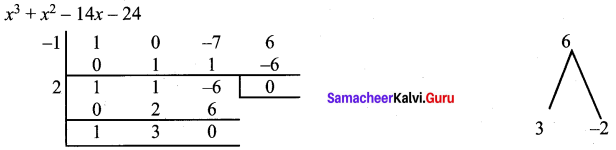
(i) x2 + 3x – 28 = 0
Answer:
Sum of the roots (α + β) = -3
Product of the roots (α β) = -28

(ii) x2 + 3x = 0
Answer:
Sum of the roots (α + β) = -3
Product of the roots (α β) = 0

(iii) 3 + \(\frac{1}{a}=\frac{10}{a^{2}}\)
3a2 + a = 10
3a2 + a – 10 = 0 comparing this with x2 – (α + β)
x + αβ = 0
10th Maths Exercise 3.9 Samacheer Kalvi Chapter 3 Algebra

Samacheer Kalvi 8th Maths Solutions Term 1 Chapter 2 Measurements Ex 2.2

Students can Download Maths Chapter 2 Measurements Ex 2.2 Questions and Answers, Notes Pdf, Samacheer Kalvi 8th Maths Book Solutions Guide Pdf helps you to revise the complete Tamilnadu State Board New Syllabus and score more marks in your examinations.

Tamilnadu Samacheer Kalvi 8th Maths Solutions Term 1 Chapter 2 Measurements Ex 2.2

8th Maths Exercise 2.2 Question 1.
Find the perimeter and area of the combined figures given below, (π = \(\frac{22}{7}\))
8th Maths Exercise 2.2 Solutions Term 1 Chapter 2 Measurements Samacheer Kalvi
Solution:
Samacheer Kalvi 8th Maths Book Solutions Term 1 Chapter 2 Measurements Ex 2.2
∴ Perimeter = Sum of all lengths of sides that form the closed boundary
P = 11 + 10 + 7 + 10m
Perimeter = 38 m
Area = Area of the rectangle – Area of semicircle
8th Standard Maths Measurement Term 1 Chapter 2 Ex 2.2 Samacheer Kalvi
= 50.75 m2 (approx)
Area of the figure = 50.75m2 approx.

(ii) Perimeter = sum of outside lengths
8th Class Maths Exercise 2.2 Solutions Term 1 Chapter 2 Measurements Samacheer Kalvi

Samacheer Kalvi 8th Maths Book Question 2.
Find the area of the shaded part of the following figures. (π = 3.14 )
Samacheer Kalvi 8th Books Maths Solutions Term 1 Chapter 2 Measurements Ex 2.2
Solution:
Area of the shaded part = Area of 4 quadrant circles of radius \(\frac{10}{2}\) cm
= 4 × \(\frac{1}{4}\) × πr2 = 3.14 × \(\frac{10}{2} \times \frac{10}{2}\) cm2
= \(\frac{314}{4}\) cm2 = 78.5cm2
Area of the shaded part = 78.5 cm2
Area of the unshaded part = Area of the square – Area of shaded part
= a2 – 78.5 cm2 = (10 × 10) – 78.5 cm2
= 100 – 78.5 cm2 = 21.5 cm2
Area of the unshaded part = 21.5 cm2 (approximately)

(ii) Area of the shaded part = Area of semicircle – Area of the triangle
Samacheer Kalvi 8th Maths Solutions Term 1 Chapter 2 Measurements Ex 2.2
∴ Area of the shaded part = 27.93 cm2 (approximately)

8th Standard Maths Measurement Question 3.
Find the area of the combined figure given which is got by joining of two parallelograms.
8th Maths Book Samacheer Kalvi Solutions Term 1 Chapter 2 Measurements Ex 2.2
Solution:
Area of the figure = Area of 2 parallelograms with base 8 cm and height 3 cm
= 2 × (bh) sq. units
= 2 × 8 × 3 cm2 = 48 cm2
∴ Area of the given figure = 48 cm2

8th Class Maths Exercise 2.2 Question 4.
Find the area of the combined figure given, formed by joining a semicircle of diameter 6 cm with a triangle of base 6 cm and height 9 cm. (π = 3.14 )
Samacheer Kalvi 8th Standard Maths Solutions Term 1 Chapter 2 Measurements Ex 2.2
Solution:
Area of the figure = Area of the semicircle of radius 3 cm + 2 (Area of triangle with b = 9 cm and h = 3 cm)
Samacheer Kalvi 8 Maths Book Solutions Term 1 Chapter 2 Measurements Ex 2.2
= 14.13 + 27 cm2 = 41.13 cm2
∴ Area of the figure = 41.13 cm2 (approximately)
The door mat which is in a hexagonal shape

Samacheer Kalvi 8th Books Maths Question 5.
The door mat which is in a hexagonal shape has the following measures as given in the figure. Find its area.
8th Standard Maths Samacheer Kalvi Solutions Term 1 Chapter 2 Measurements Ex 2.2
Solution:
Area of the doormat = Area of 2 trapezium
Height of the trapezium h = \(\frac{70}{2}\) cm;
a = 90 cm; b = 70 cm
∴ Area of the trapezium
= \(\frac{1}{2}\)h (a + b) sq. units
Area of the door mat
= 2 × \(\frac{1}{2}\) × 35 (90 + 70) cm2
= 35 × 160 cm2 = 5600 cm2
∴ Area of the door mat = 5600 cm2

Samacheer Kalvi 8th Maths Question 6.
Find the area of an invitation card which has two semicircles attached to a rectangle as in the figure given. (π = \(\frac{22}{7}\))
8th Standard Samacheer Kalvi Maths Term 1 Chapter 2 Measurements Ex 2.2
Solution:
Area of the card = Area of the rectangle + area of 2 semicircles
Length of the rectangle l = 30 cm
Breadth b = 21 cm
Radius of the semicircle = \(\frac{21}{27}\)
∴ Area of the card
= (l × b) + (2 × \(\frac{1}{2}\) πr2) sq. units
= 30 × 21 + \(\frac{22}{7} \times \frac{21}{2} \times \frac{21}{2}\) cm2 = 630 + 346.5
= 976.5 cm2 (approximately)
∴ Area of the Invitation card = 976.5 cm2

8th Maths Book Samacheer Kalvi Question 7.
Find the area of the combined figure given, which has two triangles attached to a rectangle.
Maths Samacheer Kalvi Books 8th Solutions Term 1 Chapter 2 Measurements Ex 2.2
Solution:
Area of the combined shape = Area of the rectangle + Area of 2 triangles
Length of the rectangle l = 10 cm
Breadth b = 8 cm
Base of the triangle base = 8 cm
Height h = 6 cm
∴ Area of the shape = (l × b) + (2 × \(\frac{1}{2}\) × base × h) cm2
= (10 × 8) + (8 × 6) cm2 = 80 + 48 cm2 = 128 cm2
Area of the given shape = 128 cm2

Samacheer Kalvi 8th Standard Maths Question 8.
A rocket drawing has the measures as given in the figure. Find its area.
8th Maths Samacheer Kalvi Solutions Term 1 Chapter 2 Measurements Ex 2.2
Solution:
Area = Area of a rectangle + Area of a triangle + Area of a trapezium
For rectangle length l = 120 – 20 – 20 cm = 80 cm
Breadth b = 30 cm
For the triangle base = 30 cm
Height = 20 cm
For the trapezium height h = 20 cm
Parallel sided a = 50 cm
b = 30 cm
∴ Area of the figure = (l × b) + (\(\frac{1}{2}\) × base × height) + \(\frac{1}{2}\) × h × (a + b) sq. units
= (80 × 30) + ( \(\frac{1}{2}\) × 30 × 20) + \(\frac{1}{2}\) × 20 × (50 + 30) cm2
= 2400 + 300 + 800 cm2 = 3500 cm2
Area of the figure = 3500 cm2

Samacheer Kalvi 8 Maths Book Question 9.
Find the area of the glass painting which has a triangle on a square as given in the figure.
Samacheer Kalvi 8th Maths Books Solutions Term 1 Chapter 2 Measurements Ex 2.2
Solution:
Area of the glass painting = Area of the square + Area of the triangle
Side of the square a = 30 cm
Base of the triangle b = 30 cm
Height of the triangle h = 8 cm
∴ Area of the painting = (a)2 + (\(\frac{1}{2}\) bh) sq. units
= (30 × 30) + (\(\frac{1}{2}\) × 30 × 8) cm2 = 900 + 120 cm2
= 1020 cm2
Area of the glass painting = 1020 cm2

8th Standard Maths Samacheer Kalvi Question 10.
Find the area of the irregular polygon shaped fields given below.
Samacheer Kalvi 8th Guide Maths Solutions Term 1 Chapter 2 Measurements Ex 2.2
Solution:
(i) Area of the irregular field = Area of ∆AHF + Area of trapezium FHIE + Area of triangle EID + Area of ∆JDC + Area of rectangle BGJC + Area of ∆AGB
Class 8 Maths Samacheer Kalvi Solutions Term 1 Chapter 2 Measurements Ex 2.2

(ii) Area of the field = Area of trapezium FBCH + Area of ∆DHC + Area of ∆EGD + Area of ∆EGA + Area of ∆BFA
8th Std Maths Samacheer Kalvi Solutions Term 1 Chapter 2 Measurements Ex 2.2

Samacheer Kalvi 9th Social Science History Solutions Chapter 7 State and Society in Medieval India

You can Download Samacheer Kalvi 9th Social Science Book Solutions Guide Pdf, Tamilnadu State Board help you to revise the complete Syllabus and score more marks in your examinations.

Tamilnadu Samacheer Kalvi 9th Social Science History Solutions Chapter 7 State and Society in Medieval India

State and Society in Medieval India Textual Exercise

I. Choose the correct answer.

State And Society In Medieval India Class 9 Question 1.
……………… was the second stronghold of Ala-ud-din Khalji’s expanding Kingdom.
(a) Dauladabad
(b) Delhi
(c) Madurai
(d) Bidar
Answer:
(a) Dauladabad

Samacheer Kalvi Guru 9th Social Science Question 2.
The Deccan Sultanates were conquered by ………………
(a) Ala-ud-din Khilji
(b) Ala-ud-din Bahman- shah
(c) Aurangzeb
(d) Malik Kaffir
Answer:
(c) Aurangzeb

State And Society In Medieval India Question 3.
The establishment of ……………… empire changed the administrative and institutional structures of South India.
(a) Bahmani
(b) Vijayanagar
(c) Mughal
(d) Nayak
Answer:
(b) Vijayanagar

Question 4.
Krishnadeva Raya was a contemporary of …………………
(a) Babur
(b) Humayun
(c) Akbar
(d) Aihole
Answer:
(d) Aihole

II. Find out the correct statement.

Question 1.
(i) The establishment of the Vijayanagar Kingdom witnessed the most momentous . development in the history of South India.
(ii) The Saluva dynasty ruled for a longer period.
(iii) The rulers of Vijayanagara had smooth relations with the Bahmani Sultanate.
(iv) Rajput kingdoms attracted migrants from Persia and Arabia.
Answer:
(i) and (iv) are correct

Question 2.
(i) The Nayak Kingdom came up in Senji.
(ii) The appointment of Telugu Nayaks resulted in the migration of Telugu-speaking people from Madurai.
(iii) Mughal Empire started declining from the time of Jahangir.
(iv) The Europeans came to India in search of slaves.
Answer:
(i) and (ii) are correct

Question 3.
(i) Mythical geneologies were collected by Col. Mackenzie.
(ii) Indigo was the most important beverage crop in India.
(iii) Mahmud Gawan was the minister in Alauddin Khalji’s kingdom.
(iv) The Portuguese built their first fort in Goa.
Answer:
(i) is correct

Question 4.
Assertion (A): India was an integral part of maritime trade, extending from China in the east to Africa in the west.
Reason (R): Geographical location of India in the middle of Indian Ocean.
(a) (i) A is correct; R explains about A
(b) (ii) A is wrong; R is correct
(c) (iii) A and R are wrong
(d) (iv) A is correct; R does not explains about A.
Answer:
(a) (i) A is correct; R explains about A

Question 5.
(i) Gold images of great beauty and artistry were made by Cholas.
(ii) The best example for Chola architecture is Siva asNataraja performing the cosmic dance.
(a) (i) is correct (ii) is wrong
(b) Both (i) and (ii) is correct
(c) Both (i) and (ii) are wrong
(d) (i) is wrong, (ii) is correct.
Answer:
(d) (i) is wrong, (ii) is correct.

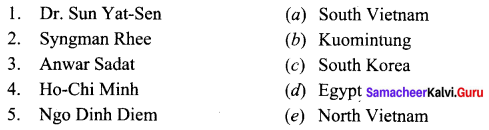
III. Match the following:

State And Society In Medieval India Class 9 Samacheer Kalvi Social Science History Solutions Chapter 7
Answer:
1. (d)
2. (c)
3. (a)
4. (e)
5. (b)

IV. Fill in the blanks.

1. ………………. were Europeans who arrived on the west coast of India.
2. The combined forces of the five Deccan Sultanates defeated Vijayanagar army in 1565 A.D. (C.E.) at the battle of ……………
3. Vijayanagara evolved as a ………………
4. The tempo of urbanization increased during ……………… period.
5. ……………… was the enterprising period in the history of Tamil Nadu.
Answers:
1. Portuguese
2. Talikota
3. Militaristic State
4. Vijayanagar
5. The Chola period

V. Answer all questions given under each heading.

Question 1.
The arrival of the Europeans
(a) Who controlled the spice trade from India?
Answer:
Muslims controlled the Spice trade from India.

(b) What enabled the Portuguese to have control over maritime trade over the entire region?
Answer:
The Naval superiority enabled the Portuguese to have control over the Maritime trade over the entire region.

(c) How were the trading activities of the Europeans carried on in India?
Answer:
The trading activities of the Europeans carried on through the respective East India Companies in India. ‘

(d) Mention the enclaves of the Dutch, the English, the French and the Danes in India.
Answer:
The Dutch were in Pulicat (and later Nagapatnam)
the English in Madras
the French in Pondicherry and
the Danes in Tarangampadi (Tranquebar).

Question 2.
Society, Religion and Culture.
(а) Which is the most distinctive aspect of Indian Society?
Answer:
Caste is the most distinctive aspect of Indian Society.

(b) What is a guild?
Answer:
The occupational caste groups are referred to as guilds.

(c) Mention some Saivite movements.
Answer:
Saiva Siddhanta in TamilNadu
Virasaivas in Karnataka
Varkarisampradaya in Maharashtra.

(d) Name the court musician of Akbar.
Answer:
Tansen was the court musician of Akbar.

VI. Answer the following briefly.

Question 1.
Write about the military expeditions of Malik Kafur.
Answer:
Alauddin Khalji’s slave and commander, Malik Kafur, was sent on military expeditions further south in the first decade of the 1300s A.D. (C.E.).

Question 2.
Who founded the Vijayanagar Kingdom? Mention the dynasties that ruled over the kingdom.
Answer:
Harihara and Bukka, two brothers founded the Vijayanagar Kingdom.
Sangama Dynasty, Saluva Dynasty and Tuluva Dynasties ruled over the Kingdom.

Question 3.
Mention the two natural advantages that India had in cotton weaving.
Answer:
India had two natural advantages in cotton weaving. The first was that cotton grew in almost all parts of India, so that the basic raw material was easily available. Second, the technology of producing a permanent colour on cotton using vegetable dyes was known from very early times in India.

Question 4.
What were the factors which facilitated urbanization?
Answer:

  1. It has been observed that cities and towns fulfilled diverse and overlapping roles in the economy.
  2. The large cities were centres of manufacturing and marketing, banking and financial services.
  3. They were usually located at the intersection of an extensive network of roads which connected them to other parts of the country.
  4. Smaller towns were marketing centres in local trade connecting the immediate rural hinterland.
  5. Cities also served as political and administrative centres, both in the capital region (for instance, Agra and Delhi) and in the provinces.

Question 5.
What is sericulture?
Answer:

  1. Silk production by breeding the mulberry silkworm is Sericulture.
  2. Sericulture was introduced in the 14th and 15th centuries.
  3. Bengal had become one of the largest silk-producing regions in the world.

VII. Answer the following in detail.

Question 1.
Discuss the political changes during 1526-1707 A.D.*(C.E.).
Answer:
(i) The Mughal empire was founded by Babur in 1526 A.D. (C.E.) after he defeated Ibrahim Lodi at Panipat.

(ii) The first six Mughal emperors are referred to as the ‘Great Mughals’. Aurangzeb was the last of the great Mughals.

(iii) Akbar consolidated the Mughal empire through conquests and through a policy of conciliation with the Religious based kingdoms of Rajasthan.

(iv) The Mughal empire through began to disintegrate after Aurangzeb, continued to exist nominally till 1857 A.D. (C.E.) when the British finally ended the virtually non-existent empire.

(v) A new power centre rose in Maharashtra in the seventeenth century, and the Marathas
under the leadership of Shivaji seriously undermined the authority of the Mughals in western India.

(vi) At its height, the empire stretched over most of the Indian sub-continent.

(vii) Only the south-western region of Kerala and southern Tamilnadu were not directly under Mughal rule.

Question 2.
Explain the commercial developments in Medieval India.
Answer:

  • The large manufacturing sector essentially produced goods for exchange.
  • India had an extensive network of trade for marketing the goods.
  • At the next level the producer was de-linked from marketing, the trade was undertaken by merchant intermediaries.
  • Big cities were usually major commercial centres with bazzars and shops.
  • Major parts were the nodal points in international, maritime trade.
  • Maritime trade across the Indian ocean, extending from China in the east to Africa in the West had flourished for many centuries.
  • Merchants operated at different levels.
  • Trade on a large scale could function only with the availability of financial and banking services.
  • The European trading companies realized that they could not function in India without the services of the rich and influential merchants. They entered into contracts.
  • The Indian merchants were under contract to the Europeans to supply textiles and other goods.
  • Political disturbances disrupted the economic activity.

Question 3.
“Chola Period was a enterprising period in the history of Tamil Nadu” – Elucidate.
Answer:
(i) The CHOLA PERIOD was an enterprising period when trade and the economy expanded, accompanied by urbanization.

(ii) The administrative machinery was re-organised during Chola rule.

(iii) The basic unit of local administration was the village (ur), followed by the sub-region (nadu) and district (kottam). Tax-free villages granted to Brahmins were known as brahmadeya. Marketing centres and towns were known as nagaram.

(iv) The ur, nadu, brahmadeya and nagaram each had its own assembly.

(v) They were responsible for the maintenance and management of the water resources and land; the local temples; resolving local issues and disputes; and for collecting the taxes due to the government.

(vi) While the Chola state did not intervene in this fundamental system of local administration, they introduced innovations in revenue administration by creating new revenue divisions (mandalam and valanadu). Several new taxes on agriculture and commerce were also introduced.

(vii) The second notable feature was the great increase in the construction of temples. This had two dimensions: new temples were constructed, and existing temples became multi-functional social and economic institutions.

(viii) The construction of great temples also was a reflection of the growing prosperity in the kingdom, since the activity involved great expenditure.

Student Activities

Question 1.
On the outline map of India mark the important places of medieval India.
Answer:
Samacheer Kalvi Guru 9th Social Science History Solutions Chapter 7 State And Society In Medieval India

Question 2.
Collect pictures of architectural importance of the Cholas.
Answer:
You can collect the pictures of architectural importance of the Cholas and paste it in the Album.

IX Assignment

Question 1.
Collect the pictures of Angkor Wat in Cambodia.
Answer:
You can collect the pictures of Angkor Wat in Cambodia. You can do this as Home Assignment.

Question 2.
Arrange a debate in the class on the advantages and disadvantages of urbanization.
Answer:
The teacher can arrange a debate on the advantages and disadvantages of Urbanization.

State and Society in Medieval India Additional Questions

I. Choose the correct answer.

Question 1.
Muslim rule was established in Delhi at the end of the 12th century by …………..
(a) Muhammad Ghori
(b) Alauddin Khalji
(c) Mahmud Gawan
(d) Aurangazeb
Answer:
(a) Muhammad Ghori

Question 2.
……………… was sent on military expeditions further south in the first decade of the 1300 AD.
(a) Muhammad-bin-Tughlaq
(b) Alauddin Bahman Shah
(c) Malik Kafur
(d) None of the above
Answer:
(c) Malik Kafur

Question 3.
Maritime trade with South East Asia and China expanded greatly during the ………….. period.
(a) Chera
(b) Chola
(c) Pandya
(d) Pallava
Answer:
(b) Chola

Question 4.
The last of the great Mughal was …………….
(a) Humayun
(b) Akbar
(c) Jahangir
(d) Aurangazeb
Answer:
(d) Aurangazeb

Question 5.
…………… period was an enterprising period.
(a) The Chola
(b) The Chera
(c) The Pandya
(d) The Pallava
Answer:
(a) The Chola

Question 6.
The most distinctive aspect of Indian society is ……………….
(a) Religion
(b) Caste
(c) Culture
(d) None of the above
Answer:
(b) Caste

Question 7.
…………….. is a pilgrimage centre.
(a) Mumbai
(b) Calcutta
(c) Varanasi
(d) Delhi
Answer:
(c) Varanasi

Question 8.
………….. was introduced in the 14th century.
(a) Sericulture
(b) Horticulture
(c) Agriculture
(d) None of the above
Answer:
(a) Sericulture

II. Find out the correct statement.

Question 1.
(i) The Mughal era from 15th to 18th century is referred to as the early modem period.
(ii) Muslim rule was established in Delhi at the end of the 12th century.
(iii) Arab Muslims had been trading in the ports of the west coast.
(iv) The impact of Muslim rule was felt during the reign of Malik Kafur.
Answer:
(ii) and (iii) are correct

Question 2.
(i) The Europeans were pre-occupied with trying a find a dirrect sea route to India.
(ii) The spice trade from India was controlled by Muslims.
(iii) The second notable feature was the great increase in the construction of temple.
(iv) The Chola period was an enterprising peirod.
Answer:
(iii) and (iv) are correct

Question 3.
(i) Textiles accounted for nearly 90% of the total exports from India.
(ii) Ainnurruvar had their headquarters in Aihole.
(iii) Coromandel merchants operated from Persian Gulf and Red sea.
(iv) The Indian merchants were under contract to the Europeans.
Answer:
(ii) is correct

Question 4.
Assertion (A): Sikhism was founded by Guru Nanak.
Reason (R): He lived during 15th and 16th century.
(a) A is correct R explains about A
(b) A is wrong R is correct
(c) A and R are wrong
(d) A is correct R does not explains about A
Answer:
(d) A is correct R does not explains about A

Question 5.
(i) India was predominantly an agricultural country.
(ii) A very large population lived in Rural area and depends on agriculture.
(a) (i) is correct (ii) is wrong
(b) Both (i) and (ii) are correct
(c) Both (i) and (ii) are wrong
(d) (i) is wrong (ii) is correct
Answer:
(b) Both (i) and (ii) are correct

III. Match the following:

State And Society In Medieval India Samacheer Kalvi 9th Social Science History Solutions Chapter 7
Answer:
1. (g)
2. (e)
3. (a)
4. (b)
5. (f)
6. (c)
7. (d)

IV. Fill in the blanks.

1. The Mughal era from the 16th to 18th century is referred to as the …………….
2. The impact of Muslim rule was felt during the reign of ……………
3. Maritime trade with South-east Asia and China expanded greatly during the …………….
4. The last known Chola empiror was ………………
5. The Mughal empire was founded by ……………. in 1526 A.D.
6. In 1498 A.D Vasco da Gama landed on the …………… coast.
7. The …………….. empire transformed the economy and society of North India.
8. ……………. took roots when the Portuguese arrived in Kerala and set themselves up in Goa.
9. In ……………. India especially the Tamil region urbanization went hand in hand with temples.
10. …………… had become one of the largest silk-producing regions in the world.
Answers:
1. early modem period
2. Alauddin Khalji
3. Chola period
4. Rajendralll
5. Babur
6. Kerala
7. Mughal
8. Christianity
9. South
10. Bengal

V. Answer all questions given under each heading.

Question 1.
The Advent of Islam.
(a) When was Muslim rule established in Delhi? By whom?
Answer:
Muslim rule was established in Delhi at the end of the 12th century by Muhammad Ghori.

(b) Who were trading in the ports of the west coast?
Answer:
Arab Muslim merchants had been trading in the ports of the west coast especially Kerala.

(c) When was the impact of Muslim rule felt?
Answer:
The impact of Muslim rule was felt during the reign of Alauddin Khalji.

(d) What was his primary objective?
Answer:
His primary objective was to plunder the wealth, rather than to expand his territory.

Question 2.
The Chola empire in the south.
(a) Who began the territorial expansion?
Answer:
The territorial expansion of the Chola empire began under Rajaraj a I.

(b) What do you know about Rajendra I?
Answer:
The Chola empire expanded further under Rajendra I.
He had successfully taken his armies as far to the north east up to the river Ganges.

(c) In whose period Maritime trade expanded?
Answer:
Maritime trade expanded with South-east Asia and China greatly during the Chola period.

(d) Against whom did the Naval expeditions sent?
Answer:
The Naval expeditions had been sent against the Sailendra Kingdom of Sri Vijaya, Kadarand and Ceylon. .

(e) What did he earn from this war?
Answer:
This war earned him the title of “the Chola who had conquered the Ganga and Kadaram”.

Question 3.
Urbanization in South India.
(a) Comment on South Indian temples.
Answer:
In South India especially the Tamil region urbanization went hand in hand with temples.

(b) How were the temples?
Answer:
Temples were large economic enterprises requiring a variety of goods and services to function.

(c) In whose period did the pace of urbanization increase?
Answer:
The pace of urbanization increased during the Vijayanagar period.

(d) How were the Urban centres?
Answer:
Most Urban centres displayed rural characteristics.
For instance, it was not uncommon to find fields with crops within the city.

VI. Answer the following briefly.

Question 1.
How did the historian ‘Burton Stein describe the different periods of Indian History?
Answer:
The historian Burton Stein, uses the term ‘classical’ to describe the period up to the Gupta empire, and dates the ‘medieval’ period from the 7th century A.D.(CE) till the beginning of Mughal rule in the 16th century. The Mughal era, from the 16th to 18th century is referred to as the early modem peroid.

Question 2.
Who brought out the isolated southern parts into the orbit of the rulers of the North?
Answer:
The Tughlaq kings who came after Alauddin also sent their armies to the south. As a result, the generally more isolated southern part of the country came into the orbit of the rulers of the north. Governors were appointed in various provinces in the Deccan region, and a Sultanate was even established in Madurai.

Question 3.
Mention the five Sultanates who came up in Deccan in the 15th century.
Answer:
By the end of the fifteenth century, five sultanates came up in the Deccan: Bijapur, Golkonda, Ahftiednagar, Berar and Bidar. Bijapur and Golkonda were the largest of these sultanates and the region entered a phase of considerable economic growth and expansion of trade.

Question 4.
How did the Vijayanagar empire wither away?
Answer:

  • The rulers of Vijayanagar were almost continuously at war with the Bahmani sultanate as well as with the religion-based kingdoms of Kondavidu and Orissa.
  • Finally, the combined forces of the five Deccani Sultanates defeated Vijayanagar in 1565 A.D. (C.E.) at the Battle of Talikota.
  • The Vijayanagar emperors then shifted their capital further south to Penugonda, and eventually to Chandragiri near Tirupati.
  • The empire (or what remained of it) finally withered away in the middle of the seventeenth century.

Question 5.
What was the impact of Islamic rule on Indian society?
Answer:
The establishment of Islamic Rule in Delhi made a big impact on Indian society. Initially, Islam did not cause any social tension. Arab merchants, for instance, when they came and settled on Kerala coast, married local women and led a peaceful life. The situation changed when Islam became a state power. For a medieval ruler one way of asserting imperial authority was to demolish the place of worship of the enemies. Otherwise Islam as a monotheistic religion had its positive impact in Indian society. It played a decisive role in the evolution of a composite culture.

Question 6.
Why did the Europeans come to India?
Answer:
The Europeans came to India primarily in search of spices. But soon there was an explosion in the demand for Indian textiles in the European markets, often referred to as the ‘Indian craze’. This led to a significant expansion of textile production in India, which was accompanied by an expansion of the production of commercial crops like cotton and indigo and other dyes.

Question 7.
Give an account of genealogies collected by Colin Mackenzie.
Answer:
(i) Caste groups often petitioned the local ruler for permission to use various symbols of higher status, like the right to wear footw ear, the right to carry umbrellas, the right to use certain decorations at funerals and so on.

(ii) Each caste also created a mythical genealogy to establish its origins; this was used to justify the claim for the right to a higher status in the hierarchy.

(iii) These genealogies are found in many of the manuscripts collected by Colin Mackenzie.

Question 8.
Write a short note on the literary works of the Chola period.
Answer:

  • The Chola period was an era of remarkable cultural activity. These were the centuries when major literary works were written.
  • The best known classical poet, Kamban, wrote Ramayana in Tamil which was formally
    presented (Arangetram) in the temple at Srirangam. Sekkilar’s Periyapuranam, similarly was presented at the temple in Chidambaram.
  • Among the other great works of the period is Kalingattup-parani and Muvarula.
  • It was also a period when great religio-philosophical treatises like the Sankara-bhashyam and Sri-bhashyam were produced.

Question 9.
Explain the Art and Architecture of the Mughal period.
Answer:
The Mughals were well-known for their aesthetic values, and were great patrons of the arts. They left behind numerous monuments, in addition to constructing entire cities like Shahjahanabad (Delhi) and Fatehpur Sikri, gardens, mosques and forts. Decorative arts – especially jewellery set with precious and semi-precious gems for items of personal use – flourished under the patronage of the royal household and urban elites. The art of painting also flourished in the Mughal period. Primarily known as Mughal miniatures, they were generally intended as book illustrations or were single works to be kept in albums.

Question 10.
What happened in the business scenario in the beginning of the 18th century in India?
Answer:

  • The Indian merchants benefitted from the business opportunities offered by the European companies. .
  • But this scenario began to change from the beginning of the eighteenth century.
  • The Indian merchants were under contract to the Europeans to supply textiles and other goods.
  • But by then the local resources were not enough to produce the quantities required and political disturbances also disrupted all economic activity.
  • This resulted in most merchants being bankrupted diminishing the economic vitality of the merchant community.

VII. Answer the following in detail.

Question 1.
Describe the major political changes.
Answer:
(i) The expansion of the Chola empire from the time of Rajaraja which eclipsed the Pandyan and Pallava kingdoms, extending north till Orissa.

(ii) From the twelfth century, the beginning of several centuries of Muslim rule in Delhi, extending throughout North India and the spread of Islam to different parts of the country.

(iii) By the end of the 13th century the eclipse of the great empire of the Cholas and the consequent rise of many religious kingdoms in South India. This ultimately culminated in the rise of the Vijayanagar empire which exercised authority over all of South India and came to be considered the bastion of religious rule in the south.

(iv) The consolidation of Muslim rule under the Mughals in the north, beginning in 1526 A.D. (C.E.) with the defeat of the Ibrahim Lodi by Babur. At its height, the Mughal empire stretched from Kabul to Gujarat to Bengal, from Kashmir to South India.

(v) The coming of the Europeans, beginning with the Portuguese who arrived on the west coast of India in 1498.

Question 2.
Explain the important feature of Indian agriculture.
Answer:
An important feature of Indian agriculture was the large number of crops that were cultivated. The peasant in India was more knowledgeable about many crops as compared to peasants in most of the world at the time. A variety of food grains like wheat, rice, and millets were grown apart from lentils and oilseeds. Many other commercial crops were also grown such as sugarcane, cotton and indigo. Other than the general food crops, south India had a regional specialization in pepper, cinnamon, spices and coconut.

In general, two different crops were grown in the different seasons, which protected the productivity of the soil. Maize and tobacco were two new crops which were introduced after the arrival of the Europeans. Many new varieties of fruit or horticultural crops like papaya, pineapple, guava and cashew nut were also introduced which came from the west, especially America. Potatoes, chillies and tomatoes also became an integral part of Indian food.

Samacheer Kalvi 10th Social Science History Solutions Chapter 9 Freedom Struggle in Tamil Nadu

Guys who are planning to learn and understand the topics of 10th Social Science History can grab this Tamilnadu State board solutions for Chapter 9 Freedom Struggle in Tamil Nadu Questions and Answers from this page for free of cost. Make sure you use them as reference material at the time of preparation & score good grades in the final exams.

Students who feel tough to learn concepts can take help from this Samacheer Kalvi 10th Social Science Book Solutions Guide Pdf, all the Questions and Answers can easily refer in the exams. Go to the below sections and get 10th Social Science History Chapter 9 Freedom Struggle in Tamil Nadu Tamilnadu State Board Solutions PDF.

Tamilnadu Samacheer Kalvi 10th Social Science History Solutions Chapter 9 Freedom Struggle in Tamil Nadu

Do you feel scoring more marks in the 10th Social Science History Grammar sections and passage sections are so difficult? Then, you have the simplest way to understand the question from each concept & answer it in the examination. This can be only possible by reading the passages and topics involved in the 10th Social Science History Board solutions for Chapter 9 Freedom Struggle in Tamil Nadu Questions and Answers. All the Solutions are covered as per the latest syllabus guidelines. Check out the links available here and download 10th Social Science History Chapter 9 textbook solutions for Tamilnadu State Board.

Freedom Struggle in Tamil Nadu Textual Exercise

I. Choose the correct answer.

Freedom Struggle In Tamil Nadu Class 10 Question 1.
Who was the first President of the Madras Mahajana Sabha?
(a) T.M. Nair
(b) P. Rangaiah Naidu
(c) G. Subramaniam
(d) G.A. Natesan
Answer:
(b) P. Rangaiah Naidu

Freedom Struggle In Tamil Nadu Question 2.
Where was the third session of the Indian National Congress held?
(a) Marina
(b) Mylapore
(c) Fort St. George
(d) Thousand Lights
Answer:
(d) Thousand Lights

Question 3.
Who said “Better bullock carts and freedom than a train de luxe with subjection”?
(a) Annie Besant
(b) M. Veeraraghavachari
(c) B.P. Wadia
(d) G.S. Arundale
Answer:
(a) Annie Besant

Question 4.
Which among the following was SILF’s official organ in English?
(a) Dravidian
(b) Andhra Prakasika
(c) Justice
(d) New India
Answer:
(c) Justice

Question 5.
Who among the following were Swarajists?
(a) S. Satyamurti
(b) Kasturirangar
(c) P. Subbarayan
(d) Periyar EVR
Answer:
(a) S. Satyamurti

Question 6.
Who set up the satyagraha camp in Udyavanam near Madras?
(a) Kamaraj
(b) Rajaji
(c) K. Santhanam
(d) T. Prakasam
Answer:
(d) T. Prakasam

Question 7.
Where was the anti-Hindi Conference held?
(a) Erode
(b) Madras
(c) Salem
(d) Madurai
Answer:
(c) Salem

Question 8.
Where did the congress volunteers clash with the military during Quit India Movement?
(a) Erode
(b) Madras
(c) Salem
(d) Madurai
Answer:
(d) Madurai

II. Fill in the blanks.

1. …………… was appointed the first Indian Judge of the Madras High Court.
2. The economic exploitation of India was exposed by …………….., through his writings.
3. Nilakanta Brahmachari started the secret society name …………….
4. The starting of trade unions in Madras was pioneered by ……………..
5. The Dravidian Association Hostel for non-Brahmin students was established by ………………
6. ……………… formed the first Congress Ministry in Madras.
7. …………….. was the founder of the Madras branch of the Muslim League.
8. ……………. hoisted the national flag atop Fort St. George on 26 January 1932.
Answers:
1. T. Muthuswami
2. G. Subramaniam
3. Bharata Matha Society
4. B.P. Wadia
5. C. Natesanar
6. Rajaji
7. Yakub Hasan
8. Bhashyam

III. Choose the correct statement.

Question 1.
(i) Madras Native Association was founded in 1852.
(ii) Tamil nationalist periodical Swadesamitran was started in 1891.
(iii) The Madras Mahajana Sabha demanded conduct of civil services examinations only in India.
(iv) V.S. Srinivasanar was an extremist.
(a) (i) and (ii) are correct
(b) (iii) is correct
(c) (iv) is correct
(d) All are correct
Answer:
(a) (i) and (ii) are correct

Question 2.
(i) EVR did not participate in the Non – Cooperation Movement.
(ii) Rajaji worked closely with Yakub Hasan of the Muslim League.
(iii) Workers did not participate in the Non- Cooperation Movement.
(iv) Toddy shops were not picketed in Tamil Nadu.
(a) (i) and (ii) are correct
(b) (i) and (iii) are correct
(c) (ii) is correct
(d) (i) (iii) and (iv) are correct.
Answer:
(c) (ii) is correct

Question 3.
Assertion (A): The Justice Party opposed the Home Rule Movement.
Reason (R): The Justice Party feared that Home Rule would give the Brahmins more power.
(a) Both A and R are correct but R is not the correct explanation
(b) A is correct but R is wrong
(c) Both A and R are wrong
(d) Both A and R are correct and R is the correct explanation
Answer:
(d) Both A and R are correct and R is the correct explanation

Question 4.
Assertion (A): EVR raised the issue of representation for non-Brahmins in legislature.
Reason (R): During the first Congress Ministry, Rajaji abolished sales tax.
(a) Both A and R are correct but R is not the correct explanation
(b) A is correct but R is wrong
(c) Both A and R are wrong
(d) Both A and R are correct and R is the correct explanation
Answer:
(b) A is correct but R is wrong

IV. Match the following.
Freedom Struggle In Tamil Nadu Class 10 Samacheer Kalvi Social Science History Solutions Chapter 9
Answer:
1. (d)
2. (e)
3. (b)
4. (c)
5. (a)

V. Answer the questions briefly.

Question 1.
List out the contribution of the moderates.
Answer:
Contributions of the Moderates:

  1. They exposed the liberal claims of the British and how the British exploited India.
  2. They exposed British’s hypocrisy in following democratic principles in England and imposing an unrepresentative Government in the colonies.

Question 2.
Write a note on the Tirunelveli Uprising.
Answer:
The Tirunelveli uprising took place after the arrests of V.O. Chidambaram Pillai and Subramania Siva in 1908. They were charged with sedition. During the protests, a police station, a court building and municipal office were burnt down and four people died in police firing.

Question 3.
What is the contribution of Annie Besant to India’s freedom struggle?
Answer:

  1. Annie Besant, an Irish lady and the leader of the Theosophical society started the Home Rule League on the modelof Irish Home Rule League in 1916.
  2. She carried forward the demand for Home Rule all over India: She started the newspapers “New India, Commonweal” to carry forward her agenda.
  3. Large number of students who joined the movement were trained in Home Rule classes.
  4. They were formed into boy scouts and volunteer troops.
  5. By forming trade unions with her member B.P Wadia improved the working conditions of’the workers and they made them part of the struggle for freedom.

Question 4.
Mention the various measures introduced by the Justice Ministry.
Answer:
Measures introduced by Justice Ministry:

  • reservation for non-Brahmins in local bodies and education
  • establishment of Staff Selection Board
  • enactment of Hindu Religious, Endowment Act,
  • abolition of devadasi system
  • allotment of waste government land to the poor, and extension of primary education to depressed classes.

Question 5.
Write briefly on EVR’s contribution to the constructive programme.
Answer:

  1. E.V.R played an important role in Tamil Nadu during the period of Non – Cooperation movement.
  2. He campaigned vigorously for the promotion and sale of Khadi.
  3. In his opposition to consumption of liquor he cut down on entire coconut grove owned by him.
  4. He played a key role in Satyagraha for temple entry in vaikom, then under Travancore.
  5. E.V.R went to Vaikom and galvanised the movement.
  6. He was imprisoned and released after one-month.
  7. He refused to leave vaikom and sentenced to six month rigorous imprisonment for making inspiring speeches.
  8. Due to his undeterred effort, in 1925, the ban on the roads around the temple where the permission was not given to the depressed classes to enter was lifted.
  9. He was hailed as “Vaikom Hero” for his contribution against caste discrimination and temple entry agitation.

Question 6.
What is Cheranmadevei Gurukuiam controversy?
Answer:
V.V.S. Iyer established a Gurukuiam in Cheranmadevi. It got funds from Congress, but students were discriminated on the basis of caste. E.V. Ramaswamy got to know about the practices in 1925 and he severely criticised it.

Question 7.
Why was anti-Hindi agitation popular?
Answer:

  1. Congress Ministry under Rajaji introduced Hindi as a compulsory subject in schools.
  2. This was considered as a form of Aryan and North. Indian imposition detrimental to Tamil language and culture, and therefore caused much public resentment.
  3. E.V.R led a massive campaign against it.
  4. He organised an anti-Hindi conference at Salem and formulated a definite programme of action.
  5. A rally was organised from Trichirapalli to Madras.
  6. More than 1200 protesters including E.V.R were arrested.
  7. As a result after the resignation of Congress Ministry the then Governor of Madras removed Hindi as a compulsory subject in schools. Thus the anti-Hindi agitation became popular as it succeeds in its objective.

Question 8.
Outline the key incidents during the Quit India Movement in Tamil Nadu.
Answer:
All sections of the society in Tamil Nadu participated in the Quit India Movement. There were workers’ strikes and students also protested. There were many incidents of violence and disruption of rail traffic. Congress volunteers clashed with the military in Madurai. There were police firings at some places.

VI. Answer the questions given under each caption.

Question 1.
Early Nationalist Movement In Tamil Nadu

(a) What were the objectives of Madras Native Association?
Answer:

  1. To promote the interests of its members.
  2. Focused on reduction of taxation.

(b) What led to the emergence of nationalist press in Tamil Nadu?
Answer:
The entire press was owned by the Europeans. When the appointment of Indian T. Muthuswami as Judge was criticised they felt the need of nationalist press to express the Indian perspective.

(c) What were the demands of Madras Mahajana Sabha?
Answer:

  1. Conduct of simultaneous civil services examinations in England and India.
  2. Reduction of taxes and reduction of civil and military expenditure.

(d) Who were the early nationalist leaders in Tamil Nadu?
Answer:
The early nationalists leaders in Tamil Nadu were V.S. Srinivasa Sastri. RS.Sivasamy and G.A.Natesan, T.R.Venkatramanar, S.Subramaniar, V.krishnasamy.

Question 2.
Revolutionary Movement in Tamil Nadu
(a) List a few revolutionaries in Tamil Nadu. ‘
Answer:
Some revolutionaries in Tamil Nadu were M.P.T. Acharya, V.V.S. Iyer and T.S.S. Rajan.

(b) Why did Subramania Bharati moved to Pondicherry?
Answer:
Subramania Bharati went to Pondicherry to escape imprisonment after the Tirunelveli uprising in 1908. Pondicherry was under French rule.

(c) Name a few of the revolutionary literature?
Answer:
Some revolutionary literature includes India, Vijaya, and Suryodayam, which came out of Pondicherry.

(d) What did Vanchinathan do?
Answer:
Vanchinathan shot dead by Robert W.D’E. Ashe, the collector of Tirunelveli, at Maniyachi junction on 17th June 1911. He shot himself after that.

Question 3.
Non-Brahmin Movement

(a) Why was the South Indian Liberal Federation formed?
Answer:
South Indian Liberal Federation was formed to promote the interests of the Non – Brahmins.

(b) What is the Non-Brahmin Manifesto?
Answer:
Reservation of jobs for Non – Brahmins in Government service and seats in representative bodies.

(c) Why did EVR join the Non-Brahmin Movement?
Answer:
When EVR raised the issue of representation for Non – Brahmins in the legislature his efforts to achieve this since 1920 had met with.

(d) What do you know about anti-Hindi agitation?
Answer:
It Caused much resentment as it was considered to be a form of Aryan and North India imposition detrimental to Tamil language and culture.

VII. Answer the following in detail.

Question 1.
Discuss the response to Swadeshi Movement in Tamil Nadu.
Answer:
During the Swadeshi movement, public meetings were organized in various parts of Tamil Nadu, and they were attended by thousands of people. Tamil was used for the first time to mobilize people. Many journals came into existence to spread Swadeshi ideals. Students and youth participated widely in the movement. Some lectures were delivered by Bipin Chandra Pal, while Subramania Bharati’s patriotic songs stirred patriotic emotions in people.

Question 2.
Examine the origin and growth of Non- Brahmin Movement in Tamil Nadu.
Answer:
Origin of Non – Brahmin Movemet.

Cause: In the Madras presidency due to the rapid growth of education, there was an increase in the number of educated Non – Brahmins.

Reason: Intense political and social activities politicised the educated Non-Brahmins to raise the issue of caste discrimination and unequal opportunities in Government employment and representation in the elected bodies which were dominated by Brahmins.

Formation: The Non – Brahmins organised themselves into political organisations to protect their interests.

  1. In 1912 the Madras Dravidian Association was founded with C.Natesanar as its secretary. Active role if C.Natesanar. for the.growth of Non – Brahmin movement.
  2. In June 1916 he established the Dravidian Association Hostel for Non¬Brahmin students.
  3. He bridged the gap between the two leading Non-Brahmin leaders of the time Dr. T.M.Nair and P.Thiyagarayar.
  4. On 20th November 1916 a meeting was held for about thirty Non-Brahmins under the leadership of P.Thiyagarayar Dr. T.M.Nair and C.Natesanar at Victoria public hall (Chennai).

South Indian Liberal Federation (SILF):

South Indian Liberal Federation was founded to promote the interests of the Non-Brahmins.

News papers launching: They launched three newspapers Justice – in English, Dravidian – in Tamil and Andhra prakasika in Telugu.

  1. SILF popularly known as ‘Justice party’ after its English Newspaper.
  2. They held several meetings throughout the presidency to set up branches.

Objectives of Non- Brahmin Manifesto:

  1. Reservation of jobs in Government services.
  2. Seats in local bodies

Achievement: The act of 1919 provided reservation of seats to Non-Brahmins.

In the elections held in 1920 the Justice Party won the majority seats in the Legislative Council. A. Subburayalu of the Justice Party became the first Chief Minister.

Question 3.
Describe the role of Tamil Nadu in the Civil Disobedience Movement.
Answer:
Tamil Nadu was at the forefront of the Civil Disobedience Movement. Shops were picketed and foreign goods were boycotted in Madurai. C. Rajagopalachari led the Salt Satyagraha march to Vedaranyam and was arrested. The march took place in April 1930. Twelve volunteers broke the salt law by picking up the salt.

VIII. Activity

Question 1.
Students can be asked to write a sentence or two about the important places of freedom struggle in Tamil Nadu.
Answer:
Panchalankuruchi is a place 17 km from Tuticorin. This small village holds a lot of historic value in terms of India’s freedom struggle against English dominance. It is home to an 18th century chieftain Veerapandya Kattabomman who fought valiantly against the English, but was defeated and hanged.

Velunachiyar employed agents for gathering intelligence to find where the British had stored their ammunition. With military assistance from Gopala Nayakar and Hyder Ali she recaptured Sivagangai. She was the first female ruler or queen to resist the British colonial power in India.

A procession carrying national flags and singing patriotic songs was brutally beaten by the police in Tirupur. O.K.S.R. Kumaraswamy, popularly Tirupur Kumaran, fell dead holding the national flag aloft.

The Salt satyagraha under the leadership of T. Prakasam and K. Nageswara Rao set up a camp at Udayavanam near Madras. However, the police arrested them. In Madras, the Simon Boycott Propaganda Committee was set up with S. Satyamurti as the president. There was widespread campaign among the students, shopkeepers, lawyers and commuters in train to boycott.

Rowlatt Satyagraha: On 6 April 1919 hartal was organised to protest against the “Black Act”. Protest demonstrations were held at several parts of Tamil Nadu. Processions from many areas of the city converged in the Marina beach where there was a large gathering.

Annie Besant started the Home Rule League in 1916 and carried forward the demand for home rule all over India. G.S. Arundale, B.P. Wadia and C.P. Ramaswamy assisted her in this campaign.

Radical papers such as India, Vijaya and Suryodayam came out of Pondicherry. Such revolutionary papers and Bharati’s poems were banned as seditious literature. These activities in Pondicherry intensified with the arrival of Aurobindo Ghosh and V.V. Subramanianar in 1910.

Question 2.
Role Play: Students can be divided into groups and asked to debate the views of the Moderates, Extremists, Revolutionaries, Annie Besant’s supporters, Justice Party, and British Government.
Answer:
Do it yourself.

Freedom Struggle in Tamil Nadu Additional Questions

I. Choose the correct answer.

Question 1.
The first organization in the Madras presidency to agitate for the rights of people was the …………..
(a) Indian National Congress
(b) Madras Native Association
(c) Muslim league
Answer:
(b) Madras Native Association

Question 2.
…………………. played an active role as the secretary of Madras Mahajana Sabha.
(a) P.Anandacharlu
(b) Gazalu
(c) T.Muthuswami
(d) G.Subramaniam
Answer:
(a) P.Anandacharlu

Question 3.
The Headquarters of the Tamil Nadu Congress Committee is named as ……………
(a) Raj Bhavan
(b) Sathyamurthi Bhavan
(c) Rajaji Bhavan
Answer:
(b) Sathyamurthi Bhavan

Question 4.
…………………. purchased two ships for Swadeshi Indian Trade.
(a) Bipin Chandra Pal
(b) V.O.Chidambaranar
(c) T.S.S.Rajan
(d) V.V.Subramaninar
Answer:
(b) V.O.Chidambaranar

Question 5.
Who made Hindi a compulsory subject …………..
(a) Rajaji
(b) V.O.C
(c) Nehru
Answer:
(a) Rajaji

Question 6.
Annie Besant was the leader of …………………. society who propagated Home Rule Movement in Madras.
(a) Theosophical
(b) Madras Dravidian Association
(c) Madras Mahajana Sabha
(d) Madurai Labour Union
Answer:
(a) Theosophical

Question 7.
Who started the Tamil nationalist periodical Swadesamitram?
(a) T. Muthuswami
(b) G. Subramaniam
(c) M. Veeraraghavachari
(d) P. Anandacharlu
Answer:
(b) G. Subramaniam

Question 8.
In Tamil Nadu Khilafat day was observed on:
(a) 19th April 1920
(b) 15 th April 1920
(c) 21st April 1920
(d) 17th April 1920
Answer:
(d) 17th April 1920

Question 9.
What was Bharata Matha Society?
(a) A newspaper
(b) A periodical
(c) A secret society
(d) A political party
Answer:
(c) A secret society

Question 10.
…………………. was hailed as Vaikom Hero.
(a) Periyar
(b) P.Subbarayan
(c) Rajaji
(d) M.A.Ansari
Answer:
(a) Periyar

II. Fill in the blanks :

1. The third session of the Indian National Congress was held at …………., now known as the thousand lights.
2. ………….. provided a safe haven for the revolutionaries.
3. On 18th march 1919 Gandhi addressed a meeting on …………..
4. …………….. was the epicenter of Khilafat Agitaion.
5. A no-tax campaign took place in ……………
6. ………….. and ……………. was the first woman to pay penalty for violation of salt laws.
7. E.V.R organized an Anti-Hindi conference at …………..
8. In Madras, the Simon Boycott Propaganda Committee was set up with ……………… as the President.
9. The Government of India Act of 1935 introduced ……………….
10. ……………One of the controversial measures of Rajaji was the introduction of ………………. as a compulsory subject in school.
11. The Swarajists did not contest the 1930 elections leading to an easy victory for the ……………. party.
12. The Madras Native Association or MNA was the earliest organization to be founded in ……………. to articulate larger public rather than sectarian interests.
Answers:
1. Makkis Garden
2. Pondicherry
3. Marina beach
4. Vaniyambadi
5. Thanjavur
6. Rukmani Lakshmipathi
7. Salem
8. S. Satyamurthi
9. Provincial Autonomy
10. Hindi
11. Justice
12. South India

III. Choose the correct statement.

Question 1.
(i) The Non-Brahmin Manifesto opposed the Home Rule Movement as a movement of Brahmins and feared that Home Rule might give them more power.
(ii) However, it never criticized the Congress as the party of the Brahmins.
(iii) The Justice Party demanded communal representation in society.
(iv) The Madras government was supportive of the Justice Party. .
(a) (i) and (ii) are correct
(b) (ii) and (iii) are correct
(c) (i) (iii) and (iv) are correct
(d) (ii) and (iv) are correct
Answer:
(c) (i) (iii) and (iv) are correct

Question 2.
Assertion: E. V. R. was becoming increasingly dissatisfied with the Congress.
Reason: He felt it was promoting the interests of the Brahmins alone.
(a) Both A and R are correct but R is not the right explanation
(b) A is right but R is wrong
(c) Both A and R are wrong
(d) Both A and R are correct and R is the right explanation
Answer:
(d) Both A and R are correct and R is the right explanation

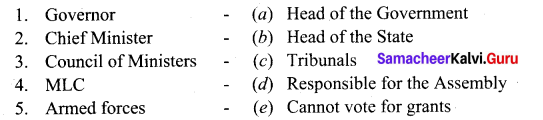
IV. Match the following.

1.The Madras Native Association(a)1878
2.The Hindu newspaper(b)1884
3.The Madras Dravidian Association(c)1852
4.The Temple Entry Authorisation and Indemnity Act(d)1912
5.The Madras Mahajana Sabha(e)1939

Answer:
1. (c)
2. (a)
3. (d)
4. (e)
5. (b)

V. Answer briefly:

Question 1.
Who was appointed as High court Judge of Madras in 1877? How it was criticized?
Answer:
The appointment of T. Muthuswami as the First Indian Judge of Madras High court in 1877. The press entirely owned by Europeans criticized the appointment of an Indian as Judge.

Question 2.
Write a note on Subramaniya Siva.
Answer:

  • Subramaniya Siva was bom in Vathalagundu in Dindigal district.
  • He was a freedom fighter and a creative writer.
  • He was arrested many times for his anti-imperialist activities.
  • While in jail he was affected by leprosy and he was ordered to be shifted to Salem jail.
  • But the British Government enacted a law for Siva stating that leprosy patient should not travel by rail. So he had to walk a long distance with sores on his body.
  • He died of the disease on 23rd July 1925.

Question 3.
Name the states that was then a part of the Madras Presidency.
Answer:
Tamil Nadu was then a part of Madras Presidency which included larger parts of the present day states of Andhra Pradesh (Coastal districts and Royalaseema) Karnataka (Bengaluru, Bellary, South Canara) Kerala (Malabar) and even Odhisha (Ganjam).

Question 4.
Name the paper edited by Subramania Bharathiyar in 1907.
Answer:
Tamil weekly India and the English Newspaper ‘Bala Bharatham’ were edited by Subramania Bharathiyar in 1907.

Question 5.
Name the persons who assisted Annie Besant to carry the Home Rule Movement campaign.
Answer:
G.S.Arundale, B.P. Wadia and C.P.Ramaswamy were some of the personalities who assisted Annie Besant to carry the Home Rule movement campaign.

Question 6.
Who established the Madras Native Association? Why?
Answer:
It was established by Harley Lakshmi Narasu Chetty and Srinivasa Pillai in 1852.

Question 7.
Name the Newspapers launched by SILF.
Answer:
The Newspapers launched by SILF (South Indian Liberal Federation) were
Justice – in English
Dravidian – In Tamil – and
Andhra prakasika – in Telugu

Question 8.
When was the need for a newspaper keenly felt?
Answer:
The appointment of T. Muthuswami Iyer as the first South Indian Judge of the Madras High Court in 1878 created resentment in Madras Presidency. The entire press in Madras criticised the appointment of an Indian as a judge. This left a deep impact on the educated youth of India. For the first time they realized that the entire press was owned by Europeans. At this very moment the need for a newspaper to express the Indian perspective was keenly felt,

Question 9.
Name the persons who organised the “Black Act” protest, How?
Answer:
On 6th April 1919 hartal was organised to protest against the ‘Black Act’ (Rowlatt Act).

  1. Processions from many areas of the city converged at Marina Beach.
  2. Rajaji, Kasturirangari S.Sathyamurthy, and George Joseph addressed the meeting.
  3. Workers meeting was addressed by Thiru.V. Kalyanasundaranar, B.P. Wadia and V.O.C.. They devoted the whole day to fasting and prayers along with large number of people in the Marina Beach.

Question 10.
Why were the moderates disappointed with the Minto-Morley reforms?
Answer:
They were disappointed with the Minto-Morley reforms as it did not provide for responsible government. Despite this the Congress extended support to the British war effort in the hope of getting more reforms.

Question 11.
What resulted in India’s Independence?
Answer:
The Royal Navy Mutiny, the negotiations initiated by the newly formed • labour party Government in England resulting in India’s independence.

VI. Answer all the questions given under each caption:

Question 1.
Vanchinathan
(a) Whom did Vanchinathan kill?
Answer:
Collector Ashe.

(b) Where did he kill him?
Answer:
At Maniyachi Railway Station.

(c) Why did he kill him?
Answer:
To take revenge against the death of four extremists.

(d) What was the end of Vanchinathan?
Answer:
He committed suicide.

Question 2.
Salt March to Vedaranyam (second part)

(a) Who composed the marching song?
Answer:
A special song was composed for the salt march by Nammakkal Ramalinganar.

(b) How was the response from the people along their route?
Answer:
The marching Satyagraha’s were provided warm reception along the route.

(c) How many volunteers along with Rajaji picked up the salt ?
Answer:
Twelve volunteers under the leadership of Rajaji picked up the salt.

(d) Who were the other prominent leaders from Tamil Nadu participated?
Answer:
T.S.S.Rajan, Rukmani Lakshmipathi, Sardar Vedarathnam, C.Swaminathar and K.Santhanam were the prominent leaders who participated in Vedaranyam Salt march.

Question 3.
No Tax Campaign and Movement against Liquor
(a) Name the city where no-tax campaign took place. How did people respond to this campaign?
Answer:
Thanjavur. People boycotted councils, schools and courts. They also boycotted foreign goods.

(b) What was temperance movement? How was this movement made successful?
Answer:
Temperance Movement was a movement against liquor. This movement was made successful by picketing toddy shops.

(c) Why were Rajaji, Subramania Sastri and E. V. R. arrested?
Answer:
They were arrested because they were going to organise civil disobedience movement in Tamil Nadu.

(d) Why was the Non Co-operation Movement withdrawn?
Answer:
It was withdrawn after the Chauri Chaura incident in which 22 policemen were killed.

VII. Answer the following in detail.

Question 1.
What were the reforms brought forth by the first Congress Ministry led by C. Rajaji?
Answer:

  1. C. Rajaji formed the first Congress Ministry in 1937.
  2. He introduced prohibition on an experimental basis in salem.
  3. To compensate the loss of revenue he introduced a sales tax.
  4. He opened temples to the ‘untouchables’ (Harijans).
  5. He appointed a committee to enquire into the condition of the tenants in the zamindari areas.
  6. One of the controversial measures of Rajaji was the introduction of Hindi as a compulsory subject in schools [and Kula Kalvi Thittam in 1953].
  7. After the resignation of Congress Ministry in 1939 the then, Governor of Madras Lord Erskine in Feb 1940 who took over the reigns of administration removed Hindi as compulsory subject.

Question 2.
Throw light on the Madras Native Association or MNA. When did it cease to exist?
Answer:
(i) The Madras Native Association was the earliest organization to be founded in South India.
It was started by Gazulu Lakshminarasu, Srinivasanar and their associates in 1852. It con¬sisted primarily of merchants.

(ii) The objective of MNA was to promote the interests of its members and their focus was on reduction in taxation. It also protested against the support of the government to Christian missionary activities.

(iii) It drew attention of the government to the condition and needs of the people. Its main contribution was its agitation against torture of the peasants by revenue officials.

(iv) The efforts of MNA led to the establishment of the Torture Commission and the eventual abolition of the Torture Act, which justified the forcible collection of land revenue through tortuous methods.

(v) The Madras Native Association ceased to exist by 1862.

Question 3.
Reason out why James Neill statue was moved to Madras Museum.
Answer:

  1. James Neill of the Madras Fusilers (Infantry men with fire arms) was brutal in wrecking vengence at Kanpur. Women and children were massacred in 1857 Revolt.
  2. A statue was erected for him at mount road, Madras.
  3. Nationalist felt this as an insult to Indian sentiments.
  4. They organised a series of demonstrations in Madras.
  5. Protesters came from all over the Madras Presidency and were led by S.N.Somayajulu of Tirunelveli.
  6. Many were arrested and sentenced to prison.
  7. Gandhi who visited Madras during the same time gave his support to the agitation.
  8. The statue was finally moved to Madras Museum when Congress Ministry, led by C.Rajaji formed the Government in 1917.

IMPORTANT EVENTS AND YEAR

YearsEvents
1806Vellore Mutiny
1852Madras Native Association
1884Madras Mahajana Sabha
1905Partition of Bengal
1907The congress session held at Surat
1908Swaraj Day
1910Abhinava Bharats Sangham
1911Vanchinathan shot Ashe
1916Home Rule League
1912Madras Dravidian Association
1919Gandhi addressed on Marina beach
1930Vedaranyam march

We think the data given here clarify all your queries of Chapter 9 and make you feel confident to attempt all questions in the examination. So, practice more & more from Tamilnadu State Board solutions for 10th Social Science History Chapter 9 Freedom Struggle in Tamil Nadu Questions and Answers & score well. Need any information regarding this then ask us through comments & we’ll give the best possible answers very soon.

Samacheer Kalvi 10th Science Solutions Chapter 11 Carbon and its Compounds

Students who are preparing for the Science exam can download this Tamilnadu State Board Solutions for Class 11th Science Chapter 11 from here for free of cost. These Tamilnadu State Board Textbook Solutions PDF cover all 11th Science Carbon and its Compounds Book Back Questions and Answers.

All these concepts of Chapter 11 Carbon and its Compounds are explained very conceptually by the subject teachers in Tamilnadu State Board Solutions PDF as per the prescribed Syllabus & guidelines. You can download Samacheer Kalvi 10th Science Book Solutions Chapter 11 Carbon and its Compounds State Board Pdf for free from the available links. Go ahead and get Tamilnadu State Board Class 11th Science Solutions of Chapter 11 Carbon and its Compounds.

Tamilnadu Samacheer Kalvi 10th Science Solutions Chapter 11 Carbon and its Compounds

Kickstart your preparation by using this Tamilnadu State Board Solutions for Class 11th Science Chapter 11 Carbon and its Compounds Questions and Answers and get the max score in the exams. You can cover all the topics of Chapter 11 easily after studying the Tamilnadu State Board Class 11th Science Textbook solutions pdf. Download the Tamilnadu State Board Science Chapter 11 Carbon and its Compounds solutions of Class 11th by accessing the links provided here and ace up your preparation.

Samacheer Kalvi 10th Science Carbon and its Compounds Textual Evaluation Solved

I. Choose the best answer.

Carbon And Its Compounds Class 10 Samacheer Question 1.
The molecular formula of an open – chain organic compound is C3H6. The class of the compound is ______.
(a) alkane
(b) alkene
(c) alkyne
(d) alcohol.
Answer:
(b) alkene
Hint:
As we know the general molecular formula of alkene is CnH2n.
n = 2, C2H4
n = 3, C3H6
n = 4, C4H8

Carbon And Its Compounds Samacheer Kalvi Question 2.
The IUPAC name of an organic compound is 3-Methyl butan-1-ol. What type of compound it is?
(a) Aldehyde
(b) Carboxylic acid
(c) Ketone
(d) Alcohol.
Answer:
(d) Alcohol
3-Methyl butan-1-ol
Carbon And Its Compounds Class 10 Samacheer Kalvi Science Solutions Chapter 11
This compound contains -OH group, i.e. alcohol.

Carbon And Its Compounds Class 10 Hots Questions With Answers Question 3.
The secondary suffix used in IUPAC nomenclature of an aldehyde is ______.
(a) – ol
(b) – oic acid
(c) – al
(d) – one.
Answer:
(c) – al
Carbon And Its Compounds Samacheer Kalvi 10th Science Solutions Chapter 11
Suffix ‘al’ is used to exhibit the aldehyde group.

Carbon And Its Compounds Class 10 Book Pdf Question 4.
Which of the following pairs can be the successive members of a homologous series?
(a) C3H8 and C4H10
(b) C2H2 and C2H4
(c) CH4 and C3H6
(d) C2H5OH and C4H8OH
Answer:
(a) C3H8 and C4H10

Carbon And Its Compounds Class 10 In Tamil Question 5.
C2H5OH + 3O2 → 2CO2 + 3H2O is a ______.
(a) Reduction of ethanol
(b) Combustion of ethanol
(c) Oxidation of ethanoic acid
(d) Oxidation of ethanol.
Answer:
(b) Combustion of ethanol
Hint: Above chemical reaction is an example of combustion reaction because it produces CO2 and H2O on the action of O2.

Carbon And Its Compounds Class 10 Solutions Question 6.
Rectified spirit is an aqueous solution which contains about ………… of ethanol.
(a) 95.5%
(b) 15.5%
(c) 55.5%
(d) 45.5%
Answer:
(a) 95.5%

Class 10 Carbon And Its Compounds Solutions Question 7.
Which of the following are used as anaesthetics?
(a) Carboxylic acids
(b) Ethers
(c) Esters
(d) Aldehydes.
Answer:
(b) Ethers

Chapter Carbon And Its Compounds Class 10 Question 8.
TFM in soaps represents ………… content in soap.
(a) mineral
(b) vitamin
(c) fatty acid
(d) carbohydrate
Answer:
(c) fatty acid

Carbon And Its Compounds Pdf Question 9.
Which of the following statements is wrong about detergents?
(a) It is a sodium salt of long – chain fatty acids
(b) It is sodium salts of sulphonic acids
(c) The ionic part in a detergent is \(-\mathrm{SO}_{3}-\mathrm{Na}^{+}\)
(d) It is effective even in hard water.
Answer:
(a) It is a sodium salt of long-chain fatty acids
Hint: Detergents are not sodium salt of long – chain fatty acids. Actually soaps are sodium salts of long – chain fatty acids.

II. Fill in the blanks.

Carbon Compounds Question 1.
An atom or a group of atoms which is responsible for chemical characteristics of an organic compound is called ______.
Answer:
Functional group.

Class 10 Science Chapter 11 Extra Questions Question 2.
The general molecular formula of alkynes is ______.
Answer:
CnH2n-2.

Carbon And Its Compounds Worksheet With Answers Pdf Question 3.
In IUPAC name, the carbon skeleton of a compound is represented by ______ (root word / prefix / suffix)
Answer:
Root word.

Question 4.
______ compounds decolourize bromine water. (Saturated/Unsaturated)
Answer:
Unsaturated.

Question 5.
Dehydration of ethanol by concentrated Sulphuric acid forms ________ (ethene/ethane)
Answer:
Ethene.

Question 6.
100% pure ethanol is called ______.
Answer:
Absolute alcohol.

Question 7.
Ethanoic acid turns ________ litmus to ______.
Answer:
Blue, red.

Question 8.
The alkaline hydrolysis of fatty acids is termed as ______.
Answer:
Saponification.

Question 9.
Biodegradable detergents are made of ______ (branched / straight) chain hydrocarbons.
Answer:
Straight.

III. Match the following

Question 1.

i. Functional group –OHa. Benzene
ii. Heterocyclicb. Potassium stearate
iii. Unsaturatedc. Alcohol
iv. Soapd. Furan
v. Carbocyclice. Ethene

Answer:
i – c, ii – d, iii – e, iv – b , iv – a.
Hint:
i. Alcohol (-OH) is a functional group.
ii. Furan is a heterocyclic compound because it contains an oxygen atom in the cyclic ring.
iii. Ethene contains a double bond, so it is unsaturated.
iv. Soap is potassium/sodium stearate.
v. Benzene is a six-membered carbon atom ring, so it is carbocyclic.

IV. Assertion and Reason.

Answer the following questions using the data given below:
(i) A and R are correct, R explains the A.
(ii) A is correct, R is wrong.
(iii) A is wrong, R is correct.
(iv) A and R are correct, R doesn’t explain A.

Question 1.
Assertion: Detergents are more effective cleansing agents than soaps in hard water.
Reason: Calcium and magnesium salts of detergents are water – soluble.
Answer:
(ii) A is correct, R is wrong.

Question 2.
Assertion: Alkanes are saturated hydrocarbons.
Reason: Hydrocarbons consist of covalent bonds.
Answer:
(iv) A and R are correct, R doesn’t explain A.
Alkanes are saturated hydrocarbons due to the presence of single bonds.

V. Short Answer Questions.

Question 1.
Name the simplest ketone and give its structural formula.
Answer:
Simplest ketone contains three carbon atom chain with the molecular formula C3H6O.
Carbon And Its Compounds Class 10 Hots Questions With Answers Science Solutions Chapter 11

Question 2.
Classify the following compounds based on the pattern of the carbon chain and give their structural formula:

  1. Propane
  2. Benzene
  3. Cyclobutane
  4. Furan.

Answer:

  1. Propane is an open chain or a cyclic compound because it contains an open chain.
    CH3-CH3-CH3 [Propane].
  2. Benzene is a carbocyclic compound because it contains carbon atoms cyclic ring of 6 atoms.
    Carbon And Its Compounds Class 10 Book Pdf Science Solutions Chapter 11
  3. Cyclobutane is a carbocyclic compound.
    Carbon And Its Compounds Class 10 In Tamil Science Solutions Chapter 11
  4. Furan is a heterocyclic compound because in the cyclic chain one atom is oxygen atom. HC – CH
    Carbon And Its Compounds Class 10 Solutions Samacheer Kalvi 10th Science Chapter 11

Question 3.
How is ethanoic acid prepared from ethanol? Give the chemical equation.
Answer:
Ethanoic acid can be prepared by oxidation of ethanol in the presence of alkaline potassium permanganate of acidified potassium dichromate.
Class 10 Carbon And Its Compounds Solutions Samacheer Kalvi 10th Science Chapter 11

Question 4.
How do detergents cause water pollution? Suggest remedial measures to prevent this pollution?
Answer:
(i) Some detergents having a branched hydrocarbon chain are not fully biodegradable by microorganism present in water and they cause water pollution.
(ii) Remedial Action: We have to use biodegradable detergents which have linear hydrocarbon chains.

Question 5.
Differentiate soaps and detergents.
Answer:

SoapsDetergents
1. It is a sodium salt of long – chain fatty acids.1. It is a sodium salt of sulphonic acids.
2. Its effectiveness is reduced when used in hard water.2. It is effective even in hard water.
3. Soaps are biodegradable.3. Most of the detergents are non-biodegradable.

VI. Long Answer Questions.

Question 1.
What is called a homologous series? Give any three of its characteristics?
Answer:
A homologous series is a group or a class of organic compounds having same general formula and similar chemical properties in which the successive members differ by a -CH2 group.
Characteristics of homologous series:

  1. Each member of the series differs from the preceeding or succeeding member by one methylene group (-CH2) and hence by a molecular mass of 14 amu.
  2. All members of a homologous series contain the same elements and functional group.
  3. They are represented by a general molecular formula. Eg: Alkanes, C2H2n+2.
  4. The members in each homologous series show a regular gradation in their physical properties with respect to their increase in molecular mass.
  5. Chemical properties of the members of a homologous series are similar.
  6. All the members can be prepared by a common method.

Question 2.
Arrive at, systematically, the IUPAC name of the compound: CH3 – CH2 – CH2 – OH.
Answer:

  • Step 1: The parent chain consists of 4 carbon atoms. The root word is ‘but’.
  • Step 2: All are single bonds between the carbon atoms of the chain. So the primary suffix is ‘ane’.
  • Step 3: Since the compound contains the -OH group, it is an alcohol. The secondary suffix is ‘ol’.
    But + ane + ol = Butan-ol = Butanol.

Question 3.
How is ethanol manufactured from sugarcane?
Answer:
Fermentation method can be used to obtain ethanol from sugarcane. Actually, in industries, C2H5OH is prepared by the fermentation of molasses, which is a by – product obtained during the manufacture of sugar from sugarcane.
It is converted into ethanol by following steps:

  • Dilution of molasses
  • Addition of nitrogen source
  • Addition of yeast
  • Distillation of wash.

Chemical Reductions:
Chapter Carbon And Its Compounds Class 10 Samacheer Kalvi Science Solutions Chapter 11

Question 4.
Give the balanced chemical equation of the follows ing reactions:
(i) Neutralization of NaOH with ethanoic acid.
(ii) Evolution of carbon dioxide by the action of ethanoic acid with NaHCO3
(iii) Oxidation of ethanol by acidified potassium dichromate.
(iv) Combustion of ethanol.
Answer:
Carbon And Its Compounds Pdf Samacheer Kalvi 10th Science Solutions Chapter 11

Question 5.
Explain the mechanism of cleansing action of soap.
Answer:
(i) A soap molecule contains two chemically distinct parts that interact differently with water. It has one polar end, which is a short head with a carboxylate group (-COONa) and one non-polar end having the long tail made of the hydrocarbon chain.

(ii) The polar end is hydrophilic (Water loving) in nature and this end is attracted towards water. The non-polar end is hydrophobic (Water hating) in nature and it is attracted towards dirt or oil on the cloth, but not attracted towards water. Thus, the hydrophobic part of the soap molecule traps the dirt and the hydrophilic part makes the entire molecule soluble in water.

(iii) When a soap or detergent is dissolved in water, the molecules join together as clusters called ‘micelles’. Their long hydrocarbon chains attach themselves to the oil and dirt. The dirt is thus surrounded by the non-polar end of the soap molecules. The charged carboxylate end of the soap molecules makes the micelles soluble in water. Thus, the dirt is washed away with the soap.

VII. HOT Questions.

Question 1.
The molecular formula of an alcohol is C4H10O. The locant number of its -OH group is 2.
(i) Draw its structural formula.
(ii) Give its IUPAC name.
(iii) Is it saturated or unsaturated?
Answer:
Carbon Compounds Samacheer Kalvi 10th Science Solutions Chapter 11
the group is placed in the secondary carbon atom.

(ii) Butan-2-ol

(iii) In butan-2-al all bonds are single bonds. So, this is a saturated compound.

Question 2.
An organic compound ‘A’ is widely used as a preservative and has the molecular formula C2H4O2. This compound reacts with ethanol to form a sweet – smelling compound ‘B’.

  1. Identify the compound ‘A’.
  2. Write the chemical equation for its reaction with ethanol to form compound ‘B’.
  3. Name the process.

Answer:

  1. Acetic acid (CH3COOH) is widely used as a preservative.
  2. CH3COOH reacts with ethanol to form fruity smell ester, this reaction is known as an esterification reaction.
    Class 10 Science Chapter 11 Extra Questions Carbon And Its Compounds Samacheer Kalvi
  3. Esterification process.

Samacheer Kalvi 10th Science Carbon and its Compounds Additional Questions

I. Choose the best answer.

Question 1.
Most of the organic compounds are insoluble in ______.
(a) Ether
(b) CCl4
(c) Toluene
(d) Water.
Answer:
(d) Water.

Question 2.
Which is/are unsaturated compounds among the following?
(a) Methane
(b) Ethene
(c) Propyne
(d) Both (b) and (c)
Answer:
(d) Both (b) and (c)

Question 4.
Pick out the saturated compound form the following ______.
(a) propane
(b) propene
(c) propyne
(d) butene.
Answer:
(a) propane

Question 4.
The alkane with six carbon atoms is known as:
(a) Propane
(b) Pentane
(c) Hexene
(d) Hexane
Answer:
(d) Hexane

Question 5.
Which one of the following is an example for the carbocyclic compound?
(a) Benzene
(b) Toluene
(c) Propane
(d) Furan.
Answer:
(d) Furan.

Question 6.
Structure of cyclobutane is ______.
Carbon And Its Compounds Worksheet With Answers Pdf Samacheer Kalvi 10th Science Solutions Chapter 11
Answer:
Samacheer Kalvi 10th Science Solutions Chapter 11 Carbon and its Compounds 13

Question 7.
The general formula for ketones is written as:
(a) R – OH
(b) R-COOR
(c) ROR
(d) RCOR
Answer:
(d) RCOR

Question 8.
General formula for alkane is ______.
(a) CnH2n
(b) CnH2n+2
(c) CnH2n-2
(d) CnHn
Answer:
(b) CnH2n+2

Question 9.
Which one of the following is a general formula for an alkene?
(a) CnH2n
(b) CnH2n+2
(c) CnH2n-2
(d) CnHn
Answer:
(a) CnH2n

Question 10.
Hand sanitizers contain:
(a) Ethanol
(b) Ethanal
(c) Ethanoic acid
(d) Ethane
Answer:
(a) Ethanol

Question 11.
Lower hydrocarbons are ______ state at room temperature.
(a) solid
(b) liquid
(c) gaseous
(d) viscous.
Answer:
(c) gaseous

Question 12.
Reagent which distinguishes alkane and alkene is ______.
(a) Br2 / H2O
(b) H2O
(c) C2H5OH
(d) Ether.
Answer:
(a) Br2 / H2O

Question 13.
Pick out the functional group for alcohol ______.
(a) -CHO
(b) -COOH
(c) -OH
(d) -OR.
Answer:
(c) -OH

Question 14.
-COOH is a functional group of ______.
(a) carboxylic acid
(b) ester
(c) ether
(d) aldehyde.
Answer:
(a) carboxylic acid

Question 15.
Which one of the following is the correct sequence to get the IUPAC name of the cojnpound?
(a) Prefix + Root word + Suffix → IUPAC name
(b) Prefix + Suffix + Root word → IUPAC name
(c) Suffix + Root word + Prefix → IUPAC name
(d) Root word + Prefix + Suffix → IUPAC name.
Answer:
(a) Prefix + Root word + Suffix → IUPAC name

Question 16.
What is the root word, if the compound has nine number of carbon atoms?
(a) Meth-
(b) Oct-
(c) Non-
(d) Dec-.
Answer:
(c) Non-

Question 17.
Samacheer Kalvi 10th Science Solutions Chapter 11 Carbon and its Compounds 26
(a) pentane
(b) 2-methyl pentane
(c) 4-methyl pentane
(d) 1, 1-dimethyl butane.
Answer:
(b) 2-methyl pentane

Question 18.
Dehydration of ethanol gives ______.
(a) Ethane
(b) Ethene
(c) Ethyne
(d) no reaction.
Answer:
(b) Ethene

Question 19.
Dehydration of ethanol gives ______.
(a) Ethanol
(b) Ethanoic acid
(c) Ethyne
(d) Ethene.
Answer:
(a) Ethanol

Question 20.
Power alcohol is a mixture of ______.
(a) Ethanol + Methane
(b) Ethanol + water
(c) Ethanol + Petrol
(d) Ethanol + Pyridine.
Answer:
(c) Ethanol + Petrol

Question 21.
Which one of the following has sour in taste?
(a) Ethanol
(b) Ethanoic acid
(c) Ethanal
(d) Ethyne.
Answer:
(b) Ethanoic acid

Question 22.
Decarboxylation of ethanoic acid is ______.
(a) Ethane
(b) Methane
(c) Propane
(d) Ethanol.
Answer:
(b) Methane

Question 23.
______ compounds hold the key to plant and animal life on the earth.
(a) Sulphur
(b) Carbon
(c) Nitrogen
(d) Boron.
Answer:
(b) Carbon

Question 24.
All living organisms are made of ______ atoms.
(a) phosphorous
(b) sodium
(c) carbon
(d) sulphur.
Answer:
(c) carbon

Question 25.
Which of the following is not the characteristic of carbon?
(a) carbon form allotropes
(b) carbon is a tetravalent atom
(c) carbon is a metal
(d) catenation is possible in carbon.
Answer:
(c) carbon is a metal

Question 26.
Which one is the characteristic of carbon compounds?
(a) Carbon compounds have high melting and boiling point.
(b) Carbon compounds show isomerism.
(c) Carbon compounds are electrovalent compounds.
(d) Carboncompoundsarenotcombustible.
Answer:
(b) Carbon compounds show isomerism.

Question 27.
The hydrocarbons containing at least one carbon to carbon double bond are called ______.
(a) paraffin
(b) alkyne
(c) alkene
(d) alkane.
Answer:
(c) alkene

Question 28.
Decolourisation of bromine takes place in ______.
(a) CH2 = CH2
(b) CH4
(c) CH3 – CH3
(d) CH3 – CH2OH.
Answer:
(a) CH2 = CH2

Question 29.
The hydrocarbons containing carbon to carbon triple bond are called ______.
(a) Alkane
(b) Alkyne
(c) Paraffin
(d) Alkene.
Answer:
(b) Alkyne

Question 30.
The IUPAC name of \(\mathrm{H}_{3} \mathrm{C}-\mathrm{CH}_{2}-\mathrm{C} \equiv \mathrm{CH}\) is ______.
(a) 2-butyne
(b) But-2-ene
(c) 1-butyne
(d) But-1-ene.
Answer:
(c) 1-butyne

Question 31.
The common name of methanoic acid is ______.
(a) Acetic acid
(b) Formic acid
(c) Propionic acid
(d) Butyric acid.
Answer:
(b) Formic acid

Question 32.
Molasses contains ______.
(a) 50 % glucose
(b) 90 % sucrose
(c) 30 % sucrose
(d) 50 % fructose.
Answer:
(c) 30 % sucrose

Question 33.
______ acts as food for yeast during the fermentation of molasses?
(a) Ammonium sulphate
(b) Dilute H2SO4
(c) Ammonium nitrate
(d) Quick lime.
Answer:
(a) Ammonium sulphate

Question 34.
The rectified spirit contains ______.
(a) 100 % ethanol
(b) 50 % ethanol + 50 % water
(c) 95.5 % ethanol and 4.5 % water
(d) Ethanol + pyridine.
Answer:
(c) 95.5 % ethanol and 4.5 % water

Question 35.
The enzyme used in the conversion of glucose into ethanol is ______.
(a) invertase
(b) maltase
(c) diastase
(d) zymase.
Answer:
(d) zymase.

Question 36.
100% pure ethanol is known as ______.
(a) power alcohol
(b) rectified spirit
(c) absolute alcohol
(d) denatured spirit.
Answer:
(c) absolute alcohol

Question 37.
Denatured spirit is obtained by mixing ethanol with ______.
(a) pyridine
(b) petrol
(c) methanol
(d) quicklime.
Answer:
(a) pyridine

Question 38.
The reaction has taken place when ethanol is heated with Conc. H2SO4 of 443K is ______.
(a) oxidation
(b) reduction
(c) intermolecular dehydration
(d) intramolecular dehydration.
Answer:
(d) intramolecular dehydration.

Question 39.
The reaction took place when ethanol is heated with Conc. H2SO4 at 413K is ______.
(a) intermolecular dehydration
(b) hydrogenation
(c) oxidation
(d) intramolecular dehydration.
Answer:
(a) intermolecular dehydration

Question 40.
Which reagent is used to identify alcohol consumed persons?
(a) CH3COOH
(b) CaO
(c) K2Cr2O7
(d) H2SO4
Answer:
(c) K2Cr2O7

Question 41.
The reaction of ethanol with ethanoic acid in the presence of Conc. H2SO4 is known as ______.
(a) etherification
(b) esterification
(c) dehydrogenation
(d) dehydration.
Answer:
(b) esterification

Question 42.
Which reagent is used to convert ethanol to acetaldehyde?
(a) Conc.H2SO4
(b) Acidified
(c) Alkaline KMnO4
(d) Copper.
Answer:
(d) Copper.

Question 43.
Which compound is used as an anti-freeze in automobile radiators?
(a) Acetic acid
(b) Ethyl ethanoate
(c) Ethanol
(d) Acetaldehyde.
Answer:
(c) Ethanol

Question 44.
The organic compound used in cough syrups and in digestive syrups is ______.
(a) ethanoic acid
(b) ethyl ethanoate
(c) methanol
(d) ethanol.
Answer:
(d) ethanol.

Question 45.
The organic compound that depresses the central nervous system after consumption is ______.
(a) ethanol
(b) methanol
(c) acetic acid
(d) ethyl ethanoate.
Answer:
(b) methanol

Question 46.
The organic compound used for coagulating rubber from latex is ______.
(a) methanoic acid
(b) ethanoic acid
(c) ethanol
(d) methanol.
Answer:
(b) ethanoic acid

Question 47.
The alcohol that is poisonous in nature is ______.
(a) methanol
(b) ethanol
(c) benzyl alcohol
(d) phenol.
Answer:
(a) methanol

Question 48.
In a homologous series, the successive compounds differ by a ______ group.
(a) CH2
(b) CH
(c) CH3
(d) C2H5
Answer:
(a) CH2

Question 49.
The fermented liquid wash contains ____ % alcohol.
(a) 90
(b) 8 – 25
(c) 15 – 18
(d) 40 – 60.
Answer:
(c) 15 – 18

Question 50.
Carbon has the ability to form ______ bonds.
(a) ionic
(b) covalent
(c) electrovalent
(d) dative.
Answer:
(b) covalent

Question 51.
Decarboxylation is removal of ______.
(a) CO
(b) CO2
(c) H2
(d) \(\mathrm{CO}_{3}^{-}\).
Answer:
(b) CO2

Question 52.
The enzyme used in the conversion of molasses into glucose and fructose is ______.
(a) zymase
(b) diastase
(c) invertase
(d) maltase.
Answer:
(c) invertase

II. Fill in the blanks.

Question 1.
Organic compounds are _____ reactive.
Answer:
Less.

Question 2.
The reaction involving organic compounds proceed at ______ rates.
Answer:
Slower.

Question 3.
Organic compounds form ____ bonds in nature.
Answer:
Covalent.

Question 4.
If organic compounds contain carbon and other atoms like O, N, S etc., these compounds are called ______.
Answer:
Heterocyclic compounds.

Question 5.
The organic compounds that are composed of only carbon and hydrogen atoms are called ______.
Answer:
Hydrocarbons.

Question 6.
Alkynes are the most reactive due to the presence of the ______.
Answer:
Triple bond.

Question 7.
A series of compounds containing the same functional group is called ______.
Answer:
Class of organic compounds.

Question 8.
______ is used as an anti-freeze in automobile radiators.
Answer:
Ethanol.

Question 9.
Vanilla beans solution is made up of ______ and ______.
Answer:
Ethanol, water.

Question 10.
Soda – lime is a mixture of ______.
Answer:
3 parts of NaOH(s) + 1 part of CaO(s).

Question 11.
_____ is used as a flavouring agent and preservative.
Answer:
Ethanoic acid.

Question 12.
Formaldehyde is used as a ______.
Answer:
Disinfectant.

Question 13.
______ is a Anaesthetic agent.
Answer:
Ethers.

Question 14.
All the cooking oils and lipids contain ______.
Answer:
Esters.

Question 15.
The most commonly used alkali for preparation of soap is ______.
Answer:
Sodium hydroxide.

Question 16.
______ process helps to manufacture of soap.
Answer:
Kettle.

Question 17.
________ are salts of sulphonic acids.
Answer:
Detergents.

Question 18.
When soap or detergent is dissolved in water, the molecules join together as clusters called ______.
Answer:
Micelles.

Question 19.
A soap which has ______ TFM is a good bathing soap.
Answer:
Higher.

Question 20.
______ is present in many fruits.
Answer:
Acetic acid.

Question 21.
______ are sodium salts of long-chain carboxylic acids.
Answer:
Soap.

Question 22.
Unsaturated carbon compounds undergo _____ reactions whereas saturated carbon compounds undergo ______ reactions.
Answer:
Addition, substitution.

Question 23.
Each member of the homologous series differ from the succeeding member by a common difference of _____ and by a molecular mass of ______.
Answer:
CH2, 14 amu.

Question 24.
Saturated hydrocarbons were earlier named as ______ and by IUPAC system they are named as ______.
Answer:
Paraffin, Alkanes.

Question 25.
Alkenes have the general formula ______ and they were previously called ______.
Answer:
CnH2n, olefins.

Question 26.
The slow chemical change that takes place in complex organic compounds by the action of _______ leading to the formation of simple molecules is called ______.
Answer:
Enzymes, fermentation.

Question 27.
A mixture contains 95.5% ethanol and 4.5% water is called ______ and 100% pure ethanol is called ______.
Answer:
Rectified spirit, absolute alcohol.

Question 28.
Ethanol when heated with Conc. H2SO4 at 443K gives ______ and at 413K gives ______ as products.
Answer:
Ethene, diethyl ether.

Question 29.
During the oxidation of ethanol with acidified K2Cr2O7, the _____ colour changes to ______ colour.
Answer:
Orange, green.

Question 30.
The compound formed by the reaction of an alcohol with a carboxylic acid is known as ______ and the reaction is called ______.
Answer:
Ester, esterification.

Question 31.
______ is used as a preservative for biological specimens and ______ is used as a preventative in food and fruit juices.
Answer:
Ethanol, Ethanoic acid.

III. Match the following.

Question 1.

1. CnH2n+2(a) Alkene
2. CnH2n(b) Alcohol
3. CnH2n-2(c) Alkane
4. ROH(d) Alkyne

Answer:
1. (c), 2. (a), 3. (d), 4. (b).

Question 2.

1. CH3 – CH2OH(a) Ethanal
2. CH3 – COOH(b) Ethanol
3. CH3 – CHO(c) Propanone
Samacheer Kalvi 10th Science Solutions Chapter 11 Carbon and its Compounds 14(d) Ethanoic acid

Answer:
1. (b), 2. (d), 3. (a), 4. (c).

Question 3.

1. Methylated spirit(a) Ethanol + water
2. Power alcohol(b) Ethanol + pyridine
3. Denatured spirit(c) Ethanol + petrol
4. Rectified spirit(d) Ethanol + methanol

Answer:
1. (d), 2. (c), 3. (b), 4. (a).

Question 4.

CompoundCommon NameIUPAC Name
CH2 = CH2AcetyleneButane
\(\mathrm{CH}_{3}-\mathrm{C} \equiv \mathrm{C}-\mathrm{CH}_{3}\)n-butaneEthene
CH3 – CH2 – CH2 – CH3Dimethyl acetyleneEthyne
\(\mathrm{CH} \equiv \mathrm{CH}\)Ethylene2 – butyne

Answer:

CompoundCommon NameIUPAC Name
CH2 = CH2EthyleneEthene
\(\mathrm{CH}_{3}-\mathrm{C} \equiv \mathrm{C}-\mathrm{CH}_{3}\)Dimethyl acetylene2 – butyne
CH3 – CH2 – CH2 – CH3n-butaneButane
\(\mathrm{CH} \equiv \mathrm{CH}\)AcetyleneEthyne

Question 5.

1. Alcohol(a) >C = O
2. Aldehyde(b) -COOH
3. Ketone(c) -CHO
4. Carboxylic acid(d) -HO

Answer:
1. (d), 2. (c), 3. (a), 4. (b).

Question 6.

1. Ethene(a) C3H4
2. Ethane(b) C3H6
3. Propyne(c) C2H4
4. Propene(d) C2H6

Answer:
1. (c), 2. (d), 3. (a), 4. (b).

Question 7.

1. CH3OH(a) Dimethyl Ketone
2. CH3CHO(b) Acetic acid
3. CH3COCH3(c) Acetaldehyde
4. CH3COOH(d) Methyl alcohol

Answer:
1. (d), 2. (c), 3. (a), 4. (b).

Question 8.

Common NameFormula
1. Methane(a) CH3CH2CH2CH3
2. Ethane(b) CH3CH2CH3
3. Propane(c) CH4
4. n-Butane(d) CH3CH3

Answer:
1. (c), 2 .(d), 3. (b), 4. (a).

Question 9.

1. Acyclic compounds(a) Cyclobutene
2. Alicyclic compounds(b) Ethene
3. Homocyclic aromatic compounds(c) Pyridine
4. Heterocyclic compounds(d) Benzene

Answer:
1. (b), 2. (a), 3. (d), 4. (c).

Question 10.

1. Sodium silicate(a) glow to the clothes
2. Fluorescent whitening agent(b) removal of certain stains
3. Sodium perborate(c) prevent the caking of the detergent powder
4. Sodium sulphate(d) prevents corrosion

Answer:
1. (d), 2. (a), 3. (b), 4. (c).

IV. State True or False. If false give the correct statement.

Question 1.
Carbon circulates through air, plants, animals and soil by means of complex reactions is called the Kreb cycle.
Answer:
False.
Correct statement: Carbon circulates through air, plants, animals and soil by means of complex reactions is called the carbon cycle.

Question 2.
Carbon atoms form the building blocks of living organisms.
Answer:
True.

Question 3.
The characteristics of a carbon atom by virtue of which it forms four covalent bonds are referred to as catenation.
Answer:
False.
Correct statement: The characteristic of a carbon atom by virtue of which it forms four covalent bonds is referred to as tetravalency of carbon.

Question 4.
Carbon compounds show isomerism and possess the characteristic property catenation.
Answer:
True.

Question 5.
Carbon compounds have high melting and boiling points because of their electrovalent nature.
Answer:
False.
Correct statement: Carbon compounds have low melting and boiling points because of their covalent nature.

Question 6.
Alcohols react with sodium metal to liberate oxygen gas.
Answer:
False.
Correct statement: Alcohols react with sodium metal to liberate hydrogen gas.

Question 7.
All members of each homologous series contain different elements and different functional groups.
Answer:
False.
Correct statement: All members of each homologous series contain the same elements and same functional groups.

Question 8.
The chemical properties of the members of each homologous series are similar.
Answer:
True.

Question 9.
Decolourisation of bromine takes place in saturated compounds.
Answer:
False.
Correct statement: Decolourisation of bromine takes place in unsaturated compounds.

Question 10.
Molasses is a dark coloured syrupy liquid left after the crystallization of sugar from sugarcane juice.
Answer:
True.

Question 11.
Rectified spirit on heating with Cone. H2SO4 for about 5 to 6 hours and allowed to stand for 12 hours to get absolute alcohol.
Answer:
False.
Correct statement: Rectified spirit on heating with quicklime for about 5 to 6 hours and allowed to stand for 12 hours to get absolute alcohol.

Question 12.
Ethanol is a clear liquid with burning taste whereas ethanoic acid is a colourless liquid with a sour taste.
Answer:
True.

Question 13.
Ethanol affects the optic nerve causing blindness.
Answer:
False.
Correct statement: Methanol affects the optic nerve causing blindness.

Question 14.
Consumption of ethanol slows down the metabolism of our body and depresses the central nervous system.
Answer:
True.

Question 15.
On cooling, pure ethanol is frozen to form ice – like flakes.
Answer:
False.
Correct statement: On cooling, pure ethanoic acid is frozen to form ice – like flakes.

Question 16.
Methanol is oxidised to methanal in the liver and reacts with components of cells.
Answer:
True.

Question 17.
Removal of carbon dioxide is known as dehydrogenation.
Answer:
False.
Correct statement: Removal of carbon dioxide is known as decarboxylation.

Question 18.
Organic compounds have a high molecular weight and a simple structure.
Answer:
False.
Correct statement: Organic compounds have a high molecular weight and a complex structure.

Question 19.
The organic compound is less reactive than inorganic compounds.
Answer:
True.

Question 20.
Answer:
Organic compounds have high melting and boiling points.
Answer:
False.
Correct statement: Organic compounds have low melting and boiling points.

Question 21.
Furan is a carbocyclic compound.
Answer:
False.
Correct statement: Furan is a heterocyclic compound.

Question 22.
The boiling point of hydrocarbons increases with an increase in the number of carbon atoms.
Answer:
True.

Question 23.
Saturated compounds, decolourise the bromine water.
Answer:
False.
Correct statement:

  • Unsaturated compounds, decolourise the bromine water.
  • Saturated compounds do not decolourise bromine water.

Question 24.
Chemical properties of the members of a homologous series are similar.
Answer:
True.

Question 25.
IUPAC stands for International Union of Pure and Analytical Chemistry.
Answer:
False.
Correct statement: IUPAC stands for International Union of Pure and Applied Chemistry.

Question 26.
Hard soaps are used for cleaning the body.
False.
Correct statement: Soft soaps are used for cleaning the body.

Question 27.
Hard water limits the cleaning action of soap.
Answer:
True.

Question 28.
Soap forms a scum in hard water.
Answer:
True.

Question 29.
Soap has greater foaming capacity.
Answer:
False.
Correct statement: Soap has a poor foaming capacity.

Question 30.
Most of the detergents are biodegradable.
Answer:
False.
Correct statement: Most of the detergents are non-biodegradable.

V. Assertion and Reason.

Question 1.
Assertion (A): Carbon compounds hold the key to plant and animal life on the earth.
Reason (R): Carbon circulates through air, plants, animals and soil by means of complex reactions.
(a) Both (A) and (R) are correct
(b) Both (A) and (R) are wrong
(c) (A) is correct but (R) is wrong
(d) (A) is wrong but (R) is correct.
Answer:
(a) Both (A) and (R) are correct

Question 2.
Assertion (A): Carbon chemistry is called as living chemistry.
Reason (R): The carbon atoms form the building blocks of living organisms and carbon combined with other atoms decide life on earth.
(a) Both (A) and (R) are wrong
(b) Both (A) and (R) are correct
(c) (A) is correct but (R) is wrong
(d) (A) is wrong but (R) is correct.
Answer:
(b) Both (A) and (R) are correct

Question 3.
Assertion(A): C4+ cation formation is easy.
Reason (R): Carbon can lose four electrons to form C4+ cation require less amount of energy.
(a) Both (A) and (R) are correct
(b) (A) is wrong but (R) is correct
(c) (A) is correct but (R) is wrong
(d) Both (A) and (R) are wrong.
Answer:
(d) Both (A) and (R) are wrong.

Question 4.
Assertion (A): Methane is formed when four electrons of carbon are shared with four hydrogen atoms.
Reason (R): This characteristic of a carbon atom by virtue of which it forms four covalent bonds is referred to as tetra valency of carbon.
(a) (A) is correct and (R) explains (A)
(b) Both (A) and (R) are wrong
(c) (A) is correct but (R) does not explain (A)
(d) (A) is wrong but (R) is correct.
Answer:
(a) (A) is correct and (R) explains (A)

Question 5.
Assertion (A): Diamond is a rigid substance and it is very hard.
Reason (R): In diamond, each carbon atom is bonded to three other carbon atoms in the same place giving hexagonal layers held together by weak van der Waals forces.
(a) Both (A) and (R) are correct
(b) (A) is correct but (R) does not explain (A)
(c) Both (A) and (R) are wrong
(d) (A) is wrong but (R) is correct.
Answer:
(b) (A) is correct but (R) does not explain (A)

Question 6.
Assertion (A): Graphite is a good conductor of electricity, unlike other non – metals.
Reason (R): Graphite has free electrons in it.
(a) Both (A) and (R) are correct
(b) (A) is correct but (R) does not explain (A)
(c) (A) is wrong but (R) is correct
(d) Both (A) and (R) are wrong.
Answer:
(a) Both (A) and (R) are correct

Question 7.
Assertion (A): Carbon combines with many other elements to form various stable compounds.
Reason (R): The stability of carbon compounds is due to the small size of carbon which enables the nucleus to hold on to the shared pair of electrons strongly.
(a) Both (A) and (R) are wrong
(b) Both (A) and (R) are correct
(c) (A) is correct but (R) is wrong
(d) (A) is wrong but (R) is correct.
Answer:
(b) Both (A) and (R) are correct.

Question 8.
Assertion (A): Carbon compounds have low melting and boiling points and they are easily combustible.
Reason (R): Carbon compounds are electrovalent compounds.
(a) Both (A) and (R) are correct
(b) (A) is correct but (R) is wrong
(c) Both (A) and (R) are wrong
(d) (A) is wrong but (R) is correct.
Answer:
(b) (A) is correct but (R) is wrong

Question 9.
Assertion (A): Ethanol has a much higher boiling point than ethane.
Reason (R): Presence of hydrogen bond in a molecule increases the boiling point.
(a) Both (A) and (R) are correct, (R) explains (A)
(b) (A) is correct but (R) is wrong
(c) (A) is wrong but (R) is correct
(d) Both (A) and (R) are correct, but (R) doesn’t explain (A).
Answer:
(a) Both (A) and (R) are correct, (R) explains (A)

Question 10.
Assertion (A): Hard water limits the cleaning action of soap.
Reason (R): When combined with soap, hard water develops a thin layer.
(a) Both (A) and (R) are correct, (R) explains (A)
(b) (A) is correct but (R) is wrong
(c) (A) is wrong but (R) is correct
(d) Both (A) and (R) are correct, but (R) doesn’t explain (A).
Answer:
(a) Both (A) and (R) are correct, (R) explains (A)

VI. Short Answer Questions.

Question 1.
How will you test to identify saturated and unsaturated compounds?
Answer:
Test to identify saturated and unsaturated compounds:

  • Take the given sample solution in a test tube.
  • Add a few drops of bromine water and observe any characteristic change in colour.
  • If the given compound is unsaturated, it will decolourise bromine water.
  • Saturated compounds do not decolourise bromine.
    Samacheer Kalvi 10th Science Solutions Chapter 11 Carbon and its Compounds 15

Question 2.
What is a functional group?
Answer:
A functional group is an atom or group of atoms in a molecule, which gives its characteristic chemical properties.

Question 3.
What is a locant number?
Answer:
Number the carbon atoms of the parent chain, beginning at the closest end of the substituent or functional group. These are called locant numbers.

Question 4.
Obtain the IUPAC name of the following compounds systematically.
(i) CH3 – CH2 – CH2 – CH2 – CH3
Samacheer Kalvi 10th Science Solutions Chapter 11 Carbon and its Compounds 16
Answer:
(i) CH3 – CH2 – CH2 – CH2 – CH3

  • Step 1: It is a five-carbon chain and hence the root word is ‘Pent’. (Rule 1)
  • Step 2: All the bonds between carbon atoms are single bonds, and thus the suffix is ‘ane’. So, its name is Pent + ane = Pentane

Samacheer Kalvi 10th Science Solutions Chapter 11 Carbon and its Compounds 16

  • Step 1: The longest chain contains five carbon atoms and hence the root word is ‘Pent’.
  • Step 2: There is a substituent. So, the carbon chain is numbered from the left end, which is closest to the substituent. (Rule 2)
    Samacheer Kalvi 10th Science Solutions Chapter 11 Carbon and its Compounds 17
  • Step 3: All are single bonds between the carbon atoms and thus the suffix is ‘ane’.
  • Step 4: A substituent is a methyl group and it is located at a second carbon atom. So, its locant number is 2. Thus the prefix is ‘2-Methyl’.(Rule 6).
    The name of the compound is 2-Methyl + pent + ane = 2-Methylpentane

Question 5.
Mention the uses of ethanol?
Answer:

  • Ethanol is used in medical wipes, as an antiseptic.
  • Ethanol is used as an antifreeze in automobile radiators.
  • Ethanol is used for effectively killing microorganisms like bacteria, fungi, etc., by including it in many hand sanitizers.
  • Ethanol is used as an antiseptic to sterilize wounds in hospitals.
  • Ethanol is used as a solvent for drugs, oils, fats, perfumes, dyes, etc.
  • Ethanol is used in the preparation of methylated spirit (a mixture of 95 % of ethanol and 5 % of methanol) rectified spirit (a mixture of 95.5 % of ethanol and 4.5 % of water), power alcohol (a mixture of petrol and ethanol) and denatured spirit (ethanol mixed with pyridine).
  • Ethanol is used to enhance the flavour of food extracts, for example, vanilla extract; a common food flavour, which is made by processing vanilla beans in a solution of ethanol and water.

Question 6.
What is a decarboxylation reaction?
Answer:
When a sodium salt of ethanoic acid is heated with soda lime (a solid mixture of 3 parts of NaOH and 1 part of CaO), methane gas is formed. During this reaction, the CO2 molecule is eliminated. Therefore, this reaction is called a decarboxylation reaction.
Samacheer Kalvi 10th Science Solutions Chapter 11 Carbon and its Compounds 18

Question 7.
What is soap?
Answer:
Soaps are sodium or potassium salts of some long-chain carboxylic acids, called fatty acids. Soap requires two major raw materials:

  • fat
  • alkali.

Question 8.
|What are the two types of soaps? Explain.
Answer:

  1. Hard Soap : Soaps, which are prepared by the saponification of oils or fats with caustic soda (sodium hydroxide), are known as hard soaps. They are usually used for washing purposes.
  2. Soft Soap : Soaps, which are prepared by the saponification of oils or fats with potassium salts, are known as soft soaps. They are used for cleansing the body.

Question 9.
What is soft soap?
Answer:
Soaps, which are prepared by the saponification of oils or fats with potassium salts, are known as soft soaps. They are used for cleansing the body.

Question 10.
What are the disadvantages of detergents?
Answer:

  1. Some detergents having a branched hydrocarbon chain are not fully biodegradable by micro-organisms present in water. So, they cause water pollution.
  2. They are relatively more expensive than soap.

Question 11.
What are biodegradable and non-biodegradable detergents?
Answer:

  1. Biodegradable detergents: They have straight hydrocarbon chains, which can be easily degraded by bacteria.
  2. Non – biodegradable detergents: They have highly branched hydrocarbon chains, which cannot be degraded by bacteria.

Question 12.
Mention the disadvantages of detergents.
Answer:

  1. Some detergents having a branched hydrocarbon chain are not fully biodegradable by micro-organisms present in water. So, they cause water pollution.
  2. They are relatively more expensive than soap.

Question 13.
What is catenation?
Answer:
Carbon has the ability to form covalent bonds with other atoms of carbon giving rise to a large number of molecules through self linking property. This property is called catenation.

Question 14.
Define isomerism. Give a suitable example.
Answer:
The phenomenon by which two or more compounds have the same molecular formula but different structural formula with the difference in properties is known as isomerism.
C2H6O. This molecular formula has two isomeric structures.

  1. C2H5OH → Ethyl alcohol
  2. CH3 – O – CH3 → Dimethyl ether

Question 15.
How will you differentiate saturated and unsaturated hydrocarbon compounds?
Answer:

Saturated hydrocarbonUnsaturated hydrocarbon
Saturated hydrocarbon undergoes substitution reactions in the presence of sunlight.Unsaturated hydrocarbon undergoes an addition reaction with hydrogen in the presence of nickel catalyst.
Samacheer Kalvi 10th Science Solutions Chapter 11 Carbon and its Compounds 19Samacheer Kalvi 10th Science Solutions Chapter 11 Carbon and its Compounds 20
Saturated hydrocarbon does not decolourise bromine water.Unsaturated hydrocarbon decolourise bromine water.

VII. Long Answer Questions

Question 1.
All living organisms are made of carbon atoms. This means that carbon atoms form the building blocks of living organisms. Justify this statement by giving physical nature of carbon and its compounds.
Answer:
Physical nature of carbon and its compounds.

  1. Carbon has the ability to form covalent bonds with other atoms of carbon giving rise to a large number of molecules through self linking property which is called catenation.
  2. Carbon combines with oxygen, hydrogen, nitrogen sulphur, chlorine and many other elements to form various stable compounds.
  3. The stability of carbon compounds is due to the small size of carbon which enables the nucleus to hold on to the shared pair of electrons strongly.
  4. Carbon compounds show isomerism, the phenomenon by which two or more compounds have the same molecular formula but different structural formula with the difference in properties.
  5. Carbon compounds have low boiling points and low melting points because of their covalent nature.
  6. Carbon compounds are easily combustible.

Question 2.
Explain the preparation of detergents with their ingredients.
Answer:
Detergents are prepared by adding sulphuric acid to the processed hydrocarbon obtained from petroleum. This chemical reaction result in the formation of molecules similar to the fatty acid in soap. Then, an alkali is added to the mixture to produce the ‘surfactant molecules’, which do not bond with the minerals present in the hard water, thus preventing the formation of their precipitates.

In addition to a ‘surfactant’, the modem detergent contains several other ingredients. They are listed as follows:

  1. Sodium silicate, which prevents the corrosion and ensures that the detergent does not damage the washing machine.
  2. Fluorescent whitening agents that give a glow to the clothes.
  3. Oxygen bleaches, such as ‘sodium perborate’,enable the removal of certain stains from the cloth.
  4. Sodium sulphate is added to prevent the caking of the detergent powder.
  5. Enzymes are added to break down some stains caused by biological substances like blood and vegetable juice.
  6. Certain chemicals that give out a pleasant smell are also added to make the clothes fragrant after they are washed with detergents.

Question 3.
Explain the classification of organic compounds.
Answer:
Samacheer Kalvi 10th Science Solutions Chapter 11 Carbon and its Compounds 21

Question 4.
Discuss the characteristics of hydrocarbons.
Answer:
Characteristics of hydrocarbons:

  1. Lower hydrocarbons are gases at room temperature E.g. methane, ethane is gassed.
  2. They are colourless and odourless.
  3. The boiling point of hydrocarbons increases with an increase in the number of carbon atoms.
  4. They undergo combustion reaction with oxygen to form CO2 and water.
  5. Alkanes are least reactive when compared to other classes of hydrocarbons.
  6. Alkynes are the most reactive due to the presence of the triple bond.
  7. Alkanes are saturated whereas alkenes and alkynes are unsaturated.
  8. They are insoluble in water.

Question 5.
Identify the compounds using the clues given below.
(a) This is a dark coloured syrupy liquid containing 30% of sucrose.
Answer:
Molasses.

(b) During manufacture of ethanoic acid this acts as an oxidising agent.
Answer:
Alkaline KMnO4 or acidified K2Cr2O7.

(c) This enzyme converts sucrose into glucose and fructose.
Answer:
Invertase

(d) Ethanol on dehydrogenation with Cu/573K gives this compound.
Answer:
Ethanal

(e) This compound is used as an antiseptic.
Answer:
Ethanol

VIII. HOT Questions

Question 1.
An organic compound (A) of molecular formula C2H6O reacts with sodium metal and liberates H2 gas. (A) on reaction with alkaline KMnO4 gives (B) of formula C2H6O2. The sodium salt of (B) on reaction with soda lime gives (C) a first member of alkane homologous series. Identify A, B, and C.
Answer:
(i) (A) is Ethanol: CH3 – CH2OH.
Ethanol reacts with sodium metal and liberates H2 gas.
Samacheer Kalvi 10th Science Solutions Chapter 11 Carbon and its Compounds 22

(ii) Ethanol on reaction with alkaline KMnO4, oxidation takes place and the product formed is Ethanoic acid, CH3COOH. It is (B).
Samacheer Kalvi 10th Science Solutions Chapter 11 Carbon and its Compounds 23

(iii) The sodium salt of ethanoic acid on reaction with soda lime (NaOH + CaO) undergo decarboxylation reaction to give methane CH4 (C) the first member of alkane homologous series.
Samacheer Kalvi 10th Science Solutions Chapter 11 Carbon and its Compounds 24

Question 2.
In what way yeast is important in the fermentation process?
Answer:
Yeasts are single-celled microorganisms, belonging to the class of fungi. The enzymes present in yeasts catalyse many complex organic reactions. Fermentation is the conversion of complex organic molecules into simpler molecules by the action of enzymes. E.g. Curdling of milk.

Question 3.
Write and explain the reaction that can be used for the identification of alcohols.
Answer:
Oxidation reaction: Ethanol is oxidized to ethanoic acid with alkaline KMnO4 or acidified K2Cr2O7
Samacheer Kalvi 10th Science Solutions Chapter 11 Carbon and its Compounds 25
During this reaction, the orange colour of K2Cr2O7 changes to green. Therefore, this reaction can be used for the identification of alcohols.

Question 4.
How dirt is washed away with the soap?
Answer:
When soap or detergent is dissolved in water, the molecules join together as clusters called micelles. Their long hydrocarbon chain attaches themselves to the oil and dirt. The dirt is thus surrounded by the non-polar end of the soap molecules. The charged carboxylate end to the soap molecules makes the micelles soluble in water. Thus the dirt is washed away with the soap.

Question 5.
Why ordinary soap is not suitable for use with hard water?
Answer:
Ordinary soaps when treated with hard water, precipitate as salts of calcium and magnesium. They appear at the surface of the cloth as sticky grey scum. Thus, the soaps cannot be used conveniently in hard water.

Test Yourself

Question 1.
Obtain the IUPAC name of the following compounds systematically.
(i) CH3CHO
(ii) CH3CH2COCH3
(iii) ClCH2 – CH2 – CH2 – CH3
Answer:
(i) CH3CHO

  • Step 1: The parent chain consists of 2 carbon atoms. The root word is “Eth”.
  • Step 2: All are single bonds between the carbon atom of the chain. So the primary suffix is “ane”.
  • Step 3: Since the compound contains the – CHO group, it is an aldehyde. The secondary suffix is “al”.
    The name of the compound is Eth + ane + al = Ethanal

(ii) CH3CH2COCH3

  • Step 1: The parent chain consists of 4 carbon atoms. The root word is “But”.
  • Step 2: All are single bonds between the carbon atom of the chain. So the primary suffix is “ane”.
  • Step 3: Since the compound contains the – CO – group, it is a ketone group. The secondary suffix is “one”.
    The name of the compound is But + ane + one = Butanone

(iii) ClCH2 – CH2 – CH2 – CH3

  • Step 1: The parent chain consists of 4 carbon atoms. The root word is “But”.
  • Step 2: All are single bonds between the carbon atom of the chain. So the suffix is “ane”.
  • Step 3: Since the compound contains the – Cl substituent. The prefix is Chloro.
  • Step 4: The locant number of – Cl is 1 and thus prefix is 1-Chloro.
    The name of the compound is 1-Chloro + Butane = 1-Chlorobutane.

Believing that the Tamilnadu State Board Solutions for Class 11th Science Chapter 11 Carbon and its Compounds Questions and Answers learning resource will definitely guide you at the time of preparation. For more details about Tamilnadu State Board Class 11th Science Chapter 11 textbook solutions, ask us in the below comments and we’ll revert back to you asap.

Samacheer Kalvi 10th Maths Solutions Chapter 2 Numbers and Sequences Ex 2.3

You can Download Samacheer Kalvi 10th Maths Book Solutions Guide Pdf, Tamilnadu State Board help you to revise the complete Syllabus and score more marks in your examinations.

Tamilnadu Samacheer Kalvi 10th Maths Solutions Chapter 2 Numbers and Sequences Ex 2.3

10th Samacheer Maths Exercise 2.3 Solutions Question 1.
Find the least positive value of x such that
(i) 71 ≡ x (mod 8)
(ii) 78 + x ≡ 3 (mod 5)
(iii) 89 ≡ (x + 3) (mod 4)
(iv) 96 = \(\frac{x}{7}\) (mod 5)
(v) 5x ≡ 4 (mod 6)
Solution:
To find the least value of x such that
(i) 71 ≡ x (mod 8)
71 ≡ 7 (mod 8)
∴ x = 7.[ ∵ 71 – 7 = 64 which is divisible by 8]

(ii) 78 + x ≡ 3 (mod 5)
⇒ 78 + x – 3 = 5n for some integer n.
75 + x = 5 n
75 + x is a multiple of 5.
75 + 5 = 80. 80 is a multiple of 5.
Therefore, the least value of x must be 5.

(iii) 89 ≡ (x + 3) (mod 4)
89 – (x + 3) = 4n for some integer n.
86 – x = 4 n
86 – x is a multiple of 4.
∴ The least value of x must be 2 then
86 – 2 = 84.
84 is a multiple of 4.
∴ x value must be 2.

(iv) 96 ≡ \(\frac{x}{7}\) (mod 5)
96 – \(\frac{x}{7}\) = 5n for some integer n.
\(\frac { 672-x }{ 7 } \) = 5n
672 – x = 35n.
672 – x is a multiple of 35.
∴ The least value of x must be 7 i.e. 665 is a multiple of 35.

(v) 5x ≡ 4 (mod 6)
5x – 4 = 6M for some integer n.
5x = 6n + 4
x = \(\frac { 6n+4 }{ 5 } \)
When we put 1, 6, 11, … as n values in x = \(\frac { 6n+4 }{ 5 } \) which is divisible by 5.
When n = 1, x = \(\frac { 10 }{ 5 } \) = 2
When n = 6, x = \(\frac { 36+4 }{ 5 } \) = \(\frac { 40 }{ 5 } \) = 8 and so on.
∴ The solutions are 2, 8, 14…..
∴ Least value is 2.

10th Maths Exercise 2.3 Samacheer Kalvi Question 2.
If x is congruent to 13 modulo 17 then 7x – 3 is congruent to which number modulo 17?
Answer:
Given x ≡ 13 (mod 17) ……(1)
7x – 3 ≡ a (mod 17) ……..(2)
From (1) we get
x- 13 = 17 n (n may be any integer)
x – 13 is a multiple of 17
∴ The least value of x = 30
From (2) we get
7(30) – 3 ≡ a(mod 17)
210 – 3 ≡ a(mod 17)
207 ≡ a (mod 17)
207 ≡ 3(mod 17)
∴ The value of a = 3

Ex 2.3 Class 10 Samacheer Question 3.
Solve 5x ≡ 4 (mod 6)
Solution:
5x ≡ 4 (mod 6)
5x – 4 = 6M for some integer n.
5x = 6n + 4
x = \(\frac{6 n+4}{5}\) where n = 1, 6, 11,…..
∴ x = 2, 8, 14,…

10th Maths Exercise 2.3 In Tamil Question 4.
Solve 3x – 2 ≡ 0 (mod 11)
Solution:
3x – 2 ≡ 0 (mod 11)
3x – 2 = 11 n for some integer n.
3x = 11n + 2
10th Samacheer Maths Exercise 2.3 Solutions Chapter 2 Numbers And Sequences

Samacheer Kalvi 10th Maths Question 5.
What is the time 100 hours after 7 a.m.?
Solution:
100 ≡ x (mod 12) (∵7 comes in every 12 hrs)
100 ≡ 4 (mod 12) (∵ Least value of x is 4)
∴ The time 100 hrs after 7 O’ clock is 7 + 4 = 11 O’ clock i.e. 11 a.m

10th Maths Exercise 2.3 Question 6.
What is time 15 hours before 11 p.m.?
Answer:
15 ≡ x (mod 12)
15 ≡ 3 (mod 12)
The value of x must be 3.
10th Maths Exercise 2.3 Samacheer Kalvi Chapter 2 Numbers And Sequences
The time 15 hours before 11 o’clock is (11 – 3) 8 pm

10th Maths Samacheer Kalvi Question 7.
Today is Tuesday. My uncle will come after 45 days. In which day my uncle will be coming?
Solution:
No. of days in a week = 7 days.
45 ≡ x (mod 7)
45 – x = 7n
45 – x is a multiple of 7.
∴ Value of x must be 3.
∴ Three days after Tuesday is Friday. Uncle will come on Friday.

Exercise 2.3 Class 10 Maths Samacheer Question 8.
Prove that 2n + 6 × 9n is always divisible by 7 for any positive integer n.
Answer:
9 = 2 (mod 7)
9n = 2n (mod 7) and 2n = 2n (mod 7)
2n + 6 × 9n = 2n (mod 7) + 6 [2n (mod 7)]
= 2n (mod 7) + 6 × 2n (mod 7)
7 × 2n (mod 7)
It is always divisible for any positive integer n

10th Samacheer Kalvi Maths Question 9.
Find the remainder when 281 is divided by 17.
Solution:
281 ≡ x (mod 17)
240 × 240 × 241 ≡ x (mod 17)
(24)10 × (24)10 × 21 ≡ x (mod 17)
(16)10 × (16)10 × 2 ≡ x(mod 17)
(165)2 × (165)2 × 2
(165) ≡ 16 (mod 17)
(165)2 ≡ 162 (mod 17)
(165)2 ≡ 256 (mod 17)
≡ 1 (mod 17) [∵ 255 is divisible by 17]
(165)2 × (165)2 × 2 ≡ 1 × 1 × 2 (mod 17)
∴ 281 ≡ 2(mod 17)
∴ x = 2

Maths Class 10 Samacheer Kalvi Question 10.
The duration of flight travel from Chennai to London through British Airlines is approximately 11 hours. The aeroplane begins its journey on Sunday at 23:30 hours. If the time at Chennai is four and a half hours ahead to that of London’s time, then find the time in London, when will the flight lands at London Airport.
Solution:
The duration of the flight from Chennai to London is 11 hours.
Starting time at Chennai is 23.30 hrs. = 11.30 p.m.
Travelling time = 11.00 hrs. = 22.30 hrs = 10.30 a.m.
Chennai is \(4 \frac{1}{2}\) hrs ahead to London.
= 10.30 – 4.30 = 6.00
∴ At 6 a.m. on Monday the flight will reach at London Airport.

Samacheer Kalvi 12th Maths Solutions Chapter 7 Applications of Differential Calculus Ex 7.1

You can Download Samacheer Kalvi 12th Maths Book Solutions Guide Pdf, Tamilnadu State Board help you to revise the complete Syllabus and score more marks in your examinations.

Tamilnadu Samacheer Kalvi 12th Maths Solutions Chapter 7 Applications of Differential Calculus Ex 7.1

12th Maths Exercise 7.1 Samacheer Kalvi Question 1.
A point moves along a straight line in such a way that after t seconds its distance from the origin is s = 2t2 + 3t metres.
(i) Find the average velocity of the points between t = 3 and t = 6 seconds.
(ii) Find the instantaneous velocities at t = 3 and t = 6 seconds.
Solution:
(i) Given s = 2t2 + 3t
(i.e.) f(t) = 2t2 +3t
Now f(3) = 18 + 9 = 27 = f(a)
f(6) = 72 + 18 = 90 = f(b)
12th Maths Exercise 7.1 Samacheer Kalvi Chapter 7 Applications Of Differential Calculus
= 21m/s

(ii) f(t) = 2t2 + 3t
f'(t) = 4t + 3
f'(3) = 4(3) + 3 = 15
f'(6) = 4(3) + 3 = 15

12th Maths Exercise 7.1 Question 2.
A camera is accidentally knocked off an edge of a cliff 400 ft high. The camera falls a distance of s = 16t2 in t seconds.
(i) How long does the camera fall before it hits the ground?
(ii) What is the average velocity with which the camera falls during the last 2 seconds?
(iii) What is the instantaneous velocity of the camera when it hits the ground?
Solution:
(i) s = 16t2
16t2 = 400
12th Maths Exercise 7.1 Solutions Chapter 7 Applications Of Differential Calculus Samacheer Kalvi
t = 5sec

(ii) Last 2 seconds means t = 3 to t = 5
f(t) = 16t2
f(3) = 16(9) = 144 = f(a)
f(5) = 16(25) = 400 = f(b)
12 Maths Samacheer Kalvi Solutions Chapter 7 Applications Of Differential Calculus Ex 7.1
= 128 ft/sec

(iii) f(t) = 2
f'(t) = 32t
f'(t) at t = 5 = 32(5)
= 160 ft/sec

12 Maths Samacheer Kalvi Solutions Question 3.
A particle moves along a line according to the law s(t) = 2t3 – 9t2 + 12t – 4, where t ≥ 0.
(i) At what times the particle changes direction?
(ii) Find the total distance travelled by the particle in the first 4 seconds.
(iii) Find the particle’s acceleration each time the velocity is zero.
Solution:
(i) s = f(t) = 2t3 – 9t2 + 12t – 4
V = f'(t) = 6t2 – 18t + 12
V = 0 ⇒ 6(t2 -3t – 2) = 0
(t – 1)(t – 2) = 0
t = 1, 2
When t < 1, (say t = 0.5)
V = 6(0.25 – 1.5 + 2) = +ve
When 1 < t < 2, (say t = 1.5) V = 6(2.25 – 4.5 + 2) = -ve When t > 2, (say t = 3)
V = 6(9 – 6 + 2) = +ve
So the particle changes its direction when t lies between 1 and 2 secs.

(ii) The distance travelled in the first 4 seconds is
|s(0) – s(1)| + |s(1) – s(2)| + |s(2) – s(3)| + |s(3) – s(4)|
Here, s(t) = 2t3 – 9t2 + 12t – 4
s(0) = -4
s(1) = 1
s(2) = 0
s(3) = 5
and s(4) = 28
∴ Distance travelled in first 4 seconds
= |-4 – 1| + |1 – 0| + |0 – 5| + |5 – 28|
= 5 + 1 + 5 + 23 = 34 m
Samacheer Kalvi Guru 12th Maths Solutions Chapter 7 Applications Of Differential Calculus Ex 7.1
a (at V = 0) is ‘a’ at t = 1 and 2
Now a (at t = 1) = 12 – 18 = -6m / sec2
a (at t = 2) = 24 – 18 = +6m / sec2

Samacheer Kalvi Guru 12th Maths Question 4.
If the volume of a cube of side length x is V = x3. Find the rate of change of the volume with respect to x when x = 5 units.
Solution:
Std 12 Maths Solutions Samacheer Kalvi Chapter 7 Applications Of Differential Calculus Ex 7.1

Std 12 Maths Solutions Samacheer Kalvi Question 5.
If the mass m(x) (in kilograms) of a thin rod of length x (in metres) is given by, m(x) = \(\sqrt{3 x}\) then what is the rate of change of mass with respect to the length when it is x = 3 and x = 21 metres.
Solution:
12th Maths 7th Chapter Solutions Samacheer Kalvi Applications Of Differential Calculus Ex 7.1

12th Maths 7th Chapter Question 6.
A stone is dropped into a pond causing ripples in the form of concentric circles. The radius r of the outer ripple is increasing at a constant rate at 2 cm per second. When the radius is 5 cm find the rate of changing of the total area of the disturbed water?
Solution:
12th Maths 7.1 Solutions Chapter 7 Applications Of Differential Calculus Samacheer Kalvi
12th Math 7.1 Solutions Chapter 7 Applications Of Differential Calculus Samacheer Kalvi

12th Maths 7.1 Question 7.
A beacon makes one revolution every 10 seconds. It is located on a ship which is anchored 5 km from a straight shore line. How fast is the beam moving along the shore line when it makes an angle of 45° with the shore?
Solution:
Time for 1 rotation = 10 sec
Class 12th Maths Exercise 7.1 Chapter 7 Applications Of Differential Calculus Samacheer Kalvi

12th Math 7.1 Question 8.
A conical water tank with vertex down of 12 metres height.has a radius of 5 metres at the top. If water flows into the tank at a rate 10 cubic m/min, how fast is the depth of the water increases when the water is 8 metres deep?
Solution:
Class 12 Maths Solutions Chapter 7 Applications Of Differential Calculus Ex 7.1 Samacheer Kalvi

Class 12th Maths Exercise 7.1 Question 9.
A ladder 17 metre long is leaning against the wall. The base of the ladder is pulled away from the Waif at a rate of 5 m/s. When the base of the ladder is 8 metres from the wall
(i) How fast is the top of the ladder moving down the wall?
(ii) At what rate, the area of the triangle formed by the ladder, wall, and the floor, is changing?
Solution:
Samacheer Kalvi 12th Maths Guide Chapter 7 Applications Of Differential Calculus Ex 7.1
So the top of the ladder is moving down the wall at \(\frac{-8}{3}\) m/sec

(ii) Samacheer Kalvi 12 Maths Solutions Chapter 7 Applications Of Differential Calculus Ex 7.1

Class 12 Maths Solutions Chapter 7 Question 10.
A police jeep, approaching an orthogonal intersection from the northern direction, is chasing a speeding car that has turned and moving straight east. When the jeep is 0.6 km north of the intersection and the car is 0.8 km to the east. The police determine with a radar that the distance between them and the car is increasing at 20 km/hr. If the jeep is moving at 60 km/hr at the instant of measurement, what is the speed of the car?
Solution:
12 Maths Solutions Samacheer Kalvi Chapter 7 Applications Of Differential Calculus Ex 7.1

Samacheer Kalvi 12th Maths Solutions Chapter 7 Applications of Differential Calculus Ex 7.1 Additional Questions

Samacheer Kalvi 12th Maths Guide Question 1.
A water tank has the shape of an inverted circular cone with base radius 2 metres and height 4 metres. If water is being pumped into the tank at a rate of 2mt3/min, find the rate at which the water level is rising when the water is 3m deep.
Solution:
We first sketch the cone and label it as in diagram. Let V, r and h be respectively the volume of the water, the radius of the cone and the height at time t, where t is measured in minutes.
We are given that \(\frac{d \mathrm{V}}{d t}\) = 2m3/min and we are asked to find \(\frac{d h}{d t}\) when h is 3m.
Samacheer Kalvi.Guru 12th Maths Solutions Chapter 7 Applications Of Differential Calculus Ex 7.1
The quantities V and h are related by the equation V = \(\frac{1}{3} \pi r^{2} h\). But it is very useful to express V as function of h alone.
Samacheer Kalvi 12 Maths Guide Solutions Chapter 7 Applications Of Differential Calculus Ex 7.1

Samacheer Kalvi 12 Maths Solutions Question 2.
A car A is travelling from west at 50 km/hr and car B is travelling towards north at 60 km/hr. Both are headed for the intersection of the two roads. At what rate are the cars approaching each other when car A is 0.3 kilometers and car B is 0.4 kilometers from the intersection?
Solution:
We draw diagram where C is the intersection of the two roads. At a given time t, let x be the distance from car A to C, let y be the distance from car B to C and let z be the distance between the cars A and B where x, y and z are measured in kilometers.
We are given that \(\frac{d x}{d t}\) = – 50 km/hr and \(\frac{d y}{d t}\) – = -60 km/hr.
Samacheer Kalvi Guru 12 Maths Solutions Chapter 7 Applications Of Differential Calculus Ex 7.1
Note that x andy are decreasing and hence the negative sign.
We are asked to find \(\frac{d z}{d t}\)
The equation that relate x, y and z is given by the pythagoras theorem z2 = x2 + y2
Differentiating each side with respect to t,
Samacheerkalvi.Guru 12th Maths Solutions Chapter 7 Applications Of Differential Calculus Ex 7.1
i.e., The cars approaching each other at a rate of 78 km/hr

12 Maths Solutions Samacheer Kalvi Question 3.
The distance x metres travelled by a vehicle in time t seconds after the brakes are applied is given by x = 20t – \(\frac{5}{3}\)t2. Determine
(i) the speed of the vehicle (in km/hr) at the instant the brakes are applied and
(ii) the distance the car travelled before it stops.
Solution:
Samacheer Kalvi 12th Maths Solutions Chapter 7 Applications Of Differential Calculus Ex 7.1

Samacheer Kalvi.Guru 12th Maths Question 4.
At noon, ship A is 100 km west of ship B. Ship A is sailing east at 35 km/hr and ship B is sailing north at 25 km/hr. How fast is the distance between the ships changing at 4.00 pm?
Solution:
Distance travelled by A in 4 hrs
(12 noon to 4.00 pm) = 4 × 35 = 140 km
Samacheer Kalvi 12th Maths Example Sums Chapter 7 Applications Of Differential Calculus Ex 7.1
∴ BA’= 40 km (140 – 100)
Distance travelled by B in 4 hrs = 4 × 25 = 100 km
Now in right angled ∆A’BB’, x2 + y2 = s2
Here, x = BA’ = 40 km
y = BB’= 100 km
⇒ s2 = 402 + 1002
= 1600 + 10000
= 11600
Samacheer Kalvi Class 12 Maths Solutions Chapter 7 Applications Of Differential Calculus Ex 7.1
Maths Solutions Class 12 Samacheer Kalvi Chapter 7 Applications Of Differential Calculus Ex 7.1

Samacheer Kalvi 12 Maths Guide Question 5.
Gravel is being dumped from a conveyor belt at a rate of 30 ft3/min and its coarsened such that it forms a pile in the shape of a cone whose base diameter and height are always equal. How fast is the height of the pile increasing when the pile is 10 ft high?
Solution:
Given:
Diameter = Height
= h ft (say)
12th Samacheer Kalvi Maths Guide Chapter 7 Applications Of Differential Calculus Ex 7.1
So, the height is increasing at the rate of \(\frac{6}{5 \pi}\) ft/min

Samacheer Kalvi 8th Tamil Solutions Chapter 4.2 புத்தியைத் தீட்டு

Tamilnadu State Board New Syllabus Samacheer Kalvi 8th Tamil Book Solutions Guide Pdf Chapter 4.2 புத்தியைத் தீட்டு Text Book Back Questions and Answers, Summary, Notes.

Tamilnadu Samacheer Kalvi 8th Tamil Solutions Chapter 4.2 புத்தியைத் தீட்டு

Samacheer Kalvi 12th Maths Solutions Chapter 7 Applications Of Differential Calculus Ex 7.1

கற்பவை கற்றபின்

Question 1.
அறிவின் பெருமையை விளக்கும் பழமொழிகளைத் திரட்டுக.
Answer:

  • அறிவே ஆற்றல்
  • அறிவுடையார் எல்லாம் உடையார்
  • அறிவே ஆயுதம்
  • மெய்ப்பொருள் காண்பது அறிவு
  • அறிவே பலம்
  • அறிவே ஆனந்தம்
  • பேரறிவு பெருமை தரும்

பாடநூல் வினாக்கள்

சரியான விடையைத் தேர்ந்தெடுத்து எழுதுக.

Question 1.
என் நண்பர் பெரும் புலவராக இருந்தபோதும் …………………… இன்றி வாழ்ந்தார் .
அ) சோம்பல்
ஆ) அகம்பாவம்
இ) வருத்தம்
ஈ) வெகுளி
Answer:
ஆ) அகம்பாவம்

Question 2.
‘கோயிலப்பா ‘ என்னும் சொல்லைப் பிரித்து எழுதக் கிடைப்பது ……………………
அ) கோ + அப்பா
ஆ) கோயில் + லப்பா
இ) கோயில் + அப்பா
ஈ) கோ + இல்லப்பா
Answer:
இ) கோயில் + அப்பா

Question 3.
பகைவன் + என்றாலும் என்பதனைச் சேர்த்தெழுதக் கிடைக்கும் சொல் ………………….
அ) பகைவென்றாலும்
ஆ) பகைவனென்றாலும்
இ) பகைவன்வென்றாலும்
ஈ) பகைவனின்றாலும்
Answer:
ஆ) பகைவனென்றாலும

குறுவினா

Question 1.
யாருடைய உள்ளம் மாணிக்கக் கோயில் போன்றது?
Answer:
மன்னிக்கத் தெரிந்த மனிதனின் உள்ளம் மாணிக்கக் கோயில் போன்றது ஆகும்.

Question 2.
பகைவர்களிடம் நாம் நடந்துகொள்ள வேண்டிய முறை யாது?
Answer:
பகைவர்களிடம் நாம் நடந்து கொள்ள வேண்டிய முறை அன்பு காட்டுவது ஆகும்.

சிறுவினா

Question 1.
புத்தியைத் தீட்டி வாழ வேண்டிய முறைகளாகக் கவிஞர் கூறுவன யாவை?
Answer:

  • கண்ணியம் தவறாமல் எடுத்த செயலில் தன்னுடைய திறமையைக் காட்ட வேண்டும்.
  • ஆத்திரம் கண்ணை மறைத்து விடும் என்பதால் அறிவுக்கு வேலை கொடுத்து அமைதி காக்க வேண்டும்.
  • பகைவன் அடிக்க வந்தாலும், அவரிடம் அன்பு காட்டி அரவணைக்க வேண்டும்.
  • மன்னிக்கத் தெரிந்த மனிதனின் உள்ளம் மாணிக்கக் கல் போன்றது.
  • இதனை மறந்து வாழ்ந்தவன் வாழ்க்கை, தடம் தெரியாமல் மறைந்து போய்விடும்.
  • வாழும் வாழ்க்கை சில காலமே! அதற்குள் என் அகம்பாவம்? இதனால் எந்த இலாபமும் கிடைக்காது. எனவே, அகம்பாவத்தைக் காட்டாமல் வாழ வேண்டும்.
  • இவற்றை எண்ணிப்பார்த்தால் வாழ்க்கை தெளிவாகும்.

சிந்தனை வினா

Question 1.
உங்கள் மீது பிறர் வெறுப்புக் காட்டினால் அவர்களை எவ்வாறு எதிர்கொள்வீர்கள்?
Answer:

  • முதலில் வெறுப்புக்குக் காரணம் என்ன? என்பதைப் பற்றி ஆராய்வேன்.
  • அவரிடம் சென்று அன்பாக, என் மீது நீங்கள் வெறுப்பு காட்ட, நான் செய்துள்ள பிழையை மன்னித்து, என்னை ஏற்றுக்கொள்ளுங்கள்.
  • நான் மனம் புண்படும்படியாகப் பேசியிருந்தால், அதனைப் பொறுத்துக் கொண்டு எனக்கு நல்வழி காட்டுங்கள் என்று கூறுவேன்.

கூடுதல் வினாக்கள்

சரியான விடையைத் தேர்ந்தெடுத்து எழுதுக.

Question 1.
புத்தியைத் தீட்டு என்னும் கவிதைப்பேழை பகுதியை எழுதியவர் ………………………
அ) ஆலங்குடி சோமு
ஆ) ஆலங்குடி வங்கனார்
இ) வாணிதாசன்
ஈ) குமரகுருபரர்
Answer:
அ) ஆலங்குடி சோமு

Question 2.
“தீட்ட வேண்டியது எது?” என்று ஆலங்குடி சோமு குறிப்பிடுகிறார்?
அ) கத்தி
ஆ) புத்தி
இ) கண்ணியம்
ஈ) ஆத்திரம்
Answer:
ஆ) புத்தி

Question 3.
……………………… க்கு அன்பு பாதை விட வேண்டும்.
அ) பகைவன்
ஆ) நண்பன்
இ) மன்னிக்க தெரிந்தவன்
ஈ) மறந்தவன்
Answer:
அ) பகைவன்

Question 4.
தடம் என்னும் சொல்லின் பொருள் ………………………..
அ) சினம்
ஆ) செருக்கு
இ) ஆணவம்
ஈ) அடையாளம்
Answer:
ஈ) அடையாளம்

Question 5.
ஆலங்குடி சோமு அவர்கள் பெற்ற விருது ……………………
அ) பத்மபூஷன்
ஆ) கலைமாமணி
இ) பாரத ரத்னா
ஈ) பத்மவிபூஷன்
Answer:
ஆ) கலைமாமணி

குறுவினா

Question 1.
எப்போது அறிவுக்கு வேலை கொடுக்க வேண்டும்?
Answer:
ஆத்திரம் கண்ணை மறைக்கும் போது அறிவுக்கு வேலை கொடுக்க வேண்டும்.

Question 2.
ஆலங்குடி சோமு எவற்றை எண்ணிப் பார்க்கச் சொல்கிறார்?
Answer:
பூமியில் வாழ்வது சில காலம். அதற்குள் அகம்பாவம் ஏன்? அகம்பாவத்தால் ஒரு பயனும் கிடையாது. இதனை எண்ணிப் பார்த்து, மனிதர்களே தெளிவடையுங்கள் என்கிறார் ஆலங்குடி சோமு.

சொல்லும் பொருளும்

தடம் – அடையாளம்
அகம்பாவம் – செருக்கு
புத்தி – அறிவு
பாதை – வழி
உள்ளம் – மனம்
லாபம் – பலன்
எண்ணி – நினைSamacheer Kalvi 12 Maths
Chapter 7 Maths Class 12

Samacheer Kalvi 8th Tamil Solutions Chapter 1.3 தமிழ் வரிவடிவ வளர்ச்சி

Tamilnadu State Board New Syllabus Samacheer Kalvi 8th Tamil Book Solutions Guide Pdf Chapter 1.3 தமிழ் வரிவடிவ வளர்ச்சி Text Book Back Questions and Answers, Summary, Notes.

Tamilnadu Samacheer Kalvi 8th Tamil Solutions Chapter 1.3 தமிழ் வரிவடிவ வளர்ச்சி

கற்பவை கற்றபின்

Question 1.
கீழ்க்காணும் பத்தியைப் படித்து, அதில் இடம்பெற்றுள்ள பழைய வரிவடிவச் சொற்களை எடுத்து எழுதி, அவற்றை இன்றைய வரிவடிவில் மாற்றி எழுதுக.
Answer:
(i) சுற்றுப்புறச் சூழ்நிலைப் பிரச்சனைகள் பற்றிய இந்தியாவின் கவலை பல்லாண்டு காலமாக வளர்ந்தே வருகிறது.

(ii) ‘மனிதன் ஏழ்மையிலே இருக்கும்போது சத்தற்ற உணவினாலும், நோயினாலும் அச்சுறுத்தப்படுகிறான். பலவீனனாக இருப்பவன் போருக்கு அஞ்கிறான். செல்வந்தனாக இருப்பவனோ தன் கொழுத்த செல்வத்தால் உண்டான அசுத்தத்திற்கு அஞ்கிறான்’ என்றெல்லாம் திருமதி. இந்திராகாந்தி அன்றைக்கு ஆற்றிய உரை நாம் நினைவு கூரத் தக்கது.

Samacheer Kalvi 8th Tamil Solutions Chapter 1.3 தமிழ் வரிவடிவ வளர்ச்சி 1

பாடநூல் வினாக்கள்

சரியான விடையைத் தேர்ந்தெடுத்து எழுதுக.

Question 1.
தமிழ் எழுத்துகள் இப்போதுள்ள நிலையான வடிவத்தைப் பெற ……………………… காரணமாக அமைந்தது.
அ) ஓவியக்கலை
ஆ) இசைக்கலை
இ) அச்சுக்கலை
ஈ) நுண்கலை
Answer:
இ) அச்சுக்கலை

Question 2.
வளைந்த கோடுகளால் அமைந்த மிகப்பழைய தமிழ் எழுத்து …………………… என அழைக்கப் படுகிறது.
அ) கோட்டெழுத்து
ஆ) வட்டெழுத்து
இ) சித்திர எழுத்து
ஈ) ஓவிய எழுத்து
Answer:
ஆ) வட்டெழுத்து

Question 3.
தமிழ் எழுத்துச் சீர்திருத்தப் பணியில் ஈடுபட்டவர் …………………….
அ) பாரதிதாசன்
ஆ) தந்தை பெரியார்
இ) வ.உ. சிதம்பரனார்
ஈ) பெருஞ்சித்திரனார்
Answer:
ஆ) தந்தை பெரியார்

கோடிட்ட இடத்தை நிரப்புக.

1. கடைச்சங்க காலத்தில் எழுதப்பட்ட தமிழ் எழுத்துகள் ………………………. என அழைக்கப்பட்டன.
2. எழுத்துகளில் புள்ளிகளால் ஏற்படும் குழப்பங்களைக் களைந்தவர் ………………………
Answer:
1. கண்ணெழுத்துகள்
2. வீரமாமுனிவர்

குறுவினா

Question 1.
ஓவிய எழுத்து என்றால் என்ன?
Answer:
தொடக்க காலத்தில் எழுத்து என்பது பொருளின் ஓவிய வடிவமாகவே இருந்ததால் அதனை ஓவிய எழுத்து என்பர்.

Question 2.
ஒலி எழுத்து நிலை என்றால் என்ன?
Answer:
ஓர் ஒலிக்கு ஓர் எழுத்து என உருவான நிலையை ஒலி எழுத்து நிலை என்பர்.

Question 3.
ஓலைச்சுவடிகளில் நேர்க்கோடுகள், புள்ளிகள் ஆகியவற்றைப் பயன்படுத்த இயலாமைக்குக் காரணம் என்ன?
Answer:
(i) புள்ளியிட்டு எழுதினால் ஓலைச்சுவடி சிதைந்துவிடும்.
(ii) நேர்க்கோடிட்டு எழுதினால் ஓலைச்சுவடி கிழிந்துவிடும்.
ஆகிய காரணங்களால் ஓலைச்சுவடிகளில் நேர்க்கோடுகள், புள்ளிகள் பயன்படுத்தாமல் விட்டுவிட்டனர்.

Question 4.
வீரமாமுனிவர் மேற்கொண்ட எழுத்துச் சீர்திருத்தங்களில் எவையேனும் இரண்டனை எழுதுக.
Answer:
ஒகர வரிசை எழுத்துகளில் புள்ளிகளால் ஏற்படும் குழப்பங்களை வீரமாமுனிவர் போக்கினார்.
‘எ’ என்னும் எழுத்திற்குக் கீழ்க்கோடிட்டு ‘ஏ’ என்னும் எழுத்தை நெடிலாகவும் ‘ஒ’ என்னும் எழுத்திற்குச் சுழி இட்டு ‘ஓ’ என்னும் எழுத்தாக உருவாக்கினார்.
Samacheer Kalvi 8th Tamil Solutions Chapter 1.3 தமிழ் வரிவடிவ வளர்ச்சி 2

சிறு வினா.

Question 1.
எழுத்துச் சீர்திருத்தத்தின் தேவை குறித்து எழுதுக.
Answer:
(i) ஓலைச்சுவடிகளிலும், கல்வெட்டுகளிலும் புள்ளிபெறும் எழுத்துகளை எழுதும்போது அவை சிதைந்துவிடும் என்பதால் புள்ளி இடாமல் எழுதினர்.

(ii) ஓலைச்சுவடிகளில் நிறுத்தற் குறிகளும், பத்தி பிரித்தலும் கிடையாது.

(iii) புள்ளி இடப்பட்டு எழுதப்படும் இடங்களில் புள்ளிகள் தெளிவாகத் தெரியாத நிலையில் அவற்றின் இடம் நோக்கி மெய்யா உயிர்மெய்யா, குறிலா நெடிலா என உணர வேண்டிய நிலை இருந்தது. இதனால் படிப்பவர்கள் பெரிதும் துன்பம் அடைந்தனர். எனவே எழுத்துச் சீர்திருத்தம் வேண்டியதாயிற்று.

Question 2.
தமிழ் எழுத்துகளில் ஏற்பட்ட உருவ மாற்றங்களை எழுதுக.
Answer:

  • நெடிலைக் குறிக்க ஒற்றைப் புள்ளிகளுக்குப் பதிலாக இக்காலத்தில் துணைக்கால் (1) பயன்படுகின்றது.
  • ஐகார உயிர்மெய்யைக் குறிக்க எழுத்துக்கு முன் இருந்த இரட்டைப் புள்ளிகளுக்குப் பதிலாக இக்காலத்தில் இணைக்கொம்பு ()ை பயன்படுகின்றது.
  • ஔகார உயிர்மெய்யைக் குறிக்க எழுத்துக்குப் பின் இருந்த இரட்டைப்புள்ளிக்குப் பதிலாக இக்காலத்தில் கொம்புக்கால் (ள) பயன்படுகின்றது.
  • குற்றியலுகர, குற்றியலிகர எழுத்துகளின் மேல் புள்ளி இடும் வழக்கம் இக்காலத்தில் வழக்கொழிந்துவிட்டது.

நெடுவினா

Question 1.
எழுத்துகளின் தோற்றம் குறித்து எழுதுக.
Answer:
(i) மனிதன் தனக்கு எதிரே இல்லாதவர்களுக்கும், பின்னால் வரும் தலைமுறையினருக்கும் தனது கருத்துகளைத் தெரிவிக்க விரும்பினான்.

(ii) அதற்காகப் பாறைகளிலும் குகைச் சுவர்களிலும் தன் எண்ணங்களைக் குறியீடுகளாகப் பொறித்து வைத்தான். இதுவே எழுத்து வடிவத்தின் தொடக்க நிலை ஆகும்.

(iii) தொடக்கக் காலத்தில் எழுத்து என்பது ஒலியையோ, வடிவத்தையோ குறிக்காமல் பொருளின் ஓவிய வடிவமாகவே இருந்தது. இவ்வரி வடிவத்தை ஓவிய எழுத்து என்பர்.

(iv) அடுத்ததாக ஒவ்வொரு வடிவமும் அவ்வடிவத்துக்கு உரிய முழு ஒலியாகிய சொல்லைக் குறிப்பதாக மாறியது. அதன்பின் ஒவ்வொரு வடிவமும் அச்சொல்லின் முதல் ஓசையைக் குறிப்பதாயிற்று.

(v) இவ்வாறு ஓர் ஒலிக்கு ஓர் எழுத்து என உருவான நிலையை ஒலி எழுத்து நிலை’ என்பர். இன்று உள்ள எழுத்துகள் ஒரு காலத்தில் பொருள்களின் ஓவியமாக இருந்தவற்றின் திரிபுகளாகக் கருதப்படுகின்றன.

சிந்தனை வினா.

Question 1.
தற்காலத் தமிழ்மொழியின் வளர்ச்சிக்குச் செய்ய வேண்டிய பணிகளாக நீங்கள் கருதுவனவற்றை எழுதுக.
Answer:

  • தமிழராய்ப் பிறந்தோர் அனைவரும் தமிழ் வழிக் கல்வியை ஆதரிப்பவர்களாக விளங்க வேண்டும்.
  • தமிழ்மொழியில் தோன்றிய இலக்கண, இலக்கியங்கள் மற்றும் கல்வெட்டுகள், ஓலைச்சுவடிகள் போன்ற அனைத்தும் ஆய்வுக் கண்ணோட்டத்துடன் G அனைவருக்கும் பயன்படும் வகையில் வெளிப்பட வேண்டும்.
  • பழைமையைப் பேணுவதுடன், புதுமை காணும் நோக்கத்துடன் வெளிவரும் படைப்பிலக்கியங்களையும் அவற்றைப் படைப்போரையும் பேணும் நிலை வர வேண்டும்.
  • பிறமொழி இலக்கியங்களை மொழிபெயர்த்து தமிழிலேயே வெளியிட வேண்டும். கலைச்சொற்கள் புதிதாகப் படைக்கப்பட வேண்டும்.

Question 2.
தமிழை உரோமன் எழுத்துருவில் எழுதுவதால் தமிழுக்கு ஏற்படும் தீங்குகள் குறித்து விவாதிக்கவும்.
Answer:
அருள் : அம்மா இங்கே வா’ என்பதை amma ingkee vaa என்று ஆங்கில எழுத்துகளில் தமிழை எழுதுவது மிகவும் தவறு.

செல்வி : நான் எப்போதும் கைபேசியில் யாருக்காவது வாழ்த்து சொல்வதை vallthukal என்று தான் சொல்வேன்.

செல்வனி : மலாய் மொழியில் எல்லாம் ஆங்கில எழுத்துருவில் தான் அனைவரும் எழுதுகிறார்கள். என் அத்தை கூட இதனை அடிக்கடி கூறுவார்கள்.

ஆனந்தி : இணையத்தில், முகநூலில், கட்செவி அஞ்சலில் எழுதும் போது சிறிதாக எழுதுவதற்கு ஆங்கில எழுத்துருவைப் பயன்படுத்துவதில் தவறில்லை என்று நினைக்கிறேன்.

ஆரிப் : எப்படித் தவறில்லை ? என்று கூறலாம். உலகில் உள்ள அனைத்துக் கண்டுபிடிப்புகளுக்கும் தமிழில் பெயரிட்டுள்ளனர். இன்று இணையத்தில் அதிகம் தேடப்படும், பயன்படுத்தப்படும் எட்டு மொழிகளில் ஒன்றாகத் தமிழ் திகழ்ந்து வருகிறது. தமிழின் பெருமை கடல் கடந்தும் கோலோச்சி வருகிறது.

தமிழை நாம் எழுதும்போது தமிழ் எழுத்துருவில் தான் எழுத வேண்டும். வாழ்த்துகள்’ என்றும் ‘அம்மா இங்கே வா வா’ என்றும் தமிழில் எழுதுவதற்குப் பாமினி, இளங்கோ, ஸ்ரீலிபி, அமுதம், வானவில், அழகி போன்ற இணைய தமிழ் எழுத்துருக்களைப் பயன்படுத்தலாம். வாழ்க தமிழ்! வளர்க தமிழ்!!

கூடுதல் வினாக்கள்

சரியான விடையைத் தேர்ந்தெடுத்து எழுதுக.

Question 1.
மனிதன் தன் கருத்தைப் பிறருக்கு அறிவிக்க ………………………. கண்டுபிடித்தான்.
அ) அறிவை
ஆ) நட்பை
இ) மொழியை
ஈ) மாநிலத்தை
Answer:
இ) மொழியை

Question 2.
மொழியை நிலைபெறச் செய்ய ……………………… உருவாக்கினான்.
அ) கூட்டத்தை
ஆ) எழுத்துகளை
இ) பாறைகளை
ஈ) அறிவை
Answer:
ஆ) எழுத்துகளை

Question 3.
மனிதன் தோன்றிய காலத்தில் தனது தேவைகளையும் கருத்துகளையும் மற்றவர்களுக்குத் தெரிவிக்க ………………………….. பயன்படுத்தினான்.
அ) ஒலியை
ஆ) ஒளியை
இ) பொருளை
ஈ) சைகைகளை
Answer:
ஈ) சைகைகளை

Question 4.
மனிதன் பாறைகளிலும் குகைச் சுவர்களிலும் தன் எண்ணங்களை ……………………… ஆகப் பொறித்து வைத்தான்.
அ) இசையாக
ஆ) பாடலாக
இ) குறியீடுகளாக
ஈ) செம்மொழியாக
Answer:
இ) குறியீடுகளாக

Question 5.
தொடக்க காலத்தில் எழுத்து, பொருளின் ஓவிய வடிவமாகவே இருந்தது. இவ்வரிவடிவத்தை …………………… என்பர்.
அ) கண்ணெழுத்து
ஆ) வட்டெழுத்து
இ) ஒளிஎழுத்து
ஈ) ஓவிய எழுத்து
Answer:
ஈ) ஓவிய எழுத்து

Question 6.
ஓர் ஒலிக்கு ஓர் எழுத்து என உருவான நிலையை ……………………… நிலை என்பர்.
அ) ஒலி எழுத்து
ஆ) ஒளி எழுத்து
இ) வடிவ எழுத்து
ஈ) பேச்சு எழுத்து
Answer:
அ) ஒலி எழுத்து

Question 7.
‘ஸ’ என்பது ……………….. மொழி எழுத்து.
அ) தெலுங்கு
ஆ) கன்ன டம்
இ) வட
ஈ) இந்தி
Answer:
இ) வட

Question 8.
தமிழ் எழுத்துகளின் பழைய வரிவடிவங்களைக் கோவில்களிலுள்ள கருங்கல் சுவர்களிலும் ………………………….. களிலும் காண முடிகிறது.
அ) திருமேனி
ஆ) கல்வெட்டு
இ) செப்பேடு
ஈ) குகைகள்
Answer:
இ) செப்பேடு

Question 9.
…………………… கி.மு. மூன்றாம் நூற்றாண்டு முதல் கிடைக்கின்றன.
அ) செப்பேடுகள்
ஆ) ஓவியங்கள்
இ) கல்வெட்டுகள்
ஈ) எழுத்துகள்
Answer:
இ) கல்வெட்டுகள்

Question 10.
……………………… கி.பி. ஏழாம் நூற்றாண்டு முதல் கிடைக்கின்றன.
அ) செப்பேடுகள்
ஆ) கல்வெட்டுகள்
இ) குடவோலை
ஈ) ஓவியங்கள்
Answer:
அ) செப்பேடுகள்

Question 11.
கல்வெட்டுகள், செப்பேடுகள் ஆகியவற்றில் காணப்படும் வரிவடிவங்களை …………………… வகையாகப் பிரிக்கலாம்.
அ) மூன்று
ஆ) ஐந்து
இ) நான்கு
ஈ) இரண்டு
Answer:
ஈ) இரண்டு

Question 12.
முதலாம் இராசராச சோழனின் ஆட்சிக் காலமான ……………………… ஆம் நூற்றாண்டுக்குப் பிறகு கிடைக்கும் கல்வெட்டுகளில் பழைய தமிழெழுத்துகள் காணப்படுகின்றன.
அ) 10
ஆ) 11
இ) 12
ஈ) 13
Answer:
ஆ) 11

Question 13.
கண்ணெழுத்துகள் பற்றிக் குறிப்பிடும் நூல் ……………………..
அ) திருக்குறள்
ஆ) மணிமேகலை
இ) சீவகசிந்தாமணி
ஈ) சிலப்பதிகாரம்
Answer:
ஈ) சிலப்பதிகாரம்

Question 14.
தமிழ் மொழியை எழுத இருவகை எழுத்துகள் வழக்கிலிருந்தன என அறிய ……………………….. கல்வெட்டே சான்றாகும்.
அ) ஆதிச்சநல்லூர்
ஆ) கீழடி
இ) அரிக்கமேடு
ஈ) அரச்சலூர்
Answer:
ஈ) அரச்சலூர்

Question 15.
எகர ஒகர குறில் எழுத்துகளைக் குறிக்க எழுத்துகளின் மேல் புள்ளி வைக்கும் வழக்கம் …………………… காலம் முதல் இருந்து வந்துள்ளது.
அ) வள்ளுவர்
ஆ) தொல்காப்பியர்
இ) இளங்கோவடிகள்
ஈ) சாத்தனார்
Answer:
ஆ) தொல்காப்பியர்

Question 16.
……………………. களில் நிறுத்தற் குறிகளும், பத்தி பிரித்தலும் கிடையாது.
அ) ஓலைச்சுவடி
ஆ) பாறை
இ) கல்வெட்டு
ஈ) ஓவியங்கள்
Answer:
அ) ஓலைச்சுவடி

Question 17.
தமிழ் எழுத்துகளில் மிகப்பெரும் சீர்திருத்தத்தைச் செய்தவர் ……………………………..
அ) வீரமாமுனிவர்
ஆ) பெரியார்
இ) பாரதியார்
ஈ) கம்பர்
Answer:
அ) வீரமாமுனிவர்

Question 18.
‘எ’ என்னும் எழுத்திற்கு கீழ்க்கோடிட்டு ‘ஏ’ என சீர்திருத்தம் செய்தவர் ……………………..
அ) பெரியார்
ஆ) வீரமாமுனிவர்
இ) பாரதிதாசன்
ஈ) கம்பர்
Answer:
ஆ) வீரமாமுனிவர்

Question 19.
இருபதாம் நூற்றாண்டில் எழுத்துச் சீர்திருத்தம் செய்தவர் ………………………..
அ) வீரமாமுனிவர்
ஆ) பாரதியார்
இ) காந்தி
ஈ) பெரியார்
Answer:
ஈ) பெரியார்

Question 20.
‘னா’ என்னும் எழுத்தை ‘னா’ எனச் சீர்திருத்தம் செய்தவர் ………………………
அ) வீரமாமுனிவர்
ஆ) பெரியார்
இ) பாரதியார்
ஈ) இளங்கோவடிகள்
Answer:
ஆ) பெரியார்

Question 21.
தமிழ்மொழி ……………………… பயன்பாட்டிற்கு ஏற்றமொழியாகவும் ஆகியிருக்கிறது.
அ) செம்மொழி
ஆ) கையெழுத்து
இ) கணினி
ஈ) ஒலி
Answer:
இ) கணினி

பிரித்து எழுதுக.

காலந்தோறும் = காலம் + தோறும்
கற்றுக்கொண்டான் = கற்று + கொண்டான்
குறிப்பதாயிற்று = குறிப்பது + ஆயிற்று
வந்துள்ளன = வந்து + உள்ளன

இப்போதுள்ள = இப்போது + உள்ள
பெற்றுள்ளன = பெற்று + உள்ளன
நூற்றாண்டு = நூறு + ஆண்டு
தமிழெழுத்து = தமிழ் + எழுத்து
வட்டெழுத்து = வட்டம் + எழுத்து

காலமான = காலம் + ஆன
கண்ணெழுத்துகள் கண் + எழுத்துகள்
சிலப்பதிகாரம் = சிலம்பு + அதிகாரம்
மொழியிலுள்ள = மொழியில் + உள்ள

சேர்த்து எழுதுக.

காலத்திற்கு + ஏற்ப = காலத்திற்கேற்ப
அடைந்து + இருக்கின்றன = அடைந்திருக்கின்றன
அழகு + உணர்ச்சி = அழகுணர்ச்சி
சான்று + ஆகும் = சான்றாகும்

வழக்கில் + இருந்த = வழக்கிலிருந்த
செப்பு + ஏடு = செப்பேடு
நிலை + ஆன = நிலையான
இடர் + உற்றனர் = இடருற்றனர்

நிரப்புக.

1. பழங்காலத்தில் கற்பாறை, செப்பேடு, ……………………… போன்றவற்றில் எழுதினர்.
2. அந்தந்தப் பொருள்களின் தன்மைக்கு ஏற்ப எழுத்துகளில் …………………… அமைந்தன.
3. பாறைகளில் செதுக்கும் போது வளைகோடுகளைப் பயன்படுத்த முடியாது என்பதால் …………………………. பயன்படுத்தப்பட்டன.
4. ஓலைகளில் நேர்க்கோடுகளையும், புள்ளிகளையும் எழுதுவது கடினம் என்பதால் …………………………….. அதிகமாகப் பயன்படுத்தினர்.
5. சில எழுத்துகளை அழகுபடுத்துவதற்காக அவற்றின் மேற்பகுதியில் ……………………… இடப்பட்டது.
Answer:
1. ஓலை
2. வடிவங்கள்
3. நேர்க்கோடுகள்
4. வளைகோடுகளை
5. குறுக்குக்கோடு

குறுவினா

Question 1.
மனிதன் எதற்காக எழுத்துகளை உருவாக்கினான்?
Answer:

  • மனிதன் தன் கருத்தைப் பிறருக்கு அறிவிக்க மொழியைக் கண்டுபிடித்தான்.
  • மொழியை நிலைபெறச் செய்ய எழுத்துகளை உருவாக்கினான்.

Question 2.
மனிதன் ஏன் சைகைகளைப் பயன்படுத்தினான்?
Answer:
மனிதன் தோன்றிய காலத்தில் தனது தேவைகளையும் கருத்துகளையும் மற்றவர்களுக்குத் தெரிவிக்கச் சைகைகளைப் பயன்படுத்தினான்.

Question 3.
எழுத்து வடிவத்தின் தொடக்க நிலைக் குறித்து எழுதுக.
Answer:

  • ஆதிமனிதன் பாறைகளிலும், குகைச்சுவர்களிலும் தன் எண்ணங்களைக் குறியீடுகளாகப் பொறித்து வைத்தான்.
  • இதுவே எழுத்து வடிவத்தின் தொடக்க நிலை ஆகும்.

Question 4.
தமிழ் எழுத்துகள் எவ்வாறு நிலையான வடிவத்தைப் பெற்றன?
Answer:

  • காலந்தோறும் தமிழ் எழுத்துகளின் வரி வடிவங்கள் பல்வேறு மாற்றங்களுக்கு உள்ளாகி வளர்ச்சி அடைந்து வந்துள்ளன.
  • அச்சுக்கலை தோன்றிய பிறகே தமிழ் எழுத்துகள் இப்போதுள்ள நிலையான வடிவத்தைப் பெற்றுள்ளன.

Question 5.
தமிழ் எழுத்துகளின் பழைய வரிவடிவங்களை எங்கெங்கு காணமுடிகிறது?
Answer:
எப்போதிலிருந்து கிடைக்கின்றன? தமிழ் எழுத்துகளின் பழைய வடிவங்களைக் கோவில்களிலுள்ள கருங்கல் சுவர்களிலும், செப்பேடுகளிலும் காண முடிகிறது.

  • கல்வெட்டுகள் கி.மு. மூன்றாம் நூற்றாண்டு முதல் கிடைக்கின்றன.
  • செப்பேடுகள் கி.பி. ஏழாம் நூற்றாண்டு முதல் கிடைக்கின்றன.

Question 6.
பழைய வரிவடிவங்களை எத்தனை வகைகளாகப் பிரிக்கலாம்?
Answer:
கல்வெட்டுகள், செப்பேடுகள் ஆகியவற்றில் காணப்படும் வரிவடிவங்களை வட்டெழுத்து, தமிழெழுத்து என இருவகையாகப் பிரிக்கலாம்.

Question 7.
கண்ணெழுத்துகள் குறித்து எழுதுக.
Answer:

  • கடைச்சங்க காலத்தில் தமிழகத்தில் எழுதப்பட்ட எழுத்துகள் கண்ணெழுத்துகள் என்று அழைக்கப்பட்டன.
  • இதனைச் சிலப்பதிகாரத்தில் இடம் பெறும் கண்ணெழுத்துப் படுத்த எண்ணுப் பல்பொதி’ (சிலம்பு 5:12) என்னும் தொடரால் அறியலாம்.

சிறுவினா

Question 1.
பேச்சு மொழி எவ்வாறு உருவானது?
Answer:
(i) மனிதன் தோன்றிய காலத்தில் தனது தேவைகளையும் கருத்துகளையும் மற்றவர்களுக்குத் தெரிவிக்கச் சைகைகளைப் பயன்படுத்தினான். காலப்போக்கில் தனது குரலைப் பயன்படுத்தி ஒலிகள் மூலம் தனது கருத்துகளை வெளிப்படுத்த முற்பட்டான்.

(ii) அடுத்துச் சிறிது சிறிதாகச் சொற்களைச் சொல்லக் கற்றுக்கொண்டான். அச்சொற்கள் மீண்டும் மீண்டும் பேசப்பட்டதால் செம்மைப்பட்டன. காலப்போக்கில் அவை
பண்பட்டுப் பேச்சுமொழியாக உருவானது.

Question 2.
தமிழ்மொழியில் இடம்பெற்ற புள்ளிகளும், எழுத்துகளும் குறித்து எழுதுக.
Answer:
(i) எகர ஒகர குறில் எழுத்துகளைக் குறிக்க எழுத்துகளின் மேல் புள்ளி வைக்கும் வழக்கம் தொல்காப்பியர் காலம் முதல் இருந்து வந்துள்ளது. (எடுத்துக்காட்டாக எது என எழுதப்பட்டால் எது என்றும், ஏது என எழுதப்பட்டால் எது என்றும் ஒலித்தனர்.

(ii) அகரவரிசை உயிர்மெய்க்குறில் எழுத்துகளை அடுத்துப் பக்கப்புள்ளி இடப்பட்டால் அவை நெடிலாகக் கருதப்பட்டன. (க. = கா, த. = தா). ஐகார எழுத்துகளைக் குறிப்பிட எழுத்துகளின் முன் இரட்டைப் புள்ளி இட்டனர். (..க =கை). எகர வரிசை உயிர்மெய்க் குறில் எழுத்துகளை அடுத்து இரு புள்ளிகள் இடப்பட்டால் அவை ஔகார வரிசை எழுத்துகளாகக் கருதப்பட்டன.

(கெ… = கௌ, தெ..= தௌ). மகர எழுத்தைக் குறிப்பிட, பகர எழுத்தின் உள்ளே புள்ளி (ப்) இட்டனர். குற்றியலுகர, குற்றியலிகர எழுத்துகளைக் குறிக்க அவற்றின் மேலேயும் புள்ளி இட்டனர்.

Question 3.
பெரியாரின் எழுத்துச் சீர்திருத்தம் குறித்து எழுதுக.
Answer:
(i) இருபதாம் நூற்றாண்டு வரை ‘ணா, றா, னா’ ஆகிய எழுத்துகளை ‘ணா, றா, னா’ என எழுதினர். அதே போல ‘ணை, லை, ளை, னை’ ஆகிய எழுத்துகளை ணை, லை, ளை, னை’ என எழுதினர்.

(ii) அச்சுக்கோப்பதற்காக இவ்வெழுத்துகளுக்குத் தனி அச்சுகள் உருவாக்கப்பட வேண்டியிருந்தது. இக்குறைகளை நீக்குவதற்காகத் தந்தை பெரியார் எழுத்துச் சீர்திருத்தம் செய்தார். அவரது எழுத்துச் சீர்திருத்தங்கள் சில ஏற்கப்பட்டுத் தமிழக அரசால் நடைமுறைப்படுத்தப்பட்டுள்ளன.

நெடுவினா

Question 1.
எழுத்துகளின் வரிவடிவ வளர்ச்சி குறித்து எழுதுக.
Answer:
(i) பண்டைக்காலத்தில் தமிழ் மொழியிலுள்ள எல்லா எழுத்துகளும் நாம் இன்று எழுதுவது போன்ற வடிவத்தில் எழுதப்படவில்லை .

(ii) அவை காலத்திற்கேற்பப் பல உருவமாற்றத்தைப் பெற்றுத்தான் இக்கால வடிவத்தை அடைந்திருக்கின்றன. இவ்வாறு எழுத்துகளில் மாற்றங்கள் ஏற்பட எழுதப்படும் பொருள்களின் தன்மை, அழகுணர்ச்சி போன்றவை காரணங்களாக அமைகின்றன.

(iii) பழங்காலத்தில் கற்பாறை, செப்பேடு, ஓலை போன்றவற்றில் எழுதினர். அந்தந்தப் பொருள்களின் தன்மைக்கு ஏற்ப எழுத்துகளின் வடிவங்கள் அமைந்தன.

(iv) பாறைகளில் செதுக்கும் போது வளைகோடுகளைப் பயன்படுத்த முடியாது என்பதால் நேர்க்கோடுகள் பயன்படுத்தப்பட்டன. ஓலைகளில் நேர்க்கோடுகளையும், புள்ளிகளையும் எழுதுவது கடினம் என்பதால் வளைகோடுகளை அதிகமாகப் பயன்படுத்தினர்.

(v) சில எழுத்துகளை அழகுப்படுத்துவதற்காக அவற்றின் மேற்பகுதியில் குறுக்குக்கோடு இடப்பட்டது. பின்னர் அவையே நிலையான வடிவங்களாக அமைந்து விட்டன.

Samacheer Kalvi 7th Tamil Solutions Term 1 Chapter 2.2 அப்படியே நிற்கட்டும் அந்த மரம்

Students can Download Tamil Chapter 2.2 அப்படியே நிற்கட்டும் அந்த மரம் Questions and Answers, Summary, Notes Pdf, Samacheer Kalvi 7th Tamil Book Solutions Guide Pdf helps you to revise the complete Tamilnadu State Board New Syllabus and score more marks in your examinations.

Tamilnadu Samacheer Kalvi 7th Tamil Solutions Term 1 Chapter 2.2 அப்படியே நிற்கட்டும் அந்த மரம்

மதிப்பீடு

சரியான விடையைத் தேர்ந்தெடுத்து எழுதுக.

Question 1.
நாவற்பழத்திற்கு உவமையாகக் கூறப்படுவது ….
அ) பச்சை இலை
ஆ) கோலிக்குண்டு
இ) பச்சைக்காய்
ஈ) செங்காய்
Answer:
ஆ) கோலிக்குண்டு

Question 2.
‘சுட்ட பழங்கள்’ என்று குறிப்பிடப்படுபவை ……………………
அ) ஒட்டிய பழங்கள்
ஆ) சூடான பழங்கள்
இ) வேக வைத்த பழங்கள்
ஈ) சுடப்பட்ட பழங்கள்
Answer:
அ) ஒட்டிய பழங்கள்

Question 3.
‘பெயரறியா’ என்னும் சொல்லைப் பிரித்து எழுதக் கிடைப்பது………
அ) பெயர + றியா
ஆ) பெயர் + ரறியா
இ) பெயர் + அறியா
ஈ) பெயர + அறியா
Answer:
இ) பெயர் + அறியா

Question 4.
‘மனமில்லை ‘ என்னும் சொல்லைப் பிரித்து எழுதக் கிடைப்பது……..
அ) மன + மில்லை
ஆ) மனமி + இல்லை
இ) மனம் + மில்லை
ஈ) மனம் + இல்லை
Answer:
ஈ) மனம் + இல்லை

Question 5.
நேற்று + இரவு என்பதனைச் சேர்த்தெழுதக் கிடைக்கும் சொல் ………..
அ) நேற்று இரவு
ஆ) நேற்றிரவு
இ) நேற்றுரவு
ஈ) நேற்இரவு
Answer:
ஆ) நேற்றிரவு

குறுவினா

Question 1.
நாவல் மரம் எத்தனை தலைமுறைகளாக அங்கு நின்றிருந்தது?
Answer:
நாவல் மரம் ஆறு தலைமுறைகளாய் அங்கு நின்றிருந்தது.

Question 2.
சிறுவர்களுக்கு நாவற்பழம் கிடைக்க உதவியோர் யாவர்?
Answer:
காக்கை, கிளி, குருவி, மைனா, கிளிகள் மற்றும் பெயரறியாப் பறவைகள், அணில்கள், காற்று ஆகியவை சிறுவர்களுக்கு நாவற்பழம் கிடைக்க உதவின.

சிறுவினா

Question 1.
நாவல் மரம் பற்றிய நினைவுகளாகக் கவிஞர் கூறுவன யாவை?
Answer:
ஊரின் வடகோடியில் இருந்த நாவற்பழமரம்கவிஞரின் ஐந்து வயதில் எப்படியிருந்ததோ அப்படியேதான் அவருடைய ஐம்பது வயதைத் தாண்டியும் இருந்தது.

கவிஞருடைய தாத்தாவின் தாத்தா காலத்தில் நடப்பட்ட மரம் என்று கவிஞர், தன் அப்பா சொல்லக் கேள்விப்பட்டிருக்கிறார்.

அந்த மரத்தில் பச்சைக் காய்கள் நிறம் மாறி செங்காய்த் தோற்றம் ஏற்பட்டவுடன் சிறுவர்களின் மனதில் பரவசம் பொங்கும். பளபளப்பான பச்சை இல்லைகளின் நடுவில், கிளைகளில் கருநீலக் குண்டுகளாய் நாவற்பழங்கள் தொங்குவதைப் பார்த்தவுடனேயே நாவில் நீருறும்.

பறவைகள், அணில்கள் மற்றும் காற்று ஆகியவற்றால் உதிர்ந்திடும் பழங்களைப் பொறுக்குவதற்காக சிறுவர் கூட்டம் அலைமோதும் எனக் கவிஞர் நாவல் மரம் பற்றிய தன்னுடைய நினைவுகளைக் கூறுகிறார்.

சிந்தனை வினா

Question 1.
பெருங்காற்றில் வீழ்ந்த மரத்தைக் கவிஞர் ஏன் பார்க்க விரும்பவில்லை ?
Answer:
கவிஞருடைய தாத்தாவின் தாத்தா காலத்தில் நடப்பட்ட நாவற்பழ மரத்தின் நிழலில் கவிஞரின் மகனும் விளையாடியுள்ளான்.

ஆறு தலைமுறைகளாக அங்கு நின்றிருந்த அந்த மரத்தில் கருநீலக் குண்டுகளாக நாவற்பழம் தொங்குவதைப் பார்த்தவுடனேயே நாவில் நீருறும். காக்கை, குருவி, மைனா, கிளிகள் மற்றும் பெயரறியாப் பறவைகள், அணில்கள் ஆகியவற்றிற்கு வாழ்விடமாக இருந்தது அந்த மரம். மேலும் அவைகளுக்கு மட்டுமல்லாமல், இரவில் வந்த வௌவால் கூட்டங்களுக்கும் உணவளித்தது அந்த மரம்.

தோப்பு முழுவதும் பரவிக்கிடந்த அந்த மரத்தின் குளிர்ந்த நிழலிலே, அப்பா புளியமிளாறை எடுத்துக் கொண்டு அடிக்க வரும் வரை சுவராசியமாக கிளியாந்தட்டு விளையாடிய அனுபவங்களை கவிஞரால் மறக்க முடியவில்லை.

பெருவாழ்வு வாழ்ந்த அந்த மரம் ஒருநாள் பேய்க்காற்றில் வேரோடு சாய்ந்து விட்டது. அறிந்த ஊர் மக்கள் அனைவரும் அதைப் பார்க்கச் சென்றனர். குன்றுகளின் நடுவே பெரிய மலை இருப்பது போல, கவிஞரின் மன ஓட்டங்களின் நடுவே அந்த மரம் பற்றிய நினைவுகள் உயர்ந்து நிற்கின்றது. அந்த மரம் அவரைப் பொருத்த அளவில் விழவில்லை . எனவே அந்த வீழ்ந்த மரத்தைச் சென்று பார்க்க விரும்பவில்லை.

கற்பவை கற்றபின்

Question 1.
உங்கள் சுற்றுப்புறத்திலுள்ள ஏதேனும் ஒரு மரம் குறித்து வருணனையாக ஐந்து
தொடர்கள் எழுதுக.
Answer:

  • பனை மரம் பூலோக கல்பதரு என்று அழைக்கப்படும் ஒரே மரம்.
  • பனை மரத்தின் வேர்கள் பூமியை நோக்கி நீளமான செல்வதால் வறட்சி தாங்கும் சக்தி உண்டு.
  • சுவாசிக்க ஆக்ஸினை தருபவை பனை மரம்.
  • பனை உண்டானால் நோய் தாக்குதல் மிகக் குறைவு.

Question 2.
உங்கள் பகுதிகளில் உள்ள மரங்களின் பெயர்களைத் தொகுத்து எழுதுக.
Answer:
மரங்களின் பெயர்கள் :
(i) பனைமரம்
(ii) தென்னை மரம்
(iii) வேப்பமரம்
(iv) ஆலமரம்
(v) அரசமரம்
(vi) மாமரம்
(vii) பலா மரம்
(viii) பாக்கு மரம்
(ix) பூவரச மரம்
(x) தேக்குமரம்
(xi) புளிய மரம்
(ix) கொய்யா மரம்
(xi) புங்கை மரம்
(xii) கருவேல மரம்
(xiii) வில்வ மரம்
(xiv) நெல்லி மரம்

கூடுதல் வினாக்கள்

சொல்லும் பொருளும் :

1. பரவசம் – மகிழ்ச்சிப் பெருக்கு
2. துஷ்டி கேட்டல் – துக்கம் விசாரித்தல்

நிரப்புக :

Question 1.
‘கொல்லிப்பாவை’ என்னும் சிற்றிதழை நடத்தியவர் ……
Answer:
ராஜமார்த்தாண்டன்

Question 2.
ராஜமார்த்தாண்டன், …………. என்னும் நூலுக்காகத் தமிழ் வளர்ச்சித் துறையின் பரிசு
பெற்றார்.
Answer: ராஜமார்த்தாண்டன் கவிதைகள்

பாடலின் பொருள்

கவிஞரின் ஊரில் வடகோடியில் இருந்த நாவற்பழ மரம் கவிஞரின் ஐந்து வயதிலும் சரி, ஐம்பது வயதிலும் சரி மாறாமல் அப்படியே நிற்கிறது.
கவிஞரின் தாத்தாவின் தாத்தா காலத்தில் நடப்பட்டு வளர்ந்த மரம் என தன் அப்பா சொல்ல கவிஞர் கேட்டிருக்கிறார்.

அந்த மரத்தில் பச்சைக்காய்கள் நிறம் மாறி செங்காயாக மாற்றம் பெற்றவுடன் சிறுவர்களின் மனதில் உற்சாகம் தோன்றிவிடும்.
அந்த மரத்தில் பளபளப்பாக இருக்கும் பச்சை இலைகளின் நடுவில் கருநீல நிறத்தில், கோலி குண்டுகள் போலத் தோற்றமளிக்கும் நாவற்பழங்கள் கிளைகளில் தொங்கும். அவற்றைப் பார்க்கும்போதே நாவில் நீர் ஊறும்.

காக்கை, குருவி, மைனா, கிளிகள் இன்னும் பெயரறியாப் – பறவைகள், அணில்கள் மற்றும் காற்று ஆகியவற்றினால் உதிர்ந்து விழும் பழங்களை எடுப்பதற்காக சிறுவர்கள் கூட்டம் அலைமோதும். வயது வந்த அக்காக்கள் வீட்டை விட்டு வெளியே வரமாட்டார்கள் என்பதனால் அவர்களுக்காக பழம் எடுக்க கூடையுடன் வரும் தங்கைமார்கள் ஓடி ஓடி பழங்களைப் பொறுக்குவார்கள்.

இரவில் மெல்லிய நிலவொளியில் பழந்தின்னி வௌவால்கள் கூட்டம் கூட்டமாக படையெடுத்து அந்த மரத்தை நோக்கி வரும். தோப்பு முழுவதுமாக நிறைந்து நிற்கும் அந்த மரத்தின் நிழலிலே கவிஞர் தன் அப்பா புளியமிளாறை எடுத்து வந்து மிரட்டும் வரை சுவாரசியமாக கிளியாந்தட்டு விளையாடியுள்ளார். அவருடைய மகனும் தன் நண்பர்களுடன் அந்த மரத்தினடியில் விளையாடியுள்ளான்.

கவிஞருடைய தாத்தாவின் தாத்தா காலத்திலிருந்து மூன்று தலைமுறைகள், கவிஞருடைய அப்பா, கவிஞர், கவிஞருடைய மகன் என்று மொத்தம் ஆறு தலைமுறைகளைக் கண்டு பெருவாழ்வு வாழ்ந்த மரமானது ஒருநாள் இரவு பேய்க்காற்றில் வேரோடு சாய்ந்துவிட்டது.

ஊர் மக்கள் மொத்தமும் துக்கம் விசாரிக்கச் செல்வது போன்று, வீழ்ந்துவிட்ட அந்த மரத்தைக் காணச் சென்றார்கள். கவிஞர் மட்டும் செல்லவில்லை.

அவர் மனதில் அந்த மரம் வீழவில்லை அப்படியே நிற்கிறது. அந்தக் காட்சியை மாற்ற கவிஞருக்கு மனமில்லை . குன்றுகளின் நடுவே பெரிய மலை நிற்பது போல, அவரது நினைவுகளின் நடுவே அந்த மரம் அப்படியே நிற்கிறது.