Samacheer Kalvi 10th Social Science Geography Solutions Chapter 5 India: Population, Transport, Communication, and Trade

Guys who are planning to learn and understand the topics of 10th Social Science Geography can grab this Tamilnadu State board solutions for Chapter 5 India: Population, Transport, Communication, and Trade Questions and Answers from this page for free of cost. Make sure you use them as reference material at the time of preparation & score good grades in the final exams.

Students who feel tough to learn concepts can take help from this Samacheer Kalvi 10th Social Science Book Solutions Guide Pdf, all the Questions and Answers can easily refer in the exams. Go to the below sections and get 10th Social Science Geography Chapter 5 India: Population, Transport, Communication, and Trade Tamilnadu State Board Solutions PDF.

Tamilnadu Samacheer Kalvi 10th Social Science Geography Solutions Chapter 5 India: Population, Transport, Communication, and Trade

Do you feel scoring more marks in the 10th Social Science Geography Grammar sections and passage sections are so difficult? Then, you have the simplest way to understand the question from each concept & answer it in the examination. This can be only possible by reading the passages and topics involved in the 10th Social Science Geography Board solutions for Chapter 5 India: Population, Transport, Communication, and Trade Questions and Answers. All the Solutions are covered as per the latest syllabus guidelines. Check out the links available here and download 10th Social Science Geography Chapter 5 textbook solutions for Tamilnadu State Board.

India: Population, Transport, Communication, and Trade Textual Exercise

I. Choose the correct answer.

India Population Transport Communication And Trade Question 1.
The scientific study of different aspects of population is called ……..
(a) Photography
(b) Demography
(c) Choreography
(d) Population density
Answer:
(b) Demography

Samacheer Kalvi 10th Social Question 2.
The state with highest literacy rate as per 2011 census is:
(a) Tamil nadu
(b) Karnataka
(c) Kerala
(d) Uttarpradesh.
Answer:
(c) Kerala

10th Social India Map In Tamil Question 3.
Human Development is measured in terms of …….
(a) Human Resource Index
(b) Per capita index
(c) Human Development Index
(d) UNDP
Answer:
(c) Human Development Index

10th Social India Outline Map Question 4.
…………………. transport provides door to door services.
(a) Railways
(b) Roadways
(c) Airways
(d) Waterways.
Answer:
(b) Roadways

Samacheer Kalvi 10th Geography Book Question 5.
The length of Golden Quadrilateral superhighways in India is
(a) 5846 km
(b) 5847 km
(c) 5849 km
(d) 5800 km
Answer:
(a) 5846 km

10th India Outline Map Question 6.
The length of navigable Inland waterways in India is:
(a) 17,500 km
(b) 5000 km
(c) 14,500 km
(d) 1000 km
Answer:
(c) 14,500 km

Question 7.
The National Remote sensing Centre (NRSC) is located at
(a) Bengaluru
(b) Chennai
(c) Delhi
(d) Hyderabad
Answer:
(d) Hyderabad

Question 8.
The transport useful in the inaccessible areas is:
(a) Roadways
(b) Railways
(c) Airways
(d) Waterways
Answer:
(c) Airways

Question 9.
Which of the following is associated with helicopter services?
(a) Air India
(b) Indian Airlines
(c) Vayudoot
(d) Pavan Hans
Answer:
(d) Pavan Hans

Question 10.
The major import item of India is:
(a) Cement
(b) Jewells
(c) Tea
(d) Petroleum
Answer:
(d) Petroleum

II. Match the following.

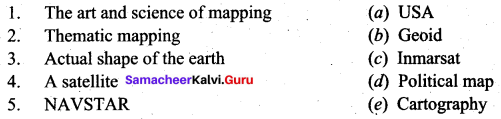
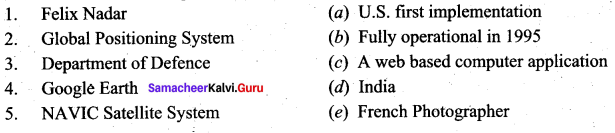
India Population Transport Communication And Trade Samacheer Kalvi 10th Social Science Geography Solutions Chapter 5
Answers:
1. (f)
2. (a)
3. (d)
4. (b)
5. (c)

III. Answer the following questions briefly.

Question 1.
What is Human Development?
Answer:
Dr Mahabub-ul-haq defined Human Development as “it is a process of enlarging the range of people’s choice, increasing their opportunities for education, health care, income and empowerment. It covers the full range of human choices from a sound physical environment to economic, social and political freedom”.

Question 2.
What is migration? State its types.
Answer:
It is the movement of people across regions and territories.

  1. Internal migration and
  2. International migration.

Question 3.
Write any four advantages of railways.
Answer:
Advantages of Railways:

  1. Cater to the needs of large scale movement of traffic for freight and passengers.
  2. Promotes trade, tourism, education etc.
  3. Promotes National integration by bringing people together.
  4. Facilitates the quick movement of perishable goods.

Question 4.
Write a note on Pipeline network transport in India.
Answer:
Pipelines are used for transporting crude oil, petroleum products and natural products and natural gas from oil fields to the refineries, factories and big thermal power plants. Pipelines are more reliable and considerably safer mode of transportation. The possibility of pilferage or product less on pipelines is almost negligible. The basic limitations of pipelines is that they are capital intensive mode of transportation.

Question 5.
State the major Inland waterways of India.
Answer:

  1. Ganga – Bhagirathi – Hoogly river system between Haldia and Allahabad.
  2. Stretch of the Brahmaputra river between Dhubri and Sadiya National Waterway.
  3. The waterway between Kollam and Kottapuram – the first national waterway.

Question 6.
What is communication? What are its types?
Answer:
Communication refers to exchange of ideas, messages, emotions, either written or oral, from one place to another.
Types of communications are :

  1. personal communication and
  2. mass communication.

Question 7.
Define “International trade”.
Answer:
Trade carried on between two or more countries is called “International trade”. It is also called as external trade or foreign trade. It has two components Exports and Imports.

Question 8.
State the merits of Roadways.
Answer:

  1. Cost of construction of roads is much lower.
  2. Provides door to door services thus the cost of loading and unloading is much lower.
  3. Used as feeder to other modes of transport to reach any destination be it railway station, sea port or airport, one need to travel through roads.

IV. Distinguish between.

Question 1.
The density of population and growth of population.
Answer:
Samacheer Kalvi 10th Social Science Geography Solutions Chapter 5 India: Population, Transport, Communication, And Trade

Question 2.
Personal communication and mass communication.
Answer:
10th Social India Map In Tamil Science Geography Solutions Chapter 5 India: Population, Transport, Communication, And Trade Samacheer Kalvi

Question 3.
Print Media and Electronic Media.
Answer:
10th Social India Outline Map Science Geography Solutions Chapter 5 India: Population, Transport, Communication, And Trade Samacheer Kalvi

Question 4.
Roadways and Railways.
Answer:
Samacheer Kalvi 10th Geography Book Social Science Solutions Chapter 5 India: Population, Transport, Communication, And Trade

Question 5.
Waterways Airways
Answer:
10th India Outline Map Samacheer Kalvi Social Science Geography Solutions Chapter 5 India: Population, Transport, Communication, And Trade

Question 6.
Internal trade and International trade.
Answer:
Samacheer Kalvi 10th Social Science Geography Solutions Chapter 5 India Population, Transport, Communication, and Trade 10

V. Answer the following in a paragraph.

Question 1.
What is urbanization? Explain its impacts.
Answer:
“The process of society’s transformation from rural to urban is known as urbanization”.

Impacts of Urbanization:

  1. Overcrowding in urban centres.
  2. It creates urban sprawl.
  3. It leads to the formation of slums.
  4. Shortage of houses in urban areas.
  5. It creates water scarcity in the cities.
  6. It creates drainage problem.
  7. It poses the problem of solid waste management.
  8. It increases traffic congestion in cities.
  9. It increases the rate of crime.

A rapid rate of urbanization in society is taken as an indicator of its economic development.

Question 2.
Explain the importances of satellite communication in India.
Answer:
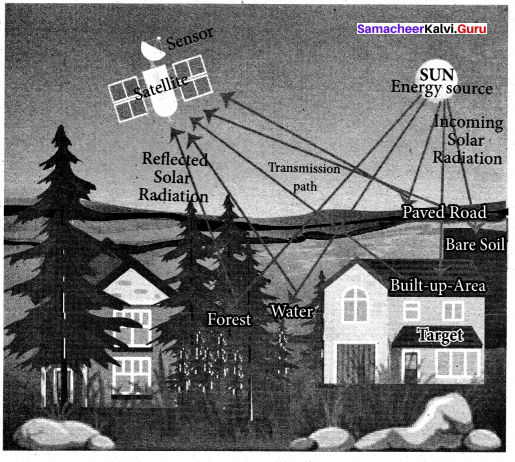
Satellite images are used for weather forecasting, monitory of natural calamities, surveillance of border areas etc. The communication through satellites emerged as a new era in communication in our country after the establishment of Indian Space Research Organization (ISRO) in 1969. Satellite systems in India can be grouped into two on the basis of two satellites namely “Indian National Satellite” (INSAT) and “Indian Remote Sensing Satellite” (IRS). These satellites collect data in several spectral band and transmit there to ground stations for various uses. The communication and remote sensing satellites INSAT and IRS have revolutionized India’s communication system. Metrological studies and natural resource management.

The National Remote Sensing Agency (NRSA) at Hyderabad provides facilities for acquisition of data and its processing. There is no doubt that India has irrefatably arrived as a space power in the world. The INSAT series are used for relaying signals to television, telephone, radio, mobile phone. It is also useful in weather detection, internet. The INSAT series GSAT series, GSAT series KALPANA -1, HAMSAT, EDUSAT are the major communication satellite used for communication purpose. GSAT – 7A is the recent launch for communication programs. INSAT – IB launched on 30th August, 1983 is the first communication satellite in INSAT series.

Question 3.
Bring out the distribution and density of population in India.
Answer:
The term “Population Distribution” refers to the way the people are spaced over the earth’s surface.

The distribution of population in India is unevenly distributed due to the vast variation in the availability of resources.

Factors that affect the distribution of population are: Terrain, climate, soil, water bodies, mineral resources, industries, transport and urbanization.

Areas of high concentration of population: Industrial centres and the areas of good agricultural lands.

Areas of thin population: high mountains, arid lands, thickly forested areas and some remote comers and some areas are even uninhabited.

Most populous states in India: Uttar Pradesh is the most populous state in India (199.5 million) followed by Maharashtra (112.3 million), Bihar (103.8 million) West Bengal (91.3 million) and the combined Andhra Pradesh (84.6 million).

Least populated State: Sikkim (0.61 million).

Union territory with high population: Delhi (16.75 million). Union territory with least population – Lakshadweep (64,073).

Question 4.
Explain the process of measuring Human Development.
Answer:
Dr. Mahabub – ul – Haq defined as “It is a process of enlarging the range of people’s choice, increasing their opportunities for education, health care, income and empowerment”. Human
Development Index (HDI) is a composite index focusing on three basic dimensions of human development.

  1. Health – life expectancy at birth,
  2. Education – expected years of schooling for school age children and average years of schooling for the adult population,
  3. Income – Measured by gross national income and per capita income.

Question 5.
Classify and explain the roadways in India.
Answer:
Roadways play an important role in carrying goods and passengers for short, medium and long distances. It is highly suitable for short-distance services.

For the purpose of construction and maintenance Roadways in India are classified into:

  1. National Highways (NH)
  2. State Highways (SH)
  3. District Roads
  4. Rural Roads (Village roads)
  5. Border Roads
  6. International Highways

National Highways:

  1. Ministry of Road Transport and Highways of India is responsible for the development and maintenance of the National Highways in India.
  2. These Highways are connecting capitals of states, major ports, rail junctions, industrial and tourist centres.
  3. The total length of the National Highways in India is 1,01,011 Km which accounts for 1.8% of total road network length in 2016.
  4. The longest National Highway NH-7 runs from Varanasi (U.R) to Kanyakumari (T.N) to a distance of 2369 km.
  5. The shortest National Highway is NH-47A, runs from Emakulum to Kochi port (Willington Island) covering a distance of 6 km.

State Highways:

  1. These roads are administered and financed by State Governments.
  2. These highways link important cities, towns and district headquarters within the state and connect them with national highways or highways of neighbouring states.
  3. State highways run to a length of 1,76,166 km as of 2016.

District Roads:

  1. District Roads are constructed and maintained by the Public Works Department of the states.
  2. District Roads provide connectivity between the district and taluk headquarters with the state highways and national highways.
  3. The total length of the road is 5,61,940 km in 2016.
  4. Rural Roads (Village Roads): They are maintained by village Panchayats.
  5. It links different villages with their neighbouring towns.
  6. Rural roads connectivity is a key component of Rural development.
  7. The total length of Rural roads in India is 39,35,337 km as of 2016.
  8. Rural roads consists of Panchayat roads, (Zilla Parishad, Panchayat Samiti, Gram Panchayat), roads of the Pradhan Mantri Gram Sadak Yojana (PMGSY) and those constructed by the State PWDs.

Border Roads:

  1. They are constructed and maintained by Border Roads Organization established in 1960 for the development of the roads of Northern and North Eastern border areas.
  2. These are the roads of strategic importance in border areas.
  3. The Border Road organization has constructed world’s highest road joining Chandigarh and Leh in Ladak (at an altitude 4,270 mt).
  4. Golden Quadrilateral: This project was launched in 1999.
  5. It connects India’s four metropolitan cities Delhi – Kolkata – Chennai Mumbai.
  6. It has 4/6 lanes and of 5,846 km long.
  7. North-South and East-West corridors: These two corridors intersect at Jhansi.
  8. North-South Corridor connects Srinagar in Jammu and Kashmir with Kaniyakumari in Tamil Nadu (4,076 km).
  9. The East-West corridor connects Silchar in Assam with port town of Porbandar in Gujarat (3,640 km).

Express ways: These are the multi lane good quality highways for high speed traffic. Eg: (a) Mumbai – Pune Road, (b) Delhi – Agra.

International Highways:

  1. These Highways have been constructed with an aid from World Bank under an agreement with the Economic and Social Commission for Asia-pacific (ESCAP).
  2. These roads link India with her neighbouring countries – Pakistan, Nepal, Bhutan, Bangladesh and Myanmar.

India has the second-longest road network in the world.

VI. On the outline map of India mark the following.

1. National Highway NH-7.
3. Major International Airports in India.
Samacheer Kalvi 10th Social Science Geography Solutions Chapter 5 India Population, Transport, Communication, and Trade 50

2. Major seaports in India.
4. Densely populated state of India.
5. State of highest literacy in India.
Samacheer Kalvi 10th Social Science Geography Solutions Chapter 5 India Population, Transport, Communication, and Trade 51

6. Railway zones of India
Samacheer Kalvi 10th Social Science Geography Solutions Chapter 5 India Population, Transport, Communication, and Trade 52
In-Text Hots Questions:

Question 1.
What could be the reason for uneven distribution of population in India?
Answer:
The uneven distribution of population in the country is the result of several factors such as physical, socio-economic and historical ones.

Physical factors: Relief, climate, water, natural, vegetation, mineral and energy resources.

Socio-economic factors: Religion, political issues economy, human settlements, transport network, industrialization, urbanization, employment opportunity etc.

Question 2.
What are the reasons for the rapid growth of population in India?
Answer:

  • Widening gap between birth and death rates.
  • Low age at marriage.
  • High illiteracy.
  • Religious attitudes towards family planning.

Question 3.
The sex ratio in our country is always unfavourable to females. Give reasons.
Answer:

  1. Attitude of the people: Prestige and pride in having male child made them to prefer a male child to a female child.
  2. Female infanticide: Even now in same places it is being done for fear of neglect by their family members if they give birth to a female child.
  3. Future marriage expenses on female child.
  4. Considered as weaker sex so will not be given opportunity to prove their ability suppressed by male domination.

Question 4.
Find out what are the functions of NHAI.
Answer:
The functions of National Highways Authority of India (NHAI) are:

  • To develop, maintain and manage the national highways and any other highways vested in, or entrusted to it by the Government.
  • Survey, develop, maintain and manage highways vested in, or entrusted to it.
  • Construct offices or workshops and establish and maintain hotels, motels, restaurants and rest-rooms at or near the highways vested in, or entrusted to it.
  • Construct residential buildings and townships for its Employees.
  • Regulate and control the plying of vehicles on the highways vested in or entrusted to it for the proper management thereof.
  • Provide such facilities and amenities for the users of the highways vested in, or entrusted to it as are in the opinion the Authority, necessary for the smooth flow of traffic on such highways.
  • Advise the Central Government on matters relating to highways.

Question 5.
What are the highlights and benefits of the Golden Quadrilateral Highways?
Answer:
The main objective of this project is connectivity, speed and safety.

Connectivity: Connects four major metropolitan cities enhances the movement of goods and people to the industrial areas enhances job development.
Access to hinterland of agricultural areas to market areas, ports for export needs.

Speed: Reduces the travel time.

Safety: Six lanes super highways meant for safety.

This project was launched in the year 1999. Implemented by National Highway Authority of India.

Encourages the private sector companies to invest, develop and maintain these highways.

Question 6.
Why is air travel preferred in the north eastern states?
Answer:

  • Due to mountains, rivers, etc. road journey becomes too long even for short distance.
  • So air travel is the most feasible option and the costs are also quite low due to subsidies by the government.
  • Most of the cities have regional active airports.
  • Air transport is preferred mainly in the North eastern states of India.

Question 7.
Find out the major trade blocks which are useful for multilateral trade.
Answer:
Major trade blocks useful for Multilateral trade.

EU: European Union

APEC: (Asian Pacific Economic Community) .

ASEAN: (Association of South East Asian Nations)

SAPTA: (South Asian Preferential Trade Agreement)

These trade blocks made the international trade easier. All member countries who signed the agreement are treated equally. These trade blocks remove the barriers and complications arose between nations in international trade.

Activity:

Question 1.
Prepare a seminar topic about “Role of Railways in Indian Economy”.
Answer:
Role of Railways in Indian Economy

  • Railways are the principle mode of transportation for freight and passengers in India.
  • Railways also make it possible to conduct multifarious activities like business, sight seeing, pilgrimage along with transportation of goods over longer distances.
  • Railways in India bind the economic life of the country as well as accelerate the development of industry and agriculture.
  • The distribution pattern of the railway netw ork in the country has been largely influenced by physiographic, economic and administrative factors.

Question 2.
Collect the names for different types of goods and differentiate it and make a table as perishable and non-perishable goods.
Answer:
Perishable goods are foods like fresh meat, seafood, and ripe fruits.
Non-perishable are items that do not spoil or decay.
Ex. Canned goods, all pasta types, sugar, flour, curls and chips if air-sealed.

Question 3.
Collect the countries names and make it as a table of Bilateral trade and multilateral trade countries.
Answer:
Samacheer Kalvi 10th Social Science Geography Solutions Chapter 5 India Population, Transport, Communication, and Trade 90

Find Out:

The important National Highways in India and label it on the outline map of India.

The important National Highways in India are:
NH-6- Hazira to Kolkata (via Nagpur, Raipur, Sambalpur and Dhule)
NH-7 -Varanasi to Kanyakumari (Nagpur, Bangaluru and Madurai
NH-8 – Delhi to Mumbai (Jaipur, Ahmedabad and Vadodara)
NH-9 – Pune to Machilipatnam and Hyderabad, Vijayawada

The important National Highways in India.
Samacheer Kalvi 10th Social Science Geography Solutions Chapter 5 India Population, Transport, Communication, and Trade 101

India: Population, Transport, Communication, and Trade Additional Questions

I. Choose the correct answer.

Question 1.
India is the ……. most populous country in the world.
(a) first
(b) second
(c) sixth
Answer:
(b) second

Question 2.
The …………………. is the least populous state.
(a) Assam
(b) Goa
(c) Sikkim
(d) Arunachal Pradesh
Answer:
(c) Sikkim

Question 3.
Postal service and telegraph are some of the ………. communication.
(a) personal
(b) professional
(c) mass
Answer:
(a) personal

Question 4.
In India the year of demographic divide registered negative growth rate is ………………….
(a) 1921
(b) 1931
(c) 1947
(d) 1950
Answer:
(a) 1921

Question 5.
The headquarters of the Northern Railways is ………
(a) Jabalpur
(b) Allahabad
(c) Guwahati
Answer:
(c) Guwahati

Question 6.
The National Highways Authority of India was established in:
(a) 1975
(b) 1985
(c) 1995
(d) 2005
Answer:
(c) 1995

Question 7.
The first railway line was laid between in 1853.
(a) Delhi and Kolkata
(b) Mumbai and Kolkata
(c) Mumbai and Thane
Answer:
(c) Mumbai and Thane

Question 8.
Indian Railways is organized into …………………. zones for operations and management.
(a) 15
(b) 20
(c) 16
(d) 19
Answer:
(c) 16

Question 9.
Trade blocs are created to make the ……. trade easier.
(a) Multilateral
(b) Bilateral
(c) Local
Answer:
(a) Multilateral

Question 10.
The …………………. is the fuel efficient and eco-friendly mode of transport.
(a) Roadways
(b) Railways
(c) Waterways
(d) Airways
Answer:
(c) Waterways

Question 11.
The headquarters of Indian Railways is ……..
(a) Mumbai
(b) New Delhi
(c) Nagpur
Answer:
(b) New Delhi

Question 12.
The …………………. are the most powerful means of print media.
(a) Radio
(b) Magazines
(c) Fax
(d) Newspapers
Answer:
(d) Newspapers

Question 13.
The highways connecting the four metropolitan cities – Chennai, Mumbai, Delhi and Kolkata.
(a) Six lanes super highways
(b) Expressways
(c) Border Roads
Answer:
(a) Six lanes super highways

Question 14.
Primitive method of trade was known as system.
(a) communication
(b) barter
(c) bilateral
(d) balanced
Answer:
(b) barter

Question 15.
Metro Rail transport in Chennai was introduced in …….
(a) 2015
(b) 2014
(c) 2005
Answer:
(a) 2015

Question 16.
Since 1957 All India Radio came to be called ……..
(a) Akshvani
(b) Sooriyan FM
(c) Vivith Bharathy
Answer:
(a) Akshvani

Question 17.
The Government of India merged all the Indian Airlines under ………
(a) TATA Airline
(b) National Aviation Corporation of India
(c) Airport Authority of India
Answer:
(b) National Aviation Corporation of India

Question 18.
Which mode of transportation reduces trans-shipment losses and delays.
(a) Railways
(b) Pipelines
(c) Roadways
Answer:
(b) Pipelines

Question 19.
Which of the following sates is not connected with the H.V.J. Pipeline?
(a) Madhya Pradesh
(b) Maharashtra
(c) Gujarat
Answer:
(b) Maharashtra

Question 20.
Which one of the following ports is the deepest land-locked and well protected port along the
east coast?
(a) Chennai
(b) Paradip
(c) Vishakhapatnam
Answer:
(c) Vishakhapatnam

Question 21.
Which one of the following terms is used to describe trade between two or more countries?
(a) Internal Trade
(b) International Trade
(c) Local Trade
Answer:
(b) International Trade

Question 22.
The National Highway No.l is also known as
(a) Mahatma Gandhi Marg
(b) Sher Shah Suri Marg
(c) Jawahar Lai Nehru Road
Answer:
(b) Sher Shah Suri Marg

Question 23.
Trade carried in cities, towns and villages is called
(a) External trade
(b) Local trade
(c) international trade
Answer:
(b) Local trade

Question 24.
The Indian National Highways are maintained by the department of …….
(a) State Public Works Department
(b) Zila Parishad
(c) Central Public Works Department
Answer:
(c) Central Public Works Department

Question 25.
Which one of the following organizations constructs Border roads in India?
(a) PWD
(b) CPWD
(c) NHAI
Answer:
(c) NHAI

Question 26.
World has become a global village due to which of the following?
(a) Transport and communication
(b) Engineering Industry
(c) International trade
Answer:
(a) Transport and communication

Question 27.
Border Roads Organization was established in
(a) 1950
(b) 1955
(c) 1960
Answer:
(c) 1960

Question 28.
The longest highways of India is
(a) National Highway – 8
(b) National Highway – 7
(c) National Highway – 1
Answer:
(b) National Highway – 7

Question 29.
Delhi and Mumbai are connected by …..
(a) National Highway – 1
(b) National Highway – 15
(c) National Highway – 8
Answer:
(c) National Highway – 8

Question 30.
Which Port is the major iron ore exporting port of the country?
(a) Mumbai Port
(b) Marmagoa
(c) Kandala Port
Answer:
(b) Marmagoa

Question 31.
The biggest port is …….
(a) Mumbai Port
(b) Marmagoa Port
(c) Kandala Port
Answer:
(a) Mumbai Port

Question 32.
The extreme south – western port is …….
(a) Tuticorin Port
(b) Kochi Port
(c) New Mangalore Port
Answer:
(b) Kochi Port

II. Fill in the blanks.

1. Our National Integration is strengthened by the ……
2. …… have been replaced by more powerful diesel or electric engines.
3. There are ……… major ports located on the coast line of India.
4. Crude oil, petroleum and natural gas are transported by ……….
5. The largest terrestrial network of the world is ……….
6. The latest means of communication is ………
7. The multi purpose satellite system for telecommunication is …… – INSAT
8. The roadways are able to connect most of the ……… villages.
9. It is easier to construct and maintain ………..
10. National highways are maintained by ……… Government.
11. Indian railways system is the ……… in Asia.
12. Under transport the ….. forms the lifeline of the country.
13. The city ……. is the focal point from where railway lines radiate in all directions.
14. River Ganga is navigable upto …….
15. This world has been shrunk since the introduction of ……..
Answers:
1. Railways
2. Steam Engines
3. 13
4. pipelines
5. Doordharshan
6. Satellite
7. Indian National Satellite
8. remote
9. roadways
10. Central
11. largest
12. Railways
13. Delhi
14. Varanasi
15. Internet

III. Match the following.

Samacheer Kalvi 10th Social Science Geography Solutions Chapter 5 India Population, Transport, Communication, and Trade 80
Answers:
(1 – c)
(2 – d)
(3 – a)
(4 – e)
(5 – b)

Samacheer Kalvi 10th Social Science Geography Solutions Chapter 5 India Population, Transport, Communication, and Trade 81
Answers:
(1 – d)
(2 – a)
(3 – e)
(4 – c)
(5 – b)

Samacheer Kalvi 10th Social Science Geography Solutions Chapter 5 India Population, Transport, Communication, and Trade 82
Answers:
(1 – e)
(2 – c)
(3 – a)
(4 – b)
(5 – d)

Samacheer Kalvi 10th Social Science Geography Solutions Chapter 5 India Population, Transport, Communication, and Trade 83
Answers:
(1 – d)
(2 – c)
(3 – e)
(4 – b)
(5 – a)

IV. Answer in one word.

Question 1.
What provides information regarding the population of our country?
Answer:
The Census of India.

Question 2.
When was the first Census held in India?
Answer:
1872

Question 3.
When was the first complete census taken?
Answer:
1881

Question 4.
After how many years Census is held in India?
Answer:
Census is held regularly after every tenth year.

Question 5.
Which is the most comprehensive source of demographic, social and economic data in India?
Answer:
Indian Census

Question 6.
What is the population of India according to 2001 and 2011 Census?
Answer:
India’s population size as on March 2001 stood at 1,028 million and in 2011 is 1,210 million.

Question 7.
Which is the most populous state of India?
Answer:
Uttar Pradesh

Question 8.
Which is the least populated state of India?
Answer:
Sikkim

Question 9.
Which is the least populated region of India?
Answer;
Lakshadweep

Question 10.
Name the five most populated states in India.
Answer:

  1. Uttar Pradesh,
  2. Maharashtra,
  3. Bihar,
  4. West Bengal and
  5. Andhra Pradesh.

Question 11.
Define population density.
Answer
It is calculated as the number of persons per unit area.

Question 12.
Which is the least densely populated state of India?
Answer:
Andhra Pradesh with 17 persons per sq.km.

Question 13.
Name the three main processes of change of population.
Answer:
Birth rates, death rates and migration.

Question 14.
Which two countries have a higher average population density than India?
Answer:
Bangladesh and Japan.

Question 15.
What are various types of migration?
Answer:
Internal migration and International migration.

Question 16.
Define age structure.
Answer:
It refers to the number of people in different age groups in a country.

Question 17.
Define sex ratio.
Answer:
Sex ratio is defined as the number of females per 1000 males in the popultion.

Question 18.
Is sex ratio balanced in India?
Answer:
No

Question 19.
Which regions of India has the highest and lowest sex ratio as per Census 2011?
Answer:
Kerala has a sex ratio of 1084 females per 1000 males, Delhi has only 866 females per 1000 males.

Question 20.
Who is a literate?
Answer:
A person aged 7 years and above who can read and write with understanding in any language is treated as literate.

V. Distinguish between.

Question 1.
National Highways and State Highways.
Answer:
Samacheer Kalvi 10th Social Science Geography Solutions Chapter 5 India Population, Transport, Communication, and Trade 30

Question 2.
Exports and Imports.
Answer:
Samacheer Kalvi 10th Social Science Geography Solutions Chapter 5 India Population, Transport, Communication, and Trade 31

Question 3.
Village Roads and District Roads.
Answer:
Samacheer Kalvi 10th Social Science Geography Solutions Chapter 5 India Population, Transport, Communication, and Trade 38

Question 4.
Bilateral Trade and Multilateral Trade
Answer:
Samacheer Kalvi 10th Social Science Geography Solutions Chapter 5 India Population, Transport, Communication, and Trade 32

Question 5.
Birth Rate and Death Rate
Answer:
Samacheer Kalvi 10th Social Science Geography Solutions Chapter 5 India Population, Transport, Communication, and Trade 33

Question 6.
Favourable balance of trade and Unfavaourable balance of Trade
Answer:
Samacheer Kalvi 10th Social Science Geography Solutions Chapter 5 India Population, Transport, Communication, and Trade 34

VI. Answer the following questions briefly.

Question 1.
What is the position of Indian population in the World?
Answer:

  1. India is the second most populous country in the world.
  2. It is the home of 17.5% of world’s population.
  3. One out of every six persons in the w orld is from India.
  4. Our population is almost equal to the combined population of USA, Indonesia, Brazil, Pakistan, Bangladesh and Japan.

Question 2.
How is the population of India grouped?
Answer:
The population of a nation is generally grouped into three broad categories.

  1. Children (below 15 years): They are economically unproductive and need to be provided with food, clothing, education and medical care.
  2. Working Age (15-59 years): They are economically productive and biologically reproductive. They comprise the working population.
  3. Aged (above 59 years): They can be economically productive though they may have retired.

Question 3.
What does the term “population change” refer to?
Answer:
The term “population change” refers to an increase or decrease of population of an area from one period to another period.

Question 4.
Name the three major superhighway project.
Answer:

  1. Golden Quadrilateral Super Highways: It links Delhi – Kolkata – Chennai – Mumbai and Delhi by six lane Super Highways.
  2. North – South Corridor: Linking Srinagar (Jammu and Kashmir) and Kanyakumari (Tamil Nadu).
  3. East-West Corridor: Linking Silcher (Assam) and Porbandar (Gujarat). The major objective of these Super Highways is to reduce the time and distance between the mega cities of India.

Question 5.
Name the three major means of transport in the world?
Answer:
The three major means of transport in the world are:

  1. Land transport: Roadways, Railways and pipelines.
  2. Waterways: Inland waterways and ocean routes
  3. Air transport: Domestic airways and International airways.

Question 6.
What is trade? What are the types of ti;ade?
Answer:

  1. Trade is an act or process of buying, selling or exchanging goods and services.
  2. Types of trades are
    • Internal trade
    • International trade.

Question 7.
Write about the merits of air transport.
Answer:
Airways are the quickest, costliest most modem and comfortable means of transport.

  1. Facilitates connectivity on a regional, national and international scale.
  2. Made accessibility by connecting difficult terrains like high mountains and deserts.
  3. It carries passengers, freight and mail.
  4. Air transport plays a key role in times of emergency, during the time of natural and man made calamities like floods, epidemics and wars.

Question 8.
What are the merits of pipeline transport?
Answer:

  1. It can be laid through difficult terrain as well as under water.
  2. Initial cost of laying pipelines is high but subsequent cost for maintenance and operation is low.
  3. It ensures steady supply and minimizes transhipment losses and delays.
  4. Pipeline operation involves very low consumption of energy.

Question 9.
What are the different kinds of mail services introduced by Department of posts?
Answer:

  1. Cards and envelopes are considered first-class mail and airlifted between ‘ stations both land and air.
  2. The second class mail includes-book packets, registered newspapers and periodicals, carried by surface mail covering land and water transport.
  3. Recently six mail channels have been introduced to facilitate quick delivery of mails in large towns and cities. They are Rajdhani channel, Metro Channel, Green Channel, Business Channel, Bulk mail Channel

Question 10.
Explain MRTS (Metro Rail System).
Answer:

  1. The Mass Rapid Transit System is an elevated line of the suburban railways in Chennai.
  2. This Railway is administrated by the state owned Southern Railway.
  3. This railway line currently runs from Chennai beach to Velachery covering 17 stations for a distance of 25 km.

Question 11.
What do you mean by Foreign Exchange?
Answer:
Foreign Exchange is the mechanism or process by which payments between any two places operating under different national currency systems are effected without passing of actual money or gold etc.

Question 12.
What are the four ship building yards in India?
Answer:

  1. Hindustan Shipyard at Vishakhapatnam.
  2. Garden reach workshop at Kolkata.
  3. Mazagaon Dock at Mumbai.
  4. Kochin Ship Yard and Kochi.

Question 13.
Define the term Dependency Ratio.
Answer:
The ratio between the economically active and economically inactive of population is termed as Dependency Ratio.

VII. Answer in a paragraph:

Question 1.
Define population. Why there is a need to study population?
Answer:

  1. The total number of people residing in a country at a specified period of time is called “population” of that country. The study of population is known as Demography.
  2. The human population has many components but the most fundamental are its numbers, composition, distribution and density. The study on these aspects also would reveal the work force of the country.
  3. Population census of India provides the detailed information about the demography of India.

Question 2.
Name the major National Waterways of our country.
Answer:

  1. The Ganga river between Allahabad and Haldia (1620 km). National Waterways No. 1
  2. The Brahmaputra river between Sadiya and Dhubri (891 km) – National Waterways No.2
  3. The West Coast Canal in Kerala (Kottapuram – Komman – Udyogmandal and Champakkara Canals – 205 km) – National Waterways No.3
  4. Specified stretches of Godavari and Krishna rivers along with Kakinada Puducherry Stretch of canals (1078 km) – National Waterways No.4 (v) Specified stretches of river Brahmani along with Matai river, delta channels of Mahanadi and Brahmani rivers and East Coast Canal (588 km) – National Waterways No.5.

There are some other inland waterways on which substantial transportation taken place. These are Mandavi, Zuari and cumberjua, Sundarbans, Barak, backwaters of Kerala and tidal stretches of some other rivers.

Question 3.
Explain about the population composition.
Answer:
Population composition refers to characteristics such as age, sex, marital status, caste, language, education, occupation etc.

The study of composition of population helps us to understand the Social, economic and demographic structure of population.

Age Composition: Population of a county is generally grouped into three broad categories.

  1. Children less than 15 years of age (29.5%)
  2. The people above 60years (8%)
  3. These two categories falls under dependent population (37,5%)
  4. Independent population 16 – 59 years (62.5%)

It shows that our country has enormous man power i.e., working force.

Sex Ratio: Sex ratio is defined as the number of females per 1000 male population.

This is an important social indicator to measure the extent of equality between males and females in a society at a given rime.

According to 2011 census the sex ratio of the country is 940 females per 1000 males.

Literacy Rate: It is an important indicator of quality of people.

The people who are able to read and write are known as literates. The percentage of literate people to the total population is termed as literacy rate.

As per 2011 India’s literacy rate is 74.04%.

Occupational Structure: The economically active part of a country’s population are termed as workers.

They are placed under three categories as main workers, marginal workers and non workers.

Main workers are those who worked for the major part of the preceding year at least 6 months or 183 days.

Who worked less than six months are marginal.

People who have not worked at all comes under non workers.

In India as per 2011 census 75.23% are main workers and 24.77% of the people belong to marginal workers.

Question 4.
What are the means of transportation and communication called the lifelines of a nation and its economy?
Answer:
The development of a country depends upon the production of goods and services as well as their movement to their destination. Transport plays an important role in the economy. Because of transport raw materials reach to the factory or industry, and finally finished products reach to the consumer. It has helped in both production and distribution of goods. Hence, all efficient means of transport are prerequisites for fast development.

India is well – linked with the rest of the world despite its vast size, diversity and linguistic and socio-cultural plurality. Railways, airways, waterways, newspapers, radio, television, cinema and internet etc., have been contributing to its socio-economic progress in many ways. The trades from local to international levels have added to the vitality of its economy. It has also enriched our life and added substantially to growing amenities and facilities for the comforts of life. Hence, it is right to say that means of transportation and communication are the lifelines of a nation and its economy.

We think the data given here clarify all your queries of Chapter 5 and make you feel confident to attempt all questions in the examination. So, practice more & more from Tamilnadu State Board solutions for 10th Social Science Geography Chapter 5 India: Population, Transport, Communication, and Trade Questions and Answers & score well. Need any information regarding this then ask us through comments & we’ll give the best possible answers very soon.

Samacheer Kalvi 9th Maths Solutions Chapter 1 Set Language Ex 1.1

You can Download Samacheer Kalvi 9th Maths Book Solutions Guide Pdf, Tamilnadu State Board help you to revise the complete Syllabus and score more marks in your examinations.

Tamilnadu Samacheer Kalvi 9th Maths Solutions Chapter 1 Set Language Ex 1.1

Set Language Maths 9th Class Question 1.
Which of the following are sets?
(i) The Collection of prime numbers upto 100.
(ii) The Collection of rich people in India.
(iii) The Collection of all rivers in India.
(iv) The Collection of good Hockey players.
Solution:
(i) A = {2, 3, 5, 7,11, 13,17,19, 23, 29, 31, 37, 41, 43, 47, 53, 59, 61, 67, 71, 73, 79, 83, 89 and 97}
As the collection of prime numbers upto 100 is known and can be counted (well defined). Hence this is a set.
(ii) The collection of rich people in India. Rich people has no definition.
Hence, it is not a set.
(iii) A = {Cauvery, Sindhu, Ganga, }
Hence, it is a set.
(iv) The collection of good hockey players is not a well – defined collection because the criteria for determining a hockey player’s talent may vary from person to person.
Hence, this collection is not a set.

9th Maths Set Language Exercise 1.1 Question 2.
Listthe set of letters of the following words in Roster form.
(i) INDIA
(ii) PARALLELOGRAM
(iii) MISSISSIPPI
(iv) CZECHOSLOVAKIA
Solution:
(i) A = {I, N, D, A}
(ii) B = {P, A, R, L, E, O, G, M}
(iii) C = {M, I, S, P}
(iv) D = {C, Z, E, H, O, S, L, V, A, K, I}.

9th Maths Exercise 1.1 In Tamil Question 3.
Consider the following sets A = {0, 3, 5, 8} B = {2, 4, 6, 10} C = {12, 14, 18, 20}
(a) State whether True or false.
(i) 18 ∈ C
(ii) 6 ∉A
(iii) 14 ∉ C
(iv) 10 ∈ B
(v) 5 ∈ B
(vi) 0 ∈ B

(b) Fill in the blanks?
(i) 3 ∈ ___
(ii) 14 e ___
(iii) 18 ___ B
(iv) 4 ___ B
Solution:
(a) (i) True
(ii) True
(iii) False
(iv) True
(v) False
(vi) False,

(b) (i) A
(ii) C
(iii) ∉
(iv) ∈

9th Maths Exercise 1.1 Question 4.
Represent the following sets in Roster form.
(i) A = The set of all even natural numbers less than 20.
(ii) B = {y : y = \(\frac{1}{2 n}\), n ∈ N, n ≤ 5}
(iii) C = (x : x is perfect cube, 27 < x < 216}
(iv) D = {x : x ∈ Z, -5 < x ≤ 2}
Solution:
(i) A= {2,4, 6, 8,10, 12, 14,16, 18}
(ii) N = { 1, 2, 3, 4, 5}
Set Language Maths 9th Class Chapter 1 Samacheer Kalvi Ex 1.1
(iii) C = {64, 125}
(iv) D = {-4,-3, -2, -1,0, 1, 2}

9th Maths Set Language Exercise 1.1 Solutions Question 5.
Represent the following sets in set builder form.
(i) B = The set of all Cricket players in India who scored double centuries in One Day Internationals.
(ii) C = { \(\frac{1}{2}, \frac{2}{3}, \frac{3}{4} \ldots . .\)}.
(iii) D = The set of all tamil months in a year.
(iv) E = The set of odd Whole numbers less than 9.
Solution:
(i) B = {x : x is an Indian player who scored double centuries in one day internationals}
(ii) C = {x : x = \(\frac{n}{n+1}\), n ∈ N}
(iii) D = {x : x is a tamil month in a year}
(iv) E = {x : x is odd number, x ∈ W, x < 9, where W is the set of whole numbers}.

Class 9 Maths Chapter 1 Set Language Question 6.
Represent the following sets in descriptive form.
(i) P = {January, June, July}
(ii) Q = {7, 11, 13, 17, 19, 23, 29}
(iii) R= {x : x ∈ N,x< 5}
(iv) S = {x : x is a consonant in English alphabets}
Solution:
(i) P is the set of English Months begining with J.
(ii) Q is the set of all prime numbers between 5 and 31.
(iii) R is the set of all natural numbers less than 5.
(iv) S is the set of all English consonants.

Samacheer Kalvi 10th Maths Solutions Chapter 2 Numbers and Sequences Ex 2.8

You can Download Samacheer Kalvi 10th Maths Book Solutions Guide Pdf, Tamilnadu State Board help you to revise the complete Syllabus and score more marks in your examinations.

Tamilnadu Samacheer Kalvi 10th Maths Solutions Chapter 2 Numbers and Sequences Ex 2.8

10th Maths Exercise 2.8 Question 1.
Find the sum of first n terms of the G.P.
(i) 5, -3, \(\frac { 9 }{ 5 } \), – \(\frac { 27 }{ 25 } \), ……….
(ii) 256, 64, 16, ……..
Solution:
(i) 5, -3, \(\frac { 9 }{ 5 } \), \(\frac { -27 }{ 25 } \), ………
10th Maths Exercise 2.8 Solutions Chapter 2 Numbers And Sequences Samacheer Kalvi
(ii) 256, 64, 16,…….
a = 256
Ex 2.8 Class 10 Samacheer Kalvi Maths Solutions Chapter 2 Numbers And Sequences

Ex 2.8 Class 10 Samacheer Question 2.
Find the sum of first six terms of the G.P. 5, 15, 45, …
Solution:
G.P.= 5, 15, 45, 15
Exercise 2.8 Class 10 Maths Solution Samacheer Kalvi Chapter 2 Numbers And Sequences

Exercise 2.8 Class 10 Maths Solution Question 3.
Find the first term of the GP. whose common ratio 5 and whose sum to first 6 terms is 46872.
Solution:
Common ratio, r = 5
S6 = 46872
10th Maths Exercise 2.8 Samacheer Kalvi Chapter 2 Numbers And Sequences

10th Maths Exercise 2.8 Samacheer Kalvi Question 4.
Find the sum to infinity of (i) 9 + 3 + 1 + ….
(ii) 21 + 14 + \(\frac { 28 }{ 3 } \) + ….
Solution:
(i) 9 + 3 + 1 + ….
Exercise 2.8 Class 10 Maths Solutions Chapter 2 Numbers And Sequences Samacheer Kalvi
(ii) 21 + 14 + \(\frac { 28 }{ 3 } \) + ….
2.8 Maths Class 10 Solutions Chapter 2 Numbers And Sequences Samacheer Kalvi

Exercise 2.8 Class 10 Maths Question 5.
If the first term of an infinite G.P. is 8 and its sum to infinity is \(\frac { 32 }{ 3 } \) then find the common ratio.
Solution:
a = 8
2.8 Exercise Class 10 Maths Solutions Chapter 2 Numbers And Sequences Samacheer Kalvi

2.8 Maths Class 10 Question 6.
Find the sum to n terms of the series
(i) 0.4 + 0.44 + 0.444 +…. to n terms
(ii) 3 + 33 + 333 + …. to n terms
Solution:
(i) 0.4 + 0.44 + 0.444 + … to n terms
= 4 (0.1 + 0.11 + 0.111 + … to n terms)
= \(\frac { 4 }{ 9 } \) (0.9 + 0.99 + 0.999 + … to n terms)
= \(\frac { 4 }{ 9 } \) (1 -0.1) + (1 – 0.01) +(1 – 0.001) + … n terms)
Ex 2.8 Class 10 Maths Solutions Chapter 2 Numbers And Sequences Samacheer Kalvi

(ii) 3 + 33 + 333 + … to n terms.
= 3 (1 + 11 + 111 + …….. to n terms)
= \(\frac { 3 }{ 9 } \) (9 + 99 + 999 +… to n terms)
\(\frac { 1 }{ 3 } \) = [(10 – 1) + (100 – 1) + (1000 – 1) + … to n terms]
= \(\frac { 1 }{ 3 } \) [(10 + 100 + 1000 + .. ) + (-1)n]
Class 10 Maths Exercise 2.8 Solutions Chapter 2 Numbers And Sequences Samacheer Kalvi

2.8 Exercise Class 10 Question 7.
Find the sum of the Geometric series
3 + 6 + 12 + …… + 1536.
Solution:
3 + 6 + 12 + …… + 1536
Here a = 3
Exercise 2.8 Class 10 Maths Solutions Chapter 2 Numbers And Sequences Samacheer Kalvi

Ex 2.8 Class 10 Question 8.
Kumar writes a letter to four of his friends. He asks each one of them to copy the letter and mail to four different persons with the instruction that they continue the process similarly. Assuming that the process is unaltered and it costs ₹2 to mail one letter, find the amount spent on postage when 8th set of letters is mailed.
Maths Exercise 2.8 Class 10 Solutions Chapter 2 Numbers And Sequences Samacheer Kalvi
Solution:
Kumar (1) 2 × 4
Cost of posting 1st set of Letters.
Cost of posting 2nd set of letters
Matric Maths Exercise 2.8 Solution Chapter 2 Numbers And Sequences Samacheer Kalvi
Amount spent
[a + ar + ar2 +… arn-1]
= 4 [2 + 2 × 4 + 2 × 42 ÷ + 2 × 47]
= 4 [Sn] Here n = 8, r = 4
It is a G.P
Maths Ex 2.8 Class 10 Solutions Chapter 2 Numbers And Sequences Samacheer Kalvi
∴ Cost of postage after posting 8th set of letters
= 4 × 43690 = ₹ 174760

Class 10 Maths Exercise 2.8 Solutions Question 9.
Find the rational form of the number 0.\(\overline{123}\)
Solution:
Let x = 0.123123123 ………. ⇒ x = 0.\(\overline{123}\) …..(1)
Multiplying 1000 on both rides
1000 x = 123.123123… ⇒ 1000x = 123.\(\overline{123}\) …..(2)
(2) – (1) = 1000x – x 123.\(\overline{123}\) – 0.\(\overline{123}\).
⇒ 999 x = 123
⇒ x = \(\frac { 123 }{ 999 } \)
⇒ x = \(\frac { 41 }{ 333 } \) Rational number

Exercise 2.8 Class 10 Question 10.
If Sn = (x + y)+(x2 + xy + y2) + (x3 + x2y + xy2 + y3) + …n terms then prove that (x – y)
10th Maths Sum Solutions Chapter 2 Numbers And Sequences Ex 2.8 Samacheer Kalvi
Solution:
Sn = (x + y) + (x2 + xy + y2) + (x3 + x2y + xy2 + y3) + …n terms
⇒ x. Sn = (x + y)x + (x2 + xy + y2)x + (x3 + x2y + xy2 + y3) x + ….
⇒ x. Sn = x2 +xy + x3 + x2y + y2x + x4 + x3y
+ x2 y2 + y3 x +…… ….(1)
Multiplying ‘y’ on both sides,
= y.Sn = (x + y)y + (x2 + xy + y2) y+
(x3 + x2y + xy2 + y3) y + ….
= y.Sn = xy + y2 + x2y + xy2 + y3 + x3y
+ x3y + x2y2 + xy3 + y4 + ……….
(1) – (2) ⇒
10th Maths Sums Solutions Chapter 2 Numbers And Sequences Ex 2.8 Samacheer Kalvi

Samacheer Kalvi 10th Maths Solutions Chapter 3 Algebra Ex 3.11

You can Download Samacheer Kalvi 10th Maths Book Solutions Guide Pdf, Tamilnadu State Board help you to revise the complete Syllabus and score more marks in your examinations.

Tamilnadu Samacheer Kalvi 10th Maths Solutions Chapter 3 Algebra Ex 3.11

10th Maths Exercise 3.11 Samacheer Kalvi Question 1.
Solve the following quadratic equations by completing the square method
(i) 9x2 – 12x + 4 = 0
(ii) \(\frac{5 x+7}{x-1}\) = 3x + 2
Solution:
10th Maths Exercise 3.11 Samacheer Kalvi Chapter 3 Algebra
Ex 3.11 Class 10 Samacheer Kalvi Maths Solutions Chapter 3 Algebra

Ex 3.11 Class 10 Samacheer Question 2.
Solve the following quadratic equations by formula method
(i) 2x2 – 5x + 2 = 0
(ii) \(\sqrt{2} f^{2}\) – 6f + \(3 \sqrt{2}\)
(iii) 3y2 – 20y – 3 = 0
(iv) 36y2 – 12 ay + (a2 – b2) = 0
Solution:
(i) 2x2 – 5x + 2 = 0
The formula for finding roots of a quadratic equation ax2 + bx + c = 0 is
Exercise 3.11 Class 10 Samacheer Kalvi Maths Solutions Chapter 3 Algebra
10th Maths Exercise 3.11 Solutions Chapter 3 Algebra Samacheer Kalvi
10th Maths Exercise 3.11 1st Sum Chapter 3 Algebra Samacheer Kalvi

Exercise 3.11 Class 10 Samacheer Question 3.
A ball rolls down a slope and travels a distance d = t2 – 0.75t feet in t seconds. Find the time when the distance travelled by the ball is 11.25 feet.
Solution:
Distance d = t2 – 0.75 t,
Given that d = 11.25 = t2 – 0.75 t.
t2 – 0.75t – 11.25 = 0
Exercise 3.11 Samacheer Kalvi 10th Maths Solutions Chapter 3 Algebra

Samacheer Kalvi 6th Maths Solutions Term 2 Chapter 2 Measurements Ex 2.2

You can Download Samacheer Kalvi 6th Maths Book Solutions Guide Pdf, Tamilnadu State Board help you to revise the complete Syllabus and score more marks in your examinations.

Tamilnadu Samacheer Kalvi 6th Maths Solutions Term 2 Chapter 2 Measurements Ex 2.2

Samacheer Kalvi 6th Maths Book Solutions Term 2 Question 1.
Say the time in two ways:
Samacheer Kalvi 6th Maths Book Solutions Term 2 Chapter 2 Measurements Ex 2.2
Solution:
(i) 10 : 15 hours; quarter past 10; 45 minutes to 11
(ii) 6 : 45 hours; quarter to 7; 45 minutes past 6
(iii) 4 : 10 hours; 10 minutes past 4; 50 minutes to 5
(iv) 3 : 30 hours; half-past 3; 30 minutes to 4
(v) 9 : 40 hours; 20 minutes to 10; 40 minutes past 9.

Samacheer Kalvi 6th Maths Term 2 Question 2.
Match the following:
(i) 9.55 – (a) 20 minutes past 2
(ii) 11.50 – (b) quarter past 4
(iii) 4.15 – (c) quarter to 8
(iv) 7.45 – (d) 5 minutes to 10
(v) 2.20 – (e) 10 minutes to 1?
Solution:
(i) 9.55 – (d) 5 minutes to 10
(ii) 11.50 – (e) 10 minutes to 12
(iii) 4.15 – (b) quarter past 4
(iv) 7.45 – (c) quarter to 8
(v) 2.20 – (a) 20 minutes past 2

6th Maths Guide Term 2 Question 3.
Convert the following :
(i) 20 minutes into seconds
(ii) 5 hours 35 minutes 40 seconds into seconds
(iii) 3\(\frac { 1 }{ 2 }\) hours into minutes
(iv) 580 minutes into hours
(v) 25200 seconds into hours
Solution:
(i) 20 minutes into seconds
20 minutes = 20 × 60 seconds = 1200 seconds
(ii) 5 hours 35 minutes 40 seconds into seconds
Samacheer Kalvi 6th Maths Term 2 Chapter 2 Measurements Ex 2.2
∴ 5 hours 35 minutes 40 seconds = 20,140 seconds
(iii) 3\(\frac { 1 }{ 2 }\) hours into minutes
3\(\frac { 1 }{ 2 }\) hours = 3 hours 30 minutes
= 3 × 60 minutes + 30 minutes
= 180 minutes + 30 minutes
= 210 minutes
∴ 3\(\frac { 1 }{ 2 }\) hours = 210 minutes
(iv) 5580 minutes into hours
580 minutes = \(\frac{580}{60}\) hours = 9 hours 40 minutes
∴ 580 minutes = 9 hours 40 minutes
(v) 25200 seconds into hours
25200 seconds = \(\frac{25200}{60}\) minutes = 420 minutes = \(\frac{420}{60}\) hours = 7 hours
∴ 25200 seconds = 7 hours

Samacheer Kalvi Term 2 Question 4.
The duration of electricity consumed by the farmer for his pumpset on Monday and Tuesday was 7 hours 20 minutes 35 seconds and 3 hours 44 minutes 50 seconds respectively. Find the total duration of consumption of electricity.
Solution:
Total duration of electricity consumed on both the days
= 7 hours 20 min 35 sec + 3 hours 44 min 50 sec
= (7 + 3) hours (20 + 44) min (35 + 50) sec
= 10 hours 64 min 85 seconds
= 11 hours 5 min 25 seconds

Samacheer Kalvi 6th Maths Book Solutions Question 5.
Subtract 10 hrs 20 min 35 sec from 12 hrs 18 min 40 sec.
Solution:
6th Maths Guide Term 2 Chapter 2 Measurements Ex 2.2 Samacheer Kalvi
1 hour 58 minutes 05 seconds

6th Standard Maths Exercise 2.2 Question 6.
Change the following into 12 hour format:
(i) 02 : 00 hours
(ii) 08 : 45 hours
(iii) 21 : 10 hours
(iv) 11 : 20 hours
(v) 00 : 00 hours
Solution:
Samacheer Kalvi Term 2 6th Maths Solutions Chapter 2 Measurements Ex 2.2

Term 2 Samacheer Kalvi Question 7.
Change the following into 24 hour format.
(i) 3.15 a.m.
(ii) 12.35 p.m.
(iii) 12.00 noon
(iv) 12.00 midnight.
Solution:
Samacheer Kalvi 6th Maths Book Solutions Term 2 Chapter 2 Measurements Ex 2.2

Samacheer Kalvi 6th Maths Guide Term 2 Question 8.
Calculate the duration of time.
(i) from 5.30 a.m to 12.40 p.m
(ii) from 1.30 p.m to 10.25 p.m
(iii) from 20:00 hours to 4:00 hours
(iv) from 17:00 hours to 5 :15 hours
Solution:
(i) from 5.30 a.m. to 12 .40 p.m.
Duration of time from 5.30 a.m. to noon = 12 : 00 – 5 : 30 = 6 : 30 i.e 6 hours 30 minutes
From noon to 12.40 p.m the duration = 00 hours 40 minutes
Total duration = 6 hours 30 minutes + 00 hours 40 minutes
= 6 hours 70 minutes
= 6 hours + (60 + 10) minutes
= 6 hours + 1 hr 10 minutes
= 7 hours 10 minutes
∴ Duration of time from 5.30 am to 12.40 pm = 7 hours 10 minutes
(ii) from 1.30 pm to 10.25 p.m.
6th Standard Maths Exercise 2.2 Term 2 Chapter 2 Measurements Samacheer Kalvi
(iii) from 20 : 00 hrs to 4 : 00 hrs.
Term 2 Samacheer Kalvi 6th Maths Solutions Chapter 2 Measurements Ex 2.2
(iv) from 17 : 00 hours to 5 : 15 hours.
Samacheer Kalvi 6th Maths Guide Term 2 Chapter 2 Measurements Ex 2.2

Samacheer Kalvi 6th Maths Question 9.
The departure and arrival timing of the Vaigai Superfast Express (No. 12635) from Chennai Egmore to Madurai Junction are given. Read the details and answer the following.
Samacheer Kalvi 6th Maths Solutions Term 2 Chapter 2 Measurements Ex 2.2
(i) At what time does the Vaigai Express start from Chennai and arrive at Madurai?
(ii) How many halts are between there Chennai and Madurai?
(iii) How long does the train halt at the Villupuram junction?
(iv) At what time does the train come to Sholavandan?
(v) Find the journey time from Chennai Egmore to Madurai?
Solution:
(i) It starts from Chennai at 13 : 40 hrs and arrive at Madurai at 21 : 20 hrs.
(ii) There are 8 halts.
(iii) Departure from Villupuram = 15 hours 55 minutes
Arrival at Villupuram = 15 hours 50 minutes
The train halt at Villupuram for = 05 minutes
(iv) At 20 : 34 hours the train come to Sholavandan
(v) Arrival time at Madurai = 20 hours 80 (20 + 60) minutes
Departure time from Chennai Egmore = 13 hours 40 minutes
Journey Time = 07 hours 40 minutes

Samacheer Kalvi 6th Standard Maths Question 10.
Manickam joined a chess class on 20.02.2017 and due to exam, he left practice after 20 days. Again he continued practice from 10.07.2017 to 31.03.2018. Calculate how many days did he practice?
Solution:
From the date of joining = 20 days From 10.07.2017 to 31.03.2018
July – 22
Aug – 31
Sep – 30
Oct – 31
Nov – 30
Dec – 31
Jan – 31
Feb – 28
Mar – 31
Total – 265
Total no of practice days = 265 + 20 = 285 days

Class 6 Maths Chapter 2 Exercise 2.2 Solutions Question 11.
A clock gains 3 minutes every hour. If the clock is set correctly at 5 a.m, find the time shown by the clock at 7 p.m?
Solution:
5 a.m. = 5.00 hours
7 p.m = 19.00 hours
Difference = 19.00 – 5.00 = 14.00 hours
Time gain = 14 × 3 = 42 minutes
Time shown by the clock = 7.42 p.m

Samacheer Kalvi 6th Maths Solutions Question 12.
Find the number of days between the republic day and kalvi valarchi day in 2020.
Solution:
2020 is a leap year republic day – 26.01.2020
Kalvi valarchi day – 15.07.2020
Jan – 5
Feb – 29
Mar – 31
April – 30
May – 31
June – 30
July – 14
Total – 170 days

6th Class Maths Exercise 2.2 Question 13.
If 11th of January 2018 is Thursday, what is the day on 20th July of the same year?
Solution:
January – 21 Days (31 – 10)
February – 28 Days
March – 31 Days
April – 30 Days
May – 31 Days
June – 30 Days
July – 19 Days
Total – 190 Days
190 days ÷ 7
190 days = 27 weeks + 1 day
Required day is the first day after Thursday.
∴ 20th of July is Friday.

Samacheer Kalvi Maths 6th Question 14.
(i) Convert 480 days into years
(ii) Convert 38 months into years
Solution:
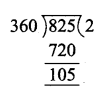
(i) 480 days = \(\frac{480}{365}\)
= 1 year 115 days
= 1 year 3 months 25 days

(ii) 38 months = \(\frac{38}{12}\)
= 3 years 2 months

Samacheer Kalvi Guru 6th Maths Term 2 Question 15.
Calculate your age as on 01.06.2018
Solution:
Samacheer Kalvi 6th Standard Maths Solutions Term 2 Chapter 2 Measurements Ex 2.2
Age is 12 years 2 months

Objective Type Questions

Samacheer Kalvi 6th Maths Solution Question 16.
2 days = …….. hours
(i) 38
(ii) 48
(iii) 28
(iv) 40
Solution:
(ii) 48

Samacheer Kalvi Class 6 Maths Solutions Question 17.
3 weeks = _____ days.
(a) 21
(b) 7
(c) 14
(d) 28
Solution:
(a) 21

Question 18.
Number of ordinary years between two consecutive leap years is
(i) 4 years
(ii) 2 years
(iii) 1 year
(iv) 3 years
Solution:
(iv) 3 years

Question 19.
What time will it 5 hours after 22 : 35 hours?
(a) 2 : 30 hrs
(b) 3 : 35 hrs
(c) 4 : 35 hrs
(d) 5 : 35 hrs
Solution:
(b) 3 : 35 hrs

Question 20.
2 \(\frac{1}{2}\) years is equal to months.
(i) 25
(ii) 30
(iii) 24
(iv) 5
Solution:
(ii) 30

Samacheer Kalvi 10th Social Science History Solutions Chapter 7 Anti-Colonial Movements and the British of Nationalism

Guys who are planning to learn and understand the topics of 10th Social Science History can grab this Tamilnadu State board solutions for Chapter 7 Anti-Colonial Movements and the British of Nationalism Questions and Answers from this page for free of cost. Make sure you use them as reference material at the time of preparation & score good grades in the final exams.

Students who feel tough to learn concepts can take help from this Samacheer Kalvi 10th Social Science Book Solutions Guide Pdf, all the Questions and Answers can easily refer in the exams. Go to the below sections and get 10th Social Science History Chapter 7 Anti-Colonial Movements and the British of Nationalism Tamilnadu State Board Solutions PDF.

Tamilnadu Samacheer Kalvi 10th Social Science History Solutions Chapter 7 Anti-Colonial Movements and the British of Nationalism

Do you feel scoring more marks in the 10th Social Science History Grammar sections and passage sections are so difficult? Then, you have the simplest way to understand the question from each concept & answer it in the examination. This can be only possible by reading the passages and topics involved in the 10th Social Science History Board solutions for Chapter 7 Anti-Colonial Movements and the British of Nationalism Questions and Answers. All the Solutions are covered as per the latest syllabus guidelines. Check out the links available here and download 10th Social Science History Chapter 7 textbook solutions for Tamilnadu State Board.

Anti-Colonial Movements and the British of Nationalism Textual Exercise

I. Choose the correct answer.

Anti Colonial Movements And The Birth Of Nationalism Question 1.
Which one of the following was launched by Haji Shariatullah in 1818 in East Bengal?
(a) Wahhabi Rebellion
(b) Farazi Movement
(c) Tribal uprising
(d) Kol Revolt
Answer:
(b) Farazi Movement

Question 2.
Who declared that “Land belongs to God” and collecting rent or tax on it was against divine law?
(a) Titu Mir
(b) Sidhu
(c) Dudu Mian
(d) Shariatullah
Answer:
(c) Dudu Mian

Question 3.
Who were driven out of their homeland during the process of creation of Zamins under Permanent Settlement?
(a) Santhals
(b) Titu Mir
(c) Munda
(d) Kol
Answer:
(a) Santhals

Question 4.
Find out the militant nationalist from the following.
(a) Dadabhai Naoroji
(b) Justice Govind Ranade
(c) Bipin Chandra pal
(d) Romesh Chandra
Answer:
(c) Bipin Chandra pal

Question 5.
When did the Partition of Bengal come into effect?
(a) 19 June 1905
(b) 18 July 1906
(c) 19 August 1907
(d) 16 October 1905
Answer:
(d) 16 October 1905

Question 6.
What was the context in which the Chota Nagpur Tenancy Act was passed?
(a) Kol Revolt
(b) Indigo Revolt
(c) Munda Rebellion
(d) Deccan Riots
Answer:
(c) Munda Rebellion

Question 7.
Who set up the first Home Rule League in April 1916?
(a) Annie Basant
(b) Bipin Chandra Pal
(c) Lala Lajpat Rai
(d) Tilak
Answer:
(d) Tilak

Question 8.
Who drew the attention of the British to the suffering of Indigo cultivation through his play Nil darpan?
(a) Dina Bandhu Mitra
(b) Romesh Chandra Dutt
(c) Dadabhai Naoroji
(d) Birsa Munda
Answer:
(a) Dina Bandhu Mitra

II. Fill in the blanks.

1. In 1757, Robert Clive was financially supported by…………….., the moneylenders of Bengal.
2. …………….. was an anti-imperial and anti-landlord movement originated in and around 1827.
3. The major tribal revolt took place in Cbotanagpur region was ……………….
4. The ………….. Act, restricted the entry of non-tribal people into the tribal land.
5. Around 1854 activities of social banditry were led by ………………
6. The British Commander of Kanpur killed by the rebels during the 1857 Rebellion was ……………..
7. Chota Nagpur Act was passed in the year ……………..
8. W.C. Bannerjee was elected the president of Indian National Congress in the year …………..
Answers:
1. Jagat Seths
2. Wahhabi rebellion
3. Kol revolt
4. Chotanagpur Tenancy Act
5. Bir Singh
6. Major General High Wheelor
7. 1908
8. 1885

III. Choose the correct statement.

Question 1.
(i) The company received ₹ 22.5 million from Mir Jafar and invested it to propel the industrial revolution in Britain.
(ii) Kols organized an insurrection in 1831-1832, which was directed against Government officers and money lenders.
(iii) In 1855, two Santhal brothers Sidhu and Kanu led the Santhal Rebellion.
(iv) In 1879, an Act was passed to regulate the territories occupied by the Santhals.
(a) (i) (ii) and (iii) are correct
(b) (ii) and (iii) are correct
(c) (iii) and (iv) are correct
(d) (i) and (iv) are correct
Answer:
(a) (i) (ii) and (iii) are correct

Question 2.
(i) Dudu Mian laid emphasis on the egalitarian nature of Islam and declared that “Land belongs to God” .
(ii) According to the Doctrine of Lapse, new territories under the corrupt Indian rulers were to be annexed.
(iii) The British officials after the suppression of 1857 Revolt were given power to judge and take the lives of Indians without due process of law.
(iv) One of the causes of the failure of the Revolt of 1857 was many of the Indian princes and zamindars remained loyal to the British.
(a) (ii) (iii) and (iv) are correct
(b) (i) (ii) and (iv) are correct
(c) (i) (iii) and (iv) are correct
(d) (i), (ii) and (iii) are correct.
Answer:
(c) (i) (iii) and (iv) are correct

Question 3.
(i) One of the most significant contributions of the early Indian Nationalists was the formulation of an economic critique of colonialism.
(ii) The early Congress leaders stated that the religious exploitation in India was the primary reason for the growing poverty.
(iii) One of the goals of the moderate Congress leaders w as to achieve Swaraj or self-rule.
(iv) The objective of partition was to curtail the Bengali influence and weaken the nationalist movement.
(a) (i) and (iii) are correct
(b) (i) (iii) and (iv) are correct
(c) (ii) and (iii) are correct
(d) (iii) and (iv) are correct
Answer:
(b) (i) (iii) and (iv) are correct

Question 4.
Assertion (A): Under colonial rule, for the first time in Indian history, Government claimed a direct proprietary right over forests.
Reason (R): Planters used intimidation and violence to compel farmers to grow indigo.
(a) Both (A) and (R) are correct, but (R) is not the correct explanation of (A)
(b) Both (A) and (R) are wrong
(c) Both (A) and (R) are correct and (R) is the correct explanation of (A)
(d) (A) is wrong and (R) is correct
Answer:
(a) Both (A) and (R) are correct, but (R) is not the correct explanation of (A)

Question 5.
Assertion (A): The Revolt of 1857 was brutally suppressed by the British army.
Reason (R): The failure of the rebellion was due to the absence of Central authority.
(a) Both (A) and (R) are wrong
(b) (A) is wrong and (R) is correct
(c) Both (A) and (R) are correct and (R) is the correct explanation of (A)
(d) Both (A) and (R) are correct, but (R) is not the correct explanation of (A)
Answer:
(b) (A) is wrong and (R) is correct

IV. Match the following.
Anti Colonial Movements And The Birth Of Nationalism Samacheer Kalvi 10th Social Science History Solutions Chapter 7
Answer:
1. (e)
2. (d)
3. (a)
4. (e)
5. (b)

V. Answer the following questions briefly.

Question 1.
How are the peasant uprisings in British India classified?
Answer:
The peasants uprising in British India are classified in to four categories:

  1. Restorative Rebellions – To attempt to restore old order and old social relations.
  2. Religious movements – Led by religions leaders to liberate the locals by restructuring society on certain religious principles.
  3. Social banditry – Looked upon by their people as heroes or champions of their cause.
  4. Mass Insurrection – Leaderless and spontaneous uprisings.

Question 2.
Write about the Kanpur Massacre of 1857.
Answer:
The Siege of Cawnpur was a key episode in the Indian rebellion of 1857. The besieged Company forces and civilians in Cawnpur (now Kanpur) were unprepared for an extended siege and surrendered to rebel forces under Nana Sahib, in return for a safe passage to Allahabad. However under ambiguous circumstances, their evacuation from Cawnpur turned into a massacre, and most of the men were killed.

Question 3.
Name the territories annexed by the British under the Doctrine of Lapse.
Answer:
Satara, Sambalpur, parts of Punjab, Jhansi, and Nagpur were the territories annexed under the Doctrine of Lapse.

Question 4.
What do you mean by drain of wealth?
Answer:
The colonial economy was a continuous transfer of resources from India to Britain without any favourable returns back to India. This is called the drain to wealth.

Question 5.
Explain the concept of constructive Swadeshi.
Answer:
Constructive Swadeshi: It largely stress upon self – help.

  1. It focused on building alternative-institutions of self governance that would operate free of British control.
  2. It also laid emphasis on the need of self strengthening of the people.
  3. In turn it would help them in creating a worthy citizen for political agitation.
  4. Swadeshi shops spread all over the place selling textiles, handlooms, soaps, earthenwares match and leather goods.

Question 6.
Highlight the objectives of Home Rule Movement.
Answer:
The following were the objectives of the Home Rule Movements in India –

  • To attain self-government within the British Empire by rising constitutional means.
  • To obtain the status of dominion, apolitical position accorded later to Australia, Canada, South Africa and New Zealand.
  • To use non-violent constitutional methods to achieve goals.

Question 7.
Summarise the essence of Lucknow Pact.
Answer:
Lucknow Pact was signed in the year 1916. Under the provision of this pact.

  1. Congress and Muslim League agreed to work together to attain self Government in India.
  2. A separate electorate for Muslim was accepted by the Congress leadership.

VI. Answer all the questions under each caption.

Question 1.
Deccan Riots
(а) When and where did the first recorded incident of rioting against the moneylenders in the Deccan appear?
Answer:
The first recorded incident of rioting against the moneylenders in the Deccan appeared in May 1875, in Supa, a village near Poona.

(b What was the right given to moneylenders under a new law of the British?
Answer:
Under a new law, the British moneylenders were allowed to attach the mortgaged land of the defaulters and auction it off.

(c) What did it result in?
Answer:
It resulted in transfer of lands from the cultivators to the non-cultivating classes.

(d) Against whom was the violence directed in the Deccan riots.
Answer:
The violence was directed mostly at the Gujarat moneylenders.

Question 2.
The Revolt of 1857.

(a) Who assaulted his officer, an incident that led to the outbreak of 1857 Revolt?
Answer:
Mangal Pandey assaulted his officer, this was an incident that led to the outbreak of 1857 Revolt.

(b) Who was proclaimed the Sahhensha – e- Hindustan in Delhi?
Answer:
Bahadhur Shah – II was proclaimed as Shahensha – e – Hindustan in Delhi.

(c) Who was the correspondent of London Times who reported on the brutality of the 1857 revolt?
Answer:
William Howard Russell was the correspondent of London Times who reported on the brutality of the 1857 Revolt.

(d) What did the Queen’s proclamation say on matters relating to religion?
Answer:
The Queen’s proclamation said that the British would not interfere in traditional institutions and religious matters.

Question 3.
Indian National Congress
(a) What were the techniques adopted by the Congress to get its grievances redressed?
Answer:
The techniques adopted by the Congress to get its grievances redressed included appeals, petition and delegation to Britain.

(b) What do you know of Lal-Bal-Pal triumvirate?
Answer:
Lala Lajpat Rai of Punjab, Bal Gangadhar Tilak of Maharashtra and Bipin Chandra Pal of Bengal were three prominent leaders during the Swadeshi period. They are often referred to as Lal-Bal-Pal triumvirate.

(c) Where was the first session of Indian National Congress held?
Answer:
The first session of Indian National Congress was held at Bombay.

(d) How did the British respond to the Swadeshi Movement?
Answer:
The British brutally crushed the Swadeshi movement by arresting prominent leaders and putting them into the prison.

VII. Answer the following in detail.

Question 1.
Discuss the causes and consequences of the Revolt of 1857.
Answer:
Political Cause: The annexation policy of British India: Two major policies were followed to bring more territories under British rule.

(a) Doctrine of Paramountcy:
(i) New territories were annexed on the grounds that the native rulers were corrupt and inefficient.
(ii) British claimed themselves as paramount, supreme authority.

(b) Doctrine of Lapse:
(i) If a native ruler does not have biological male heir of their own to the throne after his death the territory would ‘lapse’ in to British India.
(ii) Sambalpur, Satara, Jhansi, parts of Punjab and Nagpur were annexed by the British through Doctrine of Lapse.

Religious Cause:
(i) Indian Sepoys were prohibited from wearing religious marks on their forehead.
(ii) To render their services overseas. Crossing sea meant the loss of their caste. So Sepoys at Barrackpore refused to go to Burma by sea.

Economic Cause: Discrimination in salary and promotion. They felt humiliated by racial abusement.

Immediate Cause:

  1. Introduction of cartridges to the new Enfield Rifles.
  2. There was a strong suspicion that the new cartridge was greased with cow and pig fat
  3. The cartridge had to be bitten off before loading (pork is forbidden to the Muslims and cow is sacred to the Hindus) so the Sepoys refused to use it.
  4. In 29th March a Sepoy named Mangal Pandey assaulted his European officer Along with some other Sepoys and Mangal Pandey were court martialled and hanged.

This fuelled the anger among the Sepoys and started revolt.

Consequences of the Revolt: The Revolt was suppressed: Army had been restored to British control under Martial law.

  1. The British officers were given power to judge and take the life of Indians without dae process of law.
  2. Bahadhur shah II was captured and sent to Burma.
  3. The British parliament passed a law proclaiming the transfer of power from the East India Company to the British Crown.
  4. The structure of the Indian army was revised army was reduced and Indians were restrained from holding important ranks and positions.
  5. Queen Victoria proclaimed that the British would not interfere in traditional institutions and religious matters of Indians.
  6. It was promised that more Indians would be absorbed in Government services.
  7. Secretary of state was appointed to review the Indian affairs.

Question 2.
How did the people of Bengal respond to the partition of Bengal (1905)?
Answer:

  1. The partition of Bengal that took place in 1905, resulted in widespread protests all across India. It started a new phase of the Indian national movement.
  2. The partition instead of dividing the Bengali people along the religious line united the leaders of both the groups – extremist and moderate.
  3. The people of Bengal adopted new techniques of protest. The boycott of British goods was one such method.
  4. The day Bengal was officially partitioned was declared as a day of mourning. Thousand’s of people took bath in River Ganga and marched on the streets of Calcutta singing Vande Mataram.
  5. The people of Bengal were outraged at what they saw as a ‘divide and rule’ policy of the British government.

Question 3.
Attempt a narrative account of how Tilak and Annie Besant by launching Home Rule Movement sustained the Indian freedom struggle after 1916?
Answer:
The Indian National Movement was revived and also radicalised during the Home Rule Movement (1916- 1918), led by Lokamanya Tilak and Annie Besant.

  1. It emerged as a mass movement against the British betrayal to the Indian cause of self Government after the I World War in return for the support rendered.
  2. Tilak first set up the Home Rule League in April 1916.
  3. In September 1916 Annie Besant by the demand of her followers started the Home Rule Movement in Madras (Adyar) without the support of the congress.
  4. Both the leagues worked independently.
  5. They succeeded in enrolling young people in large numbers and extending the movement to the areas,
  6. The Home Rule league was utilised to carry propaganda through press, speeches, public meetings, lectures, discussions and touring in favour of self Government.
  7. Both declared their strong view of self Government as right based on the national principle of self determination.
  8. The Home Rule Movement led to the reunion of moderate and the extremists leaders of Congress at the Lucknow session.
  9. Opened the fresh talks with the leaders of the Muslim League and decided to work together for self Government.
  10. The demand for Swaraj was raised by Tilak and Annie Besant gained popularity.
  11. This strong hold of both the leaders made the British parliament to announce Montagau – Chelmsford reforms which promised gradual progress of India towards self Government.

VIII. Activity

Question 1.
Identify the Acts passed in British India from 1858 to 1919, with a brief note on each. The Government of India Act, 1858.
Answer:

  1. The Government of India Act 1858, marked the beginning of new chapter in the constitutional history of India.
  2. Liquidation of East India Company, and the powers of government, territories and revenues ‘ were transfer to the British Crown.

The Indian Council Act, 1861

  1. It enabled the Governor-General to associate the people of the land with work of legislation.
  2. However, the legislative councils were merely talk shops with no power to criticize the administration or ask for some information. Their scope was fixed in legislation purpose alone; they had no right to move some kind of vote of no confidence.

The Indian Council Act, 1892

  1. This act marks the beginning of representative form of Government in India.
  2. Indian National Congress had adopted some resolutions in its sessions in 1885 and 1889 and put its demand. The major demands placed were as follows:
    • A simultaneous examination of ICS to be held in England and India
    • Reforms of the legislative council and adoption of the principle of election in place of nomination
    • Opposition to the annexation of Upper Burma
    • Reduction in the Military expenditure.

The Indian Councils Act, 1909 (The Morely-Minto Reforms)
(i) The British viceroy of India (1905-10)—was able to introduce several important innovations into the legislative and administrative machinery of the British Indian government.

(ii) The act also increased the maximum additional membership of the Imperial Legislative Council from 16 to 60.

The Government of India Act, 1919 (The Montague-Chelmsford Reforms)
(i) Subjects of administration were divided into two categories – ‘Central’ and ‘Provincial’. All important subjects (like Railways and Finance) were brought under the category of Central, while matters relating to the administration of the Provinces were classified as Provincial.

(ii) The provincial subjects were divided into two groups viz. reserved and transferred.

  • The reserved subjects were kept with the Governor and transferred subjects were kept with the Indian Ministers.
  • This division of subjects was basically what they meant by introducing the Diarchy.
  • The reserved subjects were the essential areas of law enforcement such as justice, police, and revenue. The transferred subjects were such as public health, public works, education etc.

Question 2.
Mark the important Centres of 1857 Revolt in an outline map.
Answer:
Samacheer Kalvi 10th Social Science History Solutions Chapter 7 Anti-Colonial Movements and the British of Nationalism 2

Question 3.
Prepare album with pictures of frontline leaders of all the ant-colonial Struggles launched against the British.
Answer:
Do it yourself.

Anti-Colonial Movements and the British of Nationalism Additional Questions

I. Choose the correct answer.

Question 1.
The British historians call the Revolt of 1857 as ……………….
(a) Military revolt
(b) The great revolt
(c) Freedom struggle
Answer:
(a) Military revolt

Question 2.
The battle of plassey was orchestrated by:
(a) Robert Clive
(b) Hugh Rose
(c) Birsa Munda
(d) Major Munro
Answer:
(a) Robert Clive

Question 3.
During the great revolt of 1857 the Governor General of India was ……………….
(a) Lord Lytton
(b) Lord Ripon
(c) Lord Canning
Answer:
(c) Lord Canning

Question 4.
The British favoured the ……………….. to suppress the peasant uprising.
(a) religious leaders
(b) tribal leaders
(c) local population
(d) zamindars
Answer:
(d) zamindars

Question 5.
The first sign of unrest appeared at ………………
(a) Meerut
(b) Bareilly
(c) Barrackpore
Answer:
(c) Barrackpore

Question 6.
In ……………….. the sepoys at Barrackpur near Calcutta refused to go to Burma by sea, as it meant the loss of their caste.
(a) 1814
(b) 1824
(c) 1815
(d) 1826
Answer:
(b) 1824

Question 7.
The wife of Nawab of Oudh was ……………..
(a) Mumtaj Mahal
(b) Fathima Begum
(c) Begum Hazrat Mahal
Answer:
(c) Begum Hazrat Mahal

Question 8.
After the sepoy revolt, the first civil rebellion broke out in parts of:
(a) North-Western Provinces and Oudh
(b) Bengal and Bihar
(c) North-Eastern Provinces
(d) Central Provinces
Answer:
(a) North-Western Provinces and Oudh

Question 9.
Viceroy means ………………
(a) The representative of the crown
(b) General of an army
(c) Religious leader
Answer:
(a) The representative of the crown

Question 10.
The British Parliament adopted the ……………….. in November 1858.
(a) Lucknow Pact
(b) Swadeshi Movement
(c) Indian Government Act
(d) Rowlatt Act
Answer:
(c) Indian Government Act

Question 11.
The last Emperor of the Mughals …………..
(a) Babur
(b) Akbar
(c) Bahadur Shah – II
Answer:
(c) Bahadur Shah – II

Question 12.
The second half of the ……………….. saw the emergence of national political consciousness.
(a) 16th Century
(b) 17th Century
(c) 18th Century
(d) 19th Century
Answer:
(d) 19th Century

Question 13.
Queen Victoria’s proclamation of 1858 was described as ……………
(a) Human Rights
(b) Magna Carta
(c) citizenship
Answer:
(b) Magna Carta

Question 14.
Partition of Bengal was introduced by:
(a) Lord Lytton
(b) Lord Dalhousie
(c) Lord Rippon
(d) Lord Curzon
Answer:
(d) Lord Curzon

Question 15.
The Nawab of Bengal after Alivardi Khan was ……………..
(a) Tipu Sultan
(b) Siraj-ud-daulah
(c) Mir Questionaim
Answer:
(b) Siraj-ud-daulah

Question 16.
The British who lead the company’s army against Siraj-ud-daulah at plassey was …………..
(a) Robert Clive
(b) Lord Hastings
(c) Edmund Burke
Answer:
(a) Robert Clive

Question 17.
One-third of the population was wiped out from Bengal because ……………
(a) a terrible famine occurred there
(b) a civil war broke out
(c) an epidemic broke out
Answer:
(a) a terrible famine occurred there

Question 18.
The riots were ……………….
(a) cultivators
(b) zamindars
(c) traders
Answer:
(a) cultivators

Question 19.
The Indigo Commission was set up to enquire into the system of indigo production. Whom did the commission hold guilty?
(a) The riots
(b) The government
(c) The planters
Answer:
(c) The planters

Question 20.
After the indigo production collapsed in Bengal, the planters shifted their operation to ……………….
(a) Gujarat
(b) Bihar
(c) Odissa
Answer:
(b) Bihar

Question 21.
At which battle was the Nawab of Bengal Siraj-ud-daulah defeated by the East India Company?
(a) Battle of Plassey
(b) Battle of Buxar
(c) Battle of Panipat
(d) None of the above
Answer:
(a) Battle of Plassey

Question 22.
Who led the Farazi Movement after the death of Dudu Mian?
(a) Titu Mir
(b) Birsa Munda
(c) Sidhu
(d) Noah Mian
Answer:
(d) Noah Mian

Question 23.
Who provided leadership of the 1857 revolt in Bareilly?
(a) Begum Hazrat Mahal
(b) Khan Bahadur
(c) Nana Saheb
(d) Rani Lakshmi Bai
Answer:
(b) Khan Bahadur

Question 24.
The Indigo Revolt began in the year ……………
(a) 1857
(b) 1858
(c) 1859
(d) 1875
Answer:
(c) 1859

Question 25.
Who among the following was not an extremist leader?
(a) Lala Lajpat Rai
(b) Vallabhbhai Patel
(c) Bipin Chandra Pal
(d) Bai Gangadhar Tilak
Answer:
(b) Vallabhbhai Patel

II. Fill in the blanks :

1. The British territories were broadly divided into administrative units called …………..
2. The Royal charter could not prevent other European powers from entering the ………….. Markets.
3. The Bengal Nawabs asserted their power and autonomy after the death of …………..
4. ………….. was made the Nawab of Bengal after the defeat of Siraj-ud-daulah at Plassey.
5. The first Anglo-Maratha war ended with the treaty of …………..
6. Indigo cultivation was done under two main systems known as …………… and …………..
7. By the terms of the Permanent Settlement, the rajas and taluqdars were recognized as …………………
8. ……………… developed Ryotwari System which gradually extended all over South India.
9. The indigo villages were usually around indigo factories owned by ……………….
10. The planters at times pressurised the village between to sign the …………… on behalf of the ryots.
11. The British described the tribal people as …………….
12. Tribals went to work in the ………….. and the ………….. in Bihar.
13. The new law passed in 1850 made …………… into ………….. easier.
14. The Revolt of 1857 began from …………….
15. Mangal Pandey a young soldier was hanged to death for ………….. his officer in ……………
16. The Mughal Emperor Bahadur Shah Zafar died in the …………… jail.
17. In the countryside peasants and zamindars resented the …………….. and the rigid methods of ……………. collection.
18. Nana Saheb, the adopted son of the late Peshwa Baji Rao, gathered armed forces and expelled the……………….. from the city.
19. …………… fought a guerrilla war against the British with the support of several tribal and peasant leaders.
20. The section of Indian nationalists who had little patience for the non-political constructive programmes was called ……………..
21. After the Battle of Plassey, the British adopted the policy of ……………..
22. Many of the peasant revolts were led by …………….. leaders.
23. The Kol uprising took place in Chotanagpur and Singbhum region of Jharkhand and Orissa, under the leadership of ……………. and …………
24. After the 1857 revolt, the British captured Bahadur Shah and transported him to …………….
Answers:
1. Presidencies
2. Eastern
3. Aurangzeb
4. Mir Jafar
5. Salbai
6. Nij, ryots
7. Zamindars
8. Thomas Munro
9. Planters
10. contract
11. Savage
12. tea plantations, Coal mines
14. Meerut
15. Attacking, Barrackpore
16. Rangoon
17. High takes, revenue
18. British garrison
19. Nana Saheb
20. Militant nationalists
21. territorial expansion
22. religious
23. Bindrai, Singhrai
24. Burma

III. True or false

1. Siraj-ud-daulah got help from his commander Mir Jafar and finally won victory in the Battle of Plassey.
2. Birsa urged his followers to purify themselves, give up drinking liquor and stop believing in witchcraft and sorcery.
3. The British wanted to preserve the tribal way of life.
4. The traders and moneylenders never deceived the tribal people.
5. Many tribal groups did not like the colonial forest laws and therefore revolted.
Answers:
1. False
2. True
3. False
4. False
5. True

IV. Choose the correct statement.

Question 1.
(i) The Munda rebellion prompted the British to formulate a policy on tribal land.
(ii) The early objectives of the Congress were to develop and consolidate sentiments of national unity.
(iii) The Indian princes and zamindars were neither loyal to the British power.
(iv) The leaders of the 1857 revolt were defeated due to lack of weapons, organisation, discipline and betrayal by their aides.
(a) (i), (ii) and (iii) are correct
(b) (i), (ii) and (iv) are correct
(c) (i), (iii) and (iv) are correct
(d) (iii) and (iv) are correct
Answer:
(b) (i), (ii) and (iv) are correct

Question 2.
(i)The boycott and Swadeshi were liked to each other.
(ii) Pheroze Shah Mehta and Gokhale were the two important extremist leaders.
(iii) The methods of moderate leaders failed to yield any substantive change in the British attitude
(iv) The Poona Sarvajanik Sabha came into existence in 1870.
(a) (i) and (ii) are correct
(b) (ii), (iii) and (iv) are correct
(c) (i), (iii) and (iv) are correct
(d) (iii) and (iv) are correct
Answer:
(d) (iii) and (iv) are correct

Question 3.
Assertion (A): The plight of the indigo growers war miserable.
Reason (R): They were trapped in debts which were often passed from father to son.
(a) Both A and R are correct
(b) Both A and R are wrong
(c) Both A and R are correct and R is the correct explanation of A
(d) Both A and R are correct but R .is not the correct explanation of A
Answer:
(c) Both A and R are correct and R is the correct explanation of A

V. Match the following.
a.

1.Mangal Pandey(a)Kanpur
2.Bahadur Shah II(b)Lucknow
3.Nana Saheb(c)Central India
4.Begum Hazarat Mahal(d)Barrackpore
5.Rani Lakshmi Bai(e)Delhi

Answer:
1. (d)
2. (e)
3. (a)
4. (b)
5. (c)

b.

1.Rani Lakshmi Bai(a)Mughal Emperor
2.Bahadur Shah II(b)Colin Campbell
3.The Great Revolt(c)Jhansi
4.Lucknow(d)Magna Carta
5.Queen Victoria’s Proclamation(e)1857

Answer:
1. (c)
2. (a)
3. (e)
4. (b)
5. (d)

c.

1.Birjis Qadr(a)Bihar
2.Rani lakshmi bai(b)Faizabad
3.Kunwar Singh(c)Jhansi
4.Bakht Khan(d)Lucknow
5.Ahmadullah Shan(e)Bareilly

Answer:
1. (d)
2. (c)
3. (a)
4. (e)
5. (b)

d.

1.Khunt Katti(a)Mirror of the Indigo
2.Bethbehari(b)Joint holding
3.Niladarpan(c)Self rule
4.Swaraj(d)Great tumult
5.Ulugulan rebellion(e)Forced labour

Answer:
1. (b)
2. (e)
3. (a)
4. (c)
5.(d)

VI. Answer briefly:

Question 1.
How did the East India Company restructure the Mughal revenue system?
Answer:

  1. British – The East India Company introduced land tenures and altered the agrarian relations.
  2. Zamindars and other who collected the revenue never given the possession right on land.
  3. No wide spread system of private ownership. In this way East India Company restructured the Mughal revenue system.

Question 2.
What was the main reason for the defeat of Siraj-ud-daulah at Plassey?
Answer:
Mir Jafar, one of Siraj-ud-daulah’s commanders did not fight the battle.

Question 3.
“Tribes” who are they?
Answer:

  1. Tribes in India were and are very much part of the Indian society.
  2. Infact they are the Indian peasantry subsisting through shifting cultivation.
  3. The modem usage of word tribe in India restricts the definition to distinguish them from the rest of the Indian society, a stratified system based on caste.

Question 4.
How did the company purchase Indian goods?
Answer:
It purchased Indian goods with gold and silver imported from Britain.

Question 5.
What were the impacts of the transfer of power from East India Company to the Crown?
Answer:

  1. After the transfer of power to the Crown.
  2. De-industrialisation led to massive unemployment workers were forced out of the land.
  3. Heavy taxation mined agriculture.
  4. Famine deaths increased.
  5. Peasants were forced to pay revenue directly to the Government.
  6. Mortgaged land of the defaulters were auctioned by the moneylenders.
  7. Peasants were trapped in the vicious-cycle of debt and forced to abandon cultivation.

Question 6.
When was Robert Clive appointed the Governor of Bengal?
Answer:
He was appointed the Governor of Bengal in 1764.

Question 7.
What were the two elements of early Indian response to colonialism?
Answer:
First response: Tribal uprisings and peasant rebellions made an attempts to restore the old order in the late 18th and early 19th century. It was restorative in nature.

Second response: In the second half of 19th-century response was in the ‘ form of Indian Nationalism emphasising on consciousness of unity and National aspiration.

Question 8.
What is indigo?
Answer:
It is a plant that produces rich blue colour used as a dye.

Question 9.
Why did cloth dyers prefer indigo to woad?
Answer:
Cloth dyers preferred indigo as a dye because it produced a rich blue colour whereas the dye from woad was pale and dull.

Question 10.
Mention different types of activities of tribal people.
Answer:
(a) Some practised Jhum cultivation
(b) Some were hunter-gatherers
(c) Some herded animals
(d) Some took to settled cultivation

Question 11.
Who was Birsa?
Answer:
Birsa belonged to a family of Mundas, a tribal group that lived in Chottanagpur.

Question 12.
What did people say about Birsa?
Answer:
People said that he had miraculous powers. He could cure all diseases and multiply grain.

Question 13.
What problems did Birsa set out to resolve?
Answer:
(a) The familiar ways of tribals seemed to be disappearing.
(b) Their livelihoods were under threat.
(c) The religion appeared to be in danger.

Question 14.
On what charges was Birsa convicted?
Answer:
Birsa was convicted on the charges of rioting.

Question 15.
When did Birsa die and how?
Answer:
He died of cholera in 1900 in jail.

Question 16.
Name any two smaller rulers who acknowledged the suzerainty of Bahadur Shah Zafar.
Answer:
Nana Saheb and Birjs Qadar.

Question 17.
Who was Tantia Tope?
Answer:
He was the general of Nana Saheb.

Question 18.
Name the important leaders and centres of the mutiny.
Answer:
Important leaders:

  1. Rani Lakshmi Bai of Jhansi
  2. Tantia Tope
  3. Nana Saheb and Kunwar Singh.

Important centres:

  1. Kanpur
  2. Delhi
  3. Lucknow

Question 19.
Why was not the revolt widespread?
Answer:

  • There was no unity among the rebels.
  • It did not extend beyond north India.
  • South India, Punjab, Sind and Rajasthan kept quiet.
  • The rulers of the Indian States who did not support the movement remained neutral.
  • A large number of rulers of the Indian States and the big zamindars did not join the movement
  • The educated Indians did not support the movement.

Question 20.
The early Indian response to colonial exploitation and the colonial political and economic domination consisted of two elements. Mention them.
Answer:
The two responses:
(i) The first response in the late eighteenth and early nineteenth centuries was restorative in nature. Both tribal uprising and peasant rebellion made an attempt to restore the older order.

(ii) The second response appeared in the second half of the nineteenth century in the form of Indian nationalism that progressively imagined India as a nation emphasising on a consciousness of unity, and national aspiration.

Question 21.
Mention some of the issues that added to a sense of resentment among the Indian peasants and tribals against the British.
Answer:
Some of the issues are – the concept of private property rights in land, rigorous collection of land revenue, encroachment of tribal land by the non-tribal people, the interference of Christian missionaries in the socio-religious life of the local people.

Question 22.
What is the significance of the peasant rebellion that erupted in the first half of the nineteenth century India?
(OR)
What were the characteristics of the peasant uprisings that began except in India in the first half of the nineteenth century ?
Answer:
(i) The peasant uprisings clearly showed an awareness of the power structure in rural society and a strong will to restructure the authority.

(ii) The rebels were quite familiar with the political source of oppression and demonstrated in their actions against the Zamindar houses, grain stocks, the money lenders, and the merchants.

(iii) At times, the British state machinery, which came forward to protect these local agents of oppression, was also attacked.

Question 23.
Highlight the reasons that make the Great Rebellion of 1857 so significant.
(OR)
Why are the events of 1857- 58 significant?
Answer:
The event of 1857-58 is significant for the following reasons,

  1. This was the first major revolt of armed forces accompanied by civilian rebellions.
  2. The revolt witnessed the unprecedented violence, peipetrated by both sides.
  3. The revolt brought an end to the East India Company and the governance of the Indian subcontinent was taken over by the British Crown.

Question 24.
Mention some of the key demands of the Indian National Congress.
Answer:
Here are some of the key demands made by the Indian National Congress:

  1. Creation of legislative councils at provincial and central level.
  2. Increasing the number of elected members in the legislative council.
  3. Separating judicial and executive functions.
  4. Reducing military expenditure.
  5. Reduction of home charges.

VII. Answer all the questions given under each caption:

Question 1.
Farazi – Movement

(a) When and by whom was Farazi movement launched?
Answer:
In 1818 Farazi movement was lunched by Shariatullah.

(b) What did he advocate?
Answer:
He advocated the participants to abstain from un islamic activities.

(c) What was the result of it?
Answer:
This resulted in conflict directly with zamindars and in turn with the British who favoured the zamindars.

(d) Who revived this movement in the 1870?
Answer:
This movement was revived by Noahmian in the 1870s.

Question 2.
Revolt at Kanpur.
(a) Who joined the rebels at Kanpur and with whom?
Answer:
Nana Saheb joined the rebels with his commander Tantia Tope.

(b) What happened to the English?
Answer:
The English surrendered to the rebel force. The English men, women and children were mercilessly massacred.

(c) Who defeated Nana Saheb?
Answer:
Sir Colin Campbell defeated Nana Saheb.

(d) When was Cawnpur brought under British control?
Answer:
Kanpur was brought under the control of the British by the middle November 1857.

Question 3.
State of indian After the Battle of Plassey

(a) What was the policy adopted by the British after Plassey battle?
Answer:
British adopted the policy of territorial expansion.

(b) Name the areas that have undergone changes?
Answer:
Army, police, judicial system, land revenue administration and other institutions of Governance had systematic changes.

(c) What was the early Indians response to?
Answer:
The early Indians response to Colonial exploitation, political and Economic Domination.

(d) What was the nature of the response?
Answer:
The response in the. late 18th and early 19th Century was restorative in nature.

Question 4.
Munda Rebellion.
(a) Mention two reasons that aggravated the miseries of Munda people.
Answer:

  • The corrupt police
  • Lack of access to justice and the disillusionment with Christian missionaries.

(b) Describe briefly the role of Birsa Munda in this rebellion.
Answer:
Birsa Munda gave an impetus to the movement by declaring himself as the messenger of God. He claimed that he had a prophecy and promised supernatural solution to the problem of Munda people. The Munda leaders utilised the cult of Birsa Munda to recruit more people to their cause. A serious of night meetings were held and subsequently a revolt was planned.

(c) When did the revolt take place? How can you say that it was a violent revolt?
Answer:
The revolt took place on the Christmas day in 1889. The rebels resorted to violence. They burnt down buildings and shot arrows at the Christian missionaries, and Munda Christian converts. They also made attacks on police stations and government officials.

(d) How was resistance crushed?
Answer:
Their resistance was crushed and Birsa Munda was arrested who later died in jail.

VIII. Answer the following in detail.

Question 1.
Discuss the four major trends discerned during the Swadeshi Movement in Bengal.
Answer:
Boycott and Swadeshi were the part of the plan to make India self-sufficient. Four major trends can be discerned during the Swadeshi Movement in Bengal.

The Moderate Trend:

  1. Had faith in British rule and their sense of justice and democratic practice.
  2. The moderate leaders were not ready to wrest power from British in one single movement.
  3. Boycott and Swadeshi Movement was of limited significance to them.

Constructive Swadeshi:

  1. Focused on self-help through Swadeshi industries national schools arbitration courts and constructive programmes in the villages.
  2. Rejected the self-defeating modest approach of moderates.
  3. It remained non-political in nature.

Militiant Nationalism:

  1. Focused more on a relentless boycott of foreign goods.
  2. Had little patience for the non – political constructive programmes.
  3. They ridiculed the idea of self-help.

Revolutionary terrorism:

  1. A radical response to the British rule with violent methods.
  2. It marked the shift from the mass – based movement to individual action.
  3. British officials who were anti – Swadeshi or repressive towards native population were targeted.

Question 2.
Mention the results of the Great Revolt of 1857.
Answer:

  1. It put an end to the company’s rule in India in 1858. The administration of India was directly taken over by the British Crown.
  2. By a special Act, both the Board of Control and the Court of Directors were abolished.
  3. The office of the Secretary of State for India was created. He was assisted by an Indian council of 15 members.
  4. The Governor General of India was designated as viceroy of India.
  5. The policy of ruthless conquest in India was given up.
  6. The Indian princess were given the right of adoption.

Social and religious changes:

  1. Full religious freedom was guaranteed to Indians.
  2. Indian were also given assurance that high posts would be given to them without any discrimination.

Military changes:

  1. The Indian army was thoroughly re-organized.
  2. The number of the European forces were increased.
  3. The artillery was put under the charge of the British.

Queen Victoria’s Proclamation of 1858:

  1. Queen Victoria’s Proclamation was issued in 1858.
  2. According to Queen Victoria’s Proclamation the English East India. The administration of India was taken over by the British Crown. The revolt paved the way for the rise of the national movement and it served as a source of inspiration in the later struggle for freedom.

Question 3.
What do you know about Militant Nationalism?
Answer:

  1. The following three were the well known extremist leaders of the Indian National Congress. Lala Lajpat Rai of Punjab, Bala Gangadhar Tilak of Maharashtra and Bipin Chandrapal of Bengal during the period of Swadeshi Movement.
  2. They were referred to as Lai – Bal – Pal Triumvirate.
  3. Punjab, Bengal and Maharashtra emerged as the hotbed of militant nationalism during the Swadeshi Movement.
  4. In south India Tuticorin became the most important location of Swadeshi activity.
  5. V.O.Chidambaranar launched Swadeshi Navigation Company as a part of it.
  6. One of the common goals of the extremist leaders was to achieve Swaraj or Self-rule.
  7. Political murders and individual acts of terrorism were not approved by the Militant leaders.

Question 4.
Describe the circumstances that led to the Indigo Revolt in 1859.
Answer:
(i) Natural Indigo dye was highly valued by cloth makers around the World. Many Europeans sought to make their fortunes by becoming Indigo planters in India. They employed Indian peasants to grow the Indigo which was processed into dye at the planters factories. The dye was then exported to Europe.

(ii) The Indian peasants were not interested in growing Indigo. Instead they wanted to grow food crops. But they were forced to grow indigo. The British planters gave them cash advances to help pay for the rent of the land or other costs. These advances needed to be repaid with interest.

(iii) At the end of the season, the planters paid the cultivators low prices for their indigo. Moreover, the small amount they earned was not enough to pay back the cash advance with interest. So, they fell into debt.

(iv) The peasants would be forced to enter into another contract to grow indigo. And same thing would be repeated once again. Thus, the peasants were never able to clear their debts. Debts were often passed from father to son.
Finally, they revolted against the oppressive system in 1859 which came to be known as the Indigo Revolt. The peasants took a collective decision and refused to grow indigo. The movement quickly spread far and wide.

IMPORTANT EVENTS AND YEARS:
Year – Events
1855 – Birth of Indian National Congress
1856 – The General Services Enlistment Act
1857 – The Great Revolt
1858 – Queen Victoria’s Proclamation
1858 – Darbar at Allahabad
1858 – Vernacular Press Act
1905 – Partition of Bengal, Swadeshi Movement
1906 – Formation of the Muslim league
1907 – Surat Split
1909 – Minto – Morley Reforms Act

We think the data given here clarify all your queries of Chapter 7 and make you feel confident to attempt all questions in the examination. So, practice more & more from Tamilnadu State Board solutions for 10th Social Science History Chapter 7 Anti-Colonial Movements and the British of Nationalism Questions and Answers & score well. Need any information regarding this then ask us through comments & we’ll give the best possible answers very soon.

Samacheer Kalvi 11th Maths Solutions Chapter 3 Trigonometry Ex 3.4

You can Download Samacheer Kalvi 11th Maths Book Solutions Guide Pdf, Tamilnadu State Board help you to revise the complete Syllabus and score more marks in your examinations.

Tamilnadu Samacheer Kalvi 11th Maths Solutions Chapter 3 Trigonometry Ex 3.4

11th Maths Exercise 3.4 Samacheer Kalvi Question 1.
11th Maths Exercise 3.4 Samacheer Kalvi Solutions Chapter 3 Trigonometry
Solution:
11th Maths Exercise 3.4 Solutions Chapter 3 Trigonometry Samacheer Kalvi
11th Maths Exercise 3.4 Answers Solutions Chapter 3 Trigonometry Samacheer Kalvi

11th Maths Exercise 3.4 Question 2.
11 Maths Samacheer Solution Chapter 3 Trigonometry Ex 3.4
Solution:
Class 11 Maths Ex 3.4 Solutions Chapter 3 Trigonometry Samacheer Kalvi
Samacheer Kalvi 11 Maths Solutions Chapter 3 Trigonometry Ex 3.4

11th Maths Exercise 3.4 Answers Question 3.
Samacheer Kalvi Guru 11th Maths Solution Chapter 3 Trigonometry Ex 3.4
Solution:
11th Maths Samacheer Solutions Chapter 3 Trigonometry Ex 3.4
Trigonometry 3.4 Class 11 Solutions Chapter 3 Trigonometry Samacheer Kalvi
since x is in III quadrant
Both sin x and cos x are negative
Samacheer Kalvi Guru 11th Maths Solutions Chapter 3 Trigonometry Ex 3.4

11 Maths Samacheer Solution Question 4.
Samacheer Kalvi Class 11 Maths Solutions Chapter 3 Trigonometry Ex 3.4
Solution:
Samacheer Kalvi Maths 11th Solutions Chapter 3 Trigonometry Ex 3.4

Class 11 Maths Ex 3.4 Solutions Question 5.
Samacheer Kalvi 11th Maths Solutions Chapter 3 Trigonometry Ex 3.4
Solution:
Samacheer Kalvi Guru 11 Maths Solutions Chapter 3 Trigonometry Ex 3.4
Samacheerkalvi.Guru 11th Maths Solutions Chapter 3 Trigonometry Ex 3.4

Samacheer Kalvi 11 Maths Solutions Question 6.
Samacheer Kalvi.Guru 11th Maths Solutions Chapter 3 Trigonometry Ex 3.4
Solution:
Samacheer Kalvi 11th Maths Solutions Chapter 3 Trigonometry Ex 3.4

(ii) L.HS = cos(π + θ) = cos(180° + θ)
= cos 180° cos θ – sin 180° sin θ
= (-1) cos θ – (0) sin θ
= – cos θ = RHS

(iii) LHS = sin (π + θ) = sin π cos θ + cos π sin θ
= (0) cos θ + (-1) sin θ
= -sin θ = RHS

Samacheer Kalvi Guru 11th Maths Solution Question 7.
Find a quadratic equation whose roots are sin 15° and cos 15°
Solution:
Samacheer Kalvi 11th Maths Book Solutions Chapter 3 Trigonometry Ex 3.4
Samacheer Kalvi 11th Maths Solution Chapter 3 Trigonometry Ex 3.4

11th Maths Samacheer Solutions Question 8.
Expand cos(A + B + C). Hence prove that cos A cos B cos C = sin A sin B cos C + sin B sin C cos A + sin C sin A cos B, if A + B + C = \(\frac{\pi}{2}\)
Solution:
Taking A + B = X and C = Y
We get cos (X + Y) = cos X cos Y – sin X sin Y
(i.e) cos (A + B + C) = cos (A + B) cos C – sin (A + B) sin C
= (cos A cos B – sin A sin B) cos C – [sin A cos B + cos A sin B] sin C
cos (A + B + C) = cos A cos B cos C – sin A sin B cos C – sin A cos B sin C – cos A sin B sin C If (A + B + C) = π/2 then cos (A + B + C) = 0
⇒ cos A cos B cos C – sin A sin B cos C – sin A cos B sin C – cos A sin B sin C = 0
⇒ cos A cos B cos C = sin A sin B cos C + sin B sin C cos A + sin C sin A cos B

Trigonometry 3.4 Class 11 Question 9.
Prove that
(i) sin(45° + θ) – sin(45° – θ) = \(\sqrt{2}\)sin θ.
(ii) sin(30° + θ) + cos(60° + θ) = cos θ.
Solution:
Samacheer 11 Maths Solutions Chapter 3 Trigonometry Ex 3.4

Samacheer Kalvi Guru 11th Maths Question 10.
If a cos(x + y) = b cos(x – y), show that (a + b) tan x = (a – b) cot y.
Solution:
a cos (x + y) = b cos (x – y)
a[cos x cos y – sin x sin y] = 6[cos x cos y + sin x sin y]
(i.e) a cos x cos y – a sin x sin y = b cos x cos y + b sin x sin y
a cos x cos y – b sin x sin y = a sin x sin y + b cos x cos y
Samacheer Kalvi 11th Maths Book Solutions Chapter 3 Trigonometry Ex 3.4
⇒ a cot y – b tan x = a tan x + b cot y
a cot y – b cot y = a tan x + b tan x
⇒ (a + b) tan x = (a – b) cot y.

Samacheer Kalvi Class 11 Maths Solutions Question 11.
Prove that sin 105° + cos 105° = cos 45°.
Solution:
sin 105° = sin (60°+ 45°)
= sin 60° cos 45° + cos 60° cos 45°
11th Maths Solutions Samacheer Kalvi Chapter 3 Trigonometry Ex 3.4
= cos 45° = RHS

Samacheer Kalvi Maths 11th Question 12.
Prove that sin 75° – sin 15° = cos 105° + cos 15°.
Solution:
RHS = cos 105° + cos 15° = cos (90° + 15°) + cos (90° – 75°)
= – sin 15° + sin 75°
= sin 75° – sin 15° = LHS

Samacheer Kalvi 11th Maths Solutions Question 13.
Show that tan 75° + cot 75° = 4
Solution:
11th Samacheer Kalvi Maths Solutions Chapter 3 Trigonometry Ex 3.4

Samacheer Kalvi Guru 11 Maths Question 14.
Prove that cos(A + B) cos C – cos(B + C) cos A = sin B sin(C – A).
Solution:
LHS = (cos A cos B – sin A sin B) cos C – (cos B cos C – sin B sin C) cos A
= cos A cos B cos C – sin A sin B cos C – cos A cos B cos C + cos A sin B sin C
= cos A sin B sin C – sin A sin B cos C
= sin B [sin C cos A – cos C sin A]
= sin B [sin (C – A)] = RHS

Samacheerkalvi.Guru 11th Maths Question 15.
Prove that sin(n + 1) θ sin(n – 1) θ + cos(n + 1) θ cos(n – 1)θ = cos 2θ, n ∈ Z.
Solution:
Taking (n + 1) θ = A and (n – 1) θ = B
LHS = sin A sin B + cos A cos B
= cos (A – B)
= cos[(n + 1) – (n – 1)]θ
= cos (n + 1 – n + 1)θ = cos 2θ = RHS

Samacheer Kalvi.Guru 11th Maths Question 16.
Maths Samacheer Kalvi 11th Solutions Chapter 3 Trigonometry Ex 3.4
Solution:
Samacheer Kalvi 11th Maths Solutions Chapter 3 Trigonometry Ex 3.4 68

Samacheer Kalvi 11th Maths Question 17.
Prove that
(i) sin(A + B) sin(A – B) = sin2 A – sin2 B
(ii) cos(A + B) cos(A – B) = cos2 A – sin2 B = cos2 B – sin2 A
(iii) sin2(A + B) – sin2(A – B) = sin2A sin2B
(iv) cos 8θ cos 2θ = cos2 5θ – sin2
Solution:
(i) LHS = sin (A + B) sin (A – B)
= (sin A cos B + cos A sin B) (sin A cos B – cos A sin B)
= sin2A cos2 B – cos2 A sin2 B
= sin2 A (1 – sin2 B) – (1 – sin2 A) sin2 B
= sin2 A – sin2 A sin2 B – sin2 B + sin2 A sin2 B
= sin2 A – sin2 B = RHS

(ii) LHS = cos (A + B) cos (A – B) = (cos A cos B – sin A sin B) (cos A cos B + sin (A sin B)
= cos2 A cos2 B – sin2 A sin2 B
= cos2 A (1 – sin2 B) – (1 – cos2 A) sin2 B
= cos2 A – cos2 A sin2 B – sin2 B + cos2 A sin2 B
= cos2 A – sin2 B = RHS
Now cos2 A – sin2 B = (1 – sin2 A) – (1 – cos2 B)
= 1 – sin2 A – 1 + cos2 B
= cos2 B – sin2 A

(iii) sin2 A – sin2 B = sin (A + B) sin (A – B)
LHS = sin2 (A + B) – sin2 (A – B) = sin [(A + B) + (A – B)] [sin (A + B) – (A – B)]
= sin 2A sin 2B = RHS

(iv) LHS = cos 8θ cos 2θ
= cos (5θ + 3θ) cos (5θ – 3θ) .
We know cos (A + B) cos (A – B) = cos2 A – sin2 B
∴ cos (5θ + 3θ) cos (5θ – 3θ) = cos2 5θ – sin2 3θ = RHS

Samacheer Kalvi 11th Maths Book Solutions Question 18.
Show that cos2 A + cos2 B – 2 cos A cos B cos(A + B) = sin2(A + B).
Solution:
LHS = cos2 A + cos2 B – 2 cos A cos B [cos A cos B – sin A sin B]
= cos2 A + cos2 B – 2 cos2 A cos2 B + 2 sin A cos A sin B cos B
= (cos2 A – cos2 A cos2 B) + (cos2 B – cos2 A cos2 B) + 2 sin A cos A sin B cos B
= cos2 A (1 – cos2 B) + cos2 B (1 – cos2 A) + 2 sin A cos A sin B cos B
= cos2 A sin2 B + cos2 B sin2 A + 2 sin A cos B sin B cos A
= (sin A cos B + cos A sin B)2
= sin2 (A + B) = RHS

Samacheer Kalvi 11th Maths Solution Question 19.
If cos(α – β) + cos(β – γ) + cos(γ – α) = \(-\frac{3}{2}\), then prove that cos α + cos β + cos γ = sin α + sin β + sin γ
Solution:
Samacheer Kalvi 11th Maths Solutions Chapter 3 Trigonometry Ex 3.4 70
2 cos (α – β) + 2cos (β – γ) + 2cos (γ – α) = -3
2cos(α – β) + 2cos(β – γ) + 2cos (γ – α) + 3 = 0
[2 cos α cos β + 2 sin α sin β] + [2 cos β cos γ + 2 sin β sin γ] + [2 cos γ cos α + sin γ sin α] + 3 = 0
= [2 cos α cos β + 2 cos β cos γ + 2 cos γ cos α] + [2 sin α sin β + 2 sin β sin γ + 2 sin γ sin α] + (sin2 α + cos2 α) + (sin2 β + cos2 β) + (sin2 γ + cos2 γ) = 0
⇒ (cos2 α + cos2 β + cos2 γ + 2 cos α cos β + 2 cos β cos γ + 2 cos γ cos α) + (sin2 α + sin2 β) + (sin2 γ + 2 sin α sin β + 2 sin β sin γ + 2 sin γ sin α) = 0
(cos α + cos β + cos γ)2 + (sin α + sin β + sin γ)2 = 0
=(cos α + cos β + cos γ) = 0 and sin α + sin β + sin γ = 0
Hence proved

Samacheer 11 Maths Solutions Question 20.
Samacheer Kalvi 11th Maths Solutions Chapter 3 Trigonometry Ex 3.4 71
Solution:
Samacheer Kalvi 11th Maths Solutions Chapter 3 Trigonometry Ex 3.4 72

Samacheer Kalvi 11th Maths Book Question 21.
Samacheer Kalvi 11th Maths Solutions Chapter 3 Trigonometry Ex 3.4 73
Solution:
Samacheer Kalvi 11th Maths Solutions Chapter 3 Trigonometry Ex 3.4 74
Samacheer Kalvi 11th Maths Solutions Chapter 3 Trigonometry Ex 3.4 75

11th Maths Solutions Samacheer Kalvi Question 22.
Samacheer Kalvi 11th Maths Solutions Chapter 3 Trigonometry Ex 3.4 76
Solution:
Samacheer Kalvi 11th Maths Solutions Chapter 3 Trigonometry Ex 3.4 77

11th Samacheer Kalvi Maths Question 23.
Samacheer Kalvi 11th Maths Solutions Chapter 3 Trigonometry Ex 3.4 78
Solution:
Samacheer Kalvi 11th Maths Solutions Chapter 3 Trigonometry Ex 3.4 79

Question 24.
Samacheer Kalvi 11th Maths Solutions Chapter 3 Trigonometry Ex 3.4 80
Solution:
Samacheer Kalvi 11th Maths Solutions Chapter 3 Trigonometry Ex 3.4 81

Maths Samacheer Kalvi 11th Question 25.
Samacheer Kalvi 11th Maths Solutions Chapter 3 Trigonometry Ex 3.4 83
Solution:
Samacheer Kalvi 11th Maths Solutions Chapter 3 Trigonometry Ex 3.4 84
Samacheer Kalvi 11th Maths Solutions Chapter 3 Trigonometry Ex 3.4 85

Samacheer Kalvi 11th Maths Solutions Chapter 3 Trigonometry Ex 3.4 Additinal Questions

10th Maths Exercise 3.4 Samacheer Kalvi Question 1.
Prove that sin (A + B) sin (A – B) = cos2 B – cos2 A
Solution:
LHS = sin (A + B) sin (A – B)
= (sin A cos B + cos A sin B) (sin A cos B – cos A sin B)
= sin2 A cos2 B – cos2 A sin2 B
= (1 – cos2 A) cos2 B – cos2 A (1 – cos2 B)
= cos2 B – cos2 A cos2 B – cos2 A + cos2 A cos2 B
= cos2 B – cos2 A = RHS

Question 2.
Prove that
(i) sin A + sin(120° + A) + sin (240° + A) = 0
(ii) cos A + cos (120° +A) + cos (120° – A) = 0
Solution:
(i) sin A + sin(120° + A) + sin (240° + A)
= sin A+ sin 120° cos A + cos 120° sin A + sin 240° cos A + cos 240° sin A …… (1)
Samacheer Kalvi 11th Maths Solutions Chapter 3 Trigonometry Ex 3.4 86
By substituting these values in (1), we get,
Samacheer Kalvi 11th Maths Solutions Chapter 3 Trigonometry Ex 3.4 87

(ii) cos 120° = cos (180° – 60°) = – cos 60° = \(\frac{-1}{2}\)
LHS = cos A + cos (120° + A) + cos (120° – A)
= cos A + cos 120° cos A – sin 120° sin A + cos 120° cos A + sin 120° sin A
= cos A + 2 cos 120° cos A
Samacheer Kalvi 11th Maths Solutions Chapter 3 Trigonometry Ex 3.4 88

Question 3.
Samacheer Kalvi 11th Maths Solutions Chapter 3 Trigonometry Ex 3.4 89
Solution:
Samacheer Kalvi 11th Maths Solutions Chapter 3 Trigonometry Ex 3.4 90
tan (A + B) = 1 ⇒ A+ B = 45°

Question 4.
If A + B = 45°, show that (1 + tan A) (1 + tan B) = 2 and hence deduce the value of tan \(22 \frac{1^{0}}{2}\).
Solution:
Given A + B = 45° ⇒ tan (A + B) = tan 45°
Samacheer Kalvi 11th Maths Solutions Chapter 3 Trigonometry Ex 3.4 91
(i.e.) tan A + tan B = 1 – tan A.tan B
(i.e.) 1 + tan A + tan B = 2 – tan A tan B (add 1 on both sides)
1 + tan A + tan B + tan A tan B = 2
(i.e.) (1 + tan A) (1 + tan B) = 2
Samacheer Kalvi 11th Maths Solutions Chapter 3 Trigonometry Ex 3.4 92

Samacheer Kalvi 8th Tamil Solutions Chapter 3.1 நோயும் மருந்தும்

Tamilnadu State Board New Syllabus Samacheer Kalvi 8th Tamil Book Solutions Guide Pdf Chapter 3.1 நோயும் மருந்தும் Text Book Back Questions and Answers, Summary, Notes.

Tamilnadu Samacheer Kalvi 8th Tamil Solutions Chapter 3.1 நோயும் மருந்தும்

கற்பவை கற்றபின்

Question 1.
ஐம்பெருங்காப்பியங்கள், ஐஞ்சிறுகாப்பியங்கள் ஆகியவற்றின் பெயர்களைத் தொகுத்து எழுதுக.
Answer:
Samacheer Kalvi 8th Tamil Solutions Chapter 3.1 நோயும் மருந்தும் 1

மாடநூல் வினாக்கள்

சரியான விடையைத் தேர்ந்தெடுத்து எழுதுக.

Question 1.
உடல்நலம் என்பது ……………………… இல்லாமல் வாழ்தல் ஆகும்.
அ) அணி
ஆ) பணி
இ) பிணி
ஈ) மணி
Answer:
இ) பிணி

Question 2.
நீலகேசி கூறும் நோயின் வகைகள் ……………………
அ) இரண்டு
ஆ) மூன்று
இ) நான்கு
ஈ) ஐந்து
Answer:
ஆ) மூன்று

Question 3.
‘இவையுண்டார்’ என்னும் சொல்லைப் பிரித்து எழுதக் கிடைப்பது_ ………………………
அ) இ + யுண்டார்
ஆ) இவ் + உண்டார்
இ) இவை + உண்டார்
ஈ) இவை + யுண்டார்
Answer:
இ) இவை + உண்டார்

Question 4.
தாம் + இனி என்பதனைச் சேர்த்தெழுதக் கிடைக்கும் சொல் ……………………
அ) தாம் இனி
ஆ) தாம்மினி
இ) தாமினி
ஈ) தாமனி
Answer:
இ) தாமினி

குறுவினா

Question 1.
நோயின் மூன்று வகைகள் யாவை?
Answer:

  • மருந்தினால் நீங்கும் நோய்.
  • எதனாலும் தீராத தன்மையுடைய நோய் மற்றொரு வகை.
  • வெளியில் ஆறி உள்ளுக்குள் இருந்து துன்பம் தரும் நோய்.

Question 2.
நீலகேசியில் பிறவித் துன்பத்தைத் தீர்க்கும் மருந்துகளாகக் கூறப்படுவன யாவை?
Answer:
நல்லறிவு, நற்காட்சி, நல்லொழுக்கம் என்பவையே பிறவித் துன்பத்தைத் தீர்க்கும் மருந்துகளாக நீலகேசி கூறுகின்றது.

சிறு வினா

Question 1.
நோயின் வகைகள் அவற்றைத் தீர்க்கும் வழிகள் பற்றி நீலகேசி கூறுவன யாவை?
Answer:

  • ஒளிபொருந்திய அணிகலன்களை அணிந்த பெண்ணே! நோயின் தன்மை பற்றி யார் வினவினாலும் அது மூன்று வகைப்படும் என அறிவாயாக.
  • மருந்தினால் நீங்கும் நோய்.
  • எதனாலும் தீராத தன்மையுடைய நோய் மற்றொரு வகை.
  • வெளியில் ஆறி உள்ளுக்குள் இருந்து துன்பம் தரும் நோய்.
  • அகற்றுவதற்கு அரியவை பிறவித் துன்பங்கள் ஆகும்.
  • இவற்றைத் தீர்க்கும் மருந்துகள் மூன்று. நல்லறிவு, நற்காட்சி, நல்லொழுக்கம் என்பவையே அம்மருந்துகள்.
  • இவற்றை ஏற்றோர் பிறவித்துன்பத்திலிருந்து நீங்கி உயரிய இன்பத்தை அடைவர்.

சிந்தனை வினா

Question 1.
துன்பமின்றி வாழ நாம் கைக்கொள்ள வேண்டிய நற்பண்புகள் யாவை?
Answer:
தருமம் செய்தல், கோபத்தைத் தணித்தல், முயற்சி செய்தல், கல்வி கற்றல், உலக நடையை அறிந்து நடத்தல், நல்ல நூல்களைப் படித்தல், பொறாமை படாமல் இருத்தல், பொய்சாட்சி சொல்லாமல் இருத்தல், இனிமையாகப் பேசுதல், பேராசையைத் தவிர்த்தல், நட்புடன் பழகுதல், பெரியோர்களை மதித்தல், ஒழுக்கம் தவறாமல் இருத்தல், நன்றியை மறவாமல் இருத்தல், காலத்தைக் கடைபிடித்தல், களவு செய்யாதிருத்தல், இழிவானதைச் செய்யாதிருத்தல், இரக்கம் கொள்ளுதல், பொய் சொல்லாதிருத்தல், ஆணவம் கொள்ளாதிருத்தல், சுறுசுறுப்புடன் இருத்தல், உடற்பயிற்சி செய்தல், அதிகாலையில் எழுந்திருத்தல் போன்றவை கைக்கொள்ள வேண்டிய நற்பண்புகள் ஆகும்.

கூடுதல் வினாக்கள்

சரியான விடையைத் தேர்ந்தெடுத்து எழுதுக.

Question 1.
மக்களின் உடலுக்கும் உள்ளத்திற்கும் துன்பம் தருவன …………………….
அ) நாய்கள்
ஆ) நோய்கள்
இ) பேய்கள்
ஈ) மனிதர்கள்
Answer:
ஆ) நோய்கள்

Question 2.
உள்ளத்தில் தோன்றும் தீய எண்ணங்களால் ஏற்படும் துன்பங்களையும் ……………………… என்றே நம் முன்னோர்கள் குறிப்பிட்டனர்.
அ) கவலை
ஆ) துன்பம்
இ) நோய்கள்
ஈ) பொறுமை
Answer:
இ) நோய்கள்

Question 3.
நோய்களை நீக்கும் மருந்துகளாக விளங்கும் அறக்கருத்துகளை விளக்குபவை …………………..
அ) இலக்கியங்கள்
ஆ) இலக்கணங்கள்
இ) படைப்புகள்
ஈ) முன்னோர்கள்
Answer:
அ) இலக்கியங்கள்

Question 4.
நோயைத் தீர்க்கும் மருந்துகள் ………………….
அ) இரண்டு
ஆ) மூன்று
இ) நான்கு
ஈ) ஐந்து
Answer:
ஆ) மூன்று

Question 5.
………………… ஐஞ்சிறு காப்பியங்களுள் ஒன்று.
அ) சிலப்பதிகாரம்
ஆ) நீலகேசி
இ) குண்டலகேசி
ஈ) வளையாபதி
Answer:
ஆ) நீலகேசி

Question 6.
நீலகேசி ………………… சமயக் கருத்துகளைக் கூறுகிறது.
அ) சமணம்
ஆ) புத்தம்
இ) கிறித்தவம்
ஈ) இந்து
Answer:
அ) சமணம்

Question 7.
நீலகேசி, கடவுள் வாழ்த்து நீங்கலாக ……………….. சருக்கங்களைக் கொண்டது.
அ) எட்டு
ஆ) ஒன்பது
இ) ஏழு
ஈ) பத்து
Answer:
ஈ) பத்து

Question 8.
‘போலாதும்’ என்னும் சொல்லைப் பிரித்து எழுதக் கிடைப்பது ………………………..
அ) போ + தும்
ஆ) போல் + ஆதும்
இ) போல் + அனதும்
ஈ) போலா + தும்
Answer:
ஆ) போல்+ஆதும்

Question 9.
‘உய்ப்பனவும்’ என்னும் சொல்லைப் பிரித்து எழுதக் கிடைப்பது …………………
அ) உய் + பனவும்
ஆ) உய்ப் + பனவும்
இ) உய்ப்ப ன + உம்
ஈ) உய்ப்ப ன + அம்
Answer:
இ) உய்ப்பன+உம்

Question 10.
‘கூற்றவா’ என்னும் சொல்லைப் பிரித்து எழுதக் கிடைப்பது …………………….
அ) கூ + அவா
ஆ) கூற்று + அவா
இ) கூற் + அவா
ஈ) கூற்று + ஆவா
Answer:
ஆ) கூற்று+அவா

Question 11.
‘ஐம்பெருங்காப்பியம்’ என்னும் சொல்லைப் பிரித்து எழுதக் கிடைப்பது …………………..
அ) ஐந்து + காப்பியம்
ஆ) ஐந்து + பெரு + காப்பியம்
இ) ஐம்பெருங் + காப்பியம்
ஈ) ஐந்து + பெருமை + காப்பியம்
Answer:
ஈ) ஐந்து + பெருமை + காப்பியம்

Question 12.
‘அரும்பிணி’ என்னும் சொல்லைப் பிரித்து எழுதக் கிடைப்பது ………………………….
அ) அரும் + பிணி
ஆ) அரு + பிணி
இ) அருமை + பிணி
ஈ) அரும் + பணி
Answer:
இ) அருமை + பிணி

Question 13.
‘அ + பிணி’ என்பதனைச் சேர்த்தெழுதக் கிடைக்கும் சொல் ……………………….
அ) அபிணி
ஆ) அப்பிணி
இ) அப்பிணி
ஈ) அதுபிணி
Answer:
இ) அப்பிணி .

Question 14.
‘தெளிவு + ஓடு’ என்பதனைச் சேர்த்தெழுதக் கிடைக்கும் சொல் …………………..
அ) தெளிவுவூடு
ஆ) தெளிவோடு
இ) தெளிவுஓடு
ஈ) தெளிவாடு
Answer:
ஆ) தெளிவோடு

Question 15.
‘பிணி + உள்’ என்பதனைச் சேர்த்தெழுதக் கிடைக்கும் சொல் ……………….
அ) பிணியுள்
ஆ) பிணினள்
இ) பிணியாள்
ஈ) பிணிபுள்
Answer:
அ) பிணியுள்

Question 16.
‘இன்பம் + உற்றே’ என்பதனைச் சேர்த்தெழுதக் கிடைக்கும் சொல் ………………….
அ) இன்பமுற்று
ஆ) இன்பமற்றே
இ) இன்பம் உற்றோ
ஈ) இன்பமுற்றே
Answer:
ஈ) இன்பமுற்றே

குறுவினா

Question 1.
நோய்கள் எவற்றிற்கெல்லாம் துன்பம் தருவன?
Answer:
மக்களின் உடலுக்கும் உள்ளத்திற்கும் துன்பம் தருவன நோய்கள்.

Question 2.
நம் முன்னோர்கள் எவற்றையும் நோய்கள் என்று கூறினர்?
Answer:
உள்ளத்தில் தோன்றும் தீய எண்ணங்களால் ஏற்படும் துன்பங்களையும் நோய்கள் என்றே நம் முன்னோர் கூறினர்.

Question 3.
இலக்கியங்கள் விளக்குவன யாவை?
Answer:
நோய்களை நீக்கும் மருந்துகளாக விளங்கும் அறக்கருத்துகளை இலக்கியங்கள் விளக்குகின்றன.

Question 4.
ஐம்பெருங்காப்பியங்கள் யாவை?
Answer:
சிலப்பதிகாரம், மணிமேகலை, சீவகசிந்தாமணி, வளையாபதி, குண்டலகேசி.

Question 5.
ஐஞ்சிறுகாப்பியங்கள் யாவை?
Answer:
சூளாமணி, நீலகேசி, உதயண குமார காவியம், யசோதர காவியம், நாககுமார காவியம்.

சிறுவினா

Question 1.
நீலகேசி குறித்து எழுதுக.
Answer:

  • நீலகேசி என்றால் கருத்த கூந்தலை உடையவள் என்று பொருள்.
  • ஆசிரியர் பெயர் அறியப்படவில்லை .
  • கடவுள் வாழ்த்து நீங்கலாகப் பத்துச் சருக்கங்களைக் கொண்டது.
  • 894 பாடல்களைக் கொண்டது.
  • நீலகேசி தெருட்டு என்ற வேறு பெயரும் உண்டு.

சொல்லும் பொருளும்

தீர்வன – நீங்குபவை
உவசமம் – அடங்கி இருத்தல்
நிழல் இகழும் – ஒளிபொருந்திய
பேர்தற்கு அகற்றுவதற்கு
திரியோகமருந்து – மூன்று யோகமருந்து
தெளிவு – நற்காட்சி
திறத்தன – தன்மை யுடையன
கூற்றவா – பிரிவுகளாக
பூணாய் – அணிகலன்களை அணிந்தவளே
பிணி – துன்பம்
ஓர்தல் – நல்லறிவு
பிறவார் – பிறக்கமாட்டார்

Samacheer Kalvi 10th Social Science Civics Solutions Chapter 4 India’s Foreign Policy

Guys who are planning to learn and understand the topics of 10th Social Science Civics can grab this Tamilnadu State board solutions for Chapter 4 India’s Foreign Policy Questions and Answers from this page for free of cost. Make sure you use them as reference material at the time of preparation & score good grades in the final exams.

Students who feel tough to learn concepts can take help from this Samacheer Kalvi 10th Social Science Book Solutions Guide Pdf, all the Questions and Answers can easily refer in the exams. Go to the below sections and get 10th Social Science Civics Chapter 4 India’s Foreign Policy Tamilnadu State Board Solutions PDF.

Tamilnadu Samacheer Kalvi 10th Social Science Civics Solutions Chapter 4 India’s Foreign Policy

Do you feel scoring more marks in the 10th Social Science Civics Grammar sections and passage sections are so difficult? Then, you have the simplest way to understand the question from each concept & answer it in the examination. This can be only possible by reading the passages and topics involved in the 10th Social Science Civics Board solutions for Chapter 4 India’s Foreign Policy Questions and Answers. All the Solutions are covered as per the latest syllabus guidelines. Check out the links available here and download 10th Social Science Civics Chapter 4 textbook solutions for Tamilnadu State Board.

India’s Foreign Policy Textual Exercise

I. Choose the correct answer.

Indian Foreign Policy Class 10 Questions And Answers Question 1.
Which Minister plays a vital role in molding the foreign policy of our country?
(a) Defense Minister
(b) Prime Minister
(c) External Affairs Minister
(d) Home Minister
Answer:
(c) External Affairs Minister

Indian Foreign Policy 10th Standard Notes Question 2.
The Panchseel treaty has been signed between:
(a) India and Nepal
(b) India and Pakistan
(c) India and China
(d) India and Sri Lanka
Answer:
(c) India and China

10th Social Indian Foreign Policy Notes Question 3.
Which article of Indian constitution directs to adopt foreign policy?
(a) Article 50
(b) Article 51
(c) Article 52
(d) Article 53
Answer:
(b) Article 51

Foreign Policy Of India 10th Notes Question 4.
Apartheid is:
(a) An international association
(b) Energy diplomacy
(c) A policy of racial discrimination
(d) None of these
Answer:
(d) None of these

Indian Foreign Policy Notes 10th Class Question 5.
The Agreement signed by India and China in 1954 related to …………..
(a) Trade and Commerce
(b) Restoration of normal relations
(c) Cultural exchange programmes
(d) The Five Principles of Co-existence
Answer:
(d) The Five Principles of Co-existence

Indian Foreign Policy Class 10 Notes Question 6.
Which is not related to our foreign policy?
(a) World co-operation
(b) World peace
(c) Racial equality
(d) Colonialism
Answer:
(d) Colonialism

Indian Foreign Policy Class 10 Questions And Answers Pdf Question 7.
Which of the following country is not the founder member of NAM?
(a) Yugoslavia
(b) Indonesia
(c) Egypt
(d) Pakistan
Answer:
(d) Pakistan

Indian Foreign Policy 10th Notes Question 8.
Find the odd one:
(a) Social welfare
(b) Health care
(c) Diplomacy
(d) Domestic affairs
Answer:
(c) Diplomacy

Question 9.
Non-Alliance means ………..
(a) being neutral
(b) freedom to decide on issues independently
(c) demilitarisation
(d) none of the above
Answer:
(b) freedom to decide on issues independently

Question 10.
Non – military issues are:
(a) Energy security
(b) Water security
(c) Pandemics
(d) All the above.
Answer:
(d) All the above.

II. Fill in the blanks.

1. India conducted its first nuclear test at …………
2. At present our foreign policy acts as a means to generate ……….. for domestic growth and development.
3. ……….. is the instrument for implementing foreign policy of a state.
4. …………. was India’s policy in the face of the bipolar order of the cold war.
5. Our tradition and national ethos is to practice …………..
Answers:
1. Pokhran
2. inward investment, business and technology
3. Diplomacy
4. Non-Alignment
5. disarmament

III. Consider the following statement and tick the appropriate answer.

Question 1.
Arrange the following in the correct chronological order and choose the correct answer from the code given below.
(i) Panchsheel
(ii) Nuclear test at Pokhran
(iii) Twenty-year Treaty
(iv) First Nuclear test
(a) i, iii, iv, ii
(b) i, ii, iii, iv
(c) i, ii, iv, iii
(d) i, iii, ii, iv
Answer:
(c) i, ii, iv, iii

Question 2.
Which of the following is not about NAM?
(i) The term Non-Alignment was coined by V. Krishna Menon
(ii) It aimed to maintain national independence in foreign affairs by joining any military alliance
(iii) At present it has 120 member countries
(iv) It has transformed to an economical movement
(a) (i) and (ii)
(b) (iii) and (iv)
(c) (ii) only
(d) (iv) only
Answer:
(c) (ii) only

Question 3.
Write true or false against each of the statement.
(a) During Cold War India tried to form a third bloc of nations in the international affairs.
(b) The Ministry of Home Affairs is responsible for the conduct of the country’s foreign relations.
(c) The nuclear test at Pokhran was done under Subterranean Nuclear Explosions Project.
Answer:
(a) True
(b) False
(c) True

Question 4.
Assertion (A): India aligned with Soviet Union by the Indo-Soviet treaty on 1971.
Reason (B): This began with a disastrous Indo-China war of 1962.
(a) A is correct and R explains A
(b) A is correct and R does not explain A
(c) A is correct and R is Wrong
(d) Both A and R are wrong
Answer:
(b) A is correct and R does not explain A

Question 5.
Assertion (A): India has formal diplomatic relations with most of the nations.
Reason (R): India is the World’s second-most populous country.
(a) A is correct and R explains A
(b) A is correct and R does not explain A
(c) A is wrong and R is correct
(d) Both are wrong
Answer:
(b) A is correct and R does not explain A

Question 6.
Avoidance of military blocs was a necessity for India after political freedom. Because India had to redeemed from
(a) acute poverty
(b) illiteracy
(c) chaotic socio-economic conditions
(d) all the above
Answer:
(d) all the above

IV. Match the following.

1.Indian Ocean island(a)1955
2.Landbridge to ASEAN(b)1954
3.Panchsheel(c)Maldives
4.Afro Asian Conference(d)Foreign Policy
5.World Peace(e)Myanmar

Answer:
1. (c)
2. (e)
3. (b)
4. (a)
5. (d)

V. Give Short Answers.

Question 1.
What is foreign policy?
Answer:
Foreign policy can be defined as a country’s policy that is conceived, designed and formulated to safeguard and promote her national interests in her external affairs in the conduct of relationships with other countries, both bilaterally and multilaterally.

Question 2.
Explain India’s nuclear policy.
Answer:
Indian nuclear programme in 1974 and 1998 is only done for strategic purposes. The two themes of India’s nuclear doctrine are
• No first use
• Credible minimum deterrence
It has decided not to use nuclear power for ‘offensive purposes’ and would never use against any non-nuclear state.

Question 3.
Highlight the contribution by Nehru to India’s foreign policy.
Answer:

  1. The most idealistic phase of India’s foreign policy under the guidance of India’s first Prime Minister, Jawaharlal Nehru.
  2. The new nations that got independence after the long period of colonial struggle found themselves in a very difficult situation with respect to economic development.
  3. So it was necessary to align with either of the blocs – United States of America U.S.A (or) Union Soviet Socialist Republic (U.S.S.R).

Question 4.
Differentiate: Domestic policy and Foreign policy
Answer:

Domestic PolicyForeign Policy
Domestic policy is the nation’s plan for dealing issues within its own nation.Foreign policy is the nation’s plan for dealing with other nations.
It includes laws focusing on domestic affairs, social welfare, health care, education, civil rights, economic issues and social issues.Trade, diplomacy, sanctions, defence, intelligence and global environments are the types of foreign policy.

Question 5.
List any four guiding principles of Panchsheel.
Answer:

  1. Mutual non – aggression
  2. Mutual non – interference
  3. Equality and co-operation for mutual benefit
  4. Peaceful co-existence

Question 6.
What was the reason for India to choose the path of Non-Alignment?
Answer:
The new nations that got independence after the long period of colonial struggle found themselves in a very difficult situation with respect to economic development. So it was necessary to align with either of the blocs – United States of America (USA) or United Soviet Socialist Republic (USSR). Nehru, India’s first Prime Minister, was opposed to the rivalry of the two superpowers (America and Russia). So he chose the path of Non-Alignment.

Question 7.
In what ways are India’s global security concerns reflected?
Answer:
India’s global security concerns are reflected in its military modernisation, maritime security and nuclear policies.

Question 8.
List out the member countries of SAARC.
Answer:
The member countries are Afghanistan, Bangladesh, Bhutan, India, Nepal, Maldives, Pakistan and Sri Lanka.

Question 9.
Name the architects of the Non-Aligned movement.
Answer:
Jawaharlal Nehru of India, Tito of Yugoslavia, Nasser of Egypt, Sukarno of Indonesia, and KwameNkumarah of Ghana were the architects of Non Aligned Movement.

Question 10.
Mention the main tools of foreign policy.
Answer:
The main tools of foreign policy are treaties and executive agreements, appointing ambassadors, foreign aid, international trade and armed forces.

VI. Answer in detail.

Question 1.
Write a detailed note on Non-alignment.
Answer:

  • The term ‘Non-Alignment’ was coined by V. Krishna Menon.
  • Non-alignment has been regarded as the most important feature of India’s foreign policy.
  • It aimed to maintain national independence in foreign affairs by not joining any military alliance.
  • The Non-Aligned Movement (NAM) was formed with a membership of 120 countries and 17 states as observers and 10 international organisations.

The founding fathers of Non-Aligned Movement:
Jawaharlal Nehru of India, Tito of Yugoslavia, Nasser of Egypt, Sukarno of Indonesia, and Kwame Nkumarah of Ghana were the founding fathers of NAM.

    • Non-aligned countries have been successful in establishing a foundation of economic co-operation among underdeveloped countries.

Question 2.
Discuss the core determinants of India’s foreign policy?
Answer:

  1. Geographical position and size of territory.
  2. Nation’s history, traditions and philosophical basis.
  3. Natural resources.
  4. The compulsion of economic development.
  5. Political stability and structure of Government.
  6. The necessity of peace, disarmament and non – proliferation of nuclear weapons.
  7. Military strength
  8. International milieu.

Question 3.
Make a list on basic concepts followed by India to maintain friendly relations with its neighbours.
Answer:
(i) Indian foreign policy has always regarded the concept of neighbourhood as one of widening concentric circles, around the central axis of historical and cultural commonalties.

(ii) India gives political and diplomatic priority to her immediate neighbours and the Indian Ocean Island states such as Maldives.

(iii) India provides neighbours with support as needed in this form of resources equipment and training.

VII. Project and activity

Question 1.
Identify any two aspects of India’s foreign policy that you would like to retain and two that you would like to change if you were the decision maker.
Answer:
Do it yourself.

India’s Foreign Policy Additional Questions

I. Choose the correct answer.

Question 1.
India is a country with an unbounded faith in …………
(a) War
(b) Peace
(c) Love
Answer:
(b) Peace

Question 2.
Find out the main tools of the foreign policy of the following.
(a) Treaties
(b) International trade
(c) Foreign Aid
(d) All the above
Answer:
(d) All the above

Question 3.
Apartheid was abolished on …………
(a) 1990
(b) 1991
(c) 1890
Answer:
(a) 1990

Question 4.
In which place the Foreign Service Training Institute was established?
(a) New Delhi
(b) Mumbai
(c) Calcutta
(d) None of the above
Answer:
(a) New Delhi

Question 5.
Apartheid was abolished by …………..
(a) Jawaharlal Nehru
(b) Nelson Mandela
(c) Gandhi
Answer:
(b) Nelson Mandela

Question 6.
In which year Panchsheel was signed?
(a) 1951
(b) 1952
(c) 1954
(d) 1956
Answer:
(c) 1954

Question 7.
SAARC’s first meeting was held at ………….
(a) Colombo
(b) Cairo
(c) Dacca
Answer:
(c) Dacca

Question 8.
Who was opposed to the rivalry of the two super powers? (America and Russia)
(a) V. Krishna Menon
(b) Nasser
(c) Jawaharlal Nehru
(d) None
Answer:
(c) Jawaharlal Nehru

Question 9.
The first SAARC’s meeting was held at Dacca in the year …………..
(a) 1985
(b) 1965
(c) 1995
Answer:
(c) 1995

Question 10.
Which year did India conduct its first nuclear test at Pokhran?
(a) 1971
(b) 1972
(c) 1974
(d) 1976
Answer:
(c) 1974

II. Fill in the blanks :

1. India followed the policy of …………..
2. India has rendered whole-hearted support to the ………….. to bring World Peace.
3. ………….. is an economic and geopolitical organization of eight countries are particularly located in South Asia.
4. SAARC Disaster Management Centre was set up at ………….
5. …………policy is the nation’s plan for dealing issues within its own nation.
Answers:
1. Non-alignment
2. UNO
3. SAARC
4. New Delhi
5. Domestic

III. Match the following.

1.Jawaharlal Nehru(a)Indonesia
2.Chou-En-Lai(b)Egypt          .
3.Nelson Mandela(c)India
4.Nasser(d)China
5.Sukarno(e)South Africa

Answer:
1. (c)
2. (d)
3. (e)
4. (b)
5. (a)

IV. Answer briefly:

Question 1.
Mention any three objectives of our Foreign Policy.
Answer:

  1. National security
  2. National prosperity
  3. Achieving world peace and enable every nation to peacefully co-exist.

Question 2.
Why is world peace an essential one?
Answer:
The economic development of the nations can be achieved only through world peace. So world peace is very essential not only for the economic development of India but also for all the developing countries of the world.

Question 3.
Explain the foreign policy stance of India?
Answer:
The foreign policy stance of India was:

  1. Supporting the cause of decolonisation.
  2. Staunch opponent of the apartheid regime in South Africa.
  3. Accepted the importance of defence preparedness.

Question 4.
Name the areas identified by the SAARC countries for mutual co-operations.
Answer:
The SAARC countries identified mutual co-operation in the following areas. They are transportation, postal service, tourism, shipping meteorology, health, agriculture, rural construction and telecommunications.

Question 5.
What are the two themes of India’s nuclear doctrine?
Answer:
The two themes of India’s nuclear doctrine are:

  1. No first use
  2. Credible minimum deterrence.

V. Detail.

Question 1.
Write a paragraph about Panchsheel and the policy of Non-alignment.
Answer:
Panchsheel:
India is called by the name of “A Great Peace Maker”. It followed five principles which are popularly known as ‘Panchsheel’. Jawaharlal Nehru said, stress on these five principles. They are:

  1. Each country should respect the territorial integrity and sovereignty of others.
  2. No country should attack any other country.
  3. No one should try to interference in the internal affairs of others.
  4. All countries shall strive for equality and mutual benefit.
  5. Every country should try to follow the policy of peaceful co-existence.

These Panchsheel greatly added to the international status of India.
Policy of Non-allignments:

  1. After the Second World War the world was divided into two hostile blocs. The
    American Bloc and The Russian Bloc.
  2. Both of them are trying to increase their influence at the cost of the other.
  3. But India has not joined either of these two blocs.
  4. Whenever any difference arises between there blocs, India tries to remove that difference. Thus India has contributed substantially towards world peace.

Question 2.
Write about policy of Disarmament.
Answer:

  1. Our tradition and national ethos is to practice disarmament.
  2. Since Independence, global non-proliferation has been a dominant theme of India’s nuclear policy.
  3. So India supported UN disarmament progrmme.
  4. Indian nuclear programme in 1974 and 1998 is only done for strategic purposes.

Question 3.
Point out the basic concepts of India’s foreign policy:
Answer:

  • Preservation of national interest.
  • Achievement of world peace.
  • Disarmament
  • Fostering cordial relationship with other countries.
  • Solving conflicts by peaceful means.
  • Independence of thought and action as per the principle of NAM.
  • Equality in conducting international relations.
  • Anti-Colonialism, anti-imperialism anti- racism.

We think the data given here clarify all your queries of Chapter 4 and make you feel confident to attempt all questions in the examination. So, practice more & more from Tamilnadu State Board solutions for 10th Social Science Civics Chapter 4 India’s Foreign Policy Questions and Answers & score well. Need any information regarding this then ask us through comments & we’ll give the best possible answers very soon.

Samacheer Kalvi 7th Tamil Solutions Term 2 Chapter 3.1 ஒரு வேண்டுகோள்

Students can Download Tamil Chapter 3.1 ஒரு வேண்டுகோள் Questions and Answers, Summary, Notes Pdf, Samacheer Kalvi 7th Tamil Book Solutions Guide Pdf helps you to revise the complete Tamilnadu State Board New Syllabus and score more marks in your examinations.

Tamilnadu Samacheer Kalvi 7th Tamil Solutions Term 2 Chapter 3.1 ஒரு வேண்டுகோள்

மதிப்பீடு

சரியான விடையைத் தேர்ந்தெடுத்து எழுதுக.

Question 1.
மயிலும் மானும் வனத்திற்கு ………………………… தருகின்ற ன.
அ) களைப்பு
ஆ) வனப்பு
இ) மலைப்பு
ஈ) உழைப்பு
Answer:
ஆ) வனப்பு

Question 2.
மிளகாய் வற்றலின் ……………… தும்மலை வரவழைக்கும்.
அ) நெடி
ஆ) காட்சி
இ) மணம்
ஈ) ஓசை
Answer:
அ) நெடி

Question 3.
அன்னை தான் பெற்ற ………….. ….. சிரிப்பில் மகிழ்ச்சி அடைகிறார்.
அ) தங்கையின்
ஆ) தம்பியின்
இ) மழலையின்
ஈ) கணவனின்
Answer:
இ) மழலையின்

Question 4.
வனப்பில்லை ‘ என்னும் சொல்லைப் பிரித்து எழுதக் கிடைப்பது …………………
அ) வனம் + இல்லை
ஆ) வனப்பு + இல்லை
இ) வனப்பு + யில்லை
ஈ) வனப் + பில்லை
Answer:
ஆ) வனப்பு + இல்லை

Question 5.
வார்ப்பு + எனில்’ என்பதனைச் சேர்தெழுதக் கிடைக்கும் சொல்
அ) வார்ப்எனில்
ஆ) வார்ப்பினில்
இ) வார்ப்பெனில்
ஈ) வார்ப்பு எனில்
Answer:
இ) வார்ப்பெனில்

நயம் அறிக

ஒரே எழுத்திலோ ஓசையிலோ முடியும் இயைபுச் சொற்களைப் பாடலில் இருந்து எடுத்து எழுதுக.
Samacheer Kalvi 7th Tamil Solutions Term 2 Chapter 3.1 ஒரு வேண்டுகோள் - 1

குறுவினா

Question 1.
தாய்மையின் ஓவியத்தில் நிறைந்திருக்க வேண்டியவை யாவை?
Answer:
அன்பும் பாசமும் தாய்மையின் ஓவியத்தில் நிறைந்திருக்க வேண்டும்.

Question 2.
ஒரு கலை எப்பொழுது உயிர்ப்புடையதாக அமையும்?
Answer:
மானுடப் பண்பு நிறைந்திருந்தால் ஒரு கலை உயிர்ப்புடையதாக அமையும்.

சிறுவினா

சிற்பங்களும் ஓவியங்களும் எவ்வாறு அமைய வேண்டும் என்று கவிஞர் கூறுகிறார்?
Answer:
(i) சிற்பங்கள் : ஒரு சிற்பி, பாறை உடைப்பவரின் சிலையைச் செதுக்கினால் அதிக வியர்வை நாற்றம் வீச வேண்டும். உழவனின் உருவச் சிலையாக இருந்தால் ஈரமண் வாசம் வீச வேண்டும்.

(ii) ஓவியங்கள் : ஓர் ஓவியன், தாயின் உருவத்தைத் தீட்டினால் அன்பும் பண்பும் மேலோங்கிட வேண்டும். சிறு குழந்தையின் சித்திரமானால் உடலெங்கும் பால் மணம் கமழ வேண்டும். சிற்பங்களும் ஓவியங்களும் இவ்வாறு அமைவதே சிறப்பு என்று கவிஞர் கூறுகிறார்.

சிந்தனை வினா

நீங்கள் ஒரு கலைஞராக இருந்தால் எத்தகைய படைப்புகளை உருவாக்குவீர்கள்?
Answer:
நான் ஒரு கலைஞராக இருந்தால் பச்சைப்பசேல் என விளங்கும் மலைகள், அங்கு விழும் அருவிகள், பயமறியாமல் பறக்கும் பறவைகள், புலி, மான், சிங்கம் என அனைத்து வனவாழ் விலங்குகளும் அச்சமின்றி அருவியில் நீர் அருந்துதல், ஒன்றையொன்று நட்புடன் நோக்குதல் இவற்றை உருவாக்குவேன்.

கற்பவை கற்றபின்

Question 1.
உங்களுக்குப் பிடித்த ஏதேனும் ஒரு கலை பற்றிய தகவல்களைத் திரட்டுக.
Answer:
மயிலாட்டம்: மயில் வடிவுள்ள கூட்டுக்குள் ஒருவர், தன் உருவத்தை மறைத்துக் கொண்டு, நையாண்டி மேளத்திற்கேற்ப ஆடும் ஆட்டமே மயிலாட்டமாகும். நையாண்டி மேளம் இசைக்க, காலில் கட்டப்பட்டுள்ள சலங்கை ஒலிக்க மயிலின் அசைவுகளை ஆடிக்காட்டுவர்.

கரகாட்டத்தின் துணையாட்டமாகவும் மயிலாட்டம் ஆடப்படுகிறது. ஊர்ந்து ஆடுதல், மிதந்து ஆடுதல், சுற்றி ஆடுதல், இறகை விரித்தாடுதல், தலையைச் சாய்த்தாடுதல், தாவியாடுதல், இருபுறமும் சுற்றியாடுதல், அகவுதல், தண்ணீ ர் குடித்துக் கொண்டே ஆடுதல் ஆகிய அடவுகளைக் கலைஞர்கள் இவ்வாட்டத்தில் ஆடிக் காட்டுவர்.

Question 2.
உழைப்பாளர்களின் பெருமையைக் கூறும் கவிதைகளைத் தொகுத்து வந்து வகுப்பறையில் பகிர்க.
Answer:
உழைப்பு இல்லையேல்
உணவும், மகிழ்ச்சியும்
இல்லை இன்று
உழைத்தால் வயதான போது
உட்கார்ந்து உண்ணலாம்
உழைக்க வேண்டிய காலத்தில்
உழைக்கவில்லை என்றால்
ஓய்வு எடுக்க வேண்டிய
காலத்தில் உழைக்க வேண்டும்
உயிரினங்கள் கூட உழைக்கின்றன
கையிருந்தும் உழைக்காமல்
இருந்தால் வாழ்க்கை இல்லாமலாகும்.

கூடுதல் வினாக்கள்

சொல்லும் பொருளும் :

1. பிரும்மாக்கள் – படைப்பாளர்கள்
2. நெடி – நாற்றம்
3. மழலை – குழந்தை
4. வனப்பு – அழகு
5. பூரிப்பு – மகிழ்ச்சி
6. மேனி – உடல்

நிரப்புக.

Question 1.
பூரிப்பு என்பதன் பொருள்
Answer:
மகிழ்ச்சி

Question 2.
தேனரசன் …………….. பணியாற்றியவர்.
Answer:
தமிழாசிரியராகப்

Question 3.
ஒரு வேண்டுகோள் கவிதை ……………. என்னும் நூலிலிருந்து எடுத்துத் தரப்பட்டுள்ளது.
Answer:
பெய்து பழகிய மேகம்

விடையளி :

Question 1.
தேனரசன் எழுதிய நூல்கள் யாவை?
Answer:

  • மண்வாசல்
  • வெள்ளை ரோஜா
  • பெய்து பழகிய மேகம்.

Question 2.
தேனரசன் எந்த இதழ்களில் கவிதைகள் எழுதினார்?
Answer:

  • வானம்பாடி
  • குயில்
  • தென்றல்

பாடலின் பொருள்

கலையுலகப் படைப்பாளர்களே! மண்ணின் அழகுக்கு அழகு சேர்ப்பவர்களே! உங்களுக்கு ஒரு மனித சமுதாயத்தின் வேண்டுகோள்!

நீங்கள் பாறை உடைப்பவரின் சிலையைச் செதுக்கினால், அதில் வியர்வை நாற்றம் வீசவேண்டும். உழவரின் உருவ வார்ப்பாக இருந்தால், அதில் ஈரமண்ணின் மணம் வீச வேண்டும்.

தாயின் மகிழ்ச்சியான உருவத்தை ஓவியமாக வரைந்தால், அவரின் முகத்தில் அன்பும் பாசமும் நிறைந்திருக்க வேண்டும். சிறு குழந்தையின் சித்திரத்தைத் தீட்டினால் அதன் உடலில் பால் மணம் கமழ வேண்டும்.

ஆல்ப்ஸ் மலைச் சிகரங்கள், அட்லாண்டிக் பெருங்கடல் அலைகள், அமேசான் காடுகள், பனிபடர் பள்ளத்தாக்குகள், தொங்கும் தோட்டங்கள் என இயற்கையின் விந்தைத் தோற்றங்கள் எவையும் கலைவடிவம் பெறலாம். ஆனால் அதில் மானுடப் பண்பு கட்டாயமாக இருக்க வேண்டும். மானுடம் இல்லாத எந்த அழகும் அழகன்று. மனிதன் கலக்காத எதிலும் உயிர்ப்பில்லை